/
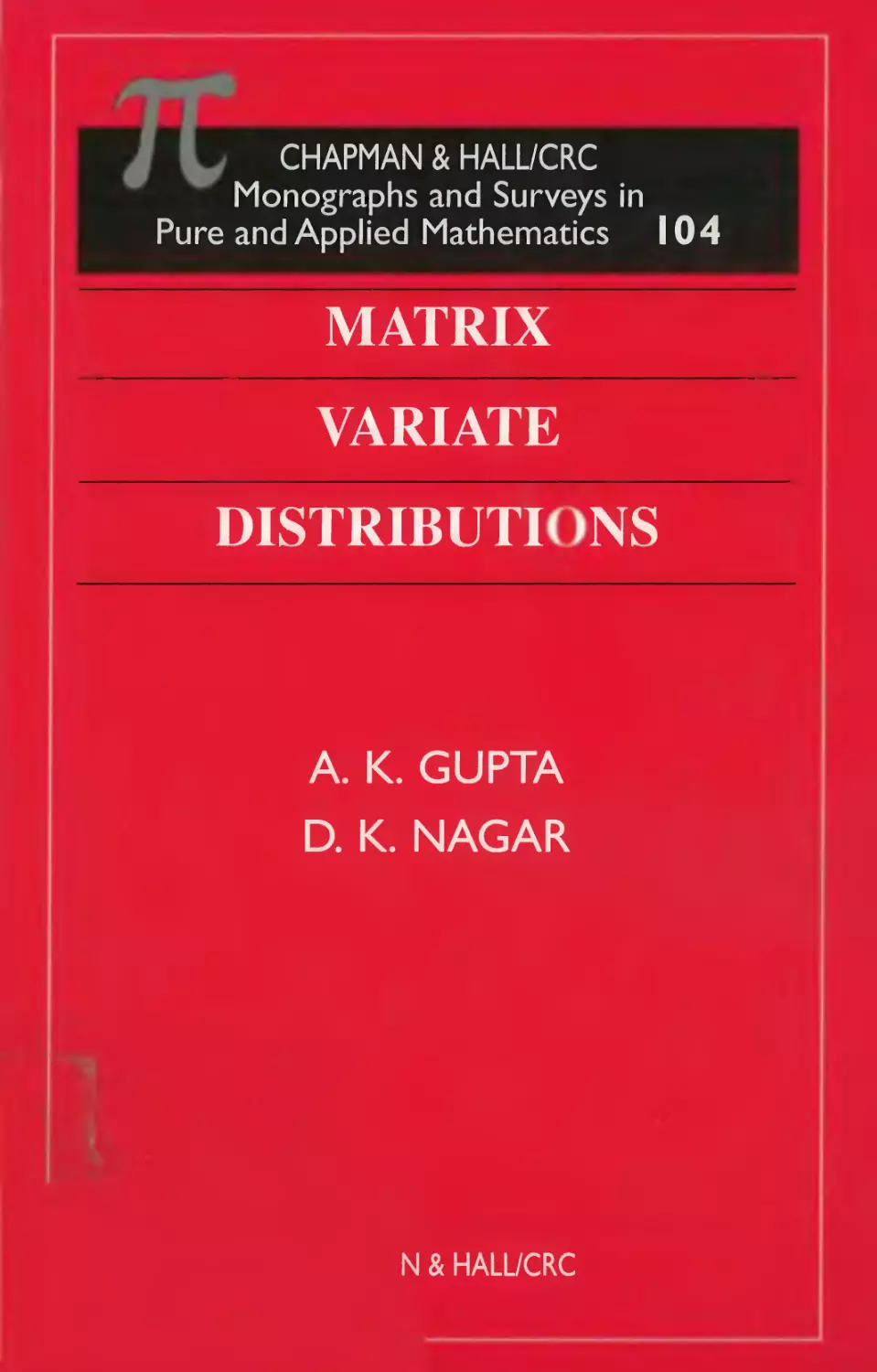


Автор: Gupta A.K. Nagar D.K.
Теги: mathematics applied mathematics natural sciences monograph
ISBN: 1-58488-046-5
Год: 2000


Текст
                    CHAPMAN & HALL/CRC
Monographs and Surveys
Pure and Applied Mathematics
N & HALL/CRC

π
CHAPMAN & HALL/CRC
Monographs and Surveys in
Pure and Applied Mathematics 104
MATRIX
VARIATE
DISTRIBUTIONS

CHAPMAN & HALL/CRC
Monographs and Surveys in Pure and Applied Mathematics
Main Editors
H. Brezis, Universite de Paris
R.G. Douglas, Texas A&M University
A. Jeffrey, University of Newcastle upon Tyne (Founding Editor)
Editorial Board
H. Amann, University of Zurich
R. Aris, University of Minnesota
G.I. Barenblatt, University of Cambridge
H. Begehr, Freie Universitat Berlin
P. Bullen, University of British Columbia
R.J. Elliott, University of Alberta
R.P. Gilbert, University of Delaware
R. Glowinski, University of Houston
D. Jerison, Massachusetts Institute of Technology
K. Kirchgassner, Universitat Stuttgart
B. Lawson, State University of New York
B. Moodie, University of Alberta
S. Mori, Kyoto University
L.E. Payne, Cornell University
D.B. Pearson, University of Hull
I. Raeburn, University of Newcastle
G.R Roach, University of Strathclyde
I. Stakgold, University of Delaware
W.A. Strauss, Brown University
J. van der Hoek, University of Adelaide

π
CHAPMAN &HALL/CRC
Monographs and Surveys in
Pure and Applied Mathematics 104
MATRIX
VARIATE
DISTRIBUTIONS
A.K. GUPTA
D.K. NAGAR
CHAPMAN & HALL/CRC
Boca Raton London New York Washington, D.C.

Library of Congress Cataloging-in-Publication Data
Gupta, A. K. (Arjun K.), 1938-
Matrix variate distributions / A.K. Gupta, D.K. Nagar.
p. cm. — (Monographs and surveys in pure and applied
mathematics)
Includes bibliographical references and index.
ISBN 1-58488-046-5
1. Distribution (Probability theory) 2. Multivariate analysis.
3. Random matrices. I. Nagar, D. K. II. Title. III. Series:
Chapman & Hall/CRC monographs and surveys in pure and applied
mathematics.
QA273.6.G875 1999
519.24—dc21 99-40291
CIP
This book contains information obtained from authentic and highly regarded sources. Reprinted
material is quoted with permission, and sources are indicated. A wide variety of references are listed.
Reasonable efforts have been made to publish reliable data and information, but the author and the
publisher cannot assume responsibility for the validity of all materials or for the consequences of their use.
Neither this book nor any part may be reproduced or transmitted in any form or by any means,
electronic or mechanical, including photocopying, microfilming, and recording, or by any information
storage or retrieval system, without prior permission in writing from the publisher.
The consent of CRC Press LLC does not extend to copying for general distribution, for promotion,
for creating new works, or for resale. Specific permission must be obtained in writing from CRC Press
LLC for such copying.
Direct all inquiries to CRC Press LLC, 2000 N.W. Corporate Blvd., Boca Raton, Florida 33431.
Trademark Notice: Product or corporate names may be trademarks or registered trademarks, and
are used only for identification and explanation, without intent to infringe.
© 2000 by Chapman & Hall/CRC
No claim to original U.S. Government works
International Standard Book Number 1-58488-046-5
Library of Congress Card Number 99-40291
Printed in the United States of America 1 234567890
Printed on acid-free paper

То Меега
AKG
To the memory of my mother
DKN

PREFACE
Random matrices play an important role in the study of multivariate statistical
methods. They have been found useful in physics, economics, psychology and other fields
of scientific investigation. The literature on the subject is widely dispersed
throughout statistical journals. A lot of material has accumulated over the years and an
analytical review of the material was deemed necessary. At present there is no book
available which deals with this subject primarily. This volume presents most of the
developments that have taken place in continuous matrix variate distribution theory
in a systematic and integrated form. Some new results have also been included. It
is hoped that this volume will stimulate further research and help advance the field
of multivariate statistical analysis. This book will be especially useful to graduate
students, teachers and researchers who are interested in multivariate statistical
analysis. The first author presented parts of this book in a one semester course at Bowling
Green State University. It can also serve as a source of supplementary reading and
reference to many researchers. It is assumed that the reader is familiar with introductory
multivariate statistical analysis and matrix algebra.
This work supplements the four volume encyclopaedic work by Johnson and Kotz
on the Distributions in Statistics (Discrete Distributions, Continuous Univariate
Distributions 1, Continuous Univariate Distributions 2 and Continuous Multivariate
Distributions) which has been an important contribution to statistical literature. The
authors have also benefited by many fine books in multivariate analysis, e.g., Anderson,
An Introduction to Multivariate Statistical Analysis; Kshirsagar, Multivariate
Analysis; Srivastava and Khatri, An Introduction to Multivariate Statistics; Muirhead,
Aspects of Multivariate Statistical Theory; and Siotani, Hayakawa and Fujikoshi, Modern
Multivariate Statistical Analysis: A Graduate Course and Handbook.
After introducing the basic mathematical results from matrix algebra,
integration, zonal polynomials and hypergeometric functions in Chapter 1, we study the
matrix variate normal and Wishart distributions in Chapters 2 and 3, respectively.
We discuss the matrix variate ί-distribution in Chapter 4, the matrix variate beta and
F-distributions in Chapter 5, and the matrix variate Dirichlet distributions in
Chapter 6. The distribution of matrix quadratic forms is given in Chapter 7, and some
miscellaneous distributions are presented in Chapter 8. The last chapter, Chapter 9,
gives some general families of distributions. Every chapter is followed with a set of
problems. Finally, a bibliography, which contains only items cited in the text, has
been provided. It is not exhaustive especially as regards to papers on applied topics.
It is a pleasure to express our thanks to all who contributed to the production
of this book. Foremost, we would like to record our gratitude to late Professor

С. G. Khatri for many valuable suggestions and for reading parts of the manuscript
critically before his untimely death. The authors also benefited greatly from
conversations with Professors V. Girko, S. Konishi, S. Kotz, N. Sugiura, and С G. Troskie.
Furthermore, Drs. J. Chen, D. Song, J. Tang and T. Varga helped by reading parts
of the manuscript. Thanks are also due to Drs. D. J. de Waal, P. С N. Groenewald,
R. D. Gupta, J. M. Juritz, Ravindra Khattree, N. J. le Roux, D. G. Marx, D. G.
Nel, H. M. Nel, J. J. J. Roux, W. Y. Tan and C. A. van der Merwe for providing the
preprints and reprints of their work.
The first author would like to acknowledge his special thanks to his wife, Meera, for
her continued encouragement and his children Alka, Mita and Nisha, for their support
and help in editing the book. However, whatever errors of omission or commission
that remain are entirely ours.
The academic environment at the Department of Mathematics and Statistics,
Bowling Green State Univeristy and the Department of Mathematics, Universidad
de Antioquia, was essential to complete this project. Ms. Mary Lince, CRC Press,
has been very cooperative during the publishing phase. Finally, we very much
appreciate the help rendered by Ms. Cynthia Patterson in the early stages of the production
of this book.
Bowling Green, Ohio
August, 1999.
A. K. Gupta
D. K. Nagar

TABLE OF CONTENTS
1 PRELIMINARIES 1
1.1. INTRODUCTION 1
1.2. MATRIX ALGEBRA 2
1.3. JACOBIANS OF TRANSFORMATIONS 12
1.4. INTEGRATION 18
1.5. ZONAL POLYNOMIALS 29
1.6. HYPERGEOMETRIC FUNCTIONS OF MATRIX ARGUMENT 34
1.7. LAGUERRE POLYNOMIALS 41
1.8. GENERALIZED HERMITE POLYNOMIALS 42
1.9. NOTION OF RANDOM MATRIX 44
PROBLEMS 47
2 MATRIX VARJATE NORMAL DISTRIBUTION 55
2.1. INTRODUCTION 55
2.2. DENSITY FUNCTION 55
2.3. PROPERTIES 56
2.4. SINGULAR MATRIX VARIATE NORMAL DISTRIBUTION 68
2.5. SYMMETRIC MATRIX VARIATE NORMAL DISTRIBUTION 70
2.6. RESTRICTED MATRIX VARIATE NORMAL DISTRIBUTION 74
2.7. MATRIX VARIATE ^-GENERALIZED NORMAL DISTRIBUTION 77
PROBLEMS 82
3 WISHART DISTRIBUTION 87
3.1. INTRODUCTION 87
3.2. DENSITY FUNCTION 87
3.3. PROPERTIES 90
3.4. INVERTED WISHART DISTRIBUTION 111
3.5. NONCENTRAL WISHART DISTRIBUTION 113
3.6. MATRIX VARIATE GAMMA DISTRIBUTION 122
3.7. APPROXIMATIONS 124
PROBLEMS 127

MATRIX VARIATE ^-DISTRIBUTION
133
4.1. INTRODUCTION 133
4.2. DENSITY FUNCTION 134
4.3. PROPERTIES 135
4.4. INVERTED MATRIX VARIATE i-DISTRIBUTION 142
4.5. DISGUISED MATRIX VARIATE i-DISTRIBUTION 143
4.6. RESTRICTED MATRIX VARIATE i-DISTRIBUTION 151
4.7. NONCENTRAL MATRIX VARIATE i-DISTRIBUTION 152
4.8. DISTRIBUTION OF QUADRATIC FORMS 156
PROBLEMS 159
MATRIX VARIATE BETA DISTRIBUTIONS 165
5.1. INTRODUCTION 165
5.2. DENSITY FUNCTIONS 165
5.3. PROPERTIES 171
5.4. RELATED DISTRIBUTIONS 182
5.5. NONCENTRAL MATRIX VARIATE BETA
DISTRIBUTION 188
PROBLEMS 193
MATRIX VARIATE DIRICHLET DISTRIBUTIONS 199
6.1. INTRODUCTION 199
6.2. DENSITY FUNCTIONS 199
6.3. PROPERTIES 204
6.4. RELATED DISTRIBUTIONS 214
6.5. NONCENTRAL MATRIX VARIATE DIRICHLET DISTRIBUTIONS 218
PROBLEMS 222
DISTRIBUTION OF QUADRATIC FORMS 225
7.1. INTRODUCTION 225
7.2. DENSITY FUNCTION 225
7.3. PROPERTIES 228
7.4. FUNCTIONS OF QUADRATIC FORMS 233
7.5. SERIES REPRESENTATION OF THE DENSITY 238
7.6. NONCENTRAL DENSITY FUNCTION 246
7.7. EXPECTED VALUES 251
7.8. WISHARTNESS AND INDEPENDENCE OF QUADRATIC FORMS
OF THE TYPE XAX' 253
7.9. WISHARTNESS AND INDEPENDENCE OF QUADRATIC FORMS
OF THE TYPE XAX' + \{LX' + XL') + С 262
7.10. WISHARTNESS AND INDEPENDENCE OF QUADRATIC FORMS
OF THE TYPE XAX' + LiX' + XL'2 + С 270
PROBLEMS 273

8 MISCELLANEOUS DISTRIBUTIONS
279
8.1. INTRODUCTION 279
8.2. UNIFORM DISTRIBUTION ON STIEFEL MANIFOLD 279
8.3. VON MISES-FISHER DISTRIBUTION 281
8.4. BINGHAM MATRIX DISTRIBUTION 284
8.5. GENERALIZED BINGHAM-VON MISES MATRIX DISTRIBUTION 285
8.6. MANIFOLD NORMAL DISTRIBUTION 287
8.7. MATRIX ANGULAR CENTRAL GAUSSIAN DISTRIBUTION 288
8.8. BIMATRIX WISHART DISTRIBUTION 289
8.9. BETA-WISHART DISTRIBUTION 290
8.10. CONFLUENT HYPERGEOMETRIC FUNCTION KIND 1
DISTRIBUTION 291
8.11. CONFLUENT HYPERGEOMETRIC FUNCTION KIND 2
DISTRIBUTION 295
8.12. HYPERGEOMETRIC FUNCTION DISTRIBUTIONS 298
8.13. GENERALIZED HYPERGEOMETRIC FUNCTION
DISTRIBUTIONS 301
8.14. COMPLEX MATRIX VARIATE DISTRIBUTIONS 303
PROBLEMS 304
GENERAL FAMILIES OF MATRIX VARIATE
DISTRIBUTIONS 311
9.1. INTRODUCTION 311
9.2. MATRIX VARIATE LIOUVILLE DISTRIBUTIONS 311
9.3. MATRIX VARIATE SPHERICAL DISTRIBUTIONS 315
9.4. MATRIX VARIATE ELLIPTICALLY CONTOURED
DISTRIBUTIONS 322
9.5. ORTHOGONALLY INVARIANT AND RESIDUAL INDEPENDENT
MATRIX DISTRIBUTIONS 323
PROBLEMS 328
GLOSSARY OF NOTATIONS AND ABBREVIATIONS 331
REFERENCES 343
SUBJECT INDEX
364

CHAPTER 1
PRELIMINARIES
1.1. INTRODUCTION
Multivariate normal distribution plays a pivotal role in the theory of multivariate
statistical analysis. Besides mathematical tractability, there are other reasons for this
phenomenon. Often the multivariate observations are at least approximately normally
distributed. Even when the original data is not multivariate normal, due to the central
limit theorem, sampling distributions of certain statistics can be approximated by
normal distribution.
The independent multivariate observations are often written in terms of a matrix,
which is known as Sample Observation Matrix (Roy, 1957). In such a matrix, when
sampling from multivariate normal distribution, the columns are distributed
independently as multivariate normal with common mean vector and dispersion matrix.
The assumption of independence of multivariate observations is not met in
multivariate time series, stochastic processes and repeated measurements on multivariate
variables. In these cases, the matrix of observations leads to the introduction of the
matrix variate normal distribution.
As already stated, the multivariate statistical analysis heavily depends upon
multivariate normal distribution. Therefore, the distribution of sample covariance matrix,
which has Wishart distribution (Wishart, 1928), plays a central role in almost all
multivariate inferential procedures. A distribution closely connected to the Wishart
distribution, known as Matrix Variate Beta (Khatri, 1959a; Olkin and Rubin, 1964), was
introduced by Hsu (1939a) while studying distribution of roots of certain determinantal
equation. The matrix variate ^-distribution was first obtained by Kshirsagar (1961a),
when he proved that the unconditional distribution of the usual estimator of the
parameter matrix of regression coefficients has a matrix variate ^-distribution.
The subsequent development of the theory of random matrices was brought about
by theoretical and practical considerations. Furthermore, multivariate techniques
depend upon functions of random matrices such as determinants, traces and
characteristic roots. Thus, random matrices are the backbone of multivariate statistical
analysis.
Random matrices have found their applications in many fields. Wigner (1967)
applied the theory of random matrices to nuclear physics. Treatment of this appli-
1

2
CHAPTER 1. PRELIMINARIES
cation and its development are reported by Mehta (1991). Carmeli (1974, 1983),
dealing with the statistical theory of energy levels and its relation to random matrices
studied the complex Gaussian random matrix and introduced the quaternion random
matrix. Girko and Gupta (1996) surveyed distributions of random matrices and their
applications in such diverse fields as control theory, stochastic systems, linear
stochastic programming, molecular chemistry, experiment planning and ring accelerator.
Random matrices have also been used in studies connected with information theory,
pattern recognition problems, statistical signal analysis, target detection,
identification procedure, and multiple time series. Random matrices are also widely used in
experimental studies in various branches such as agriculture, anthropology, biology,
cybernetics, economics, education, medicine, and psychology. In these studies the
observed random phenomena often can be described by random matrices which include
the dependence structure of the relevant random vectors.
Many books on multivariate statistical analysis, e.g., Kshirsagar (1972); Srivas-
tava and Khatri (1979); Muirhead (1982); Anderson (1984); Siotani, Hayakawa and
Fujikoshi (1985), give some results on matrix random variables. In particular, all
of them cover Wishart distribution. The book by Gupta and Varga (1993) covers
most results on matrix variate elliptically contoured distribution. The present volume
incorporates most of the results on matrix variates distributions.
1.2. MATRIX ALGEBRA
This section presents a brief discussion of some of the definitions and theorems from
matrix algebra. These results can be found in any book of linear algebra, e.g., Bellman
(1970), Graybill (1983), Magnus and Neudecker (1988), or books on multivariate
statistical analysis, e.g., Roy (1957), Rao (1973), Muirhead (1982), Anderson (1984),
Siotani, Hayakawa and Fujikoshi (1985), and Gupta and Varga (1993).
DEFINITION 1.2.1. Let A = (a^) be a square matrix of order p. Then, A is called
(i) nonsingular ifdet(A) φ 0,
(ii) a diagonal matrix, denoted by diag(an,..., a^) if' a^ = 0, г φ j,
(Hi) an identity matrix, denoted by Ip, if A is diagonal and a« = 1, г = 1,... ,p,
(iv) a symmetric matrix if aij = aji, for г φ j or equivalently A = A!,
(v) a lower triangular matrix if a^ = 0, г < j,
(vi) an upper triangular matrix if a^ = 0, г > j,
(vii) an orthogonal matrix if AA! = A!A = Ip,
(viii) an idempotent matrix if A2 = A,
(ix) a symmetric idempotent matrix if A = A! and A2 = A,
(x) a positive definite (positive semidefinite) matrix, denoted by A > 0 (A > 0) if
A is symmetric and for every p-dimensional nonzero vector v, v'Av > 0 (v'Av > 0).
THEOREM 1.2.1. Let А, В be ρ χ ρ and С be q χ ρ matrices. Then, we have the
following results.
(i) IfA>0, then A-1 > 0.
(ii) IfA>0, then С AC > 0.

1.2. MATRIX ALGEBRA
3
(Hi) Ifq<p,A>0, and rank(C) = q, then С AC > 0.
(iv) If A > 0, £ > 0 and A - £ > 0, then B~l - Α~Ύ > 0.
(υ) If A > 0, and В > 0, then det(A + B) > det(A) + det(5).
DEFINITION 1.2.2. Let A be α ρ χ ρ matrix. Then, the roots (with multiplicity)
of the equation
det(A - XIP) = 0
are called characteristic roots or eigenvalues of the matrix A.
THEOREM 1.2.2. LetXi,...,Xp be the characteristic roots ofA(pxp). Then, the
following results hold,
(i) det(A) = Π?=1 λ,.
(И)Ы(А) = Е1Л-
(Hi) rank(A) = the number of nonzero characteristic roots.
(iv) A is nonsingular if and only if all its characteristic roots are nonzero.
(v) Furthermore, if we assume that A is symmetric, then the characteristic roots
are real.
(vi) A is positive definite (positive semidefinite) if and only if all the characteristic
roots of A are positive (non-negative).
(viz) A is symmetric idempotent of rank(A) = к if and only if all the nonzero
characteristic roots are unity.
DEFINITION 1.2.3. Let A = (α0·) be ар χ q matrix. Then, α 2 χ 2 partition of A
is defined as
/An A12\ r
~\A21 A22) p-r
s q — s
where the submatrices Ац} А\2, A2\, and A22 are
Mi = (%), г = 1,..., r, j = 1,..., s
Αϊ2 = (α0·), i = 1, - · ·, r, j = s + 1,..., q
M\ = (ay), i = r + l,...,p,j = l...,s
A22 = (a^·), i = r + l,...,p, j = s + l...,q.
Similarly, an m χ η partition of A is defined as
A =
/ Au
A21
\ Ami
Qi
A12
A22
Am2 ·
42
Aln \
A2n
•A-mn )
qn
Pi
Pi
Pra

4
CHAPTER 1. PRELIMINARIES
where ρλ Η \-pm = Ρ and gH l· <?n = <?· Thus, for m = 1, ρλ = ρ, η = q,
qi = · · · = qn = 1, one can write A as
A = (oi,...,og),
where a1?..., ας are the p-dimensional column vectors of A. Also, when η = 1, <?i = <?,
m = P> Pi = · · · = Pm = 1, we have
A =
where а*,..., a*' are the ^-dimensional row vectors of A.
THEOREM 1.2.3. Let A be a nonsingular square matrix of order p. Then,
(i) (kA)~l = k~lA~l, к ^ 0 is a scalar,
(ii) (AB)_1 = Β~ΎΑ~Ύ, Β (ρ χ ρ) is nonsingular,
(in) A-1 =diag(an1J...,a^?1) if A = diag(an,... ,α^), au φ 0, i = 1,...,;
(iv) For Β (ρ χ q), D(q χ ρ) and nonsingular С (q χ q),
(A + BCD)-1 = A-1 - A~lB{C~l + DA-lB)-lDA~l.
(v) For symmetric A{p χ ρ) partitioned as A = ' n 12
A"1 =
An ^-22
^■11-2 ""^11-2^12^22
-A22 ^-21^-ll-2 ^-22-1
^■11-2 ~~Ац A12A22.i
~Α22·ΐΑ21Αη ^-22-1
where -^ц.2 = -^-n — -^12^22 ^21; ^22-1 == ^22 — ^2i'^Lii •^■12; assuming Л^ ; -^22 ; ^11-2
and A^ е:ш£.
THEOREM 1.2.4. Lei A be α ρ χ q matrix. Then, we have the following results,
(i) 0 < rank(A) < min(p, <?).
fnj J/A = 0, ^en rank(A) = 0.
fm,) rank(A) = rank(A') = rank( AA') = rank( A'A).
(iv) rank(A + B) < rank(A) + rank(J3); for A and В of order ρ χ q.
(ν) rank(AB) < nim(rank(A), rank(B)), for A(p χ q) and В (q χ r).
(vi) If Β (ρ χ ρ) and C (q x q) are nonsingular, then rank(i3 AC) = rank(A).
(vii) For A{pxp), rank(A) = ρ iff A is nonsingular.
THEOREM 1.2.5. For the trace function, defined as the sum of the diagonal
elements of a square matrix, we have
(i)ti{A) = ti{A!),A{pxp),

1.2. MATRIX ALGEBRA
5
(ii) ti(kA) = kti(A), A(p χ ρ) and к φ 0 is a scalar,
(Hi) ti(A + B) = ti(A) + tr(5), A{px ρ), B{px ρ),
(iv) ti(AB) = ti(BA), A(pxq), B(qxp),
(v) ti(ABC) = ti(ACB), A(p χ ρ), Β (ρ χ ρ) and С (ρ χ ρ) are symmetric,
(vi) ti(HAH') = tr(A), Η (ρ χ ρ) is orthogonal,
(vii) ti(A) = rank(A) if A is idempotent, and
(viii) ti(Ak) = ]T?=1 Af; к is a positive integer, λι,...,λρ are the characteristic
roots of A(p χ p).
THEOREM 1.2.6. Let A be a symmetric nonsingular matrix of order p. Then, for
B(q χ p) and С (ρ χ q),
(i) det(7p + С В) = det(Iq + ВС).
(ii) For a partition А = ( лп л12
det(A) = det(An) det(A22 —A21A^A12), if Au is nonsingular
= det(A22) det(A11 — A12A22A21), if A22 is nonsingular.
THEOREM 1.2.7. Let A = (au ...,ap) = (aj,..., a*)' be an orthogonal matrix of
order p. Then,
(i) A"1 = A!,
(ii) the characteristic roots of A are either +1 or —1,
(Hi) det(A) = ±1,
(iv) α\αό = 0, г ^ j, а[а{ = 1, г, j = 1,... ,ρ,
(ν) a*'a* = О, г φ j, afa* = 1, г, j = 1,... ,ρ.
THEOREM 1.2.8. Let Α (ρ χ ρ) be an idempotent matrix. Then,
(i) Ip — A is idempotent,
(ii) PAP'1 is idempotent, Ρ (ρ χ ρ) is a nonsingular matrix,
(Hi) HAH' is idempotent, Η (ρ χ ρ) is orthogonal,
(iv) non-zero characteristic roots of A are unity,
(v)ti(A) =rank(A);
(vi) Ak is idempotent, к is a positive integer,
(vii) //rank(A) = p, then A = Ip.
DEFINITION 1.2.4. Let A = (a^) be a square matrix of order p. Then, the sub-
matrices A^ and A[a], 1 < a < p, of the matrix A, are defined as
f О.Ц ··· aia ^
aw =

6
CHAPTER 1. PRELIMINARIES
and
I ap-a+l,p-a+l ' ' ' &ρ-α+1,ρ \
A[a] =
\ ap,p-a+l Upp
= Α(ρ_α+ι)
respectively.
THEOREM 1.2.9. Let A and В be two lower (upper) triangular matrices of order p.
Then, the following results hold.
(i) A'1 is lower (upper) triangular.
(ii) (AB)-1 is lower (upper) triangular.
(Hi) A(a) is lower (upper) triangular and (A(a))_1 = (A_1)(a).
(iv) A^ is lower (upper) triangular and {A^)~l = (A-1)^.
(v) If A is lower triangular and partitioned as
An ^22
where Ац and A22 are nonsingular, then
A22 Ά21 Απ Ά
0
22
(vi) If A is upper triangular and partitioned as
(Mi A12
~ V 0 A22
where Ац and A22 are nonsingular, then
^■11 —An A\2A22
A~l = ■
о ли1
H(AB)W=AWSW.
(viii) (AB){a) = A{a)B{a).
THEOREM 1.2.10. (spectral decomposition of a symmetric matrix) Let A(px p)
be a symmetric matrix. Then, there exists an orthogonal matrix Η such that
A = HDH',
where D is a diagonal matrix having diagonal elements as the characteristic roots
of A.

1.2. MATRIX ALGEBRA
7
THEOREM 1.2.11. (square root factorization) Let A{p χ ρ) be a positive definite
matrix. Then, there exists a positive definite matrix Β (ρ χ ρ) such that A = В2.
Furthermore, we define square root of A as Aз = B.
THEOREM 1.2.12. (rank factorization) Let A(p χ ρ) be a symmetric matrix of
rank q. Then, there exists a matrix Β {ρ χ q) of rank q such that A = BB'.
THEOREM 1.2.13. Let A(qxp) be of rank q{<p) · Then, there exist an
orthogonal matrix Η (ρ χ ρ) and a positive definite matrix В (q x q) such that
A = B(Iq 0)tf
where 0 denotes the q χ (ρ — q) null matrix.
THEOREM 1.2.14. (Cholesky decomposition) Let A(p χ ρ) be a positive definite
matrix. Then there exists a unique lower (upper) triangular matrix Τ (ρ χ ρ) with
positive diagonal elements such that
A = TT.
THEOREM 1.2.15. Let A(q χ ρ) be of rank q < p. Then, there exist a lower
(upper) triangular matrix Τ with positive diagonal elements, and a semiorthogonal
matrix H\, H1H1 = Ip, such that
Α = ΤΗλ.
Moreover this representation is unique.
THEOREM 1.2.16. Let Αχ,..., Am be ρ χ ρ symmetric matrices. Then necessary
and sufficient condition for simultaneous diagonalization of A\,..., Am by an
orthogonal matrix Η is that AiAj = AjAi} for every pair (г, j), г φ j, г, j = 1,..., т.
THEOREM 1.2.17. Let A\,... ,Am be ρ χ ρ symmetric idempotent matrices and
AiAj = 0, г φ j. Then there exists an orthogonal matrix Η (ρ χ ρ) such that
Н'АгН = [ η ) , ΗΆ2Η =
1 0 0/
where Ari = diag(Aib . · ·, AirJ, λ^· 's are the characteristic roots of Ai, r; = rank(Ai);
г = 1,..., m, and the null matrices are of appropriate orders.
From Theorem 1.2.10, we can derive the following well-known representation.
THEOREM 1.2.18. (spectral representation) Let A(pxp) be a symmetric matrix.
Then the matrix A can be written as
m
3=1
where Au...,Am are symmetric idempotent matrices, гапк(Д) = /i? AiAj = 0,
/0 0
0 лГ2
\0 0
o\
0
0)
,.,.,Η AmH —
/0 0
0 A,m
U 0
0
0
0

8 CHAPTER 1. PRELIMINARIES
г φ j, and λι,..., Am are the characteristic roots of A with multiplicities /1,..., /m
respectively, Χι > · · · > Am.
THEOREM 1.2.19. Let A(p χ ρ) be a symmetric matrix written as
m
Α = ΣαόΑά
3=1
where αϊ,..., ата are positive real numbers, Αχ,..., Am are symmetric idempotent
matrices, AiAy= 0, i φ j, and jyjLi Aj = I?· Then the matrix A is positive definite
and A-1 = (ΣΤ=ι ocjAj)'1 = ΣΤ=ι <*74·
THEOREM 1.2.20. Let Αχ,..., Am be symmetric matrices of order ρ and let A =
YJjLi Aj. Consider the following four conditions:
~(i)A^ = A
(ii) AAj = 0,i^j
(in) A2 = A
(iv) Σί=ι гапк(Д) = гапк(А).
Then (a) any two of the conditions (i), (ii), and (Hi) imply the remaining, and (b)
conditions (Hi) and (iv) imply (i) and (ii).
The above result was given by Graybill and Marsaglia (1957). For an easy proof
of this result, the reader is referred to Loynes (1966) and Searle (1971, pp. 62-63).
The next two theorems state some useful results concerning the Kronecker product,
also called the direct product.
DEFINITION 1.2.5. The Kronecker product of two matrices A(mxn) = (a^·) and
Β (ρ χ q) = (bij), denoted by A® B, is the mp χ nq matrix defined by
A®B =
=
= (
(auB
a2\B
\amlB
ааВ).
αλ2Β
a22B
am2B ·
ащВ\
d2nB
• amnB J
Using the Definition 1.2.5, the following properties of Kronecker product can be
easily proved (see Graham, 1981; Graybill, 1983).
THEOREM 1.2.21. (i) For any nonzero scalars a and β,
(αΑ)®(βΒ)=αβ(Α®Β).
(ii) For A (m χ η), Β (πι χ η) and any С,
(Α + Β) ® С = (А® С) + (В ® С),

1.2. MATRIX ALGEBRA
9
С <g> {A + B) = (C <g> A) + (C <g> Б).
fmj (A (g) Б) <g> С = A <g> (B <g> C).
fa) (A<g>£)' = A'<g>£'.
(v) For A(mxm) and В (га х га);
tr(A<g>£) = (tiA)(tiB).
(vi) For Α(πιχ η), Β (ρ χ <?), С (η χ r) and D (q χ s),
(A <g> £)(C <g> L>) = (AC) (g) (££>).
(vii) For nonsingular matrices A and В
{A^B)-1=A-1(^B-1.
(viii) If Ρ and Q are orthogonal matnces, then Ρ <g> Q is an orthogonal matrix,
(ix) If Ρ and Q are positive definite matnces, then P<g>Q is also a positive definite
matrix.
(x) For A{mxm) and Β (η χ η),
det(A <g> В) = det(A)naet(B)m.
(xi) If the eigenvalues of Α (πι χ га) are α», г = l,...,m, and of Β (η χ η) are
bj, j = 1,..., η then the eigenvalues of А® В are a^·, г = 1,..., га, j = 1,..., п.
DEFINITION 1.2.6. For a matrix X (ra χ η), vec(X) is the mn χ 1 vector defined
as
fxi\
vec(X) = i ,
where £ci? г = 1,..., η is the ith column of X.
THEOREM 1.2.22. For A(p χ га), Β (η χ q), С (q χ га), D (q χ η), Ε {πι χ πι),
and Χ (πι χ η), we have
(г) vec(AXB) = {В' <g> A) vec(X),
(it) ti(CXB) = (vec(C"))'(i* ® X) vec(£),
(Hi) ti(DX'EXB) = (vec(X)Y(D,Bf <g> E) vec(X)
= (vec(X)y(BjD (g) E') vec(X).
Now, we define the commutation matrix, also known as the permutation matrix,
which transforms vec(A) into vec(A').
The commutation matrix Kpq of order pq χ pq is defined as
Kpg=f:j:(Hij®H'ij), (1.2.1)
i=\ j=l

10
CHAPTER 1. PRELIMINARIES
where the matrix H^ {ρ χ q) has a unit element at the (г, j)th place and zero elsewhere.
Note that
Hij = а& (1.2.2)
where α; (ρ χ 1), bj (q χ 1) have unity as the 2th and jth element, respectively,
together with the remaining elements as zero. Using this representation, the following
properties can easily be proved.
(i) Kpq = K'qp = K£. (1.2.3)
(ii) Kpqvec{A) = vec(A!), (1.2.4)
where A is an ρ χ q matrix,
(iii) Kn{A <g> B)Krs = В <g> A, (1.2.5)
where A is an q χ r matrix and В is an ρ χ s matrix,
(iv) tiiKniA' <g> B)} = ti(A'B) = (vec(A))'vec(B), (1.2.6)
for A(p χ q), B(p χ q).
(v) vec(A®B) = (Iq®Kpr®Ir)(vec(A)®vec(B)), (1.2.7)
for А (га х n) and В (r χ s).
For proof of these results, one can refer to Magnus and Neudecker (1979), and
Neudecker and Wansbeek (1983).
Next we define the vec notation for a symmetric matrix (Brown, 1974).
DEFINITION 1.2.7. For a symmetric matrix Χ (ρ χ ρ), vecp(X) is a \p(p + 1)-
dimensional column vector formed from the elements above and including the diagonal,
taken columnwise. In other words if
X =
^21 ^22
Xlp\
X2p
\ Xpi Xp2 ' ' ' Xpp /
then
vecp(X) =
ίχη\
X\2
x-n
Xlp
\XppJ
vecp(X')·

1.2. MATRIX ALGEBRA 11
DEFINITION 1.2.8. The matrix Bp of order ρ2 χ \p{p + 1), with typical element
(Bp)ij,gh = -^(SigSjh + 6ih6jg), i<p,j<p, g<h<p, (1.2.8)
where 6rs is the Kronecker's delta, is called the transition matrix.
It may be noticed that the rank of Bp is \p(p + 1). The Moore-Penrose inverse of
B; = {B'pBp)-'B'p (1.2.9)
Bp is
which is of order \p(p + 1) x p2 with typical element
(B£)ghtf = (2 - 6gh)(Bp)ijtgh, l < 0, j < 0, Q < Η < Ρ
= 1, ij = gh or ij = hg
= 0, otherwise. (1.2.10)
For symmetric matrix X (p xp), the matrices Bp and B+ can be used to express
vec(X) in terms of vecp(X) and vecp(X) in terms of vec(X), respectively,
vecp(X) = £pvec(X) (1.2.11)
vec(X) = (B+)'vecp(X). (1.2.12)
The ρ2 χ p2 idempotent matrix
mp = bpb;
has the typical element
(Mp)ij,9h = -^(SigSjh + 6ih6jg), i<p,j<p,g<p,h<p. (1.2.13)
It is interesting to note that
1
2
(/P2 + Kpp) = Mp, (1.2.14)
MPBP = £p, (1.2.15)
and
в;мр = в;. (1.2.16)
Further, if Υ is a p χ ρ matrix, then from (1.2.4) and (1.2.14) we get
Mpvec(Y) = ^(Ip, + Kpp)yec(Y)
= i(vecQO + vec(r))
= vec(X) (1.2.17)

12
CHAPTER 1. PRELIMINARIES
where X = \(Y + Y') = X'. Thus for a symmetric Υ (ρ χ ρ),
Mpvec(Y)=vec(Y).
For a matrix A(pxm),
Mp{A®A) = {A®A)Mm,
and for Α (ρ χ p},
det(B'p(A <g> A)£p) = 2"^-1} det(A)p+l. (1.2.18)
In particular if A = Ip then det(£££p) = 2~2p(P~l).
1.3. JACOBIANS OF TRANSFORMATIONS
Let X and У be two matrices having the same number of independent elements
xi,..., xp and ух,..., yp respectively. Consider the matrix transformation Υ = F(X).
Then the Jacobian of the transformation from X to Υ is defined as
/ dxi dxi \
/ дуг "' дур \
J(X -+Y) = mod det :
I dxp dxp ι
\dyi '" дур I
The following results for Jacobians are well known. Their proofs and details are given
in Deemer and Olkin (1951), Olkin (1953), Olkin and Roy (1954), Roy (1957), Olkin
and Rubin (1964), Perlman (1977), and Rogers (1980).
(i) dxi · - - dxp = J(X -^Y)dyi" - dyp
(ii) If J(X -> Υ) φ 0 , then
J(Y^X) = {J(X^Y)}~\
(iii) If Υ = F(Z) and Ζ = G(X), then
J{X -> Y) = J(X -> Z)J(Z -> Y).
(iv) If Υ = F(X) and Ζ = G(W), then
J(X, W -> Г, Z) = J(X -> У) J(V^ -> Z).
(v) J(X -> Y) = J{(dX) -> (ЙУ))
where (dZ) is the matrix of differentials of elements of Z.
(vi) If y{ = fi(xu ..., xm, xm+i,..., xm+n), г = 1,..., m, where xb ..., xm+n are
subject to η constraints /»(xi,..., xm+n) = 0, г = га + 1,...,га + п, then
T/ , \ ^ l/l j · · · j Jm+n ^ 2^1? · · · j ^m+nj
«/(2/Ь---)2/т -> Хь-..,Хта) =
^ Wm+1 j · · · j Jm+n ^ ^m+1 j - · · j %m+n)

1.3. JACOBIANS OF TRANSFORMATIONS
13
The Jacobians of certain transformations which are needed in the subsequent
chapters are now given, where for simplicity "mod" has been suppressed from their values.
LINEAR TRANSFORMATIONS
(i) For y(px 1), ж (ρ χ 1) and Α (ρ χ ρ) if у = Ax, then
J (у -> χ) = det(A). (1.3.1)
(ii) For Υ (px q), X (p x q), and A(p χ ρ), if Υ = AX, then
J(Y -> X) = det(A)9. (1.3.2)
(iii) For У (ρ χ <?), Χ(ρχ <?), and £ (<? χ <?), if Υ = XB, then
J(Y -> X) = det(£)p. (1.3.3)
(iv) For У (p x <?), I(px <?), Α (ρ χ p), and β (<? χ <?), if У = AX£, then
J(y -> X) = det(A)9 det(£)p. (1.3.4)
(v) For У (ρ χ ρ), Χ (ρ χ ρ) symmetric and Α (ρ χ ρ) if У = ΑΧ A!, then
J(y^X) = det(A)p+1. (1.3.5)
(vi) For У (ρ χ ςτ), Χ (ρ χ <?) and a scalar α if У = αΧ, then
J(Y -+X)=apq (1.3.6)
which follows from (ii) by taking A = alp.
(vii) For lower triangular matrices Υ (ρ χ ρ), Χ (ρ χ p), and A = (α#), if У = AX
then
J(y->X) = n<& (1.3.7)
(viii) For upper triangular matrices Υ (ρ χ ρ), Χ (ρ χ p), and Α=(α^·), if Y=AX
then
7(У^Х) = ПаГ+1· (1-3-8)
i=l
(ix) For lower triangular matrices Υ {px p), X (px ρ), Α(ρ χ p) = (ay) and
Β {ρ χ ρ) = (by), if У = AXB, then
ЛУчХ) = П(4г+1). (1.3.9)
t=l
(х) For a symmetric matrix У (ρ χ ρ) and lower triangular matrices Χ (ρ χ p)
and A(pxp) = (oij), if У = АЯ7 + ΧΑ', then
J(y -> X) = 2P [J οΓ<+1. (1.3.10)
г=1
(xi) For a symmetric matrix Υ (ρ χ p) and upper triangular matrices Χ (ρ χ p)

14
CHAPTER 1. PRELIMINARIES
and A(pxp) = (ay), if Υ = AX' + XA', then
7(УчХ) = ?П4- (1-3-И)
INVERSE TRANSFORMATIONS
(xii) For nonsingular matrices Υ (ρ χ ρ) and X (ρ χ ρ), if У = Χ-1, then
J(Y ->X) = det(X)"2p. (1.3.12)
(xiii) For nonsingular symmetric matrices Υ (pxp) and Χ (ρ χ ρ), if Υ = X~l,
then
J(Y -> X) = det(X)-fr+1). (1.3.13)
QUADRATIC TRANSFORMATIONS
(xiv) For a symmetric positive definite matrix Υ {ρ χ p) and a lower triangular
matrix T{pxp) = (ί0·), if У = ТГ, then
and if Υ = ТАГ, then
J(Y ^T) = 2pf[ (t?ri+l det(AM)), (1.3.15)
i=l
where Α {ρ χ ρ) = (α^) is nonsingular and A^ = (a^), j, к = 1,..., г.
(xv) For a symmetric positive definite matrix Υ (p x p) and an upper triangular
matrix Τ (ρ χ p) = (ty), if У = 77*, then
J(7^T) = 2p[I4 (1-3.16)
t=l
and if У = ТАГ, then
J(y->r) = yn(*«det(AM)), (1.3.17)
t=l
where A(pxp) = (a^) is nonsingular and Ащ = (α^), j, A; =p—г +1,..., p.
(xvi) For symmetric positive definite matrices Υ (ρ χ ρ), Χ (ρ χ p), U (ρ χ ρ)
and V (ρ χ ρ), if U = Χ + У and V = £НУ(£Г*)' where U = 1У*(1У*)',
then
J(X,Y^ U,V) = det(U)^+l). (1.3.18)
(xvii) For symmetric positive definite matrices Υ {pxp) and X {pxp), if
Y = {IP + X)~k-X((IP + Χ)"")' where {Ip + X) = {Ip + Λ")*((/ρ + X)")',

1.3. JACOBIANS OF TRANSFORMATIONS
15
then
J(Y -> X) = det(/p + X)-b+l). (1.3.19)
(xviii) For symmetric positive definite matrices Υ (p x p) and Χ (ρ χ ρ), if
У=Х2, then Olkin and Rubin (1964) showed that
J(Y -> X) = Π№ + ί,·) = h(Su ... A) (1-3.20)
where £i... ,δρ are the eigenvalues of matrix X. For ρ= 2,3 and 4, (1.3.20)
is simplified as
М^ь^г) = 22α2αχ
М*ь*2,*з) = 23α3(αια2 - α3)
М^ь ^2» <Ь> &a) = 2 а^а^аз — α3 — αλα^)^
where α^ is the A:th elementary symmetric function of 5χ,..., δρ. Further
йк = tik{X) where tik{X) is the sum of all kth order principal minors
ofX.
(xix) For symmetric positive definite matrices Υ {ρ χ ρ), Χ (ρ χ p) and a
symmetric matrix Β (ρ χ ρ), if Υ = ΧΒΧ, then (Olkin and Rubin, 1964)
J(Y^X) = f[(Xi + Xj) (1.3.21)
i<j
where Ab ..., λρ are eigenvalues of ΒϊΧΒ*.
ORTHOGONAL TRANSFORMATIONS
Let the rank of the matrix Χ {ρ χ η) be ρ (< η). Then X has the unique representation
X = ΤH\ where T{pxp) is a lower triangular matrix with positive diagonal elements
and Hi {ρ χ n) is a semiorthogonal matrix, г.е., #x#i = /p. Here the matrix X
has np variables, Τ has |p(p + 1) variables, and the semiorthogonal matrix Hi has
np — \p{p + 1) functionally independent variables due to the restriction ΗλΗ[ = Ip.
To obtain the Jacobian J(X —>· Τ, #χ), consider the differential form
(dX) = (d(THi)) = (dT)Hi + T{dHi). (1.3.22)
Then J(X -> T, Hi) = J((dX) -> (ΛΓ), (d#i))· Let Я = (^ ) P be an orthog-
\ri2J η — ρ
onal matrix. Then ΗλΗ' = (Ip 0) and
(d(HlH')) = (0 0) = (dHl)H' + Hl(dH[ dH'2).
Also, let Ri = (dHi)Hf and R2 = {dHi)H'2. Then it is easy to see that Ri (ρ χ ρ) is
skew-symmetric. Post-multiplying the differential form (1.3.22) by H\ we get
(dX)H' = (dT)HiH' + T(dHi)H'

16
CHAPTER 1. PRELIMINARIES
= (dT)(Ip 0)+T(Ri Д2)
= {WX W2)
where Wl = (dT) + TRl = (w}j) and W2 = TR2. Thus
J(X -> T,#i) = J((dX) -> (ЛГ), (dffi))
= J((dX) -> W)J(Wi -> (ЛГ), J?i)J(W2 -> R2)J(RuR2 -> №)).
Now
J((dX) -> W) = mod det(#')p = 1,
J(W2 -> Д2) = det(T)n"p,
and
Then
Further, if
(dT) =
then
J(RUR2 -> (ОД)) = £n,P(#i) (say).
J{X^T,HX) = J{Wl^{dTlRl)aet{TT-pgn^Hl).
/Ли О
СЙ21 ^ 22
0 \
о
/ о
, and R\ =
\ dtpi dtp2 · · · dtpp )
'12
0
'23
\-r
lp ' 2p ' 3p
and
w\j = <fty + (Tflifo, г > j
= (TR^a, i < j
J(Wt -* (dT),RJ = f^tlf ■■■t™ = f[t\r
i=l
Substituting from (1.3.24) in (1.3.23), we finally get
ρ
Π
t=l
7(Χ^Τ,^) = ΠίΓ5η,Ρ№).
where
gnAHl) = J((dH1)(H[ H'2)^{dHx)).
(1.3.23)
rip\
Γ2ρ
0 /
(1.3.24)
(1.3.25)
(1.3.26)
Here gn#{Hi) dH\ defines the invariant measure on the Stiefel manifold 0(p,n),
0(p,n) = {Hl(pxn):HlH[ = Ip}
(1.3.27)

1.3. JACOBIANS OF TRANSFORMATIONS
17
and is denoted by [(dHl)H[]. For ρ = η, the Stiefel manifold reduces to the orthogonal
group,
Ofap) = 0(p) = {H(px p) : tftf' = Jp},
and the invariant measure on 0(p) is [{dH)H'\. In the next section it is shown that
ШЖ] = frrrr
JO(p,n) *-р\2П)
= Vol(0(p,n)). (1.3.28)
For p = n,
2р7Г^р2
Vol(0(p)) = =7T-r.
Dividing [(durjurj] by the volume (or the surface area) of the Stiefel manifold, we
obtain the unit invariant measure,
^ = ШВгу С·329'
Thus, the measure (1.3.29) is the normalized surface area of the rip — \p(p + 1)
dimensional surface in the np-space defined by (1.3.27). From here the density of H\
for η > ρ is obtained as
Γρ(|η)
—j—^(Ях), ΗλΗλ = Ip.
For p = n, we have
[dH] = ^я']
Vol(0(p))'
which is known as the unit invariant Haar measure on the orthogonal group 0(p).
Partition Hi (ρ χ η) as
V\ q
Я1= . ,
Ύ\) P-Q
Now choose Ζ ((p-q) x {n — q)) and G{V) ((n-q)xn) such that ZZ' = /ρ_ς, ( Γ(νλ )
is orthogonal, V\ = ZG{V), and the relationship between Ζ G 0{p — q, n — q) and VI G
0(p — q,n) is one-to-one. Then the unit invariant measure [dH\] can be decomposed
as the product
[dffi] = [dy][dZ], (1.3.30)
where [dV] and [dZ] are unit invariant measures on 0{q,n) and 0{p — q,n — q)
respectively.
The decomposition (1.3.30) was derived by Chikuse (1990a). She has also given
the sequential decomposition of [dH\] into the product of several invariant measures.
For further details the reader is referred to James (1954), Herz (1955), Farrell (1985),
Muirhead (1982), and Chikuse (1990a, 1990b).

18 CHAPTER 1. PRELIMINARIES
1.4. INTEGRATION
Integrals involving functions of matrix arguments are frequently used in this book. In
this section, we study such integrals.
Let f(X) be a scalar function of the matrix X. Then
/*'<*>
dX
is defined as the iterated integral of f(X) with respect to each element of X separately
over a region R in the space defined by the simplex bounding the ranges of the elements
of X. Evaluation of these integrals is facilitated by the use of Laplace transform
discussed in detail in Herz (1955).
DEFINITION 1.4.1. Let f(A) be a function ofA(pxp) > 0 and Ζ = X + tY,
l = γ7—Ϊ, be apxp complex symmetric matrix. Then, the Laplace transform g(Z) of
f(A) is defined as
g(Z)= f eti(-ZA)f(A)dA,
JA>0
where the integral is assumed to be absolutely convergent in the right half plane Re(Z) =
X > X0 > 0.
The Laplace transform g(Z) of f(A) defined above is an analytic function of Ζ in
the right half plane Re(Z) = X > X0 > 0. In addition, if
/ \g(X + tY)\dY <oo (1.4.1)
J-oo<Y=Y'<oo
for all X > X0 > 0, and
lim [ \g(X + iY)\dY = 0 (1.4.2)
then the unique inverse Laplace transform f(A) of g{Z) is
f(A) = r-—- / eti(ΖA)g(Z) dZ. (1.4.3)
An important property of Laplace transform is the convolution result. Η gi and g2
are the respective Laplace transforms of /i and /2, then gig2 is the Laplace transform
of /3 where
h(B)=[ h(B-A)f2(A)dA. (1.4.4)
Some integrals useful in the matrix variate distribution theory are now given.
DEFINITION 1.4.2. The multivariate gamma function, denoted by Γρ(α); is
defined as
Γρ(ο) = f etr(-A) det(A)a-^(p+1> dA, (1.4.5)
where Re(a) > \{p— 1), and the integral is over the space of ρ χ ρ symmetric positive
definite matrices.

1.4. INTEGRATION
19
The multivariate gamma function Γρ(α) can be expressed as product of ordinary
gamma functions as given in the following theorem.
THEOREM 1.4.1. For Re (a) > \{p- 1),
Γρ(α) = π**-1>ΠΓ[α-5(ΐ-1)].
Proof: By definition
Γρ(α) = / etr(-A) det^)"-^1) dA.
Ja>o
Substitute A = TT', where Τ is a lower triangular matrix with tu > О, г = 1,... ,p.
Then, tr(A) = tr(TT') = Σ£<{ί£·, det(A) = det(TT') = det(T)2 = Πί=ι 4 and from
(1.3.14)
7(А^Т) = 2РП*Г+1·
Hence,
Ρ \ P
Γρ(α) = 2? /-.·/ П(4Г^ехр(-5:4)П^
ta>0
= [Π / exp(-4) dti}] [Π 2 / ехр(-4)(4Г^
<2ί;
o--(i-l)
= W|P(P-Djjr
A particular Laplace transform which is quite useful is
/ etr(-AZ) dettA)*-^1) dA = Γ J a) det(Z)"a. (1.4.6)
Herz (1955) proved that the above integral is absolutely convergent for Re(Z) > 0,
and Re(a) > \(jp - 1). Hence, for Re(Z) > 0, substituting A = Z^AZi with the
Jacobian J(A ->· A) = de^Z)"^1), in the above integral we get
[ etr(-AZ) det(A)a"^+1) dA = det(Z)"a / etr(-A) dei(A)a-?b+V dA
Ja>o Ja>o
= rp(a)det(Z)"a.
This proves (1.4.6) for real Z. It follows for complex Ζ by analytic continuation
since Re(Z) > 0, det(Z) φ 0 and det(Z)a are well defined by continuation. Using
the inversion formulas (1.4.3), after verifying the conditions (1.4.1) and (1.4.2), Herz
(1955) gave the inversion of (1.4.6) as
2§Pf"1) , j etr(ZA) det(Z)-*<*4 dZ = rdetjA)° ., Λ > 0.
(2πι)3Ρ(ρ+ι) Уяе(г)=х>х0>о Гр[о + |(р+1)]

20
CHAPTER 1. PRELIMINARIES
_ ΓΡ(α)Γρ(6)
^"-' ~ Γρ(α + 6)
DEFINITION 1.4.3. ТДе multivariate beta function, denoted by βρ{α,ο), is defined
by
βρ(α, Ъ)= f det(A)a"^+1) det( Jp - A)^^ dA, (1.4.7)
Jo<A<Ip
where Re(a) > \{p - 1) and Re(6) > |(p - 1).
The multivariate beta function βρ(α, b) can be expressed in terms of multivariate
gamma functions.
THEOREM 1.4.2. For Re(a) > \{p - 1) and Re(6) > \{p - 1),
A>M) =
= A>(M). (1.4.8)
Proof: We have
Γρ(α)Γρ(6) = / etT(-A)det(A)a~te+V dA [ eti(-B)det(B)b~^p+l) dB
JA>0 JB>0
= [ [ eti{-(A + B)}det(A)a~2^ aet(B)b-^l) dAdB.
Ja>oJb>o
Now making the transformation W = A + B, Z=(A + B)~* A{A + B)~* (where
(A + Β)ϊ is symmetric square root of A + B) with the Jacobian J (А, В —>· Ζ, И^) =
det^)^^ we get
Γρ(α)Γρ(6) = / eti(-W)det(W)a+b~i{p+1) aW
Jw>o
[ det(Z)a"^1} det(/p - Z)M^+1) dZ
Jo<z<ip
= Γρ(α + 6)/3ρ(α,6). ■
Alternatively, Theorem 1.4.2 can be proved by using the convolution formula
(1.4.4). Substituting A=(IP + B)~l in (1.4.7) with Jacobian
J (A -> B) = J((dA) -> (dB))
= det(/p H-B)-^^,
we get an equivalent integral representation for the multivariate beta function as
Α(α,δ) = / det(B)6"^+1) det(/p + B)"(a+6) dB. (1.4.9)
Jb>o
The incomplete gamma and beta functions corresponding to (1.4.5) and (1.4.7),
which are expressible in terms of hypergeometric functions, are defined in Section 1.6.
Now we generalize the multivariate beta function.

1.4. INTEGRATION
21
DEFINITION 1.4.4. The multivariate Dirichlet function, denoted by /3ρ(αι,..., αΓ;
b), is defined by
/3p(ab...,aT;b)= [■■■[ Πdet^)*-*^det (/„ - £Z>/"W+l) f[dZ,
Zi>0
(1.4.10)
where Re(a;) > \{p — 1), г = 1,... ,r, and Re(6) > |(p — 1).
The relation between the multivariate Dirichlet function and the multivariate
gamma function is given in the following theorem.
THEOREM 1.4.3. For Re(a;) > \{p - 1), i = 1,... ,r, and Re(6) > |(p - 1),
*· ^>°r,(Sw (>■"«
гуДеге a = Σ[=1 a*.
Proof: First consider the integral
Φ(Ζ) = / · · · / Π (ВДУ4-*0*1* det (/„ - Σ Z%)b~h{p+l) Π dZ,. (1.4.12)
*Ζ<>0
Substituting ΣΓ=ι & = Z,W, = Z'^ZiZ'^ г = 1,... ,r - 1, where Z§Z5 = Z, in
(1.4.12) with Jacobian
J(ZU. · ■, ^r-i, Zr -»· Wi,..., Wr-u Z) = det(Z)i<r-1><*+1>
we get
φ(Ζ) = det(Z)a-^p+14et(Ip-Z)b-^+^
[■■■( Π detiWi)"1"^4det (/P- Σ^)"_§(Ρ+1) Π «Wi
*' *' .'—ι .'—ι «_ι
Wi>0
= det(Z)*-^1) det(Jp - Z)b~^+l^p(au ..., ar_i; ar)- (1-4.13)
Now from (1.4.13) and (1-4.7) we can write
A>(ab...,ar;6) = / φ(Ζ)άΖ
J0<Z<L·
= /3p(ab...,ar_i;ar) / det(Z)a"^+1) det(/p - ZjM&H-i) dZ
Jo<z<ip
= /3p(oi,..., ar_i; ar)/3p(a, 6). (1.4.14)

22
CHAPTER 1. PRELIMINARIES
From the recurrence relation (1.4.14) we get
г r-1
Д,(аь...,аг;6) = /Зр(^аьб)/Зр(£]аьаг) ' * *А>(аьа2)· (1.4.15)
г=1 г=1
Substituting for the multivariate beta functions on the right hand side from (1.4.15)
we get the result. ■
The following result, Olkin (1959), is the matrix variate analog of Liouville's
extension of Dirichlet integral.
THEOREM 1.4.4. Let f(V) be a continuous scalar function of the symmetric
matrix V(pxp). Then for Β (ρ χ ρ) > Α(ρ χ ρ) > 0, Re(a») > \{ρ - 1), г = 1,...,г,
and Σ[=1 OLi = a,
г г
[■■■[ Πdet(Zi)e'-i^1>/(ΣЪ) ΠdZt
Zi>0
= /3ρ(α1>α2)/3ρ(α1+α2)α3)···/3ρ(Σαί)αΓ) / det(Z)"-^^f(Z)dZ.
г=1 JA<Z<B
Proof: Making the same transformation as in Theorem 1.4.3, the above left hand
side integral becomes
/ · · · / π det(wr-^+1) (iP - Σ ^)<V_§(P+1) π dm
Wi>0
( det(Z)a-^+1)/(Z) dZ
Ja<z<b
= /3p(ab..., ar_i; aT) ( det(Z)-iWf(Z) dZ
JA<Z<B
which is obtained by using (1.4.10). The desired result now follows from (1.4.15). ■
The following integral is useful in the theory of correlation matrices in multivariate
statistical analysis.
THEOREM 1.4.5. Let R = (ηά) with гц = rjU i φ j, г, j = 1,... ,p and Гц = 1.
Then, for Re(a) > \{p — 1), we have
[ det(R)a~^+1)
J0<R<L·
dR-
_ Гр(а)
Jo<r<ip~^k"j "* [T(a)]p
where dR = П£< j dr^.
Proof: We have
Гв(о) = f
Ja>o
TJa) = f etr(-A) det(A)a"^(p+1) dA. (1.4.16)
JA>0

1.4. INTEGRATION
23
Making the transformation a^· = ^/а~й y/aJjUj, г φ j, i,j = 1,..., ρ and an = an with
the Jacobian
Ρ ι, _,ч
J (an, · · - ,Λρρ,αΐ2,... ,αρ_ι}Ρ -^an,.. -,Q>pp,ri2,... ,rP-ilP) = Π^ ,
г=1
in (1.4.16), we get
Γρ(ο) = / det(#)a-^+1) dRUf аГ1 ехр(-а«) dau.
J0<R<Ip г=1^>0
The result follows since /a..>0 a^"1 ехр(-ац) dan = Г(а). ■
Bellman (1956) generalized the multivariate gamma function as follows.
DEFINITION 1.4.5. The generalized multivariate gamma function, denoted by
Г*(аь ..., ap), is defined as
r det{A)<*-hMebr{-A)
1р{а1,...,ар)- jA>o ^ det(^(Q])ma+i
where aj = mi H h rrij and Re(aj) > \(j — 1), j = l,...,p.
THEOREM 1.4.6. For Refe) > \{j - 1), j = 1,... ,p,
Γ;(α1>...>αρ) = π»^1)ΠΓ[α^-5ϋ-1)
j = l L Z
■dA
Proof: By definition
Γρ(α1?...,αρ) = ^>ο-^
detiAJ^-i^^etri-A)
det(AM)"
<L4,
(1.4.17)
where a, = mi + · · · + rrij. Let A = TT' where Τ is a lower triangular matrix with
positive diagonal elements and partition A and Τ as
41 Λ12
а
A-I ) " .Г-Г" °,
Mi A22)V-ot \T2i T22J V-ol
a p — a
a p — a
Now it is easy to see that A^ = TUT{U det(A^) = Π.?=ι*«, det(A) = Π?=ι<« and
tr(A) = ЕГ>Д" From (1-3.14) we have J(A -> Τ) = 2ΡΠ?=ι<Γί+1- Hence we can
write (1.4.17) as
Via αϊ <P Γ f ПШ^еМ-^Ъ) *
Гр(*ч->*р) = г ·" ГГ\Па^·)— П ij
-ΩΩ^ί,,^ΩΩ L l0t=1 L 1ΐ=1 V "'
-00«ij<00
ίϋ>0
j<i
= [ Π / <*ρ(-4) <%| [ Π 2 / (iS)-*-*4 exp(-4) A«|
lj<iJ-oo<tij<oo J Li=1 Jtu>0 J

24 CHAPTER 1. PRELIMINARIES
The desired result now follows since /_00<i£ <00 exp(—i^·) cftij = y/π and 2 /*.£>0(*й J*4"5*
ехрН?4)Л« = г[а4-^-1)]. ■
THEOREM 1.4.7. For Re^·) > |(j - 1), j = 1,... ,p and β > 0,
where a,j = m\-\ h ra^.
Proof: Since В > 0, let β = UU' where 17 = (u^·) is an upper triangular matrix.
Substitute Л = 17'A/7, then ti(BA) = ti(UU'A) = ti(U'AU) = tr(A), and J(A ->
Л) = det(/7)-^+1) = det(B)-^^1). Now partition 17, A and Л as
tt-(Uu Ul2\ a A-(Au ΑΐΛ α A-(Au ΑΐΛ α
V 0 ί/22/ρ-α' \Α2ι Α22) ρ-α' \Λ2ι Λ22/ ρ-α
а ρ — α α ρ — α α ρ—α
Then, Лп = АН = Е^Ац^, and
det(AM) = det^i^n^n) = det(An) П4 = det(A^) f[ul
г=1 г=1
Thus the left hand side of (1.4.18) reduces to
det(£)-a* г det(A)a^-i(p+1)etr(-A) _ Г;(аь... ,ap)det(£)-a*>
ΠΓ^ιΠ?^^2)^1^ n^\det(AW)^i " n^\n?=i(^2)mu+1
Now the result follows by noting that Π?=ι *4 = det(B^\ ) · ■
The proofs of above theorems are due to Olkin (1959). He has also generalized
the multivariate beta integral as given in the next theorem.
DEFINITION 1.4.6. The generalized multivariate beta function, denoted by
/?*(αι,..., ap; 61,..., bp), is defined by
r detjA^-hb+V det(/p - A)b'-^V
pp[au · · ·, op, Ou · · ·, 0P) - JQ<A<jp nP_i {det(A[a])ma+1 det((/p _ A)[a])ka+lу «А>
where αό = Т/{=1ти bj = Σ*=ι**, Re(aj) > \{j - 1), and Re(6j) > \{j - 1), j =
l,...,p.
THEOREM 1.4.8. For Щаа) > \{j - I), and Re(bj) > \{j - 1), j = 1,... ,p,
/3*(ab...,ap;6i,...,6p)
_ Γ;(αι,...,αρ)Γ;(6ι,...,6ρ)
г;(о1 + бь...,ар + ад

1.4. INTEGRATION
25
Proof: We have, by Definition 1.4.5,
Γ*(αι,...,αρ)Γ*(6ι,...,6ρ)
= r г det(A)^i^) det(B)^i^) etr(-A - B)
Ja>o Jb>o Πα=ι {det(AW)m-+i det(£H)fc°+i} V
where Oj = ELi^b fy = E«=ife, ΙΙβ(α,) > |(j - 1), and Refo·) > |(j - 1), j =
1,... ,p. Now, let A + В = TT" where Τ is a lower triangular matrix with positive
diagonal elements and W = T~lA{T')~l. Then A = TWT\ В = T(IP - W)T,
det(BM) = det((/p - W)M) Π?β1 4 det(A^) = det(^W) Π?=ι 4, and tr(A + B) =
Σ^<ί*?7· The Jacobian of transformation from (1.3.14) and (1.3.18) is given by
J (A, B^W,T) = 2ρΠΓ=ι ttsTi+2. Hence (1.4.19) can be written as
Γ*(η η Wh h\- f det(W)<*-1^ det(/p - W)*»-*™
p[ b·*·' p) p[°l*'~' p) ~ yo<iv</Dn^UdetWW)-^detff/„-^)W)Wr aW
2P
o<w<ip n%i\{det(WM)m*+i det((Ip-W)W)k*+i}
Π^ι(4)α^-^βχρ(-Σ^4)Λ
У * * J Up-\ П? , (*?.УПа + 1+fca + l V· ^
-no<rb,<mo Ha=l Ili=l^u; j<i
-00<tij<00
i»>0
= βρ(αι, · · ·, Ορί bi,..., δρ)Γ*(αι + 6Ь ..., ap + 6P).
The last equality follows from Definition 1.4.6 and Theorem 1.4.6. ■
In matrix variate distribution theory quite often we transform
Υ = ТНг (1.4.20)
where Υ (ρ χ η) has rank ρ < η, Τ (ρ χ ρ) = (Uj) is a lower triangular matrix with
tu > 0, г = 1,... ,p, and #ι {ρ χ η) is a semiorthogonal matrix, #x#( = /p. The
Jacobian of this transformation, given in (1.3.25), is
J(Y -»· T, Яг) = £„,„(#!) Π «Г*. (1-4-21)
г=1
where gniP(Hi) dH\ defines the invariant measure on the Stiefel manifold 0(p, n). The
following integral, which involves gn#{Hi), is used to derive the distribution of certain
transformed matrices.
THEOREM 1.4.9. For n>p,
r 2ρπτηρ
/ 9n,p(H\) dHi = . ν .
Jh.h^i, Γρ(|η)
Proof: Let y^·, г = 1,... ,p, j = 1,..., η be np (p < n) independent standard normal
variates. The joint density of these variates is
(27r)-Wexp{ - 5ΣΣ1Λ "«о < W < °°- (I·4·22)
^ Z 1=1 7=1 J

26
CHAPTER 1. PRELIMINARIES
Define
(y\\ ··· y\n\
Y =
\Ур1 ··· Ура/
Then the density (1.4.22) in matrix notation is
(27r)-^npetr (- \уу% У e Kpxn.
Since (1.4.22) is a density function, we have
(2тгНпр / etr (- IyY') dY = 1.
Making the transformation (1.4.20) with Jacobian (1.4.21) in (1.4.23) and noting
tr(yr) = tr(TT') = E4·.
(1.4.23)
}<i
we have
1 = (2тг)-^ /···/ / rn*r'exp(-5Et5W(ffi)iffin*«
tu>0
= (fcr)"W ί Π / exp (- \tl) dti}] f ft / tr exp (- k) *«1
/ 9n,P(Hi)dHi.
-oo<ty<oo ч Ζ J/
£>o *r exp (- \t%) dtu = 2^-^ [i(n - < +1)],
Now using
and
and Theorem 1.4.1 the result follows. ■
Since gnfP(Hi)dHi defines the invariant measure on 0(p,n), the above theorem
gives the surface area or volume of the Stiefel manifold 0(p, n). That is
Vol(0(p,n)) = j UdHJHl)
JO(p,n)
= [ дпгШаНг
2ρπϊηρ
=Γρ(|η)·
The following theorem (Hsu, 1940) is useful in deriving the distribution of quadratic
forms.

1.4. INTEGRATION
27
THEOREM 1.4.10. Let Υ (ρ χ η) be of rank ρ (< η) and /( ) be a function of Υ
which depends on Υ through YY' only. Then,
Γ 7Γ2ηρ ι
L>=Af{Yy,) dY=ftm det №{п~р~1]№' t1·4·24)
Proof: Note that
/ f{YY')dY = f{A)f dY.
Jyy'=a Jyy'=a
Now transform Υ = Τ Hi and A = TV, where Τ is a triangular matrix with positive
diagonal elements, and Hi (ρ χ η) is a semiorthogonal matrix. The Jacobian of this
transformation is
J(Y -> A, Hi) = J(Y -> T, Hi)J(T -> A)
= n*3Ti^№){2pnci+1}"1
t=l "· i=l -1
= 2-"det(A)5("-"-1)5niP(^).
Thus, we have
Jyy'=a Jh^h'^i,
T*np
r^det(A)?<-n-p-1'>. (1.4.25)
Γρ(|η)
This last step is derived by using Theorem 1.4.9. ■
THEOREM 1.4.11. For Υ (ρ χ η) and Re(m) > η + ρ - 1,
/ det(Jp + ГГ )""m ^ = -Чг^ ~·
yy€RPxn ρ Гр(|т)
Proof: We first prove the theorem when гапк(У)=р<п. In this case, using
Theorem 1.4.10, we get
[ det(Jp + YY')-l2m dY = f f det( Ip + YY')-imdYdA
jYeRpxn у Ja>oJyy'=a
= -^7—τ / det(A)^n-p-Vaet(L + A)-imdA
Tp(ln)JA>o
πτηρ /11 \
= ϊνΜ/4^(ίη"4 (L4-26)

28
CHAPTER 1. PRELIMINARIES
The last step follows from (1.4.9). Further simplification of beta function in (1.4.26),
using Theorem 1.4.2, gives the desired result in this case.
For the case гапк(У) = η < ρ, writing
det(Jp + YY') = det(/n + Y'Y),
and applying the above result we get
[ det(/p + YY')'im άΥ = [ det(/n + Y'Y)~im άΥ
_ 7rbTn[^(m-p)]
Г»(±т)
_ тг^Гр[|(т-п)]
Гр(Н
Another useful result on integration is a generalization of Sverdrup's lemma (Sver-
drup, 1947) by Kabe (1965) and Khatri (1965).
THEOREM 1.4.12. Let Y(pxn) be of rank ρ <η, D(qxn) be of rank q <n and
С (η χ η) be a symmetric positive definite matrix. Then for p + q <n,
YC
DY'=B-
[ f(YC~lY\DY')dY = —^ Tdet(C)Wet(I>CI>')-£
det(A - B{DCD')-lB')^n-p-q~l)f{A, B').
Proof: Let С з be the unique symmetric positive definite root of C. Since DC з is of
rank q, we can find a matrix L{(n — q) χ η) such that
t'DC*\ , fDCD' 0
G =[ , and GC =
fDCi\ , fDCD' 0 \
, and GC =[
Now let
Υ = X{G~l)'C* = (Xi X2) {G~l)'C* (1.4.27)
where X\ and X2 are of order ρ x q and ρ χ (η — q) respectively. The Jacobian of
transformation is J(Y -> X) = aet(DCD')-&det(C)2P. From (1.4.27) we get
YC~lY' = Xl(DCD,)~1X[ + X2X'2 (1.4.28)
and
Χλ = YD' = B. (1.4.29)
Substituting (1.4.29) in (1.4.28) we get
YC~lY' = B(DCD')~lB' + X2X'2, (1.4.30)

1.5. ZONAL POLYNOMIALS
29
and
j f(YC~lY\ DY') dY= J Л(ВД) dX2 (1.4.31)
X2X'2=V
where V = A - B(DD')-lB' and
YC-lY'=A
DY'=B'
Л(ВД) = f(X2X'2 + B{DCD')~lB\B').
Finally, using Theorem 1.4.10 to evaluate (1.4.31) we get
/ Л(ВД) dX2 = y^ detiV^-'-r-VhiV). (1.4.32)
Substituting for V in (1.4.32) gives the desired result. ■
COROLLARY 1.4.12.1. For ρ = 1, Υ = y\ A = а, В' = Ь, the above integral
becomes
[ /(i/C-V Dy) dy = *] П q det(C)i det(DCD')->
Dy=b
(a - b'(DCr»')"1b)^(n","2)/(a, b). (1.4.33)
The result (1.4.33) was derived by Sverdrup (1947).
1.5. ZONAL POLYNOMIALS
In this and subsequent sections we give a brief description of zonal polynomials and
hypergeometric functions of matrix arguments developed by Herz (1955), Hua (1959),
and James (I960, 1961b, 1964).
Let S (ρ χ p) be a symmetric matrix and 14 be the vector space of homogeneous
polynomials </>(5) of degree к in \p{p + 1) distinct elements of S. The space 14
can be decomposed into a direct sum of irreducible invariant subspaces VK where
/c = (k\,..., A;p), fci + · · · + &p = Λ:, Λ:ι > · · · > кр > 0. Then the polynomial
(tiS)k G Vk has the unique decomposition into polynomials CK(S) G VK as
(trS)fc = Ea(5). (1.5.1)
Thus we have
DEFINITION 1.5.1. The zonal polynomial CK(S) is the component of (tr S)k in
the subspace VK.
The zonal polynomial CK(S) is defined for all к and p, but for a partition κ of к
into more than ρ parts, it is identically zero. These polynomials are invariant under
orthogonal transformation, i.e.,

30
CHAPTER 1. PRELIMINARIES
CK(S) = CK(HSH'), Η e 0(p). (1.5.2)
Hence CK(S) is a symmetric homogeneous polynomial in the characteristic roots of S.
Also if R is a symmetric positive definite matrix, then
CK(RS) = CK(R*SRi) (1.5.3)
where R* is the unique symmetric positive definite square root of R. Khatri (1971),
has shown that
\CK(S)\ < CK(S0) (1.5.4)
where So = diag(|si|,..., \sp\), and si? г = 1,.. .,p, are the characteristic roots of S.
If S = Ip, and the partition /c of к has r nonzero parts, then Constantine (1963) and
James (1964) have shown that
22kk\(±p)KYTi<j(2ki-2kj-i + j)
li=i(2*i + r-t)!
ед) = — π Ζ , ^ л,—- (L5·5)
where (|p)K = ΠΓ=ι(Κρ " * + *))*£ with (α)* = α(α + 1) · · · (α + Α; - 1), (α)0 = 1.
James (1964) has tabulated CK(S) up to к = 6 and Parkhurst and James (1974) have
extended these tables up to к = 12.
Next we define the generalized hypergeometnc coefficient which frequently occurs
in integrals involving zonal polynomials. Let /c = (fci,..., &p), fci > · ·· > kp > 0,
ki + --- + kp = k. Then
(«)« = Π(α-|ϋ-1))ν (1-5-6)
Using the notation
Γρ(α, κ) = π^-D Ц Г[о + Aj - i(j - 1)], Re(o) > \{p - 1) - fcp, (1.5.7)
Ρ
Π
i=i
so that Γρ(α, 0) = Γρ(α), we can write (1.5.6) as
Γρ(α, /c)
Γρ(α)
Khatri (1966) introduced the notation
Γρ(α, -/с) = π**»-1) Π Γ [о - *, - \(ρ - j)], Re(o) > i(p - 1) + *ь
which is also used here. Alternatively we can write
Г,(а,-«)= ^УЦл - (L5·9)
(-α+£(ρ+1))

1.5. ZONAL POLYNOMIALS
31
Having defined the zonal polynomials, we now give certain integrals involving
them. We will have several occasions to use these results.
LEMMA 1.5.1.
/ {tr(tftf )p [dH] = Σ Т^^(ДД'), (1-5-Ю)
J0(P) K (2P)k
J CK(RHSH>) [dH] = °^Tf\ (1.5.11)
where [dH] is the unit invariant Haar measure on the orthogonal group 0{p).
Proof: See James (1961b) for (1.5.10) and James (I960) for (1.5.11). ■
LEMMA 1.5.2. Let Ζ (ρ χ ρ) be a complex symmetric matrix of which real part is
positive definite and Τ (ρ χ ρ) be a complex symmetric matrix. Then
f eti(-ZS) det(S)a~^+l)CK(TS) dS
Js>o
= Γρ(α, /с) det(Z)~aCK(TZ~l), Re(o) > |(p - 1), (1.5.12)
and
f eti(-ZS) detiSy-^^CJTS-1) dS
Js>o
= Гр(о, -/с) det(Z)~aCK(TZ), Re(o) > |(p - 1) + кг. (1.5.13)
Proof: See Constantine (1963) for (1.5.12) and Khatri (1966) for (1.5.13). ■
It may be noted that (1.5.12) is the Laplace transform of det(S)a"^+1\ Thus,
using inverse Laplace transform, we get
r—— / etr(ZS) det(Z)~aCK(TZ~l) dZ
= тг^—, det(Sy~^+VCK(TSl Re(a) > \{p - 1). (1.5.14)
Γρ(α, κ) 2
Similarly, from (1.5.13) we get
25P(P-1)
22PW-J-) r
r—— / etr( ΖS)det(Z)~aCJTZ)dZ
r / , det^r-^^C^TS"1), Re(a) > \{p - 1) + kx. (1.5.15)

32 CHAPTER 1. PRELIMINARIES
LEMMA 1.5.3. Let R(px p) be a symmetric matrix, then
[ det(5)a"^+1) det(/p - Sf-^^C^RS) dS
Jo<s<ip
= тЙтОД. Re(fl) > \(P ~ !)· Mb) > \{P - 1) (1-5-16)
Lp{a + o,K) 2 2
and
[ det(S)a~1^(p+1) det(/p - S)b-^+l)CK(RS~l) dS
Jo<s<ip
= ^T^^a(jR)' Re(a) > \{v ~l) + ku Re(6) > \{v -l)- (L5'17)
Proof: See Constantine (1963) for (1.5.16) and Khatri (1966) for (1.5.17). ■
LEMMA 1.5.4. Let Τ (ρ χ ρ) be a complex symmetric matrix, then
[ detiS)"-*^ det(/p + S)~{a+b)CK(TS) dS
Js>o
= Τρ{χζΡ+^~Κ)°^η Ma) > \(P ~ 1), Re(6) > \(p - 1) + ku (1.5.18)
and
{ detiSy-^V det(/p + Sy^^C^TS'1) dS
Js>o
=Tp^lfK)c^n Re(a) > \<* -i)+^Re(6) > \* -i)- (l5-i9)
Proof: See Khatri (1966). ■
LEMMA 1.5.5. Let Τ (ρ χ ρ) be a complex symmetric matrix, then
[ etr(-S) det(S)a-^p+l\tiS)jCJTS) dS
Js>o
- ^K)Tipa + j + k)-CK(T), Re(a) >L·- I), (1-5.20)
Г(ра + к) KK " w 2V
and
f etr(-S) det(5)a~ = ^^(tr SYCJTS-1) dS
Js>o
= Тр{а'~ЦРТк+)^к)с^ **»> > ¥- X> + *1· (L5·21)
where j = 0,1,2,...,.. .
Proof: See Khatri (1966). ■

1.5. ZONAL POLYNOMIALS
33
In the following theorem we give a generalization of Lemma 1.5.3.
THEOREM 1.5.1. Let R(p χ ρ) be a symmetric matrix. Then,
/ Π detiZO-H^ det (lp - ± ztf'^C^R ± Zt) f[ dZ,
Zi>0
- r^g^^P^)·^»^-')— -
Re(6)>i(p-1), (1.5.22)
and
Z;>0
Γ,(α,-κ) Гр(6)Щ=1Гр(аО 1
= Гр(а + 6,-«) ад Ск(Л)' Εβ(αί) > 2(P - 1}' J = lj · · · 'P'
Re(a)>-(i)-l) + A:1,
Re(6)>|(p-1), (1-5.23)
Proof: Here we give proof of (i). The proof of (ii) is similar. The integral on the left
hand side of (1.5.22), using (1.4.12) and (1.4.13), can be written as
/ ndet^r^^det^-E^^V^E^) UdZi
Zi>0
= / <j>(Z)CK(RZ)dZ
Jo<z<ir
= 0p(au...,or-i;Or) / det^)-***"4det(/p - Zf-^+l)CK{RZ)dZ
Jo<z<ip
R(n n , ^Г(а,/с)Гр(6)
= /?р(аь ..., αΓ_ι; ar) Г/ , , ч ^(Д).
1 (а + о, /с)
The last step is derived using (1.5.16). Now substituting for /Зр(аь ..., ar_i; ar) from
(1.4.11) and simplifying gives the desired result. ■
For many other results on zonal polynomials and integrals involving zonal
polynomials, the reader is referred to Subrahmaniam (1976), and Muirhead (1982).

34
CHAPTER 1. PRELIMINARIES
1.6. HYPERGEOMETRIC FUNCTIONS OF
MATRIX ARGUMENT
Distributional results of random matrices are often derived in terms of hypergeometric
functions of matrix arguments. Bochner (1952) defined the Bessel function of matrix
argument as the inverse Laplace transform of the exponential function. Herz (1955)
introduced the hypergeometric function of matrix argument using Laplace and inverse
Laplace transforms. Constantine (1963) gave the power series representation in series
involving zonal polynomials as given below.
DEFINITION 1.6.1. The hypergeometric function of matrix argument is defined
by
mFn(au · · ·, a,m\ bu ..., 6n; S) = Σ Σ 7TV 7TV1 Ίι ' (1.6.1)
where α», г = 1,..., га; bj, j = 1,..., η are arbitrary complex numbers, S (ρ x p) is a
complex symmetric matrix and Σκ denotes summation over all partitions к.
Conditions for convergence of the series (1.6.1) are:
(i) none of the bj is zero, an integer or half integer less than or equal to \{p— 1),
(ii) if ai is a negative integer, say —r, then the function reduces to a finite
polynomial of degree pr,
(iii) the series converges for all S {ρ χ ρ) if га < η + 1,
(iv) if га = η + 1, the series converges for all S (ρ χ p) such that ||5|| < 1 where
the norm ||5|| denotes the maximum absolute value of the characteristic roots of 5,
(v) unless the series terminates, it diverges for all S Φ 0 if ra > η + 1.
From Definition 1.6.1 it follows that
oib(5) = EE^
A:=0 κ Κ·
= ^(trS)fe
A:=0 /C·
= etr(S).
DEFINITION 1.6.2. The hypergeometric function of two symmetric matrices
S (p xp) and Τ (ρ χ ρ) is defined by
jp(p)f^ * -h h . с тл ^ V^ (αι)*''' (Q™)* CK(S)CK(T) /tao\
A:=o κ {θι)κ···{θη)κ CK{Ip)k\
Conditions for convergence of (1.6.2) are similar to the conditions for the
convergence of (1.6.1) except that for ra = n +1 the series converges for ||5|| < 1 or \\T\\ < 1.
If both S(p xp) and Τ (ρ χ p) are such that ||5|| < 1 and \\T\\ < 1, then the series
will converge more rapidly.

1.6. HYPERGEOMETRIC FUNCTIONS OF MATRIX ARGUMENT
35
It is clear from the Definition 1.6.2 that the order of S and Τ is unimportant and
if one of the arguments is identity matrix, this function reduces to the hypergeometric
function of one matrix argument.
By averaging the hypergeometric function of one matrix argument over the
orthogonal group O(p), one can obtain the hypergeometric function of two matrices as
follows.
THEOREM 1.6.1. If S (pxp) is a symmetric positive definite matrix and Τ (pxp)
is a symmetric matrix, then
[ mFn(au ..., am; bu ..., bn: SHTH') [dH]
= mi,nw(oi,...,am;6i,...,6n;5,T). (1.6.3)
Proof: The result follows by expanding the integrand using (1.6.1) and then
integrating term by term using (1.5.11). ■
Some of the results given in Section 1.5 can be extended for hypergeometric
functions.
THEOREM 1.6.2. Let Ζ (pxp) be a complex symmetric matrix of which real part
is positive definite and Τ (ρ χ ρ) be a complex symmetric matrix. Then
[ eti(-ZS) det(S)a-^+1> mFn(au ..., am; bu ..., 6n; ST)
Js>o
dS
= Γρ(ο) det(Z)"a m+iFn(ab ..., am, a; bu · · ·, 6»; Z~lT), Re(a) > |(p-l), (1-6.4)
and
[ etr(-ZS) det(S)a-^+1> m#>(ab ...,am; blt..., bn; ST, R) dS
Js>o
= Гр(о) det(Z)"am+lF^(au ..., am, a; bu ..., 6n; Z~lT, Л), Re(o) > |(p-l), (1-6.5)
where R(p xp) is a symmetric matrix.
Proof: Expanding the hypergeometric function in the integrand and integrating term
by term using Lemma 1.5.2 gives the desired result. ■
COROLLARY 1.6.2.1. For \\Z\\ < 1,
lF0(a;Z) = det(Ip-Z)~a.
Proof: From (1.6.4), letting Τ = Ip and replacing Ζ by Z_1, we get
^(a; Z) = dt^V I eti(-Z-lS) aet(S)a~^+l^ 0F0(S) dS.
1 p(a) Js>o

36 CHAPTER 1. PRELIMINARIES
Now substituting Z~^SZ~^ = A with Jacobian J(S ->· A) = det(Z)^(p+1) and using
0F0(ZA) = etr(ZA), we get
!ib(a; Z) = =-Ц / etr{-^(Jp - Z)} deW*^1* dA
Lp{a) Ja>o
= det(Jp - Z)~a.
which follows from (1.4.6). ■
THEOREM 1.6.3. Let R(p χ ρ) be a symmetric matrix, then
[ det(S)a-^+1> det(Jp - S^WmFniau ..., am; 6b ..., 6n; RS) dS
J0<S<Ip
-m+iFn+i(ai,..., am, a; 6b ..., 6n, a + 6; R). (1.6.6)
ΓΡ(α)Γρ(6)
Γρ(α + 6)
Proof: The result follows by expanding the hypergeometric function in the integrand
and integrating term by term using Lemma 1.5.3. ■
COROLLARY 1.6.3.1. For Re(a) > \{p - 1), Re(/3) > \(p - 1) and Re(/3 - a) >
^(p — 1) and symmetric R(p x p),
etr(#S)dS. (1.6.7)
Proof: Substituting m = η = 0, a = a, and 6 = /3 — α in (1.6.6), we get
1 p(a)l p(p — a) Jo<s<ip
0F0(RS) dS, Re(a) > |(p - 1), Re(/? - a) > |(p - 1).
The result foUows by using 0F0(RS) = eti(RS). m
COROLLARY 1.6.3.2. For Refr) > |(p-l), Refr-a) > |(p-l) and symmetnc
R(pxp) where Re(R) < Ip,
Γρ(α)Γρ(7 - a) Jo<s<ip
det(/p - RS)-0 dS. (1.6.8)
Proof: Substituting m = 1, η = 0, αχ = /3, a = a, and 6 = 7 — α in (1.6.6), we get

1.6. HYPERGEOMETRIC FUNCTIONS OF MATRIX ARGUMENT 37
2^(а,/?;7;Д) = rJffi , f β r detiiri^det^-Sr-i^1)
I p{a)i p(7 - a) Jo<s<ip
iib(i8; Л5) dS, Re(a) > ±(p - 1), Re(7 - a) > ±(p - 1).
Now using Corollary 1.6.2.1 the result follows. ■
The integral representations (1.6.7) and (1.6.8) are generalizations of the
classical confluent hypergeometric functions iF\ and Gauss hypergeometric function 2F\
respectively, and are due to Herz (1955). He also generalized Rummer's and Euler's
relations for classical \F\ and 2F\ functions to the matrix argument.
The hypergeometric functions iFi and 2F\ satisfy the following relations (Herz,
1955).
хЛ(а; 7; 5) = etr(S) 1^(7 - a; 7; -S) (1.6.9)
2Fl(a,p',T,S) = det(/p-5)^2^(7-α,/3;7;-^(/p-S)-1)
= det(/p-5r-a^2F1(7-a,7-/3;7;^)· (1-6.10)
Subrahmaniam (1973) proved (1.6.10) using the partial differential equation for
2jF\. Using zonal polynomial expansion it is easy to establish the confluence relations
lim ^(aw-S) =oFi(r,S) (1.6.11)
or—юо \ Ot. '
lim 2ΡΊ(α^;7;-5) = ι^(α;7;5). (1.6.12)
ос—юо \ OL '
From Theorem 1.6.2 it is seen that m+\Fn function can be obtained from mFn by
means of a Laplace transform. Conversely mFn function can be obtained from m+iFn
function by using an inverse Laplace transform. There is also an inverse Laplace
transform which enables the mFn+i function to be obtained from mFn function (see
Herz, 1955, p. 485). It has already been shown that oF0(S) = etr(S) and \F0(a; S) =
det(/p - S)~a.
The hypergeometric functions oF\ and iFi have the following integral
representations given by Herz (1955) and James (1961a).
THEOREM 1.6.4. LetX(pxn),p<n be a real matrix and Η = f Λ G 0(n)
where H\ is ρ χ п. Then
and
/
JO(
eti(XH[) [аНг] = 0F1 {\щ -XX')
Jo(p,n) v2 4
where [dHi] denotes the unit invariant measure on 0(p,n).
THEOREM 1.6.5. Let Ηλ G 0(p,n), i.e., Ηλ is ρ χ η and НгН[ = Ip. Further
let [dHi] be the normalized invariant measure on 0(p,n) so that fo(pyn) [dHi] = l· If
Χ (η χ n) is positive definite matrix, then
L
еИ{ХН[Нх) [аНг] = г^^р-^щХ).
0(pyn) 4Ζ λ

38
CHAPTER 1. PRELIMINARIES
Next, by using Theorem 1.6.4, we derive an integral useful in the study of noncen-
tral density of Wishart matrix, and the theory of quadratic forms.
THEOREM 1.6.6. For X(pxn) of rank p<n andL(px n),
L=/tr^dX=r$)det^§(n-p-1)oFi(^;3L^)·
Proof: Transform X = THU where Hx is ρ χ η, НгН[ = /р, and Τ (ρ χ ρ) is a lower
triangular matrix with positive diagonal elements, with Jacobian, from (1.3.25),
where gnyP(Hi) dH\ defines the invariant measure on 0(p, n). Then
/ eti(LX')dX = J Π«"'ί ηι ^ebr{rLH'l)gn,{H1)dH1dT
JXX'=A jTT=Ai=i JHieO(pyn)
2Р7Г2ПР Г Р Г
= FTTT / Π *«"' / eti{T'LH[) [аНг] dT
-щ^ил^'"^'·-^'^^ <L6I3)
The expression (1.6.13) has been obtained by using Theorem 1.6.4. Further
transforming TV = S, with the Jacobian J(T -> S) = 2~pUPi=i ^"^ we get the final
result. ■
There is yet another type of confluent hypergeometric function, Ф, of matrix
argument defined below (Muirhead, 1970).
DEFINITION 1.6.3. The confluent hypergeometric function Φ of symmetric
matrix R(p χ p) is defined by
Φ(α, с; R) = —J- / eti(-RS) det^)*-^1) det(/p + sy—i&H-D dS^ (L6>14)
Γρ(α) Js>o
where Re(R) > 0, and Re(a) > \{p - 1).
Using (1.6.8), it can easily be proved that the confluent hypergeometric function
Φ can also be obtained as a limit of Gauss hypergeometric function,
Um 2Fi(a, 6; c; Jp - c-R-1) = det(#)6#(&, b - a + -{p + 1); #).
The Whittaker's function of matrix argument has been studied by Abdi (1968).
The Bessel functions of matrix argument are defined as follows.

1.6. HYPERGEOMETEJC FUNCTIONS OF MATRIX ARGUMENT
39
DEFINITION 1.6.4. The Bessel function (type one Bessel function of Herz) of
matrix argument, denoted by ΑΊ(Ξ) is defined as
MS) = ΓΡ[7+£(Ρ+1)]£?(7 + *(Ρ+1))**!
= τρ[ί + 1(ρ^)}°Ει{ί+1^ + 1);-3)' (L6-15)
where Re(7) > — 1.
It can be easily shown that the Bessel function defined above has the integral
representation
2§p(p-i) r .
^W = ΤΓ^δϊί) L^n et<Z ~ SZ~^ te4Z)~',-i(p+1) dZ. (1.6.16)
(27Γφρ^+^ JRe(Z)>0
The result (1.6.16) can be proved by expanding etr(—SZ~l) in zonal polynomials and
using (1.5.14).
The Laplace transform of det(S)7Ay(S) is derived from (1.6.15) as
/ etr(-5Z)det(5)7^7(5)d5 = etr(-Z"1)det(Z)-7-2(p+1). (1.6.17)
Js>o
For ρ = 1, the relation between ΑΊ(·) and the ordinary Bessel function, J7(·),
(Luke, 1969; p. 212) is given by
J^t) = A,(\t>)(\t)
DEFINITION 1.6.5. The type two Bessel function of Herz of matrix argument, B$,
is defined as
B5(WZ) = det(W)-' / eti(-SW) eti(-S'lZ) det(S)-'-i^ dS, (1.6.18)
Js>o
where Re(W) > 0 and Re(Z) > 0.
By changing variables from S to 5_1, we note that
Bs(Z) = Bs(Z)det(Z)5
and we can write
Βδ(Ζ) = [ eti(-SZ) eti(-S~l) aet(S)5-^+l) dS. (1.6.19)
Js>o
For ρ = 1, the relation between £$(·)> and the Bessel function of the third kind of
imaginary argument Ks(·), (Luke, 1969; p. 212) is given by
Next we define incomplete gamma and beta functions of matrix argument.

40
CHAPTER 1. PRELIMINARIES
DEFINITION 1.6.6. For Re(a) > \{p - 1), the incomplete gamma function is
defined by
7p(a, B) = f det(j4)a-^+1) eti(-A) dA. (1.6.20)
J0<A<B
THEOREM 1.6.7. ForRe(a) > \(p-l),
7p(a, B) = det(B)·ψτ^Μί§ Λ (a; * + 5(P + 1); -B)■ (1-6-21)
rp[a+2(p+l)J ν 2 /
Proof: Substituting S = Β~^ΑΒ~^ with Jacobian J (A -> 5) = det^^G*1), in
(1.6.20) we get
7p(a,B) = det(£)a / detfSy'-i^etri-BSJdS
Jo<s</p
The last equality is obtained from Corollary 1.6.3.1. ■
DEFINITION 1.6.7. For Re(a) > \(p - 1), and Re(6) > \{p - 1), the incomplete
beta function is defined by
Д{а,Ъ,В)= f det(A)a-*b+l) det(Jp - A)6"* (p+D Л4 (1.6.22)
J0<A<B
where 0 < В < Ip.
THEOREM 1.6.8. For Re(a) > \{p - 1), Re(6) > \{p - 1) andO<B< Ip,
B(abB)- Tp{a)Tp[>{p + 1)]dct(B)«
2Л(а,-6 + ^(р+1);о+^(р+1);В). (1.6.23)
Proof: Substituting 5 = B~2^B~2 with Jacobian J(4 -> 5) = det(B)^+1) in
(1.6.23) we get
βρ(α, 6, В) = det(B)a [ det(5)a"2^ det(/p - BS)b~^+l) dS
Jo<s<ip
The last equahty is obtained from Corollary 1.6.3.2. ■

1.7. LAGUERRE POLYNOMIALS 41
1.7. LAGUERRE POLYNOMIALS
Laguerre polynomials of matrix argument were introduced by Herz (1955). Constan-
tine (1966) modified his definition and gave the following integral representation.
DEFINITION 1.7.1. The Laguerre polynomial L1(S) of a symmetric matrix
S (ρ χ p) corresponding to the partition к of к is defined as
Ll(S) = etr(S) / etr(-R) det (R)~> СK(R) MRS) dR, (1.7.1)
Jr>o
where Ay(R) is the В ess el function and Re(7) > — 1.
Substituting for Ay(RS) from (1.6.15) in (1.7.1), changing the order of integration
and integrating with respect to R we get
2^p(p-i) ι
/ etx{Z)a^{Z)-1-^+l)CK{Ip-SZ-l)dZ. (1.7.2)
7Re(Z)>0
Further, write
ftft-^>_£E«£t«p (1.,3,
where (*J is the generahzed binomial coefficient (Constantine, 1966), and r is a
partition oft. Substituting (1.7.3) in (1.7.2) we get
2§p(p-i) , ι ч
Ll{S) = ад^^Гр(7+2(Р + 1)'К)Ск(/р)
ΣΣ (*)г7П L ,* MZ)det(Z)-^^CK(-SZ-')dZ.
HT W W(ip) JR*(Z)>0
Now using (1.5.14), we obtain the series representation for L].(S) as
Clearly LJ.(S) is a symmetric polynomial of degree к in the eigenvalues of S and
Ь2(0) = (7+!(р+1))кед,), (1.7.5)
\Ll(S)\ < (7 + |(p+ 1))KCK(/P)etr(5), 7 > -1.
Next we give the Laplace transform of det(5)7L^(5), which is useful in the theory
of quadratic forms.

42
CHAPTER 1. PRELIMINARIES
THEOREM 1.7.1. Let Ζ (ρ χ ρ), and Τ (ρ χ ρ) be complex symmetric matrices,
Re(Z) > 0. Then
Js>oeti(-ZS)aet(SrLZ(TS)dS = (7 + 1(р + 1))лГр[7 + |(р + 1)]
detiZy^^C^Ij, - Z~lT). (1.7.6)
Proof: Substituting from (1.7.4) in the left hand side of (1.7.6), and using Lemma
1.5.2, we get
I etr(- ΖS)det{SyCT(- ST) dS
Js>o
■(^5*+»+!»+.)]адЁЕ(^.
Now the result follows from (1.7.3). ■
The generating function for the Laguerre polynomial L^.(S) is
£ЕВД^Я = det(/p - Z)-t№ f ^ etr{-SHZ(Ip - Z^H'} [dH],
k=0 к Ьк{1р)К\ JO(p)
\\Z\\ < 1, S > 0, (1.7.7)
which can be proved by multiplying both sides by det(S)7 and showing that their
Laplace transforms are equal.
1.8. GENERALIZED HERMITE
POLYNOMIALS
In this section we define the generalized Hermite polynomial and its extensions. These
functions of matrix arguments play an important role in the study of the distribution
of quadratic forms.
Hayakawa (1969) modified the definition given by Herz (1955) and defined the
Hermite polynomial of matrix argument as
HK(T) = 7rb>etr(TT') J eti(-UU' - 2lTU')Ck(-UU') dU, (1.8.1)
where Τ (ρ χ η) is a real matrix, and CK(·) is a zonal polynomial. In 1972 he extended
the above definition by introducing CK(—UAU') in place of CK(UU') in (1.8.1) where
Α (η χ n) is a real symmetric matrix. He denoted these polynomials by PK(T, A), and
studied several of its properties. He also calculated expressions for PK(T, A) up to

1.8. GENERALIZED HERMITE POLYNOMIALS
43
к = 4. Crowther (1975) called these polynomials Hayakawa polynomials and further
extended them to PK(T,A, B) where Τ (ρ χ η) is a complex matrix, and A(n χ η),
Β (ρ χ ρ) are real symmetric matrices:
ΡΚ(Τ,Α,Β) = 7rb>etr(TT') / eti(-UUf - 2tTU,)CK(-BUAU,)dU
= тгЬр у etr{-(C/ + iT)(J7 + ^'^(-В/УЛС/') dJ7
= £?[СК(-В(У - lT)A(V - lT)% (1.8.2)
where CK(S) is a zonal polynomial and expectation is with respect to the p.d.f.
7r-2nPetr(-W)·
Prom (1.8.2) it is easily seen that PK(T,A,B) = PK(-T,A,B). For В = Jp, and Τ
real,
PK(T,AJP) = PK(T,A).
For Τ = 0, by using invariance property and integrating over 0(n), we get
Р*(0,ДВ) = B[CK(-BVAV')]
= π-Ьр / / etrf-WJCici-BVAV') </У dK
JA>0 JVV'=A
см)
= г fiarfT λ L etr("A) ^W"{n~P~l)C,(-BA)dK
ip(±n)CK(In) Ja>o
1 ч CK(A)CK(-
2П)« CK(In)
and hence
P(0A)- (l-n) WW-1')
= (#№-*)■
An upper bound for \PK(T,A, B)\ can be obtained as
\PK(T,A,B)\ < etr(TT)PK(0,A,B)
= (-n)Ketr(TT) ад) .
Crowther (1975) has calculated the polynomials PK(T,A,B) for κ = (1), (2), (1,1),
(3), (2,1), and (1,1,1).

44
CHAPTER 1. PRELIMINARIES
1.9. NOTION OF RANDOM MATRIX
In this section we define basic concepts related to random matrices. The format of
this section corresponds to standard treatment of the univariate case and its step by
step generalization (le Roux, 1978; Anderson, 1984; Hogg and Craig, 1994).
A matrix random phenomenon is an observable phenomenon which can be
represented in a matrix form which under repeated observations yields different outcomes
which are not deterministically predictable. Instead the outcomes obey certain
conditions of statistical regularity. The set of descriptions of all possible outcomes which
may occur on observing a matrix random phenomenon is the sample space <S.
A matrix event is a subset of the sample space <S. A measure of the degree of
certainty with which a given matrix event will occur when observing a matrix random
phenomenon can be found by defining a probability function on subsets of the sample
space, <S, which assigns a probability to every matrix event according to the three
postulates of Kolmogorov (Rao, 1973).
DEFINITION 1.9.1. A matrixX (pxn) consisting ofnp elements χπ(·)>xi2(')> · · ·,
Xjm(') which are real valued functions defined on the sample space S is a real random
matrix if the range RpXn of
fxn(') '" xin(')\
I I '
\Xpl(') '" Χρη('))
consists of Вorel sets of np-dimensional real space and if for each Borel set В of real
np-tuples, arranged in a matrix,
/xn ··· хы\
I I '
\ *Epl * * * %pn }
^ln(Sin)\ ]
ев\
%pn\Spn) / )
Now that we have defined a random matrix, let us define its probability density
function. Throughout this book we shall consider only real continuous random
matrices. Furthermore, no distinction will be made between a random matrix and its
realization.
DEFINITION 1.9.2. A scalar function fx(X) such that
(г) fx(X) > 0
in Rpxn, the set
iixn(sn)
seS:\
\Xpl(Spl)
is an event in S.

1.9. NOTION OF RANDOM MATRIX
45
(u)!xfx(X)dX = i
and
(Hi)P(XeA) = JAfx(X)dX
where A is a subset of the space of realizations of X, defines the probability density
function (p.d.f) of the random matrix X.
DEFINITION 1.9.3. A scalar function fXY(X,Y) such that
(i)fx,Y(X,Y)>0
(H)!YSxfxy{X,Y)dXdY = \
and
(Hi) P((X, Y) e A) = f f fXtY(X, Y) dX dY
A
where A is a subset of the space of realizations of (X, Y), defines the joint (bimatrix
variate) p.d.f. of X and Υ.
DEFINITION 1.9.4. Let the random matrices Χ (ρ χ η) and Υ (r χ s) have the
joint p.d.f. fXtY(X,Y). Then
(i) the marginal p.d.f. of X is defined by
fx(X) = JYfx,Y(X,Y)dY,
and
(ii) the conditional p.d.f. of X given Υ is defined by
fxlY(X\Y) = fx'J^p,fY(Y)>0
where fY(Y) is the marginal p.d.f. ofY.
Likewise, one can define the marginal p.d.f. of Y, and the conditional p.d.f. of Υ
given X.
Two random matrices X (pxn) and Υ (r χ s) are independently distributed if and
only if
fxX(X,Y) = fx(X)fY(Y)
where fx{X) and fY(Y) are the marginal densities of X and Υ respectively.
DEFINITION 1.9.5. The moment generating function (m.g.f.) of the random
matrix Χ (ρ χ η) is defined as
Μχ(Ζ) = jxeti{ZX')fx(X)dX
where Ζ {pxn) is a real arbitrary matrix.
A function Μχ{Χ) is a m.g.f. if and only if it is positive and continuous in a
neighborhood of Ζ = 0, where Μχ(0) = 1. In this case, the p.d.f. is determined
uniquely by the m.g.f.

46
CHAPTER!. PRELIMINARIES
The characteristic function (c.f.) of a random matrix Χ (ρ χ η) is defined by
φ(Ζ) = Μχ(ιΖ).
The m.g.f. of a bimatrix variate distribution is defined by
MXltX2(ZuZ2) = £[ехр^г(ЗД)+*г(ад)}]
= / / exp{ti(ZlX[)+ti(Z2X'2)}fXuX2(XuX2)dX1dX2.
J Χι J X2
The function Mxltx2(Zx, Ζ2) is a m.g.f. if and only if it is positive and continuous in
the neighborhood of Z\ = 0 and Z2 = 0, where Μχ1}χ2(0,0) = 1. The m.g.f. of the
marginal distributions of Xj, j = 1,2, are given by
ΜΧι(Ζ1) = ΜΧιΛ(Ζ1,0)
and
Μχ2(Ζ2) = ΜΧι,χ2(0,Ζι)
respectively. In this case the joint p.d.f. /х1}х2(Хи X2) is determined uniquely.
Let I(pxn)bea random matrix and h(X) = (hij(X)) where /i^ : KpXn ->· R,
г = 1,..., r, j = 1,..., 5. Then the expected value of the function h(X) is a r χ s
matrix defined by
E[h(X)} = (E(Ay(X)))
when E(hij(X)) exists.
From above it is an easy consequence that
(i) Ε (A) = A, A constant matrix,
(ii) for A(pxr) and В (s χ q)
E[Ah(X)B] = AE[h(X)]B,
(iii) for hi(X) and h2(X) of the same order
E{hx(X) + h2 (X)} = E{hx(X)} + E{h2(X)}.
Thus for the random matrix X(pxn), the mean matrix is given by
E(X) = (E(Jfy))·
The pnxrs covariance matrix of the random matrices Χ (ρ χ n) and Υ (r χ s) is
defined by
cov(X,y) = cov(vec(XVec(y'))
= £{(vec(X') - Evec(X'))(vec(Y') -Evec(Y'))'}
= £{vec(X')(vec(y'))'} - E{vec(X')}E{(vec(Y'))'}
/cov(x*,y*) cov(x*,y^) ··· cov(x*,y;)\
V cov(x;, y*) cov(x;, y\) · · · cov(x;, y*))

PROBLEMS
47
where χ*' and у*- are the 2th and jth rows of the matrices X and Υ respectively,
г = 1,... ,p and j = 1,... ,r.
As a special case of above we get the covariance matrix of X as·
cov(X) = cov(vec(X'))
= E{vec(X')(vec(X')y} - E{vec(X')}E{(vec(X'))'}
( cov(x*) cov(x*,x*) ··· cov(x*vx*p)\
\cov(x*p,xl) co\(xp,x*2) cov(x;) /
We have given most of the results needed in the book. Several other results, in addition
to these, will be given in the text, with relevant references.
PROBLEMS
1.1. Prove that
1.2. For B(pxp) >0, prove that
Lo n>=2det(A(Q))*- dA Мйь---АШ**(Я ) ,
where 6,- = крЧ+1 + ■ ■ ■ + kp, bj > \{j - 1), j = 1,...,p.
(Olkin, 1959)
1.3. Show that
... r det(A)^-§(P+1)etr(-A)(trA)t JA ,* ч _,. .
where a,- = mi Η h m,-, a,- > \{j — 1), j = 1,...,p, and
(U) L lTa=2det(A(Q))^ dA = (g Η ΓΑ· · ■ ■ Л),
where 6,- = Vj+i + · · · + fcp, &,· > \{j - 1), j = 1,... ,p.
1.4. Let Д = (ry) be.the matrix of correlations and dR = n?<jdr#. Then, show
that
detCfi)^-^^1' JO Γ;(α1;...,αρ)
) '
г аеЦКГ"^' i;{ai,...,c
K > Jo<r<ip Upal\ det(№)m.+i nS=i Г(о,:

48
CHAPTER 1. PRELIMINARIES
where a,j = πΐχ Η h rrij, a > \{j — 1), j = 1,... ,p and
r det(fi)^-^i) Г;(6Ь...,6Р)
W Уо<я</, ΐΖ=2 det(/Z(e))*-i *" Ш=1 Г(Ь) '
where fy = /cp_i+i + · · · + /cp, bj > \{j - 1), j = 1,... ,p.
(Olkin, 1959)
1.5. Prove Theorem 1.4.2 using triangular decomposition of matrix A in (1.4.7).
1.6. Show that
det(A)^-^(p+1) det(/p - A)b'-^+V
г det(Ajap~2^^ det(7p - Α)ν*"*η'χ>
Jo<a<ip YH=2 {det(A(a))-°-1 det((/p - A){a))k«-i]
dA
= βρ(αι,...,αρ;6ι,...,6ρ)
where a3- = T%=p-j+imu bj = Epi=p-j+iku Re(aj) > \{j - 1), and Re^·) >
1.7. Show that
I aet(S)^~^(l + ±tip-lS)Y"{n+Tnp) dS
JS>0 ч Π '
Г[1(п + шр)] V '
1.8. Show that for m > p, n,· > p, j = 1,..., к and η = Σ*=ι Щ-,
г г n)=ictet(yJ-)^-1,-1)det(Jl> + E;.1yJ)-i("^-P-1) Л Jrr
Λ/,χ) Juk>o nPa=idet((Ip + ZUUi)W) i=i
1 1
'2nfc;27
= A>(2nb--->9nfc;om)
and
у у П*=1 detiU^-r-V det(Jp + Σ*=1 [/,)-i("+"-P-D *
= /3p(-n1,...,-n*;;-m)
(Olkin and Rubin, 1964)
1.9. Show that
/yeR,xn Π det((/p + ГГ)И)-^ det(/p + YY')~"n dY
a=l
= (2тг)> ^(αχ,.-.,αρ)
Γ^Οχ + Ιη,.-.,Ορ + Ιη)'

PROBLEMS
49
where a,j = πΐχ + ... + rrij, and Re(a,j) > \{j — 1), j = 1,... ,p.
1.10. Show that for symmetric R(p χ ρ),
/ · · · / π садг-*™ det (ip - έ ^)M(P+1)
Zi>0
г г
mFn(<*u ... ,ате; А,..., &; Д(/р - Σ^)) Π ^
t=l t=l
Щ=1 Гр(а^)Гр(6) / ^ \
1 р\1^г=1 &г + О) i=l
where Re(6) > \{р — 1), and Re(a,i) > \{p — 1), i = 1,... ,r.
1.11. Let /(V) be a continuous scalar function of the symmetric matrix V (p xp),
a* > |(p — 1), г = 1,..., /c and 6, > |(p — 1), j/ = 1,..., ^. Then show that
A; £
j · · · | Π detW)*-*^ Π det(V^-s(p+D
o<ELi^.1^<Bi=1 i=1
Vi>0,i=l,...,A:
И^>0,^=1,...,£
A: A: £
t=l i=l j=l
£ 1
= Д>(аь ..., afc_i; а*)/?р(&ь..., 6*_r, 6*)/?p( ^ 6i? -(p + 1))
i=i z
/ det(Z)Si=i^-5(p+Ddet(B _ Ζ)Σ'=Λ/(Ζ)όΖ.
J0<Z<B
(Olkin, 1979)
1.12. Let / and g be continuous scalar functions of a symmetric matrix V (ρ χ ρ),
Q>i > \{v — 1), г = 1,..., /c and bj > \{p — 1), j = 1,..., £. Then show that
J · · · J Π det^)*-*^1* Π detiW,·)6^*^4
°<Σ·=1*+Σ^<βί=1 i=1
Vi>0,t=ll...,A:
И^>0,^=1,...,£
к . e к t
Α\λί .
t=l j=l t=l j=l
= A>K · - -, afc_i; a*) / · · · / det(X)£-=1 *-^+1>
X>0
Wj>oj=i,...,e

50 CHAPTER 1. PRELIMINARIES
Π det(H^-*(p+1)/POs( Σ wj) dX Π dWJ
7=1 j=i j=i
βρφι,... M-\'M)
J' - · - ί det(X)^Li «i-iCH-D det(y)^-i bj~^p+l)f(X)g(Y) dX dY.
3=1 3=1 3=1
= βΡ(θΊ, · · ·, Ofc_i; ak)Pp(bi,..., 6/_i;6/)
0<X+Y<B
Y>0
(Olkin, 1979)
1.13. For Re(i) > \{p - 1), prove that
(i) / etr(-y) det^)'"1 Π det^)"1^) dY = Γρ(ί, *)CK(/P)
2=1
and
etr(-y) det(y)*-1
Jy>o
(ii) / etr(-y) det(y)'-1 Π det(Y{i))~lCK(Y) dY = Γρ(ί, *)CK(/P).
*/y>0 i=2
(Gupta and Nagar, 1998)
1.14. For Re(7) > \{p - 1) and Re(7 - α - β) > \{j> - 1), prove that
Fin. /9.τ.η_Γρ(7)Γρ(7-α-/3)
1.15. Prove that
/ det^)7"^*1* det(/p + A)"p 2Ή(<*, /3; 7; -A) dA
Ja>o
= Γρ(7)Γρ(α + ρ - 7)rp(j9 + ρ - 7)
Гр(р)Гр(а + /3 + р-7)
where Re(7) > \{p — 1) and Re(p + а - 7) > |(p _ 1)·
[HINT: Use (1.6.10) and transform U = A(IP + A)~\]
(Subrahmaniam, 1973)
1.16. Prove that
[ det(A)7"^+1) det(/p - A)^ib+VCK((IP - A)B) 2Fi(a, β; 7; A) dA
Ja>o
_ Гр(7)Гр(р, /с)Гр(7 + ρ - a - β, /с)
Гр(р + 7 ~ а, /с)Гр(7 + ρ - /5, /с) "
(Subrahmaniam, 1973; Kabe, 1979)

PROBLEMS 51
1.17. For Β (ρ χ ρ) symmetric positive definite matrix, show that
(i) / det(A)a"2 и*1* det(/p + CA)-a~b dA
J0<A<B
= βρ(α, i(p + 1)) det(B)a 2FX (a, a + 6; a + i(p + 1); -ВС),
where Re(-BC) < Ip and Re(o) > \{p - 1), and
(ii) f det(A)e_*i,H-1)det(/- + CA)-e-bdA
.ΛΑ>Β
= Д>(&, i(p + 1)) det(C)-a"6 det(B)-6
2F1(6,a + 6;6 + ^(p + l);-(BC)-1),
where Re(-(BC)~l) < Jp, and Re(6) > \{p- 1).
1.18. Prove that
/ det^)*"^1) det(/p + A)~b det(/p + BA)"C dA
JA>0
= βρ(α, b + c-a) det(B)~c 2Fi(b + с - α, с; 6 + с; Ιρ - β-1),
where Re(/P - B~l) < Jp, Re(6 + с - α) > \{p - 1), and Re(a) > |(p - 1).
1.19. For С (ρ χ ρ) symmetric positive definite matrix, prove that
(i) / det(A)a"2(p+1)etr(-AC)dA = det(C)-a7p(a,C*BC*)
J0<A<B
where Re (a) > \{p — 1), and
(ii) / det(A)a-^p+1) det(/p - CA)6"^1) <L4 = det(C)"a/3p(a, 6, С*ВС*)
Л)<Л<В
where Re(a) > \{p - 1), Re(6) > \{p - 1), and С±В& < Ip.
1.20. For Re(a) > \{p - 1), Re(6) > \{p - 1), and 0 < В < Ip prove that
f det^"^1) det(/p - A^^^F^a, β; ъ АВ) dA
J0<A<Ip
= /3ρ(α,6)3^2(α,α,/3;α + 6,7;β)
(Subrahmaniam, 1973)
1.21. For Υ (pxn) and X(pxn), rank(X) = ρ < η, show that
f etr(AY' - XX') det(XX')c~* ^ φ(α> c; **') ^
тгЬтр[с + ^(п-р-1)] , 1, . 1 1л

52
CHAPTER 1. PRELIMINARIES
where Re(a) > \{p — 1) and Re(c) > —\n + m.
1.22. Prove that
/ etr(-Xy) det(Y)b~12^+l\Fl(α, α - с + ^(p + 1); 6; -У)
JY>0 ч Z '
= rp(6)det(X)6"a^(a,c;X).
1.23. Prove that
| det(y)6"2(p+1) etr(-AY) Φ(α, с; У) ОУ
= Гр(Ь)Гр[Ь-с+|(р + 1)]
Гр[а + 6-с+^(р + 1)]
2ii(b,b-c+-(p+l);o + 6-c+-(p+l);/p-A·),
where Re(X) > 0, Re(6 - с) > -1, and Re(a) > \{p - 1).
1.24. Prove that
ί etr(-Xy) det(y)6"2(p+1) xFi(a; c; AY) dY
= Гр(6) det(X)"6 2Fi(a, 6; c; AX"1),
where Re(AX_1) < Ip.
1.25. Show that for S G RmX7\ n>mandp<$,
/ eti(-SX' - XX')pFq(au ... ,ар;6ь ... ,6P; XX') dX
JS£Rmxn
ч 'и №i)*-■·№*)* fc!
where 7 = |(n — m — 1).
1.26. Let the elements of a matrix A be functions of a random variable x. Let A
be symmetric positive definite for all values of x. Then prove that E(A~l) —
{E(A)}~1 is positive semidefinite, provided E(A~l) and E(A) exist.
(Groves and Rothenberg, 1969)
1.27. Let Χ {ρ χ ρ) > 0 be a random matrix with p.d.f. fx(X)- Show that
£[det(X)] = / det(X)fdet{x)(det(X))d(det(X))
(le Roux, 1978)

PROBLEMS
53
1.28. Let X G Rpxn and Υ G RqXTn be random matrices with joint p.d.f. f(X,Y).
Let gi(X) and д2(У) denote the marginal densities and hi(X\Y) and h2(Y\X)
be the conditional densities. Assume f(X,Y), gi(X), 9ι(Υ), hi(X\Y), and
h2(Y\X) are defined for all X G RpXn and Υ G R9Xm. Suppose there exists
Y0 G R9Xm such that h2(Y0\X) φ 0 for all X G RpXn. Then show that
fiyyl_^2(TOl№)
дл,г;-/с д2(Го|Х) >
where /с is a constant.
(Gupta and Varga, 1992)

54 CHAPTER 1. PRELIMINARIES

CHAPTER 2
MATRIX VARIATE NORMAL
DISTRIBUTION
2.1. INTRODUCTION
The random variable x, with the p.d.f.
(2πσ2)"^ exp {- ^(x - μ)2}, χ G К, (2.1.1)
where μ G К, is said to have a normal distribution with mean μ and variance σ2. The
multivariate generalization of (2.1.1) for χ = (x1?... ,xp)' is
(27r)-2pdet(E)-2 etr {- \^~\x ~ μ)(χ ~ μ)'}, ж G Rp, μ G Rp, Σ > 0, (2.1.2)
and the random vector χ is said to have a multivariate normal distribution, denoted
by χ ~ Νρ(μ, Σ), with mean vector μ and covariance matrix Σ. This distribution has
been studied extensively and plays a key role in multivariate statistical analysis. In
this chapter, we discuss its matrix variate generalization, i.e., matrix variate normal
distribution, which is one of the most important matrix variate distributions.
2.2. DENSITY FUNCTION
DEFINITION 2.2.1. The random matrix X (pxn) is said to have a matrix variate
normal distribution with mean matrix Μ (ρ χ η) and covariance matrix Σ (g> Φ where
Σ (ρ χ ρ) > 0 and У (η χ η) > 0, if vec(X') ~ A^vectM'), Σ <g> Ψ).
We shall use the notation X ~ NPt7l(M, Σ <g> Ψ). We now derive the density of the
random matrix X.
THEOREM 2.2.1. If Χ ~ Νρ,η(Μ,Σ <g> Φ), then the p.d.f. of X is given by
(2π)-^βΐ(Σ)-^ΐ(Φ)-ΚΐΓ{- \z~\X ~ М)Ъ~\Х - Μ)'},
X G Rpxn, Μ G Rpxn. (2.2.1)
55

56
CHAPTER 2. MATRIX VARIATE NORMAL DISTRIBUTION
Proof: Let χ = vec(X') and m = vec(M'). Then, according to the Definition 2.2.1,
x ~ Npjjn, Ε <g> Φ), and its p.d.f. is
(2тг)-Ь^(Е <g> φ)-ί etr {- i(E (g) Ф)_1(ж - m)(x - m)'}.
Using Theorems 1.2.21 and 1.2.22, we get
det(E <g> Φ)"* = det(E)-^ndet(*)-K
(2.2.2)
tr{(E (g) Ф)-1(ж - m)(x - m)'} = tr{(E_1 <g> Ф_1)(ж - т)(ж - τη)'}
= Ιτ{Σ~ι(Χ - М)Ъ~\Х - Μ)'}. (2.2.3)
Now, from (2.2.2) and (2.2.3), the result (2.2.1) is easily established. ■
This distribution belongs to the class of matrix variate elliptically contoured
distributions studied in Chapter 9. In particular for Μ = 0, the distribution belongs to
(i) the class of right spherical distributions if Φ = In, (ii) the class of left spherical
distributions if Ε = Ip, and (iii) to the class of spherical distributions if Φ = In and
Σ = ΙΡ.
The matrix variate normal distribution arises when sampling from multivariate
normal population. Let sci,... ,χχ be a random sample of size N from Νρ(μ,Έ).
Define the observation random matrix (e.g., see Roy, 1957; Siotani, Hayakawa and
Fujikoshi, 1985), as
Z21
%2N
/<\
(жь.. .,χν) =
(2.2.4)
\ Xpl · · · XpN )
then Χ' ~ ΝΝ,ρ(βμ', IN <g> E), where e (Ν χ 1) = (1,..., 1)'
\</
2.3. PROPERTIES
In this section, we study various properties of matrix variate normal distribution.
THEOREM 2.3.1. If X ~ iVp,n(M,E <g> Φ), then X' ~ ΛΓη,ρ(Μ',Φ <g> E).
Proof: It suffices to prove that the exponents occurring in the densities of vec(X')
and vec(X) are equal. This, however, follows easily from Theorem 1.2.22. ■
THEOREM 2.3.2. If X ~ NPi7l(M, Ε <g> Φ), then the characteristic function of X
is
(2.3.1)
φχ{Ζ) = etr (ιΖ'Μ - ^Ζ'ΣΖΦ).

2.3. PROPERTIES
57
Proof: We have
φχ(Ζ) = E{etr(iXZ')}, l = л/3!
= E[exp{L(vec(X'))'vec(Z')}}.
Now we know that vec(X') ~ ATpn(vec(M/), Σ <8> Ψ). Hence, from the characteristic
function of a multivariate normal distribution, we get
φχ(Ζ) = exp{4vec(M'))'vec(Z') - i(vec(Z'))'№ ® φ) vec(Z')}
= eti (t,Z'Μ-^Ζ'ΣΖΦ).
The last equality follows from Theorem 1.2.22. ■
THEOREM 2.3.3. Let Χ ~ ΛΓρ,η(Μ,Σ<Ε>Φ), and Μ = (m^·), Σ = (σ«), Φ = (?Ы·
ТЛеп,
ft> EfaijiXw) = ahi2^hJ2 + miihmi2J2
(llj &\Xiij1Xi2J2'Cizh) = ™ΐ\3\σWzV323Z ' ^12^2^113^1 J3 ~r 'rrii3J30'iii2^jiJ2
' ^ilj 1^1232^1333
and
(ill) ■ty{Xi1j1Xi2J2Xi333Xi4H) = σηχΑ.Ψ3\3\σΪ2Ϊ3Ψ3233 ' σ4Ϊ2Ψ3ΐ32σ^ΐ3 Ψ3Λ33
+ <JiiizWji3z(^ui24)U32 ~^~ rnii3irni232<JuizWjAl3z
+ ^iiji^13^3^1412^4^2 ' 'rrii232™"i333<*iiU/lr3i34
' ™i\3\™i\3\01213^3233 ' ^i4J4^i2J2°ν4Ϊ3Ύ}3i33
' 'ηίίΪ4347ηΐ·333σ4^2/ψ3ΐ32 ' 'rri4Jirrii232rrii3J3'rrii4J4·
Proof: Prom Theorem 2.3.2, the characteristic function of X is
^x(Z) = exp{MZ)}, (2.3.2)
where
ρ η -ι ρ ρ η η
Μ^) = * Σ Σ mvzv ~ 9 Σ Σ Σ Σ ζΐόΨό^σα (2.3.3)
i=l j=l Ζ ΐ=1 ί=1 A:=l j=l
and Z = (ζ^·). Now, from (2.3.2)
■^-φχ(Ζ) = exp{h(Z)}-^-h(Z) (2.3.4)
and
ρ η
ρ Π -Ι , ρ П ρ Π 71
ΣΣ^ζϋ - 91Σ Σ 4^·σ« + Σ Σ Σ ^Λ^σα
t=l j=l z ^ i=l j=l t=l fc=l j=l
ppn ρ ρ η η ν"|
+ Σ Σ Σ ЪзФззЫ** + Σ Σ Σ Σ ζϋ^^σα \
г=1 ί=1 j=l г=1 ί=1 fc=l j=l ' J
L j=l г=1 ί=1 fc=l 3=
Φ* φί Φ5

58
CHAPTER 2. MATRIX VARIATE NORMAL DISTRIBUTION
urriix
ζίΐ3ιΨήήσ44 + Σ UjikZiik^ii
fc=l
Φή
ρ ρ π
+ Σ ^hh^j^tn + Σ Σ ifrhkZtkVtv.
ί=1 ί=1 fc=l
Фч φ%ι φ3\
(2.3.5)
Substituting from (2.3.5) in (2.3.4), we get
E(Xiih) = --^—Φχ(Ζ)\ζ=0 = m43i'
Now differentiating (2.3.4) with respect to Zt2J-2, we get
d2
^zidi^zi2J2
φχ(Ζ) = exp{h(Z)}
д h(z).^-h(z)+ d2
OZiljl &Zi2j2
OZi^OZi^
h{Z)
, (2.3.6)
where -~^—h(Z) is obtained from (2.3.5) by replacing ζχ by z2 and j\ by j2- Further
differentiating (2.3.5) with respect to zi2j-2,
OZiljl OZi2j2
h(Z) = -aili2ipjlj2.
(2.3.7)
Hence,
ι Я2
E(XhhXi2h) = ~ΪΒ . ο ^(Z)|Z=0 = ahi2i>jlJ2 + ™ΰ.
£ Ozi\ji OZi2J2
,ΤΠι.
Now, from (2.3.6)
&ziiji &zi2J2 VZizh
φχ(Ζ) = exp{/i(Z)}
dz,
9 ВД.^ВД. *
d*.
dz;.
-a(z)
+
+
+
+
UziijiUZi2j2
92 h(Z)--?-h(Z)
иггззз
h(Z)--?-h(Z)
OZi0 7*0
d2
OZiljl Vzizh
— h(Z) ■ ^-h(Z)
OZi2j2OZi3j3 &ziiji
a3
OZiljl &zi2J2^'Zi3J3
h(Z)
(2.3.8)
Using (2.3.5), (2.3.17), and
d3
Vziiji ^zi2J2^Zi3J3
-h(Z)=0

2.3. PROPERTIES
59
in (2.3.8), we get
d3
E(xilhxi2j2xi3h) = - φχ{Ζ)\
— ТПЧЗ\(Т12гъ'Фз23ъ + ТПг232С7Чгъ'Фз\ЗЪ
' η^χζ3ζσ^ύ2Ψ3\3i ' rriiiji'rrii2J2rrii333· ш
Continuing this procedure one can also establish (iii). ■
COROLLARY 2.3.3.1. Let X ~ iVp,n(0, Σ <g> Φ), then
( V ^\ХЧ31Хг232) = σ4ΐ2Ψ3ΐ32
(ll) ■fcs{Xi1j1Xi2J2Xi333) = ^
and
(ill) ■ty{Xi1j1Xi2j2Xi3j3Xi4j4) = (Jixi2W3\32(Jizi\{r3z3\ 'σϊ\ϊζΨ3\3ζσΪ2ΪΑ.Ψ323\
+ ^1114 ψji J4 G%2iz Ψ3233 ·
Proof: Substitute M = 0 in Theorem 2.3.3. ■
van der Merwe (1980) has derived expectations of the traces of certain functions
of X. Some of these are given in the next theorem.
THEOREM 2.3.4. Let X ~ NPy7l(M, Σ <g> Φ) and Σ = (σ^·), Φ = (^). Then, for
any constant matrix A(p χ n) and a = 0,1,2,...,.., we have
(i) E{ti{XX')) = tr(E)txfr)
(it) E{ti{XX'{AA')a)) = ΪΓ(Σ(Α4')α)ΐΓ(Φ)
(iii) E{ti2{XA!)) = ϊγ(ΣΑΦΑ')
(iv) E{ti(XA!f) = ϊγ(ΣΑΦΑ')
(υ) E(tr(XA')tr(XA'(AA')a)) = ΪΓ(ΣΑΦΑ'(Α4')α).
Proof: Here we give the proof for (i) and (iii); the others can be similarly derived.
(i) E(ti(xx')) = s(ttw) = Σ Σ £(*«*«)
г=1 j=l г=1 j=\
= ЕЕ^^ = М2)1х(Ф).
(iii) £(tr2(XA')) = £(tr2tf), where Г = ΧΑ' ~ JVPiP(0, Σ ® (ΑΨΑ'))
= £(£</«)2 = £(ΣΣ№)
г=1 г=1 j=l
= £i>to) = έί>* (where ЛФЛ' = Wfc))
t=lj=l г=1j=l
= ϊγ(ΣΑΦΑ'). ■
Η. Μ. Nel (1977) has derived expectations of certain matrix valued functions of X,
some of which are given in the next five theorems.

60
CHAPTER 2. MATRIX VARIATE NORMAL DISTRIBUTION
THEOREM 2.3.5. Let Χ ~ Νρ,η(Μ, Σ <g> Φ), then
(i) E{X'AX) = ϊγ(ΣΑ')Φ + Μ'AM, Α (ρ χ ρ)
(ii) Е{ХАХ') = ϊγ(Α'Φ)Σ + МАМ', Α (η χ η)
(Hi) E(XAX) = ΣΑ'Φ + MAM, Α (η χ ρ)
(iv) E{ti{AX)X) = ΣΑ'Φ + ti(AM)M, Α (η χ ρ)
(υ) E(ti(AX)X') = ΦΑΣ + ti(AM)M', A(nxp)
(vi)*E{ti{AX')X) = ΣΑΦ + ti{AM')M, A(pxn)
(mi) E(ti(AX')X') = ΦΑ'Σ + ti{AM')M', Α {ρ χ η).
Proof: (i) Let X = {χί5) and А = (α^·), then the (г, j)th element of X'AX is
Σ?=ι Ya=\ Xti(kkXkj, and from Theorem 2.3.3 we get
E(X'AX) = Efif^ixuatkXkj))
^ k=it=i '
= ( Σ Σ utkivtkuij + rntimkj) J
^ fe=l i=l '
, V V V V ч
= (Ψϋ Σ Σ btkVtk + Σ Σ utkmtirrikj J
^ fc=li=l k=lt=l J
= ϊγ(Α'Σ)Φ + Μ'AM.
(ii) Prom Theorem 2.3.1, Χ' ~ ^(Μ',Φ^Σ). Therefore, result (ii) foUows from
result (i).
(iii) The (i,j)th element of XAX is Σ?=ι Σ%=\ Xik^ktXtj and hence using
Theorem 2.3.3, we get
e(xax) = 4(ΣΣ^)
^ i=l fc=l '
( v n \
= ( Σ Σ akt(^it^kj + mikmtj) J
= ΣΑ'Φ + MAM.
(iv) The (г, j)th element of ti(AX)X is χ# ΣΖ=ι Σ?=ι aktXtk and hence from
Theorem 2.3.3, we get
E(tr(AX)X) = ^(feEEH)
\ k=it=i '
= EEM^fe + ^i^fe)
V fe=l i=l J
= ΣΑ'Φ + tr( AM)M.
(v)-(vii) Using Theorem 2.3.1, the result (iv) and noting that ti(AX) = ti(AX)' =
tr(A'X') the results follow. ■

2.3. PROPERTIES
61
It may be noted that some of the results given in Theorem 2.3.4 can be derived
from Theorem 2.3.5.
THEOREM 2.3.6. Let Χ ~ ΛΓρ,η(Μ, Σ <g> Φ), then
(i) E(XAXBX) = ΜΑΣΒ'ύ + ΣΒ'ΜΆ'Φ + ΣΑ'ΨΒΜ + MAMBM,
A(n xp), B(nx p),
(ii) E(X'AXBX) = М'АИВ'Ъ + ϊγ(Σ£'ΜΆ')Φ + ϊγ(ΑΣ)Φ£Μ
+ M'AMBM, Α{ρχ ρ), Β (η χ ρ),
(Hi) Ε(ΧΆΧ'ΒΧ) = \ι{ΣΒ')Μ'Α^ + ϊγ(ΑΜ'£Σ)Φ + ΦΑ'ΣΒΜ
+ Μ'ΑΜ'ΒΜ, Α{ρχ η), Β {ρ χ ρ),
(iv) Ε(Χ'ΑΧΒΧ') = ti(BV)M'AZ + ΦΒ'ΜΆ'Σ + ϊγ(ΑΣ)Φ£Μ'
+ Μ'ΑΜΒΜ', Α (ρ χ ρ), Β (η χ η),
(υ) Ε{ΧΑΧ'ΒΧ') = ΜΑ^Β'Σ + ϊγ(ΑΜ'£Φ)Σ + ϊγ(ΑΦ)Σ£Μ'
+ ΜΑΜ'ΒΜ', Α (η χ η), Β (ρ χ ρ),
(vi) E{X'AX'BX') = Μ'Α^Β'Σ + ^Β'ΜΑ'Σ + ΦΑ'ΣΒΜ' + Μ'ΑΜ'ΒΜ',
Α {ρ χ η), Β (ρ χ η),
(vii) Ε{ΧΑΧ'ΒΧ) = ϊτ(ΒΣ)ΜΑ% + ΣΒ'ΜΑ'^ + ϊγ(ΑΦ)Σ£Μ
+ ΜΑΜ'ΒΜ, Α{ηχ η), β (ρ χ ρ).
Proof: (i) The (ij)th element of ХАХБХ is Σ*=ι Σ?=ι Σ?=ι Σ^ι^α^χ^χ^-.
Hence,
ρ η ρ η
Ι
^9=
ρ η ρ η
ε(χαχβχ) = (ΣΣΣΣ^^^(^χ^,·))
\ 9=ι £=ι t=i k=i J
/ Ρ Π Ρ П ч
= ί Σ Σ Σ ^aktbig{mikatg^tj + mteaigipkj + гпд^ифы + гпгкгпигпдо)\
\g=i e=i ί=ι fc=i J
^9
Э' Л /Г' Л'
= ΜΑΣΒ'^ + ΣΒ'Μ'Α'Φ + ΣΑ'ΦΒΜ + ΜΑΜΒΜ.
The proofs of (ii), (iii), and (iv) follow similar steps. For the proof of (v), (vi),
and (vii), notice that X' ~ ЛГП}Р(М',Ф <8> Σ) and use the results (ii), (i), and (iv)
respectively. ■
THEOREM 2.3.7. Let Χ ~ ΛΓρ,η(Μ, Σ <g> Φ), then
(i) E{ti{X'AXB)X) = ΪΓ(Α,Σ)ΐΓ(β,Φ)Μ + ΣΑ,Μβ,Φ + ΣΑΜβΦ,
+ ti(M'AMB)M, A(px ρ), Β (η χ η),
(ii) E(ti(AX)XBX) = ΜΒΣΑ'Φ + ΣΑ'ΨΒΜ + ϊγ(ΑΜ)Σ£'Φ
+ ti(AM)MBM, Α{ηχ ρ),Β (η χ ρ),
(Hi) E(ti(AX)X'BX) = Μ'ΒΣΑ'Φ + ^ΑΣΒΜ + ti(AM) ϊγ(£Σ)Φ
+ tr(AM)M'BM, Α{ηχ ρ), Β (ρ χ ρ).
Proof: (i) The (r, s)th element of tr(X'AX£)X is
η η ρ ρ
Σ Σ Σ Σ xtiXkjXrs0<tkbji.
i=\ j=\ k=l t=l

62
CHAPTER 2. MATRIX VARIATE NORMAL DISTRIBUTION
Hence,
E{ti{X'AXB)X)
, η η ρ ρ ν
= ( Σ Σ Σ Σ atkbji{rnrsatki)ij + rntiarkil>sj + rnkjart^si + mrsmtimkj) j
\ t=l j=l fc=i t=l '
= tr(A'E) ϊγ(Β'Φ)Μ + ΣΑ'ΜΒ'Φ + ΣΑΜΒΦ + tr(M'AMJ3)M.
(ii) The (r, s)th element of ti(AX)XBX is
ρ η η ρ
Σ Σ Σ Σ aijhtXrkXtsXji-
ί=1 fc=l i=l j=l
Hence,
£(tr(AX)X£X)
, ρ η η ρ ν
= ( Σ Σ Σ Σ aijbkt{rnrkatj^si + rntsarj^ki + гп^а^фкз + гпгктит0г) J
^ ί=1 А:=1 г=1 j=l '
= ΜΒΣΑ'Φ + ΣΑ'ΦΒΜ + ϊγ(ΑΜ)Σ£'Φ + tr( AM)MBM.
(iii) The derivation is similar to (ii). ■
THEOREM 2.3.8. Let X ~ NPi7l(M, Σ <g> Φ), then
(i) E(XAXBXCX) = ΣσΦΒΣΑ'Φ + ΣΑ'ΦΒΣΟ'Φ + ϊγ(ΑΣ6"Φ)Σ£'Φ
+ ΜΑΜ£Σ6"Φ + МАЪС'М'В'Ъ + ЕСМ'β'Μ'Α'Φ + ΜΑΣΒ'ΦΟΜ
+ ЕБ'М'А'ФСМ + ΣΑ'ΦΒΜΟΜ + Μ AM ВМС Μ, Α (η χ ρ),
Β (η χ ρ), С (η χ ρ),
(ii) E{X'AXBXCX) = ϊγ(Σ6"Φ£ΣΑ')Φ + ϊγ(ΑΣ)Φ£Σ6"Φ + ΦΟΣΑ'ΣΒ'Φ
+ ΜΆΜΒΣσΨ + М'АЕС'М'Б'Ф + tr( АМВМСТ>)Ъ + М'АЕБ'ФСМ
+ tr( АМВТ,)ЪСМ + tr( ΑΣ)Φ£ΜΟΜ + Μ'AM BMC Μ, Α {ρ χ ρ),
Β (η χ ρ), С (η χ ρ),
(iii) E{XAX'BXCX) = ϊγ(£Σ)Σ6"ΦΑ'Φ + ϊγ(ΑΦ)Σ£Σ6"Φ + Σ£'Σ6"ΦΑΦ
+ ΜΑΜ'£Σ6"Φ + ti(MCEB)MAV + Σ6"Μ'£'ΜΑ'Φ
+ ΐΓ(Σβ)ΜΑΦΟΜ + ИВ'МА'ЪСМ + tr(^)E5MCM
+ МАМ'ВМСМ, Α{ηχ η), β (ρ χ ρ), С (η χ ρ),
(iv) E{X'AX'BXCX) = ϊγ(Σ6"ΦΑ') ίτ(ΒΣ)Φ + ΦΑ'Σ£Σ6"Φ + ΦΟΣΒΣΑΦ
+ ΜΆΜ'£Σ6"Φ + \х(МСЪВ)М'АЪ + ΪΓ(ΑΜ,βΜΟΣ)Φ
+ ti(BE)M'AVCM + ΐΓ(ΑΜ,βΣ)ΦΟΜ + ФА'ЕБМСМ
+ М'АМ'ВМСМ, Α(ρχ η), β (ρ χ ρ), С (η χ ρ),
(υ) E{X'AXBX'CX) = tr(EC"Ei4') ϊγ(ΒΦ)Φ + tr(AE) ϊγ(ΟΣ)Φ£Φ
+ ^(АЕС;Е)ФВ;Ф + tr(EC)M'AM^ + М'АЕС'МБ'Ф
+ ΐΓ(ΑΜΒΜ,σΣ)Φ + ΐΓ(ΒΦ)Μ,ΑΣσΜ + фб'М'А'есм
+ Ъ(АЕ)ЪВМ'СМ + М'АМВМ'СМ, Α(ρχ ρ), Β (η χ η), С (ρ χ ρ),
(vi) E{X'AXBXCX') = νσΦΒΣΑ'Σ + tr(AE) ϊγ(ΟΦ)Φ£Σ + ΦΟΦΒΣΑΣ
+ ίΓ(Φσ)Μ;ΑΜΒΕ + ΐΓ(ΒΜσΦ)Μ,ΑΣ + ФСМ'В'М'А'Е
+ М'АЕБ'ФСМ' + ΐΓ(ΣΑΜΒ)ΦαΜ/ + ti{AT)^BMCM'
+ M'AMBMCM', Α{ρχ ρ), Β (η χ ρ), С (η χ η).

2.3. PROPERTIES
63
Proof: As in the proof of Theorem 2.3.7, the results (i)-(vi) can be derived by
taking the (г, j)th element of the random matrix, substituting its expected value from
Theorem 2.3.3, and converting the resulting expression in matrix form. ■
THEOREM 2.3.9. Let Χ ~ ΛΓρ,η(Μ, Σ <g> Φ), then
(i) E{ti{XBXCX')XA) = Σ^Β'ΦΟΦΑ + Ъ(СЪ)Е2В'ЪА + ϊγ(Σ)ΣΒ'Φ6"ΦΑ
+ tr(MBE) ti(CV)MA + ti(MCVB) tr(E)MA + ЕМВМСФА
+ ϊγ(Μ6"ΦΒΕ)ΜΑ + ЕВ'М'МС'ФА + ЕМС'М'В'ФА
+ tr(MBMCM')MA, Α (η χ η), Β (η χ ρ), С (η χ η),
(η) E(ti(BXCX')XAX) = ЕВЕА'ФС'Ф + tr(BE) ^(СФ)ЕА'Ф
+ ЕВ'ЕА'ФСФ + tr(BE) ^(СФ)МАМ + МАЕВМСФ + ЕВМСФАМ
+ МАЕВ'МС'Ф + ЕВ'МС'ФАМ + ϊγ(Μ6"ΜΒ')ΕΑ'Φ
+ ti{BMCM')MAM, Α{ηχ ρ), Β (η χ ρ), С (η χ η),
(Hi) E{ti{BXCX')X'AX) = ϊγ(ΕΒΣΑ')Φ6"Φ + tr(AE) tr(BE) ϊγ(ΟΦ)Φ
+ ^(ЕВТА')ФСФ + tr(BE) ^(СФ)М'АМ + М'АЕВМСФ
+ ФС'М'В'ЕАМ + М'АЕВ'МС'Ф + ФСМ'ВЕАМ
+ tr(AE) ϊγ(ΜΟΜ'Β)Φ + tr(BMCM')M'AM, Α (ρ χ ρ),
β (ρ χ ρ), С (η χ η),
fw; £(tr(AX)XBXcx) = ев'фсеа'ф + еа'фвесф + есфаев'ф
+ ϊγ(ΑΜ)Μ£Σ6"Φ + ϊγ(ΑΜ)Ε6"Μ'Β'Φ + МВМСЕА'Ф
+ ^(МА)ЕВ'ФСМ + МВЕА'ФСМ + ΕΑΦΒΜΦΜ
+ tr( ΑΜ)ΜΒΜΦΜ, Α (ρ χ ρ), Β (η χ ρ), С (η χ ρ),
(ν) E{ti(AX)X'BXCX) = ^(ВЕ)ФСЕА'Ф + ФАЕВЕСФ
+ ϊγ(ΕΒΈ6"ΦΑ)Φ + ϊγ(ΜΑ)Μ'ΒΕ6"Φ + tr(MA) ^(МСЕВ)Ф
+ М'ВМСФА'Ф + tr(BE) tr(MA)VCM + М'ВЕА'ФСМ
+ ФАЕВМСМ + ti(MA)M'BMCM, Α(ρχ ρ), Β (ρ χ ρ), С (η χ ρ),
(vi) E(ti(AX)X,BX,CX) = ФВ'ЕСФА'Ф + ^(ЕС)ФАЕВФ
+ ^(ЕСЕВФА)Ф + ti(MA) ^(ЕС)М'ВФ + tr(MA) ϊγ(ΜΒΈ6")Φ
+ М'ВМ'СЕА'Ф + ^(МА)ФВ'ЕСМ + М'ВФАЕСМ
+ ФАЕВМСМ + ti{AM)M'BM'CM, Α{ρχ ρ), Β (ρ χ ρ), С {ρ χ ρ),
fvt»; B(tr(AY)X;BXCX;) = ^(ФС)ФАЕВЕ + ^(ВЕ)ФСФАЕ
+ ФС'ФАЕВ'Е + М'ВМСФАЕ + М'ВЕА'ФСМ' + ФАЕВМСМ'
+ ίΓ(Φσ) tr(AM)M'BE + ϊγ(ΑΜ)Φ6"Μ'ΒΈ + tr(AM) ^(ВЕ)ФСМ'
+ ti{AM)M'BMCM', Α(ηχ ρ), Β (ρ χ ρ), С (η χ η).
Proof: The results can be derived by using the procedure described above. ■
It should be noted that Theorems 2.3.5-2.3.9 are sufficiently general to cover many
cases.
Neudecker and Wansbeek (1987) have given an alternative method of derivation
of (v) of Theorem 2.3.8. They (and von Rosen, 1988b) have also given expectation of
X <g> X <g> X <g> X, and the cov(vec(XAX'), vec(XBX')) (derived in Chapter 7).
Further let X ~ NPiP(M, Ip <g> Ip) and define
Mfc = £(AX)fc,/c = 2,3,...,..

64
CHAPTER 2. MATRIX VARIATE NORMAL DISTRIBUTION
and В = AA!, where A (p xp) is a constant matrix. Then, Hudak and Richter (1996),
besides many other results, have proved that
/X2fc-1 = 0,
and
tok = tr(/i2fc-2)£ + (2fc - 2)βμ2Α:_2, к = 2,3,...,..
with μ2 = В. From this recurrence formula it can be deduced that
E{X2) = /„,
and
E(X2k) = {p + 2k-2){p + 2k-4)---{p + 2)Ip, fc = 2,3,...,.. .
THEOREM 2.3.10. J/ X ~ JVp,n(M,E <g> Φ), D(m χ p) is of rank m < ρ and
С (η χ t) is of rank t < n, then DXC ~ N^DMC, {DUD') <g> (СФС)).
Proof: The characteristic function of DXC is
0dxc(Z) = £[etr(J}XCZ')l
= E[eti{iXZ[)l Z[ = CZ'D.
Now, from Theorem 2.3.2, we get
Φπχο(Ζ) = etr (lZ[M- \z'{LZ^)
= etr \iZ\DMC) - ^-Z'iDED^ZiC'VC)}. (2.3.9)
Since (2.3.9) is the characteristic function of a matrix variate normal distribution with
mean DM С and covariance matrix {DUD') <g> (СФС), the proof is complete. ■
COROLLARY 2.3.10.1. In the above theorem, let m = t = 1, D = d! (1 χ ρ) and
С = c(n χ 1), then
d!Xc ~ N(d!Mc, (<£'Е<£)(с'Фс)).
Furthermore,
{d!(X - M)c}2 2
(d'EdXc'tfc) ~Xl"
COROLLARY 2.3.10.2. In the above theorem,
(i) ifm = p, and D = Σ~2; then
Σ-^XC ~ N^-^MC, Ip <g> (СФС)),
(%",) if t = n, and С = Ф~2, йеп
ЯХФ-2- - АГта,п(^Мф-^, (£>Σ£)') Θ /»).

2.3. PROPERTIES
65
THEOREM 2.3.11. Let Χ ~ ΛΓρ?η(Μ, Σ <g> Φ), and partition Χ, Μ, Σ, and Φ as
ίΧιι Xu\ m M_(Mn Mu\ rn
\X2i X22 J Ρ - m' \M2\ ^22 J ρ-τη"
t n—t t n—t
Σ=/Σιι Σ12\ m φ=/Φιι Φΐ2λ ί
νΣ21 Σ22) p-m' \Ъ21 Ъ22) n-t
τη ρ — τη t n — t
Then, Xn ~ Wm|t(Mii,En ®Фц).
Proof: The result follows by taking
D = (/m 0) andC' = (Jt 0)
in Theorem 2.3.10. ■
THEOREM 2.3.12. Let X ~ NPi7l(M, Σ <g> Φ), and partition Χ, Μ, Σ, and Φ as
X= ( = (Xlc X2c)
X2rJ p-m t n_t
/Mlr\ m
M= Μ )n ™=(Mlc M2c)
Mir) P-m t n_t
_ . -» -12 \ m /Фц Φχ2\ ί
Σ = and Φ =
Σ21 Σ22) ρ —τα \ ^2ΐ ^22) n — t
τη ρ — τα t n — t
Then, (г) Xlr ~ iVm,n(Mlr, Ση (g) Φ), Xlc - iVp,t(Mlc, Σ (g) Φη),
(ii) X2r\Xlr ~ iVp_m,n(M2r + Σ21Σ1"11(Χ1Γ - ΜΙΤΙΈ22Λ Θ Φ), and X2c\Xlc ~
iVp,n_t(M2c + (Xlc - Μ^Φ^Φ^,Σ (g) Ф2;м), wuere Σ2;Μ = Σ22 - Σ21Σ^Σι2 and
Φ22.1=Φ22-Φ21ΦΓι1Φΐ2-
Proof: (i) In Theorem 2.3.11 substitute £ = η to get the density of Xir, and m = ρ
to get the density of X\c.
/£ll £12 ч
(11) Let Σ = ( y,21 y,22 J, then Σ = Σ11>2, Σ = Σ22.1? Σ = —Σ11.2Σ12Σ22 =
-Σ^ΣυΣ^ι = (Σ21)', and
(Χ - Μ)'Σ-\Χ - Μ)
={{Xir-M,ry ιχ»-*.ϊ)(% %){χζ~-μ:)
= (Χ1Γ - ΜΐΓ)'Ση(ΧΐΓ - Μ1τ) + (Χ1τ - ΜΐΓ)'Σ12(Χ2τ - Μ2τ)
+ (Χ2τ - Μ2γ)'Σ21(Χ1τ - Μ1τ) + {Χ2τ - Μ2Γ)'Σ22(Χ2τ - Μ2τ)

66 CHAPTER 2. MATRIX VARIATE NORMAL DISTRIBUTION
= (XlT - Mlr)'(Eu - Σ12(Σ22)-1Σ21)(Χ1Γ - Mlr)
+ (XlT - М1г)^^22Г^21(Х1г - Mlr) + (Xlr - Μ1τ)'Σ12(Χ2τ - Μ2τ)
+ (Х2т - Μ2τ)'Σ2\Χ1τ - Mlr) + (Χ2τ - Μ2τ)'Σ2\Χ2τ - Μ2τ)
= (Χ1τ-ΜΐΓ)>Σύ(Χ1τ-ΜΙΤ)
+ (Χ2τ - Μ2τ - Σ21Σ^(Χ1τ - Μ1τ))'Σ22\(Χ2γ - Μ2τ - Σ21Σΰι(Χ1τ - Μ1τ)).
Thus, the density of X can be written as
}{X) = (27r)-b>det(E)-5ndet(*)-5Petr[- hx - Μ)'Σ~\Χ - М)Ъ~1]
= (2^-^det(En)-^det(*)->etr[- \{XlT - Μ1τ)'Σ^{Χ1τ - Μ^Φ"1]
.(tor)-***-"* det(E22.1)-bdet(*)-^-™) etr [- l-{X2r - M2r
- Σ21Σΰι(Χ1τ - Μ1τ))'Σ22\(Χ2τ - Μ2τ - Σ21Σ^(Χ1τ - Μ^Φ"1].
Hence, X2r\Xlr ~ iVp_m,n(M2r + Σ21Σ^(Χ1τ - Mlr), Σ22Λ ® Φ). Since from
Theorem 2.3.1, X' = ( )c ) ~ NnJ ( M/C j >φ ® Σ) >the above result gives
X'2c\X[c ~ iVn-t,p(M2c + Φ21ΦΓι4^ίο - M[c), Φ2Μ ® Σ).
Therefore,
X2c\Xlc ~ Np>n_t(M2c + (Xlc - М1с)Фй1Ф12, Σ ® Φ22.1). ■
THEOREM 2.3.13. If X ~ Np,n(M, Σ <g> Φ), then
Ιτ{Σ~ι(Χ - M)*-l(X - Μ)'} ~ χΙρ.
Proof: The result follows by noting that
triE-^X - М)Ъ~\Х - Μ)'} = tr(rr).
where Υ = Σ~2"(Χ — Μ)Φ~2 which, according to Corollary 2.3.10.2, is distributed as
iVp,n(0,/p(g)/n). ■
THEOREM 2.3.14. Let X ~ ЛГр?п(М, E<g>#), and B(nx t), and D(nxs) be given
matrices. Then XB and XD are independent if and only if B'^D = 0.
Proof: Without loss of generality, assume that Μ = 0. The matrix of covariances
between XB and XD is given by
cov(XB,XD) = cov(vec(X£)>ec(XD)')

2.3. PROPERTIES
67
= £{vec(X£y(vec(XL>)7}
= E{{IP g> ff) vec(X')(vec(X'))'(Ip g> £>)}
= (/p Θ B')E{vec(X')(vec(X'))'}(Ip Θ £>)
= (/ρΘΒ'ΚΣΘΦΚ/ρΘΰ)
= Е®(В;Ф£>). (2.3.10)
It follows that cov(X£,X.D) = 0 if and only if B'^D = 0. This completes the proof
of the theorem. ■
In (2.3.10), by taking t = 1, В = e» (η χ 1), s = 1, and .D = e^ (η χ 1), we get
cov(xi,Xj) = ^tjS, г,j = l,...,n,
where ж; is the zth column of the matrix X. Further, it can be shown that
cov(Xi,Xj) = σ0·Φ, i,j = 1,... ,p,
where ж J' is the zth row of matrix X.
THEOREM 2.3.15. Let X ~ ΛΓρ,η(Μ,Σ <g> Ф), A(rx p), and C(gxp) 6e given
matrices. Then AX and CX are independent if and only if ΑΣΟ' = 0.
Proof: The proof is similar to the proof of Theorem 2.3.14. ■
By combining the results of Theorems 2.3.14 and 2.3.15, we get the following.
THEOREM 2.3.16. Let X ~ ΛΓρ,η(Μ, Σ <g> Φ), A (r χ ρ), Β {η χ t), C {q x ρ), and
D{n x s) be given matrices. Then ΑΧ Β and CXD are independent if and only if
either ΑΣΟ' = 0 or B'^D = 0.
Now, we generalize a result of Basu and Khatri (1969) for the matrix variate
normal case.
THEOREM 2.3.17. Let Χ ~ ΑΓρ?η(Μ,Σι <g> Σ2), and fij(X) be a real-valued
function ofX,i = l,...,r,j = l,...,s. IfF(X) = (fij(X)) ~ ^(μ,Φι ΘΦ2) for every
Μ e Rpxn, Σι > 0 and Σ2 > 0, then F(X) = AX В + С almost everywhere, where
А, В and С do not depend on Μ, Σι and Σ2.
Proof: Noting the fact that vec(X') is multivariate normal, the proof follows from
Basu and Khatri (1969). ■
THEOREM 2.3.18. Let X ~ NPi7l(0Jp <g> In), and X = TL, where Τ (ρ χ ρ) =
{Uj), Ui > 0 is a lower triangular matrix and L(p χ η) is a semiorthogonal matrix,
LL' = Ip. Then Τ and L are independently distributed. The p.d.f of Τ is
{2^-^rp(in)}_1 ft tr etr (- \ΤΤ% (2.3.11)

68
CHAPTER 2. MATRIX VARIATE NORMAL DISTRIBUTION
that is Uj 's are independently distributed, 1 < j < г < ρ, t\ ~ x£_i+1, i = 1,... ,p,
and Uj ~ iV(0,1), 1 < j < г < р.
Proof: The p.d.f. of X is given by
Now using the transformation X = TL with Jacobian, from (1.3.25), J{X -^T,L) =
9n,P(L) nf=i ί%~\ where gn,P(L) is a function of L only, we get the joint density of Τ
and L as
(2π)" W Π ПГ etr (- \TT')gn,p{L). (2.3.12)
From (2.3.12), it follows that Τ and L are independent and the density of T, using
Theorem 1.4.9, is given by
O-^np+p Ρ ,1ч
Т^ШГ etr (~-2ТГ). (2.3.13)
This completes the proof of the theorem. ■
A result more general than Theorem 2.3.18 is proven in the following theorem.
THEOREM 2.3.19. Let Υ (ρ χ η) be a random matrix with гапк(У) =р<п, and
p.d.f. f(YYf). IfY = TL, where Τ = (Uj), tu > 0 is a lower triangular matrix and
L is a semiorthogonal matrix, LL' = Ip, then Τ and L are independently distributed
and the p. d.f. of Τ is
fL-T[trf(TT'). (2.3.14)
LP\2n) i=l
Proof: As in the proof of Theorem 2.3.18, the joint density of Τ and L is now given
ЬУ
/(ir)ntrW£)· (2-3-15)
From (2.3.15), it follows that Τ and L are independent. Integrating (2.3.15) with
respect to L, by using Theorem 1.4.9, we get (2.3.14). ■
The random matrix L, in Theorems 2.3.18 and 2.3.19, has uniform distribution over
the Stiefel manifold 0(p, n) = {L : LL' = /p}, which will be studied in Chapter 8.
2.4. SINGULAR MATRIX VARIATE NORMAL
DISTRIBUTION
The density (2.2.1) of X does not exist if Σ <8> Φ is positive semidefinite. In this case,
X is said to have singular normal distribution which we now define.

2.4. SINGULAR MATRIX VARIATE NORMAL DISTRIBUTION
69
DEFINITION 2.4.1. Let Χ (ρ χ η) be a random matrix with E{X) = Μ and
cov(X) = Σ <8> Φ, where Σ(ρ χ ρ) and Φ (η χ η) are positive semidefinite with
ranks pi (< p) and щ (< η) respectively. Then X is said to have singular
matrix variate normal distribution if there exist matrices Η (ρ χ рг) and Я(щ χ η) of
ranks pi and щ respectively such that X = HYR + Μ for some random matrix
Υ ~NPuni(0,P®Q), Ρ fa xpi)>0 and Q fa χ щ) > 0.
We will denote this by X ~ NPy7l(M, Е®Ф|рь щ). From Theorem 2.3.10, it follows
that Σ = Η Ρ Η' and Φ = R'QR. It may be noted that if either (i) pi = p, and щ < η
or (ii) pi < p, and щ = η, then also Σ <g> Φ is positive semidefinite and the random
matrix X has a singular matrix variate normal distribution.
ТЩХЖЕМ 2.4.1. Let Χ ~ ΛΓρ?η(Μ, Σ <g> Φ|ρι,ηι), then
φχ{Ζ) = etr (lZ'M - ^Ζ'ΣΖφ).
Proof: By definition,
φχ(Ζ) = E[eti(iXZ')]
= E[eti{i(HYR + M)Z'}]
= ^τ{υΜΖ')φγ{Η'ΖΕ:)
= eti(LMZ') etr (- ]-PH'ZR!QRZ'H)
= e\x{uZlM-):Z\HPHl)Z{R!QR)}. ■
THEOREM 2.4.2. If Χ ~ ΑΓρ?η(Μ,Σ <g> Φ|ρι,ηι), D (m χ ρ), and С (η χ t), then
DXC ~ Nmtt(DMC,DED') <g> (С'ФС)|ть*1), where ml = τа,Ώk(DΣD,) and h =
гапк(С"ФС).'
Proof: The characteristic function of DXC is
<I>dxc(Z) = E[etr(iDXCZ')]
= φχ(σζσ)
= etr (lMCZ'D - ^-CZ'DHD'ZC'^)
= etr [lDMCZ' - ]-{DYlD,)Z(C'^C)Z'),
from which the result follows. ■
THEOREM 2.4.3. Let X ~ NPtn(M, Σ <g> Ф|рь щ), and partition Χ, Μ, Σ, ana7 Φ
as
fXn Xu\ rn M_fMn Mi2\ 7M
VXn ^22J p — rn' \M2i M22J p — m'
t n—t t n—t

70 CHAPTER 2. MATRIX VARIATE NORMAL DISTRIBUTION
/Σπ Σ12\ τη φ=/Φιι *Ί2\ t
\Σ21 Σ22) p-m' V^2i Φ22/ n-t'
τα ρ —τη t η — t
Then Xu ~ А^та><(Мп,Е11 <g> #n|mi,£i) wuere mi = гапк(Ец) and ti = гапк(Фп).
Proof: In Theorem 2.4.2, let D = (Im 0) and С = (It 0) so that £>XC = Xu,
DUD' = Σιι and С"ФС = ФП. ■
2.5. SYMMETRIC MATRIX VARIATE
NORMAL DISTRIBUTION
Let 7(pxp)~ ΝΡιΡ(Ν, Σ <g> Φ), then vec(y') ~ iVp2(vec(iV'), Σ <g> Φ) and vec(Y") ~
iVp2(vec(iV), Φ (g> Σ). Now, using the transformations
vec(XO = ^Pvec(r), (2.5.1)
and
vec(X) = Mpvec(r), (2.5.2)
in Section 1.2, we have
vec(X') - Arp2(Mpvec(iV),Mp(E (g) Φ)ΜΡ), (2.5.3)
where the matrix Mp is defined in Section 1.2, we have
and
vec(X) ~ N^(Mpvec(N),Mp(y <g> Σ)ΜΡ). (2.5.4)
From (1.2.17), note that X = X'. Therefore, from (2.5.3) and (2.5.4),
ΜΡ(Σ <g> Φ)ΜΡ = МР(Ф <g> Σ)ΜΡ,
which is satisfied if ΣΦ = ΦΣ. The characteristic function of vec(X') is
^(Х0(тес(Г)) = £[exp{6(vec(T0)'vec(X')}], T(pxp) = Tf
= E[exp{L(vec(r))'Mpvec(Y')}]
= £[exp{t(Mpvec(T'))'vec(r)}]
= etr [l(Mpvec(iV'))' vec(T') - i(Mp νβΰ(Τ'))'(Σ <g> Φ)(ΜΡvec(T'))]
= etr [^(vec(M'))' vec(T) - |(νβο(Τ)),(Σ <g> Φ)(νβο(Γ))]
= etr [<TM - )-ТТТЪ]. (2.5.5)
where vec(M') = Mpvec(N') gives Μ = Μ'. Since Χ (ρ χ ρ) is a symmetric matrix,
it contains only \p(p+ 1) distinct elements and therefore the covariance matrix of X

2.5. SYMMETRIC MATRIX VARIATE NORMAL DISTRIBUTION
71
should be a matrix of order \p(p + 1) x \p{p + 1). To obtain this covariance matrix,
we derive the characteristic function of vecp(X),
^vecP(x)(vecp(T)) = E[exp{t(vecp{T)Y vecp(X)}}
= E[exp{c(Bpvecp(T)Y vec(X)}]
= exp{t(vec(M))'£p vecp(T) - -(Bp vecp(T))'(E <g> Φ)£ρvecp(T)}
= exp{.(£pvec(M))'vecp(T) - ^(vecp(T))'£ρ(Σ ® Ф)Вруеср(Т)}
= exp{6(vecp(M)),vecp(T) - i(vecp(T));B;(E®«)Bpvecp(T)},
where vecp(X), and Bp have been defined in Section 1.2. Thus, we define the
symmetric matrix variate normal distribution as follows.
DEFINITION 2.5.1. Let X (pxp) be a symmetric random matrix and Μ, Σ, and
Φ be constant symmetric pxp matrices such that ΣΦ = ΦΣ. If the \p(p+l) x 1 vector
vecp(X) formed from X is distnbuted as Nip^p+l^(vecp(M),Bp(L<S>1^)Bp), then X is
said to have symmetric matrix variate normal distnbution, with mean matrix Μ and
covariance matrix £ρ(Σ <g> Φ)£ρ, and is denoted as X = X' ~ SNPiP(M, Βρ(Σ <g> Φ)Βρ).
From the Definition 2.5.1, the probability density function of X, in terms of
vecp(X), is
(27Γ)-ϊΡ(ίΗ-υ det(B'p(E <g> Ф)Вр)"* ехр [- ^(vecp(X) - vecp(M))'
■B+(Ε ® Ъ)~1В;\уеср(Х) - vecp(M))]. (2.5.6)
Using (1.2.12), (2.5.6) can be written in terms of vec(X) as
(2π)-*ρ(ρ+1) det(£p(E <g> Ф)Вр)"* ехр [- ^(vec(X) - vec(M))'
-(Σ <g> Ф)"1(уес(Х) - vec(M))] (2.5.7)
which, applying Theorem 1.2.22, can be rewritten as
(27Γ)-ϊρ(ρ+ι) det(£p(E (g) Φ)ΒΡ)"* etr [- \^~l(X - М)Ъ~1(Х - Μ)]. (2.5.8)
We now derive the product moments of the elements of the random matrix X,
given by Η. Μ. Nel (1977) and D. G. Nel (1978).
THEOREM 2.5.1. Let X = X' ~ SiVp,p(M, Bp(E <g> Φ)ΒΡ), then
(i) E(xij) = my
(ii) cov(xij, xiu) = -Xpik^jt + ajkil>x + aurpjk + σ^φ^)

72
CHAPTER 2. MATRIX VARJATE NORMAL DISTRIBUTION
(Hi) E(xijxkiXrs) = rriij cov(xw,xrs) + mkiсоу(ху,xrs) + mrs cov(xij?хы)
+ rriijmk£mrs
and
(iv) E(zijZkeZrsZtq) = cov{xij,xtq)cov{xki,xrs) + cav(xij,xiu) cov(xrs,xtJ
+ COv(Zij,Xr3) COv(Xfc£, Χ*ς) + ΤηίάΤηίς COv(Xfc£, Xrs)
= rriijmki cov(xrs, Xgt) + т^тгз cov(xfc£, χ<ς)
+ rriktrrirs cov(xij,xtq) + rrirsmqt cov (x^, Xke)
+ rriktmtq cov(x
Proof: From the characteristic function (2.5.5), using the method of Theorem 2.3.3,
the results are easily obtained. ■
Results parallel to the ones given in Theorems 2.3.5-2.3.9 can also be derived in
a similar manner using the above Theorem.
For Α (ρ χ p), С (ρ χ ρ), and D(p x ρ) constant matrices we similarly have
E(XAX) = ^[ΣΑ'Φ + ΦΑ'Σ + ϊγ(ΑΦ)Σ + ϊγ(ΑΣ)Φ] + МАМ, (2.5.9)
E(ti(AX)X) = ^[ΣΑ'Φ + ΦΑΣ + ΣΑΦ + ΦΑ'Σ] + tr( AM)M, (2.5.10)
and
E(XAXCX) = ^[ΜΑΣΟ'Φ + ΜΑΦΟ'Σ + ΣΟ'ΜΑ'Φ + ΦΟ'ΜΑ'Σ + ΣΑ'ΦΟΜ
+ ΦΑ'ΣΟΜ + ϊγ(ΟΣ)ΜΑΦ + ϊγ(ΟΦ)ΜΑΣ + ϊγ(6"ΜΑ'Σ)Φ
+ ϊγ(ΟΜΑΦ)Σ + ϊγ(ΑΣ)ΦΟΜ + ϊγ(ΑΦ)ΣΟΜ] + МАМСМ.
Many other higher order expectations are given by Η. Μ. Nel (1977) and D. G.
Nel (1978). It may be noted that the moments of X = X' ~ SNPyP(M, Βρ(Σ <g> Φ)£ρ)
can also be obtained from the moments of nonsymmetric Υ ~ NPyP(M, Σ <g> Φ) by
substituting \{Y + Y') for X-M. For example, E{XX') = E[\{Y + Г)(^ + У'У +
THEOREM 2.5.2. Let X = X' ~ SNPiP(M, β;(Σ^Φ)βρ), A (pxp) be a symmetric
matrix such that ΣΑΦ = ΦΑΣ, and h(X) be an elementary symmetric function of X.
Then
E[eti(AX)h(X)} = etr [AM + hlAVA)E(h(Y))
where Y = Y'~ SNPiP(M + ΣΑΦ, Βρ(Σ <8> Φ)ΒΡ).
Proof: We have
£[etr(AX)u(X)] = (2Tr)-i*b+V det(B'p(Z <g> Ф)ВР)
• / h(X) etr [AX - ^Σ~ι(Χ - M)(X - M)\ dX.
Simplifying the term within square brackets, using ΣΑΦ = ΦΑΣ, we get

2.5. SYMMETRIC MATRIX VARIATE NORMAL DISTRIBUTION 73
E[eti(AX)h(X)} = (2тг)-^+1) det(5p(E <g> Ф)5р) etr (AM + ^ΣΑΦΑ)
• / />(X)etr [ - \z~l(X -Μ- ΣΑΦ)(Χ -Μ- Σ ΑΦ)] dX
= etr [AM + ^ΣΑΦΑ) у h(X)f(X) dX
where /(X) denotes the density SNPiP(M + ΣΑΦ, £ρ(Σ <g> Φ)Βρ). This completes the
proof of the theorem. ■
THEOREM 2.5.3. Let X = X' ~ SNPyP(M, Βρ{Σ <g> Φ) J3P), taen
ϊγ(Χ)-ΑΓ(ϊγ(Μ),ϊγ(ΣΦ)).
Proof: The characteristic function of tr(X) is
&r(jo(t) = S[exp{tf tr(X)}]
= £[exp{*,tr(TX)}], where Τ = ί/ρ
= exp [it tr(M) - -t2 ϊγ(ΣΦ)] .
The last equality is obtained from (2.5.5). Hence, the proof is complete. ■
THEOREM 2.5.4. Let X = X' ~ SNP,P(M, Β'ρ(Σ <g> Ф)ВР), йеп
АХА' - SNq,q(AMA',B'q((AEA') <g> (ΑΦΑ'))£ς),
гиЛеге А (<? χ ρ) is ο/ rank q < p.
Proof: The characteristic function of AX A! is
Фаха>(Т) = £[etr(.TAXA')]
= E[eti(i(A'TA)X)]
= etr [lT(AMA!) - ^Τ(ΑΣΑ')Τ(ΑΦΑ')],
from which the result follows immediately. ■
THEOREM 2.5.5. Let X = X' ~ SNPyP(M, βρ(Σ <g> Φ)5Ρ), αηίί partition Χ, Μ,
Σ, and Φ as
VXii Xn) p-t \M2l M,J p-t
t p — t t p — t
Σ=ίΣΐ1 Σιή * ,«=(*» Φιή ' .
VE21 Σ22; P-t \*21 *22/i>-i
ί ρ — ί ί ρ — ί
ITien, Χιι ~ JVt,t(Mu> Β{(Σιι β *u)Bt).

74
CHAPTER 2. MATRIX VARJATE NORMAL DISTRZBtOTON
Proof: Let A(txp) = (It 0), then AX A' = Xlu ΑΜΑ' = Mlu ΑΈΑ' = Σπ and
A&A! = Φη. Now, from Theorem 2.5.4, the result follows. ■
Many authors have studied the matrix variate symmetric normal distribution. H.
M. Nel (1977) derived the marginal, conditional distributions and the distribution
of the roots. D. G. Nel (1978) applied this distribution to derive the asymptotic
expansion of a Wishart matrix. Hayakawa and Kikuchi (1979) derived moments of a
function of tr(X) using zonal polynomials.
2.6. RESTRICTED MATRIX VARIATE
NORMAL DISTRIBUTION
DEFINITION 2.6.1. Let Χ ~ Νρ,η(Μ, Σ <g> Φ) and С (η χ s) be a constant matrix
of rank s{< n). If the domain of definition of X is restricted to the subspace XC = 0
and if MC = 0, then the distribution of X is called restricted matrix variate normal
with restriction XC = 0, and is denoted by X ~ NPiTl(M, Σ <g> Φ|δ, С).
In the following theorem, we derive an explicit form of the restricted matrix variate
normal density.
THEOREM 2.6.1. Let Χ ~ Νρ,η(Μ, Σ <g> Φ|β, С), then the density of X is given by
(2π)-^n-s)pdet(Φ)-2pdet(C,ΦC)^det(Σ)-^n-s)
etr{- ^-1(* - Μ)'Έ~\Χ - Μ)}, XC = 0.
Proof: The density function of unrestricted matrix X is
f(X) = (2π)-5"Ρ(1βί(Σ)"5η(ΐβί(Φ)-5Ρ
etr{- \z~l(x - м)ъ~\х - му], x e wxn.
Hence, the density of the restricted matrix X is
f(X) _ eti{-±E-l(X - М)Ф-*(Х - Μ)'}
J f(X)dX J βΙι{-\Σ~ι(Χ - М)Ъ~1(Х - M)'}dX'
X€Kpxn X€Kpxn
(2.6.1)
xc=o xc=o
From Theorem 1.4.12, the denominator on the right hand side can be evaluated as
J etr {- \z~l(X - М)Ъ~1(Х - Μ)'} dX
xc=o
= i J etr {-^Σ"1(Χ-Μ)φ-1(Χ- MY) dXdW
W>0 (Χ-Μ)Φ"1(Χ-Μ)'=ΐν
C'(X-M)'=0

2.6. RESTRICTED MATRIX VARIATE NORMAL DISTRIBUTION 75
dYdW
= f f etr (- ^Е-'УФ^Г) ι
W>0 Y^-^Y'z^W
C'Y'=0
= τ. Τι? S P μ det(V)ipdet(CVC)-*p [ det(Wp)*(n-p—x>etr (- \^~lw) dW
^p[-2(n-s)] J>q V 2 '
= (2^^n-s)pdet(^)^det(C^C)-^det(E)^n-s). (2.6.2)
Now substituting (2.6.2) in (2.6.1), we get the density of the restricted matrix X as
(2^-^n-s)pdet(^)-^det(C'^C)^det(E)-^n-s)
etr {- ^Φ"1^ ~ Μ)'Σ~\Χ - Μ)}, XC = 0. ■
THEOREM 2.6.2. Let X ~ Np,n(M, Σ <g> Φ) and В (r χ ρ) be a constant matrix of
rank r < p. If the domain of definition of X is restricted to the subspace BX = 0 and
if BM = 0, then X' ~ ΛΓη,ρ(Μ', Φ <g> E|r, B').
Proof: Prom Theorem 2.3.1, Υ = Χ' ~ iVn,p(M', Φ <g> Σ). Also, the restriction
BX = 0 is equivalent to X'B' = 0, i.e., YB' = 0. Now, from Definition 2.6.1, it is
obvious that Υ ~ Νηφ(Μ\ Φ <g> E|r, £'). ■
THEOREM 2.6.3. LetX ~ ЛГр,п(М,Е<Е>Ф|5,С). The characteristic function of X
is
φχ(Ζ) = etr [lMZ' - )-ΣΖ4>Ζ' + hlZVCiC'VC^C'VZ'}.
Proof: The characteristic function of X is given by
φχ(Ζ) = (2^-^(n-s)pdet(^)-^det(C^C)^det(E)-^(n-s)
/ etr [lXZ' - \ъ~\Х - М)Ъ~1(Х - Μ)'} dX
xeRpxn
xc=o
= (2тг)-^-*>р det(«)"*p det(C"«C)& det(E)-^-s) etr {lMZ' - ^ΕΖΦΖ')
j etr {- \ъ~\Х -М- ιΣΖΨ)ν-ι(Χ -Μ- ιΣΖΦ)'} dX. (2.6.3)
xc=o
Now, let Υ = X - Μ - ί,ΕΖΦ so that Υ С = -ιΣΖ^Ο =-lA (say). We have
/ etr {- \z~l(X -M- lEZV)V-1(X -Μ- ιΣΖΦ)'} dX
xew>xn
xc=o

76 CHAPTER 2. MATRIX VARIATE NORMAL DISTRIBUTION
ί etr (- ^Σ^ΥΦ^Υ') dY
ХП
zzvc
I I etr (" ^E"ly^"lyOrfy
YeRpxn
YC=-lZZVC
dW
C'Y'=-lA
У etr (- ^Σ"1^) det(W + Л(С,ФС)-1Л,)2(п"р"5"1) dW
\К+\{С'ЪС)-1К>0
- WJY7 rTdet(^)2Pdet(C,^C)-2Petr{^Z^C(C,^C,)"1C,^Z,EJ
Tpi^n-s)] ^2 >
rp[i(n-e)]det(2E)ii»-)
= (2^^n-s)pdet(^)2Pdet(C^C)-2Pdet(E)2^-s)
etr {^фсссфс^сфя'е}. (2.6.4)
Now by substituting (2.6.4) in (2.6.3), we get the desired result. ■
THEOREM 2.6.4. Let Χ ~ ΛΓρ?η(Μ,Σ <g> Ф|в,С), В (га χ ρ) be of rank m < ρ
and D(n χ n) be a nonsingular matrix. Then BXD ~ Nmy7l(BMD, (BUB') <g>
(D^DJIs.D^C).
Proof: The characteristic function of BXD is
^bxd(^) = E[eti{iBXDZf)]
= E[eti{iX{B'ZD')'}]
= etr [lBMDZ' - ]-{ΒΈΒ')Ζ{Ό'^Ό)Ζ' + )-{BY,B')Z(D'4!D)
■D-lC{{D-lC)'{D'^D){D-lC))-\D-lC)\D'^D)Z']. (2.6.5)
which is the characteristic function of a random matrix with distribution Nmi7l(BMD,
(ΒΣΒ')®(Ό'νΌ)\3,Ό-ιΟ). m
In the above theorem let m = p, then the p.d.f. of Υ = BXD becomes
(2^-2(—s)Pdet(D^D)-2Pdet(C^C)2Pdet(BEB,)"2(n"s)
etr {- h&4!D)-l(Y - ΒΜΌ)'(ΒΈΒ')-\Υ - BMD)), YD~lC = 0. (2.6.6)

2.7. MATRIX VARIATE Θ-GENERALIZED NORMAL DISTRIBUTION
77
Also, using the transformation Υ = BXD, with the Jacobian J{X —>· У), from
Theorem 2.6.1 we get the p.d.f. of У as
(2π)-2{η~3)ρ det(V)-*p det(C"#C) ** det(E)-2^-s)
etr {- Uf-l(B~lYD-1 - Μ)'Έ-ι{Β-ιΥϋ~ι - Μ)}
J(X -> У), YD'1 С = 0. (2.6.7)
Since, the density of Υ is unique, comparing (2.6.6) and (2.6.7) we get the following
result.
LEMMA 2.6.1. Let the matrix X be of order ρ χ η and transform Υ = BXD,
such that XC = 0 where Β (ρ χ ρ) and D (η χ η) are nonsingular matrices and
С (η χ s) is of rank s < n. Then the Jacobian of transformation is J(X —>· Y) =
det(D)-*>det(B)-(n-s\
2.7. MATRIX VARIATE ^-GENERALIZED
NORMAL DISTRIBUTION
Another way of extending the concept of normal distribution was shown by Goodman
and Kotz (1973). They introduced the multivariate ^-generalized normal distribution.
A random vector у (ρ χ 1) is said to have a vector variate ^-generalized normal
distribution if it can be written as у = Cx + μ where μ (ρ χ 1) is a constant vector, С
is ap xp nonsingular matrix, and χ = (χι,..., xp)' is a random vector whose elements
are independent and each has the probability density function
2Γ
-Λ^γ exp ( - |s/), θ > 0, Xi e R, i = 1,... ,p. (2.7.1)
V1 + *J
The distribution of у is denoted by Νρ(μ, С, θ).
An extension of this concept to the matrix variate case has been given by Gupta
and Varga (1995a).
DEFINITION 2.7.1. Let θ > 0. Then X = (x0-), г = 1,... ,p, j = 1,..., η has a
matrix variate standard θ-generalized normal distribution ifxij 's are independent and
identically distributed random variables with p.d.f.
—j ^exp(- |xi/), 0>O, xij GR, i = l,...,p, j = l,...,n.
2Γ [1 + θ)
DEFINITION 2.7.2. Let θ > 0. Then the random matrix Υ {ρ χ η) is said to have a
matrix variate θ-generalized normal distribution if Υ can be written as Υ = AXB+M
where X (pxn) is a standard θ-generalized normal random matrix, A(pxp), В (nxn),
and Μ (ρ χ ή) are constant matrices, with A and В being nonsingular.

72
CHAPTER 2. MATRIX VARIATE NORMAL DISTRIBUTION
The distribution of Υ is denoted by NPy7l(M, Α,Β,Θ).
For η = 1, we get the multivariate ^-generalized normal distribution. Furthermore,
the case η = ρ = 1 reduces to the Laplace density for θ = 1, and the normal density
for θ = 2. It approaches the uniform density as θ —>· oo, and an improper uniform
one over the real line as θ —> 0. The probability density function of a matrix variate
^-generalized normal distribution is given in the following theorem.
THEOREM 2.7.1. Let Υ ~ Νρ,η(Μ, Α, Β, Θ). Then the probability density function
of Υ is
J2r(l + ^)} ПРdet(A)~n det(B)~p
*ΧΡ Ι" Σ Σ Ι Σ Σ **Ы ~ тыЩ6) (2.7.2)
where A~l = (aik), B~l = (b£j), Μ = (тке), and Y = (уке).
Proof: The p.d.f. of X is
Let Υ = ΑΧ Β + Μ. Substituting xi5 = ELi Σ?=ι а1к(уы - mke)bij alongwith the
Jacobian of the transformation J{X —>· Y) = det(^)~n det(B)~p in the above density
we get (2.7.2). ■
Linear transformations of matrices with matrix variate ^-generalized normal
distribution also have matrix variate ^-generalized normal distribution. This is proved
in the next theorem.
THEOREM 2.7.2. Let Υ ~ NPi7l(M, Α, Β, Θ). Let С (ρ χ ρ), D(nxn) be nonsin-
gular matrices, L be α ρ χ η matrix, and define Ζ = CYD + L. Then
Ζ ~ NPin(CMD + L, С A, BD, Θ) (2.7.3)
Proof: Let X ~ iVp,n(0, JP, Jn, 0) and Υ = AX В + M. Then Z = (CA)X(BD) +
(CMD + L), where С A and BD are nonsingular. From this (2.7.3) follows. ■
It may be remarked here that Νρ,η(Μ, Α, £, 2) = ΛΓρ?η(Μ, |(A4')<g> (££')). Indeed,
let Υ ~ Np,n(M, A, B, 2). Then Υ = ^Α^ΣΧΒ + Μ,'where л/2 X ~ ΛΓρ,η(0, ΙΡ Θ /»)
from which the statement follows. Therefore the matrix variate normal distribution
is a special case of the matrix variate ^-generalized normal distributions.
The relationship between matrix variate ^-generalized normal distributions and
multivariate 0—generalized normal distributions is pointed out in the next theorem.
THEOREM 2.7.3. Υ ~ ΛΓρ?η(Μ, А, Б, θ) if and only if
vec(r) - iVnp(vec(M'), A ® £', Θ).

2.7. MATRIX VARIATE Θ-GENERALIZED NORMAL DISTRIBUTION
79
Proof: Υ = ΑΧ Β + Μ is equivalent to уес(У') = (A <g> B') vec(X') + vec(M'), from
which the statement of the theorem follows. ■
The next theorem shows that the parameters of a matrix variate ^-generalized
normal distribution are not uniquely determined.
THEOREM 2.7.4. ΝΡι71(Μ,Α,Β,θ) and Νρ^{Μ\Α\Β\θ) define the same distri-
bution if and only if Μ = Μ* and
(a) in the case of θ = 2, there exist G (ρ x p) and Η (η χ η) orthogonal matrices
and с > 0 such that A* = cAG and B* = \HB,
(b) in the case of θ φ 2, there exist Ρ {ρ χ ρ) and Q (η χ η) signed permutation
matrices and с > 0 such that A* = cAP and B* = \QB.
Proof: The sufficiency of the conditions is obvious. To prove necessity assume that
NpnivecW), A <g> Β', Θ) and N^ve^M*'), A* <g> £*', Θ) define the same distribution.
Since the first distribution is symmetric about vec(M') and the second one about
vec(M*'), we must have Μ = Μ*.
(a) If θ = 2, we get
iV( vec(M'), \{AA!) ® {Β'Β)) = iV( vec(M'), \(A*A*') ® (Β*'Β*))
Hence there exists c2 > 0 such that A*A*' = c2AA' and B*'B* = B'B. But then
we can find G (ρ χ p) and Η (η χ η) orthogonal matrices such that A* = cAG and
B* = ±HB.
с
(b) If θ φ 2 we use Theorem 3 of Goodman and Kotz (1973) which says that
A* <g> B*' can differ from A <g> B' by at most a post-multiplicative signed permutation
matrix R. That is A* <g> B*' = (A <g> B')R, or A~lA* <g> (Β~ι)'Β*' = R. This last
equation is equivalent to A~lA* = cP, (B~l)'B*' = \Q, where P{p χ ρ), Q (η χ η)
are signed permutation matrices, and с > 0. ■
The first four moments of a matrix variate ^-generalized normal distribution are
derived next. For notational ease we will write θ = -.
THEOREM 2.7.5. Let Χ ~ ΛΓρ,η(0, Jp, Jn,0), then
(i) E{Xij) = 0,
{%%) ■&{XiijiZi2J2) ~ τν~Λ "*ι*2471.72'
r(a?),
rfa)
(III) ■&\Xiiji%i2J2%izjz) U,
and
(iv)E(x- x- x- .x. .)=[£М_3£!й?)
"ll 121314 VjlJ2J3J4
' Г>2/~\ \"»1»2 ^ilj2^3i4^i3j4
mere o,14..,4 |0 otherwise
Г2(3т?),
' ^Ul3^jiJ3^l2i4^J2j4 ' ^Ul4^Jij4^2i3^J2j3/

80
CHAPTER 2. MATRIX VARIATE NORMAL DISTRIBUTION
Proof: If Xij has the p.d.f.
/(Xy) = 2f(r^)eXp{~|Xiil"}
and к > 1, then
Jo χύ^χν>αχν 2Τ(η) ■
Thus if к is a non-negative integer, we have
Е(4)-Щ^-Ц^- («.4)
Using (2.7.4) and the fact that the elements of X are independent of each other we
obtain the results of the theorem. ■
THEOREM 2.7.6. Let Υ ~ iVp,n(0, Α,Β,Θ), then
(г) E(Vij) = 0,
Г(Зту),
rfa)"
(Hi) E(yilhyi2hyi3j3) = 0,
and
(ii) E(yilhyi2h) = -^r-rgi^h^,
(iv) E(yilolyi202yizjzyuu) =
Γ(5η) Γ2(3τ7)
Qh.
' Iil2l3l4yjlj2j3j4
~^~ ТТ2/~Л \9ili2^jlJ29i3i4^J3J4
Г(7?) Pfo)
Γ2(3τ?),
' 9i\iz hjijz9l24 "'J234 ' 9i\l4 'ljlJ4 9%2ΪΖ ",j2jz )
where guv = Σ%=ι OukOvk, huv = YJl=l bivbiv, ruvwt = Σ£=1 o,ukavkawkatk, and quvwt =
Proof: The results can be obtained from Theorem 2.7.5 by expressing Υ as Υ = ΑΧ Β
where X ~ iVp,n(0, Jp, Jn, Θ). m
THEOREM 2.7.7. Let Υ ~ NPiTl(M, Α, Β,θ), then
(%) E(yi3) = mij}
(llj Ь(у4i3\Ui232) = ρ/ \ 9г\%2"'3\32 * miijimi2J2>
(ill) &\У1131Уг232УггЗг) ~ p/„\ [9iii2",jiJ2rriizJz ' 9hiz'lJiJ3rrii2J2 ' 9г2гг'1323гГПг\3\\
and

2.7. MATRIX VAKLATE Θ-GENERALIZED NORMAL DISTRIBUTION
81
(iv) E(yhjlyi2j2yi3hyid4) =
Γ(5η) Г2(3ту)1
Τ2ίπ\ \rili2i3UQjlJ2J3J4
Τ(η) Π(τ?) J
ГЦ,
Г2(г?)
' 9i\iz hjijz9x214 ",j2J4 ι <?lil4 %l J*4 ^213 %2J3 J
Γ(3τ?),
' ^hjl ^^UJ4 9l2l3 "'3233 ' ™'i2J2™'izJ3 9i\l4 ^j\ j\
\t-¥lLL(n h η h
Τ2(π\ \9i\i2n'h329izi4n>3334
+ ^(^^ЛА^+тй*™.,^^
' '1^i232™Ji\3\9i\i3"'3\33 ' ™i333™Ji\3\9i\i2"'3\32
' 'rri4ji 'rrii2J2 ™гз33 ™Ϊ4Зл )>
гуДеге £Ле functions g, h, r, and q are defined in Theorem 2.7.6.
Proof: The results follow from Theorem 2.7.6 if we express Υ as Υ = X + Μ where
Х~ЛГр>п(О,Д£,0). ■
COROLLARY 2.7.7.1. Let X ~ Νρ>η(Μ, Α, Β,θ), then E(X) = Μ and
cov(vec(X')) = Щ$(АА') Θ (Β'Β). (2.7.5)
COROLLARY 2.7.7.2. Let X ~ iVp>n(M, Д β, β), then
9г\г2^3\32
corr(yiui,yi2J2) =
\] 9i\i\91212 'b'ljl ",j2J2
and hence the corr(yilJ1?yi2J-2) does not depend on Θ.
Using the expressions for the moments the following result can be derived.
THEOREM 2.7.8. Let Χ ~ ΝΡί71(Μ, A, 5,0) and Ε (r χ ρ), С (η χ /с), Ffa χ ρ),
and D {η χ ί) be constant matrices. Then EXC and FXD are uncorrelated if and
only if either C'B'BD = 0 or EAA'F' = 0. Specially, XC and XD are uncorrelated
iffC'B'BD = 0, and EX and FX are uncorrelated iff EAA'F' = 0.
Proof: Using (2.7.5) we get
cov(vec(EXC)\vec(FXD)') = cov((£ <g> C) vec(X'),(F® D') vec(X'))
= {E® С')Щ^{(АА') Θ (B'B)}(Ff Θ D)
= ^^-(EAA'F') ® {C'B'BD),
r{v)
and the last expression equals zero iff EAA'F' = 0 or C'B'BD = 0. ■

82
CHAPTER 2. MATRIX VARIATE NORMAL DISTRIBUTION
The next theorem shows that matrix variate ^-generalized normal distributions have
maximal entropy in certain class of distributions.
THEOREM 2.7.9. Let X (px n) be a random matrix with p.d.f. f such that
E\\AXB + M\\e = c
where A(p χ ρ), Β (η χ η) are nonsingular matrices, Μ is ρ χ η matrix, c is a given
scalar, and for α ρ χ η matrix Υ we define \\Υ\\θ ols
\\Υ\\* = Σ,Έ\να\θ-
Then the entropy of X, that is, E(—hif(X)) is maximized iff X = Y a.e. where
j-i (?1\* Δ-ι R-i
\pn
The maximal entropy is
pn
11 -t- ш ι
Proof: See Gupta and Varga (1995a).
Υ~Ν»η(-Α-1ΜΒ-\(—γΑ-\Β-\θ>).
)y is
1 + In φ] - In {(2Γ(ΐ + i))-"Pdet(Ar det(B)"}.
PROBLEMS
2.1. Let the p.d.f. of Χ (ρ χ η) be given by (2.2.1). Derive the characteristic function
ofX
2.2. Let X(pxn) ~ NPy7l(MuEl <g> Φχ) and Υ (ρ χ η) ~ ΑΓρ>η(Μ2,Σ2 Θ Φ2) be
independently distributed. Prove that X + Υ ~ Νρ^{Μλ + M2, (Σι <g> Φι) +
(Σ2<Ε>Φ2)).
2.3. Let Χ ~ Νρ,η(Μ, Σ <g> Φ), and partition Χ, Μ, Σ and Φ as
/ΧιΛ m
* = L =(*le *2c)
\Л2г/ ρ-га t n_t
( Mir \ m
M=( =(Mlc M2c)
\M2rJ p-m t n_t
Σ=(Σ" ^ m and*^*" Φΐ2) * .
νΣ21 Σ22; p-m V^2i Φ22/ η-ί
τη ρ — τη t η — t
Then, prove that (i) Xlr and X2r are independent if and only if Σι2 = 0, and
(ii) Xic and X2c axe independent if and only if Φι2 = 0.

PROBLEMS
83
2.4. Let X = (жь..., xn) ~ NPy7l(M, Σ<Ε>Φ) and denote its p.di. by p(X). Further,
let /(2/1I2/2) be the conditional density of уг given y2- Using suitable notations
for the means and covariances, write down explicitly
p(X) = /i(xi)/2(a52|a*i)/3(a53|a>b a*2) · · · fn(xn\xu · · ·, ®n-i)·
2.5. Prove Theorem 2.3.3(iii).
2.6. Let X(pxn)~ Α^ρ,η(0, Σ <g> Φ) and Σ = (σ0·), Φ = (^»j)· Then show that
Г/ (Xiij'i Xi2J2ХгзЗЗXU3aXib35ХгвЗб ) = σ4ΐ2 Ψ3\32σΐ3*4 Ψ3334σΐδί6 rjs36
ι σ%\%2Ψ3\3\σϊζ^Ψ3Ζ3δσϊ\4'ψ3\3$ ' аг\г2'Фз\32<7гъгб'ФзъЗЬ<7игъ'1гUjb
1 <Jiii3Wjijz(Ji2i4^J234(Ji5i6,^3536 ' σi\iz^hhG^Ъ^г323bG^Ь^3\3ь
+ σχ\χζΎ3\3ζσΪ2Χ$Ψ3^3^σΐ\^Ψ3\3^ ~^~ <Jhi4V;JiJ4(7i2i3^3233(7i5i6V3536
+ <Jiii4WjiJ4<Ji2i5'lP3235<Ji3i6'^3336 ' аЧ14Г3134аъгбГ323б<7гзг5'1Рзз35
l (7hi5VjlJ5Cri2i3Vj2J3(7Ui6Vj4J6 ' °ti 15 %"lj5 ^24 ^.72.74 °*3*6 ^rj3j6
+ Gi\ib^3\3bGnib^323b(J^4^3334 ' ^ii»6^j4j6^*2t3^J2J3^*4*5^rj4j5
+ σχ\χ$Ψ3\3$σΪ2Ϊ4Ύ3^σΪ3^Ψ333^ ~l~ ahi6V;jiJ6<Ji2i5^3235<Ji3i4^3334·
2.7. Prove Theorem 2.3.4(ii), (iv) and (v).
2.8. Prove Theorem 2.3.5(v)-(vii).
2.9. Prove Theorem 2.3.6(ii)-(vii).
2.10. Prove Theorem 2.3.8.
2.11. Prove Theorem 2.3.9.
2.12. Let Χ ~ ΑΓρ>η(Μ,Σ <g> Φ). Then, for given matrices A, £, and С of suitable
order, find
(i) £(X'AX'£X'CX)
(ii) ^(X'AX'BX'CX')
(iii) £(XAX'£XCX')
(iv) £(tr(XAX£X')*')
(v) £(tr(XAX'£X')X)
(vi) £(tr(X'AX'BX)X')
(vii) £(tr(i4XBX')XCX')
(viii) £;(tr(AX)X,BX,CX)
(ix) E(ti(AX)X'BX'CX')
(χ) £?(ίΓ(Χ;Α)ΧΒΧσΧ)
(xi) Е(Ь(Х'А)Х'ВХ'СХ').
2.13. Let Χ ~ Νρ>η(Μ, Σ <g> Φ). Then, prove that
£(X (g) X) = νβο(Σ)(νβο(Φ))' + Μ <g> M.
(Neudecker and Wansbeek, 1987)

84
CHAPTER 2. MATRIX VARIATE NORMAL DISTRIBU^N
2.14. Let X ~ iVp,n(0, Σ ® Φ). Then, for given Α (ρ χ η) and о = 0,1,2,...,.. find
(i) E(ti(XA')2(AA')a)
(ii) Е(Ы(ХА'АХ'(АА')а))
(iii) E(ti(XX')ti(XX'(AA')a))
(iv) E(ti((XX')(AA')°))
(v) E(ti3(XX')).
2.15. Let X (pxn) and У (рхтг) be identically distributed random matrices. Suppose
that Y\X ~ NPiTl(aX + £,Σ <g> Jn) with 5(pxn) and |a| < 1. Then, prove
that X ~ iVPfn((l - a)~lB, (1 - α2)"^ <g> In) and
(ί)~.ν,,.(α-«)-(^),(ΐ-α=Γ·(αΣε f )·*.)·
(Bekker and Roux, 1990)
2.16. Let X (pxn) and У (ρ χ η) be identically distributed random matrices. Suppose
that Y\X ~ iVp>n(AX + £, /p <8> /n) with В (pxn) and A(pxp) is symmetric.
Then, prove that X ~ ATp>n((Jp - A)~lB, (Ip - A2)~l <g> Jn) and
X\ ,/(/ρ-Α)-^\ / (/p-A2)-1 A(Ip-A*)-i\,
y)~ 2p^{(ip-a)-ib)'[a(ip-a>)-i (ιρ-α*)-4>·
(Bekker and Roux, 1990)
2.17. Let X (pxn) and Υ (pxn) be identically distributed random matrices. Further,
let X and V = Υ - aX be independent with V ~ NPy7l(B, Σ®Ιη), B(pxn)
and \a\ < 1. Then, prove that X ~ iVp>n((l - α)_1£,Σ <g> Jn) and ί γ j also
has a matrix variate normal distribution.
(Bekker and Roux, 1990)
2.18. Let X and Υ be ρ χ η, identically distributed random matrices. Suppose that
Y\X ~ NPy7l(AX + Β, Σ <g> Φ), where В is ρ χ η, and A is a p χ ρ matrix which
satisfies the following conditions:
(i) A is symmetric,
(ii) таХг|С1^(А)| < 1,
(iii) ΑΣ = ΣΑ.
Define Ζ = ( v]. Then, prove that
((ΙΡ-Α)-*Β\ /E(/rAV ΣΑ(/Ρ-Α^\
(Gupta and Varga, 1994b)

PROBLEMS
85
2.19. Let X and Υ be ρ χ η, identically distributed random matrices. Suppose that
X and V = Υ - AX are independent, and V ~ iVp>n(J3,E <g> Φ) where β is
ρ χ η, and A is ρ χ ρ matrix which satisfies the conditions (i)-(iii) of
Problem 2.18. Define Ζ = ( γ J. Then, prove that
7 Μ ,{Ά-Λ)-'Β\ /Σ{Ι,-Α')-' ΣΑ(ί,-Λ!)-\
(Gupta and Varga, 1994b)
2.20. Let X and У be ρ χ η, identically distributed random matrices with E(X) =
E(Y) = 0 and suppose vec(X') has covariance matrix Σ <g> Φ. Moreover,
suppose that A is nonsingular and satisfies the conditions (i)-(iii) of Problem 2.18.
Let Ζ = ( Y j. Then, prove that
z~n^Q-{za ")··)■
if and only if X and V = (Ip - A2) 2 (Y - AX) are independent and identically
distributed.
(Gupta and Varga, 1994b)
2.21. Let X (pxn) and У (qxn) be random matrices. Suppose that Y\X ~ Nq>n(C+
ΌΧ,Σ2 <g> Φ) and X ~ NPtTl(F,Zi <g> Φ). Let Ζ = ( Υ Then prove that
Z ~ N^ ((z>/+ с) . (Д Σ2 + £ljD<) ° *>
(Gupta and Varga, 1994b)
2.22. Let Χ (ρ χ η), F({xn) be random matrices and suppose that Y\X ~ Nqtn(C+
ϋΧ,Σ2 ® Φ), Х|Г = Го ~ Νρ<η(Μ,Σχ <g> Φ), where С(q χ η), £>(<? χ ρ),
%2(q x ς), Φ (η χ η), Μ (ρ χ η), Σι (ρ χ ρ), Σχ > 0, Σ2 > 0, Φ > 0, and
У0 is a fixed qxn matrix. Define Β = Σ^'Σ^1, Α = Μ - Σ^ϋ'Σ^Υο,
({IP-BD)-\A + BC)\ ,χ\
Ν = ρ / and Ζ = ( £ . Then, prove that
V(/,-ob)-1(c+-da); W
, / (7p-BD)-% (/Ρ-Β£>)-1ΒΣ2\ Ν
(Gupta and Varga, 1992)

86 CHAPTER 2. MATRIX VARIATE NORMAL DISTRIBUTION
2.23. Let X = X' ~ SNp,p(M,B'p(E®V)Bp). Then, forgiven Α (ρ χ ρ), and С (ρ χ ρ)
prove that
(i) E(ti(CX)XAX) = ^[МАЕС'Ф + МАФСЕ + МАЕСФ + МАФС'Е
+ ЕС'ФАМ + ФСЕАМ + ЕСФАМ + ФСЕАМ
+ tr(CM)EA'# + tr(AE) tr(CM)#
+ ϊγ(ΑΦ) tr(CM)E + tr(CM)#A'E] + tr(CM)MA
(ii) £(tr(AXCX)X) = i[tr(AEC,^)M + tr(A^)tr(CE)M + tr(A^C,E)M
+ tr(AE) ti(VC)M + ЕС'МА'Ф + ФАМСЕ
+ ЕАМСФ + ФС'МА'Е + ЕА'МС'Ф + ФСМАЕ
+ ЕСМАФ + ФА'МС'Е] + ti(AMM)M.
(Η. Μ. Nel, 1977)
2.24. Let X ~ NPy7l(M, Ε <g> Jn). Assuming α priori that Μ ~ ΑΓρη(0,Ω <g> Jn), derive
its posterior distribution.
2.25. Let X ~ iVp,n(M,E <g> Ф|в,С). Partition X as X = (*lr) p\Pl+p2= p,
and derive the marginal p.d.f. of X.

CHAPTER 3
WISHART DISTRIBUTION
3.1. INTRODUCTION
Let y1?..., yn be η independent standard normal variables. Then, w = Σ?=1 yf ~ χ£
with p.d.f.
{2br(in)}_1^b-i exp ( - )-w), w > 0. (3.1.1)
A p-variate generalization of (3.1.1) has been given by Krishnamoorthy and Partha-
sarthy (1951). In this chapter, we study a matrix variate generalization of (3.1.1),
known as Wishart distribution (Wishart, 1928). The discovery of this
distribution has contributed enormously to the development of multivariate analysis, e.g.,
see Roy (1957), Kshirsagar (1972), Press (1972), Giri (1977), Srivastava and Kha-
tri (1979), Muirhead (1982), Anderson (1984), and Siotani, Hayakawa and Fujikoshi
(1985).
3.2. DENSITY FUNCTION
In this section, we derive the density of a Wishart matrix using normal vectors. We
begin by defining the Wishart distribution.
DEFINITION 3.2.1. Α ρ χ ρ random symmetric positive definite matrix S is said
to have a Wishart distribution with parameters p, n, and Σ (ρ χ ρ) > 0, written as
S ~ Wp(n,E), if its p.d.f. is given by
{2>Γρ(^η) det(E)^}"1 det(5)^(n-p-1} etr (- ^Σ"^), S > 0, η > p. (3.2.1)
Fisher (1915) derived this distribution for ρ = 2 in order to study the
distribution of correlation coefficient from a normal sample. Wishart (1928) obtained the
distribution for arbitrary ρ as the joint distribution of sample variances and covari-
ances from multivariate normal population. Because of its important role in
multivariate statistical analysis, various authors have given different derivations, e.g.,
see Wishart and Bartlett (1933), Ingham (1933), Mahalnobis, Bose and Roy (1937),
87

88
CHAPTER 3. WISHART DISTRIBUTION
Madow (1938), Hsu (1939b), Elfving (1947), Sverdrup (1947), Rasch (1948), Ogawa
(1953), James (1954), Mauldon (1955), Wijsman (1957), Kshirsagar (1959), and
Jambunathan (1965). This distribution, for Σ = /p, belongs to the class of
orthogonally invariant and residual independent distributions discussed in Chapter 9. The
orthogonal invariance and residual independence properties in this case are given in
Theorems 3.3.2 and 3.3.4 respectively.
If cci,..., xn are independent Np(0, Σ), then X = (ж1?..., xn) has a matrix vari-
ate normal distribution. Further, if η > ρ, then XX' > 0 with probability one
(Stein, 1969; Dykstra, 1970) and XX' ~ Wp(n, Σ) as shown below.
THEOREM 3.2.1. Let Χ ~ ΛΓρ>η(0, Σ <g> Jn), η > ρ, then XX' > 0 with probability
one.
Proof: Let X = (xb ..., xn). Then, it suffices to show that X has rank ρ < η, that is
any ρ random vectors £cb ..., xp are linearly independent with probability one. Now,
P{χi,..., xp are linearly independent}
= 1 — P{x\,..., xp are linearly dependent}
ρ
> 1 — Σ Ρ{χί is a linear combination of others}
i=l
Ρ
= 1 — pP\x\ = Σ djXj, for at least one dj φ 0|.
Since, £c1?... ,xp are independent random vectors having nondegenerate continuous
distribution with covariance matrix Σ > 0,
ρ
P[x\ = Σ djXj, for at least one dj φ 0 j = 0.
J=2
Hence,
P{x\,..., Xp are linearly independent} = 1
and the proof is complete. ■
The above theorem has been proven by Eaton and Perlman (1973) without
assuming normality (see also Das Gupta, 1971).
THEOREM 3.2.2. Let Χ ~ ΛΓρ>η(0, Σ <g> Jn) and define S = XX', n > p. Then
5-ν^ρ(η,Σ).
Proof: The density of X is
(27r)-bPdet^)-betr (- hrlXX').
Since XX' > 0 with probability one, make the transformation X = ΤΗχ , where
T(pxp) = (Uj) is a lower triangular matrix with tu > 0, г = 1,... ,p, and Hi (ρ χ η)

3.2. DENSITY FUNCTION
89
is a semiorthogonal matrix, HXH[ = Ip. The Jacobian of this transformation, J(X -±
T, Hi) = nLi t?i~%9nyP(Hi), is given in (1.3.25). Hence, the joint density of Τ and Ηλ
is
(27r)-b>det(E)-Ktr (- ΐΣ-ιΤΤ)Υ[ίΓ9ηΑΗι).
Z г=1
Now, integrating out #i using Theorem 1.4.9, we get the marginal density of Τ as
O-^np+p -ι ρ
—r— det(E)4»etr - -Σ~ιΤΤ') Ц %-*. (3.2.2)
1Р\2П) L t=l
In (3.2.2), let S = TV"(= XX') with the Jacobian J(T -► 5) = ^nLiC^1)"1,
then the density of S is
{2*^Γρ(|η) det(E)2n}_1 det(5)^n-p-1} etr ( - \?TlS). ■
Note that in the derivation of the Wishart density given above it is assumed that
η (> ρ) is an integer, but the density (3.2.1) exists for all η >p. If η < ρ, the density
of XX' is called, by some authors, a pseudo Wishart, e.g., Kshirsagar (1972), Siotani,
Hayakawa and Fujikoshi (1985).
If Σ is of less than full rank, say p1? then by Definition 2.4.1, X ~ iVp>n(0, Σ (g>
ΛιΙΡι»71)» and there exists a matrix Η (ρ χ pi) of rank pi such that X = ЯУ, where
^ ~ ^Pi,n(0, /Ρ1 Θ /η). In this case, 5 = HYY'H', where УГ - W^n, JP1), and S is
said to have singular Wishart distribution.
We now derive the c.d.f. of a Wishart matrix.
THEOREM 3.2.3. Let S ~ Π^(η,Σ), *Леп
Р(*<Л)= t ^(p-fl)]det(A)b ι ι 1Σ-1Α)
V ' 2Wdet(E)iTp[i(n + p+l)] V2 '2V ^ ;' 2 ^
w/геге Λ (ρ χ ρ) > 0.
Proof: We have
P{S < Λ) " 2Wry(l„')de,g)i- jL·* (-5Е"'5) de,<S>'<"~'-4iS- (3-2-3'
Substituting Б = Λ-25Λ-5 with the Jacobian, J(5 -¥ B) = det(A)^(p+1), in (3.2.3)
and writing etr(-|E_15) = 0F0(-^-lS), we get
P(S < A) = - ^^ r- / det(B)^-?-V0F0(- Ые^В) dB.
The proof is completed by using the Theorem 1.6.3. ■
In Theorem 3.2.2, we have derived the Wishart density assuming Χ ~ iVp>n(0, Σ <g>
Φ) where Φ = In. However, if Φ φ /η, under certain conditions on Φ, XX' is still
distributed as Wishart as shown below.

90
CHAPTER 3. WISHART DISTRIBUTION
THEOREM 3.2.4. Let Χ ~ Νρ>η(0,Σ <g> Ф|р,д), мЛеге Φ (η χ η) is α symmetric
idempotent matrix of rank q>p. Then XX' ~ Wp(q, Σ).
Proof: Since Φ is singular, from Definition 2.4.1, we can write X = YR, where
Υ ~ ΛΓρ><7(0,Σ <g> /ς) and Д(д χ η) is a matrix of rank q > p with Φ = /УД. Note
that RR! is an idempotent matrix of full rank and hence, an identity matrix. Now,
XX' = YRR'Y' = YY' ~ Wp(q, Σ) according to Theorem 3.2.2. ■
A result closely related to the above theorem is the following.
THEOREM 3.2.5. Let X ~ iVp>n(0, Σ <g> In) and Ψ (η χ n) be a symmetric
idempotent matrix of rank q>p, then X^X' ~ Wp(q, Σ).
Proof: Since Φ (η χ η) is of rank q < n, one can write Φ = В В', where Β (η χ q)
is of rank q. Now, from Theorem 2.3.10, Υ = XB ~ ΝΜ(0,Σ <g> B'B). Here, β'β
is an idempotent matrix of full rank and hence, B'B = Iq. The result follows from
Theorem 3.2.2, by noting that XBB'X' = ХУХ' = YY'. m
THEOREM 3.2.6. Let X ~ iVp,m(0, Σ <g> Im) and A(pxp) be a constant symmetric
positive semidefinite matrix of rank r > m such that ΑΣΑ = A. Then X'AX ~
Wm(rJm).
Proof: Write Σ = С С where С (ρ χ ρ) is a nonsingulax matrix and X = CY. Then
Υ ~ iVP,m(0, Ip®Im) and X'AX = Y'(C'AC)Y. Since С AC is an idempotent matrix
because ΑΣΑ = A, the result follows from Theorem 3.2.5. ■
3.3. PROPERTIES
3.3.1. Invariance and Decomposition of S
THEOREM 3.3.1. Let S ~ Wp(n, Σ) and A be anypxp nonsingular matrix. Then,
ΑΞΑ'~\νρ(η,ΑΣΑ').
Proof: The result follows by making the transformation V = ASA' with Jacobian
J(S -+V) = det(A)-fr+1) in the density of S given by (3.2.1). ■
COROLLARY 3.3.1.1. Let S ~ Wp(n, Σ) and Σ"1 = A'A, then ASA' ~ Wp{n, Ip).
THEOREM 3.3.2. Let S ~ Wp(n, Ip) and Η (pxp) be an orthogonal matnx, whose
elements are either constants or random variables distributed independently of S.
Then, the distribution of S is invariant under the transformation S —* HSH' and
is independent of Η in the latter case.
Proof: First, let Я be a constant matrix. Then from Theorem 3.3.1, HSH' ~
Wp(n, Ip). If, however, Я is a random orthogonal matrix, the conditional distribution
of HSH'\H ~ Wp(n,Ip). Since this distribution does not depend on Я, HSH' ~
Wp(nJp). m

3.3. PROPERTIES
91
THEOREM 3.3.3. Let S ~ Wp(n,E), and η be an integer, then S = XX', where
Χ~ΛΓρ,η(0,ΣΘ/η).
Proof: Let V = ASA', where Σ"1 = A'A. Then, according to Corollary 3.3.1.1,
V ~ Wp{n, Ip). Define an independent random matrix L(p χ n) such that LL' = Ip,
with the density c_1£n>p(L), where с = ψγτ^ and gn,p(L) is given in (1.3.26). Then,
the joint density of L and V is
c-i{2bprp(in)}-1etr (- \v) det(V)k^-^gn<p(L).
Now, using the transformations (i) V = TV, where Τ = (Uj) is a lower triangular
matrix with i« > 0 and (ii) TL = Y, with the Jacobians J{V -> T) = 2pnLi *Γ*+1
and J(T,L^ Y) = {дпАь)Т1Р1=1*Т1}~1 given in (1.3.14) and (1.3.25) respectively,
we get the density of Y, after some simplification as
(27r)-bpetr (- \yy'), y e κρχη.
Hence, Υ ~ ΛΓρ>η(0, Jp<g> Jn), and V = YY'. It follows that S = Α~ιΥΥ'(Α-1)' = XX'
(say), where X ~ Npn(0, A~l(A~1)' <g> /n). This completes the proof since Σ =
The following result is of importance in multivariate analysis and is known as
Bartlett's decomposition, Bartlett (1933).
THEOREM 3.3.4. Let S ~ Wp(n, Ip) and S = TV, where Τ = (Uj) is a lower
triangular matrix with tu > 0. Then, Uj, 1 < j <i <p are independently distributed,
tl ~ Xn-i+i» l<i<pand Uj ~ N(0, l),l<j<i<p.
Proof: The density of S is
{2^Tp(\n)}~1 det(S)^-1) etr (- \s). (3.3.1)
Making the transformation S = TV, with Jacobian J(S -> Τ) = 2ΡΠ?=ι*«~ί+1> in
(3.3.1), we get the joint density of tn, t2\, - · ·, tpi,tp2,...,tpp as
i=l ^ l<j<i<p
U ί l ( ^241 Λ ί 2(^(-г)ехрН^.) )
= JL Ш βΧΡ ( - 2*«)Ι Π { 2*(^>Γ[ι(η _ 4 + 1}]}.
Ui > 0, 1 < г < р, -оо < ί0· < оо, 1 < j < г < р. (3.3.2)
From (3.3.2), it is easily seen that Uj, 1 < j < г < ρ, are independently distributed
and Uj ~ N(0,1), 1 < j < г < p. By substituting у и = t%, one can show that
*«~Xn-i+i» 1<*<P· ■

92
CHAPTER 3. WISHART DISTRIBUTION
A similar result can also be proved for an upper triangular factorization of S, as given
in the next theorem.
THEOREM 3.3.5. Let S ~ Wp(nJp), and S = TT, where Τ = (ί0·) is an upper
triangular matrix with tu > 0. Then Uj, 1 < г < j < ρ are independently distributed,
tl ~ Xl-p+b l<i<pand Uj ~ iV(0,1), 1 < г < j < p.
Proof: Similar to the proof of Theorem 3.3.4. ■
3.3.2. Distribution of Sample Covariance Matrix
THEOREM 3.3.6. Let xu...,xN be independent Νρ(μ,Σ), Σ > 0, Ν > p. Define
χ = jj Σ^ι Χχ and S = Σ?=ι(χί — x)(xi — х)'· Then, (i) χ and S are independently
distributed, (ii) χ ~ Νρ(μ, ^Σ); and (Hi) S ~ Wp(n, Σ), where η = N — 1.
Proof: Let X (pxN) = (xu ..., xN), then Χ ~ Νρ,Ν(με', Σ®ΙΝ), where ε' (1 χ Ν) =
(Ι,.,.,Ι). The density of X is
(2π)-*Νράβί(Σ)-*Νβίχ{- ^Σ~ι(Χ-με')(Χ-με')'}. (3.3.3)
Now, transform Хг = XH, where Я (AT χ AT) is an orthogonal matrix, Η = (^e Bj,
obtaining
Хг = (уЛ*х ХВ),
XX' = XXX[ = Nxx' + YY\
where Υ (ρ χ (Ν - 1)) = Χ Β. Further,
(Χ - με'){Χ - με')' = XX' - με'Χ' - Χεμ' + με'εμ', (3.3.4)
με'Χ' = με'ΗΧ[
= Νμχ' (3.3.5)
and
με'εμ' = Νμμ'. (3.3.6)
Hence, (3.3.4) can be written as
{X - με')(Χ - με')' = Nxx' + YY' - Νμχ' - Ν χ μ' + Νμμ'
= Ν(χ - μ)(χ - μ)' + ΥΥ'. (3.3.7)
Now, substituting from (3.3.5), (3.3.6), and (3.3.7) together with the Jacobian of
transformation J(X —> \/~N x,Y) = 1, in (3.3.3), we get the joint density of y/N χ
and Υ as

3.3. PROPERTIES
93
f(y/Nx,Y) = (2^-Wet(E)-*etr{-yΣ~λ(χ - μ)(χ - μ)'}
(27r)-i(^-i)Pdet(E)-^7V-1)etr(-iE-1rr). (3.3.8)
From (3.3.8), it is evident that χ and Υ are independent, χ ~ Νρ(μ, -^Σ) and Υ ~
Νρ,η(0, Σ <g> Jn). Hence, YY' ~ Wp(n, Σ), and since S = YY\ which follows from the
identity (3.3.7) by substituting χ for μ. The proof of the theorem is complete. ■
In the above theorem it has been proved that the sample covariance matrix 5,
while sampling from a multivariate normal population, has Wishart distribution. In
this case jjS is the maximum likelihood estimator (MLE) of Σ under the assumption
that Σ is positive definite. The distribution of S was first derived by Fisher (1915) and
Wishart (1928) when Σ is positive definite. Eben (1994) derived the distribution of
S, when the inverse of the covariance matrix is a band matrix. Tsai (1995) obtained
the MLE of Σ under the assumption Σ > Ip and has also derived its density. It
may also be noted that (ж, S) form a complete sufficient set of statistics for (μ, Σ)
and hence Wishart matrix plays an important role in drawing inferences about the
parameters of a multivariate normal distribution. There is a vast literature on this
topic and the reader is referred to Roy (1957), Kshirsagar (1972), Eaton (1972),
Giri (1977), Srivastava and Khatri (1979), Muirhead (1982), Anderson (1984), and
Siotani, Hayakawa and Fujikoshi (1985).
It may also be noted that Ghurye and Olkin (1969) have derived the minimum
variance unbiased estimate of Wishart density.
3.3.3. Characteristic Function and Additive Property of
Wishart Matrices
THEOREM 3.3.7. Let S ~ Wp{n, Σ), then the characteristic function of S, i.e.,
the joint characteristic function of sn, Su, · · · ,Spp is
φ5(Ζ) = det(Jp - 2ιΖΣ)~*η, (3.3.9)
where Ζ = Ζ' (ρ χ ρ)= (|(1 + uj)ztj) and ii<7- is the Kronecker's delta.
Proof: The characteristic function of S is
φδ{Ζ) = E[eti(tZS)}
= {2bprp(in)det(E)b}_1 / etr{- hlp-2ιΖΣ)Σ~ιs] det{S)^n-p~l)dS
= {2^rp(in)det(E)b}-1 det (\(IP - 2υΖΣ)Σ~^ηΤρ(ί-η). (3.3.10)
The above equality is obtained by using (1.4.6). Now, simplifying (3.3.10) we get the
desired result. ■
The above result can also be derived by assuming η to be an integer and using the
decomposition given in Theorem 3.3.3, e.g., see Anderson (1984).

94
CHAPTER 3. WISHART DISTRIBUTION
THEOREM 3.3.8. Let Su...,Sk be independently distributed with S, ~ Wp{nh Σ),
j = 1,..., *. Then, EL Sj ~ WP(EL· rij, Σ).
Proof: The characteristic function of Σ*=ι Sj is
E\eti{t(^Sj)z]\ = Y[E[eti(iSjZ)}
L j=i J j=i
A:
= Π det(/p - 2ιΖΣ)~^
j=i
= aet(Ip-2iZE)-^Uni. m
In the above theorem when the covariance matrices are not equal, the distribution
of J2j=\ Sj is n°t Wishart. For к = 2, the density involves iF\ function and is given in
Problem 3.5. Further, let Sj ~ Wp(rij, Σ^), j = 1,..., k+r, and define Qi = T,j=i ^jSj
and Q2 = Σ^Ι+ι ^jSj where λ/s are positive constants. Then the asymptotic
distributions of -ln{det(<5i)}, -\n{det(QiQ21)} and -ln{det(<5i(<5i + Q2)~1)} have
been derived by Gupta, Chattopadhyay, and Krishnaiah (1975).
3.3.4. Marginal and Conditional Distributions
THEOREM 3.3.9. Let S ~ Wp(n, Σ) and partition S and Σ as
q-(Sn Sl2\ q y_(^u ΣιΛ q
\S2i S22 J Ρ - q' V Σ2ι Σ22 J p-q
q p-q q p-q
Let Sn.2 = Sn — S12S22 S21, Σχχ.2 = Ση — Σ12Σ^"2 Σ2ι, then
(i)S22~Wp_q(n^22),
(ii) 5ц.2 ~ Wq(n -p + q, Σ11.2),
(Иг) 5ц.2 and (Sn, S22) o,re independent,
(iv) 5ι2|522 ~ Α^,Ρ-ς(Σΐ2Σ2"21522, Ση.2 <8> S22)·
Proof: Let Σ"1 = (^1 ^2), Σ" ^ X q)' Then Σ" = Σ"«' Σ*2 = ^ Σ" =
—Σ^Σ^Σ^1! and Σ21 = — Σ2"21Σ21Σ]"11.2. Also, note that
Xi{YTlS) = tr(Eu5n + Σ1252ι) + ϊγ(Σ21512 + Σ22522)
S12S22 S21 + Sl2S22 S21)\ + tr(E S21)
+ tr(E21512) + tr[(E22 - Σ21^11)-^12 + Σ21(Σ11)-1Σ12)522]
= tr^uSu.2) + ti(Z22-lS22) + ϊγ(Σ1151252-21521) + ίΓ(Σ12521)
+ ϊγ(Σ21512) + Ιγ[Σ21(Σ")-1Σ12522]

3.3. PROPERTIES
95
= tr(EuSu.2) + tr(E22-1522)
+ tr[E11(512 + (Σ11)"1Σ12522)52-21(512 + (Σ11)-1Σ»522)']
= tr(E11.2511.2) + tr(E22 S22)
+ ΐΓ[Ση.2(512 — Σ12Σ22 S22)S22 (o12 — Σ12Σ22 522) J
and det(S) = det(5n.2) det(S22), det(E) = det(En.2)det(E22). Now, transforming
^n-2 = Sn — Sl2S22lS2l with Jacobian J(Sn —> £112) = 1, the joint density of Si2,
S22, and Su.2 obtained from the density of S, can be written as
/(512 , S22,5ц.2) — /i(5n.2)/2(5i2, S22),
(3.3.11)
where
/i(5ii-2) = {25("-^)«r,[i(n -p + q)] detPn.^-^y1
det(Su.2)^-^HC<+1>etr (- \ZU2SU.2)
and
/2(5i2,522) =
(3.3.12)
{2h(p-o) det&22)^rpAn)yl det(S22)^-r+*-V etr (- \z22lS22)
ί(2π)-**<Ρ-*> det(En.2)-^-^ det(522)"^
etr |— 2^11-2(^12 ~~ Σ12Σ22 ^22)^22 (^12 ~~ ^12^22 ^22) ;
(3.3.13)
Prom (3.3.11), it follows that 5ц.2 and (5i2, 522) are independent, and from (3.3.12),
we have 5ц.2 ~ Wq{n — p + q, 2ц.2). Further, from equation (3.3.13), results (i) and
(iv) are easily established. ■
The density of S has been used to prove the above theorem. However, an
alternative proof assuming η to be an integer can also be given using the decomposition
given in Theorem 3.3.3, e.g., see Srivastava and Khatri (1979).
THEOREM 3.3.10. Let S = (5^·) and Σ = (Σ0·), where S^pi χ pj), and Σ0·(ρ* χ
Pj), ij = 1,..., k, pi + · · · + pk = p. If S ~ Wp(n, Σ), then 5« ~ WPi(n, Σ«), i =
1,..., к. Moreover, if Σ^· = 0, г Ф j, then they are independent.
Proof: Assuming η is an integer, from Theorem 3.3.3, S = XX' where X ~
ΑΓρη(0, Σ <g> Jn). Partition X as
X2
\XkJ

96
CHAPTER 3. WISHART DISTRIBUTION
where Χι(ρι χ η) ~ iVPi>n(0, Σ« <g> Jn) (see Theorem 2.3.12) . Now,
(ΧχΧ'ι ΧχΧ'ϊ ··· ΧχΧίΛ
5 = ХГ =
V Xk^'i XkX'2 ''' Xk^'k /
and Sa = Х{Х'{ ~ WPi(n, Ей), г = 1,..., к. Further, if Σ0· = 0, г ^ j, then X/s are
independent and hence, S^s are independent. ■
COROLLARY 3.3.10.1. Let S = (s^·) ~ W^n, Ip). Then, su ~ **, г = 1,... ,p,
and they are independent.
Proof: Take pi = 1, г = 1,... ,p in the above theorem. ■
3.3.5. Distribution of ASA' and (AS^A')-1
THEOREM 3.3.11. Let S ~ Wp(n, Σ). Then, for A(qx p), with rank(A) = q < p,
ASA! ~Wq{n,AY>A!).
Proof: The characteristic function of ASA! is
<t>ASA>{Z) = E[eti(tASA'Z)], Ζ (q χ q) = Zf
= E[eti(tA'ZAS)]
= deb(Ip-2t,A'ZAE,)-bn
= det(Iq - 2ιΖΑΣΑ')-1ϊη.
The proof is complete by observing that det(/^ — 2υΖΑΣΑ!)~ϊη is the characteristic
function of a random matrix distributed as Wq(n, ΑΣΑ'), m
COROLLARY 3.3.11.1. Let S ~ Wp(n, Σ). Then, ^g ~ χ2η where α (ρ χ 1) φ 0.
Proof: In Theorem 3.3.11, substitute q = 1. ■
Mitra (1969) has given a counter example to show that the converse of
Corollary 3.3.11.1 is not true in general. However, if ^|^ ~ χ*, for all nonnull a eRp and
S can be written as S = Υ AY', where column vectors of Υ (ρ x η) are independently
distributed as normal and A (n x n) is a symmetric nonrandom matrix of full rank,
then S ~ Wp(n, Σ), see Rao (1973), p. 535.
THEOREM 3.3.12. Let S ~ Wp(n, Σ) and y(pxl) be a random vector distributed
independently of S, and P(y φ 0) = 1. Then, }Φ^ ~ χ£ and is independent of y.
Proof: In Theorem 3.3.11, take q = 1 and A = y'. Then, the conditional distribution
of 1t|^ given у is χ£, which is also the unconditional distribution. ■

3.3. PROPERTIES
97
COROLLARY 3.3.12.1. Let Χι,.,.,χχ be a random sample from Νρ(μ,Σ), χ =
ψ Σϋι χι and S = TtLifa - x)(*i - *)'· Then, f^f - χ2η, η = Ν - I, and is
independent of x.
Proof: Prom Theorem 3.3.6, S ~ \Υρ(η,Σ) and is independent of x. The result
follows from above theorem. ■
THEOREM 3.3.13. Let S ~ Wp(n,E) and A(q χ ρ) be a matrix of rank q < p.
Then,
(AS-1 A')-1 ~ Wq(n -p + q, (ΑΣ~λ A')"1)·
Proof: Let Β = ΑΣ~ϊ and Λ = Σ~2"5Σ~2 where Σ 2 is the symmetric positive
definite square root of Σ, then Λ ~ Wp(n, Ip) and
(AS'1 A')'1 = (ΑΣ-^Σ^^Σ^Σ-^')-1
= (BA-'B')-1·
So, we need to prove that (БЛ"1^')"1 ~ Щ{п~Р+Ч, (BB')~l), since BB' = ΑΣ~ιΑ'.
Let В = С (Iq 0) #, where С (q χ q) is of full rank and HH' = H'H = Ip. Now,
(вл-^')-1 =
= (
с {i.
с-1)'
0)ЯЛ"1Я'(^
(/. o)^(^);
с
-1
С"
(c~lY(vu)-lc-\
where V = HAH' ~ Wp(n, Ip) and Vй (q χ q) = (Vn - Vl2V£lV2l)'1 = V{{\, where
V = ( J'11 J'12 ), Vn (qxq). Prom Theorem 3.3.9, Vu.2 ~ WJn -p + q, Iq). Hence
V V^21 V/22 /
(C-l)'(Vn)-lC-1 ~ Wq(n-p + q,(CC')~l). But, CC = BB' = ΑΣ~ιΑ!. This
completes the proof. ■
COROLLARY 3.3.13.1. Let S ~ \νρ(η,Σ) and a e W, α φ 0. Then £§^f ~
Xn-p+l-
Proof: Take q = 1 in the above theorem. ■
THEOREM 3.3.14. Let S ~ Wp(n, Σ) and y(pxl) be a random vector distributed
independently of S, and P(y φ 0) = 1. Then, \,§-\* ~ Xn-p+i and г5 independent
ofy·
Proof: In Theorem 3.3.13 take q = 1 and A = y''. Then, the conditional distribution
■=£■ given у is χη_ρ+1, which is also the unconditional distribution. ■

98
CHAPTER 3. WISHART DISTRIBUTION
COROLLARY 3.3.14.1. Let χ and S be defined as in Theorem 3.3.6, then f^f
~ Χη-ρ+ι αηά г5 independent of χ.
Proof: From Theorem 3.3.6, S ~ Wp(n,H) and is independent of x. The result
follows from the above theorem. ■
It may be noted that the distribution of Hotelling's T2 can be derived from the
above corollary as in Muirhead (1982), p. 98.
3.3.6. Expected Values
In this section, we give expected values of the elements of S and some of its scalar
and matrix valued functions.
THEOREM 3.3.15. Let S = (s^·) ~ \νρ(η,Σ), then
(i) E(sij) = naij,
cov(s»j, Ske) = n(aikaj£ + σ^σ^),
(ii) E(SAS) = ηΣΑ'Σ + ntr(EA)E + η2ΣΑΣ,
(Hi) E(tr(AS)S) = ηΣΑΣ + ηΣΑΣ + η2 tr(AE)E,
(iv) E(ti(AS) tx(BS)) = η ϋ(ΑΣΒΣ) + η ϊχ(Α'ΣΒΣ) + η2 tr(AE) tr(BE),
where Σ = (σ^·) and Α (ρ χ ρ) and Β (ρ χ ρ) are constant matrices.
Proof: (i) Assuming η to be an integer and using Theorem 3.3.3, we can write
S = YY', sij = Er=i Viryjr, where Υ (ρ χ η) = (yio) ~ iVp>n(0, Σ <g> Jn). Hence, using
Corollary 2.3.3.1,
η
E(sij) = J2E(yiryjr)
r=l
η
= Σσϋ
r=l
= ησίό (3.3.14)
and
E{sijSki) = J212E(yiryjryktyet)
r=lt=l
= Σ ЕЫтУзтУкгУгт) + Σ Σ Е(У1тУзтУыУгг)
r=l r=lt=l
= Σ(σ**σ# + °~it°~jk + O-ijSke) + Σ Σ °~ij°~k£
r=l r=lt=l
= n[pikGji + σασ^ + GijGkt) + n(n — \)σ^σ^. (3.3.15)

3.3. PROPERTIES
99
From (3.3.14) and (3.3.15), we get
cov(sij, Ske) = n(aikaje + aaajk).
(ii) The (г, j)th element of SAS is Σ?=ι Σ£=ι sikaktstj and hence,
E(SAS) = 4(ΣΣ5Λ^·))
, V V ч
= ( J2J2aktE(sikStj))
4 t=l A:=l '
, V V ч
= ( n Σ Σ akt(cnt&jk + tfijtffct + naikatj) J
^ t=lfc=l '
= ηΣΑ'Σ + η tr(AE)E + η2ΣΑΣ.
The proofs of the other two expected values are similar. ■
By differentiating the moment generating function of S ~ Wp(n, Σ), de Waal and
D. G. Nel (1973) have derived the following results:
(i) E(S2) = n{(n + 1)Σ + (ϊγΣ)/ρ}Σ
(ii) E(S3) = n{(n2 + Sn + 4)Σ2 + 2(n + l)(trΣ)Σ + (η + l)(trΣ2) Jp + (trΣ)2/Ρ}Σ
and
(iii) E(SA) = n{(nz + 6n2 + 21n + 20)Σ3 + (3n2 + 10η + 12)(ϊγΣ)Σ2
+ (2n2 + bn + 5)(tr Σ2)Σ + 3(n + l)(tr Σ)2Σ
+ (η2 + 2n + 4)(ϊγΣ3)/ρ + 3(η + 1)(ϊγΣ)(ϊγΣ2)/ρ + (ϊγΣ)%}Σ.
The result (i) can also be obtained from Theorem 3.3.15(ii) by substituting A = Ip.
For an alternative proof of Theorem 3.3.15(ii), see Styan (1979). Haff (1979), using
an identity involving Wishart matrix and assuming A is positive semidefinite, has also
obtained expression for E(SAS). Wishart (1928) derived the central moments up to
fourth order of the elements of S. Haff has also derived expected values similar to the
above theorem for S~l as given in the next theorem.
THEOREM 3.3.16. Let S ~ Wp(n, Σ), then
(i) E(sij) = —^—-, η - ρ - 1 > О
η — ρ — 1
(η) οον(β», s") = {η_ρ){η_ρ_ι){η_ρ_ζ) , η - ρ - 3 > 0
1 J v y (π-ρ)(π-ρ-1)(π-ρ-3) (π-ρ)(π-ρ-3)
where S~l = (su), Σ-1 = (συ) and A (pxp) is a constant positive semidefinite matrix.
The following expected values were derived by von Rosen (1988a).

CHAPTER 3. WISHART DISTRIBUTION
THEOREM 3.3.17. Let S ~ Wp(n, Σ), then
(i) E(S~3) = (c3ci + c3c2 + C4C1 + 5c4c2)E-3 + (2c3c2 + c4Ci + c4c2)(tr E_1)E-2
- (c3c2 + c4c2)(trE-2)E-1 - c4c2(trE~1)2E~1, η -ρ - 5 > О,
(it) E((tiS~l)S~l) = ciitrE-^E"1 + 2c2E"2, η -ρ - 3 > О,
and
fmj ^((tri-^S) = " .JtrE-^E - ^ ./„, η -p - 1 >0,
w/iere cx = (n - ρ - 2)c2; c2 = {(n - p)(n -p- l)(n - ρ - 3)}~\ c3 = (η - ρ - 3)
{(η - ρ - 5)(η - ρ + Ι)}"1 and c4 = 2{(η - ρ - 5)(η - ρ + Ι)}-1.
Marx (1981) obtained the following expected values.
THEOREM 3.3.18. Let S ~ Wp(n,E), then
(i) E(S~lAS~l) = с^-ЫЕ"1 + сзр-Ы'Е"1 + tr^E-^E"1]
(it) E(ti(AS~l)S~l) = d Ιτ(ΑΣ~ι)Σ~ι + ^[E-^'E"1 + E^AE"1]
(Hi) E(tr(AS'l)tr(BS'1)) = 0ι\χ(ΑΣ~ι)1χ(ΒΣ-ι) + €2[ΐχ(ΒΣ-ιΑΣ-1)
+ Κ(ΒΣ~ιΑ'Σ-1)},
where C\ and c2 are defined in Theorem 3.3.17 and A(p χ ρ), Β (ρ χ ρ) are constant
matrices.
Proof: (i) Let S~l = (sij) and A = (ai5). Then the (i,j)th element of S~lAS~l is
ELiELi^Aand
E(S~lAS-1) = E((jtib***kskj))
^ t=lfc=l '
4t=lA:=l J
= ( Σ Σ ^{соу(5й, s«) + B(s«)E(s«)}).
By substituting for cov(sa, skj) and E(si:>) from Theorem 3.3.16, we obtain
EiS^AS'1)
= ί Σ Σ **{<*(2(η - ρ - l)"1^^' + σ*β« + σ*σΗ) + (η - ρ - 1)-2σ*σ*})
= c2[2(n -ρ - Ι^Σ^ΑΣ"1 + Σ"1 Α'Σ'1 + ί^ΑΣ"1^-1] + (η -ρ -Ι^Σ"1 ΑΣ"1
= ί^Σ^ΑΣ"1 + cap-U'E-1 + ΐτίΑΣ-^Σ"1].
(ϋ) The (i,j)th element of t^AS"1^-1 is sy Σ?=ι Σ?=ι «««'*· Thus>

3.3. PROPERTIES
101
E(ti(AS~l)S~l)
Ρ Ρ
4 *=lfc=l J
= (έέα„£(β«βα))
4£=lfc=l У
= ( Σ Σ aw{c2(2(n - ρ - 1)" VV + σ< V + auakj) + (η - ρ - 1)"VVfc})
= c2[2(n - ρ - Ι)"1 α{ΑΣ~ι)Σ~ι + Σ~ιΑΣ~ι + Σ"1 Α'Σ~1}
+(η - ρ - 1)~2 ίτ(ΑΣ~ι)Σ~ι
= d α(ΑΣ~ι)Σ~ι + ο2[Σ-ιΑΣ~ι + Σ-^'Σ"1].
(iii) Pre-multiplying the result (ii) by the constant matrix В and taking the trace,
the desired result follows. ■
Styan (1989), using a result from Olkin and Rubin (1962), has also proved
Theorem 3.3.18(i). He has also derived expression for E(SAS~l), where S ~ \νρ(η,Σ)
and A is a square nonrandom matrix not necessarily symmetric, as
E(SAS~l) = _1_ [ηΣΑΣ~ι -A - ti(A)Ip] .
THEOREM 3.3.19. Let S ~ Π^,(η,Σ), then
(i)E(CK(S))=2k(±n^CK&)
and
(ii) E(CK(S~1)) = 2-*Γρβ","*)σκ(Σ-1)> \n > \{p - 1) + h.
lP \2П)
Proof: (i) We have
E(CK(S)) = {2ί^Γρ(^η)άβί(Σ)^}~1 Js>oCK(S)det(S)^n~^eti(- ^E~1S)dS
= {25"Tp(in) det(E)b}_1rp(in, «)2bpdet(E-1)-bcK(2E)
where we have used the Lemma 1.5.2.
(ii) The proof is similar to the above, using Lemma 1.5.2. ■

102 CHAPTER 3. WISHART DISTRIBUTION
From (i) above we have
S[(trS)fc] = T,E(CK(S))
Since Σ-55Σ-5 ~ Wp(n, Ip), it follows that
£[{tr(E-15)}fc]=2fcX:(^)KCK(7p)
where the last step has been obtained by using (see Subrahmaniam, 1976),
Σ(η)κΟκ(Ιρ) = (np)k.
к
This result has also been obtained by Muirhead (1986) who also derived the following
results.
SKtrp-^)}-*] = ( - \)\ - \np + l)fc, 2k < up,
£[{tr(E-15)}fctr(5)] = n2fc(inp+ l)fc(trE),
^[{ΜΣ-1^}^!^-1)] = (η -ρ - 1)_12*(|ηρ - l)fc(trΣ"1), η > ρ + 1,
^{tr^S)}*^^1)] = (η -ρ - 1)-Ip2k(±np - l)k, n>p + l,
E[{tr(^S)}kdet(S)h} = 2'h+k(lnp + ph)fp&\h) det(E)fc,
E[{tr&-lS)}rCK{SB)] = 2k+r(±np + к)Дп)к Οκ(ΒΣ),
E[{ti^S)}-rCK(SB)} = ρ^^-(Ιη)κσκ(ΒΣ), г < \np + k,
where Β (ρ χ ρ) is a constant matrix.
THEOREM 3.3.20. Let S = TV ~ Wp(n, Ip), where Τ = (ί0·) is a lower triangular
matrix with positive diagonal elements, then
E(T'T)~l = В
where В = diag(6i,..., bp) with
h = ^2

3.3. PROPERTIES
103
and
b^ (n-1)
3 (n-j-l)(n-j)
, j = 2,...,p.
Proof: From Theorem 3.3.4, it is known that ti/s (1 < j < г < ρ) are independent,
with Uj ~ W(0,1), 1 < j < i < Ρ and t\ ~ χ^+ι, t = 1,... ,p. Let
ai = E ι та
η — г — 1
, г = 1,...,р.
(3.3.16)
For any diagonal matrix .D, with diagonal elements ±1, DTD and Τ have the same
distribution and therefore,
В = E(T'T)~l = E[(DTD)'(DTD)]-1
= DBD,
which implies that β is a diagonal matrix. Writing
'Tn 0
T =
we get
and
T~l =
Тол To:
0
(TT)~l =
Τ ι— \rp rp— 1 /τπ— 1
22 -^21^ 11 -*22
-^2ΐΡΊΐ) ^21^21 +T22 (Τ22)
where #2ι = — ^г^ТгхТ^1. Now, taking expectation we get
E{T[{T^ 0
E(TT)~l = B =
0 ^№1^21+ (^2T22)"1)
(3.3.17)
Letting Гц be (p - 1) χ (ρ - 1), T22 = ^,, Τ21(1 χ (ρ - 1)) = t'21 and using the
independence of T11? tpp and t21, we get
bp = Ε
= Ε
^{l + t^T^J-1^}
ιτρρ
L6PPJ
ΒίΙ + ^ίΙΪ!^)"1^}.
(3.3.18)
Since t2i - ^ρ_ι(0,/ρ_ι), and from (3.3.17), ^(Т^Тц)"1 = diag(6b... ,6P_0, we
have

104
CHAPTER 3. WISHART DISTRIBUTION
= ti{E(t2ltf2l)E(ruTu)-1}
= ξ> (3·3·19)
J=l
Now, using (3.3.16) and (3.3.19) in (3.3.18), one obtains
p-l
bP = ap(l + J2bX
4 7=1 J
By an inductive process, it is straightforward to show that
j-i
bj = a, (l + Σ Ьг) J = 2,... ,p (3.3.20)
4 i=i J
and
bi = αχ.
Solving equations (3.3.20), in terms of α/s, we get
h = au
j-i
i=l
and using (3.3.16), we finally get
1
6i =
n-2'
and
(π-1) . л
6i = 7 ·—Ги τ, J = 2,...,p. ■
The above result has been derived by Eaton and Olkin (1987). Using this
procedure one can derive a similar result for an upper triangular factorization of 5 as given
in the next theorem.
THEOREM 3.3.21. Let S = TV ~ Wp(nJp), where Τ = (ί0·) is an upper
triangular matrix with positive diagonal elements. Then
E{VT)~l = В
where В = diag(6b..., bp) with
bj = τ ——iw ——zr, j = 1,2, ...,p- 1,
(n-p + j- l)(n - ρ + j - 2)

3.3. PROPERTIES
105
and
p η-2'
Proof: Similar to the proof of Theorem 3.3.20. ■
THEOREM 3.3.22. If S ~ Wp(n,E); then
det(S) p
(^ ~a—ίτΛ ~ Π Ui> where щ 's are independent and щ ~ χ£_ί+1, i = 1, - - - ,p,
and
Г«; B[det(S)fc] = 2*det(E)fc Π ^TTTT r^l ■ ReW > "ο71 + Ψ ~ l^
(3.3.21)
Proof: (i) Let V = E^SE"*, then from Corollary 3.3.1.1, V ~ Wp(n,Ip). Now,
from Theorem 3.3.4, V can be written as TV and
det(V) = det(S) det(E)"1 = [J ^' (3.3.22)
where щ = t% are independently distributed as x^_i+1, г = 1,..., p.
(ii) Prom (3.3.22), we have
E[det(S)h] = det(E)*B(nui)
г=1
-det(E)ll|2 rg(n_i + 1)j
Alternately, £,[det(5)/'] can be evaluated using the density of 5 as follows.
£[det(S) ] - ys>odet(5) 2Wd.iE.jnr. . dS
Js>o 2Wdet(E)H\,(±n)
2ρ/Μ6ΐ(Σ)Λ
Substituting Γρ(·) from Theorem 1.4.1 we get (3.3.21).
The statistic n~pdet(5) is known as the sample generalized variance (Wilks, 1932).
Many test statistics in multivariate statistical analysis are functions of sample
generalized variance (e.g., see Anderson, 1984; Gupta and Tang, 1984, 1986a, 1986b, 1987,
1988; Sen Gupta, 1987).

106
CHAPTER 3. WISHART DISTRIBUTION
THEOREM 3.3.23. Let S ~ Η^π,Σ), then the characteristic junction ofti(S) is
and the kth moment of tr(S) is
E[(tiS)k] = 2kJ2&) CK(E),* = 0,1,2,...,.. .
к Z K
Proof: The characteristic function of tr(5) is
<kv(S)(z) = E[exp{Lzti(S)}\
= E[exp{tti(ZS)}], Z = zlp,
= det(/p - 2ιζΣ)-*η. (3.3.23)
The last equality is obtained from the characteristic function of S. Now, expanding
(3.3.23), for ||2ζΣ|| < 1,
^) = ЕЕ?(Яад
from which the coefficient of ^- gives the A:th moment of tr(5). ■
A number of results has also been obtained on the expected values of the
elementary symmetric functions of S ~ V^p(n,E). The following results have been derived
by de Waal and D. G. Nel (1973).
E(tij S) = n(n - 1) · · · (n - j + l)(tij Σ)
£[(tri 5)(tr2 S)} = n(n - l)(n + 2)(tri E)(tr2 Σ) - 6n(n - l)(tr3 Σ)
^[(tri 5)(tr3 S)] = n(n - l)(n - 2)(n + 2)(tri E)(tr3 Σ) - 8n(n - l)(n - 2)(tr4 Σ)
E(ti2 S)2 = n(n + 2)(n - l)(n + l)(tr2 Σ)2 - 4n(n + 2)(n - l)(tri Σ)(ϊγ3 Σ)
-4η(η-1)(2η-5)(ΐΓ4Σ)
£[(tnS)2(tr2S)] = η(η + 2)(η + 4)(η-1)(ΐΓ1Σ)2(ΐΓ2Σ)
-4η(η-1)(η + 2)(ΐΓ2Σ)2
- Ι2η(η - 1)(η + 2)(tri Σ)(ϊγ3 Σ) + 48η(η - l)(tr4 Σ)
£?[(tn S)2} = η(η + 2)(tri Σ)2 - 4n(tr2 Σ)
jE?[(tri Sf] = η(η + 2)(η + 4)(tri Σ)3 - 12η(η + 2)(tri Σ)(ϊγ2 Σ) + 24n(tr3 Σ)
£?[(tri 5)4] = η(η + 2)(η + 4)(η + 6)(tri Σ)4 - 24η(η + 2)(η + 4)(tr2 Σ)(ΐΓι Σ)2
+ 48η(η + 2)(tr2 Σ)2 + 96η(η + 2)(trx Σ)(ϊγ3 Σ) - 192n(tr4 Σ),
where trjS is the jth elementary symmetric function of the matrix S. For
further work in this direction, the reader is referred to Pillai and Gupta (1967, 1968),
de Waal (1972a, 1978), de Waal and D. G. Nel (1973), Saw (1973), and Shah and
Khatri (1974).

3.3. PROPERTIES
107
3.3.7. Distributions of Correlation, Regression Matrices
and S"1
THEOREM 3.3.24. Let R = (r^·) be the correlation matrix of a random sample of
size N = η + 1 from Νρ(μ, Σ). Then, the density of R when Σ = diag(an,..., σ^) is
P^- det(R)^-p~l\ -1 < ry < 1, i < j. (3.3.24)
Proof: Note that r^· = -0=, where S = (sij) is defined in Theorem 3.3.6. The
density of S is
{2Ьтр(^п) det^b}"1 det(5)2(n-p-1} etr ( - \^~lS).
Now, making the transformation
ι ι к к
S = diag(si1?..., 5Й>)Д diagisfx,..., s&),
with the Jacobian J(S -> Sn,..., Spp, R) = Π£=ι 5^ , we get the joint density of
5ц,..., Spp and R as
fi,jr1r<-ft)lint«)y'—>. (3.3.25)
Prom (3.3.25), it is seen that Sn,...,Spp and R are independently distributed and
su ~ σ"ϋΧ^, г = 1,... ,p. The density of R is obtained from (3.3.25) and is given by
(3.3.24). ■
From the above theorem it is clear that if S = (s^) ~ \νρ(η,Σ), Σ = (σ^·), then
for Gij = 0, г φ j, χι = ^, г = 1,... ,p are independently distributed as chi-square
with η degrees of freedom. In the general case when σ^ φ 0, the joint distribution of
xb ..., xp is given by the following theorem (Mathai and Tan, 1977).
THEOREM 3.3.25. Let S = (s0·) ~ \Υρ(η,Σ), where Σ = (σ0·). Then the joint
distribution о{щ = ^, г = 1,... ,p is
Σ^ΣΣ··-Σ^Κ···λ; ν·.,η, (3.3.26)
m=0 l^71/771· α1=0α2=0 αρ=0 Ζ Ζ
гуДеге Αα is the coefficient of z^z^2 · · · ζ*** in the expansion of [b(z)]m = Σ™1Ζ=0 Σ^=ο
• · ·Σ£=0 Ααζ?ζ? ---φ with det(/p - A{z)) = 1 - b(z),
A(z) =
( 0 Z1P12 ZlPlp\
Z2P21 0 ··· Z2P2p
\ZpPpi ZpPp2 0 /
y/0~ii&jj

108
CHAPTER 3. WISHART DISTRIBUTION
and
/<
Theorem 3.3.5 is a special case of a general result derived by Jensen (1970). He
obtained the joint distribution of щ = \t^E^1^·), г = 1,... ,<?, where 5 = (5^·),
Sij (Pi x Pj), hj = 1, · · · ,<7, Pi +P2 + ''' +Pq = p.
THEOREM 3.3.26. Let S ~ Wp(n, Σ), and partition S as
' S\\ S\2 \ q
,52i S22 J Р-Я
q p-q
Then the distribution of the regression coefficient matrix В = S^S12 is
(3.3.27)
where β = ΣϊΐΣ12.
Proof: From Theorem 3.3.9, it is known that Su ~ W9(n,En) and 52i|5n ~
Νρ-ςις(Σ21Σ^8η,Σ22Λ <g> 5n). Now, using Theorem 2.3.1 and 2.3.10, we get
SnlSl2\Su ~ Ν^Σ^Ση,εΰ1 0Σ2Μ).
The distribution of В = SiiS12 is then derived by integrating out Sn from the joint
density of S^iSl2 and 5ц. Thus, we have the density of β as
(2π)-*«<"-<> det(E22.1)-i«{2br,(in) det^n)*"}-1
/ detiiu)^"^-2'-1) etr f- ±SU{(B - β)Σ^Λ(Β - β)' + Σ^1}
JSu>o L 2
dS'и.
The above integral is evaluated using (1.4.6), finally giving the density of β as
(3.3.27). ■
The above density was derived by Kshirsagar (1961a) and is known as matrix
variate ^-density. This density is studied in the next chapter. It may be remarked here
that the distribution of В is not known when 5 has a noncentral Wishart distribution.
However, in the linear case the result has been derived by Juritz and Troskie (1976).
THEOREM 3.3.27. Let S ~ Ης,(π,Σ), then the density ofV = 5"1 is
{2^prp(^)det(E)b}"1det(y)-2(n+p+1)etr(- ^Σ-V"1), V > 0. (3.3.28)

3.3. PROPERTIES
109
Proof: In the density of S given by
(2^Γρ(1η) det(E)b}_1 det(S)2(n-p-1} etr (- \^~lS)·
making the transformation V = S"1, with the Jacobian, J(S ->· V) = det(y)_(i>+1),
we get the density of У as given in (3.3.28). ■
THEOREM 3.3.28. Let S ~ Wp{n,Ip), and χ ~ Np(0Jp) be independent. Then,
where S = CO, the matrix С being either triangular or nonsingular, and FPA is the
F-distribution with ρ and q degrees of freedom.
Proof: Let у = {C~l)'x. Then y\C ~ iVp(0, (C"1)^"1) . Denote the conditional
and the unconditional densities of у by f(y\C) and f(y) respectively. Then,
f(y) = Ec[f(y\C)}
= Ec[f(y\CC')}
= Ecc\f{y\CC')}
= f f(y\S)g(S)dS,
Js>o
where g(S) is the p.d.f. of S. Now,
f(y) = (2π)-*"{2^rp(in)}-1 Js>odet(S)^-rietr (-±S - ±Syy')dS
TJUn + 1)} , /1,τ ,_ΐ(η+ΐ)
-2J.-'!^rJUde'(^№+i"")
π2ΡΓ[^(η-ρ+ 1)]
Finally using Theorem 1.4.10, we get the density of y'y = x'{C'C)~lx = ν (say) as
{β(\ρ, \(n-p+ 1))}_1^(p-2)(i + v)~i^\ υ > 0)
which is the desired result. ■
THEOREM 3.3.29. Let S ~ Wp(n,Ip), and a G W, α φ 0. Then j£f^f is
distributed as xy, where χ and у are independent,
x „ B'fan - ρ + 2), -(ρ - 1)) and у ~ χ*_ρ+1.

110
CHAPTER 3. WISHART DISTRIBUTION
Proof: Let
-^. (3.3.29,
From Theorem 3.3.2, it is known that for any orthogonal matrix Γ (pxp), the
distribution of Γ5Γ' is Wp(n, Ip). Now, let V = (%) = Γ5Γ' and choose the orthogonal
matrix Γ as
Г = ((о;о)-*о С).
Then,
5-1 = rV"^, S~2 = TV"2r,
a,S~la=(a,a)vl\ (3.3.30)
and
a'S~2a = {a'a) f>lj)2, (3.3.31)
i=i
where V~l = (vij). By substituting from (3.3.30) and (3.3.31) in (3.3.29), we get
Now, let V = TT\ where Τ is an upper triangular matrix with positive diagonal
elements and partition Τ as
T=Co Q^22{{p-i),{p-i)).
Then,
and
0 T2~2l
y-l = (JvjTVj-1
= (T')-iT-i
cll cllli22
"*11 (^22)" * №2^22)" + *11 (^22) **'^22
(3.3.32)
From (3.3.32) it follows that
tf
tu + tu t'(T22T22) lt
l + t?(T!,2T22)-4'

3.4. INVERTED WISHART DISTRIBUTION
111
From Theorems 3.3.5 and 3.3.28, it is known that t2u and t\T22T22) lt are
independent, with t2u ~ x^p+i and ϊ(ΤΪ2Τ22)-4 ~ ^ Fp-i,n-P+2· Since, 1+^Τ22)-4
~ £7(|(η - ρ + 2), |(p - 1)), the theorem follows. ■
The above result has been derived by Gupta and Nagar (1994). They have also
derived the distribution of w in terms of the Whittaker function.
THEOREM 3.3.30. Let S ~ Wp(nJp). Then X = j^iffi and tr(5) are
independent.
Proof: Let
R = diag(sn2,..., Spp2)Sdiag(sn2,..., Spp2).
Then from Theorem 3.3.24, 5ц,..., Spp and R are independent, and sa ~ χη, i —
1,... ,p. Further, let y{ = ^, г = 1,... ,p - 1 and ζ = £j=1 s^. Then (yb ..., ур_х)
and ζ are independent. Now, since
P-i
X = Ifl[yi(l-Y/yi)aet(R)
is a function of yb ..., yp_i and det(i?) only, it is independent of tr(5) = z. ■
The statistics λ given above is the likelihood ratio test statistic for sphericity
hypothesis first studied by Mauchly (1940) (also see Gupta, 1977; Muirhead, 1982;
Anderson, 1984; Amey and Gupta, 1992).
3.4. INVERTED WISHART DISTRIBUTION
DEFINITION 3.4.1. A random matrix V {ρ χ ρ) is said to be distributed as
inverted Wishart, with m degrees of freedom and parameter matrix Φ (ρ χ ρ), denoted
byV~ IWp(m, Ψ), if its density is given by
2_I(m_p_l)pd t/^4l(m_p_l) χ
- ^ r-etrf- -V"1*), V > 0, Φ > 0, m > 2p.
The inverted Wishart distribution is the matrix variate generalization of the
inverted gamma distribution. This distribution has been used as conjugate prior for the
covariance matrix in a normal distribution. The relation between the Wishart and
inverted Wishart distributions is given in the following theorem.
THEOREM 3.4.1. Let V ~ IWp(m, Φ), then V~l ~ Wp(m - ρ - 1, Φ"1).
Proof: The density of V is
2-j(m-p-1)pdetWl(m-p-l) ι
rp[i(m-p-l)]det(lO*ra ^ 2 У

112
CHAPTER 3. WISHART DISTRIBUTION
Transforming S = V l with Jacobian J(V ->· S) = det(S) ^"^, we get the density
of S as
2_i(m_p_1)pd ^i(m_p_D -
Г,[|(т-р-1)] «Η*)*—1 etr (" 25Φ)·
which is the Wishart density with parameters m — p — 1 and Φ"1. ■
The marginal distribution of any square submatrix on the main diagonal of an
inverted Wishart matrix is also an inverted Wishart.
THEOREM 3.4.2. Let V ~ IWp(m, Φ) and partition V and Φ as
/Vn V12\ q /Фц Φχ2\ q
\V2l V22) p-q V^2i Ф22У V-q
q p-q q p-q
Then, Vu ~ IWq(m -2p + 2q, Фц).
Proof: From Theorem 3.4.1, V~l ~ Wp(m - ρ - 1, Φ"1). Let
v-iJvn П *
\V21 V22) p-q'
q p-q
Then from Theorem 3.3.9, Vй'2 = Vй - ^12(^22^-1^21 „ w^m _ 2p + q _ 1? φΐι·^
where Φ112 = φ" _φΐ2(φ22^-ιφ2ΐ and φ-ι = ^|2ι ^2 Υ Now? since yii-2 = y-i
and Φ11'2 = Φ^1, we have V^1 ~ Wq(m-2p + q-l^^) and hence, Vn ~ IWq(m-
2р + 2д,Фц). ■
COROLLARY 3.4.2.1. Any diagonal element of an inverted Wishart matrix is
distributed as inverted gamma.
Proof: Take q = 1, in Theorem 3.4.2, and write VI1 = vu, Фц = т/>п, then
vu ~ IWi(m — 2p + 2, фц). The density of vn from Definition 3.4.1 is
{2§^)r[i(m - ЭД]}-Vr-2P^ul(m-2p+2) exp ( - ^), «„ > 0, m > 2P,
which is an inverted gamma density. ■
Different techniques have been used to derive the first and second order moments
of inverted Wishart matrix. Kaufman (1967) derived the moments using a
factorization theorem. Das Gupta (1968) employed the invariance arguments. Haff (1979)
established an identity by applying Stokes' theorem and derived the first two
moments, von Rosen (1988a) gave a general method to obtain the rth order moment and
obtained explicit expressions up to fourth order. Some of these results are given in
the next two theorems.

3.5. NONCENTRAL WISHART DISTRIBUTION
113
THEOREM 3.4.3. Let V ~ IWp(m,V), then
fi) E(Vij) = ζ^τ, m - 2p - 2 > 0,
m — zp — ζ
Μ οο,^,««) = (та_2р_1)(т_2р_2)(та_2р_4)! rn - 2р - 4 > О,
1 у v y (га-2р-1)(га-2р-2)(га-2р-4)'
гуДеге V = (vij), Φ = (tfrij), and Α (ρ χ ρ) is a constant positive semidefinite matrix.
Proof: See Haff (1979). ■
THEOREM 3.4.4. Let V ~ /И^(га,Ф), then
(i) E(V3) = (cic3 + c2c3 + сгс4 + 5с2с4)Ф3 + (2c2c3 + сгс4 + c2c4)(tr#)#2
- (c2cz + ο2ο4)(ϊγΦ2)Φ - c2c4(tr2 Ф)Ф, m - 2p - 6 > 0,
(ii) E(ti(V)V) = Οι(ϊγΦ)Φ + 2с2Ф2, т - 2p - 4 > 0,
W Wjv-) = ""-"-„'^f"27'· - - * -»> о.
гуДеге Ci = (га — 2p — 3)c2; c2 = {(ra — 2p — l)(ra — 2p — 2)(ra — 2p — 4)}"1, c3 =
(m-2p- 4){(ra - 2p - 6)(ra - 2p)}~\ and c4 = 2{(ra -2p- 6)(ra - г^)}"1.
Proof: See von Rosen (1988a). ■
THEOREM 3.4.5. Let V ~ /И^(га,Ф), then
(i) E{VAV) = С1ФАФ + с2[ФА'Ф + ϊγ(ΑΦ)Φ],
(ii) E(ti(AV)V) = сг ϊγ(ΑΦ)Φ + с2[ФА'Ф + Φ ΑΦ],
(iwj £(tr(A\0 tr(5V)) = Ci ϊγ(ΑΦ) ϊγ(5Φ) + ο2[ϊγ(£ΦΑΦ) + ϊγ(£ΦΛ'Φ)];
гуДеге ci; c2 are defined in Theorem 3.4-4 andA{pxp), В (pxp) are constant matrices.
Proof: From Theorem 3.4.1 we know that V~l ~ Wp(m - ρ - 1, Φ"1). The results
then follow by using Theorem 3.3.18. ■
3.5. NONCENTRAL WISHART
DISTRIBUTION
Noncentral Wishart distribution is the matrix variate generalization of noncentral
chi-square distribution. It is useful in studying robustness and power of most of the
multivariate tests.
DEFINITION 3.5.1. Α ρ χ ρ random symmetric positive definite matrix S is said
to have a noncentral Wishart distribution with parameters ρ, η, Σ > 0 and Θ, written

114
CHAPTER 3. WISHART DISTRIBUTION
as S ~ Wp(n, Σ, Θ), if its p.d.f. is given by
{2*ПРГр(\п) det(E)b}_1 etr ( - ^©) etr ( - \^~lS) det(S)^n-p~l)
ο^-η—ΘΣ"^), S>0, n>p. (3.5.1)
where qFi is the hypergeometnc function (Bessel function).
The matrix θ is called the noncentrality parameter matrix. When 0 = 0, the
noncentral Wishart distribution reduces to the Wishart distribution defined in
Section 3.2. This distribution, like Wishart distribution, can also be derived from normal
distribution.
THEOREM 3.5.1. Let X ~ ΛΓρ,η(Μ, Σ®/η), η > ρ, then S = XX' ~ Wp(n, Σ, Θ),
where θ = Σ~ιΜΜ'.
Proof: The Laplace transform of /(5), the density of S = XX\ is
g(Z) = E[eti(-ZS)l Ζ (ρ χ p) = Z'
= E[eti(-ZXX')]
= (27r)-b>det(E)-b
JX£Rpxn etr {- ZXX' - \ς~\Χ -M)(X- M)f} dX. (3.5.2)
Now, write trace of the quadratic form in the exponent as
tr{- zxx' - \z~l(x - м)(х - му]
= tr {- i(2Z + Σ~ι)(Χ - (2Z + Σ~ι)~ιΣ~ιΜ)(Χ - (2Z + Σ"1)'^"^)'
+ ^Σ~1ΜΜ,Σ~\2Ζ + Σ"1)"1 - ]-Σ~ιΜΜ'}. (3.5.3)
Substituting from (3.5.3) in (3.5.2) and evaluating the integral we get
g(Z) = det(Σ)-2ndet(2Z + Σ-1)-2n
etr {- ]-Σ~ιΜΜ' + ]-Σ~ιΜΜ'Σ~ι(2Ζ + Σ"1)"1}
= 2-i"Pdet(E)-indet (Ζ + ^Σ~ι)~'η eti (- ±θ)
oF0(\eZ-l(z + ^Σ"1)"1), Re [Z + V1) > 0. (3.5.4)
The density /(5) of 5 is obtained by finding the inverse Laplace transform of (3.5.4)
as

3.5. NONCENTRAL WISHART DISTRIBUTION 115
f(S) = r—- / eti(SZ)g(Z) dZ
ι ι / 1 \ 22Р(Р-!) r
= 2-2-Pdet(E)-2-etr (- -θ) г—— / etr(SZ)
det (Z + ^Σ"1)"* Vo^eE"1^ + ^Σ"1)"1) dZ
_ 2-Wdet(Z)-*wetr(-|6)
rp(in)
det(5)2(n-p-1} etr ( - ^Σ-χ5) οίι(^η; ^ΘΣ"^). (3.5.5)
The last equality is obtained by applying the result (1.5.14). ■
The noncentral Wishart density (3.5.5) was derived by Herz (1955) and James
(1954, 1955, 1964). In the case rank(0) = 1,2, the results were obtained by Anderson
and Girshick (1944), Anderson (1946) and Herz (1955) whereas Weibull (1953) and
James (1955) gave the results for rank(0) = 3. When Σ = Ip and the only nonzero
element of θ is 0ц, then the p.d.f. of S = (sij) simplifies to
{2bprp(in)}_1 detiS)**"-*-1) exp (-\trS- \θη) οίι(|η; Jill5ll), (3.5.6)
where now o^\(*) is the Bessel function of a scalar argument.
In the rest of this section, we study some basic properties of noncentral Wishart
distribution.
THEOREM 3.5.2. Let Χ ~ ΛΓρ,η(Μ,Σ <g> Jn), η > ρ, and A(q χ ρ) be any matrix
of rank q <p. Then,
AXX'A' ~ Wq(n,AZA!, (ΑΣΑ!)~ιΑΜΜ'Α).
Proof: Let Υ = AX, then from Theorem 2.3.10, Υ ~ Nq,n(AM, (ΑΣΑ) <g> In). From
Theorem 3.5.1, we get
YY' = AXX'A' ~ Wq(n,AZA', (ΑΣΑ')~ιΑΜΜ'Α'). m
THEOREM 3.5.3. Let S ~ Η^π,Σ,θ). Then, the characteristic function of S is
det(/p - 2^ΣΖ)"2η etr {- ^θ + hlp - 2ιΣΖ)~ιθ},
where Ζ = Ζ' (ρ χ ρ) = (|(1 + uj)^·) and 6ij is the Kronecker's delta.
Proof: By definition, the characteristic function of S is
φ5{Ζ) = {2bPdet(£)brp(in)}_1etr(-i0)

116
CHAPTER 3. WISHART DISTRIBUTION
Now using (1.6.4), we get
/ det(5)2(n-p"1) etr {lZS - \^~lS) οΉ^η; ^ΘΣ"^) dS
= Γρ(±η) det (IE"1 - cZ)^n Л(1п; \щ\&~1 ~ ^"W1)
= 2*^Γρ(^η) det^)2ndet(/p - 2iEZ)-inetr{i(/p - г^Я^в}. (3.5.8)
Substituting from (3.5.8) in (3.5.7), we get
φ5(Ζ) = det(/p - 2^Z)-betr{- ^θ + hlv - 2ιΣΖ)~ιθ]. m
Next we derive a differential equation for the characteristic function of the non-
central Wishart matrix which is useful in the study of approximation of noncentral
distribution by a central distribution (Steyn and Roux, 1972).
THEOREM 3.5.4. Let X ~ NPi7l(M, Σ® Jn), n>p, S = XX' and Γ = (7ii); where
jij = |(1 + 6{j)zij, Zij = Zji, i, j = 1,... ,p and 6{j is the Kronecker's delta. Then the
characteristic function φ of S satisfies the differential equation
|| = б[п(Ф - 2d?)-1 + (Φ - 2J)"4MM'$($ - г^Г)"^
мЛеге Φ = Σ"1 and §§ = (|£).
Proof: Let Χ = (жь...,жп), жа = (xla,..., х^)', Μ = (mb...,mn), ma =
(mia,..., тттра)', а = 1,..., η and Φ = (^0·). Then S = Σα=ι жа< = (srt), srt =
Σα=ι Xra^ia, and жа, a = 1,..., η are independently distributed as
/a = cexp
~ ο Σ fajfaa - mia)(xja - TTlja)
' i,j=l
where с = (2π) 2?det(#)2. The characteristic function of S is
φ = E[eti(iTS)]
/oo /-oo г l/n\Pn
• · · / exp hJ^ZrtSrt ( Π //?) Π Π άχίβ-
-oo ./-oo L _^ J ч λ_ι »·_ι λ_ι
/?=1 t=l/?=l
Differentiating 0 w.r.t. z\j we get
50
σώ r°° r°° / \ y
-^- = ■■■/ «ryetriJi) (ΠΛ)ΠΠ^· (3·5·9)
OZij J-oo J-oo ^β=ι ί=ιβ=1
Multiplying (3.5.9) by ψ^ and summing over j we get

3.5. NONCENTRAL WISHART DISTRIBUTION 117
Ρ βΛ roo roo / Ρ η \ η ρ η
Σ>^=/ "■■/ ί^ΣΣ^ΐαχ,α etr(,r5)(ΠΛ)ΠΠ^-
j=l °Ζ\3 J~°° */-°°Vj=la=l ' 0=1 г=1/?=1
Now using the result Σ%=ιΦΐ№α = E?=i^tj(sja - rnja) + Т^=\Ф%зЩа, the above
expression can be rewritten as
p дф p n
Σ ΨϋΈ— = wi + L Σ Σ ФгзГПз*У\* (3.5.10)
j=l a2:lj j=i α=1
where
n roo roo ρ / n \ p n
Wl = L Σ / · ' · / Χ1* Σ ^ijfea - Ща) etl(iTS) ( Д //?) Π Π
α=1·/-οο J-oo j=1 ^=1 ' i=l0=1
and
/OO ΓΟΟ . fl У "
- - - / χ1α eti(tTS) ( Π ίβ) Π Π dxW-
■°° -7-00 /?=1 г=1/?=1
Further, tt;i can be written as
n^ roo roo r roo . Ρ ^ ν ϊ
Wi = iJ2 "· I { Xla ( Σ Ψϋ(Χ3<* ~ Ща) ) βίφΓ5)/α dxia \
α=1 J-oo J-oo w-oo 7=1 ^
η ρ η
( Π Λ) Π Π <**„. (3.5.11)
/?=1 <?=1/?=1
Now integrating out xict using the result
7..-.U. = -
ρ 9
ΣΨϋ(Χ3<* ~ mja)/a = -^—/a,
and
Λ Ρ
-— (χιαetr(iTS)) = (txia j^270·χ^α + 6ц) etr(iTS)
the expression (3.5.11) is simplified as
roo roo , P n ч η ρ η
/οο roo / y \ / \
• · · / (26 5^ 7ij 51 ZlaZja + niii ) βίφΓ5) ( [J //?) Π Π dX9P
■~ */-°°V j=l a=l 0=1 <7=1/?=1
= ,|ηία^ + 2Σ7ϊ^} (3.5.12)
Substituting w\ from (3.5.12) in (3.5.10) we finally get
p дф ( ρ дф "
p дф ( ν дф ν Ί
Σ^ϋ--— = ά п6цф + 2 ^7zj ο— + Σ Σ ФчЩаУга \. (3.5.13)
j=l ^lj ^ j=l ^lj a=lj=] -1

118 CHAPTER 3. WISHART DISTRIBUTION
Similarly by differentiating φ w.r.t. z2j·,... ,zpj, we can derive (p — 1) differential
equations which together with (3.5.13) can, in general, be written as
Σ ΨΰΓ" = Μ n<W + 2 Σ %■ я- + Σ Σ ФчЩаУ** \ (3.5.14)
j=l ^J l j=l ^'j a=lj=l j
where
yea= Γ --- Γ xeaeti(iTS)( Π //?) Π Π <**ί* * = 1, - - - ,Ρ- (3-5.15)
Further using the result
ρ ρ ρ
3=1 3=1 3=1
together with (3.5.15) we have
Σ % Σ yja^ite = Σ т*<* / '"" / W (Σ ^j(xia - mja)) etr(*TS)/a dxia ^
j=l a=l a=l -7-00 J-ooU-ooV=1 J
ρ η
71 у Tl у 71
(Π //?) Π Π dx^ + 0 Σ ^ Σ щат^.
/?=1 $=1/?=1 j=l a=l
Φ" (^)^(ζ,α)
Now solving the integral inside the curly brackets, as before, we have
ρ η ρ η ρ η
Σ % Σ Узсст* = Ι Σ 2Ή Σ Vjamea + Φ Σ ^<J Σ ЩаГП£а· (3-5.16)
j=l α=1 j=l α=1 j=l α=1
Further let ya = (yia,..., Ура)' then equations (3.5.14) and (3.5.16) can be written as
(Ф - 2ιΓ)|| = с{п1рф + Φ £ may>a} (3.5.17)
and
(Φ - 2бГ) Σ 2/α™ά = Φ* Σ ™α™ά = <^MM' (3.5.18)
а=1 а=1
respectively. Finally substituting for Σα=ι 772α2/ά fr°m (3.5.18) in (3.5.17), we get
(Φ - 2бГ)Ц = ψ/ρ + ФММ'Ф(Ф - 2ιΓ)~ι}φ
i. е.
-^ = Лп(Ф - 2d?)-1 + (Ф - г^Г^ФММ'ФСФ - 2ιΤ)~ι}φ. ш
THEOREM 3.5.5. Lei 5^ ~ ^(η^,Σ,θ^), j = l,...,/c be independently
distributed, then J2j=1 Sj ~ Wp(n, Σ, Θ) where η = Σ,$=ι Щ and θ = Σ$=ι Qj-

3.5. NONCENTRAL WISHART DISTRIBUTION
119
Proof: The characteristic function of S = Σ*=ι Sj is
<f)S(Z) = E[eti{tZS)}
к
= J] E[eti(iZSj)\
i=i
k r - - 1л 1
= Π det(^P - 2iEZ)-*ni etr {- -Θ,- + -(Jp - г^ЕЯ)"1©,·}
i=i ^ 2 2
= det(Jp - 2^ΣΖ)-2ηetr {- ^θ + hlp - 2ιΣΖ)~1θ},
which is the characteristic function of a noncentral Wishart matrix with parameters
η, Σ and Θ. ■
When Sj ~ Wp(rij^j,Qj), j = l,...,к are independently distributed, Chikuse
-A:
Laguerre polynomials.
and Davis (1986) derived the distribution of Σ*=1 Sj in series involving generalized
THEOREM 3.5.6. Let S ~ ν^ρ(η,Σ,θ); then
EMM - 2PferV(^det(£)ft ^r (- ie) Л (in + Η; \n; \θ),
Re(ft)>-|n+|(p-l). (3.5.19)
Proof: Prom the density (3.5.1), we get
E[det(S)h] = {2bprp(in)det(^b}-1etr(-^)
[ etr (- lz~lS) aet(S)^n-p~l)+h oF^ln; ^ΘΣ"^) dS.
Js>o ч 2 ' ч2 4 '
Now, using (1.6.4) and simplifying, the result follows. ■
THEOREM 3.5.7. Let Υ ~ NPyTl(M, Σ <g> In), n>p, S = YY' = (s0-) and MM' =
{ojij). Then
(i) E(sij) = riGij + Uij and
(ii) E(sijSki) = (naij + и^)(паке + иы) + n(aikaj£ + σχσ^)
+ CTji^ik + &i£Ujk + CTjkUii + CTikUji.
Proof: (i) From Theorem 2.3.5(h) we get
E(YY') = ηΣ + MM', (3.5.20)
and hence
E(sij) = ησίό + ωίό.

120
CHAPTER 3. WISHART DISTRIBUTION
(ii) From Theorem 2.3.8(v), we get
E(YY'BYY') = ntr(£E)E + η2ΣΒΣ + ηΣΒ'Σ + ηΜΜ'ΒΣ + ΜΜ'Β'Σ
+ tr(£MM')E + tr(BE)MM' + ΣΒ'ΜΜ' + ηΣΒΜΜ'
+ MM'BMW. (3.5.21)
Now
£(УУ£УУ) = £(S£S)
4 fc=lj=l 7
and hence
ν ν ν ν
E^^^SijbjkSke) = ΣΣ[nσмbjкσкj + n2σijbjkσk£ + nσijbkjσkt + nωijbjkσki
k=lj=l k=lj=l
+ UijbkjVu + crubjk^kj + ^ubjk^kj + cnjbkj^ki
+ naijbjk^ke + UijbjkUkt).
Next, substituting bjk = 1 and = 0 otherwise, we get
E{sijSkt) = (rwij + Uij^naiu + ωΜ) + n(a^jk + σ^σχ)
+CTj£Uik + GitWkj + GjkMit + Vikbljt. ■
In the case Μ = 0, the above theorem gives the first two moments of 5, where
S ~ Wp(n,E). Premultiplying (3.5.20) and (3.5.21) by Σ"1, setting Β = Σ~ι in
(3.5.21), and taking the trace of the resulting equation, for η > ρ, we get
JE?[tr(E-15)]=np + tr(0)
and
^(E^SE^S)] = np(n + p+l) + 2(n + p+l) tr(0) + ϊγ(Θ2)
where S ~ V^p(n, Σ, Θ). For an identity involving expectation of noncentral Wishart
matrices, the reader is referred to Leung (1994).
Shah and Khatri (1974) have proved that if S ~ Η^η,Σ,θ) with θ = Σ"1^,
W = MM' and tr» S is the 2th elementary symmetric function of 5, then
(i) E(tip S) = E[det(A)] = det(E) [nw + f> - t^"0tr, θ]
t=l
and

3.5. NONCENTRAL WISHART DISTRIBUTION
121
where n^') = n(n — 1) · · · (n — j +1), E(i(j)) and W(i(j)) are submatrices obtained by
considering ii,t2,---,ij rows and zi, 22,..., ij columns of matrices Σ and V^
respectively and Σ%ν) = ΣΓ1=ι · · · Σξ=ι · Saw (1973) has shown that
*1>»2> — >*J
E[tij(E~lS)} = J2(n - t)^> fP " Λ ϊγ,(Θ), г < j < ρ < п.
i=o \J ~ V
THEOREM 3.5.8. Let S ~ Wp(n, Jp, θ), θ = diag(0,0,..., 0) and S = TV where
Τ (ρ χ ρ) = (Uj) is a lower triangular matrix with diagonal elements tu > 0. Then,
Uj, I < j <i <p are independently distributed t\x ~ Л^,2(0), t\ ~ x£_t+i> г = 2,... ,p;
and ί0- ~ iV(0,1), 1 < j < i < p.
Proof: The density of S for θ = diag(0,O, -,0) and Σ = Ip from (3.5.1) is
{2ЬрГр(1п)}"1ехр(- I^)etr(- i5)det(5)^-p-1)0Fi(^;^5ll). (3.5.22)
Let 5 = TV so that
t=lj=l
det(5) = I14
t=l
and from (1.3.14),
J(S->T) = 2>n«
-t+l
t=l
The joint density of £#, 1 < j < г < ρ, obtained from (3.5.22) is
Ui > 0, 1 < г < ρ, -co < Uj < со, 1 < j < г < p. (3.5.23)
From (3.5.23) it is easily seen that Uj, I < j < г < ρ are independently distributed
and Uj ~ iV(0,1), 1 < j < i < p. Substituting у и = £?fJ one can show that t^ ~ χ'η(θ)
and tl ~ xl_i+l, t = 2,...,p. ■
There is also the noncentral inverted Wishart distribution defined by Roux and
Becker (1984).
DEFINITION 3.5.2. A random matrix V (ρ χ ρ) is said to be distributed as non-
central inverted Wishart with m degrees of freedom and parameter matrices Φ (ρ χ ρ)
and θ (ρ χ ρ), denoted byV~ IWp(m, Φ, θ), if its density is given by
2-i(m-p-l)p Aet(\h\^{m-p-l) ι ι
г,[1(Л-В1 e" (" f>e" (" \V ·)dw(Vri"
0fi (|(m - ρ - 1); Jew1), V > 0, Φ > 0, то > 2р.

122 CHAPTER 3. WISHART DISTRIBUTION
This distribution is a matrix variate generalization of inverted noncentral gamma
distribution. It may be noted that if V ~ IWp(m, Ψ, Θ), then V~l ~ Wp(m — ρ — 1,
φ-1, θ).
3.6. MATRIX VARIATE GAMMA
DISTRIBUTION
Asoo (1969) defined the matrix variate gamma distribution as follows.
DEFINITION 3.6.1. A random positive definite matrix W (ρ χ ρ) is said to follow
a matrix variate gamma distribution, denoted as W ~ Gp(a, C), if its p.d.f. is
{rp(a)det(C)-a}~\ti(-CW)det(W)a-i(*+1\ W > 0,
where С (ρ χ ρ) > 0 and a > \{p — 1).
Note that if S ~ Wp(n, Σ), then S ~ Gp (\n, \Σ~Μ. Similarly the random
positive definite matrix W (pxp) has the noncentral matrix variate gamma distribution,
Gp(a, C, Θ), if its p.d.f. is
{rp(a)det(C)-a}_1etr(-0 - CW)det(W)a-^^+l\F1(a;GCW), W > 0,
where C(p χ ρ) > 0, a > \{p — 1) and the symmetric matrix θ is the noncentrality
parameter. In this case if S ~ Wp(n, Σ, Θ), then S ~ <2ρ(|η, |Σ_1, |θ).
From Definitions 3.4.1 and 3.6.1, we define the matrix variate inverted gamma
distribution with the notation, W ~ IGp(m, B), if its p.d.f. is
detiB)™'!^)
^^TT—-det(W)~™etT(-BW-^ W > 0,
Tp[m-^(p + l)\
where Б (pxp) > 0 and m > p. If W ~ IGp(m,B), then W~l ~ Gp(m-\(p+l),B).
Conversely if W ~ Gp(a, C), then W~l ~ IGp(a + \(p+ 1), C).
Using Bellman's (1956) integral identities, one can also give the following
generalizations of matrix variate gamma distribution (see Olkin, 1959).
DEFINITION 3.6.2. A random positive definite matrix W (pxp) is said to follow
Bellman gamma type I distribution, denoted by W ~ BGp(au ..., ap\ C), if its p.d.f
is given by
{r;(oi,...,Op) Π det(C(a))-m4"1etr(-C^)det(^)^-^^+1) Π det(W^)~m^\
^ a=l J a=l
where С (ρ χ ρ) > 0 is a constant matrix, aj = m\ + · · · + rrij, and aj > \(j — 1),
j = l,...,p.

3.6. MATRIX VARIATE GAMMA DISTRIBUTION
123
The generalized multivariate gamma function Г*(аь... ,ар) is defined in
Theorem 1.4.6, and the matrices A^ and A^ are given in Definition 1.2.4.
DEFINITION 3.6.3. A random positive definite matrix, W (pxp), is said to follow
Bellman gamma type II distribution, denoted byW~ BGp*(bi,..., bp\ B), if its p.d.f.
is given by
{г;(Ьь ..., bp) [J det(BM)-*4 l eti(-BW) det^)*-*^ Π det^))"*-1
^ a=l ' a=2
where Β (ρ χ ρ) > 0 is a constant matrix, bj = kp-j+i + · · · + kp, and bj > \{j — 1),
j = l,....,p.
THEOREM 3.6.1. Let S = TT ~ Wp(n, Σ), where Τ {pxp) is a lower triangular
matrix with positive diagonal elements, then the distribution of the matrix R = Τ'Σ~ιΤ
is
{2bprp(in)}"1det(^)^71-2) jQdet^))-^^ (- |д), R > 0.
Pi-oof: The density S is
{22η?Τρ(^η) det(E)b}_1 det(5)2(n-p-1} etr (- ^Z~lS).
Let S = TV, then the Jacobian of transformation is J(S -+T) = 2P Π-Li *«"i+\ and
the density of Τ = {Uj) is
2р{22пргрЬп) det(E)b}_1 det(TT')2(n-p-1) etr ( - ^Σ~ιΤΤ') f[ %~ί+ι.
t=l
Write Σ"1 = A'A where A = (%·) is a lower triangular matrix and transform Ri =
(ru(i)) = AT, which is a lower triangular matrix and гцщ = data. The Jacobian of
transformation from (1.3.7) is J(T ->· Ri) = ΠΡ=ι αϊϊ\ and the density of Ri is given
ЬУ
2ψ^Γρ(\η)}~1 det^R^-r-V etr (- ^ВД) Д ^f.
τιΛ i * Hpt.ftf ff.^^-P-1) Pt.r I- -Ft.PA
Now, let Д = R[RX = ΤΣ~ιΤ and get
r«(i)
\det(R{i+l)) ] 'Z V··,? A
1*И>, »=P
The Jacobian of this transformation is J(J?i —>· R) = 2 ρΠί=ι^ζ(ΐ)> and fr°m tne
density of Л1? we get the density of R as
{2>rp(in)}"1det(i?)^"-2)ndet(i?(i))-1etr(- ±я). .
Tan and Guttman (1971) derived the above density in a slightly different form and

124
CHAPTER 3. WISHART DISTRIBUTION
called it the disguised Wishart distribution. However, this distribution is a special
case of Bellman gamma distribution type II given above. The disguised inverted
Wishart distribution has been studied by Gupta and Ofori-Nyarko (1995).
3.7. APPROXIMATIONS
In this section we derive approximations to the distributions of a linear combination
of Wishart matrices and a noncentral Wishart matrix. The linear combination of
independent Wishart matrices arise in matrix quadratic forms, MANOVA random
effects models, and robustness studies involving mixtures of multivariate normal
distributions.
Let Sj ~ Wp(rij^j), j = l,...,/c be mutually independent. Consider a linear
combination
к
S = J^ajSj, dj > 0.
i=i
In the univariate case, the distribution of a linear combination of chi-square
variables has been approximated by a chi-square distribution by equating the first two
moments. In the present case Tan and R. P. Gupta (1983) have approximated the
distribution of S by the distribution of W where W ~ Wp(n, Σ) and η and Σ have
been obtained by comparing their expected values and the generalized variances.
Write S = (suv), vecp(S) = (sn, s12, s22, · · · > *ιΡ> · · · > «ρρ)'> Μ = cov(vecp(5)),
and A2 = cov(vecp(V^)). Then
£(5) = Σ>η,·Σ,·, (3.7.1)
E(W) = ηΣ, (3.7.2)
Аг = 2 £ α*η,.βρ(Σ,- Θ Σ,·)Βρ, (3.7.3)
J=l
and
Α2 = 2η£ρ(Σ ® Σ)Βρ, (3.7.4)
where the expressions (3.7.3) and (3.7.4) have been obtained by using a result given
in Problem 3.19, and the matrix Bp (ρ2 χ \p(p + 1)J has been defined in Section 1.2.
Now equating the expected values from (3.7.1) and (3.7.2) and the generalized
variances from (3.7.3) and (3.7.4) we get
1 k
Σ = -ΣαΛΣ; (3.7.5)
and
_ jn^
det(A2)
nT=i
"H-'T'^'P <«-6)

3.7. APPROXIMATIONS
125
It may be noted that n^^^ det(Ai) does not depend on n. Using (1.2.18), we get
det(A2) = (2n)^p(p+1)det(B;(E(g)E)Bp)
= 2pn^p(p+1)det(E)p+1
= 2pn^+1> det (- Σ ЪЩЪ,)**1
= Уп-И*"1) det ( Σ djrijEj)^1
and therefore
n5PCp+i)det(Ai) = n^p(p+1)det(A2)
к
= 2P det (Σ ajTijEj)
Another approximation to the distribution of S has been obtained by Khatri (1989),
by comparing the expected values and the total variance.
Yet another approximation can be given by generalized Gram-Charlier series
expansion, which becomes quite complicated if higher order derivatives are included
(Tan, 1980 and Tan and R. P. Gupta, 1982).
The noncentral Wishart distribution has been approximated by a Wishart
distribution (Steyn and Roux, 1972) by using the representation of noncentral Wishart
matrix in normal vectors. Let X ~ ΑΓρ?η(Μ, Σ <g> /n), η > p. Then S = XX' = (si<7·)
has a noncentral Wishart distribution. Prom Theorem 3.5.8 the first two moments of
S are given by
E(sij) = natj + Uij (3.7.7)
and
E(sijSki) = (naij + Uij)(naki + ω кг) + η{σί]ζσ3ί + σ^σ^)
+ σ^ω^ + GuWjk + σύ]ζωα + GikUjt, (3.7.8)
where MM1 = (ω^·). When Μ = 0, i.e., ω^ = 0, the above moments reduce to the
moments of Wishart distribution given by
E(sij) = naij (3.7.9)
and
EfajSke) = η2σίόσΗ + n(aikaje + au>ajk). (3.7.10)
Now consider a Wishart matrix В = (6^·), В ~ Wp(n,E*), where Σ* = Σ + \MM'.
Then from (3.7.9) and (3.7.10) we have
E(bij) = ησ^ + Wij (3.7.11)

126
CHAPTER 3. WISHART DISTRIBUTION
and
+ σ^ω,Α: + σ^ωα + σϊ*ω# + - (ω^ω^ + uaLJjk). (3.7.12)
Comparing (3.7.7) with (3.7.11) and (3.7.8) with (3.7.12) it is seen that the first order
moments of S and В are identical, where as the second order moments differ in terms
of order 0(n~l), i.e.,
Щи) = E{Sij)
and
Е{Ь^Ьке) = Е{з^к£) + 0{п-1).
This suggests that we can approximate the distribution of 5 by a Wishart distribution
with parameters η and Σ+^ΜΜ'. Note that the characteristic function φ of S satisfies
the differential equation given in Theorem 3.5.5, viz.
^| = <,{η(Φ - 2d?)-1 + (Φ - 2бГ)"1ФММ/Ф(Ф - 2ιΓ)~ι}φ (3.7.13)
where Φ = Σ"1, and Γ = Ш\ + δ^)ζί3λ. When Μ = 0, this differential equation
reduces to
|!=η,(Φ-2,Γ)-ν
= m(Ip - 2ιΓΣ)~ιΣφ. (3.7.14)
From (3.7.14), the characteristic function, φ*, of В satisfies the following differential
equation
^ = ru{lp - 2^(Σ + -MM')}'1 (Σ + -ΜΜ')φ\ (3.7.15)
Now, by taking Г such that the conditions for convergence of matrix series are satisfied,
from (3.7.15) it follows that
дф*
Jz=m
\lp - 2.ΓΣ)"1 + (Jp - 2υΤΣ)~ι2ί™Μ\ΐρ - 2.ΓΣ)"1
+ 0(η-2)](Σ + -ΜΜ')φ*.
Jч η /
Thus
Ц = Ц(Ф - 26Г)"1 + (Φ - 26Γ)"ιΦΜ^(Φ - 2сГ)~1 + 0(п-2)]ф*. (3.7.16)
The expressions in (3.7.13) and (3.7.16) differ only in terms of order 0(n~2), which
indicates the closeness of approximation of the noncentral Wishart distribution by
a central Wishart distribution. For further results on approximation of noncentral

PROBLEMS
127
Wishart distribution by a Wishart distribution see Tan (1979), Tan and R. P. Gupta
(1982), and Kollo and von Rosen (1995). For results on the asymptotic expansion of
the Wishart density, the reader is referred to Sugiura (1973), D. G. Nel (1978), and
D. G. Nel and Groenewald (1979).
PROBLEMS
3.1. Let X = (χι,..., xn), where x{ ~ Νρ(μ, Σ), г = 1,..., Ν are independently
distributed. Further, let Α (Ν χ Ν) be a constant matrix of rank (N - r).
Then, prove that XAX' is positive definite with probability one if Ν > ρ + r.
3.2. Let S ~ Wp(n, Σ) and Χ ~ ΝΡ|Τη(0, Σ <g> Im) are independently distributed.
Assuming m < p, prove that S + XX' ~ Wp(m + η, Σ).
3.3. Let X ~ ATp,m(M, Σ <g> Φ|β, C),n>p + s. Show that (X - M)4rl(X - Μ)' ~
Wp{n-s,V).
3.4. Prove Theorem 3.3.7, when η is an integer by expressing the matrix S in normal
variables.
3.5. Let S\ ~ Wp(ni, Σι) and 52 ~ Wp(n2, Σ2) be independent. Show that the p.d.f.
of S = Si + S2 is given by
{2^ni+n2)prp[i(n1 + n2)] det(E!)b det(E2)b}_1 etr (- ^lS)
det(S)^+n>-p-V iFx^na; ±(щ + n2); ^(ΣΓ1 - Σ2 x)5), S > 0.
3.6. Prove Theorem 3.3.9, when η is an integer by expressing the matrix S in normal
variables.
3.7. Let S ~ νΡρ(π, Σ) and partition S and Σ as in Theorem 3.3.9. Then, prove
that 5ц and 522 are independent if and only if Σ12 = 0.
3.8. Let S ~ Wp(n, Σ) and for A(pxp) = (a{j) define A^ = (а#), г, j = 1,..., r.
Then prove that
det(gH) dettE^)
det^"1!) det(EH) 'Γ-1'···'Ρ>
where det(5^) = det(E^) = 1, are independently distributed as x*_r+1, r =
l,...,p.
3.9. Let 5 ~ Wp in, ^EJ. Prove that the asymptotic distribution, as η —>· oo, of
(ti§hl£UisJV(0,l).
3.10. Let 5 ~ Wp(n, Σ). Prove that the asymptotic distribution of y/n (j^ettL — lj
is normal with mean 0 and variance 2p.

128
CHAPTER 3. WISHART DISTRIBUTION
3.11. Let Si ~ Wp(nbE) and S2 ~ Wv(n2,T) be independent. Show that Sx + S2
and (Si + 52)~2515^"1(5i + S2)2 axe independent, where (Si + S2)i is any
square root depending only on S\ + S2 and not on the individual values of S\
and S2.
(Perlman, 1977)
3.12. Let Si ~ Wp(rii, Σ), г = 1,..., d be independently distributed.
(i) If S = Σ$=ι Sj and g(Su · · · > Sd) are independently distributed, then show
that the random variable g(ASiAr,..., ASdA') has the same distribution as
g{Si,...,Sd) for any nonsingular matrix A(p χ p).
(ii) If for each В > 0, there is an Μ with β = MM' and g(MSlM\ ..., MSdM')
and #(5i,..., 5d) have identical distribution, then prove that S = Υ%=\ Sj and
g(S\, ...,Sd) are independent.
(Olkin and Rubin, 1964)
3.13. Let Si ~ Wp(nuY), г = l,...,d be independently distributed. Then, prove
that the random matrices
(a) Wj = (Si + · · · + Sj)~^Sj+l(Si + -· + Sj)~K j = 1,..., d - 1, where
(S\ + ··· + Sj)* is the triangular root of Si + · · · + Sj, are independently
distributed, and
(b) Zj = (Si + · · · + Sj+l)'iSj+1(Si + -"+ Sf+iJ-i, j = 1,..., d - 1 where
(Si Η l· 5j+i)2 is any nonsingular square root depending only on Si Η l·
Sj+ι, are independently distributed.
3.14. Let Si ~ Wp(rii, Σ), г = 1,..., d be independently distributed, and (Si Η h
Sj)2 be any square root depending only on Si Η l· Sj. Then, show that the
random matrices
WJ- = (Si + ... + Si)-^+i(Si + --- + 5J-)-i,i = l,...,d-l
are not independent. However, Wi,..., Wd-i are independent where
Щ = (Si + - - - + Si+i)-iSi+i(Si + -" + Sj+i)~l(Si + · ■ · + Si+i)2.
(Olkin and Rubin, 1964; Perlman, 1977)
3.15. Let S ~ V^p(n, Σ). Then, show that
(i) £[ln{det(S)}] = ln{det(E)} +pln2 + £>
ρ Γ1
-(n-t+1)
г=1
2V
where ?/>(·) is the psi-function.
(ii) When Σ = Jp, a GF, α ^ 0,
(q/S-1a)(a/S-2a)
(a'a)2
- - -, η > p+5.
(η — p)(n — ρ — l)(n — ρ — 3)(n — ρ — 5)'

PROBLEMS
129
3.16. Let nS ~ Wp(n,Ip) and S = Ip + η *W', where W = (wij). Furthermore, let
α be a fixed vector. Then prove that
(i) E{w\x) = 2
(ii) E{w\2) = 1
(iii) E{a'Wa)2 = 2(α'α)2
(iv) E{a'W2a) = {p + l)a'a.
3.17. Let S ~ Wp(n, Σ) and put a = \E (^), where δ = \ tr^"1). Prove that
(i)a = ytr(E_l5)
δ \ trS
(ii) 0 < α < 1 for all Σ > 0.
3.18. Let S ~ Wp(7i, Σ) and и be distributed as beta with parameters {\m, \{n — m))
independent of 5, η > га. Further, let A = uS and a be any ρ χ 1 vector of
constants. Then prove that
(ii) E(A) = τηΣ.
3.19. Let S ~ И^(гс, Σ). Prove that
cov(vec(5)) = п(/и + Κρρ)(Σ <g> Σ),
and
cov(vecp(5)) = 2ηΒ^(Σ <g> Σ)£ρ
where the matrices Kw and Bp are defined in Section 1.2.
3.20. Let 5 = TT" ~ W3(n, /3), where Τ = (Uj) is a lower triangular matrix with
positive diagonal elements. Prove that
(ii)£l^) = ("-2)(n-3)(n-4)'n>4
(iii) £ А31-*з2^2Л2 = — ι— 4
V V *?i*3s У (n-3)(n-4)2'
^j_ j_\ = (n -1)
t\Ai t\2) (n-2)(n-4)(n-5)'
N£br + j = ,. „w. , ,_ ^>">5
^2l(^31 ~ ^32^22 ^21) _ ^32 \ _ ^ — 3n — 2
*11*22*33 _ *22W ~ (П - 2)(l» - 3)(l» - 4)2(n - 5)'

130
CHAPTER 3. WISHART DISTRIBUTION
and hence, show that for η > 6,
(ιέ* ° °
E(T'T)-2 =
a n2—3n—2 a
U (n-2)(n-4)2(n-5) U
(") *5p ~ ^Χη-,Η-l. Where Σ_1 = (*°")>
a A (n-l)(n2-3n-6)
V υ пи»-*) /
3.21. Let 5 ~ Wp(n,Ip) and 5 = TV, where Τ is a lower triangular matrix with
positive diagonal elements. Further, let Q = E{VDT)~2, where D is a diagonal
matrix with elements ±1. Then
(i) show that Q is a diagonal matrix, and
(ii) find a recurrence relation between the diagonal elements of Q.
(Krishnamoorthy and Gupta, 1989)
3.22. Let S ~ Wp(n, Σ) and S = TV, where Τ is a lower triangular matrix with
positive diagonal elements. Show that
(i) ^ = ^, where S"1^),
σϊ>Ρ'
(iii) when Σ = Jp, E{VAT)~l = (t^·), where w^ = β&φ^ г φ j\ wu =
(£?Sj, "« = ^b^E^^ + fe], i = 2,...,p, A"1 = Б = (by), and
ft-V2r[i|n..+1)>t = l,-,P-
3.23. Prove the results (i) and (ii) in Problem 3.21, where Τ is an upper triangular
matrix.
3.24. Let S ~ Wp(7i,E) and S = TV, where Τ is an upper triangular matrix with
positive diagonal elements. Show that
(i) t2u = —, where S~l = (sij).
$11
(ii) t2n ~ ^xLp+υ where Σ-1 = (**).
3.25. Let r be the sample correlation coefficient from a sample of size η + 1 from a
bivariate normal population. Assuming that the population correlation
coefficient r is different from zero, show that the p.d.f. of r is given by
|^<1V)hi-r>)><"-»>(1-rt-"M4i;,. + i;i(i+^).
3.26. Let R be the correlation matrix of a random sample of size η+1 from Νρ(μ, Ip).
Then, prove that

PROBLEMS
131
3.27. Let S ~ Wp(7i,E) and a priori Σ ~ JWp(ra,#). Show that given S, the
posterior distribution of Σ is IWp(n + m, 5 + Φ).
3.28. Let Χι ~ Νρ(μ^Σ), г = l,...,iV be independently distributed. Prove that
under suitable transformation 5 = ΣίΙι(®ι — ж)(ж; — ж)', where ж = jj Σ?=ι &%
can be represented as S = Eil^1 Уг2/'г witn 2/г ~ Np(i/U Σ), г = 1,..., N - 1
independent.
3.29. Let X ~ ΛΓρ?η(Μ, Σ®/η), Μ = ( mi *n* mn J where тщ,..., ran are scalars.
Derive the p.d.f. of XX'.
3.30. Let 5 ~ ν^ρ(η,Σ,θ) and α (ρ χ 1) be a vector of constants. Then prove that
a'Sa ~ (α'Σα)^(λ), where λ = 2££g».
3.31. Let 5 ~ Wp(n, Σ, Θ). Prove that the characteristic function of tr(5) is
0tr(S)(i) = det(/p - 2αΣ)~ϊη exp[itti{QZ(Ip - 2^Σ)-1}].
3.32. Let S ~ ν^ρ(η,Σ). Then show that
EiS-1 (8) S"1) = d^"1 (8) Σ"1) + c2 vec^Xvec^-1))' + ο2Κρρ(Σ~ι (8) Σ"1)
and
E(S~l (g) 5"1 (g) S~l) = ο3θι(Σ-1 (g) Σ"1 <g> Σ"1)
+ (c4ci + c3c2) vec(Σ-1)(vec(Σ-1)), <g> Σ"1
+ (c3c2 + ο4ο2)Ρι(Σ-1 (g) Σ"1 <g> Σ"1)
+ C3C2P2 vec(Σ-1)(vec(Σ-1)), <g> Σ^Ρ,
+ ο3ο2Ρ2Ρι(Σ-1 (g) Σ"1 (g> Σ"1)Ρ2
+ (c4ci - ο3ο2)Ρ2(Σ-1 (g) Σ"1 (g) Σ"1)
+ c4c2P2^i(S-1 (g) Σ"1 <g> Σ"1)
+ 2c4c2 vec(Σ-1)(vec(Σ-1)), <g> Σ~ιΡ2Ρ1
- (c3c2 + ο4ο2)Σ-1 (g) (vec^-^vec^-1))')
- c4c2PiP2 vec^-^vec^-1))' (g) Σ"1,
where Pi = Kpp (g> /p, P2 = Ip <g> i^, and cb c2, c3 and c4 are defined in
Theorem 3.3.17.
3.33. Let S ~ Wp(n, Σ). Then show that
E(S~l <g> S) = Σ"1 (g) Σ
η — ρ — 1
-(vec(7p)(vec(/p))' + K„), η - ρ - 1 > 0.
η—ρ

132 CHAPTER 3. WISHART DISTRIBUTION

CHAPTER 4
MATRIX VARIATE
t-DISTRIBUTION
4.1. INTRODUCTION
Let χ and υ be independent random variables distributed as standard normal and
chi-square with η degrees of freedom respectively. Then, the random variable
* = (-)"**
is said to have i-distribution with η degrees of freedom. In the multivariate case, χ is
replaced by the vector ж, which is distributed as Np(0, Σ) and define
*=0"*«. (4-1-D
which is distributed as multivariate t with parameters η and Σ. The density of t is
given by
ΣΜμΛ det(E)-i (l + ^'Σ-4)-*{η+Ρ\ t € W. (4.1.2)
It is also known that t has the representation
t = (S-*)'y (4.1.3)
where 5 = 55(55)' ~ Wp(n+p- Ι,Σ"1) and у ~ A^p(0, n/p) are independent. In this
chapter matrix variate generalization of (4.1.2) is studied. Because of its applications
in Bayesian inference, many researchers have studied this distribution, e.g., Khatri
(1959a), Kshirsagar (1961a), Tan (1964), Tiao and Zellner (1964), Geisser (1965),
Dickey (1967, 1976), Juritz (1973), Rinco (1973), Haqand Rinco (1976), Marx (1981),
Marx and Nel (1982), Javier (1982), Javier and Gupta (1985b), and Phillips (1985).
133

134
CHAPTER 4. MATRIX VARIATE t-DISTRJBUTION
4.2. DENSITY FUNCTION
The matrix variate i-distribution is defined as follows.
DEFINITION 4.2.1. The random matrix T(pxm) is said to have a matrix variate
t-distribution with parameters Μ, Σ, Ω, and η if its p.d.f. is given by
rp[j(n + m + p-l)]
det(E)-2mdet(Q)-2-°
*i"*Tp[i(n+p-l)]
det(Jp + Σ~ι(Τ - M)Q-\T - M)')-^n+m+p-l\ (4.2.1)
where Τ G RpXTn, Μ G Rpxm, Ω (m χ m) > 0, Σ (ρ χ ρ) > 0 and η > 0.
We shaU denote this by Τ ~ Τρ?7η(η, Μ, Σ, Ω). Dickey, Dawid and Kadane (1986)
call the matrices Ω and Σ, the spread matrices and η the degrees of freedom. This
distribution belongs to the class of matrix variate elliptically contoured distributions
studied in Chapter 9. In particular, for Μ = 0, this distribution belongs to (i) the class
of right spherical distributions if Ω = /m, (ii) the class of left spherical distributions
if Σ = /ρ, and (iii) the class of spherical distributions if Ω = Im and Σ = Ip. When
η = 1, this distribution may be called the matrix variate Cauchy. When m = 1 or
ρ = 1 it reduces to a multivariate ί-distribution (Cornish, 1954, 1955, 1962; Dunnett
and Sobel, 1954; Lin, 1972). More specifically when m = 1, Τ = t {ρ χ 1), Μ =
μ(ρ χ 1), Ω = ω and (4.2.1) becomes
*-*'4(ΓΛΡ)]**(ΣΓ*ω-Κΐ + ~(t ~ μ)'Σ-4* - μ)Γ>+Ρ), t β W,
γ^ή) ч ω '
which will be denoted by t ~ ίρ(η, ω, μ, Σ). For ρ = 1, by taking Μ = ν' and Σ = σ,
it is easily seen that V = t ~ £m(n, σ, ι/, Ω).
This distribution can be derived in a manner similar to the univariate theory as
shown in the following theorem.
THEOREM 4.2.1. Let S ~ ^(η+ρ-Ι,Σ"1), independent ofX ~ ΛΓρ?7η(0,/ρ®Ω).
£>е/£пе
Τ = (£-^Χ + Μ, (4.2.2)
гу/iere Μ (pxm) is a constant matrix, and S^^S^Y = S. Then, Τ ~ ΤΡ}7η(η, Μ, Σ, Ω).
Proof: The joint density of S and X is given by
^detm^^nrb ^ >(n_2) (_ l _ l }
2έ("+-+Ρ-ΐ)ΡΓρ[Ι(η+ρ-1)] V 2 2 У
5 > 0, X G Mpxn.
Now, let Τ = (S"£yX + M. The Jacobian of the transformation is J(X -> T) =
det(5)2m. Substituting for X in terms of Τ in the joint density of X and 5, and

4.3. PROPERTIES
135
multiplying the resulting expression by J{X ->· T), we get the joint p.di. of Τ and S
as
2§(»+™+Р-1)РГр[|(п+р-1)] V 7
etr
is{E + (T - Μ)Ω-χ(Τ - Μ)'}
, 5 > 0, Τ в Крх"
Now, integrating out S using multivariate gamma integral (1.4.6) the density of Τ is
obtained as
Tp[i(n + m + p-l)}
det(£)-5mdet(n)-5"
*bTp[i(n + p-l)]
det (/„ + Σ_1(Τ - Μ)Ω-χ(Τ - Μ)'), Τ € Rpxm. ■
The above result was proved by Dickey (1967). Another representation of Τ when
Σ and Ω are symmetric nonnegative definite matrices is given by Dickey, Dawid and
Kadane (1986).
4.3. PROPERTIES
In this section, various properties of the random matrix Τ are studied using its p.d.f.
and the representation (4.2.2). First, we derive expected values of the random matrix
Τ and some of its functions.
THEOREM 4.3.1. Let Τ ~ Tp,m(n, Μ, Σ, Ω), then
E(T) = Μ
and
cov(vec(T')) = — Σ <g> Ω, η > 2.
(η - 2)
Proof: According to Theorem 4.2.1 the random matrix Τ can be represented as
T = (S-s)'X + M, (4.3.1)
where S*(Ss)' ~ Wp(n+p- Ι,Σ-1) and Χ ~ ΝΡιΤη(0,/ρ®Ω) are independent. From
(4.3.1), it is seen that T\S ~ NPim(M,S~l <g> Ω) and therefore
E(T\S) = Μ (4.3.2)
and
cov(vec(r)|5) = S~l (g) Ω. (4.3.3)

136
CHAPTER 4. MATRIX VARJATE t-DISTRIBUTION
Now, from (4.3.2), we have E(T) = Μ since the conditional expectation does not
depend on S. Also, from (4.3.3) we have
cov(vec(T')) = £s{cov(vec(T')|S)}
= Es(S~l <g> Ω)
= (n - 2)~ιΣ <g> Ω.
The last step follows from Theorem 3.3.16. ■
THEOREM 4.3.2. Let Τ ~ Тр,т(п, Μ, Σ, Ω), then
(г) Е{ТСТ) = (п- 2)~ιΣσά + МСМ, С (πι χ ρ),
(it) E(TCT) = (n- 2)"1 ϊγ(6"Ω)Σ + MCM', C(mx m),
(Hi) E(TCT'DT) = (n - 2)~ιΣϋ,Μση + (η - 2)"1 Ιτ(ΌΣ)ΜΟΟ.
+(n - 2)"1 ϊγ(6"Ω)Σ£>Μ + MCM'DM,
С (πι χ πι), D (ρ χ ρ),
(ιυ) E(TCTDT) = (η - 2)~ιΣϋ'Μ'σ^ + (η - 2)~ιΜΟΣϋ'Ω
+(η - 2)~ιΣσΩΌΜ + MCMDM, С (πι χ ρ), D(mx ρ),
where η > 2.
Proof: The representation (4.3.1) yields
E(TCT) = Es[Ex{((S-i)'X + M)C{(S'i)'X + M)\S}]
= Es[Ex{((S-^)'XC(S-^yx + (S-^)'XCM
+MC(S-?)'X + MCM)\S}]
= Es[(S-*),S~*C,n + MCM]
where the last equality follows from Theorem 2.3.5, since X ~ АГр?та(0, IP <8> Ω). Now,
using Theorem 3.3.16, the result is easily obtained. The derivation of E(TCT') is
similar. Also,
E(TCTDT) = ES[EX{((S-$)'X + M)C((S~^)'X + M)D((S~^)'X + M)\S}}
= Es[Ex{((s-12),xc(s-^yxD(s-^yx + (s-*yxcMD(s-iyx
+ MC(S~^yXD(S~^yx + MCMD(S~^yx
+ (S-^yxC(S~^)'XDM + (S-^)'XCMDM
+ MC(S~^yXDM + MCMDM)\S}]
= EsKS-tyS-iD'M'C'n + MC(S-^yS~^D'Q.
+ (S-^yS^CQDM + MCMDM],
where the last equality has been obtained from Theorems 2.3.5 and 2.3.6. The desired
result now foUows from Theorem 3.3.16. The derivation of E(TCT'DT) is similar. ■

4.3. PROPERTIES
137
THEOREM 4.3.3. If Τ ~ Тр,та(п, Μ, Σ, Ω), then Τ ~ Тта,р(п, Μ', Ω, Σ).
Proof: The result follows by noting that
/(T) oc det(/p + E-1(T-M)Q-1(T-M),)"^(n+m+p"1)
= det(Im + n-l(T - Μ')Σ~ι{Τ' - Mj)-^n+p+m~l\ m
It may be noted that the matrix variate t-distribution is a mixture of matrix variate
normal distributions and matrix variate normal distribution is, itself, a limiting case
of the matrix variate ί-distribution as shown below.
THEOREM 4.3.4. Let Τ ~ ΤΡ}7η(η,Μ,ηΣ,Ω); then Τ Д X as η -> со where
Χ ~ Νρ,πι(Μ,Σ <8> Ω) and "—>·" denotes convergence in distribution.
Proof: The p.d.f. of Τ is
_ Гр[|(п + т + р-1)]
/(T) = Wr ir 1 Ί det(^)-^det(Q)-^
π2 ρΓρ[|(η + ρ-1)]
,ч-|(п+т+р-1)
det (/p + -Σ-^Τ - М)П~\Т - Μ)')
Now, since lim^oo det(Jp + IAJ-^+^+p-D = etr(-|A), where A = Σ~ι(Τ-Μ)Ω~ι
(Τ - Μ)', and ^^^п-^рЩ^!!^ = (!)*«* we have
lim f(T) = (2^-5mPdet(E)-5mdet(n)-5P
etr {- ^Σ-^Τ - М)П~1(Т - Μ)'}, Τ e Rpxm.
In the next three theorems, we will derive distributions of certain linear
transformations of the matrix T. Some of these results were derived by Tan (1969a).
THEOREM 4.3.5. Let Τ ~ Τρ?7η(η,Μ,Σ,Ω); and A(p χ ρ) and В (га χ га) be
nonsingular matrices, then ATB ~ ΓΡ}7η(7ΐ, ΑΜΒ, ΑΣΑ', ΒΏΒ).
Proof: Transforming W = ATB, with the Jacobian of transformation J(T —>· W) =
det(A)~m det(B)~p, from the density (4.2.1) of Τ we get the density of W as
rp[i(n + m+p-l)]
det(^A')"m det(£'Q£)"p
π*"*Γρβ(η + ρ-1)]
det(/p + (ΑΣΑ')-1^ - AMB)(B'nB)~l(W - AMB)')-^n+Tn+p-l\ W e Rpxm.
and, hence, the result. ■

138
CHAPTER 4. MATRIX VARIATE t-DISTRIBUTION
COROLLARY 4.3.5.1. In the above theorem,
(i) if A = Σ~2; then
Σ-*ΤΒ ~ Гр,та(п, Σ-5Μ5, Ip, ΒΏΒ),
and
(ii) if Β = Ω~2; £Дея
ΑΤΩ~5 ^Γρ,^η,ΑΜΩ-^,ΑΣΑ',/η»).
THEOREM 4.3.6. Let Τ ~ ΤΡιΤη(η, Μ, Σ, Ω) and Β (πι χ r) be a matrix of rank
r<m. Then,TB ~Τρ^(η,ΜΒ,Σ,ΒΏΒ).
Proof: According to the Theorem 4.2.1, Τ can be represented as
T = (S-1*)'X + M (4.3.4)
where S^(S^)' ~ Wp(n + p - Ι,Σ"1) and X ~ NPiTn(0,Ip <g> Ω) are independently
distributed. Post multiplying (4.3.4) by the matrix B, we get the representation for
ТВ as
TB = (S~1i),(XB) + MB
where, from Theorem 2.3.10, XB ~ NPir(0,Ip <g> (ΒΏΒ)). Hence it follows, from
Theorem 4.2.1, that ТВ ~ Гр,г(п, MB, Σ,' ΒΏΒ). ■
THEOREM 4.3.7. Let Τ ~ Tp?m(n, Μ, Σ, Ω) and A(s χ ρ) be a matrix of rank
s<p. Then, AT ~ Γβ|Τη(η, AM, ΑΣΑ, Ω).
Proof: Let Υ = AT then Y' = ТА'. From Theorem 4.3.3, we have Τ ~ TmiP(n, M\
Ω,Σ) and from Theorem 4.3.6, we get Y' = ТА' ~ Гт,,(п,М'А',Й, ΑΣΑ!). Now,
using Theorem 4.3.3, again we get Υ = AT ~ Γβ|Τη(η, AM, ΑΣΑ', Ω). ■
Combining the above two results, we get the following theorem.
THEOREM 4.3.8. Let Τ ~ TPim(n, Μ, Σ, Ω) and A(s χ ρ), Β (m χ r) be constant
matrices of ranks s(<p) and r(<m), respectively. Then AT В ~ Ts?r(n, AMB, ΑΣΑ',
ΒΏΒ).
Proof: Let W = AY and Υ = ТВ. From Theorem 4.3.6, Υ ~ Tp,r(n, MB, Σ, ΒΏΒ)
and from Theorem 4.3.7, W = AT В ~ TStr(n, AMB, ΑΣΑ', ΒΏΒ). ш
The marginal and conditional distributions for column (row) partitions of Τ were
derived by Dickey (1967) and are presented below (see also Box and Tiao, 1973).
THEOREM 4.3.9. Let Τ ~ ΤΡιΤη(η, Μ, Σ, Ω) and partition Τ, Μ, Σ, and Ω as
τ=(Ί}ΛΡι =(т1с т2с),м=(™1г)Р1=(м1с м2с),
\±2rJ Pi m m2 \M2rj p2
rn\ m2

4.3. PROPERTIES
139
„ /Σιι Σι2\ ρι /Ωη Ω12\ πΐι
Σ = Ι , and Ω = Ι .
\Σ2ΐ Σ22/ ί>2 \Ω21 Ω22/ ΤΠ2
Ρ\ P2 ΤΠχ ΤΠ2
Then, (г). T2r ~ Ги,т(п, М2г, Σ22, Ω),
Т1г|Г2г - Tpl,m(n+p2,Mlr + El2Zz2\T2r-M2r)^n^
Щ1т + Ω"1^ - M2r)'ll22\T2r - M2r)))
and (ii) T2c ~ Гр,та2(п, M2c, Σ,Ω22),
Tlc\T2c ~ Tp,mi(n + m2, Mlc + (T2c - M2c)Q22lQ2v
Σ(/ρ + Σ"1^ - М2с)П22\Т2с - M2c)'), Ωη.2).
Proof: (i) Prom (4.2.1), the density of Τ is
f{T) = ψη + m + p-l)} |m |p
det(7p + Σ-1(Γ - Μ)Ω-χ(Τ - м)')"^^"1^-1),
= Гр[|(п + т + Р-1)] §та ,р
тЧ[1(«+р-1)] V У V
det(7m + Ω-χ(Τ - Μ/Σ-^Τ - Af))"*(n+ra+p-1). (4.3.5)
Now, the quadratic form (T - Μ)'Σ_1(Γ - Μ) can be written as
{T - Μ)'Σ-\Τ - M)
= (Tlr - Mlr - Е^Ей1^ - М2г))'£Г112(Г1г - MlT - Σ12Σ22\Τ2τ ~ M2r))
+ (Т2г - Μ2τ)'Σ22\Τ2τ - М2т). (4.3.6)
Substituting (4.3.6) in (4.3.5) and noting that det^) = det^22)det^n.2), we can
factorize the density of Τ as
/(T) = /1(T2r)/2(Tlr|T2r),
where
Ж^тп^Тр2[\{п+р2-\)\
det(/m + Ω"1^ - Μ2τ)'Σ22\Τ2τ - АГар)Г*<"+"*«-1> (4.3.7)
and

140
CHAPTER 4. MATRIX VARIATE t-DISTRIBimON
f(T \r \- ТРгЩп + т + р-1)}
M™ ~ »Кй(»+р-1)]
det(/m + Ω~\Τ2τ - M2t)'T,221{T2t - Μ*))-1*» det(fi)-i»
det(En.2)-imdet(/m + (7m + Ω"1^ - Μ2τ)'Υ,22\Τ2τ - Μ2τ))~λ
Q-\Tlr - MlT - Σ12 Ъ22\Т2г - М2т)У
Σ#2(Γ1Γ - Mlr - Σ12Σ22\Τ2Γ - M2r)))-*{n+m+p-l)- (4-3.8)
Prom (4.3.7) and (4.3.8), it follows that the marginal distribution of T2r is T^^n, M2r,
Σ22, Ω) and the conditional distribution of Tlr given T2r is TPum(n+p2, Mlr + Σ^Σ^1
(T2r - M2r), Ση.2, Cl(Im + Ω-χ(Γ2Γ - M2r)fE22\T2r - M2r))) respectively.
(ii) From Theorem 4.3.3, T=( ^,c λ ~ TmiP(n, Μ', Ω, Σ), and from part (i) T'2c ~
Гта2>, M2c, Ω22, Σ) and Т{С\ЦС ~ Tm^p(n+m2, М{С+П12П221 (Т2с-М2с)', Ωη.2, Σ(/ρ+
2~1(72с-^2с)^221(Т2с-^2сУ))· Now, the distributions of T2c and Tlc\T2c are obtained
using Theorem 4.3.3. ■
From the above theorem, matrix variate ί-density can be written as the product
of multivariate ί-densities. Setting mi = 1 and m2 = m — 1, Tlc = t1? and T2c =
(t2,...,tm) in (ii), we get
txlTac - TPil(n + m - 1, Mlc + (T2c - Μ^Ω^Ω^,
Σ(/ρ + Σ"1^ - Μ^Ω^Τ* - M2c)'), Ωπ.2).
which is the p-dimensional multivariate ί-density. Next, from the marginal
distribution of T2c, one can see that t2|*3, · · · ,*m is also multivariate t. Repeating this
procedure (m — 1) times, it is easy to see that the density of Τ can be expressed as
/СП = /i(*i|t2,..., tm)f2(t2\t3,..., tm) · · ■ fm(tm)
where every density on the right hand side is a p-dimensional multivariate t.
Similarly, using part (i) of Theorem 4.3.9, it can be proved that the density of Τ
is the product of ρ m-dimensional multivariate ^-densities.
It may be noted that while in Chapter 2, the normal matrix X is merely an
arrangement of multivariate normal vector vec(X'), but this is not the case with the
matrix T, as pointed out by Dickey, Dawid, and Kadane (1986). For consider the
matrix Τ (2 χ πι) = (t\ t*2)' ~ Γ2}7η(η, 0, Σ, Ω). Then, according to Theorem 4.3.9,
the marginal distribution of t* is multivariate t, with η degrees of freedom and the
conditional distribution of t2|t*, will have η + 1 degrees of freedom. If Γ is merely an
arrangement of the elements of the vector vec(X"), then the distribution of vec(T') =
( Λ J would be 2m-variate ^-distribution with η degrees of freedom. Now, contrary
to the above, the distribution of t2|t* will have n + m degrees of freedom.

4.3. PROPERTIES
141
In (4.2.1) if Ω = Im, then the columns of the matrix Τ are uncorrelated. Further
if Μ = με', where μ (ρ χ 1) is a constant vector and e (m χ 1) = (1,..., 1)', then the
p.d.f. ofT= (гь...,tm) is
_ rp[i(n + m+p-l)]
/(ti,...,*m) = ι \ — -det(E)-*m
πΗτρβ(η + ρ-1)] V '
det(/p + Σ~ι(Τ - με')(Τ - ^e,),)"^(n+m+P"1)- (4-3.9)
The distribution of A = EJLi(*j ~ *)(*j - *)', where t = £ Σ™^ tj, is given in the
following theorem.
THEOREM 4.3.10. Let Τ = (t^... ,tm) be distnbuted as (4.3.9). Then, the dis-
tnbution ofA = Y%Li(tj - t){ta - t)' is
[βρ(\{τη - 1), \(n + p- 1)) J"' det(E)-^"1)
det(A)^m-p"2)det(/p + Σ~ιΑ)-^η+πι+ρ~2\ Α>0
and y/mt\A ~ ТрЛ(п + т - Ι,μ, Σ + A, 1).
Proof: Let Η (m χ m) = (^e β J be an orthogonal matrix. Transform Υ =
TH=(yl Y2 ), where уг (ρ χ 1) and Y2 (px(m- 1)). Then, from (3.3.7)
(T - με')(Τ - με')' = m(t - μ){1 - μ)' + Y2Y2. (4.3.10)
Note that if μ is replaced by t in (4.3.10), then we get A = Y2Y2. Substitute from
(4.3.10) in (4.3.9) together with the Jacobian of transformation J(T —>· y/mt, Y2) = 1,
to get the joint density of y/rnt and Y2 as
Гр[|(п + т+р-1)]
det(E)"
π*"*Γρβ(η + ρ-1)]
det(/p + πιΣ~ι(1 - μ)(ϊ - μ)' + Σ-ι^')-§("+™+ρ-ι)? £ G RP? γ2 e Rpx(m-i)_
Making use of the Theorem 1.4.10, the joint density of y/rnt and A is given by
Гр[|(п + т + р-1)]
det(E)"
| _ det(/p + mE-1(i-^)(t-^), + E-1r2r2,)-^(n+m+p-1)rfy2
= y-fr ГРй(п + т + р-1)] det(I])-bdet(A)^^-2)
rp[i(n+p-l)]rp[i(m-l)] K > K }
det(/p + mE-^t - μ)(ί - μ)' + Ε"1 Α)~^η+τη+ρ~ι)
= h(A)f2(y/mt\A), t e Kp, A > 0,

142
CHAPTER 4. MATRIX VARJATE t-DISTRIBUTION
where
MA) = [βρ(\(τη - 1), \{n +p - I))}"' det(E)-^-1)
det(A)5(m-p-2> det(/p + Σ"1 A)-^n+m+p-^, A > 0
and
1 [%(n + m — l)\
det(/p + m(E + A)_1(t - μ)(1 - μ)')-5("+™+ρ-ΐ); t 6 W. ■
4.4. INVERTED MATRIX VARIATE
t-DISTRIBUTION
In this section, we define the inverted matrix variate ^-distribution.
DEFINITION 4.4.1. The random matrix Τ (ρ χ га) is said to have an inverted
matrix variate t-distribution with parameters Μ G Mpxm; Σ(ρχρ) > 0; and
Ω (га х га) > 0, if its p.d.f. is given by
ψη + m + p-l)] ,m |p
det(/p - Σ-\Τ - Μ)Ω~\Τ - M)')5(n-2), Τ e Kpxm (4.4.1)
«Лете /p - Σ-χ(Τ - М^Г1^ - Μ)' > 0.
We shall denote this by Τ ~ /ΤΡ)7π(η,Μ,Σ,Ω). When m = 1, Γ = t(p χ 1),
Μ = μ (ρ χ 1), Ω = ω and the density (4.4.1) reduces to
Щ^- det(E)-iori>(i - !(t - μ)Έ-ι(* - μ))*"-1, t e *\
π2ρΓ(^η) ^ ω '
which is the inverted multivariate ε-density and will be denoted by t ~ Itp(n, ω, μ, Σ).
When ρ = 1, by taking Μ = ι/, Σ = σ, it is easily seen that X" = £ ~ Itm{n, σ, ι/, Ω).
Khatri (1959a) derived the above density, but the following derivation of the
inverted matrix variate ^-distribution is due to Dickey (1967).
THEOREM 4.4.1. Let S ~ Wp(n + p- l,/p) and X ~ iVp,TO(0, JP® JTO) be
independently distributed. For Μ G Mpxm, define
Τ = E*(S + ΧΧΤ^ΧΩϊ + Μ, (4.4.2)
where S + XX' = (S + XX'^^S + XX')*)' and Σз and Ω2 are the symmetric square
roots of the positive definite matrices Σ(ρ χ p) and Ω (га х га); respectively. Then,
Τ-/ΤΡ}7η(η,Μ,Σ,Ω).

4.5. DISGUISED MATRIX VARIATE t-DISTRIBUTION
143
Proof: The joint density of S and X is
7Г~5таР
—f —Ц det(5)^n"2) etr {- -{S + XX')), S > 0, X e Kpxm.
2i(n-nn-^-i)prp[I(n + p-l)] V У l 2V yi'
Transforming U = S + XX', with Jacobian J(5 —>· 17) = 1, we get the joint density
of U and X as
—t ^- det(J7 - XX')^^ etr (- ±u\
U - XX' > 0, X e Rpxm. (4.4.3)
Now, let Τ = Στυ-ϊΧ& + Μ. Then, J(X -> Γ) = det(/7)bdet(E)-^mdet(Q)-^
and the joint density of Τ and 17, from (4.4.3), is
|21(п+та+р_1)рГрjl (n + m + p _ ^j j"1 det(/7)J(n+m-2)etr J_ l^j
r[l(n + m + p-l)] de Jm de Jp
πΗτρ[1(η + ρ-1)]
det(/p - Σ~ι(Τ - М)П~1(Т - M);)*(n"2), 17 > 0, Г е Kpxm. (4.4.4)
Prom (4.4.4), it is easily seen that Τ ~ /Γρ?7η(η, Μ, Σ, Ω) and is independent of U. m
It may also be noted that
(i) if Τ ~ ΙΤΡιΤη(η, Μ, Σ, Ω) then Τ ~ ITPtm(n, Μ', Ω, Σ),
(ii) if Γ ~ /ГР|ТО(п, Μ, ηΣ, Ω) then Γ Д Χ as η -> οο, where Χ ~ A^,m(M, Σ <g> Ω)
and
(iii) if Τ ~ /Тр?та(п, Μ, Σ, Ω), and Α (ρ χ ρ), Β (τη χ m) are nonsingular matrices
then AT£ - /Tp,m(n, AM Β, ΑΣΑ', ΒΏΒ).
The corresponding results on marginal and conditional distributions can also be
derived (see Problems 4.11-4.15).
4.5. DISGUISED MATRIX VARIATE
t-DISTRIBUTION
The type of distributions introduced in this section were derived by Olkin and
Rubin (1964). Tan (1973) studied their properties and called them disguised matrix
variate ^-distributions because of their similarities with matrix variate i-distribution
and relationship with matrix variate beta distribution.
First, we derive the lower and upper disguised matrix variate i-densities.
THEOREM 4.5.1. Let S ~ Wm(n, Φ) and X ~ iVP|TO(0, Σ <g> Ф) be independent and
T = XU~\ (4.5.1)

144
CHAPTER 4. MATRIX VARIATE t-DISTRIBUTION
where S = U'U and U is a lower triangular matrix with positive diagonal elements.
Then, Τ is said to have a lower disguised matrix variate t-distribution given by
{K(m,p, η + p)}~1 det(E)-*m det(/m + jvE-irj-i(n+p-m-i)
m
Π det((/m + Γ'Σ-Ύ),;,)-1, Τ e R*xm, (4.5.2)
where
K{m^n) = Г4Я
= K(p,m,n). (4.5.3)
Proof: Since Τ = XU~l = ΧΦ"(/УФ" )_1, where Φ 2 is the lower triangular matrix
with positive diagonal elements such that Φ = (Φ2)'φ2? the distribution of Τ remains
invariant under the transformation X —>· ΧΦ" and U —>· /УФ". Hence, without loss
of generality take Φ = Im. Now, the joint density of X and S is
7Γ 2"
2§т(п+р)Гт(1п)
— det(E)"imetr {- hx^'lX + S)\ det(5)^n-m-1}.
Transforming S = U'U, Τ = XU~\ with Jacobian J(S,X -> U,T) = 2mdet(Uy
Πί=ι «1», where C/ = (г^·), the joint density of U and Τ is given by
EZ^Zt) a^u'u^+P~m~l) etr {" \ντΣ->τυ + u'u)} Π <.
Now, let W = U'(Im+VE-lT)U. Then, the Jacobian of transformation is J(U -> W)
= 2~m Π£ι |W det((JTO + Τ'Σ-ιΤ)[{[)-1} and the joint density of W and Τ is
^ίΖ^^ β det((/m + Γ'Σ-Γ)^-1 det(/m + Г^Т)-^+Р-т-i)
det(Wp)^n_4,-m-1) etr (- |w).
Integrating out V^ in the above density using multivariate gamma integral (1.4.6) one
obtains the p.d.f. of Τ as
*">Tw/i'irp)] det(E)4m π det((^+га-'юм)-1
det(/m + T'S-lT)-|(n+p-m-l)? T G RPxm_ щ
It may be noted that if Г = (tb ..., tm), then

4.5. DISGUISED MATRIX VARIATE t-DISTRIBUTION
Ιπι + Τ,Σ~ιΤ = Ιτη +
{^Σ-% .·. tmIrHm)
145
(4.5.4)
from which it is seen that
(/m + rE-1T)[i] = /i +
I Zfm-i+lLj lm-t+l l'Tn-i+\Lj Zm 1
\ *m^ *m-t+l
C^-1^
and
det((/m + T'E-1T)[i]) = det(E)-1det(E+ JT t^.). (4.5.5)
j=m—1+1
Substituting (4.5.5) in (4.5.2) the density of Τ can be equivalently written as
{^(m,p,n+p)}-1det(E)^n+p-1)ndet(E+ f) t^.) '
i=l j=m—г'+l
det(E + rr'j-Kn+p-m-i)^ T G rxm_
(4.5.6)
If, in (4.5.1), we take U as an upper triangular matrix, we obtain what is known
as the upper disguised matrix variate i-distribution.
THEOREM 4.5.2. Let S ~ Wm(n, Φ) and X ~ iVp,m(0, Ε <g> Φ) be independent and
T = XU~\
where S = U'U and U is the upper triangular matrix with positive diagonal elements.
Then, Τ is said to have an upper disguised matrix variate t-distribution given by
{K{m,p, η + p)}~1 det(E)"*m det(/m + Τ'Σ-ιΤ)-§(η+Ρ-™-ΐ)
τη
Π det((/m + ΤΣ~ιΤ)®)-\ Τ e Rpxm,
2=1
where K(m,p,n) is defined by (4-5.3).
Proof: The proof is similar to the one given for Theorem 4.5.1. ■
From (4.5.4), we get
(4.5.7)
(/m + T'E-1T)W=/i +
/ t'Jl-% ■ ■ ■ t'Jl-% \
(4.5.8)
and

146
CHAPTER 4. MATRIX VARJATE t-DISTRIBUTION
det((/m + ΤΣ~ιΤ)®) = det(E)"1 det (Σ + Σ ψά). (4.5.9)
Substituting (4.5.9) in (4.5.7) the upper disguised matrix variate ε-density can be
equivalently written as
771 X ,
{K(m,p,n +P)}"1 det(E)i(n+^« Π det (Σ + £Щ)~
i=l j=l
det(E + 7т*)-|(»-*-т-1)^ г G rm. (4.5.10)
The above two results were derived by Olkin and Rubin (1964, p. 465). Tan (1973)
called these distributions as lower and upper disguised matrix variate t. If the density
of W = Τ- Μ is (4.5.2), we shall write Τ ~ DTPiTn(n + ρ,Μ,Σ) and if it is (4.5.7),
then Τ ~ DTp,m(n + ρ, Μ, Σ).
Next, we derive expected values of the matrix Τ and some of its functions.
THEOREM 4.5.3. (i) IfT ~ Ι2ΓΡιΤη(η, Μ, Σ), then E{T) = Μ and cov(vec(T;))
= Σ <8> Β where В = diag(&i,..., bm) with
n-p-l
(n-p-m + j- 2)(n - ρ - m + j - 1)'
bj = 71—Ζ—„ , .·—7^7Z—Ζ—„ , .· TT» i = l,2,...,m- 1,
and
6m =
n-p -2'
(it) IfT ~ £>ΤΡ}7η(π,Μ,Σ); ί/ien £(Γ) = Μ and cov(vec(T')) = Σ <g> B, where
5 = diag(6i,...,6TO), юйЛ
η -ρ- 2
and
η -ρ- 1
(n-p-j-l)(n-p-j)'
^ = 72—Ζ—:—7\7I—Ι—Τν j = 2,...,m.
Proof: (i) Notice that the random matrix Τ can be represented as
T = XU~l+M, (4.5.11)
where X and U are independently distributed, X ~ ΝΡ|Τη(0, Σ <8> /m), £W ~
Жп(тг — р,/та), and £/ is a lower triangular matrix with positive diagonal elements.
From (4.5.11), it is clear that T\U ~ iVp|TO(M, Σ® (C/C/')"1)» ie-> the conditional mean
of Τ given 17 is Μ, which is independent of U and hence the unconditional mean of
Τ is also M.
Further, the conditional variance of vec(X") given U is Σ <g> (UU')~l. Therefore,
the unconditional variance of vec(X") is Eu(£>®{UU')~l). Now, from Theorem 3.3.21,
we get the desired result.
(ii) The proof is similar to part (i). ■

4.5. DISGUISED MATRIX VARIATE t-DISTRIBUTION
147
THEOREM 4.5.4. If Τ ~ £Tp,m(n,M,E); toen
ft) £(ГСГ) = EC В + MCM, C(mx ν),
(ii) Е{ТСТ) = tr(C£)E + MCM', C(mxm),
(iii) E(TCT'DT) = ti{Y,D')MCB + ΈΌ'ΜΟ'Β + ^(ΟΒ)ΣϋΜ
+ MCM'DM, C(mx m), D(px p),
(iv) E(TCTDT) = HD'M'C'B + MCHD'B + HC'BDM
+ MCMDM, C{mx p), £> (ra χ ρ),
where the matrix В is defined in Theorem 4-5.3(i).
Proof: (i) Using the representation (4.5.11), we get
E(TCT) = E[(XU~l + M)C(XU~l + M)]
= EuEx[(XU~lCXU-1 + MCXU~l + XU~lCM + MCM)\U)
= EulExiiXU^CXU-1 + MCM)\U}]
= Ευ[ΈΟ'{υ-ι)'υ~ι + MCM], from Theorem 2.3.5
= HC Eu{UU')~l + MCM
= НС В + MCM.
The last step follows from Theorem 3.3.21.
(ii) Derivation of E(TCT') is similar to (i).
(iii) As in part (i), we have
E(TCT'DT) = E[(XU~l + M)C(XU~l + M)'D(XU~l + M)]
= ЕиЕх[{Хи-1С{и-1)'Х^Хи-1 + MC(U~l)'X'DXU~l
+ XU~lCM'DXU~l + MCM'DXU~l + XU~lC{U~l)'X'DM
+ MC{U~l)'X'DM + XU~lCM'DM + MCM'DM)\U)
= Eu[t^D,)MC(UU,)~l + Y>D'MC'{UU')~l + ti(C(UU')~l)EDM]
+ MCM'DM
= ti(Y,D')MCB + HD'MC'B + tr(C£)E.DM + MCM'DM.
(iv) This result can be derived in the same manner as (iii). ■
It may be noted that if Τ ~ DTPym(n, Μ, Σ), then the results (i)-(iv) given above
still hold, but the matrix В is now given by Theorem 4.5.3(ii).
We now derive the distribution of certain functions of lower (upper) disguised
matrix T.
THEOREM 4.5.5. Let A{p χ p) be a constant nonsingular matrix,
(i) If Τ ~ DTPiTn(n, Μ, Σ), then
AT ~ ΠΓΡιπι(η,ΑΜ,ΑΣΑ'),

148
CHAPTER 4. MATRIX VARJATE t-DISTRIBUTION
and
(ii) if Τ ~ DTPim(n, Μ, Σ), then
АТ~ОТр,т(п,АМ,АЪА').
Proof: (i) The density of Τ is
m
{ΚΙτη,ρ,η)}-1 det(E)"b Цdet((/m + (Γ - Μ)'Σ-\Τ - М))щ)~1
det(/m + (T - Μ)'Σ~\Τ - M))-^n-m~l\ Τ e Rpxm. (4.5.12)
Substituting W = AT, with Jacobian J(T -+ W) = det(A)-m, in (4.5.12) we get
the density of W as
m
{K{m,p,n)}~1 det(AEi4;)"*m Πdet((7™ + (w ~ AM)\ALA!)'\W - АМ))Щ)~1
i=l
det(/TO + (W- AM)'(ΑΣΑ')'1 (W - AM))-^n-m~l\ Τ e Kpxm.
Hence, the result.
(ii) This can be proved in the same way as part (i). ■
COROLLARY 4.5.5.1. (i) IfT ~ DTPiTn(n, Μ, Σ), then
Σ~^Γ~ Ι2ΓΡ}7η(π,Ε~^Μ,/ρ), and
(ii) if Τ ~ £ΤΡ}7η(π,Μ,Ε), then
E-^T~DTp,m(n,E-^M,/p).
Proof: Put A = E~2 in Theorem 4.5.5. ■
THEOREM 4.5.6. Let A(r χ ρ) be a constant matrix of rank r <p.
(i) IfT ~ XSrPlTO(n, Μ, Σ), iuen АГ ~ 22_Tr,m(n -p + r, AM, ΑΣΑ'), and
(ii) if Τ ~ £>Tp,m(n, Μ, Σ), ί/ien AT ~ DTrym(n -p + r, AM, ΑΣΑ').
Proof: Here we give the proof for (i) only since the proof of (ii) is similar. Let
W = T - M, then from (4.5.11) W can be represented as
W = T-M = XU~l
and
AW = A(T -M) = AXU~l
where ΑΧ ~ Ν^Ο,ΑΣΑ' <g> Jm). Therefore, by definition, A(T - M) ~ ПГГуГП(п -
ρ + г, О, АЕА') and the result follows immediately. ■

4.5. DISGUISED MATRIX VARIATE t-DISTRIBUTION
149
THEOREM 4.5.7. Let Τ (ρ χ га) = {Tlc Т2с), Tlc(p χ rai) and Μ (ρ χ га) =
(Mlc Mlc); Mlc(pxra!).
ft) //Τ - DTp,m(n,M,E); iften T2c - DTp,m2(n,M2c,E); and Wf1^ - Mlc) -
DTPtmi{n - m2A Ip), where Wx = {Σ + (T^ - M2c){T2c - M2c)'}5, and
(it) ifT~ DTPim(n, Μ, Σ), then Tlc ~ £>Tp,mi(n, Mlc, Σ), and Wf1^ - M2c) -
^,m2(n - mb 0, Ip), where W2 = {Σ + (Tlc - Mic)(Tic - Mlc)'}i.
Proof: We shall give the proof of (i) only since proof of (ii) follows similar steps.
Without loss of generality, it can be assumed that Μ = 0. The lower disguised
matrix variate ε-density given by (4.5.6) is
{^(p,m!n)}-1det(E)5("-1)ndet(E+ f) t^)~l
i=\ j=m—i+l
det(E + rr'j-iin-m-i^ T e RP*rn (4.5.13)
where K(p,m,n) is defined by (4.5.3) and Τ = (t1?... ,tm). Integrating (4.5.13), with
respect to ti, we get the joint density of t2, t3,..., tm as
m—1 m _.
{^(ί.,τη,η)}-1 det(E)^-1) Π det (Σ + £ t/,)"
г=1 j=m— г+1
/" det(E + f;tX)"i(n"m+1)dt1. (4.5.14)
Substituting yx = (Σ + Σ^=2*7*ί)_5*ΐι witn tne Jacobian J(tx ->· yx) = det(E +
Σ?=2*;# , in (4.5.14), we get
77г—1 m _,
{tf(p,m, η)}"1 detiE)^"-1) Д det (Σ + £ t,.*;)
г=1 j=m—i+l
τη i_ / \ г
detfc + ^tjt'j)" / det(/p + yiyi)-i<n^+1>dyi. (4.5.15)
Evaluating the integral in (4.5.15), using Theorem 1.4.11 and simplifying, we get the
joint density of t2,..., tm as
771—1 771 .
{K(p, то - 1, n)}"1 det(E)>-D Ц det (Σ + £ t^)
г=1 j=m—г+1
ттг _ ι_ / _ ν
det(E + EVi)" · (4·5·16)
Now, integrate (4.5.16), with respect to t2, using the same procedure, to get the joint
density of t3,... ,tm as

771
det (Σ + Σ t,t;·)"
771
det(E+ Σ Щ)'
150 CHAPTER 4. MATRIX VARIATE t-DISTRIBUTION
τη—2 τη _1
{K(p,m-2, η)}"1 det(E)^"-1) Ц det (Σ + Σ ¥ί)
г=1 j=m—i+l
'J
J=3
Repeating this procedure m\ times, we get the joint density of £mi+i, · · ·, tm as
7712 7,г -ι
{^(p,m2,n)}-1det(E)5("-1)ndet(E+ Σ Щ)~
г=1 з—т—г+1
w\-|(n-m2-1)
j=77ll+l
г.е., (tmi+i,..., tm) ~ £Tp?m2(n, M2c, Σ).
To prove the second part, note that
det(E + TV) = det(E + T2cT'2c) det(/p + W^XT^Wf1), (4.5.17)
771 771
ndet(E+ ς ¥;)
г=1 j=rn—г+1
7712 ттг ттг ттг
= Πίβί(Σ+ Σ */ί) Π det(E+ Σ t/,) (4.5.18)
г=1 j=m— г+1 г'=7П2+1 j=m— г+1
and
ттг ттг mi ттг
Π det(E+ Σ ν;) = Π det (Σ + Σ V;)
ι=ττΐ2+1 j=rn—г+1 г=1 j=m\— г+1
= det(E + r2c^cr
mi m\
Ildet^ + Wr1 Ε ЩЩ-1)· (4-5.19)
г=1 j=7ni— г+1
Now, substituting (4.5.19) in (4.5.18) and (4.5.17) and (4.5.18) in (4.5.13), we get the
joint density of Tic and T2c as
7712 771 _,
{K(p, m, η)}"1 det^)^"1) Ц det (Σ + Σ Щ) det(E + Г2е2£.)~*(п~та-1"НП1)
г'=1 j=m—г+1
ττίχ τη χ ι . .
J[^(ip + wrl Σ ψ^)det(ir + wrXXcW^y^-^.
г'=1 j=mi-7:+l
Now, transforming Vj = W^Hj, j = 1,..., mu so that Υ = (уъ ..., ymJ = W{lTlc,
with Jacobian J(Tic -> У) = det(Wi)TOl, the joint density of Υ and T2c is
7712
{ЯГ(р, τη, η)}"1 detCE)^""1) Ц det (Σ + Σ Щ) ' det(E + Γ^)"^-"*-1)
г'=1 j=m-?;+l
τηχ τηχ .
Π det (/ρ + Σ Vi»i)~ det^ + yr)-^-™-1). (4.5.20)
г'=1 ^=7711-1+1

4.6. RESTRICTED MATRIX VARIATE t-DISTRIBUTION
151
From (4.5.20), it is easily seen that Υ and T2c are independently distributed, T2c ~
£Tp,m2(n,0,E) and Y = W{lTlc ~ DTPiTni(n - m2,0,/p). ■
THEOREM 4.5.8. Let Τ ~ ~DTp,m(n, Μ, Σ) and partition Τ, Μ and Σ as
\Τ2τ) ρ2 \M2J p2 \Σ21 Σ22; p2
Pi Pi
Then, _ _
(i) TlT ~ DTpum(n -P2,Mlr,Σ„), Τ2τ ~ ЯГи,т(п - pb M2r,Σ22),
and
ft) (Tlr - Mlr) -Ε^1^ - M2r) ~ КГР1,та(гс - ρ2,0,Ση.2); (T2r - M2r) -
Σ^ΣΠ1^ - Mlr) - ЯГ^гс-^ДЕ^).
Proof: (i) According to Theorem 4.5.2, we can write
T-M = XU~\
where Χ ~ ЛГр?та(0, Σ <8> /m) and U'U ~ Wm(n — p, Im) are independent and £/ is
an upper triangular matrix with positive diagonal elements. Partitioning X as X =
(^1г) Pl, we have Tlr - Mlr = XlrU~l and T2r - M2r = X^/7"1, where Xlr ~
\A2ry p2
ΑΓρΐ}7η(0,Σιι <g> Jm) and X2r ~ iVp2,m(0,E22 Θ Jm). Hence, the results follow from
Theorem 4.5.2.
(ii) Here, we have
(Tlr - Mlr) - Е^ЕйЧГаг - M2r) = (Xlr - Σ12Σ£Χ*.)υ-\
where Xlr - Σ^Σ^^γ ~ NPi,m(0,En.2 Θ /m) and hence,
(Tlr - Mlr) - Е^ЕааЧГаг - M2r) ~ DTPl,m(n -ρ2,0,Ση.2).
The proof of the second part is similar. ■
When Τ has lower disguised matrix variate ^-distribution, results similar to
Theorem 4.5.8 can also be derived.
4.6. RESTRICTED MATRIX VARIATE
t-DISTRIBUTION
Tan (1969b) defined a restricted form of the matrix variate ^-distribution which
occurs in the derivation of the posterior distribution of a parameter of a
generalized multivariate normal process. In this section, we study this restricted matrix
variate ^-distribution.

152
CHAPTER 4. MATRIX VARJATE t-DISTRIBUTION
DEFINITION 4.6.1. A random matrix Τ (ρ χ ra), such that TC = 0, where
С (rax s) is constant matrix of rank s(<m), is said to have restricted matrix variate
t-distribution if its p.d.f is given by
Г [l(n + m + ρ - s - 1)] ,p dem-h{m-s) aei{Cmb
det(Jp + Σ-ιΤΩ-ιΤ')-!(η+™+Ρ-5-ΐ)
This density will be denoted by Τρ?7η(π, 0, E,Q|s,C). Further, if for Μ (ρ χ га),
MC = 0, and Τ - Μ ~ ТРут(п, 0, Σ, Ω|«, C), then Τ ~ ΓΡ}7η(π, Μ, Σ, Ω|β, C).
This density can be derived by using the representation of Τ given in
Theorem 4.2.1, where now X ~ iVp,m(0, Σ <g> Ω|β, С).
THEOREM 4.6.1. Let S ~ Wp(n + p - Ι,Σ"1) independent of X ~ ЛГр,та(0, JP <g>
Ω|5, С). Define Τ = (S"i)rX + Μ, гуДеге Μ (ρ χ πι) is a constant matrix, such that
MC = 0, and ^(S^y = 5. Then, Τ ~ Гр,та(тг, Μ, Σ,Ω|β, С).
Proof: Given 5, Τ is distributed as NPfm{M, S~l ® Ω|θ, С). Hence, the unconditional
density of Τ is given by
2-i(n+m+p-s-l)p _I(m-s)p
rrirw-ur,m det(E)5^-1)det(n)""det(C'nC)^
rp[5(n + p-l)J
/" det(5)5("+m-s-2) etr {- Js(T - AT )Ω_1(Γ - MY - Jes} dS
Js>o l 2 2 J
= ,-^^ΓΡ[Ι(η + m + ρ - . - 1)] de ,p ^
rp[i(n + p-l)]det(E)iim-> V ' V '
det(Jp + Σ_1(Γ - Μ)Ω~ι(Τ - M)0~*(n+m+p~e~1), TC = 0,
which is the required result. ■
The above theorem can also be proved along the lines as Theorem 4.2.1.
THEOREM 4.6.2. If Τ ~ ΓΡ}7η(π, Μ, Σ, Ω|β, С), and Β (ρ χ ρ) and Ό (ra x ra) are
constant nonsingular matrices, then BTD ~ Tp?m(n, BMD, ΒΣΒ', D'Q,D\s, D~lC).
Proof: See Problem 4.24. ■
4.7. NONCENTRAL MATRIX VARIATE
t-DISTRIBUTION
In Section 4.2, we defined the matrix variate ^-distribution. In the subsequent section,
it was represented as Τ = (S~^)'X + M, where X ~ iVP,m(0, Ip <8> Ω), and S ~
Wp{n + ρ - 1, Σ"1). When S ~ Wp(n + ρ - 1, Σ"1, θ) or X~ ATp?m(M, Ip <g> Ω), the
distribution of T, so obtained is called the noncentral matrix variate ^-distribution.

4.7. NONCENTRAL MATRIX VARIATE t-DISTRIBUTION 153
THEOREM 4.7.1. Let X ~ NPtm(0Jp <g> Ω) and S ~ Wp(n + p- Ι,Σ^,Θ) be
independent. Then the distribution of
Γ=(5"*);Χ,
where S = S^(S^)r, is the lower noncentral matrix variate t and the density of Τ is
given by
det(Ip + Σ-ιΤΩ-ιΓ')-5(-+™+ρ-ι) lFl(I(„ + m + ρ - 1); i(n + ρ - 1);
hip + Σ-1τςι-1,Γ)-1θ), τ e Rpxm. (4.7.1)
Proof: The joint density of X and S is
(27r)-5mPdet(fi)-5petr (- ^П-1Х'Х)Ы1п*р-1'>ргЛ(п + р- 1)]}"1
detiE)^""^1) det(S)*<»-2> etr (- ^Σ5 - |θ) 0ii(|(n + ρ - 1); ^ΘΣ5).
Transforming Τ = (5_5)'ΛΓ, with the Jacobian J(X -> T) = det(S)5m, we get the
joint density of Τ and 5 as
|2i(„+m+P-i)P7rimpΓρjl(n + p _ ^j|_1 det(E)i(n+P-i) det(n)-*pdet(5)i(n+m-2)
etr {- ^(ΓΩ-Ύ' + E)S - ^0} 0Fi(\(n + p-l); ±0ES). (4.7.2)
To find the marginal density of Τ we integrate out (4.7.2), with respect to 5. Let
U = ±(ΤΩ-χΤ' + E)iS(ra-17v + E)i, then J(S -> U) = аеЬ(1(ТП-1Т' + Σ))~^+1^
and we can write
/ det(S)5("+m-2> etr {- i(TO-1r + Σ)5} „fi(\{n + ρ - 1); 7©ES) dS
7s>o l 2 ' ^2 4 '
= 25("+m+P-1)p det(rn_1T' + s)_5(n+m+i'-1) / eti(-U) det(uWn+m-2)
Ju>o
oFi(\{n + P - 1); |(ΓΩ_1Γ + Σ)-5ΘΣ(ΓΩ"1Τ' + E)"*tf) d*7
= 2^n+m+p-1)prp[i(n + m +p - 1)] det(TO_1r + Ε)-**"-*"4*-4
^χ^η + τη + ρ-^^η + ρ-Ι^^/ρ + Σ^ΓΩ-^')-^).
The last equality is obtained by using Theorem 1.6.2. Hence, the density of Τ is given
by (4.7.1). ■

154
CHAPTER 4. MATRIX VARJATE t-DISTRIBUTION
In the above theorem, if Ω = /m, Σ = /p, and θ = diag(#n,0,... ,0), then the
p.d.f. of Τ simplifies to
r[l(n + m + p-l)] , l . TTri(n+m+p_1}
π*"*Γρβ(η + ρ-1)] V 2 XV ^ '
^(^(n + m+p-ljj^n + p-l);^11^!),
where (Ip + TTf)~l = (rlj). These distributions were studied by Juritz and Troskie
(1976), Marx (1981), and Hayakawa (1985). Marx (1981) and Hayakawa (1985) also
derived asymptotic expansions of the p.d.f. of Τ given in the next theorem.
THEOREM 4.7.2. The asymptotic expansion for the lower noncentral matrix van-
ate t-density (4-7.1),
(ι)ι/Σ = ΝΦ, θ = 0(1), N = n + p-l, is
(2^-2mPdet^)-bdet(Q)-2petr (- 1φ-ιΤΩ~ιΤ) [l + -^ + 0(N~2)],
where
с = Knp(m -p - 1) + 1{α(Ω-ιΤ'φ-ιΤ)2 - 2mtr(Q-1T^"1T)}
+ ^mtr(e) - ^ Κ(ΤΩ-ιΤΦ~ιθ),
and (ii) if Σ = ΝΦ,Θ = Νθ1} θι = 0(1), Ν = η + ρ-1, is
(2^-bPdet^)-2mdet(Q)-2pdet(Jp + ©^betr {- hlp + Θι)φ-1ΤΩ"1Γ}
where
d = ^mp(m-p- 1) - ^тЬ^Ф^Т^Г) - ^ηϊχ{φ-1ΤΩ.-1Τθι{Ιρ + θχ)"1}
- \ tr{(7p - 2е1)(Ф~1т-1Т')2} + Jm[{tr 0!(/р + ©О"1}2
- (m- 1)&{©!(/„ + Θ!)-1}2].
Proof: See Hayakawa (1985). ■
THEOREM 4.7.3. Let X ~ Np,m(M, Ip ® Ω) and S ~ Wp(n + ρ - 1, Σ"1) 6e
independent. Then, the distribution of
T=(S-i)'X,

4.7. NONCENTRAL MATRIX VABJATE t-DISTRIBUTION 155
where S = S^S^y, г-5 ^е Upper noncentral matrix vanate t and the density of Τ is
given by
Tp[\(n + m + p-l)} det(Q)-iP det(E)-Jm defc(/ + Е-1ТО-1тГ1(п+7п+р-1)
π27ηΡΓρ[|(η + ρ- Ι)]
/(Μ, Τ, Σ, Ω). (4.7.3)
гу/iere
/(Μ,Τ,Σ,Ω) = |rp[^(n + m+p-l)]} etr (-^Ω^Μ'Μ) | det(5)2(n+m"2)
etr {- 5 + V2 ΜΩ-ιΤ(ΤΩ-ιΤ + Σ)"*S* } dS. (4.7.4)
Proof: The joint density of X and S is
(2^-Wdet(Q)-^etr {- \tt~l(X - M)'(X - M)}
ί2|(η+Ρ-ΐ)ρΓρ[1 (n +p _ x)j j"1 det(E)J(n+p-i) det(5)2(n-2) etr (- his).
Transforming Τ = (5"i);X, with J(X -> T) = det(S)2m, we get the joint density of
Τ and 5 as
9-|(n+m+p-l)p -|mp -i
r,[|(n + p-l)) det(fi)"5P ^)Φ+Ρ~1) etr (" 2Ω_1Μ'Μ)
det(5)2(n+m"2) etr {- UtSI~1T' + Σ)5 + Til'lM'(si)'}. (4.7.5)
To find the marginal density of T, we integrate (4.7.5) with respect to S. Let U =
\(ΤΩ~ιΤ' + Σ)ϊ8{ΤΩ-ιΤ' + Σ)5, then J(5 -> U) = аеЬЩТП^Т + Σ))"^+1) and
we can write
/ etr {- hm~lr + Σ)5 + ΤΩ"1Μ,(52)/} det(5)2(n+m"2) dS
= 2h(n+m+p~l)pdet(Tn~lT' + Σ)~^η+πι+ρ~^ [ det(U)^n+m~2)
Ju>o
etr [-U + ν2ΜΩ-ιΤ'(ΤΩ~ιΤ' + Σ)-*ϋ*}άυ. (4.7.6)
Substituting (4.7.6) in (4.7.5), we get the result (4.7.3). ■
The integral (4.7.4) has not been evaluated so far. However, when Μ = 0,
7(0, Τ, Σ, Ω) = 1 and we get the central case.
When X ~ ЛГр,та(М, Ip <g> Ω) and S ~ Wp(n + ρ - 1, Σ"1, θ), the distribution of
Τ = (S~~2)rX is called doubly noncentral matrix variate t. However, its density has
not been evaluated due to complexity of certain integrals involved in the derivation.
Marx (1981) has given an asymptotic expansion for the density of Τ in this case.

156 CHAPTER 4. MATRIX VARIATE t-DISTRIBUWN
4.8. DISTRIBUTION OF QUADRATIC FORMS
In this section we study the distribution of quadratic forms of the type TAT', where
A(mxm) is symmetric positive definite and the random matrix Τ(pxm),p <m has
^-distribution. It may be recalled here that for ρ < га, TAT' > 0 with probability 1.
The next result is due to Javier and Gupta (1985b).
THEOREM 4.8.1. Let Τ ~ TPim(n, 0, Σ, Ω) and A(mxm) be a symmetric positive
definite matrix. Then the p.d.f. ofW = TAT' for ρ <m is given by
{/^fa + ^ + P-1)»^™)} det(E)-bdet(QA)-2p
det(Wr)i(m~p~1) det(Jp + E-1Wr)""*(n+m+p""1)
lFt\\(n + m + p-l);(Ip + Σ-1W)-1Σ-1W,в),W>0, (4.8.1)
where В = Im- A~*$l~lA~%.
Proof: The density of Τ is
4.П-П1 l l
det(E)"mdet(Q)"p
Гр[|(п + т + р-1)]
>ΡΓρ[1(η + ρ-1)]
det(Jp + Σ-ιΤΩ-ιΤ')-έ(-+^+ρ-ΐ)?
Therefore the density of W = TAT', is given by
_ rp[i(n + m + p-l)]
f{W) = Wr if 1 Ί det(Z)-^det(Q)-^
π2^Γρ[|(η + ρ-1)]
/ det(Jp + Σ-ιΤΩ-ιΤ')-έ(-+^+Ρ~ι) dr.
Now let У = ТА*. Then J(T -> У) = det(A)"^, and hence
M ' π*^Γρ[1(η + ρ-1)] ^ V '
[ det(/p + Е"1УА-*П-1А-*У/)"*(п+тарН,"1) dY- (4·8·2)
Next write
det(/p + Е"1УА-*П-Ы-*У/)"*(П+Я,+Р"1)
= det(/p + E-1yy/)"*(n+mr+1,"1)
det(/p - (/p + Е-1УУ/)"1Е"1У(Д„ - A~^~lΑ~^)Υ')~^η+τη+1ρ-^

АЛ. NONCENTRAL MATRIX VARIATE t-DISTRIBUTION 157
= det(/p + E-1yy')"^"+m+P~1)
det(7m - Y'(IP + Σ-ΐγγ>)-ιΣ-ιγΒ}-\{η+τη+Ρ-ι)
= det(/p + s-iyy')-§(n+m+P-i)
i-Pom) {\(n + m + p-l); Y'{IP + Tr1YY' )-1Е"1УВ). (4.8.3)
Substituting from (4.8.3) in (4.8.2), we get
'W = ΪρΓ^Γ!Ρ"!?ΐ сВД-Wet(Afi)-^(B), (4.8.4)
7Г2таРГр[^(п+р- 1)]
where
g(B) = ( aet(Ip + E-lYY,)-1'{n+m+p~l)
Jyy'=w
i*om) (\{n + m + ρ - 1); Г(/p + Е^УГ)-1Е-1ГБ) ЙУ. (4.8.5)
Since Б is a symmetric matrix, the integral (4.8.5) is invariant under the
transformation В —>· ΗΒΗ', Η Ε O(ra). Hence, from (4.8.5), using Theorem 1.6.1, we obtain
f{w) = r[|(n + m + p-l)] ^ |p
π*Τρβ(η + ρ-1)] K ' K >
[ det(7p + s-iyy')-§(n+m+p-D
ι*ο"° (^(n + m + ρ - 1); (IP + Σ^ΥΥΤ^ΥΥ'', -В) <*У. (4.8.6)
Finally using Theorem 1.4.10 we get the desired result. ■
If m < p, then Τ ~ Tm,p(n, 0, Ω, Σ) and for Α (ρ χ ρ) > 0, the density of R = TAT
is obtained from the above theorem as
{^(^(n + p + m-lJ.ipJpdetinj-iMetiEArb
det^)^-™-1) det(/m + Q-i^)-K-+p+^-D
lFp\^(n + p + m-l);(Im + n-lR)-ln-lR,B),R>0,
where В = Ip- Α~^Σ~ιΑ~^
The synthetic representation (4.2.2) can also be used to obtain the density of
W = TAT, where Τ ~ Τρ?7η(η,Μ,Σ,Ω), ρ < га. Briefly the approach is as follows.
The matrix Τ can be represented as

158
CHAPTER 4. MATRIX VARIATE t-DISTRIBUTION
t = (s-1*)'x + m,
where independently S ~ Wp(n + ρ - Ι,Σ"1), and X ~ NPiTn(OJp <g> Ω). Then
T\S ~ Np,m(M, 5"1 ® Ω), and V^|5 is distributed as УАГ, where У - АГр,та(М, 5"1
®Ω). Such quadratic forms have been studied in Chapter 7. From there, the
conditional density of W given S, fw\s{W\S) can be obtained. Then the unconditional
density of W, /w(W), is
fw(W) = Es[fw\s(W\S)],
where Es denotes the expectation with respect to S ~ И^р(п + ρ — 1, Σ-1). When
Μ = 0, the null density of W can be obtained by using either (7.2.1) or (7.2.5) or
(7.2.7). For M/0, Marx (1983), using the density function in Theorem 7.6.2, has
obtained the nonnull density of W in terms of an integral.
The density of T'BT, where the matrix Τ (ρ χ га), (ρ > га), has a lower noncentral
^-distribution, has been derived by Hayakawa (1985) in terms of invariant polynomials
(Davis, 1979, 1980).
Quadratic forms in disguised matrix variate t have been found useful in the study
of simultaneous equations in econometric problems, e.g., see Tiao and Zellner (1964),
Goldberger (1970), Chang (1972), Tiao, Tan and Chang (1970), and Tan (1973). The
next two theorems give the distribution of quadratic form in T.
THEOREM 4.8.2. Let Τ (ρ χ га) be distributed as a lower or upper disguised matrix
variate t with parameters n, M, and Σ. Then (T — M){T — M)' is distributed as Y'Y
where Υ ~ Tm^{n - ρ - m + 1,0, /m, Σ).
Proof: According to Theorems 4.5.1 and 4.5.2, Τ — Μ can be represented as
T-M = XU~l
where X and U are independent, X ~ iVp,m(0, Σ <g> /m), U'U = S ~ Wm(n - p, Im)
and U is a lower or upper triangular matrix with positive diagonal elements. Then
(T - M){T - Μ)' = X(U'U)-lX' = XS~lX' = (S-tX'YiS-tX') = Y'Y, where S^
is the symmetric positive definite square root of S. Since X' ~ Arm?p(0, Im <8> Σ) and
S ~ Wm(n - p, Im) are independent, S'^X' = Υ ~ Tm,p{n - ρ - m + 1,0, Jm, Σ). ■
The density of Y'Y is given in (4.8.1).
THEOREM 4.8.3. Let A{p χ ρ) be a positive semidefinite matrix of rank r(<p).
(i) If Τ ~ βΤρ?7η(η,Μ,Σ); and ΑΣΑ = A, then the p.d.f of Wx = (T - MY A
(Τ -Μ) is
{pm(\r, i(n - ρ))}'' detO^)^™1* det(/m + И^)-*<»-|Н--т-1)
m
Π det((Jm + WiJh)"1, r > ra, η > m + p,
and (ii) if Τ ~ ШРуГП(п, Μ, Σ), and ΑΣΑ = A, then the p.d.f. ofW2 = (T-MYA(T-
M) is

PROBLEMS 159
{Pm(\r, i(n - p))}_1 det(^2)5('—-1) det(/m + w2)-^-^-m~^
m
Π det((/m + W2)W)~\ r > ra, η > ra + p,
Proof: From Theorem 4.5.1, we can write
(T - M)'A(T -M) = (U~lYQU~l
where Q = X'AX, X ~ iVp,m(0,E <g> Jm), U'U ~ V^m(n - p, Jm) and C/ is a lower
triangular matrix with positive diagonal elements. Using Theorem 3.2.6 we have
Q~Wm(r9Im).
Now the joint density of U and Q is
{11 "^ —1 m
2Ы»-г*-*)гт(-г)Гт[-(п -ρ)]} det(trtO*(n-,,-ra-1) Π4
dettQ)^-™-1) etr {- |(Q + UU')}.
Transforming Wx = (JJ-^'QU-1, Ζ = U'(Im + WX)U with the Jacobian J(Q,U ->·
WUZ) = det([/'[/)5(m+1)2-mn™i{4det((/m + Wi)w)}-\ the joint density of Wx
and Ζ is given by
j2im(n-i*T) rm[i(n + г - ρ)] Γ1 det(Z)*(n+r-I,-m-« etr (- iz)
|/3m(ir, i(n -ρ))}"' det(W1)i<'-m-1> det(7m + iy1)-*(n-p+r-m-1)
77г
Ildetii/n. + lW-1. (4-8.7)
г=1
From (4.8.7) it is easy to see that W\ and Ζ are independent and the distribution of
Wi is given in (i) above.
Similarly one can prove the result (ii). ■
PROBLEMS
4.1. Let S ~ Wp(n + p - Ι,Σ"1), independent of Χ ~ ΛΓΡ}7η(0,Φ <g> Ω). Define
T = Φ5(5-5)'Φ"~5Χ + Μ, where Μ (ρ χ га) is a constant matrix, S$(Si)' = S
and φέ(φέ)' = Φ. Prove that Τ - Tp?m(n, Μ, Φ*Σ(Φ*)', Ω).
(Marx, 1981)
4.2. Let Τ ~ Tp?m(n, Μ, Σ, Ω). Then show that the characteristic function of Τ is
{Γρ(^)}-1 βίφΖΜ')Β-*(-ΖΩΖ'Σ), Z(px ra),
where <5 = |(n + p — 1) and £a(·) is the type two Bessel function of Herz

160
CHAPTER 4. MATRIX VARIATE t-DISTRIBUTION
defined in Section 1.6.
4.3. Let Τ ~ ΤΡιΤη(η, Μ, Ε, Ω), then prove that
(i) EiTCTDTFT) = c1EF,QDEC,Q + c2{ED,QFEC,Q
+ tr(F'Q.DE)EC"Q} + c&C'SlDUF'Q,
+ ^{ED'QCEF'Q + tr(C,QDE)EF,Q}
+ ci tr(F'QCE)E.D'Q + ο2{Ε6"Ω.ΡΕ£>Ώ
+ EFQCED'Q} + (n - 2)"1{ED,M,C/QFM
+ HF'M'D'M'C'Sl + HC'SIDMFM + MCHD'SIFM
+ MCUF'M'D'Sl + MCMDUF'Q,} + MCMDMFM.
(ii) £(TCT'DTFT) = tr(QF,QC,){citr(DE)E + c2ED,E + c2EDE}
+ tr(CQ) tr(FQ){ciE.DE + с2Е£>'Е + c2 tr(DE)E}
+ tr(CQF,Q){c1ED,E + c2E£>E + c2 tr(Z7E)E}
+ (η - 2)-1{tr(C,Q)EDMFM/ + HD'MC'SIFM'
+ tr(FM,D,MC,Q)E + tr(D,E)MCQFM/
+ MCSIF'M'D'Y, + tr(FQ)MCM,DE}
+ MCM'DMFM',
where the matrices C, Д and F are of appropriate order, c\ = (n — 3)c2,
c2 = {(n - l)(n - 2)(n - 4)}"1, and η > 4.
4.4. Let the joint density of Χ (ρ χ га) and Ω (m χ га) > 0 be
2 -1 m(p+n+m-1) ^ - i mp
rm[i(n + m-l)]
• det(E)-5mdet(*)-5(n+m-1' det(^)-^n+p+2m'>
etr
i{(X - M)"Z~l{X -M) + Щ0Г1
X eW*
Then, prove that (i) given Ω, X ~ Np,m(M, Σ ® Ω), (ii) Ω ~ IWm{n + 2m, Φ),
and (iii) X ~ Tp,m(n, Μ, Σ, Φ) .
4.5. In Problem 4.4, let Ω = (^ £>), Ωη Κ χ m,). * = (£ £)>
Фп (rrii xmi), mi+m2 = га, Ω22α = Ω22—Ω21Ω111Ω12, Φ22.ι = Φ^-Φ^Φι/Φ^
and T = Ω^Ω^. Prove that
(i) Ωχι and (Τ,Ω22.χ) are independent,
(и)Пц~Л^т1(п + 2т,Фц),
(iii) Ω22.ι ~ IWm2(n + 2ra + rab Φ22.ι), and
(iv) Τ ~ Ттаьта2(п + 2ra + mx, Ф^Фи, »n» φ22·ι)·

PROBLEMS
161
4.6. Let X ~ iVp}7n(0, Σ <g> Ω) and υ ~ χ^ be independent. Prove that the p.d.f. of
T=(l)-"Xis
Щ(п + тр)} det(£)-bdet(n)-b
(птг)ЬрГ(|п)
(ι + - tr(E-1TO-1r'))~|(n+mp), τ g Rpxm.
4.7. In Problem 4.6, prove that the distribution of 5 = TQ.~lT', for m > p, is
r[l(n + mp)] det(E)4mdet(s)^(n^i)(1 + lte(rig))->(-^)> 5 > o.
п*"*Г(±п)Гр(±т) ^ ; V ; V η ν ^
4.8. Let 5 ~ Wp(n + ρ - 1, Ip) and X ~ NP,m(0, Σ"1 <g> Ω) be independent. Prove
that Τ = (5"5);X + Μ ~ Τρ?7η(η,Μ,Σ,Ω), where M(p χ m) is a constant
matrix and 52(52)' = 5.
4.9. Let Τ (η, Μ, Σ, Ω), and A (ra χ £), and С (т х s) be constant matrices.
Prove that
cov(TA,TC) = (n - 2)"ΧΣ (g) (ΑΏΟ), η > 2
and hence show that
cov(ti,ti) = (n-2)-1tjyE,
where Ω = (ωίό) and Τ = (tu ..., tm).
4.10. Let Τ
r>*J ^v τη
(η, Μ, Σ, Ω), and В (г χ ρ) and D (s χ ρ) be constant matrices.
Prove that
cov(£T, DT) = {n- 2)"ΧΩ <g> BED', η > 2
and hence show that
cov(tJ,t;) = (n-2)-1a0A
where Σ = (σ^·) and £*' is the zth row of the matrix T.
4.11. Let Τ ~ /TPiTO(n, Μ, Σ, Ω). Show that the m.g.f. of Τ is
etr(ZM;)0Fi(-(n + m+p- 1);-ΖΩΖ'Σ), Ζ (ρ χ га),
where 0^1 (·) is defined in Section 1.6.
4.12. Let Τ ~ 1ТРуГП(п, Μ, Σ, Ω) and Б (га χ r) be a matrix of rank r < ra. Then,
prove that ТБ ~ JTp,m(n + ra - r, MB, Σ, ΒΏΒ).
(HINT: Let B0 = (Β Βχ) where Bi (rax(ra—r)) is such that В is nonsingular
and then find the marginal distribution of ТВ from the distribution of TB0.)
4.13. Let Xi ~ ATp?m.(0, Σ <g> Jmi), г = 1,..., к and 5 ~ Wp(n, Σ) be independent.
Further, let Sk = S + Σ*=ι XjX'j and 7} = (5 + H=i ВД)"^,·, j = 1,..., fc.
Then, show that Tb ..., Tk are independent and derive the distribution of 7}.

162
CHAPTER 4. MATRIX VARJATE t-DISTRIBUTION
4.14. Let Τ ~ ITPtm(n, Μ, Σ, Ω), and partition Τ, Μ, Σ and Ω as
т=(^1г)Р1=(т1с T2c\M=(™lr)Pl=(Mlc м2с),
mi m2
Σ=(Σΐ1 El2V1,andQ=ffiu fil2>)mi.
\Σ2ι Σ22/ p2 \Ω2ι Ω22/ m2
Pi £>2 rni ra2
Then, prove that (i) T2r ~ IT^m{n + p2, M2r, Σ22, Ω),
Tlr\T2r ~ /TPl,m(n,Mlr +
^12^22 (^2r ~~ ^2r)> Ση.2,
«(An " (T* - Μ^'Σ^Τ* - M2r)))
and (ii) T2c ~ ITp,m2(n + m2, M2c, Σ,Ω22),
Tlc\T2c ~ /^^(η,Μ^+^-Μ^Ω^Ω,!,
(/p - (T2c - Μ^Ω^ - Μ2ο)')Σ,Ωη.2).
4.15. Let Τ = (tbt2,...,tTO) ~ /TPiTO(n,Μ,Σ,Ω) and denote its p.d.f. by p(T).
Further let /(ух |у2) be the conditional density of yx given y2. Using suitable
notation, write down explicitly
p{T) = /i(ti)/2(t2|ti)/3(t3|tb h) · · · fm(tm\tu ..., t^).
4.16. Prove Theorem 4.5.2.
4.17. Prove Theorem 4.5.3(ii).
4.18. Prove Theorem 4.5.4(iv).
4.19. Let Τ ~ 2ΖΓΡ}7η(η, Μ, Σ), and A(t χ p) and Cfsxp) be constant matrices.
Prove that
cov(AT, CT) = В <g> (ΑΣσ;),
where Б is a diagonal matrix given in Theorem 4.5.3(i). Also, show that
where Σ = (σ^·) and t*' is the zth row of the matrix T.
4.20. Let Τ ~ ϋΤΡιπι(η,Μ,Σ), and A(ixp) and C(sxp) be constant matrices.
Derive the results stated in Problem 4.19, where the matrix В is now given in
Theorem 4.5.3(ii).
4.21. Let S ~ Wp(njp,0), where Θ = diag(0n,O,... ,0) and partition S as S =
/ S S \
\ ol a2 )' ^n (QxQ)· Prove that the distribution of В = 5^512 is given by
V b2i b22 /
'ii^w'·"'*'det<7'+sв'г,<"+'",, л &"+p - * J"; 5δ""")·
where (wij) = (Iq + BBf)~\
(Juritz and Troskie, 1976)

PROBLEMS
163
4.22. Let the joint density of Χ (ρ χ га) and Σ (ρ χ ρ) > 0 be
2-i(n+m+p-s-l)p -|(m-s)p
-7Y7 det(Q)-2pdet(C,QC)2pdet(^)2(n+p"1)
Γρ[|(η + ρ-1)] V ; V ; V ;
det(E)^m+n-s"2) etr {- hl{X - M)Q~l(X - M)' - ^ΣΦ},
where the domain of definition of X is restricted to all X Ε Rpxm such that
XC = 0, and MC = 0, for a fixed matrix С (m χ s) of rank 5 < ra. Then,
prove that
(i) given Σ, X ~ TV^M, Σ"1 <g> Ω|β, С)
(ii) Σ~ Wp(n + p- Ι,Φ"1), and
(iii) Χ ~Τρ,4η,Μ, Φ,Ω|5,С).
4.23. If Τ ~ ΤΡ}7η(η,Μ,ηΣ,Ω|5,α), then prove that Τ Д X as η -> oo, where
Χ~^(Μ,Σ®Ω|β,σ).
4.24. Prove Theorem 4.6.2.
(HINT: Use the transformation W = BTD, with the Jacobian J{T -> W)
given in Lemma 2.6.1.)
4.25. Let Τ ~ Тр,т(п, Μ, Σ <g> Ω|β, С) and partition Τ, Μ and Ω as
Ώχι Ωχ2\ 771 χ
T = (Tlc T2c),M=(Mlc М2с),П =
πΐι ra2 rni m2 ^21 "22/ m2
77Τ-ι ^2
where πΐ\ + ra2 = га. Then, prove that
(i) Tic~TPimi(n,Mlc,E^n|s,C) and
(ii) T2c|Tlc - Tp,m2(n + mb M2c + Ω21ΩΓι1(Τ1ο - Mlc)',
(Σ + (Tlc - Μ^ΩΓχ1^ - Mlcy)^22.ik, C).
4.26. Let 5 ~ Wp(n + p- l,a/p), a > 0, and X ~ ΛΓΡ}7η(0, Jp<g> Jm) be independently
distributed. Derive the distribution of Τ = (5 + ХХ')~зХ.
4.27. Let ρ χ 1 random vectors xu...,xn have the joint density
π2^Γ(|ι/) I i=1 )
where ι/ > 0 and Λ (ρ χ ρ) > 0. Define A = Σ%=ι(χά - *){nj - *)', -/V* =
T,jLi Xj and η = AT - 1 > p. Show that
(i) the p.d.f. of χ is
π2*Τ(±ι/) L J

164
CHAPTER 4. MATRIX VARIATE t-DISTRIBUTION
(ii) the p.d.f. of A is
* ρ Д ρ ^T)] det(A)-*" aet(A)^-?~V{v + ь^-Ы)}-*^), A > 0,
(Ш) £[de.W1 - ^ί^ffiffW." > 2'»·
И s[deWA] = ^(in + .)i^^i^)det(ArA,
ν > 2(rp + 1)
and
(v) E[CK(A)) = Sn*V{~v)k\\n)CK{A), ν > 2k.
(Sutradhar and Ali, 1989; Joarder and Ali, 1992)

CHAPTER 5
MATRIX VARIATE BETA
DISTRIBUTIONS
5.1. INTRODUCTION
The random variable и with the p.d.f.
{p(a,b)}-lua~l(l - u)b~\ 0 < и < 1, (5.1.1)
where a > 0 and b > 0, is said to have a beta type I distribution with parameters
(a, b). The random variable υ with p.d.f.
{p(a,b)}-lva~l(l + v)~(a+b\ ν > 0, (5.1.2)
where a > 0 and 6 > 0, is said to have beta type II distribution with parameters
(a, b). Since (5.1.2) can be obtained from (5.1.1) by the transformation ν = ^, some
authors call the distribution of ν an inverted beta distribution.
In this chapter, several generalizations which lead to matrix variate analogs of
beta type I and type II distributions have been studied.
5.2. DENSITY FUNCTIONS
First we shall define the matrix variate beta distributions of type I and type II.
DEFINITION 5.2.1. Α ρ χ ρ random symmetric positive definite matrix U is said
to have a matrix variate beta type I distribution with parameters (a,b), denoted as
U ~ Bp(a,b), if its p.d.f is given by
{βρ{α, b)}~1 aet{U)a~^V det(/p - υγ~τ{Ί>+ι\ 0<U < J?, (5.2.1)
where a > \{p — 1), b > \{p — 1), and Pp(a,b) is the multivariate beta function given
by (1.18).
165

166
CHAPTER 5. MATRIX VARJATE BETA DISTRIBUTIONS
Using Theorem 1.6.8, the c.d.f. of U is obtained as
Гр(6)Гр[а + 5 (ρ + l)j
2Fi (a, -b + -(p + 1); a + -(p + 1); Λ), 0 < Л < Ip.
DEFINITION 5.2.2. A pxp random symmetric positive definite matrix V is said
to have a matrix variate beta type II distribution with parameters (a, 6), denoted as
V ~ -BpJ(a, b)} if its p.d.f. is given by
{βρ{α,ο)}~1 det(V)a-^+1) det(Jp + V)~^a+b\ V > 0, (5.2.2)
where a > \{p — 1), and b > \{p — 1).
As in the univariate case, the density (5.2.2) can be obtained from (5.2.1) by
transforming U = (Ip + V)~lV, together with the Jacobian J(U ->· V) = det(/p +
у)-(р+1). χ^ matrix variate beta type II distribution is also known as matrix variate
F-distribution. These distributions belong to the class of orthogonally invariant and
residual independent distributions discussed in Chapter 9.
The c.d.f. of V, using the transformation U = (Ip + V)~lV and Theorem 1.6.8, is
given by
^<*-»№«^+*-·
2Fi (a, -b + ]p + 1); a + ±(p + 1); (Jp + A)"xA) , A > 0.
By means of a bilinear transformation of the random matrix £/, a generalized
matrix variate beta type I distribution is generated as given in the following theorem.
THEOREM 5.2.1. Let U ~ Bp(a,b). Then for given pxp symmetric matrices
Φ (> 0) and Ω (> Φ), the random matrix Χ (ρ χ ρ) defined by
X = (Q- φ)*|7(Ω - Φ)* + Φ (5.2.3)
has the p. d.f
det(X - Φ)-^1) det(Q - Х)М(р+!)
/^(α,&^Ω-Φ)^6)-^1)
Φ < Χ < Ω. (5.2.4)
Proof: The Jacobian of the transformation (5.2.3) is J(U -> X) = (Ιβ^Ω-Φ)-^1).
Hence, the p.d.f. of U is transformed to the p.d.f. of X given by (5.2.4). ■
DEFINITION 5.2.3. A pxp random symmetric positive definite matrix X is said
to have a generalized matrix variate beta type I distribution with parameters a, b; Ω;
Φ denoted by X ~ GB{,(a,b;il94f) if its p.d.f is given by (5.2.4).

5.2. DENSITY FUNCTIONS
167
When Φ = 0 and Ω = /p, the above definition yields the standard beta type I
distribution (5.2.1). Further if X ~ σΒ£(α,6;Ω,Φ), then (Ω - Φ)"*(Χ - Φ)(Ω - Φ)"*
~Β£(α,6).
THEOREM 5.2.2. Lei У ~ Β^7(α,6). For givenpxp symmetric matrices Φ (> 0)
and Ω (> Φ), the random matrix Υ defined by
γ = (Ω + φ)§ν(Ω + Φ)2 + Φ (5.2.5)
/ms ί/ге ρ.<£/.
det(y"5lr,oet(^+rr(0+t)^>^ (5^)
/?ρ(α, 6) det(Q + Φ)"6 ν y
Proof: The Jacobian of transformation (5.2.5) is J(V -> У) = det(Q + Φ)-*^1),
from which the p.d.f. of У follows. ■
DEFINITION 5.2.4. Α ρ χ ρ random symmetric positive definite matrix Υ is said
to have a generalized matrix variate beta type II distribution with parameters a, b; Ω
and Φ if its p.d.f. is given by (5.2.6).
In this case we write У ~ GB{/(a9 6; Ω, Φ). When Φ = 0 and Ω = Jp, the above
definition yields the standard beta type II distribution. Further, if Υ ~ <2Βρ7(α, 6; Ω, Φ),
then (Ω + Ф)-2(У - Φ)(Ω + Φ)-* - B^(a,b).
In univariate statistical analysis if χ and у are independent chi-square random
variables with degrees of freedom щ and n2 respectively, then ^- is distributed as
beta type I, and | is distributed as beta type II. In the multivariate case, the Wishart
distribution plays the role of the chi-square distribution, and these ratios have been
generalized in many ways. As is often the case, these generalizations can take a number
of different forms. Many of these generalizations have been studied extensively in the
literature, e.g., see Hsu (1939a), Khatri (1959a, 1970a), Olkin (1959), Olkin and
Rubin (1964), Tan (1969c), Mitra (1970), Javier (1982), Javier and Gupta (1985a),
and Uhlig (1994).
In the next two theorems, we give derivations of beta distributions of type I and II,
generalizing the ratios | and ■£- to the matrix case. The other generalizations, which
do not lead to the beta distributions (5.2.1) or (5.2.2), will be studied in Section 5.
To derive the beta density from Wishart density, the following result is needed.
THEOREM 5.2.3. Let Χ ~ ΛΓρ?ηι(0, Σ <g> Ιηι), and S2 ~ Wp(n2, Σ) be independent.
Further let S = S2 + XX' and Ζ = S~^X, where S" is a nonsingular square root of
S. Then S and Ζ are independent, S ~ \Ур(щ + n2,Σ) and Ζ ~ ITPfTll(n2 — ρ + 1,
Ο,/ρ,/nJ-
Proof: The joint density of X and S2 is
XeW*ni,S2 >0. (5.2.7)

168
CHAPTER 5. MATRIX VARJATE BETA DISTRIBUTIONS
Making the transformation S2 = S - XX', Ζ = S *X, with Jacobian J(S2,X ->■
S, Z) = det(5)2ni? from (5.2.7), we get the joint density of 5 and Ζ as
{2^1+^1^(71! + n2)] det(E)^ni+n2)}_1 det(S)i(ni+n2"p-1> etr ( - ^Σ"^)
ГР[2(П1+П2)] det( _ zzf,i{n2.p.1) z e Rpxn S>Q (5 2 8)
π-2η*Γρ(\η2) Ρ
From (5.2.8), it is easily seen that S and Ζ are independent, S ~ Wp(rii + n2, Σ) and
Ζ ~ ITPy7ll (n2—p + 1,0, /ρ, Ιηι) as defined in Section 4.4. ■
Now, we give the derivation of the matrix variate beta type I density.
THEOREM 5.2.4. Let Ζ be defined as in Theorem 5.2.3.
(i) Ifm > p, then ZZ' ~ BJp (|nb \n2).
(ii) Ifm < p, then Z'Z ~ Blx Qp, \(m +n2- p)).
Proof: (i) From Theorems 5.2.3 and 1.4.10, the density of U = ZZ1 is obtained as
Γρ,[|(ηΐ +,П2)1 / det(/p - ZZ')^->-V dZ
тгЬрГр(!п2) Jzz>=u p
= ψηι \П2)] ■ j£L det(l/)§<—) det(7p - U)^->-V
π5^Γρ(|η2) Γρ(1η2) V > Ур >
= [Рр(\пъ in2)p det(U)L^-r-» det(/p - U)i<*-p-4,
which proves that U ~ Bp (5П1, |n2).
(ii) Again from Theorem 1.4.10 if nx < p, we get
/" det(7„1-Z'Z)*(na-^1>dZ
JZ'Z=W
π*'
r»,(b)
Up
r- det(W)^-ni-V det(/ni - W)i(»a-p-1)j
and hence W ~ £^ Qp, |(ni + n2 - p)). ■
It may be noted that if in (i) above, m < ρ or in (ii), m > ρ, then the density
functions of U and W do not exist and are called singular beta distributions (Mitra,
1970).
The above results were derived by Hsu (1939a), and by Khatri (1959a) for a
triangular root of S. For m > ρ, from Theorems 5.2.3 and 5.2.4(i), it is observed that
XX' = Si ~ Wp(nuT) and therefore, U = ZZ' = (Sl + S2)-^Sl((S1 + 52)-*); ~
Bp(\nu \n2). This, therefore gives a natural generalization of the ratio ^- in the
univariate case. It may be noted here that (Si + S2)5 can be taken any reasonable

5.2. DENSITY FUNCTIONS
169
square root depending on S\ + S2. Mitra (1970) took this square root to be a lower
triangular matrix and assumed щ +n2 > ρ only. He then studied certain properties of
the random matrix U using the density free approach. Khatri (1970a) further relaxed
the restrictions on щ and n2 and derived Mitra's results.
THEOREM 5.2.5. Let Sx ~ Wp{nuIp) and S2 ~ Wp(n2Jp) be independent. Define
v = s;isls;K
where S2 is a symmetric square root of S2. Then, V ~ Β^^Πχ, \n2).
Proof: The joint density of S\ and S2 is
^(^^(l^r^)}-1 etr{_ l(5i + 52)}
det(51)^ni-p-1)det(52)^(n2-p-1), Si > 0, S2 > 0.
Transforming V = SPS^P, with Jacobian J^Si ->■ V,S2) = det(52)5(p+1), we
get the joint density of S2 and V as
(2|(η1+η2)ΡΓρ(ΐηι)Γρ(ΐη2)|-etr |_ ι{Ιρ + v)Saj
det(Vr)*(ni"p-1) det(52)2(ni+n2-p-1), V > 0, S2 > 0. (5.2.9)
Now, integrating out S2 from (5.2.9), using the multivariate gamma integral,
completes the proof. ■
The above result has been derived by Olkin and Rubin (1964). The converse of this
result is not true. That is if X\ (pxp) and X2 (pxp) are independent random matrices
and X2 2ΧλΧ2 2 has beta type II distribution, then it does not necessarily follow that
Χι and X2 have Wishart density. Hence this property does not characterize Wishart
distribution. Roux (1975) has given the following result.
THEOREM 5.2.6. Let Xi(p x ρ), г = 1,2 be independent random matrices with
density
Τρ[αί + \ν+\(ρ+1)} χΛΪ^-Ρ-ι)
Гр(а;)Г> + |(р+1)ГЧЛг)
ifi (а{ + ^ + -fi> + 1); ν + - (p + 1); -Xi) ,X{>0,
where Re(|i/ + \(p + 1) - a<) > \(p - 1), and Re(oi) > \(p - 1), г = 1,2. Then
Proof: Making the transformation Υ = X2 2 ΧλΧ2 2 with Jacobian J(XUX2 —>·
y?X2) = det(X2)2^+1\ in the joint density of X\ and X2 we get the joint density of
Υ and X2 as

170 CHAPTER 5. MATRIX VARJATE BETA DISTRIBUTIONS
n{^:|g::ii}"oT^ ^
Λ (αϊ + ii/ + J(p + 1); ι/ + i(p + 1); -Χ2Υ)
1Г1(а2 + ^+±(р+1);и+^(р+1у,-Х2). (5.2.10)
Integrating (5.2.10) with respect to X2, the p.d.f. of У is given by
Π {pf\+r^+j;P+?i!ldet(y)^-^) / det(X2r
/=ДГРК)Г>+|(р+1)]/ Ух2>о
lFl (αι + \v + I(p +!);„+ I(p + 1); -Х2Г)
i^i(02 + \v+\(p+l);v+^(p+l);-X2) dX2. (5.2.11)
Using (1.6.7), we can write
iFifa + lv + lfp+lbv+lfp+Vi-XtY)
_ I> + l(p+l)] ι etl(_YlXoYls\
detiS)^2^^1^01-^^1) det(/p - 5)ϊ(2"+ρ+ΐ)-^-έ(ρ+ΐ) dS. (5.2.12)
Substituting from (5.2.12) in (5.2.11), and using (1.6.4) we get
^2 + ^+\{j>+l)} detfni(*-p-l)
Γ^αΟΓρί^Γρ^+^ίρ+Ι)-^] 64rj
/ det(5)J(2l/+p+1)+ai-5(P+1) det(/p - 5)ϊ(2"+ρ+«-<1ι-έ0'+ι) detryS)""-*^1)
J0<S</y
2*Ί (" + ξ(ρ + 1); a2 + \v+\(p+l);v+\{p+ l); -(Г5)"1) d5
= rp[a2 + it/+|(p+l)] i^, r , 1+α2_Λ(ρ+1)
Γρ(αι)Γρ(α2)Γρ[^ + l(p + 1) - βι] d6t(r} io<s</P d6t(6)
det(7p - 5)i(2^HH-i)-«,-i(iH-i) det(/p + y5)-a2-i(2,+P+i) d5
= rP/Vra2\det(y)°2"l(P+1)
1Ρ(αι)Γρ(α2)
2Fi (αχ + a2; a2 + -i/ + -(p + 1); a2 + -i/ + -(p + 1); -У),
[ from
= t^/V^I det(r)a2"^+1) det(/p + y)-(-i+^), У > 0
Ιρ(αι)Ιρ(α2)
2 4V
from (1.6.8)],

5.3. PROPERTIES
171
From Theorems 5.2.3 and 5.2.4, it is clear that
U = (Sx + S2)-*Sl((Sl + 52)-i); ~ Я^тц, ina)
and is independent of Sx + S2, which holds for all Σ > 0 and all square roots of Si + S2
depending on Si + S2 only. However analogous results do not hold for V = S2 2 SiS2 2,
since the distribution of V and its independence from 5χ + S2 depend on Σ and the
1
choice of the square root of S2. If S2 is a symmetric square root and Σ = α/ρ, then
from Theorem 5.2.5, we have V ~ J3pJ(|ni, \η2), but is not independent of Si + S2. If
Σ φ alp, then the distribution of V is not beta type II. If S2 is taken as a triangular
matrix, then V and Si + S2 are independent for all Σ > 0, but again distribution of
V is not beta type II (see Section 4). Considering these facts, Perlman (1977) defined
V = (S1 + S2)-iSlS2l(Sl + S2)i
= ((Sl + S2)^S2lSl((Sl+S2)-^
= V'
and proved that V ~ В™ (hnu \η2λ and is independent of Si + S2 for all Σ > 0 and
all choices of square root (Si + S2)2, provided that the choice is made in a measurable
way depending only on Si + S2.
5.3. PROPERTIES
In this section, we study some properties of the random matrices distributed as matrix
variate beta type I and II.
THEOREM 5.3.1. Let U ~ B^a, b) and A(pxp) be a constant nonsingular matrix.
Then AUA! - GBfa, b; AA', 0).
Proof: The density of U is
{βρ(α9 b)}~1 det(C/)a"2^ det(/p - t/)6"^1), 0 < U < Ip. (5.3.1)
Making the transformation X = AUA', with the Jacobian J(U -> X) = det(A)"(p+1),
the density of X, obtained from (5.3.1), is
{i^,(a,b)}-1det(i4i4/)-(e+6)+*(p+1) detiX)"-^^1) det^A'-X)6"^^1), 0 < X < AA',
which is the desired result. ■
Similar result for beta type II distribution is given in the next theorem.
THEOREM 5.3.2. Let V ~ B^a.b) and A(p χ ρ) be a constant nonsingular
matrix. Then AVA! ~ GB^a, b; AA', 0).

172
CHAPTER 5. МАТШХ VABJATE BETA DISTRIBUTIONS
Proof: The density of V is
{pp(a,b)}~1 det(V)a-^+V det(/p + V)~{a+b\ V > 0. (5.3.2)
Making the transformation Υ = AVA', with the Jacobian J(V -+Y) = det^)-^1),
the density of У, obtained from (5.3.2), is
{^(^^l-Met^A'^detirr-^^det^A' + r)-^6), Υ > 0,
which completes the proof of the theorem. ■
In the next two theorems, it is shown that matrix variate beta distributions are
orthogonally invariant.
THEOREM 5.3.3. Let U ~ Bp(a, b) and Η (pxp) be an orthogonal matrix, whose
elements are either constants or random variables distributed independently of U.
Then, the distribution of U is invariant under the transformation U —> HUH', and
is independent of Η in the latter case.
Proof: First, let Я be a constant matrix. Then, from Theorem 5.3.1, HUH' ~
Bp(a,b) since HH' = Ip. If, however, Я is a random orthogonal matrix, then
HUH'\H ~ Bp(a,b). Since this distribution does not depend on Я, HUH' ~
B^b). m
THEOREM 5.3.4. Let V ~ В™ (a, b) and Η (pxp) be an orthogonal matrix whose
elements are either constants or random variables distributed independently of V.
Then, the distribution of V is invariant under the transformation V —>· HVH', and
is independent of Η in the latter case.
Proof: Similar to the proof of Theorem 5.3.3. ■
The relationship between beta type I and type II matrices is now exhibited. First,
we derive densities of U~l and V~l.
THEOREM 5.3.5. Let U ~ B£(a,b), then the density of X = U~l is
{pp(a,b)}~1 det(X)-(a+6> det(X - irf-^K X > /p, (5.3.3)
where a > \(p — 1), and b> \(p — 1).
Proof: Making the transformation X = C/_1, with the Jacobian J(U —>· X) =
aet(X)~^+1\ in the density of U the result follows. ■
Now (5.3.3) may be called the inverse beta type I density and denoted by
IBp(a,b). From Theorem 5.3.5, it is clear that if U ~ βρ(α, 6), then U~l does not
follow the beta I distribution. However it is easily seen that Ip — U ~ Bp(b,a), and
U~l — Ip ~ βρ7(6, α). For beta type II random matrix V, the distribution of V~l is
also beta type II as shown in the following theorem.

5.3. PROPERTIES
173
THEOREM 5.3.6. Let V ~ Bj?(a,b), then Υ = V~l ~ В^(Ь9а).
Proof: Making the transformation Υ = V~l, with the Jacobian J(V ->· Y) =
det(y)_(i>+1), in the density of V the result follows. ■
THEOREM 5.3.7. (i) Let U ~ B{,{a,b) and V = (Ip - U)~iU{Ip - J7)"5, then
V~B»(a,b).
(ii) Similarly, if V ~ B^a.b) and U = (Ip + ^)"*У(/Р + V)~±, then U ~
Proof: (i) Since C/ commutes with any rational function of E/, V = (Jp — U)~*U{IP —
E/)~2 = (7p — U)~lU, and the Jacobian of this transformation is J(C/ —>· V) =
det(/p + У)~(р+1). Now, making the substitution in the density of U given by (5.2.1)
the result follows.
(ii) The proof is similar to part (i). ■
The characteristic functions of U and V are now obtained in the following
theorems.
THEOREM 5.3.8. Let U ~ BJp{a, b). Then the characteristic function ofU = (ща),
i.e., the joint characteristic function о/иц,Щ2,..., Upp is
φυ(Ζ) = lFl(a;a + b;tZ),
where Ζ = Ζ' (ρ χ ρ) = Ш\ + <5ij)z*i) o,nd и = у/^Л.
Proof: By definition,
φυ(Ζ) = E[eti(iZU)\
= Ша, b)}-1 f eti(tZU) aet(U)a~^+1) det(/p - !7)6-i<p+i) dU
Jo<u<iP
= iFi(a;a + b;tZ).
The last equality follows from Corollary 1.6.3.1. ■
It may be noted here that if X ~ GBp(a, 6; Ω, Φ), then the characteristic function
of X can be obtained from the above theorem. Since X = (Ω — Φ)5 [/(Ω — ψ)2 + Φ,
where U ~ Bp{a,b), we have
φχ(Ζ) = E[eti(t,ZX)]
= E[eti{iZ((Q - Φ)*17(Ω - Φ)* + Φ)}]
= eti(iZ^)E[eti{i(n - Φ)^Ζ(Ω - Φ)*17}]
= βίφΖΦ)ώ,((Ω - Φ)2Ζ(Ω - Φ)5)
= eti(iZ^) xFi(a; a + b; ιΖ(Ω - Φ)). (5.3.4)

174
CHAPTER 5. МАТШХ VARJATE BETA DISTRIBUTIONS
THEOREM 5.3.9. Let V ~ Bjffab). Then, the characteristic function of V =
(vij), i.e., the joint characteristic function ofvn, vu, ■ ■ ■ ,Vpp is
<j>v(Z) = ^±p-*(a;-b+l-(p+iy,-tZ),
where Ζ = Ζ' (ρ χ ρ) = (|(1 + δίό)ζίό), ι = у/^Л, and Re(-tZ) > 0.
Proof: Here, the characteristic function of V is given by
φν(Ζ) = {Pp(a,b)}~1 [ eti(tZV) det(y)a-^+1) det(/p + V)~{a+b) dV.
Jv>o
Now, using the Definition 1.6.3 of the confluent hypergeometrie function Φ, the result
follows. ■
In this case as well, if Υ ~ GB^fa 6; Ω, Φ), then
Φν(Ζ) = Γ^α(|}6) eti(iZV) Φ (α; -b + \{p + 1); -lZ(SI + Φ)), (5.3.5)
where Re(-cZ(n + Φ)) > 0.
The marginal and conditional distributions of U are given next.
THEOREM 5.3.10. Let U = ( ^u ^12 ), Щ fa χ pA, Ρι+ρ2= Ρ, and U22.i =
\ Vi\ U22 J
U22 — U2iUillUl2· IfU~ Bp(a,b), then U\\ and C/221 are independently distributed,
Un-B^b) andU22.i^BIP2{a-\pub). Further, U2l\UluU22.x ~ /ТИ|Р1(2Ь -ρ +
Ι,Ο,^-^-ι,Μίρι-^ιι))·
Proof: The density of U is
f(U) = {βΡ{α, b)}~1 det(C/)a-2(p+1) det(/p - U)b~^+l\ 0 < U < Ip. (5.3.6)
From the partition of U, we have
det(t/) = det(J7u) det(t/22.i) (5.3.7)
and
det(/p -U) = det(/Pl - Un) det(/w - U22 - U21(IPI - Un)-1Ul2)
= det(/Pl - J7n) det^ - υ22Λ - U2l(U£ + (JPl - Un)-l)Ul2)
= det(/Pl - Uu) det(/w - и22Л - U2lUul(IPl - UnylUl2). (5.3.8)
Now making the transformation Е/ц = E/ц, U2\ = U21 and £/22-i — ^22 ~~ Ui)U\\U\2
with Jacobian J(£/n,^22,^2i —> ^11,^22-1,^21) = 1 and substituting (5.3.7) and
(5.3.8)in (5.3.6), we get the joint density of С/ц, С/221, and C/21 as

5.3. PROPERTIES
175
№п,и22л,и21)
= {/%,(o,6)}-1det(^11)e-i^1>det(u22.1)e-i^1>det(7Pl -I^u)»-*^1)
det(7K - U22.x - U2lUj{IPi - Un)-'Ul2)b-1^
= {/3Pl(a)6)}-1det(l/11r"(pi+1)det(/Pl -t/„)b-^'+1)
{/%* (a - \ръ b) Υ' det(u22.1)e-in-i(»+1) det(/w - t/22.1)fc-5(P2+1)
det(/w - υ22Λ - U2lU^{Ipi - Uu)-lUl2)b-^l\ (5.3.9)
where 0 < Uu < JPl, 0 < ϋ22Λ < IP2 and /^ - U22.x - U2lUu\lpi - Uu)~lUl2 > 0.
From the factorization (5.3.9), the result follows. ■
THEOREM
5.3.11. Let V = (j^1 j£), Vy (ρ< χ Pj), Pl + p2 = p, and V22.x =
^22 — V^1V^71Vi2- IfV~ βρ7(α,6), then Vu and V22.\ are independently distributed,
Vn ~ B»(a,b-±p2), У22Л ~ В£{а-\ръЪ), andV2l\VluVn.i~TMl{2a + 2b-p +
Ι,Ο,^+^χ,νπί/ρ,+νΐ!)).
Proof: Similar to the proof of Theorem 5.3.10. ■
The distributions of certain matrix valued functions, viz AUA', AVA', (AU~lA')~l,
(AV~lA!)~l where A (q χ ρ) is a constant matrix of rank q (< p), are now derived.
THEOREM 5.3.12. Lei С/ ~ В$(а,Ь). Then, for a constant matnx A(q χ p) of
rank q (< p), AUA' ~ GBrq(a, b; AA', 0).
Proof: Write A = Μ (Iq 0) Γ, where Μ (q χ q) is nonsingular and Γ (ρ χ ρ) is
orthogonal. Now AUA = M(Iq 0) ГОГ' (Iq 0)' M' = MXUM', where X = ГС/Г
and Xn (<? χ <?) is the first principal diagonal block of X. From Theorems 5.3.3 and
5.3.10, we know that X ~ Bfa.b) and Xn ~ Bq{a,b). Hence, using Theorem 5.3.1,
MXUM' ~ GBfa,6; MM', 0) and the result follows by noting that MM' = AA!. ■
COROLLARY 5.3.12.1. Let U ~ B£(a,b) and a e W, α φ 0, then ^ ~
£J(a,6).
Proof: Take q=lin Theorem 5.3.12. ■
In Corollary 5.3.12.1 the distribution of 9^ does not depend on o. Thus if
у (ρ χ 1) is a random vector, independent of £/, and P(y φ 0) = 1, then it follows
that*g*~B'(o,b).
THEOREM 5.3.13. Lei V ~ В^{а,Ъ). TAen, /or α constant matrix A (q χ ρ) ο/
ran*; 9 (< ρ), AVA' ~ GBf (α, 6 - \(р - q); AA', θ).

176
CHAPTER 5. MATRIX VARJATE BETA DISTRIBUTIONS
Proof: Similar to the proof of Theorem 5.3.12. ■
COROLLARY 5.3.13.1. Let V ~ 5£J(a,&) and a e Rp, α φ 0, then ^ ~
B"(fl>fc-l(p-l)).
Proof: Take q = 1 in Theorem 5.3.13. ■
In Corollary 5.3.13.1, the distribution of 9^L does not depend on a. Thus, if
у (ρ χ 1) is a random vector, independent of V, and P(y φ 0) = 1, then also Ц^- ~
B"(a,b-l(p-l)).
THEOREM 5.3.14. Let A(qxp) be a constant matrix of rank q(<p).
(i) If U ~ £>,6), then (AU-'A')'1 ~ GB< (a - \(j> - q),b; (ΑΑ')-\θ)-
(ii) IfV~ J9£'(a, b), then (AV^A')'1 ~ GB1,1 (a-\(j>- q), b; (AA')~\θ).
Proof: Write A = Μ (/, 0) Γ, where Μ (q χ q) is nonsingular and Γ (ρ χ ρ) is
orthogonal. Now,
(AV^A')-1 = [M(Ig 0)ГУ-1Г'(/, Ο/Μ']"1
(/, 0)Y~1(^
-1
M-
= (M')~l
= (m')-\y11)-1m-\
wherey= (^J £2J =rvr-B^(a,b),y11(9x(?),aiidy11 = (Уп-У^У^Г1
= Уй^. From Theorem 5.3.11, Уц.2 ~ £" (a - |(p - <?),&) and from Theorem 5.3.2,
{Μ')-ιΥη.2Μ-1 ~ G^J (a - |(p - <?), 6; (MM')~\ θ). The proof of (ii) is now
completed by observing that MM' = AA!.
Similarly, one can prove part (i). ■
From the above theorem, when a G Rp, α φ 0, it follows that
and
г£г~*"И<»-ч4
In the next six theorems we give expected values of the elements of beta type I
and type II matrices and some of their scalar and matrix valued functions.
THEOREM 5.3.15. Let U ~ B{,(a,b). Then,
^_Tp(a + h)Tp(a + b) D^ , ,w 1,
A *[d6t(C/) ] = Ua + bYvW Re(a + h) > 2 <* ~ Ъ
and
«*'.-°rt=S2^,+kl>>-"'

5.3. PROPERTIES
177
Proof: Prom the density of £/, we have
E[det(U)h] = {βρ(α, b)}~1 [ det(U)h+a-^+l) det(/p - U)b~^+1) dU
Jo<u<iv
0<U<Ip
, Re(a + h)>^-(p-l)
_ PP(a + h,b) 0л/л ( fcW 1
Pp(a,b)
^Jn + K\ 1
,Re(a + h)>-(p-l).
_ Γρ(α + h)Tp(a + b)
~ Γρ(α + 6 + Λ)Γρ(α)*
lp-
THEOREM 5.3.16. Let U ~ B*(a,b). Then,
Similarly E[det(Ip - U)h] can be derived.
and
Proof: From the density of [/, we have
£[CK(t/)] = {βρ(α, b)}'1 [ CK(U) det(U)a-x^+V det(7p - £/)M(j>+i) dU
Jo<u<ip
_ 1 Гр(а,/с)Гр(6) }
/?р(а,6) Гр(а + 6,к)
(а)
(а + Ь)„
сш
where the integral has been evaluated by using (1.5.16).
The E[CK(U~1)] is similarly derived by applying (1.5.17).
THEOREM 5.3.17. Let V ~ B^a.b). Then,
and
да if^ft + vrvn - Yj£W*$f в* + <0 > ί (г - Ц.
Proof: By definition,
E[det(V)h] = {Д,(а, b)}-1 f det(V)a+h~^+1) det(Jp + V)^a+b^ dV
Jv>o
= ^(afl+^M~fe)' R<a+л) > ?(p -^Re(6 -л) > ?(p -1}
βρ{α, b) 2 2
Γρ(α + h)TJb - h) 1, ,. _ ,t. . 1. ,.

178
CHAPTER 5. MATRIX VARJATE BETA DISTRIBUTIONS
Notice that (Ip + V)~lV ~ Bfa,b) and hence, E[det((Ip + V)-lV)h] is obtained from
Theorem 5.3.15. ■
THEOREM 5.3.18. Let V ~ 5^(а,Ь). ТЛеп,
ft В[СЛ(10] = piz^^-C^/p), Re(6) > i(p - 1) + fcb
and
W ВДУ1)] = —t}^—CK(Ip), Re(a) > i(p - 1) + fcx-
Proof: By definition,
E[CK(V)} = {βρ(α, b)}~1 j CK{V) det(V)°-^+1) det(/p + V)-^ dV
Jv>o
- l г»МТ*{ь'-к)ск(1Р),МЬ)>кр-1) + к
pp(a,b) Tp(a + b) KV p" w 2
= pfeig^C7l,(/p),Re(6)>i(p-l) + *1,
where the integral has been evaluated by using Lemma 1.5.4 and simplification has
been done using (1.5.9).
By noting that V~l ~ Bjffaa), E{CK(V~1)] is obtained from E[CK(V)]. m
Konno (1988), using Haff's (1979) method, derived identities for expectations of
certain functions of beta type I and type II matrices. When U ~ GB^rii, \ri2\ Ω, 0),
he gave an identity for E[g(U) tr((Q - C/)_1T)], where g(U) is a scalar function and
Τ (ρ χ ρ) is a matrix valued function of U and Ω. From this identity, the following
results are obtained.
THEOREM 5.3.19. Let U ~ GB'p Qnb £η2;Ω,θ), then
(i) E(ui:j) = —LJij
η
(ii) E(uijUki) = —f——jV7-—ly\[{ni(n + 1) - 2}<JtjW« + η2{ωόίωΗ + uieukj)}}
where η = щ +Щ, U = (щ) and Ω = (ω^·).
Proof: See Konno (1988). ■
From Theorem 5.3.19, we immediately get
COvfaj, Ukt) = — * 2 оч [ LJijUiu + UjtUik + Шишу] , (5.3.10)
n[n — l)[n + I)L η J
and
E{JJAST) = —( ^ -[{η1(η + 1)-2}ΩΑΩ+η2{(ΩΑΩ), + ΐΓ(ΩΑ)Ω}], (5.3.11)
n[n — l)(n + 2)
where Α {ρ χ ρ) is a fixed matrix.

5.3. PROPERTIES
179
When V ~ <2££7(|ηι,|η2;Ω,0), h(V) is a scalar function of V and Τ (ρ χ p)
is a matrix valued function of V and Ω, Konno (1988) also derived an identity for
E[h(V) tr((Q + V)~lT)}, from which the following results were obtained.
THEOREM 5.3.20. Let V ~ ££^(|пь |η2;Ω,0), ί/ien
Πι
ft %)
n2-p-l
and
(ii) E(vijVki)
Wtj, n2-p- 1 > 0,
Tli
/ ν/ 1λ/ ^[{^ι(η2-ρ-2) + 2}α;^α;^
(n2 - p)(n2 - ρ - l)(n2 - ρ - 3)
+ (η - ρ - l)(ujeuik + wtfJiy)], n2 - ρ - 3 > 0.
Proof: See Konno (1988). ■
From the above theorem, one can easily see that for n2 — ρ — 3 > 0,
πι(η-ρ- Ι)
COY (Vij.Vki) =
(n2 - p)(n2 -p- l)(n2 - ρ - 3)
2
-zUijUkt + UjtUik + UieUkj I
П2 — P — 2, J
and
£(\Л4У)
Πι
(n2 - p)(n2 - ρ - l)(n2 - ρ - 3)
+ (η - ρ - 1){(ΩΑΩ)' + ϊγ(ΩΑ)Ω}],
(5.3.12)
[{ηι(η2-ρ-2) + 2}ΩΑΩ
(5.3.13)
where Α (ρ χ ρ) is a fixed matrix.
Further by noting that the distributions of U~l and Ω-1 + V~l are identical, Konno
(1988) derived
r> — r) — 1
(5.3.14)
£([/-*) = n p ^ω-1, щ - ρ -1 > о,
Ε(νΡν!*) =
щ-р-1
η —ρ — I
(ηι - ρ)(ηι - ρ - 1)(ηι - ρ - 3)
+ ri2(c^Vfc + o/V*')], ηι - ρ - 3 > 0
[{(η -ρ)(ηι-ρ-3) + η2}ω^ωΗ
(5.3.15)
ν о,к£\ =
cov(ulJ,uk£)
η2(η-ρ- 1)
(ηι - р)(щ - ρ - 1)(ηι - ρ - 3) Lni - ρ - 1
, ηι -ρ-3 > 0,
ω«ω*
and
^(ErUEr1) =
η —ρ — 1
(ηι -ρ)(ηι -ρ- 1)(ηι -ρ- 3)
(5.3.16)
[{(η - ρ)(ηι - ρ - 3) + η2}Ω_1 ЖГ1
-1 ιλ-1\/ . , //-ч —1 ,,χ^-Ι-»!

180
CHAPTER 5. MATRIX VARIATE BETA DISTRIBUTIONS
where Α (ρ χ ρ) is a fixed matrix.
In the remaining part of this section we give various factorizations of beta type
I and type II matrices. It is interesting to note that, like Wishart matrix which
factorizes into normal matrices, the beta type I and type II matrices factorize into
inverted t- and t- matrices.
THEOREM 5.3.21. Let U ~ £p(a,6). If a is half an integer, then U can be fac-
torized asU = XX', where X ~ ITPi2a(2b - ρ + 1,0, Jp, J2a).
Proof: Let 2a = m and L(pxm)bea semiorthogonal (LLr = Ip) random matrix
which is independent of U. Then, the joint density of L and U is given by
c~l{0p{\m>ή}'' det(U)^m-p-V det(Jp - EO6-*^1 WL), (5·3·18)
where с = ^7*3 and gm,p(L) is defined in (1.3.26). Since U > 0, with probability
one, we can write U = TV where Τ (ρ χ ρ) is a lower triangular matrix with positive
diagonal elements. Further, since m > p, we can write TL = X, where Χ (ρ χ m) is
a random matrix of rank p. Now transforming U = TV', TL = X, with the Jacobian
(from (1.3.14) and (1.3.25))
7(17, L -> X) = J(U -> TV)J{T, L^X) = 2?f[ *S"i+1 Π ^ίW^)}"1,
г=1 г=1
the density of X is given by
Гр^т + 6) det(/p - χχγ-^-ΐ)-!, χ e ;
(5.3.19)
From (5.3.19), it is clear that X ~ ITPi2a(2b - ρ + 1,0, Jp, I2a). ■
The result for beta type II matrix, corresponding to Theorem 5.3.21, is given
below.
THEOREM 5.3.22. Let V ~ B^(a,b). If a is half an integer, then V can be
factonzed as V = YY', where Υ ~ Tp?2a(26 - ρ + 1,0, Jp, Ι2α)·
Proof: Similar to the proof of Theorem 5.3.21. ■
THEOREM 5.3.23. Let U ~ B{,(a,b) and U = TV, where Τ = (ί0·) is an upper
triangular matrix with tu > 0, г = 1,... ,p. Partition Τ as
Tn t \ ρ - 1
. (5-3.20)
о' W ι
Then, tpp, у = (1 — ίρρ)~2(/ρ_ι — TuT[i}~*t and Tu are independently distributed,
t^ ~ -BJ(a, b), у ~ Itp-i(2b — ρ + 1,1,0, /p_i) and the distribution of Tu is same as
that of Τ with ρ and a replaced by ρ — 1 and a — \ respectively.

5.3. PROPERTIES
181
Proof: Making the transformation U = TV, with the Jacobian of transformation
J(U -+T) = 2p UPi=i t\i in the density of t/, we get the p.d.f. of Τ as
ρ
Ε
ί=1
2р{0р{а,Ь)}-1 Π(*«)β~*(ρ~<+1) det(/p - ГТ')6-^1), (5.3.21)
where —oo < Uj < oo, i < j, i, j = 1,... ,p, and tu > 0, i = 1,... ,p. From (5.3.20),
we have
det(/_ - ГГ) = det P
= (1 - £,) det^ - T^ - (1 + t%(l - tlY'W)
= (l-t2pp)aet(Ip_1-TnT{1)
det^ - (1 - i^rU-i - Τ11ϊϊ1)-1**')
= (l-ipp)det(/p_1-T11T1'1)
(1 - (1 - ^p)-1f (7p_i - T!!^)"1*). (5.3.22)
Substituting (5.3.22) in (5.3.21) we get f(Tu,t, i„,), the joint density of Гц, ί and ίρ
as
f(TU,t,tpp) = fl(Tn)f2(tpP)h(t\Tu,tpp),
where
1 \1_1P_1
MTU) = 2^[βρ_χ(α - -,b)}~ ПЙГ^^"0 det^ - Μ^Κ (5.3
.23)
f2(tpp) = 2{β{α,1)}-\ήψγ-(\ - 4)6"1 (5.3.24)
and
(1 - (1 - i^t'^ - TuT1'1)-1t)fc-^+1). (5.3.25)
Now transforming xp = t^ and у = {\ — t^)~^{Ip-\ — T^T^)^ £? with the Jacobian
J(Mpp -> У^р) = (24)"1(1 - Xp)^(p_1)det(/P_1 - ТцТ^)*, we get the desired
result. ■
Results similar to the above were derived by Kshirsagar (1961b, 1972) when Τ is
a lower triangular matrix.
THEOREM 5.3.24. Let U ~ Bj,(a,b) and U = TV, where Τ = (ty) is an upper
triangular matrix with tu > 0, г = l,...,p. Then, ί\ΐ7...,^ are independently
distributed, t?£ ~ B!(a — \{p — г), 6), г" = 1,... ,ρ.

182
CHAPTER 5. MATRIX VARIATE BETA DISTRIBUTIONS
Proof: From Theorem 5.3.23, it is known that t^ ~ β7(α,6) and is independent
of Tn, which has the same distribution as Τ with ρ and a replaced by ρ — 1 and
a — \ respectively. Further partitioning Tu yields tp_i?p_i ~ B\a — \,b). Repeated
application of this procedure completes the proof of the theorem. ■
The next result, derived by Javier and Gupta (1985a), is a matrix variate
generalization of a result given in Rao (1952).
THEOREM 5.3.25. If X ~ £p(a,6) and Υ ~ B'p(a + 6,c) are independent, then
U = Y$X(Y*)'~BIp(a,b + c).
Proof: The joint density of X and Υ is
{βρ(α, b)Pp(a + 6, c)}"1 det(X)a-^+1) det(Jp - X)6"^1)
det(y)a+6-^+1> det(Jp - y)c-|(p+D? о < X < Jp, 0 < Υ < Ip. (5.3.26)
Making the transformation U = Y^X{y^)' with the Jacobian J{X,Y ->· U,Y) =
det(y)"^+1) in (5.3.26) we get the joint density of U and Υ as
Г>)агУб)^) deW4(P+1) det^ " Y-*U<y-i)Ti{p¥l) det(y)M<*H>
det(Jp - y)c-i(H-Dj о < С/ < У < /p. (5.3.27)
Now to obtain the marginal density of U, we need to evaluate
f det(Jp-y-5[/(y-5)')M(p+D de^y)6"^1) det(/p-y)c"2^+1) dY. (5.3.28)
JU<Y<IP
Substituting in (5.3.28), W = (Ip - U)~i(Y - U)((IP - U)^)' with the Jacobian
J(Y -> W) = det(Jp - U)^+l\ we get
det(/p - U)b+c~^p+l) f detiWf-*^ det(/p - W)c~^+l>> dW
Jo<w<ip
= det(/p - ^*мЖЁ. (5.3.29)
Гр(о + с)
Integration of У in (5.3.27), using (5.3.28) and (5.3.29), completes the proof of the
theorem. ■
A shorter proof of the above theorem can be given by using the m.g.f. of У ϊΧ(Υ5)'.
5.4. RELATED DISTRIBUTIONS
In this section, we study some distributions related to the matrix variate beta type I
and type II distributions.

5.4. RELATED DISTRIBUTIONS
183
THEOREM 5.4.1. Let Si ~ Wp(ni,Ip), i = 1,2 be independent
(i) If S2 = TT', where Τ is a lower triangular matrix with positive diagonal
elements, then the distribution ofU = Tf(Si + S2)~lT is given by
тП-2^)} nr=1det(^) ^<U<IP. (5.4.1)
Further U and S\ + S2 are independently distributed.
(ii) If S2 = TT', where Τ is an upper triangular matrix with positive diagonal
elements, then the distribution ofU = T'(Si + S2)~lT is given by
N2n2'2n0} nr=1det(^]) ^<U<IP. (5.4.2)
Further U and S\ + S2 are independently distributed.
Proof: (i) The joint p.d.f. of Si and S2 is
^^^Тр^п^Гр^па)}"1 etr {- |(5χ + S2)} detiSx)*^-'-1) det^)^2"?"1).
Transforming S = Si + £2, and S2 = TT' with the Jacobian of transformation
J(SUS2 -> S, T) = 7P Π?=ι C*+\ we get the joint p.d.f. of S and Τ as
|2έ(^^-2)ΡΓρ(1η1)Γρ(^η2) J"' etr (- \s) det(5 - ГГ)*^"^1) П «Г*.
where 5 — TT' > 0, ί^ > 0 and —00 < Uj < 00, г > j. Further, transforming
U = T'S-lT with the Jacobian J{T ->£/) = ^nLi^det^S-1)^])}"1, we get the
joint p.d.f. of S and £/,
|2|(-i^2)prp(in1)rp(in2)}"1 etr (- is) det^)^^2"?-1)
det(/p - [/)έ(-ι-ρ-ΐ) ^([/)Ь [J detil/и)-1, (5.4.3)
since Π?=ι*« = ΠΡ=ι det(6(5-flh)· From (5·4·^)' it; is easy to see that 5, i.e., Si + S2
and t/ are independent, 5 ~ Wp(rii + n2, Ip) and the distribution of U is given by
(5.4.1).
(ii) Proof is similar to part (i). ■
THEOREM 5.4.2. Let S{ ~ Wp(nu Σ), i = 1,2 be independent, S2 = TT, where Τ
is a triangular matrix with positive diagonal elements, and V = T~lSi(T~l)f. Then,
V and Si + S2 are independently distributed. Further
(i) if Τ is a lower triangular matrix, then the p. d.f of V is
(Λ 1 4l-1det(V)i^-^1)det(/p + V)-i^+na-'-1) _. . ,K . ..
Щ^^Н nL^i + vn >y>0> (5A4)

184
CHAPTER 5. MATRIX VARJATE BETA DISTRIBUTIONS
and
(ii) if Τ is an upper triangular matrix, then the p. d.f. of V is
mn^)\ nr=1det((/;+n,) 'v>0- (5·4·5>
Proof: (i) The joint p.d.f. of Si and S2 is
{2*^+n3^rp(in1)rp(|n2) det(E)^^)}"1 etr {- ^Σ"1^ + S2)}
det^)^-?"1) det(52)^(n2-p-1). (5.4.6)
Transforming S2 = TV and V = T^S^T-1)', with the Jacobian of transformation
J(SU S2 -> V, T) = 2p nf=i ί^1*"*, the joint density of V and Τ is given by
{2^ηι+η»-2^Γρ(|ηι)Γρ(^η2) det^)*^*"'*}"1 etr {- ^Σ"1^ + У)Т'}
det(V)^ni-p-V Π^1+η2_ί· (5-4.7)
Further transforming 5 = T(IP+V)V, with the Jacobian J(T -+ S) = {2P ULi *S~i+1
det((/p + V)^)}"1, the joint density of V and 5, obtained from (5.4.7), is given by
{2^ηι-^^Γρ(^ηι)Γρ(|η2) det(E)i<ni+na>}_1 etr (- \z~lS) det^)^^"1)
det(V)*(ni-p"1) det(/p + V)-^+n*-p-l) f[ det((/p + VjW)"1. (5.4.8)
i=l
Prom (5.4.8) it is clear that V and S = Si + S2 are independently distributed, 5 ~
Wp(rii + П2, Σ) and the p.d.f. of V is given by (5.4.4).
(ii) The proof is similar to part (i). ■
Theorems 5.4.1 and 5.4.2 were proved by Olkin and Rubin (1964). In Theo-
_i _i
rem 5.4.2, we notice that V = S2 2SX(S2 2)' and Si + S2 are independent for all
ι ι
Σ > 0 when S2 is a triangular square root. However this is not the case when S2 is
a symmetric square root as shown by Olkin and Rubin (1964) and given in the next
theorem.
THEOREM 5.4.3. Let Si ~ Wp(nu Σ), i = 1,2 be independent Define S = Sx + S2
and V = S2 2 Si S2 2, where S2 S2 = S2 · Then S and V are not independent and their
joint p. d.f is given by
bK-i+^Jpp^^^r^l^ det(E)i(n1+n2) j l etr (_ Ις-1^) det(5)^ni+n2-p-1}
det(V)i<ni-p-1> det(/p + VJ-iC^+^-p-1) Ц (-^γ-) , S > 0, V > 0,

5.4. RELATED DISTRIBUTIONS 185
where λ; and δι (г = 1,.. .,p) are £Ле eigenvalues of {{Ip + V)2S(IP + V)^}^ and
{Ip + 1^)-*{(/р + V)iX(Ip + V)i}i(Ip + У)-г2 respectively.
Proof: The joint p.d.f. of Si and S2 is given by (5.4.6). Let S2 = X2,V = Χ"1^"1,
and ίχ,..., <5P be the eigenvalues of X. Then, from (1.3.5) and (1.3.20), the Jacobian
of transformation is J(5b S2 —>· V,X) = Пг<^(^г + £j) det(X)p+1, and the joint p.d.f.
of V and X is obtained as
{2^(ni+n2)prp(in1)rp(in2) det(E)^^)}"1 etr {- \ς~1Χ(Ιρ + V)x}
det(X2)^ni+na-p-1^ Π№ + 5i) det(y)^ni-p-1}.
Now transforming 5 = X{IP + V)X with Jacobian J(X -> 5) = Пг<Л*г + λ,·)-1,
where λι,..., λρ are the eigenvalues of {Ip + V)*X{IP + V)a, the joint p.d.f. of 5 and
У is
|2i(m+«2)prp(Inι)Γρ(^η2) det(E)2(ni+n2)|_1 etr (- ^Σ"^) det(5)i(ni+n2-p-1}
detiV)*^1-'-^ det(/p + V)-i(»i+»a-p-D jj (-^-±^1 , S > 0, У > 0, (5.4.9)
Now the independence of V and 5 depends on the factorization of (5.4.9) into two
functions, one of V alone and the other of S alone. However, this factorization depends
on the factorization of Пг<^ (Irpv)· For Ρ = 2> from (1-3-20) let
и(Ъ±к) = *№ + &) (5410)
yU + Aj Λ(λι+λ2) lD4iUJ
where now
and
Λ(ίχ + δ2) = 22αλα2 = 4 det(X) tr(X), (5.4.11)
Λ(λχ + λ2) = 4 det((/p + V)X) tr(X(/p + V)), (5.4.12)
X = (/p + V)"* {(/ρ + V)*S(IP + V)*}*(IP + У)"2. (5.4.13)
Prom (5.4.10)-(5.4.13), we get
A№+*2) _ tr[(Ip + V)-l{(Ip + V)iS(Ip + V)i}i]
h(Xi + X2) det(/p + V) tr[{(/p + V)iS(Ip + V)i}i]'
(5.4.14)
Now, (5.4.14) does not factorize to give the independence of V and S. m
Next, we derive the p.d.f. of U when the Wishart matrices S\ and S2 have different
covariance matrices.

186
CHAPTER 5. MATRIX VARJATE BETA DISTRIBUTIONS
THEOREM 5.4.4. Let Si ~ 1Ур(пьЕ;}, г = 1,2 be independent If
u = (sl + s2)-1isl((sl + s2)-1*y,
where (5i+52)2((5i+52)2)/ is a reasonable nonsingular factorization of Si + S2,
then the p. d.f of U is given by
|2§(η1+η2)ΡΓρ(1ηι)Γρ(1η2) det(El)b det^b}-1
det(U)1^ni-p-1) det(/p - t/)^-?-1) [ det(S)^ni+n*-p-l)
Js>o
etr{- ir^S - ^(Ef1 - Еах)5*1/(5*)'}й5, 0< £/ < /p. (5.4.15)
Proof: The joint density of 5X and S2 is
2 г
Π {2*Τρ(±η,) det(E0b}- etr (- fe%) det^)^-""-1'
Making the transformation Si + S2 = S, Si = S^U(S^)' with Jacobian J(Si,S2 -»·
[/, 5) = det(5)5^+1>, we get the joint p.d.f. of U and S as
{2έ(η1+η2)ρΓρ(1ηι)Γρ(1η2) det(El)b det(E2)b^}-1
det(lO*(ni-p-1) det(/p - C/)K^-p-D detiS)^"1*"2-"-1'
etr {- hl^S^Ip - U)(S')' - ]p?SiU(Si)'}, 0<U<Ip,S>0. (5.4.16)
To find the marginal density of U, we integrate (5.4.16) with respect to 5, obtaining
(5.4.15). ■
When Σι = Σ2 = Σ, the integral in the p.d.f. (5.4.15) can be easily evaluated as
f det(S)^ni+n2-p-l) etr (- ^Σ"χ5) dS
= 2*(ni+na)Tp[i(ni +П2)] άβί{Σ)^ηι+η3\
and in this case U ~ В^щ, |n2).
THEOREM 5.4.5. IfU is distributed as (5.4.15), then
-det^Ej)*
E[det(U)h] = rP(bi + fe)rP[|K+n2)]^^-ly,i7I1
Гр(±т)ГрЦ{п1 + n2) + A]
2Я(|ni + h i(m +n2);i(n1 +n2) + A;/P - E^E2E^),
Re(/i)>--(n1-p+l),

5.4. RELATED DISTRIBUTIONS
187
and
I р(2П2)1 pl2(nl + nV + Щ
ail (««ι. ^ + n2); o(ni + П2) + ft; 7p ~ Σι *Σ2Σι *)'
Re(ft)>--(TU-p+l).
Proof: From (5.4.15), we get
E[det(U)h] = {25^+»^rp(in1)rp(in2)det(E1)bdet(E2)b3}-1
/ det(Eni<n^1>-rtdet(/p-lO*(na_,,-1) f det(S)^ni+n*-p-l)
Jo<u<iP Js>o
etr{- ^E^S - i(ErJ - E^Sil/iStyJdtfdS. (5.4.17)
Since etriKEj1 -ЕГ1)^!^*)'} = 0F0(^1 -Ef1)S*l7(Si)')J we use the integral
(1.6.6) to obtain
/ det(I0*(ni-p-1)+kdet(/p - t0*(na_^1) oio&Ej1 - E^S^S*)') ДТ
Jo<u<ip ч2 '
Now, substituting (5.4.18) in (5.4.17), we get
E[det(U)h] = {2*<"'^"Γρ(|η1)Γρ[|(η1 + n2) + fc] det(Ex)b det(E2)W}_1
ΤΡ(\ηι + h) js>odet(S)^+^-^ etr (- Ie^S)
ljPl(ini + ft; i(m + n2) + Λ; i(E, * - Ef^S) dS. (5.4.19)
The integral in (5.4.19) can easily be evaluated by using (1.6.4) to give the desired
result. The derivation of jE?[det(/p - U)h] is similar. ■
Theorems 5.4.4 and 5.4.5 are special cases of the results derived by de Waal (1970)
for Dirichlet matrices and are given in Theorems 6.4.1 and 6.4.3.
The statistic det(E/) = a^Tsi+s2) IS usec*to test ^e nu^ hyPotnesis Я : Σι = Σ2·
The distribution of U given in (5.4.15) is needed to study the power of this test.

188 CHAPTER 5. MATRIX VARIATE BETA DISTRIBUTIONS
5.5. NONCENTRAL MATRIX VARIATE BETA
DISTRIBUTION
In Section 5.2, we defined the matrix variate beta type I distribution and subsequently
derived it using the representation U = (Sx + S2)~iSi((Si + S2)~i)f, where 5» ~
Wp{rii, Σ), i = 1,2 are independent. In case S2 ~ Wp(n2, Σ, Θ), the corresponding
distribution of U is called the noncentral matrix variate beta type 1(A), (Hart and
Money, 1976) and is derived in the next theorem (de Waal, 1968).
THEOREM 5.5.1. Let Si ~ Wp(nuE), and S2 ~ Wp(n2,E,0), be independently
distnbuted. Define U = (Sx + S2)-*Sl((Sl + S2)~*)', where (Sx + S2)*((Si + ft)*)'
is a reasonable nonsingular factorization of S\ + S2, then the p.d.f ofU is given by
|2§К+"з)РГр(1П1)Гр(1П2) det(E)5^+^)p etr (- ίθ)
det(E0*(ni"p"1) det(7p - C/)K^-p-i) f det(5)*(»i-hu-p-i)
7s>o
etr (- ίΣ-χ5) οίΊ^τυ; ^©S^ - U)(S$)') dS,0<U< IP. (5.5.1)
Proof: The joint density of Si and S2 is
|2§(η1+η2)ΡΓρ(1ηι)Γρ(1η2) detpjiC».^)}"1 etr (- ±θ) etr {- ^Σ"^ + S2)}
det(Si)5^^-1»det(S2)5^-^1)oFi(in2;iE-10S2).
Using the transformation Si + S2 = S, Sx = S^U(S^)' with Jacobian J(Si,S2 ->·
17, S) = dettS)^1), we get the joint p.d.f. of U and S as
|2§Κ+η2)ΡΓρ(1ηι)Γρ(1η2) det(E)§^+^)}_1 etr (- i©)
det(E0*(ni-,,"1) det(7p - J7)i("»-p-D det(S)i(-ni+n*-p-V
etr (- iE-xS) oii^na; ^~lQSi(Ip - U)(S?)'). (5.5.2)
To find the marginal density of U, we integrate (5.5.2) with respect to S. ■
Substituting θ = 0 gives the central matrix variate beta type I density. When the
rank of θ is unity, the linear case, the distribution of U = (uy) is given by Kshirsagar
(1961b) as
{b(\*u ^n2)}_1 dettt/)^-»-1) det(7p - U)^~^ exp ( - \θ2)
ιίι(|(ηι +n2);in2;i02(l -u„)), 0 < U < Ip,

5.5. NONCENTRAL MATRIX VARIATE BETA DISTRIBUTION
189
where Θ2 is the only nonzero eigenvalue of Θ. He also discussed the planar case, i.e.,
when the rank of θ is two.
UW = (Si + S2)-*S2((Si + &)"*)', Si ~ Wp{n,Σ) and S2 - Wp(n2,Σ,Θ), then
W = Ip — U and from Theorem 5.5.1, its p.d.f. is
|2l^^)prp(ini)rp(in2) det(E)^»^)}"1 etr (- i©)
det(Wr)*(n2~p~1) det(/p - И0*(п1~р_1) / det(S)2(ni+n2-p-1}
Js>o
etr (- \z~lS) 0Fi (in2; ^E^GS* W(S*)') dS, 0 < W < Ip.
This distribution is known as noncentral matrix variate beta type 1(B), and for
ρ = 1, the distribution of W is the usual noncentral beta type I distribution.
The next theorem gives the moments of det(U) and det(/p — £/), when U has
noncentral matrix variate beta type 1(A) distribution.
THEOREM 5.5.2. IfU is distnbuted as (5.5.1), then
\Fi(-(ni + n2); -(ni + n2) + h; -θ),
Re(A)> -^(ni-p+l),
and
(y l Vp ;J Γρ(|η1)Γρ[|(η1+η2) + /ι] ν 2 ;
2-p2(r(ni + n2), -n2 + A; -n2, -(nx + n2) + Α; -θ)
2 "2V
Re(A)>--(n2-i> + l),
Proof: From (5.5.1), we have
E[det(U)h] = {25^+^rp(in1)rp(in2)det(E)5^+^)j"1etr(_l0)
I аеии)^П1-р-1)+,гаеЬ(1р-и)^П2-р-1) f det(S)*(
Jo<u<iP Js>o
etr (- |e_1S) ο^ι(^π2; jE^eS^I? - U)(S^)') dUdS. (5.5.3)
Now using the integral (1.6.6) we can write
t(ni+n2-p-l)

190
CHAPTER 5. MATRIX VARIATE BETA DISTRIBUTIONS
f det(U)l^-p-1)+hdet(Ip - ί/)έ("2-ρ-ΐ) oFjl ]z-lOSHlp ~ U)(Sty) dU
Jo<u<iP 42 4 '
Substituting (5.5.4) in (5.5.3), we get
E[det(U)h] = {2*("Ι^>ρΓρ(|η1)Γρ[|(η1 + n2) + л] det^^^'pr^m + ft)
etr (- ^θ) / detiS)^"'^-"-1' etr (- W'S)
oil (^(ni + n2) + Α; ^Σ-χθ5) dS. (5.5.5)
The integral in (5.5.5) can be evaluated by using (1.6.4).
Similarly one can derive E[det(Ip - U)h]. m
The distribution of U given in (5.5.1) is useful in studying power of the test
statistic det(6g+xg ) f°r testing certain hypothesis in multivariate statistical analysis,
e.g., see Roy (1966), de Waal (1968), Pillai and Gupta (1969), Gupta (1971a, 1971b,
1971c), Das Gupta (1972), Nagarsenker (1979), and Gupta and Javier (1986).
Asoo (1969), following the univariate density, defined the noncentral matrix variate
beta type I density as follows.
DEFINITION 5.5.1. A symmetric positive definite random matrix U (pxp) is said
to have noncentral matrix variate beta type 1(B) distribution with parameters a, b and
Θ, if its p.d.f. is given by
^Γ(~^ det(U)a-^+l) det(/p - U)b~^+l) xFi(a + 6; a; OU), 0 < U < Ip.
Pp{a, o)
In Theorem 5.2.5, it was shown that V = S2^SlS2^ ~ B1^ (\rii,\n2) where
Si ~ Wp(rii,Ip), г = 1,2 are independent and S2 is a symmetric square root of S2.
Here, we derive the p.d.f. of V when S2 ~ Wp(n2,Ip, Θ). This distribution of У is
called the noncentral matrix variate beta type 11(A), see de Waal (1969).
THEOREM 5.5.3. Let Sx ~ Wp(nuIp) and S2 ~ Wp(n2Jp,G) be independently
distributed. Then the p.d.f. ofV = S22SlS22, where S2 is a symmetric square root
of S2, is given by
{&(|»i. l^y1 etr (- i©) det(V)^->-»det(/p + V)~^^
xFx^nx + n2); in2; l-Q{Iv + V)~l), V > 0. (5.5.6)

5.5. NONCENTRAL MATRIX VARJATE BETA DISTRIBUTION
191
Proof: The joint p.d.f. of Si and S2 is
{2^+^Τρ(\η1)Γρ(\η2)γ1 etr (- \θ) etr{- I(Sl + S2)}
det(51)5(ni-p-1)det(52)i^-"-1)oir1(in2;i052).
Transforming V = 52~^5152~% with the Jacobian J(S1 -»· V) = det(52)5(p+1), the
joint p.d.f. of V and S2 is given by
{2^+^Γρ(\η1)Γρ(\η2)У' etr (- ±θ) det(V)i^-""» etr {- ±(JP + V)S2}
det(52)*(ni+na-^" ο^ι(^η2; ^Θ52), S2 > О, V > 0. (5.5.7)
Prom (1.6.4), we have
Is >o etr (~ \{Ip + V)S2} det(52)|(7n+n2_P_1) οίΊ {\η2; \eS2) dS2
= 2^ηι+η^Γρ[^{η1 + n2)] det(/p + V)-^1+^
iF^im + n2); \n2; \&{IP + V)~l). (5.5.8)
Now, integrating (5.5.7), using (5.5.8) we get the marginal p.d.f. of У as
rfffyffi etr (- 5Θ)MM***-*-1'det(/p + V)-ito+*)
Γρ(5ηι)Γρ(5η2) ν 2 /
1Л(|(П1 + na); \n2\ \&{ΙΡ + V)'1), V > 0.
which completes the proof of the theorem. ■
If we transform U = {Ip + V)~l with Jacobian J(V ->£/) = det(t/)_(p+1) in the above
theorem, then the p.d.f. of U is
{/%4»ь ^2)p etr (- ±θ) detiC/)^--^"1) det(/p - C/)^-p-D
1^1(2^1 + n2); 2^2; 2©^) 1 0 < C/ < /p.
which is the noncentral matrix variate beta type 1(B) distribution defined by Asoo
(1969).
In the special case when θ = diag(#n, 0,..., 0), the density (5.5.6) simplifies to
{pP{\nu in2)}_1 etr (- iflu) det(V)^-r-» det(Ip + V)~i
iFi (l(ni + n2); \n2; Ъптп), V > 0.
(ni+n2)

192
CHAPTER 5. MATRIX VARIATE BETA DISTRIBUTIONS
where (Ip + V) l = (τυ), and xFi is the hyper geometric function of scalar argument
(Rainville, 1970).
If F = S2^S{lS2\ Si ~ Wp(nuIp) and S2 ~ Wp(n2Jp,G) are independent, then
F = V~l and from Theorem 5.5.3, its p.d.f. is
{&{\ni> \ъ) Υ' etr (- \θ) det(F)*^-'-1) det(/p + F)~^+^
lFl(I(ni + П2); 1П2; IeF(/p + F)-i), F > o.
This distribution is known as noncentral matrix variate beta type 11(B) and for ρ = 1,
the distribution of F is the usual noncentral beta type II distribution.
Following the univariate density, Asoo (1969) has defined the noncentral matrix
variate beta type II distribution as follows:
DEFINITION 5.5.2. A symmetric positive definite random matrix V (pxp) is said
to have noncentral matrix variate beta type 11(B) distribution with parameters a, b and
Θ, if it p.d.f is given by
{βρ(α, b)}~1 det(V)e-i^^ det(/p + V)^a+b^ etr(-G)
iFi(a + 6; a; QV(IP + V)"1), V > 0.
In the above density by transforming U = (Ip + V)~lV, we get the noncentral
matrix variate beta type 1(B) distribution given in Definition 5.5.1.
THEOREM 5.5.4. If V is distributed as noncentral matrix variate beta type 11(A)
with p. d.f (5.5.6) then
~2 ("ι - Ρ + !) < Μ*) < J ("a - Ρ + 1).
and
fii) FMeKT -4-1Л-*1 rp(5"2 + fe)rp[i(m+n2)] / 1ч
(η) E[aet(Ip + V) ] = ГрС_П2)ТрШп1+П2) + к]^{-2е)
2F2(-(n1 + n2), -n2 + h\ -n2, -(ni + n2) + Λ; -θ),
Re(/i)> --(n2-p+l).
Proof: By definition,
£[det(V)ft] = {/3p(i„1)In2)}"1etr(-i0)/v>odet(V)i(--"-1)+ft
det(/p + VT*(ni+na) ifl^fa + "2); ^2; ^Θ(/ρ + У)"1) dV. (5.5.9)

PROBLEMS
193
Substituting U = (Ιρ + ν)-χ with Jacobian J(V -+U) = det(U)-^+1), in (5.5.9), and
using (1.6.6), we get
l(„2-2h-p-l)
det(Ip - U)ito+n-r» jFx (|(щ + n2); ^n2; ±©tf) dtf
= {4>(2Пь ^ή } Γρ[1(η1+η2)] 6tr (" 2θ)
2^2(2^2 - Λ, ^("ι + пг); ^(«ι + пг), 2η2'. 2Θ)
Γρ(|ηχ + ft)rp(in2 - ft) , 1ν Л 1 . 1ч
= Γ^ΙηΟΓ^Ιη.) 6ίΓ С" 2Θ) lF42n2 - Λ' 2П2' 2Θ)·
ιΡ\2"Ί^Ρν2
Similarly one can prove second part. ■
PROBLEMS
5.1. Let 5|Σ ~ Wp(n, Σ) where 5(pxp)>0 and Σ (ρ χ ρ) > 0. Assume that a
priori S ~ ЛУр(га, Φ). Prove that the marginal distribution of S is a
generalized matrix variate beta type II distribution.
5.2. Let X ~ Bjffab) and Г - Б^(а + 6,с). Prove that (Ip + X)-*Y(Ip + X)-h ~
5pJ(6,a + c).
5.3. Let 5 ~ V7p(ni,/p) and X ~ NPi7l2(Q,Ip <g> /n2), n2 < ρ be independently
distributed. Then show that,
(i) F = X'(S + XX')-1 X ~ ^2 (ip, i(m + n2 - ρ)), and
ΟΟΧ^ΛΓ-Β^ρ,^ηχ+η,-ρ)).
5.4. Let 5 ~ Wp(n, Σ) and A(pxr) be given matrix of rank r (< \p). Define W =
(A'S-lA)-\ Δ = (Α'Σ-ιΑ)-\ and В = Ahw-l(A'S-^S-lA)-lW-lbh.
Then,
(i) W and Б are independent,
(ii) W ~ Wr(n - ρ + r, Δ), and
(ш) В ~ В^(п-р + 2г),±(р-г)).
(Khatri and Rao, 1987)
5.5. Let S ~ Wp(rii + τΐ2,Σ) and С/ ~ BIp{^ni,\ri2) be independently distributed.
Show that Si = S^U(S^)' and S2 = S?(IP - U)(S^)' are independent, Sx ~
Wp(nbE) and 52~^ρ(η2,Σ).

194
CHAPTER 5. MATRIX VARIATE BETA DISTRIBUTIONS
5.6. Let Τ ~ Τρ?7η(η,Μ,Σ,Ω). Then prove that Σ_1(Τ - Μ)Ω~ι(Τ - Μ)' ~
B^(im,i(n+p-l)).
5.7. Prove Theorem 5.3.4.
5.8. Prove Theorem 5.3.7(ii).
5.9. Prove Theorem 5.3.11.
5.10. Derive the characteristic function of У, where Υ ~ GBjffa, b; Ω, Φ).
5.11. Let X ~ GBfa, 6; Ω, 0) and partition X and Ω as
/ -X"ll ^12 \ Pi _ / Ωχι Ω12 \ Pi
X= [ у γ ) n ' Ω= ο ο L ' ъ+ъ=Р'
\ А21 А22 / ί>2 \ "21 ^22 / Р2
Pi Р2 Pi P2
Then, prove that (i) Xu and Хцл are independent, Хц ~ (λΒρ^α,&ίΩχχ,Ο),
Χ22·ι - GB^a- ipi,b;fi22.i,0), and (ii) X2i|*n,*22.i - /Тил(26-р +
Ι,Ο,Ω^Ω^1^, Ω22.ι - -X22.il Cpi _ ΩηΧ^11)^11)1 where X22-i = ^22 ~ ^21
Хц X\2 and Ω224 = Ω22 ~~ Ω^Ω^ Ω12.
5.12. Let Υ ~ GBjffa 6; Σ, 0) and partition У and Σ as
v / Y11 Y12 \ Pi ^ ( Ση Ей \ Pi
\ *21 >22 / Р2 \ Ь21 L22 J Pi
Р\ Pi P\ Pi
Then, prove that (i) Yu and У22.1 are independent, Yu ~ GB^a.b - \p2\
Σιι,Ο), У22.1 ~ GS^(a-ipi,6;E22.i,0), and (ii) ^21^11^22.1 ~ Тил(2а+26-
p+1, Σ^ΣΓ^π, Σ22.14^22.1ϊ (/Pl +ΣΓι%)νΐι), where У2М = Ум-ВДТ1^
and Σ22.1 = Σ22 — Σ21Ση Σ12.
5.13. Prove Theorem 5.3.13.
5.14. Prove Theorem 5.3.14(i).
5.15. Prove Theorem 5.3.15(ii).
5.16. Prove Theorem 5.3.16(ii).
5.17. Let X ~ GBfa, b; Ω, 0), then prove that
E[det(X)h] = det(tt)hE[det(U)h]
E[det(Q - X)h] = det(Q)hE[det(Ip - U)h]
E(CK(X)) = ^E(CK(U))
and
Е{Ск{Х-')) = Щ^Е{Ск{и^)),
where U ~ B'p (a, b).

PROBLEMS
195
5.18. Let Υ ~ GBjfia, 6; Σ, 0), then prove that
E[det(Y)h] = det(E)hE[det(V)h]
E{CK{Y)) = ^1e(Ck(V))
and
E{C.{Y-')) = ^^E{C.{V-')\
where V ~Б^7(а,6).
5.19. Let U ~ βρ(α, 6) and C/ = TT", where Τ = (ί^·) is a lower triangular
matrix with positive diagonal elements. Show that t\^ ..., t^ are independently
distributed, t\ ~ B\a - \{i - 1),6), г = 1,... ,p.
5.20. Let J7 ~ GBfab) and t/W = (uy), 1 < i, j < a, then find
ρ
Ε
a=l
^(ndet(C/W)^det(C/)/l).
5.21. Let U ~ Bp(a,6). Then prove that ά^($-ι))> r = 1,... ,p are independently
distributed as BJ(a — |(r — 1),6), r = l,...,p.
5.22. Let V ~ В?(а,Ъ) and V = TV, where Τ = (ί0·) is a lower triangular
matrix with positive diagonal elements. Show that t\^ ..., t^ are independently
distributed, t\ ~ B"(a - \{i - 1),6 - |(p - г)), г = 1,... ,ρ.
5.23. Let С/ ~ В£(±пи \п2). Then show that
(i) E((trU)U) = Пг{п1Р(п+1Н2(п2-р)}
w vv J J n(n- l)(n + 2) p
(ii) S((tr IT')^) = ("-P-l)iP("-l>)("x-P-3) + n,&> + 2)}
(ni-p)(ni-p-l)(ni-p-3)
πχ -p-3 > 0.
where щ + П2 = η.
5.24. Let G = T'(/p + V)~lT = (9ij), where V = TV ~ 5£J(±nb |n2) and Τ is
a lower triangular matrix with positive diagonal elements. Then show that
E(9ii) = ^=^.
(Bilodeau and Srivastava, 1992)
5.25. Prove Theorem 5.4.1(ii).
5.26. Prove Theorem 5.4.2(ii).
5.27. Prove Theorem 5.4.5(ii).

196
CHAPTER 5. MATRIX VARIATE BETA DISTRIBUTIONS
5.28. Let Si ~ \νρ(ηίΊΥ>ι), г = 1,2 be independently distributed. Derive the
distribution of V = S2~ * Si S2~ *.
5.29. In Problem 5.28 derive E[det(V)h].
5.30. Prove Theorem 5.5.2(ii).
5.31. Prove Theorem 5.5.4(ii).
5.32. Let Si ~ Wp(nbEi) and S2 ~ ν7ρ(η2,Σ2,θ) be independently distributed.
Prove that the p.d.f. of V = S2 2SXS2 2 is given by
^^r^nfafa) det(Ex)b det(E2)b}_1 etr (- |θ)
det(V)^ni-p-1'> [ det(52)^n'+^-p-i) etr {- httlS2 + Sf ΣΓ1.?! V)|
7s2>o l 2 J
0F1(in2;^E2-152)d52)y>0.
(de Waal, 1969)
5.33. Let 5|Σ ~ Wp(n,Z) and a priori Σ ~ /Μ^τπ,Φ,θ). Then, prove that the
marginal density of S is
{&(|(m - ρ - 1), |n) J"' etr (- ±θ) det(^)^^"1)
det(5)2(n-p-1} det(5 + φ)-έ(™+»-ρ-υ
which is the generalized noncentral matrix variate beta type 11(B) density
\щ\(т - ρ - 1), Φ and |θ, where \d
with parameters |n, |(ra — ρ — 1), Φ and |θ, where \θ is the noncentrality
parameter.
5.34. Let 5 ~ И^(п,/Р) and partition 5 as S = (5У), i,j = 1,2, Sn (<? χ q). Then
prove that Sn, 522 and #12 = £ii2£i2£n2 are independently distributed.
Further, show that the p.d.f. of #12 is
r9[I(n-p + g)]det^ Λι2^12)
5.35. In Problem 5.34, derive the distribution of R = -R12.R'12 for ρ > 2<?.
5.36. Let S ~ Wp(n, Σ) and partition 5 and Σ as
/Sn 5i2 \ <? ν_/^Ση Σι2 \ q
\S21 S22 J ρ - q' \Σ21 Σ22 ) ρ- q
q p-q q p-q

PROBLEMS
197
where ρ > 2q. Further, let Ei2 = 0. Prove that (i) matrices Slh2 = Su —
S12S22S21, S22 and S^S^^i aie independently distributed, (ii) Sl2S2~2lS2i ~
Wq(p — q, En), and (iii) det(5de?^t(5 . is distributed as the product of
independent beta variables.
5.37. Let S ~ ν7ρ+ς(η, Σ) and partition
/S11 Sn\p /Σ11 Σι2\ ρ
\S2i S22J q \Σ2ι Σ22/ Q
ρ q ρ q
Define G = Sl2S22lS2i· Then, show that the p.d.f. of G, for ρ < q, is given by
{2*"Γρ(|ς) det^n.^}"1 det(/p - P)Ktr (- \ς^20)
det(G)^-?-V xFifin; ^; \p*G), G > 0,
where Ρ = Σπ5Σ12Σ2"21Σ21Σ^ and Ρ* = Δ^Δ^Δ^, with Δ = Σ-1.
5.38. Let S\ ~ \νρ(ηι,Σ) and 52 ~ ν7ρ(η2,Σ) be independently distributed. Prove
that deffgffig^ and Si + 52 are independent and hence, deduce that if 5» ~
Wp(rii, Σ), г = 1,2,...... are all independent, then
det(Si) det(Si + S2)
det(Si+S2y det(5i + 52 + 53)''"'"
are all independent.
5.39. Let S and Σ be defined as in Problem 5.37. Define R = Sn*Sl2S£S2lSU*.
Then, show that
(i) for ρ = 1, the p.d.f. of R is given by
Γ(!9)Γ[Ι(η-<?)]* (1_Я) ^Ч2п'2П'29'рЛ>
where Ρ = ρ2,
(Mathai, 1981)
(ii) for arbitrary p, the p.d.f. of R is
{rp(i9)rp[i(n - 9)]}"1 det(2E„.2)-*"det(/p - P)h
det(7p - r^-p-v-V det(R)^~p-l) f det(S)^n-p~1)
Js>o
etr (- ^г/.25) xF^in; |9; |p*S**Si) dS,0<R< IP.
(Troskie, 1969)

198
CHAPTER 5. MATRIX VARJATE BETA DISTRIBUTIONS
5.40. Let R be distributed as in Problem 5.39(ii), then prove that
rp(5n + /i)rp[5(n-9)J
2Fi (-n, -n; -n + h;P), Re(h) > --(n - ρ - q + 1).

CHAPTER 6
MATRIX VARIATE DIRICHLET
DISTRIBUTIONS
6.1. INTRODUCTION
The random variables ui,...,ur are said to have Dirichlet type I distribution with
parameters αϊ,..., αΓ+ι, if their joint p.d.f. is given by
S JK-'fr ~ Σ^Γ'"1-0 < «* < ι. Σ«« < ι, (6.1.1)
llt=l l\ai) i=l i=l t=l
where a; > О, i = l,...,r + 1. The random variables ui,...,ur are said to follow
Dirichlet type II distribution with parameters 6b ..., 6r+i, if their joint p.d.f. is given
ШцП»гс+е».)-е::'ч.«>». №«)
where 6* > 0, г = 1,..., r + 1. Letting ν» = г^ (1 — £J=1 u%) \ г = 1,..., r, we can
obtain the p.d.f. (6.1.2) from (6.1.1) with parameters ab... ,ar+i. For this reason,
(6.1.2) is also known as inverted Dirichlet distribution (Tiao and Guttman, 1965).
In this chapter we study matrix variate generalizations of (6.1.1) and (6.1.2).
6.2. DENSITY FUNCTIONS
The matrix variate Dirichlet type I and II distributions are defined as follows.
DEFINITION 6.2.1. The ρ χ ρ symmetric positive definite random matrices
U\,..., Ur are said to have the matrix variate Dirichlet type I distribution with
parameters αϊ,..., CLr+i, denoted by (Ε/χ,..., Ur) ~ £>ρ(αι,..., ar; ar+i), if their joint p.d.f.
is given by
{&K. · -, <v; aT+1)}-1 f[ det^)0^^ det (lp - £ У,)"*1"*^4,
г=1 г=1
0<^</р,0<^К</Р, (6.2.1)
199

200
CHAPTER 6. MATRIX VARIATE DIRICHLET DISTRIBUTIONS
where α,ι > \{p — 1), г = 1,..., r + 1, and
Γρ(Σ£ί*)"
0p(au...,ar;ar+1) = ^j^Pi. (6.2.2)
DEFINITION 6.2.2. The ρ χ ρ symmetric positive definite random matrices
V\,..., Vr are said to have matrix variate Dirichlet type II distribution with parameters
61,..., 6r+i, denoted by (VI,..., Vr) ~ Djfibu · · · > br\ br+i), if their joint p.d.f. is given
by
Ш&ъ - - - Λ; b+i)}"1 Π detiVi)61"^4 det (/p + £>,)" ^ V, > 0, (6.2.3)
г=1 г=1
гуДеге 6f > \{p — 1), г = 1,..., г + 1, and /?ρ(δι,..., 6r; 6r+i) 25 defined in (6.2.2).
For r = 1, (6.2.1) reduces to the p.d.f. of matrix variate beta type I and (6.2.3)
to the p.d.f. of matrix variate beta type II given in Chapter 5. For ρ = 1, (6.2.1)
and (6.2.3) reduce to (6.1.1) and (6.1.2) respectively. The matrix variate Dirichlet
distributions are special cases of the matrix variate Liouville distributions discussed
in Chapter 9.
In univariate distribution theory, if xiy г = 1, ...,r and у are independent random
variables having chi-square distributions with щ, i = 1,..., r and m degrees of freedom
respectively, then the joint p.d.f. oiui,...,uri where
щ = =^—г——, г = 1,..., r, (6.2.4)
£j=i xj + у
is Dirichlet type I with parameters |ni,..., \nr, \m. Further, if
Vi = ^,t = l,...,r, (6.2.5)
У
then the joint density of v\,..., vr is Dirichlet type II with parameters \n\,..., \nr,
\m. In the matrix variate case Wishart distribution plays the role of chi-square
distribution. Let 5» ~ ^(η^,Σ), г = l,...,r and В ~ Wp(m,Σ) be independent
random matrices. Then, natural generalizations of the ratios (6.2.4) and (6.2.5) are
Ui=(J2Sj + By~2Si(J2Sj + B)"\i = l,...,r (6.2.6)
and
1^ = В-*5«В"*,г = 1,...,г, (6.2.7)
where A2 denotes a square root of the matrix A.
The distributions of Ui (Vi) depend on the definition of the root in (6.2.6) ((6.2.7)).
Also, certain independence properties depend on the choice of the root, e.g., see
Problems 3.11-3.14. Here we derive densities (6.2.1) and (6.2.3) by suitably choosing
the root in (6.2.6) and (6.2.7). The densities of Ui{Vi) for other choices of the roots
which do not yield (6.2.1) and (6.2.3) are derived in Section 4.

6.2. DENSITY FUNCTIONS
201
THEOREM 6.2.1. Let S{ ~ Wp(nu Σ), г = 1,..., r and В ~ Wp(m, Σ) 6e
independently distributed. Define
Ui = S-Si(S-*)f,i = l,...,r, (6.2.8)
where S = Σ£=ι £i + -δ uftd S^(S^Y is any reasonable factorization of S. Then
(С/ь...,С/г)^^(1пь...,1пг;|т).
Proof: The joint density of Si,..., Sr and Б is given by
-p-1)
Π [{2*здГр(|п,) det(E)*"-}"1 etr (- Ie^S,) det^)^"
j2impr^l ^ det(E)imJ"1 etr (_ Ις-1^) det(B)i(m-p-1^. (6.2.9)
Making the transformation Σί=ι & + 5 = 5, Si = SiUi(Sb)', г = l,...,r with
Jacobian J(Sb ..., 5r, В -> J7b ..., J7r, 5) = det(5)2r^+1) in (6.2.9), the joint density
of E/i,... ,C/r and S is
det(5)2(m+n-p-1} etr (- \?>~lS), (6.2.10)
where η = ΣΤ=ι?ν From (6.2.10), it is easily seen that (E/i,..., C/r) and 5 are
independent and the density of (E/i,..., C/r) is given by
Гр(2т)Пг=1Гр(2Пг){=1 Ч i=1 '
For г = 1, the above theorem gives the matrix variate beta type I distribution
discussed in Chapter 5.
THEOREM 6.2.2. Let S{ ~ №р(щ,1р), г = 1,... ,r, and В ~ Wp(mJp) be
independently distributed. Define
У1 = В-*5*В-*,1 = 1,...,г, (6.2.11)
where BiBi = B. Then (Vb ..., Vr) ~ I^ru, ..., |nr; \m).
Proof: The joint density of 5b ..., Sr and В is given by (6.2.9) with Σ = Ip. Making
the transformation 5» = ΒϊViB^, г = 1,..., r with J(5b ..., Sr —>· Vi, ..., Vr) =
det(B)2r^+1), we obtain the joint density of Vb..., Vr and В as
{2i(-^rp(im)nrp(ini)}-1ndet(K)^--p-1)
etr{- i(/p + £v;)B}det(S)5(m+n-p-1>, (6.2.12)

202
CHAPTER 6. MATRIX VABJATE DIBJCHLET DISTRIBUTIONS
where η = £[=1 щ. Integrating out В using
j etr j- Ulp + Σ ν^)Β} det(B)^m+n-p-^ dB
= 2**^>Гр[±(т + n)] det (/p + ± vf*™,
we get (VI, ...,K)~ Я£7(£пь..., |nr; ±m). ■
For r = 1, the above theorem gives the matrix variate beta type II distribution.
The p.d.f.'s (6.2.1) and (6.2.3) are called the standard matrix variate Dirichlet type
I and II distributions. Next we derive what are known as generalized matrix variate
Dirichlet type I and II distributions.
THEOREM 6.2.3. Let (Uu...,Ur) ~ D£(ab... ,ar;ar+i) and Φχ,...,ΦΓ,Ω be
symmetric matrices such that Ω > 0 and Ω — Σ[=1 Φ* > 0. Define
Ζ4=(Ω-έφ0*ϋ'(Ω-έφ*)*+φ*>* = 1>···>Γ· (6.2.13)
г=1 г=1
Then (Z\,..., Ζr) have the generalized matrix variate Dirichlet type I distribution with
p.d.f.
ECt det(Zj - φ,^-ίΟρ+ΐ) detffl - Σί,ι ZQ"^'-^)
/?p(ab...л;<V+1)det(fi - Σ[=1 *,)£'=■ αί""(ρ+1)
г
Φ;<Ζ;<Ω, г = 1,...,г, ^Ζί<Ω. (6.2.14)
г=1
Proof: Making the transformation
Ui = (n-Y,%yi{Zi-^t)(Q-J2^i)~i,i = l,...,r,
г=1 г=1
with Jacobian J(UU ..., Ur -> Zb ..., Zr) = det(il - ΣΓ=1 Φ^-έ^1) in (6.2.1), we
get (6.2.14). ■
If (Zb ..., Zr) has p.d.f. (6.2.14), then we wiU write (Zb ..., Zr) ~ GDTp(au ..., ar;
аг+1^;Фь...,Фг)· N^e that G^(ab ... ,ar;ar+i; Jp;0,... ,0) = £>£(ab ... ,ar;
Or+i).
THEOREM 6.2.4. Lei (Vu...,Vr) ~ ^J(6b ... ,6r;6r+1) and Фь ... ,ΦΓ,Ω бе
symmetric matrices such that Ω > 0 and Ω + ΣΓ=ι Φ* > 0· Define
У,= (Ω+ £*i)4i(n+ £<!><)*, t = l,...,г.
г=1 г=1
ТЛеп, (УЬ...,У^) /mve £Ле generalized matrix variate Dirichlet type II distribution
with p.d.f.

6.2. DENSITY FUNCTIONS
203
Pp(Oi,...,bT;bT+i) .=1 ^ i=1
Π сВД - φ,)»·-*^!) det (Ω + Σ У,)"
" " г=1
У<>Ф*,г = 1,...,г, (6.2.15)
Proof: Making the transformation Κ = (Ω + Σί=ι Φ*)"5(У* - Φ*)(Ω + ΣΙ=ι Φ*)",
г = 1,..., г, with the Jacobian J(VU..., Vr -> Уь ..., Yr) = det (Ω + ΣΙ=ι Фг)~^г(р+1)
in (6.2.3), we get (6.2.15). ■
If (У1,..., Yr) has p.d.f. (6.2.15), then we will write (Yu ..., Yr) ~ GDjfibu · · ·, V,
&Г+1^;ФЬ...,ФГ)· In this case G^/(61,...,6r;6r+1;/p;0,...,0) = D^(6b ... A;
br+i).
Next we define and derive the inverse Dirichlet distribution. The inverse Dirichlet
distribution can be obtained from the matrix variate Dirichlet Type I distribution by
means of an inverse transformation.
THEOREM 6.2.5. Let (Uu ..., Ur) ~ £>£(аь ..., ar; ar+l). Define Xi = Ur\ г =
1,..., r. Then the joint p.d.f of X\,..., Xr is given by
{/3p(ab ...A; a^)}"1 Π detixr**-^ det (/, - ± ^p-^,
Xi > Jp, i = 1,..., r, 0 < £ X~l < Jp, (6.2.16)
where ai > \(jp — 1), г = 1,..., r + 1 and /3p(ab ..., ar; ar+i) is defined in (6.2.2).
Proof: The transformation X{ = С//-1, г = 1,..., r, with Jacobian J(£/i,..., Ur —>·
Xb ..., Xr) = Щ=1 detiXi)"^"1, in the p.d.f. of (J7b ..., J7r) yields the joint p.d.f. of
Χι,..., Xr as given above. ■
The distribution of (Xi,...,Xr) given in the above theorem is called inverse
Dirichlet distribution, Xu (1987). If (Xu...,Xr) has p.d.f. (6.2.16), then we will
write (Χι,..., Xr) ~ IDp{a\,..., ar; ar+i). For r = 1, this distribution reduces to the
inverse beta distribution given in Theorem 5.3.5. Like the matrix variate Dirichlet
distribution this distribution can also be derived using Wishart matrices.
THEOREM 6.2.6. Let W{ ~ IWpfa + ρ + 1, Φ), г = 1,..., r and V ~ IWp(m +
p + Ι,Φ) be independently distributed. Define
χ. = W*WiW*, i = 1,... ,r (6.2.17)
where W = Σϊ=ι Щ~1 + V~l and W*{W*)' is any reasonable factorization of W.
Then (Xu ..., Xr) ~ /ВДщ,..., \rw\ \m).
Proof: From Theorem 3.4.1, S. = Wf1 ~ Wp(nu Ф"1), i = 1,..., r and В = V~l ~
Η^τη,φ-1). Now from Theorem 6.2.1, the joint density of X"1 = (W* WW*)-1 =
S-*SiS-*, г = 1,... ,r, where S = Σί=ι ft + В is I^ni,..., \nr- \m). Finally,
using Theorem 6.2.5, the result follows. ■

204
CHAPTER 6. MATRIX VARIATE DIRICHLET DISTRIBUTIONS
6.3. PROPERTIES
In this section, we will study certain properties of matrix variate Dirichlet type I
and II distributions. It may be noted that densities (6.2.1) and (6.2.3) are
orthogonally invariant, that is, for any fixed orthogonal matrix Γ(ρχρ), the distribution of
(ГС/ιΓ, ПУ2Г',..., ГигГ) is the same as the distribution of (J7b ..., Ur), and similarly
the distribution of (ГУгГ, Γν2Γ',..., ГУГГ) is the same as that of (VI,..., Vr).
THEOREM 6.3.1. (i) If (J7b ..., Ur) ~ £>£(аь ..., аг; ar+1) and
yi=(lP-J2Uiyhi(lp-J2UiyKi = l,...,r, (6.3.1)
i=l i=l
then (Vi,...,Vr)~ D^(ai, ...,ar; ar+1).
(ii) If{Vu..., VT) ~ D'/ih,..., br; br+χ) and
Ui = (lv + r£Vi)~hVi(lp + YJVl)~h,i = l,...,r, (6.3.2)
then (Ui,..., Иг) - D*(bu ... A; br+l).
Proof: (i) Let Ζ = Ip - £T=1 Ui and Vf = Z~iUiZ-^ i = 1,... ,r - 1, then Vr =
Z_1 — (/p + YZZi Vi)· The Jacobian of transformation (6.3.1) is given by
J(J7i,...,J7r-rVi,...,V;)
= J(C/1,...,C/r^V1,...,Vr_1,Z)J(V1,...,Vr_1,Z^V1,...,Vr)
= det(Z)2(r-1^+1Met(Z)p+1
= det ^/p - X; ui J
= с1е*(/р + Е^)-|(Г+1)(Р+1).
i=l
Now, making the transformation and substituting for the Jacobian in the joint density
of Uι,..., Ur given in (6.2.1), we get the desired result,
(ii) The proof of the second part follows similarly. ■
THEOREM 6.3.2. // (C/b...,C/r) ~ ££(аь ... ,аг;аг+1); then (Uu ..., Us) ~
DIp(au...,as]Yfi=l+iO'i), s < r, and the density o/(C/s+i,... ,C/r)|(C/b ..., C/s) is
given by
Д,(о.+1,..., α,; c+i) det(/p - Σ-=1 U^l+ι β·"^1>
i=l i=s+l г=1

6.3. PROPERTIES
205
Proof: First we find the marginal density of E/i,..., Ur-\ by integrating out Ur from
the joint density of Ε/χ,..., Ur as
{βρ(α1,...,αΓ;αΓ+1)}-4 f[ det^)*"^
^o<t/r</p-2^i=1 i/i i=1
det^-^»^1-^^· (6.3.3)
Now, substituting Zr = (Ip - ΣΓ=ι Ui)~^Ur{Ip - ЕЙ ί/i)""* with Jacobian J(Ur ->
ZP) = det(/p - Σ·=ί ui)*^1) in (6.3.3), we get
r-1
ar+Or+i-|(p+l)
aet[Uifl 2^■ ^ aet ^ip-2^ ^iJ
{/?p(ab...л;<V+i)}-1 Πdemr-iWdet (/p- ££/*)
t=l i=l
/ detiZr)0*-?^ det(/p - ζ,)"^1-^1) dZr.
J0<Zr<Ip
But
{/3p(ab..., ar; a^)}"1 / det(Zr)ep~i(,H"1) det(/p - Zr)<^-^+1> dZT
J0<Zr<Ip
= {Pp(au..., ar_i; ar + ar+1)}_1.
Hence, we get (E/i,..., C/r-i) ~ -^p(ab · · ·, ^г-ь ar + ar+i). Repeating this procedure
r — s times gives the marginal density of (E/i,..., C/s).
Now, the second part of the theorem follows immediately. ■
COROLLARY 6.3.2.1. J/(t/b ..., t/r) - ££(ab... ,ar;ar+1), *Леп ui - В£(о*,
Σ·ί}(^)%);ζ = 1,...,Γ.
THEOREM 6.3.3. // (Vi,...,Vr) ~ ^J(6i,...,6P;br+i), *Леп (УЬ...,К) -
D^(bu ..., 6S; 6r+i), 5 < r; and £Ле density of (Vs+U ..., K)|(V1,..., K) is given by
det(/p + EjLi ν·)Σ;-Λ+^ι Π[=3+1 det(V^-^)
/3p(6s+i,... ,6r; Ei=i bi + br+i)
i=l i=s+l
det (lp + £ V4 + Σ *ϊ) ^ 6<. ^ > 0-
Proof: The proof is similar to the one given for Theorem 6.3.2. In this case, to obtain
the marginal density of Vb..., Κ-ъ we substitute Wr = (Ip + ΣΙ=ί V^)~iVr(Ip +
ЕЙ Vt)-i with the Jacobian J(UT -*■ WT) = det(/p + Σ£ί V;)^1). ■
COROLLARY 6.3.3.1. If (Vu ...,Vr) ~ Djfibi,..., bT; bT+i), then Vt ~ B^fc,
Ьг+i), г = l,...,r.

206
CHAPTER 6. MATRIX VARIATE DIRICHLET DISTRIBUTIONS
THEOREM 6.3.4. Let (Uu ...,Ur)~ Dj,(au ..., ar; ar+1) and define
wi = (ip - Σ ъ)" * ъ (Jp - Σ ъ)"έ> * =s +1> · · ·>r ■
г=1 г=1
Then (i) (Ws+i,..., Wr) and (U\,..., I7S) are independent, and
(ii) (W5+i,...,Wr) ~D^(ae+i,...,ar;ar+i).
Proof: Transforming Wi = (/Ρ-Σ?=ι ^)"^(/Ρ-Σ·=ι ^)"% * = s + 1, - -. ,r with
Jacobian J(US+U..., Ur -> We+b..., Wr) = det(/p - Σ·=ι У»)*^"00*4"^, in the joint
density of (£/i,..., £/r), we get the desired result. ■
THEOREM 6.3.5. Let (Vu ..., Vr) ~ Df/fa,... A; 6r+i) and de/me
г=1 г=1
Then (г) (Zs+i,... ,Zr) and (Vi,..., Vs) are independent, and
(ii)(Zs+u...,Zr)~DIp\bs+u...A]ZUbJ + br+i)-
Proof: Similar to the proof of Theorem 6.3.4. ■
In next two theorems, we derive the joint p.d.f.'s of partial sums of random matrices
distributed as matrix variate Dirichlet type I or II.
THEOREM 6.3.6. Let (Uu ..., Ur) ~ Dfai,..., ar; ar+1) and define
г
υϋ)= Σ υ3>4)= Σ аз>ro = °>γ* = Σο>i = i,...j.
Then (I7(i),..., U{q) ~ D{,(a^)7... ,a(^;ar+i).
Proof: Make the transformation
l7(o = Σ Ъ, and ИЛ = Urf U.Urf, (6.3.4)
j = r*_x + 1,..., r* - 1, г = 1,..., t. The Jacobian of this transformation is given by
7(17!,...,^^^,...,^^
= Π J(ur:_i+U..., urJ -> w;._l+1,..., wr.-b i7(0)
t=l
= ndet(^))|(ri"1)(p+1)- (6-3-5)
t=l

6.3. PROPERTIES
207
Now, substituting from (6.3.4) and (6.3.5) in the joint density of (U\,..., Ur) given
by (6.2.1), we get the joint density of Wr*_ +i,..., Wr*_i, £/(»), г = 1,... ,£ as
{βρ(αι, ...,aT; a^)}-1 {[ det(U{t))4*-iW det (/„ - £ tfa)e,+I"i(P+1)
i=l i=l
Π{ 'ff det(^r-^Ddet(/p- χ; ^)^-|frfl)}, (6.3.6)
i=l li=r· +1 i=r;_,+l J
i=l Ij^rilj+l J^rr.j+l
where 0 < J7(i) < /p, Σ*=ι Цо < /P, 0 < W0 < Jp, j = r*_x + l,...,r* - 1,
Σ?=γ·_ +i ^7 < /P> i = 1,...,^. From (6.3.6), it is easy to see that (£/(i),..., Uy))
and (Wrr_ +i,..., Wr*_i), г = 1,...,^, are independently distributed. Further,
(I7(i),..., ί/(£)) ~ ^(α(ΐ),...,α(£);αΓ+ι) and (Wr*_i+i, ..., Wr._i) ~ ^(ar;_i+b ...,
ar*_i; ar·), г = 1,...,£ ■
When I = 1, ΣΓ=ι I7i ~ Β£(Σί=ι *, Or+i).
THEOREM 6.3.7. Let (Vu . - -, Vr) ~ ^J(6b · · · A; 6r+i) and de/ine
ТДеп (Vfo,..., Vfo) - D^(6(1),..., 6(0; 6r+i).
Proof: Make the transformation
Vfo = Σ Vj^naZj = V-"vjV~K (6.3.7)
j = r*_x + 1,..., r* — 1, г = 1,..., £. The Jacobian of this transformation is given by
J(VU... ,Vr ->· Zi,... ,Zn_i, V(i),...,Zr*_i+i,.. .,Zr_i, V(£))
= П^г;.1+ь...,К.^^Р._1+1,...,^р;-1,У(0)
г=1
= ndet(y(o)'(ri"1)(p+1)- (6·3·8)
г=1
Now, substituting from (6.3.7) and (6.3.8) in the joint density of (VI,..., Vr) given by
(6.2.3), it can easily be shown that (V(i),..., V^) and {Zr\_ +i, ■ ■ ■, Zr?-i), г = 1,..., ■£,
are independently distributed. Further, (Vfi),..., V^) ~ Djffyi),..., b^;br+i) and
(Zrr_i+1,..., ZP._i) - £p>r*_1+i, · · -, 6τ·-ι; br·), < = 1, · · · X ■
When ί = 1, the distribution of ΣΓ=ι ^ is beta type II with parameters ΣΓ=ι &г
and 6Γ+χ.
Next, we give generalizations of the results for marginal and conditional
distributions of beta random matrix.

208
CHAPTER 6. MATRIX VARIATE DIRICHLET DISTRIBUTIONS
THEOREM 6.3.8. Let (Uu ...,Ur)~ Я£(аь ..., ar; ar+l) and define
Ui=[rT TJ ,Pi+P2=P,
\^21(i) U22(i)J P2
P\ P2
^22-1(0 "~ ^22(0 ^21(0^11(1)^12(0'
r _^
Ai0 = \JP1 ~ Σ UIIU)J '
J=t+1 j=i
and
^21(0 "~ ^21(0 + ( A^ ^21(i)J^oA
j=i+l
for г = 1,2,..., г. ТЛеп,
(ty (С^и(1),- - - ,Ε^ιΐ(τ-)) ~ ^(01,...,^;^+!),
(ϋ) (С/22-1(1),- - -, ^22-i(r)) ~ ^(^ι - |τ>ι,-.., a». — |pi;ar+i + |pi(r - 1)),
and
fill,) (Ζ21(1),···,Ζ21(γ))|(^11(0>^22·1(0> 2 = l,...,r) ~ JT^,^ (2ar+i-£+1, 0, Jp2-
Σ^ι^.ιο·)^-1),
where A = diag(Ab ..., Ar).
Proof: See Tan (1968, 1969c). ■
THEOREM 6.3.9. Let (Vi,..., Vr) ~ Df/fa, ... A; 6r+1) and define
(Ущг) V\2{i)\ Pi
Vi= τ/ τ/ ,Ρι+Ρ2=Ρ,
\ V21{i) V22(i) J P2
Pi P2
V22-l(i) = V22(i) ~ ^21(0^7(0^12(0'
Bi0= (/Pl + Y^Vii(j)) '
3=г
^ = ^(/Р1+ Σ 4))(^+Σ4))"'
j=i+l j=i
and
j'=t+l
fori = 1,2,.. .,r. ТЛеп,
ft (Vli(i),..., Vii(p)) ~ £#(6b ... Л; br+i - 5P2),

6.3. PROPERTIES 209
(ii) (V22.i(i),.-.,V22.i(r)) ~D£(bi- \ръ...,Ьг- \pi\br+i),
and
(Hi) (W2i(i), · · · ι W2i(r))|(Vii(i), V^KOi i = 1,... ,r) ~ ТИ|П>1(2ЕЙ ^-ρ2-τΡι +
Ι,Ο,/ρ,+Σ^ι^ΜΟ)^"1),
гуДеге Б = diag(Bb..., Д.).
Proof: See Tan (1968, 1969c). ■
Next we derive factorizations of the matrix variate Dirichlet density.
THEOREM 6.3.10. Let (Uu ..., Ur) ~ Щаъ ..., ar\ ar+l) and define
Χι = tfi
-Xr = (/p - J7i J7P-i)-il7P(/p - J7i Ι7Ρ-ιΓ*. (6.3.9)
ТДеп Χι,...,Xr are independently distributed, Χι ~ -Βρ(α;,JZJii+i olj), i = \,... ,r.
Proof: The density of (U\,..., Ur) is given by (6.2.1). From the above transformation
it is easy to see that
det(Jp - Ui) = det(Jp - Xx)
det(Jp -Ui- U2) = det(/p -ΧΎ- (Jp - Χ1)$Χ2(ΙΡ - Χι)*)
= det(/p-Xi)det(/p-X2)
det(/p - Ux Ur) = det(/p - Хг) · · · det(/p - Xr)
det(Ux) = det(Xi)
det(l72) = det(X2)det(/p-X1)
det(J7P) = det(Xr) det(/p - Хг) · · · det(/p - Xr_x)
and
J(J71,...,J7P-^X1,...,XP) = ndet(/p-X:^)l(P+1)
г=1 j=\
= ndet(/p-Xi)i(r"0C,H"1)-
t=l
Substituting appropriately in the density of (£/χ,..., £/r), one obtains

210 CHAPTER 6. MATRIX VARIATE DIRICHLET DISTRIBUTIONS
{P(au ...,ar- aT+1)Yl аОДуН&н-Ч f[ { det^) Π det(/p - Xj)}'^^
i=1 j=l
Π det(/p - x^-hb+V jj det(/p - χ,)έ(-0(ρ+ΐ))
г=1 г=1
0<Xi < Jp, г = 1,...,г. (6.3.10)
Combining factors containing Χι together and using the result
r r+1
A,(ab...,ar;ar+i) = ΠΑ>(α*> Σ aj) (6.3.11)
we obtain the desired result. ■
THEOREM 6.3.11. Let (Uu ..., Ur) ~ Dfau ..., ar; ar+i) and define
xr = ur
Xr_! = (Jp - J7r)-*l7r-i(/p - I7r)-*
Xi = (IP-Ur Ι72)"^ι(/ρ-ί7Ρ J72)-i. (6.3.12)
ТДеп ХЬ...,ХГ are independently distributed, Χι ~ £ρ(α»,Σ}=ι^ + ar+i), г =
1 r
Proof: Similar to the proof of Theorem 6.3.10. ■
THEOREM 6.3.12. Let (VI,..., Vr) ~ D£J(6b ... A; 6r+1) and define
Yr = Vr
Гг_! = (/р + КГЫ-1(/Р + КГ*
yx = (Jp + Vr + · · · + Va)"*Vi(/P + Vr + ■ · ■ + ν2)-*. (6.3.13)
Then Yi,...,Yr are independently distributed, Yi ~ £pJ(&b Σ^=;+ι fy)> г = 1,..., r.
Proof: Observe that
det(/p + K) = det(/p + yr)
det(Jp + Vr + Vr-г) = det(Jp + Yr) det(Jp + Гг_0
det(/p + Vr + · · · + Vi) = det(/p + Yr) · · · det(/p + Yi)

6.3. PROPERTIES
211
det(K) = det(yr)
det(K_!) = det(rr_!)det(/p + yr)
det(Vi) = det(yi) det(/p + УР)■ ■ ■ det(/p + Y2).
Substituting these together with the Jacobian of transformation
J(VU ...,Vr^Y1,...,Yr) = f[ det(Ip + y^iO-DCP+D
3=2
in the density of (Vi,..., VT) and simplifying, one obtains
{&(&!,... Λ;^+i)}_1 Π deW*0*1* Π det(/p + ^Γ^='\ Υ > 0. (6.3.14)
г=1 г=1
Now using (6.3.11) the desired result follows. ■
THEOREM 6.3.13. Let (Vu ..., Vr) ~ D^(6b ..., 6r; 6r+i) and define
Yi = Vi
Yi = (IP + Vl)-W2(Ip + V2)^
Yr = {Ip + Vi + --- + Vr-iYH{IP + Vi + --- + Vr-iY>. (6.3.15)
Then ΥΊ, ..., Yr are independently distributed, Yi ~ B^ipi, Σ}=\ bj+6r+i), г = 1,..., г.
Proof: Similar to the proof of Theorem 6.3.12. ■
The above results have been derived using matrix transformations. Tan (1969c)
has derived Theorem 6.3.11 and Theorem 6.3.12 using certain results on marginal and
conditional distributions.
Likewise, using suitable inverse transformations, one can derive the matrix variate
Dirichlet distribution from the independent beta matrices as given in the following
theorem.
THEOREM 6.3.14. Let X\,... ,Xr be independent ρ χ ρ random matrices, Χι ~
Бр"(а;,А); г = 1,...,г. Define
Ui = Xi
U2 = (Ip-Xl)ix2(Ip-Xl)$
Ur = (Ip-Xl)i---(Ip-Xr-1)ixr(Ip-Xr-l)b-..(Ip-Xl)b.
Then (/7b ... ,Ur) ~ £>£(аь... ,аг; Д.) iff & = ai+l + /?i+1, г = 1,... ,r - 1.

212 CHAPTER 6. MATRIX VARIATE DIRICHLET DISTRIBUTIONS
THEOREM 6.3.15. Let Χχ,...,Χτ be independent ρ χ ρ random matrices, and
Xi^BIp(ai,pi),i = l,...,r. Define
Ur = Xr
иг-г = (Ip-Xr)ixr.1(Ip-Xr)i
Ci = (IP ~ X)§ · · · (/„ - X2)*XiVr ~ Χ2Ϋ* ■■■(Ip- Jfr)*.
Then (^,... ,UT) ~ £^(ab ... ,ατ;βχ) iff 0i+1 = Qi + fr, i = 1,... ,r - 1.
THEOREM 6.3.16. Let Υχ,...,Υτ be independent ρ χ ρ random matrices, Y{ ~
B"(ai,0i),i = l,...,r. Define
VT=YT
K-l = (Ip + YrY>Yr-l(Ip + Yr)>
Vx = (Ip + Yr)i ... (Ip + Y2)hYl(lp + y2)i ... (/p + YT)k.
Then {Vlt..., Vr) ~ ^(ai,..., ат; А) flf Д = ai+1 + A+ь i = 1,..., r - 1.
THEOREM 6.3.17. Lei У1,..., YT be independent pxp random matrices, and Υ. ~
BIpI{ai,pi),i = l,...,r. Define
V2 = (IP + Y1)*Y2(IP + Yi)>
Vr = (IP + У1)* ···(/„ + Yr-i)*Yr(IP + П-0* · · · (/p + H)*.
Then(V1,...,VT)~DIpI(al,...,aT;01)iffpi+1=ai + pi,i = l,...,r-l.
From the transformations given in Theorem 6.3.14, one can see that
Ip-£Ui= (h - *l)§ · · · (7P - *--l)*(/p - *r)(/p - Xr-l)* · · · Up - Xl)*
i=l
where /p — Xb ..., Ip — Xr axe independent, Ip — Xi ~ £p(A, #г), г = 1, · · ·, r and
/P - ELi ui ~ ^(Д.,Е*=1 Oi) iff A = Oi+i + A+i, г = 1,... ,r - 1.
Similarly, from Theorem 6.3.15, one obtains
г=1

6.3. PROPERTIES
213
where Ip - Xu ..., Ip - Xr are independent, Ip - Xi ~ £p(A> <*t), г = 1,..., r and
Ip ~ ΣΓ=1 Ή ~ Β£(/?ι,Σί=ι <*) iff A+l = Oi + A, » = 1, - - - ,Γ - 1.
Thus we obtain the following result generalizing a result given by Javier and Gupta
(1985a)(see Theorem 5.3.25), and Rao (1952).
THEOREM 6.3.18. LetWu...,Wr be independent ρ χ ρ random matrices, W{ ~
BIp(ci,di),i = l,...,r. Then
w*...wilwrwil...w?~Bl(cr,J2di)
t=l
iff (k = di+i + Ci+i, г = 1..., r - 1 and
W? ... WJW.WJ ...w) ~ B^cuj^di)
г=1
iff α+ι = а{ + d, i = I... ,r - I.
Tiao and Guttman (1965) derived certain asymptotic distribution for the
univariate Dirichlet type I distribution. Here we give the matrix variate generalization of
their result due to Javier and Gupta (1985a).
THEOREM 6.3.19. Let (Ux,..., Ur) ~ D£(ai,..., ar; ar+1) and W = (W1,..., Wr)
be defined by Wi = ar+\Ui, г = 1,... ,r. Then W is asymptotically distributed as a
product of independent matrix variate gamma densities; more specifically
lim /(HQ = ndet^
where f(W) denotes the density of the matrix W.
Proof: In the joint density of (£/b..., Ur) given by (6.2.1) transform Wi = ar+iUi,
г = 1,..., r with the Jacobian J(UU..., Ur -> Wu ..., Wr) = а~ДГр(р+1). The density
of W = (W\,..., Wr) is given by
,ar+i-i(p+l)
rp(ar+i) U=i Гр(Ог-) J ч ar+i i=1 /
The result follows, since
lim ^,)^л = 1
ar+i —юо
and
«~1-юо ΓρίΟτ+χ) Г+1
Шп det(/p - J-V^)ar+1_§(P+1) = etr ( - ±W{).

214
CHAPTER 6. MATRIX VARIATE DIRICHLET DISTRIBUTIONS
An analogous result for Dirichlet type II distribution is easily shown to be the
following.
THEOREM 6.3.20. Let (Vu ..., Vr) ~ DjJ(bb ..., br; br+l) and W = (Wu ..., Wr)
be defined by Wi = br+iVi} г = 1,... ,r. Then, W is asymptotically distributed as a
product of independent matrix variate gamma densities; more specifically
hm g(W) = [[ ^-тгт ,
where g(W) denotes the density of matrix W.
6.4. RELATED DISTRIBUTIONS
In this section, we study distributions that are closely related to the matrix variate
Dirichlet type I and type II distributions by generalizing the ratios (6.2.4) and (6.2.5).
THEOREM 6.4.1. Let 5t- ~ Wp(n{,Ei), i = 1,... ,r and В ~ Wp(m,E2) be
independently distributed. Define
Ui = S-*Si(S-*)',i = l,...,r,
Si A
Ui,...,Ur is given by
where Si (Si)' = Σί=ι S{ + B is a reasonable factorization of S. Then, the density of
Js>Q det(S)^m+n~r-V etr {- ±£?S + ^Ej1 - Ej"1)^ (£ Ux)(S*)'} dS,
0</7{< Jp, 0<£>{< Jp, (6.4.1)
t=l
гуДеге η = £^=χ щ.
Proof: The joint density of Sb ..., Sr and Б is given by
Π [{2^ΓΡ(^) dettEOb}-1 dettfiY^-r-Veti (- ^S/)]
{25трГр(^т) det(E2)5m}_1 det(B)5(m-p-1) etr (- \^B).
2
,1 rr /ЛК
Making the transformation Σί=ι $ + # = 5, 5t· = SiU^S*)', г = l,...,r with
Jacobian J(Sb..., 5r, В -> 17ь ..., I7r, 5) = det(5)^r(i>+1), we get the joint density of
Ui,...,Ur and S as

6.4. RELATED DISTRIBUTIONS
215
det(S)i<m*,-*-1>etr {- ^lS+^1 - Er^f»^)'} (6.4.2)
Now, integrating (6.4.2) with respect to S we get the desired result (6.4.1).
pV 2 " » " " " ' 2 r' 2
In Theorem 6.4.1, if Σχ = Σ2, then (17ь ... ,17r) ~ Dl(\nu ..., |nr; |ra). For
r = 1, the distribution of £/i is given in Theorem 5.4.4.
THEOREM 6.4.2. If the joint density of symmetric positive definite random
matrices U\,...,Ur is (6.4-1), then the density of Ζ — Σ[=1 £/»· is given by
Гр(2т)Гр(2П)
/ det(5)2(m+n-p-1} etr f- ^lS + ^(Σ^1 - Σ^1)5^Ζ(5^),1 dS,
Js>o 12 2 J
0 < Ζ < Ip. (6.4.3)
Proof: SubstitutingΣ?=ι t/f = Z, W{ = Ζ~έ 17Χ·Ζ-*, г = 1,...,r-1, where Z2Z2 =Z
in (6.4.1) with Jacobian of transformation J(/7b ..., £/r_i, £/r ->· ТУЬ ..., Wr_b Z) =
dettZ)^-1)^1), we get the joint density of Wu ..., Wr_i and Ζ as
{/j(±nb ..., inr_i; in.)}"1 Π detW·)^—^ det (/p - g Wi)i("r"p-1)
к г=1 г=1
{2^m+n)pTp^m)rp^n)fe
[ det(5)2(m+n-p-1} etr f- ^lS + ^(Σ^1 - Σ^χ)5*Z(S*)'l dS, (6.4.4)
Js>o 12 2 J
where 0 < W{ < Jp, г = 1,... ,r- 1, ЕЙ W{ < Jp and 0 < Ζ < Jp. Now, from (6.4.4),
it is clear that (Wb ..., Wr_i) and Ζ are independently distributed, (Wu ..., Wr_i) ~
Dp(|nb ..., |nr_i; \nr) and the density of Ζ is given by (6.4.3). ■
Next we give moments of Щ=1 det(/7{)ni and det(/p — ΣΓ=ι ЭД)·
THEOREM 6.4.3. // the joint density of symmetric positive definite random
matrices Ui,...,Ur is (6.4-1), then
a) E\t[demr)h = rj'("t1n);^(h+^d«t(sr%)b
U [l\ KJl Щ=1Гр(1п,)Гр[|(т + п) + И Vl 2;
2Fj (|n + nh, \{m + n); \{m + n) + hn; Ip - Σ^5Σ2Σ^5),
Re(n,/i) > --(пг - ρ + 1), г = 1,... ,r,

216
CHAPTER 6. MATRIX VARIATE DIRICHLET DISTRIBUTIONS
and
(ii)E[^{lp-±U,)h\ = rfe^n^l^"^*"
L ч i=i Гр^тДУ^т + гО + А]
2Fi(|n, |(m + n); |(m + n) + A; Jp - Σ~*Σ2Σ~*),
Re(h) > --(m-p+l).
Proof: (i) From (6.4.1), we have
E\f]det(U-r]h - 2^(m+'l)pdet(E1)-bdet(£2)-i
Гр(1т)Щ=1Гр(|п{)
I · · · J Π det(t/i)5(2to'+"'-P-1> det (/„ - J3 Ui)
0<Ui<Ip
°<ΣΓ=ι ^<Ji>
/s>Qetr {- ^5+ ^ - E^S^C^S*)'}
det(5)*(ra+n_,^1)dSdUi··· dUT. (6.4.5)
Writing βΙτί^Σϊ1 - Er^S^ET-! K)(54)'} = οΉ(| (Σ,1 - E^GS-i ui)(S*)'),
and using the integral given in Problem 1.10 we get
I(m-p-l)
J---J Πdet(ui)i(2fcn£+n£"p"1)det (jp - £ui)3
°<ΣΓ=ι ^</P
ο^ο(^(Σ2-1-ΣΓ1)5^(έ^)(^),)^ι ··· ^
i=l
= ГО=1Гр[|п,(1 + 2А)]Гр(|т)
Гр[|(га + n) +/m]
χ Л (±n(l + 2A); \{m + n) + hn; 1(Σ,χ - ΣΓ1)^),
Re(niA) > --(m-p+l). (6.4.6)
Now, substituting (6.4.6) in (6.4.5) we have
F\Tl*«(TT.V*-\h - 2-^m+^det(^)-^det(^)-bnr=1 Гр(|пг + fen,)
л[Паед> j - Гр[|(т + п) + НШ=1Гр(|п{)
/ etr (- ^Σ^1^) det(5)i(m+n-p_1)
iFi(^n(l + 2Λ); i(m + n) + An; ^(Σ^1 - Ef^S) dS.

6.4. RELATED DISTRIBUTIONS
217
Using the integral (1.6.4), we get the desired result.
(ii) The derivation of E[det(Ip - £J=1 Ui)h] is similar. ■
The above results were derived by de Waal (1970) when £2 is a lower triangular
matrix. The next theorem gives the results derived by Olkin and Rubin (1964).
THEOREM 6.4.4. Let Si ~ Wp{nu Σ), г = 1,..., r and В ~ Wp(m, Σ) be
independent.
(i) If В = TT' where Τ is a lower triangular matrix with positive diagonal matrix,
then the joint density of Vj = T~lSj(T~1)', j = 1,..., r is given by
!r(\ II μ -1 n^ d<*(vj)h{nj-p-l) det(/P + Σ,·=1 ν;·)-^*"-*-1*
УЧг"1' ·' ·' 2Пг' 2m)i YIU det((/p + EJ-i Vi)W)
(6.4.7)
(ii) If В = TT' where Τ is an upper triangular matrix with positive diagonal
matrix, then the joint density of Vj = T~lSj(T~1)', j = 1,..., r is given by
{a,l 11 ^ 1 -1Щ.! detQflK"'-»»-1) det(Jp + Σ-=i V^-^+^p^)
{РР(-2Пи-..,-2Пг;-2т)} lK.idet((I, + I5.x^)w) "
(6.4.8)
Proof: In the joint density of Si,..., SP and В given by (6.2.9), making the
transformation В = TT'(T = (Uj), Ui > 0, is lower triangular) and Vj = T'1 Sj(T-1)',
j = l,...,r, with Jacobian J(Si,...,Sr,B ->· Vu...,Vr,T) = 2pdet(TT')5r(p+1)
Π^=ι tfj1'1', we get the joint density of Vi,..., VT and Τ as
{2*("·+»>>Τρ(|ιη) Π rp(\ni)} X det(E)-5<m+"> Ц det(Vi)i(n<"p"1)
i=l i=l
etr {- ^"^(/p + Σ νλτ'\ det(TT,)2(m+n"p"1)2p [] *y/W· (6·4·9)
^ 2 i=l J j=l
Now, in order to obtain the joint density oiVi,...,Vr we need to integrate (6.4.9)
with respect to T. For this, consider the integral
f etr(- lE^T^p + ^^T'ldetiTT^^^-^^Pn^1"'^· (6-4.10)
Substituting W = T{IP + ELi V$T with the Jacobian J(T -> W) = {2*> Π£=ι 4£1~*
ПГ=1 det((/p + EJ=i Ц)Щ~1 the above integral becomes
det (/, + ± V^'^l fidet ((/, + Σ^)Η)Γ
j=l 4=1 j=l J
/ det^)^771*71"^ etr (- ^Σ"1^) dW

218
CHAPTER 6. MATRIX VARJATE DIRJCHLET DISTRIBUTIONS
= det (IP + Σ VS)"§(m+n-P_1){ Π det ((/, + Σ^·)Μ)Γ
j = l ^ i=l j = l '
rp[i(m + n)]det(iE-)"(m+n). (6.4.11)
Now, from (6.4.9) and (6.4.11) we get (6.4.7). The proof for the case when В = TV
(T upper triangular) is similar. ■
In the above theorem, without loss of generality, Σ can be taken as Ip since the
densities (6.4.7) and (6.4.8) do not depend on it. Now, it may be noted that we
have three different joint densities of V}, j = l,...,r, (6.2.11), (6.4.7), and (6.4.8),
depending whether the root of matrix В is symmetric, lower triangular or upper
triangular respectively.
6.5. NONCENTRAL MATRIX VARIATE
DIRICHLET DISTRIBUTIONS
Here, we derive the distribution of (Ε/χ,..., Ur) and (VI,..., Vr), defined by (6.2.6)
and (6.2.7) respectively when the matrix В has noncentral Wishart distribution.
THEOREM 6.5.1. Let S{ ~ Wv(nu Σ), г = 1,..., r and В ~ Wp(m, Σ, θ) be
independently distributed. Define
Ui = s-iSi(s-i)',i = i,...,r,
where S = Σί=ι 5» + В and £2 (£2 у ^ аПу reasonable factorization of S. Then, the
joint density ofU\,...,Ur is given by
/s>Qetr (- l-Y,~lS) det(S)^m+"-r-V „fi^m; ^ΘΣ"^ (i, - &№)') dS,
r
0 < Ui < Ip, i = 1,..., r, 0 < ]T Ui < Ip. (6.5.1)
Proof: The joint density of Si,..., Sr and В is given by
Π [{2Ьргр(^) det(E)b}_1 etr (- ^S,) det^)^-"-1']
{£тртЛт) det^)5m}_1 etr (- i©) det(B)5(m"p-1)
etr(- ^-lB)oF1(^m;^-1B). (6.5.2)

6.5. NONCENTRAL MATRIX VARIATE DIRICHLET DISTRIBUTIONS
219
Making the transformation ELi & + В = S, Si = SWi(S*)', г = l,...,r with
Jacobian J(SU... ,Sr,B -> Uu... ,Ur,S) = det(5)^r(p+1) in (6.5.2), we get the joint
density of U\,..., Ur and S as
etr (- ±TrlS) det(S)^m+"-'-V oFl(±m; \θΣ~^ (lP - £l>i)(S*)'),
г
5 > 0, 0 < £/i < /p, г = 1,... ,r, 0 < J^U{ < Ip. (6.5.3)
i=l
Integrating (6.5.3) with respect to S we get (6.5.1). ■
The above result was derived by de Waal (1972b) for a triangular root of S.
Substituting θ = 0 in (6.5.1), we get the results of Theorem 6.2.1. When Σ = Ip and
θ = diag(0,0,...,0), the joint distribution of C/» = (ujk(i)), i = 1,... ,r, is given by,
Troskie (1967), as
{Pp{\nu ..., \nr; l-m)Yl exp (- \θ) Д det^)^"^ det (lP - ±U^'^
i=l i=l
xFx (|(m + n); im; ±fl(l - X>11(0)). (6·5·4)
For r = 1, Theorem 6.5.1 reduces to Theorem 5.5.1 and the result (6.5.1) simplifies
to (5.5.1).
THEOREM 6.5.2. Let 5.· ~ И^р(пг·, Σ), i = 1,... ,r and В ~ Wp{m, Σ, Θ) be mde-
pendently distributed. Define
Vi = B-i5iB-i,i = l,...,r,
гуДеге Β^Βΐ = В. Then, the joint density of Vi,..., Vr is given by
г'гТСУ'г?ГГе"(-^)п^(^;--'
^etrj-^-^^^ + ^K^^det^)^771^-
■p-1)
Л 1
oFxf-mj-eE^BjdB, (6.5.5)
гуДеге V* > 0, г = 1,..., т.
Proof: The joint density of S\,..., Sr and В is given by (6.5.2). Making the
transformation Si = В?ЦВ?, г = l,...,r with J(5b...,5r,-> Vu...,Vr) = det(B)^+1),

220
CHAPTER 6. MATRIX VARIATE DIRICHLET DISTRIBUTIONS
we get the joint density of V\,..., Vr and В as
etr{-iE-1B5(/p + ^v;)B5}det(B)5(m+"-P-1OF1(im;i0E-1B). (6.5.6)
Integrating (6.5.6) with respect to B, we get the desired result. ■
The above result was derived by Troskie (1972). For Σ = Ip, the integral in (6.5.5),
using (1.6.4), becomes
/b>o 6tr {" \B (/p + έ V) } det(B)*<"*"-'-1> oi\ (^m; Jqb) dB
= 2§(^)prp[I(m + »)] det (/p + Σ vX^m+n)
Z i=l
and the density (6.5.5) simplifies to
{/3p(inb..., irv; im)}"1 etr (- \θ) Д det W^"-1> det (jp + gVi)-|(~*°
1ί1(^(τη + η);|τη;^θ(/ρ + Σνί)"1),ν<>0,» = 1,...,Γ. (6.5.7)
For Θ = 0, the density (6.5.7) reduces to the Dirichlet type II density. When
Θ = diag(0,0,..., 0), the density (6.5.7) simplifies to
{#4*1, · · ·, \nT; Im)}'1 exp (- \θ) Ц det^)^"-1' det (/, + Εу{)-*(то+п)
ifi(i(m + n); |m; ^λ11), V, > 0, i = 1,...,r.
where (/Р + П-1^)_1 = (А*).
THEOREM 6.5.3. /f ί/ie joint density of symmetric positive definite random
matrices U\,...,UT is (6.5.1), then
^[ШОД) ] =гр[|(ж + п) + ИЩ=1Грап,)^(-2°)
1F1 (-(m + n); -(m + n) + hn\ -θ),
Re(n^) > --(ni-p + 1),

6.5. NONCENTRAL MATRIX VABJATE DIBJCHLET DISTRIBUTIONS
221
and
2F2(-m + h, -(m + n); -m, -(m + n) + h; -θ),
2 '2V
Re(/i) > --(ra-p + 1).
Proof: (i) Prom (6.5.1), we have
4й«°*Г-Ч^&-1-&
[■■■ [ Πdet(i/i)5(2ft'li+ni-p-1)det (/p - ΣUi)l
0<C/i</P
2^
i=l ' i=l
/ etr (- ^~lS) det(5)^m+n-p-1}
Js>o ч 2 '
0F1(im;^E-152(/p-^C/i)(5^),)d5dC/1 · · · dUr. (6.5.8)
i=l
Now, using the integral given in Problem 1.10 we can write
j · · · j Π dct(ui)i(2fcni+ni-p-1) det (/p - Σ ui) έν
°<ΣΙ=ι ^</P
oF1(im;^E-15^(/p-^K-)(5^),)dC/1 · · · dUr
Δ 4 i=l
Гр[|(т + n) + /m] V2V y '4 r
Re(nih) >--(п{-р+1). (6.5.9)
Substituting (6.5.9) in (6.5.8), we have
F\UA^(Tn^h 2^(TO+")pdet(E)-^(-"+") Щ=1 Гр[*тц(1 + 2ft)] , 1 ν
4Sdet(i/i)J ЪМ&> rp[> + n) + Metr^2°)
/ etr(-|E-15)det(5)i(m+n-,,-1)
oFj (|(то + η) + ftn; -ΘΣ_15) dS. (6.5.10)
<2V ' '4
Now, using integral (1.6.4), we obtain the desired result

222
CHAPTER 6. MATRIX VARJATE DIRJCHLET DISTRIBUTIONS
(ii) The derivation of £[det(Jp - ££=1 Ui)h] is similar. ■
de Waal (1972b) and Gupta and Nagar (1987) have derived asymptotic expansions
of suitable functions of -21пЩ=1 det(C/{)ni and -21ndet(Jp - ££=1 Щ.
PROBLEMS
6.1. Let the random matrix T(pxm) be partitioned as Τ = (7\, ..., Tk), Т{(рχгаг·),
гаг· > ρ, г = 1,..., /с and πΐ\Λ h mjt = т. Define Вг· = Т{Г[, г = 1,..., к.
Prove that
(i) (Вь ..., Вк) ~ D^^mi,..., \mk· \(η + ρ-ΐ)) if Τ - Тр,та(п, О, /р, /та) and
(п)(В1,...,В0~ОДть...,§т^
6.2. Let (Uu ..., Ur) ~ Df,(au ..., ar; 6) and X ~ Β£(Σ?=ι α* + &, c) be independent.
Prove that (X*£/iX5,..., XhUrX*) ~ £>£(аь ..., ar; 6 + c).
6.3. Let (E/i,..., C/r) ~ Dp(a,i,..., ar; 6). Prove that for any nonzero α G Kp,
a't/ia a47ra\ 7
1 -£>ί(αι,...,αΓ;6).
6.4. Let (J7b ..., Ur) ~ Dj,(au ..., ar; 6) and X ~ B£J(c, ΣΓ=ι ^ + 6) be
independent. Prove that ((Jp + X)-iUx(Ip + X)~K · · ·, (/P + ЛТ*ВД + -Χ")"*) ~
£>£(аь...,аг; Ь +с).
6.5. Let (Ε/χ,..., Ur) ~ Dp(cii,..., ar; ar+i). Prove that for any nonzero α G Kp,
/ а'а а'а \ ,/ 1, . 1, .
Ι^Γ^'··'^^)~ί)ι(αΐ-2(ρ-1)'···'α'·-2(ρ-1);
ar+1 + i(p-l)(r-l)).
6.6. If (Ui,..., Ur) ~ Dp(ai,..., Or; ar+i), then show that
r
(С/ь...,С/г_ь/р-^С/у,С/г+ь...,С/г) ~ D^(ai,...,ai_i,ar+i,
аг-+ь...,аг;аг·).
6.7. Let (J7b ..., J7r) ~£>£(ab ..., ar; ar+i) and S~ И^(2а, Σ), а = Е£}а,·, be
independent. Define Wi = S^UiS*, i = 1,... ,r-l, and Wr = 5^(/p-Ey=i tfj)Sl
Then show that Wi,..., Wr are independent, Wi ~ И^р(2аг·, Σ), г = 1,..., г -1
and И^-И^р(2аг+1,Е).
6.8. Let(Zi,...,ZP)-G^(ai,...,aP;aP+i;a«i,...,«P).
(i) Show that, for* < r, (Zb ...,Z,)~ GDfau ..., as;E^+iV>Ω-£;=*+As
Φΐ,···>Φβ)·
(ii)' Prove that Zt- - £Вр7(аг·, Σ^\{τΗ) 4,Ω - Σ;=ι(*·) Φ* Φ.·), г = 1,..., г.
(iii) Derive the conditional distribution of (Zs+i,..., Zr)\(Zu..., Zs).

PROBLEMS
223
6.9. Let (Yi,..., Yr) ~ GDjfibu ... A; br+i; Ω; Φι, .··, Фг)· Derive the marginal
distribution of (Yi,...,ys), s < r, and the conditional distribution of
(Ув+1,...,Уг)|(Уь...,Ув).
6.10. Prove Theorem 6.3.1(ii).
6.11. Prove Theorem 6.3.20.
6.12. Prove that the inverse matrix variate Dirichlet distribution is orthogonally
invariant, that is, if (Xi,..., Xr) ~ IDp(ai,..., αΓ; ar+i) then for any fixed
orthogonal matrix Γ(ρχ ρ), the distribution of (ΓΧχΓ', ΓΧ2Γ',..., ГХГГ') is
same as that of (Xi,..., Xr).
6.13. Let (Хь..., Xr) ~ IDp(a,i,..., ar; ar+i). Prove that for any nonzero a G Kp,
6.14. Let (Xb..., Xr) ~ IDp(au..., ar; 6) and У ~ /£Ρ(Σ[=1 α* + b, c) be
independent. Prove that (Y^X^,..., У 2Xryl) - /£>р(аь ..., аг; Ы- с).
6.15. Let (ХЬ...,ХГ) ~ i\Dp(ai,...,ar;ar+i). Show that, for s < r, (Xi,... ,XS) ~
/Г)р(а1,...,а5·,^^^!^), and the density of (Xs+b ... ,Xr)|(Xb ... ,XS) is
given by
IIUn det(Xt-)—^+1) det(/p - Σ|=ι ΧΓ1 - Σ·=5+ι Xrl)^~h^)
pp(as+u ..., ar; ar+1) det(Jp - ELi Xf1)*^! «-*<ρ+ι>
0<Xr1</P^ = s+l,...,r, Σ,ΧΓι<Ιρ-Σ,^1·
i=s+l i=l
Hence or otherwise show that Хг· ~ /Бр(аг·, ^Йгл=1 aj) ·
6.16. If (Xb..., Xr) ~ IDp(a,i,..., ar; ar+i), then show that
ί Χχ,..., Xi-ι ,у1Р — /2 Xj ) ' ^*"+ι,..., ХГ J
v i=i y
~ IDp(au ..., α»_ι, Or+i, a»+i,..., ar; a»).
6.17. Let (Xb...,Xr) - /Dp(ab...,ar;ar+1). Define YJ = (Jp - Σ^ι*/1)*-*.
(A> - Ej=i ^"i"1)^ г = 5 + 1,..., r. Then show that
(i) (У5+1,... ,УГ) - /Dp(ae+i,... ,ar;ar+i), and
(ii) (У5+1,..., Yr) and (Xb ..., Xs) are independent.
6.18. Let (Xb...,Xr) ~ /£>ρ(αι,...,αΓ;αΓ+ι) and V ~ JWp(2a + ρ + 1, Φ), α =
IZyilttj, be independent. Define Yi = V^XiV^, г = l,...,r — 1, and Yr =
W(JP - EJ=i Х/1)"1^. Then show that Уь ... ,УГ are independent, Y{ ~
IWp(2ai + ρ + 1, Φ), г = 1,..., г - 1 and Yr ~ Wp(2ar+1 + ρ + 1, Φ).

224
CHAPTER 6. MATRIX VARIATE DIRICHLET DISTRIBUTIONS
6.19. Let (Χι,... ,Xr) ~ IDp(a,i,..., αΓ; ar+i) and the random matrix Xi be
partitioned as Xi = Ι ν ^ v·21^^ I » where Хца) is a matrix of order 9x5. Then
\Αΐ2(») A 22(i)/
show that
(i) №2(1), - - -, Лад) ~ IDp-qfai - |<?,..., ar - \q\ ar+x + \q(r - 1)), and
(ii) (1ц.2(1),..., Хц.2(г)) ~ IDp(ai,..., ar; ar+i) where Xn.2(o = ^n(0~
^12(0^22(0^21(0·
6.20. Let (Xi,...,Xr) ~ IDp(a,i,...,ar;ar+i) and A(gxp) be a constant matrix
such that A A' = Iq. Then show that
(АХгА',..., AXrA') ~ Л><(сц - ί(ρ - ς),..., ar - \{V - q);
ar+l + -(p-q)(r-l)).
6.21. Prove Theorem 6.4.3(ii).
6.22. Prove Theorem 6.4.4(ii).
6.23. Let (Ε/χ,..., Ur) be distributed as in Theorem 6.5.1. Derive the distribution of
Ζ = Σί=ι Ui.
6.24. Let (VI,..., Vr) be distributed as in Theorem 6.5.2. Derive the distribution of
6.25. Prove Theorem 6.5.3(ii).
6.26. Let {жу, j = 1,..., Ni} be a random sample from a p-variate normal
population with mean vector μ{ and covariance matrix Σ*, г = 1,..., к. Then show
that for testing Η : Σι = · · · = Σ^; μλ = · · · = /xfc, the likelihood ratio criterion
is a function of Dirichlet type I matrices.
6.27. Let (Vu...,Vr) - i^J(bi,... A;br+i) and W{ = br+lVu i = l,...,r. Then
show that the p.d.f. of W = (Wu ..., Wr) can be expanded as
aetiWi)*-1*^ eti(-Wj)
'iW)'R rM
oj , 3α2 + 4α2 _з
WJ>0, t = l,...,r,
where αχ = tr[(- ΣΓ=ι W;)2] + 2mtr(- ELi Ж) + m2p - \mp{p + 1), a2 =
2 tr[(- ΣΓ-1 И^)3]+3т tr[(- Π=ι И^{)2]-m3p+ |m2p(p+1)- |тр(2р2+3р-1)
and m = 5ZJ=i bj·
(Gupta and Song, 1990)

CHAPTER 7
DISTRIBUTION OF
QUADRATIC FORMS
7.1. INTRODUCTION
Let χ (η χ 1) be a random vector and Α (η χ η) be a symmetric matrix. The quadratic
form in χ associated with A is defined as
s = x'Ax. (7.1.1)
The distribution of s, assuming χ ~ Νρ(μ, Σ), has been studied extensively by many
authors, e.g., Kotz, Johnson and Boyd (1967a, 1967b), Johnson and Kotz (1970, 1972),
Khatri (1980), Konishi, Niki and Gupta (1988), and Mathai and Provost (1992).
When Χ (ρ χ n) is a random matrix, the matrix quadratic form in X associated
with A is defined by
S = XAX'. (7.1.2)
In this chapter we study the distribution of S assuming X has matrix variate
normal distribution. The distribution of S has been studied by Khatri (1959b, 1962, 1963,
1966, 1971, 1975, 1977, 1980), Hogg (1963), Hayakawa (1966, 1972), Shah (1970),
Crowther (1975), and Gupta and Varga (1991, 1992, 1993, 1994d).
7.2. DENSITY FUNCTION
In this section we derive the density of S when E{X) = 0. First we give the derivation
given by Khatri (1966).
THEOREM 7.2.1. Let X ~ iVp>n(0, Σ <g> Φ), η > ρ, Σ > 0, and Φ > 0. Then the
density function of S = XAX', where A(nxn)>0, is given by
(2±nP rp(In)| det(AΦ)-^det(Σ)-^det(5)^n-p-1)etг (- L^E"^)
0F0(n)(B,^-1E-15),5>0, (7.2.1)
225

226 CHAPTER 7. DISTRIBUTION OF QUADRATIC FORMS
where В = In — qA~2^!~lA~2, q > 0 is an arbitrary constant and Αϊ Αϊ = Α.
Proof: The density of X is
(2^-bPdet(E)-bdet(#)-^etr (- ^Σ'ιΧ^'ιΧ'), X G Rpxn.
Transforming Υ = ΧΑϊ, with the Jacobian J{X —>· Y) = det(A)~2p, we obtain the
density of У as
(2^-bPdet(E)-bdet(A^)-^etr (- )-Έ~ιΥA~H~lA~*Y')
= (2^-bPdet(E)-bdet(A#)-^etr (- Ъг1ТГ1УУ + ^ΓιΥΓιΥΒΥ'), Υ G Rpxn.
Now using the Definition 1.6.1, we can write
etr(i9-1E-1yBr) = ^{Ις-'Υ'Σ-'ΥΒ),
and integrating out the density of Υ over the surface YY' = S, we get the density of
Sas
(2тг)-Ьр det(E)"5n det(AV)-3pg(B), (7.2.2)
where
^W = /yy,=s etr (- Iq-^yy1) oFt] {\ς-ιΥ'Σ-ιΥΒ) dY (7.2.3)
Since Б is a symmetric matrix, the integral (7.2.3) is invariant under the
transformation В -¥ ΗΒΗ', Η G O(n), and integration with respect to Η over orthogonal
group 0(n). Hence using (1.6.3), we get
= IYY,=setl (- ^~ΐΣ~1γγ') οΗη){Β, i^E-W) dY
= щ-^ det(S)>-'-» etr (- ^Σ"^) „J^ (в, ^E^S). (7.2.4)
The last step is obtained by using (1.4.24). Now substituting for g(B) from (7.2.4) in
(7.2.2) we get the desired result. ■
We will write S ~ Qp?n(A,E, Φ) if the density of S is (7.2.1). It may be noted
here that for ΑΦ = In the density (7.2.1) reduces to the Wishart density Wp(n, E).
The density of 5, in an equivalent form, can also be written as
|2*^Γρ(|η)} det(A^)-^det(E)-bdet(5)^(n-p-1)
0F<>n)(v-lA-\-^-lS), S > 0. (7.2.5)

7.2. DENSITY FUNCTION
227
By substituting from
in (7.2.5) we obtain the expansion in terms of zonal polynomials, which, however, is
only slowly convergent. The following expansion in terms of Laguerre polynomials
may be preferable for computational purposes
|(2^)bprp(in)r1det(E)-bdet(5)^(n-p-1)etr(-V1E-15)
The forms of the density (7.2.5) and (7.2.7), for Φ = /n, were given by Hayakawa
(1966) and Shah (1970) respectively.
Khatri (1966) also derived the following form for the density of 5, which is useful
in obtaining expected values of CK(S).
THEOREM 7.2.2. Let X ~ iVp,n(0,E <g> Φ), η > ρ, and Σ > 0, Φ > 0. Then the
density of S = XAX', where Α (η χ η) > 0, is given by
J2bprp(in)}~1det(E)-bdet(Q)^det(5)^n-p-1)
/ etr (- hrbH&H'jrbs) [dH], (7.2.8)
JHeO{n) v 2 '
where H' = {H[ H'2) is annxn orthogonal matrix with H\ (pxn) and #2 ((n-p)xn)
andQ~l = A^A%.
Proof: By using (7.2.6), and (1.5.11), we have
1 °°
0Ft]{B ,\q-l^s) = Σ Σ
fc=o к CK{In)k\
-£?£/томй(яя'(йТ5 l)H)w
= LM°a{BH'4"-"£-'s)H^dw· '72·9'
where [dH] is the unit invariant Haar measure defined on 0(n).
Now using (7.2.9) it is easy to see that
etr (- \q-^-lS) 0Ft\B, ^E^S) = j^ ^ etr (- ^SH.QH',) [dH].
(7.2.10)

228 CHAPTER 7. DISTRIBUTION OF QUADRATIC FORMS
FinaUy, by substituting (7.2.10) and Q~l = Α* Φ A? in (7.2.1) we get (7.2.8). ■
From the p.d.f. (7.2.5) we get the c.d.f. of S as
Ρ(5<Ω) = {2bprp(in)}_1det(A^)-^det(E)-b
/ det(5)^n-p-1} 0F0(n) (Φ"1 Α"1, -^'lS) dS. (7.2.11)
J0<S<Q ч 2 '
Expanding 0F^n\^-lA~\ -^Σ_15), using (7.2.6), we can write
/ det(5)^n-p"1) 0Ft]h~lA-\ -^~lS) dS
J0<S<Q ч 2 '
£iV CK(In)k\ Jo<s<n v ; KV 2 ^
fc=0
Γι-1 4-1
Κ ' to* CK(In)k\ Γρ(|(η+ρ+1),«) КУ 2 ^
= det(Ω)Ьr^ffijpVl)1/1 ^П)(Ь ^ +P + 1); Φ"1Α_1' -^Σ"1Ω)· (7'2Л2)
The last two expressions have been obtained by using (1.5.16), and (1.6.2),
respectively. Substituting from (7.2.12) in (7.2.11), we get the c.d.f. of 5 as
rP[|(P + i)]
F(5 < Ω) = г Гi П4.Т.4- П1 det^)"Met(2E)""det(Q)^
rPl5(n-l-p+l)J
ι^ι(η)(^η; i(n +P + 1); Φ-1^-1, -^Ω). (7.2.13)
The corresponding results for the p.d.f.'s (7.2.1) and (7.2.7) can also be derived.
However, they are quite involved.
7.3. PROPERTIES
In this section we first derive the m.g.f. of S and then study some properties of its
distribution.
THEOREM 7.3.1. If S ~ Qp?n(A,E, Φ), then the moment generating function of
S is
MS(Z) = det(q-lA^)-^aet(A)-^ ^(^ЩВ^А-1), (7.3.1)
= det(q-lAV)-&det(A)-*n f[ det(/p - bjA"1)"*, (7.3.2)
i=i

7.3. PROPERTIES
229
.Ι ι , 1
where bj, j = 1,..., η are the roots of В = In — qA 2 φ lA 2; and A = IP — 2ςΣΖ.
Proof: From (7.2.1), we have
MS(Z) = {2bprp(in)}_1det(A^)-^det(E)-b| det(S)^n-p-l) etr(ZS)
etr (- Ve"^) 0Ft\B, lq~lZ~lS) dS
ϊ1 ~;ϋ υ ν '2
-P-i)
= {2^ΡΓρ(-η)} ^et^J-i'detiE)-*" / det(S)2(n"
etr (- ±q-lSZ-lA) 0F0(n)(B, \q~lZ~lS) dS.
2Ί — /υ*υ V~'2
Now, using (1.6.5), we get (7.3.1). To derive (7.3.2), consider
E[etr(ZXAX')] = (2^-bPdet(E)-bdet(*)-^
Jxew
f etr (ZXAX' - Ις^ΧΨ^Χ') dX. (7.3.3)
1 ._, 1 ^r A 1
Now making the transformation Υ = q 2 Ε 2ΧΑ2, with Jacobian J(X —>· У) =
<?bPdet(E)2ndet(A)-2P, we obtain
M<
rs(Z) = (2^-bPdet^-1A^)-2P / etr (\yBY' - \κΥΥ') άΥ. (7.3.4)
JYewxn ч2 2 '
Since YY' is invariant under post multiplication of Υ by an orthogonal matrix, we
can take В in (7.3.4) to be a diagonal matrix with b/s as diagonal elements. Hence
(7.3.4) can be written as
MS(Z) = (2тг)-> detfo-U*)-** Π /v6EP exp {- |»ί(Λ - fc/p)yi} dVi, (7.3.5)
where y^ (ρ χ 1) is the 2th column of Υ. Now (7.3.2) follows immediately by evaluating
the integral. ■
An alternate expression for MS{Z), given in (7.3.2), is
, 1 ~«-, 1 ч 1
MS{Z) = Π det(/p - 2^E2ZE2)-2, (7.3.6)
j=i
where £j, j = 1,..., n, are the characteristic roots of ΑΦ.
If in (7.3.3), we transform Υ = Σ"^ΙΦ"5, with the Jacobian J(X -> Y) =
det(E)2ndet(^)2P, and use the expansion
еЦУ;Е*^Е*УФ*АФ*) = ££^Ск(УЪ*ЯЕ*Уф£;4ф£),
A:=0 * *'
where /с = (/сь ..., /cn), /cx > · · · > kn > О, кг Η h /Cn = /с, we get

230 CHAPTER 7. DISTRIBUTION OF QUADRATIC FORMS
Οκ(Υ'Σ*ΖΣ*Υ4>*Α4!*) άΥ. (7.3.7)
Since (7.3.7) is homogeneous and symmetric function in ФгАФг, we have as in the
proof of Theorem 7.2.1,
ms{Z) = {2τ)-^±Έ^^Μ- \yr)c^z^yr)dY
= g Σ (|п)«а(АФ)Ск(2£^)^ (7 з g)
A:=0 * ^ CK(In)
where the last two expressions have been obtained by using Theorem 1.4.10 and
Lemma 1.5.2.
Another expression for the m.g.f. of S can be given by using the density (7.2.8) as
follows.
MS{Z) = {2bprp(in)}_1det(E)-bdet(Q)^| j det(5)^n"p-1>
etr [ZS - ^Z-iH&Hfi-is) dS [dH]
= det(Q)*p J aet(HlQH[)-12naet(Ip-2E^ZE^HlQH[)~l)-12n[dH}.
(7.3.9)
Using the expansion, in terms of zonal polynomials,
,=o. НЛ2
in (7.3.9) we get
where
MS(Z) =det(Q)^±j:y(]-n)Kg(tfZEl>), (7.3.10)
k=o« »Л2
g^ZZ?)= [ detiHiQKy^CJZizZ^HiQHiy^idli]. (7.3.11)
JHeO(n)
Note that ς(Έ,ϊΖΥ,ϊ) is a homogeneous and symmetric function in Σ2ΖΣ2.
Proceeding as in the proof of Theorem 7.2.1, we get
g&Zllh) = ^^ / det^QH'^C^QH'^) [dH]. (7.3.12)

7.3. PROPERTIES
231
Since (7.3.8) and (7.3.10) are both m.g.f.'s of S, by comparing the coefficients of
CK(ZS), we get
det(Q)i* / аеЬ(Н^Н[)-^Ск((Н^Н[)~1) [dH] = ^\ck(Q~1). (7.3.13)
Substituting (7.3.13) in (7.3.12), we get
g&ZLi) = ^(^(Q-1) det(Q)-|p. (7.3.14)
THEOREM 7.3.2. Let S ~ <3Ρ}η(Α,Σ,Φ), and Β (ρ χ ρ) be any constant nonsin-
gular matrix. Then, В SB' ~ Qp,n(A, ΒΣΒ', Ф).
Proof: The result follows by transforming W = BSB', with the Jacobian J(S —>·
W) = det(B)-p_1 in the density (7.2.1). ■
COROLLARY 7.3.2.1. Let S ~ <?Ριη(Α,Σ,Φ), and Σ = (C'C)~l. Then, CSC ~
βρ,η(Λ/ρ,Φ).
THEOREM 7.3.3. Let S ~ Qp,n(A, Ip, Φ) and Η (ρ χ p) be an orthogonal matrix,
whose elements are either constants or random variables distributed independently of
S. Then, the distribution of S is invariant under the transformation S —>· HSH', and
is independent of Η in the latter case.
Proof: First, let Я be a constant matrix. Then, from Theorem 7.3.2, HSH' ~
QPyTl(A, Ip, Ф) since HH' = Iv. If, however, Я is a random orthogonal matrix, then
the conditional distribution of HSH'\H ~ QPfTl(A, Ip, Ф). Since this distribution does
not depend on Я, HSH' ~ Qp,n(A, Jp, Ф). ■
THEOREM 7.3.4. Let S = (50·), and Σ = (Σ0·) where 50· fa xpj) and Σ0· fa χρό),
i,j = 1,..., k, Pl + · · · + pk = p. IfS~ QP,n(A, Σ, Φ), then 5« ~ QPi,n(A, Σ«, Φ),
г = 1,..., k. Moreover, ζ/Σ^· = 0, г Ф j, then they are independent.
Proof: By using the definition S = XAX', where X ~ NPyTl(0, Σ <8> Φ), we can write
Sij = Χ,ΑΧ^ with X = (X[,.. .,X'k), Xi fa χ n). Then X{ ~ iVPi,n(0, Σ« Θ Φ),
and consequently Su ~ φρ.ιη(Α,Σϋ,Φ). Further, if Σ^· = 0, г Φ j, then X^'s are
independent. Therefore 5u's are independent. ■
Next we give results on expected values of functions of quadratic forms. For proofs
and other details the reader is referred to Section 7.7.
THEOREM 7.3.5. Let Χ ~ ΛΓρ,η(0,Σ <g> Ф), and define SA = XAX' and SB =
XBX', where the constant matrices A(nxn) and Β (τη χ τη) need not be symmetric.
Then
(i) E(SA) = tr(j4*)E,
(ii) E(SaCSb) = tr(*B'*A')tr(CE)E + tr(A*)tr(B*)ECE
+ ίΓ(ΛΦΒ'Φ)Σ6"Σ,
(Hi) E(ti(SBC)SA) = tr(A'*£*)EC"E + tr(A*) tr(J3*) tr(CE)E
+ tr(A'*B'*)ECE,

232 CHAPTER 7. DISTRIBUTION OF QUADRATIC FORMS
and
(iv) cov(vec(5A), vec(5B)) = ϊγ(ΑΦ£'Φ)Σ <g> Σ + ϊγ(Α'Φ£'Φ)(Σ <g> Σ)^.
By substituting A = В in (iv), we get the covariance matrix of уес(5л) as
cov(vec(5A)) = ϊγ(ΑΦΑ'Φ)Σ <g> Σ + ϊγ(Α'ΦΑ'Φ)(Σ (g) Σ)^.
THEOREM 7.3.6. Let S ~ Qp,n(A, Σ, Φ). Then
BICJiW-tfaWWfV. (7.3.15)
Proof: Prom the p.d.f. (7.2.8), we obtain
E{CK{ZS)) = {2bprp(in)}"1det(E)-bdet(Q)i"^0n Js>QCK(ZS)
det(S)1^n-p-1) etr (- hz~iH&Hfi-lS) dS \dH).
Next, use of Lemma 1.5.2 yields
E(CK(ZS)) = 2fc(in)/cdet(Q)^^^det(^Q^)-b
Finally, substituting from (7.3.14) in the above expression gives the desired result. ■
When ΑΦ = Jn, S ~ V^p(n, Σ), and (7.3.15) simplifies to
E(CK(ZS)) = 2k(±n)KCK(ZE). (7.3.16)
The result (7.3.16) was derived by Constantine (1963). Similarly the expectation of
a zonal polynomial in S~l is given by
S(CK(Z5-1)) = {25"Prp(Jn)}"1det(E)-bdet(Q)5p/ / CK{ZS~l)
1 yl'> JHeo(n) Js>o
det(S)*(-n-p-l) etr (- iE-teiQfljE-is) dS [dff]
= 2"'ΓΡΓ^Γ)(1βΐ^έΡ/, „, det(^Q^)-b
lp(2n) JHeO(n)
Οκ(Σ-^ΖΣ~^Η^Η[)[άΗΐ I(n-p + l)>fc1. (7.3.17)
The last expression is obtained by using Lemma 1.5.2. The integral in (7.3.17) is a
homogeneous and symmetric function in Yr^ZYr*. Therefore,
E(CK(ZS-1)) = 2-fcE#^%^det(Q)W det(^Q^)"b
Γρ(5η) 0K(Jp) JHzo(n)
СК(Н^Н[) [dH], i(n - ρ + 1) > h. (7.3.18)

7.4. FUNCTIONS OF QUADRATIC FORMS 233
The above integral is not available in the literature. However, for ΑιΨΑ2 = Q~l = Jnj
i.e., when S ~ \νρ(η,Σ), its value is CK(IP). Hence,
E(CK(ZS'1)) = 2-"Γρ^;~κ)θκ(ΖΣ~% hn-p + l)> кг. (7.3.19)
Гр(2П) 2
The above expression can be further simplified by using (1.5.9).
7.4. FUNCTIONS OF QUADRATIC FORMS
In this section, we derive some distributions of functions of positive definite matrix
quadratic forms. These distributions are useful in deriving the distribution of
characteristic roots, which are fundamental in the study of multivariate tests.
THEOREM 7.4.1. Let X (pxn) and Y(pxm) be independent, X ~ ΛΓρ>η(0,Σ&Ψ)
and Υ ~ iVp>m(0, Σ <g> Im). Then the p.d.f. of F = Y\XAX')~lY, for m < p < n, is
given by
5^(^+/?)U"(m+n)pdet(A^)-^det(F)^-m-1) det(/m + qF)~^m+^
Tp^njTm^p)
lFt)(\(m + n);B,R*),F>0, (7.4.1)
-.*■-(<'-+.*- ^).
Proof: Since F is invariant under the transformation X —> Σ~ϊΧ, and Υ —> Σ" У,
we can assume Σ = Ip. Hence the joint p.d.f. of S = XAX' and Υ is
|2§(™+п)Рт§тРГрД Jj-1 det(A^-iPdet(5)i(n-P-i)etr|_ 1(уу/+ 9-i5)|
0F0(n) (S, ^9_15) ,5>0,Уе Rpxm. (7.4.2)
Now making the transformation Ζ = S~?Y, with Jacobian J(Y —>■ Z) = det(5)5m,
we get the joint p.d.f. of Ζ and S as
{2^т+п)рж^трТр(У)у1 det^-^dettS)^"-"-1) etr {- \q~\h + qZZ')S)
0Ft)(B,±q~1S),S>0,ZeW*m.
Integrating this joint p.d.f. with respect to S, using (1.6.5), we get the p.d.f. of Ζ as
ГР[|(т + п)] i(m+n)p άθΐ(Αφ)-ΐΡ det(/ + qZZ')-^m+^
^п)(\(т + n); B, (Ip + qZZ'y1), Ζ e W>™

234 CHAPTER 7. DISTRIBUTION OF QUADRATIC FORMS
Note that CK(IP + qZZ')-1 = CK (^Im + qZ'Z>> ° V and det(/p + qZZ') =
det(7m + qZ'Z). Therefore, the density of Ζ can be written as
Γ [l(m + n)] i(m+n)pά6ΐ(Αφ)-ΐΡdet(J + z,z)-i(m+n)
An) (\(m + »); B, ((/m + fZ)~l ° )),Z6«r-
Now, by using Theorem 1.4.10, we get the density of F = Z'Z, for m <p.
COROLLARY 7.4.1.1. If A^ = In, then the random matrix S has Wp(n, Σ) and
F~B»{\p,\{m + n-p)).
THEOREM 7.4.2. Let X(pxn) and Y(pxm) be independent, X ~ iVp>n(0, Σ <g> Ф)
andY~NPtm(0,Zi®Im). Then
(i) the p.d.f. of Fi = X'(YY')~lX, for η <ρ <m, is given by
l*a^a\ (ϊβί(Ω)*"ά8ί(Φ)-^άθί(^)^-"-1> det(/m + (^)-1F1)"*(m+w)
Lp^mjr^p)
^^^(т + п);^^^ + Fj-1), Fx > 0,
where q > 0, Ω = Σ~2"ΣιΣ~2 and Ω* = Ip — qQ, and
(ii) the p.d.f ofF2 = (ΥΥ')-τΧΧ'(ΥΥ')-ϊ, forn>p,m> p, is given by
Гр\\(т + п)} det(i24indet(«)--ipdet(F2)i(n-p-1) det(/p + q'lSlF2)-^m^l)
Tp^mJTp^n)
lFt)(\(m + ny,B,F2(qn-1+F2)-1), F2 > 0,
where В = In — qty~l.
Proof: (i) Since F\ is invariant under the transformation X —>· Σ~2"Χ, and Υ -¥
Σ~τΥ, we can take X ~ ЛГр?п(0, JP <g> Φ) and Y ~ iVPfTO(0,n <g> Jm), where Ω =
Σ"5ΣιΣ-5. Further, for m > p, ГУ = S ~ Wp(m,Q). Now transforming Ζ =
S~iX, with the Jacobian J{X —> Z) = det(S)2n, in the joint density of S and X we
obtain the joint density of Ζ and S as
|2|H+-)p π|-ρ Гр(1т^ J"1 ^ΐ(Ω)"^ det(^)"^ det(5)^(m+n-p-^
etr {- \s{Q~l + Zy~lZ')), S>0,Ze W*n.
Integrating S in the above density, we get the marginal density of Ζ as
Гр[д(т + п)] ά^,ηγ-η det(^)-|pdet(/ + QZilf-lZ,)-^m+n\ Ζ e W*n. (7.4.3)
тгЬ*Тр(|т) Р

7.4. FUNCTIONS OF QUADRATIC FORMS
235
Since,
aet(Ip + nzy~lZf) = (Ιβ^/η + Φ^ΖΏΖ)
= det(tf)-1 det(# + q~lZ'Z - q~lZ'STZ)
= q~n det(^)"1 det(qV + Z'Z) det(/n - Z'WZ(0 + Z'Z)~l)
= q~n det(tf)-1 det(qV + Z'Z) det(/p - Z(qV + Ζ'Ζ)~ιΖΏ*),
we get
aet{Ip + nzy-lZ')-^m+n) = {^-ndet(^)-1det(^ + Z,Z)}-^m+n)
^(^{m + n^ZiqV + Z'Zy'Z'n*). (7.4.4)
Now substituting (7.4.4) in (7.4.3), and integrating over Z'Z = F\, the density of F\
is
rp^(mtn)1det(Q)bdet(^)-^/ det(/n + q~l^~l Z'Z)~^m^
-K^TJlm) Jz'Z=f1
(\m)
ι**® {\(m + Ό; z№ + z'z)-lz'sr) dz.
The integral in above density is a homogeneous and symmetric function in Ω*.
Transforming Ω* —>· #Ω*#', Η G O(p), and integrating with respect to Η over O(p), by
using Theorem 1.6.1, we get
Гр[£(т + п)] det(Q)bdet(^)-^ / det(/n + q-l4~l Z'Z)~^m^
π2ηρΓΌ(τ;Τη) JZ'Z=F1
LP\2
iFJp (hm + η); (дФ + Ζ'Ζ)'1 Ζ'Ζ, Ω*) dZ.
Finally, the result follows from Theorem 1.4.10.
(ii) Proof is similar to (i). ■
COROLLARY 7.4.2.1. If in the above theorem Σ = Еь then the p.d.f. of Fu for
n<p<m, is given by
Ιψ™^α\ ά*(Φ)" Wet^)*^1* det(/m + ^Fl)~^m+n\ F, > 0.
COROLLARY 7.4.2.2. If in the above theorem (ii), Φ = In, then the p.d.f. of F2,
for n>p,m>p, is given by
rjt\ra\ det^-det^)^-»-1' det(/p + тГ^т+п\ F2 > 0.
I p{2m)L p{2n)

236 CHAPTER 7. DISTRIBUTION OF QUADRATIC FORMS
It may be noted that the density of F3 = (XX')-*YY'(XX')-h, η > p, m > p,
where X and Υ are as in Theorem 7.4.1, can be obtained from the density of F2,
by the relation of the transformation F2 —>· F^1. Hence, the densities of F$ and
FA = (YY')l2(XX')-l(YY')l2 are identical.
THEOREM 7.4.3. Let S(pxp) and Υ (ρ χ га) be independent, S ~ <2p>n(A, Jp, Ф)
andY~NPtm(0,qIp®Im). Then
(i) the p.d.f ofFb = (S + YY')-iYY'(S + YY')'^ for m>p,is given by
q^A^an} det(A»)-*Met(ii)*(m-p-1) det(/p - F5)^~^
rp(2m)rp(2n)
1^0(п)(|(т + п);В,/р - F5), 0 < F5 < Jp,
where q > О, В = In — qA~2^f~lA~2} and
(ii) the p.d.f. of F6 = Y'(S + YY')~lY, for p>m, is given by
9γΤι[^Π)] det(^)-^det(F6)^—» det(/p - F^^~»
iFt](\(rn + n); B, Im - ii), 0 < F6 < /p,
Proof: The joint density of S and Υ is
{25(™+")р(«^)Ьргр(^
det(5)^n-p-1} ο^οη)(^? J<Tl5)> S >0,У Ε Rpxm. (7.4.5)
Now making the transformation G = S + YY' and Ζ = G" У, with the Jacobian
J(r, S -> Z, G) = det(G)^m, in (7.4.5), we get the joint density of G and Ζ as
{2^ιη+η>ρ(ςπ)*"4,Γρ(^η)}"1 det(A*)-^etr (- rf"1*?) det(G)2(m+n-p-1}
det(/p - ZZ')^n~p-l) 0Fon\B, \q~lG{Ip - ZZ')), G > 0, Ζ e RpXm.
Integrating this joint density with respect to G, by using Theorem 1.6.2, we get the
marginal density of Ζ as
7Γ^Γρ(ΐη)
An)(\(m + n); B, Ip - ZZ'), Ζ e W*m.
Finally, by using Theorem 1.4.10, we get the density of F5 = ZZ' if m > p, and the
density of F6 = Z'Z if m <p. ш

7.4. FUNCTIONS OF QUADRATIC FORMS
237
The above theorem is a generalization of Theorems 5.2.3 and 5.2.4. If we let
ΑΦ = In here, we get F5 ~ B£(§m, \n) and F6 ~ £^(|p, |(m + η - ρ)).
Next, we study the density of tr(5).
THEOREM 7.4.4. Lei 5 ~ Qp,n(A Σ, Ф). ТЛеп, the p.d.f. of и = tr(5), /or η > ρ,
is
{2bpr(inp)}"1det(A^)-^det(E)-bul(-p-2)exp(-^-1u)
oFo(np)(B1,^-1u),ii>0, (7.4.6)
wuere βχ = Ιηρ - ς(Σ~ι <g> Α-Ιφ-Μ-Ι).
Proof: Writing 5 = XAX\ with X ~ NPtTl(0, Σ <g> Φ), and by using Theorem 1.2.22,
we can write
u = (vec(X'))'(/p <8> A) vec(X'), (7·4·7)
where vec(X') ~ ΛΓηρ(0,Σ <g> Φ). Since (7.4.7) is a quadratic form in vec(X')> the
density of u, from Theorem 7.2.1, is given by
{212ηρΓ{^ηρ)}~1 det((Jp <g> Α)(Σ <g> Ф))-*и*(пр"2) exp (- ^_1u)
0F0(np)(/np - q(Ip ® Α"*)(Σ Θ Φ)"1^ ® A"*), ^"1u), u > О,
Substituting det((Jp<8> Α)(Σ <g> Φ)) = det(Σ)n det(AΦ)p and (Jp <g> A"5)(Σ <g> Φ)"1 (Jp <g>
A~2) = Σ-1 <g> Α~2φ_1Α~2 in the above expression we get the final result. ■
The c.d.f. of u, by using p.d.f. (7.4.6), is
P(u < w) = {2Ьpг(inp)}"1det(AΦ)-^det(Σ)-Ь / u^np~2)
*· ^2 '' Ju<w
exp (- \q-lu) 0Ftp)(Bu ±q-lu) du
f expi-l-q-'uju^^-Vdu
Ju<w v 2 '
= {Γ(^ηρ)}"195ηΡ(ΐβί(ΑΦ)-5Ρ(1βί(Σ)-5π
where 7(0, x) = /0ccexp(—ί)ία_1 eft is the incomplete gamma function.

238 CHAPTER 7. DISTRIBUTION OF QUADRATIC FORMS
7.5. SERIES REPRESENTATION OF THE
DENSITY
Let X = (xu..., xn) ~ NPtn(M, Σ <g> Φ). The quadratic form XAX', A = (aio) > 0,
can be written as
η η
t=ij=i
For Μ = 0, the density of XAX', in various forms, using different methods, has
been derived by Khatri (1966), Hayakawa (1966), and Shah (1970). These are given
in Section 7.1. Using suitable transformations, we can easily show that the density of
XAX' is the same as that of
S = £,ViU = YY'> (7-5-1)
2=1
where У = (уг,...,уп) ~ Λ^ρ,η(Δ,Σ <g> D), A = (ib...,in), D = diag(ab... ,an)
and αϊ > · · · > an > 0 are the characteristic roots of ΑΦ. If ax = · · · = an = a0,
then S ~ Wp(n, αοΣ,αο^-^Δ')·
In this section we study series representations of the density of the quadratic form
for Δ = 0 (i.e., central case), given by Khatri (1971) who generalized the results
of Kotz, Johnson and Boyd (1967a). The series representation for Δ φ 0 will be
discussed in Section 7.6. Write the density f(S) of S as
f(S) = f:j:aKhK(S). (7.5.2)
A:=0 «
Then Khatri (1971) has studied two types of representations:
(i) Power-series and Wishart type representations:
/ι(5) = ΣΣ41)Αΐ1)(5), (7.5.3)
A:=0 «
where
h£\S) = Wp(in)7E-1;5){(in)J"1CK(E-15)) (7.5.4)
with
wp(±n,^-\S) = {^(^pdet^^^-^etri-TE-^), η > p.
For 7 = 0, (7.5.3) reduces to the power-series representation of Hayakawa (1966), for
7 > 0, it is the Wishart type representation (or a mixture of Wishart densities), and
for 7 = ςτ1, q > 0, it is the representation (7.2.1) given by Khatri (1966).
(ii) Laguerre type representation:
A(S) = EE«W(S), (7-5-5)
A:=0 к

7.5. SERIES REPRESENTATION OF THE DENSITY
239
where
h?(S) = U)p(in,7S-1;5){(in)(c}"1L|("-p-1)(aE-15), α φ 0. (7.5.6)
For α = 7 = \q~l, q > 0, Shah (1970) obtained this representation and is given in
Section 7.2.
To derive representations (7.5.3), and (7.5.5), and to study their convergence
properties, we shall need the following results.
LEMMA 7.5.1. Let S (ρ χ ρ) be a positive definite matrix and θ (q x q), q > p,
be a real symmetric matrix. Let #i,..., 0ς be the characteristic roots of Θ, such that
\ωθ{\ < 1, i = 1,..., q, where ω is any real or complex number. Then, for Я G 0(q),
Н' = (Н[ Щ),Н1(рхд),
etii-wSH^H'^I? - wH^H'J-1} [dH], (7.5.7)
and
Е^-|(Р+1)(5)-Щ-| < р-Ч det(J,-рЯ^Д!)-*
V k\CK{Iq)\ JHeO(q)
etilpSH^oH'^Ip + ptf^otfi)-1} [dH\
< p-\\ - pe)"^exp{pe(l + pe)"1 tr(5)}, (7.5.8)
where θο = diag(|#i|,..., \9q\), б = тахг|0;|; o.nd ρ is any number such that 0 <
pe < 1.
Proof: Prom Lemma 1.5.1, for Я G 0(#), we have
C"(ffif9) = / CK{HXQH[) [dH]. (7.5.9)
Substituting from (7.5.9) in the left hand side of (7.5.7), we get
у У iZ'^^js) °κ(ωθ>)
k=0 « k\CK(Iq)
- /„ 0,,EE^V)^|^V|. (Τ.5.10)
JHeO(q)k=0 K k\CK{Ip)
Now by using (1.7.7) in the integrand of (7.5.10), we get
/ / det(/p - ωΗοΗ,ΘΗΐΗί)-0
е^-иЯЯзЯ^Я^Тр - ω^θ^)"^} [dH] [dH3l (7.5.11)

240 CHAPTER 7. DISTRIBUTION OF QUADRATIC FORMS
f Я 0 \ f Η Η \
where Я3 G 0(p). Next transforming ( 3 T ] Я = Я4 , i.e., ( 3 l ) = Я4 =
(^41 V and [d#] = [dH4], (7.5.11) becomes
/ f det(Ip-uHAleH'Al)-fi
JH4eO(q)JH3eO(p)
eti{-ujSHAieH'Al(Ip - а;Я410Я41)-1} [dHA] [dH3].
Integrating with respect to Я3 and replacing Яц by Яь (7.5.7) follows.
To prove (7.5.8), note that
VL" {S)ucJU\ ~\ ()Щ)
<ΣΣ^^+1\^· (7.5.12)
By using (7.5.7) in (7.5.12), the inequalities are easily obtained. ■
Using the representation (7.5.1) and results on normal distributions, we get the
Laplace transform of the p.d.f. of S.
LEMMA 7.5.2. Let Ζ (pxp) be a complex symmetric matrix such that Re(Z) > 0.
Then, the Laplace transform of the density of S, for Δ φ 0, is
E[eti(-ZS)} = Π det(/p + 2α,·ΣΖ)"* exp {- £ δ'άΖ(Ιρ + 2а^)~1б\.
When Δ = 0, this Laplace transform reduces to
E[eti(-ZS)\ = Π det(/p + 2α,·ΣΖ)-*,
j=l
which is the Laplace transform of the density of S in the central case.
Next lemma follows from an application of Lebesgue dominated convergence
theorem.
LEMMA 7.5.3. Let {hK} be a sequence of complex valued measurable functions on
the space of positive definite matrices such that
OO ι ι
Σ Σα*Μ^) < α etr(£S), for almost all S > 0,
A:=0 ' * '
where {aK} is a sequence of complex numbers, a is a real number, and В is a symmetric
matrix. Define
/(S) = EE«A(S),
A:=0 *

7.5. SERIES REPRESENTATION OF THE DENSITY 241
(well defined a.e. for S > 0). Then, the Laplace transforms hK{Z) and f{Z) of hK{S)
and f{S), respectively exist for Re(Z) > B, and
f(Z) = Σ Σ *MZ) for Re(Z) > B. (7.5.13)
A:=0 *
The definition and existence of Laplace transform are given in Chapter 1. In order
to obtain explicit expressions for a^ of (7.5.3), and а$ of (7.5.5), we use the following
method.
Let us write
K{Z)=i{Z)C«{G{Z)l (7.5.14)
where ξ(Ζ) φ 0, is analytic for Re(Z) > B, and G{Z) is a one to one function. Further
let θ = G(Z). Then G-l[G(Z)} = G-l(G) = Z. Define
M<9>-t§w (7-5Л5)
where L0(Z) = E{eti(-ZS)}, i.e., f(Z) = L0(Z). Hence, from (7.5.15), we get
_ ~ ~K{G-\Q))
~ L·2? Ki(G-4e))'
= ΣΣ^.(Θ), (7.5.17)
A:=0 *
where the last two steps have been obtained by using (7.5.13) and (7.5.14). Now
equating the coefficients of Οκ(θ) in (7.5.16) and (7.5.17), we get the explicit form
for aK.
THEOREM 7.5.1. For the power senes and Wishart type representation (7.5.3),
a« ~a° ^ГоДо' (7·5 8}
where 41} = det(D)-ipdet(2E)-in, D = diag(ab ... л), Μ = diag(/?b... ,βη),
β. = 2απ~'
Pj = 2-^,j = i,.-.,n.
Proof: From (7.5.4), using Lemma 1.5.2, we get
A№) = {(in)(crp(in)}"1ji>oetr{-(Z + 7E-1)5}det(5)i(»-'-1)C(,(E-15)dS
= det(E)*"det(7/p + ΣΖ)-^Οκ({-γΙρ + ΣΖ)'1), Re{Z + 7Σ-1) > 0.

242 CHAPTER 7. DISTRIBUTION OF QUADRATIC FORMS
Now let ξ(Ζ) = det(E)bdet(7/p + ΣΖ)"Κ and G(Z) = θ = (jlp + EZ)"1. Then
Ζ = Σ-^θ"1 - 7/p) = G_1(0). Using Lemma 7.5.2 and (7.5.16), we have
Μ(θ) = n?=1det(/p + 2a^G-1(e))-^
άβί(Σγ2ηάβί(ΊΙρ + ΣΟ-ι(Θ))-12η
= det(E)"b det(2L>)"^ f[ det(/p - A©)"*
= det(£)-bdet(2D)-b£Ei^^l^i®); (7.5.19)
where the last equality is written by comparing (7.3.6) and (7.3.8). The series
expansion in (7.5.19) is valid if and only if
max | chi θ| < -, or min | ch;(EZ) + 7| > e, (7.5.20)
г б г
where б = max, \Pj\ = max, I7 — (20j)_1|.
Now comparing coefficients of CK(Q) in (7.5.17) and (7.5.19), we have
αϊ1» = am
{\n)«CK{Ai)
0 k\ CK(Q-
Using a$ from (7.5.18), we get the power series and Wishart type representation
(7.5.3) of the density of 5 as
where 7 is any real positive number. For this series to be a density, it should satisfy
conditions of Lemma 7.5.3. Here we have
ElEWwl = <ff Σ [ Σ Ск( i?rfn ^^(^.τΣ-1; s)\
A:=0 *
k\CK{In) pV2
Now, using (1.5.4) and t = max,· \0j\ = max,· I7 - (2a,·) x|, we have |C«(Ai)| <
CK(A10) < ekCK(In), where Al0 = diag(|A|, · · ■, Ш)- Hence
OO I I I
Σ Σ«№(5) ^аоЧ(кb~£)Σ_1·'5)·
k=0{ к I Z
For В = -(7 - б)Е-1, Re(Z) > β satisfies the condition (7.5.20) and therefore from
the uniqueness property of Laplace transform we get the density (7.5.21). The series

7.5. SERIES REPRESENTATION OF THE DENSITY
243
(7.5.21) is uniformly convergent if 7 > e. For choosing 7, and for rapid convergence
of the series (7.5.21), we give upper bound for
e$\S) =
From (7.5.21), we have
klai№\S) = aP{rp(\n)}
Σ Σ«»($)
fc=N+l к
1 О^СЛАОСДЕ-1^)
(7.5.22)
(7.5.23)
k\CK(In)
det(5)5("-P-1)etr(-7E-15).
Next, using Theorem 1.4.10, we can write
C^E^S) det(5)5("-p-1) et^-yE"1,?)
= π-5"ΡΓρ(^η)| _ C<«(E-1yy,)etr(-7E-1yy)<iy. (7.5.24)
Substituting from (7.5.24), and then using the results
д(Л1)а(Е-1УУ/)
k\CK(In)
= f Οκ{Έ-ιΥΗΑλΗΎ) [dH],
JHeOin)
we get
k\a^h^(S) = π->4χ) / / etr(-7E-1yy')
K K K ' u JYY'=sJHeO(n) K '
1неО(п)
Ο^Σ^ΥΗΑ^Ύ') [dH] dY.
Hence,
e$(S) = π-^Ρα^Ι / / etr(-7E-1yy')
I Jyy'=s JHnOin)
t j:c^-1y^h'y,)[dHw
k=N+l к
k\
- ,-W«
= ττ-ϊ'^αχ-'Ι / I etr(-7E-1yy')
I Jyy'=s JHeO(n)
l №-lYH^H'Y'Vk[dH]dY
k=N+l
k\
(7.5.25)
(i) Let Αι be negative semidefinite, i.e., 7 < ^Γ , where ax > · · · > an > 0. Since,
Σ
A:=7V+1
(-*)*
k\
exp(-x) - £
"(-*)* I . x"+1
Jt=0
Jfc!
<
(N+l)\'

244
CHAPTER 7. DISTRIBUTION OF QUADRATIC FORMS
we can write
Σ
{- tx(p-1YH(-A1)ITY')}k I {^(Е-1УЯ(-Л1)Я'У)}Л'+1
Jt=jv+i *■·
<
(N + l)\
~ Σ Щ^у . (7-5-26)
where C\ is a zonal polynomial, λ = (£χ,..., £η), ίχ > ■ ■ ■ > £n > 0, ίχ 4 + ίη =
N + l. Hence
e$(S) < π-ϊηραΡ [ ί βίτ^Σ^ΥΥ')
JYY'=sJHeO(n)
Σ (ϊνΤΊ)! [dH] dY-
Now using
/ Сл(Е-1УЯ(-Л1)Я'Г) [dH] = Cx(-Ax)C^YY')^
JHeO{n) Cx{In)
Cx(-Ax) < Cx(Al0) < Cx(In),
and integrating over the surface YY' = S, we get
eii)(S)<4'4(i»,7E-';5).''"£|E12
where e = ^ 7· For the uniform convergence of the series (7.5.21), we need
4α~ < Ί < dr* Note that the power series expansion does not converge rapidly and
uniformly, because in this case 7 = 0. The best choice of 7 is 7 = ^-, when Ax is
negative semidefinite, and б = \{·£- — ^)·
(ii) If 7 > 2^-, the matrix Αι will have negative as well as positive elements. Let
A10 = diag(|A|H..,|&|). Then
{^(Σ-ΎΗΑ^Ύ'^Ι ~ {^(Е-1УЯА10Я,У)}А:
Σ w" кГ " * Σ
k=N+l л"
A:'
A:=7V+1 Λ·
(ΑΓ+1)!
= E^^f^T^etri^yr). (7-5.28)

7.5. SERIES REPRESENTATION OF THE DENSITY
245
Now substituting from (7.5.28) in (7.5.25), we get
χ Jyy'=s JHeO(n)
ΟΧ(Σ-ιΥΗΑι0ΗΎ')
[dH] dY
(N+l)\
Сд(Е_1УУ') йУ
-p-i)
etr{-(7 - cJE-^CaCE-1^
< ^(in, (7 - β)Σ"1; ^"+1 ^ + Ι)Γ' (7.5.29)
where б = max, |/?j| = max, I7 — (2oj)_1|. For uniform convergence of (7.5.21), 7 > e
gives 7 > 4^-. The best choice for б is б = inf7maxj I7 — (2oj)-1|, which gives
7 = j(— + —) and hence e = j(— -) and 7 — б = ^. Therefore the choice
' 4 ^ αϊ αη' 4^αη ct\' ' 2αη
7 = i(— + — )isa better choice than the best choice in (i).
THEOREM 7.5.2. For the Laguerre type representation (7.5.5),
(2) J2)(|nl^(A2) /7гом
4 a° ^ГЩЛО' (7'5'30)
where a{Q] = det(.D)-Wet(2EHndet(Jn - A2)&, D = diag(ab... ,an); A2 =
diag(0b ..., 0n), and φά = γζ^^, j = 1,... ,n.
Proof: From (7.5.6), and Theorem 1.7.1, we have
h%\Z) = det(E)b det(7/p + ΣΖ)-*ηΟκ(Ιρ - α(ΊΙρ + ΣΖ)"1), Re(7/P + ΣΖ) > 0.
Now let ξ(Ζ) = det(E)bdet(7/p + EZ)"b, and G(Z) = θ = Ip - α(ΊΙρ + ΣΖ)"1.
Then Ζ = Σ~ι[α(Ιρ - θ)"1 - ΊΙΡ) = G~l(e). Using Lemma 7.5.2 and (7.5.16), we
have
M(Q) = ΠΓ=ι det(/P + 2ai{a{Ip - Θ)-1 - 7/,})-*
det(E)b det(a(/p - Θ)-1)-^"
ί=1
,^^ψο^αψχ (7531)
Α:=0 « Κ· ^κ\*η)

246
CHAPTER 7. DISTRIBUTION OF QUADRATIC FORMS
The series expansion in (7.5.31) is valid if and only if
тах|сп^0| < —, or maxll- _ ,_,_. 1 < —, (7.5.32)
* ' 6ι' χ I chi(EZ)+7l 6i' v J
where e\ = max, \</>j\.
Now comparing the coefficients of Οκ(θ) in (7.5.17) and (7.5.31), we have
-m_ Л2)(ъп)кСк(А2)
а« ~а° k\ cK(in)'u
Using a,W from (7.5.30), we get the Laguerre type representation (7.5.5) of the density
of S as
f2(S) = aywp[-n,^ 1;S)}212 ϊΤγΤμ ' (7.5.SS)
A:=0 к
klCK(In)
where 7 is any real positive number. It may be noted here that the series (7.5.33) is
convergent if and only if 61 = maxj \<f>j\ < 1. Therefore, we choose 7 and α such that
61 < 1. Then using Lemma 7.5.1,
£|E«2)(S)| < (ι -ρ)-»-(ι - ^)_1424(^> (7 - γ^ς-1;*),
where ρ is a real number, 61 < ρ < 1. Since Re(Z) > —(7 — ^-)Σ_1, satisfies the
condition (7.5.32) and therefore from the uniqueness property of Laplace transform
and Lemma 7.5.3, f2(S) defines the density of S. The series (7.5.33) is uniformly
convergent if 7 > -f^-. ■
The results given in this section were derived by Khatri (1971). For the Laguerre
series expansion, he has also given upper bound for
J2)
era
A:=7V+1 «
7.6. NONCENTRAL DENSITY FUNCTION
Let Χ ~ ΑΓρ?η(Μ, Σ <g> Φ). In Section 7.2, the density of S = XAX', Α (η χ η) > 0,
η > ρ, for Μ = 0 has been derived. In this section, the density of S for Μ φ 0, called
the noncentral density, is derived.
THEOREM 7.6.1. Let X ~ /Vp?n(M, Σ <g> In), n>p, αηάΣ> 0. Then the density
of S = XAX', Α (η χ n) > 0, is given by
{22ηρΓρ(^η)}_1 det^)-2ndet(A)-2petr (- h:~lMM' - \q^~lS) det(S)*<n-p-1)
00 ι ι 1

7.6. NONCENTRAL DENSITY FUNCTION
247
where q > 0, In — qA is positive definite and PK(-, ·, ·) is the generalized Hayakawa
polynomial defined in Section 1.8.
Proof: The density of S = XAX', X ~ NPtn(M, Σ <g> Jn), can be obtained from the
density of S = XAX', Χ ~ ΝΡι71(Σ-^Μ,Ιρ <g> Jn), by transforming S -> E^SEi
Therefore we derive the density of S = XAX', Χ ~ ΛΓΡ}η(μ, Jp <g> Jn), μ = Σ^Μ,
which is given by
f(S) = (2tt)-^p / etr {- \{X - μ){Χ - μ)'} dX
JXAX' = S L Δ J
= (2π)-1ϊηρ [ etr [- \{qXAX' + X(In - qA)X'
Jxax'=s L 2
-2μΧ' + μμ'}1όΧ. (7.6.1)
Note that the integral
*-*""_£etr [- {i/ - ^(*('« - **)* - M(/n - qA)-i)}
{U-^(X(In - qA)i - μ(Ιη - qA)-l)}'] dU (7.6.2)
is unity since U ~ JVp,n (^ (X(/n - qA)? - μ(Ιη - qA)~b) , \lv ® /n).
Next multiplying (7.6.2) and (7.6.1), and changing the order of integration we get
f(S) = (2^)~bPetr {- 1-μμ! + |μ(/η - *А)"У}
J eti{-UU' - V2tU{In - ςΑ)-*μ')}
[ etr [- \qXAX' + V2iU(In - qA)ix'] dXdU. (7.6.3)
JXAX'=S L 2 J
Now substituting Υ = ХАъ, with the Jacobian J(X —>· У) = det(A)~2P? and using
Theorem 1.6.6, we get
[ etr [- \qXAX' + y/2tU(In - qA)iX'] dX
JXAX'=S L 2 -I
ι
= руцт det(A)-i'etr (- -9S) det(S)^-'-1)
oFi(\n,-\u(A-l-qIn)U'S)
= -^ det(A)-^etr (- i9s) det(S)^-1)
Γρ(|η) 2
Σ Σ 7ттгй^( - ί^_1 - «W 4 (7·6·4)
A:=0 * V27i/«/C· Z

248 CHAPTER 7. DISTRIBUTION OF QUADRATIC FORMS
In (7.6.3), substitute from (7.6.4), and use (1.8.2) to get
{2bTp(in)}-1 det(A)-btr (- ψμ' - ±qs) det{S)*^i)
ΣΣ(ρ^^(^-^)-Μ-1-9/45);5>ο.
A:=0 * V2
Finally transforming S ->· Σ25Σ2 we get the desired result. ■
THEOREM 7.6.2. Lei X ~ NPy7l(M, Σ <g> Φ), η > ρ, Σ > 0 and Φ > 0. ТДеп *Ле
density function of S = XAX'', Α(η χ n) > 0, is given by
{2^pΓp(irι)}"1det(Σ)-Ьdet(β)-2petr(-iΣ-1Mφ-1M,)
1 °° 1
*(-1*г-5)<И5)М~ >ЕЕд^
Ρκ(-^=Σ"5Μφ-5(/η - дВГКВ'1 - qln, |ς-*5Σ"*), 5 > 0,
w/iere <? > 0; β = #2 АФг; /та — qB is positive definite and PK(-, ·, ·) is the generalized
Hayakawa polynomial defined in Section 1.8.
Proof: Note that XAX' = Υ BY', where Υ ~ ΛΓρ,η(Μφ-2, Σ®/n) and В = φ2 Αφέ.
The result now follows from Theorem 7.6.1. ■
COROLLARY 7.6.2.1. For Μ = 0, *Ле above density of S reduces to (7.2.1).
Proof: When Μ = 0, from (1.8.3), we have
.1 ™-ι_ ι >
P.(ftB- -rt.ir.5E4) - (у1'.-'-у^;). („5)
Using (7.6.5) in Theorem 7.6.2 for Μ = 0, and simplifying we get the desired
result. ■
COROLLARY 7.6.2.2. The density of S = XX' is given by
{2Ьpгp(irι)}"1det(Σ)-^ndet(Φ)-^etг(-iΣ-1Mφ-1M,)
ι °° ι
elt(-i,E-.S)d,t<^— E?iFL_
Ρκ(-^Σ"5Μφ-5(7η - 9Φ)-έ, Φ-1 - qln, ^Σ-55Σ-5), S > 0.
COROLLARY 7.6.2.3. Рог Ф?ЛФ5 = In, S ~ Η^η,Σ,Σ^ΜΦ^Μ').

7.6. NONCENTRAL DENSITY ΡϋΝΟΉΟΝ
249
COROLLARY 7.6.2.4. For X (1 χ η) = ж', M(l χ η) = т! = (mb...,mn),
Л = /η,Σ(1 χ 1) = 1, Φ = diag^i/»,,...,^/^), Σ£ι** = η, s = χ'χ -
Σϋι^ίΧ^(^ί) гуДеге χ7^ is α noncentral chi-square distribution with щ degrees of
freedom and noncentrality parameter ω* = Σ^ΐϊ+^+ηί-ι+ι ~7^· The density ofs, from
Theorem 7.6.2, is
{2br(in)}-1(n^)"%xp(-iE-i-^)^(n-2)
For calculating PK(t',A, B), Crowther (1975) has given a method of utilizing the
cumulants of certain quadratic form involving A.
Khatri (1977), using Laplace transforms, has generalized the results of Shah (1971)
to the noncentral case. The density of 5, derived by Khatri (1977), is
{2>rp(in)}"1det(^-1E)-betr(-^E-15)det(5)^n-p-1)
oo -ι ι 1
Σ Σ (I^)jfe!L"(29E"i5Iri'7" ~ qA' ^E-iMifoyl)-1 - /„)-*), S > 0.
where q > 0 is a constant which governs the convergence of the series, and L£(S, A, T)
is the generalized Laguerre polynomial defined by Khatri (1977). When A = In, i.e.,
S ~ Wp(n, Σ, Y>~lMM'), he also obtained the following representation of noncentral
Wishart density in terms of the generalized Laguerre polynomials,
{2bprp(in)}"1det(E)-betr(-iE-15)det(5)^(n-p-1)
Next, following the method similar to Section 7.5, we derive a series representation
for the density of S in the noncentral case. Since S has \p{p + 1) distinct random
variables, we can write the series form of f(S) as
/(s) = EE«4f«s), (7-6.6)
A:=0 К
where К = (&1Ь &12,..., klp, k22, · · ·, k2p,..., *„,), k{j > 0, Σ?=ι Σ?=» *« = *> Σ* is
the multinomial sum, a# is a constant, and /k(S) is a suitable function of S. This
series uses ^p(p + 1) partitions whereas the series (7.5.2) uses ρ partitions of /c, and
structurally these two representations are different.
For the convergence of the series (7.6.6), we require
|/(5)| < b etr(BS), for all S > 0,

250
CHAPTER 7. DISTRIBUTION OF QUADRATIC FORMS
where b is a real constant and —β is a positive semidefinite matrix. Since the density
of S can be obtained from the density of Σ~2£Σ~2, (Khatri, 1975), we therefore
without loss of generality take Σ = Ip in the following derivation. From Lemma 7.5.2,
the Laplace transform, L0(Z), of S is
Lo(Z) = Π det(/p + 2a3Z)-* exp {- £ δ'όΖ{Ιρ + 2αάΖ)~ιδλ. (7.6.7)
Let f(Z) be the Laplace transform of (7.6.6). Then (7.6.6) is the p.d.f. of S if and
only if
f(Z) = Lo(Z), (7.6.8)
for almost all Ζ such that Re(Z) > 0. Further let θ = (0{i) = (ηΙρ + Z)~\ i.e.,
Ζ = θ-1 - ηΙρ. Then from (7.6.7) we have
L0(G-1 - 7/P) = a0 det(©)*n Π det(7p " fte)_i exP f Σ ^Θ(7ρ " /%©)~Ч}>
j=i L i=i }
(7-6.9)
where a0 = aet(2D)-^pexp{-\Z]=i^~}, "j = ^t^ D = diag(ab ... ,an), and
bj = 2aj'2~\ j = 1,..., n. Now (7.6.9) can be written as
L0(O-1 - 7/p) = det(©)*n £ Σ α* 7\fc(0), (7.6.10)
A:=0 К
where TV* (θ) = IBU П?=*Ф", *tf = fy, i,j = 1, · ·. ,p. From (7.6.8) and (7.6.10), we
get
/(Z) = det(7/P + Z)~in £ Σ ακΝκ((ΊΙρ + Ζ)~ι). (7.6.11)
A:=0 ΛΓ
Comparing (7.6.11) with (7.6.6), it follows that the Laplace transform of /k(S) is
fK(Z) = det(7/P + Z)-inNK(frIp + z)~1)· (7-6.12)
Thus, we need to find the function /k(S) whose Laplace transform is (7.6.12). To do
so let us consider
gk(S,Q)=Y/{(±n)xy1Cx(QS)wp(±n,1Ip;S), (7.6.13)
where
Wt
(^n,7/P;5) = {rp^njJ^detiSJ^-^etri^S), n>p,
A = (iu i2, · · ·, tp), t\ > h > · · · > tp > 0, and ex + £2 + · · · + £P = k. The Laplace
transform of (7.6.13) is
gk(S,Q) = j:{rp(^n)(\n)xY1Js>oetT(-ZS)Cx(QS)wp(^nnIP;S)dS

7.7. EXPECTED VALUES
251
= Σ{ΓΡ(^η) (in)J_1 |s>oetr{-(7/p + Z)S}CX(QS) det(S)^-"-1) dS
= det(7/P + z)-^J2^(QbiP + z)-1)
λ
= det(7/P + Z)-b{tr(Q(7/p + Z)-')}k
= Σ,ΜΖ)Ν*№)<*> (7·6·14)
к
where c^ = 2/c"^i=ifcii k\ |n?=i П^=г *τί}· Then from the uniqueness of the Laplace
transform, ίκ{%) is the coefficient of Nk{Q)ck in the expansion of gk(S,Q), and
/д:(5) is the coefficient of Nk(Q)ck in the expansion of gk(S, Q). Thus
ί(ί) = ΣΣ«ώΜ, (7.6.15)
A:=0 К
where /k{S) can be obtained as described above. For convergence of the series
(7.6.15), Khatri (1975) has obtained bounds for | Σκ^κίκ^Ι for k > 1. He has
also tabulated α,κ and /#(£) for k = 1,2.
7.7. EXPECTED VALUES
The matrix quadratic forms studied in this chapter are defined in terms of X ~
NPtn(M, Σ®Φ). The matrix variate normal distribution has been studied in Chapter 2.
There we have also given several expected values of functions of XAX'. For the sake
of completeness, we state those below (for proof the reader is referred to Chapter 2).
Throughout this section the matrices of quadratic forms need not be symmetric.
THEOREM 7.7.1. Let SA = XAX' and SB = XBX', where X ~ ΛΓρ?η(Μ, Σ <g> Φ),
and Α (η χ η) and Β (η χ η) be constant matrices. Then
(г) E(SA) = ίτ(ΑΦ)Σ + МАМ',
(ii) E(SACSB) = Ь1(ЪВ'ЪА')а(СЕ)Е + а(АЪ)а(ВЪ)ЕСЕ
+ ^(ΑΦ£'Φ)Σ6"Σ + ίτ(Β4>)ΜΑΜΌΣ + МАФВ'М'С'Ъ
+ Ы(АМ'СМВЧ>)Ъ + Ьт(СЪ)МА$ВМ' + ЪС'МА'ЪВМ'
+ ίι(ΑΨ)ΣΟΜΒΜ' + МАМ'СМВМ',
and
(Hi) E(ti(SBC)SA) = ti(A,^B^)EC,E + ti(A^)ti(B^)ti(CE)E
+ ίΓ(Α;Φ5;Φ)ΣσΣ + tr( 5Φ) ti{CT)MAM'
+ МАЪВМ'СТ* + ЪС'МВ'ЪАМ'
+ МАЫВ'М'С'Т, + ЕСМ'ВЪАМ'
+ Ы(АФ) ίτ(ΜΌΜΒ)Σ + ti{BM'CM)MAM'
where C (ρ χ ρ) is a constant matrix.
Next we derive the covariance matrix of vec(XAX') and vec(XBX'), a result due
to Neudecker and Wansbeek (1987).

252 CHAPTER 7. DISTRIBUTION OF QUADRATIC FORMS
THEOREM 7.7.2. Let SA = XAX' and SB = XBX', where X ~ NPy7l(M, Σ <g> Φ).
Then
cov(vec(5A), vec(5B)) = ^(ЛФ5;Ф)Е <g> Σ + МА'ФБМ' <g> Σ
+ Σ (g) МАЫВ'М' + {^(Α,Φβ,Φ)Σ (g) Σ
+ МАЪВ'М' <g> Σ + Σ (g) МАФБМ'}^,
where Kpp is the commutation matrix defined in Section 1.2.
Proof: Prom Theorem 7.7.1, we have
E(SACSB) - E(SA)CE{SB) = ^(Φβ,ΦΑ,)^(αΣ)Σ + ^(ΑΦβ,Φ)Σσ,Σ
+ МАЫВ'М'С'Т. + Ьт(АМ'СМВЪ)Е
+ ίι(ΟΣ)ΜΑΨΒΜ' + ЪС'МАЪВМ'
= YsPiC'Qi + j^tiiC'P^Qi, (7.7.1)
i=l i=4
where Pj = ίΓ(ΑΦΒ'Φ)Σ, P3 = ΜΑΦΒ'Μ', P5 = ΜΑ'ΦΒ'Μ', Ρ2 = ΡΑ = Ρ6 = Σ =
Q1 = Q3 = Q5, Q2 = ΜΑ'ΦΒΜ', Q4 = ίΓ(Α'Φ£'Φ)Σ and Q6 = ΜΑΦΒΜ'.
Now for D (ρ χ p), we can write
tc{K„{C <g> L>) cov(vec(SA), vec(SB))}
= tr [Κ„(σ ® Z?){£(vec(5^)(vec(5B))') - £(vec(5^))£(vec(5B))'}]
= tr [(C ® D){E(vec(SA)(vee(S'B))') - E(vec(SA))E(vee(SB))'}}
= tr [E{vec(DSAC)(vee(S'B))'} - E{vec(DSAC)}E{(vee(SB))'}]
= ti{E{SACSBD)} - ti{E(SA)CE(SB)D}. (7.7.2)
The expression (7.7.2) has been obtained by using the properties of Kronecker
product and the commutation matrix given in Section 1.2. Now, using (7.7.1) in
(7.7.2), we get
tiiKppiC ® D) cov(vec(SA), vec(SB))}
= £ tiiPiC'QiD) + £ tr(C'P0 tr(DQi),
i=l i=4
i=l
+ Σ ix{K„{C· ® D)K„(Qi ® Pi)}, (7.7.3)
i=4
since
triC'QiDPi) = tri^ppiC'Qi (8) DPi)} = Ьт{К„{а (g £>)(<?« (g P*)}

7.8. QUADRATIC FORMS OF THE TYPE XAX'
253
and
tr(PiC') ti(QiD) = ίτ(Ρβ' <g> QiD)
= tr{(C <g> D)(Pi ® Qi)}
= ti{(C ® D)Kpp(Qi ® PJKpp}.
The result (7.7.3) holds for any С and D. Hence
cov(vec(5^), vec(5B)) = £(Q4 ® P«) + £ ^w(<3i ® p<)> (7-7.4)
г=1 г=4
By substituting for Pi? Qi? г = 1,..., 6, in (7.7.4) we get the desired result. ■
Letting A = В in the above theorem, we get the following result.
COROLLARY 7.7.2.1. The covariance matrix ofvec(SA) is given by
cov(vec(5A)) = ίΓ(ΑΦΑ;Φ)Σ <g> Σ + МАЪАМ' <g> Σ
+ Σ <g> МАЫАМ1 + {^(Α,ΦΑ,Φ)Σ (g) Σ
+ МА!ЪА!М' <g> Σ + Σ ® ΜΑΦΑΜ'}/^, (7.7.5)
When Φ = /η, (7.7.5) reduces to the result given by Neudecker (1985). For
A = In, Φ = /η, (7.7.5) gives the covariance matrix of noncentral Wishart matrix,
as in Magnus and Neudecker (1979). By substituting Μ = 0 in Theorems 7.7.1 and
7.7.2 we get the results given in Theorem 7.3.5.
von Rosen (1988b) derived E[(XAX') <g> {XBX')\ when X - ΑΓρ,η(Μ,Σ <g> Φ).
Tracy and Sultana (1993) derived E[(XAX') <g> {XBX') <g> (XCX'j] when X -
Νρ,η(0,Σ (g> Φ). Rang and Kim (1996) gave general result for Е[®?=1(ХA{X% for
Χ-ΑΓρ?η(0,ΣΘΦ).
7.8. WISHARTNESS AND INDEPENDENCE
OF QUADRATIC FORMS OF THE
TYPE XAX'
So far we have studied the distribution of XAX', where Χ ~ ΑΓρη(Μ, Σ <g> Φ) for
Μ = 0 and M/0, г.е., the central and noncentral cases. Under certain conditions
these quadratic forms follow Wishart or noncentral Wishart distribution, as noted
in Chapter 3 and also in this chapter. In the present section we give conditions for
Wishartness of quadratic forms of the type XAX'. Conditions for independence of
two or more such quadratic forms are also given. In the next section we have derived
similar conditions for the quadratic forms of the type XAX' + \{LX' + XL') + C.
Most of the results derived in the present section can be obtained as special cases of
the results in the next section. However, for the sake of completeness and readability,
the results for two types of quadratic forms are presented sequentially.

254
CHAPTER 7. DISTRIBUTION OF QUADRATIC FORMS
Let us now consider the quadratic forms of the type XAX'. First we derive the
m.gl. oiXAX' for* = Jn.
THEOREM 7.8.1. Let Χ ~ Νρ,η(Μ, E<g> Jn). Then the m.g.f. of S = XAX', where
A(n χ n) is a symmetric matrix of rank t, is given by
MS{Z) = Π det(/p - 2λ,·ΣΖ)-* exp { £ X^MfZ(Ip - 2X£Z)-lMq\, (7.8.1)
3=1 lj=l j
гуДеге A = Q ( n n J Q'; Q (η χ η) zs an orthogonal matrix, Q = (ςτ1?... , <7n),
jDa = diag(Ai,..., Xt) and λ1?..., Xt are the nonzero characteristic roots of A.
Proof: The m.g.f. of S = XAX' is given by
MS(Z) = (27r)-bPdet(E)-b
/ eti\ZXAX' - Ις~1(Χ - M)(X - M)')dX. (7.8.2)
Since A is symmetric matrix of rank t (< n), we can write A = Q ( Λ J Q', where
D\ = diag(Ai,..., At), Xj, j = 1,..., t are the nonzero characteristic roots of A, and
Q(n χ n) is an orthogonal matrix. Using the transformation Υ = Σ~ϊΧ(2 in (7.8.2)
with the Jacobian J(X ->· У) = det(E)^n, we have
Afs(Z) = (2π)-^ηρ / etrJEsZEsyQ'AQy'
- hYQ - E-*M)(yQ' - Σ-5Μ)'} ЙУ
= (27r)-^/yeRpxn etr {Е^Е^ВД' - |(У - ЛГ)(У - Ν)'} dY
= (2π)~& [ eti {Σ^ΖΣ^ϋ,Υΐ-^Υ,-Ν,χΥ,-Ν,)'} dY,
= (2тт)-**е<1(-|зд)
/W« etl {" ^' " 2Σ*ΖΣ*ΥιΌ>Χ) + ^ί} йУь (7-8.3)
where AT = E^MQ, У = (Ух У2), Ух (ρ χ ί), and ΛΓ = (ATX JV2), Νχ {ρ χ ί)·
Writing Υχ = (ylu ..., ylt) and ATX = (ηη,..., nlt), we get
ί
ВД^) = Е"уУу. (7-8-4)
ЧВД) = Е"'У"у. (7·8·5)
ί=1

7.8. QUADRATIC FORMS OF THE TYPE XAX' 255
and
tr {YXY{ - 2Σ*ΖΣ*Υ1£>λ1?) = tr { £(/p - 2λ,·Σ*ΖΣ*)ν„ι^}. (7.8.6)
By substituting from (7.8.4), (7.8.5) and (7.8.6) in (7.8.3) we get
MS(Z) = (2π)-**βφ(-5 Σ »'«»»«)
Π / „, exP {- УнУр - 2A^^*)y„ + n'„y„} dy„
= exP (" ο Σ ηυηυ) Π det('p " 2λ,·Σ*ΖΣ*)"*
z j=i 3=1
t (
Π j (27r)-Wet(Jp - 2X^2ΖΥΛ)τ
L**>expЬ \y'lj{Ip ~ 2Χ^ΖΣ^υ + ηΊ;*υ} аУи}
t
= Π<*βψρ-2λ;Σ5ΖΣ5)-5
i=i
«Φ {" \ Σ "ii«y + 5 Σ "ц(4> - 2λ^*ΖΣ*)"1ην}
ί
= Υ[ά^{Ιρ-2\3ΈτΖΈτ)-τ
3=1
t
exp { £ λ^.Σ*ΖΣ*(/ρ - 2λ,·Σ^ΖΣ^)-1η1^}. (7.8.7)
3=1
The final result is obtained from (7.8.7) by noting that Νλ = Σ~ϊΜ(ςλ,..., qt). m
COROLLARY 7.8.1.1. If λ* = 1, г = 1,... ,ί, t > p} then S ~ Η^ί,Σ,Σ"1
MAM').
Proof: Substituting λ; = 1, i = 1,..., t in (7.8.1) and noting that A = Q Γ * λ Q
ш yi.o.L) anu nuting tiiat i\ = ц/ ι
Sj=i ^j^j? we nave tne m.g.f. of S as
MS(Z) = det(/p - 2ΣΖ)"*' etr{Z(/p - 2ΣΖ)"1ΜΑΜ'},
which is the m.g.f. of a noncentral Wishart matrix. ■
From the above theorem we obtain the cumulant generating function of S.

256
CHAPTER 7. DISTRIBUTION OF QUADRATIC FORMS
THEOREM 7.8.2. Let X ~ NPi7l(M, Σ <g> In). Then the c.g.f. of S = XAX', where
A(n χ n) is a symmetric matrix of rank t, is given by
In MS(Z) = Σ — ti(As) tr((EZ)s) + Σ 2s ti{MAs+1M'Z(i:Z)s}. (7.8.8)
Proof: Prom Theorem 7.8.1, we get
t t
2
InMS(Z) = -\ Σ ln{det(/p - 2λ,·ΣΖ)} + Σ \43M'Z(lp - 2\3ΣΖ)~λΜ4ύ. (7.8.9)
3=1 3=1
Note that
ln{det(/p - 2λ,·ΣΖ)} = - Σ ~xj tr((s^)s), (7.8.10)
s=l S
and
t
Y2xjq'jM'z(ip-2xpz)-1Mqj = Σ\ό4'όΜ'ζ(Σ(2\ρζγ)Μ4ό
j=\ j=l s=0
oo r t .
= $>tr M'Z(5Z)sM^Aj+1^;· , (7.8.11)
s=0 L j=l )
where the series expansion in (7.8.10) and (7.8.11) are valid for max* | ο1ΐ;(λ^ΣΖ)| < \,
which can be met since Ζ is arbitrary. From Theorem 7.8.1, we have
Α* = Σ^34ρ (7-8.12)
3=1
and
Finally substituting (7.8.10) and (7.8.11) in (7.8.9) and simplifying the resulting
expression using (7.8.12) and (7.8.13), we get the desired result. ■
COROLLARY 7.8.2.1. If\{ = 1, i = 1,..., t, t > p, then S ~ Wp(t, Σ, Т,~1МАМ')
with the c.g.f.
oo os—1 oo
In MS{Z) = ίΣ *γ((ΣΖ)5) + Σ 2S ti{MAM'Z{Y,Z)s}. (7.8.14)
s=l S s=0
Proof: From the Corollary 7.8.1.1, S ~ Wp(t, Σ, Σ^ΜΑΜ') . Now the result follows
by substituting Xi = 1, i = 1,..., t, i.e., A2 = A, and ti(A) = t, in (7.8.8). ■
Next we derive conditions for Wishartness of a matrix quadratic form XAX'.
THEOREM 7.8.3. Let S = XAX', where Χ ~ ΛΓρ>η(Μ,Σ <g> In). The necessary
and sufficient condition for S to be distributed as Wp(t, Σ,Σ-1ΜΑΜ') is that A is
idempotent of rank t > p.

7.8. QUADRATIC FORMS OF THE TYPE XAX'
257
Proof: The m.g.f. of XAX' is given in Theorem 7.8.1. Let A be idempotent of
rank t > p. Then λ» = 1, i = 1,. ..,£ and thus from Corollary 7.8.1.1, S ~
Wp(t, Σ, Σ~ιΜΑΜ') with the m.g.f.
MS(Z) = det(Jp - 2ΣΖ)-*' etr{Z(Jp - 2ΣΖ)-1ΜΑΜ'}. (7.8.15)
Conversely, if XAX' is distributed as noncentral Wishart with parameters t, Σ and
Σ~ιΜΑΜ\ then its m.g.f. given in (7.8.1) must be identical with (7.8.15). Hence,
equating the logarithm of these two expressions, from (7.8.8) and (7.8.15), we get
Σ — ti(As) tr((EZ)s) + Σ 2s ti{MAs+lM'Z(ZZ)s}
s=l S s=0
oo Os-1 oo
= ΐΣ tr((EZ)s) + Σ 2S ti{MAM'Z(i:Z)s}. (7.8.16)
s=l S s=0
Since this holds for any linear function of Z, by equating the coefficient of tr((EZ)s)
we get ti(As) = t, s = 1,2,...,.., i.e. Σ]=ι AJ = t, 5 = Ι,.,.,ί. Consequently
Sj=i ^jS(^j — I)2 = 0, and hence \λ = \2 = · - · = \t = I i.e. A is idempotent of rank
t. It may be noted that for A = As, the identity (7.8.16) is satisfied. ■
COROLLARY 7.8.3.1. The necessary and sufficient condition for S = XAX',
where Χ ~ iVPjn(0, Σ <g> In), to be distributed as Wp(t, Σ) is that A is idempotent
of rank t >p.
An alternate proof of Theorem 7.8.3 can be given by using the condition for chi-
squaredness (noncentral) of the diagonal elements of XAX'.
The conditions for the Wishartness of a matrix quadratic form XAX', when the
columns of X are correlated, are given next.
THEOREM 7.8.4. Let S = XAX', where X ~ NPi7l(M,Σ®Φ). The necessary and
sufficient condition for S to be distributed as Wp(t, Σ,Σ~ιΜΑΜ') is that AQA = A
and rank (A) = t>p.
Proof: Note that XAX' has same distribution as У(ф5АФз)У, where Υ ~
ΛΓρ>η(Μψ-έ,Σ <8> In). The condition for У(Ф5АФ5)У to be distributed as Wp(t^,
Σ~ιΜΑΜ') is that Φ^Αφέ is idempotent of rank t > p, i.e., Φ^ΑφέφέΑφέ =
Φ^ΑΦ^ or equivalently ΑΦΑ = A, and гапк(Ф^Аф5) = t (> p). m
COROLLARY 7.8.4.1. The necessary and sufficient condition for S = XAX',
where Χ ~ ΛΓρ>η(0,Σ <8> Φ), to be distributed as Wp(t, Σ) is that ΑΦΑ = A and
rank(A) = t > p.
In the remainder of this section we prove some theorems about the stochastic
independence of quadratic forms of the type XAX', where Χ ~ ΑΓρη(0, Σ <g> In). We
first state a lemma (see Khatri, 1959b) which will be used in the proof of independence.

258
CHAPTER 7. DISTRIBUTION OF QUADRATIC FORMS
LEMMA 7.8.1. Let A(mxn) be a matrix of rank r <n (n < ra). Then there exists
an orthogonal matrix Q(n χ η) such that
( Τι Ο \
where T\{r χ r) is a lower triangular matrix with positive diagonal elements, and
T2{{m — r) χ r) is a linear function ofT\.
THEOREM 7.8.5. Let SA = XAX' and SB = XBX', where X ~ NPyTl(M, E<g> Jn),
and A{nxn) and В (га х га) be the constant symmetric matrices. The necessary and
sufficient condition for Sa and Sb to be stochastically independent is that AB = 0.
Proof: The joint m.g.f. of SA and Sb is
MSaSb{ZuZ2) = (27r)-2ni>det(E)-b / etiIz^AX' + Z2XBX'
- \z~l(X - M)(X - M)'} dX. (7.8.17)
If AB = 0, then from Theorem 1.2.17, there exists an orthogonal matrix Q such that
(Da 0 \ r
Q'AQ =[
\ 0 0 ) n-r
r η — r
and
/00 0 \
Q'BQ = 0 Όβ 0
\0 0 0 У
Г 5 Π — Г — 5
Г
5
Π — Г — S
where .Da (r χ r) and D^ (5 χ s) are diagonal matrices of the nonzero characteristic
roots of A and B, respectively. Using the transformation Υ = E~^XQ in (7.8.17)
with the Jacobian J(X ->· Y) = det(E)^n, we have
MSaiSb(ZuZ2) = (2тг)-Ь> [ etr№z&iYQAQY' + ^Z2^YQ'BQY'
- h:-l(ytf - E-5M)(yQ' - Σ-5Μ)'} dY
= (2π)-5"Ρ [ etr{Σ^,Σ^Ι^Υ/ + Y?Z2Y?Y2DeYi
JYeRpxn ^
-±(Y-N)(Y-N)'}dY
JYi£Wxr Jy2eisipxa k

7.8. QUADRATIC FORMS OF THE TYPE XAX' 259
-\(Y2-N2)(Y2-N2)f}dY1Y2
= MSa(Zi)MSb(Z2),
where N = E^MQ, Y(pxn) = (Yl Y2 Y3), Yx (ρχr), Y2 (ρχ s), and N(pxn) =
(Μ AT2 N3), iVi (ρ χ r), ΑΓ2 (ρ χ 5). The last step follows from (7.8.3). Hence SA
and Sb are independent. This proves the sufficiency.
Conversely if Sa and Sb are independent, then
MSa,sb(ZuZ2) = Μ5Α{Ζλ)Μ5Β{Ζ2)
must hold for Z\ — Ζ and Z2 = pZ, where ρ φ 0. In this case
MSa,Sb(ZuZ2) = MSa+pB(Z)
= MSa(Z)MSb(PZ). (7.8.18)
Let Qi (nxn), Q2 (η χ η) and Q(nxn) be orthogonal matrices such that Q[AQ1 =
diag(ab...,ar,0,...,0), Qf2BQ2 = diag(&,... ,β,,Ο,... ,0) and Q'(^ + p£)Q =
diag(Ab ..., At, 0,..., 0), r = rank(A), 4 = rank(£) and t = rank(A + pB). Then the
m.g.f. and the c.g.f. of Sa, Sb and Sa+pb can be obtained from (7.8.1) and (7.8.8)
respectively by making appropriate substitutions. Thus we get
00 os—1 00
In MSa (Ζ) = Σ tr(^s) tr(EZ)s + Σ 2s tr{MAs+1M'Z(EZ)s},
s=l S s=0
In MSB(pZ) = f^ — ti(pB)s tr(EZ)s + Σ 2s tr{M(p£)s+1M'Z(EZ)s},
s=l S s=0
and
00 Os—1 00
In MSa+pB (Ζ) = Σ tr(^ + PBY tr(EZ)s + Σ 2S ti{M(A + pB)s+1Μ1Ζ'(ΣΖ)3}.
~i S
s=0
Now taking logarithm of (7.8.18) and substituting 1ηΜ^(Ζ), InMSB(pZ) and
In ΜςΑ+ρΒ (Ζ) from the above equations, after simplifying, we have
00 95-1
Σ -^{tr(A + pB)s - ti(As) - ti(pB)s} tr(EZ)s
=1
7Ξλ *
= Σ 2s ti[M{As+l + (pB)s+l -(A + pB)s+l}M'Z(EZ)% (7.8.19)
s=0
which must be true for any linear function of Ζ and any value of p. Equating
coefficients of tr(EZ)s, we have
ti(A + pB)s = ti(As) + tr(p£)s, 5 = 1,2,...,.. .

260 CHAPTER 7. DISTRIBUTION OF QUADRATIC FORMS
For 5 = 4, equating the coefficients of p2, we get
2tr(CC,) + tr(C2) = 0, (7.8.20)
where С = AB = (сц), say. From (7.8.20), it is easy to see that
tr(C + C'f = tr(C')2 = tr(C2). (7.8.21)
Since tr(CC') = Zij 4'' from (7·8·20) we Set
2£4 + tr(C + C')2 = 0.
The second term in the above equation is the trace of the square of a symmetric
matrix and hence is nonnegative. The first term is the sum of squared quantities.
Thus C{j = 0, i.e., AB = 0, which proves the necessity. ■
COROLLARY 7.8.5.1. Let S = XAX' and V = XL, where L(nxt) is a constant
matrix, and Χ ~ ΑΓρη(Μ, Σ <8> In). The necessary and sufficient condition for S and
V to be stochastically independent is that AL = 0.
Proof: Let AL = 0, then ALL· = 0. Now if S and VV are independent, then S and
V are also independent. From Theorem 7.8.5, S and VV are independent if and only
if ALL' = 0. Thus the sufficiency is proved. Conversely, if S and V are independent
then, from Theorem 7.8.5, ALL· = 0. From Lemma 7.8.1, we can write
fTi0\
L=[t2o)Q> (7·8·22)
where rank(L) = r, 7\ (r χ r) is a lower triangular matrix with positive diagonal
elements, T2 ((n — r) χ r) is a linear function of 7\, and Q (η χ η) is an orthogonal
matrix. Using (7.8.22) in ALL· = 0, we get
A(rJ(I? Ti) = 0'
Therefore
f Τι Ο \
A\ = 0,
A Q = 0,
г.е., AL = 0. Hence ALL' = 0 if and only if AL = 0. This completes the proof of
necessity. ■

7.8. QUADRATIC FORMS OF THE TYPE XAX'
261
COROLLARY 7.8.5.2. Let S{ = ХА{Х', г = l,...,fc, where Χ ~ ΛΓρ>η(Μ,Σ <g>
In). Then the quadratic forms S1?..., Sk are stochastically independent if and only if
A{Aj = 0, гфз.
In Chapter 2, we have proved the independence of χ = -^ Σ^ι X{ and 5 =
Σίίι(&ί — й)(хг — *)', together with Wishartness of S, where X{ ~ Νρ(μ,Σ), г =
1,..., Ν (Ν > ρ). This result can now easily be obtained from the above theorem.
Let X = (χι,.. .,xn), then Χ ~ Νρ^(μβ', Σ <g> /τν)- Note that χ = jjXe, and
5 = X(In — ^ee')X'. Prom Corollary 7.8.5.1, it follows that χ and S are
independent since (In — j^ee')e = 0. Also the matrix (1^ — j^ee') is idempotent of rank
N - 1 and therefore from Corollary 7.8.3.1, S ~ WP(N - 1, Σ).
THEOREM 7.8.6. Let SA = XAX' and SB = XBX', where X ~ NPi7l(M, Σ <g> Φ),
and A(n χ n) and Β (η χ η) be the constant symmetric matrices. The necessary and
sufficient condition for Sa o,nd Sb to be stochastically independent is that A^B = 0.
Proof: Note that the quadratic forms XAX' and XBX' are stochastically
independent if and only if the quadratic forms У(ф2 АФа)У and Υ'(ФаВ^^)У\ where
У ~ ]УР)П(МФ"2, Σ®/n), are stochastically independent. Hence from Theorem 7.8.5,
we get the condition φέΑφ2φέ£φέ = 0, i.e., АФБ = 0. ■
COROLLARY 7.8.6.1. Lei 5 = XAX' and V = XL, where L(nxt) is a constant
matrix, and Χ ~ ΝΡιΎΙ(Μ, Σ <8> Φ). The necessary and sufficient condition for S and
V to be stochastically independent is that AtyL = 0.
Proof: Note that S = XAX' and V = XL are stochastically independent if and only
if the quadratic form У(Ф*АФ*)У and У(Ф*£), where Υ ~ ΛΓρ>η(ΜΦ""2, Σ® Jn), are
stochastically independent. Therefore from Corollary 7.8.5.1, we get Φ2 ΑΦ2 фгЬ = 0,
i.e., A^L = 0. ■
COROLLARY 7.8.6.2. Let S{ = ХА{Х', г = 1,..., к, where X ~ Νρ,η(Μ, Σ <g> Φ),
and Α{ (η χ η) are constant symmetric matrices. Then the quadratic forms S\,...,Sk
are stochastically independent if and only if AfliAj = 0, г Ф j.
The above results are taken from Khatri (1959b). As mentioned in the beginning
of this section, these results on quadratic forms have been derived by comparing
moment generating functions. An alternate proof of Corollary 7.8.6.1 has been given
by Hogg (1963).
It may be noted that the proof of Theorems 7.8.3. and 7.8.5 can also be given by
first obtaining conditions on the diagonal elements of the quadratic forms, together
with the additional conditions obtained from the moment generating function.
Next we give general results of Cochran theorem.
THEOREM 7.8.7. Let XAX' = Zi=iXAix'> where Χ ~Νρ,η(Μ,Σ® In), rank(A)
— r (> p), and гапк(Д) = гч (> ρ), г = 1,..., /с. Consider the following four
conditions:

262
CHAPTER 7. DISTRIBUTION OF QUADRATIC FORMS
(i) XAiX' ~ Wp(ru Σ, YrlMAiM%
(ii) ΧΑ{Χ' and XAjX', г ф j, are stochastically independent,
(Hi) XAX' ~ Wp(r, Σ, Σ~ιΜΑΜ'), and
(iv)r = Etiri-
Then, (a) any two of the conditions (i), (ii), and (Hi) imply the remaining, and (b)
conditions (iii) and (iv) imply (i) and (ii).
Proof: Let any two of the conditions (i), (ii), and (iii) be satisfied. Then from
Theorems 7.8.3 and 7.8.5, any two of the conditions (i), (ii), and (iii) of Theorem
1.2.20 will hold and consequently the remaining conditions of the theorem will also
hold. Hence all four conditions of the Theorem 1.2.20 will hold. Therefore all the
conditions of Theorem 7.8.7 hold which proves the part (a). Further let the conditions
(iii) and (iv) hold. Then from Theorem 7.8.3, the conditions (iii) and (iv) of the
Theorem 1.2.20 hold. Consequently conditions (i) and (ii) of Theorem 1.2.20 also
hold, and hence (i) and (ii) of Theorem 7.8.7 follow, which completes the proof of
part (b). ■
COROLLARY 7.8.7.1. Let XAX' = Y,ki=lXAiX', where A2 = A, and X ~
-/νρ>η(0, Σ <g> In), rank(A) = r (> p), and гапк(Д) = г» (> ρ), г = 1,..., к. Then
XAiX' ~ Wp(ri, Σ), i = 1,..., к and are independent if and only if r = £f=1 tv
It is noticeable that the conditions for Wishartness and independence of quadratic
forms of the type XAX', X ~ NPyTl(M, Σ <8> Φ), do not depend on Σ, and hence
they are valid even when Σ is singular, i.e., when Χ ~ ΛΓρ>η(0, Σ <g) Ψ|ρι, η), ρι < ρ.
However when Χ ~ ΑΓρη(0, Σ (8) Ψ|ρ, πι), щ < η, the conditions given in Theorems
7.8.4 and 7.8.6 are no more valid. For this case, in the following theorem, conditions
for Wishartness of the quadratic form of the type XAX' are given without proof.
THEOREM 7.8.8. Let S = XAX', where Χ ~ ΑΓρ>η(Μ, Σ <g> Ψ|ρ, щ), щ < п. The
necessary and sufficient conditions for S to be distributed as Wp(t, Σ, Σ~ιΜΑΜ') are
(i) ΦΑΦΑΦ = ΦΑΦ (ii) MA& = ΜΑΦΑΦ, and (iii) MAM' = МАУАМ' where
гапк(АФ) = t>p.
7.9. WISHARTNESS AND INDEPENDENCE
OF QUADRATIC FORMS OF THE TYPE
XAX' + \{LX' + XV) + С
In Section 7.8 we studied conditions for Wishartness and independence of quadratic
forms of the type XAX', where X ~ NPi7l(M, Σ <8> In)· In this section we study
conditions for Wishartness and independence of quadratic forms which are generalizations
of the quadratic forms of the type XAX'. The results derived here are more general
and include results derived in Section 7.8 as special cases. The method of proofs of
preceeding section can be used here for deriving conditions for Wishartness and
independence, but we will follow a slightly different approach. The generalized quadratic

7.9. QUADRATIC FORMS OF THE TYPE XAX' + \(LX' + XV) + С 263
form in Χ (ρ χ n) is defined by
S = XAX' + hbX' + XV) + C, (7.9.1)
where Α (η χ n) = A', L{p χ n) and С (ρ χ p) = С are constant matrices. We
first derive the m.g.f. of S when X ~ NPyTl(M, Σ <g> Φ). We begin with a lemma which
expresses the m.g.f. of S in terms of m.g.f. of YBY\ where the distribution of Υ (ρ χ η)
is matrix variate normal and Β (η χ η) is a symmetric matrix.
LEMMA 7.9.1. Let X ~ ΛΓρ?η(Μ,Σ®Φ). ТДеп *Ле m.g.f. of S = XAX'+\(LX' +
XV) + С can be expressed as
MS(Z) = etr {Z(C + MV) + ^νΖΣΖ}ΜΥΒΥ,(Ζ), (7.9.2)
мЛеге Υ ~ ΑΓρ>η(Μφ-2 + ΣΖΖ,φέ, Σ <g> In) and В = ^Α$τ.
Proof: The m.g.f. of S is
MS(Z) = E[eti(ZS)]
= E[etx{z(XAX' + hbX' + XL') + C)}]
= Я [etr [Z(YBY' + ±(NY' + YN') + c)}],Y~ ^n(Mi"i, Σ Θ /η)
= (2ττ)-2ηΡ(ΐβΚΣ)-2η / etr \Ζ(ΥΒΥ' + l(NY' + YN') + C)
-^Σ~1(Υ-μ)(Υ-μ)'}άΥ,
where В = Ψ^Αψϊ, jv = £ψ§ and μ = ΜΦ". Next writing the exponent inside the
integral as
tr {z(yby' + hiw' + yn') + c) - \z-\y - μ)(Υ - μ)'}
= tr [Z{C + μΝ') + ^ΝΝ'ΖΣΖ) + ti(ZYBY')
- i tr{E_1(y - μ - ΣΖΝ)(Υ -μ- ΣΖΝ)'},
we get
MS(Z) = {2π)~^ηράβί(Σ)-^ηβΙτ{Ζ(0 + μΝ') + ^ΝΝ'ΖΣΖ}
( etr \ZYBY' - \ς~\Υ -μ- ΣΖΝΜΥ -μ- ΣΖΝ)'} dY
JY£W>xn ^ 2 J
= etr \Z(C + μΝ') + ^ΝΝ'ΖΣΖ}Ε[βίτ{ΖΥΒΥ%

264 CHAPTER 7. DISTRIBUTION OF QUADRATIC FORMS
where Υ ~ Νρ^η(μ+ΣΖΝ, E<g>/n). The proof is completed by substituting μ = ΜΦ"5
and ЛГ = £ф2\ ■
Now the m.g.f. of S is evaluated in the following theorem.
THEOREM 7.9.1. Let X ~ iVp,n(M,E <g> Ф). Then the m.g.f. of S = XAX' +
\{LX' + XL') + C, where A(n χ η) is a symmetric matrix of rank t, is given by
t
MS{Z) = Π det(Jp - 2Χ3·ΣΖ)~12 etr [Z(C + ML') + ^L^L'ZEZ]
i=i
exp Σ\ά4ά4Γ±(Μ + ΣΖΐν)'Ζ(Ιρ - 2\5ΈΖ)~ι
(Μ + ΣΖ£Φ)Φ"*ςτΛ, (7.9.3)
гуДеге Ф2АФ2 = Q ί λ ) Q'} Q(nxn) is an orthogonal matrix, Q = (q1?...,qrn);
D\ = diag(Ai,..., Xt) and λ1?..., Xt are the nonzero characteristic roots of Φ 2 ΑΦ2.
Proof: Prom Lemma 7.9.1, we have
MS(Z) = etr [Z(C + ML') + ]-L^L'ZY,Z\MYBy'{Z\ (7.9.4)
where Υ ~ АГр>п(МФ~2 + ΣΖΖ,Φ^,Σ <g> In) and Β = Φ a ΑΦέ. Now appropriately
substituting from Theorem 7.8.1, for Μγβγ'(Ζ) we get the desired result. ■
COROLLARY 7.9.1.1. If АФА = A, then the m.g.f. of S is given by
MS(Z) = det(Jp - 2ΣΖ)"5* etr \Z(IP - 2ΣΖ)~\Μ + HZL^)A{M + HZL^)'
+ Z(C + ML') + )-L4>L'ZY,z).
Proof: If ΑΦΑ = A holds, then Φ2 ΑΦ2 = A is an idempotent matrix of rank t, i.e.,
χ. = l, i = l,..., t and Φ^Αφέ = Q ( * ) Q' = Σ,)=ι 4& Substituting these in
(7.9.3) we get the result. ■
The c.g.f. of S is derived in the next theorem.
THEOREM 7.9.2. Let X ~ NPyTl{M, Σ <g> Φ). Then the c.g.f. of XAX' + \{LX' +
XL') + C, where A(n x n) is a symmetric matrix of rank t, is given by
In MS(Z) = tr {Z(C + ML') + ^Ζ,ΦΖ/ΖΣΖ} + £ — tr(* A)s far(EZ)
s=l
+ Σ 2S tr{Z(EZ)s(M + ΣΖΖ,Φ)Α(ΦΑ)δ(Μ + ΣΖΖ,Φ)'}.
s=0

7.9. QUADRATIC FORMS OF THE TYPE XAX' + \{LX* + XV) + С 265
Proof: From (7.9.2), we obtain
In MS{Z) = tr \Z(C + ML') + ^Ζ,ΦΖ/ΖΣΖ} + lnMyBy,(Z), (7.9.5)
where Г ~ ΑΓρ>η(ΜΦ~2 + ΣΖΖ,#2, Σ®/η) and β = #2 Αφέ is of rank t with λ1?..., Xt
being the nonzero characteristic roots. Using Theorem 7.8.2, the c.g.f. of Myby'(Z)
is obtained as
oo os—1 oo
In MY by'(Z) = Σ ti(VA)sti&Z)s + Σ24ι{Ζ(ΣΖγ
s=l S s=0
(M + EZL^)A(^A)S(M + ΣΖΖ,Φ)'}. (7.9.6)
Now using (7.9.6) in (7.9.5) we get the desired result. ■
Alternately, a proof can be constructed parallel to the proof of the Theorem 7.8.2.
The following lemmas, which are used in the sequel, give conditions for chi-squaredness
and independence of second degree polynomials in n-variate normal vector.
LEMMA 7.9.2. Let P(x) = x'Ax + £'x + c, where χ ~ Νη(μ, Ιη), Α(η χ η) is a
symmetric matrix of rank t, £(n χ I) is a constant vector, and с is a scalar. Then
the necessary and sufficient conditions for P(x) to be distributed as noncentral chi-
square with t degrees of freedom and noncentrality parameter μ'μ are that (i) A2 = A,
(ii) Ai = £, and (Hi) с = \tAl.
LEMMA 7.9.3. Let PA(x) = x'Ax + £'x + c and Рв(х) = x'Bx + n'x + d, where
x ~ Νη(μ,Ιη), A{n χ n) and Β (η χ η) are a symmetric matrices, £(n χ 1) and
n(nx 1) are constant vectors, and с and d are scalars. Then the necessary and
sufficient conditions for Pa(x) and Рв(х) to be distributed independently are (г) АВ = 0,
(ii) £'B = 0, (ii) n'A = 0, and (iv) £!n = 0.
Lemma 7.9.2 was establish by Khatri (1962) and the proof of Lemma 7.9.3 was
given by Laha (1956).
LEMMA 7.9.4. Let A(n χ η) and Β (η χ η) be symmetric matrices and L(p χ η)
and Ν (ρ χ η) be matrices such that t = rank (A V), и = rank (Β Ν'), ΑΒ = 0,
LB = 0, NA = 0 and LN' = 0. Then there exists a semiorthogonal matrix Q (η χ
(t + u)),t + u<n, such that L = (T 0)Q',M = (0 U)Q, A = q(^ jjW,
and В = Q ( n F j Q', where Ε (t xt), F (и х и) are symmetric matrices, A and U
are ρ xt and ρ χ и respectively.
Proof: See Khatri (1962). ■
THEOREM 7.9.3. Let S = XAX' + \{LX' + XL') + C, where X ~ NPy7l(M, Σ <g>
In). The necessary and sufficient conditions for S to be distributed as Wp(t, Σ, Σ-1
(M + \L)A{M + \L)') are that (i) A2 = A, rank(A) = t > p, (ii) LA = L, and
(Hi) С = \LAL'.

266
CHAPTER 7. DISTRIBUTION OF QUADRATIC FORMS
Proof: Let us assume that the conditions (i)-(iii) hold. Then
s = xax' + \{lax' + xal') + -lav
= {x + \l)a{x + \l)
= Υ AY'
where У ~ Npn(M + \L, Σ <g> In). Now from Theorem 7.8.3, Υ AY' ~ Wp(t, Σ, Σ"1
(M + \L)A(M+\L)').
Conversely, let S = (Sij) ~ W^t, Σ, Tr\M + \L)A{M + \L)'),
sa = x?Ax* + i*'x\ + Сй,
where xf and £*' denote the zth row of the matrices X and L respectively, and сц
is the (г, z)th diagonal element of the matrix C. Then, the diagonal elements Sa are
distributed as noncentral chi-square if and only if (Lemma 7.9.2)
A2 = Д i*'A = £*\ and сц = \i*'Ai*, г = 1,... ,p,
or equivalently, A2 = A, LA = L, and the diagonal elements of \LAL' — С are all
zero. Therefore, under these conditions S = (X + \L)A{X + \L)' + С - \LAV'.
Now, given that S is a noncentral Wishart matrix, and (X + \L)A(X + \L)' is also a
noncentral Wishart matrix, we must have С — \LAL' = 0. This completes the proof
of necessity. ■
THEOREM 7.9.4. Let S = XAX' + \{LX' + XL') + C, where X ~ NPyTl(M, Σ <g>
Φ). The necessary and sufficient conditions for S to be distributed as Wp(t, Σ,Σ-1
(Μ + \L)A(M + \L)') are that (г) АЪА = A, rank(A) = t>p, (ii) LVA = L, and
(Hi) С = \ISSU.
Proof: Note that S = XAX' + \{LX' + XL') + С has same distribution as S* =
У(Ф5АФ5)У + \(L^Y' + УФ*!/) + С, where У - ΛΓρ>η(Μφ-*,Σ <g> Jn). Prom
Theorem 7.9.3, the necessary and sufficient conditions for S* (and hence for S) to be
distributed as Η^,(ί, Σ,Σ"1 (M+|L)A(M+|L);) are that фЫфМаФ* = Ф*АФ2,
Ζ,φέφέ^φέ = Ζ,φέ an(i 1£Ф5(Ф5АФ5)Ф5£/ = с. Now conditions (i), (ii) and (iii)
are obtained from above conditions upon simplification. ■
THEOREM 7.9.5. Let Sx = XAX'+±(LX'+XL')+C andS2 = XBX'+±(NX'+
XN') + D, where Χ ~ ΛΓρ>η(0,Σ<Ε>/η), A(nxn) = A, B(nxn) = B',C(pxp) = C,
D(p χ p) = D', L(p χ n), and Ν (ρ χ η) are constant matrices. Then the necessary
and sufficient conditions for S\ and 52 to be stochastically independent are (г) АВ = 0,
(ii) LB = 0, (iii) NA = 0 and (iv) LN' = 0.

7.9. QUADRATIC FORMS OF THE TYPE XAX' + \{LX' + XV) + С 267
Proof: The joint m.g.f. of S\ and S2 is
MSus2(ZuZ2) = (2^-bPdet(E)-b f etilzJXAX' + \{LX' + XL') + C)
+ Z2(XBX' + \{NX' + XN') + D)
- \ζ~λ(Χ -M){X- M)'}dX. (7.9.7)
If the conditions (i)-(iv) hold, then using Lemma 7.9.4, there exists a semi-orthogonal
matrix Q (n x?) = (Qi Q2) such that L = (T 0)Q', AT = (О £/)Q', А =
q(? [jW, andB = Q^ JW, where ^ = * + u (< n), t = rank(A L'),
и = rank (β Ν'), Ε = Ε', F = F', T and С/ are matrices of order txt,uxu,pxt
and ρ χ и respectively. Let Qz (η χ (η — q)) be a semiorthogonal matrix such that
Qo (η χ n) = (Q Q3) is orthogonal. Next using the transformation Υ = Σ~ϊΧ(20
in (7.9.7), with Jacobian J(X -> Y) = det(E)b, we get
M<
SbS2(ZbZ2) = (2π)"^ρ / eti {h(ZuZ2,Y)
- I^Qi - Е"*М)(У<% - Σ-5Μ)'} dF (7.9.8)
where
ft(Zb Z2, У) = Ζχ [EiygOAQorE* + i (Τ 0) Q'Q0rE5
+ ^E$YQ'0Q(T 0)' + C]+ Z2^YQ'0BQ0Y^k-
+ i(0 U)Q'QoY'& + \&YQOQ(0 U)' + D]
= Z^ztyEY&i + ^TYpi + \^YXT' + c]
+ Z2 [Е*У2 fY2'E* + hwfii + W?Y2U' + D] (7.9.9)
and Υ (ρ χ η) = (У Υ2 Υ3), У (ρ χ ί), У2 (ρ χ ω), У3 (ρ χ (η - <?)), q = t + и.
Furthermore,
(YQ'0 - Е-*М)(У<% - ΣΓ3Μ)' = (У - E-5MQ0)(y - ^MQQ)'
= (Y-K)(Y-K)'
= (у - ^о(ух - #о' + (У2 - #2)(У2 - κ·2)'
+ (Уз - Κ3)(Υ3 - Κ3)', (7.9.10)
whereif(pxn) = E-iMQo = (^i K2 Ks), Kx{pxt), K2(pxu), K3(px(n-q)).
Now substituting (7.9.9) and (7.9.10) in (7.9.8), and integrating with respect to У3,

268
CHAPTER 7. DISTRIBUTION OF QUADRATIC FORMS
JY2ew>x
we have
Μ5ιΑ(Ζ1,Ζ2) = (2π)-^/" /
JY1£W>xtJY2
etr |zx [Σ* Yi^Yi'E* + ^ΤΎ/Σ^ + ^2 YiT' + С]
+ Z2\&Y2FY£1* + h/Yfii + h$Y2U' + D]
-1-{Υλ - K^Y, - Kx)' - \{Y2 - K2)(Y2 - K2)'} dY, dY2
= Msr(E2ZiE2)Ms-(E2Z2E2),
where
SI = ΥλΕΥ{ + hsr^TY{ + ^Τ'Σ-2 + Σ-20Σ-2,
S*2 = Y2FY2' + ^ST^UYi + \y2U'Y>~* + E-2DE-2,
Ух ~ NPtt(E-iMQuIp® It) and Y2 ~ NPtU(£~iMQ2Jp ® Iu). Evaluating
Msi(Σ2Ζ1Σ2) and Ms*(Σ2Ζ2Σ2) using Theorem 7.9.1 and writing £, F, Τ and
C/ in terms of A, B, L and N, it can be seen that Ms-i^Z^) = MSl(Z{) and
Μ5·(Σ2Ζ2Σ2) = Ms2(Z2). Hence S\ and S2 are independent. This proves sufficiency.
Conversely if S\ = (shj) and S2 = (s2ij) are independent, then their diagonal
elements are also independent, where
sUi = x*'Ax* + ±(£*'x* + x\'eT) + ck,
52zz = ж*'£ж* + - (гг?'я?? + x*'n*) + da,
ж*', i*' and n*' denote the ith row of the matrices X, L and AT, and сц and <fo
are the (г, i)th diagonal elements of the matrices С and D respectively. Now from
Lemma 7.9.3, sm and s2ii are independent if and only if AB = 0, i*{'B = 0, n*'A = 0,
and £*'n* = 0, г = 1,... ,p or equivalently
A£ = 0, LB = 0, ATA = 0 and diagonal elements of LN' = 0. (7.9.11)
Further since AB = 0, we can find an orthogonal matrix Q (η χ η) = (Qi Q2 Q3),
Qi (η χ r), Q2 (ft x -s), Q3 (η χ (n - <?)), q = r + 5, such that
Qi AQ: = diag(ab ■ ■ ■, Or) = A», (7.9.12)
Q;2BQ2 = diag(A, ...,&) = £>* (7.9.13)
where а», г = 1,..., r and /?i? г = 1,..., s are the nonzero characteristic roots of A
and В respectively. Next using the transformation Υ = (ΥΊ Y2 У3) = Σ~ϊΧ(2,

7.9. QUADRATIC FORMS OF THE TYPE XAX' + \{LX' + XV) + С 269
Υί {ρ χ г), У2 (р х s), Уз (Ρ х (η - <?)) in (7.9.7) with the Jacobian J(X -> У) =
det(E)in, and (7.9.11), (7.9.12), and (7.9.13), we get
MSl A(Zb Z2) = (2π)"^ρ / etr fZx [Е^ВД'Е* + ^У/Е*
+ ^Y&L' + C] + Z2 [Е*У2£>^Е* + ijVQ2r2'E5
+ ^Y2Q'2N' + D]+Zl [\lQ3Y3^ + \zl>Y3Q'3L']
+ Z2[±NQ3Y3& + ^Y3Q'3N'] - i(y - K){Y - A")'} dY
= Msi{T,^Z1T,^)Ms-{^Z2T,^)My3{T,^{Z1L + Z2N)Q3), (7.9.14)
whereii = E-5MQ = (^1 K2 K3), Кг(р χ r), K2(p χ s), K3(p x (n-q)),
S{ = Y,DaY{ + Iz-iLQM + |yiQiL'E-i + E^CE"*,
52* = У2ВД[ + ^~?NQ2Y2' + iy2Q2JV'E-5 + Е^шН,
У ~ iV^i/fx, /p ® 7r), У2 ~ JV^ifc, /P ® /.) and У3 ~ Np>n^(K3, Ip <g> /„_,). Now,
from Theorem 2.3.2, the m.g.f. Y3 is
M^E^L + ^iV)^) = etrft^L + Z2N)Q3Q'3M'
+ Y,{ZXL + Z2N)Q3Q'3{ZXL + Z2N)'}. (7.9.15)
Substituting from (7.9.15) in (7.9.14) and taking the logarithm we get
InAfSlA(ZbZ2) = {\x{ZxLQ3Q'3M' + Y.ZXLQ3Q3UZX)
+ lnMsj(EiZiE*)} + {ti(Z2NQ3Q'3M'
+ VZ2NQ3Q3N'Z2) + lnMsr(E5Z2E5)}
+ 2tr(EZ1Lg3Q^JV'Z2)
= lnMSl(Z!) + In MS2(Z2)
+ 2tr(EZ1Z,Q3Q3iV',Z2). (7.9.16)
The last step follows from the Theorem 7.9.2. Therefore for independence of S\ and
52, we must have ti{Y,ΖXLQ3Q'3N'Ζ2) = 0 ie. tr{EZ1L(/n-Q1Q'1 -Q2Q'2)AT'Z2} = 0
i.e. ti(ZZiLN'Z2) = 0 for all symmetric matrices Z\ and Z2 and hence LN' = 0.
This completes the proof of necessity. ■

270
CHAPTER 7. DISTRIBUTION OF QUADRATIC FORMS
THEOREM 7.9.6. Let Si = XAX'+\(LX'+XL')+C and S2 = XBX'+\(NX'+
XN') + D, where X~ 7\ΓΡιη(0,Σ®Φ), A(nxn) = A',B(nxn) = B', C{pxp) = С,
D (ρ χ p) = D1, L(pxn), and Ν (ρ χ η) are constant matrices. Then necessary and
sufficient conditions for S\ and S2 to be stochastically independent are (i) A^B = 0,
(ii) L^B = 0, and (Hi) NVA = 0 and (iv) LVN' = 0.
Proof: Note that the forms Sx = XAX' + \{LX' + XL') + С and S2 = XBX' +
\{NX' + XN') + D are stochastically independent if and only if the quadratic forms
У(Ф*АФ5)УЧ|(£Ф5УЧУФ5£0+С^
where У ~ ΑΓρη(ΜΦ~2,Σ <g> /n), are stochastically independent. Hence from
Theorem 7.9.5, we get the required conditions. ■
COROLLARY 7.9.6.1. In the above notations Si and the linear form NX' + XN'
are stochastically independent if and only if (i) A^N' = 0, and (ii) L^N' = 0.
COROLLARY 7.9.6.2. In the above notations the linear forms LX' + XL' and
NX' + XN' are stochastically independent if and only if L^/N' = 0.
COROLLARY 7.9.6.3. Let X ~ NPy7l(M, Σ <g> Φ). Then the quadratic forms (X +
Li)A{(X + Li)', i = 1,..., к are stochastically independent if and only if A^Aj = 0,
i^j, hj = l,-..,fc.
THEOREM 7.9.7. Let (X + L)A(X + L)' = Σ?=ι(* + U)Ai{X + Ц)1, where X ~
Np,n(M, Σ <g> In), rank(A) = r (> p), and гапк(Д) = η (> ρ), г = 1,..., к. Consider
the following four conditions:
(i) (X + Li)A(X + Li)' ~ Wp(ruΣ, Σ~ι(Μ + Li)Ai{M + Li)'),
(ii) (X + Li)Ai(X + Li)' and (X + Lj)Aj(X + Lj)', г ф j, are stochastically
independent,
(Hi) (X + L)A(X + L)' ~ ^(γ,Σ,Σ-^Μ + L)A(M + L)'), and
(iv)r = Zi=in-
Then, (a) any two of the conditions (i), (ii), and (Hi) imply the remaining, and (b)
conditions (Hi) and (iv) imply (i) and (ii).
Proof: The proof is similar to the proof of Theorem 7.8.7. ■
7.10. WISHARTNESS AND INDEPENDENCE
OF QUADRATIC FORMS OF THE TYPE
XAX' + LXX' + XL'2 + С
Consider the polynomial of the type
S = XAX' + LYX' + XL'2 + C, (7.10.1)
where A(nxn) = A\ L\ (pxn), L2 (p x n) and С (pxp) are constant matrices. For
Li = L2 = \L, С = С", the polynomial (7.10.1) reduces to the polynomial (7.9.1)

7.10. QUADRATIC FORM OF THE TYPE XAX1 + LXX' + XV2 + С
271
of Section 7.9. Conditions for Wishartness and independence, for this case, when
X ~ NPiTl(M, Σ <g> Φ), are given there. In this section we discuss such conditions for
polynomials of type (7.10.1) when Χ ~ ΑΓρη(Μ, Σ <g> Ф|г, s), r < ρ, s < n. First we
derive its m.g.f.
Since Σ > 0 and Φ > 0 are of ranks r and s respectively, we can write Σ = ВгВ[
and Υ = BB', where B\ {ρ χ r) and Β (ρ χ s) are of ranks r and s respectively. From
Definition 2.4.1, we can write X = Μ + ΒλΥΒ' where Υ ~ iVr,s(0, Ir <g> IS). Therefore
S can be written as
S = BlYA{l)Y'B[ + L{l)Y'B[ + ΒλΥϋ{2) + C(1), (7.10.2)
where
Am = B'AB,
Lw = (MA + L{)B,
L(2) = (MA + L2)B,
and
C(i) = MAM' + LXM' + ML'2 + C.
Now for any arbitrary matrix Ζ (ρ χ ρ), and Z0 = \(Ζ + Ζ'),
ti(ZS) = ti[Z0BlYA{l)Y'B'l + (ZLm + Z'L^Y'B^ + ZCm]
= ив;адул(1)г + B[(ZLm + z'l{2))y'] + ti(zcm). (7.10.3)
Note that
ti{B[Z0BxYAmY') = (vec(r'))'(£Wi ® ^(1))vec(r')
and
tr(Ly') = (vec(r'))'vec(L')
where 2L = B[(ZLW + Z'L^). Hence, (7.10.3) can be written as
tr(ZS) = (vec(r'))'(S^oSi®^(i))vec(y')+2(vec(y'))'vec(L')
+ tr(ZC(1)), (7.10.4)
where vec(y') ~ Nrs(0, IT ® Is).
Using (7.10.4), the m.g.f. of 5 is
MS{Z) = £[ехр{(уес(У))'(В;ЗД <g> A(1)) vecQ") + 2(vec(r'))'vec(L')
+ tr(ZC(1))}]
= det(/rs - 2(B[Z0B1 <g> A(1)))-5 etr(ZC(i))£;[etr{2(vec(r))'vec(L')}],

272
CHAPTER 7. DISTRIBUTION OF QUADRATIC FORMS
where now vec(y') ~ iVrs(0, (Ira - 2(B[Z0Bl <g> A(1)))"1). Therefore
MS(Z) = det(/rs - 2(B[Z0Bl <g> A(1)))-i etr(ZC(i))
exp{2(vec(L,)),(/rs - 2(B[Z0Bl g> Α(1)))"1 vec(L')}. (7.10.5)
Next let the spectral decomposition of Ащ = B'AB be Ащ = Σψ=ι ^jEj, where
Ej is symmetric, E? = E-, E{Ej = 0, i Φ j, and λι > · · · > Ата are the nonzero
characteristic roots of A^ with multiplicity /1?..., fm respectively. Let E0 = Is —
Σ™=ι Ej, then El = E0, E0E5 = 0, and
(Irs-2(B[Z0Bl®A{l)))-1 = (ΐ„-2(Β[Ζ0Βι®Σ,ΧίΕί)Υ
m _.
= (/r <g> £0 + ^(/r - гА^Б^оБ!) <g> Εά)
77г
= Ir g> £0 + Σ(Λ· - 2XjB[Z0Bl)-1 g> ^· (7.10.6)
Now
(vec(L'))'(/„ " 2№(Α ® Λΐ)))"1 vec(L')
= ti{LE0L') + £tr{(Jr - 2XjB'lZ0Bl)-lLEjL'}
1 ™
= 7 Σ tr{(/r - 2XjB[Z0Bl)-'B[(ZL{l) + ΖΊ,{2))Εά{ϋ{ι)Ζ' + L[2)Z)BX},
*j=0
(7.10.7)
where we define λ0 = 0, and
m
det(/rs - 2{B[Z0Bl Θ Α(1)))-^ = Π det(/r - 2\jB[Z0Bl)-1^. (7.10.8)
Substituting from (7.10.7) and (7.10.8) in (7.10.5), we get
m
MS(Z) = Π det(/r - 2XjB[Z0B1)-1^ etr(ZC(1))
etr {^ Σβι(^ - 2\jB[Z0Bl)-'B[{ZL{l) + Z'Lm)Ej(L[1)Z' + L[2)Z)}
m
= Π det(7p - 2λ,.ΣΖ0)-*Λ etr(ZC(1))

PROBLEMS
273
If L(x) = L(2) = L(o) (say), and C(i) is symmetric, then (L(i) — L(2))# = 0 and
(7.10.9) reduces to
m
MS(Z) = etr(Z0C(2) + 2ΣΖ0Ω0Ζ0) Π det(/p - 2λάΣΖ0)~ϊ*
etr f Σ f (Jp - 2λ,.ΣΖ0)-1Ω,·Ζ0}. (7.10.10)
where Ω3 = L{0)EjL[0) = (MA + Li)BEjB'(MA + Li)', j = 0,1,..., m and C(2) =
C(i) - Σ£ι ψ· Now from (7.10.10), it is clear that S is distributed as Σ?=ι XjWj +
\{Y + Y1) where Wu ..., Wm and Υ are independent, У ~ ЛГр>р(С(2), 4Σ <g> Ω0) and if
fj > p, then Wj ~ И^(£, ^Ω,), i = 1,..., m.
The results on Wishartness and independence of quadratic forms of the type
(7.10.1) have also been given by Khatri (1980). Some of these are stated below
without proof.
THEOREM 7.10.1. Let S = XAX1 + LxXf + XL'2 + C, where A(n χ η) = A',
L\ (ρ χ n), L2 (p x n) and С (ρ χ ρ) are constant matrices, and X ~ NPy7l(M, Σ <g>
Ф|г,s). Then S is distributed as Y^LiXjWj, where Wi,...,Wm are independent,
Wj ~ Wp(fj, Σ, -gfi-j), for distinct nonzero λι, λ2,..., Xm, if and only if
(i) λι, λ2,..., Ата are distinct nonzero characteristic roots of ΦΑ with multiplicities
/ij /2, · ■ · ? fm respectively such that fj > p, j = 1,... ,p,
(ii) LiSIf = L2#,
(Hi) (Li + ΜΑ)Φ = Ζ,ΨΑΨ for some matrix L,
(iv) Qj = (Lx + MA)(BEsB')(Li + MA)', and
(ν) Μ AM' + LrM' + ML'2 + L = Σ]ίι ffi.
The asymptotic distribution of Σ^ΐι ^jWj, under the conditions of Theorem 7.10.1,
is also given by Khatri (1980).
THEOREM 7.10.2. Let S{ = XA{X' + LUX' + XL'2i + Ci} where A{ (η χ n) = A'i}
L\i{p x n), L2i{p x n) and Ci{p x p) are constant matrices, г = 1,2, and X ~
NPyn(M, Σ <8> Ф|г, s). Then S\ and S2 are independently distributed if and only if
' (г) ΦΑιΦΑ2Φ = 0,
(ii) (Ljx + ΜΑι)ΦΑ2Φ = (Lj2 + МА2)ФЛхФ = 0, j = 1,2, and
(Hi) the coefficients of the elements of Z\ and Z2 from tr(Z2L,12) + Ζ2Ζ/,22ν)Φ
(Z[LfU) + ΖλΏ,21γ)' are zero where L^ = Lji + MAi} i,j = 1, 2.
PROBLEMS
7.1. Show that the Laplace transform of the density of 5 = XAX', where X ~
Np<n(0,Z®In),is

274
CHAPTER 7. DISTRIBUTION OF QUADRATIC FORMS
k=0 κ Κ· ^κ(Ιη)
where q is a real positive quantity and G = Ιρ+2ςΖΣ. Hence derive the density
(7.2.7).
(Shah, 1970)
7.2. Derive the p.d.f. of и = tr(5) using the density (7.2.5) of S, as
f(u) = J2bpr(^np)det(A^)^det(E)bJ η^ηρ~2)
oFo^E"1 Θ A-H-lA~K -\u), и > 0,
and then show that
P(u < w) = Ыпрг{^пр + l) det(A#)Wet(E)bj wfrp
ιΕ^ρ\\ηρ^ηρ+1;Σ-1 ^A~^-lA-K-\w).
(Hayakawa, 1966)
7.3. Show that the limiting distributions of F\ and F2 as q —>· oo are given by
-^fet^det(0)-bdet(*)-^det(F1)^-™-1)
Гр(5т)Гп(5р)
iFoW(5(ro + n);-fi-\«-1i'1)> Fx > 0,
and
-^^7^det(n)-bdet(*)-bdet(F2)i("--1)
Гр(2т)Гр(2П)
^(^(m + n);-*-1^-1^), F2 > 0,
respectively.
(Khatri, 1966)
7.4. Let S ~ <2p,n(A Σ, Φ). Derive the p.d.f. of S~l in the forms parallel to (7.2.1),
(7.2.5) and'(7.2.7).
7.5. Let S (ρ χ p) and Υ (ρ χ га) be independent, 5 ~ QP,n( A /P, Φ) and Υ ~
iVp>rn(0, /p (g) Jm). Derive the density of SIVY'S'*, for ρ < ra.

PROBLEMS
275
7.6. Let the density of S is given by (7.2.1). Show that
E[det{S)h] = д(ь+Ь)г 2*^(2" + A) det(i№)-ipdet(Z)*
Гр(2П)
= ^+Η?2^Г^ + V άβί(ΑΦ)-^det(Z)*
2*ίη)(^Ρ. ^n + A; ^n; In - i*-*^1*"*).
7.7. Let S be distributed as in Theorem 7.6.1. Then show that
E[det(S)h] = д-(ь+Ь)г2^Гр^+Д) det(A)-^det(E)heti(- \тг1ММ')
гр(2п) ч 2 У
where Re(h) > —\{п - ρ + 1).
7.8. Let Χ ~ ΑΓρ,η(Μ, Σ <g> Φ), and Q = (Χ - М)Ъ~\Х - Μ)' - (Χχ - Μ^Φ^1
(Χ\ - Μχ)', where Χ = (Χχ Χ2), Л\ (ρ χ <?), Μ = ( Μλ Μ2), Μχ (ρ x q) and
Φ = ( -11 -12 V Фп (<?x<7), and η > ρ+<?. Then show that Q ~ Wp(n-q, Σ).
7.9. Let Χ ~ Α^ρ,η(ΓW,Σ(g)Jn) where Г(рхг) and W(rxn) are constant matrices,
rank(W) = r < p. Define Я = WW, G = XW'H~\ and Q = XX' - GHG'.
Then prove that G and Q are independent, and Q ~ Wp(n — r, Σ), η — r > p.
7.10. Let X ~ NPi7l(M, Σ <g> Φ), and A, Au ..., Afc_i, Afc be η χ η real symmetric
matrices so that Α = Αι + ··· + Ak_x + A*. Let XAX\ XAXX',..., ΧΑ*_ιΛ"'
have Wishart distributions and let Ak be positive semidefinite. Then ΧΑχΧ',
...,XAk-\X' and XAkXf are stochastically independent, and XAkX' has a
Wishart distribution.
(Hogg, 1963)
7.11. Let X(p χ n) be a real matrix. Let A(n χ η) and Б (η χ η) be symmetric
idempotent matrices of rank r and 5 respectively, ρ <r < s. Then prove that a
necessary and sufficient condition for В — A to be positive semidefinite is that
det(XAX') < det(XBX'), for all X e Rpxn.
(Hogg, 1963)
7.12. Let XAX1 = £ti ΧΑ*', where Χ ~ Α^,η(Μ, Σ <g> Jn). Then prove that any
one of the following six conditions is a necessary and sufficient condition for

276 CHAPTER 7. DISTRIBUTION OF QUADRATIC FORMS
Theorem 7.8.7.
(i) Д2 = Д-, г = 1,..., /с, and XA^X' and XAjX\ г Φ j, are stochastically
independent,
(ii) A\ = Д, г = 1,..., /с, and XAX' - Wp(iank(A), Σ, Σ^ΜΜ'),
(iii) AiAj = О, г ^ j, and ХДХ' - И^р(гапк(Д), Σ, Σ"1 МДМ'), г = 1,..., /с,
(iv) ДА,- = 0, г φ j, and XΑΧ' ~ Wp(rank(A), Σ, Σ"1 МАМ'),
(ν) Α2 = A, and XAiX' and XAjX\ г Φ j, are stochastically independent,
and
(vi) A2 = Д and XAiX' ~ Жр(гапк(Д·), Σ, Σ"1 МДМ'), г = 1,..., /с.
7.13. Let Si = Χ ΑΧ' + Ζ^Χ' + XL'2 + С and 52 = XBX' + i^X' + XN'2 + Д where
* ~ iVPln(0, Σ <g> Ф). Then show that
(ί)£?(5ι) = ίτ(ΑΦ)Σ + σ,
(ii) E(SlGS2) = ЦФБ'ФА') ϊγ(£Σ)Σ + ϊγ(ΑΦ) ϊγ(£Φ)Σ£Σ
+ ϊγ(ΑΦ£'Φ)Σ£'Σ + ϊγ(ΑΦ)Σ££> + Ζ^ΦΛ^'Σ + tr(GE)L^iV£
+ tr(L'2G7\^)E + ZG'L2Wi + ti(BV)CGE + CGD, and
(iii) £?(ίΓ(52σ)5ι) = ϊγ(Α'Φ£Φ)Σ£'Σ + ϊγ(ΑΦ) ϊγ(ΒΦ) tr(GE)E
+ ϊγ(Α'Φ£'Φ)Σ£Σ + ϊγ(ΑΦ) tr(DG)E + Ζ^ΦΛ^'Σ
+ Σ£'ΛΓ2ΦΖ/2 + ϊγ(Σ£) ίΓ(Φ5)σ + tr(jDG)C.
7.14. Let Χ - Α^ρ,η(Μ, Σ <g> Φ) and define S = D'XAX'D + \(LX'B + £'XL') + C.
Then show that
S(S) = D'MAM'D + ti(AV)D'ED + ]:{LM'B + B'ML') + С
and
cov(S) = Μρ[{2ϊγ(ΑΦ)2}(£>'Σ£> <g> D'HD) + 4£>'ΜΑΦΑΜ'£> <g> DTD
+ Ζ,ΦΖ/ (g) £'Σ£ + IL^AM'D <g> £'Σ£>
+ 2(Ζ,ΦΑΜ'£>)' <g> (Β'Σ£>)']ΜΡ.
(Brown and Neudecker, 1988)
7.15. Derive E(Si), E(SiGS2) and E(ti(S2G)Si) where Sx and S2 are defined in
Problem 7.13 and Χ ~ ΛΓρ,η(Μ, Σ <g> Φ).
7.16. Prove Theorem 7.8.9. (Hint: use Definition 2.4.1).
7.17. Let XAX'+LX'+XL'+C = Y^=i(X+Li)Ai(x+Li)^ where x ~ νρΛμ, ς®
Φ), rank(A) = г (> ρ), and гапк(Д) = r{ (> ρ), г = 1,... ,/c. Consider the
following conditions:
(ai) (X + Li)Ai{X + U)' ~ Wp(ru Σ, Σ"Χ(Μ + Ь{)А{(М + U)'),
(a2) (X + Li)Ai(X + Li)' and (X + Lj)A5(X + La)\ г Ф j, are stochastically
independent,
(аз) (X + L)A(X + L)' ~ Wp(r, Σ, Έ~\Μ + L)A(M + L)'),
(ci) Ai4>Ai = Ai, г = 1, ...,/c,
(с2)ЛИ-0,г^·,

PROBLEMS
277
(c3) АЪА = А,
and
(С4)Г = Е?=1^
Then, prove that (a) any two of the three conditions (ai), (a,2), and (аз), or (b)
any two of the three conditions (ci), (c2), and (сз) or (c) any one set of (a;)
and (cj), г φ j, i,j = 1,2,3; or (d) conditions (сз) and (аз); or (e) conditions
(сз) and (c4) are necessary and sufficient for all the remaining conditions.
(Khatri, 1962)
7.18. Let S = XAX' + L^X' + XL'2 + C, where X ~ iVp,n(0,E <g> Jn). Show
that the necessary and sufficient conditions for S to be distributed as V + У,
where V ~ Wp(rank(A), Σ), Υ (ρ χ ρ) is normal and is independent of V, are
(i) A2 = A, rank(A) > ρ (ii) (Lx - L2)A = 0, and (iii) LXA = 0.
7.19. Let Si = XA^'+^X'+XL'^^ and S2 = XA2X,+NlX,+XN!i+C2, where
X ~ iVp,n(0, Σ <g> In). Then show that S\ and S2 are stochastically independent
if and only if (i) АгА2 = 0, (ii) LXA2 = 0, (iii) NXAX = 0, (iv) {Nl-N2)A1 = 0,
(v) (Ll - L2)A2 = 0, and (vi) (^щ {^)(~ν"-Ν2)>) = 0'
(Khatri, 1980)
7.20. Let X ~ ΛΓρ?η(Μ, Σ <g> Jn), η > ρ, Σ > 0 and S = XAX' where гапк(Л) = t
{p < t < ri). Further let S = (5^·), г, j = 1,..., &, 5^ (<? x <?), and &<? = p.
Then show that the necessary and sufficient condition for principal minors
5ц,..., Skk to be distributed as the principal minors of a Wishart matrix is
that A be idempotent.
(Gupta and Chattopadhyay, 1979)

278 CHAPTER 7. DISTRIBUTION OF QUADRATIC FORMS

CHAPTER 8
MISCELLANEOUS
DISTRIBUTIONS
8.1. INTRODUCTION
In Chapters 1-7 we introduced the basic matrix variate distributions. These
distributions, because of their wide applicability in multivariate statistical analysis and
other fields, have been studied extensively. There are many other matrix variate
distributions which have not been classified in the foregoing chapters.
In this chapter we give these distributions which, among others, have been
studied by James (1954), Herz (1955), Khatri (1970a), Roux (1971), Downs (1972), van
der Merwe and Roux (1974), Khatri and Mardia (1977), Mardia and Khatri (1977),
de Waal (1979, 1983), and Chikuse (1990a, 1990b, 1991a, 1991b, 1993a, 1993b).
However, the coverage here is not exhaustive. Patil, Boswell, Ratnaparkhi and Roux
(1984) have also written a classified bibliography of statistical distributions which
include matrix variate distributions.
8.2. UNIFORM DISTRIBUTION ON STIEFEL
MANIFOLD
The uniform distribution on the Stiefel manifold, 0(p,n), has already been
encountered in Chapter 1, while studying the Jacobian of a certain transformation involving
semiorthogonal matrix X(pxn),p<n, XX' = Ip. Recall that
J((dX)X'0 -> (dX)) dX (8.2.1)
defines an invariant measure on the Stiefel manifold 0(p, n) and is denoted by [(dX]X,\.
Here X0 (η χ η) = (Χ' Χ[), X'0X0 = In and
0(p,n) = {X(pxn):XX' = Ip}.
In Section 1.4, it was shown that
Vd(0(p,n)) = f KdX)X')
JO(p,n)
279

280
CHAPTER 8. MISCELLANEOUS DISTBJBUTIONS
2р7гЬр
Thus
щкп»тх']=[dX] (8·2·2)
defines the probability element of the invariant distribution of random matrix X
known as uniform distribution on the Stiefel manifold, 0(p, n), denoted by lip<a. Note
that the random matrix Χ (ρ χ n) has np — \p(p + 1) functionally independent and
\p(p + 1) functionally dependent elements. Let Xi be the set of functionally
independent elements and Xd be the set of functionally dependent elements of X. Let
J(XX' —>· Xd) be the Jacobian of transformation from XX' to Xd at Xj (Roy, 1957,
p. 170). Then the probability density function of X, with parameters ρ and n, is
defined as
fp,n(X) = ^M{J(XX' -+ XD)}~\ X e 0(p,n). (8.2.3)
7Γ2ηΡ
The above density was given by Khatri (1970a). An alternative representation of
density (8.2.3) in terms of generalized Eulerian angles 0^·, г = l,...,p,j = i + l,...,n
(Hoffman, Raffenetti and Ruedenberg, 1972; Girko and Gupta, 1996) is given by
Khatri and Mardia (1977). Let Ρ^(θ^) be an η χ η matrix with unities on the
diagonal except in (г, i)th and (j,j)th positions which contain cos0»j, and all off-diagonal
elements are zero except (i,j)th and (j, i)th elements which are sin^· and — sin^·,
respectively, j > i. Further, let
^ = Π Π W«).
where the product is written from right to left. The matrix P(n χ η) is orthogonal
and its first ρ rows can be chosen to represent X in polar coordinates, ρ < п. Then
-π < Oj.ij < π, j = 2,3,... ,η, --π < 0y <-7r,j^ + 1. (8.2.4)
Using (8.2.3), Khatri (1970a) has derived several results for uniform density. Here we
state some of them without proof.
THEOREM 8.2.1. Let X ~ UPy7l. Then for Μ G 0(p), and N e 0(n), (i) XN ~
Up<a (ii) MX ~ Up<rt and (in) MXN ~ Κρ,η.
THEOREM 8.2.2. Let X = (Χλ Χ2) be distributed as (8.2.3) where X{ispx ni}
г = 1,2 with η = щ + ri2, ri2 > p. Then, all the elements of X\ can be taken as
random and the random matrices X\ and W = (Ip — X1X[)~^X2 are independent,
W ~ UPtn2 and Xi ~ ITPini (n2 + ρ + 1,0, Jp, Jni).

8.3. VON MISES-FISHER DISTRIBUTION
281
For щ = p, above theorem was proved by Herz (1955, Lemma 3.7) using the
uniqueness of Fourier transform and results on hypergeometric function of matrix
argument.
THEOREM 8.2.3. Let Χ (ρ χ η) ~ Up<a andR=(Rx R2) ~ UP,n+m, #i (pxn),
R2(p x m) be independent and elements of R2 be functionally independent. Then
W = ((RlRl)ix R2)^UP}7l+m.
THEOREM 8.2.4. Let X ~ Up<a and X' = (X[ X'2), Хг = (Xn Xl2), X2 =
(X2i X22) where X{j is a matrix of order pi xrij, i,j = 1, 2, p\ +p2 = ρ, ηι+η2 = η,
ft ι > Pi- Define the matrices T\ {n\ χ (n\ —p\)) of rank щ —р\ such that X\\T\ = 0,
Τ[Τλ = Ini-Pl and T2 = (Ini + Xri2{XiiX[i)~lΧ\2)ϊ- Then the random matrices
Υ = (Χ2\Τι X22T2) and X\ are independent, Υ ~ UP2f7l-Pl and X\ ~ UPly7l.
THEOREM 8.2.5. Let the random matrix Υ (ρ χ η), η > ρ have a density with
respect to the Lebesgue measure. Further let the distribution of Υ be invariant under
the transformation Υ —>· YN for any orthogonal matrix Ν (η χ η). Then YY' and
X = (YY')~2У are independently distributed, and X ~ lip<a.
In the above theorem it is assumed that the distribution of YN does not depend
on N. Without this condition X and YY' are not independent. Moreover, the
distribution of Υ may not be uniform, as shown by Chikuse (1990b)(also see Section
8.7).
Consider a random sample Xi(pxn), г = Ι,.,.,Ν, from the uniform distribution
on the Stiefel manifold. Define the random matrices Q = jj Σϊ!=ι Xl^n and D =
diag(cji,..., ωρ) where ω», i = Ι,.,.,ρ are the eigenvalues of Q. Then, Mardia and
Khatri (1977) derived the distributions of Q as well as of D and also gave their
asymptotic distributions.
8.3. VON MISES-FISHER DISTRIBUTION
The von Mises-Fisher (or Langevin) matrix variate distribution defined in this section
is useful in orientation statistics, Downs (1972), Khatri and Mardia (1977).
DEFINITION 8.3.1. The random matrix Χ (ρ χ η), ρ < η, is said to have von
Mises-Fisher distribution with parameter F (ρ χ ri), if its probability element is given
by
a(F)eti(FX')[dX], X G 0(p,n) (8.3.1)
where [dX] is the unit invariant measure on 0{p,n) and a{F) is the normalizing
constant.
If the probability element of a random matrix X (pxn) is given by (8.3.1), we will
write X ~ MPi7l(F). This distribution is a special case, for С = /p, of Downs (1972)
who studied the distribution of X when it lies on the Stiefel C-manifold : S(C) =
{X (p x n) : XX' = С > 0}. An alternate representation of (8.3.1) in terms of

282
CHAPTER 8. MISCELLANEOUS DISTRIBUTIONS
generalized Eulerian angles can be given by using (8.2.4) for [dX]. For F = 0, this
distribution (8.3.1) reduces to uniform distribution on the Stiefel manifold. If the
rank of F (ρ χ n) is τ < ρ, then the singular value decomposition of F can be written
as
F = Α'ϋφΘ
where Δ G 0(r,p), Θ G 0(r,ri), ϋφ = diag(0i,..., фг), φι > 0, г = 1,... ,r, and
Ф\ > Ф\ > "' > Φΐ > 0> are the nonzero eigenvalues of FF'. For the uniqueness
of this decomposition we assume φ\ > φι > · · · > φτ > 0, and the elements in
the first column of θ are positive. The matrices Δ and θ indicate orientations and
φι, 02, · · ·, Фг are concentration parameters in the r directions determined by Δ and
Θ. The distribution has model orientation Μ = Δ'θ. It is rotationally symmetric
around Μ (Chikuse, 1991b).
The normalizing constant a(F) in (8.3.1) can be evaluated by using Theorem 1.6.4,
= oFl(\n;\F'F)
where D\ = diag(</>?,..., </>*). The m.g.f. of X ~ Mp?n(F) is given by
MX(Z) = [ 4bT(FX')eti(ZX')[dX]
JxeO(p,n)
= oF^niftF + ZXF + Z)')
0Fi(±n;±FF')
The last step is obtained by using Theorem 1.6.4.
Now partition Χ (ρ χ n) = ( * ), X{ (pi χ η), г = 1,2, and F = ( * ) similarly.
The marginal distribution of X\, when X ~ Mp?n(F) can be obtained by using the
decomposition of the unit invariant measure [dX], as given in Chapter 1. For given
X\ (pi x n), we can find Xs ((n — pi) χ n) = G(X\) and Υ (ρ2 χ (n — pi)) such that
X'Q(n χ n) = (X[ X'z) is orthogonal and X2 = YX$. The invariant measure [dX],
X G 0(p,n), can be decomposed, Chikuse (1990a), as
[dX] = [dX^dY], Χι e 0(pi,n), Υ G 0(p2,n-pi).
Further, when X ~ Mp?n(F), using this factorization, the joint probability element
of Χι and Υ is given by (Khatri and Mardia,1977; Chikuse, 1990a)
{0*1 (±n; \FfF)ylехр^ВД + ti(X3F^Y)} [dXj [dY],
Χι e 0(pu η), Υ G 0(p2, η - Pl). (8.3.2)

8.3. VON MISES-FISHER DISTBJBUTION
283
The marginal probability element of X\, after integrating with respect to Y, is
[oF^n-^FF)]'1 expMFiX,)}
0Fi(|(n -pi); i(/n - ВД№2) [dXx], Xx G 0(pbn).
Note that when F2 = 0, X\ ~ MPu7l(F). The conditional probability element of Χι
given X2 is
{oFi (|(n - p2); i(/n - ВД№) }"' <*г(ВД) [dX] [dXa]"1,
where [dX] [dX2]~l is the unit Haar measure of X\ given X2 subject to ΧχΧ'χ = IPl
and XiX2 = 0. Hence the conditional distribution of X\ given X2 is essentially a
von Mises-Fisher distribution.
If we partition Χ (ρ χ n) = (Χι X2), Xi(p x щ), г = 1,2, n2 > ρ, and F =
(F\ F2) similarly, then (Chikuse, 1990a) using Theorem 8.8.2, the joint probability
element of Xx and W = {IP- Х1Х[)~\Х2 is
π2ηιΡΓρ(^ηι) I 4^ 4 ')
det(/p - XiXi)^712^-1) [<W] dXi.
From above it is apparent that W ~ MPy7l2((Ip - X-^X'^F^ and the p.d.f. of X\ is
3=^Whi")}"'«**"«*,>}
Thus, if F2 = 0, W and Xi are independently distributed. The matrix W is distributed
uniformly on 0(p,n2) and the p.d.f. of X\ is
Using the sequential decomposition of invariant measure on 0(p,n) into those for
independent measures on component Stiefel manifolds and on subspaces of component
rectangular matrices, Chikuse (1990a) has given further decomposition of (8.3.2).
Khatri and Mardia (1977) have given first two moments of X, and approximations
to (8.3.1). For further insight into this distribution, and its special cases the reader
is referred to Downs (1972), Khatri and Mardia (1977), Jupp and Mardia (1979),
Chikuse (1990a, 1990b, 1991b, 1993a), and Bingham, Chang and Richards (1992).

284
CHAPTER 8. MISCELLANEOUS DISTRIBUTIONS
8.4. BINGHAM MATRIX DISTRIBUTION
The Bingham matrix distribution defined in this section is the obvious analogue on the
Stiefel manifold of Bingham's antipodally symmetric distribution on sphere (Bingham,
1974).
DEFINITION 8.4.1. The random matrix Χ (ρχη), ρ <n, is said to have Bingham
matrix distribution with parameter A(n χ η) = Af, if its probability element is given
by
b(A) eti(XAX') [dX], X G 0(p,n), (8.4.1)
where [dX] is the unit invariant measure on 0(p,n) and b(A) is the normalizing
constant.
For identifiability of A we take ti(A) = 0. If the probability element of a random
matrix X{pxn) is given by (8.4.1), we will write X ~ BPiTl(A). A generalization of
(8.4.1) may be given as
bi(A B)eti(BXAX') [dX], X G 0(p,n), (8.4.2)
where Β {ρ χ ρ) is a symmetric matrix and b\(A, B) is the normalizing constant.
We shall denote this as X ~ BPi7l(A, B). For В = Jp, (8.4.2) reduces to (8.4.1) and
for В = 0, the matrix variate Bingham distribution reduces to the uniform distribution
on the Stiefel manifold. An alternate representation of (8.4.1) in terms of generalized
Eulerian angles can be given by using (8.2.4) for [dX].
The Bingham matrix distribution (8.4.1) is a special case of the generalized von
Mises-Fisher matrix variate distribution introduced by Khatri and Mardia (1977) (see
Section 8.5).
The normalizing constant b(A) in (8.4.1) can be evaluated by using Theorem 1.6.4,
{6(A)}"1 = / eti(XAX')[dX]
= 1Ft\\n11-P;A).
Let us partition Χ (ρ χ η) = ί * J, X{ (pi χ η), г = 1,2. For given Хг (pi χ η),
we can find X3 ((n — pi) χ η) = G(X\) and Υ (ρ2 χ (n — pi)) such that Xf0 (η χ n) =
(X[ X'3) is orthogonal and X2 = YX$. Then using the factorization of invariant
measure over the Stiefel manifolds, given in Section 1.3, the joint probability element
of Χι and Υ is
{ιίίη)(\n, \p; А)}'"ехр{едAX!) + ti(YX3AX'3Y')} [tUb] [dY],
X1eO(pl!n)!YeO(p2,n-p1). (8.4.3)

8.5. GENERALIZED BINGHAM-VON MISES MATRIX DISTRIBUTION 285
Now integrating (8.4.3) with respect to У, using Theorem 1.6.4, we get the
probability element of X\ as
{i^i(n) (|n, |p; Α) Υ' ^{ХгАХ[) ^ (|(n - Pl); ^p2; X3AXj) №1
Xi€0(pi,n).
since Xq^o = In·
From (8.4.3), it is also seen that the conditional distribution of Υ given Χχ is
Bingham matrix distribution, Β^^-^Χ^ΑΧ^), Х$ = G(X\).
Using the sequential decomposition of invariant measure on 0(p, n) into those for
independent measures on component Stiefel manifolds and on subspaces of component
rectangular matrices, Chikuse (1990a) has given further decomposition of (8.4.3).
If we partition Χ (ρ χ ή) = (Χι X2), Xiip x щ), г = 1,2, n2 > p, and A =
\ aU a12 )' Ai (ni x nj)' ηι + η2 = η, then (Chikuse, 1990a) using Theorem 8.2.2,
the joint probability element of Χχ and W = (Ip — ΧΎΧ[)~ϊΧ2 is
уДл , {iii(|n; |p; A)}"' etriX^n^ + (JP - Χ^ί)^^^
Γρ(|η)_
+ 2(JP - ΧλΧ[)±νΤΑ!12Χ[} det(Jp - X1XJ)i(n2"p"1) Μ^Ί dXi-
Thus the conditional probability element of W given Xi is generalized Bingham-von
Mises-Fisher matrix variate distribution (Khatri and Mardia, 1977) discussed in the
next section.
The Bingham matrix distribution on the Stiefel manifold has been generalized by
Prentice (1982). He has also obtained the large sample maximum likelihood estimators
and uniformity test.
8.5. GENERALIZED BINGHAM-VON MISES
MATRIX DISTRIBUTION
Let Χ ~ ΑΓρ>η(Μ, Σ<8>Ψ), ρ <η. The conditional distribution of X on the Stiefel
manifold 0(p, n) is known as generalized Bingham-von Mises-Fisher distribution. Khatri
and Mardia (1977), using the density of Έ~ϊΧΧ'Έ~ϊ = S given in (7.6.6), derived
the probability element of X given XX' = /p, as
{^(Σ,Φ,Δ)}"1 eti^XVX' + Σ-*ΔφΧ') [dX], X G 0(p,n), (8.5.1)
where [dX] is the unit invariant measure on 0(ρ,η), Φ = QDQf, Q'Q = /n, D =
diag(ab..., αη), V = aln - ^Φ"1, Δ = H'^MQD, a is any arbitrary number, and
g(-) is the normalizing constant.

286
CHAPTER 8. MISCELLANEOUS DISTRIBUTIONS
de Waal (1979), using the density of XX' given in Theorem 7.6.2, derived the
probability element of X given XX' = /p, as
{ΛΓ(Ω, Φ, Μ)}"1 etr{Q(X - МЩХ - Μ)'} [dX], X G 0(ρ, η), (8.5.2)
where
ΛΓ(Ω, Φ, Μ) = βΪΓ(ΩΜΦΜ') etr(tf2) £ £ (οη) *! Г
Α:=0 κ ^2 '* J
РЯ(^*МФ*(/П - (7Φ-1)-", Φ - <?/„, -Ω),
with Ω-1 = —2Σ, Φ-1 = Φ and Ρκ(·) is the Hayakawa polynomial.
Next we give some special cases of (8.5.2).
(i) Μ = 0 (Generalized Bingham Distribution)
The probability element of X is
{ϋΓ(Ω,Φ,Ο)}"1 еЬ(ПХФХ') [dX], X e 0(p,n)
where
ΛΓ(Ω, Φ, 0) = eti(qQ) 0Ρο(Φ - g/«, Ω).
(ϋ) Μ = 0, Ω = Ιρ (Bingham Distribution)
The probability element of X is
{K(IP, Ф, О)}"1 еЬг(ХФХ') [dX], X e 0(p, n)
where
K(IP, Ф, 0) = exp(p<?) iFi (-ρ; -η; Φ - qln).
(iii) Φ = In (von Mises-Fisher (or Langevin) Distribution)
The probability element of X is
{ΑΓ(Ω, Jn, Μ)}"1 βίτ(Ω + ΩΜΜ') βίτ(-2ΩΜΛ"') [dX], X e 0(p, n)
where by evaluating the above density we obtain
ΑΓ(Ω, Jn, M) = βΐΓ(Ω + ΩΜΜ') 0Fi (^p; ^n; Ω2ΜΜ').
(iv) Ω = /p (Bingham-von Mises-Fisher Distribution)
The probability element of X is
{#(/„, Φ, Μ)}"1 etr{(X - Μ)Φ(Χ - Μ)'} [dX], X € 0(p, n)
where
ΑΓ(/Ρ, Φ, Μ) = βΐι(ΜΦΜ') exp(p<?) £ Σ { Й») fc!} "'
Рк(МФ*(1п - ίΦ-^,Φ - <?/n, -/„).

8.6. MANIFOLD NORMAL DISTRIBUTION
287
(ν) Ω = /ρ, Φ = In (von Mises-Fisher (or Langevin) Distribution)
The probability element of X is
{Κ(Ιρ,Ιη,Μ)}~1 etr((X - M)(X - M)f) [dX], X e 0(p,n) (8.5.3)
where, for q = 0,
K(IpJn,M) = etr(MM')EEi(^) k^Ll^-^i-MM1).
The form (8.5.3) for the von Mises-Fisher distribution is written in a different
manner than (8.3.1).
8.6. MANIFOLD NORMAL DISTRIBUTION
Let Χ ~ ΑΓρη(Μ, Σ <g> Ψ), ρ < п. The conditional distribution of X on the Stiefel
C-manifold S(C) = {Χ (ρ χ η) : XX' = С > 0} is known as the manifold normal
distribution.
de Waal (1983), using the density of XX' = S given in Theorem 7.6.2, derived
the probability element of X given XX1 = S as
{ΛΓ(Σ, Φ, Μ)}"1 etr (- ^Е-1ХФ-1;Г + Σ^ΧΦ^Μ') [dX]c, (8.6.1)
where
00 Γ 1 ^ — 1 1 1
κ(Σ, φ, Μ) = Ε Σ {(2η)κ fc!} лЬ^мф-*, φ-i, -E-isE-i),
Jt=0 κ
and [dX],; is the content element on S(C). He has also given an approximation to
(8.6.1). The m.g.f. of X is
MX(Z) = {Κ{Σ, Φ, Μ)}"1 f etr(XZ') etr (- ^E_1 JfΦ_1Χ'
+ Σ^ΧΦ^Μ') [dX]c
= {if (Ε, Φ, Μ)}"1 f etr (- ^Ε-^φ-1^
Js(C) v 2
+ Σ_1ΧΦ_1(Μ + ΣΖΦ)') [dX]c
_ #(Σ,Φ,Μ+ΣΖΦ))
#(Σ,Φ,Μ) '
It may be noted that for С = Ip, [dX]c = [dX] and (8.6.1) reduces to (8.5.1). Hence
manifold normal distribution can be regarded as a generalization of Bingham-von
Mises-Fisher distribution discussed in Section 8.5.

288 CHAPTER 8. MISCELLANEOUS DISTRIBUTIONS
8.7. MATRIX ANGULAR CENTRAL
GAUSSIAN DISTRIBUTION
In Sections 3 through 6, we have defined matrix von Mises-Fisher distribution and
Bingham matrix distribution and their extensions. The Bingham matrix distribution
is an antipodally symmetric distribution.
Chikuse (1990b) using polar decomposition of a random matrix, has proposed
matrix angular central Gaussian distribution as an alternative to Bingham matrix
distribution for modeling antipodally symmetric orientational data on Stiefel manifold
(see also Tyler, 1987).
For any random matrix Χ (ρ χ n) of rank ρ < η, the unique polar decomposition
of X is defined (Chikuse, 1990b) as
X = SXHX (8.7.1)
with Sx = XX', and Hx = (XX')-±X. So that Hx e 0(p,n) and SX is the unique
positive definite square root of Sx.
Let fx(X) be the density oi Χ (ρ χ n). Then the joint probability element of Sx
and Ex is (Chikuse, 1990b),
1
rjT^fx{SxHx) det(Sx)^-^ [dHx] dSx. (8.7.2)
Integrating (8.7.2) with respect to Sx, the probability element of Η χ is obtained as
1
-?L-[dHx][ fx(SxHx)aet(Sx)^-^dSx. (8.7.3)
Lp\2n) JSX>0 Ч '
Integrating (8.7.2) with respect to Ηχ, the denisity of Sx is given by
1
^^det(Sx)^-^ [ fx(SxHx)[dHx}. (8.7.4)
lp(2n) JHxeo(p,n) \ '
From (8.7.2), it may be noted that if the density of XN, N e 0(n) does not
depend on iV, then Sx and Η χ are independent, the distribution of Η χ is uniform,
and the density of Sx is
1
гкгМ^) det(5x)^"-p-1)! sx > o.
If X ~ NPi7l(M, Ip <g> Ф), then the distribution of Η χ is called matrix angular central
Gaussian distribution (ACG) with parameters ρ, η and Φ. This is denoted by Η χ ~
ACGPi7l(4!). From (8.7.3) the probability element of Hx is
detW-Wetttf^-^rb [dHx], Hx e 0{p,n). (8.7.5)

8.8. BIMATRIX WISHABT DISTRIBUTION
289
The density of Sx = XX', from (7.2.1), is
|ffi| **(*)*<—» etr (- \sx) Я*(/. - *-\ \SX), Sx > 0.
Note that the ACG distribution (8.7.5) is invariant under the transformation
Ηχ -* QHx, Q £ 0(p). In case Φ = /n, this distribution reduces to the uniform
distribution over 0(p,n).
If the density of random matrix X (pxn) is of the form g(XX'), then the density
of XN, N £ 0(n) obviously does not depend on N and therefore
(i) Ηχ and Sx are independent,
(ii) Ηχ is distributed uniformly over 0(p,n), and
(iii) the density of Sx has the form
7T2nJ?
— det(Sx)-^-r-Vg(Sx), Sx > 0.
Тр\2П)
Chikuse (1990b) has proved the necessity of conditions (i), (ii) and (iii) for the
density of X to be of the form g(XX'). For g(Sx) = etr(—\Sx), the conditions (i), (ii)
and (iii) provide characterization of matrix variate standard normal distribution. For
g(Sx) = det(/p + 5x)~2(n+m+P~1), the conditions (i), (ii) and (iii) give a
characterization of matrix variate ί-distribution, Tp?n(rn, 0,/p,/n). For other relevant results the
reader is referred to Chikuse (1990a, 1990b).
8.8. BIMATRIX WISHART DISTRIBUTION
The following distribution has been given by Roux and Raath (1973).
DEFINITION 8.8.1. A random bimatrix X = (XUX2)} where X{(p χ ρ) is
symmetric, i = 1,2, is said to have bimatrix Wishart distribution with parameters
n\ (> ρ), n2 (> ρ), Φι (> 0), Ψ2 (> 0) and θ(= θ') if its p.d.f is given by
Π [{2^Γρ(±η^^
Here LI is Laguerre polynomial of matrix argument defined in Chapter 1.
For θ = 0, it is easily seen that the matrices X\ and X2 are independent, and
-X"i~Wrp(ni,«i),i = l,2.
THEOREM 8.8.1. The joint m.g.f of X = (XUX2) is given by
2 - °° CK(Q)
=o
MXl,X2(ZuZ2) = Π det(/p - 2Ф^)"Ь Σ £ .,У,Д12
f[CK(2<HiZi(Ip-2<i>iZi)-1).

290
CHAPTER 8. MISCELLANEOUS DISTRIBUTIONS
Proof: The joint m.g.f. of X\ and X2 is
1
MXuX2{ZuZ2) = \l[{2^Tp(-ni)aetm^}~ ΣΣ
CK(Q)
%*? k\[CK(IP)}2
k=0
π {(Η Γ L·etr (XiZi - ¥^det(Xi)IK"
P-I)
,i(ni_p_i)/l ,
Now transforming Y{ = %*Х{%* with Jacobian J(X{ -+ У;) = det^)^1), and
using Theorem 1.7.1, the integral on the right hand side becomes
Jx >o etr (ХЛ - ΙφΓ1^) det(Xi)i(n'-,,-1)^(n|-^1) (^Г1*,) **«
= 2^det(<i>i)ini{^ni)KTp(^ni) det(/p - 2Ф{^)~Ь
C„(-2*iZi(/p - Way1), Ip - 2%Zi > 0.
Finally substituting from (8.8.2) in (8.8.1) we get the desired result. ■
From the Definition 8.8.1, it can easily be shown that the marginal p.d.f. of Xi is
Wp(n.i, Φί), ΐ = 1,2. The conditional density of X\ given X2 can easily be seen to be
^PTp(lni) det^)""'}"1 etr (- ^ΦΓ'-Χί) det^)^"'-""1)
ΣΣ^ρΠ [{(b).}"d'"'"'"" М- *■ * > °
8.9. BETA-WISHART DISTRIBUTION
In this section we give two distributions of bimatrix X = (Хг,Х2), with specified
marginals and conditionals. First we define beta-Wishart type I distribution.
DEFINITION 8.9.1. A random bimatrix X = (XUX2), where Xi (ρ χ ρ) is sym-
metnc, г = 1,2, is said to have beta-Wishart type I distribution with parameters
n\ (> V), n2 (> p), n3 (> p), and Σ > 0 if its p.d.f. is given by
{2Ьргр(^щ) detE)bД,(1п2, Ι^)}"' etr (- ^Σ"1^) det^)^"—з)
det(X2)2(n2"p-1) det(Xi - X2)^3-P-D? о < X2 < ΧΎ.
From Definition 8.9.1, it can be shown that
Χχ-Η^ηχ,Σ),

8.10. CONFLUENT HYPERGEOMETRIC FUNCTION KIND 1 DISTRIBUTION 291
X2 ~ CH^-nu 2^з, ^K - n2 + P + 1), -E^kind l), and
X2|X1^GJBp/(in2,in3;X1,0),
where C#pJ denotes the confluent hypergeometrie function kind 2 and type II
distribution defined in Section 8.11.
For ρ = 1, the above distribution reduces to the beta-Stacy distribution (Mihram
and Hulquist, 1967).
Next we define beta-Wishart type II distribution.
DEFINITION 8.9.2. A random bimatrix X = (XUX2), where X{ (ρ χ p) is
symmetric, г = 1,2, is said to have beta-Wishart type II distribution with parameters
n>i (> ρ), ri2 (> ρ) if its p.d.f. is given by
{2i^^yPTp(\ni)Tp(\ni)}-1 etr {- 1-Χχ{Ιρ + X2)}
deb(X1)^ni+ni-p-^det(X2)^n2-p-1\X1 >Q,X2> 0.
From Definition 8.9.2, it can be shown that
Xi~Wp(nuIP),
Xx\X2 ~ Wp(m + n2, (IP + Х2У1), and
XilXi^W^nuXr1).
It may be noted that if Χχ ~ Wp(ni,Ip) and U ~ Wp(n2, Ip) are independent, then
the joint distribution of X2 = Xx 2 ΙΙΧχ 2 and Χχ is beta-Wishatr type II distribution
with parameters ηχ and n2. This result is given in Chapter 5, in (5.2.9), where it is
proved that X2 = Χχ*υΧχ* ~ Bj,1^, \n{).
8.10. CONFLUENT HYPERGEOMETRIC
FUNCTION KIND 1 DISTRIBUTION
Here we define a matrix variate distribution in terms of the confluent hyp ergeome trie
function. This distribution arises in the study of ratios of certain random matrices.
DEFINITION 8.10.1. A random symmetric positive definite matrix Χ (ρ χ ρ) is
said to have a confluent hypergeometric function kind 1 distribution if its p.d.f. is
given by
Τρ(η)Τρ{β)Γρ(α - η)
where Re(/3 — η) > 0, and Re(a — n) > 0. The parameters n, a, and β are restricted
to take values such that the density function is non-negative.

292
CHAPTER 8. MISCELLANEOUS DISTRIBUTIONS
We denote this distribution by CHp(n, a, /3, kind 1). By transforming X =
A2YA2, (A > 0) with the Jacobian J(X -+ Y) = det^)^1), the density of Υ
is obtained as
г^^г"П) ^ det(Ar det^r^1) ^(a;/?; -AY), Υ > 0. (8.10.2)
Γρ{η)Γρ(β)Γρ{α - η)
We denote this distribution by CHp(n, α, β; A, kind 1). When a = /3, the CHp(n, a, /3;
A, kind 1) density simplifies to <2ρ(η, A) defined in Chapter 3.
The c.d.f. of X, obtained from (8.10.1) is
The confluent hypergeometric function kind 1 distribution arises as the distribution
of ratio of beta and gamma matrices, as shown in the following theorem.
THEOREM 8.10.1. Let W ~ Gp(nJp) and U ~ Bj,(a,b) be independent Then
X = U~2WU~2 ~ CHp(n,a + n,a + b + n,kind 1).
Proof: The joint density of W and U is given by
{βρ(α, б)Гр(п)}-1 det(U)a-iW det( Jp - tfjM&H-D
etr(-W) det(^)n-^1}, 0 < U < /p, W > 0.
Now transform X = tHwtH, with the Jacobian J(W -+X) = dettt/)^1), the
joint density of U and X is given by
{βρ(α, б)Гр(п)}-1 detiA·)"-*^^ eti(-UX)
aet(U)a~^+1) det(Jp - l/)6"*^1), 0 < U < /p, X > 0. (8.10.3)
Integrating (8.10.3) with respect to U, using Corollary 1.6.3.1, we get the marginal
p.d.f. of X as
ГЫгЖаЛ"2^ deW**4 i*k(a + »; a + 6 + η; -Χ), Χ > 0,
1 ρ(α)1 ρ(η)1 ρ{α + ο + η)
which completes the proof of the theorem. ■
In the next theorem we derive the m.g.f. of X ~ CHp(n, α, β, kind 1).
THEOREM 8.10.2. Let Χ ~ ΟΗρ(η,α,β,Ηηά 1). Then the m.g.f. of X is
Mx^ = wmr'if"!!det^ " ζ)~η2^β- *;ft % - гП (8.Ю.4)
Γρ(/3)Γρ(α - η)
where Ip — Ζ > 0.

8.10. CONFLUENT HYPERGEOMETRIC FUNCTION KIND 1 DISTRIBUTION 293
Proof: The m.g.f. of X is
M*<z> - rjffij5&«-„ Jx>0ett(zx)*«*r»■*"■* («^-*>«
- -*Wi/ str{-(/,-Z)X>det(X)->«>
(a - n) Ух>о
Γρ(η)Γρ(/?)Γρ(α - η) Jx>o
1F1(p-a;0;X)dX
Τρ(α)Τρ(β-η)
Τρ(β)Γρ(α-η)
det(/p - Ζ)-" 2ί\(η, /? - a; /3; (Jp - Ζ)"1),
where the last two steps have been obtained using (1.6.9) and (1.6.4), respectively. ■
From (8.10.4) the m.g.f. of tr(X) is easily obtained as
Mtr^(Z) -Γρ(/3)Γρ(α-η)5οΣ(1" *) (/3M! W (δ·10·5)
for |1 - z\ > 0. Next expanding (1 - г)-<*чн-*) = Σ~0(ηΡ + *0*lf> W < h and
substituting in (8.10.5) and equating the coefficients of ^, we obtain
Now we give certain properties of the confluent hypergeometric function kind 1
distribution.
THEOREM 8.10.3. Let X ~ CHp(n,a,p,kind 1) and A be any ρ χ ρ constant
nonsingular matrix. Then AX A' ~ CHp(n, a, /3; (AA')~l, kind 1).
THEOREM 8.10.4. Let X ~ CHp(n,a,P,kind 1), and Η (ρ χ ρ) be an
orthogonal matrix whose elements are either constants or random variables distributed
independently of X. Then, the distribution of X is invariant under the transformation
X —>> HXH', and is independent of Η in the latter case.
Proof: The proof is similar to the proof of Theorem 3.3.2. ■
THEOREM 8.10.5. Let X ~ CHp(n, a, β, kind 1), and partition X as
χ _ ( ХП Х12 \ Я
\ ^2i ^22 J p-q
q p-q
Then Xu and Х22л = ^22 ~~ -^21-^n -^"12 are independent and Хц ~ CHq(n,a —
\{ν~4),β- \(p-q),kind 1), and X22-i ~CHp-q(n- \q,a-\q,fi- \q,kind Ϊ).

294
CHAPTER 8. MISCELLANEOUS DISTRIBUTIONS
Proof: The theorem can be proved by using the integral representation of 1F1 in
(8.10.1) and integrating with respect to Xu- ■
THEOREM 8.10.6. Let X ~ CHp(n,a,p,kind 1). Then for a constant matrix
A(qx p), with rank(A) = q<p, AX A ~ CHq(n, a-\(p- q),p - \{p - q); (AA!)~l,
kind 1).
COROLLARY 8.10.6.1. Let X ~ CHp(n,a,fi,kind Ϊ). Then, for αφ 0,
^ ~ СНх{ща- I(p- i),/3- I(p- i),fcjnd l).
In the above corollary it is clear that the distribution of ^f does not depend
on a. Thus, for any random vector y(px 1) distributed independently of X with
P(y φ 0) = 1,*2* ~ СНх{п,а- \{p ~ 1),/? - \{v~ l),kind 1).
THEOREM 8.10.7. Let X ~ CHp(n,a,p,kind 1), and A(q χ ρ) be a constant
matrix of rank q <p. Then (AX~lA')~l ~ CHq(n- \(p-q),ot- \(p- q),fi- \{p —
q);AA',kind 1).
COROLLARY 8.10.7.1. Let X ~ CHp(n, α,/З, fend i). ТЛеп, for α φ 0;
^^ ~ Ctf^n - ±(p- l),a- \{p- IIP- \{p- l\kmdi).
THEOREM 8.10.8. Let X ~ C#p(n, a,/3, fend 1). Then
(i) E[CK(X)} = (Гг(~ f ^ У?(^ ^У^^^С^)^ Re(a -*)> \iP " 1) + *ь
and
(ii) E[CK(X-1)} = iw^Vwi^ C*(/p)' Re(n) > ^ " 1} + fcl·
(/7 - nj^^-n + 5(p + 1))K 2
THEOREM 8.10.9. Lei X - C#p(n, a, /3; a"1 A, fend i). Then X Д 7o5 a -+ oo,
гуДеге £Ле р. <£/. о/ У гя ^гЪеп by
г^гГт detiArdetiy)"-^4оВД-^У), ^ > О,
Γρ(η)Γρ(/?)
гуДеге "X —> Υ " denotes convergence in distribution.
If, on the other hand, X ~ CHp(n, α, β\ β A, kind 1), then X Д У as β -¥ oo,
where Υ ~ <2£7/(η, α - η; Α"*, 0). These two results were obtained by van der Merwe
and Roux (1974) by using the confluence relations given in Chapter 1.

8.11. CONFLUENTHYPERGEOMETRIC ΡϋΝΟΉΟΝ KIND 2 DISTRIBUTION 295
8.11. CONFLUENT HYPERGEOMETRIC
FUNCTION KIND 2 DISTRIBUTION
In section 8.10 we defined confluent hypergeometric function kind 1 distribution. In
this section we study certain distributions which correspond to the confluent
hypergeometric function of kind 2 defined in Chapter 1.
DEFINITION 8.11.1. A symmetric random matrix Χ (ρ χ ρ) is said to have a
confluent hypergeometric function kind 2 and type I distribution, if its p. d.f is given
Γρ(η)Γρ(α-η)Γρ[η-β+±(ρ+1)] y J y ,M' ;'
where Re(n, α — η) > \{p — 1) and Re(n — β) > —1.
The parameters η, α, and β are restricted to take values such that the density
function is non-negative. This distribution will be denoted by СЩ(п, α, β, kind 2).
By transforming X = AWa\, (A > 0) with the Jacobian J(X -+Y)= det^)^1),
the density of Υ is
Г (1г?1Г'1^Г i+ */£.*?;?+ П1 det(A)" det(rr^^) Φ(α,/3; AY), Υ > 0.
Γρ(η)Γρ(α - п)Гр[п - β + 5(ρ + 1)J
This distribution will be denoted by Οϊρ{η,α,β\Α,kind 2).
THEOREM 8.11.1. Let W ~ Gp(n,Ip) and V ~ £pJ(a,6) be independent. Then
X = V\WV\ ~ СЩ(п, b + η, η - a + \{p + 1), fend 5).
Proof: Making the transformation X = V^WVi with the Jacobian J(W —> X) =
det(y)~2(p+1), in the joint density of V and W, and then integrating with respect to
V, we get
df[X)^+'] [ etr(-VX) det(\06+"-^+1) det(/p + V)-^ dV
βρ(α, ο)Γρ(η) Jv>o
= ΓΓ Γηΐ^Γ Ш} **(*Г ^ *(» + η,η - a + i(p + 1); *), X > 0.
Γρ(η)Γρ(α)Γρ(&) ν 2 /
The last step is obtained from the Definition 1.6.13. ■
If X ~ CHp(n, α, β, kind 2), then the Laplace transform of its density is
Γρ(α)Γρ[α-/?+|(ρ+1)]
Γρ(η)Γρ(α - η)Γρ[α + η - β + \{ρ + 1)]
2FX (η - β + i(p + 1), η; α + η - β + |(ρ + 1); Ιρ - Ζ), (8.11.1)
where Re(/P - Ζ) < Ιρ, Re(n - β) > -1 and Re(a) > |(ρ - 1).
Now we give certain properties of the confluent hypergeometric function kind 2
and type I distribution.

296
CHAPTER 8. MISCELLANEOUS DISTRIBUTIONS
THEOREM 8.11.2. Let X ~ CHfo,a,P,kind 2), and A be any ρ χ ρ constant
nonsingular matrix. Then AX A' ~ СЩ(п, α, β, (ΑΑ')~ι, hind 2).
THEOREM 8.11.3. Let X ~ CH£(n,a,P,kind 2), and Η (ρ χ ρ) be an
orthogonal matrix whose elements are either constants or random variables distributed
independently of X. Then, the distribution of X is invariant under the transformation
X —> HXH', and is independent of Η in the latter case.
THEOREM 8.11.4. Let X ~ ΟΗ^η,α,β, kind 2), and partition X as
-Xll -^12 \ Q
x= .
^21 -^22 J P — Q
q p-q
Then Xu and X22-i = ^22 ~~ ХцХпХп are independent, Хц ~ СН^(п,а — \{p —
q\ β-l(p- q), kind 2), and Х22Л ~ СЩ_д(п -\q,a- \q, β-^p-q), kind 2).
THEOREM 8.11.5. Let X ~ СЩ(п,а,Р,Ыпа 2). Then for a constant matrix
A(qx p), with rank(A) = q < p, AX A! ~ СЩ(п, a-\{p-q)^-\{p-q)', {AA!)~l,
kind 2).
COROLLARY 8.11.5.1. Let X ~ СЩ(п,а,Р,Ыпа 2). Then, for a фО,
^ ~ CH[(n,a- l-(p-l)^-l-{p-l),kmd 2).
In the above corollary it is noted that the distribution of 9^L does not depend
on a. Thus, for any random vector y(pxl) distributed independently of X with
P(y φ 0) = 1,*** ~ СН((щ а-\{р- 1),/? - \{ρ - l),kind 2).
THEOREM 8.11.6. Let X ~ CH*(n,a,P,kind 2), and A(q χ ρ) be a constant
matrix of rank q < p. Then {AX~lA!)-1 ~ CE{{n - \{p - <?), α - \{p -q),fi-\{p-
q)\AA!,kind 2).
COROLLARY 8.11.6.1. Let X ~ СЩ(п,а,Р,Ыпа 2). Then, for αφ 0,
^^^СЯ[(п-^(р-1),а-Ь(р-1),/3-^(р-1),Ьп^).
Next, we define confluent hypergeometric function kind 2 and type II distribution
and study its properties.
DEFINITION 8.11.2. A random symmetric matrix Χ (ρ χ ρ) is said to have a
confluent hypergeometric function kind 2 and type II distribution, if its p.d.f. is given
rtr fn+ Ж1 **(*Г »™ etr(-X) *(«,/?; X), X > 0,
Γρ{η}Γρ[η - β + ^{p + 1)J
where Re(n,a) > \{p - 1) and Re(n - β) > — 1.

8.11. CONFLUENT HYPERGEOMETRIC FUNCTION KIND 2 DISTRIBUTION 297
The parameters n, a and β are restricted to take values such that the density
function is non-negative. We wiil denote this distribution by СЩ^п, α, β, kind 2).
By transforming X = Α$ΥΑ*, (A > 0) with the Jacobian J(X -> Y) = det(A)^1),
we get the density of У as
ГЫГ i+ UL 1Ч,+Л det^ ^(УГ >^> etr(-Ar) Φ(α, β; ΑΥ\ Υ > 0,
Гр(п)Гр[п - β + 2 (ρ + 1)J
Re(n) > |(ρ - 1), Re(a) > |(ρ - 1), Re(n - /3) > -1.
This distribution will be denoted by CH™(n, a,/3; A,kind 2).
THEOREM 8.11.7. Lei V^ ~ Gp(n,Ip) and U ~ £p(a,&) be independent Then
X = U*WU* ~ CH^(n,a,n- b+ \{j> + \),kind 2).
Proof: See Khattree and R. D. Gupta (1989). ■
THEOREM 8.11.8. Let X ~ СЯ^(п,а,/3, kind 2). Then its т.д./. is
Μχ(Ζ) = 2Γι{η-β+^(ρ+1),η;α + η-β+^(ρ+1);Ζ).
Proof: The m.g.f. of X is given by
MX(Z) =
Γρ[α-/? + η+|(ρ+1)]
Γρ(η)Γρ[η-/? + ±(ρ+1)]
ί etr{-(/p - Z)X}det(X)n-ib+V Ψ(α,β;Χ)άΧ
Jx>o
= 2F1{n-p+hp+l),n;a + n-p+^(p+l);Z),
Re(Ip - Z) > 0, Re(a) > -(p - 1), Re(n - β) > -1.
The last step has been obtained by using the Laplace transform of confluent hyper-
geometric function given in Problem 1.23 in Chapter 1. ■
The m.g.f. of tr(X), from the above theorem, is derived as
Mtl{X)(Z) = 2F1(n-p+^(p+l),n;a + n-p + i(p + 1); zlp)
fc=o к (n + a-/?+i(i)+l))K fc! ,M V 7
From (8.11.2) the fcth moment of tr(X) is obtained as
Pi^v^l ν (η)κ(η-β+ \{p+ 1)),^ ,rN ,, 9
£Mi=i:(n+a_i+i(p+1))5Ufc=u-,--

298
CHAPTER 8. MISCELLANEOUS DISTRIBUTIONS
THEOREM 8.11.9. Let X ~ CH^(n,a,P,kind 2), and A be any ρ χ ρ constant
nonsingular matrix. Then AX A! ~ CH^fji, α, β; (Μ)"1, kind 2).
THEOREM 8.11.10. Let X ~ CH^(n,a,P,ki7id 2), and Η (ρ χ ρ) be an
orthogonal matrix whose elements are either constants or random variables distributed
independent of X. Then, the distribution of X is invariant under the transformation
X —> HXH', and is independent of Η in the latter case.
Khattree and R. D. Gupta (1989) have derived many results on expectations using
Theorem 8.11.8. They have shown that if X ~ CH^(n, α, η - b + \{p + 1), kind 2)
then for i(pxl)/0,
-=rz- ~ СН[\п,a,n-b+ 1,kind 2)
о о
and
-^^ ~ C#i'(n - i(p - 1), α,η - b + 1,kind 2).
8.12. HYPERGEOMETRIC FUNCTION
DISTRIBUTIONS
In this section we give hypergeometric function distributions of two types. First we
define hypergeometric function distribution of type I.
DEFINITION 8.12.1. A random symmetric matrix Χ (ρ χ ρ) is said to have
hypergeometric function distribution of type I, if its p.d.f is given by
Γρ(7)Γρ(η)Γρ(7 + η-α-/?) v ' Ур >
2*Ί(α, β- r,Ip-X),0<X< Ip, (8.12.1)
where Re(7 + η - a - β) > \{p - 1), Re(7) > \(p - 1) and Re(n) > |(p - 1).
The parameters α, β, η and η are restricted to take values such that the density-
function is non-negative. We will denote this distribution by Hp{n, α, β, η). For a = 7,
the density (8.12.1) reduces to
{βρ(Ί,η - β)}~1 det(X)n-0-^+Vdet(lp -χγ-hl»-1), 0 < X < Ip,
and for β = 7, hypergeometric function density of type I (8.12.1) reduces to
{/?p(7 - α,η)}-1 detpOn-a-^+1>det(/p - X)^5(?>+1), 0 < X < Ip.
THEOREM 8.12.1. Let U ~ B*(a,b) and V ~ Bj,(c,d) be independent. Then
Ζ = uWub ~ Щ{с,Ь,с + d- a,b + d).

8.12. HYPERGEOMETEIC FUNCTION DISTRIBUTIONS
299
Proof: The joint density of U and V is given by
{i^(o,b)i6i,(c,d)}"1det(u)e-i^1>det(/p - t/)M(p+D
det(V)c-^+1> det(/p - y)d"^+1), 0< t/ < /p, 0 < У < /p.
Making the transformation Ζ = U*VU*, with Jacobian J(V -> Z) = det(C/)"^(p+1),
and integrating out U from the joint density of U and Z, we get the marginal density
of Ζ as
{β,(α, 6)Д>(с, d)}~1 det(Z)c-ib+l> f det(U)^c-^l) det(/p - tf jW&h-D
Jz<u<ip
det(/p - 1/-1Ζ)<ί-*^1> Д7. (8.12.2)
Now substituting A = (Ip - Z)~^(IP - U)(IP - Z)'*, (8.12.2) becomes
{βρ(α, b)pp(c, d)}'1 det(Z)c-5(^D det(/p - £)*+<4(p+D
f det(A)fc-^+1) det(/p - A)^^1) det(/p - (L - Z)A)-{-c+d-^ dA
Jo<A<If
2F1(b,c + d-a;b + d'Jp- Z), 0 < Ζ < Ip.
The last step has been obtained by using the Corollary 1.6.3.2. ■
For c = a + b, the above theorem gives Ζ ~ Bp(a, 6 + d), as proved in Theorem 5.3.25.
The m.g.f. of X ~ #p (n, α, /3,7) is given by
deb(Ip-Xy-^1\F1(a,p;TJP-X)dX
Γρ(7)Γρ(η)Γρ(7 + η - α - β) Jo<y<ip
det(/p - У)-^1) 2Fx(a,/3; 7; Г) dY
= Γρ(7 + η-α)Γρ(7 + η-/3) ~ 1 r _
Гр(7)Гр(п)Гр(7 + п-а-/?)^4гк!Уо<у</, ^ l P )}
det^)7"^1) det(/p - γγ-ϊ^+ΐ) 2jPl(a? β· 7; y) dY
= 2F2{n, 7 + η - a - β; 7 + η - a, 7 + η - /3; 7; Z),
where the last step is derived by using the result of Problem 1.16.
van der Merwe and Roux (1974), using Gauss' hypergeometric function, have
defined the following density.

CHAPTER 8. MISCELLANEOUS DISTRIBUTIONS
BEFINITION 8.12.2. A random symmetric matrix Χ (ρ χ ρ) is said to have
hypergeometric function distribution of type II, if its p. d.f is given by
ГЫГН^а ;У1) det(Xr^> *lMr, -AX), X > 0, (8.12.3)
Γρ(η)Γρ(7)Γρ(α - η)Γρ{β - η)
where A>0, Re(j - n) > \{p - 1), Re(a - n) > \{p - 1) and Re(/3 - n) > \{p - 1).
The parameters η, α, β and 7 are restricted to take values such that the density
function is non-negative. Denote the above distribution by Ярг/(п,а,/3,7; A). The
c.d.f. of the random matrix X can be shown to be
P(X < Ω) = Гр(а)Гр(/3)Гр(7 - η)Γρ[*(ρ + 1)]
Γρ(η)Γρ(7)Γρ(α - η)Τρ(β - η)Τρ[η + \(jp + 1)]
det(A)n det(Q)n3F2(a,β, η; η + |(ρ + 1),7; -ΑΩ), (8.12.4)
where 3-F2 ( ) is the generalized hypergeometric function defined in Chapter 1.
For /3 = 7, the density (8.12.3) reduces to the density
{βρ(η, a - n)}"1 det(A)n det(X)n-^+1) det(/p + AX)~a, X > 0,
which is the density of generalized beta type II distribution GB^faa — n; A_1,0).
From the confluence relation (1.6.12) it follows that if X ~ #pJ(n, α, β, 7; β~ιΑ), then
X —>■ У as /3 —> 00, where the p.d.f. of У is CHp(n, a, 7; A, kind 1).
The following theorem gives the hypergeometric function distribution of type II
as the distribution of ratio of two independent beta matrices.
THEOREM 8.12.2. Let U ~ £p(a,6) and V ~ B^(c,d) be independent Then
X = U~WU-12 ~Я^(с,а + с,с + й,о + Ь + с;/р).
Proof: The joint density of U and V as given by
{βρ(α, 6)Д,(с, d)}-1 detiUy-^V det(/p - υ)^^ι)
aet(V)c-^l) det(/p + V)~(c+d\ 0<U<Ip,V>0.
Transforming X = tHvtH, with the Jacobian J(V -+ X) = dettt/)^1), and
integrating out U from the joint density of U and X we get the marginal density of
Xas
{Д,(а, 6)/3p(c, rf)}"1 det(X)c"^+1) / det(C/)a+c"^+1) det(/p - t/)6"^)
7o<£/</?
det(/p + XU)~{cJhi) dU
The last step has been obtained by using Corollary 1.6.3.2. ■

8.13. GENERALIZED HYPERGEOMETRIC FUNCnON DISTRIBUTIONS 301
8.13. GENERALIZED HYPERGEOMETRIC
FUNCTION DISTRIBUTIONS
Roux (1971), by multiplying Wishart, beta, and Dirichlet densities by generalized
hypergeometric function, has defined a number of densities which are given in this
section.
(i) The random symmetric matrix Χ (ρ χ ρ) is said to have Generalized
Hypergeometric Function (GHF) type I distribution if its density is
etr(-X)det(X)»-i<*-i)
rrs(ai,...,ar\bi,...,os, t)A), A > 0,
rp(n) r+iFs(ab ..., ar, n; 6b ..., 6S; θ):
(8.13.1)
where η > \{p — 1) and the parameters a^, 6j, г = 1,..., r, j = 1,..., s are restricted
to take those values for which the density function is non-negative.
For θ = 0, we get the Wishart density, Wp(2n, 2/p), as a special case of the above
density. When r = 0, s = 1, and &i = η we get
^Γ? etr(-X) detpO"-^1) „Ή(η; ΘΧ), (8.13.2)
Γρ(η)
which is the noncentral Wishart density, Wp(2n, 2/p, Θ). For 0 = /p,r = s = l, the
density (8.13.1) reduces to
etr(-X)det(Xr^D
Γρ(η)2^ι(αι,η;6ι;/ρ)
Simplifying this density using the results
2^ΐ(αΐ,Π,6ι,/ρ) = — -Tp-77 "Τ
Γρ(θχ -αι)Γρ(&ι -η)
and
1F1(a1;61;X)=etr(-X)1F1(61-a1;61;-X),
it can be easily seen that X ~ CHp(n, &i — аь 61? kind 1).
(ii) The random symmetric matrix Χ (ρ χ p) is said to have Generalized Hyperge-
ometric Function (GHF) type II distribution if its density is
Гр(т + n) det(X)m-^+1> det(/p - xy~W+i)
Гр(т)Гр(п) r+1Fe+i(ai,..., ar, m; bu ..., b8, m + η; Θ)
rFs(au ..., ar; bu ..., 6S; ΘΧ), 0 < X < /p, (8.13.3)
where θ = θ', m > \{p — 1), η > \{p — 1) and the parameters ai? bj, г = 1,... ,r,
j = 1,..., s are restricted to take those values for which the density function is non-
negative.

302
CHAPTER 8. MISCELLANEOUS DISTRIBUTIONS
For θ = 0, the GHF type II density (8.13.3) reduces to the matrix variate beta
type I density with parameters ra and n. For r = s = 1, ai=m + n, and &i = ra we
get the density of X as
β?~Θί detpO™-^1) det(/p - xr-i^D ^т + n; m; ΘΧ), 0 < X < /p,
which is the noncentral matrix variate beta type 1(B) density with parameters ra, n,
and Θ.
(iii) The random symmetric matrix Χ (ρ χ p) is said to have Generalized Hyper-
geometric Function (GHF) type III distribution if its density is
Гр(га + n) det(X)m~^(p+1) det(/p + X)-("+">
Гр(га)Гр(п) r+iFs+i(ab ..., ar,n; bu ..., 6S, ra + η; Θ)
rF.(au ..., ar; bu ..., 6S; θ(/ρ + X)"1), X > 0, (8.13.4)
where θ = θ', m > \(p — 1), η > \(jp — 1) and the parameters ai? bj, г = 1,... ,r,
j = 1,..., s are restricted to take those values for which the density function is non-
negative.
For 0 = 0, the GHF type III density (8.13.4) reduces to the matrix variate beta
type II density with parameters ra and n. For r = s = 1, ax = ra + n, and &i = η we
get the density of X as
У~е)ч det(Xr-^) det(/p + X)-(™+") ^(ra + η; η; θ(/ρ + X)"1), X > 0,
pp(m, n)
which is the noncentral matrix variate beta type 11(A) density with parameters ra, n,
and θ (see Theorem 5.5.3).
(iv) The ρ χ ρ random symmetric matrices Xi,...,Xq are said to have Generalized
Hypergeometnc Function (GHF) type IV distribution if their joint density is
Гр(т + n) nti det(Xfc)™*-^+D det(/p - £Li Xk)n-Jb+V
Ш=1 rp(mfc)rp(n) r+iFs+i(ab ..., ar, ra; 6b ..., 6S, ra + η; Θ)
/ ς \ q
PFe(ai,...,oP;6i,...,be;eX;Xfc), X;Xfc</p,Xfc>0, * = 1,...,ς, (8.13.5)
fc=l fc=l
where m = Σ|=1 то*, θ = θ', тк > \(p - 1), к = 1,..., q, η > \(ρ - 1), and the
parameters ai? bj, г = 1,..., r, j = 1,..., s are restricted to take those values for
which the density function is non-negative.
Note that for q = 1, the GHF type IV density (8.13.5) becomes GHF type II
density (8.11.3). For θ = 0, the GHF type IV density (8.13.5) reduces to matrix
variate Dirichlet type I density with parameters mi,...,m9 and n. For r = s = 1,
αϊ = ra + π, and bi = ra we get the density of X as
^(πι + η-,πι-,θΣΧή, ^Xfc < Jp, Xk > 0, к = 1,... ,<?,
fc=l fc=l

8.14. COMPLEX MATRIX VARIATE DISTRIBUTIONS
303
which is the noncentral matrix variate Dirichlet type I density with parameters m\,...,
mq\ n, and Θ.
(v) The ρ χ ρ random symmetric matrices X\,..., Xq are said to have Generalized
Hypergeometric Function (GHF) type V distribution if their joint density is
ГР(т + n) nLi det(Xfc)^-!^1) det(/p + YLi ^)"(m+n)
IlLi rp(mfc)rp(n) r+iFs+i(ab ..., ar, n; bu ..., 6S, m + η; Θ)
rFs(ab...,ar;6b...,6s;©(/p + £Xfc)_1), Xfc > 0, * = l,...,g, (8.13.6)
fc=l
where m = Σΐ=ι mk, © = θ', mk > \(p - 1), /c = 1,..., q, η > |(p — 1), and the
parameters ai? bj, г = 1,..., r, j = 1,..., s are restricted to take those values for
which the density function is non-negative.
Note that for q = 1, the GHF type V density (8.13.6) becomes GHF type III density
(8.11.4). For θ = 0, the GHF type V density reduces to matrix variate Dirichlet type
II density with parameters m\,...,mq and n. For r = s = l,ai=m + n, and b\=m
we get the density of X as
iFi (m + η; η; θ(/ρ + £ Xfc)"'), Xk > 0, к = 1,..., <?,
A:=l
which is the noncentral matrix variate Dirichlet type II density with parameters
mi,..., mq\n, and Θ.
8.14. COMPLEX MATRIX VARIATE
DISTRIBUTIONS
The complex multivariate distributions play an important role in various fields of
research. The complex multivariate Gaussian distribution was introduced by Wooding
(1956), Turin (1960), and Goodman (1963a). The complex Wishart distribution was
derived by Goodman (1963a) to approximate the distribution of an estimate of the
spectral density matrix for a vector valued stationary Gaussian process. In multiple
time series analysis, complex multivariate distributions are used to describe
estimators of frequency domain parameters. For applications of these distributions in time
series analysis, reference may be made to Whaba (1968, 1971), Goodman and Dub-
man (1969), Hannan (1970), Priestly, Subba Rao and Tong (1973), Brillinger (1969,
1975), and Shaman (1980). This distribution has also been found useful in nuclear
physics in studying the distribution of spacings between energy levels of nuclei in high
excitation. For further details reference may be made to Dyson (1962a, 1962b, 1962c),
Dyson and Mehta (1963a, 1963b), Bronk (1965), Porter (1965), and Carmeli (1974,
1983).

304
CHAPTER 8. MISCELLANEOUS DISTRIBUTIONS
The complex multivariate elliptically symmetric distribution has been studied by
Krishnaiah and Lin (1986), and Khatri and Bhavsar (1990). This family includes
complex multivariate Gaussian and complex multivariate ^-distributions.
The joint distributions of the roots of some complex random matrices have been
derived by James (1964), Wigner (1965), and Khatri (1965). Parallel to the real case,
substantial work in the complex case hase been carried out. The distributions of
several test statistics in the complex case have been studied by several authors, e.g., see
Goodman (1963b) Khatri (1965, 1969, 1970b), Pillai and Jouris (1971), Nagarsenker
and Das (1975), Chikuse (1976), Krishnaiah (1976), Gupta (1971a, 1973, 1976), Fang,
Krishnaiah and Nagarsenkar (1982), Gupta and Rathie (1983a, 1983b), Gupta and
Conradie (1987), Gupta and Nagar (1985, 1987, 1988, 1989, 1992), Nagar, Jain and
Gupta (1985), and Nagar and Gupta (1993). A number of results on the
distribution of complex random matrices has also been derived. Srivastava (1965) gave a
derivation of complex Wishart distribution. A characterization of complex Wishart
distribution has been given by Gupta and Kabe (1998). James (1964) and Khatri
(1965) derived the complex central as well as the noncentral matrix variate beta
distributions. Systematic treatment of the distributions of complex random matrices was
given by Tan (1968) which included the Gaussian, Wishart, beta, and Dirichlet
distributions. Kabe (1984) defined hyper complex matrix variate Gaussian distribution
which includes Hamilton's quaternions, biquaternions, octonions, and bioctonions. He
also studied the corresponding sampling distribution theory. Rautenbach and Roux
(1985) have also derived the quaternion distribution and studied its properties.
PROBLEMS
8.1. Let the joint p.d.f. of the random matrices X\ {ρ χ ρ) and X2 (j> x p) be
Π [{2ЬрГр(^) det^)^}"1 etr (- ^Фг1^) det(Xt)^^
^ν^(αι)*·· ■(«*·)« <?«(θ) A IV1-λ r'rlK-P-il/L-iy^
XuX2>0.
Then show that the joint m.g.f. of Χχ and Xi is
Псдазд-гФ,^)-1).
(Roux and Raath, 1973)
8.2. Prove that (8.10.1) is a density.

PROBLEMS
8.3
305
Let X ~ CHp(m,щ + m, щ + n2 + m, kind 1), where n1? n2 and m are positive
integers. Then show that
ΕΥγ-ч m(n-p-l) r
^ W = ~ 1—Г" A» ni - ρ - 1 > 0,
£(x2) =
ярг1) =
ni - ρ - 1
m(m+ l)(n — ρ — 1)
(πι - ρ)(ηι - ρ - 1)(ηι - ρ - 3)
{(ηι - ρ)(ηχ - ρ - 3) + η2(ηι - 1)}7ρ, ηι - ρ - 3 > 0,
2ηι
(2m — ρ — 1)π
/ρ, 2m - ρ - 1 > 0,
2 = 4ni[(2m - 1){(η+ 1) +η2(ρ+ 1) - 2} + 2η2 - ρ(ρ + 1)η2] ,
1 ] (2m-p)(2m-p-l)(2m-p-3)n(n-l)(n + 2) p'
2m - ρ - 3 > 0,
where щ +η2 = η.
8.4. Prove Theorem 8.10.4.
8.5. Prove Theorem 8.10.5.
8.6. Prove Theorem 8.10.6.
8.7. Prove Theorem 8.10.7.
8.8. Prove Theorem 8.10.8.
8.9. Let X ~ CHp(n, a, /?, kind 1). Then show that
Γρ(β - n)Tp{n + h)Tp(a -n-h)
E[det(X)h] =
Γρ(η)Γρ(α - η)Τρ(β -n-h)
~n + «(P - 1) < Re(/i) < min[Re(a - n), Re(0 - n)] - -(p - 1).
8.10. Derive the Laplace transform of (8.11.1).
8.11. Prove Theorem 8.11.3.
8.12. Prove Theorem 8
8.13. Prove Theorem 8
8.14. Prove Theorem 8
8.15. Prove Theorem 8.
8.16. Prove Theorem 8
8.17. Prove Theorem 8.
11.4.
11.5.
11.6.
11.7.
11.9.
11.10.

306
CHAPTER 8. MISCELLANEOUS DISTRIBUTIONS
8.18. Let X ~ СЩ'(п, a, n - b + ±(p + 1),kind 2). Then show that
m F(r (x-4\ - ГГ (a + t-*i-|(p-j))ti r , .
(й)адх-1))= p(e + b-|CP+i))
(iii) E(tr(X-2))
(n-i(p+l))(b-i(p+l))'
Re(n)>i(p + l),Re(6)>i(p+l),
2. _ l(a + b-i(p + 3))(g + fc-i(p + l))p(p + 2)
(b - I(p + 3))(ft - i(p + l))(n - \{p + 3))(n - I(p + 1))
f(o + fr-|(p+l))(g + fr-ip)p(p-l)
(b-I(p+l))(b-ip)(„-i(p+l))(„-ip)'
Re(n) > |(p + 3), Re(i>) > i(p + 3),
Re(/i) > max [- b + \{p + 1), -n + §(p + 1)].
(Khattree and R. D. Gupta, 1989)
8.19. Let X ~ CH^(n, α, β, kind 2), and partition X as
-X"ll -X"l2 \ Q
X= .
^21 ^22 у Ρ - 9
Then show that Xu and Χ22·ι = ^22 ~~ ^n^fi1^^ are independently
distributed. Furthermore X221 ~ СЯ£ (n - ±9, α, β - \q, kind 2).
8.20. If X ~ CfijJ(n, a, /3, kind 2), then show that
FfrWWbl - Γρ(" + *)Γ,(β ~ Π - h)Tp[n - β + \{p + 1) + ft]
1 Ч JJ~ Γρ(η)Γρ(α-η)Γρ[η-/?+§(ρ+1)
-η + max [Re(/3 - 1), -(p - 1)] < Re(ft) < Re(a - n) - -(p - 1).
8.21. If X ~ CHjfin, α, β, kind 2), then prove that that
£[detpOh] =
,h, _ rp(n+ft)rp[n-/?+i(p+l) + ft]
Γρ(η)Γρ[η-/3+|(ρ+1)] '
Re(ft) > -n + max[Re(/?-l),-(p+l)].

PROBLEMS
307
8.22. Let W ~ Gp(mJp) and U ~ #p~(n,a,/?,7) be independent. Then show that
the p.d.f. of X = U-3WU~i is
ГР(7 + η - а)Гр(7 + η - β)Γρ(η + m)Tp(j + η + τη-α-β)
Γρ(η)Γρ(7 + η-α- /?)ΓΡ(7 + η + τη- α)Γρ(7 + η + τη- β)Τρ(τη)
aet(X)Tn-12{p+l)2F2(n + πι,Ί + η + πι-α-β;
7 + η + τη - α, 7 + η + m - β\ -Χ), Χ > 0.
8.23. Let Χ ~ Щ{щα,/3,7). Then show that
ч*1 _ ГрЬ ~ п + α)Γρ(^ + η - 0)гр(7 + А)
E[det(X)h
Гр(7)Гр(7 + п-а- β)Γρ(Ί + n + h)
3F2(a,/?,7 + /i;7,7 + ra + /i;/p), Re(/i) > 0.
8.24. Let X ~ CH^(n, a, /?, 7; A). Then show that
*[de Ч = Γρ(7 - η)Γ (n + Λ)Γρ(α - η - ft) Γ,(/3 - η- h)
1 ν 7 J Γρ(η)Γρ(α - η)Γρ(β - η)Γρ(7 - η - h) κ ' '
-η + 1(ρ - 1) < Re(ft) < min[Re(/? - η), Re(7 - η)] - |(ρ - 1).
8.25. Show that the m.g.f. of the GHF type I distribution (8.13.1) is given by
MX(Z) = r+.Fs(ai ar!n;bl,.. ^efo-Z)-') de _ z <
r+iFs(ab ..., ar, n; 6b ..., 6S; Θ)
8.26. Show that the hth moment of det(X), where X has GHF type I distribution
(8.13.1), is given by
E\det(X)h] = Гр(п + A) r+i^(Qi» ...,Or,n + h;bi,...,ba;0)
rp(n) r+iFs(ai,..., ar, n; 61?..., 6S; Θ)
Ite(A)>-n+|(p-l).
8.27. Show that the following results hold good for the generalized hypergeometric
function density (8.13.3),
HrWvVbl - Γρ(^ + η)Γρ(™ + ft)
r+iFs+i(ai,... ,ar,m + ft;fri,. ■ ■ ,frs,m + n + ft;6)
r+\Fs+i(ai,..., ar, m; 61,..., 6S, m + η; Θ)
Re(ft) > -m + -(p - 1).

308
CHAPTER 8. MISCELLANEOUS DISTRIBUTIONS
and
E[det(Ip-X)]-Tp{n)rAm + n + h)
r+ifi+i(fli,..., ar, m; 6b ..., frs, m + η + Α; Θ)
r+iFs+i(ai,..., ar, ra; &b ..., &s, ra + π; θ)
Re(A) > -n+-(p- 1).
(Roux, 1971)
8.28. For the density (8.13.4), show that E[det(X)h] and £[det(Jp + X)~h] are given
by
h] _ Tp(m + h)Tp(n - h)
E[det(X)h] =
Гр(т)Гр(п)
r+ifi+i(fli, · · ·, Qr, η - Д; Ьь..., Ьд> m + η; Θ)
r+i-^s+i(a1?..., ar, n; 6b ..., &s, ra + η; θ)
-τη + -(ρ - 1) < Ite(A) <n--(p- 1),
and
£[det(Jp + X)-'4 =
_M _ Γρ(η + Α)Γρ(τη + η)
Гр(п)Гр(т + η + Λ)
r+iFs+i(ai,..., Or, η + h; Ьь ..., 6S, m + η + Α; Θ)
r+i-Fs+i(ai,..., ar, n; 6b ..., 6S, η + Λ; θ)
Ite(A)>-n + -(p-l),
respectively.
(Roux, 1971)
8.29. For the density (8.13.5), prove the following.
FiTTrWYWl _ nLirp(mfc + Afc)rp(r7i + n)
^lfldet(Xfc) J " Ш=1ГРК)Гр(т + п + А)
r+iFs+i(ai,... ,ar,m + A;6i,... ,6s,m + η + Α;θ)
Γ+ι^β+ι(αι,..., Or, m; 6ι,..., 6β, m + η; θ)
Re(Afc) > -mfc + -(p-l), A; = !,...,<?

PROBLEMS
309
where h = Σ£_ι hk, and
E[det{Ip-^Xk) j - Гр{т + п + к)Гр{п)
r+iFs+i(au ..., αΓ, m; 61, ..., bs, m + η + h; Θ)
r+i-Fs+i(αϊ,..., ar, m; 61,..., 6S, m + η; θ)
R*(A)>-n+i(p-l),
respectively.
(Roux, 1971)
8.30. For the density (8.13.6), prove the following.
F\ ΓΓ rW X ^1 - nLirp(mfc + Afc)rp(n-A)
r+ifi+i(Qi,·· · ,ar,ra + А;^ь· · . A,m + n;6)
r+iFs+i(ai,..., ar, ra; 61?..., 6S, ra + η; θ)
Re(Afc) > -rafc + -(p- 1), A; = l,...,g,
Ite(A)<n-i(p-l),
where A = Σ£=ι ^fc> and
B[det(/p + L^J ]-Гр(т + п + Д)Гр(п)
r+iFs+i(ai,... ,ar,m;6i,... ,6s,m + n + Α;Θ)
γ+ι^+ι(αι,- ·· ,ar,m;6i,... ,6s,ra + η;θ)
Re(A) >-n+-(p-l),
respectively.
(Roux, 1971)
8.31. Let W ~ Gp(ni,Ip) and С/ ~ C#p(n2, a, 0, kind 1) be independent. Let X =
W + U and Υ = (W + U)-*U(W + U)~^. Then show that
(i) the random matrix X is distributed as GHF type I with density
Γρ(ί6)Γρ(α-η2)Γρ(η1+η2)Γρ(η2) v ; v '
2F2(n2,P- а;щ + η2,β;Χ), Χ > 0,

310 CHAPTER 8. MISCELLANEOUS DISTRIBUTIONS
and
(ii) the random matrix Υ is distributed as GHF type II with density
2F1(n1 +η2,β-α;β;Υ),0<Υ< Ιρ.

CHAPTER 9
GENERAL FAMILIES OF
MATRIX VARIATE
DISTRIBUTIONS
9.1. INTRODUCTION
In Chapters 1 through 7 we have considered a number of models leading to matrix
variate generalizations of well known continuous distributions. These distributions
usually arise as sampling distributions, when the underlying population is multivariate
normal.
In this chapter we study families of distributions which are defined through
functional form assumption, either on density function, or on characteristic function, or
invariance property.
9.2. MATRIX VARIATE LIOUVILLE
DISTRIBUTIONS
In this section we study a family of distributions defined through functional form
assumption on the density.
The random variables x1?..., xr are said to have Liouville distribution of the first
kind if their joint p.d.f. is proportional to
г г
Π x?~l9(Σx0' ° < Xi < °°' ai > °' * = X' * * *' Γ· ι9'2*1)
i=l i=l
Here g is a measurable positive real valued function defined on the interval (0,oo)
such that /0°° g(r)rs~l dr exists for all s > 0.
The random variables y\,..., yr are said to have Liouville distribution of the second
kind if their joint p.d.f. is proportional to
П^"ЧЕУг)' 0 < Уг < 1, J2vi < 1. bi > °> * = 1. · · · >r, (9.2.2)
г=1 г=1 г=1
311

312 CHAPTER 9. GENERAL FAMILIES OF MATRIX VARIATE DISTRIBUTIONS
where g is a measurable positive real valued function defined on the interval (0,1)
such that Jq g(r)rs~l dr exists for all s > 0.
These families of distributions were defined by Marshall and Olkin (1979), and
Sivazlian (1981). They include Dirichlet distributions, and have found applications in
compositional data (Aitchison, 1986), and life time data (Barlow and Mendal, 1992).
The distributional properties of these families and their extensions have been studied
by Sivazlian (1981), R. D. Gupta and Richards (1987, 1990, 1991, 1992), Fang, Kotz
and Ng (1990), Song and Gupta (1997), and Gupta and Song (1996).
In this section we give matrix variate generalizations of (9.2.1) and (9.2.2) studied
by R. D. Gupta and Richards (1987).
DEFINITION 9.2.1. The ρ χ ρ symmetric positive definite random matrices
X\,..., Xr are said to have Liouville distribution of the first kind if their joint p. d.f
is proportional to
ndet(xoai~^VE*z)'Xi > °'a* > \^-χ)' * = 1>--->г> (9·2·3)
where g(-) is positive, continuous, supported on S = {Χ (ρ χ ρ) : Χ > 0} such that
det(T)a-^+1^(T)dT<oo,
/
Jt>o
and a = ΣΓ=ι αΐ·
This distribution will be denoted by L^(g, ab ..., ar).
The normalizing constant of the density (9.2.3) depends on the function g and for
given g, can be evaluated explicitly. In general, this constant can be written in terms
of Weyl fractional integral defined below.
If a real valued continuous function / defined on the space of ρ χ ρ symmetric
positive definite matrices satisfies the condition
J det(T)a"^+1^(T) dT < oo, (9.2.4)
where a > \{p — 1), then the Weyl fractional integral of order α of / is defined as
WQf(T) = -}— [ det(5 - T)a-bb+Vf(S) dS. (9.2.5)
I (a) Js>t
Properties of Waf(T) are given by Gindikin (1964), and Rooney (1972) for ρ = 1,
and by Richards (1984) for arbitrary p. There is one to one correspondence between
/(·) and its Weyl fractional derivative Waf(-). The Weyl fractional integral Wa also
satisfies the semigroup property WQ+f3 = \να\νβ\ a> \(p-l), β> \{p-l).
Now we turn to the evaluation of the normalizing constant A of the density (9.2.3),
= n^^p4(ai) / aBt{T)a~h^+l)g(T)dT. (9.2.6)
Γρ(α) jt>o

9.2. MATRIX VARIATE LIOOVLLLE DISTRIBUTIONS 313
The last step is obtained by using Theorem 1.4.4. Prom the definition of Weyl
fractional integral (9.2.5), it follows that
7 = ΠΓρ(α01^(0). (9.2.7)
л *=ι
DEFINITION 9.2.2. The ρ χ ρ symmetric positive definite random matrices
Yi,...,Yr are said to have Liouville distribution of the second kind if their joint p.d.f
is proportional to
fldet^-^Mi»' 0 < У< < J,, ЕУ, < /p
i=l i=l i=l
6i>|(p-l),t = ll...,r> (9.2.8)
where g(-) is positive, continuous, supported on S = {Χ (ρ χ ρ) : О < Χ < Ιρ} such
that
Ι det(T)b~^Vg(T) dT <oo,
js
andb = Σί=ι^·
This distribution will be denoted by Lf\g, &b ..., br).
The normalizing constant of the density (9.2.8) is given in (9.2.7). Next we give
some special cases of the above densities.
(i) In (9.2.3) taking g(T) = det(Jp + T)""££}% where ar+l > \(jp - 1), we get
the matrix variate Dirichlet type II distribution with parameters (αϊ,..., αΓ; αΓ+ι).
(ii) In (9.2.3) taking g{T) = etr(—T), we get the product of Wishart densities.
(iii) In (9.2.8) taking g(T) = det(/p - T)b^~^+l\ where 6r+1 > \(p - 1), we get
the matrix variate Dirichlet type I distribution with parameters (6b ..., br; 6r+i)·
Next we study some properties of above distributions. The first theorem gives
relationship between the first kind and the second kind. The proof is similar to that
of Theorem 6.3.1.
THEOREM 9.2.1. (i) If (Уь ..., Yr) - L<2>($, bu ..., 6P) and
then (Xu..., XT) ~ L«(/, bu-.-A) where
f(T) = det(/p + T)-^-i^»g(T{Ip + Τ)"1), Τ > 0.
Further there is one to one correspondence between g(-) and /(·).
(ii) If (Xu...,Xr)~ LW(g,oi,...,or) and
Yi=(iP+T,xJyhxi{iP+i:xJyKi=i,...,r,
j=l j=l

314 CHAPTER 9. GENERAL FAMILIES OF MATRIX VARIATE DISTRIBUTIONS
then (Yi,..., Уг) ~ Lf?\f, ab ..., ar), where
f(T) = det(/p - Τ)-α-№+ι)9(Τ(Ιρ - Τ)"1), О < Τ < Ιρ.
Further there is one to one correspondence between g(-) and /(·).
In the following theorems we give stochastic representation of X\,..., Xr where
(X1,...,Xr)~LM(g,a1,...,ar),i = l,2.
THEOREM 9.2.2. Let (Xu ..., Xr) ~ L<%, ob ..., ar). Define Χό = YSYjY),
j = 1,... ,r - 1, and Xr = y)(Ip - ZrjZl Yj)YS. Then (Уь ... ,yr_i) and Yr are
independent, (Уь ..., Yr-i) ~ Dfai,..., αΓ_ι; ar) and Yr ~ L^\g, EJU a»).
From this result, in view of Theorem 6.3.4, it is easily seen that
(Σ*0~έ(έ*)(Σ*Γ*~*ί(Σβ*. Σ «0-s<r·
г=1 г=1 г=1 г=1 i=s+l
THEOREM 9.2.3. Let (Xu ..., Xr) ~ L<%, ob ..., ar). £e/me
x, = i?nn'-iIIW.
x2 = yr* π nii.^/p - υ,) Π у/у/,
J'=2 j=2
Т/геп Уь ..., ΥΓ are independent, Yk ~ £ρ(Σ£=ι a*, ^fc+i), A; = 1,..., r — 1, and Yr ~
THEOREM 9.2.4. Lei (Xb..., Xr) ~ L<%,ab..., or). £e/ine
j=l J=l
*2 = П* nVp + n+wr^nVp + ^riy,*,
j=2 j=2
Xr = УЛ'р + П-1ГЫ-1(/р + 1;-1)-5уЛ
Т/геп Yi,...,YJ. are independent, Yk ~ Βρ^α^+ι,Σ^ a^), A; = l,...,r — l.; and

9.3. MATRIX VARIATE SPHERICAL DISTRIBUTIONS
315
THEOREM 9.2.5. Let (XU...,XT)~ L^(g,ai, ...,ar). Define
X2 = YrHlp-Y^Y^Ip-Y^YrK
XT = Y}(IP - Ух)* · · · (IP - Y^HIp - Yr-ι)" --{Iv- ΥιΫ'Υΐ
Then Yi,..., Yr are independent, Yk ~ Bfak, Σ[=α:+ι α»), к = 1,..., г — 1, and Yr ~
THEOREM 9.2.6. Let (Xu ..., Xr) ~ L®(g, a1?..., ar). Then
(г) (Хи...,Ха) ~L®(ga,ai,...,aa), s <r,
where gs(T) = Wag(T) is the Weyl fractional integral of order a = ΣΓ=β+ι a*>
^(Xs+1,...,Xr)|(Xb...,Xs)^L^s(/s,as+b...5ar),5<r;
where fs(T)= ga(£=iXi) ■
Proof: (i) The joint p.d.f. of Xu ..., Xs (s < r) is
A/ ···/ ΠάβΚΧ,Γ-^^ίΣ^) Π dXt, (9.2.9)
where A is given by (9.2.7). Integrating Xs+i,...,Xr, using Theorem 1.4.4, from
(9.2.9), we get
= ^ ndet№)ai"|(p+1)^E-«aiff(E^)
2=1 2=1
2 = 1 2 = 1
The last step is obtained by using the definition of Weyl fractional integral,
(ii) The proof is straightforward. ■
9.3. MATRIX VARIATE SPHERICAL
DISTRIBUTIONS
Sometimes it is desirable to study robustness of normal theory model under nonnormal
situation. The class of elliptically contoured distributions in such studies is useful
because the density functions of such distributions have the same elliptical shape as
the normal density. For properties of these distributions one can refer to Kelker (1970),
Chmielewski (1981), Cambanis, Huang and Simons (1981) and Muirhead (1982).

316 CHAPTER 9. GENERAL FAMILIES OF MATRIX VARIATE DISTRIBUTIONS
In this and subsequent sections we study the matrix variate generalizations of
these families. We begin by defining matrix variate spherical distribution studied by
Dawid (1977, 1978) and Fang and Chen (1984).
DEFINITION 9.3.1. The random matrix Χ (ρ χ η) is said to have
(i) right spherical distribution if X = XA, V Λ G 0(n),
(ii) left spherical distribution if X = ΓΧ, V Γ G 0(p), and
(Hi) spherical distribution if X = ΓΧΛ, V Γ G 0{p), V Λ G 0(n).
It may be noted that if Χ (ρ χ η) is right spherical, then, for Τ (ρ χ η), its
characteristic function is of the form φ(ΤΤ'). We have
Φχ(Τ) = E[eti(iTX')}
= Ε[<Αζ(ιΤΛΛ'Χ% Λ G 0(n)
= E[eti(c(TA)(XA)% A G 0(n)
= E[eti(t(TA)X% since X = XA, V Λ G 0(n)
= Φχ(ΤΛ).
Hence Φχ(Τ) is invariant under 0(n) and is a function of the maximal invariant under
0(n), i.e., for some function φ,
Фх(Т) = φ(ΊΤ).
Ιϊ Χ {ρ χ ή) is right spherical with the characteristic function φ(ΤΤ'), we will
denote it by Χ ~ Λ5ρ>η(ψ). If Χ (ρ χ η) is left spherical, we will write X ~ L5p>n(0).
THEOREM 9.3.1. If Χ (ρ χ n) is nght spherical, then (i) X' is left spherical
(ii) —X is nght spherical, —X = X.
THEOREM 9.3.2. Let X - RSP^).
(i) For a constant matrix A{qxp), AX ~ RSqyn(ip) where ψ(ΤΤ) = φ{Α,ΤΤΑ),
T(qxn).
(ii) For X = (Χι X2), where X\ ispxm, X\ ~ RSPyTn№).
In Chapter 8 we have defined uniform distribution over Stiefel manifold. This
distribution belongs to the class of right spherical distributions, as shown in Theorem
8.2.1. Its converse is given in the next theorem.
THEOREM 9.3.3. Let Χ (ρ χ n) be nght spherical and XX' = Ip, ρ < п. Then
X ~ 6/ip>n.
THEOREM 9.3.4. The distribution of right spherical matrix Χ (ρ χ ή) is fully
determined by that of XX'.

9.3. MATRIX VAEJATE SPHEBJCAL DISTRIBUTIONS
317
Proof: Let Υ (ρ χ η) be another right spherical matrix such that XX' = YY'.
Further let U ~ КПуП with characteristic function ω(ΖΖ'), Ζ (nxn). The characteristic
function φ(ΤΤ'), Τ (ρ χ η), of X is
фх(ТГ) = Ex[eti(tTX')}
= Ex{ ( eti(iTUU'X')[dU]
I JO(n)
= 4Leti{iT'xu')[du]}
JO(n)
= Εχ[ω{Τ'ΧΧ'Τ)]
= Εγ[ω(ΤΎΥ'Τ)]
= Φυ(ΤΤ).
Therefore Χ = Υ. ш
Prom the above theorem, it follows that the uniform distribution is the unique right
spherical distribution over 0(p,n). For right spherical matrix, in general the density
may not exist. However if X has a density with respect to a Lebesgue measure on
Wxn, then it is of the form f(XX'). Some examples of this distribution are given
below.
(i) When Χ ~ ΛΓρ>η(0, Σ <g> /n), the density of X is
(27r)-^npdet(E)-^netr (- ^Σ"^^), Χ G Rpxr\
with the characteristic function etr(—\YTT').
(ii) When X ~ Tp>n(5,0, Σ, /n), the density of X is
/pt^ + rc + P-1)] det(/ + Σ-ιχχΤι{8+η+Ρ-ΐ) χ RP*n
with the characteristic function
{rp[i(i + P-i)]}"IB.i(^1)(iE7T')
where Β$(·) is the Herz's Bessel function of second kind of order δ.
THEOREM 9.3.5. If Χ (ρ χ η) is right spherical and Κ (η χ m) is a fixed matrix,
then the distribution of XK depends on К only through K'K.
Proof: Let the matrix H(nxm) be such that H'H = K'K. Then Η = Γ Κ for some
Г G 0{n). Hence XH = ХГК = XK,
XK depends on К only through K'K.
Г G 0(n). Hence XH = ХГ К = XK, from which it follows that the distribution of

318 CHAPTER 9. GENERAL FAMILIES OF MATRIX VARIATE DISTRIBUTIONS
In the above theorem, if K'K = Im then the distribution of XK is right spherical.
This can be shown by evaluating the ci. of XK.
Let X = (Xi X2), Χι (p x (n - m)), X2 (p x m)), A"' = (tf( K2), ^ ((n -
m) χ m) = 0, if2 (m χ га) = Im. Then if'if = /m, and therefore Xif = X2 is right
spherical.
It is easy to show that if the distribution of X is mixture of right spherical
distributions, then X is right spherical. It follows that if Χ (ρ χ η), conditional on a
random variable v, is right spherical and Q (q χ ρ) is a function of υ, then QX is right
spherical.
The results given above have obvious analogues for left spherical distributions.
Now from the theory of spherical distributions many results for uniform
distribution can be derived. In the next theorem we give some results for the uniform
distribution.
THEOREM 9.3.6. Let U ~UPyTl.
(i) Partition U' = (U[ Щ), Ъг {qxn),\<q<p. Then Ui ~ КЯуП-
(ii) For fixed Г G 0(q,p), p>q,TU~ ЩуП.
(Hi) U is spherical.
(iv) Ifn=p, then U' = U~l ~ UPyP.
Proof: (i) Since U is also right spherical, U\ is right spherical. From the fact that
υλυ[ = Iq, and Theorem 9.3.2, the result follows.
(ii) Note that TU is right spherical and (Γ£/)(Γ£/); = Iq. Therefore, from
Theorem 9.3.3, ГС/ ~ Uqy7l.
(iii) For q = ρ, Γ G O(p), and TU ~ UPyTl. Hence U is left spherical. Since U is
also right spherical, the result follows.
(iv) Since UUr = Ip, U' = C/_1, from (iii) U is left spherical and hence
U' = U~l is right spherical. Now the result follows from Theorem 9.3.2, since
[/-i([/-i)' = /p. .
We now study the stochastic representation of spherical distribution.
THEOREM 9.3.7. Let X ~ ЯБРуП(ф). Then there exists a random matrix A(pxp)
such that
X = AU (9.3.1)
where U ~ Up>n is independent of A.
Proof: For Χ (ρ χ η), we can find A(p xp) such that XX' = AA!. Let U ~ UPyTl be
independent of A. Define
Y = AU.
Then YY' = AA! = XX1. From Theorem 9.3.4 it follows that X = Υ = AU. m
The matrix A in stochastic representation (9.3.1) is not unique. One can take it
to be lower (upper) triangular matrix with non-negative diagonal elements or right
spherical matrix with A > 0. Further, in addition, if we assume that P(det(XX') =
0) = 0, then the distribution of A is unique.
The next theorem proves the uniqueness of A when it is lower triangular.

9.3. MATRIX VARIATE SPHERICAL DISTRIBUTIONS
319
THEOREM 9.3.8. Let X ~ RSp,n(</>) and P(det(XXf) φ 0) = 1. Then for A, B
lower triangular matrices with positive diagonal elements and U ~ UPyTl, Q ~ MPln,
(i) X = AU and X = BU =► A = B,
(ii) X = AU and X = AQ => U = Q.
Proof: (i) Note that AAf = BBf. Now consider one to one function f(A) = AA!.
Then for any Borel measurable function h(-),
E{h(A)} = E{h(f-\AA'))}
= E{h(f-\BB'))}
= E{h(B)}
and hence A = B.
(ii) Define the function g(AQ) = (A,Q). Then (Д Q) = g(AQ) = g(X) = g(AU)
= (A,U), and hence Q = C/. ■
For studying the spherical distribution, singular value decomposition of the matrix
Χ (ρ χ n) provides a powerful tool. When ρ < η, let X = GAH, where G G 0(p),
Η G Ο(ρ,η), Λ = diag(Ab... ,λρ), λχ > λ2 > · · · > λρ > 0, and Xi 's are the
eigenvalues of (XX') 2.
THEOREM 9.3.9. If X (p x n), p<n, is spherical, then
X = UKV (9.3.2)
where U ~ Ц>>р; V ~ UPtTl and Л are mutually independent.
Proof: Let X = GAH, G G O(p), Η G 0(p,n), and Л = diag(Ab... ,λρ), be the
singular value decomposition of the matrix X (pxn). Further let U* ~ UPyP, V* ~ Кщп
be independent of (G,A,tf), and define U = U*G, V = HV\ and X* = U*XV*.
Then, given (G, Л,Я), U ~ UPyP, V ~ UPyTl are independent. Hence £/, V and Л are
independent. Now, since X is spherical, for given U* and V*, X* = U*XV* = X.
The proof is completed by noting that X* = UKV. ■
THEOREM 9.3.10. If Χ (ρ χ η) is spherical, then its characteristic function is of
the form φ(\(ΤΤ')), where T(px n), \{TV) = diag(rb ..., гх); and τλ > · · · > rp > 0
are the eigenvalues ofTT'.
Proof: From the definition of spherical distribution, it follows that the characteristic
function of X is
Фх(Т) = E[etr(iTX')]
= Е[еЬт(с(ГТА)(ГХА)% Г G 0(p)9 Δ G 0{n)
= Φχ(ΓΤΔ).

320 CHAPTER 9. GENERAL FAMILIES OF MATRIX VARIATE DISTRIBUTIONS
Thus the characteristic function Φχ(Τ) satisfies the equation Φχ(Τ) = Φχ(ΓΤΔ) for
every Γ G 0(p) and Δ G 0(n). The maximal invariant of Τ in this case is X(TTf).
Hence Φχ(Τ) = φ(\(ΤΤ')) for some function ψ. ■
From the above theorem it follows that, if the density of a spherical matrix X
exists, then it is of the form f(X(XX')).
THEOREM 9.3.11. Let X ~ /2SPt„(0). If the second order moments of X exist
then
(ϊ)Ε{Χ) = 0,
(it) cov(X) = V®In, where V = E(xlx[)} X = (жь ... ,жп).
Proof: (i) Since -X = X, it follows that E(X) = 0.
(ii) See Fang and Zhang (1990, p. 104). ■
THEOREM 9.3.12. Let X ~ /25Pt„(0) with the density f(XX'). Then the density
ofS = XX!, n>p, is
7r-^det(S)^~^f(S),S>0.
Γρ(1η)
Proof: Let h(-) be a non-negative Borel measurable function. Then
EMS^ = L h(XX')f(XX')dX
JxeRpxn
= f f h{XX')f{XX')dXdS
= ls>0KS)f(S)dsJxx^dx
7г1пр г
= r7Vi/c HS)det(S)-^-^f(S)dS.
lp\2n) Js>0
The last step is obtained by using Theorem 1.4.10. Hence the density of S is
7Г2
rp(in)
— det(5)5(n-p-1)/(5)! 5 > 0.
Prom the above theorem, it follows that if X ~ J?5Pi„(</>), with density f(XX'),
then XX' ~ l£\f, \п), n>p.
COROLLARY 9.3.12.1. Let Χ ~ Wp,„(0, Σ ® /„). Tften
/(XX') = (2π)-5"Ράβί(Σ)-5"β^ (- ^Σ-1^'), X € W*n,
and S = XX' ~ Wp(n, Σ), η > ρ, with the density
{2>Γρ(^η) det^)5"}-1 det(S)^n-p~V etr (- ^Σ_15), 5 > 0.

9.3. MATRIX VAEJATE SPHERICAL DISTRIBUTIONS
321
COROLLARY 9.3.12.2. Let X ~ TPyTl(S, 0, Σ, In). Then
f(XX') =
r„_ Γρ[\(δ + η + ρ-1)}
(2π)^Γρβ(ί + ρ-1)]
det(E)"^det(/p + Σ-ΐχχ')-|(^η+Ρ-ΐ)? χ e RPxn?
and S = XX' ~ GB{/(\n, £(ί + ρ - 1); Σ, 0) with the density
{βΡ(\η^(δ + ρ-1))γ1άβ^Σ)~^
det(5)2(n-p-1} det(/p + Е-15)"*('-И1+р"1), 5 > 0.
The above results have also been studied in Chapters 3 and 5 respectively.
Theorem 9.3.12 can be generalized as follows and gives the joint distribution of several
quadratic forms in terms of Liouville distribution.
THEOREM 9.3.13. Let X ~ Д5Л„(0) with the density f(XX'). Partition X as
X = (Xu ..., Xr), Xi (ρ χ щ), η* > ρ, г = 1,..., r, Σ[=ι η* = п. Define Si = Х{Х[,
г = 1, ...,r. Then (Sb... ,5r) ~ L^(/, 5П1,..., \nr) with p.d.f.
——j—YldetiS^-'-Vf^Si), 54 > 0, t = l,...,r.
lU=lLp\2ni) г=1 г=1
Proof: The proof is similar to the proof of Theorem 9.3.12 and hence is not given
here. ■
The above theorem has been generalized further by Anderson and Fang (1987).
Let X ~ #Sp>n(0) with the density f(XX'), and A(n χ η) be a symmetric matrix.
Then
XAX'~L?\fu±k) (9.3.3)
where /χ(Τ) = W^-VfiT), if and only if A2 = A and rank(A) = к > p. Further,
let Αι (η χ n),..., As (η χ η) be symmetric matrices. Then
(XAtf',.. .,XASX') ~ L?>(/b ±щ,..., ±n,), (9.3.4)
where /i(T) = Η^<»-»ι-···-».)/(τ), if and only if ДА,- = ^Д, and rank(A) = nu
Щ >p, i,j = l,...,s.
It may be mentioned that the class of matrix variate spherical distributions studied
here are generalizations of multivariate spherical distributions. There are several other
classes of matrix variate generalizations of multivariate spherical distributions studied
by Jensen and Good (1981), Fang and Chen (1984, 1986) and Fang and Anderson
(1990).

322 CHAPTER 9. GENERAL FAMILIES OF MATRIX VARIATE DISTRIBUTIONS
9.4. MATRIX VARIATE ELLIPTICALLY
CONTOURED DISTRIBUTIONS
The class of matrix variate elliptically contoured distributions can be defined in many
ways, e.g., see Fang and Zhang (1990) and Gupta and Varga (1993).
DEFINITION 9.4.1. Let Χ (ρ χ η) ~ RSPt^) and Μ (ρ χ га), Β (η χ πι) be
constant matrices. Then the random matrix Υ (ρ χ га), where
Υ = Μ + ΧΒ, Σ = Β'Β
is said to have matrix variate elliptically contoured distribution, denoted by Υ ~
£#5Ρ)7η(Μ,Σ,0).
The characteristic function of Υ can be shown to be
&τ(υΤ'Μ)φ(ΤΣΤ), Τ (ρ χ m). (9.4.1)
If the density of Υ {ρ χ га) exists, then it has the form
det(E)"2p/((^ - Μ)Σ~ι(Υ - Μ)'). (9.4.2)
Next we give the distribution of a linear transformation of an elliptically contoured
matrix.
THEOREM 9.4.1. Let Υ (ρ χ га) ~ ERSPyrn(M, Σ, φ) and С (га χ q), N (ρ χ q) be
constant matrices. Then Ζ = N+ YC ~ ERSPtq(N + MC, C'EC, φ).
Proof: The characteristic function of Z, evaluated at Τ (ρ χ q) is
ΦΖ(Τ) = E[etT{tTZ')]
= eti(LTN')E[eti(L(TC'Y'))}
= etr(iT(W + С'М'))ф(Т(С'Т,С)Т'). (9.4.3)
The above expression of the characteristic function of Υ is derived from the
Definition 9.4.1 and the characteristic function (9.4.1). Now from (9.4.3) the desired result
follows. ■
COROLLARY 9.4.1.1. Partition Υ, Μ and Σ asY = { Υλ Y2 ), Yx (ρ χ q), Μ =
(Mx M2), Μλ (ρ χ q) and Σ = ^ ^), Ση (q x q). Then Yx ~ ERSM(MU
Ση,φ).
Proof: In the above theorem, let N = 0, and С = (Iq 0). Then Υλ = Ζ ~
£?Д5рЛ(МьЕц,^). ■

9.5. OEIARIM DISTRIBUTIONS
323
THEOREM 9.4.2. Let Υ ~ £#Spm(M,E,0) and partition Υ, Μ and Σ as Υ =
(£ £)> «>(« * ■*м - (ιέ «;:)■ «-<«*-> - e - (S; £)·
Ец(гхг). ThenYn ~ ERSqr(MluZiu<t>*), where ф*(Ап) = ф(А), forA(pxp) =
(*■ °). *.<.*.).
Proof: The proof is straightforward and is left to the reader as an exercise. ■
THEOREM 9.4.3. Let Υ ~ £#Sp>m(M,E,<£). If the second order moment of Υ
exist then
(i) E(Y) = M,
(ii) cov(r) = V <g> Σ, where V = E{xlxll)9 X = (xu ...,жп) and Υ = M + XB,
Σ = В'В.
For further results on matrix variate elliptically contoured distribution the reader
is referred to Hayakawa (1986, 1987, 1989), Sutradhar and AH (1989), Fang and Zhang
(1990), Gupta and Verga (1991, 1994a, 1994c, 1994d, 1995b, 1997), Wong and Liu
(1994), Li and Fang (1995), Girko and Gupta (1996), Gupta and Girko (1996) and
Gupta (1998).
9.5. ORTHOGONALLY INVARIANT AND
RESIDUAL INDEPENDENT MATRIX
DISTRIBUTIONS
In the preceding chapters we have seen that the Wishart, gamma, beta type I and
beta type II distributions are orthogonally invariant. That is, the distribution of
Χ {ρ χ p) > 0 is same as that of Г XT', Г G 0(p). Many other properties follow from
this fact, i.e., the diagonal elements of X are identically distributed. Additionally for
X = TV, where Τ is a triangular matrix, the diagonal elements of Τ are independent.
Motivated from these common properties, Khatri, Khattree and R. D. Gupta (1991)
have defined the orthogonally invariant and residual independent, ORIARIM in short,
family of distributions, Cp.
DEFINITION 9.5.1. The random symmetric positive definite matrix Χ {ρ χ ρ) is
said to have an ORIARIM distribution if
(i) for any Γ G 0(p), the distribution of X and TXT' are identical, and
(ii) for any lower triangular factorization X = TT', Τ = (Т^); Тц (pi χ ρι),
г = 1,..., к are independent, for any partition {pi,£>2, · · · ,Pk} of p.
When X has ORIARIM distribution, we will write X G Cp. The matrix variate
beta type I and type II, gamma (C = /p), Wishart (Σ = /p), and inverted Wishart
(Ф = Ip) distributions belong to this class.
Next we give some properties of the class of ORIARIM distributions.

324 CHAPTER 9. GENERAL FAMILIES OF MATRIX VARJATE DISTRIBUTIONS
THEOREM 9.5.1. Let X G Cp. Partition X as
x=\Xn Xu) q
%2\ ^22 J P-Q
q p-q
Then Xu and Χ22Ί =-^22 ~" -^21-^11 -^12 are independent and Хц G Cq, and -Χ22Ί ^
Lsp-q.
THEOREM 9.5.2. Let X G Cp. Then, for α (ρ χ 1) φ О,
(г) has same distribution as Хц where X = (xij), and
a'a
(ii) —r^-;— has same distribution as xu where X~l = (xlJ).
a'X xa
THEOREM 9.5.3. Let X eCp and Υ G Cp be independent Further let Τ and U be
two different square roots ofY. Then TXT' and UXU' have identical distributions.
THEOREM 9.5.4. Let X G Cp and Υ G Cp be independent. Then for any square
root Τ of Υ', the distribution of Ζ = TXT' belongs to Cp.
From the above theorem it follows that if Γ = (Γι Γ2), Γ* (ρ χ ρ*), г = 1,2,
V\ +Ρ2 = Ρ is a random orthogonal matrix independent of Ζ G Cp, then ^[ΖΓ^^ G C^
and (ΓΊΖ"1^)-1 G C^ are independent. Further if E(Z), E(Z~l), and E(Za), a an
integer, exist, then
(i) E(Z) = alp
(n)E(Z'l) = bIp
(iii) E(Z") = Ca/p,
where a = Е(хцуп), b = E(xu)E(yu), and the constant ca depends on moments of
order less than or equal to α of X and Y.
Let Z® be any principal minor of Ζ of order г and Υ = TV, X = UU' be lower
triangular factorizations. Then
det(Zfl) 2 2
^"det^-1))-^"' l~ 1'···'ρ'
where det(Z^) = 1, are independent and
S(det(Zr) = nS(«g)
provided the expectations involved exist.
Let A ~ Bfaubil Bi ~ B^ici.di), i = 1,2, A ~ ^(a,6), and Б - В£7М be
independent. Define
Zx = AM2(Af)' (9.5.1)
Z2 = B{B2(B{)' (9.5.2)

9.5. OEIARIM DISTRIBUTIONS
325
Z3 = A*B(A*)' (9.5.3)
and
Z4 = B$A(B2)f. (9.5.4)
Then from Theorem 9.5.4, it follows that Z{ G Cp, г = 1,2,3,4. From
Theorem 8.12.1, Z\ ~ #ρ(α2,δι,α2 + δ2 — аьδι + δ2) and its p.d.f. is
2^ι(δι, α2 + δ2 - αϊ; δχ + δ2; /ρ - Ζχ), 0 < Ζχ < /ρ.
The density of Ζ2 can be shown to be
2Fi(di + c2,c2 + d2;ci + c2 + di + d2;Ip - Z2), Z2 > 0. (9.5.5)
Next from the joint p.d.f. of A and B, by transforming Z3 = Αϊ Β Αϊ with the Jacobian
J(A, β —>· A, Z3) = det(A)~2(p+1), and using the definition of 2Fb the marginal p.d.f.
of Z3 is obtained as
βρ{α, b)pp(c, d)
Note that the distribution of ZA is same as that of Z3.
Next let X{ ~ Gp(muIp), Y< ~ /£р(п{ + \{p+ l),/p), г = 1,2, X ~ Gp(m,/P),
and У ~ IGp(n + \{p + 1),IP) be independent. Let
Zb = х\хг(Х.\)' (9.5.6)
Z6 = 1?У2(*?У (9-5.7)
Z7 = X?Y{Xh)' (9.5.8)
and
Z8 = У-5Х(Г5)'. (9.5.9)
Then the p.d.f. of Zb is
{rp(m1)rp(m2)}-1det(Z5ri-5(P+1)Bmi_m2(Z5), Z5 > 0.
Since V = {YfrjYhr1 = Prt^-1*!-*, 1Ϊ"1 = (*Ί~*)'1ί~έ ~ Gp(nb/P),
У2 * ~ Gp(n2,Ip), the p.d.f. of Z6 obtained from the p.d.f. of Z5 is
{rp(n1)rp(n2)}"1det(Z6)-Tll-^+1)Bni_n2(Z6), Z6 > 0,
where Bg(-) is the Herz's Bessel function of type II. Note that Z7 ~ BpJ(ra,n), and
also Z8 ~ BpJ(ra,n) which follows from Theorem 5.2.5.

326 CHAPTER 9. GENERAL FAMILIES OF MATRIX VARJATE DISTRIBUTIONS
Further define the following random matrices which again belong to the class Cp:
Z9 = AiX(Ai)' (9.5.10)
Z10 = Χ*Α(ΧΪ)' (9.5.11)
Zn = BtX(B*)' (9.5.12)
Zl2 = X±B{X*)' (9.5.13)
Z13 = Α$Υ(Α$)' (9.5.14)
Zu = Υ$Α(Υ*)' (9.5.15)
Z15 = BiY(B*y (9.5.16)
and
Zie = У*В(У*У. (9.5.17)
The random matrices Z9 and Ζχο have the same density, given in Theorem 8.11.7.
The random matrices Zu and Zi2 have the same density, given in Theorem 8.11.1.
Similarly, the random matrices Z13 and Ζχ4 have the same density as do the random
matrices Z\$ and Zie, given by
«Ρίαΐπΐ\ detCZw)"""^1) Λ (α + n; a + 6 + n; -Ζ^1), Z13 > 0,
and
i^^det(ZJ,)--^)»(c + n;»-d+i(P+l);^),Zie>0,
respectively, where ι-Ρι(-) and Φ(·) are confluent hypergeometric functions of kind 1
and 2.
The p.d.f.'s of random matrices Z», г = 1,..., 16 have been studied by Khattree
and R. D. Gupta (1992). However, in their paper the p.d.f.'s of Z2, Z5, Z6, Zu and
Zi3 seem to be in error. These p.d.f.'s have been given here in their corrected forms.
Next we give some properties of the random matrix Z\ eCp.
(i) For α (ρ χ 1)^0,
o!Z\a
a'a
and
H\ 0*2, &i, a2 + b2- αϊ; b\ + b2)
,„-i ~ H[(a2 - -{v - 1), bu a2 + b2 - <ц; bx + b2).
α Δι α κ ζ '
(ii) Let Zi = (zUj) and Zx l = (z\J). Then гш ~ H{(a2,bua2 + b2- ax\bx + 62),
i = 1,... ,p and zf ~ H[{a2 - \[p - 1),bua2 + b2- <ц; bi + Ь2), г = 1,... ,p.

9.5. ORIARIM DISTRIBUTIONS
327
Ζι =
,Ρι+Ρ2=Ρ·
(iii) Let
Z\\\ Ζ112 \ V\
Ζ121 Zu2 J V2
V\ V2
Then Zin and Z122.i = ^122 ~~ ^121^111^112 are independent, Zm ~ H (α2,&ι,α2 +
b2 - ax; bi + b2) and Z122.1 ~ Щ2(а2 ~ \Pi,h,a2 + b2- ax; Ьг + b2).
(iv) Let Zf = (zijk), l<j,k<i. Define
det(Zf])
Vi =
,г = 1,...,ρ and det(ZfJ) = l.
detizf"11)'
Then ^i,... ,vp are mutually independent and v% ~ #f(a2 — \{i — 1),ί>ι,α2 + £>2 —
αϊ; bi + 62), г = 1,... ,p. Further the p.d.f. of det(Zi) is the same as that of Π£=ι ν%·
(ν) For ρ = 2, det(Zi)i ~ Я1/(а2 - 1,6ι,α2 + b2 - аг;Ьг + b2)
(vi) Using the representation Ζλ = ΑϊΑ2(Αϊ)\ the following expected values can
easily be obtained:
α^2
ВД) =
(ai + bi)(o2+b2)
4».
! (2ai + 2bt - ρ - l)(2a2 + 262 - ρ - 1) r
Ь{АХ ) = τττ^ ln
E{CK(Z{)) =
(2ai-p-l)(2a2-p-l)
(αι)κ(α2)κ едо,
(αϊ + ί>ι)κ(α2 + b2)K
P(r (7-i\\ - (~ai ~bi + \{p + !))«(-02 ~ h + \(p + 1))»
( k[ l )} ~ (-αχ + i(p + 1))„ (-a2 + I(p + !))„
ЭД),
S(Z?) =
αχα2
3(al+b1)(a2 + b2)
Re(oi) > *i + -(p-l), г = 1,2,
(αι + 1)(α2 + 1)(ρ + 2)
(αϊ +6ι + 1)(α2 + 62 + 1)
(2ai-l)(2a2-l)(p-l)
(2ai+2b! -l)(2a2 + 262-l)
£(ζΓ2) =
(2ai + 2bi - ρ - l)(2a2 + 2b2 - ρ - 1)
3(2αχ -p-l)(2a2-p-l)
(2ai + 2fei - ρ - 3)
(2αχ-ρ-3)
(2a2 + 262 - Ρ - 3)(p + 2) (2ai + 26χ - p)(2a2 + 262 - p)(p - 1)
(2a2-p-3)
(2ai -p)(2a2-p)
4»
Re(oi)>-(p + 3),t = l,2.
The results (i) through (vi) given above are based on Khattree and R. D. Gupta

328 CHAPTER 9. GENERAL FAMILIES OF MATRIX VARJATE DISTRIBUTIONS
(1992) who also derived them for Z2 and Z3. Similar results for the random matrices
Z9, Zn and Z15 are available in Khatri, Khattree and R. D. Gupta (1991). Using
their approach results for the other random matrices can also be derived.
PROBLEMS
9.1. Prove Theorem 9.2.1.
9.2. Prove Theorem 9.2.2.
9.3. Prove Theorem 9.2.3.
9.4. Prove Theorem 9.2.4.
9.5. Prove Theorem 9.2.5.
9.6. Prove Theorem 9.2.6.
9.7. Prove that if Χ (ρ χ η) is spherical, then for given К (q χ ρ) and Q(n χ га),
the distribution of KXQ depends only on KK' and Q'Q.
9.8. Let X~RSPtn(<j)) with density function f(XX'). Partition X as X = (Χι X2),
Χι (ρ χ rii), щ > ρ, i = 1,2, щ + п2 = п. Then prove that (XX')~*XlX[
(XXr^B^nufa).
9.9. Let X ~ RSPtTl(<j)) with density function f(XX'). Partition the random matrix
X (pxn) asX = (Xb...,Xr), Х;(рхп;), щ > ρ, г = 1,... ,r, nx Л \-пГ =
п. Define WJ = (ХГ)^ад(ХГ)-}, г = l,...,r - 1. Then prove that
(Wl9..., Wr-X) ~ В£(±щ,..., inr_i; \nr).
9.10. Let X ~ RSPyn(4) with density function f(XX'), n>p. Then prove that the
density function of W = (XXf)~l is
тгЬр
rp(in)
r^aet{W)~^n+p+^f(W~l), W > 0.
9.11. Let $ ~ Wp(nb/P), г = 1,2 be independent. Prove that (Si + S2)~1Si(Si +
5a)-1 G ς,,» = 1,2.
9.12. For the random matrix Zb defined in (9.5.6), prove that
(i) for α (ρ χ 1) φ 0, the p.d.f. of ν = ^jjf is
2{r(m1)r(m2)}-1^^mi+m2-2)irmi_m2(2v^), ν > 0,
(ii) for a(pxl)/0, the p.d.f. of u = a,a^ia is
{r(mi -p+ 1)Г(т2 -p + l)}-1^^1+m2-2^irmi_m2(2v^), u >0,
where K$ is the Bessel function of scalar argument of the third kind.

PROBLEMS
329
9.13. (contd.) Partition Zb as
/ Z5U -^512 \ Pi
Zb=\ ,Pl+P2=P-
\ -^521 -^522 J P.2
Pi Pi
Then prove that the random matrices Z*>\\ and Zb22.\ = Zb22 — Zb71Z^ZbVl
are independent. Further prove that the p.d.f. of Z51i is
{rp(m1)rp(m2)}-1det(Z511ri-^1+1)^i-m2(^5ii), Z5U > 0,
and the p.d.f. of £522-1 is
{ги(ггц - ψ^Τ^ζιτη* - gPi)}
det(Z522.iri-"(pi+P2+1)^m2(^522.i), £522-1 > 0.
9.14. (contd.) Let Z™ = {zbjk), 1 < j,k <i. Define Vi = e*LiiL, г = 1,... ,p and
det(Z50]) = 1. Then prove that vu ..., vp are independent and the p.d.f. of Vi
is
2{г[тх - \{i - l)]r[m2 - \{i - 1)]}"1^(та1+т2^-1)^т1_т2(20^), t* > 0,
9.15. (contd.) Prove that
E(Z5) = mim2Ip, Re(ra;) > -{p - 1), г = 1,2,
4
£(^5 )=(2m1-p-l)(2m2-p-l)/p'
£(CK(Z5)) = Г^тОГрЮСД/р),
E(CK(Z5 )) = j .. j .. CK(Ip),
{-mi + 5(p + 1))к(-тг2 + 5(P + l))K
Re(mi)>k1 + -(p-l),i = l,2.

330 CHAPTER 9. GENERAL FAMILIES OF MATRIX VARIATE DISTRIBUTIONS

GLOSSARY OF NOTATIONS
AND ABBREVIATIONS
A(pxq)
A = (aij)
A'
A~l = (a^)
AM
A[a)
A{a)
Da = diag(ai,...,ap)
h
det(A)
tr(A)
A®B
A>0
A>0
A> В
A>B
o(pxl)
e(pxl)
et (ρ χ 1)
vec(X)
matrix with ρ rows and q columns
matrix with elements a^-'s
transposed matrix of A
inverse of a nonsingular matrix A, with elements a1·3
AH = (ay), l<M<a
^[a] = (fly), Ρ - Λ + 1 < h 3 < Ρ
A{cc) = (CLij), <*<l,j<P
diagonal matrix with elements αϊ,... ,ap along the main
diagonal
unit matrix of order ρ
determinant of a nonsingular square matrix
trace of a square matrix
Kronecker product (direct product) of the matrices A and
В
A is positive definite
A is positive semidefinite
A — В is positive definite
A — В is positive semidefinite
column vector with elements a\,.. .,ap
column vector with elements unity
column vector with unity at 2th place and zero elsewhere
for a matrix X (га х n), vec(X) is an ran χ 1 vector defined
vec(X)= ; J,
as
331

332
GLOSSARY OF NOTATIONS AND ABBREVIATIONS
vecp(X)
Ofan)
0(p)
E(x\ E{x\
var(x)
cov(x, y)
corr(x, y)
var(x)
cov(x, y)
cov(X,F)
etr(A)
J(X^Y)
E(X)
where xi7 г = 1,..., η is the ith column of X
for a symmetric matrix X (pxp), vecp(X) is a |p(p+l)
column vector formed from the elements above and including
the diagonal, taken columnwise. In other words if
X =
( X\\ Я12
Я21 Я22
V Xpl Xp2
Zip \
X2p
XPP )
then
vecp(X)
/ χιι \
Z12
Z22
Zip
V W
Stiefel manifold, 0(р,п) = {H1{pxn): НгН[ = Ip}
orthogonal group, 0(p) = {Η (ρ χ ρ) : HH' = Ip}
end of the proof of a theorem (corollary)
is distributed as
equal in distribution
expected values of random quantity χ, χ and X respectively
variance of a random variable χ
covariance of random variables χ and у
correlation coefficient between random variables χ and у
covariance matrix of a random vector χ
covariance matrix of random vectors χ and у
covariance matrix of random matrices Χ (ρ χ n) and
Υ (r χ 5), cov(X, Y) = cov(vec(X'), vec(r'))
exp{tr(A)}
Jacobian of the transformation Υ = F(X)
: Kronecker delta.
' 6ij " { 0, if
г=3
гфз

GLOSSARY OF NOTATIONS AND ABBREVIATIONS
333
Γρ(α) : multivariate gamma function
ρ
Ε
i=i
βρ(α, b) : multivariate beta function,
Γρ(α) = π**""1) Π Γ[α - i(j - 1)] - Re(A) > i(p - 1)
_ ΓΡ(α)Γρ(6)
^(а'Ь)= Гр(а + 6)
Γ;(α1,...>αρ)=π^-1)ΠΓ[%-5θ-1)]
Г*(аь ..., αρ) : generalized multivariate gamma function,
ρ
Π
/?*(αι,..., ар; Ьь . ·., Ьр) : generalized multivariate beta function,
/?*(αι,...,αρ;ί>ι,...,6ρ) =
г;(аи...,ар)г;(ъи...,ър)
Γ;(αχ +bi,...,Op + bp)
Ja>o f(A) dA : integral of f(A) over the domain {A:A>0} where cL4 =
Пг<; daij
Jg(X)=o /PO dX · integral of f(X) over the domain {X : G(X) = 0} where
dX = Uij dxij
[(аН^Щ] : invariant measure on Stiefel manifold
[{dH)H'\ : invariant measure on orthogonal group
[dHi] : unit invariant measure on Stiefel manifold
[dH] : unit invariant measure on orthogonal group or Haar
measure
p.d.f. : probability density function
c.d.f. : cumulative distribution function
m.g.f. : moment generating function
c.f. : characteristic function
c.g.f. : cumulant generating function
Re(/i) : real part of h
UNIVARIARE DISTRIBUTIONS
ΛΓ(μ,σ2) : normal distribution; its probability density function is
1 f (x _ /Λ2 ^
^^ exP { - oJT }►, s G Κ, μ G К and σ G K+
2πσ (
л/SFa *\ 2σ*

334
GLOSSARY OF NOTATIONS AND ABBREVIATIONS
X„ : chi-square distribution; its probability density function is
■—χ2η_1 exp (--χ) , χ e K+,η > 0
2*ηΓ(±η)
: Student's t-distribution; its probability density function is
r[i(n + l)]/ x2\-^(n+1)
L2V л Ί + — , хеш, n>o
^JrmT{\n) \ η
β7(α,6) : beta type I distribution; its probability density function is
1 -χα-1(1-χ)6-\0<χ< 1, a>0, b>0
Bn(a,b) : beta type II distribution; its probability density function is
—^—χα-χ(1 + χ)-(α+6\ χ>0, α > 0, 6 > О
p{a,b)
MULTIVARIATE DISTRIBUTIONS
Νρ(μ, Σ) : multivariate normal distribution; its p.d.f. is
(2тг)-2Р det(E)-i etr {- Ь^'1(х - μ) (χ - μ);},
xeW, μ G Rp, and Σ > О
ίρ(η,ω,μ, Σ) : multivariate ε-distribution; its p.d.f. is
Щ±^ det(E)-^(l +1(, - μ)^(« - μ)Υ*(η+Ρ\
π2ρΓ(^η) ч cj '
xeW, μβΜ?,ω> 0, and Σ > О
jDJ(ai,..., ar; ar+i) : Dirichlet type I distribution; its p.d.f. is
ШМПиГ1{1-±чГ1-\0<щ<1,±щ<1,
Ili=l L \ai) i=l i=l i=l
where a» > 0, г = 1,..., r + 1
Dn(bi,... ,br;br+1) : Dirichlet type II distribution; its p.d.f. is
Γ(ΣΓ±ι fr) TT 6j-l Λ , f- λ" Σ£ι* * 0
where Ь» > 0, г = 1,..., r + 1

GLOSSARY OF NOTATIONS AND ABBREVIATIONS 335
MATRIX VARIATE DISTRIBUTIONS
NPtn(M, Σ <g> Φ) : matrix variate normal distribution; its p.d.f. is
(2тг)-Ьр det(E)"2n det(#)-2p
etr{- \z~l(x - м)ъ~\х - M)'},x e Rpxn,
where Μ G Rpxn, Σ > 0 and Φ > 0
SNPtP(M, Bp(E<g>ty)Bp): symmetric matrix variate normal distribution; its p.d.f. is
(2tt)-^+1) det(B;(E g> Φ)ΒρΓ*
etr [- ^Σ"Χ(Χ - Μ)Φ-Χ(Χ - Μ)], Χ = Χ' G RpXp
where Μ = Μ' e Rpxp, Σ > 0 and Φ > О
NPtn(M, Σ <8> Φ|δ, C) : restricted matrix variate normal distribution; its p.d.f. is
(27r)-2(n-s)p det(^)"2p det(C'^C) 2p det(E)" ^n"s)
etr {- \z~\X - М)Ъ~\Х - Μ)'}, XC = 0
where Μ G Rpxn, Σ > 0 and Φ > 0
ΝΡι71(Μ,Α,Β,θ) : matrix variate ^-generalized normal distribution; its p.d.f.
is
for (l + 1)1 ПР det(A)~n det(£)"p
exp{" ΣΣ| Σί>*(ϊΛκ - mM)b*f}, X G Kpx
where Μ G Rpxn, A > О, В > 0, A"1 = (aik), B~l = (b#),
Μ = (mw), and Г = (yke)
Wp(n, Σ) : Wishart distribution; its probability density function is
{2^npΓp(^n)det(Σ)Ь}"1det(5)2(τг-p-1)etг(-iΣ-15),
S > 0, n>p
Wp(n, Σ, Θ) : noncentral Wishart distribution; its p.d.f. is
{2bprp(in) det(E)^}_1etr ( - ±θ) etr ( - ^S)
detiS)^"-""1' o^i (|n; ^ΘΣ-^), 5 > 0, η > ρ
where o-Fi is the hypergeometric function (Bessel function)

336 GLOSSARY OF NOTATIONS AND ABBREVIATIONS
IWp(m, Φ) : inverted Wishart distribution; its probability density
function is
2_i(m_p_1)pd t^a(m-P-i) ,
^ 5— etr (- -zV V), v > °>
where Φ > 0 and m > 2p
IWp(m, Φ, Ω) : noncentral inverted Wishart distribution; its p.d.f. is
2-§(m-p-l)pdet^I(m-p-l) χ 1т,_1тЧ
rpft(m-p-l)] βΪΓ (" 2Θ) * (" 2V '*)
det(V)-im0ii (|(m - ρ - 1); ^W1), У > 0,
where Φ > 0 and m> 2p
Gp(a, C) : matrix variate gamma distribution; its probability density
function is
{Γρ(α) det(C)-a} l eti(-CW) det^)*"^"^, W > 0,
where С > 0 and α > £(p - 1)
IGp(m, C) : inverted matrix variate gamma distribution; its probability
density function is
aetiBY1"*^)
r7 wn,ni det(H0"metr(-BW~% W>Q,
where В > 0, and m> ρ
Gp(a, C, θ) : noncentral matrix variate gamma distribution; its
probability density function is
{Γρ(α) det(C)-a}"1 etr(-0 - CW) det^)*""*^
oF1(a-eCW),W>0,a>±(p-l)
BGp{ai, ..., ap; C) : Bellman gamma type I distribution; its p.d.f. is
{r;(a1;...,ap) Π det(C(e))-"-}_1etr(-CW)
α=1
p-1
det(V^)a^2^+1) [J det(VHal)-m°+1, W > 0,
a=l
where С > 0, a, = m\ -\ hm^, a, > |(j — 1), j = 1...,ρ

GLOSSARY OF NOTATIONS AND ABBREVIATIONS
337
-BGpJ(&i, ...,bp',B) : Bellman gamma type II distribution; its p.d.f. is
{Г;(ЬХ>... Α) Π det^)-*.}"1 eti(-BW)
a=l
aetiWfr-i^ [J det(W{a))-k*-\ W > 0,
a=2
where В > 0, 6j = fcp-j+i + · · · + kp, bj > \{j - 1), j
l,...,p
ΓΡ}7η(η, Μ, Σ, Ω) : matrix variate ί-distribution; its p.d.f. is
Гр[|(п + т+р-1)]
det(E)-2mdet(Q)-2p
>rp[i(n + p-l)]
det(/p + Σ~ι(Τ - Μ)Ω-ι(Τ - M),)"2(n+m+p"1), Τ e Rpxm
where Μ G Rpxm, Ω (m χ га) > 0, Σ (ρ χ ρ) > 0 and η > 0
ΙΤρ,τη(,η, Μ, Σ, Ω) : inverted matrix variate ί-distribution; its p.d.f. is
r?[l(n + m + p-l)] >m §p
det(/p - Σ_1(Τ - Μ)Ω-χ(Τ - M)')*(n_2), Τ e Rpxm
where 7P - Σ"1^ - M)Q~l(T - M)' > 0, Μ 6 Rpxm,
Ω (то χ m) > 0, Σ (ρ χ ρ) > 0 and η > 0
■DTPi7n(n + ρ, Μ, Σ) : upper disguised matrix variate ί-distribution; its p.d.f. is
{Κ(τη!ρ,η+ρ)}-1άβί(Σ)-^πι
det(/m + (T- Μ)'Σ~ι(Τ - M))~^n+p-m-1)
m
Π det((7ra + (T - Μ)'Σ-χ(Τ - Μ))'*1)-1, Τ 6 Rpxm
I27p,m(tt + ρ, Μ, Σ) : lower disguised matrix variate ί-distribution; its p.d.f. is
{Κ(τη,ρ,η + ρ)}-1άβί(Σ)-^τη
det(/m + (T - Jlf )'Σ-1(Τ - M))-^"^-"1-1'
Π det((/m + (T - Μ)'Σ~ι{Τ - M)){i])~\ Τ e Rpxm
TPy7n(n, Μ, Σ, fi|s, С) : restricted matrix variate ί-distribution; its p.d.f. is
Г[1(п + то + р-,-1)] det(£)_§(m_s) Μσασ)ΪΡ
det(ft)-=pdet(/p + Σ"1 (Τ - М)9,~\Т - м)')"*(л+отЧ1'"*"1)

338 GLOSSARY OF NOTATIONS AND ABBREWATIONS
Bp(a, b) : matrix variate beta type I distribution; its density is
{PP(a,b)}~1 det(C/)a"^+1) det(/p - U)b~^+l\ 0 < U < /p,
where a > \{p - 1), b > \{p - 1), and βρ(α, b) is the
multivariate beta function
βρ7(α, b) : matrix variate beta type II distribution; its density is
{PP(a,b)}~1 det(V)a-±b+V det(/p + у )-<·+*), V > 0,
where a > \{p - 1) and b > \{p - 1)
jDp(ai,..., ar; dr+i) "· matrix variate Dirichlet type I distribution; its density is
Шоь · · ·. βτ5 ^+i)}_1 Π demr-te+V
det (lp - ± υ^+1"2(ρ+1\ 0<Ui<Ip,0<±Ui< IP,
г=1 г=1
where ai > \{p — 1), г = 1,..., r + 1, and
/Маь · · ·, ar, ar+i) = +1
£>pJ(&i,..., 6r; &r+i) : matrix variate Dirichlet type II distribution; its density is
{&(bi, - · · Λ; i-r+i)}"1 Π detiVJ)4·-^4
i=l
det(/p + ^H)~E:=ll6i, V1>0,
i=l
where 6» > |(p - 1), г = 1,..., r + 1
<2p,n(A Σ, Φ) : the density of S = XAX\ A > 0, X ~ A^p,n(M, Σ ® Φ) is
{2^npΓP(^n)}"1det(AΦ)-2Pdet(Σ)-2ndet(5)2(n-p-1)
etr (- ^Σ-1^) 0F0(n)(B, ^T^S), S > 0,
where В = In — qA~2^f~lA~2 and <? > 0 is an arbitrary
constant
Μρ?η0Ρ) : von Mises-Fisher distribution with parameter matrix F (ρ χ
η); its probability element is given by
a(F) eti(FX') [dX], X G 0(p, η), ρ < n,
where [dX"] is the unit invariant measure on 0(p,n) and
a(F) is the normalizing constant given by
{a(F)}-1 = 0Fx (^n; W) = „Я (k \f'f)

GLOSSARY OF NOTATIONS AND ABBREVIATIONS
339
BPin(A) : Bingham matrix distribution with parameter matrix A =
A'; its probability element is given by
b(A) eti(XAX') [dX], X G 0(p, η), ρ < η,
where [dX] is the unit invariant measure on 0(p,n) and
b(A) is the normalizing constant given by
{Ь(А)}^ = ^\и1-р;А)
2 '2*
βρ?η(Α, β) : generalized Bingham matrix distribution with parameter
matrices A = A' and В = В'; its probability element is
given by
bi(A, B)eti(BXAX') [dX], X G 0(p,n),
where &i(A, J3) is the normalizing constant
ACGPfn(^) : matrix angular central Gaussian distribution (ACG) with
parameters ρ, η and Φ > 0; its probability element is
det^-Wet^-1^)^71 [dH], Η G 0{p,n)
CHp{n, α, β, kind 1) : confluent hypergeometric function kind 1 distribution; its
p.d.f. is given by
Р^У""', det(Xr^> lFl (a; /?; -X), X>0,
Γρ(η)Γρ(/?)Γρ(α - η)
where Re(/3—n) > 0, and Re(a — n) > 0. The parameters n,
a, and /? are restricted to take values such that the density
function is non-negative
СЩ(п, α, β, kind 2) : confluent hypergeometric function kind 2 and type I
distribution; its p.d.f. is given by
Γρ(α)Γρ[α-/?+±(ρ + 1)]
Γρ(η)Γρ(α-η)Γρ[η-β+\(ρ+1)]
aet(X)n-^+1) Φ(α,/?;X), X > 0,
where Re(n, a - n) > \(p - 1) and Re(n - β) > -1. The
parameters η, α and /3 are restricted to take values such
that the density function is non-negative
СЯр7(п, a,/3, kind 2) : confluent hypergeometric function kind 2 and type II
distribution; its p.d.f. is given by
Τρ[α-β + η+ί{ρ + 1)} detm„_i(p+1)
еЬт{-Х)Я>(а,р;Х),Х>0,

340
GLOSSARY OF NOTATIONS AND ABBREWATIONS
where Re(n,a) > \{p - 1) and Re(n - β) > -1. The
parameters η, α and β are restricted to take values such
that the density function is non-negative
Я^(η, α,/3,7) ·' hypergeometric function distribution of type I; its p.d.f. is
given by
Τρ(Ί)Τρ(η)Τρ(Ί + η-α-β) K J
det(/p - xy-iW 2JFi(a, β; 7; Ip - X), 0 < X < Jp,
where Re(7 + η - a - β) > |(p — 1), Reft) > \{p - 1)
and Re(n) > \{p — 1). The parameters a, /3, 7 and η are
restricted to take values such that the density function is
non-negative
#pJ(n, a, /?, 7; A) : hypergeometric function distribution of type II; its p.d.f. is
given by
rp(a)rp(ff)rp(7-n)det(A)" detf ^«-ΐίρ+ΐ)
Γρ(η)Γρ(7)Γρ(α-η)Γρ(/3-η) V ;
2F1(a,i8;7;-AX'),X>0,
where A > 0, Re(7 - n) > |(p - 1), Re(a - n) > \{p - 1)
and Re(/3 — n) > \{p — 1). The parameters η, α, β and 7
are restricted to take values such that the density function
is non-negative
L^(g, cli, · · ·, ar) · matrix variate Liouville distribution of the first kind; its
p.d.f. is proportional to
f[det(Xir-^1)g{J:Xi),Xi>0,
i=l i=l
at > -(p-1), г = 1,...,г,
where g(-) is positive, continuous, supported on <S = {X (px
p) : X > 0} such that
[ det(T)a-2fr+1 Vr)dT < 00,
Jt>o
and α = ΣΓ=ι α»
Lf\g, bu ..., 6r) : matrix variate Liouville distribution of the second kind; its
p.d.f. is proportional to
Π сВД^-^ЦЕя)· о < « < ip, Σ* < ip,
i=l i=l i=l
bi > -(p-1), г = 1,...,г,

GLOSSARY OF NOTATIONS AND ABBREVIATIONS
341
where g(-) is positive, continuous, supported on <S = {X (px
p) : 0 < X < Ip} such that
J det(T)M(^i)£(T)dT < οο?
and b = Zri=i bi·

342 GLOSSARY OF NOTATIONS AND ABBREWATIONS

REFERENCES
Abdi, W. H. (1968) Whittaker's M^-function of a matrix argument, Rend. Circ.
Mat. Palermo, 17, 333-342.
Aitchison, J. (1986) The Statistical Analysis of Compositional Data, Chapman and
Hall, New York.
Amey, A. K. A. and Gupta, A. K. (1992) Testing sphericity under a mixture model,
Aust J. Statist, 34, 451-460.
Anderson, T. W. (1946) The non-central Wishart distribution and certain problems
of multivariate statistics, Ann. Math. Statist, 17, 409-431. Correction (1964),
35, 923-24.
Anderson, T. W. (1984) An Introduction to Multivariate Statistical Analysis, 2nd ed.,
John Wiley & Sons, New York.
Anderson, T. W. and Fang, К. Т. (1987) Cochran's theorem for elliptically contoured
distributions, Sankhya, A49(3), 305-315.
Anderson, T. W. and Girshick, M. A. (1944) Some extensions of the Wishart
distribution, Ann. Math. Statist, 15, 345-357.
Asoo, Y. (1969) On the Γ-distribution of matric argument and its related
distributions, Memoirs of Faculty of Literature and Sciences, Shimane University, Natural
Science, 2, 1-13.
Barlow, R. E. and Mendel, Μ. Β. (1992) De Finetti-type representation for life
distributions, J. Amer. Statist. Assoc, 87, 1116-1122.
Bartlett, M. S. (1933) On the theory of statistical regression, Proc. Roy. Soc. Edinb.,
53, 260-283.
Basu, D. and Khatri, C. G. (1969) Some characterizations of statistics, Sankhya, A31,
199-208.
Bekker, A. and Roux, J. J. J. (1990) Some characterizations of the matrix variate
normal distribution, South African Statist. J., 24, 45-54.
Bellman, R. (1956) A generalization of some integral identities due to Ingham and
Siegel, Duke Math. J., 23, 571-577.
Bellman, R. (1970) Introduction to Matrix Analysis, 2nd ed., McGraw-Hill, New York.
343

344
REFERENCES
Bilodeau, Μ. and Srivastava, M. S. (1992) Estimation of the eigenvalues of EXE2 \ J.
Multivariate Anal., 41, 1-13.
Bingham, С (1974) An antipodally symmetric distribution on sphere, Ann. Statist,
2(6), 1201-1225.
Bingham, C, Chang, T. and Richards, Donald St. P. (1992) Approximating the
matrix Fisher and Bingham distributions: Applications to spherical regression and
procrustes analysis, J. Multivariate Anal, 41, 314-337.
Bochner, S. (1952) Bessel functions and modular relations of higher type and
hyperbolic differential equations, Communications der Seminaire Mathematique de
rUniversite Lund, Tome Supplement aire dedie a Mercel Riez, 12-20.
Box, G. E. R and Tiao, G. C. (1973) Bayesian Inference in Statistical Analysis,
Addison-Wesley, Massachusetts.
Brillinger, D. R. (1969) Asymptotic properties of spectral estimate of second order,
Biometrika, 56, 375-387.
Brillinger, D. R. (1975) Time Series: Data Analysis and Theory, Holt, Rinehart and
Winston, New York.
Bronk, R. V. (1965) Exponential ensembles for random matrix, J. Math. Phys., 6,
228-237.
Brown, M. W. (1974) Generalized least square estimators in the analysis of variance,
South African Statist. J., 8, 1-24.
Brown, M. W. and Neudecker, H. (1988) The covariance matrix of a general
symmetric second degree matrix polynomial under normality assumption, Linear Algebra
Appl, 103, 113-120.
Cambanis, S., Huang, S. and Simons, G. (1981) On the theory of elliptically contoured
distributions, J. Multivariate Anal., 11, 368-385.
Carmeli, M. (1974) Statistical theory of energy levels and random matrices in physics,
J. Statist Phys., 10, 259-297.
Carmeli, M. (1983) Statistical Theory and Random Matrices in Physics, Marcel
Dekker, New York.
Chang, Y. С (1972) Bayesian Analysis of Multivariate Regressions Subjected to
Constraints, Ph. D. thesis, University of Wisconsin, Madison.
Chikuse, Y. (1976) Partial differential equations for hypergeometric functions of
complex matrices and their applications, Ann. Inst. Statist. Math., 28, 187-199.
Chikuse, Y. (1990a) Distributions of orientations on Stiefel manifolds, J. Multivariate
Anal, 33(2), 247-264.
Chikuse, Y. (1990b) The matrix angular central Gaussian distribution, J. Multivariate
Anal, 33(2), 265-274.
Chikuse, Y. (1991a) High dimensional limit theorems and matrix decompositions on
the Stiefel manifold, J. Multivariate Anal, 36(2), 145-162.

REFERENCES
345
Chikuse, Υ. (1991b) Asymptotic expansions for distributions of the large sample
matrix resultant and related statistics on the Stiefel manifold, J. Multivariate Anal,
39(2), 270-283.
Chikuse, Y. (1993a) High dimensional asymptotic expansions for the matrix Langevin
distributions on the Stiefel manifold, J. Multivariate, Anal, 44(1), 82- 101.
Chikuse, Y. (1993b) Asymptotic theory for the concentrated matrix Langevin
distributions on the Grassmann manifold, Statistical Sciences and Data Analysis
(K. Matusita, M. L. Puri and T. Hayakawa, eds.), VSP, Netherlands, 237-245.
Chikuse, Y. and Davis, A. W. (1986) Some properties of invariant polynomials with
matrix arguments and their applictions in econometrics, Ann. Inst. Statist Math.,
38, 109-122.
Chmielewski, M. A. (1981) Elliptically symmetric distributions: A review and
bibliography, Int. Statist. Rev., 49, 67-74.
Constantine, A. G. (1963) Some noncentral distribution problems in multivariate
analysis, Ann. Math. Statist, 34, 1270-1285.
Constantine, A. G. (1966) The distribution of Hotelling's generalized T02, Ann. Math.
Statist, 37, 215-225.
Cornish, E. A. (1954) The multivariate ί-distribution associated with a set of normal
sample deviates, Aust. J. Phys., 7, 531-542.
Cornish, E. A. (1955) The sampling distributions of statistics derived from the
multivariate ί-distribution, Aust. J. Phys., 8, 193-199.
Cornish, E. A. (1962) The multivariate t-distribution associated with the general
multivariate normal distribution, Division of Mathematical Statistics,
Commonwealth Scientific and Industrial Research Organization, Australia, Technical
Report No. 13.
Crowther, N. A. S. (1975) The exact non-central distribution of a quadratic form in
normal vectors, South African Statist. J., 9, 27-36.
Das Gupta, S. (1968) Some aspects of discrimination function coefficients, Sankhya,
A30, 387-400.
Das Gupta, S. (1971) Nonsingularity of the sample covariance matrix, Sankhya, A33,
475-478.
Das Gupta, S. (1972) Non-central matrix-variate beta distribution and Wilks' U
distribution, Sankhya, A34, 357-362.
Davis, A. W. (1979) Invariant polynomials with two matrix arguments extending the
zonal polynomials: Applications to multivariate distribution theory, Ann. Inst.
Statist. Math., A31, 465-485.
Davis, A. W. (1980) Invariant polynomials with two matrix arguments extending
the zonal polynomials, Multivariate Analysis V (P. R. Krishnaiah, ed.), North-
Holland, 287-299.

346
REFERENCES
Dawid, A. P. (1977) Spherical matrix distributions and a multivariate model, J. Roy.
Statist. Soc, B39, 254-261.
Dawid, A. P. (1978) Extendability of spherical matrix distributions, J. Multivariate
Anal, 8, 559-556.
Deemer, W. L. and Olkin, I. (1951) The Jacobians of certain matrix transformations
useful in multivariate analysis, Based on lectures of P. L. Hsu at the University of
North Carolina, 1947, Biometrika, 38, 345-367.
de Waal, D. J. (1968) An asymptotic distribution for the determinant of a non-central
В statistic in multivariate analysis, South African Statist. J., 2, 77-84.
de Waal, D. J. (1969) The non-central multivariate beta type 2 distribution, South
African Statist. J., 3, 101-108.
de Waal, D. J. (1970) Distributions connected with a multi-variate beta statistic, Ann.
Math. Statist, 41(3), 1091-1095. Correction (1971), 42(6), 2165-2166.
de Waal, D. J. (1972a) On the expected values of the elementary symmetric functions
of a noncentral Wishart matrix, Ann. Math. Statist, 43, 344-347.
de Waal, D. J. (1972b) An asymptotic distribution of noncentral multivariate Dirichlet
variates, South African Statist. J., 6, 31-40.
de Waal, D. J. (1978) The expected values of the elementary symmetric functions of
some matrices, South African Statist. J., 12, 75-82.
de Waal, D. J. (1979) On the normalizing constant for the Bingham-von Mises-Fisher
matrix distribution, South African Statist. J., 13, 103-112.
de Waal, D. J. (1983) Quadratic forms and manifold normal distributions,
Contributions in Statistics, Essays in honour of Norman L. Johnson (P. K. Sen, ed.),
North-Holland, 115-121.
de Waal, D. J. and Nel, D. G. (1973) On some expectations with respect to Wishart
matrices, South African Statist. J., 7, 61-67.
Dickey, J. M. (1967) Matricvariate generalizations of the multivariate t distribution
and the inverted multivariate t distribution, Ann. Math. Statist, 38(2), 511-518.
Dickey, J. M. (1976) A new representation of Student's t as a function of independent
£'s, with a generalization to matrix t, J. Multivariate Anal, 6, 343-346.
Dickey, J. M., Dawid, A. P. and Kadane, J. B. (1986) Subjective-probability
assessment methods for multivariate-* and matrix-ε models, Bayesian Inference and
Decision Techniques (P. Goel and A. Zellner, eds.), Elsevier Science Publishers
B. V., Chapter 12, 177-195.
Downs, T. D. (1972) Orientation statistics, Biometrika, 59, 665-676.
Dunnett, C. W. and Sobel, M. (1954) A bivariate generalization of student's t-
distribution with tables for certain special cases, Biometrika, 41, 153-169.
Dykstra, R. L. (1970) Establishing the positive definiteness of the sample covariance
matrix, Ann. Math. Statist, 41, 2153-2154.

REFERENCES
347
Dyson, F. J. (1962a) Statistical theory of the energy levels of complex systems I, J.
Math. Phys., 3, 140-156.
Dyson, F. J. (1962b) Statistical theory of the energy levels of complex systems II, J.
Math. Phys., 3, 157-165.
Dyson, F. J. (1962c) Statistical theory of the energy levels of complex systems III, J.
Math. Phys., 3, 166-175.
Dyson, F. J. and Mehta, M. L.(1963a) Statistical theory of the energy levels of complex
systems IV, J. Math. Phys., 4, 701-712.
Dyson, F. J. and Mehta, M. L.(1963b) Statistical theory of the energy levels of complex
systems V, J. Math. Phys., 4, 713-719.
Eaton, M. L. (1972) Multivariate Statistical Analysis, Institute of Mathematical
Statistics, University of Copenhagen, Denmark.
Eaton, M. L. and Olkin, I. (1987) Best equivariant estimators of a Cholesky
decomposition, Ann. Statist, 15, 1639-1650.
Eaton, M. L. and Perlman, M. D. (1973) The nonsingularity of generalized sample
covariance matrices, Ann. Statist, 1, 710-717.
Eben, K. (1994) A generalization of Wishart density for the case when the inverse of
the covariance matrixis a band matrix, Math. Bohem., 119(4), 337-346.
Elfving, G. (1947) A simple method of deducing certain distributions connected with
multivariate sampling, Skandinavisk Aktuarietidskrift, 30, 56-74.
Fang, C, Krishnaiah, P. R. and Nagarsenkar, B. N. (1982) Asymptotic distribution
of the likelihood ration test statistics for covariance structures of the complex
multivariate normal distributions, J. Multivariate Anal, 12, 597-611.
Fang, K. T. and Anderson, T. W. (Eds.) (1990) Statistical Inference in Elliptically
Contoured and Related Distributions, Allerton Press, New York.
Fang, K. T. and Chen, H. F. (1984) Relationships among classes of spherical matrix
distributions, Acta Mathematica Sinica (English Series), 1(2), 138-148.
Fang, K. T. and Chen, H. F. (1986) On the spectral decompositions of spherical
matrix distributions and some of their subclasses, J. Math. Res. Exposition, 1,
47-156.
Fang, К. Т., Kotz, S. and Ng, K. W. (1990) Symmetric Multivariate and Related
Distributions, Chapman and Hall, New York.
Fang, К. Т. and Zhang, Υ. Τ. (1990) Generalized Multivariate Analysis, Science Press,
Beijing and Springer-Verlag, Berlin.
Farrell, R. H. (1985) Multivariate Calculation: Use of the Continuous Groups, Springer-
Verlag, New York.
Fisher, R. A. (1915) Frequency distribution of the values of the correlation coefficient
in samples from an indefinitely large population, Biometrika, 10, 507-521.

348
REFERENCES
Geisser, S. (1965) Bayesian estimation in multivariate analysis, Ann. Math. Statist,
36, 150-159.
Ghurye, S. G. and Olkin, I. (1969) Unbiased estimation of some multivariate
probability densities and related functions, Ann. Math. Statist, 40(4), 1261-1271.
Gindikin, S. G. (1964) Analysis in homogeneous domains, Russian Math. Surveys, 19,
1-90.
Giri, N. C. (1977) Multivariate Statistical Inference, Academic Press, New York.
Girko, V. L. and Gupta, A. K. (1996) Multivariate elliptically contoured linear models
and some aspects of the theory of random matrices, Multidimensional Statistical
Analysis and Theory of Random Matrices (A. K. Gupta and V. L. Girko, eds.),
VSP, Netherlands, 327-386.
Goldberger, A. S. (1970) Criteria and constraints in multivariate regression, EME
7026, Social System Research Institute, University of Wisconsin, Madison, paper
presented at the Second World Congress of the Econometric Society, Cambridge,
England, September 1970.
Goodman, N. R. (1963a) Statistical analysis based on a certain multivariate complex
Gaussian distribution (an introduction), Ann. Math. Statist, 34, 152-177.
Goodman, N. R. (1963b) The distribution of the determinant of complex Wishart
distributed matrix, Ann. Math. Statist, 34, 178-180.
Goodman, N. R. and Dubman, M. R. (1969) Theory of time-varying spectral analysis
and complex Wishart process, Multivariate Analysis-II (P. R. Krishnaiah, ed.),
Academic Press, New York, 351-365.
Goodman, T. R. and Kotz, S. (1973) Multivariate ^-generalized normal distributions,
J. Multivariate Anal, 3, 204-219.
Graham, Alexander (1981) Kronecker Products and Matrix Calculus with
Applications, Ellis Horwood, Chichester.
Graybill, F. A. (1983) Matrices with Applications in Statistics, Wadsworth, Belmont,
California.
Graybill, F. A. and Marsaglia, G. (1957) Idempotent matrices and quadratic forms in
general linear hypothesis, Ann. Math. Statist, 28, 678-686.
Groves, T. and Rothenberg, T. (1969) A note on the expected value of an inverse
matrix, Biometrika, 56, 690-691.
Gupta, A. K. (1971a) Distribution of Wilks' likelihood ratio criterion in the complex
case, Ann. Inst Statist Math., 23, 77-87.
Gupta, A. K. (1971b) Noncentral distribution of Wilks' statistic in MANOVA, Ann.
Math. Statist, 42, 1254-1261.
Gupta, A. K. (1971c) On a stochastic inequality for the Wilks' statistic, Ann. Inst.
Statist Math., 27, 341-348.

REFERENCES
349
Gupta, A. K. (1973) On a test for reality of the covariance matrix of a complex
Gaussian distribution, J. Statist Сотр. Simul, 2, 333-342.
Gupta, A. K. (1976) Nonnull distribution of Wilks' statistic for MANOVA in the
complex case, Commun. Statist-Simul Сотр., 5, 177-188.
Gupta, A. K. (1977) On the distribution of sphericity test criterion in the multivariate
Gaussian distribution, Aust J. Statist, 19, 202-205.
Gupta, A. K. (1998) Multivariate elliptically contoured and ^-generalized normal
models, Random Oper. Stochastic Equations, 6, 281-290.
Gupta, A. K. and Chattopadhyay, A. K. (1979) Gammaization and Wishartness of
dependent quadratic forms, Commun. Statist-Theory Meth., A8(9), 945-951.
Gupta, A. K., Chattopadhyay, A. K. and Krishnaiah, P. R. (1975) Asymptotic
distributions of the determinants of some random matrices, Commun. Statist, 4,
33-47.
Gupta, A. K. and Conradie, W. (1987) Quadratic forms in complex normal variates:
Basic results, Statistica, 47, 37-84.
Gupta, A. K. and Girko, V. L. (Eds.) (1996) Multidimensional Statistical Analysis
and Theory of Random Matrices, Proceedings of the Sixth Lukacs Symposium,
VSP, Netherlands.
Gupta, A. K. and Javier, W. R. (1986) Nonnull distribution of the determinant of
B-statistic in multivariate analysis, South African Statist. J., 20, 87-102.
Gupta, A. K. and Kabe, D. G. (1998) Characterization of gamma and the complex
Wishart densities, Applied Statistical Science III (E. Ahmed, M. Ahsanullah and
В. К. Sinha, eds.), Nova Science, 393-400.
Gupta, A. K. and Nagar, D. K. (1985) Nonnull distribution of LR-statistic for testing
μ = μ0, Σ = σ2Ι in complex multivariate normal model, Statistica, 45(4), 457-464.
Gupta, A. K. and Nagar, D. K. (1987) Distribution of the product of determinants of
random matrices connected with non-central matric variate Dirichlet distribution,
South African Statist J., 21, 141-153.
Gupta, A. K. and Nagar, D. K. (1988) Nonnull distribution of likelihood ratio criterion
for testing multisample sphericity in the complex case, Aust. J. Statist, 30(3),
307-318.
Gupta, A. K. and Nagar, D. K. (1989) Asymptotic nonnull distribution of likelihood
ratio statistic for testing homogeneity of complex multivariate Gaussian
populations, J. Statist. Сотр. Simul, 31, 83-91.
Gupta, A. K. and Nagar, D. K. (1992) Distribution of LR-statistic for testing
Η : μ = μ0; Σ = σ2J in multivariate complex Gaussian distribution, Statistica,
52(2), 255-267.
Gupta, A. K. and Nagar, D. K. (1994) A note on the distribution of (a'S~la)
(a'S~2a)~l, Random Oper. Stochastic Equations, 2(4), 331-334.

350
REFERENCES
Gupta, A. K. and Nagar, D. K. (1998) Quadratic forms in disguised matrix i-vatiate,
Statistics, 30, 357-374.
Gupta, A. K. and Offori-Nyarko, S. (1995) On disguised inverted Wishart distribution,
Proc. Amer. Math. Soc, 123, 2557-2562.
Gupta, A. K. and Rathie, P. N. (1983a) Nonnull distribution of Wilks' Λ in the
complex linear case, Statistica, 43(3), 445-450.
Gupta, A. K. and Rathie, P. N. (1983b) On the noncentral distribution of the
determinant of a complex Wishart matrix, Metron, 41, 109-116.
Gupta, A. K. and Song, D. (1990) Asymptotic expansion of the matrix variate Dirich-
let distribution, Department of Mathematics and Statistics, Bowling Green State
University, Technical Report No. 90-04.
Gupta A. K. and Song, D. (1996) Generalized Liouville distribution, Comput Math.
Appl, 32(2), 103-109.
Gupta, A. K. and Tang, J. (1984) Distribution of likelihood ratio statistic for testing
equality of covariance matrices of multivariate Gaussian models, Biometrika, 71,
555-559.
Gupta, A. K. and Tang, J. (1986a) Some properties of LR-tests for generalized
variances of two multivariate normal populations, Publications de VInstitut de Statis-
tique de VUniversite de Paris, 31, 59-69.
Gupta, A. K. and Tang, J. (1986b) Exact distribution of certain general test statistic
in multivariate analysis, Aust. J. Statist, 28, 104-114.
Gupta, A. K. and Tang, J. (1987) On testing equality of generalized variances of
к multivariate normal populations, Publications de VInstitut de Statistique de
VUniversite de Paris, 32, 29-42.
Gupta, A. K. and Tang, J. (1988) A general distribution theory for a class of likelihood
ratio criteria, Aust J. Statist, 30, 359-366.
Gupta, A. K. and Varga, T. (1991) Rank of a quadratic form in an elliptically
contoured matrix random variable, Statist Probab. Lett, 11, 131-134.
Gupta, A. K. and Varga, T. (1992) Characterization of matrix variate normal
distribution, J. Multivariate Anal, 41, 80-88.
Gupta, A. K. and Varga, T. (1993) Elliptically Contoured Models In Statistics, Kluwer
Academic Publishers, Dordrecht.
Gupta, A. K. and Varga, T. (1994a) Some applications of the stochastic representation
of matrix variate elliptically contoured distributions, Random Oper. Stochastic
Equations, 2(1), 1-11.
Gupta, A. K. and Varga, T. (1994b) Characterization of matrix variate normality
through conditional distributions, Math. Methods Statist, 3(2), 163-170.
Gupta, A. K. and Varga, T. (1994c) A new class of matrix variate elliptically contoured
distributions, J. Italian Statist Soc, 3, 255-270.

REFERENCES
351
Gupta, A. K. and Varga, T. (1994d) Moments and other expected values for matrix
variate elliptically contoured distributions, Statistica, 54, 361-373.
Gupta, A. K. and Varga, T. (1995a) Matrix variate ^-generalized normal distribution,
Trans. Amer. Math. Soc, 347(4), 1429-1437.
Gupta, A. K. and Varga, T. (1995b) Some inference problems for matrix variate
elliptically contoured distributions, Statistics, 26, 219-229.
Gupta, A. K. and Varga, T. (1997) Characterization of matrix variate elliptically
contoured distributions, Advances in the Theory and Practice of Statistics: A Volume
in Honor of Samuel Kotz (N. L. Johnson and N. Balakrishnan, eds.), John Wiley
& Sons, New York, 455-467.
Gupta, R. D. and Richards, Donald St. P. (1987) Multivariate Liouville distributions,
J. Multivariate Anal, 23, 233-256.
Gupta, R. D. and Richards, Donald St. P. (1990) The Dirichlet distributions and
polynomial regression, J. Multivariate Anal, 32, 95-102.
Gupta, R. D. and Richards, Donald St. P. (1991) Multivariate Liouville distributions,
II, Probab. Math. Statist, 12(2), 291-301.
Gupta, R. D. and Richards, Donald St. P. (1992) Multivariate Liouville distributions,
III, J. Multivariate Anal, 43, 29-57.
Haff, L. R. (1979) An identity for the Wishart distribution with applications, J.
Multivariate Anal, 9, 531-544.
Hannan, E. J. (1970) Multiple Time Senes, John Wiley & Sons, New York.
Haq, M. S. and Rinco, S. (1976) /^-expectation tolerance regions for a generalized
multivariate model with normal error variables, J. Multivariate Anal, 6, 414-421.
Hart, M. L. and Money, A. H. (1976) On Wilks' multivariate generalization of the
correlation ratio, Biometrika, 63(1), 59-67.
Hayakawa, T. (1966) On the distribution of a quadratic form in a multivariate normal
sample, Ann. Inst. Statist. Math., 18, 191-200.
Hayakawa, T. (1969) On the distributions of the latent roots of a positive definite
random symmetric matrix I, Ann. Inst. Statist. Math., 21, 1-21.
Hayakawa, T. (1972) On the distribution of the multivariate quadratic form in
multivariate normal sample, Ann. Inst. Statist. Math., 25, 205-230.
Hayakawa, T. (1985) On the distribution of a quadratic form of a matrix ί-variate,
Statistical Theory and Data Analysis (K. Matusita, ed.), Elsevier Science Publishers
B. V. (North-Holland), 249-256.
Hayakawa, T. (1986) On testing hypotheses of covariance matrices under an elliptical
population, J. Statist. Plan. Inf., 13, 193-202.
Hayakawa, T. (1987) Normalizing and variance stabilizing transformation of
multivariate statistics under an elliptical population, Ann. Inst. Statist. Math., 39,
299-306.

352
REFERENCES
Hayakawa, Т. (1989) On the distributions of the functions of the F-matrix under an
elliptical population, J. Statist Plan. Inf., 21, 41-52.
Hayakawa, T. and Kikuchi, Y. (1979) The moments of a function of traces of a matrix
with a multivariate symmetric normal distribution, South African Statist. J., 13,
71-82.
Herz, C. S. (1955) Bessel functions of matrix argument, Ann. Math., 61, 474-523.
Hoffman, D. K., Raffenetti, R. С and Ruedenberg, K. (1972) Generalization of Euler
angles to AT-dimensional orthogonal matrices, J. Math. Phys., 13(4), 528-532.
Hogg, R. V. (1963) On the independence of certain Wishart variables, Ann. Math.
Statist, 34, 935-939.
Hogg, R. V. and Craig, A. T. (1994) Introduction to Mathematical Statistics, 5th ed.,
MacMillan, New York.
Hsu, P. L. (1939a) On the distribution of the roots of certain determinantal equations,
Annals of Eugenics, 9, 250-258.
Hsu, P. L. (1939b) A new proof of the joint product moment distribution, Proc. Camb.
Phil. Soc, 35, 336-338.
Hsu, P. L. (1940) An algebraic derivation of the distribution of rectangular
coordinates, Proc. Edinb. Math. Soc, 6, 185-189.
Hua, L. K. (1959) Harmonic Analysis of Functions of Several Complex Variables in
Classical Domains, Moscow (in Russian), American Mathematical Society
(English Translation).
Hudak, D. and Richter, G. (1996) Moments of special normally distributed matrices,
Statistics, 27, 363-378.
Ingham, A. E. (1933) An integral which occurs in statistics, Proc. Camb. Phil Soc,
29, 271-276.
Jambunathan, M. V. (1965) A quick method of deriving Wishart's distribution,
Current Science, 34, 78.
James, A. T. (1954) Normal multivariate analysis and the orthogonal group, Ann.
Math. Statist, 25, 40-75.
James, A. T. (1955) The noncentral Wishart distribution, Proc. Roy. Soc. Lond.,
A229, 364-366.
James, A. T. (1960) The distribution of the latent roots of the covariance matrix,
Ann. Math. Statist, 31, 151-158.
James, A. T. (1961a) The distribution of noncentral means with known covariance
matrix, Ann. Math. Statist, 32, 874-882.
James, A. T. (1961b) Zonal polynomials of the real positive definite symmetric
matrices, Ann. Math., 74, 456-469.

REFERENCES
353
James, A. T. (1964) Distributions of matrix variate and latent roots derived from
normal samples, Ann. Math. Statist, 35, 475-501.
Javier, W. R. (1982) On the Distributions of Certain Random Matric Variates and
Their Functions, Ph. D. thesis, Department of Mathematics and Statistics,
Bowling Green State University, Bowling Green, Ohio.
Javier, W. R. and Gupta, A. K. (1985a) On generalized matric variate beta
distributions, Mathematische Operationsforschung una Statistik, 16(4), 549-558.
Javier, W. R. and Gupta, A. K. (1985b) On matric variate-ί distribution, Commun.
Statist-Theory Meth., 14(6), 1413-1425.
Jensen, D. R. (1970) The joint distribution of traces of Wishart matrices and some
applications, Ann. Math. Statist., 41(1), 133-145.
Jensen, D. R. and Good, I. J. (1981) Invariant distributions associated with matrix
laws under structural symmetry, J. Roy. Statist. Soc, B43, 327-332.
Joarder, A. H. and Ali, Μ. Μ. (1992) On some generalized Wishart expectations,
Commun. Statist-Theory Meth., 21(1), 283-294.
Johnson, N. L. and Kotz, S. (1970) Continuous Univariate Distnbutions-2, Houghton
Mifflin, New York.
Johnson, N. L. and Kotz, S. (1972) Continuous Multivariate Distributions, John Wiley
and Sons, New York.
Jupp, P. E. and Mardia, K. V. (1979) Maximum likelihood estimators for the matrix
von Mises-Fisher and Bingham distributions, Ann. Statist, 7(3), 599-606.
Juritz, J. M. (1973) Aspects of Noncentral Multivariate t-distributions, Ph. D. thesis,
University of Cape Town, RSA.
Juritz, J. M. and Troskie, С G. (1976) Noncentral matrix Τ distributions, South
Ajrican Statist. J., 10, 1-7.
Kabe, D. G. (1965) Generalization of Sverdrup's Lemma and its applications to
multivariate distribution theory, Ann. Math. Statist, 36, 671-676.
Kabe, D. G. (1979) On Subrahmaniam's conjecture for an integral involving zonal
polynomials, Utilitas Math., 15, 245-248.
Kabe, D. G. (1984) Classical statistical analysis based on a certain hypercomplex
multivariate normal distribution, Metrika, 31, 63-76.
Kang, C. and Kim, В. С (1996) The iVth moment of matrix quadratic form, Statist.
Probab. Lett, 28, 291-297.
Kaufman, G. M. (1967) Some Bayesian moment formulae, Centre for Operations
Research and Econometrics, Catholic University of Louvain, Heverlee, Belgium,
Report No. 6716.
Kelker, D. (1970) Distribution theory of spherical distributions and a location-scale
parameter generalization, Sankhya, A32, 419-430.

354
REFERENCES
Khatri, С. G. (1959a) On the mutual independence of certain statistics, Ann. Math.
Statist, 30, 1258-1262.
Khatri, C. G. (1959b) Conditions for the forms of the type XAX' to be distributed
independently or to obey Wishart distribution, Calcutta Statist. Assoc. Bull, 8,
162-168.
Khatri, C. G. (1962) Conditions for Wishartness and independence of second degree
polynomials in a normal vector, Ann. Math. Statist, 33, 1002-10Q7.
Khatri, С G. (1963) Further contributions to Wishartness and independence of second
degree polynomials in a normal vectors, J. Indian Statist. Assoc. 1, 61-70.
Khatri, С G. (1965) Classical statistical analysis based on a certain multivariate
complex Gaussian distribution, Ann. Math. Statist, 36, 98-114.
Khatri, С G. (1966) On certain distribution problems based on positive definite
quadratic functions in normal vectors, Ann. Math. Statist, 37, 468-479.
Khatri, С G. (1969) Non-central distributions of г-th largest characteristic roots of
three matrices concerning complex multivariate normal populations, Ann. Inst.
Statist. Math., 21, 23-32.
Khatri, С G. (1970a) A note on Mitra's paper "A density-free approach to the matrix
variate beta distribution," Sankhya, A32, 311-318.
Khatri, С G. (1970b) On the moments of traces of two matrices in three situations
for complex multivariate normal populations, Sankhya, A32, 65-80.
Khatri, С G. (1971) Series representation of distributions of quadratic form in the
normal vectors and generalized variance, J. Multivariate Anal, 1(2), 199-214.
Khatri, С G. (1975) Distribution of a quadratic form in normal vectors
(multivariate non-central case), A Modern Course on Statistical Distributions in Scientific
Work, Volume 1, Models and Structures (G. P. Patil, S. Kotz, and J. K. Ord,
eds.), D. Reidel, Dordrecht-Holland, 345-354.
Khatri, С G. (1977) Distribution of a quadratic form in noncentral normal vectors
using generalized Laguerre polynomials, South African Statist. J., 11, 167-179.
Khatri, C. G. (1980) Quadratic forms in normal variables, Handbook of Statistics,
Volume 1 (P. R. Krishnaiah, ed.). North-Holland, 443-469.
Khatri, С G. (1989) Multivariate generalization of ^'-statistic based on the mean
square successive differences, Commun. Statist-Theory Meth., 18(5), 1983-1992.
Khatri, С G. and Bhavsar, С D. (1990) Some asymptotic inferential problems
connected with complex elliptical distribution, J. Multivariate Anal, 35, 66-85.
Khatri, С G. and Mardia, K. V. (1977) The von Mises-Fisher matrix distribution in
orientation statistics, J. Roy. Statist. Soc, 39(1), 95-106.
Khatri, C.G. and Rao, С R. (1987) Effects of estimated noise covariance matrix in
optimal signal detection, IEEE Trans. Acoustics, Speech, and Signal Processing,
35, 671-679.

REFERENCES
355
Khatri, С. G., Khattree, R. and Gupta, R. D. (1991) On a class of orthogonal invariant
and residual independent matrix distributions, Sankhya, B53(l), 1-10.
Khattree, R. and Gupta, R. D. (1989) Estimation of matrix valued realized signal to
noise ratio, J. Multivanate Anal, 30(2), 312-327.
Khattree, R. and Gupta, R. D. (1992) Some probability distributions connected with
beta and gamma matrices, Commun. Statist-Theory Meth., 21(2), 369-390.
Kollo, T. and von Rosen, D. (1995) Approximating by the Wishart distribution, Ann.
Inst. Statist Math., 47, 767-783.
Konishi, S., Niki, N. and Gupta, A. K. (1988) Asymptotic expansions for the
distribution of quadratic forms in normal variables, Ann. Inst Statist Math., 40(2),
279-296.
Konno, Y. (1988) Exact moments of the multivariate F and beta distributions, J.
Japan Statist Soc, 18(2), 123-130.
Kotz, S., Johnson, N. L. and Boyd, D. W. (1967a) Series representations of
distributions of quadratic forms in normal variables I: central case, Ann. Math. Statist,
38, 823-837.
Kotz, S., Johnson, N. L. and Boyd, D. W. (1967b) Series representations of
distributions of quadratic forms in normal variables II: non-central case, Ann. Math.
Statist, 38, 838-848.
Krishnaiah, P. R. (1976) Some recent developments on complex multivariate
distributions, J. Multivanate Anal, 6, 1-30.
Krishnaiah, P. R. and Lin, J. (1986) Complex elliptically symmetric distributions,
Commun. Statist-Theory Meth., 15(12), 3693-3718.
Krishnamoorthy, A. S. and Parthasarathy, M. (1951) A multivariate gamma-type
distribution, Ann. Math. Statist, 22, 549-557. Correction (1960), 31, 229.
Krishnamoorthy, K. and Gupta, A. K. (1989) Improved minimax estimation of a
normal covariance matrix, Canadian J. Statist, 17, 91-102.
Kshirsagar, A. M. (1959) Bartlett decomposition and Wishart distribution, Ann.
Math. Statist, 30, 239-241.
Kshirsagar, A. M. (1961a) Some extensions of the multivariate t distribution and the
multivariate generalization of the distribution of the regression coefficients, Proc.
Camb. Phil. Soc, 57, 80-85.
Kshirsagar, A. M. (1961b) The non-central multivariate beta distribution, Ann. Math.
Statist, 32, 104-111.
Kshirsagar, A. M. (1972) Multivanate Analysis, Marcel Dekker, New York.
Laha, R. G. (1956) On the stochastic independence of two second-degree polynomial
statistics in normally distributed variates, Ann. Math. Statist, 27, 790-796.
le Roux, N. J. (1978) The Algebra of Random Matrices, Ph. D. thesis, Faculty of
Science, University of South Africa, RSA.

356
REFERENCES
Leung, P. L. (1994) An identity for the noncentral Wishart distribution with
application, J. Multivariate Anal., 48, 107-114.
Li, R. Z. and Fang, К. Т. (1995) Estimation of scale matrix of elliptically contoured
matrix distribution, Statis. Probab. Lett, 24, 289-297.
Lin, P. E. (1972) Some characterizations of the multivariate t distribution, J.
Multivariate Anal, 2, 339-344.
Loynes, R. M. (1966) On idempotent matrices, Ann. Math. Statist, 37, 295-296.
Luke, Y. L. (1969) The Special Functions and Their Approximations, Volume I,
Academic Press, New York.
Madow, W. A. (1938) Contribution to the theory of multivariate statistical analysis,
Trans. Amer. Math. Soc, 44, 454-495.
Magnus, J. R. and Neudecker, H. (1979) The commutation matrix: some properties
and applications, Ann. Statist, 7, 381-394.
Magnus, J. R. and Neudecker, H. (1988) Matrix Differential Calculus with Applications
in Statistics and Econometrics, John Wiley & Sons, Chichester.
Mahalanobis, P. C, Bose, R. С and Roy, S. N. (1937) Normalization of statistical
variates and the use of rectangular coordinates in the theory of sampling
distributions, Sankhya, 3, 1-40.
Mardia, K. V. and Khatri, С G. (1977) Uniform distribution on a Stiefel manifold,
J. Multivariate Anal, 7, 468-473.
Marshall, A. and Olkin, I. (1979) Inequalities: Theory of Majorization and Its
Applications, Academic Press, New York.
Marx, D. G. (1981) Aspects of the Matric t-Distribution, Ph. D. thesis, University of
The Orange Free State, RSA.
Marx, D. G. (1983) Quadratic forms of a matric-ί variate, Ann. Inst. Statist. Math.,
35, 347-353. Correction (1985), 37, 567.
Marx, D. G. and Nel, D. G. (1982) A note on the distribution of linear combinations
of matric-, vector- and scalar-ί variates, Department of Mathematical Statistics,
University of The Orange Free State, Technical Report No. 85.
Mathai, A. M. (1981) Distribution of the canonical correlation matrix, Ann. Inst.
Statist Math., A33, 35-43.
Mathai, A. M. and Provost, S. B. (1992) Quadratic Forms In Random Variables,
Marcel Dekker, New York.
Mathai, A. M. and Tan, W. Y. (1977) The non-null distribution of the likelihood
ratio criterion for testing the hypothesis that the covariance matrix is diagonal,
Canadian J. Statist, 5(1), 63-74.
Mauchly, J. W. (1940) Significance test for sphericity of a normal n-variate
distribution, Ann. Math. Statist, 11, 204-209.

REFERENCES
357
Mauldon, J. G. (1955) Pivotal quantities for Wishart's and related distributions, and
a paradox in fiducial theory, J. Roy. Statist. Soc, В17, 79-85.
Mehta, M. L. (1991) Random Matrices, 2nd ed., Academic Press, New York.
Mirham, G. A. and Hultquist, R. A. (1967) A bivariate warning-time/failure-time
distribution, J. Amer. Statist. Assoc, 62, 589-599.
Mitra, S. K. (1969) Some characteristic and noncharacteristic properties of the
Wishart distribution, Sankhya, A3l(l), 19-22.
Mitra, S. K. (1970) A density-free approach to the matrix variate beta distribution,
Sankhya, A32, 81-88.
Muirhead, R. J. (1970) Asymptotic distributions of some multivariate tests, Ann.
Math. Statist, 41, 1002-1010.
Muirhead, R. J. (1982) Aspects of Multivariate Statistical Theory, John Wiley & Sons,
New York.
Muirhead, R. J. (1986) A note on some Wishart expectations, Metrika, 33, 247-251.
Nagar, D. K. and Gupta, A. K. (1993) Asymptotic non-null distribution of likelihood
ratio statistic for testing μ = μ0;Σ = σ2Ιρ in complex multivariate Gaussian
model, Statistica, 53(4), 603-617.
Nagar, D. K., Jain, S. K. and Gupta, A. K. (1985) Distribution of LRC for testing
sphericity of a complex multivariate Gaussian model, Int. J. Math. & Math. Sci.,
8(3), 555-562.
Nagarsenker, B. N. (1979) Noncentral distribution of Wilk's statistic for test of three
hypotheses, Sankhya, A41(l & 2), 67-81.
Nagarsenkar, B. N. and Das, M. M. (1975) Exact distribution of sphericity criterion
in the complex case and its percentage points, Commun. Statist., 4(4), 362-374.
Nel, D. G. (1978) On the symmetric multivariate normal distribution and the
asymptotic expansion of a Wishart matrix, South African Statist. J., 12, 145-159.
Nel, D. G. and Groenewald, P. С N. (1979) On a Fisher-Cornish type expansion
of Wishart matrices, Department of Mathematical Statistics, University of the
Orange Free State, Technical Report No. 47.
Nel, Η. Μ. (1977) On distributions and moments associated with matrix normal
distributions, Department of Mathematical Statistics, University of the Orange Free
State, Technical Report No. 24.
Neudecker, H. (1985) On the dispersion matrix of a matrix quadratic form connected
with the noncentral Wishart distribution, Linear Algebra Appl., 70, 257-267.
Neudecker, H. and Wansbeek, T. (1983) Some results on commutation matrices with
statistical applications, Canadian J. Statist, 11, 221-231.
Neudecker, H. and Wansbeek, T. (1987) Fourth order properties of normally
distributed random matrices, Linear Algebra Appl, 97, 13-21.

358
REFERENCES
Ogawa, J. (1953) On the sampling distributions of classical statistics in multivariate
analysis, Osaka Math. J., 5, 13-52.
Olkin, I. (1953) Note on the Jacobians of certain matrix transformations useful in
multivariate analysis, Biometrika, 40, 43-46.
Olkin, I. (1959) A class of integral identities with matrix argument, Duke Math. J.,
26, 207-214.
Olkin, I. (1979) Matrix extensions of Liouville-Dirichlet-type integrals, Linear Algebra
Appl, 28, 155-160.
Olkin, I. and Roy, S. N. (1954) On multivariate distribution theory, Ann. Math.
Statist, 25, 329-33
Olkin, I. and Rubin, H. (1962) A characterization of the Wishart distribution, Ann.
Math. Statist, 33(4), 1272-1280.
Olkin, I. and Rubin, H. (1964) Multivariate beta distributions and independence
properties of Wishart distribution, Ann. Math. Statist, 35, 261-269. Correction
(1966), 37(1), 297.
Parkhurst, A. M. and James, A. T. (1974) Zonal polynomials of order 1 through 12,
Selected Tables in Mathematical Statistics (H. L. Harter and D. B. Owen, eds.),
American Mathematical Society, Providence, R. I., 199-388.
Patil, G. P., Boswell, M. Т., Ratnaparkhi, M. V. and Roux, J. J. J. (1984) Dictionary
and Classified Bibliography of Statistical Distributions in Scientific Work,
Volume 3, Multivariate Models, International Co-operative Publishing House, Fair-
land, Maryland.
Perlman, M. D. (1977) A note on the matrix-variate F distribution, Sankhya, A39(3),
290-298.
Phillips, P. С. В. (1985) The distribution of matrix quotients, J. Multivariate Anal.,
16, 157-161.
Pillai, К. С S. and Gupta A. K. (1967) On the distribution of the second elementary
symmetric function of the roots of a matrix, Ann. Inst. Statist Math., 19, 167-
179.
Pillai, К. С S. and Gupta A. K. (1968) On the noncentral distribution of second
elementary symmetric function of the roots of a matrix, Ann. Math. Statist., 39,
833-839.
Pillai, К. С S. and Gupta, A. K. (1969) On the exact distribution of Wilks' criterion,
Biometrika, 56, 109-118.
Pillai, К. С S. and Jouris, G. M. (1971) Some distribution problems in the
multivariate complex Gaussian case, Ann. Math. Statist, 42, 517-525.
Porter, С. Е. (1965) Statistical Theory of Spectra: Fluctuations, Academic Press, New
York.

REFERENCES
359
Prentice, Μ. J. (1982) Antipodally symmetric distributions for orientation statistics,
J. Statist Plan. Inf., 6, 205-214.
Press, S. J. (1972) Applied Multivariate Analysis, Holt, Rinehart and Winston, Inc.,
New York.
Priestly, M. В., Subba Rao, T. and Tong, H. (1973) Identification of the structure
of multivariable stochastic systems, Multivariate Analysis-Ill (P. R. Krishnaiah,
ed.), Academic Press, New York, 351-368.
Rainville, E. D. (1970) Special Functions, Macmillan, New York.
Rao, C. R. (1952) Advanced Statistical Methods in Biometric Research, John Wiley
& Sons, New York.
Rao, C. R. (1973) Linear Statistical Inference and Its Applications, 2nd ed., John
Wiley & Sons, New York.
Rasch, G. (1948) A functional equation for Wishart's distribution, Ann. Math.
Statist, 19, 262-266.
Rautenbach, H. M. and Roux, J. J. J. (1985) Statistical analysis based on quaternion
normal random variables, Department of Statistics, University of South Affrica,
RSA, Research Report No. 85-09.
Richards, Donald St. P. (1984) Hyperspherical models, fractional derivatives and
exponential distributions on matrix spaces, Sankhya, A46(2), 155-165.
Rinco, S. (1973) β-Expectation Tolerance Regions Based on the Structural Models,
Ph. D. thesis, The University of Western Ontario, London, Canada.
Rogers, G. S. (1980) Matrix Derivatives, Marcel Dekker, New York.
Rooney, P. G. (1972) On the ranges of certain fractional integrals, Canadian J. Math.,
24, 1198-1216.
Roux, J. J. J. (1971) On generalized multivariate distributions, South African Statist.
J., 5, 91-100.
Roux, J. J. J. (1975) New families of multivariate distributions, A Modern Course
on Statistical Distributions in Scientific Work, Volume 1, Models and Structures
(G. P. Patil, S. Kotz, and J. K. Ord, eds.), D. Reidel, Dordrecht-Holland, 281-297.
Roux, J.J.J, and Becker, P. J. (1984) On prior inverted Wishart distribution,
Department of Statistics and Operations Research, University of South Africa, Pretoria,
Research Report No. 2.
Roux, J. J. J. and Raath, E. L. (1973) Generalized Laguerre series forms of Wishart
distributions, South African Statist. J., 7, 23-34.
Roy, J. (1966) Power of the likelihood-ratio test used in analysis of dispersion,
Multivariate Analysis (P. R. Krishnaiah, ed.), Academic Press, New York, 105-127.
Roy, S. N. (1957) Some Aspects of Multivariate Analysis, John Wiley & Sons, New
York.

360
REFERENCES
Saw, J. G. (1973) Expectation of elementary symmetric functions of a Wishart matrix,
Ann. Statist, 1(3), 580-582.
Searle, S. R. (1971) Linear Models, John Wiley & Sons, New York.
Sen Gupta, A. (1987) Tests for standardized generalized variances of multivariate
normal populations of possibly different dimensions, J. Multivariate Anal, 23(2),
51-59.
Shah, В. К. (1970) Distribution theory of a positive definite quadratic form with
matrix argument, Ann. Math. Statist., 41(2), 692-697.
Shah, B. K. and Khatri, С G. (1974) Proof of conjectures about the expected values of
the elementary symmetric functions of a noncentral Wishart matrix, Ann. Statist,
2(4), 833-836.
Shaman, P. (1980) The inverted complex Wishart distribution and its application to
spectral estimates, J. Multivariate Anal, 10, 51-59.
Siotani, M., Hayakawa, T. and Fujikoshi, Y. (1985) Modern Multivariate Statistical
Analysis: A Graduate Course and Handbook, American Sciences Press, Columbus,
Ohio, USA.
Sivazlian, B. D. (1981) On a multivariate extension of the gamma and beta
distributions, SIAM J. Appl. Math., 41, 205-209.
Song, D. and Gupta A. K. (1997) Properties of generalized Liouville distribution,
Random Oper. Stochastic Equations, 5(4), 337-348.
Srivastava, M. S. (1965) On the complex Wishart Distribution, Ann. Math. Statist,
36, 312-315.
Srivastava, M. S. and Khatri, C. G. (1979) An Introduction to Multivariate Statistics,
North Holland, New York.
Stein, C. (1969) Multivariate Analysis I, Department of Statistics, Stanford University,
USA, Technical Report No. 42.
Steyn, H. S. and Roux, J. J. J. (1972) Approximations for the non-central Wishart
distributions, South African Statist. J., 6, 165-173.
Styan, G. P. H. (1979) Three useful expressions for expectations involving Wishart
matrices, Statistical Data Analysis and Inference (Y. Dodge, ed.), Elsevier Science
Publishers B. V., 283-196
Subrahmaniam, K. (1973) On some functions of matrix argument, Utilitas Math., 3,
83-106.
Subrahmaniam, K. (1976) Recent trends in multivariate normal distribution: On the
zonal polynomials and other functions of matrix argument, Sankhya, A38, 221-
258.
Sugiura, N. (1973) Derivatives of the characteristic root of a symmetric or a Hermitian
matrix with two applications in multivariate analysis, Commun. Statist, 1(5),
393-417.

REFERENCES
361
Sutradhar, В. С. and Ali, Μ. Μ. (1989) A generalization of the Wishart distribution for
the eUiptical model and its moments for the multivariate t model, J. Multivariate
Anal, 22, 155-162.
Sverdrup, E. (1947) Derivation of the Wishart distribution of the second order
sample moments by straight forward integration of a multiple integral, Skandinavisk
Aktuarietidskrift, 30, 151-166.
Tan, W. Y. (1964) Bayesian Analysis of Random Effect Models, Ph. D. thesis,
University of Wisconsin, Madison.
Tan, W. Y. (1968) Some distribution theory associated with complex Gaussian
distribution, Tamkang J., 7, 263-301.
Tan, W. Y. (1969a) Some results on multivariate regression analysis, Nanta
Mathematical 3, 54-71.
Tan, W. Y. (1969b) The restricted matric-ί distribution and its applications in
deriving posterior distributions of parameters in multivariate regression analysis,
Department of Statistics, University of Wisconsin, Madison, Technical Report
No. 205.
Tan, W. Y. (1969c) Note on the multivariate and the generalized multivariate beta
distributions, J. Amer. Statist. Assoc, 64, 230-241.
Tan, W. Y. (1973) Multivariate studentization and its applications, Canadian J.
Statist, 1(2), 181-199.
Tan, W. Y. (1979) On the approximation of noncentral Wishart distribution by
Wishart distribution, Metron, 37(3), 49-58.
Tan, W. Y. (1980) On approximating multivariate distributions, Multivariate
Statistical Analysis (R. P. Gupta, ed.), North-Holland, Amsterdam, 237-249.
Tan, W. Y. and Gupta, R. P. (1982) On approximating the non-central Wishart
distribution by Wishart distribution: A monte carlo study, Commun. StatisL-
Simul Сотр., 11(1), 47-64.
Tan, W. Y. and Gupta, R. P. (1983) On approximating a linear combination of
central Wishart matrices with positive coefficients, Commun. Statist.-Theory Meth.,
12(22), 2589-2600.
Tan, W. Y. and Guttman, I. (1971) A disguised Wishart variable and a related
theorem, J. Roy .Statist. Soc, B33, 147-152.
Tiao, G. C. and Guttman, I. (1965) The inverted Dirichlet distribution with
application, J. Amer. Statist. Assoc, 60, 793-805.
Tiao, G. C., Tan, W. Y. and Chang Y. C. (1970) A Bayesian approach to
multivariate regression subject to linear constraints, paper presented at the Second World
Congress of the Econometric Society, Cambridge, England, September 1970.
Tiao, G. C. and Zellner, A. (1964) On the Bayesian estimation of multivariate
regression, J. Roy. Statist. Soc, B26, 277-285.

362
REFERENCES
Tracy, D. S. and Sultan, S. A. (1993) Third moment of matrix quadratic form, Statist
Probab. Lett, 16, 71-76.
Troskie, C. G. (1967) Noncentral multivariate Dirichlet distributions, South African
Statist J., 1, 21-32.
Troskie, C. G. (1969) The generalised multiple correlation matrix, South African
Statist J., 3(2), 109-122.
Troskie, C. G. (1972) The distributions of some test criteria depending on multivariate
Dirichlet distributions, South African Statist J., 6, 151-163.
Tsai, Μ. Τ. (1995) A generalization of Wishart distribution, Statist Probab. Lett,
24, 67-70.
Turin, G. L. (1960) The characteristic function of Hermitian quadratic forms in
complex normal variables, Biometrika, 47, 199-201.
Tyler, D. E. (1987) Statistical analysis for the angular central Gaussian distributionon
the sphere, Biometrika, 74(3), 579-589.
Uhlig, H. (1994) On singular Wishart and singular multivariate beta distributions,
Ann. Statist, 22(1), 3950-405.
van der Merwe, C. A. (1980) Expectations of the traces of functions of a multivariate
normal variable, Department of Mathematical Statistics, University of the Orange
Free State, RSA, Technical Report No. 56.
van der Merwe, G. J. and Roux, J. J. J. (1974) On a generalized matrix-variate
hypergeometric distribution, South African Statist. J., 8, 49-58.
von Rosen, D. (1988a) Moments for the inverted Wishart distribution, Scand. J.
Statist, 15, 97-109.
von Rosen, D. (1988b) Moments of matrix normal variables, Statistics, 19, 575-583.
Weibull, M. (1953) The distribution of t- and F-statistics and of correlation and
regression coefficients in stratified samples from normal populations with different
means, Skandinavisk Aktuarietidskrift, 1-2, Supplement, 1-106.
Whaba, G. (1968) On the distributions of some statistics useful in the analysis of
jointly stationary time series, Ann. Math. Statist, 39, 1849-1862.
Whaba, G. (1971) Some tests of independence for stationary multivariate time series,
J. Roy. Statist Soc, B33, 153-166.
Wigner, E. P. (1965) Distribution laws for the roots of a random Hermitian matrix,
Statistical Theory of Spectra: Fluctuations (С. Е. Porter, ed.), Academic Press,
New York, 446-461.
Wigner, E. P. (1967) Random matrices in physics, SI AM Review, 9, 1-23.
Wijsman, R. A. (1957) Random orthogonal transformation and their use in some
classical distribution problems in multivariate analysis, Ann. Math. Statist, 28,
415-423.

REFERENCES
363
Wilks, S. S. (1932) Certain generalizations in the analysis of variance, Biometrika.
24, 471-494.
Wishart, J. (1928) The generalized product moment distribution in samples from a
normal multivariate population, Biometrika, A20, 32-52.
Wishart, J. and Bartlett, M. S. (1933) The generalized product moment distribution
in a normal system, Proc. Camb. Phil Soc, 29, 260-270.
Wong, С S. and Liu, D. (1994) Moments for left elliptically contoured random
matrices, J. Multivariate Anal, 49, 1-23.
Wooding, R. A. (1956) The multivariate distribution of complex normal variables,
Biometrika, 43, 212-215.
Xu, Jian-Lun (1987) Inverse Dirichlet distribution and its applications, Acta Math-
ematicae Applicatae Sinica, 10, 91-100. Reprinted in Statistical Inference in
Elliptically Contoured and Related Distributions (K. T. Fang and T. W. Anderson,
eds.), Allerton Press, New York.

SUBJECT INDEX
Approximations, 124
Asymptotic Distribution:
Dirichlet type I, 213
Dirichlet type II, 214
Bessel Function:
type I, 39
type II, 39
Beta Distribution:
definition
type I, 165
type II, 166
characteristic function, 173, 174
generalized type I, 166
generalized type II, 167
noncentral, 188
Beta function:
generalized multivariate, 23
incomplete, 40, 51
multivariate, 18-19
Characteristic function:
definition, 46
beta distribution, 173, 174
elliptically contoured distribution,
322
normal distribution, 56-57
Wishart distribution, 93
noncentral Wishart distribution,
115
restricted normal distribution, 75
singular normal distribution, 69
Characteristic roots, 3, 5
Choleskny decomposition, 7
Commutation matrix, 9
Complex distributions, 303-304
Conditional distribution:
inverted ^-distribution, 162
normal distribution, 65-66
^-distribution, 138-140
Wishart distribution, 94-95
Confluent hypergeometric function:
type I, 36
type II, 38
Covariance matrix, 46
Dirichlet:
asymptotic distribution, 213
inverse Dirichlet distribution, 203
type I distribution, 199
type II distribution, 200
noncentral distribution, 218
multivariate Dirichlet function, 21
also see Distribution
Distributions:
angular central Gaussian, 288-289
Bellman gamma, 122
beta type I also see Beta
Distribution
beta type II also see Beta
Distribution
beta-Wishart, 290-291
bimatrix Wishart, 289-290
Bingham, 284-285
Bingham-von Mises, 285-287
complex, 303-304
confluent hypergeometric function
kind 1, 291-294
kind 2 and type I, 295-296
kind 2 and type I, 296-298
correlation matrix, 107
Dirichlet type I, 199
Dirichlet type II, 200
elliptically contoured, 322-323
gamma, 122
generalized hypergeometric
function, 301-303

SUBJECT INDEX
365
hypergeometric function
type I, 298
type II, 300
inverse Dirichlet distribution, 203
inverted gamma, 122
Liouville
type I, 312
type II, 313
normal
definition, 55
restricted, 74
singular, 68
symmetric, 70
^-generalized, 77
orthogonally invariant and residu-
ally independent, 323
quadratic form, 225
regression matrix, 107
sample Covariance matrix, 92
spherical, 315-321
t
definition, 133
disguised, 143
inverted, 142
quadratic form, 156
noncentral, 152
restricted, 151
uniform, 279-281, 316
von-Mises-Fisher, 281-283
Elementary symmetric function, 15, 72
Elliptically contoured models:
definition, 322
characteristic function, 322
marginal distribution, 323
Entropy, 82
Gamma distribution see Distributions
Gamma function:
generalized multivariate, 23-24
incomplete, 40
multivariate, 18-19
Generalized Hermite polynomial, 42-43
Generalized hypergeometric coefficient,
30
Generalized hypergeometric function:
integrals, 35-38
one matrix, 34
two matrices, 34
Generalized hypergeometric function
distributions, 301-303
Generalized Laguerre polynomial, 41
Haar measures, 17
Hermite polynomial, 42-43
hypergeometric function distribution:
type I, 298
type II, 300
Independence:
linear form, 260, 161
quadratic form, 258, 261
Idempotent matrix, 2, 3, 5, 7-8
Integration, 18
Inverse beta distribution, 172
Inverse Dirichlet distribution, 203
Inverse Laplace transform, 18
Inverted Wishart distribution, 111-113
Invariance, 90, 172, 204, 223, 231, 293,
296, 298, 323
Invariant measure, 16-17
orthogonal group, 17
Stiefel manifold, 16
Jacobian of transformation:
inverse, 14
linear, 13-14
quadratic, 14-15
orthogonal, 15-17
Kronecker product of matrices, 8
Laguerre polynomial see also
generalized Laguerre polynomial
Liouville distribution see also
Distributions
Laplace transform:
convolution, 18
inverse, 18
Latent root see characteristic roots
Lower triangular matrix, 2, 5-6
Marginal distribution:
beta type I distribution, 174
beta type II distribution, 175
elliptically contoured distribution,
322
inverted Wishart distribution, 111

366
SUBJECT INDEX
normal distribution, 65-66
singular normal distribution, 69
^-distribution, 138-140
Wishart distribution, 94-95
Matrix:
characteristic roots, 3, 5, 7
Cholesk$y decomposition, 7
commutation, 9
idempotent, 2-3, 5
Kronecker product, 8
nonsingular, 2
orthogonal, 2, 5
partition, 3-4
positive definite, 2
random, 44
rank, 3-5
rank factorization, 7
spectral decomposition, 6
spectral representation, 7
square root factorization, 7
symmetric, 2
trace, 3-5
transition, 11
triangular
lower, 2, 6
upper, 2, 6
vec, 9
vecp, 10
Moments:
beta, 178-179
inverted Wishart, 113
elliptically contoured, 323
normal, 57-59
Wishart, 98
Moment generating function:
definition, 45
quadratic function distribution,
228-230
S = XAX', 254
S = XAX' + \{LX' + XL') + C,
263
S = XAX'+^X'+XL't + C, 271-
273
Multivariate:
beta function, 20
Dirichlet distribution, 199
Dirichlet function, 21
gamma function, 18-19
inverted ^-distribution, 142
normal distribution, 55
^-distribution, 133, 134
Noncentral distribution:
beta, 188
Dirichlet, 218
inverted Wishart, 121
quadratic form, 246
t, 152
Wishart, 113
Nonsingular matrix, 2
Normal distribution:
expected values, 57-64
characteristic function, 56-57
conditional, 65
marginal, 65
restricted, 74
singular, 68
symmetric, 70
^-generalized, 77
Orthogonal group:
invariant measure, 16-17
volume, 17, 25-26
Orthogonal matrix, 2, 5
Partition of a matrix, 3
Positive definite matrix, 2
Quadratic form:
distribution, 225
expected values, 231-233
involving t variables, 156
involving Wishart matrix, 98-102
moment generating function, 228-
230
noncentral distribution, 246-251
Wishartness, 90, 256-257, 265-266,
270, 273
Random matrix:
characteristic function, 46
conditional distribution, 45
covariance matrix, 46-47
definition, 44
expected value, 46

SUBJECT INDEX
367
moment generating function, 45
Rank factorization, 7
Rank of a matrix, 3
Roots of a matrix, 3
Sample:
correlation matrix, 107
covariance matrix, 92
generalized variance, 105
Singular normal distribution, 68
Spectral decomposition, б
Spherical distribution, 315
Square root factorization, 7
Symmetric matrix, 2
Stiefel manifold:
definition, 16
invariant measure, 16-17
volume, 17, 25-26
Sverdrup's lemma, 28-29
Symmetric normal distribution, 70
^-distribution:
conditional, 138-140
definition, 134
disguised, 143
expected value, 135-136, 146-147,
160
inverted, 142
marginal, 138-140, 162
noncentral, 152
quadratic form, 156
restricted, 151
Trace of a matrix, 4
Transition matrix, 11
Triangular matrix, 2, 5-6
Uniform distribution, 279-281, 316
Upper triangular matrix, 2, 5-6
vec of a matrix, 9
vecp of a matrix, 10
Volume, 17, 25-26
Wishart distribution:
additive property, 93
characteristic function, 93
conditional distribution, 94-95
cumulative distribution function,
89
definition, 87
invariance, 90
inverted, 111
marginal distribution, 94-95
moments, 98, 113
noncentral, 113
noncentral inverted, 121
triangular factorization, 91-92,
102, 104, 110, 121
zonal polynomial, 101-102
Wishartness, 90, 256-257, 265-266,
270, 273
Zonal polynomial:
expectation
beta distribution, 177-178, 194-
195
oriarim distribution, 306,
327, 329
quadratic form, 232-233
Wishart distribution, 101-102
integrals, 31-33, 50

;s
ing Green
LM06108
ISBN l-5fi4fifi-D4b-5
90000
9»781584»880462