/
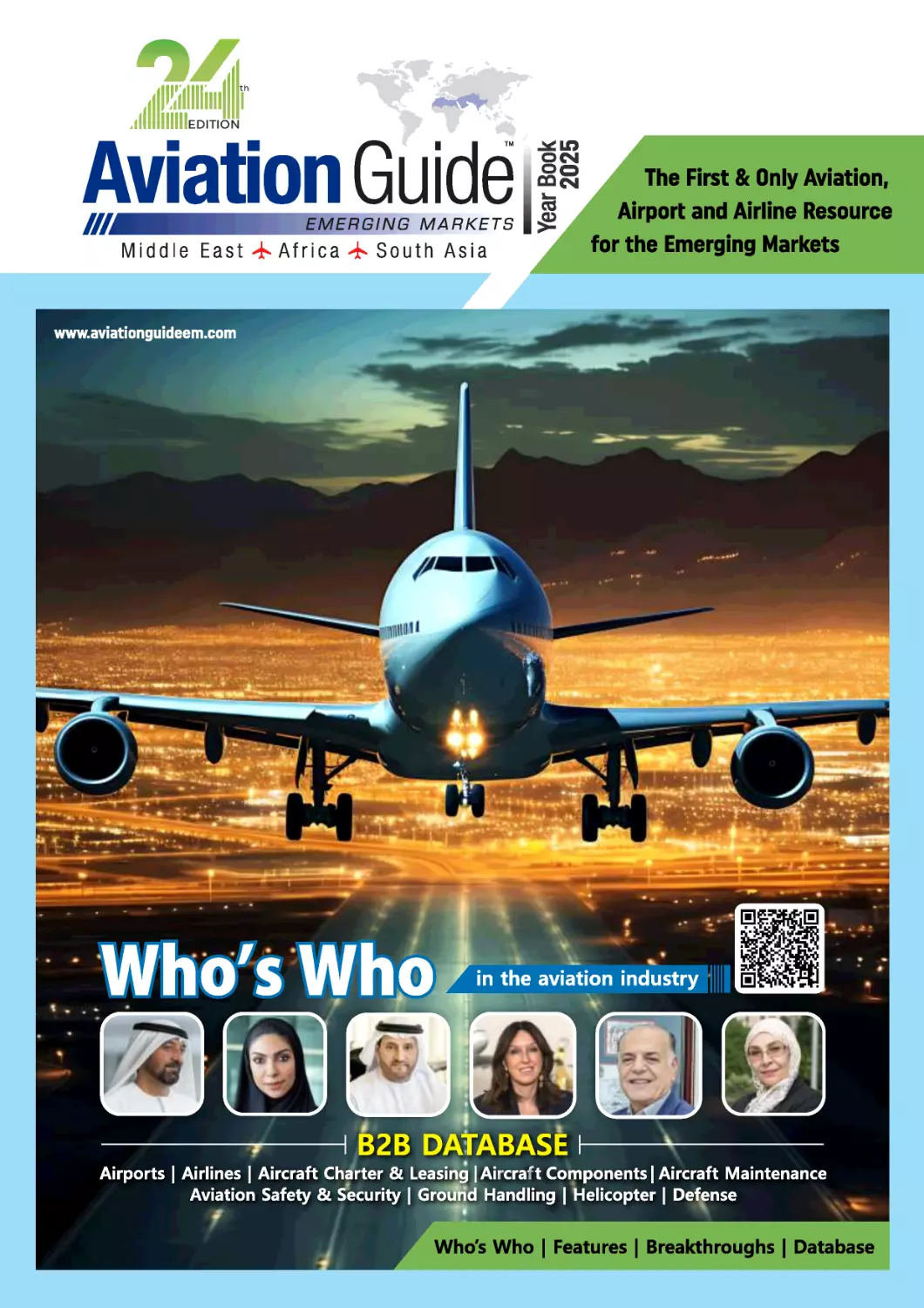


Теги: aviation yearbook aviation industry air transport aviation guide year book
Год: 2025
Похожие


Текст
1
EDITION
th
22
Your Trusted Partner in
Global Cargo
Prime Aviation excels in offering
customized cargo solutions to a
diverse clientele, including
international freight forwarders,
shippers, logistics providers,
governments, and humanitarian
relief organizations. With a global
reach extending from Europe to
China, CIS countries, India, and the
USA, we have cultivated an extensive
network of agents and established
offices around the world.
• Cargo acceptance, handling & warehousing • Pickup & Delivery Options
• Online Booking
• Customs clearance
V
I
TION
V
V
Contact: +971 4 3231491, +971 50 5219843
E-mail: sales@primeaviation.ae
Website: www. primeaviation.ae
PRIME AVIATION FZCO
2W – 401, Dubai Airport free Zone
P.O . Box 936210, Dubai, UAE
Cargo consolidation
Air Cargo cha er
Air Freight
2
3
4
warm welcome to the 24th edition of Aviation Guide dedicated
Ato the emerging markets of the Middle East, Africa, South Asia,
and beyond.
A massive 9.5 billion passengers traveled in 2024, according to the
Airports Council International, the organization that represents more
than 2000 airports worldwide.
The 2024 passenger traffic gure surpasses the pre-pandemic level and
a far cry from the pandemic era in 2020 when the aviation industry faced
an unprecedented decline of 5.5 billion passengers due to travel
restrictions and lockdowns.
Surely, this encouraging gure indicates a full recovery from an industry
that was nearly crippled by an invisible enemy that killed millions of
people around the world, which also disrupted businesses and the lives
of countless others.
The aviation industry has made signi cant progress since the depths of
the pandemic. While challenges remain, the sector is demonstrating
resilience and adaptability. The recovery is ongoing, and the future of
aviation is bright, driven by innovation, a focus on sustainability, and the
enduring human desire to connect.
This is the era of seamless connectivity, advanced analytics, automation,
innovation, and new ideas all rolled into one.
Our deepest gratitude to all of you who provided invaluable information
and support to this project year after year.
As has been our tradition, we bring you this year the latest B2B database
on airlines, airports, MRO, helicopters, ground handling services,
aviation safety and security, aircraft charter, and leasing, among many
other industries linked to aviation.
Errors and omissions inadvertently committed in compiling this
voluminous edition, if any, are regretted. Ideas and suggestions are most
welcome.
2
0
2
5
Copyright / Disclaimer
All rights reserved. The options and views expressed in this publication are not necessarily those of
the publisher. Readers are requested to seek specialist advice before acting on information
contained in this publication, which is provided for general use and may not be appropriate for the
reader's particular circumstances. Every effort has been made to ensure accuracy and correctness.
The publisher regrets it can not accept liability for any error or omission contained in this
publication. No part of this publication may be reproduced in any material form (including
photography or storing in any medium by electronic means) without the written permission of the
copyright holder. Application for the copyright holder's written permission to reproduce any part of
this publication should be addressed to the publisher in accordance with the International
Copyright Act 1956 or the UAE Federal Copyright Law. Any person acting in contravention of this
copyright will be liable to criminal prosecution and the civil claims for damages
Publisher
Israr Ahmad
israr@7dimensionsmedia.com
Associate Publisher
Poonam Chawla
poonam@7dimensionsmedia.com
Chief Editor
Gemma Q. Casas
gemma@7dimensionsmedia.com
Editorial Team
Israr Ahmad
R. Chandrakanth
Ayesha Rashid
Laique Khan
Sridhar P
Graphics Designer
Sunitha
Photo Journalist
Deepu Raj
Database
Wasim Ahmed
Amin Ahmad
Zeenath Khan
Mohamadu Fouzer Fawaz
Sameer Mumtaz Ali
Operations Head
Mohammed Karimulla
karimulla@7dimensionsmedia.com
Copyright by 7dimensions Media FZE
Aviation Guide - Year Book 2025
5
6
Editor’s Note
n an age de ned by globalization and
Iinterconnectedness, aviation stands as an unsung
hero, silently propelling our world forward. While
often associated with leisure and travel, the true might
of aviation lies in its crucial role in facilitating global
trade, economic development, and humanitarian aid.
Air cargo, in particular, forms the invisible threads that
weave the global economy together. It's the silent
partner ensuring that your next-day deliver y arrives on
time, that life-saving medicines reach remote corners
of the world, and that vital components power
industries across continents. Consider this: air cargo
accounts for approximately 35% of world trade by
value, despite representing only a fraction of the
volume.
This underscores the importance of speed and
reliability in today's fast-paced world, where time-
sensitive goods and high-value products demand the
efficiency that only air transport can provide.
Beyond the realm of commerce, aviation plays a pivotal
role in connecting people and cultures. It bridges
geographical divides, fostering understanding and
collaboration. It facilitates tourism, enabling
exploration of far- ung destinations and contributing
signi cantly to local economies.
In times of crisis, aviation becomes a lifeline, delivering
essential aid and personnel to disaster-stricken areas,
showcasing its humanitarian signi cance.
Looking to the future, the aviation industry is poised
for transformation. Technological advancements are
reshaping the skies, with innovations like sustainable
aviation fuels and electric aircraft promising a greener
future. Drones are emerging as game-changers in last-
mile deliver y, offering efficient and cost-effective
solutions. The integration of arti cial intelligence and
big data is optimizing operations, enhancing safety,
and improving the passenger experience.
Challenges remain, however, in many fronts. There's
the challenge of economic uncertainly as global
economic headwinds, including in ation and
potential recessions, pose a threat to aviation's full
recovery. Consumer spending on travel could be
impacted by economic downturns.
Geopolitical Risks: Con icts and geopolitical instability
can disrupt air travel and impact airline operations. The
war in Ukraine, for instance, has had a signi cant
impact on air travel in Europe and beyond.
Operational Challenges: Airlines continue to face
operational challenges, including staff shortages, air
traffic control disruptions, and airport congestion.
These issues can lead to ight delays and cancellations,
impacting passenger satisfaction.
Fuel Prices: Fluctuating fuel prices remain a signi cant
cost factor for airlines. The industry is vulnerable to
price spikes, which can impact pro tability.
The industry must also address its environmental
footprint, requiring investing in sustainable practices
and technologies to mitigate its impact on the planet.
But despite these challenges, the future of aviation
looks bright bright. As our world becomes increasingly
interconnected, the demand for efficient and reliable
air transport will only grow. Aviation will continue to be
a driving force behind global trade, economic
development, and cultural exchange. It will remain an
indispensable part of our lives, connecting us in ways
we often take for granted.
So, the next time you see a plane soaring through the
sky, remember that it's not just a machine. It's a symbol
of human ingenuity, a testament to our desire to
connect, and a vital component of the world we live in.
Gemma Q. Casas
Editor-in-Chief
The Indispensable Role of Aviation
and Air Cargo in Our World
Aviation Guide - Year Book 2025
6
7
ELEVATING AVIATION EXCELLENCE
A dynamic international aviation company providing
full service capabilities
Leasing | Cha er | Maintenance | Pilot Training | Helicopters | Spare Pa s | Fuel
Phone: +971 65579577 | FAX: +971 65388558 | info@skyone.aero
B1-01 -04 A , P.O. Box: 122849, SAIF Zone, Sharjah, United Arab Emirates
www.skyone.aero
8
Insightful news and analysis on the latest trends and
issues on the rapidly growing aviation markets in the
Middle East, Africa, South Asia and beyond. Stay
informed and ahead of the curve with our in-depth
coverage and expert perspectives.
Who's Who in the aviation industry of emerging markets
elaborates on leaders, stalwarts and visionaries who
have made contemporary aviation landscape a vibrant
marketplace through their spectacular contributions.
Who's Who
17
117
169
Breakthroughs
Investigate the cutting-edge innovations that are
transforming the aviation scene, spurring innovation,
and pushing the limits of aerospace technology. We
bring you the latest in aviation advances, from the
impact of AI on aviation's future to the limitless vistas of
space exploration and the revolutionary developments
in the aviation industry.
B2B Database
Airports, Airports Contract & Supplies, Airlines, Aircraft
Charter & Leasing Executive Passenger, Air Cargo, Aircraft
Charter & Leasing Cargo, Aircraft Components & Spares,
Aircraft Maintenance, Repair, Engineering, Ground
Handling, Helicopter, Aviation Safety & Security, Aviation
Services, Aviation Training & Recruitments,
Defense.
187
Features
Aviation Guide - Year Book 2025
8
9
10
Index
Aviation Guide - Year Book 2025
Who's Who
22
H.E . Abdulla Bin Touq
Al Marri
32
34
H.E . Sheikh Mohammed bin
Hamad bin Tahnoon Al Nahyan
30
H.E. Dr. Ahmad Belhoul
Al Falasi
H.E . Eng. Salem Butti
Salem Al Qubaisi
36
40
42
H.E. Dr. Mohammed
Al Zarooni
H.E . Dr. Shaikh Abdulla
bin Ahmed Al Khalifa
38
H.E. Sheikh Mohammed
bin Abdulla bin Mohammed
Al Thani
Engr. Badr Mohammed
Al-meer
44
48
50
Hamdi Osman
Majid Saidgul
Babasheikh Barzanji
46
Dr. Raman Kumar
Holger Ostheimer
52
56
58
Kinjarapu Ram
Mohan Naidu
Jaideep Mirchandani
54
Adrien Thominet
Ahsan Ali Mangi
20
HH Sheikh Ahmed
Bin Saeed Al Maktoum
28
H.E . Mohammed A. Ahli
24
H.E . Saif Mohammed
Al Suwaidi
26
His Excellency
Ali Salim Al Midfa
10
11
60
64
66
Paul Griffiths
Sir Tim Clark
62
Antonoaldo Neves
Prof. Ahmet Bolat
68
72
74
Dr. Brendan Nelson AO
Guillaume Faury
70
Juergen Strommer
Syed Mohamed Wazeer
74
75
76
Natarajan Chandrasekaran
Muhammad Ejaz Haider
75
Sanjeev Gadhia
S. Somanath
76
77
78
Pieter Elbers
Muhammad Sami
77
Salil Gupte
Vinay Dube
78
79
80
Remi Maillard
Siva Anand
79
Gautam Adani
Campbell Wilson
Aviation Guide - Year Book 2025
Index Who's Who
11
12
Index
Aviation Guide - Year Book 2025
Who's Who
80
81
82
Ajay Singh
G.M. Rao
81
Adel Abdullah Ali
Dr. Jeffrey Goh
82
83
84
Dr. Venkataramani
Sumantran
Mesfin Tasew
83
Ghaith Al Ghaith
AVM Muhammad Amir Hayat
84
85
86
Eng. Samer Abdelsalam
Majali
85
Blake Scholl
Michael Rousseau
86
Bilal Eksi
88
89
89
Willie Walsh
Steven Polmans
88
Justin Erbacci
Juan Carlos Salazar
Jozsef Varadi
Associations in Aviation
12
13
90
91
91
Abderahmane Berthe
Kamil Al-Awadhi
90
Kapil Kaul
Ali Ahmed Alnaqbi
92
Capt. Amornvaj (Ben)
Mansumitchai
Subhas Menon
92
94
98
98
Barbara Baumgartner
Guliz Ozturk
96
Elena Sorlini
Marie Owens Thomsen
99
100
Poppy Khoza
Reem Al Saffar
99
Dr. Nadia Bastaki
100
Mitsuko Tottori
102
102
Yvonne Manzi Makolo
101
Mervat Sultan
Kirsten de Bruijn
Aviation Guide - Year Book 2025
Index Who's Who
Women in Aviation
101
Audrey Serdjebi
13
14
Index
Aviation Guide - Year Book 2025
Who's Who
103
104
104
Liana Coyne
Dorothea von Boxberg
103
Carol B. Tome
Freshta Farzam
105
106
106
Aireen Omar
Tulsi Mirchandaney
105
Badr Abbas
Amar Preet Singh
106
107
107
Bernhard zur Strassen
Francois Biarneix
107
Johan Eidhagen
Eng. Loay Mashabi
108
108
109
Tushar Jani
Dietmar Focke
108
Aravind Melligeri
Murlidhar Mohol
109
110
Vumlunmang Vualnam
Adil Fareed
109
Dr. D K Sunil
Matthieu Petot
14
110
15
110
111
111
Charles Szar
Dinesh Chand Sharma
111
Sunil Malhotra
Air Marshal Hamid Rashid
Randhawa, HI (M)
112
112
113
Manoj Jain
Abdulaziz Busbate
112
Dr. Samir V. Kamat
Nadir Shafi Dar
113
114
114
Md. Monjur Kabir Bhuiyan
M Suresh
113
Prakash Apte
Abu Sayeed Mehboob Khan
114
Nikhil Joshi
Aviation Guide - Year Book 2025
Index Who's Who
15
16
17
Who's Who in the aviation industry of
emerging markets elaborates on leaders,
stalwarts and visionaries who have made
contemporary aviation landscape a
vibrant marketplace through their
spectacular contributions.
Who's Who
17
Who's Who
Features
Breakthroughs
B2B Database
117
169
187
18
19
20
HH Sheikh Ahmed
Bin Saeed Al Maktoum
President, Dubai Civil Aviation Authority (DCAA)
Chairman of Dubai Airports
Chairman and CEO, Emirates Airline & Group, dnata
21
heikh Ahmed embarked on his
Scareer in the aviation industry
in 1985 when he was appointed
President of the Dubai Department of
Civil Aviation (DCA) – the governing
body that oversaw the activities of
Dubai International (DXB) and Dubai
Duty Free, among others.
In that same year Emirates – Dubai's international airline was
launched with Sheikh Ahmed as its Chairman. He is now the
Chairman and Chief Executive of Emirates Airline & Group,
which includes dnata – one of the world's leading providers of
air and travel services, and other aviation related entities.
Award-winning Emirates is one of the world's most recognized
airline brands with a global footprint across six continents,
connecting guests and facilitating global trade. The airline
operates one of the most modern, young and efficient eets of
spacious and comfortable Airbus A380 and Boeing 777 aircraft.
Under his leadership, Emirates has been pro table for over 30
years. A trusted partner for over 300 airline customers
worldwide, dnata offers ground handling, cargo, travel,
catering and retail services in more than 35 countries across six
continents. In the nancial year 2023, dnata handled 712,383
aircraft turns, moved 2.7 million tons of cargo, uplifted more
than 111.4 million meals and recorded a total transaction value
(TTV) of travel service of $1.9 billion.
Dubai Duty Free has become one of the biggest single airport
retail operations in the world with annual sales US$2.16 billion
in 2023.
Under Sheikh Ahmed's leadership, the DCA underwent an
organizational restructuring in April 2007. This led to the
creation of the Dubai Civil Aviation Authority (DCAA) as the
local regulatory body, and Dubai Airports as the operator of
Dubai's airports – DXB and Dubai World Central – Al Maktoum
International (DWC). Following the restructuring, Sheikh
Ahmed became the President of DCAA and Chairman of Dubai
Airports.
The fact that Dubai is now rmly established as the region's
leading tourist destination and business, trade and transport
hub, is due in no small measure to Sheikh Ahmed's efforts.
Under his leadership, DXB has developed into the world's
busiest airport for international guests and among the largest
cargo hubs with a network of more than 250 destinations
across 104 countries served by more than 100 international
airlines.
This was enabled by the hub's timely and progressive
expansion, including the opening of DXB's Terminal 3 in
October 2008; the opening of Concourse A, the world's rst
purpose-built A380 facility in early 2013 and the opening of
the $1.2 billion Concourse D in February 2016.
ydubai was established in 2008 to support Dubai's thriving
aviation hub, with Sheikh Ahmed as the Chairman. Since its
launch, ydubai has been committed to creating free ows of
trade and tourism; enabling more people to travel to more
places more often. Over 14 years of operations, ydubai has
built a network of more than 115 destinations, 77 of which
were previously underserved or had very few direct air links to
Dubai. Today, ydubai is the second-largest carrier operating
out of DXB and has enabled more than 80 million passengers
to travel conveniently across the region. The carrier operates
one of the youngest and most efficient eets in the skies with
more than 70 Boeing 737 aircraft.
In January 2019 Sheikh Ahmed received the Honorary Sash of
Mohammed Bin Rashid from His Highness Sheikh Mohammed
bin Rashid Al Maktoum, the Vice President and Prime Minister
of the UAE, and Ruler of Dubai. This was for winning the
Mohammed Bin Rashid Al Maktoum Government Excellence
Award for his leadership in aviation.
Outside of aviation, Sheikh Ahmed holds several government
positions and plays an increasingly pivotal role in leading the
emirate's nance and energy sectors.
In November 2019, Sheikh Ahmed was appointed to
temporarily oversee Dubai Holding and Meraas, and in June
2020 Meraas merged under the umbrella of Dubai Holding
with Sheikh Ahmed as the Chairman.
In January 2020, Sheikh Ahmed was appointed to the newly
formed Dubai Council as the Commissioner General of Dubai
Economy pillar to oversee the Department of Economic
Development, Department of Tourism and Commerce
Marketing, and Dubai's free zones, airports, ports and customs.
In November 2021, the Department of Economic
Development and the Department of Tourism and Commerce
Marketing were merged, resulting in the establishment of the
Department of Economy and Tourism (DET).
Sheikh Ahmed is also Chancellor of the Mohammed Bin Rashid
University of Medicine and Health Sciences, a position he has
held since 2016.
Despite his numerous business commitments, Sheikh Ahmed
is patron to many charitable organizations. He has also
received numerous accolades from various governments and
multi-nationals.
Sheikh Ahmed has a bachelor's degree from the University of
Denver, Colorado, USA. He is well known internationally for his
contribution to the development of regional aviation. The
Royal Aeronautical Society, one of the industry's oldest and
most respected professional associations honored his
achievements in aviation with a fellowship of the Society at the
1994 Farnborough Airshow, UK.
In May 2013, he was presented with an honorary Doctor of
Science from City University London – Cass Business School in
recognition of his outstanding leadership in the development
of professional sectors including aviation, nance, banking
and entrepreneurship in the UAE.
Aviation Guide - Year Book 2025
Aviation Industry Who's Who
22
23
H.E. Abdulla Bin Touq Al Marri
.E. Abdulla Bin Touq Al
HMarri was appointed
Minister of Economy of
the United Arab Emirates (UAE)
under the new government
structure approved in July 2020.
He is also the Chairman of the General Civil Aviation
Authority, UAE International Investors Council, and CSR
UAE Fund's Board of Trustees.
Prior to his appointment, H.E . Al Marri held important
positions in the government as a senior, top-ranking
official. He was the Secretary General of the UAE
Cabinet since 2017, during which he was instrumental
in strengthening the interdependence between the
federal and local governments.
In this role, he also spearheaded many initiatives to get
the pulse of the people and know their sentiments, as
well as build the UAE's long-lasting relations with
international organizations such as the World
Economic Forum.
Prior, he served as the head of Securities and
Commodities Authority, and was also the former
Director General of the Executive Office of H.H . Sheikh
Mohammed bin Rashid Al Maktoum. He was part of the
high-pro le team that was behind the launch of 'Area
2071', the nucleus of the future envisioned in the UAE
Centennial Plan 2071.
Fur thermore, the UAE Minister of Economy, in his
previous post, took part in the unveiling of the Hatta
Economic Zone development project and the
relaunching of the Mohammed Bin Rashid Center for
Leadership Development.
In addition, he was the CEO of the Dubai Future
Foundation, enabling him to play a vital role in the
successful launch of Dubai 10X and other initiatives of
national importance. The Dubai 10X initiative, in
particular, aims to strengthen the emirate's bid to
become the city of the future.
H.E. Al Marri is a member of the Boards of Directors of
different federal entities. His memberships allow him to
actively support the development of priority sectors in
the country such as the Golden Visa initiative, which
seeks to attract talented individuals from across the
world.
The UAE Minister of Economy holds a Bachelor's degree
in Civil Engineering from the University of Sheffield in
the UK. He is also a graduate of the UAE Government
Leaders Program and Mohammed Bin Rashid Center for
Leadership Development.
Aviation Guide - Year Book 2025
Aviation Industry Who's Who
Cabinet Member & UAE Minister of Economy
Chairman, UAE General Civil Aviation Authority
24
25
is Excellency Saif
HMohammed Al Suwaidi has
been serving as the Director
General of the UAE General Civil
Aviation Authority for nearly two
decades, helping the country
navigate its way to greater heights
in the global aviation industry.
Under Al Suwaidi's leadership, the UAE aviation sector
continues to grow and ourish, taking the lead in
aviation reforms as well as embracing innovative ideas
and technologies that bene t both the region and the
rest of the world.
The recipient of the UAE Prime Minister's Medal for Best
Director-General in the UAE in 2017, Al Suwaidi led the
GCAA team in achieving unprecedented milestones in
aviation.
In 2024, the Sheikh Zayed Air Navigation Center
successfully surpassed one million air traffic movements
in a single year, underscoring the UAE's essential role as a
global aviation hub with its strategic location, advanced
infrastructure, and efficient operational systems.
“Exceeding one million air traffic movements re ects the
dedication and hard work of the team at the Sheikh
Zayed Air Navigation Centre. This is a result of years of
planning, innovation, and close collaboration with our
partners in the aviation sector. With an average growth
rate of 10.3% in 2024 compared to last year 2023, we
remain committed to continuously enhancing our
systems and services to uphold the highest standards of
safety and efficiency, re ecting sustainable
development and continued success in managing air
traffic successfully and professionally,” said Al Suwaidi.
The size of investments in the UAE's civil aviation sector
was more than approximately one trillion dirhams, while
the size of investments in the development and
expansion of airports reached AED85 billion to
accommodate over 300 million passengers annually,
according to reports.
Al Suwaidi began his career in the aviation industry in
1983 as a UAE Air Force pilot. He held various senior
management positions in the UAE Air Force, including as
director of Air Force Operations, before he was tapped to
lead GCAA, a federal autonomous body set-up to
oversee all aviation-related activities in the UAE.
Al Suwaidi studied law at the Beirut Arab University in
Lebanon. He also obtained two Master's degrees. He
took his rst Master's Degree at the Command and Staff
College in Cairo, Egypt. He also studied in China for his
second Master's degree, graduating in 2006 at the
National Defense University in Beijing.
Aviation Guide - Year Book 2025
Aviation Industry Who's Who
H.E. Saif Mohammed Al Suwaidi
Director General, UAE GCAA
26
27
Chairman of Sharjah Airport Authority
is Excellency Ali Salim Al
HMidfa is widely recognized
as a leading figure and a
trailblazer among Emirati aviation
professionals, playing a pivotal role
in advancing the UAE's aviation
sector. With 26 years of expertise
in airport management, he has been
instrumental in shaping the
industry's growth trajectory.
Appointed as Chairman of Sharjah Airport Authority
and a member of Sharjah Executive Council under Emiri
Decree No. (13) of 2014, issued on January 16, 2014, His
Excellency has overseen remarkable progress at the
airport. Under his leadership, Sharjah Airport has
witnessed signi cant increases in passenger traffic,
aircraft operations, and air freight volumes.
Currently, His Excellency leads the airport’s ambitious
expansion project, which involves a total investment of
AED 2.4 billion. This development aims to increase the
airport’s annual capacity from 8 million to 25 million
passengers, signi cantly enhancing the airport’s
infrastructure and service offerings.
In addition to his role at Sharjah Airport, Al Midfa holds
numerous key positions within both local and
international aviation organizations. In 2021, he was
elected as the Second Vice President of the ACI Asia-
Paci c & Middle East Regional Board. His Excellency also
serves as Chairman of Sharjah Aviation Services
Company (SAS), Chairman of Sharjah Airport Travel
Agency (SATA), and Chairman of Dufry Sharjah.
Beyond aviation, His Excellency Ali Salim Al Midfa is an
active member of various public and private
organizations. He serves on the Supreme Committee
for Human Resources in the Emirate of Sharjah, the
Board of Directors of Sharjah Insurance Company, the
Board of Trustees of Skyline University College, and the
Sharjah Volunteering Committee.
Aviation Guide - Year Book 2025
Aviation Industry Who's Who
H.E. Ali Salim Al Midfa
28
29
.E. Mohammed Abdulla Ahli
Hcommenced his aviation
career in 1966 with dnata
(Dubai National Air Travel Agency)
and held several key positions
leading to the position of Director,
Ground Services.
In 1982, he moved to the Department of Civil Aviation,
presently the Dubai Civil Aviation Authority, as the
Operations Director, responsible for all Airport
Operations and International Affairs. He represented the
Federal Government at several high-level International
Civil Aviation Organization (ICAO) meetings, and played
a key role in the establishment of the Airspace for the
United Arab Emirates.
In addition to the enormous task of managing airport
operations, Mr. Ahli also held the Chairmanship of Gulf
Airport Services Association (GASA) with distinction for
two years. He was an active member of the Arab
Organization of Civil Aviation (AOCA) and was a member
of Governing Board of ACI. He was also the Vice President
of ACI–Asia Paci c Region and was a popular gure
among International Airport Operators.
He was also instrumental in establishing the Executive
Flight Services and Safety & Security Department in the
DCA. His continued efforts to enhance the safety
standards at the airport have been widely appreciated.
He is an ardent promotor of the “Open Skies Policy” and is
strenuously working towards its implementation in the
Gulf.
Mr. Ahli has been awarded the “ICAO scroll of Honor” in
2011, for his contribution in organizing and hosting the
innovative I ntern ational Civil Aviation Negotiation
(ICAN) Conference held in Dubai in 2008.
He was appointed as the Chief Executive Officer at Dubai
Air Navigation Services (dans), responsible for the
provision of Air Traffic Services within Dubai Airspace in
addition to his duties as the Director General of Dubai
Civil Aviation Authority (DCAA).
Aviation Guide - Year Book 2025
Aviation Industry Who's Who
H.E. Mohammed A. Ahli
CEO, Dubai Air Navigation Services (DANS)
30
31
H.E. Sheikh Mohammed bin
Hamad bin Tahnoon Al Nahyan
.E. Sheikh Mohammed bin
HHamad bin Tahnoon Al
Nahyan, currently serving
as the Advisor of Special Affairs at
the Ministry of Presidential Affairs,
is a distinguished leader in the
aviation industry.
Since 2019, he has chaired the Board of Directors of Abu
Dhabi Airports, playing a key role in its transformation
into a global aviation leader. Additionally, he holds the
positions of Chairman of ADQ Aviation & Aerospace
and Chairman of Royal Jet.
Known for his visionary leadership, His Excellency
spearheaded the inauguration of the new Terminal (A)
at Zayed International Airport in November 2023. This
state-of-the-art facility, boasting cutting-edge
technological advancements, stands as one of the
world's largest airport buildings. With its substantial
capacity, it is capable of accommodating up to 45
million passengers annually.
Under his guidance, Abu Dhabi Airports has positioned
the emirate as a world-class passenger and cargo hub,
signi cantly contributing to its GDP.
Chairing both Royal Jet, a global leader in the premium
aviation sector, and Global Aerospace Logistics (GAL),
one of the leading providers of integrated aviation
readiness solutions for military and civilian customers,
exempli es His Excellency's multifaceted dedication to
advancing the industry.
Beyond his dedication to aviation, His Excellency is a
renowned falcon enthusiast, actively participating in
international events and exhibitions.
Aviation Guide - Year Book 2025
Aviation Industry Who's Who
Chairman, Board of Directors Abu Dhabi Airports
Chairman, ADQ Aviation & Aerospace
Chairman, Royal Jet
32
33
is Excellency Dr. Al Falasi is
Hthe Chairman of the Board of
Directors of the UAE Space
Agency. He oversees the agency's
mandate of guiding the space sector,
ensuring its contribution to the
national economy.
In July 2024, His Excellency Dr. Ahmad Belhoul Al Falasi
was appointed UAE Minister of Sports. He oversees the
process of devising development strategies and plans for
the country's sports sector, aiming to boost its global
competitiveness, nurture national talents and build a
healthy society that adopts sports as a way of life.
Additionally, His Excellency is Chancellor of the Higher
Colleges of Technology, the UAE's largest applied higher
educational institution, and the nation's rst approved
university economic free zone. This enables the institution
to produce graduates and entrepreneurs who possess
exceptional levels of competence and competitiveness.
Since 2020, His Excellency has been the Deputy Chairman
of the Emirates Development Bank, which is a key enabler
of the UAE's economic transformation and provides
nancial support to businesses in key strategic sectors.
His Excellency Dr. Al Falasi was the UAE Minister of
Education from 2022 to 2024. During his tenure, he
oversaw the design and development of the national
educational and pedagogical system, managing efforts to
improve its efficiency and enhance the quality of
outcomes to meet the country's future development,
economic and social needs.
In 2021, His Excellency Dr. Al Falasi served as the Minister of
State for Entrepreneurship and SMEs. He strengthened the
role of the small and medium enterprises (SMEs) sector as
a key driver of the national economy, boosting the
national entrepreneurship model across various
economic sectors in line with the best international
practices.
From 2016 until 2020, His Excellency served as the Minister
of State for Higher Education. During his tenure, he
supervised the development of higher education and
scienti c research in the UAE, formulated new policies for
the sector and streamlined the operations of higher
education institutions to ensure high-caliber outputs that
meet the needs of the labor market.
In October 2017, under the ministerial amendment to the
UAE Government, Dr. Al Falasi took on the responsibility of
equipping UAE nationals with future-orientated skills.
In parallel with his ministerial positions, His Excellency has
also been the Chairman of the General Authority of Sports,
responsible for setting plans, programs, systems, and
regulations to ensure the organization and development
of the sports sector in the country.
Through his position, His Excellency has contributed to
implementing numerous strategic initiatives such as the
National Sports Strategy 2031 and the launch of the
Emirates Committee for Elite and High-Level Sports. The
committee is one of the most signi cant initiatives
resulting from the strategy, aiming to increase the
likelihood that talented Emirati athletes will represent the
UAE at the Paris 2024 Olympics. In June 2021, His
Excellency Dr. Al Falasi was also appointed First Deputy
President of the UAE National Olympic Committee, with
the aim of improving the technical and administrative
skills of the Olympic teams and enhancing the UAE's
standing in regional and international sporting events.
From 2017 to 2020, His Excellency Dr. Al Falasi chaired the
Board of Directors of the UAE Space Agency. During his
tenure, the country witnessed the launch of the UAE
Astronaut Programme, the rst of its kind in the Arab
region. As part of the programme, the rst Emirati went on
a space mission on September 25, 2019.
Additionally, KhalifaSat was launched as the rst Arabic
satellite to be 100 percent developed by Emirati engineers.
The launch of the satellite was a historic achievement that
contributed to cementing the UAE's global position in the
space science sector. Furthermore, the "Probe of Hope" to
Mars, lifted off on July 20, 2020, and reached the Red
Planet in 2021.
His Excellency Dr. Al Falasi also served as the former
Chairman of the Federal Authority for Human Resources
(2017 – 2020). He is also the former Chairman of the UAE
Tourism Council.
Prior to pursuing a career in the federal government, Dr. Al
Falasi was the CEO of Masdar Company, the Executive
Director of Strategy and Tourism Sector Development at
Dubai Tourism, the Vice President of the Mubadala
Industry Unit, as well as a consultant for the management
consulting rm McKinsey & Company. He started his
career as an Assistant Professor at Khalifa University.
H.E. Dr. Al Falasi holds a PhD from Monash University, a
master's degree from the University of Melbourne in
Australia, and a bachelor's degree in communication
engineering from Khalifa University in the UAE.
Aviation Guide - Year Book 2025
Aviation Industry Who's Who
H.E. Dr. Ahmad Belhoul Al Falasi
Chairman, UAE Space Agency and Minister, UAE Ministry of Sports
34
35
is Excellency Eng. Salem
HButti Salem Al Qubaisi is
the UAE Space Agency's
Director General and has more than
20 years of public and private
sector leadership experience in
military aviation, security, and
defense.
He is responsible for setting the Agency's strategic
direction, delivering on its mandate to strengthen the
space sector, and contributing to the nation's vision for
sustainable economic growth and diversi cation.
Al Qubaisi joined the UAE Space Agency as Director
General in September 2021. He served as a member of its
board of directors from 2018, providing critical oversight
on operations and major projects such as the Emirates
Mars Mission.
Today, he leads the Agency's ambitious efforts to
encourage the development of space science and
advanced technologies, set relevant regulations,
establish bilateral and multilateral partnerships,
enhance national capabilities, and promote peaceful
applications for deep space research.
Al Qubaisi formerly served as a board member with Abu
Dhabi's Monitoring and Control Centre (ADMCC) from
2016. It followed ve years with the National
Commission of International Humanitarian Law under
the UAE Ministry of Foreign Affairs and International
Cooperation.
Between 2011 and 2013, he was the Director of Nuclear
Security at the Federal Authority of Nuclear Regulation,
setting relevant regulations and overseeing licensing for
commercial companies handling nuclear and
radioactive material.
Prior to this, he spent ve years with the US aerospace
company, Lockheed Martin as a Technical Program
Manager for the Ministry of Defense, where he worked
on avionics, radar, weaponry, and technology targeting
systems from 1999 and 2005.
Al Qubaisi has a Bachelor's degree in Electrical and
Electronics Engineering from California State University,
Sacramento, and a Master's degree in Electrical
Engineering from the University of Texas, Arlington. He is
also an honor graduate from Abu Dhabi's National
Defense College, holding a Master's degree in Strategic
and Security Studies.
Aviation Guide - Year Book 2025
Aviation Industry Who's Who
H.E. Eng. Salem Bu i
Salem Al Qubaisi
Director General, UAE Space Agency
36
37
H.E. Dr. Mohammed Al Zarooni
ith over 25 years of
Wexperience leading and
developing free
economic zones, H.E. Dr.
Mohammed Al Zarooni is
considered one of the world's top
free zones influencing leaders. In
2021, H.E. Dr. Al Zarooni was
appointed as Executive Chairman of
Dubai Integrated Economic Zones
Authority (DIEZ), holding three of
Dubai's pioneering Free Zones,
Dubai Airport Freezone, Dubai
Silicon Oasis, and Dubai
CommerCity.
In 2000, Dr. Al Zarooni was appointed Director-General
of the Dubai Airport Freezone Authority (DAFZA),
which, through his visionary leadership, quickly grew to
become one of the top-performing free zones in the
world.
In 2002, the Dubai Government appointed him as Vice
Chairman and CEO of the Dubai Silicon Oasis Authority
(DSOA), one of the region's most advanced and
successful technology hubs.
In 1995, His Excellency joined the Dubai Civil Aviation
Authority as Director of Research and Administration.
At that time, he was one of the most prominent officials
responsible for establishing the Dubai Airport Free
Zone in 1996. Before joining the Department, he
worked in the Ministry of Education for eight years.
In 2014, Dr. Al Zarooni was instrumental in
conceptualizing and establishing the non-pro t World
Free Zones Organization. He is presently the chairman
of this multilateral organization which acts as an
association for all free zones worldwide. In 2015, he was
appointed as the Secretary-General of the Dubai Free
Zone Council.
A prominent personality in Dubai's economy, Dr. Al
Zarooni is a member of the Dubai Economic Council. He
also sits on several signi cant institutions' boards,
including Dubai Aerospace Enterprise, Emirati Human
Resources Development Council, and RIT Dubai Board
of Directors. He is also the Chairman of Tradeling Board
(a B2B ecommerce marketplace). Dr. Al Zarooni is an
accomplished speaker on free zones and invited to
address keynotes worldwide at numerous conferences
and forums.
H.E . Dr. Mohammed Al Zarooni graduated with a Ph.D.
Degree from the University of Durham in the U.K . His
doctoral thesis was “The Position of the Free Zones in
Economic Development.”
Aviation Guide - Year Book 2025
Aviation Industry Who's Who
Executive Chairman, Dubai Integrated Economic Zones Authority
Dubai Airport Freezone
Dubai Silicon Oasis
Dubai CommerCity
38
39
.E. Dr. Shaikh Abdulla bin
HAhmed Al Khalifa is the
Chairman of the Board of
Trustees of the Bahrain Centre for
Strategic, International and Energy
Studies (Derasat) since 2017. In
2024, he was appointed Bahrain's
Minister of Transportation and
Telecommunications by royal
decree.
In addition, he is the Chairman of the Board of Trustees of
the King Hamad Global Centre for Peace and Coexistence
since 2023 and previously held the position of Deputy
Secretary General of the Supreme Defense Council from
2022 to 2024.
Dr. Al Khalifa's extensive experience in foreign affairs
includes serving as Under Secretary for International
Affairs at the Ministry of Foreign Affairs from 2015 to
2021 and subsequently as Under Secretary for Political
Affairs from 2021 to 2024.
He holds a Bachelor of Laws (LLB) from Jordan's Applied
Science University, a Master of Laws (LLM) from Queen
Mary University of London, and a PhD in International
Relations and Diplomacy from L'École des Hautes Études
Internationales et Politiques in Paris.
Aviation Guide - Year Book 2025
Aviation Industry Who's Who
H.E. Dr. Shaikh Abdulla
bin Ahmed Al Khalifa
Minister of Transportation and Telecommunications, Bahrain
40
41
.E. Sheikh Mohammed bin
HAbdulla bin Mohammed Al
Thani was appointed as
Qatar Minister of Transport in
November 2024.
His Excellency the Minister of Transport who has
extensive experience in nance, governance,
communications, and digital transformation, has overall
responsibility for all Ministry of Transport issues,
including:
Ÿ
Regulating land, maritime and air transport in Qatar
Ÿ
Developing and improving mobility and transport
services, and studying their relevant projects and
supervising their implementation
Earlier in his career, His Excellency Sheikh Mohammed
served as a senior officer at the Qatar Armed Forces
(General Headquarters).
He was then assigned to several leadership and
executive positions in the Ooredoo Group, such as
Deputy Chief Executive Officer of Ooredoo Group, Chief
Executive Officer of Ooredoo Qatar, Chief Executive
Officer of Ooredoo Kuwait, Chairman of the Board of
Directors of Ooredoo Oman, Ooredoo Kuwait, Ooredoo
Myanmar and Ooredoo Algeria.
His positions also included being the Vice Chairman of
the Board of Directors of Asiacell Iraq, President
Commissioner of Indosat Ooredoo, Board Member of
both INJAZ Qatar and United Networks and member of
the Qatar Association of Certi ed Public Accountants.
Education
H.E. Sheikh Mohammed bin Abdulla bin Mohammed Al
Thani holds a Master of Science in Accounting and
Finance from Cardiff University, Wales, the UK and a B.A.
in Economics and Administrative Science, majored in
accounting, from Qatar University.
He also holds certi cations from the Leadership Program
for Executives from the Qatar Leadership Centre
including courses by Harvard Business School and HEC
Paris, and from the Intensive Executive Breakthrough
Program by Egon Zehnder and Mobius Executive
Leadership.
Aviation Guide - Year Book 2025
Aviation Industry Who's Who
H.E. Sheikh Mohammed bin
Abdulla bin Mohammed Al Thani
Qatar Minister of Transport
42
43
Aviation Guide - Year Book 2025
Aviation Industry Who's Who
Engr. Badr Mohammed Al-meer
Qatar Airways Group, Chief Executive Officer
ngr. Badr Mohammed Al-
EMeer took on the role of
Group Chief Executive
Officer at Qatar Airways Group on
5 November 2023.
His appointment underscores his distinguished career,
forged over two decades, pioneering multibillion-
dollar aviation, construction, and real estate
development projects, while also re ecting Qatar's
succession planning towards a new generation of
leaders.
Throughout his career, Engr. Badr Mohammed Al-Meer
has played pivotal roles in some of Qatar's most
intricate and iconic development projects. Notably, he
has served as the Chief Operating Officer of Hamad
International Airport (HIA) since 2014, leading critical
divisions such as MATAR (Airport Company), Qatar Duty
Free, Qatar Aviation Services, Qatar Aircraft Catering
Company, Qatar Distribution Center, Dhiafatina, and
Real Estate.
While at HIA, he adeptly guided the airport through
major milestones and challenges, such as the COVID-19
pandemic, the Expansion Project, and the pivotal FIFA
World Cup 2022TM. His leadership also played an
instrumental role in HIA being acclaimed as the Best
Airport in the World, a testament to the strength and
dedication of the entire team.
From 2018 to 2020, Engr. Badr Mohammed Al-Meer was
a Board Director of the Airports Council International in
the Asia/Paci c Region, contributing to Future Airport
Development and Airport Sustainability.
Prior to his tenure at HIA, Engr. Badr Mohammed Al-
Meer spent a decade with the United Development
Company (UDC), ultimately rising to the position of
Acting Chief Executive Officer. During this time, he
oversaw the delivery of the Pearl Project, UDC's agship
venture, a renowned urban development in Qatar
celebrated for its architectural design.
With engineering degrees from the American
University of Beirut and the University of Colorado,
Engr. Badr Mohammed Al-Meer brings a solid
educational foundation and a wealth of business
insights and technical expertise in engineering,
construction, and large-scale project development.
In his new role as Group CEO, Engr. Badr Mohammed Al-
Meer's track record of successful projects and expertise
in aviation and project management uniquely
positions him to lead Qatar Airways Group into an
exciting new era, prioritizing innovation and cultivating
a united and motivated workforce.
44
45
amdi Osman is the Founder
Hand Chief Executive Officer
of SolitAir, a Dubai-based
tech-driven air cargo carrier
dedicated to middle-mile logistics
that primarily connects the Global
South to trade opportunities across
the world.
A 34-year veteran of FedEx, whose illustrious career
earned him the title Senior Vice-President of Operations
for Europe, Middle East, Indian Subcontinent, Africa and
Central Asia, before his retirement, Osman is considered
one of the architects of the meteoric rise in the Middle
East and Africa of FedEx, one of the world's biggest
companies in the air transport and logistics industry.
No stranger to high stakes and hard work, the Egypt-
born Osman began his career at FedEx in the United
States in 1978, climbing up the corporate ladder,
working in different countries and continents.
He later transitioned himself to a successful businessman
and angel investor in various industries such as
healthcare, education, F&B, hospitality and logistics, in
the vibrant business landscape of Dubai. In 2024, Osman
ventured into the growing air transport industry with
SolitAir.
At an age when most people are content re ecting on
their life's work and spending their pension and hard-
earned earnings, Osman charted a new course, 30,000
feet above the ground, in the digital era.
“SolitAir was born out of a vision to connect underserved
markets across the Global South, providing fast, reliable,
and dedicated air freight services,” says Osman, who
believes that air cargo became the lifeline of the airline
industry, during and after the pandemic. “I started
receiving calls from colleagues and friends in the
industry, asking if I could lend my expertise on the cargo
side. That's when I began seriously reconsidering my
involvement.”
“As I took a closer look, I realized parts of the air cargo
industry were fragmented, and some aspects were
outright broken. With decades of experience, know-how,
and a talented team that I've carefully assembled over
the past six months - after dreaming about this for more
than two and a half years - I felt we could make a real
difference,” added Osman who professionally played
football for both Egypt and the United States in his
younger years.
This is the story of a man who refuses to let adversities,
convention, or competition ground him, soaring instead
with a bold vision to connect the underserved corners of
the world.
“Our mission is to revolutionize regional air cargo
logistics by creating the rst regional scheduled daily
express cargo airline, connecting Africa, the GCC, the
Indian Subcontinent, and the Stan countries. SolitAir is
positioned as a technology-driven company with air
transportation at its core, aiming to set new standards in
the industry,” said Osman.
Osman holds a Bachelor's degree in Physical Education
from Helwan University, Cairo and a Master's degree in
Business and Leadership from Boston University.
He has won many prestigious awards at FedEx in
recognition of his leadership and distinguished
performance in operations management, sales and
customer service. He was equally recognized in the
industry, receiving the rst Middle East Logistic
Personality of the Year – Air Cargo Division Award and the
Arabian Business Investor of the Year.
Outside of work, Osman dedicates his time to
philanthropic deeds and mentoring younger people
who wish to venture into the vast transport industry or
business.
At 70 years old, Osman's legacy is still unfolding,
powered by passion and a refusal to play it safe. He's
con dent enough to navigate uncharted skies, whether
in tech, or life itself.
Aviation Guide - Year Book 2025
Aviation Industry Who's Who
Hamdi Osman
Founder & CEO, SolitAir
46
47
Majid Saidgul
Babasheikh Barzanji
Chairman, Executive Director & Co-founder, MATEEN Express
Executive Board Member, National Association of Freight & Logistics
Chairman, NAFL Courier & e-Commerce Subcommittee
ajid Saidgul Babasheikh Barzanji
Mis the Chairman, Executive
Director & Co-founder of
MATEEN Express, a leading air cargo and
express services company in Iraq and the
Middle East.
Born in Erbil, in the oil-rich Kurdistan region of Iraq, Majid is
known for his strong business acumen, his entrepreneurial
spirit, and his commitment to ser ving customers with
honesty and integrity. He is also a strong advocate for the
development of the aviation industry in the Middle East.
A well-established family man, Majid is also known as a great
motivator at work and in the air transport and logistics
industry.
In 2015, Majid was elected as an Executive Board Member of
the National Association of Freight and Logistics. He served
for four years as Chairman of the Airfreight Subcommittee.
In 2019, he was re-elected to his post and was selected to
Chair NAFL's Courier & e-Commerce Subcommittee.
A graduate of BSc in Electrical and Telecommunications
Engineering, Majid brie y worked in Iraq in the eld of
Power Generation Systems. He later moved to the UAE
where he joined IBA Abu Dhabi, a leading MEP Consulting
Engineering rm for about two years.
Seeing a substantial geopolitical shift in Iraq, Majid left his
engineering career by mid-2001 to establish the family's rst
company in Dubai, ushering the birth of MATEEN Express in
the UAE, Iraq, and Kurdistan, simultaneously. The company
later expanded its operations to China and Turkey, with a
self-grown network of trusted partners across the world.
Under Majid's leadership, MATEEN Express has grown to
become one of the leading companies in the industry, with a
network of offices in over 10 countries.
MATEEN is known for carrying out the rst air transportation
for commercial shipment to Baghdad Airport and the rst
commercial cargo ight landing at Erbil Airport in the
Kurdistan Region.
Recognizing the signi cance of scheduled freighter service,
MATEEN later developed char ter ight operations into
weekly schedules in early 2006, using AN-12, then IL-76, and
both Soviet-era military transport aircraft.
Majid was also the rst to operate scheduled western
freighters commercially to Iraq, starting with DC8-63F,
A300ERF, and eventually B747F, focusing on Erbil and
Sulaimaniya. This led to the creation of a new mode of
transportation to Iraq, shortening the trading cycle, and
improving the supply chain by leaps and bounds.
In addition to his business activities, Majid is also actively
involved in a number of philanthropic initiatives. He is a
supporter of education and healthcare programs in the
Kurdistan Region and Iraq.
Majid continues to be an inspiration to entrepreneurs and
business leaders in the region. He is a living example of what
can be achieved through hard work, dedication, and a vision
for the future.
MATEEN Express & Logistics Iraq
Air Transportation to Iraq
Ÿ
14 branches, stations and airport offices across Iraq
Ÿ
7 branches in UAE, China & Turkey
Ÿ
Grew to 25 branches and over 400 staff in less than
a decade
Ÿ
Fleet of 44 truck trailers and 74 Toyota 4x4s serving
the oil and gas industry in Iraq
Ÿ
Over 30 vans & pick-up for cargo & courier
operations across Iraq
Ÿ
Ser ving air transportation to Iraq during times
when other carriers cannot/do not cooperate
Ÿ
Carriage of Radioactive Sources, Explosives, Out of
Gauge, and Heavy Loads
Ÿ
GSA, GSSA & CSA partnership with all major cargo
airlines to Iraq & Kurdistan
Ÿ
The only operator offering "Guaranteed Next Day
Deliveries to Iraq"
Aviation Guide - Year Book 2025
Aviation Industry Who's Who
48
49
r. Raman Kumar is the
DManaging Director of Al-
Futtaim Logistics, one of
the 3PL pioneers in the United Arab
Emirates founded in 1980 with
reach to 150 countries worldwide.
With more than 35 years of expertise in the logistics
industry, Dr. Kumar transformed Al-Futtaim Logistics into
a global powerhouse in the industry noted for its
operational excellence, customer-centric values and
bespoke innovative solutions.
Under Dr. Kumar's leadership, Al-Futtaim Logistics has
achieved many milestones, including ASA-100, AEO,
GDP, ISO certi cations, expansion into international
markets, enhanced value-added services, and rapid
decision-making. He also introduced Yard Management
System for automotive logistics, reducing operational
costs and order turnaround time.
With a diverse team of 1031 associates, Dr. Kumar leads
Al-Futtaim Logistics into achieving greater heights,
including, pioneering technological innovations in AI
driven transport management, introducing new services
such as the mobility EV (electric vehicle) logistics, food
security logistics, time critical aerospace and exhibition
logistics, and steering geographical expansions of
warehouse operations into Saudi Arabia and Oman.
Under Dr. Kumar's stewardship, Al-Futtaim Logistics
became a voluntary member of Green Freight Asia,
reducing its carbon footprint with biofuel-powered
transportation and intelligent solutions for sustainable
logistics.
Dr. Kumar hails from Chennai, India. He is a valued
member of professional accounting bodies in the USA
and Australia, contributing to the global accounting
community. He is also a recipient of numerous awards in
sustainability, innovation and excellence in logistics,
apart from recognitions from various cause -oriented
groups and communities.
Beyond the corporate realm, Dr. Kumar is deeply
involved in community and environmental initiatives. He
actively supports nationalization efforts, environmental
and social causes, and mentors' university students.
Dr. Kumar holds MBA, CMA, and post-graduate degrees
in nance and management. In 2021, he earned the
prestigious Professional Doctoral Certi cate in Global
Leadership and Management from the European
International University (E.I .U) in Paris, France.
Aviation Guide - Year Book 2025
Aviation Industry Who's Who
Dr. Raman Kumar
Managing Director, Al-Futtaim Logistics
50
51
olger Ostheimer is the
HManaging Director of DC
Aviation Al-Futtaim (DCAF),
a joint venture between Germany's
DC Aviation Group and Dubai-based
Al-Futtaim. With over 25 years in
the aviation industry, he has
extensive experience in airline
operations, aircraft brokerage, and
flight support. He also holds a
commercial aircraft pilot license,
obtained in 2001.
Ostheimer's career includes roles with Chapman
Freeborn in Germany and the UK, focusing on charter
and operations. Between 2005 and 2009, he was part of
the management team at DaimlerChrysler Aviation,
which later became DC Aviation. He has also provided
aviation management consultation for various start-up
and reorganization projects, including the joint venture
between Al-Futtaim and DC Aviation.
In 2012, Ostheimer took on the role of Managing Director
at DCAF in Dubai. During the company's development,
he assembled a team to provide technical expertise for
building the hangar facility, establishing operational,
administrative, and commercial structures, and
obtaining a UAE Aircraft Operator Certi cate and a CAR
145 maintenance organization.
Under his leadership, DCAF has achieved signi cant
milestones, including the expansion of its managed
aircraft eet and the celebration of its 10th anniversary.
Ostheimer is a graduate of Johann Wolfgang Goethe
University in Frankfurt, Germany, where he studied
Sports Science, Biology, and Education. He is known for
his emphasis on premium quality operations and his
understanding of people relations.
Aviation Guide - Year Book 2025
Aviation Industry Who's Who
Holger Ostheimer
Managing Director, DC Aviation Al-Futtaim LLC
52
53
injarapu Ram Mohan Naidu,
Kappointed as India's Union
Minister of Civil Aviation in
mid-2024, has swiftly initiated
efforts to enhance the nation's
aviation sector. A prominent figure
in Indian politics, he is recognized
as the youngest minister in Prime
Minister Narendra Modi's cabinet.
Minister Naidu has prioritized making air travel more
accessible and affordable for all citizens. His strategic
focus includes reducing airfare prices and improving
aviation infrastructure to accommodate the increasing
demand for air travel across the country.
As the Civil Aviation Minister, Mr. Naidu aims to enhance
airport infrastructure to meet global standards, promote
sustainable aviation practices to reduce the industry's
environmental impact, and strengthen India's position
as a global aviation hub through innovation and
investment.
The Union Minister also emphasized on the importance
of use of technology in enhancing passenger
experience, and plan to leverage arti cial intelligence
and social media to address passenger concerns
effectively.
Minister Naidu has actively encouraged the nation's
youth to pursue careers in aviation. His participation in
events like the International Civil Aviation Day
underscores his commitment to inspiring the next
generation of aviation professionals.
Minister Naidu's dynamic approach and forward-
thinking initiatives are poised to drive India's civil
aviation sector toward greater efficiency, accessibility,
and technological advancement.
Aviation Guide - Year Book 2025
Aviation Industry Who's Who
Kinjarapu Ram Mohan Naidu
Union Minister of Civil Aviation
54
55
Jaideep Mirchandani
Chairman, Sky One FZE
aideep Mirchandani, the founder and
JGroup Chairman of Sky One FZE, is a
dynamic entrepreneur whose visionary
leadership has shaped the aviation industry
of the region. With an innate understanding
of emerging industry trends and a
relentless drive for transformative impact,
Mr. Mirchandani has led Sky One FZE on an
incredible journey from its humble
beginnings to a global aviation powerhouse.
A Visionary Entrepreneur:
Jaideep Mirchandani's journey in the aviation world is a
testament to his entrepreneurial spirit. He possesses a
deep understanding of the aviation landscape and has a
unique ability to foresee trends and their potential for
transformative change. Under his guidance, Sky One FZE
has evolved from a cargo startup into a diversi ed and
robust aviation conglomerate. His leadership has seen
the company expanding its footprint across various
markets, operating multiple subsidiaries, and managing
a eet of over 60 airplanes and helicopters, each with its
unique modi cations.
Innovative Thinking and Ambition:
Mr. Mirchandani is celebrated for his innovative thinking
and the remarkable ability to identify opportunities
before they become mainstream. His vision for Sky One
FZE extends beyond the conventional boundaries of the
aviation industry. He continuously seeks new avenues
for growth and development, positioning the company
as a forward-thinking and adaptable player in the global
aviation market.
A Broad Spectrum of Aviation:
Jaideep Mirchandani's impact on the aviation industry is
undeniable. He initiated his aviation journey by
providing cargo support in Russia, quickly establishing a
strong foothold in various aviation sectors. His actions
across the spectrum of aviation, from leasing to training
and relief initiatives, have propelled Sky One FZE into a
globally successful aviation business venture.
Global Partnerships and Leading the Private Sector:
Under his leadership, Sky One FZE has founded and
partnered with several leading passenger and global
cargo airlines with operations in Europe, India, China and
the Middle East. This has made the conglomerate one of
the leading privately-owned aviation entities in the
world.
Innovation and Problem-Solving:
Mr. Mirchandani is known for his calculated risk-taking
and his knack for identifying and nurturing talent. He has
assembled a team of industry experts and visionary
thinkers who share his passion for pushing boundaries
and driving innovation. Within the organization, he
fosters a culture of adaptability and agility. He is
renowned for seeking solutions to problems that may
appear insurmountable to most, pushing the
boundaries of what's possible in the aviation industry.
A Humanitarian Vision:
Sky One FZE, under Mr. Mirchandani's leadership
operates a eet of helicopters that provide cargo,
passenger ferry as well as humanitarian relief and re-
ghting capabilities in Thailand, Turkey and India.
Originally conceptualized to launch urgent charters for
disaster management, this capability has become a vital
component in responding to global crises such as the
ght against Covid-19 especially in India.
Leveraging Engineering and Global Trends to Shape
the Future:
Jaideep Mirchandani's for ward-thinking approach
doesn't stop at mere business expansion. He envisions
the future of aviation and is actively using engineering
and current trends to anticipate changes in the industry.
Sky One FZE's commitment to pilot training,
engineering, and MRO services re ects this vision. The
company invests in state-of-the-art training programs,
ensuring that the next generation of aviators is equipped
with the skills needed for the evolving aviation
landscape. Moreover, the comprehensive maintenance
and repair services provided by Sky One FZE ensure that
aircraft are not just maintained but are continually
adapted to meet the demands of the future.
Jaideep Mirchandani's remarkable journey is marked by
vision, innovation, and the relentless pursuit of
excellence. As the founder and Group Chairman of Sky
One FZE, he continues to shape the aviation industry,
pioneering new horizons and setting an inspiring
example for the world of aviation and entrepreneurship.
Aviation Guide - Year Book 2025
Aviation Industry Who's Who
56
57
Adrien Thominet
drien Thominet started his
Acareer in New York as
Commercial Director at
FICOFI, a luxury brand promoting
Bordeaux 'grands crus' fine wines
globally. Adrien then worked for
UniFrance Film in Tokyo where he
managed the Yokohama Film
Festival.
In 1995, Adrien joined ECS Group as Commercial
Manager of the company's Aero Cargo business unit,
where he subsequently became Managing Director. In
2009, Adrien accepted the challenge of leading the
commercial development of the Group, before his
appointment in 2011 as Chief Operating Officer.
In 2017, ECS Group nominated Adrien as Chief
Executive Officer to fully align with the transformative
needs of their partners and clients and support them to
navigate the shift to compete in the digital economy.
Adrien has helped the group to develop its service
offering, in particular its Total Cargo Management
offering. His drive to invest in digital technology and
make the group a leader in this area has also helped to
make this service offering possible thanks to cutting-
edge tools that maximize performance.
In 2021, in the midst of a pandemic, Adrien became
Executive Chairman of the Group. With his long
experience and knowledge of the aviation industry, he
enabled the Group to get through the crisis by
implementing a new strategy: the "Augmented GSA",
which takes into account digitalization and the
challenge of sustainability. In 2022, ECS Group has seen
the realization of its plan to evolve the traditional GSSA
model with the development and strong adoption of
the abilities.
The concept of the 'Augmented GSSA,' a hybrid model
that leverages best-in-class tech tools, offers a suite of à
la carte services, but also enabling ECS Group to deliver
the best Total Cargo Management (TCM) solutions. This
innovative approach has rede ned the traditional GSSA
model, integrating digital solutions to maximize
exibility and performance for ECS Group's partners.
In 2024, Adrien further strengthens ECS Group's
commitment to technology through deepening
partnerships with CargoTech members, ensuring that
ECS remains at the forefront of innovation and service
excellence. He, thus, ushers ECS Group into a new era,
continuing to lead with a visionary approach that sets
new standards for the industry.
Aviation Guide - Year Book 2025
Aviation Industry Who's Who
Executive Chairman, ECS Group
58
59
n accomplished bureaucrat,
AMr. Ahsan Ali Mangi
serves as the Federal
Secretary of the Ministry of
Aviation, Pakistan, bringing a wealth
of experience from his distinguished
career in public administration and
international cooperation.
Renowned for his dedication and strategic leadership,
Mangi has played pivotal roles in shaping policies and
driving initiatives that foster development and
innovation.
Prior to his current appointment, Mangi served as the
Additional Secretary at the Commerce Division, where he
contributed to enhancing Pakistan's trade policies and
economic partnerships. His expertise in international
relations was further showcased during his tenure as
Deputy Secretary General of the Economic Cooperation
Organization (ECO), where he worked on regional
collaboration and economic integration among member
states.
At the Prime Minister's Office, Mangi held the position of
Joint Secretary, where he was instrumental in
coordinating policy frameworks and managing high-
level government initiatives. He also served as a Member
of Environment at the Capital Development Authority,
emphasizing sustainable urban development, and as
Director General Operations at the Benazir Income
Support Program, contributing to social welfare and
poverty alleviation programs.
Mangi's extensive background in governance,
environment, and social development positions him as a
visionary leader in Pakistan's aviation sector. Under his
stewardship, Pakistan's Ministry of Aviation is expected to
strengthen its regulatory framework, enhance
infrastructure, and align Pakistan's aviation standards
with global benchmarks, fostering growth and
modernization in the industry.
Aviation Guide - Year Book 2025
Aviation Industry Who's Who
Ahsan Ali Mangi
Federal Secretary
Pakistan Ministry of Aviation
60
61
Aviation Guide - Year Book 2025
Aviation Industry Who's Who
Paul Griffiths
CEO, Dubai Airports
aul Griffiths is the CEO of
PDubai Airports, with the
responsibility for the
operation and development of the
world's busiest airport for
international passengers—DXB, as
well as Dubai's future hub in the
making, Dubai World Central – Al
Maktoum International Airport
(DWC).
Paul joined Dubai Airports as its rst CEO in October
2007. A year later, on 14 October, Paul played an
instrumental role in the awless launch of Terminal 3 at
DXB and on 27 June 2010 successfully opened Dubai's
second airport, DWC.
He achieved another milestone in Dubai's aviation
history on 2 January 2013 with the opening of
Concourse A, the world's rst purpose-built A380
facility, and again with Concourse D on Februar y 24,
2016.
He also oversaw the opening of the passenger terminal
at DWC on 27 October 2013. On December 20, 2018,
Paul joined Dubai Airports' Chairman HH Sheikh
Ahmed bin Saeed Al Maktoum in welcoming DXB's
billionth guest.
Under Paul's leadership, Dubai Airports successfully
managed the COVID-19 crisis – acknowledged by the
world's aviation and airline industry as a challenge
unprecedented in history, and DXB became one of the
rst airports to welcome back international tourists.
He led the teams at DXB and DWC to support a massive
repatriation operation in close coordination with
diplomatic missions, UAE authorities, airlines, and other
service partners to help nearly half a million people get
back to their homes during the rst global lockdown in
2020.
Paul played a crucial role in the recovery of DXB's
operations and growth through travel corridor
arrangements with several key markets as well as by
lobbying the industry to push for standardized testing-
based travel protocols.
Paul spearheaded a campaign to keep the hibernating
parts of the airport ready for reopening at very short
notice. This resulted in the timely and smooth
reopening of Terminal 1 and Concourse D in June 2021
and the airport's return to 100 per cent operational
capacity with the reopening of Concourse A in
November 2021.
Before moving to Dubai, Paul was Managing Director of
London's Gatwick Airport. Before joining airport
operator BAA in 2004, he spent 14 years with the Virgin
Group, working closely with Sir Richard Branson as a
Board Director of the Virgin Travel Group, responsible
for the commercial activities of both Virgin Atlantic
Airways and Virgin Trains.
62
63
Aviation Guide - Year Book 2025
Aviation Industry Who's Who
Sir Tim Clark
President, Emirates Airline
ir Tim Clark is the
SPresident of Emirates
Airline, a position he has
held since 2003.
Under his leadership, he has driven Emirates' rapid
growth into the world's largest international airline
serving 130 cities on six continents via its hub in Dubai.
He has also steered the airline through multiple ups and
downs in the aviation industry, including a remarkable
recover y from the COVID-19 pandemic into record
pro tability.
Mr. Clark has been in the civil aviation business for his
whole professional career, having joined the British
Caledonian in 1972, before moving to Gulf Air in 1975,
and subsequently, to Dubai in 1985 where he became a
member of the founding team of Emirates as Head of
Airline Planning.
Mr. Clark has been awarded numerous honors,
including CAPA Airline Executive of the Year in 2022 for
his individual in uence on the aviation industry,
strategic thinking, and innovative direction for the
growth of Emirates and the industry. In 2023, Future
Travel Experience presented Mr. Clark with its rst-ever
FTE Visionary Award in recognition of his in uence in
shaping the industry. Air Transport World also
presented Mr. Clark with the Lifetime Achievement
Award.
64
65
ntonoaldo Neves was
Aappointed in October 2022
as the Group Chief
Executive Officer of Etihad Aviation
Group, a diversified global aviation
company which includes the
national airline of the United Arab
Emirates, Etihad Airways, and
Etihad Cargo, one of the leading air
cargo carriers in the world.
Neves was previously CEO and Board Member of TAP, the
national airline of Portugal, where he was responsible for
leading a major turnaround that contributed
signi cantly to the development of tourism in Portugal.
Prior, he served as President of Azul Airlines in Brazil,
which he led to a successful Initial Public Offering (IPO)
on the New York Stock Exchange. He was also a partner at
McKinsey & Company, where he developed the long-
term plan for the aviation sector in Brazil.
Beginning his career as a civil engineer, Neves holds a
Master of Business Administration degree from the
University of Virginia's Darden School of Business and a
Master's Degree in Corporate Finance from the IAG
Business School at PUC-Rio.
Aviation Guide - Year Book 2025
Aviation Industry Who's Who
Antonoaldo Neves
Group CEO, Etihad Aviation Group
66
67
orn in Konya in 1959, Prof.
BAhmet Bolat graduated from
Istanbul Technical University
in 1981 as an Industrial Engineer. In
1984, he graduated from M.Sc.
Operations Research program at
Stanford University and in 1988, he
obtained his Ph.D. in Industrial and
Operations Engineering from the
University of Michigan.
Prof. Bolat started his career in 1981 as a Design and
Production Engineer at Yıldız Kalıp Şirketi. Between 1985
and 1988, he held a various of roles at the University of
Michigan including as teaching assistant and research
assistant. From 1988 to 2005, he worked as assistant
professor, associate professor and professor at Industrial
Engineering Department of King Saud University,
Riyadh.
He was assigned as Senior Vice President of Investment
Management at Turkish Airlines Inc. in 2005 and served
as Chief Investment and Technology Officer between
2012 and 2022. During his tenure, he managed strategic
growth plan of Turkish Airlines and led the team involved
in the supply of necessary aircraft to the Turkish Airlines
eet.
Being also responsible for international relations and
alliances, Prof. Bolat has managed government affairs
issues and commercial agreements with airline partners,
ensuring partnership and network development with
enhanced bilateral relations. He also led the feasibility
study of alliance selection project for Turkish Airlines.
In 2022, Prof. Ahmet Bolat was appointed as the
Chairman of the Board and the Executive Committee of
Turkish Airlines, the national carrier of Türkiye.
Established in 1933 with a eet of just ve aircraft, Star
Alliance member Turkish Airlines now has a eet of 474
(passenger and cargo) aircraft ying to 352 worldwide
destinations, including 299 international and 53
domestics in 131 countries.
Aviation Guide - Year Book 2025
Aviation Industry Who's Who
Prof. Ahmet Bolat
Chairman of the Board of Directors and the Executive Committee
Turkish Airlines
68
69
r. Brendan Nelson AO was
Dappointed Senior Vice
President of The Boeing
Company and President of Boeing
Global effective Jan. 12, 2023. He is
a member of the company's
Executive Council.
Nelson is responsible for the company's global strategy
and corporate operations outside the United States,
overseeing 20 regional offices in key global markets. His
responsibilities include developing the company's
growth and productivity initiatives outside the U.S .,
forming new business and industrial partnerships,
overseeing international affairs, enhancing Boeing's
local presence and providing global functional support.
Nelson joined Boeing in February 2020 and was
president of Boeing Australia, New Zealand and South
Paci c. He was the senior company leader in the Oceania
region as well as chairman of the board for Boeing
Australia Holdings. In this role, Nelson coordinated all
Boeing activities, led government relations and directed
the implementation of Boeing's strategy to expand its
local presence and grow the business. He con-currently
served as chairman of the American Chamber of
Commerce (AmCham) Australia and chairman of the
council of the Australian War Memorial.
Prior to joining Boeing, Nelson served as director of the
Australian War Memorial for seven years, prior to which
he was the Australian Ambassador to Belgium,
Luxembourg, the European Union and NATO from 2010
to 2012.
From 1996 until 2009, he was a member of the Australian
parliament, serving also as Minister for Education,
Science and Training (2001-2006), following which he
was appointed Australian Minister for Defence in 2006
when troops were deployed to Iraq, Afghanistan, East
Timor and the Solomon Islands. He also oversaw major
Defence acquisitions, including ships, helicopters and
ghter jets. He was elected leader of the Liberal Party of
Australia and federal Opposition from 2007 until 2008.
A physician by training, earlier in his career Nelson was
elected National President of the Australian Medical
Association (AMA), becoming the youngest person ever
to hold this position and was awarded the AMA's highest
honour, the Gold Medal for “Distinguished Service to
Medicine and Humanity”in 1995.
In recognition of his commitment to public health, he
was awarded an Honorary Fellowship of the Royal
Australasian College of Physicians. Nelson was also
appointed an Officer of the Order of Australia (AO) in
January 2016 for his services to the community, the
parliament of Australia, diplomacy and cultural
leadership.
Nelson has a Bachelor of Medicine and Surgery from
Flinders University, South Australia. He is the recipient of
three honorary doctorates from the Flinders University
of South Australia (2011); the Australian National
University (2017) and the University of South Australia
(2019).
He is a Fellow of the Royal Society of New South Wales
(2017); honorary life member of the Returned and
Services League of Australia (2018); honorary Fellow of
the Australian College of Nursing (2021); Rotary Paul
Harris Fellow (2001) and Fellow of the Australian War
Memorial (2021). He is also an honorary citizen of the
Belgian city of Ieper/Ypres (2018) and was appointed
Commander of the Order of the Crown, Belgium (2021)
for his service to the Belgian people.
Aviation Guide - Year Book 2025
Aviation Industry Who's Who
Dr. Brendan Nelson AO
Senior Vice President, The Boeing Company
President, Boeing Global
70
71
Guillaume Faury
uillaume Faury was
Gappointed Airbus Chief
Executive Officer (CEO) in
April 2019 and re-appointed in
2022. Guillaume leads the
Company's Executive Committee.
He was previously President of
Airbus' commercial aircraft
business, a role he had held since
February 2018.
Additionally, Guillaume is a member of the board of
directors of AXA SA (since April 2021) and is the
President of the Groupement des Industries Françaises
de l'Aéronautique et du Spatial (GIFAS), the French
aerospace industries association (since July 2021). He
was appointed President of the Aerospace, Security and
Defence Industries Association of Europe (ASD) in June
2023.
Prior to this, Guillaume was Chief Executive Officer of
Airbus Helicopters (2013-2018), where his
achievements included restructuring its
manufacturing system and introducing new
technologies.
Before that, he enjoyed a four-year spell in the car
industry at Peugeot (2009-2013), the French
automotive manufacturer, rising to become the
Executive Vice President for Research and Development
and a member of the company's management board.
He presided over signi cant advances in Peugeot's
lower-emissions hybrid-engine technology and the
overhaul of the company's product range, among other
accomplishments.
Between 1998 and 2008, he held various leadership
positions in engineering, programs and ight testing in
Airbus' helicopter business, which at the time operated
under the name of Eurocopter. He became Executive
Vice President for Programs and a member of the
Eurocopter Executive Committee, before being
appointed as Executive Director for Research and
Development.
Guillaume began his career in 1992 as a ight-test
engineer for the Eurocopter Tiger helicopter in the
Direction Générale de l'Armement (DGA), the French
government agency responsible for the development
and purchase of defence systems for the French armed
forces.
He graduated from the École polytechnique in Paris in
1990 and, subsequently, from the École nationale
supérieure de l'aéronautique et de l'espace in Toulouse.
Guillaume's love of ying and aviation dates back to his
childhood. He is a quali ed light-aircraft pilot and
helicopter ight-test engineer with 1,300 hours of
ying experience. He was born in 1968 in Cherbourg,
Normandy. He is married with three children.
Aviation Guide - Year Book 2025
Aviation Industry Who's Who
CEO, Airbus
President and Chairman, European Aerospace Board
(Security and Defense Industries)
Chairman, GIFAS Board (French Aerospace Industry)
72
73
uergen Strommer is the CEO of
Jthe Dabico Group, a US
Corporation recently acquired
by the Fernweh Group.
Strommer joined the Cavotec Group in 2007 and since
then held various positions including COO for EMEA.
There he also drove the Airports development in the
Group with several major achievements for the
company, the most noteworthy of which is Cavotec’s
milestone EUR 30 million turnkey projects for the
Bahrain Airport Company, one of the largest orders in
the Group’s history.
Within the vibrant ports and maritime sector, Strommer
has also helped to develop the market for the
automated mooring system, Moormaster, with
landmark projects in the Middle East.
Prior to joining Cavotec, Strommer was the Director of
Sales and Marketing ME for ThyssenKrupp, a major
German Industrial, and worked with the Al Futtaim
Group as General Manager.
Born in Stuttgart, Germany in 1970, Juergen has a
Bachelor’s degree in mechanical engineering from MES
Kirchheim and a Master’s degree in Business
Management from GARP Stuttgart.
Aviation Guide - Year Book 2025
Aviation Industry Who's Who
Juergen Strommer
Chief Executive Officer, Dabico Group
74
Syed Wazeer, Managing Director of Prime Aviation, had his
MBA in Aviation Management from Coventry University in
the UK and Airline Management Integration from IATA.
He formed the company in 2019 which bene ts from his decades of
rich experience in the industry. It began as a charter scheduling
broker and has now evolved into an airline with its own eet of
planes. The pandemic ushered an opportunity for Prime Aviation to
grow more amid increased demand for air cargo services, pushing it
to an unprecedented trajectory of growth, expansion and
pro tability.
Wazeer’s priorities are to focus on their core strengths of cargo
consolidation and scheduled operations while expanding their feet
and network of coverage. Having worked in war zones and
experienced in liaising with government entities to ensure
uninterrupted ow of goods despite impediments, Wazeer believes
Prime Aviation can accomplish this. With trust and integrity built
with its clients over time, the company is con dent in sustaining its
business.
Investing on technologies, Wazeer envisions to provide
transportation solutions to areas that are hard to reach across the
region, thereby, empowering its people with supplies and
possibilities.
Syed Mohamed Wazeer
Managing Director, Prime Aviation
Aviation Industry
Who's Who
Aviation Guide - Year Book 2025
Natarajan Chandrasekaran, affectionately called
"Chandra," is a celebrated Indian business leader,
recognized for his exceptional contributions to global
business and technology. As the Chairman of Air India and Tata
Sons, he plays a pivotal role in shaping the trajectory of the
aviation sector in India and beyond.
As Chairman of Air India, Mr. Chandrasekaran has been
instrumental in revitalizing India's national carrier after its
acquisition by the Tata Group in 2022. His vision and leadership
have driven a strategic transformation of the airline, focusing on
operational efficiency, customer satisfaction, and global
competitiveness.
Under his guidance, Air India announced a record-breaking aircraft
order in 2023, including Boeing and Airbus aircraft, to expand its
eet and improve operational efficiency. This modernization
strategy aligns with global sustainability goals by adopting more
fuel-efficient aircraft.
Mr. Chandrasekaran has focused on expanding Air India's
international footprint by reactivating long-haul routes and
establishing partnerships with global airlines.
Mr. Chandrasekaran's contributions extend beyond Air India,
in uencing the broader Indian aviation landscape. His vision of
integrating technology with traditional operations has inspired
innovation and efficiency across the sector.
Natarajan Chandrasekaran
Chairman, Air India
75
Muhammad Ejaz Haider is the founder and CEO of
Soaring High, Inc., which he established in 2004. He
has over 35 years of rich experience in the aviation
industry, working as an Aerospace Engineer and MRO Services
Specialist, Throughout the years, he traveled around the world
and acquainted himself through different facets in the
aerospace industry; from maintenance levels to modifications &
upgrades. His passion for aviation only widened when he formed
Soaring High, to provide top of the line customer services in the
Middle East and Asia Regions.
This multinational company has become a one stop distributor and
representative of specialized aviation, which provides high
per formance hardware and equipment for aerospace, airline,
electronics and engineering industries in the Gulf regions, Asia and
Europe. The company has collaborated with renowned OEMs,
Stocking Distributors and authorized OEM repair centers to market
a diverse and wide range of products and MRO services in the
region.
Soaring High is known for its dedication to providing high-quality
aviation parts, ensuring quick delivery and actively resolving
customer issues. This approach has earned the company a strong
reputation worldwide as a leading distributor of the aviation
industry.
Muhammad Ejaz Haider
Founder & CEO Soaring High
Aviation Guide - Year Book 2025
Aviation Industry Who's Who
Sanjeev S. Gadhia is the Founder and CEO of Astral Aviation
Ltd., a dedicated all-cargo airline based in Nairobi, Kenya
which operates a fleet of 14 freighters into Europe, the
Middle East and within Africa.
Operating one of the most successful airlines in Africa for 21 years,
Sanjeev is responsible for the overall management, network
planning and eet acquisition for Astral Aviation.
Sanjeev is rated as a “New Generation Leader for Africa” by the
prestigious African Leadership Network, while Astral has been rated
as the best all-cargo carrier in Africa in 2011, 2013, 2015, 2017 and
2019.
In 2020, Sanjeev was appointed Chairman of AFRAA's (African
Airlines Association) Cargo & Route Network Committee based on
his extensive experience in the air-cargo sector in Africa.
In 2017, Sanjeev became the rst Director from Africa to sit on TIACA
(The International Air Cargo Association) and is currently Vice
Chairman of TIACA.
A banker by profession, Sanjeev has a Master's Degree in Business
Administration from the Schiller International University in London,
in addition to being a member of EO Kenya (Entrepreneurs
Organization) and YPO (Young Professional's Organization) Africa
Great Lakes.
Sanjeev Gadhia
CEO, Astral Aviation Ltd.
76
Pieter Elbers
Chief Executive Officer, Indigo
Mr. S . Somanath took charge as Secretary, Depa ment of
Space, and Chairman, Space Commission on January 14,
2022. Under his leadership, India's Chandrayaan-3
mission achieved a historic success with the Vikram lander
making a so landing on the Moon's su ace on August 23, 2023.
Previously, Somanath served as Director of the Vikram Sarabhai
Space Centre (VSSC), leading Launch Vehicle Technology
Development, and as Director of the Liquid Propulsion Systems
Centre (LPSC). He was also the Project Director of the GSLV Mk-III,
overseeing the successful rst experimental ight of LVM3-X/CARE
in December 2014.
A key gure in the development of PSLV and GSLV Mk-III, Somanath
has expertise in launch vehicle system engineering, including
propulsion, structural dynamics, and vehicle integration. His early
career at VSSC began in 1985, and he contributed to numerous
satellite launches, including the rst commercial mini-satellite
deployments. Somanath holds a B.Tech in Mechanical Engineering
and a Master's in Aerospace Engineering.
Aviation Industry
Who's Who
S. Somanath
Chairman, Indian Space
Research Organization
Aviation Guide - Year Book 2025
Pieter Elbers is a distinguished figure in the aviation industry,
boasting over three decades of experience. He currently
serves as the Chief Executive Officer (CEO) of IndiGo, India's
largest airline by market share, a position he has held since
September 2022.making a so landing on the Moon's su ace on
August 23, 2023.
He began his aviation career with KLM Royal Dutch Airlines in 1992
as a Manager of Aircraft Loading. Over the years, he ascended
through various managerial roles, including positions in Japan,
Greece, and Italy, before returning to the Netherlands. In 2011, he
was appointed Chief Operating Officer, and by 2014, he became the
President and CEO of KLM. During his tenure as CEO of KLM from
2014 to 2022, Elbers played a pivotal role in steering the airline
through signi cant challenges and transformations.
Since joining IndiGo, Elbers has been instrumental in guiding the
airline towards new heights, focusing on expanding its international
footprint and enhancing operational efficiency.
Elbers' contributions to the aviation sector have been widely
recognized. In June 2024, he was appointed as the Chair of the
International Air Transport Association (IATA) Board of Governors,
re ecting his esteemed position within the global aviation
community.
Furthermore, in 2024, he was honored with the 'Executive
Leadership: Asia Paci c Award' at the Airline Strategy Awards,
underscoring his impactful leadership in the region.
Under Elbers' stewardship, IndiGo is poised to embark on a journey
of expansion and internationalization, aiming to connect more
destinations and offer enhanced services to its passengers. His
strategic vision emphasizes operational excellence, customer
satisfaction, and sustainable growth, positioning IndiGo as a
formidable player in the global aviation landscape.
77
Salil Gupte
President, Boeing India
Aviation Guide - Year Book 2025
Aviation Industry Who's Who
Muhammad Sami has dedicated more than three decades
to the aviation industry, shaping it with his leadership,
vision, and unwavering commitment to excellence. As the
President and CEO of Skyplan Services Ltd., he has played a vital
role in transforming the company from its roots in Albe a,
Canada, into a globally respected name in flight operations
management.
Thanks to Sami's forward-thinking approach, Skyplan has grown its
presence far beyond North America, establishing strong footholds
in the Middle East, Asia, and Africa. Under his guidance, the
company has continually expanded its services, providing essential
support like Operations Control Center (OCC) solutions for airlines.
His deep knowledge of the industry, combined with a relentless
passion for customer-focused services, has been the driving force
behind Skyplan's success.
One of his proudest achievements is launching the Skyplan Aviation
Academy in Dubai in 2022. This groundbreaking institute is the only
one in the region specializing in ight operations and dispatch
training. Recognized by the UAE General Civil Aviation Authority
(GCAA) and meeting the high standards of the International Civil
Aviation Organization (ICAO), the academy re ects Sami's
dedication to nurturing the next generation of aviation
professionals.
Sami's leadership is de ned by his ability to adapt, innovate, and
inspire. His vision has ensured that Skyplan remains a trusted
partner in the aviation sector, offering cutting-edge solutions and
fostering meaningful global collaborations. For Muhammad Sami,
it's not just about growing a business—it's about advancing the
aviation industry as a whole.
Salil Gupte is the President of Boeing India, where he leads
the company's operations, strategies, and pa nerships
across India.
He is responsible for leading and integrating the company's work in
India across its three business units: Boeing Commercial Airplanes,
Boeing Global Services, and Boeing Defense, Space & Security.
Salil leads a team of over 3,000 India employees who work on
building the future of aerospace and defence, supporting both
Indian and global customers and advancing the next generation of
aerospace technologies at the company's sites in Bengaluru,
Chennai, Hyderabad, Mumbai, and New Delhi.
Previously, Gupte was vice president of Boeing Capital Corporation,
a wholly owned Boeing subsidiary, responsible for arranging,
structuring and providing nancing for Boeing's commercial
airplane, space and defense products. Gupte's earlier roles at Boeing
include supply chain execution for Boeing Global Services, and
leading commercial operations for Boeing's spare parts business.
Muhammad Sami
President & CEO, Skyplan Services
78
Vinay Dube is a visionary leader and an influential figure in
the aviation industry, best known for his role as the
Founder and CEO of Akasa Air, India's innovative and
rapidly growing low-cost airline. With over two decades of
experience in the aviation and travel sectors, Dube has been
instrumental in shaping Akasa Air's strategic direction, focusing
on creating a customer-centric airline that thrives on
sustainability and affordability.
Vinay Dube founded Akasa Air with the mission to bring affordable,
reliable, and sustainable air travel to the Indian market. Under his
leadership, Akasa Air has quickly gained recognition for its
innovative business model and unique approach to air travel. Akasa
Air focuses on providing a modern eet, great service, and a value-
driven ying experience that caters to a wide range of passengers
across India.
Under Dube's leadership, Akasa Air has implemented a strong
growth strategy, expanding its eet with the latest generation
Boeing 737 MAX aircraft. The airline aims to disrupt the Indian
aviation market by prioritizing passenger experience, affordability,
and sustainability. Akasa Air's innovative approach is designed to
offer customers a new level of comfort, while also being
environmentally conscious by focusing on fuel-efficient aircraft.
He has held leadership roles with American Airlines, Sabre Inc., Delta
Airlines, Jet Airways and GoAir.
Remi Maillard is the President of Airbus India and
Managing Director of South Asia region. He is responsible
for commercial aircra sales and business development,
managing Airbus' regional footprint, which includes engineering,
innovation, customer suppo and services as well as training. He
has been instrumental in strengthening Airbus's presence in
India.
With a career spanning several decades in the aerospace sector,
Maillard brings a wealth of experience and strategic insight to his
role, overseeing the operations, development, and growth of
Airbus in the Indian subcontinent.
Remi Maillard has been pivotal in the company's efforts to build
strong relationships with Indian airlines and the government. His
leadership has helped Airbus secure major aircraft orders and
expand its service offerings to Indian carriers.
Maillard has been a driving force behind the promotion of
sustainable aviation in India. He has advocated for reducing the
carbon footprint of the aviation industry, supporting Airbus'
efforts to develop more fuel-efficient aircraft and exploring
solutions to reduce emissions. His commitment to green aviation
aligns with Airbus' global sustainability goals.
Aviation Industry
Who's Who
Remi Maillard
President & Managing Director
Airbus India
Vinay Dube
Founder & CEO, Akasa Air
Aviation Guide - Year Book 2025
79
Siva Anand
Director, Global System Solutions, Dabico
Aviation Industry Who's Who
Aviation Guide - Year Book 2025
Gautam Adani is a visionary entrepreneur, industrialist, and
philanthropist who serves as the Chairman of Adani
Enterprises Limited, the flagship entity of the Adani
Group.
Under his leadership, the Adani Enterprises Limited has emerged
as a key player in India's aviation and airport sectors, contributing
signi cantly to the nation's infrastructure development.
Gautam Adani has spearheaded the group's foray into airport
operations and development, positioning it as one of India's
largest airport operators.
Adani Enterprises successfully acquired operational control of six
major airports in India through public-private partnerships. These
include airports in Ahmedabad, Lucknow, Mangaluru, Jaipur,
Guwahati, and Thiruvananthapuram. In 2021, the group acquired a
majority stake in Mumbai International Airport Limited (MIAL),
taking over operations of one of the busiest airports in India.
The group is actively developing Navi Mumbai International
Airport, a state -of-the-art green eld airport that will cater to the
increasing air travel demand in India.
Although Adani Enterprises is not directly involved in running an
airline, Gautam Adani has facilitated infrastructure that supports
the airline industry's growth. Adani-led airport developments
focus on modernizing terminals, enhancing passenger
convenience, and integrating technology for seamless travel
experiences. With a strategic emphasis on air cargo infrastructure,
Adani-managed airports play a crucial role in supporting India's
logistics and export ecosystem, including time-sensitive sectors
like pharmaceuticals and e-commerce .
Gautam Adani envisions transforming India's aviation
infrastructure to match global standards. His efforts contribute to
making India a global hub for air travel and logistics, driving
economic growth and connectivity.
Gautam Adani
Chairman, Adani Enterprises Limited
Siva Anand has been instrumental in the development of the
Aviation Business Unit for Dabico.
He has over two decades of experience in the eld of aviation
infrastructures and the manufacturing of Ground Support
Equipments.
He has successfully secured and executed multiple turnkey projects
in all major Airports from Middle East and India.
His achievements resulted in delivering sustainable designs,
operationally efficient solutions and quanti able cost savings to
clients.
With an extensive experience in the global aviation market, Siva has
been responsible for the development of state of art Integrated
Aircraft Stand System that ensures efficient operation and helps the
Airport operator to increase revenue.
Siva has been promoted recently as “Director of Global System
Solutions and PCA Product Management”. He is responsible for the
strategies and implementation of the turnkey system solutions and
PCA product development for Dabico Airports Solutions globally.
80
Mr. Campbell Wilson serves as the Chief Executive Officer
and Managing Director of Air India, leading the airline
through a transformative phase, including its merger with
Vistara, a Tata Group joint venture. seasoned professional in the
A
aviation industry, Dr. Jeffrey Goh, the CEO of Gulf Air Group
Holding, brings with him a wealth of experience and expe ise.
With 26 years of experience in the aviation industry spanning both
full-service and low-cost airlines, Mr. Wilson previously held the
position of CEO at Scoot, the low-cost subsidiary of Singapore
Airlines (SIA).
Since assuming his role at Air India, the airline has undertaken
signi cant initiatives, including placing record-breaking orders for
470 aircraft from Airbus and Boeing. This forms part of a
comprehensive overhaul following the Tata Group's acquisition of
the airline from government ownership.
Mr. Wilson began his career as a Management Trainee with SIA in
New Zealand in 1996. He subsequently held roles in Canada, Hong
Kong, and Japan before returning to Singapore in 2011 as the
founding CEO of Scoot, leading the airline until 2016. He then served
as SIA's Senior Vice President of Sales & Marketing, overseeing
Pricing, Distribution, eCommerce, Merchandising, Brand &
Marketing, Global Sales, and the airline's international offices. In
April 2020, he resumed leadership of Scoot as CEO before taking on
his current role at Air India.
Dr. Goh has a law degree from the University of Hull in England. He
earned his Ph.D. in Aviation from the University of Sheffield, UK.
Ajay Singh is a distinguished entrepreneur and business
leader, renowned for his transformative leadership in the
aviation industry, pa icularly as the Chairman and
Managing Director of SpiceJet, India's leading low-cost airline.
With his visionary approach and strategic acumen, Singh has played
a pivotal role in shaping the Indian aviation landscape and
positioning SpiceJet as a key player in the global aviation market.
In 2005, Ajay Singh, along with Bhupendra Kansagra, acquired and
renamed grounded ModiLuft Airlines to SpiceJet. Reportedly,
SpiceJet sold 38,000 tickets on its rst day of operation and had a
load factor of over 90%.
Ajay Singh is best known for orchestrating the remarkable
turnaround of SpiceJet. In 2015, when the airline was on the brink of
collapse due to nancial distress, Singh reacquired a controlling
stake in the company and implemented a comprehensive
restructuring plan. Under his leadership, the airline regained
stability, achieved pro tability, and earned recognition for its
operational efficiency and customer-centric approach.
Singh has been instrumental in expanding SpiceJet's operations
both domestically and internationally. He introduced a eet
modernization program, enhancing efficiency and sustainability.
Singh also prioritized regional connectivity in India, aligning with
the government's UDAN (Ude Desh ka Aam Nagrik) initiative, which
aims to make air travel accessible to underserved regions.
Ajay Singh has championed the adoption of innovative
technologies in aviation. SpiceJet became the rst Indian airline to
introduce a dedicated freighter eet and has signi cantly
contributed to the growth of air cargo in the region. This initiative
proved vital during the COVID-19 pandemic, when the airline
facilitated the transportation of essential goods, including vaccines
and medical supplies.
Ajay Singh's contributions to the aviation industry have been widely
recognized. He has received several accolades for his leadership,
including the prestigious CAPA Chairman's Order of Merit for
excellence and innovation in aviation. He is also an in uential voice
in industry forums, advocating policies that promote sustainable
growth in the sector.
Aviation Industry
Who's Who
Ajay Singh
Chairman, SpiceJet
Campbell Wilson
Chief Executive Officer &
Managing Director, Air India
Aviation Guide - Year Book 2025
81
G.M. Rao is a visionary leader and the Chairman of the GMR
Group, a prominent infrastructure conglomerate in India.
Under his leadership, GMR Group has established itself as a
trailblazer in various sectors, pa icularly in the aviation, airpo s,
and energy industries. His relentless pursuit of excellence and
innovative strategies has been a key driving force behind GMR
Group's remarkable success, especially in the development and
operation of airpo s.
G.M . Rao is most renowned for his transformative role in
revolutionizing India's airport infrastructure. Under his leadership,
GMR Group developed the rst public-private partnership (PPP) in
Indian aviation with the successful modernization and expansion of
Indira Gandhi International Airport (IGIA) in Delhi. This airport has
won several awards for its world-class facilities and efficient
operations and is considered a agship project of GMR Group's
aviation arm.
GMR Group also developed and operates Rajiv Gandhi International
Airport in Hyderabad, a landmark project that has consistently
earned accolades for its operational excellence and passenger-
centric design. G .M . Rao's visionary approach to airport
infrastructure has set a benchmark for the aviation industry.
G.M. Rao has been a driving force behind the success of several
airport projects in India, leveraging the PPP model to bring private
investment and expertise into public infrastructure. His efforts have
signi cantly contributed to the modernization of airports in India,
improving connectivity, efficiency, and passenger experience.
Under his leadership, GMR Group has expanded its airport
operations to international markets. The group has been involved in
the development, operation, and management of airports in
countries such as Maldives, Istanbul, and Greece, further extending
its in uence in the global aviation industry.
Adel Abdullah Ali is well known for being at the forefront of
the development of modern aviation. His innovative
achievements and contribution to air transpo and tourism
sector in the wider Arab world are globally recognized. He
managed to transform Arab aviation in October 2003 when he set
up Air Arabia, the Middle East and No h Africa's first low-cost
carrier (LCC), opening up a market niche in the region whose
existence few had suspected.
The pioneering aviator drove Air Arabia's growth in the next eight
years into the largest low-cost carrier in the MENA region, as well as
the rst publicly owned airline in the Arab World and it's largest by
market value. Drawing on his 28 years of experience with industry
leaders such as Gulf Air and British Airways, Adel has also been able
to guide Air Arabia to become amongst the world's best run low-
cost carriers, delivering a pro t for eight years in succession.
Under the leadership of Adel, Air Arabia's business model has gone
from strength to strength, enabling it to expand operations, enter
new ventures and diversify into new revenue streams. Today, the
Group holds a portfolio of successful businesses and projects,
offering travel, tourism and hospitality services across the globe.
In addition to being the Group Chief Executive Officer of Air Arabia,
Adel is also the chairman of Sharjah Information Systems Associates,
Alpha Sharjah catering, Alpha Aviation Academy and Cozmo Travel.
A board member of Sharjah Aviation Services; Adel also sits on the
board of Air Arabia (Maroc), based in Casablanca's Mohamed V
International Airport and Air Arabia (Egypt), based in Alexandria's
Burj Al Arab International Airport.
Since 2007 and for ve consecutive years, Adel has been awarded
'Airline CEO of the year' by various industry forums. He was named
'World's best Low-Cost Carrier CEO' during the World LCC Congress
in 2008. He entered the “Hall of Fame Award” in 2010, honoring his
contribution to the Middle East Aviation.
In 2011, Adel was named “Business Leader of the Year” at the Middle
East Accountancy and Finance Excellence Awards as recognition for
establishing Air Arabia as the region's number one low-cost carrier.
Adel Abdullah Ali
Group CEO, Air Arabia
Aviation Guide - Year Book 2025
Aviation Industry Who's Who
G.M. Rao
Chairman, GMR Group
82
Aseasoned professional in the aviation industry, Dr. Jeffrey
Goh, the CEO of Gulf Air Group Holding, brings with him a
wealth of experience and expe ise.
Dr. Goh has a remarkable track record with a passion for driving
growth and innovation, leading towards new horizons.
Having served as the CEO of Star Alliance since 2017, Dr. Goh has
established himself as a respected gure in the global airline
alliance. His tenure at Star Alliance spanned over a decade, during
which he played various roles in shaping the organization's success.
Prior to his work at Star Alliance, Dr. Goh made signi cant
contributions at the International Air Transport Association (IATA)
and held a prominent position at a prestigious law rm, Beaumont
and Son, in London.
With a deep understanding of the complexities of the aviation
industry, Dr. Goh is well-equipped to lead Gulf Air and Gulf Air Group
Holding, a conglomerate that comprises the National Carrier of the
Kingdom of Bahrain, Gulf Air, as well as Bahrain Airport Company,
BAC Jet Fuel Company, and Gulf Aviation Academy.
Additionally, the Group holds substantial shares in Bahrain Airport
Services and Bahrain Duty Free, reinforcing its signi cant presence
in the aviation market.
Dr. Goh has a law degree from the University of Hull in England. He
earned his Ph.D. in Aviation from the University of Sheffield, UK.
Dr. Venkataramani Sumantran is the Chairman and Non-
Executive Independent Director of IndiGo. In May 2020,
Dr. Venkataramani Sumantran joined IndiGo Airlines as an
Independent Non-Executive Director. His appointment as
Chairman in 2022 marked a significant transition, bringing his
vast experience in international markets and technology to the
airline industry. Under his leadership, IndiGo has been poised for
ambitious overseas expansion, leveraging his insights into global
practices and tecahnological advancements.
IndiGo made headlines at the Paris International Airshow when it
placed record breaking orders for 500 Airbus aircraft. Dr.
Sumantran and founder of IndiGo Rahul Bhatia were present at the
show signing the deal.
Dr. Sumantran's leadership at IndiGo Airlines re ects his
commitment to integrating technological innovation and
strategic expansion, reinforcing the airline's position in the global
aviation market.
Dr. Sumantran, is a business leader, technocrat and academic,
having worked in the USA, Europe, and Asia through a career
spanning over 37 years. He is currently the Chairman and
Managing Director of Celeris Technologies, a strategic advisory
rm engaged in the domains of automotive, mobility, digital
transformation, and technologies. He also serves on the Boards of
Rane Holdings Limited, and T VS Electronics Limited.
Beyond his corporate roles, Dr. Sumantran has contributed to
academia and government advisory bodies. He has served on the
Science Advisory Council to the Prime Minister of India and the
Scienti c Advisory Committee to the Indian Cabinet. He was also
the Lead Member of the Consultative Group on Future
Transportation at the Office of the Principal Scienti c Adviser to the
Government of India. His academic engagements include
positions as a Distinguished Visiting Professor at IIT Madras and
Adjunct Professor at the Malaysia Institute for Supply Chain
Innovation (MISI).
Aviation Industry
Who's Who
Dr. Venkataramani
Sumantran
Chairman, Indigo Airlines
Dr. Jeffrey Goh
Acting Chief Executive Officer, Gulf Air
Aviation Guide - Year Book 2025
83
Mesfin Tasew was appointed Group Chief Executive Officer
of Ethiopian Airlines in March 2022.
He assumed the post after Group CEO Tewolde GebreMariam retired
early due to health reasons.
Tasew joined Ethiopian in 1984 as Associate Engineer and
progressed through the ladder and served in supervisorial and
managerial positions in the Aircraft Maintenance and Engineering
areas. In 1997 and 1999, he was appointed as Director of Operations
& Technical Systems Support and Chief Information Officer,
respectively.
In 2006, Tasew was appointed the airline’s Vice President for
Maintenance and Engineering. He also served as Chief Operating
Officer of Ethiopian Airlines from 2010 – 2021, and Chief Executive
Officer of ASKY Airlines from April 2021 to March 2022.
Currently, Tasew serves as a member of the International Air
Transport Association (IATA) Board of Governors.
Tasew holds BSC and MSc Degrees in Electrical Engineering from
Addis Ababa University. He also holds a Master’s in Business
Administration (MBA) from the Open University in the UK.
Ghaith Al Ghaith
CEO, Flydubai
Mesfin Tasew
Group Chief Executive Officer
Ethiopian Airlines
Aviation Industry Who's Who
Aviation Guide - Year Book 2025
As CEO of Dubai's first low-cost carrier flydubai, Ghaith Al
Ghaith is responsible for the strategic direction of the
airline, working closely with its Chairman, His Highness
Sheikh Ahmed Bin Saeed Al Maktoum.
Prior to ydubai, Al Ghaith had a long track record in aviation with
Emirates Airline where his positions included Executive
VicePresident Commercial Operations Worldwide, Area Manager
UK and Ireland, and GM Commercial Operations Europe and North
America. At the helm of ydubai since its inception on 1 June 2009,
he has brought together a dynamic team to build a single eet type
of 58 Next-Generation Boeing 737-800 aircraft and will take
delivery of more than 100 aircraft by the end of2023.
The airline ies to a network of more than 115 destinations in 54
countries across Africa, Central Asia, the Caucasus, Central and
South-East Europe, the GCC and the Middle East, and the Indian
Subcontinent.
Al Ghaith is keen to draw attention to how ydubai's brand livery
came about – a striking blend of blue and orange representing
Dubai's climate, landscape and coastline. He explains: “We are very
proud to carry the UAE ag and we wanted to have a very clear
connection to Dubai in our livery.”
Al Ghaith holds a Bachelor of Science Degree in Business
Administration from the University of Arizona, USA. He was
awarded Personal Achievement of the Year at the Aviation Business
Awards 2011, as well as Aviation CEO of the Year at both the 2011
and 2009 CEO Middle East Awards.
84
AVMMuhammad Amir Hayat has been serving as the Acting
Chief Executive Officer of the Pakistan International Airlines
Corporation Limited (PIACL) since January 1, 2025.
From April 2022 to December 2024, AVM Hayat also served as the CEO
of PIACL which operates Pakistan International Airlines, the national
airline of Pakistan.
An Aerospace Engineering graduate from the Pakistan Air Force
Academy, Hayat was commissioned in the Engineering Branch of
Pakistan Air Force in 1990.
During his illustrious career spanning over three decades, AVM Hayat
has served in PAF at various levels of aviation engineering and
management. His diplomatic experience includes appointment as
Technical Attaché to Beijing, China.
He has also commanded an Engine MRO and held the portfolio of
Managing Director, Aircraft Rebuild Factory, Pakistan Aeronautical
Complex. Following his notable contributions to PAF, he was
subsequently deputed to PIACL.
AVM Hayat's rich and vast experience has gained him a deep insight
of the military as well as commercial aviation industry. In recognition
of his outstanding services, he was awarded the coveted Sitara-i -
Imtiaz (Military).
Apart from his Aerospace Engineering degree from PAF Academy,
AVM Hayat also holds a Master's degree in Business Administration
and another Master's degree in National Security and War Studies
from the prestigious National Defense University.
AVM Muhammad Amir Hayat
CEO, Pakistan International Airlines
Aviation Industry
Who's Who
József Váradi was one of the founders of Wizz Air in 2003. He
worked at Procter and Gamble for 10 years between 1991
and 2001, and became Sales Director for Global Customers
where he was responsible for major clients throughout 11 EU
countries.
He then joined Malév Hungarian Airlines, the Hungarian state
airline, as Chief Commercial Officer in 2001, before serving as its
Chief Executive Officer from 2001 to 2003. He has also held board
memberships with companies such as Lufthansa Technik Budapest
(Supervisory Board, 2001-2003), Mandala Airlines (Board of
Commissioners, 2007-2011), JetSMART (Board of Directors 2018 – to
date).
In 2007, Váradi won the EY Hungary “Brave Innovator” award and
became the EY “Entrepreneur of the Year” in 2018. Váradi holds a
Master's degree in Economics from the Budapest University of
Economic Sciences and a Master of Laws Degree from the University
of London.
József Váradi
Co-founder & CEO, Wizz Air
Aviation Guide - Year Book 2025
85
Eng. Samer Abdelsalam Majali has been designated the Chief
Executive Officer of Royal Jordanian, the flag carrier of the
Kingdom of Jordan, since 2021.
With more than 40 years of experience in the aviation industry, Eng.
Majali brings with him a wealth of experience and expertise with RJ
that is ushering it to growth and expansion within the region and
beyond.
Prior to his appointment at RJ, Eng. Majali founded Plane Vision, a
Corporate Strategy & Organization Advisory in Bahrain. He also
held the position of Senior Advisor at Alton Aviation Consultancy in
New York and Dublin.
Between 2013 and 2019, Eng. Majali was appointed Chief Executive
Officer of Saudi Gulf Airlines, which was formed in 2013 by Abdel
Hadi Abdullah Al-Qahtani & Sons Group of Companies.
From 2013 to 2014, he was appointed the Senior Advisor to the
Chairman of Oman Air (Omani Minister of Finance). Before that, from
2009 until 2012, Majali ran Gulf Air as its Chief Executive Officer.
His career in aviation began when he worked at RJ in 1979 with an
illustrious career that gave him top executive positions across Flight
Operations, Corporate Planning, Information Technology,
Passenger
Services, Engineering, and Maintenance. He ran the airline as the
President and CEO between 2001 and
2009 and was credited for transforming RJ into one of the most
successful in the region.
Eng. Majali holds a Master’s degree in Air Transport Management
from Cran eld Institute of Technology
(UK), and a Bachelor’s degree in Aeronautical Engineering and
Design from Loughborough University of Technology (UK).
Blake Scholl founded Boom Supersonic in September 2014
with the goal of making high-speed travel mainstream and
enabling a new world of human connection. Blake is
passionate about tackling big problems that the world has
overlooked.
After seeing Concorde in a museum, he dreamed of the return of
commercial supersonic ight. A few years later, Blake dove into
aerospace engineering—reading textbooks and taking classes—to
gure out from rst principles how to enable a supersonic
renaissance. As a leader, Blake focuses on inspiring the best people
from a range of disciplines to unite in pursuit of Boom's vision.
Prior to founding Boom, Blake held leadership roles at Amazon and
Groupon and co-founded mobile technology startup Kima Labs. He
started his career at Amazon as a software engineer in 2001, where
he developed software for personalized and automated
merchandising and later owned a $300M P&L at age 24.
Blake pioneered the automation of digital ad buying, enabling
advertisers to build their own “long tail” by promoting niche
products to relevant customers. Later, Blake was the rst employee
and director of product development at Kleiner-backed mobile
startup Pelago. In 2010, he co-founded mobile technology startup
Kima Labs, which was acquired by Groupon in 2012. At Groupon,
Blake held multiple executive roles, culminating in responsibility for
relevance, email, and search.
Blake's interest in aviation started in childhood—he grew up in
suburban Cincinnati, where his parents often took him to the local
airport to watch Cessnas take off and land. He started ying for fun in
college, earning his private pilot license in 2008 and instrument
rating in 2011.
Blake holds a BS in Computer Science from Carnegie Mellon
University. He lives in Denver and is the father of three.
Blake Scholl
Founder & CEO, Boom Supersonic
Eng. Samer Abdelsalam Majali
Vice Chairman/Board Designee CEO
Royal Jordanian Airlines
Aviation Industry Who's Who
Aviation Guide - Year Book 2025
86
Michael Rousseau was appointed President and Chief
Executive Officer of Air Canada in February 2021. He had
served since January 2019 as Deputy Chief Executive
Officer and Chief Financial Officer, adding oversight over several
significant corporate initiatives and businesses, including Air
Canada Rouge, to his continuing responsibilities for the airline's
overall financial strategic direction and related functions since
2007 when he became Executive Vice President and Chief
Financial Officer.
In these prior roles, Mr. Rousseau played a signi cant and highly
strategic role in Air Canada's successful transformation over more
than a decade. In December 2024, he was elected Chair of the Star
Alliance Chief Executive Board (CEB).
Prior to Air Canada, Mr. Rousseau held executive positions, including
that of President, at Canada's largest diversi ed general
merchandise retailer, Hudson's Bay Company (HBC). He also held
senior executive nancial positions at other large, international
corporations, including Moore Corporation, Silcorp Limited, and the
UCS Group (a division of Imasco Limited).
Mr. Rousseau has been a director of several public companies. He is
also a member of the Board of Governors of the International Air
Transport Association.
A graduate of York University, Mr. Rousseau has been a member of
the Ontario Institute of Chartered Accountants since 1983. He holds
the FCA and FCPA designations, conferred by CPA Ontario in
recognition of his professional achievements and contributions. He
was named Canada's CFO of the YearTM for 2017 by Financial
Executives International Canada, PwC Canada and Robert Half.
Michael Rousseau
President and CEO, Air Canada
Aviation Industry
Who's Who
Bilal Ekşi graduated from Yıldız Technical University, the
Depa ment of Electronics and Communications
Engineering in 1989.
After graduation, Ekşi worked as an Electronics and
Communications Engineer at Turkish State Railways and thereafter,
was assigned to the position of Workshop Manager at Istanbul
Ulasim A.S., playing an active role in the realization of signi cant
transport projects in Türkiye.
As the Head of Overhaul Workshops at Turkish Airlines Inc., Ekşi
carried out the duty of maintenance of aircraft engines, landing
gears, and all components between 2003 and 2005.
In 2005, he was assigned as the Chief Ground Operations Officer at
Turkish Airlines Inc. where he was credited for accomplishing
signi cant projects, particularly in the improvement of the on-time
departure performance.
He also served as the Chief Production Officer at Turkish Technic in
2008 and 2009. He moved on as the General Manager of Cyprus
Turkish Airlines as part of the reorganization of Cyprus Turkish
Airlines in 2010 and as the Executive Vice President at “Turkish
Engine Center (TEC)”, established by the Joint Venture of Pratt
Whitney, an American engine manufacturer, and Turkish Technic
Inc. between 2010 – 2011.
Ekşi was assigned as the Director General of Civil Aviation in April
2011. During his tenure as the Director General of Civil Aviation,
Türkiye was re-elected as a member of the Council of International
Civil Aviation Organization (ICAO) 66 years after the country became
a member and one of the 36 members that comprise ICAO's
decision-making body.
On October 21, 2016, Ekşi was named as the new CEO of Turkish
Airlines. He continues to steer Türkiye's national carrier to reach new
heights.
Established in 1933 with just a eet of ve aircraft and fewer than 30
employees, Turkish Airlines, the national carrier of Türkiye, has
Bilal Ekşi
CEO & Member of the Board
Turkish Airlines
grown to become one of the world's biggest airlines with a eet of
487 aircraft, both passenger and cargo, ying to 351 destinations
worldwide.
In 2024, Turkish Airlines was recognized by Guinness World
RecordsTM as the title holder of the “Most Countries Flown to by an
Airline”— a record which the carrier has held since 2012.
Aviation Guide - Year Book 2025
87
Associations in Aviation
88
Steven Polmans
Chairman, TIACA
Willie Walsh became the eighth person to lead the
International Air Transpo Association (IATA) when he
took on the role of Director General in April 2021.
Prior to joining IATA, Walsh spent his entire career in the airline
industry, beginning as a cadet pilot with Aer Lingus in 1979 and
rising to the position of Chief Executive at the airline in 2001.
In 2005, Walsh was appointed Chief Executive of British Airways (BA).
He led BA through the 2008-09 global nancial crisis, established a
transatlantic joint business venture with Iberia, Finnair and
American Airlines, and oversaw the 2011 merger of BA and Iberia
under a newly-established parent company, International Airlines
Group (IAG). He was Chief Executive of IAG from its inception until
September 2020.
Under Walsh's leadership, IATA has focused on supporting the
industry's emergence from the COVID-19 crisis as well as aviation's
ambitious and historic commitment to achieve net zero carbon
emissions by 2050. Walsh has also advocated for infrastructure
partners to avoid recouping their COVID losses from their customers
including airlines and air travelers.
Walsh is deeply familiar with IATA, having also served on the IATA
Board of Governors between 2005 to 2018, including serving as
Chair (2016-2017). A citizen of Ireland, Walsh was born in Dublin,
Ireland, in 1961. Walsh holds a Master of Science and Business
Administration from Trinity College, Dublin.
Steven Polmans is the Chairman of The International
Association of Air Cargo (TIACA), now on his second term.
Steven began his career in the aviation industry with a European
handling company shortly after earning his university degree in
1995.
After having held several operational and management positions at
different airports in handling, he joined Brussels Airport in 2010 as
Cargo Marketing Manager and was appointed Head of Cargo and
Logistics in 2012. In this position, he was responsible for developing
and implementing the overall cargo strategy of the airport.
Steven was also the founding father and rst chairman of Air Cargo
Belgium, a newly established air cargo organisation at BRUcargo,
grouping all stakeholders. In April 2019, Steven was promoted to
Director Cargo & Logistics, adding all responsibilities for cargo real
estate development and portfolio management to his existing role.
Steven joined the board of TIACA in August 2016 and became Vice
Chairman in October 2017. In July 2019, he took over the role of
Chairman at TIACA, a position he still holds today.
In January 2021, Steven became the Chief Customer Officer of
Nallian, a data-sharing company, building amongst others, the
innovative BRUcloud platform. In February 2022, Steven became VP
at Abu Dhabi Airports Company to realize its cargo ambitions and
growth.
Steven had since moved on to establish his own company, SP-ACE/Air
Cargo Experts, a leading consultancy rm specializing in air cargo,
dedicated to assisting businesses and organizations across various
industries in developing robust strategies and executing them
seamlessly.
Aviation Industry
Who's Who
Willie Walsh
Director General, IATA
Aviation Guide - Year Book 2025
89
Justin Erbacci
Director General, Airports Council
International
Juan Carlos Salazar is the Secretary General of the
International Civil Aviation Organization (ICAO). First
appointed for a three-year term sta ing August 2021, the
international aviation body renewed his appointment for a
second term in 2024.
Salazar's career in international civil aviation spans over 30 years in
various advisory and leadership roles.
Prior to his appointment as Secretary General, Salazar served as
Director General of Aeronautica Civil of Colombia – Aerocivil.
Twelve years prior to joining Aerocivil, he was a Senior Advisor to
the UAE General Civil Aviation Authority.
Salazar's professional experience also includes terms as the
President of Latin American Civil Aviation Commission (LACAC),
Secretary of the Colombian Civil Aviation Board and Director of its
Air Transport Office, Director General of Air Transport at the
Colombian Ministry of Transport, Corporate Secretary and Director
of the Legal Department of Tampa Cargo (currently known as
Avianca Cargo).
Salazar is a lawyer and has earned advanced degrees from Harvard
University (Master in Public Administration - MPA) and McGill
University (Master in Air and Space Law - LLM), and was awarded an
Honorary Doctorate degree in Law from Korea Aerospace
University. He is uent in Spanish, English and French, and speaks
basic Arabic.
Juan Carlos Salazar
Secretary General, ICAO
Justin Erbacci began his current role as Director General of
Airpo s Council International (ACI) World in September
2024.
A seasoned aviation professional and visionary leader with a proven
track record, Justin previously served as Chief Executive Officer –
Airports at NEOM in Saudi Arabia and as Chief Executive Officer of
Los Angeles World Airports (LAWA).
Justin also excelled as Chief Operating Officer, Chief IT and
Commercial Strategy Officer and Chief IT and Innovation Officer at
LAWA.
Prior to his tenure at LAWA, Justin was Vice President of Customer
Experience and Technology at the airline alliance Star Alliance
Services GmbH. His ability to drive innovation and leverage
technology was developed during his IT leadership roles at major
global companies such as Credit Suisse and United Airlines. Earlier,
he gained experience at management consultancies including
Cambridge Management Consultants and Deloitte and Touche. He
also practiced law as a civil rights defense litigator.
Justin holds a Master of Business Administration degree from the
Vienna School of Economics/University of South Carolina, a Juris
Doctor degree from Loyola University of Chicago's School of Law,
and a Bachelor of Arts from Loyola University of Chicago.
Aviation Guide - Year Book 2025
Aviation Industry Who's Who
90
Kamil Al-Awadhi
Regional Vice President, Africa and
Middle East, IATA
Abderahmane Be he is the Secretary General of the
African Airlines Association (AFRAA). He has held the
position since 2018.
AFRAA is the leading trade association of airlines in the African
continent founded in Accra, Ghana in 1968. The group represents 50
airlines in Africa which accounts for more than 85% of total
international traffic in the continent.
Prior to his appointment at AFRAA, Berthe served as the CEO of Air
Mali and Air Burkina.
Berthe has more than 33 years of experience in the airline industry,
16 years of which as airline Chief Executive Officer.
He built his career in various airlines and multicultural environments
both in Europe and Africa at positions such as aircraft performance
and dispatch engineering, maintenance and operations quality,
ground operations and Chief Executive Officer.
Berthe graduated from the French Civil Aviation school in Toulouse
(1987 Master of Engineering). Additionally, he took graduate studies
in Toulouse at the French Aeronautical and Space School (1988
Master of Science) and from the Business Institute (1989 Master of
Business administration). He also obtained a Private Pilot License in
1985 for Single Engine Aircraft.
Abderahmane Be he
Secretary General
African Airlines Association
Aviation Industry
Who's Who
Aviation Guide - Year Book 2025
Kamil Al-Awadhi represents the International Air Transpo
Association (IATA) in more than 60 countries across AME in
his capacity as the Regional Vice President for Africa and
the Middle East of IATA.
He leads the execution of IATA's priorities for the region and
advocates on behalf of the airline industry to continuously improve
safety levels, to enhance connectivity particularly across Africa, to
reduce costs for airlines and to ensure the sustainability of air
transport.
Prior to joining IATA in 2021, Kamil was the CEO of Kuwait Airways
and held various key positions at the airline in the areas of safety,
security, quality management and enterprise resource planning
over his 31-year career in the aviation industry.
Kamil holds an MBA in Aerospace Management from the Toulouse
Business School and an Engineering degree in Aircraft Maintenance
Management from Air Service Training (AST ) in the UK.
91
Aviation Guide - Year Book 2025
Aviation Industry Who's Who
Ali Ahmed Alnaqbi is the Founding and Executive Chairman
of the Middle East & No h Africa Business Aviation
Association (MEBAA) based in the United Arab Emirates.
Alnaqbi is a seasoned industry professional with 35 years of
experience in the aviation industry and serves on the Board of
several reputed international aviation companies.
He entered the industry as Vice President for Finance &
Administration in the Presidential Flight in UAE. In this role, he
became involved with VIP air transportation and is the founder of
Royal Jet, which is currently one of the world's most award-
winning VIP aviation operators. During this period, Alnaqbi
realized that there was inadequate knowledge and misconception
of business aviation in the region, and in 2006, he began
identifying stakeholders to establish MEBAA.
With his vast administrative and nancial expertise, which includes
aircraft purchase, sale, lease, VIP interior completion, and
supervising the construction of the Presidential Flight buildings,
Alnaqbi was able to make valuable contributions in the business
aviation sector using his expertise to serve (MEBAA) and represent
the industry throughout the region.
In 2007, Alnaqbi was elected to represent MEBAA in the
International Business Aviation Council (IBAC), based in Canada. In
2017, he was elected to the position of Vice President of the council
for a period of 3 years, after which he was elected to chair the IBAC
in 2020 to be the rst Arab ever to hold this post in the International
Council. Alnaqbi was re-elected as Chairman of the council for the
second time in a row for a period of three years (2023-2025).
Alnaqbi and MEBAA have spread their in uence for business
aviation into humanitarian elds with support for the World Food
Program (WFP), a body under the United Nations wing that ght
hunger through the creation of Fly & Feed donation program.
Alnaqbi has succeeded in encouraging members of this sector in
the Middle East and North Africa to achieve a tremendous growth
rate by breaking barriers for effective communication among
members and working to promote awareness of the role and
importance of business aviation among the governments in the
region and is a regular speaker at various business aviation forums
and conferences and is a recognized authority around the world.
Ali Ahmed Alnaqbi
Founding and Executive Chairman, MEBAA
Kapil Kaul is the Chief Executive Officer for South Asia of
the Centre for Asia Pacific Aviation (CAPA), based in New
Delhi. He is responsible for the delivery of all India-based
consulting and research projects. He has nearly 25 years of
experience in the aviation and hospitality industry.
Kaul's previous roles include that of Product Manager, ITC-
Welcomgroup; Vice President, East West Airlines; Chief General
Manager, Air Sahara; Vice President, Crown Air; Project Advisor,
Kuoni Travel Holdings; and Consultant, Aviation Resources Group.
A BSc holder from Kashmir University, Kaul is ranked in an ITC
management program and holds IATA certi cations. He is married
and has a daughter.
Kaul speaks Hindi and English and is a keen sportsman, writer, and
aviation commentator.
Kapil Kaul
CEO, CAPA South Asia
92
Subhas Menon
Director General, AAPA
Capt. Amornvaj (Ben) Mansumitchai was elected in May 2023
as the President of The International Federation of Air Line
Pilots' Associations (IFALFA). The non-profit group
advocates for global aviation safely and represents over 100,000
pilots in more than 70 countries worldwide.
Capt. Mansumitchai, a Thai national, has shown his leadership skills
early on by establishing the Thai Pilots Association Technical and
Safety Committee, serving as its chairman from 2006-2007.
In 2007, he joined IFALFA as Regional Vice President-Asia East, a
position he held through 2011. He also served as the organization's
Executive Vice President-Asia-Paci c and Deputy President before
becoming the President of IFALFA.
An electrical engineering graduate from Chulalongkorn University
in Bangkok, Thailand, Capt. Mansumitchai began his aviation career
as a ight engineer at Thai Airways in 1990 before becoming a pilot.
Over the course of his illustrious career, Capt. Mansumitchai has
own the A300-B4, A300-600, B744, B734 (TRE and TRI), A330 & A340
(TRE, TRI, and test pilot), and A380-800 ( TRI). He currently ies the
A350 for Thai Airways and is also a type rating instructor on the
A380.
Subhas Menon joined the Association of Asia Pacific Airlines
(AAPA) in March 2020. He has more than 35 years of
experience in international aviation with the Singapore
Airlines Group, having served in a wide spectrum of roles,
including international and government relations, marketing,
product development, logistics, country and regional
management.
In his various roles in the airline industr y over the past three
decades, Subhas has developed a solid skill set that includes
successfully building and managing relationships with different
stakeholders, strong communications and public speaking skills as
well as commercial acumen honed across different regions.
As Regional Vice President for an Asian airline in various regions
around the world, and having also served as Chief Executive of
SilkAir, Subhas is familiar with the Asian airline environment, its
market dynamics and the region's diverse political landscape.
Building on his early experience in international relations, Subhas
has well-developed lobbying and negotiation skills as well as
dealing with government affairs, which makes him well-placed to
undertake the kind of advocacy and lobbying activities AAPA
conducts as a trade association on behalf of its member airlines.
Subhas is a graduate of the National University of Singapore, with a
Bachelor of Social Science (Honours) in Sociology.
Aviation Industry
Who's Who
Capt. Amornvaj (Ben)
Mansumitchai
President, IFALFA
Aviation Guide - Year Book 2025
93
Women in Aviation
94
95
Barbara Baumga ner
Managing Director - FAI rent-a-jet GmbH
arbara Baumgartner is
BManaging Director of FAI
rent-a-jet GmbH, DMCC
Branch, based in Dubai, a position
she has held for nearly 14 years.
She oversees a 13-strong team with
a remit to manage charter sales,
operations and medical teams as
well as drive business development,
planning, budgeting and ongoing
customer service to increase
satisfaction and retention. Under
her leadership, she has grown the
company to become the market
leader for air ambulance in the Gulf
Region.
Baumgartner's long-standing experience in the Middle
East, combined with her general management and
analytical skills plus an iron will to succeed, have proved
vital to FAI's success in the region.
Baumgartner joined FAI in January 2003 as the local
representative for the Middle East. She was promoted
to the Managing Director role in 2011 when FAI opened
its branch office in Dubai. She reports directly to FAI
Aviation Group's Chairman and Founder, Siegfried
Axtmann.
Baumgartner moved to Dubai in 1997 where she joined
CTC Investments as Head of Family Office, Investment
and Research Consultant for a Saudi family business
conglomerate with a remit to oversee private jet and
yacht acquisitions. As part of her role, she conducted
due diligence processes and analysis for new private
equity and venture capital investment opportunities;
conducted continuous research and data analysis for
ongoing investment updates and directly oversaw and
performed auditing and accounting processes of the
family-owned private holding company.
An Austrian native, Baumgartner's rst role in the
aviation industry came in 1991 when she joined
Tyrolean Airways in Austria.
In 2019, Baumgartner was awarded the “Outstanding
Employee Award” by Mumtalakat (Sovereign Wealth
Fund of the Kingdom of Bahrain, a shareholder of FAI).
She is a member of the Investment Committee of
Mindshift Capital and also an Angel Investor & Advisor
with WAIN, the Woman Angel Investor Network based
in Dubai.
FAI rent-a -jet GmbH is the largest Bombardier eet
operator in Germany and among the world’s largest
air ambulance operators (in terms of revenue).
Besides VIP Charter and fully dedicated air
ambulance service, (FAI Air Ambulance) the company
also specializes in aircraft management, long term
lease, aircraft refurbishment and special missions for
the world’s largest NGO.
Aviation Guide - Year Book 2025
Aviation Industry Who's Who
96
97
Güliz Öztürk
CEO, Pegasus Airlines
First Woman CEO in Turkey’s Civil Aviation History
üliz Öztürk made
Ghistory in May 2022
when she became the
first woman Chief Executive Officer
of a leading airline in Turkey.
She was the chief commercial officer (CCO) of Pegasus
Airlines when she was appointed to succeed the
airline’s CEO since 2016, Mehmet T. Nane, who was
called to ser ve as Chair of the International Air Transport
Association (IATA) in June 2022.
Nane said he’s delighted “to be passing the CEO baton
to Güliz Öztürk who has made signi cant contributions
to the growth and development of Pegasus for many
years.”
Öztürk has a Psychology degree from Boğaziçi
University and completed Advanced Management
Program at Columbia Business School.
She began her career at Turkish Airlines in 1990 through
2003, serving various key management positions,
including handling strategic projects such as the rst
code -share ights for Turkey ’s national carrier, its rst
website, bank card programs, online ticket sales,
among others.
Between 2003 and 2005, Öztürk served as Aviation and
Tourism Project Coordinator and Director of Human
Resources at Ciner Holding.
She joined Pegasus Airlines in 2005 as Head of Sales and
Marketing, to manage the launch of the airline’s
scheduled services. In 2010, she was appointed Chief
Commercial Officer (CCO), with responsibility for the
commercial department, which includes Sales,
Network Planning, Marketing, Revenue Management
and Pricing, Cargo and Guest Experience.
A member of the Board of Advisors of Özyeğin
University’s Faculty of Aviation and Aeronautical
Sciences, Öztürk is also co-chair of the Women in Sales
(WiSN) social project, established in 2019 to promote
gender balance in company sales departments, under
the umbrella of the Sales Network platform.
Aviation Guide - Year Book 2025
Aviation Industry Who's Who
98
Elena Sorlini has over 20 years of aviation industry
experience and currently holds the position of Managing
Director and Chief Executive Officer at Abu Dhabi Airpo s.
Abu Dhabi Airports, formed in 2006, plays an important role in Abu
Dhabi's economic vision and aviation development. It operates
ve commercial airports in the emirate —the Zayed International
Airport, Al Ain International Airport, Al Bateen Executive Airport,
Delma Island Airport and Sir Bani Yas Island Airport. It also oversees
Abu Dhabi Duty Free and Abu Dhabi Airports Free Zone
Sorlini is also a member of the Board at Abu Dhabi Airports, Etihad
Airways, Abu Dhabi Aviation and ADQ Aviation and Aerospace
Services.
Sorlini has held executive positions globally in the wider aviation
ecosystem, including Vice President of Strategic Planning at Oman
Aviation Group and Director of Strategy at Copenhagen Airports.
Prior to that, she was Vice President at Macquarie Airports, one of
the largest private airport owners and operators, where she was
responsible for the asset management activities of Rome Airports
and Copenhagen Airports.
Sorlini holds a Bachelor's degree in Business Administration,
majoring in Planning and Control from Bocconi University, and a
Master's degree in Corporate Finance. She also holds an Executive
Master of Business Administration (EMBA) from Copenhagen
Business School.
Aviation Industry
Who's Who
Aviation Guide - Year Book 2025
Elena Sorlini
Managing Director & CEO
Abu Dhabi Airports
Marie joined the International Air Transpo Association
(IATA) from Lombard Odier where she was Head of
Global Trends and Sustainability. .
Her 30-year professional life includes roles for both investment
banks and private banks, including HSBC in London, Merrill Lynch
in Paris, and Indosuez in Geneva. Outside of the nancial sector
Marie worked for IKEA, and she also founded and managed her
own company in the equine industry.
Marie holds an MBA from the University of Gothenburg in Sweden,
and a Ph.D. in International Economics from the Graduate Institute
in Geneva, Switzerland. She speaks Swedish, English, and French
uently.
Marie Owens Thomsen
Senior Vice President Sustainability
and Chief Economist, IATA
99
Poppy Khoza is a seasoned aviation professional and a
leading figure in the global civil aviation industry. As the
Director of Civil Aviation at the South African Civil Aviation
Authority (SACAA), she oversees the regulatory framework and
operational standards of civil aviation in South Africa, ensuring
compliance with international safety and security protocols.
Known for her visionary leadership, Khoza has been instrumental in
driving strategic initiatives that position South Africa as a key player
in the aviation sector. Under her guidance, SACAA has achieved
several milestones, including enhanced safety oversight measures
and operational excellence recognized by the International Civil
Aviation Organization (ICAO).
In June 2024, Khoza played a pivotal role in fostering international
collaboration by spearheading the signing of a Memorandum of
Understanding (MoU) with the Sierra Leone Civil Aviation Authority.
This partnership aimed to enhance capacity building, technical
cooperation, and knowledge sharing between the two nations,
exemplifying her commitment to advancing global aviation
standards.
Khoza’s dedication to promoting innovation and sustainability in
aviation has earned her numerous accolades and respect within the
industry. A strong advocate for gender equality, she is actively
involved in initiatives that empower women in aviation.
With her deep expertise and unwavering commitment to
excellence, Khoza continues to inspire transformation within the
aviation sector, ensuring that South Africa remains at the forefront
of global aviation advancements.
Aviation Guide - Year Book 2025
Aviation Industry Who's Who
Poppy Khoza
Director of Civil Aviation, SACAA
Reem Al Saffar of the United Arab Emirates was elected
Vice Chair of the International Civil Aviation
Organization's (ICAO) Aerodrome Operations Working
Group (AOWG).
The UAE General Civil Aviation Authority said this marks the rst
time a representative from the Middle East and African region has
held a leadership position in the ICAO Aerodrome Design and
Operations Panel working groups, highlighting the UAE's
pioneering role in the global aviation industry.
The AOWG is tasked with developing ICAO Standards,
Recommended Practices, and Guidance Material for Aerodrome
Operations.
Reem is a Senior Manager in the Aerodromes Division of the UAE
GCAA, overseeing the safety oversight operations and
developments of aerodromes in airports in the UAE.
She began her aviation career in 2012 as a graduate trainee. In
2018, she moved to the UAE GCAA and became the rst female
Emirati Aerodrome Operations Inspector overseeing UAE airports.
She was awarded a Dubai Medal for the Best Field Employee, and a
GCAA Director General's Award for her exceptional achievements
in the civil aviation industry.
Reem holds a Bachelor's degree in e-Commerce/electronic
Commerce from the Higher Colleges of Technology and a Master's
degree in International Business from the University of
Wollongong in Dubai.
Reem Al Saffar
Vice Chair, ICAO Aerodrome Operations
First Female Emirati Aerodrome
Operations Inspector in the UAE
100
Mitsuko To ori
President, Japan Airlines
CEO, JAL Group
Dr. Nadia Bastaki was appointed Chief People and Corporate
Affairs Officer of Etihad Aviation Group in November 2021,
having previously served as Vice President Medical
Services since 2014.
As Chief, Dr. Bastaki is responsible for Etihad's people and wellbeing
strategy, inclusive of employment engagement, employee
experience and diversity and inclusion, and leads all core HR
functions from reward and performance to manpower and talent
management, and learning and development. She is also
responsible for the Asset Management Department.
Having joined Etihad in 2007, Dr. Bastaki has been a key gure in the
development of the Etihad Airways Medical Centre, one of the
region's leading healthcare centers in the eld of aviation medicine.
She represents the rst-ever appointment of a female chief
executive at the Etihad Aviation Group, in addition to being the rst
female UAE national to specialize in aviation medicine.
Dr. Bastaki has nearly 20 years of experience as a medical
practitioner and holds a Master's degree in Occupational Medicine
from Manchester University as well as a diploma in Aviation
Medicine from King's College London.
Dr. Nadia Bastaki
Chief People & Corporate Affairs Officer
Etihad Aviation Group
Aviation Industry
Who's Who
Aviation Guide - Year Book 2025
Mitsuko To ori is the first female President of Japan Airlines
(JAL), the national airline of Japan. She is also the CEO of
JAL Group which includes JAL, Japan Air Commuter, Japan
Transocean Air, JAL Cargo, among many others related to air
transpo , real estate, domestic feeder services and aviation-
related services.
Mitsuko, who is turning 61 on 31 December 2025, was named to her
posts in 2024, becoming the rst woman to become the President
and CEO in the country's aviation industry, a rare feat in the male-
dominated Japanese society.
Mitsuko began her aviation career as a ight attendant. She worked
in that eld for 20 years before her promotion a managerial role,
Senior Director for Cabin Attendants Office, in 2015. A year later, she
was again promoted as Vice President for Narita Cabin Attendants.
JAL said Mitsuko's promotion to the highest post at JAL was a result
of her outstanding leadership, hard work and dedication that had
earned her “a high level of insight and eld experience in safe ight
operations and service through her career as a cabin attendant and
through her work with Corporate Safety & Security. “
In an interview with Airlines, a publication of the International Air
Transport Association (IATA), Mitsuko said Japan is aiming for 60
million tourists annually by 2030 and JAL is optimistic to contribute
to this goal.
“Japan has abundant tourism resources, and we believe that
demand will continue to grow. By 2030, we aim to increase
international ights 1.4 times compared with today's level. That
growth will be a combination of JAL, our full-service offering, and
ZIPAIR, our low-cost international offering,” Mitsuko told Airlines.
Mitsuko graduated from Kwassui Women's Junior College. She is
ranked as No. 5 on Fortune's list of Most Powerful Women in Asia.
101
Aviation Guide - Year Book 2025
Aviation Industry Who's Who
Yvonne Manzi Makolo
CEO, RwandAir
Chair, IATA Board of Governors
Yvonne Manzi Makolo has been the Chief Executive Officer of
RwandAir, the national airline of Rwanda, since 2018.
In 2023, Yvonne became the rst woman to Chair the International
Air Transport Association (IATA) Board of Governors. She has been
with the Board since 2020.
Yvonne started her aviation career in 2017 when she was appointed
as RwandAir’s Deputy CEO in Charge of Corporate Affairs. She was
named CEO in April 2018.
Yvonne brought 11 years of commercial expertise to her current
role, having joined telecommunications company MTN Rwanda in
2006, rising to the positions of Chief Marketing Officer and Acting
CEO.
Under her leadership, RwandAir has become one of Africa’s fastest
growing airlines with a eet of 13 modern aircraft. She has led
cultural change at the airline with a focus on inclusion and diversity
and growing the number of women in under-represented roles.
She has spearheaded the cultural transformation of the airline, with
strong focus on inclusion and diversity and increasing the number
of women in underrepresented roles.
Yvonne has a Bachelor’s degree in Geography and Environment
from McGill University in Montreal, Canada.
In 2019, Audrey Serdjebi founded Lemon Queen, the only
communication agency exclusively dedicated to tackling the
challenges of the air freight industry. Under her leadership,
the agency has become a key player in the field, pa nering with
major industry names such as Qatar Airways, ECS Group, WestJet
Cargo, Challenge Group, among others.
Lemon Queen provides comprehensive communication and
marketing strategies, including press relations, social media
management, graphic design, branding campaigns, and event
organization.
In October 2024, Audrey launched Lemon Green, Lemon Queen's
eco-responsible division. Focused on sustainability, Lemon Green
offers innovative solutions such as environmentally friendly event
stands and partnerships with NGOs, while promoting sustainable
communication practices. This initiative re ects Audrey's deep
commitment to wildlife preservation and reducing environmental
impact in the aviation sector.
Before founding Lemon Queen, Audrey spent 8 years as the Chief
Communication Officer at ECS Group, where she played a pivotal
role in developing the company's global communication strategy.
Her visionary approach signi cantly enhanced ECS Group's
international reputation and introduced groundbreaking
campaigns like the NexGenLeaders challenge.
With nearly 20 years of experience, Audrey has also worked across
diverse sectors including culture, politics, NGOs, and B2B marketing.
This extensive expertise allows her to manage complex projects and
create campaigns that blend creativity with measurable results.
Driven by her belief in innovation and sustainability, Audrey
continues to lead Lemon Queen with passion and ambition.
Audrey Serdjebi
Founder and CEO, Lemon Queen
102
Kirsten de Bruijn
Executive Vice-President Cargo, West Jet
Mervat Sultan
President, Women in Aviation ME Chapter
Aviation Industry
Who's Who
Aviation Guide - Year Book 2025
Kirsten de Bruijn is West Jet’s Executive Vice-President for
Cargo.
De Bruijn brings with her a large portfolio of air cargo experience and
more than 15 years in the airline industry. She joins WestJet Cargo
most recently from Qatar Airways, where she served as Senior Vice
President Cargo Sales and Network Planning.
During her time at Qatar Airways, de Bruijn managed the airline’s
global cargo sales organization including product development and
marketing and was responsible for the freighter network planning
department. Prior to her tenure at Qatar Airways, de Bruijn served as
Vice President, Cargo Pricing and Interline at Emirates Sky Cargo.
“Kirsten has demonstrated consistent and proven success in driving
strategic growth for an impressive portfolio of Cargo businesses
around the globe," said Alexis von Hoensbroech, WestJet CEO. “As
WestJet Cargo enters a pivotal moment of providing much-needed
competitive choice and prices to customers across our network and
beyond, there is no better leader for the task.”
As WestJet’s Executive Vice-President, Cargo, de Bruijn will play an
instrumental role in building the airline’s dedicated cargo capabilities
and service offerings, while growing a high-performing cargo
organization capable of succeeding within a rapidly evolving market.
De Bruin is a graduate of Zuyd Hogeschool | Zuyd University of
Applied Sciences, in the Netherlands. She also studied at London
Business School.
Mervat Sultan has been serving as the President of the
Women in Aviation Middle East Chapter since 2013.
She holds the record as one of the first women in the Arab world to
obtain an FAA GCAA flight dispatch license. The Syria-born Sultan,
who also has a private ying license, first emigrated to Saudi Arabia
before moving to the Emirates.
Outside of the organization, Sultan is busy working as a nance
manager at Ramjet Aviation, a private aviation company that
specializes in the acquisition, sale, and appraisal of corporate
aircraft. The company is based in Ras Al Khaimah, one of the seven
emirates in the United Arab Emirates.
As president and co-founder of Women in Aviation in the Middle
East, Sultan paved the way for women in the industry in the region to
be recognized while promoting education and inspiring other
women to empower themselves. The group is also actively involved
in various outreach projects.
A passionate ying enthusiast, Sultan was inducted as a fellow at the
Royal Aeronautical Society in 2017.
103
Liana Coyne
Chief Operating Officer, Coyne Airways
Board Member, TIACA
Liana Coyne is the Chief Operating Officer of Coyne Airways, the
pioneering non-asset-based cargo airline. Coyne Airways
specializes in scheduled and cha ered flights to niche
destinations, including Armenia, Georgia, Iraq, Afghanistan, and
around the Caucasus, Central Asia, and Africa.
Liana also served as a member of the Board of Directors of The
International Air Cargo Association (TIACA), a unique non-pro t
organization representing the whole global air cargo
community—shippers, freight forwarders, ground handlers,
airports, airlines, manufacturers, solution providers as well as cargo
media, universities, and the academia.
She recently joined the Board of Advisors of Cargo Al, a company
that seeks to create value-added digital solutions for the air cargo
community by providing an e-booking platform, that simpli es and
facilitates the process and provides actionable information and
intelligence.
Liana is an Oxford University graduate and practiced as a solicitor
with the international law rm Baker & McKenzie for six years prior to
joining the family business in 2010. She is based in Coyne Airways'
Dubai office.
Aviation Guide - Year Book 2025
Aviation Industry Who's Who
Dorothea von Boxberg
CEO, Brussels Airlines
Dorothea von Boxberg became the new CEO of Brussels
Airlines in April 2023. With her appointment, she also
assumed the role of the "Representative of the Executive
Board to the European Commission."
Prior, she served as the Chairperson of the Executive Board and CEO
of Lufthansa Cargo AG since 1 March 2021. Her responsibilities
include Business Development and Cooperation, Legal Affairs,
Communications and Corporate Responsibility, Information
Management, and Digital Transformation, as well as Finance and
Controlling.
Von Boxberg began her professional career in 1999 at the strategic
management consultancy Boston Consulting Group. She worked in
various industries and several countries. In 2005, she left to join the
Star Alliance management company, where she was responsible for
strategy.
In 2007, she took her örst position at Lufthansa in the 'Strategy and
Subsidiaries' division, which she headed from 2009 onwards. From
2012, she was responsible for the customer experience of Lufthansa
Passenger Airlines on board as well as on the ground in several
positions.
In 2015, von Boxberg moved to Lufthansa Cargo and headed the
Global Sales Management division. In August 2018, she was
appointed to the Executive Board of Lufthansa Cargo AG as Chief
Commercial Officer.
Von Boxberg studied Industrial Engineering at TU Berlin and as part
of a double degree program at ESCP Paris.
104
Carol B. Tomé is the Chief Executive Officer of UPS. She is
the 12th CEO in the 114-year history of the company.
Before joining UPS, Carol served as Executive Vice President and
Chief Financial Officer of The Home Depot, Inc., one of the world’s
largest retailers. She joined the company in 1995 as Vice President
and Treasurer.
Carol began her career as a commercial lender with United Bank of
Denver (now Wells Fargo) and then spent several years as Director of
Banking for Johns-Mansville Corporation. Prior to joining The Home
Depot, Carol was Vice President and Treasurer of Riverwood
International Corporation.
Carol serves as board member for Verizon Communications, Inc. and
is a board trustee for Grady Memorial Hospital Corporation and the
Atlanta Botanical Garden. She is also a member of The Committee of
200, The Buckhead Coalition, The Business Council and the
International Business Council of The World Economic Forum.
A native of Jackson, Wyoming, Carol holds a Bachelor’s Degree in
Communication from the University of Wyoming and a Master’s
Degree in Finance from the University of Denver.
“UPS is a company with a proud past and an even brighter future.
Our values de ne us. Our culture differentiates us. Our strategy
drives us. At UPS we are customer rst, people led and innovation
driven,” Carol proudly says.
Freshta Farzam is the CEO and Founder of LYTE Aviation. A
visionary business venture she formed in 2020 which today
has the suppo of global leaders and investors in the
aviation industry.
Her responsibilities include business development and strategic
collaborations with key partners and suppliers, operators,
government entities, universities, and research institutes up to
infrastructure partners airports/vertiports, energy providers (SAF &
hydrogen), communications and corporate responsibility, as well as
technical management, legal affairs, and nance & ESG. She also
takes care of global sales, revenue management, and
simultaneously, product development.
Born in 1981 in Hamburg, Germany, Farzam rst studied Sociology
and Psychology for her Bachelor's degree and later took up
International Management and Foreign Trade for her Master's at the
University of Applied Sciences (HAW) Hamburg.
Farzam started her career in 2010 at the strategic management
consultancy Deloitte and worked afterward in various industries
and several countries, such as for coal and steel industries up to
green hydrogen, direct air capture, and biomass in Europe or the US.
Today, she is a German Entrepreneur who believes that a bold
mindset, sharp focus, and passionate co-creation is the solution that
enables innovation and advancement in passenger and cargo
transportation worldwide.
Farzam has more than 10 years of experience in the green energy
and aviation industries. At LYTE Aviation, she is pioneering the
heavyweight 40seater hybrid-hydrogen eVTOL aircraft that
expands the horizons of current dimensions, shapes, and
opportunities of passenger and cargo transport, disrupting the
mass transit markets from buses, trains, and ferries to helicopters
and regional aviation.
Aviation Guide - Year Book 2025
Aviation Industry
Who's Who
Carol B. Tomé
CEO, UPS
Freshta Farzam
CEO & Founder, LYTE Aviation -
Pioneering 40seater eVTOL
105
Aireen Omar
President (Airasia Digital), Airasia Group
Aireen Omar is President of Airasia Group (Airasia Digital). She
is responsible for the airline’s digital strategy, promoting
innovation throughout the group and encouraging
collaboration across AirAsia’s businesses and markets.
She oversees large, digital strategic group-wide initiatives to help
transform AirAsia Group into a global, cloud and data-driven and
platform company. At airasia Digital, Aireen is also pivotal in
incubating and growing the digital and ntech businesses such as
BigLife, BigPay, Teleport, Santan and in transforming airasia.com
into more than just an airline platform.
She is also a non-executive director of Tune Protect Group Berhad.
Prior to this, Aireen was AirAsia Malaysia Executive Director and CEO.
She joined AirAsia in January 2006 as Director of Corporate Finance,
portfolio expanding quickly to also include Treasury, Fuel
Procurement and Investor Relations functions. Taking on these
roles, she was instrumental in shaping the development of AirAsia
into one of the fastest growing and most highly-acclaimed airlines
globally.
Aireen is an Economics graduate of the London School of Economics
and Political Science and also holds a Master’s Degree in Economics
from New York University.
Aviation Guide - Year Book 2025
Aviation Industry Who's Who
Tulsi Mirchandaney
Managing Director, Blue Dart Aviation
Tulsi Nowlakha Mirchandaney is the Managing Director and
Accountable Manager for Blue Da Aviation, India's first and
only scheduled domestic cargo airline, with a fleet of six
Boeing 757 freighters.
Tulsi's responsibility spans the organization's ight and ground
operations, in-house security, airframe line and heavy maintenance,
and ground handling activities, with a workforce of over 1200
committed professionals.
During Tulsi's tenure, Blue Dart Aviation, the only cargo airline that
has sustained its operations in India for the past 25 years, expanded
its capacity with the phase-out of the classic B737-200 freighters,
replacing them with the more fuel-efficient B757 freighters.
Tulsi has been instrumental in expanding the company's dedicated
infrastructure across airports and bringing about policy changes in
civil aviation to include the signi cant role of air express and
support the distinctive requirements for the sustainability of the
cargo airline industry in the country.
106
Bernhard zur Strassen is the Managing
Director and CEO of time:matters GmbH.
Zur Strassen has extensive experience in
international management for logistics
service providers and shippers. He began his
logistics career at Lufthansa Cargo, where he
authored his thesis for his business studies.
He then held several international positions
at Kühne + Nagel, a logistics service
provider, in Switzerland, England, and
Luxembourg. Subsequently, he oversaw the
global transportation network and later
managed the logistics and supply chain for a
worldwide automotive industry supplier.
At time:matters, he will drive international
growth with customers, digitalisation and
sustainability. Lufthansa Cargo acquired the
logistics company in August 2016. It has
since established itself as a global provider
of time-critical emergency transport and
supply chain solutions.
Bernhard zur Strassen
Managing Director, time:matters
Aviation Guide - Year Book 2025
Aviation Industry
Who's Who
Amar Preet Singh
Air Chief Marshal, Indian Air Force
Air Chief Marshal (ACM) Amar Preet Singh
took over as the 28th Chief of the Air Staff as
the incumbent Air Chief Marshal V. R .
Chaudhari retired from service after a three-
year stint in the top post.
Air Chief Marshal Amar Preet Singh, a highly
decorated officer, was commissioned into
the Indian Air Force's ghter stream on
December 21, 1984. He is an alumnus of the
National Defence Academy, Defence
Services Staff College, and the National
Defence College. A Quali ed Flying
Instructor and Experimental Test Pilot, he
has accumulated over 5,000 ying hours
across a range of xed and rotary-wing
aircraft.
His operational tenures include serving as
the Commanding Officer of a MiG-27
Squadron and as the Air Officer
Commanding of a frontline air base. As a test
pilot, he led the MiG-29 Upgrade Project
Management Team in Moscow, Russia. He
also served as the Project Director (Flight
Test) at the National Flight Test Centre,
overseeing the ight testing of the Tejas. His
staff appointments include Air Defence
Commander at HQ South Western Air
Command and Senior Air Staff Officer at HQ
Eastern Air Command. He later assumed the
role of Air Officer Commanding-in-Chief of
the Central Air Command. Before becoming
the Chief of the Air Staff, he served as the
Vice Chief of the Air Staff.
Badr Abbas is Emirates SkyCargo's Divisional
Senior Vice President, succeeding Nabil
Sultan, who was appointed Executive Vice
President, Passenger Sales and Country
Management, Emirates in 2024.
Prior to his new role, Abbas was the Senior
Vice President - Commercial Operations Far
East, responsible for the development of
commercial operations in the region which
covers 11 countries from Indonesia to Japan.
Abbas began his career at Emirates as a
management trainee in 2000. He had since
climbed up the corporate ladder holding
various positions in Pakistan, Saudi Arabia,
Tunisia and Cyprus, before becoming Vice
President Commercial Operations UAE &
Oman in 2012. Badr's new area of
responsibility spans 11 countries from
Indonesia to Japan.
Emirates SkyCargo is increasing its critical
main deck cargo capacity this year as global
demand for its specialist product portfolio
increases.
“We anticipate that demand will continue to
boom, re ecting Dubai's prominence as a
global logistics hub. Enhancing our cargo
capabilities is essential to support Dubai's
Economic Agenda, enabling us to reach new
destinations, bolster our current operations
and elevate our specialist product portfolio,”
Abbas said.
Divisional SVP, Emirates SkyCargo
Badr Abbas
107
Johan Eidhagen is currently the Managing
Director of Wizz Air Abu Dhabi. He joined the
company in January 2015 as the Head of
Brand and Marketing and later became the
Chief Marketing Officer.
In November 2019, he was appointed as the
Chief People Officer and took on the
additional role of ESG and People Officer in
June 2021. In April 2023, he became the
managing director of Wizz Air Abu Dhabi.
Prior to joining Wizz Air, Eidhagen had an
extensive sales and marketing career at
Nokia. He held various senior global and
regional marketing positions at the
company, starting in 1998. He worked in
different locations, including DC1-Internal
Data the Nordic region, Nokia headquarters
in Finland, New York, and Sweden, serving as
Country Manager and Managing Director
for the Scandinavian region.
Eidhagen is a graduate of the IHM Business
School in Stockholm, where he studied
marketing.
Johan Eidhagen
MD, Wizz Air Abu Dhabi
Aviation Guide - Year Book 2025
Aviation Industry Who's Who
François Biarneix
Operations Director, Vallair
François Biarneix is the Operations Director
of Vallair, the mature aircraft asset specialist
dedicated to the support of operators and
lessors, with facilities in Luxembourg,
Châteauroux and Montpellier in France.
Based in Chateâuroux, Biarneix oversees the
strategic deployment and operations of
Vallair’s aerostructure and composite shop,
engine shop, logistics department, and
aircraft dismantling activities.
Biarneix brings a wealth of management
experience, further strengthening Vallair’s
senior team and capabilities. His work
history spans over two decades, including
the role of Technical Manager for a supplier
specializing in the parts production for
Airbus and Safran programs, and later as a
Plant Manager in the automotive sector.
During Biarneix’s career he headed the team
that successfully transferred A330
component production from Airbus’ Nantes
facility to their Indraero facility. This
included the creation and expansion of a
technical department and orchestrating
signi cant plant transformation, resulting in
substantial revenue growth.
Eng. Loay Mashabi is the new CEO and
Managing Director of Saudia Cargo, a global
leader in the air cargo industry and a
member of the world's biggest air cargo
alliance, SkyTeam Cargo.
Eng. Mashabi joined Saudia Cargo as board
member in August 2021 then as Managing
Director in October 2023, bringing a wealth
of experience in the transportation and
logistics sector.
Prior to joining Saudia Cargo, Eng. Mashabi
served as Deputy Minister for Logistics
Services at the Ministry of Transportation
and Logistics Services, and Deputy
Governor for Planning and Development of
the General Authority of Customs. He also
served as CEO of the inception phase of a Al
Soudah destination at Public Investment
Fund (PIF)
Under his leadership, Saudia Cargo is
focusing on accelerating its growth,
expanding its international network, and
advancing Saudi Vision 2030's logistics
sector goals, enabling the Kingdom's
economic transformation.
In 2024, Saudia Cargo hauled 577,870 tons,
representing a 27% growth in transported
weight and a 13% increase compared to
2023. It also conducted 193,599, ights, a 6%
rise year-on -year.
Eng. Mashabi holds an Executive MBA from
London Business School and a BSc in
Petroleum Engineering from King Fahd
University.
Eng. Loay Mashabi
CEO, Saudia Cargo
108
Aravind Melligeri
Chairman and CEO, Aequs Group
Aravind Melligeri is a visionary leader and
the Chairman and CEO of AEQUS Group, a
diversi ed global manufacturing
conglomerate with a strong presence in the
aerospace, automotive, and industrial
sectors.
Aravind is a rst-generation entrepreneur
who has built India's foremost vertically
integrated aerospace manufacturing
ecosystem over the last decade that drives
scale & efficiency through co-located
capabilities delivering end-to-end value
streams.
Aravind Melligeri's remarkable career spans
over three decades, with a particular
emphasis on the aviation and aerospace
industries. As the Chairman and CEO of
AEQUS, Melligeri has been instrumental in
positioning the company as a key player in
the global aerospace supply chain. His
strategic vision and commitment to
excellence have guided AEQUS to become a
preferred partner for leading global aviation
companies, including suppliers and
manufacturers of aircraft components and
systems.
Under his leadership, AEQUS Group has
been at the forefront of innovations in
aviation manufacturing, focusing on
precision engineering, advanced materials,
and the production of high-quality
components for aircraft. AEQUS provides
services ranging from product development
and design to manufacturing and assembly
of aerospace parts. The company's
aerospace division works with world-
renowned aviation brands, supporting both
civil and military aviation sectors.
Tushar Jani is a renowned gure in the
Indian aviation sector, best known for his
leadership as the Chairman of Blue Dart
Aviation. Under his visionary guidance, Blue
Dart has grown to become one of India's
leading integrated air logistics and courier
companies, serving a critical role in the
country's air cargo and logistics
infrastructure.
He has over 40 years of experience in the
shipping and transport industry, and
pioneered inland logistics of sea freight
containers to manufacturers.
Under Tushar Jani's leadership, Blue Dart
Aviation has made signi cant contributions
to India's air cargo sector, expanding the
company's eet and network to enhance its
capabilities in serving domestic and
international logistics requirements. His
vision helped Blue Dart Aviation achieve a
key milestone with the introduction of
specialized aircraft for cargo services,
establishing the company as an integral part
of the supply chain for many industries,
especially pharmaceuticals, e -commerce,
and retail.
Chairman, Blue Dart Aviation
Tushar Jani
Aviation Guide - Year Book 2025
Aviation Industry
Who's Who
Dietmar Focke is the Managing Director at
Lufthansa Industry Solutions, the service
company for IT consulting and system
integration within the Lufthansa Group.
The 51-year-old engineering graduate has
headed the Operations division since March
1, 2022,
responsible for Global Handling
Management, Flight Operations, Security
and most of Lufthansa Cargo's equity
investments.
Dietmar Focke began his career in 2001 as a
product engineer at Lufthansa Technik. His
major milestones in recent years have
included the continuation of the
comprehensive LCC Evolution infrastructure
program, which includes the further
development and renewal of the logistics
center at the home hub in Frankfurt. He was
also responsible for the successful
expansion of the A321 freighter eet to four
A321 freighters.
Focke has been instrumental in the
successful development of an e-commerce
product for Lufthansa Cargo.
Dietmar Focke
MD, Lufthansa Industry Solutions
109
Murlidhar Mohol
Union Minister of State for
Civil Aviation, India
Mr. Murlidhar Mohol has been appointed as
the new Union Minister of State for Civil
Aviation, taking on a pivotal role in shaping
India's aviation sector.
As the Union Minister of State for Civil
Aviation, Mr. Mohol is committed to
advancing the growth of India's aviation
sector. His focus includes expanding
regional connectivity to make air travel
accessible across the country, enhancing
airport infrastructure to meet global
standards for smoother travel, and
strengthening India's international aviation
presence through global partnerships and
increased air routes. Additionally, he is
dedicated to promoting sustainable
aviation practices to address environmental
concerns and support eco-friendly travel.
Over the past decade, the ministry has made
signi cant strides in enhancing facilities
across various sectors, creating
employment opportunities, and rapidly
expanding the number of airports.
The ministry has making remarkable
progress by establishing global connections
and transforming the country's landscape.
Mr. Mohol's commitment to ensuring that
air travel becomes a reality for every Indian,
especially the common people, is central to
his approach. He believes that aviation is not
just about connectivity but also about
uplifting people's economic status and
opening up new opportunities for them.
Under Mr. Mohol's leadership, the Civil
Aviation Ministry is expected to see
signi cant advancements in both policy and
infrastructure. With his strong commitment
to inclusive development, Mr. Mohol aims to
make air travel a convenient and affordable
option for citizens across the country,
thereby contributing to India's growth as a
global aviation hub.
Vumlunmang Vualnam, an Indian
Administrative Service (IAS) officer of the
1992 batch from the Manipur cadre,
assumed the role of Secretary of the Ministry
of Civil Aviation (MoCA), Government of
India, on September 1, 2023.
Since taking charge at MoCA, Mr. Vualnam
has been actively involved in initiatives to
enhance India's civil aviation sector. He has
emphasized the importance of 'fog
planning' to ensure efficient airline
operations during winter months,
particularly in northern regions prone to fog.
Under his leadership, the ministry has
focused on improving airport infrastructure
and services to accommodate increasing air
traffic, especially during peak travel seasons.
His leadership re ects a commitment to
advancing India's civil aviation industry,
focusing on infrastructure development,
operational efficiency, and global
partnerships to position India as a
signi cant player in the global aviation
ecosystem.
Secretary of Civil Aviation, India
Vumlunmang Vualnam
Aviation Guide - Year Book 2025
Aviation Industry Who's Who
Adil Fareed
CEO, Zead Air FZE
Adil Fareed is a distinguished aviation
professional with over two decades of
expertise in airline operations, airport
management, and business development.
He holds a Doctorate in Aviation
Management, an MBA in Aviation &
Operations Management, and multiple
industry certi cations. Currently serving as
the CEO of Zead Air, he spearheads the
airline’s strategic growth, operational
efficiency, and regulatory compliance.
As a Business Analyst at Fujairah
International Airport, he had played a key
role in airline route strategy, feasibility
studies, and stakeholder engagement.
Additionally, he had also overseen logistics
and corporate operations as Operations
Manager at Kaspian.His tenure at Air Arabia
was marked by signi cant leadership roles,
including Head of Operations for Eastern
India, Nagpur, and Hyderabad, and Airports
Manager for Mumbai and South India,
where he optimized airport operations,
safety protocols, and service standards. As a
Quality Assurance Auditor, Search and
Rescue Investigation Team Member,
andCrew Recruitment Board Member, he
contributed to operational excellence,
regulatory compliance, and workforce
development.
Previously, Adil served as Airports Manager
for FlyNas in India, ensuring seamless
operations across multiple international
airports. His early career with Saudia Arabian
Airlines, The Great India Tour Company
(IATA), and Alhind Tours & Travels saw him
excel in ticketing, reservations, and
corporate sales.With a deep understanding
of aviation strategy, safety management,
and business development, Adil Fareed
remains a driving force in shaping the future
of the industry.
110
Aviation Guide - Year Book 2025
Aviation Industry
Who's Who
Matthieu Petot is the Founder and Chief
Executive Officer of CargoAi.
He has 15+ years of experience in Logistics,
Airfreight and Innovation. He started his
career at DB Schenker Australia before
moving to Air France - KLM Cargo and
Martinair for six years, where he held several
positions, most recently as Africa Area
Manager (Supply & Demand).
He subsequently moved to Dyson, where he
spent ve years, including as Global Head of
Business Excellence (after other roles at the
company). In 2017, he founded
Lending2b.com and In Corporate before
founding CargoAi in 2019.
Ma hieu Petot
CEO, CargoAi
Dr. D K Sunil
Chairman and Managing Director
Hindustan Aeronautics Limited (HAL)
Dr. Sunil, who has been serving as the
Director of Engineering and R&D at HAL
since September 29, 2022, has assumed the
additional role of Chairman and Managing
Director.
Dr. Sunil joined HAL in 1987 as a
Management Trainee and brings nearly 37
years of experience in various roles within
the company, making signi cant
contributions to design, production, quality
enhancement, and customer support.
Under his leadership, new technologies
such as Radar Power Supply, Voice Activated
Control System, and Combined Interrogator
Transponder were developed, opening up
new growth opportunities for the company.
A pioneer in fostering collaborations , Dr.
Sunil played a key role in establishing
partnerships with institutions like IIT Kanpur
for datalinks and IIIT Hyderabad for voice
recognition technologies. His visionary
approach solidi ed HAL's leadership in
advanced technologies.
During his tenure at the Mission Combat
Systems R&D Centre in Bengaluru, he led
teams on groundbreaking projects
including the Active ESA Radar, Automatic
Flight Control System for the Light Combat
Helicopter (LCH), and Mission Computers for
both helicopter and ghter platforms.
Under his leadership, HAL achieved
signi cant milestones, including the
successful release of military certi cation for
the HTT 40 aircraft program and the
acquisition of key projects such as the
Indigenous Multi-Role Helicopter (IMRH) for
the Indian Air Force and Army, as well as the
Utility Helicopter Maritime (UHM) for the
Indian Navy.
Charles Szar
President, AeroTransCargo
Charles Szar is the President of global cargo
airline, AeroTransCargo (ATC), based in
Sharjah, United Arab Emirates.
Szar brings with him over 30 years of
commercial, civil aviation, and military
aviation/aerospace experience to
AeroTransCargo from key roles working in
the United States, Europe, the Middle East,
and Asia.
Since its formation as a charter and leasing
cargo airline in 2014, AeroTransCargo has
provided international transportation
services for shippers, freight forwarders,
logistics providers, and charter brokers.
As President, Szar will lead the development
strategy for AeroTransCargo as it leverages
its key role in the aviation market and looks
for further growth opportunities. He will also
work closely with Air One Aviation,
AeroTransCargo's exclusive global sales
agency, to help connect supply chains
around the world.
Prior to joining AeroTransCargo, Szar spent
four years as CEO of aviation solutions
provider Sky One in the UAE. He has a dual
Master of Science in Aviation/Aerospace
Management and Aviation/Aerospace
Safety Systems from Embry Riddle
Aeronautical University, and a Bachelor of
Science (BSc) in Liberal Arts from Excelsior
University.
111
Director General Of Civil
Aviation (DGCA), India
Dinesh Chand Sharma is an esteemed
aviation professional who has been
appointed as the Director General of the
Directorate General of Civil Aviation (DGCA),
following the transfer of Vikram Dev Dutt to
the Ministry of Coal.
With years of experience in the aviation
industry, Mr. Sharma has made signi cant
contributions to the growth and safety of
the Indian aviation sector, ensuring that its
regulatory standards align with global
practices.
Mr. Sharma has played a pivotal role in
shaping policies related to aviation safety,
infrastructure development, air traffic
management, and sustainability within the
industry. His role involves overseeing the
implementation of safety regulations,
monitoring compliance, and guiding the
industry towards greater efficiency and
sustainability.
Dinesh Chand Sharma
Aviation Guide - Year Book 2025
Aviation Industry Who's Who
Air Marshal Hamid Rashid
Randhawa, HI (M)
Member (Ex-Officio) CAA Board &
Vice Chief of Air Staff, Pakistan
Air Marshal Hamid Rashid Randhawa, Vice
Chief of Air Staff is an Ex-officio Member of
Pakistan Civil Aviation Authority Board
under Section 6 (1) (b) of Pakistan Civil
Aviation Authority Act, 2023.
He was commissioned in Pakistan Air Force
in 1988. He has served on various command,
staff and instructional appointments during
his tenure of service. In operation domain,
he has commanded a Fighter Squadron,
Flying Wing and an operational Base. In staff
appointments, he has worked as PSO to
Chief of the Air Staff, Assistant Chief of the Air
Staff (Safety), Additional Secretary in
Ministry of Defence, Air Officer
Commanding PAF Academy Asghar Khan,
Deputy Chief of the Air Staff
(Administration) and is presently officiating
as Vice Chief of the Air Staff. He has attended
numerous professional as well as staff
courses which include Quality Assurance
Course, Flying Instructors Course, Combat
Commander Course, Senior Command &
Staff Course and Armed Forces War Course.
He holds Master's degree in strategic studies
from National Defence University. The Air
Marshal is an accomplished ghter pilot,
with rich ying experience on Mirage and F-
16 ghter aircraft on PAF's inventory. For his
meritorious services to the PAF, Air Marshal
Hamid Rashid Randhawa has been awarded
with Tamgha-i -Imtiaz (Military), Sitara-i -
Imtiaz (Military) and Hilal-i -Imtiaz (Military).
Sunil Malhotra is the Managing Director at
Bchain Consultants, providing management
consulting across Europe, Middle East, Africa
and Asia, with over 29 years of rich
experience across the industry.
He works with governments, aviation
entities, multinational companies providing
subject matter expertise and consulting for
the aviation, air cargo, travel, transportation,
hospitality, logistics & supply chain sector.
Before joining Bchain, Sunil has led the
advisory practice for Big 4 companies like
PwC and Ernst & Young directing large scale
organization transformation projects
comprising performance improvement,
investments & deals, risk and governance
services, business and operational
strategies.
He brings in extensive sector expertise
across the air cargo and aviation value
chains and ecosystem having worked with
Governments, OEMs, Airlines, LLC/FSC
Airline operators, Tourism Boards, Airports,
Hospitality Companies, DMO's, Travel
Consolidators, MRO, Aviation Regulators,
ANSP's and ATC's.
Managing Director
Bchain Consultants
Sunil Malhotra
112
Dr. Samir V. Kamat
Chairman, Defence Research
Development Organisation DRDO)
Dr. Samir V. Kamat is the Secretary DDR&D
and Chairman Defence Research and
Development Organization (DRDO). An
eminent scientist and visionary leader, Dr.
Kamat has been instrumental in steering the
organization towards achieving self-
reliance in critical defence technologies and
strengthening India's position in the global
defence ecosystem.
Over the years, he has made signi cant
contributions to advanced materials
development, particularly for defence
applications, including armor technologies,
aerospace materials, and naval systems.
His pioneering research in materials science
has led to the development of indigenous
technologies, which are now integral to
India's defence capabilities.
Additionally, he has played a key role in
establishing state-of-the -art experimental
facilities and has specialized expertise in
characterizing the mechanical behavior of
materials in small volumes, particularly
those used in MEMS.
Mr. Manoj Jain took charge as the Chairman
and Managing Director of Navratna Defence
PSU Bharat Electronics Limited (BEL) on June
20, 2024. He was Director (R&D) since
September 26, 2022, and was also assigned
with the additional charge of Director
(Bangalore Complex) from August 1, 2023.
Mr. Jain joined BEL in August 1991 as a
Probationary Engineer after earning his BE in
Electronics from REC Jaipur (MNIT), where
he was awarded a gold medal. Over the
course of his distinguished career spanning
more than three decades, he has made
substantial contributions to the eld of
Research & Development.
In his early years at BEL's Kotdwara Unit in
the D&E department, Mr. Jain played a key
role in the development of Digital
Multiplexers, Cross Connects, CDOT
Exchanges, and Military Switches. In 1999,
he transitioned to BEL's Central Research
Laboratory in Bangalore, where he
contributed to the development of
technologies for Defence Networks and
Network & Bulk Security Solutions. In the
eld of Radar, a core business of BEL, he was
involved in the development of VeXT, Scan
Converter, and Display technologies using
FPGA.
Mr. Jain has been honored with numerous
R&D awards, Key Contributor Awards, the
Raksha Mantri's Award, and the SODET
Awards.
Bharat Electronics Limited (BEL)
Manoj Jain
Aviation Guide - Year Book 2025
Aviation Industry
Who's Who
DHL Express has appointed Abdulaziz
Busbate as the new CEO of DHL Express
MENA (Middle East and North Africa),
effective January 1, 2025 and is based in
Bahrain.
Bringing 24 years of management
experience at DHL Express to the role,
Busbate began his journey in Saudi Arabia,
leading various commercial teams and
contributing signi cantly to the
organization's pro table growth.
In 2014, Busbate transferred to Bahrain as
Country Manager, where he focused on
service improvement and commercial
development. In 2021, he returned to Saudi
Arabia as Managing Director, successfully
driving forward the company's strategy,
including signi cant enhancements to
service quality, investments in infrastructure
and capacity, and development of the local
workforce.
Busbate reports directly to John Pearson,
the CEO of DHL Express.
CEO for MENA Region, DHL Express
Abdulaziz Busbate
113
Nadir Shafi Dar
Member CAA Board (Ex-Officio) &
Director General,
Pakistan Civil Aviation Authority
Mr. Nadir Sha Dar currently serves as the
Director General of the Pakistan Civil
Aviation Authority (CAA) and is an Ex-officio
Member of the CAA Board under Section
6(1)(c) of the Pakistan Civil Aviation
Authority Act, 2023. With his extensive
leadership experience and a deep
understanding of the aviation sector, Mr. Dar
plays a critical role in steering Pakistan's civil
aviation industry toward modernization and
global competitiveness.
As Director General, Mr. Dar is responsible
for overseeing all aspects of civil aviation
operations in Pakistan, including regulatory
functions, safety oversight, infrastructure
development, and fostering sustainable
growth in the industry. His commitment to
enhancing Pakistan's aviation infrastructure
and regulatory standards has been pivotal in
aligning the sector with international
benchmarks, ensuring safety, and
promoting efficiency.
Mr. Dar's leadership has been instrumental
in strengthening collaborations with global
aviation bodies, addressing challenges
within the sector, and implementing
reforms that position Pakistan as a key player
in regional and international aviation.
Through his role on the CAA Board, he
contributes to policymaking and strategic
planning, ensuring the authority delivers on
its mission to develop a safe, secure, and
efficient aviation industry that meets the
evolving needs of the country and the
global market.
Air Vice Marshal Mohammad Monjur Kabir
Bhuiyan, an accomplished officer of the
Bangladesh Air Force, currently serves as the
Chairman of the Civil Aviation Authority of
Bangladesh (CAAB), a position he assumed
on August 13, 2024.
His illustrious career, spanning over three
decades since his commissioning on July 2,
1989, re ects a blend of leadership,
instructional excellence, and strategic
expertise.
In his military career, AVM Bhuiyan
commanded BAF Base Bir Uttam Sultan
Mahmud, BAF Base Zahurul Haque, and Air
Headquarters (Unit). He has also held key
positions such as OC Flying Wing and OC
Admin Wing at three operational BAF bases.
He excelled as an instructor in ying
squadrons and institutions and served as a
directing staff at the Defence Services
Command & Staff College.
His diverse staff appointments include
Director of Overseas Air Operations, Director
of Cyber Warfare and IT, Pro Vice-Chancellor
of Bangabandhu Sheikh Mujibur Rahman
Aviation and Aerospace University, and
Commander Planning and Strategy Division
at the Air Command Operation Center.
An accomplished pilot, AVM Bhuiyan has
own numerous aircraft types, including the
F-18 Hornet, and commanded a Fighter
Squadron and the Flying Training Wing of
the BAF Academy. He also distinguished
himself in UN peacekeeping missions in
Haiti and Sudan, earning multiple
commendations, including the prestigious
Force Commander's Commendation in
Sudan.
AVM Bhuiyan is married to Begum Ferdaus
Nahar, a grade-A artist at Bangladesh Betar.
The couple have a daughter, Anika Tas a
Kabir, pursuing a BBA at the University of
Liberal Arts, Bangladesh.
Air Vice Marshal, Chairman, Civil Aviation
Authority of Bangladesh (CAAB)
Md. Monjur Kabir Bhuiyan
Aviation Guide - Year Book 2025
Aviation Industry Who's Who
M. Suresh was appointed as the Chairman
(Additional charge) of Airports Authority of
India (AAI) with effect from 20th August,
2024.
He has more than 33 years of rich experience
in Airports Authority of India holding the
posts of Member (ANS), Regional Executive
Director (North East Region) and Airport
Director at Goa, Jammu and Madurai
Airports.
Mr. Suresh is an Air Navigation Service
technical expert and has vast experience in
planning, provision, operation &
maintenance of CNS facilities, airport system
facilities & information technology facilities
in airports in India. He has been instrumental
in the implementation of NOCAS Version-2,
the Building Height Clearance Software for
the public, SKY REV 360 (Patent Holder), NIC
CPPP Training Program, e -Office
deployment and the Implementation of the
Biometric Access Control project in AAI and
many such initiatives.
In his additional assignment as the
Chairman of the Airports Authority of India,
Mr. Suresh will lead efforts to achieve AAI's
organizational goals of providing world-
class airport infrastructure, top-of-the-line
facilities and leading air navigation services
in the world.
M Suresh
Chairman, Airports Authority of India
114
Abu Sayeed Mehboob Khan
Air Commodore, BSP, BUP, NDC, PSC –
Member (Operations & Planning), Civil
Aviation Authority of Bangladesh (CAAB)
Air Commodore Abu Sayeed Mehboob Khan
serves as the Member for Operations &
Planning at the Civil Aviation Authority of
Bangladesh (CAAB), a key role overseeing
the smooth functioning and strategic
planning of aviation operations in
Bangladesh. With years of experience in
both military and civil aviation, he plays a
crucial part in shaping policies, ensuring air
traffic safety, and optimizing airport
operations.
He holds an exceptional track record of
professional accomplishments and awards,
including the Bangladesh Swadhinata
Padak (BSP) and Bangladesh Udyog Padak
(BUP), in recognition of his distinguished
service. Air Commodore Khan is also a
graduate of the National Defence College
(NDC), further strengthening his credentials
in defense and aviation sectors.
His responsibilities at CAAB involve strategic
planning for air traffic management, safety
measures, and enhancing operational
efficiency across Bangladesh's aviation
infrastructure. He is instrumental in
managing the coordination between
domestic and international air travel,
ensuring safety standards, and fostering
regulatory compliance. Known for his
leadership and commitment to enhancing
aviation safety and service quality, Air
Commodore Khan continues to drive the
modernization and development of
Bangladesh's aviation sector with a focus on
long-term growth and sustainability.
Nikhil Joshi
Nikhil Joshi is the Managing Director of
Boeing Defence India (BDI), a role in which
he oversees the company's strategic
operations, growth, and partnerships within
the Indian defense and aerospace sectors.
Based in New Delhi, Joshi leads current and
future programs for BDI to enhance the
mission readiness and modernization of
India's defence forces. With over two
decades of experience in the aviation and
defense industries, Nikhil has been a key
player in driving Boeing's strategic
initiatives in India, focusing on
strengthening relationships with
government agencies, military forces, and
key stakeholders in the region.
Under his leadership, Boeing Defence India
has made signi cant strides in expanding its
footprint in the Indian defense industry.
Nikhil played an instrumental role in
securing major defense contracts,
particularly in the areas of ghter aircraft,
helicopters, surveillance systems, and
unmanned aerial vehicles (UAVs). His efforts
have resulted in Boeing becoming a trusted
partner of the Indian Armed Forces,
providing cutting- edge defense solutions
that enhance India's strategic capabilities.
Nikhil has also been instrumental in
expanding Boeing's international
collaborations, working with defense
partners across Asia and the Middle East. His
efforts have led to Boeing securing key
defense contracts and collaborations with
foreign military entities, further establishing
the company as a leader in the global
defense market.
Aviation Guide - Year Book 2025
Aviation Industry
Who's Who
Aviation Guide - Year Book 2025
Prakash Apte
Chairman, Blue Dart Express
Prakash Apte is a renowned business leader
and the Chairman of Blue Dart Express
Limited. With his exceptional leadership
skills and visionary approach, Apte has
played an instrumental role in transforming
Blue Dart into one of the most respected
names in the air express logistics industry.
Under his guidance, the company has
continued to innovate and expand its
services, contributing signi cantly to the
growth of the Indian aviation and logistics
sectors.
Prakash Apte's career spans several decades,
marked by his deep knowledge and
understanding of the aviation and logistics
industry. Having joined Blue Dart at its early
stages, Apte rose through the ranks and has
been at the helm of the organization as
Chairman. His leadership style is
characterized by a commitment to
excellence, efficiency, and customer
satisfaction. Apte's innovative approach has
led to the development of integrated
logistics services that leverage Blue Dart's
strong network, technology, and human
resources.
Under Apte's leadership, Blue Dart has
expanded its service offerings to include a
wide range of solutions, including
international express delivery, same -day
services, and temperature-sensitive
logistics, catering to diverse industries like
pharmaceuticals, e -commerce, automotive,
and more.
Apte's strategic vision led to the expansion
of Blue Dart's infrastructure, including a
network of state-of-the-art logistics hubs
and an extensive eet of aircraft and ground
vehicles. This has played a key role in
enhancing the company's capability to
handle the growing demand for express
logistics in India.
Managing Director, Boeing Defence India
115
www.dabico.com
116
116
117
Insightful news & analysis on the latest
trends and issues on the rapidly growing
aviation markets in the Middle East,
Africa, South Asia and beyond. Stay
informed & ahead of the curve with our in-
depth coverage & expert perspectives.
Features
17
Who's Who
Features
Breakthroughs
B2B Database
117
169
187
118
119
2025
119
120
Armel Jezequel
Advance Air Mobility
Features
Advanced
Air Mobility,
The Future is
Almost Here
Sensing the momentum behind passenger advanced air
mobility, more investors are now directing more funds to the
sector, according to strategy and management consulting firm
McKinsey and Company which predicts that, in our lifetimes, we
will likely see new forms of air transpo emerging.
By R. Chandrakanth
Aviation Guide - Year Book 2025
120
121
ven as
Eseveral
nations are
rapidly innovating
on electric vertical
take-off and
landing (eVTOL)
aircraft
technologies and
simultaneously
working on
regulatory
aspects, China
may beat them all
by becoming the
first country in the
world with flying
taxis as part of
Beijing's plan to
develop what it
calls the 'low-
altitude economy'.
In late 2023, China's EHang became
the rst global AAM manufacturer to
receive a type certi cate for its EH216-
S uncrewed eVTOL aircraft from the
Civil Aviation Administration of China
(CAAC). So far, China is the only
country to have issued an AAM type
certi cate.
At the recent China Central Economic
Work Conference, the talk was all
about 'low-altitude economy' with the
country designating the project as a
'strategic emerging industry'. Beijing is
looking at airspace below 1,000 meters
for AAMs.
China is in pole position as its
technology capital Shenzhen is
already witness to food deliveries by
drone and helicopter taxi services, the
latter, of course, exists in some parts of
the world.
In India's tech capital – Bengaluru which is notorious for crazy road traffic, helitaxis are
operating from one part of the city to the Kempegowda International Airport. One thing is
clear, Urban Air Mobility is one of the answers to traffic chaos.
“ We've spent the last hundred years trying to take aviation out of cities, largely, and now we're
bringing them back into the city environment,” said Ryan Coates, the Executive Director of
Remotely Piloted Aircraft Systems of AAM Transport Canada, at the third edition of
Honeywell's Advanced Air Mobility Summit.
Bringing it back in the city skies is going to be one of the most critical challenges, to be dealt
with from the angles of safety, sustainability and viability, and it's not going to be an easy task.
'Innovate 28', US on Track
Efforts are on across the globe. The United States Federal Aviation Administration (FAA) has an
implementation plan 'Innovate28', designed to enable AAM operations at scale by 2028 and in
time for the Los Angeles Olympics. The European Union, Japan, Germany, France, Brazil, United
Arab Emirates etc are in different stages of AAM maturity.
In July 2024, at the Paris Olympics, Volocopter was to have trial ights of its electric air taxi from
a oating platform on the River Seine. But that was not to be. The issue was certi cation delays.
However, VoloCity managed to kick off the eVTOL (electric vertical take-off and landing)
operational validation phase at a bespoke commercial vertiport at the Aerodrome of Saint-
Cyr-l'École. This signalled the start of pre-commercial test series designed to validate the
advanced air mobility technologies.
Features
Aviation Guide - Year Book 2025
Advance Air Mobility
Regulations: Work in Progress
Meanwhile, in the US the FAA has given permission to Santa Clara-based electric air taxi
company Archer to operate its 'Midnight' eVTOL aircraft commercially ahead of an official
public launch possibly in Newark or Chicago, which the company said could be as early as
2025.
The FAA has released its nal Special Federal Aviation Regulation (SFAR) on powered-lift pilot
certi cation and operation. The powered-lift category of aircraft includes electric vertical take-
off and landing (eVTOL) aircraft or air taxis.
The FAA considers eVTOL as powered-lift – not airplanes or helicopters. Aside from airman
quali cation regulations in Part 61, there are very few regulations for powered-lift operations.
The FAA has issued a rule for the quali cations and training that instructors and pilots must
have to y aircraft in this “powered-lift” category, which have characteristics of both airplanes
and helicopters. The rule addresses their operational requirements, including minimum safe
altitudes and required visibility. The rule is the nal piece in the puzzle for safely introducing
these aircraft in the near term.
“ The FAA will continue to prioritize the safety of our system as we work to seamlessly integrate
innovative technology and operations. This nal rule provides the necessary framework to
allow powered lift aircraft to safely operate in our airspace,” said FAA Administrator Mike
Whitaker. “Powered lift aircraft are the rst new category of aircraft in nearly 80 years and this
historic rule will pave the way for accommodating wide-scale AAM operations in the future.”
122
Corridors for AAM Traffic?
The National Aeronautics and Space Administration (NASA) has proposed the use of“corridors”
to segregate AAM traffic – especially automated traffic – but this concept is not fully eshed
out and presents its own challenges.
So, it's all about putting robust and dynamic regulations in place and it is happening in various
countries. And as recent as early November, Brazil's National Civil Aviation Agency published
the nal version of airworthiness criteria for eVTOL of Eve Air Mobility, an innovation project of
Embraer, one of the largest aircraft manufacturers in the world. This is a critical stage of the
type certi cation process.
“The publication of the final airworthiness criteria marks an
important step towards the certification of our eVTOL. The
feedback received during the public consultation phase was
invaluable in refining these criteria. We are now looking forward to
continue working closely with ANAC on Type Certification (TC)
and the FAA on the simultaneous validation of the ANAC TC,” said
Luiz Valentini, chief technology officer of Eve.
The NASA Aeronautics Project is also doing extensive research on AAM, primarily enabling
remotely piloted aircraft to identify, monitor and suppress wild res 24 hours a day; how to
safely integrate emerging electric air taxi technologies into cities and the National Airspace
System; air traffic management system to safely accommodate the growing demand of new
air vehicles to enter the airspace to perform a variety of missions; and to develop critical
technologies that enable revolutionary new air travel options, such as large cargo-carrying
vehicles and passenger-carrying air taxis.
These are just few examples of AAM projects underway and how certi cation agencies are
delving deep into different aspects of commercial operations of the future urban air
transportation that will include low-altitude passenger transport, cargo delivery and public
service capabilities.
As the industry grows, and especially as aircraft grow more and more automated until
eventually being fully autonomous, airspace procedures must be developed to ensure safe
integration with manned aircraft.
World Economic Forum introduces AVIATE
With such tectonic shift happening in the skies, the World Economic Forum has AVIATE
(Advanced Air Mobility Initiative) in place, with a commitment to the safe, sustainable and
equitable integration of advanced air mobility and autonomous aviation technologies into
the global airspace. The writing is in the sky – safe, sustainable and equitable integration of
AAM.
As the application opportunities are manifold across passenger and non-passenger transport
clusters, the White Paper identi es three categories of enablers – social acceptance,
operational feasibility and nancial viability. For the development of passenger-related use
cases, social acceptance is most crucial.
Non-passenger applications will thrive through nancial viability best achieved by increased
levels of automation, the WEF said in its
'White Paper'. AAM adoption is
expected to bene t various industries
(e.g . healthcare: high speed, better
coverage and accessibility); different
geographies (e.g. remote areas: better
accessibility and lower risk in
dangerous surroundings); and people
(e.g . (sub)urban transit: faster,
increased convenience and more
pedestrian space).
While technologies are fast evolving in
this realm, formulation of regulations
seems to be the biggest concern – how
to integrate in the air space that is
going to see increased air traffic
movement with the regular scheduled
and non-scheduled air operators;
more drones and then the AAMs.
"Meaningful public involvement and
engagement around advanced air
mobility will be critical for this new
sector,” Christopher Coes, Acting
Undersecretary for Policy at the U.S.
Department of Transportation, said at
the Honeywell AAM Summit. “ We need
to make sure that we have robust
processes in place to engage
communities large and small, rural,
suburban or urban, so they can have a
say in the services that are operated
there."
Safety remains of paramount
importance even as the proponents of
AAM show huge economic potential.
Deloitte's Advanced Air Mobility
Survey has forecast that the AAM
market for passenger and cargo
mobility in the U.S . is estimated to
reach $115 billion annually by 2035
and account for over 280,000 jobs.
Indeed, humongous potential but the
new era in aviation will take some time
for mass commercialization.
Advance Air Mobility
Features
Aviation Guide - Year Book 2025
Deloi e's Advanced Air Mobility
Survey has forecast that the
AAM market for passenger and
cargo mobility in the U.S . is
estimated to reach $115 billion
annually by 2035 and account
for over 280,000 jobs. Indeed,
humongous potential but the
new era in aviation will take
some time for mass
commercialization.
123
123
123
124
The Future of
MRO:
What's Next?
MRO
Features
Aviation Guide - Year Book 2025
MRO is evolving to meet the demands
of modern aircraft and the changing
times. Find out more how industry
leaders are discussing their
commitment to sustainability,
efficiency, and regulatory compliance
in an ever-changing landscape.
By Ayesha Rashid
124
125
he
Tdevelopment
of
commercial jet
airliners in the
1950s and 1960s
marked a
significant turning
point in the history
of MRO
(Maintenance,
Repair and
Overhaul).
As air travel became more accessible
and widespread, the demand for
reliable and efficient MRO ser vices
grew exponentially.
The early days of aviation saw MRO as a
rudimentary function, with
maintenance tasks performed by
pilots and mechanics themselves.
As the industry grew, so did the
complexity of aircraft systems, leading
to the emergence of specialized MRO
providers.
Throughout the 20th century, MRO
evolved to keep pace with advances in
technology, materials and design.
Today, MRO truly serves as the
backbone of aviation, delivering the
critical support needed to keep aircraft
in top shape, ready to take off and y
safely.
The global aircraft engine MRO market
size was valued at USD 37.56 billion in
2022 and is projected to grow from
USD 42.81 billion in 2023 to USD 59.01
billion by 2030, exhibiting a CAGR of
4.69% during the forecast period.
North America dominated the global
aircraft engine MRO industry with a
market share of 32.91% in 2022
(Fortune Business Insights).
Due to long ight hours, certain wear
and tear of the aircraft engine is
inevitable. To maintain and repair the
damages, maintenance, repair and
overhaul are done at specialized
institutions and locations around the
world to maintain the airworthiness of
the aircraft ying across the globe.
The market is predicted to gain traction over the forecast period owing to growth in air travel
and passenger traffic and expansion in the global aircraft eet that subsequently led to a rise in
global aircraft deliveries.
In this exclusive feature, Aviation Guide speaks with three in uential leaders who are driving
advancements in aviation maintenance: Alex Youngs, VP of Marketing for Airlines and Fleets
at Standard Aero; Kevin Kirkpatrick, VP of Aftermarket Global Operations at Pratt & Whitney;
and AndyWheeler, Divisional VP and Managing Director at AEM Ametek MRO.
Together, they share valuable insights into the latest trends, innovations, and challenges in the
MRO space.
Their perspectives shed light on how they are fostering safer, smarter, and more efficient
solutions that keep aircraft operating seamlessly around the world.
Optimizing MRO for Safety, Efficiency and Quality
Inefficient MRO leads to delays, cancellations, and unplanned maintenance, affecting
revenue, customer trust, and productivity.
Streamlined MRO protocols reduce downtime, cut costs, and minimize delays, allowing
airlines to deliver better customer experiences, boost brand loyalty, and ensure compliance
with regulations.
Alex Youngs of StandardAero explains, "At
StandardAero, operational excellence is at the
core of everything we do. We foster a strong
culture of continuous improvement, with dozens
of employee-led teams actively working on
improvement projects. These efforts are
celebrated through our quarterly and annual
True Blue Continuous Improvement Awards,
which include financial incentives.
“Our facilities are designed with standardized work ows to
enhance process quality, turnaround times, and delivery
performance. Every day, we coordinate our activities through an integrated sales, inventory,
and operations planning (SIOP) process that emphasizes accurate forecasting and material
planning to provide a seamless customer experience. Additionally, we're committed to high
standards, holding ISO 9001:2000, AS9100/AS9110 quality certi cations, and ISO 14001:2015
for environmental management."
Pratt & Whitney's Kevin Kirkpatrick described RTX CORE as the company's foundation for
operational excellence and customer satisfaction.
“RTX CORE, which stands for Customer Oriented Results and Excellence, is our next-generation
operating system that de nes how we conduct business across RTX and Pratt & Whitney,” he
explained.
“It gives us a common language, toolset, and methodology to achieve excellence, eliminate
waste, reduce variation, and drive continuous improvement.”
Kirkpatrick highlighted Pratt & Whitney's commitment to modernization through Industry 4.0
technologies across its global manufacturing footprint.
"Our strategy is twofold,” he continued. “First, we're advancing MRO
processes through robotics, connected factories,
and shop digital twin innovations, which allow us
to accelerate turnaround times while
maintaining the highest quality and safety
standards. Second, we focus on material
restoration using advanced technology, like
additive repairs and digital inspection, to
enhance our parts' durability through adaptive
processing, automation, and precision coatings."
This dual approach, he noted, ensures that Pratt & Whitney
remains a leader in operational efficiency and customer-focused results.
Features
Aviation Guide - Year Book 2025
Alex Youngs
Kevin Kirkpatrick
MRO
126
Andy Wheeler, Divisional Vice President & Managing Director of AEM/AMETEK MRO, shared
how AEM is committed to maximizing operational performance and quality through a range
of strategic methods.
“At AEM, we focus on inventory optimization and process
standardization, ensuring that our operations
run smoothly and efficiently,” Wheeler
explained. “We rely on cross-functional
collaboration and continuous improvement to
keep our processes sharp and effective.”
Wheeler emphasized the role of AEM's fully integrated ERP
business solution, speci cally designed for the aviation
industry.
“Our ERP system is tailored to enforce compliance with best
practices and work ows, which means we can deliver
consistent quality and optimize every step of our operations,”
he noted.
The Role of Technology in MRO Operations
Many aviation organizations are harnessing technology to enhance their Maintenance, Repair,
and Overhaul (MRO) processes, resulting in notable gains in efficiency and productivity.
Here's how:
Ÿ
Streamlined Operations: Automation of manual tasks reduces paperwork and
simpli es data analysis, transforming MRO management.
Ÿ
Proactive Maintenance: Advanced software solutions like predictive analytics
and AI help identify potential issues early, minimizing downtime and boosting
eet availability.
Ÿ
Enhanced Collaboration: Real-time communication tools enable seamless
coordination between maintenance teams, suppliers, and operators, ensuring
everyone is aligned.
Ÿ
Optimized Resource Management: Technology integration allows for better
resource allocation, cost reduction, and improved customer satisfaction through
informed decision-making.
Ÿ
Increased Transparency: With greater visibility into operations, organizations
can quickly spot areas for improvement, leading to fewer maintenance errors
and enhanced safety.
Wheeler noted, " Technology is crucial in MRO operations. At AEM, we leverage electronic
workforce management and security systems to enhance our cost-effectiveness, efficiency,
and safety."
Kirkpatrick shared, “Our investments in CORE and our Operational Excellence (OpX)
strategy—such as connected factory initiatives, automation, and improved process
controls—have signi cantly enhanced the effectiveness of our manufacturing operations and
improved the employee experience. This has led to reduced variation and waste in our product
production.
In our MRO facilities, we're also introducing new technologies and equipment. By
implementing the OpX Playbook, we're achieving higher levels of process capability
optimized with lean principles. We're automating where it makes sense and creating a
connected environment that collects data, runs analytics, and provides real-time information
to both operators and leaders—eliminating the need for Excel and PowerPoint.”
Youngs emphasized, “ Technology is crucial in maximizing MRO efficiency, particularly in
developing repair schemes for new materials found in the latest generation of engines, such as
advanced composites and ceramics. Without these innovative repair techniques—including
cold metals transfer (CMT) repairs and adaptive blending—many parts would need to be
discarded during maintenance, which is not only nancially undesirable but also harmful to
the environment.”
Moreover, Youngs pointed out that digitalization of records and processes, augmented reality
systems like head-mounted displays, and the increasing use of digital twins are transforming
MRO operations.
“Finally, we must also recognize the impact of technology on our logistics chain.
Computerizedinventory
management systems and RFID
tagging are streamlining work ows
and optimizing procurement
activities, ensuring our operations run
as efficiently as possible.”
Recent MRO Technological
Advancements
For StandardAero, the recent
establishment of a full maintenance,
repair, and overhaul line in San
Antonio, TX, for the CFM International
LEAP-1A and LEAP-1B engines marks a
signi cant advancement following
their appointment as a CFM Branded
Service Agreement (CBSA) service
provider.
This development has introduced a
range of technological innovations,
including augmented reality systems
with head-mounted displays for shop
technicians.
Additionally, advanced repair schemes
have been industrialized through the
new Repair & Development Center of
Excellence, along with upgrades to the
state-of-the-art test facilities at the San
Antonio test complex.
Kirkpatrick highlighted Pratt &
Whitney's commitment to enhancing
operational effectiveness through key
technological initiatives, including
product-speci c digital twins and the
digital thread connecting data across
ERP, PLM, and MES platforms.
Here are some notable
advancements:
Ÿ
Percept Launch: This advanced AI-
based aircraft engine analysis tool
leverages computer vision to allow
users to capture images and videos
of engines using mobile devices,
receiving real-time responses on
parts availability. " Percept
automates inspections, reducing
inspection time by nearly 90%,"
Kirkpatrick explained.
Ÿ
Collaborative Robot (Cobot):
Developed at the Singapore
engine center, this cobot assists
technicians by documenting
hundreds of images at various
engine locations upon arrival and
departure. " This system replaces
routine photo documentation,
saving time and enhancing
technician skills," Kirkpatrick noted.
Ÿ
Smart Glasses: "Wearable
technologies with integrated
cameras and screens enable
Andy Wheeler
MRO
Features
Aviation Guide - Year Book 2025
127
hands-free communication, which
is valuable for training,
troubleshooting, and equipment
quali cation," K irkpatrick stated.
Ÿ
3D Printing Deployment: In 2023,
Pratt & Whitney successfully
introduced the rst application of
3D printing for aero-engine
components and pioneered
robotics in MRO with an
automated system to replace
manual xtures for tube repair.
Ÿ
Industrial Simulation Pilot: This
initiative creates a Digital Twin of
the factory, analyzing product
movement, process steps, and
inventory. " The pilot at Pratt &
Whitney Component Solutions in
Singapore optimized oor space
and increased productivity,"
Kirkpatrick said.
Current MRO Trends
Youngs remarked on the robust
demand for all engine lines at
StandardAero, stating, " We are
continuing to add capacity,
particularly for the CFM56-7B at DFW
International Airport, as well as the
LEAP-1A and LEAP-1B at our San
Antonio facility."
Kirkpatrick highlighted Pratt &
Whitney's commitment to automation
and sustainability across its MRO sites,
noting, "We are seeing strong industry
trends aimed at improving
productivity and lowering costs while
reducing our environmental
footprint."
He emphasized that the company is
integrating technology and
reimagining operations to pursue
greener practices, with speci c goals
set for each facility to mitigate usage
and emissions.
Key initiatives include water
consumption projects, the use of solar
elds, and reducing industrial waste.
Notably, he mentioned that in 2023,
the Arkansas facility achieved 100% of
its energy from renewable sources.
Kirkpatrick also discussed the multi-
year technology insertion plan aimed
at enhancing operational efficiency
and preparing for Industry 4.0.
He cited a success story from the Eagle
Services Asia facility, where Alfred, a
robot designed to assemble the high-
pressure GTF compressor rotor, has cut
build time by 50%. " We are scaling and
expanding this automation
advancement across Pratt & Whitney's global MRO footprint in collaboration with our
Singapore Technology Accelerator," he added.
Wheeler noted the growing emphasis on sustainability and green initiatives in response to
increasing environmental regulations.
He stated that AEM's team conducted extensive research on effective solutions for managing
and treating hazardous waste at their machining and plating facility in the United Kingdom.
" The conclusion was clear: investing in a wastewater recycling process would be the best long-
term solution," he explained.
This initiative has successfully reduced hazardous waste by 192 tons, and the facility now
recycles over 47,000 gallons of water annually.
Integrating New Technologies into Existing Work ows
Youngs shared how they minimize disruptions when introducing new technologies in MRO
operations.
" We use two key strategies to ensure a smooth transition," he said.
"First, we conduct extensive 'back-office' testing before integrating new technologies into an
active MRO line. Second, we focus the initial rollout on non-customer engines, such as rental
engines from our own pool, those undergoing maintenance, or engines being repaired for our
asset management divisions, like PTS Aviation or our Engine Trading team. This approach not
only prevents delays for customer engines but also allows us to evaluate the effectiveness of
the new technology before full-scale implementation."
Wheeler explained that AEM follows a structured capability development procedure.
"Cross-functional teams collaborate to assess workload and formulate a clear implementation
strategy," he noted.
"Involving all key stakeholders across the company ensures that we maximize efficiency in
both planning and execution."
Features
Aviation Guide - Year Book 2025
MRO
128
Kirkpatrick highlighted the establishment of two technology accelerators to drive innovation
and implementation of the latest technologies.
"Last year, we launched the Singapore Technology Accelerator, aimed at enhancing MRO
performance and efficiency on the shop oor," he noted. This initiative focuses on
technologies such as data analytics, robotics, advanced inspection, connected factory
systems, and digital twins.”
Earlier this year, the North America Technology Accelerator was introduced as a second center
of excellence dedicated to advancing MRO technologies.
" This accelerator will concentrate on material restoration and process automation, including
advanced repairs, digital inspection, adaptive processing, and coating and masking for
various components like compressor and fan parts," K irkpatrick added.
He also emphasized the importance of integrating technological changes into training
methods: "We ensure our employees' skill sets evolve ahead of technology implementation,
allowing us to uphold high quality standards and meet our delivery commitments."
Challenges Facing the MRO Sector
Kirkpatrick discussed the ongoing challenges and progress within the supply chain, noting,
" While we continue to see improvements that contribute to year-over -year growth, industry-
wide supply chain pressures still impact material availability and MRO throughput."
He highlighted the need to balance increasing production rates with higher eet utilization as
the supply base recovers.
To enhance supply chain output, Pratt & Whitney has implemented several strategies,
including embedding staff with key suppliers to expedite parts delivery, qualifying additional
suppliers for critical programs, and providing training assistance to suppliers' employees.
" We are also focused on expanding our capacity and capabilities while integrating advanced
technologies across our GTF MRO network to meet the rising demand for the growing GTF
eet," he added.
Kirkpatrick emphasized the commitment to enhancing the global GTF MRO footprint, stating,
"We are investing in our own shops, hiring hundreds of employees, and incorporating
industry-leading providers into the GTF MRO network."
According to him, with 18 active sites globally, there are plans to open an additional shop by
2025, bringing the total to 19.
Wheeler highlighted one of the biggest challenges faced: "Parts availability remains a
signi cant issue."
To tackle this, AEM collaborates closely with its supplier network and OEMs, ensuring a robust
supply chain.
Additionally, the company leverages data analytics to enhance inventory management, using
forecasting to anticipate demand and optimize stock levels effectively.
Youngs stated, " We are still facing long lead times on certain parts, impacting turnaround
times across several platforms. While delays are typical for older legacy systems, the post-
COVID supply chain issues have led to unexpected extended lead times on some popular
engine products that are still in production. This situation has forced the MRO industry to
compete with OEMs' new build production lines for certain components."
He noted that AEM's extensive in-house component repair capabilities help mitigate the
effects of parts shortages, as do the used serviceable material (USM) sourcing options
provided by their in-house asset management subsidiary, PTS Aviation.
"We strive to assist customers in anticipating their shop visit needs as early as possible.
Additionally, we've launched our ProPass accelerated induction program across our PW100,
PT6A, and JT15D lines to help minimize engine downtime."
Commitment to Safety and Compliance
Safety is the top priority at StandardAero, which is why the company operates exclusively as an
OEM-authorized facility.
This designation ensures the highest quality in MRO services through regular audits,
mandatory OEM training, and stringent quality standards for practices and material sourcing.
The organization closely monitors safety statistics and quality metrics daily using operational
dashboards, which are accessible to senior leadership.
The company also encourages proactive identi cation and resolution of potential issues
through its 'Stop for Safety' program, which recognizes and rewards employees for their
actions in enhancing safety.
AEM fully complies with CAA, EASA,
and FAA regulations to uphold high
safety standards.
The company undergoes regular
inspections and audits to ensure
adherence to these regulations, while
its skilled workforce participates in
continuous training programs.
AEM employs a safety management
system that adopts a systematic and
proactive approach to risk
management.
Staff members follow established
standard operating practices for all
tasks, utilizing safety management
strategies to identify and log hazards
on a risk register, along with
implementing preventative actions.
Pratt & Whitney employs a cross-
enterprise Production Approval
Process for component and engine
maintenance, ensuring safety and
reliability through 19 control
elements, from initial site readiness to
certi cation and delivery.
Key measures include:
Ÿ
Regulatory Compliance Audits are
conducted for the business,
overhaul network members, and
suppliers.
Ÿ
Monthly Performance Monitoring
includes internal and external
audits, along with risk assessments.
Ÿ
Annual Surveys and business
partner risk assessments are
carried out to evaluate compliance.
Ÿ
Knowledge Sharing practices
ensure that lessons learned are
communicated across the
organization.
Ÿ
A comprehensive Onboarding
Process is established for new
employees to ensure familiarity
with safety protocols.
Ÿ
Quality Alerts are issued for critical
safety issues to maintain
awareness and responsiveness.
Ÿ
Critical Supplier Reviews involve
annual audits, with the possibility
of removing suppliers from the
approved list if they fail to meet
established standards.
Evolving MRO Focus and
Future Plans
As engine technology evolves, the
aviation industry is making strides
MRO
Features
Aviation Guide - Year Book 2025
129
toward achieving net-zero carbon
emissions by 2050.
Kirkpatrick noted that this shift
requires maintenance personnel to
upskill in automation and digitization.
Pratt & Whitney has adapted its
services to meet the growing
complexity of modern aircraft,
employing advanced restoration
techniques like additive
manufacturing and automated repairs
for high-temperature composites.
Data analytics plays a crucial role in
enhancing MRO operations. With
improvements in wireless technology,
airlines can access detailed ight data
remotely.
“ This capability allows us to identify
trends and generate alerts for more
informedinspection
recommendations,” K irkpatrick
explained.
Ongoing investments in capturing
product-related data throughout its
lifecycle have advanced Pratt &
Whitney's engine health management
capabilities.
The company is also focusing on
product-speci c Digital Twins and
seamless data ow, improving
maintenance visibility and
optimization.
Through its EngineWise® Data by
ADEMTM service, Pratt & Whitney helps
customers effectively manage engine
health and maintenance planning.
“ These improvements have cut
turnaround times from weeks to
hours,” Kirkpatrick added.
Looking ahead, Pratt & Whitney aims to
expand its global GTF MRO capacity to
meet rising aftermarket demands,
with plans to open a new shop by 2025.
“ We're sharing best practices and
driving innovation through
automation and advanced
inspections,” he concluded,
emphasizing the alignment with the
company's long-term vision.
StandardAero has traditionally concentrated on mature engine platforms but made a
signi cant shift in 2023 by securing CBSA approval for the CFM International LEAP-1A and
LEAP-1B engines, which are at the start of their 40-50 -year service life.
" We've quickly established full MRO capabilities at our San Antonio, TX facility to support the
global LEAP operator community," Youngs said.
“ This includes engine testing and a dedicated Training Academy to equip technicians with the
skills needed for the new materials and repairs associated with the LEAP engines. Additionally,
a Repair & Development Center of Excellence has been set up in Cincinnati, OH, to develop and
industrialize necessary repairs.
Like Pratt & Whitney, for Standard Aero, data analytics also plays a crucial role in StandardAero's
MRO operations.
“Analyzing engine records before induction is crucial for understanding an engine's history
and workscoping needs.”
Youngs mentioned that "we expect arti cial intelligence to enhance this process soon." The
company leverages data analytics to monitor operational, nancial, environmental, and safety
metrics.
He added that "dashboards are vital in our SIOP process," emphasizing their importance for
both facility and back-office teams.
Additionally, a dedicated data analysis team in Gonesse, France, supports engine health
monitoring across 19 platforms to proactively identify potential issues before they lead to an
AOG event.
Looking ahead, StandardAero plans to integrate new technologies to streamline processes
and expand service offerings.
Youngs mentioned their collaboration with Boom Supersonic on the Symphony engine for the
Boom Overture supersonic airliner, stating, "Our ability to support broader customer
requirements is highlighted by our role in the assembly, integration, and testing of the
Symphony powerplant." The company is also committed to its Net Zero 2050 goals, aiming for
a 45% reduction in direct greenhouse gas emissions by 2030 through its GreenERmro
initiative.
AEM says it is dedicated to working closely with its key customers to enhance capabilities that
t their speci c needs. One of the current projects is focused on the repair and overhaul of
Boeing 737 MAX landing gear. Although the rst major overhauls aren't scheduled for a few
years, AEM has already successfully repaired some nose landing gear.
"At our windings facility, we specialize in producing electro-mechanical assemblies for aircraft
generators and drive motors," Wheeler shared, highlighting the growing demand for high-
performance motors and energy storage devices in aviation, motorsport, and heavy industry.
This re ects a global push toward improving energy efficiency and moving away from
combustion engines.
To support this shift, AEM has expanded its manufacturing capabilities to create larger and
more complex assemblies that utilize litz wire.
This advanced wire technology improves efficiency by reducing losses in high-frequency
motors, making it a key player in the market.
When it comes to data analytics, Wheeler explained, "We use data analytics for analyzing our
pricing and cost structures, which helps with budgeting and planning."
The company also employs analytics to enhance inventory management, forecasting
demand, and optimizing stock levels.
Looking ahead, AEM is making signi cant investments in its machining and plating operations
at its Ramsgate plant in the UK.
This facility will not only support the landing gear MRO business but also provide services to
third parties.
" These developments are crucial for our growth and commitment to innovation," Wheeler
emphasized.
Overall, AEM's commitment to advanced technologies, effective use of data analytics, and
strategic investments positions it as a leader in the aviation MRO landscape.
The company is well-prepared to tackle future challenges while supporting the industry's
transition to greener solutions.
MRO Features
Aviation Guide - Year Book 2025
130
The Skills
Gap in
Aviation:
Insights from
Industry Leaders
Aviation Training
Features
Aviation Guide - Year Book 2025
Armel Jezequel
The aviation industry requires
skilled professionals, and
institutions such as Aircra
Academy and the
International Civil Aviation
Organization (ICAO) train and
provide resources to empower
students to succeed. Aircra
Academy CEO Armel Jezequel
and ICAO Training Chief Laura
Camastra share their
perspectives on current
aviation training trends and
strategies to address
challenges in the industry.
By Ayesha Rashid
130
131
esides the growing demand
Bfor air travel, several factors
contribute to the need for
skilled aviation professionals. The
retirement of baby boomers,
advancements in technology and
increasing regulatory requirements
all play a role in creating a gap in the
skills in the industry.
As a result, airlines, airports and other aviation organizations are struggling
to nd quali ed candidates to ll critical roles.
Stepping into the world of aviation isn't just about training to become a pilot
or an engineer; it's about joining a global network driven by precision,
teamwork and top-tier expertise.
But what does it truly take to stand out in this high-
stakes industry?
Skilled professionals are the backbone of the aviation industry, and
institutions like Aircraft Academy and ICAO are committed to providing
students with the training and resources needed to excel in their careers.
We had the opportunity to speak with the experts from Aircraft Academy
and ICAO, Armel Jezequel, CEO of Aircraft Academy, Vallair Group
Company and Laura Camastra, Chief of ICAO Training, who shared their
insights on the current state of aviation training and the role that their
institutions play in shaping the next generation of aviation professionals.
In this article, we'll explore their perspectives on the challenges facing the
industry and the strategies they're using to address them.
From pioneering training methods to essential skills for success, they shared
the latest in what makes a competitive edge in this dynamic eld.
The Expanding Market for Aviation Experts
The Global Pilot Training Market Size was valued at USD 8.5 Billion in 2023
and the Worldwide Pilot Training Market Size is Expected to reach USD 20.8
Billion by 2033, according to a research report published by Spherical
Insights & Consulting.
The pilot training market is expanding rapidly, driven by an increase in
demand for commercial pilots as the aviation sector expands and air travel
grows.
Advanced training technologies, including virtual reality (VR) and arti cial
intelligence (AI), are transforming pilot education, boosting simulation
experiences, and raising safety requirements.
The global aviation maintenance training market revenue was valued at USD
4.32 billion in 2023. It is expected to reach USD 7.23 billion in 2032, growing
at a CAGR of 5.9% over the forecast period (2024-32) (Straits Research).
The global commercial and military aircraft eet is expanding due to rising
air travel demand and defense expenditures.
As airlines and military organizations acquire more aircraft, the need for
maintenance and, consequently, maintenance training increases.
Aircraft Academy's Approach to EASA
Part-147 Training
The Aircraft Academy EASA Part-147 approved course is
designed for aircraft maintenance engineers seeking to
meet the standard of knowledge required to perform
the duties of a B1/B2 certifying engineer, and to apply for
appropriate company approvals.
The course content is to the level de ned in the latest
EASA PART 66 Regulations.
"At Aircraft Academy, we prioritize quality over quantity
in our training approach," shares Armel Jezequel, CEO of
Aircraft Academy. " This commitment attracts discerning
students at all levels—those truly dedicated to excelling
in EASA Part-147 Maintenance Training."
As part of the Vallair Group, Aircraft Academy provides
top-tier theoretical and practical guidance for
individuals, MROs, and airlines alike.
With a focus on upgrading skills and broadening
quali cations, the academy offers courses designed
speci cally for professionals in need of EASA Part-66
certi cation enhancement.
"Our training is tailored to help each candidate achieve
their unique goals, with programs that are rigorous and
Military
Laura Camastra
Aviation Training Features
Aviation Guide - Year Book 2025
132
highly customizable," Jezequel explains.
Situated alongside Vallair's EASA Part-145 Approved Maintenance facilities
in Châteauroux and Montpellier, the academy offers hands-on experience in
a fully operational maintenance environment.
Students train under the guidance of expert mechanics and technicians
willing to share their insights.
"Having a real-world maintenance facility as our classroom is invaluable," says
Jezequel. "It provides our students with the practical skills and con dence
they need to succeed."
Tech Integration for Modern Aviation
After recognizing the signi cance of staying ahead of the curve in aviation
training, the International Civil Aviation Organization (ICAO) has been at the
forefront of embracing technological advancements to enhance the
learning experience.
By integrating cutting-edge technologies into their training programs, ICAO
aims to equip the next generation of aviation professionals with the skills and
knowledge necessary to tackle the challenges of modern aviation.
"ICAO Training is harnessing emerging technologies to create immersive,
hands-on learning environments," shares Laura Camastra, Chief of ICAO
Training.
"By integrating AI, VR, AR, and XR, we're meeting the evolving demands of the
aviation sector and enhancing the way professionals acquire essential skills."
The Digital Learning and Technology (DLT) Program is a prime example of
this integration, offering courses like Airworthiness Approvals for Changing
Aircraft Cabin Interiors, which now include web-based VR elements.
“ Through VR, learners can experience real-world scenarios without ever
leaving their home base,” Camastra notes. “ It's a shift from traditional
methods to an engaging, interactive approach."
Looking ahead, ICAO plans to expand its mobile-based
VR and AR training offerings, ensuring accessibility and
exibility for trainees.
AI is also central to ICAO's training innovation, creating
AI-generated content like multilingual audio, video, and
interactive AI avatars.
"Our goal is to make learning as effective and engaging
as possible," explains Camastra. " With AI and our LMS,
we're creating a truly personalized learning experience."
These technological advancements are part of ICAO's
broader commitment to digital transformation,
designed to equip aviation professionals with practical
skills in an adaptive, tech-enhanced learning
environment.
"By driving digital innovation, we're helping build a
skilled aviation workforce for the future," Camastra said.
Cross-Border Collaboration and Skill
Development
ICAO Training is dedicated to advancing global
standards and fostering collaboration across the
aviation industry.
Working in close partnership with ICAO's Technical
Bureaus, such as the Air Navigation and Air Transport
Bureaus, ICAO Training develops courses that align with
the latest Standards and Recommended Practices
(SARPs) to ensure compliance and relevance.
Aviation Training
Features
Aviation Guide - Year Book 2025
Aviation Training
133
This partnership strengthens the programs with a
competency-based approach and continuous updates.
“Our courses are meticulously designed to re ect
current ICAO provisions and to meet the evolving needs
of aviation professionals,” explains Camastra.
Feedback plays a critical role in ICAO's training model,
with insights from both instructors and participants
gathered through evaluation mechanisms.
This commitment to quality means that each course is
reviewed and updated at least every three years.
"Maintaining up-to-date courses is essential," says
Camastra. “Because it ensures our training remains
aligned with both new and amended SARPs, making it
as impactful as possible.”
ICAO also facilitates cross-border collaboration through
its Trainair Plus Program (TPP), which connects
international organizations, academia, and industry
stakeholders in a standardized training system.
“ The TPP enables global partners to contribute
operational expertise and participate in course
development alongside ICAO and other training
centers,” Camastra notes.
“ This collaborative model not only strengthens public
and private sector relationships across borders but also
bolsters the global aviation training ecosystem.”
Aviation employers seeking practical experience and
industry-recognized quali cations for their engineers
turn to Aircraft Academy for training that truly speaks to
their needs.
“We understand the language of the industry and are
committed to delivering hands-on training that
matches the demands of today's MRO sector,” shares
Jezequel.
Through a partnership with Vallair Group, Aircraft
Academy offers Structured On-the-Job Training (SOJT),
led by experienced engineers in a thriving, modern
hangar setting.
Aircraft Academy's approach combines practical on-site
training with theoretical and e-learning components,
equipping technicians with the full range of skills
required in the Maintenance, Repair, and Overhaul
(MRO) environment.
“Our goal is to provide exible, relevant, and cutting-
edge maintenance training solutions,” Jezequel
explains.
“ This allows us to train top-tier Licensed Aircraft
Maintenance Engineers in one place, saving valuable
time and costs that would otherwise be spent training at
multiple locations.”
One of the standout bene ts of choosing an EASA Part-
145-approved facility for ongoing training is the access
to real work, in real time, with industry professionals.
“ Working in a live maintenance environment is
transformative,” Jezequel emphasizes. “It's an
experience that propels students forward, creating a fast-track to career
success in the MRO industry.”
By aligning with Vallair's EASA Part-145 facilities, Aircraft Academy provides a
training environment that blends immediate industry relevance with a focus
on long-term career advancement, setting up engineers for a competitive
edge in their eld.
Also, all Part-147 mandatory materials are updated on a continuous basis.
There are cost implications every time a change is introduced, but
compliance with regulations is essential in the aviation industry.
New documentation, new tasks, new technological advancements for
aircraft and engines are all covered.
Soft Skills Development
ICAO Training places a strong emphasis on developing soft skills, such as
leadership, communication and teamwork, alongside technical expertise to
ensure well-rounded professional growth.
"In aviation, technical skills are crucial, but it's the soft skills that often make
the difference in effective collaboration and leadership," explains Camastra.
To address this need, ICAO launched the Essential Soft Skills for NextGen
Aviation Professionals Hybrid Training Program.
This program starts with a self-paced online course covering key areas like
communication, time management, and teamwork—skills foundational to
aviation roles.
" We designed this course to offer exibility while focusing on the essentials
that every aviation professional needs," Camastra notes.
The program then advances to a virtual, facilitator-led workshop where
participants engage in real-time collaborative activities.
“ This interactive format allows participants to practice their leadership and
communication skills directly, receiving immediate feedback from
facilitators,” Camastra shares.
"It's about translating theory into practice, enhancing both understanding
and performance."
Skills Sought by MRO Companies
Aircraft Academy's industry insights highlight that B1/B2 aircraft mechanics
are in high demand worldwide, as operators and MRO companies seek well-
trained professionals who can adapt to various maintenance tasks.
"MRO companies want mechanics who are versatile enough to handle both
Aviation Training Features
Aviation Guide - Year Book 2025
134
heavy maintenance in the hangar and line-maintenance tasks on the go,"
says Jezequel.
This adaptability is critical, as it allows technicians to transition seamlessly
between different roles, ensuring smooth operations in a dynamic
environment.
With the right motivation, a young engineer has the potential to become
what's known in the industry as a " ying spanner" —a highly skilled
technician who can travel globally to support airlines and operators.
"A ' ying spanner' is more than a mechanic; it's a multi-faceted role that
combines technical expertise with a spirit of adventure," Jezequel explains.
Despite increasing salaries over the past two decades, the MRO industry
faces a shortage of skilled mechanics and technicians.
Today's younger workforce often has higher expectations for work-life
balance, which can sometimes clash with the 24/7 demands of aircraft
maintenance.
" While it's a challenging eld, fresh graduates can feel secure in the
knowledge that quali ed mechanics are highly sought after," Jezequel adds.
Not only is the industry offering stable and well-compensated positions, but
it also provides ample career advancement opportunities for those entering
the eld. For graduates ready to step into this evolving industry, the MRO
sector offers both stability and a pathway to professional growth.
Addressing Global Training Challenges
1 - Diverse Needs Across Member States: The International Civil Aviation
Organization (ICAO) faces challenges in delivering training tailored to the
varied economic development and technological infrastructure of its
member states.
“ The variability in these factors requires a tailored approach to our training
programs,” explains Camastra.
2 - Language Barriers: Language differences can signi cantly hinder
effective training delivery.
“ We provide training materials in multiple languages and ensure our
instructors are pro cient in the local languages of the regions they serve,”
Camastra adds.
3 - Resource Constraints: Some member states, particularly those with less
developed aviation sectors, often struggle with limited resources for
training.
“ To reduce nancial burdens, we offer scholarships and exible training
options, including online courses and virtual workshops,” says Camastra.
4 - Technological Disparities: Varying levels of technological capabilities
can affect the effectiveness of training programs.
“We provide diverse formats for training—ranging from in-person sessions
to hybrid models—to accommodate different technological environments,”
she notes.
5 - Cultural Differences: Cultural contexts can impact training effectiveness.
“By involving local experts and customizing our approaches to respect
cultural norms, we enhance the overall effectiveness of our training.”
6 - Coordination and Standardization: Ensuring consistency and
standardization while addressing local needs can be challenging.
“We maintain global standards but allow for regional adaptations to ensure
training remains relevant and effective worldwide,” she explains.
7 - Sustainability and Continuity: Political and economic instability can
challenge the long-term sustainability of training programs.
“We focus on building local capacity by investing in
regional training centers and local instructors,” Camastra
states.
Bridging Theory and Practice
At Aircraft Academy, the commitment to strong
communication with civil aviation authorities
worldwide ensures that students receive top-notch
training.
Jezequel notes, “ We nd all of the Civil Aviation
Authorities willing and eager to help.”
He points out that while updating manuals may
occasionally be necessary, it's a rare occurrence since the
original documents are produced in France to very high
standards.
A signi cant advantage for students comes from the
academy's decision to recruit instructors from the ranks
of experienced engineers at Vallair Group.
Jezequel highlights, “ These instructors aren't just
academics in a classroom; they're working at the sharp
end every day.”
Their dedication and enthusiasm for their work allow
them to share invaluable real-world insights, fostering
well-rounded skills in MRO technicians and engineers.
This practical expertise is essential as students prepare
for their careers in aviation maintenance.
ICAO Training is committed to making aviation
education accessible for professionals across both
developed and developing countries.
To achieve this, they employ several
effective strategies:
1 - Diverse Training Formats: ICAO recognizes that
professionals have varying levels of technological
access and learning preferences.
Camastra explains, “ We offer a range of training formats
to accommodate these differences.”
2 - In-Person Training: This is conducted at ICAO
Regional Training Centers (RTCs) or partner institutions,
allowing participants to engage directly with instructors
and peers.
3 - Online Courses: Accessible from anywhere with an
internet connection, these courses are designed to be
exible and self-paced, catering to the needs of busy
professionals.
4 - Blended Learning: This approach combines online
modules with in-person sessions to provide a
comprehensive learning experience tailored to local
needs.
Camastra adds, “Blended learning is a powerful way to
meet the diverse needs of our trainees.”
Through these strategies, ICAO Training ensures that
aviation professionals around the globe can access
high-quality education and training, enhancing their
skills and career prospects.
Aviation Training
Features
Aviation Guide - Year Book 2025
Aviation Training
135
136
COMMERCIALAVIATION
continues to tread path to full
recovery and growth
Commercial Aviation
Features
Aviation Guide - Year Book 2025
By Gemma Q. Casas
About 9.5 billion passengers traveled by the end of
2024, the first year for global passenger volume to
fully recover and surpass 2019 levels, the Airports
Council International (ACI) World reported. And
buoyed by a healthy demand for global connectivity,
more people are expected to travel in the coming years.
136
137
ommercial
Caviation, the
industry that
enables the
transportation of
passengers and cargo by
air, has remarkably
rebounded from the
turbulence of the COVID-
19 pandemic and is
forecast to see more
growth in the coming
years.
Facilitating global trade and
connectivity, both cargo and passenger
traffic on air posted record-breaking
growth in 2024, indicating more
activities in the movement of people
and goods own in the sky, making the
COVID crisis seemingly a distant dark
past that prompted a global stop on
traveling to prevent the spread of the
virus.
According to the International Air
Transpor t Association (IATA), full-year
demand for 2024, measured in cargo
ton-kilometers (CTK), increased by
11.3% (12.2% for international
operations) compared to 2023. Full-
year 2024 demand exceeded the record
volumes set in 2021.
IATA, which represents 340 airlines
comprising over 80% of global air
traffic, reported the total full-year
passenger traffic in 2024 (measured in
revenue passenger kilometers or RPKs)
rose 10.4% compared to 2023. This was
3.8% above pre-pandemic (2019) levels.
Total capacit y, measured in available
seat kilometers (ASK), was up 8.7% in
2024. The overall load factor reached
83.5%, a record for full-year traffic.
International full-year passenger traffic
in 2024 increased 13.6% compared to
2023, and capacity rose 12.8% .
Domestic full-year traffic for 2024 rose
5.7% compared to the prior year, while
capacity expanded by 2.5% .
Fascinating Crossroads
The commercial aviation industry is
facing a fascinating crossroads. It faces
both new challenges and exciting
opportunities.
The pandemic grounded a signi cant
portion of global air travel, leading to unprecedented losses for airlines. But as travel
restrictions eased, pent-up demand fueled a strong rebound in passenger numbers.
But this resurgence is not the same across all regions. Domestic travel has generally recovered
faster than international travel, and some regions are experiencing stronger growth than
others. For example, Asia-Paci c is expected to see a signi cant increase in air travel demand
in the coming years, driven by rising incomes and a growing middle class.
Challenges on the Horizon
While commercial aviation has survived what could be its worst crisis in modern history, the
COVID-19 pandemic, global economic and political uncertainties continue to impact its
growth.
Economic headwinds such as in ation, potential recessions, adverse trade policies, among
others, could impact travel demand. Airlines are also facing rising operating costs, particularly
jet fuel prices, which could squeeze pro t margins.
Commercial Aviation Features
Aviation Guide - Year Book 2025
!
According to the International Air Transport Association (IATA), full-
year demand for 2024, measured in cargo ton-kilometers (CTK),
increased by 11.3% (12.2% for international operations) compared
to 2023. Full-year 2024 demand exceeded the record volumes set in
2021. International full-year passenger traffic in 2024 increased
13.6% compared to 2023, and capacity rose 12.8%. Domestic full-
year traffic for 2024 rose 5.7% compared to the prior year, while
capacity expanded by 2.5%.
138
Then, there are issues on sustainability. Aviation is a signi cant
contributor to greenhouse gas emissions, and there is increasing
pressure on the industry to reduce its environmental footprint.
This is driving innovation in areas such as using sustainable
aviation fuels (SAF) and more fuel-efficient aircraft.
Add to that, the industry is also facing workforce shortages,
particularly highly-skilled workers, including pilots, engineers
and ground staff. Analysts said this is par tly due to early
retirements during the pandemic and a lack of new talent
entering the eld.
There are also concerns on infrastructure limitations in the
industry. Many airports are operating at or near capacity, and
there is a need for investment in new infrastructure to
accommodate future growth in air travel.
Innovation and Transformation
The future of commercial aviation is being shaped by several key
trends, technological advancements topped the list.
Digital technologies are transforming the passenger experience,
from online booking and check-in to in- ight entertainment and
connectivity. Arti cial intelligence (AI) is being used to optimize
ight operations, improve fuel efficiency, and personalize
customer service. Digitalization is also visibly changing
passengers' experience at airports.
In air cargo, digital solutions are also changing the industry's
business landscape. Digital tools now automate manual tasks like
documentation, booking, and tracking, reducing errors and
speeding up operations. Real-time data and analytics provide
insights for optimizing routes, capacity planning, and resource
allocation.
Digitalization has also empowered the air cargo industry to do
business with online booking platforms that offer easy booking,
rate comparison, and real-time updates, improving convenience
for customers. And customers now have access to real-time
information about their shipments, increasing trust and
satisfaction.
Sustainability is a major issue confronting commercial aviation
with carbon-emission a direct-impact of its activities. The industry
had since committed to reducing its environmental impact
through various initiatives, including the development and
adoption of SAF, investing in more fuel-efficient aircraft, and
improving operational efficiency.
New business models, such as low-cost carriers, continue to
disrupt the market, offering affordable air travel options to a wider
range of passengers. The development of electric vertical takeoff
and landing (eVTOL) aircraft has the potential to revolutionize
urban transportation, offering a faster and more sustainable way
to travel within cities.
Boeing Commercial Market Outlook
Boeing Company, the world's largest aerospace company and
leading manufacturer of commercial jetliners and defense, space
and security systems, says over the next two decades or through
2043, the world would need 43,975 new airplanes, 1005 of which
are freighters.
Boeing described the commercial aviation as resilient and in the
long-term, both passenger and cargo market segments, will
continue to outpace economic growth.
“Consumers are prioritizing travel in an increasingly connected
world, aviation development is accelerating in emerging markets,
and supply chain and e-commerce growth are supporting air
cargo demand. Like air traffic, airlines have also shown resilience.
The global airline network is back to 2019 levels and has adapted to
new market trends. Route competition remains high. Plus, airlines
are managing eets and boosting productivity to remain pro table
in a dynamic global environment,” Boeing said in its report.
“Overall, Boeing expects the market for support and services to be
worth $4.4 trillion in the 20-year period between 2024 and 2043.
Support and services functions are diverse in terms of sales, activity
scope, capital intensity, and competitive environments. We
segment these service functions as: maintenance, repair, overhaul,
and modi cations; parts and supply chain; training and
professional services; and digital solutions and analytics,” it added.
Growth in the passenger market segment is fueled by increasing
demand for travel across all continents. While the cargo market
segment's growth is positively in uenced by good manufacturing
volume, supply chain resilience and the rise of e-commerce.
Aviation Guide - Year Book 2025
World air cargo market
to demand more than
2,800 freighters by 2043
Commercial Aviation
Features
139
Boeing pointed out about 10,000 tons of e-commerce goods are
shipped worldwide, the equivalent of 100 B777 ights a day.
Airbus Market Forecast
Airbus, Europe's largest aeronautics and space company, is
optimistic commercial aviation is heading to more growth with
COVID behind us.
“Expanding economies and global population, growing middle
class, improved infrastructure and traffic stimulation from airlines
offering new affordable ights, all contribute to traffic growth.
People want and need to y. Aviation connects people, is a
catalyst for trade, enables commerce, and supports communities,”
Airbus sums up its analysis on its Global Market Forecast 2024-
2043 report.
“Initial average traffic growth rate of 8.4% CAGR until 2027 as it
recovers growth lost during the pandemic. Long term trend:
average annual pax traffic growth of 3.6% per year from 2027 to
2043, and 3.1% for freight. China and India, and more generally
Commercial Aviation Features
Aviation Guide - Year Book 2025
The Sky's the Limit
The commercial aviation industry is certainly poised for continued growth in the coming years, driven by rising global
incomes, increasing connectivity, and the ongoing development of new technologies. While the industry faces
challenges, it is also embracing innovation and transformation to ensure a sustainable and efficient future.
Airports Council International (ACI) World and the International Civil Aviation Organization (ICAO) in their joint
Passenger Traffic Report, Trends, and Outlook noted about 9.5 billion passengers traveled in 2024. By 2030, this
number is projected to exceed 12 billion, driven by growth in international markets, particularly in the Asia-Paci c
and Middle East regions.
By 2042, global passenger traffic is projected to reach 19.5 billion, representing a twofold increase compared to the
levels recorded in 2024.
But this growth will be accompanied by signi cant investments in new aircraft, airport infrastructure, and air traffic
management systems. The industr y will also need to address the challenges of sustainability and workforce
shortages, among others, to ensure its long-term success.
The future of commercial aviation looks bright. The industry is resilient, innovative, and committed to providing safe,
efficient, and sustainable air travel for passengers around the world. As technology continues to advance and new
business models emerge, the skies are the limit for this dynamic and essential sector.
Asia-Paci c as a whole, will power growth, further shifting
aviation's center of gravity towards Asia,” it added.
Airbus said the world would need 42,420 new passenger and
freighter deliveries over the next 20 years.
“People want to travel, and over the next 20 years, Airbus
forecasts traffic will more than double (x2.4). In the rst three
years, Airbus expects traffic to grow at 8% per year, to catch up
lost growth over the pandemic, before reconnecting with an
annual growth of approximately 3.6% from 2027 onwards,”
Airbus said.
“New aircraft deliveries (Passenger aircraft over 100 seats and
Freighters over 10 tons payload) will increasingly replace older,
less fuel-efficient aircraft. Over the next 20 years we forecast a
demand for more than 42,000 new deliveries. These aircraft will
further reduce fuel burn per revenue passenger kilometer (RPK)
which has already halved since 1990,” it added.
For cargo, Airbus sees express air cargo to surpass general air
cargo presumably due to the continued growth of e-commerce.
140
Global Business Aviation
Features
Aviation Guide - Year Book 2025
Business aviation has come a long way since the first
private jets took to the skies in the mid-20th century.
Today, it is a thriving industry that caters to
executives, entrepreneurs, and high-net-wo h
individuals who value the flexibility, efficiency, and
luxury that private air travel offers.
Redefining Excellence in
2025 and Beyond
By Laique Khan
140
141
swe
Alook
ahead to
2025 and
beyond, the
business
aviation sector
is poised for
exciting
developments
and steady
growth, with
new
technologies
and evolving
customer
preferences
shaping its
future.
According to the recent study by Global
Market Insights Inc., the business jets market
was valued at USD 33.2 billion in 2024 and is
projected to be worth USD 68.5 billion by the
end of 2034.
Technological advancements are
revolutionizing the business aviation sector,
boosting performance, safety, and efficiency
in business jets. The use of lightweight
materials like composites is lowering aircraft
weight, resulting in better fuel efficiency.
Meanwhile, cutting-edge engine technologies
are optimizing fuel economy, and enhanced
avionics and entertainment systems are
elevating passenger comfort. As sustainability takes center stage in aviation,
manufacturers are exploring pioneering solutions, such as hydrogen-powered jets,
to replace traditional fuels with zero-emission alternatives. These innovations are
driving the future of business aviation toward greater sustainability and superior
performance.
The integration of arti cial intelligence (AI) in ight planning and operations
enhances safety and reduces operating costs, providing a seamless travel
experience. Moreover, innovations like supersonic business jets are making a
comeback, promising faster-than-ever intercontinental travel by mid-decade.
A steady rise in air travel across both developing and developed nations is expected
to drive demand for new aircraft and airports in key countries. This growth is fueled by
an increase in individuals' net worth and purchasing power in the post-pandemic era.
As the global economy gradually recovers and returns to pre-pandemic conditions,
rising wealth is expanding the market for corporate jets.
The State of Business Aviation in 2025
A Robust Market
The business aviation industry is set for a period of sustained growth and innovation.
According to Honeywell's 2024 Global Business Aviation Outlook, the sector is
expected to deliver 830 new business jets valued at $27 billion in 2025 alone. This
impressive gure caps off a remarkable six-year stretch that began in 2019, during
which aircraft deliveries increased by 16% and spending on new aircraft climbed by
32%.
Looking further ahead, the outlook remains positive. Between 2024 and 2033,
aircraft owners and operators are projected to invest an estimated $280 billion in new
business jets. This 10-year forecast represents a slight increase from the previous
year's projection of $278 billion. During this period, a total of 8,500 new business jets
are expected to be delivered, with the industry maintaining a steady growth rate.
Global Business Aviation Features
Aviation Guide - Year Book 2025
141
Aviation Guide - Year Book 2025
141
142
Key Trends Shaping the Industry
Preference for Larger Aircraft
One of the most signi cant trends in business aviation is the growing
preference for larger aircraft with extended ranges. This shift is driven by
operators' desire for jets that can comfortably carry more passengers on
longer ights. The trend towards larger cabins has been a key factor in the
impressive growth of business aviation deliveries and expenditures in recent
years.
In fact, larger jets are expected to account for 37% of aircraft deliveries and a
whopping 67% of aircraft expenditures over the next decade. This
underscores the value that operators place on factors such as range,
passenger capacity, and overall cabin experience.
Performance-Driven Purchase Decisions
When it comes to choosing a new aircraft, operators prioritize performance-
related factors above all else. Range tops the list of purchase drivers, followed
by operating cost and maximum payload/number of passengers.
Interestingly, acquisition cost ranks relatively low on the list of priorities, tied
for ninth place with airframe dimensions.
This focus on performance and total cost of ownership, rather than just
upfront costs, re ects a mature and sophisticated approach to aircraft
acquisition in the business aviation sector.
Increased Flight Activity
The demand for business aviation services shows no
signs of slowing down. An overwhelming 93% of
operators surveyed expect to y as many or more hours
in 2025 as they did in 2024. This continued high level of
activity is primarily driven by growing passenger
demand, highlighting the enduring value proposition of
business aviation.
Expanding Access
Business aircraft access continues to expand as new
users enter the market through various channels.
Fractional ownership, leasing, and jet card programs are
all contributing to increased demand for new aircraft.
These alternative ownership and access models are
making business aviation more accessible to a broader
range of users, further fueling industry growth.
Regional Outlook
The demand for business jets continues to rise, as
indicated by Honeywell's 2024 forecast predicting
robust sales over the next decade. This growth is fueled
by an increase in rst-time buyers and an expanding
market in Asia-Paci c and the Middle East, which are
emerging as hubs for business aviation.
Aircraft deliveries are projected to grow at a
compounded annual rate of 2% between 2024 and
2033, while expenditures are expected to increase at a
slightly faster pace of 3% annually. These steady growth
rates follow an exceptionally strong period from 2019 to
2025, during which deliveries surged by 16% and
spending climbed by 32%.
North American Dominance
North American operators are expected to take delivery
of two-thirds of business jets produced in the next ve
years, slightly more than projected in last year's report.
This underscores the region's continued dominance in
the global business aviation market.
Latin American Growth
Latin America stands out as an exception to the global
trend, with increased ight activity in Brazil doubling the
region's demand for new business jets. The region is now
expected to account for about 10% of total global
deliveries, up from 5% in the previous year.
European and Asian Markets
While still signi cant players in the global market,
Europe and Asia Paci c have seen slight decreases in
their ve-year delivery projections. European operators
are expected to account for 13% of deliveries, down
from 14% in the previous year, while Asia Paci c's share
has decreased from 11% to 7%.
Demand for new business jets
remains strong and we're
expecting steady growth to
continue over the next decade. The
industry is well beyond pre-
pandemic production levels and
we don't see that changing any
time soon. Our forecast shows
strong growth in 2025 and then
sustained deliveries with
consistent growth from a new,
much higher baseline”
- Jim Currier President and CEO
Honeywell Aerospace Technologies
Unit
Delivery
by Size
Class
Delivery
Value
by Size
Class
Global Business Aviation
Features
Aviation Guide - Year Book 2025
143
Middle East and Africa
The Middle East and Africa region has also seen a
decrease in its projected share of deliveries, dropping
from 6% to 3%. This change may be attributed to various
geopolitical and economic factors affecting the region.
The Future of Business Aviation
Sustainable Aviation
As the aviation industry faces increasing pressure to
reduce its environmental impact, business aviation is
taking signi cant steps towards sustainability.
Sustainable Aviation Fuel (SAF) has emerged as a key
focus area, ranking as the second-most common
sustainability method among operators.
However, the adoption of SAF
faces several challenges.
Operators identified cost and
availability as the leading
obstacles to broader SAF
adoption. There are also
concerns about the impact of
SAF on aircraft reliability and
its actual environmental
benefits. Despite these
challenges, studies have shown
that SAF blends can be highly
effective drop-in replacements
for conventional jet fuel,
potentially reducing
greenhouse gas emissions by
up to 80%.
Technological Advancements
The next generation of business jets is set to push the
boundaries of what's possible in private air travel. New
and refreshed aircraft models are setting new standards
with their spacious cabins, impressive ranges, improved
fuel efficiency, and breakthrough technologies.
The introduction of automation and AI systems in
aircraft systems is expected to revolutionize the
industry, enhancing safety and operational efficiency.
With advancements in AI, business jets could offer more
personalized in- ight experiences, adjusting cabin
settings, providing real-time data for passengers, and
even optimizing ight paths to ensure the most efficient
route.
Another key trend in business aviation is the rise of on-demand services
facilitated by digital platforms. By 2025, digital transformation will likely
accelerate further with the rise of virtual assistants, improved mobile apps,
and other tools that make booking ights, managing schedules, and
accessing private aviation services easier than ever before. This will make
private aviation more accessible to a wider audience, including SMEs and
those seeking occasional access to private jets.
Advanced Avionics
One of the most exciting developments in business aviation is the
introduction of advanced avionics systems like Honeywell Anthem. This
system represents the rst always-on cloud-connected ight deck, featuring
intuitive interfaces, touchscreen displays, and an easily con gurable layout.
Such innovations are designed to reduce pilot workload and make ying
easier and safer.
Enhanced Connectivity
In- ight Wi-Fi has become a necessity for business travelers, and the latest
satellite communications systems are rising to meet this demand. For
instance, Honeywell's JetWave X satellite communications system provides
faster, more consistent, and more reliable connected experiences
worldwide.
Fuel Efficiency and Emissions Reduction
The current generation of business jet engines is more fuel-efficient and
environmentally friendly than ever before. Modern jets use 15-20% less fuel
than previous-generation aircraft and produce fewer greenhouse gas
emissions. Looking ahead, engineers are working on a new family of gas
turbine engines that promise to be even lighter, quieter, and more powerful,
while being capable of running on 100% sustainable aviation fuel.
Electric and Hybrid-Electric Aircraft
While not explicitly mentioned in the provided search results, it's worth
noting that electric and hybrid-electric aircraft are likely to play an
increasingly important role in the future of business aviation. These
technologies have the potential to signi cantly reduce emissions and
operating costs, particularly for shorter ights.
Electric Vertical Takeoff and Landing (eVTOL) aircraft, in particular, are
generating signi cant buzz in the industry. These innovative aircraft promise
to revolutionize urban air mobility, potentially offering a new dimension to
business aviation by providing quick, efficient transportation for short-
distance trips, such as from city centers to airports.
REGIONAL FIVE-YEAR DEMAND FOR NEW JETS
NORTH AMERICA CONTINUES TO CAPTURE
MOST OF THE DEMAND AT 66%
Global Business Aviation Features
Aviation Guide - Year Book 2025
144
Challenges and Opportunities
While the outlook for business aviation is generally positive, the industry
faces several challenges. Geopolitical tensions, economic uncer tainty,
in ation, supply chain constraints, and emerging environmental
requirements could all impact order volumes and production rates in the
coming decade.
However, the business aviation community has proven resilient in the face of
challenges. The industry's ability to adapt and innovate positions it well to
navigate these potential headwinds and capitalize on the opportunities
presented by technological advancements and changing customer
preferences.
As we look towards 2025 and
beyond, the business aviation
industry stands on the cusp of an
exciting new era. With steady
growth projected, a strong focus
on performance and sustainability,
and groundbreaking technological
innovations on the horizon, the
future of private air travel looks
bright.
The industry's commitment to
enhancing the passenger
experience, improving operational
efficiency, and reducing
environmental impact will likely
drive continued innovation and
growth. From larger, more
capable aircraft to advanced
avionics and potentially
revolutionary electric and hybrid-
electric technologies, business
aviation is poised to offer even
greater value to its users in the
years to come.
While challenges remain, the
resilience and adaptability
demonstrated by the business
aviation sector suggest that it is
well-equipped to navigate the
complexities of the global
marketplace. As we move
forward, business aviation will
continue to play a crucial role in
connecting people and businesses
around the world, driving
economic growth, and pushing the
boundaries of what's possible in
air travel.
Final Thoughts
Global Business Aviation
Features
Aviation Guide - Year Book 2025
145
145
146
Aviation
contributes about
2-3% of global
carbon dioxide
emissions
(IATA)
has set
ambitious targets,
including achieving
net-zero carbon
emissions by 2050
Sustainability
Features
Aviation Guide - Year Book 2025
147
viation contributes
Aapproximately 2-3% of
global carbon dioxide
emissions, a gure projected to
rise with increasing air travel
demand. The industry's
environmental footprint extends
beyond carbon emissions,
encompassing noise pollution,
water consumption, and waste
generation. Recognizing these
challenges, the International Air
Transport Association (IATA) has
set ambitious targets, including
achieving net-zero carbon
emissions by 2050. Achieving these
goals necessitates a multifaceted
approach, integrating
technological innovation,
operational efciency, and
infrastructural transformation.
Cha ing
a Greener
Sky:
The Road to
Sustainable
Aviation
Aviation has always
represented humanity's
innovative spirit—but as
global temperatures
rise and ecosystems
face unprecedented
threats, the industry
must now become a
beacon of sustainability.
With mounting pressure
to reduce emissions
and adapt to climate-
conscious consumer
expectations, the
aviation sector stands
at a crossroads.
Sustainability Features
Aviation Guide - Year Book 2025
By Laique Khan
147
148
The Role of Emerging Technologies in Sustainable
Aviation
Sustainability in aviation is driven not just by organizational initiatives but
also by the advent of groundbreaking technologies. Electric and hybrid-
electric propulsion systems, sustainable aviation fuels (SAF), and
advancements in air traffic management are reshaping the industry's
environmental landscape.
1. Electric and Hybrid-Electric Aircraft: Companies like VoltAero and
Pipistrel are pioneering electric and hybrid-electric aircraft designs for
regional and short-haul ights. These aircraft signi cantly reduce noise
pollution and CO2 emissions, making them ideal for urban and regional
operations. While electric propulsion is still limited by battery technology,
continued investment and innovation promise a cleaner future for air travel.
2. Sustainable Aviation Fuels (SAF): SAFs, derived from renewable
resources like waste oils, agricultural residues, and algae, can reduce lifecycle
carbon emissions by up to 80%. Airlines such as Etihad Airways and
Lufthansa are actively incorporating SAFs into their operations. However,
scaling production and reducing costs remain critical challenges for
widespread adoption.
3. Enhanced Air Traffic Management (ATM): Air traffic inefficiencies lead to
unnecessary fuel consumption and emissions. Modern ATM systems, such as
satellite-based navigation and performance-based air traffic procedures, are
minimizing these inefficiencies. Eurocontrol estimates that optimized ATM
can reduce aviation emissions by 10-12%, emphasizing the importance of
such initiatives.
Sustainable Aviation Fuel: The Industry's Bright Spot
Amid Challenges
Sustainable Aviation Fuel (SAF) has emerged as one of the most promising
solutions for reducing aviation's carbon footprint. Unlike conventional jet
fuel, SAF is derived from renewable sources such as used cooking oil,
agricultural residues, and municipal waste, producing up to 80% fewer
lifecycle carbon emissions.
However, SAF production remains limited. According to the Sustainable
Aviation Outlook 2024, only 0.53% of aviation's fuel needs are met by SAF
despite production tripling to 1.875 billion liters this year. Scaling up SAF to
meet future demand requires thousands of new facilities, each costing an
estimated $250 million, underscoring the $5 trillion price tag associated with
the industry's 2050 net-zero targets.
According to IATA estimates, if the aviation industry relies on traditional jet
kerosene, it is expected to produce approximately 1.8 billion tonnes of
carbon emissions by 2050. Achieving net-zero emissions will require 65% of
these reductions to come from Sustainable Aviation Fuel (SAF). This
translates to a demand of over 360 million tonnes (450 billion liters) of SAF
per year by 2050, derived from all available sustainable feedstocks.
Key Challenges:
Ÿ
Cost: SAF is 3-5 times more expensive than conventional
jet fuel.
Ÿ
Supply Chain: Feedstocks are limited, and infrastructure for
large-scale production is still in its infancy.
Ÿ
Policy Gaps: The industry needs stronger government support
in the form of subsidies and mandates.
Despite these challenges, airlines are taking proactive
steps. Air France-KLM and Lufthansa have led SAF
adoption, while airports such as Schiphol in Amsterdam
now mandate SAF blends. Airlines and policymakers
must work collaboratively to bridge funding gaps, scale
production, and ensure SAF's affordability.
According to gures published on the ICAO website,
international efforts to enhance the production of SAF
are making continuous progress, as shown in the data
below
Ÿ
122 airports distributing SAF
Ÿ
53 billion litres under offtake agreements
Ÿ
313 Announced Facilities for SAF and LCAF
Ÿ
42 feedstocks recognized under ICAO CORSIA
Ÿ
23 Stakeholder Action Groups
The UAE: A Regional Leader in Aviation
Sustainability
The UAE has rmly positioned itself as a global leader in
sustainable aviation. In alignment with its Net Zero by
2050 Strategic Initiative, the countr y is leveraging
innovative policies and technologies to reduce
emissions across its aviation ecosystem. The UAE
reaffirmed its commitment to sustainable aviation at
COP28, emphasizing the integration of SAF and the
development of green airport infrastructure.
Al Maktoum International Airport:
A Model for Circular Economy in Aviation
Al Maktoum International Airport (AMI) is not just an
aviation hub; it's a testing ground for sustainabilit y
initiatives rooted in the circular economy. In addition to
its solar energy projects, the airport has implemented
advanced waste management systems to achieve zero
waste to land ll.
The airport's water conservation programs are equally
impressive. Advanced water recycling systems allow for
the reuse of greywater in irrigation and cooling, crucial
in Dubai's arid climate. These efforts align with Dubai's
broader sustainability goals, including the Dubai Clean
Energy Strategy 2050, which aims to derive 75% of the
city's energy from renewable sources by mid-century.
Passenger and cargo operations are also optimized for
sustainability. Digital platforms enable real-time
tracking of ights and ground operations, reducing
delays and fuel wastage. Green taxiing systems, which
allow aircraft to move using electric tugs instead of jet
engines, further enhance energy efficiency.
Etihad Airways: Pioneering Green
Flights
Etihad's Greenliner Program has showcased how
operational efficiencies, SAF usage, and eco-piloting can
collectively reduce emissions. Its 787 Dreamliner ights
consistently outperform emission benchmarks, proving
that incremental progress is possible while awaiting
technological breakthroughs.
Aviation Guide - Year Book 2025
Sustainability
Features
149
Saudi Arabia's Vision 2030 and
Sustainable Airports
Saudi Arabia's Vision 2030 is a bold roadmap aimed at
diversifying the nation's economy and reducing its
reliance on oil. Sustainability in aviation plays a key role
in this transformation, with airports like King Khalid
International Airport (KKIA) in Riyadh and King
Abdulaziz International Airport (KAIA) in Jeddah leading
the way.
1. Renewable Energy Adoption: Solar power
installations are becoming a hallmark of Saudi airports.
At KAIA, solar panels not only provide energy for
terminal operations but also support local grid systems.
The integration of solar energy reduces dependency on
fossil fuels, aligning with Vision 2030's renewable energy
targets.
2. Green Building Standards: Saudi airports are
increasingly adhering to green building certi cations,
such as LEED and BREEAM. These standards ensure
energy-efficient designs, effective waste management,
and the use of sustainable construction materials.
3. Community Engagement: Sustainability efforts
extend beyond airport boundaries. Initiatives like tree-
planting campaigns and environmental awareness
programs engage local communities, fostering a
collective commitment to sustainability.
The Red Sea International Airport
This pioneering airport, designed by Foster + Partners, is
fully powered by renewable energy and features
cutting-edge technologies to minimize waste. With its
eco-conscious design, the airport is a agship project for
sustainable infrastructure in the region.
Saudi Arabian Airlines (Saudia)
Saudia recently conducted a SAF-powered demonstration ight,
showcasing its commitment to greener aviation. In addition, the airline is
collaborating with global partners to explore hydrogen-powered and
electric aircraft for regional operations. These efforts align with Saudi
Arabia's broader push to reduce its aviation emissions while supporting
economic diversi cation through tourism and trade.
Case Studies: Real-World Implementation of
Sustainable Initiatives
Air France-KLM: Leading SAF Adoption
Air France-KLM has integrated SAF into its operations, achieving a 0.6% SAF
mix in 2022. Although modest, this progress represents the highest SAF
adoption rate among European carriers. Its focus on offtake agreements and
government-backed incentives has set a benchmark for other airlines.
Heart Aerospace: Electric Aviation Takes Flight
Heart Aerospace is leading the charge in developing electric-hybrid aircraft.
Its ES-30, a 30-seater plane, is slated for commercial use by 2028. While
electric aviation remains limited to short-haul ights, it represents an
essential step toward decarbonizing regional aviation.
Singapore Airlines: Operational Efficiencies
Singapore Airlines' eco-piloting measures have reduced carbon emissions
per ight by leveraging AI and machine learning. The airline also prioritizes
eet modernization, replacing older aircraft with fuel-efficient models.
What's Next? Navigating the Path to Net Zero
The road to sustainable aviation is challenging but not insurmountable. Key
steps include:
1. Policy Collaboration: Governments must enact stronger SAF mandates
and provide subsidies to reduce costs.
2. Industry-Wide Cooperation: Airlines, airports, and manufacturers need
to collaborate on R&D and infrastructure development.
The Red Sea
International Airport
!
This pioneering airport, designed
by Foster + Partners, is fully powered
by renewable energy and features
cutting-edge technologies to
minimize waste.
Sustainability Features
Aviation Guide - Year Book 2025
150
3. Consumer Education: Transparency about the environmental impact of
ying and the bene ts of sustainable options can in uence traveler
behavior.
Fact Check:
Ÿ
Electric and hydrogen-powered aircraft are
expected to enter the commercial market by 2030,
primarily for short-haul ights.
Ÿ
SAF's potential to reduce aviation emissions by
65% by 2050 is widely accepted, but achieving this
requires unprecedented investment.
Ÿ
Innovations like AI-driven route optimization can
cut emissions by up to 10% per ight, offering near-
term bene ts.
Global Collaboration: The Need for Uni ed Action
While individual initiatives are commendable, the global nature of aviation
necessitates uni ed action. Organizations like the International Civil
Aviation Organization (ICAO) are working to establish industry-wide
standards for sustainability. The Carbon Offsetting and Reduction Scheme
for International Aviation (CORSIA) is a prime example, mandating airlines to
offset emissions growth from international ights.
International collaboration is also evident in research and development.
Partnerships between governments, academic institutions, and private
enterprises are accelerating the development of next-generation aircraft
and fuels. For instance, the European Union's Clean Sky initiative has
brought together multiple stakeholders to pioneer green technologies for
aviation.
A Collective Effort for a Sustainable Sky
Sustainable aviation is not just about technological breakthroughs; it's
about reimagining the industry from the ground up.
From pioneering SAF adoption to b uilding green
airports and exploring futuristic aircraft, the aviation
sector must embrace incremental changes while
striving for transformative solutions.
As the UAE and Saudi Arabia illustrate through their
ambitious initiatives, regional leadership can inspire
global change. By aligning innovation with
environmental stewardship, the industry can chart a
path to net zero—ensuring that the magic of ight
endures for generations to come.
The path to sustainable aviation is undeniably
challenging, but innovation offers hope. From
Dronamics' eco-friendly drones to the transformative
initiatives at Al Maktoum and Saudi airports, the aviation
industry is proving that sustainability and growth can
coexist. By fostering collaboration, investing in
technology, and prioritizing environmental
stewardship, the sector can chart a course toward a
greener future.
In the words of IATA's Director
General, “The freedom to y
has always come with
responsibilities. Aviation's
commitment to sustainability is
a responsibility we take
seriously, ensuring future
generations can enjoy the
benets of air travel without
compromising the planet.”
Aviation Guide - Year Book 2025
Sustainability
Features
151
151
152
Military
Technologies
That's Changing the
Face of Wars
The evolution of military technologies is reshaping modern
warfare, with aviation, drones, and Unmanned Aircraft
Systems (UAS) playing pivotal roles. UAVs, in particular, are
revolutionizing combat, intelligence, and surveillance
operations. According to a recent market analysis by Next
Move Strategy Consulting, the global Unmanned Aerial
Vehicle (UAV) Market size is predicted to reach $48 billion by
2030, witnessing a robust CAGR of 13% from 2024 to 2030.
Military
Features
Aviation Guide - Year Book 2025
By R. Chandrakanth
152
153
n an era of rapid
Itechnological
advancement, the
battleeld is evolving at
an unprecedented rate.
Military technologies
are redening the
nature of warfare, with
aviation and unmanned
systems taking center
stage.
Aircraft, drones, and Unmanned Aerial Vehicles (UAVs) are revolutionizing
how wars are fought, offering enhanced capabilities in reconnaissance,
precision strikes, and intelligence gathering. The integration of these
cutting-edge technologies has created a paradigm shift, enabling military
forces to conduct operations with increased accuracy, reduced risk to
personnel, and improved strategic advantages.
The global military drone market size was valued at USD 21.81 billion in
2024 and is expected to grow from USD 24.25 billion in 2025 to reach USD
56.69 billion by 2033, growing at a CAGR of 11.20% during the forecast
period (2025-2033).
As unmanned systems continue to advance, their roles in modern warfare
grow, allowing for more exible, adaptable, and effective military
strategies. This transformation is not only changing the tactical landscape
but also reshaping the future of defense and security globally.
In this exploration, we delve into the military technologies that are
transforming the way wars are fought, with a particular focus on aviation
and unmanned systems.
USA major arms supplier
According to the Stockholm International Peace Research Institute (SIPRI), in
the past decade Israel has greatly increased its imports of major arms,
primarily from the United States, Germany and Italy. Other countries have
supplied military components, ammunition or services. SIPRI estimates that
in the ve-year period 2019-23, Israel was the world's 15th largest importer
of major arms, accounting for 2.1 per cent of global arms imports in the
period. Between 2019-13 it was ranked only 47th, giving a clear indication of
how it has been piling up arms.
In 2019–23 the USA accounted for 69 per cent of Israel's arms imports. It
Military
Military Features
Aviation Guide - Year Book 2025
154
supplied a variety of major arms, including aircraft, armoured vehicles,
missiles and ships. The Israel Defense Forces (IDF) rely heavily on arms
imports from the USA. For example, all currently active combat aircraft in the
Israeli air force were supplied by the USA with special modi cations for Israeli
use.
As recent as August 2024, the United States approved the sale of $20 billion
in ghter jets and other military equipment to Israel that included sale of F-
15 jets and equipment worth nearly $19 billion along with tank cartridges
valued at $774 million, explosive mortar cartridges valued at over $60
million and army vehicles worth $583 million, as per Pentagon statement
itself. The aerial bombardments that have razed cities to the ground in the
Gaza strip and in Lebanon have been achieved by Israel using US-made
planes by pilots trained with Italy-supplied trainer aircraft.
With such backing, Israel launched the 'Operation Swords of Iron' War which
has had a devastating effect on human lives. Military technology has
become the cornerstone of the Israel Defence Force's operational activities,
where we see a play of digital and technological innovations. The 'pager'
attack in Lebanon displayed not just how deep Israel had gotten in to
intelligence, but using technologies in a way unheard of.
Age of multi-branch warfare
This is the age of multi-branch warfare – land, air, sea, cyber, economic etc –
where there is so much interplay between all of them. Military offensive as
well as defense have become equally important and these wars have shown
how missile attacks can be minimized with a robust air defense system.
Sometime back the Chief of Staff of the United States Air
Force, Gen. David W.Allvin had said how the military will
face historic changes as it needs to adapt to the deep,
fundamental shift in airpower occurring worldwide.
Current con icts are in fact showing how drones, new
technologies and low-cost weapons are reshaping the
modern battle eld.
“ The changing character of war is coming upon us. The
theater of war is going to require us to ght different.
This will be part of the reinvention of our Air Force and
airpower into the future.”
The proliferation of these new lethal technologies can
be seen in the ongoing wars, wherein air superiority is
determining the damage. And air superiority includes
the heavy deployment of unmanned systems not just
for intelligence, surveillance and reconnaissance (ISR),
but to destroy targets with consummate ease.
Gen. James B.Hecker, commander of U.S.Air Forces in
Europe, Africa and NATO Allied Air Command said at a
conference “You'll see this proliferate more and more,
which makes the importance of coming up with a low-
cost solution to taking these things down, so we're not
taking $700,000 missiles and shooting down a $5,000
drone. But we want to in ict that cost maybe on our
Military
Features
Aviation Guide - Year Book 2025
155
enemy should we be able to deter so I think you'll see
that we'll be getting some of those capabilities as well.”
Unmanned Systems to the fore
The humongous deployment of unmanned systems is
become the norm as these systems have a very low
production cost and can be mass produced in double
quick time. The Pentagon recently unveiled a new
round of aerial and maritime drones for Replicator, a
massive effort to fast-track the delivery of unmanned
weapons systems to the services. The Pentagon said
these will offer versatile weapons for the units in the
eld, useful for targeting or surveillance of the enemy.
The was considering 500 commercial rms for
Replicator, awarding contracts to 30 companies, that's
the scale for rapid deployment.
In the two con icts, the world is witnessing for the rst
time ever how hundreds of missiles and hundreds of
drones are deployed around the same time with
devastating effect. The UAVs are getting smarter and
deadlier, having stealth capabilities and carrying an
impressive array of weapons. Countries have deployed
UAVs for both surveillance and combat and whether it
is for using air-to-ground missiles, laser-guided bombs,
or air-to-air capability, these drones can perform these
missions, leaving the ghter jets to go the distance with
heavier payloads.
Some of the best known drones in
the business are the MQ-9 Reaper
from General Atomics; the RQ-4
Global Hawk from Northrop
Grumman; the Chengdu GJ-2/ Wing
Loong II from Chengdu Aircraft
Industry Group; the Bayraktar TB2,
developed by Baykar from Turkey;
Sukhoi S-70 Okhotnik-B; Taranis
from BAE Systems; Boeing MQ-28
Ghost Bat among others.
The XQ-58A Valkyrie is a low cost, high performance unmanned air vehicle
developed through an Air Force Research Laboratory partnership with Kratos
Defense & Security Solutions, Inc. Valkyrie is the next logical step in the
evolution of UAVs – designed to serve as support to ghter jets, relying on
either direct control of its manned peers or onboard AI. It can scout the
battle eld, engage the enemy and sacri ce itself to shield manned aircraft.
The most impressive part of this whole package is the price, as the drone is
supposed to eventually cost just $2 million apiece – comparable to a cruise
missile and just a tiny fraction of the cost of an actual ghter jet. Being almost
as capable as manned ghters, but with the advantage of being cheap and
easily replaceable, allows an army to produce entire swarms of the type,
overwhelming any kind of enemy defense. Similarly, the Boeing MQ-28 Ghost
Bat, is a UCAV that incorporates AI and possesses the capability to
communicate with sixth-generation ghters and bombers. Boasting a range
exceeding 2,000 nautical miles and a combat radius of 900 miles, this Loyal
Wingman is equipped with integrated sensor packages on board to facilitate
Intelligence, Surveillance, Target Acquisition and Reconnaissance (ISTAR)
operations, as well as tactical early warning missions and more.
The drones' symbolic status only grew when Predator which initially began as
an UAV for but later was equipped with Hell re missiles. And now it's the norm
to have weaponised payloads. The new era of drone warfare is here to stay,
deployed not just for counter-terrorism or counter insurgency but for full
scale combat.
Military Features
Aviation Guide - Year Book 2025
156
New aircra additions respond to growing demand
from HNWIs and rising private jet cha er market
C Aviation Al-Futtaim VIP
DTerminal (DCAF), a leading
business aviation services
provider, has announced the
expansion of its char ter eet with
the addition of several new state-of-
the-art aircraft. With the
introduction of a Bombardier Global
7500 – one of only two available for
charter in the Middle East, the
Bombardier Global XRS, Challenger 604, two Hawker 4000 jets and a Pilatus PC-12, DCAF is
continuing its commitment to offering unmatched luxury, exibility and safety for its
high-net-worth clientele.
As Dubai and the wider UAE continue to attract an increasing number of high-net-wor th
individuals (HNWIs), the demand for private charter ser vices has experienced signi cant
growth with the market projected to grow by 5% from 2025 to 2030. As per the latest
industry reports, the number of HNWIs in the UAE has surged by 55 per cent over the past
decade, reaching approximately 68,000 HNWIs in 2023, with an expected net in ow of
6,700 millionaires by the end of 2024.
Corporate Profile
Aviation Guide - Year Book 2025
Features
DC Aviation Al-Fu aim
VIP Terminal
expands cha er fleet with several
aircra , capitalizing on the surge
in HNWIs to Dubai
156
157
The UAE has rmly established itself
as a global hub for business, tourism
and leisure, drawing affluent clients
seeking both convenience and
exclusivity in their travel options.
DCAF’s expanded charter eet is a
direct response to this demand,
offering clients seamless, luxury
travel experience and access to
some of the latest, most advanced
aircraft available in the industry
today.
“We are excited to
offer these new
aircraft to our
clients, as it marks a
key milestone in our
journey of expanding
services and meeting
the rising demand in
the private aviation
sector,” said Holger
Ostheimer, Managing
Director of DC
Aviation Al-Futtaim
VIP Terminal. “The
growth of the charter
market in the region
reflects a significant
shift towards greater
convenience, privacy
and flexibility, which
our services are
designed to deliver.
This fleet expansion
reinforces our
commitment to
excellence, offering
clients an
unparalleled travel
experience with the
highest standards of
safety and luxury.”
The newly added aircraft offer a broad range of options from the ultra-long-range
capabilities of the Global 7500, which connects Dubai to global destinations such as New
York, Tokyo, Brazil and Cape Town, to the versatile PC-12 turboprop ideal for short regional
hops, the eet is designed to cater to all travel preferences. The Hawker 4000 and
Challenger 604 are both equipped to handle mid-to-long haul routes, ensuring seamless
transitions for business travelers and vacationers alike.
“Char ter ights offer an unparalleled combination of exibility and convenience that
aligns perfectly with the evolving needs of our VVIP clientele,” said Paul James, Director of
Sales and Aircraft Management at DC Aviation Al-Futtaim VIP Terminal. “ Whether it’s for a
business trip to Europe, a leisure vacation in Africa, or a long-haul ight to the Americas,
our new eet enables us to cater to all travel preferences, from short regional hops to ultra-
long-range global ights. We are proud to offer a ser vice that places the client’s comfor t
and safety at the forefront, while ensuring reliability and seamless operations.”
All the new aircraft on DCAF’s charter eet are equipped with the latest amenities to
ensure a premium travel experience. These include high-speed Wi-Fi, personalized
catering, reclining seats, onboard enter tainment and fully customizable ight routes to
suit individual preferences. Every detail is taken care of by an experienced team, including
dedicated charter sales staff available 24/7, highly trained pilots and cabin attendants
who specialize in delivering VIP ser vices. With the added luxury of fully tailored travel
itineraries, clients can enjoy a seamless and stress-free experience, from booking to
landing.
DC Aviation Group has an impeccable safety record of over 40,000 incident-free ight
hours and all group businesses prioritize safety as the cornerstone of their operations.
DCAF is one of only two International Standard for Business Aircraft Handling (IS-BAH)
Stage 3 certi ed FBO’s in the Midde East and one among 27 organisations globally to
attain this highest level of safety standard, comprehensive safety protocols and
adherence to international aviation safety standards ensure that clients can travel with
con dence.
DCAF is a joint venture between Dubai-based Al-Futtaim
Group and Stuttgart-based DC Aviation Group. For more
information on DCAF’s charter services, please visit
www.dc-aviation.ae/ , email charter@dc-aviation.ae or
call +971 4 870 1800.
Corporate Profile Features
Aviation Guide - Year Book 2025
158
SolitAir's mission to “Connect the Global South” reflects
a deep commitment to addressing the unique
challenges faced by emerging markets. The airline's
focus on underserved routes not only enhances trade
but also opens new channels for commerce and
development. By bridging gaps in connectivity, SolitAir
is playing a pivotal role in driving economic growth
across Africa, the Indian subcontinent, and the GCC.
The Airfreight solutions specialist
SolitAir
Redefines Regional Air Cargo Sector
With Focus on Global South
Aviation Guide - Year Book 2025
Corporate Profile
Features
158
159
olitAir, a newly
Slaunched cargo
airline
headquartered in Dubai,
is rewriting the rules of
the regional air freight
industry as a daily
scheduled carrier with a
sharp focus on the
'middle mile' segment of
logistics designed to
provide airport-to-
airport freight solutions
that cater to the Middle
East, Africa, the Sub-
Continent and the Stans
countries. With its
mission to Connect the
Global South, SolitAir is
bridging regional
logistics gaps and
enabling commerce
across underserved
markets, all while setting
new benchmarks in
speed, reliability, and
operational e ciency.
Marking its indelible impact to
Global South’s potential growth is
the launch of its daily scheduled
ights between Dubai and Riyadh in
December 2024. Operating ve days
a week, this service directly
connects Dubai World Central
(DWC) to King Khalid International
Airport (RUH), essentially helping
businesses navigate seamlessly to
other regional markets.
Prior, SolitAir launched the Dubai-
Dhaka-Dubai route as well as the
multisector Dubai-Hong Kong-
Dhaka-Dubai ights.
The airline carries cargo on both
legs of the journeys, meeting the
needs of integrators, airlines, freight
forwarders, and SMEs in the e-
commerce sector.
Despite being a newcomer to the cargo aviation landscape, SolitAir has rapidly positioned
itself as a key player in the sector. The airline's journey began with a compelling vision: to
address capacity shor tages, enhance connectivity, and drive economic growth across
emerging markets. Within a short span of operations, SolitAir has already achieved several
milestones, including setting up a network of GSAs at key Global South airports, securing
key par tnerships, launching scheduled ser vices, and charting a clear course for regional
and international expansion.
Central to this success is SolitAir's founder, Hamdi Osman, a seasoned veteran in logistics
and business development. With over four decades of experience, including leadership
roles at FedEx, Osman brings unmatched industry expertise and a deep commitment to
fostering trade and connectivity. Under his leadership, SolitAir operates with an
entrepreneurial spirit, suppor ted by a team of industry veterans specializing in aviation,
logistics, nance, and marketing.
Operational Excellence at the Heart of SolitAir
SolitAir's operational model is built on agility and precision. The airline's Dubai South
facility, strategically located within the Jebel Ali Free Zone, provides unparalleled
connectivity to regional markets. Equipped with state-of-the-art infrastructure, the
premises include airside and landside access with loading bays on both sides, ensuring
seamless cargo operations.
The airline handles a diverse range of cargo, including e-commerce goods,
pharmaceuticals, perishables, dangerous goods, and high-value shipments. SolitAir's
focus on middle -mile operations—transporting goods between regional airports within
a six-hour ying radius—allows it to deliver cargo within a 12-to-24 -hour timeframe. This
operational efficiency is bolstered by streamlined customs clearance processes and
advanced tracking technologies, resulting in a 98+% on-time deliver y rate.
Cutting-Edge Technology for Seamless Operations
Innovation lies at the core of SolitAir's DNA. The airline leverages advanced digital
technologies to optimize ever y aspect of its operations. For instance, the implementation
of the proprietar y tailor made software platform enhances operational efficiency by
streamlining data management, shipment tracking, and customer ser vice. SolitAir also
provides clients with a 24/7 online portal for real-time shipment processing and tracking,
ensuring a frictionless and satisfying customer experience.
In addition to technology, SolitAir has developed comprehensive training programs and
operational manuals to uphold the highest standards of quality and safety. Regular audits
and a robust governance structure further reinforce the airline's commitment to
excellence.
A Growing Fleet to Meet Growing Demand
SolitAir's eet currently consists of three Boeing 737-800 freighters, each with a range of
3,700 kilometers and a combined capacity of 69 tonnes. These narrow-bodied aircraft are
ideal for the airline's regional focus, offering the exibility and efficiency needed to ser ve
smaller airports in underserved markets. More Boeing 737-800 will join SolitAir ’s eet
during the course of the year, enabling it to expand service to more key markets in India,
Africa, and Central Asia.
Looking ahead, SolitAir aims to connect over 50 cities within the Global South, creating a
robust network of trade routes that promote economic growth and development. The
airline's growth strategy is underpinned by a commitment to sustainability, with plans to
incorporate electric aircraft by 2026-2027 and adopt fuel-efficient practices to minimize
carbon emissions.
The company has also secured key contracts with major logistics players, including ASL,
and is in advanced discussions with integrators and e-commerce entities. These
collaborations have solidi ed SolitAir's position in the highly competitive air cargo
industr y.
Corporate Profile Features
Aviation Guide - Year Book 2025
160
A Vision for the Global South
SolitAir's mission to “Connect the Global South” re ects a deep
commitment to addressing the unique challenges faced by
emerging markets. The airline's focus on underserved routes not
only enhances trade but also opens new channels for commerce
and development. By bridging gaps in connectivity, SolitAir is
playing a pivotal role in driving economic growth across Africa, the
Indian subcontinent, and the GCC.
Hamdi Osman emphasizes that SolitAir's vision goes beyond
pro tability. “Our goal is to contribute to the economic
empowerment of the Global South by enhancing trade and
connectivity. We are committed to building long-lasting
relationships with our clients, prioritizing service over price, and
pursuing sustainability in every aspect of our operations,”he says.
Sustainability and Social Responsibility
In terms of sustainability, SolitAir is committed to exploring
sustainable practices, including efficient fuel usage and optimizing
routes to minimize carbon emissions, aligning with global
environmental goals.”
The airline is actively exploring ways to reduce its environmental
impact, from optimizing ight routes to adopting energy-efficient
technologies. Plans to incorporate electric aircraft by the end of the
decade further underscore SolitAir's commitment to aligning with
global environmental goals.
In addition to sustainability, SolitAir is deeply committed to social
responsibility. The airline's operations support local businesses,
promote regional trade, and create employment opportunities in
underser ved communities. By fostering economic growth, SolitAir
is making a meaningful impact on the lives of people across the
Global South.
As a boutique cargo airline, SolitAir has carved out a unique niche
in the market. The company's middle -mile business model,
coupled with its focus on underser ved markets, has set it apar t
from competitors. SolitAir's brand is synonymous with reliability,
efficiency, and innovation—qualities that resonate with its diverse
client base.
The airline's strategic narrative, inspired by its mission to “Connect
the Global South,” is designed to foster trust and loyalty among
clients. By emphasizing its role as a bridge between regions,
SolitAir has positioned itself as a catalyst for change in the air cargo
industr y.
The Flight Paths Ahead
SolitAir's journey is just beginning. With ambitious plans for eet
expansion, network growth, and technological innovation, the
airline is well on its way to becoming a leader in the regional air
cargo sector. By staying true to its mission and values, SolitAir is
poised to make a lasting impact on the Global South and beyond.
Hamdi Osman said: “In a world where connectivity is the key to
progress, SolitAir is lighting the way for ward - one cargo shipment
at a time. SolitAir's vision emphasizes enhancing trade and
economic growth by connecting routes across the Global South,
thereby opening new channels for commerce and development.”
Hamdi A. Osman is a highly reputed leader in the realms
of air cargo, logistics, entrepreneurship and
investments, admired for his acute business sense and
visionary leadership.
Hamdi, the Founder and CEO of SolitAir, a pioneering air
freight carrier based in Dubai, is well ahead of his game
despite being in his 70s. He brings with him a wealth of
unparalleled experience and network culled from
working for more than three decades at FedEx, one of
the world’s biggest air transport and logistics
companies.
The Egypt-born Hamdi moved to the United States in
1976. By 1978, he joined FedEx, climbing up his way up
to the corporate ladder through hard work and
determination. By 1989, he was promoted as Managing
Director of FedEx Express Domestic Operations for the
New England area of the USA.
In 1991, Hamdi moved to Dubai as Managing Director
for Middle East Operations. Six years later, he was
promoted to Vice President for Operations for the Middle
East, the Indian Subcontinent and Africa. In 2007, he
was promoted to Sr. VP Operations for Europe, Middle
East, Indian Subcontinent and Africa. His strategic vision
and operational expertise were instrumental in driving
FedEx's expansion and success across diverse markets.
His hard-work as aptly rewarded with numerous
company and international industry awards.
Hamdi’s remarkable journey from his early days at FedEx
to his current role as the driving force behind SolitAir is
proof of his success as a business leader and game-
changer innovator. Indeed, a force to be reckoned with
in the changing landscape of the global air transport
and logistics industry.
Hamdi A. Osman
Founder & CEO, SolitAir
Aviation Guide - Year Book 2025
Corporate Profile
Features
161
162
A Gateway to the Future of Aviation
SHARJAH AIRPORT:
Corporate Profile
Features
positioned 4,060-meter runway,
Code F aircra
Sharjah Airpo features a strategically
recognized as one of the
longest in the region,
designed to handle
with Cat II capabilities.
162
Aviation Guide - Year Book 2025
163
IATA Safety Audit for Ground
Operations (ISAGO) accreditation
CEIV certied by IATA to handle
Pharma Products
Ra3 certied handling agent as
per the European Union (EU) for
aviation security validation
Sharjah Airport Certifications:
Aviation Guide - Year Book 2025
ince its
Sinception
in 1932,
marked by the
historic landing
of the first flight
on Al Mahatta
runway, Sharjah
Airport has
established
itself as a vital
gateway for
international
and regional
airlines
operating to,
from, and
through the
UAE.
Officially opening its doors
45 years later, the airport has
continuously evolved into a
world-class, state-of-the-art
facility capable of
accommodating the largest
aircraft globally.
Sharjah Airport features a
strategically positioned
4,060-meter runway,
recognized as one of the
longest in the region,
designed to handle Code F
aircraft with Cat II
capabilities. This remarkable
infrastructure ensures that
all aircraft, including A380
and B748 can operate at full
load capacity under various
weather conditions.
An open sky policy facilitates hassle-free access for airline traffic from around the globe, while
competitive landing and handling rates establish the airport as a preferred choice for both
regional and international operators.
In addition to passenger services, Sharjah Airport has emerged as a key air cargo hub for major
global carriers, supporting efficient freight operations. Located just 10 kilometers from Sharjah
city center and a 20-minute drive from Dubai, the airport offers convenient access for
passengers traveling not only from Sharjah but from other Northern Emirates as well.
The vision for Sharjah Airport is to rank among the top ve regional airports by providing
exceptional travel experience and superior services. A commitment to ensuring a safe travel
experience, along with pioneering services for all airport users, is central to its operations.
Collaborative efforts with stakeholders aim to foster an innovative environment that contributes
to the overall growth of Sharjah.
Core values include pioneering the utilization of resources to position Sharjah Airport Authority
(SAA) on the international stage, alongside maintaining accountability, transparency, and
integrity in all operations. A culture of innovation is cultivated, fostering creativity in daily
activities, while efforts are made to enhance the quality of life among partners through a focus
on well-being. The commitment to sustainability drives the achievement of outstanding results
through effective corporate capabilities, all while functioning as a cohesive team aligned with
the strategic priorities of the Sharjah Government.
Strategic pillars concentrate on enhancing airport competitiveness, developing new revenue
streams, and fostering robust partnerships. The goal is to establish a leading model for customer
satisfaction while delivering high-quality internal services. Additionally, there is a dedication to
empowering human resources to create a positive and innovative workplace culture, ensuring
compliance with environmental standards, and maintaining a safe working environment.
Prioritization of high-quality airport infrastructure and advancement in digital transformation
are also key focuses.
Sharjah Airport is poised to play a pivotal role in the future of aviation, dedicated to excellence
and innovation while enhancing connectivity and economic growth in the region.
Corporate Profile Features
164
Al-Futtaim Logistics manages over 1.56 million sqm of multi-temperature
warehouses and open yard storage facilities located within proximity to
major air and sea hubs in the UAE, KSA and Oman.
A Leading 3PL Pioneer with Global Reach
and Integrated Supply Chain Solutions
Aviation Guide - Year Book 2025
Corporate Profile
Features
164
Reliable
Scalable
Smart
The Al-Futtaim
Logistics Advantage
ounded in 1980, Al-Futtaim
FLogistics is one of the 3PL
pioneers in the UAE with global
reach to 150 countries. It is part of the
Al-Futtaim Group, a family-owned
global business conglomerate based in
the UAE engaged in various sectors
such as automotive, retail, real estate,
finance, logistics, aviation and
aerospace.
Al-Futtaim Logistics manages over 1.56 million sqm of
multi-temperature warehouses and open yard storage
facilities located within proximity to major air and sea hubs
in the UAE, KSA and Oman.
The company offers integrated logistics solutions, including
multimodal (air/sea/land) freight, purchase order management,
documentations & local ser vices, customs clearance, multi-
temperature warehousing, and dangerous goods handling for
manufacturers & distributors in diverse sectors.
Certi ed for AEO by the UAE Federal Customs and Dubai Customs,
with air side operations in major UAE airports and ASA-100
accredited freight and storage activities, Al-Futtaim Logistics
provides customers with high quality, reliable and dynamic
solutions. As the award-winning emerging aerospace logistics
provider, the services are backed 24 by 7 AOG desks covering 350
stations worldwide with visibility to time critical shipments.
Al-Futtaim Logistics aims to be the partner of choice building
intelligent supply chain solutions for its customers.
165
Aviation Guide - Year Book 2025
Corporate Profile Features
contact@aflogistics.com
www.aflogistics.com
Al-Futtaim’s Aerospace Logistics
Solutions
Aircraft Parts Logistics
•
Handling, storage, and distribution of
aviation spare parts, components, and
tools.
•
Time-critical supply chain solutions for
AOG (Aircraft on Ground) situations.
•
Secure warehousing with temperature
and humidity control for sensitive
components.
MRO (Maintenance, Repair & Overhaul)
Support
•
Logistics support for MRO facilities,
ensuring seamless movement of parts
and equipment.
•
Customs clearance and regulatory
compliance for aviation parts.
•
Delivery of components to repair stations,
manufacturers, and service providers.
Freight Forwarding for Aerospace
•
Air, sea, and road freight services for
aircraft components and engines.
•
Expedited transport solutions for urgent
aerospace shipments.
•
Charter and express cargo options for
critical aviation supply chain needs.
Defense & Government Aerospace
Logistics
•
Secure transport and warehousing for
military and government aviation
equipment.
•
Compliance with defense logistics
regulations and safety protocols.
•
Project logistics for large-scale aerospace
operations.
Airport & Airline Logistics Support
•
Ground support equipment (GSE)
transport and maintenance logistics.
•
Coordination with airlines for efficient
cargo handling and eet management.
•
Last-mile delivery services for aviation
consumables and operational supplies.
Why Al-Futtaim Logistics for
Aerospace?
Ÿ
Global Network: Strong international partnerships
to support global aerospace logistics.
Ÿ
Regulatory Expertise: Compliance with aviation
and customs regulations.
Ÿ
Time-Sensitive Solutions: 24/7 logistics support for
urgent aircraft and airline needs.
Ÿ
Secure Handling: Specialized storage and
transportation for high-value aerospace
components.
Ÿ
Headqua ered in the UAE
Ÿ
Established in 1980
Ÿ
Airside operations in major UAE airpo s
Ÿ
24 x 7 AOG operations
Ÿ
ASA-100 accredited 3PL services
Ÿ
65+ aerospace network member and 300+ stations
Ÿ
Own aerospace hubs in Saudi Arabia and Oman by 2025
Ÿ
Centralized aerospace services, with global coverage
and dynamic freight, haulage and storage solutions
Ÿ
Technicians Onboard Cha ers (TOC)
Ÿ
Winner of Emerging Aerospace Logistics award
166
The Skyplan Story:
Over 40 years of Excellence in Flight Operations
Aviation Guide - Year Book 2025
Corporate Profile
Features
ounded in 1983 in Canada, Skyplan has
Fgrown into a global leader in flight
support, with key expansions in the
Middle East, Asia, and Africa.
Their proprietary Aurora Flight Planning Solution and Flight Operations
Management System enhance operational efficiency and compliance. Skyplan's
holistic approach to trip planning, fuel management, and partnerships with
airlines and airports set it apart.
Sami highlights the company's adaptability in tackling
industry challenges such as rising costs and
sustainability, emphasizing their commitment to AI-
driven advancements.
Additionally, the Skyplan Aviation Academy in Dubai
aims to equip aviation professionals with cutting-edge
skills.
Looking ahead, Skyplan plans to integrate AI, expand
market presence, and promote sustainability,
reinforcing its role as a trusted partner in the aviation
industry.
Can you provide a brief overview of Skyplan' s
history, mission, and the key milestones that have
shaped the company into a trusted ight support
provider?
Skyplan has been a part of the aviation industry for over
four decades, and it's a history we are incredibly proud
of. We started modestly in Alberta, Canada, back in 1983
with one clear mission—to provide ight departments
with the best tools and services for ight planning. Over
the years, we have grown signi cantly, adapting to
change and breaking new ground.
A recent milestone that stands out for us is the launch of
the Skyplan Aviation Academy in Dubai in 2022, a step
that reinforced our commitment to education and
training in ight operations. Expanding to regions like
the Middle East, Asia, and Africa has also allowed us to
become a truly global partner in ight support. Each
milestone represents our passion and drive to better
serve clients and advance the aviation industry.
166
In conversation with
Aviation Guide,
Muhammad Sami
President & CEO of Skyplan
Services Limited, discusses
the company's evolution,
innovative solutions,
and future vision.
167
Skyplan is known for its advanced tools and technology. Could you
elaborate on some of the proprietary tools and software that enhance
operational efficiency for your clients?
Innovation has always been at the heart of what we do. At Skyplan, we are
constantly pushing the boundaries to provide smarter, more efficient solutions
for ight operations. One of our agship tools is the Flight Operations
Management System, designed to integrate seamlessly across various
platforms. It ensures exibility and adaptability, so our clients have operational
continuity no matter their needs. Another standout is our Aurora Flight
Planning Solution, which has been a game-changer. Aurora uses advanced
algorithms and real-time data to simplify complex ight planning. The intuitive
interface isn't just user-friendly—it's powerful. By incorporating real-time
weather updates, fuel optimization strategies, and airspace restrictions, Aurora
ensures every ight is planned for maximum efficiency and safety. Ultimately,
we focus on empowering our clients to work smarter, achieve better results,
and minimize time and cost wastage.
Skyplan offers innovative solutions like the Aurora Flight Planning
Solution. Could you elaborate on its unique features and how it caters
to the speci c needs of modern aviation?
Aurora 2.0 was designed with modern aviation professionals in mind.
Dispatchers and pilots face demanding and complex tasks daily, so we built
Aurora to make their jobs easier and more efficient. Its unique features include
seamless integration with third-party systems like aircraft performance
software, crew scheduling tools, and EFB systems. It simpli es work ows while
maintaining exibility. What sets Aurora apart is its ability to optimize routes,
save fuel, and ensure compliance with international aviation standards. It's not
just a planning tool; it's a complete solution that connects all aspects of a ight
operation in one cohesive system. This level of integration and ease of use
makes Aurora an indispensable tool for ight departments striving for peak
performance.
What are the core aspects of Skyplan' s ight planning and ight
support services, and how do they ensure operational efficiency and
safety for your clients?
Everything we do revolves around precision and reliability. When it comes to
ight planning, our services are tailored to the speci c requirements of airlines
and corporate operators. We make it a point to ensure every ight plan is
optimized for safety, efficienc y, and compliance. Our Operations Control
Center (OCC) is at the heart of our support services. This dedicated team
provides real-time operational assistance, allowing our clients to concentrate
on their core business. Whether they are ying passengers or cargo, we take
care of the details behind the scenes to keep everything running smoothly. Our
focus is on simplifying operations and providing peace of mind.
Trip planning and aviation fuel services are vital for seamless
operations. How does Skyplan approach these services, and what sets
your solutions apart from competitors?
Trip planning and fuel management have been two of our cornerstones from
the very beginning. Over the years, we have built a global network of trusted
ground handlers and established strong relationships with civil aviation
authorities. This ensures that we can handle everything, from securing permits
to arranging fuel, with precision and speed. What really sets us apart is that we
provide a one-stop solution. Everything our clients need to make a successful
trip—from start to nish—is available under one roof. This efficiency saves
time, reduces complexity, and ensures the highest level of service. We see our
role as not just a service provider but a strategic partner to every client we work
with.
Skyplan serves a global market. Which regions are your key focus areas,
and how do you tailor your offerings to meet the demands of different
markets?
Our focus has always been on regions where aviation is evolving rapidly, such
as the Middle East, Asia, and Africa. These areas present unique challenges and
opportunities, and we have made it a point to understand the local regulations,
requirements, and expectations in every market. The launch of the Skyplan
Aviation Academy in Dubai has been a crucial step in addressing the growing
need for specialized training in ight operations in these
regions. We are also continually exploring emerging
markets, looking for ways to add value with our expertise.
By staying attuned to the needs of each region, we have
been able to tailor our services and expand our reach
effectively.
Collaborating with airlines and airports is crucial in
the aviation ecosystem. Can you share details of
signi cant partnerships and how they contribute to
Skyplan's growth and service offerings?
Strong partnerships have been central to our success.
Over the years, we have worked hand-in-hand with
airlines, airports, and other service providers worldwide
to ensure smooth and seamless operations. One example
would be our collaboration with ground handlers and
airports, where we have set up exible agreements that
ensure ights always run like clockwork. Similarly, our
close relationships with fuel suppliers mean we can offer
competitive pricing to our clients, which helps them
manage costs more efficiently. These collaborations allow
us to scale our operations and provide customized
solutions that meet a wide variety of needs across the
aviation community.
What are some of the key challenges facing the
aviation industry today, and how is Skyplan
adapting to address these challenges while
leveraging emerging opportunities?
The aviation industry is no stranger to challenges. Rising
costs, sustainability pressures, and regulatory shifts have
made it more complex than ever. But each challenge also
presents an opportunity. At Skyplan, we are addressing
these issues head-on by developing cost-efficient tools,
exploring sustainable energy options, and leveraging
data analytics to anticipate and solve problems before
they arise. For instance, using advanced analytics helps us
maintain efficiency while also ensuring compliance with
evolving regulations. We are also investing heavily in new
technology and processes, all while supporting our
clients through these changes. The goal, as always, is to
help our clients stay ahead while securing a brighter
future for aviation.
Skyplan emphasizes customer satisfaction. Can you
Aviation Guide - Year Book 2025
Corporate Profile Features
168
provide insights into how your team ensures personalized and efficient
service for clients across different segments?
Customer satisfaction is at the core of everything we do. We understand that
every client has unique needs, so we don't offer one-size- ts-all solutions.
Instead, we work closely with our clients to create tailored strategies and
solutions that address their speci c challenges. Whether it's through 24/7 real-
time assistance, custom ight planning, or resolving operational hiccups on
the y, our team is dedicated to going above and beyond. The long-term
relationships we have built with our clients are a testament to the value of this
personalized approach—it's what keeps them coming back to us, time and
again.
What is Skyplan' s vision for the next 5–7 years, particularly in terms of
technological advancements, market expansion, and new product
development?
Looking ahead, innovation and sustainability will continue to drive our vision.
We are working on next-generation tools that utilize AI and machine learning
to rede ne ight operations. On the market side, we are deepening our
foothold in key regions while continually exploring new markets to grow our
reach. We are also dedicated to integrating environmentally friendly solutions
into our services as part of the industry's broader push towards sustainability.
Ultimately, our vision is to lead the charge in aviation innovation while
remaining the dependable partner our clients know and trust. With continuous
investments in technology, partnerships, and sustainability, Skyplan is ready to
meet whatever the future holds head-on .
SKYPLAN ACADEMY
What is the mission behind Skyplan Academy, and how does it aim to
contribute to the professional development of individuals in the
aviation sector?
At Skyplan Academy, our mission is to empower ight dispatchers with the
skills, knowledge, and con dence they need to excel in the aviation industry.
Whether they are working with scheduled airlines or charter operations, we
ensure our graduates are prepared to handle a diverse range of aircraft,
regions, and operational scenarios seamlessly. We believe that no one should
feel unprepared when stepping into the demanding roles of the real world.
Having experienced the challenges of transitioning from training to practice
rsthand, I understand how critical it is to bridge that gap effectively. That is
why we emphasize practical, hands-on learning in all our programs. Our
curriculum is designed not only to meet but to exceed global standards,
including those set by GCAA and ICAO. Whether someone is entering the ight
dispatch profession for the rst time or seeking to enhance their expertise, we
provide them with the tools to navigate the dynamic challenges of the
industry. Ultimately, our goal is to help our graduates elevate their careers
while contributing to the professionalism and safety of the aviation sector as a
whole.
Could you describe the key training programs and certi cations offered
at Skyplan Academy? How do these align with current industry
standards and demands?
Skyplan Academy offers a range of training programs tailored to the practical
needs of the aviation industry. One of our agship courses is the Flight Dispatch
Initial Course, which includes essential on-the-job training on Skyplan's
integrated live systems. This hands-on experience is invaluable, as it allows
students to apply their knowledge in real-world environments, preparing
them for the demands they'll face in their roles. We also offer the Flight Dispatch
Recurrent Course, which is designed to help professionals re ne their skills and
stay current with industry developments.
In addition to these core programs, we provide customized corporate training
solutions for airlines, FBOs, and corporate operators. These tailored programs
ensure that the training aligns with the speci c operational needs of each
organization. All our courses are developed in compliance with GCAA and
ICAO standards, but we go beyond mere regulatory adherence. Our curriculum
is continuously updated to re ect the latest industry regulations, technologies,
and best practices. This ensures that our graduates are not only compliant but
also equipped to excel in a competitive and ever-evolving
industry.
How does Skyplan Academy cater to a global
audience, and what efforts are being made to attract
and train talent from diverse regions?
Skyplan Academy is uniquely positioned to serve a global
audience, thanks to our current location in Dubai, one of
the world's leading aviation hubs. Over the years, we have
had the privilege of training students from diverse
regions, including Asia, Africa, the Middle East, and
Europe. For example, one of our students from Africa
joined us with limited exposure to advanced dispatch
systems. By the time he completed his training, he not
only passed his certi cation with ying colors but also
secured a position with a prominent airline in his home
country. Stories like this inspire us to continue delivering
excellence.
To attract and support talent from diverse regions, we
have designed our programs to be exible and inclusive.
We partner with airlines, civil aviation authorities, and
educational institutions worldwide to ensure our training
is accessible and relevant. Our compliance with GCAA and
ICAO standards and other regulatory bodies also means
that our certi cations are internationally recognized,
opening doors for our graduates wherever their careers
take them.
Additionally, we offer exible learning options, including
in-person workshops and hybrid programs, to
accommodate the varying needs and schedules of our
students. Combined with our state-of-the-art facilities
and welcoming environment, Skyplan Academy has
become a global hub where aviation professionals can
grow, thrive, and contribute to the future of the industry.
Aviation Guide - Year Book 2025
Corporate Profile
Features
169
Explore the cutting-edge advancements that
are reshaping the aviation landscape, driving
innovation, and pushing the boundaries of
aerospace technology. From sustainable
propulsion systems to revolutionary air traffic
management solutions, we bring you to the
forefront of aviation breakthroughs.
Break-
throughs
17
Who's Who
Features
Breakthroughs
B2B Database
117
169
187
170
171
172
Ever wondered how biometrics and AI are transforming airport
security? Dive into our latest interview with Michal Vilagi,
Business Unit Director of SmartFace, where he shares insights
on how these technologies are enhancing passenger safety and
streamlining the travel experience.
By Ayesha Rashid
Biometrics and AI
Aviation Guide - Year Book 2025
Breakthroughs
Biometrics and AI:
The Future of Airport Security
172
173
Amar More
As you step into an airport,
you're surrounded by a
complex web of security
measures designed to keep you safe.
From metal detectors to ID checks,
each layer is crucial to preventing
threats. But what if you could add an
extra layer of protection that's both
efficient and accurate?
That's where biometrics and AI come in.
Air travel has become increasingly popular, but it also poses unique security risks.
In an airport, thousands of people from diverse backgrounds converge, creating a
potential hotbed for security threats.
In the event of a security breach, the consequences can be devastating.
Assuring passengers' safety, the airport staff, visitors, as well as the safety of the
airport infrastructure and the establishments around it is a delicate trade-off
between facilitating smooth travel and ensuring people's safety.
There is a constant evolution in the security landscape, with new threats
emerging or adapting to avoid detection.
A global pandemic has also contributed to an increase in contactless
technologies in different industries, including aviation.
Various airport touchpoints across the globe are now adopting solutions to
reduce physical contact between passengers and staff.
As a result, viruses are less likely to spread and passengers have a better
experience.
Market Size Trend
Global airport biometric service market is
estimated to be valued at $116.52 billion in 2024
and is expected to reach $245.36 billion by 2031,
exhibiting a compound annual growth rate (CAGR)
of 11.2% from 2024 to 2031.
Several factors are driving this surge,
including:
Ÿ
Biometric innovations such as facial
recognition, ngerprint scanning and iris
recognition have enhanced airport security and
improved passenger experience.
Ÿ
Increased security concerns are causing airports
to adopt more secure and efficient
identi cation systems, especially in post-
pandemic eras.
Ÿ
Streamlining processes such as check-in and
boarding with biometrics reduces wait times for
passengers and enhances their overall travel
experience.
Ÿ
Governments and regulatory bodies are
promoting biometric systems in order to ensure
air travel safety and efficiency.
Michal Vilagi, SmartFace's Business Unit Director,
recently discussed how biometrics and AI are set to
transform airport security.
As a result of these innovative technologies, he
believes that airports could improve passenger
safety signi cantly.
As part of this interview with Aviation Guide, he will
also discuss how biometrics and arti cial
intelligence are impacting airport security.
Current Vulnerabilities
Airport security still relies heavily on traditional
methods like metal detectors, X-ray scanners, and
manual identity veri cation.
While these measures have their place, they are not
foolproof and can be compromised by
sophisticated threats.
Security checkpoints are a weak link in the security
chain.
Long queues and crowded areas create an
environment where threats can easily blend in.
Moreover, human error and fatigue can lead to
mistakes, allowing potential threats to slip through.
Security protocols often focus on reacting to
threats rather than proactively preventing them.
Vilagi emphasizes, “ The critical part of security at
the airport is making sure that people are who they
say they are – the staff, the contractors and the
passengers. While we usually use IDs and passports,
the visual check is extremely unreliable for spotting
Biometrics and AI Breakthroughs
Aviation Guide - Year Book 2025
174
ID fraud. The officers are able to spot only 50 to 70
percent of ID fraud attempts. Biometrics, whether
based on IDs or previous enrolment (such as eVisa
application) is almost 100 percent accurate. With
the use of combination of e.g. face and ngerprint
or ngerprint and iris recognition the accuracy is
basically perfect.”
He underscored that traditional methods often fall
short in detecting ID fraud, leaving airports
vulnerable to security breaches.
This is where biometrics comes in – by providing an
additional layer of veri cation, airports can
signi cantly reduce the risk of fraudulent activity.
Current Biometric Technologies in
Airport Security
Facial Recognition via e-Gates and NFC Chips:
Ÿ
Enhances airport security.
Ÿ
A facial recognition system is used for quick
border control at e-gates.
Ÿ
Passports and ID cards with NFC chips allow
seamless identi cation.
Ÿ
Reducing wait times and increasing efficiency.
Ÿ
A vital tool in the ght against terrorism and
organized crime.
Fingerprints Linked to Visa Applications and
Criminal Databases:
Ÿ
A criminal database is linked to visa
applications.
Ÿ
Rapidly identi es potential security risks.
Ÿ
Reduces illegal activity and terrorist threats.
Ÿ
Ensures greater security by cross- checking
ngerprints during travel.
Iris Recognition Technology:
Ÿ
Veri cation of identity is highly accurate and
reliable.
Ÿ
Suitable for high-traffic areas such as airport
terminals.
Ÿ
Security checkpoints can be veri ed quickly.
Ÿ
Databases that are designed for rapid
identi cation and veri cation.
Ÿ
Adds additional protection against threats.
"Facial recognition remains one of the most
traditional methods. Automated e-Gates read NFC
chips on passports and compare the stored
photographs with actual sel es. This is extremely
accurate, although it can be time-consuming
depending on the technology and user interface to
correctly guide the users.
“Another traditional method is ngerprints, often
used in conjunction with visa applications.
Fingerprints are already extremely accurate and
very difficult to spoof. Moreover, the international standard ensures that you can
compare ngerprints from a wide array of databases – for example, Interpol and
Europol share ngerprints of known criminals and fugitives.
“ The newest, albeit more expensive, biometric modality is iris recognition. Its
accuracy is comparable to ngerprints and cannot be changed, unlike facial
features. The technology already exists to capture irises in airport conditions.
Some countries use it for the registration of entry and exit, paving the way for the
automation of the entry/exit procedure," explains Vilagi.
Balancing Security Needs and Passenger Privacy
When implementing biometric systems in airports, ensuring compliance with the
General Data Protection Regulation (GDPR) is essential.
This involves:
Ÿ
Transparency: Clearly communicating how personal data is collected and
used. Passengers must understand the data practices of the systems they
interact with.
Ÿ
Explicit Consent: Obtaining clear permission from passengers before
processing their biometric data.
Ÿ
Robust Security Measures: Implementing strong safeguards against potential
data breaches to protect passenger information.
Vilagi emphasizes that compliance is not just about regulations; it's about
building trust with passengers.
Another signi cant concern in biometric technology is passenger privacy.
Innovations such as e-Gates that don't upload personal data to central databases
use anonymous tokens to verify identities, which helps maintain privacy while
ensuring security.
Vilagi states, “ This really depends on the providers of identi cation systems at the
airport, but a biometric technology is GDPR-compliant if implemented correctly.
The data can be stored for limited time in accordance with the law (e.g. camera
footage) and some of the systems are designed for privacy. E .g. eGates compare
only passport-stored photograph with sel e – no data needs to be uploaded or
Biometrics and AI
Breakthroughs
Aviation Guide - Year Book 2025
175
downloaded to the servers, only the fact that veri ed passenger has passed a
speci c gate.”
To build trust, transparency in data handling is crucial. Vilagi asserts that
transparency fosters trust, ensuring passengers feel con dent in biometric
technology.
Multimodal Biometrics
Multi-modal biometrics improve airport security by combining two or more
biometric identi cation methods, such as facial recognition, ngerprint
scanning, and iris recognition. This approach enhances accuracy and reduces the
risk of fraud.
Key Points:
Ÿ
Improved Security: Vilagi highlights that multimodal systems offer greater
security and reliability compared to single-modal systems. They are less
susceptible to spoo ng attacks.
Ÿ
Two-Factor Authentication: By using multiple biometric modalities, airports
can verify a passenger's identity more robustly. For example, a passenger
could be initially identi ed through facial recognition, followed by ngerprint
or iris veri cation, signi cantly enhancing security.
Ÿ
Widespread Adoption: Approximately 70% of airports globally are
implementing biometric technologies, including multi-modal systems, to
bolster security and improve passenger experience. For instance, some
airports are integrating facial recognition with ngerprint checks at security
checkpoints.
·
Impact on Fraud Reduction: The implementation of multi-modal
biometrics has led to a notable decrease in fraud and security breaches, offering a
more secure and efficient way to con rm passenger identities.
Among the various security measures available, biometrics stands out as a
superior option compared to traditional two-factor authentication.
“Using a combination of biometric modalities—like facial recognition with
ngerprints or iris scans—ensures that only veri ed individuals can access secure
areas, effectively guarding against impersonation attempts. For example, even if
someone tries to disguise themselves with a mask, their unique ngerprints will
reveal their true identity.
“ This layered approach is reminiscent of two-factor authentication in online
banking, where you need both the password and access to your phone to log in.
Just as these security measures protect your nances, multi-modal biometrics
enhance airport security, providing a robust defense against fraud and ensuring
that only the right people get through.”
AI-Powered Biometrics
Biometric technology is becoming a regular part of our daily routines.
From using facial recognition to unlock our phones to scanning our ngerprints
to log into our computers, we're getting more and more used to these tech
advancements.
This growing familiarity is crucial for acceptance,
especially in high-security areas like airports.
The more we use biometrics, the more we trust
technology, which helps pave the way for broader
adoption.
Airports are typically high-stress environments,
which can make people hesitant about new
security measures.
However, airports also serve as perfect places to
showcase how biometric technology can improve
safety and streamline the travel experience.
When we see the bene ts, like shorter waiting times
and enhanced security, we're more likely to
embrace these changes.
AI combined with biometrics is transforming
airport operations.
These technologies can quickly and accurately
process vast amounts of data to identify security
risks in real-time.
For instance, AI can detect unattended baggage or
suspicious behavior, allowing security staff to
respond swiftly.
For biometric technologies to be widely accepted,
transparency is key. Airports, airlines, and
governments must clearly communicate how
biometric data is used, stored, and protected.
"Airports are unique environments where
heightened security is expected, leading people to
accept additional precautions. Much of the
acceptance of biometric technology stems from its
widespread use in everyday devices like
smartphones and computers, fostering familiarity
and reducing fear.
“Furthermore, the integration of AI with biometric
systems enhances operational efficiency by
analyzing vast amounts of data to identify
discrepancies, suspicious behavior, and
unattended baggage. AI also helps recognize
bottlenecks and potential security aws, making
airports safer and more efficient."
The Future of Biometric Technology in Airports
Experts predict that biometric technology will
continue to be crucial in enhancing airport security.
With advancements in AI, machine learning, and
deep learning, biometric technology is becoming
more sophisticated, enabling airports to provide a
personalized and secure passenger experience.
In the near future, widespread adoption of
biometric technology in airports worldwide is
expected.
Vilagi notes, "Airports are looking for ways to
improve the passenger experience while
Biometrics and AI Breakthroughs
Here's a breakdown of how biometrics compares to
two-factor authentication:
Biometrics
Two-Factor Authentication
Highly secure and difficult
to replicate
Vulnerable to phishing and social
engineering attacks.
Convenient and easy to use
Requires users to remember
passwords and PINs.
Cannot be lost or stolen
Physical tokens can be lost or stolen.
Aviation Guide - Year Book 2025
176
maintaining the highest level of security. Biometric
technology offers a solution that can achieve both
goals simultaneously."
Around the world, airports are investing heavily in
AI-powered biometric systems to enhance security
and streamline passenger processing.
These systems use machine learning algorithms to
analyze data, enabling real-time identi cation and
authentication of passengers.
Vilagi explains, " The integration of AI with biometric
technology has the potential to revolutionize
airport security. By leveraging machine learning, we
can identify potential security threats more
accurately and respond quickly to emerging risks.”
In the coming years, signi cant advancements in
seamless biometric-based security systems are
expected.
Airports will adopt more sophisticated AI-powered
biometric solutions, enabling faster and more
accurate passenger processing, leading to
increased efficiency, reduced wait times, and
enhanced security.
Vilagi adds, "We can already see airports testing
various biometrics-based seamless setups such as
tunnels."
For instance, Introduced in 2018, Dubai
International Airport has implemented an
innovative "Smart Tunnel" that allows passengers
to pass through immigration controls without the
need for a physical passport or human interaction.
This system uses biometric technology to clear
travelers as they walk through the tunnel
Other airports, like Changi Airport in Singapore,
have also been exploring similar technologies to
enhance the passenger experience by reducing
queuing times and streamlining the boarding
process
Moreover, Abu Dhabi's Zayed International Airport
is progressing towards fully biometric operations,
aiming to eliminate the need for physical travel
documents by 2025.
This initiative, known as the "Smart Travel" project,
intends to equip all identi cation checkpoints with
biometric sensors, facilitating a seamless and
efficient travel experience
Biometric-based security systems are poised to
become the norm in airports worldwide.
Vilagi predicts, "In the next 5-10 years, we'll see
widespread adoption of biometric screening,
increased automation, and signi cant operational
savings for airports."
This shift will be driven by advances in AI, machine
learning, and deep learning, enabling faster, more
accurate, and more efficient security screening.
He continues, "The future of airport security is all about leveraging technology to
provide a better experience for passengers while maintaining the highest level of
security."
When asked which will dominate the aviation industry—AI, Big Data, or IoT—the
response was insightful.
"The combination of all three will probably be the most important," he said. " The
ability to analyze large amounts of data from different sources and quickly spot
discrepancies is something that these technologies are really good at.”
Vilagi further emphasized that human involvement remains crucial.
"It will still need humans to properly execute. So, while AI, Big Data, and IoT are
powerful tools, their true potential is unlocked only when paired with human
expertise and execution.”
Introducing SmartFace: The future of airport security
SmartFace algorithms excel in "wild" conditions like real-world CCTV footage,
making them ideal for airport security.
"SmartFace is tuned to be fast and accurate, making it a vital tool in airports," says
Vilagi.
SmartFace integrates multiple camera streams using embedded specialized
devices that handle most biometric tasks, signi cantly reducing bandwidth
needs by over 90 percent.
"Our cooperation with chip makers allows us to optimize their chips for
biometrics. It can manage watchlists to identify known criminals or missing
persons in under a second, even from lists of hundreds of thousands.”
Combining SmartFace with ABIS, a biometric database, ensures that airports can
efficiently spot individuals from the database while SmartFace handles real-time
identi cation.
Vilagi explains, "ABIS pulls the information, and SmartFace ensures we spot the
people at the airport."
Together, they enhance security by providing a seamless, efficient, and highly
accurate identi cation system.
Biometrics and AI
Breakthroughs
Aviation Guide - Year Book 2025
177
178
By Laique Khan
Aerospace
Aviation Guide - Year Book 2025
Breakthroughs
UAE Marks Historic Launch of
MBZ-SAT
the Region’s Most Advanced
Satellite
UAE Strengthens Its Position in Space Innovation with the Successful
Launch of MBZ-SAT, the Region’s Most Advanced Satellite”
178
179
he Mohammed Bin
TRashid Space Center
(MBRS) has
successfully launched MBZ-
SAT, the most advanced
satellite in the region, named in
honor of His Highness Sheikh
Mohamed bin Zayed Al Nahyan,
President of the UAE.
MBZ-SAT was launched aboard SpaceX’s Falcon 9 rocket from the
Space Launch Complex 4E (SLC-4E) at Vandenberg Space Force
Base in California, USA, on January 14 at 11:09 PM (UAE time)
MBZ-SAT marks a signi cant milestone in the UAE’s satellite
development journey, having been fully developed entirely by
Emirati engineers at MBRSC. Named in honor of HH Sheikh
Mohamed bin Zayed Al Nahyan, President of the UAE, the satellite
was announced in 2020 by His Highness Sheikh Mohammed bin
Rashid Al Maktoum, Vice President and Prime Minister of the UAE,
and Ruler of Dubai. The satellite was officially approved for launch
last year by His Highness Sheikh Hamdan bin Mohammed bin
Rashid Al Maktoum, Crown Prince of Dubai, Deputy Prime Minister
and Minister of Defence of the UAE and President of MBRSC.
Weighing 750 kg with dimensions of 3m x 5m, MBZ-SAT represents
a signi cant advancement in Earth observation technology. The
satellite’s technical speci cations demonstrate substantial
improvements across all systems. Its imaging system also consists
of one of the highest resolution cameras with improved data
transmission rates – four times faster than existing systems. It is
also equipped with an advanced electric jet propulsion system, a
navigation system accurate to one metre, and a star tracking
system that allows for unparalleled precision in positioning
capabilities. These capabilities position MBZ-SAT as a signi cant
advancement in Earth observation technology, providing
valuable data for both research and practical applications.
The satellite will be able to capture images with double the
precision of previous models while increasing image generation
capacity tenfold. This improvement comes from its integrated
scheduling and processing system, which can deliver processed
images within two hours of capture. The satellite will serve
multiple functions, including supporting environmental
monitoring, infrastructure management, and disaster relief. These
features allow local and international entities to make informed
decisions based on current, accurate data.
The satellite will be operated and managed by the Mission Control
Centre at MBRSC, with specialized teams handling operations and
analyzing the data transmitted to Earth.
Aerospace Breakthroughs
Aviation Guide - Year Book 2025
The launch was witnessed by His Highness
Sheikh Mohammed bin Rashid bin Mohammed bin
Rashid Al Maktoum at the Mission
Control Centre at the Mohammed Bin
Rashid Space Centre (MBRSC).
180
Talal Humaid Belhoul Al Falasi, Vice
President, MBRSC, said, “We extend
our deepest gratitude to our
leadership for their unwavering
support and vision, which have been
instrumental in achieving this
milestone. We are proud to
announce yet another successful
mission that is the launch of MBZ-
SAT, which has given a positive start
to a busy and promising year at
MBRSC. I extend my heartfelt
congratulations to the entire team
at MBRSC whose dedication,
expertise, and hard work have made
this milestone possible. This
achievement is more than a
testament to our capabilities—it is a
signal of what lies ahead for the
UAE in the realm of space
exploration. Each mission builds on
the last, paving the way for
groundbreaking advancements and
cementing the UAE’s role as a
leader in shaping the future of
space science and technology.”
Boosting industries
MBZ-SAT has boosted the UAE’s economic growth through
collaboration with local industries. Local manufacturing played a
crucial role, with UAE companies producing 90% of the satellite’s
mechanical structures and a signi cant portion of the electronic
components. Companies like Strata, EPI, Rockford Xellerix, Halcon,
Falcon, and EGA contributed their expertise to various aspects of
the satellite’s construction. This collaborative approach has
strengthened the UAE’s space technology capabilities while
transferring vital knowledge and skills to local talent—ensuring
the nation maintains its competitive edge in global space
exploration.
Hamad Obaid AlMansoori, Chairman, MBRSC, said, “Under the
guidance of our leadership, we have succeeded in launching MBZ-
SAT. This historic accomplishment demonstrates the UAE’s
advancement in space technology and reinforces our position as a
global leader in the sector. The achievement also underscores our
commitment to elevating the nation’s standing in the
international space arena, while showcasing the collective
expertise of Emiratis who are dedicated to realizing our
leadership’s ambitious vision. We will continue working on
missions to enhance our space capabilities, advancing the
leadership’s strategic objective of establishing the UAE as a
pioneering force in space exploration and technological
innovation.”
Salem Humaid AlMarri, Director General, MBRSC said, “We are
grateful to our leadership for their steadfast support and strategic
vision, which have been instrumental in achieving this milestone.
The launch of MBZ-SAT represents a pivotal moment in the UAE’s
space sector development, showcasing our nation’s exceptional
capabilities and technological prowess.
Engineered to meet the most rigorous international standards,
with substantial participation from local entities in the UAE, this
satellite exempli es our strategic commitment to pioneering
global innovation. Beyond its technical signi cance, MBZ-SAT
serves as a catalyst for developing cutting-edge technological
solutions that elevate quality of life whilst advancing our
ambitious vision of contributing to global progress.”
Amer AlSayegh AlGhaferi, Project Manager, MBZ-SAT, said, “MBZ-
SAT is a result of the exceptional collaborative achievement of our
Emirati team, who have demonstrated remarkable dedication and
expertise throughout this strategic national initiative, working
seamlessly with local industry partners. At MBRSC, we are
con dent that this advanced satellite will revolutionize crucial
domains including environmental surveillance, infrastructure
optimization and emergency response capabilities. Moreover, it
represents a signi cant advancement in our mission to harness
cutting-edge space technologies for social bene t, reinforcing our
strategic commitment to delivering innovative solutions that
drive sustainable development and enhance global prosperity.”
Aerospace
Breakthroughs
“
Aviation Guide - Year Book 2025
181
181
182
Building Tomorrow:
The Synergy of AI, Blockchain,
IoT and Big Data
By Harshad Hussain B
Blockchain and AI
Breakthroughs
Blockchain technology is still unknown for many but is
making significant strides in aviation in bringing
security, transparency and efficiency. The blockchain in
aviation market is expected to grow at an astounding
20% CAGR by 2027 potentially reaching $1.3 billion.
182
Aviation Guide - Year Book 2025
183
he Aviation world is on
Tthe cusp of
technological
renaissance with innovations
like AI, Blockchain, IoT, and
Big Data in unimaginable scale.
It isn't just about getting cargo
or passengers from point A to B
anymore; it's about making the
whole process more
operationally efcient, safe and
enhance overall customer
experience.
Let's deep dive into how these technologies are changing the
sphere of aviation, their challenges in implementation and
comprehensive analysis of their impact in the sector.
Arti cial Intelligence
AI is disrupting aviation and becoming a foundational element in
the aviation sector at a rapid pace. The Market Research Future
data says, the AI in aviation market is projected to grow at an
astounding 45% CAGR from 2021 to 2028, potentially reaching
around $2.5 billion by 2028.
Key Applications of AI:
Ÿ
Predictive Maintenance: Data generated by aircraft sensors is
crucial in avoiding delay and maintaining strict timelines. By
implementing AI based predictive maintenance into their
systems, airlines can reduce delays by 20% through timely
repairs and maintenance. Tools like IBM Maximo and GE Predix
can enhance the process of facilitating real-time data analysis.
Ÿ
Customer Service: The deployment of AI-powered chatbots
can simplify customer ser vice operations and drastically
improve response times. Tools such as Zendesk and
LivePerson are commonly used in this area in handling
customer queries.
Ÿ
Operational Optimization: AI powered algorithms can
optimize ight schedule and routes more efficiently than the
conventional systems because of real-time data tracking. Tools
like Sabre AirCentre and Amadeus Revenue Management are
some key players in this area.
Challenges in Implementation:
Despite the promising advantages of implementing AI, several
challenges remain to be addressed in the years to come. The vast
amount of passenger data collection and its utilization can have
some serious privacy issues, and the compliance with regulatory
bodies such as General Data Protection Regulation (GDPR) is
complex as the frame work has its own limitations which requires
airlines to implement strict data governance frameworks. AI
implementation into the systems necessitates signi cant
investment in infrastructure and AI talent, which sometimes can
be a barrier for budgeted airlines. AI algorithms sometimes can
inadvertently perpetuate biases as these are based on trained
data, potentially resulting in unfair outcomes during operations.
To minimize these risks, it is essential to train AI models using
diverse and inclusive datasets.
Blockchain
Blockchain technology is still unknown for many but is making
signi cant strides in aviation in bringing security, transparency
and efficiency. The blockchain in aviation market is expected to
grow at an astounding 20% CAGR by 2027 potentially reaching
$1.3 billion.
Key Applications of Blockchain:
Ÿ
Secure Transactions: Smart contracts in blockchain can bring
great transparency in reducing the fraud risks and streamline
the ticketing process. Blockchain is a transparent and
immutable ledger that enables real-time tracking with highly
reliable data. When integrated into baggage systems, it can
signi cantly reduce the occurrence of lost luggage.
Passengers can monitor their baggage in real time, minimizing
the risk of mishandling.
Ÿ
Maintenance Records Management: Blockchain technology
can ensure smooth ow of maintenance records and can
provide immutable history of every aircraft part. It can bring
greater transparency into compliance and safety standards
and time spent on maintaining audit records can be drastically
reduced.
Ÿ
Regulatory Compliance: Smart contracts simplify the process
of tracking each and every detail with timestamps to meet
regulatory compliance, making it easier for airline companies
to adhere to safety and security standards.
Blockchain and AI Breakthroughs
Aviation Guide - Year Book 2025
184
Challenges in Implementation:
The legal status of implementing blockchain technology is
complex and varies across jurisdictions, navigating an uncertain
and underdeveloped regulatory landscape that limits its adoption
by airlines. While blockchain offers potential bene ts, concerns
remain about its ability to manage large transactions. Establishing
industry-wide standards and frameworks is essential for seamless
data sharing among stakeholders, but the interoperability
between multiple protocols is still in its early stages.
Internet of Things (IoT)
The IoT is revolutionizing how airlines monitor overall
performance of aircraft and its engagement with the passengers.
The scope for IoT in aviation sector is projected to grow at a 29%
CAGR and potentially reaching $10 billion by 2026.
Key Applications of IoT in Aviation:
Ÿ
Real-Time Monitoring: IoT sensors can be integrated into
aircraft systems to optimize critical parameters like
temperature, pressure, and overall engine performance. Real-
time monitoring tools, such as Honeywell GoDirect and GE
Aviation's Digital Solutions, can streamline this process
effectively.
Ÿ
Smart Baggage Solutions: The implementation of IoT into
baggage systems can streamline the ow and allow
passengers to track their baggage in real-time through IoT
enabled mobile applications resulting in decreased luggage
mishandling rates and enhance passenger satisfaction.
Ÿ
Enhanced Passenger Experience: Implementing IoT into in-
ight systems can provide personalized services tailored to
individual passenger preferences, with surveys indicating a
30% increase in passenger satisfaction due to these
customized experiences. Solutions like SITA's Airport
Management Initiative demonstrate how IoT applications can
enhance overall passenger services.
Challenges in Implementation:
Implementing IoT in aviation presents several challenges as the
domain is still in its early stages. The IoT device infrastructure is
evolving, and managing the vast amounts of data generated by
these devices remains a signi cant hurdle. Additionally, IoT
devices are susceptible to hacking, and the cost of these devices is
relatively high in the current phase. There is also a shortage of
skilled professionals who can bridge the gap between IoT and
aviation infrastructure. As the domain matures, implementing
robust cybersecurity measures will help mitigate data breach risks
and ensure compliance with regulatory bodies. Furthermore,
comprehensive training for both IoT and aviation personnel is
crucial for successfully integrating new technologies with existing
infrastructure.
Big Data
Big Data analytics is increasingly essential, not only in various
industries but also in aviation. It plays a key role in decision-
making and strategic planning within the sector. The market for
Big Data in aviation is expected to grow at a CAGR of 19%,
potentially reaching $5 billion by 2026.
Key applications of Big Data in Aviation:
Ÿ
Customer Insights: Airlines can make use of Big Data analytics
to gain insights about customer behavioral and preferences.
This data driven approach tailored to individual travel
preferences can address customer query resolution much
quicker than conventional way and enhance overall customer
satisfaction. Tableau is consistent in building tools that are
widely used today for customer data analytics.
Ÿ
Operational Analytics: Forecasting demand uctuations
accurately is crucial in aviation industry as everything works on
a strict timeline. Big Data technologies can aggregate data
from various sources such as aircraft maintenance logs,
passenger data and weather conditions into a single platform
enabling comprehensive analysis of the data allowing airlines
to make quick decisions during operations.
Ÿ
Market Analysis: Big Data implementation can analyze and
predict market trends and customer feedback to make well
informed decisions about new routes, various services and
partnerships. Big Data analytics also helps to monitor carbon
footprint in real-time, aligning with regulatory frameworks
and public interests.
Challenges in Implementation:
The aviation industr y is highly regulated, and safeguarding
sensitive passenger information and operational data is crucial.
Compliance with regulatory bodies like the FAA and GDPR is
essential. Cybersecurity threats present signi cant risks, often
reaching unmanageable levels due to constant updates in the
sector. Additionally, setting up, maintaining, and scaling Big Data
infrastructure can be costly, compounded by a persistent
shortage of skilled professionals such as data scientists and Big
Data engineers. Addressing these challenges requires a robust,
strategic approach, as the world shifts toward a fully data-driven
landscape. Collaborative efforts will be key to achieving
sustainable growth.
Blockchain and AI
Breakthroughs
Conclusion
The convergence of AI, Blockchain, IoT,
and Big Data is more than just an evolving
trend; together, these technologies are
paving the way for a transformative shift
in sectors such as healthcare, finance,
agriculture, and transportation, reaching
unprecedented levels of advancement.
They have the potential to become key
growth drivers and lay the foundation for
remarkable future growth. As these
technologies mature, it will be essential for
businesses seeking a competitive edge to
embrace them. Looking forward,
leveraging these advancements will be
critical to shaping a smarter, more
connected future that benefits society in
every possible way.
Aviation Guide - Year Book 2025
185
MEDIWORLD
Voice of the
Industry
186
187
Airports, Airports Contract & Supplies, Airlines,
Aircraft Charter & Leasing Executive Passenger, Air
Cargo, Aircraft Charter & Leasing Cargo, Aircraft
Components & Spares, Aircraft Maintenance,
Repair, Engineering, Ground Handling, Helicopter,
Aviation Safety & Security, Aviation Services,
Aviation Training & Recruitments, Defense.
B2B
Database
17
Who's Who
Features
Breakthroughs
B2B Database
117
169
187
188
189
INDEX
Ÿ Aircra Cha er & Leasing Cargo
Ÿ Aircra Components & Spares
Ÿ Aircra Maintenance, Repair,
Engineering
Ÿ Aviation Safety & Security
Ÿ Aviation Services
Ÿ Airpo s
Ÿ Airpo s Contract & Supplies
Ÿ Airlines
Ÿ Aircra Cha er & Leasing
Executive Passenger
Ÿ Air Cargo
Ÿ Aviation Training & Recruitments
Ÿ Ground Handling
Ÿ Helicopter
Ÿ Defense
Scan
QR CODE
for
Database
189
190
191
B2B
Database
AIRPORTS
Ÿ
AIRPORTS
Ÿ
CIVIL AVIATION AUTHORITY
Ÿ
DUTY FREE SHOPS
Ÿ
FREE ZONE AUTHORITIES
Aviation Guide - Year Book 2025
Scan
QR CODE
for
Database
191
192
Aviation Guide - Year Book 2024
AIRPORTS
CIVIL AVIATION
AUTHORITY
DUTY FREE
SHOPS
FREE ZONE
AUTHORITIES
193
B2B
Database
AIRPORTS
CONTRACT &
SUPPLIES
Ÿ
AIRPORT SUPPLIES
Ÿ
AIRFIELD LIGHTING –
Ÿ
CONTRACTORS/SUPPLIERS
Ÿ
AIRPORT CONSULTANTS &
CONTRACTORS
Ÿ
AIRPORT EQUIPMENT SUPPLIERS
Ÿ
AIRPORT SERVICES
Ÿ
ATC EQUIPMENT / SYSTEMS
Ÿ
INFLIGHT CATERING
Ÿ
HANGARS BUILDING
Ÿ
IT SUPPORT
Ÿ
NAVIGATION EQUIPMENT /
SYSTEMS
Ÿ
PALLETS & FREIGHT ULD'S
Ÿ
PASSENGERS SERVICE
UNITS
Aviation Guide - Year Book 2025
Scan
QR CODE
for
Database
193
194
Ÿ
AIRPORT SUPPLIES
Ÿ
AIRFIELD LIGHTING
Ÿ
CONTRACTORS/
SUPPLIERS
Ÿ
AIRPORT
CONSULTANTS &
CONTRACTORS
Ÿ
AIRPORT
EQUIPMENT
SUPPLIERS
Ÿ
AIRPORT SERVICES
Ÿ
ATC EQUIPMENT /
SYSTEMS
Ÿ
INFLIGHT CATERING
Ÿ
HANGARS
BUILDING
Ÿ
IT SUPPORT
Ÿ
NAVIGATION
EQUIPMENT /
SYSTEMS
Ÿ
PALLETS & FREIGHT
ULD'S
Ÿ
PASSENGERS
SERVICE UNITS
195
B2B
Database
AIRLINES
Ÿ
AIRCRAFT MANUFACTURES
Ÿ
AIRLINES
Ÿ
AIRLINE CARGO
Ÿ
AIRLINE CHARTER
Ÿ
GSA – CARGO
Ÿ
GSA – PASSENGER
Scan
QR CODE
for
Database
195
Aviation Guide - Year Book 2025
196
TURKISH CARGO
AIRCRAFT
MANUFACTURES
AIRLINES
AIRLINE CARGO
AIRLINE CHARTER
GSA – CARGO
GSA – PASSENGER
Passenger Airlines
Airlines Air Cargo
197
B2B
Database
AIRCRAFT
CHARTER & LEASING
EXECUTIVE PASSENGER
Ÿ
AERIAL WORKS
Ÿ
AIR AMBULANCE/MEDEVAC FLIGHTS
Ÿ
AIRCRAFT CHARTER
Ÿ
AIRCRAFT CHARTER/BROKER
Ÿ
AIRCRAFT CHARTER & CARGO
Ÿ
AIRCRAFT CHARTER & PASSENGER
Scan
QR CODE
for
Database
197
Aviation Guide - Year Book 2025
198
TURKISH CARGO
AERIAL
WORKS AIR
AMBULANCE/
MEDEVAC FLIGHTS
AIRCRAFT
CHARTER
AIRCRAFT
CHARTER/BROKER
AIRCRAFT
CHARTER & CARGO
AIRCRAFT CHARTER
& PASSENGER
Passenger Airlines
Airlines Air Cargo
199
B2B
Database
AIRCARGO
Ÿ
AIR COURIER SERVICES
Ÿ
AIR CARGO / AIR FREIGHT
Ÿ
GSA CARGO
Ÿ
AIRCRAFT CHARTER & LEASING
Ÿ
CARGO & LOGISTICS SERVICES
Ÿ
CARGO SOLUTIONS / IT SUPPORT
Aviation Guide - Year Book 2025
Scan
QR CODE
for
Database
199
200
TURKISH CARGO
Passenger Airlines
Airlines Air Cargo
AIR COURIER
SERVICES
AIR CARGO / AIR
FREIGHT
GSA CARGO
AIRCRAFT CHARTER
& LEASING
CARGO & LOGISTICS
SERVICES
CARGO
SOLUTIONS / IT
SUPPORT
MATEEN EXPRESS LLC
Connecting IRAQ to the World
ACL AIRSHOP
126 Millport Circle Greenville
SC 29607-5566, USA
Tel: +1.864 .329 .9000
Web: www.aclairshop.com
Activities:
Custom ULD Solutions
ASTRAL AVIATION
Head Quater: Level 3, Africa
Flight Services Terminal, Jomo
Kenyatta International Airport
Nairobi – Kenya
Tel: +254 206 827222
Web: www.astral-aviation.com
Activities:
Cargo Airlines, Charter Cargo
AIR ONE AVIATION
LIMITED
Tel: +44 203 176 1700
Email: cargo@aironeaviation.com
1 Becketts Place, Hampton Wick,
Kingston-upon-thames
Surrey Kt1 4eq, United Kingdom
Activities:
ACMI
Icao Class 7 (radiological) Cargo
Dangerous Goods
Outsized Cargo
Vehicle Shipments
Passenger Flights Including
Hajj And Umrah
201
B2B
Database
AIRCRAFT
CHARTER &
LEASING CARGO
Ÿ
AIRCRAFT CHARTER
Ÿ
AIRCRAFT LEASING
Ÿ
AIRCRAFT CHARTER AIRLINE CARGO
Ÿ
FREIGHT FORWARDING CLEARANCE
Aviation Guide - Year Book 2025
Scan
QR CODE
for
Database
201
202
TURKISH CARGO
Passenger Airlines
Airlines Air Cargo
MATEEN EXPRESS LLC
Connecting IRAQ to the World
ACL AIRSHOP
126 Millport Circle Greenville
SC 29607-5566, USA
Tel: +1.864 .329 .9000
Web: www.aclairshop.com
Activities:
Custom ULD Solutions
ASTRAL AVIATION
Head Quater: Level 3, Africa
Flight Services Terminal, Jomo
Kenyatta International Airport
Nairobi – Kenya
Tel: +254 206 827222
Web: www.astral-aviation.com
Activities:
Cargo Airlines, Charter Cargo
AIR CHARTER SERVICE
Dubai Airport Free Zone
East Wing Building 8E/102
P.O.Box 293 696, Dubai, UAE
Tel: +971 4 214 9333
Web: www.acs .ae
Activities:
Air Charter Cargo
Charter Airlines
AIRCRAFT
CHARTER
AIRCRAFT
LEASING
AIRCRAFT
CHARTER
AIRLINE CARGO
FREIGHT
FORWARDING
CLEARANCE
SKY ONE FZE
B1-01-04A, P.O Box 122849
SAIF Zone, Sharjah, U.A.E
Tel: +971 65579577,
Fax: +971 65388558
E-mail: info@skyone.aero
Activities:
ACMI
Wet and Dry Lease
Aircraft Sales
Aviation Fuel Services
Ground Handling Services
Flight Permit Support
Aircraft Solutions
Aircraft Management
Network Airline Management
203
B2B
Database
AIRCRAFT
COMPONENTS
& SPARES
Ÿ
ACCESS EQUIPMENTS
Ÿ
AIRCRAFT COMPONENTS/
SPARES & PARTS
Ÿ
AVIATION & AIRCRAFT
MANUFACTURING
Ÿ
AIRCRAFT COMPONENTS,
AVIONICS
Ÿ
AIRCRAFT ENGINES
Ÿ
AIRCRAFT COMPONENTS,
TYRES, WHEELS
Ÿ
AIRCRAFT COMPONENTS, SALES
Ÿ
AIRCRAFT MAINTENANCE
REPAIR, ENGINEERING
Ÿ
AIRFRAME COMPONENTS
Ÿ
MANUFACTURER & SALES
Ÿ
MRO COATING COMPONENTS,
SPARES
Ÿ
PASSENGERS & CREW
Ÿ
TEST EQUIPMENTS, ENGINE,
AVIONICS STRUCTURAL
Aviation Guide - Year Book 2025
Scan
QR CODE
for
Database
203
204
Ÿ
ACCESS
EQUIPMENTS
Ÿ
AIRCRAFT
COMPONENTS/
SPARES & PARTS
Ÿ
AVIATION &
AIRCRAFT
MANUFACTURING
Ÿ
AIRCRAFT
COMPONENTS,
AVIONICS
Ÿ
AIRCRAFT
ENGINES
Ÿ
AIRCRAFT
COMPONENTS,
TYRES, WHEELS
Ÿ
AIRCRAFT
COMPONENTS,
SALES
Ÿ
AIRCRAFT
MAINTENANCE
REPAIR,
ENGINEERING
Ÿ
AIRFRAME
COMPONENTS
Ÿ
MANUFACTURER
& SALES
Ÿ
MRO COATING
COMPONENTS,
SPARES
Ÿ
PASSENGERS &
CREW
Ÿ
TEST
EQUIPMENTS,
ENGINE,
AVIONICS
STRUCTURAL
TURKISH TECHNIC
Sabiha Gokcen
International Airport
Gate E No: 3 Pendik,
Istanbul
Tel: +90 216 5859800
www.turkishtechnic.com
Activities:
Aircraft Maintenance
Repairing & Overhaul
205
Scan
QR CODE
for
Database
205
Aviation Guide - Year Book 2025
206
AIRCRAFT
ENGINEERING/
SUPPLIES
CHARTER
SERVICES
GROUND
HANDLING
FUEL, FLEET
MANAGEMENT
COATING-
PROTECTIVE/WEA
R RESISTANT
TURKISH TECHNIC
Sabiha Gokcen
International Airport
Gate E No: 3 Pendik,
Istanbul
Tel: +90 216 5859800
www.turkishtechnic.com
Activities:
Aircraft Maintenance
Repairing & Overhaul
207
B2B
Database
AVIATION
SAFETY & SECURITY
Ÿ
ACCESS CONTROL
Ÿ
ALARMS
Ÿ
TURNKEY SOLUTIONS, IT SUPPORT
Ÿ
EQUIPMENT, COMPONENTS SUPPLIES
Ÿ
FIRE CONTROL SYSTEMS & TRAINING
Ÿ
SAFETY & SECURITY
Aviation Guide - Year Book 2025
Scan
QR CODE
for
Database
207
208
ACCESS CONTROL
ALARMS
TURNKEY SOLUTIONS, IT SUPPORT
EQUIPMENT, COMPONENTS SUPPLIES
FIRE CONTROL SYSTEMS & TRAINING
SAFETY & SECURITY
209
B2B
Database
AVIATION SERVICES
Ÿ
AIRCRAFT SALES
Ÿ
AIR TRAFFIC CONTROLS
Ÿ
AVIATION SERVICES
Ÿ
BANKING, INSURANCE, LEGAL SERVICES
Ÿ
CABIN SUPPLIES
Ÿ
IT SUPPORT, SOLUTIONS
Ÿ
MANUFACTURER, INTERIORS
Aviation Guide - Year Book 2025
Scan
QR CODE
for
Database
209
210
Ÿ AIRCRAFT SALES
Ÿ AIR TRAFFIC CONTROLS
Ÿ AVIATION SERVICES
Ÿ BANKING, INSURANCE, LEGAL SERVICES
Ÿ CABIN SUPPLIES
Ÿ IT SUPPORT, SOLUTIONS
Ÿ MANUFACTURER, INTERIORS
SKY ONE FZE
B1-01-04A, P.O Box 122849
SAIF Zone, Sharjah, U.A.E
Tel: +971 65579577,
Fax: +971 65388558
E-mail: info@skyone.aero
Activities:
ACMI
Wet and Dry Lease
Aircraft Sales
Aviation Fuel Services
Ground Handling Services
Flight Permit Support
Aircraft Solutions
Aircraft Management
Network Airline Management
211
B2B
Database
AVIATION
TRAINING &
RECRUITMENTS
Aviation Guide - Year Book 2025
Ÿ
AIRCRAFT COLLEGE/TRAINING
Ÿ
AVIATION RECRUITMENT AGENCIES
Ÿ
FLYING SCHOOL
Ÿ
TRAINING ENGINEERING
Ÿ
TRAINING CABIN CREW
Scan
QR CODE
for
Database
211
212
Ÿ
AIRCRAFT
MANAGEMENT
Ÿ
AIRPORT
CONTRACTORS,
SUPPLIES, SERVICES
Ÿ
EQUIPMENTS/
COMPONENTS/
SPARES
Ÿ
FLIGHT
PLANNING/MANAGE
MENT
AFRICA’S LARGEST AND ONE
OF THE WORLD’S HIGH-TECH
FITTED CARGO TERMINAL
213
B2B
Database
GROUND HANDLING
Ÿ
AIRCRAFT MANAGEMENT
Ÿ
AIRPORT CONTRACTORS, SUPPLIES,
SERVICES
Ÿ
EQUIPMENTS/COMPONENTS/SPARES
Ÿ
FLIGHT PLANNING/MANAGEMENT
Ÿ
GROUND HANDLING SERVICES
Ÿ
WEATHER FORECASTING SERVICES
Scan
QR CODE
for
Database
213
Aviation Guide - Year Book 2025
214
Ÿ
AIRCRAFT
MANAGEMENT
Ÿ
AIRPORT
CONTRACTORS,
SUPPLIES, SERVICES
Ÿ
EQUIPMENTS/
COMPONENTS/SPARES
Ÿ
FLIGHT PLANNING
/MANAGEMENT
Ÿ
GROUND HANDLING
SERVICES
Ÿ
WEATHER
FORECASTING
SERVICES
214
215
B2B
Database
HELICOPTER
Ÿ
AVIATION SERVICES CHARTER LEASING
Ÿ
FLEET MANGEMENT
Ÿ
HELICOPTER SERVICES
Ÿ
HELICOPTER MANUFACTURER CIVIL & DEFENSE
Ÿ
MAINTENANCE REPAIR & OVERHAUL (MRO)
Ÿ
SPARE PARTS & ACCESSORIES
Scan
QR CODE
for
Database
215
Aviation Guide - Year Book 2025
216
Ÿ
AVIATION SERVICES CHARTER LEASING
Ÿ
FLEET MANGEMENT
Ÿ
HELICOPTER SERVICES
Ÿ
HELICOPTER MANUFACTURER CIVIL &
DEFENSE
Ÿ
MAINTENANCE REPAIR & OVERHAUL
(MRO)
Ÿ
SPARE PARTS & ACCESSORIES
217
B2B
Database
DEFENSE
Ÿ
EWS/LAND/NAVAL/AIR
Ÿ
IMAGING, PHOTOGRAPHY & SENSOR
Scan
QR CODE
for
Database
217
Aviation Guide - Year Book 2025
218
219
219
220