/


Автор: Fairclough N.
Теги: linguistics sociolinguistics discourse analysis
ISBN: 0-582-21980-9
Год: 1995
Похожие



Текст
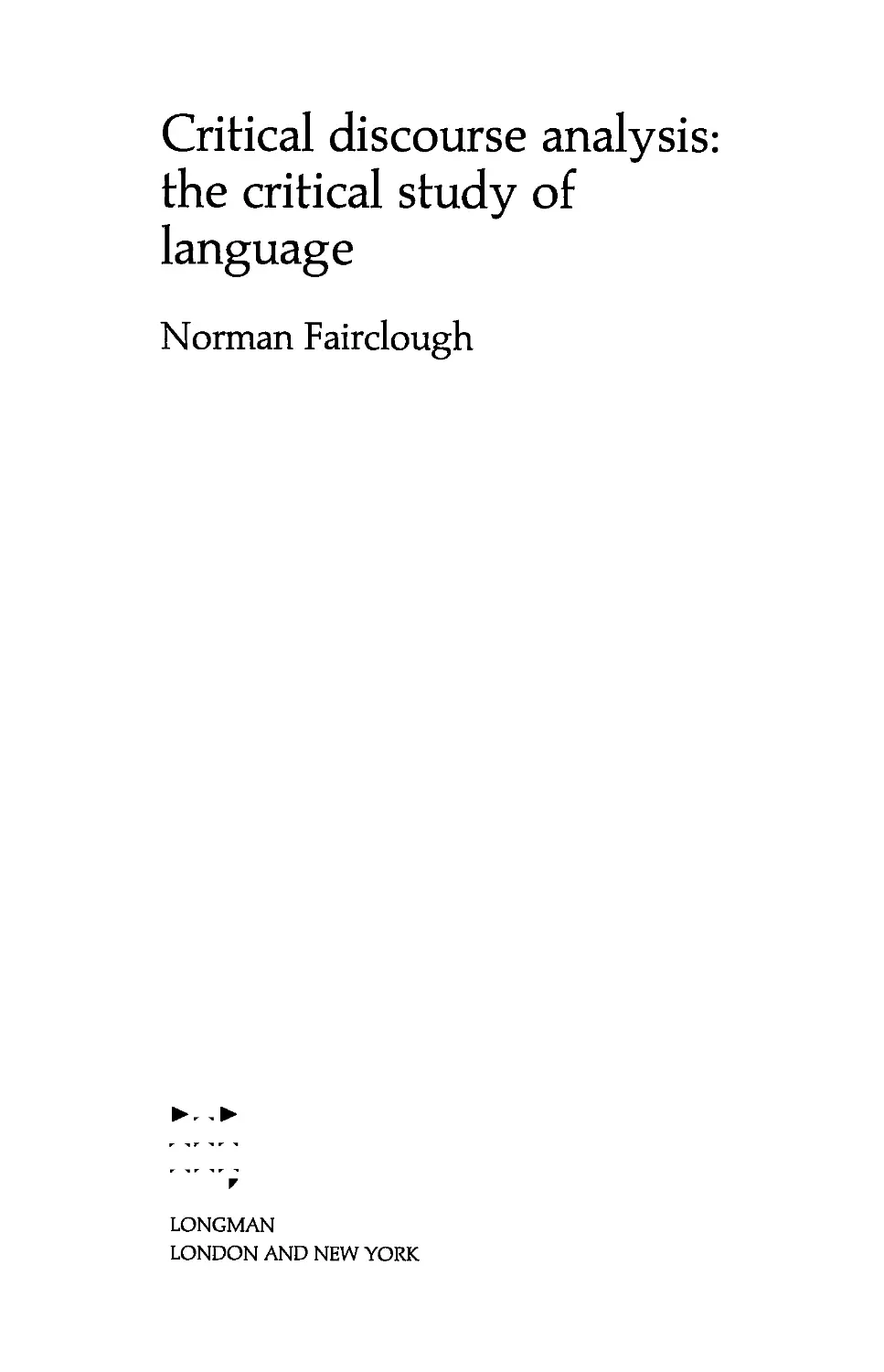
                    Critical discourse analysis:
the critical study of
language
Norman Fairclough
LONGMAN
LONDON AND NEW YORK

Longman Group Limited,
Longman House, Burnt Mill,
Harlow, Essex CM20 2JE, England
and Associated Companies throughout the world.
Published in the United States of America
by Longman Publishing, New York
© Longman Group Limited 1995
All rights reserved; no part of this publication may be
reproduced, stored in a retrieval system, or transmitted
in any form or by any means, electronic, mechanical,
photocopying, recording, or otherwise without either the
prior written permission of the Publishers or a licence
permitting restricted copying in the United Kingdom issued
by the Copyright Licensing Agency Ltd,
90 Tottenham Court Road, London WIP 9HE.
First published 1995
ISBN 0 582 219809 Csd
ISBN 0 582 2I984I Ppr
British Library Cataloguing in Publication Data
A catalogue record for this book is
available from the British Library
Library of Congress Cataloguing-in-Publication Data
Fairclough, Norman, 1941-
Critical discourse analysis : papers in the critical study of
language / Norman Fairclough.
p. cm. — (Language in social life series)
Chiefly a collection of previously published articles and.essays,
1980-1993.
Includes bibliographical references and index.
Contents: Critical and descriptive goals in discourse analysis —•
Register, power, and sociosemantic change — Discourse
representation in media discourse —• Language and ideology —•
Discourse, change, and hegemony —• What might we mean by "enterprise
discourse?" —• Critical discourse analysis and the marketization of
public discourse: the universities —• Ideology and identity change
in political television —• Discourse and text: linguistic and
intertextual analysis within discourse analysis —• Critical language
awareness and self-identity in education —• The appropriacy of
"appropriateness."
ISBN 0-582-21980-9. — ISBN 0-582-2I984-I (pbk.)
I. Discourse analysis. 2. Sociolinguistics. I. Title.
II. Series.
P302.F34 1995
306.4'4-dc20
Set by 15 in I0/I2pt Monophoto Palatino
Produced by Longman Singapore Publishers (Pte) Ltd.
Printed in Singapore

Contents
General Editor's Preface vii
Acknowledgements xii
General introduction 1
Section A Language, ideology and power 21
Introduction 23
1. Critical and descriptive goals in discourse analysis 27
2. Discourse representation in media discourse 54
3. Language and ideology 70
Section B Discourse and sociocultural change 85
Introduction 87
4. Discourse, change and hegemony 91
5. What might we mean by 'enterprise discourse'? 112
6. Critical discourse analysis and the marketization of public
discourse: the universities 130
7. Ideology and identity change in political television 167
Section C Textual analysis in social research 183
Introduction 185
8. Discourse and text: linguistic and intertextual analysis
within discourse analysis 187
Section D Critical language awareness 215
Introduction 217
9. Critical language awareness and self-identity in
education 219
10. The appropriacy of 'appropriateness' 233
Bibliography and references
Index
253
263

General Editor's Preface
One of the powerful affirmations of interest in the underlying themes
of the Language in Social Life Series has been the success accorded to
Norman Fairclough's introductory book in the Series: Language and
Power. Although itself well rooted in an existing tradition at that time
of what has since come to be termed, not unproblematically, Critical
Discourse Analysis, Language and Power has proved to offer a wide
range of students of linguistics, language studies and professional
education a framework and a means of exploring the inbrications
between language and social-institutional practices and between these,
taken together, with broader social and political structures. Its
innovation for students of linguistics in particular, was to critique some of the
premises and the constructs underlying mainstream studies in
sotiolinguistics, conversational analysis and pragmatics, to demonstrate
the need of these sub-disciplines to engage with social and political
issues of power and hegemony in a dynamic and historically informed
manner, and yet as a fundamental part of this process of linking the
micro to the macro to reaffirm the traditional disciplinary centre and
basis of the subject, the detailed and polysystemic description of
language variation. For students of professional disciplines, of law,
medicine, health care, social work, language and literacy education,
Fairclough's formulations in that book have proved especially
productive, allowing the practitioners of such disciplines whose professional
practices are most obviously languaged, a means of describing,
interpreting and explaining how their practices are discursively accomplished
and thus offering a way of clarifying the ideological bases of the
purposes, and methods of the professions themselves.
Readers of Language and Power will recall the presence there of other
themes which have subsequently found expression in Norman
Fairclough's other writings since that publication, the relationship
between the study of discourse and sociocultural change in post-

Viii GENERAL EDITOR'S PREFACE
industrial market economies, notably dealt with in depth in his 1992
publication for Polity Press, Discourse and Social Change, the importance
he has always accorded to the analysis of the texture of texts in
undertaking social institutional research, as evidenced in his publications
in the Journal of Pragmatics and Discourse & Society, and perhaps of
greatest potential significance because of its engagement with
schooling, the writings with his colleagues from Lancaster and elsewhere in
defining the framework for and extensively illustrating the practice of
critical language awareness in the curriculum, collected in his 1992
edited publication under that title in Longman's Real Language Series.
Notwithstanding however this productive interest from such a
variety of audiences, and in part because of it, it is clear that to some
commentators and practitioner-researchers the very scope and
attraction of critical discourse analysis has placed it at some risk of theoretical
blurring. This is a concern shared by Norman Fairclough himself as he
makes plain in his Introduction to this collection of his papers. For
some there is an urgent need to re-engage with central constructs of
power and knowledge, and above all, ideology, to question what is
this 'real world' of social relations in institutional practices that is
represented linguistically, for others this has led to calls to re-examine
the apparent determinism of the relationship between the macro and
the micro, for others again to expand our focus to encompass not only
what is discoursed but what is not, for some whose definition of
discourse is centrally bound to the organization of meanings, to
balance what they see as too great a the critical study of production
with an equally critical study of consumption.. Methodologically also,
despite some quite notable recent achievements in the critical analysis
of spoken discourse in workplace settings and professional encounters,
as well as more extensively in the more tractable fields of written texts,
there is continuing practical concern about the doability in thefull
descriptive, interpretive and explanatory sense, of critical linguistic
research. There is a good deal of so-called critical analysis going on
which removes texts (usually portable and written) from their
conditions of production and reception in particular sites and on the basis of
rather superficial linguistic and content analysis makes too large a leap
to the macro. Fairclough has warned about that before, and rightly so.
Not that we should underestimate how the impeccably grounded
polysystemic approach of Firth and Halliday poses considerable
descriptive demands, suggesting as it does and as Fairclough reformulates
here, that discourse analysis is not a 'level' of analysis as, say,
phonology or lexico-grammar, but an exploration of how 'texts' at all

GENERAL EDITOR'S PREFACE IX
levels work within sociocultural practices. This, taken with the
acknowledged difficulty of undertaking collaborative interdisciplinary
research, suggests that Norman Fairclough's consistent emphasis on
the need for critical discourse analysis to establish a viable research
methodology is both cautionary and well-judged.
These are not intended as arguments contra, ; what they point up is
that Fairclough's papers have not only opened a rich and for many like
myself a determining avenue for linguistic research, they have also set
an agenda for linguists' education and practice which requires a close
connection between descriptive ability, an engagement with issues of
social and individual concern, an involvement with and from the points
of view and experiences of those with whom we research, an informed-
ness about institutional practices in the context of a dynamic and
struggling social order and a grounding in those social theorists, amply
referred to in these pages, whose engagement in different ways has
been with the production of the social through discourse. Above all, as
van Dijk made plain in a recent Editorial for Discourse & Society, critical
discourse analysis needs always to keep its audience in view, asking 'to
whom its results with be relevant and useful'. Norman Fairclough's work
by any account has kept all these concerns in view, as these papers
amply demonstrate.
There was no doubt, then, that the opportunity to publish a
collection of Norman Fairclough's key papers from the period of 1983
to 1993, some published and some written for this collection, would
offers readers of the Language in Social Life Series a means themselves of
engaging with these concerns. Four themes structure the collection:
• the relationship between language, ideology and power
• the relationship between discourse and sociocultural change
• the centrality of textual analysis to social research
• the principles and practice of critical language awareness
Crossing these governing themes of Fairclough's research we can
identify three central constructs of critical discourse analysis:
• text and the study of 'texture'
• discoursal practices and the concept 'orders of discourse'
• sociocultural practices and the concept of 'culture'
The dynamic interplay between these themes and these constructs
enables the reader to engage with what for me is the overriding
metaphor uniting these papers, highlighted by Norman Fairclough in
his discussion of the contributions of Bakhtin and Gramsci, that of the

X GENERAL EDITOR'S PREFACE
tension and struggle between the creativity potential of Bakhtin's
heteroglossia, the centripetal-centrifugal intertextuality of texts, and
Gramsci's hegemony, that 'stabilized configuration of discursive
practices' as Fairclough puts it, which acts to control and constrain
creativity in discourse.
What is there for the reader's action, apart, that is from a vicarious
and vigorous engagement with these issues? Here, I believe, will be the
merit in this book. What critical discourse analysis needs most now is
practical but informed, reasoned and above all collaborative action;
expanding the universe of inquiry to Gumperz's crucial sites, identifying
with those most chiefly engaged, and collaborating in an explanatory
analysis of the production and reception of the discoursed and the non-
discoursed communication at critical moments in those sites. Such work
is not application of some pre-set code of principles, it is praxis and as
such constantly reengages theory and practice in a continuously self-
informing process of inquiry. What it does do is to challenge our
capacities, both technical and conceptual, as linguists and discourse
analysts to handle variation in a multi-level mode as boundaries
between discourses constantly change symbiotically with social change;
in its emphasis on the conditions of reception of texts it compels
engagement with- cognitive processes and requires them to be socially
and critically grounded, and to be augmented by understanding of the
organizational routines governing such reception; it invites
ethnographic research not as some convenient and occasional adjunct
but as central to the process of linguistic inquiry; it directs attention to
the historicity of discursive events and to the archaeology of
knowledge and experience, and as such, crucially privileges the life
experiences of those with whom we both collaborate as researchers
and as co-providers of data and thus restores in part the inherent
imbalances between those who study and those who act.
Seen in this way, Norman Fairclough's Critical Discourse Analysis is
not just a reflective study of those issues canvassed above. It takes on
a rather different role. It suggests rather plainly, if you read it that
way, how we might construct a linguistics for the next century which
in addition to its pervasively critical and explanatory focus would
require interdisciplinarity as a central principle, without however
compromising in any way on the central capacity to describe. Consider
only Fairclough's discussions on Halliday and Foucault on the
engagement of textual analysis with the analysis of discursive practices and
socio-cultural practices as one such example. The issue becomes rapidly
clear; whether the academy and its constricting siloisation could stand

GENERAL EDITOR'S PREFACE xi
the strain. The answer, in my experience and that of my co-workers, is
that while we agitate and wait inside the walls, we simultaneously
engage our maximum efforts with those who work with language in
the community, where talk is work and where the issues so clearly
presented and critiqued here are the very matter of everyday existence
and activity.
Professor Christopher N Candlin
Centre for Language in Social Life
Department of Linguistics
Macquarie University, Sydney
Australia

Acknowledgements
We are grateful to the following for permission to reproduce copyright
material:
Department of Trade and Industry for the extract 'The Design Initiative'
taken from a brochure about The Enterprise Initiative Consultancy
Scheme (EICS) produced in 1989; Elsevier Science B.V., Amsterdam,
The Netherlands, for the paper 'Critical and Descriptive Goals in
Discourse Analysis' by Norman Fairclough originally published in
Journal of Pragmatics, 9, 1985, 739—763; Foris Publications for the
paper 'Discourse Representation in Media Discourse' by Norman
Fairclough from Sociolinguisiics, 17, 1988, 125—39; The Guardian for
the article "MPs urge harsher heroin penalties' by David Hencke in The
Guardian (c) 24.5.85; Lancaster University for extracts from their
University Prospectuses 1967—8, 1986—7, and 1993; Longman Group
Ltd for the paper 'The appropriacy of 'appropriateness" by Norman
Fairclough from Critical Language Awareness, Norman Fairclough (ed.)
(c) Longman 1992; Mirror Syndication International for the article "War
on Drug Pushers' by John Desborough in The Daily Mirror 24.5.85;
News Group Newspapers Ltd for the article 'Call up forces in drug
battle' by David Kemp in The Sun 24.5.85; International Thomson
Publishing Services Ltd for the paper "What Might We Mean by
'Enterprise Discourse'?' by Norman Fairclough from Enterprise Discourse,
R. Keat and N Abercrombie (eds) (Routledge, Chapman & Hall, 1980);
Sage Publications Ltd for the papers 'Discourse and text: linguistic and
intertextual analysis within discourse analysis' by Norman Fairclough
from Discourse and Society, 3, 1992, 193-217 and 'Critical discourse
analysis and the maketisation of public discourse: the universities' by
Norman Fairclough from Discourse and Society 4,1993, 133—68; Sheffield
Hallam University, University of Newcastle and University of
Nottingham for their advertisements that appeared in the Times Higher

ACKNOWLEDGEMENTS xiH
Education Supplement 22.5.92; The University of Birmingham for the
paper 'Language and Ideology' by Norman Fairclough from the English
Language Research Journal 3,1989, 9-27.

General introduction
This book is a collection of papers on critical discourse analysis which
were written between 1983 and 1992 and (except for papers 5, 8 and
10 which have not been previously published) appeared between 1985
and 1993 (see Acknowledgements for publication details).1 I have
grouped the ten papers into four sections which correspond to major
concerns of my work over this period; Language, ideology and power,
Discourse and sociocultural change, Textual analysis in social research,
and Critical language awareness. Although this grouping reflects a
diversity of concerns, there are substantial thematic overlaps between
sections and papers, all of which are orientated towards a single broad
objective; to develop ways of analysing language which address its
involvement in the workings of contemporary capitalist society.
Each section has an introduction which summarizes the papers and
identifies salient themes. But I shall begin this general introduction
with a broad characterization of the concerns of the four sections. This
will provide a basis for the main business of the introduction: to
identify a range of issues and problems which are, I believe, on the
current agenda of critical discourse analysis.
The three papers in the first section (Language, ideology and power)
reflect my early (roughly 1983-87) concerns in this field with the
development of an analytical framework — a theory and method — for
studying language in its relation to power and ideology. This
framework is seen here and throughout as a resource for people who are
struggling against domination and oppression in its linguistic forms. I
call this framework, which in various versions informs the whole book
as well as other publications (Fairclough 1989, 1992a, 1992b,
forthcoming), critical discourse analysis. Power is conceptualized both in terms
of asymmetries between participants in discourse events, and in terms
of unequal capacity to control how texts are produced, distributed and
consumed (and hence the shapes of texts) in particular sociocultural

2 GENERAL INTRODUCTION
contexts. A range of properties of texts is regarded as potentially
ideological, including features of vocabulary and metaphors, grammar,
presuppositions and implicatures, politeness conventions,
speech-exchange (turn-taking) systems, generic structure, and style. The first
paper emphasizes the ideological importance of the implicit, taken-for-
granted assumptions (presuppositions) upon which the orderliness and
coherence of texts depend. The power to control discourse is seen as
the power to sustain particular discursive practices with particular
ideological investments in dominance over other alternative (including
oppositional) practices.
The second section (Discourse and sociocultural change) also includes
four papers, which were written between 1989 and 1992. The concern
in this section is to integrate discourse analysis with social analysis of
sociocultural change, developing the thematization of change which is
already a feature of paper 3 in Section A. The role of discourse within
the society and culture is seen as historically variable, and I argue that
in modern and contemporary (late modern') society discourse has
taken on a major role in sociocultural reproduction and change. CDA is
consolidated here as a 'three-dimensional' framework where the aim is
to map three separate forms of analysis onto one another: analysis of
(spoken or written) language texts, analysis of discourse practice
(processes of text production, distribution and consumption) and
analysis of discursive events as instances of sociocultural practice. A
characteristic of the framework is that it combines a Bakhtinian theory of genre
(in analysis of discourse practice) and a Gramsrian theory of hegemony
(in analysis of sociocultural practice). The former highlights the
productivity and creativity of discourse practice and its realization in texts
which are heterogeneous in their forms and meanings, the
heterogeneity emanating from their intertextuality; texts are constituted from
other already produced texts and from potentially diverse text types
(genres, discourses). The theory of hegemony highlights both how
power relations constrain and control productivity and creativity in
discourse practice, and how a particular relatively stabilized
configuration of discourse practices ('order of discourse') constitutes one domain
of hegemony. Change is investigated in terms of the mapping onto
one another of shifting, unstable sociocultural practices (e.g. where new
domains are in the process of being 'marketized'), a complex and
creative discourse practice involving new combinations of genres and
discourses, and texts which are heterogeneous in forms and meanings.
The heterogeneities of texts are a sensitive indicator of sociocultural
contradictions, and a sensitive barometer of their evolution. A particular

GENERAL INTRODUCTION 3
focus is what I call 'technologization of discourse' — calculated
intervention to shift discursive practices as part of the engineering of social
change.
The third and fourth sections are shorter than the first two, consisting
of one and two papers respectively. The paper in Section C (Textual
analysis in social research) is addressed mainly to discourse analysts
based outside language studies, and is an argument for the inclusion of
a substantial element of textual analysis within discourse analysis as a
method of social research in various disciplines. As well as linguistic
analysis, textual analysis here includes intertextual analysis of how
available genres and discourses are drawn upon and combined in texts.
Section D (Critical language awareness) is concerned with educational
applications of critical work in discourse analysis and more generally in
language studies, in programmes for stimulating a critical awareness of
language. Such programmes are on the one hand supportive of the
general case for language awareness work in schools which has been
made in recent years (Hawkins 1984, NCLE 1985, DES 1988, DES
1989), but on the other hand critical of the views of language and
language education which are built into such work. In particular, the
papers in this section include a detailed critique of the concept of
'appropriateness' which grounds theories of language variation which
are prevalent in language education, and sketch out a view of learning
which stresses the integration of critical language awareness both with
past language experience and with the developing capacities of learners,
individually and collectively, to engage not only in conventional but
also innovative and unconventional language practice. Another concern
is the possibility and danger of CDA partially shifting its focus in the
context of educational applications from critique to involvement in the
production of alternative practices.
The discussion of issues and problems in critical discourse analysis
which will occupy the rest of this introduction will be organized
around the three dimensions of the analytical framework sketched out
above: text, discourse practice, sociocultural practice. I discuss in turn
issues relating to text and language, genre and orders of discourse, and
society and culture. Part of my objective here is to point to and
engage in controversies which have arisen from the project of critical
discourse analysis, differences between critical discourse analysts and
scholars in adjacent fields, and differences amongst critical discourse
analysts. I shall also identify some limitations of the work represented
in this book, and indicate directions for the future.

4 GENERAL INTRODUCTION
TEXT AND LANGUAGE
A text is traditionally understood to be a piece of written language — a
whole 'work' such as a poem or a novel, or a relatively discrete part of
a work such as a chapter. A rather broader conception has become
common within discourse analysis, where a text may be either written
or spoken discourse, so that, for example, the words used in a
conversation (or their written transcription) constitute a text. In cultural
analysis, by contrast, texts do not need to be linguistic at all; any
cultural artefact — a picture, a building, a piece of music — can be seen
as a text. This view of text has its dangers; it can obscure important
distinctions between different types of cultural artefact, and make the
concept of a text rather nebulous by extending it too far. Nevertheless,
I think it is necessary to move further towards this view than I have
done in these papers, where a text is mainly understood as written or
spoken language. A strong argument for doing so is that texts in
contemporary society are increasingly multi-semiotic; texts whose
primary semiotic form is language increasingly combine language with
other semiotic forms. Television is the most obvious example,
combining language with visual images, music and sound effects. But written
(printed) texts are also increasingly becoming multisemiotic texts, not
only because they incorporate photographs and diagrams, but also
because the graphic design of the page is becoming an ever more
salient factor in evaluation of written texts. We can continue regarding
a text as a primarily linguistic cultural artefact, but develop ways of
analysing other semiotic forms which are co-present with language,
and especially how different semiotic forms interact in the multisemiotic
text. This poses a challenge to critical discourse analysis which is
already being taken up in the development of a 'social semiotics'
(Hodge and Kress 1988, Kress and van Leeuwen 1990).
Another challenge is to convince the increasing number of discourse
analysts whose disciplinary base is outside linguistics or language
studies that textual analysis should mean analysis of the texture of
texts, their form and organization, and not just commentaries on the
'content' of texts which ignore texture. The premise of this argument is
that the sorts of social and cultural phenomena that such analysts are
orientated towards are realized in textural properties of texts in ways
which make them extraordinarily sensitive indicators of sociocultural
processes, relations, and change. Social and cultural analyses can only
be enriched by this textural evidence, which is partly linguistic and
partly intertextual — partly a matter of how links between one text and

GENERAL INTRODUCTION 5
other texts and text types are inscribed in the surface of the text. At
issue here is the classical problem of the relationship between form and
content. My contention is that no analysis of text content and
meaning can be satisfactory which fails to attend to what one might
call the content of texture (or, the content of its form). (See chapter 8 for
supporting examples.)
There are problems and challenges for discourse analysis in this
position. Considerations of texture may always in principle be an
important element in discoursally orientated sociocultural research, but
existing models for textural analysis are not always very effective in
providing ways of analysing texture which are relevant to the
sociocultural agenda. A great deal more work is needed on the development of
socially relevant models for text analysis. Take the case of absences
from texts. Textual analysis can often give excellent insights about
what is 'in' a text, but what is absent from a text is often just as
significant from the perspective of sociocultural analysis (see paper 8
for examples). For instance, political analysts of media may be
particularly concerned to know whether reports on the Gulf War did or did
not include the topic of civilian casualties, as well as how that topic
was handled texturally where it was included, in terms of thematization,
foregrounding or backgrounding — see Fairclough (forthcoming, chapter
6) for analysis of a particular example. A framework for textual analysis
which allows for a systematic focus upon absences through more
sustained comparative analysis of texts is described in Van Leeuwen
(1993). This depends upon a systemicist view of text as choice,
operationalized as networks of systems of options which are selected
amongst in the production of texts.
Surprisingly, on the face of it, the contrast between presence in and
absence from texts is not a sharp one. In addition to (significant)
absences from a text, what is 'in' a text may be explicit or implicit.
Two categories of implicit content which have received extensive
discussion are presupposition and implicature (Levinson 1983). The
implicit content of a text is a sort of halfway house between presence
and absence. In the case of a standard example such as The Soviet threat
cost the West dear, the presupposition — that there is a Soviet threat - is
absent from the text in this sense that it is not actually asserted there,
and is commonly seen as supplied by the listener or reader in
interpreting the text. On the other hand, the expression the Soviet threat and in
particular the definite article (the) 'triggers' (Levinson) the
presupposition, so the latter is in that sense present in the text. The distinction
between what is explicit and what is implicit in a text is of considerable

6 GENERAL INTRODUCTION
importance in sociocultural analysis. Analysis of implicit content can
provide valuable insights into what is taken as given, as common
sense. It also gives a way into ideological analysis of texts, for
ideologies are generally implicit assumptions (see paper 3). One might
also include on the presence—absence scale the relative foregrounding
or backgrounding of explicit textual content (see Fairclough
forthcoming chapter 6). The ideological importance of implicit textual content
has received attention in French critical discourse analysis, but not
enough attention so far within work published in English. The concept
of 'preconstructed' has been used to give an intertextual understanding
of implicit content (presupposition); the unsaid of a text, what it takes
as given, is taken as the already-said-elsewhere, the form in which a
text is shaped and penetrated by (ideological) elements from domains
of prior textual practice (see Pecheux 1982, Williams forthcoming).
Texts are social spaces in which two fundamental social processes
simultaneously occur: cognition and representation of the world, and
social interaction. A multifunctional view of text is therefore essential. I
have followed systemic linguistics (Halliday 1978) in assuming that
language in texts always simultaneously functions ideationally in the
representation of experience and the world, interpersonally in
constituting social interaction between participants in discourse, and textually in
tying parts of a text together into a coherent whole (a text, precisely)
and tying texts to situational contexts (e.g. through situational deixis).
This multifunctionality of language in texts can be used to operational-
ize theoretical claims about the socially constitutive properties of
discourse and text (Foucault 1972). Texts in their ideational functioning
constitute systems of knowledge and belief (including what Foucault
refers to as 'objects'), and in their interpersonal functioning they
constitute social subjects (or in different terminologies, identities, forms
of self) and social relations between (categories of) subjects. Any part
of any text can fruitfully be examined in terms of the co-presence and
interaction of these constitutive processes. Approaches to (critical)
discourse analysis which have an ideational bias (e.g. Potter and
Wetherell 1987, Pecheux 1982, van Dijk 1988) are ill-equipped to
capture the interplay between cognition and interaction which is a
crucial feature of textual practice. Nor is an ideational bias justified, as
it may appear to be on the face of it, by a focus on ideology.
Interpersonal aspects of texts may be ideologically invested; indeed,
naturalized properties of genres such as the turn-taking system or the
pragmatic politeness conventions of medical interviews are perhaps
more ideologically potent in modern societies than features of ideational

GENERAL INTRODUCTION 7
meaning, as a Foucaultian emphasis on the salience of 'technologies' in
modern forms of power would suggest (Foucault 1979).
Textual analysis demands diversity of focus not only with respect to
functions but also with respect to levels of analysis. Let me stress that
discourse analysis itself is not here taken to be a particular level of
analysis. For some linguists, it is: 'discourse analysis is analysis of text
structure above the sentence' (Sinclair and Coulthard 1975). My view
is that 'discourse' is use of language seen as a form of social practice,
and discourse analysis is analysis of how texts work within sociocultural
practice. Such analysis requires attention to textual form, structure and
organization at all levels; phonological, grammatical, lexical
(vocabulary) and higher levels of textual organization in terms of exchange
systems (the distribution of speaking turns), structures of
argumentation, and generic (activity type) structures. A working assumption is
that any level of organization may be relevant to critical and ideological
analysis. Some approaches to critical discourse analysis by contrast
have tended to focus just on particular levels (e.g. grammar and lexis in
critical linguistics, lexical semantics in earlier French discourse analysis).
It is important to avoid a one-sided emphasis on either repetitive or
creative properties of texts. Any text is part repetition, part creation,
and texts are sites of tension between centripetal and centrifugal
pressures (Bakhtin 1981, 1986). Texts vary in the relative weight of
these pressures depending upon their social conditions, so that some
texts will be relatively normative whereas others are relatively creative.
Centripetal pressures follow from the need in producing a text to draw
upon given conventions, of two main classes; a language, and an order
of discourse — that is, a historically particular structuring of discursive
(text-producing) practices (see further below). More concretely, one
obviously has to use English words and sentence structures in
producing a text in English, and one has to select amongst the genres and
discourses available in the order of discourse. Centrifugal pressures
come from the specificity of particular situations of text-production,
the fact that situations do not endlessly repeat one another, but are, on
the contrary, endlessly novel and problematic in new ways. Texts
negotiate the sociocultural contradictions and more loosely 'differences'
(Kress 1988) which are thrown up in social situations, and indeed they
constitute a form in which social struggles are acted out. For instance,
with respect to the ideational function, people deal textually with
contradictions or differences in beliefs, knowledges and representations.
With respect to the interpersonal function, texts negotiate social
relations between people in circumstances of doubt or contestation,

8 GENERAL INTRODUCTION
and people attempt to work out textually, in their use of language, the
dilemmas they face in defining their own identities (Billig et al. 1988).
Text producers have nothing except given conventions of language
and orders of discourse as resources for dealing with centrifugal
pressures, but they are able to use these resources in new ways,
generating, for instance, new configurations of genres and discourses
(see below).
The tension between repetition and creation, centripetal and
centrifugal pressures, manifests itself in varying degrees of homogeneity or
heterogeneity of textual forms and meanings. A relatively
homogeneous text is relatively consistent semantically and formally — a consistent
construction of relations between text producer and audience through
the text for instance may be partly realized through consistencies of
modality. A relatively heterogeneous text may by contrast construct
text producer—audience relations in diverse and contradictory ways,
partly realized in inconsistent and clashing modalities. The
heterogeneities of texts code social contradictions. It is this property of texts that
makes them the sensitive indicators of sociocultural processes and
change I referred to above in discussing texture. Social contradictions
may even be condensed into particular collocations in texts, particular
patterns of co-occurrence and mutual predictability between words, for
instance, the collocation enterprise culture (see paper 5). The
homogeneities/heterogeneities of texts can be shown through intertextual
analysis of the links between a text and other texts and text types,
which is (as I argue in paper 8) a necessary complement to linguistic
analysis within the analysis of texts (see also Talbot 1990, Slembrouck
1992). I suggest" in paper 7 that ambivalence and disfluency may be
consequences of a high level of heterogeneity in texts.
Much work in discourse analysis including critical discourse analysis
has focused upon a more or less idealized version of the homogeneous
text, and virtually ignored heterogeneous texts, and more generally
what Bakhtin (1981) called 'heteroglossia'. This is true of the
Birmingham school (Sinclair and Coulthard 1975), earlier work in conversation
analysis and in French discourse analysis, and critical linguistics (Fowler
et al. 1979). Other work has attended to heterogeneity but in limited
forms which do not, I think, come to terms with the profound
theoretical and methodological implications of heterogeneous texts
(see further in below). I would include here more recent work in
conversation analysis (for instance, Drew and Heritage 1992 — see also
Fairclough 1992c), and the work of Labov and Fanshel on therapeutic
discourse (1977).

GENERAL INTRODUCTION 9
In the three-dimensional framework for CDA I referred to earlier
(text, discourse practice, sociocultural practice), the analysis of discourse
practice involves attention to processes of text production, distribution
and consumption. This feature of the framework encapsulates what I
think is an important principle for critical discourse analysis; that
analysis of texts should not be artificially isolated from analysis of
institutional and discoursal practices within which texts are embedded.
This principle has been recognized in some but not all approaches to
CDA (e.g. in van Dijk 1988 but not in Fowler et al. 1979). This
principle would mean for instance that in analysing the text of a TV
programme one should also have regard to the routines and processes
of programme production, and the circumstances and practices of
audience reception. Text analysis in isolation from audience reception
has been widely criticized in media studies, and there has been a shift
in attention from the former to the latter (Morley 1980). This argument
is very relevant to CDA, for part of the critique is directed at analysts
who postulate ideological effects solely on the basis of analysis of texts
without considering the diverse ways in which such texts may be
interpreted and responded to. But there is a danger here of throwing
the baby out with the bathwater, by abandoning textual analysis in
favour of analysis of audience reception. The interpretation of texts is a
dialectical process resulting from the interface of the variable
interpretative resources people bring to bear on the text, and properties of the
text itself. Textual analysis is therefore an important part, if only a
part, of the picture, and must be defended against its critics (Brunsdon
1990).
The principle that textual analysis should be combined with analysis
of practices of production and consumption has not been adequately
operationalized in the papers collected here. I have referred to text
production but rarely to text consumption, and focused only upon the
question of how text producers draw upon and restructure orders of
discourse, producing new configurations of genres and discourses.
There is still a need to bring close textual analysis together with social
analysis of organizational routines for producing and consuming texts,
and with analysis of specifically discoursal processes within the
processes of production and consumption, such as the analysis of how
news articles are transformed in the process of their production in Bell
(1991), or analysis of how media texts are transformed in audience talk
about media (briefly discussed in paper 8, see also Thompson 1990).
There is also a need to bring together critical discourse analysis of
discursive events with ethnographic analysis of social structures and

10 GENERAL INTRODUCTION
settings, in the search for what some have called a critical ethnography
(Bourne 1992).
Textual analysis presupposes a theory of language and a grammatical
theory, and one problem for critical discourse analysis is to select from
amongst those available. I have referred at various points to systemic
linguistics, which has a number of strengths from the perspective of
CDA It is a functional theory of language orientated to the question '
of how language is structured to tackle its primary social functions.
Thus grammar is seen as structured by the three (macro) functions of
language I referred to earlier, the ideational, interpersonal and textual
functions. It is also a textually orientated theory concerned with
producing grammatical descriptions which are useable in textual
analysis. The view of language as social semiotic (Halliday 1978) incorporates
an orientation to mapping relations between language (texts) and
social structures and relations. While systemic linguistics is thus a
congenial theory to work with, in the longer term critical discourse
analysis should, as Kress has argued (1993), be informing the
development of a new social theory of language which may include a new
grammatical theory.
GENRE AND ORDERS OF DISCOURSE
The discourse practice dimension of the three-dimensional analytical
framework introduced above shows, for any discursive event, how text
producers and interpreters draw upon the socially available resources
that constitute the order of discourse. As I indicated above, the two
major centripetal forces in any discursive event are the language and
the order of discourse. Discursive events are, on the one hand,
dependent upon and shaped by them, but on the other hand
cumulatively restructure them. Intertextual analysis links the text and discourse
practice dimensions of the framework, and shows where a text is
located with respect to the social network of orders of discourse — how
a text actualizes and extends the potential within orders of discourse.
Discourse practice, orders of discourse, and intertextual analysis
have a crucial mediating role in this framework; they mediate the
relationship between texts on the one hand and (nontextual parts of)
society and culture on the other. What I mean is that (a) the order of
discourse is the social order in its discoursal facet — or, the historical
impress of sociocultural practice on discourse; (b) any discursive event
necessarily positions itself in relation to this historical legacy, selectively

GENERAL INTRODUCTION 11
reproducing or transforming it; (c) the specificity of the particular
sotiocultural practice which a discursive event is a part of is realized
first in how the discursive event draws upon and works upon the order
of discourse, which is in turn realized in features of texts, so that the
text—sociocultural practice link is mediated by discourse practice. As
this formulation implies, discourse practice ensures attention to the
historicity of discursive events by showing both their continuity with
the past (their dependence upon given orders of discourse) and their
involvement in making history (their remaking of orders of discourse).
Other approaches to (critical) discourse analysis neglect or play
down the discourse practice dimension and intertextuality. A case in
point is recent work within conversation analysis which focuses upon
institutional discourse and upon relationships between 'talk-in-interac-
tion' and social structure (Boden and Zimmerman 1991, Drew and
Heritage 1992). This work shows continuity with earlier conversation
analysis in its concern to irtinimize appeal to the traditional categories
of social structure in analysing talk, and to find ways of excluding such
categories from the analysis. Schegloff (1992) for instance, formulates
principles of 'relevance' and 'procedural consequentiality'; a social
category should enter the analysis only if it is manifestly orientated to
by (relevant for) participants, and consequential for the way in which
the text is structured or organized. I would argue that social categories
which do not have such manifest consequences may nevertheless be
necessary to the analysis of a text in the dimension of discourse
practice — they may be relevant to the field of practices within which
the text is located even if they are not manifestly consequential for the
text itself. For instance, in a mixed-gender job interview the category
of participant gender may apparently be neither relevant nor
procedurally consequential on Schegloff's criteria, yet analysis of discourse
practice may show its absence to be a marked and significant absence
when this job interview is located with respect to the extant range of
practices of job interview — perhaps, for instance, because a feminist
political position is being taken up.
Certain categories which have been of key importance in the
analysis of social structure will of course do badly on Schegloff s
criteria for analytical relevance, including social class, power (in a social
structural rather than a situational sense) and ideology. Analysis of
discourse practice by contrast requires such categories. We can best see
this in relation to what I want to call hidden variability. Various
approaches to discourse analysis, including not only conversation
analysis but also, for instance, the Birmingham school (Sinclair and

12 GENERAL INTRODUCTION
Coulthard 1975), ignore an important type of variability in language
use (discourse), through an often implicit reliance upon what I call in
paper 11 an appropriateness theory of language variability — a theory
which assumes a rather straightforward matching between types of
social situation and language varieties, such that each social situation
is associated with a single, unitary variety. The hidden variability is
the variability of practice within particular social situations — within
the lesson, within the medical consultation, within the media
interview. My contention is that a social situation is better regarded as
having its own order of discourse within the social network of
orders of discourse, in which different discourse types are ordered in
relation to each other. Such alternative practices are characteristically
ordered in dominance in the sense that there may be a dominant
('normal', naturalized) practice and dominated (marginalized,
'alternative') practices. The category of power in a structural sense (and
perhaps the category of social class) is needed to make sense of the
ordering and dominance relations between practices and how people
select from amongst available practices on specific occasions. The
category of ideology is needed to make sense of the differences
between practices; practices may be ideologically invested, and
diversity of practices may be part of ideological struggles (see paper 1
and passim).
I have adapted the concept of order of discourse from Foucault
(1981) to refer to the ordered set of discursive practices associated
with a particular social domain or institution (e.g. the lecture, the
seminar, counselling, and informal conversation, in an academic
institution), and boundaries and relationships between them. Discursive
practices may be relatively strongly or relatively weakly demarcated —
the boundaries may be rigid or permeable, and discursive practices may
be in various sorts of relationship. They may be in the complementary
sort of relationship assumed in theories of appropriateness (discussed in
paper 10) such that different discursive practices are used in different
social situations, but they may also be alternatives in the same social
situation, and may be in relationships of opposition. For instance,
doctors or teachers may select or reject available discursive practices
for modelling their medical consultations or classes on the basis of
theoretical or ideological position (see above). In addition to the local'
orders of discourse of particular social domains, it is useful to refer to a
societal order of discourse to chart the relationships and boundaries
between local' orders of discourse (e.g. between orders of discourse of
the classroom, peer group, and family). Boundaries between and within

GENERAL INTRODUCTION 13
orders of discourse are constantly shifting, and change in orders of
discourse is itself part of sociocultural change.
I described the discourse practice dimension of the framework as
concerned with the production, consumption and distribution of texts.
Distribution, how texts circulate within orders of discourse, can be
investigated in terms of 'chain' relationships (as opposed to
paradigmatic or 'choice' relationships) within orders of discourse. There are
more or less settled chains of discursive practices within and between
orders of discourse across which texts are shifted and transformed in
systematic ways (Fairclough 1992a). For instance, in the mass media
there are chains connecting various public orders of discourse (politics,
law, science, etc.), media orders of discourse, and orders of discourse in
the private domain (the domain of reception). Texts are transformed in
systematic ways across these boundaries, and even within media orders
of discourse the text production process may involve complex chains
of discursive practices and transformations (described in Bell 1991).
Distribution is a relatively neglected issue which merits more attention.
One area of controversy concerns the constitution of what I have
referred to above as the constituent discursive practices of an order of
discourse. In particular, there has been a great deal of debate recently
over conflicting views of genre, which has been made sharper through
policy implications for the teaching of genre in schools (see, for
example, Martin 1989, Threadgold 1989, van Leeuwen 1987). In my
view, the debate has not been helped by a common failure to
distinguish different levels of abstraction. The primary distinction is
between actual texts, and the conventions which people draw upon in
producing and interpreting them. A secondary distinction within
conventions is between what I shall call text types, and the more abstract
constituents of text types (genre and discourse in particular). When
people produce or interpret texts, they orientate towards conventions
as ideal types, by which I mean that texts are produced and interpreted
by reference to them but certainly do not simply instantiate them. In
saying that conventions have the status of ideal types I am not
suggesting they are purely imaginary; there are texts which closely
match ideal types (as well as others which do not), so that people learn
them from concrete textual experience. Let us work from the most
abstract to the most concrete (textual) level.
One issue in the controversy over genre is whether a genre should
be understood as a rigid schema made up of stages, all or some
obligatory, in a fixed order (see for instance the analysis of narrative in
Labov and Waletsky 1967), or whether genres are more flexible,

14 GENERAL INTRODUCTION
unpredictable, and heterogeneous (Threadgold 1989). If one assumes
that texts directly instantiate genres, the former ('schematic') view
cannot be sustained as a general view of genre, because many texts
manifest complex mixed genres. Nevertheless, the schematic view does
have some reality as an ideal type and a convention — and some
textual reality, in that some texts do adhere tightly to generic schemata.
Even so, even at the level of greatest abstraction, only some genres
have a tight schematic structure. One might compare for instance the
relatively predictable structuring of a canonical instance of a job
interview or the sort of oral narrative Labov and Weletsky are
concerned with, and a family conversation over dinner.
Even at this level of abstraction, it is not helpful to conceive of a
genre simply in terms of structuring with respect to stages. I regard a
genre as a socially ratified way of using language in connection with a
particular type of social activity (e.g. interview, narrative, exposition).
Such a way of using language is not just a way of staging a text, it
also involves particularities of (in the terms of Halliday 1978) 'field' —
what social practices are referred to and how they are signified (van
Leeuwen 1993), of 'voice' — who the participants are, and how they are
constructed, of 'style' — how participant relations are constructed, and
of 'mode' — what forms of textualization (not just staging) and of text-
context relations apply. We can use the terms voice, style, and mode
to refer to these particular facets of genre, and the term 'activity type'
(Levinson 1979) to refer specifically to the schematic structuring of a
genre in terms of stages. Rather than using field we can use 'discourse';
a discourse is a way of signifying a particular domain of social practice
from a particular perspective, and a genre may predictably draw upon
a particular range of discourses, though a given discourse may be
drawn upon in various genres.
At a lower level of abstraction, text types are those configurations of
genres (and so of discourses, voices, styles, modes, activity types)
which have developed and become conventionalized for particular
categories of activity in particular types of social situation. A text type
is situationally and historically quite particular, a genre is more abstract,
though particular text types may be more or less generically complex,
closer to or more distant from genres. One can specify text types at
various levels of particularity — for example, news interview, TV news
interview, Channel 4 news interview, and so forth. Actual texts may be
more or less closely modelled upon text types. In the intertextual
analysis of a text, the objective is to describe its 'intertextual
configuration', showing for instance how several text types may be simultane-

GENERAL INTRODUCTION 15
ously drawn upon and combined. It follows from what I have said that
actual texts can have extremely complex intertextual configurations,
though they can also be relatively simple.
This account of genre is rather different from, and I hope more
satisfactory than, what readers will find in the papers in this volume.
On the one hand, it reflects the critique of a simple schematic view of
genre which arises from the work of Bakhtin (1981, 1986) and has
more recently been formulated by Kress and Threadgold (1988), and
Threadgold (1989). On the other hand, it claims that the schematic
view does have force and validity, provided we distinguish between
different levels of abstraction. [The framework can accommodate
various types of complex intertextuality in texts: sequential intertextuality
(see for instance the account of media genres in van Leeuwen (1987)),
embedded intertextuality (see the account of therapeutic discourse in
Labov and Fanshel 1977), mixed intertextuality (Fairclough 1992a,
1993).] In sequential intertextuality. different stages of generic schema
are modelled in different genres, in embedded intertextuality one genre
is embedded within another, but in mixed intertextuality it is impossible
to ascribe different parts of a text to different genres — even a single
clause may be multi-generic. Kress and Threadgold use the term 'genre'
across the three levels of abstraction I have distinguished, for what I
have called intertextual configuration, and text type, as well as genre.
This may capture the dialectical relationship between convention and
action, but it strikes me as confusing.
SOCIETY AND CULTURE
I shall raise two major issues under this heading; the need to defend
and sustain critical analysis at a time when it is under attack, and the
case for focusing upon change within CDA — change in discursive
practices as part of wider processes of social and cultural change.
Critical theory2 and critical analysis are currently under attack from
various theoretical quarters, and many analysts are becoming
increasingly hesitant in their use of basic theoretical concepts such as power,
ideology, class, and even truth/falsity. I see these developments in
theory as linked to the defeats and retreats of the left in many
countries over the past decade or more, and the emergence of an
aggressive 'new right'. This is not to attribute allegiance to the new
right to the theorists concerned or indeed to postmodernism as an
intellectual movement, but to suggest that they are part of a common

16 GENERAL INTRODUCTION
social and political climate. In practical terms in contemporary Britain
for instance, the attack on critical concepts and positions often appears
to be two-pronged, coming from certain social theorists on the one
hand and right wing 'think tanks' or government ministers on the
other, even granted that the two prongs have little sympathy or
contact with each other. I see the situation as one of political and
ideological struggle, in which the issues are by no means new. My
view is that the abuses and contradictions of capitalist society which
gave rise to critical theory have not diminished, nor have the
characteristics of discursive practice within capitalist society which gave rise to
critical discourse analysis. There is therefore every reason to sustain
the critical enterprise against its critics. I shall focus my arguments here
upon ideology and critique of ideology.
The concepts of ideology and ideological analysis have recently
been criticized from various perspectives. Abercrombie, Hill and Turner
(1980) is a critique of the 'dorninant ideology thesis' according to
which social order is sustained largely through the effects of dominant
ideologies in winning the consent or acquiescence of the majority.
They question to what extent unitary dominant ideologies exist, argue
that people are often capable of resisting and rejecting them in so far
as they do, and suggest that a variety of non-ideological (e.g. economic)
mechanisms are instrumental in securing the (limited) level of social
cohesion that is achieved. As Eagleton (1991) points out, this book was
a useful corrective to the tendency of culturalist versions of Marxism
to overstate the role of ideology in social reproduction, but it
considerably underestimates the contemporary potency of ideology.
A more fundamental attack on ideology comes from post-structuralist
and post-modernist theory. One line of argument here is that any form
of ideological critique presupposes that the critic has privileged access
to the truth, whereas any such claim to truth or knowledge is (as
Nietzsche (1886/1990) argued) really just a coded 'will to power'
(Foucault 1979). This position is associated with a relativist and
nominalist theory of discourse, according to which different discourses
are in Wittgenstein's terminology so many 'language games' which are
incommensurate, so that one cannot privilege one discourse as a space
lor evaluating others (Lyotard 1988, Norris 1992). Another line of
attack comes from a different quarter. Baudrillard has argued that in
postmodernity the distinction between image and reality has collapsed,
so that we are living in a hyperreality where it is impossible for
instance to separate the images of war on TV and the actual thing
(Poster 1988, Norris 1992). Social life has emptied of meaning. Corre-

GENERAL INTRODUCTION 17
spondingly, the concept of ideology, which presupposes a distinction
between appearance and reality, is superseded. There is an element of
truth in Baudrillard's analysis, but he has unjustifiably generalized
tendencies in certain domains of social life as absolutes for social life as
a whole (Eagleton 1991). The critique of ideology in terms of its truth
claims is, I think, a more serious one which I discuss below.
A more indirect way of attacking ideological critique is to use the
concept of ideology in a neutral way, without its critical edge
(Thompson 1990), as virtually synonymous with 'worldview', so that any
group has its particular ideology corresponding to its interests and
position in social life. What makes a theory critical is that it takes a
'pejorative' view of ideology as a means through which social relations
of power are reproduced. Some critical theories also stress ideology as
falsification (or 'false consciousness', Marx and Engels 1976). In my
view, particular representations and constructions of the world are
instrumental (partly in discourse) and important in reproducing
domination, they do call for investigation and critique, and the force and
specificity of the concept of ideology has come from its deployment in
the critique of these particular processes. If the concept of ideology is
to be used, it should be used critically.
In tying ideology to social relations of power, I am alluding to
asymmetrical relations of power, to dornination. Foucault's work in
particular has popularized a different understanding of power as a
ubiquitous property of the technologies which structure modern
institutions, not possessed by or attached to any particular social class,
stratum or group (Foucault 1979). My concern is that this sense of
power has displaced the former, more traditional one, and more
importantly has helped divert attention from the analysis of power
asymmetries and relations of domination. An important objective for
critical analysis is the elision of power/domination in theory and
analysis.
If ideology is tied to power and domination, it has within the
Marxist tradition more specifically been tied to class power and
domination, including power exercised by the state on behalf of a
dominant social class. Recent forms of Marxism which have emphasized
(and in some cases over-emphasized) the ideological moment in social
reproduction have conceptualized power in terms of Gramsci's concept
of hegemony, which foregrounds the winning of consent in the
exercise of power. There has also been a relative backgrounding of
social class as the focus has shifted to the role of ideology in securing
domination especially in gender relations, and in relations between

18 GENERAL INTRODUCTION
cultural/ethnic groups. It is necessary to extend one's understanding of
the role of ideology in this way, but I would stress that the concern in
most analysis is with social relations of domination within a social
system which is capitalist, and dominated by — but not reducible to —
relations of class. I believe it is misleading to focus upon, for instance,
gender relations (or for that matter class relations) without attention to
their functioning within the social system (and therefore to how
gender intersects with class, ethnicity, etc.).
There is a danger here in over-emphasizing reproduction. There is
nothing mechanical or deterministic about the workings of ideology
(see paper 3). It is a domain and focus of struggle, and critique of
ideology is itself a theorized form of struggle which dominated social
classes, as well as feminists, ethnic minorities, gay people and so forth,
have engaged in as part of their struggles. Ideological critique as a part
of academic and intellectual activity, including CDA and its educational
application as 'critical language awareness' (see papers 9 and 10),
should be seen in terms of the relationship between sections of the
intellectuals as a social stratum, and these struggles on the part of
social classes and other primary social groups. For instance, academic
critique of patriarchal ideology has not been sealed off from critique in
the wider feminist movement — on the contrary, they have informed
each other. A major focus of social struggle is over the shifting
alliances and allegiances of intellectuals in the struggles of classes and
other primary groups.
In claiming that a discursive event works ideologically, one is not in
the first instance daiming that it is false, or daiming a privileged
position from which judgements of truth or falsity can be made. One is
daiming that it contributes to the reproduction of rdations of power.
On this view of ideological analysis, attacks on ideological critique
because of its supposed privileged truth daims (referred to above) miss
their target. But critical (discourse) analysis cannot remain indifferent to
questions of truth, be it a matter of omissions or falsifications for
persuasive purposes (Herman and Chomsky 1988, Norris 1992), or of
falsifying ideological representations. Many ideologies are evaluations
(e.g. women are less intelligent than men) for which well-groundedness
rather than truth is at issue. Of course, discourse analysis cannot per se
judge the truth or well-groundedness of a proposition, but then critical
discourse analysis is just one method to be used within wider critical
projects. Judgements of truth and well-groundedness are not just a
prerogative arrogantly daimed by intellectuals, they are a constant and
necessary part of social life for everyone, induding Foucaultians (Dews

GENERAL INTRODUCTION 19
1988). Of course there are structures and mechanisms for privileging
the judgements of particular social groups and the particular discourses
they deploy, including intellectuals. An important emancipatory
political objective is to rmnimize such effects and maximize the conditions
for judgements of truth to be compared and evaluated on their merits.
Judgements of truth made by intellectuals, including critical analysts,
should be seen (like ideology critique in general — see above) in terms
of relationships between intellectuals and social classes and groups.
Intellectuals should not feel embarrassed about making judgements of
truth; on the contrary, like other social groups, they have a
responsibility to bring the particular perspective they can contribute into the
public domain in debates over the great social and political issues
(Norris 1992). Retreating into a helpless relativism when faced with
issues such as war crimes in ex-Yugloslavia, which require judgements
of truth and falsity, is in my view serious ethical failure, whatever
theoretical voices may be used to rationalize it.
Critical discourse analysts sometimes fail adequately to historicize
their data, that is, on the one hand to specify the particular historical
conditions within which it was generated and what its properties and
shape owe to these conditions, and on the other hand, to specify what
part it plays in wider historical processes. I think that CDA ought in
contemporary circumstances to focus its attention upon discourse
within the history of the present — changing discursive practices as
part of wider processes of social and cultural change — because
constant and often dramatic change affecting many domains of social
life is a fundamental characteristic of contemporary social experience,
because these changes are often constituted to a significant degree by
and through changes in discursive practices, and because no proper
understanding of contemporary discursive practices is possible that
does not attend to that matrix of change. For instance, one major
tendency in current sociocultural change thematized in paper 6 is
marketization — the reconstruction on a market basis of domains which
were once relatively insulated from markets, economically, in terms of
social relations, and in terms of cultural values and identities. I argue
that marketization is to a significant degree a discoursal process — it is
partly constituted through colonization by the discursive practices of
market domains, such as advertising. Similarly, sociologists have talked
about a process of 'informalisation' (Featherstone 1991) which can in
part be discoursally construed as the colonization of public orders of
discourse by the discursive practices of the private sphere — what I
have called the 'conversationalization' of public discourse (see Fair-

20 GENERAL INTRODUCTION
clough 1994, and paper 6). CDA has a major opportunity here to
establish its credentials as a method to be used alongside others in
social research on change (see paper 8).
CONCLUSION
CDA has now passed through the first flush of youth, and is embarked
upon the maturation process. It is the moment for some consolidation,
for some collective thought to be given to the unity and coherence of
CDA, its theoretical bases, its methods of analysis, and to its
relationship with adjacent areas of study (including linguistics, sociolinguistics,
sociology, and other social sciences). This process is already under
way.3 My hope is that the issues I have raised in this introduction will
contribute to that debate.
NOTES
1. The papers have been edited to avoid duplication of material and to ensure
cross-references.
2.1 use the term critical theory here in a generic sense for any theory
concerned with critique of ideology and the effects of domination, and not
specifically for the critical theory of the Frankfurt School.
3. The establishment of an international journal which focuses on CDA,
Discourse and Society, is one indicator. Another is the setting up in the
European Union and the European Free Trade Area of an Erasmus
programme of academic exchange in CDA and plans by those involved in that
programme for a jointly authored introduction to CDA. The authors are to
include Ruth Wodak (Austria), Teun van Dijk (Holland), Paul Thibault
(Italy), Gunther Kress, Theo van Leeuwen and myself (UK), and Per Linell
(Sweden).

SECTION A
LANGUAGE, IDEOLOGY AND POWER

Introduction
The three papers in this section (written 1983—87 and published 1985—
89) were mainly working towards the development of an analytical
framework for studying connections between language, power and
ideology. I called this framework 'critical discourse analysis' (CDA).
This work culminated in the publication of Language and Power (Fair-
clough 1989), where critical discourse analysis is viewed as integrating
(a) analysis of text, (b) analysis of processes of text production,
consumption and distribution, and (c) sodocultural analysis of the
discursive event (be it an interview, a scientific paper, or a conversation)
as a whole.
Paper 1, 'Critical and descriptive goals in discourse analysis'
distinguishes critical discourse analysis from the dominant noncritical.
descriptive trend within discourse analysis which was establishing itself within
Linguistics departments at the time. The latter is criticized for its lack
of concern with explanation — with how discursive practices are
socially shaped, or their social effects. I also criticize the concept of
"background knowledge' as an obfuscation of ideological processes in
discourse, the preoccupation with 'goals' as based upon an untenable
theory of the subject, and the neglect of relations of power manifested
for instance in the elevation of conversation between equals to the
status of an idealized archetype for linguistic interaction in general.
The critical alternative claims that naturalized implicit propositions
of an ideological character are pervasive in discourse, contributing to
the positioning of people as social subjects. These include not only
aspects of ideational meaning (e.g. implicit propositions needed to infer
coherent links between sentences) but also for instance assumptions
about social relations underlying interactional practices (e.g. turn-taking
systems, or pragmatic politeness conventions). Such assumptions are
quite generally naturalized, and people are generally unaware of them
and of how they are subjected by/to them. The emphasis in this paper

24 LANGUAGE, IDEOLOGY AND POWER
is upon discourse within the social reproduction of relations of
domination. The paper suggests a view of critique as embedded within
oppositional practice. Opposition and struggle are built into the view
of the 'orders of discourse' of social institutions as 'pluralistic', each
involving a configuration of potentially antagonistic
'ideological-discursive formations' (IDFs), which are ordered in dominance. The dominance
of one IDF over others within an order of discourse results in the
naturalization of its (ideological) meanings and practices. Resistance is
most likely to come from subjects whose positioning within other
institutions and orders of discourse provides them with the resources
to resist.
The paper does take a dialectical view of the relationship between
structure and action. But the emphasis, under the influence of Althusser
and French discourse analysis (Althusser 1971, Pecheux 1982), is upon
the determination of action by structures, social reproduction, and the
ideological positioning of subjects. Later papers have increasingly
emphasized agency and change, and ideology has in some cases
become relatively backgrounded. The concept of IDF did not survive
this paper; it gave an overly monolithic view of ideological diversity
and struggle — well-defined forces in clear relations of opposition.
Another characteristic of this early work is the centrality of social class
in its view of power. The later relative retreat from a classical left
perspective focusing class, ideology and social reproduction is
comprehensible in view of political changes and the shifts in theoretical
fashions in the 1980s, but I would now see it as rather too hasty.
I would highlight three themes of the paper as particularly significant
for later work. First, the claim that ideologies are primarily located in
the 'unsaid' (implicit propositions). I later draw upon French discourse
analysis for an intertextual account of presuppositions as the 'already-
said' or 'preconstructed' (Fairclough 1989, Pecheux 1982). The second
theme is that norms of interaction involving aspects of the interpersonal
meaning and forms (e.g. turn-taking systems) may be ideological, in
addition to the more widely discussed case of ideational meanings and
forms — the 'content' of texts. The third theme is the theorization of
power as in part 'ideological/discoursal', the power to shape orders of
discourse, to order discursive practices in dominance. Even casual
conversation has its conditions of possibility within relations of
ideological/discoursal power.
Paper 2, 'Discourse representation in media discourse' contrasts with
the preceding theoretical paper in its focus upon linguistic details of
texts. On the basis of an analysis of a set of newspaper articles, it

INTRODUCTION 25
suggests tendencies in the representation of discourse ('reported
speech') in the media; that the reported discourse is not generally
clearly demarcated from the report itself, and that there is generally a
focus upon the ideational meaning (the 'content') of the reported
discourse and a neglect of its interpersonal meanings and its context.
The paper argues that the fine detail of text is in this regard tuned to
the social structures and power relations within which the media
operate, and has ideological effects in mystifying relations of
domination, and sustaining a view of public language and practice as
transparent. The paper is thus an application of the emergent critical
discourse analysis framework to a specific case. One of the tendencies
in media discourse representation that it identifies is what I discuss in
later papers as the 'conversationalization' of public discourse — see
especially paper 6 below.
Paper 3 language and ideology' suggests that the language-
ideology relation should be conceptualized within the framework of
research on discoursal and sociocultural change. Following Gramsci
(Forgacs 1988), the conception of ideology here focuses upon the
effects of ideologies rather than questions of truth, and features of
texts are seen as ideological in so far as they affect (sustain, undermine)
power relations. Ideology is seen as 'located' in both structures
(discourse conventions) and events. On the one hand, the conventions
drawn upon in actual discursive events, which are structured together
within 'orders of discourse' associated with institutions, are
ideologically invested in particular ways. On the other hand, ideologies are
generated and transformed in actual discursive events — the example
I refer to is of ideological creativity in a Margaret Thatcher radio
interview. An order of discourse may incorporate in Gramscian
terms an 'ideological complex', a configuration of ideologies, and
both the ideological complex and the order of discourse may be
reconstructed in the course of discursive events. These possible
discursive restructurings arise from contradictions in social practice
which generate dilemmas for people, which they try to resolve through
mixing available discourse conventions in new ways the mixtures
being realized in heterogeneities of form and meaning in texts. Orders
of discourse are viewed as domains of hegemony and hegemonic
(ideological) struggle, within institutions such as education as well as
within the wider social formation. In this process the ideological
investments of particular discursive practices may change — for instance,
the genre of counselling may operate, now counter-hegemonically
within resistance to impersonal institutions, now hegemonically as a

26 LANGUAGE, IDEOLOGY AND POWER
personalizing stratagem within such institutions. The paper concludes
by identifying a role for ideological analysis and critique of discourse
within social struggles.
It will be clear from the General Introduction that I am no longer
happy with the view of ideology in this paper. But certain features of
the discussion of ideology are worth noting; the idea that discourse
may be ideologically creative and productive, the concept of ideological
complex, the question of whether discursive practices may be reinvested
ideologically, and the broad sweep of features of texts that are seen as
potentially ideological.

Critical and descriptive goals in discourse analysis
ABSTRACT
I view social institutions as containing diverse 'ideological-discursive
formations' (IDFs) associated with different groups within the institution.
There is usually one IDF which is clearly dominant. Each IDF is a sort of
'speech community' with its own discourse norms but also, embedded
within and symbolized by the latter, its own 'ideological norms'.
Institutional subjects are constructed, in accordance with the norms of an
IDF, in subject positions whose ideological underpinnings they may be
unaware of. A characteristic of a dominant IDF is the capacity to 'naturalize'
ideologies, i.e. to win acceptance for them as non-ideological 'common
sense'.
It is argued that the orderliness of interactions depends in part upon such
naturalized ideologies. To 'denaturalize' them is the objective of a discourse
analysis which adopts 'critical' goals. I suggest that denaturalization
involves showing how social structures determine properties of discourse,
and how discourse in turn determines social structures. This requires a
'global' (macro/micro) explanatory framework which contrasts with the
non-explanatory or only locally' explanatory frameworks of 'descriptive'
work in discourse analysis. I include a critique of features of such work
which follow from its limited explanatory goals (its concept of "background
knowledge', 'speaker-goal' explanatory models, and its neglect of power),
and discuss the social conditions under which critical discourse analysis
might be an effective practice of intervention, and a significant element in
mother tongue education.

28 LANGUAGE, IDEOLOGY AND POWER
1. INTRODUCTION: ORDERLINESS AND
NATURALIZATION
In this section of the paper I shall distinguish in a preliminary way
between 'critical' and 'descriptive' goals in discourse analysis. Data
extracts are used to show (i) how the orderliness of interactions
depends upon taken-for-granted "background knowledge' (BGK for
short), and (ii) how BGK subsumes 'naturalized' ideological
representations, i.e. ideological representations which come to be seen as non-
ideological 'common sense'. Adopting critical goals means aiming to
elucidate such naturalizations, and more generally to make clear social
determinations and effects of discourse which are characteristically
opaque to participants. These concerns are absent in currently
predominant 'descriptive' work on discourse. The critical approach has its
theoretical underpinnings in views of the relationship between 'micro'
events (including verbal events) and 'macro' structures which see the
latter as both the conditions for and the products of the former, and
which therefore reject rigid barriers between the study of the 'micro'
(of which the study of discourse is a part) and the study of the 'macro'.
I shall discuss these theoretical issues at the end of this section of the
paper.
When I refer to the 'orderliness' of an interaction, I mean the feeling
of participants in it (which may be more or less successfully elicited, or
inferred from their interactive behaviour) that things are as they should
be, i.e. as one would normally expect them to be. This may be a matter
of coherence of an interaction, in the sense that individual speaker
turns fit meaningfully together, or a matter of the taking of turns at
talking in the expected or appropriate way, or the use of the expected
markers of deference or politeness, or of the appropriate lexicon. (I am
of course using the terms 'appropriate' and 'expected' here from the
perspective of the participant, not analytically.)
Text 1 gives an example of 'orderliness' in the particular sense of
coherence within and between turns, and its dependence on naturalized
ideologies. It is an extract from an interview between two male police
officers (B and Q, and a woman {A) who has come to the police station
to make a complaint of rape.1
Textl
1. C: you do realize that when we have you medically examined
... and
2. B: they'll come up with nothing

CRITICAL AND DESCRIPTIVE GOALS IN DISCOURSE ANALYSIS 29
4. A
5. 0,
ft
6. A
7. C:
8. A
9. C:
10.
11.
12.
13.
A
C
A
C
15.
16.
17.
18.
C
A
B
A
3. C: the swabs are taken ... it'll show ... if you've had sexual
intercourse with three men this afternoon ...
it'll show
.it'll show each one
it'll ["show each one ...
_hmm
yeah I ["know
|_ alright ... so ...
so it would show ["(indist.)
|_ it'll confirm that you've had
[sex ... or
hm
C: not with three men alright ... so we can confirm it's happened
... that you've had sex with three men ... if it does confirm it
... then I would go so far as to say ... that you went to that
house willingly ... there's no struggle ... you could have run
away quite easily ... when you got out of the car ... to go to
the house ... you could have got away quite easily ... you're
well known ... in Reading ... to the uniformed ... lads for
being a nuisance in the streets shouting and bawling ...
couple of times you've been arrested ... for under the Mental
Health Act ... for shouting and screaming in the street ...
haven't you ...
when I was ill yeah
yeah ... right ... so ... what's to stop you ... shouting and
screaming in the street ... when you think you're going to
get raped ... you're not frightened at all ... you walk in there
... quite blase you're not frightened at all...
I was frightened
you weren't ... you're showing no signs of emotion every
now and again you have a little tear ...
14. B: (indist.) if you were frightened ... and you came at me I
think I would dive ... I wouldn't take you on
[you frighten me
(indist.)
why would I frighten ["you (indist.) only a little (indist.)
|_you you just it doesn't
matter ... you're female and you've probably got a hell
of a temper ... if you were to ["go
|_I haven't got a temper
(indist.) a hell of ["a temper
L oh I don't know ...

30 LANGUAGE, IDEOLOGY AND POWER
19. C:
20. B: I think if things if if things were up against a a wall ... I think
you'd fight and fight very hard ...
I imagine that for most readers the most striking instance of
ideologically-based coherence in this text is in 17 (you're female and
you've probably got a hell of a temper), with the implicit proposition
'women tend to have bad tempers' which, with a further implicit
proposition ('people in bad tempers are frightening to others') and
certain principles of inference, allows 16 and 17 to be heard as a
coherent question—answer and complaint—rejection pair. There are
other, perhaps rather less obvious instances, including the following (I
have taken the example in 17 as 'case' (1)).
(2) It is taken as given (as mutually assumed background knowledge)
that fear or its absence, and perhaps affective states in general, can
be 'read off' from behavioural 'symptoms' or their absence. The
orderliness of C's talk in 9 (from there's no struggle) and 11, i.e. its
coherence as the drawing of a conclusion {you're not frightened at
all) from pieces of evidence (there's no struggle, A could have got
away but didn't, A has a proven capacity for creating public scenes
but did not do so in this case), depends upon this implicit
proposition. Similar comments apply to 13.
(3) It is taken as given that persons have, or do not have, capacities for
particular types of behaviour irrespective of changes in time, place,
or conditions. This is a version of the doctrine of the 'unified and
consistent subject' (Coward and Ellis (1977: 7)). Thus, again in 9
and 11, evidence of A's capacity for creating a public scene in the
past, and when she was suffering from some form of mental iEness,
is taken, despite 10, as evidence for her capacity to do so in this
instance. As in the case of (2), the coherence of Cs line of
argument depends upon the taken-as-given proposition.
(4) It is taken as given that if a woman willingly places herself in a
situation where sexual intercourse 'might be expected to occur'
(whatever that means), that is tantamount to being a willing
partner, and rules out rape. C's apparent objective in this extract is
to establish that A went willingly to the house where the rape
is alleged to have occurred. But this extract is coherently
connected with the rest of the interview only on the assumption
that what is really at issue is A's willingness to have sexual
intercourse. To make this connection, we need the above implicit
proposition.

CRITICAL AND DESCRIPTIVE GOALS IN DISCOURSE ANALYSIS 31
The four implicit propositions which I have identified represent BGK
of a rather particular sort, which is distinct from, say, the assumed BGK
that there is some identifiable door which is closed when some speaker
asks some addressee to 'open the door'. I argue below (section 3.1) that
the tendency in the literature to conflate all of the 'taken-for-granted'
under the rubric of 'knowledge' is an unacceptable reduction. For
present purposes, I propose to refer to these four propositions as
'ideological', by which I mean that each is a particular representation of
some aspect of the world (natural or social; what is, what can be, what
ought to be) which might be (and may be) alternatively represented,
and where any given representation can be associated with some
particular 'social base' (I am aware that this is a rather crude gloss on a
complex and controversial concept. On ideology, see Althusser (1971)
and Therborn (1980)).
These propositions differ in terms of the degree to which they are
'naturalized' (Hall (1982: 75)). I shall assume a scale of naturalization,
whose 'most naturalized' (theoretical) tenrtinal point would be
represented by a proposition which was taken as commonsensically given
by all members of some community, and seen as vouched for by some
generally accepted rationalization (which referred it, for instance, to
"human nature').
Cases (1) and (4) involve only limited naturalization. The
proposition 'women tend to have bad tempers' could, one imagines, be
taken as given only within increasingly narrow and embattled
social circles — one achievement of the women's movement has
been precisely the denaturalization of many formerly highly
naturalized sexist ideologies. Case (4) corresponds to traditional judicial
views (in English law) of rape as well as having something of a
base outside the law, but it is also under pressure from
feminists.
The degree of naturalization in cases (2) and (3) is by contrast rather
high, and they are correspondingly more difficult to recognize as
ideological representations rather than 'just common sense'. Such
ideological propositions are both open to lay rationalization in terms of
'what everyone knows' about human behaviour and liuman nature',
and traceable in social scientific theories of human behaviour and the
human subject.
Texts 2—4 illustrate other ways in which orderliness may depend
upon ideological BGK. My aim here is merely to indicate some of the
range of phenomena involved, so my comments on these texts will be
brief and schematic.

32 LANGUAGE, IDEOLOGY AND POWER
Text 2
1. T: Now, let's just have a look at these things here. Can you tell me,
first of all, what's this?
2. P: Paper.
3. T: Piece of paper, yes. And, hands up, what cutter will cut this?
4. P: The pair of scissors.
5. T: The pair of scissors, yes. Here we are, the pair of scissors. And,
as you can see, it's going to cut the paper. Tell me what's this?
6. P: Cigarette box.
7. T. Yes. What's it made from?
(Sinclair and Coulthard (1975: 96))
The orderliness in this instance is a matter of conformity on the part of
both teacher and pupils to a framework of discoursal and pragmatic
rights and obligations, involving the taking of turns, the control of
topic, rights to question and obligations to answer, rights over metacom-
municative acts and so forth (see Sinclair and Coulthard (1975) and
Stubbs (1983: 40—46) for a detailed discussion of these properties of
classroom discourse). The implicit ideological propositions identified in
text 1 appertain to language in its 'ideational' function, whereas the
discoursal and pragmatic norms of text 2 appertain to the 'interpersonal'
function of language (Halliday (1978; 45-46)). Moreover, while in text
1 ideologies are formulated in (implicit) propositions, in text 2
ideological representations of social relationships are symbolized in norms of
interaction. Michael Halliday's claim that the linguistic system functions
as a 'metaphor' for social processes as well as an 'expression' of them,
which he formulated in the context of a discussion of the symbolization
of social relationships in dialectal and registerial variants (Halliday
(1978: 3)) also applies here. In these respects, text 3 is similar to text 2:
Text 3
1. X. oh hello Mrs Norton
2. Y: oh hello Susan
3. X: yes erm well I'm afraid I've got A afraid I've got a bit of a
problem
4. Y: you mean about tomorrow night
5. X: yes A erm you [know I
6. Y: oh dear]
7. X: know that that you said
8. Y: yeah
9. X. er you wanted me tomorrow night
10. Y: uhuhyeah

CRITICAL AND DESCRIPTIVE GOALS IN DISCOURSE ANALYSIS 33
11. X: well I just thought erm (clears throat) I've got something else
on which I just didn't think about when I arranged it with you
you know and er
12. Y: (sighs) yes
13. X: I'm just wondering if I could possibly back down on tomorrow
(Edmondson (1981:119-120))2
Again, this is a matter of orderliness arising from conformity with
interactive norms, though in this case pragmatic norms of politeness
and mitigation: X uses a range of politeness markers, including a title
+ surname mode of address (in 1), "hedges' (e.g. a bit of a in 3), and
indirect speech acts (as in 13). These markers are 'appropriate' given
the status asymmetry between X and Y (Y is Xs employer, and no
doubt older than X), and given the 'face-threatening' act which X is
engaged in (Brown and Levinson (1978: 81)).
The interactive norms exemplified in texts 2 and 3 can be seen
in terms of degrees of naturalization like the implicit propositions
of text 1, though in this case it is a matter of the naturalization
of practices which symbolize particular ideological representations
of social relationships, i.e. relationships between teachers and
pupils, and between babysitters and their employers. The more
dominant some particular representation of a social relationship, the
greater the degree of naturalization of its associated practices. I
will use the expression 'ideological practices' to refer to such
practices.
Texts 1—3 are partial exemplifications of the substantial range of
BGK which participants may draw upon in interactions. We can very
roughly differentiate four dimensions of participants' 'knowledge base',
elaborating Winograd (1982: 14) who distinguishes only the first, third
and fourth:
knowledge of language codes,
knowledge of principles and norms of language use,
knowledge of situation, and
knowledge of the world.
I wish to suggest that all four dimensions of the "knowledge base'
include ideological elements. I will assume without further discussion
that the examples I have given so far illustrate this for all except the
first of these dimensions, 'knowledge of language code'. Text 4 shows
that this dimension is no exception. It is a summary by Benson and
Hughes (1983: 10-11) of one of the case studies of Aaron Cicourel

34 LANGUAGE, IDEOLOGY AND POWER
from his work on the constitution and interpretation of written records
which are generated in the juvenile judicial process (Cicourel (1976)).
Text 4
The probation officer was aware of a number of incidents at school in
which Robert was considered to be 'incorrigible'. The probation file
contained mention of 15 incidents at school prior to his court
appearance, ranging from 'smoking' to 'continued defiance'. The probation
officer's assessment and recommendation for Robert contained a fairly
detailed citation of a number of factors explaining Robert's 'complete
lack of responsibility toward society' with the recommendation that he
be placed in a school or state hospital. Among the factors mentioned
were his mother's 'severe depression', divorced parents, unstable
marriage, and his inability to comprehend his environment: the kind of
factors, we should note, assembled in conventional sociological
reasoning explaining the causes of delinquency.
Cicourel is concerned to show "how "delinquents get that way" as a
process managed and negotiated through the socially organised
activities that constitute "dealing with crime"' (Benson and Hughes (1983:
11)). What I want to highlight is the role which the lexicon itself plays
in this process. Let us focus on just four items among the many of
interest in the text: incorrigible, defiance, lack of responsibility, deliquency.
These belong to a particular lexicalization of 'youth', or more
specifically of young people who do not 'fit' in their families, their schools, or
their neighbourhoods. The 'conditions of use' of this lexicon as we
may call them, are focused upon by Cicourel - the unwritten and
unspoken conventions for the use of a particular word or expression in
connection with particular events or behaviours, which are operative
and taken for granted in the production and interpretation of written
records. But the lexicon itself, as code, is only one among indefinitely
many possible lexicalizations; one can easily create an 'anti-language'
(Halliday (1978: 164-182)) equivalent of this part of the lexicon -
irrepressible for incorrigible, debunking for defiance, refusal to be sucked in
by society for lack of responsibility toward society, and perhaps spirit for
delinquency. Alternative lexicalizations are generated from divergent
ideological positions. And lexicalizations, like the implicit propositions
and pragmatic discoursal practices of the earlier texts, may be more or
less naturalized: a lexicalization becomes naturalized to the extent that
'its' IDF achieves dominance, and hence the capacity to win acceptance
for it as 'the lexicon', the neutral code.
It may be helpful for me to sum up what I have said so far before

CRITICAL AND DESCRIPTIVE GOALS IN DISCOURSE ANALYSIS 35
moving to a first formulation of 'critical' goals in discourse analysis. I
am suggesting (a) that ideologies and ideological practices may become
dissociated to a greater or lesser extent from the particular social base,
and the particular interests, which generated them - that is, they may
become to a greater or lesser extent 'naturalized', and hence be seen to
be commonsensical and based in the nature of things or people, rather
than in the interests of classes or other groupings; (b) that such
naturalized ideologies and practices thereby become part of the 'knowl-
edge base' which is activated in interaction, and hence the 'orderliness'
of interaction may depend upon them, and (c) that in this way the
orderliness of interactions as 'local', 'micro' events comes to be
dependent upon a higher 'orderliness', i.e. an achieved consensus in respect of
ideological positions and practices.
This brings me to certain theoretical assumptions which underpin
the proposed adoption of critical goals in discourse analysis. Firstly,
that verbal interaction is a mode of social action, and that like other
modes of social action it presupposes a range of what I shall loosely
call 'structures' - which are reflected in the 'knowledge base' -
including social structures, situational types, language codes, norms of
language use. Secondly, and crucially, that these structures are not only
presupposed by, and necessary conditions for, action, but are also the
products of action; or, in a different terminology, actions reproduce
structures. Giddens (1981) develops this view from a sociological
perspective in terms of the notion of 'duality of structure'.
The significance of the second assumption is that 'micro' actions or
events, including verbal interaction, can in no sense he regarded as of
merely 'local' significance to the situations in which they occur, for any
and every action contributes to the reproduction of 'macro' structures.
Notice that one dimension of what I am suggesting is that language
codes are reproduced in speech, a view which is in accordance with
one formulation in Saussure's Cours: 'Language and speaking are thus
interdependent; the former is both the instrument and the product of
the latter' (1966: 19). My concern here, however, is with the
reproduction of social structures in discourse, a concern which is evident in
Halliday's more recent work:
By their everyday acts of meaning, people act out the social structure,
affirming their own statuses and roles, and establishing and transmitting
the shared systems of value and of knowledge. (Halliday (1978: 2))
But if this is the case, then it makes little sense to study verbal
interactions as if they were unconnected with social structures: 'there

36 LANGUAGE, IDEOLOGY AND POWER
can be no theoretical defence for supposing that the personal encounters
of day-to-day life can be conceptually separated from the long-term
institutional development of society' (Giddens (1981: 173)). Yet that
seems to be precisely how verbal interactions have in fact been studied
for the most part in the currently predominant 'descriptive' work on
discourse. Thus the adoption of critical goals means, first and foremost,
investigating verbal interactions with an eye to their determination by,
and their effects on, social structures. However, as I have suggested in
discussing the texts, neither determinations nor effects are necessarily
apparent to participants; opacity is the other side of the coin of
naturalization. The goals of critical discourse analysis are also therefore
'denaturalizing'. I shall elaborate on this preliminary formulation in the
following sections.
My use of the term 'critical' (and the associated term 'critique') is
linked on the one hand to a commitment to a dialectical theory and
method 'which grasps things ... essentially in their interconnection, in
their concatenation, their motion, their coming into and passing out of
existence' (Engels (1976: 27)), and on the other hand to the view that,
in human matters, interconnections and chains of cause-and-effect may
be distorted out of vision. Hence 'critique' is essentially making visible
the interconnectedness of things; for a review of senses of 'critique', see
Connerton (1976:11-39). In using the term 'critical'. I am also signalling
a connection (though by no means an identity of views) between my
objectives in this paper and the 'critical linguistics' of a group of
linguists and sociologists associated with Roger Fowler (Fowler et al.
(1979), Kress and Hodge (1979)).
2. SOCIAL INSTITUTIONS AND CRITICAL ANALYSIS
The above sketch of what I mean by 'critical goals' in discourse
analysis gives rise to many questions. For instance: how can it be that
people are standardly unaware of how their ways of speaking are
socially determined, and of what social effects they may cumulatively
lead to? What conception of the social subject does such a lack of
awareness imply? How does the naturalization of ideologies come
about? How is it sustained? What determines the degree of
naturalization in a particular instance? How may this change?
I cannot claim to provide answers to these questions in this paper.
What I suggest, however, is that we can begin to formulate answers to
these and other questions, and to develop a theoretical framework

CRITICAL AND DESCRIPTIVE GOALS IN DISCOURSE ANALYSIS 37
which will facilitate researching them, by focusing attention upon the
'social institution' and upon discourses which are clearly associable
with particular institutions, rather than on casual conversation, as has
been the fashion (see further section 3.3 below). My reasoning is in
essence simply that (a) such questions can only be broached within a
framework which integrates 'micro' and 'macro' research, and (b) we
are most likely to be able to arrive at such an integration if we focus
upon the institution as a 'pivot' between the highest level of social
structuring, that of the 'social formation',3 and the most concrete level,
that of the particular social event or action. The argument is rather
similar to Fishman's case for the 'domain' (Fishman (1972)): the social
institution is an intermediate level of social structuring, which faces
Janus-like 'upwards' to the social formation, and 'downwards' to social
actions.
Social actions tend very much to cluster in terms of institutions;
when we witness a social event (e.g. a verbal interaction), we normally
have no difficulty identifying it in institutional terms, i.e. as appertaining
to the family, the school, the workplace, church, the courts, some
department of government, or some other institution. And from a
developmental point of view, institutions are no less salient: the
socialization of the child (in which process discourse is both medium
and target), can be described in terms of the child's progressive
exposure to institutions of primary socialization (family, peer group,
school, etc.). Given that institutions play such a prominent role, it is
not surprising that, despite the concentration on casual conversation in
recent discourse analysis referred to above, a significant amount of
work is on types of discourse which are institutionally identified, such
as classroom discourse (e.g. Sinclair and Coulthard (1975)); courtroom
discourse (e.g. Atkinson and Drew (1979), O'Barr (1982)), or
psychotherapeutic discourse (e.g. Labov and Fanshel (1977)). However, most
of this work suffers from the inadequacies characteristic of descriptive
discourse analysis, which I detail in section 3.
One can envisage the relationship between the three levels of social
phenomena I have indicated — the social formation, the social institution,
and social action — as one of determination from 'top' to "bottom':
social institutions are determined by the social formation, and social
action is determined by social institutions. While I would accept that
this direction of determination is the fundamental one, this formulation
is inadequate in that it is mechanistic (or undialectical): that is, it does
not allow that determination may also be 'upwards'. Let us take
education as an example. I would want to argue that features of the

38 LANGUAGE, IDEOLOGY AND POWER
school as an institution (e.g. the ways in which schools define
relationship between teachers and pupils) are ultimately determined at the
level of the social formation (e.g. by such factors as the relationship
between the schools and the economic system and between the
schools and the state), and that the actions and events that take place
in the schools are in turn determined by institutional factors. However,
I would also wish to insist that the mode of determination is not
mechanical determination, and that changes may occur at the level of
concrete action which may reshape the institution itself, and changes
may occur in the institution which may contribute to the transformation
of the social formation. Thus the process of determination works
dialectically.
A social institution is (amongst other things) an apparatus of verbal
interaction, or an 'order of discourse'. (I suggest later in this section
that this property only appears to belong to the institution itself.) In
this perspective, we may regard an institution as a sort of 'speech
community', with its own particular repertoire of speech events, describ-
able in terms of the sorts of 'components' which ethnograhic work on
speaking has differentiated — settings, participants (their identities and
relationships), goals, topics, and so forth (Hymes (1972)). Each
institution has its own set of speech events, its own differentiated settings
and scenes, its cast of participants, and its own norms for their
combination — for which members of the cast may participate in which
speech events, playing which parts, in which settings, in the pursuit of
which topics or goals, for which institutionally recognized purposes. It
is, I suggest, necessary to see the institution as simultaneously
facilitating and constraining the social action (here, specifically, verbal
interaction) of its members: it provides them with a frame for action, without
which they could not act, but it thereby constrains them to act within
that frame.4 Moreover, every such institutional frame includes
formulations and symbolizations of a particular set of ideological
representations: particular ways of talking are based upon particular 'ways of
seeing' (see further below in this section).
I shall use the terms 'subject', 'client', and '(member of) public' for the
parties to verbal interaction, rather than the more familiar term
'participant'. I use 'subject' for 'members' of an institution — those who have
institutional roles and identities acquired in a denned acquisition period
and maintained as long-term attributes. The 'client' is an outsider rather
than a member, who nevertheless takes part in certain institutional
interactions in accordance with norms laid down by the institution, but
without a denned acquisition period or long-term maintenance of

CRITICAL AND DESCRIPTIVE GOALS IN DISCOURSE ANALYSIS 39
attributes (though attribute-maintenance is no doubt a matter of
degree). Examples would be a patient in a medical examination, or a
lay witness in a court hearing. Finally, some institutions have a 'public-
to whom messages are addressed, whose members are sometimes
assumed to interpret these messages according to norms laid down by
the institution, but who do not interact with institutional subjects
directly. The primary concept is 'subject': 'client' and 'public' might be
defined as special and relatively peripheral types of subject.
The term 'subject' is used in preference to 'participant' (or 'member')
because it has the double sense of agent ('the subjects of history') and
affected ('the Queen's subjects'); this captures the concept of the
subject as qualified to act through being constrained — 'subjected' — to
an institutional frame (see above). I shall refer to 'social subjects' as
well as 'institutional subjects': the social subject is the whole social
person, and social subjects occupy subject positions in a variety of
institutions. The choice of terms here is not a trivial matter: I suspect
the term 'participant' tends to imply an essential, integral 'individual'
who 'participates' in various institutionally defined types of interaction
without that individuality being in any way shaped or modified
thereby. In preferring 'subject', I am emphasizing that discourse makes
people, as well as people make discourse.
We may usefully distinguish various facets of the subject (either
'institutional' or 'social'), and talk of 'economic', 'political', 'ideological'
and 'discoursal' subjects. What I have been suggesting above can be
summed up by saying that institutions construct their ideological and
discoursal subjects; they construct them in the sense that they impose
ideological and discoursal constraints upon them as a condition for
qualifying them to act as subjects. For instance, to become a teacher,
one must master the discursive and ideological norms which the school
attaches to that subject position — one must learn to talk like a teacher
and 'see things' (i.e. things such as learning and teaching) like a teacher.
(Though as I shall show in section 1.4, these are not mechanically
deterministic processes.) And, as I have suggested above, these ways
of talking and ways of seeing are inseparably intertwined in that the
latter constitute a part of the taken-for-granted "knowledge base' upon
which the orderliness of the former depends. This means that in the
process of acquiring the ways of talking which are normatively
associated with a subject position, one necessarily acquires also its ways of
seeing, or ideological norms. And just as one is typically unaware of
one's ways of talking unless for some reason they are subjected to
conscious scrutiny, so also is one typically unaware of what ways of

40 LANGUAGE, IDEOLOGY AND POWER
seeing, what ideological representations, underlie one's talk. This is a
crucial assumption which I return to below.
However, social institutions are not as monolithic as the account so
far will have suggested: as ideological and discursive orders, they are
pluralistic rather than monistic, i.e. they provide alternative sets of
discoursal and ideological norms. More accurately, they are pluralistic
to an extent which varies in tune and place, and from one institution to
another in a given social formation, in accordance with factors including
the balance of power between social classes at the level of the social
formation, and the degree to which institutions in the social formation
are integrated or, conversely, autonomous.5 The significance of the
first of these factors, is that pluralism is likely to flourish when non-
dominant classes are relatively powerful; the significance of the second
is that a relatively autonomous institution may be relatively pluralistic
even when non-dorninant classes are relatively powerless.
I shall say that, as regards the ideological facet of pluralism, a given
institution may house two or more distinguishable 'ideological
formations' (Althusser (1971)), i.e. distinct ideological positions which will
tend to be associated with different forces within the institution. This
diversity of ideological formations is a consequence of, and a condition
for, struggles between different forces within the institution-, that is,
conflict between forces results in ideological barriers between them,
and ideological struggle is part of that conflict. These institutional
struggles are connected to class struggle, though the relationship is not
necessarily a direct or transparent one; and ideological and discoursal
control of institutions is itself a stake in the struggle between classes
(see below on 'ideological and discoursal power').
I propose to use for talking about institutional pluralism Pecheux's
term 'discursive formation' as well as Althusser's 'ideological formation'.
Pecheux defines a discursive formation as 'that which in a given
ideological formation, i.e. from a particular position in a given
conjuncture determined by the state of the class struggle, determines "what can
and should be said'" (Pecheux (1982: 111)). I shall refer to 'ideological-
discursive formations' (IDFs for short), in accordance with what I have
said above about the inseparability of 'ways of talking' and 'ways of
seeing'. In so doing, I shall make the simplifying assumption, which
further work may well challenge, that there is a one-to-one relationship
between ideological formations and discursive formations.
I have referred above to the social institution itself as a sort of
speech community and (to extend the image) ideological community;
and I have claimed that institutions construct subjects ideologically and

CRITICAL AND DESCRIPTIVE GOALS IN DISCOURSE ANALYSIS 41
discoursally. Institutions do indeed give the appearance of having
these properties — but only in cases where one IDF is unambiguously
dominant (see below). I suggest that these properties are properly
attributed to the IDF, not the social institution: it is the IDF that
positions subjects in relation to its own sets of speech events,
participants, settings, topics, goals and, simultaneously, ideological
representations.
As I have just indicated, IDFs are ordered in dominance: it is
generally possible to identify a 'dorninant' IDF and one or more
'dominated' IDFs in a social institution. The struggle between forces
within the institution which I have referred to above can be seen as
centring upon mamtaining a dominant IDF in dominance (from the
perspective of those in power) or undermining a dominant IDF in
order to replace it. It is when the dominance of an IDF is
unchallenged to all intents and purposes (i.e. when whatever challenges
there are do not constitute any threat), that the norms of the IDF
will become most naturalized, and most opaque (see section 1), and
may come to be seen as the norms of the institution itself. The
interests of the dominant class at the level of the social formation
require the maintenance in dominance in each social institution of
an IDF compatible with their continued power. But this is never
given — it must be constantly fought for, and is constantly at risk
through a shift in relations of power between forces at the level of
the social formation and in the institutions. I shall refer to the
capacity to maintain an IDF in dominance (or, at the level of the
social formation, a network of IDFs) as 'ideological/discoursal power,
which exists alongside economic and political power, and can
normally be expected to be held in conjunction with them. I shall use
'power' in this sense in contrast with 'status': the latter relates to
the relationship between subjects in interactions, and their status is
registered in terms of (symmetrical or asymmetrical) interactional
rights and obligations, which are manifested in a range of linguistic,
pragmatic and discoursal features. The group which has ideological
and discoursal power in an institution may or may not be clearly
status-marked.
We are now in a position to develop what has been said so far
about the naturalization of ideologies, and what I described at the end"
of section 1 as 'the other side of the coin of naturalization', their
opacity to participants in interactions; since the case for a discourse
analysis with critical goals (which it is the primary objection of this
paper to argue) rests upon the assumption that the naturalization and

42 LANGUAGE, IDEOLOGY AND POWER
opacity of ideologies is a significant property of discourse, it is
important to be as clear as possible about these effects and their
origins.
Naturalization gives to particular ideological representations the
status of common sense, and thereby makes them opaque, i.e. no
longer visible as ideologies. These effects can be explained given (a)
the process of subject-construction referred to above, and (b) the
notion of a dominant IDF. I have argued that in the construction of the
subject, the acquisition of normative 'ways of talking' associated with a
given subject position must simultaneously be the acquisition of the
associated 'ways of seeing' (ideological norms); that is, since any set of
discursive norms entails a certain knowledge base, and since any
knowledge base includes an ideological component, in acquiring the
discursive norms one simultaneously acquires the associated ideological
norms.
If, moreover, the process of acquisition takes place under conditions
of the clear dominance of a given IDF in an institution, such that other
IDFs are unlikely to be evident (at least to the outsider or novice),
there is no basis internal to the institution for the relativization of the
norms of the given IDF. In such cases, these norms will tend to be
perceived first as norms of the institution itself, and second as merely
skills or techniques which must be mastered in order for the status of
competent institutional subjects to be achieved. These are the origins
of naturalization and opacity.
If it is also the case (as it typically is) that those who undergo the
process of subjection are unaware of the functioning of the institution
concerned in the social formation as a whole, then the institution will
tend to be seen in isolation and there will be no basis external to the
institution, either, for the relativization and rationalization of the norms
of the given IDF.
Subjects, then, are typically unaware of the ideological dimensions
of the subject positions they occupy. This means of course that
they are in no reasonable sense 'committed' to them, and it
underlines the point that ideologies are not to be equated with views or
beliefs. It is quite possible for a social subject to occupy institutional
subject positions which are ideologically incompatible, or to occupy
a subject position incompatible with his or her overt political or social
beliefs and affiliations, without being aware of any contradiction.6
3. CRITICAL AND DESCRIPTIVE GOALS
I am using the term 'descriptive' primarily to characterize approaches

CRITICAL AND DESCRIPTIVE GOALS IN DISCOURSE ANALYSIS 43
to discourse analysis whose goals are either non-explanatory, or
explanatory within local' limits, in contrast to the 'global' explanatory
goals of critical discourse analysis outlined above. Where goals are
non-explanatory, the objective is to describe without explaining: if for
instance a speaker in some interaction uses consistently indirect forms
of request, one points this out without looking for causes. Where goals
are explanatory but 'local', causes are looked for in the immediate
situation (e.g. in the 'goals' of the speaker — see below), but not
beyond it; that is, not at the higher levels of the social institution and
the social formation, which would figure in critical explanation.
Moreover, although locally' explanatory descriptive work may seek to
identify at least local determinants of features of particular discourses,
descriptive work generally has been little concerned with the effects of
discourse. And it has certainly not concerned itself with effects which
go beyond the immediate situation. For critical discourse analysis, on
the other hand, the question of how discourse cumulatively contributes
to the reproduction of macro structures is at the heart of the
explanatory endeavour.
Descriptive work in discourse analysis tends to share other
characteristics which can be seen as following from its at best limited explanatory
goals. These include a reliance upon the concept of "background
knowledge', adoption of a 'goal-driven' local explanatory model, and
neglect of power in discourse and, to an extent, status; all of these-are
discussed below. I shall refer for convenience to 'a descriptive approach'
which has these characteristics in addition to descriptive goals in the
above sense, but this is to be understood as a generalized
characterization of a tendency within discourse analysis and not as a characterization
of the work of any particular discourse analyst. Thus I would regard all
of the following as basically descriptive in approach, diverse though
they are in other respects: Atkinson and Drew (1979), Brown and Yule
(1983), Labov and Fanshel (1977), Sinclair and Coulthard (1975), Stubbs
(1983). But this does not mean that I am attributing to each of them all
the descriptive (or, indeed, none of the critical) characteristics.
3.1. Background knowledge7
My primary contention in this sub-section is that the undifferentiated
concept of BGK which has such wide currency in descriptive discourse
analysis places discourse analysis in the position of ('uncritically')
reproducing certain ideological effects.

44 LANGUAGE, IDEOLOGY AND POWER
The concept of BGK reduces diverse aspects of the 'backgrounded
material' which is drawn upon in interaction — beliefs, values, ideologies,
as well as knowledge properly so called — to "knowledge'. 'Knowledge'
implies facts to be known, facts coded in propositions which are
straightforwardly and transparently related to them. But 'ideology', as I
have argued above, involves the representation of 'the world' from the
perspective of a particular interest, so that the relationship between
proposition and fact is not transparent, but mediated by representational
activity. So ideology cannot be reduced to "knowledge' without
distortion.8
I suggested in section 2 that where an IDF has undisputed dominance
in an institution, its norms tend to be seen as highly naturalized, and as
norms of the institution itself. In such instances, a particular ideological
representation of some reality may come to appear as merely a
transparent reflection of some 'reality which is given in the same way
to all. In this way, ideology creates 'reality' as an effect (see Hall (1982:
75)). The undifferentiated concept of BGK mirrors, complements and
reproduces this ideological effect: it treats such 'realities' as objects of
knowledge, like any other reality.
It also contributes to the reproduction of another ideological effect,
the 'autonomous subject/ effect. The autonomous subject effect is
a particular manifestation of the general tendency towards opacity
which I have taken to be inherent to ideology: ideology produces
subjects which appear not to have been 'subjected' or produced, but
to be 'free, homogeneous and responsible for (their) actions' (Coward
and Ellis (1977: 77)). That is, metaphorically speaking, ideology
endeavours to cover its own traces. The autonomous subject effect
is at the bottom of theories of the 'individual' of the sort I referred
to in section 2.
Seeing all background material as "knowledge' is tantamount to
attributing it to each participating person in each interaction as a set
of attributes of that person ('what that person knows'). Interactions
can then be seen as the coming-together of so many constituted,
autonomous persons, 'of their own free will', whose "knowledge bases'
are mobilized in managing and making sense of discourse. This
conception is cognitive and psychological at the expense of being
asociological; the sociological is reduced to the cognitive through
the 'competence' metaphor, so that social factors do not themselves
figure, only the 'social competence' of persons. The 'competent' subject
of cognitive conceptions of interaction is the autonomous subject
of ideology.

CRITICAL AND DESCRIPTIVE GOALS IN DISCOURSE ANALYSIS 45
I am not of course suggesting that descriptive discourse analysts are
consciously conspiring to give social scientific credence to ideological
effects. The point is rather that unless the analyst differentiates ideology
from knowledge, i.e. unless s/he is aware of the ideological dimensions
of discourse, the chances are that s/he will be unconsciously implicated
in the reproduction of ideologies, much as the lay subject is. To put the
point more positively and more contentiously, the concept of ideology
is essential for a scientific understanding of discourse, as opposed to a
mode of understanding which emulates that of the partially unsighted
discourse subject. But the concept of ideology is incompatible with the
limited explanatory goals of the descriptive approach, for it necessarily
requires reference outside the immediate situation to the social
institution and the social formation in that ideologies are by definition
representations generated by social forces at these levels.
3.2. Goals9
'Goal-driven' explanatory models of interaction tend, I suggest, to
exaggerate the extent to which actions are under the conscious control
of subjects. In referring to goal-driven models, I mainly have in mind
'speaker goal' models which set out to explain the strategies adopted
by speakers, and the particular linguistic, pragmatic and discoursal
choices made, in terms of speakers' goals (e.g. Leech (1983: 35—44),
Winograd (1982: 13—20)). But I shall also comment on what one might
call an 'activity-goal' model, which claims that features of the 'activity
type' are explicable by reference to its 'goal', i.e. 'the function or
functions that members of the society see the activity as having'
(Levinson 1979: 369)). I include activity-goals because Levinson also
suggests that there might be a connection between them and speaker-
goals: in essence, the former determine the latter. Atkinson and Drew
(1979) attribute analogous explanatory value to activity-goals.
My objection to the 'activity-goal' model is that it regards properties
of a particular type of interaction as determined by the perceived social
functions of that type of interaction (its 'goal'), thus representing the
relationship between discourse and its determinants as transparent to
those taking part. The properties which Levinson sees as so determined
broadly correspond to what I have called 'ideological practices' (see
section 1), i.e. discoursal practices which vary between IDFs, and which
are explicable immediately in terms of the ideological facets of IDFs
and indirectly in terms of the social determinants of these ideologies.
An example of ideological practices is the unequal distribution of

46 LANGUAGE, IDEOLOGY AND POWER
discoursal and pragmatic rights and obligations in classroom discourse,
illustrated in text 2. A distinction needs to be made between the
ideologies which underlie such practices, and rationalizations of such
practices which institutional subjects may generate; rationalizations
may radically distort the ideological bases of such practices. Yet the
activity type model portrays such rationalizations — the function(s)
which these practices are seen (Levinson's term) as having — as
determinants of these practices.
The objection to 'speaker-goal' models is similar.- they imply that
what speakers do in interaction is under their conscious control, and
are at odds with the claim that naturalization and opacity of
determinants and effects are basic features of discourse. I have no doubt that
this will be a contentious view of speaker-goal models; it will be
objected that I am using 'goal' in its ordinary language sense of
'conscious objectives' ('goal 1') rather than in the technical sense ('goal
2') of 'a state which regulates the behaviour of an individual' (Leech
(1983: 40)), which misrepresents speaker-goal models. However, I
would argue that such an objection underestimates the power of a
metaphor: goal 2 includes goal 1; there is no obvious reason why one
should accept this conflation of conscious goals and unconscious
'goals'; but given this conflation, it is inevitable that the sense of goal 1
will predominate, and hence that interactions will be essentially seen as
the pursuit of conscious goals. Such a view is in harmony with the
local explanatory goals of the descriptive approach, for it seems to
offer an explanation without needing to refer to institutions or the
social formation.
3.3. Power and status
Either the descriptive approach offers pseudo-explanations of norms of
interaction such as that of the activity-goal model, or it regards norms
of interaction as requiring descriptions but not explanation. I shall be
suggesting here that in either case, given that the capacity to maintain
an IDF in dominance is the most salient effect of power in discourse,
the absence of a serious concern with explaining norms results in a
neglect of power; that, furthermore, there has been such an emphasis
on cooperative conversation between equals that even matters of
status have been relatively neglected (see section 2 for 'power* and
'status').
The descriptive approach has virtually elevated cooperative
conversation between equals into an archetype of verbal interaction in general.

CRITICAL AND DESCRIPTIVE GOALS IN DISCOURSE ANALYSIS 47
As a result, even where attention has been given to 'unequal encounters'
(the term is used in the Lancaster work referred to in note 1 for
interactions with status asymmetries), the asymmetrical distribution of
discoursal and pragmatic rights and obligations according to status (see
below) has not been the focal concern. The archetype has developed
under influences which prominently include two which I shall comment
upon: the 'Cooperative Principle' of Grice (1975), and ethnomethodo-
logical work on turn-taking.
I think it is clear that Grice primarily had in mind, when formulating
the 'Cooperative Principle' and the maxims in the 1975 paper,
interaction between persons capable of contributing (more or less) equally;
this is the implication of his focus on 'the exchange of information' (my
emphasis, see below). But for persons to be able to contribute equally,
they must have equal status. Having equal status will presumably mean
having equal discoursal and pragmatic rights and obligations — for
instance, the same turn-taking rights and the same obligations to avoid
silences and interruptions, the same rights to utter 'obligating' illocution-
ary acts (such as requests and questions), and the same obligations to
respond to them. I take it that having equal status also means having
equal control over the determination of the concepts presupposed by
Grice's maxims: over what for interactional purposes counts as 'truth',
'relevance', adequate information, etc. (see Pratt (1981:13)).
Of course, there do occur interactions which at least approximate to
these conditions, but they are by no means typical of interactions in
general. Grice himself pointed out that the maxims were stated as if
the purpose which 'talk is adapted to serve and primarily employed to
serve' were 'a maximally effective exchange of information', and noted
that 'the scheme needs to be generalized to allow for such general
purposes as influencing or directing the actions of others' (1975: 47).
This proviso seems to have been often overlooked.
The impact of ethnomethodological work on turn-taking on the
archetype must surely involve an influential paper by Sacks, Schegloff
and Jefferson (1978), which proposes a simple but powerful set of rules
to account for properties of conversational turn-taking, where
'conversation' is again very much cooperative interaction between equals. These
rules tend to be taken as generally relevant for turn-taking, even
though they are explicitly formulated for conversation. The paper itself
argues that the 'exchange system' for conversation which it
characterizes 'should be considered the basic form of speech-exchange system,
with other systems ... representing a variety of transformations on
conversation's turn-taking system' (Sacks et al. (1978: 47)). Levinson

48 LANGUAGE, IDEOLOGY AND POWER
has suggested an analogous primacy for Grice's maxims, which we
might view as 'specifications of some basic unmarked communicative
context, deviations from which however common are seen as special or
marked' (1979: 376). Any such assignment of primacy or 'unmarked'
status to conversation strengthens the archetype I have referred to.
The neglect of 'unequal encounters' and questions of status which
has resulted from the appeal of the archetype is not unconnected with
the neglect of power I referred to above. For if one focuses upon
'unequal encounters', or the comparison of 'equal' and 'unequal'
interactions, the variability and relativity of norms of interaction is likely to
be highlighted, giving rise to questions about their origins and
rationales which may in turn lead to questions about ideological and
discursive power; whereas if one concentrates heavily upon data where
the distribution of rights and obligations is more or less symmetrical,
there seems to be nothing to explain. Though from a critical
perspective, of course, there is: the possibility of, and constraints upon,
cooperative conversation between equals, which are themselves effects
of power.
Such conversation does not occur freely irrespective of institution,
subjects, settings, and so forth. A reasonable hypothesis perhaps is that
the most favourable conditions for its occurrence would be in an
institution whose dominant IDF represented (certain) subjects as
diversely contributing to a cooperative venture of equals; and that those
with power would be most likely to endeavour to maintain such an
IDF in dominance where the conditions existed for them (or required
of them) to maintain their power through actively involving the
'powerless' in the organization and control of the institution. In
contemporary Britain, academic communities approximate rather closely
to these conditions.
From the critical perspective, a statement of the conditions under
which interactions of a particular type may occur is a necessary
element of an account of such interactions, and I have suggested that
such a statement cannot be made without reference to the distribution
and exercise of power in the institution and, ultimately, in the social
formation. Given the limited explanatory goals of the descriptive
approach, however, the concept of power lies outside its scope.
3.4. Conclusion: research objectives
I have suggested that from the at best locally' explanatory goals of
the descriptive approach there follow certain other characteristics — its

CRITICAL AND DESCRIPTIVE GOALS IN DISCOURSE ANALYSIS 49
conception of BGK and its 'complicity' in certain ideological effects, its
interest in goal-driven models and its image of subjects in conscious
control of interactions, the absence of serious explanatory work on
norms and the neglect of power and status.
I referred in section 3.1 to the 'cognitive' conception of interaction
which is implicit in the concept of BGK. Interest in cognitive theories
of language and discourse is on the increase, at least in part because of
their 'computer-friendliness'; Winograd (1982) presents a 'computational
paradigm' as a new synthesis of the work of linguists, psychologists,
students of artificial intelligence and others, around a computer-friendly
cognitive theory of language. Winograd's proposals have much in
common with what I have called the 'descriptive approach', including a
speaker-goal model, and local goals. I suspect that the current
computational explosion might make this an increasingly attractive direction for
discourse analysis, which will no doubt produce significant advances in
certain directions, much as tranformational-generative grammar did,
and at much the same cost in terms of the deserialization of language
and discourse.
Any such development must however come to terms with what I
would see as a major problem for non-critical discourse analysis, that
of what I shall call the rationality of its research programme. I take a
'rational' research programme to be one which makes possible a
systematic development in knowledge and understanding of the
relevant domain, in this case discourse. Given the in principle infinite
amount of possible data, a principled basis for sampling is necessary for
such a programme. No such principled basis is possible so long as
discourse analysts treat their samples as objets trouves (Haberland and
Mey (1977: 8)), i.e. so long as bits of discourse are analysed with little
or no attention to their places in their institutional matrices.
A principled basis for sampling requires minimally (a) a sociological
account of the institution under study, its relationship to other
institutions in the social formation, and relationship between forces within it;
(b) an account of the 'order of discourse' of the institution, of its IDFs
and the dominance relationships among them, with links between (a)
and (b); (c) an ethnographic account of each IDF. Given this information,
one could identify for collection and analysis interactions which are
representative of the range of IDFs and speech events, interactional
'cruxes' which are particularly significant in terms of tensions between
IDFs or between subjects, and so forth. In this way a systematic
understanding of the functioning of discourse in institutions and
institutional change could become a feasible target.

50 LANGUAGE, IDEOLOGY AND POWER
The same is true for 'comparative' research on discourse across
institutions. The descriptive approach to such research may show
interesting similarities or differences in discourse structure and
organization, as does work in the Birmingham discourse analysis model (Sinclair
and Coulthard (1975: 115-18), Coulthard and Montgomery (1981)).
But such comparison requires a principled basis for selecting cases,
given which it can contribute to the investigation of substantive social
issues such as: the degree to which social institutions are integrated or
autonomous in a given social formation, and centralizing or
decentralizing tendencies; or the positions of social institutions on a hierarchy of
relative importance to the function of the social formation, and how
this relates to influences from one institution to another on various
levels, including the ideological and discoursal. The work of Foucault
(1979) is a suggestive starting point for such research.
4. CONCLUDING REMARKS: RESISTANCE
The following piece of data is, like text 1, an extract from a police
interview, though in this case the interviewee is a youth suspected of
involvement in an incident during which a bus window was broken. A
is the youth, B is the police interviewer, and the conventions are the
same as for text 1.
so why did ("you get the other fellows to come up with
|_some went up first
you as well
I'm not getting on a bus with a bus load of coons me sitting
there jack the lad d'you know what I mean ...
why's ["that
.get laid into what do you mean why's that ...
well they weren't attacking any other white people on the
bus were they
8. A: no ... that's coz there was no other skinhead on the bus that's
why ... if there was a skinhead on the bus that was it they
would lay into him
9. B: so there's a feud is there
10. A: yeah ...
11. B: between skinheads and blacks
12. A: yeah ...
rex
1.
2.
3.
4.
5.
6.
7.
t5
B:
A:
B:
A:
B:
A:
B:

CRITICAL AND DESCRIPTIVE GOALS IN DISCOURSE ANALYSIS 51
13. B: so when you went on the upstairs on the bus because let's
face it if there was none of them downstairs was there
14. A: no
15. B: so why did you go upstairs
16. A: like I say there was no room downstairs anyway I don't sit on
the bottom of the bus that's where all the grannies sit ... I
can't sit down there10
In contrast to the orderliness of the texts discussed in section 1.1 of
this paper, text 5 manifests a certain 'disorderliness', in the sense that
the interviewee is in a number of respects not constraining his
contributions to the interaction in accordance with institutional norms for the
subject position he is in. This is a case where we have a 'client' rather
than an institutional subject; as I indicated earlier, clients can normally
be expected to comply with institutional norms. The client here is non-
compliant in the following ways:
(a) A interrupts B (2,5)
(b) A challenges B's questions rather than answering them (3,5)
(c) A questions B (5)
(d) A questions B's sincerity. In 9 and 11, A signals prosodically as
well as non-vocally that B is already in possession of information
he purports to be asking for (and therefore not to have).
(e) A maintains a different 'orientation' (Sinclair and Coulthard (1975:
130—32)) from B's. This is marked by his use of the lexis of his peer
group rather than that of police interviews (coon, jack the lad,
grannies).
One might add that there are indications that A gets B to adapt to his
orientation, whereas one would expect the reverse, i.e. one would
expect the client to adapt to the orientation of the subject (and of the
institution). For instance, in 6 B anaphorically refers to (a bus load of)
coons, rather than using a different lexicalization as one might expect
him to if he were 'asserting' his orientation (and as he does in 10, with
blacks).
Text 5 will no doubt correct any impression that may have been
given in this paper that norms are necessarily faithfully mirrored in
practices (see note 4). One factor deteiTnining how likely it is that a
client will comply with the norms which an institution attaches to a
subject position, is the particular configuration of processes of
subjection in other institutions which have contributed to the social formation
of that client. In this instance one might wish to look into the subject

52 LANGUAGE, IDEOLOGY AND POWER
positions associated with the client's peer-group, i.e. the relevant
'youth culture'. One dimension of institutional subject construction
which I have not referred to in the paper so far is that the institution
also constructs the subject's stance towards 'outsiders', including
subjects in other institutions. In this case, it could be that the client is
constructed into an oppositional stance towards the police and perhaps
other public authorities.
The critique of institutional discourse, as part of the critique of social
institutions and the social formation, does not take place in glorious
academic isolation from the practices of institutional subjects, clients
and publics. On the contrary, it is continuous with such practices, and
it is only in so far as such practices include significant elements of
resistance to dominant IDFs, be it through clients rejecting subject
positions as in text 5, or, analogously, readers rejecting the 'preferred
reader' positions which writers 'write into' their texts; or through
challenges to the dominance of an IDF from other IDFs, that the
critique of institutional discourse can develop into a 'material force'
with the capacity to contribute to the transformation of institutions
and social formations.
Given the existence of such conditions across social institutions,
which may occur in a period when the struggle between social forces
at the level of the social formation is sharp, it may be possible to
introduce forms of critical discourse analysis in the schools, as part of
the development of 'language awareness', in the teaching of the
mother tongue. The desirability in principle of such a development
follows from what I have claimed above: if speakers are standardly
operating in discourse under unknown determinants and with unknown
effects, it is a proper objective for schools to increase discoursal
consciousness. However, I have stressed the conditions for such a
development, because it would be naive to think that its desirability in
principle would be sufficient for it to be achieved. On the contrary, it
is likely to be fiercely resisted.
NOTES
1. The transcription conventions are: turns are numbered, excluding 'back
channels'; beginnings of overlaps are marked with square brackets; pauses
are marked with dots for a 'short' pause and a dash for a 'long' pause;
material in round brackets was indistinct. For texts 2 and 3 I retain the
conventions used in their sources, which are indicated. Text 1 was part of

CRITICAL AND DESCRIPTIVE GOALS IN DISCOURSE ANALYSIS 53
the data used in a presentation to the Language Study Group of the
British Sociological Association (Lancaster Conference, June 1982) by
myself and colleagues Christopher Candlin, Michael Makosch, Susan
Spencer, Jennifer Thomas. It is taken from the television series Police as is
text 5.
2, Italicized syllables carry primary stress; intonation is selectively marked;
utterance segments which overlap are enclosed within one pair of square
brackets; short pauses are marked '"'.
3,1 use the term 'social formation' to designate a particular society at a
particular time and stage of development (e.g. Britain in 1984). The term
'society' is used too loosely and variously to serve the purpose.
4. The relationship between norms and action is not as simple as this
suggests. Sometimes, which norms are the appropriate ones is itself a
matter for negotiation; then there may be alternative sets of norms
available (see below); and, as I show in section 4, norms may be rejected.
5.1 have in mind throughout class societies, and more specifically capitalist
social formations such as the one I am most familiar with: that of modern
Britain.
6. Nor are ideologies to be equated with 'propaganda' or Trias'; the latter are
associated with particular communicative intentions (such as 'persuading*),
the former are not.
7. The concept of BGK has a wide currency across a number of disciplines.
The following, for instance, are representative of pragmatics, discourse
analysis and sociology: Levinson (1983), Brown and Yule (1983), Giddens
(1976).
8.1 assume for present purposes that "knowledge' and 'ideology' are clearly
separable, which presupposes a much more categorical distinction between
science and ideology than may be sustainable.
9.1 use the term 'goal' here with respect to parties in discourse, whereas my
use of the term earlier has been with respect to analytical goals. I don't
believe there should be any confusion.
10. This text and some of my comments on it derive from a part of the
presentation referred to in note 1 which was jointly produced by Michael
Makosch, Susan Spencer and myself. I am grateful to all the colleagues
referred to in note 1 for providing the stimuli which led to the writing of
this paper. I am grateful to my wife Vonny for showing me how to be
more coherent; remaining incoherence is my own responsibility.

TWO
Discourse representation in media discourse
The purpose of this paper is to identify tendencies in the representation
of spoken and written discourse in newspapers, and to suggest how
these tendencies accord with ideologies which are implicit in practices
of news production. I use 'discourse representation' rather than the
more familiar 'speech reporting' because (a) writing, as well as speech,
may be represented, and (b) rather than a transparent 'report' of what
was said or written, there is always a decision to interpret and
represent it in one way rather than another. I have drawn upon
accounts of discourse representation in Leech and Short (1981), McHale
(1978), Quirk et al. (1972), but I am particularly indebted to Volosinov
(1973). I shall refer to articles which appeared in five British national
newspapers on Friday 24 May 1985, all of which are about a report of
the House of Commons Home Affairs Committee on hard drug abuse
which will be referred to below as 'the Report' (HMSO 1985). Three of
the articles are reproduced, in the Appendix.1 I have selected articles
which are about a publicly available written report in order to be in a
position — which readers of newspapers usually are not — to compare
their representation of discourse with an 'original'. This paper is
intended as a contribution to 'critical linguistics' (Fowler et al. 1979,
Fairclough 1985, 1989), in that it sets out to explain specific linguistic
properties of a particular type of discourse in terms of ideologies and
relations of power.
1. TENDENCIES IN DISCOURSE REPRESENTATION
In this section I shall focus upon discourse representation in the five
newspaper articles referred to above, using a framework based upon
Volosinov's account. Let me briefly identify three salient aspects of this
account, using a distinction between 'primary discourse' (the represent-

DISCOURSE REPRESENTATION IN MEDIA DISCOURSE 55
ing or reporting discourse) and 'secondary discourse' (the discourse
represented or reported). First, he suggests a typology of discourse
representation built around 'the dynamic interrelationship' of primary
discourse and secondary discourse: in one major 'style' of
representation, primary and secondary discourse are clearly differentiated, in the
other they are merged. Secondly, overlapping this distinction is another
between types of representation which represent, in Hallidayan terms,
only the 'ideational' meaning (or 'message') of secondary discourse, and
types which also represent 'interpersonal' ('stylistic', 'expressive')
meanings (Halliday (1978): 112-13). Thirdly, Volosinov notes that the way
in which secondary discourse is interpreted may be controlled by the
way it is contextualized in primary discourse.
My framework draws upon these aspects of Volosinov's account. It
incorporates five parameters in terms of which texts or types of
discourse can be compared with respect to discourse representation:
mode, boundary maintenance, stylisticity, situationality, and setting. I shall
discuss these in turn with reference to the five articles.
Mode
1 distinguish here Direct Discourse (DD) and Indirect Discourse (ID) in
the same terms as Quirk et al. (1972): DD is 'converted' into ID by (a)
subordination of the secondary discourse, in the form of a that-dause,
to the 'reporting clause'; (b) shift from 1 and 2 person pronouns to 3
person pronouns; (c) shift of deictics (e.g. here becomes there); (d) 'back-
shift' of tense. For instance, Mrs Thatcher warned Cabinet colleagues: 1
will not stand for any backsliding' is DD, whereas Mrs Thatcher warned
Cabinet colleagues that she would not stand for any backsliding is ID. One
also needs a category for cases of 'slipping' between modes, such as
Mrs Thatcher warned Cabinet colleagues that she would 'not stand for any
backsliding'. Slipping is always into DD in the five articles, and I treat it
as a sub-type of DD, coded as 'DD(S)\ A further mode, coded as
UNSIG(nalled), is necessary for cases where what is clearly secondary
discourse appears in primary discourse without being explicitly marked
as represented discourse — Mrs Thatcher will not stand for any backsliding
as a newspaper headline, for instance. UNSIG includes what Quirk et
al. (1972) and other standard accounts call Free Indirect Discourse
(FID), which is illustrated below. The most significant contrast as far
as this article is concerned is between DD and DD(S) where there is
explicit demarcation between the 'voice' of the reporter or the
newspaper and the 'voice' of the person whose discourse is being

56 LANGUAGE, IDEOLOGY AND POWER
Table 1. Mode of representation
DD
5
4
4
6
15
34
DD(S)
2
0
4
2
8
16
ID
15
9
9
4
12
49
UNSIG
6
12
5
4
13
40
G(28)
M(25)
MS(22)
S(16)
T(48)
139
TOTALS
represented, and ID and UNSIG where these 'voices' are not clearly
demarcated.
Table 1 shows the incidence of modes of discourse representation in
the five articles. The figures on the right in brackets give total
instances of discourse presentation for each newspaper — The Guardian
(G), The Mirror (M), The Morning Star (MS), The Sun (S), and The Daily
Telegraph (T). There is a grand total of 139 instances. This includes
each example of supping being coded twice, for the mode it begins in,
and for the mode — always DD(S) — it 'slips' into.
DD (if one includes DD(S)) is used overall as frequently as ID,
though there are contrasts in their relative frequency between different
newspapers. DD appears to be used where (a) the secondary discourse
is important, dramatic, pithy, witty, etc., (b) the secondary discourse
emanates from an authoritative source, (c) the representer wishes to
associate with, or distance from, the secondary discourse — a common
motivation for slipping, (d) the report has ample space assigned to it.
In contrast with Leech and Short (1981), I found it impossible to
give a precise semantic value to ID. Leech and Short suggest that the
use of ID involves a commitment to give the full ideational meaning of
the secondary discourse. DD carries a commitment to give also the
exact form of the words used. They distinguish both from 'narrative
report of speech act' (NRSA), which reports that speech acts have
taken place without giving their full ideational meaning (e.g. she refused
the offer).
I found ID to be inherently ambivalent as to what it represents. It
may in some cases represent the full ideational meaning as Leech and
Short suggest, but it may also represent less than that. For instance, the
italicized instance of ID in the following paraphrases two sentences in
the Report:

DISCOURSE REPRESENTATION IN MEDIA DISCOURSE 57
The committee also attacks the softer attitude towards marijuana, and says
it must be bracketed with the campaign against heroin and cocaine. (G)
ID may also accurately represent the actual words used, or
alternatively a transformation of those words into the 'voice' (in the sense
of the style distinctive for, say, a newspaper or some sections of it)
of the primary discourse — see 'Boundary maintenance' below for
examples. In general, where ID occurs there is ambivalence as to
voice.
This ambivalence is part of a wider tendency for primary and
secondary discourse not to be clearly differentiated. This
accounts for the frequency of UNSIG, where secondary discourse
appears without being explicitly marked as such and seems to
be primary discourse. The second sentence of the following is
an example:
Britain must take immediate draconian measures against hard drugs or be
overwhelmed within five years by addiction on the scale which is sweeping
America, according to a committee of MPs.
The group has just returned from observing the drugs scene in the United
States, where it is estimated that 12 million Americans are regular users of
the 'devastating' drug cocaine. (T)
Of course, one only knows that this is UNSIG by checking it against
the Report. Under normal reading conditions that possibility would of
course not exist, and such instances are likely to be taken simply as
primary discourse.
5 of the 40 instances of UNSIG are examples of FID - which in the
Quirk ef al. (1972) account is ID without a 'reporting clause'. For
example, the second sentence of:
Stripping of these assets would allow the battle against drugs to be partly
self-financing. This had proved so successful in the United States that the
assets and money seized had been used to build prisons and buy
highspeed launches and aircraft to fight the drug traffickers. (T)
My reason for not treating FID as a separate mode is illustrated in
the first sentence of this example: in a number of cases, we have a
modal verb (here would) which could be taken either as a 'back-
shifted' form of a modal in secondary discourse marking FID (here
would back-shifted from will with the meaning of 'prediction'), or as a
modal belonging to primary discourse {would with a hypothetical
meaning).

58 LANGUAGE, IDEOLOGY AND POWER
Boundary maintenance
I referred above to an ambivalence of 'voice' characteristic of ID.
'Boundary maintenance' measures the extent to which the voices of
primary and secondary discourse are kept apart or, on the contrary,
merged. Merging can occur in either direction. Suppose for instance
that the Labour leader Neil Kinnock says 'Margaret Thatcher must
resign', and this is represented in two different headlines as Maggie
must get out, says Kinnock and Margaret Thatcher must resign. The former
is typical of the case where the secondary discourse is being translated
into the voice of the primary discourse, through vocabulary and other
changes. I shall call this 'incorporation'. In the latter, the secondary
discourse 'takes over' the primary, in the sense that the voice
(manifested in vocabulary and other linguistic features) of the secondary
discourse directly affects the primary discourse. Notice the mode is
UNSIG. I shall call this 'dissernination'.
Boundary maintenance is generally low in the five articles, which
means that incorporation and dissemination frequently occur. If we
restrict attention to the Report itself, excluding press conferences
which were reported in the articles, there is a total of 81 instances of
discourse representation, and 58 of these (71%) involve incorporation.
The most common form of incorporation is change in the interpersonal
or stylistic meanings of secondary discourse. Compare for instance this
extract from the Report with its representation in The Sun-.
The Government should consider the use of the Royal Navy and the
Royal Air Force for radar, airborne or ship surveillance duties. We
recommend ... that there should be intensified law enforcement against
drug traffickers by H.M. Customs, the police, the security services and
possibly the armed forces. (Report)
Call Up Forces in Drug Battle!
The armed forces should be called up to fight off a massive invasion by
drug pushers, MPs demanded yesterday. (S)
S uses vocabulary items wholly absent from the Report (call up, battle,
fight off, massive, invasion, pushers, and forces without modification). It
uses a (dramatic) imperative, in the headline. But S also changes the
ideational meaning of the Report — it represents a cautious
recommendation that armed forces might be involved as a demand for them to be
involved.
The ambivalence of ID referred to earlier is partly a matter of
incorporation. ID may represent the actual words used, or it may

DISCOURSE REPRESENTATION IN MEDIA DISCOURSE 59
incorporate the secondary discourse into the primary discourse. These
are illustrated respectively by MS, which here reproduces the Report
apart from omitting big from big drug dealers, and S, which substitutes
(along with other changes) pedlars for traffickers and the country's way of
life for our national well-being:
The MPs say that the ruthlessness of the drug dealers must be met by
equally ruthless penalties once they are caught, tried and convicted. (MS)
Cocaine pedlars are the greatest threat ever faced by Britain in peace time,
and could destroy the country's way of life, they said. (S)
The following illustrates dissemination:
Premier Margaret Thatcher pledged tough new laws against the drug
barons yesterday after hearing a shock report.
The evil traffickers are the most serious peace-time threat to
Britain, warned a top team of MPs.
And unless the Government launches all-out war on them cities
could be racked with terror, despair and squalor by 1990. (M)
There is a close link between dissemination and UNSIG. UNSIG is the
main mode for dissemination, and all instances of UNSIG involve
dissemination. The third sentence is a case. But dissemination may
occur with other modes. For example, the second sentence above does
have a reporting clause and is ID. But there are various features of its
organization which lead one to attribute the voice of the secondary
discourse at least partially to the primary discourse: the reporting
clause occurs finally, so that the status of what preceeds it as secondary
discourse is backgrounded; tense is not back-shifted in the represented
clause, so that modally its 'source of authority' appears to be the
representer, in the primary discourse; the definite subject noun phrase
(the evil traffickers) 'rememberships' the drug barons from the preceding
paragraph, and again the authority source for this (and the evaluation
it includes) appears to be the representer.
Although incorporation and dissemination appear on the face of it to
be opposite tendencies, there are instances of represented discourse
which simultaneously involve both — the second and third sentences of
the last example, for instance. Sentence 2 represents the following
sentence from the Report:
We see this (i.e. Britain and Europe inheriting the American drug problem)
as the most serious peacetime threat to our well-being.
Although M sticks close to most of the wording, it introduces traffickers

60 LANGUAGE, IDEOLOGY AND POWER
(which does occur elsewhere in the Report) and evil (which does not).
Incorporation-plus-cussernination actually occurs in 28 of the 81
instances of represented discourse referring to the Report itself, and is
particularly common in S and M. I suggest a reason for its frequency
below.
Stylisticity and situationality
These two parameters are closely connected, so I take them together.
Stylisticity measures the extent to which the non-ideational,
interpersonal meanings of secondary discourse are represented, and
situationality the degree to which the context of situation of secondary discourse
is represented. Stylisticity is very low — there are just five cases in total
where interpersonal aspects of meaning are represented.
Representations of context of situation are about four times as common. But even
where stylisticity and situationality do occur, they occur
overwhelmingly as devices for 'setting' the interpretation of secondary discourse
— and for that reason I illustrate them below. There is no evidence that
the interpersonal meanings and situational contexts of secondary
discourse are regarded as parts of what an adequate representation should
include.
Setting
Setting is concerned with the extent to which and ways in which
reader/listener interpretation of secondary discourse is controlled by
placing it in a particular textual context (or 'cotext'). The incidence of
setting was high, occurring in 37 per cent of instances. Here is an
example of DD which uses a range of setting devices:
In one of the hardest-hitting Commons reports for years, the committee —
chaired by Tory lawyer MP Sir Edward Gardner — warned gravely:
"Western society is faced ...'. (S)
One device used here is predisposing interpretation by representing
the illocutionary force of the secondary discourse {warned). This
example also illustrates the contribution of stylisticity to setting, with the
style adjunct gravely underscoring the weightiness of Gardner's words.
What is most striking, though, is the contribution to establishing
weightiness of the representation of the context of situation — the
extensive membershipping of Gardner as Tory, lawyer, MP, and
knight, and the contextualizatinn of Gardner's words wifhin "-Vip Rpnnrt-

DISCOURSE REPRESENTATION IN MEDIA DISCOURSE 61
These devices cumulatively but implicitly ascribe massive legitimacy to
the secondary discourse. A further setting device not illustrated by this
example is 'formulation' (Heritage and Watson 1979), usually a
summarizing gist of the secondary discourse before it occurs in a fuller
representation. This is a function of headlines, and formulations in
headlines are often repeated in the initial sentence of a news article. An
example is the opening of the S article cited earlier, where both the
headline and the initial sentence formulate the third and fourth
sentences.
2. EXPLAINING THE TENDENCIES
Let me summarize the main tendencies in the representation of discourse
in the five articles: (a) a high incidence of ambivalence between
primary and secondary discourse, involving both ID and UNSIG; (b)
low boundary maintenance and correspondingly high incorporation
and dissemination, and incorporation-plus-cusseirtination; (c) low stylis-
ticity and situationality; (d) a high degree of setting. It would be rash
to draw general conclusions from five articles, but it is my impression
that these tendencies have wider validity for media discourse.
They can I think be reduced to two main tendencies. Both (a) and (b)
are indicative of a low level of demarcation between primary and
secondary discourse. And there is a close connection between
incorporation within (b) and setting in (d): in both, primary discourse is shaping
secondary discourse, either in terms of its form (incorporation) or in
terms of its reception (settings). This gives one main tendency
corresponding to (a), (b) and (d), and another corresponding to (c):
Tendency 1-. low demarcation between primary and secondary
discourse
Tendency 2: focus upon representation of the ideational meaning of
the words used
Tendency 1
Hall et ah (1978: 61) have referred to a trend in media towards 'the
translation of official viewpoints into a public idiom' which not only
'makes the former more "available" to the uninitiated', but also 'invests
them with popular force and resonance, naturalizing them within the
horizon of understandings of the various publics'. I think that we can
best understand tendency 1 as a part of this trend.

62 LANGUAGE, IDEOLOGY AND POWER
If they are effectively to bring about this 'translation', what we
might collectively refer to as 'newsgivers' (the perceived source of
news, be it a newsreader or a journalist) need to be in a particular
rapport with audiences. Newsgivers have come to adopt the position
of mediators, figures who cultivate 'characteristics which are taken to be
typical of the "target" audience' and a relationship of solidarity with it,
and can mediate newsworthy events to the audience in the tatter's
'common sense' terms (Hartley 1982: 87). This shift in the role of
newsgiver reflects economic pressures to make news a more 'saleable
commodity' in order to win bigger audiences, and more advertising
revenue in some cases. It is easy to see how incorporation fits into this
picture: the process of 'translation' is from the 'voice' of the secondary
discourse to the 'voice' of the primary discourse, where the latter is
presented as the voice of mediator and audience. But what about the
other elements of tendency 1?
Gofftnan (1981: 144) has suggested that what we normally think of
as simply the role of 'speaker' or 'writer' in fact conflates three roles:
animator — the person who is actually making the sounds, or the marks
on paper; author — the one who put the words together; and principal,
the one whose position is represented by the words. Newsgivers are at
least animators. Sometimes they are also authors; but sometimes they
act as if they were authors, or indeed principals, when they are not.
We can relate this latter tendency to the mediator role: if one is a
mediator, one cannot come across as a mere animator or mouthpiece,
there is pressure to put one's own position on the line. The mediator
can affect a degree of commitment by simulating authorship, which is
often innocent enough. But the status of principal is more complicated.
The mediator cannot be seen as speaking or writing simply on her or
his own behalf, and yet needs to appear committed. One 'solution' is
for the mediator to purport to speak on behalf of the audience, with
the audience/mediator as principals. Since actual principals will often be
other than the mediator or audience — others in media organizations,
or 'sources' in public life — a degree of mystification of principalship is
common. This is where two other elements of tendency 1 come in:
ambivalence of mode and dissemination, where authorship or principal-
ship which originate in secondary discourse appear to attach to
primary discourse.
There is an added twist when we consider which sectors of the
society actually come to have their positions represented in the news
media. Access to the media is most open to socially dominant sectors,
both as 'reliable sources' and as 'accessed voices' appearing in repre-

DISCOURSE REPRESENTATION IN MEDIA DISCOURSE 63
sented discourse and interviews (Hartley 1982: 111). According to
Halloran et al, for example, 'preferred sources are ... identifiable
individuals with known views and, ideally, well-known public figures who
occupy some "official" or semi-official position' (1970: 137). As a
consequence, the set of potential principals for the utterances of the news
media is very much a socially contracted set. In so far as printipalship is
mystified, the news media can be regarded as covertly transmitting the
voices of social power-holders. And the final element of tendency 1, setting,
gives the possibility of control of the reception of pieces of represented
discourse through the adjustment of their primary discourse context.
It is not necessary to see these transformations of secondary
discourse as always or generally conscious distortion or manipulation;
they can perhaps rather be regarded as built into common-sense
professional practices. But whatever the motivations of media
personnel, the social function of the media in effecting such transformations
as a part of the trend identified by Hall et al. is to legitimize and
reproduce existing asymmetrical power relationships by putting across
the voices of the powerful as if they were the voices of 'common
sense'. Although the chain is a complex one, it is thus possible to trace
links between structural properties of the system of social relationships,
and the favouring of particular forms of discourse representation.
The case of mcorporation-plus-dissemination, which I commented
upon in the last section as an apparent paradox and yet very common
in the sample, now appears to be archetypical for tendency 1: secondary
discourse is both translated into the familiar voice of primary discourse,
and portrayed as if it originated in primary discourse.
The 'mediator' role for newsgivers is better developed in some
media outlets than others, and one would expect tendency 1 to be
most in evidence in these outlets. The five articles I have referred to
offer some modest evidence of this. Within the press, it is the 'popular'
newspapers such as S and M which have most developed the mediator
role, and the S and M articles are clearly ahead of the others in respect
of one element of tendency 1, boundary maintenance. This is most
evident in the case of incorporation-plus-dissernination, which occurs in
6 out of the 8 representations of the Report in S, 9 out of 16 in M, 9
out of 25 in T, 2 out of 13 in MS, and 2 out of 19 in G.
Tendency 2
It may be that ours is a highly ideational culture, that 'another's speech
is received as one whole block of social behaviour, as the speaker's

64 LANGUAGE, IDEOLOGY AND POWER
indivisible, conceptual position - in which case only the "what" of
speech is taken in and the "how" is left outside reception' (Volosinov
1973: 119). But there are certainly gradations in this respect: oral
narrative, for instance, would appear to be significantly more oriented
towards representing non-ideational, interpersonal aspects of meaning
than media discourse. Also, the fact that the articles I have referred to
are representing a written document may lead to a greater orientation
to ideational meaning, though there seems to be no more of an
orientation to interpersonal meaning and situational context in those
parts of the articles which represent the press conference rather than
the Report.
News tends to be seen as very much a conceptual and ideational
business, a matter of statements, claims, beliefs, positions — rather than
feelings, circumstances, qualities of social and interpersonal
relationships, and so forth. Correspondingly the focus is upon what is said by
the mainly public figures and organizations whose discourse is reported
— to the extent that there is rarely any concession to the commonplace
in social studies of language that what is said, the ideational meaning,
may depend upon how it is said and under what social circumstances.
The assumption is that the words themselves are ideationally
transparent. We can regard this as an ideological representation of language
which underlies tendency 2, and which seems to be characteristic of
what is generally regarded as within the 'public' domain as opposed to
the 'private' domain. There is also a system of values here: the 'public'
has greater prestige than the 'private', and implicitly those aspects of
discourse which merit public representation — the ideational aspects —
are ascribed greater import than those which are of merely private
significance.
Another related explanation for tendency 2 is the myth that the
media are a 'mirror' to reality. To sustain this myth, one needs another:
that reality is transparent and can be 'read' without mediation or
interpretation. It is just plausible (though mistaken) to maintain that the
ideational meaning of secondary discourses is transparently 'there' in
the words used, but it would be quite impossible to sustain the same
claim about interpersonal meanings, which so obviously depend upon
discourse situation and wider social context, and which so obviously
need to be interpreted and represented. These myths are the
byproduct of the tendency for dominant ideological representations of
reality to be naturalized as the only possible ways of seeing reality,
which is consequently construed as transparent.

DISCOURSE REPRESENTATION IN MEDIA DISCOURSE 65
3. CONCLUSION
I have suggested in this paper that the representation of discourse in
news media can be seen as an ideological process of considerable social
importance, and that the finer detail of discourse representation, which
on the face of it is merely a matter of technical properties of the
grammar and semantics of texts, may be tuned to social determinants
and social effects. It is I believe important both for linguists to be
sensitive to how discourse is shaped by and helps to shape social
structures and relations, and for sociologists to be sensitive to how
social structures and relations are instantiated in the fine detail of daily
social practices, including discourse.
NOTE
1.1 am grateful to The Guardian, The Daily Mirror and The Sun for permission
to reproduce the articles included in the appendix.
APPENDIX
Three of the articles referred to are reproduced on pages 67—9. In the
case of the S article, I have numbered (1—14) those sentences which
contain discourse representation, and shown my analysis for them in
Table 2 on the next page.

66 LANGUAGE, IDEOLOGY AND POWER
Table 2: Analysis of discourse representation in S
Instance
1
2
3
4
5
6
7
8
9
10
11
12
13
14
Mode
DD
UNSIG
ID
ID
UNSIG
UNSIG
UNSIG
DD
DD
DD
DD(S)
DD
UNSIG
DD(S)
B/Maintenance
INC/DISS
INC/DISS
INC/DISS
INC/DISS
INC/DISS
INC/DISS
DISS
INC
/
/
/
/
/DISS
/
Setting
IF
—
F,IF
—
IF
—
SIT
SIT, IF, STYLE
—
—
SIT
F
—
SIT
Table notes
1. DD(S) codes slipping from ID into DD.
2. INC/DISS codes incorporation-plus-dissemination. The slash (/) in
9—14 relates to incorporation, and means 'not applicable' — these
instances report the press conference rather than the Report.
3. Types of setting are distinguished as follows: IF = representation of
illocutionary force, F = formulation, SIT = representation of aspects
of context of situation, STYLE = representation of interpersonal
meaning.

DISCOURSE REPRESENTATION IN MEDIA DISCOURSE 67
Britain faces a war to stop pedlars, warn MPs
CALL UP FORCES
IN DRUG BATTLE!
By DAVID KEMP
THE aimed forces should be called up to tight off a massive Invasion by drug pushers,
MPs demanded yesterday.
Cocaine pedlars are the greatest threat ever faced by Britain in peacetime — and could
destroy the country's way of life, they said.
The MPs want Ministers to consider
ordering the Navy and the RAF to track
suspected drug-running ships approaching
our coasts.
On shore there should be intensified law
enforcement by Customs, police and
security services.
Profit*
The all-party Home Affairs Committee
visited America and were deeply shocked
by what they saw.
In one of the hardest-hitting Commons
reports for years, the committee—chaired
by Tory lawyer MP Sir Edward Gardner —
warned gravely:
^ Western society is faced by a warlike
IP threat from the hard-drugs industry.
The traffickers amass princely incomes
from the exploitation of human weakness,
boredom and misery.
They must be made to lose everything—
their homes, their money and all they
possess which can be attributed to A
their profita from selling drugs. J
Sir Edward said yesterday: "We believe
that trafficking in drugs is tantamount to
murder and punishment ought to reflect
this."
The Government is expected to bring in
clampdown laws in the autumn.
Miss Fookes ... There was evil in the air" 10
Horror
watch on
addicts
11
• THE investigators' "horrifying"
trip to America was described by Tory
MP Miss Janet Fookes last night She
said: "You felt there was evil in the 12
• In New York's EaBt Side they saw
drug dealers in the hoarded-up
huildings push drugs through make- 13
shift hatchways to addicts in the
14
• Committee chairman Sir Edward
Gardner said his escort moved him
away hecause "a man watching us from
ninth storey of the huilding was
preparing to drop a lump of concrete
on us."
The Sun

68 LANGUAGE, IDEOLOGY AND POWER
MPs urge
harsher heroin
penalties
By David Hencke, Social
Services Correspondent
Tough legal action to counter what MPs
describe as the biggest threat to the stability of
peace time Britain — the burgeoning heroin and
cocaine trade—was demanded yesterday by the
all-party Commons home affairs committee.
Its report calls for harsher penalties for drug
traffickers than currently given to IRA terrorists,
murderers and child molesters.
The Prime Minister. Mrs Thatcher said
yesterday in the Commons that the Home
Secretary, Mr Leon Brittan. was working on
precise proposals for legislation "to seize and
confiscate the proceeds of drug traffickers."
The home affairs committee wants to bring in
the Navy and the RAF to survey and possibly
intercept ships suspected of bringing in heroin
or cocaine.
The report says that life sentences —
equivalent to the penalty for premeditated
murder — should be meted out for all people
convicted of drug-trafficking, including
foreigners who would stand trial in Britain rather
than being deported. Sir Edward Gardner, the
chairman, wanted the death penalty restored.
The seizure and forfeiture of all assets
acquired by a drug trafficker his wife and
children if they can be connected to money
obtained through heroin is also recommended.
This process would be helped by revising the
burden of proof from the police to the defendant
in civil proceedings, so that even a person
acquitted of drug trafficking would still have to
provide the police with evidence of how they
purchased their houses, boats, cars, aircraft,
jewellery and clothing to prevent their being
seized.
The home affairs committee also calls for a
change in international banking laws to allow the
police to obtain information to stop the
"laundering" of money obtained by crime from
being transferred elsewhere. This would allow
banking assets to be seized even if they went
abroad.
On a more mundane level the MPs also called
for police attaches with diplomatic status to be
attached to the Washington Embassy and to the
Consulate in Atlanta, plus more cash to persuade
Third World countries to eradicate drug crops.
The committee also attacks the softer attitude
towards marijuana, and says it must be
bracketed with the campaign against heroin and
cocaine. One committee member, Mr Robin
Corbett Labour MP for Birmingham Erdington,
said that those who had argued for the
legalisation of marijuana had been proved wrong
because people did progress from one drug to
another. "The equivalent is switching from
shandy to whisky," he said.
Sir Edward Gardner, said the MPs had been
heavily influenced and shaken by their visit to
the United States. Their report found that an
estimated 12 million Americans regularly use
cocaine, with the wealthy and successful middle
classes spending up to $3,000 each a week to
satisfy their craving.
"We fear that unless immediate and effective
action is taken Britain and Europe stand to
inherit the American drug problem in less than
five years. We see this as the most serious
peacetime threat to our national well-being." the report
says "Western society is faced by a warlike
threat from the hard drugs industry."
It adds: "All those whom we consulted in the
US made no attempt to conceal their anxieties
about the future of drug abuse. Given that the
richest nation on earth has now mobilised its
resources to the maximum possible extent
against the drug traffickers, we found it
frightening to be told that they aimed to do no
more than 'hold the line.' and never claimed to
be able to intercept more than 10 per cent of the
drugs sent to the US Borders."
Sir Edward and Miss Janet Fookes, a
Conservative member of the committee, placed
great store on the seizing of assets to provide
funds for governments to build up their policing
of the drug trade.
Miss Fookes said she hoped that seizures
would make policing "self-funding," while Sir
Edward said that in the United States the
confiscated assets had been used to build
prisons and buy high speed launches and
aircraft.
The Guardian

DISCOURSE REPRESENTATION IN MEDIA DISCOURSE 69
Shock report warns of
worst peacetime threat
PREMIER Margaret
Thatcher pledged tough
new laws against drug
harons yesterday after
hearing a shock report.
The evil traffickers are the
most serious peace-time threat
to Britain, warned a top team of
MPs.
And unless the Government
launches all-out war on them
cities could be racked with
terror, despair and squalor by
1990.
The MPs probed the drug
crisis in the US,
And chairman Sir Edward
Gardner, QC, said: "Without
swift action what is happening
in New York, Atlanta and
Miami will undoubtedly
happen in London, Manchester
and Liverpool."
To combat the threat the
Commons Home Affairs
Committee want to:
MOBILIZE the Army, Navy
and RAF to intercept drug
supplies.
SEIZE assets from people
suspected for drug
trafficking-even if they have
not been convicted.
STRIP the secrecy from banks
which allow traffickers to hide
their huge profits.
SENTENCE the drug barons
to life.
THE MPs were horrified
by what they saw on
their 10-day investigation in
America.
Committee member Robin
Corbett said: "We have seen
the future and it is frightening."
The committee said
America's most devastating
drug is cocaine with 12 million
people regularly using It and
50,000 new addicts a day.
They spend up to £2.500 each
a week to satisfy their craving.
Up to 60 per cent of all crime
WAR
ON DRUG
PUSHERS
I Byjohndesborough I
against property is to finance
drug-taking.
The MPs fear that when the
American market becomes
saturated the flood of hard
drugs will cross the Atlantic.
US officials warned the MPs
that Britain would inherit
exactly the same problems
within five years unless action
is taken now.
The stability of society is
threatened by the drug barons
who use their huge profits to
corrupt
The MPs said they, their
wives and children should be
stripped of money, homes, cars
and any other assets - even If
they are acquitted by a criminal
court
The burden of proof should
be on defendants to show their
assets came from honest
money - a complete reversal of
the present system.
The MPs also called for the
appointment of police attaches
in Washington and Atlanta -
nerve centre of the US's battle
to stem imports through
Florida and the Caribbean.
Sir Edward said he wanted to
see major traffickers hanged -
but conceded it was politically
impossible.
But the MPs said penalties
must be so ruthless that no
major dealer would risk taking
on the United Kingdom.
Mrs Thatcher said in the
Commons new laws would be
introduced next session.
They would make it possible
to seize the assets of
traffickers.
Britain had a 30 per cent rise
in drug trafficking last year.
Scotland Yard's head of CID,
Assistant Commissioner John
Dellow. warned he had too few
officers to stem the flood of
heroin and cocaine.
"It wss a bad year. Some very,
very evil men are making a
massive amount of money," he
ssid.
Daily Mirror

THREE
Language and ideology
1. INTRODUCTION
This paper explores the theoretical question of what sort of
relationships there are between language and ideology, and the methodological
question of how such relationships are shown in analysis (which
together I refer to as language/ideology'). It is an attempt to build
from the achievements and limitations of explorations of these
questions within Marxism, especially Althusser's contribution to the theory
of ideology and its development by Pecheux into a theory of discourse
and a method for discourse analysis (see Althusser 1971; Larrain 1979;
Haroche, Henry, Pecheux 1971; Pecheux 1975 (1982)). I have found
the self-criticism of Pecheux and his associates in their most recent
work a valuable resource for going beyond structuralist accounts of
language/ideology (Conein et al. 1981; Maldidier 1984; Pecheux 1988).
I discuss the merits of 'locating' ideology in language structures or
language events and conclude it is present in both. I outline a
conception of discourse and discourse analysis which is compatible
with this conclusion, and suggest that a more diverse range of
linguistic features and levels may be ideologically invested than is
usually assumed, including aspects of linguistic form and style as well
as 'content'. I then argue that language/ideology issues ought to figure
in the wider framework of theories and analyses of power, for which
the Gramscian concept of hegemony is fruitful. This implies a focus in
studies of language/ideology upon change in discoursal practice and
structures, seen as a dimension of change in the balance of social
forces. I conclude with a discussion of the limits of ideology and the
possibilities for combating ideological discourse.

LANGUAGE AND IDEOLOGY 71
2. LOCATION OF IDEOLOGY
I want to argue that ideology invests language in various ways at
various levels, and that we don't have to choose between different
possible 'locations' of ideology, all of which seem partly justified and
none of which seems entirely satisfactory. The key issue is whether
ideology is a property of structures or a property of events, and the
answer is "both'. And the key problem is to find a satisfactory account
of the dialectic of structures and events.
A number of accounts place ideology in some form of system of
potential underlying language practice - be it a 'code', 'structure',
'system' or 'formation' (e.g. a set of expressions in specified semantic
relations). These structures are defined for various varieties of a
language, not for a language per se. The 'structure' option, as I shall call
it, has the virtue of showing events, actual discoursal practice, to be
constrained by social conventions, norms, histories. It has the
disadvantage of tending to defocus the event on the assumption that events are
mere instantiations of structures, whereas the relationship of events to
structures would appear to be less neat and less compliant. This
privileges the perspective of reproduction rather than that of
transformation, and the ideological conventionality and repetitiveness of events.
Pecheux is a case in point, though he represents an advance on
Althusser in opening up the possibility of resistance through 'counteri-
dentification' and 'disidentification'. It also tends to postulate entities
(codes, formations, etc.) which appear to be more clearly bounded than
real entities are, thus privileging the synchronic moment of fixity over
historical processes of fixation and dissolution.
An alternative location for ideology would be the discursive event
itself. This has the virtue of representing ideology as a process which
goes on in events, and it permits transformation and fluidity to be
highlighted. But it can lead to an illusory view of discourse as free
processes of formation unless there is a simultaneous emphasis on
structures. There is a textual variant of this location: ideologies reside
in texts. While it is true that the forms and content of texts do bear the
imprint of ideological processes and structures, it is not possible to
'read off ideologies from texts. This is because meanings are produced
through interpretations of texts and texts are open to diverse
interpretations, and because ideological processes appertain to discourses as
whole social events — they are processes between people — not to the
texts which are produced, distributed and interpreted as moments of
such events. Claims to discover ideological processes solely through

72 LANGUAGE, IDEOLOGY AND POWER
text analysis run into the problem now familiar in media sociology that
text 'consumers' (readers, viewers) appear sometimes to be quite
immune to the effects of such ideologies (Morley 1983).
Both the structure and discourse options (as well as the text option)
have the limitation of being localized and particular. Ideologies cut
across the boundaries of situation types and institutions, and we need
to be able to discuss how they transcend particular codes or types of
discourse (a simple example would be metaphors of the nation as a
family), how ideology relates to the structuring and restructuring of
relations between such entities. The concept of 'interdiscourse' is
helpful here, so too is Foucault's concept of 'order of discourse'
(Foucault 1971) which I shall use. Once again, the structural focus on
orders of discourse needs a complementary focus on events, where
these restructurings concretely take place.
An issue is what sort of entities are involved in the (re)structuring of
orders of discourse. Without attempting a detailed account of the
structuring of orders of discourse, I would like to suggest the entities
which make them up are (a) more or less clearly defined, (b) variable in
scale, and (c) in various relationships to each other, including the
relationships of complementarity, inclusion, and contradiction. I
remarked above that structures are sometimes conceived of as more
clearly bounded than they are; some entities seem to be sharply
differentiated, others fuzzy. The entities which are articulated and
rearticulated in discourse are not all fully-fledged codes or registers;
they may be smaller scale entities such as turn-taking systems, lexicons
which incorporate particular classifications, generic scripts for narratives
(for instance), sets of politeness conventions, and so forth. Finally,
orders of discourse should I suggest be seen as heterogeneous in the
sense that they articulate both compatible and complementary entities
and contradictory entities — such as contrasting lexicalizations, or turn-
taking systems. These suggested properties of orders of discourse
accord with thinking in 'second-generation' French discourse analysts.
They also, as I shall show, harmonize with the concept of hegemony.
Ideology is located, then, both in structures which constitute the
outcome of past events and the conditions for current events, and in
events themselves as they reproduce and transform their conditioning
structures. In the following two sections I shall present a way of
conceptualizing (use of) language and a matrix for conceptualizing
ideology in its relation to economic and political relations which
harmonize with this position.

LANGUAGE AND IDEOLOGY 73
3. DISCOURSE AND TEXT
The Saussurean conception of language use or parole sees it in
individualistic and asocial terms. In using the term 'discourse' I am
claiming language use to be imbricated in social relations and processes
which systematically determine variations in its properties, including
the linguistic forms which appear in texts. One aspect of this
imbrication in the social which is inherent to the notion of discourse is that
language is a material form of ideology, and language is invested by
ideology.
Also inherent to discourse is the dialectical relation of structure/
event discussed above: discourse is shaped by structures, but also
contributes to shaping and reshaping them, to reproducing and
transforming them. These structures are most immediately of a discoursal/
ideological nature — orders of discourse, codes and their elements such
as vocabularies or turn-taking conventions — but they also include in a
mediated form political and economic structures, relationships in the
market, gender relations, relations within the state and within the
institutions of civil society such as education.
The relationship of discourse to such extra-discoursal structures and
relations is not just representational but constitutive: ideology has
material effects, discourse contributes to the creation and constant
recreation of the relations, subjects (as recognized in the Althusserian
concept of interpellation) and objects which populate the social world.
The parent—child relationships of the family, the determination of what
positions of 'mother', 'father' and 'child' are socially available as well as
the subjection of real individuals to these positions, the nature of the
family, or of the home, are all shaped in the ideological processes of
discourse. This could easily lead to the idealist inversion referred to
earlier whereby the realities of the social world are seen as emanating
from ideas. However, there are two provisos which together block this.
First, people are always confronted with the family as a real institution
(in a limited number of variants) with concrete practices: existing
family structures are also partly constituted in ideology and discourse,
but reified into institutions and practices. Second, the constitutive work
of discourse necessarily takes place within the constraints of the
complex of economic, political and discoursal/ideological structures
referred to above — and I shall argue later in relation to particular
hegemonic projects and struggle. The result is that the ideological and
discoursal shaping of the real is always caught up in the networks of
the real.

74 LANGUAGE, IDEOLOGY AND POWER
I see discourse as a complex of three elements: social practice,
discoursal practice (text production, distribution and consumption), and
text, and the analysis of a specific discourse calls for analysis in each of
these three dimensions and their interrelations. The hypothesis is that
significant connections exist between features of texts, ways in which
texts are put together and interpreted, and the nature of the social
practice (see paper 5 for details of this framework).
Ideology enters this picture first in the ideological investment of
elements which are drawn upon in producing or interpreting a text,
and the ways they are articulated together in orders of discourse: and
second in the ways in which these elements are articulated together
and orders of discourse rearticulated in discoursal events (detailed
below). In the former connection, it should be noted that the richness
of the ideological elements which go into producing and interpreting a
text may be sparsely represented in the text. An example might be the
way in which scare quotes are used to signal a point of confrontation
between ideologies (and discourses) which are not further represented
in the text — around the word 'personal' in the expression 'the
"personal" problems of young people' in a left-wing newspaper (for
which many 'personal' problems will be social).
A further substantive question about ideology is what features or
levels of language and discourse may be ideologically invested. A
common claim is that it is 'meanings' (sometimes specified as 'content'
as opposed to 'form') that are ideological (e.g., Thompson (1984)), and
this often means just or mainly lexical meanings. Lexical meanings are
of course important, but so too are presuppositions, implicatures,
metaphors, and coherence, all aspects of meaning. For instance, coherent
interpretations of texts are arrived at by interpreters on the basis of
cues in the text, and resources (including internalized ideological and
discoursal structures) which they bring to text interpretation. Coherence
is a key factor in the ideological constitution and reconstitution of
subjects in discourse: a text 'postulates' a subject 'capable' of
automatically linking together its potentially highly diverse and not
explicitly linked elements to make sense of it. In postulating such a subject, a
text contributes to constituting such a subject.
The 'form'—'content' opposition is itself misleading, however. If
content is to enter the realm of practice, it must do so in formal
clothing, in texts or other material forms, though it is possible to study
forms as if they were unrelated to content, as linguists sometimes do.
In fact, formal features of texts at various levels may be ideologically
invested. For example, the representation of slumps and unemployment

LANGUAGE AND IDEOLOGY 75
as akin to natural disasters may involve a preference for intransitive
and attributive rather than transitive sentence structures ('the currency
has lost its value', 'millions are out of work', as opposed to 'investors
are buying gold', 'firms have sacked millions' — see Fowler et al.
(1979)). At a different level, crime stories in newspapers are written
according to relatively predictable scripts which embody ideological
representations of crime (Jordanidou (1990)). Again, the turn-taking
system in a classroom or politeness conventions operating between a
manager and a secretary imply particular ideologial representations of
teacher—pupil and manager-secretary relations. Nevertheless, it may be
useful to think of ideologies in terms of content-like entities which are
manifested in various formal features, and perhaps frame, schema, script
and related concepts are of value in this respect (Schank and Abelson
(1977)).
Even aspects of the 'style' of a text may be ideologically significant.
When for instance public bodies such as government ministries produce
public information on their schemes and activities, they select a style of
writing (or indeed televising) partly on the basis of the image they
thereby construct for themselves. This can be regarded as a special sort
of ideological process of subject constitution. A topical case in point is
the Department of Trade and Industry's publicity for its 'enterprise'
initiatives. The Department seems to be trying to create for itself the
image of the entrepreneur of 'enterprise culture', in its efforts to
persuade others to adopt the same image and identity. It does this in
part stylistically. Its publicity for instance is full of categorical,
authoritative and unmitigated statements about business practice aimed at
businessmen (e.g. 'It's no good expecting to make the right decisions
for your business if you don't start with decent information') which
have I think more to do with establishing a categorical and authoritative
and decisive image than with giving 'information' (or rather opinions)
which addressees must already have.
4. HEGEMONY
The concept of hegemony originates in Lenin but is the centrepiece in
an elaborated form of Gramsci's analysis of Western capitalism and
revolutionary strategy in Western Europe. I shall make use of it both
because it harmonizes with the dialectical conception of structure/
event advocated above, and because it provides a framework for
theorizing and analysing ideology/discourse which avoids both econo-

76 LANGUAGE, IDEOLOGY AND POWER
mism and idealism. Hegemony cuts across and integrates economy,
politics and ideology, yet ascribes an authentic place to each of them
within an overall focus upon politics and power, and upon the
dialectical relations between classes and class fragments.
Hegemony is leadership as well as domination across the economic,
political, cultural and ideological domains of a society. Hegemony is
the power over society as a whole of one of the fundamental
economically defined classes in alliance (as a bloc) with other social forces, but
it is never achieved more than partially and temporarily, as an 'unstable
equilibrium'. Hegemony is about constructing alliances, and integrating
rather than simply dominating subordinate classes, through concessions
or through ideological means, to win their consent. Hegemony is a
focus of constant struggle around points of greatest instability between
classes and blocs, to construct or sustain or fracture alliances and
relations of dornination/subordination, which takes economic, political
and ideological forms. Hegemonic struggle takes place on a broad
front which includes the institutions of civil society (education, trade
unions, family), with possible unevenness between different levels and
domains.
Ideology is understood within this framework in terms which bear
the seeds of all Althusser's advances (Buci-Glucksmann (1980): 66), in,
for instance, its focusing of the implicit and unconscious materialization
of ideologies in practices (which contain them as implicit theoretical
'premisses'), ideology being 'a conception of the world that is implicitly
manifest in art, in law, in economic activity and in the manifestations
of individual and collective life' (Gramsci 1971: 328). While the
interpellation of subjects is an Althusserian elaboration, there is in
Gramsci a conception of subjects as structured by diverse ideologies
implicit in their practice which gives them a 'strangely composite'
character (1971: 324), and a view of 'common sense' as both a
depositary of the diverse effects of past ideological struggles, and a
constant target for restructuring, in ongoing struggles. In common
sense, ideologies become naturalized, or automatized. For Gramsci,
ideology is tied to action, and ideologies are judged in terms of their
social effects rather than their truth values. Moreover, Gramsci
conceived of 'the field of ideologies in terms of conflicting, overlapping, or
intersecting currents or formations' (Hall 1988: 55-6), which highlights
the question of how the elements of what he calls 'an ideological
complex' (Gramsci 1971: 195) come to be structured and restructured,
articulated and rearticulated, in processes of ideological struggle. This
is a perspective developed by Laclau and Mouffe (1985), though in

LANGUAGE AND IDEOLOGY 77
terms which reject basic Gramscian positions such as the rootedness of
hegemony in class (see also Laclau (1979)).
The ideological dimensions of hegemonic struggle can be
conceptualized and analysed in terms of the view of discourse I have introduced
above. An order of discourse constitutes the discoursal/ideological
facet of a contradictory and unstable equilibrium (hegemony); notice
that the view outlined above of an order of discourse as complex,
heterogeneous and contradictory harmonizes with the concept of
ideological complex. And discoursal practice is a facet of struggle
which contributes in varying degrees to the reproduction or
transformation of the existing order of discourse, and through that of existing
social and power relations. Let us take the political discourse of
Thatcherism as an example. Thatcherite discourse can be interpreted as
a rearticulation of the existing order of political discourse which has
brought traditional conservative, neo-liberal and populist discourse
elements into a new mix that has also constituted an unprecedented
discourse of political power for a woman leader. This discoursal
rearticulation materializes an ideological project for the constitution of
a new political base, new political subjects, and a new agenda, itself a
facet of the political project of restructuring the hegemony of the bloc
centred upon the bourgeoisie in new economic and political conditions.
Thatcherite discourse has been described along these lines by Hall
(1988), and Fairclough (1989) shows how such an analysis can be
carried out in terms of the conception of discourse introduced above,
in a way which accounts for (as Hall does not) the specific features of
the language of Thatcher's political texts. I should add that the
rearticulated order of discourse is a contradictory one: authoritarian
elements coexist with democratic and egalitarian ones (textually, for
instance, inclusive we coexists with indefinite you), patriarchal elements
with feminist elements, but always with the latter member of each pair
being contained and constrained by the former. The rearticulation of
orders of discourse, however, is achieved not only in productive
discoursal practice, but also in interpretation: because of the
heterogeneous elements which go into their production, texts are open to many
ambivalences which are reduced if not eliminated by particular
interpretative practices which draw upon particular configurations of discoursal
elements as parts of their interpretative procedures.
However, most discourse does not bear upon hegemonic struggle in
such a direct way as Thatcherite discourse. In most discourse, the
protagonists (as it were) are not classes or political forces linked in such
relatively direct ways to classes or blocs, but for instance teachers and

78 LANGUAGE, IDEOLOGY AND POWER
pupils, counsellors and clients, police and public, women and men.
Hegemony is a process at the societal level, whereas most discourse
has a more local character, being located in or on the edges of
particular institutions — the family, schools, neighbourhoods,
workplaces, courts of law, etc. We have to honour the specificity of such
institutional domains. However, hegemony still provides both a model
and a matrix. It provides a model: in, let us say, education, the
dominant groups also appear to exercise power through constituting
alliances, integrating rather than merely dominating subordinate groups,
winning their consent, achieving a precarious equilibrium which may
be undermined by other groups, and doing so in part through discourse
and ideology, through the constitution of and struggle around local
orders of discourse, no less heterogeneous and contradictory than their
societal counterpart. It provides a matrix: the achievement of hegemony
at a societal level requires a degree of integration of local and semi-
autonomous institutions and power relations, so that the latter are
partially shaped by hegemonic relations. This directs attention to links
across institutions, and links and movement between institutional
orders of discourse. What is necessary but difficult to accomplish is
giving proper weight to integration without thereby playing down the
relative autonomy and integrity of non-class struggles: between the
sexes, ethnic groups, and the various categories of institutional agent.
From the perspective of hegemony, it is processes which are in
focus: local processes of constituting and reconstituting social relations
through discourse, global processes of integration and disintegration
transcending particular institutions and local orders of discourse. Dis-
coursal change, and its relationship to ideological change and to social
struggle and change in a broader sense, is where the emphasis must be
placed, and where the language/ideology problem should be
confronted. And in accordance with the dialectical view of structure/event
above, a study of discoursal change needs a double focus on the
discoursal event and on the societal and institutional orders of
discourse.
By change in discoursal events I mean innovation or creativity
which in some way goes against conventions and expectations. Change
involves forms of transgression, crossing boundaries, such as putting
together existing codes or elements in new combinations, or drawing
upon orders of discourse or their elements in situations which
conventionally preclude them in a way which gives a sense of a struggle
between different ways of signifying a particular domain of experience.
Change leaves traces in texts in the form of the co-occurrence of

LANGUAGE AND IDEOLOGY 79
contradictory or inconsistent elements — mixtures of formal and
informal styles, technical and non-technical vocabularies, markers of
authority and familiarity, more typically written and more typically spoken
syntactic forms, and so forth. The immediate origins and motivations
of change lie in contradictions which may problematize conventions in
a variety of ways. For example, contradictions which occur in the
positioning of subjects, such as those involving gender-relations, where
gender-linked discoursal and other practices have been problematized
and changed under the impact of contradictions between traditional
gendered subject positions which many of us were socialized into, and
new gender relations. People are faced with what Billig et al. (1988) call
'ideological dilemmas', which they attempt to resolve or contain
through discoursal forms of struggle. On a rather different plane,
Thatcher's political discourse can be seen to arise out of the problemati-
sation of traditional rightwing discoursal practices in circumstances
where contradictions become apparent between the social relations,
subject positions and political practices they are based in and a
changing world. Such subjective apprehensions of problems in concrete
situations have their social conditions in stuctural contradictions at the
institutional and societal levels, upon which discoursal events have
cumulative effects. In terms of the framework for discourse analysis
introduced in the previous section, social conditions and effects are
analysed in the dimension of social practice, 'ideological dilemmas' and
attempts to resolve them in the dimension of discourse practice, and
textual traces in the dimension of text.
In respect of structural change, changes which appear to move
across boundaries between institutional orders of discourse are of
particular interest in their possible links to wider hegemonic projects.
Let me refer to two changes of this sort. One is an apparent
democratization of discourse which involves the reduction of overt markers of
power asymmetry between people of unequal institutional power —
teachers and pupils, academics and students, employers/managers and
workers, parents and children, doctors and patients. This tendency is
manifested in a great many different institutional domains. Although
there are variations between them, it appears to be generally interpret-
able not as the elimination of power asymmetry but its transformation
into covert forms. For example, teachers may exercise control in
discourse with pupils less through direct orders and overt constraints
on their rights to speak than through indirect requests and suggestions
and the way they react and respond (facially and physically as well as
verbally) to pupils' contributions. Such discourse can be seen in terms

80 LANGUAGE, IDEOLOGY AND POWER
of contradictory mixtures of discourses of equality and power. The
second example is what I have called 'synthetic personalisation' (Fair-
clough (1989)). This is the simulation of private, face-to-face, person-
to-person discourse in public mass-audience discourse — print, radio,
television. Both examples are I think interpretable in hegemonic terms,
though to do so properly would require more space than I have here.
Discoursal democratization is of course linked to political
democratization, and to the broad shift from coercion to consent, incorporation
and pluralism in the exercise of power. Synthetic personalization is I
think a facet of a concomitant process of the breaking down of
divisions between public and private, political society and civil society,
as the state and its mechanisms (especially ideological) of generating
consent expand into private domains. Although both cases can perhaps
be seen in pessimistic terms as illusions of democracy, informality and
so forth being projected for ulterior motives, the fact that orders of
discourse do incorporate these elements if only in ways limited and
constrained by others renders them open, if we adopt a hegemonic
model, to discoursal struggle directed at promoting these elements, as
it were. In this sense democratization and personalization as strategies
are high risk
Are discoursal changes of this order necessarily ideologically
invested, and what are their implications for the language/ideology
problem? It is quite conceivable that changes in discoursal practices and
restructuring of orders of discourse could come about for purely
rational reasons. For example, it could well be that doctors are more
likely to arrive at sound medical judgements if they talk with their
patients conversationally on a roughly (at least apparently) equal
footing than if they merely subject them to batteries of preconstructed
verbal and physical examinations. But the rational motivations for such
a change are virtually bound to attract an ideological overlay by the
fact that the change takes places within existing power relations inside
and outside medicine. Let me spell this out: in so far as changes in
practices and restructurings can be said to embody representations,
propositions or assumptions which affect (sustain, undermine) relations
of power, they can be said to be ideological. This is broadly similar to
Thompson's view of ideology as meaning in the service of relations of
domination (though I would add resistance to domination), or Frow's
view of ideology as a 'political functionalization of speech' (Thompson
(1984): 4, Frow (1985): 204). For discourse, being ideological does not
therefore preclude being other things as well.
This does not mean however that the specific ideological import of a

LANGUAGE AND IDEOLOGY 81
particular element is fixed. Consider for example the apparently nondi-
rective, nonjudgemental, empathizing way of talking to people one-to-
one about themselves and their problems which we call 'counselling'.
Counselling has its origins in therapy, but it now circulates as a
technique across many institutional domains. It is highly ambivalent
ideologically. Most counsellors see themselves as giving space to
people as individuals in a world which increasingly treats them as
ciphers, which makes counselling look like a counter-hegemonic
practice. However, counselling is now used in preference to practices of an
overtly disciplinary nature in various institutions, which makes it look
like a hegemonic technique for subtly drawing aspects of people's
private lives into the domain of power. Hegemonic struggle of an
ideological order is partly through counselling and partly over
counselling.
The picture of language/ideology which emerges from this discussion
is moving towards Frow's view of ideology as 'a state of discourse ...
in relation to the class struggle' (1985: 204). That is, rather than
attributing specific and fixed ideological 'contents' to elements,
ideology is seen more dynamically as the shifting relationship of discoursal
practices to hegemonic (and more local-institutional) struggle. Clearly
some elements are more ideologically fixed than others — think for
instance of vocabularies it would be difficult not to regard as sexist or
racist. The point is however that many discoursal elements at least
which may manifest a degree of ideological fixity may nevertheless be
turned around. Foucault makes the same point in referring to the
'tactical poly valence of discourses':
Discourses are tactical elements or blocks operating in the field of force
relations; there can exist different and even contradictory discourses within
the same strategy; they can, on the contrary, circulate without changing
their form from one strategy to another, opposing strategy. (Foucault
1981:101)
This suggests a homology between discoursal 'strategies' and
hegemonic political strategies for constructing alliances and incorporating
subordinate groups, which underscores the value of the hegemony
concept for exploring discoursal change and language/ideology. It also
suggests that perhaps the relationship between discourse and
hegemony is a matter of the latter limiting the potential of the former;
there is no specifically discoursal reason why there should not be an
unlimited articulation and rearticulation of elements. It is hegemony —
history — that curtails this discoursal potential and constrains which

82 LANGUAGE, IDEOLOGY AND POWER
articulations actually come about, their durability, and so forth. I
should add that the view I have set out of changes in the structure of
orders of discourse as facets of an evolving hegemonic struggle will
hopefully evoke Foucault's explorations of discourse and the
technologies of power (Foucault 1972, Dreyfus and Rabinow 1982).
5. LIMITS OF IDEOLOGY
I have suggested that discoursal practices are ideologically invested in
so far as they contribute to sustaining or undenruning power relations.
Relations of power may in principle be affected by discoursal practices
in any type of discourse, even in scientific and theoretical discourse.
This precludes a categorical opposition between ideology on the one
hand and science or theory on the other which some writers on
language/ideology have suggested (Pecheux 1982, Zima 1981). This
does not however imply that all discourse is irredeemably ideological.
Ideologies arise in class societies characterized by relations of
domination, and in so far as human beings are capable of transcending such
societies they are capable of transcending ideology. I do not therefore
accept the view of 'ideology in general' as a form of social cement
which is inseparable from society itself.
On a less Utopian level, it is also quite possible to combat ideology
now. The fact that all types of discourse are open in principle and no
doubt to some extent in fact in our society to ideological investment
does not mean that all types of discourse are ideologically invested to
the same degree. It should not be too difficult to show that advertising
is in broad terms more heavily invested than the physical sciences,
though the thrust of Foucault's work (even if he resists the concept of
ideology) is to show that the social sciences have a heavy ideological
investment. There are structural determinants of degrees of ideological
investment, but that does not mean that ideology cannot be effectively
combated in any circumstances. Ideology works, as Althusser reminds
us, by disguising its ideological nature. It becomes naturalized,
automatized — 'common sense' in Gramsci's terms. Subjects are ideologically
positioned as independent of ideological determination. Yet subjects
are also contradictorily positioned, and when contradictory positions
overlap they provide a basis for awareness and reflexivity, just as they
lead to problematization and change. A critically orientated discourse
analysis can systematize awareness and critique of ideology (which
does not of course mean it is itself automatically immune from it).

LANGUAGE AND IDEOLOGY 83
From awareness and critique arise possibilities of empowerment and
change (Fairclough (1989), chapter 9). Since all such movements take
place within the matrix of hegemonic struggle, however, they are liable
not only to be resisted but also to be incorporated. A critical discourse
analysis must aim for constant vigilance about who is using its results
for what, and about whether its critique of certain practices is not
helping to naturalize other equally but differently ideological practices.
ACKNOWLEDGEMENTS
I am grateful to Raman Selden for comments on a draft of this paper.

SECTION B
DISCOURSE AND SOCIOCULTURAL
CHANGE

Introduction
The papers in this section, which were written between 1989 and
1992, are all centred in one way or another upon the theme of change;
changing discursive practices as an important part of wider processes
of social and cultural change.
'Discourse, change and hegemony' links the 'macro' domain of state,
government and policy with the 'micro' domain of discursive practice,
by way of the concept of 'technologization of discourse'. The technolo-
gization of discourse is a specifically contemporary form of top-down
intervention to change discursive practices and restructure hegemonies
within orders of discourse (in places of work, for instance), as one
element within wider struggles to reconstruct hegemonies in
institutional practices and culture. It is a technology of government in a
Foucaultian sense, and linked to what Gramsci calls the 'ethical state' —
the state as involved in engineering its subjects to fit in with the
demands of the economy (Forgacs 1988). It involves redesign of
discursive practices on the basis of research into their institutional
effectivity, and retraining of personnel. I discuss the emergence of
various aspects of discourse technologization; expert discourse
technologists, a shift in the policing of discursive practices associated with
technologization of discourse, the role within it of context-free 'skills',
and strategically motivated simulation of conversation.
The paper sketches out a version of the 'three-dimensional' CDA
framework which I have used extensively elsewhere — CDA looks to
establish connections between properties of texts, features of discourse
practice (text production, consumption and distribution), and wider
sociocultural practice. An extract from a medical interview is analysed
in these terms, and I argue that the link between sociocultural practice
and the other two dimensions involves the integration of 'macro' and
'micro' analysis of discursive events, where the former includes analysis
of discourse technologization processes. On the one hand, no instance

88 DISCOURSE AND SOCIOCULTURAL CHANGE
of discursive practice can be interpreted without reference to its
context; in this example, for instance, one cannot determine whether
the 'conversationalization' of medical discourse is democratizing or
manipulative without reference to the 'macro' context and to discourse
technologization processes. But on the other hand, 'macro' phenomena
such as technologization of discourse cannot be properly analysed
without the evidence of their actual effects on practice, which comes
from analysis of discursive events. I demonstrate this with an extract
from a university prospectus, which illustrates the dilemmas that
people are placed in by discourse technologization, and strategies for
resolving them through accommodation, compromise or resistance.
"What might we mean by "enterprise discourse"?' began life as a
paper within a series of interdisciplinary seminars organized by the
Centre for the Study of Cultural Values at Lancaster University on the
theme of 'enterprise culture', and is published in a book of that title
which brings together a number of those papers (Keat and Abercrombie
1990). It is an analysis of 'enterprise discourse' in the political speeches
of a minister in Margaret Thatcher's government, and in a brochure
produced by his ministry, the Department of Trade and Industry. The
paper highlights the potentially diffuse nature of changes in discursive
practices which constitute changes in culture; a change which appears
explicitly in the political speeches as shifting relations between word
meanings (of the word enterprise) and vocabularies, manifests itself
implicitly in the brochure in a clash between different and contradictory
subject positions. I suggest that different meanings of a word may be
hierarchically ordered in salience, and that sociocultural change may be
discoursally realized through a restructuring of such hierarchical
relations (as in the case of enterprise), by means of a manipulation of
context and cotext. I suggest that 'enterprise discourse' be
conceptualized not in terms of a unitary variety or 'code' (or even a 'discourse' in
that sense), but as a field open to strategically motivated
transformations, and I show how this analysis fits into the sort of framework
developed in the previous paper, with its emphasis on orders of
discourse and discoursal change as a mode of hegemonic struggle.
'Critical discourse analysis and the marketization of public discourse',
published in 1993, is a recent formulation of the theory and method of
CD A, here seen as one of the array of analytical resources available for
researching contemporary society and culture in transition. The paper
opens with a sketch of a social theory of discourse and a framework for
its critical analysis, which is centred around a combination of a
Gramscian theory of power as hegemony and a Bakhtinian theory of

INTRODUCTION 89
intertextuality: the creative potentialities implicit in the latter are
limited by the state of hegemonic relations and hegemonic struggle. I
suggest that the place and role of discourse in society and culture is a
historical variable, and discuss the role of discourse within modern and
especially contemporary (late modern' according to Giddens (1991))
society. Specifically, I consider the role of discourse in a range of major
contemporary cultural changes which have been thematized in recent
sociological analysis: shifts towards 'post-traditional' forms of social
life, more reflexive forms of social life, and a 'promotional culture'. The
bulk of the paper is taken up with an analysis of discourse samples
which illustrate the marketization of higher education in contemporary
Britain, as an instance of contemporaneity in discursive practices tied in
with these three cultural tendencies. My examples are (extracts from)
advertisements for academic posts, materials for a conference, a
curriculum vitae, and undergraduate prospectuses. The focus is upon shifts in
the identities of groups within higher education, especially academics,
and upon authority relations between groups, for example, between
institutional managements and academic staff or students. The paper
concludes with a discussion of CDA as a resource for people who are
hying to cope with the alienating and disabling effects of changes
imposed upon them.
The next paper, 'Ideology and identity change in political television'
is an application of the framework of the last paper to analysis of
media discourse — specifically, one section of a late-night political
discussion and analysis programme which was broadcast during the
1992 General Election in Britain. The paper argues that the discourse
practice of the programme effects a restructuring between the orders of
discourse of politics, private life (the 'lifeworld'), and entertainment,
through a mixing of some of their constituent genres and discourses.
One notable presence is the emergent television genre of 'chat', which
is an institutionalized simulation of ordinary conversation as a form of
entertainment and humour. I suggest that humour is a design feature of
the mixed genre of the programme; participants are shown to be
orientating to a groundrule that requires any serious political talk to be
lightened with humour. This complex discourse practice is seen as part
of an unstable and shifting social practice, the scenario Habermas refers
to as a 'structural transformation of the public sphere' of politics
(Habermas (1989)), in which the domain of politics is being restructured
through a redrawing of its boundaries with leisure and the media and
with the lifeworld. The complex discourse practice is realized in
heterogeneities of meaning and form in the text. I focus in particular

90 DISCOURSE AND SOCIOCULTURAL CHANGE
on the effect upon the textual construction of identities, for the
presenter of the programme and the politicians he is interviewing,
suggesting that the restructuring of boundaries between forms of life
and orders of discourse is condensed into their complex personalities.
The complexity of the discourse practice gives rise to a high level of
ambivalence, in that the mixture of genres entails uncertainty over
which interpretative principles apply. The complex format also appears
to place heavy demands upon participants and cause difficulties for
them which are manifest in disfluencies and in failures to observe the
groundrule identified above, which are treated as sanctionable
behaviour by other participants. The paper concludes with a discussion of
the ideological effects of these changes in political discourse.

Discourse, change and hegemony
ABSTRACT
In this paper I use the term 'technologization of discourse' to identify a
distinctively contemporary mode of language policy and planning, the
application specifically to discourse of the sort of 'technologies' which
Foucault (1979) identified as constitutive of power in modern society.
Technologization of discourse involves the combination of (i) research into
the discursive practices of social institutions and organizations, (ii) redesign
of those practices in accordance with particular strategies and objectives,
usually those of managers or bureaucrats, and (iii) training of institutional
personnel in these redesigned practices. It is being used in a widening
range of types of institution, notably within the service industries and the
professions, and in increasingly systematic ways.
I regard technologization of discourse as an important resource in
attempts by dominant social forces to direct and control the course of the
major social and cultural changes which are affecting contemporary
societies. This argument is developed below within the framework of a
Gramscian theory of power in modern capitalist societies as 'hegemony',
together with an assumption that hegemony and hegemonic struggle are
constituted to a significant degree in the discursive practices of institutions
and organizations. Discourse conventions may embody naturalized
ideologies which make them a most effective mechanism for sustaining
hegemonies. Moreover, control over the discursive practices of institutions
is one dimension of cultural hegemony. Technologization of discourse is
part of a struggle on the part of dominant social forces to modify existing
institutional discursive practices, as one dimension of the engineering of
social and cultural change and the restructuring of hegemonies, on the
basis of strategic calculations of the wider hegemonic and ideological
effects of discursive practices. However, hegemonic projects are contested
in discursive and other modes of practice, and technologization of discourse
is no exception. I argue that this mode of language policy and planning
needs to be investigated not only at more 'macro' levels of policy
formation and implementation, but also through a critical method of

92 DISCOURSE AND SOCIOCULTURAL CHANGE
discourse analysis which can show how technologization of discourse is
received and appropriated by those who are subjected to it, through
various forms of accommodation and resistance which produce hybrid
combinations of existing and imposed discursive practices.
The paper is structured as follows. The first section is theoretical. It
gives a necessarily skeletal account of social class, political power and the
state in modern society in terms of Gramsci's concept of hegemony, and a
view of how discourse and discursive change, and specifically the
technologization of discourse, fit into such a framework. The second
section is methodological. It sketches out, with examples, a
multidimensional 'critical' approach to discourse analysis, based upon the
theoretical positions adopted in the first section, which is I suggest a
suitable approach for use in research on social and cultural change and its
discursive aspects. The third and final section focuses upon the policy and
planning dimension of the paper and the concept of technologization of
discourse, locating it within the theoretical and methodological frameworks
set out in the first two sections.
DISCOURSE AND HEGEMONY
In the sphere of language as in other spheres, the nature of policy
formation and implementation varies according to the political and
organizational structures within which it takes place. For example,
simple models of policies radiating outwards and downwards from
central government do not match the complexities of modern states in
developed capitalist societies such as Britain or the USA. In the case of
technologization of discourse, there are clear tendencies at national and
even transnational levels which can be linked to state and dominant
class (including capitalist multinational) interests without too much
difficulty; yet it is not possible to trace them to one or even several
particular moments of locations of central policy formation. Rather, the
policies and planning which underlie processes of discourse
technologization have been determined at different levels and different times, in
many different institutions and organizations, within the private domain
as well as within the public domain. Of course, these instances are
linked together in various ways (e.g., through a common relationship
to the social scientific expertise which discourse technologization
depends upon), but the decision-making and implementational processes
are autonomous.
We need therefore a theory of power, class and state in modern
capitalist societies which can account for the relationship of such

DISCOURSE, CHANGE AND HEGEMONY 93
developments as technologization of discourse to class and state
interests, without reducing complex relationships between
organizations, institutions and levels to a 'conveyor belt' view of state power.
Such a theory is available in Gramsci's studies of the structures of
power in Western capitalist societies after the First World War, and the
sort of revolutionary strategies they implied. (See Gramsci 1971,
Forgacs 1988, Buti-Glucksmartn 1980. Quotations from Gramsci are
taken from Forgacs 1988.) For Gramsci, the political power of the
dominant class in such societies is based upon a combination of
'doiriination' - state power in the narrow sense, control over the forces
of repression and the capacity to use coercion against other social
groups — and 'intellectual and moral leadership' or 'hegemony' (Forgacs
(1988): 249). (On hegemony, see paper 4, pp. 103ff.) Correspondingly,
the state is a combination of 'political society' (the public domain, the
domain of state power in the narrow sense) and 'civil society' (the
private domain, the domain of hegemony) — or as Gramsci graphically
puts it, "hegemony protected by the armour of coercion' (Forgacs
(1988): 235). It is the hegemonic control of the dominant class over the
institutions of civil society (education, work, family, leisure etc.) within
the 'outer defences' of the repressive state apparatus that makes
revolutionary transformation of modern capitalist societies so difficult,
and imposes upon the revolutionary party the long-term ideological
and hegemonic struggles of a 'war of position', rather than direct
confrontation with the state in a 'war of manoeuvre'.
Gramsci links hegemony to the functioning of the state as an 'ethical
state'; 'every state is ethical in as much as one of its most important
functions is to raise the great mass of the population to a particular
cultural and moral level, a level (or type) which corresponds to the
needs of the productive forces of development, and hence to the
interests of the ruling classes' (Forgacs (1988): 234). And, referring to
Fordism and Taylorism in the USA Gramsci discusses 'the need to
elaborate a new type of man suited to the new type of work'. One
aspect of hegemony is thus cultural and ethical engineering, the
reshaping of subjectivities or 'selves' (Keat and Abercrombie 1990),
and technologization of discourse is one aspect of this process as I shall
argue in more detail later. However, it is necessary first to provide an
account of how discourse fits into Gramsci's theoretical framework.
(See also the account of the interaction of hegemony and discourse
provided in Laclau and Mouffe 1985 and Hall 1988, working with a
somewhat different concept of discourse. A fuller account is given in
Fairclough (1992a).)

94 DISCOURSE AND SOCIOCULTURAL CHANGE
There is a dual relationship of discourse to hegemony. On the one
hand, hegemonic practice and hegemonic struggle to a substantial
extent take the form of discursive practice, in spoken and written
interaction. Indeed, my use of the term 'discourse' rather than (say) 'use
of language' implies the imbrication of speaking and writing in the
exercise, reproduction and negotiation of power relations, and in
ideological processes and ideological struggle. The concept of
hegemony implies the development in various domains of civil society
(e.g., work, education, leisure activities) of practices which naturalize
particular relations and ideologies, practices which are largely
discursive. A particular set of discourse conventions (e.g., for conducting
medical consultations, or media interviews, or for writing crime reports
in newspapers) implicitly embodies certain ideologies — particular
knowledge and beliefs, particular 'positions' for the types of social
subject that participate in that practice (e.g., doctors, patients,
interviewees, newspaper readers), and particular relationships between categories
of participants (e.g., between doctors and patients). In so far as
conventions become naturalized and commonsensical, so too do these
ideological presuppositions. Naturalized discourse conventions are a
most effective mechanism for sustaining and reproducing cultural and
ideological dimensions of hegemony. Correspondingly, a significant
target of hegemonic struggle is the denaturalization of existing
conventions and replacement of them with others.
An example I develop in the next section is doctor-patient
consultations. In contemporary British society (for example), there is a dominant
traditional mode of conducting consultations, and emergent alternative
modes. In the dominant mode, doctors ask questions according to
preset agendas, patients are limited to answering questions, and trying
to squeeze anything which does not fit into the doctors' agendas into
elaborations of their answers. The tone is impersonal and often brusque,
the patient being treated as a bundle of symptoms rather than a
person. (See Mishler (1984) and Fairclough (1992a) chapter 5, for a
more detailed account.) This traditional mode of consultation
corresponds to conventional hegemonic relations within medicine, and it is
based upon and reproduces ideological assumptions about the nature
of medicine, the social identities of doctors and patients, and the nature
of the doctor—patient relationship, which partly constitute those
hegemonic relations. Conversely, alternative modes of consultation which
have more conversational properties, often drawing upon counselling
as a model, are emerging as a part of struggles to challenge and
restructure existing hegemonic relations. In my view, any analysis of

DISCOURSE, CHANGE AND HEGEMONY 95
hegemony and hegemonic struggle within an institution such as
medicine must include analysis of discursive practices and of relationships
(of dominance, or of opposition and confrontation) between diverse
discursive practices.
The second aspect of the dual relationship of discourse to
hegemony is that discourse is itself a sphere of cultural hegemony,
and the hegemony of a class or group over the whole society or
over particular sections of it (or indeed, these days, hegemony on
a transnational scale) is in part a matter of its capacity to shape
discursive practices and orders of discourse (see paper 4). The
importance of cultural hegemony in the sphere of discourse follows from
the ideological potency of discursive practices and conventions
referred to in the last paragraph. Hegemony in this sphere also
includes, as Gramsci himself pointed out (Forgacs 1988: 357ff), the
relationships set up between different language varieties (different
languages, different dialects), and the emergence of a dominant
standard variety. The hegemony of a class or group over an order
of discourse is constituted by a more or less unstable equilibrium
between its constitutive discursive practices, which may become
unbalanced and open to being restructured in the course of hegemonic
struggle. For example, in traditional forms of medical practice,
doctors did act as counsellors ('lay priests') to their patients as well as
body-menders, but the two sets of (discursive) practices tended to
be kept distinct; in the struggle of alternative forms of medical
practice against traditional forms, this boundary within the order of
discourse tends to be weakened, so that the discursive practices of
counselling and medicine in the narrow sense merge to produce a
new discursive practice. See the next section for an illustration. I
should add that hegemonic struggle includes struggle on the part
of dominant forces to preserve or restructure and renew their
hegemony in the sphere of discourse, as well as struggle on the part
of dominated groups.
The two aspects of the relationship of discourse to hegemony
distinguished above are of course closely connected, in that it is in
concrete discursive practice that hegemonic structurings of orders of
discourse are produced, reproduced, challenged and transformed. Any
instance of discursive practice can thus be interpreted in terms of its
relationship to existing orders of discourse and discursive practices (is
it broadly normative, reproducing them, or creative, contributing to
their transformation?), as well as its relationship to existing social
structures, ideologies and power relations (e.g., in the case of consulta-

96 DISCOURSE AND SOCIOCULTURAL CHANGE
tions between male doctors and women patients, do they reproduce or
challenge dominant gender relations and ideologies?).
In the paragraphs above I have already introduced a historical and
dynamic dimension into the relationship between discourse and
hegemony through references to hegemonic struggle: hegemonic struggle
takes place to a significant extent in discourse, where the 'stakes'
include the structuring of orders of discourse as well as other
dimensions of hegemonies. This has important theoretical and methodological
implications for the study of social and cultural change: accounts of
social change need to give more serious attention to discourse than
they have done in the past, and to the question of how discursive
change relates to (instantiates, constitutes or reflects) social and cultural
change; and discourse analysis needs to be used alongside other types
of analysis (e.g., sociological, ethnographic) in research on change. The
general point is that the investigation of change requires a combination
of 'micro' forms of analysis (discourse analysis is one) and more 'macro'
forms of analysis (see Fairclough (1992a)). These conclusions have
considerable current relevance, because of the radical changes which
are affecting contemporary societies, and more especially because
discourse is coming to be an increasingly salient and defining element
in certain areas of social life such as many types of work (notably in
the service industries), so that social and cultural changes are largely
changes in discursive practices (see further below). This is the context
in which technologization of discourse is becoming increasingly
prominent as a conscious and strategic intervention to reshape discursive
practices on the basis of calculations of their wider hegemonic and
ideological effects.
A CRITICAL APPROACH TO DISCOURSE ANALYSIS
My purpose in this section is to give a brief description, with
illustrative examples, of an approach to discourse analysis which is
based upon the theoretical positions above (see Fairclough (1989),
Fairclough (1992a)). It is an approach which is, I believe, suitable for
use in the sort of research into social and cultural change I referred to
above. What in particular makes it suitable for such work is that it
foregrounds links between social practice and language, and the
systematic investigation of connections between the nature of social processes
and properties of language texts. (I use 'text' for the language 'product'
of discursive processes, whether it be written or spoken language; a

DISCOURSE, CHANGE AND HEGEMONY 97
spoken 'text' can of course be turned into a written text by being
transcribed.) It also facilitates the integration of 'micro' analysis (of
discourse) and 'macro' analysis (including analysis of language policy
and planning). It is moreover a 'critical' approach to discourse analysis
in the sense that it sets out to make visible through analysis, and to
criticize, connections between properties of texts and social processes
and relations (ideologies, power relations) which are generally not
obvious to people who produce and interpret those texts, and whose
effectiveness depends upon this opacity.
The approach I have adopted is based upon a three-dimensional
conception of discourse, and correspondingly a three-dimensional
method of discourse analysis. Discourse, and any specific instance of
discursive practice, is seen as simultaneously (i) a language text, spoken
or written, (ii) discourse practice (text production and text
interpretation), (iii) sociocultural practice. Furthermore, a piece of discourse is
embedded within sociocultural practice at a number of levels; in the
immediate situation, in the wider institution or organization, and at a
societal level; for example, one can read an interaction between marital
partners in terms of their particular relationship, relationships between
partners within the family as an institution, or gender relationships in
the larger society. The method of discourse analysis includes linguistic
description of the language text, interpretation of the relationship between
the (productive and interpretative) discursive processes and the text,
and explanation of the relationship between the discursive processes
and the social processes. A special feature of the approach is that the
link between sociocultural practice and text is mediated by discourse
practice; how a text is produced or interpreted, in the sense of what
discursive practices and conventions are drawn from what order(s) of
discourse and how they are articulated together, depends upon the
nature of the sociocultural practice which the discourse is a part of
(including the relationship to existing hegemonies); the nature of the
discourse practice of text production shapes the text, and leaves 'traces'
in surface features of the text; and the nature of the discourse practice
of text interpretation determines how the surface features of a text will
be interpreted. On page 98 there is a diagrammatic representation of
this approach.
I want to illustrate the approach by applying it to an example which
exemplifies:
1. Texts with heterogeneous and contradictory features;
2. A complex relationship between discourse practice (text production)

98 DISCOURSE AND SOCIOCULTURAL CHANGE
Process of production
Text
Process of interpretation
Discourse practice
Sociocultural practice
(Situational; institutional; societal)
-Description (text analysis)
-Interpretation (processinganalysis)
^Explanation (social analysis)
Dimensions of discourse Dimensions of discourse analysis
and discourse conventions; one could show a similarly complex
relationship between text interpretation and conventions, but I shall
not do so here;
3. A relationship between such heterogeneous textual features and
such complexity of discourse processes, and processes of
sociocultural change.
The example is an extract from a consultation between a doctor (a
'general practitioner' in the British medical system) and his female
patient (a dot indicates a short pause, a dash a longer pause, and
overlaps are shown with square brackets).
1. Patient: but she really has been very unfair to me . got I" no
Doctor. \_bm
Patient: respect for me at Tall and I think . that's one of the
Doctor. |_hin
5. Patient: reasons why I drank sfo much youfknowP—
Doctor: \_bm l_hin l_hin
Patient: afnd em
Doctor. |_hm are you you back are you back on it have you
started drinking I" again
10. Patient-. |_no
Doctor: oh you haven't (uncleafr)
Patient: |no . but em one thing that
the lady on the Tuesday said to me was that . if my
mother did turn me out of the I" house which she
15. Doctor. Lyes

DISCOURSE, CHANGE AND HEGEMONY 99
Patient
Doctor:
Patient;
Doctor:
20. Patient:
Doctor:
25.
35.
Patient:
Doctor:
Patient:
Doctor:
Patient:
30. Doctor:
Patient:
Doctor:
Doctor:
thinks she may dol". coz . she doesn't like the way
|_hin
I've been she has turned me out be [Tore . and em .
_hin |_hin
she said that . I could she thought that it might be
possible to me for me to go to a council I" flat
Lright
yes Tyeah
l_but she said it's a very em she wasn't
[pushing it because . my mother's got to sign a
hin
whole Plot off things and e: . she said it's difficult
|_hin |_hin
[and em . there's no rush over it . I I don't know
hin
whether . I mean one thing they say in AA is that
you shouldn't change anything I" . for a year
|_hin
hin yes I think I think that's wise . I think that's
wise (5 second pause) well look I'd like to keep you
know seeing you keep . you know hearing how things
are going from time to time if that's possible
The text is characterized by a configuration of heterogeneous and
contradictory properties. I want to illustrate that in terms of a contrast
between the fact of certain occurrences and their manner of occurrence.
On the one hand, the fact of the occurrence of the doctor's question
about whether the patient (an alcoholic) has started drinking again (are
you back are you back on it have you started drinking again) in lines 8-9,
which breaks topic and which is repeated as a check (oh you haven't
(indistinct)) in line 11; and the fact of the occurrence of the doctor's
assessment of the advice the patient has received (I think that's wise. I
think that's wise) in line 34; and of the doctor's directive to the patient
to see him again in lines 35—37 — well look Yd like to keep you know
seeing you keep . you know hearing how things are going from time to time
if that's possible. On the other hand, the manner of these contributions
from the doctor: the doctor's question in lines 8-9 both in its working
(the vague initial formulation — are you back are you back on it — and the
reformulation — have you started drinking again), and in a strikingly quiet
and fast delivery (which I have not tried to represent) which give this

100 DISCOURSE AND SOCIOCULTURAL CHANGE
presumably vital medical question the appearance of an aside; and the
assessment in line 34, which includes an explicit subjective modality
marker (/ think) which modulates its authoritativeness; and the directive
(lines 35—37), which is extremely tentative, hedged (you know etc.) and
indirect.
In terms of discourse practice, it appears to me that the doctor is
creatively articulating two different discourse conventions, that
associated with traditional medical consultations, and that associated with
counselling. Of course this is not just this doctor's personal
achievement; this is a common and widespread articulation. On the one hand,
the doctor as in traditional consultations pursues an agenda which
controls and determines the structure of the interaction, and this is
manifest in the fact of occurrence of the doctor's question, assessment
and directive. On the other hand, the doctor like the counsellor in a
counselling session appears to cede much of the control and leadership
of the interaction to the patient. The typical apparent non-directiveness
of counselling is manifest in the manner of occurrence of the question,
assessment and directive. The contradictory demands of medical
practice and counselling are tenuously reconciled through the choice of
forms of realization for these speech acts. A more overtly counselling
feature is the degree of empathy shown by the doctor, in the textual
form of his substantial backchannelling activity (hm, right, yes, and so on).
The nature of the discourse production process can itself be referred
to the wider sotiocultural practice within which it occurs. For instance,
at the institutional level, the doctor belongs to a minority oppositional
group within official medicine which is open to the practices of
alternative medicine and counselling. Institutional members with a
knowledge of relations and struggles within medicine may well
interpret the doctor's articulation of diverse conventions in this instance as
anti-authoritarian — against the authority of the doctor over the
patient, and the authority of the medical establishment over the
profession; breaking down the professional elitism of doctors by giving
the patient greater control in the consultation, and sanctioning the
introduction via counselling of more informal and conversational
discursive practices which patients are familiar with and at the same time
treating the patient as a person, an individual.
However, this particular mix of medical discourse and counselling
discourse is one institutionally local instance of a global feature of the
contemporary societal order of discourse; the colonization of
institutions in the public domain by types of discourse which emanate from
the private domain. This tendency could be called the 'conversationaliza-

DISCOURSE, CHANGE AND HEGEMONY 101
Hon' of institutional discourse. Conversationalization entails greater
informality, and interactions which have a person-to-person quality in
contrast with the interaction between roles or statuses which
characterizes more traditional institutional discourse. It also entails more
democratic interaction, with a greater sharing of control and a reduction of
the asymmetries which mark, say, conventional doctor—patient
interaction. Conversationalization can I think be seen as a discursive part of
social and cultural changes associated at some levels at least with
increased openness and democracy, in relations between professionals
and clients for instance, and greater individualism.
However, while these developments cannot be simply equated with
a spread of consumerism, they have come to be tied in with — one
might say appropriated by — consumerism to some extent.
Correspondingly, commercial organizations, including increasingly organizations
like the professions, social services and even the arts which are being
drawn into commercial and consumerist modes of operation, are under
pressure to transform their organizational practices and 'cultures' in this
direction, undertaking in many cases systematic strategies of training
and other forms of intervention to achieve these ends. Technologization
of discourse is a part of this process, and in many cases a central
objective of technologization of discourse is the achievement of a shift
towards more conversationalized discursive practices as a part of these
broader organizational and cultural changes. Thus conversationalized
discursive practices are open to contradictory investments, being linked
either to democratization or to new strategies of control, and being
therefore themselves a focus of hegemonic struggle.
Returning to the example, I would suggest that it is difficult to
interpret the mixing of medical discourse and counselling discourse, in
the sense of arriving at a conclusion about the social value and import
that it has, without placing it in the context of longer-term
transformations affecting orders of discourse, tendencies of the sort referred to in
the previous paragraph, and the current state of hegemonies and
hegemonic struggles (including deployment of technologization of
discourse) in the discursive sphere within the institution concerned. In
this case, I suspect there is at least an ambivalence about the mixing of
discursive practices; it may instantiate a democratic and
anti-authoritarian stance on the part of the doctor, but it may also constitute the
imposition upon the patient of a new mode of control more in
accordance with contemporary cultural emphases.
This discussion points to the necessary interdependence of 'micro'
analyses of specific discourse samples and more 'macro' analysis of

102 DISCOURSE AND SOCIOCULTURAL CHANGE
longer term tendencies affecting orders of discourse, the construction
and restructuring of hegemonies in the sphere of discursive practices,
and language policy and planning. These 'macro' dimensions constitute
part of the context of any discursive event, and are necessary for its
interpretation. Conversely, as I shall argue in the next section, no
account of discourse technologrzation (or other 'macro' developments)
can forgo an investigation of how planning initiatives are received and
responded to (adopted, paid lip service to, accommodated, opposed),
which can come only from analyses of specific discourse samples.
'Micro' and 'macro' analyses of discourse and discursive change are
mutually dependent.
TECHNOLOGIZATION OF DISCOURSE1
Technologization of discourse is a process of intervention in the sphere
of discourse practices with the objective of constructing a new
hegemony in the order of discourse of the institution or organization
concerned, as part of a more general struggle to impose restructured
hegemonies in institutional practices and culture. In terms of the
analytical method introduced in the last section, it involves an attempt
to shape a new synthesis between discourse practice, sociocultural
practice and texts. This is done through a process of redesigning
existing discursive practices and training institutional personnel in the
redesigned practices, on the basis of research into the existing discursive
practices of the institution and their effectivity (be it in terms of the
efficiency of organizational operations, the effectiveness of interaction
with clients or 'publics', or the successful projection of 'image').
My use of the term 'technology' derives ultimately from Foucault's
analyses of the alliance between social sciences and structures of power
which constitutes modern 'bio-power', which has "brought life and its
mechanisms into the realm of explicit calculations and made
knowledge/power an agent of transformation of human life' (Foucault
1981). Technologies of discourse are more specifically a variety of
what Rose and Miller call 'technologies of government': 'the strategies,
techniques and procedures by means of which different forces seek to
render programmes operable, the networks and relays that connect the
aspirations of authorities with the activities of individuals and groups'
(Rose and Miller 1989). Referring to liberalism as a mode of
government, these authors see the 'deployment' of 'political rationalities and
the programmes of government' as 'action at a distance', involving the

DISCOURSE, CHANGE AND HEGEMONY 103
'enrolment' of those they seek to govern through 'networks of power'
incorporating diverse agents and 'the complex assemblage of diverse
forces — laws, buildings, professions, routines, norms'. Discourse is, I
would suggest, one such 'force' which becomes operative within
specific 'assemblages' with other forces.
Technologization of discourse has, I think been accelerating and
taking on firmer contours in the past decade or so, but its lineage is
longer. For example, 'social skills training' (Argyle 1978) is a well-
established application of social psychological research, and technology
of government, which has a partially discursive nature. Large units of
practice such as interview are assumed to be composed of sequences of
smaller units which are produced through the automatic application of
skills which are selected on the basis of their contribution to the
achievement of goals. It is assumed that these skills can be isolated and
described, and that inadequacies in social (including discursive) practice
can be overcome by training people to draw upon these skills. Social
skills training has been widely implemented for training mental patients,
social workers, health workers, counsellors, managers, salespeople and
public officials. One example given by Argyle is training in the
'personnel interview' (used for instance for disciplinary interviews in
workplaces), which (and this quotation points to the design element)
'can make it a pleasanter and more effective occasion' (Argyle 1978).
I shall use the following list of five characteristics of technologization
of discourse as a framework for elaborating the definition given above.
1. The emergence of expert 'discourse technologists'.
2. A shift in the 'policing' of discourse practices.
3. Design and projection of context-free discourse techniques.
4. Strategically motivated simulation in discourse.
5. Pressure towards standardization of discourse practices.
There have long been specialists in persuasive and manipulative
discourse, but what we might call contempory 'technologists of
discourse' have certain distinguishing features. One is their relationship to
knowledge. They are social scientists, or other sorts of expert or
consultant with privileged access to scientific information, and their
interventions into discursive practice therefore carry the aura of 'truth'.
Another is their relationship to institutions. They are likely to hold
accredited roles associated with accredited practices and routines in
institutions, either as direct employees or as expert consultants brought
in from outside for particular projects. For example, 'staff development'
and 'staff appraisal' are two recent additions to the institutional practices

104 DISCOURSE AND SOCIOCULTURAL CHANGE
of British universities. Both the training of staff and .the training of
appraisers are partly training in a variety of discourse- practices —
lecturing, organizing seminars, interviewing, designing publicity
materials, writing research proposals. And both directly employed staff and
outside management consultants are being drawn into . specialized
institutional roles and practices, partly as discourse technologists.
These relationships of discourse technologists to knowledge and to
institutions distinguish contemporary forms of discourse technologiza-
tion from earlier forms of intervention in institutional discourse
practices.
Discourse practices are, I think, normally 'policed' — subjected to
checks, corrections and sanctions — though there is a great deal of
variation in how overtly or how rigorously. One effect of technologiza-
tion of discourse is, I suggest, to shift the policing of discourse
practices from a local institutional level to a transinstitutional level, and
from categories of agent within particular institutions (be it education,
law, medicine) to discourse technologists as outsiders. In addition to a
shift in the location of policing agents, there is a shift in the basis of
their legitimacy. It has traditionally been on the basis of their power
and prestige within the profession or institution that certain categories
of agent claimed the right to police its practices; now it is increasingly
on the grounds of science, knowledge and truth. The discourse
technologist as expert as well as outsider.
Discourse technologists design and redesign what I shall call
'discursive techniques', such as interviewing, lecturing or counselling, to
maximize their effectiveness and change them affectively — recall the
objective of making a disciplinary interview 'a pleasanter and more
effective occasion'. Argyle recommends that an interview should end
with a review of what has been agreed and 'on as friendly a note as
possible', suggestions about design which involve the design of
particular utterances (to be 'friendly') as well as the overall organization of the
interview. I suspect that the tendency is for techniques to be
increasingly designed and projected as 'context-free', as useable in any
relevant context. This tendency is evident in training, where there is a
focus upon the transferability of skills — 'teaching for transfer' is a
prominent theme in recent vocational education for example. Moreover,
the projection of such context-free techniques into a variety of
institutional contexts contributes to a widespread effect of 'colonization' of
local institutional orders of discourse by a few culturally-salient
discourse types — advertising and managerial and marketing discourse,
counselling, and of course interviewing (Fairclough 1989a).

DISCOURSE, CHANGE AND HEGEMONY 105
The redesign of discourse techniques involves extensive simulation,
by which I mean the conscious and systematic grafting onto a discourse
technique of discourse practices originating elsewhere, on the basis of a
strategic calculation of their effectivity. I have in mind particularly
simulation of meanings and forms which appertain to the discursive
constitution of social relationships and social identities — which have
'interpersonal' functions in systemicist terminology (Halliday 1978).
The recommendation that an interview end on a friendly note is an
invitation to the interviewer to simulate the meanings and forms (those
of language but also other semiotic modalities) of 'friendliness',
meanings and forms which imply and implicitly claim social relations and
identities associated more with domains of private life than with
institutional events like interviews. Opening frontiers between the
private and the institutional; institutional appropriation of the resources
of conversation; conversationalization and apparent democratization of
institutional discourse (already referred to above) — these are pervasive
features of the technologization of discourse.
The final characteristic of discourse technologization in my list is
that it constitutes a powerful impetus towards standardization and
normalization of discourse practices, across as well as within institutions
and different types of work. The importance of expert outsiders as
discourse technologists, the shifting of the policing of discourse to a
transcendent position 'above' particular institutions, and the trend
towards context-free discourse techniques — all of these are centralizing
and standardizing pressures upon discourse practice; pressures which
meet with resistance, however, as I shall suggest below.
The contemporary prominence of technologization of discourse
reflects the increasing relative importance of discursive practices in
certain areas of social life, especially various types of work. It is well
known that there has been an increase in service industry at the
expense of manufacturing industry, and the 'skills' necessary for jobs in
service industries are to a substantial extent 'communication skills'. The
quality of the 'product/ in service industries often depends largely upon
discursive practices and capacities of workers. Even within
manufacturing industry, discursive practices are becoming more important, as new
technologies bring about a shift from repetitive and solitary work on a
production line to more variable work in teams. In a context of rapid
change in the nature of work, the engineering of change in discursive
practices assumes some importance.
The engineering of change in discursive practices is part of a process
of cultural engineering and restructuring cultural hegemony — as

106 DISCOURSE AND SOCIOCULTURAL CHANGE
Gramsci put it, 'elaborating a new type of man suitable to the new
type of work- (Forgacs (1988: 234). For example, the simulation of
conversational discourse in institutional settings — the 'conversationaliza-
tion' of institutional discourse — has implications for the social identities
of, and social relationships between, those who operate in them. A
professional such as a doctor or lawyer cannot shift to a conversational
mode of interaction with patients or clients without taking on in some
degree a new social identity, and projecting a new social identity for
the patient or client. These new identities draw upon models in the
'lifeworld', the private sphere. The same is true where interaction
between managers and workers, and more generally those at different
points on hierarchical scales, becomes more conversational. However,
the engineering of social identity may have unforeseen pathological
consequences; the widespread simulation of conversation and its cultural
values may lead to a crisis of sincerity and a crisis of credibility and a
general cynicism, where people come to be unsure about what is
genuine and what is synthetic.
People in their actual discoursal practice may react in various ways
to pressures for change emanating from the technologization of
discourse; they may comply, they may tactically appear to comply, they
may refuse to be budged, or they may arrive at all sorts of
accommodations and compromises between existing practices and new techniques.
The latter is perhaps the most common and certainly the most
interesting case. Study of such accommodations in the discursive
practice of workplaces, for example, strikes me as a likely source of
insight into the actual impact of technologies of government on
practice, and into ongoing processes of change in social relations and
social identities.
I want to suggest that the production of discourse under such
conditions of change places producers in 'dilemmas' (Billig et al.
(1988)) which are an effect of trying simultaneously to operate
in accordance with divergent constructions of social relationships
and social identities, and that these dilemmas lead to
accommodations and compromises which are manifested in the ambivalence
and heterogeneity of spoken or written texts (see also paper
4).
Let me relate these suggestions to a specific example, an extract
from a British university prospectus (see overleaf), using the approach
to discourse analysis presented in the last section. The recent evolution
of university prospectuses reflects clearly pressures on universities to
operate under market conditions, and to 'sell' their courses, using

DISCOURSE, CHANGE AND HEGEMONY 107
discursive techniques from advertising. Some of the changes that have
occurred are immediately evident in the physical appearance of
prospectuses; the typical course entry has shifted in ten years from a
couple of pages of quite dense writing to a mixture of written text,
colour photographs, and sophisticated graphics. But prospectuses also
show how academics have responded to the dilemmas that these
pressures have placed them in by accommodation and compromise.
These dilemmas centre upon the contradiction between a traditional
professional- (or producer-) orientated relationship between university
and applicant, where the university is the 'authoritor' admitting or
rejecting applicants according to its criteria for entry; and a 'consumer-
orientated' relationship being forced upon universities by the economic
position they have been placed in, where the applicant is the authoritor
choosing (as consumers do) among the range of goods on offer. On
the former model, a prospectus would focally give information about
courses and conditions of entry, on the latter model it would 'sell'
courses. In fact, contemporary prospectuses attempt a balancing act
between these two discursive practices, and in terms of professional
identities, they show academics trying to reconcile being academics
and being salespeople.
This dilemma shows up in the heterogeneity of the text, and in
particular in how its heterogeneity in terms of semiotic modalities and
genres (written text and photograph on the left, list of courses and
graphic display on the right) relates to its heterogeneity in terms of
meanings, or more precisely speech functions (the main ones are
informing, regulating and persuading). Let me begin with regulating. It
strikes me as significant that everything to do with requirements
imposed by the university upon the applicant — entry requirements,
course requirements — is located in the synoptic right-hand section of
the entry. This allows requirements to be separated from any source or
authoritor, so that the problematic meaning (problematic, that is, in the
consumer-orientated model) of the university imposing requirements
upon applicants does not have to be overtly expressed. This occlusion
is evident in the wording of the graphic display: you will need rather
than for instance we require shifts the onus onto the student, and the
agentless passives (will be accepted, candidates who are offered places will
be invited). In the written text, regulating is avoided, and aspects of the
degree scheme which might normally be seen as requirements are
semanticized in other terms. For example, in paragraph 3 taking
courses in several disciplines comes across as an assurance (students will
gain valuable experience) rather than a requirement; similarly in paragraph

108 DISCOURSE AND SOCIOCULTURAL CHANGE
Photograph of American scene
11
Lancaster students have always shown
lively interest in American subjects,
whether in the English, History, Politics
or other departments. Now it is possible
to take a specialised degree in
American Studies. This degree
combines different disciplinary
approaches to the study of the United
States and offers options covering
American history, literature, and
politics from the earliest colonial
settlements to the present day.
In addition, American Studies majors
will spend their second year at an
American university, such as the
University of Massachusetts at Amherst
or another selected American
university. Lancaster's close American
connections make it possible to
integrate the year abroad into the
degree, so that, unusually in British
universities, the American Studies
degree can be completed in three years.
Special counselling will ensure close
integration between the year abroad
and the two years at Lancaster.
Degree studies at Lancaster call on
specialists in a'number of departments,
and. as with most Lancaster degrees,
students will gain valuable experience
in more than one discipline. But a
substantial degree of flexibility is
maintained, and it is possible for
students to concentrate substantially on
either history or literature or politics if
they so choose.
The first year is largely devoted to
providing a disciplinary grounding, and
students pursue the normal first year
courses in the History, English and
Politics departments, taking American
options where they exist Thereafter the
course of study is almost exclusively
devoted to American topics, and may
include the writing of a dissertation of
an American theme.
American Studies graduates pursue
careers normally associated with a
humanities or social science education:
education, business, journalism,
publishing, librarianship, and social
service, with the wider opportunities
which may come from students'
transatlantic experience and perspective.
Two pages from the Lancaster University 1990 Undergraduate Prospectus
4, taking the three specified courses in the first year comes across as a
description (students pursue ...) rather than a requirement.
Let me turn from regulating to the other two speech functions,
informing and persuading. The most fully persuasive modality is the
photograph, which positions the applicant in some unspecified but
most attractive 'American' scene, co-constructing the potential student,
the programme and the university within a mythical 'America'. The
sentences of the written text on the other hand are in many cases
ambivalent between informing and persuading — persuasion is certainly
a significant speech function, but in a mainly covert form which
anticipates substantial inferential work on the part of the reader (as of
course does the photograph). The opening paragraph for instance
appears on the face of it to consist of three bits of information (with

DISCOURSE, CHANGE AND HEGEMONY 109
BA Hons American Studies Q400
First Year
History (American options)
English
Politics
Second Year
Four or five courses in American subjects taken at a
United States university, including at least one
interdisciplinary course.
Third Year
Four or five courses, normally from:
History;
The History of the United States of America
Religion in America from Jamestown to
Appomatox, 1607-1865
From Puritan to Yankee: New England,
1630-1730
The Great Alliance: Britain, Russia and the
United Steles, 1941-1945
Cold war America: The United Stetes from
Truman to Kennedy
English:
American Literature, 1620-1865
American Literature, 1865-1940
American Literature, 1940-1980
Politics:
The Politics of Race
United States Government The Politics of the
Presidency
The American Policy Process
United States Foreign Policy since 1945
Assessment see under appropriate subjects.
YOU WILL NEED
Courses
A-level
BBC/BCC
normally inci.
English
or other qualifications (IB, EB, Scottish Highers) at a comparable standard.
AS-levels: will be accepted.
Interview policy: special cases only.
Open days: candidates who are offered a place will be invited.
A pass in a
foreign
language
lively as a transparently persuasive lexicalization) — about the tradition
of American Studies at the university, the introduction of a specialized
degree, and content of the degree. The first two sentences are in an
overtly temporal relationship marked by the contrast between present
perfective and simple present verb forms, and the temporal conjunct
now. A little inferential work on the part of the reader can construct
these markers and bits of information into a persuasive narrative
according to which the degree is the culmination of a cross-disciplinary
tradition. Similarly in other paragraphs, persuasion is mainly covert.
The academic's dilemma appears to be resolved through a compromise;
the written text is designed to persuade while appearing to be merely
informative.
There are many variants of such accommodations and compromises
between 'telling' and 'selling', reflecting the dilemmas of professionals

110 DISCOURSE AND SOCIOCULTURAL CHANGE
in various domains faced with commodification and marketization and
pressure to use associated discourse techniques. In paper 2, I analysed
the effect of contradictory producer- and consumer-orientations and
authoritor—authoritee relations on the modality of a brochure about a
bank's financial services. One might also see the text analysed in the
last section in similar dilemmatic terms: in terms of the compromises
effected by a medical practitioner in attempting to adopt a patient-
orientated counselling or therapeutic style of medical interview while
maintaining control over medically important aspects of the interview.
Similarly, Candlin and Lucas (1986) have shown how a family-planning
counsellor tries to reconcile contradictory pressures to control clients'
behaviour and yet as counsellors to refrain from any form of direction,
through the indirect linguistic realization of speech acts. In all such
cases, people are using discourse as one medium in which they can
attempt to negotiate their identities and their relationships with others
in problematical circumstances of change.
There is however a significant gap between such practices of
accommodation and compromise, and the impetus within technologiza-
tion of discourse towards more standardized and context-free discourse
practice; technologies of government generate strategies of resistance.
What appear in a social psychological perspective as attempts to
resolve dilemmas, appear in the perspective of a politics of discourse as
discursive facets of processes of hegemonic struggle in which the
structuring of orders of discourse and of relationships between orders
of discourse is at stake. The outcomes are restructured orders of
discourse, innovative mixing of genres, and the emergence of new
genres and sub-genres. One should also not exclude the possible
appropriation of discourse technologization by dominated social forces.
Let me note finally that important changes are taking place in
language education and training in Britain (and I imagine elsewhere),
for example, in the new national curriculum for schools and in the
'communication' elements of prevocational education programmes
which seem to be closely linked to technologization of discourse.
There is a new emphasis on oracy and spoken language education, on
face-to-face interaction and interaction in small groups, sometimes
explicitly justified in terms of changing communicative requirements in
work. And there is an extension to language of competence-based
models of education which see knowledge operationally in terms of
what people can do, and see education as training in skills. These new
priorities and approaches contrast with more traditional emphases on
written Standard English. Their emergence can, I think, be interpreted

DISCOURSE, CHANGE AND HEGEMONY 111
as the spread of a technologizing orientation to discourse into the
general educational system, most obviously into vocationally orientated
programmes, but also to a degree into the general school curriculum.
The competence- and skill-based approach harmonizes with technologi-
zation of discourse in a number of ways: it focuses upon training in
context-free techniques (skills), it is a pressure for standardization of
practices, it fits with autonomous notions of the self, each individual
being construed as housing a configuration of skills which can be
worked upon and improved.
CONCLUSION
I have identifed technologization of discourse as an emergent domain
of language policy and planning, and have tried to locate it within a
view of social and cultural change which highlights the role of
discourse, insisting at the same time that discursive aspects of change,
including policy and planning dimensions, should be investigated with
methods which integrate 'micro' and 'macro' modes of analysis.
NOTE
1. This section of the paper is a modified version of part of
'Technologization of discourse', which will appear in Costas-Coulthard, C. R. and Coulthard,
M. (eds) Critical Discourse Analysis, Routledge.

FIVE
What might we mean by 'enterprise discourse?
This paper will refer to political speeches given between 1985 and
1988 by Lord Young of Graffham, until recently Secretary of State for
Trade and Industry, and to a publicity brochure produced by his
department.1 My primary objective will be to argue that notions like
'enterprise discourse' ought not to be understood too rigidly, and that
enterprise discourse itself is a rather diffuse set of tendencies affecting
the 'order of discourse' (Fairclough 1989) of contemporary British
society (i.e. the structured whole of its discoursal practices) as part of
wider tendencies of cultural change, rather than a well-defined code or
'formation' (in the sense of Pecheux (1982)).
The chapter is in four parts. The first will concentrate upon the word
enterprise itself in Young's speeches. What emerges is an unstable
picture of various senses being structured and restructured in relation
to each other according to shifting strategies — a field of potential
meaning, and sets of transformations upon that field according to
wider political strategies — rather than a meaning. In the second part,
an analogous picture emerges when I extend the field from the various
senses of 'enterprise' to relationships between vocabularies — the
vocabularies of enterprise, skills and consumption. The third part of the
chapter shifts the focus from changes over time in Young's speeches to
changes in social space as enterprise discourse moves across discoursal
domains. I will discuss a Department of Trade and Industry publicity
brochure, and suggest that features of enterprise discourse that are
manifest in the vocabulary of the Young speeches are manifest at
a quite different level here, mainly in the subject positions, which
are implicitly established for producer and audience in the brochure.
This leads me to the conclusion that enterprise discourse is best
conceived of as a rather diffuse set of changes affecting various aspects
of the societal order of discourse in various ways. The final part
of the chapter places this conclusion in a wider theoretical framework

WHAT MIGHT WE MEAN BY 'ENTERPRISE DISCOURSE'? 113
for exploring discoursal change in its relation to social and cultural
change.
MEANINGS OF 'ENTERPRISE'
The word enterprise occurs in Young's speeches almost exclusively as
a non-count noun (enterprise as a count noun has singular and plural
forms and takes indefinite articles — an enterprise, enterprises).
According to the OED, enterprise as a non-count noun can have three senses:
1. 'Engagement in bold, arduous or momentous undertakings' (OED
gives as examples 'times of national enterprise' and 'men fond of
intellectual enterprise').
2. "Disposition or readiness to engage in undertakings of difficulty,
risk or danger; daring spirit' (e.g. 'enterprise supplies the want of
discipline', liis lack of enterprise').
3. (In collocation with 'private' or 'free') 'private business', as a
collective noun.
I shall refer to these for short as the 'activity', 'quality' (in the sense of
personal quality) and "business' senses. All these senses are manifest in
the Young speeches, but they also show a contrast in the case of the
quality sense (and marginally for the activity sense) between qualities
specifically related to business activity (e.g. the ability to spot and
exploit a market opportunity) and more general personal qualities (e.g.
willingness to accept responsibility for oneself). I shall refer to these
senses collectively as the 'meaning potential' of enterprise.
A noteworthy feature of the speeches is that 'enterprise' in its
business sense is generally but not always used without the modifiers
'private' or 'free'. This increases what one might call the 'ambivalence
potential' of 'enterprise'-, in principle, any occurrence of the word is
open to being interpreted in any of the three senses or any combination
of them. (I use 'ambivalence' where a word may be taken to have a
combination of two or more senses, in contrast with 'ambiguity' where
a word may be taken to have one sense or another (or more than one
other).) However, while most occurrences of 'enterprise' are indeed
semantically ambivalent and involve some combination of the three
senses, this potential ambivalence is reduced by the context, including
the more-or-less immediate verbal context in which the word occurs.
Verbal context has two sorts of effect. First, it may eliminate one or
more of the senses. Second, it may give relative salience to one of the

114 DISCOURSE AND SOCIOCULTURAL CHANGE
senses without euminating the others. Examples will be given later in
the chapter.
The ambivalence potential of 'enterprise' and the possibilities for
manipulating it by varying the verbal context constitute a resource
that is open to strategic exploitation, and is indeed strategically
exploited in the Young speeches. Different speeches highlight different
senses, not by promoting one sense to the exclusion of the others, but
by establishing particular configurations of meanings, particular
hierarchical salience relationships among the senses of 'enterprise', which can
be seen to be suited to wider strategic objectives of the speeches. It
should be noted that I am not suggesting a self-conscious awareness of
the senses of 'enterprise' and of processes of manipulating its meaning
potential. Calculation at such a level of detail is perhaps implausible,
and it is more likely that calculation at a more general level about how
to achieve specific communicative objectives with respect to particular
audiences leads to unselfconscious adaptations of meaning resources to
these higher purposes. However, the basic strategic exploitation of the
ambivalence of the word enterprise in the speeches is a not insignificant
element in achieving these higher purposes — notably in contributing
to the revaluation of a somewhat discredited private business sector by
associating private enterprise with culturally valued qualities of
'enterprisingness'.
The analysis of enterprise I am suggesting in the speeches has
implications for conceptions of meaning both in dictionaries and in
specific texts: that the 'dictionary meaning' of a word as a relatively
stable entity may be better conceived of as a particular hierarchical
configuration of senses rather than a set of complementary senses; that
context may not 'disambiguate' words in specific texts in the sense of
eliminating all but one of their senses, but may, rather, impose
hierarchical salience relations between senses; and that in these textual
processes the relatively stable equilibria of dictionary meanings may be
open to contestation, destructuring and restructuring. (Such conceptions
of meaning are implicit in Williams (1976); see also Hodge (1984.)
The strategic exploitation of the meaning potential of 'enterprise'
that I have referred to is evident in Young's speeches both in the
explicit definitions that are given for 'enterprise' (which are quite
numerous), and in the ways in which the word is used. Let me briefly
comment on definitions before looking in more detail at uses. Almost
all of Young's definitions of 'enterprise' give it the quality sense. What
differentiates them is the contrast I mentioned earlier between qualities
that are specific to business activity and more general personal qualities.

WHAT MIGHT WE MEAN BY 'ENTERPRISE DISCOURSE'? 115
In fact there is a scale here rather than a simple opposition, illustrated
in examples 1—4 in the following list, which move from the business
end of the scale to the general qualities end.
1. By enterprise I mean the ability of an individual to create goods and
services that other people will willingly consume. Enterprise meets
people's needs and that is the source of jobs. (CPS)
2. Enterprise encompasses flexibility, innovation, risk-taking and hard
work — the qualities so essential to the future of our economy and
our nation. (FR)
3. ... early in life we all have an abundance of enterprise, initiative,
the ability to spot an opportunity and take rapid advantage of it. So
when we are young we are all entrepreneurs. (PEJ)
4. Enterprise ... means an acceptance of personal responsibility and a
confidence and desire to take action to improve your own
circumstances. (BL)
There are short-term strategies at work that involve 'enterprise' being
variously defined according to the varying communicative objectives,
situations and audiences of the speeches - thus definition 2 occurs in a
speech whose focus is tackling unemployment, whereas definition 4,
just two months later, occurs in a speech whose focus is inner-city
policy and 'enterprise in the community'. There also appears to be a
progressive though uneven shift from the earlier to the more recent
speeches towards the general personal quality sense.
When we turn to the actual use of the word 'enterprise', strategies
become more complex because, as I have already said, what is going
on is the establishment of hierarchical configurations of senses rather
than just the highlighting of particular elements of the meaning
potential. The first speech I shall refer to, entitled 'Enterprise and
employment' (EE), was delivered in March 1985 to the Bow Group.
Here (apart from the title and the one instance of the expression
'enterprise culture') is the first occurrence of 'enterprise'.
5. Jobs come when enterprise has the freedom and vigour to meet the
demands of the market, to produce the goods and services that
people want.
The verbal context unambivalently gives the business sense — only
persons or collectives like private business take predicates like 'have
(the) freedom (to)'. Note that this is an instance of 'enterprise' in the
business sense without the usual modifiers.
In every instance except example 5, the verbal context gives salience

116 DISCOURSE AND SOCIOCULTURAL CHANGE
to one sense without excluding the others. The following is an
example:
6. The task of government (is) to produce a climate in which prosperity
is created by enterprise.
Example 6 occurs immediately following a paragraph referring to
private business in which example 5 occurs, which gives the business
sense salience without excluding the other senses: one could replace
'enterprise' by any of the expressions — private enterprise, enterprising
activity, enterprising individuals —without making the sentence semanti-
cally incongruous in its verbal context.
In other cases, salience relations are established through the
conjunction of 'enterprise' with other expressions (my italics):
7. Attitudes which regard business, enterprise and the job of wealth
creation as a positive benefit to society.
8. Competition provides the spur to greater efficiency. Incentives
provide the spur for individual initiative and enterprise.
The conjunction of 'enterprise' with expressions from the business
domain in example 7 highlights again the business sense, while the
conjunction of enterprise with an expression that signifies a personal
quality (individual initiative) in example 8 highlights the quality sense,
though the preceding verbal context places it at the "business qualities'
end of the scale. Notice that example 8 is syntactically ambiguous: the
word individual can be taken as modifying both nouns, or just the
word initiative.
The expression 'enterprise culture', which occurs in this speech and
throughout the speeches, and is widely used as a label for core
components of government policy and strategy, is itself highly
ambivalent, not only because 'enterprise' is ambivalent between the three
senses, but also because the relationship between the two elements of
such nominal compounds is itself open to multiple interpretations.
The second speech I shall discuss is the Gresham lecture (FR), which
was delivered just a few months later in July 1985. Here again, most
instances of the use of the word 'enterprise' are semantically ambivalent,
though there is one where the verbal context requires the activity
sense, but in a narrowly business activity variant:
9. Their (the Quakers') enterprise may be explained by legal restrictions
on other activities.
The focus of this speech as the title suggests is 'entrepreneurs', glossed

WHAT MIGHT WE MEAN BY 'ENTERPRISE DISCOURSE'? 117
as 'those who give us leadership in business and industry', and the
qualities of entrepreneurs are highlighted — 'innovator', 'promoter', 'risk
taker', 'desire to create', 'willingness to take responsibility'.
The way in which the senses of enterprise are 'hierarchized' in the
speech reflect this wider strategic focus, and we find the quality sense
being more salient than in the first speech. This relative salience is in
fact syntactically marked in two cases, through the conjunction of the
word enterprise with expressions that isolate the quality sense (my
italics):
10. ... the whole thrust of changes in the structure of our economy
... have been fundamentally harmful to enterprise -and the
enterprising instincts of individuals.
11. And partly because conscious decisions have been taken to
encourage enterprise and to encourage enterprising individuals.
Notice that the participial adjective 'enterprising', like the noun
'entrepreneur' is associated with the quality sense. Although the quality
sense is relatively salient in this speech, it is again the business qualities
end of the scale that is most prominent, so that in this speech as in the
previous one the structuring of senses of 'enterprise' is
business-dominated. At the same time, however, a more general quality sense is
implicit in 'enterprising instincts' in example 10 (as well as 'the urge for
enterprise'), which prefigure a notion made more explicit in later
speeches of enterprise as an inborn human attribute that social
circumstances may stifle.
The third and final speech I shall refer to was delivered in November
1987 to the British Institute of Management (BIM). What is striking
here in contrast with the previous two speeches is the number of
instances where the verbal context reduces ambivalence potential and
imposes one of the senses — the quality sense (my italics):
12. The Technical and Vocational Education Initiative, the National
Council for Vocational Qualification and Open College
strengthened those links and raised the skills and enterprise of individuals.
13. Last April I asked chief executives to pledge their companies to
recognize the professionalism and enterprise of their managers as a key
to business success.
14. I hope the same will happen in management education and
development so that we can fully use the talents and enterprise of
people.
The quality sense is imposed in each case by twin properties of verbal

118 DISCOURSE AND SOCIOCULTURAL CHANGE
context: (a) enterprise is co-ordinated with another noun that signifies
personal qualities; (b) enterprise (and the noun it is conjoined with) is
modified by prepositional phrases that attribute enterprise — as a
quality of course - to (categories of) persons. Furthermore, although
the speech is concerned with management education and so very
firmly with business, the qualities being referred to are more towards
the general personal end of the scale than in the two previous speeches
- witness the conjunction of 'enterprise' with the general quality term
'talents' in example 14. This shift in the salience of senses accords with
the longer-term strategy I referred to earlier (the third speech came
more than 2 years after the second), and with more immediate strategic
considerations: the speech refers to the Handy Report on management
development, which emphasized the importance of a broad set of
qualities acquired in a good general education for managers of the
future. However, this is only a relative shift in salience. A significant
proportion of instances of the use of the word 'enterprise' remain
ambivalent between the three senses, and in some cases the verbal
context (in example 15 the conjunction of 'enterprise' with 'wealth
creation') still highlights the business sense (my italics):
15. The whole climate for wealth creation and enterprise has changed.
The effect is to contain the shift towards the quality sense and the
general personal quality end of the scale within a relatively stable
strategic conjunction that gives salience to the business sense and the
business end of the quality scale.
The trajectory of 'enterprise' in Young's speeches can be summed up
as a process of semantic engineering (Leech 1974: 53—62), whose basic
move is the activation of the range of senses associated with 'enterprise'
within political discourse and, via the formal device of using 'enterprise',
in its business sense, without the usual modifiers ('private', 'free'), the
creation of the ambivalence potential I have referred to. A particular
meaning potential has been ideologically and politically invested (Frow
1985; paper 4 in this volume) and worked for reasons of political
strategy. The result is not something static - we cannot capture it by
offering a description of 'the meaning of enterprise in the discourse of
enterprise'. It is, rather, a field (a meaning potential and ambivalence
potential), and sets of transformations within that field associable with
longer- and shorter-term strategies.

WHAT MIGHT WE MEAN BY 'ENTERPRISE DISCOURSE'? 119
CONFIGURATIONS OF VOCABULARIES
The metaphor of a field and sets of transformations within it is also an
appropriate conceptual framework for thinking about relationships
between the word 'enterprise' and other vocabularies in Young's
speeches. 'Enterprise' varies from speech to speech not only in how its
senses are hierarchically organized, but also in what wider
configurations it enters into, and in what position. One formal way into these
patterns of variation is to examine the sorts of expression 'enterprise' is
syntactically conjoined with. Here is a sample that is fairly
representative of the speeches as a whole: enterprise and employment, initiative
and enterprise, enterprise and individual responsibility, self-reliance and
enterprise, skills and enterprise, professionalism and enterprise, talents
and enterprise.
As the discussion has already shown, what 'enterprise' is conjoined
with is a part of its verbal context that can highlight one or other of its
senses. But there is more to it than that. Just as establishing particular
salience hierarchies among the senses of a word can serve strategic
purposes, so, too, can establishing wider configurations — between, say,
the vocabularies (what some would call the 'discourses') of enterprise
and skill on the one hand, or between the vocabularies of enterprise
and individual responsibility on the other. The former combines the
vocabularies (and narratives) of 'enterprise' with those of a particular
vocationally orientated conceptualization and wording (and ideology)
of education and training and of their relationship to work and other
dimensions of social life. The latter combines the vocabulary and
narratives of 'enterprise' with those of a particular personal morality.
These represent contrasting (though potentially complementary)
directions of potential alliance for those whose aim is to build an enterprise
culture that are matters for important longer-term strategic decisions as
well as shorter-term strategic exploitation. They are aspects of the
'intertextuality' of enterprise discourse, the nature of the links between
its texts and other categories of text (Kristeva 1980).
The following extract, which is an abbreviated version of a longer
passage from Young's NEDC 25th Anniversary Speech (PEJ), gives an
extended illustration of strategic configurations of this sort. The italics
are mine, and I have numbered the paragraphs for ease of reference.
1. In the schools we have the Technical and Vocational Education Initiative.
The main aim of this programme and the big changes in examinations and
the curriculum we have introduced, is to sustain and develop enterprise. That

120 DISCOURSE AND SOCIOCULTURAL CHANGE
is the way to encourage and enable young people to use their growing
skills and knowledge to solve real problems in today's world.
2. For school leavers there is YTS ... At heart, the Youth Training Scheme
too is about enterprise: about encouraging and helping young people to make
and take opportunities, to take responsibility and to welcome change. A broad
foundation of skills for the modern world so that our young school leavers
can be masters of change and not its victims.
3. Then standards. By 1991 there will be in place the new National Vocational
Qualification with at least 5 levels. Those qualifications will be based on
competence what people can do and can show they can do, not academic
knowledge alone.
4. From this September, the Open College will come into every home
through the medium of television and radio. The College ... is
unashamedly nailing its colours to the mast of enterprise, employment,
training, skills and competence.
5. Our system will build on the twin foundations of competence and enterprise.
There is no room in a modern world for the old divide between 'education'
and 'training'. Nor is there any room for the outmoded and outdated
distinction between 'academic' and 'vocational'. We are about competence,
the ability to perform and the capacity to be in charge of your own destiny.
6. And our system must be built on individual choice and enterprise, on
commitment and enthusiasm, not coercion.
7. To that end, in our system, the customer, you as employer or individual must
be the driving force.
Examples 1 and 2 show a configuration of vocabularies of enterprise
and skill — notice that the relatively greater salience of the former in
the configuration is implicit in its appearance before the latter in each
paragraph. Example 2 shows, however, that what is going on is not
just the placing of two autonomous vocabularies in relation to each
other, but some merging: 'enterprise' is glossed in a way that is familiar
from Young's definitions of it (to make and take opportunities, to take
responsibility and to welcome change) — but these quality senses of
enterprise are then referred to as skills. Example 3 sets up a contrast
between 'competence' — part of the vocabulary of skills — and 'academic
knowledge' and the conjunction of 'enterprise' with 'competence' as
well as 'skill' in 4 underscores the implicit opposition between
'enterprise' and 'academic knowledge'. Example 5 is the key paragraph for
the configuration of vocabularies of enterprise and skill. Its first
sentence explicitly foregrounds the pairing of 'enterprise' and
'competence', and its last sentence effects a further merger between the
vocabularies: this time, 'competence' is glossed with a conjunction of
an expression that belongs to the vocabulary of skill (ability to

WHAT MIGHT WE MEAN BY 'ENTERPRISE DISCOURSE'? 121
perform) and another that belongs to the vocabulary of enterprise (the
capacity to be in charge of your own destiny). Examples 6 and 7 add a
new vocabulary to the configuration — that of consumption — with its
myths and narratives ('the customer is king', and so forth). This is
formally marked in the conjunction: individual choice and enterprise.
The total configuration that results is the linguistic facet of a major
strategic conjunction in government policies: between a promotion of
'enterprise' in the workplace and beyond, consumerism and a
vocationally geared education system.
The vocabulary of consumption shows up in a more explicit and
self-conscious form in a speech given to the Birmingham Chamber of
Commerce in February 1988 (BCC), shortly after the launch by the
Department of Trade and Industry of an 'enterprise strategy', which
gives private enterprise a major role in creating the 'enterprise culture'.
The following is an abbreviated version of a passage from the speech:
My recent White Paper — "DTI — The Department for Enterprise' — shows
how we are changing our policies and our organisation to work with
business; to accept that we too have customers; that you are our customers;
and that, in the end, customers are king.
First, we are expanding our network of contacts with business at a local
level.
In other words we are getting closer to our market, to our customers. We
are promoting and marketing DTI's services to you actively. Our use of
TV adverts signals a major change in the relationship between business
and DTI.
If we are running schemes FOR business and encouraging activities BY
business we have to make sure that what we have to sell TO business is
clearly marketed, easy to understand and easy to use. If government is to
provide services to business then they must be customer led.
The DTI is cast in the role of marketer and advertiser of the services it
has to 'sell' to business, which is cast in the role of customer. I shall
shortly discuss how this metadiscoursal representation of DTI practice
compares with its actual promotional practice.
TRANSFORMATIONS OF ENTERPRISE DISCOURSE
1 have illustrated both for the senses of 'enterprise' and for relations
between vocabularies, a conception of 'enterprise discourse' as a field
containing a certain potential, and sets of strategically motivated
transformations within that field. So far I have stayed with Young's

122 DISCOURSE AND SOCIOCULTURAL CHANGE
speeches, but it is now tune to point out that the transformations that
characterize enterprise discourse are not only transformations in time
within a particular discoursal domain, but also transformations 'in
space' across discoursal domains. Enterprise discourse may originate
and evolve initially in political speeches, but it is transported from the
domain of political discourse into many others: the media and the
various discourses of its various sectors; the educational domains —
schools, further education, higher education; training of management
and other personnel in industry and the health service; and so forth.
Given this complex distribution, enterprise discourse might be
expected to show up in divergent ways and forms in different domains.
Part of what is involved here is the question of how it combines with
discourses already in place in these various domains — does it replace
them, or come to constitute with them complex new forms of merged
discourse? There is also the question of resistance: how, if at all, is
enterprise discourse opposed in the various domains among which it is
distributed, and what are the outcomes of struggle between opposing
discourses? This may be, for example, a matter of struggle over the
meaning of 'enterprising' by perhaps applying it to activities distant
from business, or of drawing upon an alternative vocabulary (e.g.
focusing upon cultivating creativity rather than enterprise in education),
or constituting alternative subject positions in discourse.
There are, furthermore, variations in what one might call the level of
explicitness of enterprise discourse. In Young's speeches, as I have
pointed out, the word enterprise is frequently given explicit definition.
This is the most explicit level, the metadiscoursal level where aspects
of enterprise discourse are overt discourse topics. At a second level,
the discoursal level, enterprise discourse is still overtly present in
describable features of texts — this is the case with the use of
'enterprise' in the Young speeches. At a third level, what we might call
the subdiscoursal level, enterprise discourse is an implicit interpretative
resource that one needs to draw upon to arrive at coherent
interpretations of the text. I shall exemplify the subdiscoursal level shortly.
I shall illustrate just a small part of this complex set of issues in one
piece of Department of Trade and Industry publicity produced in 1988:
a 32-page brochure about the 'enterprise initiative', a new label for the
services offered by the DTI to business.2 The enterprise initiative is
part of the 'enterprise strategy' launched at the beginning of 1988,
which the extracts from BCC in the previous section relate to. I want
to focus upon how elements of enterprise discourse function at a
subdiscoursal level in the constitution within this text of subject

WHAT MIGHT WE MEAN BY 'ENTERPRISE DISCOURSE'? 123
positions for the DTI itself and for the business people the brochure is
addressing. All texts express the social identities of their producers and
address the assumed social identities of their addressees and audiences.
But mass-readership public texts, especially where there are clear
instrumental goals as in the case of advertising, actively construct
imaginary identities for their producers and audiences, and create
subject positions for the latter, which they may or may not compliantly
occupy.
The bulk of the brochure is constructed as a series of double-page
spreads each detailing one of the 'initiatives' (counselling, marketing,
etc.) which cumulatively make up the enterprise initiative. The 'design
initiative' is reproduced in Example 1, overleaf.
It is typical in having a heading, an 'orientation' section (printed in
bold) that sums up the initiative, then the bulk of the text divided into
short headed sections, and a small cartoon and a large photograph (not
reproduced in Example 1).
I shall focus upon the orientation sections. Here are four of these,
taken from the marketing, design, quality and business-planning
initiative texts. I have numbered them for ease of reference.
1. The essence of good marketing is to provide your customers with
what they want. Not to spend time and money trying to persuade
them to take what you've got. So, whether you're selling at home
or abroad, it's important to understand both the market and your
competitors.
2. Look behind any successful business and you'll find good design.
While knowing your market can help find the product or service
your customers want, only good design can translate it into
something they will want to buy.
3. It doesn't matter how much time and effort you put into marketing,
design and production. If the product or service doesn't live up to
your customers' expectations, you're wasting your time.
4. Long-term planning is not a luxury confined to the larger companies.
It is essential for any business which is to survive and compete in
today's market place.
These orientations have consistent features that cue, so to speak
implicit subject positions for the DTI and the businessperson, and an
implicit relationship between them. They consist largely of categorical,
bald assertions about matters of business practice that the business
people addressed would be assumed to have special knowledge of. The
assertions are categorical and bald in the sense that they are not

124 DISCOURSE AND SOCIOCULTURAL CHANGE
flie
Design
initiative
Look behind any successful business and you'll find good
design. While knowing your market can help you find the
product or service your customers want, only good design can
translate it into something they will want to buy.
Design helps you meet your customers' needs for performance and
reliability and meets your needs on ease of manufacture and cost.
Good design helps to position your product and your firm in the
market. It doesn't matter if you're manufacturing luxury goods or
serving the mass market. The story is the same.
Even if your design is up to scratch now, it will have to evolve to
meet changing demands and new opportunities.
If you're not presenting the right image, you're not fulfilling your
potential.
How can the Design Initiative help?
The Design Initiative, managed for DTI by the Design Council,
offers expert advice on design from product concept to corporate
image. Amongst other things they can help you with:-
• product innovation and feasibility studies
• design for efficient production
• mechanical and electrical engineering design
• materials selection and use
• industrial design and styling
• ergonomic and product safety considerations
• packaging and point of sale material
• corporate identity
Who pays what?
DTI will pay half of the cost of between 5 and 15 man-days of
consultancy. In Assisted Areas and Urban Programme Areas DTI
will pay two thirds (see map on page 32). You pay the rest.
The next step
If you would like to find out more about the Design Initiative contact
your nearest Regional Office, Scottish Office or Welsh Office from
the list on page 30.
EXAMPLE 1 The design initiative

WHAT MIGHT WE MEAN BY 'ENTERPRISE DISCOURSE'? 125
modulated by markers of tentativeness, indirectness, modality, hedging
and so forth (Brown and Levinson 1978). They imply an expert-client
relationship between the DTI and the businessperson.
But that is not the end of the story. Even given an expert-client
relationship, the expert has various options open to him or her in
terms of the forms in which advice and information are given. The
forms opted for here appear to be rather face-threatening. Notice for
instance the negatives in 1 and 4 in the list, which imply propositions
that are likely to hold for many readers (some businesses spend time
and money trying to persuade customers to take what they've got;
some smaller companies think long-term planning is a luxury). Similarly,
many readers will meet the conditions to be wasting their time in the
terms of 3. Moreover, a number of propositions in these orientations
are likely to be anything but news to most business readers — the first
sentence of the first orientation in the list, for example, is surely a
crashing truism for business — yet potential readers are given no credit
(by adding the word 'obviously' for instance) for what they already
know.
One might therefore expect many business readers to find these
orientations irritating and insulting, and it would be interesting to
do some research on readings to see if this is so. However, I suspect
this would not be a general reaction. The categorical and
uncompromising style of the orientations may, I think, carry implicit meanings
about social identity additional to the expert—client meanings. It is
perhaps an attempt at translating values of the enterprise culture
that appear at the discoursal level in association with quality senses
of the word enterprise in the Young speeches, into a style of writing
(and by implication a style of speech — one finds something similar
in the DTI's television advertising), which establishes a social
identity for an 'enterprising person'. The particular enterprising qualities
for which this style is a sort of metaphor are those of self-reliance
- as Young says in the Birmingham Chamber of Commerce speech
(BCC), the emphasis in the enterprise initiative is upon 'self-help'. A
self-reliant person is a person who does not need to be pampered,
can face up to things, can be told things straight. The orientations
have, I suspect, a double function in these terms: they give the DTI
an 'enterprising' identity, and at the same time offer to business
people a model for what is becoming a culturally valued identity. If
this is so, irritation on the part of business readers may well be
overridden.
What about the relationship between DTI practice in this brochure

126 DISCOURSE AND SOCIOCULTURAL CHANGE
and the new role announced for the DTI by Young in BCC — that of a
promoter selling its services to its business customers? There are parts
of the brochure that set up subject positions and social identities akin
to those of commodity advertising, casting readers in the role of
consumers and the DTI in that of advertiser. This involves a reversal of
the authority relations of the expert—client relation: in the latter, it is
the DTI as expert that is in the authoritor position, whereas in the
former it is the businessperson as consumer who is the authoritor and
there are correspondingly manifest efforts to persuade him or her. Here
is an example from the part of the brochure that deals with the
'consultancy initiatives':
Over the past few years, we've helped hundreds of small businesses to
enlist the help of specialist consultants. We're convinced that it's the most
cost effective way for a firm to help itself. So convinced, in fact, that we're
planning to support around a thousand consultancies each and every
month.
The (Enterprise) Counsellor will keep an eye out for the untapped resources,
inefficient work systems and unrealized potential. You will get impartial
(and, of course, confidential) advice based on the Counsellor's considerable
experience. Only then will he or she recommend how the Consultancy
Initiatives can best help you.
In the first paragraph we find a selling stratagem widely used by
advertisers: we believe in x, and our belief is backed up by the
resources we have put into x, showing that you, too, can feel secure
in believing in x. Even the syntactic pattern — "We're convinced/
confident/etc. that x', 'So convinced, etc. that we are going to/have
y (ed), — is an advertising formula, and the use of 'we' to portray a
business hierarchy or bureaucracy as a warm community is an
advertising device. In the second paragraph, "keep an eye out' portrays
the Counsellor as trustworthy friend; 'of course' both credits the
addressees with relevant knowledge (compare the orientations), and
claims a rapport between the DTI and addressees; the modification
of 'experience' with 'considerable' can be there only to boost
addressees' confidence; and the topicalization of 'then' with 'only' in the
last sentence implies meticulous care on the Counsellor's part.
What appears in Young's speeches as a strategic configuration of
vocabularies, then, appears in the DTI brochure as a strategic
configuration of pairings of subject positions for the DTI and the businessperson
addressee: expert/client, and advertiser/consumer. There is also another
pairing that is more traditional in publicity about government services,
which we might refer to as provider/recipient. This pairing is evident,

WHAT MIGHT WE MEAN BY 'ENTERPRISE DISCOURSE'? 127
for instance, where the regulations governing availability of services
are being set out. Also from the 'consultancy initiatives' text:
Who qualifies?
If you're an independent firm or group with a payroll of fewer than 500,
the Enterprise Initiative offers financial support for between 5 and 15 man-
days specialist consultancy in a number of key management functions.
In respect of subject positions, then, the brochure is an amalgam of
both traditional and novel practices.
As this example has, I hope, begun to indicate, as one shifts the
domain of reference from particular well-defined bodies of texts such as
the Young speeches through relatively if loosely homogeneous entities
like 'political discourse', to the complex and heterogeneous set of
relations between types of discourse in what we might call the 'order
of discourse', the discoursal ramifications of enterprise culture become
increasingly diffuse. One can, at least in part, associate the notion of
enterprise discourse with fairly circumscribed if shifting vocabularies,
for instance, in the Young speeches. While one does find a transposition
of such vocabularies across the order of discourse, however, the
shifting across levels of explicitness I have tried to indicate here
suggests a shaping of the order of discourse by enterprise culture that
is much less easy to pinpoint. Detailed research into specific discoursal
effects in a range of domains is clearly indicated as a concrete means of
exploring the progressive political and ideological investment of an
order of discourse in the course of social and cultural change.
CONCLUSION
Let me conclude this paper by trying to place the view of enterprise
discourse that I have been moving towards in a wider theoretical
framework. I have been suggesting that enterprise discourse is not a
well-defined closed entity, but rather a set of tendencies —
transformations within fields that, at least at the level of transformations across
discourse types in the order of discourse, are of a diffuse nature. One
implication of this position is that enterprise discourse cannot be
located in any text. The focus needs to be rather on processes across
time and social space of text production, and the wider strategies that
text production enters into.
But one also needs a complementary focus upon the reading of
texts, and from this perspective the analyses I have offered in this

128 DISCOURSE AND SOCIOCULTURAL CHANGE
chapter are too one-sided. Texts are open to multiple readings, and the
ways in which they are read depend upon the purposes, cornrnitments
and strategies of readers — upon the reading positions the texts are
exposed to. This, in turn, is a function of the distribution of a text —
the set of contexts of reception it enters. The texts of face-to-face
discourse have a relatively simple distribution, though even here there
may be a context of overhearing as well as a context of address, and
various contexts of reporting. Public discourse such as political speeches
tends to have a complex distribution — perhaps an immediate audience
of political supporters, but beyond that multiple audiences of political
allies and opponents, multiple mass-media audiences, international
audiences and so forth. Anticipation of the potential polyvalence of the
texts that such complex distributions imply is a major factor in their
design.
What the multiplicity of readings underscores is that strategies are
inevitably pursued in circumstances of contestation and struggle. I
have argued in papers 4 and 5 that the Gramscian concept of hegemony
is a rich one for conceptualizing such processes of struggle and their
discoursal dimensions. Hegemony is a useful matrix and model for
discourse. It is a matrix, in the sense that processes of discoursal
change such as those around enterprise culture can be satisfactorily
explicated if they are referred to wider hegemonic struggles to establish,
maintain, undermine and restructure hegemonies on the part of alliances
of social forces — the struggle of the Thatcherites for hegemony has
been described, for instance, by Hall (1988). It is a model, in that there
are homologies between hegemonies as unstable equilibria constantly
open to contestation and restructuring, and linguistic and discoursal
conventions. The view of meaning and meaning change I have outlined
in terms of shifting salience hierarchies of senses invites such a
comparison. So, too, do the shifting configurations of subject positions
I have pointed to in the case of the DTI publicity.
A discourse type from this perspective is just a configuration of
elements with greater or lesser durability — or rather a network of
related (and perhaps quite loosely related) configurations across
discoursal domains. What this implies in terms of the place of discourse in
cultural change is a rather diffuse set of changes affecting orders of
discourse that might be quite difficult to pin down, and might be
overlooked if one is anticipating a well-defined code or formation
triumphantly colonizing one bastion of cultural ascendancy after
another. The investment of an order of discourse by a newly salient
cultural dominant is perhaps a more subtle and even insidious process.

WHAT MIGHT WE MEAN BY 'ENTERPRISE DISCOURSE'? 129
If this is so, there are important political and ideological implications
for those who wish to resist the achievement of cultural and discoursal
hegemonies.
There are also implications for one's view of discourse analysis.
'Discourse' and 'discourse analysis' are fashionable in various disciplines
and open to many interpretations. For some analysts, discourses are
conceptual structures such as narratives, myths or schemata. Others are
more oriented to language form, though with contrasting focuses on,
for example, vocabulary and metaphor, or grammatical features of
various sorts (e.g. pronouns, modality, voice, intersentential cohesion),
or dialogical structures (e.g. turn-taking, formulating). Van Dijk (1987)
shows some of the bewildering variety of analytical focuses, as well as
the theoretical and disciplinary variations that cut across it.
A danger in this situation is that analysts will divide too quickly into
separate camps. Of course this stifles intellectual exchange and is
objectionable for that reason. But the unstable and diffuse character I
have attributed to enterprise discourse in this chapter also suggests
that it is objectionable on the grounds that a single type of discourse
can 'show up' variously as aspects of either the content or the form of
texts: as narratives, vocabularies, metaphors, particular selections in
grammar, particular ways of conducting dialogue and so forth. It
would, therefore, be unhelpful to see these various dimensions of
content and form as alternatives that the discourse analyst has to
choose between.
NOTES
1.1 am grateful to Paul Morris for providing this material for analysis.
2. The Enterprise Initiative Consultancy Scheme (EICS) - Design Consultancy
finally closed for applications on 15 September 1994.

SIX
Critical discourse analysis and the marketization of
public discourse: the universities
The objective of this paper is, first, to set out my own view of critical
discourse analysis, and, second, to illustrate the practice of critical
discourse analysis through a discussion of marketization of public
discourse in contemporary Britain. The first section of the paper,
Towards a Social Theory of Discourse', is a condensed theoretical
account of critical discourse analysis. The second section, 'Analytical
Framework', sets out a three-dimensional framework for analysing
discursive events. Readers will find the view of the field sketched out
in these sections more fully elaborated in Fairclough (1989, 1992a).
The third section makes a transition between the rather abstract
account of the first two sections and the illustrative example: it is a
reflection on language and discursive practices in contemporary ('late
capitalist') society, which it is claimed make a critical, social and
historical orientation to language and discourse socially and morally
imperative. The fourth section is a text-based examination of the
marketization of discursive practices as a process which is pervasively
transforming public discourse in contemporary Britain, with particular
reference to higher education. The paper concludes with a discussion of
the value of critical discourse analysis, as a method to be used
alongside others in social scientific research on social and cultural
change, and as a resource in struggles against exploitation and
domination.
TOWARDS A SOCIAL THEORY OF DISCOURSE
Recent social theory has produced important insights into the social
nature of language and its functioning in contemporary societies which
have not so far been extensively taken on board in language studies
(and certainly not in mainstream linguistics). Social theorists themselves

MARKETIZATION OF PUBLIC DISCOURSE 131
have generally articulated such insights abstractly, without analysis of
specific language texts.1 What is needed is a synthesis between these
insights and text-analytical traditions within language studies. The
approach developed in this section of the paper is aiming in that
direction.
■Discourse' is a category used by both social theorists and analysts
(e.g. Foucault, 1972; Fraser, 1989) and linguists (e.g. Stubbs, 1983; van
Dijk, 1987). Like many linguists, I shall use discourse to refer primarily
to spoken or written language use, though I would also wish to extend
it to include semiotic practice in other semiotic modalities such as
photography and non-verbal (e.g. gestural) communication. But in
referring to language use as discourse, I am signalling a wish to
investigate it in a social-theoretically informed way, as a form of social
practice.
Viewing language use as social practice implies, first, that it is a
mode of action (Austin, 1962; Levinson, 1983) and, secondly, that it is
always a socially and historically situated mode of action, in a dialectical
relationship with other facets of 'the social' (its 'social context') — it is
socially shaped, but it is also socially shaping, or constitutive. It is vital
that critical discourse analysis explore the tension between these two
sides of language use, the socially shaped and socially constitutive,
rather than opting one-sidedly for a structuralist (as, for example,
Pecheux (1982) did) or 'actionalist' (as, for example, pragmatics tends
to do) position. Language use is always simultaneously constitutive of
(i) social identities, (ii) social relations and (iii) systems of knowledge
and belief — though with different degrees of salience in different cases.
We therefore need a theory of language, such as Halliday's (1978,
1985), which stresses its multifunctionality, which sees any text (in the
sense of note 1) as simultaneously enacting what Halliday calls the
'ideational', 'interpersonal' and 'textual' functions of language. Language
use is, moreover, constitutive in both conventional, socially
reproductive ways, and creative, socially transformative ways, with the emphasis
upon the one or the other in particular cases depending upon their
social circumstances (e.g. whether they are generated within, broadly,
stable and rigid, or flexible and open, power relations).
If language use is socially shaped, it is not shaped in monolithic or
mechanical ways. On the one hand, societies and particular institutions
and domains within them sustain a variety of coexisting, contrasting
and often competing discursive practices ('discourses', in the
terminology of many social analysts). On the other hand, there is a complex
relationship between particular discursive events (particular 'instances'

132 DISCOURSE AND SOCIOCULTURAL CHANGE
of language use) and underlying conventions or norms of language
use. Language may on occasion be used 'appropriately', with a
straightforward application of and adherence to conventions, but it is not
always or even generally so used as theories of appropriateness would
suggest (see paper 10 for a critique of such theories).
It is important to conceptualize conventions which underlie discursive
events in terms of orders of discourse (Fairclough, 1989, 1992a), what
French discourse analysts call 'interdiscourse' (Pecheux, 1982; Maingue-
neau, 1987). One reason for this is precisely the complexity of the
relationship between discursive event and convention, where discursive
events commonly combine two or more conventional types of
discourse (for instance, 'chat' on television is part conversation and part
performance: Tolson, 1991), and where texts are routinely
heterogeneous in their forms and meanings. The order of discourse of some social
domain is the totality of its discursive practices, and the relationships
(of complementarity, inclusion/exclusion, opposition) between them —
for instance in schools, the discursive practices of the classroom, of
assessed written work, of the playground, and of the staff-room. And
the order of discourse of a society is the set of these more 'local' orders
of discourse, and relationships between them (e.g. the relationship
between the order of discourse of the school and those of the home or
neighbourhood). The boundaries and insulations between and within
orders of discourse may be points of conflict and contestation
(Bernstein, 1990), open to being weakened or strengthened, as a part of
wider social conflicts and struggles (the boundary between the
classroom and the home or neighbourhood would be an example). The
categorization of types of discursive practice — the elements of orders
of discourse — is difficult and controversial: for present purposes I shall
simply distinguish between discourses (discourse as a count noun), ways
of signifying areas of experience from a particular perspective (e.g.
patriarchal versus feminist discourses of sexuality), and genres, uses of
language associated with particular socially ratified activity types such
as job interview or scientific papers (see, further, Kress, 1988, on the
distinction between discourses and genres).
By 'critical' discourse analysis I mean discourse analysis which aims
to systematically explore often opaque relationships of causality and
determination between (a) discursive practices, events and texts, and
(b) wider social and cultural structures, relations and processes; to
investigate how such practices, events and texts arise out of and are
ideologically shaped by relations of power and struggles over power;
and to explore how the opacity of these relationships between discourse

MARKETIZATION OF PUBLIC DISCOURSE 133
and society is itself a factor securing power and hegemony (see below).
In referring to opacity, I am suggesting that such linkages between
discourse, ideology and power may well be unclear to those involved,
and more generally that our social practice is bound up with causes
and effects which may not be at all apparent (Bourdieu, 1977)}
ANALYTICAL FRAMEWORK
I use a three-dimensional framework of analysis for exploring such
linkages in particular discursive events (see paper 5). Each discursive
event has three dimensions or facets-, it is a spoken or written language
text, it is an instance of discourse practice involving the production and
interpretation of text, and it is a piece of social practice. These are three
perspectives one can take upon, three complementary ways of reading,
a complex social event. In analysis within the social practice dimension,
my focus is political, upon the discursive event within relations of
power and domination. A feature of my framework of analysis is that it
tries to combine a theory of power based upon Gramsci's concept of
hegemony with a theory of discourse practice based upon the concept
of intertextuality (more exactly, interdiscursivity — see further below).
The connection between text and social practice is seen as being
mediated by discourse practice: on the one hand, processes of text
production and interpretation are shaped by (and help shape) the
nature of the social practice, and on the other hand the production
process shapes (and leaves 'traces' in) the text, and the interpretative
process operates upon 'cues' in the text.
The analysis of text is form-and-meaning analysis — I formulate it in
this way to stress their necessary interdependency. As I indicated
above, any text can be regarded as interweaving 'ideational',
'interpersonal' and 'textual' meanings. Their domains are respectively the
representation and signification of the world and experience, the
constitution (establishment, reproduction, negotiation) of identities of
participants and social and personal relationships between them, and
the distribution of given versus new and foregrounded versus
backgrounded information (in the widest sense). I find it helpful to
distinguish two subfunctions of the interpersonal function: the 'identity'
function — text in the constitution of personal and social identities —
and the 'relational' function — text in the constitution of relationships.
The analysis of these interwoven meanings in texts necessarily comes
down to the analysis of the forms of texts, including their generic

134 DISCOURSE AND SOCIOCULTURAL CHANGE
forms (the overall structure of, for instance, a narrative), their dialogic
organization (in terms, for instance, of turn-taking), cohesive relations
between sentences and relations between clauses in complex sentences,
the grammar of the clause (including questions of transitivity, mood
and modality), and vocabulary. Much of what goes under the name of
pragmatic analysis (e.g. analysis of the force of utterances) lies on the
borderline between text and discourse practice. (See Fairclough (1992a)
for a more detailed analytical framework, and see below for examples.)
The analysis of discourse practice is concerned with sociocognitive
(Fairclough (1989) and paper 1) aspects of text production and
interpretation, as opposed to social-institutional aspects (discussed below).
Analysis involves both the detailed moment-by-moment explication of
how participants produce and interpret texts, which conversation
analysis and pragmatics excel at, and analysis which focuses upon the
relationship of the discursive event to the order of discourse, and upon
the question of which discursive practices are being drawn upon and in
what combinations. My main interest, and main concern in this paper,
is the latter.3 The concept of interdiscursivity highlights the normal
heterogeneity of texts in being constituted by combinations of diverse
genres and discourses. The concept of interdiscursivity is modelled
upon and closely related to interiextuality (Kristeva, 1980), and like
intertextuality it highlights a historical view of texts as transforming
the past — existing conventions, or prior texts — into the present.
The analysis of the discursive event as social practice may refer to
different levels of social organization — the context of situation, the
institutional context, and the wider societal context or 'context of
culture' (Malinowski, 1923; Halliday and Hasan, 1985). Questions of
power and ideology (on ideology, see Thompson (1990)) may arise at
each of the three levels. As indicated in paper 5,1 find it useful to think
about discourse and power in terms of hegemony (Gramsci, 1971;
Fairclough, 1992a). The seemingly limitless possibilities of creativity in
discursive practice suggested by the concept of interdiscursivity — an
endless combination and recombination of genres and discourses — are
in practice limited and constrained by the state of hegemonic relations
and hegemonic struggle. Where, for instance, there is a relatively stable
hegemony, the possibilities for creativity are likely to be tightly
constrained. For example, one might draw a rather gross contrast
between dominance of cross-gender interaction by normative practices
in the 1950s, and the creative explosion of discursive practices
associated with the feminist contestation of male hegemony in the 1970s
and 1980s.

MARKETIZATION OF PUBLIC DISCOURSE 135
This combination of hegemony and interdiscursivity in my
framework for critical discourse analysis is concomitant with a strong
orientation to historical change (see paper 5).
It may be helpful to readers to have available a summary of some of
the main terms introduced in the last two sections:
discourse (abstract noun) language use conceived as social practice.
discursive event instance of language use, analysed as text, discursive
practice, social practice.
text the written or spoken language produced in a
discursive event.
discourse practice the production, distribution and consumption of a
text.
interdiscursivity the constitution of a text from diverse discourses
and genres.
discourse (count noun) way of signifying experience from a particular
perspective.
genre use of language associated with a particular social
activity.
order of discourse totality of discursive practices of an institution, and
relations between them.
LANGUAGE AND DISCOURSE IN LATE CAPITALIST
SOCIETY
Critical discourse analysis tends to be seen, certainly in many linguistics
departments, as a marginal (and, for many, suspect) area of language
study. Yet it ought, in my view, to be at the centre of a reconstructed
discipline of linguistics, the properly social theory of language recently
appealed for by Kress (1992). My first objective in this section is to
suggest that strong support for this position comes from an analysis of
the 'state' of language and discourse (i.e. of 'orders of discourse') in
contemporary societies: if language studies are to connect with the
actualities of contemporary language use, there must be a social, critical
and historical turn. A second objective is to fill in the wider context of
the processes of marketization of public discourse discussed in the next
section.
My premise in this section is that the relationship between discourse
and other facets of the social is not a transhistorical constant but a
historical variable, so that there are qualitative differences between
different historical epochs in the social fimctioning of discourse. There

136 DISCOURSE AND SOCIOCULTURAL CHANGE
are also inevitably continuities: I am suggesting not radical disjuncture
between, let us say, pre-modern, modern and 'postmodern' society, but
qualitative shifts in the 'cultural dominant' (Williams, 1981)4 in respect
of discursive practices, i.e. in the nature of the discursive practices
which have most salience and impact in a particular epoch. I shall refer
below particularly to Britain, but a global order of discourse is emerging,
and many characteristics and changes have a quasi-international
character.
Foucault's (1979) investigations into the qualitative shift in the
nature and functioning of power between pre-modern and modern
societies are suggestive of some of the distinctive features of discourse
and language in modern societies. Foucault has shown how modern
"biopower' rests upon technologies and techniques of power which are
embedded within the mundane practices of social institutions (e.g.
schools or prisons), and are productive of social subjects. The technique
of 'examination', for example, is not exclusively linguistic but it is
substantially defined by discursive practices — genres — such as those
of medical consultation/examination and various other varieties of
interview (Fairclough, 1992a). Certain key institutional genres, such as
interview, but also more recently counselling, are among the most
salient characteristics of modern societal orders of discourse. Discourse
in modern as opposed to pre-modern societies is characterized by
having the distinctive and more important role in the constitution and
reproduction of power relations and social identities which this entails.
This Foucaultian account of power in modernity also makes sense of
the emphasis in 20th-century social theory upon ideology as the key
means through which social relations of power and domination are
sustained (Gramsci, 1971; Althusser, 1971; Hall, 1982), the common-
sense normalcy of mundane practices as the basis for the continuity
and reproduction of relations of power. And Habermas (1984) gives a
dynamic and historical twist to the analysis of the discourse of
modernity through his postulation of a progressive colonization of the
lifeworld' by the economy and the state, entailing a displacement of
'communicative' practices by 'strategic' practices, which embody a
purely instrumental (modern) rationality. The process is well illustrated,
for example, in the ways in which advertising and promotional
discourse have colonized many new domains of life in contemporary
societies (see further below and the next section).
I ought not to omit from this brief review of language and discourse
in modernity phenomena of language standardization, which are closely
tied in with modernization; one feature of the modern is the unification

MARKETIZATION OF PUBLIC DISCOURSE 137
of the order of discourse, of the 'linguistic market' (Bourdieu, 1991),
through the imposition of standard languages at the level of the
nation-state.
Many of these characteristics of modern society are still evident in
contemporary 'late capitalist' (Mandel, 1978) societies, but there are
also certain significant changes affecting contemporary orders of
discourse; they thus manifest a mixture of modernist and what some
commentators (Jameson, 1984; Lash, 1990) characterize as
'postmodernist' features. The identification of postmodernist' features of culture is
difficult and necessarily controversial in the sphere of discourse as in
others. In what follows, I shall draw, very selectively, upon two recent
accounts of contemporary culture, as 'late modernity' (see Giddens
(1991) and the related discussion of the 'risk society' in Beck (1992))
and as 'promotional culture' (see Wernick (1991) and Featherstone
(1991) on 'consumer culture'), to tentatively identify three sets of
interconnected developments in contemporary discursive practices.
1. Contemporary society is 'post-traditional' (Giddens, 1991). This means
that traditions have to be justified against alternative possibilities
rather than being taken for granted; that relationships in public based
automatically upon authority are in decline, as are personal relationships
based upon the rights and duties of, for example, kinship; and that
people's self-identity, rather than being a feature of given positions and
roles, is reflexively built up through a process of negotiation (see also
(3) below). Relationships and identities therefore increasingly need to
be negotiated through dialogue, an openness which entails greater
possibilities than the fixed relationships and identities of traditional
society, but also greater risks.
A consequence of the increasingly negotiated nature of relationships
is that contemporary social life demands highly developed dialogical
capacities. This is so in work, where there has been a great increase in
the demand for 'emotional labour' (Hochschild, 1983), and consequently
communicative labour, as part of the expansion and transformation of
the service sector. It is also true in contacts between professionals and
publics ('clients'), and in relationships, with partners, kin and friends.
These demands can be a major source of difficulty, for not everyone
can easily meet them; there is a notable new focus on hraining in the
'communicative skills' of face-to-face and group interaction in language
education.
This provides a frame within which we can make sense of the
process of 'informalization' (Wouters, 1986; Featherstone, 1991) which
has taken place since the 1960s in its specifically discursive aspect,

138 DISCOURSE AND SOCIOCULTURAL CHANGE
which I have called the 'conversationalization' of public discourse
(Fairclough, 1992a, 1994 and paper 5).5 Conversationalization is a
striking and pervasive feature of contemporary orders of discourse. On
the one hand, it can be seen as a colonization of the public domain by
the practices of the private domain, an opening up of public orders of
discourse to discursive practices which we can all attain rather than the
elite and exclusive traditional practices of the public domain, and thus a
matter of more open access. On the other hand, it can be seen as an
appropriation of private domain practices by the public domain: the
infusion of practices which are needed in post-traditional public settings
for the complex processes of negotiating relationships and identities
alluded to above. The ambivalence of conversationalization goes
further: it is often a 'synthetic personalization' associated with promotional
objectives in discourse (see (3) below) and linked to a 'technologization'
of discourse (see (2) below).
2. Reflexivity, in the sense of the systematic use of knowledge about social
life for organizing and transforming it, is a fundamental feature of
contemporary society (Giddens). In its distinctive contemporary form, reflexivity
is tied to what Giddens calls expert systems: systems constituted by
experts (such as doctors, therapists, lawyers, scientists and technicians)
with highly specialized technical knowledge which we are all
increasingly dependent upon. Reflexivity and expert systems even 'extend
into the core of the self' (Giddens, 1991: 32): with the demise of the
given roles and positions laid down within traditional practices, the
construction of self-identity is a reflexive project, involving recourse to
expert systems (e.g. therapy or counselling). Discursive practices
themselves are a domain of expertise and reflexivity: the technologization
of discourse described in paper 5 can be understood in Giddens' terms
as the constitution of expert systems whose domain is the discursive
practices of, particularly, public institutions.
3. Contemporary culture has been characterized as 'promotional' or
'consumer' culture (Wernick, 1991; Featherstone, 1991).6 These designations
point to the cultural consequences of marketization and commodifica-
tion — the incorporation of new domains into the commodity market
(e.g. the 'culture industries') and the general reconstruction of social life
on a market basis — and of a relative shift in emphasis within the
economy from production to consumption (see paper 2). The concept
of promotional culture can be understood in discursive terms as the
generalization of promotion as a communicative function (Wernick,
1991: 181) — discourse as a vehicle for 'selling' goods, services,
organizations, ideas or people — across orders of discourse.

MARKETIZATION OF PUBLIC DISCOURSE 139
The consequences of the generalization of promotion for
contemporary orders of discourse are quite radical. First, there is an extensive
restructuring of boundaries between orders of discourse and between
discursive practices; for example, the genre of consumer advertising
has been colonizing professional and public service orders of discourse
on a massive scale, generating many new hybrid partly promotional
genres (such as the genre of contemporary university prospectuses
discussed in the next section). Second, there is a widespread instrumen-
talization of discursive practices, involving the subordination of
meaning to, and the manipulation of meaning for, instrumental effect. In
Fairclough (1989), for instance, I discussed 'synthetic personalization',
the simulation in institutional settings of the person-to-person
communication of ordinary conversation (recall the discussion of conversationali-
zation in (1) above). This is a case of the manipulation of interpersonal
meaning for strategic, instrumental effect.
Thirdly, and most profoundly, and also most contentiously, there is
a change in what Lash (1990) calls the 'mode of signification', the
relationship between signifier, signified and referent. One aspect of this
is a shift in the relative salience of different semiotic modalities:
advertising, for example, had undergone a well-documented shift
towards greater dependence upon visual images at the relative expense
of verbal semiosis. But there is also, I suggest, a significant shift from
what one might call signification-with-reference to signification-
without-reference: in the former, there is a three-way relation between
the two 'sides' of the sign (signifier, signified) and a real object (event,
property, etc.) in the world; in the latter there is no real object, only
the constitution of an 'object' (signified) in discourse. Of course, the
possibility of both forms of signification is inherent in language, but
one can nevertheless trace their comparative relative salience in different
times and places.
The colonization of discourse by promotion may also have major
pathological effects upon subjects, and major ethical implications. We
are, of course, all constantly subjected to promotional discourse, to the
point that there is a serious problem of trust: given that much of our
discursive environment is characterized by more or less overt
promotional intent, how can we be sure what's authentic? How, for example,
do we know when friendly conversational talk is not just simulated for
instrumental effect?7 This problem of trust is compounded by the
significance for reflexive building of self-identity of choices made
among the 'lifestyles' projected in association with the promotion of
goods. But the pathological consequences go deeper; it is increasingly

140 DISCOURSE AND SOCIOCULTURAL CHANGE
difficult not to be involved oneself in promoting, because many people
have to as part of their jobs, but also because self-promotion is
becoming part-and-parcel of self-identity (see (1) above) in
contemporary societies. The colonizing spread of promotional discourse thus
throws up major problems for what we might reasonably call the
ethics of language and discourse.
This is, let me repeat, a tentative identification of changes in
discursive practices and their relationship to wider social and cultural
changes. Nevertheless, this sketch does, I hope, give some sense of
aspects of 'the language question' as it is experienced in contemporary
society. If this account carries conviction, then it would seem to be
vital that people should become more aware and more self-aware
about language and discourse. Yet levels of awareness are actually
very low. Few people have even an elementary metalanguage for
talking about and trrinking about such issues. A critical awareness of
language and discursive practices is, I suggest, becoming a prerequisite
for democratic citizenship, and an urgent priority for language
education in that the majority of the population (certainly of Britain) are so
far from having achieved it (see Clark et al. 1990, 1991; paper 11).
There is a major role and opportunity here for applied language
studies, yet it will not be capable of undertaking it unless there is the
critical, social and historical turn I am calling for.
MARKETIZATION OF PUBLIC DISCOURSE: THE
UNIVERSITIES
In this section I refer to a particular case and specific texts in order to
illustrate the theoretical position and analytical framework set out in
the first two sections, at the same time making more concrete the
rather abstract account of contemporary discursive practices in the
previous section. The case I shall focus upon is the marketization of
discursive practices in contemporary British universities,8 by which I
mean the restructuring of the order of discourse on the model of more
central market organizations. It may on the face of it appear to be
unduly introspective for an academic to analyse universities as an
example of marketization, but I do not believe it is; recent changes
affecting higher education are a typical case and rather a good example
of processes of marketization and commodification in the public sector
more generally.
The marketization of the discursive practices of universities is one

MARKETIZATION OF PUBLIC DISCOURSE 141
dimension of the marketi'zation of higher education in a more general
sense. Institutions of higher education come increasingly to operate
(under government pressure) as if they were ordinary businesses
competing to sell their products to consumers.9 This is not just a
simulation. For example, universities are required to raise an increasing
proportion of their funds from private sources, and increasingly to put
in competitive tenders for funding (e.g. for taking on additional groups
of students in particular subject areas). But there are many ways in
which universities are unlike real business — much of their income, for
instance, is still derived from government grants. Nevertheless,
institutions are making major organizational changes which accord with a
market mode of operation, such as introducing an 'internal' market by
making departments more financially autonomous, using 'managerial'
approaches in, for example, staff appraisal and training, introducing
institutional planning, and giving much more attention to marketing.
There has also been pressure for academics to see students as
'customers' and to devote more of their energies to teaching and to
developing learner-centred methods of teaching. These changes have
been seen as requiring new qualities and skills from academics and
indeed a transformation in their sense of professional identity. They are
instantiated in and constituted through changed practices and behaviour
at various levels, including changed discursive practices, though these
have very much been 'top-down' changes imposed upon academic staff
and students and the extent to which they have actually taken effect is
open to question (see further below).
In what follows I wish to take up the discussion of 'promotional'
culture in (3) in the last section. I suggest that the discursive practices
(order of discourse) of higher education are in the process of being
transformed through the increasing salience within higher education of
promotion as a communicative function. This development is closely
intertwined with the emergence of post-traditional features (see (1) in
the last section), and I investigate in particular, focusing upon discursive
practices, the following two interconnected questions: (a) What is
happening to the authority of academic institutions and academics and
to authority relations between academics and students, academic
institutions and the public, etc? (b) What is happening to the professional
identities of academics and to the collective identities of institutions?10
This entails an emphasis on interpretational dimensions of textual
form/meaning (recall the discussion of the multifuntionality of language
and discourse in the first section), and I refer in particular to four
examples that are partially and of course highly selectively representa-

142 DISCOURSE AND SOCIOCULTURAL CHANGE
tive of the order of discourse of the contemporary university: press
advertisements for academic posts (Example I), programme materials
for an academic conference (Example 2), an academic curriculum vitae
(Example 3), and entries in undergraduate prospectuses (Example 4). I
shall draw upon the analytical framework sketched out earlier.
Example I: Advertisements
My first example consists of three advertisements for academic posts
which appeared in the Times Higher Education Supplement on 22 May
1992. Advertisements by the newer universities (until the summer of
1992, polytechnics) and the older universities in general follow sharply
different patterns at the tune of writing. Sample 1 is a typical newer-
university advertisement; Sample 2 a typical older university
advertisement, though, as Sample 3 shows, there are intermediate types and
incursions of the newer-university model into the more traditional one.
(It will be interesting to see how practices evolve during the first few
years of the post-binary system.) The analysis focuses upon Sample 1
and to a lesser extent Sample 2. I present my analysis here in
accordance with the three-dimensional framework introduced earlier,
but (for reasons of space) I am less systematic in discussing my other
examples.
Discourse practice
Sample 1 is interdiscursively complex, articulating together a variety of
genres and discourses, including elements of advertising and other
promotional genres. It is an illustration of one of the features of
promotionalized discursive practices I identified in the previous section
— the generation of new hybrid, partly promotional genres. An obvious
promotional element is the presence of features of commodity
advertising genre, realized textually for instance in the 'catchy' headline (Make
an Impact on the Next Generation) and in personalization of the reader
(you) and the institution (we). In the latter respect, advertising simulates
conversational genre, which is also therefore a part of the interdiscursive
'mix'. In addition to general commodity advertising elements, there are
elements from the genre of prestige or corporate advertising, including
the self-promotional claims at the beginning (With our reputation...)
and the logo. Some of the self-promotional material draws upon
narrative genre; the section under the heading School of Engineering, for
example, can be construed as a (simple) story about the institution's

MARKETIZATION OF PUBLIC DISCOURSE 143
school oi; i.N..iNi-.i-:mN<.
With our reputation as one of the UK'i leading centres of teaching excellence and reaearch innovation, we're
making a lasting impact on the next generation of innovator! andtnuineti leaden in die field of Engineering
- and you can help.
"With your ambition, energy and expertise, you will be committed to teaching at both undergraduate and
postgraduate level, while enjoying die advantage of our close links with Industry and applied reaearch initiatives to
add to bom your awn reputation and ours.
S1.N10R_A('..\1.I.MH. ['OS I
VI-:i...■..!• .-MISSION ll( ■.IINC.TTO..Y
Up to £31,500 p.a. plus substantial enhancement available by negotiation.
The School of Engineering is renowned for its innovative work in die area of Vehicle Emission Technology
and is a leader in die field of Automotive Research. A uamleiujer is now required to join diis active team to
help build on our success.
This leading post requires an outstanding Engineer who can bring expertise in at least one of die following:-
Vehide Pollution, Hybrid Vehicles, Air Quality Systems. You'll alao need to be dedicated to progressing
research and consultancy whilst lecturing to undergraduate and postgraduate students.
Along with appropriate qualifications, technological expertise and industrial experience, you will nead to have
energy, cndiusiasm and communication skills to motivate your team.
We offer an excellent salary and benefits package, but more impomnriy die ideal environment and
opportunity to really make a contribution to die future of automotive engineering.
You may be awarded die tide of Professor if die relevant criteria are met.
For an informal discussion about die post please ring Professor David Tidminh, Director of School of
Engineering on (0742) 533389.
Application forms and further details are available from die address below. Ref. 40/92.
Tritl.KS .Sl-N.OK 1.1.. .Tl HI.US
NCIP \l_l 1 •( II KI-.KS
£10,949 - £28,851 p.a.
Widi expertise in one or more of die fallowing: CAD, CAM, FEA, Expert Systems, AMT. Ref. 41/92.
COMI'lTl-l. \ID.-I. I-.NI.
Applications to bodi Design and Manufacturing Engineering, offering expertise in one or more of die
following areas: TQM, SPC, BSS750, BS7000, Teguchi Methods. A capability to contribute to die teaching
of operations management will be an edvantage. Ref. 42/92.
M \N< I \( I il(l\i; 1 1:C
MAKE AN
IMPACT ON MUjM^ftlttMBmm
THE NEXT
VTJrSiN IrlKt/Ti J, X\J£N Post I: With expertise in one or more of die following: The chemistry of air/water
pollution, die impact of geology, hydrology and ecology on environmental issues,
impact of transport on the environment. Ref. 45/92.
Post 2: "With expertise in Bkcrro-hydrauUc Control Systems, Automation, PLCs, Environmental Noise, Noise
Control, Acoustics, Vibrations. Ref. 46792.
With expertise in one or more of die fallowing: Metal and Polymer Forming,
Non-conventional Manufacturing, AMT, Environmental Impact of Manufacturing. Ref. 43/92.
With expertise in one or more of die fallowing: Expert Systems, Database Systems,
Simulation, Manufacturing Planning and Control, CIM, CAPP, MRP. Ref. 44/92.
\U\I.I\II.IIIM.
•UI \! S .-NI.INI-lRINf.
IUMMUBIaHHII.yi.-m
Au experienced graduate Materials Scientist or Matalhirgist, Ideally wim an appropriate higher degree, to
undertake research and development work in the Metals and Ceramics Research Group. The research work
wiU involve die use of extensive SEM/STEM/XRD and surface analysis faculties applied to a range of
metallurgical problems with a particular emphasis on surface engineering. Ref. 47/92.
For all die above pasts you will ideally have induatry*rekDKiexperkiice to edd to your degree and a record of
achievement in research and/or consultancy activities. You will be committed to teaching excellence at bom
undergraduate and postgraduate levels and also have die cndiusiasm and ability to be part of an active group
and to initiate and supervise research, consultancy and short course programmes.
If you feel you have die ideas and expertise to make an impact in a dynamic, foiwardWooking environment,
then please tend far an appfication form and further details to die Personnel Department, Floor 3, 5 Storey
Block, Pond Street, Sheffield Si IWB. Telephone (0742) 533950. Closing date 8th June 1992.
We are actively implementing equality of opportunity policies and seek people who
share our commitment. Job share applicants welcome. Women are under represented
in this area and applications from tins group are particularly welcomed.
The University working in partnership widi industry and die professions.
Sheffield
City Polytechnic
EXAMPLE 1: Sample 1

144 DISCOURSE AND SOCIOCULTURAL CHANGE
University of
Newcastle upon
Tyne
Department of English
Literature
LECTURER
Applications are invited for a Lectureship
in the Department of English Literature
from candidates who have expertise in any
Post-Medieval field. The post is available
to be filled from 1st October, 1992, or as
soon as possible thereafter.
Salary will be at an appropriate point on
the Lecturer Grade A scale: £12,860 -
£17,827 p.a. according to qualifications
and experience.
Further particulars may be obtained from
the Director of Personnel, Registrar's
Office, University of Newcastle upon
Tyne, 6 Kensington Terrace, Newcastle
upon Tyne NE1 7RU, with whom
applications (3 copies), together with the
names and addresses of three referees,
should be lodged not later than 29th May,
1992.
Please quote ref: 0726/THES.
(18704) B9905
EXAMPLE 1: Sample 2
University of
Nottingham
The Department of Law is a thriving
department committed to excellence in
teaching and research across a broad range
of legal disciplines. The successful
applicant will share this commitment.
Applications are invited from candidates
with an interest m any field of Law, but the
Department has a particular need in the
area of Property Law.
The appointment will be made at the
appropriate point on the Lecturer A and B
scales according to age, qualifications and
experience. Professor M.G. Bridge, the
Head of the Law Department is happy to
answer any enquiries (Ext. 3376).
Further details and application forms,
returnable not later than 26th May, from
the Personnel Office, University of
Nottingham, University Park, Nottingham
NG7 2RD (Tel: 0602 484848, Ext. 2696).
Ref. No. 1529. (18699) B9905
EXAMPLE 1: Sample 3
impact on the next generation. A discourse of personal qualities is also
an element of the interdiscursive mix (e.g. with your ambition, energy), as
is a discourse of (educational) management, realized textually most
notably in nominalizations such as teaching excellence, expertise, a dynamic,
forward-looking environment. There are also, of course, elements of the
more traditional genre and discourse of university job advertisements
(e.g. Application forms and further details are available from the address
below. Ref. 40/92).
Text
I begin with more general comments on contrasting interpersonal
meanings in Samples 1 and 2, then move on to a more detailed
discussion of their textual realizations.
The institutional identity projected in Sample 2 is impersonal, distant,
settled (in a sense I explain below) and conservative. The institutional

MARKETIZATION OF PUBLIC DISCOURSE 145
voice is that of a traditional university. The institution claims authority
only with respect to the post and its conditions and procedures of
application. There is no attempt to project a specific professional
identity for the potential applicant. Very similar interpersonal meanings
are present in those parts of Sample 1 which draw upon the traditional
genre and discourse of academic advertisements (e.g. Application forms
and further details are available from the address below), but the sample is
characterized by contradictory interpersonal meanings in accordance
with its complex interdiscursive mix, and its most salient interpersonal
meanings are drawn from the dominant, promotional and
self-promotional elements in that mix. The predominant institutional identity
projected is personalized and assertive (self-promotional). While the
identity of the institution in Sample 2 is taken as settled and given,
there is an obvious sense in which Sample 1 is actively constructing an
institutional identity. Again, not only is a professional identity for the
potential applicant set up in the text in contrast with Sample 2, but
also it is actively constructed in parts of the text which are about the
qualities of a successful applicant (e.g. With your ambition, energy and
expertise, you will be committed to teaching.. .). In these sections, the
institution is claiming authority over the identity of applicants
(including in terms of what are traditionally seen as personal qualities), as well
as elsewhere (like Sample 2) over the post, its conditions and application
procedures. The personalization of both institution {we) and addressees
{you), and the individualized address of potential applicants (it is a
singular not a plural you), simulate a conversational and therefore
relatively personal, informal, solidary and equal relationship between
institution and potential applicant, and other features (see below)
reinforce this.
Realization of these interpersonal meanings involves analysis of the
text in several dimensions. The generic structure of Sample 2 follows
traditional advertising for academic posts: a heading identifying the
institution, then the main heading giving the title of the post, then
details of the post and salary, then procedure for applying. Sample 1 is
hybrid, showing evidence of three elements in its interdiscursive mix:
commodity advertising, and prestige advertising, as well as traditional
advertising for academic posts. The traditional headings are missing,
and there is a catchy advertising-style headline (though not actually at
the head of the advertisement) and a signature line which identifies the
institution with a logo and slogan as well as its title. The body of the
advertisement begins with a promotional characterization of the
institution, and a characterization of the suitable applicant for the posts

146 DISCOURSE AND SOCIOCULTURAL CHANGE
advertised. These advertising and promotional elements foreground
the predominant interpersonal meanings identified above.
Parts of Sample 1 are generically structured as narratives — the
section beneath the heading School of Engineering is an example. The
rather simple story is of the reader as a possible future employee
working within the institution. Such narrative is not a feature of
traditional university job advertisements (nor of Sample 2), and its
presence here is linked to the shift identified above towards a more
active discursive construction of professional identity. Notice in this
connection an otherwise rather odd feature of modality and tense,
exemplified here in you will be committed to teaching, which occurs
several times in the sample; this is a potentially face-threatening
prediction about the professional ethics as well as behaviour of the
potential employee, with the modal verb (will) marking a high level of
commitment to the proposition, which, however, loses its
face-threatening character in the imaginary scenario portrayed in the narrative.
Although the story is, as I have said, a rather simple one, it is more
elaborate than its meagre two sentences would suggest. These narrative
sentences have a form of complexity which one does not find in
traditional academic advertisements. Both sentences contain a number
of subordinate clauses and both have prepositional phrases introduced
by with which contain presupposed propositions. In all, there are seven
propositions in this narrative (in abbreviated form: we have a
reputation, we are making an impact, you can help, you have ambition, etc.,
you will be committed to teaching, you will enjoy the advantage of
our links, you will add to your reputation and ours). Notice that the
paratactic clause linked with a dash to sentence 1 (—and you can help)
evokes a conversational style which gives a touch of informality to the
personalized relationship between institution and potential applicant.
Turning to the grammar of the clause, I want to comment in turn on
features of modality, mood and transitivity (Halliday, 1985). The authority
of the institution with respect to the post, its conditions and the
procedure of application in Sample 2 is partly realized in mood and
modality features. Clauses are, of course, declarative, with high-affinity
epistemic (or 'probability') modalities such as the post is available or
salary will be ... There is also one instance of deontic ('obligational')
modality (applications ... should be lodged), and one case (further
particulars may be obtained) with an ambivalence between epistemic and
deontic modality (mixing 'possibility' with 'permission') which is
characteristic for this discourse. Sample 1 has several instances of
imperative mood (make an impact on the next generation, please semi for

MARKETIZATION OF PUBLIC DISCOURSE 147
an application form) which accord with the personalized institution-
audience relationship noted above. As in Sample 2, the authority of the
institution is marked through high-affinity epistemic modalities.
However, explicit obligational modalities are absent. I noted above the
frequency of clauses with modal auxiliary will marking futurity plus
high-affinity epistemic modality. These are, in some cases, set within
developed if simple narratives, as I have indicated, but this is not
always so: the advertisement seems generally to cast the potential
applicant in the imaginary role of future employee. But notice that
these clauses (e.g. for all the above posts you will ideally have industry-
related experience) provide alternatives to obligational clauses (such as you
should have industry-related experience), in which obligational meanings
can be backgrounded. This accords with the personalized, solidary and
equal relationship claimed between institution and potential applicant
which I described above. So also does the foregrounding of the
activity of the potential applicant in these clauses (and also, for
instance, in you can help, with a modal verb ambivalent between
'possibility' and 'ability'). Although it takes us beyond mood to
pragmatics and speech acts, let me also note here the frequency of
clauses which make claims about the institution (e.g. The School of
Engineering is renowned for its innovative work ...), which realize the self-
constructive and self-promotional institutional identity I have referred
to.
In terms of transitivity, there are two features of Sample 2 which
contribute to its qualities of impersonality: passives and norninalizations.
Both are illustrated in its opening sentence: Applications are invited for a
Lectureship. The passive verb is agentless, so that the institution is not
present in the surface grammar, and the nominalization (applications)
also lacks an agent, so that the potential applicant is also absent. There
are elements of this impersonal style in Sample 1 (e.g. applications from
this group are particularly welcomed) but they are not salient.
There are a number of points which might be made about the
vocabulary of these samples, but I shall make just two. First, the
formal-sounding and slightly archaic vocabulary of Sample 2 (such as
thereafter, particulars, lodged) accords with the impersonality and distance
of the institutional identity set up. Vocabulary of this sort is not
present in Sample 1. By contrast (and this is the second point), Sample
1 uses a vocabulary and collocations of educational management
(teaching excellence, expertise, a dynamic, forward-looking environment,
progressing research, research and consultancy), as well as a vocabulary of
personal qualities and skills. From the perspective of discursive practice,

148 DISCOURSE AND SOCIOCULTURAL CHANGE
these vocabularies belong to separate discourses which I identified
earlier as belonging to the interdiscursive mix. The appropriation of
these discourses is, I think, part of the process of constructing a new
corporate identity for the higher education institution.
Social practice
The observations on marketization of universities at the beginning of
this section are part of the wider social practice within which these
discourse samples are located. It is also relevant that these samples
appeared in a period of transition between announcement of the
abolition of the binary divide between polytechnics (referred to as the
'newer universities above) and (older) universities, and its full
implementation. There are many relevant historical factors here. For example,
there have been particularly strong links between the newer universities
and business, and polytechnics were in conception more vocationally
oriented than universities, though they have also evolved many courses
which are like traditional university courses. Sample 1 illustrates a type
of job advertisement found widely for posts in business. For instance, a
rapid survey of the Guardian at the time of writing shows that the
great majority of advertisements for posts in marketing resemble
Sample 1 rather than Sample 2 in terms of the sorts of features
discussed above. One development that is at issue here, therefore,
seems to be the fracturing of the boundary between the orders of
discourse of higher education and business as regards advertising, and
a colonization of the former by the latter. This can be construed as one
rather particular discursive manifestation of the processes of
marketization of higher education referred to above. As Sample 3 shows, this
colonization of academic discourse affects older universities as well,
though there is generally at the time of writing a rather clear correlation
between the two types of advertisement and the older and newer
universities. This case is, I think, an interesting one in terms of
struggles to restructure hegemony within the order of discourse of
higher education. At present, there are in this specific area of discursive
practice two orders of discourse which have not been unified I would
predict that, with the breakdown of divisions between institutional
types, that situation is highly unlikely to persist. It will be interesting
to see whether and how the two orders of discourse begin to unify,
and whether and how a struggle develops around the traditional
advertising practice illustrated by Sample 2 and the new, interdiscur-
sively complex practice iEustrated by Sample 1. A significant issue in

MARKETIZATION OF PUBLIC DISCOURSE 149
monitoring developments will be to monitor changes in processes and
routines of drafting and production of advertisements, and it will also
be interesting to monitor the responses of potential applicants to
different advertising styles.
Example 2: Programme materials; Example 3: Curriculum vitae
I want to refer rather more briefly, and without systematically using
the three-dimensional framework of analysis, to two of my other
examples, as further instances of the incursion of promotion and self-
promotion into the order of discourse of higher education, and of the
reconstruction of, respectively, corporate and individual professional
identities.
Example 2
The first is the 'pack' given to participants in a one-day academic
conference held recently at Lancaster University.11 The conference was
a highly prestigious event with two of the foremost sociologists in
Europe as its main speakers. The 'pack' consisted of
(a) a brief account of the topic of, participation in and organization of
the conference;
(b) a programme;
(c) a page of notes on 'platform participants', their academic positions,
publications and other distinctions;
(d) a page on the research centre which co-organized the conference,
its history, personnel, research activities, relationships with other
organizations;
(e) a rather spaciously laid-out seven-page list of participants with
their institutions, divided into external participants and Lancaster
participants;
(f) an evaluation form for the conference.
Conferences of this sort are increasingly used as a means of
promoting academic organizations, as well as being motivated for
more conventional academic reasons, and this example is, I think,
fairly typical of the tendency. While (a) and (d) are the most
obviously promotional elements, one could argue that even (e) has a
promotional function in using a rather spacious layout to underline
the distinguished array of participants in the conference. Here is
(a):

150 DISCOURSE AND SOCIOCULTURAL CHANGE
This one-day conference links the growing body of sociological thought
on Risk in Society (as in recent studies by social theorists such as Giddens,
Beck, Baumann and others), with the phenomenon of world-wide
environmental concern and cultural change. It is timed to relate to the
imminent first publication in English of Ulrich Beck's celebrated book
Risikogeselbchaft {The Risk Society), one of the most influential and best-
selling works of post-war European sociology.
The conference will bring together sociologists from the UK and continental
Europe on these questions for the first time. It is organised jointly by
Lancaster's Centre for the Study of Environmental Change (CSEC) and
Sociology Department, with the support of the Economic and Social
Research Council (ESRC).
It is quite a good example of a widespread contemporary ambivalence;
is this information, or is it promotion? The promotional function seems
to have become more salient in ('colonized') a whole range of types of
informative discourse. Does meaning (here, the giving of background
information relevant to the conference) have primacy, or is it
subordinated to effect (constructing the conference as a highly significant
event in the minds of its participants)? For example, the information in
sentence 2 is on one level certainly accurate (Beck's book has had a
rapturous reception and has just been published in English). Yet why
imminent (with its portentous associative meaning) rather than
forthcoming! Why first publication (implying, but only on the basis of a guess,
that there will be more)? Why Ulrich Beck (it was simply Beck in
sentence 1)? Why not stop at celebrated book (which gives the
information about the book's reception), why add the reduced relative clause
(one of the ... European sociology), especially since the addressees are
those who have elected to attend the conference, who are mostly 'in
the know'? Is this sentence on balance referring to the book and its
inirninent publication, or rather constructing the book and the event? In
short, is this sentence mainly informative or mainly to do with
promoting the book (notice the vague — one might even say
euphemistic - verb relate to) and thereby implicitly the conference (if the book is
that significant, so by implication is a conference where the author is
talking about the topic of the book)? As so often in contemporary
society, the giving of information is taking place in a context where
there is a premium on winning people to see things in a particular way
(see the discussion of 'telling' and 'selling' in paper 2). Notice the
closed nature of this promotional work; the conference is being
promoted amongst its own participants, who constitute a significant
section of the constituency empowered to give the institution the

MARKETIZATION OF PUBLIC DISCOURSE 151
recognition it is seeking. I should perhaps add that I suspect that these
promotional objectives would be no mystery to most of those who
participated; people who attend such conferences seem generally
prepared to live with promotional objectives, limiting themselves to
ironic, distancing comments in private which suggest that for some
academics at least such apparently necessary work on institutional
identity does not sit easily with their sense of their own professional
self-identity.
Example 3
The next example I want to look at specifically in terms of promotion —
and more exactly self-promotion — is an extract from a curriculum vitae
(CV). Such data are sensitive for obvious reasons, and I have therefore
used an extract from a CV I prepared myself in 1991 for an academic
promotions committee. The form of submissions to this committee is
controlled by procedural rules which specify the maximum length of a CV
and the categories of information it should contain, and require a
'supporting statement' of no more than 'two sides of A4 paper'. The
extract I have chosen is a paragraph from the supporting statement.
Unlike the CV proper, the content of the supporting statement is not
specified in the procedural rules. I had to make informal enquiries to find
out what was expected. I was able to look at previous submissions by
colleagues, and I received advice from a colleague with experience of the
committee. From these sources, I gathered that the supporting statement
had to be a compelling account of one's contribution to, if possible, all the
categories of activity in two overlapping schemes of categorization-, to
research, teaching and administration; and to the department, the
university, and the wider community (these categorization schemes are
actually spelt out in the procedural rules, though not specifically with
reference to the supporting statement). The advice I received was that one
had to 'sell' oneself to stand any chance of success. The following extract
from an internal memorandum, produced shortly after I had prepared the
submission, gives a sense of the prevailing wisdom at the time:
To succeed, departments have to 'sell' their candidates. One cannot expect
merit to gleam with its own halo; the halo has been assiduously polished
up! Put differently, this means that one has to hone one's application to
give an impression of all-round excellence, preferably over a period of
time, with feedback from others.
This easily extends to an emphasis on the need for extended

152 DISCOURSE AND SOCIOCULTURAL CHANGE
preparation for the well-honed application - for instance, it is helpful
to have favourable student feedback on one's courses, ideally over
several years. One's future promotability may become a significant
factor in the planning of one's current activities. Here is the extract:
Contributions to the Department
I have I believe played a significant role in the academic and administrative
leadership of the Department over the past eight years or so. I was Head
of Department from 1984 to 1987 and again for one term in 1990, and I
have carried a range of other responsibilities including MA and
undergraduate programme coordination and admissions. I helped to set up
and now help to run the Centre for Language in Social Life. Through my
coordination of the Language, Ideology and Power research group and in
other activities, I have stimulated research (e.g. on critical language
awareness) among colleagues and postgraduate students, and helped form
what is now being recognized nationally and internationally as a distinctive
Lancaster position on and contribution to study of language and language
problems in contemporary British society. I am currently helping to edit a
collection of Centre for Language in Social Life papers for publication.
Some of the self-promotional properties of the extract are obvious
enough. There is a series of claims realized as clauses with past tense,
present perfective and present continuous verbs and I as subject and
theme. These are mainly claims which are categorical in their modality,
positive assertions without explicit modalizing elements, though there
is a subjective modality marker in the first clause (7 believe) which (a)
foregrounds the subjective basis of judgement in the whole paragraph
in that the first clause is a summary/formulation of the paragraph, but
also (b) foregrounds (one might say rather brazenly) the
self-promotional nature of the activity. (For the analytical terminology used here
see Halliday, 1985, and Fairclough, 1992a.) Except for one relational
process (I was Head of Department), all clauses in the extract contain
action processes. It would seem that material actional process verbs are
consistently being selected even where other process types would be
just as congruent with or more congruent with the happenings and
relationships reported — for instance, although I am indeed one of the
five co-directors of the Centre for Language in Social Life, it receives
practically no 'running' from anyone, and I might well (indeed better)
have worded this am now an active member of. Similarly played a
significant role in might have been been a significant part of, carried a
range of other responsibilities might have been had a range of other
responsibilities, helped to set up might have been was a founding member
of, and so forth. These changes would, I think, reduce the sense of

MARKETIZATION OF PUBLIC DISCOURSE 153
dynamic activity conveyed in the extract. A noteworthy lexical choice
is leadership in the first sentence. The wording of academic relationships
in terms of leadership belongs, in my view, to a managerial discourse
which has come to colonize the academic order of discourse recently,
and which I actually find deeply antipathetic. In terms of the
characteristics of promotional discourse discussed earlier, the extract is very much
a signification/construction of its subject/object rather than just referen-
tially based description, and meaning would seem to be subordinated
to effect.
I suppose I saw the preparation of the submission as a rhetorical
exercise. By which I mean that I was consciously using language in a
way I dislike, playing with and parodying an alien discourse, in order
to 'play the game' and convince the committee of my merits. That is
rather a comforting account of events, and a common enough one; the
self stands outside or behind at least some forms of discursive practice,
simply assuming them for strategic effects. I felt embarrassed about the
submission, but that is, I think, compatible with the rhetorical account.
There are, however, problems with this account. In the first place, it
assumes a greater consciousness of and control over one's practice than
is actually likely to be the case. For instance, while I was quite
conscious of what was at stake in using leadership, I was not aware at
the time of how systematically I was 'converting' all processes to
actions, although I could have been (and perhaps I ought to have been)
- unlike most people I have the analytical apparatus. More seriously,
the rhetorical account underestimates the incorporative capacity of
institutional logics and procedures. Whereas the average academic
rarely has contact with promotions committees, contact with other
organizational forms whose procedures are based upon the same logics
are necessary and constant. Doing one's job entails 'playing the game'
(or various connected games), and what may feel like a mere rhetoric
to get things done quickly and easily becomes a part of one's
professional identity. Self-promotion is perhaps becoming a routine,
naturalized strand of various academic activities, and of academic
identities.
Example 4: Prospectuses
My final example consists of extracts from Lancaster University's
undergraduate prospectuses for the years 1967—8 (Example 4.1), 1986—
7 (Example 4.2), and 1993 (Example 4.3) see pp. 161-6. (See also the
prospectus sample in paper 4.) I have used part of the English entry

154 DISCOURSE AND SOCIOCULTURAL CHANGE
from the first, and part of the Linguistics entries from the second and
third (Linguistics was taught within English in 1967-8). I focus upon
differences between the 1993 and 1967-8 samples, the 1986-7 sample
being included to show an intermediate stage in the development of
the prospectus genre. A first observation is that the earliest and most
recent entries are sharply different in their content. The 1967-8 entry
(Example 4.1) consists of: (a) approximately half a page on the English
BA degree, specifically on the view of the study of English it embodies;
(b) an itemized list of the 'special interests' of the department; (c)
approximately one page on the detailed content of the English BA
degree. The 1993 entry (Example 4.3) consists of (a) a box detailing
entry policy and requirements; (b) three paragraphs on the department
— its staff, courses, academic links, academic achievements, and ethos;
(c) a headed section on assessment; (d) a headed section on graduate
careers; (e) a one-page diagrammatic summary of the undergraduate
Linguistics degree. I shall focus my comments again on aspects of
authority and identity.
I shall begin with textual analysis, considering specifically meanings
of requirement and obligation and their formal realizations. Sections (a),
(c) and (e) of the 1993 entry (entry requirements, assessment, and the
undergraduate degree structure) involve requirements placed by the
institution upon students or applicants. Most of the 1967-8 entry
deals with degree structure, with entry requirements and assessment
being dealt with elsewhere in the prospectus. Meanings of obligation
and permission are extensively and overtly present in the 1967-8
entry. There are quite a few obligational and permissive modal auxiliary
verbs (e.g. subjects may be offered, each undergraduate will choose, third-
year undergraduates must choose, any one course ... may be offered) and
other modal expressions {second-year undergraduates ... are required to
take; compare must take). Obligation is expressed lexically as well as
modally (in no specialization ... is permitted, a very limited concentration
... is allowed). By contrast, although meanings of requirement and
obligation are implicit in the 1993 entry, they are not explicitly
worded. This is facilitated by the use of tabular and diagrammatic
layout for the entry requirements and the degree structure, which
allow requirements to be left implicit. For instance, while A/AS-level
grades: BCC or equivalent implies that applicants are required to
achieve these grades, explicit obligational meanings are conspicuously
absent. The degree structure section consists mainly of phrases (or
'minor clauses' - see Halliday, 1985), but where a full clause is used the
wording again backgrounds requirement (e.g. You take at least three,

MARKETIZATION OF PUBLIC DISCOURSE 155
rather than, for example, You must take at least three). The assessment
section again uses minor clauses and lacks overt obligational meanings.
A related contrast is between the impersonal style of the 1967-8
entry and the personalized style of the 1993 entry. Notice, for
example, that the three passive verbs in the 1967—8 entry referred to
above as instances of obligational meaning (are required to take, is
permitted, is allowed) are 'agentless', that is, they lack an explicit agent,
though in each case the institution is the implicit agent (it is the
department, or the university, that requires, permits and allows). There
are also other agentless passives in the entry where the institution is
implicit (e.g. the Language course is so constructed as to be). The opening
sentence uses a different syntactic—semantic means to maintain
impersonality; selecting the undergraduate courses as subject and agent of treat.
This is, in Halliday's terms, a 'grammatical metaphor' for a 'congruent'
(non-metaphorical) grammaticization with, for example, we as subject/
agent of treat and undergraduate courses within an adjunct {we treat
English as a whole subject in our undergraduate courses). Another imperson-
alizing device is nominalization; the special interests of the Department
include the following, with the nominalization (the special interests of the
Department) as clause subject, avoids more personalized alternatives like
members of the Department (or we) are particularly interested in.... It is
also worth noting that what appear to be merely descriptive statements
about the course could be reworded and regrammaticized in
personalized ways: compare (the actual) the course consists of three parts with the
department/we organize(s) the course in three parts.
Actually, there are two issues involved here. First, there is the issue
of to what extent participants (here the institution and the potential
applicant/student) in the processes referred to are made explicit or left
implicit. Secondly, there is the issue of the grammatical person of these
participants when they are explicit: third person, or first (we) and
second person (you). (A further question is whether first and second
person are singular or plural - in fact, where they are used, the
institutional first person is plural [we] whereas the second person is
singular - addressees are addressed individually.) With regard to the
institution as participant, the 1967-8 entry is impersonal in both senses
— not only is the institution referred to in the third person where it is
explicit, it is often not explicit at all - whereas the 1993 entry is
personalized in both senses as far as the institution is concerned — it is
frequently explicit in the text, and it is first person.
But the picture is somewhat more complex for the addressees. There
is some second-person direct address in the 1993 entry (Linguistics does

156 DISCOURSE AND SOCIOCULTURAL CHANGE
not commit you to any one career, you take at least three of). But applicants
are referred to in the third person in the opening entry requirements
section (e.g. all accepted candidates are invited to open days — notice also
the passive verb and missing institutional agent), and
applicants/students are not referred to in the next section until its third paragraph
(beginning We are a friendly ...), and then in the third person (e.g. the
people we teach, students). On the other hand, the 1967-8 entry is again
impersonal in both senses with respect to adressees. For example:
... no specialization in either language or literature separately is permitted until the
third year of study when a very limited concentration on either is allowed.
While the agentless passives avoid personalization of the institution
as noted above, the nominalizations acting as their subjects (no
specialization, a very limited concentration) avoid personalization of addressees
(compare you cannot specialize until the third year of study). An agentless
passive is used to the same effect: in Part H, various periods are studied.
Where the student participants are explicitly textualized, in the third
person, it is generally particular groups of students who need to be
explicitly identified (e.g. second-year undergraduates), though notice
cases of individualized third person reference with each (each
undergraduate will choose) and generic reference with the indefinite article (may be
offered by an undergraduate).
Turning to some broader issues of social practice, these contrasting
textual features mark a major historical shift in the nature and objectives
of university prospectuses, in line with the wider changes in higher
education I discussed earlier. The 1967—8 entry gives information
about what is provided on a take-it-or-leave-it basis. In the 1993
prospectus, by contrast, the promotional function is primary; it is
designed to 'sell' the university and its courses to potential applicants,
in the context of a competitive market where the capacity of a
university to attract good applicants is seen as one indicator of its
success, and a factor which can affect how well it is funded. A revision
of the prospectus can lead to a dramatic increase in applications; for
instance, when Lancaster University revised its prospectus in the late
1980s, the number of applicants went up by 15 per cent for two
successive years. The content and form of the contemporary
prospectuses are informed by market research — evidence of what applicants
most want to know (hence the prominence of careers information in
the 1993 entry), an understanding of the literacy culture of young
people (e.g. the salience within it of 'glossy' printed material of various
sorts), an understanding of the conditions of reading documents of this

MARKETIZATION OF PUBLIC DISCOURSE 157
sort (they are likely to be flicked through rather than carefully read),
and so forth.
These changes entail a shift in discourse practice, and specifically in
the processes of prospectus production, of which the textual features
noted above are realizations. The primacy of the promotional function
in contemporary prospectuses entails drawing upon genres associated
with advertising and other forms of promotional activity as well as the
more traditional informationally oriented genre of university
prospectuses, so that the 1993 entry, for example, is an interdiscursively
hybrid quasi-advertising genre. The two entries are strikingly different
in physical appearance: the earlier entry is based upon the conventional
printed page, whereas the 1993 entry uses a brochure-style page size
and layout with three print-columns per page, colour (the first page of
the entry uses five colours), tabular layout and a photograph. The
document is drawing upon visual and design features widely used in
advertising and promotional material. As to the features noted earlier,
promotional considerations are certainly behind the marked change in
content between 1967—8 and 1993, especially the introduction of the
three paragraphs about the department, which bring in a genre of
prestige or corporate promotion. The personalization of the institution
(as we), which occurs heavily in this part of the entry, is a part of this.
Like mdividualized direct address with you, it is widely used in
advertising. The avoidance of explicit obligational meanings is also in
line with the elevation of the promotional function. The avoidance of
explicit obligational meanings marks a significant shift in authority
relations. Promotional material addresses readerships as consumers or
clients, and when someone is selling to a client, the client is positioned
as having authority. This is generally true in advertising. It is in
contradiction with the traditional authority of the university over
applicants/students, and it places the institution in something of a
dilemma, for it will obviously still wish to impose requirements and
conditions upon entry, course structure and assessment. This dilemma
over authority is given a textual resolution (though not necessarily a
very satisfactory one): these requirements are included in the text, but
not in overtly obligational forms. The text effects a compromise
between the demands of two different situations and the conventions
of two different genres. The text also effects a compromise as regards
self-identity. The series of claims about the department which make up
the first three paragraphs point to a promotional genre, but the claims
are quite restrained (in comparison with, for example, Sample 1 of the
job advertisements). A final note is that the interdiscursive mix I have

158 DISCOURSE AND SOCIOCULTURAL CHANGE
suggested here appears to be achieving a hegemonic status in higher
education publicity, as part of a more general dominance of a marketing
ethos in this area of higher educational activity.
Summary
The four examples I have used above can hardly be said to be properly
representative of the complex order of discourse of a modem university,
but they do provide four contrasting 'takes' on the discursive practices
of such institutions. They have, I hope, suggested how analysis of the
discourse of organizations such as universities (in the terms of analytical
framework introduced earlier) in their 'text' and 'discourse practice'
dimensions can illuminate such matters as shifting authority relations
and shifts in self-identity within organizations. The particular shifts I
have identified can be summed up as (i) the decline of stable institutional
identities which could be taken for granted, and a much greater
investment of effort into the construction of more entrepreneurial
institutional identities, (ii) a corresponding decline in the implicit
(unspoken) authority of the institution over its applicants, potential
students and potential staff, (iii) a reconstruction of professional
identities of academics on a more entrepreneurial (self-promotional) basis,
with the foregrounding of personal qualities.
The discursive instantiation of these shifts illustrates, I think, all three
of the sets of developments in contemporary discursive practices
identified in the previous section. I have already sufficiently highlighted
the third of these, the elevation and generalization of the promotional
function in discursive practices, and its consequences in terms of the
hybridization of discourse practice, the subordination of meaning to
effect, and the mode of signification. But the shifts I have identified can
also be read (with respect to the first of my sets of developments) in
terms of Giddens' account of the post-traditional nature of
contemporary society, and the corresponding informalization of society which is
partly constituted through a conversationalization of discursive
practices, which is also evident in my examples. The second set of
developments, associated with the increased reflexivity of
contemporary life and my concept of technologization of discourse, is also
relevant here: one dimension of the much increased emphasis on staff
development and training in higher education is the training of staff in
the discursive practices of, for instance, marketing or preparation of
research proposals for research councils (itself a heavily promotional
form of discourse these days).

MARKETIZATION OF PUBLIC DISCOURSE 159
It would be premature to draw sweeping conclusions with respect to
the 'social practice' dimension of my analytical framework on the basis
of such a limited range of illustrative examples. But as I indicated
in note 9, this paper is linked to a longer-term study of change in
higher education. One of the questions which that study will address
is whether developments in higher education amount to the
emergence of a new, reconstituted hegemony, and whether one can talk of
a restructured hegemony in the domain of the order of discourse
in particular. It would be unwise to leap too quickly to such a
conclusion before there has been some investigation of the reception
of and response to the sort of changes I have illustrated amongst
various categories of members of higher educational institutions.
It may well be, for example, that largely 'top down' changes in
discursive practices are widely marginalized, ignored or resisted by
certain categories of staff and/or students in a significant range of their
activities.
CONCLUSION
I conclude this paper with some brief reflections upon the social use
and utility of a critical discourse analysis (see also papers 5 and 8). I
have tried to indicate how critical discourse analysis might contribute
to more broadly conceived social research into processes of social and
cultural change affecting contemporary organizations. Discourse
analysis is, I believe, an important though hitherto relatively neglected
resource for such research. It has the capacity to put other sorts of
social analysis into connection with the fine detail of particular instances
of institutional practice in a way which is simultaneously oriented to
textual detail, the production, distribution and
interpretation/consumption of texts, and wider social and cultural contexts.
However, discourse analysis also has the capacity to be a resource
for those engaged in struggle within institutions. For many members
of higher educational institutions, for example, the dramatic changes of
the last decade or so have been profoundly alienating, yet their
capacity to resist them has been weakened by their reluctance to fall
back upon traditional practices and structures which have been widely
criticized from the Left and the Right and which have been the target
for change. Many have experienced a sense of helplessness, which
critical discourse analysis can, I believe, help to illuminate. Part of the
difficulty, which emerges from an investigation of discursive practices,

160 DISCOURSE AND SOCIOCULTURAL CHANGE
English
The undergraduare courses near English as a whole subjecr and nor as two divergenr
specializations. Accordingly, when English is taken as a major subject for the degree of B A.,
no specialization in either language or literature separately is permitted until the third year
of study when a very limited concenrration on either is allowed. For higher degrees,
specialization in either language or literature may be complete or subjects may be offered which
connect these two branches of study.
In the study of language for the B.A. degree, modern English is central and is combined
with some general linguistics and phonetics, and in Part II with history of the language.
Language specializations in the third year include optional courses on older forms of
English, and also on various aspects of the modern language and of linguistics. The study
of English language throughout the first degree course will include fieldwork, special studies
of varieties of modern English and the use of language laboratory techniques. The Language
course is so constructed as to be of value to those who wish to specialize in English as a
second or as a foreign language. As much as possible of the material used for literary study
is also used for the study of language.
In the study of literature the syllabus is divided into periods, each taught with emphasis on
a different aspect of literary study. The first-year course, based mainly on modern literature,
deals with problems of reading and with the forms and functions of literature in
contemporary society. In Part II, various periods are studied, two in two-year courses and the
remainder in one-year courses.
The special interests of the Department include the following:
1. Project work in the drama courses using the facilities which will be available in the
Theatre Workshop, at present being designed.
2. Special studies of the relationship between language and literature, including work on
literary structures from a linguistic point of view.
3- Poetry as a performed art and its links with song.
4. Relations between tbe study of literature and of philosophy.
5. Relations between literature and scientific thought.
6. Relations between literary and historical study.
Undergraduate studies
PART I (FIRST YEAR) COURSE
The course consists of three parts:
(a) Language: a general introduction, including some elementary phonetics and linguistics.
(b) Literature: a course on problems of reading, and the forms and functions of literature,
based on modern English poetry and prose fiction and on texts from three different
types of drama (Classical, Renaissance, Modern).
(c) Special courses: each undergraduate will choose one of the special courses referred to
below, the choice being determined by his other first-year subjects.
EXAMPLE 4.1

MARKETIZATION OF PUBLIC DISCOURSE 161
(i) For those taking groups involving History or Economics or Politics or French
Studies or Classical Background, a study of certain historical aspects of literature in
the seventeenth century.
(ii) For those taking groups involving Economics or Politics or Philosophy, a study of
some of the relationships of literature and philosophy, centred on the works of
William Blake.
(iii) For those taking groups involving Environmental Studies, Mathematics or
Philosophy, a study of certain scientific texts from a literary and linguistic point of
view.
The Part I course, or selected parts of it, will also (timerable permitting) be available as a
one-year minor course for certain second-year undergraduates majoring in Boards of
Studies A, B and C who did not take English in their first year.
PART II (SECOND AND THIRD YEAR) COURSES
Major course
Second-year undergraduates majoring in English are required to take four lecture courses —
two in literature and two in language, from the following:
(a) Literature 1780-1860
Literature 1660-1780
Elizabethan Drama, including some project work in the theatre
(b) Varieties of Modern English I (study of the varieties of modetn English outside the
United Kingdom)
History of the English Language I
Principles and Techniques of General Linguistics, with special reference to English
Third-year undergraduates must choose four courses: either three language and one
literature, or three literature and one language, or two of each. Any one course in language
or literature may be offered by an undergraduate as a special option to be examined as such
in the Final Examination. Third-year courses listed for 1966-67 (subject to the availability
of staff) are as follows:
(a) Literature 1860-1966, Literature 1550-1660, Mediaeval Literature, Jacobean Dtama.
(b) Old English, Middle English, Old Norse, Writing Systems, Linguistic Study of Style,
Varieties of Modern English II, History of the Language II, Principles and Techniques
of General Linguistics II.
Combined major course in English and French Studies - see page 118
Combined major course in English and Philosophy - see page 118
Combined major course in Latin and English - see page 118
EXAMPLE 4.1 continued

162 DISCOURSE AND SOCIOCULTURAL CHANGE
LINGUISTICS
Linguistics (BA) Q100 Ling
Human Communication (BA) P300 Hum
Comm
Classical Studies and Linguistics (BA) QQ98
Class/Ling
Computer Science and Linguistics (BA) GQ51
ComplLing
English and Linguistics (BA) QQ13 Eng/Ling
French Studies and Linguistics (BA) QR11
FrILing
German Studies and Linguistics (BA) RR32
Germ/Ling
Italian Studies and Linguistics (BA) QR13
ItaULing
Language and Education (BA) Y656 LanglEduc
Linguistics and Philosophy (BA) QV17
Ling/Phil
Linguistics and Psychology (BA) LQ71 Ling/Psy
Modern English Language (BA) Q312MEL
Lancaster is a major centre in the United
Kingdom for study in Linguistics, the
science of human language. There arc
about five thousand languages, and their
enormous diversity and complexity supply the
raw data for Linguistics. Language is Man's
most remarkable achievement, and its
systematic study provides insights into Man's
psychological and social nature. The study of
language tells us something about the nature
of the human mind, since languages are
abstract systems of peculiar and labyrinthine
structure and yet men are capable of
communication in them very easily and
speedily. Language is of interest sociologically,
since it is the stuff that binds complex
societies together: without language no
sophisticated social organisation is possible.
The Department of Linguistics and Modern
English Language, which has a staff of 12, is
unique among departments of Linguistics in
the country in the way its degree schemes
offer students three alternative but
complementary perspectives: on the structure and
functions of human language; on the use of
symbols by humans as a means of
understanding themselves and their place in society;
on English, as one of the world's most
important means of communication and the
language of one of its most significant
literatures. Degree schemes in Linguistics,
Human Communication, English and
Linguistics and Modern English Language, as
well as combined schemes with other
departments, provide the perspectives.
The department makes use of a variety of
modes of teaching in its undergraduate
programme. Typically, teaching is by lecture
and small group seminars of up to 12
students, where the seminars are used to
discuss readings related to the lecture topic.
Many courses, especially those concerned with
the collection of language data, concentrate
on seminars and workshops and often involve
more than one member of staff.
Linguistics and Human Communication offer
useful training and expertise that are of special
professional relevance to many working in
education, public services and administration,
industry and management, the mass media
and creative arts, for example as language
teachers, speech therapists, as social workers,
as counsellors and as translators. Indeed an
understanding of how language works and the
structure and purposes of human
communication is available in a whole range of careers
in which there is a need for clear
communication, sensitive to people's interests and
needs.
A detailed departmental prospectus can be
obtained from the Departmental Secretary.
Admission requirements and policy
Linguistics is not a subject taught at
school.and prospective applicants should try
to get some idea of the subject before
committing themselves to it. (They may read,
for example, one or more of the following
introductory books; The Articulate Mammal
and Language Change: Progress and Decay by
Jean Aitchison, Linguistics by D Crystal,
EXAMPLE 4.2

MARKETIZATION OF PUBLIC DISCOURSE 163
Phonetics by D J O'Connor, Grammar and
Semanticshy F R Palmer.) The Department
usually makes conditional offers on the basis
of the UCCA form. We look for evidence of a
keen interest in the structure of language per
se and a willingness to analyse it objectively.
When such evidence cannot be found in the
UCCA form, we interview candidates. GCE
attainments m Languages and Mathematics
are taken as indications of likely talent in
Linguistics, but there are no specific formal
prerequisites. (For the general requirements
seepage 178.) We welcome applications from
mature candidates.
About 25 candidates gain admission each year
to the degree scheme in Human
Communication and to single and combined
major degree schemes in Linguistics.
Part 1 course in Linguistics
The purpose of this course is to provide a
foundation for the Part II studies of students
who intend to major in Linguistics or in
Human Communication and to provide a
balanced and self-contained introduction for
those undergraduates who go on to major in
another subject.
Part 1 Linguistics comprises Introduction to
General Linguistics (151) which is
compulsory and which introduces students to core
areas of the subject (Phonetics, Phonology,
Syntax, Semantics, Pragmatics and Socio-
linguistics), together with a set of options
(152) in which students choose two of a range
of more specialised topics each studied for half
the year. The available options vary from year
to year, they currently include Structure of a
non-Indo-European Language (e.g. Chinese,
Arabic or Hebrew), Writing systems, History
of Modern Linguistic Thought, Field
Methods,the Linguistics of Literacy.
Linguistics (3-year scheme)
Parti
Students are free to choose any two courses
from the list on page 175 in addition to
Linguistics at Part I, subject to timetable
restrictions and departmental advice: but it is
wise to select courses that will permit at least
one alternative choice of Part II degree scheme
(since you might wish to change your mind).
Subjects that combine well with Linguistics
include English and the other language
subjects, Computer Studies, Educational
Studies, Philosophy, Psychology, and
Sociology, and the Department of Linguistics
has close links with those departments.
Part II
(Six units m Linguistics, two units in a minor
and a free ninth unit course: see page 18.)
Students take six units in Linguistics from a
wide range of courses on various aspects of the
subject. A unit can comprise cither two half-
unit courses or one full course. They cover the
core areas studied in Part I and specialisms
that include Sociolinguistics. Psycho-
linguistics, Stylistics, and Anthropological,
Computational, Philosophical and Applied
Linguistics. Some of the courses are designed
specifically for the needs of the students
combining Linguistics with a particular
subject, while others arc appropriate for all
students of Linguistics. For detailed
information on the courses available see the
departmental prospectus.
Students also take two courses in a minor,
chosen freely (subject to departmental advice
and prerequisites: see page 175), and a free
ninth unit course.
Human Communication (3-year scheme)
The degree scheme in Human
Communication, jointly offered by the
departments of Linguistics, Psychology and
Sociology, places language in a broader
context; it investigates human communication
as a unified field of academic enquiry through
the interrelated perspectives of the three
subjects. Its aim is to bring the student to an
awareness of the central, ry of communication
in human behaviour and consciousness. The
only specific entry requirement is that
undergraduates who take Psychology in Part I
must have a pass in Mathematics at Ordinary
level.
EXAMPLE 4.2 continued

164 DISCOURSE AND SOCIOCULTURAL CHANGE
Linguistics and Human Communication Social Sciences
1
A/AS-level grades: BCC or
equivalent,' AS-leveli accepted
GCSE: Maths and normally a
language for Linguistics courses
Scottish Higherf: BBBBB
International Baccalaureate:
3 Opts
BTEC: at least merits in BTEC
National
Maitttrc atudcnta: we are keen
to recruit mature studentB.
All accepted candidates are
invited to open days; interviews
in special cases.
The Department of
Linguistics and Modern
English Language is one of
the largest in the UK with a
teaching staff of fourteen.
We offer a series of flexible
degrees with a wide range of
courses in 'core' areas like
phonetica, grammar and
discourse analysis; areas
which connect strongly with
other disciplines, like
sociolinguistics and
psycholinguistics; and more
'applied' areas like adult
literacy, language teaching
and the linguistic study of
literature. We have strong
links through collaborative
degrees with English,
Computer Science, the social
sciences (especially
Psychology and Sociology)
and Modern Languages.
We received a grade 4
(national excellence in most
areas of Linguistics and
international excellence in
some) in the 1989 research
ratings carried out by the
Universities Funding
Council. We are especially
well known for our research
work in Linguistics in
relation to language
teaching, for the study of
language in social settings
(e.g. school classrooms and
interaction between cancer
patients and their carers), for
the automatic analysis of
texts by computer, and for
the linguistic study of
literature.
We are a friendly and
flexible group of teachers
who like to have social
contact with the people we
teach. Every year, students
are invited to join staff for a
walking weekend in the
nearby Lake District. There
are also opportunities for
students to spend part of
their second year in
Copenhagen as part of an
ERASMUS student
exchange arrangement. We
are currently exploring
similar links with universities
in other European countries.
| Assessment I
For Linguistic and Human
Communication courses:
coursework (at least 60%)
and exams. For courses run
by the English Department:
coursework (50% in the first
year, usually 40% in later
years) and exams.
"What our
graduates do
Linguistics and Human
Communication offer useful
training and expertise that
are of special professional
relevance to many working
in education, language
teaching, speech therapy,
translation, industry and
commerce, management, the
mass media, creative arts,
social work and counselling.
Recent graduates have gone
to work or train as teachers
of English overseas, teachers
of English as a mother
tongue, computer
programmers and
consultants, bankers,
chartered accountants, O &
M analysts, air traffic
planners, managers in the
retail industry, personnel
managers, journalists, social
workers, nurses and so on. A
sizeable proportion of our
Linguistics graduates take up
employment overseas.
A degree in Human
Communication or
Linguistics does not commit
you to any one career, but
can open many doors.
EXAMPLE 4.3
is a polarization between unacceptable traditional practices and equally
distasteful, highly promotional, marketized new practices.
Advertisements for academic posts are a very small but interesting case in point:
they do appear to be rather starkly polarized, as I showed earlier, with
no real alternative to the two main types. The situation can be
conceived of in terms of an absence within the order of discourse: the
absence of a language — of discursive practices — through which

MARKETIZATION OF PUBLIC DISCOURSE 165
Linguistics and Human Communication Social Sciences
BA Hon* Lingui»tic» Q100
See also Culture and Communication
Human Communication
English Language
English Language and Literature
Education and English Language
linguistics and Japanese studies
and combined degrees in Linguistica and
Computer Science
English
Modem Language (French or German or Italian)
Philosophy
Psychology
zFirst years
Linguiitici A second subject A third subject
see page 40 sec page 40
Registration requirement: none
Core course in general linguistics, plus options such as
pragmatics, historical linguistica, literacy.
Average weekly workload: lectures 2hrs,
seminar/workshop 2 hrs (plus private study time)
Assessment: course-work 60%, exam 40%
linguistica units consist of full courses or two half-
courses (marked h)
You take at least three of:
Phonetica (h)
Phonology (h)
Syntax (h)
Semantics (h)
and your choice of the
following, to make at
least six units in total:
Morphology in the
extended standard
theory (h)
Pragmatics (h)
Language acquisition
Literacy and cognition
(h)
Computational
linguistics (h)
Language processing
Interpreting language in
use (h)
Language in society
Grammar, genre and
social context (h)
Discourse analysis (h)
Language, ideology and
power (h)
Language and gender
(h)
Language learning and
teaching (h)
Language and education
Second language
acquisition and
language pedagogy (h)
The teaching of
language and
literature (h)
Present-day English
language
Stylistics of poetry (h)
Stylistics of prose and
prose fiction (h)
Stylistics of drama (h)
Bilingualism (h)
Independent study
Up to three courses in
another subject
EXAMPLE 4.3 continued
authority relations and institutional and professional identities different
from either traditional or marketized forms can be constituted. Critical
discourse analysis cannot solve this problem, but it can perhaps point
to the need for a struggle to develop such a new language' as a key
element in building resistance to marketization without simply falling
back on tradition, and perhaps give a better understanding of what
might be involved in doing so.

166 DISCOURSE AND SOCIOCULTURAL CHANGE
NOTES
I am grateful to Teun van Dljk, Theo van Leeuwen and Ruth Wodak for their
helpful comments on an earlier version of this paper.
1.1 use the term 'text' for both written texts and transcripts of spoken
interaction.
2. The pendulum of academic fashion seems to be swinging against such an
'ideological' view and in favour of a greater stress on self-consciousness
and reflexivity (see Giddens, 1991). While accepting the need for some
correction in this direction (see further on reflexivity below), I believe it is
wrongheaded to abandon the ideological view. See General
Introduction.
3. The two are not, of course, independent. The nature of detailed production
and interpretation processes in particular cases depends upon how the
order of discourse is being drawn upon. See Fairclough (1992a: 18-19) for
a critical discussion of conversation analysis in these terms.
4.1 am using this term rather more loosely than Williams, for whom
dominant, emergent and oppositional culture were tied to dominant,
emergent and oppositional classes. See Wernick (1991: 183-4) for
discussion.
5. Wouters (1986), however, sees informalization and formalization as cyclical
phenomena, and suggests a new wave of formalization since the 1970s.
6. The discussion here draws heavily upon Wernick (1991) as well as
Fairclough (1989).
7. Another question is whether practices which are widely simulated are not
thereby devalued in a general way.
8. At the time of writing, the binary divide between universities and
polytechnics is being dissolved. I shall refer below to the ex-polytechnics
as the 'newer universities' and to the 'older universities'.
9. The account in this paragraph is drawn from collaborative work with
Susan Condor, Oliver Fulton and Celia Lury.
10. The threefold focus upon changes in the market, in authority, and in self-
identity broadly characterizes much of the work of the Lancaster Centre
for the Study of Cultural Values, of which I am a member. I draw here
particularly upon a recent formulation by Russell Keat.
11. Conference on 'The Risk Society: Modernity and the Environment', 29
May 1992, Lancaster University.

SEVEN
Ideology and identity change in political television1
This paper is an analysis of part of a late-night political television
programme entitled Midnight Special which was broadcast during the
April 1992 British General Election campaign on Channel 4. The
reporter is a well-known TV presenter and 'personality' Vincent Hanna,
and this part of the programme features a panel of MPs, one from each
of the three main parties (Conservative, Labour, Liberal-Democrat). I
shall be using the framework for CDA described in paper 7. Let me
summarize the argument of the paper. I want to suggest that the
Midnight Special programme is complex, creative and productive inter-
discursively, that is, in its discourse practice. This is manifested through
a mixing of genres and discourses, including the mixing of elements of
(i) conventional political interview, (ii) simulated conversation, and (iii)
entertainment — performance, 'act', even including comedy routine.
Following Tolson (1991), we might group together the second and
third of these as constituents of 'chat', understood by Tolson as an
institutionalized version of conversation which serves as a form of
entertainment (see further below). The generic and discoursal mixture
of the discourse practice is realized textually in heterogeneity: the text
is heterogeneous in its meanings (ideational and interpersonal, and
both identity and relational aspects of the latter) and in their realizations
in the forms of the text. The complexity and creativity of the discourse
practice accords with the complex, unstable and innovative sociocultural
practice it is a part of. Putting the same points in different terms, the
contradictions of the sociocultural and discourse practice are manifest
in the heterogeneities of the text. The discourse practice here is
representative of a more general tendency for the order of discourse of
political broadcasting to be restructured, specifically through a
redrawing of boundaries between the discursive practices (and orders of
discourse) of the traditional political public sphere, the private sphere
of the 'lifeworld', and the media as institution of entertainment. This

168 DISCOURSE AND SOCIOCULTURAL CHANGE
restructuring of orders of discourse is one facet of a more general
restructuring of relationships between these domains of life. One might
see this in terms of the possible emergence of a new hegemonic
structure in the domain of politics and political broadcasting, and
associated ideological changes affecting social identities, social relations,
and knowledges (see further below).
My analysis will focus upon a point in the programme irnmediately
following a report on a Conservative Party Election Broadcast which
was centred upon the origins and personality of the Prime Minister,
John Major. The extract is a discussion of the report between Vincent
Hanna, the presenter, and MPs Jonathan Aitken (Conservative), Robin
Corbett (Labour) and Simon Hughes (Liberal Democrat).2 I shall
supplement this extract with others later. My main aims in the analysis of the
first extract are to illustrate the genre mixing referred to above; show
how it is realized in heterogeneous textual meanings and forms,
which constitute identities, social relations, and knowledges in
complex and contradictory ways; and suggest that ambivalence and
disfluency are two notable and significant features of this mixed-
genre discourse.
{talk and laughter)
VH: /splendid piece there by Fiona Murch# the arts
correspondent . of Channel 4 news, now ... you struck me
during that as if you weren't sure whether to laugh or
throw up
5 JA /well I'll give him an Oscar (laughter) . in a loyal way. /smiling*
(laughs) it looked to me rather attractive I mean it is a
good story you have to admit that
VH: [yeah
JA: |_the boy from Brixton who's made it to Number 10 e:
10. left school at 16 it's a I" good yarn a good script, um
VH: L (unclear)
JA: I ["should think John Schlessinger's probably (voiced
VH: [_ (but unclear)
JA: hesitation) e-jm done a first class job I I'm looking for-
15. ward to it. looking forward to seeing the real thing# =
VH: = backing nervously away from this question
onathan
(unclear)
J A: |_what is the question sorry (laughter).

POLITICAL TELEVISION 169
20. TI said I'd give him an Oscar (laughter)
VH: [_ do you find it (laughs)
/do you# find it embarrassing that the . party /laughing*
leaders descend to this kind of.
JA: /no I think it's ["showbusiness it's poli
L thing
25. VH:
JA [" modern politics#
VH L right fine OK
JA: um . and (voiced pause) I mean 11 wonder how many
votes are in it I mean . I think in the last election we
30. just saw a s-soupcon of it there . Neil Kinnock's
broadcast with the Beethoven's 9th. it was an
VH. ["right
J A: [_ outstanding T piece of
VH [_ Brahms Brahms 1st
35. JA: /no it was Beethoven's 9th
VH. no
JA: anyway . let's not argue about the music# but it was
the um the rather stunning um presentation of Kinnock
/in a much better light than certainly I'd ever seen him /smiling*
40. before# and . it didn't make a tupenny ha'penny worth
of votes in the end . I mean the so I think it's part of
the razzamatazz of electioneering but . /the British /sober*
people are not fooled by . any . director's presentation
I think in the end . uh it is the issues an and the
45. substantive things that count #
VH well from one practising journalist to another . /Ro# /laughing*
Robin Corbett
I want to begin with the discourse practice and the mixing of genres.
A preliminary point is that genres drawn upon within a text may be
related to each other in various ways. In this extract, we have both
'sequential' and 'mixed interdiscursivity' (Fairclough 1992a: 118): to
some extent there is a sequential alternation between parts of the text
which seem to be primarily political interview or primarily 'chat', but
many particular parts of the text (even down to individual clauses) are
also interdiscursively mixed.
The most obvious presence of conventional political interview genre
in the section of the programme from which the extract is taken is the
control exercised by VH over turn-taking and topic. In this part of the
programme, which is located between two reports, VH interacts with

170 DISCOURSE AND SOCIOCULTURAL CHANGE
each of the politicians in turn. Although VH does not always ask
questions, his talk does count as elicitations which require (and receive)
an on-topic response; so while there is a direct question in lines 22—25
(do you find it embarrassing that party leaders descend to this kind of thing),
VH's contributions in lines 2—4 (you struck me as if you weren't sure
whether to laugh or throw up) and lines 16-17 (backing nervously away
from this question Jonathan) are not questions, but are still elicitations
requiring responses. The elicitation in lines 16-17 might also be taken
as fulfilling the conventional interviewer's responsibility to sanction an
interviewee who fails to answer 'the question'. But if it is a sanction it
is heavily mitigated, by humour and by first-name address: the difficulty
for the interpreter is to know whether the interpretative procedures
associated with conventional political interview apply in this case,
given a general ambivalence of genre (see further below on
ambivalence).
There are also elements of political discourse (on the distinction
between genre and discourse, see paper 7), notably in lines 42—45,
which consist of two hackneyed formulae of political speech-making
('the British people are not fooled by ...'; 'in the end it is the issues ...
that count'). The shift into political discourse is marked by but in line
42, and is accompanied by a shift to a more measured delivery, and a
sober facial expression which JA sustains while the camera is on him
even after he has finished speaking. Although I do not have the space
to pursue this dimension of the analysis here, different discourses and
genres imply bodily as well as linguistic differences, and a text which
mixes genres and discourses may entail complex and hybrid
corporealities (Threadgold 1989).
Turning to conversational elements in the generic mix, before VH
speaks there is a snatch of talk and laughter (from RC, I think)
presumably directed at the report, and VH's first word (splendid) is
audibly said 'smilingly', and in fact he is smirking through the first part
of this contribution. Such features would be unproblematic in
conversation but would not be expected in conventional political interview, and
the same is true of the elicitation directed by VH at JA (you struck me
during that as if you weren't sure whether to laugh or throw up), in terms of
its force (it is a comment on JA's apparent response to the report), its
use of a conversational formula for reporting someone taken aback by
events ('x looked as if s/he didn't know whether to y or z), and style
(note the lexical selection of throw up), as well as perhaps the absence
of an explicit nomination of JA to respond. It is also conversational in
the sense that it elicits a personal response from JA 'as an individual'

POLITICAL TELEVISION 171
rather than as occupier of an official political role (representative of the
Conservative Party): a politician would not standardly feel a need to
answer such a comment in a personal way even if it was made. Both
VH in making the comment and JA in answering it in a personal way
show an orientation to their co-involvement, conversationally, as
individuals here rather than role-holders. A noteworthy feature of this
exchange and the extract generally, which is indicative of this
conversational orientation to person rather than position, is the density of
'mental process' clauses (Halliday 1985). Some of the mental process
verbal groups are: struck (2), weren't sure (3), looked (6), / should think
(12), I'm looking forward (14), do (you) find (22),,- (I) think (24), (I) wonder
(27). A number of these operate modally as what Halliday calls
'subjective' modality markers, highlighting the subjective basis of
commitment to propositions (there is an example even of the political
discourse of lines 42--45 — recall my earlier suggestion 'that there is
extensive mixed interdiscursivity). A further conversational feature of
VH's talk are the responses he makes during JA's contributions, in lines
8 (yeah), 27 (right, fine OK), and 32 (right). Notice also how VH's
eliritation in lines 16-17 latches' onto the end of JA's contribution,
giving it the force of a rejoinder. In the disagreement about the music
(lines 34—37), both VH's interruption of JA to correct him and JA's
assertive and mock-outraged response are again more typical of
conversation than of conventional political interview.
VH's opening elicitation/comment (you struck me as if you weren't sure
whether to laugh or throw up) is also a humorous one, delivered in a
deadpan, ironic way which is part of VH's style (and 'personality'), and
perhaps part of the communicative ethos of the programme. (This is
perhaps an example of how 'personality' can be transformed into
'product image' in the leisure market, indicating that the preoccupation
with personality in the contemporary media may not be the substantive
concern for individuals that it is often represented as being). Humour is
a major element of this section of the programme, and it is
systematically registered by the participants through their smiles and laughter.
Although there is of course humour in conventional political
programmes such as Question Time, it is incidental, whereas here it is a
basic and sustained feature of the talk. There is an element of 'chat' in
the programme, a form of witty conversation which is at the same time
entertainment, performance. In line 19, JA's humorous response to
VH's (humorous) elicitation (what is the question) has the split-second
timing of a line in a comedy double-act. Even some of the apparently
serious parts of the programme have an undercurrent of humour. For

172 DISCOURSE AND SOCIOCULTURAL CHANGE
instance, in JA's serious answer to VH's (serious) question in lines 24-
45, there are elements of ironic humour (e.g., we saw just a soupcon of it,
lines 29-30). The groundrules of the programme seem to require
serious political talk not to be sustained for more than a few seconds
without being 'lightened' by humour (see further below). There is a
general correspondence in 'key7 between VH's elicitations and the
responses they elicit. In this case, for example, a humorous eliritation
elicits a humorous response, and its humour is also marked by JA's
smiling delivery. I shall have more to say about the humour of the
programme shortly in discussing its high level of ambivalence.
Another aspect of the presence of elements of conversation and
entertainment/performance in the generic mix is the way in which
viewers are addressed and constructed in the programme. VH begins
with direct address on camera to the audience, before (now ... you
struck me) swivelling his chair sideways to face and address JA. It is a
general feature of this part of the programme that, except for VH at
points of transition between report and studio discussion, the audience
is not addressed, and indeed there is little surface evidence at all of
orientation to audience or of contributions being designed for viewers
rather than co-participants. The talk is designed ostensibly as if the
studio were a private place and as if this were a private conversation.
This is, of course, just an intricate pretence: like all broadcast talk, the
programme is in reality carefully designed for its audience. Interestingly,
the pretence is at one point explicitly alluded to by Robin Corbett
when he jokingly reveals a professional secret, 'just ... inside this
studio because I know it won't go anywhere else'. Vincent Hanna joins
in the joke by agreeing with him ('no'). The programme is constructed
as a spectacle for, rather than interaction with, the viewer, and viewers
are positioned as voyeurs surreptitiously observing the 'conversation'
(including a substantial amount of close observation of participants
through camera close-ups). Yet at the same time viewers are constructed
in the Corbett—Hanna joke as 'knowing' with respect to the pretence
and the act.
The generic mix I have sketched out above leads to a text with
complex and contradictory meanings, in terms of the identities set up
by/for participants and audience, the relationships between participants,
and between participants and audience, and the 'knowledges' which are
constituted in the text. Let me summarize some aspects of this as they
show up in the extract. VH has a composite identity as part political
interviewer, part entertainer, and part conversationalist, and JA's
identity includes the two latter elements plus of course that of politician,

POLITICAL TELEVISION 173
and the relationship between them is correspondingly complex
(interviewer—politician, double act, co-conversationalists). These
complex identities and relations articulate together the three domains of
public (political) life, the media as a domain of leisure and entertainment,
and private life. And that articulation is anchored in, and condensed
into, specific personalities. These complex identities and relations are
realized in the language used, in the co-occurrence of heterogeneous
meanings and styles, some details of which I have referred to above.
Although I am stressing contradictoriness and heterogeneity, such
language, identities and relations can come in time to be naturalized
(and indeed to an extent probably is now). Audience members are as I
have suggested positioned as voyeurs watching the conversation as an
entertaining spectacle, but also through the elements of more
conventional political discourse in the programme as political subjects, as
citizens.
AMBIVALENCE
One consequence of genre mixing which I have already referred to is
that it produces a great deal of ambivalence. Genres are associated
with particular principles of interpretation, so that the interpretation of
any given linguistic text will depend upon how it is contextualized
generically. Where two or more genres are operative, the question
arises as to how they are hierarchized. For example, interpreters might
ask whether the extract above or a part of it is still 'at bottom' political
interview so that interpretative principles associated with interview
should apply.
JA's response to VH's first elicitation (lines 5—15) will serve as an
illustration. I am not sure whether to take it 'at bottom' as a
conventional political response, a defence of his leader, mitigated in a way
which accommodates it to the groundrules of this programme, or as a
performance, an entertainment, where the audience is invited to share
the joke of JA dutifully going through the motions of defending
Major. Let me pursue first a reading according to the interpretative
principles of conventional political interview. As a politician in an
election campaign JA is bound to defend his leader agafnst attack, yet
in the cultivated intimacy of studio conversation he cannot solemnly
defend what is commonsensically agreed to be indefensible — electoral
'razzamatazz'. Being positive about Major's performance in the indirect,
metaphorical and humorous way of well I'll give him an Oscar ... in a

174 DISCOURSE AND SOCIOCULTURAL CHANGE
loyal way allows him to reconcile these conflicting demands. The rest
of JA's contribution (from it looked to me to looking forward to seeing the
real thing) seems on the face of it a more serious defence of Major. It is
very defensive (notice the 'low affinity' modalities it looked to me, I
should think, probably, the "hedges'3 rather, I mean, and you have to
admit). There is also as VH points out a nervous quality to it, in the
repetitiveness and in its rhythm of delivery. But the apparent shift to a
more serious key is offset by the fact that JA continues to smile
throughout, and by lexical markers of continuing humorousness (the
boys from Brixton, yam). The nervousness upon this reading might
indicate the balancing act JA is trying to bring off, aggravated perhaps
by the potentially derailing interruptions which VH seems to embark
upon at two points (line 10) and the disaffiliation which VH expresses
in the way he says yeah in line 7. Alternatively, however, one could
read JA's answer according to the interpretative principles of
entertainment: as a joke which depends upon our recognition of JA going
through the political motions of defending his leader, where the
conspicuous defensiveness and nervousness (as well as in a loyal way)
are so many cues to help us 'see' the joke.
There is a similar ambivalence about VH's second elicitation (backing
nervously away from this question Jonathan, lines 16-17). Like the first, it
is not a question but a comment on JA's answer. On one reading, VH
is 'at bottom' operating in his role as interviewer and sanctioning JA's
failure to answer the 'question', but mitigating the sanction with
humour, with an indirect formulation of it, and with first-name address,
in accordance with the ethos of the programme. On another reading,
there is no real sanctioning going on, it is just a joking way of giving
the floor back to JA.
DISFLUENCY
The programme is characterized by a rather high incidence of disflu-
ency. Disfluencies seem to register the difficulties which participants
are faced with in trying to negotiate the mixed genres of the
programme. The following contribution by RC follows an interaction
between VH and SH about a sharp rebuke administered by Paddy
Ashdown to a journalist, which ends in a long and seemingly
uncomfortable pause. It is not clear whether RC takes it upon himself to come to
the rescue or whether VH nominates him non-verbally to do so — VH
does appear to turn towards RC during the pause.

POLITICAL TELEVISION 175
RG. well prickly Paddy Ashdown there eh . uh I mean I have uh
some sneaking sympathy for him except of course that. urn .
we:. need to feed this monster .. television . in order to try
and . grub around for the extra handful of votes and you're
5. you're quite right. uh most of us will do : m— most things .
the most improbable things outside of an election period .
to: snatch a headline or better still get ten seconds . on film .
but. urn ..II agree to this extent I think that. urn .. I don't
think uh . Paddy should have put in exactly those words but
10. I think there is a line to be drawn somewhere a judgement
to be made it is .. is this wrong when I say this is our
election and not yours . ours and the electors' rather than
television's.
VH: well I— I mean you're not wrong to say anything on this
15. programme (laughter) you can say what you want I mean I
would I hope it's the voters' election
The transcription only captures a part of what is going on, but
nevertheless RCs disfluency is evident in the number and positioning
of voiced (uh, um) and unvoiced pauses, the false starts, and the
anacolutha (constructions which are started then abandoned, e.g., it is
in line 11). RCs opening (well prickly Paddy Ashdown there eh seems to
be a joke which does not come off, and thereafter he is manifestly
struggling to put together a coherent contribution, his discomfort even
being registered at one point by a flustered and anxious look from VH.
It is an indication of RCs lack of control that he effectively asks for
VH's judgement on whether what appears to be his main point is
legitimate (is this wrong when I say this is our election and not yours). This
is perhaps an appeal for help, asking VH to rescue him from his
discursive discomfort (which he does not do).
Apart from instances of disfluency, there are points in the programme
where participants apparently fail to conform with its groundrules and
ethos. I include these with disfluencies because they also are indicative
of difficulties that participants have in negotiating the complex
expectations of the programme. On such occasions there is sometimes evidence
of sanctioning devices for keeping participants in order. The following
extract includes RCs reaction to Major's 'performance' in the
Conservative election broadcast:
RC: I don't th— I shall be very surprised if that movie on the
basis of the snatch I've seen gets a any Oscar nominations .

176 DISCOURSE AND SOCIOCULTURAL CHANGE
the thing is a joke .. it's an absolute joke .. a bloke in the
back of a chauffeur-driven car .. uh . trying to send out the
5. message you too can do this sweetheart if you vote Tory . I
don't believe it.
VH. Simon Hughes
SH: that . particular . clip of film looked pretty dire . I have to / /uughing#
say#
RC makes a rather sharp attack on the election broadcast which seems
to be treated as 'over the top' in terms of the programme's groundrules
and ethos. Perhaps the camped-up 'message' you too can do this
sweetheart if you vote Tory is an attempt to mitigate the attack with
humour, but it doesn't appear to come off, there is no audible or visible
recognition of this as a joke. There is no response to RC's attack from
VH — perhaps an indication that it is embarrassing or reprehensible in
the context of the programme — and VH, after a pause which is
perhaps just long enough to be uncomfortable, shifts squarely into the
conventions of political panel interview in simply noininating SH as
next speaker. SH's contribution begins with a strikingly measured (in
terms of rhythm of delivery) and mitigated (through hedging — pretty
dire, modalization — / have to say, and his laughing delivery of say)
critique of the broadcast which ostensibly does adhere to what I think
are the groundrules of the programme — that political point-scoring
should be mitigated. This seems to be a way for SH to dissociate
himself from RC's immoderate attack and get the programme back on
track. The example illustrates how participants can come unstuck in
trying to negotiate the complex demands of this mixed-genre format,
and also the availability of sanctioning devices for keeping participants
in line with the groundrules and ethos of the programme.
A further illustration of sanctioning devices but also of ways in
which a participant can try to pre-empt sanctioning is the following:
SH: but the- there's an interesting thing I mean I think that
. certainly the Labour Party last time and I understand
this time . and it looks like the Tory Party last time
and this time . are staging most of their leaders' .
5. appearances
VH: (unclear) what do you mean staging
JA: don't pretend Paddy Ashdown isn't
[staging things (unclear)
well well no it in a slightly different way what I

POLITICAL TELEVISION 177
10.
JA:
VH.
SH.
15. RC:
SH:
VH:
20. JA
SH.
30.
25.
VH.
SH:
JA:
mean is the Labour Party had . ticket only rallies
[membership only ralHies . and and Neil Kinnock was
hin [_hin
_yes
only seen in front of his [~ own people . and it gave the
Lyes yes
impression of solidarity and support . and Mrs
Thatcher again generally had a prearranged careful
opportunity
(.that's (indeed) for security Treasons
Lhm
in in her case . much more than the leader of the
opposition . fair to say . it looks as if John Major in
the round . members again supporters . people who
are not going to be hostile throw wobbly questions . I
I have to say I think Paddy doesn't put himself in that
position . the meetings certainly the venues that I'm
aware of. anybody could turn up
[I mean it's a risky it's risky
well it's possible but then he is the only one of the
three party leaders who's trained to kill
/well yes ["and maybe that#
L he's the only one who has trouble getting
a crowd
/smiling*
SH seems to take a great deal of trouble preparing the ground for what
can be construed as the political point-scoring which occurs towards
the end of this contribution. Firstly in daiming the floor for the point
he wants to make he types it as 'an interesting thing', which implies he
is about to make an analytical rather than a point-scoring contribution.
Secondly, SH's claims are carefully and cautiously modalized: /
understand in line 2, it looks like in line 3 with the meaning of appearance
foregrounded through look being heavily stressed and carrying a falling
intonation contour, it looks as if in line 22, and / have to say and / think
(a sort of double modalization) in line 25. Thirdly, SH downtones his
claims with hedges: slightly in line 9, generally in line 17. Nevertheless,
his claim about 'staging' is sharply challenged in lines 6-8 by VH and
JA. Thereafter, all the participants seem to be working at re-establishing
a tone of reasonable discussion: the other participants' audible responses
(lines 12, 13, 15) to SH's conciliatory explanation in lines 9-18 signal
agreement and acceptance; VH's intervention in 18—19 is a supportive

178 DISCOURSE ANDSOCIOCULTURAL CHANGE
clarification rather than a challenge, and again SH is conciliatory in his
response and accepts VH's point ('fair to say'). There are no audible
responses from the other participants for the rest of SH's contribution
until VH interrupts SH with a joke, followed by another from JA which
also interrupts SH, which deflate SH's political point-scoring. All of the
participants — SH in his cautious design of his contribution, the others
in their response — in this exchange are demonstrating an orientation
to the programme's groundrules and to the delicate balance which they
require between serious (and especially partisan) politics and chat: the
former is tolerated if at all only in short bursts, and preferably
mitigated by humour. The implicit message is that reasonable, fair-
minded non-partisan discussion is acceptable (in moderation), but
partisan point-scoring is not, especially when it is not mitigated, and is
a fair target for humorous attack.
MEDIATIZED POLITICAL DISCOURSE: A NEW
HEGEMONY?
Let me summarize the analysis so far in the terms of the CDA
framework introduced in paper 7. I have suggested that the Midnight
Special programme is characterized by a complex discourse practice
involving the mixing of genres and discourses of politics, conversation
and entertainment; that this complexity is realized in heterogeneous
and contradictory textual meanings (identities, relations, and
knowledges) and forms; and that it leads, on the text production side of the
discourse practice, to disfluences and other difficulties in managing the
complex demands of this hybrid format, and, on the text reception
side, to considerable ambivalence.
I now want to comment upon how these properties relate to the
sociocultural practice which the discourse practice and the text are
embedded within. There are some difficulties in doing so, especially
within the confines of a short article. Firstly, an account of aspects of
the social context at various levels of generality which may be relevant
to reaching an understanding of the discursive and textual features of
the programme risks being a many-sided and highly complex account
in its own right. I can do no more than identify broad themes here.
Secondly, a full analysis would need to generalize over contemporary
political discourse as an order of discourse and political broadcasting
within that, whereas all this paper does is refer to one programme
which is illustrative of one trend within that order of discourse. I think

POLITICAL TELEVISION 179
it is a particularly significant trend in the emergence of a new
hegemony in political discourse, but that can obviously be no more
than a hypothesis.
I want to suggest that the discourse practice illustrated in this
programme is a significant part in a shift in social practice which
involves, in the terms of Habermas (1989), a 'structural transformation
of the public sphere' of politics. One aspect of this transformation is a
restructuring of the relationship between the traditional sphere of
politics, the media as a domain of entertainment, and private life. Public
life, including important elements in the political process such as
conferences, elections and proceedings of Parliament, has become
increasingly open to media coverage. However, there is a contradiction
and a gap between the public nature of media production and media
sources, and the private nature of media reception, which is embedded
within a home and family life. The gap has been bridged, as work by
Cardiff and Scannell has recently shown (Cardiff 1980, Scannell 1992)
by a progressive (if not always even) accommodation of public practices
and discourses towards the private conditions of reception. One aspect
of this movement has been a 'domestication' (Cardiff) or 'conversationali-
sation' (Fairclough 1994) of mediated public discourse — though as I
suggested earlier there are also more general cultural conditions
favouring conversationalization, which is by no means confined to media
(Fairclough 1994). At the same time, media consumption has evolved
as an important element of leisure activity, in which audiences expect
relaxation and entertainment, and in which audiences are increasingly
constructed as consumers rather than citizens. 'Chat' has emerged as a
genre in which an institutionalized version of private discursive practice,
conversation, becomes a form of entertainment.
The mediatization of politics has entailed a shift from the media
merely transmitting political events happening elsewhere whose nature
was determined autonomously, to the media generating its own
political events (interviews, debates, programmes such as Midnight Special)
and political events which happen elsewhere being reshaped to enhance
their media worthiness. The revaluing of ordinary life and its practices
in the media goes along with a devaluing of public, formal, impersonal,
demagogic and so forth practices. Correspondingly, we can perhaps
see a restructuring of hegemony in the sphere of political practice and
political discourse which is placing the chatty, conversational,
entertaining political discourse illustrated by Midnight Special in an increasingly
dominant position in the order of broadcast political discourse, and the
order of political discourse more generally. There is in this connection

180 DISCOURSE AND SOCIOCULTURAL CHANGE
a paradoxical quality to the programme: one of its main themes is
dismissing the 'razzamatazz' of electioneering and party political
broadcasts, what JA in the extract calls 'showbusiness'; one thing that the
participants share is a cynical view of politics in that form. And yet the
programme itself is manifestly a form of 'showbusiness', an act, a
performance. It is I think highly significant of the shift in dorriinance
within the political order of discourse that more traditionsl forms of
political performance attract general derision, whereas other emergent
forms are apparently acceptable.
What is at issue in the restructuring of the order of political
discourse is the nature of politics in a fundamental sense, including:
political beliefs, knowledges, practices and representations; political
identities; and political relations. In terms of the beliefs and knowledges,
there is little space for serious debate of political issues, which is
present only in a fleeting and ambivalent form; in terms of identities,
politicians are reconstituted as 'real' individuals and personalities (a
concept which, like 'chat', bridges the public realm of entertainment
and the private realm) and the political public is reconstituted as
voyeurs and consumers of spectacle, yet at the same time 'knowing'
about the conventions and illusions of the new political game; in terms
of political relations, politicians and public are constructed as
co-members of a private domain culture whose dominant values are
ordinariness, informality, authenticity and sincerity. Issues of truthfulness and
authenticity have perhaps become more salient here than issues of
truth.4
The features of the programme I noted above in the discussion of
disfluencies are of interest in the latter connection: on the one hand
they indicate perhaps the tolerability of disfluences and misjudgements
in the new sphere of political discourse, but on the other hand they
perhaps suggest the risks for politicians which go hand-in-hand with
the opportunities offered by their new accessibility and visibility
(Thompson 1990: 247). Politicians are certainly losing their traditional
mystique and authority, though this is not perhaps a development
which is explained only by the evolution of broadcast politics: there
has been a more general shift, or apparent shift, of authority away
from professional groups such as teachers, doctors and lawyers as well
as politicians, which some have taken to be entailed by a shift of
authority towards consumers in 'consumer society' (Keat, Whiteley and
Abercrombie 1994).
The changes I am pointing to, and which are illustrated in Midnight
Special, have I believe an ideological nature. Much ideological analysis

POLITICAL TELEVISION 181
of media has focused upon stability and reproduction, but analysis of
change in media output and of relatively innovative types of
programme such as this one provides an opportunity for investigating the
emergence of ideologies. In suggesting that, for instance, the
representations of traditional politics and the identities and relations set up for
politicians and for the political public in this programme are ideological,
I am assuming that (a) there is a difference between the actuality of
political practice and its representations in the media, and (b) its
representations in the media are enabling for real political practice,
specifically in (c) helping to sustain relations of domination which
structure real practice. I have some sympathy with the account in
Pilger (1992) of apparently ever-increasing openness and visibility of
the political process being underlaid by an increasingly secretive state
engaged in more and more covert operations, and an increasingly
disciplinary society. In this light, the restructured order of political
discourse has more of a legitimizing function than a democratizing
function, though the ambivalence of conversationalization which I
referred to earlier precludes simple black-and-white interpretations.
NOTES
1. This paper is based upon a presentation at a conference on media discourse
at Strathclyde University in September 1992.1 am grateful for comments of
other participants on the presentation.
2. Pauses are indicated as dots, one for a short pause and two for a longer
pause. Overlaps are shown by square brackets. Talk which is unclear is
indicated in round brackets, as are vocalizations such as laughter. Aspects of
non-verbal communication simultaneous with talk (including laughter) are
shown in the margin, and their onset and termination in the text are marked
respectively as V and '#".
3. Modalities can be differentiated in terms of the degree of speaker affinity
with (commitment to) a proposition (or a person) that they express — see
Hodge and Kress (1988). A hedge is a device for qualifying, toning down
or mitigating an utterance— see Brown and Levinson 1978.
4. In the terms of Habermas 1984, some parts of the media are perhaps
manifesting a shift in the relative salience of implicit validity claims, in
(favour of truthfulness and sincerity, and at the expense of truth. I am
grateful for this point to Martin Montgomery and Sandra Harris, in their
contributions to the conference mentioned in note 1.

SECTION C
TEXTUAL ANALYSIS IN SOCIAL RESEARCH

Introduction
'Discourse and text: linguistic and intertextual analysis within discourse
analysis' is a methodological paper targeted especially at discourse
analysts whose disciplinary base is outside language studies. It argues
that substantive forms of textual analysis — analysis of what I refer to
as the 'texture' of the text as opposed to commentary upon its
'content' — can increase the value of discourse analysis as a method for
researching a range of social science and cultural studies questions.
Textual analysis is seen as comprising two different, and
complementary, forms of analysis: linguistic analysis and intertextual analysis. My
strategy in this paper is to show how close attention to text can
enhance the analysis and results achieved in papers published in the
first four issues of the journal Discourse and Society. In some cases, this
is a matter of closer linguistic analysis, in others it is a matter of adding
intertextual analysis to the linguistic analysis that the papers offer. The
paper concludes with arguments for textual analysis being more widely
accepted, within discourse analysis, as part of the array of methods
available for social and cultural analysis.
The case for the analysis of text and texture is not just a technical
argument within discourse analysis. Critical discourse analysis claims
that close analysis of texts should be a significant part of social
scientific analysis of a whole range of social and cultural practices and
processes. Many social scientists are ready to accept in principle that
social life is built in and around language, but it is often more difficult
to persuade them on a more practical level that text analysis needs to
be one of their methods. One problem here is that frameworks for text
analysis have been forbiddingly technical and formalistic. Another is
that some discourse analysts (especially those working outside language
studies) try to reduce all of social life to discourse, and all of social
science to discourse analysis. In formulating the case reductively, they
overstate and undermine it. The best way of convincing social scientists

186 TEXTUAL ANALYSIS IN SOCIAL RESEARCH
is by doing socially and culturally sensitive discourse analysis, using
analytical frameworks which are accessible, clearly suited to social
research, and complement other forms of (e.g. ethnographic or
organizational) analysis. What will clinch the argument is showing that textual
analysis is better able than other methods to capture sotiocultural
processes in the course of their occurrence, in all their complex,
contradictory, incomplete and often messy materiality.
But CDA is not just another form of academic analysis. It also has
aspirations to take the part of those who suffer from
linguistic—discursive forms of domination and exploitation. Part of the task is to
contribute to the development and spread of a critical awareness of
language as a factor in domination (see paper 9). This requires the case
for text and texture to be made among the general population in
educational institutions, especially schools and other types of social
institutions (e.g. medical and legal). In that sense, the arguments of this
paper have a much broader relevance.

EIGHT
Discourse and text: linguistic and intertextual analysis
within discourse analysis
In his editorial statement for the first issue of Discourse & Society, Teun
van Dijk declares that the journal aims to "bridge the well-known gap
between micro- and macroanalyses of social phenomena', that 'research
published in D&S focuses especially on the complex relationships
between structures or strategies of discourse and both the local and
global, social and political context', and that "both text and context
need explicit and systematic analysis, and this analysis must be based
on serious methods and theories' (1990: 8, 14). A later statement on
'preferred papers' for the journal states that 'analysis should be as
detailed, explicit and systematic as possible, that is, be guided by
theoretical concepts, and not be limited to mere paraphrases or
quotations' (supplement to D&S 2(2) 1991).
This paper is about the analysis of text as a part of discourse
analysis. It is broadly premised upon the sort of view of discourse
analysis set out by van Dijk in his editorial statement, and particularly
on the need for discourse analysis to map systematic analyses of
spoken or written texts onto systematic analyses of social contexts
(my version of this position is given in Fairclough (1989) and (1992a).
The main objective of the paper is to try to stimulate a dialogue
amongst discourse analysts about the nature and value of textual
analysis in the interdisciplinary project which D&S is most notably
associated with. I endeavour to do this by arguing that detailed textual
analysis will always strengthen discourse analysis, notwithstanding the
considerable range of objectives and theories and methods in the field,
and the diversity of the academic disciplines which draw upon it and
contribute to it.
Specifically, I show how more systematic and detailed textual analysis
can add to a variety of current approaches to discourse analysis,
without of course wishing to minimize what these approaches achieve
without it. Closer attention to texts sometimes helps to give firmer

188 TEXTUAL ANALYSIS IN SOCIAL RESEARCH
grounding to the conclusions arrived at without it, sometimes suggests
how they might be elaborated or modified, and occasionally suggests
that they are misguided. I have taken as a sample of current approaches
to discourse analysis the twenty papers which appeared in the first four
numbers of D&S - 1(1), 1(2), 2(1) and 2(2), 1990-1.
Textual analysis is distinguished in this instance from other ways of
treating texts, some of which are exemplified in the D&S papers. For
example, in some papers (e.g. West, 1990) textual samples are adduced
• to illustrate a pre-established coding system, while in other papers (e.g.
Hacker ei al, 1991) there is commentary on the content of textual
samples but not on their form. I understand textual analysis to
necessarily involve analysis of the form or organization of texts — of
what one might call, after Halliday and Hasan (1976), their 'texture'.
This is not simply analysis of form as opposed to analysis of content
or meaning: I would argue that one cannot properly analyse content
without simultaneously analysing form, because contents are always
necessarily realized in forms, and different contents entail different
forms and vice versa. In brief, form is a part of content. I elaborate and
illustrate this claim below.
I regard textual analysis as subsuming two complementary types of
analysis: linguistic analysis and intertextual analysis. And I understand
linguistic analysis in an extended sense to cover not only the traditional
levels of analysis within linguistics (phonology, grammar up to the
level of the sentence, and vocabulary and semantics; but also analysis
of textual organization above the sentence, including intersentential
cohesion and various aspects of the structure of texts which have been
investigated by discourse analysts and conversation analysts (including
properties of dialogue such as the organization of turn-taking).
Whereas linguistic analysis shows how texts selectively draw upon
linguistic systems (again, in an extended sense), intertextual analysis
shows how texts selectively draw upon orders of discourse —' the
particular configurations of conventionalized practices (genres,
discourses, narratives, etc.1) which are available to text producers and
interpreters in particular social circumstances (on orders of discourse in
this sense, see Fairclough, 1989, 1992a). Bakhtin's writings on text and
genre (especially Bakhtin, (1986)) contain a sustained argument for
intertextual analysis as a necessary complement to linguistic analysis,
and that argument has recently been vigorously supported by, amongst
others, social semioticians such as Kress and Threadgold (1988) and
Thibault (1991). Intertextual analysis draws attention to the dependence
of texts upon society and history in the form of the resources made

DISCOURSE AND TEXT 189
available within the order of discourse (genres, discourses, etc.); genres
according to Bakhtin are 'the drive belts from the history of society to
the history of language' (1986: 65). Intertextual analysis consequently
presupposes accounts of individual genres and types of discourse (e.g.
the accounts of conversation which have been produced by
conversation analysts, or accounts of what are sometimes called 'registers', such
as scientific German or the English of advertising). But intertextual
analysis as it is dynamically and dialectically conceived by Bakhtin also
draws attention to how texts may transform these social and historical
resources, how texts may 're-accentuate' genres, how genres (discourses,
narratives, registers) may be mixed in texts. In the words of Kristeva, it
is a matter of 'the insertion of history (society) into a text and of this
text into history' (1986: 39). From this perspective, accounts of
individual genres and discourse types appear to be largely accounts of
ideal types, for actual texts are generally to a greater or lesser degree
constituted through mixing these types. I also argue, in the final
section of the paper, that intertextual analysis crucially mediates the
connection between language and social context, and facilitates more
satisfactory bridging of the gap between texts and contexts, referring
to my three-dimensional framework for discourse analysis in which
intertextual analysis occupies this mediating position (Fairclough, 1989,
1992a).
The intertextual properties of a text are realized in its linguistic
features. Given the dynamic view of genre above, according to which
a particular text may draw upon a plurality of genres, discourses or
narratives, there is an expectation that texts may be linguistically
heterogeneous, i.e. made up of elements which have varying and
sometimes contradictory stylistic and semantic values (see Maingue-
neau, 1987; Kress and Threadgold, 1988; Fairclough 1992a). This
contrasts with a common assumption in textual analysis that texts are
(normally) linguistically homogeneous. In fact, real texts may be
relatively homogeneous or relatively heterogeneous, and I would wish
to historicize claims about the linguistic and intertextual heterogeneity
of texts: it is a particular feature of periods and areas of intense social
and cultural change, which perhaps accounts for the current popularity
of theories stressing intertextuality and heterogeneity (see Fairclough,
1990).2
What has moved me to write this paper is the feeling that if
discourse analysis is to establish itself as a method in social scientific
research it must move beyond a situation of multidisciplinarity and
pluralism towards interdisciplinarity, which entails a higher level of

190 TEXTUAL ANALYSIS IN SOCIAL RESEARCH
debate between proponents of different approaches, methods and
theories. The aim is not of course uniformity of practice, but a roughly
common agenda — the establishment of at least some consensus over
what are the main theoretical and methodological issues in the field.
The nature of texts and textual analysis should surely be one significant
cluster of issues of common concern.
Of the 20 papers in the four issues of D&S, 15 include substantial
textual samples and therefore fall within the scope of this paper. Of
these, 7 analyse a specific discourse event or linked series of events
(e.g. a political speech, two contrasting medical interviews,
contributions to a public dialogue over US nuclear weapons policy), 4 analyse a
corpus of collected data, and 4 analyse interviews generated in the
course of the research. In 3 of the 15 papers (West, 1990; WAUDAG,
1990; Yankah, 1991), textual samples are mainly used to illustrate
coding categories rather than being subjected to detailed textual
analysis.
The papers can roughly be divided into five groups on the basis of
what properties of discourse are the main focus of systematic analysis.
Four papers focus upon linguistic features of texts (Fisher, 1991; West,
1990; WAUDAG, 1990; Yankah, 1991); 2 focus upon discourse
strategies in dialogue between institutions or nations (Chilton, 1990; Mehan
et ah, 1990); and 2 upon a version of what I call intertextual analysis
(Michael, 1991; Seidel, 1990); 3 analyse narrative structures (Billig,
1990; Downing, 1990; Sorensen, 1991); and finally 4 analyse
argumentation (Hacker et al, 1991; Liebes and Ribak, 1991; Ullah, 1990; Wodak,
1991). Beyond these differences of emphasis, there is quite a lot of
common ground. Thus most of the papers include some textual
analysis, and indeed some (e.g. Chilton, 1990) include a great deal,
though in most cases analysis is neither systematic nor detailed. I refer
in some detail to 5 papers (in order of discussion: Fisher, 1991;
Downing, 1990; Hacker et al, 1991; Mehan et al, 1990; Ullah, 1990),
and more briefly to 4 others (Billig, 1990; Chilton, 1990; Liebes and
Ribak, 1991; Wodak, 1991), using and reanalysing textual samples
from them all.
One source of difficulty for textual analysis is the use of translated
data (as for Chilton, 1990; Wodak, 1991; Yankah, 1991). To include
textual analysis of translated data as part of the analysis of a discursive
event, as these papers do, strikes me as a procedure which is open to
serious objections. What light can analysis of the researcher's English
translation of a Gorbachev speech cast upon the political and discursive
analysis of a Soviet, and Russian-language, discursive event? In my

DISCOURSE AND TEXT 191
opinion, discourse analysis papers should reproduce and analyse textual
samples in the original language, despite the added difficulty for
readers.
LINGUISTIC ANALYSIS IN SEARCH OF INTERTEXTUAL
ANALYSIS
The first paper, Fisher (1991), contains a great deal of linguistic
analysis, but no intertextual analysis. I argue that the latter would
enhance Fisher's analysis of the data, and I extend that argument to
Billig (1990). Carrying out intertextual analysis also entails further
linguistic analysis, as I show.
Fisher's paper is a comparison between two medical interviews, one
conducted by a doctor, and another by a 'nurse practitioner', a new
category of health professional in the USA characterized by an emphasis
on 'adding caring to curing' and on prevention and education. Fisher's
analysis focuses upon the organization of interaction: differences in
how the two types of medical staff control patients' contributions to
the interaction. Thus, for example, the doctor asks closed questions
which limit patient accounts, whereas the nurse practitioner asks open
questions which encourage them; and the doctor filters patient
responses to focus upon medical issues, whereas the nurse practitioner
follows up clues in the patient's responses about her social
circumstances and style of life. This counts as linguistic analysis in terms of
the distinctions I set up above; more specifically, it is what many
linguists would see as discourse analysis.
According to Fisher, one difference between the doctor and the
nurse practitioner is that the latter 'supports' the patient and legitimizes
her explanations' (p. 170). For example (p. 167), the patient in the nurse
practitioner interview (Prudence) gives an account of her day from
early morning to evening, concluding her description as follows:
You know, just the normal things that I've always been doing. I don't
know, I'm just tired. I don't now if I need vitamins or what?
and the nurse practitioner (Katherine) responds:
And then you fall face forward on the floor.
The response legitimizes the patient's experience', according to Fisher,
and she describes Katherine's responses in the exchange below in the
same terms (p. 169):

192 TEXTUAL ANALYSIS IN SOCIAL RESEARCH
Prudence-. I've always been a mother, a wife and a housecleaner. I want to
do something else (laughs). You know?
Kather'me: You know thaf s absolutely understandable. That's, that doesn't
(P.: Good, laughs) make you a bad person.
Prudence: Good (laughs) that's one reason I went out and got a job in
September cause I couldn't handle it being home all the time, you know,
I was, just no adult conversation ...
Katherine: You know thaf s a real growth step for you, to realize those
needs and then to go take some action, to do something about them.
Do you see that as a growth step?
And, again, when Prudence says (p. 167):
He thinks his sex life is crazy. He thinks, 'what do you want to read
books', when you know it...
Her voice trails off and Katherine 'finishes her sentence':
When you could be having sex.
Fisher describes her analysis as a search for 'recurrent patterns in
form — the discourse structure — and content' (p. 161). Whereas some
of the earlier comparisons between the discourse of the doctor and that
of the nurse practitioner are comparisons of form, the way Katherine
'legitimizes the patient's experience' in these extracts is dealt with as a
matter of content. I want to suggest that it is also a matter of the
texture of her texts, and therefore'of form: in particular, Katherine's
contributions repay an intertextual analysis. Her way of conducting
interviews seems to be a mixture of medical interview genre and
counselling interview genre. One feature of counselling interview
genre is that the interviewer sometimes shows empathy with the
interviewee by completing or capping her contributions (see Fairclough,
1989: 222—5, for an example). This happens where Katherine 'finishes
Prudence's sentence', and is realized linguistically by Katherine's turn
consisting only of a grammatically subordinate clause (a temporal
adverbial clause). It also happens in the first extract above where
Katherine's turn (And then you fall face forward on the floor) completes
Prudence's story of a normal day with a sort of punch line, the
completive function of the turn being linguistically marked by the
cohesive element and then. (Notice how intertextual analysis in these
cases leads into additional linguistic analysis.)
Another element of counselling interview genre is that the speech-
exchange system is in part conversational rather than simply that of
the canonical interview. In the four-turn interaction reproduced above,

DISCOURSE AND TEXT 193
for example, Katherine and Prudence are engaged in what is
recognizably a conversational exchange, responding to and building upon each
other's contributions in a symmetrical way: Katherine's first turn is a
comment on and evaluation of Prudence's first turn (that refers anaphori-
cally to Prudence's statement that she wants to do something else),
Prudence's secondturn begins with an acknowledgement of Katherine's
evaluation (Good), and then elaborates the statements of her first turn
with a brief personal narrative, which Katherine then evaluates (and
classifies, as 'a growth step'), again using that anaphorically to refer to
Prudence's account. Responses are also elicited, most clearly by you
know at the end of Prudence's first turn, presumably with question
intonation, but you know arguably has a more covert eliciting function
in all the turns. You know can be interpreted in these terms as a marker
of conversational style, but it perhaps also points to a third feature of
this genre: accommodation by the nurse practitioner to the
communicative style of the patient, both of whose turns include you know. It
would be interesting to listen to the recording for phonetic or prosodic
evidence of accommodation. In addition to elements of counselling
interview genre, Katherine's contributions also feature a counselling
discourse (see note 1 on the distinction between discourse and genre),
specifically the signification of individual biography in terms of personal
'growth'. The discourse is linguistically realized in a distinctive lexicaliza-
tion of the self, exemplified and evoked here by the collocation growth
step.
The focus for systematic analysis in Billig's (1991) paper, in contrast
with Fisher's, is narrative structures, but the two have in common
relatively close attention to linguistic features of texts which can be
enhanced by intertextual analysis. Billig's paper is a study of a Souvenir
Royal Album published by the Sun in 1988 to mark the birth of the
daughter of the Duke and Duchess of York, compared with a similar
series of 'cigarette cards' on the Kings and Queens of England published
by John Player in 1935.
Billig notes that the two differ in their representations of
historical time, and that in particular the Sun's Royal Album
'expresses an assumption about the essential role of personality in
the diachronic movement of history' (p. 28). He also notes that
the Album is in keeping with the daily style of its parent
newspaper in certain respects. Taking these two observations together,
an intertextual analysis of Billig's textual samples does, I think,
point to a development of his analysis of them. Here is one of
them:

194 TEXTUAL ANALYSIS IN SOCIAL RESEARCH
Charles I
(1600-1649) was a sickly child who had difficulty walking. He became a
short, shy, lonely man with a stammer and high voice. He was a good
husband and father and loved beautiful things, but he had no sense of
humour and was pig-headed. He was not afraid to die, and when his head
was cut off the assembled crowd gave a groan of despair.
Much of this portrait is very similar to portraits in the John Player
series and belongs, as Billig points out, to a common historical culture
which those of my generation in the UK easily recognize. But I suspect
that one clause (he had no sense of humour and was very pig-headed)
contains a new element, belonging to a different culture and a different
discourse. Whereas the common historical culture Billig identifies is a
culture of the public sphere associated with the written language,
lacking a sense of humour and being pig-headed are standard
personality attributions in the private sphere, and in casual conversation. What
we have is not, I think, as Billig suggests, a text which is 'internally
consistent/, 'smooth' and 'undilemmatic' (pp. 18—19), but a text which
shows the sort of intertextual and linguistic heterogeneity which is
typical of the journalism of the Sun and similar newspapers, being a
hybridization of public written discourse and private, conversational
discourse (Fowler, 1991; Fairclough, 1992a). The development of Billig's
analysis which the example suggests is that the personalities which
play such an essential role in the Sun's representation of history are
partly drawn from models in the (predominantly private sphere) world
of common experience, the lifeworld' in the sense of Habermas, the
world of 'more or less diffuse, always unproblematic, background
convictions' (1984: 70), which increase their potency. It is noteworthy
that the heterogeneity of the text is linguistically realized through a
conjunctive listing' structure in which the clause I have mentioned is
conjoined with a discursively contrasting clause (He was a good husband
and father and loved beautiful things). Notice that the clauses have
parallel internal structures involving conjunction of predicates. See
Fairclough (1989, chapter 7) for a further example of listing structures
as vehicles for creating configurations of contrasting discourses.
SCRIPTS IN SEARCH OF TEXTUAL ANALYSIS
Downing (1990) is concerned with the role of media in the constitution
of 'political memory' and their effect upon public participation in the
formation of US foreign policy on South Africa in the post-Second

DISCOURSE AND TEXT 195
World War period. The media help build up 'mnemonic frameworks of
definition' in terms of which news stories are subsequently interpreted.
These frameworks comprise (following van Dijk, 1988) 'frames', 'scripts'
and 'situation models'. The paper traces how these frameworks are
drawn upon and developed, what they exclude as well as what they
include, in articles published in Time and Newsweek over the period.
The paper actually includes quite a lot of textual analysis, specifically
linguistic analysis. However, there is a gap between the textual analysis
and the identification of constructs such as scripts. I want to suggest
that the gap could be filled by more detailed textual analysis including
intertextual analysis. Here is one of the textual samples from the paper
(Downing, 1990: 56):
Exactly how and why a student protest became a killer riot may not be
known until the conclusion of an elaborate inquiry that will be carried out
by Justice Petrus Cillie, Judge President of the Transvaal.
and Downing's analysis of it:
The text does not pronounce on the reason for this proclaimed transition
from student protest to 'killer riof, but it is implied that the most sombre
aspect of the event is to be found here, not in the behaviour of the
regime's police and army in rioting against unarmed schoolchildren. 'African
barbarism' seems to be lurking in the wings once more. Nothing, moreover,
underpinned a 'law and order7 definition of the situation more strongly
than the bestowal of judicial authority, supreme in its impartiality, on Mr
Cillie, Judge President of the Transvaal. Somehow Time's writers could not
disentangle themselves from the assumption that a judge in a legal system
cannot but be detached from prejudice and bias. The character of the
regime's legal system and policies of most of the judges prepared to work
within it posed a very serious question-mark against this glib inference.
Downing's reference to a 'proclaimed transition' from student protest
to 'killer riot' hints at the ambivalence of voice3 in this extract without
actually going into that issue. Whose formulation (Heritage and
Watson, 1979) of events is 'a student protest became a killer riot'?
There is a weak implication that this is the formulation which defines
the scope of the legal inquiry, but there is no clear legal authority
behind the formulation. The proposition is presupposed (Levinson,
1983) rather than asserted, and therefore taken as 'given' and in
principle attributable, but it is not possible to identify (at least from
this short extract) other external voices to attribute it to. So is this the
voice of the journal(ist) masquerading, through presupposition, as the
voice of some unspecified external authority? These issues of speech

196 TEXTUAL ANALYSIS IN SOCIAL RESEARCH
reportage and multiplicity of voice in texts are a concern for intertextual
analysis (see Fairclough, 1992a and paper 6; Thibault, 1991).
The key expression is, of course, killer riot. Since what Downing calls
our 'mnemonic frameworks of definition' tell us that police and army
don't riot but students do, riot implicitly puts the responsibility onto
the students. But how is it that the script of 'African barbarism' seems
to be 'lurking in the wings', as Downing puts it? If it is lurking in the
wings, that is because it is evoked by some feature of the text, and
textual analysis should attempt to specify what it is that evokes this
script. It is, I think, the unusual collocation of killer + riot. Riot, as I
have suggested, places the responsibility on the students, and killer
implies not just the production of fatalities on this occasion (fatal riot
would have done that), but the involvement in the riot (and therefore
the existence among the students) of those whose nature is to kill
(which is the reputation of 'killer whales', and which is implied in
locutions like "he's a killer', 'killer on the loose').4 Linguistic analysis
identifies a creative collocation, and intertextual analysis points to the
provenance of its elements in different discourses of race and the
social, indicating how readers might be pointed in an interpretative
direction which evokes the 'African barbarism' script.
A further point to make about this example is that the "bestowal of
judicial authority' which Downing notes emerges more clearly with a
little closer linguistic analysis. Passivization places Justice Petrus Cillie,
Judge President of the Transvaal in the informationally salient final
position (as 'information focus', see Halliday, 1985). This is enhanced
by the weight of the identifying expression (it consists of two nominal
groups), and the unusual nominal compound structure of Judge President
which dignifies the status of the judge.
Closer linguistic analysis again supports Downing's comments on
the following extract from Newsweek's report of the Sharpeville
massacre (1990: 53), but also suggests that they could be developed:
Frightened and perhaps in very real danger of their lives, the police simply
leveled their carbines and Sten guns and fired at point-blank range....
Downing notes that police fear is strongly emphasized, which 'could
not but mitigate the regime's responsibility'. The emphasis on police
fear is achieved textually by topicalizing frightened, i.e. putting it at the
beginning of the sentence as one of a pair of 'minor' clauses without
finite verbs. The other minor clause, perhaps in very real danger of their
lives, is striking in its modality: there are two contradictory reporter
assessments of the danger, perhaps constructing it as no more than a

DISCOURSE AND TEXT 197
possibility, whereas very real in effect cancels out this nod in the
direction of journalistic circumspection. (On topicalization, minor
clauses and modality, see Halliday, 1985.) This indicates how, in
mitigating the regime's responsibility, the report manages to
nevertheless appear to be cautious and circumspect. A third linguistic feature
worth noting is the word simply, a "hedge' which implies absence of
malicious intent or premeditation, and comprehensible human error.
What, indeed, is the significance of choosing the police simply leveled
their carbines and Sten guns and fired at point-bland range rather than the
semantically adequate the police fired at point-blank range! It strikes me
that the former, along with the initial minor clauses, embeds the
shooting in a police-centred narrative, which mitigates it.
INTERACTIONAL ANALYSIS IN STUDIES OF MEDIA
RECEPTION
Hacker et al. (1991) is an analysis of deconstruction of news (i.e. the
identification and criticism of ideology in news) by television viewers
in cognitive response and interview data collected by the authors. The
method employed is, according to the authors, 'content analysis'. The
following extract (p. 193) illustrates again my claim earlier in the paper
that form is a part of content, and that textual analysis is a part of
content analysis:
Barb: There was one on, there was that story about the Muslims and about
how they were holding neighbourhood watches or something... and
people do that all the time and they're telling about how these people,
they turn violent, but they're really stressing that these people are
Muslim, and it was like because these people are Muslim they were
doing this and I don't know, I didn't see the connection about, like,
what liberty do they have in making the connection that these people
were violent because they were Muslim? Or that these people are
wrong because they are Muslim.
Res: Okay, did you see the news making that connection?
Barb: Yeah.
Res: Okay, how were they making that connection?
Barb: Well, it was like in, every time they referred to these people, and
what they did it was because they were, it was just like, Muslim, and
these Muslim people live in, it just seemed like they were making that
connection. Like between that people group, and the, everyone that, is
like that act that way.

198 TEXTUAL ANALYSIS IN SOCIAL RESEARCH
According to Hacker et al, this extract illustrates that although viewers
could often identify news bias, they liad difficulty' in explaining on
what basis they arrived at a judgement of bias. But what Hacker et al.
do not show is that the 'difficulty' Barb experiences is manifest in the
text: her reply to the researcher's last question is noticeably disfluent,
with a number of anacolutha (grammatical constructions abandoned
before completion in favour of other grammatical constructions), in
contrast to the greater fluency of her first turn in the extract. The
following are some of the incomplete constructions: it was like in, these
Muslim people live in, between that people group, and the. The 'difficulty is
part of the content and the form of what Barb says.
However, what I want to focus on in the case of this paper is what
intertextual analysis has to contribute specifically to studies of media
reception. Here is another textual sample from the paper (p. 194),
which occurred in an interview just after the researcher had given the
interviewee (Beth) an account of media economics:
Beth: Well, they would have to, there probably'd be some relationship
between the two because they have a responsibility to the companies
that are backing them. And if something's going on with a company in
another country, you know it, you can't, they wouldn't be able to show
a bad side. I wouldn't think. Because that company'd yell, like loud. You
know, pull away their backing.
Res: So you think there could be some sort of relationship there.
Beth: IVImrnm rtirtmm.
Res: Between who owns the news companies and perhaps what they do
with the content.
Beth: Yeah, if s almost like the company owns the news, so like they're the
boss and you have to follow what the boss says. Thaf s kind of a
general way to put it.
Hacker et al. comment as follows on this sample (p. 195):
The viewer does not elaborate on her bias statement until the researcher
clarifies for her what she might, in effect, be stating. Beth's clarification in
this case may or may not be a result of her own deconstruction of the
news. It is arguable, of course, that she may be adjusting her discourse to
the researcher. On the other hand, it may be that Beth has perceived some
form of ideology in the news, but has never had this type of context for
articulating these perceptions.
Intertextual analysis helps, I think, to shed light on whether Beth's
deconstruction of the news is indeed her own, or an adjustment to the
discourse of the researcher. Specifically, Beth draws for the deconstruc-

DISCOURSE AND TEXT 199
tive statements upon a range of lifeworld discourses, that is, discourses
which circulate in the commonplace interactions of the private domain
rather than in public, institutional spheres. You can't, they wouldn't be
able to show the bad side draws upon a popular discourse of bias and
equity according to which equity means 'showing all sides' (an
expression used by Beth in another textual sample); the rewording of you
can't as they wouldn't seems to index the process of shifting this
discourse from a matrix of experiential lifeworld talk of a matrix of
analytical public talk (you as an indefinite pronoun being predominantly
a lifeworld form). That company'd yell, like loud assimilates
inter-institutional relations to the discourse of interpersonal relations; notice,
however, that Beth reformulates it in public domain discourse (you
know, pull away their backing), as if she were providing the researcher
with a translation. So like they're the boss and you have to follow what the
boss says assimilates the position of the media organization in relation
to the media corporation to the position of the worker in relation to
the boss, in the discourse of work relations. Notice again the presence
of the lifeworld indefinite pronoun you. There is no evidence that Beth
is adjusting her discourse to the researcher if that means using the
researcher as a model in her deconstructive statements (though there is
the instance where she adjusts in the sense of offering the researcher a
translation of lifeworld discourse). On the contrary, she is drawing
upon her own resources, her own discursive experience.
Here is another of the textual samples discussed by Hacker et al. (p.
195):
I guess my view is that the way I view is, deconstruction is to look at the
issue and think about it from your own perspective. And I, that's what I
like to do anyways. I like to watch a story and, and just kind of take in
whafs broadcast and what's told to me and then just to kind of think
about it. And come up with my own viewpoints. And I think thafs how I
would, in general, relate to deconstruction.
Hacker et al. see this extract in terms of a modification by the viewer
of their definition of deconstruction. The viewer does indeed give an
explicit definition in the first sentence, but I think a more fruitful way
of interpreting the extract is in intertextual terms. The viewer is
appropriating the concept of deconstruction through a lifeworld
narrative of media use and opinion formation. The viewer tells a story
about his own viewing practices: he watches and assimilates a news
story, then thinks about it from his own perspective, and arrives at a
point of view about it. This is by no means just his own account of the

200 TEXTUAL ANALYSIS IN SOCIAL RESEARCH
viewing process; it is a widely used, and ideologically potent, social
narrative.
What intertextual analysis offers media reception studies is a textual
basis for answering questions about what social resources and
experiences are drawn upon in the reception and interpretation of media, and
what other domains of life media messages are linked or assimilated to
in interpretation. Such an approach would seem to be a helpful one in
the context of recent arguments that media reception studies should
extend their concerns beyond the moment of reception to consider
how media messages are taken up, used and transformed in various
spheres of life — the family, work, political activities, leisure activities,
religion, etc. According to Thompson (1990), such investigations should
involve studies of the 'discursive elaboration' of media messages, of
how they figure and how they are transformed in a variety of
discursive practices and across a variety of orders of discourse.
Intertextual analysis would clearly be an important resource for such studies.
The same case for intertextual analysis applies to the other media
reception paper (Liebes and Ribak, 1991), which is a study of different
decoding strategies, on the part of political 'hawks' and 'doves' within
the same family, for Israeli television news reports about the Palestinian
intifada. The authors point out, for instance, that whereas the hawkish
daughter of the family draws upon 'social scientific terms' in asserting
that television represents the dominant reality, the mother, a 'dove',
criticizes television coverage in the light of her own experience. This
indication of the establishment in reception of contrasting connections
between the media message and other domains of social practice (social
science on the one hand, lifeworld experience on the other) can again
be strengthened through intertextual analysis. Thus a striking feature
of the mother's discourse is the extent to which it draws upon oral
narrative genre, constantly telling stories to support a critical reading
of the news. The following sample (p. 214), for instance, is made up
almost entirely of a complex tissue of stories (I have numbered the
lines of the transcription for ease of reference below):
As I was saying, no Arab ever threw a stone at me, but some Jew
did. On a Shabbat I got hit by a stone, on my car, and they threw a
garbage bin at me, and they almost jumped at us; she's [i.e. the
daughter] my witness; here, just next to the house. I believe more in
5 the Arabs than in the religious Jews. I am more afraid of them. I
don't know, this is my opinion. In the morning I sit in the kitchen
and I hear under my window, 'shabbes!' [Sabbath!] and 'pritzes!'
[whoring!]; here under this window is the problematic street Yam

DISCOURSE AND TEXT 201
Suf, and they want to close it [to traffic on Saturdays]. If I got into
10 my car I don't know what they would do to me. They would come
in the tens and hundreds, and would anybody pay attention? So
they arrest them, and in the evening they let them go. On Lag
Ba'omer [a holiday when bonfires are lit]: I was at a friend's today,
and she told me that she went to see a bonfire in the center of town,
15 not in Mea She'arim, not Mea She'arim but closer to the center of
town, and she said that the religious started a bonfire there, and
burned the Israeli flag.
The passage contains different types of narrative which are closely
integrated with the non-narrative sections of the passage, which argue
that the 'religious Jews' are more reprehensible than the Arabs. Line 1
sets up the contrast between Arabs and Jews in terms of the mother's
personal experience of violence, and pre-formulates the story of lines
2-3, which is a personal experience narrative. Notice the rhetorical
structure of this story, in particular how the outrageous nature of the
incident is underscored through the double locative adverbial of here,
just next to the house, and the positioning of it after she's my witness as a
post-completion to the story. This strikes me as very much a form of
conversational narrative rhetoric. Like the other stories in the passage,
this one has the primarily indexical function (Barthes, 1977: 91—7) of
connoting the character of the 'religious Jews', which is the basis for
coherent linkage between the story and the main argumentative part of
the passage in lines 4-6: the former provides a reason for the latter,
though their logical relationship is left implicit. The same relationship
exists between the argument of lines 4-6 and the next story, in lines
5-8, which is also a narrative of personal experience but of a different
type, what one might call a narrative of ritual personal experience (the
mother's story of what she regularly hears). This is followed
immediately by a thematically linked hypothetical narrative in lines 9-11,
about what would happen if she drove her car in Yam Suf street on a
Saturday. Within the same sentence, from the end of line 11, there is
an interpolated argument (to the effect that nobody controls the
violence of the 'religious Jews') which is itself implicitly grounded in
the non-personal ritual narrative of lines 11-12. Finally, in lines 12-17
there is another personal experience narrative about the mother's visit
to a friend into which is embedded the friend's personal experience
narrative about the burning of the Israeli flag (lines 14-17). The
brevity and pointedness of these narratives is striking. They are typical
of the conversational narratives which constitute an important element
of the social repertoires of the lifeworld, and the way in which they are

202 TEXTUAL ANALYSIS IN SOCIAL RESEARCH
knitted together for purposes of argument here is typically
conversational. What I think is potentially useful in this sort of analysis for
studies of media reception is that it can show in some detail how
conversational resources are mobilized in the reception of media, and
how therefore the practices and experience of the lifeworld come to be
integrated with the mass media.
DISCOURSE STRATEGIES AND INTERTEXTUAL
ANALYSIS
Mehan ei ah suggest that 'the relations between voices in public
political discourse take the form of a conversation' (1990: 135), a
dialogue, in which discourse strategies or moves on the part of one
organization (government, churches, other governments, etc.) provoke
responses from others. This perspective is applied to the evolution of
the 'nuclear conversation', discourse appertaining to nuclear arms
policy, in the USA in the 1980s. The authors see this conversation in
terms of a loss of control by the Reagan Administration of the
discourse system associated with deterrence, and the consequential
opening up of a new discourse space which domestic and foreign
opponents of the regime used to undermine deterrence. Discourse
strategies were identified through a content analysis of texts. I want to
suggest that intertextual and linguistic analysis of texts provides a
solid and more tangible analytical grounding for the identification of
moves and strategies.
Let me briefly review the moves and counter-moves identified by
the authors within the nuclear conversation. The first move is talk on
the part of the Reagan Administration about the need for a war-
winning capacity, a significant departure from the discourse system of
deterrence which assumed that the deployment of nuclear weapons
was about avoiding rather than winning wars. This provoked many
responses, including one from the National Council of Catholic Bishops,
whose discourse strategy was to shift the argument from technical to
moral ground. This in turn sparked off a battle for control of the moral
highground involving supporters of deterrence and of the Reagan
Administration, other protest groups, etc. A further move was the
proposal for a nuclear freeze, which involved a 'populist appeal' (p.
148) for wider participation in the debate, provoking further counter-
moves which effectively buried the freeze proposal. A dramatic new
move was the Reagan Administration's proposal for the Strategic

DISCOURSE AND TEXT 203
Defense Initiative (popularly known as 'Star Wars'), which 'began as a
way to silence moral voices and the nuclear forces of the peace
movement' by seizing the moral ground, but 'achieved success ... at
the cost of further undenruning the conventions of deterrence' (p. 152).
When the Strategic Defense Initiative began to run into trouble,
Gorbachev 'entered the American strategic conversation by proposing
the elimination of nuclear weapons' (pp. 156—7).
Implicit in the authors' account of the nuclear conversation is a series
of shifting articulations between the technical/strategic, political and
moral public domains, and the private domain of the lifeworld. The
authors' formulations also suggest a struggle to produce configurations
of these domains capable of dominating the discursive field. What is
missing, however, is detailed analysis of how the strategic moves
within this struggle are textually enacted. This is where intertextual
analysis can be of help. Let me illustrate this for two of the moves in
the conversation.
The bishops' response to the Reagan Administration's initial move
took the form of a pastoral letter addressed to the Catholic faithful.
Here is an extract (pp. 139-40):
Under no circumstances may nuclear weapons or other instruments of mass
slaughter be used for purposes of destroying population or other
predominantly civilian targets. We also cannot Temncile our principles
with the use of any weapons aimed at military targets, however defined,
where the targets lie so close to concentrations of populations that
destruction of the targets would likely devastate those nearby populations.
... No Christian can carry out orders or policies deliberately aimed at
killing non-combatants.
What is striking about this extract from an intertextual point of view is
the hybridization of military/strategic discourse and theological
discourse, the latter involving both the regulative ('edict enunciating')
genre of the first and last sentences (both of which are categorical
prohibitions realized linguistically by the placement of negative
particles not on their modal verbs but in their initial prepositional and
nominal phrases) and the genre of moral debate and analysis in the
second. This hybridization is most starkly illustrated in another sentence
which the authors quote, by the sharp transition from the strategic
discourse of the grammatical subject to the moral discourse of the
predicate complement: 'the deterrence relationship between the United
States, the Soviet Union and other powers is an objectively sinful
situation' (p. 140). Metaphor is used here as a vehicle for achieving
reclassification (deterrence is reclassified as a form of sin, with the

204 TEXTUAL ANALYSIS IN SOCIAL RESEARCH
simple present tense form of the verb (is) giving the new classificatory
relationship the modal status of categorical fact: on the relationship
between tense and modality, see Kress and Hodge, 1979; Halliday,
1985). The bishops would need to choose between alternative means
of making their intervention, and the choice of a pastoral letter genre is
significant: because of the ostensibly 'internal' nature of the document
(i.e. internal to the Church) they can draw upon an authoritative and
unmitigated moral discourse which might be difficult for them to use if
they were overtly addressing themselves to the outside (including the
government).
The nuclear freeze proposal was the focus for a political movement,
and included a critique of institutionalized expertise and a call for wider
popular participation in the nuclear conversation. This populism is
manifest in textual samples in the presence of elements from the
discursive repertoires of the lifeworld (e.g. p. 148):
The real problem is that our governments have gone insane worldwide
and the people are the only ones who have the sense that they're crazy.
The governments don't think so. And so somehow or other we've got to
find a way to get through to governments to say 'we know whaf s going
on and what's going on is you're crazy'.
People talking to governments is represented in the direct speech at
the end of the extract on the model of how you might talk to a
troublesome neighbour. Moreover, not only is insanity lexicalized in a
lifeworld way as crazy, you're crazy also has a meaning which belongs
to lifeworld discourse; it is an accusation of departure from good sense,
not a judgement about mental health. Again, the following explanation
of 'mutual assured deterrence' is not just, as Mehan et al. say, 'a folksy
metaphor' (p. 149), but a lifeworld way of making an argumentative
point by telling a story:
I see this as two old adversaries locked in a room knee-deep in gasoline.
One has nine matches and the other has seven matches, and it really does
not matter who strikes the first match because the consequence for both
would be the same — total annihilation.
In both these cases, and more generally, the intertextual constitution
of texts is connected with audience. As the authors point out, the
bishops' pastoral letter 'was heard by multiple audiences simultaneously'
(p. 144). We can also assume that it was designed in anticipation of
multiple audiences: that, as I suggested above, a consideration in the

DISCOURSE AND TEXT 205
choice of pastoral genre would be its effectiveness as a vehicle for
directing moral discourse and the bishops' moral authority at the wider
governmental, protest group and other audiences in the public sphere;
and that in producing a hybridization of theological/moral and strategic
discourses, the bishops would be sensitive to the need to come across
as plausible in both, given their multiple intended audiences. The fit
between intertextuality and audience is not always a matter of such
conscious design as it tends to be in the hands of sophisticated
politicians (in the wider sense), but the question of audience anticipation
is always relevant to intertextuality.
That question is a focus in Chilton's paper (1990), which analyses
the politeness strategies used in speeches by Gorbachev and Reagan in
their efforts to address multiple audiences in ways which build
consensus, play down 'face-threatening' acts, and so forth. Chilton's analysis
of Reagan's 1986 State of the Union Address includes observations on
the intertextuality of the text, specifically the mixing of religious and
political discourse, as a positive politeness strategy. In this case, the
strategy is designed to unify a diverse national audience around the
supposed common ground of religion. I would argue, however, for
systematic recourse to intertextual analysis, rather than intertextuality
just being treated as one of a highly diverse set of means for being
positively polite. Indeed, since genres are pragmatically variable, a
pragmatic analysis would seem to presuppose an intertextual analysis.
A MULTIFUNCTIONAL VIEW OF TEXT
Ullah (1990) writes within a social psychological approach to discourse
analysis about the rhetoric of self-categorization, the arguments used
by children born in England of Irish parents in identifying themselves
as Irish or English, and the effects of context upon these arguments. I
shall suggest that the focus upon argumentation entails a monofunc-
tional orientation to texts, while there are good reasons for adopting a
multifunctional orientation to texts, especially when dealing with
questions of social identity.
The following extract (pp. 179-80) is taken to illustrate how two
different 'interpretative repertoires' can be applied to the political
conflict in Northern Ireland by the same person on the same occasion
without any sense of inconsistency:
P.U.: You know the Wolf Tones, and bands like that who sing about the
Troubles....

206 TEXTUAL ANALYSIS IN SOCIAL RESEARCH
Boy: They put their views over in their songs.
P.U.: And so, do you find you sympathize with the Irish cause?
Boy: Oh yes, you do. You're up there and you're banging the tables, you
know.
P.U.: Do you believe in it generally, or is it just when you hear the songs
that you feel like that?
Boy: No, not even when you hear the songs. I never believe it when I hear
the songs, but... I don't mmd singing. You've had a few pints and
someone says 'Up the IRAl' and you say 'Yes, up the IRAl' You're never
bothered really ... and then like, you know, someone will say to you,
like, 'Oh, isn't it great what they're doing?' and I just turn around and
say "No I think if s terrible'.
Ullah's comment that 'this boy saw no inconsistency in first dairning
that the music made him feel sympathetic with the Irish cause, and
then denying that it ever did so' strikes me as misleading. Firstly, it
ignores the difference between sympathize with and believe in in the
interviewer's (P.U/s) questions, and the fact that the 'boy' says / never
believe in it and not / never sympathize with it. This is not at all
inconsistent if one assumes that the boy differentiates between
sympathy and belief.
Secondly, Ullah's comment does not take account of the intertextual
properties of the interaction. The two interpretative repertoires cannot,
I think, be reduced, as Ullah suggests, to two 'vocabularies' (on the
model of terrorists versus rebels as terms for the IRA). There is no
contrast of vocabularies in this case, but rather a contrast of narratives:
the 'boy's' answers include elements of a narrative about having a
good time at a gig, and elements of a narrative about a political
conversation. He is evoking two distinct discursive practices occurring
within the one social setting, and Up the IRA is acceptable in one but
not in the other. It's not just a matter of it having two different
meanings, as Ullah suggests.
Moreover, and this is my main point, a closer textual analysis
suggests that there is more than argumentation at issue in the process
of self-identification in this extract. Notice that in reply to the
interviewer's second turn, the boy uses not the first person pronoun but
indefinite you: 'Oh yes, you do. You're up there and you're banging the
tables ...' (p. 180, emphasis added). You coincides with the first of the
two types of narrative, / with the second (/ think it's terrible). You
deindividualizes the boy's answer, he answers as one of a group, not as
an individual. And the form of his answer is cast in terms of the
habitual practices and common experiences of a group, using precon-

DISCOURSE AND TEXT 207
structed meanings and expressions (the meanings are inseparable from
the expressions) associated with 'a good night out' from the first type
of narrative (e.g. 'you're banging the tables', 'you're never bothered').
All this is germane to the self-identification process, for the boy is here
constructing his own identity on the stereotypical model of the group.
But it is nothing to do with argumentation or indeed with the
'ideational' function of language (language in the construction of
knowledge and experience) which subsumes argumentation. This is the
'interpersonal' function of language, involving what I have called
elsewhere the 'relational' and 'identity' subfunctions (Fairclough, 1991):
language in the construction of social relationships and language in the
construction of social identity. (On 'ideational' and 'interpersonal'
functions, see Halliday, 1978.) A fuller analysis of these functions could
be made on the basis of a more detailed account and transcription of
the data: for example, the total communicative style including phonetic,
prosodic and paralinguistic properties of the mode of utterance, and
other semiotic modalities such as the kinesic, are relevant to the
construction of social identity. The general point is that issues of social
identification in texts cannot be fully addressed without a
multifunctional view of language such as Halliday's.
A focus on argumentation can of course be very productive, but
argumentative strategies themselves are not purely ideational in
character, they necessarily go along with the interpersonal 'work' of the text
and depend upon it for their effectiveness. The following is an extract
from Wodak's analysis of argumentative strategies in antisemitic
discourse in an Austrian news broadcast (1991:. 74-5):
Kreisky: First of all, I knew nothing about any of the things being asserted
about Dr Waldheim as a person. However, if I had known, I would
certainly not have withheld my recommendation in this case uh uh,
because it all happened a long, long time ago. And he was a young man
... But that is not what it is all about. The point is, that certain groups,
albeit very small ones, are interfering in the Austrian campaign... with
both candidates in an improper way in my opinion. I am not prepared
to tolerate this. But these groups have been fighting me for decades ...
Interviewer. Dr Kreisky, your party argues that, it is said, that to a certain
extent he admits that he was there, that he did not say that from the
begrnning. How do you see this?
Kreisky: Yes, well that is none of my business. I don't want to have
anything to do with it. Oh, it is all very unpleasant, and I don't want to
have anything to do with it.
Commenting on the last turn of Kreisky (the former Austrian chancellor),

208 TEXTUAL ANALYSIS IN SOCIAL RESEARCH
Wodak says that he employs a 'macro-strategy of justification ...
he simply cuts off the discussion'. Applying a strategy label to the turn
actually captures little of what appears to be going on. The translation
gives the impression of a shift in genre and voice which carries a shift
in interpersonal meanings: Kreisky shifts from political argument to
what comes across in the English as a petulant emotional outburst.5
The accomplishment of the argumentative strategy in this case is
clearly dependent upon, and inseparable from, the generic and
interpersonal shift.
TEXTUAL ANALYSIS IN SOCIAL SCIENTIFIC RESEARCH
There is a need for linguists and others committed to textual analysis
to convince not only the diverse community of discourse analysts but
also the wider communities of social scientists that textual analysis has
an important role to play in social scientific research. This is not an
easy thing to do, despite the widely acclaimed linguistic turn' in social
science. Many social scientists have concerns and objectives which on
the face of it lie in quite different directions, and textual analysis can
easily be seen as an irrelevance or a formalist diversion. I shall suggest
four reasons why textual analysis ought to be more widely recognized,
within a framework for discourse analysis, as part of the methodological
armoury of social science: a theoretical reason, a methodological
reason, a historical reason and a political reason (see also Thibault,
1991). These arguments need to be taken in conjunction with my
contention in the main part of the paper that, if one is dealing with
texts, it is always worth analysing them in a serious way.
The theoretical reason is that the social structures which are the
focus of attention for many social scientists with 'macro' social interests
are in a dialectical relationship with social action (the concern of 'micro'
social analysis), such that the former are both conditions and resources
for the latter, and constituted by the latter (Giddens, 1984; Callinicos,
1987). Texts constitute one important form of social action. As a
consequence, even social scientists who have such apparently macro
interests as class relations or gender relations cannot justify entirely
ignoring texts. In practice, they necessarily base their analyses upon
texts, but often do not acknowledge doing so.
A further important point is that language is widely misperceived as
transparent, so that the social and ideological 'work' that language
does in producing, reproducing or transforming social structures, rela-

DISCOURSE AND TEXT 209
tions and identities is routinely 'overlooked'. Social analysts not
uncommonly share the misperception of language as transparent, not
recognizing that social analysis of discourse entails going beyond this natural
attitude towards language in order to reveal the precise mechanisms
and modalities of the social and ideological work of language.
The methodological reason is that texts constitute a major source of
evidence for grounding claims about social structures, relations and
processes. The evidence we have for these constructs comes from the
various material forms of social action, including texts. There is, for
example, a growing recognition that analysis of ideology must be
answerable to the detailed properties of texts (Thompson, 1984,1990).
The historical reason is that texts are sensitive barometers of social
processes, movement and diversity, and textual analysis can provide
particularly good indicators of social change. This relates to my
comments at the beginning of the paper about how a Bakhtinian form
of generic analysis (intertextual analysis in my sense) highlights the
role of texts in making history, and moreover links this to generic and
linguistic heterogeneity. Texts provide evidence of ongoing processes
such as the redefinition of social relationships between professionals
and publics, the reconstitution of social identities and forms of self, or
the reconstitution of knowledge and ideology (see papers 5 and 6;
Selden, 1991; for examples). Textual analysis can therefore act as a
counter-balance to overly rigid and schematizing social analyses, and is
a valuable method in studies of social and cultural change. For example,
there is an absence of textual analysis in Foucault's influential historical
studies of discourse which I would link to some of the criticisms which
have been made of the schematism of his work and its failure to
specify detailed mechanisms of change (see Taylor, 1986; Fairclough,
1992a, ch. 2).
The political reason relates specifically to social science with critical
objectives. It is increasingly through texts (notably but by no means
only those of the media) that social control and social domination, are
exercised (and indeed negotiated and resisted). Textual analysis, as part
of critical discourse analysis, can therefore be an important political
resource, for example in connection with efforts to establish critical
language awareness (Clark et al., 1991; Fairclough, 1992b) as an
indispensable element in language education.
The reluctance of social scientists hitherto to recognize the value of
textual analysis is, however, comprehensible given the paucity of
usable analytical frameworks. Discourse analysis can help fill this gap.
But there is a continuing problem with linguistic analysis because

210 TEXTUAL ANALYSIS IN SOCIAL RESEARCH
linguistics is "still dominated by a formalism which has little time for
integrating linguistic analysis into interdisciplinary frameworks. There
is a real need for relevant models of language: for frameworks which
turn the insights of linguists into comprehensible and usable forms. My
own feeling is that the systemic-functional theory of language is
particularly helpful in this regard (Halliday, 1978, 1985; Hodge and
Kress, 1988; Thibault, 1991), both because its approach to studying
grammar and other aspects of language form is a functional one (a
property it shares with other approaches such as that of Givon, 1979),
and because it is systematically orientated to studying the relationship
between the-texturp of texts and their social contexts.
Systemic-functional linguistics also has a view of texts which is a
potentially powerful basis not only for analysis of what is in texts, but
also for analysis of what is absent or omitted from texts, which is a
major concern for a number of the papers in D&S (e.g. Downing,
1990). Textual analysis is often exclusively concerned with what is in
the text and has little to say about what is excluded. The systemic
view of texts emphasizes choice, the selection of options from systems
constituting meaning potentials (and lexicogrammatical potentials and
phonic potentials). Choice entails exclusion as well as inclusion. This
view of text has already been applied critically in 'critical linguistics'
(e.g. Fowler et al., 1979), which highlights, for instance, the potential
ideological significance of opting for agentless passive constructions
and thereby excluding other constructions in which agents are explicitly
present. My discussion of intertextual analysis in this paper suggests a
view of text as choice at a different level of analysis, involving
selection amongst options within what one might call the intertextual
potential of an order of discourse (i.e. available repertoires of genres,
discourses and narratives). And the same view of text can usefully be
extended to the identification of 'absences' as well as presences at
other levels suggested in some of the papers.
Another and even more serious obstacle to social scientists
recognizing the value of textual analysis is that analysis of text is perceived as
frequently proceeding with scant attention to context. This is a fair
criticism of much textual analysis that goes on in linguistics. The
emphasis in my own publications in the field (see the list of references)
has been upon bringing a stronger orientation to context into textual
analysis. This paper has in a sense reversed that emphasis by arguing
that discourse analysts with a commitment to social and cultural
aspects of discursive practice would benefit from a stronger orientation
to textual analysis. This is in no sense a change of position, or an

DISCOURSE AND TEXT 211
abandonment of the project of making textual analysis more socially
relevant and meaningful: discourse analysis needs a developed sense of
and systematic approach to both context and text.
As I indicated earlier, I believe that intertextual analysis has an
important mediating role in linking text to context. What intertextual
analysis draws attention to is the discourse practice of text producers
and interpreters, whose properties__ depend upon the nature of the
sotiocultural practice, resulting in texts which are relatively
homogeneous or relatively heterogeneous. (See paper 7.) Let me briefly illustrate
how this three-dimensional view of discourse and discourse analysis
(analysis of context, analysis of processes of text production and
interpretation, analysis of text) can help strengthen the linkage of text
to context in the case of one of the analyses discussed above, Fisher's
analysis of doctor—patient and nurse practitioner—patient medical
interviews. I argued that intertextual analysis helps to show how the nurse
practitioner, in contrast to the doctor, legitimizes the patient's
experiences, suggesting that nurse practitioner interviews are constituted
through a mixture of medical interview genre and counselling interview
genre, the latter entailing elements of conversational style. In fact the
tension between traditional forms of medical interview and forms of
conversationalized interview, often drawing upon counselling models,
is a pervasive feature of contemporary interaction between medical
practitioners and patients (Davis, 1988; Mishler, 1984; Fairclough,
1992a), and an important characteristic of discourse production and
interpretation in that domain. This property of discourse production
and interpretation is one dimension of the social and cultural flux
which characterizes this and other spheres of professional—client
relations - the problematization of traditional models of professional
practice, pressures towards greater individual autonomy and more
democracy in relations between professionals and clients, the impact of
marketization and models of consumer choice on the professions, and
so forth. Structures and relations have become more unstable, and
practices more diverse and open to negotiation, such that there are
many hybridizations of traditional medical, counselling, conversational,
managerial and marketing genres and discourses. The diversity is
manifested in the variability and heterogeneity of texts: it is impossible
to arrive at a unitary characterization of the language or register of 'the
medical interview' in contemporary social and discursive conditions.
Let me now make a few comments about this paper by way of
conclusion. A general observation on linguistic analysis in the D&S
papers is that it is often conceived in rather narrow terms as analysis of

212 TEXTUAL ANALYSIS IN SOCIAL RESEARCH
vocabulary and perhaps metaphor with an occasional grammatical
example. I have tended to focus upon the case for intertextual analysis,
so I have not done as much as I might have done to correct that
emphasis. In fact linguistics, especially with more recent enhancements
from pragmatics, discourse analysis and conversation analysis, offers a
rich array of types of analysis, though much of the richness is tucked
away in forbidding technical literature.
As regards intertextual analysis, I have tried to show that its use
alongside linguistic analysis can help to break down the 'form versus
content' distinction. Constructs such as 'frame', 'script', 'move', 'strategy'
and 'argument' can be deployed in discourse analysis without textual
analysis, and indeed are so deployed in the papers I have referred to
with some interesting results. But I have suggested that the results can
be more firmly grounded and further insights can be added if their
deployment is tied to textual analysis. Let me put the point more
forcefully: the signifier (form) and signified (content) constitute a
dialectical and hence inseparable unity in the sign, so that one-sided
attention to the signified is blind to the essential material side of
meaning, and one-sided attention to the signifier (as in much linguistics)
is blind to the essential meaningfulness of forms.
Finally, the position I have taken has its own problems. For example,
the identification of configurations of genres and discourses in a text is
obviously an interpretative exercise which depends upon the analyst's
experience of and sensitivity to relevant orders of discourse, as well as
the analyst's interpretative and strategic biases. There are problems in
justifying such analysis which are not made easier by the slipperiness
of constructs such as genre and discourse, the difficulty sometimes of
keeping them apart, and the need to assume a relatively well defined
repertoire of discourses and genres in order to use the constructs in
analysis. Reanalysis of others' data must have an especially tentative
character given that one's knowledge of relevant orders of discourse is
likely to be considerably less than that of the authors of the papers,
and one might not have chosen for purposes of textual analysis the
samples which authors include. What all this amounts to is an
acknowledgement that the intertextual analyses which I have suggested for
fragments of texts can no more than hint at the potential I have
identified for analysis of processes of discourse production and
interpretation to establish mediating links between text and context: one really
needs to engage in social and ethnographic research over significant
periods of time in particular institutional settings, gathering and
analysing textual samples and information on social and cognitive aspects of

DISCOURSE AND TEXT 213
their production and interpretation as part of this more broadly defined
research. This is not to backtrack on my claims about the importance
of textual analysis in social research, merely to insist upon the need to
frame it adequately.
NOTES
I am grateful to the following for their helpful comments on an earlier draft of
the paper: Paul Chilton, Geoffrey Leech, Gunther Kress, Teun van Dijk.
1. There is unfortunately no agreement about terms for analytical categories in
intertextual analyses. I use 'genre' for a socially ratified type of linguistic
activity with specified positions for subjects (e.g. interview, television
news), 'discourse' for a practice of signifying a domain of knowledge or
experience from a particular perspective (e.g. Marxist political discourse,'
feminist discourse) and 'narrative' for a socially ratified story type. See
further Kress and Threadgold (1988), Fairclough (1992a).
2. The distinction between linguistic and intertextual analysis does not clarify
the position of pragmatics. See Fairclough (1989) for a proposal that
pragmatics and intertextual analysis should be grouped together with 'text
interpretation', while linguistic analysis falls within 'text description'.
3. Voice' is adapted from its use in Bakhtin's writings (see, for example,
Bakhtin, 1986) to focus specifically upon subject positions associated with
particular genres or discourses. For other uses of the terms see Mishler
(1984) and Thibault (1991).
4. An examination of collocation of killer + lexical item in three million
words of computerized corpus data available at Lancaster University (the
Lancaster—Oslo—Bergen corpus, the Brown corpus and the Associated Press
corpus) seems to bear this out, though the numbers are surprisingly small
with only seven collocations in all. There are two instances of killer dust,
one each of killer earthquake, killer hurricane, killer rabbit and killer sub. All of
these involve the notion of that whose nature or function is to kill. There is
also one instance of killer instinct. I am grateful to Geoffrey Leech for
supplying me with these data.
5. Kreisky's last turn in the original German is: Ja, also, das geht mir nichts an.
Ich will damit nichts zu tun haben. Ah, das ist alles sehr unerfreulich, und ich will
damit nichts zu tun haben. The shift in genre and voice to a petulant
emotional outburst seems to be there in the original (notice sentence initial
Ah, and the repetition of ich will damit nichts zu tun haben. The full German
text appears in Wodak et al. (1990: ch. 7). I am grateful to Ruth Wodak for
providing me with a copy.

SECTION D
CRITICAL LANGUAGE AWARENESS

Introduction
The two papers in this final section of the book represent an educational
application of CDA developed with Lancaster colleagues specializing
in various aspects of educational linguistics, especially Romy Clark,
Roz Ivanic and Marilyn Martin-Jones. A joint paper was presented at
the 1987 annual meeting of the British Association for Applied
Linguistics, and subsequently published as Clark et al. (1990, 1991), and later
developments were brought together in a collection of papers (Fair-
clough 1992). This work was a response to the enthusiasm during the
1980s for 'language awareness' in schools (Hawkins 1984, NCLE
1985). Our concern was that language awareness programmes should
be informed by critical views of language and discourse, as well as a
conception of language learning which integrated the development of
language awareness with the learner's own prior experience and with
the development of capacities for practice, including creative and
innovative forrfis of practice.
'Critical language awareness and self-identity in education' locates
education within the general social problematic of language and power
in contemporary society. Not only is education itself a key domain of
linguistically mediated power, it also mediates other key domains for
learners, including the adult world of work. But it is additionally at its
best a site of reflection upon and analysis of the sociolinguistic order
and the order of discourse, and in so far as educational institutions
equip learners with a critical language awareness, they equip them with
a resource for intervention in and reshaping of discursive practices and
the power relations that ground them, both in other domains and
within education itself. The paper contrasts the assumptions and
objectives of critical and non-critical approaches to language awareness.
It then turns to a particular application of critical language awareness
work in the reflexive analysis of relations of power which are implicit
in the conventions and practices of academic discourse, and in struggles

218 CRITICAL LANGUAGE AWARENESS
on the part of learners to contest and transform such practices. I use
this example for some reflections on the difficulties facing those
dealing with issues of language and power in the complex sociocultural
circumstances of contemporary societies, and argue that critical
language awareness must not go beyond providing a resource for people
to use in making their own decisions — it must scrupulously avoid
setting out blueprints for emancipatory practice.
The appropriacy of "appropriateness"' shows that a model of
language variation based upon the concept of 'appropriateness'
underpins current policy and practice in language education, including non-
critical approaches to language awareness. This model is a major
obstacle to the development and wider acceptance of critical language
awareness work. The first part of the paper discusses the Cox Report
(DES 1989) and prevocational education programmes, arguing that an
appropriateness model of variation helps rationalize (a) a policy of
teaching standard English while claiming to respect other languages
and dialects, and (b) the extension to language of a competence-based
model of education, highlighting training in 'language skills'. Crucially,
the appropriateness model helps, in the Cox Report for instance, to
achieve a compromise between these (respectively conservative and
modernizing) policy objectives. The second part of the chapter is a
critique of the appropriateness model, first on the grounds that it gives
a misleading picture of sociolinguistic variation, and second on the
grounds that it confuses sociolinguistic realities with ideologies.

NINE
Critical language awareness and self-identity in
education1
The issue of language and power in education is just a part of the more
general social problematic of language and power, and ought not in
my view to be isolated from it. At least in developed capitalist
countries, we live in an age in which power is predominantly exercised
through the generation of consent rather than through coercion,
through ideology rather than through physical force, through the
inculcation of self-disciplining practices rather than through the
breaking of skulls. (Though there is still unfortunately no shortage of the
latter, and indeed there has been a reversion to it on the grand scale in
certain parts of the world (e.g., the former socialist countries) in the
past few years.) It is an age in which the production and reproduction
of the social order depend increasingly upon practices and processes of
a broadly cultural nature. Part of this development is an enhanced role
for language in the exercise of power: it is mainly in discourse that
consent is achieved, ideologies are transmitted, and practices, meanings,
values and identities are taught and learnt. This is clear from the
generally acknowledged role of the mass media as probably the single
most important social institution in bringing off these processes in
contemporary societies. And it is recognized in the salience given to
language and discourse (the 'linguistic turn') in the work of theorists of
modern and contemporary society including Heidegger, Foucault, Der-
rida, Bourdieu and Habermas.
We also live in an age of great change and instability in which the
forms of power and domination are being radically reshaped, in which
changing cultural practices are a major constituent of social change,
which in many cases means to a significant degree changing discursive
practices, changing practices of language use. I have discussed for
example how the marketization of discursive practices is constitutive of
more general processes of institutional marketization, and discursive
facets of sociocultural processes of detraditionalization and informaliza-

220 CRITICAL LANGUAGE AWARENESS
Hon (paper 7) and the technologization of discourse as a peculiarly
contemporary form of intervention in discursive practices to shape
sociocultural change (paper 5).
Educational institutions are heavily involved in these general
developments affecting language in its relation to power. First, educational
practices themselves constitute a core domain of linguistic and
discursive power and of the engineering of discursive practices. Much
training in education is orientated to a significant degree towards the
use and inculcation of particular discursive practices in educational
organizations, more or less explicitly interpreted as an important facet
of the inculcation of particular cultural meanings and values, social
relationships and identities, and pedagogies. Second, many other
domains are mediated and transmitted by educational institutions. For
example, one general consequence of processes of societal post-tradition-
alization and informalization for various domains of work (in the
context of the emergence of the supposedly dehierarchized, 'flat',
organization) is a great increase in expectations of and demands upon
the dialogical capacities of workers, which educational institutions are
widely expected to meet through a new emphasis on spoken language
'skills'. Third, educational institutions are to a greater or lesser extent
involved in educating people about the sociolinguistic order they live
in. In some cases they are aiming to equip them with what has in my
view become, because of the enhanced social and cultural role of
language and because of the technologization of discourse, an essential
prerequisite for effective democratic citizenship; the capacity for critique
of language. No doubt the critique of language is in the best cases
already carried out reflexively, i.e., is directed at the practices of the
educational institution itself (and even at the practices of the critical
classroom) and towards issues of language and power in education.
Anticipated changes in the linguistic and discoursal needs of work
are a major factor in shaping language education in schools. The
established shift towards the service sector at the expense of
manufacturing is one element, entailing a focus on interaction with publics,
customers or clients. Another is the shift from a Fordist, Taylorist
mode or organization within manufacturing to a post-Fordist
organization, alluded to above. There is an emphasis on the future worker as
'multiskilled', on work as exploiting talents it has not hitherto exploited,
including a range of what have hitherto been seen as life skills' rather
than occupational skills, including conversational forms of talk. Hence
in part the new official interest in spoken language education. Barnes
(1988) has pointed to the often uncomfortable coexistence of Old

CRITICAL LANGUAGE AWARENESS IN EDUCATION 221
Right and New Right priorities in official educational policy-, on the
one hand maintenance of traditional language practices and values
around standard English with "back to basics' appeals on spelling and
grammar; on the other hand the new emphasis on oracy and spoken
language education. The Kingman and Cox reports on the teaching of
English in schools (DES 1988, DES 1989) contain elements of both
(Fairclough 1990).
I believe that the problematic of language and power is
fundamentally a question of democracy. Those affected need to take it on board
as a political issue, as feminists have around the issue of language and
gender. If problems of language and power are to be seriously tackled,
they will be tackled by the people who are directly involved, especially
the people who are subject to linguistic forms of domination and
manipulation. This is as true in educational organizations as it is
elsewhere. Struggle and resistance are in any case a constant reflex of
domination and manipulation: the will to impose discursive practices or
engineer shifts in discursive practices from above is one thing, but in
actuality the conditions in which such a will to power must take its
chance may include a diversity of practices, a resistance to change, and
even contrary wills to transform practices in different directions. Of
course, struggle against domination has varying degrees of success,
and one factor in success is the theoretical and analytical resources an
opposition has access to. Critical linguists and discourse analysts have
an important auxiliary role to play here in providing analyses and,
importantly, in providing critical educators with resources for
programmes of what I and my colleagues have called 'critical language
awareness' (Clark et al. 1990b, 1991, Fairclough 1992a) - programmes
to develop the capacities of people for language critique, including
their capacities for reflexive analysis of the educational process itself.
I have described in other papers an approach to the general societal
problematic of language and power, and I want to indicate here its
particular applicability to the forms which that problematic takes
within educational organizations. The first element in this approach is
the development of a critical tradition within language studies and
discourse analysis, which has been extensively discussed elsewhere in
this book. The second element, which is described in the next section,
is the application of this critical theory and method in the development
of critical language awareness work within schools and other
educational organizations. In the final part of the paper I shall discuss an
example, based upon analyses carried out by colleagues at Lancaster
University, of how critical language awareness work can lead to

222 CRITICAL LANGUAGE AWARENESS
reflexive analysis of practices of domination implicit in the transmission
and learning of academic discourse, and the engagement of learners in
the struggle to contest and change such practices. I shall finally use this
example for some reflections on the difficulties facing those dealing
with issues of language and power, in education and elsewhere, in the
complex and often confusing socio-cultural circumstances of
contemporary societies; and the opportunities and dangers faced by CDA as its
focus shifts from critique of existing practices to exploration and even
advocacy of possible alternatives.
LANGUAGE AWARENESS: CRITICAL AND NON-CRITICAL
APPROACHES
In recent years, language awareness, knowledge about language, has
been widely advocated as an important part of language education in
Britain, by those associated with the 'language awareness' movement
(Hawkins 1984, NCLE 1985), independently and in some cases earlier
(Doughty et al. 1971), and in reports on the teaching of English in
schools within the national curriculum (DES 1988, DES 1989). While
welcoming this development, I think language awareness work has
been insufficiently critical: it has not given sufficient focus to language-
related issues of power which ought to be highlighted in language
education given the nature of the contemporary sociolinguistic order.
What is needed is an approach based upon a critical view of language
and language study such as the one described in this book. In this
section I shall contrast such a critical language awareness (henceforth
CLA) with the non-critical conception just referred to (henceforth LA —
I shall refer mainly to Hawkins 1984), in terms of: rationale for
language awareness work; conceptions of language awareness work;
the relationship envisaged between language awareness and other
elements of language education.
A rationale for critical language awareness work emerges from the
general contemporary problematic of language and power described at
the beginning of the paper: given that power relations work
increasingly at an implicit level through language, and given that language
practices are increasingly targets for intervention and control, a critical
awareness of language is a prerequisite for effective citizenship, and a
democratic entitlement. There is some similarity between this rationale
for CLA and part of the rationale for LA in that the latter attempts like
the former to use language education as a resource for tackling social

CRITICAL LANGUAGE AWARENESS IN EDUCATION 223
problems which centre around language. But the arguments are cast in
very different terms. In Hawkins (1984), this dimension of the rationale
for LA refers to social aspects of educational failure (which I discuss
below), a lack of understanding of language which impedes parents in
supporting the language development of their children, and an endemic
linguistic parochialism and prejudice' affecting minority languages and
non-standard varieties. These are indeed problems which language
awareness can help to address, but from a CLA perspective they are
just particular points of salience within the much broader contemporary
problematization of language I have indicated. A fundamental difference
between LA and CLA is their assumptions about what language
awareness can do for such problems. Within LA, schools seem to be
credited with a substantial capacity for contributing to social harmony
and integration, and smoothing the workings of the social and sociolin-
guistic orders. Language awareness work is portrayed as making up for
and helping to overcome social problems (e.g. making up for a lack of
'verbal learning tools' in the home, extending access to standard
English to children whose homes do not give it to them). In the case of
CLA the argument is that schools dedicated to a critical pedagogy
(Freire 1985, Giroux 1983) ought to provide learners with
understanding of problems which cannot be resolved just in the schools; and with
the resources for engaging if they so wish in the long-term, multifaceted
struggles in various social domains (including education) which are
necessary to resolve them. I shall suggest below, in discussing the
treatment of standard English, that the LA position can in fact have
unforeseen detrimental social consequences.
There are a number of other elements in the rationale for LA. I
referred above to social aspects of educational failure, and Hawkins
refers in this connection to evidence that schools have had the effect of
'widening the gap' between children who get 'verbal learning tools' at
home and those who don't (1984: 1). Language awareness work can
help all children 'sharpen the tools of verbal learning' (1984: 98). LA is
particularly sensitive to the need to improve study skills in the 'difficult
transition from primary to secondary school language work, especially
the start of foreign language studies and the explosion of concepts and
language introduced by the specialist secondary school subjects'
(Hawkins 1984: 4). The poor record of British schools in foreign
language learning is part of the rationale; there is an emphasis upon
developing 'insight into pattern' and learning to listen' as conditions
for success in foreign language learning. A related educational problem
which LA seeks to address is the absence of a coherent approach to

224 CRITICAL LANGUAGE AWARENESS
language from the child's perspective, including a lack of coordination
between different parts of the language curriculum. There is also
(NCLE 1985: 23) reference to the particular linguistic demands arising
from rapid social change, where 'many more events require
interpretation', especially interpretation of linguistic signals.
Although CLA highlights critical awareness of nontransparent
aspects of the social functioning of language, that does not imply a lack
of concern with issues such as linguistic dimensions of educational
failure or inadequacies in foreign language learning. Nor, turning to a
comparison of conceptions of language awareness work, does it imply
a lack of concern with formal aspects of language, which take up a
large proportion of LA materials. I would see the position of CLA
rather as claiming that these important issues and dimensions of
language awareness ought to be framed within a critical view of
language; for example, we must develop the capacity for sensitive
attention to formal linguistic features of texts, and the capacity to
frame such textual analysis within a critical discourse analysis. Having
made these points, I shall focus my comparison of conceptions of
language awareness work upon views of linguistic variation, and
especially the treatment of standard English.
LA, like the Kingman and Cox Report (DES 1988, DES 1989), takes
the position that it is vital for schools to teach pupils standard English,
while treating the diversity of languages in the classroom as 'a
potential resource of great richness', and recognizing that all languages
and varieties of languages "have their rightful and proper place' in
children's repertoires and 'each serves good purposes' (Hawkins 1984:
171—5). Standard English and other varieties and languages are
presented as differing in conditions of appropriateness. Vigorous
arguments are advanced for the 'entitlement' of children to education in
standard English, especially standard written English, as part of the
'apprenticeship in autonomy' which schools should provide (Hawkins
1984: 65). Stigmatization of particular varieties or accents is attributed
to parochialism or prejudice.
There is no doubt whatsoever that learning standard English does
give some learners life chances they would not otherwise have. On the
other hand, this view of standard English and language variation
misses important issues and can I think have detrimental effects. Firstly
there is an assumption that schools can help iron out the effects of
social class and equalize the 'cultural capital' (Bourdieu 1984) of access
to prestigious varieties of English. I think this assumption needs
cautious handling, because it is easy to exaggerate the capacity of

CRITICAL LANGUAGE AWARENESS IN EDUCATION 225
schools for social engineering; the class system is reproduced in many
domains, not just education. Secondly, there is no sense in LA work
that in passing on prestigious practices and values such as those of
standard English without developing a critical awareness of them, one is
implicitly legitimizing them and the asymmetrical distribution of cultural
capital I have just referred to. Thirdly, portraying standard English and
other languages and varieties as differing in conditions of
appropriateness is dressing up inequality as diversity: standard English is
'appropriate' in situations which carry social clout, while other varieties are
'appropriate' at the margins (see paper 11 for a critique of theories of
appropriateness). Fourthly, attributing the stigmatization of varieties to
individual prejudice papers over the systematic, socially legitimized
stigmatization of varieties. Elevating the standard means demoting
other varieties. Again, there is likely to be a mismatch between the
liberalism and pluralism of the schools, and the children's experience. It
is these mismatches, based upon well-meaning white lies about
language variation, that carry the risk of detrimental effects; either they
will create delusions, or they will create cynicism and a loss of
credibility, or most probably a sequence of the former followed by the
latter. I think a CLA position on the treatment of standard English is
that one should teach written standard English for pragmatic reasons,
but one should also expose learners to views about standard English,
including the critical views I have alluded to here. And one should
raise with the learners the question of whether and why and how
dominant rules of 'appropriateness' might be flouted and challenged
(see further below).
At the root of the different conceptions of language awareness work
are different conceptions of language, and of sociolinguistic variation.
LA is based in a tradition which sees a sociolinguistic order as a given
and common-sense reality, effectively a natural domain rather than a
naturalized domain, which is 'there' to be described. The question of
why it is there scarcely arises, and there is certainly not the focus upon
sociolinguistic orders being shaped and transformed by relations of
power and power struggle, which characterizes the critical approach to
language study.
Let me come finally to the relationship envisaged between language
awareness and other elements of language education. There is
agreement between LA and CLA that, as Hawkins puts it (1984: 73-4:),
'awareness' affects 'competence' — or as I would prefer to put it,
awareness affects language capabilities. LA does not however set out
to build into language education explicit connections between develop-

226 CRITICAL LANGUAGE AWARENESS
Language capabilities: potential
Purposeful discourse Language awareness
J.
Language capabilities: experience
Figure 9.1: A model of language learning
ing awareness and developing capabilities: language awareness work is
isolated from other parts of language education as a separate element
in the curriculum. By contrast, a central theme in a critical approach is
that language awareness should be fully integrated with the
development of practice and capabilities.
The diagram above (from Clark et al. 1991) gives one representation
of this integration. This model incorporates the important principle
that critical language awareness should be built from the existing
language capabilities and experience of the learner. The experience of
the learner can, with the help of the teacher, be made explicit and
systematic as a body of knowledge which can be used for discussion
and reflection, so that social causes for experiences (e.g. of constraint)
can be explored. At the same time, links should constantly be made
between work on the development of language awareness and the
language practice of the learner. This practice must be 'purposeful'.
That is, it must be tied in to the learner's real wishes and needs to
communicate with specific real people, because this is the only way for
the learner to experience authentically the risks and potential benefits
of particular decisions. When critical awareness is linked to such
decisions, it broadens their scope to include decisions about whether to
flout sociolinguistic conventions or to follow them, whether to conform
or not conform (in the use of standard English, for instance, as
mentioned above). It also allows such decisions to be seen as in certain

CRITICAL LANGUAGE AWARENESS IN EDUCATION 227
circumstances collective rather than individual ones, associated with
the political strategies of groups.
CRITICAL LANGUAGE AWARENESS IN PRACTICE:
IDENTITY IN ACADEMIC WRITING
Critical language study and critical language awareness work can, as I
indicated earlier, be reflexively applied within educational organizations
to the practices of such organizations. They constitute a resource for
investigating, and intervening in, issues of language and power in
education. I have been suggesting that there is an intimate relationship
between the development of people's critical awareness of language
and the development of their own language capabilities and practices.
Accordingly, such reflexive work could involve learners and teachers in
analysis of and possibly change in their own practices, as speakers and
listeners (and viewers), writers and readers. In this section I want
briefly to describe one sort of reflexive application of CLA in work by
colleagues at Lancaster (Clark 1992, Ivanic and Simpson 1992), and to
use this example for some closing reflections on the difficulty of
tackling issues of language and power in complex and often opaque
contemporary societies.
The focus of this research is on what I earlier referred to as the
identity function of discourse, and specifically the sort of self-identities
that are constituted by/for writers in the process of academic writing.
Traditional forms of academic discourse, especially in science and social
science, demand an impersonal style, and part of the 'apprenticeship' of
a student in an academic discipline is the effacing of prior identities in
academic writing in order to join the new 'discourse community' (Clark
1992). This can be an uncomfortable and alienating process, perhaps
especially for older students with extensive experience or established
professional backgrounds. The pressure on students to conform is
illustrated in an example given by Clark. An academic made the
following comment on an essay written by one of Clark's students:
Tour arguments are undermined by the use of the personal pronoun
(meaning the first person pronoun I). [Name of student] is not an
established authority ... or not yet, anyway. Avoid the use of personal
pronouns and expressions like "in my view" in all academic work'.
Both the Clark paper and the Ivanic and Simpson paper describe
experiences of working with a CLA framework with students who are
resistant to the constraints of conventional academic writing. In both

228 CRITICAL LANGUAGE AWARENESS
cases, there are attempts to develop styles of writing which allow
students to project self-identities which they feel more comfortable
with. Clark's paper reports her work on a study skills course for
postgraduates taking Diploma or MA degrees in a department of
politics (see also Clark et al. 1990). The focus of the course is the
written assignments which students have to produce for their politics
courses (their practice on the course is thus 'purposeful' in the sense of
the last section). The course begins with an exercise designed to raise
students' consciousness about the writing process (more fully described
in Clark and Ivanic 1992), and the ongoing discussion of the writing
process then informs and is fed by collaborative writing workshops
and tutorials in which students work on assignments set for their
politics courses. Discussion of the writing process leads to work on the
development of critical awareness of linguistic resources and
conventions, which in turn feeds back into the students' writing. The class
used a past student essay to focus a debate on issues of objectivity and
impersonalness in academic writing, and these issues are then dealt
with in more concrete terms by looking at specific decisions academic
writers need to take — whether to use the first person singular pronoun
or not, whether to use modality and tense forms which express strong
commitment to propositions, or modal forms and hedges which tone
down commitment, and so forth. The objective of the study skills
course is to 'empower' students by giving them a critical awareness of
academic conventions, their social origins and effects. The course
provides students with the means for 'emancipation' through the
flouting of conventions and the development of nonconventional
forms of academic writing, though it is up to students themselves
whether they do so (not all do). A major theme of the paper is that
students are faced with the dilemma, which they must resolve for
themselves, of whether to conform or not conform, whether to lean in
the direction of fulfilling obligations or of dairning rights. (On
emancipation as a concept in CLA, see also Tanks and Ivanic 1992.)
The Ivanic and Simpson paper reports on co-research between an
academic (Ivanic) and a mature student (Simpson) who had recently
entered higher education, into the latter's development as an academic
writer (see also Ivanic and Roach 1990). This paper also focuses upon
problems of identity: given the overwhelming prestige of 'impersonal',
'objective' academic style, how can a student — this student — project
his own identity in his writing, 'find the T", show himself as the sort
of person he wants to be? 'Finding the T" is a matter of responsibility
to oneself and to one's readership: it is a way towards truthfulness and

CRITICAL LANGUAGE AWARENESS IN EDUCATION 229
clarity. The authors suggest that writers may be better able to tackle
their dilemmas over identity if they become conscious of the 'casts' or
'populations' of identities in the texts they read as well as in their own
writing (Talbot 1990). This is a matter of raising their critical awareness
of the standard conventions of academic writing, and their effects upon
identities. The paper includes an analysis in these terms of three
assignments written by Simpson. The 'population' consists of tutors
who set the assignments, the people who wrote what he read, the
writer himself, the people he writes about, and the people who read
what he writes. What emerges is a tense relationship between the
pressures upon him to conform to the norms of traditional academic
style and his own often cautious and nervous attempts to project his
own identity and evolve his own academic style. One noteworthy
feature of the paper is that as well as writing about Simpson's attempts
to tackle the problem of identity, the authors are explicitly trying to
tackle it together in the way in which they write the paper.
The two papers provide useful practical techniques for using CLA in
educational organizations to work on one problematic aspect of the
interface of language and power in such organizations: the constraints
which organizations, and powerholders within them, place upon the
discursively constituted self-identities of learners. Evidently, there is a
microscopic emphasis in both papers, upon how individual students
cope with the tension between a will to resist the impositions of
conventional academic writing and requirements to conform, and how
critical language awareness programmes can help clarify (if not resolve)
such dilemmas. The outcomes of this tension in students' work can be
described using the framework for critical discourse analysis discussed
elsewhere in this book. One feature of the student work discussed in
the two papers is that its 'discourse practice' tends to be complex,
involving the mixing of genres and discourses (traditional academic
ones and, often, ones drawn from the private domain), and this is
realized linguistically in texts which tend to be heterogeneous in style,
meanings and forms. I want however to explore a little how this
microscopic focus relates to a more macroscopic view of the state of
hegemonic relations and hegemonic struggle in the orders of discourse
of educational organizations, in order to raise some issues which have
a more general relevance to the problematization of language and
power in education.
In my view, a microscopic focus upon individual calculations of risk
and benefit should always be complemented with and contextualized
within a macroscopic view. Student resistance to academic conventions

230 CRITICAL LANGUAGE AWARENESS
is widespread in contemporary higher education, but the situation is
not unified academic institutions stolidly defending traditional practices
against reluctant students. Traditional practices have already been
extensively undermined from within. For instance, as Ivanic and
Simpson point out, academic writing is "becoming less segregated from
informal speech'. There has already been a hegemonic shift which
constitutes a favourable environment for the sort of reflexive CLA
work that Clark, Ivanic and Simpson are engaged in: practices of
academic writing which achieve a hybridization of traditional academic
styles and colloquial, informal, spoken styles are now well positioned
within the order of discourse. Personalized writing, space to project
identities which academic writers feel comfortable with, are part of this
evolution. This shift is often construed in terms of a suspect contrast
between one's 'real self' and the artificial identities taken on in
academic writing. What is I think actually at issue is pressure for
specialized academic identities to give way to private domain or
lifeworld' identities. It would be a mistake to overstate the hegemonic
shift or underestimate the continuing power of traditional forms within
certain types of institution and particular disciplines. Nevertheless, the
shift is clear.
But this shift in educational discursive practices and orders of
discourse needs to be explained, i.e. it needs to be situated within
wider sotio-cultural changes which it is a part of. I would like at this
point to strike a cautionary note: it is often difficult to assess the full
social and cultural import of a change in discursive practices, and
therefore its effect upon power relations and power struggle in the
institution concerned. This underlines for me the importance of
avoiding directive, top-down interventions designed (perhaps by
well-intentioned theorists like myself) to shift practices in a particular
emancipatory direction: such decisions must be left to the people directly
involved, 'on the ground', who are generally better able to weigh up
the complex odds and interpret the sometimes ambivalent, complex,
and contradictory values, risks and benefits.
Consider for instance the case in point, in the light of my comments
in paper 7 on the ambivalence of the 'conversationalization' of public
discourse. The impetus in educational organizations to break down
barriers between academic discourse and the more informal and personal
practices of the private sphere is not isolated: it is part of a general
rejection in contemporary societies of elite, professional, bureaucratic,
etc., practices, and a valorization of ordinariness, naturalness, 'being
oneself and so forth, in discourse and more generally. It is part of the

CRITICAL LANGUAGE AWARENESS IN EDUCATION 231
conversationalization of public discourse, and it ties in with the infor-
malization of contemporary society and its post-traditional properties.
Seen in these terms, it can be interpreted positively as a democratizing
development.
But the push for democracy is not the only source of attacks on
tradition, and not the only impetus for the breaking down of barriers.
Education like other institutions has been and is being marketized,
incorporated into the consumer society and culture. This entails a
standardization of practices across institutions on the model of the
market. One obvious and indeed notorious surface example of this
standardization is the generalization of the persona and vocabulary of
the 'consumer' (or 'customer') across institutions, including the
reconstruction of students as consumers. The difficulty is that it is not
always easy to distinguish between attacks upon and attempts to
reconstruct traditional academic practices which are democratically
rooted and those which are rooted in marketization. How for instance
might one decide whether a student who is resisting the impersonalness
of academic writing is operating from a democratic rejection of elitism,
or as someone who wishes to assert his or her authority as consumer?
(On the 'authority of the consumer', see Keat, Whiteley and Abercrom-
bie (1994) and Fairclough (1994).) One way of reading the difficulty in
this case is in terms of appropriation: one could see the impetus
towards marketization of education as having appropriated some of the
themes and values, and discursive practices, of the historically earlier
impetus towards anti-elitism. The 1960s being appropriated by the
1980s, so to speak.
The point is not in any way to retreat from reflexive critical
language awareness work, still less to defend traditional practices. It is
to highlight the difficulty in contemporary society in being entirely
confident about the target, in the sense of what needs changing, and
what it needs changing to. People on the ground must make up their
minds about these complex issues, as they will whether critical language
work is in progress or not. We need CLA work of a sensitive, non-
dogmatic and non-directive sort. We also need, in support of it, critical
discourse analysis research into the complex and ambivalent interde-
pendendes between discursive practices and sodo-cultural systems and
transformations in education.
This example raises a more general issue. There have recently been
proposals that CDA should partly shift its emphasis from critique of
existing discursive practices to exploration of alternatives.2 This is
broadly welcome: the founding motivation for critical analysis is

232 CRITICAL LANGUAGE AWARENESS
emancipation and the building of emancipated forms of social life, not
critique per se. Such work must however proceed with caution. Critical
analysis can be 'turned' and appropriated by dominant social forces,
and critical interventions to build new practices can look uncomfortably
similar to what I have called technologization of discourse. A more
productive orientation on the part of CDA must, I believe, be framed
within a profound commitment to democracy. CDA can contribute to
the social imaginary, to the stock of feasible Utopias which can inform
choices which people make individually and collectively, but the
choices must be made by the people concerned and affected on their
own behalf.
NOTES
1. The first and third sections of this paper will appear in a modified form as
part of a paper with the same title in a book edited by D. Corson, Language
and Power in Education. The second section (Language awareness: critical
and non-critical approaches') draws upon collective work with colleagues in
Lancaster, reflected in Clark, Fairclough, Ivanic and Martin-Jones (1991).
2. Voiced for instance by Gunther Kress at a conference on Discourse and
Ideology in Vienna, December 1993.

TEN
The appropriacy of 'appropriateness'
This paper deals with the concept of 'appropriateness' in language, and
the commonplace view that varieties of a language differ in being
appropriate for different purposes and different situations. I argue first
that many important contributions to recent debate on language
education and language awareness depend heavily upon a view of
sociolinguistic variation that centres around the concept of
appropriateness. The second part of the chapter is a critique of such theories of
sociolinguistic variation. I argue that such themes are an ideological
obstacle to the development of CLA.
The first part of the paper will show how central 'appropriateness'
has been in recent rethinking of language education and language
awareness in Britain. I shall refer mainly to the Cox Report on the
teaching of English in schools (DES 1989), but also to language and
communication elements in the Certificate of Pre-Vocational Education
(FEU 1987). I shall be arguing that theories of appropriateness underpin
controversial policies on the teaching of standard English, but also the
development of a competence-based 'communication skills' view of
language education with a new emphasis on 'oracy' and spoken
language education. Indeed, 'appropriateness' is the linchpin of an
attempted integration of the two.
The second part of the chapter is a critique of models of language
variation based upon 'appropriateness'. I argue that such models
incorporate profoundly misleading assumptions about sociolinguistic variation.
I also argue that such models derive from a confusion between
sociolinguistic realities and political aspirations. In no actual speech
community do all members always behave in accordance with a shared
sense of which language varieties are appropriate for which contexts
and purposes. Yet such a perfectly ordered world is set up as an ideal
by those who wish to impose their own social order upon society in
the realm of language. So I suggest that appropriateness is an 'ideologi-

234 CRITICAL LANGUAGE AWARENESS
cal' category, which is linked to particular partisan positions within a
politics of language — within a struggle between social groups in a
speech community for control of (or 'hegemony' over) its sociolinguistic
order. And I argue that the critique of appropriateness and models of
language variation based upon it, and the development of alternatives,
is a central part of making the case for CLA.
'APPROPRIATENESS' IN LANGUAGE EDUCATION
The concept of 'appropriateness' has been prominent in recent
discussion of the teaching of English in schools, and of prevocational
education (DES 1988, DES 1989, FEU 1987), as well as in language
awareness programmes and materials (Hawkins 1985). In this section of
the chapter I want to focus upon two questions. First, how does
appropriateness figure within dominant conceptions of language
variation? And how in particular does it help to rationalize policies on the
teaching of standard English? Second, what is the relationship between
appropriateness and competence-based, skills-orientated views of
language education? I refer mainly to the Cox Report (DES 1989) but also
to prevocational education programmes (FEU 1987).
APPROPRIATENESS MODELS OF LANGUAGE
VARIATION
The following extract is a particularly good example of how
appropriateness figures in the Cox Report:
Pupils working towards level 7 should consider the notion of
appropriateness to situation, topic, purpose and language mode and the
fact that inappropriate language use can be a source of humour (either
intentional or unintentional) or may give the impression that the speaker
or writer is pompous or inept or impertinent or rude. Pupils should learn
that Standard English is the language of wide social communication and is
particularly likely to be required in public, formal settings. Teaching should
cover discussion of the situations in which and purposes for which people
might choose to use non-standard varieties rather than Standard English,
e.g. in speech with friends, in a local team or group, in television advertising, folk
songs, poetry, dialogue in novels or plays. {6.19, original italics)
I shall discuss in turn three issues raised here-, appropriateness and
standard English, inappropriateness and normativeness, and appropriate-

THE APPROPRIACY OF 'APPROPRIATENESS' 235
ness within language awareness. I shall also discuss a section of the
Report which shows rather clearly the limitations of a model of
variation based upon appropriateness.
Appropriateness and standard English
Appropriateness is the cornerstone of the Report's policy on the
teaching of standard English. The Report argues that children have an
'entitlement' to standard English, and that 'many important
opportunities are closed to them' if they do not have access to standard English
(4.3, 4.5). The recommendation therefore is that schools should aim to
develop pupils' ability to understand and produce both written and
spoken standard English. But this recommendation should be
understood in the context of the Report's view of the objectives of the
English curriculum and the priority it gives to widening pupils'
repertoires of varieties of English and, in the case of bilingual children, their
multilingual repertoires (10.13). The 'overriding aim' of the English
curriculum is, according to the Report, 'to enable all pupils to develop
to the full their ability to use and understand English', in order to
maximize the contribution of English to 'the personal development of
the individual child' and 'preparation for the adult world' (2.13, 2.14).
In pursuit of these objectives, 'teachers should aim to extend the range
of varieties of English in which children are competent ... to enable
children to do more with their language' (2.15). The aim is therefore to
'add Standard English to the repertoire, not to replace other dialects or
languages' (4.43), and to do so in a way which 'respects the language
background of the pupils' (4.36).
But there is an apparent paradox. How is it possible to add without
replacing? Is it possible to teach pupils a variety of English so much
more prestigious and powerful than their own dialects or languages,
without detriment to the latter? The Cox Report suggests that it is
possible, and its argument rests upon the concept of appropriateness;
different varieties of English, and different languages, are appropriate
for different contexts and purposes, and all varieties have the legitimacy
of being appropriate for some contexts and purposes. On the face of it,
this resolves the paradox. But as soon as appropriate contexts and
purposes for varieties other than standard English are listed (see the
italicized part of the extract from 6.29 quoted above), it is clear just
how fragile this resolution of the paradox is. For these are of course
largely in the domain of the private and the quaint, and exclude those
public, formal and written domains which have most social prestige.

236 CRITICAL LANGUAGE AWARENESS
Will children not get the unspoken message that their varieties may be
'appropriate', but are pretty marginal and irrelevant? Part of the
argument in the second part of this chapter is that the impression of an
orderly division of labour between standard English and other varieties
cannot in any case be justified.
Inappropriateness and normativeness
Let me turn now to inappropriateness. and the issue of normativeness.
Inappropriateness is portrayed in the above extract from the Report on
the one hand as a source of humour, and on the other hand as possibly
leading to adverse social judgements (that the speaker or writer is
'inept', 'rude', etc.). No good serious reasons are given for being
inappropriate — it is either a slip-up or a joke. (The Report does not
mention the racist or 'classist' nature of much of the humour deriving
from inappropriacy.)
The normative and prescriptive nature of the concept of
appropriateness becomes particularly clear in discussions of mappropriateness. The
Report itself ties appropriateness to prescriptivism at one point: 'we
need both accurate descriptions of language that are related to situation,
purpose and mode (i.e. whether the language is spoken or written), and
prescriptions that take account of context, appropriateness and the
expression of meaning' (4.19). But the way in which description and
prescription are linked together shows a special characteristic of
appropriateness in comparison with other prescriptive concepts such as
'correctness': what is prescribed as appropriate is taken to be in line
with descriptively established regularities in the practices of a speech
community. This makes the suspect assumption, which I return to in
the second part of the chapter, that speech communities are
characterized by well-defined varieties clearly distributed among contexts and
purposes, so that what is appropriate or inappropriate is a clear-cut
matter for all of us. I referred earlier to a further characteristic which
distinguishes appropriateness from other prescriptive concepts: it
ascribes legitimacy to each and every variety as appropriate in some
contexts.
But the theory and language of appropriateness coexists in the
Report with a historically earlier theory and language of variation
which is normative in a less liberal mode:
Pupils need to be able to discuss the contexts in which Standard English is
obligatory and those where its use is preferable for social reasons. By and

THE APPROPRIACY OF 'APPROPRIATENESS' 237
large, the pressures in favour of Standard English will be greater when the
language is written, formal and public Non-standard forms may be much
more widely tolerated — and, in some cases, preferred — when the language is
spoken, informal and private. (4.41, my italics)
The appearance of tolerated lifts the veil on a tradition of prescriptive
bigotry towards non-standard varieties which is largely absent from
the Report. The normativeness of this earlier tradition takes the form
of prescriptive rules and regulations of a legislative character; obligatory
and preferable belong here, as does required in the extract quoted earlier.
This is in contrast with the normativeness of the appropriateness
model, expressed as I have suggested in terms of descriptive rules and
regularities. I suggest that the coexistence of these two overlapping
normative languages ('discourses' in one sense of that much-used term)
in the Report highlights one important role of appropriateness models
of language variation: they help to endow prescriptivism with a
relatively acceptable face.
Appropriateness with language awareness
The extract from paragraph 6.29 of the Cox Report quoted above
refers to the teaching of knowledge about language — to language
awareness. The Report proposes that understanding of how language
variation is governed by principles of appropriateness should be
developed in tandem with the capacity to speak and write
appropriately, and to assess the speech or writing of others in terms of
appropriateness. What I referred to above as the 'suspect assumption'
of clear-cut and determinate appropriateness relations between varieties,
contexts and purposes is here given the status of knowledge. Suspect
(and as I argue later, partisan) assumptions treated as knowledge may
reasonably be regarded as ideologies — interpretations and
representations from a particular point of view corresponding to particular
interests, which are projected as universal. The Cox Report's
recommendations on language awareness can in this respect be seen as advocating
the teaching of ideological doctrines of language variation in tandem
with practices of appropriate use.
I want to conclude this part of the chapter by mentioning one
section of the Report where the appropriateness model of language
variation is stretched to breaking point: the discussion of relationships
between culturally different varieties of interaction associated with
different ethnic groups (differences which may be manifest in "body
posture, gesture, preferred distance between speakers, discursive styles,

238 CRITICAL LANGUAGE AWARENESS
the ways in which politeness is marked or attention to other speakers
is signalled'), and between female and male speech styles. The following
extract is indicative of the difficulties:
Whether these characteristic differences are judged positively or negatively
will depend on the context and purpose of the task. For example, in some
tasks, the more direct way of speaking that is more common to boys will
be advantageous; in others, the more tentative approach more frequently
found in girls will be more appropriate. (11.15)
Leaving aside the question of whether these characterizations of boys'
and girls' speech styles are justifiable, this is an attempt to force these
types of variation into an appropriateness model whose inability to
accommodate them is thereby exposed. The relationships between the
communicative styles of different cultural groups, and between the
speech styles of women and the speech styles of men, are relationships
of tension, contradiction, and power; the different styles belong to
different, divergent and potentially antagonistic repertoires. In trying
to accommodate these relationships within an appropriateness model,
the Report misconstrues these different styles as alternatives in
complementary distribution within a single repertoire. It is indeed the case, in
a situation of fluid and shifting gender and ethnic relations such as
ours, that these contradictory styles may come to coexist within the
repertoires of particular groups and individuals. But such changes are
partial and complex, and require a far more sophisticated theoretical
framework than a model which flattens variation into a unitary and
unidimensional set of complementary options. The need to go beyond
an appropriateness model is manifest.
Let me summarize what I have said so far. I have suggested that
appropriateness provides an apparent resolution of the paradox that use of
standard English is to be taught, while use of other varieties is to be
respected; that an appropriateness model of variation is the (relatively)
acceptable face of prescriptivism; and that giving an appropriateness view
of language variation the status of knowledge in language awareness
teaching serves an ideological role. I have also suggested that the attempt
to contain ethnicity- and gender-related variation within the appropriacy
model overstretches the model and shows the need to go beyond it.
Appropriateness and skills
Competence-based views of language and language education dominate
recent educational thinking — the Kingman Report, the Cox Report -

THE APPROPRIACY OF 'APPROPRIATENESS' 239
but also (and even more so) the whole range of the prevocational
programmes (FEU 1987). But the impact of competence and skills
models is much broader than that. There is a general shift towards
seeing knowledge operationally, in terms of competence, what people
can do; and towards seeing education as training in skills. Indeed the
distinction between education and training is coming under increasing
pressure, not least from government: according to the former Secretary
of State for Trade and Industry Lord Young of Graffham, 'there is no
room in a modern world for the old divide between "education" and
"training"' (Young 1987). Language competence and skills, communica-
tional competence and skills, come to be items in a list which includes
scientific, technological, practical and social competence and skills (FEU
1987).
The development of prevocational education programmes has been
a major feature of the 1980s, and these programmes have operated as
a powerhouse in developing competence-based systems for many
subject areas which have subsequently had a broader influence in
primary, secondary and higher education. I shall refer specifically to
the syllabus for the Certificate of Pre-Vocational Education (CPVE)
to illustrate competence-based views of language education and the
way in which they interact with appropriateness models of variation
(FEU 1987).
The syllabus is set out as a series of core competences each of which
is divided into more specific competences (glossed as 'skills, knowledge
and attitudes'). Communication is one of the core competences, whose
main aim is 'to develop communication skills as a way of structuring
relationships between people in a changing and multicultural society'.
It is divided into the five 'aims' of listening, speaking, reading, writing,
and communication and interpretation, each of which is further broken
down into more specific skills. For example, 'speaking' involves five
skills, including: 'talking effectively in a variety of styles and range
of contexts — one-to-one/group, familiar/unfamiliar, formal/informal';
'formulating and conveying requests and instructions clearly and
concisely'; 'initiating and sustaining conversations in a range of contexts'
(FEU 1987: 30).
Appropriateness figures prominently. For example, 'listening' is
glossed as 'to listen and respond appropriately to oral requests and
presentations', 'speaking' as 'to talk appropriately in a range of
situations'. It also figures under the aim of 'role identification' within the
core competence 'social skills': 'distinguishing between appropriate and
inappropriate behaviour in a range of personal and situational or

240 CRITICAL LANGUAGE AWARENESS
organizational roles', 'selecting appropriate behaviour and procedures
for achieving a specified goal'.
Competence-based models in education are associated with wider
social and cultural tendencies and themes. They incorporate a particular
vision of the social subject and of the educability of the subject. They
are democratic in their view of subjects; they imply that everyone has
the capacity to learn, dependent only upon training. They are
simultaneously normauzing, and sometimes tightly programmed. They lay down
common target behaviours, knowledges and understandings for all
learners, sometimes in very precise terms (e.g. the CPVE skills referred
to above, or the language skills specified in the Cox Report as
attainment targets for ten different levels of attainment). They are at
the same time individuah'zing: they focus upon each separate individual
as housing a configuration of skills which can be worked upon and
improved, and in this respect they connect out to contemporary
tendencies for the 'self' to become more autonomous, more 'self-
steering' (Rose 1989), and to the contemporary salience of
individualism.
And competence-based models are spreading. They have been
rapidly 'colonizing' many domains of social life in the past decade,
perhaps because they seem to fit in well with the values of 'enterprise
culture' (Keat and Abercrombie 1990). As the example of CPVE above
has shown, competence-based models are certainly prominent in the
educational and training initiatives of the 1980s which have been
inspired by enterprise culture values. Their success seems to correspond
to the changes in the nature of work and corresponding increase in
demands upon the communicative and linguistic abilities of workers.
The generalization of competence models across the curriculum
entails the generalization of assumptions about knowledge, behaviour
and learning which make less sense in some parts of the syllabus than
in others. For instance, that the domain of knowledge to be taught is
well-defined and determinate, and componentially structured into broad
competences or skills which are in turn made up of more specific
competences and skills; that the relationship between competence and
behaviour is a simple relationship of application, and that there is a
transparent relationship between domains of behaviour and domains of
competence; that competences and skills are freely transferable, so that
a competence learnt in one context may be applied in others.
I do not believe that any of these assumptions is valid at least
without major qualifications in the case of language, and I would in
fact want to argue that the generalization of a competence model to

THE APPROPRIACY OF 'APPROPRIATENESS' 241
language is misconceived. There is no space to argue that position in
detail here, but what I shall be suggesting shortly is that competence
models of language presuppose unacceptable appropriateness models
of language variation. One thing which should be noted first, however,
is that competence models are not just a recent imposition from
outside, from fashions in education, but have their own history within
linguistics. They can be traced back to the Chomskyan conception of
linguistic competence (Chomsky 1965) via Hymes' notion of
communicative competence (Hymes 1972), which was influential in bringing a
competence perspective into language education in the so-called
communicative approach to the teaching of language, especially English as a
foreign language (Candlin 1975). The division of language into the
main categories of skills (speaking, listening, reading, writing) for
pedagogical purposes is a long-established practice in applied
linguistics.
Let me turn to the relationship between a competence/skills model
and appropriateness. An appropriateness model of language variation
facilitates the application of the competence/skills model to language,
because it offers a way of squaring the variability of language with the
view of language as unitary, normative and determinate practices
which people can be trained in. If it is indeed the case that members of
a speech community have a shared and well-defined repertoire of
language varieties, and if it is indeed the case that each variety can be
matched with contexts it is appropriate to with minimal overlap or
indeterminacy, then language education can be simply a matter of
training people in skills and techniques, increasing their know-how,
making them more skilled in language as one might make them more
skilled in handling tools. If on the other hand as I suggest below
repertoires are plural, variable and often ill-defined, and if the matching
of language to context is characterized by mdeterrninacy, heterogeneity
and struggle, how on earth can language education be reduced to skills
training? So the rationality of applying the competence/skills model to
language depends upon the appropriacy of an appropriateness model
of variation, and the concept of appropriateness is therefore of
considerable ideological and political significance.
Let me bring the discussion of appropriateness in language education,
and the first part of the paper, to a conclusion. I have been suggesting
that appropriateness is a vehicle for other things in recent documents
on language education — for policies on the teaching of standard
English, and for extending competence models to language. On the
one hand, appropriateness helps rationalize a policy of teaching children

242 CRITICAL LANGUAGE AWARENESS
to understand and produce spoken and written standard English while
apparently respecting other dialects and languages. This policy is
justified in terms of the 'entitlement' of children to the 'opportunity
which standard English opens up for them. But teaching the appropriate
use of standard English inevitably has other effects which the Cox
Report remains silent about: it uses the educational system to transmit
shared language values (if not practices) based around the hegemony
of a particular dialect, but in a way which overcomes on the surface the
contemporary dilemma of how to do that while making the politically
necessary concessions to liberalism and pluralism. This use of the
educational system corresponds to a traditional establishment (or 'Old
Right' as Barnes 1988 puts it) agenda. Language standardization after
all is first a matter of hegemony — the hegemony of a particular class
extended to the linguistic sector of the cultural domain, manifested as
the hegemony of a dialect — and only consequentially a matter of
opportunity.
On the other hand, appropriateness helps rationalize the extension
to language of a competence-based model of education. Whereas the
teaching of the standard is an Old Right priority, teaching language
competences and skills is a priority of the modernizing New Right
(Barnes 1988, Hewitt 1989). It is based upon a planning perspective
and the anticipation of new requirements for employees and citizens. It
is orientated to a new conception of citizenship, and a sense that
modes of hegemony must change in a rapidly changing world. What
appropriateness helps to do, in the Cox Report for example, is effect a
compromise between these Old Right and New Right perspectives and
priorities. It is the linchpin which holds them together in an uneasy,
and no doubt temporary harmony.
CRITIQUE OF APPROPRIATENESS MODELS OF
LANGUAGE VARIATION
What then are the objections to appropriateness models of language
variation? There are I think two major lines of objection, which I shall
discuss in turn: first, that appropriateness models are based upon
presuppositions which misrepresent sociolinguistic variation; and
second, that they are ideological in the sense that they portray a
political objective as a sociolinguistic reality.

THE APPROPRIACY OF 'APPROPRIATENESS' 243
Presuppositions of appropriateness
What image of language variation do appropriateness models give? In
one sentence, it is I think an image of clearly distinguished language
varieties being used in clearly distinguished contexts, according to
clear-cut conventions, which hold for all members of what is assumed
to be a homogeneous speech community. Let me spell out more
precisely some of the presuppositions about sotiolinguistic variation
which appropriateness models are based upon.
1. There is a 1:1, or at least a determinate and well-defined many-to-
one, fit between varieties of a language and the contexts/purposes
they are appropriate for.
2. This determinate fit characterizes all parts of the sociolinguistic
order.
3. This fit holds for all members of a speech community.
4. The distinction between appropriate and inappropriate language use
is clear-cut.
5. Varieties of a language, contexts, and purposes, are well-defined
and clearly demarcated entities.
None of these presuppositions stands up to close scrutiny. In assessing
them, it may be helpful to have specific areas of contemporary
sociolinguistic variation in mind. I shall refer to two: cross-gender
communication in organizations, and medical interviews.
How does a professional woman (in a university or in industry, say)
talk appropriately to a senior male colleague, and vice-versa? One need
only formulate the question to see that it is difficult to answer in any
direct or simple way. A significant feature of the current climate of
problematized gender relations is that women and men are often not
sure how to talk to each other, and often find themselves in
communicative dilemmas. There exist many divergent practices which correspond
to some degree, for instance, to different levels of commitment to
feminism. And the practices which exist are contested and struggled
over, often explicitly, as when people argue for guidelines on non-
sexist language use to be adopted by organizations. Any notion of
unitary sets of appropriateness conventions for such cross-gender
communication would therefore seem to be unsustainable.
Another example, which on the face of it looks more promising for
the appropriateness model, is communication between doctors and
their patients. But there are problems here too. There are traditional
forms of medical interview which are tightly structured around

244 CRITICAL LANGUAGE AWARENESS
question—answer sequences, with the doctor asking nearly all the
questions and the patient being constrained by narrow criteria of
medical relevance in answering questions, and with control of the
topics raised and the overall course of the interview being firmly in the
doctor's hands (Mishler 1984). No doubt one could use an
appropriateness model here. The difficulty is that contemporary medical interviews
are far more diverse than this suggests. Another form of doctor-
patient interview is more like counselling: structured around patient
accounts of problems, which are not tightly controlled in terms of
medical relevance, but often show criteria of relevance and a
communicative style typical of informal conversation. The doctor may exercise
minimal control, ask few questions, but show a great deal of empathy
with the patient (for examples see Mishler 1984, ten Have 1989, and
paper 5). Such contrasting forms of interview are in a relationship of
tension and conflict, and the choice a doctor makes tends to go along
with her or his views of medicine, conception of patients, and so forth.
There is no unitary set of appropriate behaviours in medical interviews
either.
I now return to the set of presuppositions above. Presupposition (1)
specifies a close fit between varieties of a language and contexts/
purposes, yet these examples suggest that there may be considerable
indeterminacy in that relationship. Moreover, the difference between
the two examples suggests that, contrary to presupposition (2), there
may be considerable unevenness between different parts of the sotiolin-
guistic order as well as over time in the degree of (indeterminacy of
the variety — context/purpose relation: I suspect that most women in
organizations have experienced sociolinguistic dilemmas and indetermi-
nacies, whereas traditional medical interview is probably a powerful
model still for a great many patients. Presupposition (3) claims that a
particular fit between variety and context/purpose will hold for all
members of a speech community, but both examples cast doubt upon
this in suggesting that different groups of people may have not only
different senses of the variety/context/purpose relation but also
practices which may come into conflict. Another important aspect of
presupposition (3) is that it points to the marginalization in an
appropriateness model of a central characteristic of the contemporary British
sociolinguistic order: its multilingualism. There is a plurality of
sociolinguistic resources in contemporary Britain, with widely divergent access
to them; not a unitary set of resources used according to shared norms,
as appropriacy models suggest. Given the complexity and
non-consensual nature of the variety — context/purpose relation, it will evidently

THE APPROPRIACY OF 'APPROPRIATENESS' 245
not be possible to differentiate appropriate and inappropriate behaviour
in a clear-cut way in many instances, and so presupposition (4)
becomes problematic.
The final presupposition, that varieties as well as contexts and
purposes are well-defined and clearly demarcated, is also problematic,
and there seems again to be unevenness between different parts of the
sociolinguistic order. A job interview and an informal chat may for
example appear on the face of it to be very different varieties,
associated with quite different sorts of context and purpose, yet job
interviews may sometimes resemble informal chats. We need to
recognize that while boundaries between varieties are sometimes carefully
policed, in some parts of the sociolinguistic order there are complex
mergers and overlaps — interviews in conversational style, information
which slides into advertising, written language which is full of features
of colloquial speech, and so forth.
I referred in the first section of the chapter to the close relationship
in the Cox Report of an appropriateness model of variation and
policies on the teaching of standard English. These objections to the
five presuppositions apply, of course, to the particular case of variation
between standard English and other dialects and languages. Education
itself for example is proof that, contra presupposition (1), there is no
determinate fit between standard English and particular contexts and
purposes: whether and where other varieties are to be used in
educational contexts and for educational purposes is a constantly contested
issue, a domain of sociolinguistic struggle. This implies that, contra
presupposition (3), there are different conceptions in the speech
community of where standard and other varieties are appropriate. It is also
clear that, contra presupposition (2), the frontier between standard
English and other varieties has been less stable and more contested in
education than in, say, law or science. Consequently, the presupposition
throughout the Cox Report that there is a clear-cut distinction between
appropriate and inappropriate uses of standard and other varieties
(presuppositon (4) above) is not justified.
In short, then, models of language variation based upon the concept
of appropriateness project a misleading and unsustainable image of
sociolinguistic practice and how sociolinguistic orders are structured. .
Appropriateness as ideology
Levinson gives a critique of conceptions of pragmatics based upon the
notion of appropriateness (1983: 24—7), which includes the following

246 CRITICAL LANGUAGE AWARENESS
three criticisms of the notion itself. They overlap, of course, with the
five presuppositions discussed above.
1. It implies a culturally homogeneous speech community, whereas
real speech communities manifest cultural heterogeneity.
2. Speakers 'do not always comport themselves in the manner
recommended by the prevailing mores — they can be outrageous, and
otherwise "inappropriate"'.
3. 'In being grossly inappropriate, one can nevertheless be supremely
appropriate', in the sense that speakers exploit (and violate)
conventions to communicate particular meanings — ironic meanings, for
example.
I think Levinson is right about (1) and (3), but that he misses a whole
range of further and really more damaging criticisms of appropriateness
which are partly but inadequately evoked by (2). Let me develop this
by commenting first on (1).
What Levinson has in mind is illustrated by his example of a village
in South India 'where there may be say twenty distinct castes' and 'a
single honorific particle may have just one meaning (e.g. speaker is
inferior to addressee) but have twenty distinct rules for its appropriate
usage'. Levinson's example sees each caste as a separate and parallel
(sub-) speech community within the wider speech community. Thus (1)
deals with social groups coexisting but not interacting. By contrast (2)
deals with individuals contesting appropriateness conventions. A very
important omission from Levinson's account is groups contesting
conventions.
What is at issue here is how one sees the relationship between a
language and those who speak it in a highly complex modern society
such as modern Britain; or rather between the totality of the linguistic
resources of a society (which may include many languages) and those
who draw upon them. A common view, which Levinson basically
subscribes to, acknowledges that linguistic resources are divided —
variable — in ways which correspond to the class and other divisions of
the society, but sees these divisions in a static way, as a synchronic
state. His is a more sophisticated view of variation than what I have
been referring to as appropriateness models, but shares with it the
property of synchronic idealisation. A different view, which I subscribe
to, sees such divisions as constant processes of contestation and
struggle between class and other groups, which are struggles over
linguistic resources as well as other cultural resources. From this second
point of view, seeing a speech community as a static synchronic entity

THE APPROPRIACY OF 'APPROPRIATENESS' 247
is not only idealizing and simplifying, it is also falsifying: it has the
effect of making contestation and struggle invisible. Yet contestation
and struggle are, I would argue, the absolutely fundamental processes
out of which speech communities are shaped and transformed. A
'synchronic state' from this point of view freezes a complex array of
processes, and flattens out important distinctions in relative degrees of
stability between different parts of such a 'state', distinctions which are
connected to the multiplicity of different time-scales or 'periodicities'
over which changes occur.
We may call the second perspective 'historical', not just because it is
concerned with linguistic change, but more importantly because it sees
language as embedded in social history. This in my view is the only
properly social way of envisaging language. How then are
appropriateness models to be regarded from a historical perspective? In summary,
my view is that appropriateness models derive from a confusion
between sociolinguistic realities and political projects in the domain of
language: social order —e.g. a regulated sociolinguistic order
corresponding to the notion of appropriateness in which each variety is neatly
attached to its particular context and purpose — is the political objective
of the dominant, 'hegemonic', sections of a society in the domain of
language as in other domains, but it never has been sociolinguistic
reality. Appropriateness models in sociolinguistics or in educational
policy documents should therefore be seen as ideologies, by which I
mean that they are projecting imaginary representations of
sociolinguistic reality which correspond to the perspective and partisan interests of
one section of society or one section of a particular social institution —
its dominant section. Let me develop- this view.
What I want to suggest is that the sociolinguistic order is a domain
of hegemonic struggle, and that one dimension of the struggle of a
group to establish its hegemony over a domain or institution is a
struggle for sociolinguistic hegemony (see paper 5). Parts of the
sociolinguistic order may at a given point in time be relatively stable,
and may even approximate to the picture conveyed by appropriateness
models — well-defined varieties in neat complementary relationships to
contrasting functions and contexts, with most people using these
varieties 'appropriately' most of the time. But the whole of the
sociolinguistic order of a complex society like ours is never like that,
and even points of stability become contested and destabilized. In
many instances, there are alternative language practices — the example
of a medical interview given above is a case in point. They may just
coexist, but the issue of dominance relationships between them gener-

248 CRITICAL LANGUAGE AWARENESS
ally arises. And dominance commonly means not the elimination of all
but one practice, but the relative marginalization of non-dominant
practices, or the incorporation of non-dominant practices into dominant
ones. Establishing sociolinguistic hegemony means establishing
relations of domination and subordination among alternative language
practices.
This view of the sociolinguistic order as one terrain of hegemonic
struggle will perhaps be surprising to people whose conception of
language had been influenced by modern linguistics — one is used to
the idea that power relations are enacted within the sociolinguistic
conventions of speech community, but these conventions themselves
are seen as solid social facts, not as themselves stakes in and outcomes
of struggle between social forces. There is an oppositional tradition
within linguistics however (Volosinov 1973), as well as a tradition in
social theory (Foucault 1984) which recognizes a power struggle to
control language. According to Foucault, 'as history constantly teaches
us, discourse is not simply that which translates struggles or systems
of doinination, but is the thing for which and by which there is
struggle, discourse is the power which is to be seized' (1984: 110).
Foucault adds that 'in every society the production of discourse is at
once controlled, selected, organized and redistributed by a certain
number of procedures whose role is to ward off its powers and its
dangers, to gain mastery over its chance events, to evade its ponderous,
formidable materiality'. The procedures include 'prohibition': 'we know
quite well that we do not have the right to say everything, that we
cannot speak of just anything in any circumstances whatsoever, and
that not everyone has the right to speak of anything whatever' (1984:
109). What sociolinguists have generally seen — innocently — in terms
of a speech community's rules (rules for 'who says what to whom,
when and where') is here portrayed by Foucault as the taming and
mastery of discourse.
Sociolinguistic hegemony, like other dimensions of hegemony,
involves not just shaping practices directly, but also generating theories
and doctrines of sociolinguistic practice. Thus one dimension of the
developing hegemony of standard English over other varieties was the
emergence from the late seventeenth century onwards of 'doctrines of
correctness' (Leonard 1925). Doctrines and theories have a double role.
First, they help to naturalize hegemonic practices. For example a
formulation such as language variety x is (not) appropriate in contest
y' metaphorically expresses a historically specific relationship between
people — those who speak the language, those who struggle to impose

THE APFROPRIACY OF 'APPROPRIATENESS' 249
hegemony and those who contest it — as a tuneless relationship
between things: between a variety, and a context. It is a case of
'grammatical metaphor' in Halliday's sense (Halliday 1985). It construes
what is historical and contingent as natural and necessary, it is also a
case of what one might call linguistic fetishism' on the model of
Marx's famous 'commodity fetishism' (1974: 76-88): constraints which
arise from particular social relations are fetishistically attributed to
language itself.
Second, doctrines and theories incorporate political projects (in the
sense of objectives), especially the 'hegemonic projects' of groups who
aspire to hegemony in the domain of language. That is, they project
upon the messy and contradictory realities of a sociolinguistic order an
idealized and Utopian view of what the sociolinguistic order ought to
be like from the partisan perspective of a dorninant social group.
Theories of appropriateness are a case in point. It is certainly not the
case that all members of a speech community act in accordance with
shared ideas of appropriateness, but it is a natural enough aspiration
and project on the part of those trying to impose (their) order upon a
society or a social institution. Sometimes the project takes the explicit
form of institutional rules and regulations (in schools for example: no
speaking in class without teacher's permission, no shouting in the
corridors, and so forth), but often it does not.
Doctrines and theories take the common-sense form of language
attitudes, and indeed a measure of their hegemony is the extent to
which they come to be naturalized as attitudes. It is a strength of
ethnographic approaches to linguistic research that the study of the
language attitudes of members of a community is seen as an essential
complement to and part of the study of their sociolinguistic practices.
Practices and attitudes fuel each other. But at the same time there may
be striking mismatches between what people do and what they think
they (ought to) do, and it is important not to confuse the two in
analysis.
'Appropriateness' belongs to the domain of language attitudes: it is
one sort of judgement that is made by members of speech communities
about language use (Hymes 1972). However, there has been a great
deal of slippage between the analysis of language attitudes and the
analysis of sociolinguistic practices, and 'appropriateness' has come to
be widely used as an analytical concept within the description of the
latter. It is common to find linguists writing about what 'is appropriate'
in a speech community rather than what is 'judged to be appropriate'
(by particular groups). Here are two quite typical examples:

250 CRITICAL LANGUAGE AWARENESS
The development of awareness has a marked effect upon a pupil's ability
to cope with the whole range of his work, because he comes to see that
many problems are not so much problems in grasping the content of what
he studies, but problems of handling the language appropriate to it.
(Doughty et«/. 1971:10)
The next short paragraph seems to be a summary statement of the line to
be taken, or of the point at issue, and is generically more appropriate to
the discourse convention of an editorial than to that of a newspaper report.
(Carter 1988:12)
Such wordings are also common in educational documents, such as the
Cox Report cited earlier. They imply the image of a sociolinguistic
order based around shared norms of appropriateness, a
misrepresentation of sociolinguistic realities as I have argued above. But I have
suggested that such an image embodies a hegemonic political project.
That is why using 'appropriateness' in this way is ideological: it places
the analyst inside the hegemonic project, so to speak; it puts linguistics
(sotiolinguistics, educational linguistics) in the position of helping to
normalize and legitimize a politically partisan representation, and turns
a social scientific discipline into a resource for hegemonic struggle. I
hasten to add that there is no implication whatsoever of conscious
connivance on the part of analysts: the processes whereby people
come to be ideologically coopted are generally unconscious ones
which none of us are immune from.
Let me now sum up the second part of this paper. I have criticized
appropriateness models of language variation on two connected
grounds. First, because they project an idealized image of the
sociolinguistic order which is hopelessly at odds with the mdeterminaties,
unevennesses, diversity, tensions and struggle of real sociolinguistic
orders, such as that of modern Britain. Second, because they are
ideological. That is, in projecting this idealized image of the
sociolinguistic order they are also projecting a hegemonic objective and ideal. This
second criticism raises a more general issue: trunking and theorizing
about language, as Crowley (1989) for example shows in the case of
■history of the language' as a linguistic subdiscipline in Britain, should
be open to assessment in its political context — in terms of how it
relates to, is shaped by, and helps shape, wider processes of hegemonic
struggle.

THE APPROPRIACY OF 'APPROPRIATENESS' 251
CONCLUSION: APPROPRIATENESS AND CRITICAL
LANGUAGE AWARENESS
Appropriateness models of language variation are widespread, and
often have the status of common sense in the theory and practice of
language education. They are a major obstacle to the spread of critical
language awareness programmes of the sort advocated in this book,
which is why the critique of appropriateness is an important issue here.
The view of critical language awareness some of us have put forward
(Clark et al. 1990, 1991) stresses the mutually reinforcing development
of critical understanding of the sociolinguistic order, and practice,
including the creative practice of probing and shifting existing
conventions. Appropriateness models block a critical understanding by
ideologically collapsing political projects and actual practices, and they block a
creative and critical language practice by foregrounding normativity
and training in appropriate behaviour. As we have argued elsewhere
(Fairclough and Ivanic 1989), there is a tendency (e.g. in the Kingman
and Cox Reports) for creativity in language practice to be ghettoized
in parts of the English syllabus dealing with teaching of literature,
while non-literary language practice is overwhelmingly construed in
terms of appropriateness — 'getting it right'.
This does not mean that the concept of appropriateness has no place
in a CLA programme. On the contrary, it is important for learners to
scrutinize doctrines of and attitudes towards sociolinguistic practice:
they are part of what such a programme should make learners aware
of. Judgements on the basis of appropriateness can be assessed in the
light of their own sociolinguistic experience, including experience of
inequalities between language varieties and constraints upon some of
them. Judgements on the basis of appropriateness can also be evaluated
in terms of their social genesis and social functions — recall the account
in terms of hegemony I gave above. It is also crucially important that
learners' own linguistic practice should be informed by estimates of the
possibilities, risks and costs of going against dominant judgements of
appropriate usage. Learners should, for example, have a picture of
dominant judgements of when standard English is appropriate, but also
of how widely such judgements are shared and followed in practice.
And they should be encouraged to develop the ability to use standard
English in conventional ways when they judge it to be necessary to do
so, because they will be disadvantaged if they do not develop that
ability. At the same time, they should be encouraged to see their own
relationships and struggles as members of various communities as

252 CRITICAL LANGUAGE AWARENESS
continuous with the relationships and struggles out of which the
sociolinguistic practices, doctrines and attitudes of their speech
community have been generated. And to see that they contribute through
their own practice to the shaping and reshaping of the sotiolinguistic
order — to reproducing it or transforming it. And to appreciate the
possibility, advantages, and risks of critical, creative and emancipatory
practice as speakers and writers, and as critical readers and listeners,
using for example other languages and dialects for the prestigious
purposes and contexts where standard English is generally said to be
appropriate. Critical language awareness, in other words, should not
push leaners into oppositional practices which condemn them to
disadvantage and marginalization; it should equip them with the
capacities and understanding which are preconditions for meaningful
choice and effective citizenship in the domain of language.
ACKNOWLEDGEMENT
I would like to thank Romy Clark for her helpful comments on this
paper.

Bibliography and references
Abercrombie, N., Hill, S. and Turner, B. (1980) The Dominant Ideology Thesis.
London: Routledge.
Althusser, L. (1971) Ideology and ideological state apparatuses, Lenin and
Philosophy and other Essays. New Left Books.
Argyle, M. (1978) The psychology of interpersonal behaviour (3rd edn). Harmonds-
worth: Penguin.
Atkinson, J. and Drew, P. (1979) Order in court. London: Macmillan.
Austin, J. (1962) How to Do Things with Words. London: Oxford University
Press.
Bakhtin, M. (1981) The Dialogical Imagination. University of Texas Press.
Bakhtin, M. (1986) Speech Genres and Other Late Essays. University of Texas
Press.
Barnes, D. (1988) The politics of oracy. In M. MacLure et al. (eds) Oracy
Matters. Milton Keynes: Open University Press.
Barthes, R. (1977) Introduction to the Structural Analysis of Narratives, Image,
Music, Text. Selected and trans. Stephen Heath. London: Fontana.
Beck, U. (1992) The Risk Society: Towards a Different Modernity. London: Sage.
Bell, A (1991) The Language of News Media. Oxford: Blackwell.
Bell, D. (1976) The Cultural Contradictions of Capitalism. Heinemann.
Benson, D. and Hughes, J. A. (1983) The perspective of ethnomethodology.
London/New York: Longman.
Bernstein, B. (1975) Class, Codes and Control 3: Towards a Theory of Educational
Transmissions. London: Routledge.
Bernstein, B. (1982) Class, modalities and cultural reproduction: a model. In M.
Apple (ed.) Cultural and economic reproduction in education. Routledge.
Bernstein, B. (1990) The Structuring of Pedagogic Discourse. London: Routledge.
Billig, M. (1990) Stacking the Cards of Ideology: The History of the Sun
Souvenir Royal Album, Discourse & Society 1(1): 17—37.
Billig, M. and Condor, S. et al. (1988) Ideological Dilemmas. Sage Publications.
Birch, D. and OToole, M. (1988) Functions of style. London: Frances Pinter.
Boden, D. and Zimmerman, D. (1991) Talk and Social Structure. Cambridge:
Polity Press.
Bourdieu, P. (1977) Outline of a Theory of Practice. Cambridge: CUP.
Bourdieu, P. (1984) Distinction: a Social Critique of the Judgement of Taste.
Translated R. Nice. London: Routledge.
Bourdieu, P. (1991) Language and Symbolic Power. Cambridge: Polity Press.

254 BIBLIOGRAPHY AND REFERENCES
Bourne, J. (1992) PhD Thesis University of Southampton.
Brown, G. and Yule, G. (1983) Discourse analysis. Cambridge/London/New
York: Cambridge University Press.
Brown, P. and Levinson, S. (1978) Universals of language usage: politeness
phenomena. In E. Goody (ed.) 1978, pp. 56-324.
Brunsdon, C. (1990) Television: aesthetics and audiences. In P. Melancamp
(ed.) Logics of Television. Indiana University Press.
Bud-Glucksmann, C. (1980) Gramsci and the state. Lawrence & Wishart.
Callinicos, A. (1987) Making History. Cambridge: Polity Press.
Cameron, D. (1985) Feminism and Linguistic Theory. London: Macmillan.
Candlin, C. N. (1975) The communicative teaching of English. London: Longman.
Candlin, C. and Lucas, J. (1986) Interpretation and explanation in discourse:
modes of 'advising' in family planning. In Ensink, T. (ed.) Discourse
Analysis and Public Life. Foris Publications.
Cardiff, D. (1980) The serious and the popular: aspects of the evolution of
style in radio talk 1928-1939, Media Culture & Society 2, (1).
Carter, R. (1988) Front pages: lexis, style, and newspaper reports. In M.
Ghadessy (ed.) Registers of written English. London: Pinter Publications.
Chilton, P. (1990) Politeness, Politics and Diplomacy, Discourse & Society 1(2):
201-24.
Chomsky, N. (1965) Aspects of the theory of grammar. MIT Press.
Cicourel, A V. (1976) The social organisation of juvenile justice. London:
Heinemann [1968].
Clark, R. (1992) Principles and practice of CLA in the classroom. In Fairclough,
N. (ed.) Critical Language Awareness. London: Longman.
Clark, R., Constantinou, C, Cottey, A and Yeoh, O. C. (1990) Rights and
obligations in student writing. In Clark, R et al. (eds) Language and
Power: Proceedings of the BAAL Annual Meeting, Lancaster 1989. London:
CELT.
Clark, R. and Ivanic, R. (1992) Consciousness-raising about the writing
process. In Garrett, P. and James, C. (eds) Language Awareness. London:
Longman.
Clark, R., Fairclough, N, Ivanic, R. and Martin-Jones, M. (1990) Critical
Language Awareness Part I: A Critical Review of Three Current
Approaches to Language Awareness, Language and Education 4:249-60.
Clark, R., Fairclough, N. Ivanic, R. and Martin-Jones, M. (1991) Critical
Language Awareness Part II: Towards Critical Alternatives, Language and
Education 5:41-54.
Cole, P. and Morgan, J. (eds) (1975) Syntax and semantics 3: Speech acts. New
York: Academic Press.
Conein, B. et al. (1981) Materialites discursives. Lille, France, Presses Universi-
taires de Lille.
Connerton, P. (ed.) (1976) Critical sociology: selected readings. Harrnondsworth:
Penguin Books.
Coulthard, M. and Montgomery, M. (eds) (1981) Studies in discourse analysis.
London: Routledge and Kegan Paul.
Courtine, J-J. and Marandin, J-M. (1981) Quel objet pour l'analyse de discours?
In Conein (1981).
Coward, R. and Ellis, J. (1977) Language and materialism: developments in

BIBLIOGRAPHY AND REFERENCES 255
semiology and the theory of the subject. London/Henley/Boston: Routledge
and Kegan Paul.
Crowley, T. (1989) The politics of language. Macmillan.
Davis, K. (1988) Power Under the Microscope: Toward a Grounded Theory of
Gender Relations in Medical Encounters. Dordrecht: Foris.
Department of Education and Science (DES) (1988) Report of the Committee of
Inquiry into the Teaching of English Language. London: HMSO (Kingman
Report).
Department of Education and Science (1989) English for Ages 5 to 16 HMSO
(Cox Report).
Dews, P. (1988) Logics of Disintegration. Verso.
Doughty, P., Pearce, J. and Thornton, G. (1971) Language in Use. London:
Edward Arnold.
Downing, J. (1990) US Media Discourse in South Africa: The development of
a Situation model, Discourse & Society 1(1): 39-60.
Drew, P. and Heritage, J. (1992) Talk at Work. Cambridge-. Cambridge
University Press.
Dreyfus, H. and Rabinow, P. (1982) Michel Foucault: beyond structuralism and
hermeneutics. Harvester Press.
Eagleton, T. (1991) Ideology. Verso.
Edrnondson, W. (1981) Spoken discourse: a model for analysis. London/New
York: Longman.
Ellis, J. and Ure, J. (eds) (1982) Register Range and Change: International Journal
of the Sociology of Language 35.
Engels, F. (1976) AM-Duhring. Peking: Foreign Languages Press. [1877-1878]
Fairclough, N. L. (1982) Review of Bolinger, Language — the loaded weapon.
Language in Society 11.110-20.
Fairclough, N. L. (1985) Critical and descriptive goals in discourse analysis.
Journal of Pragmatics 9, 739-63.
Fairclough, N. (1988) Register, power and sociosemantic change. In Birch and
O'Toole, Functions of style. London: Francis Pinter.
Fairclough, N. (1989) Language and Power. London: Longman.
Fairclough, N. (1989a) Michel Foucault and the analysis of discourse, Centre
for Language in Social Life Research Paper 10. Lancaster University.
Fairclough, N. (1989b) Language and ideology, English Language Research
Journal 3: 9-27.
Fairclough, N. (1990) Critical Linguistics, "New Times', and Language
Education. In R. Clark et al. (eds) Language and Power: Papers from 22nd Annual
Meeting of the British Association of Applied Linguistics. London: CILT.
Fairclough, N. (1992a) Discouse and Social Change. Cambridge: Polity Press.
Fairclough, N. (ed.) (1992b) Critical Language Awareness. London: Longman.
Fairclough, N. (1992c) Review of B. Torode (ed.) Text and Talk as Social
Practice Sociolinguistics, 18,144—50.
Fairclough, N. (1993) Critical discourse analysis and the marketisation of
public discourse: the universities Discourse & Society, 4,133-68.
Fairclough, N. (1994) Conversationalisation of public discourse and the
authority of the consumer. In R. Keat, N. Whiteley and N. Abercrombie (eds)
The Authority of the Consumer. Routledge, 253-68.
Fairclough, N. (forthcoming) Media and Language. Edward Arnold.

256 BIBLIOGRAPHY AND REFERENCES
Fairclough, N. and Ivanic, R. (1989) Language education or language training?
A critique of the Kingman Model of English language. In Bourne, J. and
Bloor, T. (eds) The Kingman Report. Committee for Linguistics In
Education (CLIE).
Featherstone, M. (1991) Consumer Culture and Postmodernism. Sage.
Firth, J. R. (1957) Papers in Linguistics 1934-1951. London/New York/Toronto:
Oxford University Press.
Fisher, S. (1991) A Discourse of the Social: Medical Talk/Power Talk/Opposi-
tional Talk?, Discourse & Society 2(2): 157—82.
Fishman, J. A. (1972) The relationship between micro- and macro-sociolinguis-
tics in the study of who speaks what language to whom and when. In: J.
B. Pride and J. Holmes (eds) Sociolinguistics. Harmondsworth: Penguin
Books, pp. 15-34.
Forgacs, D. (1988) A Gramsci Reader. Lawrence & Wishart.
Foucault, M. (1971) L'ordre du discours. Paris, Gallimard.
Foucault, M. (1972) Archaeology of Knowledge. Tavistock Publications.
Foucault, M. (1979) Discipline and punish: the birth of the prison. Translated by
A. Sheridan. Harmondsworth: Penguin Books. [1975]
Foucault, M. (1981) History of sexuality, Vol. 1, Penguin Books.
Foucault, M. (1984) The order of discourse. In Shapiro, M. (ed.) Language and
politics. Blackwell.
* Fowler, R. (1991) Language in the News. London: Routledge.
Fowler, R., Hodge, B., Kress, G. and Trew, T. (1979) Language and control.
London/Boston/Henley: Routledge and Kegan Paul.
Fowler, R. and Kress, G. (1979) Rules and regulations. In Fowler et al. (eds)
1979.
Fraser, L. (1986) Where? What? and How? Awkward questions in the theory
of ideology, Language and Politics Working Paper 1986. (Available from
Language and Politics, Centre for Language in Social Life, Department of
Linguistics, University of Lancaster).
Fraser, N. (1989) Unruly Practices. Cambridge: Polity Press.
Freire, P. (1985) The Politics of Education. London: Macmillan.
Frow, J. (1985) Discourse and power, Economy and society, 14.
Further Education Unit (1987) Relevance flexibility and competence. HMSO.
Giddens, A. (1976) New rules of the sociological method: a positive critique of
interpretative sociologies. London: Hutchinson.
Giddens, A. (1981) Agency, institution, and time-space analysis. In: K. Knorr-
Cetina and A V. Cicourel (eds) Advances in social theory and methodology:
towards an integration of micro- and macro-sociologies. Boston/London/
Henley: Routledge and Kegan Paul, pp. 161—74.
Giddens, A. (1984) The Constitution of Society. Cambridge: Polity Press.
Giddens, A. (1991) Modernity and Self-Identity. Cambridge: Polity Press.
Giroux, H. (1983) Theory and Resistance in Education: A Pedagogy for the
Opposition. New York: Heinemann.
Givon, T. (1979) On Understanding Grammar. New York: Academic Press.
GofFman, E. (1981) Footing. In Forms of Talk. Oxford: Blackwell.
Goody, E. (ed.) (1978) Questions and politeness. London/New York/Melbourne:
Cambride University Press.
Gramsci, A. (1971) Selections from the prison notebooks, edited and translated Q.

BIBLIOGRAPHY AND REFERENCES 257
Hoare and G. Nowell Smith, Lawrence & Wishart.
Gregory, M. and Carroll, S. (1978) Language and Situation: Language Varieties
and Their Social Contexts. London: Routledge.
Grice, H. P. (1975) Logic and conversation. In P. Cole and J. Morgan (eds)
1975, pp. 41-58.
Haberland, H. and Mey, J. L. (1977) Editorial: Linguistics and pragmatics.
Journal of Pragmatics 1:1-12.
Habermas, J. (1984) The theory of communicative action, vol. 1. Heinemann.
Habermas, J. (1989) The Structural Transformation of the Public Sphere. Polity
Press.
Hacker, K., Coste, T. G., Kamm, D. F. and Bybee, C. R. (1991) Oppositional
Readings of Network Television News: Viewer Deconstruction, Discourse
& Society 2(2): 183-202.
Hall, S. (1982) The rediscovery of 'ideology': return of the repressed in media
studies. In M. Gurevitch, T. Bennet, J. Curran and J. Woollacott (eds)
Culture, society and the media. London/New York: Methuen, pp. 56—90.
Hall, S. (1988) The toad in the garden: thatcherism among the theorists. In C.
Nelson and L. Grossberg (eds), Marxism and the interpretation of culture.
Macmillan Education.
Hall, Sv Critcher, C, Jefferson, T, Clarke, J. and Roberts, B. (1978) Policing the
Crisis. London: Macmillan.
Halliday, M. A. K. (1978) Language as social semiotic: the social interpretation of
language and meaning. London: Edward Arnold.
Halliday, M. (1985) An Introduction to Functional Grammar. London: Edward
Arnold.
Halliday, M. A K. and Hasan, R. (1976) Cohesion in English. London:
Longman.
Halliday, M. and Hasan, R. (1985) Language, Context and Text. Geelong,
Victoria: Deakin University Press.
Halloran, J., Elliott, P. and Murdock, G. (1970) Demonstrations and
Communication. Harmondsworth: Penguin Books.
Haroche, C, Henry, P. and Pecheux, M. (1971) la semantique et la coupure
saussurienne: langue, langage, discours', Langages 24.
Hartley, J. (1982) Understanding News. London: Methuen.
Hasan, R. (1973) Code, register and social dialect. In B. Bernstein (ed.) Class,
Codes and Control 2: Applied Studies Towards a Sociology of Language.
London: Routledge.
Hawkins, E. (1984) Awareness of Language: An Introduction. Cambridge
University Press.
Hawkins, E. (ed.) (1985) Awareness of language series. Cambridge University
Press.
Henriques, J. et al. (1984) Changing the subject. Methuen.
Heritage, J. C. and Watson, D. R. (1979) Formulations as conversational
objects. In G. Psathas (ed.) Everyday Language: Studies in Ethnomethodology.
New York: Irvington.
Herman, E. and Chomsky, N. (1988) Manufacturing Consent: the Political
Economy of the Mass Media. Pantheon Books.
Hewitt, T. (1989) The new oracy: another critical glance. Paper delivered to
the British Association for Applied Linguistics annual meeting, Lancaster.

258 BIBLIOGRAPHY AND REFERENCES
HMSO (1985) Fifth Report From the Home Affairs Committee, London.
Hobsbawm, E. (1977) Gramsci and political theory, Marxism Today, July 1977.
Hochschild, A. R. (1983) The Managed Heart. Berkeley: University of California
Press.
Hodge, R. (1984) Historical semantics and the meaning of 'discourse', Australian
Journal of Cultural Studies 2:124-30.
Hodge, R. and Kress, G. (1988) Social Semiotics. Cambridge-. Polity Press.
Hymes, D. (1972) Models of the interaction of language and social life. In
Gumperz, J. and Hymes, D. (eds) Directions in sociolinguistics. New York:
Holt, Rinehart and Winston, pp. 35-71.
Hymes, D. (1972) On communicative competence. In Pride, J. and Holmes, J.
Sociolinguistics. Harmondsworth: Penguin.
Ivanic, R. and Roach, D. (1990) Academic writing, power and disguise. In
Clark, N. et al. (eds) 1990.
Ivanic, R. and Simpson, J. (1992) Who's who in academic writing? In Fairclough,
N. (ed.) 1992b.
Jameson, F. (1984) Postmodernism, or the cultural logical of capitalism. New
left review 146.
Janks, H. and Ivanic, R. (1992) Critical languge awareness and emancipatory
discourse. In Fairclough, N. (ed.) 1992b.
Jordanidou, A. (1990) Read me the old news: a study of discourse practice.
Lancaster University PhD Thesis.
Keat, R. and Abercrombie, N. (1990) Enterprise Culture. London: Routledge.
Keat, R., Whiteley, N. and Abercrombie, N. (1994) The Authority of the
Consumer. London-. Routledge.
Kress, G. (1988) Linguistic Processes in Sociocultural Practice. Oxford: Oxford
University Press.
Kress, G. (1993) Cultural considerations in linguistic description. In D. Graddol
et al. (eds) Language and Culture. (Papers from the 1991 Annual Meeting
of the British Association of Applied Linguistics) Multilingual Matters.
Kress, G. and Hodge, B. (1979) Language as ideology. London/Boston/Henley:
Routledge and Kegan Paul.
Kress, G. and Threadgold, T. (1988) Towards a social theory of genre,
Southern Review 21, 215^43.
Kress, G. and van Leeuwen, T. (1990) Reading Images. Deakin University Press.
Kress, G. and van Leeuwen, T. (forthcornfng) Reading Images (revised edition).
London: Routledge.
Kristeva, J. (1980) Word, dialogue and novel. In Kristeva, J. Desire in language.
Oxford: Blackwell.
Labov, W. and Fanshel, D. (1977) Therapeutic Discourse. New York: Academic
Press.
Labov, W. and Waletzky, J. (1967) Narrative analysis: oral versions of
personal experience. In J. Helms (ed.) Essays on the Verbal and Visual Arts.
University of Washington Press.
Laclau, E. (1979) Politics and Ideology in Marxist Theory. London: Verso.
Laclau, E. and Mouffe, C. (1985) Hegemony and socialist strategy. London:
Verso.
Larrain, J. (1979) The concept of ideology. Hutchinson.
Lash, S. (1990) The Sociology of Postmodernism. London: Routledge.

BIBLIOGRAPHY AND REFERENCES 259
Leckie-Tarry, H. (forthcoming) Register. London: Pinter Publications.
Leech, G. N. (1974) Semantics. Harmondsworth: Harmondsworth: Penguin.
Leech, G. N. (1983) Principles of pragmatics. London/New York: Longman.
Leech, G. N. and Short, M. (1981) Style in Ection. London: Longman.
Leonard, S. A. (1925) The doctrine of correctness in English language and literature.
University of Wisconsin Press.
Levinson, S. (1979) Activity types and language, Linguistics 17: 365-99.
Levinson, S. (1983) Pragmatics. Cambridge/London/New York: Cambridge
University Press.
Lyotard, J-F. (1988) The Differed: Phrases in Dispute. Manchester University
Press.
Liebes, T. and Ribak, R. (1991) A Mother's Battle against TV News: a Case
Study of Political Socialization, Discourse & Society 2(2)-. 203—22.
McHale, B. (1978) Free indirect speech: a survey of recent accounts, Poetics and
the Theory of Literature 3, 249-87.
Maingueneau, D. (1987) Nouvelles tendences en analyse du discours. Hachette.
Maldidier, D. (1984) Michel Pecheux: une tension passionnee entre la langue
et l'histoire. In Histoire et linguistique, Editions de la Maison des Sciences
de l'Homme, Paris.
Malinowski, B. (1923) The Problem of Meaning in Primitive Languages.
Supplement 1. In C. Ogden and I. A. Richards The Meaning of Meaning.
New York: Harcourt Brace.
Mandel, E. (1978) Late Capitalism. London: New Left Books.
Margerison, C (1987) Conversation Control Skills for Managers. London:
Mercury Books.
Martin, J. (1989) Factual Writing. Oxford: Oxford University Press.
Marx, K. (1974) Capital v 1. Lawrence & Wishart.
Marx, K. and Engels, F. (1976) (1845-6) The German ideology, Collected
Works v 5. Lawrence & Wishart.
Mehan, H., Nathanson, C. and Skelly, J. (1990) Nuclear Discourse in the
1980s: The Unravelling Conventions of the Cold War, Discourse &
Society 1(2): 134-65.
Mey, J. (1985) Whose language? a study in linguistic pragmatics. John Benjamins.
Michael, M. (1991) Discourse of Danger and Dangerous Discourses: Patrolling
the Borders of Science, Nature and Society, Discourse & Society 2(1): 5—
28.
Mishler, E. (1984) The Discourse of Medicine: Dialectics of Medical Interviews.
Norwood, NJ: Ablex.
Morley, D. (1980) The 'Nationwide'Audience. BFI.
Morley, D. (1983) Cultural transformations: the politics of resistance. In H.
Davis and P. Walton (eds) Language, image, media. Blackwell.
National Congress on Language in Education (NCLE) (1985) Language
Awareness. GUY.
Nietzsche, F. (1990) (1886) Beyond Good and Evil. Penguin.
Norris, C (1992) Uncritical Theory. Lawrence & Wishart.
O'Barr, W. (1982) Linguistic evidence: language, power and strategy in the
courtroom. New York: Academic Press.
Pecheux, M. (1982) Language, semantics and ideology: stating the obvious.
London and Basingstoke: Macmillan. (Translated by H. Nagpal.) [1975]

260 BIBLIOGRAPHY AND REFERENCES
Pecheux, M. (1988) Discourse: structure or event? In Nelson, C. and Grossberg,
L. Marxism and the Interpretation of Culture. Macmillan.
Pilger, J. (1992) Distant Voices. Vintage
Poster, M. (ed.) (1988) Jean Baudrillard: Selected Writings. Polity Press.
Potter, J. and Wetherell, M. (1987) Discourse and Social 'Psychology. Sage.
Pratt, M. L. (1981) The ideology of speech act theory. Centrum (new series) 1:
5-18.
Quirk, R., Greenbaum, S., Leech, G. N. and Svartvik, J. (1972) A Grammar of
Contemporary English London: Longman.
Rose, N. (1989) Governing the enterprising self. Paper delivered at conference
on Values of the Enterprise Culture, Centre for the Study of Cultural
Values, Lancaster University.
Rose, N. and Miller, R. (1989) Rethinking the state: governing economic,
social and personal life (MS).
Sacks, H., Schegloff, E. A. and Jefferson, G. (1978) A simplest systematics for
the organisation of turn-taking in conversation. In J. Schenkein (ed.)
(1978) pp. 7-55. [1974]
Saussure, F. de (1966) Course in general linguistics. New York/Toronto/London:
McGraw Hill. (Translated by W. Baskin.) [1916]
Scannell, P. (1991) Broadcast Talk. Sage.
Scannell, P. (1992) Public service broadcasting and modern public life. In P.
Scannell et al. (eds) Culture and Power. Sage.
Schank, R. and Abelson, H. (1977) Scripts, plans, goals and understanding. New
York: Lawrence Erlbaum.
Schegloff, E. (1992) On talk and its institutional occasions. Drew and Heritage
101-34.
Schenkein, J. (ed.) (1978) Studies in the organization of conversational interaction.
New York-. Academic Press.
Seidel, G. (1990) Thank God I Said No to AIDS': On the Changing Discourse
of AIDS in Uganda, Discourse & Society 1(1): 61-84.
Selden, R. (1991) The Rhetoric of Enterprise. In R. Keat and N. Abercrombie
(eds), Enterprise Culture. London-. Routledge.
Sinclair, J. McH. and Coulthard, R. M. (1975) Towards an analysis of discourse:
the English used by teachers and pupils. London: Oxford University Press.
Slembrouck, S. (1992) The Study of Language Use in its Societal Context:
Pragmatics and the Representation of Parliamentary Debates in Newspaper
Discourse. PhD Thesis, Lancaster University.
Sorensen, J. (1991) Mass Media and Discourse on Famine in the Horn of
Africa, Discourse & Society 2(2): 223—42.
Spencer, J. and Gregory, M. J. (1964) An approach to the study of style. In N.
E. Enkvist et al, Linguistics and Style. Oxford: Oxford University Press.
Stubbs, M. (1983) Discourse analysis: the sociolinguistic analysis of natural
language. Oxford: Basil Blackwell.
Talbot, M. (1990) Language, Intertextuality and Subjectivity: Voices and the
Construction of Consumer Femininity, PhD Thesis, Lancaster University.
Tannen, D. (1986) That's Not What I Meant!: How Conversational Style Makes
or Breaks Your Relationship with Others. New York: William Morrow.
Tannen, D. (1991) You Just Don't Understand: Women and Men in Conversation.
London: Virago.

BIBLIOGRAPHY AND REFERENCES 261
Tannen, D. and Wallat, C. (1986) Medical professionals and parents: a
linguistic analysis of communication across contexts, Language in Society
15: 295-312.
Taylor, C (1986) Foucault on Discourse and Truth. In D. C. Hoy (ed.)
Foucault: A Critical Reader. Oxford: Blackwell.
ten Have, P. (1989) The consultation as a genre. In B. Torode (ed.) Talk and
text as social practice. Foris.
Therborn, G. (1980) The ideology of power and the power of ideology. London:
Verso.
Thibault, P. (1991) Social Semiotics as Praxis. University of Minnesota Press.
Thompson, J. B. (1984) Studies in the theory of ideology. Cambridge: Polity
Press.
Thompson, J. B. (1990) Ideology and Modern Culture. Cambridge: Polity Press.
Thorne, N., Kramarae, C. and Henley, N. (1983) Language Gender and Society.
London: Newbury House.
Threadgold, T. (1989) Talking about genre: ideologies and incompatible
discourses, Cultural Studies 3 (1) 1989.
Tolson, A. (1991) Televized Chat and the Synthetic Personality. In P. Scannell
(ed.) Broadcast Talk. London: Sage.
Ullah, P. (1990) Rhetoric and Ideology in Social Identification: The Case of
Second Generation Irish Youths, Discourse & Society 1(2): 167—88.
Ure, J. (1982) Introduction: approaches to the study of register range. In Ellis
and Ure (eds) 1982.
van Dijk, T. (1987) Handbook of Discourse Analysis, 4 vols. New York:
Academic Press,
van Dijk, T. (1988) News as Discourse. Erlbaum.
van Dijk, T. (1990) Discourse & Society: A New Journal for a New Research
Focus, Discourse & Society 1(1): 5-16.
van Leeuwen, T. (1987) Generic strategies in press journalism, Australian
Review of Applied Linguistics 10(2): 199-220.
van Leeuwen, T. (1993) Genre and field in critical discourse analysis, Discourse
& Society 4(2): 193-223.
Volosinov, V. I. (1973) Marxism and the Philosophy of Language. New York:
Seminar Press.
WAUDAG (1990) The Rhetorical Construction of a President, Discourse &
Society 1(2): 189-200.
Wemick, A. (1991) Promotional Culture. London: Sage.
West, C. and Zimmerman, D. E. (1983) Small insults: a study of interruptions
in cross-sex conversations between unacquainted persons. In Thorne et
al. (eds) 1983.
West, C. (1990) Not Just 'Doctor's Orders': Directive-response Sequences in
Patients' Visits to Women and Men Physicians, Discourse & Society 1(1):
83-112.
Williams, G. (forthcoming) French Discourse Analysis. Routledge.
Williams, R. (1976) Keywords. London: Fontana.
Williams, R. (1981) Culture. London: Fontana.
Winograd, T. (1982) Language as a cognitive process, Vol. 1. London: Addison-
Wesley.
Wodak, R. (1991) Turning the Tables: Antisemitic Discourse in Post-war

262 BIBLIOGRAPHY AND REFERENCES
Austria, Discourse & Society 2(1): 65—83.
Wodak, R. et al. (1990) "Wir Sind Alk Unschuldige later'. Dislcurshistorische
Studien zum Nachkriegsantisemitismus. Frankfurt-am-Main: Suhrkamp.
Wouters, C. (1986) Formalization and Informalization: Changing Tension
Balances in Civilizing Processes, Theory, Culture & Society 3(2): 1—18.
Yankah, K. (1991) Oratory in Akan Society, Discourse & Society 2(1): 47-64.
Young, Lord (1987) People, enterprise and jobs. Speech to the National
Economic Development Council on its 25th anniversary, 29 April.
Zima, P. (1981) Les mecanismes discursifs de l'ideologie, Revue de 1'institut de
sociologie (Solvay) 4.

Index
absences from texts, 5, 210
academic conferences, 149-51
academic writing, 227-32
advertising, 138
academic, 142—9
ambivalence, 112-29,173-4
appropriateness, 3, 233—52
and language variation, 242—5
as ideology, 245—50
articulation, 77
audience interpretation, 9,127—8,
197-202
anticipation of, 204
authority in texts, 157
background knowledge, 43—5
Bakhtin, 2, 7-8,15
centrifugal/centripetal, 7
chain relationships, 9
chat, 167-81
collocation, 112-29,196
commodification of discourse, 19,
130-66, 231
constitutive theory, 131
consumption of texts, 9
context, 112-29
contradictions in texts, 8
conversation analysis, 11—12,46—8
conversational narrative, 200—2
conversationalization of discourse,
19,130-66, 231
critical discourse analysis, 2, 27—52,
96-102,133-5
critical language awareness, 3, 52,
140, 219-52
critical practice, 52
critical theory, 15-16
curriculum vitae, 151—3
democratization of discourse, 79-80
dialectics, 37-8
dictionary meaning, 114
dilemmas, 106
discourse, 6, 73-4,131
discourse practice, 100,133-5
discourse representation, 54-69
discourse strategies, 202—3
discourses, 14-15,132
configurations of, 41—4
disfluency, 174-8
distribution of texts, 13,127-8
education, 219-22
enterprise discourse, 112-29
ethnography, 9-10
explanation, 42-3
form and content, 133—4, 212
Foucault, 136
French discourse analysis, 132
genre-mixing, 167-81
genres, 2,13-15,132
Giddens, 137-8

264 INDEX
goals, 45-6
Gramsd, 2, 75-7, 92-6
Grice, 46-8
Habermas, 136
Halliday, 131
hegemony, 2, 75-82, 91-111,
128,131,148-9,178-81,
247-9
heterogeneity of texts, 2, 8,106,
167-81,193-213
hidden variability, 12
historicize, 19
hybridity, 142^4,187-213
identity, see subjectivity
ideological complex, 76
ideological-discursive formation,
40-1
ideological investment, 80
ideology, 1-2,12,15-20, 27-53,
70-83
properties of texts, 74-5
structures or events, 71—2
impersonal, 155
indirect discourse
ambivalence, 56-7
informalization, 19,137-8
information/promotion, 150—1
interdiscursivity, 133
interpersonal form/meaning, 144—8,
205-8
intertextual analysis, 8,187-213
and media reception, 197—202
intertextuality, 14-15,119,133
interview, 205—8
language
and power, 219—22
and work, 220—1
language education, 225-6
late modernity
discursive practices, 135—40
linguistic analysis, 187—213
levels, 7, 74
marketization of discourse, 19,
130-66, 231
meaning potential, 112—29
media discourse, 54r-69,167—81,
194-7
medical interview, 91-111,191-3
modality, 146-7,154-5
mode of signification, 139
modernity
discursive practices, 135—40
multifunctional view of text, 6-7,
131, 205-8
multisemiotic text, 4
naturalization, 27—53
orders of discourse, 2,10-15, 72-83,
95-6,127,132-66
personalities, 167-86
police interview, 27—53
political discourse, 112-29,167-81,
202-5
post-traditional, 137
power, 1-2,12,17, 46-8, 219-22
prescriptivism, 236-7
press report, 54-69,194-7
presupposition, 5-6, 28—30
process types, 152—3
production of texts, 9-10
promotion
function of discourse, 138-66
self-promotion, 151—3
promotional culture, 138-66
public information discourse, 112—29
public sphere, 178-81
reflexivity, 138
resistance, 50—3,122, 227—32
rhetoric, 153
semantic engineering, 118
skills
view of language, 105,110-11,
238-42

INDEX 265
social class, 81
social institution, 38
standard English, 224—5, 235-6
state, 92-6
ethical, 93
status, 46-8
struggle, 50-2, 81,159, 221
style, 125
subjectivity, 39, 51-2, 93-4,123-7,
227-32
synthetic personalization, 79,138
systemic linguistics, 10, 210
technologization of discourse, 3,
91-111,138
text, 4-10
text types, 14—15
textual analysis, 3,4-10, 73-5,
96-102,137-9,151-2,
187-213
in social science, 187-213
textual compromise, 158—9
texture, 5,187-213
transformation, 9,112-29
transitivity, 147-8
truth, 18-19
unequal encounters, 46-7
universities, 131—66
marketization, 140—1
university prospectus, 91—111,
153-9
vocabularies, 147—8
configurations of, 112-29
voices, 14,195-6
word meaning, 112-29