/
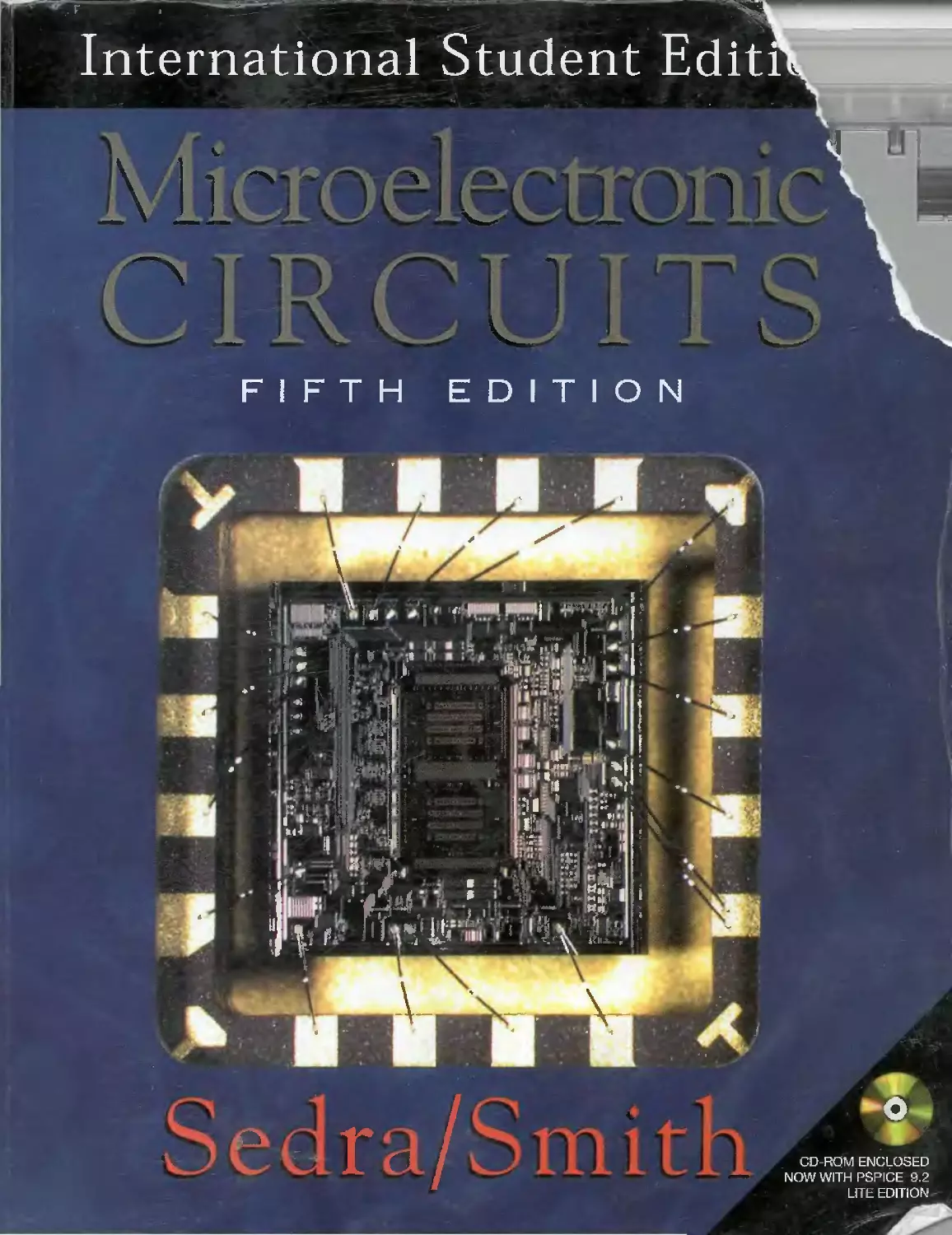


Автор: Sedra A.S. Smith K.C.
Теги: electrical engineering electronics microelectronics circuit design microcircuits
ISBN: 0-19-514252-7
Год: 2003




Текст
                    International Student Editi.
Ah
FIFTH EDITION
1
\
! >
ltli
i f
. I' k<■ f »t —■■"■, • t ,■. i
r
•1
m'i •, * r
-V
V
r./
CD-ROM ENCLOSED
NOW WITH PSPICE 9.2
LITE EDITION

FIFTH EDITION
MICROELECTRONIC
CIRCUITS
Adel S. Sedra
University of Waterloo
Kenneth C. Smith
University of Toronto
New York Oxford
OXFORD UNIVERSITY PRESS
2004

Oxford University Press
Oxford New York
Auckland Bangkok Buenos Aires Cape Town Chennai
Dares Salaam Delhi Hong Kong Istanbul Karachi Kolkata
Kuala Lumpur Madrid Melbourne Mexico City Mumb'ai Nairobi
Sao Paulo Shanghai Taipei Tokyo Toroiti
Copyright © 1982, 1987, 1991, 1998, 2:)04 by Oxford University Press, Inc.
Reprinted 2004
Published by Oxford University Press, Ire
198 Madison Avenue, New York, New York 10016
www.oup.com
Oxford is a registered trademark of Oxford University Press
All rights reserved. No part of this publication may be reproduced,
stored in a retrieval system, or transmitted, in any form or by any means,
electronic, mechanical, photocopying, recording, or otherwise,
without the prior permission of Oxford Univejsily Press.
Library of Congress Cataloging-in-Pul>Iication Data
Sedra, Adel S.
Microelectronic circuits / Adel S. Sedra. Kenneth C. Smith.--5th ed.
p. cm. — (Oxford series in electrical and computer engineering)
Includes index.
ISBN 0-19-514252-7
1. Electronic circuits. 2. Integrated circuits. I. Smith, Kenneth C.
II. Title. III. Series.
TK7867 ,S39 2003
621.381--dc22
2003066178
tem, integrated on a 3mm by 3inm die, and using a standard 3-m 2-V BiCMOS process suited for the harsh
automotive environment. This first single-chip gyroscopic sensor, in which micro-mechanical and electronic
components are intimately entwined on the same chip, provides unprecedented performance through the use of a
collection of precision-directed techniques, i lcluding emphasis on differential operation (both mechanically and
electronically) bolstered by trimmable thm film resistive components. This tiny, robust, low-power, angular-rate-
to-voltage transducer, having a sensitivity of 12,.5mV/7s and resolution of 0.0157s (or 50°/hour) has a myriad of
applications—including automotive skid control and rollover detection, dead reckoning for GPS backup and robot
motion control, and camera-field stabilization. The complete gyroscope package, weighing 1/3 gram with a
volume of 1/6 cubic centimeter, uses 30mW ircra a 5-V supply. Source: John A. Geen, Steven J. Sherman, John F.
Chang, Stephen R. Lewis; Single-chip surface micromachined integrated Gyroscope with 50°/h Allan deviation,
IEEE Journal of Solid-State Circuits, vol. 37, pp. 1860-1866, December 2002. (Originally presented at ISSCC
2002.) Photographed by John Chang, provided by John Geen, both of Analog Devices, Micromachine Products
Division, Cambridge, MA, USA.
Special edition for sale in India, Bangladesh, Nepal, Bhutan, Sri Lanka and Myanmar only
and not for export therefrom.
Printed in India by Gopsons Papers Ltd , Noida

CONDENSED TABLE OF CONTENTS
PREFACE xxiii
PART 1 DEVICES AND BASIC CIRCUITS 2
1 Introduction to Electronics 5
2 Operational Amplifiers 63
3 Diodes 139
4 MOS Field-Effect Transistors (MOSFETs) 235
5 Bipolar Junction Transistors (BJTs) 377
ANALOG AND DIGITAL INTEGRATED
PART II CIRCUITS 542
6 Single-Stage Integrated-Circuit Amplifiers 545
7 Differential and Multistage Amplifiers 687
8 Feedback 791
9 Operational-Amplifier and Data-Converter Circuits 871
10 Digital CMOS Logic Circuits 949
PART III SELECTED TOPICS 1010
11 Memory and Advanced Digital Circuits 1013
12 Filters and Tuned Amplifiers 1083
13 Signal Generators and Waveform-Shaping Circuits 1165
14 Output Stages and Power Amplifiers 1229
APPENDIXES
A VLSI Fabrication Technology A-1
B Two-Port Network Parameters B-1
C Some Useful Network Theorems C-7
D Single-Time-Constant Circuits D-1
E s-Domain Analysis: Poles, Zeros, and Bode Plots E-1
F Bibliography F-1
G Standard Resistance Values and Unit Prefixes G-1
H Answers to Selected Problems H-1
INDEX IN-1
v

DETAILED TABLE OF CONTENTS
PREFACE xxiii
PART I DEVICES AND BASIC CIRCUITS 2
1 Introduction to Electronics 5
Introduction 5
1.1 Signals 6
1.2 Frequency Spectrum of Signals 7
1.3 Analog and Digital Signals 10
1.4 Amplifiers 13
1.4.1 Signal Amplification 13
1.4.2 Amplifier Circuit Symbol 14
1.4.3 Voltage Gain 14
1.4.4 Power Gain and Current Gain 15
1.4.5 Expressing Gain in Decibels 15
1.4.6 The Amplifier Power Supplies 16
1.4.7 Amplifier Saturation 18
1.4.8 Nonlinear Transfer Characteristics and Biasing 19
1.4.9 Symbol Convention 22
1.5 Circuit Models for Amplifiers 23
1.5.1 Voltage Amplifiers 23
1.5.2 Cascaded Amplifiers 25
1.5.3 Other Amplifier Types 27
1.5.4 Relationships Between the Four Amplifier Models 27
1.6 Frequency Response of Amplifiers 31
1.6.1 Measuring the Amplifier Frequency Response 31
1.6.2 Amplifier Bandwidth 32
1.6.3 Evaluating the Frequency Response of Amplifiers 33
1.6.4 !>ingle-Time-Constant Networks 33
1.6 5 Classification of Amplifiers Based on Frequency Response
1.7 Digital Logic Inverters 40
1.7.1 ] ^l notion of the Inverter 40
1.7.2 The Voltage Transfer Characteristic (VTC) 4/
1.7 3 Noise Margins 42
1.7.4 The Ideal VTC . 43
1.7 5 Inverter Implementation 43
1.7.6 Power Dissipation 45
1.7.7 Propagation Delay 4<{
1.8 Circuit Simulation Using SPICE 4P
Summary 50
Problems 51
38
vi

DETAILED TABLE OF CONTENTS
2 Operational Amplifiers 63
Introduction 63
2.1 The Ideal Op Amp 64
2.1.1 The Op-Amp Terminals 64
2.1.2 Function and Characteristics of the Ideal
Op Amp 65
2.1.3 Differential and Common-Mode Signals 67
2.2 The Inverting Configuration 68
2.2.1 The Closed-Loop Gain 69
2.2.2 Effect of Finite Open-Loop Gain 71
2.2.3 Input and Output Resistances 72
2.2.4 An Important Application—The Weighted Summer 75
2.3 The Noninverting Configuration 77
2.3.1 The Closed-Loop Gain 77
2.3.2 Characteristics of the Noninverting
Configuration 78
2.3.3 Effect of Finite Open-Loop Gain 78
23 A The Voltage Follower 79
2.4 Difference Amplifiers 81
2.4.1 A Single Op-Amp Difference Amplifier 82
2.4.2 A Superior Circuit—The Instrumentation Amplifier 85
2.5 Effect of Finite Open-Loop Gain and Bandwidth on
Circuit Performance 89
2.5.1 Frequency Dependence of the Open-Loop Gain 89
2.5.2 Frequency Response of Closed-Loop Amplifiers 91
2.6 Large-Signal Operation of Op Amps 94
2.6.1 Output Voltage Saturation 94
2.6.2 Output Current Limits 94
2.6.3 Slew Rate 95
2.6.4 Full-Power Bandwidth 97
2.7 DC Imperfections 98
2.7.1 Offset Voltage 98
2.7.2 Input Bias and Offset Currents 102
2.8 Integrators and Differentiators 105
2.8.1 The Inverting Configuration with General Impedances 105
2.8.2 The Inverting Integrator 107
2.8.3 The Op-Amp Differentiator 112
2.9 The SPICE Op-Amp Model and Simulation Examples 114
2.9.1 Linear Macromodel 115
2.9.2 Nonlinear Macromodel 119
Summary 122
Problems 123
3 Diodes 139
Introduction 139
3.1 The Ideal Diode 140
3.1.1 Current-Voltage Characteristic 140
3.1.2 A Simple Application: The Rectifier 141
3.1.3 Another Application: Diode Logic Gates 144

DETAILED TABLE OF CONTENTS
3.2 Terminal Characteristics of Junction Diodes 147
3.2.1 The Forward-Bias Region 148
3.2.2 The Rsverse-Bias Region 152
3.2.3 The Breakdown Region 152
3.3 Modeling the D'ode Forward Characteristic 153
3.3.1 The Exponential Model 153
3.3.2 Graphical Analysis Using the Exponential Model 154
3.3.3 Iterative Analysis Using the Exponential Model 154
3.3.4 The Need for Rapid Analysis 155
3.3.5 The Reeewise-Linear Model 155
3.3.6 The Constant-Voltage-Drop Model 157
3.3.7 The lceal-Diode Model 158
3.3.8 The Small-Signal Model 159
3.3.9 Use ot' the Diode Forward Drop in
Voltage Regulation 163
3.3.10 Sumrraiy 165
3.4 Operation in the Reverse Breakdown Region—
Zener Diodes 167
3.4.1 Specifying and Modeling the Zener Diode 167
3.4.2 Use of the Zener as a Shunt Regulator 168
3.4.3 Temper iture Effects 170
3.4.4 A Final Remark 171
3.5 Rectifier Circuis 171
3.5.1 The Half-Wave Rectifier 172
3.5.2 The Fall-Wave Rectifier 174
3.5.3 The Bridge Rectifier 176
3.5.4 The Rectifier with a Filter Capacitor—
The Peak Rectifier 177
3.5.5 Precision Half-Wave Rectifier—
The Saper Diode 183
3.6 Limiting and CI arnping Circuits 184
3.6.1 Limits* Circuits 184
3.6.2 The Cliimped Capacitor or DC Restorer 187
3.6.3 The Voltage Doubler 189
3.7 Physical Operation of Diodes 190
3.7.1 Basic Semiconductor Concepts 190
3.7.2 The pn Junction Under Open-Circuit Conditions 196
3.7.3 The pn Junction Under Reverse-Bias Conditions 199
3.7.4 The pn Junction in the Breakdown Region 203
3.7.5 The pn Junction Under Forward-Bias
Conditions 204
3.7.6 Sumrraiy 208
3.8 Special Diode Types 209
3.8.1 The Sehottky-Barrier Diode (SBD) 210
3.8.2 Varaciors 210
3.8.3 Photoiliodes 210
3.8.4 Light-Emitting Diodes (LEDs) 211
3.9 The SPICE Diode Model and Simulation Examples 212
3.9.1 The Dude Model 212
3.9.2 The Z:rier Diode Model 213
Summary 217
Problems 218

DETAILED TABLE OF CONTENTS ■■ IX
4 MOS Field-Effect Transistors (MOSFETs) 235
Introduction 235
4.1 Device Structure and Physical Operation 236
4.1.1 Device Structure 236
4.1.2 Operation with No Gate Voltage 238
4.1.3 Creating a Channel for Current Flow 238
AAA Applying a Small vDS 239
4.1.5 Operation as vDS Is Increased 241
4.1.6 Derivation of the iD-vDS Relationship 243
4.1.7 The/>-Channel MOSFET 247
4.1.8 Complementary MOS or CMOS 247
4.1.9 Operating the MOS Transistor in the Subthreshold Region 248
4.2 Current-Voltage Characteristics 248
4.2.1 Circuit Symbol 248
4.2.2 The iD-vDS Characteristics 249
4.2.3 Finite Output Resistance in Saturation 253
4.2.4 Characteristics of the ^-Channel MOSFET 256
4.2.5 The Role of the Substrate—The Body Effect 258
4.2.6 Temperature Effects 259
4.2.7 Breakdown and Input Protection 259
4.2.8 Summary 260
A3 MOSFET Circuits at DC 262
A.A The MOSFET as an Amplifier and as a Switch 270
A.A. 1 Large-Signal Operation—The Transfer Characteristic 271
4.4.2 Graphical Derivation of the Transfer Characteristic 273
4.4.3 Operation as a Switch 274
A.A.A Operation as a Linear Amplifier 274
4.4.5 Analytical Expressions for the Transfer Characteristic 275
A.A.6 A Final Remark on Biasing 280
4.5 Biasing in MOS Amplifier Circuits 280
4.5.1 Biasing by Fixing Vcs 280
4.5.2 Biasing by Fixing Vc and Connecting a Resistance
in the Source 281
4.5.3 Biasing Using a Drain-to-Gate Feedback Resistor 284
4.5.4 Biasing Using a Constant-Current Source 285
4.5.5 A Final Remark 287
4.6 Small-Signal Operation and Models 287
4.6.1 The DC Bias Point 287
4.6.2 The Signal Current in the Drain Terminal 288
4.6.3 The Voltage Gain 289
A.6.A Separating the DC Analysis and the Signal Analysis 290
4.6.5 Small-Signal Equivalent-Circuit Models 290
4.6.6 The Transconductance gm 292
4.6.7 The T Equivalent-Circuit Model 295
4.6.8 Modeling the Body Effect 296
4.6.9 Summary 297
4.7 Single-Stage MOS Amplifiers 299
4.7.1 The Basic Structure 299
A.J.2 Characterizing Amplifiers 301
4.7.3 The Common-Source (CS) Amplifier 306
AH.A The Common-Source Amplifier with a Source Resistance 309

X ^B DETAILED TABLE OF CONTENTS
4.7.5 The Common-Gate (CG) Amplifier 311
4.7.6 The C o mmon-Drain or Source-Follower Amplifier 315
4.1.1 Summary and Comparisons 318
4.8 The MOSFET Internal Capacitances and High-Frequency Model , 320
4.8.1 The Gate Capacitive Effect 321
4.8.2 The Junction Capacitances 322
4.8.3 The High-Frequency MOSFET Model 322
4.8.4 The MOSFET Unity-Gain Frequency (fT) 324
4.8.5 Summary 325
4.9 Frequency Response of the CS Amplifier 326
4.9.1 The Ihree Frequency Bands 326
4.9.2 The High-Frequency Response 328
4.9.3 The Low-Frequency Response 332
4.9.4 A Final Remark 336
4.10 The CMOS Digital Logic Inverter 336
4.10.1 Circuit Operation 337
4.10.2 The Voltage Transfer Characteristic 339
4.10.3 Dynamic Operation 342
4.10.4 Curreni Flow and Power Dissipation 345
4.10.5 Sumnary 346
4.11 The Depletion-Type MOSFET 346
4.12 The SPICE M OSFET Model and Simulation Example 351
4.12.1 MOSFET Models 351
4.12.2 MOS FET Model Parameters 352
Summary 359
Problems 360
5 Bipolar Junction Transistors (BJTs) 377
Introduction 377
5.1 Device Structure and Physical Operation 378
5.1.1 Simplified Structure and Modes of Operation 378
5.1.2 Operation of the npn Transistor in the Active Mode 380
5.1.3 Structure of Actual Transistors 386
5.1.4 The Hbers-Moll (EM) Model 387
5.1.5 Operation in the Saturation Mode 390
5.1.6 The pnv Transistor 391
5.2 Current-Volte.ge Characteristics 392
5.2.1 Circuit Symbols and Conventions 392
5.2.2 Grapiical Representation of Transistor Characteristics 397
5.2.3 Dependence of ic on the Collector Voltage—The Early
Effect 399
5.2.4 The Common-Emitter Characteristics 401
5.2.5 Transistor Breakdown 406
5.2.6 Summary 407
5.3 The BJT as an Amplifier and as a Switch 407
5.3.1 Large-Signal Operation—The Transfer Characteristic 410
5.3.2 Amplifier Gain 412
5.3.3 Graphical Analysis 415
5.3.4 Operation as a Switch 419
5.4 BJT Circuits at DC 421

DETAILED TABLE OF CONTENTS ■■ xi
5.5 Biasing in BJT Amplifier Circuits 436
5.5.1 The Classical Discrete-Circuit Bias
Arrangement 436
5.5.2 A Two-Power-Supply Version of the Classical Bias
Arrangement 440
5.5.3 Biasing Using a Collector-to-Base Feedback Resistor 441
5.5.4 Biasing Using a Constant-Current Source 442
5.6 Small-Signal Operation and Models 443
5.6.1 The Collector Current and the
Transconductance 443
5.6.2 The Base Current and the Input Resistance
at the Base 445
5.6.3 The Emitter Current and the Input Resistance
at the Emitter 446
5.6.4 Voltage Gain 447
5.6.5 Separating the Signal and the DC Quantities 448
5.6.6 The Hybrid-Jr Model 448
5.6.7 The T Model 449
5.6.8 Application of the Small-Signal Equivalent Circuits 450
5.6.9 Performing Small-Signal Analysis Directly on the
Circuit Diagram 457
5.6.10 Augmenting the Small-Signal Models to Account
for the Early Effect 457
5.6.11 Summary 458
5.7 Single-Stage BJT Amplifiers 460
5.7.1 The Basic Structure 460
5.7.2 Characterizing BJT Amplifiers 461
5.7.3 The Common-Emitter (CE) Amplifier 467
5.7.4 The Common-Emitter Amplifier with an Emitter
Resistance 470
5.7.5 The Common-Base (CB) Amplifier 475
5.7.6 The Common-Collector (CC) Amplifier or
Emitter Follower 478
5.7.7 Summary and Comparisons 483
5.8 The BJT Internal Capacitances and High-Frequency Model 485
5.8.1 The Base-Charging or Diffusion Capacitance Q, 486
5.8.2 The Base-Emitter Junction Capacitance CJt 486
5.8.3 The Collector-Base Junction Capacitance C^ 487
5.8.4 The High-Frequency Hybrid-JT Model 487
5.8.5 The Cutoff Frequency 487
5.8.6 Summary 490
5.9 Frequency Response of the Common-Emitter Amplifier 491
5.9.1 The Three Frequency Bands 491
5.9.2 The High-Frequency Response 492
5.9.3 The Low-Frequency Response 497
5.9.4 A Final Remark 503
5.10 The Basic BJT Digital Logic Inverter 503
5.10.1 The Voltage Transfer Characteristic 504
5.10.2 Saturated Versus Nonsaturated BJT Digital Circuits 505
5.11 The SPICE BJT Model and Simulation Examples 507
5.11.1 The SPICE Ebers-Moll Model of the BJT 507
5.11.2 The SPICE Gummel-Poon Model of the BJT 509
5.11.3 The SPICE BJT Model Parameters 510
5.11.4 The BJT Model Parameters BF and BR in SPICE 510

TABLE OF CONTENTS
Summary 516
Problems 517
_ ANALOG AND DIGITAL INTEGRATED
Wl PART II CIRCUITS 542
6 Single-Stage Integrated-Circuit Amplifiers 545
Introduction 545
6.1 IC Design Phi osophy 546
6.2 Comparison of ihe MOSFET and the BJT 547
6.2.1 Typical Values of MOSFET Parameters 547
6.2.2 Typicil Values of IC BJT Parameters 548
6.2.3 Comparison of Important Characteristics 550
6.2.4 Combining MOS and Bipolar Transistors—BiCMOS
Circuits 561
6.2.5 Validity of the Square-Law MOSFET Model 562
6.3 IC Biasing—C urrent Sources, Current Mirrors, and
Current-Steering Circuits 562
6.3.1 The Banc MOSFET Current Source 562
6.3.2 MOS Current-Steering Circuits 565
6.3.3 BJT Cirsuits 567
6.4 High-Frequency Response—General Considerations 571
6.4.1 The High-Frequency Gain Function 572
6.4.2 Determining the 3-dB Frequency fH 573
6.4.3 Using Open-Circuit Time Constants for the Approximate
Determination offH 575
6.4.4 Miller's Theorem 578
6.5 The Common-Source and Common-Emitter Amplifiers with Active
Loads 582
6.5.1 The C Dinmon-Source Circuit 582
6.5.2 CMOS Implementation of the Common-Source Amplifier 583
6.5.3 The Common-Emitter Circuit 588
6.6 High-Frequency Response of the CS and CE Amplifiers 588
6.6.1 Analysis Using Miller's Theorem 589
6.6.2 Analysis Using Open-Circuit Time Constants 590
6.6.3 Exact Analysis 591
6.6.4 Adapt ng the Formulas for the Case of the CE Amplifier 595
6.6.5 The Situation When flsig Is Low 597
6.7 The Common-Gate and Common-Base Amplifiers with
Active Loads 600
6.7.1 The Common-Gate Amplifier 600
6.7.2 The Common-Base Amplifier 610
6.7.3 A Concluding Remark 613
6.8 The Cascode Amplifier 613
6.8.1 The MOS Cascode 614
6.8.2 Frequensy Response of the MOS Cascode 618
6.8.3 The BJT Cascode 623
6.8.4 A Cascode Current Source 625
6.8.5 Double Cascoding 626
6.8.6 The Folded Cascode 627
6.8.7 BiCMOS Cascodes 628

DETAILED TABLE OF CONTENTS ■■ xiii
6.9 The CS and CE Amplifiers with Source (Emitter) Degeneration 629
6.9.1 The CS Amplifier with a Source Resistance 629
6.9.2 The CE Amplifier with an Emitter Resistance 633
6.10 The Source and Emitter Followers 635
6.10.1 The Source Follower 635
6.10.2 Frequency Response of the Source Follower 637
6.10.3 The Emitter Follower 639
6.11 Some Useful Transistor Pairings 641
6.11.1 The CD-CS, CC-CE and CD-CE Configurations 641
6.11.2 The Darlington Configuration 645
6.11.3 The CC-CB and CD-CG Configurations 646
6.12 Current-Mirror Circuits with Improved
Performance 649
6.12.1 Cascode MOS Mirrors 649
6.12.2 A Bipolar Mirror with Base-Current Compensation 650
6.12.3 The Wilson Current Mirror 651
6.12.4 The Wilson MOS Mirror 652
6.12.5 The Widlar Current Source 653
6.13 SPICE Simulation Examples 656
Summary 665
Problems 666
7 Differential and Multistage Amplifiers 687
Introduction 687
7.1 The MOS Differential Pair 688
7.1.1 Operation with a Common-Mode Input
Voltage 689
7.1.2 Operation with a Differential Input Voltage 691
7.1.3 Large-Signal Operation 693
7.2 Small-Signal Operation of the MOS Differential Pair 696
7.2.1 Differential Gain 697
7.2.2 Common-Mode Gain and Common-Mode Rejection Ratio
(CMRR) 700
7.3 The BJT Differential Pair 704
7.3.1 Basic Operation 704
7.3.2 Large-Signal Operation 707
7.3.3 Small-Signal Operation 709
1.4 Other Nonideal Characteristics of the Differential
Amplifier 720
7.4.1 Input Offset Voltage of the MOS Differential Pair 720
7.4.2 Input Offset Voltage of the Bipolar Differential Pair 723
7.4.3 Input Bias and Offset Currents of the Bipolar Pair 725
7.4.4 Input Common-Mode Range 726
7.4.5 A Concluding Remark 726
7.5 The Differential Amplifier with Active Load 727
7.5.1 Differential-to-Single-Ended Conversion 727
7.5.2 The Active-Loaded MOS Differential Pair 728
7.5.3 Differential Gain of the Active-Loaded
MOS Pair 729
7.5.4 Common-Mode Gain and CMRR 732
7.5.5 The Bipolar Differential Pair with Active Load 733

Xiv ^B DETAILED TABLE OF CONTENTS
7.6 Frequency Response of the Differential Amplifier 740
7.6.1 Anal) sis of the Resistively Loaded MOS Amplifier 740
7.6.2 Anal) sis of the Active-Loaded MOS Amplifier 744
1.1 Multistage Amplifiers 749
1.1.1 ATwoStageCMOSOpAmp 749
7.7.2 A Bipolar Op Amp 758
7.8 SPICE Simulaion Example 767
Summary 773
Problems 775
8 Feedback 791
Introduction 791
8.1 The General Feedback Structure 792
8.2 Some Properties of Negative Feedback 795
8.2.1 Gain Desensitivity 795
8.2.2 Bandwidth Extension 795
8.2.3 Noise Reduction 796
8.2.4 Reduc tion in Nonlinear Distortion 797
8.3 The Four Basic Feedback Topologies 798
8.3.1 Voltage Amplifiers 799
8.3.2 Current Amplifiers 799
8.3.3 Transconductance Amplifiers 801
8.3.4 Transre:sistance Amplifiers 802
8.4 The Series-Shunt Feedback Amplifier 802
8.4.1 The Icieil Situation 802
8.4.2 The Pra;tical Situation 804
8.4.3 Sumrraiy 807
8.5 The Series-Series Feedback Amplifier 811
8.5.1 The Iced Case 811
8.5.2 The Practical Case 812
8.5.3 Summaiy 814
8.6 The Shunt-Shunt and Shunt-Series Feedback
Amplifiers 818
8.6.1 The Shunt-Shunt Configuration 819
8.6.2 An Important Note 823
8.6.3 The Shunt-Series Configuration 823
8.6.4 Summaiy of Results 831
8.7 Determining trie Loop Gain 831
8.7.1 An Alternative Approach for Finding A/3 831
8.7.2 Equiviilence of Circuits from a Feedback-Loop
Point of View 833
8.8 The Stability Problem 834
8.8.1 Transfei Function of the Feedback Amplifier 834
8.8.2 The Nyquist Plot 835
8.9 Effect of Feedback on the Amplifier Poles &3<f
8.9.1 Stability and Pole Location 837
8.9.2 Poles of the Feedback Amplifier 838
8.9.3 Amplifier with Single-Pole Response 838
8.9.4 Amplifier with Two-Pole Response 839
8.9.5 Amplifiers with Three or More Poles 843

DETAILED TABLE OF CONTENTS ^B XV
8.10 Stability Study Using Bode Plots 845
8.10.1 Gain and Phase Margins 845
8.10.2 Effect of Phase Margin on Closed-Loop Response 846
8.10.3 An Alternative Approach for Investigating Stability 847
8.11 Frequency Compensation 849
8.11.1 Theory 850
8.11.2 Implementation 851
8.11.3 Miller Compensation and Pole Splitting 852
8.12 SPICE Simulation Example 855
Summary 859
Problems 860
9 Operational-Amplifier and Data-Converter Circuits 871
Introduction 871
9.1 The Two-Stage CMOS Op Amp 872
9.1.1 The Circuit 872
9.1.2 Input Common-Mode Range and Output Swing 873
9.1.3 Voltage Gain 874
9.1.4 Frequency Response 876
9.1.5 Slew Rate 879
9.2 The Folded-Cascode CMOS Op Amp 883
9.2.1 The Circuit 883
9.2.2 Input Common-Mode Range and the Output
Voltage Swing 885
9.2.3 Voltage Gain 886
9.2.4 Frequency Response 888
9.2.5 Slew Rate 888
9.2.6 Increasing the Input Common-Mode Range:
Rail-to-Rail Input Operation 890
9.2.7 Increasing the Output Voltage Range:
The Wide-Swing Current Mirror 892
9.3 The 741 Op-Amp Circuit 893
9.3.1 Bias Circuit 893
9.3.2 Short-Circuit Protection Circuitry 895
9.3.3 The Input Stage 895
9.3.4 The Second Stage 895
9.3.5 The Output Stage 896
9.3.6 Device Parameters 898
9.4 DC Analysis of the 741 899
9.4.1 Reference Bias Current 899
9.4.2 Input-Stage Bias 899
9.4.3 Input Bias and Offset Currents 902
9.4.4 Input Offset Voltage 902
9.4.5 Input Common-Mode Range 902
9.4.6 Second-Stage Bias 902
9.4.7 Output-Stage Bias 903
9.4.8 Summary 904
9.5 Small-Signal Analysis of the 741 905
9.5.1 The Input Stage 905
9.5.2 The Second Stage 910
9.5.3 The Output Stage 912

DETAILED TABLE OF CONTENTS
9.6 Gain, Frequency Response, and Slew Rate of the 741 917
9.6.1 Sinall-.SignalGain 917
9.6.2 Frequency Response 917
9.6.3 A Simplified Model 918
9.6.4 Slew Rate 919
9.6.5 Relationship Between/, and SR 920
9.7 Data Converters—An Introduction 922
9.7.1 Digit i\ Processing of Signals 922
9.7.2 Sampling of Analog Signals 922
9.7.3 Signd Quantization 924
9.1.4 The /\JD and D/A Converters as Functional Blocks 924
9.8 D/A Converter Circuits 925
9.8.1 Bask Circuit Using Binary-Weighted Resistors 925
9.8.2 R-2R Ladders 926
9.8.3 A Pnicical Circuit Implementation 927
9.8.4 Cumnt Switches 928
9.9 A/D Converter Circuits 929
9.9.1 The Fejdback-Type Converter 929
9.9.2 The Dual-Slope A/D Converter 930
9.9.3 The Parallel or Flash Converter 932
9.9.4 The Charge-Redistribution Converter 932
9.10 SPICE Simulation Example 934
Summary 940
Problems 941
10 Digital CMOS Logic Circuits 949
Introduction 949
10.1 Digital Circuit Design: An Overview 950
10.1.1 Digital IC Technologies and Logic-Circuit Families 950
10.1.2 Logic-Circuit Characterization 952
10.1.3 Styles lor Digital System Design 954
10.1.4 Design Abstraction and Computer Aids 955
10.2 Design and Peiformance Analysis of the CMOS Inverter 955
10.2.1 Circuit Structure 955
10.2.2 Static Operation 956
10.2.3 Dynamic Operation 958
10.2.4 Dynamic Power Dissipation 961
10.3 CMOS Logic-Gate Circuits 963
10.3.1 Basic Structure 963
10.3.2 The Two-Input NOR Gate 966
10.3.3 The Two-Input NAND Gate 966
10.3.4 A Complex Gate 967
10.3.5 Obtaini ng the PUN from the PDN and Vice Versa 968
10.3.6 The Exclusive-OR Function 969
10.3.7 Summary of the Synthesis Method 970
10.3.8 Transistor Sizing 970
10.3.9 Effects of Fan-In and Fan-Out on Propagation Delay 973
10.4 Pseudo-NMOS Logic Circuits 974
10.4.1 The I's.;udo-NMOS Inverter 974
10.4.2 Static Characteristics 975

DETAILED TABLE OF CONTENTS ^B XVii
10.4.3 Derivation of the VTC 976
10.4.4 Dynamic Operation 979
10.4.5 Design 979
10.4.6 Gate Circuits 980
10.4.7 Concluding Remarks 980
10.5 Pass-Transistor Logic Circuits 982
10.5.1 An Essential Design Requirement 983
10.5.2 Operation with NMOS Transistors as Switches 984
10.5.3 The Use of CMOS Transmission Gates as Switches 988
10.5.4 Pass-Transistor Logic Circuit Examples 990
10.5.5 A Final Remark 991
10.6 Dynamic Logic Circuits 991
10.6.1 Basic Principle 992
10.6.2 Nonideal Effects 993
10.6.3 Domino CMOS Logic 996
10.6.4 Concluding Remarks 998
10.7 Spice Simulation Example 998
Summary 1002
Problems 1002
PART III SELECTED TOPICS 1010
11 Memory and Advanced Digital Circuits 1013
Introduction 1013
11.1 Latches and Flip-flops 1014
11.1.1 The Latch 1014
11.1.2 The SR Flip-Flop WIS
11.1.3 CMOS Implementation of SR Flip-Flops 1016
11.1.4 A Simpler CMOS Implementation of the Clocked SR Flip-
Flop 1019
11.1.5 D Flip-Flop Circuits 1019
11.2 Multivibrator Circuits 1021
11.2.1 A CMOS Monostable Circuit 1022
11.2.2 An Astable Circuit 1026
11.2.3 The Ring Oscillator 1027
11.3 Semiconductor Memories: Types and Architectures 1028
11.3.1 Memory-Chip Organization 1028
11.3.2 Memory-Chip Timing 1030
11.4 Random-Access Memory (RAM) Cells 1031
11.4.1 Static Memory Cell 1031
11.4.2 Dynamic Memory Cell 1036
11.5 Sense Amplifiers and Address Decoders 1038
11.5.1 The Sense Amplifier 1038
11.5.2 The Row-Address Decoder 1043
11.5.3 The Column-Address Decoder 1045
11.6 Read-Only Memory (ROM) 1046
11.6.1 AMOS ROM 1047
11.6.2 Mask-Programmable ROMs 1049
11.6.3 Programmable ROMs (PROMs and EPROMs) 1049

CONTENTS
11.7 Emitter-Coupled Logic (ECL) 1052
11.7.1 The B.sic Principle 1052
11.7.2 ECLFirailies 1053
11.7.3 The B; sic Gate Circuit 1053
11.7.4 Voltiig i Transfer Characteristics 7057
11.7.5 Fan-Out 1061
11.7.6 Speed ji Operation and Signal Transmission 1062
11.7.7 Power Dissipation 1063
11.7.8 Thermal Effects 1063
11.7.9 The Wired-OR Capability 1066
11.7.10 Some Final Remarks 1066
11.8 BiCMOS Dipial Circuits 1067
11.8.1 The BiCMOS Inverter 7067
11.8.2 Dynan ic Operation 7069
11.8.3 BiCMOS Logic Gates 7070
11.9 SPICE Simulation Example 1071
Summary 1076
Problems 7<?77
Filters and Tuned Amplifiers 1083
Introduction ,'083
12.1 Filter Transmission, Types, and Specification 1084
12.1.1 Filter Transmission 1084
12.1.2 Filter Types 70S5
12.1.3 Filter Specification 70S5
12.2 The Filter Transfer Function 1088
12.3 Butterworth and Chebyshev Filters 1091
12.3.1 The Eliitterworth Filter 7097
12.3.2 The Chebyshev Filter 7095
12.4 First-Order ar cl Second-Order Filter Functions 1098
12.4.1 First-Order Filters 709S
12.4.2 Second-Order Filter Functions 7707
12.5 The Second-Order LCR Resonator 1106
12.5.1 The Resonator Natural Modes 7706
12.5.2 Realisation of Transmission Zeros 7707
12.5.3 Realisation of the Low-Pass Function 770S
12.5.4 Realisation of the High-Pass Function 770S
12.5.5 Realisation of the Bandpass Function 7 70S
12.5.6 Realisation of the Notch Functions 7770
12.5.7 Realisation of the All-Pass Function 7777
12.6 Second-Order Active Filters Based on Inductor
Replacement 7772
12.6.1 The Antoniou Inductance-Simulation Circuit 7772
12.6.2 The Op Amp-RC Resonator 7774
12.6.3 Realisation of the Various Filter Types 7774
12.6.4 The All-Pass Circuit 777S
12.7 Second-Order Active Filters Based on the Two-Integrator-Loop
Topology 1.120
12.7.1 Derivation of the Two-Integrator-Loop Biquad 7720
12.7.2 Circu t Implementation 7722

DETAILED TABLE OF CONTENTS WB xix
12.7.3 An Alternative Two-Integrator-Loop Biquad
Circuit 1123
12.7.4 Final Remarks 1125
12.8 Single-Amplifier Biquadratic Active Filters 1125
12.8.1 Synthesis of the Feedback Loop 1126
12.8.2 Injecting the Input Signal 1128
12.8.3 Generation of Equivalent Feedback Loops 1130
12.9 Sensitivity 1133
12.10 Switched-Capacitor Filters 1136
12.10.1 The Basic Principle 1136
12.10.2 Practical Circuits 1137
12.10.3 A Final Remark 1141
12.11 Tuned Amplifiers 1141
12.11.1 The Basic Principle 1141
12.11.2 Inductor Losses 1143
12.11.3 Use of Transformers 11*/
12.11.4 Amplifiers with Multiple Tuned Circuits 1145
12.11.5 The Cascode and the CC-CB Cascade 1146
12.11.6 Synchronous Tuning 1147
12.11.7 Stagger-Tuning 1148
12.12 SPICE Simulation Examples 1152
Summary 1158
Problems 1159
13 Signal Generators And Waveform-Shaping Circuits 1165
Introduction 1165
13.1 Basic Principles of Sinusoidal Oscillators 1166
13.1.1 The Oscillator Feedback Loop 1166
13.1.2 The Oscillation Criterion 1167
13.1.3 Nonlinear Amplitude Control 1168
13.1.4 A Popular Limiter Circuit for Amplitude Control 1169
13.2 Op Amp-RC Oscillator Circuits 1171
13.2.1 The Wien-Bridge Oscillator 1171
13.2.2 The Phase-Shift Oscillator 1174
13.2.3 The Quadrature Oscillator 1176
13.2.4 The Active-Filter-Tuned Oscillator 1177
13.2.5 A Final Remark 1179
13.3 LC and Crystal Oscillators 1179
13.3.1 LC-Tuned Oscillators 1179
13.3.2 Crystal Oscillators 1182
13.4 Bistable Multivibrators 1185
13.4.1 The Feedback Loop 11«5
13.4.2 Transfer Characteristics of the Bistable Circuit 1186
13.4.3 Triggering the Bistable Circuit 1187
13.4.4 The Bistable Circuit as a Memory Element 1188
13.4.5 A Bistable Circuit with Noninverting Transfer
Characteristics 1188
13.4.6 Application of the Bistable Circuit as a
Comparator 1189
13.4.7 Making the Output Levels More Precise 1191

XX ■■ DETAILED TABLE OF CONTENTS
13.5 Generation cf Square and Triangular Waveforms Using Astable
Multivibrators 1192
13.5.1 Operation of the Astable Multivibrator 1192
13.5.2 Generation of Triangular Waveforms 1194
13.6 Generation cf a Standardized Pulse—The Monostable
Multivibrator 1196
13.7 Integrated-Circuit Timers 1198
13.7.1 The 555 Circuit 1198
13.7.2 Implementing a Monostable Multivibrator Using the 555 IC 1199
13.7.3 An Astable Multivibrator Using the 555 IC 1201
13.8 Nonlinear Waveform-Shaping Circuits 1203
13.8.1 The Breakpoint Method 1203
13.8.2 The Nonlinear-Amplification Method 1205
13.9 Precision Rectifier Circuits 1206
13.9.1 Precision Half-Wave Rectifier-The "Superdiode" 1207
13.9.2 An Alternative Circuit 1208
13.9.3 An Application: Measuring AC Voltages 1209
13.9.4 Precis ion Full-Wave Rectifier 1210
13.9.5 A P-eoision Bridge Rectifier for Instrumentation Applications 1212
13.9.6 Precision Peak Rectifiers 1213
13.9.7 A Buffered Precision Peak Detector 1213
13.9.8 A Precision Clamping Circuit 1214
13.10 SPICE Simulation Examples 1214
Summary 1219
Problems 1220
14 Output Stages and Power Amplifiers 1229
Introduction 1229
14.1 Classification of Output Stages 1230
14.2 Class A Output Stage 1231
14.2.1 Transfer Characteristic 1231
14.2.2 Signal Waveforms 1233
14.2.3 Power Dissipation 1233
14.2.4 Power-Conversion Efficiency 1235
14.3 Class B Output Stage 1235
14.3.1 Circuit Operation 1236
14.3.2 Transfer Characteristic 1236
14.3.3 Power-Conversion Efficiency 1236
14.3.4 Power Dissipation 1238
14.3.5 Reducing Crossover Distortion 7240
14.3.6 Single-Supply Operation 1240
14.4 Class AB Output Stage 1241
14.4.1 Circuit Operation 7242
14.4.2 Output Resistance 7243
14.5 Biasing the Class AB Circuit 1244
14.5.1 Biasing Using Diodes 1244
14.5.2 Biasing Using the VBE Multiplier 7246
14.6 Power BJTs 1249
14.6.1 Junction Temperature 7249
14.6.2 Thermal Resistance 1249

DETAILED TABLE OF CONTENTS ^J Xxi
14.6.3 Power Dissipation Versus Temperature 1250
14.6.4 Transistor Case and Heat Sink 1251
14.6.5 The BJT Safe Operating Area 1254
14.6.6 Parameter Values of Power Transistors 1255
14.7 Variations on the Class AB Configuration 1256
14.7.1 Use of Input Emitter Followers 1256
14.7.2 Use of Compound Devices 1257
14.7.3 Short-Circuit Protection 1259
14.7.4 Thermal Shutdown 1260
14.8 IC Power Amplifiers 1261
14.8.1 A Fixed-Gain IC Power Amplifier 1261
14.8.2 Power Op Amps 1265
14.8.3 The Bridge Amplifier 1265
14.9 MOS Power Transistors 1266
14.9.1 Structure of the Power MOSFET 1266
14.9.2 Characteristics of Power MOSFETs 1268
14.9.3 Temperature Effects 1269
14.9.4 Comparison with BJTs 1269
14.9.5 A Class AB Output Stage Utilizing MOSFETs 1270
14.10 SPICE Simulation Example 1271
Summary 1276
Problems 1277
APPENDIXES
A VLSI Fabrication Technology A-1
B Two-Port Network Parameters B-1
C Some Useful Network Theorems C-f
D Single-Time-Constant Circuits D-1
E s-Domain Analysis: Poles, Zeros, and Bode Plots E-1
F Bibliography F-1
G Standard Resistance Values and Unit Prefixes G-1
H Answers to Selected Problems H-1
INDEX IN-1

PREFACE
Microelectronic Circuits, fifth edition, is intended as a text for the core courses in electronic
circuits taught to majors in electrical and computer engineering. It should also prove useful
to engineers and other professionals wishing to update their knowledge through self-study.
As was the case with the first four editions, the objective of this book is to develop in the
reader the ability to analyze and design electronic circuits, both analog and digital, discrete
and integrated. While the application of integrated circuits is covered, emphasis is placed on
transistor circuit design. This is done because of our belief that even if the majority of those
studying the book were not to pursue a career in IC design, knowledge of what is inside the
IC package would enable intelligent and innovative application of such chips. Furthermore,
with the advances in VLSI technology and design methodology, IC design itself is becoming
accessible to an increasing number of engineers.
PREREQUISITES
The prerequisite for studying the material in this book is a first course in circuit analysis. As
a review, some linear circuits material is included here in appendixes: specifically, two-port
network parameters in Appendix B; some useful network theorems in Appendix C; single-
time-constant circuits in Appendix D; and ^-domain analysis in Appendix E. No prior
knowledge of physical electronics is assumed. All required device physics is included, and
Appendix A provides a brief description of IC fabrication.
NEW TO THIS EDITION
Although the philosophy and pedagogical approach of the first four editions have been
retained, several changes have been made to both organization and coverage.
1. The book has been reorganized into three parts. Part I: Devices and Basic Circuits,
composed of the first five chapters, provides a coherent and reasonably
comprehensive single-semester introductory course in electronics. Similarly, Part II: Analog and
Digital Integrated Circuits (Chapters 6-10) presents a body of material suitable for a
second one-semester course. Finally, four carefully chosen subjects are included in
Part III: Selected Topics. These can be used as enhancements or substitutions for
some of the material in earlier chapters, as resources for projects or thesis work, and/or
as part of a third course.
2. Each chapter is organized so that the essential "must-cover" topics are placed first,
and the more specialized material appears last. This allows considerable flexibility in
teaching and learning from the book.
3. Chapter 4, MOSFETs, and Chapter 5, BJTs, have been completely rewritten, updated,
and made completely independent of each other. The MOSFET chapter is placed first to
reflect the fact that it is currently the most significant electronics device by a wide
margin. However, if desired, the BJT can be covered first. Also, the identical structure of
the two chapters makes teaching and learning about the second device easier and faster.

XXiv ■■ PREFACE
4. To make the first course comprehensive, both Chapters 4 and 5 include material on
amplifier and digital-logic circuits. In addition, the frequency response of the basic
common-source (common- emitter) amplifier is included. This is important for
students who might not take a second course in electronics.
5. A new chapter on integrated-ctrcuit (IC) amplifiers (Chapter 6) is added. It begins
with a comprehensive comparison between the MOSFET and the BJT. Typical
parameter values of devices produced by modern submicron fabrication processes are
given and utilized in the examples, exercises, and end-of-chapter problems. The study
of each amplifier configuration includes its frequency response. This should make the
study of amplifier frequency response more interesting and somewhat easier.
6. The material on differential and multistage amplifiers in Chapter 7 has been rewritten
to present the MOSFET differential pair first. Here also, the examples, exercises, and
problems have been expandec and updated to utilize parameter values representative
of modern submicron technologies.
7. Throughout the book, greater emphasis is placed on MOSFET circuits.
8. To make room for new rndteial, some of the topics that have become less current,
such as JFETs and TTL, or have remained highly specialized, such as GaAs devices
and circuits, have been remov;<l from the book. However, they are made available on
the CD accompanying the book and on the book's website.
9. As a study aid and for easy reference, many summary tables have been added.
10. The review exercises, example:-, and end-of-chapter problems have been updated and
their numbers and variety increased.
11. The SPICE sections have been rewritten and the SPICE examples now utilize
schematic entry. To enable further experimentation, the files for all SPICE examples are
provided on the CD and website.
THE CD-ROM AND THE WEBSITE
A CD-ROM accompanies this book. Ii contains much useful supplementary information and
material intended to enrich the student's learning experience. These include (1) A Student's
Edition of OrCAD PSpice 9.2. (2) Ths input files for all the SPICE examples in this book.
(3) A link to the book's website accessing PowerPoint slides of every figure in this book that
students can print and carry to class i:o facilitate taking notes. (4) Bonus text material of
specialized topics not covered in the current edition of the textbook. These include: JFETs, GaAs
devices and circuits, and TTL circuits.
A website for the book has been set up (www.sedrasmith.org). Its content will change
frequently to reflect new developments in the field. It features SPICE models and files for
all PSpice examples, links to industrial and academic websites of interest, and a message
center to communicate with the authors. There is also a link to the Higher Education Group
of Oxford University Press so professors can receive complete text support.
EMPHASIS ON DESIGN
It has been our philosophy that circuit design is best taught by pointing out the various
tradeoffs available in selecting a circuit configuration and in selecting component values for a
given configuration. The emphasis on design has been increased in this edition by including
more design examples, exercise problems, and end-of-chapter problems. Those exercises and

end-of-chapter problems that are considered "design-oriented" are indicated with a D. Also,
the most valuable design aid, SPICE, is utilized throughout the book, as already outlined.
EXERCISES, END-OF-CHAPTER PROBLEMS,
AND ADDITIONAL SOLVED PROBLEMS
Over 450 exercises are integrated throughout the text. The answer to each exercise is given
below the exercise so students can check their understanding of the material as they read.
Solving these exercises should enable the reader to gauge his or her grasp of the preceding
material. In addition, more than 1370 end-of-chapter problems, about a third of which are
new to this edition, are provided. The problems are keyed to the individual sections and their
degree of difficulty is indicated by a rating system: difficult problems are marked with as
asterisk (*); more difficult problems with two asterisks (**); and very difficult (and/or time
consuming) problems with three asterisks (***). We must admit, however, that this
classification is by no means exact. Our rating no doubt had depended to some degree on our
thinking (and mood!) at the time a particular problem was created. Answers to about half the
problems are given in Appendix H. Complete solutions for all exercises and problems are
included in the Instructor's Manual, which is available from the publisher for those
instructors who adopt the book.
As in the previous four editions, many examples are included. The examples, and indeed
most of the problems and exercises, are based on real circuits and anticipate the applications
encountered in designing real-life circuits. This edition continues the use of numbered
solution steps in the figures for many examples, as an attempt to recreate the dynamics of the
classroom.
A recurring request from many of the students who used earlier editions of the book has
been for solved problems. To satisfy this need, a book of additional problems with solutions
is available with this edition (see the list of available ancillaries later in this preface).
AN OUTLINE FOR THE READER
The book starts with an introduction to the basic concepts of electronics in Chapter 1.
Signals, their frequency spectra, and their analog and digital forms are presented. Amplifiers
are introduced as circuit building blocks and their various types and models are studied. The
basic element of digital electronics, the digital logic inverter, is defined in terms of its voltage-
transfer characteristic, and its various implementations using voltage and current switches
are discussed. This chapter also establishes some of the terminology and conventions used
throughout the text.
The next four chapters are devoted to the study of electronic devices and basic circuits
and constitute the bulk of Part I of the text. Chapter 2 deals with operational amplifiers, their
terminal characteristics, simple applications, and limitations. We have chosen to discuss the
op amp as a circuit building block at this early stage simply because it is easy to deal with
and because the student can experiment with op-amp circuits that perform nontrivial tasks
with relative ease and with a sense of accomplishment. We have found this approach to be
highly motivating to the student. We should point out, however, that part or all of this
chapter can be skipped and studied at a later stage (for instance in conjunction with Chapter 7,
Chapter 8, and/or Chapter 9) with no loss of continuity.
Chapter 3 is devoted to the study of the most fundamental electronic device, the pn
junction diode. The diode terminal characteristics and its hierarchy of models and basic circuit

PREFACE
applications are presented. To undeisiand the physical operation of the diode, and indeed of
the MOSFET and the BJT, a concise but substantial introduction to semiconductors and the
pn junction is provided. This materia is placed near the end of the chapter (Section 3.7) so that
part or all of it can be skipped by those who have already had a course in physical electronics.
Chapters 4 and 5 deal with the two major electronic devices—the MOS field-effect
transistor (MOSFET) and the bipolar junction transistor (BJT), respectively. The two chapters
have an identical structure and are completely independent of each other and thus, can be
covered in either order. Each chapter begins with a study of the device structure and its
physical operation, leading to a description of its terminal characteristics. Then, to establish
in the reader a high degree of familiarity with the operation of the transistor as a circuit
element, a large number of examples are presented of dc circuits utilizing the device. The
large-signal operation of the basic common-source (common-emitter) circuit is then studied
and used to delineate the region over which the device can be used as a linear amplifier from
those regions where it can be used as a switch. This makes clear the need for biasing the
transistor and leads naturally to the study of biasing methods. At this point, the biasing
methods used are mostly for discrete circuits, leaving the study of IC biasing to Chapter 6.
Next, small-signal operation is studied and small-signal models are derived. This is
followed by a study of the basic configurations of discrete-circuit amplifiers. The internal
capacitive effects that limit the higi-frequency operation of the transistor are then studied,
and the high-frequency equivalent-circuit model is presented. This model is then used to
determine the high-frequency response of a common-source (common-emitter) amplifier.
As well, the low-frequency response resulting from the use of coupling and bypass
capacitors is also presented. The basic digital-logic inverter circuit is then studied. Both chapters
conclude with a study of the transistor models used in SPICE together with circuit-simulation
examples using PSpice. This description should indicate that Chapters 4 and 5 contain the
essential material for a first course in electronics.
Part II: Analog and Digital Integrated Circuits (Chapters 6-10) begins with a
comprehensive compilation and comparison of the properties of the MOSFET and the BJT. The
comparison is facilitated by the provision of typical parameter values of devices fabricated
with modern process technologies. Following a study of biasing methods employed in IC
amplifier design (Section 6.3), and some basic background material for the analysis of high-
frequency amplifier response (Section 6.4), the various configurations of single-stage IC
amplifiers are presented in a systematic manner. In each case, the MOS circuit is presented
first. Some transistor-pair configurations that are usually treated as a single stage, such as
the cascode and the Darlington circ aits, are also studied. Each section includes a study of the
high-frequency response of the particular amplifier configuration. Again, we believe that
this "in-situ" study of frequency response is superior to the traditional approach of
postponing all coverage of frequency response to a later chapter. As in other chapters, the more
specialized material, including advanc;d current-mirror and current-source concepts, is placed
in the second half of the chapter, allowing the reader to skip some of this material in a first
reading. This chapter should provide an excellent preparation for an in-depth study of analog
IC design.
The study of IC amplifiers is continued in Chapter 7 where the emphasis is on two major
topics; differential amplifiers and multistage amplifiers. Here again, the MOSFET
differential pair is treated first. Also, frequency response is discussed where needed, including in the
two examples of multistage amplifiers.
Chapter 8 deals with the important topic of feedback. Practical circuit applications of
negative feedback are presented. Wt also discuss the stability problem in feedback
amplifiers and treat frequency compensation in some detail.

Chapter 9 integrates the matenal on analog IC design presented in the preceding three
chapters and applies it to the analysis and design of two major analog IC functional blocks:
op amps and data converters. Both CMOS and bipolar op amps are studied. The data-
converter sections provide a bridge to the study of digital CMOS logic circuits in Chapter 10.
Chapter 10 builds on the introduction to CMOS logic circuits in Section 4.10 and
includes a carefully selected set of topics on static and dynamic CMOS logic circuits that
round out the study of analog and digital ICs in Part II.
The study of digital circuits is continued in the first of the four selected-topics chapters
that comprise Part III. Specifically, Chapter 11 deals with memory and related circuits, such
as latches, flip-flops, and monostable and stable multivibrators. As well, two somewhat
specialized but significant digital circuit technologies are studied: emitter-coupled logic (ECL)
and BiCMOS. The two digital chapters (10 and 11) together with the earlier material on
digital circuits should prepare the reader well for a subsequent course on digital IC design or
VLSI circuits.
The next two chapters of Part III, Chapters 12 and 13, are application or system oriented.
Chapter 12 is devoted to the study of analog-filter design and tuned amplifiers. Chapter 13
presents a study of sinusoidal oscillators, waveform generators, and other nonlinear
signal-processing circuits.
The last chapter of the book, Chapter 14, deals with various types of amplifier output
stages. Thermal design is studied, and examples of IC power amplifiers are presented.
The eight appendixes contain much useful background and supplementary material. We
wish to draw the reader's attention in particular to Appendix A, which provides a concise
introduction to the important topic of IC fabrication technology including IC layout.
COURSE ORGANIZATION
The book contains sufficient material for a sequence of two single-semester courses (each of
40 to 50 lecture hours). The organization of the book provides considerable flexibility in
course design. In the following, we suggest various possibilities for the two courses.
The First Course
The most obvious package for the first course consists of Chapters 1 through 5. However, if
time is limited, some or all of the following sections can be postponed to the second course:
1.6, 1.7, 2.6, 2.7, 2.8, 3.6, 3.8, 4.8,4.9,4.10, 4.11, 5.8, 5.9, and 5.10. It is also quite possible
to omit Chapter 2 altogether from this course. Also, it is possible to concentrate on the
MOSFET (Chapter 4) and cover the BJT (Chapter 5) only partially and/or more quickly.
Covering Chapter 5 thoroughly and Chapter 4 only partially and/or more quickly is also
possible—but not recommended! An entirely analog first course is also possible by omitting
Sections 1.7, 4.10, and 5.10. A digitally oriented first course is also possible. It would
consist of the following sections; 1.1, 1.2, 1.3, 1.4, 1.7, 1.8, 3.1, 3.2, 3.3, 3.4, 3.7, 4.1, 4.2, 4.3,
4.4, 4.10, 4.12, 5.1, 5.2, 5.3, 5.4, 5.10, 5.11, all of Chapter 10, and selected topics from
Chapter 11. Also, if time permits, some material from Chapter 2 on op amps would be
beneficial.
The Second Course
An excellent place to begin the second course is Chapter 6 where Section 6.2 can serve as a
review of the MOSFET and BJT characteristics. Ideally, the second course would cover

xxviii ■■ preface
Chapters 6 through 10 (assuming, of course, that the first course covered Chapters 1 through 5).
If time is short, either Chapter 10 can postponed to a subsequent course on digital circuits
and/or some sections of Chapters (>-9 can be omitted. One possibility would be to de-
emphasize bipolar circuits by omit :ing some or all of the bipolar sections in Chapters 6, 7,
and 9. Another would be to reduce somewhat the coverage of feedback (Chapter 8). Also,
data converters can be easily deleted from the second course. Still, for Chapter 9, perhaps
only CMOS op amps need to be covered and the 741 deleted or postponed. It is also possible
to replace some of the material from Chapters 6-10 by selected topics from Chapters 11-14.
For instance, in an entirely analog second course, Chapter 10 can be replaced by a selection
of topics from Chapters 13-14.
ANCILLARIES
A complete set of ancillary materials is available with this text to support your course.
For the Instructor
The Instructor's Manual with Transparency Masters provides complete worked solutions to
all the exercises in each chapter and all the end-of-chapter problems in the text. It also
contains 200 transparency masters that duplicate the figures in the text most often used
in class.
A set of Transparency Acetates of the 200 most important figures in the book.
A PowerPoint CD with slides of every figure in the book and each corresponding caption.
For the Student and the Instructor
The CD-ROM included with every new copy of the textbook contains SPICE input files, a
Student Edition of OrCAD PSpice 9.2 Lite Edition, a link to the website featuring
PowerPoint slides of the book's illustrations, and bonus topics.
Laboratory Explorations for Microelectronic Circuits, 5th edition, by Kenneth C. Smith (KC),
contains laboratory experiments and instructions for the major topics studied in the text.
KC's Problems and Solutions for Microelectronic Circuits, 5th edition, by Kenneth C.
Smith (KC), contains hundreds of additional study problems with complete solutions,
for students who want more practice.
SPICE, 2nd edition, by Gordon Roberts of McGill University and Adel Sedra, provides a
detailed treatment of SPICE and its application in the analysis and design of circuits of
the type studied in this book.
ACKNOWLEDGMENTS
Many of the changes in this fifth edition were made in response to feedback received from
some of the instructors who adoptee the fourth edition. We are grateful to all those who took
the time to write to us. In addition, the, following reviewers provided detailed commentary on
the fourth edition and suggested many of the changes that we have incorporated in this
revision. To all of them, we extend our sincere thanks: Maurice Aburdene, Bucknell University;
Patrick L. Chapman, University of Illinois at Urbana-Champaign; Artice Davis, San Jose
State University; Paul M. Furth, New Mexico State University; Roobik Gharabagi, St. Louis

PREFACE ■■ XXiX
University; Reza Hashemian, Northern Illinois University; Ward J. Helms, University
of Washington; Hsiung Hsu, Ohio State University; Marian Kazimierczuk, Wright State
University; Roger King, University of Toledo; Robert J. Krueger, University of Wisconsin-
Milwaukee; Un-Ku Moon, Oregon State University; John A. Ringo, Washington State
University; Zvi S. Roth, Florida Atlantic University; Mulukutla Sarma, Northeastern University;
John Scalzo, Louisiana State University; Ali Sheikholeslami, University of Toronto; Pierre
Schmidt, Florida International University; Charles Sullivan, Dartmouth College; Gregory M.
Wierzba, Michigan State University; and Alex Zaslavsky, Brown University.
We are also grateful to the following colleagues and friends who have provided many
helpful suggestions: Anthony Chan-Carusone, University of Toronto; Roman Genov,
University of Toronto; David Johns, University of Toronto; Ken Martin, University of Toronto;
Wai-Tung Ng, University of Toronto; Khoman Phang, University of Toronto; Gordon Roberts,
McGill University; and Ali Sheikholeslami, University of Toronto.
We remain grateful to the reviewers of the four previous editions: Michael Bartz,
University of Memphis; Roy H. Comely, New Jersey Institute of Technology; Dale L. Critchlow,
University of Vermont; Steven de Haas, California State University-Sacramento; Eby G.
Friedman, University of Rochester; Rhett T. George, Jr., Duke University; Richard Horn-
sey, York University; Robert Irvine, California State University, Pamona; John Khoury,
Columbia University; Steve Jantzi, Broadcom; Jacob B. Khurgin, The Johns Hopkins
University; Joy Laskar, Georgia Institute of Technology; David Luke, University of New
Brunswick; Bahram Nabet, Drexel University; Dipankar Nagchoudhuri, Indian Institute
of Technology, Delhi, India; David Nairn, Analog Devices; Joseph H. Nevin, University of
Cincinnati; Rabin Raut, Concordia University; Richard Schreier, Analog Devices; Dipankar
Sengupta, Royal Melbourne Institute of Technology; Michael L. Simpson, University of
Tennessee; Karl A. Spuhl, Washington University; Daniel van der Weide, University of
Delaware.
A number of individuals made significant contributions to this edition. Anas Hamoui of
the University of Toronto played a key role in shaping both the organization and content of
this edition. In addition, he wrote the SPICE sections. Olivier Trescases of the University of
Toronto preformed the SPICE simulations. Richard Schreier of Analog Devices helped us
locate the excellent cover photo. Wai-Tung Ng of the University of Toronto completely
rewrote Appendix A. Gordon Roberts of McGill University gave us permission to use some
of the examples from the book SPICE by Roberts and Sedra. Mandana Amiri, Karen
Kozma, Shahriar Mirabbasi, Roberto Rosales, Jim Somers of Sonora Designworks, and
John Wilson all helped significantly in preparing the student and instructor support
materials. Jennifer Rodrigues typed all the revisions with skill and good humor and assisted with
many of the logistics. Laura Fujino assisted in the preparation of the index, and perhaps
more importantly, in keeping one of us (KCS) focused. To all of these friends and
colleagues we say thank you.
The authors would like to thank Cadence Design Systems, Inc., for allowing Oxford
University Press to distribute OrCad Family Release 9.2 Lite Edition software with this
book. We are grateful to John Geen from Analog Devices for providing the cover photo and
to Tom McElwee (from TWM Research).
A large number of people at Oxford University Press contributed to the development of
this edition and its various ancillaries. We would like to specifically mention Barbara
Wasserman, Liza Murphy, Mary Beth Jarrad, Mac Hawkins, Barbara Brown, Cathleen
Bennett, Celeste Alexander, Chris Critelli, Eve Siegel, Mary Hopkins, Jeanne Ambrosio,
Trent Haywood, Jennifer Slomack, Ned Escobar, Jim Brooks, Debbie Agee, Sylvia Parrish,
Lee Rozakis, Kathleen Kelly, Sheridan Orr, and Kerry Cahill.

PREFACE
We wish to extend special thanks to our Publisher at Oxford University Press, Chris
Rogers. We are also grateful to Scott Burns, Marketing and Sales Director, for his many
excellent and creative ideas and for his friendship. We received a great deal of support and
advice from our previous editor and friend, Peter Gordon. After Peter's departure, the
leadership of the project has been most ably assumed by Danielle Christensen, our current
editor. Elyse Dubin, Director of Editorial, Design, and Production, played a pivotal role in
ensuring that the book would receive the greatest possible attention in the various stages of
design and production.
If there is a single person at Oxford University Press that is responsible for this book
coming out on time and looking so good, it is our Managing Editor, Karen Shapiro: She has
been simply great, and we are deeply indebted to her. We also wish to thank our families for
their support and understanding.
Adel S. Sedra
Kenneth C. Smith

MICROELECTRONIC
CIRCUITS
M

PART I
DEVICES AND
BASIC CIRCUITS
CHAPTER 1
Introduction to Electronics 5
CHAPTER 2
Operational Amplifiers 63
CHAPTER 3
Diodes 139
CHAPTER 4
MOS Field-Effect Transistors (MOSFETs) 235
CHAPTER 5
Bipolar Junction Transistors (BJTs) 377

Introduction
Part I, Devices and Basic Circuits, includes the most fundamental and essential topics
for the study of electronic circuits. At the same time, it constitutes a complete
package for a first course on the subject.
Besides silicon diodes and transistors, the basic electronic devices, the op amp is
studied in Part I. Although not an electronic device in the most fundamental sense,
the op amp is commercially available as an integrated circuit (IC) package and has
well-defined terminal characteristics. Thus, despite the fact that the op amp's internal
circuit is complex, typically incorporating 20 or more transistors, its almost-ideal
terminal behavior makes it possible to treat the op amp as a circuit element and to use it
in the design of powerful circuits, as we do in Chapter 2, without any knowledge of
its internal construction. We should mention, however, that the study of op amps can
be delayed to a later point, and Chapter 2 can be skipped with no loss of continuity.
The most basic silicon device is the diode. In addition to learning about diodes
and a sample of their applications, Chapter 3 also introduces the general topic of
device modeling for the purpose of circuit analysis and design. Also, Section 3.7
provides a substantial introduction to the physical operation of semiconductor devices.
This subject is then continued in Section 4.1 for the MOSFET and in Section 5.1 for
the BJT Taken together, these three sections provide a physical background sufficient
for the study of electronic circuits at the level presented in this book.
The heart of this book, and of any electronics course, is the study of the two
transistor types in use today: the MOS field-effect transistor (MOSFET) in Chapter 4 and the
bipolar junction transistor (BJT) in Chapter 5. These two chapters have been written to be
completely independent of one another and thus can be studied in either desired order.
Furthermore, the two chapters have the same structure, making it easier and faster to
study the second device, as well as to draw comparisons between the two device types.
Chapter 1 provides both an introduction to the study of electronics and a number
of important concepts for the study of amplifiers (Sections 1.4—1.6) and of digital
circuits (Section 1.7).
Each of the five chapters concludes with a section on the use of SPICE
simulation in circuit analysis and design. Of particular importance here are the device
models employed by SPICE. Finally, note that as in most of the chapters of this book, the
must-know material is placed near the beginning of a chapter while the good-to-know
topics are placed in the latter part of the chapter. Some of this latter material can
therefore be skipped in a first course and covered at a later time, when needed.

CHAPTER
Introduction to Electronics
1.1
1.2
1.3
1.4
1.5
Introduction 5
Signals 6
Frequency Spectrum of
Signals 7
Analog and Digital Signals 10
Amplifiers 13
Circuit Models for Amplifiers 23
1.6
1.7
1.8
Frequency Response of
Amplifiers 31
Digital Logic Inverters 40
Circuit Simulation Using
SPICE 49
Summary 50
Ftoblems 51
Introduction
The subject of this book is modern electronics, a field that has come to be known as
microelectronics. Microelectronics refers to the integrated-circuit (IC) technology that at the
time of this writing is capable of producing circuits that contain millions of components in a
small piece of silicon (known as a silicon chip) whose area is on the order of 100 mm. One
such microelectronic circuit, for example, is a complete digital computer, which accordingly
is known as a microcomputer or, more generally, a microprocessor.
In this book we shall study electronic devices that can be used singly (in the design of
discrete circuits) or as components of an integrated-circuit (IC) chip. We shall study the
design and analysis of interconnections of these devices, which form discrete and integrated
circuits of varying complexity and perform a wide variety of functions. We shall also learn
about available IC chips and their application in the design of electronic systems.
The purpose of this first chapter is to introduce some basic concepts and terminology. In
particular, we shall learn about signals and about one of the most important signal-processing
functions electronic circuits are designed to perform, namely, signal amplification. We shall
then look at models for linear amplifiers. These models will be employed in subsequent
chapters in the design and analysis of actual amplifier circuits.
Whereas the amplifier is the basic element of analog circuits, the logic inverter plays this
role in digital circuits. We shall therefore take a preliminary look at the digital inverter, its
circuit function, and important characteristics.

INTRODUCTION TO ELECTRONIC!!
In addition to motivating the stud) of electronics, this chapter serves as a bridge between
the study of linear circuits and that of the subject of this book: the design and analysis of
electronic circuits.
CT
1.1 SIGNALS
Signals contain information about ;i variety of things and activities in our physical world.
Examples abound: Information aboui the weather is contained in signals that represent the
air temperature, pressure, wind speed, etc. The voice of a radio announcer reading the news
into a microphone provides an acoustic signal that contains information about world affairs.
To monitor the status of a nuclear 'eactor, instruments are used to measure a multitude of
relevant parameters, each instrument producing a signal.
To extract required information from a set of signals, the observer (be it a human or a
machine) invariably needs to process the signals in some predetermined manner. This signal
processing is usually most conveniently performed by electronic systems. For this to be
possible, however, the signal must first be converted into an electric signal, that is, a voltage
or a current. This process is accomplished by devices known as transducers. A variety of
transducers exist, each suitable for cne of the various forms of physical signals. For instance,
the sound waves generated by a human can be converted into electric signals using a
microphone, which is in effect a pressure transducer. It is not our purpose here to study
transducers; rather, we shall assume that the signals of interest already exist in the electrical domain
and represent them by one of the two equivalent forms shown in Fig. 1.1. In Fig. 1.1 (a) the
signal is represented by a voltage source vs{t) having a source resistance Rs. In the alternate
representation of Fig. 1.1(b) the signal is represented by a current source is(t) having a source
resistance Rs. Although the two representations are equivalent, that in Fig. 1.1(a) (known as
the Thevenin form) is preferred when Rs is low. The representation of Fig. 1.1(b) (known as
the Norton form) is preferred when Rs is high. The reader will come to appreciate this point
later in this chapter when we study the different types of amplifiers. For the time being, it is
important to be familiar with Thevenin's and Norton's theorems (for a brief review, see
Appendix D) and to note that for the two representations in Fig. 1.1 to be equivalent, their
parameters are related by
v,(t) = R,i,(t)
From the discussion above, it should be apparent that a signal is a time-varying quantity
that can be represented by a graph siich as that shown in Fig. 1.2. In fact, the information
content of the signal is represented by the changes in its magnitude as time progresses; that
is, the information is contained in the "wiggles" in the signal waveform. In general, such
waveforms are difficult to charact;iize mathematically. In other words, it is not easy to
describe succinctly an arbitrary-looicing waveform such as that of Fig. 1.2. Of course, such a
I A^\ o
r.(fl
<P
FIGURE 1.1 Two alternative
representations of a signal source: (a) the Thevenin
(a) (I")
form, and (b) the Norton form.

1.2 FREQUENCY SPECTRUM OF SIGNALS
Time, t
FIGURE 1.2 An arbitrary voltage signal vs(t).
description is of great importance for the purpose of designing appropriate signal-processing
circuits that perform desired functions on the given signal.
EXERCISES
1.1 hir the sijoial-MHHve representations shovun in f-'ig*. I.liai anfl l.li.bi. wh.it air the open-circuit
output voltage* that Mould be ohsened'.' If, fur Ctuh. tlw output ttrmm.iL-> are short-circuited n c . mied
tugethei). what i/iinem would flow' 1 or the representations to be cquisulem. what must the relationship
he between ■■.. i^. and R.''
Anj.hiri.n .' - nli loi (hi. .■ -Rii:i lor mi. i -- •■ C / ■ A'. Jnr ihi / i Hi. toi
equivalency, 7',(f) = fl,i,(0
1.2 A signal source has an open-circuit voltage of 10 mV and a short-circuit current of 10 /iA. What is the
source resistance?
Ans. 1 kii
1.2 FREQUENCY SPECTRUM OF SIGNALS
through the mathematical tools of
interested at this point in the details
An extremely useful characterizatio i of a signal, and for that matter of any arbitrary
function of time, is in terms of its frequency spectrum. Such a description of signals is obtained
Fourier series and Fourier transform.1 We are not
i of these transformations; suffice it to say that they
provide the means for representing a vcltage signal vs(t) or a current signal is(t) as the sum of
sine-wave signals of different frequencies and amplitudes. This makes the sine wave a very
important signal in the analysis, design, and testing of electronic circuits. Therefore, we
shall briefly review the properties of the sinusoid.
Figure 1.3 shows a sine-wave vdltage signal va(t),
WJ(0 = Vasin«f
(1.1)
thede
The reader who has not yet studied
material will be made until Chapter 6.
very helpful when studying early parts
topics should not be alarmed. No detailed application of this
Nevertheless, a general understanding of Section 1.2 should be
of this book.

INTRODUCTION TO ELECTRONICS
FIGURE 1.3 Sine-wave voltage signal of
amplitude Va and frequency / = 1 / T Hz.
The angular frequency 0) = 2^/rad/s.
where Va denotes the peak value or amplitude in volts and a> denotes the angular frequency
in radians per second; that is, a> = 2nf rad/s, where/ is the frequency in hertz, / = 1/7" Hz,
and T is the period in seconds.
The sine-wave signal is completely characterized by its peak value Va, its frequency <a,
and its phase with respect to an arbitrary reference time. In the case depicted in Fig. 1.3, the
time origin has been chosen so iha: ihe phase angle is 0. It should be mentioned that it is
common to express the amplitude of a sine-wave signal in terms of its root-mean-square
(rms) value, which is equal to the peak value divided by Jl. Thus the rms value of the
sinusoid va(t) of Fig. 1.3 is Va/j2. Fcr instance, when we speak of the wall power supply in
our homes as being 120 V, we mear that it has a sine waveform of 120 J2 volts peak value.
Returning now to the representation of signals as the sum of sinusoids, we note that the
Fourier series is utilized to accompli sli this task for the special case when the signal is a
periodic function of time. On the other hand, the Fourier transform is more general and can be
used to obtain the frequency spectrum of a signal whose waveform is an arbitrary function
of time.
The Fourier series allows us to express a given periodic function of time as the sum of an
infinite number of sinusoids whose frequencies are harmonically related. For instance, the
symmetrical square-wave signal in Fig. 1.4 can be expressed as
4V
v{t) = —(sin cu^f+ i sin 3a)0f+i sin5a)0f+ • • •)
(1.2)
where V is the amplitude of the square wave and <a0 = 2n/T (T is the period of the square
wave) is called the fundamental frequency. Note that because the amplitudes of the
harmonics progressively decrease, the infinite series can be truncated, with the truncated
series providing an approximation to the square waveform.
" u
-V
FIGURE 1.4 A symmetrical square-wave signal of amplitude V.

1.2 FREQUENCY SPECTRUM OF SIGNALS
4V
IT
4V
4V
IT
4V
co0
3<u0
i_i
5<u0
7<u0
(rad/s)
FIGURE 1.5 The frequency spectrum (also known as the line spectrum) of the periodic square wave
of Fig. 1.4.
The sinusoidal components in the series of Eq. (1.2) constitute the frequency spectrum
of the square-wave signal. Such a spectrum can be graphically represented as in Fig. 1.5,
where the horizontal axis represents the angular frequency co in radians per second.
The Fourier transform can be applied to a nonperiodic function of time, such as that
depicted in Fig. 1.2, and provides its frequency spectrum as a continuous function of
frequency, as indicated in Fig. 1.6. Unlike the case of periodic signals, where the spectrum
consists of discrete frequencies (at ft>0 aI,d its harmonics), the spectrum of a nonperiodic signal
contains in general all possible frequencies. Nevertheless, the essential parts of the spectra
of practical signals are usually confined to relatively short segments of the frequency (ft))
axis—an observation that is very useful in the processing of such signals. For instance, the
spectrum of audible sounds such as speech and music extends from about 20 Hz to about
20 kHz—a frequency range known as the audio band. Here we should note that although
some musical tones have frequencies above 20 kHz, the human ear is incapable of hearing
frequencies that are much above 20 kHz. As another example, analog video signals have
their spectra in the range of 0 MHz to 4.5 MHz.
We conclude this section by noting that a signal can be represented either by the manner
in which its waveform varies with time, as for the voltage signal va(t) shown in Fig. 1.2, or
in terms of its frequency spectrum, as in Fig. 1.6. The two alternative representations are
known as the time-domain representation and the frequency-domain representation,
respectively. The frequency-domain representation of va(t) will be denoted by the symbol Va(a>).
to (rad/s)
FIGURE 1.6 The frequency spectrum
of an arbitrary waveform such as that in
Fig. 1.2.

10 fnl CHAPTER! INTRODUCTION TO ELECTRONIC:;
EXERCISES
1.3 Find the frequencies/and 0) of a sine-wave signal v,ith a period of 1 ras.
Ans. / = 1000 Hz; a = 2n x 103 rad/s
1.4 What is the period T of sine waveforms characteri zed by frequencies of (a) /= 60 Hz? (b)/= 10~3 Hz?
(c)/= I MHz?
Ans. 16.7 ms; 1000 s; 1 ^s
1.5 The UHF (Ultra High Frequency) television broadcast band begins with channel 14 and extends from
470 MHz to 806 MHz. If 6 MHz is allocated for each channel, how many channels can this band
accommodate?
Ans. 56; channels 14 to 69
1.6 When the square-wave signal of Fig. 1.4, whose Fbuiier series is given in Eq. (1.2), is applied to a resistor,
the total power dissipated may be calculated directly using the relationship P = l/T j0 {i?/R)dt
or indirectly by summing the contribution of each of the harmonic components, that is, P = P,+
P3 + P5 + ■ ■ ■, which may be found directly from rms values. Verify that the two approaches are
equivalent. What fraction of the energy of a square wave is in its fundamental? In its first five harmonics? In
its first seven? First nine? In what number of haimonics is 90% of the energy? (Note that in counting
harmonics, the fundamental at co0 is the first, the one at 2co0 is the second, etc.)
Ans. 0.81; 0.93; 0.95; 0.96; 3
1.3 ANALOG AND DIGITAL SIGNALS
The voltage signal depicted in Fig. 1.2 is called an analog signal. The name derives from
the fact that such a signal is analogous to the physical signal that it represents. The
magnitude of an analog signal can take on any value; that is, the amplitude of an analog signal
exhibits a continuous variation over its range of activity. The vast majority of signals in the
world around us are analog. Electronic circuits that process such signals are known as
analog circuits. A variety of analog circuits will be studied in this book.
An alternative form of signal r;presentation is that of a sequence of numbers, each
number representing the signal magnitude at an instant of time. The resulting signal is called a
digital signal. To see how a signal can be represented in this form—that is, how signals can
be converted from analog to digital form—consider Fig. 1.7(a). Here the curve represents a
voltage signal, identical to thai in Fig. 1.2. At equal intervals along the time axis we have
marked the time instants t0, t{, f2, aid so on. At each of these time instants the magnitude of
the signal is measured, a process 'ciiown as sampling. Figure 1.7(b) shows a representation
of the signal of Fig. 1.7(a) in terms of its samples. The signal of Fig. 1.7(b) is defined only at
the sampling instants; it no longer is a continuous function of time, but rather, it is a discrete-
time signal. However, since the magnitude of each sample can take any value in a continuous
range, the signal in Fig. 1.7(b) is still an analog signal.
Now if we represent the magn tude of each of the signal samples in Fig. 1.7(b) by a
number having a finite number of digits, then the signal amplitude will no longer be continuous;
rather, it is said to be quantized, cliscretized, or digitized. The resulting digital signal then is
simply a sequence of numbers thai represent the magnitudes of the successive signal samples.
The choice of number system to represent the signal samples affects the type of digital
signal produced and has a profound effect on the complexity of the digital circuits required

1.3 ANALOG AND DIGITAL SIGNALS
11
(a)
«W4
i
1
•
•
.tllll
t0 t,t2t3---
•
ll„
Jl
till!, ,
1
M "
(b)
FIGURE 1.7 Sampling the continuous-time analog signal in (a) results in the discrete-time signal in (b).
to process the signals. It turns out that the binary number system results in the simplest
possible digital signals and circuits. In a binary system, each digit in the number takes on one of
only two possible values, denoted 0 and 1. Correspondingly, the digital signals in binary
systems need have only two voltage levels, which can be labeled low and high. As an example,
in some of the digital circuits studied in this book, the levels are 0 V and +5 V. Figure 1.8
shows the time variation of such a digital signal. Observe that the waveform is a pulse train
with 0 V representing a 0 signal, or logic 0, and +5 V representing logic 1.
v(t) I
+5
0
Logic values >- 10 110 10 0
FIGURE 1.8 Variation of a particular binary digital signal with time.
>-
Time, /

1 INTRODUCTION TO ELECTRONICS
If we use N binary digits (bits) to represent each sample of the analog signal, then the
digitized sample value can be expressed as
D
bn2° + bl2[+bi22 +
+ bN^2
(1.3)
where b0, b{,..., bN_{, denote the N bits and have values of 0 or 1. Here bit b0 is the least
significant bit (LSB), and bit bN_, is ihe most significant bit (MSB). Conventionally, this
binary number is written as £>^_,£> V-2 ■ ■ b0. We observe that such a representation quantizes
the analog sample into one of 2N levels. Obviously the greater the number of bits (i.e., the
larger the N), the closer the digital word D approximates the magnitude of the analog
sample. That is, increasing the number of bits reduces the quantization error and increases
the resolution of the analog-to-digita] conversion. This improvement is, however, usually
obtained at the expense of more complex and hence more costly circuit implementations. It
is not our purpose here to delve into this topic any deeper; we merely want the reader to
appreciate the nature of analog and di gital signals. Nevertheless, it is an opportune time to
introduce a very important circuit building block of modern electronic systems: the analog-
to-digital converter (A/D or ADC) shown in block form in Fig. 1.9. The ADC accepts at
its input the samples of an analog signal and provides for each input sample the
corresponding N-bit digital representation (according to Eq. 1.3) at its N output terminals. Thus
although the voltage at the input might be, say, 6.51 V, at each of the output terminals (say,
at the f'th terminal), the voltage will be either low (0 V) or high (5 V) if bt is supposed to be
0 or 1, respectively. We shall sludy the ADC and its dual circuit the digital-to-analog
converter (D/A or DAC) in Chaptei 9.
Once the signal is in digital form, it can be processed using digital circuits. Of course
digital circuits can deal also with signals that do not have an analog origin, such as the
signals that represent the various instruct ions of a digital computer.
Since digital circuits deal exclusively with binary signals, their design is simpler than
that of analog circuits. Furthermore, digital systems can be designed using a relatively few
different kinds of digital circuit blocks. However, a large number (e.g., hundreds of
thousands or even millions) of each of these blocks are usually needed. Thus the design of digital
circuits poses its own set of challenges to the designer but provides reliable and economic
implementations of a great variety al' signal processing functions, some of which are not
possible with analog circuits. At the present time, more and more of the signal processing
functions are being performed digitally. Examples around us abound: from the digital watch
and the calculator to digital audio systems and, more recently, digital television. Moreover,
some longstanding analog systems such as the telephone communication system are now
almost entirely digital. And we should not forget the most important of all digital systems,
the digital computer.
The basic building blocks of digital systems are logic circuits and memory circuits. We
shall study both in this book, beginning in Section 1.7 with the most fundamental digital
circuit, the digital logic inverter.
o—
Analog +
input _
o—
A/D
converter
■—ob0
Digital
output
FIGURE 1.9 Block-diagram representation of the analog-to-digital converter (ADC).

1.4 AMPLIFIERS W 13
One final remark: Although the digital processing of signals is at present all-pervasive,
there remain many signal processing functions that are best performed by analog circuits.
Indeed, many electronic systems include both analog and digital parts. It follows that a good
electronics engineer must be proficient in the design of both analog and digital circuits, or
mixed-signal or mixed-mode design as it is currently known. Such is the aim of this book.
1.7 Consider a 4-bit digital word D = hib1bibil (sec Eq. 1.3) used to represent an analog signal i'A thai varies
between 0 V and +15 V.
(a) Give D corresponding to vA = 0 V, 1 V, 2 V, and.15 V.
(b) What change in vA causes a change from 0 to 1 in: (i) b0, (ii) b,, (iii) b2, and (iv) b3l
(c) If vA = 5.2 V, what do you expect D to be? What is the resulting error in representation?
Ans. (a) 0000, 0001,0010, 1111; (b) +1 V,+2 V, 44 V,+8 V; (c) 0101,-4%
1.4 AMPLIFIERS
In this section, we shall introduce a fundamental signal-processing function that is employed
in some form in almost every electronic system, namely, signal amplification. We shall
study the amplifier as a circuit building block, that is consider its external characteristics and
leave the design of its internal circuit to later chapters.
1.4.1 Signal Amplification
From a conceptual point of view the simplest signal-processing task is that of signal
amplification. The need for amplification arises because transducers provide signals that are said
to be "weak," that is, in the microvolt (jiV) or millivolt (mV) range and possessing little
energy. Such signals are too small for reliable processing, and processing is much easier if
the signal magnitude is made larger. The functional block that accomplishes this task is the
signal amplifier.
It is appropriate at this point to discuss the need for linearity in amplifiers. When
amplifying a signal, care must be exercised so that the information contained in the signal is not
changed and no new information is introduced. Thus when feeding the signal shown in Fig. 1.2
to an amplifier, we want the output signal of the amplifier to be an exact replica of that at the
input, except of course for having larger magnitude. In other words, the "wiggles" in the
output waveform must be identical to those in the input waveform. Any change in waveform
is considered to be distortion and is obviously undesirable.
An amplifier that preserves the details of the signal waveform is characterized by the
relationship
va(t) = Av,(t) (1.4)
where v, and v0 are the input and output signals, respectively, and A is a constant
representing the magnitude of amplification, known as amplifier gain. Equation (1.4) is a linear
relationship; hence the amplifier it describes is a linear amplifier. It should be easy to see that if
the relationship between v0 and vt contains higher powers of vh then the waveform of v0 will
no longer be identical to that of v,. The amplifier is then said to exhibit nonlinear distortion.

14
CHAPTER 1 INTRODUCTION TO ELECTRONICS
The amplifiers discussed so far are primarily intended to operate on very small input
signals. Their purpose is to make the signal magnitude larger and therefore are thought of as
voltage amplifiers. The preamplifier in the home stereo system is an example of a voltage
amplifier. However, it usually docs more than just amplify the signal; specifically, it
performs some shaping of the frequency spectrum of the input signal. This topic, however, is
beyond our need at this moment.
At this time we wish to mention .mother type of amplifier, namely, the power amplifier.
Such an amplifier may provide only a modest amount of voltage gain but substantial current
gain. Thus while absorbing little power from the input signal source to which it is
connected, often a preamplifier, it delivers large amounts of power to its load. An example is
found in the power amplifier of the; home stereo system, whose purpose is to provide
sufficient power to drive the loudspeaker, which is the amplifier load. Here we should note that
the loudspeaker is the output transducer of the stereo system; it converts the electric output
signal of the system into an acoustic signal. A further appreciation of the need for linearity
can be acquired by reflecting on the power amplifier. A linear power amplifier causes both
soft and loud music passages to be reproduced without distortion.
1.4.2 Amplifier Circuit Symbol
The signal amplifier is obviously a two-port network. Its function is conveniently
represented by the circuit symbol of Fig. 1.10(a). This symbol clearly distinguishes the input and
output ports and indicates the direction of signal flow. Thus, in subsequent diagrams it will
not be necessary to label the two pDits "input" and "output." For generality we have shown
the amplifier to have two input terminals that are distinct from the two output terminals. A
more common situation is illustrated in Fig. 1.10(b), where a common terminal exists
between the input and output ports of the amplifier. This common terminal is used as a
reference point and is called the circuit ground.
1.4.3 Voltage Gain
A linear amplifier accepts an input signal v,(t) and provides at the output, across a load
resistance/ct (see Fig. 1.11(a)), an oatput signal v0(t) that is a magnified replica of v,(t).
The voltage gain of the amplifier is defined by
Voliagegain (A„) =
(1.5)
Fig. 1.11 (b) shows the transfer characteristic of a linear amplifier. If we apply to the input
of this amplifier a sinusoidal voltage of amplitude!/, we obtain at the output a sinusoid of
amplitude AVV.
Input
]>
Output
Input
{>
Output
(a)
(b)
FIGURE 1.10 (a) Circuit symbol for amplifier, (b) An amplifier with a common terminal (ground)
between the input and output ports.

1.4 AMPLIFIERS
15
'/ > f"s. lQ
JLT^ "^> ■*—1 4
I n
(a)
(b)
FIGURE 1.11 (a) A voltage amplifier fed with a signal vt(t) and connected to a load resistance RL.
(b) Transfer characteristic of a linear voltage amplifier with voltage gain A„.
1.4.4 Power Gain and Current Gain
An amplifier increases the signal power, an important feature that distinguishes an amplifier
from a transformer. In the case of a transformer, although the voltage delivered to the load
could be greater than the voltage feeding the input side (the primary), the power delivered to
the load (from the secondary side of the transformer) is less than or at most equal to the power
supplied by the signal source. On the other hand, an amplifier provides the load with power
greater than that obtained from the signal source. That is, amplifiers have power gain. The
power gain of the amplifier in Fig. 1.11(a) is defined as
Power gain (A ) =
_ load power (PL)
input power (P,)
"olo
v,i,
(1.6)
(1.7)
where i0 is the current that the amplifier delivers to the load (RL), i0 = VqIR^ and i, is the
current the amplifier draws from the signal source. The current gain of the amplifier is defined as
In
Current gain (A,) = -?
From Eqs. (1.5) to (1.8) we note that
(1.8)
(1.9)
1.4.5 Expressing Gain in Decibels
The amplifier gains defined above are ratios of similarly dimensioned quantities. Thus they
will be expressed either as dimensionless numbers or, for emphasis, as V/V for the voltage
gain, A/A for the current gain, and WAV for the power gain. Alternatively, for a number of
reasons, some of them historic, electronics engineers express amplifier gain with a
logarithmic measure. Specifically the voltage gain Av can be expressed as
Voltage gain in decibels = 20 log|A„| dB

1 INTRODUCTION TO ELECTRONICS
and the current gain At can be expressed as
Current gain in decibels = 20 \o%\Ai
dB
Since power is related to voltage (or
decibels as
current) squared, the power gain Ap can be expressed in
Power gain in decibels = 10 log A„
dB
The absolute values of the volu.ge and current gains are used because in some cases Av
or At may be negative numbers. A negative gain Av simply means that there is a 180° phase
difference between input and outpul signals; it does not imply that the amplifier is
attenuating the signal. On the other hand, an amplifier whose voltage gain is, say, -20 dB is in fact
attenuating the input signal by al'acor of 10 (i.e., A„ = 0.1 V/V).
1.4.6 The Amplifier Power Supplies
Since the power delivered to the load is greater than the power drawn from the signal source,
the question arises as to the source of this additional power. The answer is found by
observing that amplifiers need dc power supplies for their operation. These dc sources supply the
extra power delivered to the load as well as any power that might be dissipated in the
internal circuit of the amplifier (such power is converted to heat). In Fig. 1.11(a) we have not
explicitly shown these dc sources.
Figure 1.12(a) shows an amplifier that requires two dc sources: one positive of value V{
and one negative of value V2. The amplifier has two terminals, labeled V+ and V~, for
connection to the dc supplies. For the amplifier to operate, the terminal labeled V+ has to be
connected to the positive side of a dc source whose voltage is V( and whose negative side is
connected to the circuit ground. Also, the terminal labeled V~ has to be connected to the
negative side of a dc source whose voltage is V2 and whose positive side is connected to the
circuit ground. Now, if the current drawn from the po.sitive supply is denoted /j and that
from the negative supply is I2 (see Fig. 1.12(a)), then the dc power delivered to the amplifier is
*'* = vv, + v2i2
If the power dissipated in the amplifier circuit is denoted /'dissipated-tne power-balance
equation for the amplifier can be writ] en as
■Pi = Pl + P,
dissipated
J
(a) (b)
FIGURE 1.12 An amplifier that requires two dc supplies (shown as batteries) for operation.

1.4 AM
where P, is the power drawn from the signal source and PL is the power delivered to the
load. Since the power drawn from the signal source is usually small, the amplifier efficiency
is defined as
Pl
11
xlOO
(1.10)
The power efficiency is an important performance parameter for amplifiers that handle large
amounts of power. Such amplifiers, called power amplifiers, are used, for example, as
output amplifiers of stereo systems.
In order to simplify circuit diagrams, we shall adopt the convention illustrated in
Fig. 1.12(b). Here the V* terminal is shown connected to an arrowhead pointing upward and
the V" terminal to an arrowhead pointing downward. The corresponding voltage is
indicated next to each arrowhead. Note that in many cases we will not explicitly show the
connections of the amplifier to the dc power sources. Finally, we note that some amplifiers
require only one power supply.
EXAMPLE 1.1
Consider an amplifier operating from ±10-V power supplies. It is fed with a sinusoidal voltage
having 1 V peak and delivers a sinusoidal voltage output of 9 V peak to a l-k£2 load. The
amplifier draws a current of 9.5 mA from each of its two power supplies. The input current of the
amplifier is found to be sinusoidal with 0.1 mA peak. Find the voltage gain, the current gain, the
power gain, the power drawn from the dc supplies, the power dissipated in the amplifier, and
the amplifier efficiency.
Solution
or
K = \ = 9 V/V
Av = 20 log 9 =19.1 dB
9 V
7* = riS = 9mA
^ = 7° = 61 = 90A/A
At = 20 log 90 = 39.1 dB
Pl = Vo Io = -p-p = 405 mW
P = V: 11 = — — = 0.05 mW
A„ =
. 405
P, 0.05
= 810 WAV
A = 10 log 810 = 29.1 dB

CHAPTER 1 INTRODUCTION TO ELECTRONICS
/V = 10x9.5+ 10x9.5 = 190 mW
dc
"dissipated ~ °ilc + "l ~ °L
= 150 + 0.05-40.5 = 149.6 mW
n = — -xlOO = 21.3%
P .
From the above example we observe that the amplifier converts some of the dc power it
draws from the power supplies to signal power that it delivers to the load.
1.4.7 Amplifier Saturation
Practically speaking, the amplifier xansfer characteristic remains linear over only a limited
range of input and output voltages. For an amplifier operated from two power supplies the
output voltage cannot exceed a specified positive limit and cannot decrease below a specified
negative limit. The resulting transfer t haracteristic is shown in Fig. 1.13, with the positive and
Output peaks
clipped due to
saturation
Input
waveforms
FIGURE 1.13 An amplifier transfer c isracteristic that is linear except for output saturation.

1.4 AMPLIFIERS ^m 19
negative saturation levels denoted L+ and L_, respectively. Each of the two saturation levels
is usually within a volt or so of the voltage of the corresponding power supply.
Obviously, in order to avoid distorting the output signal waveform, the input signal
swing must be kept within the linear range of operation,
L L+
— < v, < —
Figure 1.13 shows two input waveforms and the corresponding output waveforms. We note
that the peaks of the larger waveform have been clipped off because of amplifier saturation.
1.4.8 Nonlinear Transfer Characteristics and Biasing
Except for the output saturation effect discussed above, the amplifier transfer characteristics
have been assumed to be perfectly linear. In practical amplifiers the transfer characteristic
may exhibit nonlinearities of various magnitudes, depending on how elaborate the amplifier
circuit is and on how much effort has been expended in the design to ensure linear operation.
Consider as an example the transfer characteristic depicted in Fig. 1.14. Such a
characteristic is typical of simple amplifiers that are operated from a single (positive) power supply.
The transfer characteristic is obviously nonlinear and, because of the single-supply
operation, is not centered around the origin. Fortunately, a simple technique exists for obtaining
linear amplification from an amplifier with such a nonlinear transfer characteristic.
The technique consists of first biasing the circuit to operate at a point near the middle of
the transfer characteristic. This is achieved by applying a dc voltage V,, as indicated in Fig. 1.14,
where the operating point is labeled Q and the corresponding dc voltage at the output is V0.
The point Q is known as the quiescent point, the dc bias point, or simply the operating
point. The time-varying signal to be amplified, v,{t), is then superimposed on the dc bias
voltage V, as indicated in Fig. 1.14. Now, as the total instantaneous input v,(t),
v,(t) = V,+ vt{t)
varies around V,, the instantaneous operating point moves up and down the transfer curve
around the dc operating point Q. In this way, one can determine the waveform of the total
instantaneous output voltage v0(t). It can be seen that by keeping the amplitude of i>,-(f)
sufficiently small, the instantaneous operating point can be confined to an almost linear
segment of the transfer curve centered about Q. This in turn results in the time-varying portion
of the output being proportional to v,{t); that is,
v0it) = V0+vo(t)
with
vB{t) = Avv{{t)
where Av is the slope of the almost linear segment of the transfer curve; that is,
dv0
av,
at Q
In this manner, linear amplification is achieved. Of course, there is a limitation: The input
signal must be kept sufficiently small. Increasing the amplitude of the input signal can cause

20
CHAPTER 1 INTRODUCTION TO ELECTRONICS
(a)
v0 -■ V0 f v0{t)
(b)
FIGURE 1.14 (a) An amplifier transfer characteristic that shows considerable nonlinearity. (b) To obtain
linear operation the amplifier is biased as shown, and the signal amplitude is kept small. Observe that this
amplifier is operated from a single power supply, VDD.
the operation to be no longer restrk ted to an almost linear segment of the transfer curve.
This in turn results in a distorted output signal waveform. Such nonlinear distortion is
undesirable: The output signal contrins additional spurious information that is not part of the
input. We shall use this biasing technique and the associated small-signal approximation
frequently in the design of transistor amplifiers.

1.4 AMPLIFIERS
21
EXAMPLE 1.2
A transistor amplifier has the transfer characteristic
v0 = 10 - 10 e '
(1.11)
which applies for v, > 0 V and v0 > 0.3 V. Find the limits L_ and L+ and the corresponding values
of v,. Also, find the value of the dc bias voltage V, that results in V0 - 5 V and the voltage gain at
the corresponding operating point.
Solution
The limit L_ is obviously 0.3 V. The corresponding value of tyis obtained by substituting v0 = 0.3 V
in Eq. (1.11); that is,
v, = 0.690 V
The limit L+ is determined by v, = 0 and is thus given by
L+= 10-10"" = 10 V
To bias the device so that VQ = 5 V we require a dc input V, whose value is obtained by
substituting v0 = 5 V in Eq. (1.11) to find:
V, = 0.673 V
The gain at the operating point is obtained by evaluating the derivative dv0/dv, at 17 = 0.673 V.
The result is
Av = -200 V/V
which indicates that this amplifier in an inverting one; that is, the output is 180° out of phase with
the input. A sketch of the amplifier transfer characteristic (not to scale) is shown in Fig. 1.15,
from which we observe the inverting nature of the amplifier.
\Q
0.673 0.690
FIGURE 1.15 A sketch of the transfer
characteristic of the amplifier of Example 1.2.
Note that this amplifier is inverting (i.e., with
Vi (V) a gain that is negative).

22
CHAPTER 1 INTRODUCTION TO ELECTRONICS
EXERCISES
Once an amplifier is properly biased and the input signal is kept sufficiently small, the
operation is assumed to be linear. We can then employ the techniques of linear circuit
analysis to analyze the signal operation of the amplifier circuit. This is the topic of Sections 1.5
and 1.6.
1.4.9 Symbol Convention
At this point, we draw the reader's attention to the terminology used above and which we
shall employ throughout the book. Total instantaneous quantities are denoted by a lowercase
symbol with an uppercase subscript, for example, iA(t), vc(t). Direct-current (dc) quantities
will be denoted by an uppercase syrabol with an uppercase subscript, for example, IA, Vc.
Power-supply (dc) voltages are denoted by an uppercase V with a double-letter uppercase
subscript, for example, VDD. A sirrilar notation is used for the dc current drawn from the
power supply, for example, IDD. Finally, incremental signal quantities will be denoted by a
lowercase symbol with a lowercase subscript, for example, ijt), vc(t). If the signal is a sine
wave, then its amplitude is denoted by an uppercase letter with a lowercase subscript, for
example, /„, Vc. This notation is illustrated in Fig. 1.16.
'en
FIGURE 1.16 Symbol convention employed throughout the book.
1.8 An amplifier has a voltage gain of 100 V/V and a current gain of 1000 A/A. Express the voltage and
current gains in decibels and find the power gain.
1.9 An amplifier operating from a single 15-V supply provides a 12-V peak-to-peak sine-wave signal to a
1-kQ load and draws negligible input current from the signal source. The dc current drawn from the 15-V
supply is 8 mA. What is the power dissipated in the amplifier, and what is the amplifier efficiency?
Ans. 102mW;15%

1.5 CIRCUIT MODELS FOR AMPLIFIERS ^B 23
1.10 The objective of this exercise is to investigate the limitation of the small-signal approximation.
Consider the amplifier of Example 1.2 with a positive input signal of 1 mV superimposed on the dc bias
voltage V,. Find the corresponding signal at the output for two situations: (a) Assume the amplifier is
linear around the operating point; that is, use the value of gain evaluated in Example 1.2. (b) Use the
transfer characteristic of the amplifier. Repeat for input signals of 5 mV and 10 mV.
Ans.-0.2V, -0.204 V; -1 V, -I.I07 V; -2V, -2.459 V
1.5 CIRCUIT MODELS FOR AMPLIFIERS
A good part of this book is concerned with the design of amplifier circuits using transistors
of various types. Such circuits will vary in complexity from those using a single transistor to
those with 20 or more devices. In order to be able to apply the resulting amplifier circuit as a
building block in a system, one must be able to characterize, or model, its terminal behavior.
In this section, we study simple but effective amplifier models. These models apply
irrespective of the complexity of the internal circuit of the amplifier. The values of the model
parameters can be found either by analyzing the amplifier circuit or by performing
measurements at the amplifier terminals.
1.5.1 Voltage Amplifiers
Figure 1.17(a) shows a circuit model for the voltage amplifier. The model consists of a voltage-
controlled voltage source having a gain factor Am, an input resistance /?, that accounts for
the fact that the amplifier draws an input current from the signal source, and an output
resistance R0 that accounts for the change in output voltage as the amplifier is called upon to
(b)
H
FIGURE 1.17 (a) Circuit model for the voltage amplifier, (b) The voltage amplifier with input signal
source and load.

1 INTRODUCTION TO ELECTRONICS
supply output current to a load. To be specific, we show in Fig. 1.17(b) the amplifier model
fed with a signal voltage source t^ having a resistance Rs and connected at the output to a
load resistance RL. The nonzero output resistance R„ causes only a fraction of A^Vj to appear
across the output. Using the voltage-divider rule we obtain
v° = a-v>r!tr0
Thus the voltage gain is given by
A*m*rA-*rhr. (L12)
It follows that in order not to lose gain in coupling the amplifier output to a load, the output
resistance R0 should be much smaller than the load resistance RL, In other words, for a given
RL one must design the amplifier so liiat its R„ is much smaller than RL. Furthermore, there
are applications in which RL is known to vary over a certain range. In order to keep the
output voltage v„ as constant as possible, the amplifier is designed with R0 much smaller
than the lowest value of RL. An ideal voltage amplifier is one with R0 = 0. Equation (1.12)
indicates also that for RL = °°, Av = Am. Thus Am is the voltage gain of the unloaded
amplifier, or the open-circuit voltage gain. It should also be clear that in specifying the voltage
gain of an amplifier, one must also specify the value of load resistance at which this gain is
measured or calculated. If a load resistance is not specified, it is normally assumed that the
given voltage gain is the open-circuit gain Am.
The finite input resistance Rt introduces another voltage-divider action at the input, with
the result that only a fraction of the source signal vs actually reaches the input terminals of the
amplifier; that is,
*' (1.13)
SR, + R
It follows that in order not to lose a significant portion of the input signal in coupling the
signal source to the amplifier input, Che amplifier must be designed to have an input
resistance Rj much greater than the resistance of the signal source, #, > Rs, Furthermore, there
are applications in which the source resistance is known to vary over a certain range. To
minimize the effect of this variation on the value of the signal that appears at the input of the
amplifier, the design ensures that R, is much greater than the largest value of Rs. An ideal
voltage amplifier is one with /?, = <*>. In this ideal case both the current gain and power gain
become infinite.
The overall voltage gain (vjvj cm be found by combining Eqs. (1.12) and (1.13),
Us = A R: R'
"Rj + RSRL + R„
There are situations in which otic is interested not in voltage gain but only in a
significant power gain. For instance, the source signal can have a respectable voltage but a source
resistance which is much greater than the load resistance. Connecting the source directly to
the load would result in significant signal attenuation. In such a case, one requires an
amplifier with a high input resistance (much greater than the source resistance) and a low output
resistance (much smaller than the load resistance) but with a modest voltage gain (or even
unity gain). Such an amplifier is referred to as a buffer amplifier. We shall encounter buffer
amplifiers often throughout this book.

1.5 CIRCUIT MODELS FOR AMPLIFIERS
25
1.11 A transducer characu-riied bv a voltage of I V rms and a resistance of I M£t is avjittljt to drive a
10-11 load. If connected directly, what voltage and power levels result at the load? If a natty-gain (i.e..
-1„. = 1) buffer amplifier with I-Mil input rcsutance and 10-12 output resistance is interpated between
wunv and load, whut do the output voltage and power levels become-.' For the new dmMgement find
the voltage gain from source to load, and the power gam (both expressed in decibels >
Ans. 10 ^V rms; 10"1' W; 0.25 V; 6.25 mW; -12 dB: 44 dB
1.12 The output voltage of a voltage amplifier has been found to decrease by 20% when a Ioad'fesisiance of
1 kf 1 is connected. What is the value of the amplifier output resistance?
Ans. 250 £1
1.13 An amplifier with a voltage gain of +40 dB, an input resistance of 10 kft, and an output resistance of
I kil is used to drive a 1 -k£2 load. What is the value of A ,„? Find the value of power gain in dB.
Ans. 100\7V;44dB
1.5.2 Cascaded Amplifiers
To meet given amplifier specifications the need often arises to design the amplifier as a
cascade of two or more stages. The stages are usually not identical; rather, each is designed to
serve a specific purpose. For instance, the first stage is usually required to have a large input
resistance, and the final stage in the cascade is usually designed to have a low output
resistance. To illustrate the analysis and design of cascaded amplifiers, we consider a practical
example.
EXAMPLE 1.3
Figure 1.18 depicts an amplifier composed of a cascade of three stages. The amplifier is fed by a
signal source with a source resistance of 100 kil and delivers its output into a load resistance of
100 £}. The first stage has a relatively high input resistance and a modest gain factor of 10. The
second stage has a higher gain factor but lower input resistance. Finally, the last, or output, stage
has unity gain but a low output resistance. We wish to evaluate the overall voltage gain, that is,
vLlvs, the current gain, and the power gain.
Source
lOOfl
FIGURE 1.18 Three-stage amplifier for Example 1.3.

1 INTRODUCTION TO ELECTRON CS
Solution
The fraction of source signal appearing at the input terminals of the amplifier is obtained using
the voltage-divider rule at the input, as follows:
"ii 1 Mfl 0_909 y/v
1 Mfi + 100 kii
The voltage gain of the first stage is obtained by considering the input resistance of the second
stage to be the load of the first stage; that is,
AvlS*2= 10—i0pJ^_ = 9.9V/V
"' v,., 100 kii + 1 kii
Similarly, the voltage gain of the second stage is obtained by considering the input resistance of
the third stage to be the load of the second stage,
Arl2 = ^ == 1130 i^-^ = 90.9 V/V
"2 vl2 10 kii + 1 kii
Finally, the voltage gain of the outpu: stage is as follows:
A,n = — = 1-—^°-^ = 0.909 V/V
1,3 i',, " ioo a +10 a
The total gain of the three stages in cascade can be now found from
A, s It ---- AvlAv2Av3 = 818 V/V
^l
or 58.3 dB.
To find the voltage gain from source to load, we multiply Av by the factor representing the
loss of gain at the input; that is,
Yl = y±Yil = a ^
= 818x0.909 = 743.6 VA7
or 57.4 dB.
The current gain is found as follows:
A, h £
L i>,/100 Q.
VL'
' i, vn/\ Mii
104xA„ = 8.18xl06 A/A
or 138.3 dB.
The power gain is found from
A>-P,
or 98.3 dB. Note that
= AvAt = 818 x 8.18 x 106 = 66.9 x 10⁸ WAV
A;,(d8) = i[A„(dB) + /l,.(dB)]

1.5 CIRCUIT MODELS FOR AMPLIFIERS ■■ 27
A few comments on the cascade amplifier in the above example are in order. To avoid
losing signal strength at the amplifier input where the signal is usually very small, the first
stage is designed to have a relatively large input resistance (1 Mft), which is much larger
than the source resistance. The trade-off appears to be a moderate voltage gain (10 V/V).
The second stage does not need to have such a high input resistance; rather, here we need to
realize the bulk of the required voltage gain. The third and final, or output, stage is not asked
to provide any voltage gain; rather, it functions as a buffer amplifier, providing a relatively
large input resistance and a low output resistance, much lower than RL. It is this stage that
enables connecting the amplifier to the 10-ft load. These points can be made more concrete
by solving the following exercises.
Ans. 81.8 V/V
1.15 For the cascade amplifier of Example 1.3, let vs be 1 mV. Find wM, va, vB, and vL.
Ans. 0.91 mV; 9 mV: 818 mV; 744 mV ' s
1.16 (a) Model the three-stage amplifier of Example 1.3 (without the source and load) using the voltage
amplifier model. What are the values of/?,, A„„ and RJ!
(b) If/?, varies in the range 10 LI to 1000 fl, find the corresponding range of the overall voltage gain. vjv,.
Ans. 1 Mil, 900 V/V. 10 LI: 409 V/V 10 810 V/V
1.5.3 Other Amplifier Types
In the design of an electronic system, the signal of interest—whether at the system input, at
an intermediate stage, or at the output—can be either a voltage or a current. For instance,
some transducers have very high output resistances and can be more appropriately modeled
as current sources. Similarly, there are applications in which the output current rather than
the voltage is of interest. Thus, although it is the most popular, the voltage amplifier
considered above is just one of four possible amplifier types. The other three are the current
amplifier, the transconductance amplifier, and the transresistance amplifier. Table 1.1 shows the
four amplifier types, their circuit models, the definition of their gain parameters, and the
ideal values of their input and output resistances.
1.5.4 Relationships Between the Four Amplifier Models
Although for a given amplifier a particular one of the four models in Table 1.1 is most
preferable, any of the four can be used to model the amplifier. In fact, simple relationships can
be derived to relate the parameters of the various models. For instance, the open-circuit
voltage gain Avo can be related to the short-circuit current gain Ais as follows: The open-circuit
output voltage given by the voltage amplifier model of Table 1.1 is Avovt. The current
amplifier model in the same table gives an open-circuit output voltage of i4„/',/?0. Equating these
two values and noting that i,- = v,//?,- gives
Ko = A,J(jS) (1.14)

28
CHAPTER 1 INTRODUCTION TO ELECTRONICS
TABLE 1.1 The Four Amplifier Types
Type Circuit Model
'"■■■ ' I ■ MM,1 ' I
C'uncni Amplifier
Tr.insiimdikl.iiKe
Amplifier
>'. < «, ^S A„«,
—I j i
H
AAAr -
—zl—P-JL
Gain Parameter
Open-Circuit Voltage Gain
v„
A = -2
(V/V)
Short-Circuit Current Gain
Ay, S
I*
(A/A)
i> =0
Short-Circuit
Transconductance
(A/V)
Ideal Characteristics
/? =0
Tr.insresisl.iiKe
Amplifier
•:«. <*>«..,
Open-Circuit Transresistance
(V/A)
*_ = -'
^ = 0
R = 0
Similarly, we can show that
and
G„/?„
A - ^2
(1.15)
(1.16)
The expressions inEqs. (1.14) to (1.16) can be used to relate any two of the gain parameters
Av0> Ah, Gm, and Rm.
From the amplifier circuit model > given in Table 1.1, we observe that the input
resistance /?, of the amplifier can be determined by applying an input voltage vt and measuring
(or calculating) the input current r',; Mat is, /?, = vjit. The output resistance is found as the
ratio of the open-circuit output voltage to the short-circuit output current. Alternatively, the
output resistance can be found by eliminating the input signal source (then it and vt will both
be zero) and applying a voltage signal vx to the output of the amplifier. If we denote the
current drawn from vx into the output terminals as ix (note that ix is opposite in direction to i0),
then R0 = vx/ix. Although these techniques are conceptually correct, in actual practice more
refined methods are employed in measuring Rt and R0.
The amplifier models considered above are unilateral; that is, signal flow is
unidirectional, from input to output. Most real amplifiers show some reverse transmission, which
is usually undesirable but must nonetheless be modeled. We shall not pursue this point

1.5 CIRCUIT MODELS FOR AMPLIFIERS
further at this time except to mention that more complete models for linear two-port networks
are given in Appendix B. Also, in Chapters 4 and 5, we will augment the models of Table 1.1
to take into account the nonunilateral nature of some transistor amplifiers.
EXAMPLE 1.4
The bipolar junction transistor (BJT), which will be studied in Chapter 5, is a three-terminal
device that when dc biased and operated with small signals can be modeled by the linear circuit
shown in Fig. 1.19(a). The three terminals are the base (B), the emitter (E), and the collector (C).
The heart of the model is a transconductance amplifier represented by an input resistance
between B and E (denoted r„), a short-circuit transconductance gm, and an output resistance r0.
+
4*
c
-o
(a)
(b)
B X
o
+
—ri—I
c
-o
eA
(c)
FIGURE 1.19 (a) Small-signal circuit model for a bipolar junction transistor (BJT). (b) The BJT
connected as an amplifier with the emitter as a common terminal between input and output (called a common-
emitter amplifier), (c) An alternative small-signal circuit model for the BJT.
(a) With the emitter used as a common terminal between input and output, Fig. 1.19(b) shows
a transistor amplifier known as a common-emitter or grounded-emitter circuit. Derive an
expression for the voltage gain vjvs, and evaluate its magnitude for the case Rs = 5 k£2, rK =
2.5 kQ, gm = 40 mA/V, r„ = 100 kQ, and RL = 5 k£2. What would the gain value be if the effect
of ra were neglected?
(b) An alternative model for the transistor in which a current amplifier rather than a
transconductance amplifier is utilized is shown in Fig. 1.19(c). What must the short-circuit current-gain /} be?
Give both an expression and a value.
Solution
(a) Using the voltage-divider rule, we determine the fraction of input signal that appears at the
amplifier input as
(1.17)

30
CHAPTER 1 INTRODUCTION TO ELECTRONICS
EXERCISES
Next we determine the output voltage v„ by multiplying the current (gmvbe) by the resistance
(Rl II r0\
Substituting for vbe from Eq. (1.17) yields the voltage-gain expression
(1.18)
(1.19)
Observe that the gain is negative, indicating that this amplifier is inverting. For the given
component values,
v„ _ 2.5
vs 2.5 + 5
= -63.5 V/V
x 40 x (5 II 100)
Neglecting the effect of r0, we obtain
2.5
X40x5
2.5 + 5
= -66.7 V/V
which is quite close to the value obtained including r0. This is not surprising since r„ > RL.
(b) For the model in Fig. 1.19(c) to be equivalent to that in Fig. 1.19(a),
Ph = gmvbe
Buti'i, = wj./r^thus,
For the values given,
P = 8mrx
fi = 40 mA/V x 2.5 k£2
= 100 A/A
1.17 I'onsidvr a current amplifier haling the model shijwn in the second low nl Table I.I. l.ei the :iinpiniiM
he fed with ;i signal eiirrcm-sourcc i, having :i resistance R. and let the output be numcctcd n< .i li<;ul
reliance A'.. Shim thai the uveiull current gam is, given by
^ = A —'— R°
i, 'sRs^RiR0 + RL
1.18 Consider the transconductance amplifier whose model is shown in the third row of Table 1.1. Let a
voltage signal-source v, with a source resistance Rs te connected to the input and a load resistance RL be
connected to the output. Show that the overall voliage-gain is given by

1.6 FREQUENCY RESPONSE OF AMPLIFIERS
31
1.19 Consider a transresistance amplifier having the model shown in the third row of Table 11 Let the
!ZSr J T rigBf cuJrent-S0urce *• h^»g a ^stance R„ and let the output be connected to
a load resistance 1?£. Show that the overall gain is sivenbv ^^
I gain is given by
i nR^R,R, !/?„
1.20 hnJihpiii|«iaMMaiK*hrt»raM,niifciNBdiidri,niheLmiiii^.»ninFi|! LI 2i) Ilu-u.li,Cl. ■■ ,s
a test voluge with 1ht. input resistance R „ defined as Rn = ,.,.■/, *" ''
Ans.Rn*rx+<0-rl)Kr
. ROUdE £1.20
■■>»f
1.6 FREQUENCY RESPONSE OF AMPLIFIERS
From Section 1.2 we know that the input signal to an amplifier can always be expressed as
the sum of sinusoidal signals. It follows that an important characterization of an amplifier is
in terms of its response to input sinusoids of different frequencies. Such a characterization of
amplifier performance is known as the amplifier frequency response.
1.6.1 Measuring the Amplifier Frequency Response
We shall introduce the subject of amplifier frequency response by showing how it can be
measured. Figure 1.20 depicts a linear voltage amplifier fed at its input with a sine-wave
signal of amplitude V, and frequency co. As the figure indicates, the signal measured at the
Vj = Vj sin ut (+
Linear amplifier
v„ = V„ sin (cot + <f>)
-±
FIGURE 1.20 Measuring the frequency response of a Unear amplifier. At the test frequency <o, the ampUfie
gain is characterized by its magnitude (VJV,) and phased

32 ■■ CHAPTER! INTRODUCTION TO ELECTRONICS
amplifier output also is sinusoidal v/ith exactly the same frequency a>. This is an important
point to note: Whenever a sine-wave signal is applied to a linear circuit, the resulting output
is sinusoidal with the same frequency as the input. In fact, the sine wave is the only signal
that does not change shape as it passes through a linear circuit. Observe, however, that the
output sinusoid will in general have a different amplitude and will be shifted in phase relative
to the input. The ratio of the amplitude of the output sinusoid (VB) to the amplitude of the
input sinusoid (Vj) is the magnitude of the amplifier gain (or transmission) at the test
frequency 0). Also, the angle <p is the phase of the amplifier transmission at the test frequency
co. If we denote the amplifier transmission, or transfer function as it is more commonly
known, by T(a>), then
ir(»)l = \
i
ZT((o) = <p
The response of the amplifier to a s nusoid of frequency a> is completely described by \T(co)\
and ZT(co). Now, to obtain the complete frequency response of the amplifier we simply
change the frequency of the input sinusoid and measure the new value for 171 and AT. The
end result will be a table and/or graph of gain magnitude [ir(<o)l] versus frequency and a
table and/or graph of phase angle [ ^T(co)] versus frequency. These two plots together
constitute the frequency response of the amplifier; the first is known as the magnitude or
amplitude response, and the second is the phase response. Finally, we should mention that
it is a common practice to express the magnitude of transmission in decibels and thus plot
20 log ir(o))l versus frequency.
1.6.2 Amplifier Bandwidth
Figure 1.21 shows the magnitude iesponse of an amplifier. It indicates that the gain is
almost constant over a wide frequency range, roughly between 0){ and o^. Signals whose
frequencies are below a^ or above (O^ Avill experience lower gain, with the gain decreasing as
we move farther away from 0){ and »,. The band of frequencies over which the gain of the
amplifier is almost constant, to withir a certain number of decibels (usually 3 dB), is called the
amplifier bandwidth. Normally the amplifier is designed so that its bandwidth coincides
with the spectrum of the signals it is required to amplify. If this were not the case, the
amplifier would distort the frequency spectrum of the input signal, with different components of
the input signal being amplified by different amounts.
20 log | TH |
FIGURE 1.21 Typical magnitude response of an amplifier. \T\w)\ is the magnitude of the amplifier transfer
function—that is, the ratio of the output V, (<a) to the input Vj(ffl).

1.6 FREQUENCY RESPONSE OF AMPLIFIERS
1.6.3 Evaluating the Frequency Response of Amplifiers
Above, we described the method used to measure the frequency response of an amplifier.
We now briefly discuss the method for analytically obtaining an expression for the
frequency response. What we are about to say is just a preview of this important subject, whose
detailed study starts in Chapter 4.
To evaluate the frequency response of an amplifier one has to analyze the amplifier
equivalent circuit model, taking into account all reactive components. Circuit analysis
proceeds in the usual fashion but with inductances and capacitances represented by their
reactances. An inductance L has a reactance or impedance jooL, and a capacitance C has a
reactance or impedance 1 / jooC or, equivalently, a susceptance or admittancey<BC. Thus in a
frequency-domain analysis we deal with impedances and/or admittances. The result of the
analysis is the amplifier transfer function T(co):
T{a» = ™»
where V;(fl)) and Vo((0) denote the input and output signals, respectively. T(co) is generally a
complex function whose magnitude \T(co)\ gives the magnitude of transmission or the
magnitude response of the amplifier. The phase of T(co) gives the phase response of the amplifier.
In the analysis of a circuit to determine its frequency response, the algebraic
manipulations can be considerably simplified by using the complex frequency variable s. In terms
of s, the impedance of an inductance L is sL and that of a capacitance C is 1 AC. Replacing
the reactive elements with their impedances and performing standard circuit analysis, we
obtain the transfer function T(s) as
t(s) , YM.
Subsequently, we replace s by ja> to determine the transfer function for physical
frequencies, T(jco). Note that T(ja>) is the same function we called T{w) above;3 the additional j is
included in order to emphasize that T(ja>) is obtained from T(s) by replacing s with ja>.
1.6.4 Single-Time-Constant Networks
In analyzing amplifier circuits to determine their frequency response, one is greatly aided by
knowledge of the frequency response characteristics of single-time-constant (STC) networks.
An STC network is one that is composed of, or can be reduced to, one reactive component
(inductance or capacitance) and one resistance. Examples are shown in Fig. 1.22. An STC
network formed of an inductance L and a resistance R has a time constant r = L/R. The
time constant rof an STC network composed of a capacitance C and :i resistance R is given
by t= CR.
Appendix D presents a study of STC networks and their responses to sinusoidal, step,
and pulse inputs. Knowledge of this material will be needed at various points throughout
this book, and the reader will be encouraged to refer to the Appendix. At this point we need
in particular the frequency response results; we will, in fact, briefly discuss this important
topic, now.
2 Note that in the models considered in previous sections no reactive components were included. These
were simplified models and cannot be used alone to predict the amplifier frequency response.
3 At this stage, we are using s simply as a shorthand for yea We shall not require detailed knowledge of
s-plane concepts until Chapter 6. A brief review of s-plane analysis is presented in Appendix E.

1 INTRODUCTION TO ELECTRONIC:;
(a)
(b)
-o
+
FIGURE 1.22 Two examples of STC
networks: (a) a low-pass network and
(b) a high-pass network.
TABLE 1.2 Frequency Responst df STC Networks'
Transfer Function T(s)
Transfer Function (for physical
frequencies) T(jco)
Magnitude Response \T(j(Q)\
Phase Response ZJ(j(0)
Transmission at (0= 0 (dc)
Transmission at co = °°
3-dB Frequency
Bode Plots
Low-Pass (LP)
K
\+(s/co0)
K
l+j<(O/(O0)
w
Jl+(0)/(O0)2
-tan"'(co/co0)
K
0
coa = 1/t; t
T = CR or
t '
High-Pass (HP)
Ks
S+ (O0
K
1 -y(ct>o/C0)
1*1
Jl + (co0/m)2
tan"'(tt»0/tt»)
0
K
= time constant
L/R
in Fig. 1.23
in Fig. 1.24
Most STC networks can be classified into two categories, low pass (LP) and high pass
(HP), with each of the two categories displaying distinctly different signal responses. As an
example, the STC network shown in Fig. 1.22(a) is of the low-pass type and that in Fig. 1.22(b)
is of the high-pass type. To see the reasoning behind this classification, observe that the
transfer function of each of these two circuits can be expressed'as a voltage-divider ratio,
with the divider composed of a resistor and a capacitor. Now, recalling how the impedance
of a capacitor varies with frequency (Z = 1/jcoC) it is easy to see that the transmission of
the circuit in Fig. 1.22(a) will decrease with frequency and approach zero as co approaches °o.
Thus the circuit of Fig. 1.22(a) acts as a low-pass filter; it passes low-frequency sine-wave
inputs with little or no attenuation (at co = 0, the transmission is unity) and attenuates
high-frequency input sinusoids. The circuit of Fig. 1.22(b) does the opposite; its
transmission is unity at co = °° and decreases, as co is reduced, reaching 0 for co = 0. The latter circuit,
therefore, performs as a high-pass filter.
Table 1.2 provides a summary of the frequency response results for STC networks of both
types. Also, sketches of the magnitude and phase responses are given in Figs. 1.23 and 1.24.
' An important exception is the all-pass STC network studied in Chapter 11.
' A filter is a circuit that passes signals in a specified frequency band (the filter passband) and stops or
severely attenuates (filters out) signal:: in another frequency band (the filter stopband). Filters will be
studied in Chapter 12.
5 The transfer functions in Table 1.2 are j;iven in general form. For the circuits of Fig. 1.22, K= 1 and
ft>0 = VCR.

20 log 1^1 (dB)
—6 dB/octave
or
-20 dB/decade
(a)
<Ko>)
*- — (log scale)
O)0
5.7°
t
0.1
-45°
-90°
i
-45c
i
i
7s
/decade '
i
i
5.7°
\
F
— (log scale)
O)0
(b)
FIGURE 1.23 (a) Magnitude
and (b) phase response of STC
networks of the low-pass type.
20 log |^| (dB)
(log scale)
(a)
(log scale) FIGURE 1.24 (a) Magnitude
and (b) phase response of STC
networks of the high-pass type.

1 INTRODUCTION TO ELECTRONICS
These frequency response diagrams are known as Bode plots and the 3-dB frequency (fi)0)
is also known as the corner frequency or break frequency. The reader is urged to become
familiar with this information and to consult Appendix D if further clarifications are needed.
In particular, it is important to develop a facility for the rapid determination of the time
constant rof an STC circuit.
EXAMPLE 1.5
Figure 1.25 shows a voltage amplifie- having an input resistance i?„ an input capacitance Ct, a
gain factor n, and an output resistance R0. The amplifier is fed with a voltage source Vs having
a source resistance Rs, and a load of -esistance RL is connected to the output.
-W\r—-o-
MV,
Rl < V„
FIGURE 1.25 Circuit for Example 1.5.
(a) Derive an expression for the amplifier voltage gain V0/Vs as a function of frequency. From
this find expressions for the dc gain urd the 3-dB frequency.
(b) Calculate the values of the <lc ;>ain, the 3-dB frequency, and the frequency at which the
gain becomes 0 dB (i.e., unity) for the case Rs = 20 k£2, /?, = 100 k£2, C, = 60 pF, /I = 144 V/V,
R0 = 200 £2, and RL = 1 k£2.
(c) Find v„(t) for each of the following inputs:
(i) v,
(ii) v,
(iii) Vj
(iv) Vj
= 0.1 sin 102f,V
= 0.1 sin 105?, V
= 0.1 sin 106 r, V
= 0.1 sin 108?, V
Solution
(a) Utilizing the voltage-divider rule we can express V, in terms of Vs as follows
Z,
V: = V
'Z; + R.
where Z, is the amplifier input impedance. Since Z, is composed of two parallel elements it is
obviously easier to work in terms of Vt = 1/Z,. Toward that end we divide the numerator and
denominator by Z,, thus obtaining
V, = V,
1
= v.
Thus,
1
'l+R,[(l/R,) + sC,]
1
V, l+(R/Ri) + sC;Rs

1.6 FREQUENCY RESPONSE OF AMPLIFIERS ^B 37
This expression can be put in the standard form for a low-pass STC network (see the top line of
Table 1.2) by extracting [ 1 + (/?//?,)] from the denominator; thus we have
Vi 1 1
— = = CI 20}
vs l + (Rs/R,) l + sCMRAVW. + *,-)]
At the output side of the amplifier we can use the voltage-divider rule to write
R,
=
c RA
'Rs + R,
CARJiRd
This equation can be combined with Eq. (1.20) to obtain the amplifier transfer function as
— = u (1.21)
Vs Ml + (R/R.) 1 + (R0/RL) 1 + sCi[(RsRi)/(Rs + /?,)]
We note that only the last factor in this expression is new (compared with the expression derived
in the last section). This factor is a result of the input capacitance C„ with the time constant being
(1.22)
We could have obtained this result by inspection: From Fig. 1.25 we see that the input circuit is
an STC network and that its time constant can be found by reducing Vs to zero, with the result
that the resistance seen by C, is Rt in parallel with Rs. The transfer function in Eq. (1.21) is of the
form K/( 1 + (s/co0)), which corresponds to a low-pass STC network. The dc gain is found as
K = ^(s = 0) = u (1.23)
The 3-dB frequency ft\, can be found from
(O0 = - = (1.24)
Since the frequency response of this amplifier is of the low-pass STC type, the Bode plots for the
gain magnitude and phase will take the form shown in Fig. 1.23, where K is given by Eq. (1.23)
and ft\, is given by Eq. (1.24).
(b) Substituting the numerical values given into Eq. (1.23) results in
K = 144 ! ! = 100 V/V
1 +(20/100)1+ (200/1000)
Thus the amplifier has a dc gain of 40 dB. Substituting the numerical values into Eq. (1.24) gives
the 3-dB frequency
O)0- l
60 pF x (20 kS2//100 k£2)
1 = 106 rad/s
60 x 10 n x (20 x 100/(20 + 100)) x 103
Thus,
/o = ^ = 159.2 kHz

1 INTRODUCTION TO ELECTRONICS
Since the gain falls off at the rate of -20 dB/decade, starting at O)0 (see Fig. 1.23a) the gain will
reach 0 dB in two decades (a factor o:' 100); thus we have
Unity-gain frequencj = 100xa)0 = 108 rad/s or 15.92 MHz
(c) To find v0(t) we need to determine the gain magnitude and phase at 102, 105, 106, and 108 rad/s.
This can be done either approximately utilizing the Bode plots of Fig. 1.23 or exactly utilizing
the expression for the amplifier transfer function,
T(ja»=\f(ja» = l-^—r
vs l+j((o/10b)
We shall do both:
(i) For m= 102 rad/s, which is (co,/10*), the Bode plots of Fig. 1.23 suggest that 171 = K= 100
and 0=0°. The transfer function expression gives 171 = 100 and 0= -tan"1 10"4 = 0°. Thus,
x.0(t) = 10 sin 102r, V
(ii)Forfi) = 105 rad/s, which is (o\x/10), the Bode plots of Fig. 1.23 suggest that in = K= 100
and 0 = -5.7°. The transfer function expression gives 171 = 99.5 and 0 = -tan-1 0.1 = -5.7°. Thus,
t0(t)=- 9.95 sin(105f- 5.7°), V
(iii) For co = 106 rad/s = O)0, |7| = UK/Jl = 70.7 V/V or 37 dB and 0= -45°. Thus,
v„(t] ==7.07sin(106f-45°),V
(iv) For co = 108 rad/s, which is (I00o;0), the Bode plots suggest that 171 = 1 and 0 = -90°. The
transfer function expression gives
171=1 and 0 = -tan-1 100 = -89.4°,
Thus,
t;,(0=0.1sin(108r-89.4°),V
1.6.5 Classification of Amplifiers Based on Frequency Response
Amplifiers can be classified based oti the shape of their magnitude-response curve. Figure 1.26
shows typical frequency response curves for various amplifier types. In Fig. 1.26(a) the gain
remains constant over a wide frequency range but falls off at low and high frequencies. This
is a common type of frequency response found in audio amplifiers.
As will be shown in later chapteis, internal capacitances in the device (a transistor) cause
the falloff of gain at high frequencies,, just as C, did in the circuit of Example 1.5. On the other
hand, the falloff of gain at low frequencies is usually caused by coupling capacitors used to
connect one amplifier stage to another, as indicated in Fig. 1.27. This practice is usually adopted
to simplify the design process of the different stages. The coupling capacitors are usually
chosen quite large (a fraction of a microftirad to a few tens of microfarads) so that their reactance
(impedance) is small at the frequence of interest. Nevertheless, at sufficiently low frequencies
the reactance of a coupling capacitor w ill become large enough to cause part of the signal being
coupled to appear as a voltage drop across the coupling capacitor and thus not reach the
subsequent stage. Coupling capacitors wi 11 thus cause loss of gain at low frequencies and cause
the gain to be zero at dc. This is not ;it all surprising since from Fig. 1.27 we observe that the
coupling capacitor, acting together with the input resistance of the subsequent stage, forms a

1.6 FREQUENCY RESPONSE OF AMPLIFIERS
I T\ (dB)
I T\ (dB)
(a)
(b)
I t\ (dB)
Center frequency a
(c)
FIGURE 1.26 Frequency response for (a) a capacitively coupled amplifier, (b) a direct-coupled amplifier,
and (c) a tuned or bandpass amplifier.
Two amplifier
stages
Coupling
capacitor
FIGURE 1.27 Use of a capacitor to couple
amplifier stages.
high-pass STC circuit. It is the frequency response of this high-pass circuit that accounts for the
shape of the amplifier frequency response in Fig. 1.26(a) at the low-frequency end.
There are many applications in which it is important that the amplifier maintain its gain
at low frequencies down to dc. Furthermore, monolithic integrated-circuit (IC) technology
does not allow the fabrication of large coupling capacitors. Thus IC amplifiers are usually
designed as directly coupled or dc amplifiers (as opposed to capacitively coupled or
ac amplifiers). Figure 1.26(b) shows the frequency response of a dc amplifier. Such a frequency
response characterizes what is referred to as a low-pass amplifier.
In a number of applications, such as in the design of radio and TV receivers, the need
arises for an amplifier whose frequency response peaks around a certain frequency (called
the center frequency) and falls off on both sides of this frequency, as shown in Fig. 1.26(c).

40
CHAPTER 1 INTRODUCTION TO ELECTRONICS
Amplifiers with such a response an: called tuned amplifiers, bandpass amplifiers, or
bandpass filters. A tuned amplifier forms the heart of the front-end or tuner of a
communication receiver; by adjusting its center frequency to coincide with the frequency of a desired
communications channel (e.g., a radio station), the signal of this particular channel can be
received while those of other channels are attenuated or filtered out.
1.21 Consider a voltage amplifier huwng a frequency response of the low-pass STC type with a dc gain
of 611 dB and a *-dB frequent of I WW 11/. hind the gain in dB at/= 10 Hy, 10 kH/.. 100 kHz, and
I MH/
Am. 60 dB; 40 dB; 20 dB; 0 dB
01.22 Consider a transconductance amplifier having the model shown in Table 1.1 with fl( = 5 kfi, R0 = 50 k£2,
and Gm = 10 mA/V. If the amplifier load consists of a resistance RL in parallel with a capacitance CL,
convince yourself that the voltage transfer function realized, VJ V„ is of the low-pass STC type. What is
the lowest value that RL can have while a dc gain of at least 40 dB is obtained? With this value of RL
connected, find the highest value that CL can have while a 3-dB bandwidth of at least 100 kHz is
obtained.
Are. 12.5 k£2; 159.2 pF
01.23 Consider the situation illustrated in Fig. 1.27. Let the output resistance of the first voltage amplifier be
1 kI2 and the input resistance of the second voltage amplifier (including the resistor shown) be 9 kii.
The resulting equivalent circuit is shown in Fig. E1 23 where V, and R, are the output voltage and
output resistance of the first amplifier, C is a coupling capacitor, and R, is die input resistance of the second
amplifier. Convince yourself that VJVS is a high-pass STC function. What is the smallest value for C
that will ensure that the 3-dB frequency is not higher man 100 Hz?
Rs = 1 kll
Rt = 9 kf) £ V-
FIGURE E1.23
Ans.0.l6^F
1.7 DIGITAL LOGIC INVERTERS7
The logic inverter is the most basic element in digital circuit design; it plays a role parallel to that
of the amplifier in analog circuits. In 'his section we provide an introduction to the logic inverter.
1.7.1 Function of the Inverter
As its name implies, the logic inverter inverts the logic value of its input signal. Thus for a
logic 0 input, the output will be a logic 1, and vice versa. In terms of voltage levels, consider
7 If desired, study of this section can b; Dostponed to just before study of the CMOS inverter (see
Section 4.10).

1.7 DIGITAL LOGIC INVERTERS
41
■"i
1
+
FIGURE 1.28
■=■ supply VDD.
A logic inverter operating from a dc
the inverter shown in block form in Fig. 1.28: When v, is low (close to 0 V), the output
v0 will be high (close to VDD), and vice versa.
1.7.2 The Voltage Transfer Characteristic (VTC)
To quantify the operation of the inverter, we utilize its voltage transfer characteristic (VTC,
as it is usually abbreviated). First we refer the reader to the amplifier considered in Example 1.2
whose transfer characteristic is sketched in Fig. 1.15. Observe that the transfer characteristic
indicates that this inverting amplifier can be used as a logic inverter. Specifically, if the
input is high (v, > 0.690 V), v0 will be low at 0.3 V. On the other hand, if the input is low
(close to 0 V), the output will be high (close to 10 V). Thus to use this amplifier as a logic
inverter, we utilize its extreme regions of operation. This is exactly the opposite to its use as
a signal amplifier, where it would be biased at the middle of the transfer characteristic and
the signal kept sufficiently small so as to restrict operation to a short, almost linear, segment
of the transfer curve. Digital applications, on the other hand, make use of the gross non-
linearity exhibited by the VTC.
With these observations in mind, we show in Fig. 1.29 a possible VTC of a logic
inverter. For simplicity, we are using three straight lines to approximate the VTC, which is
usually a nonlinear curve such as that in Fig. 1.15. Observe that the output high level,
FIGURE 1.29 Voltage transfer characteristic of an inverter. The VTC is approximated by three straight-
line segments. Note the four parameters of the VTC (V0H, V0L, V,L, and Vm) and their use in determining the
noise margins (NMH and NMi).

42 ■■ CHAPTER 1 INTRODUCTION TO ELECTRONICS
denoted V0H, does not depend on the exact value of vj as long as w; does not exceed the value
labeled V;L; when v, exceeds VIL, the output decreases and the inverter enters its amplifier
region of operation, also called the transition region. It follows that VIL is an important
parameter of the inverter VTC: It is ihe maximum value that vt can have while being
interpreted by the inverter as representing a logic 0.
Similarly, we observe that the output low level, denoted V0L, does not depend on the
exact value of w; as long as vj does nut fall below VIH. Thus Vm is an important parameter of
the inverter VTC: It is the minimum value that vj can have while being interpreted by the
inverter as representing a logic I.
1.7.3 Noise Margins
The insensitivity of the inverter output to the exact value of v{ within allowed regions is a
great advantage that digital circuits have over analog circuits. To quantify this insensitivity
property, consider the situation thai: occurs often in a digital system where an inverter (or a
logic gate based on the inverter circuit) is driving another similar inverter. If the output of
the driving inverter is high at V0H. we see that we have a "margin of safety" equal to the
difference between V0H and Vm (see Fig, 1.29). In other words, if for some reason a disturbing
signal (called "electric noise," or si mply noise) is superimposed on the output of the driving
inverter, the driven inverter would not be "bothered" so long as this noise does not decrease
the voltage at its input below Vm, Thus we can say that the inverter has a noise margin for
high input, NMH, of
NMH=V0H-VW (1.25)
Similarly, if the output of the driving inverter is low at V0L, the driven inverter will provide
a high output even if noise corrupts the V0L level at its input, raising it up to nearly VIL, Thus
we can say that the inverter exhibits a noise margin for low input, NML, of
NML=VIL-V0L (1.26)
In summary, four parameters, Voh, V0L, VIH, and VIL, define the VTC of an inverter and
determine its noise margins, which in turn measure the ability of the inverter to tolerate
variations in the input signal levels. In this regard, observe that changes in the input signal level
within the noise margins are rejected by the inverter. Thus noise is not allowed to propagate
further through the system, a definite advantage of digital over analog circuits.
Alternatively, we can think of the inverter as restoring the signal levels to standard values (V0L and
V0H) even when it is presented with corrupted signal levels (within the noise margins). As a
summary, useful for future reference, we present a listing of the definitions of the important
parameters of the inverter VTC in Table 1.3.
TABLE 1.3 Important Parameters of the VTC of the Logic Inverter (Refer to Fig. 1.29)
V0L: Output low level
V0H: Output high level
V,L: Maximum value of input interpretscl by the inverter as a logic 0
VIH: Minimum value of input interprets by the inverter as a logic 1
NML: Noise margin for low input = VIL - V0L
NMH: Noise margin for high input ■•= Voh - VIH

1.7 DIGITAL LOGIC INVERTERS ■■ 43
"Oil
Vn„=Vn.
v =v = —
FIGURE 1.30 The VTC of an ideal inverter.
1.7.4 The Ideal VTC
The question naturally arises as to what constitutes an ideal VTC for an inverter. The answer
follows directly from the preceding discussion: An ideal VTC is one that maximizes the
noise margins and distributes them equally between the low and high input regions. Such a
VTC is shown in Fig. 1.30 for an inverter operated from a dc supply VDD. Observe that the
output high level V0H is at its maximum possible value of VDD, and the output low level is at
its minimum possible value of 0 V. Observe also that the threshold voltages VIL and VIH are
equalized and placed at the middle of the power supply voltage (VDD/2). Thus the width
of the transition region between the high and low output regions has been reduced to zero.
The transition region, though obviously very important for amplifier applications, is of no
value in digital circuits. The ideal VTC exhibits a steep transition at the threshold voltage
VDD/2 with the gain in the transition region being infinite. The noise margins are now
equal:
NM.
NM,
VDD/2
(1.27)
We will see in Chapter 4 that inverter circuits designed using the complementary metal-
oxide-semiconductor (or CMOS) technology come very close to realizing the ideal VTC.
1.7.5 Inverter Implementation
Inverters are implemented using transistors (Chapters 4 and 5) operating as voltage-controlled
switches. The simplest inverter implementation is shown in Fig. 1.31. The switch is
controlled by the inverter input voltage vf. When i>, is low, the switch will be open and v0 = VDD
since no current flows through R. When i>; is high, the switch will be closed and, assuming
an ideal switch, v0 - 0.
Transistor switches, however, as we will see in Chapters 4 and 5, are not perfect.
Although their off resistances are very high and thus an open switch closely approximates

44
CHAPTER 1 INTRODUCTION TO ELECTRONICS
+
P
-o
+
DD
A
*« J
(a)
"/
low
lb)
vj high
(c)
FIGURE 1.31 (a) The simplest implementation of a logic inverter using a voltage-controlled switch;
(b) equivalent circuit when v, is low; and (c) equivalent circuit when v, is high. Note that the switch is
assumed to close when v, is high.
an open circuit, the "on" switch has a finite closure or "on" resistance, Ron. Furthermore,
some switches (e.g., those implemented using bipolar transistors; see Chapter 5) exhibit in
addition to Ron an offset voltage, Vof SL.t. The result is that when v, is high, the inverter has the
equivalent circuit shown in Fig. 1.31(c), from which V0L can be found.
More elaborate implementations of the logic inverter exist, and we show two of these
in Figs. 1.32(a) and 1.33(a). The ciauit in Fig. 1.32(a) utilizes a pair of complementary
switches, the "pull-up" (PU) switcli connects the output node to VDD, and the "pull-down"
(PD) switch connects the output node to ground. When v, is low, the PU switch will be
DD
i
>R°'
,/PD
vo
DD
A
o\pu
-o
+
(a)
i</ low
(b)
V[ high
(c)
FIGURE 1.32 A more elaborate implerr eutation of the logic inverter utilizing two complementary
switches. This is the basis of the CMOS invt iter studied in Section 4.10.

1.7 DIGITAL LOGIC INVERTERS
45
+ Vr,
OV02
~Vr,
FIGURE 1.33 Another inverter implementation utilizing a
double-throw switch to steer the constant current IEE to Rcl
(when v, is high) or Ra (when v, is low). This is the basis of
the emitter-coupled logic (ECL) studied in Chapters 7 and 11.
closed and the PD switch open, resulting in the equivalent circuit of Fig. 1.32(b). Observe
that in this case R0„ of PU connects the output to VDD, thus establishing V0H = VDD. Also
observe that no current flows and thus no power is dissipated in the circuit. Next, if v, is
raised to the logic 1 level, the PU switch will open while the PD switch will close, resulting
in the equivalent circuit shown in Fig. 1.32(c). Here Ron of the PD switch connects the output
to ground, thus establishing V0L = 0. Here again no current flows, and no power is
dissipated. The superiority of this implementation over that using the single pull-down switch
and a resistor (known as a pull-up resistor) should be obvious. This circuit constitutes the basis
of the CMOS inverter that we will study in Section 4.10. Note that we have not included
offset voltages in the equivalent circuits because MOS switches do not exhibit a voltage offset
(Chapter 4).
Finally, consider the inverter implementation of Fig. 1.33. Here a double-throw switch is
used to steer the constant current IEE into one of two resistors connected to the positive
supply Vcc. The reader is urged to show that if a high u, results in the switch being connected to
RCI, then a logic inversion-function is realized at v0l. Note that the output voltage is
independent of the switch resistance. This current-steering or current-mode logic arrangement is
the basis of the fastest available digital logic circuits, called emitter-coupled logic (ECL),
introduced in Chapter 7 and studied in Chapter 11.
1.7.6 Power Dissipation
Digital systems are implemented using very large numbers of logic gates. For space and other
economic considerations, it is desirable to implement the system with as few integrated-
circuit (IC) chips as possible. It follows that one must pack as many logic gates as possible
on an IC chip. At present, 100,000 gates or more can be fabricated on a single IC chip in
what is known as very-large-scale integration (VLSI). To keep the power dissipated in the
chip to acceptable limits (imposed by thermal considerations), the power dissipation per
gate must be kept to a minimum. Indeed, a very important performance measure of the logic
inverter is the power it dissipates.
The simple inverter of Fig. 1.31 obviously dissipates no power when i>, is low and the
switch is open. In the other state, however, the power dissipation is approximately VDD/R
and can be substantial. This power dissipation occurs even if the inverter is not switching

46 ■■ CHAPTER 1 INTRODUCTION TO ELECTRON CS
and is thus known as static power dissipation. The inverter of Fig. 1.32 exhibits no static
power dissipation, a definite advantage. Unfortunately, however, another component of
power dissipation arises when a capacitance exists between the output node of the inverter
and ground. This is always the case, for the devices that implement the switches have
internal capacitances, the wires that connect the inverter output to other circuits have
capacitance, and, of course, there is the input capacitance of whatever circuit the inverter is
driving. Now, as the inverter is switched from one state to another, current must flow
through the switch(es) to charge (and discharge) the load capacitance. These currents give
rise to power dissipation in the switches, called dynamic power dissipation. In Chapter 4,
we shall study dynamic power diss pation in the CMOS inverter, and we shall show that an
inverter switched at a frequency/Hz exhibits a dynamic power dissipation
'"dynamic = fCVDD (1.28)
where C is the capacitance between the output node and ground and VDD is the power-supply
voltage. This result applies (approximately) to all inverter circuits.
1.7.7 Propagation Delay
Whereas the dynamic behavior of amplifiers is specified in terms of their frequency
response, that of inverters is characterized in terms of the time delay between switching of u;
(from low to high or vice versa) and the corresponding change appearing at the output. Such
a delay, called propagation delay. ;irises for two reasons: The transistors that implement
the switches exhibit finite (nonzero) switching times, and the capacitance that is inevitably
present between the inverter output node and ground needs to charge (or discharge, as the
case may be) before the output readies its required level of V0H or V0L. We shall analyze
the inverter switching times in subsequent chapters. Such a study depends on a thorough
familiarity with the time response of single-time-constant (STC) circuits. A review of this
subject is presented in Appendix D. For our purposes here, we remind the reader of the key
equation in determining the response to a step function:
Consider a step-function input aoplied to an STC network of either the low-pass or high-
pass type, and let the network have i time constant T. The output at any time t is given by
y(t) ---- Y„-(Y„-Y0+)e-"r (1.29)
where Yx is the final value, that is, the value toward which the response is heading, and Y^
is the value of the response immediately after t = 0. This equation states that the output at
any time t is equal to the difference between the final value Yx and a gap whose initial value
is Yx - Y^ and that is shrinking exponentially.
EXAMPLE 1.6
Consider the inverter of Fig. 1.31(a) with a capacitor C = 10 pF connected between the output
and ground. Let VDD = 5 V, R = 1 kf2, Rm = 100 £2, and Voffset = 0.1 V. If at t = 0, v, goes low and
neglecting the delay time of the switch, that is, assuming that it opens immediately, find the time
for the output to reach \(V0H + V0L). The time to this 50% point on the output waveform is
defined as the low-to-high propagation delay, tPLH.

1.7 DIGITAL LOGIC INVERTERS
47
Solution
First we determine V0L, which is the voltage at the output prior to t = 0. From the equivalent
circuit in Fig. 1.31(b), we find
1/ _ 1/ . ^Dfl _ yoffset d
OL _ K offset"
/? + /?„,
= 0.1 + Ll0ix 0.1 = 0.55 V
Next, when the switch opens at t = 0, the circuit takes the form shown in Fig. 1.34(a). Since the
voltage across the capacitor cannot change instantaneously, at t = 0+ the output will still be 0.55 V.
Vm = 5V
' R = 1 kH
-0»O
== C = 10 pF
W/il
(a)
(b)
FIGURE 1.34 Example 1.6: (a) The inverter circuit after the switch opens (i.e., for t > Of), (b) Waveforms
of v, and v0. Observe that the switch is assumed to operate instantaneously. v0 rises exponentially, starting at
V0L and heading toward V0H.
Then the capacitor charges through R, and v0 rises exponentially toward VDD. The output
waveform will be as shown in Fig. 1.34(b), and its equation can be obtained by substituting in
Eq. (1.29), v0(°°) = 5 V and %(0+) = 0.55 V. Thus,
v0(t) = 5-(5-0.55)e""T
where T=C/f. To find f«jj, we substitute ;
Mhw) = liVoH+Vol)
= i(5 + 0.55)
The result is
tPUI = 0.69 T
= 0.69RC
= 0.69xl03xl0"u
= 6.9 ns

48
CHAPTER 1 INTRODUCTION TO ELECTRONICS
HVol+ V0h)
-H 'thl k- -A inn h- '
FIGURE 1.35 Definitions of propagation delays and transition times of the logic inverter.
We conclude this section by slowing in Fig. 1.35 the formal definition of the
propagation delay of an inverter. As shown, an input pulse with finite (nonzero) rise and fall
times is applied. The inverted pulse- at the output exhibits finite rise and fall times (labeled
tTLH and tTHL, where the subscript T denotes transition, LH denotes low-to-high, and HL
denotes high-to-low). There is also a delay time between the input and output wave forms.
The usual way to specify the propagation delay is to take the average of the high-to-low
propagation delay, tPHL, and the low-to-high propagation delay, tPui. As indicated, these
delays are measured between the .50% points of the input and output waveforms. Also
note that the transition times are specified using the 10% and 90% points of the output
excursion (VOH-VOL).
EXERCISES
1.24 For the inverter in Fie Ml Ipt v.... = 5 V R = ] tfi. P =inno v. = n i v v.. =n«v nnH !/...= i 2V
Find Vou, VOL, NMH, and NML. Also find the average static power dissipation assuming that the inverter
spends half the time in each of its two states.
Ans. 5 V; 0.55 V; 3.8 V; 0.25 V; 11.1 mW
1.25 Find the dynamic power dissipated in an inverter oiierated from a 5-V power supply. The inverter has a
2-pF capacitance load and is switched at 50 MHz.
Ans. 2.5 mW

1.8 CIRCUIT SIMULATION USING SPICE ■§ 49
1.8 CIRCUIT SIMULATION USING SPICE
The use of computer programs to simulate the operation of electronic circuits has become an
essential step in the circuit-design process. This is especially the case for circuits that are to
be fabricated in integrated-circuit form. However, even circuits that are assembled on a
printed-circuit board using discrete components can and do benefit from circuit simulation.
Circuit simulation enables the designer to verify that the design will meet specifications when
actual components (with their many imperfections) are used, and it can also provide
additional insight into circuit operation allowing the designer to fine-tune the final design prior to
fabrication. However, notwithstanding the advantages of computer simulation, it is not a
substitute for a thorough understanding of circuit operation. It should be performed only at a later
stage in the design process and, most certainly, after a paper-and-pencil design has been done.
Among the various circuit-simulation programs available for the computer-aided
numerical analysis of microelectronic circuits, SPICE Simulation Program with /ntegrated
Circuit Emphasis) is generally regarded to be the most widely used. 3gICE is an open-source
program which has been under development by the University of California at Berkeley
since the early 1970s. PSpice is a commercial personal-computer version of SPICE that is
now commercially available from Cadence. Also available from Cadence is PSpice A/D—
an advanced version of PSpice that can model the behavior and, hence, simulate circuits that
process a mix,of both analog and digital signals. SPICE was originally a text-based program:
The user had to describe the circuit to be simulated and the type of simulation to be
performed using an input text file, called a netlist. The simulation results were also displayed
as text. As an example of more recent developments, Cadence provides a graphical
interface, called OrCAD Capture CIS (Component /nformation System), for circuit-schematic
entry and editing. Such graphical interface tools are referred to in the literature as schematic
entry, schematic editor, or schematic capture tools. Furthermore, PSpice A/D includes a
graphical postprocessor, called Probe, to numerically analyze and graphically display the
results of the PSpice simulations. In this text, "using PSpice" or "using SPICE" loosely
refers to using Capture CIS, PSpice A/D, and Probe to simulate a circuit and to numerically
analyze and graphically display the simulation results.
An evaluation (student) version of Capture CIS and PSpice A/D are included on the CD
accompanying this book. These correspond to the OrCAD Family Release 9.2 Lite Edition
available from Cadence. Furthermore, the circuit diagrams entered in Capture CIS (called Capture
Schematics) and the corresponding PSpice simulation files of all SPICE examples in this book
can be found on the text's CD and website (www.sedrasmith.org). Access to these files will
allow the reader to undertake further experimentation with these circuits, including investigating
the effect of chartging component values and operating conditions.
It is not our objective in this book to teach the reader how SPICE works nor the
intricacies of using \t effectively. This can be found in the SPICE books listed in Appendix F.
Our objective inithe sections of this book devoted to SPICE, usually the last section of each
chapter, is twofold: to describe the models that are used by SPICE to represent the various
electronic devices, and to illustrate how useful SPICE can be in investigating circuit
operation.
called mixed-signal circuits, and the simulation programs that can simulate such
' Such circuits are
circuits are called mixed-signal simulators.

50 ■■ CHAPTER 1 INTRODUCTION TO ELECTRON
Summary
■ An electrical signal source can be represented in either the
Thevenin form (a voltage source vs in series with a source
resistance Rs) or the Norton form (a current source is in
parallel with a source resistance Rs). The Thevenin voltage
vs is the open-circuit voltage between the source terminals;
equal to the Norton current is is equal to the short-circuit
current between the source terminals. For the two
representations to be equivalent, vs = Rsis.
■ The sine-wave signal is completely characterized by its
peak value (or rms value which is the peak/ Jl), its
frequency (coin rad/s or/in Hz; co= 2;r/and/= \ITwhere
Tis the period in seconds), and its phase with respect to
an arbitrary reference time.
■ A signal can be represented either by its waveform versus
time, or as the sum of sinusoids. The latter representation
is known as the frequency spectrum of the signal.
■ Analog signals have magnitudes that can assume any
value. Electronic circuits that process analog signals are
called analog circuits. Sampling the magnitude of an
analog signal at discrete instants of time and representing
each signal sample by a number, results in a digital signal.
Digital signals are processed by digital circuits.
■ The simplest digital signals are obtained when the binary
system is used. An individual digital signal then assumes
one of only two possible values; low and high (say, 0 V and
+5 V), corresponding to logic 0 and logic 1, respectively.
■ An analog-to-digital converter (ADC) provides at its
output the digits of the binary number representing the
analog signal sample applied to its input. The output digital
signal can then be processed using digital circuits. Refer
to Fig. 1.9 and Eq. 1.3.
■ The transfer characteristic, v0 versus v,, of a linear
amplifier is a straight line with a slope equal to the voltage gain.
Refer to Fig. 1.11.
■ Amplifiers increase the signal power and thus require dc
power supplies for their operation.
■ The amplifier voltage gain can be expressed as a ratio
Av in V/V or in decibels, 20 log \AV\, dB. Similarly, for
current gain: A, A/A or 20 loglA,l, dB. For power gain: Ap
WAV or 10 log Ap, dB.
■ Linear amplification can be obtained from a device
having a nonlinear transfer characteristic by employing dc
biasing and keeping the input signal amplitude small. Refer
to Fig. 1.14.
■ Depending on the signal to be amplified (voltage or
current) and on the desired form of output signal (voltage or
current), there are four basic amplifier types: voltage,
current, transconductance, and transresistance amplifiers.
For the circuit models and ideal characteristics of these
four amplifier types, refer to Table 1.1. A given amplifier
can be modeled by any one of the four models, in which
case their parameters are related by the formulas in
Eqs. (1.14) to (1.16).
M A sinusoid is the only signal whose wave form is
unchanged through a linear circuit. Sinusoidal signals are
used to measure the frequency response of amplifiers.
M The transfer function T(s) = V0(s)/Vi(s)ol a voltage
amplifier can be determined from circuit analysis.
Substituting s =jcogives T(jco\ whose magnitude \T(jco)\ is the
magnitude response, and whose phase <f>(co) is the phase
response, of the amplifier.
W Amplifiers are classified according to the shape of their
frequency response, \T(jco)\. Refer to Fig. 1.26.
M Single-time-constant (STC) networks are those networks
that are composed of, or can be reduced to, one reactive
component (L or C) and one resistance (R). The time
constant T is either L/R or CR.
M STC networks can be classified into two categories: low-
pass (LP) and high-pass (HP). LP networks pass dc and
low frequencies and attenuate high frequencies. The
opposite is true for HP networks.
■ The gain of an LP (HP) STC circuit drops by 3 dB below
the zero-frequency (infinite-frequency) value at a
frequency lOo = 1/t. At high frequencies (low frequencies)
the gain falls off at the rate of 6 dB/octave or 20 dB/decade.
Refer to Table 1.2 on page 34 and Figs. (1.23) and (1.24).
Further details are given in Appendix E.
■ The digital logic inverter is the basic building block of
digital circuits, just as the amplifier is the basic building
block of analog circuits.
■ The static operation of the inverter is described by its
voltage transfer characteristic (VTC). The break-points of the
transfer characteristic determine the inverter noise
margins; refer to Fig. 1.29 and Table 1.3. In particular, note
that NMH = V0H - VIH and NML = VIL - V0L.
■ The inverter is implemented using transistors operating as
voltage-controlled switches. The arrangement utilizing
two switches operated in a complementary fashion results
in a high-performance inverter. This is the basis for the
CMOS inverter studied in Chapter 4.
■ An important performance parameter of the inverter is the
amount of power it dissipates. There are two components of
power dissipation: static and dynamic. The first is a result
of current flow in either the 0 or 1 state or both. The second

PROBLEMS
&
51
occurs when the inverter is switched and has a capacitor
load. Dynamic power dissipation is given approximately by
fCVhD.
Another very important performance parameter of the
inverter is its propagation delay (see Fig. 1.35 for definitions).
PROBLEMS1'2
CIRCUIT BASICS
As a review of the basics of circuit analysis and in order for
the readers to gauge their preparedness for the study of
electronic circuits, this section presents a number of relevant
circuit analysis problems. For a summary of Thevenin's and
Norton's theorems, refer to Appendix D. The problems are
grouped in appropriate categories.
RESISTORS AND OHM'S LAW
1.1 Ohm's law relates V, I, and R for a resistor. For each of
the situations following, find the missing item:
(a) R=lkQ, V=10V
(b) V=10V,7 = 1 mA
(c) fl=10k£2,/=10mA
(d) R= 100 £2, V=10V
1.2 Measurements taken on various resistors are shown below.
For each, calculate the power dissipated in the resistor and the
power rating necessary for safe operation using standard
components with power ratings of 1/8 W, 1/4 W, 1/2 W, 1 W, or 2 W:
(a) 1 k£2 conducting 30 mA
(b) 1 kii conducting 40 mA
(c) 10 kii conducting 3 mA
(d) 10 k£i conducting 4 mA
(e) lkii dropping 20 V
(f) 1 kii dropping 11 V
1.3 Ohm's law and the power law for a resistor relate V, I,
R, and P, making only two variables independent. For each
pair identified below, find the other two;
(a) fl=lkfl,/=10mA
(b) V=10V,/=lmA
(c) V=10V,P=1W
(d) 7=10mA,P = 0.1W
(e) fl=lkn,P=lW
COMBINING RESISTORS
1.4 You are given three resistors whose values are 10 kO,
20 k£i, and 40 k£i. How many different resistances can you
create using series and parallel combinations of these three?
List them in value order, lowest first. Be thorough and
organized. (Hint: In your search, first consider all parallel
combinations, then consider series combinations, and then
consider series-parallel combinations, of which there are two
kinds).
1 .S In the analysis and test of electronic circuits, it is often
useful to connect one resistor in parallel with another to
obtain a nonstandard value, one which is smaller than the
smaller of the two resistors. Often, particularly during circuit
testing, one resistor is already installed, in which case the
second, when connected in parallel, is said to "shunt" the first. If
the original resistor is 10 k£2, what is the value of the shunting
resistor needed to reduce the combined value by 1%, 5%,
10%, and 50%?What is the result of shunting a 10-kQ resistor
by 1 M£i? By 100 kii? By 10 k£i?
VOLTAGE DIVIDERS
1.6 Figure PI.6(a) shows a two-resistor voltage divider. Its
function is to generate a voltage V0 (smaller than the power-
supply voltage VDD) at its output node X. The circuit looking
back at node X is equivalent to that shown in Fig. PI.6(b).
Observe that this is the Thevenin equivalent of the voltage
divider circuit. Find expressions for V0 and RD.
xo X
Vn =
Vn-£
(a)
FIGURE PI.6
(b)
Somewhat difficult problems are marked with an asterisk (*); more difficult problems are marked with two asterisks (**); and very difficult
(and/or time-consuming) problems are marked with three asterisks (***).
2 Design-oriented problems are marked with a D.

52
CHAPTER 1 INTRODUCTION TO ELECTRONICS
1.7 A two-resistor voltage divider employing a 3.3-kii and
a 6.8-kii resistor is connected to a 9-V ground-referenced
power supply to provide a relatively low voltage. Sketch the
circuit. Assuming exact-valued resistors, what output voltage
(measured to ground) and equivalent output resistance result?
If the resistors used are not ideal but have a ±5%
manufacturing tolerance, what are the extreme output voltages and
resistances that can result?
1.8 You are given three resistors, each of 10 kii, and a 9-V
battery whose negative terminal is connected to ground. With
a voltage divider using some or all of your resistors, how/
many positive-voltage sources of magnitude less than 9 V can
you design? List them in order, smallest first. What is the
output resistance (i.e., the Thevenin resistance) of each?
D*1.9 Two resistors, with nominal values of 4.7 kii and
10 kii, are used in a voltage divider with a +15-V supply to
create a nominal +10-V output. Assuming the resistor values
to be exact, what is the actual output voltage produced?
Which resistor must he shunted (paralleled) by what third
resistor to create a voltage-divider output of 10.00 V? If an
output resistance of exactly 3.33 kii is also required, what do
you suggest? What should be done if the requirement is 10.00 V
and 3.00 kii while still using the original 4.7-kii and 10-kii
resistors?
CURRENT DIVIDERS
1.10 Current dividers play an important role in circuit
design. Therefore it is important to develop a facility for
dealing with current dividers in circuit analysis. Figure PL 10
shows a two-resistor current divider fed with an ideal currenl
source /. Show that
R
U =
Rx + R2
2 1
1
R, +R,
and find the voltage V that develops across the current
divider.
f
FIGURE Pi.10
D1.11 Design a simple current divider that will reduce the
current provided to a 1 -kii load to 20% of that available from
the source.
D1.12 A designer searches for a simple circuit to provide
one-third of a signal current / to a load resistance R.
Suggest a solution using one resistor. What must its value be?
What is the input resistance of the resulting current divider?
For a particular value R, the designer discovers that the
otherwise-best-available resistor is 10% too high. Suggest
two circuit topologies using one additional resistor that
will solve this problem. What is the value of the resistor
required? What is the input resistance of the current divider
in each case?
D1.13 A particular electronic signal source generates
currents in the range 0 mA to 1 mA under the condition that its
load voltage not exceed 1 V. For loads causing more than 1 V
to appear across the generator, the output current is no longer
assured but will be reduced by some unknown amount. This
circuit limitation, occurring, for example, at the peak of a sig-
lal sine wave, will lead to undesirable signal distortion that
must be avoided. If a 10-kii load is to be connected, what
nust be done? What is the name of the circuit you must
use? How many resistors are needed? What is (are) the(ir)
value(s)?
THlVENIN-EQUIVALENT CIRCUITS
1.14 For the circuit in Fig. PL 14, find the Thevenin
equivalent circuit between terminals (a) 1 and 2, (b) 2 and 3, and
ic) 1 and 3.
5 V
-ol
lkft.
lkft.
-o2
-03
FIGURE PI.14
1.15 Through repeated application of Thevenin's theorem,
find the Thevenin-equivalent of the circuit in Fig. PL 15
between node 4 and ground and hence find the current that
flows through a load resistance of 1.5 kii connected between
node 4 and ground.
1 lOkft
10V -=T
FIGURE PI.15

PROBLEMS
53
CIRCUIT ANALYSIS
1.16 For the circuit shown in Fig. PI. 16, find the current in
all resistors and the voltage (with respect to ground) at their
common node using two methods:
(a) Current: Define branch currents /, and /2 in /?, and R2,
respectively; identify two equations; and solve them.
(b) Voltage: Define the node voltage V at the common node;
identify a single equation; and solve it.
Which method do you prefer? Why?
can use particular special properties of the circuit to get the result
directly! Now, if R4 is raised to 1.2 kii, what does R^ become?
+ 10V
+ 15V
FIGURE PI.16
1.17 The circuit shown in Fig. PL 17 represents die
equivalent circuit of an unbalanced bridge. It is required to calculate
die current in the detector branch (Rs) and the voltage across
it. Aldiough this can be done using loop and node equations, a
much easier approach is possible: Find die Thevenin equivalent
of the circuit to die left of node 1 and the Thevenin equivalent
of die circuit to die right of node 2. Then solve the resulting
simplified circuit.
Ikft
9.1 kft
R2
1.2 kft
FIGURE PI.17
11 kft
1.18 For die circuit in Fig. PI. 18, find die equivalent resistance
to ground, R^. To do this, apply a voltage Vx between terminal X
and ground and find die current drawn from Vx. Note diat you
FIGURE PI.18
AC CIRCUITS
1.19 The periodicity of recurrent waveforms, such as sine
waves or square waves, can be completely specified using only
one of three possible parameters: radian frequency, a>, in
radians per second (rad/s); (conventional) frequency,/, in Hertz
(Hz); or period T, in seconds (s). As well, each of the
parameters can be specified numerically in one of several ways: using
letter prefixes associated widi the basic units, using scientific
notation, or using some combination of both. Thus, for
example, a particular period may be specified as 100 ns, 0.1 fis,
10 fis, Mr ps, or 1 x 10 s. (For die definition of die various
prefixes used in electronics, see Appendix H.) For each of die
measures listed below, express die trio of terms in scientific
notation associated with die basic unit (e.g., 10~7 s radier than
10"' ^s).
(a) T = 10"4 ms
(b) /= 1 GHz
(c) <u = 6.28 x 10² rad/s
(d) 7=10s
(e) /= 60 Hz
(f) <u=lkrad/s
(g) /= 1900 MHz
1.20 Find die complex impedance, Z, of each of die
following basic circuit elements at 60 Hz, 100 kHz, and 1 GHz:
(a) R = 1 k£i
(b) C=10nF
(c) C=2pF
(d) L=10mH
(e) L = 1 nH
1.21 Find the complex impedance at 10 kHz of the
following networks:
(a) 1 k£i in series widi 10 nF
(b) 1 kii in parallel with 0.01 |lF

54
CHAPTER 1 INTRODUCTION TO ELECTRONICS
(c) 100 kii in parallel with 100 pF
(d) 100 A in series with 10 mH
1.28 For the following peak or rms values of some
important sine waves, calculate the corresponding other value:
SECTION 1.1: SIGNALS
1.22 Any given signal source provides an open-circuit
voltage, voc, and a short-circuit current i„.. For the following
sources, calculate the internal resistance, 7?,; the Norton
current, (',; and the Thevenin voltage, vs:
(a) V<K.= 10 V, ;'„.= 100//A
(b) tv = 0.1 V,!SC=10/JA
1.23 A particular signal source produces an output of
30 mV when loaded by a 100-k£2 resistor and 10 mV when
loaded by a 10-k£2 resistor. Calculate the Thevenin voltage.
Norton current, and source resistance.
1.24 A temperature sensor is specified to provide 2 mV/°C.
When connected to a load resistance of 10 k£2, the output
voltage was measured to change by 10 mV, corresponding to
a change in temperature of 10°C. What is the source
resistance of the sensor?
1.25 Refer to the Thevenin and Norton representations of
the signal source (Fig. 1.1). If the current supplied by the
source is denoted i„ and the voltage appearing between the
source output terminals is denoted v„, sketch and clearly label
va versus i„ for 0 < i0< is.
1.26 The connection of a signal source to an associated
signal processor or amplifier generally involves some degree
of signal loss as measured at the processor or amplifier input.
Considering the two signal-source representations shown in
Fig. 1.1, provide two sketches showing each signal-source
representation connected to the input terminals (and
corresponding input resistance) of a signal processor. What signal-
processor input resistance will result in 90% of the open-circuit
voltage being delivered to the processor? What input
resistance will result in 90% of the short-circuit signal current
entering the processor?
SECTION 1.2:
OF SIGNALS
FREQUENCY SPECTRUM
1.2 7 To familiarize yourself with typical values of angular
frequency m, conventional frequency /, and period T,
complete the entries in the following table:
Case
w(rad/s) f(Hz)
T(s)
a
b
c
d
e
f
lxlO9
6.28 x 10³
lxlO9
60
1 x 10⁻¹⁰
lxlO"6
(b) 33.9 Vpeak, a somewhat common peak voltage in rectifier
circuits
I c) 220 Vrms, a household-power voltage in parts of Europe
id) 220 kVrms, a high-voltage transmission-line voltage in
North America
1.29 Give expressions for the sine-wave voltage signals
having:
la) 10-V peak amplitude and 10-kHz frequency
l b) 120-V rms and 60-Hz frequency
(c) 0.2-V peak-to-peak and 1000-rad/s frequency
(d) 100-mV peak and 1-ms period
1.30 Using the information provided by Eq. (1.2) in
association with Fig. 1.4, characterize the signal represented by v(t) =
/:> + 2/x (sin 2000m + i sin 6000m + I sin 10,000m +•••).
Sketch the waveform. What is its average value? Its peak-to-
peak value? Its lowest value? Its highest value? Its frequency?
Its period?
1.31 Measurements taken of a square-wave signal using a
frequency-selective voltmeter (called a spectrum analyzer)
-how its spectrum to contain adjacent components (spectral
lines) at 98 kHz and 126 kHz of amplitudes 63 mV and 49 mV,
respectively. For this signal, what would direct measurement
of the fundamental show its frequency and amplitude to be?
What is the rms value of the fundamental? What are the peak-
to-peak amplitude and period of the originating square wave?
1.32 What is the fundamental frequency of the highest-
1 requency square wave for which the fifth harmonic is barely
; udible by a relatively young listener? What is the
fundamental frequency of the lowest-frequency square wave for which
t he fifth and some of the higher harmonics are directly heard?
(Note that the psychoacoustic properties of human hearing
;llow a listener to sense the lower harmonics as well).
1.33 Find the amplitude of a symmetrical square wave of
1 eriod T that provides the same power as a sine wave of peak
nmplitude V and the same frequency. Does this result depend
< >n equality of the frequencies of the two waveforms?
SECTION 1.3: ANALOG AND DIGITAL SIGNALS
1.34 Give the binary representation of the following deci-
i lal numbers: 0, 5, 8, 25, and 57.
1.35 Consider a 4-bit digital word b3b2bxb0 in a format
called signed-magnitude, in which the most-significant bit,
b}, is interpreted as a sign bit—0 for positive and 1 for nega-
t ve values. List the values that can be represented by this
scheme. What is peculiar about the representation of zero?
1 or a particular analog-to-digital converter (ADC), each

PROBLEMS
55
FIGURE PI.37
change in b0 corresponds to a 0.5-V change in the analog
input. What is the full range of the analog signal that can be
represented? What signed-magnitude digital code results for
an input of +2.5 V? For -3.0 V? For +2.7 V? For -2.8 V?
1.36 Consider an N-bit ADC whose analog input varies
between 0 and VFS (where the subscript FS denotes "full scale").
(a) Show that the least significant bit (LSB) corresponds to a
change in the analog signal of VFS/(2 - 1). This is the
resolution of the converter.
(b) Convince yourself that the maximum error in the
conversion (called the quantization error) is half the resolution; that
is, the quantization error = Vw/2(2 -1).
(c) For VFS = 10 V, how many bits are required to obtain a
resolution of 5 mV or better? What is the actual resolution
obtained? What is the resulting quantization error?
1.37 Figure PI.37 shows the circuit of an W-bit digital-to-
analog converter (DAC). Each of the N bits of the digital
word to be converted controls one of the switches. When the
bit is 0, the switch is in the position labeled 0; when the bit is 1,
the switch is in the position labeled 1. The analog output is the
current i0. Vref is a constant reference voltage.
(a) Show that
R
bN
(b) Which bit is the LSB? Which is the MSB?
(c) For VKf = 10 V, R = 5 k£2, and N = 6, find the maximum
value of i0 obtained. What is the change in i0 resulting from
the LSB changing from 0 to 1 ?
1.38 In compact-disc (CD) audio technology, the audio
signal is sampled at 44.1 kHz. Each sample is represented by
16 bits. What is the speed of this system in bits/second?
SECTION 1.4: AMPLIFIERS
1.39 Various amplifier and load combinations are
measured as listed below using rms values. For each, find the
voltage, current, and power gains (Av,At, andAp, respectively)
both as ratios and in dB:
(a) v, = 100 mV,i, = 100 /xA, v0 = 10 V, RL = 100 Q
(b) v,= lOxiV, ;,= 100 nA, v0 = 2 V, RL = 10 k£2
(c) v,= 1 V, ;,= 1 mA, v0= 10V,RL= 10Q
1.40 An amplifier operating from ±3 V supplies provides
a 2.2-Vp,,ak sine wave across a 100-fl load when provided
with a 0.2-Vp^ input from which 1.0 mA,^ is drawn. The
average current in each supply is measured to be 20 mA. Find
the voltage gain, current gain, and power gain expressed as
ratios and in dB as well as the supply power, amplifier
dissipation, and amplifier efficiency.
1.41 An amplifier using balanced power supplies is known
to saturate for signals extending within 1.2 V of either supply.
For linear operation, its gain is 500 V/V. What is the rms
value of the largest undistorted sine-wave output available,
and input needed, with ±5-V supplies? With ±10-V supplies?
With ±15-V supplies?
1.42 Symmetrically saturating amplifiers, operating in the
so-called clipping mode, can be used to convert sine waves to
pseudo-square waves. For an amplifier with a small-signal
gain of 1000 and clipping levels of ±9 V, what peak value of
input sinusoid is needed to produce an output whose extremes
are just at the edge of clipping? Clipped 90% of the time?
Clipped 99% of the time?
1.43 A particular amplifier operating from a single supply
exhibits clipped peaks for signals intended to extend above
8 V and below 1.5 V. What is the peak value of the largest
possible undistorted sine wave when this amplifier is biased
at 4 V? At what bias point is the largest undistorted sine wave
available?
D*1.44 An amplifier designed using a single metal-
oxide-semiconductor (MOS) transistor has the transfer
characteristic
v0 = 10-5(f,-2)2
where v, and v0 are in volts. This transfer characteristic
applies for 2 < vt < v0 + 2 and v0 positive. At the limits of this
region the amplifier saturates.
(a) Sketch and clearly label the transfer characteristic. What
are the saturation levels L+ and L_ and the corresponding
values of vp.

56 ■■ CHAPTER 1 INTRODUCTION TO ELECT!
(b) Bias the amplifier to obtain a dc output voltage of 5 V.
What value of input dc voltage V, is required?
(c) Calculate the value of the small-signal voltage gain at the
bias point.
(d) If a sinusoidal input signal is superimposed on the dc bias
voltage V,, that is,
Vi=V,+ Vj cos ox
find the resulting v(). Using the trigonometric identity cos 0 =
| + i cos 20, express v0 as the sum of a dc component, a
signal component with frequency (o, and a sinusoidal componenl
with frequency lio. The latter component is undesirable and is
a result of the nonlinear transfer characteristic of the
amplifier. If it is required to limit the ratio of the second-harmonic
component to the fundamental component to 1% (this ratio is
known as the second-harmonic distortion), what is the
corresponding upper limit on Vf! What output amplitude results?
SECTION 1.5: CIRCUIT MODELS
FOR AMPLIFIERS
1.45 Consider the voltage-amplifier circuit model shown
in Fig. 1.17(b), in which Av0 =10 V/V under the following
conditions:
(a) Ri=l0Rs,RL=\0R„
(b) Ri = Rs,RL = R„
(c) Ri = R/\0,RL = R„/\0
Calculate the overall voltage gain v,/vs in each case, expressed
both directly and in dB.
1.46 An amplifier with 40 dB of small-signal open-circuit
voltage gain, an input resistance of 1 Mfl, and an output
resistance of 10 fl drives a load of 100 CI. What voltage and power
gains (expressed in dB) would you expect with the load
connected? If the amplifier has a peak output-current limitation
of 100 mA, what is the rms value of the largest sine-wave
input for which an undistorted output is possible? What is the
corresponding output power available?
1.47 A 10-mV signal source having an internal resistance
of 100 kfl is connected to an amplifier for which the input
resistance is 10 kfl, the open-circuit voltage gain is 1000 V/V,
and the output resistance is 1 kfl. The amplifier is connected
in turn to a 100-12 load. What overall voltage gain results as
measured from the source internal voltage to the load? Where
did all the gain go? What would the gain be if the source was
connected directly to the load? What is the ratio of these two
gains? This ratio is a useful measure of the benefit the
amplifier brings.
1.48 A buffer amplifier with a gain of 1 V/V has an input
resistance of 1 Mfl and an output resistance of 10 £2. It is
connected between a 1-V, 100-kfl source and a 100-fl load.
iMICS
What load voltage results? What are the corresponding volt-
tge, current, and power gains expressed in dB?
1.49 Consider the cascade amplifier of Example 1.3. Find
■ he overall voltage gain vjvs obtained when the first and
second stages are interchanged. Compare this value with the result
m Example 1.3, and comment.
1.50 You are given two amplifiers, A and B, to connect in
cascade between a 10-mV, 100-kfl source and a 100-fl load.
The amplifiers have voltage gain, input resistance, and output
resistance as follows: For A, 100 V/V, 10 kfl, 10 kfl, respec-
lively; forB, 1 V/V, 100 kfl,100 kfl, respectively. Your problem
is to decide how the amplifiers should be connected. To
proceed, evaluate the two possible connections between source S
and load L, namely, SABL and SBAL. Find the voltage gain
for each both as a ratio and in dB. Which amplifier
arrangement is best?
D*1.51 A designer has available voltage amplifiers with an
input resistance of 10 kfl, an output resistance of 1 kfl, and an
open-circuit voltage gain of 10. The signal source has a 10 kfl
resistance and provides a 10-mV rms signal, and it is required
to provide a signal of at least 2 V rms to a 1-kfl load. How
many amplifier stages are required? What is the output
voltage actually obtained.
I)*1.52 Design an amplifier that provides 0.5 W of signal
rower to a 100-fl load resistance. The signal source provides
; 30-mV rms signal and has a resistance of 0.5 Mfl. Three
l ypes of voltage amplifier stages are available:
l a) A high-input-resistance type with R, = 1 Mfl, A„, = 10,
;indR„ = 10 kfl
(b) A high-gain type with R,■= 10 kfl, Am = 100, and R„ = 1 kfl
(:) A low-output-resistance type with /?, = 10 kfl, A„, = 1,
;ind R„ = 10 CI
Design a suitable amplifier using a combination of these
stages. Your design should utilize the minimum number of
stages and should ensure that the signal level is not reduced
below 10 mV at any point in the amplifier chain. Find the
load voltage and power output realized.
D*1.53 It is required to design a voltage amplifier to be
ciriven from a signal source having a 10-mV peak amplitude
and a source resistance of 10 kfl to supply a peak output of 3 V
across a 1-kfl load.
(a) What is the required voltage gain from the source to the
load?
(b) If the peak current available from the source is 0.1 /.lA,
what is the smallest input resistance allowed? For the design
with this value of/?,, find the overall current gain and power
gain.

PROBLEMS
57
(c) If the amplifier power supply limits the peak value of the
output open-circuit voltage to 5 V, what is the largest output
resistance allowed?
(d) For the design with /?, as in (b) and R„ as in (c), what is the
voltage vx between the two input terminals, and find the
current ix drawn from the source. Then, Rm = vx/ix.)
required value of open-circuit voltage gain
the amplifier?
i.e., ^
of
(e) If, as a possible design option, you are able to increase
R, to the nearest value of the form 1 x 10" Q and to decrease
R„ to the nearest value of the form 1 x 10m ii, find (i) the input
resistance achievable; (ii) the output resistance achievable;
and (iii) the open-circuit voltage gain now required to meet
the specifications.
D1.54 A voltage amplifier with an input resistance of 10 kii,
an output resistance of 200 ii, and a gain of 1000 V/V is
connected between a 100-kii source with an open-circuit voltage
of 10 mV and a 100-ii load. For this situation:
(a) What output voltage results?
(b) What is the voltage gain from source to load?
(c) What is the voltage gain from the amplifier input to the
load?
(d) If the output voltage across the load is twice that needed
and there are signs of internal amplifier overload, suggest the
location and value of a single resistor that would produce the
desired output. Choose an arrangement that would cause
minimum disruption to an operating circuit. (Hint: Use parallel
rather than series connections.)
1.55 A current amplifier for which R,, = 1 kii, R„ = 10 kii,
and Ak = 100 A/A is to be connected between a 100-mV
source with a resistance of 100 kii and a load of 1 kii. What
are the values of current gain ia/ih of voltage gain v„/vs, and
of power gain expressed directly and in dB?
1.56 A transconductance amplifier with Rt = 2 kii, Gm = 40
mA/V, and R0 = 20 kii is fed with a voltage source having a
source resistance of 2 kii and is loaded with a 1-kii
resistance. Find the voltage gain realized.
D**l .57 A designer is required to provide, across a 10-kii
load, the weighted sum, v0 = 10ti, + 20i>2, of input signals vt
and i>2, each having a source resistance of 10 kii. She has a
number of transconductance amplifiers for which the input
and output resistances are both 10 kii and Gm = 20 mA/V,
together with a selection of suitable resistors. Sketch an
appropriate amplifier topology with additional resistors
selected to provide the desired result. (Hint: In your design,
arrange to add currents.)
1.58 Figure P1.58 shows a transconductance amplifier
whose output is fed back to its input. Find the input
resistance Rin of the resulting one-port network. (Hint: Apply a test
FIGURE P1.58
D1.59 It is required to design an amplifier to sense the
open-circuit output voltage of a transducer and to provide a
proportional voltage across a load resistor. The equivalent
source resistance of the transducer is specified to vary in the
range of 1 kii to 10 kii. Also, the load resistance varies in the
range of 1 kii to 10 kii. The change in load voltage
corresponding to the specified change in Rs should be 10% at most.
Similarly, the change in load voltage corresponding to the
specified change in RL should be limited to 10%. Also, corresponding
to a 10-mV transducer open-circuit output voltage, the
amplifier should provide a minimum of 1 V across the load. What
type of amplifier is required? Sketch its circuit model, and
specify the values of its parameters. Specify appropriate
values for R, and R„ of the form 1 x 10m ii.
D1.60 It is required to design an amplifier to sense the
short-circuit output current of a transducer and to provide a
proportional current through a load resistor. The equivalent
source resistance of the transducer is specified to vary in the
range of 1 kii to 10 kii. Similarly, the load resistance is
known to vary over the range of 1 kii to 10 kii. The change in
load current corresponding to the specified change in Rs is
required to be limited to 10%. Similarly, the change in load
current corresponding to the specified change in RL should be
10% at most. Also, for a nominal short-circuit output current
of the transducer of 10 /xA, the amplifier is required to
provide a minimum of 1 mA through the load. What type of
amplifier is required? Sketch the circuit model of the
amplifier, and specify values for its parameters. Select appropriate
values for Rt and R„ in the form 1 x 10m ii.
D1.61 It is required to design an amplifier to sense the
open-circuit output voltage of a transducer and to provide a
proportional current through a load resistor. The equivalent
source resistance of the transducer is specified to vary in the
range of 1 kii to 10 kii. Also, the load resistance is known to

58
CHAPTER 1 INTRODUCTION TO ELECTRONICS
vary in the range of 1 kii to 10 kii. The change in the current
supplied to the load corresponding to the specified change in
Rs is to be 10% at most. Similarly, the change in load current
corresponding to the specified change in RL is to be 10% al
most. Also, for a nominal transducer open-circuit output
voltage of 10 mV, the amplifier is required to provide a minimum
of 1 mA current through the load. What type of amplifier is
required? Sketch the amplifier circuit model, and specify
values for its parameters. For R, and R,„ specify values in the
form 1 x 10m ii.
D1.62 It is required to design an amplifier to sense the
short-circuit output current of a transducer and to provide a
proportional voltage across a load resistor. The equivalent
source resistance of the transducer is specified to vary in the
range of 1 kii to 10 kii. Similarly, the load resistance is
known to vary in the range of 1 kii to 10 kii. The change in
load voltage corresponding to the specified change in R,
should be 10% at most. Similarly, the change in load voltage
corresponding to the specified change in RL is to be limited to
10%. Also, for a nominal transducer short-circuit output cur
rent of 10 jlA., the amplifier is required to provide a minimum
voltage across the load of 1 V. What type of amplifier is
required? Sketch its circuit model, and specify the values of
the model parameters. For/?, and R„, specify appropriate values
in the form 1 x 10m ii.
1.63 For the circuit in Fig. P1.63, show that
vh r„+(p+\)RE
'1.64 An amplifier with an input resistance of 10 kii, when
driven by a current source of 1 /|A and a source resistance of
100 kii, has a short-circuit output current of 10 mA and an
open-circuit output voltage of 10 V. When driving a 4-kii
load, what are the values of the voltage gain, current gain, and
power gain expressed as ratios and in dB?
1.65 Figure PI.65(a) shows two transconductance
amplifiers connected in a special configuration. Find v0 in terms of v,
;ind v2. Let gm = 100 mA/V and R = 5 kii. If v, = v2 = 1 V, find
ihe value of v„. Also, find v„ for the case vt = 1.01 V and v2 =
0.99 V. (Note: This circuit is called a differential amplifier
and is given the symbol shown in Fig. PI.65(b). A particular
i ype of differential amplifier known as an operational
amplifier will be studied in Chapter 2.)
and
vh RE+[rx/(p+l)]
m
FIGURE P1.65
(b)
FIGURE P1.63
SECTION 1.6: FREQUENCY RESPONSE
OF AMPLIFIERS
1.66 Using the voltage-divider rule, derive the transfer
functions T(s) = V„(s)/Vj(s) of the circuits shown in Fig. 1.22,
and show that the transfer functions are of the form given at
the top of Table 1.2.
1.67 Figure PI.67 shows a signal source connected to the
input of an amplifier. Here Rs is the source resistance, and
R, and C, are the input resistance and input capacitance,

PROBLEMS
59
respectively, of the amplifier. Derive an expression for
Vt(s)/Vs(s), and show that it is of the low-pass STC type.
Find the 3-dB frequency for the case Rs = 20 kQ, R, = 80 kii,
and C, = 5 pF
Ri
Q V,
FIGURE PI.67
1.68 For the circuit shown in Fig. P1.68, find the transfer
function T(s) = Vn(s)/V[(s), and arrange it in the
appropriate standard form from Table 1.2. Is this a high-pass or a
low-pass network? What is its transmission at very high
frequencies? [Estimate this directly, as well as by letting .s —> °°
in your expression for T(s).] What is the corner frequency cOq?
For Rl = 10 kii, R2 = 40 kii, and C = 0.1 /iF, find f0. What is
the value of |rO'ft)0)|?
R C
yQ
R2< v0
FIGURE P1.68
D1.69 It is required to couple a voltage source Vs with a
resistance Rs to a load RL via a capacitor C. Derive an
expression for the transfer function from source to load (i.e., VL/VS),
and show that it is of the high-pass STC type. For Rs = 5 kii
and RL = 20 kQ, find the smallest coupling capacitor that will
result in a 3-dB frequency no greater than 10 Hz.
1.70 Measurement of the frequency response of an
amplifier yields the data in the following table:
f(Hz)
0
100
1000
104
105
m<<»)
40
40
37
20
0
^T(°)
0
0
^5
Provide plausible approximate values for the missing entries.
Also, sketch and clearly label the magnitude frequency response
(i.e., provide a Bode plot) for this amplifier.
1.71 Measurement of the frequency response of an
amplifier yields the data in the following table:
Mz)
\T\W)
0
10
20
102
37
103
40
104
105
106
37
107
20
0
Provide approximate plausible values for the missing table
entries. Also, sketch and clearly label the magnitude
frequency response (Bode plot) of this amplifier.
1.72 The unity-gain voltage amplifiers in the circuit of
Fig. PI.72 have infinite input resistances and zero output
resistances and thus function as perfect buffers. Convince
yourself that the overall gain V„/V,- will drop by 3 dB below
the value at dc at the frequency for which the gain of each RC
circuit is l .0 dB down. What is that frequency in terms of CR7
1.73 An internal node of a high-frequency amplifier whose
Thevenin-equivalent node resistance is 100 kii is
accidentally shunted to ground by a capacitor (i.e., the node is
connected to ground through a capacitor) through a manufacturing
error. If the measured 3 dB bandwidth of the amplifier is
reduced from the expected 6 MHz to 120 kHz, estimate the
value of the shunting capacitor. If the original cutoff
frequency can be attributed to a small parasitic capacitor at the
same internal node (i.e., between the node and ground), what
would you estimate it to be?
FIGURE PI.72

60
CHAPTER 1 INTRODUCTION TO ELECTRONICS
D*1.74 A designer wishing to lower the overall upper 3-dB
frequency of a three-stage amplifier to 10 kHz considers
shunting one of two nodes: Node A, between the output of
the first stage and the input of the second stage, and Node B,
between the output of the second stage and the input of the
third stage, to ground with a small capacitor. While
measuring the overall frequency response of the amplifier, she shunts
a capacitor of 1 nF, first to node A and then to node B,
lowering the 3-dB frequency from 2 MHz to 150 kHz and 15 kHz,
respectively. If she knows that each amplifier stage has an
input resistance of 100 k£2, what output resistance must the
driving stage have at node A? At node B? What capacitor
value should she connect to which node to solve her design
problem most economically?
D1.75 An amplifier with an input resistance of 100 k£2
and an output resistance of 1 k£2 is to be capacitor-coupled
to a 10-kQ source and a 1-kQ load. Available capacitors have
values only of the form 1 x 10"" F. What are the values of
the smallest capacitors needed to ensure that the corner
frequency associated with each is less than 100 Hz? What actual
corner frequencies result? For the situation in which the basic
amplifier has an open-circuit voltage gain (Av0) of 100 V/V,
find an expression for T(s) = V0(s)/Vs(s).
* 1.76 A voltage amplifier has the transfer function
100
1 +
J1-
104
1 +
19.
if
Using the Bode plots for low-pass and high-pass STC
networks (Figs. 1.23 and 1.24), sketch a Bode plot for IA„I. Give
approximate values for the gain magnitude at/= 10 Hz, 102 Hz,
103 Hz, 104 Hz, 105 Hz, 106 Hz, and 107 Hz. Find the band
width of the amplifier (defined as the frequency range over
which the gain remains within 3 dB of the maximum value).
*1.77 For the circuit shown in Fig. PI .77 first, evaluate
Tj(s) = Vj(s)/Vs(s) and the corresponding cutoff (corner)
Eriiquency. Second, evaluate T0(s) = VB(s)/Vj(s) and the
:nnesponding cutoff frequency. Put each of the transfer
functions in the standard form (see Table 1.2), and combine them
to form the overall transfer function, T(s) = Tt(s) x Tfl(s).
Provide a Bode magnitude plot for \T(jca)\. What is the
biindwidth between 3-dB cutoff points?
D**1.78 A transconductance amplifier having the
equivalent circuit shown in Table 1.1 is fed with a voltage source Vs
hiving a source resistance Rs, and its output is connected to a
load consisting of a resistance RL in parallel with a
capacitance CL. For given values of Rs, RL, and CL, it is required to
specify the values of the amplifier parameters Rit Gm, and R0
to meet the following design constraints:
(a) At most, x% of the input signal is lost in coupling the
signal source to the amplifier (i.e., V, > [ 1 ~~(x/l0O)]Vs).
(->) The 3-dB frequency of the amplifier is equal to or greater
than a specified value/3(iB.
(:) The dc gain Va/Vs is equal to or greater than a specified
value A0.
Show that these constraints can be met by selecting
R. .<■
1
2i/JdBCl-(l/«l)
^0/[l-0c/100)]
m~ {RL\\R0)
Find Rh R,„ and Gm for Rs = 10 kQ, x = 20%, A0 = 80,
tf,, = 10 k£2, CL = 10 pF, and/3dB = 3 MHz.
*1.79 Use the voitage-divider rule to find the transfer
function Va(s)/Vj(s) of the circuit in Fig. P1.79. Show that
the transfer function can be made independent of frequency if
the condition C,/?, = C2R2 applies. Under this condition the
circuit is called a compensated attenuator and is frequently
Gm = 100 mA/V
FIGURE PI.77

PROBLEMS
61
employed in the design of oscilloscope probes. Find the
transmission of the compensated attenuator in terms of /?, and R2.
FIGURE PI.79
*1.80 An amplifier with a frequency response of the type
shown in Fig. 1.21 is specified to have a phase shift of
magnitude no greater than 11.4° over the amplifier bandwidth,
which extends from 100 Hz to 1 kHz. It has been found that
the gain falloff at the low-frequency end is determined by the
response of a high-pass STC circuit and that at the high-
frequency end it is determined by a low-pass STC circuit.
What do you expect the corner frequencies of these two
circuits to be? What is the drop in gain in decibels (relative to
the maximum gain) at the two frequencies that define the
amplifier bandwidth? What are the frequencies at which the
drop in gain is 3 dB?
SECTION 1.7: DIGITAL LOGIC INVERTERS
1.81 A particular logic inverter is specified to have VIL = 1.3 V,
V,H = 1.7 V, VOL = 0 V, and VOH = 3.3 V. Find the high and low
noise margins, NMH and NML.
1.82 The voltage-transfer characteristic of a particular logic
inverter is modeled by three straight-line segments in the
manner shown in Fig. 1.29. If V,L = 1.5 V, V,H = 2.5 V, VOL =
0.5 V, and VOH = 4V, find:
(a) The noise margins
(b) The value of v, at which v0 = v, (known as the inverter
threshold)
(c) The voltage gain in the transition region
1.83 For a particular inverter design using a power supply
VDD, VOL = 0.1 VDD, VOH = 0.8VDD, VIL = 0.4VDD, and VIH =
0.6 VDD. What are the noise margins? What is the width of the
transition region? For a minimum noise margin of 1 V, what
value of VDD is required?
1.84 A logic circuit family that used to be very popular is
Transistor-Transistor Logic (TTL). The TTL logic gates and
other building blocks are available commercially in small-
scale integrated (SSI) and medium-scale-integrated (MSI)
packages. Such packages can be assembled on printed-circuit
boards to implement a digital system. The device data sheets
provide the following specifications of the basic TTL inverter
(oftheSN7400type):
Logic-1 input level required to ensure a logic-0 level at the
output: MIN (minimum) 2 V
Logic-0 input level required to ensure a logic-1 level at the
output: MAX (maximum) 0.8 V
Logic-1 output voltage: MIN 2.4 V, TYP (typical) 3.3 V
Logic-0 output voltage: TYP 0.22 V, MAX 0.4 V
Logic-0-level supply current: TYP 3 rnA, MAX 5 mA
Logic-1-level supply current: TYP 1 mA, MAX 2 mA
Propagation delay time to logic-0 level (tPHL): TYP 7 ns,
MAX 15 ns
Propagation delay time to logic-1 level (tPLH): TYP 11 ns,
MAX 22 ns
(a) Find the worst-case values of the noise margins.
(b) Assuming that the inverter is in the 1-state 50% of the
time and in the 0-state 50% of the time, find the average static
power dissipation in a typical circuit. The power supply is 5 V.
(c) Assuming that the inverter drives a capacitance CL = 45 pF
and is switched at a 1-MHz rate, use the formula in Eq. (1.28)
to estimate the dynamic power dissipation.
(d) Find the propagation delay tP.
1.85 Consider an inverter implemented as in Fig. 1.31 (a). Let
VDD = 5 V, R = 2 kii, Voffset = 0.1 V, Rm = 200 £2, VIL = 1 V, and
V,* = 2V.
(a) Find VOL, VOH, NMH, and NML.
(b) The inverter is driving N identical inverters. Each of these
load inverters, or fan-out inverters as they are usually called,
is specified to require an input current of 0.2 mA when the
input voltage (of the fan-out inverter) is high and zero current
when the input voltage is low. Noting that the input currents
of the fan-out inverters will have to be supplied through R of
the driving inverter, find the resulting value of VOH and of
NMH as a function of the number of fan-out inverters N.
Hence find the maximum value N can have while the inverter
is still providing an NMH value at least equal to its NML.
(c) Find the static power dissipation in the inverter in the two
cases: (i) the output is low, and (ii) the output is high and
driving the maximum fan-out found in (b).
1.86 A logic inverter is implemented using the
arrangement of Fig. 1.32 with switches having Rm = 1 kQ, VDD = 5 V,
andVIL=V,H = VDD/2.
(a) Find VOL, VOH, NML, and NMH.
(b) If v, rises instantaneously from 0 V to +5 V and assuming
the switches operate instantaneously—that is, at f = 0, PU
opens, and PD closes—find an expression for v0(t) assuming
that a capacitance C is connected between the output node
and ground. Hence find the high-to-low propagation delay
(tPHL) for C= 1 pF. Also find tTHL (see Fig. 1.35).

62 ■■ CHAPTER 1 INTRODUCTION TO EL
(c) Repeat (b) for v, falling instantaneously from +5 V to 0 V.
Again assume that PD opens and PU closes instantaneously.
Find an expression for v0(t), and hence find tPLH and t1LH.
1.87 For the current-mode inverter shown in Fig. 1.33, let
Vcc = 5V,/ffi=l mA, and RCI=RC2 = 2 kti. Find VOL and VOH.
1.88 Consider a logic inverter of the type shown in Fig. 1.32.
Let VDD = 5 V, and let a 10-pF capacitance be connected
between the output node and ground. If the inverter is
switched at the rate of 100 MHz, use the expression in
Eq. (1.28) to estimate the dynamic power dissipation. What is
the average current drawn from the dc power supply?
D**1.89 We wish to investigate the design of the inverter
shown in Fig. 1.31(a). In particular we wish to determine the
value for R. Selection of a suitable value for R is
determined by two considerations: propagation delay, and power
dissipation.
(a) Show that if v, changes instantaneously from high to low
and assuming that the switch opens instantaneously, the
output voltage obtained across a load capacitance C will be
v„(t) = VOH-(VOH-VOL)i'/Xx
where T, = CR. Hence show that the time required for v0(t)
to reach the 50% point, \(VOH + VOL), is
tPlH = 0.69C7?
NICS
(h) Following a steady state, if v, goes high and assuming
that the switch closes immediately and has the equivalent
c rcuit in Fig. 1.31, show that the output falls exponentially
according to
fo(0 = VOL + (VOH-VOL)e~'/h
where t2 = C(R II Ron) s CRm for Ron<R. Hence show that
the time for v0(t) to reach the 50% point is
tPHL=0.69CRon
(i;) Use the results of (a) and (b) to obtain the inverter
propagation delay, defined as the average of tPLH and tPHL as
rP = 035CR for Ron<R
(d) Assuming that Voffset of the switch is much smaller than
V'DD, show that for an inverter that spends half the time in the
0 state and half the time in the 1 state, the average static
power dissipation is
P = lYm
2 R
(t) Now that the trade-offs in selecting R should be obvious,
show that, for VD0 = 5 V and C = 10 pF, to obtain a
propagation delay no greater than 10 ns and a power dissipation no
greater than 10 mW, R should be in a specific range. Find that
range and select an appropriate value for R. Then determine
the resulting values of tP and P.

CHAPTER
Operational Amplifiers
Introduction 63
2.1 The Ideal Op Amp 64
2.2 The Inverting Configuration 68
2.3 The Noninverting
Configuration 77
2.4 Difference Amplifiers 81
2.5 Effect of Finite Open-Loop Gain
and Bandwidth on Circuit
Performance 89
2.6 Large-Signal Operation of
Op Amps 94
2.7 DC Imperfections 98
2.8 Integrators and
Differentiators 105
2.9 The SPICE Op-Amp Model
and Simulation Examples 114
Summary 122
Problems 123
Introduction
Having learned basic amplifier concepts and terminology, we are now ready to undertake
the study of a circuit building block of universal importance: the operational amplifier (op
amp). Op amps have been in use for a long time, their initial applications being primarily in
the areas of analog computation and sophisticated instrumentation. Early op amps were
constructed from discrete components (vacuum tubes and then transistors, and resistors), and
their cost was prohibitively high (tens of dollars). In the mid-1960s the first integrated-
circuit (IC) op amp was produced. This unit (the /lA 709) was made up of a relatively large
number of transistors and resistors all on the same silicon chip. Although its characteristics
were poor (by today's standards) and its price was still quite high, its appearance signaled a
new era in electronic circuit design. Electronics engineers started using op amps in large
quantities, which caused their price to drop dramatically. They also demanded better-quality
op amps. Semiconductor manufacturers responded quickly, and within the span of a few
years, high-quality op amps became available at extremely low prices (tens of cents) from a
large number of suppliers.
One of the reasons for the popularity of the op amp is its versatility. As we will shortly
see, one can do almost anything with op amps! Equally important is the fact that the IC op
amp has characteristics that closely approach the assumed ideal. This implies that it is quite
63

OPERATIONAL AMPLIFIERS
easy to design circuits using the IC op amp. Also, op-amp circuits work at performance levels
that are quite close to those predicted theoretically. It is for this reason that we are studying
op amps at this early stage. It is expected that by the end of this chapter the reader should be
able to design nontrivial circuits successfully using op amps.
As already implied, an IC op imp is made up of a large number (tens) of transistors,
resistors, and (usually) one capacitoi- connected in a rather complex circuit. Since we have
not yet studied transistor circuits, tie circuit inside the op amp will not be discussed in this
chapter. Rather, we will treat the cp amp as a circuit building block and study its terminal
characteristics and its applications. This approach is quite satisfactory in many op-amp
applications. Nevertheless, for the more difficult and demanding applications it is quite
useful to know what is inside the op amp package. This topic will be studied in Chapter 9.
Finally, it should be mentioned that more advanced applications of op amps will appear in
later chapters.
2.1 THE IDEAL OP AMP
2.1.1 The Op-Amp Terminals
From a signal point-of-view the op amp has three terminals: two input terminals and one
output terminal. Figure 2.1 shows the symbol we shall use to represent the op amp. Terminals 1
and 2 are input terminals, and terminal 3 is the output terminal. As explained in Section 1.4,
amplifiers require dc power to operate. Most IC op amps require two dc power supplies, as
shown in Fig. 2.2. Two terminals, 4 and 5, are brought out of the op-amp package and
connected to a positive voltage Vcc aid a negative voltage -VEE, respectively. In Fig. 2.2(b)
FIGURE 2.1 Circuit symbol for the op amp.
(a) (b)
FIGURE 2.2 The op amp shown connected to dc power supplies.

2.1 THE IDEAL OP AMP ■■ 65
we explicitly show the two dc power supplies as batteries with a common ground. It is
interesting to note that the reference grounding point in op-amp circuits is just the
common terminal of the two power supplies; that is, no terminal of the op-amp package is
physically connected to ground. In what follows we will not explicitly show the op-amp
power supplies.
In addition to the three signal terminals and the two power-supply terminals, an op amp
may have other terminals for specific purposes. These other terminals can include terminals
for frequency compensation and terminals for offset nulling; both functions will be
explained in later sections.
2.1 What is tin* minimum nunilvr n| ii-rminuli loquircd h\ .1 MimK* op limp'.' S\ hiit in (he minimum mini
hi.r.it ffi mill if« n>f iinr.1.1 fin -ill ■ iilfMir-.f ■■! ir nil ivi ■! ■■■•> funl lininn I'miriiii nun, I 'til.*.! ■ iini.l
op amp)?
Am. 5; 14 t
2.1.2 Function and Characteristics
of the Ideal Op Amp
We now consider the circuit function of the op amp. The op amp is designed to sense the
difference between the voltage signals applied at its two input terminals (i.e., the quantity
v2 - v{), multiply this by a number A, and cause the resulting voltage A(t^ - vx) to appear at
output terminal 3. Here it should be emphasized that when we talk about the voltage at a
terminal we mean the voltage between that terminal and ground; thus vt means the voltage
applied between terminal 1 and ground.
The ideal op amp is not supposed to draw any input current; that is, the signal current
into terminal 1 and the signal current into terminal 2 are both zero. In other words, the input
impedance of an ideal op amp is supposed to be infinite.
How about the output terminal 3? This terminal is supposed to act as the output terminal
of an ideal voltage source. That is, the voltage between terminal 3 and ground will always
be equal to A(v2 - v{), independent of the current that may be drawn from terminal 3 into
a load impedance. In other words, the output impedance of an ideal op amp is supposed to
be zero.
Putting together all of the above, we arrive at the equivalent circuit model shown in
Fig. 2.3. Note that the output is in phase with (has the same sign as) v2 and is out of phase
with (has the opposite sign of) vv For this reason, input terminal 1 is called the inverting
input terminal and is distinguished by a "-" sign, while input terminal 2 is called the non-
inverting input terminal and is distinguished by a "+" sign.
As can be seen from the above description, the op amp responds only to the difference
signal V2 - vx and hence ignores any signal common to both inputs. That is, if vx = v2 = 1 V,
then the output will—ideally—be zero. We call this property common-mode rejection, and
we conclude that an ideal op amp has zero common-mode gain or, equivalently, infinite
common- mode rejection. We will have more to say about this point later, For the time
being note that the op amp is a differential-input single-ended-output amplifier,
with the latter term feferring to the fact that the output appears between terminal 3 and

2 OPERATIONAL AMPLIFIERS
Inverting input
\
(Power-supply
common terminal)
■sr* Noninverting input
FIGURE 2.3 Equivalent circuit of the ideal op amp.
TABLE 2.1 Characteristics of the Ideal Op Amp
1. Infinite input impedance
2. Zero output impedance
3. Zero common-mode gain or, equivalently, infinite common-mode rejection
4. Infinite open-loop gain A
5. Infinite bandwidth
ground.1 Furthermore, gain A is called the differential gain, for obvious reasons. Perhaps
not so obvious is another name that we will attach to A: the open-loop gain. The reason for
this name will become obvious later on when we "close the loop" around the op amp and
define another gain, the closed-loop gain.
An important characteristic of op amps is that they are direct-coupled or dc amplifiers,
where dc stands for direct-coupled (it could equally well stand for direct current, since a
direct-coupled amplifier is one that amplifies signals whose frequency is as low as zero).
The fact that op amps are direct-coupled devices will allow us to use them in many
important applications. Unfortunately, though, the direct-coupling property can cause some serious
practical problems, as will be discussed in a later section.
How about bandwidth? The ideal op amp has a gain A that remains constant down to
zero frequency and up to infinite frequency. That is, ideal op amps will amplify signals of
any frequency with equal gain, and are thus said to have infinite bandwidth.
We have discussed all of the properties of the ideal op amp except for one, which in fact is
the most important. This has to do v/ith the value of A. The ideal op amp should have a gain
A whose value is very large and ideally infinite. One may justifiably ask: If the gain A is
infinite, how are we going to use the op amp? The answer is very simple: In almost all
applications the op amp will not be used alone in a so-called open-loop configuration. Rather,
we will use other components to apply feedback to close the loop around the op amp, as will
be illustrated in detail in Section l.'L
For future reference, Table 2.1 lists the characteristics of the ideal op amp.
Some op amps are designed to have differential outputs. This topic will be discussed in Chapter 9. In
the current chapter we confine ourselves to single-ended-output op amps, which constitute the vast
majority of commercially available op amps.

2.1 THE IDEAL OP AMP
67
2.1.3 Differential and Common-Mode Signals
The differential input signal vld is simply the difference between the two input signals v, and
V2, that is,
vid = v2-vt
(2.1)
The common-mode input signal vlcm is the average of the two input signals w, and t^;
namely,
vIcm = j(«I + Vl)
(2.2)
Equations (2.1) and (2.2) can be used to express the input signals w, and t^ in terms of their
differential and common-mode components as follows:
v\ = vlcm-V,d/2
and
V2 = VIcm + Vld/2
These equations can in turn lead to the pictorial representation in Fig. 2.4.
(2.3)
(2.4)
FIGURE 2.4 Representation of the signal sources i;, and itj in terms of their differential and common-mode
components.
EXERCISES
2.2 Consider an op amp that is ideal except that us open-loop gain A = 10*. The op amp is used in a
feedback circuit, and the voltages appearing at two of it.s three signal terminals jre measured. In
caihof the following cases, uw the measured \ allies m find the expected value of the milage at ilk-
third terminal. Also give the differential and common-mode input signals in each case, (a) i^ = 0 V
and i/3 = 2 V; (b) ^ = +5 V and v3 = -10 V; (c) v, = 1.002 V and v, = 0.998 V; (d) v, = -3.6 V and
V, = -3.6 V.
Ans. (a) v, = -0.002 V, vu = 2 mV, vlcm = 1 mV; (b) v, = +5.01 V, vu = -10 mV, v,^ = 5.005 = 5 V;
(c) 1/3 = -4 V, vld = -4 mV, vIcm =lV;(d)n! = -3.6036 V, vu = -3.6 mV; vlcm ** -3.6 V

CHAPTER 2 OPERATIONAL AMPLIFIERS
The internal circuit of a particular op amp can be nodeled by the circuit shown in Fig. E2.3. Express v3
as a function of w, and v2. For the case Gm ~ 10 mA/V, R = 10 k£2, and // = 100, find the value of the
open-loop gain A.
Ans. V3 = LiGJl{v2 - d,); A = 10,000 V/V or 80 (IB
I ■■■■■■*,•
t- ■; **'™ * £. .ntSr ****** j. . -"
l.,.*5-.,-'\ [■:; : ■"■•Wsfvv ' -•
FIGURE E2.3
2.2 THE INVERTING CONFIGURATION
As mentioned above, op amps are not used alone; rather, the op amp is connected to passive
components in a feedback circuit. There are two such basic circuit configurations employing
an op amp and two resistors: the inverting configuration, which is studied in this section,
and the noninverting configuration which we shall study in the next section.
Figure 2.5 shows the inverting configuration. It consists of one op amp and two resistors Rt
and R2. Resistor R2 is connected from the output terminal of the op amp, terminal 3, back to the
inverting or negative input tormina., terminal 1. We speak of R2 as applying negative
feedback; if R2 were connected between terminals 3 and 2 we would have called this positive
feedback. Note also that R2 closes the loop around the op amp. In addition to adding R2, we have
grounded terminal 2 and connected a resistor R{ between terminal 1 and an input signal source

2.2 THE INVERTING CONFIGURATION
69
FIGURE 2.S The inverting closed-loop
configuration.
with a voltage v,. The output of the overall circuit is taken at terminal 3 (i.e., between terminal 3
and ground). Terminal 3 is, of course, a convenient point to take the output, since the
impedance level there is ideally zero. Thus the voltage v0 will not depend on the value of the current
that might be supplied to a load impedance connected between terminal 3 and ground.
2.2.1 The Closed-Loop Gain
We now wish to analyze the circuit in Fig. 2.5 to determine the closed-loop gain G, defined as
vi
We will do so assuming the op amp to be ideal. Figure 2.6(a) shows the equivalent circuit,
and the analysis proceeds as follows: The gain A is very large (ideally infinite). If we assume
that the circuit is "working" and producing a finite output voltage at terminal 3, then the
voltage between the op amp input terminals should be negligibly small and ideally zero.
Specifically, if we call the output voltage v0, then, by definition,
v2-
1°
A
0
It follows that the voltage at the inverting input terminal (i^) is given by v{ = v2. That is,
because the gain A approaches infinity, the voltage vl approaches and ideally equals v2. We
speak of this as the two input terminals "tracking each other in potential." We also speak of a
"virtual short circuit" that exists between the two input terminals. Here the word virtual should
be emphasized, and one should not make the mistake of physically shorting terminals 1 and 2
together while analyzing a circuit. A virtual short circuit means that whatever voltage is at 2
will automatically appear at 1 because of the infinite gain A. But terminal 2 happens to be
connected to ground; thus v2 = 0 and vt = 0. We speak of terminal 1 as being a virtual ground—
that is, having zero voltage but not physically connected to ground.
Now that we have determined vl we are in a position to apply Ohm's law and find the
current il through /fj (see Fig. 2.6) as follows:
. _ v, - vl _ vt - 0 _ v,
Where will this current go? It cannot go into the op amp, since the ideal op amp has an infinite
input impedance and hence draws zero current. It follows that ij will have to flow through R2 to
the low-impedance terminal 3. We can then apply Ohm's law to R2 and determine v0; that is,
vn = v, -i,R2
0-^R2
Thus,
v0
Ri

70
CHAPTER 2 OPERATIONAL AMPLIFIERS
-VN/Vr-
Vl
©
" '■ A-
■AAAr
*
' 'Vf if ■ -
2 V'
—s-e .
/4^/?r—lfl)l ■
+
vo
(a)
(D'-S
+
(2) «i = 0 (Virtual ground)
(b)
©Uo = o-gi?2
_ *2
FIGURE 2.6 Analysis of the inverting configuration. The circled numbers indicate the order of the analysis
steps.
which is the required closed-loop gain. Figure 2.6(b) illustrates these steps and indicates by
the circled numbers the order in which the analysis is performed.
We thus see that the closed-loop gain is simply the ratio of the two resistances R2 and /?,.
The minus sign means that the closed-loop amplifier provides signal inversion. Thus if
R2/R\ = 10 and we apply at the inpjt (17) a sine-wave signal of 1 V peak-to-peak, then the
output v0 will be a sine wave of 10 V peak-to-peak and phase-shifted 180° with respect to
the input sine wave. Because of the minus sign associated with the closed-loop gain, this
configuration is called the inverting configuration.
The fact that the closed-loop gain depends entirely on external passive components
(resistors /?, and R2) is very significant. It means that we can make the closed-loop gain as

2.2 THE INVERTING CONFIGURATION
71
accurate as we want by selecting passive components of appropriate accuracy. It also
means that the closed-loop gain is (ideally) independent of the op-amp gain. This is a
dramatic illustration of negative feedback: We started out with an amplifier having very large
gain A, and through applying negative feedback we have obtained a closed-loop gain
R2/R\ that is much smaller than A but is stable and predictable. That is, we are trading
gain for accuracy.
2.2.2 Effect of Finite Open-Loop Gain
The points just made are more clearly illustrated by deriving an expression for the closed-
loop gain under the assumption that the op-amp open-loop gain A is finite. Figure 2.7 shows
the analysis. If we denote the output voltage v0, then the voltage between the two input
terminals of the op amp will be v0/A. Since the positive input terminal is grounded, the
voltage at the negative input terminal must be -v0/A. The current /, through /?, can now be
found from
v,-{-v0/A) _ v, + v0/A
R,
R,
The infinite input impedance of the op amp forces the current i, to flow entirely through
R2. The output voltage v0 can thus be determined from
V° = ~AhRl
v, + vn/A
o'
R,
Collecting terms, the closed-loop gain G is found as
G =
vo
■"i
-R2/R,
l+(l+R2/R1)/A
(2.5)
We note that as A approaches °°, G approaches the ideal value of -R2/Rl. Also, from Fig. 2.7
we see that as A approaches °°, the voltage at the inverting input terminal approaches
zero. This is the virtual-ground assumption we used in our earlier analysis when the op amp
was assumed to be ideal. Finally, note that Eq. (2.5) in fact indicates that to minimize
the dependence of the closed-loop gain G on the value of the open-loop gain A, we
should make
*i
-wy-
*2
-Wr
vo
A
—W^~?
v° FIGURE 2.7 Analysis of the inverting
— configuration taking into account the finite
~ open-loop gain of the op amp.

2 OPERATIONAL AMPLIFIERS
EXAMPLE 2.1
Consider the inverting configuration with /?, = 1 k£2 and R2 = 100 kii.
(a) Find the" closed-loop gain for the oases A = 10", 10 , and 10 . In each case determine the
percentage error in the magnitude of G relative to the ideal value of R2/R, (obtained with A = °°).
Also determine the voltage tj, that appears at the inverting input terminal when v, = 0.1 V.
(b) If the open-loop gain A changes from 100,000 to 50,000 (i.e., drops by 50%), what is the
corresponding percentage change in the magnitude of the closed-loop gain G?
Solution
(a) Substituting the given values in Bq. (2.5), we obtain the values given in the following table
where the percentage error e is defined as
|G|-(*2/*,)
(R2/Rl)
The values of vt are obtained from r;.
x 100
Gv,/A with v, = 0.1 V.
90.K3
99.00
99.<>0
-9.17%
-1.00%
-0.10%
-9.08 mV
-0.99 mV
-0.10 mV
(b) Using Eq. (2.5). we find that for 4 = 50,000, \G\ = 99.80. Thus a -50% change in the open-
loop gain results in a change of only --(>. I % in the closed-loop gain!
2.2.3 Input and Output Resistances
Assuming an ideal op amp with infinite open-loop gain, the input resistance of the closed-
loop inverting amplifier of Fig. 2.5 is simply equal to /?,. This can be seen from Fig. 2.6(b),
where
R, =
v,/R,
Now recall that in Section 1.5 we learned that the amplifier input resistance forms a voltage
divider with the resistance of the source that feeds the amplifier. Thus, to avoid the loss of
signal strength, voltage amplifiers are required to have high input resistance. In the case of
the inverting op-amp configuration we are studying, to make Ri high we should select a high
value for /?.. However, if the req aired gain R2/R1 is also high, then R2 could become
impractically large (e.g., greater than a few megaohms). We may conclude that the inverting
configuration suffers from a low injiit resistance. A solution to this problem is discussed in
Example 2.2 below.
Since the output of the inverting configuration is taken at the terminals of the ideal
voltage source A(v2 — u,) (see Fig. 2.6a), it follows that the output resistance of the closed-loop
amplifier is zero.

2.2 THE INVERTING CONFIGURATION
73
Assuming the op amp to be ideal, derive an expression for the closed-loop gain v0/v, of the
circuit shown in Fig. 2.8. Use this circuit to design an inverting amplifier with a gain of 100
and an input resistance of 1 Mil. Assume that for practical reasons it is required not to use
resistors greater than 1 Mil. Compare your design with that based on the inverting
configuration of Fig. 2.5.
FIGURE 2.8 Circuit for Example 2.2. The circled numbers indicate the sequence of the steps in
the analysis.
Solution
The analysis begins at the inverting input terminal of the op amp, where the voltage is
Here we have assumed that the circuit is "working" and producing a finite output voltage v0.
Knowing vh we can determine the current;', as follows:
Since zero current flows into the inverting input terminal, all of /, will flow through R2, and thus

2 OPERATIONAL AMPLIFIERS
Next, a node equation at x yields i4:
!.'= 1,+ !•>
Finally, we can determine i\, from
R, \/?i ^1^3
Thus the voltage gain is given by
which can be written in the form
*2 + *l(l+!V
R1 Ri\ /?3.
*2fl + «4 + «4
Now, since an input resistance of I Mil is required, we select /?! = 1 Mil. Then, with the
limitation of using resistors no greater than I Mil, the maximum value possible for the first factor in
the gain expression is 1 and is obtained by selecting R2 = 1 Mil To obtain a gain of — 100, /?3 and
R4 must be selected so that the second factor in the gain expression is 100. If we select the
maximum allowed (in this example) value of 1 Mil for R4, then the required value of /?3 can be
calculated to be 10,2 k£2. Thus this circuit utilizes three 1-Mil resistors and a 10.2-ki2 resistor. In
comparison, if the inverting configuration were used with /?, = 1 Mil we would have required a
feedback resistor of 100 Mil, an unpractically large value!
Before leaving this example it is insightful to enquire into the mechanism by which the
circuit is able to realize a large voltage gain without using large resistances in the feedback path.
Toward that end, observe that because of the virtual ground at the inverting input terminal of the
op amp, R2 and /?3 are in effect in parallel. Thus, by making /?3 lower than R2 by, say, a factor k
(i.e., R3 = R2/k where k > l),/?3 is fDiced to carry a currents-times that in R2. Thus, while i2 = i\,
i3 = kij and <4 = (k + 1)<,. It is the current multiplication by a factor of (k + 1) that enables a large
voltage drop to develop across R4 and hence a large v0 without using a large value for R4. Notice
also that the current through R4 is independent of the value of R4. It follows that the circuit can be
used as a current amplifier as shown in Fig. 2,9.
u, = 0
«ffi
1
_
i4 = U +
M.
rJ"
FIGURE 2.9 A current amplifier based on
the circuit of Fig. 2.8. The amplifier delivers
its output current to R4. It has a current gain of
(1 + R2/Ri), a zero input resistance, and an
infinite output resistance. The load (R4), however,
must be floating (i.e., neither of its two
terminals can be connected to ground).

2.2 THE INVERTING CONFIGURATION
75
EXERCISES
i
B2.4 Lse the circuit cif Fig. 2.5 to design an inverting amplifier having a gmn of -10 and an input resistance
of 100 kfl. Give the values of R, and /?;.
AM.R, = 10Okn;y?j= 1 Mfi
2.5 The circuit shown in Fig. E2.5i a) can he used to implement a (nuMresistesoe amplifier isce I'ahlc 1.1 in
Section 1.5J. Find the value of the input resistance R,. the traiisresisfance /?„. and the output resistance
ft„ of the transresktancc amplifier. If the signal source shown in Fig. F.2.5<h) is connected lo the input of
the transresistancr amplifier find its outran vnfm«r
lOkfl
■■ Wr
Input |w
o *—^B^ Ou$ut
0.5 rnkfr
*—o
iOkn
(a)
(b)
FIGURE E2.S
Ans. Ri = 0;Rm = -10 k£2; R„ = 0;»„ = -5V
2.6 For the circuit in Fig. E2.6 determine the values of «,, ix, i2, %, iL, and i0. Also determine the voltage
gain v0/vj, current gain iL/i,, and power gain P0/Pt.
Am. 0 V; 1 mA; 1 mA; -10 V; -10 mA; -11 mA; -10 V/V (20 dB), -10 A/A (20 dB); 100 WAV (20 dB)
lkfl
-VvV
ov0
FIGURE E2.6
2.2.4 An Important Application-The Weighted Summer
A very important application of the inverting configuration is the weighted-summer circuit
shown in Fig. 2.10. Here we have a resistance Rf in the negative-feedback path (as before),
but we have a number of input signals vh i^,..., vn each applied to a corresponding resistor
/?!, R2, ■ ■ ■, R„, which are connected to the inverting terminal of the op amp. From our
previous discussion, the ideal op amp will have a virtual ground appearing at its negative input
terminal. Ohm's law then tells us that the currents i,, i2, ...,;„ are given by

2 OPERATIONAL AMPLIFIERS
OV -sb
Vo:
Rf , R,
R
R->
Rf
fci + p "2 + ■ ■ ■ + -z-vn
R„
FIGURE 2.10 A weighted summer.
All these currents sum together to produce the current;'; that is,
1 = '1 +'2+■■■ + '«
(2.6)
will be forced to flow through Rj (since no current flows into the input terminals of an ideal
op amp). The output voltage v0 may now be determined by another application of Ohm's law,
v0 = 0 - iRf = -iRf
Thus,
Rr Rf
R R,
Rf
R„ '•
(2.7)
That is, the output voltage is a weighted sum of the input signals vu v2, . . . , v„. This circuit
is therefore called a weighted summer. Note that each summing coefficient may be
independently adjusted by adjusting the corresponding "feed-in" resistor (/?, to /?„). This nice
property, which greatly simplifies circuit adjustment, is a direct consequence of the virtual
ground that exists at the inverting op-amp terminal. As the reader will soon come to
appreciate, virtual grounds are extremely "handy." The weighted summer of Fig. 2.10 has the
constraint that all the summing coefficients are of the same sign. The need occasionally arises
for summing signals with opposite signs. Such a function can be implemented using two op
amps as shown in Fig. 2.11. Assuming ideal op amps, it can be easily shown that the output
voltage is given by
$£'♦«]-<■&-*
R,
(2.8)
■ov0
FIGURE 2.11 A weighted summer capi.hie of implementing summing coefficients of both signs.

2.3 THE NONINVERTING CONFIGURATION
77
EXERCISES
D2.7 Design an inverting op-amp circuit to form'the weighted sum v0 of two inputs v, and i>>. It is required
that v0 = - {v\ + Svi). Choose values for Ru R2. and Rf so that for a maximum output voltage of 10 V
the current in the feedback resistor will not exceed 1 mA.
Aru. A possible choice: fl, = 10 kii, R2 = 2 kii, and Rf = 10 kii
02.8 Use the idea presented in Fig. 2.11 to design a weighted summer that provides
Ans. A possible choice: Rx = 5 kii, R2 = 10 kii, Ra - 10 kii, Rb = 10 kii, R3 = 2.5 kii, Rc = 10 kii.
2.3 THE NONINVERTING CONFIGURATION
The second closed-loop configuration we shall study is shown in Fig. 2.12. Here the input
signal v, is applied directly to the positive input terminal of the op amp while one terminal of
/?! is connected to ground.
2.3.1 The Closed-Loop Gain
Analysis of the noninverting circuit to determine its closed-loop gain {v0/v,) is illustrated
in Fig. 2.13. Notice that the order of the steps in the analysis is indicated by circled numbers.
~ FIGURE 2.12 The noninverting configuration.
vo=v,+ fn2 = v,(\ + I) ©
vo
FIGURE 2.13 Analysis of the noninverting circuit. The sequence of the steps in the analysis is indicated
by the circled numbers.

2 OPERATIONAL AMPLIFIERS
Assuming that the op amp is ideal with infinite gain, a virtual short circuit exists between its
two input terminals. Hence the difference input signal is
v = V-2 = 0 for A = °°
A
Thus the voltage at the inverting mpui terminal will be equal to that at the noninverting input
terminal, which is the applied voltage v,. The current through Ri can then be determined as
Vj/Rx. Because of the infinite input impedance of the op amp, this current will flow through
R7, as shown in Fig. 2.13. Now the output voltage can be determined from
V° = "' + (j?
which yields
^=1+^ (2.9)
v, /?,
Further insight into the operation of the noninverting configuration can be obtained by
considering the following: Since the current into the op-amp inverting input is zero, the
circuit composed of R, and R2 acts in effect as a voltage divider feeding a fraction of the output
voltage back to the inverting input terminal of the op amp; that is,
Then the infinite op-amp gain and thj resulting virtual short circuit between the two input
terminals of the op-amp forces this voltage to be equal to that applied at the positive input
terminal; thus
( R
. = «o|^-1tVI (2-10>
'■°{Rl+R2)~ "'
which yields the gain expression givei in Eq. (2.9).
This is an appropriate point to reflect further on the action of the negative feedback
present in the noninverting circuit of Fig. 2.12. Let v, increase. Such a change in v, will
cause vu to increase, and v0 will correspondingly increase as a result of the high (ideally
infinite) gain of the op amp. However, a fraction of the increase in v0 will be fed back to the
inverting input terminal of the op amp through the (/?,, R2) voltage divider. The result of this
feedback will be to counteract the increase in vu, driving vId back to zero, albeit at a higher
value of v0 that corresponds to the increased value of v,. This degenerative action of
negative feedback gives it the alternative name degenerative feedback. Finally, note that the
argument above applies equally we 11 if v, decreases. A formal and detailed study of
feedback is presented in Chapter 8.
2.3.2 Characteristics of the Noninverting Configuration
The gain of the noninverting configuration is positive—hence the name noninverting. The
input impedance of this closed-loop amplifier is ideally infinite, since no current flows into
the positive input terminal of the op amp. The output of the noninverting amplifier is taken
at the terminals of the ideal voltage source A{v2 - v{) (see the op-amp equivalent circuit in
Fig. 2.3), thus the output resistance of the noninverting configuration is zero.
2.3.3 Effect of Finite Open-Loop Gain
As we have done for the inverting configuration, we now consider the effect of the finite
op-amp open-loop gain A on the gain of the noninverting configuration. Assuming the op amp

2.3 THE NONINVERTING CONFIGURATION
79
to be ideal except for having a finite open-loop gain A, it can be shown that the closed-loop
gain of the noninverting amplifier circuit of Fig. 2.12 is given by
G^
\+(R2/R,)
(2.11)
1 +
Observe that the denominator is identical to that for the case of the inverting configuration
(Eq. 2.5). This is no coincidence; it is a result of the fact that both the inverting and the non-
inverting configurations have the same feedback loop, which can be readily seen if the input
signal source is eliminated (i.e., short-circuited). The numerators, however, are different, for
the numerator gives the ideal or nominal closed-loop gain (~R2/Rl for the inverting
configuration, and 1 + R2/Rl for the noninverting configuration). Finally, we note (with reassurance)
that the gain expression in Eq. (2.11) reduces to the ideal value for A = °°. In fact, it
approximates the ideal value for
A > 1 +
R,
R,
(2.12)
This is the same condition as in the inverting configuration, except that here the quantity on
the right-hand side is the nominal closed-loop gain.
2.3.4 The Voltage Follower
The property of high input impedance is a very desirable feature of the noninverting
configuration. It enables using this circuit as a buffer amplifier to connect a source with a high
impedance to a low-impedance load. We have discussed the need for buffer amplifiers in
Section 1.5. In many applications the buffer amplifier is not required to provide any voltage
gain; rather, it is used mainly as an impedance transformer or a power amplifier. In such
cases we may make R2 = 0 and R{ = °° to obtain the unity-gain amplifier shown in
Fig. 2.14(a). This circuit is commonly referred to as a voltage follower, since the output
"follows" the input. In the ideal case, v0 = v,, Ria - °°, Rout = 0, and the follower has the
equivalent circuit shown in Fig. 2.14(b).
Since in the voltage-follower circuit the entire output is fed back to the inverting input,
the circuit is said to have 100% negative feedback. The infinite gain of the op amp then acts
to make vu — 0 and hence v0 - v,. Observe that the circuit is elegant in its simplicity!
Since the noninverting configuration has a gain greater than or equal to unity, depending
on the choice of R2/R[, some prefer to call it "a follower with gain."
'■!%'*■'-:^--'!--.' "?'* ■U»r X* ''■*'■■'■*
—O
+
v0
(a) (b)
FIGURE 2.14 (a) The unity-gain buffer or follower amplifier, (b) Its equivalent circuit model.

80
CHAPTER 2 OPERATIONAL AMPLIFIERS
EXERCISES
2.9 Use the superposition principle to find the output voltage of the circuit shown in Fig. E2.9.
Ans. v0 = 6i>i + 4t^
FIGURE E2.9
2.10 If in the circuit of Fig. E2.9 the 1-kti resistor is disconnected from ground and connected to a third
signal source wj, use superposition to determine v0 in terms of vt, i^, and %
Ans. v0 = 6tif + 4»2 - 9v}
D2.11 Design a noninverting amplifier with a gain of 2. Ai the maximum output voltage of 10 V the current in
the voltage divider is to be 10 /lA.
Ans. /?, = R2 = 0.5 Mil
2.12 (a) Show that if the op amp in the circuit of Fig 2.12 has a finite open-loop gain A, then the closed-loop
gain is given by Eq. (2.11). (b) For Rs = 1 kf> anci R2 = 9 k£2 find the percentage deviation £ of the
closed-loop gain from the ideal value of (1 + R->/R) for the cases A = 103,104, and 105. For i>/= 1 V,
find in each case the voltage between the two input terminals of the op amp.
Ans.£=-1%, -0.1%, -0.01%; v2-vl = 9.9 mV, 1 mV, 0.1 mV
2.13 For the circuit in Fig. E2.13 find the values of it, vu /,, i2, v0, iL, and i0. Also find the voltage gain
v0/v,, the current gain iL/i,, and the power gain PL/P,.
Ans. 0; 1 V; I mA; 1 mA; 10 V; 10 mA; 11 mA; 10 V/V (20 dB); °°; ~.
v,= 1 V
<>—-ov0
ikn
FIGURE E2.13
2.14 It is required to connect a transducer having an cpen-circuit voltage of 1 V and a source resistance of
1 Mfi to a load of 1-kfi resistance. Find the load voltage if the connection is done (a) directly and
(b) through a unity-gain voltage follower.
Ans. (a) 1 mV; (b) 1 V

2.4 DIFFERENCE AMPLIFIERS HH 81
HP 2.4 DIFFERENCE AMPLIFIERS
Having studied the two basic configurations of op-amp circuits together with some of their
direct applications, we are now ready to consider a somewhat more involved but very
important application. Specifically, we shall study the use of op amps to design difference
or differential amplifiers. A difference amplifier is one that responds to the difference
between the two signals applied at its input and ideally rejects signals that are common to
the two inputs. The representation of signals in terms of their differential and common-mode
components was given in Fig. 2.4. It is repeated here in Fig. 2.15 with slightly different
symbols to serve as the input signals for the difference amplifiers we are about to design.
Although ideally the difference amplifier will amplify only the differential input signal vu
and reject completely the common-mode input signal vIcm, practical circuits will have an
output voltage v0 given by
vo = Aavid + AcmV,cm (2.13)
where Ad denotes the amplifier differential gain and Acm denotes its common-mode gain
(ideally zero). The efficacy of a differential amplifier is measured by the degree of its
rejection of common-mode signals in preference to differential signals. This is usually quantified
by a measure known as the common-mode rejection ratio (CMRR), defined as
CMRR = 201ogJ^L (2.14)
\Acm\
The need for difference amplifiers arises frequently in the design of electronic systems,
especially those employed in instrumentation. As a common example, consider a transducer
providing a small (e.g., 1 mV) signal between its two output terminals while each of the two
wires leading from the transducer terminals to the measuring instrument may have a large
interference signal (e.g., 1 V) relative to the circuit ground. The instrument front end
obviously needs a difference amplifier.
Before we proceed any further we should address a question that the reader might have:
The op amp is itself a difference amplifier, why not just use an op amp? The answer is that
the very high (ideally infinite) gain of the op amp makes it impossible to use by itself.
o vn = vlan - vu/2
Q vu/2
o
Vlcm fjj \Z\ VId/2
[^ [^ FIGURE 2.15 Representing the input signals to
a differential amplifier in terms of their differential
— ° vii ~~ vicm + VW 2 and common-mode components.
2 The terms difference and differential are usually used to describe somewhat different amplifier types.
For our purposes at this point the distinction is not sufficiently significant. We will be more precise
near the end of this section.

2 OPERATIONAL AMPLIFIERS
Rather, as we did before, we have to devise an appropriate feedback network to connect to
the op amp to create a circuit whose closed-loop gain is finite, predictable, and stable.
2.4.1 A Single Op-Amp Difference Amplifier
Our first attempt at designing a difference amplifier is motivated by the observation that the
gain of the noninverting amplifier configuration is positive, (1 + R2/Rx), while that of the
inverting configuration is negative, [- R2/Rx). Combining the two configurations together is
then a step in the right direction—niTnely, getting the difference between two input signals.
Of course, we have to make the two gain magnitudes equal in order to reject common-mode
signals. This, however, can be easily achieved by attenuating the positive input signal to
reduce the gain of the positive path from(l + R2/RX) to (R2/Rx). The resulting circuit
would then look like that shown in Fig. 2.16, where the attenuation in the positive input path
is achieved by the voltage divider (R^, RA). The proper ratio of this voltage divider can be
determined from
RA + R
1 +•
/?.
R,
which can be put in the form
ii'jj + A3 R2+Rx
This condition is satisfied by selecting
R, R,
(2.15)
This completes our work. However, we have perhaps proceeded a little too fast! Let's step
back and verify that the circuit in Fig. 2.16 with /?3 and /?4 selected according to Eq. (2.15)
does in fact function as a difference amplifier. Specifically, we wish to determine the output
voltage v0 in terms of vIX and a vn. Toward that end, we observe that the circuit is linear, and
thus we can use superposition.
To apply superposition, we first reduce v,2 to zero—that is, ground the terminal to which
vR is applied—and then find the corresponding output voltage, which will be due entirely to vlx.
We denote this output voltage vox. Its value may be found from the circuit in Fig. 2.17(a),
which we recognize as that of the inverting configuration. The existence of R3 and R4 does
not affect the gain expression, since no current flows through either of them. Thus,
R2
vO\ = -7Tvi\
vn o—<WV—^
—o
■f
"=" FIGURE 2.16 A difference amplifier.

2.4 DIFFERENCE AMPLIFIERS
*i
>R, >R<
R2
I VVV 1
/?,
VW
i—WV—*—^^^
"no-Wv-»—^^^
F
(a) (b)
FIGURE 2.17 Application of superposition to the analysis of the circuit of Fig. 2.16.
Next, we reduce t^ to zero and evaluate the corresponding output voltage vm. The circuit
will now take the form shown in Fig. 2.17(b), which we recognize as the noninverting
configuration with an additional voltage divider, made up of R3 and R4, connected to the input
vn. The output voltage vm is therefore given by
^4 ft Rl"\ R2
where we have utilized Eq. (2.15).
The superposition principle tells us that the output voltage v0 is equal to the sum of vox
and vm. Thus we have
v0 ="^(vn-vn) =
Ri
/?, " " /?!
(2.16)
Thus, as expected, the circuit acts as a difference amplifier with a differential gain Ad of
R2
A, =
R,
(2.17)
Of course this is predicated on the op amp being ideal and furthermore on the selection of R3
and /?4 so that their ratio matches that of R{ and R2 (Eq. 2.15). To make this matching
requirement a little easier to satisfy, we usually select
R3 = R{ and /?4 = R2
Let's next consider the circuit with only a common-mode signal applied at the input, as
shown in Fig. 2.18. The figure also shows some of the analysis steps. Thus,
R*
RA + R,
R,
1
"■-R. + R.Ri
The output voltage can now be found from
(2.18)
■vlcm~ hK2
hRl

2 OPERATIONAL AMPLIFIERS
ov0
FIGURE 2.18 Analysis of the difference amplifier to determine its common-mode gain Acm = v0/vh.m.
Substituting i2 = ix and for ^ from Be. (2.18),
R2 R3
° ~ Rt + R3 ,cm R,R4 + R3 ,cm
R*
/?, R?
l_Ui
Thus,
R4 + /?3v R\ R$
"Jo
Ra
/?4 + /?3
j _^2 ^3
(2.19)
Ll,m vn4-riv3/v /<! A4,
For the design with the resistor ratios selected according to Eq. (2.15), we obtain
Km = 0
as expected. Note, however, that any mismatch in the resistance ratios can make Acm nonzero,
and hence CMRR finite.
In addition to rejecting common-mode signals, a difference amplifier is usually required
to have a high input resistance. To find the input resistance between the two input terminals
(i.e., the resistance seen by vu), calluc the differential input resistance Rid, consider Fig. 2.19.
Here we have assumed that the resistors are selected so that
R. = R, and /?, = /?,
Now
Virtual short circuit
FIGURE 2.19 Finding the input
resistance of the difference amplifier for the
case R3 = R, and R4 = R2.

2.4 DIFFERENCE AMPLIFIERS ■■ 85
Since the two input terminals of the op amp track each other in potential, we may write a
loop equation and obtain
vld = Rii, + 0 + /?,/,
Thus,
Rid = 2/?i (2.20)
Note that if the amplifier is required to have a large differential gain (/?2//?,), then Rx of
necessity will be relatively small and the input resistance will be correspondingly low, a
drawback of this circuit. Another drawback of the circuit is that it is not easy to vary the
differential gain of the amplifier. Both of these drawbacks are overcome in the instrumentation
amplifier discussed next.
2.15 Consider theditK-rvnc(.--iiiiiplit'ii-r araiM of he. 1 In fur the «.ii\f Ri=Ra~2 MlsindR; = R. - 2(K)Ml.
i.i) I'iiuI ilu.- \:iluf uf tin- ililk-ii-nii.il ;.\iiii \ 1111 I iiul tin.- liIhc oi iht differential input n'MNtiiner R
uiiJ the output leM&uuiiX A'„. yc) It ihc temblor* huvc 1M tolerance'(i.e., each ean be within rl'A. ol ib
nominal value), find the worst-case common-mode gain Atm and the corresponding value of CMRR.
Ans. (a) 100 V/V (40 dB); (b) 4 kil, 0 gf; (c) 0.04 V/V, 68 dB
02.16 Find values for the resistances in the eircuit of Fig. 2.16 so that the circuit'^behaves as a difference
amplifier with an input resistance of 20k£2 and a gain of 10.
Ans. /?, = R3 = 10 k£2; R2 = R4 = 100 kQ
2.4.2 A Superior Circuit-The Instrumentation Amplifier
The low-input-resistance problem of the difference amplifier of Fig. 2.16 can be solved by
buffering the two input terminals using voltage followers; that is, a voltage follower of the
type in Fig. 2.14 is connected between each input terminal and the corresponding input
terminal of the difference amplifier. However, if we are going to use two additional op amps,
we should ask the question: Can we get more from them than just impedance buffering? An
obvious answer would be that we should try to get some voltage gain. It is especially interesting
that we can achieve this without compromising the high input resistance simply by using
followers-with-gain rather than unity-gain followers. Achieving some or indeed the bulk of
the required gain in this new first stage of the differential amplifier eases the burden on the
difference amplifier in the second stage, leaving it to its main task of implementing the
differencing function and thus rejecting common-mode signals.
The resulting circuit is shown in Fig. 2.20(a). It consists of two stages. The first stage is
formed by op amps A, and A2 and their associated resistors, and the second stage is the by-
now-familiar difference amplifier formed by op amp A3 and its four associated resistors.
Observe that as we set out to do, each of A, and A2 is connected in the noninverting
configuration and thus realizes a gain of (1 + R1/Ri). It follows that each of vn and vn is amplified by
this factor, and the resulting amplified signals appear at the outputs of A] and A2, respectively.
The difference amplifier in the second stage operates on the difference signal
(1 + R1/RX)(vn -vn)= (1 + R2/R\)Vm and provides at its output

v„ o
vaO
vno
(a)
"too
(b)
»/io
("72 - V,[)
= t(-|t>»
^72 O
(C)
FIGURE 2.20 A popular circuit for an instrumenlation amplifier: (a) Initial approach to the circuit; (b) The circuit in
(a) with the connection between node X and ground removed and the two resistors R, and R, lumped together. This
simple wiring change dramatically improves perfoiri ance; (c) Analysis of the circuit in' (b) assuming ideal op amps.

2.4 DIFFERENCE AMPLIFIERS
Thus the differential gain realized is
MIX14:)
The common-mode gain will be zero because of the differencing action of the second-stage
amplifier.
The circuit in Fig. 2.20(a) has the advantage of very high (ideally infinite) input
resistance and high differential gain. Also, provided that A] and A2 and their corresponding
resistors are matched, the two signal paths are symmetric—a definite advantage in the design of
a differential amplifier. The circuit, however, has three major disadvantages:
1. The input common-mode signal vlcm is amplified in the first stage by a gain equal to
that experienced by the differential signal vM. This is a very serious issue, for it could
result in the signals at the outputs of A, and A3 being of such large magnitudes that the
op amps saturate (more on op-amp saturation in Section 2.6). But even if the op amps
do not saturate, the difference amplifier of the second stage will now have to deal
with much larger common-mode signals, with the result that the CMRR of the overall
amplifier will inevitably be reduced.
2. The two amplifier channels in the first stage have to be perfectly matched, otherwise
a spurious signal may appear between their two outputs. Such a signal would get
amplified by the difference amplifier in the second stage.
3. To vary the differential gain Ad, two resistors have to be varied simultaneously, say
the two resistors labeled Rt. At each gain setting the two resistors have to be perfectly
matched, a difficult task.
All three problems can be solved with a very simple wiring change: Simply disconnect the
node between the two resistors labeled Ru node X, from ground. The circuit with this small
but functionally profound change is redrawn in Fig. 2.20(b), where we have lumped the two
resistors (Rl and Rr) together into a single resistor (2R{}.
Analysis of the circuit in Fig. 2.20(b), assuming ideal op amps, is straightforward, as is
illustrated in Fig. 2.20(c). The key point is that the virtual short circuits at the inputs of op
amps A, and A2 cause the input voltages vn and vn to appear at the two terminals of resistor
(2/?]). Thus the differential input voltage vR — vn = vld appears across 21?, and causes a
current i = vld/2Rt to flow through 2Ri and the two resistors labeled R2. This current in turn
produces a voltage difference between the output terminals of Ax and A2 given by
v<n-Vm=V+2R1)Vu
The difference amplifier formed by op amp A3 and its associated resistors senses the voltage
difference (vm- i/01) and provides a proportional output voltage v0:
V0 = -^(%2-f0l)
K3
R3K Rj
Thus the overall differential voltage gain is given by

2 OPERATIONAL AMPLIFIERS
Observe that proper differential operation does not depend on the matching of the two
resistors labeled R2. Indeed, if one of the :wo is of different value, say R2, the expression for Ad
becomes
Ai
l +
A 2 + "2
2R,
(2.23)
Consider next what happens wlier :he two input terminals are connected together to a
common-mode input voltage vIcn:. It i ■> easy to see that an equal voltage appears at the
negative input terminals of A] and A2, causing the current through 2R{ to be zero. Thus there will
be no current flowing in the R2 resistors, and the voltages at the output terminals of A] and
A2 will be equal to the input (i.e., vkm). Thus the first stage no longer amplifies vlcm; it simply
propagates vlcm to its two output terminals, where they are subtracted to produce a zero
common-mode output by A3. The difference amplifier in the second stage, however, now
has a much improved situation at ts input: The difference signal has been amplified by
(1 + R2/R]) while the common-inode voltage remained unchanged.
Finally, we observe from the expression in Eq. (2.22) that the gain can be varied by
changing only one resistor, 2Rt. We conclude that this is an excellent differential amplifier
circuit and is widely employed as an instrumentation amplifier; that is, as the input amplifier
used in a variety of electronic instruments.
EXAMPLE 2.3
Design the instrumentation amplifier circuit in Fig. 2.20(b) to provide a gain that can be varied over
the range of 2 to 1000 utilizing a 10041! variable resistance (a potentiometer, or "pot" for short).
Solution
It is usually preferable to obtain all the required gain in the first stage, leaving the second stage to
perform the task of taking the difference between the outputs of the first stage and thereby rejecting
the common-mode signal. In other words, the second stage is usually designed for a gain of 1.
Adopting this approach, we select all tit- second-stage resistors to be equal to a practically
convenient value, say 10 k£2. The problem then reduces to designing the first stage to realize a gain
adjustable over the range of 2 to 1000. Implementing 2/f, as the series combination of a fixed
resistor Rlfand the variable resistor i?, „ obtained using the 100-ki2 pot (Fig, 2.21), we can write
2R,
Thus,
1 -I--
R{f +/?,„
= 2 to 1000
1 +
2R-,
= 1000
2R,
100 kft-
pot
,K
FIGURE 2.21 To make the gain of the circuit in Fig. 2.20(b)
variable, 2Rl is implemented as the series combination of a fixed
resistor R,y and a variable resistor /?,,, Resistor Rif ensures that
the maximum available gain is limited.

2.5 EFFECT OF FINITE OPEN-LOOP GAIN AND BANDWIDTH ON CIRCUIT PERFORMANCE
89
and
1 + -
2/?9
Rlf + 100 kQ
= 2
These two equations yield Rv= 100.2 Q and R2 = 50.050 kQ. Other practical values may be
selected; for instance, Rlf= 100 Q and R2 = 49.9 kQ (both values are available as standard
1%-tolerance metal-film resistors; see Appendix G) results in a gain covering approximately the
required range.
2.17 Consider the inMnimcnialion amplifier i«f Fig. 2 20ih) with a cummon-iiuxlc input \ullage of t5 V (do)
and a differential inpin sij-'iuil of HMnV-prak sine wave Let (2/?,) - 1 kil. K-_ - 0.5 Mil. Mil K-. - Ka -
10 k!2 ! i'l'J ihf vi)ll;i«i* ,il i'\it\ nude in the circuit
Ans. v,i = 5 - 0.005 sin at; vD = 5 + 0.005 sin at, v_ (op amp A,) = 5 - 0.005 sin at, v_ (op amp A2) =
5 + 0.005 sin at, v0,=5- 5.005 sin at; vm = 5 + 5.005 sin at; v_ (A3) = v+ (A3) = 2.5 + 2.0025 sin at;
v0 =10.01 sin at (all in volts)
2.5 EFFECT OF FINITE OPEN-LOOP GAIN AND
BANDWIDTH ON CIRCUIT PERFORMANCE
Above we defined the ideal op amp, and we presented a number of circuit applications of
op amps. The analysis of these circuits assumed the op amps to be ideal. Although in many
applications such an assumption is not a bad one, a circuit designer has to be thoroughly
familiar with the characteristics of practical op amps and the effects of such characteristics
on the performance of op-amp circuits. Only then will the designer be able to use the op amp
intelligently, especially if the application at hand is not a straightforward one. The nonideal
properties of op amps will, of course, limit the range of operation of the circuits analyzed in
the previous examples.
In this and the two sections that follow, we consider some of the important nonideal
properties of the op amp.3 We do this by treating one parameter at a time, beginning in this
section with the most serious op-amp nonidealities, its finite gain and limited bandwidth.
2.5.1 Frequency Dependence of the Open-Loop Gain
The differential open-loop gain of an op amp is not infinite; rather, it is finite and decreases with
frequency. Figure 2.22 shows a plot for IAI, with the numbers typical of most commercially
available general-purpose op amps (such as the 741-type op amp, which is available from
many semiconductor manufacturers and whose internal circuit is studied in Chapter 9).
3 We should note that real op amps have nonideal effects additional to those discussed in this chapter.
These include finite (nonzero) common-mode gain or, equivalently, noninfinite CMRR, noninfinite
input resistance, and nonzero output resistance. The effect of these, however, on the performance of
most of the closed-loop circuits studied here is not very significant, and their study will be postponed
to later chapters (in particular Chapters 8 and 9). Nevertheless, some of these nonideal characteristics
will be modeled in Section 2.9 in the context of circuit simulation using SPICE.

90
CHAPTER 2 OPERATIONAL AMPLIFIERS
Ml (dB)
-20 dB/decade
or
—6 dB/octave
/* f,
FIGURE 2.22 Open-loop gain of a typical general-purpose internally compensated op amp.
Note that although the gain is quite high at dc and low frequencies, it starts to fall off
at a rather low frequency (10 Hz in our example). The uniform -20-dB/decade gain rolloff
shown is typical of internally compensated op amps. These are units that have a network
(usually a single capacitor) included within the same IC chip whose function is to cause
the op-amp gain to have the single-time-constant (STC) low-pass response shown. This
process of modifying the open-loop gain is termed frequency compensation, and its
purpose is to ensure that op-amp circuits will be stable (as opposed to oscillatory). The
subject of stability of op-amp circuits—or, more generally, of feedback amplifiers—will be
studied in Chapter 8.
By analogy to die response of low-pass STC circuits (see Section 1.6 and, for more detail,
Appendix D), the gain A(s) of an internally compensated op amp may be expressed as
A(5)
1 + s/mb
which for physical frequencies, s = jco, becomes
A0
MJto)
(2.24)
(2.25)
1 +ja>/<ob
where A0 denotes the dc gain and c% is the 3-dB frequency (corner frequency or "break"
frequency). For the example shown in Pig. 2.22, A0 - 105 and o% = 2tt x 10 rad/s. For frequencies
m > <% (about 10 times and highei) Eq. (2.25) may be approximated by
A(ja)
= AQ°>b
J®
Thus,
\Mjco)\
A0(Ob
0)
(2.26)
(2.27)

2.5 EFFECT OF FINITE OPEN-LOOP GAIN AND BANDWIDTH ON CIRCUIT PERFORMANCE
91
from which it can be seen that the gain LAI reaches unity (0 dB) at a frequency denoted by (o,
and given by
(O, = A0a>b (2.28)
Substituting in Eq. (2.26) gives
A(ja>) = -^ (2.29)
3 to
The frequency /, = (0,/2k is usually specified on the data sheets of commercially available
op amps and is known as the unity-gain bandwidth.4 Also note that for a> > co,, the open-
loop gain in Eq. (2.24) becomes
s
The gain magnitude can be obtained from Eq. (2.29) as
\Mjct»\ = -' = 4
to f
(2.30)
(2.31)
Thus if/, is known (10 Hz in our example), one can easily determine the magnitude of the
op-amp gain at a given frequency /. Furthermore, observe that this relationship correlates
with the Bode plot in Fig. 2.22. Specifically, for / > fb, doubling / (an octave increase)
results in halving the gain (a 6-dB reduction). Similarly, increasing / by a factor of 10 (a decade
increase) results in reducing LAI by a factor of 10 (20 dB).
As a matter of practical importance, we note that the production spread in the value of/,
between op-amp units of the same type is usually much smaller than that observed for A0
and/A. For this reason/ is preferred as a specification parameter. Finally, it should be
mentioned that an op amp having this uniform -6-dB/octave (or equivalently -20-dB/decade)
gain rolloff is said to have a single-pole model. Also, since this single pole dominates the
amplifier frequency response, it is called a dominant pole. For more on poles (and zeros),
the reader may wish to consult Appendix E.
2.18 An inti-rndlh amipensati'd i>p ■imp i- spivifiiM to luu1 ;ui upi-n-liMip Jc iMin ut IDA ilH and a umu-pjin
bandwidth ot 3 MH/. Vmdf: and ihv own-loop earn iin dKi at/.. Mm H/.3 kHz. 12 kHz. anil 60 MI/
AM. 15 Hz: 103 dB: 80 dB; 60 dB: 48 dB: 34 dB
2.5.2 Frequency Response of Closed-Loop Amplifiers
We next consider the effect of limited op-amp gain and bandwidth on the closed-loop transfer
functions of the two basic configurations: the inverting circuit of Fig. 2.5 and the noninverting
circuit of Fig. 2.12. The closed-loop gain of the inverting amplifier, assuming a finite op-amp
open-loop gain A, was derived in Section 2.2 and given in Eq. (2.5), which we repeat here as
V,
-/?,//?,
l + (\+R2/Rl)/A
(2.32)
Since/, is the product of the dc gainA0 and the 3-dB bandwidth/, (where/,, = (0,,l2n), it is also known
as the gain-bandwidth product (GB). The reader is cautioned, however, that in some amplifiers, the
unity-gain frequency and the gain-bandwidth product are not equal.

92
CHAPTER 2 OPERATIONAL AMPLIFIERS
Substituting for A from Eq. (2.24) givus
V„(s)
-R./R,
W
14
1+-
R-
Rj (0,/(\+R2/Rl)
For A0 > 1 + R2/R\, which is usually the case,
VM „
v,CO 1 + .
-R2/Rt
(2.33)
(2.34)
co,/(\+R2/Rl)
which is of the same form as that for a low-pass STC network (see Table 1.2, page 34). Thus
the inverting amplifier has an STC low-pass response with a dc gain of magnitude equal to
R2/Ri- The closed-loop gain rolls off at a uniform -20-dB/decade slope with a corner
frequency (3-dB frequency) given by
o-h
0),
(2.35)
"3dB " l+R2/R,
Similarly, analysis of the noninverting amplifier of Fig. 2.12, assuming a finite open-loop
gain A, yields the closed-loop transf ;i function
1 +R2/R,
(2.36)
l+(l+R2/Ri)/A
Substituting for A from Eq. (2.24) and making the approximation A0 > 1 + R2/Rl results in
l+/f2//?,
v,(s:
(2.37)
1 +•
«/(l+/f2//?,)
Thus the noninverting amplifier has mi STC low-pass response with a dc gain of (1 + R2/R^)
and a 3-dB frequency given also by Eq. (2.35).
Consider an op amp with f,= 1 MHz. Find the 3-dB frequency of closed-loop amplifiers with
nominal gains of+1000, +100, +10, +1, -1, -10, -100, and -1000. Sketch the magnitude
frequency response for the amplifiers with closed-loop gains of+10 and -10.
Solution
Using Eq. (2.35), we obtain the resi.lis given in the following table:
J?2/ff,
999
99
9
0
1
10
100
1000
h&
= f,/(1
+ «2/«i)
1kHz
10 kHz
100 kHz
1MHz
0.5 MHz
90.9 kHz
9.9 kHz
= lkHz

2.5 EFFECT OF FINITE OPEN-LOOP GAIN AND BANDWIDTH ON CIRCUIT PERFORMANCE
93
Figure 2.23 shows the frequency response for the amplifier whose nominal dc gain is +10
(20 dB), and Fig. 2.24 shows the frequency response for the-10 (also 20 dB) case. An interesting
observation follows from the table above: The unity-gain inverting amplifier has a 3-dB frequency
of/,/2 as compared to/ for the unity-gain noninverting amplifier (the unity-gain voltage follower).
(dB)
20
10
-20 dB/decade
10~:
io-
10
100
1000
10"
/(kHz)
FIGURE 2.23 Frequency response of an amplifier with a nominal gain of +10 V/V.
f | (dB)
20
10
i
1 \
1 \
1
3 dB
t
—20 dB/decade
: ►-
90.9 909 /(kHz)
FIGURE 2.24 Frequency response of an amplifier with a nominal gain of -10 V/V.
The table in Example 2.4 above clearly illustrates the trade-off between gain and
bandwidth: For a given op amp, the lower the closed-loop gain required, the wider the bandwidth
achieved. Indeed, the noninverting configuration exhibits a constant gain-bandwidth product
equal to/, of the op amp. An interpretation of these results in terms of feedback theory will
be given in Chapter 8.
EXERCISES
2.19 An internally compensated'op amp has a dc open-loop gain of 10* V/V and an ac'open-loop gain of 40 dB
at -10 kHz. Estimate its 3-dB frequency, its unity-gain frequency, its gain-bandwidth product, and its
expected gain at i kHz.
Ans, I Hz; 1 MHz; 1 MHr, 60 dB

94 ^m CHAPTER 2 OPERATIONAL AMPLIFIERS
2.20 An op amp having a 106<1B gain at dc and a sing e-pole frequency response with/, = 2 MHz is Used to
design a noninverting amplifier with nominal dc gain of 100. Find the 3-dB frequency of the closed-
loop gain.
Ans. 20 kHz
2.6 LARGE-SIGNAL OPERATION OF OP AMPS
In this section, we study the limitations on the performance of op-amp circuits when large
output signals are present.
2.6.1 Output Voltage Saturation
Similar to all other amplifiers, op amps operate linearly over a limited range of output
voltages. Specifically, the op-amp outpui saturates in the manner shown in Fig. 1.13 with L+ and
L_ within 1 V or so of the positive ;ind negative power supplies, respectively. Thus, an op
amp that is operating from +15-V supplies will saturate when the output voltage reaches
about +13 V in the positive direction and -13 V in the negative direction. For this particular
op amp the rated output voltage is said to be ±13 V. To avoid clipping off the peaks of
the output waveform, and the result ing waveform distortion, the input signal must be kept
correspondingly small.
2.6.2 Output Current Limits
Another limitation on the operatic n of op amps is that their output current is limited to a
specified maximum. For instance, the popular 741 op amp is specified to have a maximum
output current of ±20 mA. Thus, in designing closed-loop circuits utilizing the 741, the
designer has to ensure that under no condition will the op amp be required to supply an
output current, in either direction, exceeding 20 mA. This, of course, has to include both the
current in the feedback circuit as well as the current supplied to a load resistor. If the circuit
requires a larger current, the op-amp output voltage will saturate at the level corresponding
to the maximum allowed output current.
EXAMPLE 2.5
Consider the noninverting amplifier circuit shown in Fig. 2.25. As shown, the circuit is designed
for a nominal gain (1 + R2/R,) = 10 V/V. It is fed with a low-frequency sine-wave signal of peak
voltage Vp and is connected to a load resistor RL. The op amp is specified to have output
saturation voltages of ±13 V and outpui: cunent limits of ±20 mA.
(a) For Vp = 1 V and RL = i kQ, specify the signal resulting at the output of the amplifier.
(b) For Vp = 1.5 V and RL = 1 kfl, specify the signal resulting at the output of the amplifier.
(c) For RL = 1 kii, what is the maximum value of Vp for which an undistorted sine-wave output
is obtained?
(d) For Vp = 1 V, what is the lowest value of RL for which an undistorted sine-wave output is
obtained?

2.6 LARGE-SIGNAL OPERATION OF OP AMPS
95
R2 = 9 kft
A/VV-
-js 15 V
ov0 o
-15V-
(a)
(b)
FIGURE 2.25 (a) A noninverting amplifier with a nominal gain of 10 V/V designed using an op amp that
saturates at ±13-V output voltage and has ±20-mA output current limits, (b) When the input sine wave has a
peak of 1.5 V, the output is clipped off at ±13 V.
Solution
(a) For Vp = 1 V and RL = 1 kQ, the output will be a sine wave with peak value of 10 V. This is
lower than output saturation levels of ±13 V, and thus the amplifier is not limited that way. Also,
when the output is at its peak (10 V), the current in the load will be 10 V/1 \dl = 10 mA, and the
current in the feedback network will be 10 V/(9 + 1) k£2 = 1 mA, for a total op-amp output
current of 11 mA, well under its limit of 20 mA.
(b) Now if Vp is increased to 1.5 V, ideally the output would be a sine wave of 15-V peak. The
op amp, however, will saturate at ±13 V, thus clipping the sine-wave output at these levels. Let's
next check on the op-amp output current: At 13-V output and RL = 1 kQ, iL= 13 mA and iF =
1.3 mA; thus i0 = 14.3 mA, again under the 20-mA limit. Thus the output will be a sine wave
with its peaks clipped off at ±13 V, as shown in Fig. 2.25(b).
(c) For RL = 1 k£2, the maximum value of Vp for undistorted sine-wave output is 1.3 V. The
output will be a 13-V peak sine wave, and the op-amp output current at the peaks will be 14.3 mA.
(d) For Vp = 1 V and RL reduced, the lowest value possible for RL while the output is remaining
an undistorted sine wave of 10-V peak can be found from
10 V
W = 20mA = l°-X +
*Wmin
9 kii + 1 kii
which results in
Ktmin = 526 £2
2.6.3 Slew Rate
Another phenomenon that can cause nonlinear distortion when large output signals are
present is that of slew-rate limiting. This refers to the fact that there is a specific maximum
rate of change possible at the output of a real op amp. This maximum is known as the slew
rate (SR) of the op amp and is defined as
SR = <to
dt
(2.38)

2 OPERATIONAL AMPLIFIERS
V,n
(b)
+
fv
+
vc
v0 U
Slope = SR
v0 i\
(a)
(c)
Slope = w,V<SR
(d)
FIGURE 2.26 (a) Unity-gain follower, (b) Input step waveform, (c) Linearly rising output waveform
obtained when the amplifier is slew-rate limited, (d) Exponentially rising output waveform obtained when
V is sufficiently small so that the initial slope (ca,V) is smaller than or equal to SR.
and is usually specified on the op-amp data sheet in units of V//is. It follows that if the input
signal applied to an op-amp circuil is such that it demands an output response that is faster
than the specified value of SR, the op amp will not comply. Rather, its output will change at
the maximum possible rate, which is equal to its SR. As an example, consider an op amp
connected in the unity-gain voltage-follower configuration shown in Fig. 2.26(a), and let the
input signal be the step voltage shov/n in Fig. 2.26(b). The output of the op amp will not be
able to rise instantaneously to the ideal value V; rather, the output will be the linear ramp of
slope equal to SR, shown in Fig. 2.26(c). The amplifier is then said to be slewing, and its
output is slew-rate limited.
In order to understand the origir of the slew-rate phenomenon, we need to know about
the internal circuit of the op amp, and we will do so in Chapter 9. For the time being,
however, it is sufficient to know abou: die phenomenon and to note that it is distinct from the
finite op-amp bandwidth that limits the frequency response of the closed-loop amplifiers,
studied in the previous section. The limited bandwidth is a linear phenomenon and does not
result in a change in the shape of an input sinusoid; that is, it does not lead to nonlinear
distortion. The slew-rate limitation, on the other hand, can cause nonlinear distortion to an

2.6 LARGE-SIGNAL OPERATION OF OP AMPS
97
input sinusoidal signal when its frequency and amplitude are such that the corresponding
ideal output would require v0 to change at a rate greater than SR. This is the origin of another
related op-amp specification, its full-power bandwidth, to be explained later.
Before leaving the example in Fig. 2.26, however, we should point out that if the step
input voltage V is sufficiently small, the output can be the exponentially rising ramp shown
in Fig. 2.26(d). Such an output would be expected from the follower if the only limitation on
its dynamic performance is the finite op-amp bandwidth. Specifically, the transfer function
of the follower can be found by substituting /?[ = <~ and R2 = 0 in Eq. (2.37) to obtain
Ys. = i
V, l+s/CD,
(2.39)
which is a low-pass STC response with a time constant 1 / wt. Its step response would
therefore be (see Appendix D)
v0(t) = V(\-e-m'')
(2.40)
The initial slope of this exponentially rising function is (co,V). Thus, as long as V is
sufficiently small so that co,V< SR, the output will be as in Fig. 2.26(d).
2.21 An op .unp thai Im* a slcvu rale of I V//i> wul a iinit>->miu bandwidth /. ot 1 MHz in cmim-ik-il in ilio
iimiv-tMin tolliittiM Luiihuiir.iiiKn I iml itv kiiL'i-M noNiihlr input wluci- iti'p fi-i which ilk- mitpui
waveform will still be given by the exponential ramp of Eq. (2.40). For this input voltage, what is the
\W7r to 90'* rise time of the output waveform? If an input step 10 times as large is applied, find the
lQft to Wk yisq time of ttejtjjitpist wwefwn.
*>'
:-?*■■.'.
2.6.4 Full-Power Bandwidth
Op-amp slew-rate limiting can cause nonlinear distortion in sinusoidal waveforms. Consider
once more the unity-gain follower with a sine wave input given by
v, = V sin cot
The rate of change of this waveform is given by
dv,
dt
coV, cos cot
with a maximum value of coVi. Thte maximum occurs at the zero crossings of the input
sinusoid. Now if coVi exceeds the slew rate of the op amp, the output waveform will be
distorted in the manner shown in Fig. 2.27. Observe that the output cannot keep up with the
large rate of change of the sinusoid at its zero crossings, and the op amp slews.
The op-amp data sheets usually specify a frequency fM called the full-power
bandwidth. It is the frequency at which an output sinusoid with amplitude equal to the rated
output voltage of the op amp begins to show distortion due to slew-rate limiting. If we denote
the rated output voltage Vomax, then/M is related to SR as follows:
^M^omax - SR

98
CHAPTER 2 OPERATIONAL AMPLIFIERS
Theoretical
output
/
Output when op amp
is slew-rate limited
FIGURE 2.27 Effect of slew-rate liinitinj; on output sinusoidal waveforms.
Thus,
fu ~
SR
2nVm
(2.41)
It should be obvious that output sinusoids of amplitudes smaller than Vomax will show slew-
rate distortion at frequencies higher ilian coM. In fact, at a frequency co higher than coM, the
maximum amplitude of the undistortcd output sinusoid is given by
(2.42)
2.21 An op amp has a rated output voltage of ±10 V and a slew rate of 1 V//is. What is its full-power
bandwidth? If an input sinusoid with frequency/= SfM is applied to a unity-gain follower constructed using
this op amp, what is the maximum possible amplitude that can be accommodated at the output without
incurring SR distortion?
Ans. 15.9 kHz; 2 V (peak)
2.7 DC IMPERFECTIONS
2.7.1 Offset Voltage
Because op amps are direct-coupled devices with large gains at dc, they are prone to dc
problems. The first such problem is the dc offset voltage. To understand this problem
consider the following conceptual experiment: If the two input terminals of the op amp are tied
together and connected to ground, it will be found that a finite dc voltage exists at the
output. In fact, if the op amp has a higi dc gain, the output will be at either the positive or
negative saturation level. The op-amp output can be brought back to its ideal value of 0 V by
connecting a dc voltage source of appropriate polarity and magnitude between the two input
terminals of the op amp. This external source balances out the input offset voltage of the op
amp. It follows that the input offset voltage (Vos) must be of equal magnitude and of
opposite polarity to the voltage we applied externally.

2.7 DC IMPERFECTIONS
99
Actual op amp
Offset-free op amp
FIGURE 2.28 Circuit model for an op amp with
input offset voltage Vos.
The input offset voltage arises as a result of the unavoidable mismatches present in the
input differential stage inside the op amp. In later chapters we shall study this topic in detail.
Here, however, our concern is to investigate the effect of Vos on the operation of closed-loop
op-amp circuits. Toward that end, we note that general-purpose op amps exhibit Vos in the
range of 1 mV to 5 mV. Also, the value of Vos depends on temperature. The op-amp data
sheets usually specify typical and maximum values for Vos at room temperature as well as the
temperature coefficient of Vos (usually in fN/°C). They do not, however, specify the polarity of
Vos because the component mismatches that give rise to Vos are obviously not known a priori;
different units of the same op-amp type may exhibit either a positive or a negative Vos.
To analyze the effect of Vos on the operation of op-amp circuits, we need a circuit model
for the op amp with input offset voltage. Such a model is shown in Fig. 2.28. It consists of a
dc source of value Vos placed in series with the positive input lead of an offset-free op amp.
The justification for this model follows from the description above.
2.23 Use the model of Pig. 2.28 to sketch the transfer characteristic v0 versus vu (»rt'= w, and vld =ih-vx)
of an op atnp having A0 = 104. output saturation levels of ±10-V, and Vm of+5 mV.
Ans. See Fig. E2.23.
1 1 1
-8 -7 -6 -i
i J
1 /
1 /
1/
1/
J
5 -4
1
-3
vo (V)
8
6
4
2
1 I
-2 -1
-2
-4
-6
-8
-10
.
1 1 1 1 1 1
12 3 4 5 6vu(raV)
FIGURE E2.23 Transfer characteristic of an op amp with Vos = 5 mV.

TOO
CHAPTER 2 OPERATIONAL AMPLIFIERS
«2
-vw-
-± Vos \
vo:=v0,(i + |-;)
Offset-free
op amp
FIGURE 2.29 Evaluating the output d: offset voltage due to Vos in a closed-loop amplifier.
Analysis of op-amp circuits to determine the effect of the op-amp Vos on their
performance is straightforward: The input voltage signal source is short circuited and the op amp
is replaced with the model of Fig. 2.28. (Eliminating the input signal, done to simplify
matters, is based on the principle ol" superposition.) Following this procedure we find that both
the inverting and the noninverting amplifier configurations result in the same circuit, that
shown in Fig. 2.29, from which the output dc voltage due to Vos is found to be
Vo = V0.
.3
(2.43)
This output dc voltage can have a large magnitude. For instance, a noninverting
amplifier with a closed-loop gain of 1000, when constructed from an op amp with a 5-mV
input offset voltage, will have a dc; output voltage of +5 V or -5 V (depending on the
polarity of Vos) rather than the ideal value of 0 V. Now, when an input signal is applied
to the amplifier, the corresponding signal output will be superimposed on the 5-V dc.
Obviously then, the allowable signal swing at the output will be reduced. Even worse, if
the signal to be amplified is dc, wi; would not know whether the output is due to Vos or to
the signal!
Some op amps are provided with two additional terminals to which a specified circuit
can be connected to trim to zero the output dc voltage due to Vos. Figure 2.30 shows such
an arrangement that is typically used with general-purpose op amps. A potentiometer is
A V +
To rest »
of circuit
Offset-nulling —
terminals ^-AAAr-1
Tv-
FIGURE 2.30 The output dc offset
voltage of an op amp can be trimmed to zero
by connecting a potentiometer to the two
offset-nulling terminals. The wiper of the
potentiometer is connected to the negative
supply of the op amp.

2.7 DC IMPERFECTIONS
101
connected between the offset-nulling terminals with the wiper of the potentiometer
connected to the op-amp negative supply. Moving the potentiometer wiper introduces an
imbalance that counteracts the asymmetry present in the internal op-amp circuitry and that
gives rise to Vos. We shall return to this point in the context of our study of the internal
circuitry of op amps in Chapter 9. It should be noted, however, that even though the dc
output offset can be trimmed to zero, the problem remains of the variation (or drift) of Vos
with temperature.
2.24 Consuls! an in\eninp amplifier with a nominal gain oi KXK) constructs! In mi an up amp with an input
LifKet \oliage of 1 m\ and with output Miunuiun levels oJfilO V. (,»> What j«. uippruximattK i thv peak.
Miie-waw input M»nal that un be appHiM without output irlippin""* (b) Tf IK' ciTi*.! ot I,,. i- iiulK'il <u
mom Icmrx'ratutv t25'0. how larjie an input cm one now apply if: (ii the cnvuit is li> (>|vi.uo at :i i-mi-
Mant temperature ? iii 1 riw dram it (o ope ratf at a ti'mpwature in (ho range Ct C to 75- (' and \lv tfiiifvi -
uiuie cueniiieui ui v^u lujiy/' L:
Ans. (a) 7 mV; (b) 10 mV, 9.5 mV
One way to overcome the dc offset problem is by capacitively coupling the amplifier.
This, however, will be possible only in applications where the closed-loop amplifier is not
required to amplify dc or very low-frequency signals. Figure 2.31(a) shows a capacitively
coupled amplifier. Because of its infinite impedance at dc, the coupling capacitor will cause
the gain to be zero at dc. As a result the equivalent circuit for determining the dc output
voltage resulting from the op-amp input offset voltage Vos will be that shown in Fig. 2.31(b).
Thus Vos sees in effect a unity-gain voltage follower, and the dc output voltage V0 will be
equal to Vos rather than Vos (1 + R2/Ri), which is the case without the coupling capacitor.
As far as input signals are concerned, the coupling capacitor C forms together with /?j an
STC high-pass circuit with a corner frequency of (Oq = 1/Cfl,. Thus the gain of the
capacitively coupled amplifier will fall off at the low-frequency end [from a magnitude of
(1 + R2/Ri) at high frequencies] and will be 3 dB down at co0.
oV„ = V„
Offset free
(a)
(b)
FIGURE 2.31 (a) A capacitively coupled inverting amplifier, and (b) the equivalent circuit for
determining its dc output offset voltage V0.

102
CHAPTER 2 OPERATIONAL AMPLIFIERS
2.25 Consider the same amplifier as in Exercise 2.24—-that is, an inverting amplifier with a nominal gain of
1000 constructed from an op amp with an input offset voltage of 3 mV and with output saturation levels
of +10 V—except here let the amplifier be capiicitiveiy coupled as in Fig. 2.31(a). (a) What is the dc
offset voltage at the output, and what (approximately) is the peak sine-wave signal that can be applied
at the input without output clipping? Is there a need for offset trimming? (b) If R{ = 1 kii and R2 =
1 Mfi, find the value of the coupling capacitor C, that will ensure that the gain will be greater than 57 dB
down to 100 Hz.
Ans. (a) 3 mV, 10 mV, no need for offset trimming; (b) 1.6 juF
2.7.2 Input Bias and Offset Currents
The second dc problem encountered in op amps is illustrated in Fig. 2.32. In order for the op
amp to operate, its two input terminals have to be supplied with dc currents, termed the input
bias currents. In Fig. 2.32 these two currents are represented by two current sources, Im and
IB2, connected to the two input terminals. It should be emphasized that the input bias currents
are independent of the fact that a rsal op amp has finite though large input resistance (not
shown in Fig. 2.32). The op-amp manufacturer usually specifies the average value of IB[ and
lB2 as well as their expected difference. The average value IB is called the input bias current,
/ _ *B 1 "*" *B2
Ib —
and the difference is called the input offset current and is given by
'OS — \'Bl~ *B2\
Typical values for general-purpose op amps that use bipolar transistors are IB= 100 nA and
I0s - 10 nA. Op amps that utilize field-effect transistors in the input stage have a much
smaller input bias current (of the order of picoamperes).
We now wish to find the dc output voltage of the closed-loop amplifier due to the
input bias currents. To do this we ground the signal source and obtain the circuit shown in
FIGURE 2.32 The op-amp input bias currents
represented by two current sources /fll and Ig2.

2.7 DC IMPERFECTIONS
103
-VWr-
R2
-VW-
0 V
+
FIGURE 2.33 Analysis of the closed-loop amplifier, taking into account the input bias currents.
Fig. 2.33 for both the inverting and noninverting configurations. As shown in Fig. 2.33, the
output dc voltage is given by
^o - Ib 1^2 ~ h^2
(2.44)
This obviously places an upper limit on the value of R2 Fortunately, however, a technique
exists for reducing the value of the output dc voltage due to the input bias currents. The
method consists of introducing a resistance R3 in series with the noninverting input lead, as
shown in Fig. 2.34. From a signal point of view, R3 has a negligible effect (ideally no effect).
FIGURE 2.34 Reducing the effect of the input bias currents by introducing a resistor R,

CHAPTER 2 OPERATIONAL AMPLIFIERS
The appropriate value for R3 can be determined by analyzing the circuit in Fig. 2.34, where
analysis details are shown and the output voltage is given by
V0 ~ -tB2Ri+Rl(hl ~Ib2Ri/Ri)
Consider first the case /fll = /« = /s, which results in
V0 = lB[R2-R,{\+R2/R^
Thus we can reduce V0 to zero by selecting /f3 such that
(2.45)
/?,
R,
RtR2
l+R2/Rl Ri+R2
(2.46)
That is, /?3 should be made equal to :he parallel equivalent of R^ and R2.
Having selected R3 as above, lei us evaluate the effect of a finite offset current Ios.
Let
IB - /o,;/'2, and substitute in Eq. (2.45). The result is
Vo = IosR2
(2.47)
which is usually about an order of magnitude smaller than the value obtained without /f3
(Eq. 2.44). We conclude that to minimize the effect of the input bias currents one should
place in the positive lead a resistance equal to the dc resistance seen by the inverting terminal.
We should emphasize the word ac in the last statement; note that if the amplifier is ac-
coupled, we should select /f3 = R2, as shown in Fig. 2.35.
While we are on the subject of ac-coupled amplifiers, we should note that one must
always provide a continuous dc pa ti between each of the input terminals of the op amp and
ground. For this reason the ac-coupled noninverting amplifier of Fig. 2.36 will not work
without the resistance /f3 to ground. Unfortunately, including R3 lowers considerably the
input resistance of the closed-loop amplifier.
FIGURE 2.35 In an ac-coupled amplifier the dc
resistance seen by the inverting terminal is R2\ hence
Rj is chosen equal to R2.
FIGURE 2.36 Illustrating the need for a continuous dc
path for each of the op-amp input terminals. Specifically,
note that the amplifier will not work without resistor /?,.

2.8 INTEGRATORS AND DIFFERENTIATORS
105
2.26 Consider an tavertn^ amplifier circuit designed u5inganopatDf>afidiwOfetHtof»rfi, = )&J(£land/r3 =
1 Mfl. If the op amp is specified to have an input bias current of 100 nA and an input offset cunent of
10 nA, find the output dc offset voltage resulting and die value of a resistor /?, to be placed in series
with the positive input lead in order to minimize die output offset voltage. What is the new value of VQ>
Ares. 0.1 V: 9.9 kQ (== 10 kill: 0.01 V
2.8 INTEGRATORS AND DIFFERENTIATORS
The op-amp circuit applications we have studied thus far utilized resistors in the op-amp
feedback path and in connecting the signal source to the circuit, that is, in the feed-in path.
As a result circuit operation has been (ideally) independent of frequency. The only
exception has been the use of coupling capacitors in order to minimize the effect of the dc
imperfections of op amps [e.g., the circuits in Figs. 2.31(a) and 2.36]. By allowing the use of
capacitors together with resistors in the feedback and feed-in paths of op-amp circuits, we
open the door to a very wide range of useful and exciting applications of the op amp. We
begin our study of op-amp-r/JC circuits in this section by considering two basic applications,
namely signal integrators and differentiators.
2.8.1 The Inverting Configuration with General Impedances
To begin with, consider the inverting closed-loop configuration with impedances Zt(s) and
Z2 (s) replacing resistors Ri and /f2> respectively. The resulting circuit is shown in Fig. 2.37
and, for an ideal op amp, has the closed-loop gain or, more appropriately, the closed-loop
transfer function
V.(5) Z2(5)
(2.48)
V,(s) Z,(S)
As explained in Section 1.6, replacing s by jm provides the transfer function for physical
frequencies ft), that is, the transmission magnitude and phase for a sinusoidal input signal of
frequency (a.
FIGU RE 2.37 The inverting configuration with general impedances in the feedback and the
feed-in paths.

CHAPTER 2 OPERATIONAL AMPLIFIERS
EXAMPLE 2.6
For the circuit in Fig. 2.38, derive an expression for the transfer function V0(s)/Vj (.?). Show that the
transfer function is that of a low-pass STC circuit. By expressing the transfer function in the
standard form shown in Table 1.2 on page 34, find the dc gain and the 3-dB frequency. Design the
circuit to obtain a dc gain of 40 dB, a 3-dB frequency of 1 kHz, and an input resistance of 1 kfl. At
what frequency does the magnitude of transmission become unity? What is the phase angle at
this frequency?
~ FIGURE 2.38 Circuit for Example 2.6.
Solution
To obtain the transfer function of the <. ircuit in Fig. 2.38, we substitute in Eq. (2.48), Z, = /?, and
Z2 = -^^211(1 /sC2). Since 7^ is the parallel connection of two components, it is more convenient
to work in terms of Y2; that is, we use I he following alternative form of the transfer function:
Kif) = 1
V,(*) Zl(s)Y2(s)
and substituteZj =/?! and Y2(s) ■■= (l/R2) + sC2 to obtain
v.-to
l
-r + sC,R
R,
' 2" 1
This transfer function is of first orde\ has a finite dc gain (at j = 0, V(l/Vi= -R2/Rx), and has
zero gain at infinite frequency. Thus it s the transfer function of a low-pass STC network and can
be expressed in the standard form of Table 1.2 as follows:
Us)
V<{s)
1+jC,/J,
from which we find the dc gain K to be
and the 3-dB frequency co0 as
K
(On
C2R1

2.8 INTEGRATORS AND DIFFERENTIATORS ■■ 107
We could have found all this from the circuit in Fig. 2.38 by inspection. Specifically, note that
the capacitor behaves as an open circuit at dc; thus at dc the gain is simply (-R2/R{).
Furthermore, because there is a virtual ground at the inverting input terminal, the resistance seen by the
capacitor is R2, and thus the time constant of the STC network is C2R2.
Now to obtain a dc gain of 40 dB, that is, 100 V/V, we select R2/R^ = 100. For an input
resistance of 1 kii, we select /?, = 1 kii, and thus R2 = 100 kii. Finally, for a 3-dB frequency/0 =
1 kHz, we select C2 from
2k x 1 x 103 =
C2 x 100 x 10
which yields C2 = 1.59 nF.
The circuit has gain and phase Bode plots of the standard form in Fig. 1.23. As the gain falls
off at the rate of-20 dB/decade, it will reach 0 dB in two decades, that is, at/= 100/0 = 100 kHz.
As Fig. 1.23(b) indicates, at such a frequency which is much greater than/0, the phase is
approximately -90°. To this, however, we must add the 180° arising from the inverting nature of the
amplifier (i.e., the negative sign in the transfer function expression). Thus at 100 kHz, the total
phase shift will be -270° or, equivalently, +90°.
2.8.2 The Inverting Integrator
By placing a capacitor in the feedback path (i.e., in place of Z^ in Fig. 2.37) and a resistor at
the input (in place of Z{), we obtain the circuit of Fig. 2.39(a). We shall now show that this
circuit realizes the mathematical operation of integration. Let the input be a time-varying
function v^t). The virtual ground at the inverting op-amp input causes v/it) to appear in
effect across R, and thus the current i{(t) will be v,(t)/R. This current flows through the
capacitor C, causing charge to accumulate on C. If we assume that the circuit begins
operation at time t = 0, then at an arbitrary time t the current ix{t) will have deposited on C a
charge equal to \'0i\(t) A. Thus the capacitor voltage vdt) will change by if^i,(t)dt. If the
initial voltage on C (at t = 0) is denoted Vc, then
Mt) = vc+U'i{(t)dt
do
Now the output voltage v0(t) = -vc(f); thus,
v0(t) = -7^(v,(t)dt-Vc (2.49)
La Jo
Thus the circuit provides an output voltage that is proportional to the time-integral of the
input, with Vc being the initial condition of integration and CR the integrator time-constant.
Note that, as expected, there is a negative sign attached to the output voltage, and thus this
integrator circuit is said to be an inverting integrator. It is also known as a Miller integrator
after an early worker in this area.
The operation of the integrator circuit can be described alternatively in the frequency
domain by substituting Z{(s) = R and Z2(s) = \/sC in Eq. (2.48) to obtain the transfer
function
^ = —L (2.50)
V)(s) sCR

108
CHAPTER 2 OPERATIONAL AMPLIFIERS
1 P
voC) = ~™ viWdt
CKJq
(a)
-— - 6 dB/octave
*- eu (log scale)
FIGURE 2.39 (a) The Miller or inverting ntegrator. (b) Frequency response of the integrator.
For physical frequencies, s =jco and
V„U(o)
1
V (jco) jcoCR
Thus the integrator transfer function has magnitude
1
(OCR
and phase
<p = +90°
(2.51)
(2.52)
(2.53)
The Bode plot for the integrator magnimde response can be obtained by noting from Eq. (2.52)
that as co doubles (increases by an octave) the magnitude is halved (decreased by 6 dB).
Thus the Bode plot is a straight 1 ne of slope -6 dB/octave (or, equivalently, -20 dB/
decade). This line [shown in Fig. 2.39(b)] intercepts the 0-dB line at the frequency that
makes | Va /V) | = 1, which from Eq. (2.52) is
coiM =
CR
(2.54)
The frequency toint is known as ihe integrator frequency and is simply the inverse of the
integrator time constant.

2.8 INTEGRATORS AND DIFFERENTIATORS
109
Comparison of the frequency response of the integrator to that of an STC low-pass
network indicates that the integrator behaves as a low-pass filter with a corner frequency of
zero. Observe also that at co = 0, the magnitude of the integrator transfer function is infinite.
This indicates that at dc the op amp is operating with an open loop. This should also be
obvious from the integrator circuit itself. Reference to Fig. 2.39(a) shows that the feedback
element is a capacitor, and thus at dc, where the capacitor behaves as an open circuit, there is
no negative feedback! This is a very significant observation and one that indicates a source
of problems with the integrator circuit: Any tiny dc component in the input signal will
theoretically produce an infinite output. Of course, no infinite output voltage results in practice;
rather, the output of the amplifier saturates at a voltage close to the op-amp positive or
negative power supply (L+ or L_), depending on the polarity of the input dc signal.
It should be clear from this discussion that the integrator circuit will suffer deleterious
effects from the presence of the op-amp input dc offset voltage and current. To see the effect
of the input dc offset voltage Vos, consider the integrator circuit in Fig. 2.40, where for
simplicity we have short-circuited the input signal source. Analysis of the circuit is
straightforward and is shown in Fig. 2.40. Assuming for simplicity that at time t = 0 the voltage
across the capacitor is zero, the output voltage as a function of time is given by
vn= Vn
Vos
+ —f
CR
(2.55)
Thus v0 increases linearly with time until the op amp saturates—clearly an unacceptable
situation! As should be expected, the dc input offset current /os produces a similar problem.
Figure 2.41 illustrates the situation. Observe that we have added a resistance R in the op-
amp positive-input lead in order to keep the input bias current IB from flowing through C.
vo
= Vos+lrl
Vos
CJ0 R
■dt
= Vn
CR
FIGURE 2.40 Determining the effect of the op-amp input offset voltage Vos on the Miller integrator
circuit. Note that since the output rises with time, the op amp eventually saturates.
InRIR = /
FIGURE 2.41 Effect of the op-amp input bias and offset currents on the performance of the Miller
integrator circuit.

CHAPTER 2 OPERATIONAL AMPLIFIERS
vi (t)
RF
C
_ 1
t^
+
v (A FIGURE 2.42 The Miller integrator with a large
_ resistance RF connected in parallel with C in order to
~^ provide negative feedback and hence finite gain at dc.
Nevertheless, the offset current Ios will flow through C and cause v0 to ramp linearly with
time until the op amp saturates.
The dc problem of the integrator c jcuit can be alleviated by connecting a resistor RF across
the integrator capacitor C, as shown :n Fig. 2.42. Such a resistor provides a dc path through
which the dc currents(V0i/i?)and Ios can flow, with the result that v0 will now have a dc
component [Vos( 1 + RF/R) + I0SRF\ instead of rising linearly. To keep the dc offset at the
output small, one would select a low value for RF. Unfortunately, however, the lower the value
of RF, the less ideal the integrator circuit becomes. This is because RF causes the frequency of
the integrator pole to move from its ideal location at CO - 0 to one determined by the corner
frequency of the STC network (RF, C). Specifically, the integrator transfer function becomes
V0J_s) = RF/R
\'i(s) l+sCRF
as opposed to the ideal function of -1 AC/?. The lower the value we select for RF, the
higher the corner frequency (\/CRf) will be and the more nonideal the integrator becomes.
Thus selecting a value for RF presents the designer with a trade-off between dc performance
and signal performance. The effect of RFon integrator performance is investigated further in
the Example 2.7. Before doing so, however, observe that RF closes the negative-feedback
loop at dc and provides the integrator circuit with a finite dc gain of -RF/R.
EXAMPLE 2.7
Find the output produced by a Miller integrator in response to an input pulse of 1-V height and
1-ms width [Fig. 2.43(a)]. Let R = 10 ;d2 and C = 10 nF. If the integrator capacitor is shunted by
a 1-MO resistor, how will the response be modified? The op amp is specified to saturate at ±13 V.
Solution
In response to a 1-V, 1-ms input pulse, ihe integrator output will be
v0(t) = --~( l.dt, 0<f<l. ms
CR Jo
where we have assumed that the initial voltage on the integrator capacitor is 0. For C = 10 nF and
R = 10 kO, CR = 0.1 ms, and
v0(t) ---- ~10f, 0<f<lms
which is the linear ramp shown in Fig. 2.43(b). It reaches a magnitude of-10 V at t = 1 ms and
remains constant thereafter.

2.8 INTEGRATORS AND DIFFERENTIATORS
Vl(t) n
IV
1 ms
(a)
v0(t) i
0
-10 V
i
X 1 ms
(b)
v0(t) i
0
-9.5 V
i
X 1 ms
X i
X 1 _toOV
^X \ Exponentials with
^^^time constant of 10 ms
X-IOOV
(c)
FIGURE 2.43 Waveforms for Example 2.7: (a) Input pulse, (b) Output linear ramp of ideal integrator with
time constant of 0.1 ms. (c) Output exponential ramp with resistor RF connected across integrator capacitor.
That the output is a linear ramp should also be obvious from the fact that the 1-V input pulse
produces a 1 V/10 kii = 0.1 mA constant current through the capacitor. This constant current
/ = 0.1 mA supplies the capacitor with a charge It, and thus the capacitor voltage changes
linearly as (It/C), resulting in v0 = -{I/C)t. It is worth remembering that charging a capacitor
with a constant current produces a linear voltage across it.
Next consider the situation with resistor RF - 1 Mii connected across C. As before, the 1-V
pulse will provide a constant current / = 0.1 mA. Now, however, this current is supplied to an

CHAPTER 2 OPERATIONAL AMPLIFIERS
STC network composed of RF in paralhl with C. To find the output voltage, we use Eq. (1.29),
which can be adapted to our case here as follows:
-l/CRF
v0(.0= v0{°=] -[v0(°°) - vo(0+)]e
where v0(°°) is the final value, obtained as
v0(oo) - -1RF -.-. -0.1 x 10^ x 1 x 106 = -100 V
and v0(Q+) is the initial value, which is zero. That is, the output will be an exponential heading
toward -100 V with a time constant of CRF = 10 x 10~9 x 1 x 106 = 10 ms,
Vo(t) = -100;i-e"'/10), 0<f<lms
Of course, the exponential will be interrupted at the end of the pulse, that is, at t = 1 ms, and the
output will reach the value
v0{\ ms) == -100(1 -e~'/[0) = -9.5 V
The output waveform is shown in Fig. 2.43(c), from which we see that including RF causes the
ramp to be slightly rounded such that the output reaches only -9.5 V, 0.5 V short of the ideal
value of -10 V. Furthermore, for / > 1 ms, the capacitor discharges through RF with the relatively
long time-constant of 10 ms. Finally, wt note that op amp saturation, specified to occur+13 V,
has no effect on the operation of this ci rcuit.
The preceding example hints at an i mportant application of integrators, namely, their use
in providing triangular waveforms ii response to square-wave inputs. This application is
explored in Exercise 2.27. Integrators have many other applications, including their use in
the design of filters (Chapter 12).
2.8.3 The Op-Amp Differentiator
Interchanging the location of the capacitor and the resistor of the integrator circuit results in
the circuit in Fig. 2.44(a), which performs the mathematical function of differentiation. To
see how this comes about, let the input be the time-varying function v,(t), and note that the
virtual ground at the inverting input :erminal of the op amp causes v,(t) to appear in effect
across the capacitor C. Thus the current through C will be C(dv,/dt), and this current flows
through the feedback resistor R providing at the op-amp output a voltage v0(t),
loJ) = _«£££) (2.56)
at
The frequency-domain transfer fund ion of the differentiator circuit can be found by
substituting in Eq. (2.56), Z,(s) = \/sC and Z2(s) = R to obtain
V tst
W)= ~sCR • (2-57)
which for physical frequencies s ~ j a yields
V,(yfi»
Thus the transfer function has magnitude
= -jcoCR (2.58)
= (DCR (2.59)
» i

2.8 INTEGRATORS AND DIFFERENTIATORS
i(t)
, dvt(t)
dt
vo(0= -CR
V
TT = -SCR
dv,(t)
dt
(a)
a) (log scale)
(b)
FIGURE 2.44 (a) A differentiator, (b) Frequency response of a differentiator with a time-constant CR.
and phase
(j> = -90°
(2.60)
The Bode plot of the magnitude response can be found from Eq. (2.59) by noting that for an
octave increase in CO, the magnitude doubles (increases by 6 dB). Thus the plot is simply a
straight line of slope +6 dB/octave (or, equivalently, +20 dB/decade) intersecting the 0-dB
line (where | V0 / V,• | = 1) at co = 1 /CR, where CR is the differentiator time-constant [see
Fig. 2.44(b)].
The frequency response of the differentiator can be thought of as that of an STC highpass
filter with a corner frequency at infinity (refer to Fig. 1.24). Finally, we should note that the
very nature of a differentiator circuit causes it to be a "noise magnifier." This is due to the
spike introduced at the output every time there is a sharp change in v,(t); such a change could
be interference coupled electromagnetically ("picked-up") from adjacent signal sources. For
this reason and because they suffer from stability problems (Chapter 8), differentiator
circuits are generally avoided in practice. When the circuit of Fig. 2.44(a) is used, it is usually
necessary to connect a small-valued resistor in series with the capacitor. This modification,
unfortunately, turns the circuit into a nonideal differentiator.

114 B CHAPTER 2 OPERATIONAL AMPLIFIERS
2.27 Consider a symmetrical square wave of 20-V pe.ik:-to-peak, 0 average, and 2-ms period applied to a
Miller integrator. Find the value of the time constant CR such that the triangular waveform at the output
has a 20-V peak-to-peak amplitude.
Ans. 0.5 ms
D2.28 Using an ideal op amp, design an inverting integrator with an input resistance of 10 k£2 and an
integration time constant of 10~3 s. What is the gain magnitude and phase angle of this circuit at 10 rad/s and at
1 rad/s? What is the frequency at which the gain magnitude is unity?
Ans. R = 10 kii, C = 0.1 /IF; at co = 10 rad/s: |Vri / V, = 100 V/V and <j> = +90°; at co = 1 rad/s: \V0/ V{ | =
1,000 V/V and 0 = +90°; 1000 rad/s
2.29 Consider a Miller integrator with a time constant of 1 ms and an input resistance of 10 k£2. Let the op
amp have Vos = 2 mV and output saturation voltages of ±12 V. (a) Assuming that when the power
supply is turned on the capacitor voltage is zero, how long does it take for the amplifier to saturate?
(b) Select the largest possible value for a feedback resistor RF so that at least ±10 V of output signal
swing remains available. What is the corner frequency of the resulting STC network?
Ans. (a) 6 s; (b) 10 M£2, 0.16 Hz
D2.30 Design a differentiator to have a time constanl of 10 s and an input capacitance of 0.01 /|F. What is
the gain magnitude and phase of this circuit at 10 rad/s, and at 10 rad/s? In order to limit the high-
frequency gain of the differentiator circuit to 100, a resistor is added in series with the capacitor. Find
the required resistor value.
Ans. C = 0.01 /jF\R=1 MCI; at co = 10 rad/.s: |V;,/V,| = 0.1 V/V and 0 = -90°; at CO = 1000 rad/s:
\V0/Vi\ = lOV/Vand0 = -9O°; lOkfl
2.9 THE SPICE OP-AMP MODEL AND SIMULATION
EXAMPLES
As mentioned at the beginning of this chapter, the op amp is not a single electronic device, such
as the junction diode or the MOS tran sistor, both of which we shall study later on; rather, it is a
complex IC made up of a large number of electronic devices. Nevertheless, as we have seen in
this chapter, the op amp can be treated and indeed effectively used as a circuit component or a
circuit building block without the user needing to know the details of its internal circuitry. The
user, however, needs to know the terminal characteristics of the op amp, such as its open-loop
gain, its input resistance, its frequency response, etc. Furthermore, in designing circuits utilizing
the op amp, it is useful to be able to represent the op amp with an equivalent circuit model.
Indeed, we have already done this in tliis chapter, albeit with very simple equivalent circuit
models suitable for hand analysis. Since we are now going to use computer simulation, the models we
use can be more complex to account as fully as possible for the op amp's nonideal performance.
Op amp models that are based en their observed terminal characteristics are known as
macromodels. These are to be distinguished from models that are obtained by modeling
every device in the op amp's actual internal circuit. The latter type of model can become
very complex and unwieldy, espec lally if one attempts to use it in the simulation of a circuit
that utilizes a large number of op amps.
The goal of macromodeling of a circuit block (in our case here, the op amp) is to achieve
a very close approximation to the actual performance of the op amp while using circuit model
of significantly reduced complexity compared to the actual internal circuit. Advantages of
IPS

2.9 THE SPICE OP-AMP MODEL AND SIMULATION EXAMPLES
115
Ed
:<s:
2^^-
Gain = (AOd)
1
= 0
{Rb)
-WV-
iCb)
"^"0 "^"0
Eb
Gain = 1
FIGURE 2.45 A linear macromodel used to model the finite gain and bandwidth of an internally
compensated op amp.
J
1
using macromodels include: A macromodel can be developed on the basis of data-sheet
specification, without having to know the details of the internal circuitry of the op amp.
Moreover, macromodels allow the simulation of a circuit containing a number of op amps to
be performed much faster.
2.9.1 Linear Macromodel
The Capture schematic of a linear macromodel for an internally compensated op amp with
finite gain and bandwidth is shown in Fig. 2.45. In this equivalent-circuit model, the gain
constant AM of the voltage-controlled voltage source Ed corresponds to the differential gain
of the op amp at dc. Resistor Rb and capacitor Cb form an STC filter with a corner frequency
h
1
2nRhCh
(2.61)
The low-pass response of this filter is used to model the frequency response of the internally
compensated op amp. The values of Rb and Cb used in the macromodel are chosen such that
fb corresponds to the 3-dB frequency of the op amp being modeled. This is done by arbitrarily
selecting a value for either Rb or Cb (the selected value does not need to be a practical one)
and then using Eq. (2.61) to compute the other value. In Fig. 2.45, the voltage-controlled
voltage source Eb with a gain constant of unity is used as a buffer to isolate the low-pass filter
from any load at the op-amp output. Thus any op-amp loading will not affect the frequency
response of the filter and hence that of the op amp.
The linear macromodel in Fig. 2.45 can be further expanded to account for other op-amp
nonidealities. For example, the equivalent-circuit model in Fig. 2.46 can be used to model
an internally compensated op amp while accounting for the following op-amp nonidealities:
1. Input Offset Voltage (Vos). The dc voltage source Vos models the op-amp input
offset voltage.
2. Input Bias Current (/fl) and Input Offset Current (Jos)- The dc current sources
Im and /ff2 model the input bias current at each input terminal of the op amp, with
/». = /» +
Ir.
and /„
h
'OS
2
where IB and Ios are, respectively, the input bias current and the input offset current
specified by the op-amp manufacturer.
The reader is reminded that the Capture schematics and the corresponding PSpice simulation files
of all SPICE examples in this book can be found on the text's CD, as well as on its website
(www.sedrasmith.org).

116
CHAPTER 2 OPERATIONAL AMPLIFIERS
Ecm2
:■<$:
{Rb)
-VSA-—r
_j_Gain= (AOcm/2)
Gain = {AOcm/2)
iCb]
FIGURE 2.46 A comprehensive linear riEcromodel of an internally compensated op amp.
3. Common-Mode Input Resistance (Ricm)- If the two input terminals of an op amp are
tied together and the input resistance (to ground) is measured, the result is the common-
mode input resistance Ricm. In the macromodel of Fig. 2.46, we have split Ricm into two
equal parts (2Ricm), each connected between one of the input terminals and ground.
4. Differential-Input Resistance (/?«). The resistance seen between the two input
terminals of an op amp is the differential input resistance Rid.
5. Differential Gain at DC (4^) and Common-Mode Rejection Ratio (CMRR). The
output voltage of an op amp £t dc can be expressed as
where Aod and A0cm are, respeciively, the differential and common-mode gains of the
op amp at dc. For an op amp with a finite CMRR,
A„
= An./CMRR
(2.62)
where CMRR is expressed in V/V (not in dB). Note that the CMRR value in Eq. (2.62)
is that of the open-loop op arip while the CMRR in Eq. (2.14) is that of a particular
closed-loop amplifier. In the macromodel of Fig. 2.46, the voltage-controlled voltage
sources Ecml and Ecm2 with g;ain constants of A0cm/2 account for the finite CMRR
while source Ed models A()i.
6. Unity-Gain Frequency (/,). From Eq. (2.28), the 3-dB frequency fb and the unity-
gain frequency (or gain-bandwidth product)/, of an internally compensated op amp
with an STC frequency response are related through
h = T- (2-63)
As in Fig. 2.45, the finite op-amp bandwidth is accounted for in the macromodel
of Fig. 2.46 by setting the corner frequency of the filter formed by resistor Rb and

2.9 THE SPICE OP-AMP MODEL AND SIMULATION EXAMPLES ■■ 117
capacitor Cb (Eq. 2.61) to equal the 3-dB frequency of the op amp (Eq. 2.63). It
should be noted that here we are assuming that the differential gain and the common-
mode gain have the same frequency response (not always a valid assumption!).
Output Resistance (R0). The resistance seen at the output terminal of an op amp is
the output resistance RB.
EXAMPLE 2.8
Performance of a Noninverting Amplifier
Consider an op amp with a differential input resistance of 2 M£2, an input offset voltage of 1 mV,
a dc gain of 100 dB, and an output resistance of 75 CI. Assume the op amp is internally
compensated and has an STC frequency response with a gain-bandwidth product of 1 MHz.
(a) Create a subcircuit model for this op amp in PSpice.
(b) Using this subcircuit, simulate the closed-loop noninverting amplifier in Fig. 2.12 with
resistors Rx = 1 kCl and R2 - 100 kCl to find:
(i) Its 3-dB bandwidth/3dB.
(ii) Its output offset voltage VOSoM.
(iii) Its input resistance Rin.
(iv) Its output resistance Rom.
(c) Simulate the step response of the closed-loop amplifier, and measure its rise time tr. Verify
that this time agrees with the 3-dB frequency measured above.
Solution
To model the op amp in PSpice, we use the equivalent circuit in Fig. 2.46 but with Rid - 2 MCI,
Rkm = °o (open circuit), IB] = Im = 0 (open circuit), Vos = lmV, Aod = 105 V/V, A0cm = 0 (short
circuit), and R0 = 75 CI. Furthermore, we set Ch = 1 fiF and Rb = 15.915 Ml to achieve an/, = 1 MHz.
To measure the 3-dB frequency of the closed-loop amplifier, we apply a 1-V ac voltage at its
input, perform an ac-analysis simulation in PSpice, and plot its output versus frequency. The
output voltage, plotted in Fig. 2.47, corresponds to the gain of the amplifier because we chose an
input voltage of 1 V. Thus, from Fig. 2.47, the closed-loop amplifier has a dc gain of G0 = 100.9
V/V, and the frequency at which its gain drops to G0/ Ji = 71.35 V/V is/3dB = 9.9 kHz, which
agrees with Eq. (2.28).
The input resistance Rm corresponds to the reciprocal of the current drawn out of the 1-V ac
voltage source used in the above ac-analysis simulation at 0.1 Hz. (Theoretically, Rin is the small-
signal input resistance at dc. However, ac-analysis simulations must start at frequencies greater
than zero, so we use 0.1 Hz to approximate the dc point.) Accordingly, Rin is found to be 2 GC1.
To measure Rm„ we short-circuit the amplifier input to ground, inject a 1-A ac current at its
output, and perform an ac-analysis simulation. Rmt corresponds to the amplifier output voltage at
0.1 Hz and is found to be 76 m£2. Although an ac test voltage source could equally well have
been used to measure the output resistance in this case, it is a good practice to attach a current
source rather than a voltage source between the output and ground. This is because an ac
current source appears as an open circuit when the simulator computes the dc bias point of the circuit
while an ac voltage source appears as a short circuit, which can erroneously force the dc output
voltage to zero. For similar reasons, an ac test voltage source should be attached in series with the
biasing dc voltage source for measuring the input resistance of a voltage amplifier.
A careful look at Rin and Rm, of the closed-loop amplifier reveals that their values have,
respectively, increased and decreased by a factor of about 1000 relative to the corresponding

1 18
CHAPTER 2 OPERATIONAL AMPLIFIERS
100 V
80 V
60 V
40 V
20 V-
1.0 10 100 1.0 K 10 K 100 K
o V(OUT)
Frequency (Hz)
FIGURE 2.47 Frequency response of th; closed-loop amplifier in Example 2.8.
1.0 M
10 M
resistances of the op amp. Such a large input resistance and small output resistance are indeed
desirable characteristics for a voltage amplifier. This improvement in the small-signal resistances
of the closed-loop amplifier is a direct consequence of applying negative feedback (through
resistors /?, and R2) around the open-loop op amp. We will study negative feedback in Chapter 8,
where we will also learn how the iinpmvement factor (1000 in this case) corresponds to the ratio
of the open-loop op-amp gain (105) to the closed-loop amplifier gain (100).
From Eqs. (2.37) and (2.35), the closed-loop amplifier has an STC low-pass response given by
KM = G0
v (,S)
1 +
2xf*
As described in Appendix D, the response of such an amplifier to an input step of height VSIep i
given by
M0 = Vflnil(l-«-"T)
(2.64)
where Vftnai = G0VSKp is the final output-voltage value (i.e., the voltage value toward which the
output is heading) and t = l/(2nf3ih) is the time constant of the amplifier. If we define tl0%
and twfo to be the time it takes for the output waveform to rise to, respectively, 10% and 90% of
Vftnai, then from Eq. (2.64), txm « 0.1 r End f<jo% = 2.3t. Therefore, the rise time tr of the amplifier
can be expressed as
2.2
tr = ta
= 2.2t =
2?^3dB
Therefore, if /3dB = 9.9 kHz, then tr— 35.4 /js. To simulate the step response of the closed-loop
amplifier, we apply a step voltage at its input, using a piece-wise-linear (PWL) source (with a
very short rise time); then perform a t'ansient-analysis simulation, and measure the voltage at the
output versus time. In our simulation, we applied a 1-V step input, plotted the output waveform
in Fig. 2.48, and measured tr to be 35 3 /is.

2.9 THE SPICE OP-AMP MODEL AND SIMULATION EXAMPLES
119
100 V
80 V
60V-
40 V
20V-
0V
0 20
n V(OUT)
80
60
Time (/is)
FIGURE 2.48 Step response of the closed-loop amplifier in Example 2.8.
The linear macromodels in Figs. 2.45 and 2.46 assume that the op-amp circuit is operating
in its linear range, and do not account for its nonideal performance when large signals are
present at the output. Therefore, nonlinear effects, such as output saturation and slew rate, are
not modeled. This is why, in the step response of Fig. 2.48, we could see an output voltage of
100 V when we applied a 1-V step input. However, IC op amps are not capable of producing
such large output voltages. Hence, a designer must be very careful when using these models.
It is important to point out that we also saw output voltages of 100 V or so in the ac
analysis of Fig. 2.47, where for convenience we applied a 1-V ac input to measure the gain
of the closed-loop amplifier. So, would we see such large output voltages if the op-amp macro-
model accounted for nonlinear effects (particularly output saturation)? The answer is yes,
because in an ac analysis PSpice uses a linear model for nonlinear devices with the linear-
model parameters evaluated at a bias point. We will have more to say about this in subsequent
chapters. Here, however, we must keep in mind that the voltage magnitudes encountered in an
ac analysis may not be realistic. What is of importance to the designer in this case are the
voltage and current ratios (e.g., the output-to-input voltage ratio as a measure of voltage gain).
2.9.2 Nonlinear Macromodel
The linear macromodel in Fig. 2.46 can be further expanded to account for the op-amp
nonlinear performance. For example, the finite output voltage swing of the op amp can be modeled
by placing limits on the output voltage of the voltage-controlled voltage source Eb. In
PSpice this can be done using the ETABLE component in the analog-behavioral-modeling
(ABM) library and setting the output voltage limits in the look-up table of this component.
Further details on how to build nonlinear macromodels for the op amp can be found in the
references on Spice simulation. In general, robust macromodels that account for the
nonlinear effects in an IC are provided by the op-amp manufacturers. Most simulators include such

CHAPTER 2 OPERATIONAL AMPLIFIERS
macromodels for some of the popular off-the-shelf ICs in their libraries. For example.
PSpice includes models for the /JA741, the LF411, and the LM324 op amps.
EXAMPLE 2.9
i
Characteristics of the 741 OP Amp
Consider the |tA741 op amp whose nacromodel is available in PSpice. Use PSpice to plot the
open-loop gain and hence determine/. <\lso, investigate the SR limitation and the output
saturation of this op amp.
Solution
Figure 2.49 shows the Capture schematic used to simulate the frequency response of the ^tA741
op amp. The /IA741 part has seven terminals. Terminals 7 and 4 are, respectively, the positive
and negative dc power-supply terminals of the op amp. 741-type op amps are typically operated
from ±15-V power supplies; therefore wc connected the dc voltage sources Vcc = +15 V and VEE =
-15 V to terminals 7 and 4, respectively. Terminals 3 and 2 of the /iA741 part correspond to the
positive and negative input terminals, respectively of the op amp. In general, as outlined in Section
2.1.3, the op amp input signals are expressed as
= Vr.
where vINP and vtNN are the signals at, respectively, the positive- and negative-input terminals of
the op amp with VCM being the common mode input signal (which sets the dc bias voltage at the
op amp input terminals) and Vd being the differential input signal to be amplified. The dc voltage
source VCM in Fig. 2.49 is used to set the common-mode input voltage. Typically, VCM is set to the
average of the dc power-supply voltages Vcc and VEE to maximize the available input signal
swing. Hence, we set Vcu = 0. The voltage source Vd in Fig. 2.49 is used to generate the
differential input signal Vd. This signal is appLed differentially to the op-amp input terminals using the
voltage-controlled voltage sources £';, aid En whose gain constants are set to 0.5.
Terminals 1 and 5 of part |tA741 are the offset-nulling terminals of the op amp (as depicted
in Fig. 2.30). However, a check of the PSpice netlist of this part (by selecting Edit —> PSpice
Model, in the Capture menus), reveals vhat these terminals are floating; therefore the
offset-nulling characteristic of the op amp is not incorporated in this macromodel.
To measure/, of the op-amp, we set the voltage of source Vd to be 1-V ac, perform an ac-
analysis simulation in PSpice, and plot the output voltage versus frequency as shown in Fig. 2.50.
Accordingly, the frequency at which the op-amp voltage gain drops to 0 dB is/ = 0.9 MHz (which
is close to the 1-MHz value reported in the data sheets for 741-type op amps).
To determine the slew rate of the //A741 op amp, we connect the op amp in a unity-gain
configuration, as shown in Fig. 2.51, apply a large pulse signal at the input with very short rise and
fall times to cause slew-rate limiting n the output, perform a transient-analysis simulation in
PSpice, and plot the output voltage as shewn in Fig. 2.52. The slope of the slew-rate limited
output waveform corresponds to the slew-rate of the op amp and is found to be SR = 0.5 V/|is
(which agrees with the value specified in the data sheets for 741-type op amps).
6 The OrCAD 9.2 Lite Edition of PSpice, w nich is available on the CD accompanying this book, includes
these models in its evaluation (EVAL) library.

2.9 THE SPICE OP-AMP MODEL AND SIMULATION EXAMPLES ■» 121
Ep
vcc
1
r.
:<5
INP
, DC = 15V
Gain = 0.5
CM
4_ 4o vdQ)
+ En
lVac VCM -=- OVdc d
OVdc
I
DC = 15V j
—I—„ _L, dam - ()..■>
INN
VEE
FIGURE 2.49 Simulating the frequency response of the ^iA741 op-amp in Example 2.9.
120-
VEE
1.0 10
° dB(V(OUT))
100 K
1.0 K 10 K
Frequency (Hz)
FIGURE 2.S0 Frequency response of the /zA741 op amp in Example 2.9.
1.0 M
10 M
To determine the maximum output voltage of the jiA741 op amp, we set the dc voltage of the
differential voltage source Vd in Fig. 2.49 to a large value, say +1 V, and perform a bias-point
simulation in PSpice. The corresponding dc output voltage is the positive-output saturation
voltage of the op amp. We repeat the simulation with the dc differential input voltage set to -1 V to
find the negative-output saturation voltage. Accordingly, we find that the |tA741 op amp has a
maximum output voltage Vonwt = 14.8 V.

122
CHAPTER 2 OPERATIONAL AMPLIFIERS
Summary
vcc
1
DC = 15V -=-
="0
DC = 15V .
"~L
I
VEE
FIGURE 2.51 Circuit for determining the slew rate of the ^iA741 op amp in Example 2.9.
1.2 V
0.8 V
0.4 V-
0V-
-0.4 V
-0.8 V
-1.2 V
Slope == -0.5 V//is
\
Slope = +0.5 V//Lts
0 10
° V(OUT)
20
:!0 40 50
Time (/u,s)
60
70
80
FIGURE 2.52 Square-wave response of the ^iA741 op amp connected in the unity-gain configuration
shown in Fig. 2.51.
The IC op amp is a versatile circuit building block. It is
easy to apply, and the performance of op-amp circuits
closely matches theoretical predictions.
The op-amp terminals are the inverting input terminal (1),
the noninverting input terminal (2), the output terminal (3),
the positive-supply terminal (K1") to be connected to the
positive power supply, and the negative-supply terminal
(V) to be connected to the negative supply. The common
terminal of the two supplies is the circuit ground.
■ The ideal op amp responds only to the difference input
signal, that is, (_v1—vl); provides at the output, between
terminal 3 and ground, a signal A (v2 - vl), where A, the

PROBLEMS
123
Open-loop gain, is very large (10 to 106) and ideally
infinite; and has an infinite input resistance and a zero output
resistance.
Negative feedback is applied to an op amp by connecting
a passive component between its output terminal and its
inverting (negative) input terminal. Negative feedback
causes the voltage between the two input terminals to
become very small and ideally zero. Correspondingly, a
virtual short circuit is said to exist between the two input
terminals. If the positive input terminal is connected to
ground, a virtual ground appears on the negative input
terminal.
The two most important assumptions in the analysis of
op-amp circuits, presuming negative feedback exists and
the op amps are ideal, are: the two input terminals of the
op amp are at the same voltage, and zero current flows
into the op-amp input terminals.
With negative feedback applied and the loop closed,
the closed-loop gain is almost entirely determined by
external components: For the inverting configuration,
V0/Vj = -R2/Rl; and for the noninverting
configuration, Va/Vi = l+R2/Rv
The noninverting closed-loop configuration features a
very high input resistance. A special case is the unity-gain
follower, frequently employed as a buffer amplifier to
connect a high-resistance source to a low-resistance load.
For most internally compensated op amps, the open-loop
gain falls off with frequency at a rate of -20 dB/decade,
reaching unity at a frequency /, (the unity-gain
bandwidth). Frequency/, is also known as the gain-bandwidth
product of the op amp: /, = A0fb, where A0 is the dc gain,
and/,, is the 3-dB frequency of the open-loop gain. At any
frequency ./(/>/,,), the op-amp gain |A\ =* ///.
For both the inverting and the noninverting closed-loop
configurations, the 3-dB frequency is equal to //(1 + R2/Rx).
The maximum rate at which the op-amp output voltage
can change is called the slew rate. The slew rate, SR, is
usually specified in V/fis. Op-amp slewing can result in
nonlinear distortion of output signal waveforms.
The full-power bandwidth, fM, is the maximum frequency
at which an output sinusoid with an amplitude equal to the
op-amp rated output voltage (Vomax) can be produced
without distortion: fM = SR/2;rVomax.
The input offset voltage, Vos, is the magnitude of dc
voltage that when applied between the op amp input
terminals, with appropriate polarity, reduces the dc offset
voltage at the output to zero.
The effect of Vos on performance can be evaluated by
including in the analysis a dc source Vos in series with the
op-amp positive input lead. For both the inverting and the
noninverting configurations, Vos results in a dc offset
voltage at the output of Vos( l+R2/R{).
Capacitively coupling an op amp reduces the dc offset
voltage at the output considerably.
The average of the two dc currents, Im and I&, that flow
in the input terminals of the op amp, is called the input
bias current, IB. In a closed-loop amplifier, 1B gives rise to
a dc offset voltage at the output of magnitude IBR2. This
voltage can be reduced to I0s^i by connecting a resistance
in series with the positive input terminal equal to the total
dc resistance seen by the negative input terminal. Ios is the
input offset current; that is, Iqs — \Ib\~'fi2r
Connecting a large resistance in parallel with the
capacitor of an op-amp inverting integrator prevents op-amp
saturation (due to the effect of Vos and IB).
PROBLEMS
SECTION 2.1: THE IDEAL OP AMP
2.1 What is the minimum number of pins required for a so-
called dual-op-amp IC package, one containing two op amps?
What is the number of pins required for a so-called quad-op-
amp package, one containing four op amps?
2.2 The circuit of Fig. P2.2 uses an op amp that is ideal except
for having a finite gain A. Measurements indicate v0 = 4.0 V
when v, = 4.0 V. What is the op amp gain A?
2.3 Measurement of a circuit incorporating what is thought to
be an ideal op amp shows the voltage at the op amp output to be FIGURE P2.2
^►^
1 Mft •=•
lkft
+
Vo

124
CHAPTER 2 OPERATIONAL AMPLIFIERS
-2.000 V and that at the negative input to be -3.000 V. For the
amplifier to be ideal, what would you expect the voltage at the
positive input to be? If the measured voltage at the positive input
is -3.020 V, what is likely to be the actual gain of the amplifier?
2.4 A set of experiments are run on an op amp that is ideal
except for having a finite gain A. The results are tabulated
below. Are the results consistent? If not, are they reasonable,
in view of the possibility of experimental error? What do they
show the gain to be? Using this value, predict values of the
measurements that were accidentally omitted (the blank entries).
Experiment # v, v2 v0
2.5 Refer to Exercise 2.3. This problem explores an alterna
tive internal structure for the op amp. In particular, we wish
to model the internal structure of a particular op amp using;
two transconductance amplifiers and one transresistance
amplifier. Suggest an appropriate topology. For equal transconduc
tances Gm and a transresistance Rm, find an expression for the
open-loop gain A. For G„,= 100 mA/V and R,„ = 106 £2, whai
value of A results?
2.6 The two wires leading from the output terminals of a
transducer pick up an interference signal that is a 60-Hz, 1-V
0.00
1.00
1.00
2.01
1.99
5.10
0.00
1.00
1.00
1.10
2.00
2.00
0.00
0.00
1.00
10.1
-0.99
1.00
-5.10
100 kft
A/V\r
lOkft
t/,-o
Vt O
* O V„
sinusoid. The output signal of the transducer is sinusoidal of
10-mV amplitude and 1000-Hz frequency. Give expressions
for v,.,
and the total signal between each wire and the
system ground.
2.7 Nonideal (i.e., real) operational amplifiers respond to
both the differential and common-mode components of their
input signals (refer to Fig. 2.4 for signal representation). Thus
the output voltage of the op amp can be expressed as
Vo = AdVld + AcmVlcm
where Ad is the differential gain (referred to simply as A in the
text) and Acm is the common-mode gain (assumed to be zero
in the text). The op amp's effectiveness in rejecting common-
mode signals is measured by its CMRR, defined as
Ad
CMRR = 20 log
Consider an op amp whose internal structure is of the type
rfiown in Fig. E2.3 except for a mismatch AGm between the
transconductances of the two channels; that is,
Gm, = Gm-~AG„,
'ml
,+i*Gm
Find expressions for Ad, Acm, and CMRR. If Ad is 80 dB and
he two transconductances are matched to within 0.1% of
each other, calculate Acm and CMRR.
SECTION 2.2: THE INVERTING CONFIGURATION
2.8 Assuming ideal op amps, find the voltage gain v0/vl and
input resistance Rm of each of the circuits in Fig. P2.8.
100 kft
A/VV-
o v„
lOkft
(a)
(b)
lOkft
vj o WV ■►
100 kft
-wv—
10 kft £ _r_
i/^""
Vi<>
(c)
FIGURE P2.8
100 kft
I WV 1
10 Ml |w
>—* o v„
"#■ 10 kft r
(d)

PROBLEMS
125
lOkft
2.9 A particular inverting circuit uses an ideal op amp and
two 10-kii resistors. What closed-loop gain would you
expect? If a dc voltage of +5.00 V is applied at the input,
what output result? If the 10-kii resistors are said to be
"5% resistors," having values somewhere in the range
(1 ± 0.05) times the nominal value, what range of outputs
would you expect to actually measure for an input of
precisely 5.00 V?
2.10 You are provided with an ideal op amp and three 10-kQ
resistors. Using series and parallel resistor combinations, how
many different inverting-amplifier circuit topologies are
possible? What is the largest (noninfinite) available voltage
gain? What is the smallest (nonzero) available gain? What are
the input resistances in these two cases?
2.11 For ideal op amps operating with the following feedback
networks in the inverting configuration, what closed-loop gain
results?
(a) fl, = 10 kii, R2 = 10 kii
(b) R, = 10 kii, R2 = 100 kii
(c) Rt = 10 kii, R2 = 1 kii
(d) fl, = 100 kii, R2 = 10 Mii
(e) R, = 100 kii, R2 = 1 Mii
D2.12 Using an ideal op amp, what are the values of the
resistors Rt and R2 to be used to design amplifiers with the
closed-loop gains listed below? In your designs, use at least
one 10-kii resistor and another larger resistor.
(a) -1 V/V
(b) -2 V/V
(c) -0.5 V/V
(d) -100 V/V
D2.13 Design an inverting op-amp circuit for which the
gain is -5 V/V and the total resistance used is 120 kii.
D2.14 Using the circuit of Fig. 2.5 and assuming an ideal
op amp, design an inverting amplifier with a gain of 26 dB
having the largest possible input resistance under the
constraint of having to use resistors no larger than 10 Mii. What
is the input resistance of your design?
2.15 An ideal op amp connected as shown in Fig. 2.5 of the
text with Rt = 10 kii and R2= 100 kii. A symmetrical square-
wave signal with levels of 0 V and 1 V is applied at the input.
Sketch and clearly label the waveform of the resulting output
voltage. What is its average value? What is its highest value?
What is its lowest value?
2.16 For the circuit in Fig. P2.16, find the currents
through all branches and the voltages at all nodes. Since the
current supplied by the op amp is greater than the current
drawn from the input signal source, where does the
additional current come from?
FIGURE P2.16
2.17 An inverting op amp circuit is fabricated with the
resistors Rt and R2 having x% tolerance (i.e., the value of each
resistance can deviate from the nominal value by as much as
±x%). What is the tolerance on the realized closed-loop gain?
Assume the op amp to be ideal. If the nominal closed-loop
gain is -100 V/V and x = 5, what is the range of gain values
expected from such a circuit?
2.18 An ideal op amp with 5-kii and 15-kii resistors is
used to create a +5-V supply from a -15-V reference. Sketch
the circuit. What are the voltages at the ends of the 5-kii
resistor? If these resistors are so-called 1% resistors, whose
actual values are the range bounded by the nominal value
±1%, what are the limits of the output voltage produced? If
the -15-V supply can also vary by ±1%, what is the range of
the output voltages that might be found?
2.19 An inverting op-amp circuit for which the required
gain is -50 V/V uses an op amp whose open-loop gain is only
200 V/V. If the larger resistor used is 100 kii, to what must
the smaller be adjusted? With what resistor must a 2-kii
resistor connected to the input be shunted to achieved this
goal? (Note that a resistor Ra is said to be shunted by resistor
Rb when Rb is placed in parallel with Ra.)
D2.20 (a) Design an inverting amplifier with a closed-loop
gain of-100 V/V and an input resistance of 1 kii.
(b) If the op amp is known to have an open-loop gain
of 1000 V/V, what do you expect the closed-loop gain
of your circuit to be (assuming the resistors have precise
values)?
(c) Give the value of a resistor you can place in parallel
(shunt) with Rt to restore the closed-loop gain to its nominal
value. Use the closest standard 1% resistor value (see
Appendix G).
2.21 An op amp with an open-loop gain of 1000 V/V is
used in the inverting configuration. If in this application the
output voltage ranges from -10 V to +10 V, what is the
maximum voltage by which the "virtual ground node" departs
from its ideal value?

126
CHAPTER 2 OPERATIONAL AMPLIFIER:;
2.22 The circuit in Fig. P2.22 is frequently used to provide
an output voltage v„ proportional to an input signal current,',.
Derive expressions for the transresistance Rm = vjii and the
input resistance Rt = vi/ii for the following cases:
(a) A is infinite.
(b) A is finite.
FIGURE P2.22
2.23 Derive an expression for the input resistance of the
inverting amplifier of Fig. 2.5 taking into account the finite
open-loop gain A of the op amp.
*2.24 For an inverting op amp with open-loop gain A and
nominal closed-loop gain R2/Rv find the minimum value
the gain A must have (in terms of R2/R,) for a gain error of
0.1%, 1%, and 10%. In each case, what value of resistor Rla
can be used to shunt /?., to achieve the nominal result?
*2.25 Figure P2.25 shows an op amp that is ideal except
for having a finite open-loop gain and is used to realize an
inverting amplifier whose gain has a nominal magnitude
G = R2/R]. To compensate for the gain reduction due to the
finite A, a resistor Rc is shunted across R]. Show that perfect
compensation is achieved when Rc is selected according to
R,
y/.O M/W
■^"1
A-G
\+G
-VW
P
^—A—° v»
1^
FIGURE P2.25
*2.26 Rearrange Eq. (2.5) to give the amplifier open-loop
gain A required to realize a specified closed-loop gain
(^nominal = -Ri/R\) within a specified gain error e,
G-G„.
For a closed-loop gain of -100 and a gain error of <10%,
what is the minimum A required?
*2.27 Using Eq. (2.5), determine the value of A for
which a reduction of A by x% results in a reduction
in \G\ by (x/k)%. Find the value of A required for the
case in which the nominal closed-loop gain is 100, x is 50,
and k is 100.
2.28 Consider the circuit in Fig. 2.8 with Rt = R2 = /?4 = 1 M£2,
and assume the op amp to be ideal. Find values for R3 to
obtain the following gains:
(a) -10 V/V
(b) -100 V/V
(c) -2 V/V
D2.29 An inverting op-amp circuit using an ideal op amp
must be designed to have a gain of-1000 V/V using resistors
no larger than 100 kii.
(a) For the simple two-resistor circuit, what input resistance
would result?
(b) If the circuit in Fig. 2.8 is used with three resistors of
maximum value, what input resistance results? What is the
value of the smallest resistor needed?
2.30 The inverting circuit with the T network in the
feedback is redrawn in Fig. P2.30 in a way that emphasizes the
observation that R2 and R3 in effect are in parallel (because
the ideal op amp forces a virtual ground at the inverting input
terminal). Use this observation to derive an expression for the
gain (v0/vf) by first finding (vx/v,) and (v0/vx).
ViO
FIGURE P2.30
*2.31 The circuit in Fig. P2.31 can be considered an
extension of the circuit in Fig. 2.8.
(a) Find the resistances looking into node 1, R,; node 2, R2.
node 3, /?3; and node 4, /?4.
(b) Find the currents /], l2, l3, and /4 in terms of the input
current /.

PROBLEMS
127
Ideal
FIGURE P2.31
(c) Find the voltages at nodes 1, 2, 3, and 4, that is, V,, V2, V3,
and V4 in terms of (//?).
2.32 The circuit in Fig. P2.32 utilizes an ideal op amp.
(a) Find /,, I2, /3, and Vx.
(b) If V0 is not to be lower than -13 V, find the maximum
allowed value for RL.
(c) If RL is varied in the range 100 £2 to 1 HI, what is the
corresponding change in IL and in V0?
/,
IV
I
I
i^lOkft
-wv-
10 kft vx Rl^
/,
-OV„
(a) Find the required value for R.
(b) If RL = 1 k£l and the op amp operates in an ideal manner so
long as v0 is in the range ±12 V. What range of i, is possible?
(c) What is the input resistance of the current amplifier? If
the amplifier is fed with a current source having a current of
1 mA and a source resistance of 10 Hi, find iL.
2.34 Figure P2.34 shows the inverting amplifier circuit of
Fig. 2.8 redrawn to emphasize the fact that /?3 and R4 can be
thought of as a voltage divider connected across the output v0
and from which a fraction of the output voltage (that
available at node A) is fed back through R2. Assuming R2 > /?3
and thus that the loading of the feedback network can be
ignored, express vA as a function of v0. Now express vA as a
function of u;. Use these two relationships to find the
(approximate) relationship between v0 and vh With appropriate
manipulation, compare it with the result obtained in
Example 2.2. Show that the exact result can be obtained by noting
that R2 appears in effect across /?3 and, thus, that the voltage
divider is composed of R4 and (/?3 II R2).
FIGURE P2.32
D2.33 Assuming the op amp to be ideal, it is required to
design the circuit shown in Fig. P2.33 to implement a current
amplifier with gain iL/i, - 20 A/A.
lOkft
ov0
v,Q "i/^Ar-
-wv-
:*3
:*4
-ov0
FIGURE P2.33
FIGURE P2.34
D2.35 Design the circuit shown in Fig. P2.35 to have an
input resistance of 100 kii and a gain that can be varied from
-1 V/V to -10 V/V using the 10-kQ potentiometer R4. What

128
CHAPTER 2 OPERATIONAL AMPLIFIERS
voltage gain results when the potentiometer is set exactly at
its middle value?
*3
v, o WV
FIGURE P2.35
2*36 A weighted summer circuit using an ideal op amp has
three inputs using 100-kii resistors and a feedback resistor of
50 kii. A signal V\ is connected to two of the inputs while ;i
signal v2 is connected to the third. Express v0 in terms of vl
and v2. If v| = 3 V and v2 - -3 V, what is u0?
D2.37 Design an op amp circuit to provide an output
v0 = -[4u| + (u2/3)]. Choose relatively low values of
resistors but ones for which the input current (from each input
signal source) does not exceed 0.1 mA for 1-V input signals.
D2.38 Using the scheme illustrated in Fig. 2.10, design an
op-amp circuit with inputs v{, v2, and v^ whose output is
v0= —(2v, + 4th + 81/5) using small resistors but no smaller
than 10 kii.
D2.39 An ideal op amp is connected in the weighted
summer configuration of Fig. 2.10. The feedback resistor Rf ~
10 kii, and six 10-kQ resistors are connected to the inverting
input terminal of the op amp. Show, by sketching the various
circuit configurations, how this basic circuit can be used to
implement the following functions:
(a)
(b)
(O
(d)
vo
«o
"0
■"0
-
=
=
=
-(»i
-{V
-(",
-6v
+ 2v2 + 3u3)
+ v2 + 2 v3
+ 5v2)
+ 2
f4)
In each case find the input resistance seen by each of the
signal sources supplying u,. v2, v}, and v4. Suggest at least two
additional summing functions that you can realize with this
circuit. How would you realize a summing coefficient that
is 0.5?
02.40 Give a circuit, complete with component values, for
a weighted summer that shifts the dc level of a sine-wave
signal of 5 sin(ft)f) V from zero to -5 V. Assume that in addition
to the sine-wave signal you have a dc reference voltage of 2 V
available. Sketch the output signal waveform.
D2.41 Use two ideal op amps and resistors to implement
the summing function.
v0 = vt +2v2 — 3v3 — 4v4
0*2.42 In an instrumentation system, there is a need to
take the difference between two signals, one of r;, = 3 sin(2;r x
600 + 0.01 sin(2;r x 10000, volts and another of 1^ =
3 sin(2^ x 600 - 0.01 sin(2;r x 10000 volts. Draw a circuit
that finds the required difference using two op amps and
mainly 10-kii resistors. Since it is desirable to amplify the
1000-Hz component in the process, arrange to provide an
overall gain of 10 as well. The op amps available are ideal
except that their output voltage swing is limited to ±10 V.
*2.43 Figure P2.43 shows a circuit for a digital-to-analog
converter (DAC). The circuit accepts a 4-bit input binary
word a3a2aiao, where a0, a,, a2, and a3 take the values of 0 or
1, and it provides an analog output voltage v0 proportional
to the value of the digital input. Each of the bits of the input
word controls the correspondingly numbered switch. For
instance, if a2 is 0 then switch S2 connects the 20-kii resistor
to ground, while if a2 is 1 then S2 connects the 20-kii resistor
to the +5-V power supply. Show that v0 is given by
vG = -—[2 a0 + 2 a, +2 a2 + 2 a,J
16
where Rf is in kii. Find the value of Rf so that v0 ranges from
0 to -12 volts.
+ 5 V
&
lOkfl
I
S3
t
t
20kfl
1
£
40kft
-vw-
1
I
£
So
80kfl
-vw-
-*+/*-
-o
+
FIGURE P2.43

PROBLEMS
129
SECTION 2.3: THE NONINVERTING
CONFIGURATION
02.44 Using an ideal op amp to implement designs for the
following closed-loop gains, what values of resistors (/?,, R2)
should be used? Where possible, use at least one 10-kii
resistor as the smallest resistor in your design.
(a) +1 V/V
(b) +2 V/V
(c) +101 V/V
(d) +100 V/V
D2.45 Design a circuit based on the topology of the non-
inverting amplifier to obtain a gain of+1.5 V/V, using only
10-kii resistors. Note that there are two possibilities. Which of
these can be easily converted to have a gain of either +1.0 V/V
or +2.0 V/V simply by short-circuiting a single resistor in
each case?
02.46 Figure P2.46 shows a circuit for an analog voltmeter
of very high input resistance that uses an inexpensive
moving-coil meter. The voltmeter measures the voltage V
applied between the op amp's positive-input terminal and
ground. Assuming that the moving coil produces full-scale
deflection when the current passing through it is 100/iA, find
the value of/? such that full-scale reading is obtained when V
is +10 V. Does the meter resistance shown affect the voltmeter
calibration?
Moving-coil meter
FIGURE P2.46
0*2.47 (a) Use superposition to show that the output of
the circuit in Fig. P2.47 is given by
[Rf R, R, l
V0 = H ^-%l + p %2 + • • • + ^-%„
r RnvRp RP RP i
+ 1+in » w" + » "« + '"' + i? "'"
L AwJLAp| Kp2 Kpn J
where RN = Rm//Rm// ■ ■ ■ IIRNn and
RP = RpJIRpJI ■ ■ ■ //RpJ/Rpo
(b) Design a circuit to obtain
V0 = -2%[ + Vp\ + 2Vp2
The smallest resistor used should be 10 kii.
FIGURE P2.47
02.48 Design a circuit, using one ideal op amp, whose
output is v0 = vu+'ivl2-2(v,} + 3v,4). (Hint: Use a structure
similar to that shown in general form in Fig. P2.47.)
2.49 Derive an expression for the voltage gain, v0/v,, of
the circuit in Fig. P2.49.
FIGURE P2.49
2.50 For the circuit in Fig. P2.50, use superposition to find
v0 in terms of the input voltages r;, and v2- Assume an ideal
op amp. For
v, = 10sin(2?r x 60f)-0.1sin(2?r x lOOOf), volts
v2 = 10sin(2ff x 60f) + 0.1sin(27r x lOOOf), volts
find v0.

130
CHAPTER 2 OPERATIONAL AMPLIFIERS
2.55 Complete the following table for feedback amplifiers
created using one ideal op amp. Note that Rin signifies input
resistance and /?, and R2 are feedback-network resistors as
labelled in the inverting and noninverting configurations.
FIGURE P2.50
Case
a
b
c
d
e
f
g
Gain
-10V/V
-1V/V
-2V/V
+1V/V
+2V/V
+11V/V
-0.5 V/V
*.«
10 kQ
oo
10 kQ
f,
100 kQ
10 kQ
*z
100 kQ
100 kQ
D2.51 The circuit shown in Fig. P2.51 utilizes a 10-kQ
potentiometer to realize an adjustable-gain amplifier
Derive an expression for the gain as a function of the
potentiometer setting x. Assume the op amp to be ideal. What is the
range of gains obtained? Show how to add a fixed resistor
so that the gain range can be 1 to 21 V/V. What should the
resistor value be?
10-kQ pot
FIGURE P2.51
D2.52 Given the availability of resistors of value 1 kQ and
10 kQ only, design a circuit based on the noninverting
configuration to realize a gain of+ 10 V/V.
2.53 It is required to connect a 10-V source with a source
resistance of 100 kQ to a 1-kQ load. Find the voltage that
will appear across the load if:
(a) The source is connected directly to the load.
(b) A unity-gain op-amp buffer is inserted between the source
and the load.
In each case find the load current and the current supplied by
the source. Where does the load current come from in case (b)?
2.54 Derive an expression for the gain of the voltage
follower of Fig. 2.14 assuming the op amp to be ideal except
for having a finite gain A. Calculate the value of the closed-
loop gain for A = 1000, 100, and 10. In each case find the
percentage error in gain magnitude from the nominal value
of unity.
02.56 A noninverting op-amp circuit with nominal gain of
10 V/V uses an op amp with open-loop gain of 50 V/V and a
lowest-value resistor of 10 kQ. What closed-loop gain actually
results? With what value resistor can which resistor be
ihunted to achieve the nominal gain? If in the manufacturing
process, an op amp of gain 100 V/V were used, what closed-
loop gain would result in each case (the uncompensated one,
and the compensated one)?
2.57 Using Eq. (2.11), show that if the reduction in the
closed-loop gain G from the nominal value G0 = 1 + R2/R\
is to be kept less than x% of G0, then the open-loop gain
of the op amp must exceed G0 by at least a factor F =
(100/x)-l = lOOAc. Find the required F for x = 0.01, 0.1,
1, and 10. Utilize these results to find for each value of x the
minimum required open-loop gain to obtain closed-loop
gains of 1, 10, 102, 103, and 104 V/V.
2.58 For each of the following combinations of op-amp
open-loop gain A and nominal closed-loop gain G0, calculate
trie actual closed-loop gain G that is achieved. Also, calculate
the percentage by which \G\ falls short of the nominal gain
magnitude |G0|.
Case
a
b
c
d
e
f
g
G„ (V/V)
-1
+1
-1
+ 10
-10
-10
+1
A(MIM)
10
10
100
10
100
1000
2
2.59 Figure P2.59 shows a circuit that provides an output
voltage v0 whose value can be varied by turning the wiper of
the 100-kQ potentiometer. Find the range over which v0 can
be varied. If the potentiometer is a "20-turn" device, find the
change in v0 corresponding to each turn of the pot.

PROBLEMS
131
i + 15 V
20 kO
100-kft
pot
20 kll
Vo
FIGURE P2.59
SECTION 2.4: DIFFERENCE AMPLIFIERS
2.60 Find the voltage gain v0/v,d for the difference
amplifier of Fig. 2.16 for the case /?, = /?,= 10 kii and R2= R4 =
100 kii. What is the differential input resistance Rul If the
two key resistance ratios (/?2//?i) and(R4/Ri) are different
from each other by 1%, what do you expect the common-
mode gain Acm to be? Also, find the CMRR in this case.
D2.61 Using the difference amplifier configuration of
Fig. 2.16 and assuming an ideal op-amp, design the circuit to
provide the following differential gains. In each case the
differential input resistance should be 20 kii.
(a) 1V/V
(b) 2V/V
(c) 100 V/V
(d) 0.5 V/V
2.62 For the circuit shown in Fig. P2.62, express v0 as a
function of vt and v2. What is the input resistance seen by vt
alone? By xm alone? By a source connected between the two
input terminals? By a source connected to both input
terminals simultaneously?
v, o-
R
R
-VW-
te^
Vl '
-WNr-
R
+
vo
2.63 Consider the difference amplifier of Fig. 2.16 with the
two input terminals connected together to an input common-
mode signal source* For R2/Rt = R4/R3, show that the input
common-mode resistance is (/?3 + R4) II (/?, + R2).
2.64 Consider the circuit of Fig. 2.16, and let each of the vn
and vn signal sources have a series resistance R„. What
condition must apply in addition to the condition in Eq. (2.15) in order
for the amplifier to function as an ideal difference amplifier?
*2.65 For the difference amplifier shown in Fig. P2.62, let
all the resistors be 100 kii ± x%. Find an expression for the
worst-case common-mode gain that results. Evaluate this for x =
0.1, 1, and 5. Also, evaluate the resulting CMRR in each case.
2.66 For the difference amplifier of Fig. 2.16, show that if each
resistor has a tolerance of ±100 £% (i.e., for, say, a 5% resistor,
£= 0.05) then the worst-case CMRR is given approximately by
[K+r
CMRR = 20
H*&]
where K is the nominal (ideal) value of the ratios(R2/Rt)
and (R4/R3). Calculate the value of worst-case CMRR for an
amplifier designed to have a differential gain of ideally 100 V/V,
assuming that the op amp is ideal and that 1 % resistors are used.
D*2.67 Design the difference amplifier circuit of Fig. 2.16
to realize a differential gain of 100, a differential input
resistance of 20 kii, and a minimum CMRR of 80 dB. Assume the
op amp to be ideal. Specify both the resistor values and their
required tolerance (e.g., better than x%).
*2.68 (a) Find Arf and Acm for the difference amplifier circuit
shown in Fig. P2.68.
(b) If the op amp is specified to Operate properly so long as the
common-mode voltage at its positive and negative inputs falls
in the range ±2.5 V, what is the corresponding limitation on the
range of the input common-mode signal %m? (This is known
as the common-mode range of the differential amplifier).
(c) The circuit is modified by connecting a 10-kii resistor
between node A and ground and another 10-kii resistor
between node B and ground. What will now be the values of
Ad, Acm, and the input common-mode range?
100 kii
100 kii
vno <SMr
^Wr
FIGURE P2.62
FIGURE P2.68

132
CHAPTER 2 OPERATIONAL AMPLIFIERS
**2.69 To obtain a high-gain, high-input-resistance
difference amplifier the circuit in Fig. P2.69 employs positive
feedback, in addition to the negative feedback provided by the
resistor R connected from the output to the negative input of
the op amp. Specifically, a voltage divider (R5, R6) connected
across the output feeds a fraction P of the output, that is, a
voltage pV0, back to the positive-input terminal of the op
amp through a resistor R. Assume that R5 and /?6 are much
smaller than R so that the current through R is much lower
than the current in the voltage divider, with the result that
P = R61 (R5 + R6). Show that the differential gain is given by
A - VQ - '
'- vu~ X-P
Design the circuit to obtain a differential gain of 10 V/V and
differential input resistance of 2 Mfi. Select values for R, R5,
and R6 such that (R5 + R6) < R/100.
D*2.71 The circuit shown in Fig. P2.71 is a representation
ol' a versatile, commercially available IC, the INA105,
manufactured by Burr-Brown and known as a differential amplifier
module. It consists of an op amp and precision, laser-
trimmed, metal-film resistors. The circuit can be configured
for a variety of applications by the appropriate connection of
terminals A, B, C, D, and O.
25kft
Ao WNr-
25 kll
Bo WV—
25kft
FIGURE P2.71
-AWr-
25 kll
-OC
^> oO
-OD
ov0
o/3w0
FIGURE P2.69
*2.70 Figure P2.70 shows a modified version of the
difference amplifier. The modified circuit includes a resistor RG,
which can be used to vary the gain. Show that the differential
voltage gain is given by
l3
R
(Hint: The virtual short circuit at the op amp input causes the
current through the R, resistors to be vld/2R\.)
FIGURE P2.70
l a) Show how the circuit can be used to implement a
difference amplifier of unity gain.
(b) Show how the circuit can be used to implement single-
ended amplifiers with gains:
(i) -1 V/V
(ii) +1V/V
(iii) +2 V/V
(iv) +1/2 V/V
Avoid leaving a terminal open-circuited, for such a terminal
may act as an "antenna," picking up interference and noise
ttiiough capacitive coupling. Rather, find a convenient node to
connect such a terminal in a redundant way. When more than
ens circuit implementation is possible, comment on the
relative merits of each, taking into account such considerations as
cependence on component matching and input resistance.
2.72 Consider the instrumentation amplifier of Fig. 2.20(b)
\/vh a common-mode input voltage of+3 V (dc) and a
differential input signal of 80-mV peak sine wave. Let 2R, = 1 kfi,
F2 = 50 kii, Ri = R4= 10 kil Find the voltage at every node in
the circuit.
2.73 (a) Consider the instrumentation amplifier circuit of
Fig;. 2.20(a). If the op amps are ideal except that their outputs
saturate at ±14 V, in the manner shown in Fig. 1.13, find the
maximum allowed input common-mode signal for the case
H[ =1 UlandR2= 100 kQ.
(1>) Repeat (a) for the circuit in Fig. 2.20(b), and comment on
the difference between the two circuits.
2.74 (a) Expressing vn and vn in terms of differential and
common-mode components, find v0\ and i/02 in the circuit
in Fig. 2.20(a) and hence find their differential component
v]V - vol and their common-mode component Uvoi + v02).
Now find the differential gain and the common-mode gain of

PROBLEMS
133
the first stage of this instrumentation amplifier and hence the
CMRR.
(b) Repeat for the circuit in Fig. 2.20(b), and comment on the
difference between the two circuits.
**2»75 For an instrumentation amplifier of the type shown in
Fig. 2.20(b), a designer proposes to make R2 = /f3 = R4 = 100 kii,
and 2/?, = 10 kii. For ideal components, what difference-mode
gain, common-mode gain, and CMRR result? Reevaluate the
worst-case values for these for the situation in which all
resistors are specified as ±1% units. Repeat the latter analysis for
the case in which 2/f, is reduced to 1 kii. What do you
conclude about die importance of die relative difference gains of
die first and second stages?
02.76 Design the instrumentation-amplifier circuit of
Fig. 2.20(b) to realize a differential gain, variable in the range
1 to 100, utilizing a 100-kii pot as variable resistor. (Hint-
Design die second stage for a gain of 0.5.)
*2.7 7 The circuit shown in Fig. P2.77 is intended to supply
a voltage to floating loads (diose for which bodi terminals are
ungrounded) while making greatest possible use of die
available power supply.
(a) Assuming ideal op amps, sketch die voltage waveforms at
nodes B and C for a 1 -V peak-to-peak sine wave applied at A.
Also sketch v0.
(b) What is die voltage gain v0/v,7
(c) Assuming diat die op amps operate from ±15-V power
supplies and diat dieir output saturates at ±14 V (in die manner
shown in Fig. 1.13), what is die largest sine wave output diat
can be accommodated? Specify bodi its peak-to-peak and rms
values.
Ao
oC
FIGURE P2.77
*2.78 The two circuits in Fig. P2.78 are intended to
function as voltage-to-current converters; diat is, diey supply die
load impedance ZL widi a current proportional to v, and
independent of die value of ZL. Show diat diis is indeed die case,
and find for each circuit i0 as a function of vj. Comment on
die differences between die two circuits.
O VVSr-
1>
o—v/v—*—Wf—r
<i4
P
|J"
(a)
(b)
FIGURE P2.78

134 HIP CHAPTER 2 OPERATIONAL AMPLIFIES
SECTION 2.5: EFFECT OF FINITE OPEN-LOOP
GAIN AND BANDWIDTH ON CIRCUIT
PERFORMANCE
2.79 The data in the following table apply to internally
compensated op amps. Fill in the blank entries.
A, f„ (Hz) f,(Hz)
105 102
106 106 ;
IO3 IO8 i
io'1 io6 :
! 2 x 10⁵ 10
2.80 A measurement of the open-loop gain of an internally
compensated op amp at very low frequencies shows it to be
86 dB; at 100 kHz, this shows it is 40 dB. Estimate values for
A,„/„and/,.
2.81 Measurements of the open-loop gain of a compensated
op amp intended for high-frequency operation indicate that the
gain is 5.1 x 10³ at 100 kHz and 8.3 x 10³ at 10 kHz. Estimate
its 3-dB frequency, its unity-gain frequency, and its dc gain.
2.82 Measurements made on the internally compensated
amplifiers listed below provide the dc gain and the frequency
at which the gain has dropped by 20 dB. For each, what are
the 3 dB and unity-gain frequencies?
(a) 3 x 10s V/V and 6 x 10²Hz
(b) 50 x 105 V/V and 10 Hz
(c) 1500 V/V and 0.1 MHz
(d) 100 V/V and 0.1 GHz
(e) 25 V/mV and 25 kHz
2.83 An inverting amplifier with nominal gain of-20 V/V
employs an op amp having a dc gain of IO4 and a unity-gain
frequency of 10 Hz. What is the 3-dB frequency/,dB of the
closed-loop amplifier? What is its gain at 0.1 /,dB and at 10/3dB?
2.84 A particular op amp, characterized by a gain-bandwidth
product of 20 MHz, is operated with a closed-loop gain of
+100 V/V. What 3-dB bandwidth results? At what frequency
does the closed-loop amplifier exhibit a -6° phase shift? A
-84° phase shift?
2.85 Find the/, required for internally compensated op amps
to be used in the implementation of closed-loop amplifiers
with the following nominal dc gains and 3-dB bandwidths:
(a) -100 V/V; 100 kHz
(b) +100 V/V; 100 kHz
(c) +2 V/V; 10 MHz
(d) -2 V/V; 10 MHz
(e) -1000 V/V; 20 kHz
(f) +1 V/V; 1 MHz
(g) -1 V/V; 1 MHz
2.86 A noninverting op-amp circuit with a gain of 100 V/V
is found to have a 3-dB frequency of 8 kHz. For a particular
system application, a bandwidth of 20 kHz is required. What
is the highest gain available under these conditions?
2.87 Consider a unity-gain follower utilizing an internally
compensated op amp with/ = 1 MHz. What is the 3-dB
frequency of the follower? At what frequency is the gain of the
follower 1 % below its low-frequency magnitude? If the input
to the follower is a 1-V step, find the 10% to 90% rise time of
the output voltage. (Note: The step response of STC low-pass
networks is discussed in Appendix D.)
0*2.88 It is required to design a noninverting amplifier
with a dc gain of 10. When a step voltage of 100 mV is
applied at the input, it is required that the output be within 1 %
of its final value of 1 V in at most 100 ns. What must the/ of
the op amp be? (Note: The step response of STC low-pass
networks is discussed in Appendix D.)
0*2.89 This problem illustrates the use of cascaded closed-
loop amplifiers to obtain an overall bandwidth greater than
can be achieved using a single-stage amplifier with the same
overall gain.
(a) Show that cascading two identical amplifier stages, each
having a low-pass STC frequency response with a 3-dB
frequency/, results in an overall amplifier with a 3-dB
frequency given by
/3dB = */V2 - 1 /|
(b) It is required to design a noninverting amplifier with a
1c gain of 40 dB utilizing a single internally-compensated
op amp with / = 1 MHz. What is the 3-dB frequency
obtained?
ic) Redesign the amplifier of (b) by cascading two identical
noninverting amplifiers each with a dc gain of 20 dB. What is
the 3-dB frequency of the overall amplifier? Compare this to
the value obtained in (b) above.
D**2.90 A designer, wanting to achieve a stable gain of
100 V/V at 5 MHz, considers her choice of amplifier topologies.
What unity-gain frequency would a single operational
amplifier require to satisfy her need? Unfortunately, the best avail-
aole amplifier has an/ of 40 MHz. How many such amplifiers
connected in a cascade of identical noninverting stages would
she need to achieve her goal? What is the 3-dB frequency of
each stage she can use? What is the overall 3-dB frequency?
2 .91 Consider the use of an op amp with a unity-gain
frequency/ in the realization of
i a) an inverting amplifier with dc gain of magnitude K.
(b) a noninverting amplifier with a dc gain of K.
In each case find the 3-dB frequency and the gain-bandwidth
product (GBP = |Gain| x/,dB). Comment on the results.

*2.92 Consider an inverting summer with two inputs V,
and V2 and with V„ = -(V, + V2)- Find the 3-dB frequency of
each of the gain functions V„/ V, and V„/V2 in terms of the
op amp/,. (Hint: In each case, the other input to the summer
can be set to zero—an application of superposition.)
SECTION 2.6: LARGE-SIGNAL OPERATION
OF OP AMPS
2.93 A particular op amp using ±15-V supplies operates
linearly for outputs in the range -12 V to +12 V. If used in an
inverting amplifier configuration of gain -100, what is the
rms value of the largest possible sine wave that can be
applied at the input without output clipping?
2.94 Consider an op amp connected in the inverting
configuration to realize a closed-loop gain of -100 V/V utilizing
resistors of 1 kii and 100 kii. A load resistance RL is
connected from the output to ground, and a low-frequency sine-
wave signal of peak amplitude Vp is applied to the input. Let
the op amp be ideal except that its output voltage saturates at
+10 V and its output current is limited to the range +20 mA.
(a) For RL = 1 kii, what is the maximum possible value of Vp
while an undistorted output sinusoid is obtained?
(b) Repeat (a) for RL = 100 ii.
(c) If it is desired to obtain an output sinusoid of 10-V peak
amplitude, what minimum value of RL is allowed?
2.95 An op amp having a slew rate of 20 V/jus is to be used
in the unity-gain follower configuration, with input pulses
that rise from 0 to 3 V. What is the shortest pulse that can be
used while ensuring full-amplitude output? For such a pulse,
describe the output resulting.
*2.96 For operation with 10-V output pulses with the
requirement that the sum of the rise and fall times should
represent only 20% of the pulse width (at half amplitude), what
is the slew-rate requirement for an op amp to handle pulses
2 /is wide? (Note: The rise and fall times of a pulse signal are
usually measured between the 10%- and 90%-height points.)
2.97 What is the highest frequency of a triangle wave of 20-V
peak-to-peak amplitude that can be reproduced by an op amp
whose slew rate is 10 V//zs? For a sine wave of the same
frequency, what is the maximum amplitude of output signal that
remains undistorted?
2.98 For an amplifier having a slew rate of 60 V//zs, what is
the highest frequency at which a 20-V peak-to-peak sine
wave can be produced at the output?
0*2.99 In designing with op amps one has to check the
limitations on the voltage and frequency ranges of operation
of the closed-loop amplifier, imposed by the op amp finite
bandwidth (/,), slew rate (SR), and output saturation (Vomax).
PROBLEMS Of 135
This problem illustrates the point by considering the use of an
op amp with/, = 2 MHz, SR = 1 V/jus, and V„max = 10 V in the
design of a noninverting amplifier with a nominal gain of 10.
Assume a sine-wave input with peak amplitude V,.
(a) If V, = 0.5 V, what is the maximum frequency before the
output distorts?
(b) If/= 20 kHz, what is the maximum value of VJ before the
output distorts?
(c) If Vj = 50 mV, what is the useful frequency range of
operation?
(d) If/= 5 kHz, what is the useful input voltage range?
SECTION 2.7: DC IMPERFECTIONS
2.100 An op amp wired in the inverting configuration with
the input grounded, having R2 = 100 kii and /?, = 1 ki2, has
an output dc voltage of -0.3 V. If the input bias current is
known to be very small, find the input offset voltage.
2.101 A noninverting amplifier with a gain of 200 uses an
op amp having an input offset voltage of +2 mV. Find the
output when the input is 0.01 sin at, volts.
2.102 A noninverting amplifier with a closed-loop gain of
1000 is designed using an op amp having an input offset
voltage of 3 mV and output saturation levels of +13 V. What is
the maximum amplitude of the sine wave that can be applied
at the input without the output clipping? If the amplifier is
capacitively coupled in the manner indicated in Fig. 2.36,
what would the maximum possible amplitude be?
2.103 An op amp connected in a closed-loop inverting
configuration having a gain of 1000 V/V and using relatively
small-valued resistors is measured with input grounded to
have a dc output voltage of -1.4 V. What is its input offset
voltage? Prepare an offset-voltage-source sketch resembling
that in Fig. 2.28. Be careful of polarities.
2.104 A particular inverting amplifier with nominal gain
of -100 V/V uses an imperfect op amp in conjunction with
100-kii and 10-Mi2 resistors. The output voltage is found to
be +9.31 V when measured with the input open and +9.09 V
with the input grounded.
(a) What is the bias current of this amplifier? In what
direction does it flow?
(b) Estimate the value of the input offset voltage.
(c) A 10-Mi2 resistor is connected between the positive-
input terminal and ground. With the input left floating
(disconnected), the output dc voltage is measured to be -0.8 V
Estimate the input offset current.
0*2.105 A noninverting amplifier with a gain of+ 10 V/V
using 100 kii as the feedback resistor operates from a 5-kii
source. For an amplifier offset voltage of 0 mV, but with a

136
CHAPTER 2 OPERATIONAL AMPL1FIEKS
bias current of 1 /J.A and an offset current of 0.1 fj.A, what
range of outputs would you expect? Indicate where you
would add an additional resistor to compensate for the bias
currents. What does the range of possible outputs then
become? A designer wishes to use this amplifier with a 15-kf2
source. In order to compensate for the bias current in this
case, what resistor would you use? And where?
02.106 The circuit of Fig. 2.36 is used to create an ac-
coupled noninverting amplifier with a gain of 200 V/V using
resistors no larger than 100 kii. What values of Ru R2, and Rt
should be used? For a break frequency due to C, at 100 Hz,
and that due to C2 at 10 Hz, what values of C, and C2 are
needed?
*2.107 Consider the difference amplifier circuit in Fig. 2.16.
Let R,=Ri= 10 ki2 and R2 = ft, = 1 Mil. If the op amp has
Vos = 4 mV, IB = 0.3 nk, and Ios = 50 nA, find the worst-case
(largest) dc offset voltage at the output.
*2.108 The circuit shown in Fig. P2.108 uses an op amp
having a ±4-mV offset. What is its output offset voltage?
What does the output offset become with the input ac
coupled through a capacitor C? If, instead, the 1-kii resistor is
capacitively coupled to ground, what does the output offset
become?
FIGURE P2.108
2.109 Using offset-nulling facilities provided for the op
amp, a closed-loop amplifier with gain of+1000 is adjusted
at 25°C to produce zero output with the input grounded. If the
input offset-voltage drift of the op amp is specified to be
10 jUV/°C, what output would you expect at 0°C and at 75°C?
While nothing can be said separately about the polarity of the
output offset at either 0 or 75°C, what would you expect their
relative polarities to be?
2.110 An op amp is connected in a closed loop with gain of
+100 utilizing a feedback resistor of 1 MO.
(a) If the input bias current is 100 nA, what output voltage
results with the input grounded?
(b) If the input offset voltage is +1 mV and the input bias
current as in (a), what is the largest possible output that can
be observed with the input grounded?
(c) If bias-current compensation is used, what is the value of
the required resistor? If the offset current is no more than
one-tenth the bias current, what is the resulting output offset
voltage (due to offset current alone)?
(d) With bias-current compensation as in (c) in place what is
the largest dc voltage at the output due to the combined effect
of offset voltage and offset current?
*2.111 An op amp intended for operation with a closed-
loop gain of -100 V/V uses feedback resistors of 10 kii and
1 Mil with a bias-current-compensation resistor R3. What
should the value of /?3 be? With input grounded, the output
offset voltage is found to be +0.21 V. Estimate the input offset
current assuming zero input offset voltage. If the input offset
voltage can be as large as 1 mV of unknown polarity, what
range of offset current is possible? What current injected into,
or extracted from, the nongrounded end of R} would reduce
the op amp output voltage to zero? For available ±15-V
supplies, what resistor and supply voltage would you use?
SECTION 2.8: INTEGRATORS AND
DIFFERENTIATORS
2.112 A Miller integrator incorporates an ideal op amp, a
resistor R of 100 ki2, and a capacitor C of 10 nF. A sine-wave
signal is applied to its input.
(a) At what frequency (in Hz) are the input and output
signals equal in amplitude?
(b) At that frequency how does the phase of the output sine
wave relate to that of the input?
(c) If the frequency is lowered by a factor of 10 from that
found in (a), by what factor does the output voltage change,
and in what direction (smaller or larger)?
'd) What is the phase relation between the input and output
n situation (c)?
02.113 Design a Miller integrator with a time constant of
one second and an input resistance of 100 kii. For a dc voltage
of -1 volt applied at the input at time 0, at which moment
;>0 = -10 V, how long does it take the output to reach 0 V?+10 V?
2.114 An op-amp-based inverting integrator is measured at
1 kHz to have a voltage gain of-100 V/V. At what frequency
is its gain reduced to -1 V/V? What is the integrator time
constant?
02.115 Design a Miller integrator that has a unity-gain
frequency of 1 krad/s and an input resistance of 100 kii. Sketch
the output you would expect for the situation in which, with
output initially at 0 V, a 2-V 2-ms pulse is applied to the
input. Characterize the output that results when a sine wave
2 sin lOOOf is applied to the input?

PROBLEMS
137
D2.116 Design a Miller integrator whose input resistance
is 20 kii and unity-gain frequency is 10 kHz. What
components are needed? For long-term stability, a feedback resistor
is introduced across the capacitor, which limits the dc gain to
40 dB. What is its value? What is the associated lower 3-dB
frequency? Sketch and label the output which results with a
0.1-ms, 1-V positive-input pulse (initially at 0 V) with (a) no
dc stabilization (but with the output initially at 0 V) and
(b) the feedback resistor connected.
*2.117 A Miller integrator whose input and output
voltages are initially zero and whose time constant is 1 ms is
driven by the signal shown in Fig. P2.117. Sketch and label
the output waveform that results. Indicate what happens if the
input levels are ±2 V, with the time constant the same (1 ms)
and with the time constant raised to 2 ms.
«"/<V)A
+ 1
0
-1
0.5
t, ms
FIGURE P2.117
2.118 Consider a Miller integrator having a time constant
of 1 ms, and whose output is initially zero, when fed with a
string of pulses of 10-/IS duration and 1-V amplitude rising
from 0 V (see Fig. P2.118). Sketch and label the output
waveform resulting. How many pulses are required for an output
voltage change of 1 V?
o^ = l/C/?2-Design the circuit to obtain an input resistance
of 1 kft, a dc gain of 20 dB, and a 3-dB frequency of 4 kHz.
At what frequency does the magnitude of the transfer
function reduce to unity?
HI-
R2
-AAAr-
Vto WV-
^►L"'
FIGURE P2.119
2.120 A Miller integrator with R = 10 kft and C = 10 nF is
implemented using an op amp with Vos = 3 mV, IB = 0.1 flA,
and Ios = 10 nA. To provide a finite dc gain, a 1-Mii resistor
is connected across the capacitor.
(a) To compensate for the effect of IB, a resistor is connected
in series with the positive-input terminal of the op amp. What
should its value be?
(b) With the resistor of (a) in place, find the worst-case dc
output voltage of the integrator when the input is grounded.
2.121 A differentiator utilizes an ideal op amp, a 10-kfi
resistor, and a 0.01-/IF capacitor. What is the frequency fB
(in Hz) at which its input and output sine-wave signals have
equal magnitude? What is the output signal for a 1-V peak-to-
peak sine-wave input with frequency equal to 10/0?
2.122 An op-amp differentiator with 1-ms time constant is
driven by the rate-controlled step shown in Fig. P2.122.
Assuming v0 to be zero initially, sketch and label its waveform.
v, (V)A
10 /xs
n n n n
FIGURE P2.118
02.119 Figure P2.119 shows a circuit that performs a low-
pass STC function. Such a circuit is known as a first-order
low-pass active filter. Derive the transfer function and
show that the dc gain is (-R2/R{) and the 3-dB frequency
0 0.5 ms t
FIGURE P2.122
*2.123 An op-amp differentiator, employing the circuit
shown in Fig. 2.44(a), has R = 10 kfl and C = 0.1 /iF. When a
triangle wave of ±1-V peak amplitude at 1 kHz is applied to
the input, what form of output results? What is its frequency?
What is its peak amplitude? What is its average value? What
value of R is needed to cause the output to have a 10-V peak
amplitude? When a 1-V peak sine wave at 1 kHz is applied to

138
CHAPTER 2 OPERATIONAL AMPLIFIERS
the (original) circuit, what output waveform is produced'.'
What is its peak, amplitude? Calculate this three ways: First,
use the second formula in Fig. 2.44(a) directly; second, use'
the third formula in Fig. 2.44(a); third, use the maximun-
slope of the input sine wave. In each case, establish a value
for the peak output voltage and its location.
2.124 Using an ideal op amp, design a differentiation
circuit for which the time constant is 10~3 s using a 10-nF
capacitor. What are the gains and phase shifts found for this
circuit at one-tenth and 10 times the unity-gain frequency? A
series input resistor is added to limit the gain magnitude at
high frequencies to 100 V/V. What is the associated 3-dB
frequency? What gain and phase shift result at 10 times the
unity-gain frequency?
D2.125 Figure P2.125 shows a circuit that performs the
high-pass single-time-constant function. Such a circuit is
known as a first-order high-pass active filter. Derive the
transfer function and show that the high-frequency gain is
(-R1/R]) and the 3-dB frequency a>0 = \/CRx. Design the
circuit to obtain a high-frequency input resistance of 10 k£2, a
high-frequency gain of 40 dB, and a 3-dB frequency of 1000 Hz.
At what frequency does the magnitude of the transfer
function reduce to unity?
*—°V„
FIGURE P2.125
0**2.126 Derive the transfer function of the circuit in
Pig. P2.126 (for an ideal op amp) and show that it can be
written in the form
V„ _ -R2/R,
where ft), = l/C,/f, and co2 = l/C2/?2- Assuming that
ihe circuit is designed such that u^ > a),, find approximate
expressions for the transfer function in the following
frequency regions:
(a) m< to,
(b) d)|<?(i)<S(i)2
(c) co > ft>2
f, »
ov
FIGURE P2.126
l.'se these approximations to sketch a Bode plot for the
magnitude response. Observe that the circuit performs as an
a nplifier whose gain rolls off at the low-frequency end in
the manner of a high-pass STC network, and at the high-
ftequency end in the manner of a low-pass STC network.
Design the circuit to provide a gain of 60 dB in the "middle
frequency range," a low-frequency 3-dB point at 100 Hz, a
high-frequency 3-dB point at 10 kHz, and an input resistance
(st(0> ft),) of 1 kii.

CHAPTER
Diodes
Introduction 139
3.1 The Ideal Diode 140
3.2 Terminal Characteristics of
Junction Diodes 147
3.3 Modeling the Diode Forward
Characteristic 153
3.4 Operation in th© Reverse
Breakdown Region—Zener
Diodes 167
3.5 Rectifier Circuits 171
3.6 Limiting and Clamping
Circuits 184
3.7 Physical Operation of
Diodes 190
3.8 SpecialDiode Types 209
3.9 The SPICE Diode Mpdef and
Simulation Examples 21.2
Summary 217
Problems 218
Introduction
In the previous chapter we dealt almost entirely with linear circuits; any nonlinearity, such
as that introduced by amplifier output saturation, was considered a problem to be solved by
the circuit designer. However, there are many other signal-processing functions that can be
implemented only by nonlinear circuits. Examples include the generation of dc voltages
from the ac power supply and the generation of signals of various waveforms (e.g.,
sinusoids, square waves, pulses, etc.). Also, digital logic and memory circuits constitute a special
class of nonlinear circuits.
The simplest and most fundamental nonlinear circuit element is the diode. Just like a
resistor, the diode has two terminals; but unlike the resistor, which has a linear (straight-line)
relationship between the current flowing through it and the voltage appearing across it, the
diode has a nonlinear i-v characteristic.
This chapter is concerned with the study of diodes. In order to understand the essence of
the diode function, we begin with a fictitious element, the ideal diode. We then introduce the
silicon junction diode, explain its terminal characteristics, and provide techniques for the
analysis of diode circuits. The latter task involves the important subject of device" modeling.
139

140
CHAPTER 3 DIODES
Our study of modeling the diodii characteristics will lay the foundation for our study of
modeling transistor operation in tie next two chapters.
Of the many applications of diodes, their use in the design of rectifiers (which convert ac
to dc) is the most common. Therefore we shall study rectifier circuits in some detail and
briefly look at a number of other diode applications. Further nonlinear circuits that utilize
diodes and other devices will be f Diind throughout the book, but particularly in Chapter 13.
To understand the origin of the diode terminal characteristics, we consider its physical
operation. Our study of the physical operation of the pn junction and of the basic concepts of
semiconductor physics is intended to provide a foundation for understanding not only the
characteristics of junction diodes but also those of the field-effect transistor, studied in the
next chapter, and the bipolar junction transistor, studied in Chapter 5.
Although most of this chapter is concerned with the study of silicon /?«-junction diodes,
we briefly consider some specialized diode types, including the photodiode and the light-
emitting diode. The chapter concludes with a description of the diode model utilized in the
SPICE circuit-simulation program. We also present a design example that illustrates the use
of SPICE simulation.
3.1 THE IDEAL DIODE
3.1.1 Current-Voltage Characteristic
The ideal diode may be considered the most fundamental nonlinear circuit element. It is a
two-terminal device having the circuit symbol of Fig. 3.1(a) and the i—v characteristic shown
in Fig. 3.1(b). The terminal characteristic of the ideal diode can be interpreted as follows: If a
ii,
Anode
-w-
Cathode
• Reverse bias -
+ v
(a)
Forward bias
(b)
+ v
v < 0 => i = 0
(c)
+ v
i > 0 => v = 0
(d)
FIGURE 3.1 The ideal diode: (a) diode circuit symbol; (b) i-v characteristic; (c) equivalent circuit in the
reverse direction; (d) equivalent circuit in the forward direction.

3.1 THE IDEAL DIODE
141
+ 10 V
10 mA I
1 kfl
+
$ ov
(a)
+ 10 V
i
i kn
1°
mA
+
10 V
(b)
FIGURE 3.2 The two modes of operation of ideal diodes
and the use of an external circuit to limit die forward current
(a) and the reverse voltage (b).
negative voltage (relative to the reference direction indicated in Fig. 3.1a) is applied to the
diode, no current flows and the diode behaves as an open circuit (Fig. 3.1c). Diodes operated
in this mode are said to be reverse biased, or operated in the reverse direction. An ideal
diode has zero current when operated in the reverse direction and is said to be cut off, or
simply off.
On the other hand, if a positive current (relative to the reference direction indicated in
Fig. 3.1a) is applied to the ideal diode, zero voltage drop appears across the diode. In other
words, the ideal diode behaves as a short circuit in the forward direction (Fig. 3.Id); it
passes any current with zero voltage drop. A forward-biased diode is said to be turned on, or
simply on.
From the above description it should be noted that the external circuit must be designed
to limit the forward current through a conducting diode, and the reverse voltage across a cutoff
diode, to predetermined values. Figure 3.2 shows two diode circuits that illustrate this point.
In the circuit of Fig. 3.2(a) the diode is obviously conducting. Thus its voltage drop will be
zero, and the current through it will be determined by the +10-V supply and the 1-kii
resistor as 10 mA. The diode in the circuit of Fig. 3.2(b) is obviously cut off, and thus its current
will be zero, which in turn means that the entire 10-V supply will appear as reverse bias
across the diode.
The positive terminal of the diode is called the anode and the negative terminal the
cathode, a carryover from the days of vacuum-tube diodes. The i-v characteristic of the
ideal diode (conducting in one direction and not in the other) should explain the choice of its
arrow-like circuit symbol.
As should be evident from the preceding description, the i-v characteristic of the ideal
diode is highly nonlinear; although it consists of two straight-line segments, they are at 90°
to one another. A nonlinear curve that consists of straight-line segments is said to be piece-
wise linear. If a device having a piecewise-linear characteristic is used in a particular
application in such a way that the signal across its terminals swings along only one of the linear
segments, then the device can be considered a linear circuit element as far as that particular
circuit application is concerned. On the other hand, if signals swing past one or more of the
break points in the characteristic, linear analysis is no longer possible.
3.1.2 A Simple Application: The Rectifier
A fundamental application of the diode, one that makes use of its severely nonlinear i-v
curve, is the rectifier circuit shown in Fig. 3.3(a). The circuit consists of the series connection

CHAPTER 3 DIODES
+ vd
-°—w-
'd
D
(a)
Vo
(b)
+ vD = 0 -
-o o-
-O
'D
i0 =■■ v,
-o
v,>0
(c)
Vo L
7\ r-
\.
(e)
FIGURE 3.3 (a) Rectifier circuit, (b) Input waveform, (c) Equivalent circuit when vs \
circuit when V] < 0. (e) Output waveform.
0. (d) Equivalent
of a diode D and a resistor R. Let the tnput voltage v, be the sinusoid shown in Fig. 3.3(b),
and assume the diode to be ideal. During the positive half-cycles of the input sinusoid, the
positive v, will cause current to flow Ihrough the diode in its forward direction. It follows
that the diode voltage vD will be very small—ideally zero. Thus the circuit will have the
equivalent shown in Fig. 3.3(c), and the output voltage v0 will be equal to the input
voltage v,. On the other hand, during the negative half-cycles of vh the diode will not conduct.
Thus the circuit will have the equivalent shown in Fig. 3.3(d), and v0 will be zero. Thus
the output voltage will have the waveform shown in Fig. 3.3(e). Note that while vt
alternates in polarity and has a zero average value, v0 is unidirectional and has a finite average
value or a dc component. Thus the circuit of Fig. 3.3(a) rectifies the signal and hence is
called a rectifier. It can be used to generate dc from ac. We will study rectifier circuits in
Section 3.5.

3.1 THE IDEAL DIODE
143
EXERCISES
3.t JFbr the ftircuit in Fig._3.3(aJ^>, sketch $w transfer characteristic tj| versus wy.
■-,-.te.-Seeftg.E3.1. •" • %
• -1
\
V0<
\ ■"
\ / '
f
0
" \
«*
#ffr
ft:
FIGURE E3.1
3.2 For the circuit in Fig. 3.3(a), sketch the waveform of vD.
Ans. See Fig. E3.2i
-Vn
7
FIGURE E3.2
3.3 In the circuit of Fig. 3.3(a), let v, have a peak value of 10 V and R - 1 kO. Find the peak value of iD and
the dc component of v0.
Ans. 10 mA; 3.18 V
Figure 3.4(a) shows a circuit for charging a 12-V battery. If vs is a sinusoid with 24-V peak
amplitude, find the fraction of each cycle during which the diode conducts. Also, find the peak
value of the diode current and the maximum reverse-bias voltage that appears across the diode.

CHAPTER 3 DIODES
100 n
|—'WNr-
5
6
%i-
■12 V
(a)
FIGURE 3.4 Circuit and waveforms for Hxample 3.1.
(b)
Solution
The diode conducts when vs exceeds 12 V, as shown in Fig. 3.4(b). The conduction angle is 29,
where 9 is given by
24cos0 = 12
Thus 9 = 60° and the conduction angle s 120°, or one-third of a cycle.
The peak value of the diode current is given by
24-12
The maximum reverse voltage across this diode occurs when vs is at its negative peak and is equal
to 24+12 = 36 V.
3.1.3 Another Application: Diode Logic Gates
Diodes together with resistors can be used to implement digital logic functions. Figure 3.5
shows two diode logic gates. To see how these circuits function, consider a positive-logic
system in which voltage values close to 0 V correspond to logic 0 (or low) and voltage values
vAo-
VB0-
vc0-
-»-
-w-
-fr
4
,VY
(a)
vAo-
"»o-
%o-
+5 V
4
-w-
-w-
-Kr-
<i O Vy
(b)
FIGURE 3.5 Diode logic gates: (a) OR gate (b) AND gate (in a positive-logic system).

3.1 THE IDEAL DIODE
145
close to +5 V correspond to logic 1 (or high). The circuit in Fig. 3.5(a) has three inputs, vA,
vB, and vc. It is easy to see that diodes connected to +5-V inputs will conduct, thus clamping
the output iv to a value equal to +5 V. This positive voltage at the output will keep the
diodes whose inputs are low (around 0 V) cut off. Thus the output will be high if one or
more of the inputs are high. The circuit therefore implements the logic OR function, which
in Boolean notation is expressed as
Y=A+B+C
Similarly, the reader is encouraged to show that using the same logic system mentioned
above, the circuit of Fig. 3.5(b) implements the logic AND function,
Y = A B C
Assuming the diodes to be ideal, find the values of / and V in the circuits of Fig. 3.6.
. + 10V
n
X"
dA\!
B"-
5kfl
|/U2
Sa>
+
V
io kn
10 V
(b)
FIGURE 3.6 Circuits for Example 3.2.
Solution
In these circuits it might not be obvious at first sight whether none, one, or both diodes are
conducting. In such a case, we make a plausible assumption, proceed with the analysis, and then
check whether we end up with a consistent solution. For the circuit in Fig. 3.6(a), we shall assume
that both diodes are conducting. It follows that VB = 0 and V = 0. The current through D2 can now
be determined from
'm —
10-0
10
= 1 mA

146
CHAPTER 3 DIODES
Writing a node equation at B,
/+1 = O-(-lO)
5
results in / = 1 mA. Thus £), is conducting as originally assumed, and the final result is / = 1 mA
andV=0V.
For the circuit in Fig. 3.6(b), if we assume that both diodes are conducting, then VB = 0 and
V = 0. The current in £), is obtained from
10-0
5
= 2 mA
The node equation at B is
/ + 2 = °-(-10)
10
which yields / = -1 mA. Since this is not possible, our original assumption is not correct. We
start again, assuming that D{ is off ;md D2 is on. The current lm is given by
and the voltage at node B is
10_(-10) = , 33 mA
"■' 15
VB = -10+10 x 1.33 = +3.3 V
Thus D, is reverse biased as assumed and the final result is / = 0 and V = 3.3 V.
EXERCISES
3.4 Find the values of / and V in the circuits shown in Fig. E3.4.
+5V
i
'J..
2.5 kO
+
2 v
(a)
FIGURE E3.4
2.5 kn
(b)
+
$ V
'\
2.5 kn
5 V
(c)
+
2 v
1
2.5 kft
5 V
(d)

3.2 TERMINAL CHARACTERISTICS OF JUNCTION DIODES
147
+3 V °~
-w-
+2Vo y-
+i v° M-
l kn
+5 V
i kn
V
» V
+3 Vo-
-&
+2Vo-
-w-
+ 1 V°-
-W-
+
V
(e)
(f)
FIGURE E3.4 {Continued)
Am. (a) 2 mA, 0 V; (b) 0 mA, 5 V; (c) 0 mA, 5 V; (d) 2 mA, 0 V; (e) 3 mA, +3 V; (f) 4 mA, +1 V.
3.5 Figure E3.5 shows a circuit for an ac voltmeter. It utilizes a moving-coil meter that gives a full-scale
reading when the average current flowing through it is 1 mA. The moving-coil meter has a 50-Q
resistance.
FIGURE E3.5
Find the value of R that results in the mcfer indicating a full-scale reading when the input sine-wave
voltage v, is 20 V peak-to-peak. {Hint: The average value of half-sine waves is Vp/x.)
Ans. 3.133 kfl * ..
3.2 TERMINAL CHARACTERISTICS
OF JUNCTION DIODES
In this section we study the characteristics of real diodes—specifically, semiconductor
junction diodes made of silicon. The physical processes that give rise to the diode terminal
characteristics, and to the name "junction diode," will be studied in Section 3.7.
Figure 3.7 shows the i-v characteristic of a silicon junction diode. The same
characteristic is shown in Fig. 3.8 with some scales expanded and others compressed to reveal details.
Note that the scale changes have resulted in the apparent discontinuity at the origin.
As indicated, the characteristic curve consists of three distinct regions:
1. The forward-bias region, determined by v > 0
2. The reverse-bias region, determined by v < 0
3. The breakdown region, determined by v < -VZK
These three regions of operation are described in the following sections.

CHAPTER 3 DIODES
,, (
FIGURE 3.7 The i-v characteristic of a silicon junction diode.
Forward
2
l
0.5 V
0.7 V
FIGURE 3.8 The diode i-v relationship with some scales expanded and others compressed in order to
reveal details.
3.2.1 The Forward-Bias Region
The forward-bias—or simply forward—region of operation is entered when the terminal
voltage v is positive. In the forwarc. region the i-v relationship is closely approximated by
v/nVT
i = Is(e r-l)
(3.1)

3.2 TERMINAL CHARACTERISTICS OF JUNCTION DIODES ^B 149
In this equation Is is a constant for a given diode at a given temperature. A formula for Is in
terms of the diode's physical parameters and temperature will be given in Section 3.7. The
current Is is usually called the saturation current (for reasons that will become apparent
shortly). Another name for Is, and one that we will occasionally use, is the scale current.
This name arises from the fact that Is is directly proportional to the cross-sectional area of
the diode. Thus doubling of the junction area results in a diode with double the value of Is
and, as the diode equation indicates, double the value of current i for a given forward
voltage v. For "small-signal" diodes, which are small-size diodes intended for low-power
applications, Is is on the order of 10~15 A. The value of Is is, however, a very strong function of
temperature. As a rule of thumb, Is doubles in value for every 5°C rise in temperature.
The voltage VT in Eq. (3.1) is a constant called the thermal voltage and is given by
kT
VT = — (3.2)
1
where
k = Boltzmann's constant = 1.38 x 10~23 joules/kelvin
T = the absolute temperature in kelvins = 273 + temperature in °C
q = the magnitude of electronic charge = 1.60 x 10~19 coulomb
At room temperature (20°C) the value of VT is 25.2 mV. In rapid approximate circuit
analysis we shall use VT — 25 mV at room temperature.
In the diode equation the constant n has a value between 1 and 2, depending on the
material and the physical structure of the diode. Diodes made using the standard integrated-
circuit fabrication process exhibit n = 1 when operated under normal conditions. Diodes
available as discrete two-terminal components generally exhibit n = 2. In general, we shall
assume n = 1 unless otherwise specified.
For appreciable current i in the forward direction, specifically for i > Is, Eq. (3.1) can be
approximated by the exponential relationship
v/nVT
i - V (3-3)
This relationship can be expressed alternatively in the logarithmic form
v = nVT In y (3.4)
h
where In denotes the natural (base e) logarithm.
The exponential relationship of the current;' to the voltage v holds over many decades of
current (a span of as many as seven decades—i.e., a factor of 10 —can be found). This is
quite a remarkable property of junction diodes, one that is also found in bipolar junction
transistors and that has been exploited in many interesting applications.
Let us consider the forward i-v relationship in Eq. (3.3) and evaluate the current /,
corresponding to a diode voltage V,:
/, = Ise
1 A slightly higher ambient temperature (25°C or so) is usually assumed for electronic equipment
operating inside a cabinet. At this temperature, VT = 25.8 mV. Nevertheless, for the sake of simplicity and
to promote rapid circuit analysis, we shall use the more arithmetically convenient value of VT — 25 mV
throughout this book.
2 In an integrated circuit, diodes are usually obtained by connecting a bipolar junction transistor (BJT)
as a two-terminal device, as will be seen in Chapter 5.

CHAPTER 3 DIODES
Similarly, if the voltage is V2, the diode current 72 will be
h = he
These two equations can be combined to produce
/-, (V2-V,)/nVT
-■ = e
which can be rewritten as
or, in terms of base-10 logarithms,
\'2-Vl = nVTln
2
h
V, -V, = 23nVTlog^ (3.5)
This equation simply states that for a decade (factor of 10) change in current, the diode
voltage drop changes by 23nVT, which is approximately 60 mV for n = 1 and 120 mV for n = 2.
This also suggests that the diode i-v relationship is most conveniently plotted on semilog
paper. Using the vertical, linear axis for v and the horizontal, log axis for i, one obtains a
straight line with a slope of 2.3nVr per decade of current. Finally, it should be mentioned
that not knowing the exact value of n (which can be obtained from a simple experiment),
circuit designers use the convenient approximate number of 0.1 V/decade for the slope of the
diode logarithmic characteristic.
A glance at the i-v characteristic in the forward region (Fig. 3.8) reveals that the current
is negligibly small for v smaller than about 0.5 V. This value is usually referred to as the
cut-in voltage. It should be emphasized, however, that this apparent threshold in the
characteristic is simply a consequence of the exponential relationship. Another consequence of this
relationship is the rapid increase of ; Thus, for a "fully conducting" diode, the voltage drop
lies in a narrow range, approximately 0.6 V to 0.8 V. This gives rise to a simple "model" for
the diode where it is assumed that a conducting diode has approximately a 0.7-V drop across
it. Diodes with different current ratings (i.e., different areas and correspondingly different Is)
will exhibit the 0.7-V drop at different currents. For instance, a small-signal diode may be
considered to have a 0.7-V drop at i = 1 mA, while a higher-power diode may have a 0.7-V
drop at;' = 1 A. We will study the topics of diode-circuit analysis and diode models in the
next section.
EXAMPLE 3.3
A silicon diode said to be a 1-mA device displays a forward voltage of 0.7 V at a current of 1 mA.
Evaluate the junction spaling constant 7S in the event that n is either 1 or 2. What scaling
constants would apply for a 1-A diode of the same manufacture that conducts 1 A at 0.7 V?
Solution
Since
i = he

3.2 TERMINAL CHARACTERISTICS OF JUNCTION DIODES
151
then
-v/nVT
IS = ie
For the 1-mA diode:
If „ = 1: is= l(vV700/25 = 6.9 x 10"16 A, or about 1(TI5 A
If n = 2: Is = 10~V700/50 = 8.3 x 10"10 A, or about 1(T9 A
The diode conducting 1 A at 0.7 V corresponds to one-thousand 1-mA diodes in parallel with a
total junction area 1000 times greater. Thus Is is also 1000 times greater, being 1 pA and 1 fiA,
respectively for n = 1 and n = 2.
From this example it should be apparent that the value of n used can be quite important.
Since both Is and VT are functions of temperature, the forward i-v characteristic varies
with temperature, as illustrated in Fig. 3.9. At a given constant diode current the voltage
drop across the diode decreases by approximately 2 mV for every 1°C increase in temperature.
The change in diode voltage with temperature has been exploited in the design of electronic
thermometers.
34 Coittuter a silicon diode Trithn = 1-3, Find thp change in. voltage if the cunqol changes frtjrafl..J.mA to
10 mA.
Ans. 172.5 mV
3.7 A Mliccm junction diock' with n - 1 has v = 0.7 V at i = 1 mA Find the voltage drop at i = 0.1 mA ami
i = 10 mA.
Ans. 0.M V: OJb V
3.8 IMng tho I act th.it a mIicimi dindc ha>. /s 10 u \ at 2* C and tlwi L incrc.isi-. b> 15'. per l' rise in
k-mpcraiiirc. tind the \.ilueof Km 125 ('.
Ans. i.i7x iu A
FIGURE 3.9 Illustrating the temperature
dependence of the diode forward characteristic.
At a constant current, the voltage drop decreases
by approximately 2 mV for every 1 °C increase
in temperature.

152
CHAPTER 3 DIODES
3.2.2 The Reverse-Bias Region
The reverse-bias region of operatioi is entered when the diode voltage v is made negative.
Equation (3.1) predicts that if v is negative and a few times larger than VT (25 mV) in
magnitude, the exponential term becomes icgligibly small compared to unity, and the diode current
becomes
That is, the current in the reverse direction is constant and equal to Is. This constancy is the
reason behind the term saturation current.
Real diodes exhibit reverse currents that, though quite small, are much larger than Is. For
instance, a small-signal diode whose /.,■ is on the order of 10~14 A to 10~15 A could show a
reverse current on the order of 1 nA. The reverse current also increases somewhat with the
increase in magnitude of the reverse voltage. Note that because of the very small magnitude
of the current, these details are not clearly evident on the diode i-v characteristic of Fig. 3.8.
A large part of the reverse currert is due to leakage effects. These leakage currents are
proportional to the junction area, just as Is is. Their dependence on temperature, however, is
different from that of Is. Thus, whereas Is doubles for every 5°C rise in temperature, the
corresponding rule of thumb for the temperature dependence of the reverse current is that it
doubles for every 10°C rise in temperature.
3.9 The diode in the circuit of Fig. E3.9 is a large rrigK-current device whose reverse leakage is reasonably
independent of voltage. If V = 1 V at 20CC, find the value of V at 40°C and at 0°C.
+9V
ii
1 MCI
+
V
FIGURE E3.9
Ans. 4 V; 0.25 V
3.2.3 The Breakdown Region
The third distinct region of diode operation is the breakdown region, which can be easily
identified on the diode i-v characteristic in Fig. 3.8. The breakdown region is entered when the
magnitude of the reverse voltage exceeds a threshold value that is specific to the particular
diode, called the breakdown voltage. This is the voltage at the "knee" of the i-v curve in

3.3 MODELING THE DIODE FORWARD CHARACTERISTIC ■■ 153
Fig. 3.8 and is denoted VZK, where the subscript Z stands for zener (to be explained shortly)
and K denotes knee.
As can be seen from Fig. 3.8, in the breakdown region the reverse current increases
rapidly, with the associated increase in voltage drop being very small. Diode breakdown is
normally not destructive provided that the power dissipated in the diode is limited by external
circuitry to a "safe" level. This safe value is normally specified on the device data sheets. It
therefore is necessary to limit the reverse current in the breakdown region to a value
consistent with the permissible power dissipation.
The fact that the diode i-v characteristic in breakdown is almost a vertical line enables it
to be used in voltage regulation. This subject will be studied in Section 3.5.
3.3 MODELING THE DIODE FORWARD CHARACTERISTIC
Having studied the diode terminal characteristics we are now ready to consider the analysis
of circuits employing forward-conducting diodes. Figure 3.10 shows such a circuit. It
consists of a dc source VDD, a resistor R, and a diode. We wish to analyze this circuit to
determine the diode voltage VD and current ID. Toward that end we consider developing a variety
of models for the operation of the diode. We already know of two such models: the ideal-
diode model, and the exponential model. In the following discussion we shall assess the
suitability of these two models in various analysis situations. Also, we shall develop and
comment on a number of other models. This material, besides being useful in the analysis
and design of diode circuits, establishes a foundation for the modeling of transistor
operation that we will study in the next two chapters.
3.3.1 The Exponential Model
The most accurate description of the diode operation in the forward region is provided by
the exponential model. Unfortunately, however, its severely nonlinear nature makes this
model the most difficult to use. To illustrate, let's analyze the circuit in Fig. 3.10 using the
exponential diode model.
Assuming that VDD is greater than 0.5 V or so, the diode current will be much greater
than Is, and we can represent the diode i-v characteristic by the exponential relationship,
resulting in
Vn/nVT
h = he° (3.6)
The other equation that governs circuit operation is obtained by writing a Kirchhoff loop
equation, resulting in
v —V
Id = ^V^ (3.7)
K
Assuming that the diode parameters Is and n are known, Eqs. (3.6) and (3.7) are two
equations in the two unknown quantities ID and VD. Two alternative ways for obtaining the
solution are graphical analysis and iterative analysis.
FIGURE 3.10 A simple circuit used to illustrate the analysis of
circuits in which the diode is forward conducting.

CHAPTER 3 DIODES
Diode characteristic
V„ VD
FIGURE 3.11 Graphical analysis of the circuit in Fig. 3.10 using the exponential diode model.
3.3.2 Graphical Analysis Using the Exponential Model
Graphical analysis is performed by plotting the relationships of Eqs. (3.6) and (3.7) on the
i-v plane. The solution can then be obtained as the coordinates of the point of intersection of
the two graphs. A sketch of the graphical construction is shown in Fig. 3.11. The curve
represents the exponential diode equation (Eq. 3.6), and the straight line represents Eq. (3.7).
Such a straight line is known as tre load line, a name that will become more meaningful
in later chapters. The load line intersects the diode curve at point Q, which represents the
operating point of the circuit, lis coordinates give the values of ID and VD.
Graphical analysis aids in the visualization of circuit operation. However, the effort
involved in performing such an aii£ lysis, particularly for complex circuits, is too great to be
justified in practice.
3.3.3 Iterative Analysis Using the Exponential Model
Equations (3.6) and (3.7) can be solved using a simple iterative procedure, as illustrated in
the following example.
EXAMPLE 3.4
Determine the current /„ and the diode voltage VD for the circuit in Fig. 3.10 with VDD = 5 V and
R - 1 k£l Assume that the diode has a current of 1 mA at a voltage of 0.7 V and that its voltage
drop changes by 0.1 V for every decfd; change in current.
Solution
To begin the iteration, we assume that V0 = 0.7 V and use Eq. (3.7) to determine the current,
Vnn - Vn
In
R
5-0.7
= 4.3 mA

3.3 MODELING THE DIODE FORWARD CHARACTERISTIC ■■ 155
We then use the diode equation to obtain a better estimate for VD. This can be done by employing
Eq. (3.5), namely,
h
V2~Vl = 23nVTlogy
M
For our case, 23nVT= 0.1 V. Thus,
V2 = V,+0.1 log ^
Substituting V, = 0.7 V, /, = 1 mA, and l2 = 4.3 mA results in V2 = 0.763 V. Thus the results of
the first iteration are ID = 4.3 mA and VD = 0.763 V. The second iteration proceeds in a similar
manner:
ID = 5~0-763 = 4.237 mA
V2 = 0.763 +0.1 log pgT]
= 0.762 V
Thus the second iteration yields ID = 4.237 mA and VD = 0.762 V. Since these values are not
much different from the values obtained after the first iteration, no further iterations are
necessary, and the solution is ID = 4.237 mA and VD = 0.762 V.
3.3.4 The Need for Rapid Analysis
The iterative analysis procedure utilized in the example above is simple and yields accurate
results after two or three iterations. Nevertheless, there are situations in which the effort and
time required are still greater than can be justified. Specifically, if one is doing a pencil-and-
paper design of a relatively complex circuit, rapid circuit analysis is a necessity. Through
quick analysis, the designer is able to evaluate various possibilities before deciding on a
suitable circuit design. To speed up the analysis process one must be content with less precise
results. This, however, is seldom a problem, because the more accurate analysis can be
postponed until a final or almost-final design is obtained. Accurate analysis of the almost-final
design can be performed with the-aid of a computer circuit-analysis program such as SPICE
(see Section 3.9). The results of such an analysis can then be used to further refine or "fine-
tune" the design.
To speed up the analysis process, we must find simpler models for the diode forward
characteristic.
3.3.5 The Piecewise-Linear Model
The analysis can be greatly simplified if we can find linear relationships to describe the
diode terminal characteristics. An attempt in this direction is illustrated in Fig. 3.12, where
the exponential curve is approximated by two straight lines, line A with zero slope and line B
with a slope of 1 /rD. It can be seen that for the particular case shown in Fig. 3.12, over the
current range of 0.1 mA to 10 mA the voltages predicted by the straight-lines model shown
differ from those predicted by the exponential model by less than 50 mV. Obviously the
choice of these two straight lines is not unique; one can obtain a closer approximation by
restricting the current range over which the approximation is required.

CHAPTER 3 DIODES
• 'D i
(mA)
12
11
10
9
8
7
6
5
4
3
2
,
j
The exponenti
characteristic
hi
.
*
1 1 ll 1
N
al.
/
/
A
I
fi
/
/
/'
/
J
0 0.2 0.4 0.6 V 0.
Straight line B
Slope = —
8 1.0
fo(V)
FIGURE 3.12 Approximating the diode forward characteristic with two straight lines:
the piecewise-linear model.
The straight-lines (or piecewise-linear) model of Fig. 3.12 can be described by
iD =■- 0. vD < VD0
«'d =: ("ti - VDo)/rD, vD > VD0
(3.8)
where Vm is the intercept of line B on the voltage axis and rD is the inverse of the slope of
line B. For the particular example shown, Vqq — 0.65 V and rD = 20 fi.
The piecewise-linear model described by Eqs. (3.8) can be represented by the equivalent
circuit shown in Fig. 3.13. Note that an ideal diode is included in this model to constrain
iD to flow in the forward direction only. This model is also known as the battery-plus-
resistance model.
»b A
Slope = —
vD
(a)
hi
f
2 Ideal
T- 'DO
f
rr,
(b)
FIGURE 3.13 Piecewise-linear model of t le diode forward characteristic and its equivalent circuit
representation.

3.3 MODELING THE DIODE FORWARD CHARACTERISTIC
157
Repeat the problem in Example 3.4 utilizing the piecewise-linear model whose parameters are
given in Fig. 3.12 (V^, = 0.65 V, rD = 20 SI). Note that the characteristics depicted in this figure
are those of the diode described in Example 3.4 (1 mA at 0.7 V and 0.1 V/decade).
Replacing the diode in the circuit of Fig. 3.10 with the equivalent circuit model of Fig. 3.13
results in the circuit in Fig. 3.14, from which we can write for the current ID,
R + rr
FIGURE 3.14 The circuit of Fig. 3.10 with the diode replaced
O with its piecewise-linear model of Fig. 3.13.
where the model parameters V^ and rD are seen from Fig. 3.12 to be Vpo = 0.65 V and rD = 20 £2.
Thus,
lD = 1^65 = 4 26 ^
D 1+0.02
The diode voltage VD can now be computed:
= 0.65 + 4.26 x 0.02 = 0.735 V
3.3.6 The Constant-Voltage-Drop Model
An even simpler model of the diode forward characteristics can be obtained if we use a
vertical straight line to approximate the fast-rising part of the exponential curve, as shown in
Fig. 3.15. The resulting model simply says that a forward-conducting diode exhibits a
constant voltage drop VD. The value of VD is usually taken to be 0.7 V. Note that for the
particular diode whose characteristics are depicted in Fig. 3.15, this model predicts the diode
voltage to within ±0.1 V over the current range of 0.1 mA to 10 mA. The constant-voltage-
drop model can be represented by the equivalent circuit shown in Fig. 3.16.
The constant-voltage-drop model is the one most frequently employed in the initial
phases of analysis and design. This is especially true if at these stages one does not have
detailed information about the diode characteristics, which is often the case.
Finally, note that if we employ the constant-voltage-drop model to solve the problem in
Examples 3.4 and 3.5, we obtain
VD = 0.7 V

CHAPTER 3 DIODES
>D i
(mA)
12
11
10
9
8
7
6
5
4
3
2
(
\
Line B .
(vertical)
Line A
(horizontal)
III 1
)
0
2
0.4
S
!
0.6 A 0.8
vD
i
»d(V)
FIGURE 3.15 Development of the constant-
voltage-drop model of the diode forward
characteristics. A vertical straight line (B) is used
to approximate the fast-rising exponential.
Observe that this simple model predicts VD to
within H).\ V over the current range of 0.1 mA
to 10 mA.
'd A
-Vp = 0.7 V-
vD
(a)
O—'■
■<■'.■)
5 Ideal
"=S" \,., = 0.7 V
(b)
FIGURE 3.16 The constant-voltage-drop model of the diode forward characteristics and its equivalent-
circuit representation.
and
Id =
Vpp-0.1
R
5-0.7
1
4.3 mA
which are not too different from the values obtained before with the more elaborate models.
3.3.7 The Ideal-Diode Model
In applications that involve voltages much greater than the diode voltage drop (0.6-0.8 V), we
may neglect the diode voltage drop altogether while calculating the diode current. The result is
the ideal-diode model, which we studied in Section 3.1. For the circuit in Examples 3.4 and 3.5
(i.e., Fig. 3.10 with VDD = 5 V and R = 1 k£2), utilization of the ideal-diode model leads to
0V
5-0
1
5 mA

3.3 MODELING THE DIODE FORWARD CHARACTERISTIC
159
which for a very quick analysis would not be bad as a gross estimate. However, with almost
no additional work, the 0.7-V-drop model yields much more realistic results. We note,
however, that the greatest utility of the ideal-diode model is in determining which diodes are on
and which are off in a multidiode circuit, such as those considered in Section 3.1.
EXERCISES
V.
3.10 Fortfie sirajit intig. 3.10, find ID and VD for the case VDn = 5 V and R = 10 kfi. Assume that the diode
v has? a^vohjgi} of OS Vat 1-mA current and that the voltage changes by 0.1 V/decade of current change.
~" 'Urn (a\iteration, (Wfcthe piecewise-linear model with Vm = 0.65 V and rD = 20 Q, (c) die constant-voltage-
top rnqflel with VD ^0.7 V.
Am. (a) 0.434 mA, 0.663 V; (b) 0.434 mA, 0.659 V; (c) 0.43 mA. 0.7 V
3.11 Consider a diode that isltK) times as large (in junction area) as that whose characteristics ate displayed in
Fig. 3.12. If we approximate the characteristics in a manner similar to that in Fig. 3.12 (but over a current
range 100 times as large), how would the model parameters Vm and rD change?
Ans. Vm does not change: rD decreases by a factor of 100 to 0.2 £2
D3.12 Design the circuit in Fig. E3.12 to provide anautput voltage of 2.4 V. Assume that the diodes available
. have 0.7-V drop at'l.mA and that AV=Jt).l V/decade change in current.
+ 10V
l .TP'
FIGURE E3.12
''Ans.fi = 760 il
3.13 Repeat Exercise 3.4 using the 0.7-V-drop model to obtain better estimates of/and V than those found in
■/'■ Exercise 3.4 (using the ideal-diode model).
Am. (a) 1.72 mA, 0.7 V; (b) 0 mA, 5 V; (c) 0 mA, 5 V; (d) 1.72 mA, 0.7 V; (e) 13 mA, +2.3 V;
(f) 3.3 mA,+1.7 V '
3.3.8 The Small-Signal Model
There are applications in which a diode is biased to operate at a point on the forward i-v
characteristic and a small ac signal is superimposed on the dc quantities. For this situation,
we first have to determine the dc operating point (VD and ID) of the diode using one of
the models discussed above. Most frequently, the 0.7-V-drop model is utilized. Then, for

CHAPTER 3 DIODES
«</(')
Tangent at Q
Slope = —
(a)
(b)
FIGURE 3.17 Development of the diode small-signal model. Note that the numerical values shown are
for a diode with n = 2.
small-signal operation around the clc bias point, the diode is best modeled by a resistance
equal to the inverse of the slope of the tangent to the exponential i-v characteristic at the
bias point. The concept of biasing a nonlinear device and restricting signal excursion to a
short, almost-linear segment of its characteristic around the bias point was introduced in
Section 1.4 for two-port networks, (n the following, we develop such a small-signal model
for the junction diode and illustrate its application.
Consider the conceptual circuit in Fig. 3.17(a) and the corresponding graphical
representation in Fig. 3.17(b). A dc voltage Vt> represented by a battery, is applied to the diode, and
a time-varying signal vd(t\ assumed I arbitrarily) to have a triangular waveform, is
superimposed on the dc voltage VD. In the absence of the signal vd(t) the diode voltage is equal to
VD, and correspondingly, the diode will conduct a dc current ID given by
!d = he
(3.9)
When the signal vd{t) is applied, the total instantaneous diode voltage vD(t) will be given by
vM = VD+vd(t) (3.10)

3.3 MODELING THE DIODE FORWARD CHARACTERISTIC
Correspondingly, the total instantaneous diode current iD{i) will be
Substituting for vD from Eq. (3.10) gives
. , * „ vn/nVT
iD{t) = IseD (3.11)
which can be rewritten
Using Eq. (3.9) we obtain
*d(0 = he
*d(0 = he e
Vj/nVT
iD(t) = IDe (3.12)
Now if the amplitude of the signal vd(i) is kept sufficiently small such that
-§- < 1 (3.13)
nVT
then we may expand the exponential of Eq. (3.12) in a series and truncate the series after the
first two terms to obtain the approximate expression
iD(t) = ID( 1 + -%■) (3.14)
V nVTJ
This is the small-signal approximation. It is valid for signals whose amplitudes are smaller
than about 10 mV for the case n = 2 and 5 mV for n = 1 (see Eq. 3.13 and recall that VT =
25 mV).3
From Eq. (3.14) we have
iD(t) =h + -^-vd (3.15)
nvT
Thus, superimposed on the dc current ID, we have a signal current component directly
proportional to the signal voltage vd. That is,
iD = ID + id (3-16)
where
id = ±vt (3.17)
The quantity relating the signal current id to the signal voltage vd has the dimensions of
conductance, mhos (u), and is called the diode small-signal conductance. The inverse of this
parameter is the diode small-signal resistance, or incremental resistance, rd,
rd = ^ (3.18)
Note that the value of rd is inversely proportional to the bias current ID.
3 For n = 2, vd/n VT = 0.2 with vd = 10 mV. Thus the next term in the series expansion of the exponential
will be 1 x 0.22 = 0.02, a factor of 10 lower than the linear term we kept. A better approximation can
be achieved by keeping vd smaller. Also, note that for n = 1, vd should be limited to, say, 5 mV.

CHAPTER 3 DIODES
Let us return to the graphical representation in Fig. 3.17(b). It is easy to see that using the
small-signal approximation is equivalent to assuming that the signal amplitude is sufficiently
small such that the excursion along the i-v curve is limited to a short almost-linear segment.
The slope of this segment, which is equal to the slope of the tangent to the i-v curve at the
operating point Q, is equal to the snail-signal conductance. The reader is encouraged to
prove that the slope of the i-v curve ;it i = ID is equal to ID/nVT, which is 1 / rd\ that is,
diD-
dVn
(3.19)
From the preceding we conclude that superimposed on the quantities VD and ID that
define the dc bias point, or quiescent point, of the diode will be the small-signal quantities
vd(t) and id(t), which are related by the diode small-signal resistance rd evaluated at the bias
point (Eq. 3.18). Thus the small-signal analysis can be performed separately from the dc
bias analysis, a great convenience thai results from the linearization of the diode characteristics
inherent in the small-signal approx mation. Specifically, after the dc analysis is performed,
the small-signal equivalent circuil is obtained by eliminating all dc sources (i.e., short-
circuiting dc voltage sources and open-circuiting dc current sources) and replacing the diode
by its small-signal resistance. The following example should illustrate the application of the
small-signal model.
EXAMPLE 3.6
Consider the circuit shown in Fig. 3.18 ;a) for the case in which R - 10 k£2. The power supply V+
has a dc value of 10 V on which is supjrimposed a 60-Hz sinusoid of 1-V peak amplitude. (This
"signal" component of the power-supply voltage is an imperfection in the power-supply design.
It is known as the power-supply ripple;. More on this later.) Calculate both the dc voltage of the
diode and the amplitude of the sine-vave signal appearing across it. Assume the diode to have a
0.7-V drop at 1-mA current and n = 2.
A10V
(a)
(b)
(c)
FIGURE 3.18 (a) Circuit for Example ;).<>. (b) Circuit for calculating the dc operating point,
(e) Small-signal equivalent circuit.
Solution
Considering dc quantities only, we assume VD — 0.7 V and calculate the diode dc current
10 - 0.7
/n =
' 10
= 0.93 mA

3.3 MODELING THE DIODE FORWARD CHARACTERISTIC ^B 163
Since this value is very close to 1 mA, the diode voltage will be very close to the assumed value
of 0.7 V. At this operating point, the diode incremental resistance rd is
d ID 0.93
The signal voltage across the diode can be found from the small-signal equivalent circuit in
Fig. 3.18(c). Here i/s denotes the 60-Hz 1-V peak sinusoidal component of V+, and vd is the
corresponding signal across the diode. Using the voltage-divider rule provides the peak amplitude of
vd as follows:
vd (peak) = 9. -^~
= 1^lL_5.35mV
10 + 0.0538
Finally we note that since this value is quite small, our use of the small-signal model of the diode
is justified.
3.3.9 Use of the Diode Forward Drop in Voltage Regulation
A further application of the diode small-signal model is found in a popular diode application,
namely the use of diodes to create a regulated voltage. A voltage regulator is a circuit whose
purpose is to provide a constant dc voltage between its output terminals. The output voltage is
required to remain as constant as possible in spite of (a) changes in the load current drawn
from the regulator output terminal and (b) changes in the dc power-supply voltage that feeds
the regulator circuit. Since the forward voltage drop of the diode remains almost constant
at approximately 0.7 V while the current through it varies by relatively large amounts, a
forward-biased diode can make a simple voltage regulator. For instance, we have seen in
Example 3.6 that while the 10-V dc supply voltage had a ripple of 2 V peak-to-peak (a ±10%
variation), the corresponding ripple in the diode voltage was only about ±5.4 mV (a ±0.8%
variation). Regulated voltages greater than 0.7 V can be obtained by connecting a number of
diodes in series. For example, the use of three forward-biased diodes in series provides a
voltage of about 2 V. One such circuit is investigated in the following example, which utilizes the
diode small-signal model to quantify the efficacy of the voltage regulator that is realized.
EXAMPLE 3.7
Consider the circuit shown in Fig. 3.19. A string of three diodes is used to provide a constant
voltage of about 2.1 V. We want to calculate the percentage change^ this regulated voltage
caused by (a) a ±10% change in the powef-supply voltage arid (b) colthection of a 1-kfi load
resistance. Assume n = 2.
Solution
With no load, the nominal value of the current in the diode string is given by
/=10zll=7.9mA
Thus each diode will have an incremental resistance of
nVT
r"= —

164
CHAPTER 3 DIODES
10 ± 1 V
RL = 1 kfl
FIGURE 3.19 Circuit for Example 3.7.
Using n = 2 gives
2x25
6.3 n
11 7.9
The three diodes in series will have a total incremental resistance of
r = 3rd = 18.9 Q
This resistance, along with the resistance R, forms a voltage divider whose ratio can be used to
calculate the change in output voltage due to a ±10% (i.e., ±1-V) change in supply voltage. Thus
the peak-to-peak change in output voitage will be
0.0189
A vn
2-1- =
r + R
0.0189+1
= 37.1 mV
That is, corresponding to the ±1-V ;±10%) change in supply voltage, the output voltage will
change by ±18.5 mV or ±0.9%. Since ihis implies a change of about ±6.2 mV per diode, our use
of the small-signal model is justified.
When a load resistance of 1 k£3 is connected across the diode string, it draws a current of
approximately 2.1 mA. Thus the current in the diodes decreases by 2.1 mA, resulting in a
decrease in voltage across the diode string given by
Av0 * -2.1 x r = -2.1 x 18.9 = -39.7 mV
Since this implies that the voltage across each diode decreases by about 13.2 mV, our use of the
small-signal model is not entirely justified. Nevertheless, a detailed calculation of the voltage
change using the exponential model results in Av0 = -35.5 mV, which is not too different from
the approximate value obtained using the incremental model.
— hip m— 'ipww w mnn.'fMOwM qtttmt
Afertmefl* 1.
isiance rd at bias current* of 0*1 mA, T.tnA, mi 10 mA.
AM.250n;29R;2.sn
3.15 Consider a diode with n = 2 biased at 1 mA. Find the change in current as a result of changing the
voltage by (a) -20 mV, (b) -10 mV, (c) -5 mV, (d) +5 mV, (e) +10 mV, and (f) +20 mV. In each case, do
the calculations (i) using the small-signal model and (ii) using the exponential model.
Ans. (a) -0.40, -0.33 mA; (b) -0.20, -0.18 mA; (:) -o!lO, -0.10 mA; (d) +0.10, +0.11 mA; (e) +0.20,
+0.22 mA; (f) +0.40, +0.49 mA

3.3 MODELING THE DIODE FORWARD CHARACTERISTIC
165
OmPcriga tfa« ctaMftof ffe, ES.168oth|S&»;3 ^y^l^^^^^^M'my'palmAoi
io£f(£init, ¥filffeevwue ST* wd'mejiinctioh •ra'rfeaiSrdJodi:(«MuineMto~<Eci^>TCldferitica!)
. relM«Vaaiodfiwl±0.7-Vt^atl-mAciurent.AlifiM=L /""'' ...
>*5;\r
rs-.^ > n- UH
.-', ir.i
,'i*
«,T;v)ipJBfc,<jiv(^iJ?
~"*«^~
Vth1!.!* ■ MI l» !•
3.3.10 Summary
As a summary of this important section on diode modeling, Table 3.1 lists the five diode
models studied and provides pertinent comments regarding each. These comments are
intended to aid in the selection of an appropriate model for a particular application. The
question "which model?" is one that circuit designers face repeatedly, not just with diodes but
with every circuit element. The problem is finding an appropriate compromise between
accuracy and speed of analysis. One's ability to select appropriate device models improves
with practice and experience.
Model
Graph
Equations
Circuit
Comments
Exponential
vD/nVT
in = he
vD = 2.'inVT\og\£
0.5 V
VD2-VDl=2.3nVT\og(j£^
2.3nV7- = 60mVforn=l
2.3nVT = 120 mV for n = 2
o-
+
vD
/s=10"12AtolO-15A,
depending on junction
area
Vr = 25mV
n = 1 to 2
Physically based and
remarkably accurate
model
Useful when accurate
analysis is needed
(Continued)

166
CHAPTER 3 DIODES
Model
Graph
Piecewise-linear iD
(battery-plus-
resistance)
a Slope = l/rD
vD
Equations
Fori/DS VD0:
For vD 2 VD0:
iD = —(v[,--VDo)
Circuit
Id
Comments
Choice of Vm and rD is
determined by the
current range over which
the model is required.
For the amount of work
involved, not as
useful as the constant-
voltage-drop model.
Used only infrequently.
Constant-voltage- ,•
drop (or the D
"0.7-V model")
0.7 V
vD
For iD > 0:
vD = 0.7 V
Id
Easy to use and very
popular for the quick,
hand analysis that is
essential in circuit
design.
Ideal-diode
a
For iD > 0:
Ideal
vD
Good for determining
which diodes are
conducting and which are
cutoff in a multiple-
diode circuit.
Good for obtaining
very approximate
values for diode currents,
especially when the
circuit voltages are
much greater than VD.
Small-signal ,• For small signals superim-
Slope = \/rd posed on VD ,ird ID:
ld=1'd/ra
r„"nV7/lD
(Forn= 1, Drfis limited to
5mV;forn=2, lOmV)
O 1
+
* i
rd
Useful for finding the
signal component of
the diode voltage
(e.g., in the voltage-
regulator application).
Serves as the basis
for small-signal
modeling of transistors
(Chapters 4 and 5).

3.4 OPERATION IN THE REVERSE BREAKDOWN REGION—ZENER DIODES
167
3.4 OPERATION IN THE REVERSE BREAKDOWN
REGION-ZENER DIODES
The very steep i-v curve that the diode exhibits in the breakdown region (Fig. 3.8) and the
almost-constant voltage drop that this indicates suggest that diodes operating in the
breakdown region can be used in the design of voltage regulators. From the previous section, the
reader will recall that voltage regulators are circuits that provide constant dc output voltages
in the face of changes in their load current and in the system power-supply voltage. This in
fact turns out to be an important application of diodes operating in the reverse breakdown
region, and special diodes are manufactured to operate specifically in the breakdown region.
Such diodes are called breakdown diodes or, more commonly, zener diodes, after an early
worker in the area.
Figure 3.20 shows the circuit symbol of the zener diode. In normal applications of zener
diodes, current flows into the cathode, and the cathode is positive with respect to the anode.
Thus Iz and Vz in Fig. 3.20 have positive values.
3.4.1 Specifying and Modeling the Zener Diode
Figure 3.21 shows details of the diode i-v characteristics in the breakdown region. We
observe that for currents greater than the knee current IZK (specified on the data sheet of
FIGURE 3.20 Circuit symbol for a zener diode.
Slope
lzi (test current)
AV = A/ rz
FIGURE 3.21 The diode hi characteristic with the breakdown region shown in some detail.

168 ^p CHAPTER 3 DIODES
the zener diode), the i-v character sr.ic is almost a straight line. The manufacturer usually
specifies the voltage across the zener diode Vz at a specified test current, IZT. We have
indicated these parameters in Fig. 3.21 as the coordinates of the point labeled Q. Thus a 6.8-V
zener diode will exhibit at 6.8-V drop at a specified test current of, say, 10 mA. As the
current through the zener deviates from IZT, the voltage across it will change, though only
slightly. Figure 3.21 shows that corresponding to current change A/ the zener voltage changes
by AV, which is related to A/ by
AV = rzAI
where rz is the inverse of the slope of the almost-linear i-v curve at point Q. Resistance rz
is the incremental resistance of the zener diode at operating point Q. It is also known as
the dynamic resistance of the zener, and its value is specified on the device data sheet.
Typically, rz is in the range of a few ohms to a few tens of ohms. Obviously, the lower the
value of rz is, the more constant the zener voltage remains as its current varies and thus
the more ideal its performance becomes in the design of voltage regulators. In this regard,
we observe from Fig. 3.21 that while rz remains low and almost constant over a wide
range of current, its value increases considerably in the vicinity of the knee. Therefore,
as a general design guideline, one should avoid operating the zener in this low-current
region.
Zener diodes are fabricated wi :h voltages Vz in the range of a few volts to a few
hundred volts. In addition to specifying Vz (at a particular current IZT), rv and IZK, the
manufacturer also specifies the maximum power that the device can safely dissipate. Thus
a 0.5-W, 6.8-V zener diode can operate safely at currents up to a maximum of about
70 mA.
The almost-linear i-v characteristic of the zener diode suggests that the device can be
modeled as indicated in Fig. 3.22. Here Vzo denotes the point at which the straight line of
slope l/rz intersects the voltage axis (refer to Fig. 3.21). Although Vzo is shown to be
slightly different from the knee vo tage VZK, in practice their values are almost equal. The
equivalent circuit model of Fig. 3.22 can be analytically described by
Vz = VZ0 + rzIz (3.20)
and it applies for Iz > IZK and, obviously, Vz > Vzo.
3.4.2 Use of the Zener as a Shunt Regulator
We now illustrate, by way of an example, the use of zener diodes in the design of shunt
regulators, so named because the regulator circuit appears in parallel (shunt) with the load.
h
>-
o-
+
o 1 FIGURE 3.22 Mcxtel for the zener diode.

3.4 OPERATION IN THE REVERSE BREAKDOWN REGION—ZENER DIODES
169
EXAMPLE 3.8
The 6.8-V zener diode in the circuit of Fig. 3.23(a) is specified to have Vz = 6.8 V at /z = 5 mA,
rz = 20 Q, and I2K = 0.2 mA. The supply voltage V+ is nominally 10 V but can vary by ±1 V.
6.8-V
,
2
iV+ (10 ± 1 V)
► R = 0.5 kfl
+
t v0 :
-
+ k
(a)
(b)
FIGURE 3.23 (a) Circuit for Example 3.8. (b) The circuit with the zener diode replaced with its
equivalent circuit model.
(a) Find V0 with no load and with V+ at its nominal value.
(b) Find the change in V0 resulting from the ±1-V change in V+. Note that (AV0/AV+), usually
expressed in mV/V, is known as line regulation.
(c) Find the change in V0 resulting from connecting a load resistance RL that draws a current IL =
1 mA, and hence find the load regulation (AV0/A/t) in mV/mA.
(d) Find the change in V0 when RL = 2 kO.
(e) Find the value of V0 when RL = 0.5 kO.
(f) What is the minimum value of RL for which the diode still operates in the breakdown region?
Solution
First we must determine the value of the parameter Vz0 of the zener diode model. Substituting
Vz = 6.8 V, Iz = 5 mA, and rz = 20 O in Eq. (3.20) yields Vzo = 6.7 V. Figure 3.23(b) shows the
circuit with the zener diode replaced with its model.
(a) With no load connected, the current through the zener is given by
/, = /
R + r
10-6.7
0.5 + 0.02
= 6.35 mA
Thus,
Vo = Vzo + Izrz
= 6.7 + 6.35 x 0.02 = 6.83 V

170
CHAPTER 3 DIODES
(b) For a ±1-V change in V+, the chaij;e in output voltage can be found from
AV0 = *V+
= ± 1 x
R + rz
20
= ±38.5 mV
Thus,
500 + 20
I Ant regulation = 38.5 mV/V
(c) When a load resistance RL that draws a load current IL = 1 mA is connected, the zener current
will decrease by 1 mA. The correspording change in zener voltage can be found from
20x-l = -20 mV
Thus the load regulation is
Load regulation s ■
AVc
A/,
-20 mV/mA
(d) When a load resistance of 2 kJi is connected, the load current will be approximately
6.8 V/2 kO = 3.4 mA. Thus the change in zener current will be A/z = -3.4 mA, and the
corresponding change in zener voltage (output voltage) will thus be
== 20 x -3.4 = -68 mV
This calculation, however, is approximate, because it neglects the change in the current/. A more
accurate estimate of AV0 can be obtain;d by analyzing the circuit in Fig. 3.23(b). The result of
such an analysis is AV0 = -70 mV.
(e) An RL of 0.5 kii would draw a load current of 6.8/0.5 =13.6 mA. This is not possible, because
the current / supplied through R is only 5.4 mA (for V4" = 10 V). Therefore, the zener must be cut off.
If this is indeed the case, then VQ is determined by the voltage divider formed by RL and R (Fig. 3.23a),
+ R,
V„
= 10-
R + RL
0.5
0.5 + 0.5
5 V
Since this voltage is lower than the breakdown voltage of the zener, the diode is indeed no longer
operating in the breakdown region.
(f) For the zener to be at the edge of the breakdown region, /z = IZK = 0.2 mA and Vz — VZK —
6.7 V. At this point the lowest (worst-Ciisc) current supplied through R is (9 - 6.7 )/0.5 = 4.6 mA,
and thus the load current is 4.6 - 0.2 = 4. i mA. The corresponding value of RL is
R,
6/7.
4.4"
1.5 kO
3.4.3 Temperature Effects
The dependence of the zener voltage Vz on temperature is specified in terms of its
temperature coefficient TC, or temco as it is commonly known, which is usually expressed in

3.5 RECTIFIER CIRCUITS ^J 171
mV/°C. The value of TC depends on the zener voltage, and for a given diode the TC varies
with the operating current. Zener diodes whose Vz are lower than about 5 V exhibit a
negative TC. On the other hand, zeners with higher voltages exhibit a positive TC. The TC of a
zener diode with a Vz of about 5 V can be made zero by operating the diode at a specified
current. Another commonly used technique for obtaining a reference voltage with low
temperature coefficient is to connect a zener diode with a positive temperature coefficient of
about 2 mV/°C in series with a forward-conducting diode. Since the forward-conducting
diode has a voltage drop of =0.7 V and a TC of about -2 mV/°C, the series combination
will provide a voltage of (Vz + 0.7) with a TC of about zero.
3.17' A zener diode-whose notttinaf voltage is 10 Vat tO mAhas an incrrtnental resistance of 50 ft. What
voltage do you expect if the. diode current is halved? Doubled? What is the>'vaJue of Vzo in the zener
model?
Ans. 9.75 V; 10.5 V; 9.5 V
D3.181 A zener diode exhibits a constant voltage of 5.6 V for currents greater than five times the knee current.
IZK is specified to be 1 mA. The zener" is to be used in-the design of a shunt regulator fed from a 15-V
supply. The load current varies over the range of OmA to 15 mA. Find a suitable value for the resistor R.
What is the maximum power dissipation of the zener diode?
Ans. 470 ft; 112 mW
3.19 A shunt regulator utilizes a zener diode whose voltage is 5.1 "V at a current of 50 mA and whose
incremental resistance is 7 ft. The diode is fed from a supply of 15-V nominal voltage through a 200-ft
resistor. What is the output voltage at no load? Find the line regulation and the load regulation.
Ans. 5.1V; 33.8 mV/V; -7 mV/mA
3.4.4 A Final Remark
Though simple and useful, zener diodes have lost a great deal of their popularity in recent
years. They have been virtually replaced in voltage-regulator design by specially designed
integrated circuits (ICs) that perform the voltage regulation function much more effectively
and with greater flexibility than zener diodes.
3.5 RECTIFIER CIRCUITS
One of the most important applications of diodes is in the design of rectifier circuits. A
diode rectifier forms an essential building block of the dc power supplies required to power
electronic equipment. A block diagram of such a power supply is shown in Fig. 3.24. As
indicated, the power supply is fed from the 120-V (rms) 60-Hz ac line, and it delivers a dc
voltage V0 (usually in the range of 5-20 V) to an electronic circuit represented by the load
block. The dc voltage V0 is required to be as constant as possible in spite of variations in the
ac line voltage and in the current drawn by the load.
The first block in a dc power supply is the power transformer. It consists of two separate
coils wound around an iron core that magnetically couples the two windings. The primary
winding, having iV, turns, is connected to the 120-V ac supply, and the secondary winding,
having JV2 turns, is connected to the circuit of the dc power supply. Thus an ac voltage vs
MM

172 ^B CHAPTER 3 DIODES
FIGURE 3.24 Block diagram of a dc pc wer supply.
of 120(N2/N\) V (rms) develops bjtween the two terminals of the secondary winding. By
selecting an appropriate turns ratio (Nx/N2) for the transformer, the designer can step the
line voltage down to the value requirsd to yield the particular dc voltage output of the
supply. For instance, a secondary voltage of 8-V rms may be appropriate for a dc output of 5 V.
This can be achieved with a 15:1 turns ratio.
In addition to providing the appropriate sinusoidal amplitude for the dc power supply,
the power transformer provides electiical isolation between the electronic equipment and the
power-line circuit. This isolation min mizes the risk of electric shock to the equipment user.
The diode rectifier converts the input sinusoid vs to a unipolar output, which can have
the pulsating waveform indicated in Fig, 3,24. Although this waveform has a nonzero
average or a dc component, its pulsating nature makes it unsuitable as a dc source for
electronic circuits, hence the need lor a filter. The variations in the magnitude of the
rectifier output are considerably reduced by the filter block in Fig. 3.24. In the following
sections we shall study a number of rectifier circuits and a simple implementation of the
output filter.
The output of the rectifier filter though much more constant than without the filter,
still contains a time-dependent component, known as ripple. To reduce the ripple and to
stabilize the magnitude of the dc output voltage of the supply against variations caused
by changes in load current, a voltage regulator is employed. Such a regulator can be
implemented using the zener shunt regulaior configuration studied in Section 3.4, Alternatively,
and much more commonly at present, an integrated-circuit regulator can be used.
3.5.1 The Half-Wave Rectifier
The half-wave rectifier utilizes alginate half-cycles of the input sinusoid. Figure 3.25(a)
shows the circuit of a half-wa\e rectifier. This circuit was analyzed in Section 3.1 (see
Fig. 3.3) assuming an ideal diode. Using the more realistic battery-plus-resistance diode
model, we obtain the equivalent circuit shown in Fig. 3.25(b), from which we can write
vo = 0, vs<VD0 (3.21a)
% = FT--WS - Vdotz—, vs > VD0 (3,21b)
The transfer characteristic represented by these equations is sketched in Fig, 3.25(c). In many
applications, rD<R and the second equation can be simplified to
"O ~ VS - VD0
(3.22)

3.5 RECTIFIER CIRCUITS
173
D
-o M—r o
Ideal VD0 rD
(±> *
■DO
(a)
(b)
(c)
(d)
FIGURE 3.25 (a) Half-wave rectifier, (b) Equivalent circuit of the half-wave rectifier with the diode
replaced with its battery-plus-resistance model, (c) Transfer characteristic of the rectifier circuit, (d) Input
and output waveforms, assuming that rD <& R.
where VD0 = 0.7 V or 0.8 V. Figure 3.25(d) shows the output voltage obtained when the
input vs is a sinusoid.
In selecting diodes for rectifier design, two important parameters must be specified: the
current-handling capability required of the diode, determined by the largest current the diode
is expected to conduct, and the peak inverse voltage (PIV) that the diode must be able to
withstand without breakdown, determined by the largest reverse voltage that is expected

174
CHAPTER 3 DIODES
to appear across the diode. In the rectifier circuit of Fig. 3.25(a), we observe that when vs is
negative the diode will be cut off and v0 will be zero. It follows that the PIV is equal to the
peak of vs,
PIV = Vs
It is usually prudent, however, to se lect a diode that has a reverse breakdown voltage at least
50% greater than the expected PIV.
Before leaving the half-wave rectifier, the reader should note two points. First, it is
possible to use the diode exponential characteristic to determine the exact transfer characteristic
of the rectifier (see Problem 3.73). However, the amount of work involved is usually too
great to be justified in practice. Of course, such an analysis can be easily done using a
computer circuit-analysis program such a* SPICE (see Section 3.9).
Second, whether we analyze the circuit accurately or not, it should be obvious that this
circuit does not function properly when the input signal is small. For instance, this circuit
cannot be used to rectify an input siiusoid of 100-mV amplitude. For such an application
one resorts to a so-called precision lectifier, a circuit utilizing diodes in conjunction with
op amps. One such circuit is presented in Section 3.5.5.
3.20 For the half-wave rectifier circuit in Fig. 3.25(a), neglecting the effect of rD, show the following: (a) For
the half-cycles during which the diode conducts, conduction begins at an angle 6= sin-1(Vfl0/Vs) and
terminates at (k- &), for a total conduction angle of (k- 20). (b) The average value (dc component) of
v0 is V0 - (1 /%) Vs - VD0/2. (c) The peak dioce current is (Vs - Vm)/R.
Find numerical values for these quantities for (he case of 12-V (rms) sinusoidal input, VD0 — 0.7 V,
and R = 100 JX Also, give the value for PIV.
Ans. (a) 0= 2.4°, conduction angle = 175°; (b) 5.03 V; (c) 163 mA; 17 V
3.5.2 The Full-Wave Rectifier
The full-wave rectifier utilizes both halves of the input sinusoid. To provide a unipolar
output, it inverts the negative halves oi trie sine wave. One possible implementation is shown in
Fig. 3.26(a). Here the transformer secondary winding is center-tapped to provide two equal
voltages vs across the two halves o;" the secondary winding with the polarities indicated.
Note that when the input line voluge (feeding the primary) is positive, both of the signals
labeled vs will be positive. In this cise £>, will conduct and D2 will be reverse biased. The
current through Dx will flow through A' and back to the center tap of the secondary. The
circuit then behaves like a half-wave rectifier, and the output during the positive half cycles
when D, conducts will be identical to that produced by the half-wave rectifier.
Now, during the negative half cycle of the ac line voltage, both of the voltages labeled
vs will be negative. Thus £>, will be cut off while D2 will conduct. The current conducted
by D2 will flow through R and back to the center tap. It follows that during the negative
half-cycles while D2 conducts, the circuit behaves again as a half-wave rectifier. The important
point, however, is that the current tlirough R always flows in the same direction, and thus v0
will be unipolar, as indicated in ?ig. 3.26(c). The output waveform shown is obtained

3.5 RECTIFIER CIRCUITS
175
ac
line
voltage
(a)
1 vo
Slope
Slope al
(b)
■»s
(c)
FIGURE 3.26 Full-wave rectifier utilizing a transformer with a center-tapped secondary winding:
(a) circuit; (b) transfer characteristic assuming a constant-voltage-drop model for the diodes; (c) input
and output waveforms.
by assuming that a conducting diode has a constant voltage drop VD. Thus the transfer
characteristic of the full-wave rectifier takes the shape shown in Fig. 3.26(b).
The full-wave rectifier obviously produces a more "energetic" waveform than that
provided by the half-wave rectifier. In almost all rectifier applications, one opts for a full-wave
type of some kind.
To find the PIV of the diodes in the full-wave rectifier circuit, consider the situation
during the positive half-cycles. Diode Di is conducting, and D2 is cut off. The voltage at the
cathode of D2 is v0, and that at its anode is -vs. Thus the reverse voltage across D2 will be
(v0 + vs), which will reach its maximum when v0 is at its peak value of (V, - VD), and vs is at
its peak value of Vs; thus,
PIV = 2VS-VD
which is approximately twice that for the case of the half-wave rectifier.

176
CHAPTER 3 DIODES
W-»lV
1.21 For.Jfae M-wave rectifier circuit in Hg. >^6(b) jciu^teclfng the effect of r^, sfeowflie fbjbifving: (a) The
output is zero for an angle of 2 sin*1 (Vp/ V,) centered around the zero-crossing points i)f the sine-wave
f)/ir\V -1/
input, (b) The average value (dc component) of
through each diode is (V, - VD)/R. Find the fraction (percentage) of each cycle during Which v0 > 0,
the value of V0, the peak diode current, and the value of PIV, all for the case in which Vg is a 12-V (rms)
sinusoid, VD =* 0.7 V, and R = 100 Q.
Ans. 97.4%; 10.1 V; 163 mA; 33.2 V
3.5.3 The Bridge Rectifier
An alternative implementation of the full-wave rectifier is shown in Fig. 3.27(a). The
circuit, known as the bridge rectifier bscause of the similarity of its configuration to that of the
Wheatstone bridge, does not requirs a center-tapped transformer, a distinct advantage over
the full-wave rectifier circuit of Fig. 3.26. The bridge rectifier, however, requires four
diodes as compared to two in the previous circuit. This is not much of a disadvantage,
because diodes are inexpensive and one can buy a diode bridge in one package.
The bridge rectifier circuit operates as follows: During the positive half-cycles of the
input voltage, vs is positive, and thus current is conducted through diode Du resistor R, and
(b)
FIGURE 3.27 The bridge rectifier: (a) circuit; (b) input and output waveforms.

3.5 RECTIFIER CIRCUITS ^B 177
diode D2. Meanwhile, diodes D3 and D4 will be reverse biased. Observe that there are two
diodes in series in the conduction path, and thus v0 will be lower than vs by two diode drops
(compared to one drop in the circuit previously discussed). This is somewhat of a
disadvantage of the bridge rectifier.
Next, consider the situation during the negative half-cycles of the input voltage. The
secondary voltage vs will be negative, and thus -vs will be positive, forcing current through D3,
/?, and D4. Meanwhile, diodes Dl and D2 will be reverse biased. The important point to note,
though, is that during both half-cycles, current flows through R in the same direction (from
right to left), and thus % will always be positive, as indicated in Fig. 3.27(b).
To determine the peak inverse voltage (PIV) of each diode, consider the circuit during
the positive half-cycles. The reverse voltage across D3 can be determined from the loop
formed by D3, R, and D2 as
vD3 (reverse) = v0+vD1 (forward)
Thus the maximum value of vm occurs at the peak of v0 and is given by
PIV= VS-2VD+VD= V,~VD
Observe that here the PIV is about half the value for the full-wave rectifier with a center-
tapped transformer. This is another advantage of the bridge rectifier.
Yet one more advantage of the bridge rectifier circuit over that utilizing a center-tapped
transformer is that only about half as many turns are required for the secondary winding of the
transformer. Another way of looking at this point can be obtained by observing that each half of
the secondary winding of the center-tapped transformer is utilized for only half the time. These
advantages have made the bridge rectifier the most popular rectifier circuit configuration.
3.5.4 The Rectifier with a Filter Capacitor-The Peak Rectifier
The pulsating nature of the output voltage produced by the rectifier circuits discussed above
makes it unsuitable as a dc supply for electronic circuits. A simple way to reduce the
variation of the output voltage is to place a capacitor across the load resistor. It will be shown that
this filter capacitor serves to reduce substantially the variations in the rectifier output voltage.
To see how the rectifier circuit with a filter capacitor works, consider first the simple
circuit shown in Fig. 3.28. Let the input vt be a sinusoid with a peak value Vp, and assume the
diode to be ideal. As v, goes positive, the diode conducts and the capacitor is charged so that
v0 = V[. This situation continues until v, reaches its peak value Vp. Beyond the peak, as vt
decreases the diode becomes reverse biased and the output voltage remains constant at the
value Vp. In fact, theoretically speaking, the capacitor will retain its charge and hence its
voltage indefinitely, because there is no way for the capacitor to discharge. Thus the circuit
provides a dc voltage output equal to the peak of the input sine wave. This is a very
encouraging result in view of our desire to produce a dc output.

178
CHAPTER 3 DIODES
(a)
(b)
FIGURE 3.28 (a) A simple circuit used to illustrate the effect of a filter capacitor, (b) Input and output
waveforms assuming an ideal diode. Note that the circuit provides a dc voltage equal to the peak of the input
sine wave. The circuit is therefore known as a peak rectifier or a peak detector.
Next, we consider the more pract.cal situation where a load resistance R is connected across
the capacitor C, as depicted in Fig. 3.29(a). However, we will continue to assume the
diode to be ideal. As before, for a s inusoidal input, the capacitor charges to the peak of the
input Vp. Then the diode cuts off, and the capacitor discharges through the load resistance R.
The capacitor discharge will continue for almost the entire cycle, until the time at which v,
exceeds the capacitor voltage. Then the diode turns on again and charges the capacitor up to
the peak of v,, and the process repeats itself. Observe that to keep the output voltage from
decreasing too much during capacitor discharge, one selects a value for C so that the time
constant CR is much greater than the discharge interval.
We are now ready to analyze thj circuit in detail. Figure 3.29(b) shows the steady-state
input and output voltage waveforms under the assumption that CR > T, where T is the
period of the input sinusoid. The waveforms of the load current
k = vo/R
and of the diode current (when it is conducting)
«/) = 'C + 'L
- C—'. + 1
~ C dt+'L
(3.23)
(3.24)
(3.25)

3.5 RECTIFIER CIRCUITS
'D
(a)
(c)
FIGURE 3.29 Voltage and current waveforms in the peak rectifier circuit with CR i> T. The diode is
assumed ideal.
are shown in Fig. 3.29(c). The following observations are in order:
1. The diode conducts for a brief interval, At, near the peak of the input sinusoid and
supplies the capacitor with charge equal to that lost during the much longer discharge
interval. The latter is approximately equal to the period T.
2. Assuming an ideal diode, the diode conduction begins at time f,, at which the input v,
equals the exponentially decaying output v0. Conduction stops at t2 shortly after the
peak of v,; the exact value of t2 can be determined by setting iD = 0 in Eq. (3.25).

CHAPTER 3 DIODES
3. During the diode-off interval, the capacitor C discharges through R, and thus v0
decays exponentially with a time constant CR. The discharge interval begins just past
the peak of v,. At the end o" i:he discharge interval, which lasts for almost the entire
period T, v0-Vp- Vn where V, is the peak-to-peak ripple voltage. When CR 5> T, the
value of Vr is small.
4. When Vr is small, v0 is almost constant and equal to the peak value of v,. Thus the dc
output voltage is approximately equal to Vp. Similarly, the current iL is almost
constant, and its dc component JL is given by
h = ^ (3-26)
If desired, a more accurate e <pression for the output dc voltage can be obtained by
taking the average of the ex reme values of v0,
Vo=Vp-\Vr (3.27)
With these observations in hard, we now derive expressions for Vr and for the average
and peak values of the diode current. During the diode-off interval, v0 can be expressed as
v0 = Vpe
At the end of the discharge interval we have
V„-Vr= Vpe-T/CR
Now, since CR > T, we can use the approximation e~ — 1 - 7VCR to obtain
V^v"cl (328)
We observe that to keep Vr small we must select a capacitance C so that CR > T. The ripple
voltage Vr in Eq. (3.28) can be expressed in terms of the frequency / = 1 /T as
Vr = ^ 0.29a)
Using Eq. (3.26) we can express Vr ->y the alternate expression
Vr = j£ (3.29b)
Note that an alternative interpretati< n of the approximation made above is that the capacitor
discharges by means of a constant current lL = Vp/R. This approximation is valid as long
as Vr« Vp.
Using Fig. 3.29(b) and assuming that diode conduction ceases almost at the peak of v,,
we can determine the conduction interval At from
V'rcos(tuAO = V
p
where (o = 2izf = 2n/T is the angular frequency of 17. Since (a> At) is a small angle, we can
employ the approximation cos (a>At) = 1 - ^(coAt) to obtain
At - j2Vr/V„ (3.30)
col
We note that when Vr < Vp, the cc>nduction angle co At will be small, as assumed.

3.5 RECTIFIER CIRCUITS ■■ 181
To determine the average diode current during conduction, iDav, we equate the charge
that the diode supplies to the capacitor,
Gsupplied = *Cav At
where from Eq. (3.24),
*Cav = *Dav ~ ' L
to the charge that the capacitor loses during the discharge interval,
• G,„, = cvr
to obtain, using Eqs. (3.30) and (3.29a),
iD„ = ILU + xj2Vp/Vr) (3.31)
Observe that when Vr < Vp, the average diode current during conduction is much greater
than the dc load current. This is not surprising, since the diode conducts for a very short
interval and must replenish the charge lost by the capacitor during the much longer interval
in which it is discharged by IL.
The peak value of the diode current, iDmax, can be determined by evaluating the
expression in Eq. (3.25) at the onset of diode conduction—that is, at t = f, = -At (where / = 0 is at
the peak). Assuming that iL is almost constant at the value given by Eq. (3.26), we obtain
iDmax = IL(\+2nj2V/Vr) (3.32)
From Eqs. (3.31) and (3.32), we see that for Vr <S Vp, iDmax — 2«Dav, which correlates with the
fact that the waveform of iD is almost a right-angle triangle (see Fig. 3.29c).
EXAMPLE 3.9
Consider a peak rectifier fed by a 60-Hz sinusoid having a peak value Vp = 100 V. Let the load
resistance R = 10 kii. Find the value of the capacitance C that will result in a peak-to-peak ripple
of 2 V. Also, calculate the fraction of the cycle during which the diode is conducting and the
average and peak values of the diode current.
Solution
From Eq. (3.29a) we obtain the value of C as
Vp 100
VrfR 2 x 60 x 10 x 103
The conduction angle ft) A/is found from Eq. (3.30) as
= 83.3 fiF
coAt = 72x2/100 = 0.2 rad
Thus the diode conducts for (0.2/2;r) x 100 = 3.18% of the cycle. The average diode current is
obtained from Eq. (3.31), where IL= 100/10= 10mA,as
«Dav = 10(1+W2x 100/2) = 324 mA
The peak diode current is found using Eq. (3.32),
<Dmax = 10(1+2*72 x 100/2) = 638 mA

182
CHAPTER 3 DIODES
.17- V
FIGURE 3.30 Waveforms in the full-wi\e peak rectifier.
The circuit of Fig. 3.29(a) is knjwn as a half-wave peak rectifier. The full-wave
rectifier circuits of Figs. 3.26(a) and 3.'.!' (a) can be converted to peak rectifiers by including a
capacitor across the load resistor. As in the half-wave case, the output dc voltage will be
almost equal to the peak value of the, input sine wave (Fig. 3.30). The ripple frequency,
however, will be twice that of the inpu:. The peak-to-peak ripple voltage, for this case, can be
derived using a procedure identical :o that above but with the discharge period 7* replaced by
7Y2, resulting in
v
(3.33)
IfCR
While the diode conduction intervd. At, will still be given by Eq. (3.30), the average and
peak currents in each of the diodes w ill be given by
IL(\+nJV/2Vr)
■ IL(l+27tJV/2Vr)
(3.34)
(3.35)
Comparing these expressions with tfe corresponding ones for the half-wave case, we note
that for the same values of Vp, f, R, and Vr (and thus the same I,), we need a capacitor half
the size of that required in the half-wave rectifier. Also, the current in each diode in the full-
wave rectifier is approximately half I lat which flows in the diode of the half-wave circuit.
The analysis above assumed ideal diodes. The accuracy of the results can be improved
by taking the diode voltage drop in so account. This can be easily done by replacing the
peak voltage Vp to which the capac tor charges with (Vp — VD) for the half-wave circuit and
the full-wave circuit using a center-lapped transformer and with (V,, - 2Vn) for the bridge-
rectifier case.
We conclude this section by noling that peak-rectifier circuits find application in signal-
processing systems where it is required to detect the peak of an input signal. In such a case,
the circuit is referred to as a peak detector. A particularly popular application of the peak
detector is in the design of a demodulator for amplitude-modulated (AM) signals. We shall
not discuss this application further here.
EXERCISES
3.23 Derive the expressions in Eqs. (3.33), (3.34), and .'3.35).

3.5 RECTIFIER CIRCUITS
183
D3.24 Consider a bridge-rectifier circuit with a filter capacitor C placed across the load resistor R for the case in
which the transformer secondary delivers a sinusoid of 12 V (rms) having a 60-Hz frequency and
assuming VD = 0.8 V and a load resistance R - 100 £2. Find the value of C thai results in a ripple voltage no
larger than 1 V peak-to-peak. What is the dc voltage al the output? Find the load current. Find the
diodes' conduction angle. What is the average diode current? What is the peak reverse voltage across
each diode? Specify the diode in terms of its peak current and its PIV.
Are. 1281 juF; 15.4 V or (a better estimate) 14.9 V; 0.15 A; 0.36 rad (20.7°); 1.45 A; 2.74 A; 16.2 V.
Thus select a diode with 3.5 A to 4 A peak current and a 20-V PIV raring.
3.5.5 Precision Half-Wave Rectifier—The Super Diode
The rectifier circuits studied thus far suffer from having one or two diode drops in the signal
paths. Thus these circuits work well only when the signal to be rectified is much larger than
the voltage drop of a conducting diode (0.7 V or so). In such a case the details of the diode
forward characteristics or the exact value of the diode voltage do not play a prominent role
in determining circuit performance. This is indeed the case in the application of rectifier
circuits in power-supply design. There are other applications, however, where the signal to be
rectified is small (e.g., on the order of 100 mV or so) and thus clearly insufficient to turn on
a diode. Also, in instrumentation applications, the need arises for rectifier circuits with very
precise and predictable transfer characteristics. For these applications, a class of circuits has
been developed utilizing op amps (Chapter 2) together with diodes to provide precision
rectification. In the following discussion, we study one such circuit, leaving a more
comprehensive study of op amp-diode circuits to Chapter 13.
Figure 3.31(a) shows a precision half-wave rectifier circuit consisting of a diode placed
in the negative-feedback path of an op amp, with R being the rectifier load resistance. The
op amp, of course, needs power supplies for its operation. For simplicity, these are not
shown in the circuit diagram. The circuit works as follows: If vt goes positive, the output
voltage vA of the op amp will go positive and the diode will conduct, thus establishing a
closed feedback path between the op amp's output terminal and the negative input terminal.
"Superdiode"
f/O-
(a)
(b)
FIGURE 3.31 The "superdiode" precision half-wave rectifier and its almost-ideal transfer characteristic.
Note that when v, > 0 and the diode conducts, the op amp supplies the load current, and the source is
conveniently buffered, an added advantage. Not shown are the op-amp power supplies.
4 This section requires knowledge of operational amplifiers.

184
fi|
CHAPTER 3 DIODES
EXERCISES
This negative-feedback path will cause a virtual short circuit to appear between the two
input terminals. Thus the voltage, ai: ihe negative input terminal, which is also the output
voltage v0, will equal (to within a few millivolts) that at the positive input terminal, which is
the input voltage v,,
vi. - vi v, > 0
Note that the offset voltage (=0.6 V) exhibited in the simple half-wave rectifier circuit of
Fig. 3.25 is no longer present. For the ap-amp circuit to start operation, v, has to exceed only
a negligibly small voltage equal to the diode drop divided by the op amp's open-loop gain.
In other words, the straight-line transfer characteristic v0-Vi almost passes through the
origin. This makes this circuit suitable 'or applications involving very small signals.
Consider now the case when v, goes negative. The op amp's output voltage vA will tend
to follow and go negative. This will -everse-bias the diode, and no current will flow through
resistance R, causing v0 to remain equ il to 0 V. Thus, for v, <0,vo = 0. Since in this case the
diode is off, the op amp will be operating in an open-loop fashion, and its output will be at
the negative saturation level.
The transfer characteristic of this circuit will be that shown in Fig. 3.31(b), which is
almost identical to the ideal characteristic of a half-wave rectifier. The nonideal diode
characteristics have been almost completely masked by placing the diode in the negative-feedback
path of an op amp. This is another crumatic application of negative feedback, a subject we
will study formally in Chapter 8. The combination of diode and op amp, shown in the dotted
box in Fig. 3.31(a), is appropriately referred to as a "superdiode."
3.25 Consider the operational rectifier or superdiode circuit of Fig. 3.31(a), with R = 1 k£2. For v, = 10 mV,
1 V, and -1 V, what are the voltages that result at the rectifier output and at the output of the op amp?
Assume that the op amp is ideal and that its output saturates at ± 12 V. The diode has a 0.7-V drop at 1 -mA
current, and the voltage drop changes by 0.1 V per decade of current change.
Ans. 10 mV, 0.51 V; IV, 1.7V;0V,-12V
3.26 If the diode in the circuit of Fig. 3.31 (a) is reversed, fi ad the transfer characteristic v0 as a function of v,.
Ans. v0 = 0 for v, > 0; v0 = v, for v, < 0
3.6 LIMITING AND CLAMPING CIRCUITS
In this section, we shall present additional nonlinear circuit applications of diodes.
3.6.1 Limiter Circuits
Figure 3.32 shows the general transfer characteristic of a limiter circuit. As indicated, for
inputs in a certain range, LJK < v, < L+/K, the limiter acts as a linear circuit, providing an
output proportional to the input, v0 ■■- Kv,. Although in general K can be greater than 1, the
circuits discussed in this section have K < 1 and are known as passive limiters. (Examples of
active limiters will be presented in Chapter 13.) If v, exceeds the upper threshold (L+/K),
the output voltage is limited or clamped to the upper limiting level L+. On the other hand, if
v, is reduced below the lower limiting threshold (L_/K), the output voltage v0 is limited to
the lower limiting level L_.

3.6 LIMITING AND CLAMPING CIRCUITS
FIGURE 3.32 General transfer characteristic
for a limiter circuit.
FIGURE 3.33 Applying a sine wave to a limiter can result in clipping off its two peaks.
The general transfer characteristic of Fig. 3.32 describes a double limiter—that is, a
limiter that works on both the positive and negative peaks of an input waveform. Single
limiters, of course, exist. Finally, note that if an input waveform such as that shown in Fig. 3.33
is fed to a double limiter, its two peaks will be clipped off. Limiters therefore are sometimes
referred to as clippers.
The limiter whose characteristics are depicted in Fig. 3.32 is described as a hard
limiter. Soft limiting is characterized by smoother transitions between the linear region and the
saturation regions and a slope greater than zero in the saturation regions, as illustrated in
Fig. 3.34. Depending on the application, either hard or soft limiting may be preferred.
vOn
~"l
FIGURE 3.34 Soft limiting.

CHAPTER 3 DIODES
Liniiters find application in a variety of signal-processing systems. One of their simplest
applications is in limiting the voli age between the two input terminals of an op amp to a
value lower than the breakdown village of the transistors that make up the input stage of the
op-amp circuit. We will have men-, to say on this and other limiler applications at later
points in this book.
Diodes can be combined with resistors to provide simple realizations of the limiter
function. A number of examples aie depicted in Fig. 3.35. In each part of the figure both the
circuit and its transfer characteristic are given. The transfer characteristics are obtained
using the constant-voltage-drop (VD = 0.7 V) diode model but assuming a smooth transition
between the linear and saturation regions of the transfer characteristic. Better
approximations for the transfer characteristics can be obtained using the piecewise-linear diode model.
If this is done, the saturation region of the characteristic acquires a slight slope (due to the
effect of rD).
The circuit in Fig. 3.35(a) is that of the half-wave rectifier except that here the output is
taken across the diode. For vt < 0.5 V, the diode is cut off, no current flows, and the voltage
(a)
(b)
--().'' vi
(O
(d)
(Vz2 + 0.7)
(Vzi + 0.7)
(e)
FIGURE 3.35 A variety of basic limiting circuits.

3.6 LIMITING AND CLAMPING CIRCUITS
187
drop across R is zero; thus v0 = v,. As v, exceeds 0.5 V, the diode turns on, eventually
limiting v0 to one diode drop (0.7 V). The circuit of Fig. 3.35(b) is similar to that in Fig. 3.35(a)
except that the diode is reversed.
Double limiting can be implemented by placing two diodes of opposite polarity in
parallel, as shown in Fig. 3.35(c). Here the linear region of the characteristic is obtained for
-0.5 V < v, < 0.5 V. For this range of vh both diodes are off and v0 = v,. As v, exceeds 0.5 V,
D[ turns on and eventually limits v0 to + 0.7 V. Similarly, as v, goes more negative than -0.5 V,
D2 turns on and eventually limits v0 to -0.7 V.
The thresholds and saturation levels of diode limiters can be controlled by using strings
of diodes and/or by connecting a dc voltage in series with the diode(s). The latter idea is
illustrated in Fig. 3.35(d). Finally, rather than strings of diodes, we may use two zener
diodes in series, as shown in Fig. 3.35(e). In this circuit, limiting occurs in the positive
direction at a voltage of VZ2 + 0.7, where 0.7 V represents the voltage drop across zener diode
Z| when conducting in the forward direction. For negative inputs, Zx acts as a zener, while
Z2 conducts in the forward direction. It should be mentioned that pairs of zener diodes
connected in series are available commercially for applications of this type under the name
double-anode zener.
More flexible limiter circuits are possible if op amps are combined with diodes and
resistors. Examples of such circuits are discussed in Chapter 13.
3.27 Assuming the diodes to be ideal, describe the transfer characteristic of the circuit shown in Fig. E3.27.
io kn
o-VW-
+
«/
5 v~
io kn
n
I
+
;!0kn
vo
FIGURE E3.27
Ans. v0 = v, for -5 < v, < +5
"o - 2
„. - i
v, - 2.5 for v, < -5
i^ + 2.5 forw7>+5
3.6.2 The Clamped Capacitor or DC Restorer
If in the basic peak-rectifier circuit the output is taken across the diode rather than across the
capacitor, an interesting circuit with important applications results. The circuit, called a dc
restorer, is shown in Fig. 3.36 fed with a square, wave. Because of the polarity in which the
diode is connected, the capacitor will charge to a voltage vc with the polarity indicated in
Fig. 3.36 and equal to the magnitude of the most negative peak of the input signal.
Subsequently, the diode turns off and the capacitor retains its voltage indefinitely. If, for instance,
the input square wave has the arbitrary levels -6 V and +4 V, then vc will be equal to 6 V.

CHAPTER 3 DIODES
vc +
+4 V-
0
-6 V
r-10 V
:FBf?
Vl
k
Hh
I
Vo
"o l
10 V
0
ELL
(a) (b) (c)
FIGURE 3.36 The clamped capacitor or dc restorer with a square-wave input and no load.
Now, since the output voltage v0 is given by
v0 = v, + vc
it follows that the output waveform will be identical to that of the input, except that it is
shifted upward by vc volts. In our example the output will thus be a square wave with levels
of0Vand+10V.
Another way of visualizing the operation of the circuit in Fig. 3.36 is to note that because
the diode is connected across the outpui with the polarity shown, it prevents the output voltage
from going below 0 V (by conducting and charging up the capacitor, thus causing the output
to rise to 0 V), but this connection will not constrain the positive excursion of v0. The output
waveform will therefore have its lowest peak clamped to 0 V, which is why the circuit is
called a clamped capacitor. It should be obvious that reversing the diode polarity will
provide an output waveform whose highest peak is clamped to 0 V. In either case, the output
waveform will have a finite average value or dc component. This dc component is entirely
unrelated to the average value of the input waveform. As an application, consider a pulse
signal being transmitted through a capacitively coupled or ac-coupled system. The capacitive
coupling will cause the pulse train to lose whatever dc component it originally had. Feeding
the resulting pulse waveform to a clamping circuit provides it with a well-determined dc
component, a process known as dc restoration. This is why the circuit is also called a dc restorer.
Restoring dc is useful because the dc component or average value of a pulse waveform
is an effective measure of its duty cy;le. The duty cycle of a pulse waveform can be
modulated (in a process called pulsewidth modulation) and made to carry information. In such a
system, detection or demodulation could be achieved simply by feeding the received pulse
waveform to a dc restorer and then using a simple RC low-pass filter to separate the average
of the output waveform from the superimposed pulses.
When a load resistance R is connecied across the diode in a clamping circuit, as shown
in Fig. 3.37, the situation changes significantly. While the output is above ground, a net dc
current must flow in R. Since at this time the diode is off, this current obviously comes from
the capacitor, thus causing the capacitor to discharge and the output voltage to fall. This is
shown in Fig. 3.37 for a square-wa\e input. During the interval t0 to tu the output voltage
falls exponentially with time constant CR. At r, the input decreases by Va volts, and the
output attempts to follow. This causes the diode to conduct heavily and to quickly charge the
capacitor. At the end of the interva ,', to t2, the output voltage would normally be a few
tenths of a volt negative (e.g., -0.5 V). Then, as the input rises by Va volts (at t2), the output
follows, and the cycle repeats itself. In the steady state the charge lost by the capacitor during
The duty cycle of a pulse waveform is the proportion of each cycle occupied by the pulse. In other
words, it is the pulse width expressed as a fraction of the pulse period.

3.6 LIMITING AND CLAMPING CIRCUITS
f|
FLTTF
'o 'i '2
(c)
FIGURE 3.37 The clamped capacitor with a load resistance R.
the interval t0 to ^ is recovered during the interval tx to t2. This charge equilibrium enables
us to calculate the average diode current as well as the details of the output waveform.
3.6.3 The Voltage Doubler
Figure 3.38(a) shows a circuit composed of two sections in cascade: a clamp formed by C,
and Db and a peak rectifier formed by D2 and C2. When excited by a sinusoid of amplitude
Vp the clamping section provides the voltage waveform shown, assuming ideal diodes, in
Fig. 3.38(b). Note that while the positive peaks are clamped to 0 V, the negative peak
V„ sin mt
(a)
(b)
FIGURE 3.38, Voltage doubler: (a) circuit; (b) waveform of the voltage across D\.

190
CHAPTER 3 DIODES
reaches -2VP. In response to this waveform, the peak-detector section provides across
capacitor C2 a negative dc voltage o' magnitude 2Vp. Because the output voltage is double
the input peak, the circuit is known as a voltage doubler. The technique can be extended to
provide output dc voltages that are higher multiples of Vp.
3.28 If the diode in the circuit of Fig.'3.36 is reversed, w hit will the dc component of v0 become?
Ans. -5 V
fl
3.7 PHYSICAL OPERATION OF DIODES
Having studied the terminal characteristics and circuit applications of junction diodes, we
will now briefly consider the physical processes that give rise to the observed terminal
characteristics. The following treatmeni of device physics is somewhat simplified; nevertheless,
it should provide sufficient background for a fuller understanding of diodes and for
understanding the operation of transistors in the following two chapters.
3.7.1 Basic Semiconductor Concepts
The pn Junction The semiconductor diode is basically a pn junction, as shown
schematically in Fig. 3.39. As indicated, the pn junction consists of p-type semiconductor material
(e.g., silicon) brought into close contact with n-type semiconductor material (also silicon).
In actual practice, both the p and n egions are part of the same silicon crystal; that is, the pn
junction is formed within a single silicon crystal by creating regions of different "dopings"
(p and n regions). Appendix A pro\ ides a brief description of the process employed in the
fabrication of /m junctions. As indicated in Fig. 3.39, external wire connections to thep and
n regions (i.e., diode terminals) are made through metal (aluminum) contacts.
In addition to being essentially ;i diode, the pn junction is the basic element of bipolar
junction transistors (BJTs) and plays an important role in the operation of field-effect
transistors (FETs). Thus an understand rig of the physical operation of pn junctions is important
to the understanding of the operation rind terminal characteristics both of diodes and transistors.
Intrinsic Silicon Although either silicon or germanium can be used to manufacture
semiconductor devices—indeed, earlier diodes and transistors were made of germanium—today's
Metal contact
Anode
Metal contact
Cathode
FIGURE 3.39 Simplified physical struclure of the junction diode. (Actual geometries are given in
Appendix A.)

3.7 PHYSICAL OPERATION OF DIODES
Valence Covalent
electrons bonds
+4ir A+4ir ~X+4lr
Silicon atoms
+4 - - +4 - - +4
+4)- -(+4)- -(+4
FIGURE 3.40 Two-dimensional representation of the silicon crystal. The circles represent the inner core
of silicon atoms, with +4 indicating its positive charge of+4q, which is neutralized by the charge of the four
valence electrons. Observe how the covalent bonds are formed by sharing of the valence electrons. At 0 K,
all bonds are intact and no free electrons are available for current conduction.
integrated-circuit technology is based almost entirely on silicon. For this reason, we will
deal mostly with silicon devices throughout this book.6
A crystal of pure or intrinsic silicon has a regular lattice structure where the atoms are
held in their positions by bonds, called covalent bonds, formed by the four valence
electrons associated with each silicon atom. Figure 3.40 shows a two-dimensional
representation of such a structure. Observe that each atom shares each of its four valence electrons
with a neighboring atom, with each pair of electrons forming a covalent bond. At
sufficiently low temperatures, all covalent bonds are intact and no (or very few) free electrons
are available to conduct electric current. However, at room temperature, some of the bonds
are broken by thermal ionization and some electrons are freed. As shown in Fig. 3.41, when
a covalent bond is broken, an electron leaves its parent atom; thus a positive charge, equal to
the magnitude of the electron charge, is left with the parent atom. An electron from a
neighboring atom may be attracted to this positive charge, leaving its parent atom. This action
fills up the "hole" that existed in the ionized atom but creates a new hole in the other atom.
This process may repeat itself, with the result that we effectively have a positively charged
carrier, or hole, moving through the silicon crystal structure and being available to conduct
electric current. The charge of a hole is equal in magnitude to the charge of an electron.
Thermal ionization results in free electrons and holes in equal numbers and hence equal
concentrations. These free electrons and holes move randomly through the silicon crystal
structure, and in the process some electrons may fill some of the holes. This process, called
recombination, results in the disappearance of free electrons and holes. The recombination
rate is proportional to the number of free electrons and holes, which, in turn, is determined by
An exception is the subject of gallium arsenide (GaAs) circuits, which though not covered in this
edition of the book, is studied in some detail in material provided on the text website and on the CD
accompanying the text.

CHAPTER 3 DIODES
Valence
electrons
Free
;l(iCtron
Broken
covalent
bond
Covalent >
bond
Hole
Silicon atoms
FIGURE 3.41 At room temperature, some of the covalent bonds are broken by thermal ionization. Each
broken bond gives rise to a free electron and a hole, both of which become available for current conduction.
the ionization rate. The ionization rate is a strong function of temperature. In thermal
equilibrium, the recombination rate is equal :o the ionization or thermal-generation rate, and one can
calculate the concentration of free electrons n, which is equal to the concentration of holes p,
where n, denotes the concentration uf free electrons or holes in intrinsic silicon at a given
temperature. Study of semiconductor physics shows that at an absolute temperature T (in
kelvins), the intrinsic concentration ;.; (i.e., the number of free electrons and holes per cubic
centimeter) can be found from
-En/kT
BT
(3.36)
-.31 .
where B is a material-dependent parameter = 5.4 x 10 for silicon, Ea is a parameter known
as the bandgap energy = 1.12 electou volts (eV) for silicon, and k is Boltzmann's constant =
8.62 x 10~5 eV/K. Although we shall not make use of the bandgap energy in this circuit-
focused introductory exposition, it is interesting to note that EG represents the minimum
energy required to break a covalen: bond and thus generate an electron-hole pair.
Substitution in Eq. (3.36) of the parameter values given shows that for intrinsic silicon at room
temperature (T — 300 K), nt — 1.5 x 10 carriers/cm . To place this number in perspective, we
note that the silicon crystal has about 5 x 10 atoms/cm . Thus, at room temperature, only
one of every billion atoms is ionized
Finally, it should be mentioned tliat the reason that silicon is called a semiconductor is
that its conductivity, which is determined by the number of charge carriers available to
conduct electric current, is between tht.t of conductors (e.g., metals) and that of insulators (e.g.,
glass).
Diffusion and Drift There are two mechanisms by which holes and electrons move
through a silicon crystal—diffusion and drift. Diffusion is associated with random motion
due to thermal agitation. In a piece of silicon with uniform concentrations of free electrons

3.7 PHYSICAL OPERATION OF DIODES
A
. i i. !....■ i
(a)
FIGURE 3.42 A bar of intrinsic silicon (a) in which the hole concentration profile shown in (b) has been
created along the jr-axis by some unspecified mechanism.
and holes, this random motion does not result in a net flow of charge (i.e., current). On the
other hand, if by some mechanism the concentration of, say, free electrons is made higher in
one part of the piece of silicon than in another, then electrons will diffuse from the region of
high concentration to the region of low concentration. This diffusion process gives rise to a
net flow of charge, or diffusion current. As an example, consider the bar of silicon shown
in Fig. 3.42(a), in which the hole concentration profile shown in Fig. 3.42(b) has been
created along thex-axis by some unspecified mechanism. The existence of such a
concentration profile results in a hole diffusion current in the x direction, with the magnitude of the
current at any point being proportional to the slope of the concentration curve, or the
concentration gradient, at that point,
JP = ~qDp
4E
dx
(3.37)
where /„ is the current density (i.e., the current per unit area of the plane perpendicular to the
2 —10
x axis) in A/cm , q is the magnitude of electron charge = 1.6 x 10 C, and Dp is a constant
called the diffusion constant or diffusivity of holes. Note that the gradient (dp/dx) is
negative, resulting in a positive current in the x direction, as should be expected. In the case of
electron diffusion resulting from an electron concentration gradient, a similar relationship
applies, giving the electron-current density
qDn—
dx
(3.38)
where Dn is the diffusivity of electrons. Observe that a negative (dn/dx) gives rise to a
negative current, a result of the convention that the positive direction of current is taken to be
that of the flow of positive charge (and opposite to that of the flow of negative charge). For
holes and electrons diffusing in intrinsic silicon, typical values for the diffusion constants
are Dp = 12 cm2/s and Dn = 34 cm2/s.
The other mechanism for carrier motion in semiconductors is drift. Carrier drift occurs
when an electric field is applied across a piece of silicon. Free electrons and holes are
accelerated by the electric field and acquire a velocity component (superimposed on the
velocity of their thermal motion) called drift velocity. If the electric field strength is denoted

CHAPTER 3 DIODES
E (in V/cm), the positively charged holes will drift in the direction of E and acquire a
velocity vdrifl (in cm/s) given by
vw = M„£ (339)
where \ip is a constant called the mobility of holes which has the units of cm2/V ■ s. For
intrinsic silicon, iip is typically 480 cm2/V-s. The negatively charged electrons will drift in a
direction opposite to that of the electric field, and their velocity is given by a relationship
similar to that in Eq. (3.39), except that ,u„ is replaced by \in, the electron mobility. For intrinsic
silicon, \in is typically 1350 cnT/V s, :ibout 2.5 times greater than the hole mobility.
Consider now a silicon crystal hiving a hole density p and a free-electron density n
subjected to an electric field E. The holes will drift in the same direction as E (call it the x
direction) with a velocity \ipE. Thus we liave a positive charge of density qp (coulomb/cm )
moving in the x direction with velocity \ipE (cm/s). It follows that in 1 second, a charge of
qpfipEA (coulomb) will cross a plane of area A (cm ) perpendicular to the x-axis. This is the
current component caused by hole drift. Dividing by the area A gives the current density
-I,,-jnft = qPHpE (3.40a)
The free electrons will drift in the direction opposite to that of E. Thus we have a charge of
density i-qn) moving in the negative x direction, and thus it has a negative velocity (—/1„E).
The result is a positive current component with a density given by
Jn-drift = <7"M„£ (3-40b)
The total drift current density is obtained by combining Eqs. (3.40a) and (3.40b),
J.HJ. = qiPVp + nVjE (3-40c)
It should be noted that this is a form < if Ohm's law with the resistivity p (in units of Q- cm)
given by
p = l/[q(pnp + nn„)] (3.41)
Finally, it is worth mentioning ih.it a simple relationship, known as the Einstein
relationship, exists between the carrier iJiffusivity and mobility,
°-"- = £* = VT (3.42)
where VT is the thermal voltage that we have encountered before, in the diode i-v relationship
(see Eq. 3.1). Recall that at room tenperature, Vr — 25 mV. The reader can easily check the
validity of Eq. (3.42) by substituting ltie typical values given above for intrinsic silicon.
Doped Semiconductors The intrinsic silicon crystal described above has equal
concentrations of free electrons and holes generated by thermal ionization. These
concentrations, denoted n„ are strongly dependent on temperature. Doped semiconductors are
materials in which carriers of one kind (electrons or holes) predominate. Doped silicon in
which the majority of charge carriers are the negatively charged electrons is called n type,
while silicon doped so that the majori ty of charge carriers are the positively charged holes is
called p type.
Doping of a silicon crystal to turn it into n type or p type is achieved by introducing a
small number of impurity atoms. For instance, introducing impurity atoms of a pentavalent
element such as phosphorus results n n-type silicon, because the phosphorus atoms that
replace some of the silicon atoms in the crystal structure have five valence electrons, four of

3.7 PHYSICAL OPERATION OF DIODES
Valence
electrons
Zx+4y
— j^M
Uovalent
bonds
-
-
- -
+4Jz
+4Js
~ Free electron donated
by impurity atom
atom (donor)
Silicon atoms
FIGURE 3.43 A silicon crystal doped by a pentavalent element. Each dopant atom donates a free electron
and is thus called a donor. The doped semiconductor becomes n type.
which form bonds with the neighboring silicon atoms while the fifth becomes a free electron
(Fig. 3.43). Thus each phosphorus atom donates a free electron to the silicon crystal, and the
phosphorus impurity is called a donor. It should be clear, though, that no holes are
generated by this process; hence the majority of charge carriers in the phosphorus-doped silicon
will be electrons. In fact, if the concentration of donor atoms (phosphorus) is ND, in thermal
equilibrium the concentration of free electrons in the n-type silicon, nn0, will be
Nr.
(3.43)
where the additional subscript 0 denotes thermal equilibrium. From semiconductor physics,
it turns out that in thermal equilibrium the product of electron and hole concentrations
remains constant; that is,
nnOPnO ~ ni
(3.44)
Thus the concentration of holes, pn0, that are generated by thermal ionization will be
PnO = ^ (3-45>
Since n, is a function of temperature (Eq. 3.36), it follows that the concentration of the
minority holes will be a function of temperature whereas that of the majority electrons is
independent of temperature.
To produce a p-type semiconductor, silicon has to be doped with a trivalent impurity
such as boron. Each of the impurity boron atoms accepts one electron from the silicon
crystal, so that they may form covalent bonds in the lattice structure. Thus, as shown in Fig. 3.44,
each boron atom gives rise to a hole, and the concentration of the majority holes in /?-type
silicon, under thermal equilibrium, is approximately equal to the concentration A^ of the
acceptor (boron) impurity,
PpO
NA
(3.46)

196
CHAPTER 3 DIODES
EXERCISES
Valence
electrons
Covalent
bonds
Silicon atom
Trivalent impurity
atom (acceptor)
Hole
FIGURE 3.44 A silicon crystal doped with a trivalent impurity. Each dopant atom gives rise to a hole, and
the semiconductor becomes p type.
In this p-type silicon, the concentra ion of the minority electrons, which are generated by
thermal ionization, can be calculated using the fact that the product of carrier concentrations
remains constant; thus,
«?
li>o
NA
(3.47)
It should be emphasized that a piece of n-type or p-type silicon is electrically neutral;
the majority free carriers (electrons in n-type silicon and holes in p-type silicon) are neutralized
by bound charges associated wiih the impurity atoms.
3.29 Calculate the intrinsic carrier density n, at 250 K, 300 K, and 350 K.
Ans. 1.5 x 10⁸/cm3; 1.5 x 10¹⁰/cm3; 4.18 x 101 '/cm'
3.30 Consider an n-type silicon in which the dopant concentration ND is 1017/cm3. Find the electron and hole
concentrations at 250 K, 300 K, and 350 K. You may use the results of Exercise 3.29.
Ans. 1017, 2.25 x 10"'; 1017, 2.25 x 10³; 1017, 1.7fi ;< 106 (all per cm3)
3.31 Find the resistivity of (a) intrinsic silicon and (b) p-type silicon with NA = 1016/cm3. Use n, = 1.5 x
10l0/cm3, and assume that for intrinsic silicon fi, ■■= 1350 cm2/Vs and \ip = 480 cm2/Vs and for the
doped silicon fi„ = 1110 cm2/V-s and fip = 4(X) imY/V-s. (Note that doping results in reduced carrier
mobilities.)
Ans. (a) 2.28 x 10⁵ Qcm; (b) 1.56 Qcm
3.7.2 The pn Junction Under Open-Circuit Conditions
Figure 3.45 shows &pn junction under open-circuit conditions—that is, the external
terminals are left open. The "+" signs in the p-type material denote the majority holes. The charge

3.7 PHYSICAL OPERATION OF DIODES
197
Bound charges
+ ++ +
. .+ ■+ + +
Free elaftcqnfi
.; n.'~ .
Depletion region
(a)
(b)
FIGURE 3.45 (a) The pn junction with no applied voltage (open-circuited terminals), (b) The potential
distribution along an axis perpendicular to the junction.
of these holes is neutralized by an equal amount of bound negative charge associated with
the acceptor atoms. For simplicity, these bound charges are not shown in the diagram. Also
not shown are the minority electrons generated in the p-type material by thermal ionization.
In the n-type material the majority electrons are indicated by "-" signs. Here also, the
bound positive charge, which neutralizes the charge of the majority electrons, is not shown
in order to keep the diagram simple. The n-type material also contains minority holes
generated by thermal ionization that are not shown in the diagram.
The Diffusion Current lD Because the concentration of holes is high in the p region and
low in the n region, holes diffuse across the junction from the/? side to the n side; similarly,
electrons diffuse across the junction from the n side to the p side. These two current
components add together to form the diffusion current ID, whose direction is from the p side to the
n side, as indicated in Fig. 3.45.
The Depletion Region The holes that diffuse across the junction into the n region
quickly recombine with some of the majority electrons present there and thus disappear
from the scene. This recombination process results in the disappearance of some free
electrons from the n-type material. Thus some of the bound positive charge will no longer be
neutralized by free electrons, and this charge is said to have been uncovered. Since
recombination takes place close to the junction, there will be a region close to the junction that
is depleted of free electrons and contains uncovered bound positive charge, as indicated in
Fig. 3.45.

198 ^p CHAPTER 3 DIODES
The electrons that diffuse across the junction into the p region quickly recombine with
some of the majority holes there, and thus disappear from the scene. This results also in the
disappearance of some majority holes, causing some of the bound negative charge to be
uncovered (i.e., no longer neutralized by holes). Thus, in the p material close to the junction,
there will be a region depleted of holes and containing uncovered bound negative charge, as
indicated in Fig. 3.45.
From the above it follows that i. carrier-depletion region will exist on both sides of the
junction, with the n side of this region positively charged and the/? side negatively charged.
This carrier-depletion region—or, simply, depletion region—is also called the space-
charge region. The charges on bovh sides of the depletion region cause an electric field to
be established across the region; hence a potential difference results across the depletion
region, with the n side at a positive voltage relative to the/? side, as shown in Fig. 3.45(b).
Thus the resulting electric field opposes the diffusion of holes into the n region and electrons
into the /? region. In fact, the voltage drop across the depletion region acts as a barrier that
has to be overcome for holes to diffuse into the n region and electrons to diffuse into the
/? region. The larger the barrier voltage, the smaller the number of carriers that will be able
to overcome the barrier and hence the lower the magnitude of diffusion current. Thus the
diffusion current ID depends strongly on the voltage drop V0 across the depletion region.
The Drift Current ls and Equilibrium In addition to the current component ID due to
majority-carrier diffusion, a component due to minority-carrier drift exists across the
junction. Specifically, some of the Iheimally generated holes in the n material diffuse through
the n material to the edge of the depiction region. There, they experience the electric field in
the depletion region, which sweeps, ihem across that region into the /? side. Similarly, some
of the minority thermally generated electrons in the /? material diffuse to the edge of the
depletion region and get swept by the electric field in the depletion region across that region
into the n side. These two current components—electrons moved by drift from p to n and
holes moved by drift from n to p—aid together to form the drift current Is, whose direction
is from the n side to the /? side of the junction, as indicated in Fig. 3.45. Since the current Is
is carried by thermally generated minority carriers, its value is strongly dependent on
temperature; however, it is independent of the value of the depletion-layer voltage V0.
Under open-circuit conditions i Fig. 3.45) no external current exists; thus the two
opposite currents across the junction should be equal in magnitude:
Id = h
This equilibrium condition is maintii ned by the barrier voltage V0. Thus, if for some reason ID
exceeds Is, then more bound charge will be uncovered on both sides of the junction, the
depletion layer will widen, and the voltage across it (V0) will increase. This in turn causes ID to
decrease until equilibrium is achieved with ID = Is. On the other hand, if Is exceeds ID, then the
amount of uncovered charge will decrease, the depletion layer will narrow, and the voltage
across it (V0) will decrease. This causes ID to increase until equilibrium is achieved with ID = Is.
The Junction Built-in Voltage With no external voltage applied, the voltage V0 across
the pn junction can be shown to be given by
V0 = Vrln(^2) (3.48)
where A^ and ND are the doping concentrations of the /? side and n side of the junction,
respectively. Thus V0 depends both on doping concentrations and on temperature. It is

3.7 PHYSICAL OPERATION OF DIODES
199
known as the junction built-in voltage. Typically, for silicon at room temperature, V0 is in
the range of 0.6 V to 0.8 V.
When the pn junction terminals are left open-circuited, the voltage measured between
them will be zero. That is, the voltage V0 across the depletion region does not appear between
the diode terminals. This is because of the contact voltages existing at the metal-semiconductor
junctions at the diode terminals, which counter and exactly balance the barrier voltage. If
this were not the case, we would have been able to draw energy from the isolated/w junction,
which would clearly violate the principle of conservation of energy.
Width of the Depletion Region From the above, it should be apparent that the
depletion region exists in both the p and n materials and that equal amounts of charge exist on
both sides. However, since usually the doping levels are not equal in the p and n materials,
one can reason that the width of the depletion region will not be the same on the two sides.
Rather, in order to uncover the same amount of. charge, the depletion layer will extend
deeper into the more lightly doped material. Specifically, if we denote the width of the
depletion region in the p side by xp and in the n side by xn, this charge-equality condition can
be stated as
qxpANA = qxnAND
where A is the cross-sectional area of the junction. This equation can be rearranged to yield
x. NA
Nn
(3.49)
In actual practice, it is usual that one side of the junction is much more heavily doped than
the other, with the result that the depletion region exists almost entirely on one side (the
lightly doped side). Finally, from device physics, the width of the depletion region of an
open-circuited junction is given by
W.
dep
N* Nn '
lie,
q \isA isD.
where es is the electrical permittivity of silicon = 11.7 £b = 1-04 x 10"
Wdep is in the range of 0.1 /mi to 1 /an.
12
(3.50)
F/cm. Typically,
3.32 For^hjiu&awiftNA = 10^WM#N„*lO™^&k|,«Z = $».K..fl0*•"»-«»w^-**w**1
of the depletion region, and the distance it extends in thc./> aide and intbe * side,of the junction. Use
«(=1.5xip10/cnr\
Ans. 728 mV; 0.32 ftm. 0.03 jwn and 0.29 jum
3.7.3 The pn Junction Under Reverse-Bias Conditions
The behavior of the pn junction in the reverse direction is more easily explained on a
microscopic scale if we consider exciting the junction with a constant-current source (rather
than with a voltage source), as shown in Fig. 3.46. The current source / is obviously in the
reverse direction. For the time being let the magnitude of / be less than 7S; if I is greater than
7S, breakdown will occur, as explained in Section 3.7.4.

CHAPTER 3 DIODES
+ +
+ +
+ p
+ +
+
+
+
+
-<—
•••••
— h
• ---
o ...
?
0 ---
n\
FIGURE 3.46 The pn junction exc ted by a constant-current source / in the reverse direction. To avoid
breakdown, / is kept smaller than Is. Note that the depletion layer widens and the barrier voltage increases by
VR volts, which appears between the terrr inals as a reverse voltage.
The current / will be carried by electrons flowing in the external circuit from the n
material to the p material (i.e., in the direction opposite to that of /). This will cause electrons to
leave the n material and holes to leave thep material. The free electrons leaving the n
material cause the uncovered positive bound charge to increase. Similarly, the holes leaving the
p material result in an increase in the uncovered negative bound charge. Thus the reverse
current / will result in an increase in the width of, and the charge stored in, the depletion
layer. This in turn will result in a higher voltage across the depletion region—that is, a greater
barrier voltage—which causes the diffusion current ID to decrease. The drift current /s, being
independent of the barrier voltage, will remain constant. Finally, equilibrium (steady state)
will be reached when
Is-ID = l
In equilibrium, the increase in depletion-layer voltage, above the value of the built-in
voltage V0, will appear as an external voltage that can be measured between the diode terminals,
with n being positive with respect lop. This voltage is denoted VR in Fig. 3.46.
We can now consider exciting the pn junction by a reverse voltage VR, where VR is less
than the breakdown voltage VZK. (Refer to Fig. 3.8 for the definition of VZK.) When the
voltage VR is first applied, a reverse cuirent flows in the external circuit from p to n. This current
causes the increase in width and charge of the depletion layer. Eventually the voltage across
the depletion layer will increase by the magnitude of the external voltage VR, at which time
an equilibrium is reached with the external reverse current / equal to (/s - ID). Note,
however, that initially the external current can be much greater than Is. The purpose of this initial
transient is to charge the depletion layer and increase the voltage across it by VR volts.
Eventually, when a steady state is reac led, ID will be negligibly small, and the reverse current
will be nearly equal to /s.
The Depletion Capacitance From the above we observe the analogy between the
depletion layer of a pn junction and a capacitor. As the voltage across the pn junction changes,

3.7 PHYSICAL OPERATION OF DIODES
VQ Reverse voltage, VR
FIGURE 3.47 The charge stored on either side of the depletion layer as a function of the reverse voltage VR.
the charge stored in the depletion layer changes accordingly. Figure 3.47 shows a sketch of
typical charge-versus-external-voltage characteristic of a pn junction. Note that only the
portion of the curve for the reverse-bias region is shown.
An expression for the depletion-layer stored charge q, can be derived by finding the
charge stored on either side of the junction (which charges are, of course, equal). Using the
n side, we write
Ri = In = qNDxnA
where A is the cross-sectional area of the junction (in a plane perpendicular to the page).
Next we use Eq. (3.49) to express xn in terms of the depletion-layer width Wdep to obtain
Rj = R
NANL
NA + ND
-AW,
dep
(3.51)
where Wdep can be found from Eq. (3.50) by replacing V0 by the total voltage across the
depletion region, (V0 + VR),
W.
dep
-Of^ + il-KVo + v,)
Nt N
(3.52)
Combining Eqs. (3.51) and (3.52) yields the expression for the nonlinear qj-VR
relationship depicted in Fig. 3.47. This relationship obviously does not represent a linear capacitor.
However, a linear-capacitance approximation can be used if the device is biased and the
signal swing around the bias point is small, as illustrated in Fig. 3.47. This is the technique
we utilized in Section 1.4 to obtain linear amplification from an amplifier having a
nonlinear transfer characteristic and in Section 3.3 to obtain a small-signal model for the diode in
the forward-bias region. Under this small-signal approximation, the depletion capacitance
(also called the junction capacitance) is simply the slope of the qj-VR curve at the bias
point Q,
C,
dqj
dV„
(3.53)

202
CHAPTER 3 DIODES
We can easily evaluate the derivative and find C,. Alternatively, we can treat the depletion
layer as a parallel-plate capacitor and obtain an identical expression for C, using the familiar
formula
ci =
e.A
W,
(3.54)
dep
where Wdep is given in Eq. (3.52). The resulting expression for C, can be written in the
convenient form
Cj =
c
i£_
1 + -^
(3.55)
where Cj0 is the value of C, obtained for zero applied voltage,
Cjo -
2
NA + ND
(3.56)
The preceding analysis and the expression for C, apply to junctions in which the carrier
concentration is made to change abruptly at the junction boundary. A more general formula
for Cj is
s =
c
R.
l3
Vn
(3.57)
where m is a constant whose value depends on the manner in which the concentration
changes from the p to the n side of the junction. It is called the grading coefficient, and its
value ranges from K- to -.
To recap, as a reverse-bias voltage is applied to a /w junction, a transient occurs during
which the depletion capacitance is charged to the new bias voltage. After the transient
dies, the steady-state reverse cuiTent is simply equal to Is - ID. Usually ID is very small
when the diode is reverse-biased, and the reverse current is approximately equal to Is. This,
however, is only a theoretical model; one that does not apply very well. In actual fact, currents
as high as few nanoamperes (1CT A) flow in the reverse direction in devices for which
Is is on the order of 10_ A. This large difference is due to leakage and other effects.
Furthermore, the reverse current is dspendent to a certain extent on the magnitude of the
reverse voltage, contrary to the theoietical model which states that I — Is independent of
the value of the reverse voltage appied. Nevertheless, because of the very low currents
involved, one is usually not interested in the details of the diode i-v characteristic in the
reverse direction.
: 10l6'cnr\ operating at T= 300 K, find (a) the value of Cj0
3.33 For a pn junction with ^ = 10 /cm and ND =
per unit junction area (/zm2 is a convenient unit hen:) and (b) the capacitance C, at a reverse-bias voltage
of 2 V, assuming a junction area of 2500 ixm . Use n,~ 1.5 x 10 /cm', m = i and the value of Vn found
in Exercise 3.32 (V0 = 0.728 V).
Ans. (a) 0.32 fF/iffii2; (b) 0.41 pF

3.7 PHYSICAL OPERATION OF DIODES
203
■ u.-.H H! ■' .' !|i-,. , -iiU'.S :•
rf.i.i:f iOQ- i.V« »Ttir.Eil-iT',..r*
* li. i.'irsj. J; .fi'-i/iL.', ■.[■.!■
f'J. .ftv^ ,.:".," J .-.■•,irJ i'.:.r.j.-.-
' o — Vz + o 1
^
FIGURE 3.48 The pn junction excited by
a reverse-current source /, where / > /$. The
junction breaks down, and a voltage Vz, with
the polarity indicated, develops across the
junction.
3.7.4 The pn Junction in the Breakdown Region
In considering diode operation in the reverse-bias region in Section 3.7.3, it was assumed
that the reverse-current source / (Fig. 3.46) was smaller than Is or, equivalently, that the
reverse voltage VR was smaller than the breakdown voltage VZK. (Refer to Fig. 3.8 for the
definition of Vzg.) We now wish to consider the breakdown mechanisms in pn junctions and
explain the reasons behind the almost-vertical line representing the i-v relationship in the
breakdown region. For this purpose, let thepn junction be excited by a current source that
causes a constant current / greater than Is to flow in the reverse direction, as shown in
Fig. 3.48. This current source will move holes from the p material through the external
circuit7 into the n material and electrons from the n material through the external circuit into
the p material. This action results in more and more of the bound charge being uncovered;
hence the depletion layer widens and the barrier voltage rises. This latter effect causes the
diffusion current to decrease; eventually it will be reduced to almost zero. Nevertheless, this
is not sufficient to reach a steady state, since / is greater than Is. Therefore the process
leading to the widening of the depletion layer continues until a sufficiently high junction voltage
develops, at which point a new mechanism sets in to supply the charge carriers needed to
support the current /. As will be now explained, this mechanism for supplying reverse
currents in excess of Is can take one of two forms depending on the pn junction material,
structure, and so on.
The two possible breakdown mechanisms are the zener effect and the avalanche effect.
If apn junction breaks down with a breakdown voltage Vz < 5 V, the breakdown mechanism
is usually the zener effect. Avalanche breakdown occurs when Vz is greater than
approximately 7 V. For junctions that break down between 5 V and 7 V, the breakdown mechanism
can be either the zener or the avalanche effect or a combination of the two.
Zener breakdown occurs when the electric field in the depletion layer increases to the
point where it can break covalent bonds and generate electron-hole pairs. The electrons
generated in this way will be swept by the electric field into the n side and the holes into the
p side. Thus these electrons and holes constitute a reverse current across the junction that
helps support the external current /. Once the zener effect starts, a large number of carriers
can be generated, with a negligible increase in the junction voltage. Thus the reverse
current in the breakdown region will be determined by the external circuit, while the reverse
voltage appearing between the diode terminals will remain close to the rated breakdown
voltage Vz.
The other breakdown mechanism is avalanche breakdown, which occurs when the
minority carriers that cross the depletion region under the influence of the electric field gain
The current in the external circuit will, of course, be carried entirely by electrons.

CHAPTER 3 DIODES
sufficient kinetic energy to be able: 10 break covalent bonds in atoms with which they
collide. The carriers liberated by this process may have sufficiently high energy to be able to
cause other carriers to be liberated i i another ionizing collision. This process occurs in the
fashion of an avalanche, with the result that many carriers are created that are able to support
any value of reverse current, as determined by the external circuit, with a negligible change
in the voltage drop across the junction.
As mentioned before, /wi junction breakdown is not a destructive process, provided that
the maximum specified power dissipation is not exceeded. This maximum power-dissipation
rating in turn implies a maximum value for the reverse current.
3.7.5 The pn Junction Under Forward-Bias Conditions
We next consider operation of the pn junction in the forward-bias region. Again, it is easier
to explain physical operation if we excite the junction by a constant-current source
supplying a current / in the forward direciion. as shown in Fig. 3.49. This causes majority carriers
to be supplied to both sides of the junction by the external circuit: holes to the/? material and
electrons to the n material. These majority carriers will neutralize some of the uncovered
bound charge, causing less charge to be stored in the depletion layer. Thus the depletion
layer narrows and the depletion b airier voltage reduces. The reduction in barrier voltage
enables more holes to cross the barrier from the p material into the n material and more
electrons from the n side to cross into the p side. Thus the diffusion current ID increases until
equilibrium is achieved with lD - /,. == /, the externally supplied forward current.
Let us now examine closely the current flow across the forward-biased/m junction in the
steady state. The barrier voltage is now lower than V0 by an amount V that appears between
the diode terminals as a forward voliage drop (i.e., the anode of the diode will be more positive
than the cathode by V volts). Owir.g to the decrease in the barrier voltage or, alternatively,
because of the forward voltage drop V, holes are injected across the junction into the
n region and electrons are injected across the junction into the p region. The holes injected
into the n region will cause the minority-carrier concentration there, pn, to exceed the thermal
equilibrium value, pn0. The excess concentration (p„ - pn0) will be highest near the edge of
Id )
+ + + +
+ + + +
+ p + +
+ + + +
•
•
•
•
O
o
_c
X-
- — n —
FIGURE 3.49 The pn junction excited b\ a constant-current source supplying a current / in the forward
direction. The depletion layer narrows and the barrier voltage decreases by V volts, which appears as an
external voltage in the forward direction.

3.7 PHYSICAL OPERATION OF DIODES
205
p region
nPn-"p
Depletion ->j
region
n„(~>
np(x)
-p.M
n region
Excess
concentration
- Thermal equilibrium
value
~xp 0 *n
FIGURE 3.50 Minority-carrier distribution in a forward-biased pn junction. It is assumed that the p region
is more heavily doped than the n region; NA > ND.
the depletion layer and will decrease (exponentially) as one moves away from the junction,
eventually reaching zero. Figure 3.50 shows such a minority-carrier distribution.
In the steady state the concentration profile of excess minority carriers remains
constant, and indeed it is such a distribution that gives rise to the increase of diffusion current
ID above the value /s. This is because the distribution shown causes injected minority holes
to diffuse away from the junction into the n region and disappear by recombination. To
maintain equilibrium, an equal number of electrons will have to be supplied by the external
circuit, thus replenishing the electron supply in the n material.
Similar statements can be made about the minority electrons in thep material. The
diffusion current ID is, of course, the sum of the electron and hole components.
The Current-Voltage Relationship We now show how the diode i-v relationship of
Eq. (3.1) arises. Toward that end, we consider in some detail the current component caused
by the holes injected across the junction into the n region. An important result from
semiconductor physics relates the concentration of minority carriers at the edge of the depletion
region, denoted by p„(x„) in Fig. 3.50, to the forward voltage V,
Pn(x„) = p„0e
(3.58)
This is known as the law of the junction; its proof is normally found in textbooks dealing
with device physics.
The distribution of excess hole concentration in the n region, shown in Fig. 3.50, is an
exponentially decaying function of distance and can be expressed as
Pn(x) = P„o+[p„(x„)~pn0]e
(3.59)
where Lp is a constant that determines the steepness of the exponential decay. It is called the
diffusion length of holes in the n-type silicon. The smaller the value of Lp, the faster the injected
holes will recombine with majority electrons, resulting in a steeper decay of minority-carrier

206 HB CHAPTER 3 DIODES
concentration. In fact, Lp is relatec to another semiconductor parameter known as the
excess-minority-carrier lifetime, Xp. It is the average time it takes for a hole injected into
the n region to recombine with a majority electron. The relationship is
LP = jDj,, (3.60)
where, as mentioned before, Dp is the diffusion constant for holes in the n-type silicon.
Typical values for Lp are 1 /im to 100 ;Um, and the corresponding values of xp are in the range of
1 nsto 10,000 ns.
The holes diffusing in the n region will give rise to a hole current whose density can be
evaluated using Eqs. (3.37) and (3.59) with pB(jc„) obtained from Eq. (3.58),
i Dr < v/vr ^ -(x-x»Vlp
Jp = q—Pnoie -\)e
v
Observe that Jp is largest at the edge of the depletion region (x = x„) and decays
exponentially with distance. The decay is, of course, due to the recombination with the majority
electrons. In the steady state, the majority carriers will have to be replenished, and thus electrons
will be supplied from the external circuit to the n region at a rate that will keep the current
constant at the value it has at x = x„. Thus the current density due to hole injection is given by
Jp = q%AeWVT-l) (3-61)
Lp
A similar analysis can be performed for the electrons injected across the junction into the
p region resulting in the electron-cunent component J„,
Jn = ^np0(eV/VT-l) (3.62)
where L„ is the diffusion length of electrons in the p region. Since Jp and J„ are in the same
direction, they can be added and mult: plied by the junction cross-sectional area A to obtain
the total current / as
/^(L'LEis + i^y^-i)
v Lp L„ J
2 2
Substituting for pn0 = n, /ND and for np0 = n, /NA, we can express / in the form
/ = A<?n;(-%- + 7^-y/V'r-l) (3.63)
We recognize this as the diode equation where the saturation current Is is given by
Observe that, as expected, Is is directly proportional to the junction area A. Furthermore, Is
is proportional to nf, which is a strong function of temperature (Eq. 3.36). Also, note that
the exponential in Eq. (3.63) does not include the constant n; n is a "fix-up" parameter that is
included to account for nonideal effects.
Diffusion Capacitance From the description of the operation of the pn junction in the
forward region, we note that in the steady state a certain amount of excess minority-carrier
charge is stored in each of the p and n bulk regions. If the terminal voltage changes, this charge

3.7 PHYSICAL OPERATION OF DIODES ■■ 207
will have to change before a new steady state is achieved. This charge-storage phenomenon
gives rise to another capacitive effect, distinctly different from that due to charge storage in
the depletion region.
To calculate the excess minority-carrier stored charge, refer to Fig. 3.50. The excess
hole charge stored in the n region can be found from the shaded area under the exponential
as follows: «
Qp = Aq X shaded area under thep„(x) exponential
= Aqx[pn(xn)-pn0]Lp
Substituting forp„(^„) from Eq. (3.58) and using Eq. (3.61) enables us to express Qp as
QP = %h •
where Ip = AJp is the hole component of the current across the junction. Now, using Eq. (3.60),
we can substitute for L2p/Dp = ip, the hole lifetime, to obtain
QP = TPIP (3.65)
This attractive relationship says that the stored excess hole charge is proportional to both the
hole current-component and the hole lifetime. A similar relationship can be developed for
the electron charge stored in the p region,
Qn = *Jn (3-66)
where t„ is the electron lifetime in thep region. The total excess minority-carrier charge can
be obtained by adding together Qp and Qn,
Q = TpIp + Tnln (3.67)
This charge can be expressed in terms of the diode current / = lp + /„ as
Q = xTl (3.68)
where rT is called the mean transit time of the diode. Obviously, xT is related to xp and T„.
Furthermore, in most practical devices, one side of the junction is much more heavily doped
than the other. For instance, if NA > ND, one can show that Ip > In, I — Ip, Qp > Qn,Q~ Qp,
and thus TT — rp. This case is illustrated in Exercise 3.34 on page 208.
For small changes around a bias point, we can define the small-signal diffusion
capacitance Cd as
42
c"~dv
and can show that
Cd = (£V (3.69)
where / is the diode current at the bias point. Note that Cd is directly proportional to the
diode current / and is thus negligibly small when the diode is reverse biased. Also, note that
to keep Cd small, the transit time xT must be made small, an important requirement for
diodes intended for high-speed or high-frequency operation.

208
WBBm
CHAPTER 3 DIODES
3.34 A diode has NA = 10n/cm3, ND = 1016/cm\ n, = 1 .:> x 1010/cm3, Lp = 5 turn, L„ = 10 /xm, A = 2500 Jim2,
Dp(\n then region) = 10cm2/Vs, and £>„ (in thep region) = 18 cm2/Vs. The diode is forward biased
and conducting a current / = 0.1 mA. Calculate: (a) Ij, (b) the forward-bias voltage V; (c) the component
of the current / due to hole injection and that due to electron injection across the junction; (d) xp and t„;
(e) the excess hole charge in the n region Qp, and ths excess electron charge in the p region Q„, and hence
the total minority stored charge Q, as well as the transit time rr; and (f) the diffusion capacitance.
Ans. (a) 2 x 10~15 A; (b) 0.616 V; (c) 91.7 /lA, 8.3 /iA; (d) 25 ns, 55.6 ns; (e) 2.29 pC, 0.46 pC, 2.75 pC,
27.5ns;(f) llOpF
Junction Capacitance The dep etion-layer or junction capacitance under forward-bias
conditions can be found by replacing VR with -V in Eq. (3.57). It turns out, however, that
the accuracy of this relationship in the forward-bias region is rather poor. As an alternative,
circuit designers use the following rale of thumb:
2C
JO
(3.70)
3.7.6 Summary
For easy reference, Table 3.2 provides a listing of the important relationships that describe
the physical operation of pn junctions.
TABLE 3.2 Summary of Important Equations for p/i-Junction Operation
Quantity
Carrier concentration in
intrinsic silicon (/cm3)
Diffusion current
density (A/cm )
Carrier concentration in
n-type silicon (/cm )
Relationship
2 i -E.JkT
n) = BT e ''
'. - -<
K = qD —
ax
Drift current density
(A/cm2)
Resistivity (£i-cm)
Relationship between
mobility and diffusivity
■f drift = q{Prip +t^E
p = \/[q(ppp + np„)]
tin tip
PnO = ",/^D
Values of Constants and Parameters
(for Intrinsic Si at T= 300 K)
B = 5.4xl031/(K3cm6)
Ea = 1.12 eV
k = 8.62 x l(T5eV/K
n, = 1.5 x 10¹⁰/cm3
q - 1.60x10 coulomb
Dp = 12 cm2/s
D„ = 34 cm2/s
Hp = 480cm/Vs
H„ = 1350cm2/V-s
pp and p„ decrease with the increase
in doping concentration
VT = kT/q
= 25.8 mV

3.8 SPECIAL DIODE TYPES
209
Quantity
Relationship
Values of Constants and Parameters
(for Intrinsic Si at T= 300 K)
Carrier concentration in
p-type silicon (/cm )
PpO
N,
npo = ni/NA
Junction built-in
voltage (V)
NAN,
Width of depletion
region (cm)
Wdep = Xn + Xp
■i q\NA NDr ° R>
es = 11.7e0
e„ = 8.854 x 10~'4 F/cm
Charge stored in depletion
layer (coulomb)
qj = q
NAND
-AW,
dep
Depletion capacitance (F)
r - £d. r - £'A
' W, '° W, I
c, = cin i +
Cj — 2Cj0 (for forward bias)
1 , '
m = - to -
3 2
Forward current (A)
1 = Aqn2,-^-{e T- 1)
/„ = ^n?—i-(e r-l)
Saturation current (A)
Minority-carrier
lifetime (s)
Minority-carrier
charge storage
(coulomb)
Diffusion
capacitance (F)
'{LpND LnNA)
xp = L2/Dp t„ = h\/Dn
Qp = *plp Qn = *A
Q = Qp + Qn = tTi
*-&>
1 ^m to 100 ^m
4
1 ns to 10 ns
3.8 SPECIAL DIODE TYPES8
In this section, we discuss briefly some important special types of diodes.
This section can be skipped with no loss in continuity.

CHAPTER 3 DIODES
3.8.1 The Schottky-Barrier Diode (SBD)
The Schottky-barrier diode (SBD) is formed by bringing metal into contact with a
moderately doped n-type semiconductor material. The resulting metal-semiconductor junction
behaves like a diode, conducting current in one direction (from the metal anode to the
semiconductor cathode) and acting as. ar open-circuit in the other, and is known as the Schottky-
barrier diode or simply the Schottky diode. In fact, the current-voltage characteristic of the
SBD is remarkably similar to that of a pn-junction diode, with two important exceptions:
1. In the SBD, current is conduced by majority carriers (electrons). Thus the SBD does
not exhibit the minority-carri si charge-storage effects found in forward-biased pn
junctions. As a result, SchotKy diodes can be switched from on to off, and vice versa,
much faster than is possible with pn-junction diodes.
2. The forward voltage drop of a conducting SBD is lower than that of a pw-junction diode.
For example, an SBD made of silicon exhibits a forward voltage drop of 0.3 V to 0.5 V,
compared to the 0.6 V to 0.8 V found in silicon pn-junction diodes. SBDs can also be
made of gallium arsenide (GaAs) and, in fact, play an important role in the design of
GaAs circuits.9 Gallium-arser ide SBDs exhibit forward voltage drops of about 0.7 V.
Apart from GaAs circuits, Schottky diodes find application in the design of a special form of
bipolar-transistor logic circuits, knov/n as Schottky-TTL, where TTL stands for transistor-
transistor logic.
Before leaving the subject of Schottky-barrier diodes, it is important to note that not
every metal-semiconductor contact is a diode. In fact, metal is commonly deposited on the
semiconductor surface in order to make terminals for the semiconductor devices and to
connect different devices in an integralsd- circuit chip. Such metal-semiconductor contacts are
known as ohmic contacts to distinguish them from the rectifying contacts that result in
SBDs. Ohmic contacts are usually made by depositing metal on very heavily doped (and
thus low-resistivity) semiconductor regions.
3.8.2 Varactors
Earlier, we learned that reverse-biased pn junctions exhibit a charge-storage effect that is
modeled with the depletion-layer or junction capacitance C,. As Eq. (3.57) indicates, C, is a
function of the reverse-bias voltage VR. This dependence turns out to be useful in a number
of applications, such as the automatic tuning of radio receivers. Special diodes are therefore
fabricated to be used as voltage-variable capacitors known as varactors. These devices are
optimized to make the capacitance a strong function of voltage by arranging that the grading
coefficient m is 3 or 4.
3.8.3 Photodiodes
If a reverse-biased pn junction is illuminated—that is, exposed to incident light—the
photons impacting the junction cause covalent bonds to break, and thus electron-hole pairs are
generated in the depletion layer. The electric field in the depletion region then sweeps the
liberated electrons to the n side and :he holes to the p side, giving rise to a reverse current
across the junction. This current, known as photocurrent, is proportional to the intensity of
The CD accompanying the text and the text's website contain material on GaAs circuits.

3.8 SPECIAL DIODE TYPES
the incident light. Such a diode, called a photodiode, can be used to convert light signals into
electrical signals.
Photodiodes are usually fabricated using a compound semiconductor such as gallium
arsenide. The photodiode is an important component of a growing family of circuits known
as optoelectronics or photonics. As the name implies, such circuits utilize an optimum
combination of electronics and optics for signal processing, storage, and transmission.
Usually, electronics is the preferred means for signal processing, whereas optics is most suited
for transmission and storage. Examples include fiber-optic transmission of telephone and
television signals and the use of optical storage in CD-ROM computer disks. Optical
transmission provides very wide bandwidths and low signal attenuation. Optical storage allows
vast amounts of data to be stored reliably in a small space.
Finally, we should note that without reverse bias, the illuminated photodiode functions
as a solar cell. Usually fabricated from low-cost silicon, a solar cell converts light to electrical
energy.
3.8.4 Light-Emitting Diodes (LEDs)
The light-emitting diode (LED) performs the inverse of the function of the photodiode; it
converts a forward current into light. The reader will recall that in a forward-biased pn junction,
minority carriers are injected across the junction and diffuse into the p and n regions. The
diffusing minority carriers then recombine with the majority carriers. Such recombination
can be made to give rise to light emission. This can be done by fabricating the pn junction
using a semiconductor of the type known as direct-bandgap materials. Gallium arsenide
belongs to this group and can thus be used to fabricate light-emitting diodes.
The light emitted by an LED is proportional to the number of recombinations that take
place, which in turn is proportional to the forward current in the diode.
LEDs are very popular devices. They find application in the design of numerous types of
displays, including the displays of laboratory instruments such as digital voltmeters. They
can be made to produce light in a variety of colors. Furthermore, LEDs can be designed so
as to produce coherent light with a very narrow bandwidth. The resulting device is a laser
diode. Laser diodes find application in optical communication systems and in CD players,
among other things.
Combining an LED with a photodiode in the same package results in a device known as
an optoisolator. The LED converts an electrical signal applied to the optoisolator into light,
which the photodiode detects and converts back to an electrical signal at the output of the
optoisolator. Use of the optoisolator provides complete electrical isolation between the
electrical circuit that is connected to the isolator's input and the circuit that is connected to its
output. Such isolation can be useful in reducing the effect of electrical interference on signal
transmission within a system, and thus optoisolators are frequently employed in the design
of digital systems. They can also be used in the design of medical instruments to reduce the
risk of electrical shock to patients.
Note that the optical coupling between an LED and photodiode need not be
accomplished inside a small package. Indeed, it can be implemented over a long distance using an
optical fiber, as is done in fiber-optic communication links.
Whereas an elemental semiconductor, such as silicon, uses an element from column IV of the periodic
table, a compound semiconductor uses a combination of elements from columns III and V or II and
VI. For example, GaAs is formed of gallium (column III) and arsenic (column V) and is thus known
as a III-V compound.

R 3 DIODES
M*
3.9 THE SPICE DIODE MODEL
AND SIMULATION EXAMPLES
We conclude this chapter with a desc ription of the model that SPICE uses for the diode. We
will also illustrate the use of SPICE in the design of a dc power supply.
3.9.1 The Diode Model
To the designer, the value of Simula 'ion results is a direct function of the quality of the models
used for the devices. The more faitil'ully the model represents the various characteristics of
the device, the more accurately the simulation results will describe the operation of an actual
fabricated circuit. In other words, to see the effect of various imperfections in device
operation on circuit performance, these in [perfections must be included in the device model used
by the circuit simulator. These comments about device modeling obviously apply to all
devices and not just to diodes.
The large-signal SPICE model or the diode is shown in Fig. 3.51. The static behavior is
modeled by the exponential i-v relationship. The dynamic behavior is represented by the
nonlinear capacitor CD, which is the sum of the diffusion capacitance Cd and the junction
capacitance Cj. The series resistance Rs represents the total resistance of the p and n regions
on both sides of the junction. The value of this parasitic resistance is ideally zero, but it is
typically in the range of a few ohms for small-signal diodes. For small-signal analysis,
SPICE uses the diode incremental te distance rd and the incremental values of Cd and C,.
Table 3.3 provides a partial list rig of the diode-model parameters used by SPICE, all of
which should be familiar to the reader. But, having a good device model solves only half of
the modeling problem; the other half s to determine appropriate values for the model
parameters. This is by no means an easy task. The values of the model parameters are determined
using a combination of characterization of the device-fabrication process and specific
measurements performed on the actual manufactured devices. Semiconductor manufacturers
expend enormous effort and money to extract the values of the model parameters for their
devices. For discrete diodes, the values of the SPICE model parameters can be determined
from the diode data sheets, supplemented if needed by key measurements. Circuit
simulators (such as PSpice) include in thei- libraries the model parameters of some of the popular
off-the-self components. For instance, in Example 3.10, we will use the commercially
available 1N4148 pn-junction diode whose SPICE model parameters are available in PSpice.
iD = Is{e°o/'VT-l)
FIGURE 3.51 The SPICE diode model.

3.9 THE SPICE DIODE MODEL AND SIMULATION EXAMPLES
TABLE 3.3 Parameters of the SPICE Diode Model (Partial Listing)
SPICE Book
Parameter Symbol Description Units
Saturation current A
Emission coefficient
Ohmic resistance
Built-in potential
Zero-bias depletion (junction) capacitance
Grading coefficient
Transit time
Breakdown voltage
Reverse current at VZK
IS
N
RS
VJ
CJO
M
TT
BV
IBV
h
n
Rs
V0
Cfi
m
*T
Vz
'ZK
Q.
V
F
s
V
A
*D2
FIGURE 3.52 Equivalent-circuit model used to simulate
the zener diode in SPICE. Diode D, is ideal and can be
approximated in SPICE by using a very small value for n
(say n = 0.01).
3.9.2 The Zener Diode Model
The diode model above does not adequately describe the operation of the diode in the
breakdown region. Hence, it does not provide a satisfactory model for zener diodes. However, the
equivalent-circuit model shown in Fig. 3.52 can be used to simulate a zener diode in SPICE.
Here, diode D, is an ideal diode which can be approximated in SPICE by using a very small
value for n (say n = 0.01). Diode D2 is a regular diode that models the forward-bias region of
the zener (for most applications, the parameters of D2 are of little consequence).
DESIGN OF A DC POWER SUPPLY
In this example, we will design a dc power supply using the rectifier circuit whose Capture
schematic is shown in Fig. 3.53. This circuit consists of a full-wave diode rectifier, a filter
The reader is reminded that the Capture schematics, and the corresponding PSpice simulation
files, of all SPICE examples in this book can be found on the text's CD as well as on its website
(www.sedrasmith.org). In these schematics (as shown in Fig. 3.53), we use variable parameters
to enter the values of the various circuit components. This allows one to investigate the effect of
changing component values by simply changing the corresponding parameter values.

214
CHAPTER 3 DIODES
PARAMETERS:
C = 520u
R= 191
Risolation = 100E6
Rload = 200
Rs = 0.5
VOFF = 0 ^>-
VAMPL = 169 (V)
FREQ = 60
(R)
-JVS/V-
Zener_diodeZS (Rload) <
4
^"0
FIGURE 3.53 Capture schematic of the 5-V dc power supply in Example 3.10.
capacitor, and a zener voltage regulator. The only perhaps-puzzling component is /Ration' the 100-
M£2 resistor between the secondary winding of the transformer and ground. This resistor is included
to provide dc continuity and thus "keep SPICE happy"; it has little effect on circuit operation.
Let it be required that the powe- supply (in Fig. 3.53) provide a nominal dc voltage of 5 V
and be able to supply a load current /1)ad as large as 25 mA; that is, Rloai can be as low as 200 CI.
The power supply is fed from a 120- V (rms) 60-Hz ac line. Note that in the PSpice schematic
(Fig. 3.53), we use a sinusoidal voltj.ge source with a 169-V peak amplitude to represent the 120-
V rms supply (as 120-Vrms= 169-V peak). Assume the availability of a 5.1-V zener diode
having rz = 10 CI at Iz = 20 mA (and thus Vz0 = 4.9 V), and that the required minimum current
through the zener diode is IZmi„ = 5 riA.
An approximate first-cut design can be obtained as follows: The 120-V (rms) supply is
stepped down to provide 12-V (peak) sinusoids across each of the secondary windings using a
14:1 turns ratio for the center-tapped transformer. The choice of 12 V is a reasonable compromise
between the need to allow for sufficient voltage (above the 5-V output) to operate the rectifier and
the regulator, while keeping the PIY ratings of the diodes reasonably low. To determine a value
for R, we can use the following expression:
'Zmin "*" * Lmax
where an estimate for VCmin, the minimum voltage across the capacitor, can be obtained by
subtracting a diode drop (say, 0.8 V) from 12 V and allowing for a ripple voltage across the capacitor
of, say, Vr = 0.5 V. Thus, VSmin — 10.7 V. Furthermore, we note that Iim!al= 25 mA and Izmm = 5 mA,
and that Vm = 4.9 V and rz = 10 i2. "Hie result is that R= 191 CI.
Next, we determine C using a restatement of Eq. (3.33) with Vp/R replaced by the current
through the 191-£2 resistor. This current can be estimated by noting that the voltage across C
varies from 10.7 to 11.2 V, and thus has in average value of 10.95 V. Furthermore, the desired
voltage across the zener is 5 V. The result is C = 520 jUF.
Now, with an approximate design in hand, we can proceed with the SPICE simulation. For
the zener diode, we use the model of Fig. 3.52, and assume (arbitrarily) that D, has Is= 100 pA

3.9 THE SPICE DIODE MODEL AND SIMULATION EXAMPLES
0 50m 100m 150m 200m
a V(7,4) o V(6,4)
Time (s)
FIGURE 3.54 The voltage vc across the smoothing capacitor C and the voltage v0 across the load resistor
^load - 200 Q. in the 5-V power supply of Example 3.10.
and n = 0.01 while D2 has Is= 100 pA and n = 1.7. For the rectifier diodes, we use the
commercially available 1N4148 type12 (with Is= 2.682 nA, n = 1.836, Rs= 0.5664 Q, Va= 0.5 V, Cj0 =
4 pF, m = 0.333, ^ = 11.54 ns, Vm = 100 V, Im = 100 /xA).
In PSpice, we perform a transient analysis and plot the waveforms of both the voltage vc across
the smoothing capacitor C and the voltage v0 across the load resistor /?,oad. The simulation results
for R^tz 200 Q (l^ = 25 mA) arte presented in Fig. 3.54. Observe that vc has an average of 10.85 V
and a ripple of ±0.21 V. Thus, Vr = 0.42 V, which is close to the0.5-V value feat we would expect
from the chosen value of C. The output voltage v0 is very close to the required 5 V, with v0 varying
between 4.957 V and 4.977 V for a ripple of only 20 mV. The variations of v0 with /?load is
illustrated in Fig. 3.55 for Z?,oad = 500 «, 250 £2,200 £2, and 150 £1 Accordingly, u0remains close to
the nominal value of 5 V for RUmi as low as 200 Q (/,oad = 25 mA). For R^ = 150 Q (which implies
4>ad = 33.3 mA, greater than the maximum designed value), we see a significant drop in v0 (to about
4.8 V), as well as a large increase in the ripple voltage at the output (to about 190 mV). This is
because the zener regulator is no longer operational; the zener has in fact cut off.
We conclude that the design meets the specifications, and we can stop here. Alternatively, we
may consider fine-tuning the design using further runs of PSpice to help with the task. For instance,
we could consider what happens if we use a lower value of C, and so on. We can also investigate
other properties of the present design; for instance, the maximum current through each diode and
ascertain whether this maximum is within the rating specified for the diode.
The 1N4148 model is included in the evaluation (EVAL) library of PSpice (OrCad 9.2 Lite Edition),
which is available on the CD accompanying this book.

216
CHAPTER 3 DIODES
5.25V
5.00V
4.75V
4.50V
-I j_
Rload = 500 Q
160 165 170
a O v A V (7,4)
175 180 185
Time (ms)
190
195
200
FIGURE 3.55 The output-voltage wavefcrni from the 5-V power supply (in Example 3.10) for various load
resistances: Rload - 500 £2, 250 £2, 200 £2, a lu 150 £2. The voltage regulation is lost at a load resistance of 150 £2.
3.35 Use PSpici1 to inti-Miu.iu.- ilu- iiprr.uinn nf the voltage doubler whose Capture schematic is shown in
Fig. E3.35i;i i. Spi.vil'ii/.illy. plot ihv trumien:; behavior of the voltages i^ and vM when the input is a sinusoid
of 10-V |v:ik :iik1 I kll/ tVi-quciio. Assume that the diodes are of the 1N4148 type (with 7S= 2.682 nA.
n= 1.830. K - 0.SCH4 li. V.. <i.5V.c;.. -4pF; m = 0.333. Tr = 11.54 ns. Va-= 100 V. l/JC= lOOfjA).
Ans. The voltage waveforms are shown in Fig. E3.35(b).
PARAMETERS:
CI = lu
C2= lu
IN
{CD
+
VOFF = 0 ^^
VAMPL = 10V f~J
FREQ= IK ^^
IT 0
D2
D1N4148
OUT
SfDl
D1N4148
^O
:{C2}
r0
(a)
FIGURE E3.35 (a) Capture schematic of the voltage-doubler circuit (in Exercise 3.35).

SUMMARY
217
-10V
20V
10V-
0VJ
-10V
-20V
V(IN)
° V(2)
-10V
-15V
-20 V
•■;■'■ ■■■■■;■
_ 1
j
1
1 '
1 1 1
(
: | -
-
vPw \i \J \J\ V\ Xfi \j
0 lm 2m
° V(OUT)
IOtii
Time (s)
(b)
FIGURE E3 J5 (Continued! (b) Various voltage waveforms in the voltage-doubter circuit. The top
graph displays die frtput sine-wave voltage signal, die middle graph displays the voltage across diode 0,,
and the bottom graph displays the voltage that appears at the output.
Summary
In the forward direction, the ideal diode conducts any
current forced by the external circuit while displaying a
zero voltage drop. The ideal diode does not conduct in the
reverse direction; any applied voltage appears as reverse
bias across the diode.
The unidirectional-current-flow property makes the diode
useful in the design of rectifier circuits.
The forward conduction of practical silicon diodes is
accurately characterized by the relationship / = Ise" " T.

218 mm CHAPTER 3 DIODES
■ A silicon diode conducts a negligible current until the
forward voltage is at least 0.5 V. Then the current increases
rapidly, with the voltage drop increasing by 60 mV to
120 mV (depending on the value of n) for every decade
of current change.
■ In the reverse direction, a silicon diode conducts a
current on the order of 10~9 A. This current is much greater
than Is and increases with the magnitude of reverse
voltage.
■ Beyond a certain value of reverse voltage (that depends
on the diode) breakdown occurs, and current increases
rapidly with a small corresponding increase in voltage.
■ Diodes designed to operate in the breakdown region are
called zener diodes. They are employed in the design of
voltage regulators whose function is to provide a constant
dc voltage that varies little with variations in power supply
voltage and/or load current.
■ A hierarchy of diode models exists, with the selection of
an appropriate model dictated by the application.
■ In many applications, a conducting diode is modeled as
having a constant voltage drop, usually approximately
0.7 V.
■ A diode biased to operate at a dc current ID has a small-
signal resistance rd = nVT/ID.
■ The silicon junction diode is basically apn junction. Such
a junction is formed in a single silicon crystal.
PROBLEMS
SECTION 3.1: THE IDEAL DIODE
3.1 An AA flashlight cell, whose Thevenin equivalent is
a voltage source of 1.5 V and a resistance of 1 il, is
connected to the terminals of an ideal diode. Describe
two possible situations that result. What are the diode
current and terminal voltage when (a) the connection
is between the diode cathode and the positive terminal of
the battery and (b) the anode and the positive terminal are
connected?
3.2 For the circuits shown in Fig. P3.2 using ideal diodes,
find the values of the voltages and currents indicated.
II In p-type silicon there is an overabundance of holes
(positively charged carriers), while in n-type silicon electrons
are abundant.
II A carrier-depletion region develops at the interface in apn
junction, with the n side positively charged and thep side
negatively charged. The voltage difference resulting is
called the barrier voltage.
II A diffusion current ID flows in the forward direction
(carried by holes from the p side and electrons from the
n side), and a current /s flows in the reverse direction
(carried by thermally generated minority carriers). In an open-
circuited j unction, 1D = Is and the barrier voltage is denoted
V0. V0 is also called the junction built-in voltage.
M Applying a reverse-bias voltage | V\ to apn junction causes
the depletion region to widen, and the barrier voltage
increases to (V0 + | V\). The diffusion current decreases and
a net reverse current of (/s - ID) flows.
II Applying a forward-bias voltage | V\ to apn junction causes
the depletion region to become narrower, and the barrier
voltage decreases to (V0- \V\). The diffusion current
increases, and a net forward current of (ID- Is) flows.
II For a summary of the diode models in the forward region,
refer to Table 3.1.
II For a summary of the relationships that govern the
physical operation of the/m junction, refer to Table 3.2.
3.3 For the circuits shown in Fig. P3.3 using ideal diodes,
find the values of the labeled voltages and currents.
3.4 In each of the ideal-diode circuits shown in Fig. P3.4,
r'. is a 1-kHz, 10-V peak sine wave. Sketch the waveform
resulting at v0. What are its positive and negative peak
values?
3.5 The circuit shown in Fig. P3.5 is a model for a battery
charger. Here v, is a 10-V peak sine wave, D, and D2 are ideal
d odes, / is a 100-mA current source, and B is a 4.5-V battery.
S *cetch and label the waveform of the battery current iB. What
is its peak value? What is its average value? If the peak value

PROBLEMS
219
o V
+ 3 V
iokn
>\;
-OV
-3 V
(b)
+ 3 V
,i
■ i O V
iokn
-3 V
(c)
+ 3 V
i
-OV
io kn
-3 V
(d)
D,
+ i vo M-
+ 3Vo-
-M-
D2
-oV
2kn
-3 V
(a)
FIGURE P3.3
v,0 W
)V0
ikn
+ 3 V
i
2kn
+ i vo M-
+ 3 Vo W-
D2
-OV
(b)
D, D2
v,o—W—W-
lkft
D, D,
v,o—W—W-
lkft
(a)
£>,
v,o-
W-
kn
D,
(b)
£>,
-Oi)„ f, O-
H<J-
£>,
-o%
ikn
f/°—W
(c)
ov0
D2 £ 1 kn
(d)
(e)
(f)
FIGURE P3.4 (Continued)

220
CHAPTER 3 DIODES
lkn
v, o VS^-
szo,
ikn
D, 2 SO:
-Ofo
lkft
-Olti
ikn
:d,
(g)
ih)
(i)
+ 15V
-w-
lkft
(J)
i
-o%
kn
(k)
FIGURE P3.4 (Continued)
of i/, is reduced by 10%, what do the peak and average values :o denote the high value and "0" to denote the low value,
of iB become?
1
Drepare a table with four columns including all possible input
combinations and the resulting values of X and Y. What logic
'unction is X of A and B? What logic function is Y of A and B?
i'or what values of A and B do X and Y have the same value?
Fur what values of A and B do X and K have opposite values?
Ao~
B >-
-w-
^
Q>
-oX
D7
FIGURE P3.S '
(a)
3.6 The circuits shown in Fig. P3.6 can function as logic
gates for input voltages are either high or low. Using "1" FIGURE P3.6
Ao-
Bo-
D3
-w-
-w-
-or
G>
(b)

PROBLEMS
221
D3.7 For the logic gate of Fig. 3.5(a), assume ideal diodes
and input voltage levels of 0 V and +5 V. Find a suitable value
for R so that the current required from each of the input signal
sources does not exceed 0.1 mA.
D3.8 Repeat Problem 3.7 for the logic gate of Fig. 3.5(b).
3.9 Assuming that the diodes in the circuits of Fig. P3.9
are ideal, find the values of the labeled voltages and
currents.
+ 5V
I
+ 5V
1
.5 kn
io kn
52 d, 2o
SZo, 3Z d.
-OV
-OV
io kn
.5 kn
-5V
(a)
FIGURE P3.9
5V
(b)
3.10 Assuming that the diodes in the circuits of Fig. P3.10
are ideal, utilize Thevenin's theorem to simplify the
circuits and thus find the values of the labeled currents and
voltages.
+ 9V
+9V +5V
io kn
20 kn
lOkil
(a)
FIGURE P3.10
(b)
D3.11 For the rectifier circuit of Fig. 3.3(a), let the input
sine wave have 120-V rms value and assume the diode to be
ideal. Select a suitable value for R so that the peak diode
current does not exceed 50 mA. What is the greatest reverse
voltage that will appear across the diode?
3.12 Consider the rectifier circuit of Fig. 3.3 in the event
that the input source v, has a source resistance Rs. For the case
Rs = R and assuming the diode to be ideal, sketch and clearly
label the transfer characteristic v0 versus v,.
3.13 A square wave of 6-V peak-to-peak amplitude and zero
average is applied to a circuit resembling that in Fig. 3.3(a) and
employing a 100-Q resistor. What is the peak output voltage
that results? What is the average output voltage that results?
What is the peak diode current? What is the average diode
current? What is the maximum reverse voltage across the diode?
3.14 Repeat Problem 3.13 for the situation in which the
average voltage of the square wave is 2 V while its peak-to-
peak value remains at 6 V.
*D3.15 Design a battery-charging circuit, resembling that
in Fig. 3.4 and using an ideal diode, in which current flows to
the 12-V battery 20% of the time and has an average value of
100 mA. What peak-to-peak sine-wave voltage is required?
What resistance is required? What peak diode current flows?
What peak reverse voltage does the diode endure? If resistors
can be specified to only one significant digit and the peak-to-
peak voltage only to the nearest volt, what design would you
choose to guarantee the required charging current? What
fraction of the cycle does diode current flow? What is the
average diode current? What is the peak diode current? What
peak reverse voltage does the diode endure?
3.16 The circuit of Fig. P3.16 can be used in a signalling
system using one wire plus a common ground return. At any
moment, the input has one of three values: +3 V, 0 V, -3 V.
What is the status of the lamps for each input value? (Note that
the lamps can be located apart from each other and that there
may be several of each type of connection, all on one wire!).
f+3 V
V= {0 o-
-3 V
AS
D2 2 Ideal diodes
(s) (s) 3-vlamPs
red
green
FIGURE P3.16

222
CHAPTER 3 DIODES
SECTION 3.2: TERMINAL CHARACTERISTICS
OF JUNCTION DIODES
3.17 Calculate the value of the thermal voltage, VT, at -40°C,
0°C, +40°C, and +150°C. At what temperature is VT exactly
25 mV?
3.18 At what forward voltage does a diode for which n = 2
conduct a current equal to 10004? In terms of ls, what current
flows in the same diode when its forward voltage is 0.7 V?
3.19 A diode for which the forward voltage drop is 0.7 V at
1.0 mA and for which n = 1 is operated at 0.5 V. What is the
value of the current?
3.20 A particular diode, for which n = 1, is found to
conduct 5 mA with a junction voltage of 0.7 V. What is its
saturation current Isl What current will flow in this diode if the
junction voltage is raised to 0.71 V? To 0.8 V? If the junction
voltage is lowered to 0.69 V? To 0.6 V? What change in
junction voltage will increase the diode current by a factor of 10?
3.21 The following measurements are taken on particular
junction diodes to which V is the terminal voltage and I is the
diode current. For each diode, estimate values of /s and the
terminal voltage at 1% of the measured current for n = 1 and
for n = 2. Use VT = 25 mV in your computations.
(a) V = 0.700 V at /= 1.00 A
(b) V = 0.650 V at/= 1.00 mA
(c) V = 0.650 V at /= 10/iA
(d) V = 0.700 V at /= 10 mA
3.22 Listed below are the results of measurements taken on
several different junction diodes. For each diode, the data
provided are the diode current /, the corresponding diode
voltage V, and the diode voltage at a current 7/10. In each
case, estimate Is, n, and the diode voltage at 10/.
(a) 10.0 mA, 700 mV, 600 mV
(b) 1.0 mA, 700 mV, 600 mV
(c) 10 A, 800 mV, 700 mV
(d) 1 mA, 700 mV, 580 mV
(e) 10jUA.700mV,640mV
3.23 The circuit in Fig. P3.23 utilizes three identical diodes
having n = 1 and Is = 10~14 A. Find the value of the current /
required to obtain an output voltage V0 = 2 V. If a current of
1 mA is drawn away from the output terminal by a load, what
is the change in output voltage?
3.24 A junction diode is operated in a circuit in which it is
supplied with a constant current /. What is the effect on the
forward voltage of the diode if an identical diode is connected
in parallel? Assume n = 1.
3.25 In the circuit shown in Fig. P3.25, both diodes have
n = l.butD, has lOtimes the junction area of D2. What value
~°Vn
FIGURE P3.23
( f V results? To obtain a value for Vof 50 mV, what current
/, is needed?
©
IX
10 mA
ft
- +
2mK\Y) _^.
FIGURE P3.2S
3.26 For the circuit shown in Fig. P3.26, both diodes are
icentical, conducting 10 mA at 0.7 V and 100 mA at 0.8 V.
Find the value of R for which V = 80 mV.
10 mA
FIGURE P3.26

PROBLEMS
223
3.27 Several diodes having a range of sizes, but all with n= 1,
are measured at various temperatures and junction currents as
noted below. For each, estimate the diode voltage at 1 mA
and 25°C.
(a) 620 mV at 10 /M. and 0°C
(b) 790 mV at 1 A and 50°C
(c) 590 mV at 100 /M. and 100°C
(d) 850 mV at 10 mA and -50°C
(e) 700 mV at 100 mA and 75°C
*3.28 In the circuit shown in Fig. P3.28, Dx is a large-area
high-current diode whose reverse leakage is high and
independent of applied voltage while D2 is a much smaller, low-
current diode for which n = 1. At an ambient temperature of
20°C, resistor R, is adjusted to make VRI = V2 = 520 mV.
Subsequent measurement indicates that R, is 520 kii. What do
you expect the voltages VRi and V2 to become at 0°C and at
40°C?
+ 10V
1
D,2S
D2SZ
FIGURE P3.28
3.29 When a 15-A current is applied to a particular diode,
it is found that the junction voltage immediately becomes
700 mV. However, as the power being dissipated in the diode
raises its temperature, it is found that the voltage decreases
and eventually reaches 580 mV. What is the apparent rise in
junction temperature? What is the power dissipated in the
diode in its final state? What is the temperature rise per watt
of power dissipation? (This is called the thermal resistance.)
*3.3 0 A designer of an instrument that must operate over a
wide supply-voltage range, noting that a diode's junction-
voltage drop is relatively independent of junction current,
considers the use of a large diode to establish a small
relatively constant voltage. A power diode, for which the
nominal current at 0.8 V is 10 A, is available. Furthermore, the
designer has reason to believe that n = 2. For the available
current source, which varies from 0.5 mA to 1.5 mA, what
junction voltage might be expected? What additional voltage
change might be expected for a temperature variation of ±25 °C?
*3.31 As an alternative to the idea suggested in
Problem 3.30, the designer considers a second approach to
producing a relatively constant small voltage from a variable
current supply: It relies on the ability to make quite accurate
copies of any small current that is available (using a process
called current mirroring). The designer proposes to use this
idea to supply two diodes of different junction areas with the
same current and to measure their junction-voltage
difference. Two types of diodes are available; for a forward
voltage of 700 mV, one conducts 0.1 mA while the other conducts
1 A. Now, for identical currents in the range of 0.5 mA to
1.5 mA supplied to each, what range of difference voltages
result? What is the effect of a temperature change of ±25 °C
on this arrangement? Assume n - 1.
SECTION 3.3: MODELING THE DIODE FORWARD
CHARACTERISTIC
*3.32 Consider the graphical analysis of the diode circuit
of Fig. 3.10 with VDD = l'V, R = 1 kii, and a diode having Is =
10" A and n = 1. Calculate a small number of points on the
diode characteristic in the vicinity of where you expect the
load line to intersect it, and use a graphical process to refine
your estimate of diode current. What value of diode current
and voltage do you find? Analytically, find the voltage
corresponding to your estimate of current. By how much does it
differ from the graphically estimated value?
3.33 Use the iterative-analysis procedure to determine the
diode current and voltage in the circuit of Fig. 3.10 for VDO =
1 V, R = 1 kii, and a diode having Is = 10~15 A and n = 1.
3.34 A "1-mA diode" (i.e., one that has %= 0.7 V at iD =
1 mA) is connected in series with a 200-Q resistor to a 1.0-V
supply.
(a) Provide a rough estimate of the diode current you would
expect.
(b) If the diode is characterized by n = 2, estimate the diode
current more closely using iterative analysis.
3.35 A collection of circuits, which are variants of that
shown in Fig. 3.10, are listed below. For each diode used, the
measured junction current I0 at junction voltage V0 is
provided, along with the change of junction voltage AV
measured when the current is increased 10-fold. For each circuit,
find the diode current ID and diode voltage VD that result,
using the diode exponential equation and iteration. (Hint: To
reduce your workload, notice the very special relation between
the circuit and diode parameters in many—but not all—cases.
Finally, note that using such relationships, or approximations

224 qp CHAPTER 3 DIODES
to them, can often make your first pass at a circuit design much
easier and faster!)
,(V)
10.0
3.0
2.0
2.0
1.0
1.0
1.0
0.5
ff(kQ)
9.3
2.3
2.0
2.0
0.30
0.30
0.30
30
/0(mA)
1.0
1.0
10
1.0
10
10
10
10
V0(mV)
700
700
700
700
700
700
700
700
AV(mV)
100
100
100
100
100
60
120
100
D3.36 Assuming the availability of diodes for which vD =
0.7 V at iD = 1 mA and n = 1, design a circuit that utilizes four
diodes connected in series, in series with a resistor R
connected to a 10-V power supply. The voltage across the string
of diodes is to be 3.0 V.
3.37 Find the parameters of a piecewise-linear model of a
diode for which vD = 0.7 V at iD = 1 mA and n = 2. The model
is to fit exactly at 1 mA and 10 mA. Calculate the error in
millivolts in predicting vD using the piecewise-linear model
at iD = 0.5, 5, and 14 mA.
3.38 Using a copy of the diode curve presented in Fig. 3.12,
approximate the diode characteristic using a straight line that
exactly matches the diode characteristic at both 10 mA and
1 mA. What is the slope? What is rDl What is Voo?
3.3 9 On a copy of the diode characteristics presented in
Fig. 3.12, draw a load line corresponding to an external
circuit consisting of a 0.9-V voltage source and a 100-C2
resistor. What are the values of diode drop and loop current you
estimate using:
(a) the actual diode characteristics?
(b) the two-segment model shown?
3.40 For the diodes characterized below, find rD and V^,,
the elements of the battery-plus-resistor model for which the
straight line intersects the diode exponential characteristic at
O.lx and lOx the specified diode current.
(a) VD = 0.7Vat/D=l mAandn = l
(b) VD = 0.7Vat/D=l Aandn=l
(c) VD = 0.7Vat/D=10Mandn=l
3.41 The diode whose characteristic curve is shown in
Fig. 3.15 is to be operated at 10 mA. What would likely be a
suitable voltage choice for an appropriate constant-voltage-drop
model?
3.42 A diode operates in a series circuit with R and V.
A designer, considering using a constant-voltage model, is
uncertain whether to use 0.7 V or 0.6 V for VD. For what value
of V is the difference in the calculated values of current only
1%? For V = 2 V and R = 1 kQ, what two currents would
result from the use of the two values of VD? What is their
percentage difference?
D3.43 A designer has a relatively large number of diodes
for which a current of 20 mA flows at 0.7 V and the 0.1-V/
decade approximation is relatively good. Using a 10-mA
current source, the designer wishes to create a reference voltage
of 1.25 V. Suggest a combination of series and parallel diodes
that will do the job as well as possible. How many diodes are
needed? What voltage is actually achieved?
3.44 Consider the half-wave rectifier circuit of Fig. 3.3(a)
with R = 1 k£2 and the diode having the characteristics and
trie piecewise-linear model shown in Fig. 3.12 (VD0 = 0.65 V,
/-,, == 20 Q.). Analyze the rectifier circuit using the piecewise-
linear model for the diode, and thus find the output voltage
v, as a function of v,. Sketch the transfer characteristic
v-, versus v, for 0 < v, < 10 V. For v, being a sinusoid with
10 V peak amplitude, sketch and clearly label the waveform
o"v0.
3.45 Solve the problems in Example 3.2 using the constant-
voltage-drop (VD = 0.7 V) diode model.
3.46 For the circuits shown in Fig. P3.2, using the constant-
voltage-drop (VD = 0.7 V) diode model, find the voltages and
currents indicated.
3.47 For the circuits shown in Fig. P3.3, using the constant-
vollage-drop (VD = 0.7 V) diode model, find the voltages and
currents indicated.
3.48 For the circuits in Fig. P3.9. using the constant-voltage-
diop (VD = 0.7 V) diode model, find the values of the labeled
currents and voltages.
J .49 For the circuits in Fig. P3.10, utilize Thevenin's
theorem to simplify the circuits and find the values of the labeled
:urrents and voltages. Assume that conducting diodes can be
represented by the constant-voltage-drop model (VD = 0.7 V).
D3.50 Repeat Problem 3.11, representing the diode by its
;c nstant-voltage-drop (VD = 0.7 V) model. How different is
hi resulting design?
3.51 Repeat the problem in Example 3.1 assuming that the
iii 3de has 10 times the area of the device whose characteris-
tks and piecewise-linear model are displayed in Fig. 3.12.
Represent the diode by its piecewise-linear model (vD =
0.65 + 2iD).
it. 5 2 The small-signal model is said to be valid for voltage s
variations of about 10 mV. To what percentage current change

PROBLEMS
225
does this correspond (consider both positive and negative
signals) for:
(a) n = 1?
(b) n = 2?
For each case, what is the maximum allowable voltage signal
(positive or negative) if the current change is to be limited
to 10%?
3.53 In a particular circuit application, ten "20-mA diodes"
(a 20-mA diode is a diode that provides a 0.7-V drop when
the current through it is 20 mA) connected in parallel operate
at a total current of 0.1 A. For the diodes closely matched,
with n = 1, what current flows in each? What is the
corresponding small-signal resistance of each diode and of the
combination? Compare this with the incremental resistance
of a single diode conducting 0.1 A. If each of the 20-mA
diodes has a series resistance of 0.2 Q associated with the
wire bonds to the junction, what is the equivalent resistance
of the 10 parallel-connected diodes? What connection
resistance would a single diode need in order to be totally
equivalent? (Note: This is why the parallel connection of real diodes
can often be used to advantage.)
3.54 In the circuit shown in Fig. P3.54, / is a dc current and
vs is a sinusoidal signal. Capacitors C( and C2 are very large;
their function is to couple the signal to and from the diode but
block the dc current from flowing into the signal source or the
load (not shown). Use the diode small-signal model to show
that the signal component of the output voltage is
nVT
nVT + IRs
If vs = 10 mV, find v0 for / = 1 mA, 0.1 mA, and 1 /xA- Let R* =
1 k£2 and n = 2. At what value of / does v„ become one-half
of vs? Note that this circuit functions as a signal attenuator
with the attenuation factor controlled by the value of the dc
current /.
Q>
<T
R,
-AiW o-
+
3.55 In the attenuator circuit of Fig. P3.54, let Rs = 10 k£2.
The diode is a 1-mA device; that is, it exhibits a voltage
drop of 0.7 V at a dc current of 1 mA and has n = 1. For small
input signals, what value of current / is needed for v0/vs -
0.50? 0.10? 0.01? 0.001? In each case, what is the largest
input signal that can be used while ensuring that the signal
component of the diode current is limited to ±10% of its dc
current? What output signals correspond?
3.56 In the capacitor-coupled attenuator circuit shown in
Fig. P3.56, / is a dc current that varies from 0 mA to 1 mA,
D| and D2 are diodes with n = 1, and C( and C2 are large
coupling capacitors. For very small input signals, find the values
of the ratio v0/1», for / equal to:
(a) 0/xA
(b) 1/xA
(c) 10 /xA
(d) 100 /xA
(e) 500/xA
(f) 600/xA
(g) 900/xA
(h) 990/xA
(i) 1mA
VjO
FIGURE P3.54
FIGURE P3.56
For the current in each diode in excess of 10 /xA, what is the
largest input signal for which the critical diode current
remains within 10% of its dc value?
*3.57 In the circuit shown in Fig. P3.57, diodes Dx through
D4 are identical. Each has n = 1 and is a "1-mA diode"; that
is, it exhibits a voltage drop of 0.7 V at a 1-mA current.
(a) For small input signals (e.g., 10 mV peak), find values of
the small-signal transmission v0/1», for various values of /:
0 /xA, 1 /xA, 10 /xA. 100 /xA> 1 mA, and 10 mA.

226
CHAPTER 3 DIODES
lOkft
FIGURE P3.57
(b) For a forward-conducting diode, what is the largest signal-
voltage magnitude that it can support while the corresponding
signal current is limited to 10% of the dc bias current. Now, for
the circuit in Fig. P3.57, for 10-mV peak input, what is the
smallest value of / for which the diode currents remain within
±10% of their dc value?
(c) For / = 1 mA, what is the largest possible output signal
for which the diode currents deviate by at most 10% of their
dc values? What is the corresponding peak input?
*3.58 In the circuit shown in Fig. P3.58, / is a dc current
and Vj is a sinusoidal signal with small amplitude (less than
10 mV) and a frequency of 100 kHz. Representing the diode
by its small-signal resistance rd, which is a function of /,
sketch the circuit for determining the sinusoidal output
voltage V,„ and thus find the phase shift between V, and V„. Find
the value of / that will provide a phase shift of -45°, and find
the range of phase shift achieved as / is varied over the range
of 0.1 to 10 times this value. Assume n = 1.
©
-O v0
: C
10 nF
*3.59 Consider the voltage-regulator circuit shown in
Fig. P3.59. The value of R is selected to obtain an output
voltage V0 (across the diode) of 0.7 V.
(a) Use the diode small-signal model to show that the change
in output voltage corresponding to a change of 1 V in V is
AVn
nVT
JL =
AV+ V+ + nVT-0.1
"his quantity is known as the line regulation and is usually
c xpressed in mV/V.
(b) Generalize the expression above for the case of m diodes
connected in series and the value of R adjusted so that the
voltage across each diode is 0.7 V (and V0 = 0.7m V).
(c) Calculate the value of line regulation for the case V+ =
10 V (nominally) and (i) m = 1 and (ii) m = 3. Use n = 2.
i
FIGURE P3.59
*D3.60 Consider the voltage-regulator circuit shown in
Fig P3.59 under the condition that a load current IL is drawn
from the output terminal.
(;i) If the value of IL is sufficiently small so that the
corresponding change in regulator output voltage AV0 is small
enough to justify using the diode small-signal model, show
that
AVo
I,
= -(rd II R)
This quantity is known as the load regulation and is usually
e ^pressed in mV/mA.
(I)) If the value of R is selected such that at no load the
voltage across the diode is 0.7 V and the diode current is /D, show
that the expression derived in (a) becomes
AVc
nVT
V - 0.7
In
V - 0.7 + nVj.
FIGURE P3.58
S ilect the lowest possible value for ID that results in a load
regulation < 5 mV/mA. Assume n = 2. If V+ is nominally 10 V,
what value of R is required? Also, specify the diode required.

PROBLEMS
227
(c) Generalize the expression derived in (b) for the case of
m diodes connected in series and R adjusted to obtain V0 =
0.7m V at no load.
D3.61 Design a diode voltage regulator to supply 1.5 Vtoa
150-Q load. Use two diodes specified to have a 0.7-V drop at
a current of 10 mA and n = 1. The diodes are to be connected
to a +5-V supply through a resistor/?. Specify the value for/?.
What is the diode current with the load connected? What is the
increase resulting in the output voltage when the load is
disconnected? What change results if the load resistance is
reduced to 100 Q? To 75 a? To 50 W
*D3.62 A voltage regulator consisting of two diodes in
series fed with a constant-current source is used as a
replacement for a single carbon-zinc cell (battery) of
nominal voltage 1.5 V. The regulator load current varies from 2 mA
to 7 mA. Constant-current supplies of 5 mA, 10 mA, and
15 mA are available. Which would you choose, and why?
What change in output voltage would result when the load
current varies over its full range? Assume that the diodes
have n = 2.
*3.63 A particular design of a voltage regulator is shown
in Fig. P3.63. Diodes Dx and D2 are 10-mA units; that is,
each has a voltage drop of 0.7 V at a current of 10 mA. Each
has n = 1.
(a) What is the regulator output voltage V0 with the 150-Q
load connected?
(b) Find V0 with no load.
(c) With the load connected, to what value can the 5-V
supply be lowered while maintaining the loaded output voltage
within 0.1 V of its nominal value?
(d) What does the loaded output voltage become when the
5-V supply is raised by the same amount as the drop found
in (c)?
(e) For the range of changes explored in (c) and (d), by what
percentage does the output voltage change for each
percentage change of supply voltage in the worst case?
+ 5V
A
180 a
d,£
V0 $150(1
FIGURE P3.63
SECTION 3.4: OPERATION IN THE REVERSE
BREAKDOWN REGION—ZENER DI0DE5
3.64 Partial specifications of a collection of zener diodes
are provided below. Identify the missing parameter, and
estimate its value. Note from Fig. 3.21 that VZK = Vz0.
(a) Vz = 10.0 V, VZK= 9.6 V, and /CT = 50 mA
(b) /Z7=10mA, Vz = 9.1 V,andrz = 30n
(c) rz = 2 Q, Vz = 6.8 V, and VZK = 6.6 V
(d) Vz=18V,/Z7=5mA,andVZJC= 17.2V
(e) /CT = 200 mA, Vz = 7.5 V, and rz = 1.5 Q
Assuming that the power rating of a breakdown diode is
established at about twice the specified zener current (7^),
what is the power rating of each of the diodes described
above?
D3.65 A designer requires a shunt regulator of
approximately 20 V. Two kinds of zener diodes are available: 6.8-V
devices with rz of 10 Q. and 5.1-V devices with rz of 30 il.
For the two major choices possible, find the load
regulation. In this calculation neglect the effect of the regulator
resistance /?.
3.66 A shunt regulator utilizing a zener diode with an
incremental resistance of 5 il is fed through an 82-Q resistor.
If the raw supply changes by 1.3 V, what is the corresponding
change in the regulated output voltage?
3.67 A 9.1-V zener diode exhibits its nominal voltage at a
test current of 28 mA. At this current the incremental
resistance is specified as 5 il. Find Vzo of the zener model. Find
the zener voltage at a current of 10 mA and at 100 mA.
D3.68 Design a 7.5-V zener regulator circuit using a 7.5-V
zener specified at 12 mA. The zener has an incremental
resistance rz = 30 Q. and a knee current of 0.5 mA. The regulator
operates from a 10-V supply and has a 1.2-kil load. What is
the value of R you have chosen? What is the regulator output
voltage when the supply is 10% high? Is 10% low? What is the
output voltage when both the supply is 10% high and the load
is removed? What is the smallest possible load resistor that can
be used while the zener operates at a current no lower than
the knee current while the supply is 10% low?
*D3.69 Provide two designs of shunt regulators utilizing
the 1N5235 zener diode, which is specified as follows: Vz =
6.8 V and rz = 5 Q. for Iz = 20 mA; at Iz = 0.25 mA (nearer the
knee), rz = 750 il. For both designs, the supply voltage is
nominally 9 V and varies by +1 V. For the first design, assume
that the availability of supply current is not a problem, and
thus operate the diode at 20 mA. For the second design,
assume that the current from the raw supply is limited, and
therefore you are forced to operate the diode at 0.25 mA. For
the purpose of these initial designs, assume no load. For each
design find the value of/? and the line regulation.

228 agi CHAPTER 3 DIODES
*D3.70 A zener shunt regulator employs a 9.1-V zener
diode for which Vz = 9.1 V at Iz = 9 mA, with r, = 30 Q. and
IZK = 0.3 mA. The available supply voltage of 15 V can vary
as much as ±10%. For this diode, what is the value of Vz(l?
For a nominal load resistance RL of 1 VSl and a nominal zener
current of 10 mA, what current must flow in the supply
resistor/?? For the nominal value of supply voltage, select a value
for resistor R, specified to one significant digit, to provide at
least that current. What nominal output voltage results'? For a
±10% change in the supply voltage, what variation in output
voltage results? If the load current is reduced by 50%, what
increase in Va results? What is the smallest value of load
resistance that can be tolerated while maintaining regulation
when the supply voltage is low? What is the lowest possible
output voltage that results? Calculate values for the line
regulation and for the load regulation for this circuit using the
numerical results obtained in this problem.
* D 3.71 It is required to design a zener shunt regulator to
provide a regulated voltage of about 10 V. The available 10-V, 1-W
zener of type 1N4740 is specified to have a 10-V drop at a test
current of 25 mA. At this current its r. is 7 £2. The raw supply
available has a nominal value of 20 V but can vary by as much
as ±25%. The regulator is required to supply a load current of
0 mA to 20 mA. Design for a minimum zener current of 5 mA.
(a) Find Vzo.
(b) Calculate the required value of R.
(c) Find the line regulation. What is the change in V0
expressed as a percentage, corresponding to the ±25% change
in vp.
(d) Find the load regulation. By what percentage does V0
change from the no-load to the full-load condition?
(e) What is the maximum current that the zener in your
design is required to conduct? What is the zener power
dissipation under this condition?
SECTION 3.5: RECTIFIER CIRCUITS
3.72 Consider the half-wave rectifier circuit of Fig. 3.25(a)
with the diode reversed. Let vs be a sinusoid with 15-V peak
amplitude, and let R = 1.5 kii. Use the constant-voltage-drop
diode model with VD = 0.7 V.
(a) Sketch the transfer characteristic.
(b) Sketch the waveform of v0.
(c) Find the average value of v0.
(d) Find the peak current in the diode.
(e) Find the PIV of the diode.
3.73 Using the exponential diode characteristic, show that
for vs and vQ both greater than zero, the circuit of Fig. 3.25(a)
has the transfer characteristic
vo = vs~ vd (at'D = 1 mA) ~nVT In (v0/R)
where vs and v0 are in volts and R is in kilohms.
3.74 Consider a half-wave rectifier circuit with a triangular-
wave input of 5-V peak-to-peak amplitude and zero average
and with R = 1 kfi. Assume that the diode can be represented
by the piecewise-linear model with Vm = 0.65 V and rD = 20 il.
Find the average value of v0.
3.75 For a half-wave rectifier circuit with R = 1 kil,
utilizing a diode whose voltage drop is 0.7 V at a current of 1 mA
and exhibiting a 0.1 -V change per decade of current variation,
find the values of the input voltage to the rectifier
corresponding to v0 = 0.1 V, 0.5 V, 1 V, 2 V, 5 V, and 10 V. Plot the
rectifier transfer characteristic.
3.76 A half-wave rectifier circuit with a 1-kil load
operates from a 120-V (rms) 60-Hz household supply through a
10-to-l step-down transformer. It uses a silicon diode that
can be modeled to have a 0.7-V drop for any current. What
is the peak voltage of the rectified output? For what
fraction of the cycle does the diode conduct? What is the
average output voltage? What is the average current in the
load?
3.77 A full-wave rectifier circuit with a 1 -kil load operates
from a 120-V (rms) 60-Hz household supply through a 5-to-1
transformer having a center-tapped secondary winding. It
uses two silicon diodes that can be modeled to have a 0.7-V
drop for all currents. What is the peak voltage of the rectified
output? For what fraction of a cycle does each diode conduct?
What is the average output voltage? What is the average
current in the load?
3.78 A full-wave bridge rectifier circuit with a 1-kil load
operates from a 120-V (rms) 60-Hz household supply
through a 10-to-l step-down transformer having a single
secondary winding. It uses four diodes, each of which can be
modeled to have a 0.7-V drop for any current. What is the
peak value of the rectified voltage across the load? For what
fraction of a cycle does each diode conduct? What is the
average voltage across the load? What is the average current
through the load?
D3.79 It is required to design a full-wave rectifier circuit
using the circuit of Fig. 3.26 to provide an average output
voltage of:
(a) 10 V
(b) 100V
In each case find the required turns ratio of the transformer.
Assume that a conducting diode has a voltage drop of 0.7 V.
The ac line voltage is 120 V rms.
D3.80 Repeat Problem 3.79 for the bridge rectifier circuit
of Fig. 3.27.

PROBLEMS ■■ 229
120 V(rms)
60 Hz
FIGURE P3.82
D3.81 Consider the full-wave rectifier in Fig. 3.26 when
the transformer turns ratio is such that the voltage across the
entire secondary winding is 24 V rms. If the input ac line
voltage (120 V rms) fluctuates by as much as ±10%, find the
required PIV of the diodes. (Remember to use a factor of
safety in your design.)
*3.82 The circuit in Fig. P3.82 implements a complementary-
output rectifier. Sketch and clearly label the waveforms of
Vq and vg. Assume a 0.7-V drop across each conducting
diode. If the magnitude of the average of each output is to
be 15 V, find the required amplitude of the sine wave across
the entire secondary winding. What is the PIV of each
diode?
3.83 Augment the rectifier circuit of Problem 3.76 with a
capacitor chosen to provide a peak-to-peak ripple voltage of
(i) 10% of the peak output and (ii) 1% of the peak output. In
each case:
(a) What average output voltage results?
(b) What fraction of the cycle does the diode conduct?
(c) What is the average diode current?
(d) What is the peak diode current?
3.84 Repeat Problem 3.83 for the rectifier in Problem 3.77.
3.85 Repeat Problem 3.83 for the rectifier in Problem 3.78.
*D3.86 It is required to use a peak rectifier to design a dc
power supply that provides an average dc output voltage of
15 V on which a maximum of ±1-V ripple is allowed. The
rectifier feeds a load of 150 ii. The rectifier is fed from the line
voltage (120 V rms, 60 Hz) through a transformer. The diodes
available have 0.7-V drop when conducting. If the designer
opts for the half-wave circuit:
(a) Specify the rms voltage that must appear across the
transformer secondary.
(b) Find the required value of the filter capacitor.
(c) Find the maximum reverse voltage that will appear across
the diode, and specify the PIV rating of the diode.
(d) Calculate the average current through the diode during
conduction.
(e) Calculate the peak diode current.
"D3.87 Repeat Problem 3.86 for the case in which the
designer opts for a full-wave circuit utilizing a center-tapped
transformer.
*D3.88 Repeat Problem 3.86 for the case in which the
designer opts for a full-wave bridge rectifier circuit.
•3.89 Consider a half-wave peak rectifier fed with a
voltage vs having a triangular waveform with 20-V peak-to-peak
amplitude, zero average, and 1-kHz frequency. Assume that
the diode has a 0.7-V drop when conducting. Let the load
resistance R = 100 ii and the filter capacitor C = 100 /JF. Find
the average dc output voltage, the time interval during which
the diode conducts, the average diode current during
conduction, and the maximum diode current.
*D3.90 Consider the circuit in Fig. P3.82 with two equal
filter capacitors placed across the load resistors R. Assume
that the diodes available exhibit a 0.7-V drop when
conducting. Design the circuit to provide ± 15-V dc output voltages
with a peak-to-peak ripple no greater than 1 V. Each supply
should be capable of providing 200 mA dc current to its
load resistor R. Completely specify the capacitors, diodes
and the transformer.
3.91 The op amp in the precision rectifier circuit of Fig. P3.91
is ideal with output saturation levels of+ 12 V. Assume that
when conducting the diode exhibits a constant voltage drop
of 0.7 V. Find t/_, v0, and vA for:
(a) », = +lV
(b) u, = +2V
(c) i4 = -lV
(d) v, = -2V

230
CHAPTER 3 DIODES
Also, find the average output voltage obtained when v, is a
symmetrical square wave of 1-kHz frequency, 5-V amplitude,
and zero average.
vi a
tt—t—T—ov°
FIGURE P3.91
3.92 The op amp in the circuit of Fig. P3.92 is ideal with
output saturation levels of +12 V. The diodes exhibit a
constant 0.7-V drop when conducting. Find v_, vA, and v0 for:
(a) », = +IV
(b) w, = +2V
(c) t/, = -lV
(d) w, = -2V
R
V\*
v, o-
-w-
R is.
VVNf—<■ \^ Di
FIGURE P3.92
SECTION 3.6:
CIRCUITS
LIMITING AND CLAMPING
3.93 Sketch the transfer characteristic v0 versus v, for the
limiter circuits shown in Fig. P3.93. All diodes begin
conducting at a forward voltage drop of 0.5 V and have voltage
drops of 0.7 V when fully conducting.
3.94 Repeat Problem 3.93 assuming that the diodes are
modeled with the piecewise-linear model with VD0 = 0.65 V
and rD = 20 £2.
3.95 The circuits in Fig. P3.93(a) and (d) are connected as
follows: The two input terminals are tied together, and the
2V
A
v,o-
-vw-
1 kfl
1
(a)
2V
i
vt o-
lkfl
(b) '
1 kfl
v,o ^M—•—o v0
-2V
(c)
1 kfl
Vj o *sN\, • o v0
-2V
(d)
FIGURE P3.93
two output terminals are tied together. Sketch the transfer
characteristic of the circuit resulting, assuming that the cut-in
voltage of the diodes is 0.5 V and their voltage drop when
fully conducting is 0.7 V.
3.96 Repeat Problem 3.95 for the two circuits in Fig. P3.93(a)
and (b) connected together as follows: The two input terminals
are tied together, and the two output terminals are tied together.
*3.97 Sketch and clearly label the transfer characteristic of
the circuit in Fig. P3.97 for-20 V < v, < +20 V. Assume that
the diodes can be represented by a piecewise-linear model
with VD0 = 0.65 V and rD = 20 £2. Assuming that the specified

PROBLEMS
231
zener voltage (8.2 V) is measured at a current of 10 mA and
that rz = 20 £2, represent the zener by a piecewise-linear
model.
V/O
ov0
For inputs over the range of ±5 V, provide a calibrated sketch
of the voltages at outputs B and C. For a 5-V peak, 100-Hz
sinusoid applied at A, sketch the signals at nodes B and C.
5kO
Ao—VVV-
-oB
-OC
lkfl
FIGURE P3.97
*3.98 Plot the transfer characteristic of the circuit in
Fig.P3.98 by evaluating vt corresponding to v0 = 0.5 V,
0.6 V, 0.7 V, 0.8 V, 0 V, -0.5 V, -0.6 V, -0.7 V, and -0.8 V.
Assume that the diodes are 1-mA units (i.e., have 0.7-V drops
at 1-mA currents) having a 0.1-V/decade logarithmic
characteristic. Characterize the circuit as a hard or soft limiter. What
is the value of 1C! Estimate L+ and L_.
vt o-
1 kfl
-WV-
FIGURE P3.98
D3.99 Design limiter circuits using only diodes and 10-M2
resistors to provide an output signal limited to the range:
(a) -0.7 V and above
(b) -2.1 V and above
(c) ±1.4V
Assume that each diode has a 0.7-V drop when conducting.
D3.100 Design a two-sided limiting circuit using a resistor,
two diodes, and two power supplies to feed a 1-kfl load with
nominal limiting levels of ±3 V. Use diodes modeled by a
constant 0.7 V. In the nonlimiting region, the circuit voltage
gain should be at least 0.95 V/V.
*3.101 Reconsider Problem 3.100 with diodes modeled by a
0.5-V offset and a resistor consistent with 10-mA conduction
at 0.7 V. Sketch and quantify the output voltage for inputs of
+10 V.
*3.102 In the circuit shown in Fig. P3.102, the diodes
exhibit a 0.7-V drop at 0.1 mA with a 0.1 V/decade characteristic.
FIGURE P3.102
**3.103 Sketch and label the transfer characteristic of
the circuit shown in Fig. P3.103 over a +10-V range of input
signals. All diodes are 1-mA units (i.e., each exhibits a 0.7-V
drop at a current of 1 mA) with n = 1. What are the slopes of
the characteristic at the extreme +10-V levels?
+ 1 V
A
1 kil
2Sd,
V, O-
3kfl
-AMr-
-ov0
2SD,
D,2S
1 kfl
-2V
FIGURE P3.103
3.104 A clamped capacitor using an ideal diode with
cathode grounded is supplied with a sine wave of 10-V rms. What
is the average (dc) value of the resulting output?
**3.105 For the circuits in Fig. P3.105, each utilizing an
ideal diode (or diodes), sketch the output for the input shown.
Label the most positive and most negative output levels.
Assume CR > T.

232
CHAPTER 3 DIODES
+ 10 V —
-10 V-
c
c
V/ O-
-o v0 v,
Hr
R
-ov0
C
I
-o v0
o v0
(a)
(b)
(c)
(d)
C C
vi o 1| f 1—o y0 v/ ° 1| T f—° vo
(e)
FIGURE P3.105
SECTION 3.7:
OF DIODES
(f)
PHYSICAL OPERATION
Note: If in the following problems the need arises for the
values of particular parameters or physical constants that are not
stated, please consult Table 3.1.
3.106 Find values of the intrinsic carrier concentration n,
for silicon at -70°C, 0°C, 20°C, 100°C, and 125°C. At each
temperature, what fraction of the atoms is ionized? Recall
that a silicon crystal has approximately 5x10 atoms/cm .
3.107 A young designer, aiming to develop intuition
concerning conducting paths within an integrated circuit,
examines the end-to-end resistance of a connecting bar 10 ^iin
long, 3 iim wide, and 1 im\ thick, made of various materials.
The designer considers:
(a) intrinsic silicon
(b) n-doped silicon with ND = 1016/cm3
(c) n-doped silicon withND= 10,8/cm3
(d) p-doped silicon with A^ = 1010/cm3
(e) aluminum with resistivity of 2.8 fjil ■ cm
C
Hr
v, o
t o v0
-2V
(g)
■o v0
(h)
Find the resistance in each case. For intrinsic silicon, use the
cata in Table 3.2. For doped silicon, assume fi, s 2.5/i, =
1200 cmVv-s. (Recall that/? = pL/A.)
3.108 Holes are being steadily injected into a region of
ii -type silicon (connected to other devices, the details of
v/hich are not important for this question). In the steady state,
the excess-hole concentration profile shown in Fig. P3.108 is
established in the n-type silicon region. Here "excess" means
1000 p„0
, P„W
FIGURE P3.108

PROBLEMS
233
over and above the concentration p„0. If Nn = 10 /cm , ni =
in %
1.5 x 10 /cirr, and W = 5 ^im, find the density of the current
that will flow in the x direction.
3.109 Contrast the electron and hole drift velocities
through a 10-^m layer of intrinsic silicon across which a
voltage of 5 V is imposed. Let \in = 1350 cm2/Vs and \ip =
480cm2/V-s.
3.110 Find the current flow in a silicon bar of 10-^m
length having a 5-^im x 4-^rni cross-section and having free-
tively, with 1 V applied end-to-end. Use )in ■
andMp = 500cm2/Vs.
respec-
1200cm2/V-s
3.111 In a 10-^iri long bar of donor-doped silicon, what
donor concentration is needed to realize a current density of
1 mAJjim2 in response to an applied voltage of 1 V. (Note:
Although the carrier mobilities change with doping
concentration [see the table associated with Problem 3.113], as a first
approximation you may assume \in to be constant and use the
value for intrinsic silicon, 1350 cm /Vs.)
3.112 In a phosphorous-doped silicon layer with impurity
concentration of 10 /cm', find the hole and electron
concentration at 25°C and 125°C.
extent in each of the p and n regions when the junction is
reverse biased with VR = 5 V. At this value of reverse bias,
calculate the magnitude of the charge stored on either side
of the junction. Assume the junction area is 400 ^im2. Also,
calculate Cj.
3.116 Estimate the total charge stored in a 0.1 -)im
depletion layer on one side of a 10-^iri x 10-^iri junction. The
doping concentration on that side of the junction is 10 /cm .
3.117 Combine Eqs. (3.51) and (3.52) to find q} in terms of
V/(. Differentiate this expression to find an expression for the
junction capacitance Cj. Show that the expression you found
is the same as the result obtained using Eq. (3.54) in
conjunction with Eq. (3.52).
3.118 For a particular junction for which CJ0 = 0.6 pF, V0 =
0.75 V, and m= 1/3, find the capacitance at reverse-bias
voltages of 1 V and 10 V.
3.119 An avalanche-breakdown diode, for which the
breakdown voltage is 12 V, has a rated power dissipation of
0.25 W. What continuous operating current will raise the
dissipation to half the maximum value? If breakdown occurs for
only 10 ins in every 20 ms, what average breakdown current
is allowed?
3.113 Both the carrier mobility and diffusivity decrease as
the doping concentration of silicon is increased. The
following table provides a few data points for \i„ and \ip versus
doping concentration. Use the Einstein relationship to obtain
the corresponding value for D„ and Dp.
Doping

Concentration
rt>
*V
cm2/Vs cm2/Vs
°2
cnr/s
cm Is
Intrinsic
1016
1017
1018
1350
1100
700
360
480
400
260
150
3.114 Calculate the built-in voltage of a junction in which
the p and n regions are doped equally with 10 atoms/cm .
Assume n,■ — 10 /cm . With no external voltage applied,
what is the width of the depletion region, and how far does it
extend into the p and n regions? If the cross-sectional area of
the junction is 100 [im2, find the magnitude of the charge
stored on either side of the junction, and calculate the
junction capacitance C,.
3.115 If, for a particular junction, the acceptor
concentration is 101 /cm and the donor concentration is 10 5/cm ,
find the junction built-in voltage. Assume n, — 1010/cm3.
Also, find the width of the depletion region (Wdep) and its
3.120 In a forward-biasedpn junction show that the ratio
of the current component due to hole injection across the
junction to the component due to electron injection is given by
/„
D„
LPNB
Evaluate this ratio for the case NA = 10 7cm , ND = 10 7cm3,
Lp = 5 /im, L„ = 10 iim, Dp = 10 cm2/s, D„ = 20 cm2/s, and
hence find lp and /„ for the case i
ing a forward current/= 1 mA.
hence find lp and /„ for the case in which the diode is conduct-
3.121 A p+-n diode is one in which the doping
concentration in the p region is much greater than that in the n region.
In such a diode, the forward current is mostly due to hole
injection across the junction. Show that
I = lp = Aqn(
Dp
L„N,
(e
1)
5 x
D„ =
0.1 /is, and A = 104 ^im2, find [s and the voltage
For the specific case in which ND
10 cm2/s, rr
V obtained when / = 0.2 mA. Assume operation at 300 K
where n{ - 1.5 x 10 /cm . Also, calculate the excess minority-
carrier charge and the value of the diffusion capacitance at
/ = 0.2 mA.
**3.122 A short-base diode is one where the widths of the
p and n regions are much smaller than L„ and Lp, respectively.
As a result, the excess minority-carrier distribution in each

234
CHAPTER 3 DIODES
region is a straight line rather than the exponentials shown in (c) Also, assuming Q — Qp, I — Ip, show that
Fig. 3.50.
(a) For the short-base diode, sketch a figure corresponding to
Fig. 3.50, and assume, as in Fig. 3.50, that NA > ND.
(b) Following a derivation similar to that given on page 205-
206, show that if the widths of the p and n regions are-
denoted W„ and W„ then
/ = Aqrij
D„
D„
and
(W„-x„)ND (Wp-xp)NA.
1 (W„-xS.
(e
1)
Cd =
-/
where
T 2 0,
i d) If a designer wishes to limit Cd to 8 pF at / = 1 mA, what
should W„ be? Assume D„ = 10 cm2/s.
1 W
2 D„ "
for W„ > x„

CHAPTER
MOS Field-Effect
Transistors (MOSFETs)
Introduction 235
4.1 Device Structure and Physical
Operation 236
4.2 Current-Voltage
Characteristics 248
4.3 MOSFET Circuits at DC 262
4.4 The MOSFET as an Amplifier
and as a Switch 270
4.5 Biasing in MOS Amplifier
Circuits 280
4.6 Small-Signal Operation and
Models 287
4.7 Single-Stage MOS
Amplifiers 299
4.8 The MOSFET Internal
Capacitances and High-
Frequency Model 320
4.9 Frequency Response of
the CS Amplifier 326
4.10 The CMOS Digital Logic
Inverter 336
4.11 The Depletion-Type
MOSFET 346
4.12 The SPICE MOSFET Model
and Simulation Example 351
Summary 359
Problems 360
Introduction
Having studied the junction diode, which is the most basic two-terminal semiconductor
device, we now turn our attention to three-terminal semiconductor devices. Three-terminal
devices are far more useful than two-terminal ones because they can be used in a multitude
of applications, ranging from signal amplification to digital logic and memory. The basic
principle involved is the use of the voltage between two terminals to control the current
flowing in the third terminal. In this way a three-terminal device can be used to realize a
controlled source, which as we have learned in Chapter 1 is the basis for amplifier design.
Also, in the extreme, the control signal can be used to cause the current in the third terminal
to change from zero to a large value, thus allowing the device to act as a switch. As we also
235

CHAPTER 4 MOS FIELD-EFFECT TRANSISTORS (MOSFETs)
learned in Chapter 1, the switch is the aasis for the realization of the logic inverter, the basic
element of digital circuits.
There are two major types of tniee-terminal semiconductor device: the metal-oxide-
semiconductor field-effect transistoi (MOSFET), which is studied in this chapter, and the
bipolar junction transistor (BJT), which we shall study in Chapter 5. Although each of the two
transistor types offers unique features and areas of application, the MOSFET has become by
far the most widely used electronic device, especially in the design of integrated circuits (ICs),
which are circuits fabricated on a single silicon chip.
Compared to BJTs, MOSFETs can be made quite small (i.e., requiring a small area on
the silicon IC chip), and their manufacturing process is relatively simple (see Appendix A).
Also, their operation requires comparatively little power. Furthermore, circuit designers have
found ingenious ways to implement d igital and analog functions utilizing MOSFETs almost
exclusively (i.e., with very few or nc lesistors). All of these properties have made it possible
to pack large numbers of MOSFETs (>200 million!) on a single IC chip to implement very
sophisticated, very-large-scale-integr.it jd (VLSI) circuits such as those for memory and
microprocessors. Analog circuits such as amplifiers and filters are also implemented in MOS
technology, albeit in smaller less-dsnse chips. Also, both analog and digital functions are
increasingly being implemented on the same IC chip, in what is known as mixed-signal design.
The objective of this chapter is to develop in the reader a high degree of familiarity with
the MOSFET: its physical structure and operation, terminal characteristics, circuit models,
and basic circuit applications, bolh as an amplifier and a digital logic inverter. Although
discrete MOS transistors exist, and Ihe material studied in this chapter will enable the reader to
design discrete MOS circuits, our s :udy of the MOSFET is strongly influenced by the fact
that most of its applications are in integrated-circuit design. The design of IC analog and
digital MOS circuits occupies a large proportion of the remainder of this book.
4.1 DEVICE STRUCTURE AND PHYSICAL OPERATION
The enhancement-type MOSFET is tie most widely used field-effect transistor. In this
section, we shall study its structure and physical operation. This will lead to the current-voltage
characteristics of the device, studied in the next section.
4.1.1 Device Structure
Figure 4.1, shows the physical structure of the n-channel enhancement-type MOSFET. The
meaning of the names "enhancement and "n-channel" will become apparent shortly. The
transistor is fabricated on a/J-type substrate, which is a single-crystal silicon wafer that
provides physical support for the device (and for the entire circuit in the case of an integrated
circuit). Two heavily doped «-type regions, indicated in the figure as the n+ source1 and the
n+ drain regions, are created in the substrate. A thin layer of silicon dioxide (Si02) of
thickness tox (typically 2-50 nm), which s an excellent electrical insulator, is grown on the
surface of the substrate, covering the area between the source and drain regions. Metal is
deposited on top of the oxide layer to form the gate electrode of the device. Metal contacts
are also made to the source region, the drain region, and the substrate, also known as the
The notation n+ indicates heavily dop<:cl n-type silicon. Conversely, n is used to denote lightly doped
n-type silicon. Similar notation applies forp-type silicon.
A nanometer (nm) is 10" m or 0.001 /.'m. A micrometer (urn), or micron, is 10~6 m. Sometimes the
oxide thickness is expressed in angstroms. An angstrom (A) is 10_1 nm, or 10"10 m.
21

4.1 DEVICE STRUCTURE AND PHYSICAL OPERATION
237
Source
region
p-type sub'
(Bod
le (Si02)
.(b)
FIGURE 4.1 Physical structure of the enhancement-type NMOS transistor: (a) perspective view; (b) cross-
section. Typically L = 0.1 to 3 faa, W = 0.2 to 100 /im, and the thickness of the oxide layer (tox) is in the
range of 2 to 50 nm.
body.3 Thus four terminals are brought out: the gate terminal (G), the source terminal (S),
the drain terminal (D), and the substrate or body terminal (B).
At this point it should be clear that the name of the device (metal-oxide-semiconductor FET)
is derived from its physical structure. The name, however, has become a general one and is
3 In Fig. 4.1, the contact to the body is shown on the bottom of the device. This will prove helpful later
in explaining a phenomenon known as the "body effect." It is important to note, however, that in actual
ICs, contact to the body is made at a location on the top of the device.

CHAPTER 4 MOS FIELD-EFFECT TRANSISTORS (MOSFETs)
used also for FETs that do not use metal for the gate electrode. In fact, most modern MOSFETs
are fabricated using a process known as silicon-gate technology, in which a certain type of
silicon, called polysilicon, is used to ft >rm the gate electrode (see Appendix A). Our description
of MOSFET operation and characteristics applies irrespective of the type of gate electrode.
Another name for the MOSFET is the insulated-gate FET or IGFET. This name also
arises from the physical structure oi" ihe device, emphasizing the fact that the gate electrode
is electrically insulated from the device body (by the oxide layer). It is this insulation that
causes the current in the gate terminal to be extremely small (of the order of 10" ' A).
Observe that the substrate form:; pn junctions with the source and drain regions. In
normal operation these pn junctions are kept reverse-biased at all times. Since the drain will be
at a positive voltage relative to the source, the two pn junctions can be effectively cut off by
simply connecting the substrate temiinal to the source terminal. We shall assume this to
be the case in the following description of MOSFET operation. Thus, here, the substrate will
be considered as having no effect on device operation, and the MOSFET will be treated as a
three-terminal device, with the term nals being the gate (G), the source (S), and the drain (D).
It will be shown that a voltage appl ied to the gate controls current flow between source and
drain. This current will flow in the longitudinal direction from drain to source in the region
labeled "channel region." Note that this region has a length L and a width W, two important
parameters of the MOSFET. Typically, L is in the range of 0.1 fim to 3 fim, and W is in the
range of 0.2 fim to 100 fim. Finally, note that the MOSFET is a symmetrical device; thus its
source and drain can be interchanged with no change in device characteristics.
4.1.2 Operation with No Gate Voltage
With no bias voltage applied to the gate, two back-to-back diodes exist in series between
drain and source. One diode is formed by the pn junction between the n+ drain region and
the p-type substrate, and the other diode is formed by the pn junction between the p-type
substrate and the n+ source region. These back-to-back diodes prevent current conduction
from drain to source when a voltag; vDS is applied. In fact, the path between drain and
source has a very high resistance (of ihe order of 10 Q).
4.1.3 Creating a Channel for Current Flow
Consider next the situation depicted in Fig. 4.2. Here we have grounded the source and the
drain and applied a positive voltage :o the gate. Since the source is grounded, the gate voltage
appears in effect between gate and source and thus is denoted vGS. The positive voltage on the
gate causes, in the first instance, the free holes (which are positively charged) to be repelled
from the region of the substrate unde"the gate (the channel region). These holes are pushed
downward into the substrate, leaving behind a carrier-depletion region. The depletion region is
populated by the bound negative charge associated with the acceptor atoms. These charges are
"uncovered" because the neutralizing loles have been pushed downward into the substrate.
As well, the positive gate voltage attracts electrons from the n+ source and drain regions
(where they are in abundance) into the channel region. When a sufficient number of
electrons accumulate near the surface of the substrate under the gate, an n region is in effect
created, connecting the source and drain regions, as indicated in Fig. 4.2. Now if a voltage is
applied between drain and source, current flows through this induced n region, carried by
the mobile electrons. The induced n region thus forms a channel for current flow from drain
to source and is aptly called so. Correspondingly, the MOSFET of Fig. 4.2 is called an
h-channel MOSFET or, alternatively, an NMOS transistor. Note that an n-channel
MOSFET is formed in a p-type sub si rate: The channel is created by inverting the substrate
surface fromp type to n type. Hence he induced channel is also called an inversion layer.

4.1 DEVICE STRUCTURE AND PHYSICAL OPERATION
239
sq
vgs -r
Oxide (Si02)
Gate electrode
Induced
<j> G / rc-type <J> D
channel
Depletion region
FIGURE 4.2 The enhancement-type NMOS transistor with a positive voltage applied to the gate. An
n channel is induced at the top of the substrate beneath the gate.
The value of vGS at which a sufficient number of mobile electrons accumulate in the
channel region to form a conducting channel is called the threshold voltage and is denoted
V,. Obviously, V, for an n-channel FET is positive. The value of V, is controlled during
device fabrication and typically lies in the range of 0.5 V to 1.0 V.
The gate and the channel region of the MOSFET form a parallel-plate capacitor, with the
oxide layer acting as the capacitor dielectric. The positive gate voltage causes positive
charge to accumulate on the top plate of the capacitor (the gate electrode). The
corresponding negative charge on the bottom plate is formed by the electrons in the induced channel.
An electric field thus develops in the vertical direction. It is this field that controls the
amount of charge in the channel, and thus it determines the channel conductivity and, in
turn, the current that will flow through the channel when a voltage vDS is applied.
4.1.4 Applying a Small vDS
Having induced a channel, we now apply a positive voltage vDS between drain and source, as
shown in Fig. 4.3. We first consider the case where vDS is small (i.e., 50 mV or so). The voltage
vDS causes a current iD to flow through the induced n channel. Current is carried by free
electrons traveling from source to drain (hence, the names source and drain). By convention, the
direction of current flow is opposite to that of the flow of negative charge. Thus the current
in the channel, iD, will be from drain to source, as indicated in Fig. 4.3. The magnitude of iD
depends on the density of electrons in the channel, which in turn depends on the magnitude
of vGS. Specifically, for vGS = V, the channel is just induced and the current conducted is still
negligibly small. As vGS exceeds V„ more electrons are attracted into the channel. We may
visualize the increase in charge carriers in the channel as an increase in the channel depth.
The result is a channel of increased conductance or, equivalently, reduced resistance. In fact,
the conductance of the channel is proportional to the excess gate voltage (vGS - Vt), also
Some texts use VT to denote the threshold voltage. We use V, to avoid confusion with the thermal
voltage VT.

CHAPTER 4 MOS FIELD-EFFECT TRANSISTORS (MOSFETs)
vDS (small)
FIGURE 4.3 An NMOS transistor with va; > V, and with a small vDS applied. The device acts as a
resistance whose value is determined by vas. Specifically, the channel conductance is proportional to vGS - V„ and
thus iD is proportional to {vGS- V,)rjns. Note that the depletion region is not shown (for simplicity).
known as the effective voltage or th<j overdrive voltage. It follows that the current iD will
be proportional to vGS - V, and, of course, to the voltage vDS that causes iD to flow.
Figure 4.4 shows a sketch of (;) versus vDS for various values of vcs. We observe that the
MOSFET is operating as a linear resistance whose value is controlled by vcs. The resistance
is infinite for vGS < V„ and its value dscreases as vGS exceeds V,.
iD (mA)
vGs= V, + 2V
vGs= V,+ 1.5 V
+ 1 V
V, + 0.5 V
200 vDS (mV)
FIGURE 4.4 The iD-vDS characteristics of the MOSFET in Fig. 4.3 when the voltage applied between
drain and source, vDS, is kept small. The clevict operates as a linear resistor whose value is controlled by vGS.

4.1 DEVICE STRUCTURE AND PHYSICAL OPERATION (0 241
The description above indicates that for the MOSFET to conduct, a channel has to be
induced. Then, increasing vGS above the threshold voltage V, enhances the channel, hence
the names enhancement-mode operation and enhancement-type MOSFET. Finally,
we note that the current that leaves the source terminal (is) is equal to the current that enters
the drain terminal (iD), and the gate current iG = 0.
4.1 From the description above of the operation ol" the MOSFET for small vDS, we note that iD is proportional
to (vcs - V,)vDs. Find the constant of proportionality for the particular device whose characteristics are
depicted in Fig. 4.4. Also, give the range of drain-to-source resistances corresponding to an overdrive
voltage, vGS - V„ of 0.5 V to 2 V.
Ans.lmA/V2;2kOto0.5kQ
4.1.5 Operation as vDS Is Increased
We next consider the situation as vDS is increased. For this purpose let vcs be held constant
at a value greater than V,. Refer to Fig. 4.5, and note that vDS appears as a voltage drop
across the length of the channel. That is, as we travel along the channel from source to
drain, the voltage (measured relative to the source) increases from 0 to vDs. Thus the
voltage between the gate and points along the channel decreases from vGS at the source end to
vcs - vDS at the drain end. Since the channel depth depends on this voltage, we find that the
channel is no longer of uniform depth; rather, the channel will take the tapered form shown
in Fig. 4.5, being deepest at the source end and shallowest at the drain end. As vDS is
increased, the channel becomes more tapered and its resistance increases correspondingly.
Thus the iD-vDS curve does not continue as a straight line but bends as shown in Fig. 4.6.
Eventually, when vDS is increased to the value that reduces the voltage between gate and
FIGURE 4.5 Operation of the enhancement NMOS transistor as vDS is increased. The induced channel
acquires a tapered shape, and its resistance increases as vDS is increased. Here, vGS is kept constant at a
value > V,.

R 4 MOS FIELD-EFFECT TRANSISTORS (MOSFETs)
Curve bends because
the channel resistance
increases with vDS
Almost a straight line
with slope proportional
to (vGS - V,)
Saturation
vDs 2= vGS - V,
Current saturates because the
channel is pinched off at the
drain end, and vDS no longer
affects the channel.
vCs > Vt
VDS
FIGURE 4.6 The drain current ('„ versus tl e drain-to-source voltage vns for an enhancement-type NMOS
transistor operated with vGS > Vr
channel at the drain end to V,—that is, vGD = V, or vGS - vDS = V, or vDS = vGS - V,—the
channel depth at the drain end decreases to almost zero, and the channel is said to be pinched
off. Increasing vDS beyond this value his little effect (theoretically, no effect) on the channel
shape, and the current through the channel remains constant at the value reached for vDS =
vcs ~ Vf The drain current thus saturates at this value, and the MOSFET is said to have
entered the saturation region of operation. The voltage vDS at which saturation occurs is
denoted vDSsM,
I'DSsu = VGS-V, (4.1)
Obviously, for every value of vGS > V'„ there is a corresponding value of vDSm. The device
operates in the saturation region if vD< > t'3faal. The region of the iD-vDS characteristic obtained
for
Vds < Vdssm is called the triode region, a carryover from the days of vacuum-tube devices
whose operation a FET resembles.
To help further in visualizing the effect of vDS, we show in Fig. 4.7 sketches of the
channel as vDS is increased while vGS is keot constant. Theoretically, any increase in vDS above
Source
/ vds a vgs - V,
Drain
vDs = 0
FIGURE 4.7 Increasing vDS causes the channel to acquire a tapered shape. Eventually, as vDS reaches
vcs ~ V„ the channel is pinched off at the drai n .;nd. Increasing vDS above vGS - V, has little effect (theoretically,
no effect) on the channel's shape.

4.1 DEVICE STRUCTURE AND PHYSICAL OPERATION
vflssat (which is equal to %s - V,) has no effect on the channel shape and simply appears
across the depletion region surrounding the channel and the n+ drain region.
4.1.6 Derivation of the iD-vDS Relationship
The description of physical operation presented above can be used to derive an expression
for the iD-vDS relationship depicted in Fig. 4.6. Toward that end, assume that a voltage vcs is
applied between gate and source with vcs > V, to induce a channel. Also, assume that a
voltage vDS is applied between drain and source. First, we shall consider operation in the triode
region, for which the channel must be continuous and thus vGD must be greater than V, or,
equivalently, vDS < vcs - Vt. In this case the channel will have the tapered shape shown in
Fig. 4.8.
The reader will recall that in the MOSFET, the gate and the channel region form a parallel-
plate capacitor for which the oxide layer serves as a dielectric. If the capacitance per unit
gate area is denoted Cox and the thickness of the oxide layer is tox, then
(4.2)
where eox is the permittivity of the silicon oxide,
e„ = 3.9e0 = 3.9 x 8.854 x 10~12 = 3.45 x 10~u F/m
The oxide thickness tox is determined by the process technology used to fabricate the
MOSFET. As an example, for tox = 10 nm, Cox = 3.45 x 10"3 F/m , or 3.45 fF//im2 as it is
usually expressed.
Now refer to Fig. 4.8 and consider the infinitesimal strip of the gate at distance x from
the source. The capacitance of this strip is C0XWdx. To find the charge stored on this
infinitesimal strip of the gate capacitance, we multiply the capacitance by the effective voltage
Source
Oxide
Capacitor of value
CnrWdx
I I I
Clnirgo dq
E _ dv(x)
dx
I I I
I Ll-H*)
I I I
_L
VDS
I
I
-^- Voltage
0 L x
FIGURE 4.8 Derivation of the (d-Wqs characteristic of the NMOS transistor.

244 ■■ CHAPTER 4 MOS FIELD-EFFECT TRANSISTORS (MOSFETs)
between the gate and the channel at point x, where the effective voltage is the voltage that is
responsible for inducing the channel at point x and is thus [vGS- v(x) - V,] where v(x) is the
voltage in the channel at point x. It follows that the electron charge dq in the infinitesimal
portion of the channel at point x is
dq = -CJWdx)[vGS-v(x) - Vt] (4.3)
where the leading negative sign accounts for the fact that dq is a negative charge.
The voltage vDS produces an electric field along the channel in the negative x direction.
At point x this field can be expressed as
E(x) = -^
dx
The electric field E(x) causes the electron charge dq to drift toward the drain with a velocity
dx/dt,
£ == -K.EOr) = K***) (4.4)
at dx
where fin is the mobility of electrons in the channel (called surface mobility). It is a physical
parameter whose value depends on the fabrication process technology. The resulting drift
current i can be obtained as follows:
'■ = £
dt
- dqdx
dxdt
Substituting for the charge-per-unit-length dq/dx from Eq. (4.3), and for the electron drift
velocity dx/dt from Eq. (4.4), results in
dx
Although evaluated at a particular point in the channel, the current i must be constant at all
points along the channel. Thus i must be equal to the source-to-drain current. Since we are
interested in the drain-to-source current iD, we can find it as
iD = -i - fi.,CoxW[vGS- v(x) - vt]4Z&
dx
which can be rearranged in the form
iDdx = finC„xW[vGS-V,-v{x)]dv(x)
Integrating both sides of this equation from x = 0 to x = L and, correspondingly, for xAQ) - 0
to v(L) = vDS,
rL rvns
iDdx = nnC0XW[vGS-Vt-v(x)]dv(x)
Jo Jo
gives
,'w\r 1 -, -i
(4.5)
io = {»nCox)\j
(vcs-Vt)vDS--v2DS

4.1 DEVICE STRUCTURE AND PHYSICAL OPERATION ^B 245
This is the expression for the iD-vDs characteristic in the triode region. The value of the
current at the edge of the triode region or, equivalently, at the beginning of the saturation region
can be obtained by substituting vDS = vGS - V„ resulting in
iD = \{HnCm)(j^{vcs-V,f (4.6)
This is the expression for the iD-vDS characteristic in the saturation region; it simply gives
the saturation value of iD corresponding to the given vGS. (Recall that in saturation iD remains
constant for a given vGS as vDS is varied.)
In the expressions in Eqs. (4.5) and (4.6), fJ.„Cox is a constant determined by the process
technology used to fabricate the n-channel MOSFET. It is known as the process transcon-
ductance parameter, for as we shall see shortly, it determines the value of the MOSFET
transconductance, is denoted k'n, and has the dimensions of A/V :
K = flnCox (4.7)
Of course, the io-vDS expressions in Eqs. (4.5) and (4.6) can be written in terms of k'n as
follows:
i -U'l
{vGS-Vt)vDS-^vDS
v:(vGs-y,f
(Triode region)
(Saturation region)
(4.5a)
(4.6a)
In this book we will use the forms with (p,nCox) and with k'n interchangeably.
From Eqs. (4.5) and (4.6) we see that the drain current is proportional to the ratio of the
channel width W to the channel length L, known as the aspect ratio of the MOSFET. The
values of W and L can be selected by the circuit designer to obtain the desired i—v
characteristics. For a given fabrication process, however, there is a minimum channel length, Lmin. In
fact, the minimum channel length that is possible with a given fabrication process is used to
characterize the process and is being continually reduced as technology advances. For
instance, at the time of this writing (2003) the state-of-the-art in MOS technology is a 0.13-/an
process, meaning that for this process the minimum channel length possible is 0.13 fim.
There also is a minimum value for the channel width W. For instance, for the 0.13-/xm
process just mentioned, Wmin is 0.16 /an. Finally, we should note that the oxide thickness tox
scales down with £„,;„. Thus, for a 1.5-fim technology, tox is 25 nm, but the modern 0.13-/im
technology mentioned above has tox = 2 nm.
EXAMPLE 4.1
Consider a process technology for which Lmin=0.4 /an, tox = 8 nm, fi„ = 450 cm2/V ■ s, and V, = 0.7 V.
(a) Find Cm and k'n.
(b) For a MOSFET with W/L = 8 jUm/0.8 fim, calculate the values of VGS and VDSmin needed
to operate the transistor in the saturation region with a dc current ID = 100 (lA.
(c) For the device in (b), find the value of VGS required to cause the device to operate as a 1000-S2
resistor for very small vDs.

246
CHAPTER 4 MOS FIELD-EFFECT TRANSISTORS (MOSFETs)
Solution
(a)
= ]94/iA/V
(b) For operation in the saturation region,
= ^ = :us x 10- = 432x 10-3F/m2
f<u 8 x 10 9
= 4.32 fF/jUm2
^ = ^„CM = 450 (cm2/V-s) x 4.32 (fF/jUm2)
= 450 x 10s (Jum2/Vs)x 4.32 x 10"15(F/jUm2)
= 194x13 6(F/Vs)
2
Thus,
which results in
\,,W, ,.,2
«fl=:jt„-(wGS-V()
100 = ^.xl94xA(vcs_o.7)2
/,„ - 0.7 = 0.32 V
and
■VGS= 1.02 V
VW = Vc5-V, = 0.32 V
(c) For the MOSFET in the triode region with vDS very small,
/ W
from which the drain-to-source resistance rm can be found as
rDs
_ VDS
l/[^f(VC5-V,)
Thus
which yields
Thus,
1000 =
1
194x10 xlO(VG5-0.7)
v'cs-0-7 = 0.52 V
VGS = 1.22 V

4.1 DEVICE STRUCTURE AND PHYSICAL OPERATION ■■ 247
EXERCISES
4.2 For a 0.8-jan process technology for which tm = 15 am and fl^f 550 cnf/V ■ s, find Cw *;, and the
overdrive voltage V0„ = Vcs - Vt required.to operate a transistor having W/L = 20 in saturation with fD -
0.2 mA..WhatiMbe minimum value of $lm needed? ««•-,., .
IftfZS'IF/pm2; 127 jiATNT;0.40 V; 0.40 V "' 4;' *! '
4J ljfse.tfae!expression for operation in the triode legwn to show that an n-channel MOSFET operated in
saturation with an overdrive voltage Vov s Vcs - V, and having a small VDS across it behaves
approximately as a linear resistance rDS.
'ns
-'/[«!'-]
Calculate the value of ros obtained for a device having k'n = 100 ^A/V and W/L = 10 when operated
with an overdrive voltage of 0.5 V.
Ans. 2 ktt
4.1.7 The p-Channel MOSFET
Ap-channel enhancement-type MOSFET (PMOS transistor), fabricated on an n-type substrate
with p+ regions for the drain and source, has holes as charge carriers. The device operates
in the same manner as the n-channel device except that %s and vDS are negative and the
threshold voltage Vt is negative. Also, the current iD enters the source terminal and leaves
through the drain terminal.
PMOS technology originally dominated MOS manufacturing. However, because NMOS
devices can be made smaller and thus operate faster, and because NMOS historically required
lower supply voltages than PMOS, NMOS technology has virtually replaced PMOS.
Nevertheless, it is important to be familiar with the PMOS transistor for two reasons: PMOS devices
are still available for discrete-circuit design, and more importantly, both PMOS and NMOS
transistors are utilized in complementary MOS or CMOS circuits, which is currently the
dominant MOS technology.
4.1.8 Complementary MOS or CMOS
As the name implies, complementary MOS technology employs MOS transistors of both
polarities. Although CMOS circuits are somewhat more difficult to fabricate than NMOS,
the availability of complementary devices makes possible many powerful circuit-design
possibilities. Indeed, at the present time CMOS is the most widely used of all the IC technologies.
This statement applies to both analog and digital circuits. CMOS technology has virtually
replaced designs based on NMOS transistors alone. Furthermore, at the time of this writing
(2003), CMOS technology has taken over many applications that just a few years ago were
possible only with bipolar devices. Throughout this book, we will study many CMOS circuit
techniques.
Figure 4.9 shows a cross-section of a CMOS chip illustrating how the PMOS and NMOS
transistors are fabricated. Observe that while the NMOS transistor is implemented directly in
the p-type substrate, the PMOS transistor is fabricated in a specially created n region, known
as an n well. The two devices are isolated from each other by a thick region of oxide that
functions as an insulator. Not shown on the diagram are the connections made to the p-type body
and to the n well. The latter connection serves as the body terminal for the PMOS transistor.

248
CHAPTER 4 MOS FIELD-EFFECT TRANSISTORS (MOSFETs)
NMOS
PMOS
5
c
Si02
"i i— —\
> G D D G 5
? Gate ? ? ? ? 1
oxide Polysilicon
\ | Thick Si02 (isolation)
Iv
HI! '' -y .^^H
mrn.^- y JKtk
p- type body
n well
3
Si02
FIGURE 4.9 Cross-section of a CMOS integrated circuit. Note that the PMOS transistor is formed in a
separate n-type region, known as an n wel I. Another arrangement is also possible in which an n-type body is
used and the n device is formed in a p well. Not shown are the connections made to the p-type body and to
the n well; the latter functions as the body K rminal for the p-channel device.
4.1.9 Operating the MOS Transistor in the Subthreshold Region
The above description of the n-channel MOSFET operation implies that for vGS < V„ no
current flows and the device is cut off. This is not entirely true, for it has been found that for
values of vas smaller than but close to V„ a small drain current flows. In this subthreshold
region of operation the drain curreni: is exponentially related to vGS, much like the ic-vBE
relationship of a BJT, as will be shown in the next chapter.
Although in most applications :he MOS transistor is operated with vGS > V„ there are
special, but a growing number of, E.pplications that make use of subthreshold operation. In
this book, we will not consider subtlueshold operation any further and refer the reader to the
references listed in Appendix F.
4.2 CURRENT-VOLTAGE CHARACTERISTICS
Building on the physical foundalion established in the previous section for the operation of
the enhancement MOS transistor, w; present in this section its complete current-voltage
characteristics. These characteristics can be measured at dc or at low frequencies and thus
are called static characteristics. The dynamic effects that limit the operation of the MOSFET
at high frequencies and high switching speeds will be discussed in Section 4.8.
4.2.1 Circuit Symbol
Figure 4.10(a) shows the circuit symbol for the n-channel enhancement-type MOSFET.
Observe that the spacing between the two vertical lines that represent the gate and the
channel indicates the fact that the gate dsctrode is insulated from the body of the device. The
polarity of the p-type substrate (body) and the n channel is indicated by the arrowhead on
the line representing the body (B). This arrowhead also indicates the polarity of the transistor,
namely, that it is an n-channel device
Although the MOSFET is a symmetrical device, it is often useful in circuit design to
designate one terminal as the source and the other as the drain (without having to write S and D
beside the terminals). This objective is achieved in the modified circuit symbol shown in
Fig. 4.10(b). Here an arrowhead is placed on the source terminal, thus distinguishing it from

4.2 CURRENT-VOLTAGE CHARACTERISTICS
249
Go-
(a)
D
p
-oB
Go-
(b)
D
p
-oB
Go-
(c)
D
p
FIGURE 4.10 (a) Circuit symbol for the n-channel enhancement-type MOSFET. (b) Modified circuit
symbol with an arrowhead on the source terminal to distinguish it from the drain and to indicate device
polarity (i.e., n channel), (c) Simplified circuit symbol to be used when the source is connected to the body
or when the effect of the body on device operation is unimportant.
the drain terminal. The arrowhead points in the normal direction of current flow and thus
indicates the polarity of the device (i.e., n channel). Observe that in the modified symbol,
there is no need to show the arrowhead on the body line. Although the circuit symbol of
Fig. 4.10(b) clearly distinguishes the source from the drain, in practice it is the polarity of
the voltage impressed across the device that determines source and drain; the drain is always
positive relative to the source in an n-channel FET.
In'applications where the source is connected to the body of the device, a further
simplification of the circuit symbol is possible, as indicated in Fig. 4.10(c). This symbol is also
used in applications when the effect of the body on circuit operation is not important, as will
be seen later.
4.2.2 The iD-vDs Characteristics
Figure 4.11(a) shows an n-channel enhancement-type MOSFET with voltages vGS and vDS
applied and with the normal directions of current flow indicated. This conceptual circuit can
be used to measure the iD-vDS characteristics, which are a family of curves, each measured
at a constant vGS. From the study of physical operation in the previous section, we expect
each of the iD-vDS curves to have the shape shown in Fig. 4.6. This indeed is the case, as is
evident from Fig. 4.11(b), which shows a typical set of iD-vDS characteristics. A thorough
understanding of the MOSFET terminal characteristics is essential for the reader who
intends to design MOS circuits.
The characteristic curves in Fig. 4.11(b) indicate that there are three distinct regions of
operation: the cutoff region, the triode region, and the saturation region. The saturation
region is used if the FET is to operate as an amplifier. For operation as a switch, the cutoff
and triode regions are utilized. The device is cut off when vGS < Vt. To operate the MOSFET
in the triode region we must first induce a channel,
vGS > V, (Induced channel) (4.8)
and then keep vDS small enough so that the channel remains continuous. This is achieved by
ensuring that the gate-to-drain voltage is
vGD > V, (Continuous channel) (4.9)
This condition can be stated explicitly in terms of vDS by writing vGD = vGS + vSD = vGS - vDS;
thus,
■"as ~ vds > Vt

250
CHAPTER 4 MOS FIELD-EFFECT TRANSISTORS (MOSFETs)
io(mA)l
i'g = 0
\
fns(V)
tbs < V, (cutoff)
(a)
(b)
FIGURE 4.11 (a) An n-channel enhiina ment-type MOSFET with vas and vDS applied and with the normal
directions of current flow indicated, (b) Tht i,- vDS characteristics for a device with k'„ (W/L) - 1.0 mA/V .
which can be rearranged to yield
vds < vr,s - vt (Continuous channel) (4.10)
Either Eq. (4.9) or Eq. (4.10) can be used to ascertain triode-region operation. In words, the
n-channel enhancement-type MOSFET operates in the triode region when vGS is greater than
V, and the drain voltage is lower than the gate voltage by at least V, volts.
In the triode region, the iD—vDS characteristics can be described by the relationship of
Eq. (4.5), which we repeat here,
,,WT , ,,, 1 2 "
1d = K j\ (vGS - V,)vDS - -vDS
(4.11)
where k'n = HnC0X is the process transconductance parameter; its value is determined by
the fabrication technology. If vDi is sufficiently small so that we can neglect the v2DS term in
Eq. (4.11), we obtain for the iD-vl)S c tuiracteristics near the origin the relationship
iD"^(vcs-V,)vDS (4.12)
This linear relationship represents the operation of the MOS transistor as a linear resistance
rDS whose value is controlled by %>. Specifically, for %s set to a value VG5, rDS is given by
r -vos
rDs= -—
; small
, W T1
Kj(vGS-v,)
(4.13)
We discussed this region of operation in the previous section (refer to Fig. 4.4). It is also
useful to express rDS in terms of the gate-to-source overdrive voltage,
Vov^Vgs-V,
(4.14)

4.2 CURRENT-VOLTAGE CHARACTERISTICS ■§ 251
as
K (f )v0v] (4.15)
Finally, we urge the reader to show that the approximation involved in writing Eq. (4.12)
is based on the assumption that vDS < 2V0V.
To operate the MOSFET in the saturation region, a channel must be induced,
vGS > V, (Induced channel) (4.16)
and pinched off at the drain end by raising vDS to a value that results in the gate-to-drain
voltage falling below V„
vGD<V, (Pinched-off channel) (4.17)
This condition can be expressed explicitly in terms of vDS as
vDS >vGS -V, (Pinched-off channel) (4.18)
In words, the n-channel enhancement-type MOSFET operates in the saturation region when
vgs is greater than V, and the drain voltage does not fall below the gate voltage by more
than V, volts.
The boundary between the triode region and the saturation region is characterized by
vDs=vGs-Vt (Boundary) (4.19)
Substituting this value of vDS into Eq. (4.11) gives the saturation value of the current iD as
iD = \k'n~(vGS-V,f (4.20)
Thus in saturation the MOSFET provides a drain current whose value is independent of the
drain voltage vDS and is determined by the gate voltage vGS according to the square-law
relationship in Eq. (4.20), a sketch of which is shown in Fig. 4.12. Since the drain current
is independent of the drain voltage, the saturated MOSFET behaves as an ideal current
source whose value is controlled by vGS according to the nonlinear relationship in Eq. (4.20).
Figure 4.13 shows a circuit representation of this view of MOSFET operation in the
saturation region. Note that this is a large-signal equivalent-circuit model.
Referring back to the iD-vDS characteristics in Fig. 4.11(b), we note that the boundary
between the triode and the saturation regions is shown as a broken-line curve. Since this
curve is characterized by vDS = vGS - V„ its equation can be found by substituting for vGS - V,
by vDS in either the triode-region equation (Eq. 4.11) or the saturation-region equation
(Eq. 4.20). The result is
iD = \k'^-vDS (4.21)
It should be noted that the characteristics depicted in Figs. 4.4, 4.11, and 4.12 are for a
MOSFET with k'n(W/L) = 1.0 mA/V2 and V, = 1 V.
Finally, the chart in Fig. 4.14 shows the relative levels of the terminal voltages of the
enhancement-type NMOS transistor for operation, both in the triode region and the saturation
region.

252
CHAPTER 4 MOS FIELD-EFFECT TRANSISTORS (MOSFETs)
iD(mA)A
vgs (V)
FIGURE 4.12 The iD-vcs characteristic tor an enhancement-type NMOS transistor in saturation (V, = 1 V,
k'nW/L=].0mAJV2).
vGs s V,
Vds a vGS ~ V,
FIGURE 4.13 Large-signal equivalent circuit model of an n-channel MOSFET operating in the saturation
region.
Voltage 1
Overdrive
voltage
saturation
Threshold
S
I v< U
Triode
D
FIGURE 4.14 The relative levels of the
terminal voltages of the enhancement NMOS
transistor for operation in the triode region and
in the saturation region.

4.2 CURRENT-VOLTAGE CHARACTERISTICS
253
EXERCISES
4.4 An enhancement-type NMOS transistor wtib V,= 0.7 V ha* its source terminal grounded and a 1 .5-V dc
■ipplicd lo the gate. In what region does tile device operate fur (a> V„ = +0.5 V? |M V,. = 0.9 V
icjV„=3V»
Am. (at Tnodr: (hi Saturation, ici Saturation
4.5 II the NMOS de\ ice in Exeiciso 4.4 has /<„(,',„ - WO/iA/V", H'- IO//m, .ind/. 1 fim, find the \alueof
drain current that results in each of the three cases (a), (b), and (c) specified in Exercise 4.4.
Ans. (a) 275 fi A; (b) 320 fJLA: (c) 320 pA
4.6 An cnhanccmcnt-typc NMOS transistor with V, = 0.7 V conducts a current iD = 100 yA when x>(;s = vos
= 1.2 V. Find the value of iD for vf:s = 1.5 V and %s = 3 V. Also, calculate die value of the drain-to-
source resistance rns for small vm and u,75 = 3.2 V.
Ans. 256 M; 500 Q
4.2.3 Finite Output Resistance in Saturation
Equation (4.12) and the corresponding large-signal equivalent circuit in Fig. 4.13 indicate
that in saturation, iD is independent of vDS. Thus a change AvDS in the drain-to-source
voltage causes a zero change in iD, which implies that the incremental resistance looking into
the drain of a saturated MOSFET is infinite. This, however, is an idealization based on the
premise that once the channel is pinched off at the drain end, further increases in vDS have no
effect on the channel's shape. But, in practice, increasing vDS beyond vDSM does affect the
channel somewhat. Specifically, as vDS is increased, the channel pinch-off point is moved slightly
away from the drain, toward the source. This is illustrated in Fig. 4.15, from which we note
that the voltage across the channel remains constant at vas - V, = vDSsat, and the additional
voltage applied to the drain appears as a voltage drop across the narrow depletion region
between the end of the channel and the drain region. This voltage accelerates the electrons
that reach the drain end of the channel and sweeps them across the depletion region into the
drain. Note, however, that (with depletion—layer widening) the channel length is in effect
reduced, from L to L-AL, a phenomenon known as channel-length modulation. Now,
since iD is inversely proportional to the channel length (Eq. 4.20), iD increases with vDS.
VDS - vDSsat
FIGURE 4.15 Increasing vDS beyond t)DSsatcauses the channel pinch-off point to move slightly away from
the drain, thus reducing the effective channel length (by Ai.).

CHAPTER 4 MOS FIELD-EFFECT TRANSISTORS (MOSFETs)
To account for the dependence of i0 on vDS in saturation, we replace L in Eq. (4.20) with
L-ALto obtain
'd =»*:„-——(wGS-V,)
2 L - AL
1 , ,W
1 (^-v,)2
2 " L 1 -(AL/L)
= 2tv:l1+Tj(ttes"v')
where we have assumed that (AL/L) -i 1. Now, if we assume that AL is proportional to vDS,
AL = X'vDS
where X' is a process-technology parameter with the dimensions of fim/V, we obtain for iD,
'd = ^kn--[l+jvDSj(vGS-Vt)
Usually, XVL is denoted X,
X
X'
It follows that A is a process-technology parameter with the dimensions of V~ and that, for
a given process, X is inversely proponional to the length selected for the channel. In terms
of X, the expression for iD becomes
iD = \Kj(vGS-Vt)(\+XvDS)
(4.22)
A typical set of iD-vDS characteristics showing the effect of channel-length modulation is
displayed in Fig. 4.16. The observed linear dependence of iD on vDS in the saturation region
is represented in Eq. (4.22) by the factor (1 + XvDS). From Fig. 4.16 we observe that when
the straight-line iD-vDS characteristics are extrapolated they intercept the wDS-axis at the
point vDS = -VA, where VA is a positive voltage. Equation (4.22), however, indicates that iD = 0
id n
Triode
vas - V, = 2.0V
>■
-1/X
vgs -
1
r0
%s -
v0s ~
vas
v,
v,
v,
vDs
-
=
=
=
v,
1.5 V
1.0 V
0.5 V
<0
FIGURE 4.16 Effect of vDS on iD in the saturation region. The MOSFET parameter VA depends on the
process technology and, for a given proccsn, is proportional to the channel length L.

4.2 CURRENT-VOLTAGE CHARACTERISTICS
255
IG = 0
-O D
FIGURE 4.17 Large-signal
equivalent circuit model of the n-channel
MOSFET in saturation, incorporating
the output resistance rQ. The output
resistance models the linear
dependence of iD on Wjjs and is given by
Eq. (4.22).
at wDS = -1/A. It follows that
VA =
and thus VA is a process-technology parameter with the dimensions of V. For a given
process, VA is proportional to the channel length L that the designer selects for a MOSFET. Just
as in the case of A, we can isolate the dependence of VA on L by expressing it as
VA = VAL
where V'A is entirely process-technology dependent with the dimensions of V//xm. Typically,
VA falls in the range of 5 V/^m to 50 V/^m. The voltage VA is usually referred to as the Early
voltage, after J.M. Early, who discovered a similar phenomenon for the BJT (Chapter 5).
Equation (4.22) indicates that when channel-length modulation is taken into account,
the saturation values of iD depend on vDS. Thus, for a given vGS, a change AvDS yields a
corresponding change AiD in the drain current iD. It follows that the output resistance of
the current source representing iD in saturation is no longer infinite. Defining the output
resistance r„ as5
dip'
-dvDS.
-l
and using Eq. (4.22) results in
which can be written as
or, equivalently,
r4-f(vGS-v,)2'
1
XID
(4.23)
(4.24)
(4.25)
(4.26)
where ID is the drain current without channel-length modulation taken into account; that is,
iD = \Kf(vas-v,)2
Thus the output resistance is inversely proportional to the drain current. Finally, we show in
Fig. 4.17 the large-signal equivalent, circuit model incorporating r0.
In this book we use r0 to denote the output resistance in saturation, and rDS to denote the drain-to-
source resistance in the triode region, for small vDS.

256
CHAPTER 4 MOS FIELD-EFFECT TRANSISTORS (MOSFETs)
4.7 An NMOS transistor is fabricated in a 0.4-/an process having n„C,v = 200 /jA/V and V\ = 50 V7fim of
channel length. If L = 0.8 /an and IV = 16 /an, find VA and A. Find the value of ln that results when the
/ nvb j j upvmu^i niuicui vrvjuii'f »v*l**£,i^ r QV '
operating point. If Vqj is increased by 2 V, what is the corresponding change in ID1
Ans. 40 V; 0.025 V"1; 0.51 mA; 80 k£2; 0.025 mA
4.2.4 Characteristics of the p-Channel MOSFET
The circuit symbol for the p-channel enhancement-type MOSFET is shown in Fig. 4.18(a).
Figure 4.18(b) shows a modified circuit symbol in which an arrowhead pointing in the
normal direction of current flow is included on the source terminal. For the case where the
source is connected to the substrate, the simplified symbol of Fig. 4.18(c) is usually used.
The voltage and current polarities for normal operation are indicated in Fig. 4.18(d). Recall
that for the p-channel device the threshold voltage V, is negative. To induce a channel we
apply a gate voltage that is more negative than V„
V, (Induced channel)
(4.27)
G o-
S
o
->o B
G o—
(a)
S
o
S
o
-OB
G o-
6
D
6
D
(b)
(c)
(d)
FIGURE 4.18 (a) Circuit symbol for the p-channel enhancement-type MOSFET. (b) Modified symbol
with an arrowhead on the source lead. (<:) Simplified circuit symbol for the case where the source is
connected to the body, (d) The MOSFET with voltages applied and the directions of current flow indicated.
Note that vGS and vDS are negative and iD flows out of the drain terminal.

4.2 CURRENT-VOLTAGE CHARACTERISTICS
257
or, equivalently,
VSG > \Vl\
and apply a drain voltage that is more negative than the source voltage (i.e., vos is negative
or, equivalently, vSD is positive). The current iD flows out of the drain terminal, as indicated
in the figure. To operate in the triode region vDS must satisfy
vDS > vGS -. V, (Continuous channel)
(4.28)
that is, the drain voltage must be higher than the gate voltage by at least |V,|. The current iD
is given by the same equation as for NMOS, Eq. (4.11), except for replacing k'n with k'p,
lD'k"L
(vcs-V,)vD
1 2 '
~VDS
(4.29)
where vcs, V„ and vDS are negative and the transconductance parameter k'p is given by
*; = »PC„X (4.30)
where Up is the mobility of holes in the induced/? channel. Typically, /zp = 0.25 to 0.5/z„ and
is process-technology dependent.
To operate in saturation, vDS must satisfy the relationship
vDS < vcs - V, (Pinched-off channel)
(4.31)
that is, the drain voltage must be lower than (gate voltage + |V,|). The current iD is given by
the same equation used for NMOS, Eq. (4.22), again with k'n replaced with k'p,
iD = jkpT(-vas- v,f( 1 + fa'Ds)
(4.32)
where vcs, V„ A, and vDS are all negative. We should note, however, that in evaluating r„
using Eqs. (4.24) through (4.26), the magnitudes of A and VA should be used.
To recap, to turn a PMOS transistor on, the gate voltage has to be made lower than that
of the source by at least | V,\. To operate in the triode region, the drain voltage has to exceed
that of the gate by at least | V,|; otherwise, the PMOS operates in saturation.
Finally, the chart in Fig. 4.19 provides a pictorial representation of these operating
conditions.
Voltage 1
S
Threshold ■
Overdrive
voltage
IV,l
i!lv,|
Triode
4-
Saturation
FIGURE 4.19 The relative levels of the
terminal voltages of the enhancement-type PMOS
transistor for operation in the triode region and
in the saturation region.

258
CHAPTER 4 MOS FIELD-EFFECT TRANSISTORS (MOSFETs)
4.8 The PMOS transistor shown in Fig. E4.8 has V, =■- -I V. k'p = 60 fiAfV. and W-L = 10. (aj Find
the range of Va for which the transistor conducts, (b) In terms of V',;, find the range of V„ for which the
transistor operates in the triodc region, (c) In terms of V,;, find die range of V„ for which the transistor
operates in saturation, (d) Neglecting channel-length modulation (i.e.. assuming A = 01. find the values
of |V0V| and VG and the corresponding range of VD to operate the transistor in the saturation mode with
ID = 75 fiA. (e) If A = -0.02 V""1, find the value of r„ corresponding to the overdrive voltage determined
in (d). (f) For A = -0.02 V"1 and for the value of Vov determined in (d), find ID at VD= +3 V and at VD =
0 V; hence, calculate the value of the apparent output resistance in saturation. Compare to the value
found in (e).
+5V
1
vd FIGURE E4.8
Am. (a) VG £ +4 V; (b) VD > VG + 1;
(f) 78 jxA, 82.5 jxA, 0.67 MQ (same).
(c) VD < VG + 1; (d) 0.5 V, 3.5 V, <4.5 V; (e) 0.67 Mil;
4.2.5 The Role of the Substrate-The Body Effect
In many applications the source terminal is connected to the substrate (or body) terminal B,
which results in the pn junction between the substrate and the induced channel (see Fig. 4.5)
having a constant zero (cutoff) bias. In such a case the substrate does not play any role in
circuit operation and its existence can be ignored altogether.
In integrated circuits, however the substrate is usually common to many MOS transistors.
In order to maintain the cutoff condition for all the substrate-to-channel junctions, the
substrate is usually connected to the most negative power supply in an NMOS circuit (the most
positive in a PMOS circuit). The resulting reverse-bias voltage between source and body
(VSB in an n-channel device) will have an effect on device operation. To appreciate this fact,
consider an NMOS transistor and let its substrate be made negative relative to the source.
The reverse bias voltage will widen the depletion region (refer to Fig. 4.2). This in turn
reduces the channel depth. To return the channel to its former state, vGS has to be increased.
The effect of VsB on the channel can be most conveniently represented as a change in the
threshold voltage Vt. Specificallj', it has been shown that increasing the reverse substrate
bias voltage VSB results in an increase in V, according to the relationship
V, = Vt0 + y[j2$f+VSB-j24f]
(4.33)
where V,0 is the threshold voltage Cor VSB = 0; <pf is a physical parameter with (2(fy) typically
0.6 V; /is a fabrication-process parameter given by
j2gNAes
C
(4.34)

4.2 CURRENT-VOLTAGE CHARACTERISTICS ■■ 259
where q is the electron charge (1.6 x 10~ C), NA is the doping concentration of the p-type
substrate, and es is the permittivity of silicon (11.7$, = 11.7 x 8.854 x 1CT14 = 1.04 x 10~12 F/cm).
The parameter y has the dimension of Jv and is typically 0.4 V . Finally, note that
Eq. (4.33) applies equally well for p-channel devices with VSB replaced by the reverse bias
of the substrate, VBS (or, alternatively, replace VSB by |VSB|) and note that yis negative. In
evaluating y NA must be replaced with ND, the doping concentration of the n well in
which the PMOS is formed. Forp-channel devices, 20,is typically 0.75 V, and /is typically
-0.5 V1/2.
Equation (4.33) indicates that an incremental change in VSB gives rise to an incremental
change in V,, which in turn results in an incremental change in iD even though vos might
have been kept constant. It follows that the body voltage controls iD; thus the body acts as
another gate for the MOSFET, a phenomenon known as the body effect Here we note that
the parameter yis known as the body-effect parameter. The body effect can cause
considerable degradation in circuit performance, as will be shown in Chapter 6.
4.9 An NMOS transistor has Vq = 0.8 V. 2ty = 0.7 V, and y = 0.4 Vl/:. Find V, when l-^ = 1 V.
Am. 1.23 V
4.2.6 Temperature Effects
Both V, and k' are temperature sensitive. The magnitude of V, decreases by about 2 mV for
every 1°C rise in temperature. This decrease in |V,| gives rise to a corresponding increase in
drain current as temperature is increased. However, because k' decreases with temperature
and its effect is a dominant one, the overall observed effect of a temperature increase is a
decrease in drain current. This very interesting result is put to use in applying the MOSFET
in power circuits (Chapter 14).
4.2.7 Breakdown and Input Protection
As the voltage on the drain is increased, a value is reached at which the pn junction between
the drain region and substrate suffers avalanche breakdown (see Section 3.7.4). This
breakdown usually occurs at voltages of 20 V to 150 V and results in a somewhat rapid increase
in current (known as a weak avalanche).
Another breakdown effect that occurs at lower voltages (about 20 V) in modern devices
is called punch-through. It occurs in devices with relatively short channels when the drain
voltage is increased to the point that the depletion region surrounding the drain region
extends through the channel to the source. The drain current then increases rapidly. Normally,
punch-through does not result in permanent damage to the device.
Yet another kind of breakdown occurs when the gate-to-source voltage exceeds about
30 V. This is the breakdown of the gate oxide and results in permanent damage to the
device. Although 30 V may seem high, it must be remembered that the MOSFET has a very
high input resistance, and a very small input capacitance, and thus small amounts of static
charge accumulating on the gate capacitor can cause its breakdown voltage to be exceeded.

260
CHAPTER 4 MOS FIELD-EFFECT TRANSISTORS (MOSFETs)
To prevent the accumulation cf static charge on the gate capacitor of a MOSFET, gate-
protection devices are usually included at the input terminals of MOS integrated circuits.
The protection mechanism invariably makes use of clamping diodes.
4.2.8 Summary
For easy reference we present in Table 4.1 a summary of the current-voltage relationships
for enhancement-type MOSFETs.
TABLE 4.1 Summary of the MOSFET Current-Voltage Characteristics
NMOS Transistor
Symbol:
D
Q
Go-
D
p
-OB
o<h
6
VSB = 0
Overdrive voltage:
VOV = %S " V,
vGs = V,+ vov
Operation in the triode region:
■ Conditions:
(1) vGS>V, <=> vov>0
(2)vGD>V, <^> vDS<v0S-V, <^> vDS<vov
■ i-v Characteristics:
WT 1 2 1
■ For vDS < 2(vos-V,) <=> vDS < 2vov
Operation in the saturation region:
■ Conditions:
(1) vGS>V, «* vov>0
(2) vGD<V, <^> vDS>vcs-\, <^> vDS>vov
■ i-v Characteristics:
\ W 2
iD = ^nCoxjiVGS - V,) (1 + XvDS)

4.2 CURRENT-VOLTAGE CHARACTERISTICS
261
Large-signal equivalent circuit model:
G6-
+
v0s
jUnC^lVn-VflQ
r.-[4^-f(v..v,/r,.r;
where
iB = {n„c0^(vGS-vf
Threshold voltage:
v, = v,Q + y(j2<t>f + \vSB\-
Process parameters:
C„x = e„,/r„
V'A = (VA/L)
A= (1/VJ
y = J2qNAe/C,
Constants:
eb= 8.854 xlO~12F/m
£„,= 3.9£b=3.45xlO"~"F/m
£,= 11.763 = 1.04xlO~'°F/m
q= 1.602 X10~19C
'2*/)
(F/m )
(A/V2)
(V/m)
OT1)
(Vl/2)
+
«D5
PMOS Transistor
Symbol:
Go-
o
D
-OB
Overdrive voltage:
v0v
Go-
o
D
1*R = 0
{Continued)

262 ■■ CHAPTER 4 MOS FIELD-EFFECT TRANSISTORS (MOSFETs)
TABLE 4.1 (Continued)
i-v Characteristics:
Same relationships as for NMOS transistors except:
■ Replace /i„, k'n, and A^ with /i;„ k'0. and ND, respectively.
■ V,, Va, VA, A, and yare negative.
■ Conditions for operation in the triode region:
(1) vGS<V, «• vov<0 « i-s0>|V,|
(2) %G>|V,| <=> vDS>vCj-V *=> vSD<\vov\
■ Conditions for operation in the saturation region:
(1) vGS<V, ** vov<0 » tfJC£|V,|
(2) vDG<|V,| <=> t^t^-V, <=> r;SD>|r;ov,|
■ Large-signal equivalent circuit model:
I
i..,cf(»,,-M)'^;
+
Go o I i o D
id
r„ = [|A|I^C„^(V,G-|V.|r]" = L£I
where
\n,c„li
h = ^,c„f(vSG-iv,n
4.3 MOSFET CIRCUITS AT DC
Having studied the current-voltage characteristics of MOSFETs, we now consider circuits in
which only dc voltages and cuirents are of concern. Specifically, we shall present a series of
design and analysis examples of JVIOSFET circuits at dc. The objective is to instill in the
readera familiarity with the device ;ind the ability to perform MOSFET circuit analysis both
rapidly and effectively.
In the following examples, to keep matters simple and thus focus attention on the
essence of MOSFET circuit operation, we will generally neglect channel-length modulation;
that is, we will assume X = 0. We will find it convenient to work in terms of the overdrive
voltage; Vov = VGS - V,. Recall that for NMOS, V, and Vov are positive while, for PMOS, V,
and Vov are negative. For PMOS the reader may prefer to write VSG = \VGS\ = \Vt\ + \V0V\.

4.3 MOSFET CIRCUITS AT DC
263
EXAMPLE 4.2
Design the circuit of Fig. 4.20 so that the transistor operates at ID - 0.4 mA and VD = +0.5 V. The
NMOS transistor has V, = 0.7 V, n„C0X = 100 fiA/V2, L = 1 fim, and W = 32 /im. Neglect the
channel-length modulation effect (i.e., assume that A = 0).
Vnn=+2.5V
^H
-2.5 V
FIGURE 4.20 Circuit for Example 4.2.
Solution
Since VD = 0.5 V is greater than Vc, this means the NMOS transistor is operating in the saturation
region, and we use the saturation-region expression of iD to determine the required value of Vcs,
Substituting VGS-V,= Vov, ID = 0.4mA = 400/M, ^nCm = 100nA/Y2, and W/L = 32/1 gives
400
Ixl00x^v
which results in
Thus,
Vcs= V,+ Vov
0.5 V
0.7 + 0.5 = 1.2 V
Referring to Fig. 4.20, we note that the gate is at ground potential. Thus the source must be at -1.2 V,
and the required value of Rs can be determined from
R<
In
= -L2-(-2-5) = 3.25 kO
0.4
To establish a dc voltage of+0.5 V at the drain, we must select RD as follows:
Rn
Id
2.5-0.5 =
0.4
5kO

264
CHAPTER 4 MOS FIELD-EFFECT TRANSISTORS (MOSFETs)
D4.10 Redesign the circuit of Fig. 4.20 for the following case: VDD = -Vss = 2.5 V, V, = 1 V, fi„Cox = 60[iAJ
V2, W/L = ] 20 fim/3 fim, 1D = 0.3 mA, and VD = +0.4 V.
Ans.^i = 3.3kQ;/fz, = 7kii
EXAMPLE 4.3
Design the circuit in Fig. 4.21 to obtain a current ID of 80 //A. Find the value required for R, and
find the dc voltage VD. Let the NMOS transistor have V, = 0.6 V, ti„CBX = 200 /M./V2,
L = 0.8 /zm, and W = 4 /im. Neglect the channel-length modulation effect (i.e., assume A = 0).
VDD= +3V
/,
z>|^ «
-oV„
FIGURE 4.21 Circuit for Example 4.3.
Solution
Because VDC = 0, V„ = Vc and the FliT is operating in the saturation region. Thus,
- I Ei/2
from which we obtain Vnv as
V0v
21 r
HnCox(W/L)
2 x 80
!00 x (4/0.8)
:0.4 V
Thus,
Vet = V,+ V0v = 0.6 + 0.4 = IV
and the drain voltage will be
vD =vG = +\v
The required value for R can be found as follows:
3-1
0.080
25 kO

4.3 MOSFET CIRCUITS AT DC
265
EXERCISES
D4.11 Redesign the circuit in Example 4. i to double die value ol ln without changing V,,. Give
W/l.aniK
\alues for
Are. Wl -= 10. say X jum-O.S Jim, R -= 12.5 kM
4.12 Consider tin- circuit of hg. 4.21. which i< designed in {-.sample 4.* (u> which you should refer hefoie
solsing'this problem) Let the \ullage I',, he applied to the gate of another transistor (Jj. *> shown in
Fip. F.4.12. Assume that Q- is identical to p,. l-ind the drain current and voltage of (/, (Assume
W = 3V
R2 = 20 kfl
Q^ Tit—*—I IT &
p
-oVn
.*$'.-.-.
FIGURE E4.12
Ans. 80/*A; +1.4 V
Design the circuit in Fig. 4.22 to establish a drain voltage of 0.1 V. What is the effective resistance
between drain and source at this operating point? Let V, = 1 V and k'n(W/L) = 1 mA/V .
Vn = +0.1 V
FIGURE 4.22 Circuit for Example 4.4.
Solution
Since the drain voltage is lower than the gate voltage by 4.9 V and V, = 1 V, the MOSFET is
operating in the triode region. Thus the current ID is given by
ID = lxT(5-l)x 0.1-^x0.01
= 0.395 mA

266
CHAPTER 4 MOS FIELD-EFFECT TRANSISTORS (MOSFETs)
The required value for RD can be four d as follows:
Vnn-Vn
'D
5-0.1
"0.395
= 12.4 kii
In a practical discrete-circuit design problem one selects the closest standard value available
for, say, 5% resistors—in this case, 12 kii; see Appendix G. Since the transistor is operating in
the triode region with a small VDS, the effective drain-to-source resistance can be determined as
follows:
'D
0.1
0.395
= 253 ii
4.13 If in the circuit of Example 4.4 the value of RD is doubled, find approximate values for lD and VD.
Ans. 0.2 mA; 0.05 V
Analyze the circuit shown in Fig. 4.23(a) to determine the voltages at all nodes and the currents
through all branches. Let V, = 1 V and k'n{W/L) = 1 mA/V2. Neglect the channel-length
modulation effect (i.e., assume X = 01.
-10 V
Rn = 6 kfi
= 6kfi
lOMfi
+5 V
lOMfi
10-6 /„
(a) (b)
FIGURE 4.23 (a) Circuit for Example 4 5. (b) The circuit with some of the analysis details shown.

4.3 MOSFET CIRCUITS AT DC
267
Solution
Since the gate current is zero, the voltage at the gate is simply determined by the voltage divider
formed by the two 10-Mii resistors,
XC2
= 10x-
10
= +5V
10+10
With this positive voltage at the gate, the NMOS transistor will be turned on. We do not know,
however, whether the transistor will be operating in the saturation region or in the triode region.
We shall assume saturation-region operation, solve the problem, and then check the validity of
our assumption. Obviously, if our assumption turns out not to be valid, we will have to solve the
problem again for triode-region operation.
Refer to Fig. 4.23(b). Since the voltage at the gate is 5 V and the voltage at the source is
ID (mA) x 6 (kii) = 6/D, we have
Thus ID is given by
Vr.,= 5-6Ir
= Ixlx(5-6/D-l)2
which results in the following quadratic equation in ID:
This equation yields two values for ID: 0.89 mA and 0.5 mA. The first value results in a source
voltage of 6 x 0.89 = 5.34, which is greater than the gate voltage and does not make physical
sense as it would imply that the NMOS transistor is cut off. Thus,
Vs = 0.5 x 6 = +3 V
Vcs = 5-3 = 2V
VD = 10-6x0.5 = +7 V
Since VD > Vc - V,, the transistor is operating in saturation, as initially assumed.
4.14 For the circuit of Fig. 4.23, what is the largest value that RD can have while the transistorreniains in the
saturation mode?
Ans. 12 k£i
D4.1S Redesign the circuit of Fig. 4.23 for the following requirements: VDD = +5 V, lD = 0.32 mA, Vs =
1.6 V, VD = 3.4 V, with a 1-/IA current through the voltage divider RG], RC2. Assume the same
MOSFET as in Example 4.5.
Ans. Rc, = 1.6 M£2; Rm = 3.4 M£2, RS = RD = 5 k£I

268
CHAPTER 4 MOS FIELD-EFFECT TRANSISTORS (MOSFETs)
EXAMPLE 4.6
Design the circuit of Fig. 4.24 so that the transistor operates in saturation with ID = 0.5 mA and
VD - +3 V. Let the enhancement-type PMOS transistor have Vt = -1 V and kp(W/L) =
1 mA/V2. Assume A = 0. What is the hirgest value that RD can have while maintaining saturation-
region operation?
VDD=+5V
A A
^G1 '
Rm <
-°Vn
+3 V
\lD = 0.5 mA
FIGURE 4.24 Circuit for Example 4.6.
Solution
Since the MOSFET is to be in saturat on, we can write
1 W •>
h = ^'pj(Vcs-Vt)2
-l-k'™V2
~2 "L ov
Substituting ID = 0.5 mA and k'pW/L = 1 mA/V and recajling that for a PMOS transistor V0
is negative, we obtain
-IV
and
-2V
Vas = V + Vov = - 1 - 1 .
Since the source is at +5 V, the gate voltage must be set to +3 V. This can be achieved by
the appropriate selection of the value;; of RGI and RG2. A possible selection is RGI = 2 Mil and
RG2 = 3 M£2.
The value of RD can be found from
Rr, -- -^
0.5
= 6k£i
Saturation-mode operation will be maima ned up to the point that VD exceeds Vc by | V,\; that is, until
V,
= 3 + 1 = 4V
This value of drain voltage is obtained v/ith RD given by
R = Jl. = 8 k£i
D 0.5

4.3 MOSFET CIRCUITS AT DC
269
The NMOS and PMOS transistors in the circuit of Fig. 4.25(a) are matched with k'n(Wn/Ln) =
kp(Wp/Lp) = 1 mA/V and Vtn = -Vlp = I V. Assuming X = 0 for both devices, find the
drain currents im and iDP, as well as the voltage v0, for v, = 0 V, +2.5 V, and -2.5 V.
OVo-
ov0
-2.5 Vo-
FIGURE 4.25 Circuits for Example 4.7.
+2.5 V
A
-Ca
K
h|~G/v J io
kft
T
-2.5 V
(b)
+2.5 V
1
n|*~a
k
-0"o
•lOkft
(d)
Figure 4.25(b) shows the circuit for the case », = OV. We note that since QN and QP are perfectly
matched and are operating at equal |VGS| (2.5 V), the circuit is symmetrical, which dictates that
v0 = 0 V. Thus both QN and QP are operating with |VDG| = 0 and, hence, in saturation. The
drain currents can now be found from
.2
DP ~ lDN ~ 2
= 1.125 mA
xlx(2.5-l)
Next, we consider the circuit with v, = +2.5 V. Transistor QP will have a Vas of zero and
thus will be cut off, reducing the circuit to that shown in Fig. 4.25(c). We note that v0 will be

270
CHAPTER 4 MOS FIELD-EFFECT TRANSISTORS (MOSFETs)
negative, and thus vGD will be greater ihan V,, causing QN to operate in the triode region. For
simplicity we shall assume that vDS is small and thus use
lDN = k',(Wn/Ln)(VGS-V,)VDS
= 11 2.5 - (-2.5)-1H^-(-2.5)]
From the circuit diagram shown in Fig. 4.25(c), we can also write
/,„(mA) = 2_
,x 10 (kO)
These two equations can be solved simultaneously to yield
0.244 mA
-2.44 V
'DN ~ "•'i't-T iii-n u0
Note that VDS = -2.44-(-2.5) = 0.06 V, which is small as assumed.
Finally, the situation for the case u, -- -2.5 V [Fig. 4.25(d)] will be the exact complement
of the case v, = +2.5 V: Transistor Qh will be off. Thus IDN = 0, QP will be operating in the
triode region with IDP = 2.44 mA and vQ = +2.44 V.
4.16 The NMOS and PMOS transistors in the circuit of Fig. E4.16 are matched with k'n(Wn/Ln) =
k'p(W/Lp) = 1 mA/V2 and Vtn = -Vlp = ! V. Assuming A = 0 for both devices, find the drain
currents iDN and iDP and the voltage v0 for v, = 0 X, +2.5 V, and -2.5 V.
Ans. v, = 0 V: 0 mA, 0 mA, 0 V; v, = +2.5 V: 0.104 mA, 0 mA, 1.04 V; v, = -2.5 V: 0 mA, 0.104 mA, -1.04 V
+2.5 V
u
HCG
I'd
t
-2.5 V
■iokn
FIGURE H4.16
4.4 THE MOSFET AS AN AMPLIFIER AND AS A SWITCH
In this section we begin our study of the use of MOSFETs in the design of amplifier circuits.
The basis for this important MOSFET application is that when operated in the saturation region,
the MOSFET acts as a voltage-control ed current source: Changes in the gate-to-source voltage
' An introduction to amplifiers from an external-terminals point of view was presented in Chapter 1
(Sections 1.4 and 1.5), and it would be helpful for readers who are not familiar with basic amplifier
concepts to review some of this materia 1 hefore proceeding with the study of MOS amplifiers.

4.4 THE MOSFET AS AN AMPLIFIER AND AS A SWITCH
271
vGS give rise to changes in the drain current iD. Thus the saturated MOSFET can be used to
implement a transconductance amplifier (see Section 1.5). However, since we are interested in
linear amplification—that is, in amplifiers whose output signal (in this case, the drain current iD)
is linearly related to their input signal (in thjs case, the gate-to-source voltage vGS)—we will
have to find a way around the highly nonlinear (square-law) relationship of iD to vGS.
The technique we will utilize to obtain linear amplification from a fundamentally
nonlinear device is that of dc biasing the MOSFET to operate at a certain appropriate VGS and a
corresponding ID and then superimposing the voltage signal to be amplified, vgs, on the dc
bias voltage VGS. By keeping the signal vgs "small," the resulting change in drain current, id,
can be made proportional to vgs. This technique was introduced in a general way in Section 1.4
and was applied in the case of the diode in Section 3.3.8. However, before considering the
small-signal operation of the MOSFET amplifier, we will look at the "big picture": We will
study the total or large-signal operation of a MOSFET amplifier. We will do this by deriving
the voltage transfer characteristic of a commonly used MOSFET amplifier circuit. From the
voltage transfer characteristic we will be able to clearly see the region over which the
transistor can be biased to operate as a small-signal amplifier as well as those regions where it
can be operated as a switch (i.e., being either fully "on" or fully "off"). MOS switches find
application in both analog and digital circuits.
4.4.1 Large-Signal Operation-The Transfer Characteristic
Figure 4.26(a) shows the basic structure (skeleton) of the most commonly used MOSFET
amplifier, the common-source (CS) circuit. The name common-source or grounded-source
<RD
'd|
'' o v0 = vDS
VlO 1
+
VCS = VI
0 Voc VOB = VIB-V,
vDs = v0
(a)
(b)
FIGURE 4.26 (a) Basic structure of the common-source amplifier, (b) Graphical construction to determine
the transfer characteristic of the) amplifier in (a).

272
CHAPTER 4 MOS FIELD-EFFECT TRANSISTORS (MOSFETs)
-Q, in-^t*-Q,in
saturation I triode regioji
I
I
Slope at Q = voltage gain
(c)
FIGURE 4.26 (Continued) (c) Transfe characteristic showing operation as an amplifier biased at point Q.
circuit arises because when the circuit is viewed as a two-port network, the grounded source
terminal is common to both the irpul port, between gate and source, and the output port,
between drain and source. Note that although the basic control action of the MOSFET is that
changes in vGS (here, changes in v, as vGS = v,) give rise to changes in iD, we are using a resistor
RD to obtain an output voltage vc„
Vds
Vnn — Rnir
(4.35)
In this way the transconductance amplifier is converted into a voltage amplifier. Finally,
note that of course a dc power supply is needed to turn the MOSFET on and to supply the
necessary power for its operation.
We wish to analyze the circuit of Fig. 4.26(a) to determine its output voltage v0 for
various values of its input voltage vh that is, to determine the voltage transfer characteristic of

4.4 THE MOSFET AS AN AMPLIFIER AND AS A SWITCH ■■ 273
the CS amplifier. For this purpose, we will assume v, to be in the range of 0 to VDD. To
obtain greater insight into the operation of the circuit, we will derive its transfer characteristic
in two ways: graphically and analytically.
4.4.2 Graphical Derivation of the Transfer Characteristic
The operation of the common-source circuit is governed by the MOSFET's iD-vDS
characteristics and by the relationship between iD and vDS imposed by connecting the drain to the
power supply VDD via resistor RD, namely
*>ds = VDD-RDiD (4.36)
or, equivalently,
^^-^ (4'37)
KD KD
Figure 4.26(b) shows a sketch of the MOSFET's iD-vDS characteristic curves superimposed
on which is a straight line representing the iD-vDS relationship of Eq. (4.37). Observe that the
straight line intersects the wDS-axis at VDD [since from Eq. (4.36) vDS = VDD at iD = 0] and has
a slope of -\/RD. Since RD is usually thought of as the load resistor of the amplifier
(i.e., the resistor across which the amplifier provides its output voltage), the straight line in
Fig. 4.26(b) is known as the load line.
The graphical construction of Fig. 4.26(b) can now be used to determine v0 (equal to
vDS) for each given value of vt (vGS = w,). Specifically, for any given value of v,, we locate
the corresponding iD-vDS curve and find v0 from the point of intersection of this curve with
the load line.
Qualitatively, the circuit works as follows: Since vGS = vh we see that for vt < V,, the
transistor will be cut off, iD will be zero, and v0 = vDS = VDD. Operation will be at the point
labeled A. As vt exceeds V„ the transistor turns on, iD increases, and v0 decreases. Since v0
will initially be high, the transistor will be operating in the saturation region. This
corresponds to points along the segment of the load line from A to B. We have identified a
particular point in this region of operation and labeled it Q. It is obtained for VGS = VlQ and has the
coordinates VOQ = VDSQ and IDQ.
Saturation-region operation continues until v0 decreases to the point that it is below 17
by V, volts. At this point, vDS = vGS - V„ and the MOSFET enters its triode region of
operation. This is indicated in Fig. 4.26(b) by point B, which is at the intersection of the load line
and the broken-line curve that defines the boundary between the saturation and the triode
regions. Point B is defined by
Vob = VIB-V,
For vj > ViB, the transistor is driven deeper into the triode region. Note that because the
characteristic curves in the triode region are bunched together, the output voltage decreases
slowly towards zero. Here we have identified a particular operating point C obtained for
vi = Vdd- The corresponding output voltage Voc will usually be very small. This point-by-
point determination of the transfer characteristic results in the transfer curve shown in
Fig. 4.26(c). Observe that we have delineated its three distinct segments, each corresponding
to one of the three regions of operation of MOSFET Qx. We have also labeled the critical
points of the transfer curve in correspondence with the points in Fig. 4.26(b).

R4 MOS FIELD-EFFECT TRANSISTORS (MOSFETs)
4.4.3 Operation as a Switch
When the MOSFET is used as a switch, it is operated at the extreme points of the transfer
curve. Specifically, the device is turned off by keeping vt < V, resulting in operation
somewhere on the segment XA with v0 =■■ VDD. The switch is turned on by applying a voltage
close to VDD, resulting in operation :lose to point C with v0 very small (at C, v0 = Voc). At
this juncture we observe that the transfer curve of Fig. 4.26(c) is of the form presented in
Section 1.7 for the digital logic inverter. Indeed, the common-source MOS circuit can be
used as a logic inverter with the "low" voltage level close to 0 V and the "high" level close
to VDD. More elaborate MOS logic inverters are studied in Section 4.10.
4.4.4 Operation as a Linear Amplifier
To operate the MOSFET as an ampl if ier we make use of the saturation-mode segment of the
transfer curve. The device is biased ar a point located somewhere close to the middle of the
curve; point Q is a good example of an appropriate bias point. The dc bias point is also
called the quiescent point, which is the reason for labeling it Q. The voltage signal to be
amplified vt is then superimposed or the dc voltage V/e as shown in Fig. 4.26(c). By keeping
Vj sufficiently small to restrict operation to an almost linear segment of the transfer curve,
the resulting output voltage signal i>, will be proportional to vt. That is, the amplifier will be
very nearly linear, and va will have the, same waveform as w, except that it will be larger by a
factor equal to the voltage gain of the amplifier at Q, A,„ where
(4.38)
T! - V
vl ~ v IQ
Thus the voltage gain is equal to the slope of the transfer curve at the bias point Q. Observe
that the slope is negative, and thus ihe basic CS amplifier is inverting. This should be also
evident from the waveforms of vt and v„ shown in Fig. 4.26(c). It should be obvious that if
the amplitude of the input signal v is increased, the output signal will become distorted
since operation will no longer be "eslricted to an almost linear segment of the transfer
curve.
We shall return to the small-signal operation of the MOSFET in Section 4.6. For the
time being, however, we wish to make an important observation about selecting an
appropriate location for the bias point Q. S ince the output signal will be superimposed on the dc
voltage at the drain VOQ or VDSq. it i s important that VDSQ be of such value to allow for the
required output signal swing. That is, VDSQ should be lower than VDD by a sufficient amount
and higher than VOB by a sufficient amount to allow for the required positive and negative
output signal swing, respectively. If VDSQ is too close to VDD, the positive peaks of the
output signals might "bump" into V,)D and would be clipped off, because the MOSFET would
turn off for part of the cycle. We speak of this situation as the circuit not having sufficient
"headroom." Similarly, if VDSQ is too close to the boundary of the triode region, the MOSFET
would enter the triode region for the part of the cycle near the negative peaks, resulting
in a distorted output signal. We speak of this situation as the circuit not having sufficient
"legroom." Finally, it is important to note that although we made our comments on the
selection of bias-point location in the context of a given transfer curve, the circuit designer
also has to decide on a value for Rn, which of course determines the transfer curve. It
is therefore more appropriate when considering the location of the bias point Q to do
so with reference to the io-vDS plane. This point is further illustrated by the sketch in
Fig. 4.27.
dvo
dv1

4.4 THE MOSFET AS AN AMPLIFIER AND AS A SWITCH
275
<Dil
FIGURE 4.27 Two load lines and corresponding bias points. Bias point Q, does not leave sufficient room
for positive signal swing at the drain (too close to VDD). Bias point Q2 is too close to the boundary of the tri-
ode region and might not allow for sufficient negative signal swing.
4.4.5 Analytical Expressions for the Transfer Characteristic
The i-v relationships that describe the MOSFET operation in the three regions—cutoff,
saturation, and triode—can be easily used to derive analytical expressions for the three
segments of the transfer characteristic in Fig. 4.26(a).
The Cutoff-Region Segment, XA Here, v, < V„ and v0 = VDD.
The Saturation-Region Segment, AQB Here, v, > V„ and v0 > v, - V,. Neglecting
channel-length modulation and substituting for iD from
into
vo ~ ^dd-^d'd
gives
va= VDD-±RDMnC0Xj(v,-Vt)2
(4.39)
We can use this relationship to derive an expression for the incremental voltage gain Av at a
bias point Q at which vt = VlQ as follows:
dv0
A =
dvi

CHAPTER 4 MOS FIELD-EFFECT TRANSISTORS (MOSFETs)
Thus,
-RDHnCox^(VIQ-V,)
(4.40)
Observe that the voltage gain is proportional to the values of RD, the transconductance
parameter k'n = \inC0X, the transistor aspect ratio W/L, and the overdrive voltage at the bias
point Vov=VIQ-V,.
Another simple and very useful expression for the voltage gain can be obtained by
substituting vi = V[Q and v0 = VOQ in Eq. (4.39), utilizing Eq. (4.40), and substituting V[Q -V,=
Vov. The result is
A„ =
2(V
DP ' OQ
Voo)
2V,
(4.41)
where V^, is the dc voltage across the drain resistor RD; that is, VRD = VDD - VOQ.
The end point of the saturation-region segment is characterized by
Vn, = Vh
V,
(4.42)
Thus its coordinates can be determined by substituting v0 = VOB and vt = VIB in Eq. (4.39)
and solving the resulting equation simultaneously with Eq. (4.42).
The Triode-Region Segment, BC Here, v, > V„ and v0<v,- V,. Substituting for iD by
the triode-region expression
P.C
w
(v,-V,)v0--v20
into
gives
"J0 ~ 'DD ~ Rd1D
w
v0 = VDD- RDiinC0X—
(v,-V,)v0--v0
The portion of this segment for which vQ is small is given approximately by
W
v0 = Vo,> - RdV„C0X—(v, - V,)v0
which reduces to
«o= Vnfil+RoHiC^v-V,)
(4.43)
We can use the expression for rDS, the drain-to-source resistance near the origin of the iD-vDS
plane (Eq. 4.13),
r^s'-l/
M„cJ£(i//-Vf)

4.4 THE MOSFET AS AN AMPLIFIER AND AS A SWITCH
277
together with Eq. (4.43) to obtain
Vo= Vc
(4.44)
rDs + rd
which makes intuitive sense: For small vQ, the MOSFET operates as a resistance rDS (whose
value is determined by vj), which forms with RD a voltage divider across VDD. Usually,
rDs ^ Rd< and Eq. (4.44) reduces to
Vo = VL
(4.45)
EXAMPLE 4.8
To make the above analysis more concrete we consider a numerical example. Specifically,
consider the CS circuit of Fig. 4.26(a) for the case k'n (W/L) = 1 mA/V2,V,= 1 V, RD= 18 kii, and
VDD=10V.
Solution
First, we determine the coordinates of important points on the transfer curve.
(a) Point X:
v, = 0V, vo=10V
(b) Point A:
(c) Point B: Substituting
»,= 1V, vo=10V
vi = V,B = VOB + V,
= VOB+l
and v0 = VOB in Eq. (4.39) results in
9VL, + VOJ,-10 = 0
which has two roots, only one of which makes physical sense, namely,
vofl = iv
Correspondingly,
(d) Point C: From Eq. (4.43) we find
* nr ~
10
l + 18xlx(10-l)
= 0.061 V
which is very small, justifying our use of the approximate expression in Eq. (4.43).
Next, we bias the amplifier to operate at an appropriate point on the saturation-region
segment. Since this segment extends from v0 = 1 V to 10 V, we choose to operate at VOQ = 4 V. This
point allows for reasonable signal swing in both directions and provides a higher voltage gain
than available at the middle of the range (i.e., at VOQ = 5.5 V). To operate at an output dc voltage

278
CHAPTER 4 MOS FIELD-EFFECT TRANSISTORS (MOSFETs)
of 4 V, the dc drain current must be
V„, -_Vr
We can find the required overdrive VDltage Vov from
1 ,.>W„2
Vjp_-_Voe = 10^4 = o.333mA
/I,,, 18
1,
k'—V
2 " L
ov
Vr
2 x 0.333
1
= 0.816 V
Thus, we must operate the MOSFET ai a dc gate-to-source voltage
V<».2 = V/ + VW= 1.816 V
The voltage-gain of the amplifier at tlii 5 bias point can be found from Eq. (4.40) as
Av --■■ -18 x 1 x (1.816- 1)
= -14.7 V/V
To gain insight into the operation of the amplifier we apply an input signal vt of, say, 150 mV
peak-to-peak amplitude, of, say, triangilar waveform. Figure 4.28(a) shows such a signal
superimposed on the dc bias voltage VGSQ - 1.816 V. As shown, vGS varies linearly between 1.741 V
and 1.891 V around the bias value of 1 816 V. Correspondingly, iD will be
At vGS = 1.74! V, \D = I x 1 x (1.741 - l)2 = 0.275 mA
At vGS = 1.816 V, :D = ix lx (1.816- 1)2 = 0.333 mA
At vcs = 1.891 V, :D = Ix 1 x (1.891-1)2 = 0.397 mA
Note that the negative increment in iD is (0.333 - 0.275) = 0.058 mA while the positive increment
is (0.397 - 0.333) = 0.064 mA, which are slightly different, indicating that the segment of the
iD-vas curve (or, equivalently, of the vT-v, curve) is not perfectly linear, as should be expected.
The output voltage will vary around the bias value V0Q = 4 V and will have the following extremities'.
At vcs = 1.741 V, iD = 0.275 mA, and v0 = 10 - 0.275 x 18 = 5.05 V
At vcs = 1.891 V, iD = 0.397 mA, and v0 = 10 - 0.397 x 18 = 2.85 V
Thus, while the positive increment is 1 05 V, the negative excursion is slightly larger at 1.15 V,
again a result of the nonlinear transfer characteristic. The nonlinear distortion of v0 can be
reduced by reducing the amplitude of tie input signal.
Further insight into the operation of this amplifier can be gained by considering its graphical
analysis shown in Fig. 4.28(b). Observe that as vcs varies, because of u„ the instantaneous
operating point moves along the load line, being at the intersection of the load line and the iD-vDS
curve corresponding to the instantaneous value of vcs.
We note that by biasing the transistor at a quiescent point in the middle of the saturation
region, we ensure that the instantaneous operating point always remains in the saturation region,
and thus nonlinear distortion is minimized. Finally, we note that in this example we carried out
our calculations to three decimal digits, simply to illustrate the concepts involved. In practice,
this degree of precision is not justified for approximate manual analysis.

VCSQ= 1.816 V
1.741 V
Time
(a)
;D(mA)A
*- Time
1.15 V 1.05 V
FIGURE 4.28 Example 4.8.
(b)
279

280 IKS CHAPTER 4 MOS FIELD-EFFECT TRANSISTORS (MOSFETs)
EXERCISES
4.4.6 A Final Remark on Biasing
In the above example, the MOSFET was assumed to be biased at a constant vas of 1.816 V.
Although it is possible to generate a constant bias voltage using an appropriate voltage-
divider network across the power supply VDD or across another reference voltage that may
be available in the system, fixing the value of vGS is not a good biasing technique. In the next
section we will explain why this is so and present superior biasing schemes.
4.17 For the circuit studied in Example 4.8 above and with reference to the transfer characteristic sketched in
Fig. 4.26(c): (a) Give the values of VlQ, Vw, V0q, and V0B. (b) Use the values in (a) to determine the
largest allowable value of the negative peak of the output signal and the magnitude of the corresponding
positive peak of the input signal. Disregard distorticn caused by the square-law MOSFET characteristic,
(c) Repeat (b) for the positive-output peak and ihe corresponding negative-input peak, (d) From the
results of (b) and (c), what is the maximum amplitude of a sine wave that can be applied at the input and
the corresponding output amplitude. What value of gain do these amplitudes imply? Why is it different
from the 14.7 V/V found in Example 4.8?
Ans. (a) 1.816 V, 2 V, 4 V, 1 V; (b) 3 V, 0.184 V; (c) 6 V, 0.816 V; (d) 0.184 V, 3 V, 16.3 V/V,
because of the nonlinear transfer characteristic.
4.18 Derive the voltage-gain expression in Eq. (4.41). Use the expression to verify the gain value found in
Example 4.8.
4.5 BIASING IN MOS AMPLIFIER CIRCUITS
As mentioned in the previous section, an essential step in the design of a MOSFET amplifier
circuit is the establishment of an appropriate dc operating point for the transistor. This is the
step known as biasing or bias design. An appropriate dc operating point or bias point is
characterized by a stable and predictable dc drain current ID and by a dc drain-to-source voltage
VDS that ensures operation in the saturation region for all expected input-signal levels.
4.5.1 Biasing by Fixing VGS
The most straightforward approach to biasing a MOSFET is to fix its gate-to-source voltage
Vas to the value required to provide the desired In. This voltage value can be derived from
the power supply voltage VDD through the use of an appropriate voltage divider. Alternatively,
it can be derived from another suitable reference voltage that might be available in the system.
Independent of how the voltage Va; may be generated, this is not a good approach to biasing
a MOSFET. To understand the reason for this statement, recall that
iD= Jm„c„|(vgs-v,)2
and note that the values of the threshold voltage V,, the oxide-capacitance Cox, and (to a lesser
extent) the transistor aspect ratio W/l. vary widely among devices of supposedly the same size
and type. This is certainly the case for discrete devices, in which large spreads in the values of
these parameters occur among devices of the same manufacturer's part number. The spread is
also large in integrated circuits, especially among devices fabricated on different wafers and
certainly between different batches of wafers. Furthermore, both V, and iin depend on
temperature, with the result that if we fix the value of VG5, the drain current lD becomes very much
temperature dependent.

4.5 BIASING IN MOS AMPLIFIER CIRCUITS
Device 2
Device 1
FIGURE 4.29 The use of fixed bias (constant VGS) can result in a large variability in the value of 7D.
Devices 1 and 2 represent extremes among units of the same type.
To emphasize the point that biasing by fixing VGS is not a good technique, we show in
Fig. 4.29 two iD-vGS characteristic curves representing extreme values in a batch of MOSFETs
of the same type. Observe that for the fixed value of VC5, the resultant spread in the values of
the drain current can be substantial.
4.5.2 Biasing by Fixing VG and Connecting a Resistance in the Source
An excellent biasing technique for discrete MOSFET circuits consists of fixing the dc
voltage at the gate, VG, and connecting a resistance in the source lead, as shown in Fig. 4.30(a).
For this circuit we can write
(4.46)
Vr.
VGS + RSlD
Now, if VG is much greater than Vas, ID will be mostly determined by the values of Va and
Rs. However, even if VG is not much larger than Vas, resistor Rs provides negative feedback,
which acts to stabilize the value of the bias current ID. To see how this comes about consider
the case when ID increases for whatever reason. Equation (4.46) indicates that since Va is
constant, Vas will have to decrease. This in turn results in a decrease in ID, a change that is
opposite to that initially assumed. Thus the action of Rs works to keep ID as constant as
possible. This negative feedback action of Rs gives it the name degeneration resistance, a
name that we will appreciate much better at a later point in this text.
Figure 4.30(b) provides a graphical illustration of the effectiveness of this biasing scheme.
Here we show the iD~vGS characteristics for two devices that represent the extremes of a batch of
MOSFETs. Superimposed on the device characteristics is a straight line that represents the
constraint imposed by the bias circuit—namely, Eq. (4.46). The intersection of this straight line
with the io~vas characteristic curve provides the coordinates (ID and Vas) of the bias point.
Observe that compared to the case of fixed VGS, here the variability obtained in JD is much
smaller. Also, note that the variability decreases as Va and Rs are made larger (providing a
bias line that is less steep).

282
CHAPTER 4 MOS FIELD-EFFECT TRANSISTORS (MOSFETs)
Device 1
Vc vGS
(a)
(b)
*c.|
<
J7"
J/D
^
4)
(c)
(d)
(e)
FIGURE 4.30 Biasing using a fixed voyage at the gate, Vc, and a resistance in the source lead, Rs: (a) basic
arrangement; (b) reduced variability in ID; ic> practical implementation using a single supply; (d) coupling of a
signal source to the gate using a capacitor CCI; (e) practical implementation using two supplies.
Two possible practical discrete implementations of this bias scheme are shown in
Fig. 4.30(c) and (e). The circuit in Fig. 4.30(c) utilizes one power-supply VDD and derives
Vc through a voltage divider (/?Gh /!(;2). Since IG = 0, RGI and RG2 can be selected to be very
large (in the MQ range), allowing the MOSFET to present a large input resistance to a signal
source that may be connected to the gate through a coupling capacitor, as shown in
Fig. 4.30(d). Here capacitor Ccl blocks dc and thus allows us to couple the signal wsig to
the amplifier input without disturbi ig the MOSFET dc bias point. The value of Ccl should
be selected sufficiently large so that it approximates a short circuit at all signal frequencies
of interest. We shall study capacitively coupled MOSFET amplifiers, which are suitable
only in discrete circuit design, in Sec:ion 4.7. Finally, note that in the circuit of Fig. 4.30(c),
resistor RD is selected to be as large as possible to obtain high gain but small enough to
allow for the desired signal swing at the drain while keeping the MOSFET in saturation at
all times.
When two power supplies are available, as is often the case, the somewhat simpler bias
arrangement of Fig. 4.30(e) can be utiL zed. This circuit is an implementation of Eq. (4.46), with
Va replaced by Vss. Resistor RG establishes a dc ground at the gate and presents a high input
resistance to a signal source that may Vie connected to the gate through a coupling capacitor.

4.5 BIASING IN MOS AMPLIFIER CIRCUITS
It is required to design the circuit of Fig. 4.30(c) to establish a dc drain current ID = 0.5 mA. The
MOSFET is specified to have V, = 1 V and k'nW/L = 1 mA/V2. For simplicity, neglect the
channel-length modulation effect (i.e., assume A = 0). Use a power-supply VDD = 15 V. Calculate
the percentage change in the value of ID obtained when the MOSFET is replaced with another
unit having the same k'nW/L but V, = 1.5 V.
Solution
As a rule of thumb for designing this classical biasing circuit, we choose RD and Rs to provide
one-third of the power-supply voltage VDD as a drop across each of RD, the transistor (i.e., VDS)
and Rs. For VDD = 15 V, this choice makes VD = +10 V and Vs
to be 0.5 mA, we can find the values of RD and Rs as follows:
fnn-V
■ +5 V. Now, since ID is required
Rr
It
_5_
0,5
15-10
0.5
10ki2
10ki2
The required value of VGS can be determined by first calculating the overdrive voltage Vov from
/,
_ i
2'
k'n(W/L)Vlov
0.5 = 1 x 1 x Vr
which yields Vov = 1 V, and thus,
Now, since Vs = +5 V, VG must be
V,+ Vr
1 + 1 = 2V
yG =
VS+VGS = 5 + 2
7V
To establish this voltage at the gate we may select RG1 = 8 Mil and RG2 = 1 Mil. The final circuit
is shown in Fig. 4.31. Observe that the dc voltage at the drain (+10 V) allows for a positive signal
swing of+5 V (i.e., up to VDD) and a negative signal swing of-4 V [i.e., down to (VG - V,)].
8Mft
Vn = +7 V o-
7Mfl.
0.5 mAY
RD = 10 kfi
I o VD= +10 V
n O Vo= +5V
/d=1
0.5 mAY
<Rs
io kn
FIGURE 4.31 Circuit for Example 4.9.

284
CHAPTER 4 MOS FIELD-EFFECT TRANSISTORS (MOSFETs)
If the NMOS transistor is replaced with another having V, = 1.5 V, the new value of ID can be
found as follows;
h> = ixlx(VGS-1.5)2
Vc = VGS + IDRS
7 = VGS+10/D
(4.47)
(4.48)
Solving Eqs. (4.47) and (4.48) togetre- yields
Thus the change in ID is
Mn ---- 0.455-0.5 = -0.045 mA
which is Q,Q45 x 100 ^ -9% change.
EXERCISES
4.19 Consider the MOSFET in Example 4.9 when fi«:d-V0iJ bias is used. Find the required value of VGS
to establish a dc bias current ID = 0.5 mA. Recall that the device parameters are V, = 1 V, k^W/L =
1 mA/V , and A = 0. What is the percentage change in ID obtained when the transistor is replaced with
another having V, = 1.5 V?
Ans. Vas.= 2V;-75%
D4.20 Design the circuit of Fig. 4.30(e) to operate at a dc drain current of 0.5 mA and VD = +2 V. Let V, = 1 V,
k'nW/L = 1 mA/V , X = 0, VDD = Vss = 5 V. Use standard 5% resistor values (see Appendix G), and
give the resulting values of ID, VD, and Vs.,
Am. RD = RS = dl kii; ID = 0.49 mA, Vs = -1.96 X, and VD = +1.96 V. RG can be selected in the range of
1 Mil to 10 Mil.
4.5.3 Biasing Using a Drain-to-Gate Feedback Resistor
A simple and effective discrete-circuit biasing arrangement utilizing a feedback resistor
connected between the drain and the gate is shown in Fig. 4.32. Here the large feedback
resistance RG (usually in the Mil range) forces the dc voltage at the gate to be equal to that at
the drain (because IG = 0). Thus we can write
which can be rewritten in the form
vGS + RDiD
(4.49)
which is identical in form to Eq. 14.46), which describes the operation of the bias scheme
discussed above [that in Fig. 4.3C(a)|. Thus, here too, if ID for some reason changes, say
increases, then Eq. (4.49) indicate that VGS must decrease. The decrease in VGS in turn
causes a decrease in ID, a change tnat is opposite in direction to the one originally assumed.
Thus the negative feedback or degeneration provided by RG works to keep the value of ID as
constant as possible.

4.5 BIASING IN MOS AMPLIFIER CIRCUITS
285
0 Rn
VDD
k
i*.
llD
FIGURE 4.32 Biasing the MOSFET using a large drain-to-gate feedback
resistance, Rn.
The circuit of Fig. 4.32 can be utilized as a CS amplifier by applying the input voltage
signal to the gate via a coupling capacitor so as not to disturb the dc bias conditions already
established. The amplified output signal at the drain can be coupled to another part of the
circuit, again via a capacitor. We shall consider such a CS amplifier circuit in Section 4.6. There
we will learn that this circuit has the drawback of a rather limited output voltage signal swing.
D4.21 It is required to design the circuit in Fig. 4.32 to operate at a dc drain current of 0.5 mA. Assume VDD =
+5V, k'nW/L= 1 mA/V", V,- 1 V, and A =0. Use a standard 59L resistance value for RD, and give the
actual values obtained for ID and VD.
Am. RD = 6.2 kii; ID = 0.49 mA; VD = 1.96 V
4.5.4 Biasing Using a Constant-Current Source
The most effective scheme for biasing a MOSFET amplifier is that using a constant-current
source. Figure 4.33(a) shows such an arrangement applied to a discrete MOSFET. Here RG
(usually in the MQ range) establishes a dc ground at the gate and presents a large resistance
to an input signal source that can be capacitively coupled to the gate. Resistor RD establishes
an appropriate dc voltage at the drain to allow for the required output signal swing while
ensuring that the transistor always remains in the saturation region.
A circuit for implementing the constant-current source / is shown in Fig. 4.33(b). The
heart of the circuit is transistor Qu whose drain is shorted to its gape, and thus is operating in
the saturation region, such that
/™ = Mz)1(v"-
y,r
(4.50)
where we have neglected channel-length modulation (i.e., assumed A = 0). The drain current
of gi is supplied by VDD through resistor R. Since the gate currents are zero,
Ir
/.
(4.51)

286
CHAPTER 4 MOS FIELD-EFFECT TRANSISTORS (MOSFETs)
DD
A
Vim
k
j/D=/
R
To source of
transistor Q
in Fig. 4.33 (a)
©'
ar
>
+
vn.
t
■Vss
(a)
(b)
FIGURE 4.33 (a) Biasing the MOSFET using a constant-current source /. (b) Implementation of the
constant-current source / using a current rurror.
where the current through R is considered to be the reference current of the current source
and is denoted /REF. Given the parameter values of <2i and a desired value for 7REF, Eqs. (4.50)
and (4.51) can be used to determine the value of R. Now consider transistor Q2: It has the
same VGS as Qx; thus if we assume fiat it is operating in saturation, its drain current, which is
the desired current I of the current source, will be
' = 11,7
ME(V«-
v,y
(4.52)
where we have neglected channel-bngth modulation. Equations (4.51) and (4.52) enable us
to relate the current I to the reference current 7REF,
/ = /r
(W/L)2
F(W/L),
(4.53)
Thus / is related to 7REF by the ratio cf the aspect ratios of Qx and Q2. This circuit, known as
a current mirror, is very popular in the design of IC MOS amplifiers and will be studied in
great detail in Chapter 6.
D4.22 Using two transistors Q\ and Q2 having equal lengths but widths related by WVW, = 5, design the
circuit of Fig. 4.33(b) to obtain I = 0.5 mA. Let V[<D = -Vss = 5 V, k'n(W/L)x = 6.8 mA/V2, V, = 1 V,
and X - 0. Find the required value for R. What is the voltage at the gates of Qx and Q{\ What is the lowest
voltage allowed at the drain of Q2 while Q2 remains in the saturation region?
Ans. 85 kQ; -3.5 V; -4.5 V

4.6 SMALL-SIGNAL OPERATION AND MODELS
287
4.5.5 A Final Remark
The bias circuits studied in this section are intended for discrete-circuit applications. The only
exception is the current mirror circuit of Fig. 4.33(b) which, as mentioned above, is extensively
used in IC design. Bias arrangements for IC MOS amplifiers will be studied in Chapter 6.
4.6 SMALL-SIGNAL OPERATION AND MODELS
In our study of the large-signal operation of the common-source MOSFET amplifier in
Section 4.4 we learned that linear amplification can be obtained by biasing the MOSFET
to operate in the saturation region and by keeping the input signal small. Having studied
methods for biasing the MOS transistor in the previous section, we now turn our attention to
exploring small-signal operation in some detail. For this purpose we utilize the conceptual
common-source amplifier circuit shown in Fig. 4.34. Here the MOS transistor is biased by
applying a dc voltage VGS, a clearly impractical arrangement but one that is simple and
useful for our purposes. The input signal to be amplified, vgs, is shown superimposed on the dc
bias voltage VGS. The output voltage is taken at the drain.
4.6.1 The DC Bias Point
The dc bias current ID can be found by setting the signal vgs to zero; thus,
\,,W,
Io-T^K-iiVcs-V,)
(4.54)
where we have neglected channel-length modulation (i.e., we have assumed X = 0). The dc
voltage at the drain, VDS or simply VD (since 5 is grounded), will be
Vr
Rnlr
(4.55)
To ensure saturation-region operation, we must have
Vn > Vr
■v,
Furthermore, since the total voltage at the drain will have a signal component superimposed
on VD, VD has to be sufficiently greater than (VGS - V,) to allow for the required signal
swing.
FIGURE 4.34 Conceptual circuit utilized to study the operation of
the MOSFET as a small-signal amplifier.

CHAPTER 4 MOS FIELD-EFFECT TRANSISTORS (MOSFETs)
4.6.2 The Signal Current in the Drain Terminal
Next, consider the situation with the input signal vgs applied. The total instantaneous gate-to-
source voltage will be
vgs = Vcs + vgs (4-56)
resulting in a total instantaneous drain current iD,
'D=2 "T( as ,s~ ()
^t(^-7)" + ^t(^-^)^ + ^"T< (4'57>
The first term on the right-hand side of Eq. (4.57) can be recognized as the dc bias current ID
(Eq. 4.54). The second term repres;nts a current component that is directly proportional to
the input signal vgs. The third term is a current component that is proportional to the square
of the input signal. This last component is undesirable because it represents nonlinear
distortion. To reduce the nonlinear distortion introduced by the MOSFET, the input signal
should be kept small so that
\,,\V 7 , ,,W.
-Kn--vgl«knT<
resulting in
\X-n~- vgs ^kn — (VGS- V,)vgs
vgs<2(VGS-V,) (4.58)
or, equivalently,
vg, < 2V0V (4.59)
where Vov is the overdrive voltage al which the transistor is operating.
If this small-signal condition is satisfied, we may neglect the last term in Eq. (4.57) and
express iD as
iD^ID + id (4.60)
where
>i = Kj(VGS-Vt)Vgs
The parameter that relates id and vgs is the MOSFET transconductance gm,
gn,^-=knY(VGS-V,) (4.61)
or in terms of the overdrive voltage Vov,
gm = KjV0Y (4.62)
Figure 4.35 presents a graphical interpretation of the small-signal operation of the enhancement
MOSFET amplifier. Note that g,„ is equal to the slope of the iD-vGS characteristic at the bias
point,
dir
am -\
ovGS
(4.63)

4.6 SMALL-SIGNAL OPERATION AND MODELS
289
'd<>
sloPe = gm
FIGURE 4.35 Small-signal operation of the enhancement MOSFET amplifier.
This is the formal definition of gm, which can be shown to yield the expressions given in
Eqs. (4.61) and (4.62).
4.6.3 The Voltage Gain
Returning to the circuit of Fig. 4.34, we can express the total instantaneous drain voltage vD
as follows:
VD = VDD - Rd'd
Under the small-signal condition, we have
vD = VDD-RD(ID + id)
which can be rewritten as
vD= VD- RDid
Thus the signal component of the drain voltage is
vd = -idRD = -gmvgsRD (4.64)
which indicates that the voltage gain is given by
vd
Sm^D
(4.65)
The minus sign in Eq. (4.65) indicates that the output signal vd is 180° out of phase with
respect to the input signal vgs. This is illustrated in Fig. 4.36, which shows vGS and vD. The
input signal is assumed to have a triangular waveform with an amplitude much smaller than
2(VGS - Vt), the small-signal condition in Eq. (4.58), to ensure linear operation. For
operation in the saturation region at all times, the minimum value of vD should not fall below the
corresponding value of vG by more than V,. Also, the maximum value of vD should be

CHAPTER 4 MOS FIELD-EFFECT TRANSISTORS (MOSFETs)
Vcs 'i
\ «: 2(VGS - V,)
0 t
FIGURE 4.36 Total instantaneous voltai;es vGS and vD for the circuit in Fig. 4.34.
smaller than VDD; otherwise the FET will enter the cutoff region and the peaks of the output
signal waveform will be clipped off.
Finally, we note that by substituting for gm from Eq. (4.61) the voltage gain expression
in Eq. (4.65) becomes identical to that derived in Section 4.4—namely, Eq. (4.40).
4.6.4 Separating the DC Analysis and the Signal Analysis
From the preceding analysis, we see that under the small-signal approximation, signal
quantities are superimposed on dc quantities. For instance, the total drain current iD equals the dc
current ID plus the signal current id. the total drain voltage vD=VD + vd, and so on. It follows
that the analysis and design can be greatly simplified by separating dc or bias calculations
from small-signal calculations. That is, once a stable dc operating point has been established
and all dc quantities calculated, we may then perform signal analysis ignoring dc quantities.
4.6.5 Small-Signal Equivalent-Circuit Models
From a signal point of view the FET behaves as a voltage-controlled current source. It
accepts a signal vgs between gate and source and provides a current gmvgs at the drain terminal.
The input resistance of this controlled source is very high—ideally, infinite. The output
resistance—that is, the resistance looking into the drain—also is high, and we have assumed

4.6 SMALL-SIGNAL OPERATION AND MODELS
(a)
o D
-o D
^grnVg, <ra
(b)
FIGURE 4.37 Small-signal models for the MOSFET: (a) neglecting the dependence of iD on vDS in
saturation (the channel-length modulation effect); and (b) including the effect of channel-length modulation,
modeled by output resistance r0 = | V^l//0.
it to be infinite thus far. Putting all of this together, we arrive at the circuit in Fig. 4.37(a),
which represents the small-signal operation of the MOSFET and is thus a small-signal
model or a small-signal equivalent circuit.
In the analysis of a MOSFET amplifier circuit, the transistor can be replaced by the
equivalent circuit model shown in Fig. 4.37(a). The rest of the circuit remains unchanged
except that ideal constant dc voltage sources are replaced by short circuits. This is a result
of the fact that the voltage across an ideal constant dc voltage source does not change, and
thus there will always be a zero voltage signal across a constant dc voltage source. A dual
'statement applies for constant dc current sources; namely, the signal current of an ideal
constant dc current source will always be zero, and thus an ideal constant dc current source can
be replaced by an open-circuit in the small-signal equivalent circuit of the amplifier. The
circuit resulting can then be used to perform any required signal analysis, such as calculating
voltage gain.
The most serious shortcoming of the small-signal model of Fig. 4.37(a) is that it
assumes the drain current in saturation is independent of the drain voltage. From our study
of the MOSFET characteristics in saturation, we know that the drain current does in fact
depend on vDS in a linear manner. Such dependence was modeled by a finite resistance r0
between drain and source, whose value was given by Eq. (4.26) in Section 4.2.3, which
we repeat here as
In
(4.66)
where VA = 1 /A is a MOSFET parameter that either is specified or can be measured. It
should be recalled that for a given process technology, VA is proportional to the MOSFET
channel length. The current ID is the value of the dc drain current without the channel-length
modulation taken into account; that is,
'D ~ jKn j v OV
(4.67)
Typically, r0 is in the range of 10 kQ to 1000 kii. It follows that the accuracy of the small-
signal model can be improved by including r„ in parallel with the controlled source, as
shown in Fig. 4.37(b).
It is important to note that the small-signal model parameters gm and r0 depend on the dc
bias point of the MOSFET.

CHAPTER 4 MOS FIELD-EFFECT TRANSISTORS (MOSFETs)
Returning to the amplifier of Fig. 4.34, we find that replacing the MOSFET with the
small-signal model of Fig. 4.37(b) results in the voltage-gain expression
Av ---■ ^ = -gm{RDHr.) (4-68)
Thus the finite output resistance r„ results in a reduction in the magnitude of the voltage gain.
Although the analysis above is performed on an NMOS transistor, the results, and the
equivalent circuit models of Fig. 4.37, apply equally well to PMOS devices, except for using
|VCs|. |V,|. \VOV\. and \VA\ and replacing *„' with k'p.
4.6.6 The Transconductance gm
We shall now take a closer look at the MOSFET transconductance given by Eq. (4.61), which
we repeat here as
gm = k'n(W/L){VGS-Vt) = k'n{W/L)V0V (4.69)
This relationship indicates that gm is proportional to the process transconductance parameter
k'n = linC0X and to the W/L ratio of the MOS transistor; hence to obtain relatively large
transconductance the device must be short and wide. We also observe that for a given device the
transconductance is proportional to the overdrive voltage, Vov = VGS - V,, the amount by
which the bias voltage VGS exceeds ihe threshold voltage V,. Note, however, that
increasing gm by biasing the device at a larger VGS has the disadvantage of reducing the allowable
voltage signal swing at the drain.
Another useful expression for g„ can be obtained by substituting for (VGS - V,) in Eq. (4.69)
by j2ID/(k'„(W/L)) [from Eq. (4.53)]:
gm = J2KJW71JTD (4.70)
This expression shows that
1. For a given MOSFET, gm is proportional to the square root of the dc bias current.
2. At a given bias current, gm is proportional to Jw/L.
In contrast, the transconductance of the bipolar junction transistor (BJT) studied in Chapter 5
is proportional to the bias current and is independent of the physical size and geometry of
the device.
To gain some insight into the values of gm obtained in MOSFETs consider an integrated-
circuit device operating at ID = 0.5 mA and having k'n = 120 ^iA/V . Equation (4.70) shows
that for W/L = 1, gm = 0.35 mA'V, whereas a device for which W/L = 100 has gm =
3.5 mA/V. In contrast, a BJT operating at a collector current of 0.5 mA has gm = 20 mA/V.
Yet another useful expression for gm of the MOSFET can be obtained by substituting for
k'„(W/L) in Eq. (4.69) by 2ID/(Vas - V,)2:
= _2^=2^
*" Vcs-V, Vov (*Jl)
In summary, there are three different relationships for determining gm—Eqs. (4.69),
(4.70), and (4.71)—and there an; three design parameters—(W/L), Vov, and 7D, any two of
which can be chosen independently. That is, the designer may choose to operate the MOSFET
with a certain overdrive voltage V(,v and at a particular current 7D; the required W/L ratio can
then be found and the resulting gm determined.

4.6 SMALL-SIGNAL OPERATION AND MODELS
293
Figure 4.38(a) shows a discrete common-source MOSFET amplifier utilizing the drain-to-gate
feedback biasing arrangement. The input signal v, is coupled to the gate via a large capacitor, and
the output signal at the drain is coupled to the load resistance RL via another large capacitor. We
wish to analyze this amplifier circuit to determine its small-signal voltage gain, its input
resistance, and the largest allowable input signal. The transistor has V, = 1.5 V, k'n(W/L) = 0.25 mA/V2,
and VA = 50 V. Assume the coupling capacitors to be sufficiently large so as to act as short circuits
at the signal frequencies of interest.
FIGURE 4.38 Example 4.10: (a) amplifier circuit; (b) equivalent-circuit model.
Solution
We first evaluate the dc operating point as follows:
/D = ix0.25(VGS-1.5)2
(4.72)
where, for simplicity, we have neglected the channel-length modulation effect. Since the dc gate
current is zero, there will be no dc voltage drop across RG; thus VGS = VD, which, when substituted
in Eq. (4.72), yields
/„ = 0.125(VD-1.5r
(4.73)

294
CHAPTER 4 MOS FIELD-EFFECT TRANSISTORS (MOSFETs)
Also,
VD = \5-RnID= 15-10/fl
(4.74)
Solving Eqs. (4.73) and (4.74) together gives
In = 1.06 mA and VD = 4.4 V
(Note that the other solution to the quadratic equation is not physically meaningful.)
The value of gm is given by
gm = Kj<vGS-vt)
= 0.2.5(4.4-1.5) = 0.725 mA/V
The output resistance r„ is given by
.. .. Va 50
I,
1.06
= 47 kQ
Figure 4.38(b) shows the small-signal equivalent circuit of the amplifier, where we observe that the
coupling capacitors have been replaced with short circuits and the dc supply has been replaced with
a short circuit to ground. Since RG is very large (10 MQ), the current through it can be neglected
compared to that of the controlled source g„vgs, enabling us to write for the output voltage
v.. == -gmvJRD//RL//r„)
Since v„ = vit the voltage gain is
A„ == - = -gm(RDHRLHrn)
== - 0.725(10//10//47) = -3.3 V/V
To evaluate the input resistance Rm, wu note that the input current /, is given by
i =(■■>!-v„)/RG
'J,
Thus,
4-3 V:
= -—[1 - (-3.3)] = '■
Rm - 1 = ^ = i° = 2.33 MQ
'" /, 4.3 4.3
The largest allowable input signiJ vi is determined by the need to keep the MOSFET in
saturation at all times; that is,
-"as ^ vas - V,
Enforcing this condition, with equality, at the point vGS is maximum and vDS is correspondingly
minimum, we write
vDSm\n — %Smax — '(
Vz,s-|AJ^. = VGS+v,.-V,
4.4-3.3^ = 4.4+ 5,-1.5

4.6 SMALL-SIGNAL OPERATION AND MODELS
which results in
, = 0.34 V
Note that in the negative direction, this input signal amplitude results in %Smin = 4.4 - 0.34 =
4.06 V, which is larger than V„ and thus the transistor remains conducting. Thus, as we have
surmised, the limitation on input signal amplitude is posed by the upper-end considerations, and the
maximum allowable input signal peak is 0.34 V.
4.6.7 The T Equivalent-Circuit Model
Through a simple circuit transformation it is possible to develop an alternative equivalent-
circuit model for the MOSFET. The development of such a model, known as the T model, is
illustrated in Fig. 4.39. Figure 4.39(a) shows the equivalent circuit studied above without r„.
In Fig. 4.39(b) we have added a second gmvgs current source in series with the original
controlled source. This addition obviously does not change the terminal currents and is thus
allowed. The newly created circuit node, labeled X, is joined to the gate terminal G in
Fig. 4.39(c). Observe that the gate current does not change—that is, it remains equal to
zero—and thus this connection does not alter the terminal characteristics. We now note that
i, = 0
Go-
-OD
Go-
jV *f™"'"
"«• w *"•"*•
Sn.VK,
H
s
(b)
;■ = 0
Go
RmVm
oD
(d)
(c)
FIGURE 4.39 Development of the T equivalent-circuit model for the MOSFET. For simplicity, r„ has
been omitted but can be added between D and S in the T,model of (d).

CHAPTER 4 MOS FIELD-EFFECT TRANSISTORS (MOSFETs)
Go
(a)
(b)
FIGURE 4.40 (a) The T model of the VIOSFET augmented with the drain-to-source resistance r„. (b) An
alternative representation of the T model.
we have a controlled current source gmvgs connected across its control voltage vgs. We can
replace this controlled source by a resistance as long as this resistance draws an equal
current as the source. (See the source-iibsorption theorem in Appendix C.) Thus the value of the
resistance is vgs/gmvgs = \/gm ■ This replacement is shown in Fig. 4.39(d), which depicts
the alternative model. Observe that if is still zero, id = gmvgs,wdis = vgs/(l/gm) - gmvgs,
all the same as in the original model in Fig. 4.39(a).
The model of Fig. 4.39(d) shows that the resistance between gate and source looking
into the source is l/gm. This observation and the T model prove useful in many
applications. Note that the resistance between gate and source, looking into the gate, is infinite.
In developing the T model we did not include r„. If desired, this can be done by
incorporating in the circuit of Fig. 4.39{d) a resistance r„ between drain and source, as shown in
Fig. 4.40(a). An alternative representation of the T model in which the voltage-controlled
current source is replaced with a current-controlled current source is shown in Fig. 4.40(b).
Finally, we should note that in oricr to distinguish the model of Fig. 4.37(b) from the
equivalent T model, the former is sometines referred to as the hybrid-^ model, a carryover from
the bipolar transistor literature. The origin of this name will be explained in the next chapter.
4.6.8 Modeling the Body Effect
As mentioned in Section 4.2, the body effect occurs in a MOSFET when the source is not
tied to the substrate (which is always connected to the most-negative power supply in the
integrated circuit for w-channel devices and to the most-positive for />-channel devices).
Thus the substrate (body) will be at signal ground, but since the source is not, a signal
voltage vhs develops between the body B) and the source (S). In Section 4.2, it was mentioned
that the substrate acts as a "second £;ate" or a backgate for the MOSFET. Thus the signal vhs
gives rise to a drain-current component, which we shall write as £„/,%„ where gml, is the body
transconductance, defined as
_ dip
c mb ~\
°VBS
vgs = ct*istant
vDS = constant
(4.75)
Recalling that iD depends on vBS throu.gh the dependence of V, on VBS, Eqs. (4.20), (4.33), and
(4.61) can be used to obtain
gmh = XSm (4.76)

4.6 SMALL-SIGNAL OPERATION AND MODELS
297
D
o
D
o
Go
,__
gmVgsi
-OB
> gmbvb,
+
-oB
6
S
(a)
(b)
FIGURE 4.41 Small-signal equivalent-circuit model of a MOSFET in which the source is not connected
to the body.
where
Xs
= dV> -
dv*
(4.77)
Typically the value of x lies in the range 0.1 to 0.3.
Figure 4.41 shows the MOSFET model augmented to include the controlled source
gmbvbs that models the body effect. This is the model to be used whenever the source is not
connected to the substrate.
Finally, although the analysis above was performed on a NMOS transistor, the results
and the equivalent circuit of Fig. 4.41 apply equally well to PMOS transistors, except for using
IVcsl, IVJ, |Vov|, |VA|, |Vffl|, |y|, and |A| and replacing k'„ with *;.
4.6.9 Summary
We conclude this section by presenting in Table 4.2 a summary of the formulas for calculating
the values of the small-signal MOSFET parameters. Observe that for gm we have three different
formulas, each providing the circuit designer with insight regarding design choices. We shall
make frequent comments on these in later sections and chapters.
■ JV^^VBtaBs ^waJC wW^Bi^^BH^W^HSMBWTW^^WW^^B^^*wWW^^H^^WI»*lW W^V^^Vqp^V^HW
Small-Signal Parameters
NMOS transistors:
■ Transconductance:
- i*-nCox~r^'ov ~
g*
Output resistance:
r. = VA/ID = 1/XID
Body transconductance:
W
2/„
2»nCox^ID = -a-
omb siorr
-on,
2j2<pf+VSB
PMOS transistors:
Same formulas as for NMOS except using \V0V\, \VA\, |A|, |y|, |VS8|, and \x\ and replacing /j„ with jip.
(Continued)

298 fHf CHAPTER4 MOS FIELD-EFFECT TRANSISTORS (MOSFETs)
TABLE 4.2 Continued)
Small-Signal Equivalent Circuit Models wr e -\ \V5B\ = 0 (i.e., No Body Effect)
D
Hybrid-;r model
T models
Small-Signal Circuit Model when |VSB\ -t- 0 (i.e., Including the Body Effect)
D
o
Go-
-oB
Hybrid-;r model
EXERCISES
4.23 For the amplifier in Fig. 4.34, let VDD = 5 V, RD = 10 k£2, V, = 1 V, = 20 fiA/V2, WIL = 20, V<;5 = 2 V,
and A = 0. (a) Find the dc current 1D and the dc voltage \'D. (b) Find g„,. (c) Find the voltage gain, (d) If
vgs = 0.2 sin cot volts, find vd assuming that the sm.il l-signal approximation holds. What are the
minimum and maximum values of vD1 (e) Use Eq. (4.57) x> determine the various components of iD. Using
the identity (sin2 aw = cos 2wt), show that there is a slight shift in ID (by how much?) and that there is a
second-harmonic component (i.e., a component with "ruquency 2co). Express the amplitude of the second-
harmonic component as a percentage of the amplitude of the fundamental. (This value is known as the
second-harmonic distortion.)
Ans. (a) 200 //A. 3 V; (b) 0.4 mA/V; (c) -4 V/V; (d) vd = -0.8 sin ok volts, 2.2 V, 3.8 V; (e) iD =
(204 + 80 sin cot - 4 cos 2 cot) jiA, 5%

4.7 SINGLE-STAGE MOS AMPLIFIERS 9B£l 299
4.24 An NMOS transistor has nnCox = 60 /M/V2, WIL = 40, V, = 1 V, and VA = 15 V. Find gm and r„ when
(a) the bias voltage VGS - 1.5 V, and when (b) the bias current ID = 0.5 mA.
Ans. (a) 1.2 mA/V, 50 kQ; (b) 1.55 mA/V, 30 kQ
4.25 A MOSFET is to operate at ID = 0.1 mA and is to have gm = 1 mA/V. If A:^ = 50 /iA/V2, find the
required WIL ratio and the overdrive voltage.
Ans. 100,0.2 V
4.26 For a fabrication process for which fip = 0.4^t„, find the ratio of the width of a PMOS transistor to the
width of an NMOS transistor so that the two devices have equal gm for the same bias conditions. The
two devices have equal channel lengths.
Ans. 2.5
4.27 For an NMOS transistor with 2tpf= 0.6 V, y = 0.5 V1'2, and VSB = 4 V, find % = #mi/gm-
Ans. 0.12
4.28 A PMOS transistor has V, = -1 V, k'p = 60 /iA/V2, and WIL = 16 jUm/0.8//m. Find ID and gm when the
device is biased'at V^ = -1.6 V. Also, find the value of r„ if X (at L = 1 fim) = -0.04 V-1.
Ans. 216/*A; 0.72 mA/V; 92.6 kii
4.29 Use the formulas in Table 4.2 to derive an expression for 0?„r„) in terms of VA and V^v. As we shall see in
Chapters, this is an important transistor parameter and is known as the intrinsic gain. Evaluate the value
for^m/-„ for an NMOS transistor fabricated in a 0.8-jUm CMOS process for which V^ = 12.5 V//ym of
channel length. Let the device have minimum channel length and be operated at an overdrive voltage of 0.2 V.
Ans. *„,/■„ = 2VA/V(lv:\mv;V
M 4.7 SINGLE-STAGE MOS AMPLIFIERS
Having studied MOS amplifier biasing (Section 4.5) and the small-signal operation and
models of the MOSFET amplifier (Section 4.6), we are now ready to consider the various
configurations utilized in the design of MOS amplifiers. In this section we shall do this for the
case of discrete MOS amplifiers, leaving the study of integrated-circuit (IC) MOS amplifiers to
Chapter 6. Beside being useful in their own right, discrete MOS amplifiers are somewhat
easier to understand than their IC counterparts for two main reasons: The separation between
dc and signal quantities is more obvious in discrete circuits, and discrete circuits utilize
resistors as amplifier loads. In contrast, as we shall see in Chapter 6, IC MOS amplifiers employ
constant-current sources as amplifier loads, with these being implemented using additional
MOSFETs and resulting in more complicated circuits. Thus the circuits studied in this section
should provide us with both an introduction to the subject of MOS amplifier configurations
and a solid base on which to build during our study of IC MOS amplifiers in Chapter 6.
Since in discrete circuits the MOSFET source is usually tied to the substrate, the body
effect will be absent. Therefore in this section we shall not take the body effect into account.
Also, in some circuits we will neglect r„ in order to keep the analysis simple and focus our
attention at this early stage on the salient features of the amplifier configurations studied.
4.7.1 The Basic Structure
Figure 4.42 shows the basic circuit we shall utilize to implement the various configurations
of discrete-circuit MOS amplifiers. Among the various schemes for biasing discrete MOS

300
CHAPTER 4 MOS FIELD-EFFECT TRANSISTORS (MOSFETs)
DD
A
\Rd
ln = I\
ov
*r
-oVD= Vm,~RDlD
Vos = V, + Vc
0/ VW = &*,(%)
FIGURE 4.42 Basic structure of the circuit used
to realize single-stage discrete-circuit MOS amplifier
configurations.
amplifiers (Section 4.5) we have selected, for both its effectiveness and its simplicity, the
one employing constant-current biasing. Figure 4.42 indicates the dc current and the dc
voltages resulting at various nodes.
4.30 Consider the circuit of Fig. 4.42 for the case Vm •-* V^ = 10 V, / = 0.5 mA, RG = 4.7 MS2, RD = 15-kQ,
V, = 1.5 V, and k'n(WIL) = 1 mA/V2. Find Vov, VC;h VG, Vs, and VD. Also, calculate the values of gm and
r,„ assuming that VA = 75 V. What is the maximum possible signal swing at the drain for which the
MOSFET remains in saturation?
Ans. See Fig. E4.30; without taking into account ihe si gnal swing at the gate, the drain can swing to -1.5 V,
a negative signal swing of 4 V.
+ 10V
1
0.5 mA J
'15kil
OV
0 mA
=^H
4.7 MH
'+2.5V
-0-2.5V
V(;,= 2.5V
©»
.5 mA
-10V
(a)
FIGURE E4.30

4.7 SINGLE-STAGE MOS AMPLIFIERS
301
Go
oD
Go
(b)
g„ = 1 mA/V
r„ = 150 kn
1/ft. = 1 kft
FIGURE E4.30 (Continued)
4.7.2 Characterizing Amplifiers
As we begin our study of MOS amplifier circuits, it is important to know how to characterize
the performance of amplifiers as circuit building blocks. An introduction to this subject was
presented in Section 1.5. However, the material of Section 1.5 was limited to unilateral
amplifiers. A number of the amplifier circuits we shall study in this book, though none in
this chapter, are not unilateral; that is, they have internal feedback that may cause their input
resistance to depend on the load resistance. Similarly, internal feedback may cause the
output resistance to depend on the value of the resistance of the signal source feeding the
amplifier. To accommodate nonunilateral amplifiers, we present, in Table 4.3, a general set of
parameters and equivalent circuits that we will employ in characterizing and comparing
transistor amplifiers. A number of remarks are in order:
1
The amplifier is shown fed with a signal source having an open-circuit voltage vsig
and an internal resistance /?s,g. These can be the parameters of an actual signal source
or the Thevenin equivalent of the output circuit of another amplifier stage preceding
the one under study in a cascade amplifier. Similarly, RL can be an actual load
resistance or the input resistance of a succeeding amplifier stage in a cascade amplifier.
Parameters /?,, /?„, A„,, Ais, and Gm pertain to the amplifier proper; that is, they do not
depend on the values of /?sig and RL. By contrast, Rin, Rout, A„ Ab Gm, and Gv may
depend on one or both of /?slg and RL. Also, observe the relationships of related pairs
of these parameters; for instance, /?, = Rk
and Rn = R„
3. As mentioned above, for nonunilateral amplifiers, Rm may depend on RL, and Rmt
may depend on #sig. Although none of the amplifiers studied in this chapter are of this
type, we shall encounter nonunilateral MOSFET amplifiers in Chapter 6 and beyond.
No such dependencies exist for unilateral amplifiers, for which Rin = /?, and Rmt = R0.
4. The loading of the amplifier on the signal source is determined by the input
resistance /?,„. The value of Rin determines the current i, that the amplifier draws from the
signal source. It also determines the proportion of the signal t»sig that appears at the
input of the amplifier proper (i.e., v,).

302 «1 CHAPTER4 MOS FIELD-EFFECT TRANSISTORS (MOSFETs)
TABLE 4.3 Characteristic Parameters of Amplifiers
Circuit
Definitions
■ Input resistance with no load:
R,=
■ Input resistance:
■ Open-circuit voltage gain:
Voltage gain:
v„
Short-circuit current gain:
A -±
li
Current gain:
h
Short-circuit transconductance:
RL=0
Output resistance of amplifier proper:
R„
h
+
u = 0
l>
©'
■ Output resistance:
**rait =
t>
©'
vsig = 0
■ Open-circuit overall voltage gain:
r '
"vo = -
■ Overall voltage gain:
R.

4.7 SINGLE-STAGE MOS AMPLIFIERS
303
Equivalent Circuits
■ A:
sig
i WAr—o-
©
+
iR»
A^
-o
+
JW\i o-
«( < *in
c.f f f
*sig
-a/s/v—o-
$
Relationships
■ v'
^sig
■ A„
• ^«<
*i
= 4,
= G
*,„
n ' sig
Rl
"Rl + R,
nRo
R, + R,
When evaluating the gain Av from the open-circuit value Avo, R0 is the output
resistance to use. This is because Av is based on feeding the amplifier with an ideal voltage
signal i>,. This should be evident from Equivalent Circuit A in Table 4.3. On the other
hand, if we are evaluating the overall voltage gain G„ from its open-circuit value Gvo,
the output resistance to use is Rouv This is because Gv is based on feeding the
amplifier with fslg, which has an internal resistance Rsig. This should be evident from
Equivalent Circuit C in Table 4.3.
We urge the reader to carefully examine and reflect on the definitions and the six
relationships presented in Table 4.3. Example 4.11 should help in this regard.

CHAPTER 4 MOS FIELD-EFFECT TRANSISTORS (MOSFETs)
EXAMPLE 4.11
A transistor amplifier is fed with a s-igr ai source having an open-circuit voltage i>sig of 10 mV and
an internal resistance /fsig of 100 kil. The voltage v, at the amplifier input and the output voltage
v„ are measured both without and with a load resistance RL = 10 kQ connected to the amplifier
output. The measured results are as follows:
Without RL
With R, connected
l/,(mV)
9
MmV)
90 |
70 I
Find all the amplifier parameters.
Solution
First, we use the data obtained for RL --- » to determine
A,
and
— = 10 V/V
G,„, = — = 9 V/V
"" 10
Now, since
Rt + Rsig
R,
x 10
/?,+ 100
which gives
Ri = 900 kS2
Next, we use the data obtained when /!; = 10 kQ is connected to the amplifier output to determine
70
A.
8.75 V/V
and
70
— = 7 V/V
10
The values of A,, and A„„ can be used t< determine R,, as follows:
\ = A,
^.75 = 10-
R,
RL + K
10
10 + /?„
which gives
/?0=1.43ki2
Similarly, we use the values of Gv and G,JO to determine Rm from
R,
u
7=9-
10
10 + /?,,

4.7 SINGLE-STAGE MOS AMPLIFIERS ■§ 305
resulting in
The value of Rin can be determined from
/?out = 2.86kn
v, R,
Thus,
^sig "in + "sig
8 _ R*
10 #in+100
which yields
Rm = 400 kS2
The short-circuit transconductance Gm can be found as follows:
G™ = ^ = rl = 7mA/v
and the current gain A, can be determined as follows:
A = vo/rl = Yo^m
' v/R* Vi Rl
= Av^ = 8.75 x^ = 350 A/A
Rl 10
Finally, we determine the short-circuit current gain Ais as follows. From Equivalent Circuit A in
Table 4.3, the short-circuit output current is
However, to determine vt we need to know the value of Rin obtained with RL = 0. Toward that
end, note that from Equivalent Circuit C, the output short-circuit current can be found as
losc ~ ^Jvovsig' "out
Now, equating the two expressions for iasc and substituting for Gvo by
and for i>, from
results in
Gvo
'
R,
' R, + R
Rin
*in|*,=
Avo
sig
k=°
=0 + R*t
We now can use
to obtain
= 81.8kn
losc ™ voli "in \RL=0 o
A,v = ^£ = 10x81.8/1.43 = 572 A/A
i,-

306 |B CHAPTER 4 MOS FIELD-EFFECT TRANSISTORS (MOSFETs)
4.31 (a) If in the amplifier of Example 4.11, #sig is dcubled, find the values for Rin, Gv and Rmt. (b) Repeat
for RL doubled (but Rsig unchanged; i.e., 100 kfi). (c) Repeat for both #sig and RL doubled.
Ans. (a) 400 k£2, 5.83 V/V, 4.03 kil; (b) 538 kQ. 7.87 V/V, 2.86 kS2; (c) 538 kS2, 6.8 V/V, 4.03 k£2
4.7.3 The Common-Source (CS) Amplifier
The common-source (CS) or grounded-source configuration is the most widely used of all
MOSFET amplifier circuits. A a 'mmon-source amplifier realized using the circuit of
Fig. 4.42 is shown in Fig. 4.43(a). Observe that to establish a signal ground, or an ac ground
as it is sometimes called, at the source, we have connected a large capacitor, Cs, between the
source and ground. This capacitor, usually in the /|F range, is required to provide a very small
impedance (ideally, zero impedance. i.e., in effect, a short circuit) at all signal frequencies of
interest. In this way, the signal current passes through Cs to ground and thus bypasses the
output resistance of current source I (and any other circuit component that might be connected to
the MOSFET source); hence, Cs is called a bypass capacitor. Obviously, the lower the
signal frequency, the less effective- the bypass capacitor becomes. This issue will be studied in
Section 4.9. For our purposes here we shall assume that Cs is acting as a perfect short circuit
and thus is establishing a zero signal voltage at the MOSFET source.
In order not to disturb the do bias current and voltages, the signal to be amplified, shown
as voltage source vsig with an internal resistance /?sig, is connected to the gate through a large
capacitor Ca. Capacitor CC], known as a coupling capacitor, is required to act as a perfect
short circuit at all signal frequencies of interest while blocking dc. Here again, we note that
as the signal frequency is lowered, the impedance of CC] (i.e., \/ja>Cc>) will increase and
its effectiveness as a coupling capacitor will be correspondingly reduced. This problem too
will be considered in Section 4.9 when the dependence of the amplifier operation on
frequency is studied. For our purposes here we shall assume Ca is acting as a perfect short
circuit as far as the signal is concerned. Before leaving CC], we should point out that in
situations where the signal source can provide an appropriate dc path to ground, the gate can
be connected directly to the signal i-ource and both RG and CC1 can be dispensed with.
The voltage signal resulting at 1 le drain is coupled to the load resistance RL via another
coupling capacitor CC2. We shall assume that CC2 acts as a perfect short circuit at all signal
frequencies of interest and thus thai the output voltage v„ = vd. Note that RL can be either an
actual load resistor, to which the amplifier is required to provide its output voltage signal, or
it can be the input resistance of arother amplifier stage in cases where more than one stage
of amplification is needed. (We w II study multistage amplifiers in Chapter 7.)
To determine the terminal characteristics of the CS amplifier—that is, its input
resistance, voltage gain, and output resistance—we replace the MOSFET with its small-signal
model. The resulting circuit is shown in Fig. 4.43(b). At the outset we observe that this
amplifier is unilateral. Therefore tfjn does not depend on RL, and thus Rm = /?,. Also, Raul
will not depend on /?sig, and thus R'oM = R„. Analysis of this circuit is straightforward and
proceeds in a step-by-step manner, from the signal source to the amplifier load. At the input
'', = «
RiB = Ra (4.78)
R,„ RG
u,ig-—-— = vsig — (4.79)
"in + ^sig RG + ^sig

4.7 SINGLE-STAGE MOS AMPLIFIERS WB 307
sig
-**/*/* O
©
A
|*D
o • o v„
:rl
l '© i'
(a)
= 0
I W* o • o -o
o
J*g
D
-o »——o-
ZRd
**
(b)
-^ O-
i*D
CD
+
t o
«0= -«m«4,('-0||«dII«l)
f o
k
111
(c)
FIGURE 4.43 (a) Common-source amplifier based on the circuit of Fig. 4.42. (b) Equivalent circuit of the
amplifier for small-signal analysis, (c) Small-signal analysis performed directly on the amplifier circuit with
the MOSFET model implicitly utilized.

308
CHAPTER 4 MOS FIELD-EFFECT TRANSISTORS (MOSFETs)
Usually RG is selected very large (e.g., in the MQ range) with the result that in many
applications Rn > R^„ and
Now
and
K = -gmvgs(rJ\RD\\RL)
Thus the voltage gain A„ is
A, = -gm{rjRp\\RL)
and the open-circuit voltage gain /,,, is
•l,„. = -gJr„\\RD)
The overall voltage gain from the s ignal-source to the load will be
(4.80)
(4.81)
R n + ^si
Rn
Rr. + R.
gm(rjRD\\RL)
(4.82)
Finally, to determine the amplifier output resistance Roal we set vhig to 0; that is, we replace
the signal generator vsig with a shoit circuit and look back into the output terminal, as
indicated in Fig. 4.43. The result can be found by inspection as
*ou, = r„ II RD (4.83)
As we have seen, including the ourpul resistance r„ in the analysis of the CS amplifier is
straightforward: Since r(, appears between drain and source, it in effect appears in parallel
with RD. Since it is usually the case :hat r0 > RD, the effect of r„ will be a slight decrease in
the voltage gain and a decrease in RliUI—the latter being a beneficial effect!
Although small-signal equivalent circuit models provide a systematic process for the
analysis of any amplifier circuit, the effort involved in drawing the equivalent circuit is
sometimes not justified. That is, in simple situations and after a lot of practice, one can perform
the small-signal analysis directly on the original circuit. In such a situation, the small-signal
MOSFET model is employed implicitly rather than explicitly. In order to get the reader
started in this direction, we show in Fig. 4.43(c) the small-signal analysis of the CS amplifier
performed on a somewhat simplified version of the circuit. We urge the reader to examine
this analysis and to correlate it with the analysis using the equivalent circuit of Fig. 4.43(b).
4.32 Consider a CS amplifier based on the circuit analyzed in Exercise 4.30. Specifically, refer to the results
of that exercise shown in Fig. E4.30. Find /?;„, A,m. ardRM, both without and with /•„ taken into account.
Then calculate the overall voltage gain Gv, with r„ laken into account, for the case Rag = 100 kii and
RL = 15 kQ. If usig is a 0.4-V peak-to-peak sinusoid, what output signal v0 results?
Ans. Without r„: Rm = 4.7 MQ, A„, = -15 V/V, and R0Jt = 15 k£i; with r„: Rin = 4.7 Mil, Avl> = -13.6 V/V,
and R<m= 13.6k£2;G„ = -7 V/V; v„ is a 2.8-V peak-to-peak sinusoid superimposed on a dc drain
voltage of+2.5 V.

4,7 SINGLE-STAGE MOS AMPLIFIERS
We conclude our study of the CS amplifier by noting that it has a very high input
resistance, a moderately high voltage gain, and a relatively high output resistance.
4.7.4 The Common-Source Amplifier with a Source Resistance
It is often beneficial to insert a resistance Rs in the source lead of the common-source
amplifier, as shown in Fig. 4.44(a). The corresponding small-signal equivalent circuit is shown in
-"d
©
Ih
^K
V, * «G
o\
© T
"out "D
Rin — Rr,
sk/ = "4i + ^
(b)
FIGURE 4.44 (a) Common-source amplifier with a resistance Rs in the source Jead. (b) Small-signal
equivalent circuit with r„ neglected.

CHAPTER 4 MOS FIELD-EFFECT TRANSISTORS (MOSFETs)
Fig. 4.44(b) where we note that the transistor has been replaced by its T equivalent-circuit
model. The T model is used in preference to the it model because it makes the analysis in
this case somewhat simpler. In general, whenever a resistance is connected in the source
lead, as for instance in the source-follower circuit we shall consider shortly, the T model is
preferred: The source resistance thin simply appears in series with the resistance l/gm,
which represents the resistance between source and gate, looking into the source.
It should be noted that we have not included r„ in the equivalent-circuit model. Including
r„ would complicate the analysis considerably; r„ would connect the output node of the
amplifier to the input side and thus would make the amplifier nonunilateral. Fortunately, it
turns out that the effect of ru on the operation of this discrete-circuit amplifier is not important.
This can be verified using SPICE simulation (Section 4.12). This is not the case, however, for
the integrated-circuit version of the circuit where r„ plays a major role and must be taken
into account in the analysis and design of the circuit, which we shall do in Chapter 6.
From Fig. 4.44(b) we see that as in the case of the CS amplifier,
Rm = R, = Ra (4.84)
and thus,
Rr
v = v 2— (4.85)
Unlike the CS circuit, however, here vgs is only a fraction of v,. It can be determined from
the voltage divider composed of \/gm and Rs that appears across the amplifier input as
follows:
(4.86)
Thus we can use the value of Rs to c antral the magnitude of the signal v and thus ensure
that vgs does not become too large and cause unacceptably high nonlinear distortion. (Recall
the constraint on vgs given by Eq. 4.59). This is the first benefit of including resistor Rs.
Other benefits will be encountered in later sections and chapters. For instance, we will show
by SPICE simulation in Section 4.12 hat Rs causes the useful bandwidth of the amplifier to
be extended. The mechanism by winch Rs causes such improvements in amplifier
performance is that of negative feedback. Unfortunately, the price paid for these improvements is
a reduction in voltage gain, as we shall now show.
The current id is equal to the current / flowing in the source lead; thus,
; _ , _ . vl - &<*vi (48?)
gm
Thus including Rs reduces id by the factor (1 + g„Rs), which is hardly surprising since this
is the factor relating vgs to v, and ihe MOSFET produces id - gmvgs. Equation (4.87) indicates
also that the effect of Rs can be thought of as reducing the effective gm by the factor (1 + glnRs)-
The output voltage can now be foi.nd from
v = -id(RD{{RL)
= _gJJtoViRDv
i+gmRs '

4.7 SINGLE-STAGE MOS AMPLIFIERS
311
Thus the voltage gain is
and setting RL = °° gives
The overall voltage gain Gv is
gm(RD\\RL)
1 +g„R<:
A..„ = -•
gmRp
l + «„/?.?
Rq gm(Rp » Rl)
RG + Rslg l + gmRs
(4.88)
(4.89)
(4.90)
Comparing Eqs. (4.88), (4.89), and (4.90) with their counterparts without Rs indicates that
including Rs results in a gain reduction by the factor (1 + gmRs). In Chapter 8 we shall study
negative feedback in some detail. There we will learn that this factor is called the amount of
feedback and that it determines both the magnitude of performance improvements and, as a
trade-off, the reduction in gain. At this point, we should recall that in Section 4.5 we saw
that a resistance Rs in the source lead increases dc bias stability; that is, Rs reduces the
variability in /p. The action of Rs that reduces the variability of ID is exactly the same action we
are observing here: Rs in the circuit of Fig. 4.44 is reducing id, which is, after all, just a
variation in 1D. Because of its action in reducing the gain, Rs is called source degeneration
resistance.
Another useful interpretation of the gain expression in Eq. (4.88) is that the gain from
gate to drain is simply the ratio of the total resistance in the drain, (RD || RL), to the total
resistance in the source, [(1 /gm) + Rs].
Finally, we wish to direct the reader's attention to the small-signal analysis that is
performed and indicated directly on the circuit in Fig. 4.44(a). Again, with some practice,
the reader should be able to dispense, in simple situations, with the extra work involved
in drawing a complete equivalent circuit model and use the MOSFET model implicitly.
This also has the added advantage of providing greater insight regarding circuit
operation and, furthermore, reduces the probability of making manipulation errors in circuit
analysis.
4.33 In Exercise 4.32 we applied an input signal of 0.4 V peak-io-pcak. which resulted in an output signal of
the CS amplifier of 2.8 V peak-to-peak. Assume that for some reason we now have an input signal three
times as large as before (i.e., 1.2 V p-p) and that we wish to modify the circuit to keep the output signal
level unchanged. What value should we use for R/7
Ans. 2,15 kQ
4.7.5 The Common-Gate (CG) Amplifier
By establishing a signal ground on the MOSFET gate terminal, a circuit configuration
aptly named common-gate (CG) or grounded-gate amplifier is obtained. The input
signal is applied to the source, and the output is taken at the drain, with the gate forming a

R 4 MOS FIELD-EFFECT TRANSISTORS (MOSFETs)
common terminal between the input and output ports. Figure 4.45(a) shows a CG amplifier
obtained from the circuit of Fig. 4.42. Observe that since both the dc and ac voltages at the
gate are to be zero, we have connected ihe gate directly to ground, thus eliminating resistor RG
altogether. Coupling capacitors Q, and CC2 perform similar functions to those in the CS circuit.
The small-signal equivalent circuit model of the CG amplifier is shown in Fig. 4.45(b).
Since resistor Rsig appears directly in series with the MOSFET source lead we have selected
the T model for the transistor. Either model, of course, can be used and yields identical
R0
* f ovn
<
*'"/ =: i!,M
t__
** X uM
i——^ o
o
J_Rin Sm t
=: ■■•Ji-k + R.
e'\gm "£)
.?„,
(a)
j:
a
-o-
©
"s'g _>. S
-VVN» —-o-
+
~ R™~I^
•d= I
-o—
r r
(b)
FIGURE 4.45 (a) A common-gate amplilier based on the circuit of Fig. 4.42. (b) A small-signal
equivalent circuit of the amplifier in (a).

4.7 SINGLE-STAGE MOS AMPLIFIERS
(c)
FIGURE 4.45 (Continued) (c) The common-gate amplifier fed with a current-signal input.
results; however, the T model is more convenient in this case. Observe also that we have not
included r0. Including r0 here would complicate the analysis considerably, for it would
appear between the output and input of the amplifier. We will consider the effect of rB when
we study the IC form of the CG amplifier in Chapter 6.
From inspection of the equivalent-circuit model in Fig, 4.45(b) we see that the input
resistance is
am
(4.91)
This should have been expected since we are looking into the source terminal of the MOSFET
and the gate is grounded. Furthermore, since the circuit is unilateral, Rin is independent of
RL, and Rm = /?,. Since gm is of the order of 1 mA/V, the input resistance of the CG
amplifier can be relatively low (of the order of 1 kft) and certainly much lower than in the case of
the CS amplifier. It follows that significant loss of signal strength can occur in coupling the
signal to the input of the CG amplifier, since
fl;„
^in + ^sig
(4.92)
Thus,
■ + R.i
1
5l+g,A
(4.93)
As we will see in Chapter 6, when r„ is taken into account, Rin depends on RD and RL and can be quite
different from l/gm.

CHAPTER 4 MOS FIELD-EFFECT TRANSIS""ORS (MOSFETs)
from which we see that to keep the loss in signal strength small, the source resistance /fsi|
should be small,
The current i, is given by
and the drain current L is
om
gmvi
R\» X/Sm
■d =-. i = -;, = -gmVi
Thus the output voltage can be fou id as
v„ = vj = ^(RD\\RL) = gm(RD\\RL)vt
resulting in the voltage gain
Av = gm(RD\\RL) (4.94)
from which the open-circuit voltage gain can be found as
AVB = gmRD (4.95)
The overall voltage gain can be obtained as follows:
J_
Gv = —^---Av = 8m Av = —-^ (4.96a)
^in + ^'sig J_ . D 1 + ^m^sig
T "sig
om
resulting in
Q = gm(RD II RL)
Finally, the output resistance is found by inspection to be
A'ou. = Ro = Rd (4.97)
Comparing these expressions with those for the common-source amplifier we make the
following observations:
1. Unlike the CS amplifier, which is inverting, the CG amplifier is noninverting. This,
however, is seldom a significant consideration.
2. While the CS amplifier has a very high input resistance, the input resistance of the CG
amplifier is low.
3. While the Av values of both CS and CG amplifiers are nearly identical, the overall
voltage gain of the CG amplifier is smaller by the factor 1 + gmRsig (Eq. 4.96b), which
is due to the low input resistance of the CG circuit.
The observations above do no: ihow any particular advantage for the CG circuit; to
explore this circuit further we take ;i closer look at its operation. Figure 4.45(c) shows the
CG amplifier fed with a signal current-source isig having an internal resistance Rsig. This can,
of course, be the Norton equivalent of the signal source used in Fig. 4.45(a). Now, using

4.7 SINGLE-STAGE MOS AMPLIFIERS
315
MOSFET source, f,
and the current-divider rule we can find the fraction of ;'sig that flows into the
f. = i. _»ii = i ■ —
Asig"l"Ain ^
""siS
(4.98)
Normally, /fsig §> l/gm,and
(4.98a)
Thus we see that the circuit presents a relatively low input resistance \/gm to the input signal-
current source, resulting in very little signal-current attenuation at the input. The MOSFET
then reproduces this current in the drain terminal at a much higher output resistance. The
circuit thus acts in effect as a unity-gain current amplifier or a current follower. This view
of the operation of the common-gate amplifier has resulted in its most popular application,
in a configuration known as the cascode circuit, which we shall study in Chapter 6.
Another area of application of the CG amplifier makes use of its superior high-frequency
performance, as compared to that of the CS stage (Section 4.9). We shall study wideband
amplifier circuits in Chapter 6. Here we should note that the low input-resistance of the CG
amplifier can be an advantage in some very-high-frequency applications where the input
signal connection can be thought of as a transmission line and the \/gm input resistance of
the CG amplifier can be made to function as the termination resistance of the transmission
line (see Problem 4.86).
4.34 Consider a CG amplifier designed using the circuit of Fig. 4.42, which is analyzed in Exercise 4.30 with
the analysis results displayed in Fig. E4.30. Note that gm = 1 mA/V and RD = 15 k£2. Find Ria, Rmt,
Av„, A„ and G„ for R, = 15 kii and Rsig = 50 £1. What will the overall voltage gain become for Rsig =
1 kii? 10 kQ? 100 left?
Ans. 1 kft, 15 kft, +15 V/V, +7.5 V/V, +6.85 V/V; +3.75 V/V; 0.68 V/V; 0.07 V/V
4.7.6 The Common-Drain or Source-Follower Amplifier
The last single-stage MOSFET amplifier configuration we shall study is that obtained by
establishing a signal ground at the drain and using it as a terminal common to the input port,
between gate and drain, and the output port, between source and drain. By analogy to the CS
and CG amplifier configurations, this circuit is called common-drain or grounded-drain
amplifier. However, it is known more popularly as the source follower, for a reason that
will become apparent shortly.
Figure 4.46(a) shows a common-drain amplifier based on the circuit of Fig. 4.42. Since
the drain is to function as a signal ground, there is no need for resistor RD, and it has therefore
been eliminated. The input signal is coupled via capacitor CC1 to the MOSFET gate, and the
output signal at the MOSFET source is coupled via capacitor Ca to a load resistor RL.
Since RL is in effect connected in series with the source terminal of the transistor (current
source / acts as an open circuit as far as signals are concerned), it is more convenient to use
the MOSFET's T model. The resulting small-signal equivalent circuit of the common-drain

i WV—-o-
+
©
T 1
1 ©
4-
O ? OD„
-Vt,
(a)
r
©
1
ig iL^ G
+
*i |«G „
-
*i. = RG
(
h
*■■ "
►'■ i'
* &n
?s
, „ !
-O V0
f
(b)
(c)
-VW—r
ov
"4 T,
RM ~ roll~g~m
(d)
FIGURE 4.46 (a) A common-drain or source-follower amplifier, (b) Small-signal equivalent-circuit
model, (c) Small-signal analysis performed directly on the circuit, (d) Circuit for determining the output
resistance Rml of the source follower.
316

4.7 SINGLE-STAGE MOS AMPLIFIERS
amplifier is shown in Fig. 4.46(b). Analysis of this circuit is straightforward and proceeds as
follows: The input resistance 7?in is given by
*in = *G (4-99)
Thus,
vi = v^ R'a = vsie R° (4.100)
"in + "sig KG + "sig
Usually RG is selected to be much larger than Rsig with the result that
To proceed with the analysis, it is important to note that ra appears in effect in parallel with
RL, with the result that between the gate and ground we have a resistance (\/gm) in series
with (RL II r0). The signal i/(- appears across this total resistance. Thus we may use the voltage-
divider rule to determine v„ as
- --• Rjr" (4.101)
{RL\\r0) + ±
8,
from which the voltage gain A„ is obtained as
and the open-circuit voltage gain Avo as
- (4.102)
(RL\\r0) + ±
Ko = —s-r . (4.103)
om
Normally r0 > l/gm, causing the open-circuit voltage gain from gate to source, Avo in
Eq. (4.103), to become nearly unity. Thus the voltage at the source follows that at the
gate, giving the circuit its popular name of source follower. Also, in many discrete-circuit
applications, r0 > RL, which enables Eq. (4.102) to be approximated by
AVB—^j (4.102a)
om
The overall voltage gain G„ can be found by combining Eqs. (4.100) and (4.102), with the
result that
Gv = —^ RlV° (4.104)
R° + R*(RL\\r0)+±.
om
which approaches unity for RG > RHig, ru > 1 /gm, and r0 > RL.
To emphasize the fact that it is usually faster to perform the small-signal analysis
directly on the circuit diagram with the MOSFET small-signal model utilized only
implicitly, we show such as analysis in Fig. 4.46(c). Once again, observe that to separate the intrinsic
action of the MOSFET from the Early effect, we have extracted the output resistance r0 and
shown it separately.

318
CHAPTER 4 MOS FIELD-EFFECT TRANSISTORS (MOSFETs)
The circuit for determining the output resistance Rollt is shown in Fig. 4.46(d). Because
the gate voltage is now zero, looking back into the source we see between the source and
ground a resistance 1 /gm in paralle with r„; thus,
K„
1
(4.105)
Normally, r0 > 1 /gm , reducing /?,,„, to
"out —
(4.106)
which indicates that R0M will be moderately low.
We observe that although the scurce-follower circuit has a large amount of internal
feedback (as we will find out in Chapter i',), its Rin is independent of RL (and thus /?, = Rln) and its
RoM is independent of Rsig (and thus /!„ = RoM). The reason for this, however, is the zero gate
current.
In conclusion, the source follower features a very high input resistance, a relatively low
output resistance, and a voltage ga: n that is less than but close to unity. It finds application
in situations in which we need to connect a voltage-signal source that is providing a signal
of reasonable magnitude but has :i very high internal resistance to a much smaller load
resistance—that is, as a unity-gain voltage buffer amplifier. The need for such amplifiers
was discussed in Section 1.5. The source follower is also used as the output stage in a
multistage amplifier, where its function is to equip the overall amplifier with a low output
resistance, thus enabling it to supply relatively large load currents without loss of gain (i.e., with
little reduction of output signal level.) The design of output stages is studied in Chapter 14.
4.3S Consider a source follower such as that in Fig. 4.46(a) designed on the basis of the circuit of Fig. 4.42,
the results of whose analysis are displayed in Fig. 14.30. Specifically, note that g„, = 1 mA/V and r„ =
150 kii. Let Rsig = 1 Mii and RL = 15 k£2. (a) Find Rin, Av0, A„ and Rout without and with rB taken into
account, (b) Find the overall small-signal voltage gain Gv with r0 taken into account.
Ans. (a) R,„ = 4.7 Mil; Avo = 1 V/V (without r„), 0 993 V/V (with ra); Av = 0.938 (without r„), 0.932 V
(with r„); Rmt = 1 kii (without r„), 0.993 kii (with r„); (b) 0.768 V/V
4.7.7 Summary and Comparisons
For easy reference we present in Table 4.4 a summary of the characteristics of the various
configurations of discrete single-stage MOSFET amplifiers. In addition to the remarks
already made throughout this .section on the relative merits of the various configurations, the
results displayed in Table 4.4 enable us to make the following concluding points:
1. The CS configuration is the bast suited for obtaining the bulk of the gain required in
an amplifier. Depending on the magnitude of the gain required, either a single CS
stage or a cascade of two or tliree CS stages can be used.
2. Including a resistor Rs in the source lead of the CS stage provides a number of
improvements in its performance, as will be seen in later chapters, at the expense of
reduced gain.

TABLE 4.4 Characteristics of Singte-Stage [Mscrete MOS Amplifiers
Common-Source
KD< Cr
R,g
-w^ o-
■9
*i.
©<
-vv.
a
Av = -gm(rJ\RD\\RL)
G =
Rr.
Re + ^sig
8m(r„ II Rd II *J
Common-Source with Source Resistance y
Neglecting r0:
A„ =
G =
RD\\RL_ gm(RD\\RL)
±+Rs l+^Rs
Rq gm(RpWRL)
Re + ^sig i + smRs
in = '
V: 1 + eff.,
-v,,
Common Gate
Neglecting r0:
*,„ =
l
A, = *„,(*„ II *t)
c„= —-!-— gJRD\\RL)
(Continued)
319

320
CHAPTER 4 MOS FIELD-EFFECT TRANSISTORS (MOSFETs)
TABLE 4.4 (Continued)
Common-Drain or Source Follower
^in
A
"out
Gv
= RC
(r.
= r„
Re
r„ II RL
WRL) + -
Km
o in o m
R0
, + R*(r0
rjRL
WRL) + ±
3. The low input resistance of the CG amplifier makes it useful only in specific
applications. These include voltage amplifiers that do not require a high input resistance and
that take advantage of the excellent high-frequency performance of the CG
configuration (see Chapter 6) and as a unity-gain current amplifier or current follower. This
latter application gives rise tc the most popular application of the common-gate
configuration, the cascode amp ifier (see Chapter 6).
4. The source follower finds application as a voltage buffer for connecting a high-resistance
source to a low-resistance load and as the output stage in a multistage amplifier.
4.8 THE MOSFET INTERNAL CAPACITANCES
AND HIGH-FREQUENCY MODEL
From our study of the physical operation of the MOSFET in Section 4.1, we know that the
device has internal capacitances. In fact, we used one of these, the gate-to-channel
capacitance, in our derivation of the MOSFET i—v characteristics. We did, however, implicitly
assume that the steady-state charges on these capacitances are acquired instantaneously. In
other words, we did not account for the finite time required to charge and discharge the
various internal capacitances. As a result, the device models we derived, such as the small-signal
model, do not include any capacitances. The use of these models would predict constant
amplifier gains independent of frequency. We know, however, that this is (unfortunately)
not the case; in fact, the gain of every MOSFET amplifier falls off at some high frequency.
Similarly, the MOSFET digital legic inverter exhibits a finite nonzero propagation delay.
To be able to predict these results, the MOSFET model must be augmented by including
internal capacitances. This is the s abject of this section.
To visualize the physical origin of the various internal capacitances, the reader is
referred to Fig. 4.1. There are basi;ally two types of internal capacitances in the MOSFET:
1. The gate capacitive effect: The gate electrode (polysilicon) forms a parallel-plate
capacitor with the channel, with the oxide layer serving as the capacitor dielectric.
We discussed the gate (or ox de) capacitance in Section 4.1 and denoted its value per
unit area as Cox.

4.8 THE MOSFET INTERNAL CAPACITANCES AND HIGH-FREQUENCY MODEL
2. The source-body and drain-body depletion-layer capacitances: These are the
capacitances of the reverse-biased pn junctions formed by the «+ source region (also called
the source diffusion) and the p-type substrate and by the n+ drain region (the drain
diffusion) and the substrate. Evaluation of these capacitances will utilize the material
studied in Chapter 3.
These two capacitive effects can be modeled by including capacitances in the MOSFET
model between its four terminals, G, D, S, and B. There will be five capacitances in total:
Cgs, Cgd, Cgb, Csb, and Cdh, where the subscripts indicate the location of the capacitances in
the model. In the following, we show how the values of the five model capacitances can
be determined. We will do so by considering each of the two capacitive effects separately.
4.8.1 The Gate Capacitive Effect
The gate capacitive effect can be modeled by the three capacitances Cgs, Cgd, and Cgb. The
values of these capacitances can be determined as follows:
1. When the MOSFET is operating in the triode region at small vDS, the channel will be
of uniform depth. The gate-channel capacitance will be WL Cox and can be modeled
by dividing it equally between the source and drain ends; thus,
Cgs = Cgd = \WLCox (triode region) (4.107)
This is obviously an approximation (as all modeling is) but works well for triode-
region operation even when vDS is not small.
2. When the MOSFET operates in saturation, the channel has a tapered shape and is
pinched off at or near the drain end. It can be shown that the gate-to-channel
capacitance in this case is approximately \WLCox and can be modeled by assigning this
entire amount to Cgs, and a zero amount to Cgd (because the channel is pinched off at
the drain); thus,
C=\WLCox\ , . . . (4-108)
gs 3 «* \ (saturation region)
Cgd=0 J (4.109)
3. When the MOSFET is cut off, the channel disappears, and thus Cgs = Cgd = 0.
However, we can (after some rather complex reasoning) model the gate capacitive effect
by assigning a capacitance WL Cox to the gate-body model capacitance; thus,
C =C = 0 ] ' (4.110)
c«s W' u I (cutoff)
Cgb=WLCoxl (4.11D
4. There is an additional small capacitive component that should be added to Cgs and
Cgd in all the preceding formulas. This is the capacitance that results from the fact
that the source and drain diffusions extend slightly under the gate oxide (refer to
Fig. 4.1). If the overlap length is denoted L„„, we see that the overlap capacitance
component is
Cov=WLovCox (4.112)
Typically, Lov = 0.05 to 0.1L.

322
CHAPTER 4 MOS FIELD-EFFECT TRANSISTORS (MOSFETs)
4.8.2 The Junction Capacitances
The depletion-layer capacitances of the two reverse-biased /w junctions formed between each
of the source and the drain diffusi .ins and the body can be determined using the formula
developed in Section 3.7.3 (Eq. 3.5(). Thus, for the source diffusion, we have the source-
body capacitance, Csh,
c\,
(4.113)
where Csb0 is the value of Csh at zero body-source bias, VSB is the magnitude of the reverse-
bias voltage, and V0 is the junction b jilt-in voltage (0.6 V to 0.8 V). Similarly, for the drain
diffusion, we have the drain-body capacitance Cdb,
C,
C
dbO
(4.114)
where Cdb0 is the capacitance value U zero reverse-bias voltage and VDB is the magnitude of
this reverse-bias voltage. Note that we have assumed that for both junctions, the grading
coefficient m = -.
2
It should be noted also that ea:h of these junction capacitances includes a component
arising from the bottom side of the diffusion and a component arising from the side walls of
the diffusion. In this regard, observe that each diffusion has three side walls that are in
contact with the substrate and thus contribute to the junction capacitance (the fourth wall is in
contact with the channel). In more advanced MOSFET modeling, the two components of
each of the junction capacitances are calculated separately.
The formulas for the junction capacitances in Eqs. (4.113) and (4,114) assume small-
signal operation. These formulas, hrwever, can be modified to obtain approximate average
values for the capacitances when tie transistor is operating under large-signal conditions
such as in logic circuits. Finally, typical values for the various capacitances exhibited by an
n-channel MOSFET in a relatively modern (0.5 jim) CMOS process are given in the following
exercise.
4.36 For an n-channel MOSFET with tox = 10 nm. L = 1.0 yUm, W = 10 urn, Lov = 0.05 //m, CM = Cm =
10 fF, V0 = 0.6 V, VSB = 1 V, and VDS = 2 V, calculate the following capacitances when the
transistor is operating in saturation: C0„ Cov, Cgs, Cgd, Csb, and Cdb. (Note: You may consult Table 4.1 for
values of the physical constants,)
Ans. 3.45 fF//xm2; 1.72 fF; 24.7 fF; 1,72 fF; 6.1 fF; 4.1 fF
4.8.3 The High-Frequency MOSFET Model
Figure 4.47(a) shows the small-signal model of the MOSFET, including the four
capacitances Cgs, Cgd, Csb, and Cdb. This model can be used to predict the high-frequency response
of MOSFET amplifiers. It is, however, quite complex for manual analysis, and its use is

Go
4.8 THE MOSFET INTERNAL CAPACITANCES AND HIGH-FREQUENCY MODEL
oD
(a)
G
€&*
' "' 'l
'■' ■+ :
^ =
_ Cgj
U , rW ■
JI..--..JL
8m *gs ^W^
■ ,;ir .,.;,
r„:
c ..
i /-.:.
►
!■•')- -
si .-.'
:•". >
= r*
D
(b)
Go
(c)
FIGURE 4.47 (a) High-frequency equivalent circuit model for the MOSFET. (b) The equivalent circuit
for the case in which the source is connected to the substrate (body), (c) The equivalent circuit model of (b)
with Cm neglected (to simplify analysis).
limited to computer simulation using, for example, SPICE. Fortunately, for the case when the
source is connected to the body, the model simplifies considerably, as shown in Fig. 4.47(b).
In this model, Cgd, although small, plays a significant role in determining the high-frequency
response of amplifiers (Section 4.9) and thus must be kept in the model. Capacitance Cdb, on
the other hand, can usually be neglected, resulting in significant simplification of manual
analysis. The resulting circuit is shown in Fig. 4.47(c).

R 4 MOS FIELD-EFFECT TRANSISTORS (MOSFETs)
FIGURE 4.48 Determining the short-cia uit current gain /„//;.
4.8.4 The MOSFET Unity-Gain Frequency (fT)
A figure of merit for the high-free uency operation of the MOSFET as an amplifier is the
unity-gain frequency, fT. This is defined as the frequency at which the short-circuit current-
gain of the common-source configjiation becomes unity. Figure 4.48 shows the MOSFET
hybrid-it model with the source as I he common terminal between the input and output ports.
To determine the short-circuit curie it gain, the input is fed with a current-source signal /,
and the output terminals are short circuited. It is easy to see that the current in the short
circuit is given by
'„ = gmVgs-sCgdVgs
Recalling that Cgd is small, at the frequencies of interest, the second term in this equation
can be neglected,
I„^gmVss (4.115)
From Fig. 4.48, we can express V?( in terms of the input current /, as
V<s = I,/s(Cgs + Cgd) (4.116)
Equations (4.115) and (4.116) can be combined to obtain the short-circuit current gain,
I,
I, s(Cgs+Cgd)
(4.117)
For physical frequencies *• = jw, it can be seen that the magnitude of the current gain
becomes unity at the frequency
to- = g„/(Cgs+Cgd)
Thus the unity-gain frequency/, = ooT/2n is
/i
2n(Cgs+Cgd)
(4.118)
SincefTis proportional to gm and inversely proportional to the FET internal capacitances, the
higher the value of fT, the more effective the FET becomes as an amplifier. Substituting for
gm using Eq. (4.70), we can express/7 in terms of the bias current ID (see Problem 4.92).
Note that since we are now dealing with quantities (currents, in this case) that are functions of frequency,
or, equivalently, the Laplace variable s, we are using capital letters with lowercase subscripts for our
symbols. This conforms to the symbol notation introduced in Chapter 1.

4.8 THE MOSFET INTERNAL CAPACITANCES AND HIGH-FREQUENCY MODEL
325
Alternatively, we can substitute for gm from Eq. (4.69) to express/Tin terms of the overdrive
voltage Vov (see Problem 4.93). Both expressions yield additional insight into the high-
frequency operation of the MOSFET.
Typically,/T ranges from about 100 MHz for the older technologies (e.g., a 5-,um CMOS
process) to many GHz for newer high-speed technologies (e.g., a 0.13-,um CMOS process).
4.37 Calculate fT for the ^-channel MOSFET whose capacitances were found in Exercise 4.36. Assume
operation at 100 yA, and that k,' = 160 ,uA/V2.
Ans. 3.7 GHz
4.8.5 Summary
We conclude this section by presenting a summary in Table 4.5.
TABLE 43 The MOSFET High-Frequency Model
Model
Model Parameters
.. r wv - /<>„ r Wr - 2I»
•5 mb /Com
JL
2j2(l>f+VSB
r0 = VA/1D
C. = lWLCnr+WLnC,
Offl
"OX ' " *^OV^OX
^gd ~ *vLovi-ox
^ *h —
Cdb -
fr =
C
sbO
1+^
c,
dbO
V0
2n(Cgs + Cgd)

CHAPTER 4 MOS FIELD-EFFECT TRANSISTORS (MOSFETs)
JJ 4.9 FREQUENCY RESPONSE OF THE CS AMPLIFIER9
In this section we study the dependence of the gain of the MOSFET common-source
amplifier of Fig. 4.49(a) on the frequency of the input signal. Before we begin, however, a note on
terminology is in order: Since we v/ill be dealing with voltages and currents that are
functions of frequency or, more generally. the complex-frequency variable s, we will use
uppercase letters with lowercase subscripts to represent them (e.g., Vgs, Vd, V0).
4.9.1 The Three Frequency Bands
When the circuit of Fig. 4.49(a) was studied in Section 4.7.3, it was assumed that the
coupling capacitors Ca and Cc2 and the bypass capacitor Cs were acting as perfect short circuits at
all signal frequencies of interest. We also neglected the internal capacitances of the MOSFET;
that is, Cgs and Cgd of the MOSF3T high-frequency model shown in Fig. 4.47(c) were
assumed to be sufficiently small to act as open circuits at all signal frequencies of interest.
As a result of ignoring all capacitive effects, the gain expressions derived in Section 4.7.3
were independent of frequency. In reality, however, this situation applies over only a
limited, though normally wide, band of frequencies. This is illustrated in Fig. 4.49(b), which
shows a sketch of the magnitude of the overall voltage gain, |G„|, of the CS amplifier versus
frequency. We observe that the gain is almost constant over a wide frequency band, called
the midband. The value of the midband gain AM corresponds to the overall voltage gain G„
that we derived in Section 4.7.2, nanely,
AM^~''--^-~gn,(ro\\RD\\RL) (4.H9)
V s,g KG + "sig
Figure 4.49(b) shows that the gain falls off at signal frequencies below and above the
midband. The gain falloff in the low-frequency band is due to the fact that even though
Cch Cc2< and Cs are large capacitors (in the jx¥ range), as the signal frequency is reduced,
their impedances increase, and the;/ no longer behave as short circuits. On the other hand,
the gain falls off in the high-frequency band as a result of Cgs and Cgd, which though very
small (in the pF or fraction of pF range for discrete devices and much lower for IC devices),
their impedances at high frequencie s decrease and thus can no longer be considered as open
circuits. It is our objective in this s;ction to study the mechanisms by which these two sets
of capacitances affect the amplifier g ain in the low-frequency and the high-frequency bands.
In this way, we will be able to deternine the frequencies/^ and/L, which define the extent of
the midband, as shown in Fig. 4.49>'b).
The midband is obviously the isuful frequency band of the amplifier. Usually,//, and/H
are the frequencies at which the gain drops by 3 dB below its value at midband. The amplifier
bandwidth or 3-dB bandwidth is defined as the difference between the lower (fL) and the
upper or higher (fH) 3-dB frequencies,
BW = fH-fL (4.120)
and since, usually, fL <£ fH,
BW~fH (4.121)
We strongly urge the reader to review Section 1.6 before proceeding with the study of this section.

4.9 FREQUENCY RESPONSE OF THE CS AMPLIFIER
327
:*d
"sig
f 1
'©
-°V„
*1 C,
*ci -" II—I
1 'CD *
-Vt<
(a)
(dB)
Low-frequency
band
• Gain falls off
due to the effect
of CC„CS,
and Ca
■ Midband
■ All capacitances can be neglected
±
<— High-frequency band
• Gain falls off
due to the effect
of Cgs and Cgd
/(Hz)
(b)
FIGURE 4.49 (a) Capacitively coupled common-source amplifier, (b) A sketch of the frequency response
of the amplifier in (a) delineating the three frequency bands of interest.
A figure-of-merit for the amplifier is its gain-bandwidth product, which is defined as
GB = \AM\BW (4.122)
It will be shown at a later stage that in amplifier design it is usually possible to trade-off gain
for bandwidth. One way to accomplish this, for instance, is by adding a source degeneration
resistance Rs, as we have done in Section 4.7.4.

CHAPTER 4 MOS FIELD-EFFECT TRANSISTORS (MOSFETs)
4.9.2 The High-Frequency Response
To determine the gain, or the transfer function, of the amplifier of Fig. 4.49(a) at high
frequencies, and particularly the uppc 3-dB frequency fH, we replace the MOSFET with its
high-frequency model of Fig. 4.47(<.) At these frequencies, Ccl, CC2, and Cs will be
behaving as perfect short circuits. The result is the high-frequency amplifier equivalent circuit
shown in Fig. 4.50(a).
The equivalent circuit of Fig 4.50(a) can be simplified by utilizing the Thevenin
theorem at the input side and by combining the three parallel resistances at the output side. The
resulting simplified circuit is shown in Fig. 4.50(b). This circuit can be further simplified if
we can find a way to deal with the b idging capacitor Cgd that connects the output node to
the input side. Toward that end, consider first the output node. It can be seen that the load
current is (gmVgs — Igll), where (g„ Vs.) is the output current of the transistor and Ig(t is the
current supplied through the very small capacitance Cgd. At frequencies in the vicinity of fH,
which defines the edge of the midbind, it is reasonable to assume that Igd is still much
smaller than (g,„Vgs), with the result that V„ can be given approximately by
V„=. -(gmVgs)R'L=-gmR'LVgs
(4.123)
Rs\g
-WAr f
t—lh
,(z) *c| vgs==css Xmvss$y
R',
ro< RD< Rl< V„
(a)
^sig - Rsig//RG (J
VW T~
(«c +GOv"gQ/
vR,:
L, CKd
x'
'*<'
A.V
<^
-oV„
K = rjRD//RL
(b)
FIGURE 4.50 Determining the high-Irequency response of the CS amplifier: (a) equivalent circuit;
(b) the circuit of (a) simplified at the inpu. and the output;

4.9 FREQUENCY RESPONSE OF THE CS AMPLIFIER «P 329
G
+
Vgs =
— C
>■
X'
(^tg)Vs,E© v-4=cgs =l=ceq g«v„&
ceq = cgd(\+gmR'L)
(c)
(d)
-oVr,= -gmR'LVgs
20 dB/decade
/(Hz)
(log scale)
FIGURE 4.50 (Continued) (c) the equivalent circuit with Cgd replaced at the input side with the equivalent
capacitance Ceq\ (d) the frequency response plot, which is that of a low-pass single-time-constant circuit.
where.
R'L=r0\\RD\\RL
Since V„ = Vds, Eq. (4.123) indicates that the gain from gate to drain is -g„R[, the same
value as in the midband. The current lgd can now be found as
lgd = sCgd(Vgs-V<>)
= sCgd[Vgs-(-gmR[Vgs)]
= sCgd(l + gnR'L)Vg,

330 WS& CHAPTER 4 MOS FIELD-EFFECT TRANSISTORS (MOSFETs)
Now, the left-hand side of the circuit in Fig. 4.50(b), at XX', knows of the existence of Cgd
only through the current Ig(l. Therefore, we can replace Cgd by an equivalent capacitance Ceq
between the gate and ground as long as Cei/ draws a current equal to Igd. That is,
which results in
C,q = CgJ(l+gmR'L) (4.124)
Using Ceq enables us to simplify Ihs equivalent circuit at the input side to that shown in
Fig. 4.50(c). We recognize the circuit of Fig. 4.50(c) as a single-time-constant (STC) circuit
of the low-pass type (Section 1.6 and Appendix D). Reference to Table 1.2 enables us to
express the output voltage Vgs of th.s STC circuit in the form
*'., - i^TT-V^—— (4-125)
''-1 \R + R us) r
\AG -I- Asig / j + _£_
a>0
where co0 is the corner frequency o" ihe break frequency of the STC circuit,
0)0 = l/CinA-s'ig (4.126)
with
Cin = C„ + Ceq = Cg, + Cgd( 1 + gmR'L) (4.127)
and
Ks'ig = ^Slg II Rc (4-128)
Combining Eqs. (4.123) and (4.125; results in the following expression for the high-frequency
gain of the CS amplifier,
F^-GrSrV"*^—*- (4-129)
Vsig KRG + RsigJ j + _£
which can be expressed in the form
V A
—°- = -^— (4.130)
v* ! + J_
where the midband gain AM is given by Eq. (4.119) and (0H is the upper 3-dB frequency,
O-'h = g>o = pr-L- (4-131)
^in"sig
and
fH = ^ = L^- (4.132)
In 2nCmKm

4.9 FREQUENCY RESPONSE OF THE CS AMPLIFIER WM 331
We thus see that the high-frequency response will be that of a low-pass STC network with a
3-dB frequency fH determined by the time constant Cin/?s'ig. Figure 4.50(d) shows a sketch of
the magnitude of the high-frequency gain.
Before leaving this section we wish to make a number of observations:
1. The upper 3-dB frequency is determined by the interaction of Rs'ig = Rsig II RG and
Cln = Cgs + Cgd( 1 + Sm^L) ■ Since the bias resistance RG is usually very large, it can
be neglected, resulting in R'sig = Rsig, the resistance of the signal source. It follows
that a large value of Rsig will caused to be lowered.
2. The total input capacitance Cm is usually dominated by Ceq, which in turn is made
large by the multiplication effect that Cgd undergoes. Thus, although Cgd is usually
a very small capacitance, its effect on the amplifier frequency response can be very
significant as a result of its multiplication by the factor (1 + gmR'L), which is
approximately equal to the midband gain of the amplifier.
3. The multiplication effect that Cgd undergoes comes about because it is connected
between two nodes whose voltages are related by a large negative gain (-gmR'L).
This effect is known as the Miller effect, and (1 + gmR'L) is known as the Miller
multiplier. It is the Miller effect that causes the GS amplifier to have a large total
input capacitance Cin and hence a lowfH.
4. To extend the high-frequency response of a MOSFET amplifier, we have to find
configurations in which the Miller effect is absent or at least reduced. We shall return to
this subject at great length in Chapter 6.
5. The above analysis, resulting in an STC or a single-pole response, is a simplified one.
Specifically, it is based on neglecting Igd relative to gmVgs, an assumption that applies
well at frequencies not too much higher than^. A more exact analysis of the circuit
in Fig. 4.50(a) will be carried out in Chapter 6. The results above, however, are more
than sufficient for our current needs.
Find the midband gain AM and the upper 3-dB frequency^ of a CS amplifier fed with a signal
source having an internal resistance Rsig = 100 kii. The amplifier has RG = A.l MQ,RD = RL =
15 kQ, gm = 1 mA/V, r0 = 150 kQ , C = 1 pF, and C d = 0.4 pF.
Re
KG + ^sig
R[ = r0 II RD II RL = 150 II 15 II 15 = 7.14 kQ.
gmR[= 1x7.14 = 7.14 V/V
M 4.7 + 0.1

332
CHAPTER 4 MOS FIELD-EFFECT TRANSISTORS (MOSFETs)
The equivalent capacitance, Ceq, is foind as
Cc,. = ( \+8mK)Cgd
= (1 + 7.14) x 0.4 = 3.26 pF
The total input capacitance Cln can be now obtained as
Cin= Csy--Cei/= 1+3.26 = 4.26 pF
The upper 3-dB frequency fH is found fiom
1
fa - ~~,~,
nCiu(Rsig II RG)
1
2ttx4.26x 10"12(0.1 I|4.7)x106
= 382 kHz
EXERCISES
4.38 For the CS amplifier specified in Example 4.12. find the values ofAM andfH that result when the signal-
source resistance is reduced to 10 k£2.
Ans. -7.12 V/V; 3.7 MHz
4.39 If it is possible to replace the MOSFET used in thj amplifier in Example 4.12 with another having the
same Cgs but a smaller Cgd, what is the maximum value that its Cgd can be in order to obtain an/w of at
least 1 MHz?
Ans. 0.08 pF
4.9.3 The Low-Frequency Response
To determine the low-frequency ga.n or transfer function of the common-source amplifier,
we show in Fig. 4.51(a) the circuit with the dc sources eliminated (current source / open-
circuited and voltage source VDD short-circuited). We shall perform the small-signal analysis
directly on this circuit. However, we will ignore r0. This is done in order to keep the analysis
simple and thus focus attention on significant issues. The effect of ra on the low-frequency
operation of this amplifier is minor, as can be verified by a SPICE simulation (Section 4.12).
The analysis begins at the signal generator by finding the fraction of Vsig that appears at
the transistor gate,
Rr.
sig l
sCf
which can be written in the alternate form
Rr
V = V ■
*RG + R
si8 s + -
1
(4.133)
CC|(^G + ^Sig)
Thus we see that the expression for t tie signal transmission from signal generator to
amplifier input has acquired a frequency-dependent factor. From our study of frequency response

4.9 FREQUENCY RESPONSE OF THE CS AMPLIFIER
*Sig CC
■©
+
oV„
FIGURE 4.51 Analysis of theCS amplifier to determine its low-frequency transfer function. For simplicity,
r„ is neglected.
in Section 1.6 (see also Appendix D), we recognize this factor as the transfer function of an
STC network of the high-pass type with a break or corner frequency co0 = l/Ccl(RG + /?sig).
Thus the effect of the coupling capacitor Ca is to introduce a high-pass STC response with
a break frequency that we shall denote coPl,
0)P[ = COq
1
Cci(RG + Rsig)
(4.134)
Continuing with the analysis, we next determine the drain current ld by dividing Vg by the
total impedance in the source circuit which is [(l/gm) + (l/sCs)] to obtain
h =
V0
-U-L
8m sCS
which can be written in the alternate form
h = 8mvK
(4.135)
s + zz
We observe that Cs introduces a frequency-dependent factor, which is also of the STC high-
pass type. Thus the amplifier acquires another break frequency,
WP1 =
(4.136)
To complete the analysis, we find Va by first using the current-divider rule to determine
the fraction of Id that flows through RL,

CHAPTER 4 MOS FIELD-EFFECT TRANSISTC RS (MOSFETs)
and then multiplying /„ by RL to ob:ain
Va = l0RL - -ld -^ £ (4.137)
from which we see that CC2 introduces a third STC high-pass factor, giving the amplifier a
third break frequency at
o.lpi = ! (4.138)
The overall low-frequency transfer function of the amplifier can be found by combining
Eqs. (4.133), (4.135), and (4.13'') End replacing the break frequencies by their symbols from
Eqs. (4.134), (4.136), and (4.138),
V" ( R« Y .(KjlKjZ-i-Y-i-Y-i-^ (4.139)
Vsig \RG + RslgJ \.s+coP\As + coP2As + con
The low-frequency magnitude response can be obtained from Eq. (4.139) by replacing s by
jco and finding | V„/ Vsig|. In many cases, however, one of the three break frequencies can be
much higher than the other two, say by a factor greater than 4. In such a case, it is this highest-
frequency break point that will deiemiine the lower 3-dB frequency, fL, and we do not have
to do any additional hand analysis For instance, because the expression for toP2 includes gm
(Eq. 4.136), coP2 is usually higher thin coPl and con. If coP2 is sufficiently separated from coPl
and con, then
SL - SPI
which means that in such a case, the bypass capacitor determines the low end of the mid-
band. Figure 4.52 shows a sketch or the low-frequency gain of a CS amplifier in which the
three break frequencies are sufficiently separated so that their effects appear distinct.
Observe that at each break frequency, the slope of the asymptotes to the gain function
increases by 20 dB/decade. Readers familiar with poles and zeros will recognize/,,(, fP2, and
fP3 as the frequencies of the three teal low-frequency poles of the amplifier. We will use
poles and zeros and related j-plane concepts later on in Chapter 6 and beyond.
Before leaving this section, it is essential that the reader be able to quickly find the time-
constant and hence the break frequency associated with each of the three capacitors. The
procedure is simple:
1. Reduce V,j„ to zero.
2. Consider each capacitor separately; that is, assume that the other two capacitors are
acting as perfect short circuits.
3. For each capacitor, find the total resistance seen between its terminals. This is the
resistance that determines the time constant associated with this capacitor.
The reader is encouraged to apph this procedure to Ccl, Cs, and Cc2 and thus see that
Eqs. (4.134), (4.136), and (4.138) can be written by inspection.
Selecting Values for the Coup ing and Bypass Capacitors We now address the design
issue of selecting appropriate values for Ccl, Cs, and CC2. The design objective is to place
the lower 3-dB frequency fL at ;. specified value while minimizing the capacitor values.

4.9 FREQUENCY RESPONSE OF THE CS AMPLIFIER
^|(dB)t
/(Hz)
(log scale)
FIGURE 4.52 Sketch of the low-frequency magnitude response of a CS amplifier for which the three break
frequencies are sufficiently separated for their effects to appear distinct.
Since as mentioned above Cs results in the highest of the three break frequencies, the total
capacitance is minimized by selecting Cs so that its break frequency/,,2 =fL. We then decide
on the location of the other two break frequencies, say 5 to 10 times lower than the frequency
of the dominant one, fP2. However, the values selected for/,,i and/,3 should not be too low,
for that would require larger values for Ccl and Cc2 than may be necessary. The design
procedure will be illustrated by an example.
EXAMPLE 4.13
We wish to select appropriate values for the coupling capacitors Ccl and Cc2 and the bypass
capacitor Cs for the CS amplifier whose high-frequency response was analyzed in Example 4.12.
The amplifier has RG = 4.7 MQ, RD = RL = 15 k£l, fislg = 100 kQ, and gm = 1 mA/V. It is required
to have/L at 100 Hz and that the nearest break frequency be at least a decade lower.
Solution
We select Cs so that
fp2 2K{Cs/gm) Sl
Thus,
1x10
2nfL In x 100
= 1.6 nF

336 Hi CHAPTER 4 MOS FIELD-EFFECT TRANSISTORS (MOSFETs)
2tcCci(0.\ +4.7) x 10
CCI = 3.3 nF
27rCC2(15+15)xl0
CC2 = 0.53 nF
4.40 A CS amplifier has Cc, = Cs = CC2 = 1 /dF, /?G = 10 M£2, Rtig = 100 k£2, gm = 2 mA/V, RD = RL = 10 k£X
Find A„, /,.,, /«, /„, and/,..
Ans.-9.9 V/V; 0.016 Hz; 318.3 Hz; 8 Hz; 318.3 Hz
4.9.4 A Final Remark
The frequency response of the other amplifier configurations will be studied in Chapter 6.
4.10 THE CMOS DIGITAL LOGIC INVERTER
Complementary MOS or CMOS Icgic circuits have been available as standard packages for
use in conventional digital system design since the early 1970s. Such packages contain logic
gates and other digital system building blocks with the number of gates per package ranging
from a few (small-scale integrated or SSI circuits) to few tens (medium-scale integrated or
MSI circuits).
In the late 1970s, as the era of large- and very-large-scale integration (LSI and VLSI;
hundreds to hundreds of thousands of gates per chip) began, circuits using only ^-channel
MOS transistors, known as NMOS, bjcame the fabrication technology of choice. Indeed, early
VLSI circuits, such as the early microprocessors, employed NMOS technology. Although
at that time the design flexibility ;md other advantages that CMOS offers were known,
the CMOS technology available then was too complex to produce such high-density VLSI
chips economically. However, as advances in processing technology were made, this state of
affairs changed radically. In fact, CMOS technology has now completely replaced NMOS at
all levels of integration, in both analog and digital applications.
For any IC technology used in digital circuit design, the basic circuit element is the logic
inverter. Once the operation and characteristics of the inverter circuit are thoroughly
A study of the digital logic inverter as a circuit building block was presented in Section 1.7. A review
of this material before proceeding with the current section should prove helpful.
For//,, —fn = 10 Hz, we obtain
which yields
and
which results in
iJL *^

4.10 THE CMOS DIGITAL LOGIC INVERTER
v,o-
lp>.
\k
-ov0
lDN
CC*
FIGURE 4.53 The CMOS inverter.
understood, the results can be extended to the design of logic gates and other more complex
circuits. In this section we provide such a study for the CMOS inverter. Our study of the
CMOS inverter and logic circuits will continue in Chapter 10.
The basic CMOS inverter is shown in Fig. 4.53. It utilizes two matched enhancement-
type MOSFETs: one, QN, with an n channel and the other, QP, with ap channel. The body of
each device is connected to its source and thus no body effect arises. As will be seen shortly,
the CMOS circuit realizes the conceptual inverter implementation studied in Chapter 1
(Fig. 1.32), where a pair of switches are operated in a complementary fashion by the input
voltage v,.
4.10.1 Circuit Operation
We first consider the two extreme cases: when v, is at logic-0 level, which is approximately
0 V; and when v, is at logic-1 level, which is approximately VDD volts. In both cases, for ease
of exposition we shall consider the ^-channel device QN to be the driving transistor and the
p-channel device QP to be the load. However, since the circuit is completely symmetric, this
assumption is obviously arbitrary, and the reverse would lead to identical results.
Figure 4.54 illustrates the case when v, - VDD, showing the iD-vDS characteristic curve
for QN with vGSN = VDD. (Note that iD = i and vDSN - v0). Superimposed on the QN
characteristic curve is the load curve, which is the iD-vSD curve of QP for the case vSGP = 0V. Since
vSCP < | V,|, the load curve will be a horizontal straight line at almost zero current level. The
operating point will be at the intersection of the two curves, where we note that the output
voltage is nearly zero (typically less than 10 mV) and the current through the two devices is
also nearly zero. This means that the power dissipation in the circuit is very small (typically a
fraction of a microwatt). Note, however, that although QN is operating at nearly zero current
and zero drain-source voltage (i.e., near the origin of the iD-vDS plane), the operating point is
on a steep segment of the iD-vDS characteristic curve. Thus QN provides a low-resistance path
between the output terminal and ground, with the resistance obtained using Eq. (4.13) as
K\j){VDD-
vj
(4.140)
Figure 4.54(c) shows the equivalent circuit of the inverter when the input is high. This
circuit confirms that v0 s V0L — 0 V and that the power dissipation in the inverter is zero.

338 U CHAPTER 4 MOS FIELD-EFFECT TRANSISTORS (MOSFETs)
mi
I
+
vs(,P = 0
(a)
o v0 = 0
(b)
(c)
FIGURE 4.54 Operation of the CMOS inverter when vf is high: (a) circuit with v, = VnD (logic-l level, or
V0H); (b) graphical construction to deterrrii e the operating point; (c) equivalent circuit.
V,
!'
+
sap ~ Vnn
nil
A
Load curve
U's<;r~- Voi;)
-O V()
+
I'GSN ~ 0
(a)
C
*\.Q»
. rDSP
Operating point
vdd i'o
-°v0= VDD
7
(b)
(c)
FIGURE 4.55 Operation of the CMOS nverter when v, is low: (a) circuit with u,= 0V (logic-0 level, or
V0/); (b) graphical construction to delerniiiie the operating point; (c) equivalent circuit.
The other extreme case, when v, ~ 0 V, is illustrated in Fig. 4.55. In this case QN is
operating at vaSN = 0; hence its ii,-vos characteristic is almost a horizontal straight line at zero
current level. The load curve is the id~vsd characteristic of the p-channel device with vSGP =
VDD. As shown, at the operating point the output voltage is almost equal to VDD (typically
less than 10 mV below VDD), and the current in the two devices is still nearly zero. Thus the
power dissipation in the circuit is -»ery small in both extreme states.
Figure 4.55(c) shows the equivalent circuit of the inverter when the input is low. Here
we see that QP provides a low-resi >t ance path between the output terminal and the dc supply
VDD, with the resistance given by
Mr),(V™>-
|Vfp|)
(4.141)
The equivalent circuit confirms thai in this case v0 = V0H - VDD and that the power dissipation
in the inverter is zero.

4.10 THE CMOS DIGITAL LOGIC INVERTER ^H 339
It should be noted, however, that in spite of the fact that the quiescent current is zero, the
load-driving capability of the CMOS inverter is high. For instance, with the input high, as in
the circuit of Fig. 4.54, transistor QN can sink a relatively large load current. This current can
quickly discharge the load capacitance, as will be seen shortly. Because of its action in sinking
load current and thus pulling the output voltage down toward ground, transistor QN is known
as the "pull-down" device. Similarly, with the input low, as in the circuit of Fig. 4.55,
transistor QP can source a relatively large load current. This current can quickly charge up a
load capacitance, thus pulling the output voltage up toward VDD. Hence, QP is known as
the "pull-up" device. The reader will recall that we used this terminology in connection
with the conceptual inverter circuit of Fig. 1.32.
From the above, we conclude that the basic CMOS logic inverter behaves as an ideal
inverter. In summary:
1. The output voltage levels are 0 and VDD, and thus the signal swing is the maximum
possible. This, coupled with the fact that the inverter can be designed to provide a
symmetrical voltage-transfer characteristic, results in wide noise margins.
2. The static power dissipation in the inverter is zero (neglecting the dissipation due to
leakage currents) in both of its states. (Recall that the static power dissipation is so
named so as to distinguish it from the dynamic power dissipation arising from the
repeated switching of the inverter, as will be discussed shortly.)
3. A low-resistance path exists between the output terminal and ground (in the low-
output state) or VDD (in the high-output state). These low-resistance paths ensure that
the output voltage is 0 or VDD independent of the exact values of the (W/L) ratios or
other device parameters. Furthermore, the low output resistance makes the inverter
less sensitive to the effects of noise and other disturbances.
4. The active pull-up and pull-down devices provide the inverter with high output-
driving capability in both directions. As will be seen, this speeds up the operation
considerably.
5. The input resistance of the inverter is infinite (because IG = 0). Thus the inverter can
drive an arbitrarily large number of similar inverters with no loss in signal level. Of
course, each additional inverter increases the load capacitance on the driving inverter
and slows down the operation. Shortly, we will consider the inverter switching
times.
4.10.2 The Voltage Transfer Characteristic
The complete voltage-transfer characteristic (VTC) of the CMOS inverter can be obtained
by repeating the graphical procedure, used above in the two extreme cases, for all
intermediate values of vh In the following, we shall calculate the critical points of the resulting
voltage transfer curve. For this we need the i-v relationships of QN and QP. For QN,
*dn = K (7J iVi- Vm)v0~2Vo
forv0<Vl-Vln (4.142)
and
iDN = \K (f) («/ ~ V,n)2 for v0>v,- Vln (4.143)

340
CHAPTER 4 MOS FIELD-EFFECT TRANSISTORS (MOSFETs)
For QP,
and
inP — k
,(W
DP — *p
(Von-vl-\V,p\)(VDD-v0)-1-(VDD-v0)2
for v0>v, + \Vlp\
Idp = \K [^ j (\\,D -v,-\ Vlp\ f for v0 < v, + | Vlp\
(4.144)
(4.145)
The CMOS inverter is usually designed to have V,„ = |Vrp| = V,, and k'n{ W/L)n =
k'p (W/L)p. It should be noted thai: since iip is 0.3 to 0.5 times the value of /*„, to make
k'(W/L) of the two devices equal, the width of the p-channel device is made two to
three times that of the rc-channel device. More specifically, the two devices are designed
to have equal lengths, with widths rjlated by
VP
This will result in k'n(W/L)n = kp( W/L)p, and the inverter will have a symmetric transfer
characteristic and equal current-driving capability in both directions (pull-up and pull-down).
With QN and QP matched, the CMOS inverter has the voltage transfer characteristic
shown in Fig. 4.56. As indicated, the transfer characteristic has five distinct segments
corresponding to different combinations of modes of operation of QN and QP. The vertical
'"Oil
QN in saturation
QP in triode region
*oh - "dd
(¥-■)
i^— Slope =
\!
QN and QP
in saturation
= 0
(*«-v,)- {-—-j-c
Qp in saturation
QN in triode region
FIGURE 4.56 The voltage transfer characteristic of the CMOS inverter.

4.10 THE CMOS DIGITAL LOGIC INVERTER ■■ 341
segment BC is obtained when both QN and QP are operating in the saturation region.
Because we are neglecting the finite output resistance in saturation, the inverter gain in this
region is infinite. From symmetry, this vertical segment occurs at v, = VDD/2 and is
bounded by v0(B) = VDD/2 + V, and v0(C) = VDD/2 - V,.
The reader will recall from Section 1.7 that in addition to V0L and V0H, two other points
on the transfer curve determine the noise margins of the inverter. These are the maximum
permitted logic-0 or "low" level at the input, VIL, and the minimum permitted logic-1 or
"high" level at the input, VIH. These are formally defined as the two points on the transfer
curve at which the incremental gain is unity (i.e., the slope is -1 V/V).
To determine Vm, we note that QN is in the triode region, and thus its current is given by
Eq. (4.142), while QP is in saturation and its current is given by Eq. (4.145). Equating iDN
and iDP, and assuming matched devices, gives
(v, - V,)v0 -\v0 = \{VDD -v,- V,)2 (4.146)
Differentiating both sides relative to v, results in
{V'' V,) ^ + V°~ Vo^ = ~(Vdd ~ V' ' V,}
in which we substitute w/= V/Wand dv0/dv, = -1 to obtain
v0 =V,H~'^f (4.147)
Substituting v, = VIH and for v0 from Eq. (4.147) in Eq. (4.146) gives
VIH = l(5VDD - 2V,) (4.148)
VIL can be determined in a manner similar to that used to find Vm. Alternatively, we can
use the symmetry relationship
U DD — DP 1/
together with Vm from Eq. (4.148) to obtain
VIL = l(3VDD + 2Vt) (4.149)
The noise margins can now be determined as follows:
NMH = V0H - VIH
= VDD-il(5VDD~2Vl)
= i(3VDD + 2V,) (4.150)
NML = VIL - V0L
= l(3VDD + 2V,)~0
= i(3VDD + 2V,) (4.151)
As expected, the symmetry of the voltage transfer characteristic results in equal noise
margins. Of course, if QN and QP are not matched, the voltage transfer characteristic will no
longer be symmetric, and the noise margins will not be equal (see Problem 4.107).

342 |0 CHAPTER 4 MOS FIELD-EFFECT TRANSISTORS (MOSFETs)
EXERCISES
4.41 For a CMOS inverter with matched MOSFETs having V, = 1 V, find V,L, VIH, and the noise margins if
VflD = 5V.
Ans. 2.1 V; 2.9 V; 2.1 V
4.42 Consider a CMOS inverter with V„ = \Vlp\ = 2 V. (W/L)„ = 20, (W/L), = 40, fi„Cox = 2//pC0, =
20 ,uA/V2, and VDD = 10 V . For v,= VDD> find die maximum current that the inverter can sink while
v0 remains < 0.5 V.
Ans. 1.55 mA
4.43 An inverter fabricated in a 1.2-//m CMOS technology uses the minimum possible channel lengths (i.e.,
L„ = Lp = 1.2 /im). If W„ = 1.8 fun, find the value of Wp that would result in QN and 2p being matched.
For this technology, k'n = 80 fiA/V2, k'p = 27 /.A/'V2, VM = 0.8 V, and VDD = 5 V. Also, calculate
the value of the output resistance of the inverter w icn v() = V(„.
Ans. 5.4 ^m; 2 kQ
4.44 Show that the threshold voltage Vlh of a CMOS inverter (see Fig. 4.56) is given by
where
K(W/L)„
4.10.3 Dynamic Operation
As explained in Section 1.7, the speed of operation of a digital system (e.g., a computer) is
determined by the propagation delav of the logic gates used to construct the system. Since
the inverter is the basic logic gate of ;iny digital IC technology, the propagation delay of the
inverter is a fundamental parameter i l characterizing the technology. In the following, we
analyze the switching operation of Ihs CMOS inverter to determine its propagation delay.
Figure 4.57(a) shows the inverter wit l a capacitor C between the output node and ground.
Here C represents the sum of the appropriate internal capacitances of the MOSFETs QN and
QP, the capacitance of the interconnect wire between the inverter output node and the input(s)
of the other logic gates the inverter is driving, and the total input capacitance of these load
(or fan-out) gates. We assume that the inverter is driven by the ideal pulse (zero rise
and fall times) shown in Fig. 4.57(15). Since the circuit is symmetric (assuming matched
MOSFETs), the rise and fall times of the output waveform should be equal. It is sufficient,
therefore, to consider either the turn-on or the turn-off process. In the following, we consider
the first.
Figure 4.57(c) shows the trajectory of the operating point obtained when the input pulse
goes from V0L = 0 to V0H = VDD at firae < = 0. Just prior to the leading edge of the input pulse
(that is, at t = 0-) the output voltage equals VDD and capacitor C is charged to this voltage.
At t = 0, Vj rises to VDD, causing Q}, to turn off immediately. From then on, the circuit is
equivalent to that shown in Fig. 4.57(d) with the initial value of v0 = VDD. Thus the operating
point at t = 0+ is point E, at which it Diin be seen that QN will be in the saturation region and
conducting a large current. As C discharges, the current of QN remains constant until v0 =
VDD - V, (point F). Denoting this ponton of the discharge interval tPHU (where the subscript

4,10 THE CMOS DIGITAL LOGIC INVERTER
343
v, k
'DM n
• OV0
vOn
"DP
2
tpHL >||<
I
->)K- 'PLH
V-£-
(a)
(b)
Operating
point at
; = 0+
5-^
Capacitor
| discharge i
I through QN f
Operating point
after switching
is completed
V
Operating
point at
f = 0-
t °vo
Yrnt \ yD.
(vDD- v,)
(c)
vo
(d)
FIGURE 4.57 Dynamic operation of a capacitively loaded CMOS inverter: (a) circuit; (b) input and
output waveforms; (c) trajectory of the operating point as the input goes high and C discharges through QN;
(d) equivalent circuit during the capacitor discharge.
HL indicates the high-to-low output transition), we can write
C[VDD-(VDD-V,)}
lPHLl -
K!l(V--y<)2
cv,
(4.152)
Beyond point F, transistor QN operates in the triode region, and thus its current is given by
Eq. (4.142). This portion of the discharge interval can be described by
iDNdt = -Cdv0

344
CHAPTER 4 MOS FIELD-EFFECT TRANSISTORS (MOSFETs)
EXERCISES
Substituting for iDNfmm Eq. (4.142) and rearranging the differential equation, we obtain
k'n{W/L)n
dt =
1
dv0
(VDD-V,)
1
(4.153)
2(VDD-V,)
v0-v0
To find the component of the delay time tPHL during which v0 decreases from (VDD - V,) to
the 50% point, v0 = VDD/2, we integrate both sides of Eq. (4.153). Denoting this
component of delay time tPHL2, we find that
k'n{W/L)n
t - 1 V'°"
'PHL2 - ,,T 777
(/,u>- V,)Jv0-
W2
vnn-v,
dv0
1
(4.154)
2(VDD-V.)
v0-vo
Using the fact that
dx
In | 1--
ax.
'ax -x
enables us to evaluate the integral in Eq. (4.154) and thus obtain
tpH1.2 — ~
k'n(W/L)n(VDD-Vt)
In
3V00-4V,
Vnn
The two components of tPHL in Eqs. (4.152) and (4.155) can be added to obtain
tP
2C
MW/LUVdo-VJLVoo-V, 2
V,
+w3v°°-Ay'
(4.155)
(4.156)
(4.157)
For the usual case of V, — 0.2 V0D, ihis equation reduces to
= 1.6C
''""' k'n(W/L)nVDD
Similar analysis of the turn-off process yields an expression for tPLH identical to that in
Eq. (4.157) except for k'n(W/L), replaced with k'p(W/L)p. The propagation delay tP is the
average of tPHL and tPLH. From Eq. (4 157), we note that to obtain lower propagation delays
and hence faster operation, C should be minimized, a higher process transconductance
parameter k' should be utilized, the transistor W/L ratio should be increased, and the power-supply
voltage VDD should be increased. There are, of course, design trade-offs and physical limits
involved in making choices for these parameter values. This subject, however, is too advanced
for our present needs.
4.45 A CMOS inverter in a VLSI circuit operating from a 5-V supply has (W/L)n = 10 fim/5 fim,
(W/L)p = 20jUm/5jmn, Vm = \V,p\ = 1 V, finCoi = l\ipCM = 20 fiAW'. If the total effective load
capacitance is 0.1 pF, find tPHL, tPLH, and tP.
Aib. 0.8 ns; 0.8 ns; 0.8 ns
4.46 For the CMOS inverter of Exercise 4.42, which is iniended for SSI and MSI circuit applications, find tP
if the load capacitance is 15 pF.
Ans. 6 ns

4.10 THE CMOS DIGITAL LOGIC INVERTER ^B 3*5
FIGURE 4.58 The current in the CMOS
inverter versus the input voltage.
4.10.4 Current Flow and Power Dissipation
As the CMOS inverter is switched, current flows through the series connection of QN and
QP. Figure 4.58 shows the inverter current as a function of i/7. We note mat the current peaks
at the switching threshold, Vlh = Vj = v0= VDD/2. This current gives rise to dynamic power
dissipation in the CMOS inverter. However, a more significant component of dynamic power
dissipation results from the current that flows in QN and QP when the inverter is loaded by a
capacitor C.
An expression for this latter component can be derived as follows: Consider once more
the circuit in Fig. 4.57(a). At t = 0-, v0 = VDD and the energy stored on the capacitor is
\CV2DD. At t = 0, v, goes high to VDD, QP turns off, and QN turns on. Transistor QN then
discharges the capacitor, and at the end of the discharge interval, the capacitor voltage is
reduced to "zero. Thus during the discharge interval, energy of \CVDD is removed from C
and dissipated in QN. Next consider the otiier half of the cycle when i/7 goes low to zero.
Transistor QN turns off, and QP conducts and charges the capacitor. Let the instantaneous
current supplied by QP to C be denoted i. This current is, of course, coming from the power
supply VDD. Thus the energy drawn from the supply during the charging period will be
\VDDidt = VDDjidt = VDDQ, where Q is the charge supplied to the capacitor; that is, Q =
CVDD. Thus the energy drawn from the supply during the charging interval is CVDD. At the
end of the charging interval, the capacitor voltage will be VDD, and thus the energy stored in
it will be \CV2DD. It follows that during the charging interval, half of the energy drawn from
the supply, \CV2DD, is dissipated in QP.
From the above, we see that in every cycle, \CV2DD of energy is dissipated in QN and
\CVDD dissipated in QP, for a total energy dissipation in the inverter of CV2DD. Now if the
inverter is switched at the rate of/cycles per second, the dynamic power dissipation in it will be
Pd = fCVL (4-158)
Observe that the frequency of operation is related to the propagation delay: The lower the
propagation delay, the higher the frequency at which the circuit can be operated and,
according to Eq. (4.158), the higher the power dissipation in the circuit. A figure of merit or a quality
measure of the particular circuit technology is the delay-power product (DP),
DP = PDtP
(4.159)

346 ■■ CHAPTER 4 MOS FIELD-EFFECT TRANSISTORS (MOSFETs)
The delay-power product tends to be a constant for a particular digital circuit technology
and can be used to compare different technologies. Obviously the lower the value of DP the
more effective is the technology. The delay-power product has the units of joules, and is in
effect a measure of the energy dissipated per cycle of operation. Thus for CMOS where
most of the power dissipation is dynamic, we can take DP as simply CVDD.
EXERCISES
4.47 For the inverter specified in Exercise 4.42, find the peak current drawn from Vnn during switching.
Ans. 1.8 mA
4.48 Let the inverter specified in Exercise 4.42 be loaded by a 15-pF capacitance. Find the dynamic power
dissipation that results when the inverter is switched at a frequency of 2 MHz. What is the average
current drawn from the power supply?
Ans. 3 mW; 0.3 mA
4.49 Consider a CMOS VLSI chip having 100,000 gates fabricated in a l.2-/un CMOS technology. Let the
load capacitance per gate be 30 fF. If the chip is operated from a 5-V supply and is switched at a rate of
100 MHz, find (a) the power dissipation per gate arid (b) the total power dissipated in the chip assuming
that only 30% of the gates are switched at any one time.
Ans. 75/iW; 2,25 W
4.10.5 Summary
In this section, we have provided an introduction to CMOS digital circuits. For convenient
reference, Table 4.6 provides a summary of the important characteristics of the inverter.
We shall return to this subject in Ciiapter 10, where a variety of CMOS logic circuits are
studied.
4.11 THE DEPLETION-TYPE MOSFET
In this section we briefly discuss another type of MOSFET, the depletion-type MOSFET. Its
structure is similar to that of the enhc.ncement-type MOSFET with one important difference:
The depletion MOSFET has a physically implanted channel. Thus an n-channel depletion-
type MOSFET has an n-type silicon region connecting the n+ source and the n+ drain
regions at the top of the p-type substrate. Thus if a voltage vDS is applied between drain and
source, a current iD flows for vGS ~ 0. In other words, there is no need to induce a channel,
unlike the case of the enhancement MOSFET.
The channel depth and hence it:; conductivity can be controlled by vGS in exactly the
same manner as in the enhancement-type device. Applying a positive vGS enhances the
channel by attracting more electrons into it. Here, however, we also can apply a negative vGS,
which causes electrons to be repelled rom the channel, and thus the channel becomes
shallower and its conductivity decreases. The negative vGS is said to deplete the channel of its
charge carriers, and this mode of operation (negative vGS) is called depletion mode. As the
magnitude of vGS is increased in the negative direction, a value is reached at which the
channel is completely depleted of charge carriers and iD is reduced to zero even though vDS

4.11 THE DEPLETION-TYPE MOSFET ^B 347
TABLE 4.6 Summary of Important Characteristics of the CMOS Logic Inverter
Gate Output Resistance
■ When v0 is low (current sinking) (Fig. 4.54):
' DSN
i/[<fWDD-v,j]
When v0 is high (current sourcing) (Fig. 4.55):
rDSP = i/[*;(f)<vM-|v„p]
Gate Threshold Voltage
Point on VTC at which v0 = v,:
V
= r(VDD-\V,p\) + V,n
,h \ + r
where
K(W/L)p
#„'(W/L)„
Switching Current and Power Dissipation (Fig. 4.58)
'peak
=ME(M
Pd = fCV2DD
Noise Margins (Fig. 4.56)
For matched devices, that is, /J.J — 1 = \i\ — )
V,h = VDD/2
VIL = pVDD + 2V,)
V,H = \(5VDD-2V.)
NMH = NML = i(3VDD + 2V,)
Propagation Delay (Fig. 4.57)
r 1.6C
rHL ~ K (W/L)nVDD
1.6C
* PI H =
PLH k'p(W/L)pVDD

CHAPTER 4 MOS FIELD-EFFECT TRANSISTORS (MOSFETs)
D D
9 9
oB G o
i (j, FIGURE 4.59 (a) Circuit symbol for the n- channel
S S depletion-type MOSFET. (b) Simplified circuit
symbol applicable for the case the substrate (B) is
(a) (W connected to the source (S).
may be still applied. This negative value of vGS is the threshold voltage of the n-channel
depletion-type MOSFET.
The description above suggests ^correctly) that a depletion-type MOSFET can be
operated in the enhancement mode by applying a positive vGS and in the depletion mode by
applying a negative vGS. The iD-vL,s characteristics are similar to those for the enhancement
device except that V, of the n-channel depletion device is negative.
Figure 4.59(a) shows the circuit symbol for the n-channel depletion-type MOSFET. This
symbol differs from that of the e lhancement-type device in only one respect: There is a
shaded area next to the vertical line representing the channel, signifying that a physical
channel exists. When the body (El) is connected to the source (S), the simplified symbol
shown in Fig. 4.59(b) can be used.
The iD-vDS characteristics of a depletion-type n-channel MOSFET for which V, = -4 V
and k'n{ W/L) = 2 mA/V are sketched in Fig. 4.60(b). (These numbers are typical of
discrete devices.) Although these ch iracteristics do not show the dependence of iD on vDS in
saturation, such dependence exis :s and is identical to the case of the enhancement-type
device. Observe that because the threshold voltage V, is negative, the depletion NMOS
will operate in the triode region us long as the drain voltage does not exceed the gate
voltage by more than |V,|. For H to operate in saturation, the drain voltage must be
greater than the gate voltage by at least \Vt\ volts. The chart in Fig. 4.61 shows the
relative levels of the terminal voltages of the depletion NMOS transistor for the two regions
of operation.
Figure 4.60(c) shows the iD-vos characteristics in saturation, indicating both the
depletion and enhancement modes of operation.
The current-voltage characteristics of the depletion-type MOSFET are described by the
equations identical to those for the enhancement device except that, for an n-channel
depletion device, V, is negative.
A special parameter for the depletion MOSFET is the value of drain current obtained in
saturation with vGS = 0. This is denoted IDSS and is indicated in Fig. 4.60(b) and (c). It can be
shown that
iVsS = \k'^v) (4.160)
Depletion-type MOSFETs can be fabricated on the same IC chip as enhancement-type
devices, resulting in circuits with improved characteristics, as will be shown in a later
chapter.
Go-

4.11 THE DEPLETION-TYPE MOSFET
349
iG = 0
Go-
vgs
I'd +
D?T
S9
vDs
I'd
Depletion
mode
L—-t l
(mA)n
36
32
28
24
20
16y
/ 8
4
1
Enhancement
mode
/
/
- /
- /
/ vDS > vGS
loss
-
1 1
—>-
- v,
—►-
-4-3-2-10 1 2
I
(a)
(c)
vas (V)
I'd (mA),
36
32
28
24
20
„„,. 16
*
-
■
-
;_
I'm
i
'/
Ttuxle
region
tin - Von ~ *".
>/< ■ *'•■«' &iuni(intf'rcgi&n
— *»»= *a*"*«*i.*ili)
i** - « 1 V (V, r 5)
no, = O.V (V, * 4*
m = L1 V <v + 3)
10 12 4 , 14
*te s-4V (V,)
(b)
FIGURE 4.60 The current-voltage characteristics of a depletion-type n-channel MOSFET for which
V = -4 V and k'(W/L) = 2 mA/V2: (a) transistor with current and voltage polarities indicated; (b) the iD-vDS
characteristics; (c) the iD-vGS characteristic in saturation.

350
CHAPTER 4 MOS FIELD-EFFECT TRANSISTORS (MOSFETs)
Voltage A
Threshold
Saturation
■JiVA J
Triode
\V,\
FIGURE 4.61 The relative levels of terminal
voltages of a depletion-type NMOS transistor
for operation in the triode and the saturation
regions. The case shown is for operation in the
enhancement mode (vGS is positive).
p-channel
enhancement
n-channel
enhancement
FIGURE 4.62 Sketches of the io-vGS characteristics for MOSFETs of enhancement and depletion types,
of both polarities (operating in saturation). Note that the characteristic curves intersect the vcs axis at V,.
Also note that for generality somewhat cifferent values of |V,| are shown for n-channel and p-channel
devices.
In the above, we have discussed only n-channel depletion devices. Depletion PMOS
transistors are available in discrete form and operate in a manner similar to their n-channel
counterparts except that the polarities of all voltages (including V,) are reversed. Also, in a
p-channel device, iD flows from source to drain, entering the source terminal and leaving
by way of the drain terminal. As e. summary, we show in Fig. 4.62 sketches of the io—^cs
characteristics of enhancement and depletion MOSFETs of both polarities (operating in
saturation).
EXERCISES
4,50 For a depletion-type NMOS transistor with V, = -2 V and k'„{W/L) = 2 mA/V , find the minimum
vDS required to operate in the saturation region when vcs = +1 V. What is the corresponding value of iD?
Ans. 3 V; 9 mA

4.12 THE SPICE MOSFET MODEL AND SIMULATION EXAMPLE BB 351
4.51 The depletion-type MOSFET in Fig. E4.51 has k'n( W/L) - 4 mA/V and V, = -2 V. What is the value
of/ayS? Neglecting the effect of vDS oniD in the saturation region, find the voltage that will appear at the
source terminal.
FIGURE E4.51
Ans. 8 mA; +1 V
4.52 Find i as a Funcdon of v for the circuit in Fig. E4.52. Neglect the effect of vm on iD in the saturation
region.
r2
A. : ncuiiE£4*2
Ml i ■=
; . :_-. . .■_ .:-.'-■ ■ ■ . • ■■,•■ ■ •>•'■ ■■■ ■■ i
. . H ■'.■,4'.J •■-.■. ii ■- ' 2..--*i: -i ■■ ■ ■■■•
4.12 THE SPICE MOSFET MODEL
AND SIMULATION EXAMPLE
We conclude this chapter with a discussion of the models that SPICE uses to simulate the
MOSFET. We will also illustrate the use of SPICE in the simulation of the CS amplifier
circuit.
4.12.1 MOSFET Models
To simulate the operation of a MOSFET circuit, a simulator requires a mathematical model
to represent the characteristics of the MOSFET. The model we have derived in this chapter to
represent the MOSFET is a simplified or first-order model. This model, called the square-
law model because of the quadratic i-v relationship in saturation, works well for transistors
with relatively long channels. However, for devices with short channels, especially submicron
transistors, many physical effects that we have neglected come into play, with the result that
the derived first-order model no longer accurately represents the actual operation of the
MOSFET.

CHAPTER 4 MOS FIELD-EFFECT TRANSIS"ORS (MOSFETs)
The simple square-law model is useful for understanding the basic operation of the
MOSFET as a circuit element and is indeed used to obtain approximate pencil-and-paper
circuit designs. However, more elaborate models, which account for short-channel effects,
are required to be able to predict the performance of integrated circuits with a certain degree
of precision prior to fabrication. Such models have indeed been developed and continue to
be refined to more accurately represent the higher-order effects in short-channel transistors
through a mix of physical relationships and empirical data. Examples include the Berkeley
short-channel IGFET model (BSIM) and the EKV model, popular in Europe. Currently,
semiconductor manufacturers rely on such sophisticated models to accurately represent the
fabrication process. These manufactiireis select a MOSFET model and then extract the values for
the corresponding model parameters using both their knowledge of the details of the
fabrication process and extensive measurements on a variety of fabricated MOSFETs. A great
deal of effort is expended on extracting the model parameter values. Such effort pays off in
fabricated circuits exhibiting performance very close to that predicted by simulation, thus
reducing the need for costly redesign.
Although it is beyond the scope of this book to delve into the subject of MOSFET
modeling and short-channel effects, it is important that the reader be aware of the limitations of the
square-law model and of the availability of more accurate but, unfortunately, more complex
MOSFET models. In fact, the pow;i of computer simulation is more apparent when one has
to use these complex device model > n the analysis and design of integrated circuits.
SPICE-based simulators, like PSpice, provide the user with a choice of MOSFET models.
The corresponding SPICE model par;imeters (whose values are provided by the semiconductor
manufacturer) include a parameter, called LEVEL, which selects the MOSFET model to be
used by the simulator. Although the value of this parameter is not always indicative of the
accuracy, nor of the complexity of the corresponding MOSFET model, LEVEL = 1
corresponds to the simplest first-order model (called the Shichman-Hodges model) which is
based on the square-law MOSFET equations presented in this chapter. For simplicity, we
will use this model to illustrate the description of the MOSFET model parameters in SPICE
and to simulate the example circuit; in PSpice. However, the reader is again reminded of the
need to use a more sophisticated motel than the level-1 model to accurately predict the circuit
performance, especially for submieron transistors.
4.12.2 MOSFET Model Parameters
Table 4.7 provides a listing of sorre of the MOSFET model parameters used in the Level-1
model of SPICE. The reader should already be familiar with these parameters, except for a
few, which are described next.
MOSFET Diode Parameters For the two reverse-biased diodes formed between each of
the source and drain diffusion regions and the body (see Fig. 4.1) the saturation-current density
is modeled in SPICE by the parameter JS. Furthermore, based on the parameters specified in
Table 4.7, SPICE will calculate the depletion-layer (junction) capacitances discussed in
Section 4.8.2 as
C- = -^Si AD + CJSW><„!„, PD (4.161)
1+I£2] fi + l£5
VB) \ PB
c* = r-y-Tis AS + , "^sw PS <4-162>
PBJ { PBJ

4.12 THE SPICE MOSFET MODEL AND SIMULATION EXAMPLE
353
* ■ :.st../
,'/;j "irfiro",;! vi. .■■.,■.■-! ■„!"!■ ■ .■"■■/.■■.■;.■■»;-,! ■■■■\\~--'i id ■'/.«: ';<!--. '.-i: > ■■ - ■
SPICE
Parameter
Book
Symbol
Description
Units
LEVEL
TOX
COX
UO
KP
LAMBDA
VTO
GAMMA
NSUB
PHI
JS
CJ
MJ
CJSW
MJSW
PB
LD
WD
CGBO
CGDO
CGSO
'ox
r
*-*ox
V
k'
X
v*
r
NA,ND
2<Sy
v0
L-ov
c„jw
cjw
Basic Model Parameters
MOSFET model selector
Gate-oxide thickness
Gate-oxide capacitance, per unit area
Carrier mobility
Process transconductance parameter
Channel-length modulation coefficient
Threshold Voltage Parameters
Zero-bias threshold voltage
Body-effect parameter
Substrate doping
Surface inversion potential
MOSFET Diode Parameters
Body-junction saturation-current density
Zero-bias body-junction capacitance, per unit area
over the drain/source region
Grading coefficient, for area component
Zero-bias body-junction capacitance, per unit length along
the sidewall (periphery) of the drain/source region
Grading coefficient, for sidewall component
Body-junction built-in potential
MOSFET Dimension Parameters
Lateral diffusion into the channel
from the source/drain diffusion regions
Sideways diffusion into the channel
from the body along the width
MOS Gate-Capacitance Parameters
Gate-body overlap capacitance, per unit channel length
Gate-drain overlap capacitance, per unit channel width
Gate-source overlap capacitance, per unit channel width
F/m2
cm2/V- s
A/V2
yl/2
cm
V
aW
F/m2
F/m
F/m
F/m
F/m
where AD and AS are the areas while PD and PS are the perimeters of, respectively, the
drain and source regions of the MOSFET. The first capacitance term in Eqs. (4.161) and
(4.162) represents the depletion-layer (junction) capacitance over the bottom plate of the
drain and source regions. The second capacitance term accounts for the depletion-layer
capacitance along the sidewall (periphery) of these regions. Both terms are expressed using
the formula developed in Section 3.7.3 (Eq. 3.56). The values of AD, AS, PD, and PS must
be specified by the user based on the dimensions of the device being used.
MOSFET Dimension and Gate-Capacitance Parameters In a fabricated MOSFET,
the effective channel length Leff is shorter than the nominal (or drawn) channel length L
(as specified by the designer) because the source and drain diffusion regions extend slightly

354 ■■ CHAPTER 4 MOS FIELD-EFFECT TRANSISTORS (MOSFETs)
under the gate oxide during fabrication. Furthermore, the effective channel width Weff of the
MOSFET is shorter than the nomind or drawn channel width W because of the sideways
diffusion into the channel from the body along the width. Based on the parameters specified in
Table 4.7,
Leff=L-2LD (4.163)
Weff= W-2WD (4.164)
In a manner analogous to using L,w to denote LD, we will use the symbol Wov to denote WD.
Consequently, as indicated in Seel ion 4.8.1, the gate-source capacitance Cgs and the gate-
drain capacitance Cgd must be increased by an overlap component of, respectively,
Cgs,m, = WCGSO (4.165)
and
Cgdov=W CGDO (4.166)
Similarly, the gate-body capacitance Cgb must be increased by an overlap component of
Cgbov=L CGBO (4.167)
The reader may have observed that there is a built-in redundancy in specifying the
MOSFET model parameters in SPICE. For example, the user may specify the value of KP
for a MOSFET or, alternatively, specify TOX and UO and let SPICE compute KP as UO
TOX. Similarly, GAMMA can be directly specified, or the physical parameters that enable
SPICE to determine it can be specified (e.g., NSUB). In any case, the user-specified values
will always take precedence over {i.e., override) those values calculated by SPICE. As
another example, note that the user has the option of either directly specifying the overlap
capacitances CGBO, CGDO, and CGSO or letting SPICE compute them as CGDO = CGSO =
LD COX and CGBO = WD COX.
Table 4.8 provides typical value s for the Level-1 MOSFET model parameters of a modern
0.5-/im CMOS technology and, for comparison, those of an old (even obsolete) 5-jxm CMOS
technology. The corresponding values for the minimum channel length Lmin, minimum channel
width Wmin, and the maximum supply voltage (VDD +1 Vss|)max are as follows:
Technology tmin MU (VDD + |Vss|)maK
5-/imCMOS 5/im 12.5/im 10 V
0.5-/imCMOS 3.5/im 1.25/im 3.3 V
Because of the thinner gate oxide in modern CMOS technologies, the maximum supply
voltage must be reduced to ensure that the MOSFET terminal voltages do not cause a breakdown
of the oxide dielectric under the gate The shrinking supply voltage is one of the most challenging
design aspects of analog integrated circuits in advanced CMOS technologies. From Table 4.8,
the reader may have observed some other trends in CMOS processes. For example, as L„^a is
reduced, the channel-length modulation effect becomes more pronounced and, hence, the value
of X increases. This results in MOSFETs having smaller output resistance r0 and, therefore,
smaller "intrinsic gains" (Chapter 6). Another example is the decrease in surface mobility jx in
modern CMOS technologies and the corresponding increase in the ratio of H„lnp, from 2 to

4.12 THE SPICE MOSFET MODEL AND SIMULATION EXAMPLE
355
TABLE 4.8
LEVEL
TOX
UO
LAMBDA
GAMMA
VTO
PHI
LD
JS
a
MJ
CJSW
MJSW
PB
CGBO
CGDO
CGSO
Values of the Level-1 MOSFET Model Parameters for Two CMOS Technologies'
5-^m
NMOS
1
85e-9
750
0.01
1.4
1
0.7
0.7e-6
le-6
0.4e-3
0.5
0.8e-9
0.5
0.7
0.2e-9
0.4e-9
0.4e-9
CMOS Process
PMOS
1
85e-9
250
0.03
0.65
-1
0.65
0.6e-6
le-6
0.18e-3
0.5
0.6e-9
0.5
0.7
0.2e-9
0.4e-9
0.4e-9
0,5-^m
NMOS
1
9.5e-9
460
0.1
0.5
0.7
0.8
0.08e-6
10e-9
0.57e-3
0.5
0.12e-9
0.4
0.9
0.38e-9
0.4e-9
0.4e-9
CMOS Process
PMOS
1
9.5e-9
115
0.2
0.45
-0.8
0.75
0.09e-6
5e-9
0.93e-3
0.5
0.17e-9
0.35
0.9
0.38e-9
0.35e-9
0.35e-9
In PSpice, we have created MOSFET parts corresponding to the above models. Readers can find these parts in the
SEDRA.olb library, which is available on the CD accompanying this book as well as on-line at www.sedrasmith.org.
The NMOS and PMOS parts for the 0.5-/im CMOS technology are labelled NMOS0P5_BODY and PMOS0P5_BODY,
respectively. The NMOS and PMOS parts for the 5-/im CMOS technology are labelled NMOS5P0_BODY and
PMOS5P0_BODY, respectively. Furthermore, parts NMOS0P5 and PMOS0P5 are created to correspond to, respectively,
part NMOS0P5_BODY with its body connected to net 0 and part PMOS0P5_BODY with its body connected to net VDD
close to 5. The impact of this and other trends on the design of integrated circuits in advanced
CMOS technologies are discussed in Chapter 6 (see in particular Section 6.2).
When simulating a MOSFET circuit, the user needs to specify both the values of the
model parameters and the dimensions of each MOSFET in the circuit being simulated. At
least, the channel length L and width W must be specified. The areas AD and AS and the
perimeters PD and PS need to be specified for SPICE to model the body-junction
capacitances (otherwise, zero capacitances would be assumed). The exact values of these geometry
parameters depend on the actual layout of the device (Appendix A). However, to estimate
these dimensions, we will assume that a metal contact is to be made to each of the source
and drain regions of the MOSFET. For this purpose, typically, these diffusion regions must
be extended past the end of the channel (i.e., in the L-direction in Fig. 4.1) by at least
2.75 Lmin. Thus, the minimum area and perimeter of a drain/source diffusion region with a
contact are, respectively,
AD = AS = 2.75LminW (4.168)
and
PD = PS = 2 x 2.75Lmin + W (4.169)
Unless otherwise specified, we will use Eqs. (4.168) and (4.169) to estimate the dimensions
of the drain/source regions in our examples.
Finally, we note that SPICE computes the values for the parameters of the MOSFET
small-signal model based on the dc operating point (bias point). These are then used by
SPICE to perform the small-signal analysis (ac analysis).

CHAPTER 4 MOS FIELD-EFFECT TRANSISTORS (MOSFETs)
EXAMPLE 4.14
THE CS AMPLIFIER
In this example, we will use PSpice :.o compute the frequency response of the CS amplifier whose
Capture schematic is shown in Fig. 4.63." Observe that the MOSFET has its source and body
connected in order to cancel the bod/ effect. We will assume a 0.5-(jm CMOS technology for the
MOSFET and use the SPICE level-1 model parameters listed in Table 4.8. We will also assume a
signal-source resistance /?sig = 10 kfi, a load resistance RL = 50 kii, and bypass and coupling
capacitors of 10 /iF. The targeted specifications for this CS amplifier are a midband gain AM =
10 V/V and a maximum power consumption P = 1.5 mW. As should always be the case with
computer simulation, we will begin with an approximate pencil-and-paper design. We will then
use PSpice to fine-tune our design, ;md to investigate the performance of the final design. In this
way, maximum advantage and insig it can be obtained from simulation.
With a 3.3-V power supply, tre drain current of the MOSFET must be limited to In =
P/VDD =1.5 mW/3.3 V = 0.45 in<\ to meet the power consumption specification. Choosing
Vov = 0.3 V (a typical value in low-vo tage designs) and VDS = VDD/3 (to achieve a large signal
swing at the output), the MOSFET can now be sized as
W
Ir
\KV20V(\+XVds)
0.45 x 10'
-(170.1 x 10 6)(0.3)2[1 +0.1(1.1)]
• = 53
(4.170)
where k'n = H„Cax = 170.1 fiA/V' (from Table 4.8). Here, Leff rather than L is used to more
accurately compute lD. The effect of usin g Wreff rather than W is much less important because typically
W => W„„. Thus, choosing L = 0.6 /in results in Leff = L- 2L„„= 0.44 /im and W= 23.3 /im. Note
that we chose L slightly larger than Ln!in. This is a common practice in the design of analog ICs to
minimize the effects of fabrication nonidealities on the actual value of L. As we will study in later
chapters, this is particularly important when the circuit performance depends on the matching
between the dimensions of two or more MOSFETs (e.g., in the current-mirror circuits we will study
in Chapter 6).
Next, RD is calculated based on tlw desired voltage gain:
gm(RD\\RL\\r„) = 10 V/V:
(4.171)
where gm - 3.0 mA/V and rn = 2.2.2 \Sl. Hence, the output bias voltage is V0 - VDD - IDRD =
1.39V. An Rs = (V0- VDD/3)/ID - 630 ii is needed to bias the MOSFET at a VDS = VDD/3.
Finally, resistors RG] = 2 M£2 and RG1 - 1.3 M£2 are chosen to set the gate bias voltage at
VG = IDRS + Vov + Vln = 1.29 V'. Using large values for these gate resistors ensures that both
their power consumption and the loading effect on the input signal source are negligible. Note
that we neglected the body effect in ihe expression for VG to simplify our hand calculations.
We will now use PSpice to verily our design and investigate the performance of the CS
amplifier. We begin by performing a bias-point simulation to verify that the MOSFET is properly
The reader is reminded that the Capture schematics and the corresponding PSpice simulation files
of all SPICE examples in this book can be found on the text's CD as well as on its website
(www.sedrasmith.org). In these sch;natics (as shown in Fig. 4.63), we used variable parameters to
enter the values of the various circuit components, including the dimensions of the MOSFET. This
will allow the reader to investigate tit effect of changing component values by simply changing the
corresponding parameter values.

4.12 THE SPICE MOSFET MODEL AND SIMULATION EXAMPLE
357
VDD VDD
PARAMETERS:
CCI =
CCO =
CS =
RD =
RG1 =
RG2 =
RL =
RS =
Rsig =
W =
L =
VDD =
lOu
lOu
lOu
4.2K
2E6
1.3E6
50K
630
10K
22u
0.6u
3.3
VDD
I
+
L
-=.DC =
:0
{VDD
WAr
©
lVac
OVdc
5" 0
FIGURE 4.63 Capture schematic of the CS amplifier in Example 4.14.
{CCO}
OUT
,J L = {L}
biased in the saturation region and that the dc voltages and currents are within the desired
specifications. Based on this simulation, we have decreased the value of W to 22 /Jm to limit ID to about
0.45 mA. Next, to measure the midband gain AM and the 3-dB frequencies/^ and/H, we apply a 1-V
ac voltage at the input, perform an ac-analysis simulation, and plot the output voltage magnitude
(in dB) versus frequency as shown in Fig. 4.64. This corresponds to the magnitude response of
the CS amplifier because we chose a 1 -V input signal. Accordingly, the midband gain is AM =
9.55 V/V and the 3-dB bandwidth is BW =fH ~fL = 122.1 MHz. Figure 4.64 further shows that
the gain begins to fall off at about 300 Hz but flattens out again at about 10 Hz. This flattening in
the gain at low frequencies is due to a real transmission zero1 introduced in the transfer function
of the amplifier by Rs together with Cs. This zero occurs at a frequency fz = \/(2kRsCs) =
25.3 Hz, which is typically between the break frequencies fn and/w derived in Section 4.9.3
(Fig. 4.52). So, let us now verify this phenomenon by resimulating the CS amplifier with a
Cs = 0 (i.e., removing Cs) in order to move/z to infinity and remove its effect. The
corresponding frequency response is plotted also in Fig. 4.64. As expected, with Cs = 0, we do not
observe any flattening in the low-frequency response of the amplifier, which now looks
similar to that in Fig. 4.52. However, because the CS amplifier now includes a source resistor Rs,
AM has dropped by a factor of 2.6. This factor is approximately equal to (1 + gmRs), as
expected from our study of the CS amplifier with a source-degeneration resistance in
Section 4.7.4. Note that the bandwidth BW has increased by approximately the same factor as the
drop in gain AM, As we will learn in Chapter 8 when we study negative feedback, the source-
degeneration resistor Rs provides negative feedback, which allows us to trade off gain for
wider bandwidth.
:{CS}
■rO
12 The reader should not be alarmed about the use of a such a large signal amplitude. Recall
(Section 2.9.1) that in a small-signal (ac) simulation, SPICE first finds the small-signal equivalent circuit
at the bias point and. then analyzes this linear circuit. Such ac analysis can, of course, be done with
any ac signal amplitude. However, a 1-V ac input is convenient to use as the resulting ac output
corresponds to the voltage gain of the circuit.
1 Readers who have not yet studied poles and zeros can either refer to Appendix E or skip these few
sentences.

358 ■» CHAPTER 4 MOS FIELD-EFFECT TRANSISTORS (MOSFETs)
20
/,. = 54.2Hz
C, = 10 uF AM= !9.6dB
/„ = 122.1MHz
C< =0 A„ = 11.3dB
/t = 0.3Hz
/„ = 276.5MHz
10m 100m 1.0
° o dB (V(OUT))
100
1.0K 10K 100K
Frequency (Hz)
FIGURE 4.64 Frequency response of the CS amplifier in Example 4.14 with Cs = 10 fjF and Cs = 0 (i.e.,
Cs removed).
To conclude this example, we will ilemonstrate the improved bias stability achieved when a
source resistor Rs is used (see the discussion in Section 4.5.2). Specifically, we will change (in the
MOSFET level-1 model for part NMOS0P5) the value of the zero-bias threshold voltage
parameter VT0 by ±15% and perform a bias-point simulation in PS pice. Table 4.9 shows the
corresponding variations in ID and V0 for the case in which Rs = 630 Q.. For the case without source
degeneration, we use an Rs = 0 in the schematic of Fig. 4.63. Furthermore, to obtain the same lD
and V0 in both cases (for the nominal threshold voltage V,0 = 0.7 V), we use an RG2 = 0.88 Mfl to
reduce VG to around Vov + Vtn - 1 \ . The corresponding variations in the bias point are shown
in Table 4.9. Accordingly, we see that the source degeneration resistor makes the bias point of the
CS amplifier less sensitive to changes ir the threshold voltage. In fact, the reader can show for the
values displayed in Table 4.9 that th; variation in bias current (A///) is reduced by
approximately the same factor, (1 + g„,R;;). 'However, unless a large bypass capacitor Cs is used, this
reduced sensitivity comes at the expense of a reduction in the midband gain (as we observed in
this example when we simulated the frequency response of the CS amplifier with a Q = 0).
TABLE 4.9 Variations in the Bias Point with the MOSFET Threshold Voltage
Ks=630a
va
/D(mA)
V0W
0.60
0.7
0.81
0.56
0.46
0.36
WmA)
0.962
1.39
1.81
0.71
0.45
0.21
Rs = 0
V0[M)
0.33
1.40
2.40

SUMMARY
359
Summary
The enhancement-type MOSFET is currently the most
widely used semiconductor device. It is the basis of
CMOS technology, which is the most popular IC
fabrication technology at this time. CMOS provides both n-
channel (NMOS) andp-channel (PMOS) transistors, which
increases design flexibility. The minimum MOSFET
channel length achievable with a given CMOS process is
used to characterize the process. This figure has been
continually reduced and is currently about 0.1 jx\a.
The current-voltage characteristics of the MOSFET are
presented in Section 4.2 and are summarized in Table 4.1.
Techniques for analyzing MOSFET circuits at dc are
illustrated in Section 4.3 via a number of examples.
The large-signal operation of the basic common-source
(CS) resistively loaded MOSFET is studied in Section 4.4.
The voltage transfer characteristic is derived, both
graphically and analytically, and is used to show the three
regions of operation: cutoff and triode, which are useful
for the application of the MOSFET as a switch and as a
digital logic inverter; and saturation, which is the region
for amplifier operation. To obtain linear amplification, the
transistor is biased to operate somewhere near the middle
of the saturation region, and the signal is superimposed on
the dc bias VGS and kept small. The small-signal gain is
equal to the slope of the transfer characteristic at the bias
point (see Fig. 4.26).
A key step in the design of transistor amplifiers is to bias
the transistor to operate at an appropriate point in the
saturation region. A good bias design ensures that the
parameters of the bias point, /D, Vov, and VDS, are predictable and
stable, and do not vary by a large amount when the
transistor is replaced by another of the same type. A variety
of biasing methods suitable for discrete-circuit design are
presented in Section 4.5.
The small-signal operation of the MOSFET as well as
circuit models that represent it are covered in Section 4.6.
A summary of the relationships for determining the
values of MOSFET model parameters is provided in
Table 4.2.
Grounding one of the three terminals of the MOSFET
results in a two-port network with the grounded terminal
serving as a common terminal between the input and
output ports. Accordingly, there are three basic MOSFET
amplifier configurations: the CS configuration, which is
the most widely used; the common-gate (CG) configuration,
which has special applications and is particularly useful at
high frequencies; and the common-drain or source-follower
configuration, which is employed as a voltage buffer or as
the output stage of a multistage amplifier. Refer to the
summary at the end of Section 4.7, and in particular to
Table 4.4, which provides a summary and a comparison of
the attributes of the various single-stage MOSFET
amplifier configurations.
For the MOSFET high-frequency model and the formulas
for determining the model parameters, refer to Table 4.5.
The internal capacitances of the MOSFET cause the gain
of MOS amplifiers to fall off at high frequencies. Also, the
coupling and bypass capacitors that are used in discrete
MOS amplifiers cause the gain to fall off at low
frequencies. The frequency band over which both sets of
capacitors can be neglected, and hence over which the gain is
constant, is known as the midband. The amplifier frequency
response is characterized by the midband gain AM and the
lower and upper 3-dB frequencies/^ and/H, respectively,
and the bandwidth is (fH—fi).
Analysis of the frequency response of the common source
amplifier (Section 4.9) shows that its high-frequency
response is determined by the interaction of the total input
capacitance Cin and the effective resistance of the signal
source, i?s'ig;/H = 1/2^Cini?s'ig. The input capacitance
Cin = Css + (1 + gmR[)Cgd, which can be dominated by the
second term. Thus, while Cgd is small, its effect can be
very significant because it is multiplied by a factor
approximately equal to the midband gain. This is the Miller
effect.
The CMOS digital logic inverter provides a near-ideal
implementation of the logic inversion function. Its
characteristics are studied in Section 4.10 and summarized in
Table 4.6.
The depletion-type MOSFET has an implanted channel
and thus can be operated in either the depletion or
enhancement modes. It is characterized by the same
equations used for the enhancement device except for having a
negative V, (positive V, for depletion PMOS transistors).
Although there is no substitute for pencil-and-paper
circuit design employing simplified device models, computer
simulation using SPICE with more elaborate, and hence
more precise, models is essential for checking and fine-
tuning the design before fabrication.
Our study of MOSFET amplifiers continues in Chapter 6
and that of digital CMOS circuits in Chapter 10.

360 WB CHAPTER 4 MOS FIELD-EFFECT TRANS!
PROBLEMS
SECTION 4.1: DEVICE STRUCTURE AND
PHYSICAL OPERATION
4.1 MOS technology is used to fabricate a capacitor,
utilizing the gate metallization and the substrate as the capacitor
electrodes. Find the area required per 1-pF capacitance for
oxide thickness ranging from 5 nm to 40 nin. For a square
plate capacitor of 10 pF, what maximum dimensions are
needed?
4.2 A particular MOSFET using the same gate structure and
channel length as the transistor whose iD-vDS characteristics
are shown in Fig. 4.4 has a channel width that is 10 times
greater. How should the vertical axis be relabelled to
represent this change? Find the new constant of proportionality
relating iD and (vGS - V,)vDS. What is the range of drain-to-
source resistance, rns, corresponding to an overdrive voltage
(vGS- V,) ranging from 0.5 V to 2 V?
4.3 With the knowledge that fip — 0.4fin, what must be
the relative width of ^-channel and p-channel devices if
they are to have equal drain currents when operated in the
saturation mode with overdrive voltages of the same
magnitude?
4.4 An ^-channel device has k'„ = 50 jUA/V", V, = 0.8 V,
and W/L = 20. The device is to operate as a switch for small
vDS, utilizing a control voltage vGS in the range 0 V to 5 V.
Find the switch closure resistance, rDS, and closure voltage,
VDS, obtained when vGS = 5 V and iD = 1 mA. Recalling that
jJLp — 0Afln, what must W/L be for a p-channel device that
provides the same performance as the ^-channel device in
this application?
4.5 An ^-channel MOS device in a technology for which
oxide thickness is 20 nm, minimum gate length is 1 fim,
k'„ = 100 flAIW2, and V, = 0.8 V operates in the triode
region, with small vm. and with the gate-source voltage in the
range 0 V to +5 V. What device width is needed to ensure that
the minimum available resistance is 1 kfl?
4.6 Consider a CMOS process for which Lmin = 0.8 fim, tox =
15 nm, fi„ = 550 cm2/V ■ s, and V, = 0.7 V.
(a) Find C„x and k'„.
(b) For an NMOS transistor with W/L = 16 jUm/0.8 fim,
calculate the values of Vov, VGS, and V0Smin needed to operate the
transistor in the saturation region with a dc current ID = 100 flA.
(c) For the device in (b), find the value of Vov and VGS
required to cause the device to operate as a 1000-ii resistor
for very small vDS.
4.7 Consider an ^-channel MOSFET with tM - 20 nm, fl„ =
650 cm2/V ■ s, V, = 0.8 V, and W/L = 10. Find the drain current
RS (MOSFETs)
in ihe following cases:
(.i) vGS = 5 V and vDS = 1 V
(') vgs = 2 V and vDS = 1.2 V
(.;) %x = 5Vanduos = 0.2V
SECTION 4.2: CURRENT-VOLTAGE CHARACTERISTICS
4.8 Consider an NMOS transistor that is identical to, except
for having half the width of, the transistor whose io-vDS
characteristics are shown in Fig. 4.11 (b). How should the vertical axis
bi relabeled so that the characteristics correspond to the
narrower device? If the narrower device is operated in saturation
with an overdrive voltage of 1.5 V, what value of iD results?
4.9 Explain why the graphs in Fig. 4.11(b) do not change as V,
it- changed. Can you devise a more general (i.e., V, independent)
representation of the characteristics presented in Fig. 4.12?
4.10 For the transistor whose iD-vas characteristics are
depicted in Fig. 4.12, sketch iD versus the overdrive voltage vov =
vtls - V, for vDS > vov What is the advantage of this graph over
thai, in Fig. 4.12? Sketch, on the same diagram, the graph for a
device that is identical except for having half the width.
4.11 An NMOS transistor having V, = 1 V is operated in the
triode region with vDS small. With VGS =1,5 V, it is found to
hive a resistance rDS of 1 kii. What value of VGS is required to
obtain rDS = 200 ii? Find the corresponding resistance values
obtained with a device having twice the value of W.
4.12 A particular enhancement MOSFET for which V, =
l V and k'n (W/L) = 0.1 mA/V2 is to be operated in the
saturation region. If iD is to be 0.2 mA, find the required vGS and the
minimum required vDS. Repeat for iD = 0.8 mA.
4.13 A particular ^-channel enhancement MOSFET is
measured to have a drain current of 4 mA at VGS = VDS = 5 V and of
1 mA at Vcs = VDS = 3 V. What are the values of k'„ (W/L) and V,
fcr this device?
D4.14 For a particular IC-fabrication process, the trans-
;> inductance parameter k'„ - 50 flA/\2, and V, - 1 V. In an
application in which vGS = vDS = Vsuppiy -- 5 V, a drain current
jt 0.8 mA is required of a device of minimum length oi'2^m.
What value of channel width must the design use?
4.15 An NMOS transistor, operating in the linear-resistance
•egion with vus = 0.1 V, is found to conduct 60 flA for vGS -
I V and 160 flA for vGS = 4 V. What is the apparent value of
hreshold voltage V,? If k'„ - 50 flA/\2, what is the device
W/L ratio? What current would you expect to flow with vGS -
! V and vDS = 0.15 V? If the device is operated at vGS- 3 V, at

PROBLEMS
361
what value of vDS will the drain end of the MOSFET channel
just reach pinch off, and what is the corresponding drain
current?
4.16 For an NMOS transistor, for which V, = 0.8 V,
operating with %s in the range of 1.5 V to 4 V, what is the largest
value of vDS for which the channel remains continuous?
4.17 An NMOS transistor, fabricated with W = 100 /im and
L = 5 flm in a technology for which k'n = 50 jUA/V2 and V, =
1 V, is to be operated at very low values of vDS as a linear
resistor. For vos varying from 1.1 V to 11 V, what range of resistor
values can be obtained? What is the available range if
(a) the device width is halved?
(b) the device length is halved?
(c) both the width and length are halved?
4.18 When the drain and gate of a MOSFET are connected
together, a two-terminal device known as a "diode-connected
transistor" results. Figure P4.18 shows such devices obtained
from MOS transistors of both polarities. Show that
(a) the i—v relationship is given by
|- = *'f(v-|V,|)2
(b) the incremental resistance r for a device biased to operate
at v - | V,\ + Vov is given by
<
(a)
FIGURE P4.18
(b)
4.19 For a particular MOSFET operating in the
saturation region at a constant vGS, iD is found to be 2 raA for vDS =
4 V and 2.2 mA for vDS = 8 V. What values of r„, VA, and A
correspond?
4.20 A particular MOSFET has VA = 50 V. For operation at
0.1 mA and 1 mA, what are the expected output resistances?
In each case, for a change in vDS of 1 V, what percentage
change in drain current would you expect?
D 4.21 In a particular IC design in which the standard channel
length is 2 /im, an NMOS device with W/L of 5 operating at
100 jUA is found to have an output resistance of 0.5 M£i,
about j of that needed. What dimensional change can be
made to solve the problem? What is the new device length?
The new device width? The new W/L ratio? What is VA for the
standard device in this IC? The new device?
D4.22 For a particular ^-channel MOS technology, in
which the minimum channel length is 1 jxm, the associated
value of A is 0.02 V~ . If a particular device for which L is
3 jUm operates at vDS - 1 V with a drain current of 80 flA, what
does the drain current become if vDS is raised to 5 V? What
percentage change does this represent? What can be done to
reduce the percentage by a factor of 2?
4.23 An NMOS transistor is fabricated in a 0.8-jUm process
having Jt; = 130 /lA/V1 and V'A = 20 V/;um of channel
length. If L = 1.6 fxm and W = 16 /im, find VA and A. Find
the value of ID that results when the device is operated with
an overdrive voltage of 0.5 V and VDS = 2 V. Also, find
the value of ra at this operating point. If VDS is increased by
1 V, what is the corresponding change in /D?
4.24 Complete the missing entries in the following table,
which describes characteristics of suitably biased NMOS
transistors:
MOS
A(\r')
VA(V)
/D(mA)
r„ (kfl)
1
50
5
2
0.01
30
3
0.1
100
4
200
1000
4.25 An NMOS transistor with A= 0.01 V is operating at
a dc current 1D = 1 mA. If the channel length is doubled, find
the new values of A, VA, ID, and r0 for each of the following
two cases:
(a) VGS and VDS are fixed.
(b) ID and VDS are fixed.
4.26 An enhancement PMOS transistor has k'p( W/L) =
80 fiA/W2, V, = -1.5 V, and A = -0.02 V"1. The gate is
connected to ground and the source to +5 V. Find the drain current
for vD = +4 V, +1.5 V, 0 V, and -5 V.
4.27 Ap-channel transistor for which |V,\ = 1 Vand \VA\ =
50 V operates in saturation with |vCJ| = 3 V, \vDS\= 4 V, and
iD - 3 mA. Find corresponding signed values for vas, vsc, vDS,
vsd, V„ VA, A, and k'p{WL).
4.28 In a technology for which the gate-oxide thickness is
20 nm, find the value of NA for which y = 0.5 V1'2. If the doping
level is maintained but the gate oxide thickness is increased to
100 nm, what does y become? If y is to be kept constant at
0.5 V , to what value must the doping level be changed?

362
CHAPTER 4 MOS FIELD-EFFECT TRANSISTORS (MOSFETs)
4.29 In a particular application, an ^-channel MOSFET
operates with VSB in the range 0 V to 4 V. If Vl0 is nominally
1.0 V, find the range of V, that results if y = 0.5 Vl/2 and 2<pf =
0.6 V. If the gate oxide thickness is increased by a factor of 4,
what does the threshold voltage become?
4.30 A p-channel transistor operates in saturation with its
10V
source voltage 3 V lower than its substrate. For y
2(t>f = 0.75 V, and Vl0 = -0.7 V, find V,.
:0.5 V
*4.31 (a) Using the expression for iD in saturation and
neglecting the channel-length modulation effect (i.e., let A = 0),
derive an expression for the per unit change in iD per °C
\(din/in)/dT] in terms of the per unit change in k'n per °C
[(dk'^/k^ydT] the temperature coefficient of V, in V/°C
(<?V,/<?r),andVGSandV,.
(b) If V, decreases by 2 mV for every °C rise in temperature,
find the temperature coefficient of k'„ that results in i0
decreasing by 0.2%/°C when the NMOS transistor with V, = 1 V
is operated at Vos = 5 V.
*4.32 Various NMOS and PMOS transistors are measured
in operation, as shown in the table at the bottom of the page.
For each transistor, find the value of /lC„xW/L and V, that
apply and complete the table, with V in volts, / in llA, and
HC,„W/L in /iA/V2.
*4.33 All the transistors in the circuits shown in Fig. P4.33
have the same values of |V,|, k', W/L, and A. Moreover, A is
negligibly small. All operate in saturation at ID = I and
|V0S| = |V„.V| = 3 V. Find the voltages V], V2, V,, and V4. If
|V,| = IV and 1 = 2 mA, how large a resistor can be
inserted in series with each drain connection while
maintaining saturation? What is the largest resistor that can be placed
in series with each gate? If the current source / requires at
least 2 V between its terminals to operate properly, what is
the largest resistor that can be placed in series with each
MOSFET source while ensuring saturated-mode operation of
each transistor at 1D = /? In the latter limiting situation, what
do Vh V2, V-,, and V4 become?
+1V +1V
r
oV,
(a)
+ 10V
T
-oV,
Q,
(c)
FIGURE P4.33
Qi
« oV,
©
t
-9V
(b)
+ 5V
L
\\*_Q
<> oV4
©
-5V
(d)
SECTION 4.3: MOSFET CIRCUITS AT DC
D4.34 Design the circuit of Fig. 4.20 to establish a drain
current of 1 mA and a drain voltage of 0 V The MOSFET has
V, = 1 V, n„C„x = 60 iiA/V2, L = 3 jttn, and W = 100 /im.
Case
Transistor
1
1
2
2
3
3
4
4
Vs
0
0
5
5
5
5
-2
-4
vG
2
3
3
2
3
0
0
vD
5
5
-4.5
-0.5
4
0
0
-3
Id
100
400
50
450
200
800
72
270
Type
Mode
tiCJNfl.
V,

PROBLEMS
363
D4.3S Consider the circuit of Fig. E4.12. LetQi and Q2 have
V, = 0.6V,M„COJ
and X = 0.
= 200 M/V\ L{ = Lj = 0.8 ^m, W, = 8 ^m,
(a) Find the value of R required to establish a current of
0.2 mA in Q,.
(b) Find W2 and a new value for R2 so that Q2 operates in the
saturation region with a current of 0.5 mA and a drain voltage
of IV.
D4.36 The PMOS transistor in the circuit of Fig. P4.36 has
V, = -0.7 V, iipC„x = 60 iiA/V2, L = 0.8 /im, and X = 0. Find
the values required for W and R in order to establish a drain
current of 115 iiA and a voltage VD of 3.5 V.
Vnn = 5 V
£
-°vn
r
FIGURE P4.36
04.37 The NMOS transistors in the circuit of Fig. P4.37
have V, = 1 V, \i„Cox = 120 pA/V2, X = 0, and Z-, = Z-2 = 1 /mi.
Find the required values of gate width for each of Q, and Q2,
and the value of R, to obtain the voltage and current values
indicated.
+ 5V
i
120 fiA
%
#
r
<' o +3.5V
■" o +1.5V
FIGURE P4.37
D4.3 8 The NMOS transistors in the circuit of Fig. P4.38 have
V, = 1 V, /i„C,„ = 120 ixA/V2, X = 0, and /., = Lj = l^ = 1 /jm.
Find the required values of gate width for each of Q,,
Q2, and Q3 to obtain the voltage and current values
indicated.
+ 5V
C
«
| 120 /^A
-o +3.5 V
^e
e2
f-0 +1.5V
2i
FIGURE P4.38
4.39 Consider the circuit of Fig. 4.23(a). In Example 4.5 it
was found that when V, = 1 V and k'„{W/L) = 1 mA/V2, the
drain current is 0.5 mA and the drain voltage is +7 V. If the
transistor is replaced with another having V, = 2 V and k'n(W/L) -
2 mA/V , find the new values of lD and VD. Comment on how
tolerant (or intolerant) the circuit is to changes in device
parameters.
D4.40 Using an enhancement-type PMOS transistor with V, =
-1.5 V, k'p (W/L) = 1 mA/V2, and X = 0, design a circuit that
resembles that in Fig. 4.23(a). Using a 10-V supply design for
a gate voltage of +6 V, a drain current of 0.5 mA, and a drain
voltage of+5 V. Find the values of Rs and RD.
4.41 The MOSFET in Fig. P4.41 has V, = 1 V, k'„ = 100 fiA/
V2, and X - 0. Find the required values of W/L and of R so
that when v, = VDD = +5 V, rDS = 50 Q, and v0 = 50 mV
ov0
V, O
FIGURE P4.41

364
CHAPTER 4 MOS FIELD-EFFECT TRANSISTORS (MOSFETs)
4.42 In the circuits shown in Fig. P4.42, transistors are'
characterized by | V,\ = 2 V, k' W/L = 1 mA/V2, and A = 0.
(a) Find the labelled voltages V, through V-,.
(b) In each of the circuits, replace the cuiTent source with a
resistor. Select the resistor value to yield a current as close to
that of the current source as possible, while using resistors
specified in the 1 % table provided in Appendix G. Find the
new values of V, to V7.
+ 10V
r
+ 5V
i
» oV,
0
\0ftA
±
+ 5V
A
©
-oV2
100/iA
■4kn
-<>V2
I 2 mA
-oV5
2.5 kfl
+ 10V
i
mA
oV3
(b)
+ 10V
A
C
■oV,
n. 0V7
2 mA
©
(d)
4.43 For each of the circuits in Fig. P4.43, find the labeled
node voltages. For all transistors, k'„(W/L) = 0.4 mA/V2, V, =
1 V, andA = 0.
X"
(a)
+5V
A
<►——o v-i
©
mA
©'
(c)
mA
-oV5
1
(e)
+5V
kn
-oV7
'1
(g)
(IGURE P4.43
'(b)
(T)lOM
-—oVA
(d)
+5V
OOkft
^
(f)
oV»
100 kO
(h)

PROBLEMS
365
4.44 For each of the circuits shown in Fig. P4.44, find the
labeled node voltages. The NMOS transistors have V, = 1 V
and k'„ W/L = 2 mA/V2. Assume A = 0.
+ 10V
kn
-oV,
+3V
+ 3V
-oV4
-oV,
i
(b)
kn
*4.45 For the PMOS transistor in the circuit shown in
Fig. P4.45, k' = 8 pAJV\ W/L = 25, and | V,
ip\
V. For
/= 100 /xA. find the voltages VSD and Vs0 for R = 0, 10 ki2,
Vw;/2?V,„ = Vw;/10?
"SG
+ 10V
FIGURE P4.45
4.46 For the circuits in Fig. P4.46, \lnC„x = 2.5 \lpCm =
20 jiA/V2, |V,\ = IV, A = 0, 7= 0, L = 10 /jm, and W =
30 Jim, unless otherwise specified. Find the labeled currents
and voltages.
-oV,
C
/3
-oV4
(a)
+ 3V
1
(b)
W=75/im
'6
-oV5
(c)
FIGURE P4.46
*4.47 For the devices in the circuits of Fig. P4.47, |V,| =
1 V, A = 0, y=0,nnCax = 50fiA/V2,L = 1 jim,and W= 10 Jim.
Find V2 and I2. How do these values change if Q} and Q4 are
made to have W= 100/J.m?
+5V
G4
I"
,
Qi
■
■
I *■ i
—♦
i
*—
Q\
FIGURE P4.47

366
CHAPTER 4 MOS FIELD-EFFECT TRANSISTORS (MOSFETs)
4.48 In the circuit of Fig. P4.48, transistors Q{ and Q2 haw
V, — 1 V, and the process transconductance parameter k', =
100 ^(A/V . Assuming X = 0, find V,, V2, and V3 for each of
the following cases:
(a) (H7I),
(b) (W7L),
(W/L), = 20
1.5(W7L)2 = 20
+ 5V
giving the values of ID (mA), V0V(V), Vos= V,e(V),A„(V/V),
the magnitude of the largest allowable positive-output signal v„
(V), and the magnitude of the largest allowable
negative-output signal v~ (V) for values of VDX = V0Q in the range of 1 V to
10 V, in increments of 1 V (i.e., there should be table rows for
VDS = 1 V, 2 V, 3 V, 10 V). Note that v„ is determined by
the MOSFET entering cutoff and
ing the triode region.
by the MOSFET enter-
40kft
V, o
40kft
o V,
TJP
» o V,
©
200 M
FIGURE P4.48
SECTION 4.4: THE MOSFET AS AN AMPLIFIER
AND A5 A5WITCH
4.51 Various measurements are made on an NMOS
amplifier for which the drain resistor RD is 20 kQ. First, dc
measurements show the voltage across the drain resistor, VRD, to
be 2 V and the gate-to-source bias voltage to be 1.2 V. Then,
ac measurements with small signals show the voltage gain to
be -10 V/V. What is the value of V, for this transistor? If the
process transconductance parameter k'n is 50 /lA/V , what is
the MOSFET's W/Lt
*D4.52 Refer to the expression for the incremental voltage
gain in Eq. (4.41). Various design considerations place a lower
limit on the value of the overdrive voltage Vov. For our purposes
here, let this lower limit be 0.2 V. Also, assume that VDD = 5 V
(a) Without allowing any room for output voltage swing,
what is the maximum voltage gain achievable?
(b) If we are required to allow for an output voltage swing of
+0.5 V, what dc bias voltage should be established at the drain
to obtain maximum gain? What gain value is achievable?
What input signal results in a ±0.5-V output swing?
(c) For the situation in (b), find W/L of the transistor to
establish a dc drain current of 100 flA. For the given process
technology, k'„ = 100,UA/V2.
4.49 Consider the CS amplifier of Fig. 4.26(a) for the case (d) Find the required value of Rn.
Vn
-5V,RD = 24 kQ, k'„(W/L) = 1 mAAr, and V, =
(a) Find the coordinates of the two end points of the saturation-
region segment of the amplifier transfer characteristic, that is,
points A and B on the sketch of Fig. 4.26(c).
(b) If the amplifier is biased to operate with an overdrive
voltage Vov of 0.5 V, find the coordinates of the bias point Q,
on the transfer characteristic. Also, find the value of 1D and of
the incremental gain A„ at the bias point.
(c) For the situation in (b), and disregarding the distortion
caused by the MOSFET's square-law characteristic, what is
the largest amplitude of a sine-wave voltage signal that can be
applied at the input while the transistor remains in saturation?
What is the amplitude of the output voltage signal that
results? What gain value does the combination of these
amplitudes imply? By what percentage is this gain value different
from the incremental gain value calculated above? Why is
there a difference?
*4.50 We wish to investigate the operation of the CS
amplifier circuit studied in Example 4.8 for various bias
conditions, that is, for bias at various points along the saturation-
region segment of the transfer characteristic. Prepare a table
4.53 The expression for the incremental voltage gain A„
given in Eq. (4.41) can be written in as
2(VL
Vns)
where VDS is the bias voltage at the drain (called V0Q in the
text). This expression indicates that for given values of VDD
and Vov, the gain magnitude can be increased by biasing the
transistor at a lower VDS. This, however, reduces the allowable
output signal swing in the negative direction. Assuming linear
operation around the bias point, show that the largest possible
negative output signal peak v„ that is achievable while the
transistor remains saturated is
Vov) 1+T-
(VE
For VDD = 5 V and Vov = 0.5 V, provide a table of values for
A,„ v0, and the corresponding vt for Vns =1 V, 1.5 V, 2 V,
and 2.5 V. If k'„W/L = 1 mA/V2, find ID and RD for the design
for which VDS= 1 V.

PROBLEMS
367
4.54 Figure P4.54 shows a CS amplifier in which the load
resistor RD has been replaced with another NMOS transistor Q2
*D4.57 In an electronic instrument using the biasing
scheme shown in Fig. 4.30(c), a manufacturing error reduces
connected as a two-terminal device. Note that because vDa of Rs to zero. Let VDD = 12 V, RGI = 5.6 MQ, and RG1 = 2.2 MQ.
Q2 is zero, it will be operating in saturation at all times, even
when v, = 0 and iD2 = iD\= 0. Note also that the two transistors
conduct equal drain currents. Using iD[ = iD2, show that for the
range of t/, over which Q[ is operating in saturation, that is, for
V,l<t,/<t,0 + V„
the output voltage will be given by
Vr
.v+ f^Biv
' l(W/L)2'
(W/L),
(W/L)2
Vt. Thus the circuit
functions as a linear amplifier, even for large input signals. For
(W/L), = (50 jUm/0.5 jan) and (W/L)2 = (5 ^im/0.5
jUm), find the voltage gain.
Vnn
v,o 1
■ilD\
FIGURE P4.54
SECTION 4.S:
CIRCUITS
BIASING IN MOS AMPLIFIER
D4.55 Consider the classical biasing scheme shown in
Fig. 4.30(c), using a 15-V supply. For the MOSFET, V, = 1.2 V,
X= 0,k'„ =S0^iA/V2, W = 240/jm, and L = 6 /jm. Arrange that
the drain current is 2 mA, with about one-third of the supply
voltage across each of Rs and RD. Use 22 MQ for the larger of
Ra[ and RG2. What are the values ofRc[, Ra2, Rs, and RD that you
have chosen? Specify them to two significant digits. For your
design, how far is the drain voltage from the edge of saturation?
D4.56 Using the circuit topology displayed in Fig. 4.30(e),
arrange to bias the NMOS transistor at ID = 2 mA with VD
midway between cutoff and the beginning of triode operation.
The available supplies are +15 V. For the NMOS transistor,
V, = 0.8 V, A= 0, k'„ = 50jtA/V2, W = 200|im, andL = 4/an.
Use a gate-bias resistor of 10 MQ. Specify Rs and RD to two
significant digits.
What is the value of VG created? If supplier specifications
allow k'n(W/L) to vary from 220 to 380 HAN2 and V, to vary
from 1.3to2.4V,what are the extreme values of ID that may
result? What value of Rs should have been installed to limit
the maximum value of lD to 0.15 mA? Choose an appropriate
standard 5% resistor value (refer to Appendix G). What extreme
values of current now result?
4.58 An enhancement NMOS transistor is connected in the
bias circuit of Fig. 4.30(c), with Va = 4 V and Rs = 1 kii. The
transistor has V, = 2 V and k'„(W/L) = 2 mA/V2 What bias
current results? If a transistor for which k'n(W/L) is 50%
higher is used, what is the resulting percentage increase in /D?
4.59 The bias circuit of Fig. 4.30(c) is used in a design with
Va = 5 V and Rs = 1 kii. For an enhancement MOSFET with
k'n(W/L) = 2 mA/V , the source voltage was measured and
found to be 2 V. What must V, be for this device? If a device
for which V, is 0.5 V less is used, what does Vs become? What
bias current results?
D4.60 Design the circuit of Fig. 4.30(e) for an
enhancement MOSFET having V, = 2 V and k'„{W/L) = 2 mA/V2 Let
VDD = Vss = 10 V. Design for a dc bias current of 1 mA and for
the largest possible voltage gain (and thus the largest possible
RD) consistent with allowing a 2-V peak-to-peak voltage swing
at the drain. Assume that the signal voltage on the source
terminal of the FET is zero.
D4.61 Design the circuit in Fig. P4.61 so that the transistor
operates in saturation with VD biased 1 V from the edge of the
triode region, with ID = 1 mA and VD = 3 V, for each of the
following two devices (use a 10-flA current in the voltage
divider):
(a) |V,|= 1 V and k'pW/L= 0.5 mA/V2
(b) |V,| = 2 V and*;W/L= 1.25 mA/V2
For each case, specify the values of Vc, VD, VS,RU R2, Rs, and RD.
+ 10V
VGo n 1
OK
OVn
R2i £rd
FIGURE P4.61

368 1MB CHAPTER 4 MOS FIELD-EFFECT TRANSISTORS (MOSFETs)
**D4.62 A very useful way to characterize the stability of
the bias current ID is to evaluate the sensitivity of lD relative
to a particular transistor parameter whose variability might be
large. The sensitivity of lD relative to the MOSFET parameter
K=\k'(W/L) is defined as
s'n s 8ID/ID _ 81D K
K 8K/K 8K ID
and its value, when multiplied by the variability (or tolerance)
of K, provides the corresponding expected variability of /,;.
The purpose of this problem is to investigate the use of
the sensitivity function in the design of the bias circuit of
Fig. 4.30(e).
(a) Show that for V, constant,
s'''=\/{\+2jKrDRs)
(b) For a MOSFET having K = 100 nPJV1 with a variability
of ±10% and V, = 1 V, find the value of Rs that would result
in ID = 100 //A with a variability of ±1%. Also, find VGS and
the required value of Vss.
(c) If the available supply Vss = 5 V, find the value of Rs for
ID = 100 jlk. Evaluate the sensitivity function, and give the
expected variability of ID in this case.
4.63 For the circuit in Fig. 4.33(a) with / = 1 mA, RG = 0,
RD - 5 kii, and VDD = 10 V, consider the behavior in each of
the following two cases. In each case, find the voltages V,,
VD, and VDS that result.
(a) V, = 1 V and k'„ W/L = 0.5 mA/V2
(b) V, = 2 V and k'„ W/L = 1.25 mA/V2
4.64 In the circuit of Fig. 4.32, let RG = 10 MQ, R„ = 10 kil,
and VDD = 10 V. For each of the following two transistors, find
the voltages VD and Vc.
(a) V, = 1 V and k'„WL = 0.5 mA/V2
(b) V, = 2 V and k'„W/L = 1.25 mA/V2
D4.6S Using the feedback bias arrangement shown in
Fig. 4.32 with a 9-V supply and an NMOS device for which
V, = 1 V and k'„{W/L) = 0.4 mA/V2, find RD to establish a
drain current of 0.2 mA. If resistor values are limited to those
on the 5% resistor scale (see Appendix G), what value would
you choose? What values of current and VD result?
D4.66 Figure P4.66 shows a variation of the feedback-bias
circuit of Fig. 4.32. Using a 6-V supply with an NMOS
transistor for which V, = 1.2 V, k'„ W/L = 3.2 mA/V2 and A = 0, provide
a design which biases the transistor at lD = 2 mA, with V,,s
large enough to allow saturation operation for a 2-V negative
signal swing at the drain. Use 22 Mii as the largest resistor in
the feedback-bias network. What values of RD, RGl, and R(2
have you chosen? Specify all resistors to two significant digits.
VDI)
L
Km
FIGURE P4.66
SECTION 4.6: SMALL-SIGNAL OPERATION
AND MODELS
*4.6 7 This problem investigates the nonlinear distortion
introduced by a MOSFET amplifier. Let the signal vgs be a sine wave
with amplitude V?J, and substitute vgs = Vs, sin cot in Eq. (4.57).
Using the trigonometric identity sin2S= i-i cos20, show
that the ratio of the signal at frequency 2a) to that
at frequency w, expressed as a percentage (known as the
second-harmonic distortion) is
1 V
Second-harmonic distortion = ^ x 100
4Vov
If in a particular application Vs, is 10 mV, find the minimum
overdrive voltage at which the transistor should be operated
so that the second-harmonic distortion is kept to less than 1 %.
4.68 Consider an NMOS transistor having k'„ W/L = 2 mA/V2.
Let the transistor be biased at Vov = 1 V. For operation in
saturation, what dc bias current lD results? If a +0.1-V signal
is superimposed on VGV, find the corresponding increment in
collector current by evaluating the total collector current iD
and subtracting the dc bias current lD. Repeat for a -0.1-V
signal. Use these results to estimate gm of the FET at this bias
point. Compare with the value of gm obtained using Eq. (4.62).
4.69 Consider the FET amplifier of Fig. 4.34 for the case
V, = 2 V, k'„(W/L) = 1 mA/V2, VGS = 4 V, VDD = 10 V, and
R„ = 3.6kft.
(a) Find the dc quantities /„ and VD.
(b) Calculate the value of gm at the bias point.
(c) Calculate the value of the voltage gain.
(d) If the MOSFET has A = 0.01 V"1, find r„ at the bias point
and calculate the voltage gain.
*D4.70 An NMOS amplifier is to be designed to provide a
0.50-V peak output signal across a 50-kil load that can be
used as a drain resistor. If a gain of at least 5 V/V is needed,

PROBLEMS
369
what gm is required? Using a dc supply of 3 V, what values of
ID and Vov would you choose? What W/L ratio is required if
H„CM = 100 ,UA/V2? If V, = 0.8 V, find Vcs.
*D4.71 In this problem we investigate an optimum design
of the CS amplifier circuit of Fig. 4.34, First, use the voltage
gain expression Av = ~gmRD together with Eq. (4.71) for gm
to show that
A = 2'dRd - 2<V°°-V°)
Vov ~ Vov
which is the expression we obtained in Section 4.4 (Eq. 4.41).
Next, let the maximum positive input signal be vr To keep the
second-harmonic distortion to an acceptable level, we bias
the MOSFET to operate at an overdrive voltage Vov S> vt. Let
Vov - rnVj. Now, to maximize the voltage gain \AV\, we
design for the lowest possible Vn. Show that the minimum Vo
that is consistent with allowing a negative signal voltage swing
at the drain of |>l „|t),- while maintaining saturation:mode
operation is given by
Vr
VOv + vl + 2Vnr,(vl/V0V)
1+2(0/Vov)
Now, find Vov, V0, At„ and v„ for the case VDD = 3 V, t), =
20 mV, and m = 10, If it is desired to operate this transistor at
ID = 100 i^A, find the values of RD and W/L, assuming that for
this process technology k'n = 100 iiA/V .
4.72 In the table below, for enhancement MOS transistors
operating under a variety of conditions, complete as many
entries as possible. Although some data is not available, it is
always possible to calculate gm using one of Eqs. (4.69),
(4.70) or (4,71). In the table, current is in mA, voltage in V, and
dimensions in /im. Assume jin - 500 cm7Vs, ^ = 250 cm /Vs,
and C„, = 0.4 fF/^im2.
4.73 An NMOS technology has ii„C0X = 50 /lA/V2 and V, =
0.7 V. For a transistor with L = 1 ^an, find the value of W that
results in gm = 1 mA/V at ID = 0,5 rnA. Also, find the required Vc^.
4.74 For the NMOS amplifier in Fig. P4.74, replace the
transistor with its T equivalent circuit of Fig. 4.39(d), Derive
expressions for the voltage gains v/t/,. and vd/v:.
FIGURE P4.74
4.75 In the circuit of Fig. P4.75, the NMOS transistor has
| V,\ = 0.9 V and VA = 50 V and operates with VD = 2 V. What
is the voltage gain v0/v{! What do VD and the gain become
for / increased to 1 mA?
+ Vnr,
FIGURE P4.75
Case
a
b
c
d
e
f
g
h
i
j
k
1
Type
N
N
N
N
N
N
P
P
P
P
P
P
lo
1
1
10
0.5
0.1
1
10
10
0.1
M
3
1.8
3
l*H
2
0.7
0.8
1
Vov
0.5
2
0.5
2
4
1
5
IV
50
10
4T)
4000
30
t
1
1
2
4
2
3
W/L
25
k'iW/L)
500
8
9m

370
CHAPTER 4 MOS FIELD-EFFECT TRANSISTOfIS (MOSFETs)
4.76 For a 0.8-jUm CMOS fabrication process: V,„ = 0.8 V,
V,„ = -0.9 V, u„C„r = 90 uA/V2, \x„C,„ = 30 uA/V2, C„r =
1.9 fF/jim", tfy= 0.34 V, y = 0.5 V , V^ (n-channel devices) =
8L (jlm), and |VA| (/>channel devices) = 12L (/im). Find
the small-signal model parameters (gm, r„, and gmh) for
both an NMOS and a PMOS transistor having W/L = 20 jiml
2 jlm and operating at /„ = 100 ji\ with \VSB\ = IV. Also,
find the overdrive voltage at which each device must be
operating.
4.77 Figure P4.77 shows a discrete-circuit CS amplifier
employing the classical biasing scheme studied in Section 4.5.
The input signal i>sig is coupled to the gate through a very
large capacitor (shown as infinite). The transistor source is
connected to ground at signal frequencies via a very large
capacitor (shown as infinite). The output voltage signal that
develops at the drain is coupled to a load resistance via a very
large capacitor (shown as infinite).
(a) If the transistor has V, = 1 V, and k'n W/L = 2 mA/V2,
verify that the bias circuit establishes Vcs = 2 V, ID = 1 mA, and
VD = +7.5 V. That is, assume these values, and verify that they
are consistent with the values of the circuit components and
the device parameters.
(b) Find gm and r„ if VA = 100 V.
(c) Draw a complete small-signal equivalent circuit for the
amplifier assuming all capacitors behave as short circuits at
signal frequencies.
(d) Find«in, vgs/v<lg, va/vgs,anA v0/viir
4.78 The fundamental relationship that describes MOSFET
operation is the parabolic relationship between Vov and iD,
Sketch this parabolic curve together with the tangent at a
point whose coordinates are (Vov, ID). The slope of this
tangent is g,„ at this bias point. Show that this tangent intersects
the nov-axis at Vov/2 and thus that gm = 21jyov.
SECTION 4.7: SINGLE-STAGE MOS AMPLIFIERS
4.79 Calculate the overall voltage gain G„ of a common-
source amplifier for which gm = 2 mA/V, rt) = 50 kQ, RD =
1D kQ, and RG = 10 MQ. The amplifier is fed from a signal
source with a Thevenin resistance of 0.5 MQ, and the
amplifier output is coupled to a load resistance of 20 kii.
D4.80 This problem investigates a redesign of the common-
source amplifier of Exercise 4.32 whose bias design was done
in Exercise 4.30 and shown in Fig. E4.30. Please refer to
these two exercises.
(n) The open-circuit voltage gain of the CS amplifier can be
written as
A„„ = -
2(VV-yD)
Verify that this expression yields the results in Exercise 4.32
().e.,A„„ = -15V/V).
(I)) Avl) can be doubled by reducing Vov by a factor of 2, (i.e.,
from 1 V to 0.5 V) while VD is kept unchanged. What corre-
soonding values for ID, RD, gm, and r„ apply?
(c) Find A„, and RM with rol taken into account.
(>i) For the same value of signal-generator resistance Rsig =
iOO k£2, the same value of gate-bias resistance Rc = 4.8 MQ,
and the same value of load resistance RL = 15 kii, evaluate the
new value of overall voltage gain Gv with r0 taken into account.
(c) Compare your results to those obtained in Exercises 4.30
iind 4.32, and comment.
+ 15V
A A
10 Mil.
1 7.5 kfl
«sig = 100 kft
-VW o-
«■>■
-o—
©
?5MO >.
3kft ■="
10 kfl
FIGURE P4.77

PROBLEMS
371
4.81 A common-gate amplifier using an n-channel
enhancement MOS transistor for which gm = 5 mA/V has a 5-kii
drain resistance (RD) and a 2-kii load resistance (RL). The
amplifier is driven by a voltage source having a 200-ii
resistance. What is the input resistance of the amplifier? What is
the overall voltage gain G„? If the circuit allows a bias-current
increase by a factor of 4 while maintaining linear operation,
what do the input resistance and voltage gain become?
4.82 A CS amplifier using an NMOS transistor biased in
the manner of Fig. 4.43 for which g,„ = 2 mA/V is found to
have an overall voltage gain G„ of -16 V/V. What value
should a resistance Rs inserted in the source lead have to
reduce the voltage gain by a factor of 4?
4.83 The overall voltage gain of the amplifier of Fig. 4.44(a)
was measured with a resistance Rs of 1 kii in place and found
to be -10 V/V. When Rs is shorted, but the circuit operation
remained linear the gain doubled. What must gm be? What value
ofRs is needed to obtain an overall voltage gain of-8 V/V?
4.84 Careful measurements performed on the source
follower of Fig. 4.46(a) show that the open-circuit voltage gain
is 0.98 V/V. Also, when RL is connected and its value is
varied, it is found that the gain is halved for RL = 500 Q. If the
amplifier remained linear throughout this measurement, what
must the values of gm and r„ be?
4.85 The source follower of Fig. 4.46(a) uses a MOSFET
biased to have g,„ = 5 mA/V and r„ = 20 kii. Find the open-
circuit voltage gain ,4,,,, and the output resistance. What will the
gain become when a 1 -kii load resistance (RL) is connected?
4.86 Figure P4.86 shows a scheme for coupling and
amplifying a high-frequency pulse signal. The circuit utilizes two
MOSFETs whose bias details are not shown and a 50-ti
5mv _n_n_
FIGURE P4.86
50-ii Coaxial cable ^2,
r
R„ = 50 il
coaxial cable. Transistor Q] operates as a CS amplifier and Q2
as a CG amplifier. For proper operation, transistor Q-, is
required to present a 50-ii resistance to the cable. This
situation is known as "proper termination" of the cable and
ensures that there will be no signal reflection coming back on
the cable. When the cable is properly terminated, its input
resistance is 50 ii. What must gm2 be? If Q, is biased at the
same point as Q2, what is the amplitude of the current pulses
in the drain of Q\7 What is the amplitude of the voltage
pulses at the drain of Q{! What value of Rn is required to
provide 1-V pulses at the drain of g2?
*D4.87 The MOSFET in the circuit of Fig. P4.87 has V, =
lV,k'„W/L = 0.8 mA/V2, and VA = 40 V.
(a) Find the values of Rs, RD, and RG so that Ia = 0.1 mA, the
largest possible value for RD is used while a maximum signal
swing at the drain of+ 1 V is possible, and the input resistance
at the gate is 10 Mil
(b) Find the values of gm and r„ at the bias point.
(c) If terminal Z is grounded, terminal X is connected to a
signal source having a resistance of 1 Mii, and terminal Y is
connected to a load resistance of 40 kii, find the voltage gain
from signal source to load.
(d) If terminal Y is grounded, find the voltage gain from X to
Z with Z open-circuited. What is the output resistance of the
source follower?
(e) If terminal X is grounded and terminal Z is connected to a
current source delivering a signal current of 10 nA and
having a resistance of 100 kii, find the voltage signal that can be
measured at Y. For simplicity, neglect the effect of r„.
+ 5V
A
<RB
Xo-
-oY
-oz
1 ?*'
5V
FIGURE P4.87
*4.88 (a) The NMOS transistor in the source-follower
circuit of Fig. P4.88(a) has gm = 5 mA/V and a large r„. Find the
open-circuit voltage gain and the output resistance.

372
CHAPTER 4 MOS FIELD-EFFECT TRANSISTORS (MOSFETs)
5kfl
vi° 1
(i OB„|
lOkft.
(a)
lOkft
(b)
(b) The NMOS transistor in the common-gate amplifier of
Fig. P4.88(b) has gm = 5 mA/V and a large r„. Find the input
resistance and the voltage gain.
(c) If the output of the source follower in (a) is connected to
the input of the common-gate amplifier in (b), use the results
of (a) and (b) to obtain the overall voltage gain vjv,.
*4.89 In this problem we investigate the large-signal
operation of the source follower of Fig. 4.46(a). Specifically,
consider the situation when negative input signals are applied.
Let the negative signal voltage at the output be -V. The
current in RL will flow away from ground and will have a value
of V/RL. This current will subtract from the bias current /,
resulting in a transistor current of (/- V/RL). One can use this
current value to determine vGS. Now the signal at the
transistor source terminal will be -V, superimposed on the dc voll-
age, which is —Vcs (corresponding to a drain current of/). Wa
can thus find the signal voltage at the gate i>,. For the circuit
analyzed in Exercise 4.34, find vi for v„ = -1 V, -5 V, -6 V,
and -7 V. At each point find the voltage gain vjvt and
compare to the small-signal value found in Exercise 4.34. What is
the largest possible negative-output signal?
SECTION 4.8: THE MOSFET INTERNAL CAPACITANCES
AND HIGH-FREQUENCY MODEL
4.90 Refer to the MOSFET high-frequency model in
Fig. 4.47(a). Evaluate the model parameters for an NMOS
transistor operating at ID = 100 )lA, VSB = 1 V, and VDS = 1.5V.
The MOSFET has W = 20 /im, L = 1 jlm, t„K = 8 nm, n„ ■■=
450 cm2/Vs, 7 = 0.5 Vl/2,2^
= 0.65 V, A = 0.05 \r\Vn = 0.7 V,
Csb0 = Q,o = 15 fF and L„„= 0.05 /im. (Recall that gmb = xg„„
where % = y/(2j2$f+VSB).)
4.91 Find/r for a MOSFET operating at ID = 100 /iA and
Vov = 0.25 V. The MOSFET has Cgs = 20 fF and Cgd = 5 fF.
FIGURE P4.88
4.92 Starting from the definition of fT for a MOSFET,
St
2n(Css + Cgd
and making the approximation that Cgs > Cgd and that the
overlap component of C , is negligibly small, show that
fr = £
U-Jd
7tL^2C„yWL
Thus note that to obtain a high/^ from a given device it must
be operated at a high current. Also note that faster operation
is obtained from smaller devices.
4.93 Starting from the expression for the MOSFET unity-
gain frequency,
gn,
It
2n(Cgs + Cgd)
and making the approximation that Cgs > Cgd and that the
overlap component of Cgs is negligibly small, show that for an
n -channel device
fr"
3H„Vp
4kL2
Observe that for a given device,/^ can be increased by
operating the MOSFET at a higher overdrive voltage. Evaluate fT
for devices with L = 1.0 lira operated at overdrive voltages of
025 V and 0.5 V. Use ji„ = 450 cm2/Vs.
SECTION 4.9: FREQUENCY RESPONSE
OF THE CS AMPLIFIER
4.94 In a particular MOSFET amplifier for which the mid-
band voltage gain between gate and drain is -27 V7V, the
NMOS transistor has Cgs = 0.3 pF and Cgd = 0.1 pF. What
input capacitance would you expect? For what range of

PROBLEMS
373
signal-source resistances can you expect the 3-dB frequency
to exceed 10 MHz? Neglect the effect of Ra.
D4.95 In a FET amplifier, such as that in Fig. 4.49(a), the
resistance of the source Rslg = 100 kCl, amplifier input
resistance (which is due to the biasing network) Rm = 100 k£i, C„ =
1 pF, Cgd = 0.2 pF, gm = 3 mA/V, r0 = 50 kQ, RD = 8 kQ, and
RL = 10 kQ. Determine the expected 3-dB cutoff frequency///
and the midband gain. In evaluating ways to double fH, a
designer considers the alternatives of changing either Rom or
Rjn. To raise/// as described, what separate change in each
would be required? What midband voltage gain results in each
case?
4.96 A discrete MOSFET common-source amplifier has Rin =
2 Mfl, gm = 4 mA/V, r„ = 100 kQ, RD=\0 kQ, Cgs = 2 pF,
and Cgd = 0.5 pF. The amplifier is fed from a voltage source
with an internal resistance of 500 kii and is connected to a
10-kQ load. Find:
(a) the overall midband gainAM
(b) the upper 3-dB frequency/,
4.97 The analysis of the high-frequency response of the
common-source amplifier, presented in the text, is based on
the assumption that the resistance of the signal source, /?sig,
is large and, thus, that its interaction with the input
capacitance Cin produces the "dominant pole" that determines the
upper 3-dB frequency fH. There are situations, however,
when the CS amplifier is fed with a very low /?sig. To
investigate the high-frequency response of the amplifier in such
a case, Fig. P4.97 shows the equivalent circuit when the
CS amplifier is fed with an ideal voltage source Vsig having
/?sig = 0. Note that Q denotes the total capacitance at the
output node. By writing a node equation at the output, show
that the transfer function V0/Vsig is given by
\-s(Cgd/gm)
Vsig
+ s(CL+Cgd)R'L
At frequencies a < igm/Cgd), the s term in the numerator
can be neglected. In such case, what is the upper 3-dB
frequency resulting? Compute the values of AM and fH for the
case: Cgd = 0.5 pF, Q = 2 pF, gm = 4 mA/V, and R[ = 5 k£2.
D 4.9 8 Consider the common-source amplifier of Fig. 4.49(a).
For a situation in which /?sig = 1 MQ and RG = 1 MQ, what
value of CCI must be chosen to place the corresponding
break frequency at 10 Hz? What value would you choose if
available capacitors are specified to only one significant
digit and the break frequency is not to exceed 10 Hz? What
is the break frequency,/.,, obtained with your choice? If a
designer wishes to lower this by raising Rc, what is the most
that he or she can expect if available resistors are limited to
10 times those now used?
D4.99 The amplifier in Fig. P4.99 is biased to operate at
ID - 1 mA and gm - 1 mA/V. Neglecting r,„ find the midband
gain. Find the value of Q that places fL at 10 Hz.
FIGURE P4.99
4.100 Consider the amplifier of Fig. 4.49(a). Let RD =
J5 kQ, r0 = 150 kQ, and RL = 10 kQ. Find the value of CC2,
specified to one significant digit, to ensure that the
associated break frequency is at, or below, 10 Hz. If a higher-
power design results in doubling ID, with both RD and ra
reduced by a factor of 2, what does the corner frequency
(due to QJ become? For increasingly higher-power designs,
what is the highest corner frequency that can be associated
with CC2-
4.101 The NMOS transistor in the discrete CS amplifier
circuit of Fig. P4.101 is biased to have gm = 1 mA/V. Find
^Mi fp\>fp2< //>3> and//..
FIGURE P4.97

374
CHAPTER 4 MOS FIELD-EFFECT TRANSISTORS (MOSFETs)
47 Mfi £
' 4.7 kft
100 kft
r~\w—41—I—i
0.01 /uP
0.1 ,uF
-oV„
f±) lOMfte 2kft?
SlOkn
:10^.F
FIGURE P4.101
4.102 The NMOS transistor in the discrete CS amplifier
circuit of Fig. P4.101 is biased to have g„ - 1 mA/V and r„ ==
100 kiJ. Find AM. If Cs.v = 1 pF and Csd = 0.2 pF, find/H.
D4.103 Consider the low-frequency response of the CS
amplifier of Fig. 4.49(a). Let flsig = 0.5 Mil, Ra = 2 Mil, gm -■--
3 mA/V, RD = 20 kfi, and RL = 10 kfi. Find AM. Also, design
the coupling and bypass capacitors to locate the three low-
frequency poles at 50 Hz, 10 Hz, and 3 Hz. Use a minimum
total capacitance, with capacitors specified only to a single
significant digit. What value of/;, results?
4.104 Figure P4.104 shows a MOS amplifier whose bias
design and midband analysis were performed in Example 4.10.
Specifically, the MOSFET is biased at ID - 1.06 mA and ha^,
gm = 0.725 mA/V and r„ = 47 kii. The midband analysis
showed that VyV, = -3.3 V/V and Rm = 2.33 Mti. Select
appropriate values for the two capacitors so that the low-frequency
response is dominated by a pole at 10 Hz with the other pole
+ 15 V
A
?
Kg
r—VW-f
lOMft
^ 10 ki
kft
-o V„
> 10 1
kft
FIGURE P4.104
at least a decade lower, (//in/: In determining the pole due
to CC2, resistance RG can be neglected.)
r
SECTION 4.10: THE CMOS DIGITAL LOGIC
INVERTER
4.105 For a digital logic inverter fabricated in a 0.8-,um
CMOS technology for which k'„ =120 nPJN2, k'p = 60 jlAI
V2. V„ = |V,„| = 0.7 V, VDD = 3 \,Ln = L„ = 0.$n™,W„ =
1.2 jUm, and Wp = 2.4 jUm, find:
i a) the output resistance for u0 = V0L and for v0 = VOH
(b) the maximum current that the inverter can sink or source
while the output remains within 0.1 V of ground or VDD,
espectively
■:<:> VIH,VIL,NMH,&n&NML
4.106 For the technology specified in Problem 4.105,
investigate how the threshold voltage of the inverter, Vlh,
varies with the degree of matching of the NMOS and PMOS
devices. Use the formula given in Exercise 4.44, and find Vlh
for the cases (W/L)p = (W/L)„, (W/L)p = 2(W/L)„ (the matched
case), and {W/L)p = 4(W/L)„.
4.107 For an inverter designed with equal-sized NMOS
and PMOS transistors and fabricated in the technology
specified in Problem 4.105 above, find V/L and Vm and hence the
noise margins.
4.108 Repeat Exercise 4.41 forVDD= 10V and 15 V.
4.109 Repeat Exercise 4.42 for V, = 0.5 V, 1.5V,and2V
4.110 For a technology in which V,„ = 0.2 VDD, show that the
maximum current that the CMOS inverter can sink while its
2
low output level does not exceed 0.1 VDD is 0.075k„{W/L)„ VDD.
For VDD = 3 V, k'„ =120 M/V2, and L„ = 0.8 nm, find the
required transistor width to obtain a current of 1 mA.
4.111 For the inverter specified in Problem 4.105, find the
peak current drawn from the 3-V supply during switching.
4.112 For the inverter specified in Problem 4.105, find the
v alue of tPHL when the inverter is loaded with a capacitance C =
0.05 pF. Use both Eq. (4.156) and the approximate expression
in Eq. (4.157), and compare the results.
4.113 Consider an inverter fabricated in the CMOS
technology specified in Problem 4.105 and having Ln = Lp = 0.8 jUm
and (W/L)p = 2(WL)„. It is required to limit the propagation
delay to 60 ps when the inverter is loaded with 0.05-pF
capacitance. Find the required device widths, W„ and Wp.
*4.114 (a) In the transfer characteristic shown in Fig. 4.56.
the segment BC is vertical because the Early effect is
neglected. Taking the Early effect into account, use small-signal
analy sis to show that the slope of the transfer characteristic at

PROBLEMS
375
v, = v0 = VDD/2 is
-2 IV,
(VDD/2)-V,
where VA is the Early voltage for QN and QP. Assume QN and
QP to be matched.
(b) A CMOS inverter with devices having k'„(W/L)n =
k'p(W/L)p is biased by connecting a resistor RG = 10 MI2
between input and output. What is the dc voltage at input and
output? What is the small-signal voltage gain and input
resistance of the resulting amplifier? Assume the inverter to
have the characteristics specified in Problem 4.105 with
\VA\ = 50V.
SECTION 4.11: THE DEPLETION-TYPE MOSFET
4.115 A depletion-type n-channel MOSFET with k'nW/L =
2 mA/V2 and V, = -3 V has its source and gate grounded. Find
the region of operation and the drain current for uD = 0.1 V, 1V,
3 V, and 5 V. Neglect the channel-length-modulation effect.
4.116 For a particular depletion-mode NMOS device, V, =
-2 V, k'nW/L = 200 /ifiJV2, and A = 0.02 V1. When operated
at vcs = 0, what is the drain current that flows for t/^j = 1 V, 2 V,
3 V, and 10 V? What does each of these currents become if the
device width is doubled with L the same? With L also doubled?
*4.117 Neglecting the channel-length-modulation effect
show that for the depletion-type NMOS transistor of Fig. P4.117
the i-v relationship is given by
i = lk'n(W/L)(v2-2V,v), forr;>V,
i = -\k'n{W/L)V), ioxv<Vt
(Recall that V, is negative.) Sketch the i-v relationship for the
case: V, = -2 V and k'n(W/L) = 2 mA/V2.
? +
2
FIGURE P4.117
4.118 For the circuit analyzed in Exercise 4.51 (refer to
Fig. E4.51), what does the voltage at the source become when
the drain voltage is lowered to +1 V?
4.119 A depletion-type NMOS transistor operating in the
saturation region with vDS = 5 V conducts a drain current of
1 mA at vos = -1 V, and 9 mA at vos = +1 V. Find lDSS and V,.
Assume X = 0.
D4.120 Consider the circuit shown in Fig. P4.120 in which
2, with Rt establishes the bias current for Q2. R2 has no effect
on the bias of Q2 but provides an interesting function. Ry acts
as load: resistor m the drain of Q2. Assume that Q\ and Qi are
fabricated- together (as a matched pair, or as part of an IC) and
are identical. For each depletion NMOS, lDSS = 4 mA and
\V,\ = 2 V. The voltage at the input is some value, say 0 V,
that keeps Q, in saturation. What is the value of k'j^W/L) for
these transistors?
Now, design Rv so that Im = lm = 1 mA. Make /?2 = BS{.
Choose R3 so that vE = 6 V. For vA = 0 V, what is the voltage uc?
Check what the voltage vc is when vA = ±1' V. Notice the
interesting behavior, namely, that node C follows node A. This
circuit can be called a source follower, but it is a special one, one
with zero offset! Note also that R2 is not essential', since node B
also follows node A but with a positive offset. In many
applications, R2 is short-circuited. Now, recognize that as the voltage
on A rises, Q2 will eventually enter the triode region. At what
value of vA does this occur? Also, as vA lowers, Q\ will enter its
triode region. At what value of vA? (Note that between these
two values of vA is the linear signal range of both vA and vc.)
vA
Hu
-10 V
FIGURE P4.T20
GENERAL PROBLEMS:
**4. f 2T The circuits shown in Fig. P4.121 employ negative
feedback, a subject we shall study in detail in Chapter 8.
Assume that each transistor is sized and biased so that gm =
1 mA/V and r„ = 100 kfl. Otherwise, ignore all dc biasing
detail and concentrate on small-signal operation resulting in
response to the input signal «,ig. VorRL = 10 kii, Rx - 500 kii;

376
CHAPTER 4 MOS FIELD-EFFECT TRANSISTORS (MOSFETs)
and R2 = 1 Mil, find the overall voltage gain v„/vslg and the
input resistance Rin for each circuit. Neglect the body effect.
Do these circuits remind you of op-amp circuits? Comment.
Vnn
I WV " on,
-O WAr-
,©
^
(a)
For NMOS transistors with V, = 0.6 V, find Vov, k'„(W/L),
and VA to bias each device at //; = 0.1 mA and to obtain the
values of gm and r„ specified in Problem 4.121; namely, gm =
I mA/V and r„ = 100 kii. For fl, = 0.5 Mii, R2 = 1 Mii, and
/?; = 10 kii, find the required value of VDI).
"*4.123 In the amplifier shown in Fig. P4.123, transistors
liaving V, = 0.6 V and VA = 20 V are operated at Vas = 0.8 V
using the appropriate choice of W/L ratio. In a particular
application, Q{ is to be sized to operate at 10 jl\, while Q2 is
intended to operate at 1 mA. For RL = 2 k£2, the (Rt, R2)
network sized to consume only 1% of the current in RL, r;sig, having
zero dc component, and /, = 10 jlA, find the values of R, and
R2 that satisfy all the requirements. (Hint: V0 must be +2 V.)
What is the voltage gain vjvp. Using a result from a theorem
known as Miller's theorem (Chapter 6), find the input
resistance Rin as R2/( 1 - v„/vi). Now, calculate the value of the
uverall voltage gain v,/vsl%. Does this result remind you of the
inverting configuration of the op amp? Comment. How would
you modify the circuit at the input using an additional resistor
; nd a very large capacitor to raise the gain v„/vsi% to -5 V/V?
Neglect the body effect.
©'
VDD L
•' 1
-o ^ o-
1
f
(b)
FIGURE P4.121
4.122 For the two circuits in Problem 4.121 (shown in
Fig. P4.121), we wish to consider their dc bias design. Since
vSig has a zero dc component, we short circuit its generator.
FIGURE P4.123
4.124 Consider the bias design of the circuit of Problem 4.123
(shown in Fig. P4.123). For k'„ = 200 /iA/V2 and VDD = 3.3 V,
find (W/L){ and (W/L)2 to obtain the operating conditions
specified in Problem 4.123.

Bipolar Junction
Transistors (BJTs)
5.1
5.2
5.3
5.4
5.5
5.6
Introduction 377
Device Structure and
Physical Operation 378
Current-Voltage
Characteristics 392
The BJT as an Amplifier and
as a Switch 407
BJT Circuits at DC 421
Biasing in BJT Amplifier
Circuits 436
Small-Signal Operation and
Models 443
5.7 Single-Stage BJT Amplifiers 460
5.8 The BJT Internal Capacitances
and High-Frequency Model 485
5.9 Frequency Response of the
Common-Emitter-Amplifier 491
5.10 The Basic BJT Digital
Logic Inverter 503
5.11 The SPICE BJT Model and
Simulation Examples 507
Summary 516
Problems 517
Introduction
In this chapter, we study the other major three-terminal device: the bipolar junction transistor
(BJT). The presentation of the material in this chapter parallels but does not rely on that for
the MOSFET in Chapter 4; thus, if desired, the BJT can be studied before the MOSFET.
Three-terminal devices are far more useful than two-terminal ones, such as the diodes
studied in Chapter 3, because they can be used in a multitude of applications, ranging from
signal amplification to the design of digital logic and memory circuits. The basic principle
involved is the use of the voltage between two terminals to control the current flowing in
the third terminal. In this way, a three-terminal device can be used to realize a controlled
source, which as we learned in Chapter 1 is the basis for amplifier design. Also, in the
extreme, the control signal can be used to cause the current in the third terminal to change
from zero to a large value, thus allowing the device to act as a switch. As we learned also in
377

R 5 BIPOLAR JUNCTION TRANSISTORS (BJTs)
Chapter 1, the switch is the basis fcr the realization of the logic inverter, the basic element of
digital circuits.
The invention of the BJT in 1943 at the Bell Telephone Laboratories ushered in the era
of solid-state circuits, which led to electronics changing the way we work, play, and indeed,
live. The invention of the BJT also e\ entually led to the dominance of information technology
and the emergence of the knowledge-based economy.
The bipolar transistor enjoyed nearly three decades as the device of choice in the
design of both discrete and integrated circuits. Although the MOSFET had been known
very early on, it was not until the 1 9'?0s and 1980s that it became a serious competitor to
the BJT. At the time of this wr ting (2003), the MOSFET is undoubtedly the most widely
used electronic device, and CMOS leehnology is the technology of choice in the design of
integrated circuits. Nevertheless, ihe BJT remains a significant device that excels in
certain applications. For instance, the reliability of BJT circuits under severe environmental
conditions makes them the dominait device in automotive electronics, an important and
still-growing area.
The BJT remains popular in dis;iele-circuit design, in which a very wide selection of BJT
types are available to the designer. Here we should mention that the characteristics of the
bipolar transistor are so well undersi ood that one is able to design transistor circuits whose
performance is remarkably predictable a id quite insensitive to variations in device parameters.
The BJT is still the preferred de\ ice in very demanding analog circuit applications, both
integrated and discrete. This is especially true in very-high-frequency applications, such as
radio-frequency (RF) circuits for w reless systems. A very-high-speed digital logic-circuit
family based on bipolar transistors, namely emitter-coupled logic, is still in use. Finally,
bipolar transistors can be combined with MOSFETs to create innovative circuits that take
advantage of the high-input-impedance and low-power operation of MOSFETs and the
very-high-frequency operation and high-current-driving capability of bipolar transistors.
The resulting technology is known as BiMOS or BiCMOS, and it is finding increasingly
larger areas of application (see Chapters 6, 7, 9, and 11).
In this chapter, we shall start with a simple description of the physical operation of the BJT.
Though simple, this physical description provides considerable insight regarding the
performance of the transistor as a circuit element. We then quickly move from describing current
flow in terms of electrons and holes to a study of the transistor terminal characteristics.
Circuit models for transistor operati jri in different modes will be developed and utilized in
the analysis and design of transisto - circuits. The main objective of this chapter is to develop
in the reader a high degree of familiarity with the BJT. Thus, by the end of the chapter, the
reader should be able to perform rap d first-order analysis of transistor circuits and to design
single-stage transistor amplifiers am simple logic inverters.
5.1 DEVICE STRUCTURE AND PHYSICAL OPERATION
5.1.1 Simplified Structure and Modes of Operation
Figure 5.1 shows a simplified structure for the BJT. A practical transistor structure will be
shown later (see also Appendix A, v.hich deals with fabrication technology).
As shown in Fig. 5.1, the BJT consists of three semiconductor regions: the emitter region
(n type), the base region (p type), and the collector region (n type). Such a transistor is called
an npn transistor. Another transistar, a dual of the npn as shown in Fig. 5,2, has a/?-type
emitter, an rc-type base, and a/?-type collector, and is appropriately called apnp transistor.
I ml
ML w

5.1 DEVICE STRUCTURE AND PHYSICAL OPERATION
Emitter
(E)
" type
region
Emitter-base
junction
(EBJ)
/Mype
Base
region
6
Base
(B)
n-tjpe
Collector
region
Collector-base
junction
(CBJ)
Metal
contact
o
Collector
(Q
FIGURE 5.1 A simplified structure of the npn transistor.
FIGURE 5,2 A simplified structure of the pnp transistor.
A terminal is connected to each of the three semiconductor regions of the transistor, with
the terminals labeled emitter (E), base (B), and collector (C).
The transistor consists of two pn junctions, the emitter-base junction (EBJ) and the
collector-base junction (CBJ). Depending on the bias condition (forward or reverse) of
each of these junctions, different modes of operation of the BJT are obtained, as shown in
Table 5.1.
The active mode, which is also called forward active mode, is the one used if the
transistor is to operate as an amplifier. Switching applications (e.g., logic circuits) utilize both
the cutoff mode and the saturation mode. The reverse active (or inverse active) mode has
very limited application but is conceptually important.
As we will see shortly, charge carriers of both polarities—that is, electrons and holes—
participate in the current-conduction process in a bipolar transistor, which is the reason for
the name bipolar.
TABLE 5.1 BJT Modes of Operation
Mode
Cutoff
Active
Reverse active
Saturation
EBJ
CBJ
Reverse
Forward
Reverse
Forward
Reverse
Reverse
Forward
Forward

CHAPTER 5 BIPOLAR JUNCTION TRANSISTORS (BJTs)
E
o-
-<-r
Forward-biased
\
Reverse-biased
^3
injeck'd
electrons
('XlTusine.
i'licti-i:
«0
=-—<r
t<-
- Vbe +
Recombined
electrons
C»3)
(r.
A'
- vrR +
FIGURE 5.3 Current flow in an npn transistor biased to operate in the active mode. (Reverse current
components due to drift of thermally generated minority carriers are not shown.)
5.1.2 Operation of the npn Transistor in the Active Mode
Let us start by considering the physical operation of the transistor in the active mode.' This
situation is illustrated in Fig. 5.3 for the npn transistor. Two external voltage sources (shown as
batteries) are used to establish the required bias conditions for active-mode operation. The voltage
VBE causes the p-type base to be higher in potential than the n-type emitter, thus forward-biasing
the emitter-base junction. The collector-base voltage VCB causes the n-type collector to be at a
higher potential than thep-type base, thus reverse-biasing the collector-base junction.
Current Flow In the following description of current flow only diffusion-current
components are considered. Drift currents, due to thermally generated minority carriers, are usually
very small and can be neglected. Nevertheless, we will have more to say about these reverse-
current components at a later stage.
The forward bias on the emitter- base junction will cause current to flow across this
junction. Current will consist of two components: electrons injected from the emitter into
the base, and holes injected from the base into the emitter. As will become apparent shortly,
it is highly desirable to have the first component (electrons from emitter to base) at a much
higher level than the second component (holes from base to emitter). This can be
accomplished by fabricating the device with a heavily doped emitter and a lightly doped base; that
is, the device is designed to have a hijh density of electrons in the emitter and a low density
of holes in the base.
The current that flows across the emitter-base junction will constitute the emitter current
(£, as indicated in Fig. 5.3. The direction of iE is "out of" the emitter lead, which is in the
direction of the hole current and opposite to the direction of the electron current, with the
emitter current iE being equal to the sum of these two components. However, since the electron
component is much larger than the hole component, the emitter current will be dominated by
the electron component.
The material in this section assumes that the reader is familiar with the operation of the prc junction
under forward-bias conditions (Section 3.7.5).

5.1 DEVICE STRUCTURE AND PHYSICAL OPERATION
nitter
(")
EBJ
depletion
region
Base
(P)
CBJ
depletion
region
Collector
(»)
Distance (x)
Effective base
width W
FIGURE 5.4 Profiles of minority-carrier concentrations in the base and in the emitter of an npn transistor
operating in the active mode: vBE > 0 and vCB > 0.
Let us now consider the electrons injected from the emitter into the base. These electrons
will be minority carriers in the p-type base region. Because the base is usually very thin,
in the steady state the excess minority-carrier (electron) concentration in the base will have
an almost-straight-line profile, as indicated by the solid straight line in Fig. 5.4. The electron
concentration will be highest [denoted by np(0)] at the emitter side and lowest (zero) at the
collector side.2 As in the case of any forward-biased injunction (Section 3.7.5), the
concentration np(0) will be proportional to ev"E T,
n„(0)
Ve
(5.1)
where np0 is the thermal-equilibrium value of the minority-carrier (electron) concentration
in the base region, vBE is the forward base-emitter bias voltage, and VT is the thermal
voltage, which is equal to approximately 25 mV at room temperature. The reason for the zero
concentration at the collector side of the base is that the positive collector voltage vCB causes
the electrons at that end to be swept across the CBJ depletion region.
The tapered minority-carrier concentration profile (Fig. 5.4) causes the electrons injected
into the base to diffuse through the base region toward the collector. This electron diffusion
current /„ is directly proportional to the slope of the straight-line concentration profile,
dnp(x)
h = AEqDn-
= AEqDn
dx
w
(5.2)
This minority-carrier distribution in the base results from the boundary conditions imposed by the
two junctions. It is not an exponentially decaying distribution, which would result if the base region
were infinitely thick. Rather, the thin base causes the distribution to decay linearly. Furthermore, the
reverse bias on the collector-base junction causes the electron concentration at the collector side of
the base to be zero.

CHAPTER 5 BIPOLAR JUNCTION TRANSISTORS (BJTs)
where AE is the cross-sectional arei of the base-emitter junction (in the direction
perpendicular to the page), q is the magnitude: of the electron charge, Dn is the electron diffusivity in
the base, and W is the effective width of the base. Observe that the negative slope of the
minority-carrier concentration results in a negative current /„ across the base; that is, /„ flows
from right to left (in the negative d ruction of x).
Some of the electrons that are diffusing through the base region will combine with holes,
which are the majority carriers in the base. However, since the base is usually very thin, the
proportion of electrons "lost" througli this recombination process will be quite small.
Nevertheless, the recombination in the bait region causes the excess minority-carrier concentration
profile to deviate from a straight lin; and take the slightly concave shape indicated by the
broken line in Fig. 5.4. The slope of the concentration profile at the EBJ is slightly higher
than that at the CBJ, with the differ;nce accounting for the small number of electrons lost in
the base region through recombination.
The Collector Current From th; description above we see that most of the diffusing
electrons will reach the boundary of the collector-base depletion region. Because the collector is
more positive than the base (by t»C3 volts), these successful electrons will be swept across
the CBJ depletion region into the collector. They will thus get "collected" to constitute the
collector current ic. Thus ic = /„, which will yield a negative value for ic, indicating that ic
flows in the negative direction of the x axis (i.e., from right to left). Since we will take this
to be the positive direction of ic, we can drop the negative sign in Eq. (5.2). Doing this and
substituting for np(0) from Eq. (5.1), >ve can thus express the collector current ic as
ic = he " (5.3)
where the saturation current /s is j;i ^en by
f, = AEqDnnp0/W
Substituting np0 = nJ/NA, where n, i> the intrinsic carrier density and NA is the doping
concentration in the base, we can express /s as
s NAW '
An important observation to make here is that the magnitude of ic is independent of vCB.
That is, as long as the collector is positive with respect to the base, the electrons that reach
the collector side of the base region will be swept into the collector and register as collector
current.
The saturation current Is is inversely proportional to the base width W and is directly
proportional to the area of the EBJ. Typically Is is in the range of 10~12 A to 10~18 A
(depending on the size of the device). Because Is is proportional to n,, it is a strong function
of temperature, approximately doubling for every 5°C rise in temperature. (For the
dependence of n] on temperature, refer to I-q. 3.37.)
Since Is is directly proportional to the junction area (i.e., the device size), it will also be
referred to as the scale current. Two transistors that are identical except that one has an
EBJ area, say, twice that of the other will have saturation currents with that same ratio
(i.e., 2). Thus for the same value of vBE the larger device will have a collector current
twice that in the smaller device. Th; s concept is frequently employed in integrated-circuit
design.

5.1 DEVICE STRUCTURE AND PHYSICAL OPERATION
The Base Current The base current iB is composed of two components. The first
component iB[ is due to the holes injected from the base region into the emitter region. This current
component is proportional to ev"E 7,
_ A-EqD n) vBE/vT
hi ~ ,, / e (5.5)
NDLp
where Dp is the hole diffusivity in the emitter, Lp is the hole diffusion length in the emitter,
and ND is the doping concentration of the emitter.
The second component of base current, iB2, is due to holes that have to be supplied by the
external circuit in order to replace the holes lost from the base through the recombination
process. An expression for iB2 can be found by noting that if the average time for a minority
electron to recombine with a majority hole in the base is denoted xb (called minority-carrier
lifetime), then in zb seconds the minority-carrier charge in the base, Qn, recombines with
holes. Of course in the steady state, Qn is replenished by electron injection from the emitter.
To replenish the holes, the current iB2 must supply the base with a positive charge equal to
Q„ every tb seconds,
>B2 = - (5.6)
The minority-carrier charge stored in the base region, Qn, can be found by reference to Fig. 5.4.
Specifically, Q„ is represented by the area of the triangle under the straight-line distribution
in the base, thus
Qn = AEqx\np{0)W
Substituting for np(0) from Eq. (5.1) and replacing n^ by n, /NA gives
Q = AgWj^r
2NA
which can be substituted in Eq. (5.6) to obtain
\AEqWn] veE/vT
'B2 ~ X „ ., e P-O)
Combining Eqs. (5.5) and (5.8) and utilizing Eq. (5.4), we obtain for the total base current iB
the expression
jW/2^w + i_£wv7 (5_9)
kD„NdLp 2Dnxb,
Comparing Eqs. (5.3) and (5.9), we see that iB can be expressed as a fraction of ic as follows:
That is,
where /? is given by ■
| (5.10)
.-. = (^YBE/VT (5.1D
^=1/f^^E + lJ^) (5.12)

384 ■Hi CHAPTERS BIPOLAR JUNCTION TRANSISTORS (BJTs)
from which we see that P is a constant for a particular transistor. For modern npn
transistors, P is in the range 50 to 200, but it can be as high as 1000 for special devices. For
reasons that will become clear laiei\ the constant P is called the common-emitter current
gain.
Equation (5.12) indicates thai ihs value of p is highly influenced by two factors: the
width of the base region, W, arid ihs relative dopings of the base region and the emitter
region, (NA/ND). To obtain a high p (which is highly desirable since p represents a gain
parameter) the base should be thin (W small) and lightly doped and the emitter heavily
doped (making NA/ND small). Fiiully, we note that the discussion thus far assumes an
idealized situation, where /3 is a constant for a given transistor.
The Emitter Current Since the current that enters a transistor must leave it, it can be
seen from Fig. 5.3 that the emitter current iE is equal to the sum of the collector current ic
and the base current iB; that is,
ic + iB (5.13)
Use of Eqs. (5.10) and (5.13) gives
That is,
0+1.
If = ^—Ir
(5.14)
'■1. = 0~7^ (5J5)
Alternatively, we can express Eq. (5.) 4) in the form
ic = aiE (5.16)
where the constant a is related to p by
0+1
Thus the emitter current in Eq. (5.15) can be written
(5.17)
;t = (Is/a)eBE (5.18)
Finally, we can use Eq. (5.17) to express p in terms of a; that is,
P = ~ (5.19)
1 -a
It can be seen from Eq. (5.17) thai a is a constant (for a particular transistor) that is less
than but very close to unity. For instance, if p = 100, then a — 0.99. Equation (5.19) reveals
an important fact: Small changes in a correspond to very large changes in p. This
mathematical observation manifests itself physically, with the result that transistors of the same
type may have widely different values of p. For reasons that will become apparent later, a is
called the common-base current gain.
Finally, we should note that because a and p characterize the operation of the BJT in the
"forward-active" mode (as opposed to the "reverse-active" mode, which we shall discuss
shortly), they are often denoted aF ami /3F. We shall use a and aF interchangeably and,
similarly, p and pF.

5.1 DEVICE STRUCTURE AND PHYSICAL OPERATION
385
C
0 i
B o-
'c
C
Q i
<£> V
iii:'vt
\0 "a'j.
B o-
I'BK
ffiE
'c
E E
(a) (b)
FIGURE 5.5 Large-signal equivalent-circuit models of the npn BJT operating in the forward active mode.
Recapitulation and Equivalent-Circuit Models We have presented a first-order model
for the operation of the npn transistor in the active (or "forward" active) mode.
Basically, the forward-bias voltage vBE causes an exponentially related current ic to flow in the
collector terminal. The collector current ic is independent of the value of the collector
voltage as long as the collector-base junction remains reverse-biased; that is, vCB > 0. Thus in
the active mode the collector terminal behaves as an ideal constant-current source where the
value of the current is determined by vBE. The base current iB is a factor 1 //3F of the
collector current, and the emitter current is equal to the sum of the collector and base currents.
Since iB is much smaller than ic (i.e., /3F > 1), iE — ic. More precisely, the collector current
is a fraction aF of the emitter current, with aF smaller than, but close to, unity.
This first-order model of transistor operation in the forward active mode can be
represented by the equivalent circuit shown in Fig. 5.5(a). Here diode DE has a scale current ISE
equal to (Is/aF) and thus provides a current iE related to vBE according to Eq. (5.18). The
current of the controlled source, which is equal to the collector current, is controlled by
vBE according to the exponential relationship indicated, a restatement of Eq. (5.3). This
model is in essence a nonlinear voltage-controlled current source. It can be converted to
the current-controlled current-source model shown in Fig. 5.5(b) by expressing the
current of the controlled source as aFiE. Note that this model is also nonlinear because of the
exponential relationship of the current iE through diode DE and the voltage vBE. From this
model we observe that if the transistor is used as a two-port network with the input port
between E and B and the output port between C and B (i.e., with B as a common
terminal), then the current gain observed is equal to aF. Thus aF is called the common-base
current gain.
EXERCISES
5.1 Consider an npn transistor with vBh = 0.7 V ai i{- = I mA. Find vK al ir = 0.1 mA and 10 mA.
Ans. 0.64 V; 0.76 V

386
CHAPTER 5 BIPOLAR JUNCTION TRANSISTORS (BJTs)
5.2 Transistors of a certain type are specified to have B values in the range 50 to 150. Find the range of their
a values.
Ans. 0.980 to 0.993
5.3 Measurement of an npn BJT in a particular circuit shows the base current to be 14.46 pA, the emitter
current to be 1.460 mA, and the base-emitter voltage to be 0.7 V. For these conditions, calculate a, 8,
and/j.
Ans. 0.99; 100; 10~15A
5.4 Calculate p for two transistors for which a = 0.99 and 0.98. For collector currents of 10 mA, find the
base current of each transistor.
Ans. 99; 49; 0.1 mA; 0.2 mA
5.1.3 Structure of Actual Transistors
Figure 5.6 shows a more realistic (but still simplified) cross-section of an npn BJT. Note that
the collector virtually surrounds the emitter region, thus making it difficult for the electrons
injected into the thin base to escape being collected. In this way, the resulting aF is close to
unity and pF is large. Also, observe that the device is not symmetrical. For more detail on
the physical structure of actual devices, the reader is referred to Appendix A.
The fact that the BJT structure is, not symmetrical means that if the emitter and collector
are interchanged and the transistor is cperated in the reverse active mode, the resulting values
of a and p, denoted aR and pR, will be different from the forward active mode values, aF
and pF. Furthermore, because the structure is optimized for forward mode operation, aR and
pR will be much lower than their fcrward mode counterparts. Of course, aR and pK are
related by equations identical to those that relate aF and pr. Typically, aR is in the range of
0.01 to 0.5, and the corresponding range of pK is 0.01 to 1.
The structure in Fig. 5.6 indicates also that the CBJ has a much larger area than the EBJ.
It follows that if the transistor is operated in the reverse active mode (i.e., with the CBJ
forward biased and the EBJ reverse biased) and the operation is modeled in the manner of
Fig. 5.5(b), we obtain the model sliowr in Fig. 5.7. Here diode Dc represents the collector-base
junction and has a scale current /sc that is much larger than the scale current ISE of diode DE.
The two scale currents have, of course, the same ratio as the areas of the corresponding
junctions. Furthermore, a simple and ele;2
the current gains aF and aR, namely
int formula relates the scale currents hF, hc, and h and
a,.ISE = aRIs
h
(5.20)
L
7
FIGURE 5.6 Cross-section of an npn BJT

5.1 DEVICE STRUCTURE AND PHYSICAL OPERATION
387
C
. 1
-<y$H*& •-■■'«■■-
ftr*Vfl»)
Bo-
4>
6
E
"*'e
FIGURE 5.7 Model for the npn transistor when operated in the reverse
active mode (i.e., with the CBJ forward biased and the EBJ reverse biased).
The large scale current lsc has the effect that for the same current, the CBJ exhibits a
lower voltage drop when forward biased than the forward voltage drop of the EBJ, VBE. This
point will have implications for the BJT's operation in the saturation mode.
~-.:r
"-/'bWVftKhi -■
5.5 A particular transistor is said to have aF~\ and af = 0.01. Its emitter scale current (ISE) is
approximately 10"15 A. What is its collector scale current (/ft)? What is the size of the collector junction
relative to the emitter junction? What is the value of/J„?
Ans. 10~13 A; 100 times larger; 0.01
5.1.4 The Ebers-Moll (EM) Model
The model of Fig. 5.5(a) can be combined with that of Fig. 5.7 to obtain the circuit model
shown in Fig. 5.8. Note that we have relabelled the currents through DE and Dc, and the
corresponding control currents of the controlled sources, as iDE and iDC. Ebers and Moll, two
FIGURE 5.8 The Ebers-Moll (EM) model of the
npn transistor.

388 MB CHAPTER 5 BIPOLAR JUNCTION TRANSISTORS (BJTs)
early workers in the area, have shown that this composite model can be used to predict the
operation of the BJT in all of its possible modes. To see how this can be done, we derive
expressions for the terminal currents iE, ic, and iB in terms of the junction voltages vBE and
vBC. Toward that end, we write an expression for the current at each of the three nodes of the
model in Fig. 5.8 as follows:
h = ide-&r'dc (5.21)
»'c = ->dc+<Xf>de (5-22)
it. = 11 - aF)iDE + (1 - aR)iDC (5.23)
Then we use the diode equation to express iDE and iDC as
iIIE = lSE(eVBE/VT-\) (5.24)
and
i,,c = Isc(eVBc/VT-\) (5.25)
Substituting for iDE and iDC in Eqs. (5.21), (5.22), and (5.23) and using the relationship in
Eq. (5.20) yield the required expressions:
— \(e -\)-Is{e -1) (5.26)
/^^(/"^-D-f^V^-D (5.27)
J^\,?^/Vr_l) + (k](e^"r_l) (5.28)
where
and
PF = r^~ (5-29)
Pr = 7^- (5-30)
\-aR
As a first application of the EM model, we shall use it to predict the terminal currents of
a transistor operating in the forward active mode. Here vBE is positive and in the range of
0.6 V to 0.8 V, and vBC is negative. One can easily see that terms containing e"BC T will be
negligibly small and can be neglected to obtain
^/,/^ + //-L-l) (5.32)
h'
Br.
\ vBS/VT
\e
)
. i
-Is\
f 1
v&
, 1
+ —
PR
(5.33)

5.1 DEVICE STRUCTURE AND PHYSICAL OPERATION
389
Saturation —>
mode
Expanded
scale
FIGURE 5.9 The i<r-vCB characteristic of an npn transistor fed with a constant emitter current IE.
The transistor enters the saturation mode of operation for vCB < -0.4 V, and the collector current
diminishes.
In each of these three equations, one can normally neglect the second term on the right-hand
side. This results in the familiar current-voltage relationships we derived earlier, namely,
Eqs. (5.18), (5.3), and (5.11), respectively.
Thus far, we have stated the condition for forward active mode operation as vCB > 0
to ensure that the CBJ is reverse biased. In actual fact, however, apn junction does not
become effectively forward biased until the forward voltage across it exceeds
approximately 0.5 V. It follows that one can maintain active mode operation of an npn transistor
for negative vCB down to approximately -0.4 V or so. This is illustrated in Fig. 5.9, which
shows a sketch of ic versus vCB for an npn transistor operated with a constant-emitter
current IE. Observe that ic remains constant at aFIE for vCB going negative to approximately
-0.4 V. Below this value of vCB, the CBJ begins to conduct sufficiently that the transistor
leaves the active mode and enters the saturation mode of operation, where ic decreases.
We shall study BJT saturation next. For now, however, note that we can use the EM
equations to verify that the terms containing ev"c T remain negligibly small for vBC as
high as 0.4 V.
5.6 I'm a UJ r with it, = d.W. ah 0.02. and /, - 10 :< V calculate the M.\.ond term on the nght-hand side
■ •fvachcif [iqs t.VI 1.1* .'2i. .ifkl (5.1Ji M vcri/j th.it the} cm be ipnereJ Then calculjlcir. i,. and irt
toi -.;, =»'' \
' Are. -10"17 A; 49 x I0-15 A; -3 x I0"17 A; 1.461 mA; 1.446 mA; 0.0145 niA

390 ■■ CHAPTERS BIPOLAR JUNCTION TRANSISTORS (BJTs)
nP
np(0)
0 W x
FIGURE 5.10 Concentration profile of ih>: minority carriers (electrons) in the base of an npn transistor
operating in the saturation mode.
5.1.5 Operation in the Saturation3 Mode
Figure 5.9 indicates that as vCH is lov/ered below approximately 0.4 V, the BJT enters the
saturation mode of operation. Ideally, vCB has no effect on the collector current in the active
mode, but the situation changes dramatically in saturation: Increasing vCB in the negative
direction—that is, increasing the forward-bias voltage of the CBJ—reduces ic. To see this
analytically, consider the Ebers-Moll expression for ic in Eq. (5.27) and, for simplicity,
neglect the terms not involving exponentials to obtain
, <Wvr fls\ vsc/vT
ic --= V - — \e (5.34)
The first term on the right-hand sidt. is a result of the forward-biased EBJ, and the second
term is a result of the forward-biased CBJ. The second term starts to play a role when vBC
exceeds approximately 0.4 V or so. As vBC is increased, this term becomes larger and subtracts
from the first term, causing ic to reduce, eventually reaching zero. Of course, one can operate
the saturated transistor at any value of ic lower than aFIE. We will have more to say about
saturation-mode operation in subseq jent sections. Here, however, it is instructive to
examine the minority-carrier concentration profile in the base of the saturated transistor, as shown
in Fig. 5.10. Observe that because the CBJ is now forward biased, the electron concentration
at the collector edge of the base is no longer zero; rather, it is a value proportional to
e"BC T. Also note that the slope of the concentration profile is reduced in correspondence
with the reduction in ir.
Saturation in a BJT means something completely different from that in a MOSFET. The saturation
mode of operation of the BJT is analogous to the triode region of operation of the MOSFET. On the
other hand, the saturation region of operation of the MOSFET corresponds to the active mode of BJT
operation.
L
Base
(p type)
np(W)

5.1 DEVICE STRUCTURE AND PHYSICAL OPERATION
391
5.7 (a) IV the fcM e.\pie\bioii>i in Ijqs (5.2n) and v.*».27> tu show that the i^r, „ relatuwhip nk.eh.hed
in Fig. S.'Kan he(k-wiihcd h> i, - utlt * L\u, -\\/u^\i,,H "'.Netleei all lenm nrn lomaimn?
exponentials.
(b) For the case ls= 10~15 A, IE= 1 mA, aF= 1. and uK = 0.01. find i, loi r„,: = -l V, +0.4 V, +0.5 V,
+0.54 V, and +0.57 V. Also find the value of vBC m w hieh /t = 0.
(c) At the value of vBC that makes ic zero, what do you think iB should be? Verify using Eq. (5.28).
Ans. (b) 1 mA; 1 mA; 0.95 mA; 0.76 mA; 0.20 mA; 576 mV; (c) TmA
5.1.6 The pnp Transistor
The pnp transistor operates in a manner similar to that of the npn device described above.
Figure 5.11 shows apnp transistor biased to operate in the active mode. Here the voltage VEB
causes the/?-type emitter to be higher in potential than the «-type base, thus forward-biasing
the base-emitter junction. The collector-base junction is reverse-biased by the voltage VBC,
which keeps the p-type collector lower in potential than the n-type base.
Unlike the npn transistor, current in the pnp device is mainly conducted by holes
injected from the emitter into the base as a result of the forward-bias voltage VEB. Since the
component of emitter current contributed by electrons injected from base to emitter is kept
small by using a lightly doped base, most of the emitter current will be due to holes. The
electrons injected from base to emitter give rise to the first component of base current, iBl.
Also, a number of the holes injected into the base will recombine with the majority carriers
in the base (electrons) and will thus be lost. The disappearing base electrons will have to be
replaced from the external circuit, giving rise to the second component of base current, iB2.
The holes that succeed in reaching the boundary of the depletion region of the collector-
base junction will be attracted by the negative voltage on the collector. Thus these holes will
be swept across the depletion region into the collector and appear as collector current.
Forward-biased
Reverse-biased
"eb vBC
FIGURE 5.11 Current flow in a pnp transistor biased to operate in the active mode.

392
CHAPTER 5 BIPOLAR JUNCTION TRANSISTORS (BJTs)
B o-
1*"
FIGURE 5.12 Large-signal model for the pnp transistor operating
ii he active mode.
It can easily be seen from the above description that the current-voltage relationships of
the pnp transistor will be identical to those of the npn transistor except that vBE has to be
replaced by vEB. Also, the large-sigi\al active-mode operation of the pnp transistor can be
modeled by the circuit depicted in Fig. 5.12. As in the npn case, another version of this
equivalent circuit is possible in Atiich the current source is replaced with a current-
controlled current source aFiE. Finally, we note that the pnp transistor can operate in the
saturation mode in a manner analogous to that described for the npn device.
EXERCISES
S.8
5.9
Consider the model in Fig. 5.12 applied in the case of a pnp transistor whose base is grounded, the
emitter is fed by a constant-current source that supplies a 2-mA current into the emitter terminal, and the
collector is connected to a-10-V dc supply. Find the emitter voltage, the base current, and the collector
current if for this transistor /5 = 50 and Is = 10~14 A.
Ans. 0.650 V; 39.2 /iA; 1.96 mA
For a pnp transistor having Is= 10
Ans. 0.643 V
A and /3 = 1 DO, calculate vEB for ic = 1.5 A.
5.2 CURRENT-VOLTAGE CHARACTERISTICS
5.2.1 Circuit Symbols and Conventions
The physical structure used thus, far to explain transistor operation is rather cumbersome to
employ in drawing the schematic of a multitransistor circuit. Fortunately, a very descriptive
and convenient circuit symbol exists for the BJT. Figure 5.13(a) shows the symbol for the
npn transistor; the pnp symbol is given in Fig. 5.13(b). In both symbols the emitter is
distinguished by an arrowhead. This dislinction is important because, as we have seen in the last
section, practical BJTs are not symmetric devices.
The polarity of the device—npn or pnp—is indicated by the direction of the arrowhead
on the emitter. This arrowhead poi its in the direction of normal current flow in the emitter,
which is also the forward direction of the base-emitter junction. Since we have adopted a

5.2 CURRENT-VOLTAGE CHARACTERISTICS
393
?C
Bo-
C
oE
npn
(a)
°E
Bo-
<
6c
pnp
(b) FIGURE 5.13 Circuit symbols for BJTs.
r«E-^r
c?
B ^
E6
(a) (b)
FIGURE S.I 4 Voltage polarities and current flow in transistors biased in the active mode.
drawing convention by which currents flow from top to bottom, we will always draw pnp
transistors in the manner shown in Fig. 5.13 (i.e., with their emitters on top).
Figure 5.14 shows npn and pnp transistors biased to operate in the active mode. It should
be mentioned in passing that the biasing arrangement shown, utilizing two dc voltage sources,
is not a usual one and is used here merely to illustrate operation. Practical biasing schemes
will be presented in Section 5.5. Figure 5.14 also indicates the reference and actual directions
of current flow throughout the transistor. Our convention will be to take the reference
direction to coincide with the normal direction of current flow. Hence, normally, we should not
encounter a negative value for iE, iB, or ic.
The convenience of the circuit drawing convention that we have adopted should be obvious
from Fig. 5.14. Note that currents flow from top to bottom and that voltages are higher at
the top and lower at the bottom. The arrowhead on the emitter also implies the polarity
of the emitter-base voltage that should be applied in order to forward bias the emitter-base
junction. Just a glance at the circuit symbol of the pnp transistor, for example, indicates that
we should make the emitter higher in voltage than the base (by vEB) in order to cause current
to flow into the emitter (downward). Note that the symbol vEB means the voltage by which
the emitter (E) is higher than the base (B). Thus for a. pnp transistor operating in the active
mode vEB is positive, while in an npn transistor vBE is positive.
From the discussion of Section 5.1 it follows that an npn transistor whose EBJ is
forward biased will operate in the active mode as long as the collector voltage does not fall
below that of the base by more than approximately 0,4 V. Otherwise, the transistor leaves
the active mode and enters the saturation region of operation.

394 ■■ CHAPTER 5 BIPOLAR JUNCTION TRANSISTORS (BJTs)
TABLE 5.2 Summary of the BJT Current-Voltage Relationships in the Active Mode
'c = he
1 _ 'c _ ftl"«/vr
lC f's\ "BC/VT
iE = fe = (lJ)
Note: For the pnp transistor, replace v,tl- with vEB.
>C = «'£ >B = (!-«)'£ = jj^JT
'C = ^'fl >E = ()8+l)/fl
H \-a P+l
kT
Vr = thermal voltage = — s 25 mV u room temperature
9
In a parallel manner, the pnp transistor will operate in the active mode if the EBJ is
forward biased and the collector voltage is not allowed to rise above that of the base by more
than 0.4 V or so. Otherwise, the C13.I becomes forward biased, and the pnp transistor enters
the saturation region of operation.
For easy reference, we present in Table 5,2 a summary of the BIT current-voltage
relationships in the active mode of operation. Note that for simplicity we use a and /} rather than
aF and /5F.
The Constant n In the diode equation (Chapter 3) we used a constant n in the exponential
and mentioned that its value is between 1 and 2. For modern bipolar junction transistors the
constant n is close to unity except in special cases: (1) at high currents (i.e., high relative to
the normal current range of the particular transistor) the (c-t/B£ relationship exhibits a value
for n that is close to 2, and (2) at low currents the ig-vBE relationship shows a value for n of
approximately 2. Note that for our purposes we shall assume always that n = 1.
The Collector-Base Reverse Cu rrent (/CB0) In our discussion of current flow in
transistors we ignored the small reverse cuiTents carried by thermally generated minority carriers.
Although such currents can be safely neglected in modern transistors, the reverse current
across the collector-base junction deserves some mention. This current, denoted ICBO, is the
reverse current flowing from collector to base with the emitter open-circuited (hence the
subscript O). This current is usually in the nanoampere range, a value that is many times
higher than its theoretically predicted value. As with the diode reverse current, 1CB0 contains a
substantial leakage component, and its value is dependent on vCB. lCBO depends strongly on
temperature, approximately doubling for every 10°C rise.4
4 The temperature coefficient ofICBO is different from that of 7S because ICB0 contains a substantial
leakage component.

5.2 CURRENT-VOLTAGE CHARACTERISTICS
395
The transistor in the circuit of Fig. 5.15(a) has/}= 100 and exhibits a %£of 0.7 V at ic= 1 mA.
Design the circuit so that a current of 2 mA flows through the collector and a voltage of +5 V
appears at the collector.
+ 15 V
+ 15 V
Vc = +5 V
-15 V -15 V
fa) (b)
FIGURE S.1S Circuit for Example 5.1.
Solution
Refer to Fig. 5.15(b). We note at the outset that since we are required to design for Vc = +5 V, the
CBJ will be reverse biased and the BJT will be operating in the active mode. To obtain a voltage
Vc = +5 V the voltage drop across Rc must be 15 - 5 = 10 V. Now, since Ic = 2 mA, the value of
Rc should be selected according to
D 10 V <= ur,
Rc = -—- = 5 k£2
2 mA
Since vBE = 0.7 V at ic = 1 mA, the value of vBE at ic = 2 mA is
VBE = 0.7 + Vrln(jl = 0.717 V
Since the base is at 0 V, the emitter voltage should be
VE = -0.717 V
For/} =100, a = 100/101 = 0.99. Thus the emitter current should be
"c 2
h
a 0.99
Now the value required for RE can be determined from
V£-(-15)
= 2.02 mA
R*
-0.717 + 15
2.02
7.07 k£2

396
JH|
CHAPTER 5 BIPOLAR JUNCTION TRANSISTORS (BJTs)
I
This completes the design. We should note, however, that the calculations above were made with a
degree of accuracy that is usually neither necessary nor justified in practice in view, for instance, of
the expected tolerances of component values. Nevertheless, we chose to do the design precisely in
order to illustrate the various steps involved.
EXERCISES
5.10 In the circuit shown in Fig. E5.10, the voltage at the emitter was measured and found to be -0.7 V. If
P= 50, find IE, I8, Ic, and Vc.
+ 10V
FIGURE E5.10
Ans. 0.93 mA; 18.2 M;.0.91 mA; +5.45 V
5.11 In the circuit shown in Fig. E5.ll, measurement indicates VB to be +1.0 V and VE to be +1.7 V. What
are a and /? for this transistor? What voltage Vc do you expect at the collector?
VRo—r
-10V
Ans. 0.994; 165;-1.75 V
FIGURE E5.11

5.2 CURRENT-VOLTAGE CHARACTERISTICS ^B 397
FIGURE 5.16 The Ic-vbe characteristic for an npn
transistor.
5.2.2 Graphical Representation of Transistor
Characteristics
It is sometimes useful to describe the transistor i-v characteristics graphically. Figure 5.16
shows the ic~vBE characteristic, which is the exponential relationship
, "BE/VT
which is identical (except for the value of constant n) to the diode i-v relationship. The
iE-vBE and is-vBE characteristics are also exponential but with different scale currents:
Is/a for iE, and Is/p for iB. Since the constant of the exponential characteristic, l/VT,
is quite high (=40), the curve rises very sharply. For vBE smaller than about 0.5 V, the
current is negligibly small.5 Also, over most of the normal current range vBE lies in the
range of 0.6 V to 0.8 V. In performing rapid first-order dc calculations we normally will
assume that VBE = 0.7 V, which is similar to the approach used in the analysis of diode
circuits (Chapter 3). For a pnp transistor, the ic-vEB characteristic will look identical to
that of Fig. 5.16 with vBE replaced with vEB.
As in silicon diodes, the voltage across the emitter-base junction decreases by about
2 mV for each rise of 1°C in temperature, provided that the junction is operating at a constant
current. Figure 5.17 illustrates this temperature dependence by depicting ic~vBE curves at
three different temperatures for an npn transistor.
The Common-Base Characteristics One way to describe the operation of a bipolar
transistor is to plot ic versus vCB for various values of iE. We have already encountered one
such graph, in Fig. 5.9, which we used to introduce the saturation mode of operation. A
conceptual experimental setup for measuring such characteristics is shown in Fig. 5.18(a).
Observe that in these measurements the base voltage is held constant, here at ground potential,
and thus the base serves as a common terminal between the input and output ports.
Consequently, the resulting set of characteristics, shown in Fig. 5.18(b), are known as common-base
characteristics.
5 The ic-vBE characteristic is the BJT's counterpart of the iD-vas characteristic of the enhancement
MOSFET. They share an important attribute: In both cases the voltage has to exceed a "threshold" for
the device to conduct appreciably. In the case of the MOSFET, there is a formal threshold voltage, V„
which lies typically in the range of 0.5 V to 1.0 V. For the BJT, there is an "apparent threshold" of
approximately 0.5 V. The iD~Vas characteristic of the MOSFET is parabolic and thus is less steep than
the ic-vBE characteristic of the BJT. This difference has a direct and significant implication on the value
of transconductance gm realized with each device.

CHAPTER 5 BIPOLAR JUNCTION TRANSISTORS (BJTs)
ich
%E
FIGURE 5.17 Effect of temperature on the ic-vBE
characteristic. At a constant emitter current (broken
line), vBE changes by -2 mV/°C.
K
Saturation —H"*
region I
Expanded
scale
(a)
(b)
FIGURE 5.18 The ic-vCB characteristic > of an npn transistor.
In the active region of operation, obtained for vCB > -0.4 V or so, the ic-vCB curves
deviate from our expectations in two ways. First, the curves are not horizontal straight lines
but show a small positive slope, indicating that ic depends slightly on vCB in the active mode.
We shall discuss this phenomenon shortly. Second, at relatively large values of vCB, the
collector current shows a rapid increase, which is a breakdown phenomenon that we will
consider at a later stage.
As indicated in Fig. 5.18(b), each of the characteristic curves intersects the vertical axis
at a current level equal to aIE, where 1E is the constant emitter current at which the particular
curve is measured. The resulting value of a is a total or large-signal a; that is, a - ic/iE,
where ic and iE denote total collector and emitter currents, respectively. Here we recall that
a is appropriately called the commcn-base current gain. An incremental or small-signal a
can be determined by measuring the change in ic, A/c, obtained as a result of changing iE by
an increment &iE, a = Aic/AiE. This measurement is usually made at a constant vCB, as
indicated in Fig. 5.18(b). Usually, the values of incremental and total a differ slightly, but
we shall not make a distinction between the two in this book.

5.2 CURRENT-VOLTAGE CHARACTERISTICS ■■ 399
Finally, turning to the saturation region, the Ebers-Moll equations can be used to obtain
the following expression for the ic-vCB curve in the saturation region (for iE - IE),
ic = aFIE - //— - aF)eVBc/VT (5.35)
We can use this equation to determine the value of vBC at which ic is reduced to zero.
Recalling that the CBJ is much larger than the EBJ, the forward-voltage drop vBC will be smaller
than vBE resulting in a collector-emitter voltage, vCE, of 0.1 V to 0.3 V in saturation.
5.12 Consider a pnp transistor wim <>fJ<-= 0.7 V at i> - 1 mA. 1 jet the base he grounded, the emitter be fed b> a
2-mA constant-cum-nt source, and me collector be connected lo a -5-V suppl\ through a 1-kii
resistance. Ff the temperature inoiwtM».by .WC. find the ch.inges in emitter and collector volusev Neglect
ihr I'tTei-t uf llM.,
Afts.-60,mV;0V.
5.13 Find the value of vCB at which ic of an npn transistor operated in the CB configuration with IE - 1 mA is
reduced (a) to half its active-mode value and (b) to zero. Assume aF = 1 and a* = 0.1. The value of VSE
was measured for vCB - 0 [see measuring setup in Fig. 5.18(a)} and found to be%70 V. Repeat (a) and
(b) for 0^ = 0.01.
Ans. -0.628 V; -0.645 V; -0.568 V; -0.585 V.
5.2.3 Dependence of ic on the Collector Voltage-The Early Effect
When operated in the active region, practical BJTs show some dependence of the collector
current on the collector voltage, with the result that their ic~vCB characteristics are not
perfectly horizontal straight lines. To see this dependence more clearly, consider the conceptual
circuit shown in Fig. 5.19(a). The transistor is connected in the common-emitter
configuration; that is, here the emitter serves as a common terminal between the input and output
ports. The voltage VBE can be set to any desired value by adjusting the dc source connected
between base and emitter. At each value of VBE, the corresponding Ic-vce characteristic curve
can be measured point-by-point by varying the dc source connected between collector and
emitter and measuring the corresponding collector current. The result is the family of ic-vce
characteristic curves shown in Fig. 5.19(b) and known as common-emitter characteristics.
At low values of vCE, as the collector voltage goes below that of the base by more than
0.4 V, the collector-base junction becomes forward biased and the transistor leaves the
active mode and enters the saturation mode. We shall shortly look at the details of the ic-vCE
curves in the saturation region. At this time, however, we wish to examine the characteristic
curves in the active region in detail. We observe that the characteristic curves, though still
straight lines, have finite slope. In fact, when extrapolated, the characteristic lines meet at a
point on the negative vCE axis, at vCE = -VA, The voltage VA, a positive number, is a
parameter for the particular BJT, with typical values in the range of 50 V to 100 V. It is called the
Early voltage, after J. M. Early, the engineering scientist who first studied this phenomenon.
At a given value of VgE, increasing vCE increases the reverse-bias voltage on the collector-
base junction and thus increases the width of the depletion region of this junction (refer to
Fig. 5.3). This in turn results in a decrease in the effective base width W. Recalling that Is is
inversely proportional to W (Eq. 5.4), we see that Is will increase and that ic increases
proportionally. This is the Early effect.

CHAPTER 5 BIPOLAR JUNCTION TRANSISTORS (BJTs)
Saturation
region
FIGURE 5.19 (a) Conceptual circuit for measuring the ic-vCE characteristics of the BJT. (b) The ic-vce
characteristics of a practical BJT.
The linear dependence of ic on vCE can be accounted for by assuming that Is remains
constant and including the factor (I f vCE/VA) in the equation for ic as follows:
ic = Ise^/v1l+^i
(5.36)
The nonzero slope of the ic-va; straight lines indicates that the output resistance looking
into the collector is not infinite. Rather, it is finite and defined by
r„ =
di,
dvCE
i/BE=constant_
Using Eq. (5.36) we can show that
vA + vCE
(5.37)
(5.38)
where Ic and VCE are the coordinates of the point at which the BJT is operating on the
particular ic-vCE curve (i.e., the curve obtained for vBE = VBE). Alternatively, we can write
r„ =
I'r
(5.38a)
where I'c is the value of the collector current with the Early effect neglected; that is,
Ir = he
(5.38b)
It is rarely necessary to include the dependence of ic on vCE in dc bias design and
analysis. However, the finite output resistance r0 can have a significant effect on the gain of
transistor amplifiers, as will be seen in later sections and chapters.
The output resistance r0 can be included in the circuit model of the transistor. This is
illustrated in Fig. 5.20, where we show large-signal circuit models of a common-emitter npn
transistor operating in the active mode. Observe that diode DB models the exponential
dependence of iB on vBE and thus has a scale current ISB = Is/f5. Also note that the two models

5.2 CURRENT-VOLTAGE CHARACTERISTICS
401
Bo-
■*¥tw» w^-"' .#:>
-OC
Bo's
+ »;
vBe
fyp) W^ i
-OC
(a)
(b)
FIGURE 5.20 Large-signal equivalent-circuit models of an npn BJT operating in the active mode in the
common-emitter configuration.
differ only in how the control function of the transistor is expressed: In the circuit of Fig. 5.20(a),
voltage vBE controls the collector current source, while in the circuit of Fig. 5.20(b), the base
current iB is the control parameter for the current source fiiB. Here we note that p represents the
ideal current gain (i.e., when r0 is not present) of the common-emitter configuration, which is
the reason for its name, the common-emitter current gain.
EXERCISES
5.14 Find the output resistance of a BJT for which V„= 100 V at /t=0.1, l.and 10 mA.
Am. 1MQ; 100 kft 10 kQ
J.IJ UIIIMUH UIC 11IIUIL 111 rig. J. iy(,UI. t\L V(7t-
v, vBt is adjusted to yield a collector current ot i rriA. Inen,
while VKt is kept constant, Vt;; is raised to 11 V. Find the new value of/r. For this transistor. V., = 100 V.
Ans. I.J niA
5.2.4 The Common-Emitter Characteristics
An alternative way of expressing the transistor common-emitter characteristics is illustrated in
Fig. 5.21. Here the base current iB rather than the base-emitter voltage vBE is used as a
parameter. That is, each ic-vCE curve is measured with the base fed with a constant current IB. The
resulting characteristics look similar to those in Fig. 5.19 except that here we show the
breakdown phenomenon, which we shall discuss shortly. We should also mention that although it is
not Obvious from the graphs, the slope of the curves in the active region of operation differs
from the corresponding slope in Fig. 5.19. This, however, is a rather subtle point and beyond
our interest at this moment.
The Common-Emitter Current Gain /? An important transistor parameter is the common-
emitter current gain /?F or simply /?. Thus far we have defined /? as the ratio of the total
current in the collector to the total current in the base, and we have assumed that /3 is
constant for a given transistor, independent of the operating conditions. In the following we
examine those two points in some detail.
Consider a transistor operating in the active region at the point labeled Q in Fig. 5.21,
that is, at a collector current ICQ, a base current IBQ, and a collector-emitter voltage VCEg. The

402
CHAPTER 5 BIPOLAR JUNCTION TRANSISTORS (BJTs)
'cm
■©
r
'« ^1
-/
'eg
Saturation
region
-**-«;- Active region
VC£
BVr,
(a)
(b)
FIGURE 5.21 Common-emitter characte:i> tics. Note that the horizontal scale is expanded around the
origin to show the saturation region in some detail.
ratio of the collector current to the base current is the large-signal or dc p\
(5.39)
which is the /? we have been using, in cur description of transistor operation. It is commonly
referred to on the manufacturer's data sheets as hFE, a symbol that comes from the use of the
hybrid, or h, two-port parameters to characterize transistor operation (see Appendix B). One
can define another /? based on incremental or small-signal quantities. Referring to Fig. 5.21
we see that while keeping vCE constani at the value VCEQ, changing iB from IBQ to (IBQ + AiB)
results in ic increasing from ICQ to (ICq + Aic). Thus we can define the incremental or ac /?,
p"ac, as
Pa, --
Aic
MB
(5.40)
The magnitudes of fiK and p"^ differ, lypically by approximately 10% to 20%. In this book we
shall not normally make a distinction Detween the two. Finally, we should mention that the
small-signal /? or /3K is also known by the alternate symbol hfe. Because the small-signal /? or
hfe is defined and measured at a constait vCE—that is, with a zero signal component between
collector and emitter—it is known as the short-circuit common-emitter current gain.
The value of /? depends on the cutrent at which the transistor is operating, and the
relationship takes the form shown in Fig. 5.22. Die physical processes that give rise to this relationship
are beyond the scope of this book. Figure 5.22 also shows the temperature dependence of/?.
The Saturation Voltage VCEiat and Saturation Resistance RCESat An expanded view
of the common-emitter characteristics in the saturation region is shown in Fig. 5.23. The fact
that the curves are "bunched" together in the saturation region implies that the incremental p"
is lower there than in the active regioi. A possible operating point in the saturation region
is that labeled X. It is characterized by a base current IB, a collector current /Csa„ and a
collector-emitter voltage VCEsM. Nots that ICsM < /}FIB. Since the value of /Csa, is established

5.2 CURRENT-VOLTAGE CHARACTERISTICS
1 10 102 103 10" 105
(1 mA) (10 mA) (100 mA)
*" h- (M)
FIGURE 5.22 Typical dependence of B on Ic and on temperature in a modern integrated-circuit npn
silicon transistor intended for operation around 1 mA.
Pf'b
0 0.1 '0.2 0.3 0.4 0.5 0.6 0.7 0.8 vCE(W)
Vc,
FIGURE 5.23 An expanded view of the common-emitter characteristics in the saturation region.
by the circuit designer, a saturated transistor is said to be operating at a forced /? given by
Pforced
= Csal
Thus,
Pforced < Pf
(5.41)
(5.42)
The ratio of p"F to /?f0rCed is known as the overdrive factor. The greater the overdrive factor,
the deeper the transistor is driven into saturation and the lower VC£sat becomes.

CHAPTER 5 BIPOLAR JUNCTION TRANSISTORS (BJTs)
The ic-vCE curves in saturation arc rather steep, indicating that the saturated transistor
exhibits a low collector-to-emitter resistance /?c£sal,
dvCE
dir
^CEsat - "
(5.43)
Typically, RCesm ranges from a few ohms to a few tens of ohms.
Figure 5.24(b) shows one of the ic~vce characteristic curves of the saturated
transistor shown in Fig. 5.24(a). It is interesting to note that the curve intersects the vCE axis at
Vrln (l/aR), a value common to all the ic-uC£ curves. We have also shown in Fig. 5.24(b)
the tangent at operating point X of slope l/^?c£sar When extrapolated, the tangent
intersects the uc£-axis at a voltage VC£cff, lypically approximately 0.1 V. It follows that the ic-VcE
characteristic of a saturated transistor can be approximately represented by the equivalent circuit
shown in Fig. 5.24(c). At the collector s de, the transistor is represented by a resistance i?c£sa, in
JC-at A
'.©
Bo-
\'c
+ k^ VC£Sa.
vr\a
(a)
(b)
(c)
(d)
FIGURE 5.24 (a) An npn transistor opt rated in saturation mode with a constant base current IB. (b) The
'c~fc£characteristic curve corresponding to itl = IB. The curve can be approximated by a straight line of
slope 1 /Rcem- (£) Equivalent-circuit representation of the saturated transistor, (d) A simplified equivalent-
circuit model of the saturated transistor.

S.2 CURRENT-VOLTAGE CHARACTERISTICS
405
series with a battery Vc«off. Thus the saturation voltage VCEsia can be found from
Typically, VCEm falls in the range of 0.1 V to 0.3 V. For many applications the even simpler
model shown in Fig. 5.24(d) suffices. The offset voltage of a saturated transistor, though
small, makes the BJT less attractive as a switch than the MOSFET, whose io^^os character*
istics go right through the origin of the ic-v^ plane.
It is interesting and instructive to use the Ebers*Moll model to derive analytical expressions
for the characteristics of the saturated transistor. Toward that end we use Eqs. (5.28) and
(5.27), substitute is- IB, and neglect the small terms that do not include exponentials; thus,
i - ls"
h - r
«c - he1
+ —e
*>vf
a*
*)j>r/VV
(5.45)
(5.46)
Dividing Eq. (5.46) by Eq. (5.45) and writing t^ « vBC+ t^B enables us to express ic in the form
f Vrt/Vr
ic - (&/»)
«R
vct/VT Bp
(5.47)
This is the equation of the ic~vCE characteristic curve obtained when the base is driven with a
constant current ls. Figure 5.25 shows a typical plot of the normalized collector current i'e/(^/8),
50 mV
FIGURE 5.25 Plot of the normalised tc versus wC£ for an npn transistor with fif ■ 100 and efo ■ 0.1. This
is a plot of Eq. (5.47), which is derived using the Ebers-Moll model.

406 MB CHAPTER 5 BIPOLAR JUNCTION TRANSISTORS (BJTs)
which is equal to (j3forced/;3f), versus \ Cl:. As shown, the curve can be approximated by a straight
line coincident with the tangent at the point Pfmct:d/pF = 0.5. It can be shown that this tangent
has a slope of approximately 10 V" , ^dependent of the transistor parameters. Thus,
KCEM = l/10JVa (5-48)
Other important parameters of the normalized plot are indicated in Fig. 5.25. Finally, we can
obtain an expression for VCEsa, by substituting ic = /Csa, = /3fOKeii/B and vCE - VC£sat in Eq. (5.47),
5.16 An npn transistor characterized by Pf = 100 and aK--= 11 is operated in saturation with a constant base
current of 0.1 mA and a forced [5 of 10. Find the values of VCE at ic = 0, RCEiM, and VCIM-. Use the latter two
figures to obtain an approximate value for VCEsn [i.e., using the equivalent circuit model of Fig. 5.24(c)].
Find a more accurate value for VCEsat using Eq. (5.49), and compare results. Repeat for a /3forced of 20.
Ans. 58 mV; 10 £2; 120 mV; 130 mV and 118 mV; 140 mV and 137 mV
5.17 Measurements made on a BJT operated in saturation with a constant base-current drive provide the
following data: at ic = 5 mA, vCE = 170 mV; at ic ■■= 2 mA, vCE =110 mV. What are the values of the
offset voltage VC£off and saturation resistance Ream in this situation?
Ans. 70 mV; 20 Q.
5.2.5 Transistor Breakdown
The maximum voltages that can be applied to a BJT are limited by the EBJ and CBJ
breakdown effects that follow the avalanche multiplication mechanism described in Section 3.7.4.
Consider first the common-base configuration. The ic-vCB characteristics in Fig. 5.18(b)
indicate that for iE = 0 (i.e., with the emitter open-circuited) the collector-base junction breaks
down at a voltage denoted by BVcbo. For iE > 0, breakdown occurs at voltages smaller than
BVcbo. Typically, BVCB0 is greater than 50 V.
Next consider the common-enii tor characteristics of Fig. 5.21, which show breakdown
occurring at a voltage BVCE0. Here although breakdown is still of the avalanche type, the
effects on the characteristics are more complex than in the common-base configuration. We
will not explain these in detail; it is sjfficient to point out that typically BVCE0 is about half
BVcbo- On transistor data sheets, BVCE0 is sometimes referred to as the sustaining voltage
LVceo-
Breakdown of the CBJ in either the common-base or common-emitter configuration is not
destructive as long as the power diss pation in the device is kept within safe limits. This,
however, is not the case with the breakdown of the emitter-base junction. The EBJ breaks down in
an avalanche manner at a voltage BVIBOmuch smaller than BVCB0. Typically, BVEBO is in the
range of 6 V to 8 V, and the breakdown is destructive in the sense that the fl of the transistor is
permanently reduced. This does not oievent use of the EBJ as a zener diode to generate
reference voltages in IC design. In such applications one is not concerned with the /^-degradation

5.3 THE BJT AS AN AMPLIFIER AND AS A SWITCH ■■ 407
effect. A circuit arrangement to prevent EBJ breakdown in IC amplifiers will be discussed in
Chapter 9. Transistor breakdown and the maximum allowable power dissipation are
important parameters in the design of power amplifiers (Chapter 14).
548 What is the output voltage of the circuit in Fig. E5.18 if the transistor B VBC0 = 70 V?
. +10 V
•xOpen
OVo
(i)50/iA
FIGURE E5.18
Ans. -60 V
5.2.6 Summary
We conclude our study of the current-voltage characteristics of the BJT with a summary of
important results in Table 5.3.
J| 5.3 THE BJT AS AN AMPLIFIER AND AS A SWITCH
Having studied the terminal characteristics of the BJT, we are now ready to consider its two
major areas of application: as a signal amplifier,6 and as a digital-circuit switch. The basis
for the amplifier application is the fact that when the BJT is operated in the active mode, it
acts as a voltage-controlled current source: Changes in the base-emitter voltage vBE give
rise to changes in the collector current ic. Thus in the active mode the BJT can be used to
implement a transconductance amplifier (see Section 1.5). Voltage amplification can be
obtained simply by passing the collector current through a resistance Rc, as will be seen
shortly.
L<
An introduction to amplifiers from an external-terminals point of view is presented in Sections 1.4
and 1.5. It would be helpful for readers who are not familiar with basic amplifier concepts to review
this material before proceeding with the study of BJT amplifiers.

408
CHAPTER 5 BIPOLAR JUNCTION TRANSISTORS (BJTs)
TABLES J Summary of th«aiTCurw»^Vo»t•9•Cr^ar♦ct«riitl<:s
Circuit Symbol and Directions
of Current Flow
Operation in the Active Mode
(for Amplifier Application)
Conditions:
1. EB-f Forward Biased
2v CB1. Reversed Biased
Current-Voltage Relationships
npn Transistor
pnp Transistor
E
9
vE»
BQ-
■"CH
+
"EC
Large-Signal; Equivalent-Circuit
Model (tnetading the Early
Effect)
Typically, vSB « 0.7 V
*te£VW. VSCw,S»-4V
■»eb > vw vEBon s o.s v
Typically, vEB = 0.7 V
Vc»SVcfc.;Vc,„a0.4V
=>i>£C>0.3 V
£ = -£- «
1 - a
0+1
+-
JTTC
E
9,
%2
Be
■ ds/P)
frig
* qC
-©•""'
"B£/Vr( . %£
«r = /.?«
r. = vA/{t/B,//T)
'»
<c
ru
-
=
=
(5(
Ise
\V*
\ VEB/VT
"ES^t/j
+ ?££
\vA\
\/(Ise EB T)

5.3 THE BJT AS AN AMPLIFIER AND AS A SWITCH
409
Ebers-Moll Model
C
O
'Dc\ 7£
Z) <$>ai°
1de \. 37
■Vse) W
aFlDE
BE T
'de = hs(e -D
'DE = /S£(«
1)
Operation in the Saturation Mode
Conditions:
1. EBJ Forward-Biased
2. CBJ Forward-Biased
Currents
Equivalent Circuits
iDC = J
sc(«
vBC/\,
T-l)
aF'SE
'sc _
Ise
%>vffio,;vBa,„£0.5V
Typically, vBE = 0.7-0.8 V
"BC^VBCon;VBCons0.4V
Typically, vBC = 0.5-0.6 V
lDC - 'SC
/vT
-1)
= aR'SC - Is
aF _ CBJ Area
aR EBJ Area
VEB > VEBcm^ Vfltoi, = °-5 V
Typically, vEB = 0.7-0.8 V
"CB^VCBon;VCBon = 0.4V
Typically, vCB = 0.5-0.6 V
=> vCE = VCEm = 0.1-0.2 V => vEC = V£Csat = 0.1-0.2 V
'Csat = PtoKxA'B
Pforced - PF'
i^
B
0.7 V —
c
I
RcEM
_ ^C£off
" =0.1V
>
lv„«
BF
= Overdrive factor
Pforced
'Csat
+
'CEsat
0.7 V -
B
"^
j = v.inr1+(Ar-+
E
\h
1)/
Pf]
+
_ V£coft vFCsa,
r =o.iv E
rces* /Csal
For /?ton:ed = PF/2: RCEsM = l/WPFIB

CHAPTER 5 BIPOLAR JUNCTION TRANSISTORS (BJTs)
Since we are particularly interested in linear amplification, we will have to devise a
way to achieve it in the face of the highly nonlinear behavior of the transistor, namely,
that the collector current ic is exponentially related to vBE. We will use the approach
described in general terms in Sectian 1.4. Specifically, we will bias the transistor to
operate at a dc base-emitter voltage VbE and a corresponding dc collector current Ic. Then we
will superimpose the signal to be amplified, vhe, on the dc voltage VBE. By keeping the
amplitude of the signal vhl, small, we will be able to constrain the transistor to operate on a
short, almost linear segment of die i,;-wBE characteristic; thus, the change in collector
current, ic, will be linearly related to vbl. We will study the small-signal operation of the BJT
later in this section and in greater detail in Section 5.5. First, however, we will look at the
"big picture": We will study the tot.il or large-signal operation of a BJT amplifier. From
the transfer characteristic of the circuit, we will be able to see clearly the region over
which the circuit can be operated as a linear amplifier. We also will be able to see how the
BJT can be employed as a switch.
5.3.1 Large-Signal Operation—The Transfer Characteristic
Figure 5.26(a) shows the basic structure (a skeleton) of the most commonly used BJT
amplifier, the grounded-emitter or common-emitter (CE) circuit. The total input voltage vt
(bias + signal) is applied between bise and emitter; that is, vBE= vt. The total output voltage
v0 (bias + signal) is taken between collector and ground; that is, v0 = vCE. Resistor Rc has
two functions: to establish a desired dc bias voltage at the collector, and to convert the
collector signal current ic to an output \ oltage, vce or v„. The supply voltage Vcc is needed to
bias the BJT as well as to supply the power needed for the operation of the amplifier.
Figure 5.26(b) shows the voltag3 transfer characteristic of the CE circuit of Fig. 5.26(a).
To understand how this characteristic arises, we first express v0 as
vO := VCE = VCC-RClC (5-5°)
Next, we observe that since vBE — vE the transistor will be effectively cutoff for v, < 0.5 V or
so. Thus, for the range 0 < v, < 0 5 V. ic will be negligibly small, and v0 will be equal to the
supply voltage Vcc (segment XY of t ie transfer curve).
As v, is increased above 0.5 V, the transistor begins to conduct, and ic increases. From
Eq. (5.50), we see that v0 decreases. However, since initially v0 will be large, the BJT will
be operating in the active mode, which gives rise to the sharply descending segment YZ of
the voltage transfer curve. The equation for this segment can be obtained by substituting in
Eq. (5.50) the active-mode expression for ic, namely,
where we have, for simplicity, neglected the Early effect. Thus we obtain
v0=Vcc-Rclse',/VT (5.51)
We observe that the exponential term in this equation gives rise to the steep slope of the YZ
segment of the transfer curve. Active-mode operation ends when the collector voltage (v0 or vCE)
falls by 0.4 V or so below that of the base (w; or vBE). At this point, the CBJ turns on, and the
transistor enters the saturation region. This is indicated by point Z on the transfer curve.

5.3 THE BJT AS AN AMPLIFIER AND AS A SWITCH
411
cc
n
4
<«c
^<
v0 = vCE
■"be = vi
Time
(a)
(b)
FIGURE 5.26 (a) Basic common-emitter amplifier circuit, (b) Transfer characteristic of the circuit in (a).
The amplifier is biased at a point Q, and a small voltage signal r/; is superimposed on the dc bias voltage V8£.
The resulting output signal t/„ appears superimposed on the dc collector voltage VCE. The amplitude of v„ is
larger than that of vi by the voltage gain A„.
Observe that a further increase in vBE causes vCE to decrease only slightly: In the saturation
region, vCE = Vc£sat, which falls in the narrow range of 0.1 V to 0.2 V. It is the almost-
constant VC£sat that gives this region of BJT operation the name saturation. The collector
current will also remain nearly constant at the value 7Csa„
Rr
(5.52)
We recall from our study of the saturation region of operation in the previous section
that the saturated BJT exhibits a very small resistance RCesm between its collector and
emitter. Thus, when saturated, the transistor in Fig. 5.26 provides a low-resistance path
between the collector node C and ground and hence can be thought of as a closed switch.
On the other hand, when the BJT is cut off, it conducts negligibly small (ideally zero)

CHAPTER 5 BIPOLAR JUNCTION TRANSIS'ORS (BJTs)
current and thus acts as an open switch, effectively disconnecting node C from ground.
The status of the switch (i.e., open or closed) is determined by the value of the control
voltage vBE. Very shortly, we will show that the BJT switch can also be controlled by the
base current.
5.3.2 Amplifier Gain
To operate the BJT as a linear amplifier, it must be biased at a point in the active region.
Figure 5.26(b) shows such a bias point, labeled Q (for quiescent point), and characterized
by a dc base-emitter voltage VM and a dc collector-emitter voltage VCE. If the collector
current at this value of VBE is denoted Ic, that is,
Ic = Ise BE T (5.53)
then from the circuit in Fig. 5.26(a) \\e can write
VC£ = VCC-RCIC (5.54)
Now, if the signal to be amplified, r,, is superimposed on VBE and kept sufficiently small, as
indicated in Fig. 5.26(b), the instantaneous operating point will be constrained to a relatively
short, almost-linear segment of the transfer curve around the bias point Q. The slope of this
linear segment will be equal to the slope of the tangent to the transfer curve at Q. This slope
is the voltage gain of the amplifier ;'or small-input signals around Q. An expression for the
small-signal gain Av can be found by differentiating the expression in Eq. (5.51) and
evaluating the derivative at point Q; that is, for v, = VBE,
Thus,
4 = <^o
, 1 , vBE/vT
A., = he
VTS
(5.55)
Now, using Eq. (5.53) we can express Av in compact form:
fcRc _ _Ym
VT VT
^£--^e (5.56)
where VRC is the dc voltage drop across Rc,
Vrc=Vcc-Vce (5.57)
Observe that the CE amplifier is inverting; that is, the output signal is 180° out of phase
relative to the input signal. The simple expression in Eq. (5.56) indicates that the voltage
gain of the common-emitter amplifier is the ratio of the dc voltage drop across Rc to the
thermal voltage Vr(= 25 mV at room temperature). It follows that to maximize the voltage gain we
should use as large a voltage drop across Rc as possible. For a given value of Vcc, Eq. (5.57)
indicates that to increase VRC we have to operate at a lower VCE. However, reference to
Fig. 5.26(b) shows that a lower VCE means a bias point Q close to the end of the active-
region segment, which might not leave, sufficient room for the negative-output signal swing

53 THE BJT AS AN AMPLIFIER AND AS A SWITCH
without the amplifier entering the saturation region. If this happens, the negative peaks of
the waveform of va will be flattened. Indeed, it is the need to allow sufficient room for
output signal swing that determines the most effective placement of the bias point Q on the
active-region segment, YZ, of the transfer curve. Placing Q too high on this segment not
only results in reduced gain (because VRC is lower) but could possibly limit the available
range of positive signal swing. At the positive end, the limitation is imposed by the BJT
cutting off, in which event the positive-output peaks would be clipped off at a level equal to
Vcc. Finally, it is useful to note that the theoretical maximum gain A„ is obtained by biasing
the BJT at the edge of saturation, which of course would not leave any room for negative
signal swing. The resulting gain is given by
Av = _Vcc-VcEs* (5v5g)
VT
Thus,
vcc
^»oax = ~~TT~ (5.59)
VT
Although the gain can be increased by using a larger supply voltage, other considerations
come into play when determining an appropriate value for Vcc, In fact, the trend has been
toward using lower and lower supply voltages, currently approaching 1 V or so. At such low
supply voltages, large gain values can be obtained by replacing the resistance Rc with a
constant-current source, as will be seen in Chapter 6.
EXAMPLE 5.2
Consider a common-emitter circuit using a BJT having ls ~ 10r A, a collector resistance Rc =
6.8 kii, and a power supply Vcc = 10 V.
(a) Determine the value of the bias voltage VBE required to operate the transistor at VCE = 3.2 V.
What is the corresponding value of /c?
(b) Find the voltage gain Av at this bias point. If an input sine-wave signal of 5-mV peak
amplitude is superimposed on VBE, find the amplitude of the output sine-wave signal (assume linear
operation).
(c) Find the positive increment in vBE (above V^) that drives the transistor to the edge of
saturation, where vCE = 0.3 V.
(d) Find the negative increment in wM that drives the transistor to within 1% of cutoff (i.e., to
%=0.99VCC).
Solution
(a)
le-—R—~
6.8

414 Bg? CHAPTER 5 BIPOLAR JUNCTION TRANSISTORS (BJTs)
The value of VBF can be determined from
i ir."3 in-15 Vllt/VT
1 x 10 =10 e
which results in
(b)
vBE
Av
v„
= 690.8 mV
Vcc-Vce
VT
10-3.2
0.025
= 272 x 0.005 =
-272 V/V
: 1.36 V
(c) For vCE = 0.3 V,
10 -°"3- 1.617 mA
6.8
To increase ic from 1 mA to 1.617 mA, vBE must be increased by
. .. . (1.617>
AvflB = vrln^—
(d) For ko = 0.99Vcc = 9.9 V,
= 12 mV
10 99 = 0.0147 mA
To decrease ic from 1 mA to 0.0147 mA, vBE must change by
ro.0147^1
hvBE = VT\n\ ^—j
-105.5 mV
5.19 For the situation described in Example 5.2, while steeping Ic unchanged at 1 mA, find the value of Rc
that will result in a voltage gain of -320 V/V. What is the largest negative signal swing allowed at the
output (assume that vCE is not to decrease belov/ 3.3 V)? What (approximately) is the corresponding
input signal amplitude? (Assume linear operation).
Ans. 8kQ;1.7V;5.3mV

5.3 THE BJT AS AN AMPLIFIER AND AS A SWITCH
5.3.3 Graphical Analysis
Although formal graphical methods are of little practical value in the analysis and design of
most transistor circuits, it is illustrative to portray graphically the operation of a simple
transistor amplifier circuit. Consider the circuit of Fig. 5.27, which is similar to the circuit we
have been studying except for an added resistance in the base lead, RB. A graphical analysis
of the operation of this circuit can be performed as follows: First, we have to determine the
dc bias point. Toward that end we set w, = 0 and use the technique illustrated in Fig. 5.28
to determine the dc base current 1B. We next move to the ic-vCe characteristics, shown in
Fig. 5.29. We know that the operating point will lie on the ic-vCE curve corresponding to
the value of base current we have determined (the curve for iB = 7B). Where it lies on the
curve will be determined by the collector circuit. Specifically, the collector circuit imposes
the constraint
= Vr
■ irRr
which can be rewritten as
Rr Rr
"CE
which represents a linear relationship between vCE and ic. This relationship can be
represented by a straight line, as shown in Fig. 5.29. Since Rc can be considered the amplifier load,
iVcc
VCE
FIGURE 5.27 Circuit whose operation is to be analyzed
graphically.
Load line
■"be
FIGURE 5.28 Graphical construction for the determination of the dc base current in the circuit of Fig. 5.27.

CHAPTER 5 BIPOLAR JUNCTION TRANSISTORS (BJTs)
<c k
*CE VCC VCE
FIGURE 5.29 Graphical construction f 31 determining the dc collector current lc and the collector-to-
emitter voltage VC£ in the circuit of Fig. 5.27.
the straight line of slope -\/Rc is known as the load line.7 The dc bias point, or quiescent
point, Q will be at the intersection cf the load line and the Iq-Vqe curve corresponding to the
base current 1B. The coordinates of point Q give the dc collector current lc and the dc collector-
to-emitter voltage VCE. Observe thai lor amplifier operation, Q should be in the active region
and furthermore should be located so as to allow for a reasonable signal swing as the input
signal Vj is applied. This will become clearer shortly.
The situation when w, is applied is illustrated in Fig. 5.30. Consider first Fig. 5.30(a),
which shows a signal w, having a triangular waveform being superimposed on the dc voltage
VBB. Corresponding to each instantaneous value of VBB + vt(t), one can draw a straight line
with slope -\/RB. Such an "instantaneous load line" intersects the iB-vBE curve at a point
whose coordinates give the total instantaneous values of iB and vBE corresponding to the
particular value of VBB + w,(0- As an example, Fig. 5.30(a) shows the straight lines
corresponding to v, = 0, v, at its positive peak, a id w, at its negative peak. Now, if the amplitude of w, is
sufficiently small so that the instantaneous operating point is confined to an almost-linear
segment of the iB-vBE curve, then tie resulting signals ib and vbe will be triangular in
waveform, as indicated in the figure. This, of course, is the small-signal approximation. In summary,
the graphical construction in Fig. .')". 30(a) can be used to determine the total instantaneous
value of iB corresponding to each vilue of w,.
Next, we move to the ic-vCE characteristics of Fig. 5.30(b). The operating point will move
along the load line of slope -\/Rc as iB goes through the instantaneous values determined
from Fig. 5.30(a). For example, when v{ is at its positive peak, iB = iB1 (from Fig. 5.30(a)), and
the instantaneous operating point h the >c~^>ce plane will be at the intersection of the load
line and the curve corresponding to i„ = iB2. In this way, one can determine the waveforms of
ic and vCE and hence of the signal components ic and vce, as indicated in Fig. 5.30(b).
Effects of Bias-Point Location on Allowable Signal Swing The location of the dc bias
point in the ic~VcE plane significantly affects the maximum allowable signal swing at the
collector. Refer to Fig. 5.30(b) and observe that the positive peaks of vce cannot go beyond
The term load line is also employed for- the straight line in Fig. 5.28.

Instantaneous load lines
Time
Time
Time
(a)
+- Time
(b)
FIGURE S.30 Graphical determination of the signal components v^, ib, in and v„ when a signal
component vt is superimposed on the dc voltage VBB (see Fig. 5.27).
417

418 BBS CHAPTER 5 BIPOLAR JUNCTION TRANSISTORS (BJTs)
lr U
Load-line A
Load-line B
FIGURE 5.31 Effect of bias-point location on allowable signal swing: Load-line A results in bias point QA
with a corresponding VCE which is too close to Vcc and thus limits the positive swing of vCE. At the other
extreme, load-line B results in an operating point too close to the saturation region, thus limiting the negative
swing of vCF.
Vcc, otherwise the transistor enters the cutoff region. Similarly, the negative peaks of vce
cannot extend below a few tenths ot a volt (usually, 0.3 V), otherwise the transistor enters
the saturation region. The location of ihe bias point in Fig. 5.30(b) allows for an approximately
equal swing in each direction.
Next consider Fig. 5.31. Here we show load lines corresponding to two values of Rc. Line A
corresponds to a low value of Rc and results in the operating point QA, where the value of VCE
is very close to Vcc. Thus the positive swing of v„ will be severely limited; in this situation, it is
said that there isn't sufficient "head room." On the other hand, line B, which corresponds to a
large Rc, results in the bias point Q3, whose VCE is too low. Thus for line B, although there is
ample room for the positive excursion of vcc (there is a lot of head room), the negative signal
swing is severely limited by the prcximity to the saturation region (there is not sufficient "leg
room"). A compromise between these two situations is obviously called for.
5.20 Consider the circuit of Fig. 5.27 with Vm = 1.7 V, RB = 100 k£2, Vcc = 10 V, and Rc = 5 kQ. Let the
transistor /3= 100. The input signal vt is a triangula" wave of 0.4 V peak-to-peak. Refer to Fig. 5.30, and
use the geometry of the graphical construction shown there to answer the following questions: (a) If Vm: =
0.7 V, find IB. (b) Assuming operation on a straight line segment of the exponential ig-vBE curve,
show that the inverse of its slope is VT/IB, and compute its value, (c) Find approximate values for the
peak-to-peak amplitude of ib and of v^. (d) Assuirdng the ic~vCE curves to be horizontal (i.e., ignoring
the Early effect), find Ic and VCE. (e) Find the peak-to-peak amplitude of ic and of vce. (f) What is the
voltage gain of this amplifier?
Am. (a) 10mA; (b) 2.5 kQ; (c)4 jiA, 10mV; (d) 1 mA, 5 V; (e)0.4mA, 2 V; (f) -5 V/V

5.3 THE BJT AS AN AMPLIFIER AND AS A SWITCH ^B 419
C' OVc
FIGURE S.32 A simple circuit used to illustrate the
different modes of operation of the BJT.
5.3.4 Operation as a Switch
To operate the BJT as a switch, we utilize the cutoff and the saturation modes of
operation. To illustrate, consider once more the common-emitter circuit shown in Fig. 5.32 as
the input i>; is varied. For i>; less than about 0.5 V, the transistor will be cut off; thus iB = 0,
ic = 0, and vc = VCc- m this state, node C is disconnected from ground; the switch is in the
open position.
To turn the transistor on, we have to increase w; above 0.5 V. In fact, for appreciable
currents to flow, vBE should be about 0.7 V and 17 should be higher. The base current
will be
'b = —£ (5.60)
VB
and the collector current will be
= Pi„ (5.61)
which applies only when the device is in the active mode. This will be the case as long as the
CBJ is not forward biased, that is, as long as vc> vB- 0.4 V, where vc is given by
vc = Vcc-Rc'c (5-62)
Obviously, as 17 is increased, iB will increase (Eq. 5.60), ic will correspondingly increase
(Eq. 5.61), and vc will decrease (Eq. 5.62). Eventually, vc will become lower than vB by 0.4 V,
at which point the transistor leaves the active region and enters the saturation region. This
edge-of-saturation (EOS) point is defined by
_ Vcc- 0.3
'C(EOS) n (5.t>J)
KC
where we have assumed that VBE is approximately 0.7 V, and
, _ 7C(EOS) /c fi4x
'B(EOS) o (.3.Ot;
The corresponding value of v, required to drive the transistor to the edge-of-saturation can
be found from
^/(EOS) — Ib(eos)Rb + "be
(5.65)

420
CHAPTER 5 BIPOLAR JUNCTION TRANSISTORS (BJTs)
Increasing i>; above VI{E0S) increases he base current, which drives the transistor deeper into
saturation. The collector-to-emitter voltage, however, decreases only slightly. As a
reasonable approximation, we shall usually assume that for a saturated transistor, VC£Sat = 0.2 V.
The collector current then remains icarly constant at /Csat,
Vcc
Rr
(5.66)
Forcing more current into the base has very little effect on 7Csat and VC£sat. In this state the switch
is closed, with a low closure resistance- WCEsat and a small offset voltage VCEatt (see Fig. 5.24c).
Finally, recall that in saturation one can force the transistor to operate at any desired /J
below the normal value; that is, the ratio of the collector current 7Csat to the base current can
be set at will and is therefore called trie forced /J,
/
Csat
(5.67)
Also recall that the ratio of IB to /^xis) is known as the overdrive factor
The transistor in Fig. 5.33 is specified to have p"in the range of 50 to 150. Find the value of RB that
results in saturation with an overdrive factor of at least 10.
+ 10 V
1 kft
FIGURE 5.33 Circuit for Example 5.3.
Solution
When the transistor is saturated, the collector voltage will be
Vc= VCEM~0.2\
Thus the collector current is given by
, +10-0.2 nQ .
'c«t = J = 9-8 mA
To saturate the transistor with the lowest (3, we need to provide a base current of at least
W)= Tf2-' = !! = 0.196 mA

5.4 BJT CIRCUITS AT DC HS 421
For an overdrive factor of 10, the base current should be
lB = 10x0.196= 1.96 mA
Thus we require a value of RB such that
±5^Z = 1.96
5.21 Consider the circuit in Fig. 5.32 for the case Vcc = +5 V, v, = +5 V, RB = Rc = 1 k£l, and j9 = 100.
Calculate the base current, the collector current, and the collector voltage. If the transistors saturated,
find ftcrai. What value should RB be raised to in order to bring the transistor to the edge of saturation?
Ans. 4.3 mA; 4.8 mA; 0.2 V; 1.1; 91.5 kQ
f| 5.4 BJT CIRCUITS AT DC
We are now ready to consider the analysis of BJT circuits to which only dc voltages are
applied. In the following examples we will use the simple model in which, |VB£| of a
conducting transistor is 0.7 V and |VC£| of a saturated transistor is 0.2 V, and we will neglect
the Early effect. Better models can, of course, be used to obtain more accurate results. This,
however, is usually achieved at the expense of speed of analysis, and more importantly, it
could impede the circuit designer's ability to gain insight regarding circuit behavior.
Accurate results using elaborate models can be obtained using circuit simulation with SPICE, as
we shall see in Section 5.11. This is almost always done in the final stages of a design and
certainly before circuit fabrication. Computer simulation, however, is not a substitute for
quick pencil-and-paper circuit analysis, an essential ability that aspiring circuit designers
must muster. The following series of examples is a step in that direction.
As will be seen, in analyzing a circuit the first question that one must answer is: In
which mode is the transistor operating? In some cases, the answer will be obvious. In many
cases, however, it will not. Needless to say, as the reader gains practice and experience in
transistor circuit analysis and design, the answer will be obvious in a much larger proportion
of problems. The answer, however, can always be determined by utilizing the following
procedure:
Assume that the transistor is operating in the active mode, and proceed to determine the
various voltages and currents that correspond. Then check for consistency of the results with
the assumption of active-mode operation; that is, is vCB of an npn transistor greater than -0.4 V
(or vCB of a pnp transistor lower than 0.4 V)? If the answer is yes, then our task is complete. If
the answer is no, assume saturation-mode operation, and proceed to determine currents and
voltages and then to check for consistency of the results with the assumption of saturation-
mode operation. Here the test is usually to compute the ratio /C//B and to verify that it is

CHAPTER 5 BIPOLAR JUNCTION TRANSISTORS (BJTs)
lower than the transistor p; i.e., pfor,.al < p. Since p for a given transistor varies over a wide
range, one should use the lowest specified P for this test. Finally, note that the order of these
two assumptions can be reversed.
EXAMPLE 5.4
Consider the circuit shown in Fig. 5.34[a), which is redrawn in Fig. 5.34(b) to remind the reader
of the convention employed throughout this book for indicating connections to dc sources. We
wish to analyze this circuit to determine all node voltages and branch currents. We will assume
that p is specified to be 100.
+4 V
Rr = 4.7 kft
RE = 3.3 kft
4\
10 V
(a)
(b)
+ 10 V
© 0.99 X 1 = 0.99 mA j
+4 V
© 1.00 - 0.99 = 0.01 mA
3.3 kft
4 7 kft
o 10 - 0.99 X 4.7 s 5.3 V @
o 4 - 0.7 = 3.3 V ©
\ ;g = 1 mA ©
(c)
FIGURE 5.34 Analysis of the circuit fcr Example 5.4: (a) circuit; (b) circuit redrawn to remind the reader
of the convention used in this book to shew connections to the power supply; (c) analysis with the steps
numbered.

5.4 BJT CIRCUITS AT OC
423
Solution
Glancing at the circuit in Fig. 5.34(a), we note that the base is connected to +4 V and the emitter
is connected to ground through a resistance RE. It therefore is safe to conclude that the base-
emitter junction will be forward biased. Assuming that this is the case and assuming that VBE is
approximately 0.7 V, it follows that the emitter voltage will be
V£ = 4-VM« 4-0.7 = 3.3 V
We are now in an opportune position; we know the voltages at the two ends of RE and thus can
determine the current IE through it,
Ve-0
R*
33
3.3
= 1 mA
Since the collector is connected through Rc to the +10-V power supply, it appears possible
that the collector voltage will be higher than the base voltage, which is essential for active-mode
operation. Assuming that this is the case, we can evaluate the collector current from
The value of a is obtained from
Thus Ic will be given by
a = J- = 100 „ o.99
P+l 101
lr = 0.99 x 1 = 0.99 mA
We are now in a position to use Ohm's law to determine the collector voltage Vc,
Vc = 1Q-ICRC = 10-0.99x4.7 =+5.3 V
Since the base is at +4 V, the collector-base junction is reverse biased by 1.3 V, and the transistor
is indeed in the active mode as assumed. /
It remains only to determine the base current IB, as follows:
P+l
J_
101
=- 0.01 mA
Before leaving this example we wish to emphasize strongly the value of carrying out the
analysis directly on the circuit diagram. Only in this way will one be able to analyze complex
circuits in a reasonable length of time. Figure 5.34(c) illustrates the above analysis on the circuit
diagram, with the order of the analysis steps indicated by the circled numbers.
We wish to analyze the circuit of Fig. 5.35(a) to determine the voltages at all nodes and the
currents through all branches. Note that this circuit is identical to that of Fig. 5.34 except
that the voltage at the base is now +6 V. Assume that the transistor /} is specified to be at
least 50.

424 «■§ CHAPTER 5 BIPOLAR JUNCTION TRANSISTORS (BJTs)
+ 10 V
+ 10 V
© = 1.6 mAJ
4.7 kfl
4.7 kfl
+6 V
-6 V
<
3.3 kfl
.3 kfl £
A.
-0 10-1.6X4.7 = £*£ 0
Impossible, not in
active mode
-o 6 - 0.7 = +5.3 V 0
j||= 1.6mA ©
(a)
(b)
+ 10 V
n
0 I^-^=0.96mAJ
+ 6 V
c
0 0.64 mA
© ||= 1.6 mAJ
4.7 kil
o 53 + 0.2= +5.5 V ©
o 6 - 0.7 = +5.3 V ©
3.3 kfl
(c)
FIGURE 5.35 Analysis of the circuit for EKample 5.5. Note that the circled numbers indicate the order
of the analysis steps.
Solution
Assuming active-mode operation, we have
fF = -- = 1.6 mA
E 33
Vc = +10 - 4.7 x Ic = 10 - 7.52 = 2.48 V
The details of the analysis performed nbove are illustrated in Fig. 5.35(b).

5.4 BJT CIRCUITS AT DC
425
Since the collector voltage calculated appears to be less than the base voltage by 3.52 V, it
follows that our original assumption of active-mode operation is incorrect. In fact, the transistor
has to be in the saturation mode. Assuming this to be the case, we have
VE = +6 - 0.7 - +5.3 V
v- 5 3
= — = 1.6 mA
3.3 3.3
+5.5 V
+ 10-5.5
4.7
= 0.96 mA
1B = IE-IC = 1.6 - 0.96 = 0.64 mA
Thus the transistor is operating at a forced [5 of
"force
0.96
= 1.5
_c _
1B 0.64
Since /Jforced is less than the minimum specified value of p, the transistor is indeed saturated. We
should emphasize here that in testing for saturation the minimum value of /} should be used. By
the same token, if we are designing a circuit in which a transistor is to be saturated, the design
should be based on the minimum specified p. Obviously, if a transistor with this minimum p is
saturated, then transistors with higher values of p will also be saturated. The details of the
analysis are shown in Fig. 5.35(c), where the order of the steps used is indicated by the circled
numbers.
EXAMPLE 5.6
We wish to analyze the circuit in Fig. 5.36(a) to determine the voltages at all nodes and the
currents through all branches. Note that this circuit is identical to that considered in Examples 5.4
and 5.5 except that now the base voltage is zero.
+ 10V
Rc = 4.7 kfi
RE = 3.3 kfi
+ 10V
4.7 kfi
o + 10 V @
Cutoff
-o 0 V (2)
0 mA
®
(a)
(b)
FIGURE 5.36 Example 5.6: (a) circuit; (b) analysis with the order of the analysis steps indicated by
circled numbers.

426
CHAPTER 5 BIPOLAR JUNCTION TRANSISTORS (BJTs)
EXERCISES
Solution
Since the base is at zero volts and the ;mitter is connected to ground through RF, the emitter-base
junction cannot conduct and the einitie - current is zero. Also, the collector-base junction cannot
conduct since the n-type collector is connected through Rc to the positive power supply while the
p-type base is at ground. It follows that the collector current will be zero. The base current will
also have to be zero, and the transistor is in the cutoff mode of operation.
The emitter voltage will obviously t>e zero, while the collector voltage will be equal to +10 V,
since the voltage drop across Rc is zero. Figure 5.36(b) shows the analysis details.
BS.22 For the circuit in Fig. 5.34(a), find the highest voltage to which the base can be raised while the
transistor remains in the active mode. Assume a— I.
Am.+4.7 V
D5.23 Redesign the circuit of Fig. 5.34(a) (i.e., find new values for RE and Rc) to establish a collector current
of 0.5 mA and a reverse-bias voltage on the collector-base junction of 2 V. Assume a = 1.
Ans. /fE = 6.6k£i;/?c = 8kQ
5.24 For the circuit in Fig. 5.35(a), find the value to which the base voltage should be changed to so that the
transistor operates in saturation with a forced /} of 5.
Ans.+5.18 V
We desire to analyze the circuit of Vi,i 5.37(a) to determine the voltages at all nodes and the
currents through all branches.
-10 V
2kft
(5) - 0.05 mA ^
(D 0.99 x 4.65 = 4.6 mA I '
4.65 mA (5)
o +0.7 V (T)
-o -10 + 4.6 X 1 = -5.4 V 0
1 kft
V-=-10V -10V
(a) (b)
FIGURE 5.37 Example 5.7: (a) circuit; lb) analysis with the steps indicated by circled numbers.

5.4 BJT CIRCUITS AT DC (H» 427
Solution
The base of this pnp transistor is grounded, while the emitter is connected to a positive supply
(V* = +10 V) through RE. It follows that the emitter-base junction will be forward biased with
VE = VEB = 0.7 V
Thus the emitter current will be given by
IE = £zI* = !2^Z = 4.65 mA
RE 2
Since the collector is connected to a negative supply (more negative than the base voltage)
through Rc, it is possible that this transistor is operating in the active mode. Assuming this to be
the case, we obtain
Ic = uIE
Since no value for p has been given, we shall assume P = 100, which results in a = 0.99. Since
large variations in P result in small differences in a, this assumption will not be critical as far as
determining the value of Ic is concerned. Thus,
Ic = 0.99 x 4.65 = 4.6 mA
The collector voltage will be
VC=V- + ICRC
= -10 + 4.6x1 = -5.4 V
Thus the collector-base junction is reverse biased by 5.4 V, and the transistor is indeed in the
active mode, which supports our original assumption.
It remains only to calculate the base current,
IB = J*- = ±§5 = 0 Q5 ^
B p+l 101
Obviously, the value of p critically affects the base current. Note, however, that in this circuit the
value of P will have no effect on the mode of operation of the transistor. Since P is generally an
ill-specified parameter, this circuit represents a good design. As a rule, one should strive to design
the circuit such that its performance is as insensitive to the value of p as possible. The analysis
details are illustrated in Fig. 5.37(b).
DSJ5 Kir tlu* circuit in 1'ip s T7ia). find the largest \jIuo m which R, tan ho raivd whili> the ti.niMslui
ruiuuins in tin- .ittivir iiimlr
Am. 2.26 kQ
D5J6 Redesign the circuit of Fig. 5.37(a) (i.e., find new values for RE and Rc) to establish a collector current
of 1 mA and a reverse bias on the collector-base junction of 4 V. Assume a == 1.
Ans./J£ = 9.3k£l;/?c = 6ka

CHAPTER 5 BIPOLAR JUNCTION TRANSISTORS (BJTs)
EXAMPLE 5.8
We want to analyze the circuit in Fig. 5 38(a) to determine the voltages at all nodes and the
currents in all branches. Assume /3= 100.
+ 10 V
+ 5 v Rc = 2kH
I
RB = 100 kfl
—wv
lOkflj/
+ 10 V
2kH
Ir = 100 x 0.043
+ 5 V
loo kn
1—^—r
I /c = 10C
Y = 4.3
mA
©
Vc = 10 - 2 x 4.3
= +1.4V
©
®
//»'
5 - 0.7 6
100 +0.7 V
0.043 mA (J\
lE = 4.3 + 0.043
= 4.343 mA
©
(a) (b)
FIGURE 5.38 Example 5.8: (a) circuit; b) analysis with the steps indicated by the circled numbers.
Solution
The base-emitter junction is clearly forward biased. Thus,
+5 -- '/„
In
'jib __ 5-0.7
= 0.043 mA
Rh 100
Assume that the transistor is operating in the active mode. We now can write
Ic = f)iB =: 100 x 0.043 = 4.3 mA
The collector voltage can now be dete "mined as
Vc = +10-ICRC = 10-4.3x2 = +1.4 V
Since the base voltage VB is
V,, = VBE - +0.7 V
it follows that the collector-base junction is reverse-biased by 0.7 V and the transistor is indeed in
the active mode. The emitter current will be given by
IE = (p+ 1 )Ia = 101 x 0.043 = 4.3 mA
We note from this example that the collector and emitter currents depend critically on
the value of /3. In fact, if /3 were 10% higher, the transistor would leave the active mode and
enter saturation. Therefore this clearK is a bad design. The analysis details are illustrated in
Fig. 5.38(b).

5.4 BJT CIRCUITS AT DC
429
D5.27 The muni i>t l-iji. S. 'Sen is Hi Ik- lahncuicd usiny a irunsisior lypi- whose /i is s|x.-<.ii'ii;d to he in ihe
r.ingc nl 50 U) 15'). I'luil is. imliwiln.il units of this s.iiiif transi-iur ivpe uin h:i\ir fi values- anywhere
in this range. Redesign the circuit by selecting a new value for Rc so that all fabricated circuits are
guaranteed to be in the active mode. What is the range of collector voltages that the fabricated
circuits may exhibit?
Ans. Rc = 1.5 k£2; Vc = 0.3 V to 6.8 V
EXAMPLE 5.9
We want to analyze the circuit of Fig. 5.39 to determine the voltages at all nodes and the currents
through all branches. The minimum value of /J is specified to be 30.
5 V
n
+5 V
©4 =
5 - (VB + 0.7)
1
1 kfl
1 kfl
© iB = vyio
10 kfl
» 10 kfl *S
I VW—t—f
I ® 1
10 kfl
@'c =
VB
yB + 0.5 - (-5)
10
-5 V
-5 V
(a) (b)
FIGURE 5.39 Example 5.9: (a) circuit; (b) analysis with steps numbered.
Solution
A quick glance at this circuit reveals that the transistor will be either active or saturated.
Assuming active-mode operation and neglecting the base current, we see that the base voltage will be
approximately zero volts, the emitter voltage will be approximately +0.7 V, and the emitter
current will be approximately 4.3 mA. Since the maximum current that the collector can support
while the transistor remains in the active mode is approximately 0.5 mA, it follows that the
transistor is definitely saturated.
Assuming that the transistor is saturated and denoting the voltage at the base by VB (refer to
Fig. 5.39b), it follows that
VE= VB+VEB^ VB + 0.7
Vfl + 0.7-0.2 = Vfl + 0.5

430
CHAPTER 5 BIPOLAR JUNCTION TRANSISTORS (BJTs)
+5-V, 5-VB-0.7
4.3 - VB mA
/„ = -? = 0.1VBmA
{ = Vc-(-5) _ VB + 0.5 + 5
c 10 "" 10
Using the relationship IE = IB + Ic- we obtain
4.3- Vl: = 0.1Vfl + 0.1VB + 0.55
which results in
3.75
/, =
1.2
= 3.13 V
Substituting in the equations above, we obtain
VE = 3.83 V
IE = 1.17 mA
Ir = 0.86 mA
It is clear that the transistor is saturated since the value of forced /3 is
a _ OJ56 __ ? „
Porced - 03, - 2.8
which is much smaller than the specified minimum /}.
EXAMPLE 5.10
We want to analyze the circuit of Fig. 'i.40(a) to determine the voltages at all nodes and the currents
through all branches. Assume /}= IOC.
Solution
The first step in the analysis consists of simplifying the base circuit using Thevenin's theorem.
The result is shown in Fig. 5.40(b). wiere
V„ = +15---
R,
= 15-
50
= +5V
RhA+RB1 100 + 50
rbb = (Rm li RB2> = (10° // 50) = 33.3 kQ
To evaluate the base or the emitter current, we have to write a loop equation around the loop
marked L in Fig. 5.40(b). Note, though that the current through RBB is different from the current
through RE. The loop equation will be
VBt - !BRBB + VBE + lERE

5.4 BJT CIRCUITS AT DC
431
15 V
100 kfl
50 kfl
5 kfl
3kfl
Vm = +5 V
(a)
(b)
-15 V
5 kfl
15 V
A
h8.6 V
o +3.87 V
100 kfl
50 kfl
I 0.103 mA
0.013 mA
+4.57 V
3 kfl
1.29 mA
(c)
1°
(d)
09 mA
FIGURE 5.40 Circuits for Example 5.10.
Substituting for IB by
and rearranging the equation gives
For the numerical values given we have
/„ =
B~ P+l
V„„-V„
RE + [RBB/(P+l)]
The base current will be
/ = 1_PjZ = 1.29 mA
E 3 + (33.3/101)
h = ~ = 0-0128 mA

432
CHAPTER 5 BIPOLAR JUNCTION TRANSISTORS (BJTs)
The base voltage is given by
V8 =■ VBS + IERE
= 0 7+ 1.29x3 = 4.57 V
Assume active-mode operation. We can evaluate the collector current as
Ir
a/,, = 0.99 x 1.29 = 1.28 mA
The collector voltage can now be evaluated as
15-1.28x5 = 8.6 V
It follows that the collector is higher ii potential than the base by 4.03 V, which means that
the transistor is in the active mode, as had been assumed. The results of the analysis are given in
Figs. 5.40(c and d).
EXERCISE
5.28 If the transistor in the circuit of Fig. 5.40(a) is replaced with another having half the value of /}
(i.e., /3 = 50), find the new value of Ic, and express the change in lc as a percentage.
Am. Ic= 1.15 mA; -10%
EXAMPLE 5.11
We wish to analyze the circuit in Fig. 5.41(a) to determine the voltages at all nodes and the
currents through all branches.
Solution
We first recognize that part of this circuit is identical to the circuit we analyzed in Example 5.10—
namely, the circuit of Fig. 5.40(a) The difference, of course, is that in the new circuit we have
an additional transistor Q2 together with its associated resistors RE2 and RC2. Assume that <2, is
still in the active mode. The following values will be identical to those obtained in the previous
example:
Vfl| --H1..57 V IEI = 1.29 mA
/B, ==0.0128 mA Ia = 1.28 mA
However, the collector voltage will be different than previously calculated since part of the
collector current Ic[ will flow in the base lead of Q2 (/«)• As a first approximation we may assume
that IB2 is much smaller than /C1; tha: is, we may assume that the current through Ra is almost
equal to fC[. This will enable us to calculate Vc]:
'ci"ci
:= 15-1.28x5 = +8.6 V
Thus 2i is in the active mode, as had been assumed.

5.4 BJT CIRCUITS AT DC
433
15 V
I
; RB] = 100 kfl
;Rci=5kft
Ql
<
s Rb2 -
50 kfl
• flF = 3 kfl
(a)
; R^ = 2 kfl
1 flC2 = 2.7 kfl
0.103 raA
15 V
A
1.252 mA
2.78 mA I
5 kfl
100 kfl
+4.57 V
+ 8.74 V f
Q
2 kfl
u o +9.44 V
0.013 mA
50 kfl
j/"l-28 m.
0275 mA
mA
c
-3.87 V
-o +7.43 V
j».
09 mA
3 kfl
1.1.29 mA
2.7 kfl
2.75 mA
(b)
FIGURE 5.41 Circuits for Example 5.11.
As far as Q2 is concerned, we note that its emitter is connected to +15 V through R^. It is
therefore safe to assume that the emitter-base junction of Q2 will be forward biased. Thus the
emitter of Q2 will be at a voltage V^ given by
VE2 = VC1 + VEB\ = 8.6 + 0.7 = +9.3 V
The emitter current of Q2 may now be calculated as
+ 15-V£2 _ 15-9.3
h
R,
= 2.85 mA

434
CHAPTER 5 BIPOLAR JUNCTION TRANSISTORS (BJTs)
Since the collector of Q2 is returned to ground via Ra, it is possible that Q2 is operating in the
active mode. Assume this to be the case. We now find IC2 as
^C2 = a2^E2
= 0.99 x 2.85 = 2.82 mA (assuming fi2 = 100)
The collector voltage of Q2 will be
I,~Rr
2.82x2.7 = 7.62 V
which is lower than VB2 by 0.98 V. Thus Q2 is in the active mode, as assumed.
It is important at this stage to find ihe magnitude of the error incurred in our calculations by
the assumption that IB2 is negligible. The value of IB2 is given by
K
I
Bl
£2
0,-1
2,85
101
= 0.028 mA
which is indeed much smaller than Ic (1.28 mA). If desired, we can obtain more accurate results
by iterating one more time, assuming I/2 to be 0.028 mA. The new values will be
Current in Rc
Vc
1,
15-5x1.252 = 8.74 V
vn----
I F.l =
8 74 + 0.7 = 9.44 V
15-9.44 = 278mA
IC2 = 0.99 x 2.78 = 2.75 mA
VC2 = 2.75x2.7 = 7.43 V
2.78
= 0.0275 mA
101
Note that the new value of Im is very ;lose to the value used in our iteration, and no further
iterations are warranted. The final results ;us indicated in Fig. 5.41(b).
The reader justifiably might be wondering about the necessity for using an iterative scheme
in solving a linear (or linearized) prcblem. Indeed, we can obtain the exact solution (if we can
call anything we are doing with a fusi-order model exact!) by writing appropriate equations. The
reader is encouraged to find this solut on and then compare the results with those obtained above.
It is important to emphasize, howeve', that in most such problems it is quite sufficient to obtain
an approximate solution, provided tha we can obtain it quickly and, of course, correctly.
In the above examples, we frequently used a precise value of a to calculate the collector
current. Since a — 1, the error in such calculations will be very small if one assumes a= 1
and ic = iF. Therefore, except in calculations that depend critically on the value of a (e.g., the
calculation of base current), one usually assumes a — 1.
EXERCISES
5.29 For the circuit in Fig, 5,41, find the total current drawn from the power supply. Hence find the power
dissipated in the circuit.
Ans. 4.135 mA; 62 mW

5.4 BJT CIRCUITS AT DC
tiEk
435
5.30 The circuit in Fig. E5.30 is to be connected to the circuit in Fig. 5.41(a) as indicated: specifically, the
base of Q3 is to be connected to the collector of Q2. If Q% has /) = 100, find the new value of V^ and the
values of VB and Ia.
Jrig. 5.41(a)
OVF
i470fi
..... . . _
ta. +7.06 V; +6.36 V; 13.4 mA
FIGURE E5.30
We desire to evaluate the voltages at all nodes and the currents through all branches in the circuit
of Fig. 5.42(a). Assume 0= 100.
+ 5 V
(D 0.039 mA
10 kn
+ 5 V o VVN» + +4.6 V
i kn
©
5 - 0.7
10 + 101 x 1
0.039 mA
Q
®
r£n
j^3.9mA ©
+ 3.9 V (7)
(2) 0 S.
10 3.9 mA | I
*® ©|ika
l°®
-5 V
(a) (b)
FIGURE 5.42 Example 5.12: (a) circuit; (b) analysis with the steps numbered.
By examining the circuit we conclude that the two transistors Q, and Q2 cannot be
simultaneously conducting. Thus if g, is on, g2 will be off, and vice versa. Assume that g2 is on. It

436 B CHAPTERS BIPOLAR JUNCTION TRANSISTORS (BJTs)
I follows that current will flow from ground through the l-kI2 load resistor into the emitter of
Qi- Thus the base of Qj, will be at :i negative voltage, and base current will be flowing out of
the base through the 10-kO. resistoi and into the +5-V supply. This is impossible, since if the
base is negative, current in the 1(>-Ic!l resistor will have to flow into the base. Thus we
conclude that our original assumption— that Q2 is on—is incorrect. It follows that Q2 will be off
and Q, will be on.
The question now is whether Si is active or saturated. The answer in this case is obvious.
Since the base is fed with a +5-V supply and since base current flows into the base of g,, it
follows that the base of Q, will be at a voltage lower than +5 V. Thus the colkctor-base
junction of Qi is reverse biased and <2i is >n me active mode. It remains only to determine the
currents and voltages using techniques already described in detail. The results are given in
5J1 Solve the problem in Example 5.12 with the voltayje feeding the bases changed to +10 V. Assume that
fty, = 30, and find VE, Vg, /a, and Ia.
Am. +4.8 V; +5.5 V; 4.35 mA; 0
2| 5.5 BIASING IN BJT AMPLIFIER CIRCUITS
The biasing problem is that of establishing a constant dc current in the collector of the BJT.
This current has to be calculable, predictable, and insensitive to variations in temperature
and to the large variations in the value of /3 encountered among transistors of the same type.
Another important consideration in bias design is locating the dc bias point in the ic-vce
plane to allow for maximum output signal swing (see the discussion in Section 5.3.3). In this
section, we shall deal wim various approaches to solving the bias problem in transistor circuits
designed with discrete devices. Bias methods for integrated-circuit design are presented in
Chapter 6.
Before presenting die "good" biasing schemes, we should point out why two obvious
arrangements are not good. First, attempting to bias the BJT by fixing the voltage VBE by, for
instance, using a voltage divider across the power supply Vcc, as shown in Fig. 5.43(a), is
not a viable approach: The very sharp exponential relationship ic-vBE means that any small
and inevitable differences in Vm from the desired value will result in large differences in lc
and in VCE. Second, biasing the BJT ~>y establishing a constant current in the base, as shown
in Fig. 5.43(b), where IB s (Vcr - 0 7)/RB, is also not a recommended approach. Here the
typically large variations in the value of ji among units of the same device type will result in
correspondingly large variations in /,- and hence in VCE.
5,5.1 The Classical Discrete-Circuit Bias Arrangement
Figure 5.44(a) shows the arrangement most commonly used for biasing a discrete-circuit
transistor amplifier if only a single jxiwer supply is available. The technique consists of
supplying the base of the transistor with a fraction of me supply voltage Vcc through the voltage
divider /?,, R2. In addition, a resistor RE is connected to the emitter.

5.5 BIASING IN BJT AMPLIFIER CIRCUITS
437
4
-H
-OVr
1VBE
-OVr
lk<
(a)
(b)
FIGURE 5.43 Two obvious schemes for biasing the BJT: (a) by fixing VBE; (b) by fixing lB. Both result
in wide variations in lc and hence in VCE and therefore are considered to be "bad." Neither scheme is
recommended.
Vbb ~ VCc
(a)
(b)
FIGURE 5.44 Classical biasing for BJTs using a single power supply: (a) circuit; (b) circuit with the
voltage divider supplying the base replaced with its Thevenin equivalent.
Figure 5.44(b) shows the same circuit with the voltage-divider network replaced by its
Thevenin equivalent,
Vbb ~ r~Tr/cc
R„ =
L| -TiV2
R.Ri
(5.68)
(5,69)
The current IE can be determined by writing a Kirchhoff loop equation for the base-emitter-
ground loop, labeled L, and substituting IB = IE/(p+ 1):
Ir =
vRR-vR
RE + RB/(p+l)
(5.70)

CHAPTER 5 BIPOLAR JUNCTION TRANSISTORS (BJTs)
To make IE insensitive to temperature and p variation,8 we design the circuit to satisfy the
following two constraints;
VBB > VBE (5.71)
R< > pTT (572)
Condition (5.71) ensures that small variations in VBE (=0,7 V) will be swamped by the
much larger VBB. There is a limit, however, on how large VBB can be: For a given value
of the supply voltage Vcc, the higher the value we use for VBB, the lower will be the sum
of voltages across Rc and the collector-base junction (VCB). On the other hand, we want
the voltage across Rc to be large in order to obtain high voltage gain and large signal
swing (before transistor cutoff). We also want VCB (or VCE) to be large to provide a large
signal swing (before transistor sa uration). Thus, as is the case in any design, we have
a set of conflicting requirements, and the solution must be a compromise, As a rule of
thumb, one designs for VBB about \VCC, VCB (or VCE) about \VCC, and ICRC about \VCc-
Condition (5.72) makes lE inser.sitive to variations in )5 and could be satisfied by
selecting RB small. This in turn is achieved by using low values for R{ and R2. Lower values for Rt
and R2, however, will mean a higher current drain from the power supply, and will result in
a lowering of the input resistance of the amplifier (if the input signal is coupled to the base),
which is the trade-off involved in this part of the design. It should be noted that
Condition (5.72) means that we want to in.ike the base voltage independent of the value of /3 and
determined solely by the voltage divider. This will obviously be satisfied if the current in the
divider is made much larger than the base current. Typically one selects R{ and R2 such that
their current is in the range of ]E to 0 \1E.
Further insight regarding the mechanism by which the bias arrangement of Fig. 5.44(a)
stabilizes the dc emitter (and hence collector) current is obtained by considering the
feedback action provided by RE. Consider that for some reason the emitter current increases. The
voltage drop across RE, and hence V's will increase correspondingly. Now, if the base
voltage is determined primarily by the voltage divider R[t R2, which is the case if RB is small, it
will remain constant, and the increase in VE will result in a corresponding decrease in VBE.
This in turn reduces the collector (;ind emitter) current, a change opposite to that originally
assumed. Thus RE provides a negative feedback action that stabilizes the bias current. We
shall study negative feedback formally in Chapter 8.
EXAMPLE 5.13
We wish to design the bias network of the amplifier in Fig. 5.44 to establish a current lE = 1 mA
using a power supply Vcc = +12 V. The transistor is specified to have a nominal fi value of 100.
Solution
We shall follow the rule of thumb mentioned above and allocate one-third of the supply voltage
to the voltage drop across R2 and another one-third to the voltage drop across Rc, leaving one-third
Bias design seeks to stabilize either Ir or Ic since Ic = alE and a varies very little. That is, a stable lE
will result in an equally stable Ic, and vice versa.

5.5 BIASING IN BJT AMPLIFIER CIRCUITS
for possible signal swing at the collector. Thus,
VE = 4~Vsf = 3.3V
and RE is determined from
VF 3 3
R = S = ±£ = 3.3 kQ
h !
From the discussion above we select a voltage-divider current of 0.11E = 0.1 x 1 =0.1 mA.
Neglecting the base current, we find
R.+R2 = — = 120 kQ
1 2 0.1
and
^Vvcc=4V
Rl + R2 cc
Thus R2 = 40 kfl and fl, = 80 kfl.
At this point, it is desirable to find a more accurate estimate for IE, taking into account the
nonzero base current. Using Eq. (5.70),
' - 4"0J - 0.93mA
33(kQ)+(80^1(kQ)
This is quite a bit lower than the value we are aiming for of 1 mA. It is easy to see from the above
equation that a simple way to restore IE to its nominal value would be to reduce RE from 3.3 kQ
by the magnitude of the second term in the denominator (0.267 kQ). Thus a more suitable value
for RE in this case would be RE = 3 k£2, which results in IE = 1.01 mA = 1 mA.
It should be noted that if we are willing to draw a higher current from the power supply and
to accept a lower input resistance for the amplifier, then we may use a voltage-divider current
equal, say, to IE (i.e., 1 mA), resulting in /?, = 8 k£2 and R2 = 4 k£2. We shall refer to the circuit
using these latter values as design 2, for which the actual value of IE using the initial value of RE
of 3.3 kfl will be
h = „ ?"»'!., = 0.99 = 1 mA
£ 3.3 + 0.027
In this case, design 2, we need not change the value of RE.
Finally, the value of Rc can be determined from
R - 12~VC
Rc- —j—
'c
Substituting Ic = aIE = 0.99 x 1 = 0.99 mA = 1 mA results, for both designs, in
Rc = i^ = 4 kQ
1

440
CHAPTER 5 BIPOLAR JUNCTION TRANSISTORS (BJTs)
5.32 For design 1 in Example 5.13, calculate the expected range of IE if the transistor used has /3 in the range
of 50 to 150. Express the range of lE as a percentage of the nominal value (IE ~ 1 mA) obtained for
/3= 100. Repeat for design 2.
Ans. For design 1: 0.94 mA to 1.04 mA a 10% range; for design 2: 0.984 mA to 0.995 mA, a 1.1%
range.
5.5.2 A Two-Power-Supply Version of the Classical
Bias Arrangement
A somewhat simpler bias arrangement is possible if two power supplies are available, as
shown in Fig. 5.45. Writing a loop equation for the loop labeled L gives
Vee-
VR
RE + RB/(P + \)
(5.73)
This equation is identical to Eq (t .70) except for VEE replacing VBB. Thus the two
constraints of Eqs. (5.71) and (5.72) apoly here as well. Note that if the transistor is to be used
with the base grounded (i.e., in the common-base configuration), then RB can be eliminated
altogether. On the other hand, if the input signal is to be coupled to the base, then RB is
needed. We shall study the various B.1T amplifier configurations in Section 5.7.
EXERCISE
FIGURE 5.4!5 Biasing the BJT using two power supplies. Resistor RB is
needed only if the signal is to be capackively coupled to the base. Otherwise,
the base can be connected directly to ground, or to a grounded signal source,
resulting in almost total ^-independence of the bias current.
D5.33 The bias arrangement of Fig. 5.45 is to be used for a common-base amplifier. Design the circuit to
establish a dc emitter current of 1 mA and provide ihe highest possible voltage gain while allowing for
a maximum signal swing at the collector of ±2 V. U se +10-V and -5-V power supplies.
Ans. RB = 0;RE = 4.3 kfl; Rc = 8.4 k£2

5.5 BIASING IN BJT AMPLIFIER CIRCUITS UP 441
gimm.
Vcc
A
\'c +
Ib = Ie
Ib\>Rb *s\
~°VC = VBE + IsRb
(a)
(b)
FIGURE 5.46 (a) A common-emitter transistor amplifier biased by a feedback resistor RB. (b) Analysis of
the circuit in (a).
5.5.3 Biasing Using a Collector-to-Base Feedback Resistor
Figure 5.46(a) shows a simple but effective alternative biasing arrangement suitable for
common-emitter amplifiers. The circuit employs a resistor RB connected between the
collector and the base. Resistor RB provides negative feedback, which helps to stabilize the bias
point of the BJT. We shall study feedback formally in Chapter 8.
Analysis of the circuit is shown in Fig. 5.46(b), from which we can write
Vcc = IERC + IBRB+VBE
= I*Rr +
P+l
RB + vBE
Thus the emitter bias current is given by
Vrr-V,
'E Rc + RB/(p+l)
(5.74)
It is interesting to note that this equation is identical to Eq. (5.70), which governs the
operation of the traditional bias circuit, except that Vcc replaces VBB and Rc replaces RE. It follow
that to obtain a value of IE that is insensitive to variation of /?, we select RB/(/3 + 1) <? Rc.
Note, however, that the value of RB determines the allowable signal swing at the collector
since
VCB ~ hRB = fElo~[
(5.75)
D5.34 Design rhe rm'uit iif l:ig * 4h in obtain a dc I'mitirr i-unpni of I m \ .Hid u.> I'lisint* .i t'-N sigrml swing
at the coUector; that is, design for VCE = +2.3 V. Let Vcc = 10 V and /} = 100.
Ans. RB = 162 k£2; Rc = l.l kfl. Note that if standard 5% resistor values are used (Appendix G) we select
Rs = 160 kfl and Rc = 7.5 k£2. This results in lE - 1.02 mA and Vc = +2.3 V.

442
CHAPTER 5 BIPOLAR JUNCTION TRANSISTORS (BJTs)
o V
(a)
FIGURE 5.47 (a) A BJT biased using i constant-current source /. (b) Circuit for implementing the
current source /.
5.5.4 Biasing Using a Constant-Current Source
The BJT can be biased using a constant-current source / as indicated in the circuit of
Fig. 5.47(a). This circuit has the advantage that the emitter current is independent of the
values of P and RB. Thus Rg can be made large, enabling an increase in the input resistance at
the base without adversely affecting bias stability. Further, current-source biasing leads to
significant design simplification, as will become obvious in later sections and chapters.
A simple implementation of the constant-current source / is shown in Fig. 4.47(b). The
circuit utilizes a pair of matched transistors Qx and Q2, with Qx connected as a diode by
shorting its collector to its base If ve assume that Q, and Q2 have high (i values, we can
neglect their base currents. Thus the current through Qx will be approximately equal to /REF,
cc '
i'VEE)-Vg
R
(5.76)
Now, since Qi and Q2 have the same VBE, their collector currents will be equal, resulting in
-^ (5.77)
VCc+VEE-
R
Neglecting the Early effect in Q2. the collector current will remain constant at the value
given by this equation as long as Q- remains in the active region. This can be guaranteed by
keeping the voltage at the collector, V, greater than that at the base {-VEE + Vfl£). The
connection of Q| and Q2 in Fig. 4.47(h) is known as a current mirror. We will study current
mirrors in detail in Chapter 6.
5.35 For the circuit in Fig. 5.47(a) with Vcc = 10 V, / = 1 mA, )3 = 100, RH = 100 HI, and Rc = 7.5 kii, find
the dc voltage at the base, the emitter, and the collet-tor. For VFE = 10 V, find the required value of R in
order for the circuit of Fig. 5.47(b) to implement the current-source /.
Am. -1 V; -1.7 V; +2.6 V; 19.3 kQ

5.6 SMALL-SIGNAL OPERATION AND MODELS
443
5.6 SMALL-SIGNAL OPERATION AND MODELS
Having learned how to bias the BJT to operate as an amplifier, we now take a closer look
at the small-signal operation of the transistor. Toward that end, consider the conceptual
circuit shown in Fig. 5.48(a). Here the base-emitter junction is forward biased by a dc
voltage VBE (battery). The reverse bias of the collector-base junction is established by
connecting the collector to another power supply of voltage Vcc through a resistor Rc. The
input signal to be amplified is represented by the voltage source vbe that is superimposed
on VBE.
We consider first the dc bias conditions by setting the signal vbe to zero. The circuit
reduces to that in Fig. 5.48(b), and we can write the following relationships for the dc
currents and voltages:
Ir
he
IE = Ic/a
IB = lc/p
VC = VCE ~ VCC-{CRC
(5.78)
(5.79)
(5.80)
(5.81)
Obviously, for active-mode operation, Vc should be greater than (VB — 0.4) by an amount
that allows for a reasonable signal swing at the collector.
5.6.1 The Collector Current and the Transconductance
If a signal vbe is applied as shown in Fig. 5.48(a), the total instantaneous base-emitter voltage vBE
becomes
vBE = VBE + vbe
Correspondingly, the collector current becomes
ic = he = he
. (VBE/VT) (v„/VT)
= he e
— Vr,
(a)
(b)
FIGURE 5.48 (a) Conceptual circuit to illustrate the operation of the transistor as an amplifier, (b) The
circuit of (a) with the signal source v^ eliminated for dc (bias) analysis.

CHAPTER 5 BIPOLAR JUNCTION TRANSISTORS (BJTs)
Use of Eq. (5.78) yields
ic = lce"'"/VT (5.82)
Now, if vhe <^ VT, we may approximate Eq. (5.82) as
<c-/c(l + ^) (5-83)
Here we have expanded the exponential in Eq. (5.82) in a series and retained only the first
two terms. This approximation, which is valid only for vbe less than approximately 10 mV, is
referred to as the small-signal approximation. Under this approximation the total collector
current is given by Eq. (5.83) and an be rewritten
ic = Ic+l£vhe (5.84)
v T
Thus the collector current is composed of the dc bias value Ic and a signal component in
ic = ^-vbe (5.85)
This equation relates the signal current in the collector to the corresponding base-emitter
signal voltage. It can be rewritten as
'c = Smvbe (5-86)
where gm is called the transconductance, and from Eq. (5.85), it is given by
(5.87)
Ic
om VT
We observe that the transconductance of the BJT is directly proportional to the collector
bias current Ic. Thus to obtain a constant predictable value for g,„, we need a constant
predictable Ic. Finally, we note that BJTs have relatively high transconductance (as compared
to MOSFETs, which we studied in Chapter 4); for instance, at Ic = 1 mA, gm = 40 mA/V.
A graphical interpretation for g„ is given in Fig. 5.49, where it is shown that gm is equal
to the slope of the ic-vBE characteri:;t c curve at ic = Ic (i.e., at the bias point Q). Thus,
dvBE
(5.88)
The small-signal approximation implies keeping the signal amplitude sufficiently small so
that operation is restricted to an c hnost-linear segment of the ic—vBE exponential curve.
Increasing the signal amplitude will lesult in the collector current having components non-
linearly related to vhe. This, of coutse, is the same approximation that we discussed in the
context of the amplifier transfer curve in Section 5.3.
The analysis above suggests tha: lor small signals {vbe < VT), the transistor behaves as a
voltage-controlled current source. The input port of this controlled source is between base
and emitter, and the output port is between collector and emitter. The transconductance of
the controlled source is gm, and the output resistance is infinite. The latter ideal property is a
result of our first-order model of tnir sistor operation in which the collector voltage has no
effect on the collector current in the active mode. As we have seen in Section 5.2, practical

5.6 SMALL-SIGNAL OPERATION AND MODELS
445
Slope = £„
FIGURE 5.49 Linear operation of the transistor under the small-signal condition: A small signal vhe with
a triangular waveform is superimposed on the dc voltage VBE. It gives rise to a collector signal current /,., also
of triangular waveform, superimposed on the dc current Ic. Here, ic = gmvhe, where gm is the slope of the ic~VnE
curve at the bias point Q.
BJTs have finite output resistance because of the Early effect. The effect of the output
resistance on amplifier performance will be considered later.
5.36 Use Eq. (5.88) to derive the expression forgm in Eq. (5.87).
5.6.2 The Base Current and the Input Resistance at the Base
To determine the resistance seen by vhe, we first evaluate the total base current iB using
Eq. (5.84), as follows:
lB~ p~ p pvT be
Thus,
/a = /« + /* (5-89)
where IB is equal to Ic//1 and the signal component ib is given by
h = ffi*. (5-90)

CHAPTER 5 BIPOLAR JUNCTION TRANSI 5 "ORS (BJTs)
Substituting for IC/VT by gm giv;-
h = jvbe (5-91)
The small-signal input resistance between base and emitter, looking into the base, is denoted
by rK and is defined as
rK = ^¥ (5.92)
h
Using Eq. (5.91) gives
r, = & (5.93)
am
Thus rK is directly dependent on /3 and is inversely proportional to the bias current Ic.
Substituting for gm in Eq. (5.93) from Ik. (5.87) and replacing Ic/(1 by IB gives an alternative
expression for rK,
r =Yl
' Is
(5.94)
5.6.3 The Emitter Current and the Input Resistance
at the Emitter
The total emitter current iE can be determined from
a a a
Thus,
i£ = /£ + i, (5.95)
where IE is equal to Ic/a and (he signal current ie is given by
l-~-a= WTV- = F> (5-%)
If we denote the small-signal resistance between base and emitter, looking into the emitter,
by re, it can be defined as
r, = ^ (5.97)
Using Eq. (5.96) we find that re. called the emitter resistance, is given by
re = -1 (5.98)
'e
Comparison with Eq. (5.87) reveal5 .hat
re = — - — (5.99)
The relationship between r„ and re ;an be found by combining their respective definitions in
Eqs. (5.92) and (5.97) as
vh„ - ihr„ = i.r.

5.6 SMALL-SIGNAL OPERATION AND MODELS ■■ 447
Thus,
which yields
(5.100)
5.37 -\ RJT having fl= l<M) i<, bi.iscd :it a di- i(>llcc!nr uuri-nl ol I mA. Find die \uluc <it nv r,, .uul t„ .it the
hi:i<. mini
■■.*■■.
Ans. 40 mA/V; 25 Q; 2.5 k£J
5.6.4 Voltage Gain
In die preceding section we have established only diat die transistor senses die base-emitter
signal vbe and causes a proportional current gmvhe to flow in the collector lead at a high (ideally
infinite) impedance level. In diis way die transistor is acting as a voltage-controlled current
source. To obtain an output voltage signal, we may force diis current to flow dirough a resistor,
as is done in Fig. 5.48(a). Then the total collector voltage vc will be
vc - Vcc-'cRc
= Vcc-(Ic+ic)Rc
= (Vcc-IcRc)-icRc
= Vc-icRc
(5.101)
Here the quantity Vc is the dc bias voltage at die collector, and the signal voltage is given by
Vc = -'hRC = -8mVbeRC
= (-gmRc)Vbe
Thus die voltage gain of this amplifier Av is
(5.102)
Av= — = -8mRc
vbe
(5.103)
Here again we note that because gm is directly proportional to the collector bias current,
the gain will be as stable as the collector bias current is made. Substituting for gm from
Eq. (5.87) enables us to express die gain in the form
A =
IrRr
(5.104)
which is identical to the expression we derived in Section 5.3 (Eq. 5.56).
5.38 In the circuit of Fig. 5.48(a), VgE is adjusted to yield a dc collector current of 1 mA. Let Vcc = 15 V,
/?,-= 10kn,andj3= 100. Find die voltage gain v,/vbr. If 1^ = 0.005 sinaw volts, find v^Oand «'«(/>.
iltt- inU-ltfinAI/ fl&

CHAPTER S BIPOLAR JUNCTION TRANSISTORS (BJTs)
5.6.5 Separating the Signal and the DC Quantities
The analysis above indicates that every current and voltage in the amplifier circuit of
Fig. 5.48(a) is composed of two ccmponents: a dc component and a signal component. For
instance, vBF = VBE + vhe, Ic =IC + ',•> and so on- The dc components are determined from the
dc circuit given in Fig. 5.48(b) and from the relationships imposed by the transistor (Eqs. 5.78
through 5.81). On the other hand, a representation of the signal operation of the BJT can
be obtained by eliminating the dc sources, as shown in Fig. 5.50. Observe that since the
voltage of an ideal dc supply does not change, the signal voltage across it will be zero. For
this reason we have replaced Vo: ant VBE with short circuits. Had the circuit contained ideal
dc current sources, these would have been replaced by open circuits. Note, however, that the
circuit of Fig. 5.50 is useful only in so far as it shows the various signal currents and
voltages; it is not an actual amplifier circuit since the dc bias circuit is not shown.
Figure 5.50 also shows the expressions for the current increments (/f, //;, and ie) obtained
when a small signal vhe is applied. These relationships can be represented by a circuit. Such a
circuit should have three terminals—C, B, and E—and should yield the same terminal currents
indicated in Fig. 5.50. The resulting circiiil is then equivalent to the transistor as far as small-signal
operation is concerned, and thus k can be considered an equivalent small-signal circuit model.
5.6.6 The Hybrids Model
An equivalent circuit model for the BJT is shown in Fig. 5.51(a). This model represents the BJT
as a voltage-controlled current source and explicitly includes the input resistance looking into
'V
c<
p-rC
r. -1
\*c
> O
+
vtr
FIGURE 5.50 The amplifier circuit of Fig. 5.48(a) with
the dc sources (VBE and Vcc) eliminated (short circuited).
Thus only the signal components are present. Note that
this is a representation of the signal operation of the BJT
and not an actual amplifier circuit.
U -- Ic/Vr
B o-
(a)
FIGURE 5.51 Two slightly different versions of the simplified hybrid-K model for the small-signal operation
of the BJT. The equivalent circuit in (a) roprese nls the BJT as a voltage-controlled current source (a transconduc-
tance amplifier), and that in (b) represents ths BJT as a current-controlled current source (a current amplifier).

5.6 SMALL-SIGNAL OPERATION AND MODELS
the base, r„. The model obviously yields ic = gmvbe and ib = vbe/rK. Not so obvious, however,
is the fact that the model also yields the correct expression for ie. This can be shown as follows:
At the emitter node we have
ie = —+gmvbe=V-^{l+gmrn)
= vbe/re
A slightly different equivalent circuit model can be obtained by expressing the current of
the controlled source (gmvbe) in terms of the base current ib as follows:
gmVbe = gj'br*)
= (gmrn)ib = Ph
This results in the alternative equivalent circuit model shown in Fig. 5.51(b). Here the
transistor is represented as a current-controlled current source, with the control current being ib.
The two models of Fig. 5.51 are simplified versions of what is known as the hybrid-;:
model. This is the most widely used model for the BJT.
It is important to note that the small-signal equivalent circuits of Fig. 5.51 model the
operation of the BJT at a given bias point. This should be obvious from the fact that
the model parameters gm and r„ depend on the value of the dc bias current Ic, as indicated in
Fig. 5.51. Finally, although the models have been developed for an npn transistor, they
apply equally well to a pnp transistor with no change of polarities.
5.6.7 The T Model
Although the hybrid-;: model (in one of its two variants shown in Fig. 5.51) can be used to carry
out small-signal analysis of all transistor circuits, there are situations in which an alternative
model, shown in Fig. 5.52, is much more convenient. This model, called the T model, is shown
B o
IcIVt
B o
(a)
(b)
FIGURE 5.52 Two slightly different versions of what is known as the T model of the BJT. The circuit in
(a) is a voltage-controlled current source representation and that in (b) is a current-controlled current source
representation. These models explicitly show the emitter resistance re rather than the base resistance r„
featured in the hybrid-n model.

CHAPTER 5 BIPOLAR JUNCTION TRANSISTORS (BJTs)
in two versions in Fig. 5.52. The model of Fig. 5.52(a) represents the BJT as a voltage-controlled
current source with the control voltage being vhe. Here, however, the resistance between base
and emitter, looking into the emitter, is explicitly shown. From Fig. 5.52(a) we see clearly that
the model yields the correct expressioas for ic and ie. For ib we note that at the base node we have
'* = --~gmvbe = —(l-gmre)
= _!*.;] _a) = _2«l
r, re\ J3+1
v_be _ ^be
(0+1K rn
as should be the case.
If in the model of Fig. 5.52(a) the current of the controlled source is expressed in terms
of the emitter current as follows:
£mVbe = gm(iere)
= (gmre)'e = <*'e
we obtain the alternative T model shown in Fig. 5.52(b). Here the BJT is represented as a
current-controlled current source but with the control signal being ie.
5.6.8 Application of the Small-Signal Equivalent Circuits
The availability of the small-signal BJT circuit models makes the analysis of transistor
amplifier circuits a systematic process. The process consists of the following steps:
1. Determine the dc operating point of the BJT and in particular the dc collector current Ic.
2. Calculate the values of the small-signal model parameters: gm = Ic/ VT, rK= ji/gm, and
re=VT/IE=a/gm.
3. Eliminate the dc sources by replacing each dc voltage source with a short circuit and
each dc current source with ai open circuit.
4. Replace the BJT with one of ts small-signal equivalent circuit models. Although any
one of the models can be used, one might be more convenient than the others for the
particular circuit being analy/sd. This point will be made clearer later in this chapter.
5. Analyze the resulting circuit U> determine the required quantities (e.g., voltage gain,
input resistance). The process will be illustrated by the following examples.
EXAMPLE 5.14
We wish to analyze the transistor amplifier shown in Fig. 5.53(a) to determine its voltage gain.
Assume fi= 100.
Solution
The first step in the analysis consists of tletermining the quiescent operating point. For this purpose
we assume that t/,- = 0. The dc base current will be
VtR-V.
/« =
BB ' BE
— 07
= 0.023 mA
100

5.6 SMALL-SIGNAL OPERATION AND MODELS
451
Vrr = +10V
Rr = 3 kft
RRH = 100 kil
ka ^
A/W-
VRR = 3 V
+ 10 V
2.3 mA
" * 3 kfl
+3 V
+ 3.1 V
A 100 kil y/
0.023 mA 6
+0.7 V
2.323 mA
(a)
(b)
RBB = 100 kO
i-AA/V-o-
©
V< i*.
^
i
-O t;„
1Rr = 3 kO
(c)
FIGURE 5.53 Example 5.14: (a) circuit; (b) dc analysis; (c) small-signal model.
The dc collector current will be
lc = piR = 100x0.023 = 2.3 mA
The dc voltage at the collector will be
=+10-2.3x3 =+3.1 V
Since VB at +0.7 V is less than Vc, it follows that in the quiescent condition the transistor will be
operating in the active mode. The dc analysis is illustrated in Fig. 5.53(b).
Having determined the operating point, we may now proceed to determine the small-signal
model parameters:
,=Yi= 25mV = io.8 a
Offl \T
1E (2.3/0.99) mA
Ic 2.3 mA
VT 25 mV
92mA/V
am "
To carry out the small-signal analysis it is equally convenient to employ either of the two
hybrid-w equivalent circuit models of Fig. 5.51. Using the first results in the amplifier equivalent

452
CHAPTER 5 BIPOLAR JUNCTION TRANSISTORS (BJTs)
circuit given in Fig. 5.53(c). Note that no dc quantities are included in this equivalent circuit. It is
most important to note that the dc supply voltage Vcc has been replaced by a short circuit in the
signal equivalent circuit because the circuit terminal connected to Vcc will always have a
constant voltage; that is, the signal voltage at this terminal will be zero. In other words, a circuit
terminal connected to a constant dc .source can always be considered as a signal ground.
Analysis of the equivalent circuit in Fig. 5.53(c) proceeds as follows:
'r!t+RBB
1.09
(5.105)
'101.09
= 0.01 It;,
The output voltage v0 is given by
Thus the voltage gain will be
~t'mvueRC
-<>2x0.011t;,x3 = -3.041;,
:= _2 = -3.04 V/V
(5.106)
where the minus sign indicates a phase reversal.
EXAMPLE 5.15
To gain more insight into the operation of transistor amplifiers, we wish to consider the waveforms
at various points in the circuit analyzed in the previous example. For this purpose assume that vi has
a triangular waveform. First determine the maximum amplitude that v-, is allowed to have. Then,
with the amplitude of vt set to this value, give the waveforms of iB(r), vB^f), icit), and v^t).
Solution
One constraint on signal amplitude is the small-signal approximation, which stipulates that v^
should not exceed about 10 mV. It we ake the triangular waveform v^ to be 20 mV peak-to-peak
and work backward, Eq. (5.105) can be used to determine the maximum possible peak of vb
Vbe 10
Vj =
= 0.91 V
0.011 0.011
To check whether or not the transistor remains in the active mode with vt having a peak value
Vj = 0.91 V, we have to evaluate the collector voltage. The voltage at the collector will consist
of a triangular wave vc superimposed on the dc value Vc = 3.1 V. The peak voltage of the
triangular waveform will be
Vc = Vi < gain = 0.91 x 3.04 = 2.77 V
It follows that when the output swings negative, the collector voltage reaches a minimum of
3.1 - 2.77 = 0.33 V, which is lower than the base voltage by less than 0.4 V. Thus the transistor
will remain in the active mode with n, laving a peak value of 0.91 V. Nevertheless, we will use a
somewhat lower value for V, of approximately 0.8 V, as shown in Fig. 5.54(a), and complete the
analysis of this problem. The signal current in the base will be triangular, with a peak value //, of
V±__ = 0.8
R.a + r, 100+1.09
/*
= 0.008 mA

5.6 SMALL-SIGNAL OPERATION AND MODELS ■■ 4S3
ic (mA) A
3
2
1
Ic = 2.3 mA V
~//\ S
^-?S7'
Ic = 0.8 mA
h
•S^-i
<c
1
Ic
\
>
(d)
vc (V) i
FIGURE 5.54 Signal waveforms in the circuit of Fig. 5.53.

454
CHAPTER 5 BIPOLAR JUNCTION TRANSISTORS (BJTs)
This triangular-wave current will be superimposed on the quiescent base current IB, as shown in
Fig, 5.54(b), The base-emitter voltage will consist of a triangular-wave component superimposed
on the dc VBE that is approximately 0,7 V, The peak value of the triangular waveform will be
1.09
Vbe = V, ~~ = 0.8-
r, + RB
= 8.6 mV
iBB 100+1.09
The total vBE is sketched in Fig. 5 54{c).
The signal current in the collector will be triangular in waveform, with a peak value Ic given by
/,. - /:!/, = 100x0.008 = 0.8 mA
This current will be superimposed on the quiescent collector current Ic (=2.3 mA), as shown in
Fig. 5.54(d).
Finally, the signal voltage at the collector can be obtained by multiplying vt by the voltage
gain; that is,
V.
3.04 x 0.8 = 2.43 V
Figure 5.54(e) shows a sketch of the total collector voltage vc versus time. Note the phase
reversal between the input signal i/( and the output signal vc.
EXAMPLE 5.16
We need to analyze the circuit of Fig. 5.55(a) to determine the voltage gain and the signal
waveforms at various points. The capacitot C is a coupling capacitor whose purpose is to couple the
signal Vj to the emitter while blocking dc. In this way the dc bias established by V+ and V~
together with RF and Rc will not be disturbed when the signal vt is connected. For the purpose of
this example, C will be assumed to be very large and ideally infinite—that is, acting as a perfect
short circuit at signal frequencies of interest. Similarly, another very large capacitor is used to
couple the output signal v„ to other paits of the system.
RE = 10 kfl
C = oo
0.93 mA
+ 10 V
, i
L
kfl
+0.7 V o-
>T,
-o v„
Rr = 5 kft
V~ = -10 V
(a)
FIGURE 5.55 Example 5.16: (a) circi it; (b) dc analysis;
= 0.92 mAJ, « o -5.4 V
5kft
-10 V
(b)

5.6 SMALL-SIGNAL OPERATION AND MODELS
455
v„ = -aieRc
UK „ /—^
vo = -fRc 0
'e
(c) (d)
FIGURE 5.55 (Continued) (c) small-signal model; (d) small-signal analysis performed directly on the circuit.
Solution
We shall start by determining the dc operating point as follows (see Fig. 5.55b):
h =
+10- VE +10-0.7
R*
10
= 0.93 mA
Assuming y3= 100, then a= 0.99, and
Ic = 0.991 E = 0.92 mA
VC=-W + ICRC
= -10 + 0.92x5 = -5.4 V
Thus the transistor is in the active mode. Furthermore, the collector signal can swing from -5.4 V to
+0.4 V (which is 0.4 V above the base voltage) without the transistor going into saturation. However,
a negative 5.8-V swing in the collector voltage will (theoretically) cause the niiriimum collector
voltage to be -11.2 V, which is more negative than the power-supply voltage. It follows that if we attempt
to apply an input that results in such an output signal, the transistor will cut off and the negative peaks
of the output signal will be clipped off, as illustrated in Fig. 5.56. The waveform in Fig. 5.56, however,
is shown to be linear (except for the clipped peaks); that is, the effect of the nonlinear ic~vBE
characteristic is not taken into account. This is not correct, since if we are driving the transistor into cutoff at the
negative signal peaks, then we will surely be exceeding the small-signal limit, as will be shown later.
Let us now proceed to determine the small-signal voltage gain. Toward that end, we
eliminate the dc sources and replace the BJT with its T equivalent circuit of Fig. 5.52(b). Note that
because the base is grounded, the T model is somewhat more convenient than the hybrid-^
model. Nevertheless, identical results can be obtained using the latter.
Figure 5.55(c) shows the resulting small-signal equivalent circuit of the amplifier. The model
parameters are
a = 0.99
25 mV
0.93 mA
27 a

456
CHAPTER 5 BIPOLAR JUNCTION TRANSISTORS (BJTs)
«c(V)A
*-t
Negative peaks cipped
owing to cutof*
FIGURE 5.56 Distortion in output signal due to transistor cutoff. Note that it is assumed that no distortion
due to the transistor nonlinear characteristics is occurring.
Analysis of the circuit in Fig. 5.55(c) to determine the output voltage v„ and hence the voltage
gain v0/vi is straightforward and is given in the figure. The result is
4 =
= 183.3 V/V
Note that the voltage gain is positive, indicating that the output is in phase with the input signal.
This property is due to the fact thit the input signal is applied to the emitter rather than to the
base, as was done in Example 5 14 We should emphasize that the positive gain has nothing to do
with the fact that the transistor used m this example is of ihepnp type.
Returning to the question of allowable signal magnitude, we observe from Fig. 5.55(c) that
veb - vt. Thus, if small-signal operation is desired (for linearity), then the peak of i>, should be
limited to approximately 10 mV. With y,- set to this value, as shown for a sine-wave input in Fig. 5.57,
+*(■
"c (VU
-2
-4
-6
-8
-10
• Vc = -5.4 V
FIGURE 5.57 Input and output waveforms for the circuit of Fig. 5.55. Observe that this amplifier is
noninverting, a property of the common base configuration.

5.6 SMALL-SIGNAL OPERATION AND MODELS
457
the peak amplitude at the collector, vc< will be
Vc = 183.3x0.01 = 1.833 V
and the total instantaneous collector voltage vjit) will be as depicted in Fig. 5.57.
. *
5.39 To increase the voltage gain of the amplifier analyzed in Example 5.16, the collector resistance Rc
is increased to 7.5 kil. Find the new values of Vc, A,., and the peak amplitude of the output sine wave
corresponding to ah input sine wave w of 10 mV peak.
Ans.-3.1V;275V/V;2.75V
5.6.9 Performing Small-Signal Analysis Directly
on the Circuit Diagram
In most cases one should explicitly replace each BJT with its small-signal model and analyze
the resulting circuit, as we have done in the examples above. This systematic procedure is
particularly recommended for beginning students. Experienced circuit designers, however, often
perform a first-order analysis directly on the circuit. Figure 5.55(d) illustrates this process for
the circuit we have just analyzed. The reader is urged to follow this direct analysis procedure
(the steps are numbered). Observe that the equivalent circuit model is implicitly utilized; we
are only saving the step of drawing the circuit with the BJT replaced with its model. Direct
analysis, however, has an additional very important benefit: It provides insight regarding the
signal transmission through the circuit. Such insight can prove invaluable in design,
particularly at the stage of selecting a circuit configuration appropriate for a given application.
5.6.10 Augmenting the Small-Signal Models to Account
for the Early Effect
The Early effect, discussed in Section 5.2, causes the collector current to depend not only on
vBE but also on vCE. The dependence on vCE can be modeled by assigning a finite output
resistance to the controlled current-source in the hybrid-/r model, as shown in Fig. 5.58. The output
resistance rB was defined in Eq. (5.37); its value is given by r„ = ( VA + VCE)/1C =* VA/lc,
where VA is the Early voltage and VCE and lc are the coordinates of the dc bias point Note that
in the models of Fig. 5.58 we have renamed vu as vK, in order to conform with the literature.
+
i* 4>
T~*
oC B
ii
O
E E
(a) (b)
FIGURE 5.58 The hybrid-w small-signal model, in its two versions, with the resistance r0 included.
-OC
ii'

458
CHAPTER 5 BIPOLAR JUNCTION TRANSISTORS (BJTs)
The question arises as to the effect of ra on the operation of the transistor as an amplifier.
In amplifier circuits in which the emit ter is grounded (as in the circuit of Fig. 5.53), r„ simply
appears in parallel with Rc. Thus, if we include r„ in the equivalent circuit of Fig. 5.53(c),
for example, the output voltage va becomes
v, = -gmvhe(Rc//r0)
Thus the gain will be somewhat reduced. Obviously if ra > Rc, the reduction in gain will be
negligible, and one can ignore the effect of r„. In general, in such a configuration ra can be
neglected if it is greater than 1QRC.
When the emitter of the transistor is not grounded, including ra in the model can
complicate the analysis. We will make comments regarding r„ and its inclusion or exclusion on
frequent occasions throughout the book. We should also note that in integrated-circuit BJT
amplifiers, r0 plays a dominant role, is will be seen in Chapter 6. Of course, if one is
performing an accurate analysis of an almost-final design using computer-aided analysis, then
r„ can be easily included (see Section 5.11).
Finally, it should be noted that either of the T models in Fig. 5.52 can be augmented to
account for the Early effect by including ra between collector and emitter.
5.6.11 Summary
The analysis and design of BJT amplifier circuits is greatly facilitated if the relationships
between the various small-signal model parameters are at your fingertips. For easy
reference, these are summarized in Tabh 5.4. Over time, however, we expect the reader to be
able to recall these from memory.
5.40 The transistor in Fig. E5.40 is biased with a constant current source 7=1 inA and has /? = 100 and
VA = 100 V. (a) Find the dc voltages at the base, emitter, and collector, (b) Find #m. rx, and r„. (c) If
terminal Z is connected to ground, X to a signal source r>8j(, with a source resistance Ruf. = 2 Ml, and Y to an
8-k£2 load resistance, use die hybrid-nmodel of Fig. 5.58(a), to draw the small-signal equivalent circuit
of the amplifier. (Note that the current source / should be replaced with an open circuit.) Calculate the
overall voltage gain vylv&%. If r0 is neglected what i> the error in estimating the gain magnitude? (Note:
An infinite capacitance is used to indicate that the capacitance is sufficiently large that it acts as a short
circuit at all signal frequencies of interest. However, ihe capacitor still blocks dc.)
+ 10V
o Y
o Z
FIGURE E5.40
Ans. (a) -0.1 V, -0.8 V, +2 V; (b) 40 mA/V, 2.5 kSi, 100 kti; (c) -77 VAT, +3.9%

5.6 SMALL-SIGNAL OPERATION AND MODELS
459
TABLE 5.4 smaU-signal M&tili of
Hybrid-^ Model
■ (&„»*) Version
(Pib) Version
* o C Bo
T Model
■ (&»««) Version
C
„. 1, ,
(09) Version
■5
■<i
ItAi >*■>. -V, s>
►
L-: » '
Model Parameters in Terms of DC Bias Currents
In Terms of gm
a
-oC
= 1
In Terms of r.
r,= (0+l)r.
gm + ~ = ~
Relationships Between aand/3
P+l = ~
1 -a

CHAPTER 5 BIPOLAR JUNCTION TRANSISTORS (BJTs)
5.7 SINGLE-STAGE BJT AMPLIFIERS
We have studied the large-signal operation of BJT amplifiers in Section 5.3 and identified
the region over which a properly biased transistor can be operated as a linear amplifier for
small signals. Methods for dc biasing the BJT were studied in Section 5.5, and a detailed
study of small-signal amplifier operation was presented in Section 5.6. We are now ready
to consider practical transistor amplifiers, and we will do so in this section for circuits
suitable for discrete-circuit fabrication. The design of integrated-circuit BJT amplifiers will
be studied in Chapter 6.
There are basically three configurations for implementing single-stage BJT
amplifiers: the common-emitter, the common-base, and the common-collector configurations.
All three are studied below, utilizing the same basic structure with the same biasing
arrangement.
5.7.1 The Basic Structure
Figure 5.59 shows the basic circuit that we shall utilize to implement the various
configurations of BJT amplifiers. Among (he various biasing schemes possible for discrete BJT
amplifiers (Section 5.5), we have selected, for simplicity and effectiveness, the one
employing constant-current biasing. Figure 5.59 indicates the dc currents in all branches and the dc
voltages at all nodes. We should note that one would want to select a large value for RB in
order to keep the input resistance at the base large. However, we also want to limit the dc
voltage drop across RB and even more importantly the variability of this dc voltage resulting
from the variation in p values among transistors of the same type. The dc voltage VB
determines the allowable signal swing at 1 le collector.
<£*c
t ° Vr = Vrr ~ OtRrl
IB = I/((3+l) J
FIGURE 5.59 Basic structure of the circuit used to realize single-stage, discrete-circuit BJT amplifier
configurations.

5.7 SINGLE-STAGE BJT AMPLIFIERS
461
«Jm .-.".. * Vi *- —•«*
JLtt Conwdor the circuit of Fig. 5.59 for die case: Vre = Veft= 10 V. f = 1 mA,Re = 10Okn,/ff = 8kH, and
ft* 100. find all dc currents and voltages. What are the allowable signal swings at the collector in both
directions? How do these values change as /} is change* to 50? To 200? Find the values of the BJT
smaK-signai parameters at the bias point (with /te 100). the Early voltage VA » J 00 V.
ke. See Fig. E5.41. Signal swing: for£= 100, +8 V, -3.4V;for 0= 50, +8 V, -4.4 V; for 0= 200,+8 V,-2.9 V.
+ 10V
0.99 =■ 1 mA|
-0.01 mA
8kn
-I Vo-
100 Ul
/J= 100
a = 0.99
>+2V
1.7 V
Bo-
+
■oC
£
-f— oC
Bo-
*:!'• <&J-
'V
ft*
■=■=" Cij 1 mA
10 V
w
FIGURE E5.41
A
f E
V, - 101) V ij„ = 40 mA/V r„ ■= 100 kfi
r, - 25 11 r„ - 2.5 kft
5.7.2 Characterizing BJT Amplifiers
As we begin our study of BJT amplifier circuits, it is important to know how to
characterize the performance of amplifiers as circuit building blocks. An introduction to this
subject was presented in Section 1.5. However, the material of Section 1.5 was limited to
unilateral amplifiers. A number of the amplifier circuits we shall study in this book are
not unilateral; that is, they have internal feedback that may cause their input resistance to
depend on the load resistance. Similarly, internal feedback may cause the output
resistance to depend on the value of the resistance of the signal source feeding the amplifier.
To accommodate nonunilateral amplifiers, we present in Table 5.5 a general set of
parameters and equivalent circuits that we will employ in characterizing and comparing
transistor amplifiers. A number of remarks are in order:
1. The amplifier in Table 5.5 is shown fed with a signal source having an open-circuit
voltage fsig and an internal resistance i?sjg. These can be the parameters of an actual
signal source or the Thevenin equivalent of the output circuit of another amplifier
stage preceding the one under study in a cascade amplifier. Similarly, RL can be an
actual load resistance or the input resistance of a succeeding amplifier stage in a cascade
amplifier.
9 This section is identical to Section 4.7.2. Readers who studied Section 4.7.2 can skip this section.

CHAPTER 5 BIPOLAR JUNCTION TRANSISTORS (BJTs)
TABLE 5.5 Characteristic Parameters of Amplifiers .<
Circuit
Definitions
■ Input resistance with no load:
Rt = h
Output resistance:
■ Input resistance:
Open-circuit voltage gain:
Voltage gain:
Vj
Short-circuit current gain:
A -J2
Current gain:
Ai = -°
I;
Short-circuit transconductance:
C-*«
Output resistance of amplifier proper:
+
«.- = 0
C>
+
0
©<
"sig = °
Open-circuit overall voltage gain:
G = 2k
"sig
Overall voltage gain:
G„s
"sig

5.7 SINGLE-STAGE BJT AMPLIFIERS
463
Equivalent Circuits
■ A:
"sig
-WN»—o-
©
-^^ O-t • O
<**Sv*
*if «.
B:
^sig
A/V\>—o-
-vw-
**
+
Relationships
■
■
3.
"sig
K
^in
-A J?i
A„„ - G„/?„
/?in + /?sig " RL + R0
G„ = G„
2. Parameters /?,-, /f„, A„0, A,s, and Gm pertain to the amplifier proper; that is, they do not
depend on the values of /Jsig and RL. By contrast, RiB, R0M, Aw A,, G„0, and G„ may
depend on one or both of /Jsig and RL. Also, observe the relationships of related pairs
of these parameters; for instance, /J, = Rin\R =„, and /J„ = R0Ui\R =0-
3. As mentioned above, for nonuiiilateral amplifiers, Rin may depend on RL, and Roai
may depend on /Jsig. One such amplifier circuit is studied in Section 5.7.6. No such
dependencies exist for unilateral amplifiers, for which Rm = Rt and Rout = R0.

CHAPTER 5 BIPOLAR JUNCTION TRANSISTORS (BJTs)
The loading of the amplifier on the signal source is determined by the input
resistance R,„. The value of Rin delenriines the current ii that the amplifier draws from the
signal source. It also determines the proportion of the signal wsig that appears at the
input of the amplifier proper, that is, w,.
When evaluating the gain Av from the open-circuit value Avo, R„ is the output
resistance to use. This is because A v is based on feeding the amplifier with an ideal voltage
signal vt. This should be evident from Equivalent Circuit A in Table 5.5. On the other
hand, if we are evaluating the overall voltage gain G„ from its open-circuit value G„0,
the output resistance to use is /;out. This is because Gv is based on feeding the
amplifier with i»sig, which has an internal resistance RA%. This should be evident from
Equivalent Circuit C in Table 5.5.
We urge the reader to carefully examine and reflect on the definitions and the six
relationships presented in Table 5.5. Example 5.17 should help in this regard.
EXAMPLE 5.17
A transistor amplifier is fed with a signal source having an open-circuit voltage wsig of 10 mV and
an internal resistance RA% of 100 k£2. ""re voltage vt at the amplifier input and the output voltage
v„ are measured both without and witi a load resistance RL = 10 kti connected to the amplifier
output. The measured results are as follows:
v,(mV)
Without RL
With R, connect J
90
70
Find all the amplifier parameters.
Solution
First, we use the data obtained for R, ~ <» to determine
90
and
Now, since
A,„ = — = 10 V/V
9
G = — = 9 V/V
v0 10
Ri + Rsig
9 = '■—xlO
fl,+ 100

5.7 SINGLE-STAGE BJT AMPLIFIERS ^B 465
which gives
Rj = 900 kQ
Next, we use the data obtained when RL = 10 kQ is connected to the amplifier output to determine
A, ,= ZP- = 8.75 V/V
and
G„ = ZP = 7 v/V
10
The values of A„ and A„„ can be used to determine R0 as follows:
A -A «■
8.75 = 10
10
which gives
R0 = 1.43 k£i
Similarly, we use the values of G„ and Gm to determine Rml from
R,
G„ = G„
7 = 9- 10
10 + ^ou,
resulting in
flout = 2.86 k£i
The value of Rin can be determined from
Thus,
8 R;„
10 flin+100
which yields
Rm = 400 k£i
The short-circuit transconductance Gm can be found as follows:
Gm = ^ = -IP- = 7 mA/V
R„ 1.43

466
CHAPTER 5 BIPOLAR JUNCTION TRANSISTORS (BJTs)
and the current gain At can be determined as follows:
A, =
vo/RL _ vo Rm
"i' 'xin "i "Z.
= A,,-± = 8.75 x— = 350 A/A
X 10
Finally, we determine the short-circuil current gain Ais as follows. From Equivalent Circuit A, the
short-circuit output current is
im = A„v/Ra (5.107)
However, to determine vi we need to know the value of Ria obtained with RL = 0. Toward this
end, note that from Equivalent Circuit C, the output short-circuit current can be found as
osc vo sig out
Now, equating the two expressions f 3i i„(c and substituting for Gvo by
R, .
and for v, from
results in
We now can use
to obtain
*< + **
,',' = 'Su. ..+*„
|R,=0 s'8
«.k-'-v/[('+£X£)-'
■■■■; 81.8 kii
'vsc - Avo'iRin\R =/Ro
■^c- = 10x81.8/1.43 = 572 A/A
(5.108)
5.42 Refer to the amplifier of Example 5.17. (a) If/fsi| is doubled, find the values for Rm, Gv, and /?„„,. (b) Repeat
for RL doubled (but Rsif unchanged; i.e., 100 kii). (o) Repeat for both Rsif and RL doubled.
Ans. (a) 400 kii, 5.83 V/V, 4.03 kii; (b) 538 kii, 7.87 VA*, 2.86 kii; (c) 538 kii, 6.8 V/V, 4.03 kii

5.7 SINGLE-STAGE BJT AMPLIFIERS
467
5.7.3 The Common-Emitter (CE) Amplifier
The CE configuration is the most widely used of all BJT amplifier circuits. Figure 5.60(a)
shows a CE amplifier implemented using the circuit of Fig. 5.59. To establish a signal
ground (or an ac ground, as it is sometimes called) at the emitter, a large capacitor CE, usually
in the /iF or tens of /iF range, is connected between emitter and ground. This capacitor
is required to provide a very low impedance to ground (ideally, zero impedance; i.e., in
effect, a short circuit) at all signal frequencies of interest. In this way, the emitter signal
current passes through CE to ground and thus bypasses the output resistance of the current
source / (and any other circuit component that might be connected to the emitter); hence
CE is called a bypass capacitor. Obviously, the lower the signal frequency, the less effective
the bypass capacitor becomes. This issue will be studied in Section 5.9. For our purposes
here we shall assume that CE is acting as a perfect short circuit and thus is establishing a zero
signal voltage at the emitter.
-VF
(a)
^sig ';
©
B
■f o-
Vi RB<
I'
-o • o-
-ov„
h
(b)
FIGURE 5.60 (a) A common-emitter amplifier using the structure of Fig. 5.59. (b) Equivalent circuit
obtained by replacing the transistor with its hybrid-?r model.

CHAPTER S BIPOLAR JUNCTION TRANS! ;"ORS (BJTs)
In order not to disturb the dc bias currents and voltages, the signal to be amplified,
shown as a voltage source vhit with an internal resistance i?sig, is connected to the base
through a large capacitor CC1. Capacitor Cc,, known as a coupling capacitor, is required
to act as a perfect short circuit at all signal frequencies of interest while blocking dc. Here
again we shall assume this to be ihe case and defer discussion of imperfect signal
coupling, arising as a result of the rise of the impedance of CC] at low frequencies, to Section 5.9.
At this juncture, we should point out that in situations where the signal source can provide
a dc path for the dc base current /,, without significantly changing the bias point we may
connect the source directly to the base, thus dispensing with t?a as well as RB. Eliminating
RB has the added beneficial effect of raising the input resistance of the amplifier.
The voltage signal resulting ai: ihe collector, vc, is coupled to die load resistance RL via
another coupling capacitor CCJ. We shall assume that CC2 also acts a perfect short circuit at
all signal frequencies of interest; thus the output voltage u>„ = vc. Note that RL can be an
actual load resistor to which the amplifier is required to provide its output voltage signal, or
it can be the input resistance of a subsequent amplifier stage in cases where more man one
stage of amplification is needed. (We will study multistage amplifiers in Chapter 7).
To determine the terminal chaiacteristics of the CE amplifier, that is, its input resistance,
voltage gain, and output resistance, we replace the BJT with its hybrid-^:small-signal model.
The resulting small-signal equivalent circuit of (he CE amplifier is shown in Fig. 5.60(b). We
observe at the outset that this ampliiler is unilateral and thus Rm = /?, and #<„,, = R0. Analysis
of this circuit is straightforward and proceeds in a step-by-step manner, from the signal
source to the amplifier load. At tht: amplifier input we have
*„=t' = M*» (5.109)
h
where Rib is the input resistance loaking into the base. Since the emitter is grounded,
R* = rx (5.110)
Normally, we select RB > r„ with the result that
R-» = rK (5.111)
Thus, we note that the input resistance of the CE amplifier will typically be a few kilohms,
which can be thought of as low to moderate. The fraction of source signal v^g that appears
across the input terminals of the ariplifier proper can be found from
s,gff + J?
"in ^ sig
(5.112)
(5.113)
which for R* > r_ becomes
Next we note that
Vi=v^—Z— (5.114)
~sig
r„+R.
(5.115)

5.7 SINGLE-STAGE BJT AMPLIFIERS ■§ 469
At the output of the amplifier we have
v, = -gmv,(re\\Rc\\RL)
Replacing v„ by vt we can write for the voltage gain of the amplifier proper; that is, the voltage
gain from base to collector,
Av~-gm(rB\\Rc\\RL) (5.116)
This equation simply says that the voltage gain from base to collector is found by
multiplying gm by the total resistance between collector and ground. The open-circuit voltage gain
Avo can be obtained by setting RL = »in Eq. (5.116); thus,
K„ = -gm(r„\\Rc) (5.H7)
from which we note that the effect of r„ is simply to reduce the gain, usually only slightly
since typically r0> Rc, resulting in
A„s-gmRc (5.118)
The output resistance i?out can be found from the equivalent circuit of Fig. 5.60(b) by
looking back into die output terminal while short-circuiting the source vsig. Since this will result
in vK - 0, we see that
Rw, = RcWrB (5.119)
Thus r„ reduces the output resistance of the amplifier, again usually only slightly since
typically ra t> Rc and
*<*, s Rc (5-120)
Recalling that for this unilateral amplifier R„ - Ram, we can utilize Avo and R„ to obtain the
voltage gain Av corresponding to any particular RL,
A = A
The reader can easily verify that this approach does in fact lead to the expression for Av in
Eq. (5.116), which we have derived directly.
The overall voltage gain from source to load, G„ can be obtained by multiplying (v/viig)
from Eq. (5.113) by Av from Eq. (5.116),
ov = -(Rli'\r?R **'.■ Rc»*i> (5.121)
\ («b li rx) + «,ig
For the case RB > rx, this expression simplifies to
G^J(Rc\\Rjra) (5122)
From this expression we note that if Riif > rK, the overall gain will be highly dependent on
p. This is not a desirable property since ft varies considerably between units of the same
transistor type. At the other extreme, if Rtif < r„, we see that the expression for the overall

470
CHAPTER 5 BIPOLAR JUNCTION TRANSISTORS (BJTs)
voltage gain reduces to
G s-gm(Rc\\RL\\rB)
(5.123)
which is the gain A„; in other words, when /?sig is small, the overall voltage gain is almost
equal to the gain of the CE circuit proper, which is independent of p. Typically a CE
amplifier can realize a voltage gain on th; order of a few hundred, which is very significant. It
follows that the CE amplifier is used to realize the bulk of the voltage gain required in a usual
amplifier design. Unfortunately, however, as we shall see in Section 5.9, the high-frequency
response of the CE amplifier can be rather limited.
Before leaving the CE amplifier, we wish to evaluate its short-circuit current gain, Aj?.
This can be easily done by referring to the amplifier equivalent circuit in Fig. 5.60(b). When
RL is short circuited, the current throagh it will be equal to -gmvK,
Since vK is related to i, by
vK = v; = itRin
the short-circuit current gain can be found as
4, = -? = -gmRm
I;
(5.124)
Substituting Rin = RB II r„ we can see that in the case RB > rn, \Ais\ reduces to (5, which is
to be expected since fi is, by definition, the short-circuit current gain of the common-emitter
configuration.
In conclusion, the common emiiter configuration can provide large voltage and current
gains, but Rin is relatively low and R0M is relatively high.
EXERCISE
5.43 Consider the CE amplifier of Fig. 5.60(a) when biased as in Exercise 5.41. In particular, refer to
Fig. E5.41 for the bias currents and the values of the elements of the BIT model at the bias point. Evaluate
Rin (without and with RB taken into account). A,,„ (without and with r0 taken into account), Rm, (without
and with r„ taken into account), and Aix (without ;ind with RH taken into account). For R, = 5 kfl, find
Av If Rsig - 5 kQ, find the overall voltage gain G,. If the sine-wave t>„ is to be limited to 5 mV peak,
what is the maximum allowed peak amplitude of i.sig and the corresponding peak amplitude of va.
Ans. 2.5 kQ, 2.4 kQ; -320 V/V, -296 V/V; 8 kS2, 7.4 kQ; -100 A/A, -98 A/A; -119 V/V; -39 V/V;
15 mV; 0.6 V
5.7.4 The Common-Emitter Amplifier with an Emitter Resistance
Including a resistance in the signal path between emitter and ground, as shown in Fig. 5.61(a),
can lead to significant changes in the amplifier characteristics. Thus such a resistor can be
utilized by the designer as an effective design tool for tailoring the amplifier characteristics
to fit the design requirements.

5.7 SINGLE-STAGE BJT AMPLIFIERS
Vcc(OV)
A
'CI (V
©
v< R„
c
I"
OV"
Q>
-Vr,
(a)
C h±.
-o • o • o v„
■^sig '^ 't> b
I ^ o • o-
^^«', i *c 5 ^
w
>Re
(b)
r, + R,
FIGURE 5.61 (a) A common-emitter amplifier with an emitter resistance Re. (b) Equivalent circuit
obtained by replacing the transistor with its T model.
Analysis of the circuit in Fig. 5.61(a) can be performed by replacing the BJT with one of
its small-signal models. Although any one of the models of Figs. 5.51 and 5.52 can be used,
the most convenient for this application is one of the two T models. This is because a
resistance Re in the emitter will appear in series with the emitter resistance re of the T model and
can thus be added to it, simplifying the analysis considerably. In fact, whenever there is a

CHAPTER 5 BIPOLAR JUNCTION TRANJJISTORS (BJTs)
resistance in the emitter lead, the T model should prove more convenient to use than the
hybrid-7T model.
Replacing the BJT with the T model of Fig. 5.52(b) results in the amplifier small-signal
equivalent-circuit model shown in Fig. 5.61(b). Note that we have not included the BJT
output resistance r„; including r„ complicates the analysis considerably. Since for the discrete
amplifier at hand it turns out that ths effect of r„ on circuit performance is small, we shall not
include it in the analysis here. This is not the case, however, for the IC version of this circuit,
and we shall indeed take r„ into account in the analysis in Chapter 6.
To determine the amplifier input resistance Rm, we note from Fig. 5.61(b) that Rm is the
parallel equivalent of RB and the input resistance at the base Rih,
Rm = RB\\Rib (5.125)
The input resistance at the base R,b can be found from
Kih = ~
lb
where
i, = (\-a)ie =
B+\
and
/, = -^r (5.126)
re + Re
Thus,
/J,,, = (B+\)(re + Re) (5.127)
This is a very important result, It says that the input resistance looking into the base is (B + 1)
times the total resistance in the emitter. Multiplication by the factor (B+\) is known as the
resistance-reflection rule. The factor (B + 1) arises because the base current is \/{B+ 1)
times the emitter current, The expression for Rib in Eq. (5.127) shows clearly that including
a resistance Re in the emitter can substantially increase Rib. Indeed the value of Rib is
increased by the ratio
Rib(with Re included) _ {B+ \){re +Re)
Rib(without Re) ~ {B+\)re
= l+-f s \+gmRe (5.128)
Thus the circuit designer can use th; value of Re to control the value of Rib and hence Rm. Of
course, for this control to be effcctivs, RB must be much larger than Rib; in other words, Rib
must dominate the input resistance.
To determine the voltage gain At.wc see from Fig. 5.61 (b) that
■■>B = -ic(Rc IIRL)
= -aURc II R.)

5.7 SINGLE-STAGE BJT AMPLIFIERS HB 473
Substituting for ie from Eq. (5.126) gives
_v„ _ a(Rc\\RL)
Since a=l.
A,m-£ = ^-ii (5.129)
Vj re + Rt
A-s-^rTT (5130>
r, + R,
This simple relationship is very useful and is definitely worth remembering: The voltage
gain from base to collector is equal to the ratio of the total resistance in the collector to
the total resistance in the emitter. This statement is a general one and applies to any
amplifier circuit. The open-circuit voltage gain Avo can be found by setting RL = «> in
Eq. (5.129),
A. . -J% <,13„
which can be expressed alternatively as
A - « Rc
r, l+Re/re
gmRc _ gmRc
l+(Re/re) l+gmRe
(5.132)
Including Re thus reduces the voltage gain by the factor (1 + g„fie), which is the same factor
by which Rib is increased. This points out an interesting trade-off between gain and input
resistance, a trade-off that the designer can exercise through the choice of an appropriate
value for Re.
The output resistance Rmt can be found from the circuit in Fig. 5.61(b) by inspection:
*« = Rc (5.133)
At this point we should note that for this amplifier, Rm = Rt and /?out = R0.
The short-circuit current gain A^ can be found from the circuit in Fig. 5.61(b) as follows:
«'« = -«'«•
Thus,
Substituting for ie from Eq. (5.126) and for Rm from Eq. (5.125),
which for the case RB > Rib reduces to
_-qQ3+l)(r, + *,) _
Ah r~TRe P
the same value as for the CE circuit.
K--a^y (5.134)

R 5 BIPOLAR JUNCTION TRANSISTORS (BJTs)
The overall voltage gain from source to load can be obtained by multiplying Av by
G = —• 4 = *iB a(Rc II RL)
Substituting for Rin by RB II /?,■„, assuming that RB > Rih, and substituting for Ru, from
Eq. (5.127) results in
C.£ y**> (5.135)
Ksig + (j3+l)(/-„ + fif)
We note that the gain is lower than that of the CE amplifier because of the additional term
(P + \)Re in the denominator. The gain, however, is less sensitive to the value of /3, a
desirable result.
Another important consequence of including the resistance Re in the emitter is that it
enables the amplifier to handle larger input signals without incurring nonlinear distortion.
This is because only a fraction of the input signal at the base, vt, appears between the base
and the emitter. Specifically, from ihi circuit in Fig. 5.61(b), we see that
11 V 1
-"-=—■*— = (5.136)
■L, re + Re \+gmRe
Thus, for the same vK, the signal at :he input terminal of the amplifier, vh can be greater than
for the CE amplifier by the factor (I + gmRe).
To summarize, including a resistance Re in the emitter of the CE amplifier results in the
following characteristics:
1. The input resistance Rlb is in:ieased by the factor (1 + gjie).
2. The voltage gain from base to collector, Av, is reduced by the factor (1 + gmRe).
3. For the same nonlinear distortion, the input signal u, can be increased by the factor
4. The overall voltage gain is less dependant on the value of /3.
5. The high-frequency response is significantly improved (as we shall see in Chapter 6).
With the exception of gain reduction, these characteristics represent performance
improvements. Indeed, the reduction in gain is the price paid for obtaining the other performance
improvements. In many cases this is a good bargain; it is the underlying motive for the use
of negative feedback. That the resistance Re introduces negative feedback in the amplifier
circuit can be seen by reference to Fig. 5.61(a): If for some reason the collector current
increases, the emitter current also will increase, resulting in an increased voltage drop across
Re. Thus the emitter voltage rises, and the base-emitter voltage decreases. The latter effect
causes the collector current to decrease, counteracting the initially assumed change, an
indication of the presence of negative feedback. In Chapter 8, where we shall study negative
feedback formally, we will find that the factor (1 + gmRe) which appears repeatedly, is the
"amount of negative feedback" inlrot uced by Re. Finally, we note that the negative feedback
action of Re gives it the name emitter degeneration resistance.
Before leaving this circuit we wish to point out that we have shown a number of the
circuit analysis steps directly on the ciicuit diagram in Fig. 5.61(a). With practice, the reader
should be able to do all of the small-signal analysis directly on the circuit diagram, thus
dispensing with the task of drawing a complete small-signal equivalent-circuit model.

5.7 SINGLE-STAGE BJT AMPLIFIERS SB 475
5.44 Consider the emitter-degenerated CE circuit of Fig. S.fil when biased as in Exercise 5.41. In particular
refer to Fig. E5.41 for the bias currents and for the values of the elements of the BJT model at the bias
point. Let the amplifier be fed from a source having /Jsig = 5 k£2, and let RL = 5 k£2. Find the value of R„
that results in Rin equal to four times the source resistance Rsii. For this value of Re, find A,„„ /?ou„ A,„
G„, and A!r If v„ is to be limited to 5 mV, what is the maximum value i/sig can have with and without Re
included. Find the corresponding v„.
Ans. 225 ii; -32 V/V; 8 kQ; -12.3 V/V; -9.8 V/V; -79.2 A/A; 62.5 mV; 15 mV; 0.6 V
5.7.5 The Common-Base (CB) Amplifier
By establishing a signal ground on the base terminal of the BJT, a circuit configuration aptly
named common-base or grounded-base amplifier is obtained. The input signal is applied
to the emitter, and the output is taken at the collector, with the base forming a common
terminal between the input and output ports. Figure 5.62(a) shows a CB amplifier based on the
circuit of Fig. 5.59. Observe that since both the dc and ac voltages at the base are zero, we
have connected the base directly to ground, thus eliminating resistor RB altogether. Coupling
capacitors Ccl and Ca perform similar functions to those in the CE circuit.
The small-signal equivalent circuit model of the amplifier is shown in Fig. 5.62(b).
Since resistor Rsig appears in series with the emitter terminal, we have elected to use the
T model for the transistor. Although the hybrid-tt model would yield identical results, the
T model is more convenient in this case. We have not included r„. This is because including
r0 would complicate the analysis considerably, for it would appear between the output and
input of the amplifier. Fortunately, it turns out that the effect of r0 on the performance of a
discrete CB amplifier is very small. We will consider the effect of r0 when we study the IC
form of the CB amplifier in Chapter 6.
From inspection of the equivalent circuit model in Fig. 5.62(b), we see that the input
resistance is
Rm = re (5.137)
This should have been expected since we are looking into the emitter and the base is
grounded. Typically re is a few ohms to a few tens of ohms; thus the CB amplifier has a low
input resistance.
To determine the voltage gain, we write at the collector node
v„ = -aie(Rc IIRL)
and substitute for the emitter current from
to obtain
Av = ^ = Z(RC II RL) = gm(Rc II RL) (5.138)
which except for its positive sign is identical to the expression for Av for the CE amplifier.

CHAPTER 5 BIPOLAR JUNCTION TRANSISTORS (BJTs)
vcc «>v:
A
'■Rr
JT<
|«'V
4
o • o v„
r—WSr—o- [-
«*©
*''
T
-vEE
(a)
k
^g _!>. E
—wy, o
-—o • o
©
+
k
(b'l
FIGURE 5.62 (a) A common-base amp ilier using the structure of Fig. 5.59. (b) Equivalent circuit
obtained by replacing the transistor with its T model.
The open-circuit voltage gain Am, can be found from Eq. (5.138) by setting RL = °°:
Avo = gmRc (5-139)
Again, this is identical to Avo for the CE amplifier except that the CB amplifier is noninvert-
ing. The output resistance of the CB circuit can be found by inspection from the circuit in

5.7 SINGLE-STAGE BJT AMPLIFIERS ■■ 477
Fig. 5.62(b) as
which is similar to the case of the CE amplifier. Here we should note that the CB amplifier
with r0 neglected is unilateral, with the result that Rm = R, and Rmt = R0.
The short-circuit current gain Ais is given by
A.s = Z^i = Z^ii = a (5.140)
which corresponds to our definition of a as the short-circuit current gain of the CB configuration.
Although the gain of the CB amplifier proper has the same magnitude as that of the CE
amplifier, this is usually not the case as far as the overall voltage gain is concerned. The low
input resistance of the CB amplifier can cause the input signal to be severely attenuated,
specifically
R.
Rsig + Rf Rsig + re
(5.141)
from which we see that except for situations in which Rsig is on the order of re, the signal
transmission factor v/vsig can be very small. It is useful at this point to mention that one of
the applications of the CB circuit is to amplify high-frequency signals that appear on a coaxial
cable. To prevent signal reflection on the cable, the CB amplifier is required to have an input
resistance equal to the characteristic resistance of the cable, which is usually in the range of
50 Q. to 75 fit.
The overall voltage gain Gv of the CB amplifier can be obtained by multiplying the ratio
VXig of Eq. (5.141) byA„fromEq. (5.138),
G„= ■^—g.iRc II Rl)
"sig + re
- «*'"**> (5.142)
^sig + re
Since a= 1, we see that the overall voltage gain is simply the ratio of the total resistance in
the collector circuit to the total resistance in the emitter circuit. We also note that the overall
voltage gain is almost independent of the value of ft (except through the small dependence
of a on P), a desirable property. Observe that for Rsig of the same order as Rc and RL, the
gain will be very small.
In summary, the CB amplifier exhibits a very low input resistance (re), a short-circuit
current gain that is nearly unity (a), an open-circuit voltage gain that is positive and equal
in magnitude to that of the CE amplifier (g„fi^), and like the CE amplifier, a relatively
high output resistance (Rc)- Because of its very low input resistance, the CB circuit alone
is not attractive as a voltage amplifier except in specialized applications, such as the cable
amplifier mentioned above. The CB amplifier has excellent high-frequency performance
as well, which as we shall see in Chapter 6 makes it useful together with other circuits in
the implementation of high-frequency amplifiers. Finally, a very significant application of
the CB circuit is as a unity-gain current amplifier or current buffer: It accepts an input
signal current at a low input resistance and delivers a nearly equal current at very high output
resistance at the collector (the output resistance excluding Rc and neglecting r„ is infinite).
We shall study such an application in the context of the IC version of the CB circuit in
Chapter 6.

478 Wm CHAPTER 5 BIPOLAR JUNCTION TRANSISTORS (BJTs)
5.45 Consider the CB amplifier of Fig. 5.62(a) when designed using the BJT and component values
specified in Exercise 5.41. Specifically, refer to Fig. E5.~l for the bias quantities and the values of the
components of the BJT small-signal model. Let /?S1!, = R, = 5 kfl. Find the values of R-m, A„,„ R„, A„, v/vs,
and G„. To what value should Rsig be reduced to obtain an overall voltage gain equal to that found for
the CE amplifier in Exercise 5.43, that is, -39 V/V ?
Ans. 25 Q; +320 V/V; 8 kQ; +123 V/V; 0.005 V/V, 0.6 V/V; 54 Q.
D5.46 It is required to design a CB amplifier for a signa delivered by a 50-ii coaxial cable. The amplifier is
to provide a "proper termination" for the cable and to provide an overall voltage gain of +100 V/V.
Specify the value of the bias current IE and the totd resistance in the collector circuit.
Ans. 0.5 mA; 10 k£2
5.7.6 The Common-Collector (CC) Amplifier
or Emitter Follower
The last of the basic BJT amplifier configurations is the common-collector (CC) circuit, a
very important circuit that finds frequent application in the design of both small-signal and
large-signal amplifiers (Chapter 14; and even in digital circuits (Chapter 11). The circuit is
more commonly known by the alternate name emitter follower, the reason for which will
shortly become apparent.
An emitter-follower circuit based on the structure of Fig. 5.59 is shown in Fig. 5.63(a).
Observe that since the collector is to be at signal ground, we have eliminated the collector
resistance Rc. The input signal is capacitively coupled to the base, and the output signal is
capacitively coupled from the emitter to a load resistance RL.
Since, as far as signals are concerned, resistance RL is connected in series with the
emitter, the T model of the BJT would be the more convenient one to use. Figure 5.63(b) shows
the small-signal equivalent circuit of the emitter follower with the BJT replaced by its
T model augmented to include r„. He-e it is relatively simple to take rB into account, and we
shall do so. Inspection of the circuit ii Fig. 5.63(b) reveals that r0 appears in effect in
parallel with RL. Therefore the circuit is redrawn to emphasize this point, and indeed to simplify
the analysis, in Fig. 5.63(c).
Unlike the CE and CB circuits we studied above, the emitter-follower circuit is not
unilateral; that is, the input resistance depends on RL, and the output resistance depends on Rsig.
Care therefore must be exercised in c laracterizing the emitter follower. In the following we
shall derive expressions for R-w, Gv, G,JO, and /fout. The expressions that we derive will shed
light on the operation and characteristics of the emitter follower. More important than the
actual expressions, however, are the methods we use to obtain them. It is in these that we
hope the reader will become proficiei t.
Reference to Fig. 5.63(c) reveals that the BJT has a resistance (r„ II RL) in series with
the emitter resistance re. Thus application of the resistance reflection rule results in the
equivalent circuit shown in Fig. 5.64( i). Recall that in reflecting resistances to the base side,
we multiply all resistances in the emitter by (p+ 1), the ratio of ie to ib. In this way the
voltages remain unchanged.
Inspection of the circuit in Fig. '1.64(a) shows that the input resistance at the base, Rib, is
Rlb ---- (£+1 )[re + (rJRL)]
(5.143)

R wci
Slg
I *^A O
©
+ Vr,
S* CC2
©.
(a)
(b)
,4>
Rsig i„ = (1 - a)ie = jfj Y
C
-o-
1
r—WVr—o •
©
B +
***
(c)
FIGURE 5.63 (a) An emitter-follower circuit based on the structure of Fig. 5.59. (b) Small-signal equivalent
circuit of the emitter follower with the transistor replaced by its T model augmented with r„. (c) The circuit in
(b) redrawn to emphasize that r0 is in parallel with RL. This simplifies the analysis considerably
479

480
CHAPTER 5 BIPOLAR JUNCTION TRANSISTORS (BJTs)
(R»JRB) b!±
i—WAc o
G„ =
»0
"sig~
flfl (/3 + l)(r„///JL)
*sig + Rb (R»JRb) + (|8 + l)[r, + (rJJJi)]
(a)
(b)
FIGURE 5.64 (a) An equivalent circuit ol the emitter follower obtained from the circuit in Fig. 5.63(c) by
reflecting all resistances in the emitter to the base side, (b) The circuit in (a) after application of Thevenin
theorem to the input circuit composed of »„.,, Rsig, and RB.
from which we see that the emitter follower acts to raise the resistance level of RL (or
RL II r0 to be exact) by the factor (p- 1) and presents to the source the increased resistance.
The total input resistance of the follower is
Rin = RB\\Rih
from which we see that to realize thi; full effect of the increased Rib, we have to choose as
large a value for the bias resistance RB as is practical (i.e., from a bias design point of view).
Also, whenever possible, we should dispense with RB altogether and connect the signal source
directly to the base (in which case we also dispense with Ccl).
To find the overall voltage gam G,„ we first apply Thevenin theorem at the input side of
the circuit in Fig. 5.64(a) to simplify it to the form shown in Fig. 5.64(b). From the latter
circuit we see that v„ can be found by utilizing the voltage divider rule; thus,
Rr
(p+l)(rJ\RL)
fisig + Rt »Aig II RB) + (P+ l)[r« + (r„ II RL)}
(5.144)
We observe that the voltage gain is less than unity; however, forRB > /?sig and (p+ l)[re +
(ra II RL)] §> (/?sig || RB), it becomes very close to unity. Thus the voltage at the emitter (v„)
follows very closely the voltage ;it the input, which gives the circuit the name emitter
follower.
Rather than reflecting the emitter resistance network into the base side, we can do the
converse: Reflect the base resistance network into the emitter side. To keep the voltages
unchanged, we divide all the base-side resistances by (p + 1). This is the dual of the
resistance reflection rule. Doing this for the circuit in Fig. 5.63(c) results in the alternate emitter-
follower equivalent circuit, shown in Fig. 5.65(a). Here also we can simplify the circuit by
applying Thevenin theorem at the input side, resulting in the circuit in Fig. 5.65(b). Inspection

5.7 SINGLE-STAGE BJT AMPLIFIERS
481
W<0+1>
-***r-
-O rhi
%
i
E
♦ o-
iro Rl
(/W/*fl)
(0+1) V
i—WV
R*o + /?H
Q)
«»
E
-o-
(a)
Gv =
*fl (rjRL)
«,, + «.<w + ri + (r>//Bi)
(b)
FIGURE 5.65 (a) An alternate equivalent circuit of the emitter follower obtained by reflecting all
base-circuit resistances to the emitter side, (b) The circuit in (a) after application of TheVenin theorem
to the input circuit composed of i/^, R^t/(^+ 1), and RB/(f}+ 1).
of the latter reveals that the output voltage and hence v0/vsig can be found by a simple
application of the voltage-divider rule, with the result that
G „ =
R»
(r0 II RL)
K+ + *.*lg*. + rt + (roUi)
(5.145)
which, as expected, is identical to the expression in Eq. (5.144) except that both the
numerator and denominator of the second factor on the right-hand side have been divided by
(fi + 1). To gain further insight regarding the operation of the emitter follower, let's simplify
this expression for the usual case of RB > Rsig and r0> RL. The result is
R,
R
(5.146)
18+1
^r + re + RL
which clearly indicates that the gain approaches unity when Rsig/(P+ 1) becomes much
smaller than RL or alternatively when (/3+ \)RL becomes much larger than Rsig. This is the
buffering action of the emitter follower, which derives from the fact that the circuit has a
short-circuit current gain that is approximately equal to (/J + 1).
It is also useful to represent the output of the emitter follower by its Thevenin equivalent
circuit. The open-circuit output voltage will be Gvov^g where Gvo can be obtained from
Eq. (5.145) by setting RL = °°,
G.m =
R»
Rsi„ + RB RS1. II Rg
(5.147)
18+1

CHAPTER 5 BIPOLAR JUNCTION TRANSISTORS (BJTs)
Note that r0 usually is large and Ih; second factor becomes almost unity. The first factor
approaches unity for RB > RHig. The; Thevenin resistance is the output resistance Roul. It can
be determined by inspection of the circuit in Fig. 5.65(b): Reduce wsig to zero, "grab hold" of
the emitter terminal, and look back in:o the circuit. The result is
/?„
J3+1
(5.148)
Usually r„ is much larger than the parallel component between the parentheses and can be
neglected, leaving
^,,„i = r. +
^sig II Kb
p+l
(5.149)
Thus the output resistance of the emitter follower is low, again a result of its impedance
transformation or buffering action, which leads to the division of (Rsig\\ RB)by (j3 +1).
The Thevenin equivalent circuit of the emitter follower is shown together with the
formulas for Gvo and Rout in Fig. 5.66. This circuit can be used to find va and hence Gv for any
value of RL.
In summary, the emitter follower exhibits a high input resistance, a low output
resistance, a voltage gain that is smalle- than but close to unity, and a relatively large current
gain. It is therefore ideally suited for applications in which a high-resistance source is to be
connected to a low-resistance load—namely, as the last stage or output stage in a multistage
amplifier, where its purpose would be not to supply additional voltage gain but rather to
give the cascade amplifier a low output resistance. We shall study the design of amplifier
output stages in Chapter 14.
Before leaving the emitter follower, the question of the maximum allowed signal
swing deserves comment. Since only a small fraction of the input signal appears between
the base and the emitter, the emitter follower exhibits linear operation for a wide range of
input-signal amplitude. There is, however, an absolute upper limit imposed on the value
of the output-signal amplitude by transistor cutoff. To see how this comes about, consider
the circuit of Fig. 5.63(a) when the input signal is a sine wave. As the input goes negative,
"out
i—VW-
G„,AiE
o
FIGURE 5.66 Thevenin equivalent circuit of the
output of the emitter follower of Fig. 5.63(a). This
circuit can be used to find v„ and hence the overall
voltage gain vj vsig for any desired RL.

5.7 SINGLE-STAGE BJT AMPLIFIERS
483
the output v0 will also go negative, and the current in RL will be flowing from ground into
the emitter terminal. The transistor will cut off when this current becomes equal to the
bias current I. Thus the peak value of v0 can be found from
or
= /
Vo = IRL
The corresponding value of vsig will be
V. -«£
Increasing the amplitude of vsig above this value results in the transistor becoming cut off
and the negative peaks of the output-signal waveform being clipped off.
5.47 The emitter follower in I-'ig. 5 A Ual js used to connect a source with ff„, = U) kli 10 a load RL - I kli.
The transistor is biased al / = 5 mA. utilizes a resistance Rh - 40 kil, and has fi'- WO and \, - 100 \'
Find R...R,,,. (i':.(7,„. andAtW What i» the largest peak amplitude of an output sinusoid thai can he used
without tht- transistor cuitinf: otT' If in order to limit nonlinear distortion the base enmier signal voliage
is limned io iu mV peak, whai is ihe corresponding amplitude at [he output.' what wiii ihc overaii voit-
age gain become if" R, is changed to 2 kfi? To 5(X) Q?
Ans. 96.7 kil. 28.3 kQ; 0.735 V/V: 0.8 V/V: 84 £1: 5 V; 1.9 V: 0.768 V/V: 0.685 V/V
5.7.7 Summary and Comparisons
For easy reference and to enable comparisons, we present in Table 5.6 the formulas for
determining the characteristic parameters of discrete single-stage BJT amplifiers. In
addition to the remarks already made throughout this section about the characteristics and
areas of applicability of the various configurations, we make the following concluding
points:
1. The CE configuration is the best suited for realizing the bulk of the gain required in
an amplifier. Depending on the magnitude of the gain required, either a single stage
or a cascade of two or three stages can be used.
2. Including a resistor Re in the emitter lead of the CE stage provides a number of
performance improvements at the expense of gain reduction.
3. The low input resistance of the CB amplifier makes it useful only in specific
applications. As we shall see in Chapter 6, it has a much better high-frequency response than
the CE amplifier. This superiority will make it useful as a high-frequency amplifier,
especially when combined with the CE circuit. We shall see one such combination in
Chapter 6.

484
CHAPTER 5 BIPOLAR JUNCTION TRANSISTORS (BJTs)
4. The emitter follower finds application as a voltage buffer for connecting a high-
resistance source to a lew-resistance load and as the output stage in a multistage
amplifier.
Finally, we should point out that the Eixercises in this section (except for that relating to the
emitter follower) used the same component values to allow numerical comparisons.
TABLE 5.6 Characteristics of Single-Stage Discrete BIT Amplifiers
Common Emitter
i?in = i?s||r„ = i?s||(jB+l)r,
A^-gm(r„\\Rc\\RL)
Ronl = ro II RC
G.. = -._{*Ar'\ gm{rjRcWRL)
-vFl
(RB\\rx) + Rsi
_ flr. II Rc II *l)
VK + ^Sig
A,, = -gm«ins-/J
Common Emitter with Emitter Resistance
Neglecting r„:
i?ln = i?s||(jB+l)(r, + i?,)
A or(Jgc || Jg,,) _ -gw(Jgc II Jg,,)
r. + R, 1 + g„R,
G„ = -
P(Rc\\Rl)
Rsig + (P+\){re + Re)
-VFI

5.8 THE BJT INTERNAL CAPACITANCES AND HIGH-FREQUENCY MODEL
485
Common Base
Neglecting r0:
K = gm(Rc IIRL)
G =
a{Rc\\RL)
R™ + r„
A,, s a
Common Collector or Emitter Follower
*,„ = *. II (j8+l)[r, + (re II ilj]
= (r0\\RL)
«ou, '■,11^.+ p+1 J
«B (rj|i?i)
A/ss/3+l
5.8 THE BJT INTERNAL CAPACITANCES
AND HIGH-FREQUENCY MODEL
Thus far we have assumed transistor action to be instantaneous, and as a result the transistor
models we have developed do not include any elements (i.e., capacitors or inductors) that
would cause time or frequency dependence. Actual transistors, however, exhibit charge-
storage phenomena that limit the speed and frequency of their operation. We have already
encountered such effects in our study of the pn junction in Chapter 3 and learned that they
can be modeled using capacitances. In the following we study the charge-storage effects that
take place in the BJT and take them into account by adding capacitances to the hybrid-^

R 5 BIPOLAR JUNCTION TRANSISTORS (BJTs)
model. The resulting augmented BJT model will be able to predict the observed dependence
of amplifier gain on frequency and the time delays that transistor switches and logic gates
exhibit.
5.8.1 The Base-Charging or Diffusion Capacitance Cde
When the transistor is operating in the active or saturation modes, minority-carrier charge is
stored in the base region. In fact, we have already derived an expression for this charge, Qn,
in the case of an npn transistor operating in the active mode (Eq. 5.7). Using the result in
Eq. (5.7) together with Eqs. (5.3) and (5.4), we can express Qn in terms of the collector current
*'cas
Qn = T^lc = Mc (5.150)
2D.
where xF is a device constant,
2D„
(5.151)
with the dimension of time. It is known as the forward base-transit time and represents the
average time a charge carrier (election) spends in crossing the base. Typically, xF is in the
range of 10 ps to 100 ps. For operation in the reverse active mode, a corresponding constant
xR applies and is many orders of magnitude larger than xF.
Equation (5.150) applies for large signals and, since ic is exponentially related to vBE,
Qn will similarly depend on vBE. Thus this charge-storage mechanism represents a nonlinear
capacitive effect. However, for small signals we can define the small-signal diffusion
capacitance Cde,
Cde^^ (5.152)
dvBE
dir
dvBE
resulting in
■-U = *Fgm = ^ <5"153>
V T
5.8.2 The Base-Emitter Junction Capacitance Cje
Using the development in Chapter 3. and in particular Eq. (3.58), the base-emitter junction
or depletion-layer capacitance C,e cm be expressed as
C,
'jeO
beY"
(5.154)
vj
where Cje0 is the value of Cje at zero voltage, V^ is the EBJ built-in voltage (typically, 0.9 V),
and m is the grading coefficient of the EBJ junction (typically, 0.5). It turns out, however,
that because the EBJ is forward biased in the active mode, Eq. (5.154) does not provide an
accurate prediction of C;e. Alternatively, one typically uses an approximate value for Cje,
Cje = 2Cje0 (5.155)

5.8 THE BJT INTERNAL CAPACITANCES AND HIGH-FREQUENCY MODEL
487
5.8.3 The Collector-Base Junction Capacitance CM
In active-mode operation, the CBJ is reverse biased, and its junction or depletion
capacitance, usually denoted C^, can be found from
C„
C
MS-
1 + *S
v0c
(5.156)
where C^ is the value of C^ at zero voltage, V^ is the CBJ built-in voltage (typically, 0.75 V),
and m is its grading coefficient (typically, 0.2-0.5).
5.8.4 The High-Frequency Hybrid-^ Model
Figure 5.67 shows the hybrid-Tr model of the BJT, including capacitive effects. Specifically,
there are two capacitances: the emitter-base capacitance Cx = Cde + CJe and the collector-base
capacitance C^. Typically, C„ is in the range of a few picofarads to a few tens of picofarads, and
CM is in the range of a fraction of a picofarad to a few picofarads. Note that we have also added
a resistor rx to model the resistance of the silicon material of the base region between the base
terminal B and a fictitious internal, or intrinsic, base terminal B' that is right under the emitter
region (refer to Fig. 5.6). Typically, rx is a few tens of ohms, and its value depends on the
current level in a rather complicated manner. Since (usually) rx <£ rn, its effect is negligible at low
frequencies. Its presence is felt, however, at high frequencies, as will become apparent later.
The values of the hybrid-7T equivalent circuit parameters can be determined at a given
bias point using the formulas presented in this chapter. They can also be found from the
terminal measurements specified on the BJT data sheets. For computer simulation, SPICE
uses the parameters of the given IC technology to evaluate the BJT model parameters
(Section 5.11).
Before proceeding, a note on notation is in order. Since we are now dealing with
voltages and currents that are functions of frequency, we have reverted to using symbols that are
uppercase letters with lowercase subscripts (e.g., Vn, lc). This conforms to the notation system
used throughout this book.
5.8.5 The Cutoff Frequency
The transistor data sheets do not usually specify the value of C„. Rather, the behavior of B
(or hfe) versus frequency is normally given. In order to determine Cn and CM we shall derive
an expression for hfe, the CE short-circuit current gain, as a function of frequency in terms of
Bo-
-**r
■ n'jWfe'
-oC
*r
FIGURE 5.67 The high-frequency hybrid-7r model.

CHAPTER 5 BIPOLAR JUNCTION TRANSISTORS (BJTs)
-<
FIGURE 5.68 Circuit for deriving an expression for h/r(s) = ljlb.
the hybrid-;r components. For this purpose consider the circuit shown in Fig. 5.68, in which
the collector is shorted to the emitter. A node equation at C provides the short-circuit collector
current Ic as
{gm-sC^VK
(5.157)
A relationship between V„ and /,, can be established by multiplying Ib by the impedance seen
between B'andE:
V„ = Ih(rJ,'CJ/CJ =
Mr„ + sC„ + sC„
(5.158)
Thus hfe can be obtained by combining Eqs. (5.157) and (5.158):
A.«t
8m-sCu
1„ \/r„ + s(C„+CJ
At the frequencies for which this model is valid, gm > 0)C^, thus we can neglect the sC^ term
in the numerator and write
h, -
Stivn
Thus,
h)e ='
A,
— (5 1591
where p0 is the low-frequency \ali.e of p. Thus hfe has a single-pole (or STC) response10
with a 3-dB frequency at <w = 0)p. where
coB = (5.160)
Figure 5.69 shows a Bode plot for |yi/e|. From the -6-dB/octave slope it follows that the
frequency at which \hfe\ drops to unity, which is called the unity-gain bandwidth /%, is given by
(0T = fi0(Op
(5.161)
The frequency response of single-time-constant (STC) networks was reviewed in Section 1.6. Also,
a more detailed discussion of this important topic can be found in Appendix D.

5.8 THE BJT INTERNAL CAPACITANCES AND HIGH-FREQUENCY MODEL
489
\hfe\ (dB)
A
OdB
°^ a> (log scale)
FIGURE 5.69 Bode plot for \hfe\
Thus,
and
(Or =
fr =
C„+C„
2n{Cn+CJ
(5.162)
(5.163)
The unity-gain bandwidth fT is usually specified on the data sheets of a transistor. In
some cases fT is given as a function of Ic and VCE. To see how fT changes with 7C, recall
that gm is directly proportional to 7C, but only part of CK (the diffusion capacitance Cde) is
directly proportional to Ic. It follows that fT decreases at low currents, as shown in Fig. 5.70.
However, the decrease in fT at high currents, also shown in Fig. 5.70, cannot be
explained by this argument; rather it is due to the same phenomenon that causes /30 to
decrease at high currents. In the region where fT is almost constant, Cn is dominated by the
diffusion part.
Typically, fT is in the range of 100 MHz to tens of GHz. The value of/r can be used in
Eq. (5.163) to determine C„ + C^. The capacitance C^ is usually determined separately by
measuring the capacitance between base and collector at the desired reverse-bias voltage VCB.
fTn
FIGURE 5.70 Variation offT with Ic.

490
CHAPTER 5 BIPOLAR JUNCTION TRANSISTORS (BJTs)
Before leaving this section, we should mention that the hybrid-;r model of Fig. 5.68
characterizes transistor operation fairly accurately up to a frequency of about 0.2/r. At higher
frequencies one has to add other parasit ic elements to the model as well as refine the model to
account for the fact that the transistor is in fact a distributed-parameter network that we are
trying to model with a lumped-compionent circuit. One such refinement consists of splitting rx
into a number of parts and replacing Clt by a number of capacitors, each connected between
the collector and one of the taps of rx. This topic is beyond the scope of this book.
An important observation to maks from the high-frequency model of Fig. 5.68 is that at
frequencies above 5 to 10/^, one may ijpore the resistance rn. It can be seen then that rx becomes
the only resistive part of the input impedance at high frequencies. Thus rx plays an important
role in determining the frequency response of transistor circuits at high frequencies. It follows
that an accurate determination of rx six mid be made from a high-frequency measurement.
EXERCISES
5.48 Find Q,, CJe, C„ Cm and/r for a BJT operating ai a dc collector current lc = 1 mA and a CBJ reverse
bias of 2 V. The device has rF = 20 ps, CjeB = 20 t'F, CM = 20 f F, V^ = 0.9 V, V^. = 0.5 V, and mCBJ - 0.33.
Ans. 0.8 pF; 40 fF; 0.84 pF; 12 fF: 7.47 GHz
5.49 For a BJT operated at Ic = 1 mA, determine^ and Ca'ifCll = 2 pF and \hfe\ = 10 at 50 MHz.
Ans. 500 MHz; 10.7 pF
5.50 If CK of the BJT in Exercise 5.49 includes a relatively constant depletion-layer capacitance of 2 pF, find
fT of the BJT when operated at Ic = 0.1 mA.
Ans. 130.7 MHz
5.8.6 Summary
For convenient reference, Table 5.7 provides a summary of the relationships used to
determine the values of the parameters, of tie BJT high-frequency model.
TABLE 5.7 The BJT High-Frequency Model
8m = 'c/VT
8'
■K <t
ra = \VA\/!c
r% = A/£m
-oC
Cx+Cf, - CK - Cde + Cjt Cie - tfgm Cje = 2Cje0
v 0c
m = 0.3-0.5

5.9 FREQUENCY RESPONSE OF THE COMMON-EMITTER AMPLIFIER
491
5.9 FREQUENCY RESPONSE OF THE
COMMON-EMITTER AMPLIFIER
In this section we study the dependence of the gain of the BJT common-emitter amplifier of
Fig. 5.71(a) on the frequency of the input signal.
5.9.1 The Three Frequency Bands
When the common-emitter amplifier circuit of Fig. 5.71(a) was studied in Section 5.7.3, it
was assumed that the coupling capacitors Ccl and Cc2 and the bypass capacitor CE were
"sig
-W—o-
f
rb£
°v„
(a)
(dB)
Low-frequency >■<
band |
I
• Gain falls off |
due to the effects [,
of CCj, Q^,
and C
■ Midband -
• All capacitances can be neglected
« i
*>r
3dB
201og|/tJ(dB)
>|<' High-frequency band
• Gain falls off
due to the effects
ofQandC^of
the BJT
/«
(b)
/(Hz)
(log scale)
FIGURE 5.71 (a) Capacitively coupled common-emitter amplifier, (b) Sketch of the magnitude of the gain
of the CE amplifier versus frequency. The graph delineates the three frequency bands relevant to frequency-
response determination.

CHAPTER 5 BIPOLAR JUNCTION TRANSISTORS (BJTs)
acting as perfect short circuits at all s iimal frequencies of interest. We also neglected the
internal capacitances of the BJT. That is. CK and C^ of the BJT high-frequency model (Fig. 5.67)
were assumed to be sufficiently small to act as open circuits at all signal frequencies
of interest. As a result of ignoring all capacitive effects, the gain expressions derived in
Section 5.7.3 were independent of frequency. In reality, however, this situation only applies
over a limited, though usually wide, oand of frequencies. This is illustrated in Fig. 5.71(b),
which shows a sketch of the magnitude of the overall voltage gain, \G„\, of the common-
emitter amplifier versus frequency. We observe that the gain is almost constant over a wide
frequency band, called the midbanii. The value of the midband gain AM corresponds to the
overall voltage gain G„ that we derived in Section 5.7.3, namely,
Figure 5.71(b) shows that the gain falls off at signal frequencies below and above the
midband. The gain falloff in the low-frequency band is due to the fact that even though
Ca, CC2, and CE are large capacitors (typically, in the /IF range), as the signal frequency is
reduced their impedances increase and they no longer behave as short circuits. On the other
hand, the gain falls off in the high-frequency band as a result of Cgs and Cgd, which though
very small (in the fraction of a pF to the pF range), their impedances at sufficiently high
frequencies decrease; thus they can nc longer be considered as open circuits. Our objective in
this section is to study the median: sns by which these two sets of capacitances affect the
amplifier gain in the low-frequency ind the high-frequency bands. In this way we will be
able to determine the frequencies^ ind/H, which define the extent of the midband, as shown
in Fig. 5.71(b).
The midband is obviously the useful frequency band of the amplifier. Usually, fL and/H
are the frequencies at which the gai i drops by 3 dB below its value at midband; that is, at fL
and/H, |gain| = \AM\/Jl. The amplifier bandwidth or 3-dB bandwidth is defined as the
difference between the lower (fL) and upper or higher (fH) 3-dB frequencies:
BW = fH-fL (5.165)
Since usually fL <§ fH,
A figure-of-merit for the amplifier is its gain-bandwidth product, defined as
GB = \AM\BW (5.166)
It will be shown at a later stage th.it in amplifier design, it is usually possible to trade off
gain for bandwidth. One way of accomplishing this, for instance, is by including an emitter-
degeneration resistance Re, as we have done in Section 5.7.4.
5.9.2 The High-Frequency Response
To determine the gain, or the transfer function, of the amplifier of Fig. 5.71(a) at high
frequencies, and in particular the upper 3-dB frequency fH, we replace the BJT with the high-
frequency model of Fig. 5.67. At these frequencies Ccl, CC2, and CE will be behaving as
perfect short circuits. The result is the high-frequency amplifier equivalent circuit shown in
Fig. 5.72(a).

5.9 FREQUENCY RESPONSE OF THE COMMON-EMITTER AMPLIFIER
493
The equivalent circuit of Fig. 5.72(a) can be simplified by utilizing Thevenin theorem
at the input side and by combining the three parallel resistances at the output side.
Specifically, the reader should be able to show that applying Thevenin theorem twice simplifies
the resistive network at the input side to a signal generator V'sig and a resistance R'sig,
*sig B
B'
I WV f VW f
© *i 4
+
sT~^
(a)
R'l
\RC <K v„
VL = V,
18 siB K + Kg -rr + rx + (RSJ/RB)
Kg = rj{rx + (RB//Rsig)]
(b)
X
Asig
B'
^Q
+
X1
K = rJ/Rc//RL
i~7-^ 1 '
8m* tt
Cm = C„ + Ceq V„ = -gmR'LVT
(c)
FIGURE 5.72 Determining the high-frequency response of the CE amplifier: (a) equivalent circuit;
(b) the circuit of (a) simplified at both the input side and the output side; (c) equivalent circuit with C^
replaced at the input side with the equivalent capacitance Q,;

CHAPTER 5 BIPOLAR JUNCTION TRANSACTORS (BJTs)
V.
(dB)
(d)
—6 dB/octave
-20 dB/decade
/h / (Hz, log scale)
FIGURE 5.72 (Continued) (d) sketch of the frequency-response plot, which is that of a low-pass
STC circuit.
where
V' = V —^ ^
s'8 sgRB + Rsiir„+rx + (R^\\RB)
Kig = rJ:rx + (RB\\RiIg)]
(5.167)
(5.168)
Observe that R'sig is the resistance sejn looking back into the resistive network between nodes
B'and E.
The circuit in Fig. 5.72(b) can be simplified further if we can find a way to deal with the
bridging capacitance CM that connects the output node to the "input" node, B'. Toward that
end consider first the output node:. It can be seen that the load current is (gmV„ - /^), where
gmV„ is the output current of the tran sistor and lu is the current supplied through the very
small capacitance Cu. In the vicinity of fH, which is close to the edge of the midband, it is
reasonable to assume that lu is still much smaller than gmVK, with the result that V0 can be
given approximately by
v0s-gnvjrL = -gmR'LvK
(5.169)
Since V0 - Vce, Eq. (5.169) indicates that the gain from B' to C is -gmR'L, the same value as
in the midband. The current lu can no>v be found from
l„ = *CU(VK-V0)
= sCJV„-(-gmR'LVK)]
= .cyi + gmR'Lwx
Now, in Fig. 5.72(b), the left-hand-side of the circuit, at XX', knows of the existence of Cu
only through the current 1^. Therefore we can replace Cu by an equivalent capacitance Ceq
between B' and ground as long as Ctq clrtws a current equal to lw That is,
sC„V,= I^sC^l + gJt'JV,

5.9 FREQUENCY RESPONSE OF THE COMMON-EMITTER AMPLIFIER ■■ 495
which results in
Ceq = C„(l + gmR'L) (5.170)
Using Ceq enables us to simplify the equivalent circuit at the input side to that shown in
Fig. 5.72(c), which we recognize as a single-time-constant (STC) network of the low-pass
type (see Section 1.6 and Appendix D). Therefore we can express V^in terms of Vs'igas
Kig 7—^ (5-171)
_1
1 + s/(O0
where a>0 is the corner frequency of the STC network composed of Cin and R'Ag,
co, = 1/CiXg (5-172)
where Cin is the total input capacitance at B',
^ = C„+Ceq = CK+ C„(l + gmR'L) (5.173)
and fls'ig is the effective source resistance, given by Eq. (5.168). Combining Eqs. (5.169),
(5.171), and (5.167) give the voltage gain in the high-frequency band as
v ■
gmR'L
Ra + Rsis,rK+rx + (Rsig\\Ra).
( 1 ^
1+^
(5.174)
The quantity between the square brackets of Eq. (5.174) is the midband gain, and except for
the fact that here rx is taken into account, this expression is the same as that in Eq. (5.164).
Thus,
^ = -$*- (5.175)
^sig 1 + —
co0
from which we deduce that the upper 3-dB frequency fH must be
/„ = ®° = L__ (5.176)
Thus we see that the high-frequency response will be that of a low-pass STC network with a
3-dB frequency fH determined by the time constant CinR'sir Fig. 5.72(d) shows a sketch of
the magnitude of the high-frequency gain.
Before leaving this section we wish to make a number of observations:
1. The upper 3-dB frequency is determined by the interaction of R'sii and Cin. If RB >
RAg and rx <S V?sig, then fls'ig = Rsig II rn. Thus the extent to which flsig determines fH
depends on its value relative to r^ If Rs\s > r„, then ^^g - rn\ on me other hand, if
flsig is on the order of or smaller than rK, then it has much greater influence on the
value of fH.
2. The input capacitance Cin is usually dominated by Ceq, which in turn is made large by
the multiplication effect that Cu undergoes. Thus, although C^ is usually very small,
its effect on the amplifier frequency response can be significant as a result of its

CHAPTER 5 BIPOLAR JUNCTION TRANSISTORS (BJTs)
multiplication by the factor 11 + gmR'L), which is approximately equal to the midband
gain of the amplifier.
3. The multiplication effect tlmt Cu undergoes comes about because it is connected
between two nodes (B' and C) whose voltages are related by a large negative gain
(-gmR'L). This effect is known as the Miller effect, and (1 + gmR'L) is known as the
Miller multiplier. It is the Miller effect that causes the CE amplifier to have a large
input capacitance Cm and he ice a low/H.
4. To extend the high-frequency response of a B JT amplifier, we have to find
configurations in which the Miller effect is absent or at least reduced. We shall return to this
subject at great length in Chapter 6.
5. The above analysis, resuliing in an STC or a single-pole response, is a simplified one.
Specifically, it is based on neglecting /M relative to gmVn, an assumption that applies
well at frequencies not too much higher than/H. A more exact analysis of the circuit
in Fig. 5.72(a) will be considered in Chapter 6. The results above, however, are more
than sufficient for our current needs.
EXAMPLE S.I8
It is required to find the midband gjii i and the upper 3-dB frequency of the common-emitter
amplifier of Fig. 5.71(a) for the follow ng case: Vcc = VEE = 10 V, / = 1 mA, RB = 100 kQ, Rc =
8 kQ, /?sig = 5 kQ, RL = 5 kQ, j50 = 100, VM = 100 V, C„ = 1 pF, fT = 800 MHz, and r, = 50 Q.
Solution
The transistor is biased at Ic = 1 mA. Thus the values of its hybrid-w model parameters are
'c 1 mA Ar, . nj
r, - * =
100
40mA/V
100 V
= 2.5 kQ
1 mA
= 100 kQ
c.+ c,
40x10"
" l°r 2k x 800 x 106
= 8pF
C„ = I pF
CR = 7pF
r, = 50 Q
The midband voltage gain is
where
R'L = r0 II Rc II RL
= (100 II 8 II 5) kQ = 3kQ
8mK

5.9 FREQUENCY RESPONSE OF THE COMMON-EMITTER AMPLIFIER H 497
Thus,
gmR'L = 40x3 = 120 V/V
and
inn o <j
xl20
and
To determine fH
we
^ = "
first find Cin,
cin
100 v 2.5
100 + 5 "2.5+ 0.05+ (100 l|5)
39 V/V
20 log |AM| = 32 dB
, = Cs+C^l + gmR'L)
= 7 + 1(1 + 120) = 128 pF
and the effective source resistance R'sig,
Kig = rJ[rx + (RB\\Rsig)]
= 2.5 II [0.05+(100 II 5)]
= 1.65 kQ,
Thus,
/„ = 1—r- = = 754 kHz
2xCinRsig 2K x 128 x 10 u x 1.65 x 10
rn i .i. . ..!:•' I- I c iv i... I ■!» . . .1.. . .if .1 I.. . • tl, . .», II*. •• I , t . !• ,11 ili.» ■ iln .
J.J I JTUX 111© ttlllLlilllCl lit JLiAOlilplC J.io, 1111U U1& value \ll i\l mai iwuvw utk. iiuuL/aiiu gain lu uaii ujtk. rtuuv
found. What value of fH results? Note the trade-off between gain and bandwidth.
Are. 1.9 kii; 1.42 MHz
5.9.3 The Low-Frequency Response
To determine the low-frequency gain (or transfer function) of the common-emitter amplifier
circuit, we show in Fig. 5.73(a) the circuit with the dc sources eliminated (current source /
open circuited and voltage source Vcc short circuited). We shall perform the small-signal
analysis directly on this circuit. We will, of course, ignore CK and CM since at such low
frequencies their impedances will be very high and thus can be considered as open
circuits. Also, to keep the analysis simple and thus focus attention on the mechanisms that
limit the amplifier gain at low frequencies, we will neglect rB. The reader can verify
through SPICE simulation that the effect of r0 on the low-frequency amplifier gain is
small. Finally, we shall also neglect rx, which is usually much smaller than rx, with which
it appears in series.

Rc<
-ov„
©
T^
(a)
*
©
+
IdB)
°V„
L
6 dB/octave
20 dB/decade
I
^--^3dB
I
M
20 log |^M|
"
fp\ /(Hz, log scale)
fn = l/2TTCcl[(RB//rJ + Rsie]
(t)
(dB)
fih
-°v„
0 + l)(re+7i-
(O
FIGURE 5.73 Analysis of the low-frequency response of the CE amplifier: (a) amplifier circuit with dc sources removed; (b) the
effect of Ca is determined with CE and CC2 assumed to be acting as perfect short circuits; (c) the effect of CE is determined with Ccl
and Cc2 assumed to be acting as perfect short circuits;
498

5.9 FREQUENCY RESPONSE OF THE COMMON-EMITTER AMPLIFIER
499
(dB)
o v
© * ?»■
i
6 dB/octave
20 dB/decade
t
^713 dB_
,
i
20 log |AM|
'
'
—>-
fp} f (Hz, log scale)
(d)
(dB)
,
6 dB/octave
12dB/octave J*^
18 dB/octave y '
\ / 1
7 i
, =3dB,/i =
^1 '
20 lo
1
i
l\AM\
~ fpi
^-
fn //
/ (Hz, log scale)
(e)
FIGURE 5.73 (Continued) (A) the effect of CC2 is determined with Ccl and CE assumed to be acting as
perfect short circuits; (e) sketch of the low-frequency gain under the assumptions that Ccl, CE, and CC2
do not interact and that their break (or pole) frequencies are widely separated.
Our first cut at the analysis of the circuit in Fig. 5.72(a) is to consider the effect of the
three capacitors Ccl, CE, and CC2 one at a time. That is, when finding the effect of CC],
we shall assume that CE and CC2 are acting as perfect short circuits, and when considering
CE, we assume that CC] and Cc2 are perfect short circuits, and so on. This is obviously
a major simplifying assumption—and one that might not be justified. However, it should
serve as a first cut at the analysis enabling us to gain insight into the effect of these
capacitances.
Figure 5.72(b) shows the circuit with CE and CC2 replaced with short circuits. The
voltage Vn at the base of the transistor can be written as
V = V
"it r k
Rb II rK
sig i
(RB\\rK) + Rsii + -±-
SO r
and the output voltage is obtained as
V„ =-gmVK{RcWRL)

500
CHAPTER 5 BIPOLAR JUNCTION TRANSISTORS (BJTs)
These two equations can be combined to obtain the voltage gain V0/Vsig including the effect
of CCi as
V
(RB\
(RB\\r„) + Riif
g„V*c II rl)
s +
CC1[(flBH'-J+fisig]_
(5.177)
from which we observe that the effect of Ccl is to introduce the frequency-dependent factor
between the square brackets on the right-hand side of Eq. (5.177). We recognize this factor
as the transfer fraction of a single-t: nie-constant (STC) network of the high-pass type (see
Section 1.6 and Appendix D) with a corner (or break) frequency coPl,
(oPI -
1
(5.178)
Ccd(RB»r,) + Rsig]
Note that [(RB II rK) + Rsig] is the resistance seen between the terminals of Ccl when Vsig is
set to zero. The STC high-pass factor introduced by Ccl will cause the amplifier gain to roll
off at low frequencies at the rate of 6 dB/octave (20 dB/decade) with a 3-dB frequency at
fPl = coPl/2n;, as indicated in Fig. 5.73(b).
Next, we consider the effect of CE. For this purpose we assume that Ccl and CCi are
acting as perfect short circuits and thus obtain the circuit in Fig. 5.73(c). Reflecting re
and CE into the base circuit and utilizing Thevenin theorem enables us to obtain the base
current as
/, = V,
R,
1
Rb + R*
l(RB\\Rsig) + (P+l)\re +
J_
sC,
The collector current can then be found as pib and the output voltage as
V0 = -pIh(Rc\\RrJ
R»
P(RC II Rl)
RB + R^(RB\\R,g) + (l5+l)(re + -L
Thus the voltage gain including the effect of CE can be expressed as
v .
R*
P(Rc\\Rl)
RB + RsiARB\\RsiJ + (P+l)re
s + \l/CF\r,+
RB II R«
m
p+l
(5.179)
We observe that CE introduces the: STC high-pass factor on the extreme right-hand side.
Thus CE causes the gain to fall off a: low frequency at the rate of 6 dB/octave with a 3-dB
frequency equal to the corner (or bie;ik) frequency of the high-pass STC factor; that is,
CO,.
1
(5.180)
r„ + -
p+l
Observe that [re + ((RB II Rsig)/(P+ 1 ))] is the resistance seen between the two terminals of
CE when Vsig is set to zero. The effect of CE on the amplifier frequency response is illustrated
by the sketch in Fig. 5.73(c).

5.9 FREQUENCY RESPONSE OF THE COMMON-EMITTER AMPLIFIER ■■ 501
Finally, we consider the effect of CC2. The circuit with Ccl and CE assumed to be acting
as perfect short circuits is shown in Fig. 5.73(d), for which we can write
v = v Rjr"
* »\RB\\rK) + Rslg
and
Vo = -gmVK ^ RL
Rc + —— + RL
sCC2
These two equations can be combined to obtain the low-frequency gain including the effect
of CC2 as
V„ RBII rK ..
^siE (RB II rK) + Rsig
s + - !
Ca(Rc + Rl)
(5.181)
We observe that CC2 introduces the frequency-dependent factor between the square brackets,
which we recognize as the transfer function of a high-pass STC network with a break
frequency (Op3,
(0P3 = — (5.182)
Cc2{Rc + Rl)
Here we note that as expected, {Rc + RL) is the resistance seen between the terminals ofCC2
when Vsig is set to zero. Thus capacitor CC2 causes the low-frequency gain of the amplifier to
decrease at the rate of 6 dB/octave with a 3-dB frequency at fP3 = coP3/2n, as illustrated by
the sketch in Fig. 5.73(d).
Now that we have determined the effects of each of Ca, CE, and Cc2 acting alone, the
question becomes what will happen when all three are present at the same time. This question
has two parts: First, what happens when all three capacitors are present but do not interact?
The answer is that the amplifier low-frequency gain can be expressed as
Ll = _A f^¥_!_Y_£_) (5.183)
Vsig \s + a)PIAs+a)P2As + a>p3J
from which we see that it acquires three break frequencies at/,>i,/K, mdfP3, all in the low-
frequency band. If the three frequencies are widely separated, their effects will be distinct,
as indicated by the sketch in Fig. 5.73(e). The important point to note here is that the 3-dB
frequency fL is determined by the highest of the three break frequencies. This is usually the
break frequency caused by the bypass capacitor CE, simply because the resistance that it sees
is usually quite small. Thus, even if one uses a large value for CE, fn is usually the highest
of the three break frequencies.
lffP\,fp2, and//>3 are close together, none of the three dominates, and to determine fL, we
have to evaluate |V0/Vsig| in Eq. (5.183) and calculate the frequency at which it drops to
\AM\/j2. The work involved in doing this, however, is usually too great and is rarely
justified in practice, particularly because in any case, Eq. (5.183) is an approximation based on
the assumption that the three capacitors do not interact. This leads to the second part of the
question: What happens when all three capacitors are present and interact? We do know that
Ccl and CE usually interact and that their combined effect is two poles at frequencies that
will differ somewhat from mPl and coP2. Of course, one can derive the overall transfer
function taking this interaction into account and find more precisely the low-frequency response.
This, however, will be too complicated to yield additional insight. As an alternative, for hand

CHAPTER 5 BIPOLAR JUNCTION TRANSISTORS (BJTs)
calculations we can obtain a reasonably good estimate for fL using the following formula
(which we will not derive here)
]].
J
:2zi
Cr\Rc
CrAp C/")Af
or equivalently,
it - fp\ + fn + fp
(5.184)
(5.185)
where Rcl, RE, and RC2 are the resistances seen by CC1, C£, and CC2, respectively, when Vsig is
set to zero and the other two capacitances are replaced with short circuits. Equations (5.184)
and (5.185) provide insight regarding the relative contributions of the three capacitors tofL.
Finally, we note that a far more precise determination of the low-frequency gain and the 3-dB
frequency fL can be obtained using SPICE (Section 5.11).
Selecting Values for CC1, C£, and CC2 We now address the design issue of selecting
appropriate values for Ccl, CE, and CC2. The design objective is to place the lower 3-dB
frequency fL at a specified location while minimizing the capacitor values. Since as mentioned
above CE usually sees the lowesl of the three resistances, the total capacitance is minimized by
selecting CE so that its contribution to/z is dominant. That is, by reference to Eq. (5.184), we
may select CE such that 1 /(CERE) is, say, 80% of mL = 2jtfL, leaving each of the other
capacitors to contribute 10% to the value of wL. Example 5.19 should help to illustrate this process.
EXAMPLE 5.19
We wish to select appropriate values for CC], CC2, and CE for the common-emitter amplifier whose
high-frequency response was anal yzed in Example 5.18. The amplifier has RB = 100 kQ., Rc = 8 k£2,
RL = 5k£l, flsig = 5 k£2, j80 = 100, &,, == 40 mA/V, and r„= 2.5 k£X It is required to have fL = 100 Hz.
Solution
We first determine the resistances seen by the three capacitors CC], CE, and CC2 as follows:
RC] = (RB\\rz) + Rsli
= (100 I 2.5)+ 5 = 7.44 kQ.
Rr =
r +^i!^ig
/:+l
= 0.025 + 122JU = 0.072 k£2 = 72 Q.
101
RC2 = RC + RL= S + 5 = 13k£2
Now, selecting CE so that it contributes 80% of the value of a>L gives
1
-— = 0.8x2sx 100
72
CE = 27.6 //F
Cl: x 72
1' The interested reader can refer to Chapter 7 of the fourth edition of this book.

5.10 THE BASIC BJT DIGITAL LOGIC INVERTER
503
Next, if Ca is to contribute 10% offL,
1
0.1x2^x100
Cclx7.44xlOJ
Ccl = 2.1 /iF
Similarly, if Ca is to contribute 10% offL, its value should be selected as follows:
= 0.1x2^x 100
CC2xl3x 10
CC2 = 1.2 /IF
In practice, we would select the nearest standard values for the three capacitors while ensuring
that/i < 100 Hz.
EXERCISE
5.52 A common-emitter amplifier has Ca = Ck = C^ = 1 /i.F, R# * 100 kQ. Rv{ = 5 kQ, Km = 40 mA/V. rn =
2.5 kil, Rr = 8 kil, and R, = 5 kil. Assuming that (he three capacitors do not interact, find f,.,.fa. and
fn, and hence estimate./}.
Ans. 21.4 Hz; 2.21 kHz; 12.2 Hz; ance/ra > fa aadfnifL %fn = 2.21 kHz; using Eq. (5.185), a
somewhat better estimate for/, is obtained as 2.24 kHz
5.9.4 A Final Remark
The frequency response of the other amplifier configurations will be studied in Chapter 6.
5.10 THE BASIC BJT DIGITAL LOGIC INVERTER
The most fundamental component of a digital system is the logic inverter. In Section 1.7, the
logic inverter was studied at a conceptual level, and the realization of the inverter using voltage-
controlled switches was presented. Having studied the BJT, we can now consider its
application in the realization of a simple logic inverter. Such a circuit is shown in Fig. 5.74. The
reader will note that we have already studied this circuit in some detail. In fact, we used it in
Section 5.3.4 to illustrate the operation of the BJT as a switch. The operation of the circuit as a
V, O
ov0
FIGURE 5.74 Basic BJT digital logic inverter.

CHAPTER 5 BIPOLAR JUNCTION TRANSISTORS (BJTs)
logic inverter makes use of the cutoff and saturation modes. In very simple terms, if the input
voltage v, is "high," at a value close to the power-supply voltage Vcc, (representing a logic 1 in
a positive-logic system) the transistor will be conducting and, with appropriate choice of
values for RB and Rc, saturated. Thus the output voltage will be VC£sat s 0.2 V, representing a
"low" logic level or logic 0 in a positive logic system. Conversely, if the input voltage is "low,"
at a value close to ground (e.g., VCSsit), then the transistor will be cut off, ic will be zero, and
v0 = Vcc, which is "high" or logic 1.
The choice of cutoff and satu ration as the two modes of operation of the BJT in this
inverter circuit is motivated by the following two factors:
1. The power dissipation in the circuit is relatively low in both cutoff and saturation: In
cutoff all currents are zero (except for very small leakage currents), and in saturation
the voltage across the transistor is very small (VC£sat).
2. The output voltage levels (Vt c and VC£sat) are well defined. In contrast, if the
transistor is operated in the active region, v0 = Vcc - icRc = Vcc - /iy?c, which is highly
dependent on the rather ill-controlled transistor parameter /?.
5.10.1 The Voltage Transfer Characteristic
As mentioned in Section 1.7, the most useful characterization of an inverter circuit is in
terms of its voltage transfer characteristic, v0 versus v,. A sketch of the voltage transfer
characteristic (VTC) of the inverter circuit of Fig. 5.74 is presented in Fig. 5.75. The transfer
characteristic is approximated by tliree straight-line segments corresponding to the operation
of the BJT in the cutoff, active, and saturation regions, as indicated. The actual transfer
characteristic will obviously be a smooth curve but will closely follow the straight-line
asymptotes indicated. We shall now compute the coordinates of the breakpoints of the transfer
Active
■*— Saturation -
(1.66,0.2)
FIGURE 5.75 Sketch of the voltage transfer characteristic of the inverter circuit of Fig. 5.74 for the case RB
10 kCl, Rc = 1 kCl, fl = 50, and Vcc = 5V. F< )r the calculation of the coordinates of X and Y, refer to the text.

5.10 THE BASIC BJT DIGITAL LOGIC INVERTER ■■ 505
characteristic of Fig. 5.75 for a representative case—RB = 10 k£2, Rc = 1 k£2, /? = 50, and Vcc =
5 V—as follows:
1. At v, = V0L = VCEsdt = 0.2 V, v0 = V0H = Vcc = 5 V.
2. At v, = V,L, the transistor begins to turn on; thus,
Vs °-7V
3. For VIL < v, < VIH, the transistor is in the active region. It operates as an amplifier
whose small-signal gain is
A.. * = -/>-*£-
W; RB + rx
The gain depends on the value of rx, which in turn is determined by the collector
current and hence by the value of v,. As the current through the transistor increases, rn
decreases and we can neglect ^relative to RB, thus simplifying the gain expression to
A--^ = -50xfo = -5V/v
4. At v, = V!H, the transistor enters the saturation region. Thus VIH is the value of v, that
results in the transistor being at the edge of saturation,
, _ (Vcc-Vce^VRc
For the values we are using, we obtain lB = 0.096 mA, which can be used to find VIH,
V!H = IBRB+VBE= 1.66 V
5. For v, = V0H = 5 V, the transistor will be deep into saturation with v0 = VCEsa, = 0.2 V,
and
a = (Vcc-VcEmVRc
Pforced (V0H-VBE)/RB
0.43
6. The noise margins can now be computed using the formulas from Section 1.7,
NMH = V0H- Vm = 5-1.66 = 3.34 V
NML= VlL-V0L = 0.7-0.2 = 0.5 V
Obviously, the two noise margins are vastly different, making this inverter circuit less
than ideal.
7. The gain in the transition region can be computed from the coordinates of the
breakpoints X and Y,
5-0 2'
Voltage gain = - ,, ' = -5V/V
1.66 -0./
which is equal to the approximate value found above (the fact that it is exactly the
same value is a coincidence).
5.10.2 Saturated Versus Nonsaturated BJT Digital Circuits
The inverter circuit just discussed belongs to the saturated variety of BJT digital circuits. A
historically significant family of saturated BJT logic circuits is transistor-transistor logic

506
CHAPTER 5 BIPOLAR JUNCTION TRANSISTORS (BJTs)
FIGURE 5.76 The minority-carrier charge stored
in the base of a saturated transistor can be divided into
two components: That in blue produces the gradient
that gives rise to the diffusion current across the base,
and that in gray results from driving the transistor
deeper into saturation.
(TTL). Although some versions o' ITL remains in use, saturated bipolar digital circuits
generally are no longer the technology of choice in digital system design. This is because
their speed of operation is severely li nited by the relatively long time delay required to turn
off a saturated transistor, as we will now explain, briefly.
In our study of B JT saturation in Section 5.1.5, we made use of the minority-carrier
distribution in the base region (see Fig. 5.10). Such a distribution is shown in Fig. 5.76, where
the minority carrier charge stored in the base has been divided into two components: The
component represented by the blue :r angle produces the gradient that gives rise to the
diffusion current across the base; the othe ■ component, represented by the gray rectangle, causes
the transistor to be driven deeper in;o saturation. The deeper the transistor is driven into
saturation (i.e., the greater is the base overdrive factor), the greater the amount of the "gray"
component of the stored charge wil be. It is this "extra" stored base charge that represents a
serious problem when it comes to turning off the transistor: Before the collector current can
begin to decrease, all of the extra stored charge must first be removed. This adds a relatively
large component to the turn-off time of a saturated transistor.
From the above we conclude that to achieve high operating speeds, the BJT should not be
allowed to saturate. This is the case in current-mode logic in general and for the particular form
called emitter-coupled logic (ECL), <v lich will be studied briefly in Chapter 11. There, we will
show why ECL is currently the highest-speed logic-circuit family available. It is based on the
current-switching arrangement that was discussed conceptually in Section 1.7 (Fig. 1.33).
5.53 Consider the inverter of Fig. 5.74 when 17 is low. L e: the output be connected to the input terminals of N
identical inverters. Convince yourself that the output level VOH can be determined using the equivalent
circuit shown in Fig. E5.53. Hence show that
= Vf
"c
RC + RB/N

5,11 THE SPICE BJT MODEL AND SIMULATION EXAMPLES
507
For N-5, calculate VOH using the component values of the example circuit discussed earlier (i.e., RH =
10 k£i, Rc = 1 k£2, Vcc = 5 V). Note that this arrangement is historically important, as a precursor to
the TTL logic form. It is called Resistor-Transistor Logic or RTL.
VBF = 0.7 V
FIGURE E5.53
AIK.3.6V
5.11 THE SPICE BJT MODEL AND SIMULATION
EXAMPLES
As we did in Chapter 4 for the MOSFET, we conclude this chapter with a discussion of the
models that SPICE uses to simulate the BJT. We will also illustrate the use of SPICE in
computing the dependence of ft on the bias current and in simulating a CE amplifier.
5.11.1 The SPICE Ebers-Moll Model of the BJT
In Section 5.1.4, we studied the Ebers-Moll model of the BJT and showed a form of this
model, known as the injection form, in Fig. 5.8. SPICE uses an equivalent form of the Ebers-
Moll model, known as the transport form, which is shown in Fig. 5.77. Here, the currents of
'b
D^M'sc
Bo-
Jfeif
fit
C
Q
lfc
4>
•n
FIGURE 5.77 The transport form of the Ebers-Moll
model for an npn BJT.

CHAPTER 5 BIPOLAR JUNCTION TRANSISTORS (BJTs)
the base-emitter diode (DBE) and thz base-collector diode (DBC) are given, respectively, by
Pf
and
'be = — (e ~ 1) (5.186)
f/,c = 7r(« -1) (5-187>
Pa
where nF and nR are the emission coefficients of the BEJ and BCJ, respectively. These
coefficients are generalizations of the constant n of the pn-junction diode. (We have so
far assumed nF - nR — 1). The controlled current-source iCE in the transport model is
defined as
lCE 's(e ~e ) (5.100)
Observe that iCE represents the current component of ic and iE that arises as a result of the
minority-carrier diffusion across ths base, or carrier transport across the base (hence the
name transport model). The reader can easily show that, for nF - nR = 1, the relations
1b - 'be + 'bc (5.189)
'lc - 'ce-'bc (5.190)
h = 'ce + Ibe (5.191)
for the BJT currents in the transport model result in expressions identical to those derived in
Eqs. (5.23), (5.26), and (5.27), respectively. Thus, the transport form (Fig. 5.77) of the
Ebers-Moll model is exactly equivalent to its injection form (Fig. 5.8). Moreover, it has the
advantage of being simpler, requiring only a single controlled source from collector to
emitter. Hence, it is preferred for computer simulation.
The transport model can aeconrt for the Early effect (studied in Section 5.2.3) in a
forward-biased BJT by including the factor (1 - vBC/VA) in the expression for the transport
current iCE as follows:
iCE = ls{e'°M-eVBc/n*VT)^-V^ (5.192)
Figure 5.78 shows the large-sigiu.1 Ebers-Moll BJT model used in SPICE. It is based on
the transport form of the Ebers-Moll model shown in Fig. 5.77. Here, resistors rx, rE, and rc
are added to represent the ohmic resistance of, respectively, the base, emitter, and collector
regions. The dynamic operation of the BJT is modeled by two nonlinear capacitors, CBC and
CBE. Each of these capacitors generally includes a diffusion component (i.e., CDC and CDE)
and a depletion or junction component (i.e., CJC and CJE) to account for the charge-storage
effects within the BJT (as describee in Section 5.8). Furthermore, the BJT model includes a
depletion junction capacitance CJS to account for the collector-substrate junction in integrated-
circuit BJTs, where a reverse-biased /w-junction is formed between the collector and the
substrate (which is common to all cDinponents of the IC).
For small-signal (ac) analysis, the SPICE BJT model is equivalent to the hybrid-^:
model of Fig. 5.67, but augmented with rE, rc, and (for IC BJTs) CJS- Furthermore, the

5.11 THE SPICE BJT MODEL AND SIMULATION EXAMPLES
509
Cfic — CDC + CJC
Bo VW
FIGURE 5.78 The SPICE large-signal Ebers-Moll model for an npn BJT.
model includes a large resistance r^ between the base and collector (in parallel with C^) to
account for the dependence of iB on vCB. This dependence can be noted from the CB
characteristics of the BJT in Fig. 5.19(b), where ic is observed to increase with vCB: Since each
ic-vCB curve in Fig. 5.19(b) is measured at a constant iE, an increase in ic with vCB implies
a corresponding decrease in iB with vCB. The resistance r^ is very large, typically greater
than 10/fro.
Although Fig. 5.77 shows the SPICE model for the npn BJT, the corresponding model
for the pnp BJT can be obtained by reversing the direction of the currents and the polarity of
the diodes and terminal voltages.
5.11.2 The SPICE Gummel-Poon Model of the BJT
The large-signal Ebers-Moll BJT model described in Section 5.11.1 lacks a representation
of some second-order effects present in actual devices. One of the most important such
effect is the variation of the current gains, pF and f}R, with the current ic. The Ebers-Moll
model assumes pF and pR to be constant, thereby neglecting their current dependence (as
depicted in Fig. 5.23). To account for this, and other second-order effects, SPICE uses a
more accurate, yet more complex, BJT model called the Gummel-Poon model (named after
Gummel and Poon, two pioneers in this field). This model is based on the relationship
between the electrical terminal characteristics of a BJT and its base charge. It is beyond the
scope of this book to delve into the model details. However, it is important for the reader to
be aware of the existence of such a model.
In SPICE, the Gummel-Poon model automatically simplifies to the Ebers-Moll model
when certain model parameters are not specified. Consequently, the BJT model to be used
by SPICE need not be explicitly specified by the user (unlike the MOSFET case in which
the model is specified by the LEVEL parameter). For discrete BJTs, the values of the SPICE
model parameters can be determined from the data specified on the BJT data sheets,
supplemented (if needed) by key measurements. For instance, in Example 5.20 (Section 5.11.4),
we will use the Q2N3904 npn BJT (from Fairchild Semiconductor) whose SPICE model is

CHAPTER 5 BIPOLAR JUNCTION TRANSISTORS (BJTs)
available in PSpice. In fact, the PSpi:o library already includes the SPICE model parameters
for many of the commercially available discrete BJTs. For IC BJTs, the values of the SPICE
model parameters are determined by the IC manufacturer (using both measurements on the
fabricated devices and knowledge of the details of the fabrication process) and are provided
to the IC designers.
5.11.3 The SPICE BJT Model Parameters
Table 5.8 provides a listing of sonic of the BJT model parameters used in SPICE. The
reader should be already familiar w th these parameters. In the absence of a user-specified
value for a particular parameter. SPICE uses a default value that typically results in the
corresponding effect being ignored For example, if no value is specified for the forward
Early voltage VAF, SPICE assumes that VAF = °° and does not account for the Early
effect. Although ignoring the forward Early voltage VAF can be a serious issue in some
circuits, the same is not true, for example, for the value of the reverse Early voltage VAR.
5.11.4 The BJT Model Parameters BF and BR in SPICE
Before leaving the SPICE model, a comment on ft is in order. SPICE interprets the user-
specified model parameters BF and BR as the ideal maximum values of the forward and reverse
dc current gains, repectively, versus the operating current. These parameters are not equal to the
TABLE 5.8 Parameters of the SPICE BJT Model (Partial Listing)
SPICE
Parameter
IS
BF
BR
NF
NR
VAF
VAR
RB
RC
RE
TF
TR
CJC
MJC
VJC
CJE
MJE
VJE
OS
MJS
VJS
Book
Symbol
h
nF
"R
vA
rx
rc
rE
V
*«
C^o
™BCJ
VV
C-j<o
™BEJ
v0r
Description
Saturation current
Ideal maximum forward current gain
Ideal maximum reverse current gain
Forward current emission coefficient
Reverse current emission coefficient
Forward Early voltage
Reverse Early voltage
Zero-bias base ohmic resistance
Collector ohmic resistance
Emitter ohmic resistance
Ideal forward transit time
Ideal reverse transit time
Zero-bias base-collector depletion
(junction) capacitance
Base-collector grading coefficient
Base-collector built-in potential
Zero-bias base-emitter depletion
(junction) capacitance
Base-emitter grading coefficient
Base-emitter built-in potential
Zero-bias collector-substrate depletion
(junction) capacitance
Collector-substrate grading coefficient
Collector-substrate built-in potential
Ur
A
V
V
Q
Q.
Q
s
s
F
V
F
V
F
V

5.11 THE SPICE BJT MODEL AND SIMULATION EXAMPLES ■■ 511
constant current-independent parameters pF (pdc) and pR used in the Ebers-Moll model (and
throughout this chapter) for the forward and reverse dc current gains of the BJT. SPICE uses
a current-dependent model for jiF and fiR, and the user can specify other parameters (not
shown in Table 5.8) for this model. Only when such parameters are not specified, and the
Early effect is neglected, will SPICE assume that pF and fiR are constant and equal to BF and
BR, respectively. Furthermore, SPICE computes values for both pdc and /}ac, the two
parameters that we generally assume to be approximately equal. SPICE then uses /}ac to perform
small-signal (ac) analysis.
EXAMPLE 5.20
DEPENDENCE OF p ON THE BIAS CURRENT
In this example, we use PSpice to simulate the dependence of ^ on the collector bias current for
the Q2N3904 discrete BJT (from Fairchild Semiconductor) whose model parameters are listed in
Table 5.9 and are available in PSpice.12 As shown in the Capture schematic13 of Fig. 5.79, the
VCE of the BJT is fixed using a constant voltage source (in this example, VCE = 2 V) and a dc
current source IB is applied at the base. To illustrate the dependence of /^ on the collector current 7C,
we perform a dc-analysis simulation in which the sweep variable is the current source IB. The /3dc
of the BJT, which corresponds to the ratio of the collector current Ic to the base current IB, can
then be plotted versus Ic using Probe (the graphical interface of PSpice), as shown in Fig. 5.80.
We see that to operate at the maximum value of /3dc (i.e., fi^ = 163), at VCE = 2 V, the BJT must
be biased at an Ic = 10 mA. Since increasing the bias current of a transistor increases the power
dissipation, it is clear from Fig. 5.80 that the choice of current Ic is a trade-off between the
current gain jSdc and the power dissipation. Generally speaking, the optimum Ic depends on the
application and technology in hand. For example, for the Q2N3904 BJT operating at VCE = 2 V,
decreasing Ic by a factor of 20 (from 10 mA to 0.5 mA) results in a drop in /^ of about 25%
(from 163 to 123).
TABLE 5.9 SPICE Model Parameters of the Q2N3904 Discrete BJT
IKF=66.78m XTB=1.5 BR=.7371 NC=2 ISC=0 IKR=0 RC=l
CJC=3.638p MJC=.3085 VJC=.75 FC=.5 CJE=4.493p MJE=.2593 VJE=.75
TR=239.5n TF=301.2p ITF=.4 VTF=4 XTF=2 RB=10
12 The Q2N3904 model is included in the evaluation (EVAL) library of PSpice (OrCad 9.2 Lite
Edition) which is available on the CD accompanying this book.
The reader is reminded that the Capture schematics and the corresponding PSpice simulation
files of all SPICE examples in this book can be found on the text's CD as well as on its website
(www.sedrasmith.org). In these schematics (as shown in Fig. 5.79), we use variable parameters to
enter the values of the various circuit components. This allows one to investigate the effect of changing
component values by simply changing the corresponding parameter values.

512
CHAPTER 5 BIPOLAR JUNCTION TRANSISTORS (BJTs)
PARAMETERS:
IB = lOu
VCE = 2V
{IB} I
~0
y
Q2N3904
^"0
DC = {VCEj
■="0
FIGURE 5.79 The PSpice testbench usee lo demonstrate the dependence of pic on the collector bias
current /cfor the Q2N3904 discrete BJT (Example 5.20).
75
50
25
0.
lc = 10mA, pdc = 162.4
Ic = 0.5mA, /3dc = 122.9
0A 5mA 10mA
v IC (Q1)/IB (Ql)
15mA 20mA 25mA 30mA
IC (Ql)
FIGURE 5.80 Dependence of A,c on /,. (at VCE = 2 V) in the Q2N3904 discrete BJT (Example 5.20).
THE CE AMPLIFIER WITH EMITTER RESISTANCE
In this example, we use PSpice to compute the frequency response of the CE amplifier and
investigate its bias-point stability. A capture schematic of the CE amplifier is shown in Fig. 5.81. We
will use part Q2N3904 for the BJT <nd a +5-V power supply. We will also assume a signal-
source resistor RA% = 10 k£2, a load resistor RL = 10 k£2, and bypass and coupling capacitors of

5.11 THE SPICE BJT MODEL AND SIMULATION EXAMPLES ^H 513
PARAMETERS:
CE= lOu
CCI = lOu
CCO = lOu
RC = 10K
RB = 340K
RE = 6K
Rce= 130
RL = 10K
Rsig = I OK
VCC = 5
VEE = -5
VCC
i
..1 1.1.1 +
,
DC =
~0
VEE
i
{VCC} +
DC =(VEE}
,
~0
VCC
lVac
OVdc
~0
VEE
="0
FIGURE 5.81 Capture schematic of the CE amplifier in Example 5.21.
10/IF. To enable us to investigate the effect of including a resistance in the signal path of the
emitter, a resistor Rce is connected in series with the emitter bypass capacitor CE. Note that the
roles of RE and Rce are different. Resistor RE is the dc emitter degeneration resistor because it
appears in the dc path between the emitter and ground. It is therefore used to help stabilize the
bias point for the amplifier. The equivalent resistance Re = REII Rce is the small-signal emitter
degeneration resistance because it appears in the ac (small-signal) path between the emitter and
ground and helps stabilize the gain of the amplifier. In this example, we will investigate the
effects of both RE and Re on the performance of the CE amplifier. However, as should always be
the case with computer simulation, we will begin with an approximate pencil-and-paper design.
In this way, maximum advantage and insight can be obtained from simulation.
Based on the plot of /?dc versus lc in Fig. 5.80, a collector bias current lc of 0.5 mA is selected
for the BJT, resulting in /?dc =123. This choice of lc is a reasonable compromise between power
dissipation and current gain. Furthermore, a collector bias voltage Vc of 0 V (i.e., at the mid-
supply rail) is selected to achieve a high signal swing at the amplifier output. For VCE = 2 V, the
result is that VE = -2 V requires bias resistors with values
Rc =
= 10 kQ
and
RE =
^Z- = 6kQ
Assuming VBE = 0.7 V and using pdc= 123, we can determine
BE -£ = 320 kQ
'(/Ac

514
CHAPTER 5 BIPOLAR JUNCTION TRANSISTORS (BJTs)
Next, the formulas of Section 5.7.4 can be used to determine the input resistance Rin and the mid-
band voltage gain \AM\ of the CE amplifier:
** II (Ac+i )(»■« + *.)
R„
Rr\\R,
For simplicity, we will assume /?al. ~ /;dc = 123, resulting in
(5.193)
(5.194)
v/».c +
49.6 Q
Thus, with no small-signal emitter degeneration (i.e., R„ = 0), /fin = 6.1 kfl and \AM\ =
38.2 V/V. Using Eq. (5.194) and assuning RB is large enough to have a negligible effect on R,„,
it can be shown that the emitter defeneration resistor Re decreases the voltage gain \AM\ by a
factor of
l+L' + ^B
+ ■
R,.
Therefore, to limit the reduction in voltage gain to a factor of 2, we will select
R, = r„ +
Ac +
(5.195)
Thus, Rce~Re = 130 Q. Substituting this value in Eqs. (5.193) and (5.194) shows that Ria
increases from 6.1 kQ to 20.9 k£2 while \AM\ drops from 38.2 V/V to 18.8 V/V.
We will now use PSpice to verily our design and investigate the performance of the CE
amplifier. We begin by performing t bias-point simulation to verify that the BJT is properly
biased in the active region and that the dc voltages and currents are within the desired
specifications. Based on this simulation, we luive increased the value of RB to 340 kfl in order to limit Ic
to about 0.5 mA while using a standard 1% resistor value (Appendix G). Next, to measure the
midband gain AM and the 3-dB freqie icies/L and///, we apply a 1-V ac voltage at the input,
perform an ac-analysis simulation, and plot the output voltage magnitude (in dB) versus frequency
as shown in Fig. 5.82. This corresponds to the magnitude response of the CE amplifier because
we chose a 1-V input signal. Accordingly, with no emitter degeneration, the midband gain is
\AJ = 38.5 V/V = 31.7 dB and the 3-dB bandwidth is BW = fH - fL = 145.7 kHz. Using an
R„ = 130 Q. results in a drop in the midband gain \AM\ by a factor of 2 (i.e., 6 dB). Interestingly,
however, BW has now increased by approximately the same factor as the drop in lA^I. As we will
learn in Chapter 8 when we study negative feedback, the emitter-degeneration resistor Rce
provides negative feedback, which allows us to trade off gain for other desirable properties such as a
larger input resistance, and a wider bandwidth.
To conclude this example, we will demonstrate the improved bias-point (or dc operating-
point) stability achieved when an emiiter resistor RE is used (see the discussion in Section 5.5.1).
Specifically, we will increase/decrease the value of the parameter BF (i.e., the ideal maximum
14 The reader should not be alarmed about the use of such a large signal amplitude. Recall (Section
2.9.1) that, in a small-signal (ac) simi lation, SPICE first finds the small-signal equivalent circuit at
the dc bias point, and then analyzes tliis linear circuit. Such ac analysis can, of course, be done with
any ac signal amplitude. However, i. 1-V ac input is convenient to use as the resulting ac output
corresponds to the voltage gain of the circuit.

5.11 THE SPICE BJT MODEL AND SIMULATION EXAMPLES
515
35
30
25-
*'.
20-~
15
10
5-
0
A= 131.1Hz
3l.7dB
Rce = o n
fH = 145.8KHz
25.6dB
130 a
///= 287.1 KHz
1.0 10
d o dB(V(OUT))
1.0K 10K
Frequency (Hz)
FIGURE 5.82 Frequency response oftheCE amplifier in Example 5.21 with Rce = 0 and Rce = 130 Q.
10M
forward current gain) in the SPICE model for part Q2N3904 by a factor of 2 and perform a bias-
point simulation. The corresponding change in BJT parameters (fi^ and /}„,.) and bias-point
(including Ic and VCE) are presented in Table 5.10 for the case of RE = 6 k£i. Note that /}„,. is not
TABLE 5.10 Variations in the Bias Point of the CE Amplifier with the SPICE Model-Parameter BF of BJT
BF (in SPICE)
208
416.4 (nominal value)
832
Ac
106
143
173
Ac
94.9
123
144
Be
= 6kii
/c (mA)
0.452
0.494
0.518
VC(V)
0.484
0.062
-0.183
Ac
109
148
181
Ac
96.9
127
151
Be
= 0
/c (mA)
0.377
0.494
0.588
VC(V)
1.227
0.060
-0.878
equal to /}dc as we assumed, but is slightly larger. For the case without emitter degeneration, we
will use RE = 0 in the schematic of Fig. 5.81. Furthermore, to maintain the same Ic and Vc in
both cases at the values obtained for nominal BF, we use RB = 1.12 Mil to limit lc to
approximately 0.5 mA. The corresponding variations in the BJT bias point are also shown in Table 5.10.
Accordingly, we see that emitter degeneration makes the bias point of the CE amplifier much less
sensitive to changes in /J. However, unless a large bypass capacitor CE is used, this reduced bias
sensitivity comes at the expense of a reduction in the midband gain (as we observed in this
example when we simulated the frequency response of the CE amplifier with an Re = 130 £2).

516 Mil CHAPTER 5 BIPOLAR JUNCTION TRANSIS
Summary
■ Depending on the bias conditions on its two junctions, the
BJT can operate in one of four possible modes: cutoi'f
(both junctions reverse biased), active (the EBJ forward
biased and the CBJ reverse biased), saturation (both
junctions forward biased), and reverse-active (the EBJ reverse
biased and the CBJ forward biased).
■ For amplifier applications, the BJT is operated in the
active mode. Switching applications make use of the cutoff
and saturation modes. The reverse-active mode of
operation is of conceptual interest only.
■ A BJT operating in the active mode provides a collector
current ic = lse\vnt\lvT. The base current iB = {ic/P):
and the emitter current iE = ic + iB. Also, ic = aiE, and thu s
P = a/(I-a) and a = j8/(j8+ 1). See Table 5.2.
■ To ensure operation in the active mode, the collector
voltage of an npn transistor must be kept higher than
approximately 0.4 V below the base voltage. For &pnp transistor the
collector voltage must be lower than approximately 0.4 V
above the base voltage. Otherwise, the CBJ becomes
forward biased, and the transistor enters the saturation region.
■ A convenient and intuitively appealing model for the
large-signal operation of the BJT is the Ebers-Moll model
shown in Fig. 5.8. A fundamental relationship between its
parameters is afISE = aRIsc = Is. While aF is close to unity,
aR is very small (0.01-0.2), and PK is correspondingly
small. Use of the EM model enables expressing the
terminal currents in terms of the voltages vBE and vBC- The
resulting relationships are given in Eqs. (5.26) to (5.30)
■ In a saturated transistor, |VC£sat| = 0.2 V and /Csat =
(Vcc - VCEsM)/Rc. The ratio of /Csilt to the base current is
the forced P, which is lower than p. The collector-to-emitter
resistance, ftC£sat, is small (few tens of ohms).
■ At a constant collector current, the magnitude of the base-
emitter voltage decreases by about 2 mV for every 1°C
rise in temperature.
■ With the emitter open-circuited (i't = 0), the CBJ breaks
down at a reverse voltage BVCB0 that is typically >50 V.
For iE > 0, the breakdown voltage is less than BVCb<>- In
the common-emitter configuration the breakdown voltage
specified is BVCE0, which is about half BVCBo- The emitter-
base junction breaks down at a reverse bias of 6 V to 8 V.
This breakdown usually has a permanent adverse effect on ,8.
■ A summary of the current-voltage characteristics and
large-signal models of the BJTs in both the active and
saturation modes of operation is presented in Table 5.3.
■ The dc analysis of transistor circuits is greatly simplified
by assuming that | VBE\ — 0.7 V.
TORS (BJTs)
■ To operate as a linear amplifier, the BJT is biased in the
active region and the signal vhe is kept small (vhc -^ VT).
■ For small signals, the BJT functions as a linear voltage-
controlled current source with a transconductance gm =
(IC/VT). The input resistance between base and emitter,
looking into the base, is rK = p/gm. Simplified tow-
frequency equivalent-circuit models for the BJT are shown
in Figs. 5.51 and 5.52. These models can be augmented
by including the output resistance r„ = | VA\/lc between
the collector and the emitter. Table 5.4 provides a summary
of the equations for determining the model parameters.
H Bias design seeks to establish a dc collector current that is
as independent of the value of P as possible.
H In the common-emitter configuration, the emitter is at
signal ground, the input signal is applied to the base, and the
output is taken at the collector. A high voltage gain and a
reasonably high input resistance are obtained, but the
high-frequency response is limited.
M The input resistance of the common-emitter amplifier can
be increased by including an unbypassed resistance in the
emitter lead. This emitter-degeneration resistance
provides other performance improvements at the expense of
reduced voltage gain.
M In the common-base configuration, the base is at signal
ground, the input signal is applied to the emitter, and the
output is taken at the collector. A high voltage gain (from
emitter to collector) and an excellent high-frequency
response are obtained, but the input resistance is very low.
The CB amplifier is useful as a current buffer,
■ In the emitter follower the collector is at signal ground,
the input signal is applied to the base, and the output
taken at the emitter. Although the voltage gain is less than
unity, the input resistance is very high and the output
resistance is very low. The circuit is useful as a voltage buffer.
■ Table 5.5 shows the parameters utilized to characterize
amplifiers.
■ For a summary of the characteristics of discrete single-
stage BJT amplifiers, refer to Table 5.6.
H The high-frequency model of the BJT together with the
formulas for determining its parameter values are shown
in Table 5.7.
■ Analysis of the high-frequency gain of the CE amplifier
in Section 5.9 shows that the gain rolls off at a slope of
-6 dB/octave with the 3-dB frequency fH = 1 / 2nC inR'A„.
Here R'sig is a modified value of Rsig, approximately
equal to flslg II rn, and C,„ = C„+(\ + gmR'L)C^. The

PROBLEMS
517
multiplication of CM by (1 + gmR'L), known as the Miller
effect, is the most significant factor limiting the high-
frequency response of the CE amplifier.
For the analysis of the effect of Ccl, CC2, and CE on the
low-frequency gain of the CE amplifier, refer to
Section 5.9.3 and in particular to Fig. 5.73.
The basic BJT logic inverter utilizes the cutoff and
saturation modes of transistor operation. A saturated transistor
has a large amount of minority-carrier charge stored in its
base region and is thus slow to turn off.
PROBLEMS
SECTION 5.1: DEVICE STRUCTURE
AND PHYSICAL OPERATION
5.1 The terminal voltages of various npn transistors are
measured during operation in their respective circuits with the
following results:
Case
B
Mode
1
2
3
4
5
6
7
8
0
0
-0.7
-0.7
0.7
-2.7
0
-0.10
0.7
0.8
0
0
0.7
-2.0
0
5.0
0.7
0.1
0.7
-0.6
0
0
5.0
5.0
In this table, where the entries are in volts, 0 indicates the
reference terminal to which the black (negative) probe of the
voltmeter is connected. For each case, identify the mode of
operation of the transistor.
5.2 An npn transistor has an emitter area of 10 flm x 10 flm.
The doping concentrations are as follows: in the emitter ND =
1019/cm3, in the base NA = 1017/cm3, and in the collector ND =
10 /cm . The transistor is operating at T = 300 K, where
n, = 1.5 x 10 /cm . For electrons diffusing in the base, L„ =
19 flm and D„ = 21.3 cm /s. For holes diffusing in the
emitter, Lp = 0.6 flm and Dp = 1.7 cm2/s. Calculate Is and (5
assuming that the base-width W is:
(a) 1 flm
(b) 2 flm
(c) 5 flm
For case (b), if Ic = 1 mA, find /fi, /£, VBE, and the minority-
carrier charge stored in the base. (Hint: xb - Ln/Dn. Recall
that the electron charge q = 1.6 x 10" Coulomb.)
5.3 Two transistors, fabricated with the same technology but
having different junction areas, when operated at a base-emitter
voltage of 0.72 V, have collector currents of 0.2 mA and 12 mA.
Find Is for each device. What are the relative junction areas?
5.4 In a particular BJT, the base current is 7.5 flA, and the
collector current is 400 flA. Find /3 and a for this device.
5.5 Find the values of fi that correspond to a values of 0.5,
0.8, 0.9, 0.95,0.99,0.995, and 0.999.
5.6 Find the values of a that correspond to (5 values of 1, 2,
10, 20, 100, 200, 1000, and 2000.
5.7 Measurement of VBE and two terminal currents taken on
a number of npn transistors are tabulated below. For each,
calculate the missing current value as well as a, fi, and Is as
indicated by the table.
Transistor
VBE(mV)
/c(mA)
/B(M)
IE(mA)
a
P
h
a
690
1.000
50
b
690
1.000
1.070
c
580
7
0.137
d
780
10.10
120
e
820
1050
75.00
5.8 Consider an npn transistor whose base-emitter drop is
0.76 V at a collector current of 10 mA. What current will it
conduct at vBE = 0.70 V? What is its base-emitter voltage for
ic=\0flAl
5.9 Show that for a transistor with a close to unity, if a
changes by a small per-unit amount (Aff/a) the
corresponding per-unit change in fi is given approximately by
P
Xt
5.10 An npn transistor of a type whose (i is specified to range
from 60 to 300 is connected in a circuit with emitter grounded,
collector at +9 V, and a current of 50 [tA injected into the base.
Calculate the range of collector and emitter currents that can
result. What is the maximum power dissipated in the transistor?
(Note: Perhaps you can see why this is a bad way to establish
the operating current in the collector of a BJT.)
5.11 A particular BJT when conducting a collector current
of 10 mA is known to have vBE = 0.70 V and iB = 100 fiA. Use
these data to create specific transistor models of the form
shown in Figs. 5.5(a) and (b).

518
CHAPTER 5 BIPOLAR JUNCTION TRANSISTORS (BJTs)
5.12 Using the npn transistor model of Fig. 5.5(b), consider
the case of a transistor for which the base is connected to
ground, the collector is connected to a 10-V dc source through
a 2-k£2 resistor, and a 3-mA current source is connected to the
emitter with the polarity so that current is drawn out of the
emitter terminal. If fi = 100 and Is = 10~15 A, find the voltages
at the emitter and the collector and calculate the base current.
5.13 Consider an npn transistor for which f5F = 100, aR = 0.1,
and/5=l(r15 A.
(a) If the transistor is operated in the forward active mode
with 1B = 10 /lA and VCB = 1 V, find VBE, 7C, and IE.
(b) Now, operate the transistor in the reverse active mode
with a forward-bias voltage VBC equal to the value of VBE
found in (a) and with VEB = 1 V. Find Ic, IB, and IE.
5.14 A transistor characterized by the Ebers-Moll model
shown in Fig. 5.8 is operated with both emitter and collector
grounded and a base current of 1 mA. If the collector junction
is 10 times larger than the emitter junction and aF= 1, find
ic and iF.
*S .15 (a) Use the Ebers-Moll expressions in Eqs. (5.26)
and (5.27) to show that the ic-vCB relationship sketched in
Fig. 5.9 can be described by
aFIF~I.
(b) Calculate and sketch ic-vCB curves for a transistor for
which Is - 10-15 A, ah s 1, and aR = 0.1. Sketch graphs for
IE — 0.1 mA, 0.5 mA, and 1 mA. For each, give the values of
vBC, vBE, and vCE for which (a) ic = 0.5aFIF and (b) ic = 0.
5.16 Consider the pnp large-signal model of Fig. 5.12
applied to a transistor having Is = 10 A and P = 40. If the
+ 12 V
io kn
- 10.7 V
(a)
FIGURE P5.20
- 2.7 V
« o -4V
emitter is connected to ground, the base is connected to a
current source that pulls 20 flA out of the base terminal, and
the collector is connected to a negative supply of-10 V via a
10-kQ resistor, find the collector voltage, the emitter current,
and the base voltage.
5.17 A pnp transistor has vEB = 0.8 V at a collector current of
I A. What do you expect x>EB to become at ic = 10 mA? At
i,- = 5A?
5.18 A pnp transistor modeled with the circuit in Fig. 5.12 is
connected with its base at ground, collector at -1.5 V, and a
10-mA current injected into its emitter. If it is said to have
/;' == 10, what are its base and collector currents? In which
direction do they flow? If ls = 10 A, what voltage results at
the emitter? What does the collector current become if a
transistor with p - 1000 is substituted? (Note: The fact that the
collector current changes by less than 10% for a large change
of P illustrates that this is a good way to establish a specific
collector current.)
5.19 A pnp power transistor operates with an emitter-to-
collector voltage of 5 V, an emitter current of 10 A, and VFB =
(1.85 V. For p - 15, what base current is required? What is
/,■ for this transistor? Compare the emitter-base junction
area of this transistor with that of a small-signal transistor
that conducts ic = 1 mA with vEB = 0.70 V. How much
larger is it?
SECTION 5.2: CURRENT-VOLTAGE
CHARACTERISTICS
5.20 For the circuits in Fig. P5.20, assume that the
transistors have very large p. Some measurements have been made
+ 10 V
+ 1 V
15 kll
-o 0V
lOkil
(c)
15 kli
o Vfi
5kO

PROBLEMS ■■ 519
+ 10 V
+ 4.3 V o-
200 kfl
+ 4.3 V o—f
o +2 V
1 kfl
+6.3 V o-
lOOkn
+ 2.3 V
230 a
(a)
(b)
FIGURE P5.21
(c)
on these circuits, with the results indicated in the figure. Find
the values of the other labeled voltages and currents.
5.21 Measurements on the circuits of Fig. P5.21 produce
labeled voltages as indicated. Find the value of /} for each
transistor.
05.22 Examination of the table of standard values for
resistors with 5% tolerance in Appendix G reveals that the
closest values to those found in the design of Example 5.1 are
5.1 k£2 and 6.8 k£2. For these values use approximate
calculations (e.g., VBE — 0.7 V and a — 1) to determine the values
of collector current and collector voltage that are likely to
result.
05.23 Redesign the circuit in Example 5.1 to provide Vc =
+3 V and Ic = 5 mA.
5.24 For each of the circuits shown in Fig. P5.24, find the
emitter, base, and collector voltages and currents. Use P = 30,
but assume \VBE\ = 0.7 V independent of current level.
5.25 Repeat Problem 5.24 using transistors for which | VBE\ =
0.7 Vat Ic= 1mA.
5.26 For the circuit shown in Fig. P5.26, measurement
indicates that VB = -1.5 V. Assuming VBE = 0.7 V, calculate
VE, a, p, and Vc. If a transistor with p - =» is used, what values
of VB, VE, and Vc result?
+3V
k
JT<
' 2.2 kil
Gi
2.2 ktl
-3V
(a)
FIGURE P5.24
+3V
I
1 kfl
jrC
1 kfl
-3V
(b)
+3V
+9V
1.1 kfl
<-<
560 n
(c)
+ 3V
+9V
1 kfl
HCa
? 470 ft
(d)

520
CHAPTER 5 BIPOLAR JUNCTION TRANSISTORS (BJTs)
+ 9V
VRo
lOkfi
OV,
ov.
FIGURE P5.26
5.27 The current ICBO of a small transistor is measured to be
20 nA at 25°C. If the temperature of the device is raised to
85°C, what do you expect ICB0 to become?
*5.28 Augment the model of the npn BJT shown in Fig. 5.20(a)
by a current source representing ICB0. Assume that r„ is very
large and thus can be neglected. In terms of this addition,
what do the terminal currents iB, ic, and iE become? If the
base lead is open-circuited while the emitter is connected to
ground and the collector is connected to a positive supply,
find the emitter and collector currents.
5.29 An npn transistor is accidentally connected with
collector and emitter leads interchanged. The resulting currents
in the normal emitter and base leads are 0.5 mA and 1 mA.
respectively. What are the values of aR and /3R?
5.30 A BJT whose emitter current is fixed at 1 mA has a
base-emitter voltage of 0.69 V at 25°C. What base-emitter
voltage would you expect at 0°C? At 100°C?
5.31 A particular pnp transistor operating at an emitter current
of 0.5 mA at 20°C has an emitter-base voltage of 692 mV.
(a) What does vEB become if the junction temperature rises
to 50°C?
(b) If the transistor has n = 1 and is operated at a fixed
emitter-base voltage of 700 mV, what emitter current flows
at20°C?At50°C?
5.32 Consider a transistor for which the base-emitter
voltage drop is 0.7 V at 10 mA. What current flows for VBE = 0.5 V?
5.33 In Problem 5.32. the stated voltages are measured at
25°C. What values correspond at -25°C? At 125°C?
5.34 Use the Ebers-Moll expressions in Eqs. (5.26) and (5.27)
to derive Eq. (5.35). Note that the emitter current is set to a
constant value IE. Ignore the terms not involving exponentials.
graphs for IE = 0.1 mA, 0.5 mA, and 1 mA. Use an expanded
scale for the negative values of vBC in order to show the
t el ails of the saturation region. Neglect the Early effect.
* 5.36 For the saturated transistor shown in Fig. P5.36, use
I ie EM expressions to show that for aF= 1,
( \ {csaf
R h
h
('.'.5,0.1, and 0.
#
V'
<
©
FIGURE P5.36
5.37 Use Eq. (5.36) to plot ic versus vCE for an npn
transistor having /, = 10"15 A and VA = 100 V. Provide curves for
j BE = 0.65, 0.70, 0.72, 0.73, and 0.74 volts. Show the
characteristics for vCE up to 15 V.
5.38 For a particular npn transistor operating at a vBE of
670 mV and Ic = 3 mA, the ic-vCE characteristic has a slope
of 3 x 10 U. To what value of output resistance does this
correspond? What is the value of the Early voltage for this
transistor? For operation at 30 mA, what would the output
resistance become?
5.39 For a BJT having an Early voltage of 200 V, what is
ils output resistance at 1 mA? At 100/iA?
5.40 Measurements of the ('<—%£ characteristic of a small-
s.gnal transistor operating at r;B£ = 720 mV show that ic =
1.8 mA at vCE = 2 V and that ic = 2.4 mA at vce = 14 V. What
k the corresponding value of ic near saturation? At what
value of vCE is ic = 2.0 mA? What is the value of the Early
voltage for this transistor? What is the output resistance that
carresponds to operation at vBE = 720 mV?
5.41 Give the pnp equivalent circuit models that
correspond to those shown in Fig. 5.20 for the npn case.
5.42 A BJT operating at iB = 8 flA and ic = 1.2 mA
undergoes a reduction in base current of 0.8 fiA. It is found that
when vCE is held constant, the corresponding reduction in col-
*5.35 UseEq. (5.35) to plot the ic-vCB characteristics of an lector current is 0.1 mA. What are the values of hEE: and hfe
npn transistor having af = 1, aR = 0.1, and/s= 10"15 A. Plot that apply? If the base current is increased from 8/iA to 10/iA

PROBLEMS
521
and vCE is increased from 8 V to 10 V, what collector current
results? Assume VA = 100 V.
5.43 For a transistor whose /3 characteristic is sketched in
Fig. 5.22, estimate values of/3 at -55°C, 25°C, and 125°C for
Ic = 100 /iA and 10 mA. For each current, estimate the
temperature coefficient for temperatures above and below room
temperature (four values needed).
5.44 Figure P5.44 shows a diode-connected npn transistor.
Since vCB = 0 results in active mode operation, the BJT will
internally operate in the active mode; that is, its base and
collector currents will be related by /3£. Use the EM equations to show
that the diode-connected transistor has the i-v characteristics,
h
i = -±{e
■1)5
FIGURE P5.44
5.45 A BJT for which aR = 0.2 operates with a constant
base current but with the collector open. What value of VCEsM
would you measure?
5.46 Find the saturation voltage VCEsXL and the saturation
resistance /?C£Sat °f an npn BJT operated at a constant base
current of 0.1 mA and a forced /3 of 20. The transistor has
/3F = 50 and & = 0.2.
*5.47 Use Eq. (5.47) to show that the saturation resistance 20 kil
/?C£sat = dvCE/dic of a transistor operated with a constant base
current IB is given by
Ra
where
1
PFIBx(l-x)
' Csat _ "forced
Find Rr
, for /3,
Pf'b
forced = Pf/2.
Pf
5.48 For a transistor for which /3£ = 70 and /3R = 0.7, find an
estimate ofRCEsx and VCEoS for IB = 2 mA by evaluating VC£sat at
ic = 3 mA and at ic = 0.3 mA (using Eq. 5.49). (Note: Because
here we are modeling operation at a very low forced /3, the
value of RCEsx will be much larger than that given by Eq. 5.48).
5.49 A transistor has fiF = 150 and the collector junction is
10 times larger than the emitter junction. Evaluate VC£sat for
Aorced/ft- = 0.99,0.95,0.9,0.5,0.1, 0.01, and 0.
5.50 A particular npn BJT with vBE = 720 m V at ic = 600 fiA,
and having /3 = 150, has a collector-base junction 20 times
larger than the emitter-base junction.
(a) Find aF, aR, and /3R.
(b) For a collector current of 5 mA and nonsaturated
operation, what is the base-emitter voltage and the base current?
(c) For the situation in (b) but with double the calculated base
current, what is the value of forced /3? What are the base-
emitter and base-collector voltages? What are VC£sat and /?C£sat?
*5.51 A BJT with fixed base current has VC£sat = 60 mV
with the emitter grounded and the collector open-circuited.
When the collector is grounded and the emitter is open-
circuited, VC£sat becomes -1 mV. Estimate values for /3R and /3£
for this transistor.
5.52 A BJT for which IB = 0.5 mA has VC£sat = 140 mV at
Ic = 10 mA and VC£sat = 170 mV at Ic = 20 mA. Estimate the
values of its saturation resistance, RCesw and its offset
voltage, VCEoff. Also, determine the values of/3£ and /3R.
5.53 A BJT for which BVCBO is 30 V is connected as shown
in Fig. P5.53. What voltages would you measure on the
collector, base, and emitter?
+ 50 V
A
i
io ka
± ©
1 mA
FIGURE P5.53
SECTION 5.3: THE BJT AS AN AMPLIFIER
AND AS A SWITCH
5.54 A common-emitter amplifier circuit operated with
Vcc = +10 V is biased at VCE = +1 V. Find the voltage gain,
the maximum allowed output negative swing without the
transistor entering saturation, and the corresponding maximum
input signal permitted.
5.55 For the common-emitter circuit in Fig. 5.26(a) with Vcc =
+10 V and Rc = 1 kii, find VCE and the voltage gain at the
following dc collector bias currents: 1 mA, 2 mA, 5 mA, 8 mA,
and 9 mA. For each, give the maximum possible positive- and

522
CHAPTER 5 BIPOLAR JUNCTION TRANSISTORS (BJTs)
negative-output signal swing as determined by the need to keep
the transistor in the active region. Present your results in a table.
D5.56 Consider the CE amplifier circuit of Fig. 5.26(a)
when operated with a dc supply Vcc = +5 V. It is required to
find the point at which the transistor should be biased; that
is, find the value of VCE so that the output sine-wave signal
vce resulting from an input sine-wave signal vbe of 5-mV
peak amplitude has the maximum possible magnitude. What
is the peak amplitude of the output sine wave and the value
of the gain obtained? Assume linear operation around the
bias point. (Hint: To obtain the maximum possible output
amplitude for a given input, you need to bias the transistor
as close to the edge of saturation as possible without
entering saturation at any time, that is, without vCE decreasing
below 0.3 V.)
5.57 The transistor in the circuit of Fig. P5.57 is biased at a
dc collector current of 0.5 mA. What is the voltage gain?
(Hint: Use Thevenin theorem to convert the circuit to the form
in Fig. 5.26a).
lOkfl
f/O-
?'»
-ov0
kfl
FIGURE P5.57
5.58 Sketch and label the voltage transfer characteristics of
the pnp common-emitter amplifiers shown in Fig. P5.58.
f/o-
<
v,o-
<
<*c
(a)
FIGURE P5.58
(b)
*5.59 In deriving the expression for small-signal voltage
gain A„ in Eq. (5.56) we neglected the Early effect. Derive
tiiis expression including the Early effect, by substituting
in Eq. (5.50). Show that the gain expression changes to
A -ICRC/VT _ (Vcc-VceWt
Vcc-Vctl
L vA + vCE\ L vA
For the case Vcc = 5 V and VCE = 2.5 V, what is the gain
without and with the Early effect taken into account? Let
VA = 100 V.
5.60 When the common-emitter amplifier circuit of
Fig. 5.26(a) is biased with a certain VM, the dc voltage at the
collector is found to be +2 V. For Vcr = +5 V and Rc =
I kii, find Ic and the small-signal voltage gain. For a
change AvBE = +5 mV, calculate the resulting Av0. Calculate
i two ways: by finding Aic using the transistor exponential
characteristic and approximately using the small-signal voltage
£ain. Repeat for AvBE = -5 mV. Summarize your results in
;i table.
*5.61 Consider the common-emitter amplifier circuit of
Fig. 5.26(a) when operated with a supply voltage Vcc = +5 V.
(a) What is the theoretical maximum voltage gain that this
amplifier can provide?
(b) What value of VCE must this amplifier be biased at to pro-
\ ide a voltage gain of -100 V/V?
(c) If the dc collector current Ic at the bias point in (b) is to
le 0.5 mA, what value of Rc should be used?
(d) What is the value of VBE required to provide the bias point
l lentioned above? Assume that the BJT has Is = 10~15 A.
(3) If a sine-wave signal vbe having a 5-mV peak amplitude is
superimposed on VBE, find the corresponding output voltage
signal v„ that will be superimposed on VCE assuming linear
( peration around the bias point.
I f) Characterize the signal current ic that will be super-
i n posed on the dc bias current Ic.
(g) What is the value of the dc base current /« at the bias
point. Assume P - 100. Characterize the signal current ib that
will be superimposed on the base current IB.
I h) Dividing the amplitude of vbe by the amplitude of ib, eval-
l ale the incremental (or small-signal) input resistance of the
iimplifier.
I i) Sketch and clearly label correlated graphs for vBE, vCE, ic,
and iB. Note that each graph consists of a dc or average value
and a superimposed sine wave. Be careful of the phase rela-
t lonships of the sine waves.

PROBLEMS ■■ 523
5.62 The essence of transistor operation is that a change in
vBE, AvBE, produces a change in ic, Aic. By keeping AvBE
small, Aic is approximately linearly related to AvBE, Aic ^
gmAvBE, where gm is known as the transistor transconduc-
tance. By passing Aic through Rc, an output voltage signal
Av0 is obtained. Use the expression for the small-signal
voltage gain in Eq. (5.56) to derive an expression for g,„.
Find the value of gm for a transistor biased at Ic = 1 mA.
5.63 Consider the characteristic curves shown in Fig. 5.29
with the following additional calibration data: Label, from
the lowest colored line, ig — 1 /lA, 10 fiA, 20 fiA, 30 fiA, and
40 /lA. Assume the lines to be horizontal, and let f} - 100.
For Vcc = 5 V and Rc = 1 kCl, what peak-to-peak collector
voltage swing will result for iB varying over the range 10 fiA
to 40 /lA? If, at a new bias point (not the one shown in the
figure) VCE - \_ Vcc, find the value of Ic and IB. If at this
current Vm
of VRR.
■■ 0.7 V and if RB - 100 kQ, find the required value
*5.64 Sketch the ic-vCEcharacteristics of an npn transistor
having j3 = 100 and VA = 100 V. Sketch characteristic curves
for iB = 20 fiA, 50 fiA, 80 jiA, and 100 fiA. For the purpose of
this sketch, assume that ic = /?i'g at vCE = 0. Also, sketch the
load line obtained for Vcc = 10 V and Rc - 1 k£i. If the dc
bias current into the base is 50 fiA, write the equation for the
corresponding ic~vCE curve. Also, write the equation for the
load line, and solve the two equations to obtain VCE and Ic. If
the input signal causes a sinusoidal signal of 30-/iA peak
amplitude to be superimposed on IB, find the corresponding
signal components of ic and vCE.
D5.65 For the circuit in Fig. P5.65 select a value for/fe so
that the transistor saturates with an overdrive factor of 10.
The BJT is specified to have a minimum ji of 20 and VCEsat -
0.2 V. What is the value of forced /? achieved?
+ 5 V
i i
i kn
<
FIGURE P5.65
D5.66 For the circuit in Fig. P5.66 select a value for RE so
that the transistor saturates with a forced ^ of 10. Assume VFB =
0.7 V and V£Csat = 0.2 V.
i kn
5.67 For each of the saturated circuits in Fig. P5.67, find
iB, ic, and iE. Use |Ve£| = 0.7 V and \VCEJ = 0.2 V.
+ 5V
+ 5V
A
lkfl
lkfl
+4VO-
<
+ 1.8VO-
<
lkfl
lkfl
(a)
FIGURE P5.67
(b)
* 5.68 Consider the operation of the circuit shown in Fig. P5.68
as vB rises slowly from zero. For this transistor, assume /?= 50,
vBE at which the transistor conducts is 0.5 V, vBE when fully
conducting is 0.7 V, saturation begins at vBC = 0.4 V, and the
transistor is deeply in saturation at vBC = 0.6 V. Sketch and
label vE and vc versus vB. For what range of vB is ic
essentially zero? What are the values of vE, iE, ic, and vc for vB = 1 V
and 3 V? For what value of vB does saturation begin? What is iB
at this point? For », = 4V and 6 V, what are the values of vE,
vc, iE, ic, and i's? Augment your sketch by adding a plot of iB.

524
CHAPTER 5 BIPOLAR JUNCTION TRANSISTORS (BJTs)
+6V
1 kft
-oifc
"fiO-
ll ovE
lkft
FIGURE P5.68
SECTION 5.4: BIT CIRCUITS AT DC
5.69 The transistor in the circuit of Fig. P5.69 has a very
high p. Find VE and Vc for VB (a) +2 V, (b) +1 V, and (c) 0 V.
Assume VBE — 0.7 V.
+5V
FIGURE P5.69
5.70 The transistor in the circuit of Fig. P5.69 has a very
high p. Find the highest value of VB for which the transistor
still operates in the active mode. Also, find the value of VB for
which the transistor operates in saturation with a forced j3 of 1.
5.71 Consider the operation of the circuit shown in Fig. P5.71
for VB at -1 V, 0 V, and +1 V. Assume that VBE is 0.7 V for
usual currents and that j3 is very high. What values of VE
and Vc result? At what value of VB does the emitter current
reduce to one-tenth of its value for VB = 0 V? For what value
of VB is the transistor just at the edge of conduction? What
\alues of VE and Vc correspond? For what value of VB does
the transistor reach saturation (when the base-to-collector
junction reaches 0.5 V of forward bias)? What values of Vc
and VE correspond? Find the value of VB for which the
transistor operates in saturation with a forced j3 of 2.
+6V
'2 kft
-oVc
V„o-
C
-oVE
2 kft
-3V
FIGURE P5.71
5.72 For the transistor shown in Fig. P5.72, assume a= 1 and
vB[: = 0.5 V at the edge of conduction. What are the values of VE
and Vc for VB = 0 V? For what value of VB does the transistor
cut off? Saturate? In each case, what values of VE and Vc result?
©
5 mA
-oVr
VRo-
C
1 kft
©
-oVK
1 mA
1 kft
FIGURE P5.72
D5.73 Consider the circuit in Fig. P5.69 with the base volt-
;ge VB obtained using a voltage divider across the 5-V sup-
pi)'. Assuming the transistor j3 to be very large (i.e., ignoring
the, base current), design the voltage divider to obtain VB =
'I'. V. Design for a 0.2-mA current in the voltage divider. Now,
i f the BJT P = 100, analyze the circuit to determine the collector
current and the collector voltage.

PROBLEMS
525
5.74 A single measurement indicates the emitter voltage of
the transistor in the circuit of Fig. P5.74 to be 1.0 V. Under
the assumption that | VBE\ = 0.7 V, what are VB, IB, IE, Ic, Vc,
P, and a? (Note: Isn't it surprising what a little measurement
can lead to?)
+ 5V
-5V
FIGURE P5.74
05.75 Design a circuit using apnp transistor for which as
1 and Vgs s 0.7 V using two resistors connected appropriately
to ±9 V so that IE = 2 raA and VBC = 4.5 V. What exact values
of RE and Rc would be needed? Now, consult a table of
standard 5% resistor values (e.g., that provided in Appendix G) to
select suitable practical values. What are the values of 1E and
5.77 In the circuit shown in Fig. P5.76, the transistor has
P = 30. Find the values of VB, VE, and Vc, and verify that the
transistor is operating in the active mode. What is the largest
value that Rc can have while the transistor remains in the
active mode?
RB = 100 kQ, 10 kQ, and 1 kQ. Let j8 = 100.
+ 5 V
A A
1 kfi
<
1 kfi
FIGURE P5.78
5.76 In the circuit shown in Fig. P5.76, the transistor has
P = 30. Find the values of VB, VE, and Vc. If RB is raised to
270 kQ, what voltages result? With RB = 270 kQ, what value
of P would return the voltages to the values first calculated?
vBa
oVE
oVr
5.79 For the circuits in .Fig. P5.79, find values for the
labeled node voltages and branch currents. Assume j3 to be
very high and |Ve£|=0.7V.
*5.80 Repeat the analysis of the circuits in Problem 5.79
using P = 100. Find all the labeled node voltages and branch
currents. Assume VB
= 0.7 V.
FIGURE P5.76
**D5.81 It is required to design the circuit in Fig. P5.81 so
that a current of 1 raA is established in the emitter and a
voltage of +5 V appears at the collector. The transistor type used
has a nominal j3 of 100. However, the j3 value can be as low
as 50 and as high as 150. Your design should ensure that the
specified emitter current is obtained when j3 = 100 and that at
the extreme values of j3 the emitter current does not change
by more than 10% of its nominal value. Also, design for as
large a value for RB as possible. Give the values of RB, RE, and
Rc to the nearest kilohm. What is the expected range of
collector current and collector voltage corresponding to the full
range of j3 values?
D5.82 The pnp transistor in the circuit of Fig. P5.82 has
P = 50. Find the value for Rc to obtain Vc = +5 V. What
happens if the transistor is replaced with another having j3= 100?

526 (Hf CHAPTER 5 BIPOLAR JUNCTION TRANSISTORS (BJTs)
oV,
<JV,
2 mA
+ 5V
A
1.6 kfl
22 kfl
h<
-oV7
2.2 kfl
,i ov.
i 2.2 kfl
-5V
(a)
(b)
(c)
+ 1.2V
+ 5V
* A
•91 kfl
3.3 kfl
V,„ o-
-oV„
<
-5V
(d)
150 kfl
-5V
(e)
" °V,-,
; 5.1 kfl
-10 V
ioo kn
FIGURE P5.82
-O Vr

PROBLEMS ■■ 527
**5.83 Consider the circuit shown in Fig. P5.83. It
resembles that in Fig. 5.41 but includes other features. First, note
diodes D] and D2 are included to make design (and analysis)
easier and to provide temperature compensation for the
emitter-base voltages of 2, and Q2. Second, note resistor R,
whose propose is provide negative feedback (more on this
later in the book!). Using | VBE\ and VD = 0.7 V independent
of current and f}= °°, find the voltages VBi, VEi, Vci, VB2, VE2,
and VC2, initially with R open-circuited and then with R
connected. Repeat for j9 = 100, initially with /? open-circuited
then connected.
+9V
ioo n
80kfl
FIGURE P5.83
*5.84 For the circuit shown in Fig. P5.84, find the labeled
node voltages for:
(a) P=o*
(b) P= 100
**D5.85 Using P = °°, design the circuit shown in Fig. P5.85
so that the bias currents in Qj, Q2, and 23 are 2 mA, 2 mA,
and 4 mA, respectively, and V3 = 0, V5 = -4 V, and V7 = 2 V.
For each resistor, select the nearest standard value utilizing
the table of standard values for 5% resistors in Appendix G.
Now, for p= 100, find the values of V3, V4, V5, V6, and V7.
5.86 For the circuit in Fig. P5.86, find VB and VE for v, = 0 V,
+3 V, -5 V, and -10 V. The BJTs have p= 100.
**5.87 Find approximate values for the collector voltages
in the circuits of Fig. P5.87. Also, calculate forced P for each
of the transistors. (Hint: Initially, assume all transistors are
operating in saturation, and verify the assumption.)
+ 10V
9.1 kfl
V, o-
loo kn:
:5.ikn
-oV,
•9.1kn
-10 V
-OV,
:4.3kfl
FIGURE P5.84
FIGURE P5.85
V, O-
io kn
-wv—r
+ 10V
J—J—1^
10V
o v.
FIGURE P5.86

528
CHAPTER 5 BIPOLAR JUNCTION TRANSISTORS (BJTs)
-10 V
-10 V
-10 V
20 kfl.
MO kfl
kfl
kfl
•10 kfl
kfl
-10 V
(a)
FIGURE P5.87
(b)
SECTION 5.5: BIASING IN BJT AMPLIFIER
CIRCUITS
D5.88 For the circuit in Fig. 5.43(a), neglect the base
current IB in comparison with the current in the voltage divider.
It is required to bias the transistor at Ic = 1 mA, which
requires selecting Rm and Rs2 so that vbe = 0.690 V. If Vcc ■=
5 V, what must the ratio RBi/RB2 be? Now, if RBl and Rl2
are 1% resistors, that is. each can be in the range of 0.99 to
1.01 of its nominal value, what is the range obtained for Vs/,?
What is the corresponding range of/c? If Rc = 3 k£2, what is
the range obtained for VC£? Comment on the efficacy of this
biasing arrangement.
D5.89 It is required to bias the transistor in the circuit of
Fig. 5.43(b) at Ic = 1 mA. The transistor B is specified to be
nominally 100, but it can fall in the range of 50 to 150. For
Vcc = +5 V and Rc = 3 kfl, find the required value of RB to
achieve Ic = 1 mA for the "nominal" transistor. What is the
expected range for Ic and VCE? Comment on the efficacy of
this bias design.
D5.90 Consider the single-supply bias network shown in
Fig. 5.44(a). Provide a design using a 9-V supply in which
the supply voltage is equally split between Rc, VCE, and RE
with a collector current of 3 mA. The transistor B is specified
to have a minimum value of 90. Use a voltage-divider current
of /£/10, or slightly higher. Since a reasonable design
should operate for the best transistors for which B is very
high, do your initial design with B = °°. Then choose suitable
5% resistors (see Appendix G), making the choice in a way
that will result in a VBB that is slightly higher than the ideal
value. Specify the values you have chosen for RE, Rc, R^, and
R2. Now, find VB, VE, Vc, and Ic for your final design using
j3=90.
10 kfl
■ 30 kfl
10 kfl
10 kfl
10 kfl
(c)
D5.91 Repeat Problem 5.90, but use a voltage-divider
current which is lE/1. Check your design at B = 90. If you have
the data available, find how low ft can be while the value of
/;• does not fall below that obtained with the design of
Problem 5.90 for P = 90.
**D5.92 It is required to design the bias circuit of Fig. 5.44
for a BJT whose nominal j8 = 100.
(a) Find the largest ratio (RB/RE) that will guarantee lE
remain within +5% of its nominal value for ft as low as 50
and as high as 150.
(b) If the resistance ratio found in (a) is used, find an
expression for the voltage VBH = Vcc R2/(R] + R2) that will result
in a voltage drop of Vcc/3 across R£.
(c) For Vcc = 10 V, find the required values of Rt, R2, and RE
to obtain lE = 2 mA and to satisfy the requirement for stability
of lE in (a).
(d) Find Rc so that VCE = 3 V for ft equal to its nominal value.
Check your design by evaluating the resulting range of IE.
*D5.93 Consider the two-supply bias arrangement shown
in Fig. 5.45 using +3-V supplies. It is required to design the
circuit so that Ic = 3 mA and Vc is placed midway between
Vcc and VE.
(a) For P = oo, what values of RE and Rc are required?
(b) If the BJT is specified to have a minimum ft of 90, find
the largest value for RB consistent with the need to limit the
voltage drop across it to one-tenth the voltage drop across RE.
(c) What standard 5%-resistor values (see Appendix G) would
you use for RB, RE, and Rc? In making your selection, use
somewhat lower values in order to compensate for the low-/J
effects.
(d) For the values you selected in (c), find Ic, VB, VE, and Vc
for j3=~ and for /3 = 90.

PROBLEMS
529
*D5.94 Utilizing ±5-V power supplies, it is required to
design a version of the circuit in Fig. 5.45 in which the signal
will be coupled to the emitter and thus RB can be set to zero.
Find values for RE and Rc so that a dc emitter current of 1 mA
is obtained and so that the gain is maximized while allowing
±1 V of signal swing at the collector. If temperature increases
from the nominal value of 25°C to 125°C, estimate the
percentage change in collector bias current. In addition to the
-2 mV/°C change in VBE, assume that the transistor ft changes
over this temperature range from 50 to 150.
D5.95 Using a 5-V power supply, design a version of the
circuit of Fig. 5.46 to provide a dc emitter current of 0,5 mA
and to allow a +1 -V signal swing at the collector. The BJT
has a nominal j8= 100. Use standard 5%-resistor values (see
Appendix G). If the actual BJT used has fi= 50, what emitter
current is obtained? Also, what is the allowable signal swing
at the collector? Repeat for j8 = 150.
*D5.96 (a) Using a 3-V power supply, design the
feedback bias circuit of Fig. 5.46 to provide Ic = 3 mA and
Vc = Vcc/2 for j3=90.
(b) Select standard 5% resistor values, and reevaluate Vc and
Ic for j3=90.
(c) Find Vc and Ic for /3 = °o.
(d) To improve the situation that obtains when high-/3
transistors are used, we have to arrange for an additional current
to flow through RB. This can be achieved by connecting a
resistor between base and emitter, as shown in Fig. P5.96.
Design this circuit for ft = 90. Use a current through RB2 equal
to the base current. Now, what values of Vc and Ic result with
j3 = ~?
>RC
~oVr
RB2<
FIGURE P5.96
D5.97 A circuit that can provide a very large voltage gain
for a high-resistance load is shown in Fig, P5.97, Find the
values of / and RB to bias the BJT at Ic = 3 mA and Vc = 1.5 V.
Let j3=90.
Vrr
«,r
©
<> oVr
<
y.
FIGURE P5.97
5.98 The circuit in Fig. P5.98 provides a constant currentl0
as long as the circuit to which the collector is connected
maintains the BJT in the active mode. Show that
RE + (Rl//R2)/(P+l)
R,
R2S
FIGURE P5.98
**D5.99 The current-bias circuit shown in Fig. P5.99
provides bias current to Q{ that is independent of RB and nearly
independent of the value of jS, (as long as Q2 operates in the
active mode). Prepare a design meeting the following
specifications: Use +5-V supplies; Icl = 0,1 mA, VRE = 2 V for j8 =
°°; the voltage across RE decreases by at most 5% for ft = 50;
VCEI = 1,5 V for P = «o and 2,5 V for /5 = 50, Use standard
5%-resistor values (see Appendix G). What values for Ru R2,
RE, RB, and Rc do you choose? What values of Ia and VCEI
result for ^ = 50, 100, and 200?

530
CHAPTER 5 BIPOLAR JUNCTION TRANSISTORS (BJTs)
~Vee
FIGURE P5.99
*D5.100 For the circuit in Fig. P5.100, assuming all
transistors to be identical with ft infinite, derive an expression for
the output current I0, and show that by selecting
/?, = R2
and keeping the current in each junction the same, the current
l„ will be
aVrr
In =
2Rf
which is independent of VBE. What must the relationship of
RE to /J, and R2 be? For Vcc = 10 V and assuming a — 1 and
VBB = 0.7 V, design the circuit to obtain an output current of
Vr,
0.5 mA. What is the lowest voltage that can be applied to the
collector of g3?
D5.101 For the circuit in Fig. P5.101 find the value of R
that will result in I0 — 2 mA. What is the largest voltage that
ied to th
+5 V
FIGURE P5.100
FIGURE P5.101
SECTION 5.6: SMALL-SIGNAL OPERATION
AND MODELS
5.102 Consider a transistor biased to operate in the active
mode at a dc collector current lc. Calculate the collector
signal current as a fraction of Ic (i.e., ic/lc) for input signals vbc
of+ 1 mV, -1 mV, +2 mV, -2 mV, +5 mV, -5 mV, +8 mV,
- 8 mV, +10 mV, -10 mV, +12 mV, and -12 mV. In each
case do the calculation two ways:
(;i) using the exponential characteristic, and
(b) using the small-signal approximation.
Present your results in the form of a table that includes a
column for the error introduced by the small-signal
approximation. Comment on the range of validity of the small-signal
approximation.
5.103 An npn BJT with grounded emitter is operated with
\'m.- = 0.700 V, at which the collector current is 1 mA. A 10-k£2
resistor connects the collector to a +15-V supply. What is the
resulting collector voltage Vc? Now, if a signal applied to
the base raises vBE to 705 mV, find the resulting total
collector current ic and total collector voltage vc using the
exponential ic~vBE relationship. For this situation, what are vbe and
i,? Calculate the voltage gain vc/vbe. Compare with the
value obtained using the small-signal approximation, that is,
~g„,Rc-
5.104 A transistor with j8= 120 is biased to operate at a dc
collector current of 1.2 mA. Find the values of gm, rm and re.
Repeat for a bias current of 120 \ik.
5.105 A pnp BJT is biased to operate at Ic = 2.0 mA. What
is the associated value of £„,? If ft = 50, what is the value of

PROBLEMS
531
the small-signal resistance seen looking into the emitter (rc)?
Into the base (r*)? If the collector is connected to a 5-k£2 load,
with a signal of 5-mV peak applied between base and emitter,
what output signal voltage results?
D5.106 A designer wishes to create a BJT amplifier with a
gm of 50 mA/V and a base input resistance of 2000 £2 or
more. What emitter-bias current should he choose? What is
the minimum /3 he can tolerate for the transistor used?
5.107 A transistor operating with nominal gm of 60 mA/V
has a P that ranges from 50 to 200. Also, the bias circuit,
being less than ideal, allows a +20% variation in lc. What are
the extreme values found of the resistance looking into the
base?
5.108 In the circuit of Fig. 5.48, VBE is adjusted so that Vc =
2 V. If Vcc = 5 V, Rc = 3 k£i, and a signal vbe = 0.005 sin cot
volts is applied, find expressions for the total instantaneous
quantities ic (t), vc ((), and iB (()• The transistor has /3 = 100.
What is the voltage gain?
* D 5.10 9 We wish to design the amplifier circuit of Fig. 5.48
under the constraint that Vcc is fixed. Let the input signal vbe =
Vbe sin to?, where Vbe is the maximum value for acceptable
linearity. For the design that results in the largest signal at
the collector, without the BJT leaving the active region, show
that
4»'t
RcIc = (Vcc-03-Vb,
and find an expression for the voltage gain obtained. For Vcc =
5 V and Vbe - 5 mV, find the dc voltage at the collector, the
amplitude of the output voltage signal, and the voltage gain.
5.110 The following table summarizes some of the basic
attributes of a number of B JTs of different types, operating as
amplifiers under various conditions. Provide the missing
entries.
5.111 A BJT is biased to operate in the active mode at a dc
collector current of 1.0 mA. It has a /3 of 120. Give the four
small-signal models (Figs. 5.51 and 5.52) of the BJT
complete with the values of their parameters.
5.112 The transistor amplifier in Fig. P5.112 is biased with
a current source / and has a very high j3. Find the dc voltage
at the collector, Vc. Also, find the value of gm. Replace the
transistor with the simplified hybrid-^ model of Fig. 5.51(a)
(note that the dc current source / should be replaced with an
open circuit). Hence find the voltage gain vc/Vj.
+ 5 V
0.5 mA
FIGURE P5.112
5.113 For the conceptual circuit shown in Fig. 5.50, Rc =
2 k£i, gm = 50 mA/V, and /3 = 100. If a peak-to-peak output
voltage of 1 V is measured at the collector, what ac input
voltage and current must be associated with the base?
5.114 A biased BJT operates as a grounded-emitter amplifier
between a signal source, with a source resistance of 10 kii,
connected to the base and a 10-kii load connected as a collector
resistance Rc. In the corresponding model, gm is 40 mA/V
Transistor
a
P
/c(mA)
7£(mA)
4(mA)
£m(mA/V)
r. (O)
r,(0)
a
1.000
1.00
b
100
1.00
c
1.00
0.020
d
oo
25
e
100
10.1 k£i
f
0.90
5
9
1.10
700
(Note: Isn't it remarkable how much two parameters can reveal?)

532
CHAPTER 5 BIPOLAR JUNCTION TRANSISTORS (BJTs)
and rn is 2.5 kii. Draw the complete amplifier model using the
hybrid-^ BJT equivalent circuit. Calculate the overall voltage
gain (vc/vs). What is the value of BJT/3 implied by the
values of the model parameters? To what value must /3 be
increased to double the overall voltage gain?
5.115 For the circuit shown in Fig. P5.115, draw a
complete small-signal equivalent circuit utilizing an appropriate
T model for the BJT (use a = 0.99). Your circuit should show
the values of all components, including the model
parameters. What is the input resistance /fin? Calculate the overall
voltage gain (i/„/i/8ig).
+9V
* O M,
FIGURE P5.115
5.116 In the circuit shown in Fig. P5.116, the transistor has
a P of 200. What is the dc voltage at the collector? Find the
input resistances Rib and Rm and the overall voltage gain
(t>„/i/S|.). For an output signal of ±0.4 V, what values of vsig
and vh are required?
5.117 Consider the augmented hybrid-^ model shown in
Fig. 5.58(a). Disregarding how biasing is to be done, what is
the largest possible voltage gain available for a signal source
connected directly to the base and a very-high-resistance
load? Calculate the value of the maximum possible gain for
VA = 25 V and VA = 250 V.
5.118 Reconsider the amplifier shown in Fig. 5.53 and
analyzed in Example 5.14 under the condition that /3 is not
well controlled. For what value of/3 does the circuit begin to
saturate? We can conclude that large /3 is dangerous in this
circuit. Now, consider the effect of reduced /3, say, to /3= 25.
What values of re, g„, and r„ result? What is the overall
voltage gain? (Note: You can see that this circuit, using base-
current control of bias, is very /^-sensitive and usually not
recommended.)
5.119 Reconsider the circuit shown in Fig. 5.55(a) under
the condition that the signal source has an internal resistance
of 100 £2. What does the overall voltage gain become? What
is the largest input signal voltage that can be used without
output-signal clipping?
D5.120 Redesign the circuit of Fig. 5.55 by raising the
resistor values by a factor n to increase the resistance seen by
the input vt to 75 £2. What value of voltage gain results?
Grounded-base circuits of this kind are used in systems such
as cable TV, in which, for highest-quality signaling, load
resistances need to be "matched" to the equivalent resistances
of the interconnecting cables.
5.121 Using the BJT equivalent circuit model of Fig. 5.52(a),
sketch the equivalent circuit of a transistor amplifier for
which a resistance Re is connected between the emitter and
ground, the collector is grounded, and an input signal source
vh is connected between the base and ground. (It is assumed
that the transistor is properly biased to operate in the active
region.) Show that:
(a) the voltage gain between base and emitter, that is, ve/vh,
is given by
R, + r,
ir (b) the input resistance,
FIGURE P5.116
*.„■?* = (0+I )(*. + r,)
Find the numerical values for (ve/ vh) and Rm for the case Re =
1 kii, P = 100, and the emitter bias current IE = 1 mA.
5.122 When the collector of a transistor is connected to its
base, the transistor still operates (internally) in the active
region because the collector-base junction is still in effect
reverse biased. Use the simplified hybrid-sr model to find the

PROBLEMS
533
incremental (small-signal) resistance of the resulting two-
terminal device (known as a diode-connected transistor.)
**D5.123 Design an amplifier using the configuration of
Fig. 5.55(a). The power supplies available are ±10 V. The
input signal source has a resistance of 100 ii, and it is
required that the amplifier input resistance match this value.
(Note that /?,„ = re ll RE =* re.) The amplifier is to have the
greatest possible voltage gain and the largest possible output
signal but retain small-signal linear operation (i.e., the signal
component across the base-emitter junction should be limited
to no more than 10 mV). Find appropriate values for RE and
Rc. What is the value of voltage gain realized?
*5.124 The transistor in the circuit shown in Fig. P5.124 is
biased to operate in the active mode. Assuming that ft is very
large, find the collector bias current Ic. Replace the transistor
with the small-signal equivalent circuit model of Fig. 5.52#»)
(remember to replace the dc power supply with a short circuit).
Analyze the resulting amplifier equivalent circuit to show that
amplifiers. This non-unilateral equivalent circuit is based on
the g-parameter two-port representation (see Appendix B).
(a) Using the values of /?,, Avo, and R„ found in Example 5.17
together with the measured value of Rm of 400 kii obtained
when a load RL of 10 kii is connected to the output,
determine the value of the feedback factor/.
(b) Now, use the equivalent circuit of Fig. P5.126 to
determine the value of Rmt obtained when the amplifier is fed with
a signal generator having Rsig = 100 kii. Check your result
against that found in Example 5.17.
+
Vj
4
x
Yo2
V:
RE + re
-aRc
RF + r,
FIGURE P5.126
Find the values of these voltage gains (for a— I). Now, if the
terminal labeled voi is connected to ground, what does the
voltage gain v^/Vj become?
+ 15 V
! Rc = 4.3 kO
100 kO<
-0«o2
ioo kn
1 I i-
-ovo1
= 6.8 kO
FIGURE P5.124
SECTION 5.7: SINGLE-STAGE BJT AMPLIFIERS
5.125 An amplifier is measured to have /?, = 10 kii, Avo ~
100 V/V, and Ra = 100 ii. Also, when a load resistance RL of
1 kii is connected between the output terminals, the input
resistance is found to decrease to 8 kii. If the amplifier is fed
with a signal source having an internal resistance of 2 kii,
find Gm, Av, Gvo, G„, Rm, and A,.
5.126 Figure P5.126 shows an alternative equivalent circuit
for representing any linear two-port network including voltage
5.127 Refer to Table 5.5. By equating the expression for G„
obtained from Equivalent Circuit A to that obtained from
Equivalent Circuit C with Gvo = [R/(R,■ + R^A^, show
that
/?, /fsig + Rin
Rl + Rq
RL + Rm
Now, use this expression to:
(a) Show that for RL = ~, Rm = R..
(b) Show that for RAg = 0, RM = R„-
(c) Find /fout when R^ = °° (i.e., the amplifier input is open-
circuited), and evaluate its value for the amplifier specified in
Example 5.17.
5.128 A common-emitter amplifier of the type shown in
Fig. 5.60(a) is biased to operate at/c = 0.2 mA and has a
collector resistance Rc = 24 kii. The transistor has /3= 100 and a
large VA. The signal source is directly coupled to the base,
and Cc, and RB are eliminated. Find R,„, the voltage gain Avm
and R0. Use these results to determine the overall voltage gain
when a 10-kii load resistor is connected to the collector and
the source resistance Rsig = 10 kii.
5.129 Repeat Problem 5.128 with a 125-ii resistance
included in the signal path in the emitter. Furthermore,
contrast the maximum amplitude of the input sine wave that can
be applied with and without Re assuming that to limit
distortion the signal between base and emitter is not to exceed 5 mV.
5.130 For the common-emitter amplifier shown in
Fig. P5.130, let Vcc = 9 V, Rt = 27 kii, R2 = 15 kii, RE = 12 kii,
and Rc = 2.2 kii. The transistor has jS = 100 and VA = 100 V.

534
m
CHAPTER 5 BIPOLAR JUNCTION TRANSISTORS (BJTs)
Calculate the dc bias current IF. If the amplifier operates
between a source for which /?sig = 10 kQ and a load of
2 kQ, replace the transistor with its hybrid-^ model, and find
the values of/?in, the voltage gain v0/vsig, and the current
gain i0/ij.
FIGURE P5.130
D5.131 Using the topology of Fig. P5.130, design an
amplifier to operate between a 10-k£2 source and a 2-kii load
with a gain v0/vsig of-8 V/V. The power supply available is
9 V. Use an emitter current of approximately 2 mA and a
current of about one-tenth of that in the voltage divider that
feeds the base, with the dc voltage at the base about one-third
of the supply. The transistor available has /3 = 100 and VA -
100 V. Use standard 5% resistor (see Appendix G).
5.132 A designer, having examined the situation described
in Problem 5.130 and estimating the available gain to be
approximately -8 V/V, wishes to explore the possibility of
improvement by reducing the loading of the source by the
amplifier input. As an experiment, the designer varies the
resistance levels by a factor of approximately 3: /?, to 82 kQ,
R2 to 47 kQ, RE to 3.6 kQ, and Rc to 6.8 kQ (standard values
of 5%-tolerance resistors). With Vcc = 9 V, Rsig = 10 kQ, /?, =
2 kQ, P = 100, and VA= 100 V, what does the gain become?
Comment.
D 5.13 3 Consider the CE amplifier circuit of Fig. 5.60(a). It
is required to design the circuit (i.e., find values for /, RB, and
Rc) to meet the following specifications:
(a) flms5kQ.
(b) the dc voltage drop across RB is approximately 0.5 V.
(c) the open-circuit voltage gain from base to collector is the
maximum possible, consistent with the requirement that the
collector voltage never falls by more than approximately 0.5 V
below the base voltage with the signal between base and
emitter being as high as 5 mV.
Assume that vsig is a sinusoidal source, the available supply
Vcc = 5 V, and the transistor has /3 = 100 and a very large
Early voltage. Use standard 5%-resistance values, and specify
the value of / to one significant digit. What base-to-collector
ooen-circuit voltage gain does your design provide? If Rsig =
RL ■= 10 kQ, what is the overall voltage gain?
D5.134 In the circuit of Fig. P5.134, usig is a small sine-
wave signal with zero average. The transistor ft is 100.
(;i) Find the value of RE to establish a dc emitter current of
asout 0.5 mA.
(b) Find Rc to establish a dc collector voltage of about +5 V.
(<:) For RL = 10 kQ and the transistor r0 = 200 kQ, draw the
s nail-signal equivalent circuit of the amplifier and determine
ils overall voltage gain.
flslg = 2.5 kil
VW o
o v„
o
HhL +
-15 V
FIGURE P5.134
* 5 • 13 5 The amplifier of Fig. P5.135 consists of two identical
common-emitter amplifiers connected in cascade. Observe that
ihe input resistance of the second stage, Rin2, constitutes the
load resistance of the first stage.
■ a) ForVcc= 15V,/J, = \00Ul,R2 = 47Ul,RE = 3.9Ul,Rc =
■5.8 kil, and /3 = 100, determine the dc collector current and dc
collector voltage of each transistor.
(b) Draw the small-signal equivalent circuit of the entire
amplifier and give the values of all its components. Neglect
ro and ro2.
(c) Find RM and vb, / t;sig for Rsig = 5 HI.
(d) Find Rin2 and vb2/vM.
(e) For RL = 2 kQ, find v„/vn.
(f) Find the overall voltage gain v0/vA

PROBLEMS
535
Source
^inl
FIGURE P5.135
° v„
5.136 In the circuit of Fig. P5.136, vsig is a small sine-wave
signal. Find Rm and the gain vn/vsir Assume /3 = 100. If the
amplitude of the signal vbe is to be limited to 5 mV, what is
the largest signal at the input? What is the corresponding
signal at the output?
+ 9 V
20k$l
i—WV—o
■©
20k$l
FIGURE P5.136
*5.13 7' The BJT in the circuit of Fig. P5.137 has /? = 100.
(a) Find the dc collector current and the dc voltage at the
collector.
(b) Replacing the transistor by its T model, draw the small-
signal equivalent circuit of the amplifier. Analyze the resulting
circuit to determine the voltage gain va/vr
0.5 mA
300 kn
©
C
O
-o v0
30 kn
£ 250 n
FIGURE P5.137
"5.138 Refer to the voltage-gain expression (in terms of
transistor ft) given in Eq. (5.135) for the CE amplifier with a
resistance Re in the emitter. Let the BJT be biased at an
emitter current of 0.5 mA. The source resistance Rsjg is 10 kfl.
The BJT P is specified to lie in the range of 50 to 150 with a
nominal value of 100.
(a) What is the ratio of maximum to minimum voltage gain
obtained without /?„?
(b) What value of Re should be used to limit the ratio of
maximum to minimum gain to 1.2?
(c) If the Re found in (b) is used, by what factor is the gain
reduced (compared to the case without Re) for a BJT with a
nominal ft?

536
CHAPTER 5 BIPOLAR JUNCTION TRANSISTORS (BJTs)
5.139 Consider the CB amplifier of Fig. 5.62(a) with RL =
10 kQ, Rc = 10 k£i, Vcc = 10 V, and Rs[g = 100 il. To what
value must / be set in order that the input resistance at E is
equal to that of the source (i.e., 100 £})? What is the resulting
voltage gain from the source to the load? Assume a — 1.
**D5.140 Consider the CB amplifier of Fig. 5.62(a) with
the collector voltage signal coupled to a 1-kQ load resistance
through a large capacitor. Let the power supplies be +5 V.
The source has a resistance of 50 £2. Design the circuit so that
the amplifier input resistance is matched to that of the source
and the output signal swing is as large as possible with
relatively low distortion (vhe limited to 10 mV). Find / and Rc and
calculate the overall voltage gain obtained and the output
signal swing. Assume a — 1.
5.141 For the circuit in Fig. P5.141, find the input
resistance R,„ and the voltage gain v0/vsig. Assume that the
source provides a small signal t/sig and that P = 100.
100 kn
1.5 kn
FIGURE P5.141
5.142 Consider the emitter follower of Fig. 5.63(a) for the
case: / = 1 mA, p = 100, VA = 100 V, RB = 100 k£i, Rsig =
20 k£i, andflt=lkQ.
(a) Find/?in, vb/vAv and v,/vsig.
(b) If t/sig is a sine-wave signal, to what value should its
amplitude be limited in order that the transistor remains
conducting at all times? For this amplitude, what is the
corresponding amplitude across the base-emitter junction?
(c) If the signal amplitude across the base-emitter junction is
to be limited to 10 mV, what is the corresponding amplitude
of vslg and of v,p.
(d) Find the open-circuit voltage gain vj t/sig and the output
resistance. Use these values to determine the value of v0/vstg
obtained with RL = 500 Q.
5.143 For the emitter-follower circuit shown in Fig. P5.143,
the BJT used is specified to have p values in the range of 40
to 200 (a distressing situation for the circuit designer). For the
two extreme values of p (p = 40 and p = 200), find:
(a) 4, V£, and VB.
(b) the input resistance Rin.
(c) the voltage gain v„/vs]g.
+ 9 V
100 kn
10 kJl
-A/\A» o-
<
i kn
l kn
FIGURE P5.143
S.I44 For the emitter follower in Fig. P5.144, the signal
■ource is directly coupled to the transistor base. If the dc
component of vsig is zero, find the dc emitter current. Assume
fl-= 100. Neglecting rm find Rim the voltage gain vlt/v<lg, the
current gain („/(',, and the output resistance Roui.
+ 5 V
3.3 kfi
ioo kn —i.
JW o-
-°v„
i kn
^out —
FIGURE P5.144
5.145 In the emitter follower of Fig. 5.63(a), the signal
source is directly coupled to the base. Thus, Ccl and RB are
eliminated. The source has RHig = 10 kfi and a dc component of
zero. The transistor has P = 100 and VA = 125 V. The bias
current /= 2.5 mA, and Vcc = 3 V. What is the output resistance

PROBLEMS
537
of the follower? Find the gain f„/fsig with no load and with a
load of 1 kfi. With the 1-kfi load connected, find the largest
possible negative output signal. What is the largest possible
positive output signal if operation is satisfactory up to the point
that the base-collector junction is forward biased by 0.4 V?
5.14$ The emitter follower of Fig. 5.63(a), when driven
from a 10-kQ source, was found to have an open-circuit
voltage gain of 0.99 and an output resistance of 200 Q. The
output resistance increased to 300 Q when the source resistance
was increased to 20 kiJ. Find the overall voltage gain when
the follower is driven by a 30-kii source and loaded by a 1-kii
resistor. Assume ra is very large.
**5.147 For the circuit in Fig. P5.147, called a
bootstrapped follower:
(a) Find the dc emitter current and gm, re, and *v Use ^ = 100.
(b) Replace the BJT with its T model (neglecting ra), and
analyze the circuit to determine the input resistance Rm and
the voltage gain v0/v,ig.
(c) Repeat (b) for the case when capacitor CB is open-circuited.
Compare the results with those obtained in (b) to find the
advantages of bootstrapping.
10 ka „
-VS/V o 1|
•O
^in
Ova
2 kii
FIGURE P5.147
**5.148 For the follower circuit in Fig. P5.148 let transis-
torg, have fi= 50 and transistor g2 have /}= 100, and neglect
the effect of r„. Use VBE = 0.7 V.
(a) Find the dc emitter currents of g, and g2. Also, find the
dc voltages VBl and Vm.
(b) If a load resistance RL - 1 kQ is connected to the output
terminal, find the voltage gain from the base to the emitter of
g2, v0/vb2, and find the input resistance R^ looking into the
base of Q2. (Hint: Consider g2 as an emitter follower fed by a
voltage vb2 at its base.)
(c) Replacing Q2 with its input resistance Ribl found in (b),
analyze the circuit of emitter follower g, to determine its
input resistance Rm, and the gain from its base to its emitter,
(d) If the circuit is fed with a source having a 100-k£2
resistance, find the transmission to the base of g,, vbl/vs]r
(e) Find the overall voltage gain v0/vsig.
+ 9V
Mfi
1 MO
<*
©
<
50 M
■O Vo
0
5 mA
FIGURE P5.148
SECTION S.8: THE BJT INTERNAL CAPACITANCES
AND HIGH-FREQUENCY MODEL
S. 149 An npn transistor is operated at Ic = 0.5 mA and VCB =»
2 V. It has & = 100, VA = 50 V, xF = 30 ps, CJe0 = 20 fF, C> =
30 fF, Voc = 0.75 V, mCBJ = 0.5, and rx = 100 Q. Sketch the
complete hybrid-^ model, and specify the values of all its
components. Also, find/r.
5.15 0 Measurement of hfe of an npn transistor at 500 MHz
shows that \hfe\ = 2.5 at Ic = 0.2 mA and 11.6 at Ic = 1.0 mA.
Furthermore, C^ was measured and found to be 0.05 pF. Find
fT at each of the two collector currents used. What must TF
and Cje be?
5.151 A particular BJT operating at Ic * 2 mA has C^ *
1 pF, C„ = 10 pF, and /> = 150. What are/r and/,, for this
situation?
5.152 For the transistor described in Problem 5.151, C„
includes a relatively constant depletion-layer capacitance of 2 pF.

538
CHAPTER 5 BIPOLAR JUNCTION TRANSISTORS (BJTs)
Transistor
(a)
(b)
(c)
(d)
(e)
(0
(g)
<e
(mA)
1
10
0.1
1
re
(Q)
25
9m
(mA/V)
r„
(kii)
2.525
fi>
100
100
100
]0
fr
(MHz)
400
400
400
100
400
800
c.
(pF)
2
2
2
2
2
1
c»
(pF)
10.7
13.84
9
'/»
(MHz)
4
80
If the device is operated at Ic
become?
0.2 mA, what does its fT
5.153 A particular small-geometry BJT has/r of 5 GHz
and C^ = 0.1 pF when operated at Ic = 0.5 mA. What is Cn in
this situation? Also, find gm. For y3 = 150, find rK and/^.
5.154 For a BJT whose unity-gain bandwidth is 1 GHz and
ft = 200, at what frequency does the magnitude of hfe become
20? What is/,,?
"5.155 For a sufficiently high frequency, measurement of
the complex input impedance of a BJT having (ac) grounded
emitter and collector yields a real part approximating rx. For
what frequency, defined in terms of (Dp, is such an estimate of
rx good to within 10% under the condition that rx < r^/10?
Neglect C^.
*5.1 56 Complete the table entries above for transistors (a)
through (g), under the conditions indicated. Neglect rx.
SECTION 5.9: FREQUENCY RESPONSE
OF THE COMMON-EMITTER AMPLIFIER
5.157 A designer wishes to investigate the effect of
changing the bias current / on the midband gain and high-frequency
response of the CE amplifier considered in Example 5.18. Let
/ be doubled to 2 mA, and assume that ft and fT remain
unchanged at 100 and 800 MHz, respectively. To keep the
node voltages nearly unchanged, the designer reduces RK
and Rc by a factor of 2, to 50 k!2 and 4 k!2, respectively.
Assume rx = 50 12, and recall that VA= 100 V and that C^
remains constant at 1 pF. As before, the amplifier is fed
with a source having Riig = 5 k!2 and feeds a load RL = 5 k!2.
Find the new values of AM, fH, and the gain-bandwidth
product, \AM\fH. Comment on the results. Note that the
price paid for whatever improvement in performance is
achieved is an increase in power. By what factor does the
power dissipation increase?
*5.158 The purpose of this problem is to investigate the
high-frequency response of the CE amplifier when it is fed
with a relatively large source resistance Rsig. Refer to the
amplifier in Fig. 5.71(a) and to its high-frequency equivalent-circuit
nodel and the analysis shown in Fig. 5.72. Let RB > /?sig,
r* < *«g. «Sig ** r„ gmR'L > 1, and g^C^ > Cn.
Under these conditions, show that:
(i) the midband gain AM = -fi(R
(b) the upper 3-dB frequency fH
L/RSig)-
-A/(2nC3R'L).
(z) the gain-bandwidth product AMfH = 1 /(27tC^Rsig).
Evaluate this approximate value of the gain-bandwidth
product for the case /?sig = 25 k£2 and C^ = 1 pF. Now, if the
transistor is biased at Ic = 1 mA and has /3 = 100, find the
midband gain and fH for the two cases R'L = 25 k£2 and
R'L = 2.5 k£2. On the same coordinates, sketch Bode plots
tor the gain magnitude versus frequency for the two cases.
What/H is obtained when the gain is unity? What value of/?/
corresponds?
5.159 Consider the common-emitter amplifier of Fig. P5.159
under the following conditions: Rsis = 5 k£2, Rt = 33 k£2, R2 =
12 k£2, RE = 3.9 kii, Rc = 4.7 k£2, RL = 5.6 k£2, Vcc = 5 V.
ITie dc emitter current can be shown to be IE = 0.3 mA, at
which ft = 120, r„ = 300 k£2, and rx = 50 12. Find the input
resistance Rin and the midband gain AM. If the transistor is
specified to have/r = 700 MHz and C^ = 1 pF, find the upper
3-dB frequency fH.
°V„

PROBLEMS
539
.160 For a version of the CE amplifier circuit in Fig. P5.159,
sig = 10 kii,«, = 68 kii, R2 = 27 kii, RF = 2.2 kii, Rc = 4.7 kii,
and «L = 10 kii. The collector current is 0.8 raA, f} = 200, fT =
1 GHz, and C^ = 0.8 pF. Neglecting the effect of rx and r0, find
the midband voltage gain and the upper 3-dB frequency/,,.
•5.161 The amplifier shown in Fig. P5.161 has Rsig = RL =
1 kii, Rc = 1 kii, RB = 47 kii, f} --
600 MHz.
100, C„ = 0.8 pF, and/r
(a) Find the dc collector current of the transistor.
(b) Find gm and rn.
(c) Neglecting rm find the midband voltage gain from base to
collector (neglect the effect of RB).
(d) Use the gain obtained in (c) to find the component of Riri
that arises as a result of Rs. Hence find Rjn.
(e) Find the overall gain at midband.
(f) Find Cm.
(g) Find/„.
o V
FIGURE PS.161
*5.162 Refer to Fig. P5.162. Utilizing the BJT high-
frequency hybrid-;r model with rx = 0 and r0 = °°, derive an
expression for Z,{s) as a function of re and Cn. Find the
frequency at which the impedance has a phase angle of 45°
for the case in which the BJT has/r = 400 MHz and the bias
current is relatively high. What is the frequency when the bias
current is reduced so that CK — C^? Assume a = 1.
Z,(s)
\
FIGURE PS.162
5.163 For the amplifier in Fig. P5.159, whose component
values were specified in Problem 5.159, let Ca = Cc2 = 1 fJF,
and CE = 10 //F. Find the break frequencies fP1,fP2, andfn
resulting from Ccu CE, and Ca, respectively. Note that RE
has to be taken into account in evaluating/,^. Hence, estimate
the value of the lower 3-dB frequency fL.
D5.164 For the amplifier described in Problem 5.163,
design the coupling and bypass capacitors for a lower 3-dB
frequency of 100 Hz. Design so that the contribution of each
of Cc] and Cn to determining/^ is only 5%.
5.165 Consider the circuit of Fig. P5.159. For «sig= lOkii,
RB = Rl//R2= 10 kii, rx= lOOii, r^ 1 kii, ft = 100, and
RE = 1 kii, what is the ratio CE/CC1 that makes their
contributions to the determination offL equal?
• D 5.16 6 For the common-emitter amplifier of Fig. P5.166,
neglect rx and r0, and assume the current source to be ideal.
o v
FIGURE PS.166
(a) Derive an expression for the midband gain.
(b) Derive expressions for the break frequencies caused by
CE and Cc.
(c) Give an expression for the amplifier voltage gain A(s).
(d) For Rsig = Rc = RL = 10 kii, P = 100, and / = 1 mA, find
the value of the midband gain.
(e) Select values for CE and Cc to place the two break
frequencies a decade apart and to obtain a lower 3-dB frequency
of 100 Hz while minimizing the total capacitance.
(f) Sketch a Bode plot for the gain magnitude, and estimate
the frequency at which the gain becomes unity.
(g) Find the phase shift at 100 Hz.
5.167 The BJT common-emitter amplifier of Fig. P5.167
includes an emitter degeneration resistance Re.
(a) Assuming a = 1, neglecting rx and r„, and assuming the
current source to be ideal, derive an expression for the small-
signal voltage gain A(s) = V0/Vsig that applies in the mid-
band and the low frequency band. Hence find the midband
gain AM and the lower 3-dB frequency fL.

540
CHAPTER 5 BIPOLAR JUNCTION TRANSISTORS (BJTs)
(b) Show that including Re reduces the magnitude of AM by a
certain factor. What is this factor?
(c) Show that including Re reduces fL by the same factor as
in (b) and thus one can use Re to trade-off gain for bandwidth.
(d) For / = 1 mA, Rc = 10 kft, and CE = 100 /IF, find \AM\ and
fL with Re = 0. Now find the value of Re that lowers fL by a
factor of 5. What will the gain become?

Veil
<«c
>< o v
",©
©■
1
FIGURE P5.167
SECTION 5.10: THE BASIC BJT DIGITAL
LOGIC INVERTER
5.168 Consider the inverter circuit in Fig. 5.74. In
Exercise 5.53, the following expression is given for VOH when the
inverter is driving N identical inverters:
Rr
For the same component values used in the analysis in the
text (i.e., Vcc = 5 V, Rc = 1 kfl, RB = 10 kii, and VSE = 0.7 V),
find the maximum value of N that will still guarantee a high
noise margin, NMH, of at least 1 V. Assume p - 50 and Vcisnl =
0.2 V.
5.169 The purpose of this problem is to find the power
dissipation of the inverter circuit of Fig. 5.74 in each of its two
states. Assume that the component values are as given in the
text (i.e., Vcc = 5 V, Rc = 1 kii, RB = 10 kii, and VBB = 0.7 V).
(a) With the input low at 0.2 V, the transistor is cut off. Let
the inverter be driving 10 identical inverters. Find the total
current supplied by the inverter and hence the power
dissipated in Rc.
;b) With the input high and the transistor saturated, find the
power dissipated in the inverter, neglecting the power
dissipated in the base circuit.
< c) Use the results of (a) and (b) to find the average power
dissipation in the inverter.
05.170 Design a transistor inverter to operate from a 1.5-V
supply. With the input connected to the 1.5-V supply through a
resistor equal to Rc, the total power dissipated should be 1 mW.
;ind forced p should be 10. Use VaE = 0.7 V and VC£sat = 0.2 V.
5.171 For the circuit in Fig. P5.171, consider the application
of inputs of 5 V and 0.2 V to X and Y in any combination, and
find the output voltage for each combination. Tabulate your
iesults. How many input combinations are there? What
happens when any input is high? What happens when both inputs
iire low? This is a logic gate that implements the NOR
function: Z = X + Y. (This logic-gate structure is called,
historically, Resistor-Transistor Logic (RTL)).
+5V
kft
<i ovz
10 kft y/ 10 kft
FIGURE PS.171
5.172 Consider the inverter of Fig. 5.74 with a load
capacitor C connected between the output node and ground. We
w ish to find the contribution of C to the low-to-high delay
time of the inverter, tFLH. (For the formal definition of
irverter delays, refer to Fig. 1.35.) Toward that end, assume
tlal prior to t = 0, the transistor is on and saturated and vQ =
Vol = VC£Sac Then, at t = 0, let the input fall to the low level,
and assume that the transistor turns off instantaneously. Note
that neglecting the turn-off time of a saturated transistor is an
unrealistic assumption, but one that will help us concentrate
on the effect of C. Now, with the transistor cut off, the
capacitor will charge through Rc, and the output voltage will rise
j.vponentially from V0L = VC£snl to V0H = Vcc. Find an
expression for v0(i). Calculate the value oitPLH, which in this case is
hi lime for v0 to rise to i( V0H + V0L). Use Vcc = 5 V, VCEm =
•1ZV,RC=\ kfl, and C = 10 pF. (Hint: The step response of
RC circuits is reviewed in Section 1.7 and in greater detail in
Appendix D.)

*5.173 Consider the inverter circuit of Fig. 5.74 with a
load capacitor C connected between the output node and
ground. We wish to find the contribution of C to the high-to-
low delay time of the inverter, tFHL. (For the formal definition
of the inverter delays, refer to Fig. 1.35.) Toward that end,
assume that prior to t = 0, the transistor is off and v0 - VOH =
Vcc. Then, at t = 0, let the input rise to the high level, and
assume that the transistor turns on instantaneously. Note that
neglecting the delay time of the transistor is unrealistic but
will help us concentrate on the effect of the load capacitance C-
Now, because C cannot discharge instantaneously, the
transistor cannot saturate immediately. Rather, it will operate in
the active mode, and its collector will supply a constant current
PROBLEMS ■■ 541
of p( Vcc- VBE)/RB. Find the Thevenin equivalent circuit
for discharging the capacitor, and show that the voltage will
fall exponentially, starting at Vcc and heading toward a large
negative voltage of [Vcc- P(VCC- VBE)RC/RB]. Find an
expression for v0(t). This exponential discharge will stop
when v0 reaches VOL = VC£sat and the transistor saturates. Cal-
culatethe value of tPHL, which in this case is the time for v0
to fall to i(V0„+ V0L). Use Vfcc-5 V, fcaat = 0.2V, VBE =
0JV,RB=10k£l,Rc= 1 kfl, /3 = 50, andC= lOpF.Ifyou
have solved Problem 5.172, compare the value of tPHL to that
of tPLH found there, and find the inverter delay, tP. (Hint: The
step response of RC circuits is reviewed in Section 1.7 and in
greater detail in Appendix E).

PART II
ANALOG AND DIGITAL
INTEGRATED CIRCUITS
CHAPTER 6
Single-Stage Integrated-Circuit Amplifiers 545
CHAPTER 7
Differential and Multistage Amplifiers 687
CHAPTER 8
Feedback 791
CHAPTER 9
Op-Amp and Data Converter Circuits 871
CHAPTER 10
CMOS Logic Circuts 949

Introduction
Having studied the major electronic devices (the MOSFET and the BJT) and their
basic circuit applications, we are now ready to consider the design of more complex
analog and digital integrated circuits and systems. The five chapters of Part II are
intended for this purpose. They provide a carefully selected set of topics suitable for a
second course in electronics. Nevertheless, the flexibility inherent in this book should
permit replacing some of the topics included with a selection from the special topics
presented in Part III. As well, if desired, Chapter 10 on CMOS logic circuits can be
studied at the beginning of the course.
Study of Part II assumes knowledge of MOSFET and BJT characteristics, models,
and basic applications (Chapters 4 and 5). To review and consolidate this material
and differences between the two devices, Section 6.2 with its three tables (6.1-6.3) is a
must read. The remainder of Chapter 6 provides a systematic study of the circuit
building blocks utilized in the design of analog ICs. In each case, both low-frequency
and high-frequency operations are considered. Chapter 7 continues this study,
concentrating on the most widely used configuration in analog IC design, the differential
pair. It concludes with a section on multistage amplifiers. In both chapters, MOSFET
circuits are presented first, simply because the MOSFET is now the device that is
used in over 90% of integrated circuits. Bipolar transistor circuits are presented with
the same depth but presented second and, on occasion, more briefly.
A formal study of the pivotal topic of feedback is presented in Chapter 8. Such a
study is essential for the proper application of feedback in the design of amplifiers, to
effect desirable properties such as more precise gain value, and to avoid problems such
as instability. The analog material of Part II is integrated together in Chapter 9 in the
study of op-amp circuits. Chapter 9 also presents an introduction to analog-to-digital
and digital-to-analog converters, and thus acts as a bridge to the study of CMOS digital
logic circuits in Chapter 10. Here again we concentrate on CMOS because it represents
the technology in which the vast majority of digital systems are implemented.
The second course, based on Part II, is intended to prepare the reader for the
practice of electronic design, and, if desired, to pursue more advanced courses on analog
and digital IC design.

•
Single-Stage Integrated-
Circuit Amplifiers
Introduction 545
6.1 IC Design Philosophy 546
6.2 Comparison of the MOSFET
and the BJT 547
6.3 IC Biasing—Current Sources,
Current Mirrors, and Current-
Steering Circuits 562
6.4 High-Frequency Response—
General Considerations 571
6.5 The Common-Source and
Common-Emitter Amplifiers
with Active Loads 582
6.6 High-Frequency Response of
the CS and CE Amplifiers 588
6.7 The Common-Gate and
Common-Base Amplifiers
with Active Loads 600
Introduction
Having studied the two major transistor types, the MOSFET and the BJT, and their basic
discrete-circuit amplifier configurations, we are now ready to begin the study of integrated-
circuit amplifiers. This chapter and the next are devoted to the design of the basic building
blocks of IC amplifiers.
In this chapter, we begin with a brief section on the design philosophy of integrated
circuits, and how it differs from that of discrete circuits. Throughout this chapter, MOS and
545
6.8 TheCascode
Amplifier 613
6.9 The CS and CE Amplifiers
with Source (Emitter)
Degeneration 629
6.10 The Source and Emitter
Followers 635
6.11 Some Useful Transistor
Pairings 641
6.12 Current-Mirror Circuits
with Improved
Performance 649
6.13 SPICE Simulation
Examples 656
Summary 665 '
Problems 666

CHAPTER 6 SINGLE-STAGE INTEGRATED-CIUCUIT AMPLIFIERS
bipolar circuits are presented side-by-side, which allows a certain economy in presentation
and, more importantly, provides an opportunity to compare and contrast the two circuit types.
Toward that end, Section 6.2 provides a comprehensive comparison of the attributes of the
two transistor types. This should serve both as a review as well as a guide to very interesting
similarities and differences between Ihe two devices.
Following the study of IC biasing, the various configurations of single-stage IC amplifiers
are presented. This material builds on the study of basic discrete-amplifier configurations in
Sections 4.7 and 5.7.
In addition to classical single-stage amplifiers, we also study some configurations that
utilize two amplifying transistors. These "compound configurations" are usually treated as
single-stage amplifiers (for reasons that will become clear later).
Current mirrors and current-source circuits play a major role in the design of IC amplifiers,
where they serve both as biasing and load elements. For this reason, we return to the subject
of current mirrors later in the chapter and consider some of their advanced (and indeed,
ingenious) forms.
Although CMOS circuits are the most widely used at present, there are applications in
which the addition of bipolar transistors can result in superior performance. Circuits that
combine MOS and bipolar transistors, in a technology known as BiMOS or BiCMOS, are
presented at appropriate locations throughout the chapter. The chapter concludes with
SPICE simulation examples.
6.1 IC DESIGN PHILOSOPHY
Integrated-circuit fabrication technology (Appendix A) poses constraints on—and provides
opportunities to—the circuit designer. Thus, while chip-area considerations dictate that
large- and even moderate-value resistors are to be avoided, constant-current sources are
readily available. Large capacitors such as those we used in Sections 4.7 and 5.7 for signal
coupling and bypass, are not available to be used, except perhaps as components external to
the IC chip. Even then, the number of such capacitors has to be kept to a minimum;
otherwise the number of chip terminals iind hence its cost increase. Very small capacitors, in the
picofarad and fraction of a picofarad range, however, are easy to fabricate in IC MOS
technology and can be combined with MOS amplifiers and MOS switches to realize a wide
range of signal processing functions, both analog (Chapter 12) and digital (Chapter 11).
As a general rule, in designing IC MOS circuits, one should strive to realize as many of
the functions required as possible using MOS transistors only and, when needed, small MOS
capacitors. MOS transistors can be sized; that is, their W and L values can be selected, to fit a
wide range of design requirements. Al so, arrays of transistors can be matched (or, more generally,
made to have desired size ratios) to realize such useful circuit building blocks as current mirrors.
At this juncture, it is useful to mention that to pack a larger number of devices on the
same IC chip, the trend has been to reduce the device dimensions. At the time of this writing
(2003), CMOS process technologies capable of producing devices with a 0.1-/im minimum
channel length are in use. Such srrall devices need to operate with dc voltage supplies close
to 1 V. While low-voltage operation can help to reduce power dissipation, it poses a host of
challenges to the circuit designer. For instance, such MOS transistors must be operated with
overdrive voltages of only 0.2 V or so. In our study of MOS amplifiers, we will make frequent
comments on such issues.
The MOS-amplifier circuits that we shall study will be designed almost entirely using
MOSFETs of both polarities—lhal i 3, NMOS and PMOS—as are readily available in CMOS
H

6.2 COMPARISON OF THE MOSFET AND THE BJT ■■ 547
technology. As mentioned earlier, CMOS is currently the most widely used IC technology
for both analog and digital as well as combined analog and digital (or mixed-signal)
applications. Nevertheless, bipolar integrated circuits still offer many exciting opportunities to the
analog design engineer. This is especially the case for general-propose circuit packages, such
as high-quality op amps that are intended for assembly on printed-circuit (pc) boards (as
opposed to being part of a system-on-chip). As well, bipolar circuits can provide much
higher output currents and are favoured for certain applications, such as in the automotive
industry, for their high reliability under severe environmental conditions. Finally, bipolar
circuits can be combined with CMOS in innovative and exciting ways.
6.2 COMPARISON OF THE MOSFET AND THE BJT
In this section we present a comparison of the characteristics of the two major electronic
devices: the MOSFET and the BJT. To facilitate this comparison, typical values for the
important parameters of the two devices are first presented.
6.2.1 Typical Values of MOSFET Parameters
Typical values for the important parameters of NMOS and PMOS transistors fabricated in a
number of CMOS processes are shown in Table 6.1. Each process is characterized by the
minimum allowed channel length, Lw}lt; thus, for example, in a 0.18-/im process, the smallest
transistor has a channel length L = 0.18 /im. The technologies presented in Table 6.1 are in
descending order of channel length, with that having the shortest channel length being the
most modern. Although the 0.8-/im process is now obsolete, its data are included to show
trends in the values of various parameters. It should also be mentioned that although Table 6.1
stops at the 0.18-/im process, at the time of this writing (2003), a 0.13-/im fabrication process is
commercially available and a 0.09-/im process is in the advanced stages of development.
The 0.18-/im process, however, is currently the most popular and the one for which data are
widely available. An important caution, however, is in order: The data presented in Table 6.1
do not pertain to any particular commercially available process. Accordingly, these generic
data are not intended for use in an actual IC design; rather, they show trends and, as we shall
see, help to illustrate design trade-offs as well as enable us to work out design examples and
problems with parameter values that are as realistic as possible.
TABLE 6.1
Parameter
tax (nm>
Cra(fF//im2)
/i(cm2/V-s)
HC0X(mAJV2)
V,o(V)
^0(V)
|V/| (V/auii)
C„„(fF/fttn)
Typical Values of CMOS Device Parameters
NMOS
15
2.3
550
127
0.7
5
25
0.2
0.8 fim
PMOS
15
2.3
250
58
-0.7
5
20
0.2
NMOS
9
3.8
500
190
0.7
3.3
20
0.4
0.5/mi
PMOS
9
3.8
180
68
-0.8
3.3
10
0.4
0.25
NMOS
6
5.8
460
267
0.43
2.5
5
0.3
fun
PMOS
6
5.8
160
93
-0.62
2.5
6
0.3
0.18
NMOS
4
8.6
450
387
0.48
1.8
5
0.37
fan
PMOS
4
8.6
100
86
-0.45
1.8
6
0.33

CHAPTER 6 SINGLE-STAGE INTEGRATED-CIRCUIT AMPLIFIERS
As indicated in Table 6.1, the I rend has been to reduce the minimum allowable channel
length. This trend has been motivated by the desire to pack more transistors on a chip as
well as to operate at higher speeds or, in analog terms, over wider bandwidths.
Observe that the oxide thicknei-s t,,x, scales down with the channel length, reaching 4 nm
for the 0.18-jiim process. Since the cxide capacitance Cox is inversely proportional to tox, we
see that Cnx increases as the technology scales down. The surface mobility ji decreases as the
technology minimum-feature size ,s decreased, and \ip decreases much faster than /z„. As a
result, the ratio of /z to /j.„ has been decreasing with each generation of technology, falling
from about 0.5 for older technologist, to 0.2 or so for the newer ones. Despite the reduction of
fi„ and /j , the transconductance parameters k'n - \inC' ox and k'p - \ipCox have been steadily
increasing. As a result, modern short-channel devices achieve required levels of bias currents at
lower overdrive voltages. As well, they achieve higher transconductance, a major advantage.
Although the magnitudes of tie threshold voltages Vln and Vtp have been decreasing
with Lmin from about 0.7-0.8 V to 0.4-0.5 V, the reduction has not been as large as that of
the power supply VDD. The latter has been reduced dramatically, from 5 V for older
technologies to 1.8 V for the 0.18-/im process. This reduction has been necessitated by the need to
keep the electric fields in the small ;i devices from reaching very high values. Another reason
for reducing VDD is to keep power dissipation as low as possible given that the 1C chip
now has a much larger number of transistors.
The fact that in modern short-channel CMOS processes |V,| has become a much larger
proportion of the power-supply voltage poses a serious challenge to the circuit design
engineer. Recalling that |VGS| = |V,| + | Vov\, where V0-v is the overdrive voltage, to keep \VGS\
reasonably small, | Vov\ for modern technologies is usually in the range of 0.2 V to 0.3 V. To
appreciate this point further, recall that to operate a MOSFET in the saturation region, \VDS\
must exceed \V0V\; thus, to be able io have a number of devices stacked between the power-
supply rails in a regime in which Vlh) is only 1.8 V or lower, we need to keep \V0V\ as low as
possible. We will shortly see, however, that operating at a low \V0V\ has some drawbacks.
Another significant though undesirable feature of modern submicron CMOS technologies is
that the channel length modulation effect is very pronounced. As a result, V'A has been steadily
decreasing, which combined with tlie decreasing values of L has caused the Early voltage
VA = V'AL to become very small. Coirespondingly, short-channel MOSFETs exhibit low output
resistances.
From our study of the MOSFET high-frequency equivalent circuit model in the saturation
mode in Section 4.8 and the high-frequency response of the common-source amplifier in
Section 4.9, we know that two major MOSFET capacitances are Cgs and Cgd. While Cgs has an
overlap component, Cgll is entirely an overlap capacitance. Both Cgd and the overlap
component of Cgs are almost equal and are denoted C„„. The last line of Table 6.1 provides the value
of Cov per micron of gate width. Akhough the normalized Cov has been staying more or less
constant with the reduction in Lmir, we will shortly see that the shorter devices exhibit much
higher operating speeds and wider amplifier bandwidths than the longer devices. Specifically,
we will, for example, see that f r for a 0.25-^im NMOS transistor can be as high as 10 GHz.
6.2.2 Typical Values of IC BJT Parameters
Table 6.2 provides typical values for the major parameters that characterize integrated-circuit
bipolar transistors. Data are provided for devices fabricated in two different processes: the
At the present time, chip power dissipation has become a very serious issue, with some of the recently
reported ICs dissipating as much as 00 W. As a result, an important current area of research concerns
what is termed "power-aware design."'

6.2 COMPARISON OF THE MOSFET AND THE BJT
TABLE 6.2
Parameter
AE {iim2)
hW
A> (A/A)
MV)
Vcev (V)
%
CjeO
^o
rxW
'Adapted from
Gray
Typical Parameter Values for BJTs1
Standard High-Voltage Process
npn
500
5 x 10"15
200
130
50
0.35 ns
1 pF
0.3 pF
200
el al. (2000); see Bibliography.
Lateral pnp
900
2xl0"15'
50
50
60
30 ns
0.3 pF
IpF
300
Advanced Low-Voltage Process
npn
2
6xl0"18
100
35
8
10 ps
5fF
5fF
400
Lateral pnp
2
6xl0"18
50
30
18
650 ps
14 fF
15 fF
200
standard, old process, known as the "high-voltage process"; and an advanced, modern
process, referred to as a "low-voltage process." For each process we show the parameters of the
standard npn transistor and those of a special type of pnp transistor known as a lateral (as
opposed to vertical as in the npn case) pnp (see Appendix A). In this regard we should
mention that a major drawback of standard bipolar integrated-circuit fabrication processes has
been the lack of pnp transistors of a quality equal to that of the npn devices. Rather, there are
a number of pnp implementations for which the lateral pnp is the most economical to
fabricate. Unfortunately, however, as should be evident from Table 6.2, the lateral pnp has
characteristics that are much inferior to those of the npn. Note in particular the lower value of ji
and the much larger value of the forward transit time tf that determines the emitter-base
diffusion capacitance Cde and, hence, the transistor speed of operation. The data in Table 6.2
can be used to show that the unity-gain frequency of the lateral pnp is two orders of magnitude
lower than that of the npn transistor fabricated in the same process. Another important
difference between the lateral pnp and the corresponding npn transistor is the value of collector
current at which their /? values reach their maximums: For the high-voltage process, for example,
this current is in the tens of microamperes range for the pnp and in the milliampere range for
the npn. On the positive side, the problem of the lack of high-quality pnp transistors has
spurred analog circuit designers to come up with highly innovative circuit topologies that
either minimize the use of pnp transistors or minimize the dependence of circuit performance
on that of the pnp. We shall encounter some of these ingenious circuits later in this book.
The dramatic reduction in device size achieved in the advanced low-voltage process
should be evident from Table 6.2. As a result, the scale current Is also has been reduced by
about three orders of magnitude. Here we should note that the base width, WB, achieved in the
advanced process is on the order of 0.1 /lm, as compared to a few microns in the standard high-
voltage process. Note also the dramatic increase in speed; for the low-voltage npn transistor,
xF = 10 ps as opposed to 035 ns in the high-voltage process. As a result, fT for the modern
npn transistor is 10 GHz to 25 GHz, as compared to the 400 MHz to 600 MHz achieved in the
high-voltage process. Although the Early voltage, VA, for the modern process is lower than
its value in the old high-voltage process, it is still reasonably high at 35 V. Another feature of
the advanced process—and one that is not obvious from Table 6.2—is that ji for the npn peaks
at a collector current of 50 jiA or so. Finally, note that as the name implies, npn transistors

550
CHAPTER 6 SINGLE-STAGE INTEGRATED-C IUCUIT AMPLIFIERS
fabricated in the low-voltage process break down at collector-emitter voltages of 8 V, as
compared to 50 V or so for the high-voltage process. Thus, while circuits designed with the
standard high-voltage process utilize power supplies of ±15 V (e.g., in commercially available
op amps of the 741 type), the total power-supply voltage utilized with modern bipolar devices
is 5 V (or even 3.3 V to achieve compatibility with some of the submicron CMOS processes).
6.2.3 Comparison of Important Characteristics
Table 6.3 provides a compilation of the important characteristics of the NMOS and the npn
transistors. The material is presented in a manner that facilitates comparison. In the
following, we provide comments on the various items in Table 6.3. As well, a number of numerical
examples and exercises are provided :o illustrate how the wealth of information in Table 6.3
can be put to use. Before proceeding, note that the PMOS and the pnp transistors can be
compared in a similar way.
TABLE 6.3 Comparison of the MOSFET and the BJT
Circuit Symbol
NMOS
vGd
vGs
+
npn
To Operate in the
Active Mode, Two
Conditions Have
To Be Satisfied
(1) Induce a channel:
vGS>V„ V,= 0.5-0.7V
(2) Pinch-off channel at drain:
%d < V,
or equivalently,
vDS>Vov, Vov= 0.2-0.3 V
(1) Forward-bias EBJ:
%iVMon, VBEon = 0.5\
(2) Reverse-bias CBJ:
vBc<VBCoa, VSCon = 0.4V
or equivalently,
%£>0.3V
Current-Voltage . _
Characteristics in the 1d ~ ^
Active Region
1
kc*Wvf)*ri+^
W 2
= ~H„CoxTvov\l +
«C=V" -\i + ^
V
«c=0
'b = 'c/P
Low-Frequency
Hybrid-TT Model
•i
-oD Bc-
"irj;^ Xn,V*\f} -J
A
E
-oc

6.2 COMPARISON OF THE MOSFET AND THE BJT
551
Low-Frequency T Model
NMOS
$•&?::
^v.
*i-~
'■■■■ i'^..;.rt.'8if.l
npn
Transconductance gm = ID/(Vov/2)
9m
gm=^ncox)(^yov
gm = h(nncox){^iD
8m = IC/Vt
Output Resistance
Intrinsic Gain
v' i
r = V /I - A
>D
*o = VA/(Vov/2)
A 2VAL
ro = VA/IC
vA/vT
An =
VU^nC0XWL
Input Resistance with
Source (Emitter)
Grounded
High-Frequency
Model
Go l'it»fiitfci<',-^
-1 "■•"is '"' '■ 'A^KuWrs^ ..
»■- = /»/*«
(Continued)

552 WW CHAPTER 6 SINGLE-STAGE INTEGRATED-CmCUIT AMPLIFIERS
TABLE 6.3 Comparison of the MOSFET and the BJT (Continued)
NMOS npn
Capacitances Cgs = \wLCox+WLovCu
c"=£wi1+feT
Transition Frequency gm gni
fr Jt 2k(C +C ,1 Jt~
2n(Cgs+Cgll) Jl 2n(CK+C„)
For Cgs > Cgd and Cgs s - WLC„X. For C„ > C^ and C„ = Cde,
t -hltlXov , _ 2flnVT
Jr- , Jt= ~
2kL 2kWu
Design Parameters iy , .. . , , .
^o. Vov U — lc, VBE' ae (°r h)
Good Analog Switch? Yes, because the device is symmetrical and No, because the device is asymmetrical with
thus the i/j-vDS characteristics pass directly an offset voltage VCEoft.
through the origin,
Operating Conditions At the ou' set, note that we shall use active mode or active region
to denote both the active mode of operation of the BJT and the saturation-mode of operation
of the MOSFET.
The conditions for operating in the active mode are very similar for the two devices:
The explicit threshold V, of the MOSFET has VBEon as its implicit counterpart in the BJT.
Furthermore, for modern processes, VBEoa and V, are almost equal.
Also, pinching off the channel of the MOSFET at the drain end is very similar to reverse
biasing the CBJ of the BJT. Note, however, that the asymmetry of the BJT results in VBCm
and VBEoa being unequal, while in th; symmetrical MOSFET the operative threshold voltages at
the source and the drain ends of the channel are identical (V,). Finally, for both the MOSFET
and the BJT to operate in the active mode, the voltage across the device (vDS, vCE) must be
at least 0.2 V to 0.3 V.
Current-Voltage Characteristics The square-law control characteristic, iD-vGS, in the
MOSFET should be contrasted with the exponential control characteristic, ic-vnE, of the
BJT. Obviously, the latter is a much more sensitive relationship, with the result that ic can
vary over a very wide range (five decades or more) within the same BJT. In the MOSFET,
the range of iD achieved in the sane device is much more limited. To appreciate this point
further, consider the parabolic relationship between iD and vov, and recall from our
discussion above that vov is usually kept in a narrow range (0.2 V to 0.4 V).
Next we consider the effect of the device dimensions on its current. For the bipolar
transistor the control parameter is the area of the emitter-base junction (EBJ), AE, which
determines the scale current Is. It can be varied over a relatively narrow range, such as 10 to 1.
Thus, while the emitter area can bf; jsed to achieve current scaling in an IC (as we shall see
in the next section in connection wit]', the design of current mirrors) its narrow range of
variation reduces its significance as a design parameter. This is particularly so if we compare AE

6.2 COMPARISON OF THE MOSFET AND THE BJT ■■ 553
with its counterpart in the MOSFET, the aspect ratio W/L: MOSFET devices can be designed
with W/L ratios in a wide range, such as 0.1 to 100. As a result W/L is a very significant
MOS design parameter. Like AE, it is also used in current scaling, as we shall see in the next
section. Combining the possible range of variation of vov and W/L, one can design MOS
transistors to operate over an iD range of four decades or so.
The channel-length modulation in the MOSFET and the base-width modulation in the
BJT are similarly modeled and give rise to the dependence of iD(ic) on vDS(vCE) and,
hence, to the finite output resistance r0 in the active region. Two important differences,
however, exist. In the BJT, VA is solely a process-technology parameter and does not depend on
the dimensions of the BJT. In the MOSFET, the situation is quite different: VA = VAL,
where VA is a process-technology parameter and L is the channel length used. Also, in modern
submicron processes, VA is very low, resulting in VA values much lower than the
corresponding values for the BJT.
The last, and perhaps most important, difference between the current-voltage characteristics
of the two devices concerns the input current into the control terminal: While the gate current
of the MOSFET is practically zero and the input resistance looking into the gate is
practically infinite, the BJT draws base current iB that is proportional to the collector current; that
is, iB = ic/fi- The finite base current and the corresponding finite input resistance looking
into the base is a definite disadvantage of the BJT in comparison to the MOSFET. Indeed, it
is the infinite input resistance of the MOSFET that has made possible analog and digital
circuit applications that are not feasible with the BJT. Examples include dynamic digital memory
(Chapter 11) and switched-capacitor filters (Chapter 12).
EXAMPLE 6.1
(a) For an NMOS transistor with W/L =10 fabricated in the 0.18-jUm process whose data are
given in Table 6.1, find the values of Vov and Vas required to operate the device at ID= 100 /iA.
Ignore channel-length modulation.
(b) Find VBE for an npn transistor fabricated in the low-voltage process specified in Table 6.2
and operated at Ic = 100 pA. Ignore base-width modulation.
Solution
(a) ID = \<.HnCox){^y2ov
Substituting ID = 100 juA, W/L = 10, and, from Table 6.1, finC0X = 387 pA/V2 results in
100= -x 387x10 XV2
2
Vov = 0.23 V
ov
Thus,
Vcs = Vtn + Vov = 0.48 + 0.23 = 0.71 V
(b) Ic = IseVBF/VT
— IS
Substituting Ic = 100 jxA and, from Table 6.2, Is= 6x10 A gives,
VBE = 0.025 ln100xl° = o.76 V
6xl0"'8

d
554 mm CHAPTER 6 SINGLE-STAGE INTEGRATED-CIRCUIT AMPLIFIERS
6.1 (a) For NMOS transistors fabricated in the 0.) 8-^iin technology specified in Table 6.1, find the range
of Ip obtained for Vov ranging from 0.2 V to 0 4 V and W/L = 0.1 to 100. Neglect channel-length
modulation, (b) If a similar range of current is required in an npn transistoi fabricated in the low-voltage
process specified in Table 6.2, find the corresponding change in its VBE.
Ans. (a) IDmin = 0.8 /lA and /flmax = 3.1 mA for a range of about 4000:1; (b) For Ic varying over a
4000:1 range, AVBE = 207 mV
Low-Frequency Small-Signal Models The low-frequency models for the two devices
are very similar except, of course, for the finite base current (finite j8) of the BJT, which
gives rise to rn in the hybrid-n model and to the unequal currents in the emitter and collector
in the T models (a< 1). Here it is interesting to note that the low-frequency small-signal
models become identical if one thirks of the MOSFET as a BJT with j8 = °°(a = l).
For both devices, the hybrid-.T model indicates that the open-circuit voltage gain
obtained from gate to drain (base to collector) with the source (emitter) grounded is -gmr0.
It follows that gmr0 is the maximum gain available from a single transistor of either type.
This important transistor parameter is given the name intrinsic gain and is denoted ,40. We
will have more to say about the intrir sic gain shortly.
Although not included in the MOSFET low-frequency model shown in Table 6.3, the
body effect can have a significant implication for the operation of the MOSFET as an amplifier.
In simple terms, if the body (substrate) is not connected to the source, it can act as a second
gate for the MOSFET. The voltage signal that develops between the body and the source,
vbs, gives rise to a drain current component gmhvhs, where the body transconductance gmb is
proportional to gm; that is, gmh -- y,ym, where the factor % is in the range of 0.1 to 0.2. We
shall take the body effect into account in the study of IC MOS amplifiers in the succeeding
sections. The body effect has no counterpart in the BJT.
The Transconductance For the BJT, the transconductance gm depends only on the dc
collector current Ic. (Recall that V.- is a physical constant =0.025 V at room temperature).
It is interesting to observe that g,„ does not depend on the geometry of the BJT, and its
dependence on the EBJ area is only through the effect of the area on the total collector current
Ic. Similarly, the dependence of gn on VBE is only through the fact that VBE determines the
total current in the collector. By cor tiast, gm of the MOSFET depends on In, Vov, and W/L.
Therefore, we use three different (bit equivalent) formulas to express gm of the MOSFET.
The first formula given in Table 6 3 for the MOSFET's gm is the most directly comparable
with the formula for the BJT. It indicates that for the same operating current, gm of the
MOSFET is much smaller than that oi the BJT. This is because Vov/2 is the range of 0.1 V to
0.2 V, which is four to eight times ths jorresponding term in the BJT's formula, namely VT.
The second formula for the MOSFET's gm indicates that for a given device (i.e., given
W/L), gm is proportional to Vov. Thus a higher gm is obtained by operating the MOSFET at
a higher overdrive voltage. However, we should recall the limitations imposed on the
magnitude of Vov by the limited value of VDl). Put differently, the need to obtain a reasonably high
gm constrains the designer's interest in reducing Vov.
The third gm formula shows that "or a given transistor (i.e., given W/L), gm is proportional to
,JlD. This should be contrasted with the bipolar case, where gm is directly proportional to Ic.
Output Resistance The output resistance for both devices is determined by similar
formulas, with r„ being the ratio of VA to the bias current (ID or Ic). Thus, for both transistors,

6.2 COMPARISON OF THE MOSFET AND THE BJT
r0 is inversely proportional to the bias current. The difference in nature and magnitude of
VA between the two devices has already been discussed.
Intrinsic Gain The intrinsic gain A0 of the BJT is the ratio of VA, which is solely a
process parameter (35 V to 130 V), and VT, which is a physical parameter (0.025 V at room
temperature). Thus A0 of a BJT is independent of the device junction area and of the
operating current, and its value ranges from 1000 V/V to 5000 V/V. The situation in the MOSFET
is very different: Table 6.3 provides three different (but equivalent) formulas for expressing
the MOSFET's intrinsic gain. The first formula is the one most directly comparable to that of
the BJT. Here, however, we note the following:
1. The quantity in the denominator is Vov/2, which is a design parameter, and although
it is becoming smaller in designs using short-channel technologies, it is still much
larger than VT. Furthermore, as we have seen earlier, there are reasons for selecting
larger values for Vov.
2. The numerator quantity VA is both process- and device-dependent, and its value has
been steadily decreasing.
As a result, the intrinsic gain realized in a single MOSFET amplifier stage fabricated in
a modern short-channel technology is only 20 V/V to 40 V/V, almost two orders of
magnitude lower than that for a BJT.
The third formula given for A0 in Table 6.3 points out a very interesting fact: For a
given process technology (V'A and H„Cox) and a given device (W/L), the intrinsic gain is
inversely proportional to Jlp. This is illustrated in Fig. 6.1, which shows a typical plot of
A0 versus the bias current ID. The plot confirms that the gain increases as the bias current is
lowered. The gain, however, levels off at very low currents. This is because the MOSFET
enters the subthreshold region of operation (Section 4.1.9), where it becomes very much like
a BJT with an exponential current-voltage characteristic. The intrinsic gain then becomes
constant, just like that of a BJT. Note, however, that although a higher gain is achieved at
lower bias currents, the price paid is a lower gm and less ability to drive capacitive loads and
thus a decrease in bandwidth. This point will be further illustrated shortly.
(log scale)
1000
100
10
Subthreshold
^ region
>l< Strong inversion region -
Slope = —
10"6 10"5 10"4 10"3 10"2
4>(A)
(log scale)
FIGURE 6.1 The intrinsic gain of the MOSFET versus bias current Id- Outside the subthreshold region,
this is a plot of A0 = V'A fiilnC0XWLlID for the case: p„Cm = 20 /iA/V2, VA = 20 V/pim, L = 2 pirn, and
W= 20 pirn.

556 m
CHAPTER 6 SINGLE-STAGE I INTEGRATED- C I RCUIT AMPLI FIERS
EXAMPLE 6.2
We wish to compare the values of yM, input resistance at the gate (base), r„, and A0 for an NMOS
transistor fabricated in the 0.25-jum technology specified in Table 6.1 and an npn transistor
fabricated in the low-voltage technology specified in Table 6.2. Assume both devices are operating at
a drain (collector) current of 100 /lA. For Ihe MOSFET, let L - 0.4 /lm and W= 4 /im, and specify
the required Vov.
Solution
For the NMOS transistor,
\Uh,C0j(j)v2ov
100 = - >: 267 x — x V2ov
2 0.4 ov
Thus,
8n,= |2XC„)|J]/B
J2x 267 x 10 x 100 = 0.73 mA/V
For the npn transistor,
K^ = 5x0.4
0.1
= 20 kQ
A0 = gn,g = 0.73 x 20 = 14.6 V/V
lc 0.1 mA . . ,.,
8m = --= = 4 mA/V
Vr 0.025 V
^in = r, ■■-- P0/gm =
100
4 mA/V
= 25 kQ
35
V.
/<■ 0.1 mA
= 350 k£2
A0 = glnru = 4 x 350 = 1400 V/V
6.2 For an NMOS transistor fabricated in the 0.5-^m process specified in Table 6.1 withL = 05 /urn,find
the transconductance and the intrinsic gain obtained at ID = 10 //A, 100 //A, and 1 mA.
Ans. 0.2 mA/V, 200 V/V; 0.6 mA/V, 62 V/V; 2 mA/V, 20 V/V

6.2 COMPARISON OF THE MOSFET AND THE BJT
High-Frequency Operation The simplified high-frequency equivalent circuits for the
MOSFET and the BJT are very similar, and so are the formulas for determining their
unity-gain frequency (also called transition frequency) fT. Recall that fT is a measure of
the intrinsic bandwidth of the transistor itself and does not take into account the effects of
capacitive loads. We shall address the issue of capacitive loads shortly. For the time being,
note the striking similarity between the approximate formulas given in Table 6.3 for the
value of fT of the two devices. In both cases fT is inversely proportional to the square of the
critical dimension of the device: the channel length for the MOSFET and the base width for
the BJT. These formulas also clearly indicate that shorter-channel MOSFETs2 and narrower-
base BJTs are inherently capable of a wider bandwidth of operation. It is also important to
note that while for the BJT the approximate expression for fT indicates that it is entirely
process determined, the corresponding expression for the MOSFET shows that fT is
proportional to the overdrive voltage Vov. Thus we have conflicting requirements on Vov:
While a higher low-frequency gain is achieved by operating at a low Vov, wider bandwidth
requires an increase in Vov. Therefore the selection of a value for Vov involves, among
other considerations, a trade-off between gain and bandwidth.
For npn transistors fabricated in the modern low-voltage process, fT is in the range of
10 GHz to 20 GHz as compared to the 400 MHz to 600 MHz obtained with the standard high-
voltage process. In the MOS case, NMOS transistors fabricated in a modern submicron
technology, such as the 0.18-^m process, achieve fT values in the range of 5 GHz to 15 GHz.
Before leaving the subject of high-frequency operation, let's look into the effect of a
capacitive load on the bandwidth of the common-source (common-emitter) amplifier. For
this purpose we shall assume that the frequencies of interest are much lower than fT of the
transistor. Hence we shall not take the transistor capacitances into account. Figure 6.2(a)
shows a common-source amplifier with a capacitive load CL. The voltage gain from gate to
drain can be found as follows:
V0=-gmVgs(r„\\CL)
1
= -g v sCl
Om'gs .J
sCL
V s r
Av=-?- = Sm ° (6.1)
Vgs \+sCLrB
Thus the gain has, as expected, a low-frequency value of gmr0 = A0 and a frequency
response of the single-time-constant (STC) low-pass type with a break (pole) frequency at
tap = -J- (6.2)
Obviously this pole is formed by ra and CL. A sketch of the magnitude of gain versus
frequency is shown in Fig. 6.2(b). We observe that the gain crosses the 0-dB line at frequency co„
(0, = A0coP = (gmr„)-—
2 Although the reason is beyond our capabilities at this stage, fT of MOSFETs that have very short
channels varies inversely with L rather than with L .

CHAPTER 6 SINGLE-STAGE INTEGRATE D-CIRCUIT AMPLIFIERS
(a)
Ysl
V„
(dB)
201ogA0
-20 dB/decade
frequency
2ttCl (log scale)
(b)
FIGURE 6.2 Frequency response of a C'S amplifier loaded with a capacitance Q and fed with an ideal
voltage source. It is assumed that the transistor is operating at frequencies much lower than fT, and thus the
internal capacitances are not taken into account.
Thus,
CO, =
am
c,
(6.3)
That is, the unity-gain frequency or, equivalently, the gain-bandwidth product3 oo, is the
ratio of gm and CL. We thus clearly see that for a given capacitive load CL, a larger gain-
bandwidth product is achieved by cpsrating the MOSFET as a higher gm. Identical analysis
and conclusions apply to the case of :he BJT. In each case, bandwidth increases as bias
current is increased.
Design Parameters For the BJT there are three design parameters—Ic, VBE, and /s (or,
equivalently, the area of the emitter -base junction)—of which any two can be selected by
the designer. However, since Ic is exponentially related to VBE and is very sensitive to the
value of VBE (VBE changes by only 60 mV for a factor of 10 change in /c), lc is much more
useful than VBE as a design parameter. As mentioned earlier, the utility of the EBJ area as a
The unity-gain frequency and the gain-bandwidth product of an amplifier are the same when the
frequency response is of the single-pole lyse; otherwise the two parameters may differ.

6.2 COMPARISON OF THE MOSFET AND THE BJT
|Gain| /,
(dB)
20 log A,
IvCl
f
(log scale)
FIGURE 6.3 Increasing ID or W/L increases the bandwidth of a MOSFET amplifier loaded by a constant
capacitance CL.
design parameter is rather limited because of the narrow range over which AE can vary. It
follows that for the BJT there is only one effective design parameter: the collector current
Ic. Finally, note that we have not considered VCE to be a design parameter, since its effect on Ic
is only secondary. Of course, as we learned in Chapter 5, VCE affects the output signal swing.
For the MOSFET there are four design parameters—ID, Vov, L, and W—of which any
three can be selected by the designer. For analog circuit applications the trade-off in
selecting a value for L is between the higher speeds of operation (wider amplifier bandwidth)
obtained at lower values of L and the higher intrinsic gain obtained at larger values of L.
Usually one selects an L of about 25% to 50% greater than Lmin.
The second design parameter is Vov. We have already made numerous remarks about
the effect of the value of Vov on performance. Usually, for submicron technologies, Vov is
selected in the range of 0.2 V to 0.4 V.
Once values for L and Vov are selected, the designer is left with the selection of the
value of ID or W(or, equivalently, W/L). For a given process and for the selected values of L
and Vov, ID is proportional to W/L. It is important to note that the choice of ID or,
equivalently, of W/L has no bearing on the value of intrinsic gain A0 and the transition
frequency fT. However, it affects the value of gm and hence the gain-bandwidth product.
Figure 6.3 illustrates this point by showing how the gain of a common-source amplifier
operated at a constant Vov varies with ID (or, equivalently, W/L). Note that while the dc
gain remains unchanged, increasing W/L and, correspondingly, ID increases the bandwidth
proportionally. This, however, assumes that the load capacitance CL is not affected by the
device size, an assumption that may not be entirely justified in some cases.
EXAMPLE 6.3
In this example we investigate the gain and the high-frequency response of an npn transistor and
an NMOS transistor. For the npn transistor, assume that it is fabricated in the low-voltage process
specified in Table 6.2, and assume that C^ = C^0. For Ic = 10 M, 100 M, and 1 mK find gm,
r„, A0, Cde, Cjc, CK, Cp, and fT. Also, for each value of Ic, find the gain-bandwidth product /,
of a common-emitter amplifier loaded by a 1-pF capacitance, neglecting the internal capacitances

560
CHAPTER 6 SINGLE-STAGE INTEGRATED-:: RCUIT AMPLIFIERS
of the transistor. For the NMOS transistor, assume that it is fabricated in the 0.25-^m CMOS
process with L = 0.4 ,um. Let the transistor be operated at Vov = 0.25 V. Find W/L that is required to
obtain ID - 10 /lA, 100 /lA, and 1 riA. At each value of ID, find gm, r0, A0, C t, C d, and fT.
Also, for each value of 1D, determine the gain-bandwidth product /, of a common-source
amplifier loaded by a 1-pF capacitance, neglecting the internal capacitances of the transistor.
Solution
For the npn transistor,
0.025
Xa :-?
£2
21-
6.025
40/c A/V
1400V/V
Cde = Tfgm = 10 x 10"12 x 40/c = 0.4 x 10"9/c F
C;, = 2C;rJ=10fF
C*= Cjt + Cj,
fr =
tin
2»(c,fg
/,=
8n
2nCi. 2ixlx 10"
We thus obtain the following results:
/c qm (mA/V) r„ (kCl) A0 (V/V) C„e (fF) Cje (fF) C„ (fF) Cp (fF) fT (GHz) ft (MHz)
10,uA
100,uA
1mA
0.4
4
40
3500
350
35
1400
1400
1400
4
40
400
10
10
10
14
50
410
3.4
11.6
15.3
64
640
6400
For the NMOS transistor,
Thus,
-1-UC ^V2
- 2^" M / ov
= - x 267 x — x -i-
2 L 16
IV
= 0.12/,
/,
V'AL
0.25/2
5 x 0.4 = 2
Id h
8/D A/V
Q.
A0= 8mr0 = 16 V/V

6.2 COMPARISON OF THE MOSFET AND THE BJT ■■ 561
Cgs = \WLCox + Cov = \W x 0.4 x 5.8 + 0.6W
Cgd = Cov=0.6W
jT~2n(Css + Cgd)
f ~ m
J' ~ 2nCL
We thus obtain the following results:
lD WIL gm (mA/V) r„ (kii) A0 (V/V) C9S (fF) Cs„ (fF) fT (GHz) f, (MHz)
: 10 M 1.2 0.08 200 16 1.03 0.29 9.7 12.7
i 100 jiA 12 0.8 20 16 10.3 2.9 9.7 127 ;
I 1mA 120 8 2 16 103 29 9.7 1270 j
6.3 Find ID, gm, r0, A0,.Cg:s, Cgd, and fT for an NMOS transistor fabricated in the 0.5-/im CMOS
technology specified in Table 6.1. Let L = 0.5 fan, W = 5 //m, and Vov= 0.3 V.
Ans. 85.5 |/A; 0.57 mA/V; 66.7 kii; 38 V/V; 8.3 fF; 2 fF; 8.8 GHz
6.2.4 Combining MOS and Bipolar Transistors-BiCMOS Circuits
From the discussion above it should be evident that the BJT has the advantage over
the MOSFET of a much higher transconductance (gm) at the same value of dc bias
current. Thus, in addition to realizing much higher voltage gains per amplifier stage, bipolar
transistor amplifiers have superior high-frequency performance compared to their MOS
counterparts.
On the other hand, the practically infinite input resistance at the gate of a MOSFET
makes it possible to design amplifiers with extremely high input resistances and an almost
zero input bias current. Also, as mentioned earlier, the MOSFET provides an excellent
implementation of a switch, a fact that has made CMOS technology capable of realizing a
host of analog circuit functions that are not possible with bipolar transistors.
It can thus be seen that each of the two transistor types has its own distinct and unique
advantages: Bipolar technology has been extremely useful in the design of very-high-quality
general-purpose circuit building blocks, such as op amps. On the other hand, CMOS, with
its very high packing density and its suitability for both digital and analog circuits, has
become the technology of choice for the implementation of very-large-scale integrated
circuits. Nevertheless, the performance of CMOS circuits can be improved if the designer has
available (on the same chip) bipolar transistors that can be employed in functions that
require their high gm and excellent current-driving capability. A technology that allows the
fabrication of high-quality bipolar transistors on the same chip as CMOS circuits is aptly
called BiCMOS. At appropriate locations throughout this book we shall present interesting
and useful BiCMOS circuit blocks.

CHAPTER 6 SINGLE-STAGE INTEGRATED-OI RCUIT AMPLIFIERS
6.2.5 Validity of the Square-Law MOSFET Model
We conclude this section with a comment on the validity of the simple square-law model we
have been using to describe the operation of the MOS transistor. While this simple model
works well for devices with relatively long channels (>1 /im) it does not provide an accurate
representation of the operation of slu rt-channel devices. This is because a number of
physical phenomena come into play in these submicron devices, resulting in what are called
short-channel effects. Although the study of short-channel effects is beyond the scope
of this book, it should be mentioned that MOSFET models have been developed that take
these effects into account. However, hey are understandably quite complex and do not lend
themselves to hand analysis of the lype needed to develop insight into circuit operation.
Rather, these models are suitable for computer simulation and are indeed used in SPICE
(Section 6.13). For quick, manual analysis, however, we will continue to use the square-law
model which is the basis for the comparison of Table 6.3.
6.3 IC BIASING-CURRENT SOURCES, CURRENT
MIRRORS, AND CURRENT-STEERING CIRCUITS
Biasing in integrated-circuit design is based on the use of constant-current sources. On an IC
chip with a number of amplifier stages, a constant dc current (called a reference current) is
generated at one location and is ther. leplicated at various other locations for biasing the
various amplifier stages through a process known as current steering. This approach has the
advantage that the effort expended on generating a predictable and stable reference current,
usually utilizing a precision resistor external to the chip, need not be repeated for every
amplifier stage. Furthermore, the bias currents of the various stages track each other in case
of changes in power-supply voltage or in temperature.
In this section we study circuit building blocks and techniques employed in the bias
design of IC amplifiers. These circuits are also utilized as amplifier load elements, as will be
seen in Section 6.5 and beyond.
6.3.1 The Basic MOSFET Current Source
Figure 6.4 shows the circuit of a simple MOS constant-current source. The heart of the
circuit is transistor Qh the drain of which is shorted to its gate, thereby forcing it to operate in
the saturation mode with
where we have neglected channel-length modulation. The drain current of Qi is supplied by
VDD through resistor R, which in moU cases would be outside the IC chip. Since the gate
currents are zero,
j , _ Vpp~ Vqs ,s ^
'01 - 'REF d (b'5>
where the current through R is considered to be the reference current of the current source
and is denoted /REF. Equations (6.4) and (6.5) can be used to determine the value required
for/?.
11
Such a transistor is said to be diode cor, n icted.

6.3 IC BIASING—CURRENT SOURCES, CURRENT MIRRORS, AND CURRENT-STEERING CIRCUITS
563
V
+
Vcs
-°V„
.&
FIGURE 6.4 Circuit for a basic MOSFET constant-
current source.
Now consider transistor Q2: It has the same VGS as Qx; thus, if we assume that it is
operating in saturation, its drain current, which is the output current I0 of the current source, will be
Io= Id
= ME
(Vas-VJ*
(6.6)
where we have neglected channel-length modulation. Equations (6.4) and (6.6) enable us to
relate the output current I0 to the reference current /^p as follows:
l0 _ (W/L)2
/rep (W/L)l
(6.7)
This is a simple and attractive relationship: The special connection of Qx and Q2 provides
an output current I0 that is related to the reference current /MF by the ratio of the aspect
ratios of the transistors. In other words, the relationship between I0 and /MF is solely
determined by the geometries of the transistors. In the special case of identical transistors,
I0 = /REF, and the circuit simply replicates or mirrors the reference current in the output
terminal. This has given the circuit composed of Qx and Q2 the name current mirror, a name
that is used irrespective of the ratio of device dimensions.
Figure 6.5 depicts the current mirror circuit with the input reference current shown as
being supplied by a current source for both simplicity and generality. The current gain or
current transfer ratio of the current mirror is given by Eq. (6.7).
Effect of V0 on l0 In the description above for the operation of the current source of Fig. 6.4,
we assumed Q2 to be operating in saturation. This is obviously essential if Q2 is to supply a
©
V
+
vGS
22 v0
FIGURE 6.5 Basic MOSFET current mirror.

CHAPTER 6 SINGLE-STAGE INTEGRATEED-CIRCUIT AMPLIFIERS
constant-current output. To ensure that Q2 is saturated, the circuit to which the drain of Q2 is
to be connected must establish a drain voltage V0 that satisfies the relationship
V0^Vas-V, (6.8)
or, equivalently, in terms of the overdrive voltage Vov of Q, and Q2,
V0>Vov (6.9)
In other words, the current source will operate properly with an output voltage V0 as low as
Vov, which is a few tenths of a volt.
Although thus far neglected, channel-length modulation can have a significant effect on
the operation of the current source Consider, for simplicity, the case of identical devices Q]
and Q2. The drain current of Q2, la, will equal the current in Q,, /REF, at the value of V0
that causes the two devices to have the same VDS, that is, at V0 = VGS. As Va is increased
above this value, I0 will increase according to the incremental output resistance rg2 of Q2.
This is illustrated in Fig. 6.6, which shows I0 versus V0. Observe that since Q2 is operating
at a constant VGS (determined by passing 7REF through the matched device Qj), the curve
in Fig. 6.6 is simply the iD-vDS characteristic curve of Q2 for vas equal to the particular
value VGS.
In summary, the current source < >f Fig. 6.4 and the current mirror of Fig. 6.5 have a finite
output resistance Ra,
RiS^=rB2 = ^ (6.10)
A/0 l0
where 10 is given by Eq. (6.6) atid VA2 is the Early voltage of Q2. Also, recall that for a
given process technology, VA is proportional to the transistor channel length; thus, to obtain
high output-resistance values, current sources are usually designed using transistors with
relatively long channels. Finally, noie that we can express the current 10 as
/o;=A^/Rr1+fc^ (6.n)
FIGURE 6.6 Output characteristic oi' t u* current source in Fig. 6.4 and the current mirror of Fig. 6.5 for
the case Q2 is matched to Qv

6.3 IC BIASING—CURRENT SOURCES, CURRENT MIRRORS, AND CURRENT-STEERING CIRCUITS
565
EXAMPLE 6.4
Given VDD = 3 V and using /REF = 100 /lA, it is required to design the circuit of Fig. 6.4 to
obtain an output current whose nominal value is 100 fiA. Find R if Qj and Q2 are matched and
have channel lengths of 1 fjm, channel widths of 10 fan, V, = 0.7 V, and k'n = 200 j*A/V2. What
is the lowest possible value of V0? Assuming that for this process technology the Early voltage
V{ = 20 V//im, find the output resistance of the current source. Also, find the change in output
current resulting from a +1-V change in V0.
Solution
l,'(W
^D] - 'REF _ T^n
100 = ^X200x10^
Vcs= Vt+Vov
R = -
'REF
0.7 + 0.316=1 V
20 kQ
0.1 mA
For the transistors used, L = 1 fim. Thus,
20 V
0.2 MQ
oz 100 M
The output current will be 100 /lA at V0 = VGS = 1 V. If V0 changes by +1 V, the corresponding
change in I0 will be
A/„ =
AVrt
1 V
0.2 MQ
= 5 mA
06.4 In the current source of Example 6.4. it is required to reduce the change in output current, A/„,
corresponding to a change in output voltage, AV0, of 1 V to 1% of l0. What should the dimensions of (?i
and Q2 be changed to? Assume thai Qx and Q2 are to remain matched.
Ans.L = 5jmi: W=50/im
6.3.2 MOS Current-Steering Circuits
As mentioned earlier, once a constant current is generated, it can be replicated to provide dc
bias currents for the various amplifier stages in an IC. Current mirrors can obviously be used
to implement this current-steering function. Figure 6.7 shows a simple current-steering circuit.

CHAPTER 6 SINGLE-STAGE INTEGRATED-CIRCUIT AMPLIFIERS
Vdd i
Qa
Vsgs
Htp5
P
\i,
U
M~T—I
JZi
H
A
-vv
FIGURE 6.7 A current-steering circuit.
Here Q, together with R determine the reference current 7REF. Transistors Qx, Q2, and Q3
form a two-output current mirror.
' 2 - ^REF
' 1 — ' RF.F
(W/L)2
(W/L)t
(W/L)3
'(W/L)t
(6.12)
(6.13)
To ensure operation in the saturation region, the voltages at the drains of Q2 and Q3 are
constrained as follows;
or, equivalently,
vfi2, vD3^-vss+vGSl-vl
vlK,vm>-vss+v0Vl
(6.14)
(6.15)
where Vovl is the overdrive voltage ;it which Q,, Q2, and Q} are operating. In other words,
the drains of Q2 and Q} will have to remain higher than - Vss by at least the overdrive voltage,
which is usually a few tenths of a volt.
Continuing our discussion of the circuit in Fig. 6.7, we see that current 73 is fed to the
input side of a current mirror formed by PMOS transistors QA and Q5, This mirror provides
(W/L)5
(W/L)4
where 74 = 73. To keep Q5 in saturation, its drain voltage should be
V„, < Vn
\Vn
(6.16)
(6.17)
where Vov5 is the overdrive voltage ai which Q5 is operating.
Finally, an important point to note is that while Q2 pulls its current l2 from a load (not
shown in Fig. 6.7), Q5 pushes its current 75 into a load (not shown in Fig. 6.7). Thus Q5 is

6.3 IC BIASING—CURRENT SOURCES, CURRENT MIRRORS, AND CURRENT-STEERING CIRCUITS
567
appropriately called a current source, whereas Q2 should more properly be called a current
sink. In an IC, both current sources and current sinks are usually needed.
6.S I'cir ihr iimul nl lij:. (i'
k-l V,,:. = l"„ - I.S V. \., - H.6 V. V ... -= -0.6 V. ;ill ih.miiL-1 K'liL'ih-
,.'. ■ xn jiV\'. .rnilA - ». J:«v/B|| - I"//.\.fiii.lihi-»ulth-.'»f all
twisters to obtain J2 = 60 //A, /3 = 20 /iA, and Is = 80 fiA. It is further required that the voltage at the
drain of Q2 be allowed to go down to within 0.2 V of the negative supply and that the voltage at the
drain of Q5 be allowed to go up to within 0.2 V of the positive supply.
Ans. W, = 2.5 jum; W2 = 15 /zm; W3 = 5 Jim; W4 = 12.5 //m; W5 = 50 /tm
6.3.3 BJT Circuits
The basic BJT current mirror is shown in Fig. 6.8. It works in a fashion very similar to that
of the MOS mirror. However, there are two important differences: First, the nonzero base
current of the BJT (or, equivalently, the finite p) causes an error in the current transfer ratio
of the bipolar mirror. Second, the current transfer ratio is determined by the relative areas of
the emitter-base junctions of Qx and Q2.
Let us first consider the case when /3 is sufficiently high so that we can neglect the base
currents. The reference current /^ is passed through the diode-connected transistor Qx and
thus establishes a corresponding voltage VBE, which in turn is applied between base and
emitter of Q2. Now, if Q2 is matched to Qx or, more specifically, if the EBJ area of Q2 is the
same as that of g, and thus Q2 has the same scale current /s as Qx, then the collector current
of Q2 will be equal to that of Qx; that is,
lr
/.
(6.18)
For this to happen, however, Q2 must be operating in the active mode, which in turn is
achieved so long as the collector voltage V0 is 0.3 V or so higher than that of the emitter.
To obtain a current transfer ratio other than unity, say m, we simply arrange that the area
of the EBJ of Q2 is m times that of gi • m tnis case,
/
O ~ m^KE¥
(6.19)
■©
Q
T
I
* oV0
j—!—C*
FIGURE 6.8 The basic BJT current mirror.

CHAPTER 6 SINGLE-STAGE INTEGRATED-CIRCUIT AMPLIFIERS
FIGURE 6.9 Analysis of the current mirror
taking into account the finite j5 of the BJTs.
In general, the current transfer ratio is given by
h
In
1*2
I,,
Area of EB3 of Q2
(6.20)
Area of EB J of Q,
Alternatively, if the area ratio m is an integer, one can think of Q2 as equivalent to m
transistors, each matched to Qx and connected in parallel.
Next we consider the effect of finiie transistor p on the current transfer ratio. The analysis
for the case in which the curreni transfer ratio is nominally unity—that is, for the case in
which Q2 is matched to Qt—is illustrated in Fig. 6.9. The key point here is that since Ql and
Q2 are matched and have the same VIIE. their collector currents will be equal. The rest of the
analysis is straightforward. A node equation at the collector of gi yields
/K
lc + 2Ic/p = IJ I
Finally, since I0 = Ic, the current transfer ratio can be found as
lr
1
/,
1 + ^ 1 + 2
(6.21)
P) P
Note that as p approaches °°, Iq/I^-v approaches the nominal value of unity. For typical
values of p, however, the error in the current transfer ratio can be significant. For instance,
P = 100 results in a 2% error in the current transfer ratio. Furthermore, the error due to the
finite P increases as the nominal current transfer ratio is increased. The reader is encouraged
to show that for a mirror with a nominal current transfer ratio m—that is, one in which
h
mlsl—the actual current transfer ratio is given by
1° - m
'REF
1 +
m+ 1
P
(6.22)
In common with the MOS current mirror, the BJT mirror has a finite output resistance R0,
R..
AVo
Mn
lr
(6.23)
where VA2 and ro2 are the Early voitage and the output resistance, respectively, of Q2.
Thus, even if we neglect the error due to finite p, the output current I0 will be at its

6.3 IC BIASING—CURRENT SOURCES, CURRENT MIRRORS, AND CURRENT-STEERING CIRCUITS
569
nominal value only when Q2 has the same VCE as Qlt namely at V0 = VBE. As V0 is
increased, J0 will correspondingly increase. Taking both the finite /J and the finite /?„ into
account, we can express the output current of a BJT mirror with a nominal current transfer
ratio m as
1 +
m+ 1
P
1 +
V0-VB
(6.24)
where we note that the error term due to the Early effect is expressed so that it reduces to
zero for V0 = VBE.
6.6 Consider a BJT current mirror with a nominal current Iransler ratio of unity. Lei ihe transistors have
Is = I0"15 A, p = 100, and VA = 100 V. Ror 1^ =1 mA, find /„ when V0 = 5 V. Also, find the
output resistance.
Am. 1.02 mA; 100 k«
A Simple Current Source In a manner analogous to that in the MOS case, the basic BJT
current mirror can be used to implement a simple current source, as shown in Fig. 6.10. Here
the reference current is
^ref -
Vcc-Vb.
R
(6.25)
where VBE is the base-emitter voltage corresponding to the desired value of output current I0
*o =
1 + (2/p)
l , Vq-Vbe
(6.26)
The output resistance of this current source is rB of Q2,
R„ — T„-, = ■
Iq ^ref
(6.27)
rcc
*ur*
I
I
n OVn
yt-r-te
FIGURE 6.10 A simple BJT current source.

570
CHAPTER 6 SINGLE-STAGE INTEGRATED-CIRCUIT AMPLIFIERS
D6.7 Assuming the availability of BJTs with scale currents Is = 10" A, /3 = 100, and VA = 50 V, design the
current-source circuit of Fig. 6.10 to provide an output current IQ = 0.5 mA at V0 = 2 V. The power
supply Vcc = 5 V. Give the values of /^p, R, and V(Jmin. Also, find I0 at V0 = 5 V.
Aim. 0.497 mA; 8.71 kQ; 0.3 V; 0.53 mA
Current Steering To generate bias currents for different amplifier stages in an IC, the
current-steering approach described for MOS circuits can be applied in the bipolar case.
As an example, consider the circuit shown in Fig. 6.11. The dc reference current /REF is
generated in the branch that consists of the diode-connected transistor Qi> resistor R, and the
diode-connected transistor Q2:
Vrr + Vr
~'EBl 'BE2
R
(6.28)
Now, for simplicity, assume that a 1 the transistors have high ji and thus that the base
currents are negligibly small. We will also neglect the Early effect. The diode-connected
transistor Qi forms a current mirror wiih <23; thus <23 will supply a constant current / equal
to 7REF. Transistor Q3 can supply this current to any load as long as the voltage that develops
at the collector does not exceed (V;-r-0.3 V); otherwise Q3 would enter the saturation
region.
-Vee
FIGURE 6.11 Generation of a number ol constant currents of various magnitudes.

6.4 HIGH-FREQUENCY RESPONSE—GENERAL CONSIDERATIONS
571
To generate a dc current twice the value of /REF, two transistors, Qs and Q6, each of
which is matched to d, are connected in parallel, and the combination forms a mirror with
Qx. Thus /3 = 2/REF. Note that the parallel combination of Qs and Q6 is equivalent to a
transistor with an EBJ area double that of Qx, which is precisely what is done when this circuit is
fabricated in IC form.
Transistor Q4 forms a mirror with Q2; thus Q4 provides a constant current I2 equal to
/REF. Note that while Q3 sources its current to parts of the circuit whose voltage should not
exceed (Vcc - 0.3 V), Q4 sinks its current from parts of the circuit whose voltage should not
decrease below -VEE + 0.3 V. Finally, to generate a current three times /REF, three transistors,
Q7, Q8, and Qg, each of which is matched to Q2, are connected in parallel, and the combination
is placed in a mirror configuration with Q2. Again, in an IC implementation, Q7, Qs, and Q9
would be replaced with a transistor having a junction area three times that of Q2.
6.8 Figure E6.8 shows an JV-output curreni mirror. Assuming that all transistors are matched and have finite
P and ignoring the effect of finite output resistances, show (hat
■/,= /,= ■■■ = /„
1
1 + (W+1)//J
For P = 100, find the maximum number of outputs for an error not exceeding 10'*.
(Q/ref
!!'. II*
e->H—^tr tr
-VEE
FIGURE E6.8
Alls. 9
6.4 HIGH-FREQUENCY RESPONSE-GENERAL
CONSIDERATIONS
The amplifier circuits we shall study in this chapter and the next are intended for fabrication
using IC technology. Therefore they do not employ bypass capacitors. Moreover, the various
stages in an integrated-circuit cascade amplifier are directly coupled; that is, they do not utilize

CHAPTER 6 SINGLE-STAGE INTEGRATED-C RCUIT AMPLIFIERS
(°r/3dB)
FIGURE 6.12 Frequency response of a direct-coupled (dc) amplifier. Observe that the gain does not fall
off at low frequencies, and the midband gain AM extends down to zero frequency.
large coupling capacitors, such as those we employed in Chapters 4 and 5. The frequency
response of these direct-coupled or dc amplifiers takes the general form shown in Fig. 6.12,
from which we note that the gain remains constant at its midband value AM down to zero
frequency (dc). That is, compared to :he capacitively coupled amplifiers that utilize bypass
capacitors (Sections 4.9 and 5.9). direct-coupled IC amplifiers do not suffer gain reduction
at low frequencies. The gain, howev;r, falls off at the high-frequency end due to the internal
capacitances of the transistor. These capacitances, which are included in the high-frequency
device models in Table 6.3, represeni the charge storage phenomena that take place inside
the transistors.
The high-frequency responses or' ihe CS and CE amplifiers were studied in Sections 4.9
and 5.9. In this chapter and the next, a> we study a variety of IC-amplifier configurations, we
shall also consider their high-frequency operation. Some of the tools needed for such a study
are presented in this section.
6.4.1 The High-Frequency Gain Function
The amplifier gain, taking into account the internal transistor capacitances, can be expressed
as a function of the complex-frequency variable 5 in the general form
A(s) = AMFH(s) (6.29)
where Au is the midband gain, which for the IC amplifiers we are studying here is equal to
the low-frequency or dc gain. The value of AM can be determined by analyzing the amplifier
equivalent circuit while neglecting the effect of the transistor internal capacitances—that is,
by assuming that they act as perfect apen circuits. By taking these capacitances into account,
In some cases there might be one or two off-chip coupling capacitors to connect the entire IC amplifier
to a signal source and/or a load.

6.4 HIGH-FREQUENCY RESPONSE—GENERAL CONSIDERATIONS
the gain acquires the factor FH(s), which can be expressed in terms of its poles and zeros,
which are usually real, as follows:
F = {\+s/coZi){\+s/coZ2)...{\+s/coZn)
" (l+s/coPl)(l+s/coP2)...(l+s/coPn)
where coPI, coP2, . . . , (0P„ are positive numbers representing the frequencies of the n real
poles and o>zl, coz2,. . . , (0Zn are positive, negative, or infinite numbers representing the
frequencies of the n real transmission zeros. Note from Eq. (6.30) that, as should be
expected, as 5 approaches 0, FH(s) approaches unity and the gain approaches AM.
6.4.2 Determining the 3-dB Frequency fH
The amplifier designer usually is particularly interested in the part of the high-frequency
band that is close to the midband. This is because the designer needs to estimate—and if
need be modify—the value of the upper 3-dB frequency fH (or coH; fH= (Oh/2k). Toward
that end it should be mentioned that in many cases the zeros are either at infinity or such
high frequencies as to be of little significance to the determination of (0H. If in addition one
of the poles, say coPl, is of much lower frequency than any of the other poles, then this pole
will have the greatest effect on the value of the amplifier (0H. In other words, this pole will
dominate the high-frequency response of the amplifier, and the amplifier is said to have a
dominant-pole response. In such cases the function FH(s) can be approximated by
FH(s) = -—L— (6.31)
1 +s/coPl
which is the transfer function of a first-order (or STC) low-pass network (Appendix D). It
follows that if a dominant pole exists, then the determination of (0H is greatly simplified;
coH = coPI (6.32)
This is the situation we encountered in the case of the common-source amplifier analyzed in
Section 4.9 and the common-emitter amplifier analyzed in Section 5.9. As a rule of thumb,
a dominant pole exists if the lowest-frequency pole is at least two octaves (a factor of 4) away
from the nearest pole or zero.
If a dominant pole does not exist, the 3-dB frequency coH can be determined from a plot of
\FH(jco)\. Alternatively, an approximate formula for coH can be derived as follows: Consider,
for simplicity, the case of a circuit having two poles and two zeros in the high-frequency
band; that is,
(^s/cozl){X+s/coZ2)
" (\+s/con)(l+s/coP2)
Substituting s = j(0 and taking the squared magnitude gives
,2 (l + a>2/a>zl)(l + a>2/<4)
\tH(jCO)\ = —
(1+0) /COPI)(\ +0) /COP2)
6 At this point we assume that the reader is familiar with the subject of s-plane analysis and the notions
of transfer-function poles and zeros as well as Bode plots. A brief review of this material is presented
in Appendix E.

CHAPTER 6 SINGLE-STAGE INTEGRATED-CIRCUIT AMPLIFIERS
By definition, at co = (0H, \FH\'
;; thus,
1 = (' + <^-/ft>zl)(l + a4/a>Z2)
2 (1 + co'H/(oPl)(\ + co2H/co2P2)
2^1 1 I 4 22
+ 0)H — + — | + 0)W/0)Z,«Z2
1( \ \ \ 4,22
1 + aH — + — J + <%/a>n «„
2
(0P2
(6.34)
Since <% is usually smaller than the frequencies of all the poles and zeros, we may neglect
the terms containing (0H and solve for (0H to obtain
(Op
2. 2
2
2
0)z2
(6.35)
This relationship can be extended to any number of poles and zeros as
<»»=•
-U--U.
2
w,.,
ft)p
-2
J- + -L + .
2 2
0)Z1 0JZ2
(6.36)
Note that if one of the poles, say P,, is dominant, then coP] <§ coP2, coP3,. .., 0)zl, 0)Z2,.
and Eq. (6.36) reduces to Eq. (6.32;.
EXAMPLE 6.5
The high-frequency response of an amplifier is characterized by the transfer function
^(■O
1 -5/10
(l+i/104)(l+i/4xl04)
Determine the 3-dB frequency approximately and exactly.
Solution
Noting that the lowest-frequency pile ai 104 rad/s is two octaves lower than the second pole and a
decade lower than the zero, we find tha: t dominant-pole situation almost exists and coH — 104 rad/s.
A better estimate of <% can be obtainec using Eq. (6.35), as follows:
1
1
/WlO8 16xl08 1010
= 9800 rad/s
The exact value of coH can be determined from the given transfer function as 9537 rad/s.
Finally, we show in Fig. 6.13 a Bode plot and an exact plot for the given transfer function.
Note that this is a plot of the high-frequency response of the amplifier normalized relative to its
midband gain. That is, if the midbanc! <.;ain is, say, 100 dB, then the entire plot should be shifted
upward by 100 dB.

6.4 HIGH-FREQUENCY RESPONSE—GENERAL CONSIDERATIONS
575
5 X 10³ fW 2 X 10" 4 X 10" 105 2 X 10⁵ 4 X 10⁵
<oH = 9537 rad/s
FIGURE 6.13 Normalized high-frequency response of the amplifier in Example 6.5
<o (rad/s)
(log scale)
6.4.3 Using Open-Circuit Time Constants for the Approximate
Determination of fH
If the poles and zeros of the amplifier transfer function can be determined easily, then we
can determine^ using the techniques above. In many cases, however, it is not a simple matter
to determine the poles and zeros by quick hand analysis. In such cases an approximate value
for^ can be obtained using the following method.
Consider the function FH(s) (Eq. 6.30), which determines the high-frequency response
of the amplifier. The numerator and denominator factors can be multiplied out and FH(s)
expressed in the alternative form
*"*<*) =
+ a„s
(6.37)
+ b„s"
where the coefficients a and b are related to the frequencies of the zeros and poles,
respectively. Specifically, the coefficient bl is given by
b,
-U-U.
COPI COP2
_\_
COp
(6.38)
It can be shown [see Gray and Searle (1969)] that the value of bl can be obtained by
considering the various capacitances in the high-frequency equivalent circuit one at a time while
reducing all other capacitors to zero (or, equivalently, replacing them with open circuits).
That is, to obtain the contribution of capacitance C,- we reduce all other capacitances to zero,

CHAPTER 6 SINGLE-STAGE INTEGRATED-C RCUIT AMPLIFIERS
reduce the input signal source to zero, and determine the resistance Rio seen by C,-. This
process is then repeated for all other capacitors in the circuit. The value of bi is computed by
summing the individual time constants, called open-circuit time constants,
n
bt = £c,./?,„ (6.39)
<=i
where we have assumed that there are n capacitors in the high-frequency equivalent circuit.
This method for determining b, is exact; the approximation comes about in using the
value of b{ to determine (0H. Specifically, if the zeros are not dominant and if one of the
poles, say Pt, is dominant, then frcm Eq. (6.38),
b, = — (6.40)
(0P1
But, also, the upper 3-dB frequeicy will be approximately equal to coPI, leading to the
approximation
(„ = ! = 1 (6.41)
" bx [EC,R„]
i
Here it should be pointed out that in complex circuits we usually do not know whether or not
a dominant pole exists. Nevertheless, using Eq. (6.41) to determine <% normally yields
remarkably good results even if a dominant pole does not exist. The method will be illustrated
by an example.
EXAMPLE 6.6
Figure 6.14(a) shows the high-frequency equivalent circuit of a common-source MOSFET
amplifier. The amplifier is fed with a signal generator Vsig having a resistance /?sig. Resistance Rm is
due to the biasing network. Resistar ce R'L is the parallel equivalent of the load resistance RL, the
drain bias resistance RD, and the FET output resistance rB. Capacitors Cgs and Cgd are the MOSFET
internal capacitances. For Rsig = ]00 kQ, Rin = 420 kQ, Cgs = Cgd=l pF, gm = 4 mA/V, and R'L =
3.33 k£2, find the midband voltage j;ain,.4M= V0/Vsie and the upper 3-dB frequency, fH.
Solution
The midband voltage gain is determined by assuming that the capacitors in the MOSFET model
are perfect open circuits. This results in the midband equivalent circuit shown in Fig. 6.14(b),
from which we find
a"sVl = -r-Tr-{8-rd
sig Ain "'" sig
420 x4x 3.33 = -10.8 V/V
420+100
We shall determine a^ using the method of open-circuit time constants. The resistance Rgs seen by
Cgs is found by setting Cgd = 0 and short-circuiting the signal generator Vsig. This results in the circuit
7 The method of open-circuit time constants yields good results only when all the poles are real, as is
the case in this chapter.

6.4 HIGH-FREQUENCY RESPONSE—GENERAL CONSIDERATIONS
577
C,
«g g
■o-
+
D
+
Kni CgsJ=Vgs (hgmVss |*i ^)
(a)
D
\bgn,Vgs
(b)
+
D
sig
hwv—r
^■r,
(0
G
-o
Rvl
Wr
&
K +
D (Vgs+Vx)
+
Rm y< '/?in Vgs
vs^ *i
(d)
FIGURE 6.14 Circuits for Example 6.6: (a) high-frequency equivalent circuit of a MOSFET amplifier;
(b) the equivalent circuit at midband frequencies; (c) circuit for determining the resistance seen by Cgs; and
(d) circuit for determining the resistance seen by Cgd.
of Fig. 6.14(c), from which we find that
Rgs = RJ\Rsig = 420 kiiHlOO kii = 80.8 kii
Thus the open-circuit time constant of Cgs is
xgs = CgsRgs = 1 x 10"12 x 80.8 x 103 = 80.8 ns
The resistance Rgd seen by Cgd is found by setting Cgs = 0 and short-circuiting Vsig. The result is
the circuit in Fig. 6.14(d), to which we apply a test current Ix. Writing a node equation at G gives
V V
I = __££__£:
R R
in sig
Thus,
V., = -KR'
(6.42)

578 «■ CHAPTER 6 SINGLE-STAGE INTEGRATED-CIRCUIT AMPLIFIERS
where R' = /fin||/fsig. A node equation at D provides
I = n V +-^
( Obi gs n'
Substituting for V., from Eq. (6.42) and rearranging terms yields
**d = T ---- K'+R'L+gmR'LR' = 1.16 Mii
Thus the open-circuit time constant of Cgd is
Xgd - ~;dRgd
= 1 x 10"12x 1.16xl06 = 1160 ns
The upper 3-dB frequency a>H can novv' be. determined from
1
V lgd
1
(80.8+1160) x 10"9
= 806 krad/s
Thus,
f, = — = 128.3 kHz
d In
The method of open-circuit time constants has an important advantage in that it tells the
circuit designer which of the various capacitances is significant in determining the amplifier
frequency response. Specifically, th>; relative contribution of the various capacitances to the
effective time constant b{ is immediately obvious. For instance, in the above example we
see that Cgd is the dominant capacitance in determining fH. We also note that, in effect to
increase/H either we use a MOSFET with smaller Cgd or, for a given MOSFET, we reduce Rgd
by using a smaller R' or R'L. If R' is fixed, then for a given MOSFET the only way to increase
bandwidth is by reducing the load re si stance. Unfortunately, this also decreases the midband
gain. This is an example of the usu.il trade-off between gain and bandwidth, a common
circumstance which was mentioned earlier.
6.4.4 Miller's Theorem
In our analysis of the high-frequency response of the common-source amplifier (Section 4.9),
and of the common-emitter amplifier (Section 5.9), we employed a technique for replacing
the bridging capacitance (Cgs or C^ i by an equivalent input capacitance. This very useful and
effective technique is based on a general theorem known as Miller's theorem, which we
now present.
Consider the situation in Fig. 6.15( a). As part of a larger circuit that is not shown, we have
isolated two circuit nodes, labeled 1 and 2, between which an impedance Z is connected.
Nodes 1 and 2 are also connected to other parts of the circuit, as signified by the broken lines
emanating from the two nodes. Furthermore, it is assumed that somehow it has been determined
that the voltage at node 2 is related i;c> that at node 1 by
V2= KV{
(6.43)

6.4 HIGH-FREQUENCY RESPONSE—GENERAL CONSIDERATIONS
579
-1,
T
-2,
-»
KV,
(a)
FIGURE 6.15 The Miller equivalent circuit.
-1,
33-
v3 »
*l1
-2,
^ V2 = KV,
r
Z, = Z/(l -AT), Zj = Z/(l - i
(b)
In typical situations K is a gain factor that can be positive or negative and that has a magnitude
usually larger than unity. This, however, is not an assumption for Miller's theorem.
Miller's theorem states that impedance Z can be replaced by two impedances: Z,
connected between node 1 and ground and Z2 connected between node 2 and ground, where
Z/( 1 - K)
(6.44a)
and
Z,= Z
1-1
K
(6.44b)
to obtain the equivalent circuit shown in Fig. 6.15(b).
The proof of Miller's theorem is achieved by deriving Eq. (6.44) as follows: In the original
circuit of Fig. 6.15(a), the only way that node 1 "feels the existence" of impedance Z is
through the current / that Z draws away from node 1. Therefore, to keep this current
unchanged in the equivalent circuit, we must choose the value of Z, so that it draws an equal
current,
/, =
Yi = / = (YazJSXi
which yields the value of Z, in Eq. (6.44a). Similarly, to keep the current into node 2
unchanged, we must choose the value of Z2 so that
/,=
0- V2 _ 0-KV,
= I
which yields the expression for Z2 in Eq. (6.44b).
Although not highlighted, the Miller equivalent circuit derived above is valid only as
long as the rest of the circuit remains unchanged; otherwise the ratio of V2 to V, might
change. It follows that the Miller equivalent circuit cannot be used directly to determine
the output resistance of an amplifier. This is because in determining output resistances it is
implicitly assumed that the source signal is reduced to zero and that a test-signal source
(voltage or current) is applied to the output terminals—obviously a major change in the
circuit, rendering the Miller equivalent circuit no longer valid.

580
CHAPTER 6 SINGLE-STAGE INTEGRATED-CIRCUIT AMPLIFIERS
Figure 6.16(a) shows an ideal voltage amplifier having a gain of -100 V/V with an impedance Z
connected between its output and input terminals. Find the Miller equivalent circuit when Z is
(a) a 1-Mii resistance, and (b) a 1-pF capacitance. In each case, use the equivalent circuit to
(a) For Z = 1 Mii, employing Miller'9 theorem results in the equivalent circuit in Fig. 6.16(b),
where
z - -L_
z2 - —-
__ = 1000 kfl
-K 1 + 100
1 Mii
= 9.9 kii
K 100
= 0.99 Mii

6.4 HIGH-FREQUENCY RESPONSE—GENERAL CONSIDERATIONS
581
The voltage gain can be found as follows
v.
YoIl = _ioo x -h—
V V 7 4- R
sig i sig ^ 1 ** sig
= -100 x
9.9
9.9+10
= -49.7 V/V
(b) For Z as a 1 -pF capacitance—that is, Z = 1A C = 1A x 1 x 10 "—applying Miller's theorem
allows us to replace Z by Z{ and Z2, where
Z 1AC
l-K 1 + 100
Z 1 1
= 1A(101C)
1
1_I 1-OlsC s(1.0lC)
K
It follows that Z, is a capacitance 101C = 101 pF and that Z2 is a capacitance 1.01C = 1.01 pF.
The resulting equivalent circuit is shown in Fig. 6.16(c), from which the voltage gain can be
found as follows:
V V V
—°-= -2—'- = -100
V V V
Sig I Sig
-100
1AC,
l/(iCi) + *,j
l+sCtRsig
-100
1+jx101x1x10"12x10x103
-100
1+sx 1.01x10
This is the transfer function of a first-order low-pass network with a dc gain of -100 and a 3-dB
frequency /3dB of
/3dB _
1
/3dB _6
2n:x 1.01x10
= 157.6 kHz
From Example 6.7, we observe that the Miller replacement of a feedback or bridging
resistance results, for a negative K, in a smaller resistance [by a factor (1 - A")] at the input.
If the feedback element is a capacitance, its value is multiplied by (l-K) to obtain the
equivalent capacitance at the input side. The multiplication of a feedback capacitance by
(l-K) is referred to as Miller multiplication or Miller effect. We have encountered the
Miller effect in the analysis of the CS and CE amplifiers in Sections 4.9 and 5.9, respectively.
EXERCISES
M A direct-coupled vnplifier has a di' gain of KKX) V/V ami dn upper 3-ilB frequency nt 1(K) kHz l-'ind
the transfer function and the pain bandwidth product in hen/.
1000
Ans.
10 Hz
1+-
2jtx10

582
CHAPTER 6 SINGLE-STAGE INTEGRATED CIRCUIT AMPLIFIERS
6.10 The high-frequency response of an amplifier is characterized by two zeros at s = °o and two poles at
(0Pi and coP2- For coP2 = ka>Pl, find the value of k that results in the exact value of a>H being 0.9a>PV
Repeat for aH = 0.99a>Pl.
Ans. 2.78; 9.88
6.11 For the amplifier described in Exercise 6.10, find the exact and approximate values (using Eq. 6.36) of
(0H (as a function of C0n) for the cases k = 1,2, and 4.
Ans. 0.64, 0.71; 0.84, 0.89; 0.95, 0.97
6.12 For the amplifier in Example 6.6, find the gain-bandwidth product in megahertz. Find the value of R'L
that will result in fH = 180 kHz. Find the new values of the midband gain and of the gain-bandwidth
product.
Ans. 1.39 MHz; 2.23 kii; -7.2 V/V; 1.30 MHz
6.13 Use Miller's theorem to investigate the performance of the inverting op-amp circuit shown in Fig. E6.13.
Assume the op amp to be ideal except for having i. finite differential gain, A. Without using any
knowledge of op-amp circuit analysis, find Rm, V,-, V0, and V0/ Vsig, for each of the following values of A:
10 V/V, 100 V/V, 1000 V/V, and 10,000 V/V. Assume Vsi0 = 1 V.
FIGURE E6.13
Ans.
^^■^.'v^/V
10 V/V
100 V/V
1000V/V
10,000 V/V
909Q
99 n
9.99 Q
in
476 mV
90 mV
9.9 mV
0.999 mV
-4.76 V
-9V
-9.9 V
-9.99 V
-4.76 V/V
-9 V/V
-9.9 V/V
-9.99 V/V
H
6.5 THE COMMON-SOURCE AND COMMON-EMITTER
AMPLIFIERS WITH ACTIVE LOADS
6.5.1 The Common-Source Circuit
Figure 6.17(a) shows the most bask IC MOS amplifier. It consists of a grounded-source
MOS transistor with the drain resistor RD replaced by a constant-current source /. As we shall
see shortly, the current-source load can be implemented using a PMOS transistor and is
therefore called an active load, and the CS amplifier of Fig. 6.17(a) is said to be active-loaded.
Before considering the small-signal operation of the active-loaded CS amplifier, a word
on its dc bias design is in order. Obviously, Qt is biased at ID = I, but what determines the dc
voltages at the drain and at the gate'. Usually, this circuit will be part of a larger circuit in
which negative feedback is utilized lo fix the values of VDS and VGS. We shall encounter

6.5 THE COMMON-SOURCE AND COMMON-EMITTER AMPLIFIERS WITH ACTIVE LOADS
583
DO
n
vko-
©
vi°—H
f 0V„
.2,
2,
(a)
(b)
FIGURE 6.17 (a) Active-loaded common-source amplifier, (b) Small-signal analysis of the amplifier in
(a), performed both directly on the circuit diagram and using the small-signal model explicitly.
examples of such circuits in later chapters. For the time-being, however, we shall assume
that the MOSFET is biased to operate in the saturation region.
Small-signal analysis of the current-source-loaded CS amplifier is straightforward and is
illustrated in Fig. 6.17(b). Here, along with the equivalent circuit model, we show the
transistor with its r0 extracted and displayed separately and with the analysis performed directly on
the circuit. From Fig. 6.17(b) we see that for this CS amplifier,
R: = oo (6.45a)
Ko = Smr0 (6.45b)
R„ = r„ (6.45c)
We note that | Avo\ in Eq. (6.45 b) is the maximum voltage gain available from a common-
source amplifier, namely the intrinsic gain of the MOSFET,
A0 = gmr„ (6.46)
Recall that in Section 6.2 we discussed in some detail the intrinsic gain A0 and presented in
Table 6.3 formulas for its determination.
6.14 Find A0 for an NMOS transistor fabricated in a U.4-/iin CMOS process for which k^ = 200 fiAt V2 and
V'A = 20 V/jUm. The transistor has a 0.4-/im channel length and is operated with an overdrive voltage of
0.25 V. What must Wbe for the NMOS transistor to operate at In = 100 jUA? Also, find the values of
gm and r0 . Repeat for L = 0.8 fim.
Ans. 64 V/V; 6.4 /xm; 0.8 mA/V; 80 k£2; 128 V/V; 12.8 pm; 0.8 mA/V; 160 kii
6.5.2 CMOS Implementation of the Common-Source Amplifier
A CMOS circuit implementation of the common-source amplifier is shown in Fig. 6.18(a).
This circuit is based on that shown in Fig. 6.17(a) with the load current-source / implemented
using transistor Q2. The latter is the output transistor of the current mirror formed by Q2 and
Q3 and fed with the bias current /REF. We shall assume that Q2 and Q3 are matched; thus the
For the definition of the parameters used to characterize amplifiers, the reader should consult Table 4.3.

584
CHAPTER 6 SINGLE-STAGE INTEGRATED-CIHCUIT AMPLIFIERS
i 4 Qi in Q2 in
triode saturation
>l<
0 (Vso ~ K\) VSG
t
(a)
(b)
VGSl = VU
VGS\ = V1A
Vdd vds\ ~ vo
Voa = VDD - (Vsc - \V,p\) = VDD - \V0
(c.l
vDD
Voa = VDD - \VOV2\
»{£
I Q, Cutoff
Saturation
Triode
(2i Saturation
Q2 Saturation
Qx Triode
Q2 Saturation
Vm VIAVm=Voa + VBl
(d)
FIGURE 6.18 The CMOS common-source amplifier: (a) circuit; (b) i—v characteristic of the active-load Q2\
(c) graphical construction to determine the transfer characteristic; and (d) transfer characteristic.

6.5 THE COMMON-SOURCE AND COMMON-EMITTER AMPLIFIERS WITH ACTIVE LOADS ■■ 585
i-v characteristic of the load device will be that shown in Fig. 6.18(b). This is simply the
'd-Vsd characteristic curve of the p-channel transistor Q2 for a constant source-gate voltage
Vs0. The value of Vso is set by passing the reference bias current /rep through Q3. Observe
that, as expected, Q2 behaves as a current source when it operates in saturation, which in
turn is obtained when v = vSD exceeds (VSG - \ Vlp |), which is the magnitude of the overdrive
voltage at which Q2 and Q3 are operating. When Q2 is in saturation, it exhibits a finite
incremental resistance ro2,
ro2 = ^ (6.47)
'REF
where VA2 is the Early voltage of Q2. In other words, the current-source load is not ideal but
has a finite output resistance equal to the transistor r0.
Before proceeding to determine the small-signal voltage gain of the amplifier, it is
instructive to examine its transfer characteristic, v0 versus v,. This can be determined using
the graphical construction shown in Fig. 6.18(c). Here we have sketched the iD-vDS
characteristics of the amplifying transistor Q, and superimposed the load curve on them. The latter
is simply the i-v curve in Fig. 6.18(b) "flipped around" and shifted VDD volts along the
horizontal axis. Now, since nG51 = v,, each of the iD-vDS curves corresponds to a particular value
of v,. The intersection of each particular curve with the load curve gives the corresponding
value of vDSi, which is equal to v0. Thus, in this way, we can obtain the v0-v,
characteristic, point by point. The resulting transfer characteristic is sketched in Fig. 6.18(d). As
indicated, it has four distinct segments, labeled I, II, III, and IV, each of which is obtained for one
of the four combinations of the modes of operation of Ql and Q2, which are also indicated in
the diagram. Note also that we have labeled two important breakpoints on the transfer
characteristic (A and B) in correspondence with the intersection points (A and B) in Fig. 6.18(c).
We urge the reader to carefully study the transfer characteristic and its various details.
Not surprisingly, for amplifier operation segment III is the one of interest. Observe that
in region III the transfer curve is almost linear and is very steep, indicating large voltage
gain. In region III both the amplifying transistor Q, and the load transistor Q2 are operating
in saturation. The end points of region III are A and B: At A, defined by v0 = VDD - V0V2,
Q2 enters the triode region, and at B, defined by v0 = 17 - V,„, Q\ enters the triode region.
When the amplifier is biased at a point in region III, the small-signal voltage gain can be
determined by replacing Q, with its small-signal model and Q2 with its output resistance,
ro2. The output resistance of Q2 constitutes the load resistance of Qx. The voltage gain Av
can be found by substituting the results from Eqs. (6.45) into
A^-=A-FTF (6-48)
Vi RL + Ro
to obtain
Av = -C*„,r0,)-^f- = -gmi(rol II ro2) (6.49)
indicating that, as expected, Av will be lower in magnitude than the intrinsic gain of Qu
Sm\ro\- F°r tne case roi = roi< Av will be gmiroi/2. The result in Eq. (6.49) could, of
course, have been obtained directly by multiplying gml vt by the total resistance between the
output node and ground, rol II ro2.
The CMOS common-source amplifier can be designed to provide voltage gains of 15 to
100. It exhibits a very high input resistance; however, its output resistance is also high.

586
CHAPTER 6 SINGLE-STAGE INTEGRATED-CIRCUIT AMPLIFIERS
Two final comments need to be made before leaving the common-source amplifier:
1. The circuit is not affected by the body effect since the source terminals of both Qx
and Q2 are at signal ground.
2. The circuit is usually part of a larger amplifier circuit (as will be shown in Chapters 7
and 9), and negative feedback is utilized to ensure that the circuit in fact operates in
region III of the amplifier transfer characteristic.
EXAMPLE 6.8
Consider the CMOS common-source amplifier in Fig. 6.18(a) for the case VDD = 3 V, Vm =
| Vtp\ = 0.6 V, finCox = 200 fiA IV2, ind fipCox = 65 fiA IV2. For all transistors, L = 0.4 ^im and
W=4 ,um. Also, VAn = 20 V, | VAp = 10 V, and /REF =100 y.A. Find the small-signal voltage gain.
Also, find the coordinates of the extremities of the amplifier region of the transfer characteristic—
that is, points A and B.
Solution
2*:l^u
Thus,
h
Va*
Y^l
203 x —x
0.4
20 V
0.1 mA
1.0 V
100
= 0.63 mA/V
= 200 k£2
= 101
3k£2
0.1 mA
K = -8mi(r„i II/„..)
= -0.63(mA/V) x(200 II 100)(k£2) = -42 V/V
The extremities of the amplifier rej;ion of the transfer characteristic (region III) are found as
follows (refer to Fig. 6.18): First, we determine Vsc of Q2 and Q3 corresponding to ID = IREF =
100 nA using
lD'2k\Lk{Vsc
'"-"t1^
Thus,
100=l2x6ilh)VoA
1 +
0-6 + |Vov
10
(6.50)
where | V0V3 \ is the magnitude of the overdrive voltage at which Q3 and Q2 are operating, and we
have used the fact that, for Q3, VSD ~ V::c. Equation (6.50) can be manipulated to the form
0.29 == HW3|2(l+0.09|Vo„3|)

6.5 THE COMMON-SOURCE AND COMMON-EMITTER AMPLIFIERS WITH ACTIVE LOADS
587
which by trial-and-error yields
Thus,
and
= 0.53 V
Vso = 0.6+0.53 = 1.13 V
= 2.47 V
To find the corresponding value of v,, V,A, we derive an expression for v0 versus v, in
region III. Noting that in region III Q, and Q2 are in saturation and obviously conduct equal
currents, we can write
Substituting numerical values, we obtain
8.55(^-0.6)
which can be manipulated to the form
I-O.O81;,
1+0.05^,
= 1-0.13d,
u0 = 7.69-65.77(^-0.6)'
(6.51)
This is the equation of segment III of the transfer characteristic. Although it includes v,, the reader
should not be alarmed: Because region III is very narrow, v, changes very little, and the
characteristic is nearly linear. Substituting v0 = 2.47 V gives the corresponding value of v,\ that is, VIA =
0.88 V. To determine the coordinates of B, we note that they are related by V0B = VIB - Vtn.
Substituting in Eq. (6.51) and solving gives VIB = 0.93 V and V0B = 0.33 V. The width of the
amplifier region is therefore
Av,= VIB-V1A = 0.05 V
and the corresponding output range is
&v0 = V0B-V0A = -2.14 V
Thus the "large^signal" voltage gain is
A^0 2.14
A11,
0.05
= 42.8 V/V
which is very close to the small-signal value of -42, indicating that segment III of the transfer
characteristic is quite linear.
6.15 A CMOS COijfuuOii-SOUrCc anipiifici" fabricated ii] a 0.18-jUiii icciiiiuiugy has W/L = 7.2 jUin/'0.36 flm
for all transistors, k'n = 387 fiAfW2, k'p = 86 pA/V2, 1^ =100 fiA, V'An = 5 V//im, and \VAp\ =
,6 V/^ra. Find gmi, roi, ro2, and the voltage gain.
Ans. 1.25 mA/V; 18 k£2; 21.6 kfl; -12.3 V/V

588
CHAPTER 6 SINGLE-STAGE INTEGRATED-C RCUIT AMPLIFIERS
cc
©<
f—ov„
Vi°—L2'
= Vi rir < *V
(a)
(b)
FIGURE 6.19 (a) Active-loaded common-emitter amplifier, (b) Small-signal analysis of the amplifier in
(a), performed both directly on the circuit iind using the hybrid-^ model explicitly.
6.5.3 The Common-Emitter Circuit
The active-loaded common-emitter amplifier, shown in Fig. 6.19(a), is similar to the active-
loaded common-source circuit stud ed above. Here also, the bias-stabilizing circuit is not
shown. Small-signal analysis is similar :o that for the MOS case and is illustrated in Fig. 6.19(b).
The results are
R; = rK (6.52a)
A„o = -gmr0 (6.52b)
R0 = r0 (6.52c)
which except for the rather low input resistance rK are similar to the MOSFET case. Recall,
however, from the comparison of Section 6.2 that the intrinsic gain gmra of the BJT is much
higher than that for the MOSFET. This advantage, however, is counterbalanced by the
practically infinite input resistance of the common-source amplifier. Further comparisons of
the two amplifier types were presented in Section 6.2.
6.16 Consider the active-loaded CE amplifier when the constant-current source / is implemented with a pnp
transistor. Let / = 0.1 mA, | VA\ = 50 V (for both the npn and the pnp transistors), and p" = 100. Find /?,,
rB (for each transistor), gm, A0, and the amplifier voltage gain.
Ans. 25 kQ; 0.5 MQ; 4 mA/V; 2000 V/V; -1000 V/V
6.6 HIGH-FREQUENCY RESPONSE OF THE CS
AND CE AMPLIFIERS
We now consider the high-frequency response of the active-loaded common-source and
common-emitter amplifiers. Figure 6 20 shows the high-frequency equivalent circuit of the
common-source amplifier. This equivalent circuit applies equally well to the CE amplifier
with a simple relabeling of componerts: Cgs would be replaced by C„, Cgd by C„, and obviously
K, by VK.

6.6 HIGH-FREQUENCY RESPONSE OF THE CS AND CE AMPLIFIERS
589
oVn
FIGURE 6.20 High-frequency equivalent-circuit model of the common-source amplifier. For the common-
emitter amplifier, the values of Vsig and Rsjg are modified to include the effects of r„ and r,; Css is replaced by
C„VgsbyV„, andC^byC,,.
The input-signal source is represented by Vsig and /?Sjg. In some cases, however, Vsig and
Rsig would be modified values of the signal-source voltage and internal resistance, taking
into account other resistive components such as a bias resistor RG or RB, the BJT resistances
rx and rK, etc. We have seen examples of this kind of circuit simplification in Sections 4.9
and 5.9. The load resistance RL represents the combination of an actual load resistance (if
one is connected) and the output resistance of the current-source load. To avoid loss of gain,
RL is usually on the same order as r0. We combine RL with r0 and denote their parallel
equivalent R'L. The load capacitance CL represents the total capacitance between drain (or
collector) and ground; it includes the drain-to-body capacitance Cdb (collector-to-substrate
capacitance), the input capacitance of a succeeding amplifier stage, and in some cases, as we
shall see in later chapters, a deliberately introduced capacitance. In IC MOS amplifiers, CL
can be relatively substantial.
6.6.1 Analysis Using Miller's Theorem
In situations when Rsig is relatively large and CL is relatively small, Miller's theorem can be
used to obtain a quick but approximate estimate of the 3-dB frequency/,,. We have already
done this in Section 4.9 for the CS amplifier and in Section 5.9 for the CE amplifier.
Therefore, here we will only state the results. Figure 6.21 shows the approximate equivalent circuit
obtained for the CS case, from which we see that the amplifier has a dominant pole formed
p
"sig
-vw-
©v J-c -L
V —i— W* —|—
C„(l + gmR'd
Sm^L
A> 4
FIGURE 6.21 Approximate equivalent circuit obtained by applying Miller's theorem while neglecting CL
and the load current component supplied by Cgd. This model works reasonably well when Rtii is large and
the amplifier high-frequency response is dominated by the pole formed by /?sig and C-m.

590
CHAPTER 6 SINGLE-STAGE INTEGRATED-CIKCUIT AMPLIFIERS
by /?sig and Cin. Thus,
V0 „ AM
V sig 1 + _
where
AM = -SmRL
and the 3-dB frequency fH = cdh/2k is given by
1
27rCj„/vsjg
fn =
where
Cin == C's + Cgd(\+gmR'L)
(6.53)
(6.54)
(6.55)
6.6.2 Analysis Using Open-Circuit Time Constants
The method of open-circuit time constants presented in Section 6.4.3 can be directly applied
to the CS equivalent circuit of Fig. 6.20, as illustrated in Fig. 6.22, from which we see that
the resistance seen by Cgs, Rgs ■■= Rslg and that seen by CL is R'L. The resistance Rgd seen
by Cgd can be found by analyzing tie circuit in Fig. 6.22(b) with the result that
Rgi = R^+gmR'L)+RL
(6.56)
"sig
G
-o
Ro, —
(a)
(b)
(c)
FIGURE 6.22 Application of the open-ciicuit time-constants method to the CS equivalent circuit of Fig. 6.20.

6.6 HIGH-FREQUENCY RESPONSE OF THE CS AND CE AMPLIFIERS
591
Thus the effective time-constant bx or xH can be found as
xh - Cgs^gs + CgdRgd + ClRCl
= CgsRsig + Cgd[Rsig(l + gmR'L) + R[] + CLR'L
and the 3-dB frequency fH is
/« =
1
2wcH
(6.57)
(6.58)
For situations in which CL is substantial, this approach yields a better estimate of fH than
that obtained using the Miller equivalence (simply because in the latter case we completely
neglected CL).
6.6.3 Exact Analysis
The approximate analysis presented above provides insight regarding the mechanism by
which and the extent to which the various capacitances limit the high-frequency gain of the
CS (and CE) amplifiers. Nevertheless, given that the circuit of Fig. 6.20 is relatively simple,
it is instructive to also perform an exact analysis. This is illustrated in Fig. 6.23. A node
equation at the drain provides
sC.d(V., - V0) = gmVgs + ^r+sCLV0
R
which can be manipulated to the form
= -V. \+s{CL + Cgd)R'L
gs gmR[ l-sCgd/gm
A loop equation at the input yields
V = IR +V
in which we can substitute for /, from a node equation at G,
/,■ — s(~gsvgs+s(^gd{vgs — v 0)
(6.59)
*s,g ^ asCgd{Vgs-V0) Cgd
FIGURE 6.23 Analysis of the CS high-frequency equivalent circuit.
9 "Exact" only in the sense that we are not making approximations in the circuit-analysis process. The
reader is reminded, however, that the high-frequency model itself represents an approximation of
the device performance.

R6 SINGLE-STAGE INTEGRATED-CIRCUIT AMPLIFIERS
to obtain
Vsig = Vgs [ 1 + s(Cgs + Cgd)Rsig] - sCgdRsigV0
We can now substitute in this equation for Vgs from Eq. (6.59) to obtain an equation in V„
and Vsig that can be arranged to yield :he amplifier gain as
-ig^DU-sjcygj]
K_ =
V*i« 1 + *{[Cg, + Cgd (1 + gmR{) ] R ,g + (CL + Cgd)R[) + s2[(CL + Cgd)Cgs + CLCgd]RslgR[
(6.60)
The transfer function in Eq. (6.60) indicates that the amplifier has a second-order denominator,
and hence two poles. Now, since the numerator is of the first order, it follows that one of the
two transmission zeros is at infinite frequency. This is readily verifiable by noting that as s
approaches °°, (V„/Vsig) approaches zero. The second zero is at
-*</
That is, it is on the positive real axis of the s-plane and has a frequency (oz,
co7
: gm/C.
gd
(6.61)
(6.62)
Since gm is usually large and Cg0, is usually small, fz is normally a very high frequency and
thus has negligible effect on the value of fH.
It is useful at this point to show a simple method for finding the value of s at which
Va = 0—that is, sz. Figure 6.24 shews the circuit at s = sz. By definition, V0 = 0 and a
node equation at D yields
Now, since Vgs is not zero (why not?', we can divide both sides by Vgs to obtain
(6.63)
■id
Before considering the poles, we should note that in Eq. (6.60), as s goes toward zero,
Va/Vsig approaches the dc gain (-gmR'L), as should be the case. Let's now take a closer look
at the denominator polynomial. First, we observe that the coefficient of the s term is equal to the
effective time-constant rH obtained asing the open-circuit time-constants method as given by
Eq. (6.57). Again, this should have been expected since it is the basis for the open-circuit
p
"sig
-vw-
©
szFjygs - v„< ■= szcgdvgs
-1—1^
=K „.y<i>
D
jo
$« 4=
Jo +
FIGURE 6.24 The CS circuit at s = sz. The output voltage V„ = 0, enabling us to determine sz from a node
equation at D.

6.6 HIGH-FREQUENCY RESPONSE OF THE CS AND CE AMPLIFIERS ■§ 593
time-constants method (Section 6.4.3). Next, denoting the frequencies of the two poles (0Pl
and wP2, we can express the denominator polynomial D(s) as
D(,)=(i + ^-Yi + ^0
V a>P1J\ a>P2J
= 1 + s( — + —) + — (6.64)
\(0P1 (0P2J (0Pl(0P2
Now, if wP2 > wPI—that is, the pole at wPl is dominant—we can approximate D(s) as
2
5_
(0Pl (Op\(Op2
D(s) = 1 + — + — (6.65)
Equating the coefficients of the s term in denominator polynomial of Eq. (6.60) to that of the
^ term in Eq. (6.65) gives
(0Py = - r (6.66)
" [Cgs + Cgd(l+gmR[)]Rsig+(CL + Cgd)R'L
where the approximation is that involved in Eq. (6.65). Note that the expression in Eq. (6.66) is
identical to the result obtained using open-circuit time constants and a little different from the
result obtained using the Miller equivalence, the difference being the term (CL+Cgd)R'L
related to the capacitance at the output, which was ignored in the original (simple) Miller
derivation. Equating the coefficients of s2 in Eqs. (6.60) and (6.65) and using Eq. (6.66) gives the
frequency of the second pole:
ap2 = [Css + Ced(l+gmR[)]Rsi,+ (CL + Cgs)R[ (6 6?)
[(CL + Cgd)Cgs + CLCgd]R[Rsig
EXAMPLE 6.9
A CMOS common-source amplifier of the type shown in Fig. 6.18(a) has W/L = 7.2 //m/0.36 /an
for all transistors, iinC0X = 387 /zA/V2, \ivC0X = 86 phi V2, /REF = 100 \ih, V'An = 5 V//an,
and \V'Ap\ = 6 V//fln. For g„ Cgs = 20 fF, Cgd = 5 fF, CL = 25 fF, and RAg = 10 kQ.
Assume that CL includes all the capacitances introduced by Q2 at the output node. Find fH
using both the Miller equivalence and the open-circuit time constants. Also, detennine the exact
values of fPl, fP2, and fz and hence provide another estimate for fH.
Solution
Thus,
which results in
In r m\l
Id = 'ref = 100 /lA = ^nCox[j)Vov
™=¥m*ii£-y°v
Vov = 0.16 V

594
CHAPTER 6 SINGLE-STAGE I INTEGRATED-CIRCUIT AMPLIFIERS
Thus,
= _1r__ = 100 fiA =
Sm Vov,/:> (0.16/2) V
r„ = Vi» = 1*036
" '„ 0.1
P^, 6X036 =2L6kQ
R',=
0.1
r , = 181121.6= 9.82 kQ
AM = -£„A'. = -1-25 x 9.82 = -12.3 V/V
Using the Miller equivalence:
Cm= Cgs\-Cgd{\+gmR'L)
= 20+.<(! + 12.3)
/* =
= 86.5 IF
1
^ 7TC j(] A sjg
1
= 184 MHz
2;rx 86.5 x 10 x 10 x 10
Using the open-circuit time-constants method:
R*. = **
Thus,
10 kQ
*»i= «!ig(l+*«*t) + *[
= 10(1-1-12.3)+ 9.82= 142.8 kQ
flC( = /e; = 9.82 kQ
Tst = CgsRg! := 20 x 10~15 x 10 x 103 = 200 ps
xgd = CgJRgd = 5 x 10~15 x 142.8 x 103 = 714 ps
rc= CLRCi ---- 25 x 10~15 x 9.82 x 103 = 246 ps
which can be summed to obtain xH is
'-h = Tss+Tsrf+TCL = 1160ps
from which we find the 3-dB freque u y fH,
1 1
/»= t;
2ltTn 2nx 1160x 10"'2
= 137 MHz
We note that this is about 25% lowe- than the estimate obtained using the Miller equivalence.
The discrepancy is mostly a result of neglecting CL in the Miller approach. Note that CL here has
a substantial magnitude and that its contribution to tH is significant (246 ps of the total 1160 ps,
or 21%).

6.6 HIGH-FREQUENCY RESPONSE OF THE CS AND CE AMPLIFIERS
595
To determine the exact locations of the zero and the poles, we use the transfer function in
Eq. (6.60). The frequency of the zero is given by Eq. (6.62):
fz
1
1 1.25 x 10"
2nCgd In 5xl0-
40 GHz
The frequencies a>P1 and 0)P2 are found as the roots of the equation obtained by equating the
denominator polynomial of Eq. (6.60) to zero:
The result is
and
1 + 1.16X 10~9s + 0.0712 xlO~'V = 0
145.3 MHz
fP2 = 2.45 GHz
Since fz, fP2 > /P1, a good estimate for fH is
fH = fPl = 145.3 MHz
Finally, we note that the estimate of fP1 obtained using Eq. (6.66) is about 5% lower than the
exact value. Similarly, the estimate of fH obtained using open-circuit time constants is 5% lower
than the estimate found using the exact value of fPl.
EXERCISES
6.17 For the CS amplifier in Example 6.9, using the value of fH determined by the exact analysis, find the
gain-bandwidth product. Also, convince yourself that this is the frequency at which the gain magnitude
reduces to unity.
Ans. GBW = 1.79 GHz; since this is lower man /,,,, then /, = 1.79 GHz
6.18 As a way to trade gain for bandwidth, the designer of the CS amplifier in Example 6.9 connects a load
resistor at the output that results in halving the value of R,'. Find the new values of \AM\, fH (using
f„ = fPl of Eq. 6.66), and /,.
Ans. 6.15 V/V; 226 MHz; 1.39 GHz
6.19 As another way to trade dc gain for bandwidth, the designer of the CS amplifier in Example 6.9 decides
to operate the amplifying transistor at double the value of Vov by increasing the bias current fourfold
(i.e., to 400 fiA). Find the new values of gm, R[, \AM\, fPl, /„, and /,. Use the approximate formula for
fPl given in Eq. (6.66).
Ans. 2.5 mA/V; 2.46 k£2; 6.15 V/V; 252 MHz; 252 MHz; 1.55 GHz
6.6.4 Adapting the Formulas for the Case of the CE Amplifier
Adapting the formulas presented above to the case of the CE amplifier is straightforward.
First, note from Fig. 6.25 how Vsig and Rsig are modified to take into account the effect of rx
and r,,
V =
' Slg
^s'ig =
V "
'"R^ + ri + r,
rJ(Rsig + rx)
(6.68)
(6.69)

596
CHAPTER 6 SINGLE-STAGE INTEGRATED-CIRCUIT AMPLIFIERS
"sig B rx B'
-"WSt o—W\, • f
^Q
6 m "it
4> r- rLZrCL v'
(a)
« * • * * * •
4r "~~R',
pi
"sig
B'
r-6 "4* Jp
■R',
tt-*
(b)
FIGURE 6.25 (a) High-frequency eqaivalent circuit of the common-emitter amplifier, (b) Equivalent
circuit obtained after the TheVenin theorem is employed to simplify the resistive circuit at the input.
Thus the dc gain is now given by
A* --■■ ~
^sig + rx + rn
igmK)
Using Miller's theorem we obtain
Cn= CK+C^\+gmR'L)
Correspondingly, the 3-dB frequency fH can be estimated from
1
/»s
Z7TCinAsig
Alternatively, using the method of open-circuit time constants yields
TH = CnRn + CnRn + CLCCL
= <W C^(\+gmR'L)R;ig + R'L) + CLR'L
from which fH can be estimated as
1
/// =
27lTf]
The exact analysis yields the following zero frequency:
1 8m
fz =
2nC„
(6.70)
(6.71)
(6.72)
(6.73)
(6.74)
(6.75)

6.6 HIGH-FREQUENCY RESPONSE OF THE CS AND CE AMPLIFIERS
597
and, assuming that a dominant pole exists,
1
fpiS
JP2 —
1
For fz, fP2 > fPi,
2n[CK+ C^{\ + gmR'L)]R'A% + {CL+ C^)R'L
1 [C, + Cu (1 + gmR'L)] R'siR +(CL + CU)R'L
2k \Cn{CL + C^) + CLC^R'A%R'L
Ih = fp\
(6.76)
(6.77)
6.20 Consider a hipol.ir aetive-loaded C'L amplifier Iming I he load current- source implemented with a
/•»i," transistor Let ilif circuit he upciJiing! ui a l-in.A bias current The transistors are specified as
h'll.i'As: jBiH/vn - 2<XK \\. - I.Vi V. .1 ,. ■= 5(i V, f_ - |(i pK. ('__ ^ 1)3 pF'. <", - 5 pl:. and
/1 - 2nii ii The .implilii-r is led with .i Mtiul smiree li:i\iii^ a iv.iM.iike nl' Vi k£2. IVtiTinine1
fa) <4W : (hi r,n and /w using the Miller equivalence; (c) fH using open-circuit time constants; (d) f7.
/,.,. /,.;, and hence fH (use the approximate expressions in Bqs. 6.76 and 6.77); and (e) /..
Ans. (,;n -175 V/V; (b.) 448 pi-, 82.6 kHz; (c) 75.1 kHz: (,d.) 21.2 GHz, 75.1 kHz, 25.2 MHz, 75.1 kHz;
(e) 13.1 MHz
6.6.5 The Situation When Rsig Is Low
There are applications in which the CS amplifier is fed with a low-resistance signal source.
Obviously, in such a case, the high-frequency gain will no longer be limited by the
interaction of the source resistance and the input capacitance. Rather, the high-frequency limitation
happens at the amplifier output, as we shall now show.
Figure 6.26(a) shows the high-frequency equivalent circuit of the common-source amplifier
in the limiting case when Rsig is zero. The voltage transfer function V0/Vsig = V0/Vgs can be
found by setting Rsig = 0 in Eq. (6.60). The result is
Xs.= (-8mRL)V-s(cgd/gm)]
\+s(CL+Cgd)R'L
v
sig
(6.78)
Thus, while the dc gain and the frequency of the zero do not change, the high-frequency
response is now determined by a pole formed by CL + Cgd together with R'L. Thus the 3-dB
frequency is now given by
/* =
1
2K{CL+Cgd)R'L
(6.79)
To see how this pole is formed, refer to Fig. 6.26(b), which shows the equivalent circuit with
the input signal source reduced to zero. Observe that the circuit reduces to a capacitance
(CL + Cgd) in parallel with a resistance R'L.
As we have seen above, the transfer-function zero is usually at a very high frequency
and thus does not play a significant role in shaping the high-frequency response. The gain of
the CS amplifier will therefore fall off at a rate of-6 dB/octave (-20 dB/decade) and reaches

598
CHAPTER 6 SINGLE-STAGE INTEGRATED-CIRCUIT AMPLIFIERS
G
D
—^^~
:**
:Q v„
R'l
(a)
(b)
Gain (dB) it
20 log |AJ
—20 dB/decade
2w (Cl+ Cgd)R'L 2Tr{CL+Cgd)
(c)
FIGURE 6.26 (a) High-frequency equivalent circuit of a CS amplifier fed with a signal source having a
very low (effectively zero) resistance, (b) The circuit with Vsig reduced to zero, (c) Bode plot for the gain of
the circuit in (a).
unity (0 dB) at a frequency /„ which is equal to the gain-bandwidth product,
/, = \A„\fH
Thus,
1
2K{CL+Cgd)R'L
]■-
2n(CL + Cgd)R[
Figure 6.26(c) shows a sketch of the high-frequency gain of the CS amplifier.
(6.80)

6.6 HIGH-FREQUENCY RESPONSE OF THE CS AND CE AMPLIFIERS
599
Consider the CS amplifier specified in Example 6.9 when fed with a signal source having a
negligible resistance (i.e., /?sig = 0). Find AM, fMB, f,, and fz. If the amplifying transistor is to be
operated at twice the original overdrive voltage while W and L remain unchanged, what value of
/REF is needed? What are the new values of AM, /3dB, /,, and /z?
Solution
In Example 6.9 we found that
AM = -12.3 V/V
The 3-dB frequency can be found using Eq. (6.79),
fu
1
2tciCL+Cgd)Ri
1
2w(25 + 5) x 1CT15 x 9.82 x 103
= 540 MHz
and the unity-gain frequency, which is equal to the gain-bandwidth product, can be
determined as
ft = \am\!h = 12.3 x 540 = 6.6 GHz
The frequency of the zero is
r 1 bm
Jz ~ 2kC,
id
1 1.25x10"
= 40 GHz
2* 5xl0"15
Now, to increase Vov from 0.16 V to 0.32 V, ID must be quadrupled by changing /^ to
/REF= 400M
The new values of gm, rol, ro2, and R[ can be found as follows:
400
_ h
om Vov/2 0.32/2
rol=lx_a^ = 4.5kn
= 2.5 mA/V
0.4 mA
6x0.36
= 5.4 kfl
02 0.4 mA
R[ = (4.5 II 5.4) = 2.45 kfl
Thus the new value of AM becomes
gmR'L = -2.5 x 2.45 = -6.15 V/V

600
CHAPTER 6 SINGLE-STAGE INTEGRATED-CIRCUIT AMPLIFIERS
That of fH becomes
1
2n{CL+Cgd)R'L
1
2^(25 +5) xl0"15x 2.45 x 103
= 2.16 GHz
and the unity-gain frequency (i.e., the pain-bandwidth product) becomes
]]= 0.15x2.16= 13.3 GHz
We note that doubling Vov results in reducing the dc gain by a factor of 2 and increasing the
bandwidth by a factor of 4. Thus, the gain-bandwidth product is doubled—a good bargain!
EXERCISES
D6.21 For the CS amplifier considered in Example 6.10 0|>erating at the original values of Vov and ID (i.e.,
Vov = 0.16 V and ID = 100 fiA), find the value to which C, should be increased to place /, at 2 GHz.
Ans. 94.4 fF
6.22 Show that the CS amplifier when fed with #sig = 0 has a transfer-function zero whose frequency is
related to /, by
-gd
6.7 THE COMMON-GATE AND COMMON-BASE
AMPLIFIERS WITH ACTIVE LOADS
6.7.1 The Common-Gate Amplifier
Figure 6.27(a) shows the basic IC N£OS common-gate amplifier. The transistor has its gate
grounded and its drain connected to an active load, shown as an ideal constant-current
source /. The input signal source v..it. with a generator resistance Rs is connected to the
source terminal. Since the MOSFET source is not connected to the substrate, we show
the substrate terminal, B, explicitly and indicate that it is connected to the lowest voltage in
the circuit, in this case ground. Finally. observe that except for showing the current-source /,
which determines the dc bias current 1D of the transistor, we have not shown any other bias
detail. How the dc voltage Vas will be established and how VDS is determined are not of
concern to us here. As mentioned before, however, bias stability is usually assured through
the application of negative feedback ;o the larger circuit of which the CG amplifier is a part.
For our purposes here, we shall assu ne that the MOSFET is operating in the saturation
region and concentrate exclusively on its small-signal operation.
The Body Effect Since the substrate (i.e., body) is not connected to the source, the body
effect plays a role in the operation of the common-gate amplifier. It turns out, however, that
Rather than using Rsig to denote the res Stance of the signal source, we use R, since the resistance is
in series with the source terminal of the MOSFET.

6.7 THE COMMON-GATE AND COMMON-BASE AMPLIFIERS WITH ACTIVE LOADS
601
G
+
. VS/Nf—
D<
■
1
r-»
vgs
l O V0
B
+
vbs _
6s
-o
. +
(a)
(b)
' = (gm + 8mb)i; fri "'■'.
(C)
(d)
FIGURE 6.27 (a) Active-loaded common-gate amplifier, (b) MOSFET equivalent circuit for the CG case
in which the body and gate terminals are connected to ground, (c) Small-signal analysis performed directly
on the circuit diagram with the T model of (b) used implicitly, (d) Operation with the output open-circuited.
taking the body effect into account in the analysis of the CG circuit is a very simple matter.
To see how this can be done, recall that the body terminal acts, in effect, as a second gate for
the MOSFET. Thus, just as a signal voltage vgs between the gate and the source gives rise to a
drain current signal gmvgs, a signal voltage vbs between the body and the source gives rise to a
drain current signal gmbvbs. Thus the drain signal current becomes {gmvgs + gmbvbs), where
the body transconductance gmb is a small fraction x of gm\ gmb — X8m and X = 0.1 to 0.2.

602 WU CHAPTER 6 SINGLE-STAGE INTEGRATED-CIRCUIT AMPLIFIERS
Now, since in the CG circuit o:' Fig. 6.27(a) both the gate and the body terminals are
connected to ground, vbs = vgs, and .he signal current in the drain becomes (gm + gmb)vgs.
It follows that the body effect in the common-gate circuit can be fully accounted for by
simply replacing gm of the MOSFET by (gm + gmb). As an example, Fig. 6.27(b) shows
the MOSFET T model modified in this fashion.
Small-Signal Analysis The small-signal analysis of the CG amplifier can be performed
either on an equivalent circuit obtained by replacing the MOSFET with its T model of
Fig. 6.27(b) or directly on the circuit diagram with the model used implicitly. We shall opt
for the latter approach in order to gain greater insight into circuit operation. Figure 6.27(c)
shows the CG circuit prepared for small-signal analysis. Note that we have "extracted" r0 of
the MOSFET and shown it separately from the device. As well, we have indicated the
resistance l/(gm + gmb), which appears in effect between gate and source looking into the source.
Finally, note that a resistance RL is shown at the output; it is assumed to include the output
resistance of the current-source load / as well as any load resistance if one is connected.
We now proceed to analyze the circuit of Fig. 6.27(c) to determine the various parameters
that characterize the CG amplifier. At this point we strongly urge the reader to consult Table 4.3
for a review of the definitions of amplifier characteristic parameters. This is especially useful
here because the CG amplifier is iwt a unilateral circuit; the resistance r0 connects the output
node to the input node, thus destroying unilateralism. As a result we should expect the
amplifier input resistance Rm to depend on RL and the output resistance Rom to depend on Rs.
Input Resistance To determine the input resistance Rm, we must find a way to express ;',
in terms of vt. Inspection of the circuit in Fig. 6.27(c) reveals a key observation. The input
current i, splits at the source node into two components: the source current i = (gm + gmb)vt and
the current through r0, iro. These two components combine at the drain to constitute the current
i0 supplied to RL; thus i0 = ;', and v, = i0RL = itRL. Now we can write at the source node
'<= {gm + gmb)Vi + iro (6-81)
and express iro as
v, - v„ v, - i,R,
r r
o ' o
Equations (6.81) and (6.82) can be combined to yield
iv./r, .Rl
(6.82)
g,H*-gmi+-)Vl/[l+ r
from which the input resistance Rm can be fouhd as
R*s'*=T7T1rL-T- (683)
■f \ + {gm + gmb)r0
Observe that for r0 = °o, Rin reduces to 1 /(gm + gmb), which is indeed the input resistance that
we found for the discrete CG amplifier analyzed in Section 4.7.5 with r0 neglected (there we
also neglected gmb). When r„ is taken into account, this value of input resistance is obtained
approximately only for RL = 0. For the usual case of RL = r0, Rt = 2/(gm + gmb).
Interestingly, for large values of RL approacliing infinity, Rm= °°. This somewhat surprising result
will be illustrated next.
Operation with RL=<*> Figure 6.27(d) shows the CG amplifier with RL removed; that
is, RL - °o and the amplifier is operating with the output open-circuited. We immediately

6.7 THE COMMON-GATE AND COMMON-BASE AMPLIFIERS WITH ACTIVE LOADS ^B 603
note that since i0= 0, «,■ must also be zero; the current i in the source terminal, i =
(Sm + 8mb)vi> simply flows via the drain through r0 and back to the source node. It follows
that the input resistance with no load, /?,-, is infinite:
/?, = °°
We can also use the circuit in Fig. 6.27(d) to determine the open-circuit voltage gain Av0
between the input (source) and output (drain) terminals as follows:
v„ = ir0 + vt
= (gm + gmJroVi+Vi (6.84)
Thus,
Ko= l + (.gm + gmb)r„ (6.85)
This is a very important quantity that appears in almost all formulas that characterize the CG
amplifier. We observe that Avo differs from the intrinsic gain of the MOSFET in two minor
respects: First, there is an additional term of unity, and second, gmb is added to gm. Typically
Avo is 10% to 20% larger than A0.
We should also note that the gain of the CG circuit is positive. That is, unlike the CS
amplifier, the CG amplifier is noninverting.
Utilizing Eqs. (6.83) and (6.85), we can express the input resistance of the CG amplifier
in the compact and attractive form
*ta = ^ (6-86)
That is, the CG circuit divides the total resistance (r0 + RL) by the open-circuit voltage gain,
which is approximately equal to the intrinsic gain of the MOSFET. Furthermore, since
Avo = (gm + gmb)ro = A0, ^e expression for Rin can be simplified to
/?.„ = _!— + h (6.87)
gm + gmb A.0
This expression simply says that taking r0 into account adds a component (RL/A0) to the
input resistance. This additional component becomes significant only when RL is large.
Another interesting result follows directly from the fact that it = 0 in the circuit of
Fig. 6.27(d): The voltage drop across Rs will be zero. Thus w, = vsig, and the open-circuit
overall voltage gain, v0/vsig, will be equal to Av0,
Gvo= Am= \ + {gm + gmb)r0 (6.88)
Voltage Gain The voltage gains Av and Gv of the loaded CG amplifier of Fig. 6.27(c)
can be obtained in a number of ways. The most direct approach is to make use, once more,
of the fact that ;'„ = ;'; and express v0 as
v0 = iBRL = t,RL (6.89)
The voltage vt can be expressed in terms of i, as
*>i = «',^i,
(6.90)

604 ■■ CHAPTER 6 SINGLE-STAGE INTEGRATED-CIRCUIT AMPLIFIERS
Dividing Eq. (6.89) by Eq. (6.90) yields, for the voltage gain A„,
Av = ^ = ^ (6.91)
Substituting for Rm from Eq. (6.86) provides
^=A«FT7 (6'92)
In a similar way we can derive an expression for the overall voltage gain, Gv = v0/vsig,
VB ~ 'oRL = ii^L
'•18= «'/(*,+ *in)
Thus,
G = Rl (6.93)
in which we can substitute for R-m fram Eq. (6.86) to obtain
G«= A«°p + R1a p (694)
RL + r0 + AV0Rs
Recalling that Gvo = Avo, we can express Gv as
G = Gvo ^ (6.95)
v°RL + r0 + AvoRs
Output Resistance To complete: our characterization of the CG amplifier, we find its
output resistance. From the study of amplifier characterization in Section 4.7.2 (Table 4.3),
we recall that there are two different output resistances: R0, which is the output resistance
when Vj is set to zero, and RMt, whici is the output resistance when vsig is set to zero. Both
are illustrated in Fig. 6.28. Obviously R0 can be obtained from the expression for RM by
setting Rs = 0. It is important to be c lear on the application of R0 and of Rom. Since R0 is
the output resistance when the amplifier is fed with an ideal source «,-, it follows that it is the
applicable output resistance for determining Av from Avo,
A„ = Avo Rl (6.96)
V0RL + R0
On the other hand, Rout is the output resistance when the amplifier is fed with vsig and its
resistance Rs; thus it is the applicable output resistance for determining Gv from Gvo,
Ch=G""R-RjR- (697)
KL + "out
Returning to the circuit in Fig. 6.28(a), we see by inspection that
R„ = r0 (6.98)
A quick verification of this result is achieved by substituting R0 = r0 in Eq. (6.96) and then
observing that the resulting expression for Av is identical to that in Eq. (6.92), which we
derived directly from circuit analysis.
An expression for Row can be derived using the circuit in Fig. 6.28(b) where a test
voltage vx is applied at the output. Our goal to find the current ix drawn from vx. Toward that

6.7 THE COMMON-GATE AND COMMON-BASE AMPLIFIERS WITH ACTIVE LOADS
605
<
1
1
i
i o—
+
i
i
vt = 0
-o
R
(«m + gmb)V\
_U I
(gm + 8mb)
(gm + gmb)V\
X
R,
I'x+tem
+ gmb>V
v=ixRs
©'
(a)
(b)
FIGURE 6.28 (a) The output resistance R„ is found by setting t/, = 0. (b) The output resistance RMl is
obtained by setting t/sig = 0.
end note that the current through Rs is equal to ix\ thus we can express the voltage v at the
MOSFET source as
v = ixRs
(6.99)
Utilizing the analysis indicated on the circuit diagram in Fig. 6.28(b), we can write for vx
vx= [ix + (gm+gmb)v}rB + v (6.100)
Equations (6.99) and (6.100) can be combined to eliminate v and obtain vx in terms of ix
and hence RM = vx/ix,
flout = ro + [ 1 + (gm + 8mb)r0]Rs
(6.101)
We recognize the term multiplying Rs as the open-circuit voltage gain Av0; thus Rom can be
expressed in an alternative, more compact form as
flout - ro + "woflj
(6.102)
A quick verification of the formula for RM in Eq. (6.102) can be obtained by substituting it
in Eq. (6.97). The result will be seen to be identical to the gain expression in Eq. (6,95),
which we derived by direct circuit analysis.
The expressions for Rout in Eqs. (6.101) and (6.102) are very useful results that we will
employ frequently throughout the rest of this book. These formulas give the output resistance
not only of the CG amplifier but also of a CS amplifier with a resistance Rs in the emitter.
We will have more to say about this shortly. At this point, however, it is useful to interpret
Eqs. (6.101) and (6.102). A first interpretation, immediately available from Eq. (6.102), is
that the CG transistor increases the output resistance by adding to r0 a component AV0RS. In
many cases the latter component would dominate, and one can think of the CG MOSFET

606
CHAPTER 6 SINGLE-STAGE INTEGRATED-CIFCUIT AMPLIFIERS
as multiplying the resistance Rs in its source by Avo, which is approximately equal to gmr0.
Note that this action is the complement of what we saw earlier in regard to Rin where the
MOSFET acts to divide RL by Avo. This impedance transformation action of the CG MOSFET
is illustrated in Fig. 6.29 and is key to a number of applications of the CG circuit. One such
application involves the use of the CG amplifier as a current buffer. Figure 6.30 shows an
equivalent circuit that is suitable for such an application. The reader is urged to show that the
overall short-circuit current gain G,s is given by
G,
G± S 1
The near-unity current gain together with the low input resistance and high output resistance
are all characteristics of a good current buffer.
Yet another interpretation of the formula for RM can be obtained by expressing Eq. (6.101)
in the form
RM=K, + [l + (gm + gmb)R,]r0
(6.103)
■C
1 ,„„_!_. +A
8m ' 8mh S\v0
h
Ko = i + (Sm + ;uK = 8mr„
FIGURE 6.29 The impedance transformation property of the CG configuration.
© ?«■ «i ojb ■■■
D 1°*
-o
u
FIGURE 6.30 Equivalent circuit of the CG amplifier illustrating its application as a current buffer. i?,n and
Rm[ are given in Fig. 6.29, and Cls = AV0(K,/Rmt) =* 1.

6.7 THE COMMON-GATE AND COMMON-BASE AMPLIFIERS WITH ACTIVE LOADS
607
In this expression the second term often dominates, enabling the following approximation:
- (l+gmRs)ra
(6.104)
Thus placing a resistance Rs in the source lead results in multiplying the transistor output
resistance r0 by a factor that we recognize from our discussion of the effect of source
degeneration in Section 4.7.4. We will have more to say about Eq. (6.104) later.
High-Frequency Response Figure 6.31(a) shows the CG amplifier with the MOSFET
internal capacitances Cgs and Cgd indicated. For generality, a capacitance CL is included at
the output node to represent the input capacitance of a succeeding amplifier stage. Capacitance
CL also includes the MOSFET capacitance Cdb. Note the CL appears in effect in parallel
with Cgd, therefore, in the following discussion we will lump the two capacitances together.
It is important to note at the outset that each of the three capacitances in the circuit of
Fig. 6.31(a) has a grounded node. Therefore none of the capacitances undergoes the Miller-
multiplication effect observed in the CS stage. It follows that the CG circuit can be designed
to have a much wider bandwidth than that of the CS circuit, especially when the resistance
of the signal generator is large.
(8m + SmbWi
•-
D
+
V,
(a)
-» oV„
jr^'—'h r 4^ 4
" cv^r l- t
Rs (8 m + 8mb)\
AA, 1 i
(8m + SmbWi
-♦ oVn
-gs V,
(CL + CJ
(b)
FIGURE 6.31 (a) The common-gate amplifier with the transistor internal capacitances shown. A load
capacitance CL is also included, (b) Equivalent circuit for the case in which r0 is neglected.

CHAPTER 6 SINGLE-STAGE INTEGRATED-CIRCUIT AMPLIFIERS
Analysis of the circuit in Fig. 6.31 (a) is greatly simplified if ra can be neglected. In such
a case the input side is isolated from tint; output side, and the high-frequency equivalent circuit
takes the form shown in Fig. 6.31(b) We immediately observe that there are two poles: one
at the input side with a frequency fPU
fpi
1
lnCJ R
1
om Smb
and the other at the output side with i frequency fP2,
(6.105)
fp
1
2x(Cgd + CL)RL
(6.106)
The relative locations of the two poles will depend on the specific situation. However, fP2 is
usually lower than fPi; thus fP2 can be dominant. The important point to note is that both
fP] and fP2 are usually much higher than the frequency of the dominant input pole in the CS
stage.
In situations when r0 has to be taken into account (because Rs and RL are large), the
method of open-circuit time constat ts can be employed to obtain an estimate fot the 3-dB
frequency fH. Figure 6.32 shows the circuits for determining the resistances Rgs and Rgd seen
by Cgs and (Cgd + CL), respectively. By inspection we obtain
Rgs - R.<" R»
and
(6.107)
which can be used to obtain fH,
fu
Rgd - RLII Rout
2n[CgsRgs+(Cgd+CL)Rgd]
(6.108)
(6.109)
X"
^K
— ^in
-L -L
HR
D
• o • o
r
*gd
(a)
(b)
FIGURE 6.32 Circuits for determining R, s and Rgd.

6.7 THE COMMON-GATE AND COMMON-BASE AMPLIFIERS WITH ACTIVE LOADS fl) 609
Consider a common-gate amplifier specified as follows: W/L = 7.2 /im/0.36 /im, n„Cox =
387/lA/V2, r0= J8 kQ, /0 = 100 jiA, gm = 1.25 mA/V, % = 0.2, fls = 10 kft, flL = 100 kft,
Cgs = 20 fF, Cgd = 5 fF, and CL = 0. Find AM. tfin, /fout, G„, Gis, G„ and /„.
Solution
8m + 8mb= 1-25 + 0.2x1.25= 1.5 mA/V
*«,= 1+ (*» + *»»)'.= 1 + 1.5x18= 28 V/V
18+100=4.2kO
K™, = r„ + /!„„/?, = 18 + 28 x 10 = 298 kft
= 28-
100
100 + 298
= 7V/V
= 0.7 A/A
2;r% 2rc x 435 x 10"12
= 366 MHz
We note that this circuit performs well as a current buffer, raising the resistance level from Rm =
4 k£2 to /fout = 300 k£2 and having an overall short-circuit current gain of 0.94 A/A. Because of the
high output resistance, the amplifier bandwidth is determined primarily by the capacitance at
the output node. Thus additional load capacitance can lower the bandwidth significantly.
EXERCISES
6.23 For the CO amplifier considered in Txarnplc ft. 11. find the value of fH when a capacitance ('; = 5 fl:
is connected A the output
Am. 1% Mil/
6.24 Repeat the problem in Example 6.11 for the case Rs= 1 kft and RL= 10 kC
Ans. Am = 28 V/V; RiB = 1 k£2; RM = 46 kQ; G„ = 5 V/V; Gis = 0.61 A/A; G, = 0.5 A/A; fH = 2.61 GHz

CHAPTER 6 SINGLE-STAGE INTEGRATED-CIRCUIT AMPLIFIERS
6.7.2 The Common-Base Amplifier
Analysis of the common-base amplifier parallels that of the common-gate circuit that we
analyzed previously, with one major exception: The BJT has a finite B, and its base conducts
signal current, which gives rise to the resistance rn between base and emitter, looking
into the base. Figure 6.33(a) shows the basic circuit for the active-loaded common-base
(a)
r L ir
- ri+3
" rr- t,
-W* o
+
V:
*i, ~
(b)
Ri = r*
(c)
FIGURE 6.33 (a) Active-loaded common-biise amplifier, (b) Small-signal analysis performed directly on the
circuit diagram with the BJT T model used implicitly, (c) Small-signal analysis with the output open-circuited.

6.7 THE COMMON-GATE AND COMMON-BASE AMPLIFIERS WITH ACTIVE LOADS
amplifier without the bias details. Note that resistance RL represents the combination of
a load resistance, if any, and the output resistance of the current source that realizes the
active load /.
Figure 6.33(b) shows the small-signal analysis performed directly on the circuit with the
T model of the BJT used implicitly. The analysis is very similar to that for the MOS case
except that, as a result of the finite base current, v/rn, the current ia is related to /( by
i.= h-»i/T% (6.110)
The reader can show that, neglecting rx, the input resistance at the emitter Rin is given by
*ta = r° + \ (6.11D
r. (0+l)r,
We immediately observe that setting P = °° reduces this expression to that for the MOS case
(Eq. 6.83) except that here gmb = 0. Note that for P = °°, a = 1, and re = a/gm = 1 /gm.
With a slight approximation, the expression in Eq. (6.111) can be written as
Note that setting r0 = °° yields Rm = rt, which is consistent with what we found in
Section 5.7.5. Also, for RL = 0, Rm - re. The value of RiB increases as RL is raised, reaching a
maximum of (/} + 1 )rt = rn for RL = °°, that is, with the amplifier operating open-circuited
(see Fig. 6.33c). For RL/(P + 1) <§ r0, Eq. (6.112) can be approximated as
Rm = re + ^ (6.113)
where A0 is the intrinsic gain gmra. This equation is very similar to Eq. (6.87) in the
MOSFET case.
The open-circuit voltage gain and input resistance can be easily found from the circuit in
Fig. 6.33(c) as
A„=\+gmr0= \+A0 (6.114)
which is identical to Eq. (6.85) for the MOSFET except for the absence of gmb. The input
resistance with no load, /?,, is
Ri=rn (6.115)
as we have already found out from Eq. (6.112).
As in the MOSFET case, the output resistance R„ is given by
R0=r0 (6.116)
The output resistance including the source resistance Re can be found by analysis of the
circuit in Fig. 6.34 to be
Ron, = r0 +(I+gmr0)R'e (6.117a)
where R'e = Re II rn.
Note that the formula in Eq. (6.117a) is very similar to that for the MOS case, namely
Eq. (6.101). However, there are two differences: First, gmb is missing, and second, R'e = R II rn

CHAPTER 6 SINGLE-STAGE INTEGRATED-CIRCUIT AMPLIFIERS
vlu
X
«««'f
c
-vw-
t*
j[>x + g„V
&■
FIGURE 6.34 Analysis of the CB circuit to
determine Rmt. Observe that the current /, that
enters the transistor must equal the sum of the two
currents v/r^ and v/Re that leave the transistor;
that is, ix = v/rn + v/Re.
replaces Rs. The reason rK appeal's in the BJT formula is the finite ft of the BJT. The
expression in Eq. (6.117a) can also be written in terms of the open-circuit voltage gain Avo as
**out — ro "*" "vo^e
(6.117b)
which is the BJT counterpart of the MOS expression in Eq. (6.102). Another useful form for
Rout can be obtained from (6.117a i,
PoM= R'e + (l+gmR'e)ra
(6.117c)
which is the BJT counterpart of the MOS expression in Eq. (6.103). In Eq. (6.117c) the second
term is much larger than the first, resulting in the approximate expression
flout = <\+gmR',)ro
(6.118)
which corresponds to Eq. (6.104) for the MOS case.
Equation (6.118) clearly indicates that the inclusion of an emitter resistance Re increases
the CB output resistance by ihe factor (1 + gmR'e). Thus, as Re is increased from 0 to °°, the
output resistance increases from r„ to (1 + gmrn)r0 — (1 + f})r0 = f}r0. This upper limit on
the value of Rout, dictated by the finite ft of the BJT, has no counterpart in the MOS case
and, as will be seen later, has important implications for circuit design. Finally, we note that
for Re <S r„, Eq. (6.118) can b2 approximated by
flout Ml +£„,/?>„
A useful summary of the formulas for R,n and Roul is provided in Fig. 6.35.
The results above can be used to obtain the overall voltage gain Gv as
G.„ - G„
fl,
(6.119)
(6.120)
where
A,
fl. + A.
r,+ R.
(6.121)

6.8 THE CASCODE AMPLIFIER ^B 613
U
C
f
■flout-'.a+aX)
FIGURE 6.35 Input and output resistances of the
CB amplifier.
The high-frequency response of the common-base circuit can be evaluated in a manner similar
to that used for the MOSFET.
6.2S Consider ito/t'B amplifier of hg.f. *3f3>iort}wi»w/= ! m\. p -- lim, VA == l(« V./r, - 1 MM. awl
R, - 1 Ul. find R .. A. R.. 4,. WM|1. mid f / AIm>. find v if r.u is :i 5-mV peak sine wave
l« ^Cn/I 4IUII I'fl Wifllfl >* >~ \ \ lii- *«/l■^^^l■•I■ ^ f I I ■ I
fills. iJU &£, **WA V/ V , 1UVI M£, JUJ/ V/ V , Z..^ / 1V1&£, /,£.£ V/V, J.U1 V pCOJL
6.7.3 A Concluding Remark
The common-gate and common-base circuits have open-circuit voltage gains Avo almost
equal to those of the common-source and common-emitter circuits. Their input resistance,
however, is much smaller and their output resistance much larger than the corresponding
values for the CS and CE amplifiers. These two properties, though not usually desirable in
voltage amplifiers, make the CG and CB circuits suitable as current buffers. The absence of
the Miller effect makes the high-frequency response of the CG and CB circuits far superior
to that of the CS and CE amplifiers. The most significant application of the CG and CB circuits
is in a configuration known as the cascode amplifier, which we shall study next.
6.8 THE CASCODE AMPLIFIER
By placing a common-gate (common-base) amplifier stage in cascade with a common-source
(common-emitter) amplifier stage, a very useful and versatile amplifier circuit results. It is
known as the cascode configuration11 and has been in use for nearly three quarters of a
century, obviously in a wide variety of technologies.
The name cascode dates back to the days of vacuum tubes and is a shortened version of "cascaded
cathode" since, in the tube version, the output (anode) of the first tube feeds the cathode of the second.

CHAPTER 6 SINGLE-STAGE INTEGRATED-CI RCUIT AMPLIFIERS
The basic idea behind the cascode amplifier is to combine the high input resistance and
large transconductance achieved in a common-source (common-emitter) amplifier with the
current-buffering property and the superior high-frequency response of the common-gate
(common-base) circuit. As will be seen shortly, the cascode amplifier can be designed to
obtain a wider bandwidth but equal dc gain as compared to the common-source (common-
emitter) amplifier. Alternatively, it cm be designed to increase the dc gain while leaving the
gain-bandwidth product unchanged. Of course, there is a continuum of possibilities between
these two extremes.
Although the cascode amplifier is formed by cascading two amplifier stages, in many
applications it is thought of and treated as a single-stage amplifier. Therefore it belongs in
this chapter.
6.8.1 The MOS Cascode
Figure 6.36(a) shows the MOS cascode amplifier. Here transistor Ql is connected in the
common-source configuration and provides its output to the input terminal (i.e., source) of
transistor Q2. Transistor Q2 has a caustant dc voltage, VBiAS, applied to its gate. Thus the
signal voltage at the gate of Q2 is zero, and Q2 is operating as a CG amplifier with a constant-
current load, /. Obviously both Q, and Q2 will be operating at dc drain currents equal to /.
As in previous cases, feedback in the overall circuit that incorporates the cascode amplifier
establishes an appropriate dc voltage at the gate of 2, so that its drain current is equal to /.
Also, the value of VBiAS has to be ciosen so that both g, and Q2 operate in the saturation
region at all times.
Small-Signal Analysis We begin with a qualitative description of the operation of the
cascode circuit. In response to the input signal voltage i/,-, the common-source transistor Qx
conducts a current signal gmlvt in its d-ain terminal and feeds it to the source terminal of the
common-gate transistor Q2, called the cascode transistor. Transistor Q2 passes the signal
current gmlv: on to its drain, where it is supplied to a load resistance RL (not shown in
Fig. 6.36) at a very high output resisiance, Rout. The cascode transistor Q2 acts in effect as a
buffer, presenting a low input resistance to the drain of Ql and providing a high resistance at
the amplifier output.
Next we analyze the cascode amplifier circuit to determine its characteristic parameters.
Toward that end Fig. 6.36(b) shows the cascode circuit prepared for small-signal analysis
and with a resistance RL shown at th; output. RL is assumed to include the output resistance
of current source / as well as an actual load resistance, if any. The diagram also indicates
various input and output resistances obtained using the results of the analysis of the CS and
CG amplifiers in previous sections. Note in particular that the CS transistor Qx provides the
cascode amplifier with an infinite input resistance. Also, at the drain of Qx looking
"downward," we see the output resistance of the CS transistor g,, roi. Looking "upward," we see
the input resistance of the CG transistor Q2,
*«,:: = —; + ^ (6-122)
8m2 + 8mb2 Avo2
where
Av„2---- l + (gm2 + 8mb2)ro2 (6.123)
Thus the total resistance between the drain of 2, and ground is
U?m2 + Smb2 Avo2-
(6.124)

6.8 THE CASCODE AMPLIFIER ■■ 615
^BlAS O 1
©
Ql
o 1 Q,
^out - rol + Avol ro\ — (gnarol)ro\
O f OB„
.a \u
/?. = CO
"in
1 #/.
1 + _L_
Sm2 ~*~ Smb2 Av
t> I
^»2 = 1 + (Sm2 + SmblK:
(a)
(b)
O"0 =^«2(-'40l",)
*i„2 = °°
ovol- -gm\r0\vt
= -Amv,
R, = oo
(O
FIGURE 6.36 (a) The MOS cascode amplifier, (b) The circuit prepared for small-signal analysis with
various input and output resistances indicated, (c) The cascode with the output open-circuited.
Figure 6.36(b) also indicates that the output resistance of the cascode amplifier, Roul, is
given by
flo« = ro2 + Avo2r01 (6.125)
which has been obtained using the formula in Eq. (6.102) and noting that the resistance Rs
in the source of the CG transistor Q2 is the output resistance roX of Qv Substituting for

CHAPTER 6 SINGLE-STAGE INTEGRATED-CIRCUIT AMPLIFIERS
Avo2 from Eq. (6.123) into Eq. (6.12:5) yields
flout = r.,2 + I 1 + (8m2 + gmb2)r„2]r„[ (6.126)
which can be approximated as
flou: - (gmlrol)r„\ = 'Vol (6.127)
Thus the eascode transistor raises tht; level of output resistance by a factor equal to its intrinsic
gain, from r„, of the CS amplifier to A0r(>l.
Another observation to make on t le eascode amplifier circuit in Fig. 6.36(b) is that when
a signal source vsig with an internal resistance Rsig is connected to the input, the infinite
input resistance of the amplifier causes
vi = «sig
Thus,
G„= Av
Also, note that the amplifier is unilateral; thus,
"o ~ "0Ut
The open-circuit voltage gain A „„ of the eascode amplifier can be easily determined from
the circuit in Fig. 6.36(c), which shows the amplifier operating with the output open-circuited.
Since Rin2 will be infinite, the gain of the CS stage g, will be
i'
:= ~8m\ro\ — ~Aq\
The signal vol will be amplified b> the open-circuit voltage gain Avo2 of the CG transistor
Q2 to obtain
vo - Avo2vBi
Thus,
Avo = -AmAvo2 (6.128)
= —A0|A02
which for the usual case of equal intrinsic gains becomes
^t„ =-Ao =-G?ra02 (6.129)
We conclude that cascoding increases the magnitude of the open-circuit voltage gain from
A0 of theCS amplifier to A0.
We are now in a position to derive an expression for the short-circuit transconductance
Gm of the eascode amplifier. From th 3 definitions and the equivalent circuits in Table 4.3,
Avo = -Gmfl0
Substituting for Avo from Eq. (6.1281 and for R0 = Roa from Eq. (6.125) gives, for G,„,
(J,» =
ro2 + Avo2rol
£mLrolll + (8m2 + 8mb2)ro2i C6 1 30)
r02+n +(gm2 + gmb2)r„2]r„
which confirms the value obtained surlier in the qualitative analysis.

6.8 THE CASCODE AMPLIFIER
The operation of the cascode amplifier should now be apparent: In response to v, the CS
transistor provides a drain current gmlv:, which the CG transistor passes on to RL and, in
the process, increases the output resistance by A0. It is the increase in Roa to A0ro that
increases the open-circuit voltage gain to (gm)(A0r„) = A0. Figure 6.37 provides a useful
summary of the operation: Two output equivalent circuits are shown in Fig. 6.37(a) and (b),
and an equivalent circuit for determining the voltage gain of the CS stage Q t is presented in
Fig. 6.37(c). The voltage gain A„ can be found from either of the two equivalent circuits in
Fig. 6.37(a) and (b). Using that in Fig. 6.37(a) gives
A „ — —An
(6.131)
RL + A0ro
We immediately see that if we are to realize the large gain of which the cascode is capable,
resistance RL should be large. At the very least, RL should be of the order of A0ro. For
RL = A0ro, Av = -A\/2.
The gain of the CS stage is important because its value determines the Miller effect in
that stage. From the equivalent circuit in Fig. 6.37(c),
For RL = A0ro,
uoV _
uol _
. + *J*
■ + r.
(6.132)
— *6m' n
(6.133)
AnT„.'
-Wr-
£»,
1
:rl
= gm
D,
"(\fo A°r'
i
(b)
(c)
FIGURE 6.37 (a and b) Two equivalent circuits for the output of the cascode amplifier. Either circuit can be
used to determine the gain Av = v0/vt, which is equal to G„ because fljn = °° and thus f, = fsig. (c) Equivalent
circuit for determining the voltage gain of the CS stage, Qv

R 6 SINGLE-STAGE INTEGRATED-C IRCUIT AMPLIFIERS
Thus we see that when RL is large and the cascode amplifier is realizing a substantial gain, a
good part of the gain is obtained in the CS stage. This is not good news considering the
Miller effect, as we shall see shortly. To keep the gain of the CS stage relatively low, RL has
to be lowered. For instance, for RL -- r0, Eq. (6.132) indicates that
1 + 1
-2 V/V
Unfortunately, however, in this case the dc gain of the cascode is drastically reduced, as can
be seen by substituting RL = r„ in Eq. (6.131),
-A
(6.134)
That is, the gain of the cascode bee Dines equal to that realized in a single CS stage! Does this
mean that the cascode configuration (in this case) is not useful? Not at all, as we shall now see.
6.8.2 Frequency Response of the MOS Cascode
Figure 6.38 shows the cascode amplifier with all transistor internal capacitances indicated.
Also included is a capacitance C, at ihe output node to represent the combination of Cdb2, the
input capacitance of a succeeding amplifier stage (if any), and a load capacitance (if any). Note
that Cdbi and Cgs2 appear in parallel, and we shall combine them in the following analysis.
Similarly, CL and Cgd2 appear in parallel and will be combined.
The easiest and, in fact, quite insightful approach to determining the 3-dB frequency fH
is to employ the open-circuit time-CDiistants method. We shall do so and, in the process, utilize
the formulas derived in Sections 6.6 2 and 6.7.1 for the various resistances:
1. Capacitance Cgsl sees a resistance Rsig.
2. Capacitance Cgdx sees a resistance Rgdl, which can be obtained by adapting the formula
in Eq. (6.56) to
where Rdl, the total resistarc; at D,, is given by Eq. (6.124).
(6.135)
"sig U, I 1
A/w+~"'—'R
I "WY——"—
~gs\
FIGURE 6.38 The cascode circuit with
the various transistor capacitances indicated.

6.8 THE CASCODE AMPLIFIER
3. Capacitance (Cdbl + Cgs2) sees a resistance Rd[.
4. Capacitance (CL + Rgd2) sees a resistance (RLII Rmt).
With the resistances determined, the effective time constant xH can be computed as
TH = CgslRsig+Cgdl[(l + 8mlRdl)Rng + Rd\\
+ (Cdbl + Cgs2)Rdx + (CL + Cgd2)(RL II RM) (6.136)
and the 3-dB frequency fH as
f =-L-
2KTH
To gain insight regarding what limits the high-frequency gain of the MOS cascode
amplifier, we rewrite Eq. (6.136) in the form
% = -KsigtCgsi + CgdX{\ + gm\Rd\)~{ + Rd\(C gd\ + cdb\ + Cgs2)
+ (RL\\RM)(CL + Cgd2) (6.137)
In the case of a large Rsig, the first term can dominate, especially if the Miller multiplier
(1 + gmiRdi) is large. This in turn happens when the load resistance RL is large (on the order
of A0ro), causing RM to be large and requiring the first stage, Q,, to provide a large
proportion of the gain. It follows that when Rsig is large, to extend the bandwidth we have to lower
RL to the order of r0. This in turn lowers Rm2 and hence Rdl and renders the Miller effect
insignificant. Note, however, that the dc gain of the cascode will then be A0. Thus, while the
dc gain will be the same as (or a little higher than) that achieved in a CS amplifier, the
bandwidth will be greater.
In the case when ,/?sig is small, the Miller effect in Q, will not be of concern. A large
value of RL (on the order of A0ro) can then be used to realize the large dc gain possible with
a cascode amplifier—that is, a dc gain on the order of A0. Equation (6.137) indicates that in
this case the third term will usually be dominant. To pursue this point a little further,
consider the case ^?.,„ = 0, and assume that the middle term is much smaller than the third
term. It follows that
zH=(CL+Cgd2)(RL\\R0J
and the 3-dB frequency becomes
fH = n (6.138)
2x(CL + Cgd2)(RL\\Rmt)
which is of the same form as the formula for the CS amplifier with ^?sig = 0 (Eq. 6.79).
Here, however, (RL II #out) is larger that R'L by a factor of about A0. Thus the fH of the
cascode will be lower than that of the CS amplifier by the same factor A0. Figure 6.39 shows a
sketch of the frequency response of the cascode and of the corresponding common-source
amplifier. We observe that in this case cascoding increases the dc gain by a factor A0 while
keeping the unity-gain frequency unchanged at
■f'^F-TF- (6J39)
2nCL + Cgd2

CHAPTER 6 SINGLE-STAGE INTEGRATED-CIHCUIT AMPLIFIERS
Circuit
Common Source
V,o—|
-*!
-oV„
\Xl :=Q
*'L = RAr„
DC Gain
AdB
/,
-g,X
1
2t7(Q + Csd)Rl
OWI
2tt(Q + Cg,,)
Cascode
* oV„
-&0gmR'L
2t7(Q + Cgd)A0R'L
2tt(Cl + Ced)
Gain (dB),
f— Cascode
(log scale)
FIGURE 6.39 Effect of cascoding on ga>n and bandwidth in the case Rslg = 0. Cascoding can increase the
dc gain by the factor A0 while keeping the unity-gain frequency constant. Note that to achieve the high gain,
the load resistance must be increased by the lactor A0.
EXAMPLE 6.12
This example illustrates the advantages of cascoding by comparing the performance of a cascode
amplifier with that of a common-sourc; amplifier in two cases:
(a) The resistance of the signal source is significant, Rslg = 10 kQ.
(b) /?sig is negligibly small.
Assume all MOSFETs have W/L of 7.2 ^m/0.36 /im and are operating at ID = 100 /uA, gm =
1.25'mA/V, x = 0.2 , r0 = 20 kn. C;i = 20 fF, Cgd = 5 fF, Cdb = 5 fF, and CL (excluding
Cdb) = 5 fF. For case (a), let RL = r„ = 20 kQ for the CS amplifier and RL = R0M for the cascode
amplifier. For all cases, determine A „, JH, and /,.

6.8 THE CASCODE AMPLIFIER W 621
Solution
(a) For the CS amplifier:
A0= gmr0= 1.25x20= 25 V/V
Av = Sm(RL II O = -8m(ro II '"J
= -iA0=-12.5 V/V
% = Css/?siE+ C.,[(l +gm/?/:)/fsie+ R'L] + (Q+ C,,,)/^
where
/?,' = r0 II Ut = r„ II r„ = 10 kQ
TH = 20 x 10 + 5[(1 + 12.5)10 + 10] + (5 + 5)10
= 200 + 725+100= 1025 ps
Thus,
fH = n = 155 MHz
2;rx 1025x10
ft = \Av\Ih = 12-5 x 155 = 1-94 GHz
For the cascode amplifier:
Am = gmlr0,= 1.25x20= 25 V/V
AVoz= 1 + (A»2 + *»mK,2 = 1 + (1.25 + 0.2 x 1.25) x 20
= 1 + 1.5x20= 31 V/V
RMl= rBl = 20 kQ
8m2 + 8mb2 Avo2 '-5 31
*«i = *<wi II ^in2= 20111.3= 1.22 kfl
^ou, = ^2 + Aw2r0l = 20 + 31 x 20 = 640 kfl
— = -*»i*</i = -1-25 x L22 = -1-5 V/V
Av = 4„„ ■ L = -25 x 31 x ■ 2Q> = -23.5 V/V
* . Rl + R^i 640 + 20
Tff = Rsig[Cg!:l + Cgdl(1+8mlRdl)] + Rdl(Cgdl + Cdb\+Cgs2)
+ (RL\\RM)(CL+Cdb2+Cgd2)
TH = 10[20 + 5(1 + 1.5)] + 1.22(5 + 5 + 20) + (20 II 640)(5 + 5 + 5)
= 325 + 36.6 + 290.9
= 653 ps
fH = -2 = 244 MHz
2?r x 653x10
/, = 23.5 x 244 = 5.73 GHz
Thus cascoding has increased /, by a factor of about 3.

622
CHAPTER 6 SINGLE-STAGE INTEGRATED-CIRCUIT AMPLIFIERS
(b) For the CS amplifier:
Av = -12.5 V/V
%H = (Cgd + C,+ Cdb)R[
= (5 + 5 + 5)10 = 150 ps
/„= l-
2k x 150 x ]()
/, = 12.5 x 1.06 = 13.3 GHz
—- = 1.06 GHz
For the cascode amplifier:
A.. = A,
R,
'Rl+Rm
= -25 x 31x
640
640 + 640
Rin-> —
1
R,
= -388 VA7
1 + 640
8m2 + 8ml,2 Atol l-$ 31
= 21.3 kQ
Rdl = 21.31120= 10.3 kQ
% = Rdi(Cgdl + C,m + Cgs2) + (Ut || Roat)(CL+Cgd2 + QM)
= 10.3(5 + 5 + 20) + (640 II 640)(5 + 5 + 5)
= 309 + 4800 ;= 5109 ps
fH = =31.2 MHz
2;rx5109x 10
/, = 388x31.2=: 12.1 GHz
Thus cascoding increases the dc gain from 12.5 to 388 VA7. The unity-gain frequency (i.e.,
gain-bandwidth product), however, remains nearly constant.
EXERCISES
6.26 What is the minimum value of VBIAS required for a cascode amplifier operating at / = 100 /;A7 Let
H„C„, = 300/xA/V2, W/L= 10. and V,n = 0.6 V.
Ans. 1.12 V
6.27 Consider a cascode amplifier operating at a bias current / = 100 fiA and for which all transistors have
W/L = 5 /im/0.5 /im, V'A = 20 V/jon, nnCox = 190 tiA/V2, % = 0.2, Cgd = 2 fF, and Cdb = 3 fF.
For tfsig = 0, RL = «w and Ct = 5 fF (excluding Crfft), find A01, A„„2, Aro, «„,,„ Rin2, Rdv RM,
Av, f„ and fH. {Hint: Use the approximate formula for /, in Eq. 6.139, but remember to add Cdb.)
Ans. 62 VA7; 75 VA7; -4650 VA7; 100 kQ: 103 kQ; 50.7 kQ; 7.6 MQ; -2325 VA7; 9 8 GHz-
4.2 MHz

6.8 THE CASCODE AMPLIFIER
623
6.8.3 The BJT Cascode
Figure 6.40(a) shows the BJT cascode amplifier. The circuit is very similar to the MOS
cascode, and the small-signal analysis follows in a similar fashion, as indicated in Fig. 6.40(b).
Here we have shown the various input and output resistances. Observe that unlike the
MOSFET cascode, which has an infinite input resistance, the BJT cascode has an input
resistance of rKX (neglecting rx). The formula for Rm2 is the one we found in the analysis
* ov„
Vrtas O-
cc
©■
" OV„
C
^c
R\n - TTt\
(a)
(b)
K
8m\Vi
v,° [ <
-Ov0 = A^-pv,)
-o voX = -gm\V,{rol || r„2)
- -fa
Avol — 1 +gm2ro2 ~ ^02
Am = -pAo2
(C)
FIGURE 6.40 (a) The BJT cascode amplifier, (b) The circuit prepared for small-signal analysis with
various input and output resistances indicated. Note that r„ is neglected, (c) The cascode with the output
open-circuited.

CHAPTER 6 SINGLE-STAGE INTEGRATED-C RCUIT AMPLIFIERS
of the common-base circuit (Eq. 6 112). The output resistance R0M = )32ro2 is found by
substituting Re = roX in Eq. (6.119) and making the approximation that gmr0 > p. Recall
that fir0 is the largest output resistance that a CB transistor can provide.
The open-circuit voltage gain Avl, and the no-load input resistance Rt can be found
from the circuit in Fig. 6.40(c), in which the output is open-circuited. Observe that
Rin2 = r„2, which is usually much smaller than rol. As a result the total resistance between
the collector of Q] and ground is approximately rn2', thus the voltage gain realized in the CE
transistor 2i is -gmir„2 = -/3. Recalling that the open-circuit voltage gain of a CB amplifier
is (1 + gmrtt) = A0, we see that the voltage gain Av0 is
A„=-R (6-140)
Putting all of these results together we obtain for the BJT cascode amplifier the
equivalent circuit shown in Fig. 6.41(a). We note that compared to the common-emitter amplifier,
cascoding increases both the open circuit voltage gain and the output resistance by a factor
equal to the transistor /5. This she u Id be contrasted with the factor A0 encountered in the
MOS cascode. The equivalent circuit can be easily converted to the transconductance form
shown in Fig. 6.41(b). It shows that the short-circuit transconductance Gm of the cascode
amplifier is equal to the transconductance gm of the BJTs. This should have been expected
since 2i provides a current gm, ?», to the emitter of the cascode transistor Q2, which in turn
passes the current on (assuming a2 = 1) to its collector and to the load resistance RL. In the
process the cascode transistor raises the resistance level from r0 at the collector of 2i to
/3r0 at the collector of Q2. This is the by-now-familiar current-buffering action of the
common-base transistor.
The voltage gain of the CE transistor g, can be determined from the equivalent circuit in
Fig. 6.41(c). The resistance between the collector of 2, and ground is the parallel equivalent
Pr,.
-0V?
-o v„ v,
r_ Km
n^frpr.
*~2
-o—
(a)
(b)
Vj O-
k-4>4 kt^i^)
c,
(c)
FIGURE 6.41 (a) Equivalent circuit for the cascode amplifier in terms of the open-circuit voltage gain Av„ =
-/$40. (b) Equivalent circuit in terms of tile overall short-circuit transconductance Gm — gm. (c) Equivalent
circuit for determining the gain of the C E stage, Qt.

6.8 THE CASCODE AMPLIFIER
625
—L* fTc'+
-oV„
Kig = ^i II ('•xi + *sig)
V' = sig1
Rcl = rol 11 I 'el
roi + Rl
r*. + Rj(f*i + D)
t„ = CvlRnl + C^R^ + (Ccsl + C^)Rci
, + (Q + ca2 + c|i2x*J|^ut)
27TTH
Au= —.
+ r"+R. gm(Pr0\\RL)
FIGURE 6.42 Determining the frequency response of the BJT cascode amplifier. Note that in addition to the
BJT capacitances C„ and CM, the capacitance between the collector and the substrate Ccs for each transistor are
also included.
of the output resistance of Qu r0, and the input resistance of the CB transistor, Q2, namely
Rml- Note that for RL <§ r0 the latter reduces to re, as expected. However, Rin2 increases
as RL is increased. Of particular interest is the value of Rm2 obtained for RL = /3r„, namely
R-m2 = rn/2. It follows that for this value of RL the CE stage has a voltage gain of ~p/2 .
Finally, we present in Fig. 6.42 the circuit and the formulas for determining the high-
frequency response of the bipolar cascode. The analysis parallels that studied in the
MOSFET case.
6.28 The objective of ihis exercise is tn evaluate the elfect ot casaxling on rhc performuik-e of the Cli amplifier
of Flxeriise fi.2l>. The vrvtilicalions are a.i follows- / 1 iiiA» /J = 200. r, 130 ki2. (', - In pi .
Cu - 0.3 pi-, r, -: 2W 12. (\sl -■(_.-{).(, = ? p|-. HVi =■ ^ftkl2. R, - 50 ki2. Hnd If,.. ■»„.
"..hi ■ ",,.- "■ ,i. "'«■ fn Jnil /.. Compare .-l„. /„. and /. with Ihc i-onespiiiiding: values nhtuim-d in
CXtrCioo b.A) ivii uic v,ti ainpiiiici. mrai siiuuiu C£ uc rcuuecutu m order 10 have j/j = i MHz?
Ans. 5.2 kQ; 5200 V/V; 130kl2;35Q;26M£2; -238 VA7; 469 kHz; 111.6 MHz. \AM\ has increased from
175 V/V to 238 V/V; f„ has increased from 75 kHz to 469 kHz; /,, has increased from 13.1 MHz to
111.6 MHz. CL must be reduced to 1.6 pF.
6.8.4 A Cascode Current Source
As mentioned above, to realize the high voltage gain of which the cascode amplifier is capable,
the load resistance RL must be at least on the order of A0ro for the MOSFET cascode or jir0
for the bipolar cascode. Recall, however, that RL includes the output resistance of the circuit
that implements the current-source load /. It follows that the current-source must have an
output resistance that is at least A0ro for the MOS case (pra for the BJT case). This rules
out using the simple current-source circuits of Section 6.2 since their output resistances are

626
CHAPTER 6 SINGLE-STAGE INTEGRATED-CI RCUIT AMPLIFIERS
DD
1
^RTASl O-
C
VrIA<;9 0~
c
I/
1 R,
■o ~ (Km2yo:)rol
FIGURE 6.43 A cascode current-source.
equal to r„. Fortunately, there is a conceptually simple and effective solution—namely,
applying the cascoding principle to the current-source implementation. The idea is illustrated in
Fig. 6.43, where g, is the current-source transistor and Q2 is the cascode transistor. The dc
voltage VBIAS, is chosen so that Q, provides the required value of/. VBIAS2 is chosen to keep Q2
and 2i in saturation at all times. While ihe resistance looking into the drain of Qx is rol, the
cascode transistor Q2 multiplies this resistance by (gm2ro2) and provides an output resistance for
the current source given approximate] y by
«„ = (gm2r02)rol (6.141)
A similar arrangement can be used in ihe bipolar case. We will study a greater variety of
current sources and current mirrors with improved performance in Section 6.12.
6.8.5 Double Cascoding
The essence of the operation of the MOS cascode is that the CG cascode transistor Q2
multiplies the resistance in its source, which is ra of the CS transistor 2,, by its intrinsic gain
A02 to provide an output resistance A02rnl. It follows that we can increase the output resistance
further by adding another level of cascoding, as illustrated in Fig. 6.44. Here another CG
Vrt-c, O-
VRTAS9 °~
t/, O-
DD
1
©■
*1
3 (gn
HrTSa (gm3roi)(gMr,2)rol = A\r„
■ (8m2l-o2)>oi
■t»e
f~ ^
2,
FIGURE 6.44 Double cascoding.

6.8 THE CASCODE AMPLIFIER
627
transistor Q3 is added, with the result that the output resistance is increased by the factor Ap3.
Thus the output resistance of this double-cascode amplifier is A0ro. Note that an additional
bias voltage has to be generated for the additional cascode transistor Q3.
A drawback of double cascoding is that an additional transistor is now stacked between
the power supply rails. Furthermore, since we are now dealing with output resistances on the
order of A0ro, the current source / will also need to be implemented using a double cascode,
which adds yet one more transistor to the stack. The difficulty posed by stacking additional
transistors is appreciated by recalling that in modern CMOS process technologies VDD is
only a little more than 1 V.
Finally, note that since the largest output resistance possible in a bipolar cascode is pr0,
adding another level of cascoding does not provide any advantage.
6.8.6 The Folded Cascode
To avoid the problem of stacking a large number of transistors across a low-voltage power
supply, one can use a PMOS transistor for the cascode device, as shown in Fig. 6.45. Here, as
before, the NMOS transistor Ql is operating in the CS configuration, but the CG stage is
implemented using the PMOS transistor Q2. An additional current-source I2 is needed to bias
Q2 and provide it with its active load. Note that gi is now operating at a bias current of
(/[ - I2). Finally, a dc voltage VBIAS is needed to provide an appropriate dc level for the gate of
the cascode transistor Q2. Its value has to be selected so that Q2 and 2i operate in the saturation
region.
The small-signal operation of the circuit in Fig. 6.45 is similar to that of the NMOS
cascode. The difference here is that the signal current gmvt is folded down and made to flow
into the source terminal of Q2, which gives the circuit the name folded cascode.
folded cascode is a very popular building block in CMOS amplifiers.
12
The
DD
n
©
t/:0-
\ <2, Qi I o v,
©<
FIGURE 6.45 The folded cascode.
The circuit itself can be thought of as having been folded. In this same vein, the regular cascode is
sometimes referred to as a telescopic cascode because the stacking of transistors resembles the
extension of a telescope.

628
CHAPTER 6 SINGLE-STAGE INTEGRATED-CIRCUIT AMPLIFIERS
6.29 Consider the folded-cascode amplifier of Fig- 645 for the case: Vl)n = 1.8 V. ^= \k'n. and V,„ =
-V, = 0.5 V. To operate £?, and Q, at equal bias currents /, /, = 11 and 7, = /. While current
source /, is implemented using the simple circuit studied in Section 6.2. current source /: is realized
using a cascoded circuit (i.e., the NMOS version of the circuit in Fig. 6.43). The transistor W/L ratios
are selected so that each operates at an overdrive voltage of 0.2 V.
(a) What must the relationship of (W/L)2 to (W/L), be?
(b) What is the minimum dc voltage required for the proper operation of current-source /, ? Now, if a
0.1-V peak-to-peak signal swing is to be allowed ai: the drain of Qx, what is the highest dc bias voltage
that can be used at that node?
(c) What is the value of Vso of Q2, and hence what is the largest value to which VB1AS can be set?
(d) What is the minimum dc voltage required for the proper operation of current-source 72?
(e) Given the results of (c) and (d), what is the allowable range of signal swing at the output?
Am. (a) (WIL)2 = 4 (W/L),; (b) 0.2 V, 1.55 V; (c) 0.7 V, 0.85 V; (d) 0.4 V; (e) 0.4 V to 1.35 V
6.8.7 BiCMOS Cascodes
As mentioned before, if the technology permits, the circuit designer can combine bipolar
and MOS transistors in circuit configurations that take advantage of the unique features of
each. As an example, Fig. 6.46 shows two possibilities for the BiCMOS implementation of
the cascode amplifier. In the circuit of Fig. 6.46(a) a MOSFET is used for the input device,
thus providing the cascode with an infinite input resistance. On the other hand, a bipolar
transistor is used for the cascode device, thus providing a larger output resistance than is
Vrias O-
Vdd
il
©■
<
*[
w,-o 1
X ro\
Ql
vmts o 1
V.1 ''WAS' c>
(a)
(b)
FIGURE 6.46 BiCMOS cascodes.

6.9 THE CS AND CE AMPLIFIERS WITH SOURCE (EMITTER) DEGENERATION
629
possible with a MOSFET cascode. This is because p" of the B JT is usually larger than A0 of
the MOSFET and, more importantly, because r0 of the BJT is much larger than r0 of modern
submicron MOSFETs. Also, the bipolar CB transistor provides a lower input resistance Rm2
than is usually obtained with a CG transistor, especially when RL is low. The result is a lower
total resistance between the drain of Ql and ground and hence a reduced Miller effect in Qx.
The circuit in Fig. 6.46(b) utilizes a MOSFET to implement the second level of cascoding
in a bipolar cascode amplifier. The need for a MOSFET stems from the fact that while the
maximum possible output resistance obtained with a BJT is pV0, there is no such limit with
the MOSFET, and indeed, Q3 raises the output resistance by the factor A03.
6.30 for/- 100/lA find <>'„, /(,,„„ and the open-circuit voltage pain .■!.„ of the RiCMOS cascode ampli
furs in Fig 6.46. hir ihc BJTs. l', = «!|l\ ami /} = UK) I or the MOSIE-.Ts. V, - 5 V. p.C,.
2(K) uA,v\ mid VV// --^
Ans. For the circuit in Fig. 6.46(a): 1 mA/V, 50 MSI. -5 x l()4 \7V; for the circuit in Fig. 6.46(b):
4 mA/V. 25(X) MSI, - JO7 \N.
6.9 THE CS AND CE AMPLIFIERS WITH SOURCE
(EMITTER) DEGENERATION
Inserting a relatively small resistance (i.e., a small multiple of l/gm) in the source of a CS
amplifier (the emitter of a common-emitter amplifier) introduces negative feedback into the
amplifier stage. As a result this resistance provides the circuit designer with an additional
parameter that can be effectively utilized to obtain certain desirable properties as a trade-off
for the gain reduction that source (emitter) degeneration causes. We have already seen some
of this in Sections 4.7 and 5.7. In this section we consider source and emitter degeneration in
IC amplifiers where r„ and gmb have to be taken into account. We also demonstrate the use
of source (emitter) degeneration to extend the amplifier bandwidth.
6.9.1 The CS Amplifier with a Source Resistance
Figure 6.47(a) shows an active-loaded CS amplifier with a source resistance Rs. Note that a
signal vbs will develop between body and source, and hence the body effect should be taken into
account in the analysis. The circuit, prepared for small-signal analysis and with a resistance
RL shown at the output, is presented in Fig. 6.47(b). To determine the output resistance ROM,
we reduce w, to zero, which makes the circuit identical to that of a CG amplifier. Therefore
we can obtain Roat by using Eq. (6.101) as
flout = ro+U+{8m + 8mb)ro\RS
(6.142)
which for the usual situation (gm + gmb)r0 > 1 reduces to
Rom = r0[l+(gm + gmb)Rs] (6.143)
The open-circuit voltage gain can be found from the circuit in Fig. 6.47(c). Noting that the
current in Rs must be zero, the voltage at the source, vs, will be zero and thus vgs = v, and
vbs = 0, resulting in
' = gmvgs

630 ■■ CHAPTER 6 SINGLE-STAGE INTEGRATED-CIRCUIT AMPLIFIERS
VnD
vi ° 1
I*
vt o 1
R ■ = oo
^
h
•«(.u,=-^[i + 0u+ «„*)*,]
ov
I''
I'
°4
&Rs
vg.< = vi
(a)
<b)
(c)
"out
v.A
«l'
(d)
[1 + (g* + gmb)Rs\
(e)
FIGURE 6.47 (a) A CS amplifier with a source-degeneration resistance Rs. (b) Circuit for small-signal
analysis, (c) Circuit with the output open t<: determine A„,. (d) Output equivalent circuit, (e) Another output
equivalent circuit in terms of Gm.
and
Thus,
Am = ~Smro - —A-fj
In other words, the resistance R. hay no effect on Avo!
Utilizing Avo = -A0 and ROM from Eq. (6.143) enables us to obtain the amplifier output
equivalent circuit shown in Fig 6.47(d). An alternative equivalent circuit in terms of the
short-circuit ttansconductance Gm is shown in Fig. 6.47(e), where Gm can be found from
am^o
Thus,
tf.ut r0[l + (gm + gmb)Rs]
!+(*» +*„*)*.
(6.144)

6.9 THE CS AND CE AMPLIFIERS WITH SOURCE (EMITTER) DEGENERATION ■■ 631
The effect of Rs is thus obvious: Rs reduces the amplifier transconductance and increases its
output resistance by the same factor: [ 1 + (gm + gmb)Rs]. We will find in Chapter 8 when
we study negative feedback formally that this factor is the amount of negative feedback
introduced by Rs.
The voltage gain Av can be found as
Av = -Avo—^— (6.145)
KL + «out
Thus, if RL is kept unchanged, Av will decrease, which is the price paid for the performance
improvements obtained when Rs is introduced. One such improvement is in the linearity of
the amplifier. This comes about because only a fraction vgs of the input signal vt now
appears between gate and source. Derivation of an expression for vgs/Vj is significantly
complicated by the inclusion of rB. The derivation should be done with the MOSFET equivalent-
circuit model explicitly used. The result is
2e = ! ^4^' (6-146)
which for rB > RL reduces to the familiar relationship
(6.147)
Vgs _ 1
vt 1 + (gm + gmb)Rs
Thus the value of Rs can be used to control the magnitude of vgs so as to obtain the
desired linearity—at the expense, of course, of gain reduction.
Frequency Response Another advantage of source degeneration is the ability to
broaden the amplifier bandwidth. Figure 6.48(a) shows the amplifier with the internal
capacitances Cgs and Cgd indicated. A capacitance CL that includes the MOSFET
capacitance Cdb is also shown at the output. The method of open-circuit time constants can be
employed to obtain an estimate of the 3-dB frequency /„. Toward that end we show in
Fig. 6.48(b) the circuit for determining Rgd, which is the resistance seen by Cgd. We
observe that Rgd can be determined by simply adapting the formula in Eq. (6.56) to the case
with source degeneration as follows:
Rgd= Rsis(l + GmR[) + R[ (6.148)
where
*Z=-M*out (6.149)
The formula for Rc can be seen to be simply
Rcl=*l\\Rm=R'l (6150)
The formula for Rgs is the most difficult to derive, and the derivation should be performed
with the hybrid- n model explicitly utilized. The result is
Rgs = R* + R^ _ (6151)
l+(gm + gmb)R,
When Rsig is relatively large, the frequency response will be dominated by the Miller
multiplication of Cgd. Another way for saying this is that Cgd Rgd will be the largest of the

632
CHAPTER 6 SINGLE-STAGE INTEGRATED-CIRCUIT AMPLIFIERS
©
JWV 4 1|=
—r-Q-t
^jj
** +
-oV„
|tf,
(a)
f=^lf T g?+ yGmv,. <
**<V,.
:^
f
R
R'l
gd= ~h
= r[ + /?sig(i + Gm/?y
(b)
FIGURE 6.48 (a) The CS amplifier circu t, with a source resistance /?„ prepared for frequency-response
analysis, (b) Determining the resistance R,,d seen by the capacitance Cgd.
three open-circuit time constants thg.t make up %,
xh = '-., j ^j + Cgd Rgd + ClRCl
enabling us to approximate xH as
ZH = CgdRgd
and correspondingly to obtain /w as
1
fH =
2nCgdRgd
(6.152)
(6.153)
(6.154)
Now, as Rs is increased, the gain magnitude, \AM\ = GmR'L, will decrease, causing Rgd
to decrease (Eq. 6.148), which in turn causes fH to increase (Eq. 6.154). To highlight the
trade-off between gain and bandwidtli that Rs affords the designer, let us simplify the
expression for Rgd in Eq. (6.148) by assuming that GmR[ > 1 and GmRs]g > 1,
Rgd = GmR[Rsig - \AM\Rsig

6.9 THE CS AND CE AMPLIFIERS WITH SOURCE (EMITTER) DEGENERATION ■■ 633
which can be substituted in Eq. (6.154) to obtain
/„ =
1
2nCgdRAg\AM\
(6.155)
which very clearly shows the gain-bandwidth trade-off. The gain-bandwidth product remains
constant at
Gain-bandwidth product, /, = |AM|/W
1
2nCgdRslg
(6.156)
In practice, however, the other capacitances will play a role in determining fH, and /, will
decrease somewhat as R, is increased.
6J1 Consider a CS amplifier having g„^ 2mA/V. r„-- 2(1 l£l, RL= 20 kil, /?„„ - 20kil. Ct! -
20 fF. rcJ - 5 fF. and C, - 5 fF. (al Find the voltage gain .4„ and Ihc ?-dB frcquenc> fH (usinj; the
method nfopen-circuit time constants) and hence Ihe pain-bandwidth product {Vi Repeal (:n fur the
case in which a rcMMaiiit- K is cuiiiu-ctcd in senes with the soune ieriiiin.il with a value seleLied mi
■k > i . i . it> — i
Ans. (a) -20 V/V, 61.2 MHz, 1.22 GHz; (b) -10 V/V, 109.1 MHz, 1.1 GHz
6.9.2 The CE Amplifier with an Emitter Resistance
Emitter degeneration is even more useful in the CE amplifier than source degeneration is in
the CS amplifier. This is because emitter degeneration increases the input resistance of the
CE amplifier. The input resistance of the CS amplifier is, of course, practically infinite to
start with. Figure 6.49(a) shows an active-loaded CE amplifier with an emitter resistance Re,
usually in the range of 1 to 5 times re. Figure 6.49(b) shows the circuit for determining the
©'
"°—L
>Re
(l-o)i-
08+1)
r,
R (i
K
tl-ir,).£-=!f -
\Rl
(Y-a)l> I
(l-a)i'j'
1"
(a)
(b)
(c)
FIGURE 6.49 A CE amplifier with emitter degeneration: (a) circuit; (b) analysis to determine Rm; and
(c) analysis to determine A„.

634 ■■ CHAPTER 6 SINGLE-STAGE INTEGRATED-CIRCUIT AMPLIFIERS
input resistance Rln, which due to ths presence of r0 will depend on the value of RL. With the
aid of the analysis shown in Fig. 6.49(b), we can express the output voltage v0 as
1,1 -a)i—-
R„
R,
Alternatively, we can express v„ as
V: - ir„
(v,-ire)-r0
i — ■
R,
Equating these two expressions of v,, yields an equation in vt and i, which can be rearranged
to obtain
R. = "'
Rl
r +
0 J3 + 1
K + Rl + K
i/'Ji + l)
= (P+l)re + (P + l)Re /71 (6.157)
r„ + RL + Re
Usually RL is on the order of r„; thus RL/(/5 + l) < r0. Also, Re < r0. Taking account of
these two conditions enables us to simplify the expression for Rin to
Rm = (P+l)re + (P+l)R I (6.158)
\+RL/r0
This expression indicates that the presence of r„ reduces the effect of Re on increasing /?in.
This is because r0 shunts away some of the current that would have flowed through Re. For
example, for/?L = r0, R, = (j3 - l)(--e + 0.5Re).
To determine the open-circuit voltage gain Avo, we utilize the circuit shown in Fig. 6.49(c).
Analysis of this circuit is straightforward and can be shown to yield
Avo = -gmr0 (6.159)
That is, the open-circuit voltage gain obtained with a relatively small Re (i.e., on the order of
re) remains very close to the value without Re.
The output resistance R0 is identical to the value of Rout that we derived for the CB circuit
(Eq.6.118),
R„ = r„(l + gmR:) (6.160)
where R'e = Re II rn. Since Re is on the order of re, Re is much smaller than rn and R'e = Re.
Thus,
R0 = r0(\+gmRe) (6.161)
The expressions for R,„, Avo, and R, in Eqs. (6.158), (6.159), and (6.161), respectively, can
be used to determine the overall vcltage gain for given values of source resistance and load
resistance. Finally, we should mention that Av0 and R0 can be used to find the effective
short-circuit transconductance Gm of the emitter-degenerated CE amplifier as follows:
Gm~-Tn
Thus,
/-» on
m l+gmRe
which is identical to the expression we found for the discrete case in Section 5.7.
(6.162)

6.10 THE SOURCE AND EMITTER FOLLOWERS ■■ 635
The high-frequency response of the CE amplifier with emitter degeneration can be
found in a manner similar to that presented above for the CS amplifier.
In summary, including a relatively small resistance Re (i.e., a small multiple of re) in the
emitter of the active-loaded CE amplifier reduces its effective transconductance by the factor
(1 + gmRe) and increases its output resistance by the same factor, thus leaving the open-circuit
voltage gain approximately unchanged. The input resistance Rm is increased by a factor that
depends on RL and that is somewhat lower than (1 + gmRe). Also, including Re reduces the
severity of the Miller effect and correspondingly increases the amplifier bandwidth. Finally,
an emitter-degeneration resistance Re increases the linearity of the amplifier.
6.32 Consider the active-loaded CE amplifier with emitter degeneration. Let / = 1 mA. V4 = 100 V, and
P = 100. Find R^, R„, Aw, Gm, and the overall voltage gain v„/vAt when Re = 75 Q, /Jsig = 5 k£2,
andRL=2rB.
Ans. 5 k£i; 400 kft; -4000 V/V; 10 mA/V; -667 V/V
6.10 THE SOURCE AND EMITTER FOLLOWERS
The discrete-circuit source follower was presented in Section 4.7.6 and the discrete-circuit
emitter follower in Section 5.7.6. In the following discussion we consider their IC versions,
paying special attention to their high-frequency response.
6.10.1 The Source Follower
Figure 6.50(a) shows an IC source follower biased by a constant-current source /, which is
usually implemented using an NMOS current mirror. The source follower would generally be
part of a larger circuit that determines the dc voltage at the transistor gate. We will encounter
such circuits in the following chapters. Here we note that w, is the input signal appearing at the
gate and that RL represents the combination of a load resistance and the output resistance of
the current-source /.
The low-frequency small-signal model of the source follower is shown in Fig. 6.50(b).
Observe that r0 appears in parallel with RL and thus can be combined with it. Also, the
controlled current-source gmbvbs feeds its current into the source terminal, where the voltage is
-vbs. Thus we can use the source-absorption theorem (Appendix C) to replace the current
source with a resistance 1 /gmb between the source and ground, this can then be combined
with RL and r0. With these two simplifications, the equivalent circuit takes the form shown
in Fig. 6.50(c), where
Ri=RL\\rJ-L (6.163)
gmb
We now can write for the output voltage v„,
v0= gmvg,R'L (6.164)
and for vgs,
(6.165)

636
CHAPTER 6 SINGLE-STAGE INTEGRATED-CIRCUIT AMPLIFIERS
© h
1
(a)
(b)
«[ = «/.'"»
fl„ = r„
1
6m 5m6
(c)
(d)
FIGURE 6.50 (a) An IC source follower. (Ij) Small-signal equivalent-circuit model of the source follower,
(c) A simplified version of the equivalent circuit, (d) Determining the output resistance of the source
follower.
Equations (6.164) and (6.165) can be combined to obtain the voltage gain
A ^ Vq _ 8mK
v, 1 + RmRi
(6.166)
which, as expected, is less than unity To obtain the open-circuit voltage gain, we set RL
in Eq. (6.163) to °°, which reduces R'L to rB II (\/gmb). Substituting this value for R'L in
Eq. (6.166) gives
8mra
l+(8m+gmb)ro
which, for the usual case where (gm + kmb)r0 > 1, simplifies to
8m 1
A„
Sm + gmb l+X
(6.167)
(6.168)
Thus the highest value possible for the voltage gain of the source follower is limited to
l/( 1 +x), which is typically 0.8 V/V to 0.9 V/V.

6.10 THE SOURCE AND EMITTER FOLLOWERS ^B 637
Finally, we can find the output resistance R0 of the source follower either using the
equivalent circuit of Fig. 6.50(c) or by inspection of the circuit in Fig. 6.50(d) as
#„ = —? Wr„ (6.169)
o m omb
which can be approximated as
R0=l/[(\+X)gm] (6.170)
Similar to the discrete source follower, the IC source follower can be used as the output
stage of a multistage amplifier to provide a low output resistance for driving low-impedance
loads. It is also used to shift the dc level of the signal by an amount equal to VGS.
• pi ^ •.
06.33 A source follower for whia^i,,' = 200 /iA/V:, VJ .= 20 V/jnn. x = 0.2, /. - 0.5 fiml W = 20/on. and
V, - 0.6 V is rrtjuired to pnmde a dc level shift i>f 0.9 V. Whal mufl the bias current / be? Find *■„.
gmh. /,.. AlW,'>nd R.. Also, tint! ih<r voltapfc painIntm ;i load n.-Mstancc yf 1 kii w amm-cu-il to the
output
Ans. 360 fiA; 2:4 mA/V; 0.48 mAJVi 27.8 kf2; 0.82 V/V; 343 Q; 0.61 V/V
6.10.2 Frequency Response of the Source Follower
A major advantage of the source follower is its excellent high-frequency response. This comes
about because, as we shall now see, none of the internal capacitances suffers from the Miller
effect. Figure 6.51(a) shows the high-frequency equivalent circuit of a source follower fed with
a signal Vsig from a source having a resistance /fsig. In addition to the MOSFET capacitances Cgs
and Cgd, a capacitance CL is included between the output node and ground to account for the
source-to-body capacitance Csb as well as any actual load capacitance.
The simplifications performed above on the low-frequency equivalent circuit can be
applied to the high-frequency model of Fig. 6.51(a) to obtain the equivalent circuit in
Fig. 6.51(b), where R[ is given by Eq. (6.163). Although one can derive an expression for
the transfer function of this circuit, the resulting expression will be too complicated to yield
insight regarding the role that each of the three capacitances plays. Rather, we shall first
determine the location of the transmission zeros and then use the method of open-circuit time
constants to estimate the 3-dB frequency, /3dB.
Although there are three capacitances in the circuit of Fig. 6.51(b), the transfer function
is of the second order. This is because the three capacitances form a continuous loop. To
determine the location of the two transmission zeros, refer to the circuit in Fig. 6.51(b), and
note that V0 is zero at the frequency at which CL has a zero impedance and thus acts as a
short circuit across the output, which is a or s = °°. Also, Va will be zero at the value of s that
causes the current into the impedance R'L II CL to be zero. Since this current is (gm + sCgs)Vgs,
the transmission zero will be at s = sz, where
^2=-^ ' (6.171)
That is, the zero will be on the negative real-axis of the s-plane with a frequency
°h = j^ (6-172)

CHAPTER 6 SINGLE-STAGE INTEGRATED^ IRCUIT AMPLIFIERS
(a)
sig
G
—•-
sig
G
-o-
r
(b)
(c)
FIGURE 6.51 Analysis of the high-fr;tuency response of the source follower: (a) Equivalent circuit;
(b) simplified equivalent circuit; and Ic) determining the resistance Rgs seen by Cgs.
Recalling that the MOSFET's cor = y.m/(Cgs + Cgd) and that Cgd < Cgs, we see that coz will
be very close to coT,
fz = Jt
(6.173)
Next, we turn our attention to the poles. Specifically, we will find the resistance seen by
each of three capacitances Cgd, Cg:, and CL and then compute the time constant associated
with each. With Vsig set to zero and Cgs and CL assumed to be open circuited, we find by
inspection that the resistance Rgd seen by Cgd is given by
R„d — R*\
(6.174)
This is intuitively obvious: Because of the ground at the drain terminal, the input
capacitance of the source follower, in the absence of Cgs and CL, is equal to Cgd. Thus, /fsig and
Cgd form a high-frequency pole.
Next, we consider the effect of C ,s. The resistance Rgs seen by Cgs can be determined by
straightforward analysis of the circiit in Fig. 6.51(c) to obtain
„ _ Rsig + RL
gs i+gJiL
(6.175)

6.10 THE SOURCE AND EMITTER FOLLOWERS
639
We note that the factor (1 + gmR[) in the denominator will result in reducing the effective
resistance with which Cgs interacts. In the absence of the two other capacitances, Cgs together
with Rgs introduce a pole with frequency \/2nCgsRgs.
Finally, it is easy to see from the circuit in Fig. 6.51(b) that CL interacts with RL II R0;
that is,
Rc = RL\\Ro
Usually, R0 (Eq. 6.169) is low. Thus RCl will be low, and the effect of CL will be small.
Nevertheless, all three time constants can be added to obtain zH and hence fH,
f„
2nzH
= \/2K{CgdRAl + CgsRgs + CLRC[)
(6.176)
6.34 Consider a source followtr spivified as follows: W/L - 7 2 fim/l).*ttpm. /„ - 100 jzA. g„ - I 25 m.W.
X - 0 :.;,=■- 2ii kii. «Vi. - 2n kii. K: 10 kii. C:„ - 20 IF. C^ - 3 tV. and C, - 15 fl- Find
A . I'.. and /.. \lso. find RtJ. R, . R. . <ind hence ihetimi' lonsUnt associated with each ot the three
cupacit.uiCL's ( _ _ ( ^ . and (\ I-"nnl r,, and ilic pciL-L-ni.tyc Knilrihuiiori to it lnmi i-.u-h ot throc
Am. 0.76 V/V; 8 GHz; 10 GHz; 20 kQ; 5.45 kii; 0.61 kQ; 100 ps; 109 ps; 9 ps; 218 ps; 46%; 50%; 4%;
730 MHz
6.10.3 The Emitter Follower
Figure 6.52(a) shows an emitter follower suitable for IC fabrication. It is biased by a constant-
current source /. However, the circuit that sets the dc voltage at the base is not shown. The
emitter follower is fed with a signal Vsig from a source with resistance Rsig. The resistance RL,
shown at the output, includes the output resistance of current source / as well as any actual
load resistance.
Analysis of the emitter follower of Fig. 6.52(a) to determine its low-frequency gain,
input resistance, and output resistance is identical to that performed on the capacitively
coupled version in Section 5.7.6. Indeed, the formulas given in Table 5.6 can be easily adapted
for the circuit in Fig. 6.52(a). Therefore we shall concentrate here on the analysis of the
high-frequency response of the circuit.
Figure 6.52(b) shows the high-frequency equivalent circuit. Lumping r0 together with
RL and rx together with Rsig and making a slight change in the way the circuit is drawn
results in the simplified equivalent circuit shown in Fig. 6.52(c). We will follow a procedure
for the analysis of this circuit similar to that used above for the source follower. Specifically,
to obtain the location of the transmission zero, note that V0 will be zero at the frequency sz
for which the current fed to R[ is zero:
Thus,
' w
gm + (l/^)_ 1_
(6.177)

640
CHAPTER 6 SINGLE-STAGE INTEGRATED-C IRCUIT AMPLIFIERS
cc
A
p
sig
-<
Rw B f. B'
^Q
4 1 oV„
K,8Q
©' J*.
(a)
(b)
(c)
FIGURE 6.52 (a) Emitter follower, flb) rligh-frequency equivalent circuit, (c) Simplified equivalent circuit.
which is on the negative real-axis of the s-plane and has a frequency
1
(Q7
Cnre
(6.178)
This frequency is very close to the unity-gain frequency wT of the transistor. The other
transmission zero is at s = °°. This is because at this frequency, C^ acts as a short circuit, making
Vx zero, and hence V0 will be zero.
Next, we determine the resistances seen by C„ and Cn. For C^ the reader should be able to
show that the resistance it sees, /?„ is the parallel equivalent of R'A and the input resistance
looking into B'; that is,
V=tfigll[r,+ (0+l)*;]
(6.179)
Equation (6.179) indicates that Rf, will be smaller than R'sig, and since C^ is usually very
small, the time constant C^R^ will be correspondingly small.
The resistance RK seen by CK can be determined using an analysis similar to that
employed for the determination of R in the MOSFET case. The result is
*,=
^sifi + RL
. R,:„ R,
1 +-2S- + —
(6.180)

6.11 SOME USEFUL TRANSISTOR PAIRINGS
641
We observe that the term R[ /re will usually make the denominator much greater than unity,
thus rendering /?„ rather low. Thus, the time constant CnRn will be small. The end result is
that the 3-dB frequency fH of the emitter follower,
/fl=l/2i[C^ + CA] (6.181)
will usually be very high. We urge the reader to solve the following exercise to gain familiarity
with typical values of the various parameters that determine fH.
6J5 Fop,an eqiittpr flower ■biased at Ic = 1 mA and having fl„g «= RL =? 1 kQ, r, = 100 kii, fi = 100,
Cf, = 2 pF, and fT =■ 400 MHz, find the low-frequency gain, f7, R^, Rx,and fH.
Ans. 0.965 V/V; 458 MH?; 1.09 k£2; 51 £2; 55 MH?
6.11 SOME USEFUL TRANSISTOR PAIRINGS
The cascode configuration studied in Section 6.8 combines CS and CG MOS transistors (CE
and CB bipolar transistors) to great advantage. The key to the superior performance of the
resulting combination is that the transistor pairing is done in a way that maximizes the
advantages and minimizes the shortcomings of each of the two individual configurations. In
this section we study a number of other such transistor pairings. In each case the transistor
pair can be thought of as a compound device; thus the resulting amplifier may be considered
as a single stage.
6.11.1 The CD-CS, CC-CE and CD-CE Configurations
Figure 6.53(a) shows an amplifier formed by cascading a common-drain (source-follower)
transistor Qx with a common-source transistor Q2. As should be expected, the voltage gain
of the circuit will be a little lower than that of the CS amplifier. The advantage of this circuit
Kc
'^-'U6
© 1
(a) (b) (c)
FIGURE 6.53 (a) CD-CS amplifier, (b) CC-CE amplifier, (c) CD-CE amplifier.

CHAPTER 6 SINGLE-STAGE INTEGRATED-CIPCUIT AMPLIFIERS
configuration, however, lies in its bandwidth, which is much wider than that obtained in a
CS amplifier. To see how this comes about, note that the CS transistor Q2 will still exhibit a
Miller effect that results in a large iiput capacitance, Cjn2, between its gate and ground.
However, the resistance that this capacitance interacts with will be much lower than /?sig; the
buffering action of the source follower causes a relatively low resistance, approximately
equal to a l/(gml +gm(,|), to appear between the source of 21 and ground across Cin2.
The bipolar counterpart of the CD-CS circuit is shown in Fig. 6.53(b). Beside achieving
a wider bandwidth than that obtained with a CE amplifier, the CC-CE configuration has an
important additional advantage: The input resistance is increased by a factor equal to
(Pi + 1). Finally, we show in Fig. 6.53(c) the BiCMOS version of this circuit type. Observe
that Ql provides the amplifier with an infinite input resistance. Also, note that Q2 provides the
amplifier with a high gm as compared to that obtained in the MOSFET circuit in Fig. 6.53(a)
and hence high gain.
EXAMPLE 6.13
Consider a CC-CE amplifier such as thai in Fig. 6.53(b) with the following specifications: /, = 72 =
1 mA and identical transistors with ji ■■= 100, fT = 400 MHz, and C„ = 2 pF. Let the amplifier be
fed with a source Vsjg having a resistance Rsil = 4 kQ, and assume a load resistance of 4 k£i. Find
the voltage gain AM, and estimate the 3-dB frequency, fH. Compare the results with those obtained
with a CE amplifier operating under the same conditions. For simplicity, neglect r0 and rx.
Solution
At an emitter bias current of 1 mA, Q , and Q2 have
*,„ - 4) mA/V
re = 25 a
P 100
r" '.;'," 40
= 2.5 kQ
C= ^'- =
•Vr 2KfT
40 x 10~3
= 15.9 pF
C„
2.T x 400x10
ZpF
C,= 13.9 pF
The voltage gain AM can be determined from the circuit shown in Fig. 6.54(a) as follows:
Rin2= ,-n2=2.5kQ
*in= ':/l,+ l)(»-ei+*i„2)
= 101(0.025 + 2.5)= 255 kQ
Rir
255
Kin + /?sig 255 + 4
2.5
Km? + rp
2.5 + 0.025
= 0.98 V/V
= 0.99 V/V

6.11 SOME USEFUL TRANSISTOR PAIRINGS
643
7~ = Smi^L = -40 x 4 = -160 V/V
ybl
Thus,
AM = —°- = -160 x 0.99 x 0.98 = -155 V/V
sig
To determine fH we use the method of open-circuit time constants. Figure 6.54(b) shows the
circuit with Vsig set to zero and the four capacitances indicated. Capacitance Cpl sees a
resistance R^,
= 4 II 255 = 3.94 kQ
r
(b)
(c)
FIGURE 6.54 Circuits for Example 6.13: (a) The CC-CE circuit prepared for low-frequency small-signal
analysis; (b) the circuit at high frequencies, with Vslg set to zero to enable determination of the open-circuit
time constants; and (c) a CE amplifier for comparison.

644
CHAPTER 6 SINGLE-STAGE INTEGRATED-CIRCUIT AMPLIFIERS
To find the resistance R^ seen by capacitance CnX we refer to the analysis of the high-
frequency response of the emitter follower in Section 6.10.3. Specifically, we adapt Eq. (6.180) to
the situation here as follows:
R„, =
^sig + fljn2
^in?
4000 + 2500
4000 2500
2500 25
= 63.4 Q.
Capacitance Cn2 sees a resistance Rn2,
Rn2 ~ ^in2 II ^outl
SIR
= 2500 II [25 + ^°0] = 63 Q
Capacitance C^2 sees a resistance R^. To determine R^ we refer to the analysis of the
frequency response of the CE amplifier in Section 6.6 to obtain
== (1+40x4)1":
2500 III 25 + ^°)
-4000
14,143 Q=14.1 kQ
We now can determine TH from
th = C)t\Rij ~ Cn\Rnl + C^Jtpi + CnlRn2
= 2 x 3 94 + 13.9 x 0.0634 + 2 x 14.1 + 13.9 x 0.063
= 7.88 + 0.88 + 28.2 + 0.88 = 37.8 ns
We observe that Cn] and Cn7 play a very minor role in determining the high-frequency response.
As expected, C^2 through the Miller effect plays the most significant role. Also, C^,, which
interacts directly with (/?sjg II Rin), also play > an important role. The 3-dB frequency fH can be found
as follows:
fH =
1
lr'rn 2nx 37.8x10"
4.2 MHz
For comparison, we evaluate Av and fH of a CE amplifier operating under the same
conditions. Refer to Fig. 6.54(c). The voltage gain AM is given by
Am =
R-„
Rm + R<
-(-s„A)
"^sig
(-8mRL)
2.5
a.5+4
= -61.5 V/V
(-40 x 4)

6.11 SOME USEFUL TRANSISTOR PAIRINGS
645
rJ\R,:= 2.5 II 4= 1.54 kQ
*„= (1+*JW,igll »"«) + */.
= (l+40x4)(4||2.5) + 4
= 251.7 kQ
Thus,
xh - CJin + C^R^
= 13.9x1.54 + 2x251.7
= 21.4+ 503.4 = 524.8 ns
Observe the dominant role played by C^. The 3-dB frequency fH is
1 1
/« =
= 303 kHz
1kxh 2^x524.8x10""
Thus, including the buffering transistor Ql increases the gain, \AM\, from 61.5 V/V to 155 V/V—
a factor of 2.5—and increases the bandwidth from 303 kHz to 4.2 MHz—a factor of 13.9! The
gain-bandwidth product is increased from 18.63 MHz to 651 MHz—a factor of 35!
6.11.2 The Darlington Configuration
Figure 6.55(a) shows a popular BJT circuit known as the Darlington configuration. It can
be thought of as a variation of the CC-CE circuit with the collector of Ql connected to that
of Q2. Alternatively, the Darlington pair can be thought of as a composite transistor with
P = )3] >32. It can therefore be used to implement a high-performance voltage follower, as
illustrated in Fig. 6.55(b). Note that in this application the circuit can be considered as the
cascade connection of two common-collector transistors (i.e., a CC-CC configuration).
Bo-
C
Q
<<
(a)
(b)
FIGURE 6.55 (a) The Darlington configuration; (b) voltage follower using the Darlington configuration;
and (c) the Darlington follower with a bias current / applied to Qx to ensure that its ft remains high.

646
CHAPTER 6 SINGLE-STAGE INTEGRATED CIRCUIT AMPLIFIERS
EXERCISE
Since the transistor /3 depends en the dc bias current, it is possible that gi will be
operating at a very low /3, rendering the ^-multiplication effect of the Darlington pair
rather ineffective. A simple solution to this problem is to provide a bias current for Qx, as
shown in Fig. 6.55(c).
6.36 For the Darlington voltage follower in Fig. 6.55(b), show that:
Rin= (ft + l)[rfl + <ft + l)(re2 + /?£)]
r«i+[**/(&+Oil
^out - RE II I ]
/•„,+ •
fc.
Hf
Kig RB + re2+[rfi + **/(/», + l)]/(ft+ 1)
■<r.
Evaluate flin, flout, and VB/Vsi for the case lE2 - 5 mA, j3, = ft = 100, fl£ = 1 kQ, and /?sig =
100 kQ.
Ans. 10.3 MCI; 20 Q; 0.98 VA'
6.11.3 The CC-CB and CD-CG Configurations
Cascading an emitter follower with a common-base amplifier, as shown in Fig. 6.56(a),
results in a circuit with a low-frequency gain approximately equal to that of the CB but with
the problem of the low input resistance of the CB solved by the buffering action of the CC
stage. Since neither the CC nor the CB amplifier suffers from the Miller effect, the CC-CB
(a)
(b)
(c)
FIGURE 6.56 (a) A CC-CB amplifier. (I)) Another version of the CC-CB circuit with Q2 implemented
using a pnp transistor, (c) The MOSFET version of the circuit in (a).

6.11 SOME USEFUL TRANSISTOR PAIRINGS ■■ 647
configuration has excellent high-frequency performance. Note that the biasing current
sources shown in Fig. 6.56(a) ensure that each of g, and Q2 is operating at a bias current /.
We are not showing, however, how the dc voltage at the base of Qx is set or the circuit that
determines the dc voltage at the collector of Q2. Both issues are usually looked after in the
larger circuit of which the CC-CB amplifier is part.
An interesting version of the CC-CB configuration is shown in Fig. 6.56(b). Here the
CB stage is implemented with a pnp transistor. Although only one current source is now
needed, observe that we also need to establish an appropriate voltage at the base of Q2. This
circuit is part of the internal circuit of the popular 741 op amp, which will be studied in
Chapter 9.
The MOSFET version of the circuit in Fig. 6.56(a) is the CD-CG amplifier shown in
Fig. 6.56(c).
We now briefly analyze the circuit in Fig. 6.56(a) to determine its gain AM and its high-
frequency response. The analysis applies directly to the circuit in Fig. 6.56(b) and, with
appropriate change of component and parameter names, to the MOSFET version in
Fig. 6.56(c). For simplicity we shall neglect rx and r0 of both transistors. The input resistance
Rin is given by
Ria= (j3, + l)(rel+re2) (6.182)
which for re\ - rei - re and /}, = j32 = P becomes
Rin= 2rn (6.183)
If a load resistance RL is connected at the output, the voltage gain V0/Vj will be
K = _a£^=:[ R (6184)
Now, if the amplifier is fed with a voltage signal Vsig from a source with a resistance Rsig, the
overall voltage gain will be
V0 _ U Rm \g R) (6.185)
The high-frequency analysis is illustrated in Fig. 6.57(a). Here we have drawn the
hybrid-^ equivalent circuit for each of g, and Q2. Recalling that the two transistors are
operating at equal bias currents, their corresponding model components will be equal (i.e.,
rn\ - ri<n C>ri = C>r2> etc-)- With this in mind the reader should be able to see that VKl =
-Vk2 and the horizontal line through the node labeled E in Fig. 6.57(a) can be deleted. Thus
the circuit reduces to that in Fig. 6.57(b). This is a very attractive outcome because the
circuit shows clearly the two poles that determine the high-frequency response: The pole at
the input, with a frequency fP1, is
fpi = —~ \ (6-186)
In [-5 +Cj(flsigl|2r)r)
2
and the pole at the output, with a frequency fP2, is .
fp2 = (6.187)
This result is also intuitively obvious: The input impedance at B, of the circuit in Fig. 6.57(a)
consists of the series connection of rKl and r^ in parallel with the series connection of CKl
and Cx2- Then there is C^ in parallel. At the output, we simply have RL in parallel with C^.

648
CHAPTER 6 SINGLE-STAGE INTEGRATED-CIRCUIT AMPLIFIERS
(a)
Ksig B
o—WV—"
+
'Slg
+
2/vS2K
f
am 'it
;W Rl* C"^T V'
(b)
FIGURE 6.57 (a) Equivalent circuit fjr the amplifier in Fig. 6.56(a). (b) Simplified equivalent circuit.
Note that the equivalent circuits in (a) arid (b) also apply to the circuit shown in Fig. 6.56(b). In addition,
they can be easily adapted for the MOSFE.T circuit in Fig. 6.56(c), with 1rK eliminated, CK replaced with Cgs,
Cu replaced with Cgd, and VK replaced with V
Whether one of the two poles is dominant will depend on the relative values of Rsig and
RL. If the two poles are close to each other, then the 3-dB frequency /„ can be determined
either by exact analysis—that is. finding the frequency at which the gain is down by 3 dB—
or by using the approximate formula in Eq. (6.36),
J P\ J P2
(6.188)
Finally, we note that the circuits, in Fig. 6.56(a) and (c) are special forms of the differential
amplifier, perhaps the most important circuit building block in analog IC design and the
major topic of study in Chapter 7.
EXERCISE
6.37 FortheCC-CB amplifier of Fig. 6.56(a), let/=0.5 riiA, j3 = 100,C„ = 6 pF, C„ = 2 pF, Rilg = lOkfi,
and RL = 10 kfl. Find the low-frequency overall voltage gain AM, the frequencies of the poles, and
the 3-dB frequency fH. Find fH both exactly and using the approximate formula in Eq. (6.188).
Ans. 50 V/V; 6.4 MHz and 8 MHz; fH by exact evaluation = 4.6 MHz; fH using Eq. (6.188) = 5 MHz.

6.12 CURRENT-MIRROR CIRCUITS WITH IMPROVED PERFORMANCE
649
6.12 CURRENT-MIRROR CIRCUITS
WITH IMPROVED PERFORMANCE
As we have seen throughout this chapter, current sources play a major role in the design of
IC amplifiers: The constant-current source is used both in biasing and as active load. Simple
forms of both MOS and bipolar current sources and, more generally, current mirrors were
studied in Section 6.3. The need to improve the characteristics of the simple sources and
mirrors has already been demonstrated. Specifically, two performance parameters need to be
addressed: the accuracy of the current transfer ratio of the mirror and the output resistance
of the current source.
The reader will recall from Section 6.3 that the accuracy of the current transfer ratio suffers
particularly from the finite /} of the BJT. The output resistance,*»which in the simple circuits is
limited to r0 of the MOSFET and the BJT, also reduces accuracy and, much more seriously,
severely limits the gain available from cascode amplifiers. In this section we study MOS and
bipolar current mirrors with more accurate current transfer ratios and higher output resistances.
6.12.1 Cascode MOS Mirrors
A brief introduction to the use of the cascoding principle in the design of current sources
was presented in Section 6.8.4. Figure 6.58 shows the basic cascode current mirror. Observe
that in addition to the diode-connected transistor g„ which forms the basic mirror Q\-Q2,
another diode-connected transistor, g4, is used to provide a suitable bias voltage for the gate
of the cascode transistor Q3. To determine the output resistance of the cascode mirror at the
drain of Q}, we set /REF to zero. Also, since Qx and Q4 have a relatively small incremental
resistance, each of approximately 1 /gm, the incremental voltages across them will be small, and
we can assume that the gates of g3 and Q2 are both grounded. Thus the output resistance R„
will be that of the CG transistor g3, which has a resistance r0l in its source. Equation (6.101)
can be adapted to obtain
Ro = ro1 + [l + (gmi + gmh1)
= SmV oV o2
(6.189)
(6.190)
Thus, as expected, cascoding raises the output resistance of the current source by the factor
8miroi' which is the intrinsic gain of the cascode transistor.
Q>
er>
2 J1
FIGURE 6.58 A cascode MOS current mirror.

650
CHAPTER 6 SINGLE-STAGE INTEGRATED-CIRCUIT AMPLIFIERS
A drawback of the cascode cuneat mirror is that it consumes a relatively large portion of
the steadily shrinking supply voltage VDD. While the simple MOS mirror operates properly
with a voltage as low as Vov across its output transistor, the cascode circuit of Fig. 6.58
requires a minimum voltage of V -2V0V. This is because the gate of Q} is at 2VGS =
2V, + 2V0V. Thus the minimum voltage required across the output of the cascode mirror is
1 V or so. This obviously limits the signal swing at the output of the mirror (i.e., at the
output of the amplifier that utilizes this current source as a load). In Chapter 9 we shall study a
wide-swing cascode mirror.
6.38 For a cascode MOS mirror utilizing devices with V, = 0.5 V, finCox = 387 /iA/V , v; = 5 V//im,
W/l. = 3.6 /vm/0.36 /Jin, and /H,.r = 1(H) juA, find the minimum dc voltage required at the output and
the output resistance.
Ans. 0.95 V; 285 kii
6.12.2 A Bipolar Mirror with Base-Current Compensation
Figure 6.59 shows a bipolar current mirror with a current transfer ratio that is much less
dependent on P than that of the simple current mirror. The reduced dependence on /} is
achieved by including transistor Qy the emitter of which supplies the base currents of g|
and Q2. The sum of the base currents is then divided by (ft + 1), resulting in a much smaller
error current that has to be supplied by /REF. Detailed analysis is shown on the circuit
diagram; it is based on the assumption that g, and Q2 are matched and thus have equal
collector currents, /<-. A node equation at the node labeled x gives
Since
/,
1 +
P(P+ 1).
In= Ir
\'o--=Ic
FIGURE 6.59 A current mirror with base-current
compensation.

6.12 CURRENT-MIRROR CIRCUITS WITH IMPROVED PERFORMANCE
the current transfer ratio of the mirror will be
1
7ref l+2/(B2+B)
I
~ 1 + 2/B2
(6.191)
which means that the error due to finite B has been reduced from 2/B in the simple mirror
to 2/B , a tremendous improvement. Unfortunately, however, the output resistance remains
approximately equal to that of the simple mirror, namely r0. Finally, note that if a reference
current /REF is not available, we simply connect node x to the power supply Vcc through a
resistance R. The result is a reference current given by
I - Vcc-
VflP1-V„
R
(6.192)
6.12.3 The Wilson Current Mirror
A simple but ingenious modification of the basic bipolar mirror results in both reducing the B
dependence and increasing the output resistance. The resulting circuit, known as the Wilson
mirror after its inventor, George Wilson, an IC design engineer working for Tektronix, is
shown in Fig. 6.60(a). The analysis to determine the effect of finite B on the current transfer
©
2;
\'c
1 +
1+2//3
■ (1 + 2/M
jf'o-'c p+l
+ 1_^... Lfe
. 1 + 2/fl %
0 + 1
Hl+f
(a)
(b)
FIGURE 6.60 The Wilson bipolar current mirror: (a) circuit showing analysis to determine the current
transfer ratio; and (b) determining the output resistance. Note that the current i* that enters Q} must equal the
sum of the currents that leave it, 2/.

652
CHAPTER 6 SINGLE-STAGE INTEGRATED-C IHCUIT AMPLIFIERS
ratio is shown in Fig. 6.60(a), from which we can write
/c(l+£]/?/(/?+1)
If
;i+(i+|)/(^d;
P+2 _ /? + 2
/J+l+2±2 p+2 + j
1
1+ 2
/?(/? +2)
i
1+2//?-
(6.193)
This analysis assumes that Q] and (), conduct equal collector currents. There is, however, a
slight problem with this assumption: The collector-to-emitter voltages of g, and Q2 are not
equal, which introduces a current offset or a systematic error. The problem can be solved by
adding a diode-connected transistor in series with the collector of Q2, as we shall shortly
show for the MOS version.
Analysis to determine the output resistance of the Wilson mirror is illustrated in Fig. 6.60(b),
from which we see that
R„
pV,/2
(6.194)
Finally, we note that the Wilson minor is preferred over the cascode circuit because the latter
has the same dependence on /? as the simple mirror. However, like the cascode mirror, the
Wilson mirror requires an additional VHE drop for its operation; that is, for proper operation
we must*allow for 1 V or so across the Wilson-mirror output.
6.39 For /? = 100 and r„ = 100 ktl, contrast the Wilson mirror and the simple mirror by evaluating the
transfer-ratio error due to finite /? and the output resistance.
Ans. Transfer-ratio error: 0.02% for Wilson as opposed to 2% for the simple circuit; R0 = 5 Mti for
Wilson compared to 100 kti for the simple circuit.
6.12.4 The Wilson MOS Mirror
Figure 6.61(a) shows the MOS versiDii of the Wilson mirror. Obviously there is no /? error to
reduce here, and the advantage of the MOS Wilson lies in its enhanced output resistance.
The analysis shown in Fig. 6.61(b) provides
==8m3ro3ro2
where we have neglected, for simplicity, the body effect in g3. We observe that the output
resistance is approximately the same i> that achieved in the cascode circuit. Finally, to balance

6.12 CURRENT-MIRROR CIRCUITS WITH IMPROVED PERFORMANCE
653
G>-
(a)
I
\\'o
■oV„
ep»—MS
h
0
,1
til r
W-'->©*
^,2
2;
(~V"<>2 ~ <*/£*l)''
K
^•—i-1
f ft
"=i'iFT + r»i H'A
<2i < »-0i V* = ('x ~ hKi + v
= i<ht] + r4l+t + ^
(b)
0/ref ||/0
oV„
fcz3
(c)
FIGURE 6.61 The Wilson MOS mirror: (a) circuit; (b) analysis to determine output resistance; and
(c) modified circuit.
the two branches of the mirror and thus avoid the systematic current error resulting from the
difference in VDS between g, and Q2, the circuit can be modified as shown in Fig. 6.61(c).
6.12.5 The Widlar Current Source
Our final current-source circuit, known as the Widlar current source, is shown in Fig. 6.62. It
differs from the basic current mirror circuit in an important way: A resistor RE is included in
the emitter lead of Q2. Neglecting base currents we can write
VBE] = Vrln
(6.195)

CHAPTER 6 SINGLE-STAGE INTEGRATE D-CIRCUIT AMPLIFIERS
©
I'"
3>H~£a
and
FIGURE 6.62 The Widlar current source.
Vfl£2 = Vrln [-2
(6.196)
where we have assumed that Qx and Q2 are matched devices. Combining Eqs. (6.195) and
(6.196) gives
Vbei - VB£2 = Vj.ln
/,
But from the circuit we see that
Thus,
^'be\ - Vbe2 + lo^E
l0RE = Vrln
/.
(6.197)
(6.198)
(6.199)
The design and advantages of the Widlar current source are illustrated in the following
example.
EXAMPLE 6.14
Figure 6.63 shows two circuits for generating a constant current I0 = 10 jiA which operate from
a 10-V supply. Determine the values of the required resistors assuming that VBE is 0.7 V at a
current of 1 mA and neglecting the effect of finite p.
Solution
For the basic current-source circuit in Pig. 6.63(a) we choose a value for Rt to result in /REF =
10 HA. At this current, the voltage drop across Q, will be
V«, = 0 7 + VrlnQ°-jj£) = 0.58 V

6.12 CURRENT-MIRROR CIRCUITS WITH IMPROVED PERFORMANCE
655
10 V
4
\h
l'°
10 V
y-^-v y-Hj
Vo
(a) (b)
FIGURE 6.63 Circuits for Example 6.14.
Thus,
R, = 10-°-58 = 942 kfl
1 0.01
For the Widlar circuit in Fig. 6.63(b) we must first decide on a suitable value for Ig^. If we select
/REF = 1 mA, then VBEX = 0.7 V and R2 is given by
*2=I°^7 = 9.3M
The value of /?3 can be determined using Eq. (6.199) as follows:
10 x 10"«, = 0.025 In
/?, = 11.5 ki2
1 mA^j
10/zaJ
From the above example we observe that using the Widlar circuit allows the generation
of a small constant current using relatively small resistors. This is an important advantage that
results in considerable savings in chip area. In fact the circuit of Fig. 6.63(a), requiring a
942-k£2 resistance, is totally impractical for implementation in IC form.
Another important characteristic of the Widlar current source is that its output
resistance, is high. The increase in the output resistance, above that achieved in the basic current
source, is due to the emitter degeneration resistance RE. To determine the output resistance of
Q2, we assume that since the base of Q2 is connected to ground via the small resistance re of
gj, the incremental voltage at the base will be small. Thus we can use the formula derived
in Section 6.7.2 for the CB amplifier, namely Eq. (6.118), and adapt it for our purposes here
as follows:
R„= [l+gm(RE\\rn)]rB
(6.200)
Thus the output resistance is increased above rB by a factor that can be significant.

656
CHAPTER 6 SINGLE-STAGE INTEGRATED-GI RCUIT AMPLIFIERS
6.40 Find the output resistance of each of the two current sources designed in Example 6.14. Let VA = 100 V
and p = 100.
Ans. 10 Mil; 54 M£2
6.13 SPICE SIMULATION EXAMPLES
We conclude this chapter by presenting two SPICE simulation examples. In the first
example, we will use SPICE to investigate the operation of the CS amplifier circuit (studied in
Section 6.5.2). In the second example, we will use SPICE to compare the high-frequency
response of the CS amplifier (studied in Section 6.6) to that of the folded-cascode amplifier
(studied in Section 6.8.6).
THE CMOS CS AMPLIFIER
In this example, we will use PSpice ta compute the dc transfer characteristic of the CS amplifier
whose Capture schematic is shown in Fig. 6.64. We will assume a 5-fm\ CMOS technology for
the MOSFETs and use parts NMOS5K) and PMOS5P0 whose SPICE level-1 parameters are listed
in Table 4.8. To specify the dimensions of the MOSFETs in PSpice, we will use the multiplicative
factor m together with the channel length L and the channel width W. The MOSFET parameter m,
VDC
I
VDD
i
M = (M| LnFM3
W = 37.5u
L = 6u
^
M2|MJ M = (M|
|L w = 37.5u
L = 6u
Href}
©
^"0
IN
Ml
OUT
M=(M1|
Jf~ W= 12.5u
'■"PI I _ c.
1.5Vdc
O
\Tvf
L = 6u
FIGURE 6.64 Capture schematic of tht CS amplifier in Example 6.15.

6.13 SPICE SIMULATION EXAMPLES (^B 657
•
D
Q
6
s
mW
Aspect ratio = ■a^L
W
Aspect ratio of each MOSFET = -^
FIGURE 6.65 Transistor equivalency.
whose default value is 1, is used in SPICE to specify the number of MOSFETs connected in
parallel. As depicted in Fig. 6.65, a wide transistor with channel length L and channel width mxW can
be implemented using m narrower transistors in parallel, each having a channel length L and a
channel width W. Thus, neglecting the channel-length modulation effect, the drain current of a MOSFET
operating in the saturation region can be expressed as
\nCoxm^-V2ov
(6.201)
where Leff rather than L is used to more accurately estimate the drain current (refer to
Section 4.12.2).
The CS amplifier in Fig. 6.64 is designed for a bias current of 100 /|A assuming a reference
current /ref = 100 fxA and VDD = 10 V. The current-mirror transistors M2 and M3 are sized for Vovl =
Von - 1 V, while the input transistor M, is sized for V0Vl = 0.5 V. Note that a smaller overdrive
voltage is selected for Mx to achieve a larger voltage gain Gv for the CS amplifier, since
Cv = -gm]R[ = -gm](ro] II ro2) = --?-(-£*¥%-) (6-202)
VOV\ V VAn + VAp J
where VAn and VAp are the magnitudes of the Early voltages of, respectively, the NMOS and
PMOS transistors. Unit-size transistors are used with W/L = 12.5 jitn/6 jim for the NMOS
devices and W/L = 37.5 fim/6 /an for the PMOS devices. Thus, using Eq. (6.201) together with
the 5-fxm CMOS process parameters in Table 4.8, we find m, = 10 and m2 = mi = 2 (rounded
to the nearest integer). Furthermore, Eq. (6.202) gives G„ = -100 V/V.
To compute the dc transfer characteristic of the CS amplifier, we perform a dc analysis in
PSpice with V1N swept over the range 0 to VDD and plot the corresponding output voltage V0UT.
Figure 6.66(a) shows the resulting transfer characteristic. The slope of this characteristic (i.e.,
d Vovl/d Vw) corresponds to the gain of the amplifier. The high-gain segment is clearly visible
for Vuv around 1.5 V. This corresponds to an overdrive voltage for M| of Vovl = V^ - Vtn = 0.5 V,
as desired. To examine the high-gain region more closely, we repeat the dc sweep for V1N
between 1.3 V and 1.7 V. The resulting transfer characteristic is plotted in Fig. 6.66 (b, middle
curve). Using the Probe graphical interface of PSpice, we find that the linear region of this dc
transfer characteristic is bounded approximately by VIN - 1.465 V and VIN = 1.539 V. The
corresponding values of V0UT are 8.838 V and 0.573 V. These results are close to the expected values.
Specifically, transistors Mx and M2 will remain in the saturation region and, hence, the amplifier will
operate in its linear region if Vovl < V0UT < VDD - VOV2 or 0.5 V < V0UT < 9 V. From the results above,

658
CHAPTER 6 SINGLE-STAGE INTEGRATED-CIRCUIT AMPLIFIERS
10V
OV 2V
d V(OUT)
10V
VJVIN
(a)
10V
(1.5V, 9.0V) for
W, = 12.5u - 15%
(1.5V, 4.88V) forW, = 12.5u
1.30V 1.35V
a o v V(OUT)
1.40V
1.45V
1.50V
V_VIN
(b)
1.55V
1.60V
1.65 V 1.70V
FIGURE 6.66 (a) Voltage transfer ctiaraaeristic of the CS amplifier in Example 6.15. (b) Expanded view of
the transfer characteristic in the high-gain region. Also shown are the transfer characteristics where process
variations cause the width of transistor M, to cliaige by +15% and -15% from its nominal value of Wt = 12.5 Jim.
the voltage gain Gv (i.e., the slope of tie linear segment of the dc transfer characteristic) is
approximately -112 V/V, which is reasonably close to the value obtained by hand analysis.
Note, from the dc transfer characteristic in Fig. 6.66(b), that for an input dc bias of VlN =1.5
V, the output dc bias is V0UT = 4.88 V. This choice of VJN maximizes the available signal swing
at the out-put by setting V0ut at the middle of the linear segment of the dc transfer characteristic.

6.13 SPICE SIMULATION EXAMPLES
659
However, because of the high resistance at the output node (or, equivalently, because of the high
voltage gain), this value of V0ut is highly sensitive to the effect of process and temperature
variations on the characteristics of the transistors. To illustrate this point, consider what happens
when the width of M, (i.e., Wu which is normally 12.5 jUm) changes by ±15%. The
corresponding dc transfer characteristics are shown in Fig. 6.66(b). Accordingly, when V^ = 1.5 V, V0UT
will drop to 0.84 V if Wx increases by 15% and will rise to 9.0 V if W, decreases by 15%. In
practical circuit implementations, this problem is circumvented by using negative feedback to
accurately set the dc bias voltage at the output of the amplifier and, hence, to reduce the sensitivity of
the circuit to process variations. The topic of negative feedback will be studied in Chapter 8.
EXAMPLE 6.16
FREQUENCY RESPONSE OF THE CS AND
THE FOLDED-CASCODE AMPLIFIERS
In this example, we will use PSpice to compute the frequency response of both the CS and the
folded-cascode amplifiers whose Capture schematics are shown in Figs. 6.67 and 6.69,
respectively. We will assume that the dc bias levels at the output of the amplifiers are stabilized using
negative feedback. However, before performing a small-signal analysis (an ac-analysis
simulation) in SPICE to measure the frequency response, we will perform a dc analysis (a bias-point
simulation) to verify that all MOSFETs are operating in the saturation region and, hence, ensure
that the amplifier is operating in its linear region.
PARAMETERS:
Cload = 0.5p
CS= 1
Iref = lOOu
VDD
VDD
M=.{M} L*jiM3
W=5u
L = 0.6u
3r
M2
IC
{Iref}
©
lVac
(Rsig)
-VW-
IN
M = {M}
W=5u
L = 0.6u
OUT
Ml
c
-=.DC-<VDD> 2.45V<lcV;
O
M= {Ml}
W = 1.25u
L = 0.6u
: {Cload}
^"0
Vsig
{Iref}I
© 4=
{CS}
FIGURE 6.67 Capture schematic of the CS amplifier in Example 6.16.

660
CHAPTER 6 SINGLE-STAGE INTEGRATED C IKCUIT AMPLIFIERS
In the following, we will assume ;i 0.5-jUm CMOS technology for the MOSFETs and use
parts NMOSOP5 and PMOSOP5 whose SPICE level-1 model parameters are listed in Table 4.8.
To specify the dimensions of the MOSFETs in PSpice, we will use the multiplicative factor m,
together with the channel length L and channel width W(as we did in Example 6.15).
THE CS AMPLIFIER
The CS amplifier circuit in Fig. 6.67 is identical to the one shown in Fig. 6.18, except that a current
source is connected to the source of die input transistor M, to set its drain current Im
independently of its drain voltage Vm. Furthermore, in our PSpice simulations, we used an impractically
large bypass capacitor Cs of 1 F. This sets the source of M, at approximately signal ground during
the ac-analysis simulation. Accordingly, the CS amplifier circuits in Figs. 6.18 and 6.67 are
equivalent for the purpose of frequency-response analysis. In Chapter 7, we will find out, in the context
of studying the differential pair, how tlie goals of this biasing approach for the CS amplifier are
realized in practical IC implementations.
The CS amplifier in Fig. 6.67 is designed assuming a reference current 7ref = 100 /xA and VDD -
3.3 V. The current-mirror transistors, W2 and M3, are sized for Von = Vovi = 0.3 V, while the
input transistor M, is sized for V0VI = 0.15 V. Unit-size transistors are used with W/L = 1.25 jUm/
0.6 jtim for the NMOS devices and W/L = 5 /j.m/0.6 /j.m for the PMOS devices. Thus, using
Eq. (6.201) together with the 0.5-pim C VIOS process parameters in Table 4.8, we find m, = 18 and
m2 = m3 = 4. Furthermore, Eq. (6.202) gives Gv = -44.4 V/V for the CS amplifier.
In the PSpice simulations of the CS amplifier in Fig. 6.67, the dc bias voltage of the signal
source is set such that the voltage at tie source terminal of M, is VS1 = 1.3 V. This requires the dc
level of Vsig to be Vovl + V,„, + Vsl = 2.45 V because V,nl = 1 V as a result of the body effect on
M\. The reasoning behind this choice of Vs] is that, in a practical circuit implementation, the
current source that feeds the source of A/, is realized using a cascode current mirror such as the
one in Fig. 6.58. In this case, the minim urn voltage required across the current source (i.e., the
minimum Vs]) is V, + 2V0V = 1.3 V, assuming Vov = 0.3 V for the current-mirror transistors.
A bias-point simulation is perform sd in PSpice to verify that all MOSFETs are biased in the
saturation region. Next, to compule the frequency response of the amplifier, we set the ac voltage
of the signal source to 1 V, perform an ac-analysis simulation, and plot the output voltage
magnitude versus frequency. Figure 6.68(a) shows the resulting frequency response for /?sig = 100 Q
and Rsig = 1 Mii. In both cases, a load capacitance of Cload = 0.5 pF is used. The corresponding
values of the 3-dB frequency fH of the .amplifier are given in Table 6.4.
Observe that/w drops when Riig s increased. This is anticipated from our study of the high-
frequency response of the CS amplifier in Section 6.6. Specifically, as /?sig increases, the pole
u
1 1
(6.203)
formed at the amplifier input will have an increasingly significant effect on the overall frequency
response of the amplifier. As a result, the effective time constant TH in Eq. (6.57) increases and
fH decreases. When Rsig becomes very arge, as it is when /?sig = 1 Mii, a dominant pole is formed
by /?sig and Cin. This results in
fH = fP.in (6-204)
To estimate/pin, we need to calculate the input capacitance Cin of the amplifier. Using Miller's
theorem, we have
= (|m1W,L1-tt + CgS]0„1) + Cs,]0„1(l+gml^)
(6.205)

6.13 SPICE SIMULATION EXAMPLES
661
50
40
30
20
10
CS Amplifier
-«C
G„ = 34.5dB
fH = 7.49MHz with /fsi, = 1000
fH = 293.2KHz with /fsi. = lMfl
° o dB (V(OUT))
(a)
50
40
30
20
10
0
V
Cascode Amplifier
/„ = 2.93MHz with Rti = 100Q
G„ = 42.4dB
fH = 1.44MHz with/?si = 1MO
1.0 10 100
"dB (V(OUT))
1.0K
10K 100K
Frequency (Hz)
(b)
1.0M
10M
100M
FIGURE 6.68 Frequency response of (a) the CS amplifier and (b) the folded-cascode amplifier in
Example 6.16, with R^ = 100 Q and /?slg = 1 Mii.
CS Amplifier
Folded-Cascode Amplifier
ioo a
IMii
7.49 MHz
293.2 kHz
2.93 MHz
1.44 MHz
LOG
where
R[=r0l II ro2 (6.206)
Thus, Cm can be calculated using the values of Cgs) and Cgd) which are computed by PSpice and
can be found in the output file of the bias-point simulation. Alternatively, Cin can be found using
Eq. (6.205) with the values of the overlap capacitances CgSi ovl and CgA ovl calculated using the

PARAMETERS:
Cload = 0.5p
CS = 1
Iref = lOOu
M = 4
Ml = 18
Rsig = 100
VDD = 3.3
VDD
A
-=-DC = (VDD)
^"0
VDD
M = )M} L+JIM4
W = 5u ~jj
L = 0.6u ^
VDD
A
M3|MJ M = (2*(M((
^ L = 0.6u
©
(Iref)
— 0
lVac
2.45Vdc
(Rsig}
-WV-
Ml
IN
^
O
M = (Ml)
W= 1.25u
L = 0.6u
Vsig
(Iref)
©==
^F0
(CS)
D
VDD
©
VDD
i
M7
M = {M
W = 5u
L = 0.6u
I M2 MR
f\ £., I
(Iref)
M = {M(
W= 1.25u
L = 0.6u
M6
M5
OUT
M= (M)
W = 5u
L = 0.6u
M = (M(
w = ?u
L = 0.6u
| ) (Iref)
■SH—IK
=="0
(Cload (
M= )M}
W= 1.25u
L = 0.6u
= 0
="0
FIGURE 6.69 Capture schematic of the folded-cascode amplifier in Example 6.16.

6.13 SPICE SIMULATION EXAMPLES ■■ 663
process parameters in Table 4.8 (as described in Eqs. 4.170 and 4.171), that is:
Cgs,0^ = rnxWxCGSO (6.207)
Csd,ovi= miWjCGDO (6.208)
This results in Cin = 0.53 pF when \GV\ = gmlR'L = 53.2 V/V. Accordingly, using Eqs. (6.203)
and (6.204), fH = 300.3 kHz when Rsi$ = 1 MQ, which is close to the value computed by PSpice.
THE FOLDED-CASCODE AMPLIFIER
The folded-cascode amplifier circuit in Fig. 6.69 is equivalent to the one in Fig. 6.45, except that -
a current source is placed in the source of the input transistor Mx (for the same de-biasing purpose
as in the case of the CS amplifier). Note that, in Fig. 6.69, the PMOS current mirror M3-M4 and
the NMOS current mirror M5-M6 are used to realize, respectively, current sources /, and I2 in the
circuit of Fig. 6.45. Furthermore, the current transfer ratio of mirror M3-M4 is set to 2 (i.e.,
m3/m4 = 2). This results in ID3 = 2/ref. Hence, transistor M2 is biased at Im = ID3 - Im = IKf.
The gate bias voltage of transistor M2 is generated using the diode-connected transistors M-, and
M8. The size and drain current of these transistors are set equal to those of transistor M2. Therefore,
ignoring the body effect,
VG2 = VDD - VSG1 - VSG8 = VDD - 2(| Vtp | + | VOVp |)
where VOVp is the overdrive voltage of the PMOS transistors in the amplifier circuit. These
transistors have the same overdrive voltage because their lD/m is the same. Thus, such a biasing
configuration results in VSG2 = \V,P\ + \VovP\ as desired, while setting VSD3 = \Vlp\ + \VOVp\ to
improve the bias matching between M3 and M4.
The folded-cascode amplifier in Fig. 6.69 is designed assuming a reference current /re( =
100 fiA and VDD = 3.3 V (similar to the case of the CS amplifier). All transistors are sized for an
overdrive voltage of 0.3 V, except for the input transistor M,, which is sized for Vov, = 0.15 V.
Thus, using Eq. (6.201), all the MOSFETs in the amplifier circuit are designed using m = 4,
except form, = 18.
The midband voltage gain of the folded-cascode amplifier in Fig. 6.69 can be expressed using
Eq. (6.130) as
Gv=-gm]Rmt (6.209)
where
*out =*out2 H Acts (6-210)
is the output resistance of the amplifier. Here, Rma is the resistance seen looking into the drain of
the cascode transistor M2, while Rml5 is the resistance seen looking into the drain of the current-
mirror transistor M5. Using Eq. (6.127), we have
flo«2S(gm2'-D2)flI2 (6-211)
where
Al2 = rol II ro3 (6.212)
is the effective resistance at the source of M2. Furthermore,
flou,5=rD5 (6-213)
Thus, for the folded-cascoded amplifier in Fig. 6.69,
fl0u, = roi (6.214)

664
CHAPTER 6 SINGLE-STAGE INTEGRATED-CIRCUIT AMPLIFIERS
and
^'v— Sir
:=-2-
(6.215)
Using the 0.5-fim CMOS parameters this gives Rmt = 100 kQ and Gv = -133 V/V. Therefore,
Roa and, hence, |G„| of the folded-cascode amplifier in Fig. 6.69 are larger than those of the CS
amplifier in Fig. 6.67 by a factor of 3.
Figure 6.68(b) shows the frequency response of the folded-cascode amplifier as computed by
PSpice for the cases of Rsig = 100 Q and Rsig = 1 MQ. The corresponding values of the 3-dB
frequency fH of the amplifier are given in Table 6.4. Observe that, when Rsig is small, fH of the
folded-cascode amplifier is lower than that of the CS amplifier by a factor of approximately 2.6,
approximately equal to the factor by which the gain is increased. This is because, when /?sig is
small, the frequency response of both amplifiers is dominated by the pole formed at the output
node, that is,
JII — Jp,o\a
1
1
2**ou,Cout
(6.216)
Since the output resistance of the folded-cascode amplifier is larger than that of the CS amplifier
(by a factor of approximately 3, as found through the hand analysis above) while their output
capacitances are approximately equal, ihe folded-cascode amplifier has a lowerfH in this case.
On the other hand, when /?sig is large, fH of the folded-cascode amplifier is much higher than
that of CS amplifier. This is because, in this case, the effect of the pole atfpin on the overall
frequency response of the amplifier becomes significant. Since, due to the Miller effect, Cjn of the CS
amplifier is much larger than that of the folded-cascode amplifier its/w is much lower in this case.
To confirm this point, observe that C„ of the folded-cascode amplifier can be estimated by
replacing R'L in Eq. (6.205) with the total resistance Rdl between the drain of Mx and ground. Here,
Rn = r0,\\ro3\\Rin2 (6.217)
where Rm2 is the input resistance of the common-gate transistor M2 and can be obtained using an
approximation of the relationship in Eq. (6.83) as
Rm-> =
'ol
+ r.
o5
8m2ro2
Thus,
R,n =
> + r„
8m2ro2 8m2
(6.218)
(6.219)
Therefore, Rm is much smaller than R[ in Eq. (6.206). Hence, Cjn of the folded-cascode amplifier
in Fig. 6.69 is indeed much smaller than that of the CS amplifier in Fig. 6.67. This confirms that
the folded-cascode amplifier is much less impacted by the Miller effect and, therefore, can
achieve a much higher fH when Rslg is large.
The midband gain of the folded cs.seode amplifier can be significantly increased by replacing
the current mirror M5-M6 with a curreni: mirror having a larger output resistance, such as the cas-
code current mirror in Fig. 6.58 whose output resistance is approximately gmr0. In this case,
however, Rm2 and, hence Rdu increas;. causing an increased Miller effect and a corresponding
reduction in fH.
Finally, it is interesting to observe that the frequency response of the folded-cascode amplifier,
shown in Fig. 6.68(b), drops beyond j:i at approximately -20 dB/decade when /?sig = 100 £2 and at
40 dB/decade when RiSi = 1 Mil. This is because, when Rsig is small, the frequency
approximately
onse is doi
fp out and both poles, contribute to the gain falloff.
response is dominated by the pole at fpmt. However, when /?sig
is increased, /„ in is moved closer to

Summary
■ Integrated-circuit fabrication technology offers the circuit
designer many exciting opportunities, the most important
of which is large numbers of inexpensive small-area MOS
transistors. An overriding concern for IC designers,
however, is the minimization of chip area or "silicon real
estate." As a result, large-valued resistors and capacitors
are virtually absent.
■ A review and comparison of the characteristics of the
MOSFET and the BJT is presented in Section 6.2. Of
particular interest is the summary provided in Table 6.3.
■ Biasing in integrated circuits utilizes current sources.
Typically an accurate and stable reference current is
generated and then replicated to provide bias currents for the
various amplifier stages on the chip. The heart of the
current-steering circuitry utilized to perform this function
is the current mirror. The basic MOS and bipolar mirrors
are studied in Section 6.3. Improved mirror circuits with
more precise current transfer ratios, reduced dependence
on the /? value of the BJT, and higher output resistances
are studied in Section 6.12.
■ IC amplifiers are usually direct-coupled; thus their mid-
band gain Au extends to zero frequency (dc). Their high-
frequency response is limited by the transistor internal
capacitances, mainly Cgs and Cgd in the MOSFET and CK
and C^ in the BJT. There usually is also a capacitance CL
between the output node and ground. These capacitances
cause the amplifier gain (or transfer function) to acquire a
number of poles on the negative real-axis of the s-plane.
In addition, there may be one transnussion zero on the
negative or positive real-axis, with the remaining
transmission zeros at infinite frequency.
■ If the lowest-frequency pole is at least two octaves away
from the nearest pole or zero, this pole, say at frequency
fPl, will play a dominant role in determining the high-
frequency response, and the 3-dB frequency fH = fFl. If,
on the other hand, none of the poles is dominant, an estimate
of fH can be obtained from
/w=1//-L+4+...-2a+_L+...i
A//pi /p2 fzi fz2
■ If the poles and zeros cannot be easily determined, one
can use the open-circuit time constants to obtain an
estimate offH as follows:
fH=l/2nrH
where
n
SUMMARY ■■ 665
where C, is a capacitance that determines the high-
frequency response of the amplifier and Rt is the resistance
that capacitance C, "sees". To determine /?,, set Vsig and
all capacitances to zero. Then apply a signal vx between
the terminals to which C, was connected, determine the
current ix that the circuit draws from vx, and calculate
R, = vx/ix.
■ Miller's theorem states that an impedance Z connected
between two circuit nodes 1 and 2, whose voltages are
related by V2 = KV{ can be replaced by two impedances:
Z, = Z/(1- K) between node 1 and ground and Z2 =
Z/{ 1 - (1 /K)) between node 2 and ground. Miller's
theorem is very useful in the analysis of the high-frequency
response of the CS and CE amplifiers.
■ IC amplifiers employ constant-current sources in place of
the resistances RD(RC) that connect the drain (collector)
to the power supply. These active loads enable the
realization of reasonably large voltage gains while using low-
voltage supplies (as low as 1 V or so).
■ The largest voltage gain available from a CS or a CE
amplifier is equal to the intrinsic gain of the transistor
Ao = 8mro' which for a BJT is 2000 to 4000 V/V and for
a MOSFET is 20 to 100 V/V. Recall, however, that the CS
amplifier has an infinite input resistance while the input
resistance of the CE amplifier is limited by the finite ft
to rK. Both CS and CE amplifiers have output resistances
equal to the transistor r0.
■ The high-frequency response of the CS amplifier is usually
limited by the Miller multiplication of Cgd, which results in
an input capacitance Cm of
Cin = Cgs + Cgd(l+gmR'L)
which interacts with the resistance Rsig of the signal
source to form a dominant pole; thus fH = l/2nCmRAg.
Alternatively, the method of open-circuit time constants
can be used to obtain an estimate of fH as =1 /2 mH, where
TW = CgsRsig + Cgd[Rsig(l +gmR[) + R[] + CLR'L
■ Exact analysis of the high-frequency response of the CS
amplifier yields the second-order transfer function given
by Eq. (6.60), which can be used to determine the poles
and zeros and hence fH.
■ The high-frequency response of the CE amplifier can be
found by adapting the CS equations as follows: Replace
*sig by *i= Rsig II r„ C„ by CK, and Cgd byC„.
■ When the CS amplifier is fed with a low-resistance sigtal
source, it has the frequency response shown in Fig. 6.26(c).

666
CHAPTER 6 SINGLE-STAGE INTEGRATED-CIRCUIT AMPLIFIERS
The CG and CB amplifiers act as current buffers. Their
impedance transformation properties are displayed in
Fig. 6.29 (CG) and Fig. 6.35 (CB).
The CG and CB amplifiers do not suffer from the Miller
capacitance-multiplication effect and as a result have
excellent high-frequency response. In situations when ru
can be neglected, the CG amplifier has two poles: one
produced at the input node with a frequency fPy =
\/2nCgs(Rs II (l/(g„, + gmi)))and the other formed at the
output node with a frequency fP2= \/2n{CL + Cgd)RL.
The 3-dB frequency fH can be determined using fPI and
fP2- When r„ is taken into account, an estimate of fH can
be obtained from
fH = \/2n[Cgs(Rs II RJ + (CL + Cgd)(RL II Rom)]
In the cascode amplifier the CG (CB) transistor buffers
the drain (collector) of Q\ from the load. The result is a
smaller signal at the drain (collector) of Q, and hence a
reduced Miller effect and a wider bandwidth. Alternatively,
we can think of the CG (CB) transistor as raising the
output resistance and hence the open-circuit voltage gain by
a factor of gmiro2 (j32 for the BJT). Refer to the output
equivalent circuits shown in Fig. 6.37(a) and (b) for the
MOS cascode and in Fig. 6.41(a) and (b) for the bipolar
cascode.
A summary of the characteri sties of the MOS cascode for the
case of low signal-source resistance is provided in Fig. 6.39.
A summary of the frequency-response analysis of the BJT
cascode is provided in Fig. 6.42.
Including a small resistance in the source (emitter) of a
CS (CE) amplifier provides the designer with a tool to effect
some performance improvements (e.g., wider bandwidth),
in return for gain reduction (a trade-off characteristic of
negative feedback).
The source and emitter followers are free of the negative
effects of Miller capacitance multiplication and thus
achieve very wide bandwidths.
Combining a source (or emitter) follower with a CS (or
CE) amplifier results in amplifiers with gains equal to (or
greater than) that of the CS (or CE) amplifier alone and,
most importantly, wider bandwidth. The latter is a result
of the buffering action of the input follower and the
attendant reduction in the Miller effect that takes place at the
input of the CS (or CE) stage.
Both the cascode and the Wilson MOS current mirrors
achieve an increase in output resistance by a factor of
gmr0. The Wilson bipolar mirror increases the output
resistance by a factor of j3/2 and dramatically reduces the
current transfer-ratio error due to finite /}.
PROBLEMS
SECTION 6.2: COMPARISON OF THE MOSFET
AND THE BJT
6.1 Find the range of ID obtained in a particular NMOS
transistor as its overdrive voltage is increased from 0.15 V to
0.4 V. If the same current range is required in Ic of a BJT,
what is the corresponding change in VBE1
6.2 What range of Ic is obtained in an npn transistor as a
result of changing the area of the emitter-base junction by a
factor of 10 while keeping VBE constant? If Ic is to be kept
constant, by what amount must VBE change?
6.3 For each of the CMOS technologies specified in Table 6.1,
find the | Vov\ and hence the | Vcs| required to operate a device
with a W/L of 10 at a drain current ID = 100 flA. Ignore channel-
length modulation.
6.4 Consider NMOS and PMOS devices fabricated in the
0.25-fim process specified in Table 6.1. If both devices are to
operate at |Vov\ = 0.25 V and ID = 100 flA, what must their
W/L ratios be?
iS. 5 Consider NMOS and PMOS transistors fabricated in the
0. l5-/im process specified in Table 6.1. If the two devices are
io be operated at equal drain currents, what must the ratio of
i W/L)p to (W/L)n be to achieve equal values of gm?
li.6 An NMOS transistor fabricated in the 0.18-/im CMOS
prxess specified in Table 6.1 is operated at Vov = 0.2 V.
Fi id the required W/L and ID to obtain a gm of 10 mA/V. At
what value of Ic must an npn transistor be operated to achieve
this value of g,„?
(i. 7 For each of the CMOS process technologies specified in
"able 6.1, find the gm of an NMOS and a PMOS transistor
with W/L = 10 operated at ID = 100 flA.
(i.8 An NMOS transistor operated with an overdrive volt-
z g.; of 0.25 V is required to have a gm equal to that of an npn

transistor operated at Ic = 0.1 mA. What must ID be? What
value of gm is realized?
6.9 It is required to find the incremental (i.e., small-signal)
resistance of each of the diode-connected transistors shown in
Fig. P6.9. Assume that the dc bias current/ = 0.1 mA. For the
MOSFET, let /i„Cox = 200 /iA/V2 and W/L = 10.
(a) (b)
FIGURE P6.9
6.10 For an NMOS transistor with L = 1 /zm fabricated in
the 0.8-jUm process specified in Table 6.1, find gm, r0, and A0
if the device is operated with Vov - 0.5 V and ID = 100 /zA.
Also, find the required device width W.
6.11 For an NMOS transistor with L = 0.3 /zm fabricated in
the 0.18-/zm process specified in Table 6.1, find gm, r0, and
A0 obtained when the device is operated at ID = 100 /zA with
Vov = 0.2 V. Also, find W.
6.12 Fillinthetablebelow.FortheBJT,let/3=100 andV/1 =
100 V. For the-MOSFET, let finC0X = 200 /zA/V2, W/L = 40,
and VA = 10 V. Note that Rt refers to the input resistance at the
control input terminal (gate, base) with the (source, emitter)
grounded.
Device BJT i MOSFET
Bias
Current /c = 0.1mA /c = 1mA /D = 0.1mA /D = 1mA
gm(mA/V)
r„(kQ)
A0(V/V)
/?, (kfl)
6.13 For an NMOS transistor fabricated in the 0.18-ilm
process specified in Table 6.1 with L = 0.3 /zm and W = 6 /zm,
find the value of fT obtained when the transistor is operated
at Vov = 0.2 V. Use both the formula in terms of Cgs and Cgd
and the approximate formula. Why does the approximate
formula overestimate fTl
PROBLEMS HB 667
6.14 An NMOS transistor fabricated in the 0.18-/zm process
specified in Table 6.1 and having L = 0.3 /zm and W = 6 zzm is
operated at Vov = 0.2 V and used to drive a capacitive load of
100 fF. Find A0, fP (or /3dB)* and /,. At what ID value is the
transistor operating? If it is required to double /,, what must
ID become? What happens to A0 and fP in this case?
6.1 S For an npn transistor fabricated in the high-voltage
process specified in Table 6.2, evaluate fT at Ic = 10 /iA,
100 //A, and 1 mA. Assume C^s C^. Repeat for the low-
voltage process.
6.16 Consider an NMOS transistor fabricated in the 0.8-/im
process specified in Table 6.1. Let the transistor have L =
1 //in, and assume it is operated at ID = 100 fiA.
(a) For Vov = 0.25 V, find IV, gm, r0, A0, Cgs, Cgd, and fT.
(b) To what must Vov be changed to double /r? Find the
new values of IV, gm, r0, A0, Cgs, and Cgd.
6.17 For a lateral pnp transistor fabricated in the high-
voltage process specified in Table 6.2, find fT if the device is
operated at a collector bias current of 1 mA. Compare to the
value obtained for a vertical npn.
6.18 Show that for a MOSFET the selection of L and Vov
determines A0 and fT. In other words, show that A0 and fT
will not depend on ID and W.
6.19 Consider an NMOS transistor fabricated in the 0.18-/zm
technology specified in Table 6.1. Let the transistor be
operated at Vov = 0.2 V. Find A0 and fT for L = 0.2 /zm, 0.3 /zm,
and 0.4 /zm.
D 6.2 0 Consider an NMOS transistor fabricated in the 0.5-/zm
process specified in Table 6.1. Let L = 0.5 /zm and Vov = 0.3 V.
If the MOSFET is connected as a common-source amplifier
with a load capacitance CL = 1 pF (as in Fig. 6.2a), find the
required transistor width W and bias current ID to obtain a
unity-gain bandwidth of 100 MHz. Also, find AQ and /3dB.-
SECTION 6.3: IC BIASING—CURRENT
SOURCES, CURRENT MIRRORS, AND
CURRENT-STEERING CIRCUITS
D6.21 For VDD=1.8V and using /REF = 50/zA, it is
required to design the circuit of Fig. 6.4 to obtain an output
current whose nominal value is 50 /zA. Find R if Q] and Q2
are matched with channel lengths of 0.5 /zm, channel widths
of 5 /zm, V, = 0.5 V, and *„' = 250 /zA/V2. What is the
lowest possible value of V01 Assuming that for this process
technology the Early voltage V 'k = 20 V//zm, find the output
resistance of the current source. Also, find the change in
output current resulting from a +1-V change in V0.
D6.22 Using VDD = 1.8 V and a pair of matched MOSFETs,
design the current-source circuit of Fig. 6.4 to provide an output

668
CHAPTER 6 SINGLE-STAGE INTEGRATED-CIRCUIT AMPLIFIERS
current of 100-//A nominal value. To simplify matters,
assume that the nominal value of the output current is
obtained at V0 = VGS. It is further required that the circuit
operate for V0 in the range of 0.25 V to VDD and that the
change in I0 over this range be limited to 5% of the nominal
value of I0. Find the required value of R and the device
dimensions. For the fabrication-process technology utilized.
H„Cox = 250 /WV2, V'A = 20 V//zm, and V, = 0.6 V.
6.23 Sketch the p-channel counterpart of the current-source
circuit of Fig. 6.4. Note that while the circuit of Fig. 6.4
should more appropriately be called a current sink, the
corresponding PMOS circuit is a current source. Let VDD = 1.8 V.
| V,\ = 0.6 V, Gi and Q2 be matched, and npCox = 100 /WV2
Find the device (W/L) ratios and the value of the resistor than
sets the value of/REF so that a nominally 80-//A output current
is obtained. The current source is required to operate for Vc,
as high as 1.6 V. Neglect channel-length modulation.
6.24 Consider the current-mirror circuit of Fig. 6.5 with
two transistors having equal channel lengths but with Q2
having a width four times that of Qv If /^p is 20 jlA and the
transistors are operating at an overdrive voltage of 0.3 V,
what I0 results? What is the minimum allowable value of V0
for proper operation of the current source? If V, = 0.5 V, at
what value of V0 will the nominal value of 70 be obtained? If
V0 increases by 1 V, what is the corresponding increase in /0?
Let VA = 25 V.
6.2 S For the current-steering circuit of Fig. P6.25, find 70 in
terms of /REF and device (W/L) ratios.
■©
&
-j—ipZft
Q»-H^ft
\lo
FIGURE P6.25
D6.26 The current-steering circuit of Fig. P6.26 is
fabricated in a CMOS technology for which H„Cox = 200 //A/V2,
HpCox = 80 /zA/V2, Vu = 0.6 V, Vlp = -0.6 V, V'M = 10 V//zm,
and |V/ | = 12 V//zm. If all devices have L = 0.8 /zm, design
the circuit so that /^p = 20 //A, /2 = 100 /zA, 73 = 74 =
20 //A, and I5 = 50 flK. Use the minimum possible device
widths while achieving proper operation of the current
source Q2 for voltages at its drain as high at +1.3 V and
proper operation of the current sink Q5 with voltages at its
drain as low as -1.3 V. Specify the widths of all devices and
i he value ofR. Find the output resistance of the current source
Q2 and the output resistance of the current sink Q5.
+ 1.5V
ar3,TlCG2 r^6
'ref 1
■I
-1.5 V
FIGURE P6.26
*6.27 A PMOS current mirror consists of three PMOS
transistors, one diode-connected and two used as current out-
outs. All transistors have \V,\ = 0.7 V, k'p = 80 /WV2, and
L - 1.0 //in but three different widths, namely 10 /zm, 20 iim,
aid 40 //in. When the diode-connected transistor is supplied
from a 100-//A source, how many different output currents
ire available? Repeat with two of the transistors diode-
connected and the third used to provide current output. For
■:ach possible input-diode combination, give the values of the
output currents and of the VSG that results.
6.28 Although thus far we have focussed only on the
application of current mirrors in dc biasing, they can also be used
is signal-current amplifiers. One such application is illus-
rated in Fig. P6.28. Here Qx is a common-source amplifier
fed with v/ = VGS + v;, where VGS is the gate-to-source dc
3ias voltage of (?, and v, is a small signal to be amplified.
Find the signal component of the output voltage v0 and
tience the small-signal voltage gain v0/vi.
DD
i
v,o—|
&
W?
^ r
FIGURE P6.28
6.29 Consider the basic bipolar current mirror of Fig. 6.8
for the case in which Qt and Q2 are identical devices having
7S = 10"15 A.

PROBLEMS
669
(a) Assuming the transistor /} is very high, find the range of
VBE and I0 corresponding to 7^,, increasing from 10 /tA to
10 mA. Assume that Q2 remains in the active mode, and
neglect the Early effect.
(b) Find the range of I0 corresponding to I^ in the range of
10 )jA to 10 mA, taking into account the finite /}. Assume that
P remains constant at 100 over the current range 0.1 mA to
5 mA but that at Ic = 10 mA, /3 = 70. Specify I0
corresponding t0 ^ref = 10 HA, 0.1 mA, 1 mA, and 10 mA. Note that /}
variation with current causes the current transfer ratio to vary
with current.
6.30 Consider the basic BJT current mirror of Fig. 6.8 for
the case in which Q2 has m times the area of Qv Show that
the current transfer ratio is given by Eq. (6.19). If /} is
specified to be a minimum of 80, what is the largest current
transfer ratio possible while keeping the error introduced by the
finite /} limited to 5%?
6.31 Give the circuit for the pnp version of the basic current
mirror of Fig. 6.8. If /} of the pnp transistor is 20, what is the
current gain (or transfer ratio) /0//ref> neglecting the Early effect?
6.32 Consider the basic BJT current mirror of Fig. 6.8
when g, and Q2 are matched and I^j, = 2 mA. Neglecting
the effect of finite /}, find the change in I0, both as an absolute
value and as a percentage, corresponding to V0 changing
from 1 V to 10 V. The Early voltage is 90 V.
D6.33 The current-source circuit of Fig. P6.33 utilizes a
pair of matched pnp transistors having Is = 10" A, /} = 50,
and | VA\ = 50 V. It is required to design the circuit to provide
an output current I0 = 1 mA at V0 = 2 V. What values of /REF
and R are needed? What is the maximum allowed value of V0
while the current source continues to operate properly? What
change occurs in I0 corresponding to V0 changing from the
maximum positive value to -5 V?
Vrr = 5 V
53
\lo
-oV0
FIGURE P6.33
6.34 Find the voltages at all nodes and the currents through
all branches in the circuit of Fig. P6.34. Assume | VBE\ = 0.7 V
and P = oo.
+5V
•J-l—LCi
/?5=lkft fl2 = 2kft>
R, = 10 kn
+10 V
ft, = 1 kft
\>S^
+5V
/?3 = 1 kft
-10 V
t^C
3-h:
FIGURE P6.34

670
CHAPTER 6 SINGLE-STAGE INTEGRATED-CIRCUIT AMPLIFIERS
6.35 For the circuit in Fig. P6.35, let |VB£| = 0.7 V and
P = oo. Find /, V,, V2, V3, V4, and V5 for (a) R = 10 kil and
(b)ft= 100k£2.
+5.7 V
fG4
b
Oh
a
-10.7 V
FIGURE P6.35
D6.36 Using the ideas embodied in Fig. 6.11, design a
multiple-mirror circuit using power supplies of ±5 V to create
source currents of 0.2 mA, 0.4 mA, and 0.8 mA and sink
currents of 0.5 mA, 1 mA, and 2 mA. Assume that the BJTs
have VBE s 0.7 V and large p.
*6.3 7 The circuit shown in Fig. P6.37 is known as a current
conveyor.
(.a) Assuming that Y is connected to a voltage V, a current /
is forced into X, and terminal Z is connected to a voltage that
keeps Q5 in the active region show that a current equal to /
tlows through terminal Y, that a voltage equal to V appears at
tiiminal X, and that a current equal to / flows through
terminal Z. Assume ji to be large. Corresponding transistors are
matched, and all transistors are operating in the active region.
i bj With Y connected to ground, show that a virtual ground
appears at X. Now, if X is connected to a +5-V supply
tnrough a 10-k£2 resistor, what current flows through Z?
SECTION 6.4: HIGH-FREQUENCY RESPONSE-
GENERAL CONSIDERATIONS
6.38 A direct-coupled amplifier has a low-frequency gain
if 40 dB, poles at 1 MHz and 10 MHz, a zero on the negative
ual-axis at 100 MHz, and another zero at infinite frequency.
Express the amplifier gain function in the form of Eqs. (6.29)
and (6.30), and sketch a Bode plot for the gain magnitude.
What do you estimate the 3-dB frequency fH to be?
6.39 An amplifier with a dc gain of 60 dB has a single-pole
high-frequency response with a 3-dB frequency of 10 kHz.
(l) Give an expression for the gain function A(s).
(->) Sketch Bode diagrams for the gain magnitude and phase,
(o) What is the gain-bandwidth product?
(d) What is the unity-gain frequency?
(is) If a change in the amplifier circuit causes its transfer
function to acquire another pole at 100 kHz, sketch the
resulting gain magnitude and specify the unity-gain frequency.
Mote that this is an example of an amplifier with a unity-gain
bandwidth that is different from its gain-bandwidth product.
6.40 Consider an amplifier whose FH{s) is given by
1
FhW =
1+-
coP
1 +
COp
with (Dp, < coP
for which the value
FIGURE P6.37
of the 3-dB frequency coH calculated using the dominant-pole
asproximation differs from that calculated using the root-
sum-of-squares formula (Eq. 6.36) by:
(;t) 10%.
(I>) 1%.
6.41 The high-frequency response of a direct-coupled
a nplifier having a dc gain of-100 V/V incorporates zeros at
<*• and 106 rad/s (one at each frequency) and poles at 105 rad/s
a id 10 rad/s (one at each frequency). Write an expression for
the amplifier transfer function. Find coH using:
(a) the dominant-pole approximation.
(h) the root-sum-of-squares approximation (Eq. 6.36).
II a way is found to lower the frequency of the finite zero to
10' rad/s, what does the transfer function become? What is
the 3-dB frequency of the resulting amplifier?

PROBLEMS
671
6.42 A direct-coupled amplifier has a dominant pole at
100 rad/s and three coincident poles at a much higher frequency.
These nondominant poles cause the phase lag of the amplifier at
high frequencies to exceed the 90° angle due to the dominant
pole. It is required to limit the excess phase at ft) = 10 rad/s
to 30° (i.e., to limit the total phase angle to -120°). Find the
corresponding frequency of the nondominant poles.
D6.43 Refer to Example 6.6. Give an expression for coH in
terms of Cgs, R' (note that R' = Rin II Rsii), Cgd, R'L, and gm.
If all component values except for the generator resistance
Rsig are left unchanged, to what value must Rsjg be reduced in
order to raise fH to 150 kHz?
6.44 In a particular amplifier design, two internal nodes
having Thevenin equivalent resistances of 10 k£2 and 20 k£2
are expected to have node capacitances (to ground) of 5 pF
and 2 pF, respectively, due to component and wiring
capacitances. However, when the circuit is manufactured in a
modular form, connections associated with each node add
capacitances of 10 pF to each. What are the associated pole
frequencies and overall 3-dB frequency in Hz for both the
original and the manufactured designs?
6.45 A FET amplifier resembling that in Example 6.6,
when operated at lower currents in a higher-impedance
application, has #sig=100kn, Rin= 1.2 MQ, gm = 2 mA/V,
R[ = 12 kii, and Cgs = Cgi = 1 pF. Find the midband
voltage gain AM and the 3-dB frequency/,,.
*6.46 Figure P6.46 shows the high-frequency equivalent
circuit of a MOSFET amplifier with a resistance Rs connected
in the source lead. The purpose of this problem is to show
that the value of Rs can be used to control the gain and
bandwidth of the amplifier, specifically to allow the designer to
trade gain for increased bandwidth.
(a) Derive an expression for the low-frequency voltage gain
(set Cgs and Cgd to zero).
(b) To be able to determine ft)„ using the open-circuit time-
constants method, derive expressions for Rgs and Rgd.
(c) Let #sjg = 100 kii, gm = 4 mA/V, R'L = 5 kii, and Cgs =
Cgd = 1 pF. Use the expressions found in (a) and (b) to
determine the low-frequency gain and the 3-dB frequency fH
for three cases: Rs = 0 £1, 100 il, and 250 il. In each case
also evaluate the gain-bandwidth product.
6.47 A common-source MOS amplifier, whose equivalent
circuit resembles that in Fig. 6.14(a), is to be evaluated for its
high-frequency response. For this particular design, Rsig =
1 MQ,Ria = 5 MQ,R'L = 100 kii, Cgs = 0.2 pF, Cgd = Q.\ pF,
and gm = 0.3 mA/V. Estimate the midband gain and the 3-dB
frequency.
6.48 For a particular amplifier modeled by the circuit of
Fig. 6.14(a), gm = 5 mA/V, #sig = 150 kii, Ria = 0.65 MQ,
R'L = 10 kii, Cgs = 2 pF, and Cgd =■ 0.5 pF. There is also an
output wiring capacitance of 3 pF. Find the corresponding
midband voltage gain, the open-circuit time constants, and an
estimate of the 3-dB frequency.
6.49 Consider the high-frequency response of an amplifier
consisting of two identical stages, each with an input
resistance of 10 kii and an output resistance of 2 k£2. The two-
stage amplifier is driven from a 5-kQ source and drives a
1-kfi load. Associated with each stage is a parasitic input
capacitance (to ground) of 10 pF and a parasitic output
capacitance (to ground) of 2 pF. Parasitic capacitances of 5 pF and
7 pF also are associated with the signal-source and load
connections, respectively. For this arrangement, find the three
poles and estimate the 3-dB frequency /„.
6.50 Using the method of open-circuit time constants, a Set
of amplifiers are found to be characterized by the following
time constants and/or frequencies. For each case, estimate the
3-dB cutoff frequency in rad/s and in Hz:
(a) 20 ns, 5 ns, 1 ns.
(b) 50 MHz, 200 MHz, 1 GHz.
(c) 50 Mrad/s, 200 Mrad/s, 1 Grad/s.
(d) 1 fis, 200 ns, 200 ns.
(e) 1 fls, 0.4 fis.
(f) 1 /is, 200 ns, 150 ns.
(g) 1 GHz, 2 GHz, 5 GHz, 5 GHz.
FIGURE P6.46

672
CHAPTER 6 SINGLE-STAGE INTEGRATED CIRCUIT AMPLIFIERS
6.51 Consider an ideal voltage amplifier with a gain of
0.95 V/V and a resistance R = 100 kfl connected in the feedback
path—that is, between the output and input terminals. Use
Miller's theorem to find the input resistance of this circuit.
6.52 An ideal voltage amplifier with a voltage gain of
-1000 V/V has a 0.1-pF capacitance connected between its
output and input terminals. What is the input capacitance of the
amplifier? If the amplifier is fed from a voltage source Vsi4
having a resistance Rsi = 1 kii, find the transfer function
V„/ Vslg as a function of the complex-frequency variable s and
hence the 3-dB frequency/,, and the unity-gain frequency/.
6.53 The amplifiers listed below are characterized by the
descriptor {A, C), where A is the voltage gain from input to
output and C is an internal capacitor connected between inpul
and output. For each, find the equivalent capacitances al
the input and at the output as provided by the use of Miller's
theorem:
(a) -1000 V/V, 1 pF.
(b) -10 V/V, 10 pF.
(c) -1 V/V, 10 pF.
(d) +1 V/V, 10 pF.
(e) +10 V/V, 10 pF.
Note that the input capacitances found in case (e) can be used
to cancel the effect of other capacitance connected from input
to ground. In (e), what capacitance can be cancelled?
6.54 Figure P6.54 shows an ideal voltage amplifier with a
gain of +2 V/V (usually implemented with an op amp
connected in the noninverting configuration) and a resistance R
connected between output and input.
+2 ^—t o V„
FIGURE P6.54
(a) Using Miller's theorem, show that the input resistance
Rin=~R.
(b) Use Norton's theorem to replace Vsig, /?sig, and Rin with a
signal current source and an equivalent parallel resistance.
Show that by selecting Rsi = R the equivalent parallel
resistance becomes infinite and the current IL into the load
impedance ZL becomes Vsig/R. The circuit then functions as an ideal
voltage-controlled current source with an output current IL.
(c) If ZL is a capacitor C, find the transfer function V0/ Vsig
and show it is that of an ideal noninverting integrator.
SECTION 6.5: THE COMMON-SOURCE AND
COMMON-EMITTER AMPLIFIERS WITH
ACTIVE LOADS
D6.55 Find the intrinsic gain of an NMOS transistor
fabricated in a process for which k'n - 125 flAJV and V'A =
10 V//im. The transistor has a l-/im channel length and is
operated at Vov = 0.2 V. If a 2-mA/V transconductance is
required, what must ID and W be?
6.56 An NMOS transistor fabricated in a certain process is
found to have an intrinsic gain of 100 V/V when operated at
,'D of 100 flA. Find the intrinsic gain for ID = 25 /lA and ID -
400 fiA. For each of these currents, find the ratio by which gm
changes from its value at ID = 100 /lA.
6.57 The NMOS transistor in the circuit of Fig. P6.57 has
V, = 0.5 V, k'W/L = 2 mA/V2
©
3Mft
i—VW—i
200 M
00
HI-
>2MO
FIGURE P6.57
(a i Neglecting the dc current in the feedback network and the
effect of r0, find VGS and VDS. Now, find the dc current in the
ies'dback network, and verify that you were justified in
neglecting it.
(b, Find the small-signal voltage gain, v0/vr What is the
peiik of the largest output sine-wave signal that is possible
while the NMOS remains in saturation? What is the
corresponding input signal?
(<:) Find the small-signal input resistance Rm.
D6.58 Consider the CMOS amplifier of Fig. 6.18(a) when
ft.bacated with a process for which k'n = 2.5k' = 250 /iA/V ,
|V,| = 0.6 V, and |VA| = 10 V. Find 7REF and (W/L), to
obtain a voltage gain of -40 V/V and an output resistance of
100 kii. If Q2 and Q3 are to be operated at the same overdrive
voltage as Qu what must their W/L ratios be?
6,59 Consider the CMOS amplifier analyzed in Example 6.8.
If r, consists of a dc bias component on which is
superimposed a sinusoidal signal, find the value of the dc compo-
nenl that will result in the maximum possible signal swing at

PROBLEMS
673
the output with almost-linear operation. What is the
amplitude of the output sinusoid resulting? (Note: In practice, the
amplifier would have a feedback circuit that causes it to
operate at a point near the middle of its linear region).
6.60 The power supply of the CMOS amplifier analyzed in
Example 6.8 is increased to 5 V. What will the extent of the
linear region at the output become?
6.61 Figure P6.61 shows an IC MOS amplifier formed
by cascading two common-source stages. Assuming that
VA„ = \VAp\ and the biasing current-sources have output
resistances equal to those of g, and g2, find an expression for the
overall voltage gain in terms of gm and r„ of g, and g2.
©
HC<2:
"O
Q)
-ov0
FIGURE P6.61
*6.62 Consider the circuit shown in Fig. 6.18(a), using
a3.3-V supply and transistors for which |V,| =0.8 V and
L = 1 fim. For g„ k'n = 100 fiA/V2, VA = 100 V, and W =
20 flm. For g2 and g3, k'? = 50 fiPJV2 and |VA\ = 50 V. For
g2, w=40 jim. For g3, W= 10 fun.
(a) If Q, is to be biased at 100 fiA, find / ^p. For simplicity,
ignore the effect of VA.
(b) What are the extreme values of v0 for which g, and g2
just remain in saturation?
(c) What is the large-signal voltage gain?
(d) Find the slope of the transfer characteristic at v0 =
VDD/2.
(e) For operation as a small-signal amplifier around a bias
point at v0 = VDD/2, find the small-signal voltage gain and
output resistance.
**6.63 The MOSFETs in the circuit of Fig. P6.63 are
matched, having k'„(W/L)i=k'p(W/L)2=\mAN2 and
| V,\ = 0.5 V. The resistance R = 1 Mii.
(a) For G and D open, what are the drain currents Im and 7D2?
(b) For r0 = ~, what is the voltage gain of the amplifier
from G to D?
(c) Forfmite r0(| VA| = 20 V), what is the voltage gain from G
to D and the input resistance at G?
(d) If G is driven (through a large coupling capacitor) from a
source vA% having a resistance of 100 k£2, find the voltage
gain vd/vA%.
(e) For what range of output signals do g, and g2 remain in
the saturation region?
+ 1.5 V
A
HpZe
Go—ii—^—ii—oD
.2i
-1.5V
FIGURE P6.63
D6.64 Consider the active-loaded CE amplifier circuit of
Fig. 6.19(a) for the case I = 1 mA, f3 = 100 and VA = 100 V.
Find R,, Am, and R0. If it is required to raise /?, by a factor of
4 by changing the bias current 7, what value of / is required
assuming that /? remains unchanged? What are the new
values of Avo and R0? If the amplifier is fed with a signal source
having /?sig = 5 kii and is connected to a load of 100-kfi
resistance, find the overall voltage gain v0/vs in both cases.
6.65 Transistor g, in the circuit of Fig. P6.65 is operating
as a CE amplifier with an active load provided by transistor
g2, which is the output transistor in a current mirror formed
by g2 and g3. (Note that the biasing arrangement for g, is not
shown.)
+ Vrr=+3V
23kft
FIGURE P6.65

674
CHAPTER 6 SINGLE-STAGE INTEGRATED-CIRCUIT AMPLIFIERS
(a) Neglecting the finite base currents of Q2 and Q} and
assuming that their VBE = 0.7 V and that Q2 has five times the
area of Q^ find the value of /.
(b) If Q, and Q2 are specified to have \VA\ = 50 V, find r„
and r1)7 and hence the total resistance at the collector of Qx.
(c) Find rn{ and gml assuming that j8, = 50.
(d) Findflin, A,„and«„.
SECTION 6.6: HIGH-FREQUENCY RESPONSE
OF THE CS AND CE AMPLIFIERS
6.66 A CS amplifier that can be represented by the equivalent
circuit of Fig. 6.20 has Cgs = 2 pF, Cgd = 0.1 pF, C, = 1 pF.
g„, = 5 mA/V, and Rsig = R'L = 20 kQ. Find the midband
gain AM, the input capacitance Cin using the Miller
equivalence, and hence an estimate of the 3-dB frequency fH.
6.67 A CS amplifier that can be represented by the equivalent
circuit of Fig. 6.20 has Cgs = 2 pF, Cfd = 0.1 pF, CL = 1 pF.
g,„ = 5 mA/V, and Rsig = R[ = 20 kd. Find the midband AlV
gain, and estimate the 3-dB frequency fH using the method of
open-circuit time constants. Also, give the percentage
contribution to TH by each of three capacitances. (Note that this is
the same amplifier considered in Problem 6.66; if you have
solved Problem 6.66, compare your results.)
6.68 A CS amplifier represented by the equivalent circuii
of Fig. 6.20 has Cgs = 2 pF, Cgd = 0.1 pF, C, = 1 pF, g„, =
5 mA/V, and Rsig = R[ = 20 kQ. Find the exact values of fz.
fPU and fP2 using Eq. (6.60), and hence estimate fH. Compare
the values of/P, and fP2 to the approximate values obtainec
using Eqs. (6.66) and (6.67). (Note that this is the same
amplifier considered in Problems 6.66 and 6.67; if you have
solved either or both of these problems, compare your
results.)
6.69 A CS amplifier represented by the equivalent circuit
of Fig. 6.20 has Cgs = 2 pF, Cgd = 0.1 pF, CL = 1 pF, g,„ =
5 mA/V, and Rsi? = R[ - 20 kQ. It is required to find AM.
fH, and the gain-bandwidth product for each of the following
values of R^: 5 kil, 10 k£2, and 20 k£2. Use the approximate
expression for/;., in Eq. (6.66). However, in each case, also
evaluate fP2 and/, to ensure that a dominant pole exists, and
in each case, state whether the unity-gain frequency is equal
to the gain-bandwidth product. Present your results in tabulai
form, and comment on the gain-bandwidth trade-off.
6.70 A common-emitter amplifier that can be represented
by the equivalent circuit of Fig. 6.25(a) has Cn - 10 pF, C„ =
0.5 pF, CL = 2pF, £„, = 20 mA/V, ^ = 100, r, = 200 £2,
R[ = 5 k£2, and Rslu = 1 k£2. Find the midband gain AM,
and an estimate of the 3-dB frequency fH using the Miller
equivalence.
6.71 A common-emitter amplifier that can be represented
by the equivalent circuit of Fig. 6.25(a) has Cn = 10 pF, Cp =
3.5 pF, CL = 2 pF, gm = 20 mA/V, j8 = 100, rx = 200 Q.,
R[ = 5 k£2, and /?sig = 1 kQ. Find the midband gain Am, the
frequency of the zero fz, and the approximate values of the
pole frequencies /Pl and fP2. Hence, estimate the 3-dB
frequency fH. (Note that this is the same amplifier considered in
Problem 6.70; if you have solved Problem 6.70, compare
your results.)
*6.72 Refer to Fig. P6.72. Utilizing the BJT high-frequency
nybrid-;r model with rx = 0 and r„ = °°, derive an expression
for Zj{s) as a function of re and Cn. Find the frequency at
which the impedance has a phase angle of 45° for the case in
which the BJT has fT = 400 MHz and the bias current is rel-
ltively high. What does this frequency become if the bias
;urrent is reduced so that C^^C^l (Assume a = 1).
Z,(s)
K
FIGURE P6.72
*6.73 For the current mirror in Fig. P6.73, derive an
expression for the current transfer function /„(i)//,(.s) taking
ni:o account the BJT internal capacitances and neglecting rx
md rir Assume the BJTs to be identical. Observe that a signal
ground appears at the collector of Q2. If the mirror is biased at
I mA and the BJTs at this operating point are characterized by
/,- = 400 MHz, Cp = 2 pF, and j80 = «>, find the frequencies
of the pole and zero of the transfer function.
W©
/„(*)
y-Hi0
l-'IGURE P6.73
6.74 A CS amplifier modeled with the equivalent circuit of
I'ig. 6.26(a) is specified to have C?t = 2 pF, C d = 0.1 pF, gm =
.'i mA/V, CL = 1 pF, and R[ = 20 kQ. Find A„,/3dB and/.

PROBLEMS
675
*6.7 5 It is required to analyze the high-frequency response of
the CMOS amplifier shown in Fig. P6.75. The dc bias current
is 100 LlA. For Qu nnCox = 90 /xA/V2, VA = 12.8 V, W/L =
100 iirn/1.6 tan, Cgs = 0.2 pF, Cgd = 0.015 pF, and C^ = 20 f F.
For Qi, C d = 0.015 pF,
36 fF, and \VA = 19.2 V.
Assume that the resistance of the input signal generator is
negligibly small. Also, for simplicity assume that the signal
voltage at the gate of Q2 is zero. Find the low-frequency gain,
the frequency of the pole, and the frequency of the zero.
G3 Jl T lf~ Q:
©
-oV„
(c) For L = 0.5 /im, W2 = 25 ftm,fT = 12 GHz, and ^Cox =
200 fiAfV , design the circuit to obtain a gain of 3 V/V per
stage. Bias the MOSFETs at Vov = 0.3 V. Specify the required
values of W{ and /. What is the 3-dB frequency achieved?
(a)
Vi
-
Qx
02
r
°v„
FIGURE P6.75
D**6.76 This problem investigates the use of MOSFETs
in the design of wideband amplifiers (Steininger, 1990). Such
amplifiers can be realized by cascading low-gain stages.
(a) Show that for the case Cgd < Cgs and the gain of the
common-source amplifier is low so that the Miller effect is
negligible, the MOSFET can be modeled by the approximate
equivalent circuit shown in Fig. P6.76(a), where coT is the
unity-gain frequency of the MOSFET.
(b) Figure P6.76(b) shows an amplifier stage suitable for the
realization of low gain and wide bandwidth. Transistors Q\
and Q2 have the same channel length L but different widths
Wt and W2- They are biased at the same VGS and have the
same/T. Use the MOSFET equivalent circuit of Fig. P6.76(a)
to model this amplifier stage assuming that its output is
connected to the input of an identical stage. Show that the voltage
gain Va/Vi is given by
Vo_ Go
(b)
1 + -
where
»r/(G0+ 1)
Gam\
8ml
FIGURE P6.76
6.77 Consider an active-loaded common-emitter amplifier.
Let the amplifier be fed with an ideal voltage source V), and
neglect the effect of rx. Assume that the bias current source has
a very high resistance and that there is a capacitance CL present
between the output node and ground. This capacitance
represents the sum of the input capacitance of the subsequent stage
and the inevitable parasitic capacitance between collector and
ground. Show that the voltage gain is given by
V,-
l-s(Cu/gm)
0\+s(CL+C^)r0
l+s(CL+C„)ra
for small C„
If the transistor is biased at Ic = 200 fiA and VA = 100 V, C^ =
0.2 pF, and CL - 1 pF, find the dc gain, the 3-dB frequency,
and the frequency at which the gain reduces to unity. Sketch a
Bode plot for the gain magnitude.
6.78 A common-source amplifier fed with a low-resistance
signal source and operating with gm = 1 mA/V has a unity-
gain frequency of 2 GHz. What additional capacitance must
be connected to the drain node to reduce^ to 1 GHz?

676
CHAPTER 6 SINGLE-STAGE INTEGRATED-CIRCUIT AMPLIFIERS
SECTION 6.7: THE COMMON-GATE AND
COMMON-BASE AMPLIFIERS WITH
ACTIVE LOADS
6.79 Consider a CG amplifier for which k'„ - 160 /lA/V2,
A = 0.1 V"1, W/L = 50 /im/0.5 /lm, x = 0.2, / = 0.5 mA, and
rl = A, = ru. Find gm, gmh, r0, R,„ A„0, RM, Rm, v0/vt, and
v0/vsig. If the amplifier is instead fed with a current source f'sig
having a source resistance Rs equal to ra, find v0/isli and
!0/(sig, where i0 is the current through RL.
6.80 Consider an NMOS CG amplifier for which the current-
source load is implemented with a PMOS transistor having an
output resistance r„ equal to that of the NMOS transistor.
Design the circuit to obtain v0/vi = 100 V/V and Rm = 2 k£2.
Assume |V A\ = 20 V, % = 0.2, and k'n = 100 /lA/V2. Specify
/ and W/L of the NMOS transistor.
6.81 Derive an expression for the overall short-circuit current
gain of a CG amplifier, Gis = iosc/ (sjg in terms of A „„, Rs, and
ra. Under what condition does G„ become close to unity?
(Hint: Refer to the equivalent circuit in Fig. 6.30).
6.82 What is the approximate input resistance Rin of a CG
amplifier loaded by a resistance RL = A0ro.
D6.83 The MOSFET current-source shown in Fig. P6.83 is
required to deliver a dc current of 1 mA with VGS = 0.8 V. If
the MOSFET has V, = 0.55 V, VA = 20 V, and the body
transconductance factor % = 0.2, find the value of Rs thai
results in a current-source output-resistance of 200 kfl. Also
determine the required dc voltage VBIAS.
^BIAS O 1
K
FIGURE P6.83
6.84 Figure P6.84 shows the CG amplifier with the output
short-circuited. Use this circuit to obtain an expression for iOH.
obtained using Gv0 and /fout (i.e., using ia
/*ou,)
6.85 In the common-gate amplifier circuit of Fig. P6.85,
Q2 and Q3 are matched, K(W/L)n = k'p(W/L)p = 4 mA/V2,
and all transistors have |V,|=0.8V and \VA\ = 20 V.
FIGURE P6.84
3.3 V
100 juA
FIGURE P6.85
Transistor Q, has % = 0.2. The signal viig is a small sinusoidal
signal with no dc component.
(a) Neglecting the effect of VA, find the dc drain current of
Q, and the required value of VBIAS.
(b) Find the values of gm, and gmb i and of r0 for all transistors.
(c) Find the value of Rin.
(d) Find the value of Rout.
(e) Calculate the voltage gains va/vi and f0/fsig.
(f) How large can t/sjg be (peak-to-peak) while maintaining
saturation-mode operation for Q, and Q{!
6.86 A CG amplifier is specified to have C = 2 pF, C
0.1 pF, CL = 2 pF, gm = 5 mA/V, % = 0.2, flslg
-■ 20 kQ.
$d-
1 kii,and
Neglecting the effects of r0, find the low-
frequency gain v„/vsig, the frequencies of the poles fPI
fn, and hence an estimate of the 3-dB frequency fH.
and
6.87 For the CG amplifier considered in Problem 6.86, we
wish to determine the low-frequency voltage gain v0/vsi„ and

PROBLEMS
677
an estimate of fH, this time taking into account die finite
MOSFET r0 of 20 kii. If you have solved Problem 6.86,
compare your results.
6.88 Use Fig. 6.33(b) together with Eq. (6.110) to derive
die expression in Eq. (6.111).
6.89 Use Eq. (6.112) to explore die variation of die input
resistance Rin widi die load resistance RL. Specifically, find
Rm as a multiple of re for RL/r0 = 0, 1, 10, 100, 1000, and ~.
Let P= 100. Present your results in tabular form.
6.90 Consider an active-loaded BJT connected in the
common-base configuration widi 7=1 mA. If die intrinsic
gain of die BJT is 2000, what value of RL causes die input
resistance Rin to be double die value of r€l
6.91 Use Fig. 6.34 to derive die expression in Eq. (6.117a).
6.92 Use Eq. (6.118) to explore die variation of die output
resistance of die CB amplifier widi die signal-generator
resistance Re. First, derive an expression for /?<„,//•<, as a function
of p and m, where m = Re/re. Then use tilis expression to
generate a table for RM/r0 versus Re widi entries for/?,, = re,
2r„ 10r„ (/?/2K, fir,, and 1000/> Let/3 = 100.
6.93 As mentioned in die text, die CB amplifier functions
as a current buffer. That is, when fed widi a current signal, it
passes it to die collector and supplies die output collector
current at a high output resistance. Figure P6.93 shows a CB
amplifier fed widi a signal current itig having a source
resistance /fsig = 10 kii. The BJT is specified to have ^ = 100 and
VA = 50 V. (Note that die bias arrangement is not shown.)
The output at die collector is represented by its Norton
equivalent circuit. Find die value of die current gain k and die
output resistance /?„„,.
mA
" i> t*
~oC
■ flsig = 10 k(l
FIGURE P6.93
*6.94 Sketch the high-frequency equivalent circuit of a CB
amplifier fed from a signal generator characterized by Vsig
and Re and feeding a load resistance RL in parallel widi a
capacitance CL.
(a) Show diat for r0 = <*> die circuit can be separated into two
parts: an input part diat produces a pole at
fp
1
P1 2xCJR, II r.)
and an output part diat forms a pole at
fpi -
1
2n(C„+CL)RL
Note diat diese are die bipolar counterparts of die MOS
expressions in Eqs. (6.105) and (6.106).
(b) Evaluate fpi and fp2 and hence obtain an estimate for /„
for the case C„ = 14 pF, C„ = 2 pF, CL = 1 pF, Ic - 1 mA,
Rsig = 1 kii, and RL = 10 kii. Also, find fT of the transistor.
6.95 Adapt die expressions in Eqs. (6.107), (6.108), and
(6.109) for die case of die CB amplifier.
6.96 For the constant-current source circuit shown in
Fig. P6.96, find die collector current / and die output
resistance. The BJT is specified to have ^ = 100 and VA = 100 V.
If die collector voltage undergoes a change of 10 V while die
BJT remains in die active mode, what is die corresponding
change in collector current?
+5
VK
4.3 kii
FIGURE P6.96
SECTION 6.8: THE CASC0DE AMPLIFIER
6.97 For die cascode amplifier of Fig. 6.36(a), let Qx and
Q2 be identical with V, = 0.6 V, k'n= 160 JlA/V2, A =
0.05 V"', x = 0.2, W/L = 100, and Vov = 0.2 V.
(a) What must die bias current/be?
(b) Calculate the values of gml, gml, g^a, rol, ro2, A,* and Avol.
(c) Find die open-circuit voltage gain A vo.
(d) Calculate die value of die effective short-circuit transcon-
ductance, Gm, of die cascode and die value of R.,„.

678
CHAPTER 6 SINGLE-STAGE INTEGRATED-CIFCUIT AMPLIFIERS
(e) If the constant-current source / is implemented with a
cascode circuit like that in Fig. 6.43 with an output resistance
of 10 Mil, find the voltage gain Av.
(f) Ignoring the small signal swing at the input and at the
drain of Qu find the lowest value that VBIAS should have in
order to operate g, and Q2 in saturation.
6.98 The cascode transistor can be thought of as providing
a "shield" for the input transistor from the voltage variations
at the output. To quantify this "shielding" property of the
cascode, consider the situation in Fig. P6.98. Here we have
grounded the input terminal (i.e., reduced vt to zero), applied
a small change vx to the output node, and denoted the voltage
change that results at the drain of Qt by vy. By what factor is
w, smaller than vjl
1
X '
1
X '
1—►
1
->
Qi
<
—o
-OH,
i
I
FIGURE P6.98
*6.99 In this problem we investigate whether, as an
alternative to cascoding, we can simply increase the channel length L
of the CS MOSFET. Specifically, we wish to compare the
two circuits shown in Fig. P6.99(b) and (c). The circuit in
Fig. P6.99(b) is a CS amplifier in which the channel length has
been quadrupled relative to that of the original CS amplifier
in Fig. P6.99(a) while the drain bias current has been kept
constant.
(a) Show that for this circuit Vov is double that of the original
circuit, gm is half that of the original circuit, and A0 is double
that of the original circuit.
(a) Compare these values to those of the cascode circuit in
Fig. 6.99(c), which is operating at the same bias current and
h as the same minimum voltage requirement at the drain as in
tie circuit of Fig. P6.99(b).
"6.100 (a) Consider a CS amplifier having Cgd = 0.2 pF,
«sjg = RL = 20 kQ, gm = 5 mA/V, Cgs = 2 pF, CL (including
Cdh) = 1 pF, Cdh = 0.2 pF, and r„ = 20 kQ. Find the low-
Irequency gain AM, and estimate fH using open-circuit time
constants. Hence determine the gain-bandwidth product.
(b) If a CG stage is cascaded with the CS transistor in (a) to
create a cascode amplifier, determine the new values of AM,fH,
and gain-bandwidth product. Assume RL remains unchanged
and ^ = 0.2.
D6.101 It is required to design a cascode amplifier to
provide a dc gain of 66 dB when driven with a low-resistance
generator and utilizing NMOS transistors for which
VA = 10 V, HnC„x = 200 flA/V2, W/L = 10, Cgd = 0.1 pF,
ind CL = 1 pF. Assuming that RL = Rom, determine the
overdrive voltage and the drain current at which the MOSFETs
should be operated. Neglect the body effect. Find the unity-
gain frequency and the 3-dB frequency. If the cascode
transistor is removed and RL remains unchanged, what will the dc
gain become? (Hint: The result is different than what can be
inferred from Fig. 6.39. Be careful!)
6.102 Consider a bipolar cascode amplifier in which the
current-source load is implemented with a circuit having an
output resistance of 0ro. Let 0 = 100, | VA\ = 100 V, and / =
0.1 mA. Find RiT), Gm, Rout, and v„/vt. Also, find the gain of
the CE stage.
6.103 Consider a bipolar cascode amplifier biased at a
current of 1 mA. The transistors used have p = 100, r„ = 100 kii,
C„ = 14 pF, CH = 2 pF, C„ = 0, and rx = 50 ii. The amplifier
©'
©
©
W/L
r;,0-
W/L
W/4L
X; 0-
W/L
(a)
FIGURE P6.99
(b)
(c)

PROBLEMS
679
is fed with a signal source having Rsi = 4 kii. The load
resistance RL = 2.4 kii. Find the low-frequency gain AM, and
estimate the value of the 3-dB frequency./#.
*6.104 In this problem we consider the frequency response
of the bipolar cascode amplifier in the case that r0 can be
neglected.
(a) Refer to the circuit in Fig. 6.42, and note that the total
resistance between the collector of Ql and ground will be
equal to re2, which is usually very small. It follows that the
pole introduced at this node will typically be at a very high
frequency and thus will have negligible effect on/H. It also
follows that at the frequencies of interest the gain from the
base to the collector of Qt will be -gmlre2 = -l. Use this to
find the capacitance at the input of Ql and hence show that
the pole introduced at the input node will have a frequency
1
fpi =
2«Kjg(Cltl+2C,11)
Then show that the pole introduced at the output node will
have a frequency
1
JP2 =
27tRL(CL+Ccs2 + C^2)
(b) Evaluate/P1 and/p2, and use the sum-of-the-squares
formula to estimate fH for the amplifier with 7=1 mA,
Cn= 5 pF, C^ = 1 pF, C„ = CL = 0, p = 100, and rx = 0
in the following two cases:
(i) Rsig = 1 kii.
(ii) Rsig = 10 kii.
D 6.10 5 Design the circuit of Fig. 6.43 to provide an output
current of 100 fiA. Use VDD - 3.3 V, and assume the PMOS
transistors to have llpC0X = 60 jUA/V , V,p = -0.8V, and
| VA\ = 5 V. The current source is to have the widest possible
signal swing at its output. Design for Vov = 0.2 V, and
specify the values of the transistor WIL ratios and of VBlAS1 and
VBIAS2. What is the highest allowable voltage at the output?
What is the value of/?„?
6.106 Find the output resistance of a double-cascoded
PMOS current source operating at 7D = 0.2 mA with each
transistor having Vov = 0.25 V. The PMOS transistors are
*6.10 7 Figure P6.107 shows four possible realizations of the
folded-cascode amplifier. Assume that for the BJTs /} = 200
and IVJ = 100 V and for the MOSFETs k'W/L = 2 mA/V2,
(a)
127
G, gH|-^vb1
4
(b)
©
27
t£
J gT|—oVbi
■v0
©^
(c) (d) FIGURE P6.107

680
CHAPTER 6 SINGLE-STAGE INTEGRATED-CIRCUIT AMPLIFIERS
\VA\=5 V, and |V,| = 0.6 V. Also, let / = 100 /tA and
^bias = +1 V, and assume that the output resistance of current-
source / is equal to the output resistance of its connected
circuit. Current-source 2/ should be assumed to be ideal. For
each circuit, find:
(a) the bias current in Q]m
(b) the voltage at the node between Q\ and Q2 (assume
|VM| = 0.7V).
(c) gm and r0 for each device.
(d) the maximum allowable value of v0.
(e) the input resistance.
(f) the output resistance.
(g) the voltage gain.
Does the current-source 2/ have to be a sophisticated one?
For this generator, what output resistance would reduce the
overall gain by 1%?
SECTION 6.9: THE CS AND CE AMPLIFIERS
WITH SOURCE (EMITTER) DEGENERATION
6.108 A common-source amplifier with g„ = 2 mA/V,
r0 = 50 kii, % = 0.2, and RL = 50 kii has a 500-ii
resistance connected in the source lead. Find RM, A„„ A„ Gm, and
the fraction of Vj that appears between gate and source.
D6.109 A common-source amplifier has g„, = 2 mA/V,
r0 = 50 kii, x = 0.2, and RL = 50 kii. Find the value of the
resistance Rs that, when connected in the source, reduces the
signal vgs by a factor of 3 (i.e., with Rs connected vgs/vt = J).
What is the corresponding value of voltage gain obtained?
6.110 A CS amplifier is specified to have gm = 5 mA/V,
ro = 40kii, CgI = 2pF, Cs,, = 0.1pF, CL = 1 pF, flsig =
20 kii. and RL = 40 kii.
(a) Find the low-frequency gain AM, and use open-circuit
time constants to estimate the 3-dB frequency fH. Hence
determine the gain-bandwidth product.
(b) If a 500-ii resistance is connected in the source lead, find
the new values of \AM\, fH, and the gain-bandwidth product.
Assume gmh = 1 mA/V.
6.111 For the CS amplifier with a source-degeneration for simplicity, assume RM s R .
«sjf = 20 kii, Cgs = 2 pF, Cgd = 0.1 pF, and CL = 1 pF. Use
the formula for THgiven in the statement for Problem 6.111. If
fl{ = 2 MHz is required, find the value needed for Rs and the
corresponding value of \AM\.
D6.113 (a) Use the approximate expression in Eq. (6.156)
to determine the gain-bandwidth product of a CS amplifier
with a source-degeneration resistance. Assume Cgd = 0.1 pF
and flsig = 10 kii.
(b) If a low-frequency gain of 20 V/V is required, what/H
corresponds?
(c) For gm = 5 mA/V, x = 0.2, A0 = 100 V/V, and RL =
20 kii, find the required value of Rs.
6.114 A CE amplifier operating at a collector bias current
o f 0.5 mA has an emitter-degeneration resistance of 100 ii. If
f) = 100, VA = 100 V, and RL = r„, determine Rin, R0, Avo, G„,
Av, and the overall voltage gain v0/vsig when Rsig = 10 kii.
*6.115 In this problem we investigate the effect of emitter
degeneration on the frequency response of a common-emitter
amplifier.
(;i) Convince yourself that the MOSFET formulas in
Equations (6.148) through (6.152) can be adapted to the BJT case
to obtain the following:
^ = [(*sig + O II fljjd + GmR[) + R[
R„=r„
Rc,„ + r. + R.
i+smfl,
r„ + R,
th - C„Rn + CpRp + ClRCl
(3) Find AM and fH of a common-emitter amplifier having
Cx = 10 pF, C^ = 0.5 pF, CL = 2 pF, gm = 20 mA/V, J3 =
100, rx = 200 ii, r„ = 100 kii, R, = 5.3 kii, and flsig = 1 kii
for the following two cases:
(i) K. = 0.
(ii) Re = 200 ii.
resistance Rs, show for Rsl > Rs and RL = r0 that
C R
fc's si« +r ,R
1 + (k/2) g" Slg
where k = (Sm +gmh)Rs.
1 + :
2 + k
+ (CL+C,
'«)r'\27k)
D*6.112 Itis required to generate a table of \AM\, fH, and/
versus k = (gm + gmb)Rs for a CS amplifier with a source-
degeneration resistance Rs. The table should have entries
for k = 0, 1, 2, . . . , 15. The amplifier is specified to have
«„=5mA/V,
, = 1 mA/V, r, = 40 kii, R, = 40 kii,
SECTION 6.10: THE SOURCE AND EMITTER
FOLLOWERS
6.116 Consider a source follower for which the NMOS
transistor has <=160/iA/V2, A = 0.05 V"1, 2 = 0.2, W/L =
100, andVov = 0.5 V.
(a) What must the bias current / be?
(b) Calculate the values of gm, gmb, and ra.
(c) Find Avo and R„.
(d) What does the voltage gain become when a 1-kii load
resistor is connected?

PROBLEMS
681
, = 5 mA/V, gmb = 1 mA/V,
= 20 kii, Cgs = 2 pF, Cgd-.
6.117 A source follower has gm
r0 = 20 kii, flsig = 20 kii, RL = 20 kii, Cgs = 2 pF, Cgd =
0.1 pF, and CL = 1 pF. Find AM, fl0, /z, and fH. Also, find the
percentage contribution of each of the three capacitances to
the time-constant rH.
6.118 For the source follower, the term CL(RL\\Ra) is
usually very small and can be neglected in the
determination of TH. If this is the case and, in addition, Rsig > R[,
show that
fHsl/2nRjCgd^
l+8mK
where R[ - RL )\r0 II (l/g^)- For given values of Cgd, Cgs,
and Rslg,fH can be increased by reducing the term involving
Cgs. This in turn can be done by increasing gmR[. Note,
however, that gmR[ cannot exceed \/%- Why? What is
the corresponding maximum for /H? Calculate the value
of the maximum fH for the source follower specified in
Problem 6.117.
6.119 For an emitter follower biased at Ic = 5 mA and
having Rsig = 10 kii, RL = 1 kii, ra = 20 kii, /3 = 100, C„ =
2 pF, rx = 200 ii, and fT = 800 MHz, find the low-frequency
gain,/z, Rp RK, and/„.
6.120 For an emitter follower biased at /c = lmA and
having Rsig - RL = 1 kii, and using a transistor specified to
have /7 = 2GHz, C^^O.lpF, ^ = 100ii, J3 = 100, and
VA = 20 V, evaluate the low-frequency gain AM and the 3-dB
frequency fH.
•6.121 For the emitter follower shown in Fig. P6.121,
find the low-frequency gain and the 3-dB frequency/^ for the
following three cases:
(a) flsig = lkn.
(b) flsig = 10kn.
(c) flsig = 100kii.
Let P = 100, fT = 400 MHz, and C„ = 2 pF.
oV„
lkft
FIGURE P6.121
SECTION 6.11: SOME USEFUL TRANSISTOR
PAIRINGS
D*6.122 The transistors in the circuit of Fig. P6.122 have
P0 = 100, VA = 100 V, CK = 0.2 pF, and Cje = 0.8 pF. At a bias
current of 100 (lA,fT - 400 MHz. (Note that the bias details are
not shown.)
(a) Find Rin and the midband gain.
(b) Find an estimate of the upper 3-dB frequency fH. Which
capacitor dominates? Which one is the second most significant?
(c) What are the effects of increasing the bias currents by a
factor of 10?
0**6.123 Consider the BiCMOS amplifier shown in
Fig. P6.123. The BJT has \VBE\ = 0.7 V, /3= 200, C„ = 0.8 pF,
1 V,
and fT - 600 MHz. The
k' W/L ■■
2 mA/V \ and Cgs = Cgd
NMOS transistor has V, =
lpF.
(a) Consider the dc bias circuit. Neglect the base current of
Q2 in determining the current in Qu find the dc bias currents
in 2] and Q2, and show that they are approximately 100 flA
and 1 mA, respectively.
(b) Evaluate the small-signal parameters of Qi and Q2 at their
bias points.
(c) Consider the circuit at midband frequencies. First,
determine the small-signal voltage gain VJV,. (Note that RG can be
/?sig = 10 kfl
-Wr O-
<*
^J 100/aA
Qi Jf
—°v„
Q = 1 pF
100 /aA \V) 1.
FIGURE P6.122

682
CHAPTER 6 SINGLE-STAGE INTEGRATED-CIRCUIT AMPLIFIERS
100 kft
i—W/V
V-©
—c v,
lkft
FIGURE P6.123
neglected in this process.) Then use Miller's theorem on RG to
determine the amplifier input resistance Rin. Finally,
determine the overall voltage gain V„/Vsig.
(d) Consider the circuit at low frequencies. Determine the
frequency of the poles due to C{ and C2, and hence estimate
the lower 3-dB frequency, fL.
(e) Consider the circuit at higher frequencies. Use Miller's
theorem to replace RG with a resistance at the input. (The one
at the output will be too large to matter.) Use open-circuit
time constants to estimate fH.
(f) To considerably reduce the effect of RG on RiB and hence
on amplifier performance, consider the effect of adding
another 10-MQ resistor in series with the existing one and
placing a large bypass capacitor between their joint node and
ground. What will R-m AM, and fH become?
6.124 The BJTs in the Darlington follower of Fig. P6.124
have P0 = 100. If the follower is fed with a source having a
Vcc
10 mA
FIGURE P6.124
100-kii resistance and is loaded with 1 k£2, find the input
resistance and the output resistance (excluding the load). Also find
the overall voltage gain, both open-circuited and with load.
6.125 For the amplifier in Fig. 6.56(a), let / = 1 mA, P = 120,
J'T = 700 MHz, and C^ = 0.5 pF, and neglect rx and r0. Assume
that a load resistance of 10 k£2 is connected to the output ter-
ininal. If the amplifier is fed with a signal Vsig having a source
lesistance Rsig = 20 kii, find AM and fH.
6.126 Consider the CD-CG amplifier of Fig. 6.56(c) for
Ihe case gm = 5 mA/V, Cgs = 2 pF, Cgd = 0.1 pF, CL (at the
output node) = 1 pF, and Rsig = RL = 20 kfi. Neglecting r0 and the
body effect, find AM and/w.
***6.127 In each of the six circuits in Fig. P6.127, let/J =
100, C„ = 2 pF, and fT = 400 MHz, and neglect rx and rB.
Calculate the midband gain AM and the 3-dB frequency fH.
SECTION 6.12: CURRENT-MIRROR CIRCUITS
WITH IMPROVED PERFORMANCE
6.128 For the cascode current mirror of Fig. 6.58 with V, =
0.5 V, k'nWIL = 4 mA/V2, VA = 8 V, /REF = 80 /jA, and V0 =
+5 V, what value of I0 results? Specify the output resistance
.uid the minimum allowable voltage at the output.
6.129 In a particular cascoded current mirror, such as that
ihown in Fig. 6.58, all transistors have V, = 0.6 V, ftnCox =
200 ilA/V2, L = 1 fxm, and VA = 20 V. Width Wl = W4 =
2 ,um, and W2 = W2 = 40 fim. The reference current /REF is
25 flA. What output current results? What are the voltages at
the gates of Q2 and 23? What is the lowest voltage at the
output for which current-source operation is possible? What are
the values of gm and r0 of Q2 and Q-P. What is the output
resistance of the mirror?

PROBLEMS
683
+20 V
+20 V
(c)
(a)
(b)
+5 V
+20 V
0.5 mA
+5 V
o V„
(d)
(e)
io kn
(f)
FIGURE P6.127

684
CHAPTER 6 SINGLE-STAGE INTEGRATED CIRCUIT AMPLIFIERS
6.130 Find the output resistance of the double-cascode
current mirror of Fig. P6.130.
G)
aji—*■
Io
Q^A\-
-U.G3
iiQ
%k
-irra
FIGURE P6.130
6.131 For the base-current-compensated mirror of Fig. 6.59,
let the three transistors be matched and specified to have a
collector current of 1 mA at VBE = 0.7 V. For /REF of 100 ^A
and assuming /5 = 200, what will the voltage at node x be? If
/REF is increased to 1 mA, what is the change in V,? What is
the value of I0 obtained with V0 = Vx in both cases? Give the
percentage difference between the actual and ideal value of
I0. What is the lowest voltage at the output for which proper
current-source operation is maintained?
06.132 Extend the current-mirror circuit of Fig. 6.59 to n
outputs. What is the resulting current transfer ratio from the
input to each output, /0//REp? If the deviation from unity is to
be kept at 0.1% or less, what is the maximum possible number
of outputs for BJTs with y3= 100?
* 6.13 3 For the base-current-compensated mirror of Fig. 6.59,
show that the incremental input resistance (seen by the
reference current source) is approximately 2 VT/IREf. Evaluate Rin
for/REF= 100 flA.
0*6.134 (a) The circuit in Fig. P6.134 is a modified
version of the Wilson current mirror. Here the output transistor is
"split" into two matched transistors, g3 and g4. Find 701 and
102 in terms of 7REF. Assume all transistors to be matched with
current gain /3.
(b) Use this idea to design a circuit that generates currents of
1 mA, 2 mA, and 4 mA using a reference current source of
7 mA. What are the actual values of the currents generated
for 0=50?
©
'°<\
|'»
t?
o—-h:«
-vm
FIGURE P6.134
D6.13 S Use the pnp version of the Wilson current mirror
to design a 0.1-mA current source. The current source is
required to operate with the voltage at its output terminal as
lew as -5 V. If the power supplies available are ±5 V, what is
the highest voltage possible at the output terminal?
"6.136 For the Wilson current mirror of Fig. 6.60, show
that the incremental input resistance seen by /REF is
approximately 2 Vy/REF. (Neglect the Early effect in this derivation.)
Evaluate Rin for /REF = 100 /J.A.
6.137 Consider the Wilson current-mirror circuit of
Fi;;. 6.60 when supplied with a reference current/^p of 1 mA.
What is the change in l0 corresponding to a change of+ 10 V
in the voltage at the collector of Q{! Give both the absolute
value and the percentage change. Let P = 100, VA = 100 V,
aid recall that the output resistance of the Wilson circuit
is [)rJ2.
6.138 For the Wilson current mirror of Fig. 6.61(a), all
transistors have V, = 0.6 V, p,„Cox = 200 /lA/V2, L = 1 /an,
arid VA = 20 V. Width W, = 2 /lm, and W2 = W3 = 40 /lm.
The reference current is 25 /|A. What output current results?
What are the voltages at the gates of Q2 and Q{! What is the
lowest value of V0 for which current-source operation is
possible? What are the values of gm and r0 of Q2 and Q{! What is
the output resistance of the mirror?
6.139 Show that the input resistance of the Wilson current
miiror of Fig. 6.61(a) is approximately equal to 2/gml under
the assumption that Q2 and Q3 are identical devices.
*6.140 A Wilson current mirror, such as that in Fig. 6.61(a),
user, devices for which V, = 0.6 V, k'„W/L = 2 mA/V2, and

PROBLEMS ^m 685
VA = 20 V. 7REF = 100 /lA. What value of I0 results? If the
circuit is modified to that in, Fig. 6.61(c), what value of I0
results?
D*6.141 (a) Utilizing a reference current of 100 ^A,
design a Widlar current source to provide an output current qf
10 jUA. Let the BJTs have vBE = 0.7 V at 1-mA current, and
assume P to be high.
(b) If p = 200 and VA = 100 V, find the value of the output
resistance, and find the change in output current corresponding
to a 5-V change in output voltage.
D6.142 Design three Widlar current sources, each having a
100-/AA reference current: one with a current transfer ratio
of 0.9, one with a ratio of 0.10, and one with a ratio of 0.01, all
assuming high p. For each, find the output resistance, and
contrast it with r0 of the basic unity-ratio source for which RE = 0.
Use^ = °»andV/1=100V.
FIGURE P6.144
D*6.145 If the pnp transistor in the circuit of Fig. P6.145
is characterized by its exponential relationship with a scale
current Is, show that the dc current / is determined by IR =
6.143 The BJT in the circuit of Fig. P6.143 has VBE = 0.7 V, VT\n(I/Is). Assume g, and Q2 to be matched and Q3, Q4, and
P = 100, and VA = 100 V. Find R0,
Qs to be matched. Find the value of R that yields a current / =
10 fiA. For the BJT, VEB = 0.7 V at IE = 1 mA.
+5 V
io kn
FIGURE P6.143
06.144 (a) For the circuit in Fig. P6.144, assume BJTs
with high P and vBE = 0.7 V at 1 mA. Find the value of R that
will result in I0 = 10 /J.A.
-5 V
(b) For the design in (a), find R0 assuming P -
100 V.
100 and V,
FIGURE P6.145

Differential and Multistage
Amplifiers
7.1
7.2
7.3
7.4
7.5
Introduction 687
The MOS Differential Pair 688
Small-Signal Operation of the
MOS Differential Pair 696
The BJT Differential Pair 704
Other Nonideal Characteristics
of the Differential Amplifier 720
The Differential Amplifier with
Active Load 727
7.6
7.7
7.8
Frequency Response of the
Differential Amplifier 740
Multistage Amplifiers 749
SPICE Simulation
Example 767
Summary 773
Problems 775
Introduction
The differential-pair or differential-amplifier configuration is the most widely used building
block in analog integrated-circuit design. For instance, the input stage of every op amp is a
differential amplifier. Also, the BJT differential amplifier is the basis of a very-high-speed
logic circuit family, studied briefly in Chapter 11, called emitter-coupled logic (ECL).
Initially invented for use with vacuum tubes, the basic differential-amplifier
configuration was subsequently implemented with discrete bipolar transistors. However, it was the
advent of integrated circuits that has made the differential pair extremely popular in both
bipolar and MOS technologies. There are two reasons why differential amplifiers are so well
suited for IC fabrication: First, as we shall shortly see, the performance of the differential
pair depends critically on the matching between the two sides of the circuit. Integrated-circuit
fabrication is capable of providing matched devices whose parameters track over wide
ranges of changes in environmental conditions. Second, by their very nature, differential
amplifiers utilize more components (approaching twice as many) than single-ended
circuits. Here again, the reader will recall from the discussion in Section 6.1 that a significant

CHAPTER 7 DIFFERENTIAL AND MULTI STAGE AMPLIFIERS
advantage of integrated-circuit technology is the availability of large numbers of transistors
at relatively low cost.
We assume that the reader is familiar with the basic concept of a differential amplifier as
presented in Section 2.1. Nevertheless it is worthwhile to answer the question: Why
differential? Basically, there are two reasons for using differential in preference to single-ended
amplifiers. First, differential circuits are much less sensitive to noise and interference than
single-ended circuits. To appreciate this point, consider two wires carrying a small differential
signal as the voltage difference between the two wires. Now, assume that there is an
interference signal that is coupled to the two wires, either capacitively or inductively. As the two
wires are physically close together, the interference voltages on the two wires (i.e., between
each of the two wires and ground) v/i 11 be equal. Since, in a differential system, only the
difference signal between the two wires is sensed, it will contain no interference component!
The second reason for preferring differential amplifiers is that the differential
configuration enables us to bias the amplifier a id to couple amplifier stages together without the need
for bypass and coupling capacitors such as those utilized in the design of discrete-circuit
amplifiers (Sections 4.7 and 5.7) T.iis is another reason why differential circuits are ideally
suited for IC fabrication where large capacitors are impossible to fabricate economically.
The major topic of this chapter is the differential amplifier in both its MOS and bipolar
implementations. As will be seen the design and analysis of differential amplifiers makes
extensive use of the material on single stage amplifiers presented in Chapter 6. We will follow
the study of differential amplifiers with examples of multistage amplifiers, again in both MOS
and bipolar technologies. The chapter concludes with two SPICE circuit simulation examples.
7.1 THE MOS DIFFERENTIAL PAIR
Figure 7.1 shows the basic MOS di::Yerential-pair configuration. It consists of two matched
transistors, Q, and Q2, whose sourcss are joined together and biased by a constant-current
source /. The latter is usually implemented by a MOSFET circuit of the type studied in
Sections 6.3 and 6.12. For the time being, we assume that the current source is ideal and that it
has infinite output resistance. Although each drain is shown connected to the positive supply
-V„
FIGURE 7.1 The basic MOS differential pair configuration.

7.1 THE MOS DIFFERENTIAL PAIR
689
through a resistance RD, in most cases active (current-source) loads are employed, as will be
seen shortly. For the time being, however, we will explain the essence of the differential-
pair operation utilizing simple resistive loads. Whatever type of load is used, it is essential
that the MOSFETs not enter the triode region of operation.
7.1.1 Operation with a Common-Mode Input Voltage
To see how the differential pair works, consider first the case of the two gate terminals
joined together and connected to a voltage vCM, called the common-mode voltage. That is,
as shown in Fig. 7.2(a), %, = vG2 = vCM. Since Q{ and Q2 are matched, it follows from
symmetry that the current / will divide equally between the two transistors. Thus, im = im = 1/2,
and the voltage at the sources, vs, will be
VS ~ VCM *GS
(7.1)
where VGS is the gate-to-source voltage corresponding to a drain current of 1/2. Neglecting
channel-length modulation, VGS and 1/2 are related by
H<t^-v<>2
or in terms of the overdrive voltage Vov,
Vov = VGS - V,
2~2 n L ov
V0V = JI/k'n(W/L)
The voltage at each drain will be
Thus, the difference in voltage between the two drains will be zero.
(7.2)
(7.3)
(7.4)
(7.5)
(7.6)
T^-l
%i = Vdd - i«D o \\l/2 1/2 f
2, Q3h
|//2 //2f[vc
vm ~ Vdd 2^d
vs = vcm ~ va
©-
y.*fiM)
FIGURE 7.2 The MOS differential pair with a common-mode input voltage vCM.

690
CHAPTER 7 DIFFERENTIAL AND MULTISTAGE AMPLIFIERS
Now, let us vary the value of the common-mode voltage vCM. Obviously, as long as Qj
and Q2 remain in the saturation region, the current / will divide equally between Q, and Q2
and the voltages at the drains will rot change. Thus the differential pair does not respond to
(i.e., it rejects) common-mode input signals.
An important specification of a differential amplifier is its input common-mode range.
This is the range of vCM over which tlie differential pair operates properly. The highest value
of vCM is limited by the requiremen. (hat Q, and Q2 remain in saturation, thus
vCI1r*
= V, + Vn
I
Rr
(7.7)
The lowest value of vCM is deterniinixi by the need to allow for a sufficient voltage across
current source / for it to operate properly. If a voltage Vcs is needed across the current source, then
VCMx.
= -vss + vcs + v, + v0
(7.8)
7.1 For the MOS differential pair with a common-mode voltage wr-v applied, as shown hi Fig. 7.2, let VDD =
VSS=1.5V, k'n(W/L) = 4mA/V2, V, = 0.5 V,/ = 0.4mA, and RD = 2.5 k&2. and neglect channel-length
modulation.
(a) Find Vov and VGS for each transistor.
(b) For vCM - 0, find vs, im, im, vDl, and vD2.
(c) Repeat (b) for vCM = +1 V.
(d) Repeat (b) for vCM = -0.2 V.
(e) What is the highest value of vCM for which Q{ and Q2 remain in saturation?
(f) If current source / requires a minimum voltage of 0.4 V to operate properly, what is the lowest
value allowed for vs and hence for vCM7
+ 1.5V
2.5 kfl
o+l V
2.5 kfl
+ 1 Vo—
+ 1VO
+ 1.5V
0.2 0.2 j
'mA mAi
♦P'
0.82 V
I 0.2
f mA
02 1
mAY
%
2.5 kfl
—o+l V
—-o+lV
0.82 V
+0.18 V
.4 mA
T
-1.5 V
(b)
FIGURE 7.3 Circuits for Exercise 7.1. Effects of varying vCM on the operation of the differential pair.

7.1 THE MOS DIFFERENTIAL PAIR
691
2.
+ 1 V
.5kft£
+ 1.5 V
' 2.5 kft
o.2vo—j—1|~ Z]hr^-a2V
0.827||£a ^A||a82 V
®o.
1.02V
4 mA
-1.5 V
(O
FIGURE 7.3 (Continued)
Am. (a) 0.316 V, 0.82 V; (b) see Fig. 7.3(a); (c) see Fig. 7.3(b); (d) see Fig. 7.3(c) (It is assumed that
0.48 V is sufficient for the current-source to operate properly.); (e) +1.5 V; (f) -1.1 V, -0.28 V
7.1.2 Operation with a Differential Input Voltage
Next we apply a difference or differential input voltage by grounding the gate of Q2 (i.e.,
setting vcl = 0) and applying a signal vid to the gate of Qu as shown in Fig. 7.4. It is easy to
see that since vid = vcsl - vGS2, if vu is positive, vGsl will be greater than vGS2 and hence im
Rot
J'di 'm\l u"m
fit. Ir
©.
t
■v„
^1
FIGURE 7.4 The MOS differential pair with a differential input signal v^ applied. With vu positive: vost >
%S2. «'di > 'd2> and vD, < vm; thus (vm - t;D1) will be positive. With vld negative: vost < v0S2, iD1 < iD2, and
"di > %2; thus (i/D2 - %,) will be negative.

692 (BB CHAPTER 7 DIFFERENTIAL AND MULTISTAGE AMPLIFIERS
will be greater than iD2 and the difference output voltage (vD2 - vm) will be positive. On the
other hand, when vid is negative, vGSi will be lower than v0S2, iDl will be smaller than iD2, and
correspondingly vD[ will be higher itian vm; in other words, the difference or differential
output voltage (vD2 - vDI) will be negative.
From the above, we see that ihe differential pair responds to difference-mode or
differential input signals by providing a corresponding differential output signal between the two
drains. At this point, it is useful to ii quire about the value of vjd that causes the entire bias
current / to flow in one of the two transistors. In the positive direction, this happens when
vGsl reaches the value that corresponds to im = /, and vGS2 is reduced to a value equal to the
threshold voltage Vt, at which point vs = -Vt. The value of vGS1 can be found from
i--\{K\)ivGSi-vtf
as
vGS[ = V,+ j2I/k'n(W/L)
= Vt + j2Vov (7.9)
where Vov is the overdrive voltage corresponding to a drain current of 1/2 (Eq. 7.5). Thus,
the value of v,d at which the entire bias current / is steered into Qx is
«,<<■> ax = VGS] + VS
= V, + j2V0V-V,
= J2V0V (7.10)
if vid is increased beyond J2V0V, i,A remains equal to /, vGSi remains equal to (V, + JlV0V),
and vs rises correspondingly, thus keeping Q2 off. In a similar manner we can show that in the
negative direction, as vid reaches -J'.l Vov,Qt turns off and Q2 conducts the entire bias current /.
Thus the current / can be steered from one transistor to the other by varying vid in the range
-j'2Vov<vid<j2Vov
which defines the range of differential-mode operation. Finally, observe that we have assumed
that Q, and Q2 remain in saturation even when one of them is conducting the entire current /.
7.2 For the MOS differential pair specified in Exercise 7.1 find (a) the value of vu that causes Q, to conduct
the entire current /, and the corresponding values of vm and vl)2\ Co) the value of vid that causes Q2 to
conduct the entire current /, and the corresponding values of vm and vn2; (c) the corresponding range of the
differential output voltage (vD2 - vD]).
Ans. (a) +0.45 V, 0.5 V, 1.5 V; (b) -0.45 V, 1.5 V, 0.5 V; (c) +1 V to -1 V
To use the differential pair as a linear amplifier, we keep the differential input signal vid
small. As a result, the current in one of the transistors (Q, when vid is positive) will increase
by an increment A/ proportional to vti, to (1/2 + AT). Simultaneously, the current in the other
transistor will decrease by the sam; amount to become (1/2 - AT). A voltage signal ~AIRD
develops at one of the drains and an oDposite-polarity signal, AIRD, develops at the other drain.
Thus the output voltage taken between the two drains will be 2AIRD, which is proportional

7.1 THE MOS DIFFERENTIAL PAIR
693
^tO
vG\ I
FIGURE 7.5 The MOSFET differential
pair for the purpose of deriving the
transfer characteristics, iDI and iD2 versus vid =
to the differential input signal vid. The small-signal operation of the differential pair will be
studied in detail in Section 7.2.
7.1.3 Large-Signal Operation
We shall now derive expressions for the drain currents iDI and im in terms of the input
differential signal vid = vC\ - vC2. Since these expressions do not depend on the details of the circuit
to which the drains are connected we do not show these connections in Fig. 7.5; we simply
assume that the circuit maintains Q, and Q2 out of the triode region of operation at all times.
The following derivation assumes that the differential pair is perfectly matched and neglects
channel-length modulation (A = 0) and the body effect.
To begin with, we express the drain currents of Q, and Q2 as
1 v wi i/ S
^n—{vGsl-Vt)
2knj(VGS2-Vt)
(7.11)
(7.12)
Taking the square roots of both sides of each of Equations (7.11) and (7.12), we obtain
^kn-(vGS,-Vt)
1 v wi i/ ^
2kn -£(VGS2-Vt)
Subtracting Eq. (7.14) from Eq. (7.13) and substituting
VGS1 ~ VGS2 = VG\ ~ WG2 = Vid
results in
Jim ~ *JIty) —
1 ,,W
The constant-current bias imposes the constraint
!D1 + !D2 = I
(7.13)
(7.14)
(7.15)
(7.16)
(7.17)

CHAPTER 7 DIFFERENTIAL AND MULTISTAGE AMPLIFIERS
Equations (7.16) and (7.17) are twj equations in the two unknowns im and iD2 and can be
solved as follows: Squaring both sides of (7.16) and substituting for iDI + iD2 = I gives
o r-— -i iff!
Z <\ ' 31 lD2 — ' ~ ~ Kn , vid
Substituting for iD2 from Eq. (7.17i us im = I - im and squaring both sides of the resulting
equation provides a quadratic equal ion in iD] that can be solved to yield
,-'±/^M i_<!fc
/2)2
2 . "L V2;| 7/,,|
Now since the increment in iDI above the bias value of (1/2) must have the same polarity as
vid, only the root with the "+" sign n the second term is physically meaningful; thus
>2
-KfcTO-^
The corresponding value of iD2 is foind from iD2 = I- im as
iD2=/,/^/f^|1_^I2 (7,9)
2 v -l u; ,/t,w
//* -
At the bias (quiescent) point, vid = I), leading to
/
Correspondingly,
where
'd\ = 'd2 = 2 (7-2°)
VGS2 = VGS (7-21)
5 = ^;T(V,CS_V')2 = ^-T v°v (7'22)
This relationship enables us to replace k'n( W/L) in Eqs. (7.18) and (7.19) with I/Vov to express
im and im in the alternative form
-Htm-v®
• ( • Y5A , _{'i^ (7.24)
£ \V0VJ\Z
These two equations describe the effect of applying a differential input signal vid on the
currents im and iD2. They can be used to obtain the normalized plots, im /I and iD2/I versus
vidA?0V, shown in Fig. 7.6. Note that at vid= 0, the two currents are equal to 1/2. Making vid
positive causes im to increase and iJ2 to decrease by equal amounts so as to keep the sum
constant, iDl + iD2 = I. The currert is steered entirely into Qt when vid reaches the value
J2V0V, as we found out earlier. For vld negative, identical statements can be made by
interchanging iD[ and iD2. In this case, tu =■■ —J2V0V steers the current entirely into Q2.

7.1 THE MOS DIFFERENTIAL PAIR
i
695
**^\ 1 / 1
/
— 1.0
0.9
0.8
0.7
\06
0.3
/0.4
0.3
0.2
0.1
1
i
-
-
-
1
1m /
1 1 1 !*>-.
1.0 -0.6
-0.2 0 0.2
I "(din
V2V0,
l^wln
FIGURE 7.6 Normalized plots of the currents in a MOSFET differential pair. Note that Vov is the
overdrive voltage at which Q, and Q2 operate when conducting drain currents equal to 1/2.
The transfer characteristics of Eqs. (7.23) and (7.24) and Fig. 7.6 are obviously
nonlinear. This is due to the term involving vjd. Since we are interested in obtaining linear
amplification from the differential pair, we will strive to make this term as small as possible.
For a given value of Vov, the only thing we can do is keep (vid/2) much smaller than Vov
which is the condition for the small-signal approximation. It results in
Sl +
(7.25)
/
Vov
(7.26)
which, as expected, indicate that iD1 increases by an increment id and iD2 decreases by the
same amount, id, where id is proportional to the differential input signal vid,
I
Vov
(7.27)
Recalling from our study of the MOSFET in Chapter 4 and Section 6.2 (refer to Table 6.3),
that a MOSFET biased at a current ID has a transconductance gm = 2ID/V0V< we recognize
the factor (//Vov) in Eq. (7.27) as gm of each of Qx and Q2, which are biased at ID = 1/2.
Now, why vid/21 Simply because vid divides equally between the two devices with vgsl =
vid/2 and vgs2 = -vid/2, which causes Qx to have a current increment id and Q2 to have a
current decrement id. We shall return to the small-signal operation of the MOS differential pair
shortly. At this time, however, we wish to return to Eqs. (7.23) and (7.24) and note that
linearity can be increased by increasing the overdrive voltage V0v at which each of Qx and Q2
is operating. This can be done by using smaller (W/L) ratios. The price paid for the increased
linearity is a reduction in gm and hence a reduction in gain. In this regard, we observe that the

696
CHAPTER 7 DIFFERENTIAL AND MULTISTAGE: AMPLIFIERS
^= Y
-500 -400 -300 -200
0.2 V
500 vid (mV)
FIGURE 7.7 The linear range of open t) >n of the MOS differential pair can be extended by operating the
transistor at a higher value of Vov.
normalized plot of Fig. 7.6, though compact, masks this design degree-of-freedom. Figure 7.7
shows plots of the transfer characteristics iD1>2// versus vid for various values of Vov,
assuming that the current / is kepi constant. These graphs clearly illustrate the linearity-
transconductance trade-off obtained by changing the value of Vov: The linear range of
operation can be extended by operating the MOSFETs at a higher Vov (by using smaller W/L
ratios) at the expense of reducing pm and hence the gain. This trade-off is based on the
assumption that the bias current / s kept constant. The bias current can, of course, be
increased to obtain a higher gm. The c xpense for doing this, however, is increased power
dissipation, a serious limitation in IC design.
7,3 A MOS differential pair is operated at a bias current / of 0.4 mA. If pi„Cax = 0.2 mA/V2, find the
required values of W/L and the resulting gm if the MOSFETs are operated at Vov = 0.2, 0.3, and 0.4 V. For
each value, give the maximum \vid\ for which the lerm involving v2id in Eqs. (7.23) and (7.24), namely
((vid/2)/vovy
Ans.
is limited to 0.1.
Vov (V)
W/L
gm (mA/V)
W-W
0.2
50
2
126
0.3
22.2
1.33
190
0.4
12.5
1
253
7.2 SMALL-SIGNAL OPERATION OF
THE MOS DIFFERENTIAL PAIR
In this section we build on the understanding gained of the basic operation of the differential
pair and consider in some detail its operation as a linear amplifier.

7.2 SMALL-SIGNAL OPERATION OF THE MOS DIFFERENTIAL PAIR
697
7.2.1 Differential Gain
Figure 7.8(a) shows the MOS differential amplifier with input voltages
and
VG\ = VCM + \vid
%2 = VcM-\vid
(7.28)
(7.29)
Here, VCM denotes a common-mode dc voltage within the input common-mode range of
the differential amplifier. It is needed in order to set the dc voltage of the MOSFET gates.
%l = VCM + VJ2
£f<D
volo <■—o - v0 +o-ci ovo2
QiT]\ oG2
r~HvG2=VCM-vid/2
©■
t
(a)
■I
Vol = ~gJRdvj2)o cp-o - +
v„ = gJtDi>id
v„2 = +gJtD(vj2)
gm(Vid/2) {
v8si = vj2
Biased at
1/2
VgSl = —"id/2
OV
(b)
FIGURE 7.8 Small-signal analysis of the MOS differential amplifier: (a) The circuit with a common-mode
voltage applied to set the dc bias voltage at the gates and with vid applied in a complementary (or balanced)
manner, (b) The circuit prepared for small-signal analysis, (c) An alternative way of looking at the small-signal
operation of the circuit.

CHAPTER 7 DIFFERENTIAL AND MULTISTAGE AMPLIFIERS
Typically VCM is at the middle valie of the power supply. Thus, for our case, where two
complementary supplies are utilized, Vcu is typically 0 V.
The differential input signal v,d is applied in a complementary (or balanced) manner;
that is, vGl is increased by vid/2 and vG2 is decreased by vid/2. This would be the case, for
instance, if the differential amplifier were fed from the output of another differential
amplifier stage. Sometimes, however, the differential input is applied in a single-ended fashion, as
we saw earlier in Fig. 7.4. The difference in the performance resulting is too subtle a point
for our current needs.
As indicated in Fig. 7.8(a) the amplifier output can be taken either between one of the
drains and ground or between the two drains. In the first case, the resulting single-ended
outputs vo] and vo2 will be riding on top of the dc voltages at the drains (VDD -'-RD). This is
not the case when the output is taken between the two drains; the resulting differential
output v0 (having a 0 V dc component) will be entirely a signal component. We will see shortly
that there are other significant advantages to taking the output voltage differentially.
Our objective now is to analyze he small-signal operation of the differential amplifier of
Fig. 7.8(a) to determine its voltage gain in response to the differential input signal vid.
Toward that end we show in Fig. 7.8(b) the circuit with the power supplies removed and
VCM eliminated. For the time being we will neglect the effect of the MOSFET r0, and as we
have been doing since the beginning nf this chapter, continue to neglect the body effect (i.e.,
continue to assume that % = 0). Finally note that each of 2i and Q2 is biased at a dc current
of 1/2 and is operating at an overdrive voltage Vov.
From the symmetry of the circuit as well as because of the balanced manner in which vid
is applied, we observe that the signal voltage at the joint source connection must be zero,
acting as a sort of virtual ground. This Ql has a gate-to-source voltage signal vgs] = vid/2
and Q2 has vgs2 = -vid/2. Assuming vld/2 < Vov, the condition for the small-signal
approximation, the changes resulting in the drain currents of gi and Q2 will be proportional to vgs] and
vgs2, respectively. Thus Q] will have a drain current increment gm{vid/2) and Q2 will have a
drain current decrement gm(vid/2), v/here gm denotes the equal transconductances of the two
devices,
_2/»= 2(7/2) = J_
Km V V V Ki-JV)
' ov vov vov
These results correspond to those obui ned earlier using the large-signal transfer characteristics
and imposing the small-signal condition, Eqs. (7.25) to (7.27).
It is useful at this point to observe again that a signal ground is established at the source
terminals of the transistors without lesorting to the use of a large bypass capacitor, clearly a
major advantage of the differential-pair configuration.
The essence of differential-pair operation is that it provides complementary current signals
in the drains; what we do with the resulting pair of complementary current signals is, in a
sense, a separate issue. Here, of CDiirse, we are simply passing the two current signals
through a pair of matched resistors, RD, and thus obtaining the drain voltage signals
■U = SmYRD (7-31)
and
Voz = +gm-fRo (7.32)

7.2 SMALL-SIGNAL OPERATION OF THE MOS DIFFERENTIAL PAIR
If the output is taken in a single-ended fashion, the resulting gain becomes
^1 = -U R
or
;gmRD
(7.33)
(7.34)
Alternatively, if the output is taken differentially, the gain becomes
8mRD
(7.35)
Thus, another advantage of taking the output differentially is an increase in gain by a factor of
2 (6 dB). It should be noted, however, that although differential outputs are preferred, a single-
ended output is needed in some applications. We will have more to say about this later.
An alternative and useful way of viewing the operation of the differential pair in
response to a differential input signal vid is illustrated in Fig. 7.8(c). Here we are making use
of the fact that the resistance between gate and source of a MOSFET, looking into the
source, is \/gm. As a result, between Gj and G2 we have a total resistance, in the source
circuit, of 2/gm. It follows that we can obtain the current id simply by dividing vid by 2/gm, as
indicated in the figure.
Effect of the MOSFET's ra Next we refine our analysis by considering the effect of the
finite output resistance r0 of each of g, and Q2. As well, we make the realistic assumption
that the bias current source / has a finite output resistance Rss. The resulting differential-pair
circuit, prepared for small-signal analysis, is shown in Fig. 7.9(a). Observe that the circuit
remains perfectly symmetric, and as a result the voltage signal at the common source
RD i. | «d
+ "«/2
(a)
- +
-o v„o-
-o»»i
J2, < r0 r0$ Q2~\ | o - vu
* Biased'
at 1/2
(b)
FIGURE 7.9 (a) MOS differential amplifier with r„ and Rss taken into account, (b) Equivalent circuit for
determining the differential gain. Each of the two halves of the differential amplifier circuit is a common-
source amplifier, known as its differential "half-circuit."

700
CHAPTER 7 DIFFERENTIAL AND MULTISTAGE AMPLIFIERS
connection will be zero. Thus the signal current through Rss will be zero and Rss plays no
role in determining the differential gain.
The virtual ground on the commcn source connection enables us to obtain the equivalent
circuit shown in Fig. 7.9(b). It consists of two identical common-source amplifiers, one fed with
+ vid/2 and the other fed with -vu/2. Obviously we need only one of the two circuits to
perform any analysis we wish (including finding the frequency response, as we shall do shortly).
Thus, either of the two common-source circuits is known as the differential half-circuit.
From the equivalent circuit in Fig. 7 9(b) we can write
v„2 = g,n{K,A\r0)(vld/2)
v„ = u.,0 - ■;>„
= gm(RDW ro)Vid
(7.36)
(7.37)
(7.38)
7.4 A MOS differential pair is operated at a total bias current of 0.8 mA, using transistors with a W/L ratio
of 100, fi„Cll]c = 0.2 mA/Vz, VA = 20 V, and RD =
Ans. 0.2 V; 4 mA/V; 50 kii; 18.2 V/V
5 k£2. Find Vov, gm, r„, and Ad
7.2.2 Common-Mode Gain and Common-Mode
Rejection Ratio (CMRR)
We next consider the operation of the MOS differential pair when a common-mode input
signal vkm is applied, as shown in Fi>. 7.10(a). Here vicm represents a disturbance or
interference signal that is coupled somehow to both input terminals. Although not shown, the dc
voltage of the input terminals must still be defined by a voltage VCM as we have seen before.
The symmetry of the circuit enables us to break it into two identical halves, as shown in
Fig. 7.10(b). Each of the two halves, tnown as a CM half-circuit, is a MOSFET biased at 1/2
and having a source degeneration resistance 2RSS. Neglecting the effect of rB, we can express
the voltage gain of each of the two identical half-circuits as
f„i Vnl Rn
Off]
+ 2R,
Usually, Rss > \/gm enabling us to approximate Eq. (7.39) as
Vtar vicnl 2Rss
Now, consider two cases:
(a) The output of the differential pair is taken single-endedly;
2 Rss
1
\A\ =
|AJ =
;8mRD
Thus, the common-mode rejection laiio is given by
(7.39)
(7.40)
(7.41)
(7.42)
CMRR =
= gmR
m*SS
(7.43)

7.2 SMALL-SIGNAL OPERATION OF THE MOS DIFFERENTIAL PAIR
701
V„, O "—O - V„ + 0—c, O Vo2
«K
i , r
*s<
©'
-v«
(a)
v„ +
\ /
Biased ^ 2RSS
al 1/2
(b)
FIGURE 7.10 (a) The MOS differential amplifier with a common-mode input signal vkm. (b) Equivalent
circuit for determining the common-mode gain (with r0 ignored). Each half of the circuit is known as the
"common-mode half-circuit."
(b) The output is taken differentially.
A _ Vol- Vol = 0
A _ vol~ vol _ „ p
Ad SmKD
Vid
Thus,
CMRR = oo
(7.44)
(7.45)
(7.46)
Thus, even though Rss is finite, taking the output differentially results in an infinite CMRR.
However, this is true only when the circuit is perfectly matched.
Effect of RD Mismatch on CMRR When the two drain resistances exhibit a mismatch of ARD,
as they inevitably do, the common-mode rejection ratio will be finite even if the output is taken
differentially. To see how this comes about, consider the circuit in Fig. 7.10(b) for the case the
load of gi is RD and that of Q2 is {RD + ARD). The drain signal voltages arising from vicm will be
Thus,
'2RssVicm
Rd + ARdz
ARp7
(7.47)
(7.48)
(7.49)

702
CHAPTER 7 DIFFERENTIAL AND MULTISTAGE AMPLIFIERS
In other words, the mismatch in RD causes the common-mode input signal vkm to be
converted into a differential output signal; clearly an undesirable situation! Equation (7.49)
indicates that the common-mode gain will be
AR,
which can be expressed in the alternative form
A = Rd (^d
cm 2RSS{ RD
(7.50)
(7.51)
Since the mismatch in RD will have a negligible effect on the differential gain, we can write
Ad = -gmRD (7.52)
and combine Eqs. (7.51) and (7.52) to obtain the CMRR resulting from a mismatch (ARD/RD) as
CMRR
= (2*JW|'^f
(7.53)
7.5 A MOS differenlial pair operated at a bias current 'of 0.8 mA emplovs transistors with W/L = 100 and
H„C„X = 0.2 mA/V2, using RD = 5 kU, and Rss = 2:5 kfi.
(a) Find the differential gain, the common-mode {;ain, and the common-mode rejection ratio (in dB) if
the output is taken single-endedly and the circuit is perfectly matched.
(b) Repeat (a) when the output is taken differentially.
(c) Repeat (a) when the output is taken differentia) ly but the drain resistances have a 1% mismatch.
Ans. (a) 10 V/V, 0.1 V/V, 40 dB; (b) 20 V/V, 0 V/V, «> dB; (c) 20 \/V, 0.001 VAT, 86 dB
Effect of gm Mismatch on CMRR Next we inquire into the effect of a mismatch between
the values of the transconductance g„, of the two MOSFETs on the CMRR of the differential
pair. Since the circuit is no longer matched, we cannot employ the common-mode half-
circuit. Rather, we refer to the circu it shown in Fig. 7.11, and write
ld\ — Sm\vgs\
ldl — Sm2vgs2
Since vgs] = vgs2 we can combine Eqs. (7.54) and (7.55) to obtain
lj\ _ Sna
ld2 Sm2
The two drain currents sum togethei i n Rss to provide
ws = («di + i,n)Rss
Thus
ld\ + ldl
3.
Rss
(7.54)
(7.55)
(7.56)
(7.57)

7.2 SMALL-SIGNAL OPERATION OF THE MOS DIFFERENTIAL PAIR
703
FIGURE 7.11 Analysis of the MOS differential
amplifier to determine the common-mode gain resulting from
a mismatch in the gm values of Qx and Qv
Since Qx and Q2 are in effect operating as source followers with a source resistance Rss that
is typically much larger than \/gm,
"s — vicm
enabling us to write Eq. (7.57) as
i +; = v,cm
ld\ ^ldl = „
Kss
We can now combine Eqs. (7.56) and (7.59) to obtain
gm 1 ^icm
{gm\+gml)RsS
gmi Vkm
(gml+gml)RSS
(7.58)
(7.59)
(7.60)
(7.61)
If gml and gm2 exhibit a small mismatch Agm (i.e., gml - gm2 = Agm), we can assume that
gmi + gmi = 2gm> where gm is the nominal value of gml and gm2; thus
and
gml Vic,
2gmRS
_ Sml^icm
2gmRss
The differential output voltage can now be found as
vol - V0i ~ -«</2^D + idl^D
(7.62)
(7.63)
- ff a i ^ - ^SmRpv
- I<D\ldl-ldl) ~ ~ 1T~ V'"
^gm^SS

704
CHAPTER 7 DIFFERENTIAL AND MULTISTAGE AMPLIFIERS
from which the common-mode gain can be obtained as
\2RSSA gm
Since the gm mismatch will have a negligible effect on Ad,
Ad = -gmRD
and the CMRR resulting will be
CMRR;
A,.
(2gmRss)/\^
8m
(7.64)
(7.65)
(7.66)
The similarity of this expression to that insulting from the RD mismatch (Eq. 7.53) should be noted.
7.6 For the MOS amplifier specified in Exercise 7.5 w th the output taken differentially compute CMRR that
results from a 1 % mismatch in gm.
Ans. 86 dB
n
7.3 THE BJT DIFFERENTIAL PAIR
Figure 7.12 shows the basic BJT differential-pair configuration. It is very similar to the
MOSFET circuit and consists of two matched transistors, Q: and Q2, whose emitters are
joined together and biased by a constant-current source /. The latter is usually implemented
by a transistor circuit of the type studied in Sections 6.3 and 6.12. Although each collector is
shown connected to the positive supply voltage Vcc through a resistance Rc. this connection
is not essential to the operation of the differential pair—that is, in some applications the two
collectors may be connected to other transistors rather than to resistive loads. It is essential,
though, that the collector circuits, be such that Ql and Q2 never enter saturation.
7.3.1 Basic Operation
To see how the BJT differential pair works, consider first the case of the two bases joined
together and connected to a commor-mode voltage vCM. That is, as shown in Fig. 7.13(a),
FIGURE 7.12 The basic BJT differential-
pair configuration.

7.3 THE BJT DIFFERENTIAL PAIR
al
M
af\
I0
Re Re
► Re Rr
Vcc-T«c
+
VCM
Vcc-fxc
Vrr - aIRr
0.7
+1 Vo-
©
(a)
-C? £h
On Off
+0.3 V
'©
-v..
(b)
1
Vrr ~ aIRr
-1 V»
[(^cc-yV)
- ocAIRc]
Re Rci
+
(small)
H^
&^-°2aA^r[(F--T^)
■ +A/
5~1
Y2
+ aA/«c]
(c)
<£>
-v„
(d)
FIGURE 7.13 Different modes of operation of the BJT differential pair: (a) The differential pair with a
common-mode input signal vCM. (b) The differential pair with a "large" differential input signal, (c) The
differential pair with a large differential input signal of polarity opposite to that in (b). (d) The differential pair with a
small differential input signal vh Note that we have assumed the bias current source / to be ideal (i.e., it has an
infinite output resistance) and thus / remains constant with the change in vCM.
vbi = %2 = vcm- Since Qt and Q2 are matched, and assuming an ideal bias current source / with
infinite output resistance, it follows that the current / will remain constant and from symmetry
that / will divide equally between the two devices. Thus iEI = im = 1/1, and the voltage at the
emitters will be vCM - VBE, where VBE is the base-emitter voltage (assumed in Fig 7.13a to be

706
Agin
CHAPTER 7 DIFFERENTIAL AND MULTISTAGE AMPLIFIERS
approximately 0.7 V) corresponding to an emitter current of 1/2. The voltage at each collector
will be Vcc - \aIRc, and the difference in voltage between the two collectors will be zero.
Now let us vary the value of the common-mode input signal vCM. Obviously, as long as
Q| and Q2 remain in the active regicn the current / will still divide equally between Q, and
Q2, and the voltages at the collectors will not change. Thus the differential pair does not
respond to (i.e., it rejects) common-mode input signals.
As another experiment, let the, voltage vB2 be set to a constant value, say, zero (by
grounding B2), and let vBl = +\ V (see Fig. 7.13b). With a bit of reasoning it can be seen that
Qi will be on and conducting all of the current / and that Q2 will be off. For Q{ to be on
(with VBEl = 0.7 V), the emitter has i.o be at approximately +0.3 V, which keeps the EBJ of
Q2 reverse-biased. The collector vcltages will be vcx = Vcc - aIRc and va = Vcc.
Let us now change vm to -1 V (Fig. 7.13c). Again with some reasoning it can be seen
that Qi will turn off, and Q2 will carry all the current /. The common emitter will be at -0.7 V,
which means that the EBJ of Q, will be reverse-biased by 0.3 V. The collector voltages will
be va = Vcc and va = Vcc - ocIRc-
From the foregoing, we see that tlie differential pair certainly responds to large difference-
mode (or differential) signals. In fact, with relatively small difference voltages we are able to
steer the entire bias current from one >ide of the pair to the other. This current-steering property
of the differential pair allows it to be ased in logic circuits, as will be demonstrated in Chapter 11.
Indeed, the reader can easily see lh.it the differential pair implements the single-pole double-
throw switch that we employed in the realization of the current-mode inverter of Fig. 1.33.
To use the BJT differential pai r is a linear amplifier we apply a very small differential
signal (a few millivolts), which will result in one of the transistors conducting a current
of 1/2 + A/; the current in the other transistor will be 1/2 - A/, with A/ being proportional
to the difference input voltage (see Fig. 7.13d). The output voltage taken between the two
collectors will be 2aAIRc, which is proportional to the differential input signal v:. The
small-signal operation of the differei tial pair will be studied next, in Section 7.3.
7.7 Find vE, wci,and va in the circuit of Fig. E7.7. Assume that \vBE\ of a conducting transistor is
approximately 0.7 V and that a => 1.
+5 V
+0.5 V o-
i kn
vE
H^P^-x
%1 °-
ika
i kn
-5 V
Ans.+0.7V;-5V;-0.7V
FIGURE E7.7

7.3 THE BJT DIFFERENTIAL PAIR ■■ 707
7.3.2 Large-Signal Operation
We now present a general analysis of the BJT differential pair of Fig. 7.12. If we denote the
voltage at the common emitter by vE, the exponential relationship applied to each of the two
transistors may be written
(7.67)
(7.68)
«£1 =
lE2 =
IS ("*r
—e
a
IS ("A2"
—e
a
These two equations can be combined to obtain
which can be manipulated to yield
-
hi =
'E2
'El
= e
-vE)/VT
-vE)/VT
biWt
1
hi+in x + el"B2-viWT
1
hi + hi 1 + e<v'i-vn)/vT
(7.69)
(7.70)
The circuit imposes the additional constraint
iE,+iE2 = I (7-71)
Using Eq. (7.71) together with Eqs. (7.69) and (7.70) and substituting vm - vm = vid
gives
hi = l—rr (7-72)
l+e
I
(7.73)
l+e
The collector currents icl and ia can be obtained simply by multiplying the emitter currents
in Eqs. (7.72) and (7.73) by a, which is normally very close to unity,
The fundamental operation of the differential amplifier is illustrated by Eqs. (7.72) and
(7.73). First, note that the amplifier responds only to the difference voltage vtd. That is, if
Vb\ = vb2 = van, me current / divides equally between the two transistors irrespective of the
value of the common-mode voltage vCM. This is the essence of differential-amplifier
operation, which also gives rise to its name.
Another important observation is that a relatively small difference voltage vu will cause
the current / to flow almost entirely in one of the.tWo transistors. Figure 7.14 shows a plot of
the two collector currents (assuming a — 1) as a function of the differential input signal. This
is a normalized plot that can be used universally. Note that a difference voltage of about 4VT
(=100 mV) is sufficient to switch the current almost entirely to one side of the BJT pair. Note
that this is much smaller than the corresponding voltage for the MOS pair, J2V0V. The fact that
such a small signal can switch the current from one side of the BJT differential pair to the other
means that the BJT differential pair can be used as a fast current switch. Another reason for the
high speed of operation of the differential device as a switch is that neither of the transistors
saturates. The reader will recall from Chapter 5 that a saturated transistor stores charge in its base
that must be removed before the device can turn off, generally a slow process that results in

708
CHAPTER 7 DIFFERENTIAL AND MULTISTAGE AMPLIFIERS
Linear region
Normalized differential input voltage, -S-
FIGURE 7.14 Transfer characteristics ot the BJT differential pair of Fig. 7.12 assuming a— 1.
slow inverter. The absence of saturation1 in the normal operation of the BJT differential pair
makes the logic family based on it the fastest form of logic circuits available (see Chapter 11).
The nonlinear transfer characteristics of the differential pair, shown in Fig. 7.14, will not
be utilized any further in this chapter. Rather, in the following we shall be interested
specifically in the application of the differential pair as a small-signal amplifier. For this purpose
the difference input signal is limited to less than about VT/2 in order that we may operate
on a linear segment of the characteristics around the midpoint x (in Fig. 7.14).
Before leaving the large-signal operation of the differential BJT pair, we wish to point out
an effective technique frequently employed to extend the linear range of operation. It consists
of including two equal resistances R, in series with the emitters of Q] and Q2, as shown in
Fig. 7.15(a). The resulting transfer characteristics for three different values of Re are sketched
in Fig. 7.15(b). Observe that expansion of the linear range is obtained at the expense of
reduced gm (which is the slope of the transfer curve at vid = 0) and hence reduced gain. This
result should come as no surprise; R, here is performing in exactly the same way as the emitter
resistance Re does in the CE amplifier with emitter degeneration (see Section 6.9.2). Finally, we
also note that this linearization technique is in effect the bipolar counterpart of the technique
employed for the MOS differential pair (Fig. 7.7). In the latter case, however, Vov was varied
by changing the transistors' W/L ratio, a design tool with no counterpart in the BJT.
7.8 For the BJT differential pair of Fig. 7.12, find the value of input differential signal which is sufficient to
cause iEX = 0.99/.
Ans. 115mV
Recall that saturation of a BJT means something completely different from saturation of a MOSFET!

7.3 THE BJT DIFFERENTIAL PAIR
709
(a)
IRe = 20Vr
IRe = 10Vr
FIGURE7.15 The transfer characteristics of the BJT differential pair (a) tan be linearized (b) (i.e., the linear
range of operation can be extended) by including resistances in the emitters.
7.3.3 Small-Signal Operation
In this section we shall study the application of the BJT differential pair in small-signal
amplification. Figure 7.16 shows the BJT differential pair with a difference voltage signal
vid applied between the two bases. Implied is that the dc level at the input—that is, the common-
mode input voltage—has been somehow established. For instance, one' of the two input
terminals can be grounded and vid applied to the other input terminal. Alternatively, the
differential amplifier may be fed from the output of another differential amplifier. In the
latter case, the voltage at one of the input terminals will be VCM + vid/2 while that at
the other input terminal will be VCM-vid/2. We will consider common-mode operation
subsequently.

CHAPTER 7 DIFFERENTIAL AND MULTISTAGE AMPLIFIERS
K:c
al.
Re -gmRc^°-
+
-ogrJlcVid°-
■«(vcc-jRc) + gmR<%
+
+
vbei — Vbe + ~~y
(j* GU
+
_ v vid
VBE1 ~ VBE 2
VU < 2VT
_ al
gm~ 2VT
4)
FIGURE 7.16 The currents and voltages ii the differential amplifier when a small differential input signal
vu is applied.
The Collector Currents When vM Is Applied For the circuit of Fig. 7.16, we may use
Eqs. (7.72) and (7.73) to write
al
l+e '
al
l+e'"
(7.74)
(7.75)
Multiplying the numerator and the denominator of the right-hand side of Eq. (7.74) by
e '" T gives
ale
»id/2VT
»,v/2VT -»,y2VT
(7.76)
Assume that vid < 2VT. We may thus expand the exponential e ,d T in a series, and retain
only the first two terms:
. =, aI(l + v,d/2VT)
'Cl ~ l+vid/2VT+l-vid/2VT
Thus
, = aI | aI v'd
2 2VT 2
Similar manipulations can be applied to Eq. (7.75) to obtain
ecl _ al vid
'-: " 2 2VT 2
(7.77)
(7.78)
Equations (7.77) and (7.78) tell us that when vid = 0, the bias current / divides equally
between the two transistors of the pair. Thus each transistor is biased at an emitter current of

7.3 THE BJT DIFFERENTIAL PAIR
1/2. When a "small-signal" vu is applied differentially (i.e., between the two bases), the
collector current of g, increases by an increment ic and that of g2 decreases by an equal amount.
This ensures that the sum of the total currents in g, and Q2 remains constant, as constrained
by the current-source bias. The incremental (or signal) current component ic is given by
ic = £-^ (7.79)
c 2VT 2
Equation (7.79) has an easy interpretation. First, note from the symmetry of the circuit
(Fig. 7.16) that the differential signal vid should divide equally between the base-emitter
junctions of the two transistors. Thus the total base-emitter voltages will be
"Mrf\n\ = Vrf ' T"
uBE\Ql
2
V I " V - ^
VBE\Q2 - VBE 2
where VBE is the dc BE voltage corresponding to an emitter current of 1/2. Therefore, the
collector current of g, will increase by gmvid/2 and the collector current of g2 will decrease
by gmvid/2. Here gm denotes the transconductance of g, and of g2, which are equal and
given by
«- = £ = ^ (7-80)
vT vT
Thus Eq. (7.79) simply states that ic = gmvidl2.
An Alternative Viewpoint There is an extremely useful alternative interpretation of the
results above. Assume the current source / to be ideal. Its incremental resistance then will be
infinite. Thus the voltage vid appears across a total resistance of 2re, where
r< = TE-lk (7-81)
Correspondingly there will be a signal current ie, as illustrated in Fig. 7.17, given by
(7.82)
Oil
2r,
Thus the collector of Qx will exhibit a current increment ic and the collector of g2 will
exhibit a current decrement ic:
CCV:d Vld ._ --
Note that in Fig. 7.17 we have shown signal quantities only. It is implied, of course, that
each transistor is biased at an emitter current of 1/2.
This method of analysis is particularly useful when resistances are included in the
emitters, as shown in Fig. 7.18. For this circuit we have
^ (7.84)
2r„ + 2R
Input Differential Resistance Unlike the MOS differential amplifier, which has an infinite
input resistance, the bipolar differential pair exhibits a finite input resistance, a result of the
finite/} of the BJT.

CHAPTER 7 DIFFERENTIAL AND MULTISTAGE AMPLIFIERS
f"2T "2TT
RcZ
-^3iR o-
2re*c
h (|8 + l)2re
r?F*H4 £3
r' //2
FIGURE 7.17 A simple technique for determining the signal currents in a differential amplifier excited by
a differential voltage signal vjd; dc quantities are not shown.
avu I
2(re + Re) I
T 2(r„ + tf.
>RC XCS
2(re + R.)
'b =
2{r„ + R.) "<*
208 + 1) (r, + R.)
O. ^—l<2i
2(re + Re) V,d
Rid '» 2()3 + 1) (re + K()
FIGURE 7.18 A differential amplifier with emitter resistances. Only signal quantities are shown (in color).
The input differential resistance is, (he resistance seen between the two bases; that is, it is
the resistance seen by the differentia] input signal v^. For the differential amplifier in Figs. 7.16
and 7.17 it can be seen that the base cuiTent of Qx shows an increment ib and the base current
of Q2 shows an equal decrement,
/J+l P+l
(7.85)

7.3 THE BJT DIFFERENTIAL PAIR ■■ 713
Thus the differential input resistance Rid is given by
*w = ^=(/J + l)2r, = 2r, (7.86)
This result is just a restatement of the familiar resistance-reflection rule; namely, the resistance
seen between the two bases is equal to the total resistance in the emitter circuit multiplied by(p+l).
We can employ this rule to find the input differential resistance for the circuit in Fig. 7.18 as
Rid = (P +\)(2re + 2Re) (7.87)
Differential Voltage Gain We have established that for small difference input voltages
(vid < 2VT; i.e., vid smaller than about 20 mV) the collector currents are given by
(7.88)
(7.89)
where
Thus the total voltages at the collectors will be
«C1
lC2
=
=
Ic
Ic
Ic
+ 8m
'2
Sm 2
al
2
(7.90)
%, = (Vcc-/cflc)-gmflcy (7-91)
vci = (VCC-IcRc)+8mRcY <7-92)
The quantities in parentheses are simply the dc voltages at each of the two collectors.
As in the MOS case, the output voltage signal of a bipolar differential amplifier can be taken
either differentially (i.e., between the two collectors) or single-endedly (i.e., between one
collector and ground). If the output is taken differentially, then the differential gain (as opposed
to the common-mode gain) of the differential amplifier will be
Ad = ^^-2 = -gmRc (7.93)
On the other hand, if we take the output single-endedly (say, between the collector of Qi and
ground), then the differential gain will be given by
Ad = ^=-\gmRc (7.94)
vd 2
For the differential amplifier with resistances in the emitter leads (Fig. 7.18) the
differential gain with the output is taken differentially is given by
A _cc(2Rcl^ __Kc_ (795)
2re+2Re re+Re
This equation is a familiar one: It states that the voltage gain is equal to the ratio of the total
resistance in the collector circuit (2R^) to the total resistance in the emitter circuit (2re + 2Re).

714
CHAPTER 7 DIFFERENTIAL AND MULTISTAGE AMPLIFIERS
(a)
Biased at
(b)
FIGURE 7.19 Equivalence of the BJT differential amplifier in (a) to the two common-emitter amplifiers in
(b). This equivalence applies only for differential input signals. Either of the two common-emitter amplifiers
in (b) can be used to find the differential gain, differential input resistance, frequency response, and so on, of
the differential amplifier.
Equivalence of the Differential Amplifier to a Common-Emitter Amplifier The
analysis and results on the previous page are quite similar to those obtained in the case of a
common-emitter amplifier stage. That the differential amplifier is in fact equivalent to a
common-emitter amplifier is illustrated in Fig. 7.19. Figure 7.19(a) shows a differential
amplifier fed by a differential signal vid which is applied in a complementary (push-pull or
balanced) manner. That is, while the base of Qx is raised by vid/2, the base of Q2 is lowered
by vjd/2. We have also included the output resistance REE of the bias current source. From
symmetry, it follows that the signal voltage at the emitters will be zero. Thus the circuit is
equivalent to the two common-emittsi amplifiers shown in Fig. 7.19(b), where each of the
two transistors is biased at an emitter current of 1/2. Note that the finite output resistance
REE of the current source will have no effect on the operation. The equivalent circuit in
Fig. 7.19(b) is valid for differential operation only.
In many applications the differential amplifier is not fed in a complementary fashion;
rather, the input signal may be applk d to one of the input terminals while the other terminal
is grounded, as shown in Fig. 7.20. In this case the signal voltage at the emitters will not be
zero, and thus the resistance REE will have an effect on the operation. Nevertheless, if REE is
large (REE §> re), as is usually the case,2 then vid will still divide equally (approximately)
between the two junctions, as shown in Fig. 7.20. Thus the operation of the differential
amplifier in this case will be almost ic.entical to that in the case of symmetric feed, and the
common-emitter equivalence can still be employed.
Since in Fig. 7.19 vc2 = -vc], the iwo common-emitter transistors in Fig. 7.19(b) yield
similar results about the performance of the differential amplifier. Thus only one is needed
to analyze the differential small-signal operation of the differential amplifier, and it is
known as the differential half-circuit. If we take the common-emitter transistor fed with
+vid/2 as the differential half-circuit and replace the transistor with its low-frequency equivalent
Note that REE appears in parallel with the much smaller re of Q2.

7.3 THE BJT DIFFERENTIAL PAIR
Vid
?
4-^
1
= ^ f«=<%/2 U^t ■=
EE K„»
EE»re
FIGURE 7.20 The differential amplifier fed in a
single-ended fashion.
>gn,Vn
Src
(a) (b)
FIGURE 7.21 (a) The differential half-circuit and (b) its equivalent circuit model.
circuit model, the circuit in Fig. 7.21 results. In evaluating the model parameters rK, gm, and
r„, we must recall that the half-circuit is biased at 1/2. The voltage gain of the differential
amplifier (with the output taken differentially) is equal to the voltage gain of the half-
circuit—that is, vcl/{vid/2). Here, we note that including r0 will modify the gain expression
in Eq. (7.93) to
Ad = -gm{RcWr0)
(7.96)
The input differential resistance of the differential amplifier is twice that of the half-circuit—
that is, 2rK. Finally, we note that the differential half-circuit of the amplifier of Fig. 7.18 is a
common-emitter transistor with a resistance Re in the emitter lead.
Common-Mode Gain and CMRR Figure 7.22(a) shows a differential amplifier fed by a
common-mode voltage signal vicm. The resistance REE is the incremental output resistance of the
bias current source. From symmetry it can be seen that the circuit is equivalent to that shown in
Fig. 7.22(b), where each of the two transistors Qi and Q2 is biased at an emitter current 112 and
has a resistance 2REE in its emitter lead. Thus the common-mode output voltage t>cl will be
aRr
2RFF+r
aRc
"2RF
At the other collector we have an equal common-mode signal vc2,
~ aRc
vc2 — -vicm'Z^—
£Kff
(7.97)
(7.98)

CHAPTER 7 DIFFERENTIAL AND MULTISTAGE AMPLIFIERS
»c|0 ii O V0 O ii OVc2
Biased
at//2
(b)
FIGURE 7.22 (a) The differential amplifier fed by a common-mode voltage signal vicm. (b) Equivalent
"half-circuits" for common-mode calculations.
Now, if the output is taken differentially, then the output common-mode voltage v0 =
(vcl - vc2) will be zero and the conirnon-mode gain also will be zero. On the other hand, if
the output is taken single-ended]y, the common mode gain Acm will be finite and given by
aRc
A-rm — — ~
2Rf
Since in this case the differential gain is
Ad = \gmRc
(7.99)
(7.100)
the common-mode rejection ratio (C MRR) will be
CV1RR =
^8mRE
Normally the CMRR is expressed in decibels,
CMRR = 20 log
(7.101)
(7.102)
Each of the circuits in Fig. 7.22( b) is called the common-mode half-circuit.
The expressions in Eqs. (7.97) and (7.')8) are obtained by neglecting ra. A detailed derivation using
the results of Section 6.4 shows that vt[/vicm and vc2/vicm are approximately
-aRf
2Rf
where it is assumed that Rc < pr,, and 2REE > rr This expression reduces to those in Eqs. (7.97) and
(7.98) when 2REE < pr0.

7.3 THE BJT DIFFERENTIAL PAIR
The analysis on the facing page assumes that the circuit is perfectly symmetrical. However,
practical circuits are not perfectly symmetrical, with the result that the common-mode gain
will not be zero even if the output is taken differentially. To illustrate, consider the case
of perfect symmetry except for a mismatch ARC in the collector resistances. That is, let
the collector of Qx have a load resistance Rc, and Q2 have a load resistance Rc + ARC.
It follows that
aRc
vcl ~ ~vicm TTjZ
2REE + re
a(Rc + ARC)
-V,;
2RFF + r.
*EE
Thus the signal at the output due to the common-mode input signal will be
ccARr
Vo = Vcl-Vcl = Vicm
2Ree + re
and the common-mode gain will be
ccARc ARC
A
cm
2REE + Te 2REE
This expression can be rewritten as
Acm = £- f-c (7.103)
lKEE KC
Compare the common-mode gain in Eq. (7.103) with that for single-ended output in
Eq. (7.99). We see that the common-mode gain is much smaller in the case of differential
output. Therefore the input differential stage of an op amp, for example, is almost always a
balanced one, with the output taken differentially. This ensures that the op amp will have the
lowest possible common-mode gain or, equivalently, a high CMRR.
The input signals vi and v2 to a differential amplifier usually contain a common-mode
component, vicm,
vkm^ (7.104)
and a differential component vid,
^hd = vi-v2 (7.105)
Thus the output signal will be given in general by
v„ = AAv^v^ + aJ^^) (7.106)
Input Common-Mode Resistance The definition of the common-mode input
resistance Ricm is illustrated in Fig. 7.23(a). Figure 7.23(b) shows the equivalent common-mode
half-circuit; its input resistance is 2Ricm, The value of 2Rkm can be determined using the
expression we derived in Section 6.9 for the input resistance of a CE amplifier with a
resistance in the emitter. Specifically, we can use Eq. (6.157) and substitute Re = 2REE and
RL = Rc to obtain for the case Rc < r0 and 2REE > re the approximate expression
2Ricm-(P+\)(2REE\\r0)

CHAPTER 7 DIFFERENTIAL AND MULTISTAGE AMPLIFIERS
vkm O-
R„
Q>
(a)
(b)
FIGURE 7.23 (a) Definition of the input common-mode resistance Rkm. (b) The equivalent common-
mode half-circuit.
Thus,
*fc„ = (/J+l)[*„l|-°
(7.107)
Equation (7.107) indicates that since REE is typically of the order of ra, Rjcm will be very
large.
EXAMPLE 7.1
The differential amplifier in Fig. 7.24 uses transistors with J3 = 100. Evaluate the following:
(a) The input differential resistance R d.
(b) The overall differential voltage gain vjvti% (neglect the effect of r„).
(c) The worst-case common-mode gain if the two collector resistances are accurate to within ±1%.
(d) The CMRR, in dB.
(e) The input common-mode resistance (assuming that the Early voltage VA = 100 V).
Solution
(a) Each transistor is biased at an emitter current of 0.5 mA. Thus
25 mV
50 ti
The input differential resistance can now be found as
Rld = 2:p+lXre+RE)
= 2x101 x(50+150)s40kti

7.3 THE BJT DIFFERENTIAL PAIR ^B 719
+ 15 V
Rc = 10 kO *
5kO B!
AAA—
<*c =
< ' O -!/„+'
!—Cg' v
10 kO
B2
—o—
7?£=i5oa e^£=i5oa
AAyv
5kO
FIGURE 7.24 Circuit for Example 7.1.
(b) The voltage gain from the signal source to the bases of Q\ and Q2 is
lid
"id _
ysig ^sig + Rid
40
= 0.8 V/V
5 + 5 + 40
The voltage gain from the bases to the output is
w» _ Total resistance in the collectors
v>a ~ Total resistance in the emitters
2Rr
2x10
2(re+RE) 2(50+ 150) x 10~3
The overall differential voltage gain can now be found as
= 50 V/V
A =3l = ^^
= 0.8 x 50 = 40 V/V
sig ^sig ui d
(c) Using Eq. (7.103),
n-rm
Rr ARr
where ARC = 0.O2Rc in the worst case. Thus,
10
Acm 2 x 200
2RFF Rr
x 0.02 = 5x10 V/V

720
CHAPTER 7 DIFFERENTIAL AND MULTISTAGE AMPLIFIERS
(d)
(e)
Using Eq. (7.107),
CMRR = 20 log—d-
== 20 log-
40
5x10^
= 98 dB
.^L = 100 = 200kn
° 1/2 0.5
Ricm= (/>+D flails
= 101 (200 kti || 100 kti) = 6.7 Mil
7.9 For the circuit in Fig. 7.16, let / = 1 mA, Vcc = 15 V, Rc = 10 kQ, with a = 1, and let the input voltages
be: vn = 5 + 0.005 sin In x 1000/, volts, and vK = 5 - 0.005 sin 2rc x 1000/, volts, (a) If the BJTs are
specified to have vBB of 0.7 V at a collector current of 1 mA, find the voltage at the emitters. (Hint:
Observe the symmetry of the circuit.) (b) Find gm for each of the two transistors, (c) Find ic for each of
the two transistors, (d) Find vc for each of the two transistors, (e) Find the voltage between the two
collectors, (f) Find the gain experienced by the 1000 Hz signal.
Ans. (a) 4.317 V; (b) 20 mA/V; (c) ia = 0.5 + 0.1 sin lie x 1000/, mAand ia = 0.5 - 0.1 sin In x 1000/, mA;
(d) va = 10 - 1 sin In x 1000/, V and va = 10 + 1 sin In x 1000/, V; (e) va -va = 2 sin 2n x 1000/, V;
(f)200V/V
7.4 OTHER NONIDEAL CHARACTERISTICS
OF THE DIFFERENTIAL AMPLIFIER
7.4.1 Input Offset Voltage of the MOS Differential Pair
Consider the basic MOS differential amplifier with both inputs grounded, as shown in
Fig. 7.25(a). If the two sides of the differential pair were perfectly matched (i.e., g, and Q2
identical and RDi = RD2 = RD), then current / would split equally between Qx and Q2, and V0
would be zero. Practical circuits exhibit mismatches that result in a dc output voltage V0
even with both inputs grounded. We call V0 the output dc offset voltage. More commonly,
we divide V0 by the differential gain of the amplifier, Ad, to obtain a quantity known as the
input offset voltage, Vos,
V0s=V0/Ad
(7.108)
Obviously, if we apply a voltags -Vos between the input terminals of the differential
amplifier, then the output voltage v/ill be reduced to zero (see Fig. 7.25b). This observation
gives rise to the usual definition of the input offset voltage. It should be noted, however, that
since the offset voltage is a result of device mismatches, its polarity is not known a priori.
Three factors contribute to the dc offset voltage of the MOS differential pair: mismatch
in load resistances, mismatch in W,'L, and mismatch in V,. We shall consider the three
contributing factors one at a time.

7.4 OTHER NONIDEAL CHARACTERISTICS OF THE DIFFERENTIAL AMPLIFIER
721
X
+
-o V0 o-
R
D2
-°—\\7q>
e2 "li—°-
I'1 N
(a)
X
-v„
Rmi
? 1
ov
t> <CI
(b)
FIGURE 7.25 (a) The MOS differential pair with both inputs grounded. Owing to device and resistor
mismatches, a finite dc output voltage V0 results, (b) Application of a voltage equal to the input offset voltage
Vos to the input terminals with opposite polarity reduces V0 to zero.
For the differential pair shown in Fig. 7.25(a) consider first the case where Qx and Q2 are
perfectly matched but RD] and RD2 show a mismatch ARD; that is,
Rd2 - Rp-
Afl0
2
ARD
(7.109)
(7.110)
Because Qx and Q2 are matched, the current / will split equally between them.
Nevertheless, because of the mismatch in load resistances, the output voltages V01 and VD2 will be
V -V Hr +ARd
VM = VflD-i i?D-
ARD
2
Thus the differential output voltage V0 will be
V0 = VD2-Vm
(7.111)
The corresponding input offset voltage is obtained by dividing V0 by the gain gjto and
substituting for gm from Eq. (7.30). The result is
*• - mw
(7.112)

722
CHAPTER 7 DIFFERENTIAL AND MULTISTAGE AMPLIFIERS
Thus the offset voltage is directly proportional to Vov and, of course, to ARD/RD. As an
example, consider a differential pair in which the two transistors are operating at an
overdrive voltage of 0.2 V and each drain resistance is accurate to within ±1%. It follows that the
worst-case resistor mismatch will be
ARo
Rn
= 0.02
and the resulting input offset voltage will be
Vn
0.1x0.02 = 2mV
Next, consider the effect of a mismatch in the W/L ratios of g, and Q2, expressed as
t'W
L 2 \L
{W\ = W_iA(W
\LJ2 L 2 U
(7.113)
(7.114)
Such a mismatch causes the current / to no longer divide equally between g, and Q2. Rather,
it can be shown that the currents Ix and I2 will be
Dividing the current increment
1 2 2\2(W/L))
___I__1(A(W/L)\
7 2 2\2(W/L))
I(A(W/L)\
2\2{W/L))
(7.115)
(7.116)
by gm gives half'the input offset vo tage (due to the mismatch in W/L values). Thus
%v \(A(W/L)\
2 A (W/L) )
(7.117)
Here again we note that Vos, resulting from a (W/L) mismatch, is proportional to Vov and, as
expected, A(WIL).
Finally, we consider the effect of a mismatch AV, between the two threshold voltages,
A_K
2
AK_
2
The current Ix will be given by
V„ = V, + ■
Vl2= V,-'
(7.118)
(7.119)
/ - lk>lf-\v -v -^2
2 i ^^
- 2 n I GS
1
AV,
2(Vcs-lO_
which, for AV, <§ 2(VGS - V,) [that is. AV, < 2V0V], can be approximated as
lk-w<\' \>)H\ AV>

7.4 OTHER NONIDEAL CHARACTERISTICS OF THE DIFFERENTIAL AMPLIFIER
723
Similarly,
It follows that
''-M*~Ml + v£v.
2nL(GS '' 2
and the current increment (decrement) in Q2 (£?]) is
A/ = 7 AV- = ' ^L
2 Vas -V, 2 Vov
Dividing A/ by gm gives half'the input offset voltage (due to AV,). Thus,
Vos = AV„
(7.120)
a very logical result! For modern MOS technology AV, can be easily as high as 2 mV.
Finally, we note that since the three sources for offset voltage are not correlated, an estimate
of the total input offset voltage can be found as
vos
-WWWWf^1
(7.121)
7.10 For the MOS differential pair specified in Exercise 7.4, find the three components of the input offset
voltage. Let AR^Rd = 2%. AIW/LV(W/L) = 2%, and AV, = 2 mV. Use Eq. <7.123) to obtain an estimate
ui uk tuuu v os-
Am. 4 mV; 4 mV; 2 mV; 6 mV
7.4.2 Input Offset Voltage of the Bipolar Differential Pair
The offset voltage of the bipolar differential pair shown in Fig. 7.26(a) can be determined in
a manner analogous to that used above for the MOS pair. Note, however, that in the bipolar
case there is no analog to the V, mismatch of the MOSFET pair. Here the output offset
results from mismatches in the load resistances Rcl and Ra and from junction area, [}, and
other mismatches in Q1 and Q2- Consider first the effect of the load mismatch. Let
A/~i — Rr "t""
ARr
^C2 - ^C~
ARr
(7.122)
(7.123)
and assume that Qx and Q2 are perfectly matched. It follows that current / will divide equally
between gi and Q2, and thus
VCi = Vcc -
VC2 = Vcc -
<)

724
CHAPTER 7 DIFFERENTIAL AND MULTISTAGE AMPLIFIERS
FIGURE 7.26 (a) The BJT differential pair with both inputs grounded. Device mismatches result in a
finite dc output V0- (b) Application of the input offset voltage Vos = VJAd to the input terminals with
opposite polarity reduces V0 to zero.
Thus the output voltage will be
V«>= VC2-VCi = a(£j(ARc)
and the input offset voltage will be
a(I/2)(ARc)
^'os
(7.124)
Substituting Ad - g„Rc and
aI/2
gives
|V„,| = V,
ARcS
RrJ
(7.125)
An important point to note is that in comparison to the corresponding expression for the
MOS pair (Eq. 7.113) here the offset is proportional to VT rather than Vov/2. VT at 25 mV is
4 to 10 times lower than Vov/2. Hence bipolar differential pairs exhibit lower offsets than
their MOS counterparts. As an exanple, consider the situation where the collector resistors
are accurate to within ±1%. Then the worst case mismatch will be
Arte
Re
and the resulting input offset voltage will be
0.02
V„
25 x 0.02 = 0.5 mV
Next consider the effect of mismatches in transistors Qx and Q2- In particular, let the
transistors have a mismatch in their emitter-base junction areas. Such an area mismatch

7.4 OTHER NONIDEAL CHARACTERISTICS OF THE DIFFERENTIAL AMPLIFIER ^B 725
gives rise to a proportional mismatch in the scale currents Is,
A/s
hi = h+-^ (7.126)
Ale
Is2 = h—f (7.127)
Refer to Fig. 7.26(a) and note that VBE1 = VBE2. Thus, the current / will split between Q1 and
Q2 in proportion to their Is values, resulting in
If, . A/s'
'"'iv+wj (7128)
^ = ix-w) (7129)
It follows that the output offset voltage will be
and the corresponding input offset voltage will be
\Vos\ = ^J1) (7-130)
As an example, an area mismatch of 4% gives rise to AIs/Is = 0.04 and an input offset
voltage of 1 mV. Here again we note that the offset voltage is proportional to VT rather
than to the much larger Vov, which determines the offset of the MOS pair due to A(W/L)
mismatch.
Since the two contributions to the input offset voltage are not correlated, an estimate of
the total input offset voltage can be found as
Vos =
*%H'%J
There are other possible sources for input offset voltage such as mismatches in the
values of P and r„. Some of these are investigated in the end-of-chapter problems. Finally, it
should be noted that there is a popular scheme for compensating for the offset voltage. It
involves introducing a deliberate mismatch in the values of the two collector resistances
such that the differential output voltage is reduced to zero when both input terminals are
grounded. Such an offset-nulling scheme is explored in Problem 7.57.
7.4.3 Input Bias and Offset Currents of the Bipolar Pair
In a perfectly symmetric differential pair the two input terminals carry equal dc currents;
that is,
7/2
/J+l
hx = hi = 7^7 (7.132)
This is the input bias current of the differential amplifier.

CHAPTER 7 DIFFERENTIAL AND MULTISTAGE AMPLIFIERS
Mismatches in the amplifier circuit and most importantly a mismatch in /5 make the two
input dc currents unequal. The resulting difference is the input offset current, Ios, given as
Let
'os —
ft =
ft =
I'm
P +
P~
~ 'B2\
2
2
(7.133)
then
''^mjhw-ipTxi1-!!) (7-134)
7« = bn^72"^(1+tf) (7-135)
'---Mi)
l(P+\)Kp
Formally, the input bias current IH is defined as follows:
i _. 'fll + ' Bl I
2(0+1)
Thus
= lj^
(7.137)
(7.138)
As an example, a 10% P mismatch results in an offset that is current one-tenth the value of
the input bias current.
Finally note that qbviously u gre.it advantage of the MOS differential pair is that it does
not suffer from a finite input bias cuiTent or from mismatches thereof!
7.4.4 Input Common-Mode Range
As mentioned earlier, the input common-mode range of a differential amplifier is the range
of the input voltage vCM over which the differential pair behaves as a linear amplifier for
differential input signals. The upper limit of the common-mode range is determined by Qx and
Q2 leaving the active mode and entering the saturation mode of operation in the BJT case or
the triode mode of operation in the MOS case. Thus, for the bipolar case the upper limit is
approximately equal to 0.4 V above, the dc collector voltage of Q, and Q2- For the MOS
case, the upper limit is equal to V, volts above the voltage at the drains of Qx and Q2- The
lower limit is determined by the Tansistor that supplies the biasing current / leaving
its active region of operation and :hus no longer functioning as a constant-current source.
Current-source circuits were studied in Sections 6.3 and 6.12.
7.4.5 A Concluding Remark
We conclude this section by noling ihat the definitions presented here are identical to those
presented in Chapter 2 for op amps. In fact, as will be seen in Chapter 9, it is the input

7.5 THE DIFFERENTIAL AMPLIFIER WITH ACTIVE LOAD
727
differential stage in an op-amp circuit that primarily determines the op-amp dc offset
voltage, input bias and offset currents, and input common-mode range.
7.11 For a BJT dilTerential amplifier utilizing transistors having /} = 100, matched to 10% or better, and
find Vos, IB, and 705. The dc bias current / is 100 fiA.
Ans.2.55mV;0.5JuA;50nA
7.5 THE DIFFERENTIAL AMPLIFIER WITH ACTIVE LOAD
As we learned in Chapter 6, replacing the drain resistance RD with a constant-current source
results in a much higher voltage gain as well as savings in chip area. The same, of course, applies
to the differential amplifier. In this section we study an ingenious circuit for implementing an
active-loaded differential amplifier and at the same time converting the output from differential
to single-ended. We shall study both the MOS and bipolar forms of this popular circuit.
7.5.1 Differential-to-Single-Ended Conversion
In the previous sections we found that taking the output of the differential amplifier as the
voltage between the two drains (or collectors) results in double the value of the differential
gain as well as a much reduced common-mode gain. In fact, the only reason a small fraction
of an input common-mode signal appears between the differential output terminals is the
mismatches inevitably present in the circuit. Thus if a multistage amplifier (such as an op amp)
is to achieve a high CMRR, the output of its first stage must be taken differentially. Beyond
the first stage, however, unless the system is fully differential, the signal is converted from
differential to single-ended.
Figure 7.27 illustrates the simplest most-basic approach for differential-to-single-ended
conversion. It consists of simply ignoring the drain current signal of 2i and eliminating its drain
+ vj2o 1
©■
-v„
QC\\ o-vJ2
FIGURE 7.27 A simple but inefficient
approach for differential to single-ended
conversion.

CHAPTER 7 DIFFERENTIAL AND MULTISTAGE AMPLIFIERS
resistor altogether, and taking the ourput between the drain of Q2 and ground. The obvious
drawback of this scheme is that we lose a factor of 2 (or 6 dB) in gain as a result of "wasting" the
drain signal current of Qv A much better approach would be to find a way of utilizing the drain-
current signal of Qx, and that is exactly what the circuit we are about to discuss accomplishes.
7.5.2 The Active-Loaded MOS Differential Pair
Figure 7.28(a) shows a MOS differential pair formed by transistors Q{ and Q2, loaded in a
current mirror formed by transistors Q3 and Q4. To see how this circuit operates consider
first the quiescent state with the two input terminals connected to a dc voltage equal to the
common-mode equilibrium value, in this case 0 V, as shown in Fig. 7.28(b). Assuming
perfect matching, the bias current / divides equally between Qi and Q2. The drain current of Qx,
1/2, is fed to the input transistor of the mirror, Q3. Thus, a replica of this current is provided
by the output transistor of the mirro:, Q4. Observe that at the output node the two currents 7/2
balance each other out, leaving a zero current to flow out to the next stage or to a load (not
shown). If Q4 is perfectly matched to Q3, its drain voltage will track the voltage at the drain
I 0%2
oV0=VDD-Vm
(a)
+ vid/2o-
X
OV
(■:)
4
it
(b)
2i
Q^_\\ o-vjl
r
FIGURE 7.28 (a) The active-loaded MOS differential pair, (b) The circuit at equilibrium assuming perfect
matching, (c) The circuit with a differential input signal applied, neglecting the r„ of all transistors.

7.5 THE DIFFERENTIAL AMPLIFIER WITH ACTIVE LOAD ^B 729
of Q3\ thus in equilibrium the voltage at the output will be VDD - VSGJ. It should be noted,
however, that in practical implementations, there will always be mismatches, resulting in a
net dc current at the output. In the absence of a load resistance, this current will flow into the
output resistances of Q2 and Q4 and thus can cause a large deviation in the output voltage
from the ideal value. Therefore, this circuit is always designed so that the dc bias voltage at
the output node is defined by a feedback circuit rather than by simply relying on the matching
of Q4 and Q3. We shall see how this is done later.
Next, consider the circuit with a differential input signal v^ applied to the input, as
shown in Fig. 7.28(c). Since we are now investigating the small-signal operation of the circuit,
we have removed the dc supplies (including the current source T). Also, for the time being
let us ignore r0 of all transistors. As Fig. 7.28(c) shows, a virtual ground will develop at the
common-source terminal of Qx and Q2. Transistor Qx will conduct a drain signal current i =
gmlvid/2, and transistor Q2 will conduct an equal but opposite current ('. The drain signal
current ( of gj is fed to the input of the Q3 - Q4 mirror, which responds by providing a replica in
the drain of Q4. Now, at the output node we have two currents, each equal to (', which sum
together to provide an output current 2i. It is this factor of 2, which is a result of the current
mirror action, that makes it possible to convert the signal to single-ended form (i.e., between
the output node and ground) with no loss of gain! If a load resistance is connected to the
output node, the current 2i flows through it and thus determines the output voltage v0. In the
absence of a load resistance, the output voltage is determined by the output current 2i and
the output resistance of the circuit, as we shall shortly see.
7.5.3 Differential Gain of the Active-Loaded MOS Pair
As we have learned in Chapter 6, the output resistance r0 of the transistor plays a significant
role in the operation of active-loaded amplifiers. Therefore, we shall now take r0 into
account and derive an expression for the differential gain v0/vu of the active-loaded MOS
differential pair. Unfortunately, because the circuit is not symmetrical we will not be able to
use the differential half-circuit technique. Rather, we shall perform the derivation from first
principles: We will first find the short-circuit transconductance Gm and the output resistance R0.
Then, the gain will be determined as GJt0.
Determining the Transconductance 6m Figure 7.29(a) shows the circuit prepared for
determining Gm. Note that we have short-circuited the output to ground in order to find Gm as
i0/vid. Although the original circuit is not perfectly symmetrical, when the output is shorted
to ground, the circuit becomes almost symmetrical. This is because the voltage between the
drain of Q{ and ground is very small. This in turn is due to the low resistance between that
node and ground which is almost equal to l/gm3- Thus, we can invoke symmetry and assume
that a virtual ground will appear at the source of Qx and Q2 and in this way obtain the equivalent
circuit shown in Fig. 7.29(b). Here we have replaced the diode-connected transistor g3 by its
equivalent resistance [(l/gm3)||r()3].The voltage vg3 that develops at the common-gate line
of the mirror can be found as
•-—■'(¥Xc "-"•■) (7,39)
which for the usual case of rol and ro3 > (l/gm3) reduces to
This voltage controls the drain current of Q4 resulting in a current of gm4vg3. Note that the
ground at the output node causes the currents in ro2 and r^ to be zero. Thus the output current

CHAPTER 7 DIFFERENTIAL AND MULTISTAGE AMPLIFIERS
gm*Vgi
4>i
of
l 1>
1° ^g^vjl
1 < ro\ rol
IF
I o-vjl
FIGURE 7.29 Determining the short-iiicuit transconductance Gm = ia/vid of the active-loaded MOS
differential pair.
i„ will be
Substituting for vg3 from (7.140) gives
-gm4Vg3 + gm2\-2
Now, since gm3 = gm4 and gml = gm2 == .?„„ the current i0 becomes
(7.141)
from which Gm is found to be
'o = gmVid
Gm = Sn
(7.142)
Thus the short-circuit transconductance of the circuit is equal to gm of each of the two
transistors of the differential pair. Here we should note that in the absence of the current-mirror
action, Gm would be equal to gm/2.
Determining the Output Resistance R0 Figure 7.30 shows the circuit for determining
R0. Observe that the current i that enters Q2 must exit at its source. It then enters Qlt exiting
at the drain to feed the Q3 - Q4 mirroi. Since for the diode-connected transistor Q3, l/gm3 is
much smaller than ro3, most of the current i will flow into the drain of Q3. The mirror
responds by providing an equal current i in the drain of Q4. It now remains to determine the
relationship between i and vx. From Fig. 7.30 we see that
i = vx/Ro2
(7.143)
where Ro2 is the output resistance of Q,. Now, Q2 is a CG transistor and has in its source lead the
input resistance of Qv The latter is connected in the CG configuration with a small resistance in
the drain (approximately equal to l/g,B = )» thus its input resistance is approximately \/gm\. We

7.5 THE DIFFERENTIAL AMPLIFIER WITH ACTIVE LOAD
731
f—l/gm3
®lt' T
f«'(D
^T
i <roi
'*2 * e:
FIGURE 7.30 Circuit for determining /?,,. The circled numbers indicate the order of the analysis steps.
can now use Eq. (6.101) to determine Ro2 by substituting gmb = 0 and Rs = \/gm {to obtain
Roi = ro2 + {\+gm2ro2){\/gml)
which for gml = gm2 = gm and gm2ro2 > 1 yields
Ro2 = 2ro2 (7.144)
Returning to the circuit in Fig. 7.30, we can write at the output node
• • vx
l=l + l + —
= 2i + — = 2—+ —
' o4 "o2 ro4
Substituting for Ro2 from Eq. (7.144) we obtain
Thus,
vx vx
h = — + —
ro2 ro4
R„ = -= ro0\\ro
(7.145)
which is an intuitively appealing result.
Determining the Differential Gain Equations (7.142) and (7.145) can be combined to
obtain the differential gain Ad as
For the case ro2 = ro4= r0,
K = —= GmR0 = gm(ro2\\r0d
"id
A = -q r = -2
(7.146)
(7.147)
where A0 is the intrinsic gain of the MOS transistor.

732
CHAPTER 7 DIFFERENTIAL AND MULTISTAGE AMPLIFIERS
»fcm ° 1
^S
, T ,
a
H.^3 ,K
'l{
q7~\ I < vlcm vicm o 1
a
"^,,1 R,
J— «ol «„2-^
^
'\J vl1—^
2/?,
1 r
(a) (b)
FIGURE 7.31 Analysis of the active loaied MOS differential amplifier to determine its common-mode gain.
7.5.4 Common-Mode Gain and CMRR
Although its output is single-ended the active-loaded MOS differential amplifier has a low
common-mode gain and, correspondingly, a high CMRR. Figure 7.31(a) shows the circuit
with vicm applied and with the power supplies eliminated except, of course, for the output
resistance Rss of the bias-current source /. Although the circuit is not symmetrical and hence
we cannot use the common-mode half-circuit, we can split Rss equally between Qx and Q2 as
shown in Fig. 7.3 lb. It can now be seen that each of <2, and Q2 is a CS transistor with a large
source degeneration resistance 2/fS!. We can use the formulas derived in Section 6.9.1 to
determine the currents ix and i7 that result from the application of an input signal vicm.
Alternatively, we observe that since 2RSi is usually much larger than \/gm of each of Qi and Q2,
the signals at the source terminals wi 1 be approximately equal to vicm. Also, the effect of rot
and rol can be shown to be negligib e. Thus, we can write
2/f9
(7.148)
The output resistance of each of Qt and Q2 is given by Eq. (6.101) which for Rs = 2RSS and
gmb = 0 yields
Roi <=R,2 = r0 + 2Rss + 2gmr0Rss
(7.149)
where rol = ro2 = r0 and gmi = gm2 = gm. Note that Roi will be much greater than the parallel
resistance introduced by Q3, namelv (ro3 II (1 /gmi)). Similarly, Ro2 will be much greater
than ro4. Thus, we can easily neglect Rol and Ro2 in finding the total resistance between each
of the drain nodes and ground.
The current (', is passed through (\\/gmi) \\ ro3) and as a result produces a voltage vg3,
y.3 = -'il — lko3
ygmi
(7.150)

7.5 THE DIFFERENTIAL AMPLIFIER WITH ACTIVE LOAD
733
Transistor r^ senses this voltage and hence provides a drain current i4,
'4 = ~8m4vg3
= hgJ—\\roi) (7.151)
Now, at the output node the current difference between i4 and i2 passes through ro4 (since
R02 > rM) to provide v„,
v„ = (i4-'2)r04
hgmi lko3]-'2
Substituting for i] and i2 from Eq. (7.148) and setting gm3 = gm4 we obtain after some
straightforward manipulations
Arm = -
1
2/?Ml + gmiroi
Usually, gm3ro3 > 1 and ro3 = r^, yielding
1
^V-m = — "
2gm3Rs
(7.152)
(7.153)
Since Rss is usually large, at least equal to r0, Acm will be small. The common-mode rejection
ratio (CMRR) can now be obtained by utilizing Eqs. (7.146) and (7.153),
CMRR;
\.gm{roi\\roA)\[2gmlRss\
(7.154)
which for ro2 = roA = r0 and gm3 = gm simplifies to
CMRR = (gmr0)(gmRss)
(7.155)
We observe that to obtain a large CMRR we select an implementation of the biasing current
source / that features a high output resistance. Such circuits include the cascode current
source and the Wilson current source studied in Section 6.12.
7.12 Ao active-loaded MOS differential wiplifier of the t>pc bhuwn in Fits. 7.28<a) is specified as follows:
(»■■/.)„ = 100. (W I.). - 200. fU\ = 2/ipC, = 0.2 mVV\ V4ll = \\ .' = 20 V. 1 = 0.8 mA. Rv = 25 k£l
Calculate f ;„. R . A „ H „ I. and CMRR.
Aw. 4 mA/V; 25 kfl; 100 V/V; 0.005 V/V; 20,000 or 86 dB
7.5.5 The Bipolar Differential Pair with Active Load
The bipolar version of the active-loaded differential pair is shown in Fig. 7.32(a). The circuit
structure and operation are very similar to those of its MOS counterpart except that here we
have to contend with the effects of finite /3 and the resulting finite input resistance at the

734
CHAPTER 7 DIFFERENTIAL AND MULTISTAGE AMPLIFIERS
OVm
o—
x_^
T I—^X
1 .. -.. 1 gm4*«Y
«M=«*3
o|[
lto
-ir4— —^L—
(b)
(c)
FIGURE 7.32 (a) Active-loaded bipolar differential pair, (b) Small-signal equivalent circuit for
determining the transconductance Gm = i„/vil. (e) Equivalent circuit for determining the output resistance
K = vx/ix.
base, r^ For the time being, however, we shall ignore the effect of finite /? on the dc bias of the
four transistors and assume that in equilibrium all transistors are operating at a dc current of 1/2.
Differential Gain To obtain an expression for the differential gain, we apply an input
differential signal vu as shown in the equivalent circuit in Fig. 7.32(b). Note that the output is
connected to ground in order to determine the overall short-circuit transconductance Gm = i0/vid.
Also, as in the MOS case, we have assumed that the circuit is sufficiently balanced so that a
virtual ground develops on the common emitter terminal. This assumption is predicated on the fact

7.5 THE DIFFERENTIAL AMPLIFIER WITH ACTIVE LOAD ^B 735
that the voltage signal at the collector of Q, will be small as a result of the low resistance
between that node and ground (approximately equal to re3). The voltage vb3 can be found from
*M = -S»i(y)('V3ll'-1)3ll'-1),||
= -*„,r,3^J (7.156)
Since vM = vb3, the collector current of Q4 will be
8m4Vb4 = -gmigmireii-j) (7.157)
The output current i„ can be found from a node equation at the output as
io = gJ^)-gm*^ (7-158)
Using Eq. (7.157) we obtain
'". = gJ$) + gmtgmir,^) (7-159)
Since all devices are operating at the same bias current, gml = gm2 = gm* = gm, where
gm=^r (7160)
"t
andre3 = a3/gm3 = a/gm = \/gm. Thus, for Gm, Eq. (7.159) yields
Gm = gm (7.161)
which is identical to the result found for the MOS pair.
Next we determine the output resistance of the amplifier utilizing the equivalent circuit
shown in Fig. 7.32(c). We urge the reader to carefully examine this circuit and to note that
the analysis is very similar to that for the MOS pair. The output resistance Ro2 of transistor
Q2 can be found using Eq. (6.160) by noting that the resistance Re in the emitter of Q2 is
approximately equal to rel, thus
Ro2 = ro2{\ +gm2(reX \\r^)}
= r0ii\+gm2rei)
= 2ro2 (7.162)
where we made use of the fact that corresponding parameters of all four transistors are equal.
The current i can now be found as
i = ii = J^- (7.163)
R02 2ro2
and the current ix can be obtained from a node equation at the output as
vr vr vx
ix = 2i + — = — + —
roA ro2 ro4
Thus,
^-^ = ^2 11^4 (7.164)

736
CHAPTER 7 DIFFERENTIAL AND MULTISTAGE AMPLIFIERS
This expression simply says that the output resistance of the amplifier is equal to the parallel
equivalent of the output resistance of the differential pair and the output resistance of the
current mirror; a result identical to that obtained for the MOS pair.
Equations (7.161) and (7.164) can now be combined to obtain the differential gain,
GmR„ = gm(ro2\\r04)
(7.165)
and since ro2 = ro4 = r0, we can simplify Eq. (7.165) to
■yom o
(7.166)
Although this expression is identical to that found for the MOS circuit, the gain here is much
larger because gmr0 for the BJT is more than an order of magnitude greater than gmr0 of a
MOSFET. The downside, however, lies in the low input resistance of BJT amplifiers.
Indeed, the equivalent circuit of Fig. 7.32(b) indicates that, as expected, the differential
input resistance of the differential simplifier is equal to 2r„,
*w = 2r,
(7.167)
in sharp contrast to the infinite input xsistance of the MOS amplifier. Thus, while the voltage
gain realized in an active-loaded ampi ifier stage is large, when a subsequent stage is connected
to the output, its inevitably low input resistance will drastically reduce the overall voltage gain.
Common-Mode Gain and CMRR The common-mode gain Acm and the common-mode
rejection ratio (CMRR) can be found following a procedure identical to that utilized in the
MOS case. Figure 7.33 shows the circuit prepared for common-mode signal analysis. The
collector currents of Qx and Q2 are given by
2RF
(7.168)
\(-gm*Vb3-'2)
FIGURE 7.33 Analysis of the bipolar active-loaded differential amplifier to determine the common-
mode gain.

7.5 THE DIFFERENTIAL AMPLIFIER WITH ACTIVE LOAD
737
It can be shown that the output resistances of Qx and Q2, Rol and Ro2, are very large and hence
can be neglected. Then, the voltage vb3 at the common base connection of Q3 and QA can be
found by multiplying i, by the total resistance between the common base node and ground as
vh3 = -i A —
V£m3
\r*i N ro3\\r^
(7.169)
In response to vb3 transistor QA provides a collector current gmivbi. At the output node we
have
v„ - (-8m4Vb3-i2)ro4
Substituting for vb3 from Eq. (7.169) and for it and i2 from Eq. (7.168) gives
(7.170)
vicm 2R
EE
8m4,[ 11^3 H ^311^4 1-11
-U-U-L
rx3 rKA ro3
IRee ,1,1,1
EE gm3 + — + — + —
rn3 rK4 ro3
(7.171)
where we have assumed gm3 = gmA. Now, for rK4 = rn3 and ro3 P- r„3, rK4, Eq. (7.171) gives
2RF
■gm3 + —
2REE A Pi^EE
Using Ad from Eq. (7.165) enables us to obtain the CMRR as
r&3REE
CMRR = ^4 = gm(ro2\\r0Jt
For ro2 = r<A = rm
CMRR = \p3gmRE
(7.172)
(7.173)
(7.174)
from which we observe that to obtain a large CMRR, the circuit implementing the bias current
source should have a large output resistance REE. This is possible with, say, a Wilson current
mirror (Section 6.12.3).
7.13 For the active-loaded BJT diflerential amplifier let / = 0 8 mA. \\ = 100 V. and 0 = 160. Find Gm. ft,..
Aj, and /?,„. If the bias current source is implemented with a simple npn current mirror, find RLL. A,„.
and CMRR.
Am. 16 mA/V; 125 kfl; 2000 V/V; 20 kO; 125 kO; -0.0125 V/V; 160,000 or 104 dB

738
CHAPTER 7 DIFFERENTIAL AND MULTISTAGE AMPLIFIERS
FIGURE 7.34 The active-loaded BJT differential
pair suffers from a systematic input offset voltage
resulting from the error in the current-transfer ratio
of the current mirror.
Systematic Input Offset Voltage In addition to the random offset voltages that result
from the mismatches inevitably present in the differential amplifier, the active-loaded bipolar
differential pair suffers from a systematic offset voltage. This is due to the error in the current
transfer ratio of the current-mirror load caused by the finite P of the pnp transistors that
make up the mirror. To see how this comes about, refer to Fig. 7.34. Here the inputs are
grounded and the transistors are assumed to be perfectly matched. Thus, the bias current /
will divide equally between Qx and Q2 with the result that their two collectors conduct equal
currents of aI/2. The collector cuiTont of Ql is fed to the input of the current mirror. From
Section 6.3 we know that the currert-transfer ratio of the mirror is
i
i + l
(7.175)
Pp
where pp is the value of P of the pnp transistors Q3 and QA. Thus the collector current of QA
will be
aI/2
h =
H
(7.176)
which does not exactly balance the collector current of Q2. It follows that the current
difference Ai will flow into the output temunal of the amplifier with
Hi =
B.
2
al
2
al
Pp
aI/2
1 + 1"
Pp
2/Pp
H
(7.177)

7.5 THE DIFFERENTIAL AMPLIFIER WITH ACTIVE LOAD
739
To reduce this output current to zero, an input voltage Vos has to be applied with a
value of
Vos =
A/
G„
Substituting for Ai from Eq. (7.177) and for Gm
input offset voltage the expression
V - aI/^
os al/lVr
gm = (aI/2)/VT, we obtain for the
2VT
' Pp
(7.178)
As an example, for fiP = 50, Vos = -1 mV. To reduce Vos, an improved current mirror
such as the Wilson circuit studied in Section 6.12 should be used. Such a circuit provides
the added advantage of increased output resistance and hence voltage gain. However, to
realize the full advantage of the higher output resistance :©F the active loatl, the butptit
resistance of the differential pair should be raised by utilizing a cascode stage. Figure 7.35
shows such an arrangement: A folded cascode stage formed by pnp transistors Q3 and
Q4 is utilized to raise the output resistance looking into the collector of Q4 to j84ro4. A
Wilson mirror formed by transistors Qs, Q6, and Qn is used to implement the active
load. From Section 6.12.3 we know that the output resistance of the Wilson mirror (i.e.,
looking into the collector of Q5) is j35(/"o5/2). Thus the output resistance of the amplifier
ov0
FIGURE 7.35 An active-loaded bipolar differential amplifier employing^ folded cascode stage (<2j and Q4)
and a Wilson current mirror load (65, Q6, and Q7).

740
CHAPTER 7 DIFFERENTIAL AND MULTISTAGE AMPLIFIERS
is given by
R,
A'„4 II Ps^r
(7.179)
The transconductance Gm remains equal to gm of g, and Q2. Thus the differential voltage
gain becomes
Ad= g„
p4>~o4 II ft
(7.180)
which can be very large. Further examples of improved-performance differential amplifiers
will be studied in Chapter 9.
7.14 Find Cm and R,*, R„s, R„, and Ad for the differeniial amplifier in Fig. 7.35 under the following
conditions: / = 1 mA, j8P=50, pN = 100, and VA = 100 V.
Ans. 20 mA/V; 10 Mil; 10 Mil; 5 Mil; 105 VA/ or 100 dB
7.6 FREQUENCY RESPONSE OF THE
DIFFERENTIAL AMPLIFIER
In this section we study the freque icy response of the differential amplifier. We will
consider the variation with frequency of both the differential gain and the common-mode gain
and hence of the CMRR. We will rcl y heavily on the study of frequency response of single-
ended amplifiers presented in Chapter 6. Also, we will only consider MOS circuits;
the bipolar case is a straightforward extension, as we saw on a number of occasions in
Chapter 6.
7.6.1 Analysis of the Resistively Loaded MOS Amplifier
We begin with the basic, resistive y loaded MOS differential pair shown in Fig. 7.36(a).
Note that we have explicitly shown the transistor Qs that supplies the bias current /.
Although we are showing a dc bias voltage VB1AS at its gate, usually Qs is part of a current
mirror. This detail, however, is of no consequence to our present needs. Most importantly,
we are interested in the total impedance between node S and ground, Zss. As we shall shortly
see, this impedance plays a significant role in determining the common-mode gain and the
CMRR of the differential amplifier. Resistance Rss is simply the output resistance of current
source Qs. Capacitance Css is the total capacitance between node S and ground and includes
Cdb and Cgd of Qs, as well as CjW, and Csbl. This capacitance can be significant, especially if
wide transistors are used for Qs, QA. and Q2.
The differential half-circuit shown in Fig. 7.36(b) can be used to determine the frequency
dependence of the differential gain V,/ Vu. Indeed the gain function Aj(s) of the differential
amplifier will be identical to the transfer function of this common-source amplifier. We
studied the frequency response of the common-source amplifier at great length in Section 6.6
and will not repeat this material her;.

7.6 FREQUENCY RESPONSE OF THE DIFFERENTIAL AMPLIFIER
74T
*DD n
RDi
I—I >
Vl1
■C %ss ~ [Rss II Css\
+
VJ2
<2,
-Vss
(a)
2/?,
PL
I I
2
(b)
(c)
FIGURE 7.36 (a) A resistively loaded MOS differential pair with the transistor supplying the bias current
explicitly shown. It is assumed that the total impedance between node S and ground, Zss, consists of a resistance
Rss in parallel with a capacitance Css. (b) Differential half-circuit, (c) Common-mode half-circuit.
7,15 A MOSFET differential amplifier such as ifaat in Fig. 7.36(a) is biased with a current J = 0.8 mA. The
transistors have W/L = 100, k'r = 0.2 mA/V2, VA = 20 V, Cg, = 50 fF, CtH = 10 fF, and Cdb = 10 fF. The
drain resistors are 5 kft each. Also, there is a 100-fF capacitivc load between each drain and ground.
(a) Find Vov and g„ for each transistor.
(b) Find the differential gain Ad. .
(c) If the input signal source has a small resistance Rsi% and thus the frequency response is determined
primarily'by'the output pble,; estimate: the 3-dB frequency fH*. {Hint:' Refer to Section 6.6.5 and
specifically to Eq. 6.79.)'
(d) If, in a different situation, the amplifier is fed symmetrically with a signal source of 20 k£2 resistance
(i.e., 10 kfi in series with each gate terminal), use the open-circuit time-constants method to estimate///.
(Hint: Refer to Section 6.6.2 and specifically to Eqs. 6.57 and 6.58.)
Ans. (a) 0.2 V, 4 mA/V; (b) 18.2 VA'; (c) 291 MHz; (d) 53.? MHz
The common-mode half-circuit is shown in Fig. 7.36(c). Although this circuit has other
capacitances, namely Cgs, Cgd, and Cdb of the transistor in addition to other stray
capacitances, we have chosen to show only Css/2. This is because (Css/2) together with (2RSS)
forms a real-axis zero in the common-mode gain function at a frequency much lower than
those of the other poles and zeros of the circuit. This zero then dominates the frequency
dependence of Acm and CMRR.
If the output of the differential amplifier is taken single-endedly, then the common-mode
gain of interest is Vocm/Vkm. More typically, the output is taken differentially. Nevertheless,

742 ^B CHAPTER 7 DIFFERENTIAL AND MULTISTAGE AMPLIFIERS
as we have seen in Section 7.2, Vucm/ Vu.m still plays a major role in determining the common-
mode gain. To be specific, consider what happens when the output is taken differentially and
there is a mismatch ARD between the two drain resistances. The resulting common-mode gain
was found in Section 7.2 to be (E-q. 7.51)
A,m = -(-^-)^B (7.181)
\2RSSJ RD
which is simply the product of Vgcm/Vicm and the per-unit mismatch (ARD/RD). Similar
expressions can be found for the effects of other circuit mismatches. The important point to
note is that the factor RD/(2RSS) is always present in these expressions. Thus, the frequency
dependence of Acm can be obtained by simply replacing Rss by Zss in this factor. Doing so
for the expression in Eq. (7.181) gives
Acm(s)
Rp
2ZSS
\«4
H
O D
m
:£>«
v RD JKRss J
(^2)(l+sCssRss)
2KSS\ KD J
from which we see that Acm acquires a zero on the negative real-axis of the s-plane with
frequency <%
coz = —L- (7.183)
tSI'(SS
or in hertz,
f.,= ^ = —J (7.184)
In 2nCssRss
As mentioned above, usually fz is much lower than the frequencies of the other poles and
zeros. As a result, the common-mode gain increases at the rate of +6 dB/octave (20 dB/
decade) starting at a relatively low frequency, as indicated in Fig. 7.37(a). Of course, Acm
drops off at high frequencies because of the other poles of the common-mode half-circuit. It
is, however, fz that is significant, for it is the frequency at which the CMRR of the differential
amplifier begins to decrease, as indicated in Fig. 7.37(c). Note that if both Ad and Acm are
expressed and plotted in dB, then CMRR in dB is simply the difference between Ad and Acm.
Although in the foregoing we considered only the common-mode gain resulting from an
RD mismatch, it should be obvious that the results apply to the common-mode gain resulting
from any other mismatch. For instance, it applies equally well to the case of a gm mismatch,
modifying Eq. 7.64 by replacing Rss by Zss, and so on.
Before leaving this section, it is interesting to point out an important trade-off found in
the design of the current-source transistor Qs: In order to operate this current source with a
small VDS (to conserve the already low VDD), we desire to operate the transistor at a low
overdrive voltage Vov. For a given value of the current /, however, this means using a large
W/L ratio (i.e., a wide transistor). Thi^ tn turn increases Css and hence lowers fz with the result
that the CMRR deteriorates (i.e., decreases) at a relatively low frequency, Thus there is a

7.6 FREQUENCY RESPONSE OF THE DIFFERENTIAL AMPLIFIER ^B 743
'z - 2wCssR
/(log scale)
(a)
6 dB/ octave
/(log scale)
(b)
CMRR(dB)
1
dB/ octave
12 dB/octave
/z
/*
/(log scale)
(c)
FIGURE 7.37 Variation of (a) common-mode gain, (b) differential gain, and (c) common-mode rejection
ratio with frequency.
trade-off between the need to reduce the dc voltage across Qs and the need to keep the
CMRR reasonably high at higher frequencies.
To appreciate the need for high CMRR at higher frequencies, consider the situation
illustrated in Fig. 7.38: We show two stages of a differential amplifier whose power-supply
voltage VDD is corrupted with high-frequency noise. Since the quiescent voltage at each of

744
CHAPTER 7 DIFFERENTIAL AND MULTISTAGE AMPLIFIERS
Mv-
Vdd 2^dI
R„> [vDD-{RD)Hff^f^- it
FIGURE 7.38 The second stage in a differential amplifier is relied on to suppress high-frequency noise
injected by the power supply of the first stage, and therefore must maintain a high CMRR at higher frequencies.
the drains of Qt and Q2 is [VDD - (l/2)RD], we see that vm and vD2 will have the same high-
frequency noise as VDD. This high-frequency noise then constitutes a common-mode input
signal to the second differential stage, formed by Q} and Q4. If the second differential stage
is perfectly matched, its differential output voltage V0 should be free of high-frequency
noise. However, in practice there is no such thing as perfect matching and the second stage
will have a finite common-mode gain. Furthermore, because of the zero formed by Rss and
Css of the second stage, the coninior-mode gain will increase with frequency, causing some
of the noise to make its way to V,,. With careful design, this undesirable component of V„
can be kept small.
7.16 The differential amplifier specified in Exercise 7.15 has /?55 = 25 kil and Css = 0.4 pF. Find the 3-dB
frequency of the CMRR.
Ans. 15.9 MHz
7.6.2 Analysis of the Active Loaded MOS Amplifier
We next consider the frequency response of the current-mirror-loaded MOS differential-pair
circuit studied in Section 7.5. The circuit is shown in Fig. 7.39(a) with two capacitances
indicated: Cm, which is the total capacitance at the input node of the current mirror, and CL,
which is the total capacitance at the output node. Capacitance Cm is mainly formed by Cgs3
and Cgsn but also includes Cgdl, Cdhi, and Cdb3,
Cm - Cgd +Cdbi +Cdb3 + Cgs3 + Cgsi (7.185)

7.6 FREQUENCY RESPONSE OF THE DIFFERENTIAL AMPLIFIER
745
Smi
+Qh*-Tv^\-i-
+ VJ2
I I — '"
1'di Sm ~2~
Q,
ov
(a)
1I&
e27li—o-vw/2
p
Gmi>
Sm
Sm
0
j\_
*-
fp /z
FIGURE 7.39 (a) Frequency-response analysis of the active-loaded MOS differential amplifier, (b) The
overall transconductance G„ as a function of frequency.
Capacitance CL includes Cgd2, Cdb2, CdM, Cgd4 as well as an actual load capacitance and/or
the input capacitance of a subsequent stage (Cx),
C-L - Cgd2 + Cdbl + Cgd4 + CdM + Cx
(7.186)
These two capacitances primarily determine the dependence of the differential gain of this
amplifier on frequency.
As indicated in Fig. 7.39(a) the input differential signal Vid is applied in a balanced fashion.
Transistor Ql will conduct a drain current signal of gm Vid/2, which flows through the diode-
connected transistor Q3 and thus through the parallel combination of (l/gm3) and Cm, where
we have neglected the resistances roX and ro3 which are much larger than (1 /gm3), thus
y gn,VU/2
*3 gm3+sCm
In response to Vg3, transistor Q4 conducts a drain current Id4,
(7.187)
Id4 ~ ~gm4^g3
gm48mVid/2
gml + sCm
Since gm3 = gm4, this equation reduces to
'Hi —
gmVid/2
r
gml
(7.188)
l+s
Now, at the output node the total output current is
ld4 + Id2
gmVid/2
A> — ^d4 + Idl
\+S
r
^m
gm3
+ gm(Vid/2)
(7.189)

746
CHAPTER 7 DIFFERENTIAL AND MULTISTAGE AMPLIFIERS
which flows through the parallel combination of Ra - ro2 II ro4 and CL, thus
1
V„ = !„■
R„
(7.190)
Substituting for I0 from Eq. (7.189) g: ves
v0 = g„A
Which can be manipulated to yield
Vlt
1+-
l+s
gml-
1
MS) = ~ = (*»*»/ J
l+sCLRa
l+s—^^
28mi
1 +sC,R,
l+s-
gmi J
(7.191)
We recognize the first factor on the right-hand side as the dc gain of the amplifier. The second
factor indicates that CL and R0 form a pole with frequency fPl,
1
fp
(7.192)
2xCLR0
This, of course, is an entirely expecled result, and in fact this output pole is often dominant,
especially when a large load capacitance is present. The third factor on the right-hand side of
Eq. (7.191) indicates that the capacitance Cm at the input of the current mirror gives rise to a
pole with frequency fn,
and a zero with frequency fz,
fp.
fz
2ttC„
2£m3
2*C„
(7.193)
(7.194)
That is, the zero frequency is twice that of the pole. Since Cm is approximately Cgs3 +
C — 7C
^gj4 ^ gsi>
and
fn -
8m3
2*(2C,J3)
fz = fr
i/r/2
(7.195)
(7.196)
where fT is the frequency at which the magnitude of the high-frequency current gain of the
MOSFET becomes unity (see Sections 4.8 and 6.2). Thus, the mirror pole and zero occur
at very high frequencies. Nevertheless, their effect can be significant.
It is interesting and useful to observe that the path of the signal current produced by Qx has
a transfer function different from that of the signal current produced by Q2. It is the first signal
that encounters Cm and experiences Ihe mirror pole. This observation leads to an interesting
view of the effect of Cm on the overall transconductance Gm of the differential amplifier. As we
learned in Section 7.5, at low frequencies ldl is replicated by the mirror Q} - QA in the collector
of 04 as 7^4, which adds to /^ to pnvide a factor-of-2 increase in Gm (thus making Gm equal

7.6 FREQUENCY RESPONSE OF THE DIFFERENTIAL AMPLIFIER
747
to gm, which is double the value available without the current mirror). Now, at high
frequencies Cm acts as a short circuit causing Vg} to be zero and hence ldit will be zero, reducing Gm to
gm/2. Thus, if the output is short-circuited to ground and the short-circuit transconductance
Gm is plotted versus frequency, the plot will have the shape shown in Fig. 7.39(b).
EXAMPLE 7.2
Consider an active-loaded MOS differential amplifier of the type shown in Fig. 7.28(a). Assume
that for all transistors, W/L = 7.2 /an/0.36 /im, Cgs = 20 fF, Cgd = 5 fF, and Cdb = 5 fF. Also, let
HnCox = 387 /iA/V2, jUpC, = 86 /iA/V2, VA'„ = 5 V//im, \V'Ap\ =6 V//im. The bias current / =
0.2 mA, and the bias current source has an output resistance Rss = 25 k£2 and an output capacitance
CSs = 0.2 pF. In addition to the capacitances introduced by the transistors at the output node, there
is a capacitance Cx of 25 fF. It is required to determine the low-frequency values ofAd, A^,, and
CMRR. It is also required to find the poles and zero of Ad and the dominant pole of CMRR.
Solution
Since / = 0.2 mA, each of the four transistors is operating at a bias current of 100 ^A. Thus, for
Q, and Q2,
which leads to
Thus,
Vnv = 0.16 V
Sm = gml = gm2 = ?fj£ = 1-25 mA/V
0.1
For g3 and Q4 we have
Thus,
7.2
OV3.4
and
100 = ix86x^xv;
Vm4= 0.34 V,
gm3 = gm* = ^A = 0.6 mA/V
0.34
6 x 0.36
0.1
= 21.6 kQ
The low-frequency value of the differential gain can be determined from
Ad = 8m(ro2 II ro4>
= 1.25(18||21.6) = 12.3 V/V

748
CHAPTER 7 DIFFERENTIAL AND MULTISTAGE AMPLIFIERS
The low-frequency value of the common- mode gain can be determined from Eq. (7.153) as
"■cm
1
?-8m3RS
= -0.033 V/V
2 x 0.6 x 25
The low-frequency value of the CMRR can now be determined as
CMRR = -i^L = i2-^- = 369
KJ 0.033
or,
20 log 369 = 51.3 dB
To determine the poles and zero of \d we first compute the values of the two pertinent
capacitances Cm and CL. Using Eq. (7.185),
= 5 + 5 + 5 + 20 + 20 = 55 fF
Capacitance CL is found using Eq. (7. IK6) as
Cl — Cgu2 + Qi2 + Cgd* + Qm + Cx
= 5 + 5 + 5 + 5 + 25 = 45 fF
Now, the poles and zero of Ad can be bund from Eqs. (7.192) to (7.194) as
1
fp
2nC,R
L"o
I
2xxCL(ro2\\rn4)
1
2^x45x10 ,5(18||21.6)103
= 360 MHz
-3
fpl ~
0.6 x 10
2nCm 2^x55xl0"'5
/z = 2/,,2 == 3.5 GHz
= 1.74 GHz
Thus the dominant pole is that producjcl by CL at the output node. As expected, the pole and zero
of the mirror are at much higher frequencies.
The dominant pole of the CMRR is at the location of the common-mode-gain zero introduced
by Css and Rss, that is,
fz = __J
2t:x0.2x10""'2x25x 103
= :•■].8 MHz
Thus, the CMRR begins to decrease a: ;H.8 MHz, which is much lower thaafP[.

7.7 MULTISTAGE AMPLIFIERS ^B 749
7.17 A bipolar curreni-iilinw-ioaded differential amplifier ik biased with a cuncnl source 7=1 iiiA. The
transistors are specified to have |VA[ = 100 V. The total capadtance at the'output node is 2 pF. Find the
dc value and the frequency of the dominant high-frequency pole of the differential voltage gain.
Ans. 2000 V/V; 0.8 MHz
M 7.7 MULTISTAGE AMPLIFIERS
Practical transistor amplifiers usually consist of a number of stages connected in cascade. In
addition to providing gain, the first (or input) stage is usually required to provide a high
input resistance in order to avoid loss of signal level when the amplifier is fed from a high-
resistance source. In a differential amplifier the input stage must also provide large common-
mode rejection. The function of the middle stages of an amplifier cascade is to provide the
bulk of the voltage gain. In addition, the middle stages provide such other functions as
the conversion of the signal from differential mode to single-ended mode (unless, of course,
the amplifier output also is differential) and the shifting of the dc level of the signal in order
to allow the output signal to swing both positive and negative. These two functions and others
will be illustrated later in this section and in greater detail in Chapter 9.
Finally, the main function of the last (or output) stage of an amplifier is to provide a low
output resistance in order to avoid loss of gain when a low-valued load resistance is
connected to the amplifier. Also, the output stage should be able to supply the current required by
the load in an efficient manner—that is, without dissipating an unduly large amount of power
in the output transistors. We have already studied one type of amplifier configuration suitable
for implementing output stages, namely, the source follower and the emitter follower. It will
be shown in Chapter 14 that the source and emitter followers are not optimum from the point
of view of power efficiency and that other, more appropriate circuit configurations exist for
output stages that are required to supply large amounts of output power. In fact, we will
encounter some such output stages in the op-amp circuit examples studied in Chapter 9.
To illustrate the circuit structure and the method of analysis of multistage amplifiers, we
will present two examples: a two-stage CMOS op amp and a four-stage bipolar op amp.
7.7.1 A Two-Stage CMOS Op Amp
Figure 7.40 shows a popular structure for CMOS op amps known as the two-stage
configuration. The circuit utilizes two power supplies, which can range from ±2.5 V for the 0.5-/im
technology down to +0.9 V for the 0.18-/an technology. A reference bias current I^p is generated
either externally or using on-chip circuits. One such circuit will be discussed shortly. The
current mirror formed by Q8 and Q5 supplies the differential pair Qt - Q2 with bias current. The
W/L ratio of Q5 is selected to yield the desired value for the input-stage bias current 7 (or 7/2 for
each of Qx and Q2). The input differential pair is actively loaded with the current mirror formed
by Q3 and Q4. Thus the input stage is identical to that studied in Section 7.5 (except that here the
differential pair is implemented with PMOS transistors and the current mirror with NMOS).
The second stage consists of Q6, which is a common-source amplifier actively loaded with
the current-source transistor Q-,. A capacitor Cc is included in the negative-feedback path of the
second stage. Its function is to enhance the Miller effect already present in Qt (through the
action of its Cgd) and thus provide the op amp with a dominant pole. By the careful placement of

750
CHAPTER 7 DIFFERENTIAL AND MULTISTAGE AMPLIFIERS
Q*\\-^r
<P
nr o,
o—ip~e, *Z|i—*
FIGURE 7.40 Two-stage CMOS op-amp configuration.
this pole, the op amp can be made to have a gain that decreases with frequency at the rate of
-6 dB/octave, or, equivalently, -20 dl3/decade down to unity gain or 0 dB. Op amps with such a
gain function are guaranteed to operaie in a stable fashion, as opposed to oscillating, with nearly
all possible feedback connections. Such op amps are said to be frequency compensated. We
shall study the subject of frequency compensation in Chapters 8 and 9. Here, we will simply
take Cc into account in the analysis of Ihe frequency response of the circuit in Fig. 7.40.
A striking feature of the circuit in Fig. 7.40 is that it does not have a low-output-
resistance stage. In fact, the output resistance of the circuit is equal to (rof> \\ rol) and is thus
rather high. This circuit, therefore, is not suitable for driving low-impedance loads.
Nevertheless, the circuit is very popular, and is used frequently for implementing op amps in VLSI
circuits where the op amp needs to drive only a small capacitive load, for example, in
switched-capacitor circuits (Chapter 12). The simplicity of the circuit results in an op amp of
reasonably good quality realized in ;i very small chip area.
Voltage Gain The voltage gain of the first stage was found in Section 7.5 to be given by
>1. =-*„i('7,2ll'-.4) (7-!97)
where gml is the transconductance of each of the transistors of the first stage, that is, Qx and Q2.
The second stage is an actively loaded common-source amplifier whose low-frequency
voltage gain is given by
The dc open-loop gain of the op amp is the product of AL and A2.
(7.198)
Readers who have studied Chapter 2 will recall that commercially available op amps with this uniform
gain rolloff of -20 dB/decade are s.aid to be internally compensated. Here "internal" means that the
frequency compensation network is internal to the package (i.e., on chip) and need not be supplied
externally by the user. The fiA 741 op ainp is an example of an internally compensated op amp.

7.7 MULTISTAGE AMPLIFIERS
751
EXAMPLE 7.3
Consider the circuit in Fig. 7.40 with the following device geometries (in/mi).
Transistor
W/L
Q,
20/0.8
<22
20/0.8
5/0.8
Q«
5/0.8
40/0.8
10/0.8
Q? Q.
40/0.8 40/0.8
Let /rep = 90 //A, Vm = 0.7 V, V,p = -0.8 V, pinC0X = 160 /M/V2, ^CM = 40 /M/V2, | VA| (for all
devices) = 10 V, VDD = Vss = 2.5 V. For all devices evaluate 1^ \yov\, \V0S\, gm, and r0. Also
find Ax, A2, the dc open-loop voltage gain, the input common-mode range, and the output voltage
range. Neglect the effect of VA on bias current.
Solution
Refer to Fig. 7.40. Since g8 and Q5 are matched, /= /ref- Thus g,, Q2, Q3, and Q4 each conducts
a current equal to 1/2 = 45 //A. Since g7 is matched to g5 and g8, the current in g7 is equal to 1^ =
90 jUA. Finally, Q6 conducts an equal current of 90 /iA.
With ID of each device known, we use
Id = \{HC0X)(.W/L)V20V
to determine I Vov\ for each transistor. Then we find | VGS | from | VGS | = | V, | + | V0 v \. The results
are given in Table 7.1.
The transconductance of each device is determined from
gm = 2ID/\V(
The value of r„ is determined from
ov\
'a = WaVId
The resulting values of gm and r0 are given in Table 7.1.
The voltage gain of the first stage is determined from
Al = SmAro2 II rot)
= -0.3(22211222) = -33.3 V/V
The voltage gain of the second stage is determined from
A2 = ~gm6(ro6 H rol)
= -0.6(11111 111) = -33.3 V/V
Id (MA)
\Vov\(V)
I VGS| (V)
gm(mA/V)
r0(kfl)
Q,
45
0.3
1.1
0.3
222
Q2
45
0.3
1.1
0.3
222
Q3
45
0.3
1
0.3
222
Q*
45
0.3
1
0.3
222
Qs
90
0.3
1.1
0.6
111
Qe
90
0.3
1
0.6
111
Q7
90
0.3
1.1
0.6
111
Qs
90
0.3
1.1
0.6
111

752 WH1 CHAPTER 7 DIFFERENTIAL AND MULTISTAGE AMPLIFIERS
Thus the overall dc open-loop gain is
A0 = A,A2 = (-33.3) x (-33.3) = 1109 V/V
or
20 log 1109 = 61 dB
The lower limit of the input corr mon-mode range is the value of input voltage at which Q,
and Q2 leave the saturation region. This occurs when the input voltage falls below the voltage at
the drain of Q{ by | V, | volts. Since the drain of g, is at -2.5 + 1 = -1.5 V, then the lower limit
of the input common-mode range is -2.3 V.
The upper limit of the input corr mon-mode range is the value of input voltage at which Q5
leaves the saturation region. Since ftr <2s t0 operate in saturation the voltage across it (i.e., VSK)
should at least be equal to the overdrive voltage at which it is operating (i.e., 0.3 V), the highest
voltage permitted at the drain of Q5 should be +2.2 V. It follows that the highest value of vlcM should be
»,c/*,» = 2.2-1.1 = 1.1 V
The highest allowable output voltage i> the value at which Q1 leaves the saturation region, which
is VDD - | Vovl\ = 2.5 - 0.3 = 2.2 V. The lowest allowable output voltage is the value at which <26
leaves saturation, which is -Vss + V(Vl, == -2.5 + 0.3 = -2.2 V. Thus, the output voltage range is
-2.2 V to +2.2 V.
Input Offset Voltage The device mismatches inevitably present in the input stage give
rise to an input offset voltage. The components of this input offset voltage can be
calculated using the methods developed in Section 7.4.1. Because device mismatches are random,
the resulting offset voltage is referred to as random offset. This is to distinguish it from
another type of input offset voltage :hat can be present even if all appropriate devices are
perfectly matched. This predictable or systematic offset can be minimized by careful
design. Although it occurs also in BIT op amps, and we have encountered it in Section 7.5.5,
it is usually much more pronounced in CMOS op amps because their gain-per-stage is
rather low.
To see how systematic offset can occur in the circuit of Fig. 7.40, let the two input
terminals be grounded. If the input stage is perfectly balanced, then the voltage appearing at the
drain of QA will be equal to that at the drain of Q3, which is (-Vss + VGS4). Now this is also
the voltage that is fed to the gate of Q6. In other words, a voltage equal to VGS4 appears
between gate and source of Q6. Thi.s the drain current of Q6,16, will be related to the drain
current of Q4, which is equal to 1/2, by the relationship
= (WVL)6
6 (W/L)4
In order for no offset voltage to appear at the output, this current must be exactly equal to
the current supplied by Q7. The latter current is related to the current / of the parallel
transistor Q5 by
/7 = <™*/ (7.200)
Now, the condition for making I6 = /7 can be found from Eqs. (7.199) and (7.200) as
:^6 = 2(HVL)7

7.7 MULTISTAGE AMPLIFIERS
753
If this condition is not met, a systematic offset will result. From the specification of the device
geometries in Example 7.3, we can verify that condition (7.201) is satisfied, and, therefore, the
op amp analyzed in that example should not exhibit a systematic input offset voltage.
7.17 C onsider the CMOS op amp ol Tig. 7.40 when fabricated in a 0.8-jim CMOS technology tor which
ft.C, = 3^C., - 90 /1AA'\ IV',1 = (1.8 V. and V„„ -- Vy = 2.5 V. For a particular design. / - 100 u\
W.L}. = (W.'l.u = i W,LU = 200, and I li'.Li, - (WL\t - 100.
Ia> Find the I W-L) ratios of Q. and O- %n ihiii lo = ] m h.a .
(b) Find the overdrive voltage, IV0VI, at which each of 0„ fi2rattd & is operating. <.
(c) Find gm for fi,, g2, and g6.
(d) If I V„| = 10 V, find ro2. ra4, r^ and rol.
(e) Find the voltage gains A, and A2, and the overall gain A.
Ans. (a) (W/L)6 = (W7L)7 = 200; (b) 0.129 V, 0.129 V, 0.105 V; (c) 0.775 nWV, 0.775 nWV, 1.90 mATV-
(d) 200 kfl, 2Q0 kft, 100 kQ, 100 kQ; (e) -77.5 VfV, -95 V/V, 7363 \fW
Frequency Response To determine the frequency response of the two-stage CMOS
op amp of Fig. 7.40, consider its simplified small-signal equivalent circuit shown in Fig. 7.41.
Here Gm) is the transconductance of the input stage (Gm[ = gml = gm2), R{ is the output
resistance of the first stage (/?, = ro2 II ro4), and C, is the total capacitance at the interface between
the first and second stages
C,
cgd4 + Cdb4 + Cgdl + Cd
, + C
gs6
Gm2 is the transconductance of the second stage (Gm2 = gm6), R2 is the output resistance of
the second stage (R2 = ro6 II rol), and C2 is the total capacitance at the output node of the
op amp
Ci = Cdb6 ■+• Cdbl + Cgdj + CL
where CL is the load capacitance. Usually CL is much larger than the transistor capacitances,
with the result that C2 is much larger than Ct. Finally, note that in the equivalent circuit of
Fig. 7.41 we should have included Cgdfl in parallel with Cc. Usually, however, Cc > Cgd6
which is the reason we have neglected Cgd6.
+
o-
+
D,
,Vid
+
I ii ii u
^^Gm2Vi2>R2 ==C2 V0
FIGURE 7.41 Equivalent circuit of the op amp in Fig. 7.40.

754 BB CHAPTER 7 DIFFERENTIAL AND MULTISTAGE AMPLIFIERS
To determine Va, analysis of the circuit in Fig. 7.41 proceeds as follows. Writing a node
equation at node D2 yields
Gmi Vid + ^ + sClvl2 + sCc(Vi2 -Vo) = 0 (7.202)
Writing a node equation at node D6 yields
Gm2Vi2 + % + sC2V0 + sCc(V0- Vi2) = 0 (7.203)
To eliminate Vi2 and thus determine \'a in terms of Vjd, we use Eq. (7.203) to express Vi2 in
terms of VB and substitute the result into Eq. (7.202). After some straightforward
manipulations we obtain the amplifier transfer function
Gm{(Gm2-sCc)R{R2
vid 1 + 5[C,/?! + C2R2 + Cc(Gm2/?,/?2 + /?) + R2)] + s2[C{C2 + CC{C{ + C2)]RtR2
(7.204)
First we note that for s = 0 (i.e., dc), Eq. (7.204) gives V0/Vid = (Gm{Rs)(Gm2R2), which
is what we should have expected. Second, the transfer function in Eq. (7.204) indicates that
the amplifier has a transmission zero at s = sz, which is determined from
Gm2-szCc= 0
Thus,
sz = ^ (7.205)
In other words, the zero is on the positive real axis with a frequency a>z of
a>z = ^ (7.206)
Cc
Also, the amplifier has two poles that are the roots of the denominator polynomial of
Eq. (7.204). If the frequencies of the two poles are denoted a>PI and (On then the denominator
polynomial can be expressed as
D(5) = fi + ^_Yi + ^_>)= i + 5fJ_ + -L)+. s2
0)PiJ\ 0)P2J Vfi)/>| (0P2J (0Pl(0P2
Now if one of the poles, say that with frequency (0Pl is dominant, then (Op}< coP2 and D(s)
can be approximated by
D(s)=l+ — + — (7.207)
Op I (Hpx(Op2
The frequency of the dominant po t, coPl, can now be determined by equating the
coefficients of the s terms in the denominator in Eq. (7.204) and in Eq. (7.207),
0)Pl = l
CtR, f C2R2 + Cc(Gm2R2Rx+ R^+ R2)
1^
/?,|;C, -Cc(l + Gm2R2)] + R2(C2 + Cc)
(7.208)

7.7 MULTISTAGE AMPLIFIERS
755
We recognize the first term in the denominator as arising at the interface between the first and
second stages. Here, /?,, the output resistance of the first stage, is interacting with the total
capacitance at the interface. The latter is the sum of C, and the Miller capacitance Cc( 1 + Gm2/?2),
which results from connecting Cc in the negative-feedback path of the second stage whose gain
is Gm2R2. Now, since Rt and R2 are usually of comparable value, we see that the first term in the
denominator will be much larger than the second and we can approximate (OpX as
0)P, = -
1
/?,[C,+Cc(l + Gm2/?2)]
A further approximation is possible because C, is usually much smaller than the Miller
capacitance and Gm2R2 ^1, thus
1
Op,=
RiCrGmiRi
(7.209)
The frequency of the second, nondominant pole can be found by equating the coefficients of
the s terms in the denominator of Eq. (7.204) and in Eq. (7.207) and substituting for a>Pl
from Eq. (7.209). The result is
Op, =
G„iC
2*~C
CXC2 + CC(CX+C2)
Since C, < C2 and C, < Cc, a>P2 can be approximated as
. Gm2
C2
(Op
(7.210)
In order to provide the op amp with a uniform gain rolloff of -20 dB/decade down to 0 dB,
the value of the compensation capacitor Cc is selected so that the resulting value of coPX
(Eq. 7.209) when multiplied by the dc gain (GmlRfim2R2) results in a unity-gain frequency
(O, lower than a>z and a>P2. Specifically
°>t - (Gm)/?,Gm2/?2)o/.)
(7.211)
c c
which must be lower than (Oz = —^ and coP2 = ——. We will have more to say about this
point in Section 9.1.
Cr
Co
07.19 Consider the frequency response of the op amp analyzed in Example 7.3. Let C, = 0.1 pF and C2 = 2 pF.
Find the value of Cc thai results in/, = 10 MHz and verily that f, is lower thanj^ andjjpj.
Ans. C\- = 4.8 pF;/, = 20 MHz;./^ = 48 MHz
A Bias Circuit That Stabilizes gm We conclude this section by presenting a bias circuit
for the two-stage CMOS op amp. The circuit presented has the interesting and useful property
of providing a bias current whose value is independent of both the supply voltage and the

756
CHAPTER 7 DIFFERENTIAL AND MULTISTAGE AMPLIFIERS
FIGURE 7.42 Bias circuit for the CMOS op amp.
MOSFET threshold voltage. Fuithennore, the transconductances of the transistors biased by
this circuit have values that are deteiiuined only by a single resistor and the device dimensions.
The bias circuit is shown in Fig. 7.42. It consists of two deliberately mismatched
transistors, Qn and Qn, with Qn usually about four times wider than Qn (Steininger, 1990; Johns
and Martin, 1997). A resistor Rt! is connected in series with the source of Qn- Since, as will
be shown, RB determines both the bias current IB and the transconductance gm]2, its value
should be accurate and stable; in most applications, RB would be an off-chip resistor. In
order to minimize the channel-length modulation effect on 2i2, a cascode transistor Ql0 and
a matched diode-connected transistor Qn to provide a bias voltage for QlQ, is included.
Finally, a p-channel current mirroi formed by a pair of matched devices, Qg and Q9,
replicates the current IB back to Qn and Qu, as well as providing a bias line for Q5 and Q-, of the
CMOS op-amp circuit of Fig. 7.40.5
The circuit operates as follows: The current mirror (Qg, Q9) causes Qn to conduct a
current equal to that in Ql2, that is, lv. Thus,
= \unCt
It
(Vosn-V.T
(7.212)
and,
7» = iU-C«(f) <V<«'3-V')2 (7-2B)
From the circuit, we see that the gate-source voltages of Qn and Ql3 are related by
Subtracting V, from both sides of this equation and using Eqs. (7.212) and (7.213) to replace
(Vcsi2 - V») and (Vgsu ~ Vt) results in
2/„
HnC01(W/L)l3 ^nCox{W/L)n
2/B
+ IbRb
(7.214)
' We denote the bias current of this cir>:iit by IB. If this circuit is utilized to bias the CMOS op amp of
Fig. 7.40, then IB becomes the referer.ce current /REF.

7.7 MULTISTAGE AMPLIFIERS ^B 757
This equation can be rearranged to yield
'- 2-—;(lfM2 <7215»
Ac„(iv/t)1!RiW("'/Ou i
from which we observe that IB is determined by the dimensions of Ql2 and the value of RB and by
the ratio of the dimensions of Ql2 and Q^. Furthermore, Eq. (7.215) can be rearranged to the form
iB*-i
j2nnCox(W/L)l2IB^(W/L)n
in which we recognize the factor j2nnCox(W/L) 12/B as gml2; thus,
This is a very interesting result: gml2 is determined solely by the value of RB and the ratio of the
dimensions of Ql2 and Ql3. Furthermore, since gm of a MOSFET is proportional to JlD(W/L),
each transistor biased by the circuit of Fig. 7.42; that is, each transistor whose bias current is
derived from IB will have a gm value that is a multiple of gml2. Specifically, the rth n-channel
MOSFET will have
and the ith /^-channel device will have
8mi ~~ 6 m 12
/ipIDI(W/L),
fiHIB(W/L)12
Finally, it should be noted that the bias circuit of Fig. 7.42 employs positive feedback, and
thus care should be exercised in its design to avoid unstable performance. Instability is avoided
by making Ql2 wider than Q13, as has already been pointed out. Nevertheless, some form of
instability may still occur; in fact, the circuit can operate in a stable state in which all currents
are zero. To get it out of this state, current needs to be injected into one of its nodes, to "kick
start" its operation. Feedback and stability will be studied in Chapter 8.
EXERCISES
1M Consider the bias circuit of Fig. 7.42 for the case: (W/L), = (W/L)„ = (W/Z.)I0 =iW/L)i ,-= (W/L)n = 20 and
(W/L)l2 = 80. Find the value ofRB that results in a bias current IB=1Q ftA. Also in a process technology
having f^C^ = 90 /lA/V2. find the transconductance £„!;>■
Ans. 5.27 k£2; 0.379 mA/V '.
D7.21 Design the bias circuit of Fig. 7.42 to operate with the CMOS op amp of Example 7.3. Use gg and Q9 as
identical devices with gs having the dimensions given in Example 7.3. Transistors Qw. Qn. and £?n are
to be identical, with the same gm as Qx and Q* Transistor Qn is to be four times as wide as Qn. Find the
required value of RB. What is the voltage drop across RB1 Also give the values of the dc voltages at the
gates of (?|2, (?,(,. and(?s.
Ans. 167 kii: 150 mV: -1.5 V: -0.5 V: +1.4 V

CHAPTER 7 DIFFERENTIAL AND MULTISTAGE AMPLIFIERS
7.7.2 A Bipolar Op Amp
Our second example of multistage amplifiers is the four-stage bipolar op amp shown in
Fig. 7.43. The circuit consists of four stages. The input stage is differential-in, differential-
out and consists of transistors g, and Q2, which are biased by current source Q3. The
second stage is also a differential-input amplifier, but its output is taken single-endedly at
the collector of Q5. This stage is formed by <24 and Q5, which are biased by the current
source Q6. Note that the conversion from differential to single-ended as performed by the
second stage results in a loss of gain by a factor of 2. A more elaborate method for
accomplishing this conversion was studied in Section 7.5; it involves using a current mirror as
an active load.
In addition to providing some voltage gain, the third stage, consisting oi the pnp
transistor g7, provides the essential function of shifting the dc level of the signal. Thus while the
signal at the collector of Q5 is not allowed to swing below the voltage at the base of Q5 (+10 V),
the signal at the collector of Q7 can swing negatively (and positively, of course). From our
study of op amps in Chapter 2 we know that the output terminal of the op amp should be
capable of both positive and negative voltage swings. Therefore every op-amp circuit
includes a level-shifting arrangement. Although the use of the complementary pnp transistor
+15 V
R, = 20 kO
R* = 2.3 kO
28.6 kO
R6 = 3 kO
-15 V
FIGURE 7.43 A four-stage bipolar op iinip

7.7 MULTISTAGE AMPLIFIERS
759
provides a simple solution to the level-shifting problem, other forms of level shifter exist,
one of which will be discussed in Chapter 9. Furthermore, note that level-shifting is
accomplished in the CMOS op amp we have been studying by using complementary devices for
the two stages; that is, p-channel for the first stage and ra-channel for the second stage.
The output stage of the op amp consists of emitter follower g8. As we know from our
study of op amps in Chapter 2, the output operates ideally around zero volts. This and other
features of the BJT op amp will be illustrated in Example 7.4.
In this example, we analyze the dc bias of the bipolar op-amp circuit of Fig. 7.43. Toward that
end, Fig. 7.44 shows the circuit with the two input terminals connected to ground.
(a) Perform an approximate dc analysis (assuming /} > 1, | VBE\ — 0.7 V, and neglecting the
Early effect) to calculate the dc currents and voltages everywhere in the circuit. Note that Q6 has
four times the area of each of Q9 and Q3.
(b) Calculate the quiescent power dissipation in this circuit.
(c) If transistors Qx and Q2 have 0 = 100, calculate the input bias current of the op amp.
(d) What is the input common-mode range of this op amp?
+ 12.7 V
FIGURE 7.44 Circuit for Example 7.4.

760
CHAPTER 7 DIFFERENTIAL AND MULTISTAGE! AMPLIFIERS
Solution
(a) The values of all dc currents ;ind voltages are indicated on the circuit diagram. These values
were calculated by ignoring the base current of every transistor—that is, by assuming j3 to be very
high. The analysis starts by determining the current through the diode-connected transistor Q9 to be
0.5 mA. Then we see that transistor Q3 conducts 0.5 mA and transistor Q6 conducts 2 mA. The
current-source transistor g3 feeds the differential pair (Qu Q2) with 0.5 mA. Thus each of (?i and Q2
will be biased at 0.25 mA. The collectors of Q, and Q2 will be at [+15 - 0.25 x 20] =+10 V.
Proceeding to the second differential stage formed by Q4 and Q5, we find the voltage at their
emitters to be [+10 - 0.7] = 9.3 V. This differential pair is biased by the current-source transistor
Q6, which supplies a current of 2 mA; thus QA and Q5 will each be biased at 1 mA. We can
now calculate the voltage at the collector of Q$ as [+15 -1x3]= +12 V. This will cause the
voltage at the emitter of the pnp trans is tor Q-, to be +12.7 V, and the emitter current of Q7 will be
(+15-12.7)/2.3 = lmA.
The collector current of Q7, 1 mA, causes the voltage at the collector to be [-15 + 1 x 15.7] =
+0.7 V. The emitter of Qa will be 0.7 V below the base; thus output terminal 3 will be at 0 V.
Finally, the emitter current of Qs can be calculated to be [0 - (-15)]/3 = 5 mA.
(b) To calculate the power dissipated in the circuit in the quiescent state (i.e., with zero input
signal) we simply evaluate the dc current ihat the circuit draws from each of the two power supplies.
From the +15-V supply the dc currem is 7+ = 0.25 + 0.25 + 1 + 1 + 1 + 5 = 8.5 mA. Thus the
power supplied by the positive power supply is P+ = 15 x 8.5 = 127.5 mW. The -15-V supply
provides a current I~ given by /'" = 0.5 + 0.5 + 2 + 1 + 5 = 9 mA. Thus the power provided by the
negative supply is P- = 15x9= 1.35 in W. Adding P+ and P~ provides the total power dissipated in
the circuit PD: PD = P+ + P~ = 262.5 in W.
(c) The input bias current of the op amp is the average of the dc currents that flow in the two
input terminals (i.e., in the bases of Q, and Q2). These two currents are equal (because we have
assumed matched devices); thus the bias current is given by
h
J3+1
= 2.5 nA
(d) The upper limit on the input ccmmon-mode voltage is determined by the voltage at which
(2i and Q2 leave the active mode and ei ter saturation. This will happen if the input voltage exceeds
the collector voltage, which is +10 V, by about 0.4 V. Thus the upper limit of the common-mode
range is+10.4 V.
The lower limit of the input common-mode range is determined by the voltage at which g3
leaves the active mode and thus ceases to act as a constant-current source. This will happen if the
collector voltage of (23 goes below the voltage at its base, which is -14.3 V, by more than 0.4 V.
It follows that the input common-mode voltage should not go lower than -14.7 + 0.7 = -14 V.
Thus the common-mode range is -lz- V to +10.4 V.
Use the dc bias quantities evaluated in Example 7.4 to analyze the circuit in Fig. 7.43, to
determine the input resistance, the voltage gain, and the output resistance.
Solution
The input differential resistance Ric, i 3 given by
Rid = rn
+ r
nl

7.7 MULTISTAGE AMPLIFIERS
761
FIGURE 7.45 Equivalent circuit for calculating the gain
of the input stage of the amplifier in Fig. 7.43.
Since Qt and Q2 are each operating at an emitter current of 0.25 mA, it follows that
25
Assume j3= 100; then
r„ = m = 100Q
101 x 100 = 10.1 kii
Thus
Ru = 20.2k£2
To evaluate the gain of the first stage we first find the input resistance of the second stage, Ra,
<24 and Q5 are each operating at an emitter current of 1 mA; thus
re4 = reS = 25 Q
rKi = rni = 101 x 25 = 2.525 k£2
Thus Ra = 5.05 kS2. This resistance appears between the collectors of gi and Q2, as shown in
Fig. 7.45. Thus the gain of the first stage will be
voi __ Total resistance in collector circuit
A,^-
Total resistance in emitter circuit
[*i2 II (*,+*!)]
rel + re2
= (5.05kQH40kQ) = „ 4 y/y
200 £2
Figure 7.46 shows an equivalent circuit for calculating the gain of the second stage. As
indicated, the input voltage to the second stage is the output voltage of the first stage, vol. Also
shown is the resistance Ri}, which is the input resistance of the third stage formed by Q-,. The
value of Ri} can be found by multiplying the total resistance in the emitter of Q-, by (j3 + 1):
Ra = (j3+l)(/?4 + re7)
Since Q-, is operating at an emitter current of 1 mA,
25
1
= 25 £2
Rn = 101 x 2.325 = 234.8 k£2

762
CHAPTER 7 DIFFERENTIAL AND MULTISTAGE AMPLIFIERS
Qa Q.
Vol
+
o—
-° Va;
«o|
FIGURE 7.46 Equivalent circuit for Cikulating the gain of the second stage of the amplifier in Fig. 7.43.
We can now find the gain A2 of the second stage as the ratio of the total resistance in the collector
circuit to the total resistance in the emitter circuit:
A,mv-&
(*3K-3)
T'a + T.e
= JJ kfl \\ 234.8 kfl) = _59 2 v/y
50 n
To obtain the gain of the third sti.ge we refer to the equivalent circuit shown in Fig. 7.47,
where RiA is the input resistance of the output stage formed by 2s- Using the resistance-reflection
rule, we calculate the value of RiA as
/!,,. = (p+l)(reS + R6)
where
rrt = ~ = 5Q
RiA = 101(5 + 3000) = 303.5 kfl
' tfC7
^5 S S'4 '
-O ii .
FIGURE 7.47 Equivalent circuit for evaluating the gain of the
third stage in the amplifier circuit of Fig. 7.43.

7.7 MULTISTAGE AMPLIFIERS
763
«o3'
<
R* <
FIGURE 7.48 Equivalent circuit of the output stage of the amplifier
circuit of Fig. 7.43.
The gain of the third stage is given by
V* __ (/?5 II *<4)
(15.7 kflll 303.5 kfl) = _6 42 y/y
2.325 k£2 '
Finally, to obtain the gain A4 of the output stage we refer to the equivalent circuit in Fig. 7.48
and write
v ' R.
3000
0.998 = 1
3000 + 5
The overall voltage gain of the amplifier can then be obtained as follows:
A,A2A3A4 = 8513 V/V
or 78.6 dB.
To obtain the output resistance R0 we "grab hold" of the output terminal in Fig. 7.43 and look
back into the circuit. By inspection we find
which gives
Ro = R6\\[rei + R5/(P+l)]
Rn = 152 £2
7.22 I'm? ihe results ot Kxamplc 7.S ti> calculate the overall \oltape gain of the amplifier in Fig 7.43 when it
is ainncj-ti'd to a source h.i\inc ;i resistance of 10 Vil >tnd :i lo.ul of I kfl.
Ans. 4943 V/V

764
CHAPTER 7 DIFFERENTIAL AND MULTISTAGE AMPLIFIERS
FIGURE 7.49 The circuit of the multistage amplifier of Fig. 7.43 prepared for small-signal analysis.
Indicated are the signal currents throughout the amplifier and the input resistances of the four stages.
Analysis Using Current Gains There is an alternative method for the analysis of bipolar
multistage amplifiers that can be somewhat easier to perform in some cases. The method
makes use of current gains or more appropriately current transmission factors. In effect, one
traces the transmission of the signal current throughout the amplifier cascade, evaluating all
the current transmission factors in turn. We shall illustrate the method by using it to analyze
the amplifier circuit of the preceding example.
Figure 7.49 shows the amplifier circuit prepared for small-signal analysis. We have
indicated on the circuit diagram the signal currents through all the circuit branches. Also
indicated are the input resistances of af Tour stages of the amplifier. These should be evaluated
before commencing the following analysis.
The purpose of the analysis is to determine the overall voltage gain (v0/vid). Toward that
end, we express v„ in terms of the signal current in the emitter of g8, ;e8, and vid in terms of
the input signal current;',, as follows:
vo = Rbht
vid = Rilh
Thus, the voltage gain can be expressed in terms of the current gain OV*',) as
^s. = Ik'j*
vid Ri\ h
Next, we expand the current gain 0'<8//,) in terms of the signal currents throughout the circuit
as follows:
_ l_e* ^[bS x[cJ x[bl x[c5 x[b5 xljc2
lbi hi lb7 hs hi hi li
Each of the current-transmission factors on the right-hand side is either the current gain of a
transistor or the ratio of a current divider. Thus, reference to Fig. 7.49 enables us to find
these factors by inspection,
[ell .
lbi
hi .
hi
R5 + Ri4

7.7 MULTISTAGE AMPLIFIERS
765
V7
lbl
lb7
lc5
lc5
lb5
hs
lc2
lj2
= 07
_ *3
/?3+/?,3
= A
(Rx+R2)
(Rx + R2) + Ri2
= P2
These ratios can be easily evaluated and their values used to determine the voltage gain.
With a little practice, it is possible to carry out such an analysis very quickly, forgoing
explicitly labeling the signal currents on the circuit diagram. One simply "walks through"
the circuit, from input to output, or vice versa, determining the current-transmission factors
one at a time, in a chainlike fashion.
7.23 IV the values of input revist;ince Imind in L\aniple 7.5 to evaluate the seven eunem-transmisMon tut
tors jiid hence the overall current u.mi mid voltage u.nnv
Ans. The current-transmission factors in the order of their listing are 101, 0.0492, 100, 0.0126, 100,
0.8879, 100 A/A: the overall current gain is 55993 A/A; the voltage gain is 8256 V/V. This value differs
slightly from that found in Example 7.5 because of the various approximations made in the example
(e.g.. «= 1).
Frequency Response The bipolar op-amp circuit of Fig. 7.43 is rather complex.
Nevertheless, it is possible to obtain an approximate estimate of its high-frequency response.
Figure 7.50(a) shows an approximate equivalent circuit for this purpose. Note that we have
utilized the equivalent differential half-circuit concept, with Q2 representing the input stage
and Q5 representing the second stage. We observe, of course, that the second stage is not
symmetrical, and strictly speaking the equivalent half-circuit does not apply. Nevertheless,
we use it as an approximation so as to obtain a quick pencil-and-paper estimate of the
dominant high-frequency pole of the amplifier. More precise results can of course be obtained
using computer simulation with SPICE (Section 7.8).
Examination of the equivalent circuit in Fig. 7.50(a) reveals that if the resistance of the
source of signal V, is small, the high-frequency limitation will not occur at the input but
rather at the interface between the first anil the second stages. This is because the total
capacitance at node A will be high as a result of the Miller multiplication of C^. Also, the
third stage, formed by transistor g7, should exhibit good high-frequency response, since
Q-i has a large emitter-degeneration resistance, R3. The same is also true for the emitter-
follower stage, g8.
To determine the frequency of the dominant pole that is formed at the interface between
Q2 and Q5 we show in Fig. 7.50(b) the pertinent equivalent circuit. The total resistance

766
CHAPTER 7 DIFFERENTIAL AND MULTISTAGE AMPLIFIERS
V:0
OK,
(a)
A
<£>*
;r^
:M1+s.A5)
(b)
FIGURE 7.50 (a) Approximate equivcknl circuit for determining the high-frequency response of the
op amp of Fig. 7.43. (b) Equivalent circuit of the interface between the output of Q2 and the input of Q5.
between node A and ground can now be found as
and the total capacitance is
where
*;q = *2 II ro2 II rw5
Qq = C'^ + Crf + C^O +gmsRLs)
R,5 = R3II ro5 II Ri3
The frequency of the pole can be calculated from Req and Ceq as
//> =
1
27t/feqCeq
7.24 Determine /?._., C.., and/), for the amplifier in Fig. 7.43 utilizing the facts ihsit Qz is biased ;il 0.25 mA
and Q5 at 1 mA. Assume '/? = 100, VA = 100 V, fr = 400 MHz, and Cfl = 2 pF. Assume RL5 £ R3.
km. 2.21 kfi; 258 pF; 280 kHz

7.8 SPICE SIMULATION EXAMPLE
767
7.8 SPICE SIMULATION EXAMPLE
We conclude this chapter by presenting a SPICE simulation of the multistage differential
amplifier whose dc bias was analyzed in Example 7.4 and whose small-signal performance
was the subject of Example 7.5.
SPICE SIMULATION OF A MULTISTAGE DIFFERENTIAL AMPLIFIER
The Capture schematic of the multistage op-amp circuit analyzed in Examples 7.4 and 7.5 is
shown in Fig. 7.51.6 Observe the manner in which the differential signal input Vd and the common-
mode input voltage VCM are applied. Such an input bias configuration for an op-amp circuit was
presented and used in Example 2.9. In the following simulations, we will use parts Q2N3904 and
vcc vcc vcc vcc vcc vcc
OUT
(R6)
VEE VEE VEE
FIGURE 7.51 Capture schematic of the op-amp circuit in Example 7.6.
This circuit cannot be simulated using the student evaluation version of PSpice (OrCAD 9.2 Lite
Edition) that is included on the CD accompanying this book. This is because, in this free version of
PSpice, circuit simulation is restricted to circuits with no more than 10 transistors.

768
CHAPTER 7 DIFFERENTIAL AND MULTISTAGE AMPLIFIERS
TABLE 7.2 SPICE Model Parameters of the Q2N3904 and Q2N3906 Discrete BJTs
Q2N3904 Discrete BJT
IS=6.734f XTI=3
IKF=66.78m XTB=1.5
CJC=3.638p MJC=.3085
TR=239.5n TF=301.2p
Q2N3906 Discrete BJT
IS=1.41f XTI=3
IKF=80m XTB=1.5
CJC=9.728p MJC=.5776
TR=33.42n TF=179.3p
TABLE 7.3 £SS
EG=111
BR=.7371
VJC=75
ITF=4
EG=1.11
BR=4.977
VJC=.75
ITF=.4
VAP=74.03
NC=2
FC=.5
VTF=4
VAF=18.7
NC=2
FC=.5
VTF=4
BF=416.4
ISC=0
CJE=4.493p
XTF=2
BF= 180.7
ISC=0
CJE=8.063p
XTF=6
or Currents of the Op-Amp Circuit in Fig.'
lysis (Example 7.4) and by PSpice
Collector Currents (mA)
Transistor Hand Analysis (Example 7.4)
2,
Qi
23
24
Qi
Qo
Qi
28
Qo
0.25
0.25
0 5
10
10
2.0
1.0
5.0
0.5
PSpice
0.281
0.281
0.567
1.27
1.21
2.50
1.27
6.17
0.48
NE= 1.259
IKR=0
MJE=2593
RB=10
NE=1.5
IKR=0
MJE=3677
RB=10
ISE=6.734f
RC=1
VJE=.75
ISE=0
RC=2.5
VJE=75
7.51 as Computed by
Error (%)
-11.0
-11.0
-11.8
-21.3
-17.4
-20.0
-21.3
-18.9
+4.2
Q2N3906 (from Fairchild Semiconduc or) for the npn and pnp BJTs, respectively. The model
parameters of these discrete BJTs are listed in Table 7.2 and are available in PSpice.
In PSpice, the common-mode input voltage VCM of the op-amp circuit is set to 0 V (i.e., to the
average of the dc power-supply voltages Vcc and V££) to maximize the available input signal
swing. A bias-point simulation is performed to determine the dc operating point. Table 7.3
summarizes the values of the dc collectoi currents as computed by PSpice and as calculated by the
hand analysis in Example 7.4. Recall that our hand analysis assumed /3 and the Early voltage VA
of the BJTs to be both infinite. However, our SPICE simulations in Example 5.21 (where we
investigated the dependence of /3 on the collector current Ic) indicate that the Q2N3904 has p~ 125 at
Ic = 0.25 mA. Furthermore, its forwiini Early voltage (SPICE parameter VAF) is 74 V, as given
in Table 7.2. Nevertheless, we observe from Table 7.3 that the largest error in the calculation of
the dc bias currents is on the order of 20%. Accordingly, we can conclude that a quick hand
analysis using gross approximations can still yield reasonable results for a preliminary estimate and,
of course, hand analysis yields much insight into the circuit operation. In addition to the dc bias
currents listed in Table 7.3, the bias-point simulation in PSpice shows that the output dc offset
(i.e., V0UT when Vd = 0) is 3.62 V and that the input bias current /B, is 2.88 fiA.
To compute the large-signal differential transfer characteristic of the op-amp circuit, we
perform a dc-analysis simulation in PSpice with the differential voltage input Vd swept over the
range -V££ to +VCC, and we plot the corresponding output voltage V0UT. Figure 7.52(a) shows the

7.8 SPICE SIMULATION EXAMPLE ^B 769
20V
10V
OV
-10V
-20V
15 -10
a V(OUT)
1
1 ,—1 1 1—.
I ; •
*
.
■—i
■
:
j
i
i 1 1
-5
0
V_Vd (V)
(a)
10
15
20V
10V
OV-
-10V
-20V
-5.0 -4.0
o V(OUT)
-2.0
0
V_Vd (mV)
(b)
2.0
■
a
Max. <
Voltage
'
Dutput
Swin
<
g /
- -
4.0 5.0
FIGURE 7.52 (a) The large-signal differential transfer characteristic of the op-amp circuit in Fig. 7.51.
The common-mode input voltage VCM is set to 0 V. (b) An expanded view of the transfer characteristic in the
high-gain region.

770
CHAPTER 7 DIFFERENTIAL AND MULTI STAGE AMPLIFIERS
resulting dc transfer characteristic. The slope of this characteristic (i.e., DV0VT/DVd)
corresponds to the differential gain of the amplifier. Note that, as expected, the high-gain region is in
the vicinity of Vd = 0 V. However, the resolution of the input-voltage axis is too gross to yield
much information about the details of the high-gain region. Therefore, to examine this region
more closely, the dc analysis is repstted with Vd swept over the range -5 mV to +5 mV at
increments of 10 jUV. The resulting differential dc transfer characteristic is plotted in Fig. 7.52(b).
Accordingly, the linear region of the large-signal differential characteristic is bounded
approximately by Vd = -1.5 mV and Vd = +0.5 mV. Over this region, the output level changes
from Vout = -15 V to about V0UT == +10 V in a linear fashion. Thus, the output voltage swing
for this amplifier is between -15 V and +10 V, a rather asymmetrical range. A rough estimate
for the differential gain of this amplifier can be obtained from the boundaries of the linear region as
Ad=[W- (-15)] V/[0.5 - (-1.5)] mV = 12.5 x 10³ V/V. We also observe from Fig. 7.52(b)
that Vd £ -260 jUV when V0UT = 0. Therefore, the amplifier has an input offset voltage Vos
of+260 jUV (by convention, the negaiive value of the x-axis intercept of the large-signal
differential transfer characteristics). This corresponds to an output offset voltage of AdV0S =
(12.5x 10 )(260 jUV) = 3.25 V, wuch is close to the value found through the bias-point
simulation. It should be emphasized that this offset voltage is inherent in the design and is not
the result of component or device rrismatches. Thus, it is usually referred to as a systematic
offset.
Next, to compute the frequency response of the op-amp circuit and to measure its
differential gain Ad and its 3-dB frequency fH in PSpice, we set the differential input voltage Vd to
be a 1-V ac signal (with 0-V dc level), perform an ac-analysis simulation, and plot the output
voltage magnitude |V0UT| versus frequency. Figure 7.53(a) shows the resulting frequency
response. Accordingly, Ad = 13.96 x 10³ V/V or 82.8 dB, and /„ = 256.9 kHz. Thus, this
value of Ad is close to the value estimated using the large-signal differential transfer characteristic.
An approximate value offH can also be obtained using the expressions derived in Section 7.6.2.
Specifically,
Jh =
1
2^eqCeq
(7.217)
where
and
Ceq = C„2 + Cn5 + C^[ 1 + gm5(R3 II ro5 II (rnl + (0+ 1 )fl4))]
■R-,
The values of the small-signal parameters as computed by PSpice can be found in the output file
of a bias-point (or an ac-analysis) simulation. Using these values results in Ceq = 338 pF,
Req =2.91 k£2, and fH = 161.7 kHz. He >wever, this approximate value of/w is much smaller than
the value computed by PSpice. The reason for this disagreement is that the foregoing expression
for/w was derived (in Section 7.6.2) using the equivalent differential half-circuit concept.
However, the concept is accurate only when it is applied to a symmetrical circuit. The op-amp circuit
in Fig. 7.51 is not symmetrical because the second gain stage formed by the differential pair
QtQs nas a load resistor R3 in the collector of Q5 only. To verify that the expression for/w in
Eq. (7.217) gives a close approximation l'or/H in the case of a symmetric circuit, we insert a resistor
R3 (whose size is equal to R3) in the collector of Q4. Note that this will have only a minor effect
on the dc operating point. The op-amp circuit with QA having a collector resistor #3 is then
simulated in PSpice. Figure 7.53(b) shows the resulting frequency response of this symmetric op amp

7.8 SPICE SIMULATION EXAMPLE
100
80
60
40
20
0
A,, = 82.8dB
f„ = 256.9kHz
1.0 10 100
° dB(V(OUT))
1.0K 10K 100K 1.0M 10M 100M LOG
Frequency (Hz)
(a)
100
80--
60
40
20-
0
Ad = 82.5dB
f„= 155.7kHz
4-
1.0 10 100 l.OK 10K 100K l.OM 10M 100M LOG
° dB(V(OUT))
Frequency (Hz)
(b)
FIGURE 7.53 Frequency response of (a) the op-amp circuit in Fig. 7.51 and (b) the op-amp circuit in
Fig. 7.51 but with a resistor R^ = R3 inserted in the collector of Q4 to make the op-amp circuit symmetrical.

772
CHAPTER 7 DIFFERENTIAL AND MULTISTAGE AMPLIFIERS
■10V
-15V
10V
-OV
-10V
-20 V
-30V
-15 -10 -5 0
a V(Q3:B)-V(g3:C) o V (Q1:B|- V (Ql:C)
V_VCM (V)
(b)
FIGURE 7.54 (a) The large-signal common-mode transfer characteristic of the op-amp circuit in Fig. 7.51.
The differential input voltage Vd is set to -V0 ■ = -260 ^V to prevent premature saturation, (b) The effect of the
common-mode input voltage VCM on the linearity of the input stage of the op-amp circuit in Fig. 7.51. The base-
collector voltage of 2, and Q} is shown as a (unction of VCM. The input stage of the op-amp circuit leaves the
active region when the base-collector junction of either Q, or Q3 becomes forward biased (i.e., when VBC > 0).

SUMMARY mm 773
where fH = 155.7 kHz. Accordingly, in the case of a perfectly symmetric op-amp circuit, the
value of fH in Eq. (7.217) closely approximates the value computed by PSpice. Comparing the
frequency responses of the nonsymmetric (Fig. 7.53a) and the symmetric (Fig. 7.53b) op-amp
circuits, we note that the 3-dB frequency of the op amp drops from 256.9 kHz to 155.7 kHz when
resistor /?j is inserted in the collector of j24 to make the op-amp circuit symmetrical. This is
because, with a resistor R'3, the collector of Q4 is no longer at signal ground and, hence, C 4
experiences the Miller effect. Consequently, the high-frequency response of the op-amp circuit is
degraded.
Observe that in the preceding ac-analysis simulation, owing to the systematic offset
inherent in the design, the op-amp circuit is operating at an output dc voltage of 3.62 V. However,
in an actual circuit implementation (with VCM = 0), negative feedback is employed (see
Chapters 2 and 8) and the output dc voltage is stabilized at zero. Thus, the small-signal
performance of the op-amp circuit can be more accurately simulated by biasing the circuit so as
to force operation at this level of output voltage. This can be easily done by applying a
differential dc input of —Vos. Superimposed on this dc input, we can apply an ac signal to perform
an ac-analysis simulation for the purpose of, for example, computing the differential gain and the
3-dB frequency.
Finally, to compute the input common-mode range of the op-amp circuit in Fig. 7.51, we
perform a dc-analysis simulation in PSpice with the input common-mode voltage swept over the
range -VEE to Vcc, while maintaining Vd constant at -Vos in order to cancel the output offset
voltage (as discussed earlier) and, thus, prevent premature saturation of the BJTs. The
corresponding output voltage V0UT is plotted in Fig. 7.54(a). From this common-mode dc transfer
characteristic we find that the amplifier behaves linearly over the VCM range -14.1 V to +8.9 V,
which is therefore the input common-mode range. In Example 7.4, we noted that the upper
limit of this range is determined by Qx and Q2 saturating, whereas the lower limit is determined
by g3 saturating. To verify this assertion, we requested PSpice to plot the values of the collector-
base voltages of these BJTs versus the input common-mode voltage VCM. The results are shown
in Fig. 7.54(b), from which we note that our assertion is indeed correct (recall that an npn BJT
enters its saturation region when its base-collector junction becomes forward biased, i.e.,
VBC>0).
Summary
■ The differential-pair or differential-amplifier
configuration is the most widely used building block in analog IC
design. The input stage of every op amp is a differential
amplifier.
■ There are two reasons for preferring differential to single-
ended amplifiers: Differential amplifiers are insensitive to
interference, and they do not need bypass and coupling
capacitors.
For a MOS (bipolar) pair biased by a current source /,
each device operates at a drain (collector, assuming a= 1)
current of 7/2 and a corresponding overdrive voltage
Vov (no analog in bipolar). Each device has gm = I/Vov
(aI/2VT, for bipolar) and ra = \VA\/(I/2).

774
CHAPTER 7 DIFFERENTIAL AND MULTISTAGE AMPLIFIERS
With the two input terminals connected to a suitable di;
voltage VCM, the bias current / of a perfectly
symmetrical differential pair divides equally between the two
transistors of the pair, resulting in a zero voltage
difference between the two drains (collectors). To steer the
current completely to one side of the pair, a difference
input voltage vid of at least j2Vov (4VT for bipolar) is
needed.
Superimposing a differential input signal vid on the do
common-mode input voltage VCM such that vn = VCM-
vid/2 and vl2 = VCM - vid/2 causes a virtual signal
ground to appear on the common source (emitter)
connection. In response to vid, the current in Q{ increases by
gmvid/2 and the current in Q2 decreases by gmvld/2.
Thus, voltage signals of +gm(RD\\ rr))vjd/2 develop at
the two drains (collectors, with RD replaced by Rc).
If the output voltage is taken single-endedly, that is,
between one of the drains (collectors) and ground, a
differential gain of {- g (RD II ra) is realized. Taking the
output differentially, that is, between the two drains
(collectors) the differential gain realized is twice as large:
The analysis of a differential amplifier to determine
differential gain, differential input resistance,
frequency response of differential gain, and so on is
facilitated by employing the differential half-circuit,
which is a common-source (common-emitter) transistor
biased at 1/2.
An input common-mode signal vicm gives rise to drain
(collector) voltage signals that are ideally equal and given by
-vicm{RD/2Rss) [-v,cm(Rc/2REE) for the bipolar pair|,
where Rss (REE) is the output resistance of the current
source that supplies the bias current /. When the output is
taken single-endedly a common-mode gain of magnitude
\Acm\ = ^d/2/Jss (Rc/2Ree for the bipolar case) results.
Taking the output differentially results in the perfectly
matched case in zero Acm (infinite CMRR). Mismatches
between the two sides of the pair make Acm finite even
when the output is taken differentially: A mismatch ARD
causes \Acm\ = (RD/2RSS)(ARD/RD); a mismatch Agm
causes \Acm\ = (RD/2Rss)(Agm/gm). Corresponding
expressions apply for the bipolar pair.
While the input differential resistance R!d of the MOS
pair is infinite, that for the bipolar pair is only 2rn but
can be increased to 2(P + l)(r„ + Re) by including
resistances Re in the two emitters. The latter action, however,
lowers Ad.
Mismatches between the two sides of a differential pair
result in a differential dc output voltage V0 even when the
two input terminals are tied together and connected to a
dc voltage VCM. This signifies the presence of an input
offset voltage Vos = V0 /Ad. In a MOS pair there are three
main sources for Vm:
ARn
ARn
A(W7L)=> Vos = -^
Vqv A(W/L)
W/L
AV, => Vos = AV,
For the bipolar pair there are two main sources:
ARr
ARr => V™ = VT
Rr
A/,
A popular circuit in both MOS and bipolar analog ICs is
the current-mirror-loaded differential pair. It realizes a
high differential gain Ad = g„,(#opa,r II RomiTTar) and a
low common-mode gain, |Acm| = \gmjRss f°r tne MOS
circuit (ro4/ &t,Ree for the bipolar circuit), as well as
performing the differential-to-single-ended conversion with
no loss of gain.
The common-mode gain of the differential amplifier
exhibits a transmission zero caused by the finite output
resistance and capacitance of the bias current source;
fz = ~CSSRSS (^CEEREE for bipolar). Thus the CMRR
has a pole at this relatively low frequency.
A multistage amplifier usually consists of three stages: an
input stage having a high input resistance, a reasonably
high gain, and, if differential, a high CMRR; an
intermediate stage that realizes the bulk of the gain; and an
output stage having a low output resistance. Many CMOS
amplifiers serve to drive only small on-chip capacitive
loads and hence do not need an output stage. In designing
and analyzing a multistage amplifier; the loading effect of
each stage on the one that precedes it must be taken into
account.

PROBLEMS
775
PROBLEMS
SECTION 7.1: THE MOS DIFFERENTIAL PAIR
7.1 For an NMOS differential pair with a common-mode
voltage vCm applied, as shown in Fig. 7.2, let VDD = Vss =
2.5 V, k'„W/L = 3 mA/V2, V,„ = 0.7 V, / = 0.2 mA, RD =
5 k£2, and neglect channel-length modulation.
(a) Find Vov and VGS for each transistor.
(b) For vCM = 0, find vs, iDi, iD2, vDi, and vD2.
(c) Repeat (b) for vCM = +1 V.
(d) Repeat (b) for vm = -1 V.
(e) What is the highest value of vCM for which Q, and Q2
remain in saturation?
(f) If current source / requires a minimum voltage of 0.3 V to
operate properly, what is the lowest value allowed for vs and
hence for vCMl
7.2 For the PMOS differential amplifier shown in Fig. P?-2
let Vlp = -0.8 V and k'pW/L = 3.5 mA/V2. Neglect channel-
length modulation.
(a) For vGi = vG2 = 0 V, find Vov and VGS for each of Qi and
Q2. Also find vs, vD1, and vD2.
(b) If the current source requires a minimum voltage of
0.5 V, find the input common-mode range.
+2.5 V
i
fGi
©
0.7 mA
Qx
2kn«
FIGURE P7.2
Qi II ova2
1 ovD2
'2kn
-2.5 V
7.3 For the differential amplifier specified in Problem 7.1
let vG2 - 0 and vGI = vid. Find the value of vid that
corresponds to each of the following situations:
(a) ;'or = im = 0.1 mA; (b) im = 0.15 mA and im = 0.05 mA; (c)
im = 0.2 mA and im = 0 (Q2 just cuts off); (d) iDI = 0.05 mA
and im = 0.15 mA; (e) ;'D1 = 0 mA (Qj just cuts off) and im =
0.2 mA. For each case, find vs, vDl, vD2, and (vm - vDl).
7.4 For the differential amplifier specified in Problem 7.2,
let vG2 = 0 and vGI = vu. Find the range of vu needed to steer
the bias current from one side of the pair to the other. At
each end of this range, give the value of the voltage at the
common-source terminal and the drain voltages.
7.5 Consider the differential amplifier specified in
Problem 7.1 with G2 grounded and vGi = vid. Let vid be adjusted
to the value that causes ;'D1 = 0.11 mA and iD2 = 0.09 mA.
Find the corresponding values of vGS2, vs, vGSI, and hence
vid. What is the difference output voltage vD2 — vD{l What is
the voltage gain (vD2 - vDX)/vidl What value of vid results in
i'oi * 0.09 mA and iD2 = 0.11 mA?
7.6 The table providing the answers to Exercise 7.3 shows
that as the maximum input signal to be applied to the
differential pair is increased, linearity is maintained at the same
level by operating at a higher V^v. If \vid |max is to be 150 mV,
use the data in the table to determine the required Vov and
the corresponding values of W/L and gm.
7.7 Use Eq. (7.23) to show that if the term involving t?id is to
be kept to a maximum value of k then the maximum possible
fractional change in the transistor current is given by
U/2
= 2jk(l-k)
and the corresponding maximum value of vid is given by
Evaluate both expressions for £ = 0.01, 0.1, and 0.2.
7.8 An NMOS differential amplifier utilizes a bias current of
200 pA. The devices have V, = 0.8 V, W = 100 /an, and L =
1.6 jim, in a technology for which \lnCox = 90 /xA/V2. Find
VGS, gm, and the value of vid for full-current switching. To
what value should the bias current be changed in order to
double the value of vid for full-current switching?
D7.9 Design the MOS differential amplifier of Fig. 7.5 to
operate at Vov = 0.2 V and to provide a transconductance
gm of 1 mA/V. Specify the W/L ratios and the bias current.
The technology available provides V, = 0.8 V and HnCox =
90 M/V2.
7.10 Consider the NMOS differential pair illustrated in
Fig. 7.5 under the conditions that / = 100 pA, using FETs
for which k'n{W/L) = 400 pA/V2, and V, = 1 V. What is the
voltage on the common-source connection for vol = vG2 = 0?
2 V? What is the relation between the drain currents in each

776
CHAPTER 7 DIFFERENTIAL AND MULTISTAGE AMPLIFIERS
of these situations? Now for vG2 = 0 V, at what voltages
must vg\ be placed to reduce iD2 by 10%? to increase iD2 by
10%? What is the differential voltage, vu = vG2 - val, for
which the ratio of drain currents i'D2/i0| is 1.0? 0.5? 0.9?
0.99? For the current ratio imAD2 = 20.0, what differential
input is required?
SECTION 7.2: SMALL-SIGNAL OPERATION
OF THE MOS DIFFERENTIAL PAIR
7.11 An NMOS differential amplifier is operated at a bias
current / of 0.5 mA and has a W/L ratio of 50, \l„C„x -
250 pA/V2, VA = 10 V, and RD = 4 kii. Find Vov, gm, r.„
andAd.
D7.12 It is required to design an NMOS differential
amplifier to operate with a differential input voltage that can
be as high as 0.2 V while keeping the nonlinear term under
the square root in Eq. (7.23) to a maximum of 0.1. A
transconductance gm of 3 mA/V is needed. Find the required
values of Vov, I, and W/L. Assume that the technology
available has finCax = 100 juA/V2. What differential gain
Ad results when RD = 5 kii? Assume X = 0. What is the
resulting output signal corresponding to v:d at its maximum
value?
D*7.13 Figure P7.13 shows a circuit for a differential
amplifier with an active load. Here Qx and Q2 form the
differential pair while the current source transistors Q4 and Q5
form the active loads for Q, and Q2, respectively. The dc
+2.5 V
-vj2
bias circuit that establishes an appropriate dc voltage at the
drains of Qx and Q2 is not shown. Note that the equivalent
differential half-circuit is an active-loaded common-source
transistor of the type studied in Section 6.5. It is required to
design the circuit to meet the following specifications:
(a) Differential gain Ad = 80 V/V.
(b) 7REF = /=100M-
(c) The dc voltage at the gates of Qb and Qx is +1.5 V.
(d) The dc voltage at the gates of Q7, QA, and Q5 is -1.5 V.
The technology available is specified as follows: fi„Cax =
: 0.7 V, VA,
:20 V.
3p„C„.t=90/WV';VB1 = |,vl-„., ,, rA„-rApt
Specify the required value of R and the W/L ratios for all
transistors. Also specify ID and| VGS] at which each transistor
is operating. For dc bias calculations you may neglect channel-
length modulation.
7.14 A design error has resulted in a gross mismatch in
the circuit of Fig. P7.14. Specifically, Q2 has twice the W/L
ratio of Q{. If vid is a small sine-wave signal, find:
(a) /D1and/D2.
(b) Vov for each of Q{ and Q2.
(c) The differential gain Ad in terms of RD, I, and Vov.
-2.5 V
FIGURE P7.13
FIGURE P7.14
7.15 An NMOS differential pair is biased by a current
source /= 0.2 mA having an output resistance Rss = 100 kii.
The amplifier has drain resistances RD = 10 kii, using
transistors with k'„W/L - 3 mA/V2, and r„ that is large.

PROBLEMS
777
(a) If the output is taken single-endedly, find \Ad\, \Acm\, and
CMRR.
(b) If the output is taken differentially and there is a 1%
mismatch between the drain resistances, find \Ad\, |Acm|, and
CMRR.
7.16 For the differential amplifier shown in Fig. P7.2, let
g, and Q2 have k'p(WIL) = 3.5 mA/V2, and assume that
the bias current source has an output resistance of 30 k£2.
Find Vov, gm, \Ad\, \Acm\, and the CMRR (in dB) obtained
with the output taken differentially. The drain resistances
are known to have a mismatch of 2%.
D*7.17 The differential amplifier in Fig. P7.17 utilizes a
resistor Rss to establish a 1-mA dc bias current. Note that
this amplifier uses a single 5-V supply and thus needs a dc
common-mode voltage VCM. Transistors Q, and Q2 have
k'nWIL = 2.5 mA/V2, V,= 0.7 V, and X= 0.
(a) Find the required value of VCM.
(b) Find the value of RD that results in a differential gain Ad
of 8 V/V.
(c) Determine the dc voltage at the drains.
(d) Determine the common-mode gain AVD]/AVCM. (Hint:
You need to take l/gm into account.)
(e) Use the common-mode gain found in (d) to determine the
change in VCM that results in Q, and Q2 entering the triode
region.
FIGURE P7.17
*7.18 The objective of this problem is to determine
the common-mode gain and hence the CMRR of the
differential pair arising from a simultaneous mismatch in gm and in RD.
(a) Refer to the circuit in Fig. 7.11 and let the two drain
resistors be denoted RDI and RD2 where /fD1 = RD + (ARD/2) and
RD2 = RD- (ARD/2). Also let gml =gm + (Agm/2) and gm2 =
gm - (Agm/2). Follow an analysis process similar to that used
to derive Eq. (7.64) to show that
v2/j„a gm rd
Note that this equation indicates that RD can be deliberately
varied to compensate for the initial variability in gm and RD,
that is, to minimize Acm.
(b) In a MOS differential amplifier for which RD = 5 kfl and
Rss = 25 kQ, the common-mode gain is measured and found to
be 0.002 V/V. Find the percentage change required in one of the
two drain resistors so as to reduce Acm to zero (or close to zero).
7.19 Recalling that gm of a MOSFET is given by
«- = *'.(f)(VCj-V,
we observe that there are two potential sources for a
mismatch between the gm values in a differential pair: a mismatch
A(W/L) in the (W/L) values and a mismatch AV, in the
threshold voltage values. Hence show that
Ag„
A(WIL) AV,
W/L Vnv
Evaluate the worst-case fractional mismatch in gm for a
differential pair in which the (W/L) values have a tolerance of ±1%
and the largest mismatch in V, is specified to be 5 mV. Assume
that the pair is operating at Vov = 0.25 V. If RD = 5 kfl and
Rss = 25 kfl, find the worst-case value of Acm. If the bias current
/ = 1 mA, find the corresponding worst-case CMRR.
SECTION 7.3: THE BJT DIFFERENTIAL PAIR
7.20 For the differential amplifier of Fig. 7.13(a) let / =
1 mA, Vcc = 5 V, vCM = -2 V, Rc = 3 kQ, and ]3 = 100.
Assume that the BJTs have vBE = 0.7 V at ic = 1 mA. Find
the voltage at the emitters and at the outputs.
7.21 For the circuit of Fig. 7.13(b) with an input of+1 V as
indicated, and with / = 1 mA, Vcc = 5 V, Rc = 3 kii, and fi =
100, find the voltage at the emitters and the collector voltages.
Assume that the BJTs have vBE = 0.7 V at ic= 1 mA.
7.22 Repeat Exercise 7.7 (page X) for an input of -0.3 V.
7.23 For the BJT differential amplifier of Fig. 7.12 find
the value of the input differential signal, vld = vm - vB2, that
causes iEl = 0.80/.
D7.24 Consider the differential amplifier of Fig. 7.12 and
let the BJT P be very large:
(a) What is the largest input common-mode signal that can
be applied while the BJTs remain comfortably in the active
region with vCB = 0?

778
CHAPTER 7 DIFFERENTIAL AND MULTISTAGE AMPLIFIERS
(b) If an input difference signal is applied that is large
enough to steer the current entirely to one side of the pair,
what is the change in voltage at each collector (from the
condition for which vjd = 0)?
(c) If the available power supply Vcc is 5 V, what value of
IRC should you choose in order to allow a common-mode
input signal of+3 V?
(d) For the value of IRC found in (c), select values for / and
Rc. Use the largest possible value for / subject to the
constraint that the base current of each transistor (when / divides
equally) should not exceed 2 ilk. Let /3= 100.
7.25 To provide insight into the possibility of nonlinear
distortion resulting from large differential input signals applied
to the differential amplifier of Fig. 7.12, evaluate the normalized
change in the current iFJ, AiEI/I = (iEI -(//2))//, for
differential input signals vid of 5,10, 20, 30, and 40 mV. Provide a
tabulation of the ratio ((AiEi/I)/vid), which represents the
proportional transconductance gain of the differential pair,
versus vid. Comment on the linearity of the differential pair as an
amplifier.
D7.26 Design the circuit of Fig. 7.12 to provide a
differential output voltage (i.e., one taken between the two
collectors) of 1 V when the differential input signal is 10 mV. A
current source of 2 mA and a positive supply of+10 V are
available. What is the largest possible input common-mode
voltage for which operation is as required? Assume a — 1.
D*7.2 7 One of the trade-offs available in the design of the
basic differential amplifier circuit of Fig. 7.12 is between
the value of the voltage gain and the range of common-
mode input voltage. The purpose of this problem is to
demonstrate this trade-off.
(a) Use Eqs. (7.72) and (7.73) to obtain ia and ia
corresponding to a differential input signal of 5 mV (i.e., vm - vm = 5 mV).
Assume p to be very high. Find the resulting voltage difference
between the two collectors (vc2 - va), and divide this value by
5 mV to obtain the voltage gain in terms of (IRC).
(b) Find the maximum permitted value for vCM (Fig. 7.13a)
while the transistors remain comfortably in the active mode
with vCR = 0. Express this maximum in terms of Vcc and the
gain, and hence show that for a given value of Vcc, the higher
the gain achieved, the lower the common-mode range. Use this
expression to find vCM„m corresponding to a gain magnitude of
100, 200, 300, and 400 V/V. For each value, also give the
required value of IRC and the value of Rc for / = 1 mA.
*7.28 For the circuit in Fig. 7.12, assuming a= 1 and//fc =
5 V, use Eqs. (7.67) and (7.68) to find ic] and ic2, and hence
determine v„ = vC2 - %, for input differential signals vjd =
vm - vB2 of 5 mV, 10 mV, 15 mV, 20 mV, 25 mV, 30 mV,
35 mV, and 40 mV. Plot v„ versus vul, and hence comment
on the amplifier linearity. As another way of visualizing
linearity, determine the gain (v0/vjd) versus vjd. Comment on
the resulting graph.
7.29 In a differential amplifier using a 6-mA emitter bias
current source the two BJTs are not matched. Rather, one
has one-and-a-half times the emitter junction area of the
oiher. For a differential input signal of zero volts, what do
tie collector currents become? What difference input is
needed to equalize the collector currents? Assume a = 1.
*7.30 Figure P7.30 shows a logic inverter based on the
d fferential pair. Here, Qt and Q2 form the differential pair,
whereas Q3 is an emitter follower that performs two
functions: It shifts the level of the output voltage to make VnH
aid V0L centered on the reference voltage VR, thus enabling
one gate to drive another (this point will be explained in
d jtail in Chapter 11), and it provides the inverter with a low
output resistance. All transistors have VBE = 0.7 V at Ic =
1 mA and have p = 100.
(a) For v, sufficiently low that 2, is cut off, find the value of
the output voltage vn. This is V0H.
(b) For f, sufficiently high that g, is carrying all the current
/. find the output voltage v0. This is V0L.
00 Determine the value of v, that results in Qt conducting
1 % of /. This can be taken as VIL.
(d) Determine the value of v, that results in g, conducting
99% of/. This can be taken as Vm.
00 Sketch and clearly label the breakpoints of the inverter
voltage transfer characteristic. Calculate the values of the
noise margins NMH and NML. Note the judicious choice of
the value of the reference voltage VR.
(-x>r the definitions of the parameters that are used to
characterize the inverter VTC, refer to Section 1.7.)
>'o o
oVR = 3.64 V
FIGURE P7.30
7.31 A BJT differential amplifier uses a 300-jUA bias
current. What is the value of gm of each device? If ^3 is 150, what
is the differential input resistance?
1)7.32 Design the basic BJT differential amplifier circuit of
Fig. 7.16 to provide a differential input resistance of at least
! 0 kQ and a differential voltage gain (with the output taken

PROBLEMS
779
between the two collectors) of 200 V/V. The transistor p is
specified to be at least 100. The available power supply is 10 V.
7.33 For a differential amplifier to which a total difference
signal of 10 mV is applied, what is the equivalent signal to its
corresponding CE half-circuit? If the emitter current source is
100 flA, what is re of the half-circuit? For a load resistance of
10 k£2 in each collector, what is the half-circuit gain? What
magnitude of signal output voltage would you expect at each
collector?
7.34 A BJT differential amplifier is biased from a 2-mA
constant-current source and includes a 100-S2 resistor in each
emitter. The collectors are connected to Vcc via 5-k£2 resistors. A
differential input signal of 0.1 V is applied between the two bases.
(a) Find the signal current in the emitters (ie) and the signal
voltage vbe for each BJT.
(b) What is the total emitter current in each BJT?
(c) What is the signal voltage at each collector? Assume a = 1.
(d) What is the voltage gain realized when the output is taken
between the two collectors?
D 7.3 5 Design a BJT differential amplifier to amplify a
differential input signal of 0.2 V and provide a differential output
signal of 4 V. To ensure adequate linearity, it is required to
limit the signal amplitude across each base-emitter junction to
a maximum of 5 mV. Another design requirement is that the
differential input resistance be at least 80 kii. The BJTs
available are specified to have p > 200. Give the circuit
configuration and specify the values of all its components.
7.36 A particular differential amplifier operates from an emitter
current source whose output resistance is 1 MQ. What resistance
is associated with each common-mode half-circuit? For collector
resistors of 20 k£2, what is the resulting common-mode gain
for output taken (a) differentially, (b) single-endedly?
7.37 Find the voltage gain and the input resistance of the
amplifier shown in Fig. P7.37 assuming p = 100.
+ 10V
20 kfi
AAAr -f *tAiAr-
200 n
y^
©»
200 n
5 mA
7.38 Find the voltage gain and input resistance of the
amplifier in Fig. P7.38 assuming that /3 = 100.
+ 15 V
FIGURE P7.38
7.39 Derive an expression for the small-signal voltage gain
v0/vt of the circuit shown in Fig. P7.39 in two different ways:
(a) as a differential amplifier
(b) as a cascade of a common-collector stage Qx and a
common-base stage Q2
Assume that the BJTs are matched and have a current gain a.
Verify that both approaches lead to the same result.
FIGURE P7.37
FIGURE P7.39
7.40 The differential amplifier circuit of Fig. P7.40 utilizes a
resistor connected to the negative power supply to establish
the bias current /.
(a) For vm = vjd/2 and vB2 = ~vu/2, where vid is a small
signal with zero average, find the magnitude of the differential
gain, \v0/vid\.
(b) For vm = vB2 = vicm, find the magnitude of the common-
mode gain, \v0/vicm\.
(c) Calculate the CMRR.

780
CHAPTER 7 DIFFERENTIAL AND MULTISTAGE AMPLIFIERS
+5 V
2kfl
vBi° T !
VB2
4.3 kfi
-5 V
FIGURE P7.40
(d) If vBt = 0.1 sin In x 60; + 0.005 sin In x 1000; volts.
vB1 = 0.1 sin In x 60; - 0.005 sin In x 1000;, volts, find v„.
7.41 For the differential amplifier shown in Fig. P7.41,
identify and sketch the differential half-circuit and the common-
mode half-circuit. Find the differential gain, the differential input
resistance, the common-mode gain, and the common-mode
input resistance. For these transistors, p = 100 and VA = 100 V.
+ 15V
FIGURE P7.41
7.42 Consider the basic differential circuit in which the
transistors have j8 = 200 and VA = 200 V, with / = 0.5 mA.
REE = I MQ, and Rc = 20 k«. Find:
(a) the differential gain to a single-ended output
(b) the differential gain to a differential output
c) the differential input resistance
d) the common-mode gain to a single-ended output
;e) the common-mode gain to a differential output
7.43 In a differential-amplifier circuit resembling that
shown in Fig. 7.23(a), the current generator represented by /
and REE consists of a simple common-emitter transistor
operating at 100 ^A. For this transistor, and those used in the
differential pair, VA = 200 V and p = 50. What common-mode
input resistance would apply?
07.44 It is required to design a differential amplifier to
provide the largest possible signal to a pair of 10-k£2 load
resistances. The input differential signal is a sinusoid of 5-mV
peak amplitude which is applied to one input terminal while the
3ther input terminal is grounded. The power supply available
is 10 V. To determine the bias current required, /, derive an
expression for the total voltage at each of the collectors in
terms of Vcc and / in the presence of the input signal. Then
impose the condition that both transistors should remain well
out of saturation with a minimum vCB of approximately 0 V.
Thus determine the required value of/. For this design, what
differential gain is achieved? What is the amplitude of the
signal voltage obtained between the two collectors? Assume
a=l.
D*7.45 Design a BJT differential amplifier that provides
two single-ended outputs (at the collectors). The amplifier is
to have a differential gain (to each of the two outputs) of at
least 100 V/V, a differential input resistance >10 kfl, and a
:ommon-mode gain (to each of the two outputs) no greater
than 0.1 V/V. Use a 2-mA current source for biasing. Give
the complete circuit with component values and suitable
power supplies that allow for ±2 V swing at each collector.
Specify the minimum value that the output resistance of
the bias current source must have. The BJTs available have
B > 100. What is the value of the input common-mode
resistance when the bias source has the lowest acceptable
resistance?
7.46 When the output of a BJT differential amplifier is
taken differentially, its CMRR is found to be 40 dB higher
than when the output is taken single-endedly. If the only
source of common-mode gain when the output is taken
differentially is the mismatch in collector resistances, what must
this mismatch be (in percent)?
* 7.4 7 In a particular BJT differential amplifier, a production
error results in one of the transistors having an emitter-base
junction area that is twice that of the other. With the inputs
grounded, how will the emitter bias current split between the
two transistors? If the output resistance of the current source
is 1 MQ and the resistance in each collector (Rc) is 12 kfl,
find the common-mode gain obtained when the output is
taken differentially. Assume a— I.

PROBLEMS
781
SECTION 7.4: OTHER NONIDEAL
CHARACTERISTICS OF THE
DIFFERENTIAL AMPLIFIER
D7.48 An NMOS differential pair is to be used in an
amplifier whose drain resistors are 10 kfi + 1%. For the pair,
k'„ W/L = 4 mA/V . A decision is to be made concerning the
bias current / to be used, whether 200 /lA or 400 fiA. For
differential output, contrast the differential gain and input offset
voltage for the two possibilities.
D7.49 An NMOS amplifier, whose designed operating
point is at Vov= 0.3 V, is suspected to have a variability of V,
of ±5 mV, and of W/L and RD (independently) of ±2%. What
is the worst-case input offset voltage you would expect to
find? What is the major contribution to this total offset? If
you used a variation of one of the drain resistors to reduce the
output offset to zero and thereby compensate for the
uncertainties (including that of the other RD), what percentage
change from nominal would you require? If by selection you
reduced the contribution of the worst cause of offset by a
factor of 10, what change in RD would be needed?
7.50 An NMOS differential pair operating at a bias current /
of 100 juA uses transistors for which k'„ = 100 juA/V and
W/L = 20, with V, = 0.8 V. Find the three components of input
offset voltage under the conditions that ARD/RD = 5%,
A(W/L)/(W/L) = 5%, and A V, = 5 mV. In the worst case, what
might the total offset be? For the usual case of the three effects
being independent, what is the offset likely to be? (Hint: For
the latter situation, use a root-sum-of-squares computation.)
7.51 A differential amplifier using a 6OO-/1A emitter bias
source uses two well-matched transistors but collector load
resistors that are mismatched by 10%. What input offset
voltage is required to reduce the differential output voltage
to zero?
7.52 A differential amplifier using a 600-juA emitter bias
source uses two transistors whose scale currents Is differ by
10%. If the two collector resistors are well matched, find the
resulting input offset voltage.
7.53 Modify Eq. (7.125) for the case of a differential
amplifier having a resistance RE connected in the emitter of
each transistor. Let the bias current source be /.
7.54 A differential amplifier uses two transistors whose /}
values are ft and ft. If everything else is matched, show that
the input offset voltage is approximately VV[(l/ft) -(1/ft)].
Evaluate Vos for ft = 100 and ft = 200. Assume the
differential source resistance to be zero.
* 7.5 5 A differential amplifier uses two transistors having VA
values of 100 V and 300 V. If everything else is matched, find
the resulting input offset voltage. Assume that the two
transistors are intended to be biased at a VCE Of about 10 V.
*7.56 A differential amplifier is fed in a balanced or push-
pull manner with the source resistance in series with each
base being Rs. Show that a mismatch ARS between the values
of the two source resistances gives rise to an input offset
voltage of approximately (I/2p)ARs.
7.57 One approach to "offset correction" involves the
adjustment of the values of Rc[ and Ra so as to reduce the
differential output voltage to zero when both input terminals
are grounded. This offset-nulling process can be accomplished
by utilizing a potentiometer in the collector circuit, as shown in
Fig. P7.57. We wish to find the potentiometer setting,
represented by the fraction x of its value connected in series with
Rcl, that is required for nulling the output offset voltage that
results from:
(a) Rcl being 5% higher than nominal and Ra 5% lower than
nominal
(b) Qx having an area 10% larger than that of Q2
5kfl
C2
5kll
FIGURE P7.57
7.58 A differential amplifier for which the total emitter bias
current is 600 /lA uses transistors for which p is specified to
lie between 80 and 200. What is the largest possible input
bias current? The smallest possible input bias current? The
largest possible input offset current?
*7.59 A BJT differential amplifier, operating at a bias
current of 500 juA, employs collector resistors of 27 kfi (each)
connected to a +15-V supply. The emitter current source
employs a BJT whose emitter voltage is -5 V. What are the

782
CHAPTER 7 DIFFERENTIAL AND MULTISTAGE AMPLIFIERS
positive and negative limits of the input common-mode range
of the amplifier for differential signals of <20-mV peak
amplitude, applied in a balanced or push-pull fashion?
**7.60 In a particular BJT differential amplifier, a
production error results in one of the transistors having an emitter-
base junction area twice that of the other. With both inputs
grounded, find the current in each of the two transistors and
hence the dc offset voltage at the output, assuming that the
collector resistances are equal. Use small-signal analysis to
find the input voltage that would restore current balance to
the differential pair. Repeat using large-signal analysis and
compare results. Also find the input bias and offset currents
assuming / = 0.1 mA and /}, = $, = 100.
D7.61 A large fraction of mass-produced differential-
amplifier modules employing 20-kii collector resistors is
found to have an input offset voltage ranging from +3 mV to
-3 mV. If the gain of the input differential stage is 90 V/V, by
what amount must one collector resistor be adjusted to reduce
the input offset to zero? If an adjustment mechanism is
devised that raises one collector resistor while
correspondingly lowering the other, what resistance change is needed?
Suggest a suitable circuit using the existing collector resistors
and a potentiometer whose moving element is connected to
Vcc. What value of potentiometer resistance (specified to 1
significant digit) is appropriate?
SECTION 7.5: THE DIFFERENTIAL AMPLIFIER
WITH ACTIVE LOAD
D 7.6 2 In an active-loaded differenti al amplifier of the form
shown in Fig. 7.28(a), all transistors are characterized by
k' W/L = 3.2 mA/V2, and \VA\ = 20 V. Find the bias current
/ for which the gain v0/vid = 80 V/V.
7.63 In a version of the active-loaded MOS differential
amplifier shown in Fig. 7.28(a), all transistors have k'W/L =
0.2 mA/V2 and \VA\ = 20 V. For VDD = 5 V, with the inputs
near ground, and (a) / = 100 /lA or (b) / = 400 jiA, calculate the
linear range of vm the gm of Qi and Q2, the output resistances of
Q2 and Q4, the total output resistance, and the voltage gain.
7.64 Consider the active-loaded MOS differential amplifier
of Fig. 7.28(a) in two cases:
(a) Current-source / is implemented with a simple current
mirror.
(b) Current-source / is implemented with the modified
Wilson current mirror shown in Fig. P7.64.
Recalling that for the simple mirror Rss = vo\q and for the
Wilson mirror Rsss g„-lr„-lro5, and assuming that all transis-
CMRR = 2| -^
\Vnv
'©
r
Ht*G
CMRR = J2\
FIGURE P7.64
and for case (b)
vhere Vov is the overdrive voltage that corresponds to a drain
current of 1/2. For k'W/L = 10 mA/V2, / = 1 mA, and
|/,(| = 10 V, find CMRR for both cases.
D*7.65 Consider an active-loaded differential amplifier
sach as that shown in Fig. 7.28(a) with the bias current source
implemented with the modified Wilson mirror of Fig. P7.64
v/ilh / = 100 /lA. The transistors have |V,| = 0.7 V and
k'{W/L) = 800 ilAN2. What is the lowest value of the total
power supply (VDD + Vss) that allows each transistor to
operate with | VDS | > | VGS | ?
*7.66 (a) Sketch the circuit of an active-loaded MOS
differential amplifier in which the input transistors are cascoded,
and a cascode current mirror is used for the load.
(•>) Show that if all transistors are operated at an overdrive
voltage Vov and have equal Early voltages | VA |, the gain is given by
Ad = 2(VA/Vov)2
Evaluate the gain for Vov= 0.25 V and VA = 20 V.
7.67 The differential amplifier in Fig. 7.32(a) is operated
v/ith /= 100 /iA, with devices for which VA= 160 V and p =
100. What differential input resistance, output resistance,
equivalent transconductance, and open-circuit voltage gain
v/ould you expect? What will the voltage gain be if the input
resistance of the subsequent stage is 100 kii?
D* 7.6 8 Design the circuit of Fig. 7.32(a) using a basic current
i lirror to implement the current source /. It is required that the

PROBLEMS
783
equivalent transconductance be 5 mA/V. Use ±5-V power
supplies and B JTs that have p = 150 and VA = 100 V. Give the
complete circuit with component values and specify the differential
input resistance Rid, the output resistance R0, the open-circuit
voltage gain Ad, the input bias current, the input common-mode
range, and the common-mode input resistance.
D*7.69 Repeat the design of the amplifier specified in
Problem 7.68 utilizing a Widlar current source [Fig. 6.62] to
supply the bias current. Assume that the largest resistance
available is 2 kii.
D7.70 Modify the design of the amplifier in Problem 7.68
by connecting emitter-degeneration resistances of values that
result in Rid = 100 kii. What does Ad become?
7.71 An active-loaded bipolar differential amplifier such
as that shown in Fig. 7.32(a) has /= 0.5 mA, VA = 120 V, and
P = 150. Find Gm, R0, Ad, and Rid. If the bias-current source is
implemented with a simple npn current mirror, find REE, Acm,
and CMRR. If the amplifier is fed differentially with a source
having a total of 10 kii resistance (i.e., 5 kii in series with the
base lead of each of Qx and Q2), find the overall differential
voltage gain.
* 7.7 2 Consider the differential amplifier circuit of Fig. 7.32(a)
with the two input terminals tied together and an input
common-mode signal vicm applied. Let the output resistance
of the bias current source be denoted by REE, and let the p
of the pnp transistors be denoted pp. Assuming that p of the
npn transistors is high, use the current transfer ratio of the
mirror to show that there will be an output current of
vicm/ppREE. Thus, show that the common-mode
transconductance is 1 /ppREE. Use this result together with the differential
transconductance Gm (derived in the text) to find an alternative
measure of the common-mode rejection. Observe that this
result differs from the CMRR expression in Eq. (7.174) by a
factor of 2, which is simply the ratio of the output resistance
for common-mode inputs (r^) and the output resistance for
differential inputs (ro2 jj ro4).
*7.73 Repeat Problem 7.72 for the case in which the
current mirror is replaced with a Wilson mirror. Show that in this
case the output current will be vicm/p*REE. Find the
common-mode transconductance and the ratio Gmcm/Gm.
7.74 Figure P7.74 shows a differential cascode amplifier
with an active load formed by a Wilson current mirror.
Utilizing the expressions derived in Chapter 6 for the output
resistance of a bipolar cascode and the output resistance of the
Wilson mirror, and assuming all transistors to be identical,
show that the differential voltage gain Ad is given by
Ad = \Pgmr0
Evaluate Ad for the case / = 0.4 mA, p = 100, and VA = 120 V.
y-TK-
<*
•o».
o-
+
■»d
eihry
^BIAS
©'
-V££=-5V
FIGURE P7.74
D7.75 Consider the bias design of the Wilson-loaded
cascode differential amplifier shown in Fig. P7.74.
(a) What is the largest signal voltage possible at the output
without Q-i saturating? Assume that the CB junction conducts
when the voltage across it exceeds 0.4 V.
(b) What should the dc bias voltage established at the output
(by an arrangement not shown) be in order to allow for
positive output signal swing of 1.5 V?
(c) What should the value of VBias be in order to allow for a
negative output signal swing of 1.5 V?
(d) What is the upper limit on the input common-mode
voltage VcP.
*7.76 Figure P7.76 shows a modified cascode differential
amplifier. Here Q3 and Qt are the cascode transistors.
However, the manner in which Q3 is connected with its base
current feeding the current mirror Q7- <2s results in very
interesting input properties. Note that for simplicity the
circuit is shown with the base of Q2 grounded.

784
CHAPTER 7 DIFFERENTIAL AND MULTISTAGE AMPLIFIERS
FIGURE P7.76
(a) With d,= OV dc, find the input bias current IB assuming
all transistors have equal value of p. Compare the case
without the 67-68 connection.
(b) With v, = 0 V (dc) + vld, find the input signal current ih and
hence the input differential resistance Ru. Compare with the case
without the 0-,-Qg connection. (Observe that Q4 arranges that
the emitter currents of Qt and Q2 are very nearly the same!)
7.77 Utilizing the expression for the current transfer ratio
of the Wilson mirror derived in Section 6.12.3 (Eq. 6.193)
derive an expression for the systematic offset voltage of a
BJT differential amplifier that utilizes apnp Wilson current
mirror load. Evaluate Vos for pP = 50.
7.78 For the folded-cascode differential amplifier of Fig. 7.35,
find the value of VBIAS that results in the largest possible
positive output swing, while keeping ft, ft, and the pnp
transistors, that realize the current sources out of saturation. Assume
Vcc =VEE = 5 V. If the dc level at the output is 0 V, find the
maximum allowable output signal swing. For / = 0.4 mA,
Pr = 50, pN = 150, and VA = 120 V find G,„, R,A, Ro}, R,„ and Ad.
7.79 For the BiCMOS differential amplifier in Fig. P7.79
let VDD = Vss = 3 V, / = 0.4 mA, k'W/L = 6.4 mA/V2; | VA\
for p-channel MOSFETs is 10 V,
120 V. Find Gm, R„, and AH.
VA\ for npn transistors is
FIGURE P7.79

PROBLEMS
785
SECTION 7.6: FREQUENCY RESPONSE OF THE
DIFFERENTIAL AMPLIFIER
7.80 A MOSFET differential amplifier such as that shown
in Fig. 7.36(a) is biased with a current source /= 200 fiA. The
transistors have W/L = 25, k'n = 128 flA/V2, VA = 20 V, Cgs =
30 fF, Cgd = 5 fF, and Cdb - 5 fF. The drain resistors are 20 kfl
each. Also, there is a 90-fF capacitive load between each drain
and ground.
(a) Find Vov and gm for each transistor.
(b) Find the differential gain Ad.
(c) If the input signal source has a small resistance i?sig and
thus the frequency response is determined primarily by the
output pole, estimate the 3-dB frequency/,,.
(d) If, in a different situation, the amplifier is fed
symmetrically with a signal source of 40 k£2 resistance (i.e., 20 k£2 in
series with each gate terminal), use the open-circuit time-
constants method to estimate fH.
7.81 The amplifier specified in Problem 7.80 has RSs- lOOkfl
and C^ = 0.2 pF. Find the 3-dB frequency of the CMRR.
7.82 A BJT differential amplifier operating with a 1-mA
current source uses transistors for which /3= 100,^= 600 MHz,
CM = 0.5 pF, and rx = 100 O. Each of the collector resistances
is 10 kii, and ra is very large. The amplifier is fed in a
symmetrical fashion with a source resistance of 10 k£2 in series
with each of the two input terminals.
(a) Sketch the differential half-circuit and its high-frequency
equivalent circuit.
(b) Determine the low-frequency value of the overall
differential gain.
(c) Use Miller's theorem to determine the input capacitance
and hence estimate the 3-dB frequency fH and the gain-
bandwidth product.
7.83 The differential amplifier circuit specified in
Problem 7.82 is modified by including 100-O resistor in each of
the emitters. Determine the low-frequency value of the
overall differential voltage gain. Also, use the method of open-
circuit time-constants to obtain an estimate for/H. Toward
that end, note that the resistance R^ seen by CM is given by
where
*,. = [(tfsig + ',) " *i.K 1 + °mRc) + Re
Rm = (j8+l)(J?, + r.)
G„ =
l+gmRe
The resistance R^ seen by CK is given by
. i?si„ + ry + R,
D7.84 It is required to increase the 3-dB frequency of the
differential amplifier specified in Problem 7.82 to 1 MHz by
adding an emitter resistance Re. Use the open-circuit time-
constants method to perform this design. Specifically, use the
formulas for R^ and Rn given in the statement for Problem 7.83
to determine the required value of the factor (1 + g„Re) and
hence find Re. Make appropriate approximations to simplify
the calculations. What does the dc gain become? Also
determine the resulting gain-bandwidth product.
7.85 A currentonirror-loaded MOS differential amplifier is
biased with a current source /= 0.6 mA. The two NMOS
transistors of the differential pair are operating at Vov = 0.3 V, and
the PMOS devices of the mirror are operating at Vov - 0.5 V.
The Early voltage VAn = \VAp\ - 9 V. The total capacitance
at the input node of the mirror is 0.1 pF and that at the output
node of the amplifier is 0.2 pF. Find the dc value and the
frequencies of the poles and zero of the differential voltage gain.
7.86 A differential amplifier is biased by a current source
having an output resistance of 1 Mil and an output
capacitance of 10 pF. The differential gain exhibits a dominant pole
at 500 kHz. What are the poles of the CMRR?
7.87 For the differential amplifier specified in Problem 7.82,
find the dc gain and/H when the circuit is modified by
eliminating the collector resistor of the left-hand-side transistor and
the input signal is fed to the base of the left-hand-side transistor
while the base of the other transistor in the pair is grounded.
Let the source resistance be 20 kO and neglect rt. (Hint:
Refer to Fig. 6.57.)
7.88 Consider the circuit of Fig. P7.88 for the case: / =
200 fiA and Vov = 0.25 V, Rsi% = 200 k£2, RD = 50 kQ, Cgs =
Cgd - 1 pF. Find the dc gain, the high-frequency poles, and an
estimate 6ifH.
R„ = r.
Also determine the gain-bandwidth product.
FIGURE P7.88

786 BBS CHAPTER 7 DIFFERENTIAL AND MULTISTAGE AMPLIFIERS
FIGURE P7.89
7.89 For the circuit in Fig. P7.89, let the bias be such thai
each transistor is operating at 100-^iA collector current. Let the
BJTs have P = 200, fT = 600 MHz, and C,, = 0.2 pF, and neglcci
r0 and rx. Also, Rsig = Rc = 50 kO. Find the low-frequency gain,
the input differential resistance, the high-frequency poles, and
an estimate of/H.
SECTION 7.7: MULTISTAGE AMPLIFIERS
7.90 Consider the circuit in Fig. 7.40 with the device
geometries (in /im) shown at the bottom of this page:
Let 7REF = 225 fiA, |V,| = 0.75 V for all devices, fi„C„x =
ISOflA/V2, npC0X = 60 nA/W2, \VA\ = 9 V for all devices,
vdd = vss = 1 -5 V. Determine the width of Q6, W, that will
ensure that the op amp will not have a systematic offset
voltage. Then, for all devices evaluate ID, | Vov\, | Vas\, g„, and r„.
Provide your results in a table similar to Table 7.1. Also find
A,, A2, the dc open-loop voltage gain, the input common-
mode range, and the output voltage range. Neglect the effect
of VA on the bias current.
D*7.91 In a particular design of the CMOS op amp of
Fig. 7.40 the designer wishes to investigate the effects of
increasing the W/L ratio of both Qt and Q2 by a factor of 4.
Assuming that all other parameters are kept unchanged, refer
10 Example 7.3 to help you answer the following questions:
l a i Find the resulting change in | Vov\ and in gm of gi and Q2.
lb) What change results in the voltage gain of the input
stage? In the overall voltage gain?
(c) What is the effect on the input offset voltages? (You
might wish to refer to Section 7.4).
(d) Iff, is to be kept unchanged, how must Cc be changed?
7.92 Consider the amplifier of Fig. 7.40, whose parameters
are specified in Example 7.3. If a manufacturing error results
in the W/L ratio of g7 being 50/0.8, find the current that Q-,
will now conduct. Thus find the systematic offset voltage that
will appear at the output. (Use the results of Example 7.3.)
Assuming that the open-loop gain will remain approximately
unchanged from the value found in Example 7.3, find the
corresponding value of input offset voltage, Vos.
7.93 Consider the input stage of the CMOS op amp in
Hg. 7.40 with both inputs grounded. Assume that the two
sides of the input stage are perfectly matched except that the
threshold voltages of Q3 and Q4 have a mismatch AVr Show
Transisto
W/L
' Qi
30/0.5
Qi
30/0.5
Q3
10/0.5
Q*
10/0.5
Qs
60/0.5
Q6
W/0.5
Qi
60/0.5
Qb
60/0.5

PROBLEMS
787
FIGURE P7.95
that a current &,3AV, appears at the output of the first stage.
What is the corresponding input offset voltage? Evaluate this
offset voltage for the circuit specified in Example 7.3 for
AV, = 2 mV. (Use the results of Example 7.3.)
7.94 A CMOS op amp with the topology in Fig. 7.40 has
gml = gm2 = 1 mA/V, g„6=3 mA/V, the total capacitance between
node D2 and ground = 0.2 pF, and the total capacitance between
the output node and ground = 3 pF. Find the value of Cc that
results in/, = 50 MHz and verify that /, is lower than jz and/pj.
*7.95 Figure P7.95 shows a bipolar op-amp circuit that
resembles the CMOS op amp of Fig. 7.40. Here, the input
differential pair <2[-<22 is loaded in a current mirror formed by
Q-i and g4. The second stage is formed by the current-source-
loaded common-emitter transistor Q5. Unlike the CMOS circuit,
here there is an output stage formed by the emitter follower Q6.
Capacitor Cc is placed in the negative-feedback path of Q5 and
thus is Miller-multiplied by the gain of Q5. The resulting large
capacitance forms a dominant low-frequency pole with r^, thus
providing the required uniform -20-dB/decade gain rolloff. All
transistors have ft = 100, | VBE\ = 0.7 V, and r„ = <*>.
(a) For inputs grounded and output held at 0 V (by negative
feedback, not shown) find the emitter currents of all transistors.
(b) Calculate the dc gain of the amplifier with RL = 10 kfl.
(c) With RL as in (b), find the value of Cc to obtain a 3-dB
frequency of 100 Hz. What is the value of/, that results?
D7.96 It is required to design the circuit of Fig. 7.42 to
provide a bias current IB of 225 jliA with Q% and Q9 as matched
devices having W/L = 60/0.5. Transistors g10, Qn, and Ql3
are to be identical and must have the same gm as Qt and Q9.
Transistor Ql2 is to be four times as wide as Qn. Let k'„ =
Wp = 180 ,UA/V2, and VDD = Vss = 1.5 V. Find the required
value of RB. What is the voltage drop across RB? Also specify
the W/L ratios of Qx0, Qn, Qn, and Ql3 and give the expected
dc voltages at the gates of Qn, <2io> and (28.
7.97 A BJT differential amplifier, biased to have re = 50 Q
and utilizing two 100-ii emitter resistors and 5-kft loads, drives a
second differential stage biased to have re = 20 CI. All BJTs have
P = 120. What is the voltage gain of the first stage? Also find the
input resistance of the first stage, and the current gain from
the input of the first stage to the collectors of the second stage.
7.98 In the multistage amplifier of Fig. 7.43, emitter resistors
are to be introduced—100 ii in the emitter lead of each of
the first-stage transistors and 25 CI for each of the second-
stage transistors. What is the effect on input resistance, the
voltage gain of the first stage, and the overall voltage gain?
Use the bias values found in Example 7.4.
D7.99 Consider the circuit of Fig. 7.43 and its output
resistance. Which resistor has the most effect on the output resistance?
What should this resistor be changed to if the output resistance is
to be reduced by a factor of 2? What will the amplifier gain
become after this change? What other change can you make
to restore the amplifier gain to approximately its prior value?
0*7.100 (a) If, in the multistage amplifier of Fig. 7.43,
the resistor R5 is replaced by a constant-current source = 1 mA;
such that the bias situation is essentially unaffected, what
does the overall voltage gain of the amplifier become?

788
CHAPTER 7 DIFFERENTIAL AND MULTISTAGE AMPLIFIERS
+ 10V
VjO-
-10V
lOkfl
FIGURE P7.101
Assume that the output resistance of the current source is
very high. Use the results of Example 7.5.
(b) With the modification suggested in (a), what is the effect
of the change on output resistance? What is the overall gain
of the amplifier when loaded by 100 ii to ground? The
original amplifier (before modification) has an output resistance
of 152 ii and a voltage gain of 8513 V/V. What is its gain
when loaded by 100 ii? Comment. Use )3 = 100.
*7.101 Figure P7.101 shows a three-stage amplifier in
which the stages are directly coupled. The amplifier,
however, utilizes bypass capacitors, and, as such, its frequency
response falls off at low frequencies. For our purposes here,
we shall assume that the capacitors are large enough to act as
perfect short circuits at all signal frequencies of interest.
(a) Find the dc bias current in each of the three transistors.
Also find the dc voltage at the output. Assume | VBE\ = 0.7 V,
P = 100, and neglect the Early effect.
(b) Find the input resistance and the output resistance.
(c) Use the current-gain method to evaluate the voltage gain
V„/Vj.
(d) Find the frequency of the high-frequency pole formed at
the interface between the first and the second stages. Assume
that C„2 = 2 pF and Q2 = 10 pF.
0***7.102 For ^ circuit shown in Fig. P7.102, which
uses a folded cascode involving transistor Q3, all transistors
have | VBE\ - 0.7 V for the currents involved, VA = 200 V, and
P = 100. The circuit is relatively conventional except for Q5,
which operates in a Class B mode (we will study this in
Chapter 14) to provide an increased negative output swing for
low-resistance loads.
(a) Perform a bias calculation assuming | VS£| = 0.7 V, high
P, VA = <»>, v+ = v. = 0 V, and v0 is stabilized by feedback to
ibout 0 V. Find R so that the reference current /REF is 100 jliA.
What are the voltages at all the labeled nodes?
(b) Provide in tabular form the bias currents in all transistors
together with gm and ra for the signal transistors (g,, Q2, <23,
24, and ft) and r„ for Qc, QD, and QG.
[c) Now, using )3 = 100, find the voltage gain v0/(v+ - iO,
ind in the process, verify the polarity of the input terminals,
d) Find the input and output resistances.
;e) Find the input common-mode range for linear operation.
;f) For no load, what is the range of available output voltages,
assuming |VC£sat| =0.3 V?
ig) Now consider the situation with a load resistance connected
from the output to ground. At the positive and negative limits of
the output signal swing, find the smallest load resistance that
;an be driven if one or the other of g, or Q2 is allowed to cut off.
0***7.103 In ^g CMOS op amp shown in Fig. P7.103,
all MOS devices have | V,| = 1 V, n„Cox = 2^CM = 40 /*A/V2,
VA\ = 50 V, and L = 5 /an. Device widths are indicated on
the diagram as multiples of W, where W= 5 nm.
(a) Design R to provide a 10-/1A reference current.
(b) Assuming v0 = 0 V, as established by external feedback,
perform a bias analysis, finding all the labeled node voltages,
VGS and ID for all transistors.
(c) Provide in table form ID, VGS, gm, and r0 for all devices.
(d) Calculate the voltage gain v„/(v+ - v_), the input resistance,
and the output resistance.
(e) What is the input common-mode range?
(f) What is the output signal range for no load?
(g) For what load resistance connected to ground is the output
negative voltage limited to -1 V before Q-, begins to conduct?
(h) For a load resistance one-tenth of that found in (g), what
is the output signal swing?

PROBLEMS ■■ 789
v+o—[g,
^REF ' '
A'>
u_o-
XI
+5V
X2 T,
Qi
X2
Qb
Qc
-5V
D
X10
FIGURE P7.102
+ 5V
ov0
-5V
FIGURE P7.103

V
CHAPTER
Feedback
Introduction 791 •
8.1 The General Feedback
Structure 792 '•■■•
8.2 Some; Properties of Negative
Feedback 795' L
, 8.3 Thai Four BasJcFeedback
Topologies 798 ,
8.4 The Series-Shunt Feedback
Amplifier 802
8.5 The Series-Series Feedback
Amplifier' 81 i
B& TheSJwflt-Shuntand,. ....,-■
Shunt-Series Feedback
Amplifier* 818 .
8.7 jjPetBrffipMJaJthe JLoop,»
Gain 831 •
8.8 The Stability Problem 834
8.9 Effect of Feedback on the
Amplifier Poles 836
8.10 Stability Study Using .
Bode.Plots 845
8.11 Frequency
> Compensation 849 ■
■_6f.i2 SPICE Simulation ';
Example 855
Summary 859 4 ,
f'1' Problems 860 ■>'■■■
Introduction
Most physical systems incorporate some form of feedback. It is interesting to note, though,
that the theory of negative feedback has been developed by electronics engineers. In his
search for methods for the design of amplifiers with stable gain for use in telephone
repeaters, Harold Black, an electronics engineer with the Western Electric Company,
invented the feedback amplifier in 1928. Since then the technique has been so widely used
that it is almost impossible to think of electronic circuits without some form of feedback,
either implicit or explicit. Furthermore, the concept of feedback and its associated theory
are currently used in areas other than engineering, such as in the modeling of biological
systems.
791

CHAPTER 8 FEEDBACK
Feedback can be either negative (degenerative) or positive (regenerative). In amplifier
design, negative feedback is applied to effect one or more of the following properties:
1. Desensitize the gain: that is make the value of the gain less sensitive to variations in
the value of circuit components, such as might be caused by changes in temperature.
2. Reduce nonlinear distortion: that is, make the output proportional to the input (in
other words, make the gain constant, independent of signal level).
3. Reduce the effect of noise: that is, minimize the contribution to the output of unwanted
electric signals generated, eitner by the circuit components themselves, or by extraneous
interference.
4. Control the input and output impedances: that is, raise or lower the input and output
impedances by the selection of an appropriate feedback topology.
5. Extend the bandwidth of the amplifier.
All of the desirable properties abov; are obtained at the expense of a reduction in gain. It will
be shown that the gain-reduction factor, called the amount of feedback, is the factor by
which the circuit is desensitized, by which the input impedance of a voltage amplifier is
increased, by which the bandwidth is extended, and so on. In short, the basic idea of
negative feedback is to trade off gain for other desirable properties. This chapter is devoted to
the study of negative-feedback amplifiers: their analysis, design, and characteristics.
Under certain conditions, the negative feedback in an amplifier can become positive and of
such a magnitude as to cause oscillation. In fact, in Chapter 13 we will study the use of
positive feedback in the design of oscil lators and bistable circuits. Here, in this chapter, however,
we are interested in the design of stable amplifiers. We shall therefore study the stability
problem of negative-feedback amplifiers and their potential for oscillation.
It should not be implied, however, that positive feedback always leads to instability. In
fact, positive feedback is quite useful in a number of nonregenerative applications, such as
the design of active filters, which nc studied in Chapter 12.
Before we begin our study of negative feedback, we wish to remind the reader that we
have already encountered negative feedback in a number of applications. Almost all op-amp
circuits employ negative feedback. Another popular application of negative feedback is
the use of the emitter resistance RE to stabilize the bias point of bipolar transistors and to
increase the input resistance, banc width, and linearity of a BJT amplifier. In addition, the
source follower and the emitter follower both employ a large amount of negative feedback. The
question then arises about the need for a formal study of negative feedback. As will be
appreciated by the end of this chapter, lh; formal study of feedback provides an invaluable tool
for the analysis and design of elecnonic circuits. Also, the insight gained by thinking in
terms of feedback can be extremely profitable.
M 8.1 THE GENERAL FEEDBACK STRUCTURE
■KM
Figure 8.1 shows the basic structure of a feedback amplifier. Rather than showing voltages
and currents, Fig. 8.1 is a signal-flow diagram, where each of the quantities x can represent
either a voltage or a current signal. The open-loop amplifier has a gain A; thus its output x0 is
related to the input xt by
x0 = Ax, (8.1)

8.1 THE GENERAL FEEDBACK STRUCTURE
793
FIGURE 8.1 General structure of the feedback amplifier. This is a signal-flow diagram, and the quantities
x represent either voltage or current signals.
The output x0 is fed to the load as well as to a feedback network, which produces a sample of
the output. This sample xf is related to x0 by the feedback factor /J,
xf = Pxa (8.2)
The feedback signal .xy is subtracted from the source signal xs, which is the input to the
complete feedback amplifier,1 to produce the signal jc„ which is the input to the basic amplifier,
Xj = xs-xf (8.3)
Here we note that it is this subtraction that makes the feedback negative. In essence,
negative feedback reduces the signal that appears at the input of the basic amplifier.
Implicit in the description above is that the source, the load, and the feedback network
do not load the basic amplifier. That is, the gain A does not depend on any of these three
networks. In practice this will not be the case, and we shall have to find a method for casting a
real circuit into the ideal structure depicted in Fig. 8.1. Figure 8.1 also implies that the
forward transmission occurs entirely through the basic amplifier and the reverse transmission
occurs entirely through the feedback network. * »
The gain of the feedback amplifier can be obtained by combining Eqs. (8.1) through (8.3):
f xs 1+A/J
(8.4)
The quantity A/3 is called the loop gain, a name that follows from Fig. 8.1. For the feedback
to be negative, the loop gain A/3 should be positive; that is, the feedback signal xf should
have the same sign as xs, thus resulting in a smaller difference signal xt. Equation (8.4)
indicates that for positive Afi the gain-with-feedback Af will be smaller than the open-loop gain A
by the quantity 1 + A/3, which is called the amount of feedback.
If, as is the case in many circuits, the loop gain AP is large, AP > 1, then from Eq. (8.4)
it follows that Af — 1//3, which is a very interesting result: The gain of the feedback
amplifier is almost entirely determined by the feedback network. Since the feedback network
usually consists of passive components, which usually can be chosen to be as accurate as one
wishes, the advantage of negative feedback in obtaining accurate, predictable, and stable
1 In earlier chapters, we used the subscript "sig" for quantities associated with the signal source (e.g.,
i/sig and /Jsig). We did that to avoid confusion with the subscript "s," which is usually used with FETs
to denote quantities associated with the source terminal of the transistor. At this point, however, it is
expected that readers have become sufficiently familiar with the subject that the possibility of
confusion is minimal. Therefore, we will revert to using the simpler subscript * for signal-source quantities.

794
CHAPTER 8 FEEDBACK
gain should be apparent. In other wcrds, the overall gain will have very little dependence on
the gain of the basic amplifier, A, a dusirable property because the gain A is usually a
function of many manufacturing and application parameters, some of which might have wide
tolerances. We have seen a dramatic illustration of all of these effects in op-amp circuits,
where the closed-loop gain (which is another name for the gain-with-feedback) is almost
entirely determined by the feedback elements.
Equations (8.1) through (8.3) can be combined to obtain the following expression for the
feedback signal xf:
l+Ap
(8.5)
Thus for Aft > 1 we see that xf — xs, which implies that the signal xt at the input of the basic
amplifier is reduced to almost zero. Thus if a large amount of negative feedback is employed,
the feedback signal ^becomes an almost identical replica of the input signal *,. An outcome
of this property is the tracking of ihe two input terminals of an op amp. The difference
between xs and xf, which is xt, is sometimes referred to as the "error signal." Accordingly,
the input differencing circuit is often also called a comparison circuit. (It is also known as a
mixer.) An expression for xt can be easily determined as
x, = y^x, (8.6)
from which we can verify that for Afi > 1, xt becomes very small. Observe that negative
feedback reduces the signal that appears at the input terminals of the basic amplifier by the
amount of feedback, (1 + A/3).
EXERCISE
8.1 The noninverting op-amp configuration shown in Fig. E8.1 provides a direct implementation of the
feedback loop of Fig. 8.1.
(a) Assume that the op amp has infinite input resistance and zero output resistance. Find an expression
for the feedback factor p. (b) If the open-loop voltage gain A = I04. find /e2//e, to obtain a closed-loop
voltage gain Afof 10. (c) What is the amount of feedback in decibels? (d) If V, = 1 V, find V„, Vf, and V,.
(e) If A decreases by 20%, what is the corresponding decrease in /lf?
FIGURE E8.1
Ans. (a) P = «!/(/?! + R2); (b) 9.01; (c) 60 dB; (d) 10 V, 0.999 V, 0.001 V; (e) 0.02%

8.2 SOME PROPERTIES OF NEGATIVE FEEDBACK ^B 795
8.2 SOME PROPERTIES OF NEGATIVE FEEDBACK
The properties of negative feedback were mentioned in the Introduction. In the following,
we shall consider some of these properties in more detail.
8.2.1 Gain Desensitivity
The effect of Negative feedback on desensitizing the closed-loop gain was demonstrated in
Exercise 8.1, "where we saw that a 20% reduction in the gain of the basic amplifier gave rise
to only a 0.02% reduction in the gain of the closed-loop amplifier. This sensitivity-reduction
property can be analytically established as follows:
Assume that p" is constant. Taking differentials of both sides of Eq. (8.4) results in
dA, = dA (8.7)
(1+Apf
Dividing Eq. (8.7) by Eq. (8.4) yields
1 AH
(8.8)
dAf _ 1 dA
Af (l+A/3) A
which says that the percentage change in Af (due to variations in some circuit parameter) is
smaller than the percentage change in A by the amount of feedback. For this reason the
amount of feedback, 1 +A/3, is also known as the desensitivity factor.
8.2.2 Bandwidth Extension
Consider an amplifier whose high-frequency response is characterized by a single pole. Its
gain at mid and high frequencies can be expressed as
A(s) = Am ' (8.9)
l+s/t%
where AM denotes the midband gain and (0H is the upper 3-dB frequency. Application of
negative feedback, with a frequency-independent factor /J, around this amplifier results in a
closed-loop gain Af(s) given by
Substituting for A(s) from Eq. (8.9) results, after a little manipulation, in
A'(S) " l+s/a>H(l+AMP) (8-10)
Thus the feedback amplifier will have a midband gain of A^/(l + Auf$) and an upper 3-dB
frequency ffl^ given by
wHf= a>H(l+AMP) (8.11)
It follows that the upper 3-dB frequency is increased by a factor equal to the amount of
feedback.
Similarly, it can be shown that if the open-loop gain is characterized by a dominant low-
frequency pole giving rise to a lower 3-dB frequency OJ^,, then the feedback amplifier will

796
CHAPTER 8 FEEDBACK
have a lower 3-dB frequency wIf,
toLf =
CO,
Note that the amplifier bandwidth is increased by the same factor by which its midband
gain is decreased, maintaining the gain-bandwidth product at a constant value.
EXERCISE
8.2 Consider the noninverting op-amp circuit of Exercise. 8.1. Let the open-loop gain A have a low-frequency
value of I04 and a uniform -6-dB/octave rolloff at high frequencies with a 3-dB frequency of 100 Hz.
Find the low-frequency gain and the upper 3-dB frequency of a closed-loop amplifier with Rt = 1 kQ
and R2 — 9 kii.
Ans. 9.99 V/V; 100.1 kHz
8.2.3 Noise Reduction
Negative feedback can be employed to reduce the noise or interference in an amplifier or,
more precisely, to increase the ratio of signal to noise. However, as we shall now explain,
this noise-reduction process is possible only under certain conditions. Consider the situation
illustrated in Fig. 8.2. Figure 8.2(a) shows an amplifier with gain Alt an input signal Vs, and
noise, or interference, Vn. It is assumed that for some reason this amplifier suffers from
noise and that the noise can be assumed to be introduced at the input of the amplifier. The
k(^_
• n
O
• . '■
Him I-
-o +
K
(a)
W^-^-Q-i--^.
$
(b)
FIGURE 8,2 Illustrating the application of negative feedback to improve the signal-to-noise ratio in
amplifiers.

8.2 SOME PROPERTIES OF NEGATIVE FEEDBACK ^B 797
signal-to-noise ratio for this amplifier is
S/N = Vs/Vn (8.13)
Consider next the circuit in Fig. 8.2(b). Here we assume that it is possible to build another
amplifier stage with gain A2 that does not suffer from the noise problem. If this is the case,
then we may precede our original amplifier A, by the clean amplifier A2 and apply negative
feedback around the overall cascade of such an amount as to keep the overall gain constant.
The output voltage of the circuit in Fig. 8.2(b) can be found by superposition:
V = V A{Al + V ^ (8 14)
° 'l+A,A2p* nl+A,A2p ( '
Thus the signal-to-noise ratio at the output becomes
SN = VnA> (8-15)
which is A2 times higher than in the original case.
We emphasize once more that the improvement in signal-to-noise ratio by the
application of feedback is possible only if one can precede the noisy stage by a (relatively) noise-
free stage. This situation, however, is not uncommon in practice. The best example is found
in the output power-amplifier stage of an audio amplifier. Such a stage usually suffers from
a problem known as power-supply hum. The problem arises because of the large currents
that this stage draws from the power supply and the difficulty in providing adequate power-
supply filtering inexpensively. The power-output stage is required to provide large power
gain but little or no voltage gain. We may therefore precede the power-output stage by a
small-signal amplifier that provides large voltage gain, and apply a large amount of negative
feedback, thus restoring the voltage gain to its original value. Since the small-signal
amplifier can be fed from another, less hefty (and hence better regulated) power supply, it will not
suffer from the hum problem. The hum at the output will then be reduced by the amount of
the voltage gain of this added preamplifier.
Are. =1 V; =0.01 V; 100(40dB)
8.2.4 Reduction in Nonlinear Distortion
Curve (a) in Fig. 8.3 shows the transfer characteristic of an amplifier. As indicated, the
characteristic is piecewise linear, with the voltage gain changing from 1000 to 100 and then to 0.
This nonlinear transfer characteristic will result in this amplifier generating a large amount
of nonlinear distortion.
The amplifier transfer characteristic can be considerably linearized (i.e., made less
nonlinear) through the application of negative feedback; That this is possible should not be too
surprising, since we have already seen that negative feedback reduces the dependence of the
overall closed-loop amplifier gain on the open-loop gain of the basic amplifier. Thus large

798
CHAPTER 8 FEEDBACK
VoVO"
_l I I I I I I L
-0.08 -0.06 -0.04 -0.02
f,(V)
FIGURE 8.3 Illustrating the application of negative feedback to reduce the nonlinear distortion in
amplifiers. Curve (a) shows the amplifier transfer characteristic without feedback. Curve (b) shows the
characteristic with negative feedback (/3= 0.01) applied.
changes in open-loop gain (1000 to 100 in this case) give rise to much smaller corresponding
changes in the closed-loop gain.
To illustrate, let us apply negative feedback with )3 = 0.01 to the amplifier whose open-
loop voltage transfer characteristic is depicted in Fig. 8.3. The resulting transfer characteristic
of the closed-loop amplifier is showi in Fig. 8.3 as curve (b). Here the slope of the steepest
segment is given by
1000
Af, =
f{ 1+1000x0.01
and the slope of the next segment is given by
a ._ 100
= 90.9
1 + 100x0.01
50
Thus the order-of-magnitude change in slope has been considerably reduced. The price paid, of
course, is a reduction in voltage gain. Thus if the overall gain has to be restored, then a
preamplifier should be added. This preamplifier should not present a severe nonlinear-distortion
problem, since it will be dealing with smaller signals.
Finally, it should be noted that negative feedback can do nothing at all about amplifier
saturation, since in saturation the gan is very small (almost zero) and hence the amount of
feedback is also very small (almost zero).
8.3 THE FOUR BASIC FEEDBACK TOPOLOGIES
Based on the quantity to be amplified (voltage or current) and on the desired form of output
(voltage or current), amplifiers can he classified into four categories. These categories were
discussed in Chapter 1. In the following, we shall review this amplifier classification and
point out the feedback topology appiopriate in each case.

8.3 THE FOUR BASIC FEEDBACK TOPOLOGIES ^B 799
8.3.1 Voltage Amplifiers
Voltage amplifiers are intended to amplify an input voltage signal and provide an output
voltage signal. The voltage amplifier is essentially a voltage-controlled voltage source: The
input impedance is required to be high, and the output impedance is required to be low.
Since the signal source is essentially a voltage source, it is convenient to represent it in
terms of a Thevenin equivalent circuit. In a voltage amplifier the output quantity of interest
is the output voltage. It follows that the feedback network should sample the output voltage.
Also, because of the Thevenin representation of the source, the feedback signal xf should be
a voltage that can be mixed with the source voltage in series.
A suitable feedback topology for the voltage amplifier is the voltage-mixing voltage-
sampling one shown in Fig. 8.4(a). Because of the series connection at the input and the
parallel or shunt connection at the output, this feedback topology is also known as series-
shunt feedback. As will be shown, this topology not only stabilizes the voltage gain but
also results in a higher input resistance (intuitively, a result of the series connection at the
input) and a lower output resistance (intuitively, a result of the parallel connection at the
output), which are desirable properties for a voltage amplifier. The noninverting op-amp
configuration of Fig. E8.1 is an example of series-shunt feedback.
8.3.2 Current Amplifiers
The input signal in a current amplifier is essentially a current, and thus the signal source is
most conveniently represented by its Norton equivalent. The output quantity of interest is
current; hence the feedback network should sample the output current. The feedback signal
should be in current form so that it may be mixed in shunt with the source current. Thus the
feedback topology suitable for a current amplifier is the current-mixing current-sampling
topology, illustrated in Fig. 8.4(b). Because of the parallel (or shunt) connection at the input,
and the series connection at the output, this feedback topology is also known as shunt—
series feedback. As will be shown, this topology not only stabilizes the current gain but also
results in a lower input resistance, and a higher output resistance, both desirable properties
for a current amplifier.
An example of the shunt-series feedback topology is given in Fig. 8.5. Note that the bias
details are not shown. Also note that the current being sampled is not the output current, but
the equal current flowing from the source of Q2. This use of a surrogate is done for circuit-
design convenience and is quite usual in circuits involving current sampling.
The reference direction indicated in Fig. 8.5 for the feedback Current Ifis such that it
subtracts from Is. This reference notation will be followed in all circuits in this chapter,
since it is consistent with the notation used in the general feedback structure of Fig. 8.1.
In all circuits, therefore, for the feedback to be negative, the loop gain Aj3 should be
positive. The reader is urged to verify, through qualitative analysis, that in the circuit of
Fig. 8.5, A is negative and j3 is negative.
It is of utmost importance to be able to ascertain qualitatively (and quickly) the
feedback polarity (positive or negative). This can be done by "following the signal around the
loop." For instance, let the current Is in Fig. 8.5 increase. We see that the gate voltage of
Qx will increase, and thus its drain current will also increase. This will cause the drain
voltage of Q, (and the gate voltage of Q2) to decrease, and thus the drain current of Q2, /„,
will decrease. Thus the source current of Q2, /„, decreases. From the feedback network we
see that if/„ decreases, then iy (in the direction shown) will increase. The increase in iy will
subtract from Is, causing a smaller increment to be seen by the amplifier. Hence the
feedback is negative.

Rs
r—VW-o
©
Feedback
network
©
(a)
> , +
T- i-O-t-
Basic
current
amplifier
©
Feedback
aeWork
©
CM
R,
Rs
HWV-o
+
Basic
transconductance
amplifier
(c)
R,
h\
\h
©
Feedback
network
©
(d)
i 1 +
R,<K
FIGURE 8.4 The four basic feedback topologies: (a) voltage-mixing voltage-sampling (series-shunt) topology; (b) current-mixing current-sampling
(shunt-series) topology; (c) voltage-mixing current-sampling (series-series) topology; (d) current-mixing voltage-sampling (shunt-shunt) topology.

8.3 THE FOUR BASIC FEEDBACK TOPOLOGIES
801
i© *
>Ru
r*i . *
i4
FIGURE 6.5 A transistor amplifier with shunt-series feedback. (Biasing not shown.)
8.3.3 Transconductance Amplifiers
In transconductance amplifiers the input signal is a voltage and the output signal is a current.
It follows that the appropriate feedback topology is the voltage-mixing current-sampling
topology, illustrated in Fig. 8.4(c). The presence of the series connection at both the input
and the output gives this feedback topology the alternative name series-series feedback.
An example of this feedback topology is given in Fig. 8.6. Here, note that as in the
circuit of Fig. 8.5 the current sampled is not the output current but the almost-equal emitter
current of Q3. In addition, the mixing loop is not a conventional one; it is not a simple series
connection, since the feedback signal developed across REl is in the emitter circuit of Qh
while the source is in the base circuit of Qx. These two approximations are done for
convenience of circuit design.
FIGURE 8.6 An example of the series-series feedback topology. (Biasing not shown.)

802
CHAPTER 8 FEEDBACK
*=£©** 1
(a) (b)
FIGURE 8.7 (a) The inverting op-amp configuration redrawn as (b) an example of shunt-shunt feedback.
8.3.4 Transresistance Amplifiers
In transresistance amplifiers the input signal is current and the output signal is voltage. It
follows that the appropriate feedback topology is of the current-mixing voltage-sampling
type, shown in Fig. 8.4(d). The presence of the parallel (or shunt) connection at both the input
and the output makes this feedback topology also known as shunt-shunt feedback.
An example of this feedback topology is found in the inverting op-amp configuration of
Fig. 8.7(a). The circuit is redrawn in Fig. 8.7(b) with the source converted to Norton's form.
8.4 THE SERIES-SHUNT FEEDBACK AMPLIFIER
8.4.1 The Ideal Situation
The ideal structure of the series-shunt feedback amplifier is shown in Fig. 8.8(a). It consists
of a unilateral open-loop amplifier (the A circuit) and an ideal voltage-mixing voltage-
sampling feedback network (the /5 circuit). The A circuit has an input resistance /?,-, a voltage
gain A, and an output resistance R0. It is assumed that the source and load resistances have
been included inside the A circuit (more on this point later). Furthermore, note that the (5
circuit does not load the A circuit; that is, connecting the j3 circuit does not change the value of A
(defined as A = VB/Vt).
The circuit of Fig. 8.8(a) exactly follows the ideal feedback model of Fig. 8.1. Therefore
the closed-loop voltage gain Af is gi ven by
V A
4 = — =
' Vs \+AP
(8.16)
Note that A and /3 have reciprocal units. This in fact is always the case, resulting in a dimen-
sionless loop gain A/3.
The equivalent circuit model of the series-shunt feedback amplifier is shown in Fig. 8.8(b).
Here Rif and Rof denote the input and output resistances with feedback. The relationship
between Rjf andfl, can be established by considering the circuit in Fig. 8.8(a):
V, V.
Rit~=
V,/Rt
R
Vi+PAV,
ivi

8.4 THE SERIES-SHUNT FEEDBACK AMPLIFIER
A circuit
P circuit
s
+
v, 2
S'
[-JV
. '-::■ ■**
fr"
o
+
r.
o
(b)
FIGURE 8.8 The series-shunt feedback amplifier: (a) ideal structure and (b) equivalent circuit.
Thus,
R„ = Ri(l+Ap)
(8.17)
That is, in this case the negative feedback increases the input resistance by a factor equal to
the amount of feedback. Since the derivation above does not depend on the method of
sampling (shunt or series), it follows that the relationship between Rif&n& /?, is a function only of
the method of mixing. We shall discuss this point further in later sections.
Note, however, that this result is not surprising and is physically intuitive: Since the
feedback voltage Vf subtracts from Vs, the voltage that appears across /?,—that is, V,—becomes
quite small [V, = Vs/(1 + A/?)]. Thus the input current /, becomes correspondingly small
and the resistance seen by Vs becomes large. Finally, it should be pointed out that Eq. (8.17)
can be generalized to the form
Zif(s) = Z,(s)[l+A(s)/3(s)]
(8.18)

804
CHAPTER 8 FEEDBACK
FIGURE 8.9 Measuring the output resistance of
the feedback amplifier of Fig. 8.8(a): Rof = V,/l.
To find the output resistance, Rltf, of the feedback amplifier in Fig. 8.8(a) we reduce V, to
zero and apply a test voltage V, at the; output, as shown in Fig. 8.9,
Rof =
V,
From Fig. 8.9 we can write
and since Vs = 0 it follows from Fi^.
V:
Thus
/ =
V.-AV,
R„
8.8(a) that
-.-vf = -pv0 = -pv,
V, + ApV,
R„
leading to
R„
R„
(8.19)
l+AP
That is, the negative feedback in this case reduces the output resistance by a factor equal to
the amount of feedback. With a little thought one can see that the derivation of Eq. (8.19)
does not depend on the method of mixing. Thus the relationship between /?o/and R0 depends
only on the method of sampling, /.gain, this result is not surprising and is physically
intuitive: Since the feedback samples the output voltage V„, it acts to stabilize the value of V„:
that is, to reduce changes in the value of V0, including changes that might be brought about
by changing the current drawn from the amplifier output terminals. This, in effect, means that
voltage-sampling feedback reduces ihe output resistance. Finally, we note that Eq. (8.19) can be
generalized to
M)
Z0(s)
l+A(s)p(s)
(8.20)
8.4.2 The Practical Situation
In a practical series-shunt feedback amplifier, the feedback network will not be an ideal voltage-
controlled voltage source. Rather, the feedback network is usually resistive and hence will
load the basic amplifier and thus affect the values of A, /?,-, and R0. In addition, the source
and load resistances will affect these Ihree parameters. Thus the problem we have is as follows:
Given a series-shunt feedback amp ilier represented by the block diagram of Fig. 8.10(a), find
the A circuit and the j3 circuit.

8.4 THE SERIES-SHUNT FEEDBACK AMPLIFIER
805
"(±T
(a)
-vw-
VtirJisM
:rl
r ta&*2fcr^Tty,' .-i^fc^i—
^■■:-'^m^kM^.
©
(b)
Rs
^
©
Basic
amplifier
~ ■ i- ,
Artwork .
©
Rii
^out
V
/I circuit
T#$&::t-t
I..: wn>-<>it'<iHHi^.^vlr
(c)
*..-,.
;8 circuit
FIGURE 8.10 Derivation of the A circuit and /} circuit for the series-shunt feedback amplifier, (a) Block
diagram of a practical series-shunt feedback amplifier, (b) The circuit in (a) with the feedback network
represented by its h parameters, (c) The circuit in (b) with h2\ neglected.

CHAPTER 8 FEEDBACK
Our problem essentially involves representing the amplifier of Fig. 8.10(a) by the ideal
structure of Fig. 8.8(a). As a first step toward that end we observe that the source and load
resistances should be lumped with ihe basic amplifier. This, together with representing the
two-port feedback network in terms of its h parameters (see Appendix B), is illustrated in
Fig. 8.10(b). The choice of h pararre.ers is based on the fact that this is the only parameter
set that represents the feedback netwi irk by a series network at port 1 and a parallel network
at port 2. Such a representation is obviously convenient in view of the series connection at
the input and the parallel connection ;it the output.
Examination of the circuit in Fig. 8.10(b) reveals that the current source h2\I\ represents
the forward transmission of the feedback network. Since the feedback network is usually
passive, its forward transmission cai be neglected in comparison to the much larger forward
transmission of the basic amplifier. We will therefore assume that \h2 J feedback <§ I^Jbasic
. ,, , . network amplifier
and thus omit the controlled source ft,,/, altogether.
Compare the circuit of Fig. 8.10(b) (after eliminating the current source h2{I{) with the
ideal circuit of Fig. 8.8(a). We see that by including hu and h22 with the basic amplifier we
obtain the circuit shown in Fig. 8.10(c), which is very similar to the ideal circuit. Now, if the
basic amplifier is unilateral (or almost unilateral), a situation that prevails when
IMbasic < Ih\l\feedback (8'21)
amplifier network
then the circuit of Fig. 8.10(c) is equivalent (or approximately equivalent) to the ideal
circuit. It follows then that the A circuit is obtained by augmenting the basic amplifier at the
input with the source impedance; R ;ind the impedance hn of the feedback network, and at
the output with the load impedance RL and the admittance h22 of the feedback network.
We conclude that the loading effect of the feedback network on the basic amplifier is
represented by the components hn and h22. From the definitions of the h parameters in
Appendix B we see that hn is the impedance looking into port 1 of the feedback network
with port 2 short-circuited. Since pott 2 of the feedback network is connected in shunt with
the output port of the amplifier, short-circuiting port 2 destroys the feedback. Similarly, h22
is the admittance looking into pon 2 of the feedback network with port 1 open-circuited.
Since port 1 of the feedback network is connected in series with the amplifier input, open-
circuiting port 1 destroys the feedback.
These observations suggest a simple rule for finding the loading effects of the feedback
network on the basic amplifier: Th: loading effect is found by looking into the appropriate
port of the feedback network while the other port is open-circuited or short-circuited so as to
destroy the feedback. If the connection is a shunt one, we short-circuit the port; if it is a
series one, we open-circuit it. In Sections 8.5 and 8.6 it will be seen that this simple rule
applies also to the other three feedback topologies.
We next consider the determimtion of p\ From Fig. 8.10(c), we see that j8 is equal to hl2
of the feedback network,
*-»„.%
(8.22)
Thus to measure p", one applies a vokage to port 2 of the feedback network and measures the
voltage that appears at port 1 while the latter port is open-circuited. This result is intuitively
appealing because the object of the feedback network is to sample the output voltage (V2= V„)
and provide a voltage signal (Vt =■ Vj> that is mixed in series with the input source. The series
" A simple rule to remember is: If the comection is shunt, short it; if series, sever it.

8.4 THE SERIES-SHUNT FEEDBACK AMPLIFIER
807
connection at the input suggests that (as in the case of finding the loading effects of the
feedback network) j8 should be found with port 1 open-circuited.
8.4.3 Summary
A summary of the rules for finding the A circuit and j8 for a given series-shunt feedback
amplifier of the form in Fig. 8.10(a) is given in Fig. 8.11. As for using the feedback formulas in
Eqs. (8.17) and (8.19) to determine the input and output resistances, it is important to note that:
1. Rj and R0 are the input and output resistances, respectively, of the A circuit in
Fig. 8.11(a).
2. Rif and Rof are the input and output resistances, respectively, of the feedback
amplifier, including Rt and RL (see Fig. 8.10a).
3. The actual input and output resistances of the feedback amplifier usually exclude Rs
and RL. These are denoted /fin and 7?out in Fig. 8.10(a) and can be easily determined as
^in - Rif-Rs
R<mt — 1
1
1
Rot Rl
(8.23)
(8.24)
(a) The A circuit is
Rs
-o VNAr-
Q
—>■
-O VW-
R.i-iv
.iinplitiiM
*i
where Rn is obtained from
0
Feedback
network
©
and the gain A is defined A = -j-
(b) fi is obtained from
Ro
and R22 is obtained from
©
Feedback
network
tVf
>-
h
©
Feedback
network
■
®0 <*
= -HI
-) +
FIGURE 8.11 Summary of the rules for finding the A circuit and ft for the voltage-mixing voltage-sampling
case of Fig. 8.10(a).

CHAPTER 8 FEEDBACK
EXAMPLE 8.1
Figure 8.12(a) shows an op amp connected in the noninverting configuration. The op amp has an
open-loop gain /i, a differential input -esistance Rid, and an output resistance ra. Recall that in our
analysis of op-amp circuits in Chaptei 1, we neglected the effects of Rid (assumed it to be infinite)
and of r„ (assumed it to be zero). Hen; we wish to use the feedback method to analyze the circuit
taking both Rid and r„ into account, l'i nd expressions for A, (5, the closed-loop gain V0/Vs, the
input resistance Rm (see Fig. 8.12a), and the output resistance Rout. Also find numerical values,
given y. = 104, Rid = 100 kii, r„ = 1 kii. RL = 2 kii, Rx = 1 kii, R2 = 1 Mii, and Rs = 10 kii.
Solution
We observe that the feedback network consists of R2 and /?,. This network samples the output
voltage Va and provides a voltage signal (across R^ that is mixed in series with the input source V,.
The A circuit can be easily obtained following the rules of Fig. 8.11, and is shown in
Fig. 8.12(b). For this circuit we can write by inspection
AsE^ = [*i.//(*i + *2)] Ru
V,. *~\RLll[R1+R2)]+r0Rld + R,+ (RlllR2)
For the values given, we find that A -■ 6000 V/V.
The circuit for obtaining /} is shown in Fig. 8.12(c), from which we obtain
_*'/
H V.
R,
R, + R,
10 V/V
The voltage gain with feedback is now obtained as
Af =
V„
6000
Vs \+A/5
= 857 V/V
The input resistance Rif determined bj' ihe feedback equations is the resistance seen by the
external source (see Fig. 8.12a), and is given by
Rif = Ri(l+Ap)
where /?, is the input resistance of ihe A circuit in Fig. 8.12(b):
R, ■-- Rs + Rid +(RJIR2)
For the values given, R,■ — 111 kii, resulting in
R;,
111x7 = 777 kii
This, however, is not the resistance asked for. What is required is /?,„, indicated in Fig. 8.12(a).
To obtain /?in we subtract Rs from Rir:
Rm - Rif-Rs
For the values given, /?in = 739 kii. The resistance Rof given by the feedback equations is the
output resistance of the feedback amplifier, including the load resistance RL, as indicated in
Fig. 8.12(a). Raf is given by
R - R"
Rof-y
A/5

8.4 THE SERIES-SHUNT FEEDBACK AMPLIFIER ■■ 809
^out Rqf
o -VWr
Ri
o WAr
(a)
r„
o -vw 1 r-
o M/W 1 "St
■^ifir-f "■
3>M^;:*t;|(*2 + *
-o
(b)
Ro
1= 0
+
vf J«,
vuT
(c)
FIGURE 8.12 Circuits for Example 8.1.

810
CHAPTER 8 FEEDBACK
where Rtl is the output resistance of the ,4 circuit. R„ can be obtained by inspection of Fig. 8.12(b) as
R„ - r0llRLll(R2 + Rl)
For the values given, R„ — 667 £2, and
F„r = — = 95.3 Q.
7
The resistance asked for, Rm„ is the output resistance of the feedback amplifier excluding /?,.
From Fig. 8.12(a) we see that
Thus
Rof ~ RoJIRI.
rom = ioo a
EXERCISES
8.4 If the op amp of Example 8.1 has a uniform -6-dB/octave high-frequency rolloff with fMB = 1 kHz,
find the 3-dB frequency of the closed-loop gain Va/Vs.
Ans. 7 kHz
8.5 The circuit shown in Fig. E8.5 consists of a differential stage followed by an emitter follower, with
series-shunt feedback supplied by the resistors R and R2. Assuming that the dc component of V, is
zero, and that p of the BJTs is very high, find the d: operating cunent of each of the three transistors
and show that the dc voltage at the output is approximately zero. Then find the values of A, /},
Af= V0/Vs,Ria,-dndRmt. Assume that the transistors have /}= 100.
+ 10.7 V
io kn
i—WNr—-o
"■©
oV„
RL = 2 kft
FIGURE E8.S
Ans. 85.7 V/V; 0.1 V/V; 8.96 V/V; 191 kf2; 19.1 £2

8.5 THE SERIES-SERIES FEEDBACK AMPLIFIER
811
8.5 THE SERIES-SERIES FEEDBACK AMPLIFIER
8.5.1 The Ideal Case
As mentioned in Section 8.3, the series-series feedback topology stabilizes Ia/Vs and is
therefore best suited for transconductance amplifiers. Figure 8.13(a) shows the ideal
structure for the series-series feedback amplifier. It consists of a unilateral open-loop amplifier
(the A circuit) and an ideal feedback network. Note that in this case A is a transconductance,
(8.25)
while p is a transresistance. Thus the loop gain Ap remains a dimensionless quantity, as it
should always be.
In the ideal structure of Fig. 8.13(a), the load and source resistances have been absorbed
inside the A circuit, and the /3 circuit does not load the A circuit. Thus the circuit follows the
ideal feedback model of Fig. 8.1, and we can write
A,.L
\+Ap
(8.26)
A circuit
O
-o-
O'
/? circuit
S
o-
R.r
WW
O -e-
-o
O'
(b)
FIGURE 8.13 The series-series feedback amplifier: (a) ideal structure and (b) equivalent circuit.

812
CHAPTER 8 FEEDBACK
i)^
•/?.,
o
G>
O'
FIGURE 8.14 Measuring the output
resistance Rof of the series-series feedback
amplifier.
This transconductance-with-feedback is included in the equivalent circuit model of the
feedback amplifier, shown in Fig. 8.13(b). In this model, Rif is the input resistance with feedback.
Using an analysis similar to that in Section 8.4, we can show that
Rif = Ri(l+Ap)
(8.27)
This relationship is identical to that obtained in the case of series-shunt feedback. This
confirms our earlier observation that the relationship between Rif and /?, is a function only of the
method of mixing. Voltage (or series) mixing therefore always increases the input resistance.
To find the output resistance R^uf the series-series feedback amplifier of Fig. 8.13(a) we
reduce Vs to zero and break the output circuit to apply a test current /„ as shown in Fig. 8.14:
/?„
V
I,
(8.28)
In this case, V,
Hence
-Plo
V
■ -/I/,. Thus for the circuit in Fig. 8.14 we obtain
U,-AV,)R0 = (l,+ApIt)R0
Rof= {\+Ap)R0
(8.29)
That is, in this case the negative feedback increases the output resistance. This should have
been expected, since the negative feedback tries to make I„ constant in spite of changes in the
output voltage, which means increased output resistance. This result also confirms our earlier
observation: The relationship between Rof and Rc is a function only of the method of sampling.
While voltage (shunt) sampling reduces the output resistance, current (series) sampling
increases it.
8.5.2 The Practical Case
Figure 8.15(a) shows a block diagram for a practical series-series feedback amplifier. To be
able to apply the feedback equations to this amplifier, we have to represent it by the ideal
structure of Fig. 8.13(a). Our objective therefore is to devise a simple method for finding A
and p. Observe the definition of the .implifier input resistance Rin and output resistance Rom.
It is important to note that these are different from R^ and Rof, which are determined by the
feedback equations, as will become clear shortly.
The series-series amplifier of Fig. 8.15(a) is redrawn in Fig. 8.15(b) with Rs and RL
shown closer to the basic amplifier, and the two-port feedback network represented by its
z parameters (Appendix B). This parameter set has been chosen because it is the only one
that provides a representation of the feedback network with a series circuit at the input and a

8.5 THE SERIES-SERIES FEEDBACK AMPLIFIER
813
R.
K(&
©
©
R.
^Sg^|
. Jr ■!>:.-■■*
a'.
{feedback
nctvtork
/.
©
(a)
-WVr-
•jaMLti^'/.'jPiifr'i-^itLr^t;- •■teMMt'-'
_^l*(f ,." ■.'?.
$H*-
'yiWN<8Mi*w^_
),
©
(b)
A circuit
pf-jr;*?;.*,' '"',':;.■.:.' J '," '
/} circuit
FIGURE 8.15 Derivation of the A circuit and the /3 circuit for series-series feedback amplifiers, (a) A series-
series feedback amplifier, (b) The circuit of (a) with the feedback network represented by its z parameters,
(c) A redrawing of the circuit in (b) with z21 neglected.

CHAPTER 8 FEEDBACK
series circuit at the output. This is obviously convenient in view of the series connections at
input and output. The input and outpjt resistances with feedback, R:J and Rof, are indicated
on the diagram.
As we have done in the case of the series-shunt amplifier, we shall assume that the
forward transmission through the feedback network is negligible in comparison to that through
the basic amplifier; that is, the condition
l^llftedback^ Mbasic (8-30>
network amplifier
is satisfied. We can then dispense with the voltage source z2\h in Fig. 8.15(b). Doing this,
and redrawing the circuit to include zn and z22 with the basic amplifier, results in the circuit
in Fig. 8.15(c). Now if the basic amplifier is unilateral (or almost unilateral), a situation that
is obtained when
Mllbasic ** lZ12|feedback (8.31)
amplifier network
then the circuit in Fig. 8.15(c) is equivalent (or almost equivalent) to the ideal circuit of
Fig. 8.13(a).
It follows that the A circuit is conposed of the basic amplifier augmented at the input
with Rs and zn and augmented at trie output with RL and z22. Since zn and z22 are the
impedances looking into ports 1 and 2, respectively, of the feedback network with the other
port open-circuited, we see that finding the loading effects of the feedback network on the
basic amplifier follows the rule tbrrnulated in Section 8.4. That is, we look into one port of
the feedback network while the otlier port is open-circuited or short-circuited so as to
destroy the feedback (open if series and short if shunt).
From Fig, 8.15(c) we see that (5 is equal to z]2 of the feedback network,
P - Z]2 —
'9
(8.32)
This result is intuitively appealing. Recall that in this case the feedback network samples the
output current [/2 = /„] and provides, a voltage [Vf = V,] that is mixed in series with the
input source. Again, the series connection at the input suggests that (5 is measured with
port 1 open.
8.5.3 Summary
For future reference we present in Fig. 8.16 a summary of the rules for finding A and (5for
a given series-series feedback amplifier of the type shown in Fig. 8.15(a). Note that /?, is
the input resistance of the A circuit, and its output resistance is R,„ which can be
determined by breaking the output loop md looking between Y and Y'. Rt and Ra can be used
in Eqs. (8.27) and (8.29) to determine Rif and R„f(see Fig. 8.15b). The input and output
resistances of the feedback amplifier can then be found by subtracting Rs from Rif and RL
from Rof,
Rm = Rif - Rs (8.33)
Koal = Kf-RL (8-34)

8.5 THE SERIES-SERIES FEEDBACK AMPLIFIER
(a) The A circuit is
"(|)
Rs
-VA-
-o iWV-
Basic
am [feller
Ry
Y a 7
where /fn is obtained from
-ft,
©
Feedback
n«Hworit
and R22 is obtained from
o
©
®
Feedback
network:
©
and the gain A is defined A = -j-
(b) /8 is obtained from
+ o-
- o—
/, =0
>-
©
Feedback
network
^P"(*)
P /J/,=o
FIGURE 8.16 Finding the A circuit and /? for the voltage-mixing current-sampling (series-series) case.
EXAMPLE 8.2
Because negative feedback extends the amplifier bandwidth, it is commonly used in the design of
broadband amplifiers. One such amplifier is the MC1553. Part of the circuit of the MC1553 is
shown in Fig. 8.17(a). The circuit shown (called a feedback triple) is composed of three gain
stages with series-series feedback provided by the network composed of Rm, RF, and RE2.
Assume that the bias circuit, which is not shown, causes /cl = 0.6 mA, /^ = 1 mA, and Ia =
4 mA. Using these values and assuming that hfe = 100 and r„ = <*>, find the open-loop gain A, the
feedback factor ft, the closed-loop gain Af = IJ Vs, the voltage gain Vc/Vs, the input resistance
Rm = Rif, and the output resistance Rcf (between nodes Y and Y', as indicated). Now, if r„ of Q3 is
25 kii, estimate an approximate value of the output resistance RM.
Solution
Employing the loading rules given in Fig. 8.16, we obtain the A circuit shown in Fig. 8.17(b). To
find A = /„/V, we first determine the gain of the first stage. This can be written by inspection as
V„
-«,(/;cl//r^)
V,. rel + [REi//(RF + RE2)]

816 ■§ CHAPTER 8 FEEDBACK
rci = 5 kn:
: rC} = 6oo n
o V„
Rrl = 9 kfl .
o-
+
V,
Y
9 Rn
R,. - 640 fl
VA
;/?,-, -.lain
Rin - Rif
i
j»m = ioo n
(a)
<«
v,©
<?
—Lft
^
W *
< Rn
I' "VV\ 1 I "VW "
Rei < < Rei Rex < <R,
(b)
Rf
-WSr
rA (j>
(c)
FIGURE 8.17 Circuits for Example 8.2.
(d)

8.5 THE SERIES-SERIES FEEDBACK AMPLIFIER ■■ 817
Since g, is biased at 0.6 mA, rel = 41.7 Q. Transistor Q2 is biased as 1 mA; thus r^ = hfe/gm2 =
100/40 = 2.5 k£2. Substituting these values together with a, = 0.99, Ra = 9 k£2, RE1 = 100 Q,
RF = 640 a, and /f£2 = 100 a results in
-14.92 V/V
Next, we determine the gain of the second stage, which can be written by inspection as (note that
Vb2=Vcl)
-Jt = -gmi{Xc2lH.hf.+ lttre3 + (RE2tt(RF+REl))]}
Substituting gm2 = 40 mA/V, RC2 = 5 ka, hfe= 100, re3 = 25/4 = 6.25 a, RE1= 100 a, RF =
640 a, and Ra = 100 a, results in
•^2 = _131.2 V/V
Finally, for the third stage we can write by inspection
h _ '.3 _ 1
Kz Vb3 re3 + (RE2//(RF + REl))
1
6.25 + (100//740)
Combining the gains of the three stages results in
= 10.6 mA/V
A = ^ = -14.92 x -131.2 x 10.6 x 10~3
* i
= 20.7 A/V
The circuit for determining the feedback factor ft is shown in Fig. 8.17(c), from which we find
„ Vf Kf-2
100 -x ioo = 11.9 a
100 + 640+100
The closed-loop gain A^can now be found from
'. A
' K l+A/5
20.7
The voltage gain is found from
v0_
1 + 20.7 x 1
_ -IcRC3 __
1.9
~h RC3
A,
Vs 1+Ap
in t
83.7 mA/V
-A^/f C3
-83.7 x 10 3 x 600 = -50.2 V/V
The input resistance of the feedback amplifier is given by
Rv= Rid+Ap)

818
CHAPTER 8 FEEDBACK
where /J, is the input resistance of ths; A circuit. The value of /J, can be found from the circuit in
Fig. 8.17(b) as follows:
*.- = (hfl + l)[rel+(REl//(RF + RE2))]
= B.oS ka
Thus,
13.0.^(1+20.5x11.9) = 3.34 Ma
To find the output resistance R,, oi I le A circuit in Fig. 8.17(b), we break the circuit between Y
and Y'. The resistance looking betweei these two nodes can be found to be
R„
[R^//(RF + REl)] + re,+
Rr
hfe+\
which, for the values given, yields R„ =■ 143.9 £2. The output resistance Rttf of the feedback amplifier
can now be found as
Rof = Ro(\+Ap: = 143.9(1+20.7x11.9) = 35.6 ka
Note that the feedback stabilizes the emitter current of Q}, and thus the output resistance that is
determined by the feedback formula i> he resistance of the emitter loop (i.e., between Y and Y'),
which we have just found, and not the resistance looking into the collector of Q3. This is because
the output resistance r„ of <2s is in effect outside the feedback loop. We can, however, use the
value of Rof to obtain an approximate value for Rml. To do this, we assume that the effect of
the feedback is to place a resistance /*'„, (35.6 k£2) in the emitter of g3, and find the output
resistance from the equivalent circuit shown in Fig. 8.17(d). Using Eq. (6.117), Rml can be found as
= 25 + (1 + 160 x 25)(35.6//0.625) = 2.5 Mfl
Thus, the output resistance at the collector increases, but not by (1 + Af5).
EXERCISE
8.6 Reconsider the circuit in Fig. 8.17(a), this time with the output voltage taken at the emitter of Qv In this
case, the feedback can be considered to be of the voltage-mixing voltage-sampling type. Note, however,
that the loop gain remains unchanged. Find the value of A s Vc,/V, (from Fig. 8.17(b)), Af s Vei/Vs,
and the output resistance.
Ans. 1827 V/V; 7.4 V/V; 0.14 Q
8.6 THE SHUNT-SHUNT AND SHUNT-SERIES
FEEDBACK AMPLIFIERS
In this section we shall extend—without proof—the method of Sections 8.4 and 8.5 to the
two remaining feedback topologies.
This important point was first brought t< > the authors' attention by Gordon Roberts (see Roberts and
Sedra, 1992).

8.6 THE SHUNT-SHUNT AND SHUNT-SERIES FEEDBACK AMPLIFIERS
819
A circuit
/} circuit
FIGURE 8.18 Ideal structure for the shunt-shunt feedback amplifier.
8.6.1 The Shunt-Shunt Configuration
Figure 8.18 shows the ideal structure for a shunt-shunt feedback amplifier. Here the A circuit
has an input resistance Rh a transresistance A, and an output resistance R0. The P circuit is a
voltage-controlled current source, and ft is a transconductance. The closed-loop gain Af is
defined
Af =
(8.35)
and is given by
l+A/3
The input resistance with feedback is given by
Rt
(8.36)
where we note that the shunt connection at the input results in a reduced input resistance.
Also note that the resistance Rif is the resistance seen by the source /„ and it includes any
source resistance.
The output resistance with feedback is given by
R„
R°f~ 1+Ap
(8.37)
where we note that the shunt connection at the output results in a reduced output resistance.
This resistance includes any load resistance.
Given a practical shunt-shunt feedback amplifier having the block diagram of Fig. 8.19,
we use the method given in Fig. 8.20 to obtain the A circuit and the circuit for determining p.
As in Sections 8.4 and 8.5, the method of Fig. 8.20 assumes that the basic amplifier is almost
unilateral and that the forward transmission through the feedback network is negligibly small.

820
CHAPTER 8 FEEDBACK
0
< *
R
®
Basic
araptifter
Feedback.
network
rt
©
Re
Rl&
+
FIGURE 8.19 Block diagram for a practical shunt-shunt feedback amplifier.
(a) The A circuit is
*(!>
HiLoU'
amplifier
-o
+
where Rn is obtained from
o
®
Feedback
network
:)
and R22 is obtained from
■O
0
Feedback
network
©
and the gain A is defined A = ~-
(b) /3 is obtained from
h\ !",-oO
Feedback
network
©(^K
V„ k > o
FIGURE 8.20 Finding the A circuit anc /! for the current-mixing voltage-sampling (shunt-shunt) feedback
amplifier in Fig. 8.19.
The first.assumption is justified whcr the reverse y parameters4 of the basic amplifier and of
the feedback network satisfy the condition
basic I •'121 feedback
amplifier network
(8.38)
Here, the y parameters (Appendix B) are used because this is the only two-port parameter set that
provides a representation of the feedback network with a parallel circuit at the input and a parallel
circuit at the output.

8.6 THE SHUNT-SHUNT AND SHUNT-SERIES FEEDBACK AMPLIFIERS
821
The second assumption is justified when the forward y parameters satisfy the condition
l^l I feedback ^ l^llbasic (8-39)
network amplifier
Finally, we note that once Rif and Rof have been determined using the feedback formulas
(Eqs. 8.36 and 8.37), the input and output resistances of the amplifier proper (see definitions
in Fig. 8.19) can be obtained as
S'-=1/IH
j \_
(8.40)
(8.41)
EXAMPLE 8.3
We want to analyze the circuit of Fig. 8.21(a) to determine the small-signal voltage gain V0/Vs,
the input resistance /?in, and the output resistance /?ou, = Rof. The transistor has /J = 100.
Solution
First we determine the transistor dc operating point. The dc analysis is illustrated in Fig. 8.21(b),
from which we can write
Vc = 0.7 + (IB+ 0.07)47 = 3.99 + 47/s and
12- Vc
4.7
= (/J+l)/s + 0.07
These two equations can be solved to obtain IB = 0.015 mA, Ic — 1.5 mA, and Vc = 4.7 V.
To carry out small-signal analysis we first recognize that the feedback is provided by Rp
which samples the output voltage V0 and feeds back a current that is mixed with the source
current. Thus it is convenient to use the Norton source representation, as shown in Fig. 8.21(c). The A
circuit can be easily obtained using the rules of Fig. 8.20, and it is shown in Fig. 8.21(d). For the
A circuit we can write by inspection
V, = lt(RJIRfllr,)
V0 = -gmV„(R//Rc)
Thus
= -358.7 kQ
The input and output resistances of the A circuit can be obtained from Fig. 8.21(d) as
Ro
The circuit for determining /} is shown in Fig. 8.21(e), from which we obtain
RJIRfllrx = 1.4 kQ
RcIIRf = 4.27 kQ
V
1
1
R
f
47 kQ

822
CHAPTER 8 FEEDBACK
Rr = Okfl
+ 12 V
08 + l)/fi + 0.07 I
;4.7 kfl
IB + 0.07
fr*
10 kn
—vw—*
kn
0.07 mA
+0.7 V k^
jMi
(a)
(b)
H
'.-*(£
fy
(c)
(d)
FIGURE 8.21 Circuits for Example 3. i.
oVn
+
(e)
Note that as usual the reference direction for If has been selected so that If subtracts from Is. The
resulting negative sign of B should c luse no concern, since A is also negative, keeping the loop
gain AB positive, as it should be for the feedback to be negative.
We can now obtain Af (for the circuit in Fig. 8.21c) as
V, A
h 1 + A/i
¥° = -358.7 = -358.7
/, 1 + 358.7/47 8.63
= -41.6 kO

8.6 THE SHUNT-SHUNT AND SHUNT-SERIES FEEDBACK AMPLIFIERS ■■ 823
To find the voltage gain V0/Vs we note that
Thus
The input
resistance
v0
v,
v0 -
'A
- hRs
-41-6~-4.^
10
with feedback (see Fig. 8.21c) is given by
Rif
_ Ri
1+AP
Thus
R„ = M = 162.2 a
x'f
This is the resistance seen by the current source Is in Fig. 8.21(c). To obtain the input resistance of
the feedback amplifier excluding Rs (i.e., the required resistance Rin) we subtract \/Rs from l/Rif
and invert the result; thus R,n = 165 Q. Finally, the amplifier output resistance /?o/is evaluated using
Rot = -A_ = i2Z = 495 a
of 1 + A/3 8.63
8.6.2 An Important Note
The method we have been employing for the analysis of feedback amplifiers is predicated
on two premises: Most of the forward transmission occurs in the basic amplifier, and most
of the reverse transmission (feedback) occurs in the feedback network. For each of the three
topologies considered thus far, these two assumptions were mathematically expressed as
conditions on the relative magnitudes of the forward and reverse two-port parameters of the
basic amplifier and the feedback network. Since the circuit considered in Example 8.3 is
simple, we have a good opportunity to check the validity of these assumptions.
Reference to Fig. 8.21(d) indicates clearly that the basic amplifier is unilateral; thus all
the reverse transmission takes place in the feedback network. The case with forward
transmission, however, is not as clear, and we must evaluate the forward y parameters. For the A
circuit in Fig. 8.21(d), y2l = gm. For the feedback network it can be easily shown that y2l =
-1 /Rf. Thus for our analysis method to be valid we must have gm > 1 /Rf. For the
numerical values in Example 8.3, gm = 60 mA/V and \/Rf = 0.02 mA/V, indicating that this
assumption is more than justified. Nevertheless, in designing feedback amplifiers, care
should be taken in choosing component values to ensure that the two basic assumptions are
valid.
8.6.3 The Shunt-Series Configuration
Figure 8.22 shows the ideal structure of the shunt-series feedback amplifier. It is a current
amplifier whose gain with feedback is defined as
Af = I-£=—A— (8.42)
f Is 1+A/J
The input resistance with feedback is the resistance seen by the current source Is and is given by
A
1+Ap
Rif = r^ (8-43)

824
CHAPTER 8 FEEDBACK
FIGURE 8.22 Ideal structure for the shunt-series feedback amplifier.
Of
.Basic
amplifier
©
Feedback
network
J
©
FIGURE 8.23 Block diagram for a practical shunt-series feedback amplifier.
Again we note that the shunt connection at the input reduces the input resistance. The output
resistance with feedback is the resisiance seen by breaking the output circuit, such as between
O and O', and looking between the two terminals thus generated (i.e., between O and O')-
This resistance, Rof, is given by
Rof = *„(1+Aj3)
(8.44)
where we note that the increase in output resistance is due to the current (series) sampling.
Given a practical shunt-series feedback amplifier, such as that represented by the block
diagram of Fig. 8.23, we follow Ihe method given in Fig. 8.24 in order to obtain A and f).
Here again the analysis method is predicated on the assumption that most of the forward
transmission occurs in the basic amplifier,
&2l|feedback ^ l&2l|basic
network amplifier
(8.45)
' For this amplifier topology, the most convenient set of two-port parameters to use is the set of g
parameters; it is the only set that prcv des a representation that is composed of a parallel circuit at the
input and a series circuit at the output (see Appendix B).

8.6 THE SHUNT-SHUNT AND SHUNT-SERIES FEEDBACK AMPLIFIERS
825
(a) The A circuit is
'.(£
">- Rs < Rn
Basic
amplifier
R22
-WV—o-
where Rti is obtained from
o
Tr
©
f-eedhdck
network
©
and /?22 is obtained from
©
Feedback
network
©-
Rn
and the gain A is defined as A =
(b) ft is obtained from
>,
= 0®
network
© A
/„ I v. = o
FIGURE 8.24 Finding the A circuit and /J for the current-mixing current-sampling (shunt-series) feedback
amplifier of Fig. 8.23.
and that most of the reverse transmission takes place in the feedback network,
Ignlbasic ^ I^12|feedback (8.46)
amplifier network
Finally, we note that once Rif and Rof have been determined using the feedback equations
(Eqs. 8.43 and 8.44), the input and output resistances of the amplifier proper, Ria and Rout
(Fig. 8.23), can be found as
^out - R„f-RL
(8.47)
(8.48)
EXAMPLE 8.4
Figure 8.25 shows a feedback circuit of the shunt-series type. Find /out//in, Rim and RM. Assume
the transistors to have P = 100 and VA = 75 V.
Solution
We begin by determining the dc operating points. In this regard we note that the feedback
signal is capacitively coupled; thus the feedback has no effect on dc bias. Neglecting the effect

+ 12 V
"■©
Rs = 10 kft
VW
RL = 1 kft
''A
w
rr
.JWVr-
W J |'«
\r„2
(b)
FIGURE 8.25 Circuits for Example 8.4.

j|Q
G
a;
-WV-
^
E
60
+ ^
—vw-
ss
a;
>->,
|—W\—||l
—WV—||i
u
Hi.
a;
jyAA-
-VrV
G
a;
-WV-
*0—*■
E
60
■0-*
-W\n ||l
in
M
00
111
K
3
O
827

828
CHAPTER 8 FEEDBACK
of finite transistor /3 and VA, the dc analysis proceeds as follows:
15
V,
12-
'100+15
= 1.57 V
Vfl == 1.57-0.7 = 0.87 V
1FA = 0.87/0.87 = 1 mA
VCI =- 12-10x 1 ='2 V
VE2--- 2-0.7= 1.3 V
/£2== 1.3/3.4 = 0.4 mA
VC2 '---■■ 12-0.4x8 = 8.8 V
The amplifier equivalent circuit is shown in Fig. 8.25(b), from which we note that the
feedback network is composed of R^ and Rr. The feedback network samples the emitter current of
Q2, l0, which is approximately equal to the collector current Ic. Also note that the required current
gain, /out//in, will be slightly different than the closed-loop current gain Af = ljls.
The A circuit is shown in Fig. 8.25(c), where we have obtained the loading effects of the
feedback network using the rules of Fig. 8.24. For the A circuit we can write
Vtl = /,[/?i//(A'J;2 + /?/)///?B//r,1]
/„
vh.
re2 + (RirJ/Rf)
where we have neglected the effect cf ru2. These equations can be combined to obtain the open-
loop current gain A,
L
A-
s- = -201.45 A/A
The input resistance Rt is given bj'
Rt = R,ll(RE2 + Rf)IIRBllrnl = 1.535 kii
The output resistance R„ is that found by looking into the output loop of the A circuit between
nodes Y and Y' (see Fig. 8.25c) with the input excitation /, set to zero. Neglecting the small
effect of rol it can be shown that
R„
(RE2IIRf) + re2 + -
RrJlr„
E1 ""/'■■«■ p+l
= 2.69 kii
The circuit for determining /3 is shown in Fig. 8.25(d), from which we find
'■2-
R*
RE2 + Rf
3.4
13.4
= -0.254
Thus,
1+A/? = 52.1
The input resistance Rifi& given by
l+A/3
29.5 Q

8.6 THE SHUNT-SHUNT AND SHUNT-SERIES FEEDBACK AMPLIFIERS
829
The required input resistance Rin is given by (see Fig. 8.25b).
1
Rir
l/Rif-l/R!
= 29.5 Q
Since Rin — Rif, it follows from Fig. 8.25(b) that lm — /,. The current gain Afis given by
A, = -2 =
f I, l+Afi
= -3.87 A/A
Note that because A/3 > 1 the closed-loop gain is approximately equal to 1//3.
Now, the required current gain is given by
out out
RC2 h
L
R-i. + R-nh Ri+Rnl,
Thus,
/out//in = -3.44 A/A
The output resistance Rof is given by
Rof = R0(\+Ap) = 140.1 kii
An estimate of the required output resistance Rml can be obtained using the technique employed
in Example 8.2, namely, by considering that the effect of feedback is to place a resistance R0fvc\
the emitter of Q2 (see Fig. 8.25e). Thus, using Eq. (6.78), we can write
#out = ro2^ +gm2{rJIR0f)^
Substituting, rol = 75/0.4 = 187.5 kii, gml = 16 mA/V, rn2 = 6.25 kii, and Rof = 140.1 k£2,
results in
Rom = 18.1 MQ
Thus, while negative feedback considerably increases Rm, the increase is not by the factor (1 + A/3),
simply because the feedback network samples the emitter current and not the collector current.
Thus, in effect, the feedback network "does not know" about the existence of ro2.
8.7 l!<r the fcrilhui-k method hi find thf uilrajii' l'uiii V V . the input resistance R„., and-the output
resistance /f„u. ut the iincnui}: op-uinp eontii:ur.tiioH ol hi:. I K.7. I ei the op ;imp have upeii-loop gain
H~ HP \I\.R..-- KMlkli.amir - I kii iHim: Hie teedhaek ixof the •.hunt-shunt type, i
R, = 1 kO
W.
Rf = i Mil
W^
tX
"•©
Ans.-870V/V;150£2;92n
-OK,
?*<
2kfl
FIGURE E8.7

»
w
o
TA8LE 8.1 Summary of Relationships for the four Feedback-Amplifier Topologies
Feedback
Amplifier
P A,
Source
Form
Loading of Feedback
Network Is Obtained
At Input At Output
To Find B,
Apply to
Port 2 of
Feedback
Network
Refer
to
Figs.
Series-shunt
(voltage amplifier)
V. $
Vf V
— tt- Thevenin
By short-
circuiting
port 2 of
feedback
network
By open-
circuiting
port 1 of
feedback
network
a voltage,
and find the
open-circuit
voltage at
port 1
Z,(l +A/3)
Z0
1+AB
8.4(a)
8.8
8.10
8.11
Shunt-senes
I 1- I
I, f f f Norton
By open
circuiting
port 2 of
feedback
network
By short-
circuiting
port 1 of
feedback
network
a current,
and find the
short-circuit
current at
port 1
Z,
ZJJ+AB) 8.4(b)
8 22
8.23
8.24
Series-series
(transconductance
amplifier)
Vf
v; T, V, Thevenm
By open-
circuiting
port 2 of
feedback
network
By open-
circuiting
port 1 of
feedback
network
a current,
and find the
open-circuit
voltage at
port 1
Z,{l+AB) Z„(l+AB)
1.4(c)
1.13
!.15
1.16
Shunt-shunt
(transresistance
amplifier)
V If V
I. -± Jr -r2 Norton
By short- By short-
circuiting circuiting
port 2 of port 1 of
feedback feedback
network network
a voltage,
and find the
short-circuit
current at
port 1
Z,
1+Aj3
Z„
\+AB
1.4(d)
:.18
1.19
1.20

8.7 DETERMINING THE LOOP GAIN ■■ 831
8.6.4 Summary of Results
Table 8.1 provides a summary of the rules and relationships employed in the analysis of the
four types of feedback amplifier.
8.7 DETERMINING THE LOOP GAIN
We have already seen that the loop gain A/J is a very important quantity that characterizes a
feedback loop. Furthermore, in the following sections it will be shown that A/} determines
whether the feedback amplifier is stable (as opposed to oscillatory). In this section, we shall
describe an alternative approach to the determination of loop gain.
8.7.1 An Alternative Approach for Finding A(i
Consider first the general feedback amplifier shown in Fig. 8.1. Let the external source xs be
set to zero. Open the feedback loop by breaking the connection of xa to the feedback
network and apply a test signal xt. We see that the signal at the output of the feedback network
is xf= fix,; that at the input of the basic amplifier is x, = -fix,; and the signal at the output of
the amplifier, where the loop was broken, will be xa = -A/k,. It follows that the loop gain A/}
is given by the negative of the ratio of the returned signal to the applied test signal; that
is, A/J = -xa/x,. It should also be obvious that this applies regardless of where the loop is
broken.
However, in breaking the feedback loop of a practical amplifier circuit, we must ensure that
the conditions that existed prior to breaking the loop do not change. This is achieved by
terminating the loop where it is opened with an impedance equal to that seen before the loop was
broken. To be specific, consider the conceptual feedback loop shown in Fig. 8.26(a). If we
break the loop at XX', and apply a test voltage V, to the terminals thus created to the left of
XX', the terminals at the right of XX' should be loaded with an impedance Z, as shown in
Fig. 8.26(b). The impedance Z, is equal to that previously seen looking to the left of XX'.
The loop gain A/J is then determined from
A/3 = -^r (8.49)
Finally, it should be noted that in some cases it may be convenient to determine A/J by
applying a test current /, and finding the returned current signal Ir. In this case, A/J = ~Ir/I,.
An alternative equivalent method for determining A/J (see Rosenstark, 1986) that is
usually convenient to employ especially in SPICE simulations is as follows: As before, the loop
is broken at a convenient point. Then the open-circuit transfer function Toc is determined as
indicated in Fig. 8.26(c), and the short-circuit transfer function Tsc is determined as shown in
Fig. 8.26(d). These two transfer functions are then combined to obtain the loop gain A/J,
ap = -i/(± + ±) (8-50)
^ oc *sc '
This method is particularly useful when it is not easy to determine the termination
impedance Z,.
To illustrate the process of determining loop gain, we consider the feedback loop shown
in Fig. 8.27(a). This feedback loop represents both the inverting and the noninverting op-amp
■KB

CHAPTER 8 FEEDBACK
A/3=-l/(J- + =J-
(c)
(d)
FIGURE 8.26 A conceptual feedback loop is broken at XX' and a test voltage V, is applied. The
impedance Z, is equal to that previously seen looking to the left of XX'. The loop gain Aji = -Vr/V,, where Vr is
the returned voltage. As an alternative. Aji cm be determined by finding the open-circuit transfer function
Toc, as in (c), and the short-circuit transfer f arction Tsn as in (d), and combining them as indicated.
configurations. Using a simple equivilent circuit model for the op amp we obtain the circuit
of Fig. 8.27(b). Examination of this circuit reveals that a convenient place to break the loop is
at the input terminals of the op amp. The loop, broken in this manner, is shown in Fig. 8.27(c)
with a test signal V, applied to the right-hand-side terminals and a resistance Rid terminating
the left-hand-side terminals. The returned voltage Vr is found by inspection as
-7*V,
{RLII[R2 + R/,'(Rid + R)]} [/?,//(/?,, + /?)] Rid
{RL//[R2 + /?,//(Su + /?)]} + r0 [Rxll{Rid + R)]+R2 Rid + R
(8.51)
This equation can be used directly to fi nd the loop gain L = Ap = -Vr/Vt =-Vr/Vy
Since the loop gain L is generally a function of frequency, it is usual to call it loop
transmission and denote it by L(s) or L( ja>).

8.7 DETERMINING THE LOOP GAIN
833
(a)
(b)
Rid
*i
y,(±) *»'.
+
-VS/Vr-
(c)
FIGURE 8.27 The loop gain of the feedback loop in (a) is determined in (b) and (c).
8.7.2 Equivalence of Circuits from a Feedback-Loop Point of View
From the study of circuit theory we know that the poles of a circuit are independent of the
external excitation. In fact the poles, or the natural modes (which is a more appropriate
name), are determined by setting the external excitation to zero. It follows that the poles of a
feedback amplifier depend only on the feedback loop. This will be confirmed in a later section,
where we show that the characteristic equation (whose roots are the poles) is completely
determined by the loop gain. Thus, a given feedback lbop may be used to generate a number
of circuits having the same poles but different transmission zeros. The closed-loop gain and
the transmission zeros depend on how and where the input signal is injected into the loop.
As an example consider the feedback loop of Fig. 8.27(a). This loop can be used to
generate the noninverting op-amp circuit by feeding the input voltage signal to the terminal of R
that is connected to ground; that is, we lift this terminal off ground and connect it to Vs. The
same feedback loop can be used to generate the inverting op-amp circuit by feeding the
input voltage signal to the terminal of R, that is connected to ground.
Recognition of the fact that two or more circuits are equivalent from a feedback-loop
point of view is very useful because (as will be shown in Section 8.8) stability is a function
of the loop. Thus one needs to perform the stability analysis only once for a given loop.
In Chapter 12 we shall employ the concept of loop equivalence in the synthesis of active
filters.

834 H| CHAPTER 8 FEEDBACK
EXERCISES
8.8 Consider the feedback amplifier whose equivalent circuit is shown in Fig. 8.25(b). Break the feedback
loop at the input to transistor g,; (hat is. apply a test voltage V, to the base of Q|, and find the returned
voltage thai appeals across fKi. Thus show that the loop gain is given (ncglcCiiiig ro2 to Simplify the
analysis) by:
AP = 8mi{r.1//Rcl//[r**ihJ. + \)(Ra//(R/ + (Ra//RJ/rltl)m}
RE1H{Rf + (Rgl/RJ/r^ i) Rs//RB//rxl
RE2//(Rf + {RJIRJIr*)'.' * re2 {RJIRBHrK{) + Rf
Using the component values in Example 8.4, find the value of A/3 and compare it with the value found
in Example 8.4.
Ans. 49.3 versus 52.1
8.9 Find the numerical value of A/} for the amplifier in Exercise 8.7.
Ans. 6589 V/V
8.8 THE STABILITY PROBLEM
8.8.1 Transfer Function of the Feedback Amplifier
In a feedback amplifier such as that represented by the general structure of Fig. 8.1, the
open-loop gain A is generally a func tion of frequency, and it should therefore be more
accurately called the open-loop transfer function, A(s). Also, we have been assuming for the
most part that the feedback network is resistive and hence that the feedback factor j8 is
constant, but this need not be always the; case. We shall therefore assume that in the general case
the feedback transfer function is P(s). It follows that the closed-loop transfer function
Af(s) is given by
A(s)
A(s)p(s)
At(i)= 1+ i'-'" - (8-52)
To focus attention on the points central to our discussion in this section, we shall assume
that the amplifier is direct-coupled with constant dc gain A0 and with poles and zeros
occurring in the high-frequency band. Also, for the time being let us assume that at low
frequencies p(s) reduces to a constant value. Thus at low frequencies the loop gain A(s)/}(s)
becomes a constant, which should be a positive number; otherwise the feedback would not
be negative. The question then is What happens at higher frequencies?
For physical frequencies s =jco, Eq. (8.52) becomes
A. (,•«) = MJa± (8.53)
Thus the loop gain A(ja>)p(jaj) is a complex number that can be represented by its
magnitude and phase,
Ujco)^A(jco)p(jco)
■*, n (8.54)
= \A(jw)p(jo})\eJ'Uo)

8.8 THE STABILITY PROBLEM ■■ 835
It is the manner in which the loop gain varies with frequency that determines the stability or
instability of the feedback amplifier. To appreciate this fact, consider the frequency at which
the phase angle <t>(co) becomes 180°. At this frequency, <o180, the loop gain A(jco)p(ja) will
be a real number with a negative sign. Thus at this frequency the feedback will become
positive. If at a = (Oi80 the magnitude of the loop gain is less than unity, then from Eq. (8.53) we
see that the closed-loop gain Af(jco) will be greater than the open-loop gain A (jco), since the
denominator of Eq. (8.53) will be smaller than unity. Nevertheless, the feedback amplifier
will be stable.
On the other hand, if at the frequency &>180 the magnitude of the loop gain is equal to
unity, it follows from Eq. (8.53) that Af(j(o) will be infinite. This means that the amplifier
will have an output for zero input; this is by definition an oscillator. To visualize how this
feedback loop may oscillate, consider the general loop of Fig. 8.1 with the external input x,
set to zero. Any disturbance in the circuit, such as the closure of the power-supply switch,
will generate a signal xt(t) at the input to the amplifier. Such a noise signal usually contains a
wide range of frequencies, and we shall now concentrate on the component with frequency
a = &>180, that is, the signal Xt sin(ft»1800. This input signal will result in a feedback signal
given by
Xf = AUa>m)PUo>m)Xi = -*,•
Since Xf is further multiplied by -1 in the summer block at the input, we see that the
feedback causes the signal Xt at the amplifier input to be sustained. That is, from this point on,
there will be sinusoidal signals at the amplifier input and output of frequency a)^. Thus the
amplifier is said to oscillate at the frequency <%<).
The question now is: What happens if at &>180 the magnitude of the loop gain is greater
than unity? We shall answer this question, not in general, but for the restricted yet very
important class of circuits in which we are interested here. The answer, which is not obvious
from Eq. (8.53), is that the circuit will oscillate, and the oscillations will grow in amplitude
until some nonlinearity (which is always present in some form) reduces the magnitude of the
loop gain to exactly unity, at which point sustained oscillations will be obtained. This
mechanism for starting oscillations by using positive feedback with a loop gain greater than unity,
and then using a nonlinearity to reduce the loop gain to unity at the desired amplitude, will
be exploited in the design of sinusoidal oscillators in Chapter 13. Our objective here is just
the opposite: Now that we know how oscillations could occur in a negative-feedback
amplifier, we wish to find methods to prevent their occurrence.
8.8.2 The Nyquist Plot
The Nyquist plot is a formalized approach for testing for stability based on the discussion
above. It is simply a polar plot of loop gain with frequency used as a parameter. Figure 8.28
shows such a plot. Note that the radial distance is |Aj8| and the angle is the phase angle <f>.
The solid-line plot is for positive frequencies. Since the loop gain—and for that matter any
gain function of a physical network—has a "magnitude that is an even function of frequency
and a phase that is an odd function of frequency, the AjS plot for negative frequencies
(shown in Fig. 8.28 as a broken line) can be drawn as a mirror image through the Re axis.
The Nyquist plot intersects the negative real axis at the frequency &>180. Thus, if this
intersection occurs to the left of the point (-1, 0), we know that the magnitude of loop
gain at this frequency is greater than unity and the amplifier will be unstable. On the other
hand, if the intersection occurs to the right of the point (-1, 0) the amplifier will be stable.
It follows that if the Nyquist plot encircles the point (-1, 0) then the amplifier will be

836
CHAPTER 8 FEEDBACK
<u negative and
increasing in
magnitude
<" — ("iso
a) positive
and increasing
FIGURE 8.28 The Nyquist plot of an unsiable amplifier.
unstable. It should be mentioned, however, that this statement is a simplified version of
the Nyquist criterion; nevertheless it applies to all the circuits in which we are
interested. For the full theory behind the Nyquist method and for details of its application,
consult Haykin (1970).
1.10 Consider a feedback amplifier for which the open-loop transfer function A(s) is given by
M+.s/HP'
Let the feedback factor j8 be a constant independent of frequency. Find the frequency (0,^ at which the
phase shift is 180°. Then, show that the feedback amplifier will be stable if the feedback factor j8 is less
than a critical value j8cr and unstable if j8 > j8cr, and find the value of j8cr.
Ans. wl80 = J3 x 104 rad/s; j8cr = 0.008
8.9 EFFECT OF FEEDBACK ON THE AMPLIFIER POLES
The amplifier frequency response and stability are determined directly by its poles. We shall
therefore investigate the effect of feedback on the poles of the amplifier.
For a brief review of poles and zeros and related concepts, refer to Appendix E.

8.9 EFFECT OF FEEDBACK ON THE AMPLIFIER POLES
837
8.9.1 Stability and Pole Location
We shall begin by considering the relationship between stability and pole location. For an
amplifier or any other system to be stable, its poles should lie in the left half of the s plane. A
pair of complex-conjugate poles on the ja> axis gives rise to sustained sinusoidal
oscillations. Poles in the right half of the s plane give rise to growing oscillations.
To verify the statement above, consider an amplifier with a pole pair at s = <T0 ± jco„. If
this amplifier is subjected to a disturbance, such as that caused by closure of the power-
supply switch, its transient response will contain terms of the form
, x <Wr +J°>*' -J°>n'-,
v(t) -e [e +e ]
■ 2e cos(co„t)
(8.55)
This is a sinusoidal signal with an envelope e °. Now if the poles are in the left half of the
s plane, then <r0 will be negative and the oscillations will decay exponentially toward zero,
as shown in Fig. 8.29(a), indicating that the system is stable. If, on the other hand, the poles are
in the right half-plane, then <r0 will be positive, and the oscillations will grow exponentially
;<"ii
X
X
s plane
Time
(a)
join
s plane
X
X
(b)
JU)H
) ( s plane
(c)
FIGURE 8.29 Relationship between pole location and transient response.

CHAPTER 8 FEEDBACK
(until some nonlinearity limits their growth), as shown in Fig. 8.29(b). Finally, if the poles
are on the jco axis, then a0 will be /.ero and the oscillations will be sustained, as shown in
Fig. 8.29(c).
Although the discussion above is in terms of complex-conjugate poles, it can be shown
that the existence of any right-half-plane poles results in instability.
8.9.2 Poles of the Feedback Amplifier
From the closed-loop transfer function in Eq. (8.52), we see that the poles of the feedback
amplifier are the zeros of 1 + A(s)fl(s). That is, the feedback-amplifier poles are obtained by
solving the equation
l+A(s)P(s) = 0 (8.56)
which is called the characteristic equation of the feedback loop. It should therefore be
apparent that applying feedback to an amplifier changes its poles.
In the following, we shall eorsder how feedback affects the amplifier poles. For this
purpose we shall assume that the open-loop amplifier has real poles and no finite zeros (i.e.,
all the zeros are at s = °o). This will simplify the analysis and enable us to focus our attention
on the fundamental concepts involved. We shall also assume that the feedback factor ji is
independent of frequency.
8.9.3 Amplifier with a Single-Pole Response
Consider first the case of an ampli ii;r whose open-loop transfer function is characterized by
a single pole:
1 +s/(DP
The closed-loop transfer function is given by
A (■■)- Ao/^+AoP)
f \+s/wP(\+A0P)
Thus the feedback moves the pole a] ong the negative real axis to a frequency coPf,
a>Pf=(oP{\+A0p) (8.59)
This process is illustrated in Fig. 8.30(a). Figure 8.30(b) shows Bode plots for |A| and \Af\.
Note that while at low frequencies the difference between the two plots is 20 log(l + A0fi),
the two curves coincide at high ftequencies. One can show that this indeed is the case by
approximating Eq. (8.58) for frequencies co> coP{\ +A0P):
Ar{s)^Ao^^A{s) (8.60)
s
Physically speaking, at such high ftequencies the loop gain is much smaller than unity and the
feedback is ineffective.
Figure 8.30(b) clearly illustrates the fact that applying negative feedback to an amplifier
results in extending its bandwidth ;it the expense of a reduction in gain. Since the pole of the
closed-loop amplifier never enters the right half of the s plane, the single-pole amplifier is
stable for any value of ji. Thus this amplifier is said to be unconditionally stable. This
(8.57)
(8.58)

8.9 EFFECT OF FEEDBACK ON THE AMPLIFIER POLES
839
J<U,x
-X
*-
■-J
Olff- 01 p(] + A0I$)
(a)
s plane
0
dBa
20 log (1 + A0p)
i
p *f a> (log scale)
(b)
FIGURE 8.30 Effect of feedback on (a) the pole location and (b) the frequency response of an amplifier
having a single-pole open-loop response.
result, however, is hardly surprising, since the phase lag associated with a single-pole response
can never be greater than 90°. Thus the loop gain never achieves the 180° phase shift required
for the feedback to become positive.
8.11 An op amp having a single-pole roUoff at 100 Hz and a low-fcequency gain of 10s is operated in a
feedback loop with P = 0.01. What is the factor by which feedback shifts the pole? To what frequency? If /3
i>! rhsintrpd rn a valnp that results in a riosed-loon pain of+1 to what fminenrv dot's the noli' shift1
_. 0— .. _. — _ ... — t e—-- - - - .a w x _ .
Ans. 1001: 100.1 kHz: 10 MHz
8.9.4 Amplifier with Two-Pole Response
Consider next an amplifier whose open-loop transfer function is characterized by two real-
axis poles:
An
A(s) =
(1 +s/coPl)(\ + s/(oP2)
In this case, the closed-loop poles are obtained from 1 + A(s)P = 0, which leads to
s2 + s((0Pi + coP2) + {\ +A0P)G)pi(Op2 = 0
Thus the closed-loop poles are given by
; = -}{C0p, + wP2) ± \J(WpX + (0P2)2 -4( 1 + Aop)(0p,(Op
(8.61)
(8.62)
(8.63)
From Eq. (8.63) we see that as the loop gain A0P is increased from zero, the poles are
brought closer together. Then a value of loop gain is reached at which the poles become
coincident. If the loop gain is further increased, the poles become complex conjugate and
move along a vertical line. Figure 8.31 shows the locus of the poles for increasing loop gain.
This plot is called a root-locus diagram, where "root" refers to the fact that the poles are the
roots of the characteristic equation.

CHAPTER 8 FEEDBACK
ja> ii
-*-
Si
"<"/>]
i plane
FIGURE 8.31 Root-locus diagram for a feedback
amplifier whose open-loop transfer function has two
real poles.
From the root-locus diagram of Fig. 8.31 we see that this feedback amplifier also is
unconditionally stable. Again, this result should come as no surprise; the maximum phase
shift of A{s) in this case is 180° (90° per pole), but this value is reached at co= °». Thus there
is no finite frequency at which the p.aase shift reaches 180°.
Another observation to make on the root-locus diagram of Fig. 8.31 is that the open-loop
amplifier might have a dominant pole, but this is not necessarily the case for the closed-loop
amplifier. The response of the closed-loop amplifier can, of course, always be plotted once
the poles have been found from Eq. (8.63). As is the case with second-order responses
generally, the closed-loop response can show a peak (see Chapter 12). To be more specific, the
characteristic equation of a second -order network can be written in the standard form
Q
(8.64)
where Wg is called the pole frequency and Q is called pole Q factor. The poles are complex
if Q is greater than 0.5. A geometric interpretation for Wg and Q of a pair of complex-conjugate
poles is given in Fig. 8.32, from which we note that 0% is the radial distance of the poles
from the origin and that Q indicates the distance of the poles from they ft) axis. Poles on the
jco axis have Q = <*>.
By comparing Eqs. (8.62) and (8.64) we obtain the Q factor for the poles of the feedback
amplifier as
Q =
7(1 +A0p)(QP\(Qp
(Op, + ft)„,
(8.65)
jatn
*
\
\
A 2e
i plane
F:IGURE 8.32 Definition of 0% and Q of a pair of complex-
conjugate poles.

8.9 EFFECT OF FEEDBACK ON THE AMPLIFIER POLES
841
Q = 0.707 (maximally flat response)
co (log scale)
FIGURE 8.33 Normalized gain of a two-pole feedback amplifier for various values of Q. Note that Q is
determined by the loop gain according to Eq. (8.65).
From the study of second-order network responses in Chapter 12, it will be seen that the
response of the feedback amplifier under consideration shows no peaking for Q < 0.707.
The boundary case corresponding to Q = 0.707 (poles at 45q angles) results in the
maximally flat response. Figure 8.33 shows a number of possible responses obtained for various
values of Q (or, correspondingly, various values of A0p).
EXERCISE
8.12 An amplifier with a low-frequency gain of 100 and poles at 104 rad/s and 10h rad/s is incorporated in a
negative-feedback loon with feedback factor 1 For what value of " do the r>o!cs of the closcd-Ioo"
amplifier coincide? What is the corresponding Q of the resulting second-order system? For what value
of p is a maximally flat response achieved? What is the low-frequency closed-loop gain in the
maximally flat case?
Ans. 0.245; 0.5; 0.5; 1.96 V/V
EXAMPLE 8.5
As an illustration of some of the ideas just discussed, we consider the positive-feedback circuit
shown in Fig. 8.34(a). Find the loop transmission L(s) and the characteristic equation. Sketch a
root-locus diagram for varying A", and find the value of A" that results in a maximally flat response,
and the value of K that makes the circuit oscillate. Assume that the amplifier has infinite input
impedance and zero output impedance.
Solution
To obtain the loop transmission, we short-circuit the signal source and break the loop at the
amplifier input. We then apply a test voltage V, and find the returned voltage Vr, as indicated in

842
CHAPTER 8 FEEDBACK
+
V, £ K
ft
-T Wr-
f
C
^#>
-» v„
(a)
K = 1.586
Q = 0.707
(b)
AT = 1.586
Q = 0.707
(c)
FIGURE 8.34 Circuits and plot for Example 8.5.
Fig. 8.34(b). The loop transmission L(st ~ A(s)P(s) is given by
L(S] = --' = -KT(s)
(8.66)
where T(s) is the transfer function of tlie two-port RC network shown inside the broken-line box
in Fig. 8.34(b):
V
s(\/CR)
vi s2 + s(3/CR) + (l/CR)2
(8.67)

8.9 EFFECT OF FEEDBACK ON THE AMPLIFIER POLES ■§ 843
Thus,
-s(K/CR)
The characteristic equation is
that is,
s2 + s(3/CR) + (l/CR)2
l+L(s) = 0
2^ 3 J 1 V tf n
5 +5 + -5 = 0
CR \CRJ CR
5 +S + =0
CR KCRJ
(8.68)
(8.69)
(8.70)
By comparing this equation to the standard form of the second-order characteristic equation
(Eq. 8.64) we see that the pole frequency ffifc is given by
«o = ± (8.71)
and the Q factor is
Q - 3-^ (8.72)
Thus, for KX) the polo* have fi.* i^nd are therefore located on the negative real axis. As K is
increased the poles are brought closer together and eventually coiwcid&iQ ??0.5, K = fc). Further
increasing KT results in the potefr becoming complex and conjugate. The root locus is then a ciicte
because the radMdistancs <% remains constant (Eq. 8.71) iwtegttadent of ^se value of A^
The maximally flat response is obtained when @-as0.7O?, which results when K=> 1.58& In
this case the poles are at 45° angled, as indicated in Fig. 8.34(c). The poles cross the jca axis into
the right half of the 5 plane at the value of JP-fliat results in Q = ~f that is, K m 3* Thus for K S 3*
tti»rcirouiHbecoHWS unstable. This might appear to contradict our earlier conclusion that the
feedback amplifier with a second-order response is unconditionally stable. Note, however, that
the circuit in this example is quite different from the negative-feedback amplifier that we have
been studying. Here we have an amplifier with a positive gain K and a feedback network whose
transfer function T{s) is frequency dependent. This fe«#»ck is m^isctpmitivf, and the circuit
will oscillate at the frequency for which the phase of 7l(yo))iis zerd
Example 8.5 illustrates the use of feedback (positive feedback in this case) to move the
poles of an RC network from their negative real-axis locations to complex-conjugate
locations. One can accomplish the same task using negative feedback, as the root-locus diagram
of Fig. 8.31 demonstrates. The process of pole control is the essence of active-filter design,
as will be discussed in Chapter 12.
8.9.5 Amplifiers with Threeor More Poles
Figure 8.35 shows the root-locus diagram for a feedback amplifier whose open-loop
response is characterized by three poles. As indicated, increasing the loop gain from zero
moves the highest-frequency pole outward while the two other poles are brought closer
together. As A0/3 is increased further, the two poles become coincident and then become
complex and conjugate. A value of A0/J exists at which this pair of complex-conjugate poles
enters the right half of the s plane, thus causing the amplifier to become unstable.

844 Mi CHAPTER 8 FEEDBACK
a- plane
0
FIGURE 8.35 Root-locus diagram for
,N-~ an amplifier with three poles. The arrows
>^ indicate the pole movement as A0/J is
increased.
This result is not entirely undirected, since an amplifier with three poles has a phase
shift that reaches -270° as co approaches °°. Thus there exists a finite frequency <y180, at
which the loop gain has 180° phase shift.
From the root-locus diagram of Fig. 8.35, we observe that one can always maintain
amplifier stability by keeping the oop gain A0/3 smaller than the value corresponding to the
poles entering the right half-plane. In terms of the Nyquist diagram, the critical value of A0/5
is that for which the diagram passes through the (-1, 0) point. Reducing A0/3 below this
value causes the Nyquist plot to shrink and thus intersect the negative real axis to the right of
the (-1,0) point, indicating stable amplifier performance. On the other hand, increasing A0/3
above the critical value causes the Nyquist plot to expand, thus encircling the (-1,0) point
and indicating unstable performance.
For a given open-loop gain A0 the conclusions above can be stated in terms of the
feedback factor p. That is, there exists a maximum value for /? above which the feedback
amplifier becomes unstable. Alternatively, we can state that there exists a minimum value for the
closed-loop gain A_m below which the amplifier becomes unstable. To obtain lower values of
closed-loop gain one needs therefore to alter the loop transfer function L(s). This is the
process known as frequency compensation. We shall study the theory and techniques of
frequency compensation in Section 8.11.
Before leaving this section we point out that construction of the root-locus diagram for
amplifiers having three or more poles as well as finite zeros is an involved process for which
a systematic procedure exists. However, such a procedure will not be presented here, and the
interested reader should consult Haykin (1970). Although the root-locus diagram provides
the amplifier designer with considerable insight, other, simpler techniques based on Bode
plots can be effectively employed, as will be explained in Section 8.10.
8.13 Consider a feedback amplifier for which the open-loop transfer function A(s) is given by
-* K-

8.10 STABILITY STUDY USING BODE PLOTS (B 845
Let the feedback factor )3 be frequency independent. Find the closed-loop poles as functions of /}, and
show that the root locus is that of Fig. E8.13. Also find the value of p at which the amplifier becomes
unstable. (Note: Tbis'is the same amplifier that was considered in Exercise 8.10.)
s plane (normalized
to 104rad/s)
0 a
FIGURE E8.13
Ans. See Fig. E8.13: ft™*,, = 0.008
8.10 STABILITY STUDY USING BODE PLOTS
8.10.1 Gain and Phase Margins
From Sections 8.8 and 8.9 we know that one can determine whether a feedback amplifier is
or is not stable by examining its loop gain Aj5 as a function of frequency. One of the
simplest and most effective means for doing this is through the use of a Bode plot for Afl, such as
the one shown in Fig. 8.36. (Note that because the phase approaches -360°, the network
examined is a fourth-order one.) The feedback amplifier whose loop gain is plotted in Fig. 8.36 will
be stable, since at the frequency of 180° phase shift, <%„, the magnitude of the loop gain is less
than unity (negative dB). The difference between the value of |A/?| at cam and unity, called
the gain margin, is usually expressed in decibels. The gain margin represents the amount by
which the loop gain can be increased while stability is maintained. Feedback amplifiers are
usually designed to have sufficient gain margin to allow for the inevitable changes in loop
gain with temperature, time, and so on.
Another way to investigate the stability and to express its degree is to examine the Bode
plot at the frequency for which |A/J| = 1, which is the point at which the magnitude plot
crosses the 0-dB line. If at this frequency the phase angle is less (in magnitude) than 180°,
then the amplifier is stable. This is the situation illustrated in Fig. 8.36. The difference
between the phase angle at this frequency and 180° is termed the phase margin. On the
■K9

846
CHAPTER 8 FEEDBACK
\AP\ dBl
Gain rriargin
180 ^
<=a
X
<4-
O
ang
<u
Phas
0
-90°
-180°
-270°
o) (log scale)
o) (log scale)
-360
FIGURE 8.36 Bode plot for the loop gain 4/3 illustrating the definitions of the gain and phase margins.
other hand, if at the frequency of unity oop-gain magnitude, the phase lag is in excess of 180°,
the amplifier will be unstable.
8.14 Consider an op amp having a single-pole open-loop response with A0 = 10 and /,, = 10 Hz. Let the
op amp be ideal otherwise (infinite input impedance, zero output impedance, etc.). If this amplifier is
connected in the noninverting configuration with a nominal low-frequency closed-loop gain of 100,
find the frequency at which \Aji\ = 1. Also, find the phase margin.
Ans. 104 Hz; 90°
8.10.2 Effect of Phase Margin on Closed-Loop Response
Feedback amplifiers are normally designed with a phase margin of at least 45°. The amount
of phase margin has a profound ef('e;t on the shape of the closed-loop gain response. To
see this relationship, consider a feedback amplifier with a large low-frequency loop gain,
A0/3 > 1. It follows that the closed-loop gain at low frequencies is approximately 1//J.
Denoting the frequency at which the magnitude of loop gain is unity by a>x we have (refer to
Fig. 8.36)
A(jft),)j3= 1 xe~
(8.73a)
where
8 - 180° - phase margin
(8.73b)

8.10 STABILITY STUDY USING BODE PLOTS
847
At ft), the closed-loop gain is
A/O'ffl,) =
Substituting from Eq. (8.73a) gives
MM> - lUHg
Thus the magnitude of the gain at 0)t is
|4/(M)|
l+e
\l+e-J6\
For a phase margin of 45°, 0= 135°; and we obtain
K(M
1.3
P
(8.74)
(8.75)
(8.76)
(8.77)
That is, the gain peaks by a factor of 1.3 above the low-frequency value of \lB. This peaking
increases as the phase margin is reduced, eventually reaching °o when the phase margin is
zero. Zero phase margin, of course, implies that the amplifier can sustain oscillations [poles
on the ja> axis; Nyquist plot passing through (-1, 0)].
8.15 Find the closed-loop gain at ca, relative to the low-iirequency gain when the phase margin is 30°, 60°,
and 90°.
Ans. 1.93; 1; 0.707
8.10.3 An Alternative Approach for Investigating Stability
Investigating stability by constructing Bode plots for the loop gain AB can be a tedious and
time-consuming process, especially if we have to investigate the stability of a given amplifier
for a variety of feedback networks. An alternative approach, which is much simpler, is to
construct a Bode plot for the open-loop gain A{j(o) only. Assuming for the time being that B
is independent of frequency, we can plot 20 log(l/)3) as a horizontal straight line on the same
plane used for 20 log|A|. The difference between the two curves will be
201og|A(ya»)|-201ogi = 201og|Aj3|
(8.78)
which is the loop gain (in dB). We may therefore study stability by examining the difference
between the two plots. If we wish to evaluate stability for a different feedback factor we
simply draw another horizontal straight line at the level 20 log(l//J).
To illustrate, consider an amplifier whose open-loop transfer function is characterized
by three poles. For simplicity let the three poles be widely separated—say, at 0.1 MHz,
1 MHz, and 10 MHz, as shown in Fig. 8.37. Note that because the poles are widely separated,
the phase is approximately -45° at the first pole frequency, -135° at the second, and -225°
at the third. The frequency at which the phase of A(Ja>) is -180° lies on the -40-dB/decade
segment, as indicated in Fig. 8.37.

848
CHAPTER 8 FEEDBACK
20 dB/decade
25 dB gain margin
1
>^,-40 dB/decade
— (b)
-60 dB/decade
FIGURE 8.37 Stability analysis using Bode plot of IAI.
The open-loop gain of this amplifier can be expressed as
-.5
A =
10J
(1 +y//lOs)(l +y//106)(l + //V107)
(8.79)
from which \A\ can be easily deternined for any frequency/(in Hz), and the phase can be
obtained as
</> = -[tan~1(//l<)5)+tan"1(//106)+tan-1(//107)]
(8.80)
The magnitude and phase graphs shown in Fig. 8.37 are obtained using the method for
constructing Bode plots (Appendix E). These graphs provide approximate values for
important amplifier parameters, with more exact values obtainable from Eqs. (8.79) and (8.80).
For example, the frequency/18{) at which the phase angle is 180° can be found from Fig. 8.37
to be approximately 3.2 X 10⁶ Hz. Using this value as a starting point, a more exact value
can be found by trial and error using. Eq. (8.80). The result is/180 = 3.34 x 10⁶ Hz. At this

8.11 FREQUENCY COMPENSATION ■■ 849
frequency, Eq. (8.79) gives a gain magnitude of 58.2 dB, which is reasonably close to the
approximate value of 60 dB given by Fig. 8.37.
Consider next the straight line labeled (a) in Fig. 8.37. This line represents a feedback
factor for which 20 log(l//3) = 85 dB, which corresponds to p = 5.623 x 10~5 and a closed-
loop gain of 83.6 dB. Since the loop gain is the difference between the \A\ curve and the 1//J
line, the point of intersection Xl corresponds to the frequency at which |A/J| = 1. Using the
graphs of Fig. 8.37, this frequency can be found to be approximately 5.6 x 10⁵ Hz. A more
exact value of 4.936 x 10⁵ can be obtained using the transfer-function equations. At this
frequency the phase angle is approximately -108°. Thus the closed-loop amplifier, for
which 20 log(l//J) = 85 dB, will be stable with a phase margin of 72°. The gain margin can
be easily obtained from Fig. 8.37; it is 25 dB.
Next, suppose that we wish to use this amplifier to obtain a closed-loop gain of 50-dB
nominal value. Since A0 = 100 dB, we see that A0ji > 1 and 20 log(A0/J) = 50 dB, resulting
in 201og(l//J) = 50 dB. To see whether this closed-loop amplifier is or is not stable, we
draw line (b) in Fig. 8.37 with a height of 50 dB. This line intersects the open-loop gain
curve at point X2, where the corresponding phase is greater than 180°. Thus the closed-loop
amplifier with 50-dB gain will be unstable.
In fact, it can easily be seen from Fig. 8.37 that the minimum value of 20 log(l//J) that
can be used, with the resulting amplifier being stable, is 60 dB. In other words, the minimum
value of stable closed-loop gain obtained with this amplifier is approximately 60 dB. At this
value of gain, however, the amplifier may still oscillate, since no margin is left to allow, for
possible changes in gain.
Since the 180°-phase point always occurs on the -40-dB/decade segment of the Bode
plot for |A|, a rule of thumb to guarantee stability is as follows: The closed-loop amplifier
will be stable if the 20 log(l//J) line intersects the 20 log|A| curve at a point on the -20-dB/
decade segment. Following this rule ensures that a phase margin of at least 45° is obtained.
For the example of Fig. 8.37, the rule implies that the maximum value of j3 is 10"4, which
corresponds to a closed-loop gain of approximately 80 dB.
The rule of thumb above can be generalized for the case in which j3 is a function of
frequency. The general rule states that at the intersection of 20 log[l/\P(ja))\] and
2Olog\A(j(o)\^§^iffef0aee of slopes (called the rate of closure) should not exceed
8.16 Consider an op amp whose open-loop gain is identical to thai or Fiji. S ?? Assume that the op amp i-
ldcal otherwise Lei the up .imp he eomiecied as a dilTeu-ntiaior I 'se iho rule of thuinh above to show
th.ii U?! sUiblc PcrJ'ornmri'je the diifcicnUiiLor unic ■-■oiis.i.uii ishutiid be |,peji!;! ihiui !59 ii)>.. UJitii. Red!!
that for a differentiator, the Bode plot for 1 /\P(jco)\ has a slope of +20 dB/decade and intersects the
0-dB line at l/r, where ris the differentiator time constant.]
8.11 FREQUENCY COMPENSATION
In this section, we shall discuss methods for modifying the open-loop transfer function A{s)
of an amplifier having three or more poles so that the closed-loop amplifier is stable for any
.desired* value of closed-loop gain.

CHAPTER 8 FEEDBACK
dB/decade
dB/decade
dB/decade
/(Hz)
FIGURE 8.38 Frequency compensatian for ^3= 10 . The response labeled A' is obtained by introducing
an additional pole at/0. The A" response is obtained by moving the original low-frequency pole to f'D.
\
8.11.1 Theory
The simplest method of frequency compensation consists of introducing a new pole in the
function A(s) at a sufficiently low frequency, fD, such that the modified open-loop gain,
A'(s), intersects the 20 log(l/|/i|) curve with a slope difference of 20 dB/decade. As an
example, let it be required to compensate the amplifier whose A(s) is shown in Fig. 8.38 such
that closed-loop amplifiers with /3 as high as 10 (i.e., closed-loop gains as low as
approximately 40 dB) will be stable. First, we draw a horizontal straight line at the 40-dB level to
represent 20 log(l//3), as shown in Fig. 8.38. We then locate point Y on this line at the
frequency of the first pole,/.!. From Y we draw a line with -20-dB/decade slope and determine
the point at which this line intersect* the dc gain line, point Y', This latter point gives the
frequency fD of the new pole that has to be introduced in the open-loop transfer function.
The compensated open-loop response A'(s) is indicated in Fig. 8.38. It has four poles: at
fo,fp\,fn, and/.3. Thus \A'\ begins to roll off with a slope of-20 dB/decade at/,. At/., the
slope changes to -40 dB/decade, iAfn it changes to -60 dB/decade, and so on. Since the
20 log(l//3) line intersects the 20 log[A'| curve at point Y on the -20-dB/decade segment,
the closed-loop amplifier with this [5 value (or lower values) will be stable.
A serious disadvantage of this compensation method is that at most frequencies the open-
loop gain has been drastically reduced. This means that at most frequencies the amount of
feedback available will be small. Since all the advantages of negative feedback are directly
proportional to the amount of feedback, the performance of the compensated amplifier has
been impaired.

8.11 FREQUENCY COMPENSATION
851
Careful examination of Fig. 8.38 shows that the gain A'(s) is low because of the pole at/,.,.
If we can somehow eliminate this pole, then—rather than locating point Y, drawing YY\ and so
on—we can start from point Z (at the frequency of the second pole) and draw the line ZZ'. This
would result in the open-loop curve A"(s), which shows considerably higher gain than A'{s).
Although it is not possible to eliminate the pole at/,.,, it is usually possible to shift that
pole from/=/P1 to / = f'D. This makes the pole dominant and eliminates the need for
introducing an additional lower-frequency pole, as will be explained next.
8.11.2 Implementation
We shall now address the question of implementing the frequency-compensation scheme
discussed above. The amplifier circuit normally consists of a number of cascaded gain
stages, with each stage responsible for one or more of the transfer-function poles. Through
manual and/or computer analysis of the circuit, one identifies which stage introduces each of
the important poles/,.„/ra, and so on. For the purpose of our discussion, assume that the first
pole/,., is introduced at the interface between the two cascaded differential stages shown in
Fig. 8.39(a). In Fig. 8.39(b) we show a simple small-signal model of the circuit at this
interface. Current source Ix represents the output signal current of the g, - Q2 stage. Resistance
Rx and capacitance Cx represent the total resistance and capacitance between the two nodes
B and B'. It follows that the pole/,., is given by
Ipx =
1
2xCrRr
(8.81)
(a)
:Cr
•Rr
:cr
(c)
FIGURE 8.39 (a) Two cascaded gain stages of a multistage amplifier, (b) Equivalent circuit for the interface
between the two stages in (a), (c) Same circuit as in (b) but with a compensating capacitor Cc added. Note that
the analysis here applies equally well to MOS amplifiers.

CHAPTER 8 FEEDBACK
Let us now connect the compensating capacitor Cc between nodes B and B'. This will
result in the modified equivalent circuit shown in Fig. 8.39(c) from which we see that
the pole introduced will no longer bz at/P1; rather, the pole can be at any desired lower
frequency fp:
I'd =
1
(8.82)
2n(Cx + Cc)Rx
We thus conclude that one can select an appropriate value for Cc to shift the pole frequency
from/P1 to the value fD determined by point Z' in Fig. 8.38.
At this juncture it should be pointed out that adding the capacitor Cc will usually result
in changes in the location of the other poles (those at/ra and/w). One might therefore need
to calculate the new location of fP, and perform a few iterations to arrive at the required
value for Cc.
A disadvantage of this implementation method is that the required value of Cc is usually
quite large. Thus if the amplifier to be compensated is an IC op amp, it will be difficult, and
probably impossible, to include this compensating capacitor on the IC chip. (As pointed out
in Chapter 6 and in Appendix A, the maximum practical size of a monolithic capacitor is
about 100 pF.) An elegant solution to this problem is to connect the compensating capacitor
in the feedback path of an amplifier stage. Because of the Miller effect, the compensating
capacitance will be multiplied by the stage gain, resulting in a much larger effective
capacitance. Furthermore, as explained later, another unexpected benefit accrues.
8.11.3 Miller Compensation and Pole Splitting
Figure 8.40(a) shows one gain stage in a multistage amplifier. For simplicity, the stage is
shown as a common-emitter amplifier, but in practice it can be a more elaborate circuit. In
the feedback path of this common-emitter stage we have placed a compensating capacitor Cf.
Figure 8.40(b) shows a simplified equivalent circuit of the gain stage of Fig. 8.40(a). Here
/?, and Cj represent the total resistance and total capacitance between node B and ground.
Similarly, R2 and C2 represent the total resistance and total capacitance between node C
and ground. Furthermore, it is assumed that C{ includes the Miller component due to
capacitance Cj,, and C2 includes the inpu: capacitance of the succeeding amplifier stage. Finally, /,
represents the output signal current cf the preceding stage.
M
c
< o—
B L
)(t) RtiK = = C, <fc>gmK $R2 =t
(a)
(b)
FIGURE 8.40 (a) A gain stage in a multistage amplifier with a compensating capacitor connected in the
feedback path and (b) an equivalent circuit. Note that although a BJT is shown, the analysis applies equally
well to the MOSFET case.

8.11 FREQUENCY COMPENSATION
(8.84)
In the absence of the compensating capacitor Cf, we can see from Fig. 8.40(b) that there
are two poles—one at the input and one at the output. Let us assume that these two poles are
fPl andfp2 of Fig. 8.38; thus,
fp, = fn = (8.83)
• ' 2wC,/?, 2nC2R2
With Cf present, analysis of the circuit yields the transfer function
Vo = (sCf-gJRfo
7* 1 + i[C,R, + C2R2 + Cf(gmR,R2 + RX + R2)] + s2[C,C2 + Cf(Cl + C2)]R,R2
The zero is usually at a much higher frequency than the dominant pole, and we shall neglect
its effect. The denominator polynomial D(s) can be written in the form
D(s) = (l+ -L-)(l + -L.) = 1 + /-L + A-) + / , (8-85)
V coPi A (oP2) Vfflp, C0p2 J G>Pla>P2
where (o'pl and co'P2 are the new frequencies of the two poles. Normally one of the poles will
be dominant; ajpl < a>P2. Thus,
fl(j)=l+-j- + ,s\ (8.86)
COP j COP i COp2
Equating the coefficients of * in the denominator of Eq. (8.84) and in Eq. (8.86) results in
(DP, =
C,«, + C2R2 + Cf{gmRlR2 + /?, + R2)
which can be approximated by
aPl - -1- g (8.87)
To obtain co'P2 we equate the coefficients of s2 in the denominator of Eq. (8.84) and in
Eq. (8.86) and use Eq. (8.87):
coP2 = ^^ (8.88)
P2 C^ + CjiCi + CJ
From Eqs. (8.87) and (8.88), we see that as Cf is increased, co'Pl is reduced and (o'P2 is
increased. This action is referred to as pole splitting. Note that the increase in (oP2 is highly
beneficial; it allows us to move point Z (see Fig. 8.38) further to the right, thus resulting in
higher compensated open-loop gain. Finally, note from Eq. (8.87) that Cf is multiplied by
the Miller-effect factor g„R2, thus resulting in a much larger capacitance, gJi2Cf. In other
words, the required value of Cf will be much smaller than that of Cc in Fig. 8.39.
EXAMPLE 8.6
Consider an op amp whose open-loop transfer function is identical to that shown in Fig. 8.37. We
wish to compensate this op amp so that the closed-loop amplifier with resistive feedback is stable
for any gain (i.e., for p up to unity). Assume that the op-amp circuit includes a stage such as that
of Fig. 8.40 with C, = 100 pF, C2 = 5 pF, and gm = 40 mA/V, that the pole at/P1 is caused by the
input circuit of that stage, and that the pole at/ra is introduced by the output circuit. Find the
value of the compensating capacitor for two cases: either if it is connected between the input
node B and ground or in the feedback path of the transistor.

854
CHAPTER 8 FEEDBACK
Solution
First we determine R, and R2 from
fPi = 0.1 MHz :
Thus,
R,
= £q
/»2
Thus,
2k
-- 1 MHz =
l
1kC')R')
If a compensating capacitor Cc is, connected across the input terminals of the transistor stage,
then the frequency of the first pole changes from^,, to f'D:
1
D 2n(C, + Cc)Rl
The second pole remains unchanged. The required value for f'D is determined by drawing a -20-dB/
decade line from the 1-MHz frequency point on the 20 log(l//3) = 20 log 1 = 0 dB line. This line
will intersect the 100-dB dc gain line; at 10 Hz. Thus,
1
f
10 Hz =
2n(Cx + Cc)Rx
which results in Cc ~ 1 fiF, which is c|uite large and certainly cannot be included on the IC chip.
Next, if a compensating capacitor Cf is connected in the feedback path of the transistor, then
both poles change location to the values given by Eqs. (8.87) and (8.88):
/;,
i
2ngmRjC-Rx
JP2 ~~
8mCf
2jr[C1C2 + C/(C, + C2)]
(8.89)
To determine where we should locate, the first pole, we need to know the value of f'P2. As an
approximation, let us assume that C - > C2, which enables us to obtain
/;
= 60.6 MHz
2jt(C, + C2)
Thus it appears that this pole will move to a frequency higher than/w (which is 10 MHz). Let us
therefore assume that the second pole will be at/w. This requires that the first pole be located at
/;
fpi 107 Hz
103
Thus,
S'Pl = 100 Hz:
= 100 Hz
1
2ngmR2CfRx
which results in Q = 78.5 pF. Although this value is indeed much greater than C2, we can determine
the location of the pole f'P2 from Eq. (8.89), which yields f'P2 = 57.2 MHz, confirming that this
pole has indeed been moved pasty).;.
We conclude that using Miller compensation not only results in a much smaller
compensating capacitor but, owing to pole splitting, also enables us to place the dominant pole a decade
higher in frequency. This results in \ wider bandwidth for the compensated op amp.

8.12 SPICE SIMULATION EXAMPLE
855
EXERCISES
<■-;;!.■
8.17 A nmlsfRrie wnpBfer baring, a first pole at 1 iOtzaoi ad ope»-)dor>gaiiLof 100 dB is ^> be
compensated foe clased-toop gains as low as 30 dB by the introduction of a new dominant fNrie. At what
frequency must the new pole be placed?
Am. 100 Hz
8.18 For the amplifier described m Exercise 8.17, rather than introducing a new dominant pole, we can use
additional capacitance at the circuit node at which the first pole is formed to reduce the frequency of the
first pole. If the frequency of the second pole is 10 MHz and if it remains unchanged while additional
capacitance is introduced as mentioned, find the frequency to which the first pole must be lowered so
id.t tU« «....!»:_» nM«ni:f:nv :.. ..»AuiM r~_ _i~«...j i«An .«:« i« in jn o &.«» a.**.. » .u_
uicu un, ii,auiLiiig ainpiiiibi ia aiauii, jui ciunuu-'iuuji gaiua da iuvv sia iaj uij. uy wiiai i<k.lui mum uic
capacitance at the controlling node be increased?
Ans. 1000 Hz; 1000
8.12 SPICE SIMULATION EXAMPLE
We conclude this chapter by presenting an example that illustrates the use of SPICE in the
analysis of feedback circuits.
EXAMPLE 8.7
DETERMINING THE LOOP GAIN USING SPICE
This example illustrates the use of SPICE to compute the loop gain A/J. To be able to compare
results, we shall use the same shunt-series feedback amplifier considered in Example 8.4 and
redrawn in Fig. 8.41. This, however, does not limit the generality of the methods described.
RBl
100 kn
VCC=+12V
Rs
io kn
"■©
RB1
15 kn
>< REi< r J-
! > 870 n > Ce1 -f"
-VWr-
io kn
VCC=+12V
RC2
8kn
-fr
RE2
3.4 kn
"Li
HI-
Rl
-vw-
ikn
FIGURE 8.41 Circuit of the shunt-series feedback amplifier in Example 8.4.

856
CHAPTER 8 FEEDBACK
To compute the loop gain, we set the input signal Vs to zero, and we choose to break the
feedback loop between the collector of Q, and the base of Q2. However, in breaking the feedback
loop, we must ensure that the follov/ing two conditions that existed prior to breaking the
feedback loop do not change: (1) the dc bias situation and (2) the ac signal termination.
To break the feedback loop without disturbing the dc bias conditions of the circuit, we insert
a large inductor Lbreak, as shown in Fig. 8.42(a). Using a value of, say, Lt,reak = 1 GH will ensure
that the loop is opened for ac signals while keeping dc bias conditions unchanged.
To break the feedback loop without disturbing the signal termination conditions, we must load
the loop output at the collector of £>i with a termination impedance Z, whose value is equal to the
impedance seen looking into the loop i tiput at the base of Q2. Furthermore, to avoid disturbing the
dc bias conditions, Z, must be connected to the collector of Qx via a large coupling capacitor.
However, it is not always easy to deterrrine the value of the termination impedance Z,. So, we will
describe two simulation methods to compute the loop gain without explicitly determining Z,.
Method 1 Using the open-circuit and short-circuit transfer functions
As described in Section 8.7, the loop gain can be expressed as
»0 = -!/=?- +
where Toc is the open-circuit voltage transfer function and Tsc is the short-circuit current transfer
function.
The circuit for determining T„. i> ^hown in Fig. 8.42(a). Here, an ac test signal voltage V, is
applied to the loop input at the base ot Q2 via a large coupling capacitor (having a value of, say,
1 kF) to avoid disturbing the dc bias :onditions. Then,
V
T — c
where Voc is the ac open-circuit outpi t voltage at the collector of Qx.
In the circuit for determining Ts,. iFig. 8.42b), an ac test signal current /, is applied to the
loop input at the base of Q2. Note tra: a coupling capacitor is not needed in this case because
the ac current source appears as an open circuit at dc, and, hence, does not disturb the dc bias
conditions.
The loop output at the collector cr <2j is ac short-circuited to ground via a large capacitor
C,„. Then,
-T. SC
"■- /,
where /„ is the ac short-circuit output cuiTent at the collector of Qx.
Method 2 Using a replica circuit
As shown in Fig. 8.43, a replica of :he feedback amplifier circuit can be simply used as a
termination impedance. Here, the feedback loops of both the amplifier circuit and the replica
circuit are broken using a large inductor ^^^ to avoid disturbing the dc bias conditions. The loop
output at the collector of 2, in the amplifier circuit is then connected to the loop input at the base
of Q2 in the replica circuit via a laigs coupling capacitor C,„ (again, to avoid disturbing the dc
bias conditions). Thus, for ac signals, tie loop output at the collector of Qj in the amplifier circuit
sees an impedance equal to that seen before the feedback loop is broken. Accordingly, we have
ensured that the conditions that existed in the amplifier circuit prior to breaking the loop have not
changed.

8.12 SPICE SIMULATION EXAMPLE ■■ 857
Vcc
k
Vcc
A A
Rmi,
R C1
-WV
Rc2>
Cci
^break
4
6 Cti:
Q
T—I &
*«i tf£1£ C£1== V"C V'Y X -L
-wv-
(a)
Vcc
A
"CC
*C2
Kfll < RC\ \
Rs
-WSr-
Cci
Cc2
Lbreak
4
'sc Y I "
^B2 S REl S
V
AW-
'•G?a':
-wv-
(b)
FIGURE 8.42 Circuits for simulating (a) the open-circuit voltage transfer function Tx and (b) the short-
circuit current transfer function Tsc of the feedback amplifier in Fig. 8.41 for the purpose of computing its
loop gain.

858
CHAPTER 8 FEEDBACK
R cl
-vvv—II—t
RBi<
R c
-vs/v—1|—t—"
RB2>
1|—VA
RB2 S S£IV ~E\ — ~
RJ
-vw—
Amplifier
circuit
|—vvS.—
Rp I < O
Rf
—vw
Replica
circuit
FIGURE 8.43 Circuit for simulating the loop gain of the feedback amplifier in Fig. 8.41 using the replica-
circuit method.
Next, to determine the loop gain Afl, we apply an ac test-signal voltage V, via a large coupling
capacitor C„ to the loop input at the base of Q2 in the amplifier circuit. Then, as described in Section 8.7,
AP = -^
V,
where Vr is the ac returned signal at the loop output, at the collector of 2, in the amplifier circuit.
To compute the loop gain A/3 of xhs feedback amplifier circuit in Fig. 8.41 using PSpice, we
choose to simulate the circuit in Fig. 8 43. In the PSpice simulations, we used part Q2N3904
(whose SPICE model is given in Table 5.9) for the BJTs, and we set L^^ to be 1 GH and the
coupling and bypass capacitors to be 1 kF. The magnitude and phase of A/J are plotted in
Fig. 8.44, from which we see that the feedback amplifier has a gain margin of 53.7 dB and a
phase margin of 88.7°.

SUMMARY
859
1.0 10 100 1.0K 10K 100K l.OM 10M 100M LOG
« P(-V (returned) /V (test))
Frequency (Hz)
FIGURE 8.44 (a) Magnitude and (b) phase of the loop gain Afi of the feedback-amplifier circuit in Fig. 8.41.
Summary
Negative feedback is employed to make the amplifier gain
less sensitive to component variations; to control input
and output impedances; to extend bandwidth; to reduce
nonlinear distortion; and to enhance signal-to-noise (and
signal-to-interference) ratio.
The advantages above are obtained at the expense of a
reduction in gain and at the risk of the amplifier becoming
unstable (that is, oscillating). The latter problem is solved
by careful design.
For each of the four basic types of amplifier, there is an
appropriate feedback topology. The four topologies,
together with their analysis procedure and their effects on
input and output impedances, are summarized in Table 8.1
on page 830.
The key feedback parameters are the loop gain (A/J),
which for negative feedback must be a positive dimen-
sionless number, and the amount of feedback (1 + Aji).
The latter directly determines gain reduction, gain desen-
sitivity, bandwidth extension, and changes in Z, and Za.
Since A and ft are in general frequency dependent, the
poles of the feedback amplifier are obtained by solving
the characteristic equation 1 + A(s)P(s) = 0.
For the feedback amplifier to be stable, its poles must all
be in the left half of the s plane.
Stability is guaranteed if at the frequency for which the
phase angle of A/} is 180° (i.e., eOiso), \Ap"\ is less than
unity; the amount by which it is less than unity, expressed in
decibels, is the gain margin. Alternatively, the amplifier is
stable if, at the frequency at which |A/3| = 1, the phase
angle is less than 180°; the difference is the phase margin.
The stability of a feedback amplifier can be analyzed by
constructing a Bode plot for |A| and superimposing on it a
plot for 1 /\P\. Stability is guaranteed if the two plots
intersect with a difference in slope no greater than 6 dB/octave.
To make a given amplifier stable for a given feedback
factor P, the open-loop frequency response is suitably
modified by a process known as frequency compensation.
A popular method for frequency compensation involves
connecting a feedback capacitor across an inverting stage in
die amplifier. This causes die pole formed at die input of die
amplifier stage to shift to a lower frequency and dius become
dominant, while the pole formed at me output of me
amplifier stage is moved to a very high frequency and mus
becomes unimportant. This process is known as pole splitting.

860
CHAPTER 8 FEEDBACK
PROBLEMS
SECTION 8.1: THE GENERAL FEEDBACK
STRUCTURE
8.1 A negative-feedback amplifier has a closed-loop gam
A.f- 100 and an open-loop gain A = 105. What is the feedback
factor /J? If a manufacturing error results in a reduction of ,4
to 10'\ what closed-loop gain results? What is the percentage
change in Af corresponding to this factor of 100 reduction in A?
8.2 Repeat Exercise 8.1, parts (b) through (e), for A = 100.
8.3 Repeat Exercise 8.1, parts (b) through (e), for As- 10 .
For part (d) use V, = 0.01 V.
8.4 The noninverting buffer op-amp configuration shown in
Fig. P8.4 provides a direct implementation of the feedback
loop of Fig. 8.1. Assuming that the op amp has infinite input
resistance and zero output resistance, what is /}? If A = 100,
what is the closed-loop voltage gain? What is the amount of
feedback (in dB)? For Vs = 1 V, find V„ and V,. If A decreases
by 10%, what is the corresponding decrease mAf.
SECTION 8.2:
FEEDBACK
SOME PROPERTIES OF NEGATIVE
FIGURE P8.4
8.5 In a particular circuit represented by the block diagram of
Fig. 8.1, a signal of 1 V from the source results in a difference
signal of 10 mV being provided to the amplifying element A,
and 10 V applied to the load. For this arrangement, identify
the values of A and f} that apply.
8.6 Find the open-loop gain, the loop gain, and the amount
of feedback of a voltage amplifier for which Af and 1 /f} differ
by (a) 1%, (b) 5%, (c) 10%, (d) 50%.
8.7 In a particular amplifier design, the f} network consists
of a linear potentiometer for which /} is 0.00 at one end
1.00 at the other end, and 0.50 in the middle. As the
potentiometer is adjusted, find the three values of closed-loop gain
that result when the amplifier open-loop gain is (a) 1 V/V,
(b) 10 V/V, (c) 100 V/V, (d) 10,000 V/V.
8.8 A newly constructed feedback amplifier undergoes a
performance test with the following results: With the
feedback connection removed, a source signal of 2 mV is required
to provide a 10-V output to the load; with the feedback
connected, a 10-V output requires a 200-mV source signal. For
this amplifier, identify values of A, f}, Af}, the closed-loop
gain, and the amount of feedback (in dB).
8.9 For the negative-feedback loop of Fig. 8.1, find the loop
gain Af} for which the sensitivity of closed-loop gain to open-
loop gain [i.e., (dAf/Af)/(dA/A)] is -20 dB. For what value
of /4/Jdoes the sensitivity become 1/2?
D8.10 It is required to design an amplifier with a gain
of 100 that is accurate to within ±1%. You have available
amplifier stages with a gain of 1000 that is accurate to within
±30%. Provide a design that uses a number of these gain
stages in cascade, with each stage employing negative
feedback of an appropriate amount. Obviously, your design
should use the lowest possible number of stages while meeting
specification.
8.11 In a feedback amplifier for which A = 104 and A} = 10'.
what is the gain-desensitivity factor? Find Af exactly, and
approximately using Eq. (8.8), in the two cases: (a) A drops
by 10% and (b) A drops by 30%.
8.12 Consider an amplifier having a midband gain/4M and a
low-frequency response characterized by a pole at s = -a>L
and a zero at .s = 0. Let the amplifier be connected in a negative-
feedback loop with a feedback factor f}. Find an expression
for the midband gain and the lower 3-dB frequency of the
closed-loop amplifier. By what factor have both changed?
D*8.13 It is required to design an amplifier to have a
nominal closed-loop gain of 10 V/V using a battery-operated
amplifier whose gain reduces to half its normal full-battery
value over the life of the battery. If only 2% drop in closed-
loop gain is desired, what nominal open-loop amplifier gain
must be used in the design? (Note that since the change in A
is large, it is inaccurate to use differentials.) What value of f}
should be chosen? If component-value variation in the f}
network may produce as much as a ±1% variation in f}, to what
value must A be raised to ensure the required minimum gain?
8.14 A capacitively coupled amplifier has a midband
gain of 100, a single high-frequency pole at 10 kHz, and a
single low-frequency pole at 100 Hz. Negative feedback is
employed so that the midband gain is reduced to 10. What are
the upper and lower 3-dB frequencies of the closed-loop
;;ain?
0**8.1 5 It is required to design a dc amplifier with a low-
frequency gain of 1000 and a 3-dB frequency of 0.5 MHz.
You have available gain stages with a gain of 1000 but with a
dominant high-frequency pole at 10 kHz. Provide a design
that employs a number of such stages in cascade, each with
negative feedback of an appropriate amount. Use identical
s ages. [Hint: When negative feedback of an amount (1 + Af})

PROBLEMS
861
is employed around a gain stage, its x-dB frequency is
increased by the factor (1 + A/}).]
D8.16 Design a supply-ripple-reduced power amplifier, for
which an output stage having a gain of 0.9 V/V and+l-V
output supply ripple is used. A closed-loop gain of 10 V/V is
desired. What is the gain of a low-ripple preamplifier needed
to reduce the output ripple to +100 mV? To ±10 mV? To
+1 mV? For each case, specify the value required for the
feedback factor p.
D8.17 Design a feedback amplifier that has a closed-loop
gain of 100 V/V and is relatively insensitive to change in
basic-amplifier gain. In particular, it should provide a
reduction in Afto 99 V/V for a reduction in A to one-tenth its
nominal value. What is the required loop gain? What nominal
value of A is required? What value of ft should be used? What
would the closed-loop gain become if A were increased
tenfold? If A were made infinite?
D8.18 A feedback amplifier is to be designed using a
feedback loop connected around a two-stage amplifier. The first
stage is a direct-coupled small-signal amplifier with a high
upper 3-dB frequency. The second stage is a power-output
stage with a midband gain of 10 V/V and upper- and lower
3-dB frequencies of 8 kHz and 80 Hz, respectively. The
feedback amplifier should have a midband gain of 100 V/V and
an upper 3-dB frequency of 40 kHz. What is the required gain
of the small-signal amplifier? What value of ji should be
used? What does the lower 3-dB frequency of the overall
amplifier become?
*8.19 The complementary BJT follower shown in
Fig. P8.19(a) has the approximate transfer characteristic
shown in Fig. P8.19(b). Observe that for -0.7V<d,<-K).7V,
the output is zero. This "dead band" leads to crossover
distortion (see Section 14.3). Consider this follower driven
by the output of a differential amplifier of gain 100 whose
positive-input terminal is connected to the input signal
source vs and whose negative-input terminal is connected to
the emitters of the follower. Sketch the transfer characteristic
v0 versus vs of the resulting feedback amplifier. What are
the limits of the dead band and what are the gains outside the
dead band?
D8.20 A particular amplifier has a nonlinear transfer
characteristic that can be approximated as follows:
(a) For small input signals, \vj\ < 10 mV, v0/vl = 10
(b) For intermediate input signals, 10 mV^I^ <50 mV,
v0/vt = 10
(c) For large input signals, \vj\ S 50 mV, the output saturates
If the amplifier is connected in a negative-feedback loop,
find the feedback factor ft that reduces the factor-of-10
change in gain (occurring at \vt\ = 10 mV) to only a 10%
change. What is the transfer characteristic of the amplifier
with feedback?
SECTION 8.3: THE FOUR BASIC FEEDBACK
TOPOLOGIES
8.21 A series-shunt feedback amplifier representable by
Fig. 8.4(a) and using an ideal basic voltage amplifier operates
with V, = 100 mV, V}= 95 mV, and V„ = 10 V. What are the
corresponding values of A and /}? Include the correct units
for each.
8.22 A shunt-series feedback amplifier representable by
Fig. 8.4(b) and using an ideal basic current amplifier operates
with I, = 100 jiA, If= 95 /iA, and /„ = 10 mA. What are the
corresponding values of A and /}? Include the correct units
for each:
+ V
i
C
V0 n
Vo
<
1 /-0.7
-V
0 +0.7
(a)
FIGURE P8.19
(b)

862
CHAPTER 8 FEEDBACK
*8.23 Consider the shunt-series feedback amplifier of
Fig. 8.5:
(a) For Rs, rlt{, and ro2 assumed very large, use direct circuit
analysis (as opposed to feedback analysis) to show that the
overall current gain is given by
h
and the input resistance is
*l+g-l*I.l(*l+*2)
*, + —+ *ml*ti*1
8ml
Rln = Rl+R2 + AfRl
Hence, find approximate expressions for Af and Rm for the
case in which gmlRLI >1 and(l/gm2) <RU
(b) Evaluate Af and Rm, exactly and approximately, for the
case in which gmXRu = 100, fl, = 10 kii, R2 = 90 k£2, and
gm2 = 5 mA/V.
(c) Since the negative feedback forces the input terminal of the
amplifier toward ground, the value of ji can be determined
approximately as the current divider ratio of the (/},, R2)
network. Find ji and show that the approximate expression
tor A^found above is simply 1//3.
8.24 A series-series feedback circuit representable by
Fig. 8.4(c) and using an ideal transconductance amplifier
operates with Vs = 100 mV, Vf= 95 mV, and /„ = 10 mA.
What are the corresponding values of A and /3? Include the
correct units for each.
8.25 A shunt-shunt feedback circuit representable by
Fig. 8.4(d) and using an ideal transresistance amplifier
operates with /, = 100 jUA, If= 95 /lA, and V„ = 10 V. What are the
corresponding values of A and /?? Include the correct units
lor each.
*8.26 For each of the op-amp circuits shown in Fig. P8.26,
identify the feedback topology and indicate the output
variable being sampled and the feedback signal. In each case,
assuming the op amp to be ideal, find an expression for ji, and
lience find Af.
(a)
3>n
-WNr-
R2
-VW-
(b)
(c)
(d)
FIGURE P8.26

PROBLEMS
863
SECTION 8.4: THE SERIES-SHUNT FEEDBACK
AMPLIFIER
8.27 A series-shunt feedback amplifier employs a basic
amplifier with input and output resistances each of 1 kii and
gain A = 2000 V/V. The feedback factor B = 0.1 V/V. Find
the gain Af, the input resistance R^ and the output resistance
Ro{ of the closed-loop amplifier.
8.28 For a particular amplifier connected in a feedback
loop in which the output voltage is sampled, measurement of
the output resistance before and after.the loop is connected
shows a change by a factor of 80. Is the resistance with
feedback higher or lower? What is the value of the loop gain A/3?
If /?o/is 100 £i, what is R„ without feedback?
**8.29 A series-shunt feedback circuit employs a basic
voltage amplifier that has a dc gain of 104 V/V and an STC
frequency response with a unity-gain frequency of 1 MHz.
The input resistance of the basic amplifier is 10 kii, and its
output resistance is 1 kii. If the feedback factor B = 0.1 V/V,
find the input impedance Zif and the output impedance Zof of
the feedback amplifier. Give equivalent circuit
representations of these impedances. Also find the value of each
impedance at 103 Hz and at 105 Hz.
8.30 A series-shunt feedback amplifier utilizes the
feedback circuit shown in Fig. P8.30.
(a) Find expressions for the h parameters of the feedback
circuit (see Fig. 8.10b).
(b) If Rt = 1 kii and B = 0.01, what are the values of all four
h parameters? Give the units of each parameter.
(c) For the case Rs = 1 kii and RL = 1 kii, sketch and label an
equivalent circuit following the model in Fig. 8.10(c).
O iR2
*1
-vw-
©
FIGURE P8.30
8.31 A feedback amplifier utilizing voltage sampling and
employing a basic voltage amplifier with a gain of 100 V/V
and an output resistance of 1000 ii has a closed-loop output
resistance of 100 ii. What is the closed-loop gain? If the
basic amplifier is used to implement a unity-gain voltage
buffer, what output resistance do you expect?
*8.32 In the series-shunt amplifier shown in Fig. P8.32,
the transistors operate at VBE = 0.7 V with hFE of 100 and an
Early voltage that is very large.
(a) Derive expressions for A, B, Rh and R0.
(b) For/BI=0.1mA,/S2=lmA,/?l = lk£i, R2 = 10 kii, Rs =
100 Q, and RL = 1 kii, find the dc bias voltages at the input
and at the output, and find Af = va/vs,Rin, and RM.
D*8.33 Figure P8.33 shows a series-shunt amplifier with a
feedback factor p" = 1. The amplifier is designed so that v0 = 0
for vs = 0, with small deviations in v0 from 0 V dc being
minimized by the negative-feedback action. The technology utilized
hasfe„' = Ik; = 120 /zA/V2,|V,| = 0.7 V, and|v; | = 24V/^m.
1
'»©
K*
JWV *■
v.*
r
<
R2
-A/VV—f
^in
©'
"nut
FIGURE P8.32

864
^jy1
CHAPTER 8 FEEDBACK
(a) With the feedback loop opened and the gate terminals of (d) Find the gain-with-feedback, Af, and the output resis-
Qi and Q2 grounded find the dc current and the overdrive
voltage at which each of Q, to Q5 is operating. Ignore the
mismatch in ID between Q\ and Q2 arising from their different
drain voltages. Also find the dc voltage at the output.
(b) Find gm and r„ of each of the five transistors.
(c) Find the values of A and R„. Assume that the bias current
sources are ideal.
tance/?out.
(■;) How would you modify the circuit to realize a closed-
loop voltage gain of 5 V/V? What is the value of output
resistance obtained?
**8.34 For the circuit in Fig. P8.34, |V,| = 1 V, k'W/L =
1 mA/V2, hfe = 100, and the Early voltage magnitude for all
-2.5 V
(40/1)^
-o 1
HCG
L
Q^ QCTv-
(20/1) (20/OP-1
(120/1)
<l
Q) 300 fiA
©
(20/1)
-1 o v0
I200M
mA(j) "'
-2.5 V
FIGURE P8.33
FIGURE P8.34

PROBLEMS
■Bit,
865
devices (including those that implement the current sources)
is 100 V. The signal source Vs has a zero dc component. Find
the dc voltage at the output and at the base of Q3. Find the
values of A, /3, Af, Rin, and Rout.
D*8.35 Figure P8.35 shows a series-shunt feedback
amplifier without details of the bias circuit.
(a) Sketch the A circuit and the circuit for determining /3.
(b) Show that if A/3 is large then the closed-loop voltage gain
is given approximately by
V =
R£ + Re
Rr
(c) If RE is selected equal to 50 ii, find RF that will result in a
closed-loop gain of approximately 25 V/V.
(d) If Q, is biased at 1 mA, Q2 at 2 mA, and Q3 at 5 mA, and
assuming that the transistors have hfe = 100, find approximate
values for Ra and RC2 to obtain gains from the stages of the
A circuit as follows: a voltage gain of Q, of about -10 and a
voltage gain of Q2 of about -50.
(e) For your design, what is the closed-loop voltage gain
realized?
(f) Calculate the input and output resistances of the closed-
loop amplifier designed.
8.37 A series-series feedback amplifier employs a
transconductance amplifier having G„ = 100 mA/V, input
resistance of 10 kii, and output resistance of 100 kii. The
feedback network has /3 = 0.1 V/mA, an input resistance
(with port 1 open-circuited) of 100 ii, and an input resistance
(with port 2 open-circuited) of 10 kii. The amplifier operates
with a signal source having a resistance of 10 kii and with a
load resistance of 10 kii. Find Af, Rin, and Rmt.
D*8.38 Figure P8.38 shows a circuit for a voltage-controlled
current source employing series-series feedback through the
resistor RE. (The bias circuit for the transistor is not shown.)
Show that if the loop gain A/3 is large,
v, RE
Then find the value of RE to obtain a circuit transconductance
of 1 mA/V. If the voltage amplifier has a differential input
resistance of 100 kii, a voltage gain of 100, and an output
resistance of 1 kii, and if the transistor is biased at a current
of 1 mA, and has hfe of 100 and r0 of 100 kii, find the actual
value of transconductance (/„/ V,) realized. Use Rs = 10 kii.
Also find the input resistance Rm and the output resistance
Rout. For calculating /?ou„ recall that the output resistance of a
BJT with an emitter resistance that is much larger than rn is
approximately hfe r0.
° V„
FIGURE P8.3S
FIGURE P8.38
*8.39 Figure P8.39 shows a circuit for a voltage-to-current
converter employing series-series feedback via resistor RF.
The MOSFETs have the dimensions shown and H„C0X =
SECTION 8.5: THE SERIES-SERIES
FEEDBACK AMPLIFIER
8.36 For the circuit in Fig. 8.17(a), find an approximate
value for I„/Vs assuming that the loop gain is large. Use it to
determine the voltage gain V0 / Vs. Compare your results with
the values found in Example 8.2.
of l„/Vs obtained for large loop gain? Use feedback analysis
to find a more exact value for I0/Vs. Also, if the output
voltage is taken at the source of Q5, what closed-loop voltage
gain is realized?
8.40 For the series-series feedback amplifier in Fig. P8.40,
the op amp is characterized by an open-loop voltage gain /J,

866 WB CHAPTER 8 FEEDBACK
+ 5 V
e3
Rs = 10 kft
V^» o-
hf
h£; a
©
Ci
36/10
Q:
36/1
©»
.2 mA
FIGURE P8.39
200/10
''P' 1 "
an input differential resistance Rid = 10 kQ , and an output
resistance r0 = 100 Q. The amplifier supplies a current i0 to a
load resistance RL = 1 kii. The feedback network is composed
ofresistorsr= 100Q,/?2 = lOkii, and/?,. It is required to find
the gain-with-feedback Afsio/vs, the input resistance Rm.
and the output resistance Rmi for the following cases:
(a) /i=105V/Vandfl, = 100Q
(b) fi = 104 V/V and Rt = ~
FIGURE P8.40
SECTION 8.6: THE SHUNT-SHUNT AND THE
SHUNT-SERIES FEEDBACK AMPLIFIERS
0*8.41 For the amplifier topology shown in Fig. 8.21(a).
show that for large loop gain,
Calculate this gain for the component values given on the
circuit diagram, and compare the result with that found in
Example 8.3. Find a new value for Rfto obtain a voltage gain
of approximately -7.5 V/V.
8.42 The shunt-shunt feedback amplifier in Fig. P8.42 has
/ == 1 mA and VGS = 0.8 V. The MOSFET has V, = 0.6 V and
VA = 30 V. For Rs = 10 kQ, Rt = 1 MQ, and R2 = 4.7 MQ, find
ihe voltage gain v0/vs, the input resistance R,„, and the
output resistance Rmt.
DD
i
VA-
R2
©'
■C
I
FIGURE P8.42
8.43 A transresistance amplifier having an open-circuit
'gain" of 100 V/mA, an input resistance of 1 kQ, and an
output resistance of 1 kQ is connected in a negative-feedback
oop employing a shunt-shunt topology. The feedback
network has an input resistance (with port 1 short-circuited) of

PROBLEMS
867
10 kii and an input resistance (with port 2 short-circuited) of
10 kii and provides a feedback factor /3 = 0.1 mA/V. The
amplifier is fed with a current source having R, = 10 kii, and
a load resistance RL = 1 kii is connected at the output. Find
the transresistance Af of the feedback amplifier, its input
resistance Rin, and its output resistance RM.
8.44 For the shunt-series feedback amplifier of Fig. P8.44,
derive expressions for A, ft, Af, Rin, and /?„/(the latter between
the terminals labeled XX). Neglect r0 and the body effect.
Evaluate all parameters for gml = gm2 = 5 mA/V, RD - 10 kii,
Rs = 10 kii, and RF = 90 kii. Noting that Rof can be
considered as a source-degeneration resistance for Q2, find floul for
the case ro2 = 20 kii and neglecting the body effect. (Hint: A
source-degeneration resistance R increases Rmt by
approximately gjt.)
Rd
'•©
<3>
RF
I
<KX
FIGURE P8.44
8.45 Reconsider the circuit in Fig. P8.44. Now let the drain
of Q2 be connected to VDD and let the output be taken as the
voltage at the source of Q2. Now Rs should be considered as
part of the A circuit, since the voltage V0 develops across it.
Convince yourself that now the amplifier can be viewed as a
shunt-shunt topology with the feedback network composed
of'RF. Find expressions for A, /3, Af, Rin, and RM, where RM is
the resistance looking back into the output terminal. Neglect
ra and the body effect. Find the values of all parameters for
the case in which gml = gm2 = 5 mA/V, RD = 10 kii, Rs = 10 kii,
andKf = 90kii.
D**8.46 (a) Show that for the circuit in Fig. P8.46(a) if
the loop gain is large, the voltage gain Va/Vs is given
approximately by
v. r.
(b) Using three cascaded stages of the type shown in
Fig. P8.46(b) to implement the amplifier ji, design a feedback
amplifier with a voltage gain of approximately -100 VA7.
The amplifier is to operate between a source resistance Rs =
10 kii and a load resistance RL = 1 kii. Calculate the actual
value of V0/Vs realized, the input resistance (excluding Rs),
and the output resistance (excluding R[). Assume that the
BJTs have hje of 100. (Note: In practice, the three amplifier
stages are not made identical, for stability reasons.)
VA-
(a)
(b)
FIGURE P8.46
D8.47 Negative feedback is to be used to modify the
characteristics of a particular amplifier for various purposes.
Identify the feedback topology to be used if:
(a) Input resistance is to be lowered and output resistance
raised.
(b) Both input and output resistances are to be raised.
(c) Both input and output resistances are to be lowered.
*8.48 For the circuit of Fig. P8.48, use the feedback
method to find the voltage gain V„/V,, the input resistance
Rin, and the output resistance RM. The op amp has open-loop
gain n = 104 VA7, Ru = 100 kii, and r0 = 1 kii.

868
CHAPTER 8 FEEDBACK
-ok
100 Ml
1 kft R°a
•R, = 2 Ml
FIGURE P8.48
*8.49 Consider the amplifier of Fig. 8.25(a) to have its
output at the emitter of the rightmost transistor Q2. Use the
technique for a shunt-shunt feedback amplifier to calculate
(Vout//in) and /?in. Using this result, calculate Iml/IiTL.
Compare this with the results obtained in Example 8.4.
8.50 A current amplifier with a short-circuit current gain of
100 A/A, an input resistance of 1 kQ, and an output
resistance of 10 kii is connected in a negative-feedback loop
employing the shunt-series topology. The feedback network
provides a feedback factor /3 = 0.1 A/A. Lacking complete
data about the situation, estimate the current gain, input
resistance, and output resistance of the feedback amplifier.
*8.51 For the amplifier circuit in Fig. P8.51, assuming that
V, has a zero dc component, find the dc voltages at all nodes
and the dc emitter currents of Qt and Q2. Let the BJTs have
/?= 100. Use feedback analysis to find V„/Vs and#in.
+ 10V
rl = 500 a
8.52 The feedback amplifier of Fig. P8.52 consists of a
common-gate amplifier formed by Qi and Rp, and a feedback
circuit formed by the capacitive divider (C,, C2) and the
common-source transistor Qf. Note that the bias circuit for
Qr is not shown. It is required to derive expressions for
A J = V„/Is, Rilr, and Rmt. Assume that C, and C2 are
sufficiently small that their loading effect on the basic amplifier
can be neglected. Also neglect ra and the body effect. Find the
values of Af, R^, and RM for the case in which gml = 5 mA/V,
R„ = 10 kii, C, = 0.9 pF, C2 = 0.1 pF, and gm)= 1 mA/V.
DD
A
<Kd
(b
v*-
=• *.
-oV„
n
:C Roal
FIGURE P8.51
FIGURE P8.52
SECTION 8.7: DETERMINING THE LOOP GAIN
8.53 Determine the loop gain of the amplifier in Fig. P8.34
by breaking the loop at the gate of Q2 and finding the returned
voltage across the 100-lcii resistor (while setting Vs to zero).
ITie devices have \V,\ = 1 V, k'nW/L = 1 mA/V2, and hfe =
100. The Early voltage magnitude for all devices (including
those that implement the current sources) is 100 V. The

PROBLEMS
869
signal source Vs has zero dc component. Determine the output
resistance /?„„,.
8.54 It is required to determine the loop gain of the
amplifier circuit shown in Fig. P8.35. The most convenient place to
break the loop is at the base of Q2. Thus, connect a resistance
equal to r^ between the collector of Q{ and ground, apply a
test voltage V, to the base of Q2, and determine the returned
voltage at the collector of Q, (with Vs set to zero, of course).
Show that
A/5
gw2^C2(A/e3+0
R CI + (A/M + 1)[^3 + RF + Wrel)]
a,RF
<Rci«r,i)
8.55 Show that the loop gain of the amplifier circuit in
Fig. P8.39 is
AP = S^iirJIr^)
RJIr„,
(RF//ro5)+\/gm5
where gml 2 is the gm of each of £?, and Q2.
8.56 Derive an expression for the loop gain of each of the
four feedback circuits shown in Fig. P8.26. Assume that the
op amp is modeled by an input resistance /?a, an open-circuit
voltage gain M> an^ an output resistance ra.
*8.57 Find the loop gain of the feedback amplifier shown
in Fig. P8.33 by breaking the loop at the gate of Q2 (and, of
course, setting vs = 0). Use the values given in the statement
of Problem 8.33. Determine the value of/?„„,.
8.58 For the feedback amplifier in Fig. P8.42, derive an
expression for the loop gain by breaking the loop at the gate
terminal of the MOSFET (and, of course, setting vs = 0). Find
the value of the loop gain for the component values given in
Problem 8.42.
8.5 • For the feedback amplifier in Fig. P8.44, set Is = 0 and
derive an expression for the loop gain by breaking the loop at
the gate terminal of transistor Qt.
8.60 For the feedback amplifier in Fig. P8.52, set ls = 0 and
derive an expression for the: loop gain by breaking the loop at
the gate terminal of transistor Qf.
SECTION 8.8: THE STABILITY PROBLEM
8.61 An op amp designed to have a low-frequency gain of
105 and a high-frequency response dominated by a single
pole at 100 rad/s, acquires, through a manufacturing error, a
pair of additional poles at 10,000 rad/s. At what frequency
does the total phase shift reach 180°? At this frequency, for
what value of /J, assumed to, be frequency independent, does
the loop gain reach a value of unity? What is the
corresponding value of closed-loop gain at low frequencies?
**8.62 For the situation described in Problem 8.61, sketch
Nyquist plots for /} = 1.0 and 10~3. (Plot for m = 0 rad/s,
100 rad/s, 103 rad/s, 104 rad/s, and ~ rad/s.)
8.63 An op amp having a low-frequency gain of I03 and a
single-pole rolloff at 104 rad/s is connected in a negative-
feedback loop via a feedback network having a transmission
k and a two-pole rolloff at 104 rad/s. Find the value of A above
which the closed-loop amplifier becomes unstable.
8.64 Consider a feedback amplifier for which the open-
loop gain A(s) is given by
1000
A(s)
(1 +5/104)(l +5/105)2
If the feedback factor fi is independent of frequency, find the
frequency at which the phase shift is 180°, and find the
critical value of /Jat which oscillation will commence.
SECTION 8.9: EFFECT OF FEEDBACK ON TNI
AMPLIFIER POLES
8.65 A dc amplifier having a single-pole response with
pole frequency 10 Hz and unity-gain frequency of 10 MHz
is operated in a loop whose frequency-independent feedback
factor is 0.1. Find the low-frequency gain, the 3-dB
frequency, and the unity-gain frequency of the closed-loop
amplifier. By what factor does the pole shift?
*8.66 An amplifier having a low-frequency gain of 103 and
poles at 104 Hz and 105 Hz is operated in a closed negative-
feedback loop with a frequency-independent p.
(a) For what value of P do the ciosecVloop poles become
coincident? At what frequency?
(b) What is the low-frequency gain corresponding to the
situation in (a)? What is the value of the closed-loop gain at the
frequency of the coincident poles?
(c) What is the value of Q corresponding to the situation in (a)?
(d) If P is increased by a factor of 10, what are the new pofe
locations? What is the corresponding pole Ql
D8.67 A dc amplifier has an open-loop gain of 1000 and
two poles, a dominant one at 1 kHz and a high-frequency one
whose location can be controlled. It is required to connect
this amplifier in a negative-feedback loop that provides a dc
closed-loop gain of 100 and a maximally flat response. Find
the required value off P and the frequency at which the second
pole should be placed.
8.68 Reconsider Example 8.5 with the circuit in Fig. 8.34
modified to incorporate a so-called tapered network, in which
the components immediately adjacent to the amplifier input
are raised in impedance to C/10 and 10 R. Find expressions
for the resulting pole frequency fflfe and Q factor. For what
value of K do the poles coincide? For what value of K does
the response become maximally flat? For what value of K
does the circuit oscillate?

870
CHAPTER 8. FEEDBACK
8.69 Three identical logic inverters, each of which can be
characterized in its switching region as a linear amplifier
having a gain -K and a pole at 10 Hz, are connected in a ring.
Regarding this as a negative-feedback loop with /} = 1, find
the minimum value of K for which the inverter ring must
oscillate. What would the frequency of oscillation be for very
small signal operation? [Note that in practice such a ring
oscillator operates with relatively larger signal (logic levels)
at a somewhat lower frequency.]
STABILITY STUDY USING
SECTION 8.10:
BODE PLOTS
8.70 Reconsider Exercise 8.14 for the case of the op amp
wired as a unity-gain buffer. At what frequency is \Afi\ = 17
What is the corresponding phase margin?
8.71 Reconsider Exercise 8.14 for the case of a
manufacturing error introducing a second pole at 10 Hz, What is now
the frequency for which \Afi\ = 1? What is the
corresponding phase margin? For what values of /} is the phase margin
45° or more?
8.72 For what phase margin does the gain peaking have a
value of 5%? Of 10%? Of 0.1 dB? Of 1 dB? (Hint: Use the
result in Eq. 8.76.)
8.73 An amplifier has a dc gain of 105 and poles at 105 Hz,
3.16 x 10⁵ Hz, and 106 Hz. Find the value of A and the
corresponding closed-loop gain, for which a phase margin of 45°
is obtained.
8.74 A two-pole amplifier for which Au = 10' and having
poles at 1 MHz and 10 MHz is to be connected as a
differentiator. On the basis of the rate-of-closure rule, what is the
smallest differentiator time constant for which operation is
stable? What are the corresponding gain and phase margins?
*8.75 For the amplifier described by Fig, 8.37 and with
frequency-independent feedback, what is the minimum
closed-loop voltage gain that can be obtained for phase
margins of 90° and 45°?
SECTION 8.11: FREQUENCY COMPENSATION
D8.76 A multipole amplifier having a first pole at 2 MHz
and a dc open-loop gain of 80 dB is to be compensated for
closed-loop gains as low as unity by the introduction of a new
dominant pole. At what frequency must the new pole be
placed?
D8.77 For the amplifier described in Problem 8.76, rather
than introducing a new dominant pole we can use additional
capacitance at the circuit node at which the pole is formed to
reduce the frequency of the first pole. If the frequency of the
second pole is 10 MHz and if it remains unchanged while
additional capacitance is introduced as mentioned, find the
frequency to which the first pole must be lowered so that the
resulting amplifier is stable for closed-loop gains as low as
unity. By what factor is the capacitance at the controlling
node increased?
8.78 Contemplate the effects of pole splitting by
considering Eqs, (8,87) and (8,88) under the conditions that/?, = R2 = R,
C2 = C|/10 = C, Cy > C,andgm =100//?, by calculating coPt,
ton, and <j)/„ C0p2.
D8.79 An op amp with open-loop voltage gain of 10 Hz
and poles at 105 Hz, 106 Hz, and 10 Hz is to be compensated
by the addition of a fourth dominant pole to operate stably
with unity feedback (/} = 1). What is the frequency of the
required dominant pole? The compensation network is to
consist of an RC low-pass network placed in the negative-
feedback path of the op amp. The dc bias conditions are such
lhat a 1-MQ resistor can be tolerated in series with each of
Ihe negative and positive input terminals. What capacitor is
required between the negative input and ground to implement
Ihe required fourth pole?
D*8.80 An op amp with an open-loop voltage gain of
HO dB and poles at 105 Hz, 106 Hz, and 2 x 10⁶ Hz is to be
compensated to be stable for unity )3. Assume that the op amp
incorporates an amplifier equivalent to that in Fig. 8.40, with
C, = 150 pF, C2 = 5 pF, and gm = 40 mA/V, and that/p, is
caused by the input circuit and^,2 by the output circuit of this
amplifier. Find the required value of the compensating Miller
capacitance and the new frequency of the output pole.
**8.81 The op amp in the circuit of Fig. P8.81 has an open-
loop gain of 105 and a single-pole rolloff with <j)3dB = 10 rad/s.
(a) Sketch a Bode plot for the loop gain.
(b) Find the frequency at which |A/3| = 1, and find the
corresponding phase margin.
(c) Find the closed-loop transfer function, including its zero
and poles. Sketch a pole-zero plot. Sketch the magnitude of
the transfer function versus frequency, and label the
important parameters on your sketch.
rs = ioo kn
°v„
FIGURE P8.81

Operational-Amplifier and
Data-Converter Circuits
9.1
9.2
9.3
9.4
9.5
9.6
Introduction 871
The Two-Stage CMOS
Op Amp 872
The Folded-Cascode CMOS
Op Amp 883
The 741 Op-Amp Circuit 893
DC Analysis of the 741 899
Small-Signal Analysis
of the 741 905
Gain, Frequency Response,
and Slew Rate of the 741 917
9.7
9.8
9.9
Data Convertera—An
Introduction 922
D/A Converter
Circuits 925
A/D Converter Circuits 929
9.10 SRCE Simulation
Example 934
Summary 940
Problems 941
Introduction
Analog ICs include operational amplifiers, analog multipliers, analog-to-digital (A/D) and
digital-to-analog (D/A) converters, phase-locked loops, and a variety of other, more
specialized functional blocks. All these analog subsystems are constructed internally using the
basic building blocks we have studied in earlier chapters, including single-stage amplifiers,
differential pairs, current mirrors, and MOS switches.
In this chapter, we shall study the internal circuitry of the most important analog ICs,
namely, operational amplifiers and data converters. The terminal characteristics and circuit
applications of op amps have already been covered in Chapter 2. Here, our objective is to expose
the reader to some of the ingenious techniques that have evolved over the years for combining
elementary analog circuit building blocks to realize a complete op amp. We shall study both
CMOS and bipolar op amps. The CMOS op-amp circuits considered find application in the
871

CHAPTER 9 OPERATIONAL-AMPLIFIER AND DATA-CONVERTER CIRCUITS
design of analog and mixed-signal VLSI circuits. Because these op amps are usually designed
with a specific application in mind, Ihey can be optimized to meet a subset of the list of desired
specifications, such as high dc gain, vide bandwidth, or large output-signal swing. In contrast,
the bipolar op-amp circuit we shall study is of the general-purpose variety and therefore is
designed to fit a wide range of specifications. As a result, its circuit represents a compromise
between many performance parameters. This 741-type of op amp has been in existence for over
35 years. Nevertheless its internal cirei.it remains as relevant and interesting today as it ever was.
The material on data-converter circuits presented in this chapter should serve as a bridge
between analog circuits, on which we have been concentrating in Chapters 6 to 8, and digital
circuits whose study is undertaken in Chapters 10 and 11.
In addition to exposing the reader to some of the ideas that make analog IC design such
an exciting topic, this chapter should serve to tie together many of the concepts and methods
studied thus far.
9.1 THE TWO-STAGE CMOS OP AMP
The first op-amp circuit we shall study is the two-stage CMOS topology shown in Fig. 9.1.
This simple but elegant circuit has become a classic and is used in a variety of forms in the
design of VLSI systems. We have already studied this circuit in Section 7.7.1 as an example
of a multistage CMOS amplifier. We urge the reader to review Section 7.7.1 before
proceeding further. Here, our discussion will emphasize the performance characteristics of the circuit
and the trade-offs involved in its design.
9.1.1 The Circuit
The circuit consists of two gain stage;: The first stage is formed by the differential pair Q\-Q2
together with its current mirror load Q3-Q4. This differential-amplifier circuit, studied in
detail in Section 7.5, provides a voltage gain that is typically in the range of 20 V/V to 60 V/V,
<D
&J •—T T—I te'
i,
o—i£~e>
f
3^C
C
-H Jk
FIGURE 9.1 The basic two-stage CMOS op-amp configuration.

9.t THE TWO-STAGE CMOS OP AMP ^B »T3
as well as performing conversion from differential to single-ended form while providing a
reasonable common-mode rejection ratio (CMRR).
The differential pair is biased by current source Q5, which is one of the two output
transistors of the current mirror formed by £>8, Q5, and Q7. The current mirror is fed by a reference
current I^f, which can be generated by simply connecting a precision resistor (external to the
chip) to the negative supply voltage -V^ or to a more precise negative voltage reference if
one is available in the same integrated circuit. Alternatively, for applications with more
stringent requirements, /rep can be generated using a circuit such as that studied in Section 7.7.1.
The second gain stage consists of die common-source transistor Qb and its current-
source load Q-,. The second stage typically provides a gain of 50 V/V to 80 V/V. In addition,
it takes part in the process of frequency compensating the op amp. From Section 8.11 the
reader will recall that to guarantee that the op amp will operate in a stable fashion (as
opposed to oscillating) when negative feedback of various amounts is applied, the open-loop
gain is made to roll off with frequency at the uniform rate of -20 dB/decade. This in turn is
achieved by introducing a pole at a relatively low frequency and arranging for it to dominate
the frequency-response determination. In the circuit we are studying, this is implemented
using a compensation capacitance Cc connected in the negative-feedback path oi the second-
stage amplifying transistor Q& As will be sent, Cc (together with the much smaller
capacitance CgK, across it) is Miller-multiplied by the gain of the second stage, and the resulting
capacitance at the input of the second stage interacts with the total resistance there to
provide the required dominant pole (more on this later).
Unless properly designed, the CMOS op-amp circuit of Fig. 9.1 can exhibit a systematic
output dc offset voltage. This point was discussed in Section 7.7.1, where it was found that
the dc offset can be eliminated by sizing the transistors so as to satisfy the following constraint:
(W/L)6 _ 2(W/L}7
(W/L)4 (W/L)s
9.1.2 Input Common-Mode Range and Output Swing
Refer to Fig. 9.1 and consider what happens when the two input terminals are tied together
and connected to a voltage V,cu. The lowest value of VKU has to be sufficiently large to keep
Qx and Q2 in saturation. Thus, the lowest value of V/CM should not be lower than the voltage
at the drain of Qx (-Vss + VGSi = -Vss + V,n + V0V3) by more than | Vlp\, thus
VICM^-Vss + Vln + V0V3-\Vll>\ (9.2)
The highest value of VICM should ensure that Q5 remains in saturation; that is, the voltage
across g5, VSD5, should not decrease below j V0Vi ). Equivalently, the voltage at the drain of
Qs should not go higher than VDD - \ V0V5 |. Thus the upper limit of V,CM is
or equivalently
VfCM $VDD-\ V0V51 -1 V„| -1 Von I (9.3)
The expressions in Eqs. (9.2) and (9.3) can be combined to express the input common-mode
range as
-Vss + V0V3 + Vtn -\Vtp\< VICM < Vm - |V,p| -1 Von I - I V0V5 \ (9.4)
As expected, the overdrive voltages, which are important design parameters, subtract from
the dc supply voltages, thereby reducing the input common-mode range. It follows that from
a V,CM range point-of-view it is desirable to select the values of Vov as low as possible.

874
CHAPTER 9 OPERATIONAL-AMPLIFIER AMD DATA-CONVERTER CIRCUITS
The extent of the signal swing allowed at the output of the op amp is limited at the lower end
by the need to keep Q6 saturated and ;it the upper end by the need to keep Q7 saturated, thus
-V« + V,
OV6
,<V,
DD
rOVl\
(9.5)
Here again we observe that to achiev e a wide range for the output voltage swing we need to
select values for \V0V\ ofQ6 and Q, as low as possible. This requirement, however, is
counteracted by the need to have a high transition frequency fT for Q6. From Table 6.3 and the
corresponding discussion in Section 6.2.3, we know that/r is proportional to Vov; thus the
high-frequency performance of a MOSFET improves with the increase of the overdrive
voltage at which it is operated.
An important requirement of an op-amp circuit is that it be possible for its output terminal
to be connected back to its negative input terminal so that a unity-gain amplifier is obtained.
For such a connection to be possible, there must be a substantial overlap between the
allowable range of v0 and the allowable range of VICM. This is usually the case in the CMOS amplifier
circuit under study.
9.1 F(.«r <i panicular dt'siL'fi i-f ilu- !«•> stage CMOS op a'np of Hg. 'i.|,±| 6?-V supplies are utilized and all
transistors except Inr y. »nul {J- :ire operated with >\eulrive \olta>r'cs of () '-V magnitude. Q. and Q-
us'j '.llL'fdri^e ^o!in|,r_"s <j! (V5-^' niii^nitude. The fabri-'dikM! ppjccss jninlo^ed ot'.?1 id^s. \
Find the input common-mode range and the range avowed for v„.
(isx,
9.1.3 Voltage Gain
To determine the voltage gain and tic frequency response, consider a simplified equivalent
circuit model for the small-signal operation of the CMOS amplifier (Fig. 9.2), where each of
the two stages is modeled as a transeonductance amplifier. As expected, the input resistance
is practically infinite,
"in
The first-stage transeonductance Gm, is equal to the transeonductance of each of Qx and Q2
(see Section 7.5),
"ml ~ 8ml — 8 ml
(9.6)
+
\^GmlVid>Rx
+
\&Gm2VniR2 = =
FIGURE 9.2 Small-signal equivalent circuit for the op amp in Fig. 9.1.

9.1 THE TWO-STAGE CMOS OP AMP ■§ 875
Since Q\ and Q2 are operated at equal bias currents (1/2) and equal overdrive voltages,
Vovi = Vov2>
Gml -2-^ = i- (9.7)
VOV\ VOVl
Resistance R} represents the output resistance of the first stage, thus
Ri=ro2\\ro4 (9.8)
where
r„2 = Ijkl (9.9)
(9.10)
and
°4 1/2
The dc gain of the first stage is thus
A, = -GmI/?, (9.11)
= -«-i(r02H'-04) (9.12)
-±-M\+i:l (913)
Observe that the magnitude of A, is increased by operating the differential-pair transistors,
Qx and Q2, at a low overdrive voltage, and by choosing a longer channel length to obtain
larger Early voltages, |VA|. Both actions, however, degrade the frequency response of the
amplifier (see Table 6.3 and the corresponding discussion in Section 6.2.3).
Returning to the equivalent circuit in Fig. 9.2 and leaving the discussion of the various
model capacitances until the next section, we note that the second-stage transconductance
Gm2 is given by
Gm2 = gm6 = ^ (9.14)
VOV6
Resistance R2 represents the output resistance of the second stage, thus
R2 = ro6\\rol (9.15)
where
r„6 = T^ (9-16)
and
In
WAl\ _ |VA7|
*D7 *D6
(9.17)
The voltage gain of the second stage can now be found as
A2 = -Gm2/?2 (9-18)
= -gm6(ro6 II rol) (9.19)
tl\-t+\tl\ (9'20)

876
CHAPTER 9 OPERATIONAL-AMPLIFIER AND DATA-CONVERTER CIRCUITS
Here again we observe that to increase the magnitude of A2, Q(, has to be operated at a low
overdrive voltage, and the channel lengths of Qb and Q-, should be made longer. Both these
actions, however, would reduce tht; amplifier bandwidth, which presents the designer with
an important trade-off.
The overall dc voltage gain can bs found as the product AXA2,
Av = A A2
= Gn RiGm2R2
= 8n,ura2 II ro4)gm6(ro6 II rol)
. ^2
(9.21)
(9.22)
Note that Av is of the order of (gmr0) ■ Thus the maximum value of Av will be in the range of
500 V/V to 5000 V/V.
Finally, we note that the output resistance of the op amp is equal to the output resistance
of the second stage,
K = ro6 II r0l (9.23)
Hence R„ can be large (i.e., in the tens-of-kilohms range). Nevertheless, since on-chip CMOS
op amps are rarely required to drive heavy loads, the large open-loop output resistance is
usually not an important issue.
9.2 The CMOS op amp of Fig. 9.1 is fabricated in a prx*ss for which V'M = | V'Ap | = 20 V/fjm. Find A^ A2,
andj4„ifall devices are l^umlong, Von = 0.2 V, and V0V6 = 0.5 V. Also, find the op-amp output resistance
obtained when the second stage is biased at 0.5 mA.
Ans. -100 V/V; -40 V/V; 4000 V/V; 20 kQ
9.1.4 Frequency Response
Refer to the equivalent circuit in Fig. 9.2. Capacitance Cx is the total capacitance between
the output node of the first stage and ground, thus
C\ ~ ('gdl +" Cdb2 + Cgd4 + Cdbl + C,
-g* (9-24)
Capacitance C2 represents the total capacitance between the output node of the op amp and
ground and includes whatever load capacitance CL that the amplifier is required to drive, thus
C2=Cdh6 + Cdl)1 + Cgin + CL (9.25)
Usually, CL is larger than the transistor capacitances, with the result that C2 becomes much
larger than Cx. Finally, note that C;<H should be shown in parallel with Cc but has been
ignored because Cc is usually much larger.
The equivalent circuit of Fig. 9 2 was analyzed in detail in Section 7.7.1, where it was found
that it has two poles and a positive real-axis zero with the following approximate frequencies:
/p,
1
2rt/?,Gm2/?2Cc
fn =
Jx-
2nC2
Gm2
2nCc
(9.26)
(9.27)
(9.28)

9.1 THE TWO-STAGE CMOS OP AMP
877
o o
o o
&GMVU
OV ^"v
♦- —Oft T^ m-
V0 FIGURE 9.3 An approximate high-
frequency equivalent circuit of the two-
_ stage op amp. This circuit applies for
"S=" frequencies/^/^.
Here, fP1 is the dominant pole formed by the interaction of Miller-multiplied Cc [i.e.,
(1 + Gm2R2)Cc ~ Gm2R2Cc] and /?,. To achieve the goal of a uniform -20 dB/decade gain
rolloff down to 0 dB, the unity-gain frequency/,,
/, = Kl/n (9.29)
_ Gm\
iTtCr
(9.30)
must be lower than/K and/^, thus the design must satisfy the following two conditions
and
Gm,<Gm
(9.31)
(9.32)
Simplified Equivalent Circuit The uniform -20-dB/decade gain rolloff obtained at
frequencies/^/.! suggests that at these frequencies, the op amp can be represented by the
simplified equivalent circuit shown in Fig. 9.3. Observe that this attractive simplification is based on
the assumption that the gain of the second stage, \A2\, is large, and hence a virtual ground appears
at the input terminal of the second stage. The second stage then effectively acts as an integrator
that is fed with the output current signal of the first stage; GmIVw. Although derived for the
CMOS amplifier, this simplified equivalent circuit is general and applies to a variety of two-stage
op amps, including the first two stages of the 741-type bipolar op amp studied later in this chapter.
Phase Margin The frequency compensation scheme utilized in the two-stage CMOS
amplifier is of the pole-splitting type, studied in Section 8.11.3: It provides a dominant low-
frequency pole with frequency/., and shifts the second pole beyond /. Figure 9.4 shows a
representative Bode plot for the gain magnitude and phase. Note that at the unity-gain
frequency/, the phase lag exceeds the 90° caused by the dominant pole atfPl. This so-called
excess phase shift is due to the second pole,
fpi
= -tan
V/J
and the right-half-plane zero,
Thus the phase lag at/ = / will be
(f>z = -tan
I)
A*i = 90° + tan-,(///>2)+tan-,(///z)
(9.33)
(9.34)
(9.35)

878
CHAPTER 9 OPERATIONAL-AMPLIFIER AND DATA-CONVERTER CIRCUITS
20 log |A| (dB)
201ogK|
FIGURE 9.4 Typical frequency response of the two-stage op amp.
and thus the phase margin will be
Phase margin = ] 80° - 0,otal
= 90° - tan"1 (/,//„) - tan-'C/y/z)
(9.36)
From our study of the stability of feedback amplifiers in Section 8.10.2, we know that the
magnitude of the phase margin significantly affects the closed-loop gain. Therefore
obtaining a desired minimum value of phase margin is usually a design requirement.
The problem of the additional phis.e lag provided by the zero has a rather simple and
elegant solution: By including a resistance R in series with Cc, as shown in Fig. 9.5, the
transmission zero can be moved to other less-harmful locations. To find the new location of the
+
o o
+
i>G^
T
+
:C, Va
R
-A/VSr-
Q^Gm2Vi2>R2 ==C2 V0
FIGURE 9.5 Small-signal equivalent circuit of the op amp in Fig. 9.1 with a resistance R included in series
with Cc.

9.1 THE TWO-STAGE CMOS OP AMP
879
transmission zero, set Va = 0. Then, the current through Cc will be Vi2 /(R + l/sCc), and a
node equation at the output yields
Vi2
= Gm2Vi2
R +
sCr
Thus the zero is now at
-M£-«)
(9.37)
We observe that by selecting R = 1/Gm2, we can place the zero at infinite frequency. An
even better choice would be to select R greater than 1 /Gm2, thus placing the zero at a
negative real-axis location where the phase it introduces adds to the phase margin.
9.3 A particular implementation erf t&iCM&S ibnptifier of figs. 9.1 rad 9.2 provides Gml » 1 mA/Vv GM -
. 2mA/V.r^r,., = 100kitr^ = ral= 40kfl.andCj=lpF. _ ri
(aj Find the value of (",- that results in /, = 100 Mffe.'What isthe3-dB frequency of die open-loop gain?
(h) Find the \alue of the resistance R that when placed in series with Cr causes the transmission /em to
he located at infinite frequency.
ic J Kind the frequency of the .second pole and hence find the excest phase lag at/ = f„ intniduced by
the Nccund pole, and the resulting phase marpin assuming that the situation in (b) pertains.
Ans. 1.6 pF; 50 kHz: 500 Or. 318 MHz; 17.4°; 72.6°
9.1.5 Slew Rate
The slew-rate limitation of op amps is discussed in Chapter 2. Here, we shall illustrate the
origin of the slewing phenomenon in the context of the two-stage CMOS amplifier under study.
Consider the unity-gain follower of Fig. 9.6 with a step of say, 1 V applied at the input.
Because of the amplifier dynamics, its output will not change in zero time. Thus,
immediately after the input is applied, the entire value of the step will appear as a differential signal
between the two input terminals. In all likelihood, such a large signal will exceed the voltage
required to turn off one side of the pair (j2Vov; see Fig. 7.6) and switch the entire bias
Ml.
0 /
IV
"v0'.
L
FIGURE 9.6 A unity-gain follower with a large step input. Since the output voltage cannot change
immediately, a large differential voltage appears between the op-amp input terminals.

880
CHAPTER 9 OPERATIONAL-AMPLIFIER AND DATA-CONVERTER CIRCUITS
lm :
FIGURE 9.7 Model of the two-stage CMOS op
— amp of Fig. 9.1 when a large differential voltage is
^s applied.
current / to the other side. Reference :o Fig. 9.1 shows that for our example, Q2 will turn off,
and Qi will conduct the entire current / Thus Q4 will sink a current / that will be pulled from
Cc, as shown in Fig. 9.7. Here, as we did in Fig. 9.3, we are modeling the second stage as an
ideal integrator. We see that the output voltage will be a ramp with a slope of I/Cc:
(9.38)
Thus the slew rate, SR, is given by
SR
(9.39)
It should be pointed out, however, that this is a rather simplified model of the slewing process.
Relationship Between SR and f, A simple relationship exists between the unity-gain
bandwidth /, and the slew rate SR. This relationship can be found by combining Eqs. (9.30)
and (9.39) and noting that Gml = ,s»ml =• //Vovl, to obtain
SR = 2Kf,Vov (9.40)
or equivalently,
SR = Vovo), (9.41)
Thus, for a given o)„ the slew rate is determined by the overdrive voltage at which the
first-stage transistors are operated. A higher slew rate is obtained by operating Q{ and Q2
at a larger Vov. Now, for a given b as current /, a larger Vov is obtained if Q{ and Q2 are
/7-channel devices. This is an important reason for using /7-channel rather than n-channel
devices in the first stage of the CMOS op amp. Another reason is that it allows the second
stage to employ an n-channel device. Now, since n-channel devices have greater transcon-
ductances than corresponding p-chminel devices, Gm2 will be high, resulting in a higher
second-pole frequency and a correspondingly higher a),. However, the price paid for these
improvements is a lower Gml and hence a lower dc gain.
9.4 Find SR for the CMOS op amp of Fig. 9.1 for the case /, = IU0 MHz and Von = 0.2 V. If Cc = 1.6 pF,
what must the bias current / be?
Am. I26V//us;200//A

9.1 THE TWO-STAGE CMOS OP AMP
881
EXAMPLE 9.1
We conclude our study of the two-stage CMOS op amp with a design example. Let it be required
to design the circuit to obtain a dc gain of 4000 V/V. Assume that the available fabrication
technology is of the 0.5-/fln type for which Vln = |V,„j = 0.5 V, k'n = 200 fiAN2, k'p = 80 fiAJV2,
Vah = I V/ip I = 20 V/jUm, and VDD =VSS= 1.65 V. To achieve a reasonable dc gain per stage, use
L = 1 fim for all devices. Also, for simplicity, operate all devices at the same | Vov|, in the range
of 0.2 V to 0.4 V. Use / = 200 /iA, and to obtain a higher Gml, and hence a higher fn, use Im =
0.5 mA. Specify the W/L ratios for all transistors. Also give the values realized for the input
common-mode range, the maximum possible output swing, RiB and /?„. If C, = 0.2 pF and C2 =
0.8 pF, find the required values of Cc and the series resistance R to place the transmission zero at
j = oo and to obtain the highest possible /, consistent with a phase margin of 75°. Evaluate the
values obtained for /, and SR.
Solution
Using the voltage-gain expression in Eq. (9.22),
Av = gm\iro2 H rodSm6(ro6 M rol)
_ 2(//2) 1 „ VA ^ 21 ^ ^ i ^ yA
ov
VA V
X-X — X——X-X —
2 (1/2) Vov 2 lm
\VovJ
To obtain Av = 4000, given VA = 20 V,
4000 =
400
Vov = 0.316 V
To obtain the required (W/L) ratios of Qt and Q2,
100 = i x 8O1
Thus,
(S, - ?
25 pun
fan
and
W\ _ 25jxm
Lj2 1 fim
For Q3 and Q4 we write
100 = ixlOofj] xO.3162

882
CHAPTER 9 OPERATIONAL-AMPLIFIER AND DATA-CONVERTER CIRCUITS
to obtain
For G5.
Thus,
w\ = (w\ = no nm
Lj3 UJ4 ll/im
200 = ^xSofy) xO.3162
Since Q7 is required to conduct 500 itA, its (W/L) ratio should be 2.5 times that of Q5,
W
2.5m = (lJLm
IT
//m
For Q6 we write
Thus,
500 = -x200xf—1 xO.3162
2 UA
fWf\ = 50/an
UJ6 1 fim
Finally, let's select /REF = 20 fiA, ttius
Lj% \L)i 1 fim
The input common-mode range can l>e found using the expression in Eq. (9.4) as
The maximum signal swing allowable at the output is found using the expression in Eq. (9.5) as
- 1.33 V < v0 < 1.33 V
The input resistance is practically infinite, and the output resistance is
To determine/p2 we use Eq. (9.27) and substitute for Gm2,
/"• _ , D6 2 X 0.5 o o „ » /\/
Gml = Sm6 := TT— = = 3.2 mA/V
Vov 0.316
Thus,
fp2 ~
3.2 x 10"
= 637 MHz
2tx0.8x 10

9.2 THE FOLDED-CASCODE CMOS OP AMP ■■ 883
To move the transmission zero to s = °°, we select the value of R as
R = — = 1 = 316 Q.
Gm2 3.2 X 10
For a phase margin of 75°, the phase shift due to the second pole at / = /, must be 15°, that is,
UuT1-^ = 15°
JP2
Thus,
/, = 637 x tan 15° = 171 MHz
The value of Cc can be found using Eq. (9.30),
C 2xf,
where
G . = g. = 2xl00/iA = 0.63 mA/V
ml Sml 0.316 V
Thus,
n 0.63 x 10"3 n ^ „c
Ccl = = 0.6 pF
2tcx 171x10
The value of SR can now be found using Eq. (9.40) as
SR = 2;rx 171 xl06x 0.316
= 340 V///S
||| 9.2 THE FOLDED-CASCODE CMOS OP AMP
In this section we study another type of CMOS op-amp circuit: the folded cascode. The
circuit is based on the folded-cascode amplifier studied in Section 6.8.6. There, it was
mentioned that although it is composed of a CS transistor and a CG transistor of opposite
polarity, the folded-cascode configuration is generally considered to be a single-stage
amplifier. Similarly, the op-amp circuit that is based on the cascode configuration is considered to
be a single-stage op amp. Nevertheless, it can be designed to provide performance
parameters that equal and in some respects exceed those of the two-stage topology studied in the
preceding section. Indeed, the folded-cascode op-amp topology is currently as popular as the
two-stage structure. Furthermore, the folded-cascode configuration can be used in conjunction
with the two-stage structure to provide performance levels higher than those available from
either circuit alone.
9.2.1 The Circuit
Figure 9.8 shows the structure of the CMOS folded-cascode op amp. Here, Qx and Q2 form
the input differential pair, and Q3 and Q4 are the cascode transistors. Recall that for
differential input signals, each of Q{ and Q2 acts as a common-source amplifier. Also note that the
gate terminals of Q3 and Q4 are connected to a constant dc voltage (VB1AS1) and hence are

CHAPTER 9 OPERATIONAL-AMPLIFIER ANC DATA-CONVERTER CIRCUITS
© ©
Cascode transistors
/
q» &r\\—
/
Input differential
pair
ot^l—r—i
Q>
Ca
fljrli-l—i:
tin—it
■ Cascode current
mirror
FIGURE 9.8 Structure of the folded-case xte CMOS op amp.
at signal ground. Thus, for differenti.il input signals, each of the transistor pairs Qt-Q3 and
Q2-Q4 acts as a folded-cascode amp ifier, such as the one in Fig. 6.45. Note that the input
differential pair is biased by a constant-current source /. Thus each of Q, and Q2 is operating
at a bias current 1/2. A node equalion at each of their drains shows that the bias current of
each of Q3 and Q4 is (/fl -1/2). Selecting IB = / forces all transistors to operate at the same
bias current of 1/2. For reasons that will be explained shortly, however, the value of IB is
usually made somewhat greater than /.
As we learned in Chapter 6, if the full advantage of the high output-resistance achieved
through cascoding is to be realized, the output resistance of the current-source load must be
equally high. This is the reason tor using the cascode current mirror Q5 to <28, in the circuit
of Fig. 9.8. (This current-mirror circuit was studied in Section 6.12.1.) Finally, note that
capacitance CL denotes the total capacitance at the output node. It includes the internal
transistor capacitances, an actual load capacitance (if any), and possibly an additional capacitance
deliberately introduced for the purpose of frequency compensation. In many cases, however,
the load capacitance will be sufficiently large, obviating the need to provide additional
capacitance to achieve the desired frequency compensation. This topic will be discussed
shortly. For the time being, we note that unlike the two-stage circuit, that requires the
introduction of a separate compensator! capacitor Cc, here the load capacitance contributes
to frequency compensation.
A more complete circuit for ihs CMOS folded-cascode op amp is shown in Fig. 9.9.
Here we show the two transistors (>,; and Qw, which provide the constant bias currents IB,
and transistor Qn, which provides the constant current / utilized for biasing the differential
pair. Observe that the details foi generating the bias voltages VB!AS1, VBiAS2, and VB1AS3 are
not shown. Nevertheless, we are interested in how the values of these voltages are to be
selected. Toward that end, we evalua:e the input common-mode range and the allowable output
swing.

9.2 THE FOLDED-CASCODE CMOS OP AMP
885
^T-w
e?H|J-—|Hg(
t
-vSf
FIGURE 9.9 A more complete circuit for the folded-cascode CMOS amplifier of Fig. 9.8.
9.2.2 Input Common-Mode Range and the Output Voltage Swing
To find the input common-mode range, let the two input terminals be tied together and
connected to a voltage V,CM. The maximum value of V,CM is limited by the requirement that Qi and
Q2 operate in saturation at all times. Thus V/CMmax should be at most Vm volts above the voltage
at the drains of Qx and Q2. The latter voltage is determined by VBiasi and must allow for a
voltage drop across Q9 and Ql0 at least equal to their overdrive voltage, | Vov91 = | Vovw |.
Assuming that Q9 and Qm are indeed operated at the edge of saturation, VICMmwi will be
V/CMmax = VDD - \V0V9\ + Vm (9.42)
which can be larger than VDD, a significant improvement over the case of the two-stage
circuit. The value of VB1AS2 should be selected to yield the required value of IB while operating
Qg and Qw at a small value of | Vov\ (e.g., 0.2 V or so). The minimum value of V,CM is the
same as in the case of the two-stage circuit, namely
V,cMn,i„ = -Vss + V0Vll + V0V1 + Vtn (9.43)
The presence of the threshold voltage V,n in this expression indicates that VICMmin is not
sufficiently low. Later in this section we shall describe an ingenious technique for solving this
problem. For the time being, note that the value of VB1AS3 should be selected to'provide the
required value of/ while operating Qn at a low overdrive voltage. Combining Eqs. (9.42)
and (9.43) provides
-V„ + Vn
+ Vnv, + V,. < V„
Vdd-\
+ V„
(9.44)
The upper end of the allowable range of v0 is determined by the need to maintain Qio and Q4
in saturation. Note that Ql0 will operate in saturation as long as an overdrive voltage, | Vovm\,
appears across it. It follows that to maximize the allowable positive swing of v0 (and V,CMmax),

886
CHAPTER 9 OPERATIONAL-AMPLIFIER AND DATA-CONVERTER CIRCUITS
we should select the value of VH1ASl so that Qxa operates at the edge of saturation, that is,
Vn
— Vdd " I ^ovio
-V„
(9.45)
BIAS 1 _ ' DD " I "OVIO I _ "SG4
The upper limit of v0 will then be
'W == VDD-\VOVIO\-\VOV4\ (9.46)
which is two overdrive voltages below VDD. The situation is not as good, however, at the
other end: Since the voltage at ihe gate of Q6 is -Vss + VGS1 + VCS5 or equivalently -Vss +
V0V1 + V0V5 + 2V,„, the lowest possible v0 is obtained when Q6 reaches the edge of
saturation, namely, when v0 decreases below the voltage at the gate of Qb by Vm, that is,
"a™ --■■ 'Vss + Vovi + V0v5 + Vln (9.47)
Note that this value is two overdrivs voltages plus a threshold voltage above -VjS. This is a
drawback of utilizing the cascode miiTor. The problem can be alleviated by using a modified
mirror circuit, as we shall shortly see.
9.5 For a particular design of the folded-cascode op :imp of Fig. 9.9, +1.65-V supplies are utilized and
all transistors are operated at overdrive voltages of 0.3-V magnitude. The fabrication process
employed provides Vln =\V,P\ =0.5 V. Find the input common-mode range and the range allowed
for v0.
Ans. -0.55 V to +1.85 V; -0.55 V to +1.05 V.
9.2.3 Voltage Gain
The folded-cascode op amp is simply a transconductance amplifier with an infinite input
resistance, a transconductance G„, and an output resistance R„. Gm is equal to g,„ of each of the two
transistors of the differential pair,
G,„ = gal = gmi (9-48)
Thus,
C„
2(7/2) _ /
Vn
Vn
(9.49)
"OVl YOVl
The output resistance Rtl is the parallel equivalent of the output resistance of the cascode
amplifier and the output resistance of the cascode mirror, thus
R„ = Ro4 II Rof, (9.50)
Reference to Fig. 9.9 shows that the resistance Rl>4 is the output resistance of the CG
transistor Q4. The latter has a resistance (r(21| ral0) in its source lead, thus
«,4 = (^4^4)('-„2ll'-D10) (9-51)
The resistance Ra6 is the output ledistance of the cascode mirror and is thus given by
Eq. (6.141), thus
#„6 = gm(,ro(,r„* (9-52)
Combining Eqs. (9.50) to (9.52) gives
Ro = [■?M4'Vl('-02ll'Vlo)]ll(Sm6'"„6'"08)
(9.53)

9.2 THE FOLDED-CASCODE CMOS OP AMP
887
o-
+
+
-o
4>
G„Vld
-OV
■CL
FIGURE 9.10 Small-signal equivalent
circuit of the folded-cascode CMOS amplifier.
Note that this circuit is in effect an operational
transconductance amplifier (OTA).
The dc open-loop gain can now be found using Gm and R0, as
K = GmR„
Thus,
Av = gml{[gm4ro4(ro2\\rol0)] W(gm6ro6roi)}
(9.54)
(9.55)
Figure 9.10 shows the equivalent circuit model including the load capacitance CL, which we
shall take into account shortly.
Because the folded-cascode op amp is a transconductance amplifier, it has been given
the name operational transconductance amplifier (OTA). Its very high output resistance,
which is of the order of gmr0 (see Eq. 9.53) is what makes it possible to realize a relatively
high voltage gain in a single amplifier stage. However, such a high output resistance may be
a cause of concern to the reader; after all, in Chapter 2, we stated that an ideal Op amp has a
zero output resistance! To alleviate this concern somewhat, let us find the closed-loop
output resistance of a unity-gain follower formed by connecting the output terminal of the
circuit of Fig. 9.9 back to the negative input terminal. Since this feedback is of the voltage
sampling type, it reduces the output resistance by the factor (1 + Ap) where A = Av and
P = 1, that is,
~ A„
Rof -
Substituting for Av from Eq. (9.54) gives
l+A„
(9.56)
R°f=7T
(9.57)
which is a general result that applies to any OTA to which 100% voltage feedback is
applied. For our particular circuit, Gm = gml, thus
Rof = l/*„i (9.58)
Since gml is of the order of 1 mA/V, Rof will be of the order of 1 k£2. Although this is not
very small, it is reasonable in view of the simplicity of the op-amp circuit as well as the fact
that this type of op amp is not usually intended to drive low-valued resistive loads.
9.6 The CMOS op amp of Figs. 9.8 and 9.9 is fabricated in a process for which V'kn = | V^ | = 20 V/urn, if
all devices have 1-fjm. channel length and are operated at equal overdrive voltages of 0.2-V magnitude,
find the voltage gain obtained. If all devices are biased at 100 /iA, what value of R„ is obtained?
Am. 13,333 V/V; 13.3 Mii.

CHAPTER 9 OPERATIONAL-AMPLIFIER AND DATA-CONVERTER CIRCUITS
9.2.4 Frequency Response
From our study of the cascode configuration in Section 6.8 we know that one of its
advantages is its excellent high-frequency response. It has poles at the input, at the connection
between the CS and CG transistors (i.e., at the source terminals of Q3 and QA), and at the
output terminal. Normally, the first two poles are at very high frequencies, especially when
the resistance of the signal generate r that feeds the differential pair is small. Since the
primary purpose of CMOS op amps is lo feed capacitive loads, CL is usually large, and the pole
at the output becomes dominant, liven if CL is not large, we can increase it deliberately to
give the op amp a dominant pole. Mom Fig. 9.10 we can write
V„
Vld l+sCLR„
Thus, the dominant pole has a frequency fP,
(9.59)
* = 2*br„ (9-60)
and the unity-gain frequency/, will be
/, = GmRJP = -^_ (9.61)
From a design point-of-view, the value of CL should be such that at/ = /, the excess phase
resulting from the nondominant poles, is small enough to permit the required phase margin
to be achieved. If CL is not large enough to achieve this purpose, it can be augmented.
It is important to note the di fferent effects of increasing the load capacitance on the
operation of the two op-amp circuits w: have studied. In the two-stage circuit, if CL is increased,
the frequency of the second pole decreases, the excess phase shift at/=/, increases, and the
phase margin is reduced. Here, on the other hand, when CL is increased,/, decreases, but
the phase margin increases. In other words, a heavier capacitive load decreases the bandwidth
of the folded-cascode amplifier but does not impair its response (which happens when the
phase margin decreases). Of course, if an increase in CL is anticipated in the two-stage
op-amp case, the designer can increase Cc, thus decreasing/,and restoring the phase margin
to its required value.
9.2.5 Slew Rate
As discussed in Section 9.1.5. slewing occurs when a large differential input signal is
applied. Refer to Fig. 9.8 and consider the case when a large signal Vid is applied so that Q2
cuts off and Qt conducts the entire bias current /. We see that Q^ will now carry a current
(IB-I), and Q4 will conduct a current IB. The current mirror will see an input current
of (IB -1) through <25 and Q1 and thus its output current in the drain of Q6 will be
(IB-I). It follows that at the output node the current that will flow into CL will be /4 -/6 =
h ~ Ub -I) = I- Thus the output v0 will be a ramp with a slope of I/CL which is the slew rate,
SR = — (9.62)
Note that the reason for selecting; /„ > I is to avoid turning off the current mirror
completely; if the current mirror turn:; off, the output distortion increases. Typically, IB is set
10% to 20% larger than /. Finally, Eqs. (9.61), (9.62), and (9.49), can be combined to obtain

9.2 THE FOLDED-CASCODE CMOS OP AMP
889
the following relationship between SR and/,
SR = 2 7if,V0V1
(9.63)
which is identical to the corresponding relationship in the case of the two-stage design.
Note, however, that this relationship applies only when IB> I.
EXAMPLE 9.2
Consider a design of the folded-cascode op amp of Fig. 9.9 for which / = 200 /jA, Ib = 250 /xA,
and \V0V\ for all transistors is 0.25 V. Assume that the fabrication process provides k'n =
100 ^A/V2, &; = 40 M/V2, \V'a I = 20 V/^m. VDD = Vss = 2.5 V, and |V,| = 0.75 V. Let all
transistors have L = 1 fim and assume that CL = 5 pF. Find 1D, g,„, r0, and W/L for all transistors.
Find the allowable range of VICM and of the output voltage swing. Determine the values of A„f„
fP, and SR. What is the power dissipation of the op amp?
Solution
From the given values of / and IB we can determine the drain current ID for each transistor. The
transconductance of each device is found using
6m
and the output resistance ra from
0.25
20
The W/L ratio for each transistor is determined from
2/D,
k'Vov
The results are as follows:
/«(M)
gJ^AN)
r0(k£i)
W/L
Q,
100
0.8
200
32
Q2
100
0.8
200
32
Q3
150
1.2
133
120
04
150
1.2
133
120
Qs
150
1.2
133
48
Q«
150
1.2
133
48
Q?
150
1.2
133
48
Q6
150
1.2
133
48
Q»
250
2.0
80
200
Q,o
250
2.0
80
200
On
200
1.6
100
64
Note that for all transistors,
gmra = 160 V/V
VGS = 1.0 V
Using the expression in Eq. (9.44), the input common-mode range is found to be
-1.25V<V/CM<3V
The output voltage swing is found using Eqs. (9.46) and (9.47) to be
-1.25 \<v0<2 V
To obtain the voltage gain, we first determine R^ using Eq. (9.51) as
RoA = 160(2001180) = 9.14 M£2

890 IHP CHAPTER 9 OPERATIONAL-AMPLIFIER ANC DATA-CONVERTER CIRCUITS
and Rob using Eq. (9.52) as
Ro6 = 21.28 Mil
The output resistance R„ can then be found as
*„== i?o4llK06 = 6-4MQ
and the voltage gain
Av =■- C„,RfJ = 0.8 x 10 3x6.4x 106
= 5i:,o v/v
The unity-gain bandwidth is found using Eq. (9.61),
= J^^L. = 25.5 MHz
2;: x 5 x 10
Thus, the dominant-pole frequency must be
, /, 25.5 MHz , , u
fp - -- = = 5 kHz
'' A„ 5120
The slew rate can be determined using Eq. (9.62),
SR = 1. = 2002^ = 40V/^s
C'. 5x10"
Finally, to determine the power dissipa ion we note that the total current is 500 fik = 0.5 mA, and
the total supply voltage is 5 V, thus
Pt) = 5 x 0.5 = 2.5 mW
9.2.6 Increasing the Input Common-Mode Range:
Rail-to-Rail Input Operation
In Section 9.2.2 we found that white the upper limit on the input common-mode range
exceeds the supply voltage VDD, the lawer limit is significantly lower than Vss. The opposite
situation occurs if the input differential amplifier is made up of PMOS transistors. It follows
that an NMOS and a PMOS differential pair placed in parallel would provide an input stage
with a common-mode range that exceeds the power supply voltage in both directions. This
is known as rail-to-rail input operation. Figure 9.11 shows such an arrangement. To keep the
diagram simple, we have not shown I he parallel connection of the two differential pairs: The
two positive input terminals are to be connected together and the two negative input
terminals are to be tied together. Transistors Q5 and Q6 are the cascode transistors for the Qi~Q2
pair, and transistors Q-, and Q% are I he cascode devices for the Q3-Q4 pair. The output
voltage Va is shown taken differentially between the drains of the cascode devices. To obtain a
single-ended output, a differential-to-single-ended conversion circuit should be connected in
cascade.
Figure 9.11 indicates by arrows Ihe direction of the current increments that result from
the application of a positive differential input signal Vjd. Each of the current increments
indicated is equal to Gm(Vid/2) where G„, - gml = gm2 = gm3 = gmA. Thus the total current feeding
each of the two output nodes will be GmVid. Now, if the output resistance between each of
the two nodes and ground is denote i /?„ the output voltage will be
V0 = 2GmR0Vid
(9.64)

9.2 THE FOLDED-CASCODE CMOS OP AMP
891
© ©
©
<t'll~T~lRJ
a
Q>
'HhTHR?8
o |[*~64 G:
©©
FIGURE 9.11 A folded-cascode op amp that employs two parallel complementary input stages to achieve
rail-to-rail input common-mode operation. Note that the two "+" terminals are connected together and the
two "-" terminals are connected together.
Thus, the voltage gain will be
A,
2G„R„
(9.65)
This, however, assumes that both differential pairs will be operating simultaneously. This in
turn occurs only over a limited range of VICM, Over the remainder of the input common-
mode range, only one of the two differential pairs will be operational, and the gain drops to
half of the value in Eq. (9.65). This rail-to-rail folded-cascode structure is utilized in a
commercially available op amp.
9.7 I-or the circuit in Fig. 0.11. assume that all transistors arc opcrulint; at equal o\L'nlri\f voltage-; ul I) .1-V
magnitude and ha\c |V,i 0 7 V and that l',,,, -- l\, 2 s \
(a) Find the range over which the NMOS input stage operates.
(b) Find the range over which the PMOS input stage operates.
(c) Find the range over which both operate (the overlaprange).
(d) Find the input common-mode range.
(Note that to operate properly, each of the current sources requires a minimum voltage of | Vw\ across
its terminals).
Ans. -1.2 V to +2.9 V; -2.9 V to +1.2 V, -1.2 V to +1.2 V; -2.9 V to +2.9 V
1 The Texas Instruments OPA357.

CHAPTER 9 OPERATIONAL-AMPLIFIER AND DATA-CONVERTER CIRCUITS
G>
\\'o
Q>
\\'o
Q*
+ 1
2V, + 2V0V
J23
Qi
M 1
v, + v0
(a)
(b)
FIGURE 9.12 (a) Cascode current minor with the voltages at all nodes indicated. Note that the minimum
voltage allowed at the output is V, + Vov. (h) A modification of the cascode mirror that results in the
reduction of the minimum output voltage to Vov. This is the wide-swing current mirror.
9.2.7 Increasing the Output Voltage Range:
The Wide-Swing Current Mirror
In Section 9.2.2 it was found that v;hile the output voltage of the circuit of Fig. 9.9 can
swing to within 2|V0V| of VPD, the cascode current mirror limits the negative swing to
[2| Vov\ + V,] above -Vss. In other words, the cascode mirror reduces the voltage swing by
V, volts. This point is further illustrated in Fig. 9.12(a), which shows a cascode mirror (with
Vss = 0, for simplicity) and indicates the voltages that result at the various nodes. Observe
that because the voltage at the gate of Q3 is 2V, + 2V0V, the minimum voltage permitted at
the output (while Q} remains saturated) is V, + 2V0V, hence the extra Vt. Also, observe that
<2i is operating with a drain-to-source voltage V, + Vov, which is V, volts greater than it
needs to operate in saturation.
The observations above lead us to the conclusion that to permit the output voltage at the
drain of Q3 to swing as low as 2Vov, we must lower the voltage at the gate of <23 from 2V, +
2V0V to V, + 2V0V. This is exactly what is done in the modified mirror circuit in Fig. 9.12(b):
The gate of Q3 is now connected to a bias voltage VBlAS = V, + 2V0V. Thus the output voltage
can go down to 2V0V with Q3 still in saturation. Also, the voltage at the drain of Qt is now
Vov and thus 0! is operating at the edge of saturation. The same is true of Q2 and thus the
current tracking between g, and Q, will be assured. Note, however, that we can no longer
connect the gate of Q2 to its drain. Rather, it is connected to the drain of QA. This establishes
a voltage of V, + Vov at the drain of Qx which is sufficient to operate 04 m saturation (as long
as V, is greater than Vov, which is usually the case). This circuit is known as the wide-swing
current mirror. Finally, note thai Fig. 9.12(b) does not show the circuit for generating
KBiAS. There are a number of possiole circuits to accomplish this task, one of which is
explored in Exercise 9.8.

9.3 THE 741 OP-AMP CIRCUIT
893
9.8 Show that if transistor g? in the circuit of Fig. E9.K has a W/L ratio equal to one-quarter that of the tran-
suilors. in the wide-swing current mirror of Fig. 9.12(h),.and provided the same value of /KEF is utilized
in both circuits, then the voltage generated, V5 is V, + 2V0V. which is the value of 1/B,AS needed for the
gaits ui {^3 auu \n-
OV,
FIGURE E9.8
9.3 THE 741 OP-AMP CIRCUIT
Our study of BJT op amps is focused on the 741 op-amp circuit, which is shown in Fig. 9.13.
Note that in keeping with the IC design philosophy the circuit uses a large number of
transistors, but relatively few resistors, and only one capacitor. This philosophy is dictated
by the economics (silicon area, ease of fabrication, quality of realizable components) of the
fabrication of active and passive components in IC form (see Section 6.1 and Appendix A).
As is the case with most general-purpose IC op amps, the 741 requires two power supplies,
+VCC and -VEE. Normally, Vcc = VEE = 15 V, but the circuit also operates satisfactorily
with the power supplies reduced to much lower values (such as +5 V). It is important to
observe that no circuit node is connected to ground, the common terminal of the two supplies.
With a relatively large circuit such as that shown in Fig. 9.13, the first step in the analysis
is the identification of its recognizable parts and their functions. This can be done as follows.
9.3.1 Bias Circuit
The reference bias current of the 741 circuit, /REF, is generated in the branch at the extreme
left of Fig. 9.13, consisting of the two diode-connected transistors Qn and Ql2 and the
resistance R5. Using a Widlar current source formed by Qn, Ql0, and /f4, bias current for the first
stage is generated in the collector of Ql0. Another current mirror formed by g8 and Q9 takes
part in biasing the first stage.
The reference bias current /REF is used to provide two proportional currents in the
collectors of Qn. This double-collector lateral pnp transistor can be thought of as two
2 See Appendix A for a description of lateral pnp transistors. Also, their characteristics were discussed
in Section 6.2.

00
Out
-^(-15 V)
FIGURE 9.13 The 741 op-amp circuit. Ql]y Q]2, andff5 generate a reference bias current, /REF. Qm, Q9, and Q8bias the input stage, which is composed of Q\ to
Q7. The second gain stage is composed of Q]6 and Qn with QI3B acting as active load. The class AB output stage is formed by Ql4 and Q20 with biasing devices
Q\}a> Qis> a"d Q]9, and an input buffer Qly Transistors Q]5, Q2I, Qn, and Q22 serve t0 protect the amplifier against output short circuits and are normally cut off.

9.3 THE 741 OP-AMP CIRCUIT ■■ 895
transistors whose base-emitter junctions are connected in parallel. Thus Ql2 and Ql3 form
a two-output current mirror: One output, the collector of Ql3B, provides bias current for
Qn, and the other output, the collector of Ql3A, provides bias current for the output stage
of the op amp.
Two more transistors, Qlg and Ql9, take part in the dc bias process. The purpose of Q{i
and Ql9 is to establish two VBE drops between the bases of the output transistors g14 and Q20.
9.3.2 Short-Circuit Protection Circuitry
The 741 circuit includes a number of transistors that are normally off and conduct only in
the event that one attempts to draw a large current from the op-amp output terminal. This
happens, for example, if the output terminal is short-circuited to one of the two supplies. The
short-circuit protection network consists of R6, Ry, Qis, Q2{, Q24, Ru, and Q22. In the
following we shall assume that these transistors are off. Operation of the short-circuit protection
network will be explained in Section 9.5.3.
9.3.3 The Input Stage
The 741 circuit consists of three stages: an input differential stage, an intermediate single-
ended high-gain stage, and an output-buffering stage. The input stage consists of transistors
Qi through Q7, with biasing performed by Qg, Q9, and Ql0. Transistors Q, and Q2 act as
emitter followers, causing the input resistance to be high and delivering the differential input
signal to the differential common-base amplifier formed by g3 and Q4. Thus the input stage
is the differential version of the common-collector common-base configuration discussed in
Section 6.11.3.
Transistors Q5, Q6, and Q1 and resistors Rx, R2, and R3 form the load circuit of the input
stage. This is an elaborate current-mirror load circuit, which we will analyze in detail in
Section 9.5.1. It will be shown that this load circuit not only provides a high-resistance load
but also converts the signal from differential to single-ended form with no loss in gain or
common-mode rejection. The output of the input stage is taken single-endedly at the
collector of Qb.
As mentioned in Section 7.7.2, every op-amp circuit includes a level shifter whose
function is to shift the dc level of the signal so that the signal at the op-amp output can swing
positive and negative. In the 741, level shifting is done in the first stage using the lateral pnp
transistors Q3 and Q4. Although lateral pnp transistors have poor high-frequency
performance, their use in the common-base configuration (which is known to have good high-
frequency response) does not seriously impair the op-amp frequency response.
The use of the lateral pnp transistors g3 and Q4 in the first stage results in an added
advantage: protection of the input-stage transistors Qx and Q2 against emitter-base junction
breakdown. Since the emitter-base junction of an npn transistor breaks down at about 7 V of
reverse bias (see Section 5.2.5), regular npn differential stages suffer such a breakdown if,
say, the supply voltage is accidentally connected between the input terminals. Lateral pnp
transistors, however, have high emitter-base breakdown voltages (about 50 V); and because
they are connected in series with Q\ and Q2, they provide protection of the 741 input transistors,
0, and Q2.
9.3.4 The Second Stage
The second or intermediate stage is composed of Q}6, Qxl, QliB, and the two resistors Rg
and R9. Transistor Ql6 acts as an emitter follower, thus giving the second stage a high input

CHAPTER 9 OPERATIONAL-AMPLIFIER AND DATA-CONVERTER CIRCUITS
resistance. This minimizes the loading on the input stage and avoids loss of gain. Transistor
Qn acts as a common-emitter amplifier with a 100-ii resistor in the emitter. Its load is
composed of the high output resistance dI the pnp current source Ql3B in parallel with the input
resistance of the output stage (seen 1< 'Oking into the base of Q2i). Using a transistor current
source as a load resistance (active lead) enables one to obtain high gain without resorting to
the use of large load resistances, which would occupy a large chip area and require large
power-supply voltages.
The output of the second stage is laken at the collector of Q17. Capacitor Cc is connected
in the feedback path of the second si age to provide frequency compensation using the Miller
compensation technique studied in Section 8.11. It will be shown in Section 9.5 that the
relatively small capacitor Cc gives the 741 a dominant pole at about 4 Hz. Furthermore, pole
splitting causes other poles to be shifted to much higher frequencies, giving the op amp a
uniform -20-dB/decade gain rolloff with a unity-gain bandwidth of about 1 MHz. It should
be pointed out that although Cc is small in value, the chip area that it occupies is about
13 times that of a standard npn transistor!
9.3.5 The Output Stage
The purpose of the output stage is :o provide the amplifier with a low output resistance. In
addition, the output stage should be able to supply relatively large load currents without
dissipating an unduly large amount of power in the IC. The 741 uses an efficient output
circuit known as a class AB output .stage.
Output stages are studied in detail in Chapter 14, and the output stage of the 741 will be
discussed in some detail in Section 9.4. For the time being we wish to point out the
difference between the class AB output siage and the output stage we are familiar with, namely
the emitter (or source) follower. Figure 9.14(a) shows an emitter follower biased with a
constant-current source /. To keep the emitter-follower transistor conducting at all times and
thus ensure the low output resistance it provides, the bias current / must be greater than the
largest magnitude of load current iL. This is known as class A operation and the emitter
(source) follower is a class A output stage. The drawback of class A operation is the large
power dissipated in the transistor.
The power dissipated in the output-stage can be reduced by arranging for the transistor
to turn on only when an input sigral is applied. For this to work, however, one needs two
transistors, an npn to source outpit current and a pnp to sink output current. Such an
arrangement is shown in Fig 9.14( b). Observe that both transistors will be cut off when
v,= 0. In other,words, the transistors are biased at a zero dc current. When v, goes
positive, QN conducts while QF remain off. When v, goes negative the transistors reverse
roles. This arrangement is known a> class B operation and the circuit as a class B output
stage.
Although efficient in terms of power dissipation, the class B circuit causes output-signal
distortion, as illustrated in Fig. 9.14(c). This is a result of the fact that for |n,| less than about
0.5 V, neither of the transistors conducts and v0 - 0. This type of distortion is known as
crossover distortion.
Crossover distortion can be reduced by biasing the output-stage transistors at a low
current. This ensures that the output xinsistors QN and QP will remain conducting when v, is
small. As v, increases, one of the I wo transistors conducts more, while the other shuts off, in
a manner similar to that in the class B stage.
There are a number of ways for biasing the transistors of the class AB stage. Figure 9.14(d)
shows one such approach utilizing two diode-connected transistors Q, and Q2 with junction

9.3 THE 741 OP-AMP CIRCUIT
897
Vrr
V/ o
Vo
i
ov0
V/O
-V„r
(a)
w
■ Time
°v0
(c)
(d)
FIGURE 9.14 (a) The emitter follower is a class A output stage, (b) Class B output stage, (c) The output of
a class B output stage fed with an input sinusoid. Observe the crossover distortion, (d) Class AB output stage.
areas much smaller than those of QN and QP. A somewhat more elaborate biasing network is
utilized in the 741 output stage.
The output stage of the 741 consists of the complementary pair Ql4 and Q20, where Q20 is
a substrate pnp (see Appendix A). Transistors QI8 and Qi9 are fed by current source Q1U
and bias the output transistors Qu and g2o- Transistor Q23 (which is another substrate pnp)
acts as an emitter follower, thus minimizing the loading effect of the output stage on the
second stage.

898
CHAPTER 9 OPERATIONAL-AMPLIFIER AND DATA-CONVERTER CIRCUITS
EXERCISES
9.3.6 Device Parameters
In the following sections we shall carry out a detailed analysis of the 741 circuit. For the
standard npn andpnp transistors, ihe following parameters will be used:
npn: /s = 10 14A, ji = 200, VA = 125 V
pnp: ts ■■= 1014A, P = 50, VA = 50 V
In the 741 circuit the nonstandard devices are Q13, QH, and Q2o- Transistor Q13 will be
assumed to be equivalent to two transistors, QnA and QnB, with parallel base-emitter
junctions and having the following saturation currents:
U
0.25 x 10 A
/,„ = 0.75 x 10 A
Transistors Qi4 and S2o will be assumed to each have an area three times that of a standard
device. Output transistors usually have relatively large areas, to be able to supply large load
currents and dissipate relatively large amounts of power with only a moderate increase in
device temperature.
9.9 For the standard npn transistor whose parameters are given in Section 9.3.6, find approximate values
for the following parameters at Ic- 1 mA: VB/.;, y„„ rc, rR, and r„.
Arts. 633 mV; 40 mA/V; 25 Si; 5 kil; 125 k£i
9.10 For the circuit in Fig. E9.10, neglect base currents and use the exponential ic-vBE relationship to show that
/3 = y,
©
K«
Hi
+ 15 V
i
S
-15 V FIGURE E9.10

9.4 DC ANALYSIS OF THE 741
899
£.4 DC ANALYSIS Of THE 741
In this section, we shall carry out a dc analysis of the 741 circuit to determine the bias point
of each device. For the dc analysis of an op-amp circuit the input terminals are grounded.
Theoretically speaking, this should result in zero dc voltage at the output. However, because
the op amp has very large gain, any slight approximation in the analysis will show that the
output voltage is far from being zero and is close to either +VCC or -VEE. In actual practice,
an op amp left open-loop will have an output voltage saturated close to one of the two
supplies. To overcome this problem in the dc analysis, it will be assumed that the op amp is
connected in a negative-feedback loop that stabilizes the output dc voltage to zero volts.
9.4.1 Reference Bias Current
The reference bias current /REF is generated in the branch composed of the two diode-
connected transistors Qn and Ql2 and resistor R5. With reference to Fig. 9.13, we can write
'ref -
"BEH
(-Vee)
For Vrr = VEE = 15 V and VBEU = VEl
*5
0.7 V, we have /REF = 0.73 mA.
9.4.2 Input-Stage Bias
Transistor Qn is biased by /REF, and the voltage developed across it is used to bias Ql0,
which has a series emitter resistance R4. This part of the circuit is redrawn in Fig. 9.15 and
can be recognized as the Widlar current source studied in Section 6.12.5. From the circuit,
and assuming j3w to be large, we have
- V.
- ^C10^4
Thus
Vrln
- 'r\aR±
(9.66)
where it has been assumed that /s,0 = Isu- Substituting the known values for /rep and R4, this
equation can be solved by trial and error to determine Icl0. For our case, the result is /cl0 = 19 juA.
/refQ)
>
-vF,
FIGURE 9.15 The Widlar current source.

900
CHAPTER 9 OPERATIONAL-AMPLIFIER AND DATA-CONVERTER CIRCUITS
D9.11 Design the Widlar current source of Fig. 9.15 to generate a current /C10 = 10 //A given that /REK = 1 mA.
If at a collector current of 1 mA, VBE - 0.7 V, find VBEI, and VS£10.
Ans. /?„ = 11.5 kD; VBEl, = 0.7 V; VB£10 = 0.585 V
Having determined Ici0, we proceed to determine the dc current in each of the input-stage
transistors. Part of the input stage is rsdrawn in Fig. 9.16. From symmetry, we see that
'ci = ^C2
Denote this current by /. We see that if the npn ji is high, then
'E3 ~ 'E4 ~ '
and the base currents of Q3 and g4 lire equal, with a value of //(pV + 1) = I/PP, where /3P
denotes j3 of the pnp devices.
The current mirror formed by Qi and Q9 is fed by an input current of 21. Using the result
in Eq. (6.21), we can express the output current of the mirror as
l.-o
2/
1 + 2/pV
We can now write a node equation for node X in Fig. 9.16 and thus determine the value of /.
If PP > 1, then this node equation gi ves
2/ = /
cio
FIGURE 9.16 The dc analysis of the 741 input stage.

9.4 DC ANALYSIS OF THE 741
For the 741, /C10 = 19 /xA; thus / ~ 9.5 /xA. We have thus determined that
= /
C2
'C3
9.5 /xA
At this point, we should note that transistors g, through g4, g8, and g9 form a negative-
feedback loop, which works to stabilize the value of / at approximately /cl0/2. To
appreciate this fact, assume that for some reason the current / in g, and g2 increases. This will
cause the current pulled from g8 to increase, and the output current of the g8-g9 mirror will
correspondingly increase. However, since 7C10 remains constant, node X forces the
combined base currents of g3 and g4 to decrease. This in turn will cause the emitter currents of
g3 and g4, and hence the collector currents of g, and g2, to decrease. This is opposite in
direction to the change originally assumed. Hence the feedback is negative, and it stabilizes
the value of /.
Figure 9.17 shows the remainder of the 741 input stage. If we neglect the base current of
g16, then
Ice ~ /
Similarly, neglecting the base current of g7 we obtain
IC5 = '
The bias current of g7 can be determined from
^C7 ~ hi ~
2/ ^ VBE6 + IR2
(9.67)
where PN denotes /3 of the npn transistors. To determine VBE6 we use the transistor
exponential relationship and write
VBE6 = VT In l-
ls
Substituting Is = 10"14 A and / = 9.5 /xA results in VBE6 = 517 mV. Then substituting in
Eq. (9.67) yields Icl = 10.5 /xA. Note that the base current of Q1 is indeed negligible in
comparison to the value of /, as has been assumed.
Fl GU RE 9.17 The dc analysis of the 741 input stage, continued.

902
CHAPTER 9 OPERATIONAL-AMPLIFIER AND DATA-CONVERTER CIRCUITS
9.4.3 Input Bias and Offset Currents
The input bias current of an op amp is defined (Chapters 2 and 7) as
h =
For the 741 we obtain
h =
J_
Using jiN= 200, yields IB = 47.5 nA. Note that this value is reasonably small and is typical of
general-purpose op amps that use BJTs in the input stage. Much lower input bias currents (in
the picoamp or femtoamp range) can be obtained using a FET input stage. Also, there exist
techniques for reducing the input bias current of bipolar-input op amps.
Because of possible mismatches in the /3 values of Q\ and Q2, the input base currents
will not be equal. Given the value of the /3 mismatch, one can use Eq. (7.137) to calculate
the input offset current, defined as,
IoS = I'fll ~Ib2\
9.4.4 Input Offset Voltage
From Chapter 7 we know that the input offset voltage is determined primarily by
mismatches between the two sides of the input stage. In the 741 op amp, the input offset voltage
is due to mismatches between Q ind Q2, between g3 and g4, between Q5 and Q6, and
between /?, and R2. Evaluation of the components of Vos corresponding to the various
mismatches follows the method outl.ned in Section 7.4. Basically, we find the current that
results at the output of the first stage due to the particular mismatch being considered. Then
we find the differential input voltage that must be applied to reduce the output current
to zero.
9.4.5 Input Common-Mode Range
The input common-mode range is the range of input common-mode voltages over which
the input stage remains in the lineiir active mode. Refer to Fig. 9.13. We see that in the 741
circuit the input common-mode range is determined at the upper end by saturation of Qy and
Q2, and at the lower end by saturation of Q3 and <24.
9.12 Neglect the voltage drops across/?, and R2 and assume that Vcc = VEE= 15 V. Show that the input common-
mode range of the 741 is approximately -12.9 to +14.7 V. (Assume that VBE = 0.6 V and that to avoid
saturation VCB > -0.3 V for an npn transistor, and VBC > -0.3 V for a pnp transistor.)
9.4.6 Second-Stage Bias
If we neglect the base current of Q2i then we see from Fig. 9.13 that the collector current of
<2i7 is approximately equal to the current supplied by current source QnB. Because QnB has
a scale current 0.75 times that of Q}2, its collector current will be 7C13B = 0.75/REF, where we
have assumed that /3P > 1. Thus Ia:B = 550 /xA and /C17 — 550 /xA. At this current level the

9.4 DC ANALYSIS OF THE 741
base-emitter voltage of <217 is
VBE„ = Vrln-^7 = 618 mV
The collector current of g16 can be determined from
^C16 ~ ^£16 ~~ ^B17 +
^£17^8 + ^B£17
This calculation yields 7ci6= 16.2 fiA. Note that the base current of g16 will indeed be
negligible compared to the input-stage bias /, as we have assumed.
9.4.7 Output-Stage Bias
Figure 9.18 shows the output stage of the 741 with the short-circuit-protection circuitry
omitted. Current source Q]iA delivers a current of 0.25/REF (because Is of QnA is 0.25
times the /s of Qu) to the network composed of g18, g19, and R}0. If we neglect the base
currents of QH and Q20, then the emitter current of g23 wiU also t>e equal to 0.25/REF.
Thus
'C23 = ^£23 = 0.25/REF = 180 HA
Thus we see that the base current of g23 is only 180/50 = 3.6 /xA, which is negligible
compared to /C17, as we have assumed.
+ Vn
o 0 V
-Vbe
FIGURE 9.18 The 741 output stage without the short-circuit protection devices.

904 WHi CHAPTER 9 OPERATIONAL-AMPLIFIER AND DATA-CONVERTER CIRCUITS
If we assume that VB£18 is approximately 0.6 V, we can determine the current in Rl0 as
15 /xA. The emitter current of Q[X is therefore
//n8 =: 180-15 = 165 fiA
Also,
leu := Isn = 165 fiA
At this value of current we find that VBEI8 = 588 mV, which is quite close to the value
assumed. The base current of Qtii is 165/200 = 0.8 /xA, which can be added to the current in
Rm to determine the g19 current as
JYi9 = 7£i9 = 15.8 M
The voltage drop across the base-emitter junction of g,9 can now be determined as
VBEi9 := VT In ^12 = 530 mV
's
As mentioned in Section 9.3.5, the purpose of the Qw-Q\9 network is to establish two VBE
drops between the bases of the output transistors QH and Q2Q. This voltage drop, VBB, can be
now calculated as
VBB = V«Elg h- VB£19 = 588 + 530 = 1.118 V
Since VBB appears across the series combination of the base-emitter junctions of QH and
Q20, we can write
VM- V7ln^+Vrln^o
*SU 'S20
Using the calculated value of VbB ami substituting 7S14 = IS20 = 3 x 10~14 A, we determine the
collector currents as
hu = Icio = 154 M
This is the small current at which the class AB output stage is biased.
9.4.8 Summary
For future reference, Table 9.1 prcivides a listing of the values of the collector bias currents
of the 741 transistors.
TABLE 9.1 Dc Collector Currents of the 741 Circuit [fiA)
~Q\ 9!?
Qi 9.5
G3 9.5
G4 9.5
G; 9.5
G6 9.5
Q7 10.5
G8
Q»
Gio
Gn
Qn
G,3A
19
19
19
730
730
180
Gl3fl
Qu
Qk
Gift
Gl7
Qn
550
154
0
16.2
550
165
Gio
Q20
G21
G22
G23
G24
15.
154
0
0
180
0

9.5 SMALL-SIGNAL ANALYSIS OF THE 741
905
9.13
if :.. *u ,
nibiL. r\
ii in uic vuiuu ui iigi 7.10 uic t?i8~k!i9 nciwuiR. ib ic^Jiaucu uy two uioue-cumieuieu uansibiurs, imu
the current in Ql4 and Q20. (Hint: Use the result of Exercise 9.10.)
Ans. 540 fjA
9.5 SMALL-SIGNAL ANALYSIS OF THE 741
9.5.1 The Input Stage
Figure 9.19 shows part of the 741 input stage for the purpose of performing small-signal
analysis. Note that since the collectors of Q, and Q2 are connected to a constant dc voltage,
they are shown grounded. Also, the constant-current biasing of the bases of Q3 and Q4 is
equivalent to having the common base terminal open-circuited.
The differential signal v, applied between the input terminals effectively appears across
four equal emitter resistances connected in series—those of Q}, Q2, Q3, and Q4. As a result,
emitter signal currents flow as indicated in Fig. 9.19 with
e Ar
where re denotes the emitter resistance of each of Q} through Q4. Thus
(9.68)
25 mV
= 2.63 kQ.
I 9.5 nA
Thus the four transistors g, through Q4 supply the load circuit with a pair of complementary
current signals ode, as indicated in Fig. 9.19.
The input differential resistance of the op amp can be obtained from Fig. 9.19 as
Rid = 4(pN+l)re
For pN = 200, we obtain Rid = 2.1 M£l
(9.69)
FIGURE 9.19 Small-signal analysis of the 741
input stage.

906
CHAPTER 9 OPERATIONAL-AMPLIFIER AND DATA-CONVERTER CIRCUITS
Ue [\rj
(2) aie j
a
>
i
®-°
1 kft
,?3 =
.'Okft
©,
i„ = 2aic @
c
I ai, (5)
*2 =
1 kft
FIGURE 9.20 The load circuit of the input stage fed by the two complementary current signals generated
by Q, through Q4 in Fig. 9.19. Circled numbers indicate the order of the analysis steps.
Proceeding with the input-stage analysis, we show in Fig. 9.20 the load circuit fed with
the complementary pair of current signals found earlier. Neglecting the signal current in the
base of <27, we see that the collector signal current of Qs is approximately equal to the input
current aie. Now, since Q5 and Q6 are identical and their bases are tied together, and since
equal resistances are connected in their emitters, it follows that their collector signal currents
must be equal. Thus the signal eur-ent in the collector of Q6 is forced to be equal to aie. In
other words, the load circuit functior s as a current mirror.
Now consider the output node of the input stage. The output current i„ is given by
i„ = 2aie (9.70)
The factor of 2 in this equation indicates that conversion from differential to single-ended is
performed without losing half the signal. The trick, of course, is the use of the current mirror
to invert one of the current signals and then add the result to the other current signal (see
Section 7.5).
Equations (9.68) and (9.70) can be combined to obtain the transconductance of the input
stage, Gml:
r =l° - a
"ml - — ^
Substituting re = 2.63 k£2 and a ■■= 1 yields Gml = 1/5.26 mA/V.
(9.71)
9.14 For the circuit in Fig. 9.20, find in terms of ie: (a) the signal voltage at the base of Q6; (b) the signal
current in the emitter of Q-,; (c) the signal current in the base of Q-,; (d) the signal voltage at the base of
<27; (e) the input resistance seen by the left-hand-side signal current source cde.
(Note: For simplicity, assume that Ia =* IC5 = Ic6.)
Ans. (a) 3.63 kQ x ie; (b) O.O81V, (c) 0.0004i,; (d) 3.84 kS2 x ie\ (e) 3.84 k£i

9.5 SMALL-SIGNAL ANALYSIS OF THE 741
907
(of ft)
(a)
(b)
FIGURE 9.21 Simplified circuits for finding the
two components of the output resistance Rol of the
first stage.
To complete our modeling of the 741 input stage we must find its output resistance /?„,.
This is the resistance seen "looking back" into the collector terminal of Q6 in Fig. 9.20. Thus
Ro} is the parallel equivalent of the output resistance of the current source supplying the
signal current aie and the output resistance of Q6. The first component is the resistance looking
into the collector of Q4 in Fig. 9.19. Finding this resistance is considerably simplified if we
assume that the common bases of Q3 and Q4 are at a virtual ground. This of course happens
only when the input signal vt is applied in a complementary fashion. Nevertheless, this
assumption does not result in a large error.
Assuming that the base of Q4 is at virtual ground, the resistance we are after is R^,
indicated in Fig. 9.21(a). This is the output resistance of a common-base transistor that has
a resistance (re of Q2) in its emitter. To find Ro4 we may use the following expression
(Eq. 6.118):
Ro = r0[l+gm(RE//r„)]
(9.72)
Substituting RE = re = 2.63 kil and r0 = VAII, where VA - 50 V and / = 9.5 pA (thus r0 =
5.26 Mil), and neglecting rn since it is (/? + 1) times larger than RE, results in R^ = 10.5 Mil.
The second component of the output resistance is that seen looking into the collector of
Q6 in Fig. 9.20. Although the base of Q6 is not at signal ground, we shall assume that the signal
voltage at the base is small enough to make this approximation valid. The circuit then takes
the form shown in Fig. 9.21(b), and R^ can be determined using Eq. (9.72) with RE = R2,
Thus/?o6= 18.2 Mil.
Finally, we combine R^ and R^ in parallel to obtain the output resistance of the input
stage, /?Dl, as /?„, = 6.7 Mil.
Figure 9.22 shows the equivalent circuit that we have derived for the input stage.
+o-
+
■*•*■
-°q
W-.H, t
FIGURE 9.22 Small-signal equivalent circuit for the input stage of the 741 op amp.

CHAPTER 9 OPERATIONAL-AMPLIFIER AND DATA-CONVERTER CIRCUITS
EXAMPLE 9.3
We wish to find the input offset volume resulting from a 2% mismatch between the resistances Rt
and R2 in Fig. 9.13.
Solution
Consider first the situation when both input terminals are grounded, and assume that Rt = R and
R2 = R + AR, where AR/R = 0.02. Prom Fig. 9.23 we see that while g5 still conducts a current
equal to /, the current in Q6 will be snaller by A/. The value of A/ can be found from
VM, + W« = VBE6 + (I-AI)(R + AR)
Thus
V,
:IAR-AI(R + AR)
(9.73)
The quantity on the left-hand side is. in effect the change in VBE due to a change in IE of A/. We
may therefore write
V,
RES
Equations (9.73) and (9.74) can be combined to obtain
AR
A/
(9.74)
(9.75)
R + AR + re
Substituting R = 1 k£2 and re =■ 2.63 k.Q shows that a 2% mismatch between /?, and R2 gives rise
to an output current A/ = 5.5 x 10~ /. To reduce this output current to zero we have to apply an
input voltage Vos given by
A/
5.5 x 10 3/
(9.76)
0.3 mV.
Substituting / = 9.5 /iA and Gml = './5.26 mA/V results in the offset voltage Vos
It should be pointed out that the offset voltage calculated is only one component of the input
offset voltage of the 741. Other components arise because of mismatches in transistor
characteristics. The 741 offset voltage is specified to be typically 2 mV.
1
©
i*
R, = R
4
:Ri
■©
A/
4
i'-
A/
R2 = R + AR
t t
FIGURE 9.23 Input stage with both inputs grounded and a mismatch A/? between R, and #2.

9.5 SMALL-SIGNAL ANALYSIS OF THE 741
•
909
EXERCISES
The purpose nl llii-s .-.erics i<l i.-xi'riiM'N i«. in Ji'U'rmiiii: the finite a'dumm nunk* j;;iin ihat iv-uJt\ Irmn ,i
mismatch in [lie lead uivuit iifihc inpui Mam1 uf ine ?-J I up amp. I iiiine I-!1'. 15 shows itic input sta^i' vwih
an input oHiimnn-riiode Mjmal -,<. „. .ipplk'il .incl uilli a nii\in;ikh AR between ihc iwn ivm-i.url-- R and
R2. N'plc lhal hi simnlil\ iii:illi_-r\, »C Ii.ivi1 nivm/d thi- I'limnii.iM-nii.iiti' fiyi.lbyi.-_k lui.'P D.nd iuijliliJed ■!
resistance* U.„ which is the resistance seen looking to the left of node Y in the circuit of Fig. 9.13. Thus Rd is
the parallel equivalent of Ro9 (the output resistance of Q9) and /?,„„ (the output resistance of G,0)-
9.15 Show that the current i (Fig. E9.15) is given approximately by
9.16 Show that
rel + rei+l2Ro/0P+l)}
AR
R + re5 + AR
9.17 Using the results of Exercises 9.15 and 9.16, and assuming that AR < (R + rr) and Ra/(f}P+ 1) >
(re\ + fei)' show thaf the common-mode transconductance £?„_.„, is given approximately by
i„\ _ Pp AR
2R„ R + r,
o—*■
4
£r.
=o
V7
Rt = R i R:
\>
R2 = R + AR
FIGURE E9.15

910
CHAPTER 9 OPERATIONAL-AMPLIFIER AN 0 DATA-CONVERTER CIRCUITS
9.18 Refer to Fig. 9.13 and assume that the bases of Q9 and g10 are at approximately constant voltages
(signal ground). Find /?„,, R„w and hence R„. Use VA = 125 V for npn and 50 V for pnp transistors.
Am. /?„, = 2.63 Mil; RoS0 = 31.1 Mil; R„ = 2 A3 Mil
9.19 For PP = 50 and AR/R = 0.02, evaluate Gmcm obtained in Exercise 9.17.
Ans. 0.057 fiA/V
9.20 Use the value of Gmcm obtained in Exercise 9.19 and the value of Gml obtained from Eq. (9.71) to find
the CMRR, that is the ratio of Gml to Gmcm, expressed in decibels.
Ans. 70.5 dB
9.21 Noting that with the common-mode negative-feedback loop in place the common-mode gain will
decrease by the amount of feedback, and noting that the loop gain is approximately equal to (5P (see
Problem 9.26), find the CMRR with the feedback loop in place. (fiP = 50.)
Ans. 104.6 dB
9.5.2 The Second Stage
Figure 9.24 shows the 741 second stage prepared for small-signal analysis. In this section
we shall analyze the second stage to determine the values of the parameters of the equivalent
circuit shown in Fig. 9.25.
Input Resistance The input resistance Ra can be found by inspection to be
*n = (0i6 + ,l)[r,,6 + iV/(0i7+l)('-«i7 + *8)]
Substituting the appropriate parameter values yields Ri2 — 4 MQ.
(9.77)
FIGURE 9.24 The 741 second stage prepared for
small-signal analysis.
B|60 ' * ' I > | ——
+i ■• A ■ . .
-oC17
FIGURE 9.25 Small-signal equivalent c ircuit model of the second stage.

9.5 SMALL-SIGNAL ANALYSIS OF THE 741
Transconductance From the equivalent circuit of Fig. 9.25, we see that the transcon-
ductance Gm2 is the ratio of the short-circuit output current to the input voltage. Short-
circuiting the output terminal of the second stage (Fig. 9.24) to ground makes the signal
current through the output resistance of QI3B zero, and the output short-circuit current
becomes equal to the collector signal current of Qn (icll). This latter current can be easily
related to va as follows:
lf-11 —
avh
, + Rt
vbn = va
(R9"Rm)
(R9//Rm) + rel6
■ Rm = (/J17+l)(r,17 + i?g)
These equations can be combined to obtain
r _ 'ci7
(9.78)
(9.79)
(9.80)
(9.81)
which, for the 741 parameter values, is found to be Gm2 = 6.5 mA/V.
Output Resistance To determine the output resistance Ro2 of the second stage in Fig. 9.24,
we ground the input terminal and find the resistance looking back into the output terminal. It
follows that Ro2 is given by
Roi - (Ro\ibIIRo\i)
(9.82)
where Rol3B is the resistance looking into the collector of Qi3B while its base and emitter are
connected to ground. It can be easily seen that
R
o!3fl
(9.83)
For the 741 component values we obtain Rol3B = 90.9 kQ.
The second component in Eq. (9.82), Roll, is the resistance seen looking into the collector
of Q|7, as indicated in Fig. 9.26. Since the resistance between the base of Ql7 and ground
is relatively small, one can considerably simplify matters by assuming that the base is
grounded. Doing this, we can use Eq. (9.72) to determine Roll. For our case the result
is Roll = 787 kQ. Combining R0i3B and Ran m parallel yields Ro2 = 81 kQ.
Thevenin Equivalent Circuit The second-stage equivalent circuit can be converted to
the Thdvenin form, as shown in Fig. 9.27. Note that the stage open-circuit voltage gain is
FIGURE 9.26 Definition of R„l7.

912 tffil CHAPTER 9 OPERATIONAL-AMPLIFIER AND DATA-CONVERTER CIRCUITS
^o2
-oCI7
+y -««2«»jf«=v0
FIGURE 9.27 Thevenin form of the sm il -signal model of the second stage.
EXERCISES
9.22 Use Eq. (9.77) to show that Ra = 4 MQ.
9.23 Use Eqs. (9.78) to (9.81) to verify that Gm2 is 6.5 n A/V.
9.24 Verify that Ro2 = 81 k£X
9.25 Find the open-circuit voltage gain of the second stcge of the 741.
Ans. -526.5 V/V
9.5.3 The Output Stage
The 741 output stage is shown in Fig. 9.28 without the short-circuit-protection circuitry. The
stage is shown driven by the seconc-stage transistor Qn and loaded with a 2-kQ resistance.
The circuit is of the AB class (Secticn 9.3.5), with the network composed of Qis> 2i9> ar,d
Rm providing the bias of the output transistors QH and Q20. The use of this network rather
than two diode-connected transistors in series enables biasing the output transistors at a low
current (0.15 mA) in spite of the i'aot that the output devices are three times as large as the
standard devices. This is obtained by airanging that the current in Qig is very small and thus
its VBE is also small. We analyzed the dc bias in Section 9.4.7.
Another feature of the 741 output stage worth noting is that the stage is driven by an
emitter follower Q23- As will be shown, this emitter follower provides added buffering, which
makes the op-amp gain almost independent of the parameters of the output transistors.
Output Voltage Limits The maximum positive output voltage is limited by the
saturation of current-source transistor QUA Thus
vC>nm ~ Vcc ~ ^ffisat
Vfi
(9.84)
which is about 1 V below Vcc. The minimum output voltage (i.e., maximum negative ampli
tude) is limited by the saturation of Ql7. Neglecting the voltage drop across Rs, we obtain
-VEE + Vc£sat + V£fl23
+ vF
(9.85)
which is about 1.5 V above —VFF
Small-Signal Model We shall now carry out a small-signal analysis of the output stage
for the purpose of determining the v: lues of the parameters of the equivalent circuit model
shown in Fig. 9.29. Note that this rrodel is based on the general amplifier equivalent circuit
presented in Table 5.5 as "Equivalent Circuit C." The model is shown fed by vo2, which is

9.5 SMALL-SIGNAL ANALYSIS OF THE 741
+ Vri
2kn
FIGURE 9.28 The 741 output stage.
Roi B2,
-VW o-
O
I "rnJ
FIGURE 9.29 Model for the 741 output stage. This model is based on the amplifier equivalent circuit
presented in Table 5.5 as "Equivalent Circuit C."
the open-circuit output voltage of the second stage. From Fig. 9.27, vo2 is given by
V02 = -Gm2Ro2vi2 (9.86)
where Gm2 and Ro2 were previously determined as Gm2 = 6.5 mA/V and Ro2 = 81 kQ.
Resistance Rin3 is the input resistance of the output stage determined with the amplifier loaded
with RL. Although the effect of loading an amplifier stage on its input resistance is negligible
in the input and second stages, this is not the case in general in an output stage. Defining Rin3
in this manner (see Table 5.5) enables correct evaluation of the voltage gain of the second
stage, A2, as
R>*
^2 = — Gm2Ro2————
vn Rm + R0
(9.87)

CHAPTER 9 OPERATIONAL-AMPLIFIER AND DATA-CONVERTER CIRCUITS
To determine /?in3, assume that one of the two output transistors—say, Q20—is conducting
a current of, say, 5 mA. It follow s that the input resistance looking into the base of Q20 is
approximately Ao^. Assuming /l20 = 50, for RL = 2 kQ the input resistance of Q20
is 100 kQ. This resistance appears in parallel with the series combination of the output
resistance of QnA (rolM — 280 kQ; and the resistance of the 2i8~2i9 network. The latter
resistance is very small (about 160 Q; see later: Exercise 9.26). Thus the total resistance in the
emitter of Q23is approximately (100 kQ//280 kQ) or 74 kQ and the input resistance Rmi is
given by
Ki„3 = fex74kQ
which for /323 = 50 is /?in3 = 3.7 MQ. Since Ro2 = 81 kQ, we see that /?in3 > Ro2, and the
value of Rmi will have little effect on the performance of the op amp. We can use the value
obtained for /?in3 to determine the £;ain of the second stage using Eq. (9.87) as A2 = -515 V/V.
The value of A2 will be needed ii Section 9.6 in connection with the frequency-response
analysis.
Continuing with the determinal on of the equivalent circuit-model-parameters, we note
from Fig. 9.29 that G„o3 is the open-circuit overall voltage gain of the output stage,
G„nf =
(9.88)
With RL = °°, the gain of the emitter-follower output transistor (Q14 or Q20) will be nearly
unity. Also, with RL = °° the resistance in the emitter of Q2i will be very large. This means
that the gain of Qn will be nearly unity and the input resistance of Q23 will be very large.
We thus conclude that Gm3 — 1.
Next, we shall find the value: of the output resistance of the op amp, Rmt. For this
purpose refer to the circuit shown in Fig. 9.30. In accordance with the definition of/?out, the
input source feeding the output sage is grounded, but its resistance (which is the output
^out ~ rc20 +
Rn
&0+1
_ _ ^ ~ fo +: , - 'ex
FIGURE 9.30 Circuit for finding the output resistance Rout.

9.5 SMALL-SIGNAL ANALYSIS OF THE 741
915
resistance of the second stage, Ro2) is included. We have assumed that the output voltage v0
is negative, and thus Q20 is conducting most of the current; transistor Qu has therefore been
eliminated. The exact value of the output resistance will of course depend on which transistor
(Qu or Q20) is conducting and on the value of load current. Nevertheless, we wish to find an
estimate of Rout.
As indicated in Fig. 9.30, the resistance seen looking into the emitter of Q23 is
R°2i = 7TTT + r«*3 (9.89)
p23 + i
Substituting Ro2 = 81 left, /Ja = 50, and re23 = 25/0.18 = 139 Q yields Ro23 = 1.73 kQ. This
resistance appears in parallel with the series combination of roX3A and the resistance of the
Qu~Qi9 network. Since rol3A alone (0.28 MQ) is much larger than Ro23, the effective
resistance between the base of Q20 and ground is approximately equal to Ro23. Now we can find
the output resistance /?out as
R
R°<" = 7TTT + r«» (9-9°)
P20+ l
For ft0 = 50, the first component of #out is 34 Q. The second component depends critically
on the value of output current. For an output current of 5 mA, re20 is 5 Q and #out is 39 Q. To
this value we must add the resistance R1 (27 ii) (see Fig. 9.13), which is included for short-
circuit protection. The output resistance of the 741 is specified to be typically 75 Q.
FIGURE E9.26

CHAPTER 9 OPERATIONAL-AMPLIFIER ANC DATA-CONVERTER CIRCUITS
9.27 Figure E9.27 shows the circuit for determining the op-amp output resistance when v0 is positive and
2H is conducting most of the current. Using trio resistance of the Qn~Qt9 network calculated in
Exercise 9.26 and neglecting the large output resistance of QnA, find R0M when QH is sourcing an
output current of 5 mA.
Ans. 14.4 Q
<3
Rm = 40 kft
A:
4
1
£
02 = 81 Mi
FIGURE 19.27
Output Short-Circuit Protection If the op-amp output terminal is short-circuited to
one of the power supplies, one of th; two output transistors could conduct a large amount of
current. Such a large current can result in sufficient heating to cause burnout of the IC
(Chapter 14). To guard against this possibility, the 741 op amp is equipped with a special
circuit for short-circuit protection The function of this circuit is to limit the current in the
output transistors in the event of a snort circuit.
Refer to Fig. 9.13. Resistancs Rb together with transistor Q15 limits the current that
would flow out of Q ]4 in the event of a short circuit. Specifically, if the current in the
emitter of Qt4 exceeds about 20 mA, the voltage drop across R6 exceeds 540 mV, which
turns Q15 on. As Ql5 turns on, its collector robs some of the current supplied by QnA, thus
reducing the base current of Q]it. This mechanism thus limits the maximum current that
the op amp can source (i.e., supply from the output terminal in the outward direction) to
about 20 mA.
Limiting of the maximum current that the op amp can sink, and hence the current
through Q20, is done by a mechani >m similar to the one discussed above. The relevant circuit
is composed of Ry, Q2t, Q2A, and Ql2. For the components shown, the current in the inward
direction is limited also to about 20 mA.

9.6 GAIN, FREQUENCY RESPONSE, AND SLEW RATE OF THE 741
9.6 GAIN, FREQUENCY RESPONSE, AND
SLEW RATE OF THE 741
In this section we shall evaluate the overall small-signal voltage gain of the 741 op amp. We
shall then consider the op amp's frequency response and its slew-rate limitation.
9.6.1 Small-Signal Gain
The overall small-signal gain can be easily found from the cascade of the equivalent circuits
derived in the preceding sections for the three op-amp stages. This cascade is shown in
Fig. 9.31, loaded with RL = 2 k£l, which is the typical value used in measuring and
specifying the 741 data. The overall gain can be expressed as
Gm\(R0\H Ri2)(-Gm2Ro2)Gvo-$-.
R,
Using the values found earlier yields for the overall open-circuit voltage gain,
A0 = - = -476.1 x (-526.5) x 0:97 = 243,147 V/V
= 107.7 dB
(9.91)
(9.92)
(9.93)
9.6.2 Frequency Response
The 741 is an internally compensated op amp. It employs the Miller compensation
technique, studied in Section 8.11.3, to introduce a dominant low-frequency pole. Specifically, a
30-pF capacitor (Cc) is connected in the negative-feedback path of the second stage. An
approximate estimate of the frequency of the dominant pole can be obtained as follows.
Using Miller's theorem (Section 6.4.4) the effective capacitance due to Cc between the
base of g16 and ground is (see Fig. 9.13)
Cin = CC(1+|A2|)
(9.94)
where A2 is the second-stage gain. Use of the value calculated for A2 in Section 9.5.3, A2 = -515,
results in Cin = 15,480 pF. Since this capacitance is quite large, we shall neglect all other
capacitances between the base of QX6 and signal ground. The total resistance between this
node and ground is
R, = {RJIRi2)
= (6.7 MQ//4 MJ1) = 2.5 Mfl
(9.95)
+•
Rie
LGn]Vj R,
4> ?
V,l
Ril
FIGURE 9.31 Cascading the small-signal equivalent circuits of the individual stages for the evaluation of
the overall voltage gain.

918
CHAPTER 9 OPERATIONAL-AMPLIFIER AND DATA-CONVERTER CIRCUITS
\A\ (dB),
A0 = 107.7 dB
i
| >v ^-20dB/decade
0 /3dB^4.1Hz / = ^/Jdll=lMHz
FIGURE 932 1
Sode plot for the 741 giin, neglecting nondominant poles.
/
Thus the dominant pole has a frequency fP given by
1
/,. =
2xCu,R,
= 4.1 Hz
(9.96)
It should be noted that this approach is equivalent to using the approximate formula in
Eq. (8.87).
As discussed in Section 8.11.3, Miller compensation provides an additional
advantageous effect, namely pole splitting. As a result, the other poles of the circuit are moved to
very high frquencies. This has been confirmed by computer-aided analysis [see Gray et al
(2000)].
Assuming that all nondominant poles are at very high frequencies, the calculated values
give rise tothe Bode plot shown in Fig. 9.32 where/3dB =fP. The unity-gain bandwidth /, can
be calculated from
/, = A0/:
3dB
Thus,
/, = 243,147x4.1 = 1 MHz
(9.97)
(9.98)
Although this Bode plot implies that the phase shift at/, is -90° and thus that the phase
margin is90°, in practice a phase margin of about 80° is obtained. The excess phase shift
(about 1C) is due to the nondomimuit poles. This phase margin is sufficient to provide stable
operatioi of closed-loop amplifiers with any value of feedback factor /}. This convenience of
use of tie internally compensated 741 is achieved at the expense of a great reduction in
open-kxp gain and hence in the amount of negative feedback. In other words, if one requires
a closec-loop amplifier with a gain of 1000, then the 741 is overcompensated for such an
applicaion, and one would be much better off designing one's own compensation (assuming,
of cour;e, the availability of an op ;unp that is not already internally compensated).
9.6.3 A Simplified Model
Figure 9.33 shows a simplified model of the 741 op amp in which the high-gain second
stage, with is feedback capacitance Cc, is modeled by an ideal integrator. In this model, the

9.6 GAIN, FREQUENCY RESPONSE, AND SLEW RATE OF THE 741
FIGURE 9.33 A simple model for the 741 based on modeling the second stage as an integrator.
gain of the second stage is assumed sufficiently large that a virtual ground appears at its
input. For this reason the output resistance of the input stage and the input resistance of the
second stage have been omitted. Furthermore, the output stage is assumed to be an ideal
unity-gain follower. Except for the presence of the output stage, this model is identical to
that which we used for the two-stage CMOS amplifier in Section 9.1.4 (Fig. 9.3).
Analysis of the model in Fig. 9.33 gives
MS)-VM sCc
Thus,
Mja) = -,
j(oCc
and the magnitude of gain becomes unity at w = wr where
a,
_ wml
Substituting Gml = 1/5.26 mA/V and Cc = 30 pF yields
/
2tc
(9.99)
(9.100)
(9.101)
(9.102)
which is equal to the value calculated before, ft should be pointed out, however, that this
model is valid only at frequencies/ >fMB- A* such frequencies the gain falls off with a slope
of -20 dB/decade, just like that of an integrator.
9.6.4 Slew Rate ,:
The slew-rate limitation of op amps is discussed in Chapter 2. Here we shall illustrate the
origin of the slewing phenomenon in the context of the 741 circuit,
Consider the unity-gain follower of Fig. 9.34 with a step of, say, 10 V applied at the
input. Because of amplifier dynamics, its output will not change in zero time. Thus
immediately after the input is applied, almost the entire value of the step will appear as a differential
signal between the two input terminals. This large input voltage causes the input stage to be
overdriven, and its small-signal model no longer applies. Rather, half the stage cuts off and
the other half conducts all the current. Specifically, reference to Fig. 9.13 shows that a large
positive differential input voltage causes & and Q3 to conduct all the available bias current
(21) while Q2 and g4 will be cut off. The current mirror Q5, Q6, and Q7 will still function,
and Q6 will produce a collector current of 21.

920
CHAPTER 9 OPERATIONAL-AMPLIFIER ANC) DATA-CONVERTER CIRCUITS
«/
C
10 V
K
+
u
0 /
0 t
FIGURE 9.34 A unity-gain follower with a large step input. Since the output voltage cannot change
instantaneously, a large differential voltage appears xtween the op- amp input terminals.
Cc
OV
, = 2/(T
Tjp^—'—P^—:
FIGURE 9.35 Model for the 741 op amp when a large positive differential signal is applied.
Using the observations ^bove, aid modeling the second stage as an ideal integrator,
results in the model of Fig. 9.35. Fern this circuit we see that the output voltage will be a
ramp with a slope of 2//Cc:
vo0) = %-t
Thus the slew rate SR is given by
SR =
2/
(9.103)
(9.104)
For the 741, / = 9.5 /lA and Cc = 30 pF, res ulting in SR = 0.63 V//is.
It should be pointed out that this is a rather simplified model of the slewing process.
More detail can be found in Gray et al (2000)
9.28 Use the value of the slew rate calculated above to find the full-power bandwidth/„ of the 741 op amp.
Assume that the maximum output is ±10 V.
Ans. 10 kHz
9.6.5 Relationship Between ft and SR
A simple relationship exists between the unity-gain bandwidth /, and the slew rate SR. This
relationship is obtained from Eqs. (9.101) and (9.104) together with
Gmt = 2-
4r.

9.6 GAIN, FREQUENCY RESPONSE, AND SLEW RATE OF THE 741
921
where re is the emitter resistance of each of Qx through QA. Thus
and
Substituting in Eq. (9.101) results in
"' 2VT
(9.105)
co, =
' 2CCVT
Substituting for I/Cc from Eq. (9.104) gives
co, =
which can be expressed in the alternative form
SR
(9.106)
(9.107)
(9.108)
SR = 4VTco,
As a check, for the 741 we have
SR = 4 x 25 x 10"3 x2xx 106 = 0.63 V//is
which is the result obtained previously. Observe that Eq. (9.108) is of the same form as
Eq. (9.41), which applies to the two-stage CMOS op amp. Here, 4VT replaces Vov. Since,
typically, Vov will be two to three times the value of 4Vr, a two-stage CMOS op amp with an /,
equal to that of the 741 exhibits a slew rate that is two to three times as large as that of the 741.
A general form for the relationship between SR and co, for an op amp with a structure
similar to that of the 741 (including the two-stage CMOS circuit) is
SR = a/a
where a is the constant of proportionality relating the transconductance of the first stage
Gml, to the total bias current of the input differential stage. That is, for the 741 circuit Gml =
a(2I), while for the CMOS circuit of Fig. 9.1, Gml = al? For a given©,, a higher value of Si?
is obtained by making a smaller; that is, the total bias current is kept constant and Gm, is
reduced. This is a viable technique for increasing slew rate. It is referred to as the Gm-reduction
method (see Exercise 9.30).
EXERCISES
929 Consider the integrator model of Ihe on amp in Fife. *».33. find the value uf the leviwr thai. v. lu-n
connected acroks<",. provides the correct value of the dv gain.
Ans. 1279 MH
0930 If a resistance RE is included in each of the emitter leads of Q3 and g4 show' that SR = MYt + flV2)<ty.
Hence find the value of RE that would double the 741 slew rate while keeping co, and / unchanged. What
are the new values of Cc, the dc gain, and the 3-dB frequency?
Ans. 5.26 kfi; 15 pF; 101.7 dB (a 6-dB decrease); 8.2 Hz
The difference is just a matter of notation; we used / to denote the total bias current of the input
differential stage of the CMOS circuit, and we used 2/ for the 741 case!

922 ■■ CHAPTER 9 OPERATIONAL-AMPLIFIER AND DATA-CONVERTER CIRCUITS
MM 9.7 DATA CONVERTERS-AN INTRODUCTION
In this section we begin the study o::" another group of analog IC circuits of great importance;
namely, data converters.
9.7.1 Digital Processing of Signals
Most physical signals, such as those obtained at transducer outputs, exist in analog form.
Some of the processing required on these signals is most conveniently performed in an
analog fashion. For instance, in instrumentation systems it is quite common to use a high-
input-impedance, high-gain, high-CMRR differential amplifier right at the output of the
transducer. This is usually followed by a filter whose purpose is to eliminate interference.
However, further signal processing is usually required, which can range from simply
obtaining a measurement of signal strength to performing some algebraic manipulations on this
and related signals to obtain the value of a particular system parameter of interest, as is
usually the case in systems intended to provide a complex control function. Another example of
signal processing can be found in the common need for transmission of signals to a remote
receiver.
Many such forms of signal processing can be performed by analog means. In earlier
chapters we encountered circuits f di implementing a number of such tasks. However, an
attractive alternative exists: It is. tc convert, following some initial analog processing, the
signal from analog to digital form and then use economical, accurate, and convenient digital
ICs to perform digital signal processing. Such processing can in its simplest form provide
us with a measure of the signal strength as an easy-to-read number (consider, e.g., the digital
voltmeter). In more involved cases the digital signal processor can perform a variety of
arithmetic and logic operations thai implement a filtering algorithm. The resulting digital
filter does many of the same tasks that an analog filter performs—namely, eliminate
interference and noise. Yet another example of digital signal processing is found in digital
communications systems, where signals are transmitted as a sequence of binary pulses, with the
obvious advantage that corruption of the amplitudes of these pulses by noise is, to a large
extent, of no consequence.
Once digital signal processing has been performed, we might be content to display the
result in digital form, such as a printed list of numbers. Alternatively, we might require an
analog output. Such is the case in a xlecommunications system, where the usual output may
be audible speech. If such an analog output is desired, then obviously we need to convert the
digital signal back to an analog form.
It is not our purpose here to study the techniques of digital signal processing. Rather, we
shall examine the interface circuits between the analog and digital domains. Specifically, we
shall study the basic techniques and circuits employed to convert an analog signal to digital
form (analog-to-digital or simply A/D conversion) and those used to convert a digital
signal to analog form (digital-to-analog or simply D/A conversion). Digital circuits are
studied in Chapters 10 and 11.
9.7.2 Sampling of Analog Signals
The principle underlying digital signal processing is that of sampling the analog signal.
Figure 9.36 illustrates in a conceptual form the process of obtaining samples of an analog
signal. The switch shown closes periodically under the control of a periodic pulse signal
(clock). The closure time of the switch, t, is relatively short, and the samples obtained are

9.7 DATA CONVERTERS—AN INTRODUCTION
923
*§*
i^
■o • o v0
(a)
(b) v,k
(c) vs k
(d) v0 A
FIGURE 9.36 The process of periodically sampling an analog signal, (a) Sample-and-hold (S/H) circuit.
The switch closes for a small part (Tseconds) of every clock period (7/). (b) Input signal waveform, (c)
Sampling signal (control signal for the switch), (d) Output signal (to be fed to A/D converter).
stored (held) on the capacitor. The circuit of Fig. 9.36 is known as a sample-and-hold (S/H)
circuit. As indicated, the S/H circuit consists of an analog switch that can be implemented
by a MOSFET transmission gate (Section 10.5), a storage capacitor, and (not shown) a
buffer amplifier.
Between the sampling intervals—that is, during the hold intervals—the voltage level on
the capacitor represents the signal samples we are after. Each of these voltage levels is then
fed to the input of an A/D converter, which provides an N-bit binary number proportional to
the value of signal sample.
The fact that we can do our processing on a limited number of samples of an analog
signal while ignoring the analog-signal details between samples is based on the Shannon's
sampling theorem [see Lathi (1965)].

CHAPTER 9 OPERATIONAL-AMPLIFIER AND DATA-CONVERTER CIRCUITS
9.7.3 Signal Quantization
Consider an analog signal whose values range from 0 to +10 V. Let us assume that we wish
to convert this signal to digital form und that the required output is a 4-bit digital signal. We
know that a 4-bit binary number can represent 16 different values, 0 to 15; it follows that the
resolution of our conversion will be 10 V/15 = | V. Thus an analog signal of 0 V will be
represented by 0000, - V will be re3tesented by 0001, 6 V will be represented by 1001, and
10 V will be represented by 1111.
All these sample numbers are multiples of the basic increment (? V). A question now
arises regarding the conversion of numbers that fall between these successive incremental
levels. For instance, consider the case of a 6.2-V analog level. This falls between 18/3 and
20/3. However, since it is closer to 18/3 we treat it as if it were 6 V and code it as 1001. This
process is called quantization. Obviously errors are inherent in this process; such errors are
called quantization errors. Using more bits to represent (encode or, simply, code) an analog
signal reduces quantization errors bu; requires more complex circuitry.
9.7.4 The A/D and D/A Converters as Functional Blocks
Figure 9.37 depicts the functional block representations of A/D and D/A converters. As
indicated, the A/D converter (also called an ADC) accepts an analog sample vA and produces an
TV-bit digital word. Conversely, the D/A converter (also called a DAC) accepts an n-bit
digital word and produces an analog sample. The output samples of the D/A converter are
often fed to a sample-and-hold circuit. At the output of the S/H circuit a staircase waveform,
such as that in Fig. 9.38, is obtained. The staircase waveform can then be smoothed by a
Nbit
digital word
FIGURE 9.37 The A/D and D/A conve iters as circuit blocks.
^'
FIGURE 9.38 The analog samples at the output of a D/A converter are usually fed to a sample-and-hold
circuit to obtain the staircase waveform shown. This waveform can then be filtered to obtain the smooth
waveform, shown in color. The time dela / jsually introduced by the filter is not shown.
Bit stands for binary digiV.

9.8 D/A CONVERTER CIRCUITS
925
low-pass filter, giving rise to the smooth curve shown in color in Fig. 9.38. In this way an
analog output signal is reconstructed. Finally, note that the quantization error of an A/D
converter is equivalent to ±i least significant bit (bN).
9.31 An analog viitnal in the range 0 in +10 V is w hv converted tu an K-hit digital signal. What U the ri-Milu-
iionul llieconu'i^ion in \nlK.' What ix the digital ri-pH-scnialmn of an input i>f h V What i >> the repn-M-n
t.ii;.«n ..r i /. t v » n'i »• tii. .... ^ i i : i e. i !• .. .u i _ i.
uiuvn in uii ui^ruL ui u.*. v . ff iiul i.-> mi liiui uiaui. in ink. i{uaiiii£.aiiuii ui \>.£. v in auMJiuil. iiaiua ciiiu u.t
a percentage of the input? As a percentage of full scale? What is the largest possible quantization error
as a percentage of full scale?
Ans. 0.0392 V: 10011001; 10011 ] 10; -0.0064 V: -0.1^; -0.064^: 0.1%'.*
9.8 D/A CONVERTER CIRCUITS
9.8.1 Basic Circuit Using Binary-Weighted Resistors
Figure 9.39 shows a simple circuit for an N-bit D/A converter. The circuit consists of a
reference voltage Vrep, N binary-weighted resistors /?, 2R, 4/?, $R, . . . , 2N~lR, N single-pole
double-throw switches Slt S2,. .., SN, and an op amp together with its feedback resistance
Rf = R/2.
The switches are controlled by an N-bit digital input word D,
D = b-l+b-l
21 22
■+**
(9.109)
where bx, b2, and so on are bit coefficients that are either 1 or 0. Note that the bit b^ is the
least significant bit (LSB) and bx is the most significant bit (MSB). In the circuit in
Fig. 9.39, bx controls switch Su b2 controls S2, and so on. When bt is 0, switch S, is in
position 1, and when bt is 1 switch S, is in position 2.
Since position 1 of all switches is ground and position 2 is virtual ground, the current
through each resistor remains constant. Each switch simply controls where its corresponding
current goes: to ground (when the corresponding bit is 0) or to virtual ground (when the
corresponding bit is 1). The currents flowing into the virtual ground add up, and the sum flows
Vo
FIGURE 9.39 An Af-bit D/A converter using a binary-weighted resistive ladder network.

926
CHAPTER 9 OPERATIONAL-AMPLIFIER AND DATA-CONVERTER CIRCUITS
through the feedback resistance Rf. The total current i0 is therefore given by
lo = —ETb\+-^7rb2 +
R
R
2R
2N~lR "
V21 22
M
2N)
Thus,
in = 2~^D
R
and the output voltage v0 is given by
va = -inRf = -VREFD
(9.110)
(9.111)
which is directly proportional to the digital word D, as desired.
It should be noted that the accuracy of the DAC depends critically on (1) the accuracy of
Vref, (2) the precision of the binary weighted resistors, and (3) the perfection of the switches.
Regarding the third point, we should emphasize that these switches handle analog signals;
thus their perfection is of considerable interest. While the offset voltage and the finite on
resistance are not of critical significance in a digital switch, these parameters are of immense
importance in analog switches. The use of MOSFETs to implement analog switches will be
discussed in Chapter 10. Also, we shall shortly see that in practical circuit implementations of
the DAC, the binary-weighted currents are generated by current sources. In this case the
analog switch can be realized using the differential-pair circuit, as will be shown shortly.
A disadvantage of the binary -weighted resistor network is that for a large number of bits
(N > 4) the spread between the smallest and largest resistances becomes quite large. This
implies difficulties in maintaining accuracy in resistor values. A more convenient scheme
exists utilizing a resistive network called the R-2R ladder.
9.8.2 R-2R Ladders
Figure 9.40 shows the basic arrangement of a DAC using an R-2R ladder. Because of the
small spread in resistance values, this network is usually preferred to the binary-weighted
scheme discussed earlier, especially for N > 4. Operation of the R-2R ladder is
straightforward. First, it can be shown, by staiting from the right and working toward the left, that the
Vopp O-
R iLx R l1^ Jl
*++* » ^V»-
21,
2R
£_ 2R
1 VA-
2R
f^2 6 J:s a
0 2 1 Y ? 2 ] (f
To op amp
virtual ground
<o
FIGURE 9.40 The basic circuit configuration of a DAC utilizing an R-2R ladder network.

9.8 D/A CONVERTER CIRCUITS
927
resistance to the right of each ladder node, such as that labeled X, is equal to 2R. Thus the
current flowing to the right, away from each node, is equal to the current flowing downward
to ground, and twice that current flows into the node from the left side. It follows that
/.=2/, = 4/, = -
■ = 2N~%
(9.112)
Thus, as in the binary-weighted resistive network, the currents controlled by the switches
are binary weighted. The output current i0 will therefore be given by
R
*-D
(9.113)
9.8.3 A Practical Circuit Implementation
A practical circuit implementation of the DAC utilizing an R-2R ladder is shown in Fig. 9.41.
The circuit utilizes BJTs to generate binary-weighted constant currents Iu I2,..., IN, which
are switched between ground and virtual ground of an output summing op amp (not shown).
We shall first show that the currents Ix to IN are indeed binary-weighted, with /,
corresponding to the MSB and IN corresponding to the LSB of the DAC.
Starting at the two rightmost transistors, QN and Q„ we see that if they are matched, their
emitter currents will be equal and are denoted (IN/cc), Transistor Q, is included to provide
proper termination of the R-2R network. The voltage between the base line of the BJTs and
node N will be
5)
(2R)
Vrrf <?
so A
•*
\"
c\ 6 ck 6 i\
9 S, 9 s2 9
<'30V
1'
1'
I'
^ C" C C C
•^ I \lm. I I L ] I k | I
^s*~ J. ct A. rt A. rt .L
2RZ 2R
|4ef I h I h \ h
la la la la
2R
1R
To virtual ground
of output op amp
<o
-i */</>*—i—SfiAr-1-***^ ■ ■ ■ -*—V^—•
1 2 3
FIGURE 9.41 A practical circuit implementation of a DAC utilizing an R-2R ladder network.

CHAPTER 9 OPERATIONAL-AMPLIFIER AND DATA-CONVERTER CIRCUITS
where VBE is the base-emitter voltage of QN. Since the current flowing through the resistor
R connected to node Nis (2IN/a), the voltage between node B and node (N- I) will be
V a
R=VBE + l^J?
Assuming, for the moment, that V^,- = VBE , we see that a voltage of (4IN/a)R appears
across the resistance 2R in the emitter of QN-\- Thus QN_] will have an emitter current of
(2IN/a) and a collector current of (2/«,), twice the current in QN. The two transistors will have
equal VBE drops if their junction areas are scaled in the same proportion as their currents,
which is usually done in practice.
Proceeding in the manner above we can show that
/, =: 2/2 = 4/3 = •
— L 1N
(9.114)
under the assumption that the EBJ iireas of Qx to QN are scaled in a binary-weighted fashion.
Next consider op amp Au which, together with the reference transistor <2ref> forms
a negative-feedback loop. (Convince yourself that the feedback is indeed negative.) A
virtual ground appears at the collector of <2ref forcing it to conduct a collector current /REF =
VREF/RREF independent of whatever imperfections <2ref might have. Now, if QREF and <2i are
matched, their collector currents wil be equal,
I[ = ^ref
Thus, the binary-weighted currents iire directly related to the reference current, independent
of the exact values of VBE and ex. Also observe that op amp A, supplies the base currents of
all the BJTs.
9.8.4 Current Switches
Each of the single-pole double-throve switches in the DAC circuit of Fig. 9.41 can be
implemented by a circuit such as that shov/n in Fig. 9.42 for switch Sm. Here Im denotes the current
flowing in the collector of the mth-bit transistor. The circuit is a differential pair with the
'o
oVR,
FIGURE 9.42 Circuit implementation of switch Sm in the DAC of Fig. 9.41. In a BiCMOS technology, Qmt
and Qmr can be implemented using MOSf ETs, thus avoiding the inaccuracy caused by the base current of BJTs.

9.9 A/D CONVERTER CIRCUITS
929
base of the reference transistor Qmr connected to a suitable dc voltage VBias> and the digital
signal representing the mth bit bm applied to the base of the other transistor Qms. If the
voltage representing bm is higher than VBIAS by a few hundred millivolts, Qms will turn on and
Qmr will turn off. The bit current Im will flow through gTO and onto the output summing line.
On the other hand, when bm is low, Qms will be off and Im will flow through Qmr to ground.
The current switch of Fig. 9.42 is simple and features high-speed operation. It suffers,
however, from the fact that part of the current lm flows through the base of £?TO and thus does
not appear on the output summing line. More elaborate circuits for current switches can be
found in Grebene (1984). Also, in a BiCMOS technology the differential-pair transistors
Qms and Qmr can be replaced with MOSFETs, thus eliminating the base current problem.
EXERCISES
9.32 What is the maximum resistor ratio required by a 12-bit D/A converter utilizing a binary-weighted
resistor network? - -
Ans. 2048
9.33 If the input bias current of an op amp. used as the output summer in a 10-bit DAC. is to be no more than
that equivalent to --LSB. what is the maximum current required to flow in Rffar an op amp whose bias
current is as great as 0.5 jiA?
Ans. 2.046 mA
9.9 A/D CONVERTER CIRCUITS
There exist a number of A/D conversion techniques varying in complexity and speed. We
shall discuss four different approaches: two simple, but slow, schemes, one complex (in
terms of the amount of circuitry required) but extremely fast method, and, finally, a method
particularly suited for MOS implementation.
9.9.1 The Feedback-Type Converter
Figure 9.43 shows a simple A/D converter that employs a comparator, an up/down counter,
and a D/A converter. The comparator circuit provides an output that assumes one of two
Clock
N-bit
■digital
output
FIGURE 9.43 A simple feedback-type A/D converter.

930 ■■ CHAPTER 9 OPERATIONAL-AMPLIFIER AND DATA-CONVERTER CIRCUITS
distinct values: positive when the difference input signal is positive, and negative when
the difference input signal is negative. We shall study comparator circuits in Chapter 13. An
up/down counter is simply a counter that can count either up or down depending on the
binary level applied at its up/down control terminal. Because the A/D converter of Fig. 9.43
employs a DAC in its feedback loop) it is usually called a feedback-type A/D converter. It
operates as follows: With a 0 count in the counter, the D/A converter output, v0, will be zero
and the output of the comparator will be high, instructing the counter to count the clock
pulses in the up direction. As the count increases, the output of the DAC rises. The process
continues until the DAC output reaches the value of the analog input signal, at which point
the comparator switches and stops the counter. The counter output will then be the digital
equivalent of the input analog voltage.
Operation of the converter of Fig. 9.43 is slow if it starts from zero. This converter
however, tracks incremental changes in the input signal quite rapidly.
9.9.2 The Dual-Slope A/D Converter
A very popular high-resolution (12- to 14-bit) (but slow) A/D conversion scheme is
illustrated in Fig. 9.44. To see how it operates, refer to Fig. 9.44 and assume that the analog
input signal vA is negative. Prior tD the start of the conversion cycle, switch S2 is closed,
thus discharging capacitor C and setting v{ = 0. The conversion cycle begins with opening
S2 and connecting the integrator input through switch 5, to the analog input signal. Since vA
is negative, a current / = vA/R will ilow through R in the direction away from the integrator.
Thus u, rises linearly with a slope of I/C - vA/RC, as indicated in Fig. 9.44(b).
Simultaneously, the counter is enabled and it counts the pulses from a fixed-frequency clock. This
phase of the conversion process continues for a fixed duration Tx. It ends when the counter
has accumulated a fixed count denoted «REF. Usually, for an iV-bit converter, «REF = 2N.
Denoting the peak voltage at the output of the integrator as VPEAK, we can write with reference
to Fig. 9.44(b)
VW _ "A (9 U5)
Ty RC
At the end of this phase, the counter is reset to zero.
Phase II of the conversion begins at t = T{ by connecting the integrator input through
switch 5, to the positive reference voltage VREF. The current into the integrator reverses
direction and is equal to VREF/R. Thus u, decreases linearly with a slope of (V^RC).
Simultaneously the counter is enabled aid it counts the pulses from the fixed-frequency clock.
When u, reaches zero volts, the comparator signals the control logic to stop the counter.
Denoting the duration of phase II by T2, we can write, by reference to Fig. 9.44(b),
VpEAK _ VREF (9H6)
T2 RC
Equations (9.115) and (9.116) can be combined to yield
T2 = rJ-p-) (9.117)
V VREF J
Since the counter reading, «REF, at the end of T{ is proportional to 7, and the reading, n, at
the end of T2 is proportional to T2, we have
n = "ref^I (9.H8)
REF'

9.9 A/D CONVERTER CIRCUITS ^B 931
^V* R
+ VREFo> Wr
Comparator
Start/Stop o
Output
VppAK
:AK
0
Variable 1 _ j^4_ i
slope J RC |
Phase I | < Phase 11
Fixed 1 _
slope J
Vref
Time
Fixed interval (7"i) i Variable interval (T2)
(b)
FIGURE 9.44 The dual-slope A/D conversion method. Note that vA is assumed to be negative.

932
CHAPTER 9 OPERATIONAL-AMPLIFIER AMD DATA-CONVERTER CIRCUITS
Analog
input
Vr,
Comparator
1
Comparator
2
rompanunr
2* - 1
Logic
Bit 1 1
Bit 2
o
BitN
o
> Digital
output
"K(2»-l)
FIGURE 9.45 Parallel, simultaneous, oi flash A/D conversion.
Thus the content of the counter,5 n, it the end of the conversion process is the digital
equivalent of vA.
The dual-slope converter features high accuracy, since its performance is independent of
the exact values of R and C. There: exist many commercial implementations of the dual-
slope method, some of which utilize CMOS technology.
9.9.3 The Parallel or Flash Converter
The fastest A/D conversion schema is the simultaneous, parallel, or flash conversion process
illustrated in Fig. 9.45. Conceptually, flash conversion is very simple. It utilizes 2 - 1
comparators to compare the input signal level with each of the 2 - 1 possible quantization
levels. The outputs of the comparators are processed by an encoding-logic block to provide
the N bits of the output digital word. Note that a complete conversion can be obtained within
one clock cycle.
Although flash conversion is very fast, the price paid is a rather complex circuit
implementation. Variations on the basic technique have been successfully employed in the design
of IC converters.
9.9.4 The Charge-Redistribution Converter
The last A/D conversion technique that we shall discuss is particularly suited for CMOS
implementation. As shown in Fig. 9.46, the circuit utilizes a binary-weighted capacitor
array, a voltage comparator, and analog switches; control logic (not shown in Fig. 9.46) is
also required. The circuit shown is. for a 5-bit converter; capacitor CT serves the purpose
of terminating the capacitor arra>, making the total capacitance equal to the desired value
of 2C.
Operation of the converter C£in be divided into three distinct phases, as illustrated in
Fig. 9.46. In the sample phase (Fig. 9.46a) switch SB is closed, thus connecting the top plate
of all capacitors to ground and setting v0 to zero. Meanwhile, switch SA is connected to the
analog input voltage vA. Thus ths voltage vA appears across the total capacitance of 2C,
resulting in a stored charge of 2CvA. Thus, during this phase, a sample of vA is taken and a
proportional amount of charge is stored on the capacitor array.
Note that n is not a continuous function of vA, as might be inferred from Eq. (9.118). Rather, n takes
on discrete values corresponding to one of the l quantized levels <aX.vA.

9.9 A/D CONVERTER CIRCUITS
933
Sb
v0 = 0 ^Comparator
i—r~i—i—i—i—m—
J_ c_i_ cj_ c_L £_L £-Lr r-mr
~r 2 "T~ 4~r s ~r i6~r i6~rCr _[/
S.\ S2\ S3\ sA sA 5r\
p \p p \j p Y? oy> pV> 9 V>
1
1
1
1
1
1
IS*
o » 1
(a)
?o=-\ ,
C_,
16"
C_,
16'
V V V V V V
o/o 9* 9 9*9 9^9 9^9 Y 9
« •■
(b)
.% =0
" >J_ £J_ Cj_ C± £J_ £j_
\ 2"T~ 4~|- 8"T" 16~r 16"T"
V $2 \ 53 \ sJ 55 I sJ
o/o 9 «? 9V y 9 ? *? r?
« »
(c)
Control
logic
-o vA
o o Vr,
>
** o o Va
-o VR,
»A c o Va
■OV,
FIGURE 9.46 Charge-redistribution A/D converter suitable for CMOS implementation: (a) sample phase,
(b) hold phase, and (c) charge-redistribution phase.
During the hold phase (Fig. 9.46b), switch SB is opened and switches S^ to S5, and ST are
thrown to the ground side. Thus the top plate of the capacitor array is open-circuited while
their bottom plates are connected to ground. Since no discharge path has been provided, the
capacitor charges must remain constant, with the total equal to 2CvA. It follows that the
voltage at the top plate must become -vA. Finally, note that during the hold phase, SA is
connected to Vrep in preparation for the charge-redistribution phase.

934 «p CHAPTER 9 OPERATIONAL-AMPLIFIER AND DATA-CONVERTER CIRCUITS
Next, we consider the operation during the charge-redistribution phase illustrated in
Fig. 9.46(c). First, switch 5, is connected to VREF (through SA). The circuit then consists of
VREF, a series capacitor C, and a total capacitance to ground of value C. This capacitive divider
causes a voltage increment of VREF/2 to appear on the top plates. Now, if vA is greater than
VREF/2, the net voltage at the top plate will remain negative, which means that Sx will be left
in its new position as we move on to switch S2. If, on the other hand, vA was smaller than
VREF/2, then the net voltage at the top plate would become positive. The comparator will
detect this situation and signal the c ontrol logic to return 5, to its ground position and then to
move on to S2.
Next, switch S2 is connected to VREF, which causes a voltage increment of VREF/4 to
appear on the top plate. If the resulting voltage is still negative, S2 is left in its new position;
otherwise, S2 is returned to its ground position. We then move on to switch S3, and so on
until all the bit switches S{ to Ss have been tried.
It can be seen that during the charge-redistribution phase the voltage on the top plate will
be reduced incrementally to zero. The connection of the bit switches at the conclusion of this
phase gives the output digital word; a switch connected to ground indicates a 0 value for the
corresponding bit, whereas connection to VREF indicates a 1. The particular switch
configuration depicted in Fig. 9.46(c) is for D = 01101. Observe that at the end of the conversion
process, all the charge is stored in the capacitors corresponding to 1 bits; the capacitors of
the 0 bits have been discharged.
The accuracy of this A/D conversion method is independent of the value of stray
capacitances from the bottom plate of the capacitors to ground. This is because the bottom plates are
connected either to ground or to Vfw; thus the charge on the stray capacitances will not flow
into the capacitor array. Also, because both the initial and the final voltages on the top plate are
zero, the circuit is also insensitive to the stray capacitances between the top plates and ground.
The insensitivity to stray capacitances makes the charge-redistribution technique a reasonably
accurate method capable of implementing A/D converters with as many as 10 bits.
9.34 Consider the 5-bit charge-redistribution converter in Fig. 9.46 with V^p = 4 V. What is the voltage
increment appearing on the top plate when S5 is switched? What is the full-scale voltage of this
converter? If vA = 2.5 V, which switches will be connecied to V'H[1.- at the end of conversion?
Ans. |V;|V; 5, and 53
935 Express the maximum quantization error of an N-bit A/D converter in terms of its least-significant bit
(LSB) and in terms of its full-scale analog input /;s.
Ara.±iLSB;V„/2(2"-l)
j|| 9.10 SPICE SIMULATION EXAMPLE
We conclude this chapter with an example to illustrate the use of SPICE in the simulation of
the two-stage CMOS op amp.
6 More precisely, the final voltage cai deviate from zero by as much as the analog equivalent of the
LSB. Thus, the insensitivity to top-plate capacitance is not complete.

9.10 SPICE SIMULATION EXAMPLE
935
A TWO-STAGE CMOS OP AMP
In this example, we will use PSpice to aid in designing the frequency compensation of the two-
stage CMOS circuit whose Capture schematic is shown in Fig. 9.47. PSpice will then be
employed to determine the frequency response and the slew rate of the op amp. We will assume a
0.5-jUm n-well CMOS technology for the MOSFETs and use the SPICE level-1 model
parameters listed in Table 4.8. Observe that to eliminate the body effect and improve the matching
between M, and Af2> the source terminals of the input PMOS transistors M, and M2 are connected
to their n well.
The op-amp circuit in Fig. 9.47 is designed using a reference current /r^ = 90 /|A, a supply
voltage Vdd = 3.3 V, and a load capacitor Q = 1 pF. Unit-size transistors with W/L = 1.25 jUm/0.6 /xm
are used for both the NMOS and PMOS devices. The transistors are sized for an overdrive voltage
Vov = 0.3 V. The corresponding multiplicative factors are given in Fig. 9.47.
In PSpice, the common-mode input voltage VCM of the op-amp circuit is set to VDD / 2 = 1.65 V.
A bias-point simulation is performed to determine the dc operating point. Using the values found
in the simulation output file for the small-signal parameters of the MOSFETs, we obtain
Gml = 0.333 mA/V
Gm2 = 0.650 mA/V
Cl = 26.5 fF
C2 = 1.04 pF
using Eqs. (9.7), (9.14), (9.24), and (9.25), respectively. Then, using Eq. (9.27), the frequency of
the second, nondominant, pole can be found as
/„, = —=2- = 97.2 MHz
In order to place the transmission zero, given by Eq. (9.37), at infinite frequency, we select
R =
1.53 kO
Now, using Eq. (9.36), the phase margin of the op amp can be expressed as
PM = 90°-tan l(-£-
where /, is the unity-gain frequency, given in Eq. (9.30),
Gm,
f,=
2KCr
(9.119)
(9.120)
Using Eqs. (9.119) and (9.120) we determine that compensation capacitors of Cc = 0.78 pF and
Cc = 2 pF are required to achieve phase margins of PM = 55° and PM = 75°, respectively.
7 Recall that GmI and Gm2 are the transconductances of, respectively, the first and second stages of the
op amp. Capacitors C, and C2 represent the total capacitance to ground at the output nodes of,
respectively, the first and second stage of the op amp.

PARAMETERS:
Cc = 0.6p
Cload = lp
Iref = 90u
Ml =8
M2 = 8
M3 = 2
M4 = 2
M5= 16
M6 = 4
M7 = 16
M8= 16
R = 1.53K
VCM = 1.65
VDD = 3.3
lVac
OVdc
VDD
M = {M8)l_>^
W = 1.25u ~_\
L = 0.6u ' '
M8
Iref
{Iref}
Ep
!<5~
INP
GAIN = 0.5
="0
Vd
©+J_ En
{VCM).=_ d r-
="0
0"^
(g_n
Q)
■^"o
VDD
+ |
{VDD)-=-
INN
GAIN = 0.5
="0
VDD
4\
M5 M = {M5)
= 1.25u
VDD
k
M7
IW—'W = 1.25u
II 1 L = olou"
Ml
INN
M= {Ml)
= i.25u
I 1 J-, — \J.\JV
t
M = {M2)
W= i.25u
M2
M = {M3)
W = 1.25u
t-, — u.uu
M3
L = 0.6u
M4
INP
{R} ,Ccl
-WV |j-
M = {M4)
W = 1.25u
L = 0.6u
M = {M7)
W = 1.25u
L = 0.6u
OUT
-t o
M6
: {Cload)
^"0
M = {M6)
W = 1.25u
L = 0.6u
^"0
FIGURE 9.47 Capture schematic of the two stage CMOS op amp in Example 9.4.

9.10 SPICE SIMULATION EXAMPLE
937
75
50
25
0
-25
1
Cc = 0.6 pF ^N
1
-J —H
1 1
cc = o
V ^
i—i; \
do dB (V (OUT))
Od-p
1.0 10 100 1.0K 10K 100K 1.0M 10M 100M LOG
° o P(V(OUT))
Frequency (Hz)
FIGURE 9.48 Magnitude and phase response of the op-amp circuit in Fig. 9.47: R = 1.53 kil, Cc = 0
(no frequency compensation), and Cc = 0.6 pF (PM = 55°).
Next, an ac-analysis simulation is performed in PSpice to compute the frequency response of
the op amp and to verify the foregoing design values. It was found that, with R = 1.53 k£2, we
needed Cc = 0.6 pF and Cc = 1.8 pF to set PM = 55° and PM = 75°, respectively. We note that
these values are reasonably close to those predicted by hand analysis. The corresponding
frequency responses for the compensated op amp are plotted in Figs. 9.48 and 9.49. For
comparison, we also show the frequency response of the uncompensated op amp (Cc = 0). Observe that,
the unity gain frequency/, drops from 70.2 MHz to 26.4 MHz as Cc is increased to improve PM
(as anticipated from Eq. 9.120).
Rather than increasing the compensation capacitor Cc, the value of the series resistor R can
be increased to improve the phase margin PM: For a given Cc, increasing R above 1 /Gm2 places
the transmission zero at a negative real-axis location (Eq. 9.37), where the phase it introduces
adds to the phase margin. Thus, PM can be improved without affecting /,. To verify this point,
we set Cc to 0.6 pF and simulate the op-amp circuit in PSpice for the cases of R = 1.53 k£2 and
R = 3.2 k£2. The corresponding frequency response is plotted in Fig. 9.50. Observe how /, is
approximately independent of R. However, by increasing R, PM is improved from 55° to 75°.
Increasing the PM is desirable because it reduces the overshoot in the step response of the
op amp. To verify this point, we simulate in PSpice the step response of the op amp for PM = 55°
and PM = 75°. To do that, we connect the op amp in a unity-gain configuration, apply a small
(10-mV) pulse signal at the input with very short (1-ps) rise and fall times to emulate a step input,
perform a transient-analysis simulation, and plot the output voltage as shown in Fig. 9.51.
Observe that the overshoot in the step response drops from 15% to 1.4% when the phase margin
is increased from 55° to 75°.

938
CHAPTER 9 OPERATIONAL-AMPLIFIER AND DATA-CONVERTER CIRCUITS
1.0 10 100 1.0K 10K 100K 1.0M 10M 100M LOG
° o P(V(OUT))
Frecuency (Hz)
FIGURE 9.49 Magnitude and phase response of the op-amp circuit in Fig. 9.47: R = 1.53 kii, Cc = 0 (no
frequency compensation), and Cc= 1.8 pF (PM = 75°).
75
50
25
0
-25
° o dB (V (OUT))
1.0 10 100 1.0K 10K 100K 1.0M 10M 100M LOG
° o P(V(OUT))
Frequency (Hz)
FIGURE 9.50 Magnitude and phase re spouse of the op-amp circuit in Fig. 9.47: Cc = 0.6 pF, R = 1.53 kii
(PM = 55°), and R = 3.2 kii (PM = 75°).

9.10 SPICE SIMULATION EXAMPLE
939
l.b&UV
1.656V -
1.652V
1.644V-
\
__
• • ■ h
PM = 55°
/f
\t\
j PM = 75°
1
, , }- , „ , .
:
,
l PM = 75°
■■!-
\f*- PM = 55°
ISO
v * V (OUT)
200
250
Time (ns)
300
350
FIGURE 9.51 Small-signal step response (for a 10-mV step input) of the op-amp circuit in Fig. 9.47 connected
in a unity-gain configuration: PM = 55° (Cc = 0.6 pF, R = 1.53 k£2) and PM = 75° (Cc = 0.6 pF, R = 3.2 kfl).
We conclude this example by computing SR, the slew rate of the op amp. From Eq. (9.40),
SR = 2nf,V0V
Vov = 166.5 V/jis
when Cc = 0.6 pF. Next, to determine SR using PSpice (see Example 2.9), we again connect the
op amp in a unity-gain configuration and perform a transient-analysis simulation. However, we
now apply a large pulse signal (3.3 V) at the input to cause slew-rate limiting at the output. The
corresponding output-voltage waveform is plotted in Fig. 9.52. The slope of the slew-rate-limited
output waveform corresponds to the slew rate of the op amp and is found to be SR = 160 V//US and
60 V/|Us for the negative- and positive-going output, respectively. These results, with the unequal
4.0V
3.0V —
2.0V
-0.5V
1.0V
0 50 100
o V(IN) o V(OUT)
150 200 250
Time (ns)
400
FIGURE 9.52 Large-signal step response (for a 3.3-V step-input) of the op-amp circuit in Fig. 9.47
connected in a unity-gain configuration. The slope of the rising and falling edges of the output waveform correspond
to the slew rate of the op amp.

940 ■■ CHAPTER 9 OPERATIONAL-AMPLIFIER AND DATA-CONVERTER CIRCUITS
I values of SR in the two directions, differ from those predicted by the simple model for the slew-
rate limiting of the two-stage op-amp circuit (Section 9.1.5). The difference can perhaps be said to
be a result of transistor A/4 entering the triode region and its output current (which is sourced
through Cc) being correspondingly reduced. Of course, the availability of PSpice should enable
the reader to explore this point further.
Summary
■ Most CMOS op amps are designed to operate as part of a
VLSI circuit and thus are required to drive only small
capacitive loads. Therefore, most do not have a low-output -
resistance stage.
■ There are basically two approaches to the design of
CMOS op amps: a two-stage configuration, and a single-
stage topology utilizing the folded-cascode circuit.
■ In the two-stage CMOS op amp, approximately equal
gains are realized in the two stages.
■ The threshold mismatch AV, together with the low trans-
conductance of the input stage result in a larger input offset
voltage for CMOS op amps than for bipolar units.
■ Miller compensation is employed in the two-stage CMOS
op amp, but a series resistor is required to place the
transmission zero at either j = <» or on the negative real axis.
■ CMOS op amps have higher slew rates than their bipolar
counterparts with comparable /, values.
■ Use of the cascode configuration increases the gain of a
CMOS amplifier stage by about two orders of magnitude,
thus making possible a single-stage op amp.
■ The dominant pole of the folded-cascode op amp is
determined by the total capacitance at the output node, CL.
Increasing CL improves the phase margin at the expense
of reducing the bandwidth.
■ By using two complementary input differential pairs in
parallel, the input common-mode range can be extended to
equal the entire power-supply voltage, providing so-called
rail-to-rail operation at the input.
■ The output voltage swing of the folded-cascode op amp
can be extended by utilizing a wide-swing current mirror
in place of the cascode mirror.
■ The internal circuit of the 741 op amp embodies many of
the design techniques employed in bipolar analog
integrated circuits.
■ The 741 circuit consists of an input differential stage, a
high-gain single-ended second stage, and a class AB
output stage. This structure is typical of modern BJT op amps
and is known as the two-stage topology (not counting the
output stage). It is the same structure used in the two-stage
CMOS op amp of Section 9.1.
■ To obtain low input offset voltage and current, and high
CMRR, the 741 input stage is designed to be perfectly
balanced. The CMRR is increased by common-mode
feedback, which also stabilizes the dc operating point.
■ To obtain high input resistance and low input bias current, the
input stage of the 741 is operated at a very low current level.
■ In the 741, output short-circuit protection is accomplished
by turning on a transistor that takes away most of the base
current drive of the output transistor.
■ The use of Miller frequency compensation in the 741 circuit
enables locating the dominant pole at a very low frequency,
while utilizing a relatively small compensating capacitance.
■ Two-stage op amps can be modeled as a transconductance
amplifier feeding an ideal integrator with Cc as the
integrating capacitor.
II The slew rate of a two-stage op amp is determined by the
first-stage bias current and the frequency-compensation
capacitor.
■ A/D and D/A converters constitute an important group of
analog ICs.
■ A DAC consists of (a) a circuit that generates a reference
current, (b) a circuit that assigns binary weights to the value of
the reference current, (c) switches that, under the control of
the bits of the input digital word, direct the proper
combination of binary-weighted currents to an output summing node,
and (d) an op amp that converts the current sum to an output
voltage. The circuit of (b) can be implemented by either a
binary-weighted resistive network or an R-2R ladder.
■ Two simple but slow implementations of the ADC are the
feedback-type converter [Fig. 9.43] and the dual-slope
converter [Fig. 9.44].
■ The fastest possible ADC implementation is the parallel
or flash converter [Fig. 9.45].
■ The charge-redistribution method [Fig. 9.46] utilizes
switched-capacitor techniques and is particularly suited
for the implementation of ADCs in CMOS technology.

PROBLEMS
SECTION 9.1: THE TWO-STAGE CMOS OP AMP
9.1 A particular design of the two-stage CMOS operational
amplifier of Fig. 9.1 utilizes ±2.5-V power supplies. All
transistors are operated at overdrive voltages of 0.3-V magnitude.
The process technology provides devices with V,„ = \V,p\ =
0.7 V. Find the input common-mode range, and the range
allowed for v0.
9.2 The CMOS op amp of Fig. 9.1 is fabricated in a process
for which V'A„ = 25 V//im and | ^ | = 20 V/jum. Find A„
A2, and Av if all devices are 0.8-/im long and are operated at
equal overdrive voltages of 0.25-V magnitude. Also,
determine the op-amp output resistance obtained when the second
stage is biased at 0.4 mA. What do you expect the output
resistance of a unity-gain voltage amplifier to be, using this
op amp?
D 9.3 The CMOS op amp of Fig. 9.1 is fabricated in a process
for which | V'A \ for all devices is 10 V/|Um. If all transistors
have L = 1 pun and are operated at equal overdrive voltages,
find the magnitude of the overdrive voltage required to obtain
a dc open-loop gain of 2500 V/V.
9.4 This problem is identical to Problem 7.90.
Consider the circuit in Fig. 9.1 with the device geometries
shown at the bottom of this page:
Let /ref = 225 piA, \V,\ for all devices = 0.75 V, n„C0X =
180IXMV2, jUpC,,, = 60 IXMV2, | VA | for all devices = 9 V,
VDD = Vss = 1.5 V. Determine the width of Q6, W, that will
ensure that the op amp will not have a systematic offset
voltage. Then, for all devices, evaluate !„, \V0V\, |VGS|, gm, and
r0. Provide your results in a table. Also find A,, A2, the dc
open-loop voltage gain, the input common-mode range, and
the output voltage range. Neglect the effect of V^ on the bias
currents.
D9.5 A particular implementation of the CMOS
amplifier of Figs. 9.1 and 9.2 provides Gml = 0.3 mA/V, Gm2 =
0.6 mA/V, ro2 = r^ = 111 kti, r^ = rol = 111 kfi, and
C2 = 1 pF.
(a) Find the frequency of the second pole,/ra.
(b) Find the value of the resistance R which when placed in
series with Cc causes the transmission zero to be located at
Tr»n$istor Q, Q3 Q? 0,
W/L (fim/fim) 30/0.5 30/0.5 10/0.5 10/0.5
PROBLEMS ^B 941
(c) With R in place, as in (b), find the value of Cc that results
in the highest possible value of / while providing a phase
margin of 80°. What value of/, is realized? What is the
corresponding frequency of the dominant pole?
(d) To what value should Cc be changed to double the value
of/? At the new value of/, what is the phase shift introduced
by the second pole? To reduce this excess phase shift to 10°
and thus obtain an 80° phase margin, as before, what value
should R be changed to?
D9.6 A two-stage CMOS op amp similar to that in Fig. 9.1
is found to have a capacitance between the output node
and ground of 1 pF. If it is desired to have a unity-gain
bandwidth/ of 100 MHz with a phase margin of 75° what
must 8m6 be set to? Assume that a resistance R is connected
in series with the frequency-compensation capacitor Cc
and adjusted to place the transmission zero at infinity.
What value should R have? If the first stage is operated at
| Vov\ = 0.2 V, what is the value of slew rate obtained? If
the first-stage bias current / = 200 piA, what is the required
value of Cc?
D9.7 A CMOS op amp with the topology shown in Fig. 9.1
but with a resistance R included in series with Cc is designed
to provide Gm, = 1 mA/V and Gm2 = 1 mA/V.
(a) Find the value of Cc that results in/ = 100 MHz.
(b) For R - 500 £1, what is the maximum allowed value of C2
for which a phase margin of at least 60° is obtained?
9.8 A two-stage CMOS op amp resembUng that in Fig. 9.1
is found to have a slew rate of 60 W//XS and a unity-gain
bandwidth/ of 50 MHz.
(a) Estimate the value of the overdrive voltage at which the
input-stage transistors are operating.
(b) If the first-stage bias current / = 100 /JA, what value of
Cc must be used?
(c) For a process for which npCox = 50 /ZA/V2, what W/L
ratio applies for Qx and Q27
D9.9 Sketch the circuit of a two-stage CMOS amplifier
having the structure of Fig. 9.1 but utilizing NMOS
transistors in the input stage (i.e., Q{ and Q2).
SECTION 9.2: THE F0LDED-CASC0DE OP AMP
D9.10 If the circuit of Fig. 9.8 utilizes ±1.65-V power
supplies and the power dissipation is to be limited to 1 mW, find
05 6. 0, Qs
60/0.5 W/0.5 60/0.5 60/0.5

942 ■■ CHAPTER 9 OPERATIONAL-AMPLIFIER A
the values of IB and /. To avoid turning off the current mirror
during slewing, select IB to be 20% larger than /.
D9.11 For the folded-cascode op amp utilizing power
supplies of ±1.65 V, find the values of VB1AS,, VBIAS2, and VBIAS3
to maximize the allowable range of V,CM and v0. Assume that
all transistors are operated at equal overdrive voltages of 0.2 V.
Assume |V,| for all devices is 0.5 V. Specify the maximum
range of VICM and of v0.
D9.12 For the folded-cascode op-amp circuit of Figs. 9.8
and 9.9 with bias currents / = 125 /lA and IB = 150 /lA, and
with all transistors operated at overdrive voltages of 0.2 V,
find the W/L ratios for all devices. Assume that the
technology available is characterized by k'n - 250 /lA/V and k'p ~-
90/iA/V2.
D9.13 Consider the folded-cascode op amp when loaded
with a 10-pF capacitance. What should the bias current /
be to obtain a slew rate of at least 10 V//is? If the input-
stage transistors are operated at overdrive voltages of 0.2 V,
what is the unity-gain bandwidth realized? If the two non-
dominant poles have the same frequency of 25 MHz, whal
is the phase margin obtained? If it is required to have a
phase margin of 75°, what must/, be reduced to? By what
amount should CL be increased? What is the new value
of SRI
9.14 Consider a design of the cascode op amp of Fig. 9.9 for
which /= 125 /lA and IB = 150 /lA. Assume that all transistors
are operated at | Vov\ = 0.2 V and that for all devices, | VA | = 10 V.
Find Gm, Ra, and A„. Also, if the op amp is connected in the
feedback configuration shown in Fig. P9.14, find the voltage
gain and output resistance of the closed-loop amplifier.
9C |—i—i
FIGURE P9.14
9.1 S For the circuit in Fig. 9.11, assume that all transistors
are operating at equal overdrive voltages of 0.2-V
magnitude and have | V,\ = 0.5 V and that VDD = Vss = 1.65 V. Find
(a) the range over which the NMOS input stage operates,
(b) the range over which the PMOS input stage operates,
(c) the range over which both operate (the overlap range), and
(d) the input common-mode range.
3 DATA-CONVERTER CIRCUITS
9.16 A particular design of the wide-swing current mirror
of Fig. 9.12(b) utilizes devices having W/L = 25 and V, = 0.5 V.
For /REF = 100 /lA give the voltages that you expect to appear
at all nodes and specify the minimum voltage allowable at the
output terminal. If VA is specified to be 10 V, what is the
output resistance of the mirror?
D9.17 It is required to design the folded-cascode circuit of
Fig. 9.9 to provide voltage gain of 80 dB and a unity-gain
frequency of 10 MHz when CL= 10 pF. Design for lB = /,
and operate all devices at the same | Vov\. Utilize transistors
with l-/lm channel length for which \VA\ is specified to
be 20 V. Find the required overdrive voltages and bias
currents. What slew rate is achieved? Also, for k'n - 2.5k'p =
200 /|A/V2, specify the required width of each of the 11
transistors used.
D9.18 Sketch the circuit that is complementary to that in
Fig. 9.9, that is, one that uses an input p-channel
differential pair.
09.19 For the folded-cascode circuit of Fig. 9.8, let the
lotal capacitance to ground at each of the source nodes of Q}
;ind Q4 be denoted CP. Show that the pole that arises at the
interface between the first and second stages has a frequency
fp - Smi/lxCp- N°w. if this is the only nondominant pole,
what is the largest value that CP can be (expressed as a
fraction of CL) while a phase margin of 75° is achieved? Assume
that all transistors are operated at the same bias current and
overdrive voltage.
SECTION 9.3: THE 741 OP-AMP CIRCUIT
9.20 In the 741 op-amp circuit of Fig. 9.13, Qu Q2, Q5,
and Q6 are biased at collector currents of 9.5 /lA; Ql6 is
biased at a collector current of 16.2 /lA; and Qn is biased at
a collector current of 550 /iA. All these devices are of the
"standard npn" type, having Is = 10~14 A, /3 = 200, and VA =
125 V. For each of these transistors, find VBE, gm, re, r„, and
r,. Provide your results in table form. (Note that these
parameter values are utilized in the text in the analysis of the
741 circuit.)
09.21 For the (mirror) bias circuit shown in Fig. E9.10
and the result verified in the associated Exercise, find /, for
trie case in which /^ = 3 x 10"14 A, /J4 = 6 x 10~14 A, and Isi =
/,52 = 10" A and for which a bias current /3 = 154 /lA is
required.
9.22 Transistor Q,3 in the circuit of Fig. 9.13 consists, in
effect, of two transistors whose emitter-base junctions are
connected in parallel and for which ISA - 0.25 x 10 A,
1st = 0.75 x 10⁻¹⁴ A, 0 = 50, and VA = 50 V. For operation at
a total emitter current of 0.73 mA, find values for the
parameters VEB, gm, rt, rn, and r0 for the A and B devices.

PROBLEMS
943
9.23 In the circuit of Fig. 9.13, Qx and Q2 exhibit emitter-
base breakdown at 7 V, while for Q3 and Q4 such a
breakdown occurs at about 50 V. What differential input
voltage would result in the breakdown of the input-stage
transistors?
0*9.24 Figure P9.24 shows the CMOS version of the
circuit in Fig. E9.10. Find the relationship between /3 and /, in
terms of fc„ k2, k}, and k4 of the four transistors, assuming
the threshold voltages of all devices to be equal in
magnitude. Note that k denotes hlCoxW/L. In the event that kx =
k2 and k} = k4 = \6kh find the required value of/j to yield a
bias current in Q3 and Q4 of 1.6 mA.
FIGURE P9.24
SECTION 9.4: DC ANALYSIS OF THE 741
09.2S For the 741 circuit, estimate the input reference
current /ref in the event that ±5-V supplies are used. Find a
more precise value assuming that for the two BJTs involved,
Is = 10"14 A. What value of Rs would be necessary to
reestablish the same bias current for ±5-V supplies as exists for
±15 V in the original design?
*9.26 In the 741 circuit, consider the common-mode
feedback loop comprising transistors Qx, Q2, Q-$, Q4, Q8.
Qg, and Qw. We wish to find the loop gain. This can be
conveniently done by breaking the loop between the common
collector connection of Qx and Q2, and the diode-connected
transistor Q%. Apply a test current signal /, to Q8 and find the
returned current signal Ir in the combined collector
connection of Qx and Q2. Thus determine the loop gain. Assume
that Q9 and Qx0 act as ideal current sources. If Q3 and Q4
have P = 50, find the amount of common-mode feedback in
decibels.
09.27 Design the Widlar current source of Fig. 9.15 to
generate a current /ao = 20 /lA given that /^p = 0.5 mA. If for
the transistors, Is = 10~14 A, find VBEXX and VB£,0. Assume /3 to
be high.
9.28 Consider the dc analysis of the 741 input stage shown
in Fig. 9.16. For what value of /5P do the currents in Qx and Q2
differ from the ideal value of/C|0/2 by 10%?
09.29 Consider the dc analysis of the 741 input stage shown
in Fig. 9.16 for the situation in which I& = 2/jg. For /cl0 = 19 /lA
and assuming fiP to be high, what does / become? Redesign the
Widlar source to reestablish lC\=lci = 9.5 /iA.
9.30 For the mirror circuit shown in Fig. 9.17 with the bias
and component values given in the text for the 741 circuit,
what does the current in Q6 become if R2 is shorted?
09.31 It is required to redesign the circuit of Fig. 9.17 by
selecting a new value for R3 so that when the base currents
are not neglected, the collector currents of Qs, Q6, and Q7 all
become equal, assuming that the input current Ia = 9.4 /|A.
Find the new value of R} and the three currents. Recall that
Av = 200.
9.32 Consider the input circuit of the 741 op amp of Fig. 9.13
when the emitter current of Q8 is about 19 /lA. If /3 of Qx is
150 and that of Q2 is 200, find the input bias current IB and
the input offset current Ios of the op amp.
9.33 For a particular application, consideration is being
given to selecting 741 ICs for bias and offset currents limited
to 40 nA and 4 nA, respectively. Assuming other aspects of
the selected units to be normal, what minimum /5N and what
PN variation are implied?
9.34 A manufacturing problem in a 741 op amp causes
the current transfer ratio of the mirror circuit that loads the
input stage to become 0.9 A/A. For input devices (Qx-Q4)
appropriately matched and with high /3, and normally biased
at 9.5 /lA, what input offset voltage results?
09.35 Consider the design of the second stage of the
741. What value of Rg would be needed to reduce 7C16 to
9.5 /iA?
09.36 Reconsider the 741 output stage as shown in Fig. 9.18,
in which Ri0 is adjusted to make /cl9 = /cl8. What is the new
value of/f10? What values of Icu and /^o result?
0*9.37 An alternative approach to providing the voltage
drop needed to bias the output transistors is the Vj^-multiplier
circuit shown in Fig. P9.37. Design the circuit to provide a
terminal voltage of 1.118 V (the same as in the 741 circuit).
Base your design on half the current flowing through Rlt and
assume that Is = 10"14 A and ji = 200. What is the incremental

944
CHAPTER 9 OPERATIONAL-AMPLIFIER AND DATA-CONVERTER CIRCUITS
resistance between the two terminals of the VB£-multiplier
circuit?
/ = 180 mA
180 mA
FIGURE P9.37
9.38 For the circuit of Fig. 9.13, what is the total current
required from the power supplies when the op amp is
operated in the linear mode, but with no load? Hence, estimate the
quiescent power dissipation in the circuit. (Hint: Use the data
given in Table 9.1.)
SECTION 9.5: SMALL-SIGNAL ANALYSIS
OF THE 741
9.39 Consider the 741 input stage as modeled in Fig. 9.19,
with two additional npn diode-connected transistors, Qla and
Qiv connected between the present npn and pnp devices, one
per side. Convince yourself that each of the additional
devices will be biased at the same current as Q, to Q4—that
is, 9.5 /iA. What does Ru become? What does Gml become?
What is the value of RM now? What is the output resistance of
the first stage, /?„,? What is the new open-circuit voltage gain.
Gm{Ra{! Compare these values with the original ones.
09.40 What relatively simple change can be made to the
mirror load of stage 1 to increase its output resistance, say by
a factor of 2?
9.41 Repeat Exercise 9.14 with R,
resistors.
: R2 replaced by 2-kfl
9.42 In Example 9.3 we investigated the effect of a
mismatch between R, and R2 on the input offset voltage of the
op amp. Conversely, R, and R2 can be deliberately mismatched
(using the circuit shown in Fig. P9.42, for example) to
compensate for the op amp input offset voltage.
(a) Show that an input offset voltage Vos can be
compensated for (i.e., reduced to zero) by creating a relative mismatch
AR/K between fl, and R2.
AR
R
Vn
\+rJR
2VT\
Vn
rOS/2VT
where re is the emitter resistance of each of Q, to Q6, and R is
the nominal value of /?, and R2. (Hint: Use Eq. 9.75)
(b) Find AR/R to trim a 5-mV offset to zero.
(c) What is the maximum offset voltage that can be trimmed
this way (corresponding to R2 completely shorted)?
Q
i>
4
'•i
A/VWVSr-
-vEE
FIGURE P9.42
9.43 Through a processing imperfection, the /} of Q4 in
Fig. 9.13 is reduced to 25, while the /} of Q3 remains at its
regular value of 50. Find the input offset voltage that this
mismatch introduces. (Hint: Follow the general procedure
outlined in Example 9.3.)
9.44 Consider the circuit of Fig. 9.13 modified to include
resistors R in series with the emitters of each of g8 and Q9.
What does the resistance looking into the collector of Q9, R^,
become? For what value ofR does it equal fl„io? For this case,
what does R0 looking to the left of node Y become?
*9.45 Refer to Fig. E9.15 and let R, = R2. If Q3 and fi, have
;i ft mismatch such that for Q} the current gain is f}P and for G4
ihe current gain is kpP, find i0 and G„. For R0 = 2.43 Mfl, pP =
20, 0.5 < k < 2, Gml (differential) = 1/5.26 kii, find the worst-
easeCMRR^G,,
eke is ideal.
i/Gmcm (in dB) that results. Assume everything
* 9.4 6 What is the effect on the differential gain of the 741
op amp of short-circuiting one, or the other, or both, of R, and
R2 in Fig. 9.13? (Refer to Fig. 9.20.) For simplicity, assume
ft = °°.
*9.47 Figure P9.47 shows the equivalent common-mode
half-circuit of the input stage of the 741. Here R0 is the
resistance seen looking to the left of node Y in Fig. 9.13; its value
is approximately 2.4 MCI. Transistors Qt and Q} operate at a

PROBLEMS
945
bias current of 9.5 ^lA. Find the input resistance of the common-
mode half-circuit using pN = 200, pP = 50, and VA = 125 V for
npn and 50 V for pnp transistors. To find the common-mode
input resistance of the 741 note that it has common-
mode feedback that increases the input common-mode
resistance. The loop gain is approximately equal to J3P. Find the
value of Rirm.
H^1
$
'2R„
FIGURE P9.47
9.48 Consider a variation on the design of the 741 second
stage in which /f8 = 50 CI. What Ra and Gm2 correspond?
9.49 In the analysis of the 741 second stage, note that Ro2
is affected most strongly by the low value of R„nB- Consider
the effect of placing appropriate resistors in the emitters of
Gi2> GiM> and 2i3B on this value. What resistor in the emitter
°f Qm would be required to make Rol1B equal to R0n and
thus Ra2 half as great? What resistors in each of the other
emitters would be required?
9.50 For a 741 employing ±5-V supplies, |VB,
0.6 V
and |VC,
apply.
0.2 V, find the output voltage limits that
D9.51 Consider an alternative to the present 741 output
stage in which Q2} is not used, that is, in which its base and
emitter are joined. Reevaluate the reflection of RL = 2 kQ to
the collector of Q0. What does A2 become?
9.52 Consider the positive current-limiting circuit
involving Qiu> Gi5. and R6. Find the current in R6 at which the
collector current of Q15 equals the current available from QliA
(180 p\) minus the base current of Qu. (You need to perform
a couple of iterations.)
D9.53 Consider the 741 sinking-current limit involving
^7. Qui Qui Rii. and Q22. For what current through R-, is
the current in Q22 equal to the maximum current available
from the input stage (i.e., the current in g8)? What simple
change would you make to reduce this current limit to
10 mA?
SECTION 9.6: GAIN, FREQUENCY RESPONSE,
AND SLEW RATE OF THE 741
9.54 Using the data provided in Eq. (9.93) (alone) for the
overall gain of the 741 with a 2-kfi load, and realizing
the significance of the factor 0.97 in relation to the load,
calculate the open-circuit voltage gain, the output resistance, and
the gain with a load of 200 CI. What is the maximum output
voltage available for such a load?
9.55 A 741 op amp has a phase margin of 80°. If the
excess phase shift is due to a second single pole, what is the
frequency of this pole?
9.56 A 741 op amp has a phase margin of 80°. If the op amp
has nearly coincident second and third poles, what is their
frequency?
0*9.57 For a modified 741 whose second pole is at 5 MHz,
what dominant-pole frequency is required for 85° phase
margin with a closed-loop gain of 100? Assuming Cc
continues to control the dominant pole, what value of Cc would be
required?
9.58 An internally compensated op amp having an/, of
5 MHz and dc gain of 106 utilizes Miller compensation
around an inverting amplifier stage with a gain of -1000. If
space exists for at most a 50-pF capacitor, what resistance
level must be reached at the input of the Miller amplifier for
compensation to be possible?
9.59 Consider the integrator op-amp model shown in
Fig. 9.33. For Gml = 10 mA/V, Cc = 50 pF, and a resistance
of 10 CI shunting Cc, sketch and label a Bode plot for the
magnitude of the open-loop gain. If Gml is related to the
first-stage bias current via Eq. (9.105), find the slew rate of
this op amp.
9.60 For an amplifier with a slew rate of 10 Y/fJS, what is
the full-power bandwidth for outputs of ±10 V? What unity-
gain bandwidth, (0„ would you expect if the topology was
similar to that of the 741 ?
0*9.61 Figure P9.61 shows a circuit suitable for op-amp
applications. For all transistors /3 = 100, VBE = 0.7 V, and
r = oo
' o
(a) For inputs grounded and output held at 0 V (by negative
feedback) find the emitter currents of all transistors.
(b) Calculate the gain of the amplifier with a load of 10 kQ.

946 ■■ CHAPTER 9 OPERATIONAL-AMPLIFIER AND DATA-CONVERTER CIRCUITS
+ 10 V
« ov„
FIGURE P9.61
(c) With load as in (b) calculate the value of the capacitor C
required for a 3-dB frequency of 1 kHz.
5ECTI0N 9.7: DATA CONVERTERS—
AN INTRODUCTION
9.62 An analog signal in the range 0 to +10 V is to be
digitized with a quantization error of less than 1% of full scale.
What is the number of bits required? What is the resolution of
the conversion? If the range is to be extended to ±10 V with
the same requirement, what is the number of bits required''
For an extension to a range of 0 to + 15 V, how many bits are
required to provide the same resolution? What is the
corresponding resolution and quantization error?
*9.63 Consider Fig. 9.38. On the staircase output of the
S/H circuit sketch the output of a simple low-pass RC circuit
with a time constant that is (a) one-third of the sampling
interval and (b) equal to the sampling interval.
SECTION 9.8: D/A CONVERTER CIRCUITS
*9.64 Consider the DAC circuit of Fig. 9.39 for the cases
N=2,4, and 8. What is the tolerance, expressed as ±x%, to
which the resistors should be selected to limit the resulting
output error to the equivalent of +| LSB?
9.65 The BJTs in the circuit of Fig. P9.65 have their base-
emitter junction areas scaled in the ratios indicated. Find/, to
/4 in terms of/.
li7' \l
lx I 2x
lx lx 2x 4x 8x
0
FIGURE P9.65
09.66 A problem encountered in the DAC circuit of
Fig. 9.41 is the large spread in transistor EBJ areas required
when N is large. As an alternative arrangement, consider
using the circuit in Fig. 9.41 for 4 bits only. Then, feed the
current in the collector of the terminating transistor Q, to
the circuit of Fig. P9.65 (in place of the current source /),
ihus producing currents for 4 more bits. In this way, an 8-bit
DAC can be implemented with a maximum spread in areas
of 8. What is the total area of emitters needed in terms of
ihe smallest device? Contrast this with the usual 8-bit
circuit. Give the complete circuit of the converter thus
realized.

0*9.67 The circuit in Fig. 9.41 can be used to multiply an
analog signal by a digital one by feeding the analog signal to
the VREF terminal. In this case the D/A converter is called a
multiplying DAC or MDAC. Given an input sine-wave
signal of 0.1 sin cat volts, use the circuit of Fig. 9.41 together
with an additional op amp to obtain vo=\0D sin ax, where D
is the digital word given by Eq. (9.109) and N = 4. How
many discrete sine-wave amplitudes are available at the
output? What is the smallest? What is the largest? To what
digital input does a 10-V peak-to-peak output correspond?
9.68 What is the input resistance seen by VREF in the
circuit of Fig. 9.41?
SECTION 9.9: A/D CONVERTER CIRCUITS
9.69 A 12-bit dual-slope ADC of the type illustrated in
Fig. 9.44 utilizes a 1-MHz clock and has VREF = 10 V. Its
analog input voltage is in the range 0 to -10 V. The fixed
PROBLEMS ^B 947
interval 7^ is the time taken for the counter to accumulate a
count of 2 . What is the time required to convert an input
voltage equal to the full-scale value? If the peak voltage
reached at the output of the integrator is 10 V, what is the
integrator time constant? If through aging, R increases by 2%
and C decreases by 1%, what does VpEAK become? Does the
conversion accuracy change?
09.70 The design of a 4-bit flash ADC such as that shown
in Fig. 9.45 is being considered. How many comparators are
required? For an input signal in the range of 0 to +10 V, what
are the reference voltages needed? Show how they can be
generated using a 10-V reference and several 1-kii resistors
(how many?). If a comparison is possible in 50 ns and the
associated logic requires 35 ns, what is the maximum
possible conversion rate? Indicate the digital code you expect at
the output of the comparators and at the output of the logic
for an input of (a) 0 V, (b) +5.1 V, and (c) +10 V.

Digital CMOS Logic Circuits
Introduction 949
10.1 Digital Circuit Design:
An Overview 950
10.2 Design and Performance
Analysis of the CMOS
Inverter 955
10.3 CMOS Logic-Gate
Circuits 963
10.4 Pseudo-NMOS Logic
Circuits 974
Introduction
This chapter is concerned with the-study of CMOS digital logic circuits. CMOS is by far the
most popular technology for the implementation of digital systems. The small size, ease of
fabrication, and low power dissipation of MOSFETs enable extremely high levels of
integration of both logic and memory circuits. The latter will be studied in Chapter 11.
The chapter begins with an overview section whose objective is to place in proper
perspective the material we shall study in this chapter and the next. Then, building on the study
of the CMOS inverter in Section 4.10, we take a comprehensive look at its design and analysis.
This material is then applied to the design of CMOS logic circuits and two other types of logic
circuits (namely, pseudo-NMOS and pass-transistor logic) that are frequently employed in
special applications, as supplements to CMOS.
To reduce the power dissipation even further, and simultaneously to increase
performance (speed of operation), dynamic logic techniques are employed. This challenging topic
is the subject of Section 10.6 and completes our study of logic circuits. The chapter
concludes with a SPICE simulation example.
In summary, this chapter provides a reasonably comprehensive and in-depth treatment
of CMOS digital integrated-circuit design, perhaps the most significant area (at least in
10.5 Pass-Transistor Logic
Circuits 982
10.6 Dynamic Logic
Circuits 991
10.7 SPICE Simulation
Example 998
Summary 1002
Problems 1003

CHAPTER 10 DIGITAL CMOS LOGIC CIRCUITS
terms of production volume and societal impact) of electronic circuits. To gain the most out
of studying this chapter, the reader must be thoroughly familiar with the MOS transistor.
Thus, a review of Chapter 4 is recommended, and a careful study of Section 4.10 is a must!
10.1 DIGITAL CIRCUIT DESIGN: AN OVERVIEW
In this section, we build on the i^traduction to digital circuits presented in Section 1.7 and
provide an overview of the subject. We discuss the various technologies and logic-circuit
families currently in use, consider the parameters employed to characterize the operation and
performance of logic circuits, and finally mention the various styles for digital-system design.
10.1.1 Digital IC Technologies and Logic-Circuit Families
The chart in Figure 10.1 shows the major IC technologies and logic-circuit families that are
currently in use. The concept of a logic-circuit family perhaps needs a few words of
explanation. Members of each family are made with the same technology, have a similar circuit
structure, and exhibit the same basic features. Each logic-circuit family offers a unique set
of advantages and disadvantages. In the conventional style of designing systems, one selects
an appropriate logic family (e.g., TTL, CMOS, or ECL) and attempts to implement as much
of the system as possible using circuit modules (packages) that belong to this family. In this
way, interconnection of the various packages is relatively straightforward. If, on the other
hand, packages from more than one family are used, one has to design suitable interface
circuits. The selection of a logic family is based on such considerations as logic flexibility,
speed of operation, availability of complex functions, noise immunity, operating-temperature
range, power dissipation, and cost. We will discuss some of these considerations in this
chapter and the next. To begin with we make some brief remarks on each of the four
technologies listed in the chart of Fig. 10.1.
CMOS Although shown as one of four possible technologies, this is not an indication of
digital IC market share: CMOS technology is, by a large margin, the most dominant of all
the IC technologies available for digital-circuit design. As mentioned earlier, CMOS has
replaced NMOS, which was employed in the early days of VLSI (in the 1970s). There are a
number of reasons for this development, the most important of which is the much lower
power dissipation of CMOS circuits. CMOS has also replaced bipolar as the technology-of-
choice in digital-system design, and has made possible levels of integration (or circuit-packing
Digital IO echnologies and logic-circuit families
r ' rr~i
CMOS Bipolar BiCMOS GaAs
_L^
Complementary Pseudo-NMOS Pass-:ransistor Dynamic TTL ECL
CMOS loj;ic logic
FIGURE 10.1 Digital IC technologies and logic-circuit families.

10.1 DIGITAL CIRCUIT DESIGN: AN OVERVIEW ■■ 951
densities), and a range of applications, neither of which would have been possible with
bipolar technology. Furthermore, CMOS continues to advance, whereas there appear to be few
innovations at the present time in bipolar digital circuits. Some of the reasons for CMOS
displacing bipolar technology in digital applications are as follows:
1. CMOS logic circuits dissipate much less power than bipolar logic circuits and thus
one can pack more CMOS circuits on a chip than is possible with bipolar circuits. We
will have a lot more to say about power dissipation in the following sections.
2. The high input impedance of the MOS transistor allows the designer to use charge
storage as a means for the temporary storage of information in both logic and memory
circuits. This technique cannot be used in bipolar circuits.
3. The feature size (i.e., minimum channel length) of the MOS transistor has decreased
dramatically over the years, with some recently reported designs utilizing channel
lengths as short as 0.06 fim. This permits very tight circuit packing and,
correspondingly, very high levels of integration.
Of the various forms of CMOS, complementary CMOS circuits based on the inverter
studied in Section 4.10 are the most widely used. They are available both as small-scale
integrated (SSI) circuit packages (containing 1-10 logic gates) and medium-scale integrated
(MSI) circuit packages (10-100 gates per chip) for assembling digital systems on printed-
circuit boards. More significantly, complementary CMOS is used in VLSI logic (with millions
of gates per chip) and memory-circuit design. In some applications, complementary CMOS is
supplemented by one (or both) of two other MOS logic circuit forms. These are pseudo-
NMOS, so-named because of the similarity of its structure to NMOS logic, and pass-transistor
logic, both of which will be studied in this chapter.
A fourth type of CMOS logic circuit utilizes dynamic techniques to obtain faster circuit
operation, while keeping the power dissipation very low. Dynamic CMOS logic represents
an area of growing importance. Lastly, CMOS technology is used in the design of memory
chips, as will be detailed in Chapter 11.
Bipolar Two logic-circuit families based on the bipolar junction transistor are in some
use at present: TTL and ECL. Transistor-transistor logic (TTL or T L) was for many years
the most widely used logic-circuit family. Its decline was precipitated by the advent of the
VLSI era. TTL manufacturers, however, fought back with the introduction of low-power
and high-speed versions. In these newer versions, the higher speeds of operation are made
possible by preventing the BJT from saturating and thus avoiding the slow turnoff process
of a saturated transistor. These nonsaturating versions of TTL utilize the Schottky diode
discussed in Section 3.8 and are called Schottky TTL or variations of this name. Despite all
these efforts, TTL is no longer a significant logic-circuit family and will not be studied in
this book.
The other bipolar logic-circuit family in present use is emitter-coupled logic (ECL). It is
based on the current-switch implementation of the inverter, discussed in Section 1.7. The
basic element of ECL is the differential BJT pair studied in Chapter 7. Because ECL is
basically a current-steering logic, and, correspondingly, also called current-mode logic (CML),
in which saturation is avoided, very high speeds of operation are possible. Indeed, of all the
commercially available logic-circuit families, ECL is the fastest. ECL is also used in VLSI
circuit design when very high operating speeds are required and the designer is willing to
accept higher power dissipation and increased silicon area. As such, ECL is considered an
important specialty technology and will be briefly discussed in Chapter 11.

CHAPTER 10 DIGITAL CMOS LOGIC CIRCLES
BiCMOS BiCMOS combines the nigh operating speeds possible with BJTs (because of their
inherently higher transconductance) v, ith the low power dissipation and other excellent
characteristics of CMOS. Like CMOS. BiCMOS allows for the implementation of both analog and
digital circuits on the same chip, i Se; the discussion of analog BiCMOS circuits in Chapter 6.)
At present, BiCMOS is used to great advantage in special applications, including memory chips,
where its high performance as a high-speed capacitive-current driver justifies the more complex
process technology it requires. A brit:f discussion of BiCMOS is provided in Chapter 11.
Gaiiium Arsenide (GaAs) The high carrier mobility in GaAs results in very high speeds
of operation. This has been demonstrated in a number of digital IC chips utilizing GaAs
technology. It should be pointed oul, however, that GaAs remains an "emerging technology,"
one that appears to have great potential but has not yet achieved such potential
commercially. As such, it will not be slud ed in this book. Nevertheless, considerable material on
GaAs devices and circuits, including digital circuits, can be found on the CD accompanying
this book and on the book's website.
10.1.2 Logic-Circuit Characterization
The following parameters are usual !}■ used to characterize the operation and performance of
a logic-circuit family.
Noise Margins The static operation of a logic-circuit family is characterized by the
voltage transfer characteristic (VTC) of its basic inverter. Figure 10.2 shows such a VTC and
defines its four parameters; V0H, V0,, V,H, and V,L. Note that V!H and VIL are defined as the
points at which the slope of the VTC is -1. Also indicated is the definition of the threshold
voltage VM, or Vlh as we shall frequently call it, as the point at which v() = vt. Recall that we
discussed the VTC in its generic farm in Section 1.7, and have also seen actual VTCs: in
Section 4.10 for the CMOS inverte-, and in Section 5.10 for the BJT inverter.
The robustness of a logic-circi ii family is determined by its ability to reject noise, and
thus by the noise margins NHH and NML,
NMH^V0H-VIH (10.1)
' NM,.= VIL-V0L (10.2)
FIGURE 10.2 Typical voltage transfer characteristic (VTC) of a logic inverter, illustrating the definition
of the critical points.

10.1 DIGITAL CIRCUIT DESIGN: AN OVERVIEW
953
"H 1thl K- -H 'r/.« H~ '
FIGURE 10.3 Definitions of propagation delays and switching times of the logic inverter.
An ideal inverter is one for which NMH = NML = VDD/2, where VDD is the power-supply
voltage. Further, for an ideal inverter, the threshold voltage VM = VDD/2.
Propagation Delay The dynamic performance of a logic-circuit family is characterized
by the propagation delay of its basic inverter. Figure 10.3 illustrates the definition of the
low-to-high propagation delay (tPLH) and the high-to-low propagation delay (tPHL). The
inverter propagation delay (tP) is defined as the average of these two quantities:
*/>- jUfttf + tpHl)
(10.3)
Obviously, the shorter the propagation delay, the higher the speed at which the logic-circuit
family can be operated.
Power Dissipation Power dissipation is an important issue in digital-circuit design. The
need to minimize the gate power dissipation is motivated by the desire to pack an ever-
increasing number of gates on a chip, which in turn is motivated by space and economic
considerations. In general, however, modern digital systems utilize large numbers of gates
and memory cells, and thus to keep the total power requirement within reasonable bounds,
the power dissipation per gate and per memory cell should be kept as low as possible. This
is particularly the case for portable, battery-operated equipment such as cellular phones and
personal digital assistants (PDAs).
There are two types of power dissipation in a logic gate: static and dynamic. Static
power refers to the power that the gate dissipates in the absence of switching action. It
results from the presence of a path in the gate circuit between the power supply and ground
in one or both of its two states (i.e., with the output either low or high). Dynamic power, on
the other hand, occurs only when the gate is switched: An inverter operated from a power
supply VDD, and driving a load capacitance C, dissipates dynamic power PD,
Pd = fCVi
(10.4)

954 ■■ CHAPTER 10 DIGITAL CMOS LOGIC CIRCUITS
where /is the frequency at which the inverter is being switched. The derivation of this
formula (Section 4.10) is based on the assumption that the low and high output voltage levels
are 0 and VDD, respectively.
Delay-Power Product One is, usually interested in high-speed performance (low tP)
combined with low power dissipation. Unfortunately, these two requirements are often in
conflict; generally, when designing a gate, if one attempts to reduce power dissipation by
decreasing the supply voltage, or the supply current, or both, the current-driving capability
of the gate decreases. This in turr results in longer times to charge and discharge the load
and parasitic capacitances, and thus the propagation delay increases. It follows that a figure-
of-merit for comparing logic-circuk technologies (or families) is the delay-power product,
defined as
DP = PDtP (10.5)
where PD is the power dissipation of the gate. Note that DP has the units of joules. The
lower the DP figure for a logic family, the more effective it is.
Silicon Area An obvious objective in the design of digital VLSI circuits is the
minimization of silicon area per logic gate. Smaller area requirement enables the fabrication of a
larger number of gates per chip, which has economic and space advantages from a system-
design standpoint. Area reduction occurs in three different ways: through advances in
processing technology that enable the reduction of the minimum device size, through advances
in circuit-design techniques, and through careful chip layout. In this book, our interest lies in
circuit design, and we shall make frequent comments on the relationship between the circuit
design and its silicon area. As a general rule, the simpler the circuit, the smaller the area
required. As will be seen shortly, the circuit designer has to decide on device sizes. Choosing
smaller devices has the obvious advantage of requiring smaller silicon area and at the same
time reducing parasitic capacitancss and thus increasing speed. Smaller devices, however,
have lower current-driving capabilily, which tends to increase delay. Thus, as in all
engineering design problems, there is a trade-off to be quantified and exercised in a manner that
optimizes whatever aspect of the dsi-ign is thought to be critical for the application at hand.
Fan-In and Fan-Out The fan-in of a gate is the number of its inputs. Thus, a four-input
NOR gate has a fan-in of 4. Fan-out is the maximum number of similar gates that a gate can
drive while remaining within guaranteed specifications. As an example, we saw in Section 4.10
that increasing the fan-out of the B JT inverter reduces V0H and hence NMH. In this case, to keep
NMH above a certain minimum, the fan-out has to be limited to a calculable maximum value.
10.1.3 Styles for Digital System Design
The conventional approach to designing digital systems consists of assembling the system
using standard IC packages of various levels of complexity (and hence integration). Many
systems have been built this way using, for example, TTL SSI and MSI packages. The
advent of VLSI, in addition to providing the system designer with more powerful off-the-
shelf components such as microprocessors and memory chips, has made possible alternative
design styles. One such alternative is to opt for implementing part or all of the system using
one or more custom VLSI chips. However, custom IC design is usually economically
justified only when the production volume is large (greater than about 100,000 parts).
An intermediate approach, knov/n as semicustom design, utilizes gate-array chips. These
are integrated circuits containing 100,000 or more unconnected logic gates. Their
interconnection can be achieved by a final metallization step (performed at the IC fabrication facility)

10.2 DESIGN AND PERFORMANCE ANALYSIS OF THE CMOS INVERTER ■■ 955
according to a pattern specified by the user to implement the user's particular functional need.
A more recently available type of gate array, known as a field-programmable gate array
(FPGA), can, as its name indicates, be programmed directly by the user. FPGAs provide a
very convenient means for the digital-system designer to implement complex logic functions
in VLSI form without having to incur either the cost or the "turnaround time" inherent in
custom and, to a lesser extent, in semicustom IC design [see Brown and Rose (1996)].
10.1.4 Design Abstraction and Computer Aids
The design of very complex digital systems, whether on a single IC chip or using off-the-shelf
components, is made possible by the use of different levels of design abstraction, and the
use of a variety of computer aids. To appreciate the concept of design abstraction, consider
the process of designing a digital system using off-the-shelf packages of logic gates. The
designer consults data sheets (and books) to determine the input and output characteristics
of the gates, their fan-in and fan-out limitations, and so on. In connecting the gates, the
designer needs to adhere to a set of rules specified by the manufacturer in the data sheets.
The designer does not need to consider, in a direct way, the circuit inside the gate package.
In effect, the circuit has been abstracted in the form of a functional block that can be used as
a component. This greatly simplifies system design. The digital-IC designer follows a similar
process. Circuit blocks are designed, characterized, and stored in a library as standard cells.
These cells can then be used by the IC designer to assemble a larger subsystem (e.g., an
adder or a multiplier), which in turn is characterized and stored as a functional block to be
used in the design of an even larger system (e.g., an entire processor).
At every level of design abstraction, the need arises for simulation and other computer
programs that help make the design process as automated as possible. Whereas SPICE is
employed in circuit simulation, other software tools are utilized at other levels and in other
phases of the design process. Although digital-system design and design automation are
outside the scope of this book, it is important that the reader appreciate the role of design
abstraction and computer aids in digital design. They are what make it humanly possible to
design a 100-million-transistor digital IC. Unfortunately, analog IC design does not lend
itself to the same level of abstraction and automation. Each analog IC to a large extent has to
be "handcrafted." As a result, the complexity and density of analog ICs remain much below
what is possible in a digital IC.
Whatever approach or style is adopted in digital design, some familiarity with the various
digital-circuit technologies and design techniques is essential. This chapter and the next aim
to provide such a background.
10.2 DESIGN AND PERFORMANCE ANALYSIS
OF THE CMOS INVERTER
The CMOS logic inverter was introduced and studied in Section 4.10, which we urge the
reader to review before proceeding any further. In this section, we take a more
comprehensive look at the inverter, investigating its performance and exploring the trade-offs available
in its design. This material will serve as the foundation for the study of CMOS logic circuits
in the following section.
10.2.1 Circuit Structure
The inverter circuit, shown in Fig. 10.4(a), consists of a pair of complementary MOSFETs
switched by the input voltage v,. Although not shown, the source of each device is connected
■KM

CHAPTER 10 DIGITAL CMOS LOGIC CIRCUITS
-i\*ZQp
v, o-
-ov0
«ue»
(a)
(b)
FIGURE 10.4 (a) The CMOS inverter and
(b) its representation as a pair of switches
operated in a complementary fashion.
to its body, thus eliminating the body effect. Usually, the threshold voltages V,„ and Vlp are
equal in magnitude; that is, V,„ = | Vlp\ = Vn which is in the range of 0.2 V to 1 V, with
values near the lower end of this ranj;e for modern process technologies having small feature
size (e.g., with channel length of 0.5 to 0.1 /xm or less).
The inverter circuit can be represented by a pair of switches operated in a complementary
fashion, as shown in Fig. 10.4(b). As indicated, each switch is modeled by a finite on resistance,
which is the source-drain resistance (if the respective transistor, evaluated near \vDS\ = 0,
*M*
(VDD-V,)
*;[tI (vDD-vt)
(10.6)
(10.7)
10.2.2 Static Operation
With v, = 0, v0 = V0H = VDD, and the output node is connected to VDD through the resistance
rDSP of the pull-up transistor QP. Similarly, with v, = VDD, v0 = V0L = 0, and the output node
is connected to ground through the resistance rDSN of the pull-down transistor QN. Thus, in
the steady state, no direct-current path exists between VDD and ground, and the static-current
and the static-power dissipation ars both zero (leakage effects are usually negligibly small
particularly for large-feature-size devices).
The voltage transfer characteristic of the inverter is shown in Fig. 10.5, from which it is
confirmed that the output voltage bvels are 0 and VDD, and thus the output voltage swing is
the maximum possible. The fact that V0L and V0H are independent of device dimensions
makes CMOS very different from other forms of MOS logic.
The CMOS inverter can be made to switch at the midpoint of the logic swing, 0 to VDD,
that is, at VDD/2, by appropriately sizing the transistors. Specifically, it can be shown that
the switching threshold Vlh (or VM) is given by
y .. ' DD~\ 'lp\ + N^n'^-P^m H 0 81
1 + Jkn/kp
where k„ = k'„(W/L)n and kp = k'/t(W/L)p, from which we see that for the typical case where
VDD/2 for k„ -- k , that is,
K(W/L)n= k'p(W/L)p
(10.9)

10.2 DESIGN AND PERFORMANCE ANALYSIS OF THE CMOS INVERTER
"O"
VnH = Vn
Slope = — 1
/
/
/ NSlope = +l
Slope = — 1
y^-*i STr*-^-*)
v,, =■
FIGURE 10.5 The voltage transfer
characteristic (VTC) of the CMOS inverter when QN
and QP are matched.
Thus a symmetrical transfer characteristic is obtained when the devices are designed to have
equal transconductance parameters, a condition we refer to as matching. Since /x„ is two
to four times larger than np, matching is achieved by making (W/L)p two to four times
(i.e., n„/np times) (W/L)n,
(10.10)
Normally, the two devices have the same channel length, L, which is set at the minimum
allowable for the given process technology. The minimum width of the NMOS transistor is
usually one and a half to two times L, and the width of the PMOS transistor two to three
times that. For example, for a 0.25-/xm process for which /x„//xp = 3, L = 0.25 /xm, (W/L)n =
0.375 /xm/0.25 /xm, and (W/L)p =1.125 /xm/0.25 /im. As we shall discuss shortly, if the
inverter is required to drive a relatively large capacitive load, the transistors are made wider.
However, to conserve chip area, most of the inverters would have this "minimum size." For
future purposes, we shall denote the (W/L) ratio of the NMOS transistor of this minimum-
size inverter by n and the (W/L) ratio of the PMOS transistor by p. Since the inverter area
can be represented by W„Ln + WpLp = (W„ + Wp)L, the area of the minimum-size inverter is
(n + p)L, and we can use the factor (n + p) as a proxy for area. For the example cited earlier,
n = 1.5, p = 4.5, and the area factor n+p = 6.
Besides placing the gate threshold at the center of the logic swing, matching the
transconductance parameters of QN and QP provides the inverter with equal current-driving
capability in both directions (pull-up and pull-down). Furthermore, and obviously related, it
makes rDSN = rDSP. Thus an inverter with matched transistors will have equal propagation
delays, tPLH and tPHL.
When the inverter threshold is at VDD/2, the noise margins NMH and NML are equalized,
and their values are maximized, such that (Section 4.10):
NMH=NML= UVDD+ V,)
(10.11)

CHAPTER 10 DIGITAL CMOS LOGIC CIRCUITS
Since typically V, = 0.1 to 0.2 VnD, the noise margins are approximately 0.4 VDD. This value,
being close to half the power-supply voltage, makes the CMOS inverter nearly ideal from a
noise-immunity standpoint. Further, since the inverter dc input current is practically zero,
the noise margins are not dependent on the gate fan-out.
Although we have emphasized the advantages of matching QN and Qp, there are
occasions in which this scaling is not adopted. One might, for instance, forgo the advantages of
matching in return for reducing chip area and simply make (W/L)p = (W/L)n. There are also
instances in which a deliberate mismatch is used to place V,h at a specified value other than
VDD/2. Note that by making kn > kp, V,h moves closer to zero, whereas kp > k„ moves Vlh
closer to VDD.
As a final comment on the inverter VTC, we note that the slope in the transition region,
though large, is finite and is given by -(gmN + gmP)(roNllroP).
10.2.3 Dynamic Operation
The propagation delay of the invtrier is usually determined under the condition that it is
driving an identical inverter. This siluation is depicted in Fig. 10.6. We wish to analyze this
circuit to determine the propagation delay of the inverter comprising Qt and Q2, which is
driven by a low-impedance source v,, and is loaded by the inverter comprising <23 and Q4.
Indicated in the figure are the various transistor internal capacitances that are connected to
the output node of the (Q{, Q2) inverter. Obviously, an exact pencil-and-paper analysis of
this circuit will be too complicated to yield useful design insight, and a simplification of the
circuit is in order. Specifically, v/e wish to replace all the capacitances attached to the
inverter output node with a single capacitance C connected between the output node and
ground. If we are able to do that, we can utilize the results of the transient analysis
performed in Section 4.10. Toward thai end, we note that during tPLH or tPHL, the output of the
first inverter changes from 0 to VDD/2 or from VDD to VDD/2, respectively. It follows that the
second inverter remains in the same state during each of our analysis intervals. This
observation will have an important bearing on our estimation of the equivalent input capacitance
of the second inverter. Let's new consider the contribution of each of the capacitances in
FIGURE 10.6 Circuit for analyzing the propagation delay of the inverter formed by Q, and Q2, which is
driving an identical inverter formed by g, .ind QA.

10.2 DESIGN AND PERFORMANCE ANALYSIS OF THE CMOS INVERTER Mf 959
Fig. 10.6 to the value of the equivalent load capacitance C:
1. The gate-drain overlap capacitance of Qu Cgdl, can be replaced by an equivalent
capacitance between the output node and ground of 2Cgdl. The factor 2 arises because
of the Miller effect (Section 6.4.4). Specifically, note that as v, goes high and v0 goes
low by the same amount, the change in voltage across Cgdl is twice that amount. Thus
the output node sees in effect twice the value of Cgd[. The same applies for the gate-
drain overlap capacitance of Q2, Cgd2, which can be replaced by a capacitance 2Cgd2
between the output node and ground.
2. Each of the drain-body capacitances Cdbi and Cdb2 has a terminal at a constant
voltage. Thus for the purpose of our analysis here, Cdbl and Cdb2 can be replaced with
equal capacitances between the output node and ground. Note, however, that the
formulas given in Section 4.8 for calculating Cdbl and Cdb2 are small-signal
relationships, whereas the analysis here is obviously a large-signal one. A technique has been
developed for finding equivalent large-signal values for Cdbl and Cdb2 [see Hodges
and Jackson (1988) and Rabaey (2002)].
3. Since the second inverter does not switch states, we will assume that the input
capacitances of Q3 and Q4 remain approximately constant and equal to the total gate
capacitance (WLCox + Cgsov + Cgdov). That is, the input capacitance of the load inverter
will be
^s3 + C-g4 ~ (™L)t,Cox + (WL)4Cox + Cgsov3 + Cgdov3 + Cgsov4 + CgdmA
4. The last component of C is the wiring capacitance Cw, which simply adds to the
value of C.
Thus, the total value of C is given by
C = 2Cgdi + 2Cgd2 + QM + Cdb2 + Cgi + CgA + Cw (10.12)
Having determined an approximate value for the equivalent capacitance between the
inverter output node and ground, we can utilize the circuits in Fig. 10.7 to determine tPHL
and tPLH, respectively. Since the two circuits are similar, we need only consider one and
apply the result directly to the other. Consider the circuit in Fig. 10.7(a), which applies when
v, goes high and QN discharges C from its initial voltage of VDD to the final value of 0. The
analysis is somewhat complicated by the fact that initially QN will be in the saturation mode
and then, when v0 falls below VDD - V,, it will go into the triode region of operation.
We have in fact performed this analysis in Section 4.10 and obtained the following
approximate expression for tPHL:
tpHL=~n^~ (1013)
where we have assumed that V, = 0.2 VDD, which is typically the case.
There is an alternative, an approximate but simpler, method for analyzing the circuit in
Fig. 10.7(a). It is based on computing an average value for the discharge current iDN during
the interval t = 0 to t = tPHL. Specifically, at t = 0, QN will be saturated, and iDN(0) is given
by
iDN(0) = h'n^fj(VDD-Vr)2 (10.14)

CHAPTER 10 DIGITAL CMOS LOGIC CIRCUITS
H
t
-*■
T 'dn
Q\
c
-O V0
0 'PHL
(a)
VDD-
i
x
T
'"o
0 'ft//
FIGURE 10.7 Equivalent circuits for determining the propagation delays (a) tPHL and (b) xeLH of the
inverter.
At t = tPHL, QN will be in the triode region, and iDN{tPHI) will be
./' W
(VDD - V,)-
K^)1
The average discharge current can :hen be found as
and the discharge interval fPWt commuted from
tp
CAV CVDD/2
Utilizing Eqs. (10.14) through (10.) 7) and substituting V, = 0.2 VDD gives
. _ 1.7C
*-/? i v,
(10.15)
(10.16)
(10.17)
(10.18)
DD-
which yields a value very close to that obtained by the more precise formula of Eq. (10.13).
Which formula to use is not very relevant, for we have already made many approximations.
Indeed, our interest in these formulas is not in obtaining a precise value of tPHL but in what
they tell us about the effect of the various elements on determining the inverter delay. It is
such insight that the circuit designer hopes to glean from manual analysis. Precise values for
delay can be determined using compiter simulation (Section 10.7).

10.2 DESIGN AND PERFORMANCE ANALYSIS OF THE CMOS INVERTER ■■ 961
An expression for the low-to-high inverter delay, tPLH, can be written by analogy to the
tPHL expression in Eq. (10.17),
Finally, the propagation delay tP can be found as the average of tPHL and tPLH,
Examination of the formulas in Eqs. (10.18) and (10.19) enables us to make a number of
useful observations:
1. As expected, the two components of tP can be equalized by selecting the (W/L) ratios
to equalize k„ and kp, that is, by matching QN and QP.
2. Since tP is proportional to C, the designer should strive to reduce C. This is achieved
by using the minimum possible channel length and by minimizing wiring and other
parasitic capacitances. Careful layout of the chip can result in significant reduction in
such capacitances and in the value of Cdh.
3. Using a process technology with larger transconductance parameter k' can result in
shorter propagation delays. Keep in mind, however, that for such processes Cox is
increased, and thus the value of C increases at the same time.
4. Using larger (W/L) ratios can result in a reduction in tP. Care, however, should be
exercised here also, since increasing the size of the devices increases the value of C,
and thus the expected reduction in tP might not materialize. Reducing tP by
increasing (W/L), however, is an effective strategy when C is dominated by components not
directly related to the size of the driving device (such as wiring or fan-out devices).
5. A larger supply voltage VDD results in a lower tP. However, VDD is determined by the
process technology and thus is often not under the control of the designer.
Furthermore, modern process technologies in which device sizes are reduced require lower
VDD (see Table 6.1). A motivating factor for lowering VDD is the need to keep the
dynamic power dissipation at acceptable levels, especially in very-high-density chips.
We will have more to say on this point shortly.
These observations clearly illustrate the conflicting requirements and the trade-offs
available in the design of a CMOS digital integrated circuit (and indeed in any engineering
design problem).
10.2.4 Dynamic Power Dissipation
The negligible static power dissipation of CMOS has been a significant factor in its
dominance as the technology of choice in implementing high-density VLSI circuits. However, as
the number of gates per chip steadily increases, the dynamic power dissipation has become a
serious issue. The dynamic power dissipated in the CMOS inverter is given by Eq. (10.4),
which we repeat here as
Pd = fCV2DD (10.20)
where / is the frequency at which the gate is switched. It follows that minimizing C is an
effective means for reducing dynamic-power dissipation. An even more effective strategy is
the use of a lower power-supply voltage. As we have mentioned, new CMOS process
technologies utilize VDD values as low as 1 V. These newer chips, however, pack much more circuitry

CHAPTER 10 DIGITAL CMOS LOGIC CIRCUITS
on the chip (as many as 100 million transistors) and operate at higher frequencies
(microprocessor clock frequencies above I GHz are now available). The dynamic power dissipation
of such high-density chips can be ever 100 W.
EXAMPLE 10.1
Consider a CMOS inverter fabricated in a 0.25-/jm process for which Cox = 6 fF//xm , \inCox =
115 nA/W2, npC„x = 30 nAI\2, V„ -■-- -V,p = 0.4 V, and VDD = 2.5 V. The W/L ratio of QN is
0.375 /im/0.25 /xm, and that for QP is 1.125 /jm/0.25 /xm. The gate-source and gate-drain overlap
capacitances are specified to be 0.3 f F//xm of gate width. Further, the effective value of drain-
body capacitances are Cdbn = 1 fF an i Cdhp = 1 fF. The wiring capacitance Cw = 0.2 fF. Find tPHL,
tPLH, and tP.
Solution
First, we determine the value of the equivalent capacitance C using Eq. (10.12),
C = 2Cgdl + '-'-CgM + Q*i + Cdb2 + CgJ + Cgil + Cw
where
Cgdl = 0.3 x W„ = 0.3 x 0.375 = 0.1125 fF
Cgd2 = 0.3 x Wp = 0.3 x 1.125 = 0.3375 fF
Qm = 1 »'F
Cdb2 = 1 f F
Cgi = 0.375 x 0.25 x 6 + 2 x 0.3 x 0.375 = 0.7875 fF
Cg4= 1.125 x 0.25 x 6 +2 x 0.3 x 1.125 = 2.3625 fF
Cw = 0.2 f F
Thus,
C = 2x0.1125 + 2x 0.3375 + 1 + 1 + 0.7875 + 2.3625 + 0.2 = 6.25 fF
Next, although we can use the formi la in Eq. (10.18) to determine tPHl, we shall take an
alternative route. Specifically, we shall consider the discharge of C through QN and determine the
average discharge current using Eqs. (10 14) through (10.16):
,W0) = ;;<(f)(VnD-V,)2
:[xH5[°^j(2.5-0.4)2 = 380 M
'dnUphu ~"
<?).['
Wdd-V,)-
UVdd
2\ 2
: l]5x°4^r(2.5-0.4)
0.25 L '
318/iA
2.5 If 2.5
2V 2
Thus
380 + 318
349 nA

10.3 CMOS LOGIC-GATE CIRCUITS WE 963
and
C(VDD/2) 6.25 xl0~'5x 1.25 „? c
tpHL = —:—1 = 1 = 23-3 Ps
«Dw|av 349X10
Since Wp/Wn = 3 and li„//ip = 3.83, the inverter is not perfectly matched. Therefore, we expect
tPLH to be greater than tPHL by a factor of 3.83 /3 = 1.3, thus
hLH= 1-3x23.3 = 30 ps
and thus tP will be
= 1(23.3 + 30) = 26.5 ps
10.1 Consider the inserter <.pccificd in Hxumple 10.1 when loaded with an additional 0.1-pF capacitance. What
will the propagation dela\ become '
An$i437ps
10.2 In an attempt to decrease the area of the inverter in Example 10.1, (VV/ZJ,, is made equal to(W7L)„. Whatis
the percentage reduction in area achieved? Find the new values of C, t?uL;i?ai, and -'?■ Assume that C^
does not change significantly.
Ans. 50%; 4.225 fF; 15.8 ps; 20.5 ps; 18.1 ps
10.3 For the inverter of Example 10.1, find the dynamic power dissipation when clocked at a 500-MHz rate.
Ans.19.5ziW
J) 10.3 CMOS LOGIC-GATE CIRCUITS
In this section, we build on our knowledge of inverter design and consider the design of
CMOS circuits that realize combinational-logic functions. In combinational circuits, the
output at any time is a function only of the values of input signals at that time. Thus, these
circuits do not have memory and do not employ feedback. Combinational-logic circuits are
used in large quantities in a multitude of applications; indeed, every digital system contains
large numbers of combinational-logic circuits.
10.3.1 Basic Structure
A CMOS logic circuit is in effect an extension, or a generalization, of the CMOS inverter:
The inverter consists of an NMOS pull-down transistor, and a PMOS pull-up transistor,
operated by the input voltage in a complementary fashion. The CMOS logic gate consists of
two networks: the pull-down network (PDN) constructed of NMOS transistors, and the pull-
up network (PUN) constructed of PMOS transistors (see Fig. 10.8). The two networks are
operated by the input variables, in a complementary fashion. Thus, for the three-input gate
represented in Fig. 10.8, the PDN will conduct for all input combinations that require a low
output (Y = 0) and will then pull the output node down to ground, causing a zero voltage to

964
CHAPTER 10 DIGITAL CMOS LOGIC CIRC J TS
Ao-
flo-
Co-
VDD
Pull-up network
(PUN)
Ao-
BO-
CO-
~o)'
Puil-duwn network
lPl)N)
1
FIGURE 10.8 Representation of a three-input CMOS logic
gate. The PUN comprises PMOS transistors, and the PDN
comprises NMOS transistors.
appear at the output, vY = 0. Simultaneously, the PUN will be off, and no direct dc path will
exist between VDD and ground. On the other hand, all input combinations that call for a high
output (Y = 1) will cause the PUN i;o conduct, and the PUN will then pull the output node up
t0 ^W establishing an output voltage ly = VDD. Simultaneously, the PDN will be cut off, and
again, no dc current path between VlW and ground will exist in the circuit.
Now, since the PDN comprises NMOS transistors, and since an NMOS transistor conducts
when the signal at its gate is high, the PDN is activated (i.e., conducts) when the inputs are
high. In a dual manner, the PUN comprises PMOS transistors, and a PMOS transistor conducts
when the input signal at its gate is l<nv; thus the PUN is activated when the inputs are low.
The PDN and the PUN each utilizes devices in parallel to form an OR function, and
devices in series to form an AND 'unction. Here, the OR and AND notation refer to current
flow or conduction. Figure 10.9 shows examples of PDNs. For the circuit in Fig. 10.9(a), we
observe that QA will conduct when A s high (vA = VDD) and will then pull the output node down
to ground (vY = 0 V, Y = 0). Similarly, QB conducts and pulls Y down when B is high. Thus Y
I
I
AO—|
^Qa B<^~\
-or
Qb
Y = A + B
(a)
4 o—|
BO—|
—fc
—to
Qa
Qb
Y = AB
(b)
or
AO—|
Qa
Bo—|
Co—|
Y = A + BC
(c)
-or
FIGURE 10.9 Examples of pull-down networks.

10.3 CMOS LOGIC-GATE CIRCUITS
965
oH^Oa B^HplQB Ac^
-o Y
b o—ir Qfi
i
i i
(a) (b)
FIGURE 10.10 Examples of pull-up networks.
o Y
o-\£1Qa
will be low when A is high or B is high, which can be expressed as
Y = A+B
or equivalently
Y = A + B
The PDN in Fig. 10.9(b) will conduct only when A and B are both high simultaneously.
Thus Y will be low when A is high and B is high,
Y = AB
or equivalently
Y = AB
As a final example, the PDN in Fig. 10.9(c) will conduct and cause Fto be 0 when A is high
or when B and C are both high, thus
Y = A + BC
or equivalently
Y = A + BC
Next consider the PUN examples shown in Fig. 10.10. The PUN in Fig. 10.10(a) will
conduct and pull Y up to VDD(Y= 1) when A is low or Bis low, thus
Y = A + B
The PUN in Fig. 10.10(b) will conduct and produce a high output (vY = VDD, Y = 1) only
when A and B are both low, thus
Y = AB
Finally, the PUN in Fig. 10.10(c) will conduct and cause Fto be high (logic 1) if A is low or
if B and C are both low, thus
Y=A+BC
Having developed an understanding and an appreciation of the structure and operation of
PDNs and PUNs, we now consider complete CMOS gates. Before doing so, however, we wish
to introduce alternative circuit symbols, that are almost universally used for MOS transistors by

CHAPTER 10 DIGITAL CMOS LOGIC CIRC J TS
■c
o-C|
NMOS PMOS
(a) (b)
FIGURE 10.11 Usual and alternative circuit symbols for MOSFETs.
digital-circuit designers. Figure 10.11 shows our usual symbols (left) and the corresponding
"digital" symbols (right). Observe ihat the symbol for the PMOS transistor with a circle at the
gate terminal is intended to indicate that the signal at the gate has to be low for the device to
be activated (i.e., to conduct). Thus, in terms of logic-circuit terminology, the gate terminal of
the PMOS transistor is an active' low input. Besides indicating this property of PMOS
devices, the digital symbols omit an)' indication of which of the device terminals is the source
and which is the drain. This shot Id cause no difficulty at this stage of our study; simply
remember that for an NMOS transistor, the drain is the terminal that is at the higher voltage
(current flows from drain to source), and for a PMOS transistor the source is the terminal that
is at the higher voltage (current flow s from source to drain). To be consistent with the
literature, we shall henceforth use these modified symbols for MOS transistors in logic
applications, except in locations where our usual symbols help in understanding circuit operation.
10.3.2 The Two-Input NOR Gate
We first consider the CMOS gate that realizes the two-input NOR function
Y = A + B = AB
(10.21)
We see that Y is to be low (PDN conducting) when A is high or B is high. Thus the PDN
consists of two parallel NMOS devices with A and B as inputs (i.e., the circuit in Fig. 10.9a).
For the PUN, we note from the second expression in Eq. (10.21) that Y is to be high when A
and B are both low. Thus the PUN consists of two series PMOS devices with A and B as the
inputs (i.e., the circuit in Fig. 10 10b). Putting the PDN and the PUN together gives the
CMOS NOR gate shown in Fig. 10 12. Note that extension to a higher number of inputs is
straightforward: For each additional input, an NMOS transistor is added in parallel with QNA
and QNB, and a PMOS transistor is added in series with QPA and QPB.
10.3.3 The Two-Input NAND Gate
The two-input NAND function is described by the Boolean expression
Y = AB = A + B
(10.22)
To synthesize the PDN, we consider the input combinations that require Y to be low: There
is only one such combination, namely, A and B both high. Thus, the PDN simply comprises
two NMOS transistors in series (such as the circuit in Fig. 10.9b). To synthesize the PUN,
we consider the input combinations that result in Y being high. These are found from the

10.3 CMOS LOGIC-GATE CIRCUITS
967
AO—0|
Bo—0|
o-\
Qna
Vdd
i
<
Qpa
Qpb
> c
——•
BO—|
Qnb
OY
Y=A + B
FIGURE 10.12 A two-input CMOS NOR gate.
Vdd
o-c|| Qpa flo-Qt| Qpb
AO (
-OY
Qna
Qnb
Y = AB
FIGURE 10.13 A two-input CMOS NAND gate.
second expression in Eq. (10.22) as A low or B low. Thus, the PUN consists of two parallel
PMOS transistors with A and B applied to their gates (such as the circuit in Fig. 10.10a).
Putting the PDN and PUN together results in the CMOS NAND gate implementation shown
in Fig. 10.13. Note that extension to a higher number of inputs is straightforward: For each
additional input, we add an NMOS transistor in series with QNA and QNB, and a PMOS
transistor in parallel with QPA and QPB.
10.3.4 A Complex Gate
Consider next the more complex logic function
Y = A(B + CD)
Since Y = A(B + CD), we see that Y should be low for A high and simultaneously either B
high or C and D both high, from which the PDN is directly obi ained. To obtain the PUN, we
(10.23)

968
CHAPTER 10 DIGITAL CMOS LOGIC CIRC JITS
need to express Y in terms of the complemented variables. We do this through repeated
application of DeMorgan's law. as follows:
Y = A(B+CD)
=A+B+CD
=A + BCD
= A + B(C + D)
(10.24)
Thus, Y is high for A low or B low and either C or D low. The corresponding complete CMOS
circuit will be as shown in Fig. 10.14.
10.3.5 Obtaining the PUN from the PDN and Vice Versa
From the CMOS gate circuits considered thus far (e.g., that in Fig. 10.14), we observe that
the PDN and the PUN are dual networks: Where a series branch exists in one, a parallel
branch exists in the other. Thus, w<; can obtain one from the other, a process that can be
simpler than having to synthesize each separately from the Boolean expression of the function.
For instance, in the circuit of Fig. 10.14, we found it relatively easy to obtain the PDN,
simply because we already had ? in terms of the uncomplemented inputs. On the other hand, to
obtain the PUN, we had to manipulate the given Boolean expression to express Y as a
function of the complemented variables, the form convenient for synthesizing PUNs.
Alternatively, we could have used this cuality property to obtain the PUN from the PDN. The
reader is urged to refer to Fig. 10.14 to convince herself that this is indeed possible.
Ao—c|
Y = A(B + CD)
FIGURE 10.14 CMOS realization of a
complex gate.

10.3 CMOS LOGIC-GATE CIRCUITS
969
It should, however, be mentioned that at times it is not easy to obtain one of the two
networks from the other using the duality property. For such cases, one has to resort to a more
rigorous process, which is beyond the scope of this book [see Kang and Leblebici (1999)].
10.3.6 The Exclusive-OR Function
An important function that often arises in logic design is the exclusive-OR (XOR) function,
Y=AB+AB (10.25)
We observe that since Y (rather than F) is given, it is easier to synthesize the PUN. We note,
however, that unfortunately Y is not a function of the complemented variables only (as we
would like it to be). Thus, we will need additional inverters. The PUN obtained directly
from Eq. (10.25) is shown in Fig. 10.15(a). Note that the Qx, Q2 branch realizes the first term
(AB), whereas the Qit QA branch realizes the second term (AB). Note also the need for two
additional inverters to generate A and B.
As for synthesizing the PDN, we can obtain it as the dual network of the PUN in
Fig. 10.15(a). Alternatively, we can develop an expression for ? and use it to synthesize the
PDN. Leaving the first approach for the reader to do as an exercise, we shall utilize the
direct synthesis approach. DeMorgan's law can be applied to the expression in Eq. (10.25)
to obtain ? as
AB + AB
(10.26)
The corresponding PDN will be as in Fig. 10.15(b), which shows the CMOS realization of
the exclusive-OR function except for the two additional inverters. Note that the exclusive-
OR requires 12 transistors for its realization, a rather complex network. Later, in Section 10.5,
we shall show a simpler realization of the XOR employing a different form of CMOS logic.
AO-c|
flo-d
0i AO-d
Q2 flO-C|
-oy
Ao-c|
flo-d
AO—|
Bo—\
,
3D
AO-d
. ,
A
-c|
>
1
flo—(
i
i
oy
(a)
(b)
FIGURE 10.15 Realization of the exclusive-OR (XOR) function; (a) The PUN synthesized directly from
the expression in Eq. (10.25). (b) The complete XOR realization utilizing the PUN in (a) and a PDN that is
synthesized directly from the expression in Eq. (10.26). Note that two inverters (not shown) are needed to
generate the complemented variables. Also note that in this XOR realization, the PDN and the PUN are not
dual networks; however, a realization based on dual networks is possible (see Problem 10.27).

970 ■■ CHAPTER 10 DIGITAL CMOS LOGIC CIRCUITS
Another interesting observation follows from the circuit in Fig. 10.15(b). The PDN and
the PUN here are not dual network,. Indeed, duality of the PDN and the PUN is not a
necessary condition. Thus, although a dual of PDN (or PUN) can always be used for PUN (or
PDN), the two networks are not necessarily duals.
10.3.7 Summary of the Synthesis Method
1. The PDN can be most dirsctly synthesized by expressing Fas a function of the
uncomplemented variables. If complemented variables appear in this expression,
additional inverters will be required to generate them.
2. The PUN can be most directly synthesized by expressing Y as a function of the
complemented variables and thei applying the uncomplemented variables to the gates of
the PMOS transistors. If uncomplemented variables appear in the expression,
additional inverters will be needed.
3. The PDN can be obtained fiom the PUN (and vice versa) using the duality property.
10.3.8 Transistor Sizing
Once a CMOS gate circuit has been generated, the only significant step remaining in the
design is to decide on W/L ratios for all devices. These ratios usually are selected to provide
the gate with current-driving capability in both directions equal to that of the basic inverter.
The reader will recall from Section 10.2 that for the basic inverter design, we denoted
(W/L)n = n and (W/L)p = p, whe-e n is usually 1.5 to 2 and, for a matched design, p -
(\in/'Hp)n. Thus, we wish to select individual W/L ratios for all transistors in a logic gate so
that the PDN should be able to provide a capacitor discharge current at least equal to that of
an NMOS transistor with W/L = n, and the PUN should be able to provide a charging
current at least equal to that of a PMOS transistor with W/L = p. This will guarantee a
worst-case gate delay equal to that o" the basic inverter.
In the preceding description, the i dea of "worst case" should be emphasized. It means that
in deciding on device sizing, we should find the input combinations that result in the lowest
output current and then choose sizes that will make this current equal to that of the basic
inverter. Before we consider examples, we need to address the issue of determining the
current-driving capability of a circu t consisting of a number of MOS devices. In other words,
we need to find the equivalent W/L ratio of a network of MOS transistors. Toward that end,
we consider the parallel and series connection of MOSFETs and find the equivalent W/L ratios.
The derivation of the equivalent W/L ratio is based on the fact that the on resistance of a
MOSFET is inversely proportional to W/L. Thus, if a number of MOSFETs having ratios of
(W/L)|, (W/L)z, ... are connected in series, the equivalent series resistance obtained by
adding the on-resistances will be
^series = rD<!l + rDS2 + ' ' '
- constant constant
(W/L), (W/L)2
- constant 1 v ■ ■ ■
V(W/L\ (W/L)2 J
_ ccnstant
(W/L)eq
1 This statement assumes that the total e ifective capacitance C of the logic gate is the same as that of the
inverter. In actual practice, the value o' (7 will be larger for a gate, especially as the fan-in is increased.

10.3 CMOS LOGIC-GATE CIRCUITS
Ao 1
FIGURE 10.16 Proper transistor sizing for a four-input NOR gate. Note that n and p denote the (W/L)
ratios of QN and QP, respectively, of the basic inverter.
resulting in the following expression for (W/L)tq for transistors connected in series:
(W/L)eq
1
1
(10.27)
(W/L), (W/L)2
Similarly, we can show that the parallel connection of transistors with W/L ratios of (W/L)u
(W/L)2,..., results in an equivalent W/L of
(W/L)e
(W/L)j+ (W/L)2+-
(10.28)
As an example, two identical MOS transistors with individual W/L ratios of 4 result in
an equivalent W/L of 2 when connected in series and of 8 when connected in parallel.
As an example of proper sizing, consider the four-input NOR in Fig. 10.16. Here, the
worst case (the lowest current) for the PDN is obtained when only one of the NMOS
transistors is conducting. We therefore select the W/L of each NMOS transistor to be equal to that
of the NMOS transistor of the basic inverter, namely, n. For the PUN, however, the worst-
case situation (and indeed the only case) is when all inputs are low and the four series PMOS
transistors are conducting. Since the equivalent W/L will be one-quarter of that of each
PMOS device, we should select the W/L ratio of each PMOS transistor to be four times that
of QP of the basic inverter, that is, Ap.
As another example, we show in Fig. 10.17 the proper sizing for a four-input NAND
gate. Comparison of the NAND and NOR gates in Figs. 10.16 and 10.17 indicates that
because p is usually two to three times n, the NOR gate will require much greater area than
the NAND gate. For this reason, NAND gates are generally preferred for implementing
combinational logic functions in CMOS. <*

CHAPTER 10 DIGITAL CMOS LOGIC CIRC JITS
*LD
A O—0| p O—0| p O—C\ P O—0| p
B I l C ' I D
A o IT 4-
Do II 4>
1
4/i
4/i
-o Y = ASCD
FIGURE 10.17 Proper transistor sizing for a four-input NAND gate. Note that n and p denote the (W/L)
ratios of QN and (?/>, respectively, of the basic inverter.
EXAMPLE 10.2
Provide transistor W/L ratios for the logic circuit shown in Fig. 10.18. Assume that for the basic
inverter n = 1.5 and p = 5 and that the channel length is 0.25 ^m.
Solution
Refer to Fig. 10.18, and consider the F'DN first. We note that the worst case occurs when QNB is
on and either QNC or QND is on. That is, in the worst case, we have two transistors in series.
Therefore, we select each of QNB, QM, and QND to have twice the width of the n-channel device
in the basic inverter, thus
Om: W/L =2n = 3 = 0.75/0.25
W/L = 2/1 :
W/L = 2/1 :
3 = 0.75/0.25
3 = 0.75/0.25
For transistor QNA, select W/L to lie < qual to that of the /i-channel device in the basic inverter:
Qm w/L = n = 1.5 = 0.375/0.25
Next, consider the PUN. Here, we see that in the worst case, we have three transistors in
series: QPA, QPC, and QPD. Therefore we select the W/L ratio of each of these, to be three times
that of QP in the basic inverter, that is, ip, thus
QPA: W/L = 3p = 15 = 3.75/0.25
QPC : W/L = 3p = 15 = 3.75/0.25
W/L = 3p = 15 = 3.75/0.25

10.3 CMOS LOGIC-GATE CIRCUITS
973
so-cir
DO-Cj
Qpb
(1.875/0.25)
CO-cJ
Qpd (3.75/0.25)
Qpc (3.75/0.25)
AO—d
Ao—|
Qpa (3.75/0.25)
-oy
Sl>H 2WB (0.75/0.25)
&va (0.375/0.25)
Co—|
Qnc °H
(0.75/0.25)
QND (0.75/0.25)
FIGURE 10.18 Circuit for Example 10.2.
Finally, the W/L ratio for QPB should be selected so that the equivalent W/L of the series
connection of QPB and QPA should be equal to p. It follows that for QPB the ratio should be \.5p,
QPB: W/L = l.5p = 7.5 = 1.875/0.25
Figure 10.18 shows the circuit with the transistor sizes indicated.
10.3.9 Effects of Fan-In and Fan-Out on Propagation Delay
Each additional input to a CMOS gate requires two additional transistors, one NMOS and
one PMOS. This is in contrast to other forms of MOS logic, where each additional input
requires only one additional transistor. The additional transistor in CMOS not only increases
the chip area but also increases the total effective capacitance per gate and in turn increases
the propagation delay. The size-scaling method described earlier compensates for some (but
not all) of the increase in tP. Specifically, by increasing device size, we are able to preserve
the current-driving capability. However, the capacitance C increases because of both the
increased number of inputs and the increase in device size. Thus tP will still increase with
fan-in, a fact that imposes a practical limit on the fan-in of, say, the NAND gate to about 4.
If a higher number of inputs is required, then "clever" logic design should be adopted to
realize the given Boolean function with gates of no more than four inputs. This would
usually mean an increase in the number of cascaded stages and thus an increase in delay.
However, such an increase in delay can be less than the increase due to the large fan-in (see
Problem 10.36).
An increase in a gate's fan-out adds directly to its load capacitance and, thus, increases
its propagation delay.

974 Mil CHAPTER 10 DIGITAL CMOS LOGIC CIRCUITS
Thus although CMOS has many advantages, it does suffer from increased circuit
complexity when the fan-in and fan-out dre increased, and from the corresponding effects of this
complexity on both chip area and propagation delay. In the following two sections, we shall
study some simplified forms of CMOS logic that attempt to reduce this complexity,
although at the expense of forgoing some of the advantages of basic CMOS.
10.4 For a process technology with L = 0.5 /Um, n = 1,5, p = 6, give the sizes of all transistors in (a) a four-
input NOR and (b) a four-input NAND. Also, givg the relative areas of the two gates.
Ans. (a) NMOS devices: W/L = 0.75/0.5. PMOS devices: 12/0.5;
(b) NMOS devices: W/L = 3/0.5, PMOS devices: 3/0.5;
NOR area/NAND area = 2.125
10.5 For the scaled NAND gate in Exercise 10.4. find the ratio of the maximum to minimum current
available to (a) charge a load capacitance and (b) discharge a load capacitance.
Ans. (a) 4; (b) 1
j|| 10.4 PSEUDO-NMOS LOGIC CIRCUITS
As explained in Section 10.3, despite its many great advantages, CMOS suffers from
increased area, and correspondingly increased capacitance and delay, as the logic gates
become more complex. For this reason, designers of digital integrated circuits have been
searching for forms of CMOS logic circuits that can be used to supplement the complementary-
type circuits studied in Sections 10.2 and 10.3. These forms are not intended to replace
complementary CMOS but rather to b; used in special applications for special purposes. We
shall examine two such CMOS logic styles in this and the following section.
10.4.1 The Pseudo-NMOS Inverter
Figure 10.19(a) shows a modified form of the CMOS inverter. Here, only QN is driven by the
input voltage while the gate of QP is grounded, and QP acts as an active load for QN. Even
before we examine the operation of Ihis circuit in detail, an advantage over complementary
CMOS is obvious: Each input must be connected to the gate of only one transistor or,
alternatively, only one additional transistor (<in NMOS) will be needed for each additional gate input.
Thus the area and delay penalties arising from increased fan-in in a complementary CMOS
gate will be reduced. This is indeed lh<j motivation for exploring this modified inverter circuit.
The inverter circuit of Fig. 10.19(a) resembles other forms of NMOS logic that consist
of a driver transistor (QN) and a load transistor (in this case, QP)\ hence the name pseudo-
NMOS. For comparison purposes, we shall briefly mention two older forms of NMOS logic.
The earliest form, popular in the mid-1970s, utilized an enhancement MOSFET for the load
element, in a topology whose basic nverter is shown in Fig. 10.19(b). Enhancement-load
NMOS logic circuits suffer from a relatively small logic swing, small noise margins, and
high static power dissipation. For these reasons, this logic-circuit technology is now
virtually obsolete. It was replaced in the Lite 1970s and early 1980s with depletion-load NMOS
circuits, in which a depletion NMOS transistor with its gate connected to its source is used
as the load element. The topology of lha basic depletion-load inverter is shown in Fig. 10.19(c).

10.4 PSEUDO-NMOS LOGIC CIRCUITS
i
1
W/O 1
Qn
lUl
+
Qi
Q\
+
v0
+
Q
:2b—1
"-J-. O
l-J|'D +
(a)
(b)
(O
FIGURE 10.19 (a) The pseudo-NMOS logic inverter, (b) The enhancement-load NMOS inverter, (c) The
depletion-load NMOS inverter.
It was initially expected that the depletion NMOS with Vcs = 0 would operate as a constant-
current source and would thus provide an excellent load element. However, it was quickly
realized that the body effect in the depletion transistor causes its i-v characteristic to deviate
considerably from that of a constant-current source. Nevertheless, depletion-load NMOS circuits
feature significant improvements over their enhancement-load counterparts, enough to justify
the extra processing step required to fabricate the depletion devices (namely, ion-implanting the
channel). Although depletion-load NMOS has been virtually replaced by CMOS, one can still
see some depletion-load circuits in specialized applications. We will not study depletion-load
NMOS logic here (the interested reader can refer to the third edition of this book).
The pseudo-NMOS inverter that we are about to study is similar to depletion-load
NMOS but with rather improved characteristics. It also has the advantage of being directly
compatible with complementary CMOS circuits.
10.4.2 Static Characteristics
The static characteristics of the pseudo-NMOS inverter can be derived in a manner similar
to that used for complementary CMOS. Toward that end, we note that the drain currents of
QN and QP are given by
k„(v, - V,) , for v0>v,- V, (saturation)
''dn = Kt(v, - V,)v0 - \v0\, for v0 < v, - V, (triode)
1dp = \kp(VDD-V,f, forv0<V, (saturation)
(10.29)
(10.30)
(10.31)
Idp = M(V°d ~ V-)(V» - vo) - \<yDD ~ va)\ for v0 > V, (triode) (10.32)
where we have assumed that Vm = -Vlp = V„ and have used kn = k'n(W/L)n and kp = k'p (W/L)p
to simplify matters. ,
A constant-current load provides a capacitor-charging current that does not diminish as v0 rises toward
VDD, as is the case with a resistive load. Thus the value oftPLH obtained with a current-source load is
significantly lower than that obtained with a resistive load (see Problem 10.38). Of course, a resistive
load is simply out of the question because of the very large silicon area it would occupy (equivalent
to that of thousands of transistors!).

CHAPTER 10 DIGITAL CMOS LOGIC CIRCUITS
"1
I
I
I
I
I
I
Load curve
o v0L v, vDD-v, vDD v0
FIGURE 10.20 Graphical construction 10 determine the VTC of the inverter in Fig. 10.19.
To obtain the VTC of the inverter, we* superimpose the load curve represented by
Eqs. (10.31) and (10.32) on the iD-"}i.<s characteristics of QN, which can be relabeled as iDN~vo
and drawn for various values of vGS =■ vt. Such a graphical construction is shown in Fig. 10.20
where, to keep the diagram simple, we show the QN curves for only the two extreme values
of vb namely, 0 and VDD. Two observations follow:
1. The load curve represents a much lower saturation current (Eq. 10.31) than is
represented by the corresponding curve for Qm namely, that for vj = VDD. This is a result of
the fact that the pseudo-NMOS inverter is usually designed so that kn is greater than
kn by a factor of 4 to 10. As we will show shortly, this inverter is of the so-called
ratioed type, and the ratio r == kn/kp determines all the breakpoints of the VTC, that
is, VOL, VlL, VlH, and so on. £.nd thus determines the noise margins. Selection of a
relatively high value for r reduces VOL and widens the noise margins.
2. Although one tends to think of QP as acting as a constant-current source, it actually
operates in saturation for onlv a small range of v0, namely, v0 <, V,. For the
remainder of the v0 range, QP operates in the triode region.
Consider first the two extreme cases of v{. When 17 = 0, g^is cut off and QP is operating in
the triode region, though with zero current and zero drain-source voltage. Thus the operating
point is that labeled A in Fig. 10 20, where v0 = VOH = VDD, the static current is zero, and the
static power dissipation is zero. When t>, = VDD, the inverter will operate at the point labeled E
in Fig. 10.20. Observe that unlike complementary CMOS, here VOL is not zero, an obvious
disadvantage. Another disadvantage is that the gate conducts current (/stat) in the low-output
state, and thus there will be static power dissipation (PD = Ism x VDD).
10.4.3 Derivation of the VTC
Figure 10.21 shows the VTC of the pseudo-NMOS inverter. As indicated, it has four distinct
regions, labeled I through IV, corresponding to the different combinations of possible modes
3 For the NMOS inverters, V0L depends oti the ratio of the transconductance parameters of the devices,
that is, on the ratio (k'(W/L))driva/{k'(W/L))load. Such circuits are therefore known as ratioed logic
circuits. Complementary CMOS logic circuits do not have such a dependency and can therefore be
called ratioless.
E

10.4 PSEUDO-NMOS LOGIC CIRCUITS
977
vdLV)
Slope = +1 (v0 = v,)
v,(.V)
FIGURE 10.21 VTC for the pseudo-NMOS inverter. This curve is plotted for VDD = 5 V, V„ = -Vlp = 1 V,
andr=9.
of operation of QN and QP. The four regions, the corresponding transistor modes of
operation, and the conditions that define the regions are listed in Table 10.1. We shall utilize the
information in this table together with the device equations given in Eqs. (10.29) through
(10.32) to derive expressions for the various segments of the VTC and in particular for the
important parameters that characterize the static operation of the inverter.
Region I (segment AB):
(10.33)

CHAPTER 10 DIGITAL CMOS LOGIC CIRCUITS
TABLE 10> 1 Regions of Operation of the Pseudo-NMOS Inverter
Region
I
II
III
IV
Segment of VTC
AB
BC
CD
DE
Qn
Cutoff
Saturation
Triode
Triode
QP
Triode
Triode
Triode
Saturation
Condition
v,<V,
v0 >v,-V,
V,<v0<v,-V,
v0<V,
Region II (segment BC):
Equating iDN from Eq. 110.29) and iDP from Eq. (10.32) together with substituting
kn - rkp, and with some manipulations, we obtain
Vo----^, + 'J(VDD-V,)2-r(vl-V,)2 (10.34)
The value of V,L can be obtained by differentiating this equation and substituting
dv0/' dv, = -1 and v, = V,L,
VIL = V,+ ^zXl (io.35)
Jr(r+1)
The threshold voltage VM (or V,h) is by definition the value of v, for which v0 = v,,
Vnn-V,
(10.36)
JrT~\
Finally, the end of the region II segment (point C) can be found by substituting v0 =
v,~V,'m Eq. (10.34), the CDndition for QN leaving saturation and entering the triode
region.
Region III (segment CD)
This is a short segment that is not of great interest. Point D is characterized by v0 = V,.
Region IV (segment DE)
Equating iDN from Eq. (10.30) to iDP from Eq. (10.31) and substituting k„ - rkp results in
v0 = (v, - V.) - Jiv, - Vf - kvDD - Vf (10.37)
The value of V,H can be delermined by differentiating this equation and setting
dv0/dv, = -land v, = V';v
V,H = V, + -^(VDD - V,) (10.38)
The value of VOL can be found by substituting v, = VDD into Eq. (10.37),
(10.39)
1-/1-1
Vol =: (VDD - V,)
rj
The static current conducted by the inverter in the low-output state is found from Eq. (10.31) as
l.M = \kp(VDD-V,f (10.40)

10.4 PSEUDO-NMOS LOGIC CIRCUITS ■■ 979
Finally, we can use Eqs. (10.35) and (10.39) to determine NML and Eqs. (10.33) and (10.38)
to determine NMH,
NML = V,-(VDD-V,)
1-/1- ! 1
r Jr(r+l).
2
JTr
(10.41)
NMH = (VDD~ V,)(l - -i=j (10.42)
As a final observation, we note that since VDD and V, are determined by the process technology,
the only design parameter for controlling the values of VOL and the noise margins is the ratio r.
10.4.4 Dynamic Operation
Analysis of the inverter transient response to determine tPLH with the inverter loaded by a
capacitance C is identical to that of the complementary CMOS inverter. The capacitance
will be charged by the current iDP; we can determine an estimate for tPLH by using the
average value of iDP over the range v0 - 0 to v0 = VDD/2. The result is the following approximate
expression (where we have assumed V, = 0.2VDD):
'put = r^r- (1043)
KpvDD
The case for the capacitor discharge is somewhat different because the current iDP has to be
subtracted from iDN to determine the discharge current. The result is the approximate
expression,
tPHL = , L7C\ (10.44)
_M§\
k„\l-^JVDD
which, for a large value of r, reduces to
tPHL=j^~ (10.45)
Although these are identical formulas to those for the complementary CMOS inverter, the
pseudo-NMOS inverter has a special problem: Since kp is r times smaller than fc„, tPLH will
be r times larger than tPHL. Thus the circuit exhibits an asymmetrical delay performance.
Recall, however, that for gates with large fan-in, pseudo-NMOS requires fewer transistors
and thus C can be smaller than in the corresponding complementary CMOS gate.
10.4.5 Design
The design involves selecting the ratio r and the (W/L) for one of the transistors. The
value of (W/L) for the other device can then be obtained using r. The design parameters of
interest are VOL, NML, NMH, /stat, PD, tPLH, and tPHL. Important design considerations are as
follows:
1. The ratio r determines all the breakpoints of the VTC; the larger the value of r, the
lower VOL is (Eq. 10.39) and the wider the noise margins are (Eqs. 10.41 and 10.42).
However, a larger r increases the asymmetry in the dynamic response and, for a given
(W/L)p, makes the gate larger. Thus selecting a value for r represents a compromise

980
CHAPTER 10 DIGITAL CMOS LOGIC CIRC JITS
between noise margins on the one hand and silicon area and tP on the other. Usually,
r is selected in the range 4 to 10.
2. Once r has been determined, a value for (W/L)p or (W/L)„ can be selected and the
other determined. Here, om; would select a small (W/L)n to keep the gate area small
and thus obtain a small value for C. Similarly, a small (WL)p keeps /sta, and PD low.
On the other hand, one would want to select larger (W/L) ratios to obtain low tP and
thus fast response. For usual (high-speed) applications, (W/L)p is selected so that /sta,
is in the range of 50 to 100 /J.A, which for VDD = 5 V results in PD in the range of
0.25 mW to 0.5 mW.
10.4.6 Gate Circuits
Except for the load device, the pseudo-NMOS gate circuit is identical to the PDN of the
complementary CMOS gate. Four-inpui pseudo-NMOS NOR and NAND gates are shown in
Fig. 10.22. Note that each requires five transistors compared to the eight used in
complementary CMOS. In pseudo-NMOS, NOR gates are preferred over NAND gates since the
former do not utilize transistors in series, and thus can be designed with minimum-size
NMOS devices.
10.4.7 Concluding Remarks
Pseudo-NMOS is particularly suited for applications in which the output remains high most
of the time. In such applications, the static power dissipation can be reasonably low (since
the gate dissipates static power only in the low-output state). Further, the output transitions
that matter would presumably be high-to-low ones where the propagation delay can be made
as short as necessary. A particular amplication of this type can be found in the design of address
decoders for memory chips (Section 11.5) and in read-only memories (Section 11.6).
A o—|
Qna
Bo—|
Vdo
i
'£y2.'
IB QNC i
or
Y=A+B+C+D
(a)
FIGURE 10.22 NOR and NAND gate; of the pseudo-NMOS type.
Y = ABCD
(b)

10.4 PSEUDO-NMOS LOGIC CIRCUITS
981
EXAMPLE 10.3
Consider a pseudo-NMOS inverter fabricated in the CMOS technology specified in Example 10.1
for which n„Cox = 115 //A/V2, npC0X = 30 nA/V2, Vln = -Vlp = 0.4 V, and VDD = 2.5 V. Let the
W/L ratio of QN be (0.375 /zm/0.25 /zm) and r = 9. Find:
(a) V0H, V0L, Vlu V,H, VM, NMH, and NML
(b) (W/L)p
(c) IMandPD
(d) I/./J/, r/.WL, and tP, assuming a total capacitance at the inverter output of 7 fF
Solution
(a) VOH=VDD = 2.5V
V0L is deterrnined from Eq. (10.39) as
VOL = (2.5-0A)[l~J]^l) = 0.12 V
V,L is determined from Eq. (10.35) as
VlL = 0.4 + 2-5~ft4 = 0.62 V
.,^9(9+1)
VlH is determined from Eq. (10.38) as
V,„ = 0.4 +
VM is determined from Eq. (10.36) as
Jix9
x (2.5-0.4) = 1.21 V
V =0A+2^—M = 1.06 V
J9T\
NMH = V0H ■
NML = VIL -
The noise margins can now be determined as
-V,„ = 2.5-1.21 = 1.29 V
V0L = 0.62-0.12 = 0.50 V
Observe that the noise margins are not equal and that NML is rather low.
(b) The (W/L) ratio of QP can be found from
linC„(W/L)n
HpCox(W/L)p
, 0.375
= 9
115x
0.25
30(W/L)„
= 9
Thus
(W/L),, = 0.64
(c) The dc current in the low-output state can be determined from Eq. (10.40), as
7sut = ^x 30 x 0.64(2.5-0.4)2 = 42.3 \ik

982
CHAPTER 10 DIGITAL CMOS LOGIC CIRCUITS
The static power dissipation can now be found from
"d ~ ' stat 'DD
= 42.3 x 2.5 = 106 //W
(d) The low-to-high propagation delay can be found from Eq. (10.43), as
tp
1.7x7x10"
= 0.25 ns
30 x 10 x 0.64 x 2.5
The high-to-low propagation delay can be found from Eq. (10.45), as
1.7x7xl0"15
'PHL ~
= 0.03 ns
I,5xl0"6x°^x2.5
0.25
Now, the propagation delay can be determined, as
tP ---- \( 0.25 +0.03) = 0.14 ns
Although the propagation delay is considerably greater than that of the complementary CMOS
inverter of Example 10.1, this is. not an entirely fair comparison: Recall that the advantage of
pseudo-NMOS occurs in gates with large fan-in, not in a single inverter.
EXERCISES
010.6 While keeping r unchanged, redesign the inverter circuit of Example 10.3 to lower its static power
dissipation to half the value found. Find the W/L ratios for the new design. Also find iPLH, tPHL, and tF.,
assuming that C remains unchanged. Would die noise margins change?
Ans. (W/L)„ = 1.5; (W/L)p = 0.32; 0.5 ns; 0.03 ns; 0.27 ns; no
D10.7 Redesign the inverter of Example 10.3 using t ■■- 4. Find Vol and the noise margins. If (W/L)„ =
0.375 /zm/0.25 urn, find (W/L)„, Ism, PD, t
D< lPLH< 'PHL
and tP. Assume C = 7 f F.
Ans. V0L = 0.28 V; NML = 0.59 V; NM„ = 0.89 V, (W/L\ = 1.44; /stat = 95.3 \ik\ PD = 0.24 mW; tPLH =
0.11 ns; tPHL = 0.03 ns; tP = 0.07 ns
10.5 PASS-TRANSISTOR LOGIC CIRCUITS
A conceptually simple approach for implementing logic functions utilizes series and parallel
combinations of switches that are controlled by input logic variables to connect the input
and output nodes (see Fig. 10.23\ Each of the switches can be implemented either by a
single NMOS transistor (Fig. 10.24a) or by a pair of complementary MOS transistors
connected in what is known as the CMOS transmission-gate configuration (Fig. 10.24b). The
result is a simple form of logic circuit that is particularly suited for some special logic
functions and is frequently used in conjunction with complementary CMOS logic to implement
such functions efficiently.
Because this form of logic util: zss MOS transistors in the series path from input to
output, to pass or block signal transmission, it is known as pass-transistor logic (PTL). As
mentioned earlier, CMOS transmission gates are frequently employed to implement the
switches, giving this logic-circuit form the alternative name, transmission-gate logic. The
terms are used interchangeably independent of the actual implementation of the switches.

10.5 PASS-TRANSISTOR LOGIC CIRCUITS
983
B C
a
(a)
(b)
FIGURE 10.23 Conceptual pass-transistor logic gates, (a) Two switches, controlled by the input variables
B and C, when connected in series in the path between the input node to which an input variable A is applied
and the output node (with an implied load to ground) realize the function Y = ABC. (b) When the two switches
are connected in parallel, the function realized is Y = A(B + C),
i
(a)
FIGURE 10.24 Two possible
implementations of a voltage-controlled switch
connecting nodes A and Y: (a) single NMOS
transistor and (b) CMOS transmission gate.
Though conceptually simple, pass-transistor logic circuits have to be designed with care.
In the following, we shall study the basic principles of PTL circuit design and present
examples of its application.
10.5.1 An Essential Design Requirement
An essential requirement in the design of PTL circuits is ensuring that every circuit node
has at all times a low-resistance path to VDD or ground. To appreciate this point, consider
the situation depicted in Fig. 10.25(a): A switch 5^ (usually part of a larger PTL network,
not shown) is used to form the AND function of its controlling variable B and the variable
A available at the output of a CMOS inverter. The output Y of the PTL circuit is shown
connected to the input of another inverter. Obviously, if B is high, Sx closes and Y = A.
Node Y will then be connected either to VDD (if A is high) through Q2 or to ground (if A is
low) through Qx. But, what happens when B goes low and Sx opens? Node Y will now
become a high-impedance node. If initially, vY was zero, it will remain so. However, if
initially, vY was high at VDD, this voltage will be maintained by the charge on the parasitic
capacitance C, but for only a time: The inevitable leakage currents will slowly discharge
C, and Vy will diminish correspondingly. In any case, the circuit can no longer be considered
a static combinational logic circuit.
The problem can be easily solved by establishing for node Y& low-resistance path that is
activated when B goes low, as shown in Fig. 10.25(b). Here, another switch, S2, controlled
by B is connected between Y and ground. When B goes low, S2 closes and establishes a low-
resistance path between Y and ground.

984
CHAPTER 10 DIGITAL CMOS LOGIC CIRCUITS
VDD
'—i
I
L*
B
/
Sx
C
[__ <?4
I
Qi
B
/ .
Si
B
S2~
Y
(a)
(b)
FIGURE 10.25 A basic design requirement of PTL circuits is that every node have, at all times, a low-
resistance path to either ground or VDil. Such a path does not exist in (a) when B is low and S, is open. It is
provided in (b) through switch S2.
10.5.2 Operation with NMOS Transistors as Switches
Implementing the switches in a PTL circuit with single NMOS transistors results in a simple
circuit with small area and small node capacitances. These advantages, however, are
obtained at the expense of serious shortcomings in both the static characteristics and the
dynamic performance of the resulting circuits. To illustrate, consider the circuit shown in
Fig. 10.26, where an NMOS transistor Q is used to implement a switch connecting an input
node with voltage v, and an output node. The total capacitance between the output node and
ground is represented by capacitor C. The switch is shown in the closed state with the
control signal applied to its gate being h igh at VDD. We wish to analyze the operation of the
circuit as the input voltage v, goes high (to VDD) at time t = 0. We assume that initially the
output voltage v0 is zero and capacitor C is fully discharged.
When v, goes high, the transistoi operates in the saturation mode and delivers a current
iD to charge the capacitor,
kn(VDD-v0-V,r
(10.46)
where kn = k'n{W/L), and V, is determined by the body effect since the source is at a voltage
v0 relative to the body, thus (see Eq. 4.33),
V^V,) + r(Jvo+2<t>f-j2jf)
(10.47)
***
vi = Vdd
9 % = Vdd
Q
-OV0
Vdd - V,
FIGURE 10.26 Operation of the NMOS xansistor as a switch in the implementation of PTL circuits. This
analysis is for the case with the switch closed (vc is high) and the input going high (v, = VDD).

10.5 PASS-TRANSISTOR LOGIC CIRCUITS
985
*U
-"i
= 0
0
Vr= Vn
1
JT^
Q
vO
= C
vok
VdA
Vdd
2
1 >
0 tP,
FIGURE 10.27 Operation of the NMOS switch as the input goes low (v, = 0 V). Note that the drain of an
NMOS transistor is always higher in voltage than the source; correspondingly, the drain and source
terminals interchange roles in comparison to the circuit in Fig. 10.26.
Thus, initially (at t = 0), V, = V,0 and the current iD is relatively large. However, as C
charges up and v0 rises, V, increases (Eq. 10.47) and iD decreases. The latter effect is due
to both the increase in v0 and in Vt, It follows that the process of charging the capacitor
will be relatively slow. More seriously, observe from Eq. (10.46) that iD reduces to zero
when v0 reaches (VDD - V,). Thus the high output voltage (V0H) will not be equal to VDD\
rather, it will be lower by V„ and to make matters worse, the value of V, can be as high as
1.5 to 2 times V,0!
In addition to reducing the gate noise immunity, the low value of V0H (commonly
referred to as a "poor 1") has another detrimental effect: Consider what happens when the
output node is connected to the input of a complementary CMOS inverter (as was the case in
Fig. 10.25). The low value of V0H can cause QP of the load inverter to conduct. Thus the
inverter will have a finite static current and static power dissipation.
The propagation delay tPLH of the PTL gate of Fig. 10.26 can be determined as the time
for v0 to reach VDD/2. This can be calculated using techniques similar to those employed in
the preceding sections, as will be illustrated shortly in an example.
Figure 10.27 shows the NMOS switch circuit when v, is brought down to 0 V. We
assume that initially v0 = VDd- Thus at t = 0+, the transistor conducts and operates in the
saturation region,
iD = \k„(VDD - V,)2
(10.48)
where we note that since the source is now at 0 V (note that the drain and source have
interchanged roles), there will be no body effect, and V, remains constant at V,0. As C discharges,
v0 decreases and the transistor enters the triode region at v0 = VDd - V»- Nevertheless, the
capacitor discharge continues until C is fully discharged and v0 = 0. Thus, the NMOS
transistor provides V0L = 0, or a "good 0." Again, the propagation delay tPHL can be determined
using usual techniques, as illustrated by the following example.
Consider the NMOS transistor switch in the circuits of Figs. 10.26 and 10.27 to be fabricated in a
technology for which \i„Cm
50 /lA/V2, \ipCox = 20 /iA/V2,
1/2
|V/0| = lV,y=0^V'",2^
0.6 V, and VDD = 5 V. Let the transistor be of the minimum size for this technology, namely, 4 jim/
2 /jm, and assume that the total capacitance between the output node and ground is C = 5.0 fF.
(a) For the case with v, high (Fig. 10.26), find V0H.

986
CHAPTER 10 DIGITAL CMOS LOGIC CIRCUITS
(b) If the output feeds a CMOS inverter whose (W/L)p = 2.5 (W/L )„ = 10 jUni/2 ^um, find the
static current of the inverter and its power dissipation when its input is at the value found in (a).
Also find the inverter output voltage.
(c) Find tPLH.
(d) For the case with v, going low (Fig. 10.27), find tPHL.
(e) Find tP.
Solution
(a) Refer to Fig. 10.26. V0H is the value of v0 at which Q stops conducting,
VDD-Vo«-Vt = 0
thus,
Vn
vDD-v,
where V, is the value of the thresholc voltage at a source-body reversed bias equal to V0H. Using
Eq. (10.47),
V, = Vl0 + 7(JVOH + 2<l>f-j2J'f)
= Vl0 + Y(JVDD-V, + 2<l>f-j24f)
Substituting Vt0 = 1, y - 0.5, VDD - 5, and 2<pf = 0.6, we obtain a quadratic equation in V, whose
solution yields
Thus,
V, = 1.6 V
Voh = 3.4 V
iDP = lx20xf(5-3.4-l)2
Note that this represents a significant loss in signal amplitude.
(b) The load inverter will have an input signal of 3.4 V. Thus, its QP will conduct a current of
18 piA
Thus, the static power dissipation of the inverter will be
Pd = vod'dp = 5 x 18 = 90 AiW
The output voltage of the inverter can be found by noting that QN will be operating in the triode
region. Equating its current to that of QP (i.e., 18 jUA) enables us to determine the output voltage
to be 0.08 V.
(c) To determine tPLH, we need to find ihe current iD at t = 0 (where v0 - 0, V, = V,0 = 1 V) and at
' = hiH (where v0 = 2.5 V, V, to be determined), as follows:
f„(0) = ix50x^x(5-l) = 800 nA
V,(at »„=15V) = 1 + 0.5(-72.5 + 0.6 - JUZ) = 1.49 V
/)
.. l
1d('pLH' 2
We can now compute the average discharge current as
. , 800 + 50
x 50x^(5 -2.5 -1.49) = 50 //A
= 425 jxA

10.5 PASS-TRANSISTOR LOGIC CIRCUITS
987
and tPlH can be found as
lt>LH
C(VDD/2)
50 x 1(T15 x 2.5
= 0.29 ns
425 x 10
(d) Refer to the circuit in Fig. 10.27. Observe that, here, V, remains constant at V,0 = 1 V. The
drain current at t - 0 is
iD(0) = |x50x|(5-l)2 = 800 fiA
At f = tPHL, Q will be operating in the triode region, and thus
iD(tPHL) = 50x|[(5-l)x2.5-ix2.52]
= 690 jxA.
Thus, the average discharge current is given by
_ [
(800 + 690) = 740 nA
and tPH, can be determined as
_ 50x10 15x2.5
lPHL ~ ~k
740 x 10
(e) tP = \{tPLH+tPHL) = 1(0.29 + 0.17) = 0.23 ns
0.17 ns
Example 10.4 illustrates clearly the problem of signal-level loss and its deleterious effect
on the operation of the succeeding CMOS inverter. Some rather ingenious techniques have
been developed to restore the output level to VDD. We shall briefly discuss two such
techniques. One is circuit-based and the other is based on process technology.
The circuit-based approach is illustrated in Fig. 10.28. Here, Qx is a pass-transistor
controlled by input B. The output node of the PTL network is connected to the input of a
complementary inverter formed by QN and QP. A PMOS transistor QR, whose gate is controlled
by the output voltage of the inverter, %, has been added to the circuit. Observe that in the
event that the output of the PTL gate, v01, is low (at ground), v02 will be high (at VDD), and
QR will be off. On the other hand, if v0i is high but not quite equal to VDD, the output of the
1
VOl
£
DD
Qp
*—0^02
FIGURE 10.28 The use of transistor QR,
connected in a feedback loop around the CMOS
inverter, to restore the V0H level, produced by Q,,
to VDD.

CHAPTER 10 DIGITAL CMOS LOGIC CIRCUITS
inverter will be low (as it should bo) and QR will turn on, supplying a current to charge C up
to VDD. This process will stop v/hm v0l = VDD, that is, when the output voltage has been
restored to its proper level. The "level-restoring" function performed by QR is frequently
employed in MOS digital-circuit design. It should be noted that although the description of
operation is relatively straightforward, the addition of QR closes a "positive-feedback" loop
around the CMOS inverter, and thus operation is more involved than it appears, especially
during transients. Selection of a W/L ratio for QR is also a somewhat involved process,
although normally kr is selected to be much lower than kn (say a third or a fifth as large).
Intuitively, this is appealing, for it niplies that QR will not play a major role in circuit
operation, apart from restoring the level of V0H to VDD, as explained [see Rabaey (19%)]. Transistor
QR is said to be a "weak PMOS transistor."
The other technique for correc:ing for the loss of the high-output signal level (V0H) is a
technology-based solution. Specifically, recall that the loss in the value of V0H is equal to
Vtn. It follows that we can reduce the loss by using a lower value of Vtn for the NMOS
switches, and we can eliminate the loss altogether by using devices for which Vtn = 0. These
zero-threshold devices can be fabricated by using ion implantation to control the value of Vln
and are known as natural devices.
10.5.3 The Use of CMOS Transmission Gates as Switches
Great improvements in static arid dynamic performance are obtained when the switches are
implemented with CMOS transmission gates. The transmission gate utilizes a pair of
complementary transistors connected in parallel. It acts as an excellent switch, providing
bidirectional current flow, and it exhibits an on-resistance that remains almost constant for wide
ranges of input voltage. These characteristics make the transmission gate not only an
excellent switch in digital applications but also an excellent analog switch in such applications as
data converters (Chapter 9) and swilched-capacitor filters (Chapter 12).
Figure 10.29(a) shows the transmission-gate switch in the "on" position with the input,
v,, rising to VDD at t = 0. Assuming, as before, that initially the output voltage is zero, we see
that QN will be operating in saturation and providing a charging current of
imi = \K(yDD-Vo-y,n)2 (10.49)
where, as in the case of the single NMOS switch, Vln is determined by the body effect,
V„, = Vt0+r(Jvo+21>f-j2Jf) (10.50)
Transistor QN will conduct a diminishing current that reduces to zero at v0 = VDD - Vtn.
Observe, however, that QP operates with Vsc = VDD and is initially in saturation,
iD,>=l2kP(VDD-\Vtp\)2 (10.51)
where, since the body of QP is connected to VDD, \Vlp\ remains constant at the value V,„,
assumed to be the same value as foi the n-channel device. The total capacitor-charging
current is the sum of iDN and iDP. Now, QP will enter the triode region at v0 = \ Vtp\, but will
continue to conduct until C is fully ch;uged and v0 = V0H = VDD. Thus, thep-channel device will
provide the gate with a "good 1.'" ITie value of tPLH can be calculated using usual techniques,
where we expect that as a result of the additional current available from the PMOS device,
for the same value of C, tPLH will be lower than in the case of the single NMOS switch. Note,
however, that adding the PMOS transistor increases the value of C.
When v, goes low, as shown in Fig. 10.29(b), QN and QP interchange roles. Analysis of
the circuit in Fig. 10.29(b) will incicate that QP will cease conduction when v0 falls to |V,J,

10.5 PASS-TRANSISTOR LOGIC CIRCUITS
989
::t
- vDD
v,= Vd
o 1
1
Qn
-Qp
T
-"o
'DP if f O
->-
1
Qn
(a)
lDN
*>0
" • O
o tP
(b)
FIGURE 10.29 Operation of the transmission gate as a switch in PTL circuits with (a) v, high and (b) tylow.
where | Vtp\ is given by
KI = Vl0 + 7lJVDD ~v0+ 2<>f- JlJf] (10.52)
Transistor QN, however, continues to conduct until C is fully discharged and v0 = V0L = 0 V,
a "good 0."
We conclude that transmission gates provide far superior performance, both static and
dynamic, than is possible with single NMOS switches. The price paid is increased circuit
complexity, area, and capacitance.
10.8 The transmission gate of Figs. 10.29(a) and 10.29(b) is fabricated in a CMOS process technology for
which k'n = 50 ^A/V2, k'p = 20 jUA/V2, V,„ = |V,p|, Vl0 = 1 V, y = 0.5 V1'2, 2f = 0.6 V, and VliD =
5 V. Let QN and QP be of the minimum size possible with this process technology, (WL\ = (W/l.),, =
4 fan/2 j.im. The lotai capacitance at the output node is 70 fF. Utilize as many of the results of Example i 0.4
as you need.
(a) For the situation in Fig. 10.29(a;, find i'm<0). iDIJ0), WW/). i0p(lrui)- ^d 'pim-
(b) For the situation depicted in Fig. 10.29(b). find /;w(0), iU/W). ia^hm.)- 'oM'/'h/.). ant' 'mi.- At what
value iif v0 will QP turn off.'
(c) Find tp.
Ans. (a) 800 [lA, 320 fiA, 50 pk, 275 fiA, 0.24 ns; (b) 800 fiA, 320 fiA, 688 fiA, 20 pA, 0.19 ns, 1.6 V;
(c) 0.22 ns

CHAPTER 10 DIGITAL CMOS LOGIC CIRCUITS
10.5.4 Pass-Transistor Logic Circuit Examples
We conclude this section by showing examples of PTL logic circuits. Figure 10.30 shows a
PTL realization of a two-to-one multiplexer: Depending on the logic value of C, either A or
B is connected to the output Y, The circuit realizes the Boolean function
Y = CA + CB
Our second example is an efficient realization of the exclusive-OR (XOR) function. The circuit,
shown in Fig. 10.31, utilizes four ininsistors in the transmission gates and another four for
the two inverters needed to generate the complements A and B, for a total of eight
transistors. Note that 12 transistors are needed in the realization with complementary CMOS.
Our final PTL example is the circuit shown in Fig. 10.32. It uses NMOS switches with
low or zero threshold. Observe that both the input variables and their complements are
Ao
So
<' o Y= CA + CB
FIGURE 10.30 Realization of a two-to-one
multiplexer using pass-transistor logic.
Ao-
1
XT.
Ao-
hJ
"■—oy = AB + AB
I
FIGURE 10.31 Realization of the XOR
function using pass-transistor logic.

10.6 DYNAMIC LOGIC CIRCUITS
991
2
flo-
B B
50 60
jo-^i'':b&iA;4
■■■in - i'
_4 •
B o ■■ ■ i •■"''"
! ■■. > * >ij
Y = AB
Y = A + B = AB
FIGURE 10.32 An example of a pass-transistor
logic gate utilizing both the input variables and their
complements. This type of circuit is therefore known
as complementary pass-transistor logic or CPL. Note
that both the output function and its complement are
generated.
employed and that the circuit generates both the Boolean function and its complement. Thus
this form of circuit is known as complementary pass-transistor logic (CPL). The circuit
consists of two identical networks of pass transistors with the corresponding transistor gates
controlled by the same signal (B and B). The inputs to the PTL, however, are
complemented: A and B for the first network, and A and B for the second. The circuit shown realizes
both the AND and NAND functions.
10>9 Consider the circuit in Fig. 1032 wifethe input signal*changed as follows. For each case, find Yand Y:
(a) The signals at terminals 5 and 6 interchanged (B applied to 5 and B applied to 6). All the re.st arc
the same.
(b) The signals at terminals 5 or 6 interchanged as in (a), and die signals.at 2 and4 changed to A and A,
respectively. All the rest remain the same.
Ans. (a) Y = A + B, Y = AB = A + B (i.e., OR-NOR); (b) Y = AB + AB, Y = AB + AB (i.e., XOR-
XNOR)
10.5.5 A Final Remark
Although the use of zero-threshold devices solves the problem of the loss of signal levels
when NMOS switches are used, the resulting circuits can be much more sensitive to noise
and other effects, such as leakage currents resulting from subthreshold conduction.
10.6 DYNAMIC LOGIC CIRCUITS
The logic circuits that we have studied thus far are of the static type. In a static logic circuit,
every node has, at all times, a low-resistance path to VDD or ground. By the same token, the
voltage of each node is well defined at all times, and no node is left floating. Static circuits
do not need clocks (i.e., periodic timing signals) for their operation, although clocks may be
present for other purposes. In contrast, the dynamic logic circuits we are about to discuss
rely on the storage of signal voltages on parasitic capacitances at certain circuit nodes. Since
charge will leak away with time, the circuits need to be periodically refreshed; thus the
presence of a clock with a certain specified minimum frequency is essential.

992
CHAPTER 10 DIGITAL CMOS LOGIC CIRCUITS
To place dynamic-logic-circuit eehniques into perspective, let's take stock of the various
logic-circuit styles we have studied. Complementary CMOS excels in nearly every
performance category: It is easy to design, has the maximum possible logic swing, is robust from a
noise-immunity standpoint, dissipates no static power, and can be designed to provide equal
low-to-high and high-to-low propagation delays. Its main disadvantage is the requirement of
two transistors for each additional giite input, which for high fan-in gates can make the chip
area large and increase the total capacitance and, correspondingly, the propagation delay
and the dynamic power dissipation. Pseudo-NMOS reduces the number of required
transistors at the expense of static power dissipation. Pass-transistor logic can result in simple
small-area circuits but is limited to special applications and requires the use of
complementary inverters to restore signal levels, especially when the switches are simple NMOS
transistors. The dynamic logic techniques studied in this section maintain the low device
count of pseudo-NMOS while reduc ing the static power dissipation to zero. As will be seen,
this is achieved at the expense of more complex, and less robust, design.
10.6.1 Basic Principle
Figure 10.33(a) shows the basic dynamic-logic gate. It consists of a pull-down network
(PDN) that realizes the logic function in exactly the same way as the PDN of a complementary
CMOS gate or a pseudo-NMOS gate. Here, however, we have two switches in series that are
periodically operated by the clock signal <j> whose waveform is shown in Fig. 10.33(b). When
<j> is low, Qp is turned on, and the circuit is said to be in the setup or precharge phase. When <j)
is high, Qp is off and Qe turns on, and the circuit is in the evaluation phase. Finally, note
that CL denotes the total capacitance between the output node and ground.
During precharge, Qp conducts and charges capacitance CL so that, at the end of the
precharge interval, the voltage at )' s equal to VDD. Also during precharge, the inputs A, B,
and C are allowed to change and settle to their proper values. Observe that because Qe is off,
no path to ground exists.
(a)
Ol
(c)
FIGURE 10.33 (a) Basic structure of dynamic-MOS logic circuits, (b) Waveform of the clock needed to
operate the dynamic logic circuit, (c) An example circuit.

10.6 DYNAMIC LOGIC CIRCUITS ■■ 993
During the evaluation phase, Qp is off and Qe is turned on. Now, if the input combination
is one that corresponds to a high output, the PDN does not conduct (just as in a
complementary CMOS gate) and the output remains high at VDD, thus V0H = VDD. Observe that no
low-to-high propagation delay is required, thus tPLH = 0. On the other hand, if the
combination of inputs is one that corresponds to a low output, the appropriate NMOS transistors in
the PDN will conduct and establish a path between the output node and ground through the
on-transistor Qe. Thus CL will be discharged through the PDN, and the voltage at the output
node will reduce to V0L = 0 V. The high-to-low propagation delay tPHL can be calculated in
exactly the same way as for a complementary CMOS circuit except that here we have an
additional transistor, Qe, in the series path to ground. Although this will increase the delay
slightly, the increase will be more than offset by the reduced capacitance at the output node
as a result of the absence of the PUN.
As an example, we show in Fig. 10.33(c) the circuit that realizes the function Y = A + BC.
Sizing of the PDN transistors often follows the same procedure employed in the design of
static CMOS. For Qp, we select a W/L ratio large enough to ensure that CL will be fully
charged during the precharge interval. The size of Qp, however, should be small so that the
capacitance CL will not be increased significantly. This is a ratioless form of MOS logic,
where the output levels do not depend on the transistors' W/L ratios.
Cbnsideir a Yhar-inaut NAND gate realized in the dynamic logic form'and fabricated in a CMOS process
technology tor which fi„C , =■ 50 //AAV1. firC,, = 20 ftA(\\ V„ = \Vlfi = I V. Vw, -- 5 V. To keep
C, small minimum-size NMOS devices art used fur which*'//. = 4 fan/2 fan (this Includes (/,) The PMOS
precharge transistor (Jr has j W-I 6 fjm ■' 2 /fin The total capacitance (\ is found in he M) f|-
10.10 Consider the precharge operation with the gate of Qp falluig to 0 V, and assume that at t=0, CL is fully
discharged. We wish to calculate the rise time of the output voltage, defined as the time for i>y to rise from
10% to 90% of the final value of 5 V. Find (he current at vY = 0.5 V and the current at t^. = 4.5 V, then
compute an approximate value for tr, tr = CL(4.5 - 0.5)//av, where /lv is the average value of the two
currents.
Am. 480 //A; 112 jUA; 0.4 ns
10.11 Next, consider the computation of the high-to-low propagation delay tPHL. Find the equivalent W/L ratio
of the five NMOS transistors in series. Then, find the discharge current at vY *=■ 5 V and at vr = 2.5 V.
Finally, use the average of these two currents to compute an approximate value for tPHL.
Ans. (W/L)^ = %f, 160/iA;,138#A; 0.5ns
10.6.2 Nonideal Effects
We now briefly consider various sources of nonideal operation of dynamic logic circuits.
Noise Margins Since, during die evaluation phase, the NMOS transistors begin to
conduct for w/= Vm,
V,L = V,H=Vm
and thus the noise margins will be
NML = Vln
NMH = VDD - Vtn

CHAPTER 10 DIGITAL CMOS LOGIC CIRCUITS
Thus the noise margins are far from equal, and NML is rather low. Although NMH is high,
other nonideal effects reduce its value, as we shall shortly see. At this time, however,
observe that the output node is a high-impedance node and thus will be susceptible to noise
pickup and other disturbances.
Output Voltage Decay Due to Leakage Effects In the absence of a path to ground
through the PDN, the output voltage will ideally remain high at VDD. This, however, is
based on the assumption that the charge on CL will remain intact. In practice, there will be
leakage current that will cause C, to slowly discharge and vY to decay. The principal
source of leakage is the reverse current of the reverse-biased junction between the drain
diffusion of transistors connected to the output node and the substrate. Such currents can
be in the range of 10" A to 10 ' A, and they increase rapidly with temperature
(approximately doubling for every 10°C rise in temperature). Thus the circuit can malfunction if
the clock is operating at a very low frequency and the output node is not "refreshed"
periodically. This exact same point w 11 be encountered when we study dynamic memory cells
in Chapter 11.
Charge Sharing There is another and often more serious way for CL to lose some of its
charge and thus cause vKto fall significantly below VDD. To see how this can happen, refer to
Fig. 10.34(a), which shows only Q{ and Q2, the two top transistors of the PDN, together with
the precharge transistor Qp. Here, C, is the capacitance between the common node of Qx and
Q2 and ground. At the beginning of ihe evaluation phase, after Qp has turned off and with CL
charged to VDD (Fig. 10.34a), we assume that C, is initially discharged and that the inputs
are such that at the gate of gi we llave a high signal, whereas at the gate of Q2 the signal is
low. We can easily see that Q\ will lurn on, and its drain current, iD1, will flow as indicated.
<t> = VDD o—c|
VDDo—|
DD
i
o —>—oy
T
Q
0Y
ovo—| Mi
}
T
u n—oy
IL 4=Q
•q
T
(a)
(b)
FIGURE 10.34 (a) Charge sharing, (b) Adding a permanently turned-on transistor QL solves the charge-
sharing problem at the expense of stalic power dissipation.

10.6 DYNAMIC LOGIC CIRCUITS
995
Thus iDl will discharge CL and charge Q. Although eventually iDl will reduce to zero, CL
will have lost some of its charge, which will have been transferred to Cx. This phenomencm
is known as charge sharing.
We shall not pursue the problem of charge sharing any further here, except to point out a
couple of the techniques usually employed to minimize its effect. One approach involves
adding ap-channel device that continuously conducts a small current to replenish the charge
lost by CL, as shown in Fig. 10.34(b). This arrangement should remind us of pseudo-NMOS.
Indeed, adding this transistor will cause the gate to dissipate static power. On the positive
side, however, the added transistor will lower the impedance level of the output node and
make it less susceptible to noise as well as solving the leakage and charge-sharing problems.
Another approach to solving the charge-sharing problem is to precharge the internal nodes,
that is, to precharge capacitor Cx. The price paid in this case is increased circuit complexity
and node capacitances.
Cascading Dynamic Logic Gates A serious problem arises if one attempts to cascade
dynamic logic gates. Consider the situation depicted in Fig. 10.35, where two single-input
dynamic gates are connected in cascade. During the precharge phase, CLl and CL2 will
be charged through Qpl and Qp2, respectively. Thus, at the end of the precharge interval,
vYl = VDD and vY2 = VDD. Now consider what happens in the evaluation phase for the case
of high input A. Obviously, the correct result will be Yx low (vYi = 0 V) and Y2 high (vY2 =
Vm>). What happens, however, is somewhat different. As the evaluation phase begins, Qx
turns on and CLl begins to discharge. However, simultaneously, Q2 turns on and CL2 also
begins to discharge. Only when vYI drops below V,n will Q2 turn off. Unfortunately,
however, by that time, CL2 will have lost a significant amount of its charge, and vY2 will be less
than the expected value of VDD. (Here, it is important to note that in dynamic logic, once
charge has been lost, it cannot be recovered.) This problem is sufficiently serious to make
simple cascading an impractical proposition. As usual, however, the ingenuity of circuit
designers has come to the rescue, and a number of schemes have been proposed to make
cascading possible in dynamic-logic circuits. We shall discuss one such scheme after considering
Exercise 10.12.
VDD
DD
<^o-dj~!2pi Mm
QP2
'T:
~~r.
-o
hd, xQl ^-^fr TCi2
*°—ltd
4>^-\
Ha,
FIGURE 10.35 Two single-input dynamic logic gates connected in cascade. With the input A high,
during the evaluation phase CL2 will partially discharge and the output at Y2 will fall lower than VDD, which can
cause logic malfunction.

996
CHAPTER 10 DIGITAL CMOS LOGIC CIRCUITS
10.12 To gain further insight into the cascading problem described, let us determine the decrease in the output
voltage vn for the circuit in Fig. 10.35. Specifically, consider the circuit as the evaluation phase begins:
At t = 0. vn = vn = VOD and vf = vA = VPD. Tiarjsistors Qp\ and Q^ are cut off and can be removed
from the equivalent circuit. Furthermore, for Ihe purpose of this approximate analysis, we can replace
the series combination of Q\ and Qel with a single device having an appropriate W/L, and similarly for
the combination of Q2 and QeZ. The result is the approximate equivalent circuit in Fig. E10.12. We are
interested in the operation of this circuit in the interval Ar during which ty, falls from VDI} to V, at which
time go,; turns off and CL1 stops discharging. Assume that the process technology has the parameter
values specified in Example 10.4; that for all NMOS transistors in the circuit of Fig. 10.35, W/L =
4 tim/2 jum, and mat CLi = C^ = 40 fF.
Vu>°—\
o "re
FIGURE El 0.12
(a) Find (W/L),,, and (W/t)^.
(b) Find the values of im at vY\ = VDD and at tvi = V,. Hence determine an average value for im.
(c) Use the average value of im found in (b) to determine an estimate for the interval At.
(d) Find the average value of im during Ar To simplify matters, take the average to be the value of iD2
obtained when the gate voltage vn is midway through its excursion (i.e., vy\ = 3 V). {Hint: Q^ will
remain in saturation.)
(e) Use the value of Af found in (c) together with tie average value of im determined in (d) to find an
estimate of the reduction in i^ during Af. Hence dete nnine the final value of vn.
Am. (a) 1,1; (b) 400 /xA and 175 /xA, for an average value of 288 /zA; (c) 0.56 ns; (d) 100 /xA; (e) Ai^ =
1.4 V, thus vn decreases to 3.6 V
10.6.3 Domino CMOS Logic
Domino CMOS logic is a form of dynamic logic that results in cascadable gates. Figure 10.36
shows the structure of the Domino CMOS logic gate. We observe that it is simply the basic
dynamic-logic gate of Fig. 10.33(a) with a static CMOS inverter connected to its output.
Operation of the gate is straightforward. During precharge, X will be raised to VDD, and the
gate output Y will be at 0 V. During evaluation, depending on the combination of input
variables, either X will remain high and thus the output Y will remain low (tPHL = 0) or X will be
brought down to 0 V and the output Y will rise to VDD (tPLH finite). Thus, during evaluation,
the output either remains low or m.ikes only one low-to-high transition.
To see why Domino CMOS gates can be cascaded, consider the situation in Fig. 10.37(a),
where we show two Domino gates connected in cascade. For simplicity, we show single-
input gates. At the end of precharge. X{ will be at VDD, Y{ will be at 0 V, X2 will be at VDD,
and Y2 will be at 0 V. As in the preceding case, assume A is high at the beginning of evaluation.

10.6 DYNAMIC LOGIC CIRCUITS
997
kVDD
*o-^o,
FIGURE 10.36 The Domino CMOS logic gate. The circuit
consists of a dynamic-MOS logic gate with a static-CMOS
inverter connected to the output During evaluation, Y either will
remain low (at 0 V) or will make one 0-to-l transition (to VDD).
</>o-d
QPx
HU =±sctl
^H
5"
<t> o-ci| Qp2
&2
I x-
II «
&=t=
+ o-{\_Q,
(a)
(b)
FIGURE 10.37 (a) Two single-input Domino CMOS logic gates connected in cascade, (b) Waveforms
during the evaluation phase.
Thus, as 0 goes up, capacitor CLl will begin discharging, pulling Xx down. Meanwhile, the
low input at the gate of Q2 keeps Q2 off, and C^ remains fully charged. When vxX falls
below the threshold voltage of inverter /,, Yj will go up turning Q2 on, which in turn begins
to discharge CL2 and pulls X2 low. Eventually, Y2 rises to VDD.

CHAPTER 10 DIGITAL CMOS LOGIC CIRCUITS
From this description, we see that because the output of the Domino gate is low at the
beginning of evaluation, no premature capacitor discharge will occur in the subsequent gate
in the cascade. As indicated in Fig. 10.37(b), output y, will make a 0-to-l transition tPW
seconds after the rising edge of the clock. Subsequently, output Y2 makes a 0-to-l transition
after another tPLH interval. The propagation of the rising edge through a cascade of gates
resembles contiguously placed dominoes falling over, each toppling the next, which is the
origin of the name Domino CMOS lo^ic. Domino CMOS logic finds application in the design of
address decoders in memory chips, for example.
10.6.4 Concluding Remarks
Dynamic logic presents many challenges to the circuit designer. Although it can provide
considerable reduction in the chip-area requirement, as well as high-speed operation, and
zero (or little) static-power dissipation, the circuits are prone to many nonideal effects, some
of which have been discussed here. It should also be remembered that dynamic-power
dissipation is an important issue in dyiuimic logic. Another factor that should be considered is the
"dead time" during precharge when the output of the circuit is not yet available.
10.7 SPICE SIMULATION EXAMPLE
We conclude this chapter with an axample illustrating the use of SPICE in the analysis of
CMOS digital circuits. To appreciate the need for SPICE, recall that throughout this chapter
we have had to make many simplifying assumptions so that manual analysis can be made
possible and also so that the results can be sufficiently simple to yield design insight. This is
especially the case in the analysis of the dynamic operation of logic circuits. Computer-aided
analysis using SPICE not only obviates the need to make approximations, thus providing
accurate results, but it also allows the use of more precise MOSFET models. Such models, of
course, are too complex to use in manual analysis.
EXAMPLE 10.5
OPERATION OF THE CMOS INVERTER
In this example, we will use PSpice io simulate the CMOS inverter whose Capture schematic is
shown in Fig. 10.38. We will assume a 0.5-jUm CMOS technology for the MOSFETs and use
parts NMOS0P5 and PMOS0P5 whose level-1 model parameters are listed in Table 4.8. In
addition to the channel length L and the cliannel width W, we have used the multiplicative factor m to
specify the dimensions of the MOSFETs. The MOSFET parameter m, whose default value is 1, is
used in SPICE to specify the number of unit-size MOSFETs connected in parallel (see Fig. 6.65).
In our simulations, we will use unit-size transistors withL = 0.5 /Jm and W= 1.25 jjm. We will
simulate the inverter for two cases: (a) setting mp/mn = 1 so that the NMOS and PMOS transistors
have equal widths, and (b) setting nt /m„ = /J.n//J.p = 4 so that the PMOS transistor is four times
wider than the NMOS transistor (to compensate for the lower mobility inp-channel devices as
compared with ^-channel ones). Here, m„ and mp are the multiplicative factors of, respectively,
the NMOS and PMOS transistors of the inverter.

10.7 SPICE SIMULATION EXAMPLE
999
PARAMETERS:
CL = 0.5p
MN= 1
MP= 1
VDD = 3.3
VDD
it
VDD
A
+
IN
V supply
-=. DC = {VDD}
VI = 0
V2 = {VDD}
TD = 2n
TR= lp
TF= lp
PW = 6n
PER = 12n
C
M = {MP}
W= 1.25u
L = 0.5u
PMOS0P5
OUT
^"0
M = {MN}
W= 1.25u
L = 0.5u
NMOS0P5
^"0
FIGURE 10.38 Capture schematic of the CMOS inverter in Example 10.5.
To compute both the voltage transfer characteristic (VTC) of the inverter and its supply
current at various values of the input voltage Vin, we apply a dc voltage source at the input and
perform a dc analysis with Vin swept over the range 0 to VDD. The resulting VTC is plotted in
Fig. 10.39. Note that the slope of the VTC in the switching region (where the NMOS and
PMOS devices are both in saturation) is not infinite as predicted from the simple theory
presented earlier (Section 4.10, Fig. 4.55). Rather, the nonzero value of k causes the inverter gain
to be finite. Using the derivative feature of Probe, we can find the two points on the VTC at
which the inverter gain is unity (i.e., the VTC slope is -1 V/V) and, hence, determine VIL and
VIH. Using the results given in Fig. 10.39, the corresponding noise margins are NML = NMH =
1.34 V for the inverter with m,,/^ = 4, while NML = 0.975 V and NMH = 1.74 V for the
inverter with rr^/m^ = 1. Observe that these results correlate reasonably well with the values
obtained using the approximate formula in Eq. (10.8). Furthermore, note that, with n^/m^ =
Hn/Hp = 4, the NMOS and PMOS devices are closely matched and, hence, the two noise margins
are equal.
The threshold voltage Vth of the CMOS inverter is defined as the input voltage %, that results
in an identical output voltage vquj, that is,
■ {CL}
="0
V,h = v„
(10.53)

1000
CHAPTER 10 DIGITAL CMOS LOGIC CIRCUITS
3.3V
2.475V
1.65 V
0.825 V
OV
□ o V (OUT)
3.3V
FIGURE 10.39 Input-output voltage transfer characteristic (VTC) of the CMOS inverter in Example 10.5
with m,, /mn = 1 and mp /mn = 4.
Thus, as shown in Fig. 10.40, Vth is the intersection of the VTC with the straight line corresponding
to vom = %, (this line can be simply generated in Probe by plotting vm versus vom, as shown in
Fig. 10.40). Note that Vth = VDD/2 for the inverter with mp/mn = 4. Furthermore, decreasing
rrip/m,, decreases Vlh (see earlier: Exercise 4.44). Figure 10.40 also shows the inverter supply
current versus %,. Observe that the location of the supply-current peak shifts with the threshold
voltage.
To investigate the dynamic operation of the inverter with PSpice, we apply a pulse signal
at the input (Fig. 10.38), perform a transient analysis, and plot the input and output
waveforms as shown in Fig. 10.41. The rise and fall times of the pulse source are chosen to be very
short. Note that increasing mp/mn from 1 to 4 decreases tPLH (from 1.13 ns to 0.29 ns) because
of the increased current available to charge CL, with only a minor increase in tPHL (from
0.33 ns to 0.34 ns). The two propagation delays, tPlH and tPHL, are not exactly equal when
mp/m„ = 4 because the NMOS and PMOS transistors are still not perfectly matched (e.g.,
vtn*\vtp\).

10.7 SPICE SIMULATION EXAMPLE
1001
3.3V ■(
2.475V
1.65 V
0.825V -
a o V (OUT) v a V (IN)
(a)
400uA
200uA
0A
..,
mp/m„ =
I '—'—■—i
\mp/mn
1 1
1
= 4 ]
|
1
OV 0.825V
o « -I (Vsupply)
1.650V
V(IN)
(b)
2.475V
3.3V
FIGURE 10.40 (a) Output voltage, and (b) supply current versus input voltage for the CMOS inverter in
Example 10.5 with m An„ = 1 and m /m„ = 4.
3.3V
2.475V
1.65 V
0.825V
OV
, .—_ —.—_..
v a V (IN)
0 2n 4n 6n 8n lOn 12n 14n
■ »V (OUT)
Time (s)
FIGURE 10.41 Transient response ofthe CMOS inverter in Example 10.5 with mp/m„ = 1 and mp/mn = 4.

1002
CHAPTER 10 DIGITAL CMOS LOGIC CIRCUITS
Summary
Although CMOS is one of four digital IC technologies
currently in use (the others are bipolar, BiCMOS and
GaAs), it is the most popular. This is due to its zero static-
power dissipation and excellent static and dynamic
characteristics. Further, advances in CMOS process
technology have made possible the fabrication of MOS
transistors with channel lengths as small as 0.06 /an. The high
input impedance of MOS transistors allows the use of
charge storage on capacitors as a means of realizing
memory, a technique successfully exploited in both dynamic
logic and dynamic memory.
The CMOS inverter is usually designed using the
minimum channel length for both the NMOS and PMOS
transistors. The width of the NMOS transistor is usually
1.5 to 2 times L, and the width of the PMOS device is
(Hn/^lp) times that. This latter (matching) condition
ensures that the inverter will switch at VDD/2 and gives
equal current-driving capabilities in both directions and
hence symmetrical propagation delays.
A simple technique for determining the
propagation delay of a logic gate is to determine the average
current 7av available to charge (or discharge) a load
capacitance C. Then, tPLH (or tPHL) is determined as
C(VDD/2)/I„.
A complementary CMOS logic gate consists of an
NMOS pull-down network (PDN) and a PMOS pull-up
network (PUN). The PDN conducts for every input
combination that requires a low output. Since an NMOS
transistor conducts when its input is high, the PDN is
most directly synthesized from the expression for the
low output (F) as a function of the uncomplemented
inputs. In a complementary fashion, the PUN conducts
for every input combination that corresponds to a high
output. Since a PMOS conducts when its input is low,
the PUN is most directly synthesized from the
expression for a high output (F) as a function of the
complemented inputs.
CMOS logic circuits are usually designed to provide equal
current-driving capability in both directions. Furthermort:,
the worst-case value of the pull-up and pull-down currents
are made equal to those of the basic (matched) inverter.
Transistor sizing is based on this principle and makes use
of the equivalent (W/L) ratios of series and parallel devices
(Eqs. 10.27 and 10.28).
II Complementary CMOS logic utilizes two transistors, an
NMOS and a PMOS, for each input variable. Thus the
circuit complexity, silicon area, and parasitic
capacitance all increase with fan-in.
■ To reduce the device count, two other forms of static
CMOS, namely, pseudo-NMOS and pass-transistor
logic (PTL), are employed in special applications as
supplements to complementary CMOS.
■ Pseudo-NMOS utilizes the same PDN as in
complementary CMOS logic but replaces the PUN with a single
PMOS transistor whose gate is grounded. Unlike
complementary CMOS, pseudo-NMOS is a ratioed form of logic
in which VOL is determined by the ratio r of k„ to kp.
Normally, r is selected in the range 4 to 10 and its value
determines the noise margins.
■ Pseudo-NMOS has the disadvantage of dissipating
static power when the output of the logic gate is low.
Static power can be eliminated by turning the PMOS
load on for only a brief interval, known as the pre-
charge interval, to charge the output node to VDD. Then
the inputs are applied, and depending on the input
combination, the output node either remains high or is
discharged through the PDN. This is the essence of
dynamic logic.
■ Pass-transistor logic utilizes either single NMOS transistors
or CMOS transmission gates to implement a network of
switches that are controlled by the input logic variables.
Switches implemented by single NMOS transistors,
though simple, result in the reduction of VOH from VDD to
vDD-v,.
■ A particular form of dynamic logic circuits, known as
domino logic, allows the cascading of dynamic logic
gates.

PROBLEMS
SECTION 10.1: DIGITAL CIRCUIT DESIGN:
AN OVERVIEW
10.1 For a logic-circuit family employing a 3-V supply,
suggest an ideal set of values for V,h, V,L, V,H, VOL, VOH,
NML, NMH. Also, sketch the VTC. What value of voltage
gain in the transition region does your ideal specification
imply?
10.2 For a particular logic-circuit family, the basic
technology used provides an inherent limit to the small-signal low-
frequency voltage gain of 50 V/V. If, with a 3.3-V supply, the
values of VOL and VOH are ideal, but Vlh = 0.4 VDD, what are
the best possible values of VIL and VIH that can be expected?
What are the best possible noise margins you could expect? If
the actual noise margins are only 7/10 of these values, what
VIL and VIH result? What is the large-signal voltage gain
[defined as (VOH - VOL)/(VIL - VIH)]. (Hint: Use straight-
line approximations for the VTC.)
*10.3 A logic-circuit family intended for use in a digital-
signal-processing application in a newly developed hearing
aid can operate down to single-cell supply voltages of
1.2 V. If for its inverter, the output signals swing between 0
and VDD, the "gain-of-one" points are separated by less than
1/3 VDD, and the noise margins are within 30% of one
another, what ranges of values of VIL, VIH, VOL, VOH, NML,
and NMH can you expect for the lowest possible battery
supply?
10.4 In a particular logic family, the standard inverter,
when loaded by a similar circuit, has a propagation delay
specified to be 1.2 ns:
(a) If the current available to charge a load capacitance is
half as large as that available to discharge the capacitance,
what do you expect tPLH and tPHL to be?
(b) If when an external capacitive load of 1 pF is added at the
inverter output, its propagation delays increase by 70%, what
do you estimate the normal combined capacitance of inverter
output and input to be?
(c) If without the additional 1-pF load connected, the load
inverter is removed and the propagation delays were observed
to decrease by 40%, estimate the two components of the
capacitance found in (b) that is, the component due to the
inverter output and other associated parasitics, and the
component due to the input of the load inverter?
10.5 In a particular logic family, operating with a 3.3-V
supply, the basic inverter draws (from the supply) a current of
40 jUA in one state and 0 /JA in the other. When the inverter is
switched at the rate of 100 MHz, the average supply current
PROBLEMS ■■ 1003
becomes 150 //A. Estimate the equivalent capacitance at the
output node of the inverter.
10.6 A collection of logic gates for which the static-power
dissipation is zero, and the dynamic-power dissipation, as
specified by Eq. (10.4), is 10 mW are operated at 50 MHz
with a 5-V supply. By what fraction could the power
dissipation be reduced if operation at 3.3 V were possible? If the
frequency of operation is reduced by the same factor as the
supply voltage (i.e., 3.3/5), what additional power can be
saved?
D10.7 A logic-circuit family with zero static-power
dissipation normally operates at VDD = 5 V. To reduce its
dynamic-power dissipation, which is specified by Eq. (10.4),
operation at 3.3 V is considered. It is found, however, that
the currents available to charge and discharge load
capacitances also decrease. If current is (a) proportional to VDD,
or (b) proportional to VDD, what reductions in maximum
operating frequency do you expect in each case? What
fractional change in delay-power product do you expect is
each case?
D*10.8 Reconsider the situation described in Problem 10.7,
for the situation in which a threshold relation exists such that
the current depends on (VDD — V,) rather than VDD directly.
Evaluate the change of current, propagation delay, operating
frequency, dynamic power, and delay-power product as a
result of decreasing VDD from 5 V to 3.3 V. Assume that the
currents are proportional to (a) (VDD — V,), or (b) (VDD — V,) ,
for V, equal to (i) 1 V and (ii) 0.5 V.
D*10.9 Consideration is being given to reducing by 10%
all dimensions, including oxide thickness, of a silicon digital
CMOS process. Recall that for a MOS device the available
current is related to
i = \nCox^(VDD-V,f
where Cox = £ox/tox. Also assume that the total effective
capacitance that determines the propagation delay is divided
about equally between MOS capacitances that are
proportional to area and inversely proportional to oxide thickness,
and reverse-bias junction capacitances that are proportional
to area. Find the factors by which the following parameters
change: chip area, current, effective capacitance,
propagation delay, maximum operating frequency, dynamic power
dissipation, delay-power product, and performance (in
operations per unit area per second). If the supply voltage is
also reduced by 10% (but V, is not), what other changes
result?

1004
CHAPTER 10 DIGITAL CMOS LOGIC CIRCUITS
10.10 Consider an inverter for which tPLH, tPHL, tTLH, and
tTHL are 20 ns, 10 ns, 30 ns, and 15 ns, respectively. The
rising and falling edges of the inverter output can be
approximated by linear ramps. Two such inverters are connected in
tandem and driven by an ideal input having zero rise and
fall times. Calculate the time taken for the output voltage
to complete 90% of its excursion for (a) a rising input and
(b) a falling input. What is the propagation delay for the
inverter?
10.11 A particular logic gate has tPLH and tPHL of 50 ns.
and 70 ns, respectively, and dissipates 1 mW with output
low and 0.5 mW with output high. Calculate the
corresponding delay-power product (under the assumption of
a 50% duty-cycle signal and neglecting dynamic power
dissipation).
SECTION 10.2: DESIGN AND PERFORMANCE
ANALYSIS OF THE CMOS INVERTER
10.12 For a CMOS inverter operating from a 3.3-V supply
in a technology for which |V,| = 0.8 V, and k'n = 4k p =
180 ;UA/V , evaluate the drain-source resistance
associated with minimum-size transistors for which W/L =■
0.75 ^m/0.5 ,um. For which ratio (W/Wn) will QN and QP,
which have equal channel lengths, have equal resistances?
10.13 A CMOS inverter fabricated in the process specified
in Problem 10.12 utilizes a p-channel device four times as
wide as the n-channel device. If the VDD supply is subject to
very-high-frequency noise and there is an equivalent load
capacitance of 1 pF, what is the 3-dB cutoff frequency
embodied in each gate for this supply noise?
10.14 A CMOS inverter for which kn = 10*p = lOOflA/V2
and V, = 0.5 V is connected as shown in Fig. P10.14 to a
sinusoidal signal source having a Thevenin equivalent voltage of
0.1-V peak amplitude and resistance of 100 kii. What signal
voltage appears at node A with V/ = +\.5 V? With i>; = -1.5 V?
v,0-
d«
ioo kn
"+\ 100-mV
' signal
FIGURE PI 0.14
10.15 For a generalized CMOS inverter characterized by
Vm, Vlp, kn, and kp, derive the relation in Eq. (10.8) for Vlh.
10.16 Use Eq. (10.8) to explore the variation of V^ with
ihe ratio r = kn/kp. Specifically, calculate Vth for the case
Vrn = \Vlp\ = 0.5 V and VDD = 2.5 V for r = 0.5, 1, 1.5, 2,
and 3. Note that V,h is not a strong function of r around the
point r= 1.
010.17 Design a "matched" inverter whose area is 15 /Jia
n a process for which the minimum length is 0.5 fim and
U,/fip = 3. By what factor does the maximum output current
available from this inverter exceed that of the minimum-size
nverter for which the factor n = 1.5? What is the ratio of their
ureas? What is the ratio of their output resistances?
10.18 For a CMOS inverter having kn = kp = 300 pA/V2,
V,n = | Vlp\ = 0.8 V, VDD = 3.3 V, and A„ = Xp = 0.05 V"1,
:md V0H, V,H, V0L, V,L, NMH, NML, Vlh, and the voltage gain at
ihe threshold point M. [Hint: The small-signal voltage gain
s -l(gmN + 8mp)(r„N"r0p)}].
10.19 For a particular matched CMOS inverter, k'n =
75/iA/V2,(W/L)„ = 8 ,um/0.8 ,um, H/Hp = 2.5. The
circuit has an equivalent output capacitance with two major
components, one proportional to device width of 2-fF//an
width for each device, and the other fixed, at 50 fF. What
otal equivalent capacitance is associated with the output
lode? Calculate tP using Eq. (10.13) for a supply of 3.3 V.
10.20 Use Eqs. (10.14) to (10.17) to derive an expression
for tPHL in which V, is expressed as a fraction a of VDD (i.e.,
V, = aVDD). Find the value of the multiplier in the numerator
of the expression, for a in the range 0.1 to 0.5 (e.g., for a = 0.2
:he multiplier is 1.7).
10.21 Find the propagation delay for a minimum-size
inverter for which k'n = 3k'p = 180 ^A/V2 and (W/L)n =
[W/L)p = 0.75 ^m/0.5 pm, VDD = 3.3 V, and the
capacitance is roughly 2 fF/^m of device width plus 1 fF/device.
What does tP become if the design is changed to a matched one?
10.22 A CMOS microprocessor chip containing the
equivalent of 1 million gates operates from a 5-V supply. The
power dissipation is found to be 9 W when the chip is
operating at 120 MHz, and 4.7 W when operating at 50 MHz. What
is the power lost in the chip by some clock-independent
mechanism, such as leakage and other static currents? If 70%
Df the gates are assumed to be active at any time, what is the
average gate capacitance in such a design?
10.23 A matched CMOS inverter fabricated in a process for
which Cox = 3.7 f F//an2, n„Cox = 180 jiA/V2, n„Cox = 45 jiA/V2,
Vm = -Vlp = 0.7 V, and VDD = 3.3 V, uses Wn = 0.75 ym and Ln =
Lp = 0.5 /an. The gate-drain overlap capacitance and
effective drain-body capacitance per micrometer of gate width are
14 fF and 1.0 fF, respectively. The wiring capacitance is Cw =
2 fF. Find tPLH, tPHL, and tP. For how much additional
capacitance load does the propagation delay increase by 50%?

PROBLEMS
1005
10.24 Repeat Problem 10.23 for an inverter for which
(W/L)n= (W/L)p = QJ5 nm/0.5 lim. Find tP and the
dynamic power dissipation when the circuit is operated at a
250-MHz rate.
SECTION 10.3: CMOS LOGIC-GATE CIRCUITS
PI 0.25 Sketch a CMOS realization for the function
Y = A + B(C + D).
D10.26 A CMOS logic gate is required to provide an
output Y = ABC + ABC + ABC. How many transistors does it
need? Sketch a suitable PUN and PDN, obtaining each first
independently, then one from the other using the dual-
networks idea.
D 10.27 Give two different realizations of the exclusive-
OR function Y = AB + AB in which the PDN and the PUN
are dual networks.
D 10.28 Sketch a CMOS logic circuit that realizes the
function Y = AB + AB. This is called the equivalence or
coincidence function.
D10.2 9 Sketch a CMOS logic circuit that realizes the
function Y = ABC + ABC.
D 10.30 It is required to design a CMOS logic circuit that
realizes a three-input even-parity checker. Specifically, the
output Y is to be low when an even number (0 or 2) of the
inputs A, B, and C are high.
(a) Give the Boolean function ?.
(b) Sketch a PDN directly from the expression for ?. Note that
it requires 12 transistors in addition to those in the inverters.
(c) From inspection of the PDN circuit, reduce the number of
transistors to 10.
(d) Find the PUN as a dual of the PDN in (c), and hence the
complete realization.
D10.31 Give a CMOS logic circuit that realizes the
function of three-input odd-parity checker. Specifically, the
output is to be high when an odd number (1 or 3) of the
inputs are high. Attempt a design with 10 transistors (not
counting those in the inverters) in each of the PUN and
the PDN.
D 10.32 Design a CMOS full-adder circuit with inputs A,
B, and C, and two outputs S and C0 such that 5 is 1 if one or
three inputs are 1, and C0 is 1 if two or more inputs are 1.
D10.33 Consider the CMOS gate shown in Fig. 10.14.
Specify W/L ratios for all transistors in terms of the ratios n
and p of the basic inverter, such that the worst-case tPHL and
tPLH of the gate are equal to those of the basic inverter.
D 10.34 Find appropriate sizes for the transistors used in
the exclusive-OR circuit of Fig. 10.15(b). Assume that the
basic inverter has (W/L)„ = 0.75 jum/0.5 jum and (W/L)p =
3.0 ^m/0.5 /m\. What is the total area, including that of
the required inverters?
10.35 Consider a four-input CMOS NAND gate for which
the transient response is dominated by a fixed-size capacitance
between the output node and ground. Compare the values
oftpu, and tFHL, obtained when the devices are sized as in
Fig. 10.17, to the values obtained when all n-channel devices
have W/L = n and all/vchannel devices have W/L -p. -
10.36 Figure P10.36 shows two approaches to realizing
the OR function of six input variables. The circuit in Fig.
P10.36(b), though it uses additional transistors, has in fact
Y = At +A2+ ••• +A6
(a)
Y = A, +A2+-- + A6
(b)
FIGURE PI 0.36

1006
CHAPTER 10 DIGITAL CMOS LOGIC CIRCUITS
less total area and lower propagation delay because it uses
NOR gates with lower fan-in. Assuming that the transistors
in both circuits are properly sized to provide each gate with
a current-driving capability equal to that of the basic
matched inverter, find the number of transistors and the
total area of each circuit. Assume the basic inverter to have
a (W/L)n ratio of 1.2 ^m/0.8 pm and a (W/L)p ratio of
3.6 ^m/0.8 nm.
*10.37 Consider the two-input CMOS NOR gate of
Fig. 10.12 whose transistors are properly sized so that the
current-driving capability in each direction is equal to that of
a matched inverter. For |V,| = 1 V and VDD = 5 V, find the
gate threshold in the cases for which (a) input terminal A is
connected to ground and (b) the two input terminals are tied
together. Neglect the body effect in QPB.
SECTION 10.4: PSEUDO-NMOS
LOGIC CIRCUITS
10.38 The purpose of this problem is to compare the value
of tPLH obtained with a resistive load (see Fig. P10.38a) to
that obtained with a current-source load (see Fig. P10.38b).
For a fair comparison, let the current source / = VDD/RD,
which is the initial current available to charge the capacitor in
the case of a resistive load. Find tPLH for each case, and hence
the percentage reduction obtained when a current-source
load is used.
0*10.39 Design a pseudo-NMOS inverter that has equal
positive and negative capacitive-driving output currents at
v0 = VDD/4 for use in a system with VDD = 5 V, | V,\ = 0.8 V,
k'n = 3k'p = 75 pA/V2, and (W/L)n = 1.2 ^m/0.8 pm.
What are the values of (W/L)p, VIL, VIH, VM, V0H, V0L, NMH,
and NML1
10.40 Consider a pseudo-NMOS inverter with r = 2,
(W/L)„ = 1.2 ^m/0.8 urn, VDD = 5 V, |V,| = 0.8 V, and
k'n = Ik' = 75 jUA/V . Let the device capacitances per
micrometer of device width be Cgs = 1.5 fF, Cgd = 0.5 fF, and
Cdb = 2 fF. Estimate the input and output capacitances and the
values oftPLH, tPHL, and tP obtained when the inverter is
driving another identical inverter. Also find the corresponding
values for a complementary CMOS inverter with a matched
design.
*10.41 Use Eq. (10.41) to find the value of r for which
NML is maximized. What is the corresponding value
o\'NMLl
D10.4 2 Design a pseudo-NMOS inverter that has V0L = 0.1 V.
Lit VDD = 2.5 V, |V,\ = 0.4 V, k'„ = Ak'p = 120 //A/V2, and
(\V/L)n = 0.375 /mi/0.25 /im. What is the value of
(VK/X)P? Calculate the values of NML and the static power
dissipation.
10.43 For what value of r does NMH of a pseudo-NMOS
inverter become zero? Prepare a table of NMH versus r, for
-:= 1 tO 16.
Vdd
A
Rd
DD I
r» _ _l
-OV0
VDD
0-
a »/H|Ta» ==
Vdd 1 J. ±.
0 1 »-
-ov0
(a)
(b)
FIGURE PI 0.38

PROBLEMS
1007
10.44 For a pseudo-NMOS inverter, what value of r results
in NML = NMH. Let VDD = 5 V and |V,| = 0.8 V. What is the
resulting margin?
D*10.45 It is required to design a minimum-area pseudo-
NMOS inverter with equal high and low noise margins using
a 5-V supply and devices for which |V,| = 0.8 V, k'n =
3k'p = 75 jUA/V , and the minimum-size device has (W/L) =
1.2 jUm/0.8 jUm. Use r = 2.72 and show that NML - NMH.
Specify the values of (W/L)„ and (W/L)p. What is the power
dissipated in this gate? What is the ratio of propagation
delays for high and low transitions? For an external capaci-
tive load of 1 pF, and neglecting the much smaller device
capacitances, find tPLH, tPHL, and tP. At what frequency of
operation would the static and dynamic power levels be
equal? Is this speed of operation possible in view of the tP
value you found? What is the ratio of dynamic power to static
power at what you may assume is the maximum usable
operating frequency [say, \/(2tPLH + 2tPHL)]l
PI 0.46 Sketch a pseudo-NMOS realization of the function
Y = A + B(C + D).
D10.4 7 Sketch a pseudo-NMOS realization of the exclusi ve-
OR function Y = AB + AB.
D10.48 Consider a four-input pseudo-NMOS NOR gate in
which the NMOS devices have (W/L)n = (1.8/mi/1.2/mi).
It is required to find (W/L)p so that the worst-case value
ofVoiis 0.2 V. Let VDD = 5 V, |V,| = 0.8 V, and k'n =
3k'=75nATV2.
(a)
DD
a
n a
1 2
-or
o |H so |H
(b)
FIGURE PI 0.49
SECTION 10.S: PASS-TRANSISTOR
LOGIC CIRCUITS
*10.49 A designer, beginning to experiment with the idea
of pass-transistor logic, seizes upon what he sees as two good
ideas:
(a) that a string of minimum-size single MOS transistors can
do complex logic functions, but
(b) that there must always be a path between output and a
supply terminal.
Correspondingly, he first considers two circuits (shown in
Fig. PI 0.49). For each, express Yas a function of A and B. In
each case, what can be said about general operation? About
the logic levels at Y? About node XI Do either of these
circuits look familiar? If in each case the terminal connected to
VDD is instead connected to the output of a CMOS inverter
whose input is connected to a signal C, what does the
function Y become?
10.SO Consider the circuits in Fig. PI0.49 with all PMOS
transistors replaced with NMOS, and all NMOS by PMOS,
and with ground and VDD connections interchanged. What do
the output functions Y become?
* 10.51 Is the circuit in Fig. PI0.51 a satisfactory pass-
transistor circuit? What are its deficiencies? What is Y as a
function of A, B, C, D? What does the output become if the
two VDD connections are driven by a CMOS inverter with
input £?
*10.S2 An NMOS pass-transistor switch with W/L =
1.2 /mi/0.8 /mi, used in a 3.3-V system for which V,0 = 0.8 V,
7= 0.5 V1/2, 20r = 0.6 V, HnCox = 3npCox = 75 /*A/V2,
drives a 100-fF load capacitance at the input of a matched
static inverter using (W/L)„ = 1.2 /im/0.8 jxm. For the
switch gate terminal at VDD, evaluate the switch V0H and V0L
for inputs at VDD and 0 V, respectively. For this value of V0H,
what inverter static current results? Estimate tPLH and tPHL for
this arrangement as measured from the input to the output of
the switch itself.
*D10.S3 The purpose of this problem is to design the
level-restoring circuit of Fig. 10.28 and gain insight into its

1008 ■■ CHAPTER 10 DIGITAL CMOS LOGIC CIRCUITS
Vdd
1111
? Vn
Ao—|
Bo—|f
Co—If
Y
Do—|
1
n_j
FIGURE P10.S1
3.3 V,
3k' = 75 IX AN2,
operation. Assume that k'„ = 3/cp = o/iA/v , vDD =
|V,„| =0.8 V, 7=0.5 V1/2, 20/ = O.6 V,(W/Z,),=
- - , i ,u, — , , -— • » -r/ . v "- "/i
(W/Z,)„ = 1.2 jUm/0.8 /im, (W/Z,)/)= 3.6/im/0.8 /im.and
C = 20fF. UtvB = VDD.
(a) Consider first the situation with vA = VDD. Find the value
of the voltage v0\ that causes v02 to drop a threshold voltage
below VDD, that is, to 2.5 V so that QR turns on. At this value
of vm, find V, of Qx. What is the capacitor-charging current
available at this time? What is it at i/01 = 0? What is the
average current available for charging C? Estimate tPLH from the
input to v0\.
(b) Now, to determine a suitable W/L ratio for QR, consider
the situation when vA is brought down to 0 V and Q, conducts
and begins to discharge C. The voltage vol will begin to drop.
Meanwhile, vm is still low and QR is conducting. The current
that QR conducts subtracts from the current of Qt, reducing
the current available to discharge C. Find the value of vol
at which the inverter begins to switch. This is VIH =
i(5VDD-2V,). Then, find the current that g, conducts at
this value of vol. Choose W/L for QR so that the current it
conducts is limited to one half the value of the current in g,.
What is the W/L you have chosen? Estimate tPHL as the time
for v0\ to drop from VDD to VIH.
D 10.54 (a) Use the idea embodied in the exclusive-OR
realization in Fig. 10.31 to realize Y=AB + AB. That is,
find a realization for Y using two transmission gates,
(b) Now combine the circuit obtained in (a) with the circuit
in Fig. 10.31 to obtain a realization of the function Z =
YC + YC, where C is a third input. Sketch the complete 12-
transistor circuit realization of Z. Note that Z is a three-input
exclusive-OR.
*D10.55 Using the idea presented in Fig. 10.32, sketch a
CPL circuit whose outputs are K= AB + AB and Y =
AB + AB.
D10.5 6 Extend the CPL idea in Fig. 10.32 to three variables
to form Z = ABC and Z = ABC = A + B + C.
SECTION 10.6: DYNAMIC-LOGIC CIRCUITS
D 10.57 Based on the basic dynamic-logic circuit of
Fig. 10.33, sketch Complete circuits for NOT, NAND, and
NOR gates, the latter two with two inputs, and a circuit for
which? = AB + CD.
10.58 In this and the following problem, we investigate
the dynamic operation of a two-input NAND gate realized
in the dynamic-logic form and fabricated in a CMOS
process technology for which k'n = 3k'p = 75 /iA/V , V,„ =
~V,p = 0.8 V, and VDD = 3 V. To keep CL small, minimum-
size NMOS devices are used for which W/L =
1.2 jUm/0.8 jUm (this includes Q„). The PMOS precharge
transistor Qp has 2.4 jUm/0.8 /im. The capacitance CL is
found to be 15 fF. Consider the precharge operation with
the gate of Qp at 0 V, and assume that at t = 0, CL is fully
discharged. We wish to calculate the rise time of the output
voltage, defined as the time for vr to rise from 10% to 90%
of the final value of 3 V. Find the current at vy = 0.3 V and
the current at vy - 2.7 V, then compute an approximate
value for tr, tr = CL(2J - 0.3)//av, where /av is the average
value of the two currents.
10.59 For the gate specified in Problem 10.58, evaluate
the high-to-low propagation delay, tPHL. To obtain an
approximate value of tPHL, replace the three series NMOS
transistors with an equivalent device and find the average
discharge current.
*10.60 In this problem, we wish to calculate the reduction
in the output voltage of a dynamic logic gate as a result of
charge redistribution. Refer to the circuit in Fig. 10.34(a), and
iissume that at t = 0-, vr = VDD, and vcl = 0. At t = 0, <j> goes
liigh and QP turns off, and simultaneously the voltage at the
jjate of Q, goes high (to VDD) turning gi on- Transistor g,
will remain conducting until either the voltage at its source
(vct) reaches VDD - V,„ or until vy = vcl, whichever comes
lirst. In both cases, the final value of v^ can be found using

charge conservation. For V^ = 1 V, VDD = 5 V, CL = 30 fF,
and neglecting the body effect in Qu find the drop in voltage
at the output in the two cases: (a) C, = 5 fF and (b) Cj = 10 fF
(such that 2i remains in saturation during its entire
conduction interval).
10.61 The leakage current in a dynamic-logic gate causes
the capacitor CL to discharge during the evaluation phase,
even if the PDN is not conducting. For CL = 30 fF, and
PROBLEMS ^B 1009
leakage = 10_ A, find the longest allowable evaluate time if
the decay in output voltage is to be limited to 0.5 V. If the
precharge interval is much shorter than the maximum
allowable evaluate time, find the minimum clocking frequency
required.
10.62 For the four-input dynamic-logic NAND gate
analyzed in Exercises 10.10 and 10.11, estimate the maximum
clocking frequency allowed.

PART III
SELECTED TOPICS
CHAPTER 11
Memory and Advanced Digital Circuits 1013
CHAPTER 12
Filters and Tuned Amplifiers 1083
CHAPTER 13
Signal Generators and Waveform-Shaping
Circuits 1165
CHAPTER 14
Output Stages and Power Amplifiers 1229

Introduction
To round out our study of electronic circuits we have selected, from among the many
possible somewhat-specialized topics, four to include in the third and final part of
this book.
Chapter 11 deals with the important subject of digital memory. In addition, two
advanced digital-circuit technologies—ECL and BiCMOS—are studied. The material
in Chapter 11 follows naturally the study of logic circuits, presented in Chapter 10.
Together, these two chapters should provide a preparation sufficient for advanced
courses on digital electronics and VLSI design.
The subsequent two chapters, 12 and 13, have an applications or systems
orientation: Chapter 12 deals with the design of filters, which are important building blocks
of communications and instrumentation systems. Filter design is one of the rare areas
of engineering for which a complete design theory exists, starting from specification
and culminating in an actual working circuit. The material presented should allow the
reader to perform such a complete design process.
In the design of electronic systems, the need usually arises for signals of various
waveforms—sinusoidal, pulse, square-wave, etc. The generation of such signals is
the subject of Chapter 13. It will be seen that some of the circuits utilized in
waveform generation possess memory and are in fact the analog counterparts of the digital
memory circuits studied in Chapter 11.
The material in Chapters 12 and 13 assumes knowledge of op amps (Chapter 2)
and makes use of frequency response and related s-plane concepts (Chapter 6) and of
feedback (Chapter 8).
The last of the four selected-topics chapters (Chapter 14) deals with the design of
amplifiers that are required to deliver large amounts of load power; for example, the
amplifier that drives the loudspeaker in a stereo system. As will be seen, the design of
these high-power circuits is based on different considerations than those for small-
signal amplifiers. Most of the material in Chapter 14 should be accessible to the reader
who has studied Part I of this book.

Memory and Advanced
Digital Circuits
Introduction 1013
11.1 Latches and Flip-Flops 1014
11.2 Multivibrator Circuits 1021
11.3 Semiconductor Memories; ,
Types and Architectures 1028
11.4 Random-Access Memory
(RAM> Cells 1031
11.5 Sense Amplifier and
Address Decoders 1038
11.6 Read-Only Memory
(ROM) 1046
11.7 Emitter-Coupled Logic
(ECL) 1052 '
M8 BiCMOS Digital Circuits 1067
11.9 SPICE Simulation Example 1071
Summary 1076
: Problems" 1077
Introduction
The logic circuits studied in Chapter 10 are called combinational (or combinatorial). Their
output depends only on the present value of the input. Thus these circuits do not have memory.
Memory is a very important part of digital systems. Its availability in digital computers allows
for storing programs and data. Furthermore, it is important for temporary storage of the output
produced by a combinational circuit for use at a later time in the operation of a digital system.
Logic circuits that incorporate memory are called sequential circuits; that is, their output
depends not only on the present value of the input but also on the input's previous values.
Such circuits require a timing generator (a clock) for their operation.
There are basically two approaches for providing memory to a digital circuit. The first
relies on the application of positive feedback that, as will be seen shortly, can be arranged to
provide a circuit with two stable states. Such a bistable circuit can then be used to store one
bit of information: One stable state would correspond to a stored 0, and the other to a stored 1.
A bistable circuit can remain in either state indefinitely, and thus belongs to the category of
static sequential circuits. The other approach to realizing memory utilizes the storage of

14
CHAPTER 11 MEMORY AND ADVANCED DIGITAL CIRCUITS
charge on a capacitor: When the capacitor is charged, it would be regarded as storing a I;
when it is discharged, it would be storing a 0. Since the inevitable leakage effects will cause
the capacitor to discharge, such a form of memory requires the periodic recharging of the
capacitor, a process known as refresh. Thus, like dynamic logic, memory based on charge
storage is known as dynamic memory and the corresponding sequential circuits as dynamic
sequential circuits.
In addition to the study of a variety of memory types and circuits in this chapter, we
will also learn about two important digital-circuit technologies: Emitter-coupled logic
(ECL), which utilizes bipolar transistors and achieves very high speeds of operation; and
BiCMOS, which combines bipoliir transistors and CMOS to great advantage.
11.1 LATCHES AMD FLIP-FLOPS
In this section, we shall study the basic memory element, the latch, and consider a sampling
of its applications. Both static and dynamic circuits will be considered.
11.1.1 The Latch
The basic memory element, the latch is shown in Fig. 11.1 (a). It consists of two cross-coupled
logic inverters, G, and G2. The inverters form a positive-feedback loop. To investigate the
operation of the latch we break the feedback loop at the input of one of the inverters, say G1;
and apply an input signal, vw, as shewn in Fig. 11.1(b). Assuming that the input impedance
of Gj is large, breaking the feedback loop will not change the loop voltage transfer
characteristic, which can be determined from the circuit of Fig. 11.1(b) by plotting vz versus vw.
This is the voltage transfer characteristic of two cascaded inverters and thus takes the shape
shown in Fig. 11.1(c). Observe that the transfer characteristic consists of three segments,
with the middle segment corresponding to the transition region of the inverters.
Also shown in Fig. 11.1 (c) is a straight line with unity slope. This straight line represents
the relationship vy, = vz that is realzsd by reconnecting Z to W to close the feedback loop.
(a)
(b)
r
OVy
"',
VoH
Vol
!
Unstable
operating point /
A
-ope
cy
f X^V^ Stable
/ operating point
^ -
-— vz versus
instable
■ating point
w
(c)
FIGURE 11.1 (a) Basic latch, (b) The lati-h with the feedback loop opened, (c) Determining the operating
point(s)of the latch.

11.1 LATCHES AND FLIP-FLOPS
As indicated, the straight line intersects the loop transfer curve at three points, A, B, and C.
Thus any of these three points can serve as the operating point for the latch. We shall now
show that while points A and C are stable operating points in the sense that the circuit can
remain at either indefinitely, point B is an unstable operating point; the latch cannot operate
at B for any significant period of time.
The reason point B is unstable can be seen by considering the latch circuit in Fig. 11.1 (a) to
be operating at point B, and taking account of the electrical interference (or noise) that is
inevitably present in any circuit. Let the voltage tty increase by a small increment vw. The voltage
at X will increase (in magnitude) by a larger increment, equal to the product of vw and the
incremental gain of Gr at point B. The resulting signal vx is applied to G2 and gives rise to an
even larger signal at node Z. The voltage vz is related to the original increment vw by the loop
gain at point B, which is the slope of the curve of vz versus tty at point B. This gain is usually
much greater than unity. Since vz is coupled to the input of Gr, it will be further amplified by
the loop gain. This regenerative process continues, shifting the operating point from B upward
to point C. Since at C the loop gain is zero (or almost zero), no regeneration can take place.
In the description above, we assumed an initial positive voltage increment at W. Had we
instead assumed a negative voltage increment, we would have seen that the operating point
moves downward from B to A. Again, since at point A the slope of the transfer curve is zero
(or almost zero), no regeneration can take place. In fact, for regeneration to occur the loop
gain must be greater than unity, which is the case at point B.
The discussion above leads us to conclude that the latch has two stable operating points,
A and C. At point C, tty is high, vx is low, Wy is low, and vz is high. The reverse is true at
point A. If we consider X and Z as the latch outputs, we see that in one of the stable states
(say that corresponding to operating point A) vx is high (at V0H) and vz is low (at V0L). In the
other state (corresponding to operating point C) vx is low (at V0L) and vz is high (at V0H).
Thus the latch is a bistable circuit having two complementary outputs. The stable state in
which the latch operates depends on the external excitation that forces it to the particular state.
The latch then memorizes this external action by staying indefinitely in the acquired state.
As a memory element the latch is capable of storing one bit of information. For instance, we
can arbitrarily designate the state in which Vx is high and vz is low as corresponding to a
stored logic 1. The other complementary state then is designated by a stored logic 0. Finally,
it should be obvious that the latch circuit described is of the static variety.
It now remains to devise a mechanism by which the latch can be triggered to change
state. The latch together with the triggering circuitry forms a flip-flop. This will be discussed
next. Analog bistable circuits utilizing op amps will be presented in Chapter 13.
11.1.2 The SR Flip-Flop
The simplest type of flip-flop is the set/reset (SR) flip-flop shown in Fig. 11.2(a). It is
formed by cross-coupling two NOR gates, and thus it incorporates a latch. The second input
R S
(a)
Qn
1
0
Not used
(b)
FIGURE 11.2 (a) The set/reset (SR) flip-
flop and (b) its truth table.

CHAPTER 11 MEMORY AND ADVANCED DIGITAL CIRCUITS
of each NOR gate together serve as the trigger inputs of the flip-flop. These two inputs are
labeled S (for set) and R (for reset i. The outputs are labeled Q and Q, emphasizing their
complementarity. The flip-flop is considered to be set (i.e., storing a logic 1) when Q is high
and Q is low. When the flip-flop is in the other state (Q low, Q high), it is considered to be
reset (storing a logic 0).
In the rest or memory state (i.e., when we do not wish to change the state of the flip-flop),
both the S and R inputs should bo lev., Consider the case when the flip-flop is storing a logic 0.
Since Q will be low, both inputs to the NOR gate G2 will be low. Its output will therefore be
high. This high is applied to the input of G,, causing its output Q to be low, satisfying the
original assumption. To set the flip-lop we raise S to the logic-1 level while leaving R at 0.
The 1 at the S terminal will force the output of G2, Q, to 0, Thus the two inputs to G, will be 0
and its output Q will go to 1. Now even if S returns to 0, the flip-flop remains in the newly
acquired set state. Obviously, if we raise S to 1 again (with R remaining at 0) no change will
occur. To reset the flip-flop we need to raise R to 1 while leaving 5 = 0. We can readily show
that this forces the flip-flop into tic reset state and that the flip-flop remains in this state
even after R has returned to 0. It should be observed that the trigger signal merely starts the
regenerative action of the positive-feedback loop of the latch.
Finally, we inquire into whai rn.ppens if both S and Ware simultaneously raised to 1. The
two NOR gates will cause both Q and Q to become 0 (note that in this case the
complementary labeling of these two variables i s incorrect). However, if R and S return to the rest state
(R = S = 0) simultaneously, the state of the flip-flop will be undefined. In other words, it will
be impossible to predict the final state of the flip-flop. For this reason, this input
combination is usually disallowed (i.e., not used). Note, however, that this situation arises only in the
idealized case, when both R and S return to 0 precisely simultaneously. In actual practice
one of the two will return to 0 first, drid the final state will be determined by the input that
remains high longest.
The operation of the flip-flop is summarized by the truth table in Fig. 11.2(b), where Q„
denotes the value of Q at time t„ just before the application of the R and S signals, and Qn+l
denotes the value of Q at time ?,H, after the application of the input signals.
Rather than using two NOR gates, one can also implement an SR flip-flop by cross-
coupling two NAND gates in which ease the set and reset functions are active when low and
the inputs are correspondingly called 5 and R.
11.1.3 CMOS Implementation of SR Flip-Flops
The SR flip-flop of Fig. 11.2 can be directly implemented in CMOS by simply replacing
each of the NOR gates by its CMOS circuit realization. We encourage the reader to sketch
the resulting circuit. Although the CMOS circuit thus obtained works well, it is somewhat
complex. As an alternative, we consider a simplified circuit that furthermore implements
additional logic. Specifically, Fig. 11 3 shows a clocked version of an SR flip-flop. Since the
clock inputs form AND functions with the set and reset inputs, the flip-flop can be set or
reset only when the clock 0 is high. Observe that although the two cross-coupled inverters at
the heart of the flip-flop are of the complementary CMOS type, only NMOS transistors are
used for the set-reset circuitry. Nevertheless, since there is no conducting path between VPD
and ground (except during switching) the circuit does not dissipate any static power.
Except for the addition of clocking, the SR flip-flop of Fig. 11.3 operates in exactly the
same way as its logic antecedent ir Fig. 11.2: To illustrate, consider what happens when
the flip-flop is in the reset state (Q ---- 0, Q = l, vQ = 0, vq = VPD), and assume that we wish
to set it. To do so, we arrange for a high (VDD) signal to appear on the S input while R is
held low at 0 V. Then, when the clock <i goes high, both Q5 and Qh will conduct, pulling the

11.1 LATCHES AND FLIP-FLOPS
<t>^-\
sc^-ine.
. ' DD
H23 Qi
h^4>
|—oR
FIGURE 11.3 CMOS implementation of a clocked SR flip-flop. The clock signal is denoted by <j>.
voltage Vq down. If Vq goes below the threshold of the (Q3, Qt) inverter, the inverter will
switch states (or at least begin to switch states), and its output vQ will rise. This increase
in vQ is fed back to the input of the (Qu Q2) inverter, causing its output v„ to go down even
further; the regeneration process, characteristic of the positive-feedback latch, is now in
progress.
The preceding description of flip-flop switching is predicated on two assumptions:
1. Transistors Q5 and Q6 supply sufficient current to pull the node Q down to a voltage
at least slightly below the threshold of the (£>3, Q4) inverter. This is essential for the
regenerative process to begin. Without this initial trigger, the flip-flop will fail to
switch. In Example 11.1, we shall investigate the minimum W/L ratios that Q5 and Q6
must have to meet this requirement.
2. The set signal remains high for an interval long enough to cause regeneration to take
over the switching process. An estimate ojf the minimum width required for the "set
pulse can be obtained as the sum of the interval during which v„ is reduced from VDD
to VDD/2, and the interval for the voltage vQ to respond and rise to VDD/2.
Finally, note that the symmetry of the circuit indicates that all the preceding remarks apply
equally well to the reset process.
EXAMPLE 11.1
The CMOS SR flip-flop in Fig. 11.3 is fabricated in a process technology for which H„C0X =
2.5 //pC„, = 50 (JA/V2, V,„ = | V,p | = 1 V, and VDD = 5 V. The inverters have (W/L) „ = 4 jum/ 2 fan
and (W/L)p = 10 jum/2 /an. The four NMOS transistors in the set-Hreset circuit have equal W/L
ratios. Determine the minimum value required for this ratio to ensure that the flip-flop will switch.
Solution
Figure 11.4 shows the relevant portion of the circuit for our present purposes. Observe that since
regeneration has not yet begun, we assume that vQ = 0 and thus Q2 will be conducting. The circuit
is in effect a pseudo-NMOS gate, and our task is to select the W/L ratios for Qs and Q6 so that
Vol of this inverter is lower than VDD/2 (the threshold of the Q3, Qa inverter whose QN and QP are

1018
CHAPTER 11 MEMORY AND ADVANCED DIGITAL CIRCUITS
EXERCISES
VH
VS= VD
DD
ri»
|0-o vQ = 0
—o v„
"a
FIGURE 11.4 The relevant portion of the flip-flop circuit of
Fij.'. 11.3 for determining the minimum W/L ratios of Q5 and Qb
nstded to ensure that the flip-flop will switch.
matched). The minimum required W/L for Qi and Qb can be found by equating the current
supplied by g5 and Qb to the curreni supplied by Q2 at v-q = VDD/2. To simplify matters, we
assume that the series connection of ()< and Qb is approximately equivalent to a single transistor
whose W/L is half the W/L of each of ()5 and Q6. Now, since at v^ = VDD/2 both this equivalent
transistor and Q2 will be operating in ifis triode region, we can write
50x-x
2
!)!"■
.»«|-i«g
20x-^r(5-l)x^--x
2 L 2 2
which leads to
= 4 and 1 — 1=4
W
~L
Recalling that this is an absolute minimum value, we would in practice select a ratio of 5 or 6.
11.1
11.2
Repeat Example 11.1 to determine the minimum required (W/L)s = (W/£)6 so that switching is
achieved when inputs S and 0 are at VtfD/2.
Ans. 24.4
We wish to determine the minimum required width of the set pulse. Toward that end: (a) first consider the
time for i»g in the circuit of Fig. 11.4 to fall from VDD to VDD/2. Assume that the total capacitance
between the Q node and ground is 50 f F. Determine the high-to-low propagation delay tPHL by finding
the average current available to discharge the capacitance over the voltage range VDD to VDD/2.
Remember that Q2 will be conducting a current that unfortunately reduces the current available to
discharge C. Assume {W/L)5 = (W/L)6 = 8, and use ihe technology parameters given in Example 11.1.
(b) Determine tPLHfor vQ (Fig. 11.3) using the following formula:
. _ 1.7C
'DD
Assume a total node capacitance at Q of 50 fF. (c) What is the minimum width required of the set pulse?
Ans. (a) 0.11 ns; (b) 0,17 ns; (c) 0.28 ns

11.1 LATCHES AND FLIP-FLOPS
1019
<t>
1
G2
«^l£l
t^n
!?'
<^XX^5
FIGURE 11.5 A simpler CMOS implementation of the clocked SR flip-flop. This circuit is popular as the
basic cell in the design of static random-access memory (SRAM) chips.
11.1.4 A Simpler CMOS Implementation
of the Clocked SR Flip-Flop
A simpler implementation of a clocked SR flip-flop is shown in Fig. 11.5. Here, pass-transistor
logic is employed to implement the clocked set-reset functions. This circuit is very popular
in the design of static random-access memory (SRAM) chips, where it is used as the basic
memory cell (Section 11.4.1).
11.1.5 D Flip-Flop Circuits
A variety of flip-flop types exist and can be synthesized using logic gates. CMOS circuit
implementations can be obtained by simply replacing the gates with their CMOS circuit
realizations. This approach, however, usually results in rather complex circuits. In many
cases, simpler circuits can be found by taking a circuit-design viewpoint, rather than a logic-
design one. To illustrate this point, we shall consider the CMOS implementation of a very
important type of flip-flop, the data, or D, flip-flop.
The D flip-flop is shown in block-diagram form in Fig. 11.6. It has two inputs, the data
input D and the clock input 0. The complementary outputs are labeled Q and Q. When the
clock is low, the flip-flop is in the memory, or rest, state; signal changes on the D input line
have no effect on the state of the flip-flop. As the clock goes high, the flip-flop acquires the
logic level that existed on the D line just before the rising edge of the clock. Such a flip-flop
is said to be edge-triggered. Some implementations of the D flip-flop include direct set and
reset inputs that override the clocked operation just described.
A simple implementation of the D flip-flop is shown in Fig. 11.7. The circuit consists of
two inverters connected in a positive-feedback loop, just as in the static latch of Fig. 11.1 (a),
D o-
■ ..'TiiMx ';"■'
■ ■ if
6
</> (clock)
-O0
-°G
FIGURE 11.6
flip-flop.
A block-diagram representation of the D

CHAPTER 11 MEMORY AND ADVANCED DIGITAL CIRCUITS
DO
<t>k
<M
hxl
tin
(a)
(b)
FIGURE 11.7 A simple implementation of the D flip-flop. The circuit in (a) utilizes the two-phase non-
overlapping clock whose waveforms are shown in (b).
except that here the loop is closed for only part of the time. Specifically, the loop is closed
when the clock is low (0 = 0,0 - 1 i. The input D is connected to the flip-flop through a
switch that closes when the clock is high. Operation is straightforward: When 0 is high, the
loop is opened, and the input D is connected to the input of inverter G,. The capacitance at
the input node of G, is charged to the value of D, and the capacitance at the input node of G2
is charged to the value of D. Then, when the clock goes low, the input line is isolated from
the flip-flop, the feedback loop is closed, and the latch acquires the state corresponding to
the value of D just before 0 went down, providing an output Q = D.
From the preceding, we observe that the circuit in Fig. 11.7 combines the positive-feedback
technique of static bistable circuits and the charge-storage technique of dynamic circuits. It
is important to note that the propei operation of this circuit, and of many circuits that use
clocks, is predicated on the assumption that 0 and 0 will not be simultaneously high at any
time. This condition is defined by referring to the two clock phases as being nonoverlapping.
An inherent drawback of the D fli p-flop implementation of Fig. 11.7 is that during 0, the
output of the flip-flop simply follows the signal on the D input line. This can cause problems
in certain logic design situations. The problem is solved very effectively by using the master-
slave configuration shown in Fig. 11.8(a). Before discussing its circuit operation, we
note that although the switches are shown implemented with single NMOS transistors,
CMOS transmission gates are employed in many applications. We are simply using the
single MOS transistor as a "shorthand notation" for a series switch.
The master-slave circuit consists of a pair of circuits of the type shown in Fig, 11.7,
operated with alternate clock phases Here, to emphasize that the two clock phases must be
nonoverlapping, we denote them 0, and 02, and clearly show the nonoverlap interval in the
waveforms of Fig. 11.8(b). Operation of the circuit is as follows:
1. When 0, is high and <j)2 is low, the input is connected to the master latch whose
feedback loop is opened, while the slave latch is isolated. Thus, the output Q remains at
the value stored previously in the slave latch whose loop is now closed. The node
capacitances of the master hitch are charged to the appropriate voltages corresponding
to the present value of D.
2. When 0, goes low, the master latch is isolated from the input data line. Then, when
02 goes high, the feedback loop of the master latch is closed, locking in the value of
D. Further, its output is connected to the slave latch whose feedback loop is now
open. The node capacitances in the slave are appropriately charged so that when 0,
goes high again the slave latch locks in the new value of D and provides it at the
output, Q = D.

11.2 MULTIVIBRATOR CIRCUITS
<Ai<?
D
G,
"IT
T
<j>2
Master
<t>.
1
(a)
"IT
T
Slave
0i A
<A2iL
• Nonoverlap
^* interval
I
(b)
FIGURE 11.8 (a) A master-slave D flip-flop. The switches can be, and usually are, implemented with
CMOS transmission gates, (b) Waveforms of the two-phase nonoverlapping clock required.
From this description, we note that at the positive transition of clock <j)2 the output Q
adopts the value of D that existed on the D line at the end of the preceding clock phase, 0,.
This output value remains constant for one clock period. Finally, note that during the non-
overlap interval both latches have their feedback loops open and we are relying on the node
capacitances to maintain most of their charge. It follows that the nonoverlap interval should
be kept reasonably short (perhaps one-tenth or less of the clock period, and of the order of
1 ns or so in current practice).
11.2 MULTIVIBRATOR CIRCUITS
As mentioned before, the flip-flop has two stable states and is called a bistable multivibrator.
There are two other types of multivibrator: monostable and astable. The m»nostable
multivibrator has one stable state in which it can remain indefinitely. It has another quasi-stable
state to which it can be triggered. The monostable multivibrator can remain in the quasi-stable
state for a predetermined interval T, after which it automatically reverts to the stable state. In
this way the monostable multivibrator generates an output pulse of duration T. This pulse
duration is in no way related to the details of the triggering pulse, as is indicated schematically

CHAPTER 11 MEMORY AND ADVANCED DIGITAL CIRCUITS
In O
Out
In
Out
-T->
FIGURE 11.9 The monostable multivibrator (one-shot) as a functional block, shown to be triggered by a
positive pulse. In addition, there are one sliots that are triggered by a negative pulse.
in Fig. 11.9. The monostable multivibrator can therefore be used as a pulse stretcher or, more
appropriately, a pulse standardize!: A monostable multivibrator is also referred to as a one-shot
The astable multivibrator has no stable states. Rather, it has two quasi-stable states,
and it remains in each for predetermined intervals Tt and T2. Thus after T{ seconds in one of
the quasi-stable states the astable switches to the other quasi-stable state and remains there
for T2 seconds, after which it reverts back to the original state, and so on. The astable
multivibrator thus oscillates with a period T = T{ + T2 or a frequency/= \/T, and it can be used
to generate periodic pulses such as Ihose required for clocking.
In Chapter 13 we will study astable and monostable multivibrator circuits that use
op amps. In the following, we shall discuss monostable and astable circuits using logic gates.
We also present an alternative, and very popular, oscillator circuit, the ring oscillator.
11.2.1 A CMOS Monostable Circuit
Figure 11.10 shows a simple and popular circuit for a monostable multivibrator. It is
composed of two two-input CMOS NOR gates, G, and G2, a capacitor of capacitance C, and a
resistor of resistance R. The input source v, supplies the triggering pulses for the monostable
multivibrator.
Commercially available CMOS gates have a special arrangement of diodes connected at
their input terminals, as indicated in Fig. 11.11 (a). The purpose of these diodes is to prevent
the input voltage signal from rising above the supply voltage VDD (by more than one diode
drop) and from falling below ground voltage (by more than one diode drop). These
clamping diodes have an important effect on the operation of the monostable circuit. Specifically,
we shall be interested in the effect of these diodes on the operation of the inverter-connected
gate G2. In this case, each pair of corresponding diodes appears in parallel, giving rise to the
equivalent circuit in Fig. 11.11(b). While the diodes provide a low-resistance path to the
power supply for voltages exceeding the power supply limits, the input current for
intermediate voltages is essentially zero.
O"02
FIGURE 11.10 A monostable circuit using CMOS NOR gates. Signal source v, supplies positive trigger
pulses.

11.2 MULTIVIBRATOR CIRCUITS
1023
,
D\2
D'2l
V
C n <
r
I 2
u
Ez>'^
DD
A
0i A
o2S
(a)
(b)
FIGURE 11.11 (a) Diodes at each input of a two-input CMOS gate, (b) Equivalent diode circuit when the
two inputs of the gate are joined together. Note that the diodes are intended to protect the device gates from
potentially destructive overvoltages due to static charge accumulation.
f
-oOut
(a)
i
^Ol
-OOut
(b)
FIGURE 11.12 Output equivalent circuit of CMOS gate when
the output is (a) low and (b) high.
To simplify matters we shall use the approximate output equivalent circuits of the gate,
illustrated in Fig. 11.12. Figure 11.12(a) indicates that when the gate output is low, its
output characteristics can be represented by a resistance Rm to ground, which is normally a few
hundred ohms. In this state, current can flow from the external circuit into the output
terminal of the gate; the gate is said to be sinking current. Similarly, the equivalent output circuit
in Fig. 11.12(b) applies when the gate output is high. In this state, current can flow from VDD
through the output terminal of the gate into the external circuit; the gate is said to be sourcing
current.
To see how the monostable circuit of Fig. 11.10 operates, consider the timing diagram
given in Fig. 11.13. Here a short triggering pulse of duration t is shown in Fig. 11.13(a). In
the following we shall neglect the propagation delays through G, and G2. These delays,
however, set a lower limit on the pulse width T, T> (tPJ + tn).
Consider first the stable state of the monostable circuit—that is, the state of the circuit
before the trigger pulse is applied. The output of G, is high at VDD, the capacitor is
discharged, and the input voltage to G2 is high at VDD. Thus the output of G2 is low, at ground
voltage. This low voltage is fed back to G,; since v, also is low, the output of G, is high, as
initially assumed.
Next consider what happens as the trigger pulse is applied. The output voltage of Gx will
go low. However, because G, will be sinking some current and because of its finite output
resistance Ron, its output will not go all the way to 0 V. Rather, the output of G, drops by a
value AV], which we shall shortly evaluate.
The drop AV^ is coupled through C (which acts as a short circuit during the transient) to
the input of G2. Thus the input voltage of G2 drops (from VDD) by an identical amount AVy
Here, we note that during the transient there will be an instantaneous current that flows from

CHAPTER 11 MEMORY AND ADVANCED DIGITAL CIRCUITS
v,n
(a)
Vo\ '
VDD
i
AV,
;
[
*— Time constant
LZJ
''AV2
= C(R + Ron)
(b)
_ C4.o + fo.)
(c)
02.
Di>
\
(d)
FIGURE 11.13 Timing diagram for the inonostable circuit in Fig. 11.10.
VDD through R and C and into the autput terminal of G, to ground. We thus have a voltage
divider formed by R and Ron (not: that the instantaneous voltage across C is zero) from
which we can determine AV, as
AV,
R
R + R„
(ll.D
Returning to G2, we see that the drop of voltage at its input causes its output to go high
(t° VDD). This signal keeps the output of G, low even after the triggering pulse has
disappeared. The circuit is now in the quiisi-stable state.
We next consider operation in the quasi-stable state. The current through R, C, and Ron
causes C to charge, and the voltage vn rises exponentially toward VDD with a time constant

11.2 MULTIVIBRATOR CIRCUITS
1025
DD
'Rat
X'OlO-
SO,
-Ovl2
FIGURE 11.14 Circuit that applies during the discharge of C (at the end of the monostable pulse interval T).
C(R + Rm), as indicated in Fig. 11.13(c). The voltage vn will continue to rise until it reaches
the value of the threshold voltage Vth of inverter G2. At this time G2 will switch and its
output v02 will go to 0 V, which will in turn cause G, to switch. The output of G, will attempt to
rise to VDD, but, as will become obvious shortly, its instantaneous rise will be limited to an
amount AV2. This rise in vox is coupled faithfully through C to the input of G2. Thus the
input of G2 will rise by an equal amount AV2. Note here that because of diode Du between
the input of G2 and VDD, the voltage vn can rise only to VDD + VDl, where V^, (approximately
0.7 V) is the drop across D^ Thus from Fig. 11.13(c) we see that
AV-,
Vnn + Vm- V„
(11.2)
Thus it is diode D, that limits the size of the increment AV2.
Because now v,2 is higher than VDD (by Vm), current will flow from the output of G,
through C and then through the parallel combination of R and D,. This current discharges C
until vn drops to VDD and vol rises to VDD. The discharging circuit is depicted in Fig. 11.14,
from which we note that the existence of the diode causes the discharging to be a nonlinear
process. Although the details of the transient at the end of the pulse are not of immense interest, it
is important to note that the monostable circuit should not be retriggered until the capacitor has
been discharged, since otherwise the output obtained will not be the standard pulse, which the
one-shot is intended to provide. The capacitor discharge interval is known as the recovery time.
An expression can be derived for the pulse interval T by referring to Fig. 11.13(c) and
expressing vn(t) as
vn(t) = VDD -AVve
-'/*,
where t, = C(R + Ron). Substituting for t = T and vn(T) -
gives, after a little manipulation:
Vth, and for AV, from Eq. (11.1)
T = C(R + Rm)\n
R
R + R^Vnn-V,
on 'DD '
EXERCISES
11.3 For Vg, = VDD /2 and Rm <S R, find an approximate expression for T.
tm.T=0.wCR
D11.4 If Ron is known to be less than 1 kii, use die approximation in Exercise 11.3 to design a one-shot that
produces 10-fJs pulses. Specify values for C and R. What is die maximum possible error.in T due to
neglecting Rm in die design?
Ans. Possible values are C = 1 nF, R = 14.5 kii; -3%

^SMik
1026 SB CHAPTER 11 MEMORY AND ADVANCED DIGITAL CIRCUITS
"(12 1
V,
"DD
n
E=3>
tfoi
VDD
c
(a)
"0 1 1,
vDD
*
Time constant = C7?
To VDD
(b)
FIGURE 11.15 (a) A simple astable multivibrator circuit using CMOS gates, (b) Waveforms for the astable
circuit in (a). The diodes at the gate input ara assumed to be idea) and thus to limit the voltage vn to 0 and VDD.
11.2.2 An Astable Circuit
Figure 11.15(a) shows a popular asiable circuit composed of two inverter-connected NOR
gates, a resistor, and a capacitor. We shall consider its operation, assuming that the NOR
gates are of the CMOS family. However, to simplify matters we shall make some further
approximations, neglecting the finite output resistance of the CMOS gate and assuming that
the clamping diodes are ideal (thus have zero voltage drop when conducting).
With these simplifying assumptions, the waveforms of Fig. 11.15(b) are obtained. The
reader is urged to consider the operation of this circuit in a step-by-step manner and verify
that the waveforms shown indeed apply.
■i V
11.5 Using the waveforms in Fig. 11.15(b), derive an expression for the period T of the astable multivibrator
of Fie. 11.15(a).
Ans. T = CRln
( VDD VDD)
VVflD-VthVj
Practical circuits often use a large resistance in series with the input to G,. This limits the effect of
diode conduction and allows vn to rise to a voltage greater than VDD and, as well, to fall below zero.

11.2 MULTIVIBRATOR CIRCUITS
1027
(a)
| I —'->■ Time
All delays —*-| h [+—
I I
(b)
FIGURE 11.16 (a) A ring oscillator formed by connecting three inverters in cascade. (Normally at least
five inverters are used.) (b) The resulting waveform. Observe that the circuit oscillates with frequency
l/6tP.
11.2.3 The Ring Oscillator
Another type of oscillator commonly used in digital circuits is the ring oscillator. It is formed
by connecting an odd number of inverters in a loop. Although usually at least five inverters
are used, we illustrate the principle of operation using a ring of three inverters, as shown in
Fig. 11.16(a). Figure 11.16(b) shows the waveforms obtained at the outputs of the three
inverters. These waveforms are idealized in the sense that their edges have zero rise and fall
times. Nevertheless, they will serve to explain the circuit operation.
Observe that a rising edge at node 1 propagates through gates 1, 2, and 3 to return
inverted after a delay of 3fP. This falling edge then propagates, and returns with the original
(rising) polarity after another 3tP interval. It follows that the circuit oscillates with a period
of dtp or correspondingly with frequency l/6tP. In general, a ring with N inverters (where
N must be odd) will oscillate with period of 2NtP and frequency 1 /2NtP.
As a final remark, we note that the ring oscillator provides a relatively simple means for
measuring the inverter propagation delay.
11.6 Find the frequent:} "1 PM.ill.umn ■>! a mil! nt tivc imerters if the inverter propagation delay is specified
l.i Kf» In*
Ans. 100 MHz

CHAPTER 11 MEMORY AND ADVANCED DIGITAL CIRCUITS
11.3 SEMICONDUCTOR MEMORIES: TYPES
AND ARCHITECTURES
A computer system, whether a large machine or a microcomputer, requires memory for storing
data and program instructions. Furtr ermore, within a given computer system there usually are
various types of memory utilizing a variety of technologies and having different access times.
Broadly speaking, computer memory can be divided into two types: main memory and mass-
storage memory. The main memory is usually the most rapidly accessible memory and the
one from which most, often all, ins tractions in programs are executed. The main memory is
usually of the random-access type. A random-access memory (RAM) is one in which the
time required for storing (writing) information and for retrieving (reading) information is
independent of the physical location (within the memory) in which the information is stored.
Random-access memories shou d be contrasted with serial or sequential memories, such
as disks and tapes, from which da:a are available only in the sequence in which the data
were originally stored. Thus, in a serial memory the time to access particular information
depends on the memory location in which the required information is stored, and the
average access time is longer than the access time of random-access memory. In a computer
system, serial memory is used for mass storage. Items not frequently accessed, such as large
parts of the computer operating syslem, are usually stored in a moving-surface memory such
as magnetic disk.
Another important classification of memory relates to whether it is a read/write or a
read-only memory. Read/write (R/W) memory permits data to be stored and retrieved at
comparable speeds. Computer systems require random-access read/write memory for data
and program storage.
Read-only memories (ROM) permit reading at the same high speeds as R/W memories
(or perhaps higher) but restrict the writing operation. ROMs can be used to store a
microprocessor operating-system program. They are also employed in operations that require table
lookup, such as finding the values of mathematical functions. A popular application of ROMs
is their use in video game cartridges,. It should be noted that read-only memory is usually of
the random-access type. Nevertheless in the digital circuit jargon, the acronym RAM usually
refers to read/write, random-access memory, while ROM is used for read-only memory.
The regular structure of memory circuits has made them an ideal application for design
of the circuits of the very-large-scale integrated (VLSI) type. Indeed, at any moment,
memory chips represent the state of the art in packing density and hence integration level.
Beginning with the introduction of the IK-bit chip in 1970, memory-chip density has quadrupled
about every 3 years. At the present time, chips containing 256M bits2 are commercially
available, while multigigabit memory chips are being tested in research and development
laboratories. In this and the next two sections, we shall study some of the basic circuits
employed in VLSI RAM chips. Read-only memory circuits are studied in Section 11.6.
11.3.1 Memory-Chip Organization
The bits on a memory chip are addressable either individually or in groups of 4 to 16. As an
example, a 64M-bit chip in which all bits are individually addressable is said to be organized
as 64M words x 1 bit (or simply 64M x 1). Such a chip needs a 26-bit address (226 =
67,108,864 = 64M). On the other hand, the 64M-bit chip can be organized as 16M words x 4 bits
The capacity of a memory chip to hold binary information as binary digits (or bits) is measured in
K-bit and M-bit units, where IK bit = 1024 bits and 1M bit = 1024 x 1024 = 1,048,576 bits. Thus a
64M-bit chip contains 67,108,864 bits of memory.
Si

11.3 SEMICONDUCTOR MEMORIES: TYPES AND ARCHITECTURES
1029
•3
•s
(I-
2M-\
Storage cell array Bit line
ot i"
L\<
2N-\
\
Word line
' Storage cell
Column address
(Whits)
Am
Am+\—:-A
A-M+N-1 ■
Sense amplifiers / drivers
••••t-'"--'-t
Column dtMdffi
I/O data
FIGURE 11.17 A 2M+N-bit memory chip organized as an array of 2M rows x 2 columns.
(16M x 4), in which case a 24-bit address is required. For simplicity we shall assume in our
subsequent discussion that all the bits on a memory chip are individually addressable.
The bulk of the memory chip consists of the cells in which the bits are stored. Each
memory cell is an electronic circuit capable of storing one bit. We shall study memory-cell
circuits in Section 11.4. For reasons that will become clear shortly, it is desirablevto
physically organize the storage cells on a chip in a square or a nearly square matrix. Figure 11.17,
illustrates such an organization". The cell matrix has 2M rows and 2N columns, for a total
storage capacity of 2M+N. For example, a lM-bit square matrix would have 1024 rows and
1024 columns (M = N= 10). Each cell in the array is connected to one of the 2M row lines,
known rather loosely, but universally, as word lines, and to one of the 2r column lines,
known as digit lines or, more commonly, bit lines. A particular cell is selected for reading
or writing by activating its word line and its bit line.
Activating one of the 2M word lines is performed by the row decoder, a combinational
logic circuit that selects (raises the voltage of) the particular word line whose Af-bit address is
applied to the decoder input. The address bits are denoted A0, A,,..., AM_,. When the ATth
word line is activated for, say, a read operation, all 2N cells in row K will provide their contents
to their respective bit lines. Thus, if the cell in column L (Fig. 11.17) is storing a 1, the voltage

1030 mm CHAPTER 11 memory and advance:p digital circuits
of bit-line number L will be raisec, usually by a small voltage, say 0.1 V to 0.2 V. The readout
voltage is small because the cell is small, a deliberate design decision, since the number of
cells is very large. The small readout signal is applied to a sense amplifier connected to the bit
line. As Fig. 11.17 indicates, then; is a sense amplifier for every bit line. The sense amplifier
provides a full-swing digital signal ;from 0 to VDD) at its output. This signal, together with the
output signals from all the other cells in the selected row, is then delivered to the column
decoder. The column decoder sel;us the signal of the particular column whose N-bit address
is applied to the decoder input itlie address bits are denoted AM,AM+{, ...,AM+N_{) and
causes this signal to appear on the cliip input/output (I/O) data line.
A write operation proceeds ii a similar manner: The data bit to be stored (1 or 0) is
applied to the I/O line. The cell i:i which the data bit is to be stored is selected through the
combination of its row address anc its column address. The sense amplifier of the selected
column acts as a driver to write ;he applied signal into the selected cell. Circuits for sense
amplifiers and address decoders wi 1 be studied in Section 11.5.
Before leaving the topic of memory organization (or memory-chip architecture), we wish
to mention a relatively recent innovation in organization dictated by the exponential increase in
chip density. To appreciate the need for a change, note that as the number of cells in the array
increases, the physical lengths of the word lines and the bit lines increase. This has occurred
even though for each new generation of memory chips, the transistor size has decreased
(currently, CMOS process technologies with 0.1-0.3 pn feature size are utilized). The net increase
in word-line and bit-line lengths increases their total resistance and capacitance, and thus slows
down their transient response. That i >, as the lines lengthen, the exponential rise of the voltage
of the word line becomes slower, aid it takes longer for the cells to be activated. This problem
has been solved by partitioning the memory chip into a number of blocks. Each of the blocks
has an organization identical to that in Fig. 11.17. The row and column addresses are broadcast
to all blocks, but the data selected come from only one of the blocks. Block selection is
achieved by using an appropriate number of the address bits as a block address. Such an
architecture can be thought of as three-dimensional: rows, columns, and blocks.
11.3.2 Memory-Chip Timing
The memory access time is the time between the initiation of a read operation and the
appearance of the output data. The memory cycle time is the minimum time allowed
between two consecutive memory operations. To be on the conservative side, a memory
operation is usually taken to include both read and write (in the same location). MOS
memories have access and cycle times in the range of a few to few hundred nanoseconds.
11.7 A 4M-bit memory chip is partitioned intty 32 block*, with each block having 1024 rows and 128, columns.
Give the number of bits required for the row addnsss, column address, and block address.
Ans. 10; 7; 5
11.8 The word lines in a particular MOS memory chip in: fabricated using polysiticon (see Appendix A). The
resistance of each word line is estimated to be 5 k£2, and the total capacitance between the line and ground
is 2 pF. Find the time for the voltage on the word line to reach VDD/2 assuming that the line is driven by
a voltage VDD provided by a low-impedance inverter. (Note: The line is actually a distributed network that
we are approximating by a lumped circuit consisting of a single resistor and a single capacitor.)
Ans. 6.9 ns

11.4 RANDOM-ACCESS MEMORY (RAM) CELLS
1031
11.4 RANDOM-ACCESS MEMORY (RAM) CELLS
As mentioned in Section 11.3, the major part of the memory chip is taken up by the storage
cells. It follows that to be able to pack a large number of bits on a chip, it is imperative that
the cell size be reduced to the smallest possible. The power dissipation per cell should be
minimized also. Thus, many of the flip-flop circuits studied in Section 11.1 are too complex
to be suitable for implementing the storage cells in a RAM chip.
There are basically two types of MOS RAM: static and dynamic. Static RAMs (called
SRAMs for short) utilize static latches as the storage cells. Dynamic RAMs (called DRAMs),
on the other hand, store the binary data on capacitors, resulting in further reduction in cell area,
but at the expense of more complex read and write circuitry. In particular, while static RAMs
can hold their stored data indefinitely, provided the power supply remains on, dynamic RAMs
require periodic refreshing to regenerate the data stored on capacitors. This is because the
storage capacitors will discharge, though slowly, as a result of the leakage currents inevitably
present. By virtue of their smaller cell size, dynamic memory chips are usually four times as
dense as their contemporary static chips. Both static and dynamic RAMs are volatile; that is,
they require the continuous presence of a power supply. By contrast, most ROMs are of the
nonvolatile type, as we shall see in Section 11.6. In the following sections, we shall study
basic SRAM and DRAM storage cells.
11.4.1 Static Memory Cell
Figure 11.18 shows a typical static memory cell in CMOS technology. The circuit, which
we encountered in Section 11.1, is a flip-flop comprising two cross-coupled inverters and
two access transistors, Q5 and Q6. The access transistors are turned on when the word line is
selected and its voltage raised to VDD, and they connect the flip-flop to the column (bit or B)
line and column (bit or B) line. Note that both B and B lines are utilized. The access
transistors act as transmission gates allowing bidirectional current flow between the flip-flop
and the B and B lines.
The Read Operation Consider first a read operation, and assume that the cell is storing a 1.
In this case, Q will be high at VDD, and Q will be low at 0 V. Before the read operation begins,
the B and B lines are precharged to an intermediate voltage, between the low and high values,
Word line (W)
FIGURE 11.18 A CMOS SRAM memory cell.

1032 ■■) CHAPTER 11 MEMORY AND ADVANCED DIGITAL CIRCUITS
flline
-O Vf\
Q\Z\v-o*2=vD
.. i *V = VDD
vqO-
filine
, i—i«—*—i,
(a)
(b)
FIGURE 11.19 Relevant parts of the SHAM cell circuit during a read operation when the cell is storing a
logic 1. Note that initially vQ = VD„ and v,, = 0. Also note that the B and B lines are usually precharged
to a voltage of about VDD/2. However, ir Example 11.2, it is assumed for simplicity that the precharge
voltage is VDI).
usually VDD/2. (The circuit for precharging will be shown in Section 11.5 in conjunction
with the sense amplifier.) When the word line is selected and Q5 and Q6 are turned on, we
see that current will flow from Vpr through Q4 and Qh and onto line B, charging the
capacitance of line B, CB. On the othei side of the circuit, current will flow from the precharged B
line through Q5 and Q, to ground, thus discharging Cs. It follows that the relevant parts of
the circuit during a read operation ;uj those shown in Fig. 11.19.
From this description, we note that during a read "1" operation, the voltage across CB
will rise and that across Cs will fall. Thus, a differential voltage vbS develops between line
B and line B. Usually, only 0.2 V or so is required for the sense amplifier to detect the
presence of a 1 in the cell. Observe that ihe cell must be designed so that the changes in vQ and
Kg are small enough to prevent the flip-flop from changing state during readout. The read
operation in an SRAM is nondestructive. Typically, each of the inverters is designed so that
QN and QP are matched, thus placing the inverter threshold at VDD/2. The access transistors
are usually made two to three times wider than QN of the inverters.
EXAMPLE 11.2
The purpose of this example is to analyze the dynamic operation of the CMOS SRAM cell of
Fig. 11.18. Assume that the cell it fabricated in a process technology for which H„Cox =
50 /iA/V2, npC„ = 20 M/V2, V„0 ;= -Vlp0 = 1 V, 20f = 0.6 V, y = 0.5 V"*, and VDD = 5 V.
Let the cell transistors have (W/L)n -- A/2, (W/L)p = 10/2, and let the access transistors have
(W/L) = 10/2. Assuming that the cull is storing a 1 and that the capacitance of each bit line is
1 pF, determine the time required to develop an output voltage of 0.2 V. To simplify the analysis,
assume that the B and B lines are pre charged to VDD.
Solution
We note at the outset that the dynamic analysis of this circuit is complex, and we must therefore
make a number of simplifying assumptions. Of course, a precise analysis can always be obtained
using simulation. However, much insight can be gained from even an approximate paper-and-
pencil analysis.

11.4 RANDOM-ACCESS MEMORY (RAM) CELLS ■■ 1033
Refer to Fig. 11.19 and recall that initially vQ = VDD, v^ = 0, and vB = vB = VDD. We see
immediately that the circuit in Fig. 11.19(b) will not be conducting, and thus vB will remain
constant at VDD. Turning our attention then to the circuit in Fig. 11.19(a), we observe that since vB
will change by only 0.2 V (i.e., from 5 V to 4.8 V) during the readout process, transistor Q5 will
be operating in saturation, and thus CB will be discharged with a constant current /5. For
transistor (?i to conduct, its drain voltage Vq will have to rise. We hope, however, that this rise will not
exceed the threshold of inverter (Q3, Qd, which is VDD/2, since thep and n transistors in each
inverter are matched. There will be a brief interval during which /5 will charge the small parasitic
capacitance between node Q and ground to a voltage v= sufficient to operate g, in the triode
mode at a current l{ equal to /5. The current /, can then be expressed as
VnCox(j)t[(VDD -Vn)vQ-l-V^
where we have assumed that vQ will remain constant at VDD. Since the source of Qx is at ground,
Vtl = 1 Vand,
/, =50xg(5-l)tfc-±t£] (11.3)
For Q5 we can write
/5 = \»nCox(j) {VDD-Vq-V,s)
where the threshold voltage V,5 can be determined from
Vt5 = 1+0.5(^ + 0.6-706) (11.4)
Since we do not yet know v^, we need to solve by iteration. For a first iteration, we assume that
Vt5 = 1 V, thus /5 will be
I5 = Ix50xf(5-vg-l)2 (11.5)
Now equating /, from Eq. (11.3) to /5 from Eq. (11.5) and solving for v^ results in «g = 1.86 V.
As a second iteration, we use this value of «g in Eq. (11.4) to determine V,5. The result is
V,5 = 1.4 V. This value is then used in the expression for /5 and the process repeated, with the
result that v-q = 1.6 V. This is close enough to the original value, and no further iteration seems
warranted. The current /5 can now be determined, /5 = 0.5 mA. Observe that w^ is indeed less
than VDD/2, and thus the flip-flop will not switch state (a relief!). In fact, V,L for this inverter is
2.125 V; thus the assumption that vQ stays at VDD is justified, although vQ will change somewhat,
a point we shall not pursue any further in this approximate analysis.
We can now determine the interval for a 0.2-V decrement to appear on the B line from
C-RAV
Af = -5
Thus,
., Ixl0-12x0.2 n.
Af = — = 0.4 ns
0.5 x 10⁻³
We should point out that Af is only one component of the delay encountered in the read
operation. Another significant component is due to the finite rise time of the voltage on the word line.
Indeed, even the calculation of Af is optimistic, since the word line will have only reached a
voltage lower than VDD when the process of discharging CB takes place.

1034
CHAPTER 11 MEMORY AND ADVANCED DIGITAL CIRCUITS
Another even more approximate (but faster) solution can be obtained by observing that in the
circuit of Fig. 11.19(a), Q, and Q5 have equal gate voltages (VDD) and are connected in series. We
may consider that they are approximately equivalent to a single transistor with a W/L ratio,
(W/L)a
1
1
■ + -
1
2 + i.
4 10
10
7
I W/L), (W/L)5
The equivalent transistor will operat; in saturation, thus its current / will be
/ =: lx50xl£(5-l)2 = 0.57 mA
This is only 14% greater than the value found earlier. The voltage v^ can be found by
multiplying /by the approximate value of rm of Qx in the triode region,
l/[.'iC xlO 6x|x(5-
1)J = 2.5 kQ
Thus,
i'{) = 0.57 x 2.5
1.4 V
Again, this is reasonably close to the \ alue found earlier.
The Write Operation Next we consider the write operation. Assume thatthe cell is
originally storing a 1 (vQ = VDD and vq = 0) and that we wish to write a 0. To do this, the B line is
lowered to 0 V and the B line is raised to VDD, and of course the cell is selected by raising the
word line to VDD. Figure 11.20 shows the relevant parts of the circuit during the interval in
which node Q is being pulled up to'v.jrd the threshold voltage VDD/2 (Fig. 11.20a) and node
Q is being pulled down toward VDD/2 (Fig. 11.20b). Capacitors CQ and Cg are the parasitic
capacitances at nodes Q and Q, respectively. An approximate analysis can be performed on
either circuit to determine the time required for toggling to take place. Note that the
regenerative feedback that causes the flip-flop to switch will begin when either vq or v^ reaches
VDD/2. When this happens, the posiive feedback takes over, and the circuits in Fig. 11.20 no
longer apply.
1
VB = VDD Qi ,
Cq
(0.o^
Y-c
,tu-
Oto
2
V,
DD
,1
-Cfi.
1
_JI_
vR = 0
(a)
(b)
FIGURE 11.20 Relevant parts of the SRAM circuit during a write operation. Initially, the SRAM has a
stored 1 and a_0 is being written. These equivak nl circuits apply before switching takes place, (a) The circuit is
pulling node Q up toward VDD/2. (b) The circuit is pulling node Q down toward VDD/2.

11.4 RANDOM-ACCESS MEMORY (RAM) CELLS ■■ 1035
We shall briefly explain the operation of the circuits in Fig. 11.20, leaving the analysis
for the reader to perform in Exercise 11.9 and Problems 11.23 and 11.24. Consider first the
circuit in Fig. 11.20(a), and note that Q5 will be operating in saturation. Initially, its source
voltage will be 0, and thus its V, will be equal to Vt0. Also initially, Qx will be off because its
drain voltage is zero. The current /5 will initially flow into Cq, charging it up, and thus Vq
will rise and Qx will conduct. Qx will be in the triode region and its current lx will subtract
from /5, reducing the current available for charging Cq. Simultaneously, as Vq rises, Vl5 will
increase owing to the body effect, and I5 will reduce. Another effect caused by the circuit in
Fig. 11.20(b) is that vQ will be falling from VDD toward VDD/2. This will cause a
corresponding decrease in the current /,. Despite all these complications, one can easily calculate an
approximate average value for the capacitor charging current /c. over the interval
beginning with (vQ = VDD, Vq = 0) and ending with (vQ = VDD/2, Vq = VDD/2). We can then use
this current value to determine the time for the voltage across Cq to increase by VDD/2.
The circuit in Fig. 11.20(b) operates in much the same fashion except that neither of the
two transistors is susceptible to the body effect. Thus, this circuit will provide CQ with a
larger discharge current than the current provided by the circuit in Fig. 11.20(a) to charge
Cq. The result will be that Cq will discharge faster than Cg will charge. In other words, vq
will reach VDD/2 before Vq does. It follows that an estimate of this component of the write
delay time can be obtained by considering only the circuit in Fig. 11.20(b).
Another component of write delay is that taken up by the switching action of the flip-
flop. This can be approximated by the delay time of one inverter.
11.9 Consider the circuit in Fig. 11.20(b), and assume that the device dimensions and process technology
parameters are as specified in Example 11.2. We wish to determine the interval At required for C\, to
discharge, and its voltage to fall from VDD to VD!,/2:'
~ ~ ' j t ' ■ *
(a) At the beginning of interval At, find the values of 74, l6, and /c .,.
(b) At the end of interval At, find the values of /4, 7^, and 1Cq.
(c) Find an estimate of the average value of 1Cq during interval At.
(d) IfCe = 50 fF, estimate At.
Ans. (a) /4 = 0, /6 = 2 mA, fCg = 2 mA; (b) /4 = 0.11 mA, /„ = 1.72 mA, ICg = 1.61 mA; (c) ICg\ =
1.8 mA; (d) At = 69.4 ps
From the results of Exercise 11.9, we note that this component of write delay is much
smaller than the corresponding component in the read operation. This is because in the write
operation, only the small capacitance CQ needs to be charged (or discharged), whereas in the
read operation, we have to charge (or discharge) the much larger capacitances of the B or B
lines. In the write operation, the B and B line capacitances are charged (and discharged)
relatively quickly by the driver circuitry. The end result is that the delay time in the write
operation is dominated by the word-line delay.
3 Implicit in this statement is the assumption that both vQ and Vq will reach VDD/2 simultaneously. As
will be seen shortly, this is not the case. Nevertheless, it is a reasonable assumption to make for the
purpose of obtaining an approximate estimate of the write delay time.

CHAPTER 11 MEMORY AND ADVANCED DIGITAL CIRCUITS
"I
Cetl
Word line
Bit line
FIGURE 11.21 The one-transistor dynamic RAM cell.
Q-
ck FIGURE 11.22 When the voltage of the selected word line is
niised, the transistor conducts, thus connecting the storage capacitor
Tr (. j to the bit-line capacitance CB.
11.4.2 Dynamic Memory Cell
Although a variety of DRAM storage cells have been proposed over the years, a particular
cell, shown in Fig. 11.21, has becDine the industry standard. The cell consists of a single
w-channel MOSFET, known as the access transistor, and a storage capacitor Cs. The cell is
appropriately known as the one-transistor cell.4 The gate of the transistor is connected to
the word line, and its source (drain) is connected to the bit line. Observe that only one bit
line is used in DRAMs, whereas, in SRAMs both the bit and bit lines are utilized.
The DRAM cell stores its bit of information as charge on the cell capacitor Cs. When the
cell is storing a 1, the capacitor is charged to (VDD - V,); when a 0 is stored, the capacitor is
discharged to a zero voltage. Bees use of leakage effects, the capacitor charge will leak off,
and hence the cell must be refreshed periodically. During refresh, the cell content is read
and the data bit is rewritten, thus restoring the capacitor voltage to its proper value. The
refresh operation must be performed every 5 ms to 10 ms.
Let us now consider the DRAM operation in more detail. As in the static RAM, the row
decoder selects a particular row by raising the voltage of its word line. This causes all the
access transistors in the selected re w to become conductive, thereby connecting the storage
capacitors of all the cells in the sele cted row to their respective bit lines. Thus the cell
capacitor Cs is connected in parallel with the bit-line capacitance CB, as indicated in Fig. 11.22.
Here, it should be noted that Cs is typically 30 fF to 50 fF, whereas CB is 30 to 50 times
larger. Now, if the operation is a reiici, the bit line is precharged to VDD/2. To find the change
The name was originally used to distinguish this cell from earlier ones utilizing three transistors.
The reason that the "1" level is less than VDD by the magnitude of the threshold V, is as follows:
Consider a write-1 operation. The word line is at VDD and the bit line is at VDD and the transistor is
conducting, charging Cs. The transistor will cease conduction when the voltage on Cs reaches (VDD — V,),
where V, is higher than VM became of the body effect. We have analyzed this situation at length in
Section 10.5 in connection with pass- transistor logic.

11.4 RANDOM-ACCESS MEMORY (RAM) CELLS
in the voltage on the bit line resulting from connecting a cell capacitor Cs to it, let the initial
voltage on,the cell capacitor be Vcs (Vcs = VD[t - V, when a 1 is stored, but Vcs = 0 V when a
0 is stored). Using charge conservation, we can write
from which we can obtain for AV
and since CB > Q,
AVsg(vcs-^) (11.7)
Now, if the cell is storing a 1, Vcs = VDD - V,, and
AV(1)S f^f~V) (U-8)
whereas if the cell is storing a 0, Vcs = 0, and
AV(0) = 3pk) (11.9)
Since usually CB is much greater than Cs, these readout voltages are very small. For
example, for CB = 30 Cs, VDD = 5 V, and V, = 1.5 V, AV(0) will be about -83 mV, and AV(l)
will be 33 mV. This is a best-case scenario, for the 1 level in the cell might very well be
below (VDD - V,). Furthermore, in modern memory chips, VDD is 3.3 V or even lower. In
any case, we see that a stored 1 in the cell results in a small positive increment in the bit-
line voltage, whereas a stored zero results in a small negative increment. Observe also that
the readout process is destructive, since the resulting voltage across Cs will no longer be
(VDD-V,)orO.
The change of voltage on the bit line is detected and amplified by the column sense
amplifier. The amplified signal is then impressed on the storage capacitor, thus restoring its
signal to the proper level (VDD - V, or 0). In this way, all the cells in the selected row are
refreshed. Simultaneously, the signal at the output of the sense amplifier of the selected
column is fed to the data-output line of the chip through the action of the column decoder.
The write operation proceeds similarly to the read operation, except that the data bit to
be written, which is impressed on the data input line, is applied by the column decoder to the
selected bit line. Thus, if the data bit to be written is a 1, the ZJ-line voltage is raised to VDD
(i.e., CB is charged to VDD). When the access transistor of the particular cell is turned on, its
capacitor Cs will be charged to VDD - V,\ thus a 1 is written in the cell. Simultaneously, all
the other cells in the selected row are simply refreshed.
Although the read and write operations result in automatic refreshing of all the cells in
the selected row, provision must be made for the periodic refreshing of the entire memory
every 5 to 10 ms, as specified for the particular chip. The refresh operation is carried out in a
burst mode, one row at a time. During refresh, the chip will not be available for read pr write
operations. This is not a serious matter, however, since the interval required to refresh the
entire chip is typically less than 2% of the time between refresh cycles. In other words, the
memory chip is available for normal operation more than 98% of the time.

1038 SHI CHAPTER 11 MEMORY AND ADVANCED DIGITAL CIRCUITS
EXERCISES
11.10 In a particular dynamic memory chip, Cs = 30 fF, CB = 1 pF, Vm) = 5 V, V, (including the body effect) =
1.5 V, find the output readout voltage for a stored 1 and a stored 0. Recall that in a read operation, the
bit lines are precharged to VI)D /2.
Ans. 30 mV; -75 mV
11.11 A 64M-bit DRAM chip fabricated in a 0.4-/ira CMOS technology requires 2 fjm2 per cell. If the
storage array is square, estimate its dimensions. Further, if the peripheral circuitry (e.g., sense amplifiers,
decoders) add about 30% to the chip area, estimate the dimensions of the resulting chip.
Ans. 11.6 mm x 11.6 mm; 13.2 mm x 13.2 mm
11.5 SENSE AMPLIFIERS AND ADDRESS DECODERS
Having studied the circuits commonly used to implement the storage cells in SRAMs and
DRAMs, we now consider some of the other important circuit blocks in a memory chip. The
design of these circuits, commonly referred to as the memory peripheral circuits, presents
exciting challenges and opportunities to integrated-circuit designers: Improving the
performance of peripheral circuits can result in denser and faster memory chips that dissipate less
power.
11.5.1 The Sense Amplifier
Next to the storage cells, the sense, amplifier is the most critical component in a memory
chip. Sense amplifiers are essential to ihe proper operation of DRAMs, and their use in SRAMs
results in speed and area improvemsuts.
A variety of sense-amplifier designs are in use, some of which closely resemble the
active-load MOS differential amplifier studied in Chapter 7. Here, we describe a differential
sense amplifier that employs positive feedback. Because the circuit is differential, it can be
employed directly in SRAMs where the SRAM cell utilizes both the B and B lines. On the
other hand, the one-transistor DRAM circuit we studied in Section 11.4.2 is a single-ended
circuit, utilizing one bit line only. The DRAM circuit, however, can be made to resemble a
differential signal source through the use of the "dummy cell" technique, which we shall
discuss shortly. Therefore, we shall assume that the memory cell whose output is to be amplified
develops a difference output voltage between the B and B lines. This signal, which can range
between 30 mV and 500 mV depending on the memory type and cell design, will be applied
to the input terminals of the sense amplifier. The sense amplifier in turn responds by
providing a full-swing (0 to VDD) signal al its output terminals. The particular amplifier circuit we
shall discuss here has a rather unusual property: Its output and input terminals are the same!
A Sense Amplifier with Positive Feedback Figure 11.23 shows the sense amplifier
together with some of the other column circuitry of a RAM chip. Note that the sense
amplifier is nothing but the familiar latci formed by cross-coupling two CMOS inverters: One
inverter is implemented by transistors Ql and Q2, and the other by transistors Q3 and Q4.
Transistors Q5 and Qb act as switches that connect the sense amplifier to ground and VDD
only when data-sensing action is required. Otherwise, <j>, is low and the sense amplifier is
turned off. This conserves power, an important consideration because usually there is one
sense amplifier per column, resulting in thousands of sense amplifiers per chip. Note, again,

11.5 SENSE AMPLIFIERS AND ADDRESS DECODERS ■■ 1039
Word line
l—TL
vbO .*r
'Cefl
LJU
*3,3-l .f-TSt,ft
Selected cell
-o%
Differential
sense amplifier
Equalization
and precharge
circuitry
Bline
Bline
FIGURE 11.23 A differential sense amplifier connected to the bit lines of a particular column. This
arrangement can be used directly for SRAMs (which utilize both the B and B lines). DRAMs can be turned
into differential circuits by using the "dummy cell" arrangement shown in Fig. 11.25.
that terminals x and y are both the input and the output terminals of the amplifier. As
indicated, these I/O terminals are connected to the B and B lines. The amplifier is required to
detect a small signal appearing between B and B, and to amplify it to provide a full-swing
signal at B and B. For instance, if during a read operation, the cell had a stored 1, then a
small positive voltage will develop between B and B, with vB higher than vB. The amplifier
will then cause vB to rise to VDD and wg to fall to 0 V. This 1 output is then directed to the
chip I/O pin by the column decoder (not shown) and at the same time is used to rewrite a 1
in the DRAM cell, thus performing the restore operation that is required because the DRAM
readout process is destructive.
Figure 11.23 also shows the precharge and equalization circuit. Operation of this circuit
is straightforward: When <pp goes high prior to a read operation, all three transistors conduct.

CHAPTER 11 MEMORY AND ADVANCED DIGITAL CIRCUITS
While Q8 and Q9 precharge the B and B lines to V00/2, transistor Q7 helps speed up this
process by equalizing the initial voltages on the two lines. This equalization is critical to the
proper operation of the sense amplifier. Any voltage difference present between B and B
prior to commencement of the read operation can result in erroneous interpretation by the
sense amplifier of its input signal. I n Fig. 11.23, we show only one of the cells in this
particular column, namely, the cell whose word line is activated. The cell can be either an SRAM
or a DRAM cell. All other cells in this column will not be connected to the B and B lines
(because their word lines will rema n low).
Let us now consider the sequence of events during a read operation:
1. The precharge and equalization circuit is activated by raising the control signal <f>p.
This will cause the B and B lines to be at equal voltages, equal to VDD/2. The clock
<j>p then goes low, and the B and B lines are left to float for a brief interval.
2. The word line goes up, connecting the cell to the B and B lines. A voltage then
develops between B and B, with vB higher than vg if the accessed cell is storing a 1, or vB
lower than vg if the cell is storing a 0. To keep the cell design simple, and to facilitate
operation at higher speeds, the readout signal, which the cell is required to provide
between B and 5, is kept small (typically, 30-500 mV).
3. Once an adequate difference voltage signal has been developed between B and B
by the storage cell, the sense amplifier is turned on by connecting it to ground and
VDD through Qs and Qb, activated by raising the sense-control signal </>„. Because
initially the input terminals of the inverters are at VDD/2, the inverters will be operating
in their transition region where the gain is high (Section 10.2). It follows that initially
the latch will be operating al its unstable equilibrium point. Thus, depending on the
signal between the input terminals, the latch will quickly move to one of its two
stable equilibrium points (refer o the description of the latch operation in Section 11.1),
This is achieved by the regenerative action, inherent in positive feedback. Figure 11.24
clearly illustrates this point b\ showing the waveforms of the signal on the bit line
for both a read-1 and a read-0 operation. Observe that once activated, the sense
amplifier causes the small in tial difference, AV(1) or AV(0), provided by the cell, to
grow exponentially to either V,,D (for a read-1 operation) or 0 (for a read-0 operation).
V(l)
V(0)
t
Word line
activated
Sense amplifier
activated
FIGURE 11.24 Waveforms of vB before and after the activation of the sense amplifier. In a read-1
operation, the sense amplifier causes the initial small increment AV(1) to grow exponentially to VDD. In a read-0
operation, the negative AV(0) grows to 0. Complementary signal waveforms develop on the B line.

11.5 SENSE AMPLIFIERS AND ADDRESS DECODERS ■■ 1041
The waveforms of the signal on the B line will be complementary to those shown in
Fig. 11.24 for the B line. In the following, we quantify the process of exponential
growth of vB and vg.
A Closer Look at the Operation of the Sense Amplifier Developing a precise
expression for the output signal of the sense amplifier shown in Fig. 11.23 is a rather complex task
requiring the use of large-signal (and thus nonlinear) models of the inverter voltage transfer
characteristic, as well as taking the positive feedback into account. We will not do this here;
rather, we shall consider the operation in a semiquantitative way.
Recall that at the time the sense amplifier is activated, each of its two inverters is
operating in the transition region at VDD/2. Thus, for small-signal operation, each inverter can be
modeled using g„„ and gmp, the transconductances of QN and QP, respectively, evaluated at an
input bias of VDD/2. Specifically, a small-signal v, superimposed on VDD/2 at the input of one
of the inverters gives rise to an inverter output current signal of (gm + gmp)Vj = GmVj. This
output current is delivered to one of the capacitors, CB or CB. The voltage thus developed across
the capacitor is then fed back to the other inverter and is multiplied by its Gm, which gives rise
to an output current feeding the other capacitor, and so on, in a regenerative process. The
positive feedback in this loop will mean that the signal around the loop, and thus vB and vg, will
rise or decay exponentially (see Fig. 11.24) with a time constant of (CB/Gm) [or (Cs/Gm),
since we have been assuming CB = CB]. Thus, for example, in a read-1 operation we obtain
-^S + AVd)/^' vB<VDD (11.10)
whereas in a read-0 operation,
Vb = Y™ - AV(0)e(C"/CB)' (11.11)
Because these expressions have been derived assuming small-signal operation, they describe
the exponential growth (decay) of vB reasonably accurately only for values close to VDD/2.
Nevertheless, they can be used to obtain a reasonable estimate of the time required to
develop a particular signal level on the bit line.
EXAMPLE 11.3
Consider the sense-amplifier circuit of Fig. 11.23 during the reading of a 1. Assume that the
storage cell provides a voltage increment on the B line of A V( 1) = 0.1 V. If the NMOS devices in the
amplifiers have (W/L)„ = 12 ^m/4 jrni and the PMOS devices have (W/L)p = (30 /jxb/4 /m\), and
assuming that the other parameters of the process technology are as specified in Example 11,2,
find the time required for vB to reach 4.5 V. Assume CB = 1 pF.
Solution
First, we determine the transconductances gmn and gmp
gmn'UnC^yVos-V,)
= 50 x ^(2.5-1)
= 0.225 mA/V

1042
CHAPTER 11 MEMORY AND ADVANCED DIGITAL CIRCUITS
thc0lj)(vGS-\vt\)
= 20 x 4'(2.5- 1) = 0.225 mA/V
4 f
Thus, the inverter Gm is
Om = gmn + gmp = 0.45 mA/V
and the time constant xfor the exponential growth of vB will be
1x10
-12
2.22 ns
0.45 x 10
Now, the time, At, for vB to reach 4,! V can be determined from
Ar/2.22
resulting in
45 = 2.5 + 0.1e
At = 6.65 ns
Obtaining Differential Operation in Dynamic RAMs The sense amplifier described
earlier responds to difference signals appearing between the bit lines. Thus, it is capable of
rejecting interference signals that arc common to both lines, such as those caused by capacitive
coupling from the word lines. For this common-mode rejection to be effective, great care has to
be taken to match both sides of the a mplifier, taking into account the circuits that feed each side.
This is an important consideration ir any attempt to make the inherently single-ended output of
the DRAM cell appear differential. We shall now discuss an ingenious scheme for
accomplishing this task. Although the technique has been around for many years (see the first edition of
this book, published in 1982), it is still in use today. The method is illustrated in Fig. 11.25.
Left
dummy
cell
2 BK line
in
■■ilk. r, I r
Word lines
Equalization
ami
prechijrge
Sense
amplifier
Equalization
aid
precuarge
2" B,. line
Right
dummy
cell
Z\v*
Word lines
FIGURE 11.25 An arrangement for obtaining differential operation from the single-ended DRAM cell.
Note the dummy cells at the far right and far left.

11.5 SENSE AMPLIFIERS AND ADDRESS DECODERS
1043
Basically, each bit line is split into two identical halves. Each half-line is connected to
half the cells in the column and to an additional cell, known as a dummy cell, having a
storage capacitor CD = Cs. When a word line on the left side is selected for reading, the dummy
cell on the right side (controlled by 0d) is also selected, and vice versa; that is, when a word
line on the right side is selected, the dummy cell on the left (controlled by <j)D) is also
selected. In effect, then, the dummy cell serves as the other half of a differential DRAM cell.
When the left-half bit line is in operation, the right-half bit line acts as its complement (or B
line) and vice versa.
Operation of the circuit in Fig. 11.25 is as follows: The two halves of the line are pre-
charged to VDD/2 and their voltages are equalized. At the same time, the capacitors of the
two dummy cells are precharged to VDD/2. Then a word line is selected, and the dummy
cell on the other side is enabled (with 0D or 0B raised to VDD). Thus the half-line connected
to the selected cell will develop a voltage increment (around VDD/2) of AV(1) or AV(0)
depending on whether a 1 or a 0 is stored in the cell. Meanwhile, the other half of the line
will have its voltage held equal to that of CD (i.e., VDD/2). The result is a differential signal
of A V( 1) or A V(0) that the sense amplifier detects and amplifies when it is enabled. As usual,
by the end of the regenerative process, the amplifier will cause the voltage on one half of the
line to become VDD and that on the other half to become 0.
EXERCISES
11.12 It is required to reduce theJimc Ar of the sense-amplifier circuii in Example 11.3 to 4 ns by increasing
g„ of the transistors (while retaining the matched design of each inverter). What must the (W/L) ratios
of the fi- Qnd n-char*nci devices b**conic?
Am. (W/L)n =*5; {W/L)p = 12.5
11.13 If in the sense amplifier of Example 11.3, the signal available fronrfhe cell is only half as large (i.e.,
only 50 mV), what will Ar become? "
Ans. 8.19 ns, ah increase of 23%
M
11.5.2 The Row-Address Decoder
As described in Section 11.3, the row-address decoder is required to select one of the 2'
word lines in response to an M-bit address input. As an example, consider the case M = 3
and denote the three address bits A0, A{, and A2, and the eight word lines W0,Wi,..,, W7.
Conventionally, word line W0 will be high when A0 = 0, A, = 0, and A2 = 0, thus we can
express W0 as a Boolean function of A0, Au and A2,
W0 =
AaA\A2 =
■**0 1 2
Thus the selection of W0 can be accomplished by a three-input NOR gate whose three inputs
are connected to A0, Ax, and A2 and whose output is connected to word line 0. Word line W3
will be high when A0 = 1, A, = 1, and A2 = 0, thus
W,
A0AiA2 = Ao + Ai+ A2
Thus the selection of W3 can be realized by a three-input NOR gate whose three inputs are
connected to A0, A\, andA2, and whose output is connected to word line 3. We can thus see
that this address decoder can be realized by eight three-input NOR gates. Each NOR gate is

1044
CHAPTER 11 MEMORY AND ADVANCED DIGITAL CIRCUITS
fed with the appropriate combinat.on of address bits and their complements, corresponding
to the word line to which its output is connected.
A simple approach to realizing these NOR functions is provided by the matrix structure
shown in Fig. 11.26. The circuit shown is a dynamic one (Section 10.6). Attached to each
row line is ap-channel device that is activated, prior to the decoding process, using the pre-
charge control signal <pP. During jwecharge (0P low), all the word lines are pulled high to
VDD. It is assumed that at this time the address input bits have not yet been applied and all
the inputs are low; hence there is no need for the circuit to include the evaluation transistor
utilized in dynamic logic gates. Then, the decoding operation begins when the address bits
<£pO-c|
<
<T
<
<
£
<
0/.o-d[
Row 0
Row 1
<
«I
?
<
?
«i
<
*— Row 2
<£po-c||
?
•— Row 3
^
*— Row 7
Row address
FIGURE 11.26 A NOR address decoder in array form. One out of eight lines (row lines) is selected using
a 3-bit address.

11.5 SENSE AMPLIFIERS AND ADDRESS DECODERS
1045
and their complements are applied. Observe that the NMOS transistors are placed so that the
word lines not selected will be discharged. For any input combination, only one word line will
not be discharged, and thus its voltage remains high at VDD. For instance, row 0 will be high
only when A0 = 0, A, = 0, and A2 = 0; this is the only combination that will result in all three
transistors connected to row 0 being cut off. Similarly, row 3 has transistors connected to
Ao, A i, and A2, and thus it will be high when A0 = 1, A, = 1, A2 = 0, and so on. After the decoder
outputs have stabilized, the output lines are connected to the word lines of the array, usually via
clock-controlled transmission gates. This decoder is known as a NOR decoder. Observe that
because of the precharge operation, the decoder circuit does not dissipate static power.
11.14 How many transistors are needed for a NOR row decoder with anM-bit address?
Ans. M2M NMOS + 2M PMOS = 2M(A# + 1)
11.5.3 The Column-Address Decoder
From the description in Section 11.3, the function of the column-address decoder is to
connect one of the 2 bit lines to the data I/O line of the chip. As such, it is a multiplexer and
can be implemented using pass-transistor logic (Section 10.5) as shown in Fig. 11.27. Here,
each bit line is connected to the data I/O line through an NMOS transistor. The gates of the
pass transistors are controlled by 2 lines, one of which is selected by a NOR decoder
similar to that used for decoding the row address.
An alternative implementation of the column decoder that uses a smaller number of
transistors (but at the expense of slower speed of operation) is shown in Fig. 11.28. This circuit,
known as a tree decoder, has a simple structure of pass transistors. Unfortunately, since a
relatively large number of transistors can exist in the signal path, the resistance of the bit
lines increases, and the speed decreases correspondingly.
Bit lines
N-bit
column -
address
-Pass-transistor
multiplexer
I/O data
FIGURE 11.27 A column decoder realized by a combination of a NOR decoder and a pass-transistor
multiplexer.

1046 (HI CHAPTER 11 MEMORY AND ADVANCED DIGITAL CIRCUITS
Bit lines
A0o-\
A0<^-\
A,cH
A0o-\
a,ch|:
A0o-\
A2cH
A,cH
A0cH
A,cH
a2H
6
1/0 data
FIGURE 11.28 A tree column decoder. Note that the colored path shows the transistors that are conducting
when AB = I, A, = 0, and A2 = 1, the address that results in connecting fi5 to the data line.
11.15 How many transistors are needed for a tree decoder when there are 2^ bit lines?
Ans.2(2A'-l)
11.6 READ-ONLY MEMORY (ROM)
As mentioned in Section 11.3, read-only memory (ROM) is memory that contains fixed data
patterns. It is used in a variety of digital-system applications. Currently, a very popular
application is the use of ROM in microprocessor systems to store the instructions of the system's
basic operating program. ROM is particularly suited for such an application because it is
nonvolatile; that is, it retains its ccntents when the power supply is switched off.
A ROM can be viewed as a combinational logic circuit for which the input is the
collection of address bits of the ROM and the output is the set of data bits retrieved from the
addressed location. This viewpoint leads to the application of ROMs in code conversion—
that is, in changing the code of the signal from one system (say, binary) to another. Code
conversion is employed, for instance, in secure communication systems, where the process
is known as scrambling. It consists of feeding the code of the data to be transmitted to a
ROM that provides corresponding bits in a (supposedly) secret code. The reverse process,
which also uses a ROM, is applied at the receiving end.
In this section we will study various types of read-only memory. These include fixed
ROM, which we refer to simply as ROM, programmable ROM (PROM), and erasable
programmable ROM (EPROM).

11.6 READ-ONLY MEMORY (ROM) Hp 1047
11.6.1 AMOS ROM
Figure 11.29 shows a simplified 32-bit (or 8-word x 4-bit) MOS ROM. As indicated, the
memory consists of an array of n-channel MOSFETs whose gates are connected to the word
lines, whose sources are grounded, and whose drains are connected to the bit lines. Each bit
line is connected to the power supply via a PMOS load transistor, in the manner of pseudo-
NMOS logic (Section 10.4). An NMOS transistor exists in a particular cell if the cell is
storing a 0; a cell storing a 1 has no MOSFET. This ROM can be thought of as 8 words of 4 bits
each. The row decoder selects one of the 8 words by raising the voltage of the corresponding
word line. The cell transistors connected to this word line will then conduct, thus pulling the
voltage of the bit lines (to which transistors in the selected row are connected) down from
VDD to a voltage close to ground voltage (the logic-0 level). The bit lines that are connected
to cells (of the selected word) without transistors (i.e., the cells that are storing Is) will
remain at the power-supply voltage (logic 1) because of the action of the pull-up PMOS load
devices. In this way, the bits of the addressed word can be read.
A disadvantage of the ROM circuit in Fig. 11.29 is that it dissipates static power.
Specifically, when a word is selected, the transistors in this particular row will conduct static
current that is supplied by the PMOS load transistors. Static power dissipation can be
eliminated by a simple change. Rather than grounding the gate terminals of the PMOS
transistors, we can connect these transistors to a precharge line <f> that is normally high.
Just before a reading operation, <f> is lowered and the bit lines are precharged to VDD
through the PMOS transistors. The precharge signal <j> then goes high, and the word line is
selected. The bit lines that have transistors in the selected word are then discharged, thus
indicating stored zeros, whereas those lines for which no transistor is present remain at
VDD, indicating stored ones.
::, 11.16 The purpose of this exercise is to estimate the various delay tiipes involved in the operation of a ROM.
Consider the ROM in Fig. 11.29 with the gates of the PMOS devices disconnected from ground and
connected to a precharge control signal <p. Let all the NMOS devices have' W/L = 6 fim/2 fan and all
the PMOS devices have W/L =; 24 fim/2 fun. Assume that fi„C„ = 50 ^lA/V2. firC„, = 20 /iA/V2, V,„ =
-V,,= lV,andVflD = 5V.
(a) During the precharge interval, 0 is lowered to 0 V. Estimate the time required to charge a bit line
from 0 V to 5 V. Use as an average charging current the current supplied by a PMOS transistor at a bit-
line voltage halfway through the 0-V to 5-V excursion (i.e., 2.5 V). The bit-line capacitance is 2 pF.
Note that all NMOS transistors are cufoff at this time.
(b) After completion of the precharge interval and the return of 0 to Vnl„ the row decoder raises the
voltage of the selected word line. Because of the finite resistance and capacitance of the word line, the
voltage rises exponentially toward VDD. If the resistance of each of the polysilicon word lines is 3 k£2
and the capacitance between the word line and ground is 3 pF, what is the (10% to 90%) rise time of the
word-line voltage? Wliat is the voltage reached at the end of one time constant?
(c) We account for the fexponential rise of the word-line voltage by approximating the word-line voltage
by a step equal to te voltage reached in one time constant. Find the interval At required for an NMOS
transistor to discharge the bit line and lower its voltake by 0.5 V. (It is assumed that the sense amplifier
needs a 0.5-V change at its input to detect a low bit Value.)
Ans. (a) 6.1 ns; (b) 19.8 ns, 3.16% (c) 2.9 ris j

o
00
Word address
toe
tor
toc
«A
•lA -lA
^
4^ n|J"L, ^"L,
^
FIGURE 11.29 A simple MOS ROM organized as 8 words x 4 bits.

11.6 READ-ONLY MEMORY (ROM)
1049
11.6.2 Mask-Programmable ROMs
The data stored in the ROMs discussed thus far is determined at the time of fabrication,
according to the user's specifications. However, to avoid having to custom-design each
ROM from scratch (which would be extremely costly), ROMs are manufactured using a
process known as mask programming. As explained in Appendix A, integrated circuits are
fabricated on a wafer of silicon using a sequence of processing steps that include photo-
masking, etching, and diffusion. In this way, a pattern of junctions and interconnections is
created on the surface of the wafer. One of the final steps in the fabrication process consists
of coating the surface of the wafer with a layer of aluminum and then selectively (using a
mask) etching away portions of the aluminum, leaving aluminum only where
interconnections are desired. This last step can be used to program (i.e., to store a desired pattern in) a
ROM. For instance, if the ROM is made of MOS transistors as in Fig. 11.29, MOSFETs can
be included at all bit locations, but only the gates of those transistors where Os are to be
stored are connected to the word lines; the gates of transistors where Is are to be stored are not
connected. This pattern is determined by the mask, which is produced according to the
user's specifications.
The economic advantages of the mask programming process should be obvious: All
ROMs are fabricated similarly; customization occurs only during one of the final steps in
fabrication.
11.6.3 Programmable ROMs (PROMs and EPROMs)
PROMs are ROMs that can be programmed by the user, but only once. A typical
arrangement employed in BJT PROMs involves using polysilicon fuses to connect the emitter of
each BJT to the corresponding digit line. Depending on the desired content of a ROM cell,
the fuse can be either left intact or blown out using a large current. The programming
process is obviously irreversible.
An erasable programmable ROM, or EPROM, is a ROM that can be erased and repro-
grammed as many times as the user wishes. It is therefore the most versatile type of
readonly memory. It should be noted, however, that the process of erasure and reprogramming is
time-consuming and is intended to be performed only infrequently.
State-of-the-art EPROMs use variants of the memory cell whose cross section is shown
in Fig. 11.30(a). The cell is basically an enhancement-type n-channel MOSFET with two
Select
gate
Select gate ,
° 1!
D
o
o
S
(a)
(b)
FIGURE 11.30 (a) Cross section and (b) circuit symbol of the floating-gate transistor used as an
EPROM cell.

CHAPTER 11 MEMORY AND ADVANCED DIGITAL CIRCUITS
'D A
Programmed (0)
Sense voltage
■"as
FIGURE 11.31
programming.
Illustrating the shift in lite iu-vGS characteristic of a floating-gate transistor as a result of
gates made of polysilicon material.' One of the gates is not electrically connected to any
other part of the circuit; rather, it is left floating and is appropriately called a floating gate.
The other gate, called a select gat;, functions in the same manner as the gate of a regular
enhancement MOSFET.
The MOS transistor of Fig. ] 1 .30(a) is known as a floating-gate transistor and is given
the circuit symbol shown in Fig. 11.30(b). In this symbol the broken line denotes the
floating gate. The memory cell is known as the stacked-gate cell.
Let us now examine the operation of the floating-gate transistor. Before the cell is
programmed (we will shortly explain v/hat this means), no charge exists on the floating gate
and the device operates as a regular w-channel enhancement MOSFET. It thus exhibits the
Id-Vgs characteristic shown as curve (a) in Fig. 11.31. Note that in this case the threshold
voltage (V,) is rather low. This state of the transistor is known as the not-programmed
state. It is one of two states in which the floating-gate transistor can exist. Let us
arbitrarily take the not-programmed slate to represent a stored 1. That is, a floating-gate
transistor whose iD-vas characteristic is that shown as curve (a) in Fig. 11.31 will be said to be
storing a 1.
To program the floating-gate transistor, a large voltage (16-20 V) is applied between its
drain and source. Simultaneously, a large voltage (about 25 V) is applied to its select gate.
Figure 11.32 shows the floating-gate MOSFET during programming. In the absence of
any charge on the floating gate the device behaves as a regular ra-channel enhancement
MOSFET: An w-type inversion layer (channel) is created at the wafer surface as a result of
the large positive voltage applied to the select gate. Because of the large positive voltage at
the drain, the channel has a tapered shape.
The drain-to-source voltage accelerates electrons through the channel. As these
electrons reach the drain end of the channel, they acquire large kinetic energy and are referred to
as hot electrons. The large positive voltage on the select gate (greater than the drain voltage)
establishes an electric field in the insulating oxide. This electric field attracts the hot electrons
See Appendix A for a description of silicon-gate technology.

11.6 READ-ONLY MEMORY (ROM) ■■ 1051
+25 V . . .
Di'pliMiun 1-im'i y.' ~~
*••
f
p Substrate .'.clcW1
FIGURE 11.32 The floating-gate transistor during programming.
and accelerates them (through the oxide) toward the floating gate. In this way the floating
gate is charged, and the charge that accumulates on it becomes trapped.
Fortunately, the process of charging the floating gate is self-limiting. The negative charge
that accumulates on the floating gate reduces the strength of the electric field in the oxide to
the point that it eventually becomes incapable of accelerating any more of the hot electrons.
Let us now inquire about the effect of the floating gate's negative charge on the
operation of the transistor. The negative charge trapped on the floating gate will cause electrons to
be repelled from the surface of the substrate. This implies that to form a channel, the
positive voltage that has to be applied to the select gate will have to be greater than that required
when the floating gate is not charged. In other words, the threshold voltage V, of the
programmed transistor will be higher than that of the not-programmed device. In fact,
programming causes the iD-vas characteristic to shift to the curve labeled (b) in Fig. 11.31. In this
state, known as the programmed state, the cell is said to be storing a 0.
Once programmed, the floating-gate device retains its shifted i-v characteristic (curve b)
even when the power supply is turned off. In fact, extrapolated experimental results indicate
that the device can remain in the programmed state for as long as 100 years!
Reading the content of the stacked-gate cell is easy: A voltage Vas somewhere between
the low and high threshold values (see Fig. 11.31) is applied to the selected gate. While a
programmed device (one that is storing a 0) will not conduct, a not-programmed device (one
that is storing a 1) will conduct heavily.
To return the floating-gate MOSFET to its not-programmed state, the charge stored on
the floating gate has to be returned to the substrate. This erasure process can be
accomplished by illuminating the cell with ultraviolet light of the correct wavelength (2537 A) for
a specified duration. The ultraviolet light imparts sufficient photon energy to the trapped
electrons to allow them to overcome the inherent energy barrier, and thus be transported
through the oxide, back to the substrate. To allow this erasure process, the EPROM package
contains a quartz window. Finally, it should be noted that the device is extremely durable,
and can be erased and programmed many times.
A more versatile programmable ROM is the electrically erasable PROM (or EEPROM).
As the name implies, an EEPROM can be erased and reprogrammed electrically without
the need for ultraviolet illumination. EEPROMs utilize a variant of the floating-gate
MOSFET. An important class of EEPROMs using a floating gate variant and implementing
block erasure are referred to as Flash memories. '

1052
CHAPTER 11 MEMORY AND ADVANCED DIGITAL CIRCUITS
11.7 EMITTER-COUPLED LOGIC (ECL)
Emitter-coupled logic (ECL) is the fastest logic circuit family. High speed is achieved by
operating all transistors out of saturation, thus avoiding storage-time delays, and by keeping
the logic signal swings relatively small (about 0.8 V or less), thus reducing the time required
to charge and discharge the various load and parasitic capacitances. Saturation in ECL is
avoided by using the BJT differential pair as a current switch.8 The BJT differential pair was
studied in Chapter 7, and we urge trie reader to review the introduction given in Section 7.3
before proceeding with the study of ECL.
11.7.1 The Basic Principle
Emitter-coupled logic is based on the use of the current-steering switch introduced in
Section 1.7. Such a switch can be most conveniently realized using the differential pair shown
in Fig. 11.33. The pair is biased with a constant-current source /, and one side is connected
to a reference voltage VR. As shown in Section 7.3, the current / can be steered to either Qx
or Q2 under the control of the input signal v,. Specifically, when v, is greater than VR by
about 4VT (=100 mV), nearly all the current / is conducted by d, and thus for a{ = 1, v0l =
Vcc - IRC. Simultaneously, the current through Q2 will be nearly zero, and thus v02 = Vcc.
Conversely, when v, is lower than VR by about 4VT, most of the current / will flow through
Q2 and the current through Ql will be nearly zero. Thus vol = VCc and vm = Vcc - IRC.
The preceding description suggests that as a logic element, the differential pair realizes
an inversion function at v0l and simultaneously provides the complementary output signal at
vm. The output logic levels are V01I - Vcc and V0L = Vcc - IRC, and thus the output logic
FIGURE 11.33 The basic element of ECL is the
differential pair. Here, VR is a reference voltage.
Although higher speeds of operation ciui be obtained with gallium arsenide (GaAs) circuits, the latter
are not available as off-the-shelf components for conventional digital system design. GaAs digital
circuits are not covered in this book; however, a substantial amount of material on this subject can be
found on the CD accompanying the bcok and on the website at www.sedrasmith.org.
This is in sharp contrast to the technique utilized in a nonsaturating variant of transistor-transistor logic
(TTL) known as Schottky TTL. There;, a Schottky diode is placed across the CBJ junction to shunt
away some of the base current and, owng to the low voltage drop of the Schottky diode, the CBJ from
becoming forward biased.

11.7 EMITTER-COUPLED LOGIC (ECL) WES 1053
swing is IRC. A number of additional remarks can be made concerning this circuit:
1. The differential nature of the circuit makes it less susceptible to picked-up noise. In
particular, an interfering signal will tend to affect both sides of the differential pair
similarly and thus will not result in current switching. This is the common-mode
rejection property of the differential pair (see Section 7.3).
2. The current drawn from the power supply remains constant during switching. Thus,
unlike CMOS (and TTL), no supply current spikes occur in ECL, eliminating an
important source of noise in digital circuits. This is a definite advantage, especially
since ECL is usually designed to operate with small signal swings and has
correspondingly low noise margins.
3. The output signal levels are both referenced to Vcc and thus can be made particularly
stable by operating the circuit with Vcc = 0, in other words, by utilizing a negative power
supply and connecting the Vcc line to ground. In this case, V0H= 0 and V0L = -IRC.
4. Some means has to be provided to make the output signal levels compatible with
those at the input so that one gate can drive another. As we shall see shortly, practical
ECL gate circuits incorporate a level-shifting arrangement that serves to center the
output signal levels on the value of VR.
5. The availability of complementary outputs considerably simplifies logic design with ECL.
11.17 Far tht circuit in Rg. 1133,]etV^£o,/«.4nLUfc*22^
mine V0H and V0L. Byhow much stiibuldthe eotpfit levels K'&iftedWdutt'die values of VM and Vol
become centered on VR1 What will the shifted values of V0H and V0L be?
■ An ri<-i « t /* *»n * t r\ r\n m » • » am* ■% *
jus.u; -u.58 v;-u.b» v;-u.bb vt-i.ito v
11.7.2 ECL Families
Currently there are two popular forms of commercially available ECL—namely, ECL 10K
and ECL 100K. The ECL 100K series features gate delays of the order of 0.75 ns and
dissipates about 40 mW/gate, for a delay-power product of 30 pJ. Although its power dissipation
is relatively high, the 100K series provides the shortest available gate delay.
The ECL 10K series is slightly slower; it features a gate propagation delay of 2 ns and
a power dissipation of 25 mW for a delay-power product of 50 pJ. Although the value of
DP is higher than that obtained in the 100K series, the 10K series is easier to use. This is
because the rise and fall times of the pulse signals are deliberately made longer, thus
reducing signal coupling, or crosstalk, between adjacent signal lines. ECL 10K has an "edge
speed" of about 3.5 ns, compared with the approximately 1 ns of ECL 100K. To give con-
creteness to our study of ECL, in the following we shall consider the popular ECL 10K in
some detail. The same techniques, however, can be applied to other types of ECL.
In addition to its usage in small- and medium-scale integrated-circuit packages, ECL is
also employed in large-scale and VLSI applications. A variant of ECL known as current-
mode logic (CML) is utilized in VLSI applications [see Treadway (1989) and Wilson (1990)].
11.73 The Basic Gate Circuit
The basic gate circuit of the ECL 10K family is shown in Fig. 11.34. The circuit consists of
three parts. The network composed of Q\,DX, D2, Rlt R2, and R3 generates a feference voltage

o
m
Ao-
-KK(-5.2V)
Differential input amplifier
FIGURE 11.34 Basic circuit of the ECL 10K logic-gate family.
R} = 6.1 kH
R2 = 4.98 kCl;
Temperature- and
voltage-compensated
bias network
Output
Emitter-follower
outputs

11.7 EMITTER-COUPLED LOGIC (ECU
1055
VR whose value at room temperature is -1.32 V. As will be shown, the value of this reference
voltage is made to change with temperature in a predetermined manner to keep the noise
margins almost constant. Also, the reference voltage VR is made relatively insensitive to
variations in the power-supply voltage VEE.
{&*.
the base current of Qv
T
R, = 907;
v.o-
2 \lt3 = 6.1 kfl
«2=4.98kQ
-5.2 V
-5.2 V FIGURE El 1.18
Ara.-1.32 V
a
The second part, and the heart of the gate, is the differential amplifier formed by QR and
either QA or QB. This differential amplifier is biased not by a constant-current source, as
was done in the circuit of Fig. 11.33, but with a resistance RE connected to the negative
supply -VEE. Nevertheless, we will shortly show that the current in RE remains
approximately constant over the normal range of operation of the gate. One side of the differential
amplifier consists of the reference transistor QR, whose base is connected to the reference
voltage VR. The other side consists of a number of transistors (two in the case shown), connected
in parallel, with separated bases, each connected to a gate input. If the voltages applied to A
and B are at the logic-0 level, which, as we will soon find out, is about 0.4 V below VR, both
QA and QB will be off and the current IE in RE will flow through the reference transistor QR. The
resulting voltage drop across Rc2 will cause the collector voltage of QR to be low.
On the other hand, when the voltage applied to A or B is at the logic-1 level, which, as
we will show shortly, is about 0.4 V above VR, transistor QA or QB, or both, will be on and
QR will be off. Thus the current IE will flow through QA or QB, or both, and an almost equal
current flows through Ra. The resulting voltage drop across Rcl will cause the collector
voltage to drop. Meanwhile, since QR is off, its collector voltage rises. We thus see that the
voltage at the collector of QR will be high if A or B, or both, is high, and thus at the
collector of QR the OR logic function, A + B, is realized. On the other hand, the common collector
of QA and QB will be high only when A and B are simultaneously low. Thus, at the common

1056 ■■ CHAPTER 11 MEMORY AND ADVANCED DIGITAL CIRCUITS
collector of QA and QB the logic function AB = A + B is realized. We therefore conclude
that the two-input gate of Fig. 11.34 realizes the OR function and its complement, the NOR
function. The availability of complementary outputs is an important advantage of ECL; it
simplifies logic design and avoids the use of additional inverters with associated time delay.
It should be noted that the resistance connecting each of the gate input terminals to the
negative supply enables the user to leave an unused input terminal open: An open input terminal
will be pulled down to the negative supply voltage, and its associated transistor will be off.
11.19 With input terminals A and B in Fig. 11.34 left ojjen, find the current IE through RE. Also find the
voltages at the collector of QR and at the common collector of the input transistors QA and QB. Use VR =
-1.32 V, VBE of QR = 0.75 V, and assume that /} of QR is very high.
Ans. 4 mA; -1 V; 0 V
The third part of the ECL gate circuit is composed of the two emitter followers, Q2 and
Q3. The emitter followers do not have on-chip loads, since in many applications of
highspeed logic circuits the gate output drives a transmission line terminated at the other end, as
indicated in Fig. 11.35. (More on this later in Section 11.7.6.)
The emitter followers have twc purposes: First, they shift the level of the output signals
by one VBE drop. Thus, using the results of Exercise 11.19, we see that the output levels
become approximately -1.75 V and -0.75 V. These shifted levels are centered
approximately around the reference voltage (VR = -1.32 V), which means that one gate can drive
another. This compatibility of logic levels at input and output is an essential requirement in
the design of gate circuits.
The second function of the output emitter followers is to provide the gate with low
output resistances and with the large output currents required for charging load capacitances.
Since these large transient currents cun cause spikes on the power-supply line, the collectors
of the emitter followers are conned ed to a power-supply terminal Vccl separate from that of
the differential amplifier and the reference-voltage circuit, Vcc2. Here we note that the
supply current of the differential amp lifier and the reference circuit remains almost constant.
The use of separate power-supply terminals prevents the coupling of power-supply spikes
from the output circuit to the gate circuit and thus lessens the likelihood of false gate switching.
Both Vccl and Vcc2 are of course connected to the same system ground, external to the chip.
1 rans mission line
/-""" with /•'„ = 50 n
=££==—fr~r~lx=
r, =5oa$
FIGURE 11.35 The proper way to connect high-speed logic gates such as ECL. Properly terminating the
transmission line connecting the two gates eliminates the "ringing" that would otherwise corrupt the logic
signals. (See Section 11.7.6.)

11.7 EMITTER-COUPLED LOGIC (ECU)
1057
vkorO
O^OR
Kr=-2V -K££(-5.2V) Kr = -2V
FIGURE 11.36 Simplified version of the ECL gate for the purpose of finding transfer characteristics.
11.7.4 Voltage Transfer Characteristics
Having provided a qualitative description of the operation of the ECL gate, we shall now
derive its voltage transfer characteristics. This will be done under the conditions that the
outputs are terminated in the manner indicated in Fig. 11.35. Assuming that the B input is low
and thus QB is off, the circuit simplifies to that shown in Fig. 11.36. We wish to analyze this
circuit to determine u0R versus u; and %0R versus v, (where v, = vA).
In the analysis to follow we shall make use of the exponential ic~vBE characteristic of the
BJT. Since the BJTs used in ECL circuits have small areas (in order to have small
capacitances and hence high/r), their scale currents 7S are small. We will therefore assume that at
an emitter current of 1 mA an ECL transistor has a VBE drop of 0.75 V.
The OR Transfer Curve Figure 11.37 is a sketch of the OR transfer characteristic, vm
versus v,, with the parameters V0L, V0H, V,L, and Vm indicated. However, to simplify the
calculation of VjL and V;H, we shall use an alternative to the unity-gain definition. Specifically,
we shall assume that at point x, transistor QA is conducting 1 % of IE while QR is conducting
99% of IE. The reverse will be assumed for point y. Thus at point x we have
hi
'*ICa
= 99
Using the exponential j£-uB£ relationship, we obtain
V„L-VM| =Vrln 99 = 115
nV
which gives
V„ = -1.32-0.115 =-1.435 V
Assuming QA and QR to be matched, we can write
v,„-vR = vR -vIL

CHAPTER 11 MEMORY AND ADVANCED DIGITAL CIRCUITS
i'ORi
k-iVMH^l
' OH V,
(-L32 Vl
FIGURE 11.37 The OR transfer character stic v0R versus i;,, for the circuit in Fig. 11.36.
which can be used to find V,„ as
-1.205 V
To obtain VOL we note that QA is off and QR carries the entire current IE, given by
V„-VR
1E =
u+v-
Re
._ -1.32 - 0.75+5.2
0.779
== 4 mA
(If we wish, we can iterate to determine a better estimate of VBB\Q and hence of IE.)
Assuming that QR has a high ft so that its a ----- 1, its collector current will be approximately 4 mA.
If we neglect the base current of Q2. we obtain for the collector voltage of QR
Vc\ == -4x0.245 =
-0.98 V
Thus a first approximation for the value of the output voltage VOL is
Vo,.= Vc]QR-VBE\e2
==-0.98-0.75=-1.73 V
We can use this value to find the emitter current of Q2 and then iterate to determine a better
estimate of its base-emitter voltage. The result is VBE2 =* 0.79 V and, correspondingly,
Vn
-1.77 V
At this value of output voltage, Q2 supplies a load current of about 4.6 mA.
To find the value of VOH we assume that QR is completely cut off (because v, > Vm).
Thus the circuit for determining VOH simplifies to that in Fig. 11.38. Analysis of this circuit
assuming /}2 = 100 results in VBE2 == 0.83 V, 1E2 = 22A mA, and
-0.88 V

11.7 EMITTER-COUPLED LOGIC (ECU WB 1059
nffagh
R(J = 245 n
4
50 n^
-O^l,
-2 V
FIGURE 11.38 Circuit for determining Va
11.20 For the circuit in Fig. 11.36, determine the values of lt obtained when v, = VIL. VK, and V,„. Also, find
the value of n,R corresponding to v, = VK. Assume that i'w, = 0.75 V at a current of I mA.
Ans. 3.97 mA; 4.00 mA; 4.12 mA; -1.31 V
Noise Margins The results of Exercise 11.20 indicate that the bias current IE remains
approximately constant. Also, the output voltage corresponding to v, - VR is approximately
equal to VR. Notice further that this is also approximately the midpoint of the logic swing;
specifically,
VoL+Voh
= -1.325 = V„
Thus the output logic levels are centered around the midpoint of the input transition band.
This is an ideal situation from the point of view of noise margins, and it is one of the reasons
for selecting the rather arbitrary-looking numbers {VR = -1.32 V and VEE = 5.2 V) for
reference and supply voltages.
The noise margins can now be evaluated as follows:
NM„ = Vn.
V„
NM, =V„ -Vn
= -0.88-(-1.205) = 0.325 V
Note that these values are approximately equal.
-1.435-(-1.77) = 0.335 V
The NOR Transfer Curve The NOR transfer characteristic, which is vnOR versus v, for
the circuit in Fig. 11.36, is sketched in Fig. 11.39. The values of VIL and VIH are identical to
those found earlier for the OR characteristic. To emphasize this we have labeled the
threshold points x and y, the same letters used in Fig. 11.37.
For v, < VIL, QA is off and the output voltage VnOR can be found by analyzing the circuit
composed of RCI, Q2, and its 50-Q termination. Except that RC{ is slightly smaller than RC2,
this circuit is identical to that in Fig. 11.38. Thus the output voltage will be only slightly

1060
CHAPTER 11 MEMORY AND ADVANCED DIGITAL CIRCUITS
FIGURE 11.39 The NOR transfer characteristic, v^OR versus vh for the circuit in Fig. 11.36.
greater than the value VOH found earlier. In the sketch of Fig. 11.39 we have assumed that
the output voltage is approximately equal to VOH.
For i>; > Vm, QA is on and is cor ducting the entire bias current. The circuit then
simplifies to that in Fig. 11.40. This circuit can be easily analyzed to obtain VnOR versus u;for the
range v, > VIH. A number of observations are in order. First, note that v, = VIH results in an
output voltage slightly higher than VOL. This is because RCI is smaller than RC2. In fact, Rcl
is chosen lower in value than RC2 so that with v, equal to the normal logic-1 value (i.e., VOH,
which is approximately -0.88 V), ihe output will be equal to the VOL value found earlier for
the OR output.
Second, note that as v, exceeds V,H, transistor QA operates in the active mode and the
circuit of Fig. 11.40 can be analyzed to find the gain of this amplifier, which is the slope of the
segment yz of the transfer characteristic. At point z, transistor QA saturates. Further
increments in v, (beyond the point v, ■= Vs] cause the collector voltage and hence Wn0R to increase.
VlO-
;5o kn
:»20 a
R, == 779 n
4
-O^NOR
■ RT = 50 a
"
-5.2 V -5.2 V -2V(Kr)
FIGURE 11.40 Circuit for finding j»n01 versus vt for the range v, > Vm.

11.7 EMITTER-COUPLED LOGIC (ECL) ■■ 1061
The slope of the segment of the transfer characteristic beyond point z, however, is not unity
but is about 0.5 because as QA is driven deeper into saturation, a portion of the increment in
v, appears as an increment in the base-collector forward-bias voltage. The reader is urged to
solve Exercise 11.21, which is concerned with the details of the NOR transfer characteristic.
11.21 Consider the circuit in Hj!. 11.40. (a) For v, = \',„ * -121)* V. find i*^. (hi bar :•, - V,'„. - -U.88 V,
find r...... icI Find thi' <>lnnr til rhi* rransfrr ihami-rrmlu- :il the nnmt r. t-. V .. -. —it KX \ nil F ind the
value of v, at which QA saturates (i.e., Vs). Assume that VSe = 0.75 V at a current of I mA, VCEm - 0.3 V,
and/3= 100.
Ans. (a) -1.70 V; (b) -1.79 V; (c) -0.24 V/V; (d) -0.58 V
Manufacturers' Specifications ECL manufacturers supply gate transfer characteristics
of the form shown in Figs. 11.37 and 11.39. A manufacturer usually provides such curves
measured at a number of temperatures. In addition, at each relevant temperature, worst-case
values for the parameters VIL, VIH, V0L, and V0H are given. These worst-case values are
specified with the inevitable component tolerances taken into account. As an example, Motorola
specifies that for MECL 10,000 at 25°C the following worst-case values apply :
y,L^ = -1-475 V V7Wrain =-1.105 V
Vol™ = -1 -630 V V0Hmin = -0.980 V
These values can be used to determine worst-case noise margins,
NML = 0.155 V NMH = 0.125 V
which are about half the typical values previously calculated.
For additional information on MECL specifications the interested reader is referred to
the Motorola (1988, 1989) publications listed in the bibliography at the end of the book.
11.7.5 Fan-Out
When the input signal to an ECL gate is low, the input current is equal to the current that
flows in the 50-kQ pull-down resistor. Thus
. -1.77 + 5.2 ,n „.
'»■"—15— ~69/xA
When the input is high, the input current is greater because of the base current of the
input transistor. Thus, assuming a transistor /} of 100, we obtain
-0.88 + 5.2+ J_aal2A
'" 50 101 ^
Both these current values are quite small, which, coupled with the very small output
resistance of the ECL gate, ensures that little degradation of logic-signal levels results from
the input currents of fan-out gates. It follows that the fan-out of ECL gates is not limited by
MECL is the trade name used by Motorola for its ECL.

CHAPTER 11 MEMORY AND ADVANCED DIGITAL CIRCUITS
logic-level considerations but rather by the degradation of the circuit speed (rise and fall
times). This latter effect is due lo the capacitance that each fan-out gate presents to the
driving gate (approximately 3 pF). Thus while the dc fan-out can be as high as 90 and thus does
not represent a design problem, the ac fan-out is limited by considerations of circuit speed
to 10 or so.
11.7.6 Speed of Operation and Signal Transmission
The speed of operation of a logic family is measured by the delay of its basic gate and by
the rise and fall times of the outpu: waveforms. Typical values of these parameters for ECL
have already been given. Here we should note that because the output circuit is an emitter
follower, the rise time of the output signal is shorter than its fall time, since on the rising
edge of the output pulse the emitter follower functions and provides the output current
required to charge up the load and parasitic capacitances. On the other hand, as the signal at
the base of the emitter follower falls, the emitter follower cuts off, and the load capacitance
discharges through the combinatio i of load and pull-down resistances.
To take full advantage of the very high speed of operation possible with ECL, special
attention should be paid to the method of interconnecting the various logic gates in a system.
To appreciate this point, we shall briefly discuss the problem of signal transmission.
ECL deals with signals whose rise times may be 1 ns or even less, the time it takes for
light to travel only 30 cm or so. For such signals a wire and its environment become a
relatively complex circuit element along which signals propagate with finite speed (perhaps half
the speed of light—i.e., 15 cm/ns). Unless special care is taken, energy that reaches the end
of such a wire is not absorbed but rather returns as a reflection to the transmitting end, where
(without special care) it may be re reflected. The result of this process of reflection is what
can be observed as ringing, a damped oscillatory excursion of the signal about its final value.
Unfortunately, ECL is particularly sensitive to ringing because the signal levels are so
small. Thus it is important that transmission of signals be well controlled, and surplus
energy absorbed, to prevent reflect cms. The accepted technique is to limit the nature of
connecting wires in some way. One way is to insist that they be very short, where "short" is
taken to mean with respect to the signal rise time. The reason for this is that if the wire
connection is so short that reflections return while the input is still rising, the result becomes
only a somewhat slowed and "bumpy" rising edge.
If. however, the reflection returns after the rising edge, it produces not simply a
modification of the initiating edge but an independent second event. This is clearly bad! Thus the
time taken for a signal to go from cne end of a line and back is restricted to less than the rise
time of the driving signal by some "actor—say, 5. Thus for a signal with a 1-ns rise time and
for propagation at the speed of light (30 cm/ns), a double path of only 0.2-ns equivalent length,
or 6 cm, would be allowed, representing in the limit a wire only 3 cm from end to end.
Such is the restriction on ECL )00K. However, ECL 10K has an intentionally slower
rise time of about 3.5 ns. Using the same rules, wires can accordingly be as long as about
10 cm for ECL 10K.
If greater lengths are needed, :hen transmission lines must be used. These are simply
wires in a controlled environment: n which the distance to a ground reference plane or
second wire is highly controlled. Thui- Ihey might simply be twisted pairs of wires, one of
which is grounded, or parallel ribbon wires, every second of which is grounded, or so-called
microstrip lines on a printed-circuit ooard. The latter are simply copper strips of controlled
geometry on one side of a thin prin :ed-circuit board, the other side of which consists of a
grounded plane.

11.7 EMITTER-COUPLED LOGIC (ECL) KB 1063
Such transmission lines have a characteristic impedance, R0, that ranges from a few tens
of ohms to hundreds of ohms. Signals propagate on such lines somewhat more slowly than
the speed of light, perhaps half as fast. When a transmission line is terminated at its
receiving end in a resistance equal to its characteristic impedance, /?„, all the energy sent on the
line is absorbed at the receiving end, and no reflections occur (since the termination acts as
a limitless length of transmission line). Thus, signal integrity is maintained. Such transmission
lines are said to be properly terminated. A properly terminated line appears at its sending
end as a resistor of value /?„. The followers of ECL 10K with their open emitters and low
output resistances (specified to be 7 Q maximum) are ideally suited for driving transmission
lines. ECL is also good as a line receiver. The simple gate with its high (50-kQ) pull-down
input resistor represents a very high resistance to the line. Thus a few such gates can be
connected to a terminated line with little difficulty. Both of these ideas are represented in Fig. 11.35.
11.7.7 Power Dissipation
Because of the differential-amplifier nature of ECL, the gate current remains approximately
constant and is simply steered from one side of the gate to the other depending on the input
logic signals. Thus, the supply current and hence the gate power dissipation of unterminated
ECL remain relatively constant independent of the logic state of the gate. It follows that no
voltage spikes are introduced on the supply line. Such spikes can be a dangerous source of
noise in a digital system. It follows that in ECL the need for supply-line bypassing is not as
great as in, say, TTL. This is another advantage of ECL.
At this juncture we should reiterate a point we made earlier, namely, that although an
ECL gate would operate with VEE = 0 and Vcc = +5.2 V, the selection of VEE = -5.2 V and
Vcc = 0 V is recommended because in the circuit all signal levels are referenced to Vcc, and
ground is certainly an excellent reference.
11.22 For the ECL gate in Fig. 11.34, calculate an approximate value for the power dissipated in the circuit
under the condition that all inputs are low and that the emitters of the output followers are left open.
Assume that the reference circuit supplies four identical gates, and hence only a quarter of the power
dissipated in the reference circuit should be attributed to a single gate.
Ans. 22.4 mW
11.7.8 Thermal Effects
In our analysis of the ECL gate of Fig. 11.34, we found that at room temperature the
reference voltage VR is -1.32 V. We have also shown that the midpoint of the output logic swing
is approximately equal to this voltage, which is an ideal situation in that it results in equal
high and low noise margins. In Example 11.4, we shall derive expressions for the
temperature coefficients of the reference voltage and of the output low and high voltages. In this
way, it will be shown that the midpoint of the output logic swing varies with temperature at
the same rate as the reference voltage. As a result, although the magnitudes of the high and
low noise margins change with temperature, their values remain equal. This is an added
advantage of ECL and provides a demonstration of the high degree of design optimization
of this gate circuit.

CHAPTER 11 MEMORY AND ADVANCED DIGITAL CIRCUITS
EXAMPLE 11.4
We wish to determine the temperaturj :oefficient of the reference voltage VR and of the midpoint
between V0L and V0H.
Solution
To determine the temperature coeffkisnt of V„, consider the circuit in Fig. El 1.18 and assume
that the temperature changes by +1"C. Denoting the temperature coefficient of the diode and
transistor voltage drops by 5, where £' -= -2 mV/°C, we obtain the equivalent circuit shown in
Fig. 11.41. In the latter circuit the changes in device voltage drops are considered as signals, and
hence the power supply is shown as a signal ground.
In the circuit of Fig. 11.41 we have two signal generators, and we wish to analyze the circuit
to determine AVR, the change in VV Wo shall do so using the principle of superposition. Consider
first the branch RUDX, D2, 25, and /?,, and neglect the signal base current of Q,. The voltage
signal at the base of Qx can be easily obtained from
25x R,
R,+r,, + r,2 + R7
where rdl and rd2 denote the incremental resistances of diodes Dx and D2, respectively. The dc
bias current through Dl and D2 is approximately 0.64 mA, and thus rd{ = rd2 = 39.5 £2. Hence
vbl — 0.35. Since the gain of the eriitter follower (2i is approximately unity, it follows that the
component of AVR due to the generato- 25 is approximately equal to vh{y that is, AVR! = 0.35.
Consider next the component of AVR due to the generator 5. Reflection into the emitter
circuit of the total resistance of the base circuit, [/?, || (rdl + rd2 + R2)], by dividing it by P + 1
(with P — 100) results in the following component of AVS:
AV
R2 ■
Sx-R,
[RB/(p+l)]+rel+R3
AV„o-
^
©
FIGURE 11.41 Equivalent circuit for
determining the temperature coefficient of the reference
voltage VR.

11.7 EMITTER-COUPLED LOGIC (ECL)
1065
AfM»
Qr o-
Rr
+ )AFo = -0.75
FIGURE 11.42 Equivalent circuit for determining the temperature coefficient of VOL.
where RB denotes the total resistance in the base circuit, and reX denotes the emitter resistance of
<2, (= 40 £2). This calculation yields AVR2 = -5. Adding this value to that due to the generator
25gives AVR = -0.75. Thus for 5 = -2 mV/°C the temperature coefficient of VR is +1.4 mV/°C.
We next consider the determination of the temperature coefficient of VOL. The circuit on
which to perform this analysis is shown in Fig. 11.42. Here we have three generators whose
contributions can be considered separately and the resulting components of AVOL summed. The
result is
AVnI =. AVR
-R
C2
RT
, + RF Rr + r,
-S ~^2
Rt
reK + RERT + re2
RT + re2 + RC2/(p+l)
Substituting the values given and those obtained throughout the analysis of this section, we find
AVOL = -0.435
The circuit for determining the temperature coefficient of V0H is shown in Fig. 11.43, from
which we obtain
AVn„ = -8-
Rt
= -0.935
RT + re2 + Rc2/(p+l)
We now can obtain the variation of the midpoint of the logic swing as
^±^=-0.685
which is approximately equal to that of the reference voltage VK(-0.7S).

1066
CHAPTER 11 MEMORY AND ADVANCED DIGITAL CIRCUITS
AK^o-
£
•©
FIGURE 11.43 Equivalent circuit for
determining the temperature coefficient of V0H.
11.7.9 The Wired-OR Capability
The emitter-follower output stage of the ECL family allows an additional level of logic to be
performed at very low cost by simply wiring the outputs of several gates in parallel. This is
illustrated in Fig. 11.44, where the outputs of two gates are wired together. Note thai the
base-emitter diodes of the output foil owers realize an OR function: This wired-OR
connection can be used to provide gates with high fan-in as well as to increase the flexibility of
ECL in logic design.
11.7.10 Final Remarks
We have chosen to study ECL by focusing on a commercially available circuit family. As
has been demonstrated, a great deal of design optimization has been applied to create a
very-high-performance family of SSI and MSI logic circuits. As already mentioned, ECL
and some of its variants are also used in VLSI circuit design. Applications include very-
high-speed processors such as those used in supercomputers, as well as high-speed and
high-frequency communication systems. When employed in VLSI design, current-source
biasing is almost always utilized. Further, a variety of circuit configurations are employed
[see Rabaey (1996)].
Gate 1
NOR side
(A + B)
Gate 2
OR side
Tx+Y)
To load
A + B + (X + Y)
FIGURE 11.44 The wired-OR capability of
ECL.

11.8 BiCMOS DIGITAL CIRCUITS ■§ 1 067
11.8 BiCMOS DIGITAL CIRCUITS
In this section, we provide an introduction to a VLSI circuit technology that is becoming
increasingly popular, BiCMOS. As its name implies, BiCMOS technology combines bipolar
and CMOS circuits on one IC chip. The aim is to combine the low power, high input
impedance, and wide noise margins of CMOS with the high current-driving capability of bipolar
transistors. Specifically, CMOS, although a nearly ideal logic-circuit technology in many
respects, has a limited current-driving capability. This is not a serious problem when the
CMOS gate has to drive a few other CMOS gates. It becomes a serious issue, however,
when relatively large capacitive loads (e.g., greater than 0.5 pF or so) are present. In such
cases, one has to either resort to the use of elaborate CMOS buffer circuits or face the
usually unacceptable consequence of long propagation delays. On the other hand, we know that
by virtue of its much larger transconductance, the BJT is capable of large output currents.
We have seen a practical illustration of that in the emitter-follower output stage of ECL.
Indeed, the high current-driving capability contributes to making ECL two to five times
faster than CMOS (under equivalent conditions)—of course, at the expense of high power
dissipation. In summary, then, BiCMOS seeks to combine the best of the CMOS and bipolar
technologies to obtain a class of circuits that is particularly useful when output currents that
are higher than possible with CMOS are needed. Furthermore, since BiCMOS technology is
well suited for the implementation of high-performance analog circuits, it makes possible
the realization of both analog and digital functions on the same IC chip, making the "system
on a chip" an attainable goal. The price paid is a more complex, and hence more expensive
(than CMOS) processing technology.
11.8.1 The BiCMOS Inverter
A variety of BiCMOS inverter circuits have been proposed and are in use. All of these are
based on the use of npn transistors to increase the output current available from a CMOS
inverter. This can be most simply achieved by cascading each of the QN and QP devices of
the CMOS inverter with an npn transistor, as shown in Fig. 11.45(a). Observe that this
circuit can be thought of as utilizing the pair of complementary composite MOS-BJT devices
shown in Fig. 11.45(b). These composite devices retain the high input impedance of the
MOS transistor while in effect multiplying its rather low gm by the /} of the BJT. It is also
useful to observe that the output stage formed by Qx and Q2 has what is known as the totem-pole
configuration utilized by TTL. 1
The circuit of Fig. 11.45(a) operates as follows: When v, is low, both QN and Q2 are off
while QP conducts and supplies <2i with base current, thus turning it on. Transistor <2i then
provides a large output current to charge the load capacitance. The result is a very fast
charging of the load capacitance and correspondingly a short low-to-high propagation delay,
tpiu- Transistor <2i turns off when v0 reaches a value about VDD - VBm, and thus the output
high level is lower than VDD, a disadvantage. When v, goes high, QP and Q, turn off, and QN
turns on, providing its drain current into the base of Q2. Transistor Q2 then turns on and
provides a large output current that quickly discharges the load capacitance. Here again the
result is a short high-to-low propagation delay, tPHL. On the negative side, Q2 turns off when v0
reaches a value about VBE2, and thus the output low level is greater than zero, a disadvantage.
It is interesting to note that these composite devices were proposed as early as 1969 [see Lin et al. (1969)].
11 Refer to the CD accompanying this book for a description of the basic TTL logic-gate circuit and its
totem-pole output stage.

CHAPTER 11 MEMORY AND ADVANCED DIGITAL CIRCUITS
(a)
i-cl
1
O*
-G
r
S/?2
<>—-OB,,
e2
tl
-■cira
-O*
H
(b)
i
e*2
<«
4
<«—o v0
(c)
(d)
(e)
FIGURE 11.45 Development of the BiC'MOS inverter circuit, (a) The basic concept is to use an
additional bipolar transistor to increase the output current drive of each of QN and QP of the CMOS inverter,
(b) The circuit in (a) can be thought of as Jtilizing these composite devices, (c) To reduce the turn-off times
of Q] and Q2, "bleeder resistors" R, and fi2 ire added, (d) Implementation of the circuit in (c) using NMOS
transistors to realize the resistors, (e) An improved version of the circuit in (c) obtained by connecting the
lower end of R| to the output node.
Thus, while the circuit of Fig. 11.45(a) features large output currents and short
propagation delays, it has the disadvantage cf reduced logic swing, and, correspondingly, reduced
noise margins. There is also another and perhaps more serious disadvantage, namely, the
relatively long turn-off delays of Q and Q2 arising from the absence of circuit paths along

11.8 BiCMOS DIGITAL CIRCUITS ■■ 1 069
which the base charge can be removed. This problem can be solved by adding a resistor
between the base of each of Qx and Q2 and ground, as shown in Fig. 11.45(c). Now when
either Qx or Q2 is turned off, its stored base charge is removed to ground through Rx or R2,
respectively. Resistor R2 provides an additional benefit: With v, high, and after Q2 cuts off,
v0 continues to fall below VBE2, and the output node is pulled to ground through the series
path of QN and R2. Thus R2 functions as a pull-down resistor. The Q^-Ri path, however, is a
high-impedance one with the result that pulling v0 to ground is a rather slow process.
Incorporating the resistor /?,, however, is disadvantageous from a static power-dissipation
standpoint: When v, is low, a dc path exists between VDD and ground through the conducting QP
and /?!. Finally, it should be noted that Rx and R2 take some of the drain currents of QP and
QN away from the bases of Qx and Q2 and thus slightly reduce the gate output current
available to charge and discharge the load capacitance.
Figure 11.45(d) shows the way in which Rx and R2 are usually implemented. As
indicated, NMOS devices Qm and QR2 are used to realize Rx and R2. As an added innovation,
these two transistors are made to conduct only when needed. Thus, QRX will conduct only
when v, rises, at which time its drain current constitutes a reverse base current for Qx,
speeding up its turn-off. Similarly 2«2 wiH conduct only when v, falls and QP conducts, pulling
the gate of 2M high. The drain current of QR2 then constitutes a reverse base current for Q2,
speeding up its turn-off.
As a final circuit for the BiCMOS inverter, we show the so-called /?-circuit in Fig. 11.45(e).
This circuit differs from that in Fig. 11.45(c) in only one respect: Rather than returning Rx to
ground, we have connected Rx to the output node of the inverter. This simple change has two
benefits. First, the problem of static power dissipation is now solved. Second, Rx now
functions as a pull-up resistor, pulling the output node voltage up to VDD (through the conducting
QP) after Qx has turned off. Thus, the R circuit in Fig. 11.45(e) does in fact have output
levels very close to VDD and ground.
As a final remark on the BiCMOS inverter, we note that the circuit is designed so that
transistors <2i and Q2 are never simultaneously conducting and neither is allowed to saturate.
Unfortunately, sometimes the resistance of the collector region of the BJT in conjunction
with large capacitive-charging currents causes saturation to occur. Specifically, at large
output currents, the voltage developed across rc (which can be of the order of 100 £2) can lower
the voltage at the intrinsic collector terminal and cause the CBJ to become forward biased.
As the reader will recall, saturation is a harmful effect for two reasons: It limits the collector
current to a value less than pIB, and it slows down the transistor turn-off.
11.8.2 Dynamic Operation
A detailed analysis of the dynamic operation of the BiCMOS inverter circuit is a rather
complex undertaking. Nevertheless, an estimate of its propagation delay can be obtained by
considering only the time required to charge and discharge a load capacitance C. Such an
approximation is justified when C is relatively large and thus its effect on inverter dynamics
is dominant, in other words, when we are able to neglect the time required to charge the
parasitic capacitances present at internal circuit nodes. Fortunately, this is usually the case in
practice, for if the load capacitance is not large, one would use the simpler CMOS inverter.
In fact, it has been shown [Embabi, Bellaouar, and Elmasry (1993)] that the speed advantage
of BiCMOS (over CMOS) becomes evident only when the gate is required to drive a large
fan-out or a large load capacitance. For instance, at a load capacitance of 50 fF to 100 fF,
BiCMOS and CMOS typically feature equal delays. However, at a load capacitance of 1 pF,
tP of a BiCMOS inverter is 0.3 ns, whereas that of an otherwise comparable CMOS inverter
is about 1 ns.

CHAPTER 11 MEMORY AND ADVANCED' DIGITAL CIRCUITS
"DD
a
j—dl Qp
vddL
f
(a)
(b)
FIGURE 11.46 Equivalent circuits foi charging and discharging a load capacitance C. Note that C
includes all the capacitances present at the jutput node.
Finally, in Fig. 11.46, we show simplified equivalent circuits that can be employed in
obtaining rough estimates of tPlB and i PHL of the R-typc BiCMOS inverter (see Problem 11.55).
11.8.3 BiCMOS Logic Gates
In BiCMOS, the logic is performed by the CMOS part of the gate, with the bipolar portion
simply functioning as an output stage. It follows that BiCMOS logic-gate circuits can be
generated following the same approuh used in CMOS. As an example, we show in Fig. 11.47
a BiCMOS two-input NAND gate.
As a final remark, we note that BiCMOS technology is applied in a variety of products
including microprocessors, static RAMs, and gate arrays [see Alvarez (1993)].
"OB l
FIGURE 11.47 A BiCMOS two-input N A.ND gate.

11.9 SPICE SIMULATION EXAMPLE
1071
D11.23 Tin- liiicshiilii voltage of ihc RiC'MOS in\ener of Fig. I I.4n?i is the \jlue m , .u which hold <J^ and
{>. .in- iiimliivmii: i'i|ii.il i.iitn.-iii.s and ojvraiwa in rhe s.mn.iiiun n-i:u>ri -\i tins \,iluc irfi_. (J will hi1
on, causing the voltage at the source of Qs to be approximately 0.7 V. It is required to design the circuit
so that the threshold voltage is equal lo VDD/2. For Vn,, = 5 V, | V,. = 0.6 V. and assuming equal channel
lengths for QN and QP and that /U„ =* 2.5 fip, find ihe required ratio of widths. H';i -'VV,,.
Ans. 1
11.9 SPICE SIMULATION EXAMPLE
We conclude this chapter by presenting an example that illustrates the use of SPICE in the
analysis of bipolar digital circuits.
STATIC AND DYNAMIC OPERATION OF AN ECL GATE
In this example, we use PSpice to investigate the static and dynamic operation of the ECL
gate (studied in Section 11.7) whose Capture schematic is shown in Fig. 11.48.
Having no access to the actual values for the SPICE model parameters of the BJTs utilized in
commercially available ECL, we have selected parameter values representative of the technology
utilized that, from our experience, would lead to reasonable agreement between simulation
Reference-Voltage Circuit
FIGURE 11.48 Capture schematic of the two-input ECL gate for Example 11.5.

1072
CHAPTER 11 MEMORY AND ADVANCED DIGITAL CIRCUITS
NOR
RT2 = 50 ft £ RTI = 50 ft
FIGURE 11.49 Circuit arrangement "or computing the voltage transfer characteristics of the ECL gate in
Fig. 11.48.
results and the measured performance data supplied by the manufacturer. It should be noted that
this problem would not be encountered by an IC designer using SPICE as an aid; presumably, the
designer would have full access to he proprietary process parameters and the corresponding
device model parameters. In any case, for the simulations we conducted, we have utilized the
following BJT model parameter va'.uss12: Is = 0.26 fA, ft, = 100; j5R = 1, xF = 0.1 ns, CJt = 1 pF,
Cjc = CM = \.5 pF, and | VA | = 100 V.
We use the circuit arrangement of Fig. 11.49 to compute the voltage transfer characteristics of the
ECL gate, that is, VqR and i^qr versus vA, where vA is the input voltage at terminal A. For this
investigation, the other input is deactivated by applying a voltage vB = V0L = -1.77 V. In PSpice, we
perform a dc-analysis simulation with r>A swept over the range -2 V to 0 V in 10-mV increments and plot
vOR and unor versus vA. The simulation results are shown in Fig. 11.50. We immediately recognize the
VTCs as those we have seen and (pu aally) verified by manual analysis in Section 11.7. The two
transfer curves are symmetrical about ;in input voltage of-1.32 V. PSpice also determined that the
voltage VR at the base of the reference transistor QR has exactly this value (-1.32 V), which is also
identical to the value we determined by liand analysis of the reference-voltage circuit.
Utilizing Probe (the graphical ime-face of PSpice), one can determine the values of the
important parameters of the VTC, as follows:
OR output: V0L = -1.77 V, V„„
NOR output
_ .... .,.„„ = -0.88V, Vlt = -1.41V, and VIH
NMH = 0.34 V and NML = 0.36 V '
: Vol = "1-78 V, \'0H = -0.88 V, VIL
NMH = 0.34 V and NML = 0.37 V
-1.22 V; thus,
1.41 V, and Vm = -1.22 V; thus,
These values are remarkably close to those found by pencil-and-paper analysis in Section 11.6.
We next use PSpice to investigate the temperature dependence of the transfer characteristics. The
reader will recall that in Section 11.7 we discussed this point at some length and carried out a hand
analysis in Example 11.4. Here, we us; PSpice to find the voltage transfer characteristics at two
temperatures, 0°C and 70°C (the VTCs shown in Fig. 11.50 were computed at 27°C) for two different
cases: the first case with VR generated is in Fig. 11.48, and the second with the reference-voltage
circuit eliminated and a constant, terri|>erature-independent reference voltage of -1.32 V applied
to the base of QR. The simulation results are displayed in Fig. 11.51. Figure 11.51(a) shows plots
" In PSpice, we have created a part cal ei QECLbased on these BJT model parameter values. Readers
can find this part in the SEDRA.olb library which is available on the CD accompanying this book as
well as on-line at www.sedrasmitri.oig.

11.9 SPICE SIMULATION EXAMPLE
1073
-0.8 V
-1.0V--
-1.2 V-
-1.4V--
-1.6V
-1.8V
-2.0 V
OR output
-2.0V -1.5V -1.0V
u(NOR) ■ w(OR) ♦ V(R)
-0.5 V
0.0 V
FIGURE 11.50 Voltage transfer characteristics of the OR and NOR outputs (see Fig. 11.49) for the ECL
gate shown in Fig. 11.48. Also indicated is the reference voltage, V„ = -1.32 V.
of the transfer characteristics for the case in which the reference circuit is utilized and Fig. 11.51(b)
shows plots for the case in which a constant reference voltage is employed. Figure 11.51 (a) indicates
that as the temperature is varied and VR changes, the values of V0H and V0L also change but remain
centered on VR. In other words, the low and high noise margins remain nearly equal. As
mentioned in Section 11.7 and demonstrated in the analysis of Example 11.4, this is the basic idea
behind making VR temperature dependent. When VR is not temperature dependent, the symmetry of
V0L and V0H around VR is no longer maintained, as demonstrated in Fig. 11.51(b). Finally, we show
in Table 11.1, some of the values obtained. Observe that for the temperature-compensated case, the
Temperature
0°C
70°C
Parameter
Vol
Voh
v _Vol+Voh
avg 2
Vr
|Vavg-V*|
Vol
Voh
., _V0l+V0H
avg 2
vR
lV.vg-Vj.1
Temperature-Compensated
OR
-1.779 V
-0.9142 V
-1.3466 V
-1.345 V
1.6 mV
-1.742 V
-0.8338 V
-1.288 V
-1.271V
17 mV
NOR
-1.799 V
-0.9092 V
-1.3541V
-1.345 V
9.1 mV
-1.759 V
-0.8285 V
-1.294 V
-1.271V
23 mV
Not Temperature-Compensated
OR
-1.786 V
-0.9142 V
-1.3501V
-1.32 V
30.1 mV
-1.729 V
-0.8338 V
-1.2814V
-1.32 V
38 mV
NOR
-1.799 V
-0.9092 V
-1.3541V
-1.32 V
34.1 mV
-1.759 V
-0.8285 V
-1.294 V
-1.32 V
26.2 mV

1074
CHAPTER 11 MEMORY AND ADVANCED DIGITAL CIRCUITS
-0.8 V
-1.0 V-
-1.2V
-1.4V
-1.6V
-1.8V
-2.0 V
-2.0 V -1.5V -1.0V
■ ■ w(NOR) ♦ ♦ w(OR) t •■ „(R)
-0.5 V
0.0 V
(a)
-0.8 V
-1.0V
-1.2V
-1.4V--
1.6V
-1.8V
-2.0 V
-2.0 V -1.5 V -1.0 V
w(NOR) ♦ • k(OR) » ' i'(Ri
-0.5 V
0.0 V
■"a
(b)
FIGURE 11.51 Comparing the vol tag; transfer characteristics of the OR and NOR outputs (see Fig. 11.49)
of the ECL gate shown in Fig. 11.48, with the reference voltage VR generated using: (a) the temperature-
compensated bias network of Fig. 11.48. (bi a temperature-independent voltage source.
average value of VOL and V0H remains very close to VR. The reader is encouraged to compare tliese
results to those obtained in Example 11 4.
The dynamic operation of the ECL gate is investigated using the arrangement of Fig. 11.52.
Here, two gates are connected by a \.:-m coaxial cable having a characteristic impedance (Z0) of

11.9 SPICE SIMULATION EXAMPLE
1075
Transmission line
1.5 m
*
— Z0=50ft "=■
td= 10 ns
50 fi RT, = 50 ft
FIGURE 11.52 Circuit arrangement for investigating the dynamic operation of ECL. Two ECL gates
(Fig. 11.48) are connected in cascade via a 1.5-m coaxial cable which has a characteristic impedance Zq = 50 CI
and a propagation delay td = 10 ns. Resistor RT1 (50 CI) provides proper termination for the coaxial cable.
50 CI. The manufacturer specifies that signals propagate along this cable (when it is properly
terminated) at about half the speed of light, or 15 cm/ns. Thus we would expect the 1.5-m cable we
are using to introduce a delay td of 10 ns. Observe that in this circuit (Fig. 11.52), resistor Rn
provides the proper cable termination. The cable is assumed to be lossless and is modeled in PSpice
using the transmission line element (the T part in the Analog library) with Zq = 50 CI and td =
10 ns. A voltage step, rising from -1.77 V to -0.884 V in 1 ns, is applied to the input of the first
gate, and a transient analysis over a 30-ns interval is requested. Figure 11.53 shows plots of the
waveforms of the input, the voltage at the output of the first gate, the voltage at the input of the
second gate, and the output. Observe that despite the very high edge-speeds involved, the waveforms
are reasonably clean and free of excessive ringing and reflections. This is particularly remarkable
-0.8 V
1.0V
1.2V
-1.4V
1.6V -
1.8V
-2.0 V
0 5 10 15
iu(IN) ■KOUTl) ♦uflN2) ♦u(OUT)
Time (ns)
FIGURE 11.53 Transient response of a cascade of two ECL gates interconnected by a 1.5-m coaxial
cable having a characteristic impedance of 50 CI and a delay of 10 ns (see Fig. 11.52).

1076
CHAPTER 11 MEMORY AND ADVANCED DIGITAL CIRCUITS
-0.5 V
Summary
-1.0V
•1.5 V
-2.0 V
0 50 100 150 200
iw(LN) ■ftOUTl) *V(IN2) •w(OUT)
Time (ns)
250
300
350
400
FIGURE 11.54 Transient response of a cascade of twoECL gates interconnected by a 1.5-m cable having
a characteristic impedance of 300 £2. The termination resistance Rn (see Fig. 11.52) was kept unchanged at
50 CI. Note the change in time scale of the plot.
because the signal is being transports d over a relatively long distance. A detailed examination of
the waveforms reveals that the delay along the cable is indeed 10 ns, and the delay of the second
gate is about 1.06 ns.
Finally, to verify the need for properly terminating the transmission line, the dynamic analysis
is repeated, this time with the 50-Q coaxial cable replaced with a 300-£2 twisted-pair cable while
keeping the termination resistance unchanged. The results are the slow rising and falling and
long-delayed waveforms shown in Fig 11.54. (Note the change of plotting scale.)
Flip-flops employ one or more latches. The basic static
latch is a bistable circuit implemented using two inverters
connected in a positive-feedback loop. The latch can remain
in either stable state indefinitely.
As an alternative to the positive-feedback approach,
memory can be provided through the use of charge
storage. A number of CMOS flip-flops are realized this way.
including some master-slave D flip-flops.
A monostable multivibrator has one stable state, in which it
can remain indefinitely, and one quasi-stable state, which it
enters upon triggering and in which it remains for a
predetermined interval T. Monostable circuits can be used to
generate a pulse signal of predetermined height and width.
■ An astable multivibrator has no stable states. Rather, it has
two quasi-stable states, between which it oscillates. The
astable circuit, in its operation, is, in effect, a square-wave
generator.
■ A ring oscillator is implemented by connecting an odd
number (N) of inverters in a loop, fosc = 1 /2NtP.
■ A random-access memory (RAM) is one in which the time
required for storing (writing) information and for retrieving
(reading) information is independent of the physical
location (within the memory) in which the information is stored.
■ The major part of a memory chip consists of the cells in
which the bits are stored and that are typically organized

in a square matrix. A cell is selected for reading or writing
by activating its row, via the row-address decoder, and its
column, via the column-address decoder. The sense
amplifier detects the content of the selected cell and
provides it to the data-output terminal of the chip.
■ There are two kinds of MOS RAMs: static and dynamic.
Static RAMs (SRAMs) employ flip-flops as the storage
cells. In a dynamic RAM (DRAM), data is stored on a
capacitor and thus must be periodically refreshed. DRAM
chips provide the highest possible storage capacity for a
given chip area.
■ Although sense amplifiers are utilized in SRAMs to speed
up operation, they are essential in DRAMs. A typical
sense amplifier is a differential circuit that employs
positive feedback to obtain an output signal that grows
exponentially toward either VDD or 0.
■ Read-only memory (ROM) contains fixed data patterns
that are stored at the time of fabrication and cannot be
changed by the user. On the other hand, the contents of an
erasable programmable ROM (EPROM) can be changed
by the user. The erasure and reprogramming is a time-
consuming process and is performed only infrequently.
■ Some EPROMS utilize floating-gate MOSFETs as the
storage cells. The cell is programmed by applying a high
voltage to the select gate. Erasure is achieved by
illuminating the chip by ultraviolet light. Even more versatile,
EEPROMs can be erased and reprogrammed electrically.
■ Emitter-coupled logic (ECL) is the fastest logic-circuit
family. It achieves its high speed of operation by avoiding
PROBLEMS
SECTION 11.1: LATCHES AND FLIP-FLOPS
11.1 Consider the clocked SR flip-flop of Fig. 11.3 for
which a minimum-area design is required. Thus Qt, Q2, 23,
and ft are minimum-size devices for which W/L =
2 nm/1 jum. All the other devices should be sized equally so
as to barely ensure regeneration. For this design, VDD = 5 V,
|V,| = 1 V, and k'n = 2.5*; = 100 /lA/V2. Calculate V,h for
each of the internal inverters. Assuming that all the current
from the conducting P device (say, Q£ must be sustained for a
moment at this voltage by current in (Qs, Q6) while both S and
0 are high, find W/L of the equivalent transistor. What is the
minimum W/L required for gs and Q6? Also find W5 = W6 for
L = 1 jUm. To guarantee operation and lower switching time,
larger devices would normally be used.
PROBLEMS ^m 1077
transistor saturation and by utilizing small logic-signal
swings.
■ In ECL the input signals are used to steer a bias current
between a reference transistor and an input transistor. The
basic gate configuration is that of a differential amplifier.
■ There are two popular commercially available ECL types:
ECL 1 OK, having tP = 2 ns, PD = 25 mW, and DP = 50 pj;
and ECL 100K, having tP = 0.75 ns, PD = 40 mW, and DP =
30 pj. ECL 10K is easier to use because the rise and fall
times of its signals are deliberately made long (about 3.5 ns).
■ Because of the very high operating speeds of ECL, care
should be taken in connecting the output of one gate to the
input of another. Transmission-line techniques are usually
employed.
■ The design of the ECL gate is optimized so that the noise
margins are equal and remain equal as temperature changes.
■ The ECL gate provides two complementary outputs,
realizing the OR and NOR functions.
■ The outputs of ECL gates can be wired together to realize
the OR function of the individual output variables.
■ BiCMOS combines the low-power and wide noise margins
of CMOS with the high current-driving capability (and
thus the short gate delays) of BJTs to obtain a technology
that is capable of implementing very dense, low-power,
high-speed VLSI circuits that can also include analog
functions.
11.2 For a flip-flop of the type shown in Fig. 11.3,
determine the minimum width required of the set and reset pulse.
Let )2i, 22> 63, and Q4 be minimum-size devices for which
W/L = 2 urn/1 jum and all other devices have W/L =
4 ,um/1 ,um. Vm = 5 V, | V,| = 1 V, k'„ = 2.5*; = 100 jUA/V2,
and the total capacitance at each of nodes Q and Q is 30 fF.
(Hint: Follow the method outlined in Exercise 11.2.)
11.3 Consider another possibility for the circuit in Fig. 11.5:
Relabel the R input as S and the S input as R. Let S and R
normally rest at relatively high voltages under the control of
a relatively high-impedance source associated with "reading"
the content of the flip-flop without changing its state. For
"writing," that is, setting or resetting the flip-flop, S or R is brought
low to 0 V with 0 raised to VDD to force Q or Q low to VDD/2 at

1078
CHAPTER 11 MEMORY AND ADVANCED DIGITAL CIRCUITS
which point regeneration proceeds rapidly. For Qu Q3, Q5, and
g6, all minimum size with (W/L)„ = 2, find (W/L)p so that Q
can be lowered to 2.5 V in a 5-V system, when S is brought
down to 0 V. Assume | V,\ = 1 V, k'n = 3 k'p = 75 /xA/V2.
D11.4 The clocked SR flip-flop in Fig. 11.3 is not a fully
complementary CMOS circuit. Sketch the fully
complementary version by augmenting the circuit with the PUN
corresponding to the PDN comprising Q5, Qb, Q-,, and Q8.
Note that the fully complementary circuit utilizes 12
transistors. Although the circuit is more complex, it switches
faster.
D11.5 Sketch the complementary CMOS circuit
implementation of the SR flip-flop of Fig. 11.2.
D11.6 Sketch the logic gate symbolic representation of an
SR flip-flop using NAND gates. Give the truth table and
describe the operation. Also sketch a CMOS circuit
implementation.
CMOS technology. Let fi„Cltx = 2jUpCoi = 20 yUA/V , Wp =
2W„ = 24/jm,Lp = L„ = 6^im, \V,\ = 1 V, and VDD = 5 V.
(a) Plot the transfer characteristic of each inverter—that is,
vx versus vw, and vz versus vY. Determine the output of each
inverter at input voltages of 1, 1.5,2, 2.25, 2.5, 2.75,3, 3.5,4,
and 5 volts.
(b) Use the characteristics in (a) to determine the loop voltage-
transfer curve of the latch—that is, r/z versus vw. Find the
coordinates of points A, B, and C as defined in Fig. 11.1(c).
(c) If the finite output resistance of the saturated MOSFET is
taken into account, with |VA| = 100 V, find the slope of the
loop transfer characteristic at point B. What is the
approximate width of the transition region?
11.8 Two CMOS inverters operating from a 5-V supply
have V,H and V,L of 2.42 and 2.00 V and corresponding oui-
puts of 0.4 V and 4.6 V, respectively, and are connected as a
latch. Approximating the corresponding transfer
characteristic of each gate by a straight line between the threshold
points, sketch the latch open-loop transfer characteristic.
What are the coordinates of point B? What is the loop gain
atB?
SECTION 11.2: MULTIVIBRATOR CIRCUITS
D11.9 For the monostable circuit of Fig. 11.11, use the
approximate expression derived in Exercise 11.3 to find
appropriate values for R and C so that T= 1 ms and the
maximum error in the value obtained for T as a result of neglecting
/?0„ in the design is 2%. Assume that /?0„ is limited to a
maximum value of 1 k£2.
11.10 Consider the monostable circuit of Fig. 11.10 under
the condition that Ron < R. What does the expression for T
become? If V^ is nominally 0.5VDD but can vary due to
production variations in the range 0.4VDD to 0.6VDD, find the
corresponding variation in T expressed as a percentage of the
nominal value.
*11.11 The waveforms for the monostable circuit of
Fig. 11.10 are given in Fig. 11.13. Let VDD = 10 V,
Vth = VDD/2, R = 10 kfl, C = 0.001 juF, and Roa = 200 fl.
Find the values of 7, AV,, and AV2. By how much does v0]
change during the quasi-stable state? What is the peak current
that G, is required to sink? to source?
D11.12 Using the circuit of Fig. 11.10 design a monostable
circuit with CMOS logic for which Rm = 100 fl, VDD = 5 V,
and Vth = 0.4 VDD. Use C = 1 jiF to generate an output pulse of
duration T = 1 s. What value of R should be used?
D11.13 (a) Use the expression given in Exercise 11.5 to
find an expression for the frequency of oscillation /„ for the
astable multivibrator of Fig. 11.15 under the condition that
*11.7 Consider the latch of Fig. 11.1 as implemented in V'th
(b) Find suitable values for R and C to obtain/0 = 100 kHz.
11.14 Variations in manufacturing result in the CMOS
gates used in implementing the astable circuit of Fig. 11.15 to
have threshold voltages in the range 0.4VDD to 0.6VDD with
0.5VDD being the nominal value. Express the expected
corresponding variation in the value of/0 (from nominal) as a
percentage of the nominal value. (You may use the expression
given in Exercise 11.5.)
* 11.15 Consider a modification of the circuit of Fig. 11.15
in which a resistor equal to 10 R is inserted between the
common node of C and R and the input node of G,. This resistor
allows the voltage labeled vn to rise above VDD and below
ground. Sketch the resulting modified waveforms of vn and
show that the period T is now given by
Cflln
2Vnn-V,t
']
11.16 Consider a ring oscillator consisting of five
inverters, each having tPLH = 60 ns and tPHL = 40 ns. Sketch one of
the output waveforms, and specify its frequency and the
percentage of the cycle during which the output is high.
11.17 A ring-of-eleven oscillator is found to oscillate at
20 MHz. Find the propagation delay of the inverter.
SECTION 11.3: SEMICONDUCTOR MEMORIES:
TYPES AND ARCHITECTURES
11.18 A particular 1 M-bit square memory array has its
peripheral circuits reorganized to allow for the readout of a
16-bit word. How many address bits will the new design
need?

11.19 For the memory chip described in Problem 11,18,
how many word lines must be supplied by the row decoder?
How many sense amplifiers/drivers would a straightforward
implementation require? If the chip power dissipation is
500 mW with a 5-V supply for continuous operation with a
200-ns cycle time, and that all the power loss is dynamic,
estimate the total capacitance of all logic activated in any one
cycle. If we assume that 90% of this power loss occurs in
array access, and that the major capacitance contributor will
be the bit line itself, calculate the capacitance per bit line and
per bit for this design. If closer manufacturing control allows
the memory array to operate at 3 V, how much larger a
memory array can be designed in the same technology at about the
same power level?
11.20 In a particular 1 G-bit memory of the dynamic type
(called DRAM) under development by Samsung, using a
0.16-/zm, 2-V technology, the cell array occupies about 50%
of the area of the 21 mm x 31 mm chip. Estimate the cell
area. If two cells form a square, estimate the cell dimensions.
11.21 An experimental 1.5-V; 1 G-bit dynamic RAM (called
DRAM) by Hitachi uses a 0.16-fjm process with a cell size of
0.38 x 0.76 flm2 in a 19 x 38 mm2 chip. What fraction of the
chip is occupied by the I/O connections, peripheral circuits,
and interconnect?
11.22 A 256 M-bit RAM chip with a 16-bit readout
employs a 16-block design with square cell arrays. How
many address bits are needed for the block decoder, the row
decoder, and the column decoder?
SECTION 11.4:. RANDOM-ACCESS MEMORY
(RAM) CELLS
011.23 Consider the write operation of the SRAM cell of
Fig. 11.18. Specifically, refer to relevant parts of the circuit,
as depicted in Fig. 11.20. Let the process technology be
characterized by n„/np = 2.5, 7 = 0.5 V1/2, | Vl0\ = 0.8 V, 2<J>7 =
0.6 V, and VDD = 5 V. Also let each of the two inverters be
matched and (W/L\ = (W/L), = n, where n denotes the W/L
ratio of a minimum-size device.
(a) Using the circuit in Fig. 11.20(a), find the minimum
required (W/L) of Q5 (in terms of n) so that node Q can be
pulled to VDD/2, that is, at t/g = 2.5 V, /5 = /,.
(b) Using the circuit of Fig. 11.20(b), find the minimum
required (W/L) ratio of Q6 (in terms of n) so that node Q can
be pulled down to VDD/2, that is, at vQ = VDD/2,16 = IA.
(c) Since Q5 and Q6 are designed to have equal W/L ratios,
which of the two values found in (a) and (b) would you
choose for a conservative design?
(d) For the value found in (c) and for n = 2, and fl„Cox =
50 fiA/V2, determine the time for vQ to reach VDD/2. Let
CQ = 50 fF.
PROBLEMS ■■ 1079
11.24 Consider the circuit in Fig, 11.20(a), and assume that
the device dimensions and process technology parameters are
as specified in Example 11.2. We wish to determine the
interval At required for Cg to charge, and its voltage to rise from 0
to VDD/2.
(a) At the beginning of interval At, find the values of /5, Ix,
and /c_.
(b) At the end of interval At, find the values of/5, Iu and /c-.
(c) Find an estimate of the average value of /c- during
interval At.
(d) If Cg = 50 fF, estimate At. Compare this value to that
found in Exercise 11.9 for vq to reach VDD/2. Recalling that
regeneration begins when either vq or r/g reaches VDD/2,
what do you estimate the delay to be?
11.25 Reconsider the analysis of the read operation of the
SRAM cell in Example 11.2. This time, assume that bit and
bit lines are precharged to VDD/2. Also consider the
discharge of Cs [see Fig. 11.19(a)] to begin at the instant the
voltage on the word line reaches VDD/2. (Recall that the
resistance and capacitance of the word line causes its voltage
to rise relatively slowly toward VDD.) Using an approach
similar to that in Example 11.2, determine the read delay,
defined at the time required to reduce the voltage of the B line
by 0.2 V. Assume all technology and device parameters are
those specified in Example 11.2.
11.26 For a particular DRAM design, the cell capacitance
Cs = 50 fF, VDD = 5 V, and V, (including the body effect) =
1.4 V. Each cell represents a capacitive load on the bit line of
2 fF. The sense amplifier and other circuitry attached to the
bit line has a 20-fF capacitance. What is the maximum
number of cells that can be attached to a bit line while ensuring a
minimum bit-line signal of 0.1 V? How many bits of row
addressing can be used? If the sense-amplifier gain is
increased by a factor of 5, how many word-line address bits can
be accommodated?
11.27 For a DRAM available for regular use 98% of the
time, having a row-to-column ratio of 2 to 1, a cycle time of
20 ns, and a refresh cycle of 8 ms, estimate the total memory
capacity.
11.28 In a particular dynamic memory chip, Cs = 25 fF, the
bit-line capacitance per cell is 1 fF and bit-line control
circuitry involves 12 fF. For a 1 M-bit square array, what bit-
line signals result when a stored 1 is read? when a stored 0 is
read? Assume that VDD = 5 V, and V, (including the body
effect) = 1.5 V. Recall that the bit lines are precharged to
VDD/2.
11.29 For a DRAM cell utilizing a capacitance of 20 fF,
refresh is required within 10 ms. If a signal loss on the
capacitor of 1 V can be tolerated, what is the largest acceptable
leakage current present at the cell?

1080 Wm CHAPTER 11 MEMORY AND ADVANCED
SECTION 11.5: SENSE AMPLIFIERS AND
ADDRESS DECODERS
D11.30 Consider the operation of the differential sense
amplifier of Fig. 11.23 following the rise of the sense contiol
signal <j>y Assume that a balanced differential signal of 0.1 V
is established between the bit lines each of which has a 1 pF
capacitance. For VDD = 3 V, what is the value of Gm of each
of the inverters in the amplifier required to cause the outputs to
reach 0.1 VDD and 0.9VDD (from initial values of 0.5VnD +
(0.1 /2) and 0.5VDD - (0.1 /2) volts, respectively) in 2 ns? If
for the matched inverters, | V, | = 0.8 V and k'„ = 3k'p = 75 iiA/V2.
what are the device widths required? If the input signal is 0.2 V.
what does the amplifier response time become?
11.31 A particular version of the regenerative sense
amplifier of Fig. 11.23 in a 0.5-jixm technology, uses transistors for
which |V,| = 0.8 V, k'„ = 2.5k; = 100 /zA/V2, VDD = 3.3 V,
with (W/L)„ = 6 jUm/1.5 /an and (W/L)p = 15 /an/1.5 fim.
For each inverter, find the value of Gm. For a bit-line
capacitance of 0.8 pF, and a delay until an output of 0.9VDO is
reached of 2 ns, find the initial difference-voltage required
between the two bit lines. If the time can be relaxed by 1 ns,
what input signal can be handled? With the increased delay
time and with the input signal at the original level, by what
percentage can the bit-line capacitance, and
correspondingly the bit-line length, be increased? If the delay time
required for the bit-line capacitances to charge by the
constant current available from the storage cell, and thus
develop the difference-voltage signal needed by the sense
amplifier, was 5 ns, what does it increase to when longer
lines are used?
D11.32 (a) For the sense amplifier of Fig. 11.23, show
that the time required for the bit lines to reach 0.9VDp and
0.1 VDD is given by td= (Q/Gm)ln(0.8VDD/AV) where
AVin the initial difference-voltage between the two bit lines.
(b) If the response time of the sense amplifier is to be
reduced to one half the value of an original design, by what
factor must the width of all transistors be increased?
(c) If for a particular design, VDD = 5 V and AV= 0.2 V, find
the factor by which the width of all transistors must be
increased so that AVis reduced by a factor of 4 while keeping
td unchanged?
D11.3 3 It is required to design a sense amplifier of the type
shown in Fig. 11.23 to operate with a DRAM using the
dummy-cell technique illustrated in Fig. 11.25. The DRAM
cell provides readout voltages of-100 mV when a 0 is stored
and +40 mV when a 1 is stored. The sense amplifier is
required to provide a differential output voltage of 2 V in at
most 5 ns. Find the W/L ratios of the transistors in the
amplifier inverters assuming that the processing technology is
characterized by k'„ = 2.5k'p = 100 /iA/V2, |V,| = 1 V, and
VDD = 5 V. The capacitance of each half bit-line is 1 pF. What
DIGITAL CIRCUITS
will be the amplifier response time when a 0 is read? When a
1 is read?
11.34 Consider a 512-row NOR decoder. To how many
address bits does this correspond? How many output lines
does it have? How many input lines does the NOR array
require? How many NMOS and PMOS transistors does such
a design need?
11.35 For the column decoder shown in Fig. 11.27, how
many column-address bits are needed in a 256-K bit square
array? How many NMOS pass transistors are needed in the
multiplexer? How many NMOS transistors are needed in
the NOR decoder? How many PMOS transistors? What is the
total number of NMOS and PMOS transistors needed?
11.36 Consider the use of the tree column decoder shown
in Fig. 11.28 for application with a square 256-K bit array.
How many address bits are involved? How many levels of pass
gates are used? How many pass transistors are there in total?
SECTION 11.6: READ-ONLY MEMORY (ROM)
11.37 Give the eight words stored in the ROM of Fig. 11.29.
D11.38 Design the bit pattern to be stored in a (16 x 4)
ROM that provides the 4-bit product of two 2-bit variables'.
Give a circuit implementation of the ROM array using a form
similar to that of Fig. 11.29.
11.39 Consider a dynamic version of the ROM in Fig. 11.29
in which the gates of the PMOS devices are connected to a
precharge control signal <j>. Let all the NMOS devices have
W/L = 3 jUm/1.2 /zm and all the PMOS devices have W/L =
12 jum/l.2 /zm. Assume k'„ = 3k'p = 90 //A/V2, Vu = -Vtp =
1 V, and VDD = 5 V.
(a) During the precharge interval, <f> is lowered to 0 V.
Estimate the time required to charge a bit line from 0 to 5 V. Use
is an average charging current the current supplied by a
PMOS transistor at a bit-line voltage half way through the 0
iB 5 V excursion, i.e., 2.5 V. The bit-line capacitance is 1 pF.
^ote that all NMOS transistors are cut off at this time.
ib) After the precharge interval is completed and <j> returns
to VDD, the row decoder raises the voltage of the selected
word line. Because of the finite resistance and capacitance
of the word line, the voltage rises exponentially toward VDD.
If the resistance of each of the polysilicon word lines is
.'i kii and the capacitance between the word line and ground
is 2 pF, what is the (10% to 90%) rise time of the word-line
voltage? What is the voltage reached at the end of one time-
constant?
(c) If we approximate the exponential rise of the word-line
voltage by a step equal to the voltage reached in one time-
constant, find the interval At required for an NMOS transistor
to discharge the bit line and lower its voltage by 1 V.

PROBLEMS
1081
SECTION 11.7: EMITTER-COUPLED LOGIC (ECL)
D11.40 For the ECL circuit in Fig. P11.40, the transistors
exhibit VBE of 0.75 V at an emitter current / and have very
high p.
(a) Find V0H and V0L.
(b) For the input at B sufficiently negative for QB to be cut
off, what voltage at A causes a current of 1/2 to flow in QR1
(c) Repeat (b) for a current in QR of 0.99/.
(d) Repeat (c) for a current in QR of 0.01/.
(e) Use the results of (c) and (d) to specify VrL and VrH.
(f) Find NMH and NML.
(g) Find the value of 1R that makes the noise margins equal
to the width of the transition region, VrH - VIL.
(h) Using the IR value obtained in (g), give numerical values
for V0H, V0L, Vm, V,L, and VR for this ECL gate.
*11.41 Three logic inverters are connected in a ring.
Specifications for this family of gates indicates a typical
propagation delay of 3 ns for high-to-low output transitions
and 7 ns for low-to-high transitions. Assume that for some
reason the input to one of the gates undergoes a low-to-high
transition. By sketching the waveforms at the outputs of the
three gates and keeping track of their relative positions, show
that the circuit functions as an oscillator. What is the frequency
of oscillation of this ring oscillator? In each cycle, how long
is the output high? low?
•11.42 Following the idea of a ring oscillator introduced in
Problem 11.41, consider an implementation using a ring of five
ECL 100K inverters. Assume that the inverters have linearly
rising and falling edges (and thus the waveforms are trapezoidal
in shape). Let the 0 to 100% rise and fall times be equal to 1 ns.
Also, let the propagation delay (for both transitions) be equal
to 1 ns. Provide a labeled sketch of the five output signals,
taking care that relevant phase information is provided. What
is the frequency of oscillation?
•11.43 Using the logic and circuit flexibility of ECL
indicated by Figs. 11.34 and 11.44, sketch an ECL logic_ circuit
that realizes the exclusive OR function, Y = AB + AB.
* 11.44 For the circuit in Fig. 11.36, whose transfer
characteristic is shown in Fig. 11.37, calculate the incremental voltage
gain from input to the OR output at points x, m, and y of the
transfer characteristic. Assume /? = 100. Use the results of
Exercise 11.20, and let the output at x be -1.77 V and that aty
be -0.88 V. Hint: Recall that x and y are defined by a 1%,
99% current split.
11.45 For the circuit in Fig. 11.36, whose transfer
characteristic is shown in Fig. 11.37, find V[L and Vm if x and y are
defined as the points at which
(a) 90% of the current IE is switched.
(b) 99.9% of the current IE is switched.
11.46 For the symmetrically loaded circuit of Fig. 11.36
and for typical output signal levels (V0H = -0.88 V and V0L =
-1.77 V), calculate the power lost in both load resistors RT
and both output followers. What then is the total power
I
Q.
D
■©
°—Tfi4 B O—T&, CrJ
©
J>
V*
%
© '© '©
" ,r u
FIGURE P11.40

1082
CHAPTER 11 MEMORY AND ADVANCED DIGITAL CIRCUITS
dissipation of a single ECL gate including its symmetrical
output terminations?
11.47 Considering the circuit of Fig. 11.38, what is the
value of P of Q2, for which the high noise margin (NMH) is
reduced by 50%?
*11.48 Consider an ECL gate whose inverting output is
terminated in a 50-ii resistance connected to a -2-V supply
Let the total load capacitance be denoted C. As the input of
the gate rises, the output emitter follower cuts off and the
load capacitance C discharges through the 50-ii load (until
the emitter follower conducts again). Find the value of C thai
will result in a discharge time of 1 ns. Assume that the two
output levels are -0.88 V and -1.77 V.
11.49 For signals whose rise and fall times are 3.5 ns, what
length of unterminated gate-to-gate wire interconnect can be
used if a ratio of rise time to return time of 5 to 1 is required?
Assume the environment of the wire to be such that the signal
propagates at two-thirds the speed of light (which is 30 cm/ns).
•11.50 For the circuit in Fig. P11.50 let the levels of the
inputs A, B, C, and D be 0 and +5 V. For all inputs low at 0 V,
what is the voltage at El If A and C are raised to +5 V, what is
the voltage at £? Assume | VBE\ = 0.7 V and P = 50. Express
E as a logic function of A, B, C, and D.
SECTION 11.8:
CIRCUITS
BiCMOS DIGITAL
FIGURE P11.50
11.51 Consider the conceptual BiCMOS circuit of
Fig. 11.45(a), for the conditions that VDD = 5 V, | V,\ = 1 V,
VBE = 0.7 V, P = 100, k'„ = 2.5k'p = 100 fiA/V2, and
(W/L)n = 2 jum/l frni. For v, = v0 = VDD/2, find (W/L)p
so that IEQ] = IEQr What is this totem-pole transient current?
11.52 Consider the conceptual BiCMOS circuit of
Fig. 11.45(a) for the conditions stated in Problem 11.51. What
is the threshold voltage of the inverter if both QN and QP have
tf/L = 2 fim/1 fiml What totem-pole current flows at v,
equal to the threshold voltage?
011.53 Consider the choice of values for R1 and R2 in the
circuit of Fig. 11.45(c). An important consideration in making
this choice is that the loss of base drive current be limited,
'liis loss becomes particularly acute when the current
through QN and QP becomes small. This in turn happens near
the end of the output signal swing when the associated MOS
device is deeply in triode operation (say at |t»DS| = |V,|/3).
Determine values for/?] and R2 so that the loss in base current
U limited to 50%. What is the ratio R]/R21 Repeat for a 20%
loss in base drive.
11.54 For the circuit of Fig. 11.45(a) with parameters as
i i Problem 11.51 and with (W/L)p = (W/L)„, estimate the
propagation delays tPLH, tPHL and tP obtained for a load capaci-
t;ince of 2 pF. Assume that the internal node capacitances do
not contribute much to this result. Use average values for the
capacitor charging and discharging currents.
11.5 5 Repeat Problem 11.54 for the circuit in Fig. 11.45(e)
assuming that Rx = R2 = 5 kQ.
D11.56 Consider the dynamic response of the NAND gate
of Fig. 11.46 with a large external capacitive load. If the
worst-case response is to be identical to that of the inverter of
Fig. 11.45(e), how must the (W/L) ratios of QNA, QNB, QN,
Qpa, Qpb* Qp be related?
D11.57 Sketch the circuit of a BiCMOS two-input NOR
g ite. If when loaded with a large capacitance the gate is to
hive worst case delays equal to the corresponding values of
the inverter of Fig. 11.45(e), find W/L of each transistor in
terms of (W/L)„ and (W/L)p.

CHAPTER
Filters and Tuned
Amplifiers
Introduction 1083
12.1 Filter Transmission, Types,
and Specification 1084
12.2 The Filter Transfer
Function 1088
12.3 Butterworth and Chebyshev
Filters 109t '
12.4 First-Order and Second-Order
Filter Functions 1098
12.5 The Second-Order LCR
Resonator 1106
12.6 Second-Order Active
Filters Based on Inductor
Replacement 1112
12.7 Secontf-Ordef Active Fitters
Based on the Two-Integrator-
Loop Topology 1120
12.8 Single-Amplifier Biquadratic
Active Filters 1125
12.9 Sensitivity 1133
12.10 Switehed-Capacitor
Fitters 1136
12.11 Tuned Amplifiers 1141
12.12 SPICE Simulation
Examples 1152
Summary 1158
Probtems 1159
Introduction
In this chapter, we study the design of an important building block of communications and
instrumentation systems, the electronic filter. Filter design is one of the very few areas of
engineering for which a complete design theory exists, starring from specification and ending
with a circuit realization. A detailed study of filter design requires an entire book, and
indeed such textbooks exist. In the limited space available here, we shall concentrate on a
selection of topics that provide an introduction to the subject as well as a useful arsenal of
filter circuits and design methods.
The oldest technology for realizing filters makes use of inductors and capacitors, and the
resulting circuits are called passive LC filters. Such filters work well at high frequencies;
1083

1084 ■■ CHAPTER 12 FILTERS AND TUNED AMF'UFIERS
however, in low-frequency applications (dc to 100 kHz) the required inductors are large and
physically bulky, and their characteristics are quite nonideal. Furthermore, such inductors
are impossible to fabricate in monolithic form and are incompatible with any of the modern
techniques for assembling electronic systems. Therefore, there has been considerable
interest in finding filter realizations that do not require inductors. Of the various possible types of
inductorless filters, we shall study active-RC filters and switched-capacitor filters.
Active-RC filters utilize op amps together with resistors and capacitors and are fabricated
using discrete, hybrid thick-film, cr hybrid thin-film technology. However, for large-volume
production, such technologies do not yield the economies achieved by monolithic (IC)
fabrication. At the present time, the most viable approach for realizing fully integrated monolithic
filters is the switched-capacitor technique.
The last topic studied in this chapter is the tuned amplifier commonly employed in the
design of radio and TV receivers. Although tuned amplifiers are in effect bandpass filters,
they are studied separately because their design is based on somewhat different techniques.
12.1 FILTER TRANSMISSION, TYPES,
AND SPECIFICATION
12.1.1 Filter Transmission
The filters we are about to study ;ire linear circuits that can be represented by the general
two-port network shown in Fig. 12.1 The filter transfer function T(s) is the ratio of the
output voltage V0(s) to the input voltage V,{s),
r(5) = -^ (12.1)
V,(J)
The filter transmission is found by evaluating T(s) for physical frequencies, s =jco, and can
be expressed in terms of its magnitude and phase as
T(jco) = )T(jco)\ema,) (12.2)
The magnitude of transmission is often expressed in decibels in terms of the gain function
Glfti)s201og|r(yfi))|,dB (12.3)
or, alternatively, in terms of the attenuation function
A(o) = -20log\T(jco)\, dB (12.4)
A filter shapes the frequency spectrum of the input signal, |V,(;<u)|, according to the
magnitude of the transfer function |7'( ja>)\, thus providing an output V0(jco) with a spectrum
|V.,(yQi)l = |7-(ya»)||V,(y«>)| (12.5)
Also, the phase characteristics of the signal are modified as it passes through the filter
according to the filter phase function <j>(co).
+
: f «. U-< i
, lb) . r
*..wa-■'??.«» *V*a r I
+
V„(s) FIGURE 12.1 The filters studied in this
~ chapter are linear circuits represented by
the general two-port network shown. The
filter transfer function T(s) = V0(s)/ V,,(s).

12.1 FILTER TRANSMISSION, TYPES. AND SPECIFICATION
1085
12.1.2 Filter Types
We are specifically interested here in filters that perform a frequency-selection function:
passing signals whose frequency spectrum lies within a specified range, and stopping signals
whose frequency spectrum falls outside this range. Such a filter has ideally a frequency band
(or bands) over which the magnitude of transmission is unity (the filter passband) and a
frequency band (or bands) over which the transmission is zero (the filter stopband). Figure 12.2
depicts the ideal transmission characteristics of the four major filter types: low-pass (LP) in
Fig. 12.2(a), high-pass (HP) in Fig. 12.2(b), bandpass (BP) in Fig. 12.2(c), and bandstop
(BS) or band-reject in Fig. 12.2(d). These idealized characteristics, by virtue of their vertical
edges, are known as brick-wall responses.
12.1.3 Filter Specification
The filter-design process begins with the filter user specifying the transmission
characteristics required of the filter. Such a specification cannot be of the form shown in Fig. 12.2
because physical circuits cannot realize these idealized characteristics. Figure 12.3 shows
realistic specifications for the transmission characteristics of a low-pass filter. Observe that
since a physical circuit cannot provide constant transmission at all passband frequencies, the
specifications allow for deviation of the passband transmission from the ideal 0 dB, but
places an upper bound, Amax (dB), on this deviation. Depending on the application, A,^
typically ranges from 0.05 dB to 3 dB. Also, since a physical circuit cannot provide zero
transmission at all stopband frequencies, the specifications in Fig. 12.3 allow for some transmission
|r|i
Passband ■
Stopband —
(a) Low-pass (LP)
(b) High-pass (HP)
\T\h
1 _.
\T\
— Lower —*■
stopband
Passband
■*- Upper
stopband
Lower —*-
Stopband
— Upper -
passband
«>pl «>p2
(c) Bandpass (BP)
(d) Bandstop (BS)
FIGURE 12.2 Ideal transmission characteristics of the four major filter types: (a) low-pass (LP), (b) high-
pass (HP), (c) bandpass (BP), and (d) bandstop (BS).

CHAPTER 12 FILTERS AND TUNED AMPLIFIERS
\T\,dB k
FIGURE 12.3 Specification of the transmission characteristics of a low-pass filter. The magnitude response
of a filter that just meets specification;, is i] so shown.
over the stopband. However, the specifications require the stopband signals to be attenuated
by at least Amin (dB) relative to the passband signals. Depending on the filter application,
Amin can range from 20 dB to 100 dB.
Since the transmission of a phys. cal circuit cannot change abruptly at the edge of the
passband, the specifications of Fig. 12.3 provide for a band of frequencies over which the
attenuation increases from near 0 dB to Amin. This transition band extends from the passband
edge wp to the stopband edge ws. The ratio coslcop is usually used as a measure of the sharpness
of the low-pass filter response and is called the selectivity factor. Finally, observe that for
convenience the passband transmission is specified to be 0 dB. The final filter, however, can
be given a passband gain, if desired, without changing its selectivity characteristics.
To summarize, the transmission of a low-pass filter is specified by four parameters:
1. The passband edge wp
2. The maximum allowed variation in passband transmission Amax
3. The stopband edge Q)s
4. The minimum required stopband attenuation Amin
The more tightly one specifies a filter—that is, lower Amax, higher Amin, and/or a selectivity ratio
(Os/cop closer to unity—the closer the response of the resulting filter will be to the ideal.
However, the resulting filter circuit must be of higher order and thus more complex and
expensive.
In addition to specifying the magnitude of transmission, there are applications in which
the phase response of the filter is also of interest. The filter-design problem, however, is
considerably complicated when both magnitude and phase are specified.
Once the filter specifications have been decided upon, the next step in the design is to
find a transfer function whose magnitude meets the specification. To meet specification,
the magnitude-response curve must lie in the unshaded area in Fig. 12.3. The curve shown
in the figure is for a filter that just meets specifications. Observe that for this particular filter,
the magnitude response ripples throughout the passband with the ripple peaks being all

12.1 FILTER TRANSMISSION, TYPES, AND SPECIFICATION
1087
171, dB A
FIGURE 12.4 Transmission specifications for a bandpass filter. The magnitude response of a filter that
just meets specifications is also shown. Note that this particular filter has a monotonically decreasing
transmission in the passband on both sides of the peak frequency.
equal. Since the peak ripple is equal to AmaX it is usual to refer to A^ as the passband ripple
and to Q)p as the ripple bandwidth. The particular filter response shown ripples also in the
stopband, again with the ripple peaks alL«^6aland of such a value that the minimum stop-
band attenuation achieved is equal to die 'specified value, A^. Thus this particular response
is said to be equiripple in both the passband and the stopband.
The process of obtaining a transfer function that meets given specifications is known as
filter approximation. Filter approximation is usually performed using computer programs
(Snelgrove, 1982; Ouslis and Sedra, 1995) or filter design tables (Zverev, 1967). In simpler
cases, filter approximation can be performed using closed-form expressions, as will be seen
in Section 12.3.
Finally, Fig. 12.4 shows transmission specifications for a bandpass filter and the response
of a filter that meets these specifications. For this example we have chosen an approximation
function that does not ripple in the passband; rather, the transmission decreases
monotonically on both sides of the center frequency, attaining the maximum allowable deviation at
the two edges of the passband.
EXERCISES
,, . .■..'.. : ■> !; •>! i -ir-i,,.." i- ■»:_■■ f. .'•• • ■ '■' ■. ■■■!■■' ' .'■■ ■
12.1. Find approximate, values of attenuation (in dB) corresponding to filter transmissions of: l. 0.99. 0.9.
0.8,0.7,0.5,0.1,0.
Ans. 0.0.1, 1.2.3,6.20.oo(dB)
12.2 If the magnitude of passhaad transmission is to remain constant to within ±5%. and if the stopband
transmission is to be no greater than 1 % of the passband transmission, find A^, and Aml„.
Ans.0.9dB;40dB

1088 ■§ CHAPTER 12 FILTERS AND TUNED AMPLIFIERS
12.2 THE FILTER TRANSFER FUNCTION
The filter transfer function T(s) car be written as the ratio of two polynomials as
5 + o^-i s + ■ ■ ■ +b0
The degree of the denominator, N, is the filter order. For the filter circuit to be stable, the
degree of the numerator must be less than or equal to that of the denominator; M < N. The
numerator and denominator coefficients, a0, alt.. . , aM and b0,b},.. ., bN^, are real
numbers. The polynomials in the numerator and denominator can be factored, and T(s) can be
expressed in the form
T^).^aM(s-zl)(.s-z2) ■■■ (J-Zm) (127)
(s- piXs-p2) ■■■ (s-pN)
The numerator roots, Z\, z2, ■ ■ ■, Zu, are the transfer-function zeros, or transmission zeros;
and the denominator roots, plt p2, ■ ■ . , pN, are the transfer-function poles, or the natural
modes.1 Each transmission zero or pole can be either a real or a complex number. Complex
zeros and poles, however, must occur in conjugate pairs. Thus, if-1 +fl happens to be a
zero, then ~l~j2 also must be a zero.
Since in the filter stopband the transmission is required to be zero or small, the filter
transmission zeros are usually placed on they© axis at stopband frequencies. This indeed is
the case for the filter whose transmission function is sketched in Fig. 12.3. This particular
filter can be seen to have infinite attenuation (zero transmission) at two stopband
frequencies: con and co,2. The filter then must have transmission zeros at s = +/(% and s = +/<%.
However, since complex zeros occur in conjugate pairs, there must also be transmission
zeros at s = -jwn and s = ~j(On. Thus the numerator polynomial of this filter will have the
factors (s +j(Dl})(s - jcOnXs +jcol:.)(s - ,/'<%)> which can be written as (s2 + ffl2,)^2 + oh)- F°r
5 -jco (physical frequencies) the numerator becomes {-co2 + c^j)(-<b2 + o^2). which indeed
is zero at w= con and w= wl2.
Continuing with the example ir Fig. 12.3, we observe that the transmission decreases
toward -<*> as (0 approaches <*>. Thus the filter must have one or more transmission zeros at
5 = 00. In general, the number of transmission zeros at s = °° is the difference between the
degree of the numerator polynomial, M, and the degree of the denominator polynomial, N,
of the transfer function in Eq. (12.6). This is because as s approaches <*>, T(s) approaches
aMl^~M and thus is said to have N - M zeros at s = <*>.
For a filter circuit to be stable, all its poles must lie in the left half of the 5 plane, and thus
Pi, p2, . . . , pN must all have negatve real parts. Figure 12.5 shows typical pole and zero
locations for the low-pass filter whDse transmission function is depicted in Fig. 12.3. We
have assumed that this filter is of fifth order (N = 5). It has two pairs of complex-conjugate
poles and one real-axis pole, for a totd of five poles. All the poles lie in the vicinity of the pass-
band, which is what gives the filter ts high transmission at passband frequencies. The five
transmission zeros are at s = ±j(on, r ■- ±jco,2, and s = °°. Thus, the transfer function for this
filter is of the form
r(j) = _„«4('2+«?,)('Wa) (128)
.v5 + tJ.s4 + fo,53 + b-,s2 + b,s + bn
Throughout this chapter, we use the nanws poles and natural modes interchangeably.

12.2 THE FILTER TRANSFER FUNCTION
1089
x poles
O zeros
O
(h 0)(2
(> 0>t\
()
() -<oe2
s plane
FIGURE 12.5 Pole-zero pattern for the low-
pass filter whose transmission is sketched in
Fig. 12.3. This is a fifth-order filter (N= 5).
As another example, consider the bandpass filter whose magnitude response is shown in
Fig. 12.4. This filter has transmission zeros at s = ±j(Qn and s = ±j(Oa. It also has one or more
zeros at s = 0 and one or more zeros at s = °° (because the transmission decreases toward 0
as (0 approaches 0 and °°). Assuming that only one zero exists at each of s = 0 and s = °°, the
filter must be of sixth order, and its transfer function takes the form
s6 + b5s5 + ■ ■ ■ +b0
A typical pole-zero plot for such a filter is shown in Fig. 12.6.
(12.9)
x poles
O zeros
n j(0
(Otz
<*p2
<»p\
0
-<»P\
\--Vp2
0 -6><2
t
o
s plane
FIGURE 12.6 Pole-zero pattern for the
bandpass filter whose transmission function is shown
in Fig. 12.4. This is a sixth-order filter (N= 6).

1090
CHAPTER 12 FILTERS AND TUNED AMPLIFIERS
nj(0
x poles
O zeros
EXERCISES
Five O at oo
(a)
(b)
FIGURE 12.7 (a) Transmission characteristics of a fifth-order low-pass filter having all transmission zeros
at infinity, (b) Pole-zero pattern for the filler in (a).
As a third and final example, consider the low-pass filter whose transmission function is
depicted in Fig. 12.7(a). We observe that in this case there are no finite values of co at which
the attenuation is infinite (zero transmission). Thus it is possible that all the transmission
zeros of this filter are at s = °°. If tl i-. is the case, the filter transfer function takes the form
T(s)
N-l
, S + • ■ ■
+ bn
(12.10)
Such a filter is known as an all-pole filter. Typical pole-zero locations for a fifth-order all-
pole low-pass filter are shown in F.g. 12.7(b).
Almost all the filters studied in this chapter have all their transmission zeros on they©
axis, in the filter stopband(s), including2© = 0 and co = ». Also, to obtain high selectivity, all
the natural modes will be complex conjugate (except for the case of odd-order filters, where
one natural mode must be on the real axis). Finally we note that the more selective the
required filter response is, the higher its order must be, and the closer its natural modes are
to they© axis.
12.3 A second-order filter has its poles at s = -(1 /2: ±j(j3/2). The transmission is zero at co = 2 rad/s
and is unity at dc {co = 0). Find the transfer function.
„2
Ans. T{s) = '
52 + 4
4/ + J + 1
Obviously, a low-pass filter should not have a transmission zero at ft) = 0, and, similarly, a high-pass
filter should not have a transmission zero at ft>= ».

12.3 BUTTERWORTH AND CHEBYSHEV FILTERS ■■ 1091
12.4 A fourth-order filter has zero transmission at co = 0, co = 2 rad/s, and co = <*>. The natural modes are
-0.1 ±7O.8 and -0.1 ± jl.2. Find J\s).
Ans. 7"(.v) =
a-,s(s2 + 4)
(.v: + 0.2a + 0.65 )(.r + 0.2.5 + 1.45)
12.5 Find the transfer function 7"(.v) of a third-order all-pole low-pass filler whose poles are at a radial
distance of 1 rad/s from ihc origin and whosecompkjx poles are at 30" angles from the jio axis. The dc
gain is unity. Show that | T(ja>)\ = 1 / J\ + afi. Fiod a)^ and the attenuation at a>= 3 rad/s.
Ans. T(s) =!/(.?+! )(.s2 + s + 1): 1 rad/s; 28.6 dB
12.3 BUTTERWORTH AND CHEBYSHEV FILTERS
In this section, we present two functions that are frequently used in approximating the
transmission characteristics of low-pass filters. Closed-form expressions are available for the parameters
of these functions, and thus one can use them in filter design without the need for computers
or filter-design tables. Their utility, however, is limited to relatively simple applications.
Although in this section we discuss the design of low-pass filters only, the
approximation functions presented can be applied to the design of other filter types through the use of
frequency transformations [see Sedra and Brackett (1978)].
12.3.1 The Butterworth Filter
Figure 12.8 shows a sketch of the magnitude response of a Butterworth3 filter. This filter
exhibits a monotonically decreasing transmission with all the transmission zeros at CO = °°,
making it an all-pole filter. The magnitude function for an Ath-order Butterworth filter with
a passband edge cop is given by
\TUa»\=-F= l (12.11)
fi»Vw
At co = cop,
1 + el - 1
\TUcop)\ = —L= (12.12)
Jl + e2
Thus, the parameter e determines the maximum variation in passband transmission, Amax,
according to
Amax=201ogVTT72 (12.13)
Conversely, given Amax, the value of e can be determined from
:=j
Am„/10
10 m" -1 (12.14)
Observe that in the Butterworth response the maximum deviation in passband transmission
(from the ideal value of unity) occurs at the passband edge only. It can be shown that the first
The Butterworth filter approximation is named after S. Butterworth, a British engineer who in 1930
was among the first to employ it.

CHAPTER 12 FILTERS AND TUNED AMPLIF IERS
FIGURE 12.8 The magnitude response of a Butterworth filter.
2N - 1 derivatives of | T\ relative tc to are zero at co = 0 [see Van Valkenburg (1980)]. This
property makes the Butterworth response very flat near co=0 and gives the response the name
maximally flat response. The degree of passband flatness increases as the order N is increased,
as can be seen from Fig. 12.9. This figure indicates also that, as should be expected, as the
order N is increased the filter response approaches the ideal brick-wall type of response.
1.0
0.8
0.6
0.4
0.2
n
,
6-
8'
10'
l\ \
***
i\
\
\
\v
v\,
V^:
Af
sj
\
i^
= i
.2
s,
0
0.4
0.8
1.2
1.6
2.0
w/w0
FIGURE 12.9 Magnitude response foi Hutterworth filters of various order with e = 1. Note that as the
order increases, the response approaches the ideal brick-wall type of transmission.

12.3 BUTTERWORTH AND CHEBYSHEVFILTERS
1093
At the edge of the stopband, co= cos, the attenuation of.the Butterworth filter is given by
A(cos) = -20\og[l/Jl + e2(cos/cop)2N]
2 IN (12.15)
= 101og[l + eW»p) 1
This equation can be used to determine the filter order required, which is the lowest integer
value of N that yields A(cos) > Amin.
The natural modes of an Mh-order Butterworth filter can be determined from the
graphical construction shown in Fig. 12.10(a). Observe that the natural modes lie on a circle of
s plane
(a)
s plane
FIGURE 12.10 Graphical construction for determining the poles of a Butterworth filter of order N. All the
poles lie in the left half of the s plane on a circle of radius 0)0 = (Dp(\le)m, where e is the passband deviation
parameter (e = J\0Ar""/u> - 1): (a) the general case, (b) N=2,(c)N= 3, and (d) N = 4.

CHAPTER 12 FILTERS AND TUNED AMPLIFIERS
radius a>p(l/e) and are spaced by equal angles of n/N, with the first mode at an angle
7t/2N from the +jco axis. Since the natural modes all have equal radial distance from
the origin they all have the same frequency Oq = wp(\/e) . Figure 12.10(b), (c), and (d)
shows the natural modes of Butterworth filters of order N = 2, 3, and 4, respectively.
Once the N natural modes pt, p2, ■ ■ ■ , Pn nave been found, the transfer function can be
written as
T(s) =
KWa
(s-p})(s-p2) ■■■ (s-pN)
(12.16)
where Kisa constant equal to the required dc gain of the filter.
To summarize, to find a Butterworth transfer function that meets transmission
specifications of the form in Fig. 12.3 we perform the following procedure:
1. Determine e from Eq. (12 14).
2. Use Eq. (12.15) to determine the required filter order as the lowest integer value of N
that results in A((Os) > Ami,.
3. Use Fig. 12.10(a) to determine the JV natural modes.
4. Use Eq. (12.16) to determine T(s).
EXAMPLE 12.1
Find the Butterworth transfer function that meets the following low-pass filter specifications
fp = 10 kHz, Amx = 1 dB,/, = 15 kHz, Amin = 25 dB, dc gain = 1.
Solution
Substituting Amix = 1 dB into Eq. (12.14) yields e = 0.5088. Equation (12.15) is then used to
determine the filter order by trying various values for N. We find that N = 8 yields A(cos) -
22.3 dB and N = 9 gives 25.8 dB. Ws thus select N = 9.
Figure 12.11 shows the graphical construction for determining the poles. The poles all have
the same frequency 0% = cop(h'e)/fl = 2n x 10 x 103(1/0.5088)1/9 = 6.773 x 10⁴ rad/s. The
first pole px is given by
/j, = <ut)(-cos83" + ;sin80o) = O)0(-0.1736 +;'0.9848)
Combining pt with its complex conjugate p9 yields the factor (s +.s0.3472ft>0+ afc) in the
denominator of the transfer functio i. The same can be done for the other complex poles, and the
complete transfer function is obtained using Eq. (12.16),
T(s) =
9
(O0
(s + co0)(s2 + i 1.8794a)0 + c4)(s2 + s 1.5321 co0 + o^)
(12.17)
(s2 + sa0 +■ (ol)(s2 + s03472(o0 + o^)

12.3 BUTTERWORTH AND CHEBYSHEV FILTERS
1095
.s plane
FIGURE 12.11 Poles of the ninth-order Butterworth filter of Example 12.1.
12.3.2 The Chebyshev Filter
Figure 12.12 shows representative transmission functions for Chebyshev filters of even
and odd order. The Chebyshev filter exhibits an equiripple response in the passband and a mono-
tonically decreasing transmission in the stopband. While the odd-order filter has |7\0)| = 1,
the even-order filter exhibits its maximum magnitude deviation at (0=0. In both cases the total
number of passband maxima and minima equals the order of the filter, N. All the
transmission zeros of the Chebyshev filter are at ft) = °°, making it an all-pole filter.
The magnitude of the transfer function of an JVth-order Chebyshev filter with a passband
edge (ripple bandwidth) <op is given by
\T(j<D)\ =
1
Vl + e2cos2[JVcos l(co/cop)]
for ft)<ft)„
(12.18)
and
\TU(0)\
J\ + e2cosh2[Ncosh"'(ftj/Op)]
At the passband edge, w= (Op, the magnitude function is given by
1
for ft)>ft)„
\nmP)
vr
+ e
(12.19)
4 Named after the Russian mathematician P. L. Chebyshev, who in 1899 used these functions in
studying the construction of steam engines.

CHAPTER 12 FILTERS AND TUNED AMPLIFIERS
(a)
(b)
FIGURE 12.12 Sketches of the tram.rriission characteristics of representative (a) even-order and (b) odd-
order Chebyshev filters.
Thus, the parameter e determines the passband ripple according to
A„
10 1og(l+e )
Conversely, given Am.dx, the value of e is determined from
«=Vio*-"°-i
(12.20)
(12.21)
The attenuation achieved by the Chebyshev filter at the stopband edge (a>= cos) is found
using Eq. (12.19) as
A(a),)=U) log[l+e2 cosh2 (W cosh l(co/ap))]
(12.22)
With the aid of a calculator this equation can be used to determine the order JV required to
obtain a specified Amin by finding the lowest integer value of N that yields A(cos) > Amin. As
in the case of the Butterworth filter, increasing the order N of the Chebyshev filter causes its
magnitude function to approacli the ideal brick-wall low-pass response.
The poles of the Chebyshev filter are given by
2k-1
ll
- Isinh —sinh
A' 2) UV e.
(12.23)
(2k- \K\ u(\
+ ;'ft>„cos| -'-—'■■'- Icoshl —sinh -
J " \ N 2) UV e
k= 1,2,..
N
Finally, the transfer function of the Chebyshev filter can be written as
T(S):
Kco„
e2 (s-p1)(s-p2).--(s-pN)
where K is the dc gain that the filter is required to have.
(12.24)

12.3 BUTTERWORTH AND CHEBYSHEV FILTERS
1097
To summarize, given low-pass transmission specifications of the type shown in Fig. 12.3,
the transfer function of a Chebyshev filter that meets these specifications can be found as
follows:
1. Determine e from Eq. (12.21).
2. Use Eq. (12.22) to determine the order required.
3. Determine the poles using Eq. (12.23).
4. Determine the transfer function using Eq. (12.24).
The Chebyshev filter provides a more efficient approximation than the Butterworth filter.
Thus, for the same order and the same Araax, the Chebyshev filter provides greater stopband
attenuation than the Butterworth filter. Alternatively, to meet identical specifications, one
requires a lower order for the Chebyshev than for the Butterworth filter. This point will be
illustrated by the following example.
EXAMPLE 12.2
Find the Chebyshev transfer function that meets the same low-pass filter specifications given in
Example 12.1: namely, fp = 10 kHz, Amm =1 dB, /, = 15 kHz, Amin = 25 dB, dc gain = 1.
Solution
Substituting Amax = 1 dB into Eq. (12.21) yields e = 0.5088. By trying various values for N in
Eq. (12.22) we find that N = 4 yields A(cos) = 21.6 dB and N = 5 provides 29.9 dB. We thus
select N = 5. Recall that we required a ninth-order Butterworth filter to meet the same
specifications in Example 12.1.
The poles are obtained by substituting in Eq. (12.23) as
pt,p5 = <»p(-0.0895 + /0.9901)
p2, p4 = <»p(-0.2342 ± yO.6119)
p5 = <»p(-0.2895)
The transfer function is obtained by substituting these values in Eq. (12.24) as
T(s) = ■
G>n
8.1408(i + 0.2895<wp)(.s + sOA6S4cop + 0.4293<»p
1
(12.25)
.s2 + .s0.1789<»/, + 0.9883<»p
where ca, = 2k x 10 rad/s.
EXERCISES
D12.» Determine the order N of a Butterworth niter ior which 4m„ = i dB,. eo/ <op = 1.5, and Ami„ = 30 dB.
What is the actual value of minimum stopband attenuation realized? If A^„ is to be exactly 30 dB, to
what value can Am be reduced?
Ans. N = 11 Mmta = 32.87 dB; 0.54 dB

1098 MM CHAPTER 12 FILTERS AND TUNED AMPLIFIERS
12.7 Find the natural modes and the transfer functior of a Butterworth filter with wp = 1 rad/s, Amx = 3 dB
(e~ 1), andJV=3.
Ans. -0.5 ± jJl/2 and-1; T(s) = \/(s + 1 )(.s2 F s + 1)
12.8 Observe that Eq. (12.18) can be used to find the frequencies in the passband at which |r| is at its peaks
and at its valleys. (The peaks are reached when ihe cos*[ ] term is zero, and the valleys correspond to
the cos2[ ] term equal to unity.) Find these frequencies for a fifth-order filter.
Ans, Peaks at w = 0, 0.59a},. and 0.95 wp: the valleys, at (o = 0.31 ap and 0.81 to,,
D12.9 Find the altenuation provided at to = 2to,, by a seventh-order Chebyshev filler with a 0.5-dB passband
ripple. If the passband ripple is allowed to increase to 1 dB, by how much does the stopband attenuation
increase?
Ans. 64.9 dB: 3.3 dB
D12.10 It is required to design a low-pass filter having f. - 1 kHz, AmM = 1 dB,/, = 1.5 kHz, Amin = 50 dB.
(a) Find the required order of a Chebyshev filter. What is the excess stopband attenuation obtained?
(b) Repeat for a Butterworth filter.
Ans. (a) N = 8,5 dB; (b) N = 16,0.5 dB
12.4 FIRST-ORDER AND SECOND-ORDER
FILTER FUNCTIONS
In this section, we shall study the sinplest filter transfer functions, those of first and second
order. These functions are useful iri their own right in the design of simple filters. First- and
second-order filters can also be cascaded to realize a high-order filter. Cascade design is in
fact one of the most popular metho is for the design of active filters (those utilizing op amps
and RC circuits). Because the filter poles occur in complex-conjugate pairs, a high-order
transfer function T(s) is factored irto the product of second-order functions. If T(s) is odd,
there will also be a first-order function in the factorization. Each of the second-order
functions [and the first-order function when T(s) is odd] is then realized using one of the
op amp-RC circuits that will be studied in this chapter, and the resulting blocks are placed
in cascade. If the output of each block is taken at the output terminal of an op amp where the
impedance level is low (ideally zero), cascading does not change the transfer functions of
the individual blocks. Thus the overall transfer function of the cascade is simply the product
of the transfer functions of the individual blocks, which is the original T(s).
12.4.1 First-Order Filters
The general first-order transfer function is given by
= £i£+£o (1226)
s+ (00
This bilinear transfer function characterizes a first-order filter with a natural mode at
s = -t% a transmission zero at j = -a^/a^ arid a high-frequency gain that approaches ax.
The numerator coefficients, an and «,, determine the type of filter (e.g., low pass, high pass,
etc.). Some special cases together with passive (RC) and active (op amp-RC) realizations
are shown in Fig. 12.13. Note that the active realizations provide considerably more
versatility than their passive counterparts; ii many cases the gain can be set to a desired value, and
some transfer-function parameters cm be adjusted without affecting others. The output
impedance of the active circuit is also very low, making cascading easily possible. The
op amp, however, limits the high frequency operation of the active circuits.
11

Filter Type and J\s)
s-Plane Singularities
Bode Plot for | T\
Passive Realization
Op Amp-RC Realization
(a) Low pass (LP)
T(s)-
S+ (Or.
f j<»
O at oo
-X-
O)0
20 log R
R
X
X
+
c v„
CR = -L
DC gain = 1
<i>(log)
DC gain = - ^
(b) High pass (HP)
T(s) = ■
s+ (%
ik j(0
-X—O;
O)0
20 log I
k |r|, dB
-»s£c
*
+
V,
+
v„
^o <t>(log)
CR = —
High-frequency gain = 1
CR, = —
High-frequency gain = - —
(c) General
a,s + an
T(s) = 2
S+ (On
ik rl.dB
ik j<0
-<j> X-
ft>0
«o
0 a
20 log
20 log
«*
ia°i *"
XKlog)
■*■'
O—* ^ <►
X
X
rWSn
c,
+
^Hh^
(C, + C2) (/?,//tf2)
fl
XI
C2R2 —
d*, =
DC gain
HFgain
«o
C,R, =
R, + R,
C, + C,
DC gain = -
HF gain = -
C2
FIGURE 12.13 First-order filters.

o
o
T(s)
Singularities
\T\ and <l>
Passive Realization
Op Amp-RC Realization
All pass (AP)
T(s)=-a
' S+ ffln
kja>
>n
-Xr
-^-
u*: •» I < ^j
n r.dB
20 log |oi
&>(log)
v;. i. o v„ o ii
t* 4-
R
i VW-
l^+nv
O-hL
i i
CR = l/o>0
Flat gain (a,) = 0.5
Cfl = l/o>o
Flat gain (a,) = 1
FIGURE 12.14 First-order all-pass filter.

12.4 FIRST-ORDER AND SECOND-ORDER FILTER FUNCTIONS
1101
An important special case of the first-order filter function is the all-pass filter shown in
Fig. 12.14. Here, the transmission zero and the natural mode are symmetrically located
relative to the jw axis. (They are said to display mirror-image symmetry with respect to the
jw axis.) Observe that although the transmission of the all-pass filter is (ideally) constant at
all frequencies, its phase shows frequency selectivity. All-pass filters are used as phase
shifters and in systems that require phase shaping (e.g., in the design of circuits called
delay equalizers, which cause the overall time delay of a transmission system to be constant
with frequency).
EXERCISES
D12.11 Using R, = 10kI2, design the op amp-RC circuit of Fig. 12.13(b) to realize a high-pass filter with a
corner frequency of 104 rad/s and a high-frequency gain of 10.
Ans./?,= 100 kH;C= 0.01 /jF
D12.12 Design the op amp-RC circuit of Fig. 12.14 to realize an all-pass filter with a 90° phase shift at 103 rad/s.
Select suitable component values.
Ans. Possible choices: R = /?, = R2 ~ 10 kQ; C = 0.1 /iF
12.4.2 Second-Order Filter Functions
The general second-order (or biquadratic) filter transfer function is usually expressed in the
standard form
T(s) =
a2s +ats + a0
s2 + ((%/Q)s + (%
where €% and Q determine the natural modes (poles) according to
/>h/>2=-|^±M>Vl-(l/4<22)
(12.27)
(12.28)
We are usually interested in the case of complex-conjugate natural modes, obtained for Q > 0,5.
Figure 12.15 shows the location of the pair of complex-conjugate poles in the * plane. Observe
that the radial distance of the natural modes (from the origin) is equal to <% which is known
5 plane
FIGURE 12.15 Definition of the parameters (D,, and Q of a pair
of complex-conjugate poles.

1102 ■■ CHAPTER 12 FILTERS AND TUNED AMF'LIFIERS
as the pole frequency. The parainelei- Q determines the distance of the poles from the y©
axis-, the higher the value of Q, the closer the poles are to they© axis, and the more selective
the filter response becomes. An infinite value for Q locates the poles on they© axis and can
yield sustained oscillations in the circuit realization. A negative value of Q implies that the
poles are in the right half of the * plane, which certainly produces oscillations. The parameter
Q is called the pole quality factor, or simply, pole Q.
The transmission zeros of the second-order filter are determined by the numerator
coefficients, a0, a,, and a2. It follows that the numerator coefficients determine the type of
second-order filter function (i.e., LP, HP, etc.). Seven special cases of interest are illustrated
in Fig. 12.16. For each case we give the transfer function, the s-plane locations of the
transfer-function singularities, and the magnitude response. Circuit realizations for the
various second-order filter functions will be given in subsequent sections.
All seven special second-order fillers have a pair of complex-conjugate natural modes
characterized by a frequency ©o and i quality factor, Q.
In the low-pass (LP) case, shown in Fig. 12.16(a), the two transmission zeros are at
s= °o. The magnitude response car exhibit a peak with the details indicated. It can be
shown that the peak occurs only for Q > 1 /Jl. The response obtained for Q = \/\J2 is the
Butterworth, or maximally flat, response.
The high-pass (HP) function shown in Fig. 12.16(b) has both transmission zeros at * = 0 (dc).
The magnitude response shows a peas for Q > 1 /Jl, with the details of the response as
indicated. Observe the duality between the LP and HP responses.
Next consider the bandpass (BP) filter function shown in Fig. 12.16(c). Here, one
transmission zero is at * = 0 (dc), and the other is at * = <». The magnitude response peaks at © = ©o.
Thus the center frequency of the bandpass filter is equal to the pole frequency ©b. The
selectivity of the second-order bandpass filter is usually measured by its 3-dB bandwidth. This
is the difference between the two frequencies ©i and ©2 at which the magnitude response is
3 dB below its maximum value (at. ©,,) It can be shown that
©„ <o2 --■■ ©oVl + (l/4<22) ± ^ (12.29)
Thus,
ffW=-=-©2-©, = w0/Q (12.30)
Observe that as Q increases, the bandwidth decreases and the bandpass filter becomes more
selective.
If the transmission zeros are located on they© axis, at the complex-conjugate locations
±y ©„, then the magnitude response exhibits zero transmission at ©= ©„. Thus a notch in the
magnitude response occurs at ©= ©„, and ©„ is known as the notch frequency. Three cases
of the second-order notch filter are possible: the regular notch, obtained when ©„ = ©o
(Fig. 12.16d); the low-pass notch, obtained when ©„ > ©b (Fig. 12.16e); and the high-pass
notch, obtained when ©„<©>, (Fig. 2.16f). The reader is urged to verify the response
details given in these figures (a rather tedious task, though!). Observe that in all notch cases,
the transmission at dc and at s = °° js finite. This is so because there are no transmission
zeros at either * = 0 or * = <».
The last special case of interest is the all-pass (AP) filter whose characteristics are
illustrated in Fig. 12.16(g). Here the two transmission zeros are in the right half of the * plane, at
the mirror-image locations of the poles. (This is the case for all-pass functions of any
order.) The magnitude response of the all-pass function is constant over all frequencies; the
flat gain, as it is called, is in our case equal to \a2\. The frequency selectivity of the all-pass
function is in its phase response.

Filter Type and T\s)
s-Plane Singularities
m
(a) Low pass (LP)
T(s) = ■
"o
2 Oh 2
Q ^
DC gain = ■
a%
LJv
%
\
\<»o
\
\
*
tt>0
2(2
OO at »
(b) High pass (HP)
r(i) = ■
2 «% 2
High-frequency gain = a2
kJ">
¥
\
\<»o
\
\
*
2(2
-$»-
-r»-<r
hie/>/i - j#
= "o / V1 - i^
(c) Bandpass (BP)
7"(j) = -
i2 + i^ + fflb
Center-frequency gain = ——
(Do
O at oo
—A (a\Q/a>o)
- (a]Q/V2a>0)
CO ], 0>2 :
4(22 2(2
C!>„C!>i = Cl>0
Cl>1Cl>2 — (Dq
FIGURE 12.16 Second-order filtering functions.

Filter Type and T{s)
s-Plane Singularities
m
(d) Notch
7Xj) = a.
X
s + mn
s2 + s^ + ml
Q °
DC gain =
High-frequency gain = a2
\
\
\
2(2
X
1
(Dq
0 V
COfO^ = Cl>0
O>0
I
I
0-^
(e) Low-pass notch (LPN)
T(s) = a2
2 , 2
i + a>„
2 G>0 2
*.
,^6
1
DC gain = a2 —-
(On
High-frequency gain = a2
(f) High-pass notch (HPN)
T(s) =
DC gain
2
S
a2
S +i
(0„<
2
-A
(00
+ oi
a>o 2
m0
High-frequency gain = a2
x 2e
o-
ji
x
17^
\
(H
\
\
<"0
2(2
X
i
0 w
o-
_*
"max <"0 .
1/ 2W
II <"* W
1 <»u' -
tf i
+
wr'
i
k»2i
V(-o - -L>)2 + (*ff
FIGURE 12.16 (Continued)

(g) All pass (AP)
T(s) = a-
0. ^
2 (Op 2
Q ^
Flat gain = a2
ij<"
*
1 \
(Op
1 \
1 \
%
/ |
(Op
/ 1
/ 1
1 N/ '
1 <Op
1 2Q
±
0 1
<Op I
2Q 1
(t)
^
a
FIGURE 12.16 (Continued)
O
III
IrlA
\ai\
4>u
0
— 7T
2tt
(O0
\
_L ^"',* '-
CO

1106
CHAPTER 12 FILTERS AND TUNED AMF'LIFIERS
EXERCISES
12.13 For a maximally flat second-order low-pass filter (Q = 1/-/2), show that at 6) = (% the magnitude
response is 3 dB below the value at dc. j
12.14 Give the transfer function of a second-order biindpass filter with a center frequency of 105 rad/s, a
center-frequency gain of 10, and a 3-dB bandwidth of 10" rad/s.
Ans. T(s) =
io\
j2 + 103*+1010
12.15 (a) For the second-order notch function with to, --- tab, show that for the attenuation to be greater than
A dB over a frequency band BWa, the value of Q is given by
Q±
%
BwJ\0A/lo-\
(Hint: First, show that any two frequencies, <», ;ind 6%, at which \T\ is the same, are related by «a, a^ =
(Oq.) (b) Use the result of (a) to show that the 3-cB bandwidth is (O0/Q, as indicated in Fig. 12.16(d).
12.16 Consider a low-pass notch with tub = 1 rad/s, Q' -- 10, an = 1.2 rad/s, and a dc gain of unity. Find the
frequency and magnitude of the transmission peak. Also find the high-frequency transmission.
Ans. 0.986 rad/s; 3.17; 0.69
12.5 THE SECOND-ORDER LCR RESONATOR
In this section we shall study the sscond-order LCR resonator shown in Fig. 12.17(a). The
use of this resonator to derive circu t realizations for the various second-order filter functions
will be demonstrated. It will be shown in the next section that replacing the inductor L by a
simulated inductance obtained using an op amp-RC circuit results in an op amp-RC resonator.
The latter forms the basis of an important class of active-RC filters to be studied in Section 12.6.
12.5.1 The Resonator Natural Modes
The natural modes of the parallel resonance circuit of Fig. 12.17(a) can be determined by
applying an excitation that does nor change the natural structure of the circuit. Two possible
ways of exciting the circuit are shown in Fig. 12.17(b) and (c). In Fig. 12.17(b) the resonator
^9
M v0 v(±)
X
p
L
R'.
C =
+
v0
(a)
(b)
(c)
FIGURE 12.17 (a) The second-order parallel LCR resonator, (b, c) Two ways of exciting the resonator of
(a) without changing its natural structure: resonator poles are those poles of V0 /I and V0/Vj.

12.5 THE SECOND-ORDER LCR RESONATOR ■■ 1 T07
is excited with a current source / connected in parallel. Since, as far as the natural response
of a circuit is concerned, an independent ideal current source is equivalent to an open, circuit,
the excitation of Fig. 12.17(b) does not alter the natural structure of the resonator. Thus the
circuit in Fig. 12.17(b) can be used to determine the natural modes of the resonator by simply
finding the poles of any response function. We can for instance take the voltage V„ across
the resonator as the response and thus obtain the response function V„/I = Z, where Z is
the impedance of the parallel resonance circuit. It is obviously more convenient, however, to
work in terms of the admittance Y: thus,
V0 1 1
/ Y (\/sL) + sC+(\/R)
_ s/£
s2 + s(\/CR) + (\/LC)
(12.31)
Equating the denominator to the standard form [s + s( (%/Q) + <o0] leads to
wl = \/LC (12.32)
and
co0/Q = \/CR (12.33)
Thus,
<Oo = \/jLC (12.34)
Q = co0CR (12.35)
These expressions should be familiar to the reader from studies of parallel resonance circuits
in introductory courses on circuit theory.
An alternative way of exciting the parallel LCR resonator for the purpose of determining
its natural modes is shown in Fig. 12.17(c). Here, node x of inductor L has been disconnected
from ground and connected to an ideal voltage source V(. Now, since as far as the natural
response of a circuit is concerned, an ideal independent voltage source is equivalent to a
short circuit, the excitation of Fig. 12.17(c) does not alter the natural structure of the
resonator. Thus we can use the circuit in Fig. 12.17(c) to determine the natural modes of the
resonator. These are the poles of any response function. For instance, we can select V0 as
the response variable and find the transfer function V0/V,. The reader can easily verify that
this will lead to the natural modes determined earlier.
In a design problem, we will be given (Oq and Q and will be asked to determine L, C,
and/?. Equations (12.34) and (12.35) are two equations in the three unknowns. The one
available degree-of-freedom can be utilized to set the impedance level of the circuit to a
value that results in practical component values.
12.5.2 Realization of Transmission Zeros
Having selected the component values of the LCR resonator to realize a given pair of complex-
conjugate natural modes, we now consider the use of the resonator to realize a desired filter
type (e.g., LP, HP, etc.). Specifically, we wish to find out where to inject the input voltage
signal V, so that the transfer function Va/Vi is the desired one. Toward that end, note that in
the resonator circuit in Fig. 12.17(a), any of the nodes labeled x, y, or z can be disconnected

CHAPTER 12 FILTERS AND TUNED AMPLIFIERS
from ground and connected to V, without altering the circuit's natural modes. When this is
done the circuit takes the form of a voltage divider, as shown in Fig. 12.18(a). Thus the
transfer function realized is
7X„ = W = Z^> (12.36)
V,(s) Zl{s) + Z2{s)
We observe that the transmission zeros are the values of s at which Z2(s) is zero, provided
Z\(s) is not simultaneously zero, and the values ofs at which Z,(s) is infinite, provided Z2(s)
is not simultaneously infinite. Thi> statement makes physical sense; The output will be zero
either when Z2(s) behaves as a short circuit or when Z,(s) behaves as an open circuit. If there
is a value of s at which both Z, and Z2 are zero, then V„/V, will be finite and no transmission
zero is obtained. Similarly, if there is a value of * at which both Z, and Z2 are infinite, then
V„/V: will be finite and no transmission zero is realized.
12.5.3 Realization of the Low-Pass Function
Using the scheme just outlined we see that to realize a low-pass function, node x is
disconnected from ground and connected to V„ as shown in Fig. 12.18(b). The transmission
zeros of this circuit will be at the \ alue of s for which the series impedance becomes infinite
(sL becomes infinite at * = °°) and the value of .s at which the shunt impedance becomes
zero (1 /[sC + (1 /R)] becomes zero at * = °°). Thus this circuit has two transmission zeros
at s = <*>, as an LP is supposed to. The transfer function can be written either by inspection
or by using the voltage-divider nil:. Following the latter approach, we obtain
k _ z> _ y, _ \/sl
T(s)s
l/LC
V, Z, + Z2 Y. + Y2 (\/sL) + sC + (\/R)
(12.37)
s2 + s(]/Cit) + (l/LC)
12.5.4 Realization of the High-Pass Function
To realize the second-order high-pass function, node y is disconnected from ground and
connected to V„ as shown in Fig. 12.18(c). Here the series capacitor introduces a transmission
zero at * = 0 (dc), and the shunt inductor introduces another transmission zero at * = 0 (dc).
Thus, by inspection, the transfer function may be written as
T(^)^~ = -2 — , (12.38)
where a^ and Q are the natural mode parameters given by Eqs. (12.34) and (12.35) and a2 is
the high-frequency transmission. The value of a2 can be determined from the circuit by
observing that as s approaches <*>, the capacitor approaches a short circuit and Va approaches
V„ resulting in a2 = 1.
12.5.5 Realization of the Bandpass Function
The bandpass function is realized by disconnecting node z from ground and connecting it
to V„ as shown in Fig. 12.18(d). Fere the series impedance is resistive and thus does not
introduce any transmission zeros. These are obtained as follows: One zero at * = 0 is

—c
4)
+
v„
v,Q *i cJ=
+
v„
(a) General structure
C
(b)LP
(c)HP
L
*©
4
(g) LPN (a>„ > to0)
+
z R
-o—^^-
*(b c4=
+
v„
(d)BP
"■©
^2
(f) General notch
+
(i)HPN(«u„<ft»0)
FIGURE 12.18 Realization of various second-order filter functions using the LCR resonator of Fig. 12.17(b): %(a) general structure,
(b) LP, (c) HP, (d) BP, (e) notch at ttjfe, (f) general notch, (g) LPN (a)„ > 0)0), (h) LPN as s -» ~, (i) HPN (a)„ < 0%).
1109

CHAPTER 12 FILTERS AND TUNED AMPLIFIERS
realized by the shunt inductor, and one zero at .s = °° is realized by the shunt capacitor. At
the center frequency ftJb, the parallel LC-tuned circuit exhibits an infinite impedance, and
thus no current flows in the circuit. It follows that at co= <% V„ = V,. In other words, the
center-frequency gain of the bandpass filter is unity. Its transfer function can be obtained
as follows:
YR l/R
T(s) =
YR+Y,+YC {\/R) + (\/sL) + sC
(12.39)
s(\/CR)
s: + H\/CR) + (l/LC)
12.5.6 Realization of the Notch Functions
To obtain a pair of transmission ze^os on the jco axis we use a parallel resonance circuit
in the series arm, as shown in Fig. 12.18(e). Observe that this circuit is obtained by
disconnecting both nodes x and y from ground and connecting them together to V,. The
impedance of the LC circuit becomes infinite at co = co0 = \/jLC, thus causing zero
transmission at this frequency. The shunt impedance is resistive and thus does not introduce
transmission zeros. It follows that the circuit in Fig. 12.18(e) will realize the notch transfer
function
T(s)=a2l s2+(°° (12.40)
s +s(co0/Q) + co0
The value of the high-frequency gain a2 can be found from the circuit to be unity.
To obtain a notch-filter realization in which the notch frequency an is arbitrarily placed
relative to ca0, we adopt a variation an the scheme above. We still use a parallel LC circuit in
the series branch, as shown in Fig. 12.18(f) where L, and Cx are selected so that
. L,CX = l/a2n (12.41)
Thus the LlC] tank circuit will introduce a pair of transmission zeros at ±jcon, provided
the L2C2 tank is not resonant at &„. Apart from this restriction, the values of L2 and C2
must be selected to ensure that the natural modes have not been altered; thus,
CX+C2 = C (12.42)
L,llL2 = L (12.43)
In other words, when V, is replacsd by a short circuit, the circuit should reduce to the
original LCR resonator. Another way of thinking about the circuit of Fig. 12.18(f) is that
it is obtained from the original LCR resonator by lifting part of L and part of C off ground
and connecting them to V,.
It should be noted that in the circuit of Fig. 12.18(f), L2 does not introduce a zero at
s = 0 because at .s = 0, the LXC\ circuit also has a zero. In fact, at .s = 0 the circuit reduces
to an inductive voltage divider with the dc transmission being L2/(L{ + L2). Similar
comments can be made about C2 and the fact that it does not introduce a zero at .s = °°.
The LPN and HPN filter realizations are special cases of the general notch circuit of
Fig. 12.18(f). Specifically, for the LPN,
(On>(00

12.5 THE SECOND-ORDER LCR RESONATOR
and thus
L,C,<(L, || L2)(C,+C2)
This condition can be satisfied with L2 eliminated (i.e., L2 = °° and L, = L), resulting in the
LPN circuit in Fig. 12.18(g). The transfer function can be written by inspection as
V s2 + m
T(s) = ^ = a2- —-Si (12.44)
v> s2 + s(co0/Q) + a0
where co„ = 1/LC,, o% = 1/L(C, +C2), ft)0/Q = l/CR, and a2 is the high-frequency
gain. From the circuit we see that as s —» °°, the circuit reduces to that in Fig. 12.18(h), for
which
v, c, + c2
Thus
"2 = T^rr (12-45)
To obtain an WW realization we start with the'circuit ofFig. 12.18(f) and use *he fact
that con < a0 to obtain
L,C1>(L1||L2)(C,+C2)
which can be satisfied while selecting C2 = 0 (i.e., C, = C). Thus we obtain the reduced
circuit shown in Fig. 12.18(i). Observe that as s -» °°, V0 approaches V, and thus the high-
frequency gain is unity. Thus, the transfer function can be expressed as
T(s}^ = *2 + (1/L'C) (12.46)
vt s2 + s(\/CR) + [\/(Ll\\L2)C]
12.5.7 Realization of the All-Pass Function
The all-pass transfer function
r(j) = J2-*(«fr/Q)-KBg ' (1247)
j +s(co0/Q) + co0
can be written as
r(s)=l ^(<0o/6) 2 (12.48)
The second term on the right-hand side is a bandpass function with a center-frequency gain
of 2. We already have a bandpass circuit (Fig. 12.18d) but with a center-frequency gain of
unity. We shall therefore attempt an all-pass realization with a flat gain of 0.5, that is,
T(s) = 0.5- S((°°/Q)
s2 + s(co0/Q) + oi
This function can be realized using a voltage divider with a transmission ratio of 0.5
together with the bandpass circuit of Fig. 12.18(d). To effect the subtraction, the output of
the all-pass circuit is taken between the output terminal of the voltage divider and that of the

1112
CHAPTER 12 FILTERS AND TUNED AMPLIFIERS
'■©
11 o V„ o ii
"OT^
FIGURE 12.19 Realization of the second-order all-pass
transfer function using a voltage divider and an LCR
resonator.
bandpass filter, as shown in Fig. 12.19. Unfortunately this circuit has the disadvantage of
lacking a common ground term in a I between the input and the output. An op amp-RC
realization of the all-pass function will be presented in the next section.
EXERCISES
12.17 Use the circuit of Fig. 12.18(b) to realize a second-order low-pass function of the maximally flat type
with a 3-dB frequency of 100 kHz.
Ans. Selecting R = 1 kQ, we obtain C =. 1125 pF and L - 2.25 mH.
12.18 Use the circuit of Fig. 12.18(e) to design a notch filter to eliminate a bothersome power-supply hum at
a 60-Hz frequency. The filter is to have a 3-dB b<indwidth of 10 Hz (i.e., the attenuation is greater than
3 dB over a 10-Hz band around the 60-Hz center frequency; see Exercise 12.15 and Fig. 12.16d). Use
R = 10 kQ.
Ans. C = 1.6 fjF and L = 4.42 H (Note the large inductor required. This is the reason passive filters are
not practical in low-frequency applications.)
12.6 SECOND-ORDER ACTIVE FILTERS BASED ON
INDUCTOR REPLACEMENT
In this section, we study a family of op amp-RC circuits that realize the various second-order
filter functions. The circuits are based on an op amp-RC resonator obtained by replacing the
inductor L in the LCR resonator wth an op amp-RC circuit that has an inductive input
impedance.
12.6.1 The Antoniou Inductance-Simulation Circuit
Over the years, many op amp-RC :ircuits have been proposed for simulating the operation
of an inductor. Of these, one circuit invented by A. Antoniou [see Antoniou (1969)] has
proved to be the "best." By "best" we mean that the operation of the circuit is very tolerant
of the nonideal properties of the op amps, in particular their finite gain and bandwidth.
Figure 12.20(a) shows the Antoniou inductance-simulation circuit. If the circuit is fed at its
input (node 1) with a voltage source Vx and the input current is denoted /,, then for ideal
Andreas Antoniou is a Canadian academic, currently (2003) a member of the faculty of the University
of Victoria, British Columbia.

12.6 SECOND-ORDER ACTIVE FILTERS BASED ON INDUCTOR REPLACEMENT
Zin = — — sCARxR3R%IR2
(a)
®b>-z&]
h =
Zin = j- = sCARiR3Rs/R2 (18
(b)
FIGURE 12.20 (a) The Antoniou inductance-simulation circuit, (b) Analysis of the circuit assuming
ideal op amps. The order of the analysis steps is indicated by the circled numbers.
op amps the input impedance can be shown to be
which is that of an inductance L given by
L ~ C4A1A3A5/A2
(12.49)
(12.50)
Figure 12.20(b) shows the analysis of the circuit assuming that the op amps are ideal and
thus that a virtual short circuit appears between the two input terminals of each op amp, and
assuming also that the input currents of the op amps are zero. The analysis begins at node 1,

CHAPTER 12 FILTERS AND TUNED AMPLIFIERS
which is assumed to be fed by a voltage source V,, and proceeds step by step, with the order
of the steps indicated by the circled numbers. The result of the analysis is the expression
shown for the input current /, from which Zin is found.
The design of this circuit is usually based on selecting /?, = R2 = Rt, = R5 = R and C4 = C.
which leads to L - CR2. Convenient values are then selected for C and R to yield the desired
inductance value L. More details on this circuit and the effect of the nonidealities of the
op amps on its performance can be found in Sedra and Bracken (1978).
12.6.2 The Op Amp-RC Resonator
Figure 12.21(a) shows the LCR resonator we studied in detail in Section 12.5. Replacing the
inductor L with a simulated induciance realized by the Antoniou circuit of Fig. 12.20(a)
results in the op amp-RC resonator of Fig. 12.21(b). (Ignore for the moment the additional
amplifier drawn with broken lines.) The circuit of Fig. 12.21(b) is a second-order resonator
having a pole frequency
co0 = \/,[LCb = l/JdCtR&Rs/Ri (12.51)
where we have used the expression for L given in Eq. (12.50), and a pole Q factor,
c=^=«<Mr!r% (i252)
Usually one selects C4 = C6 = C ard #, = R2 = R? = Rs - R, which results in
(O0 = l/CR (12.53)
Q = Rb/R (12.54)
Thus, if we select a practically convenient value for C, we can use Eq. (12.53) to determine
the value of R to realize a given it\, and then use Eq. (12.54) to determine the value of /?6 to
realize a given Q.
12.6.3 Realization of the Various Filter Types
The op amp-RC resonator of Fig. 12.21(b) can be used to generate circuit realizations for
the various second-order filter functions by following the approach described in detail in
Section 12.5 in connection with th>; LCR resonator. Thus to obtain a bandpass function we
disconnect node z from ground and connect it to the signal source V,. A high-pass function is
obtained by injecting V, to node y. To realize a low-pass function using the LCR resonator,
the inductor terminal x is disconnected from ground and connected to V,. The corresponding
node in the active resonator is the node at which R5 is connected to ground,6 labeled as node
x in Fig. 12.21(b). A regular notch lunction (an = ftfo) is obtained by feeding V, to nodes x
and y. In all cases the output can be taken as the voltage across the resonance circuit, Vr.
However, this is not a convenient node to use as the filter output terminal because connecting a
load there would change the filter characteristics. The problem can be solved easily by
utilizing a buffer amplifier. This is the amplifier of gain K, drawn with broken lines in Fig. 12.21(b).
This point might not be obvious! The reader, however, can show that when V, is fed to this node the
function VJV: is indeed low pass.

12.6 SECOND-ORDER ACTIVE FILTERS BASED ON INDUCTOR REPLACEMENT
O Vr
(a)
Vr »
(b)
a:= i + n
(c)
FIGURE 12.21 (a) An LCR resonator, (b) An op amp-RC resonator obtained by replacing the inductor
L in the LCR resonator of (a) with a simulated inductance realized by the Antoniou circuit of Fig. 12.20(a).
(c) Implementation of the buffer amplifier K.
Figure 12.21(c) shows how this amplifier can be simply implemented using an op amp
connected in the noninverting configuration. Note that not only does the amplifier K buffer
the output of the filter, but it also allows the designer to set the filter gain to any desired
value by appropriately selecting the value of K.
Figure 12.22 shows the various second-order filter circuits obtained from the resonator
of Fig. 12.21(b). The transfer functions and design equations for these circuits are given in

CHAPTER 12 FILTERS AND TUNED AMPLIFIERS
+K
R\ R2
-VW—•—WV—
[a) LP
(b; HP
1- +fo—o
z R*
y>Cr.
R
•~L
R,
WV—^—VNAf——VW—f
R,
T ^
0 BP
FIGURE 12.22 Realizations for the vaious second-order filter functions using the op amp-RC resonator
of Fig. 12.21(b): (a) LP, (b) HP, (c) BP,

12.6 SECOND-ORDER ACTIVE FILTERS BASED ON INDUCTOR REPLACEMENT
(d) Notch at to0
(e) LPN, ton 2 toa
(f)HPN, toa Sto0
FIGURE 12.22 (Continued) (d) notch at a*,, (e) LPN, ft)„ > 0)0, (f) HPN, (0„ S 0)0, and

CHAPTER 12 FILTERS AND TUNED AMPLIFIERS
(g) All-pass
FIGURE 12.22 (Continued) {g) all piss. The circuits are based on the LCR circuits in Fig. 12.18. Design
equations are given in Table 12.1.
Table 12.1. Note that the transfer functions can be written by analogy to those of the LCR
resonator. We have already commented on the LP, HP, BP, and regular-notch circuits given
in Fig. 12.22(a) to (d). The LPN and HPN circuits in Fig. 12.22(e) and (f) are obtained by
direct analogy to their LCR counterparts in Fig. 12.18(g) and (i), respectively. The all-pass
circuit in Fig. 12.22(g), however, deserves some explanation.
12.6.4 The All-Pass Circuit
An all-pass function with a flat gain of unity can be written as
AP = l - (BP with a center-frequency gain of 2) (12.55)
(see Eq. 12.48). Two circuits whose transfer functions are related in this fashion are said to
be complementary. Thus the all-pass circuit with unity flat gain is the complement of the
bandpass circuit with a center-frequency gain of 2. A simple procedure exists for obtaining
the complement of a given linear circuit: Disconnect all the circuit nodes that are connected
to ground and connect them to V„ and disconnect all the nodes that are connected to V, and
connect them to ground. That is, interchanging input and ground in a linear circuit generates
a circuit whose transfer function is the complement of that of the original circuit.
Returning to the problem at hand, we first use the circuit of Fig. 12.22(c) to realize a BP
with a gain of 2 by simply selecting K = 2 and implementing the buffer amplifier with the circuit
of Fig. 12.21(c) with r, = r2. We then interchange input and ground and thus obtain the all-pass
circuit of Fig. 12.22(g).
Finally, in addition to being simple to design, the circuits in Fig. 12.22 exhibit excellent
performance. They can be used on their own to realize second-order filter functions, or they
can be cascaded to implement high-order filters.
More about complementary circuits v/i 1 be presented later in conjunction with Fig. 12.31.

TAB! C 1 •» 1 n_i
Circuit
Resonator
Fig. 12.21(b)
Low-pass (LP)
Fig. 12.22(a)
High-pass (HP)
Fig. 12.22(b)
Bandpass (BP)
Fig. 12.22(c)
Regular notch (N)
Fig. 12.22(d)
Low-pass notch (LPN)
Fig. 12.22(e)
High-pass notch (HPN)
Fig. 12.22(f)
All-pass (AP)
Fig. 12.22(g)
Transfer Function and Qt{ter Parameters
G = ^6/C6 *2
fjC4R,R}R5
n*) =
r(*) =
7"(s) =
n*) =
7-(s) =
r(s) =
Wo =
Q-
T(s) --
®z3
KR2/ C4C(,RiRjR5
s2 \s l \ Rl
C(,Rb C4C6^)^3^5
X*2
/if1! Rl
Q^6 C4C6^)^3^5
**/c6*6
2,^1, *2
Q^6 QQ*i*3*j
A-[/ + (/J2/C4C6/J,/J3^5)]
2.1. *2
Q^6 C4C6^]^3^5
A- Cf"
/ + (tf2/C4C6)tf,tf3
'"/l- ' 1
'"(C6)+C62)K6 C4(C6]l
l/JC4C6lRlR,R5/R2
\/4C4(CM+C62)R]R,Ri/R2
R lC6l + C62 ^2
^ C4 R\R-$R$
s2 + (R2/C4C6RlR3Rst)
2 1 *2 (I
Q^6 QQ^)^3^51
l/JC4C6R]RiR5l/R2
a/C4C6^I^3^^5) ^52'
2X 1 , *2
Q^6 C4C6^]^3^5
Wo Gz = GC^/^) Flat gain
> .'
*s)
*2
• C(,i)R\RiRs
R^J
= l
Design Equations
C4 =» C6 '=» C (practical value)
R]=R2 = Ri = Ri= l/a^C
R6 = G/W)C
X"=DCgain
# = High-frequency gain
K = Center-frequency gain
K = Low- and high-frequency gain
£ = DC gain
Qi+ Q2= Q = c
C6) = C«u/ft>„)2
Q2 -C-CM
K = High-frequency gain
"51 ^52 ^5
tf5| = tf5(<U/<»„)2
/f52 = /?5/[l-(o)„/^)2]
rj = r2 = r (arbitrary)
Adjust r2 to make QZ = Q
1119

1120
CHAPTER 12 FILTERS AND TUNED AMf'L IFIERS
EXERCISES
D12.19 Use the circuit of Fig. 12.22(c) to design a second-order bandpass filter with a center frequency of 10 kHz,
a 3-dB bandwidth of 500 Hz, and a center-frequency gain of 10. Use C = 1.2 nF.
Ans. /?, = R2 = R, = R5 = 13.26 kQ; R6 = 265 kft; 14 = Q = 1.2 nF; K = 10, r, = 10 kfl, r2 = 90 kQ
012.20 Realize the Chebyshev filter of Example 12.2, whose transfer function is given in Eq. (12.25), as the
cascade connection of three circuits: two of the type shown in Fig. 12.22(a) and one first-order op amp-RC
circuit of the type shown in Fig. 12.13(a). Note that you can make the dc gain of all sections equal to
unity. Do so. Use as many 10-kQ resistors as possible.
Ans. First-order section: R]=R2 = i0 kii, C = 5..'i nF; second-order section with w0 = 4.117 x 10⁴ rad/s
and Q = 1.4: R]=R2 = Ri = R5 = 10 k£2, R6 = 14 HI, C4 = C6 = 2.43 nF, r, = <*>, r2 = 0; second-order
section with (Oq = 6.246 x 10⁴ rad/s and Q = 5.56: E\ = R2 = tf3 = Rs = 10 kii, tf6 = 55.6 k£2, C4 = C6 =
1.6 nF, r, = <*>, r2 = 0
12.7 SECOND-ORDER ACTIVE FILTERS BASED
ON THE TWO-INTEGRATOR-LOOP TOPOLOGY
In this section, we study another family of op amp-RC circuits that realize second-order
filter functions. The circuits arc bused on the use of two integrators connected in cascade in
an overall feedback loop and are thus known as two-integrator-loop circuits.
12.7.1 Derivation of the Two-Integrator-Loop Biquad
To derive the two-integrator-loop biquadratic circuit, or biquad as it is commonly known,
consider the second-order high-pa >s transfer function
Vh..
= Ks"
v, s2 + s(wo/Q) + O)20
(12.56)
where K is the high-frequency gain Cross-multiplying Eq. (12.56) and dividing both sides
of the resulting equation by s2 (to gut all the terms involving s in the form 1 A, which is the
transfer function of an integrator) ;?i ves
V„
COn
QKs
'hp
CO,
-°Vh
2 hP
KV,
(12.57)
In this equation we observe that the signal (co0/s)Vhf can be obtained by passing Vhp through an
integrator with a time constant equal lo 1 / 0)0. Furthermore, passing the resulting signal through
another identical integrator results in the third signal involving Vhp in Eq. (12.57)—namely,
(co0/s )Vhp. Figure 12.23(a) shows a block diagram for such a two-integrator arrangement.
Note that in anticipation of the use of the inverting op-amp Miller integrator circuit to
implement each integrator, the integrator blocks in Fig. 12.23(a) have been assigned negative signs.
The problem still remains, however, of how to form Vhp, the input signal feeding the two
cascaded integrators. Toward that end, we rearrange Eq. (12.57), expressing Vhp in terms of
its single- and double-integrated versions and of V, as
hP
KV; - ^
i-°vh ■
Qs hp
2
(O0
2^P
(12.58)
8 The name biquad stems from the fact lhat this circuit in its most general form is capable of realizing
a biquadratic transfer function, that i:;, one that is the ratio of two quadratic polynomials.

12.7 SECOND-ORDER ACTIVE FILTERS BASED ON THE TWO-INTEGRATOR-LOOP TOPOLOGY
V,0
m$mu,\
tOr,
(a)
(b)
"hP
-Vh
2
;t i *■ * o —r Vhn = V,
2 "hp - "1p
L-0 V,
hp
(c)
FIGURE 12.23 Derivation of a block diagram realization of the two-integrator-loop biquad.
which suggests that Vhp can be obtained by using the weighted summer of Fig. 12.23(b).
Now it should be easy to see that a complete block diagram realization can be obtained by
combining the integrator blocks of Fig. 12.23(a) with the summer block of Fig. 12.23(b), as
shown in Fig. 12.23(c).
In the realization of Fig. 12.23(c), Vhp, obtained at the output of the summer, realizes the
high-pass transfer function Thp s Vhp/V, of Eq. (12.56). The signal at the output of the first
integrator is -(o)0A)Vhp, which is a bandpass function,
(-a)0A)yhp
Kco0s
s +s(o)0/Q) + a?0
T^is)
(12.59)
Therefore the signal at the output of the first integrator is labeled V^. Note that the center-
frequency gain of the bandpass filter realized is equal to -KQ.
In a similar fashion, we can show that the transfer function realized at the output of the
second integrator is the low-pass function,
(G)l/s2)Vhp
Ka?0
s2 + s(co0/Q) + a&
= V*)
(12.60)
Thus the output of the second integrator is labeled Vlp. Note that the dc gain of the low-pass
filter realized is equal to K.
We conclude that the two-integrator-loop biquad shown in block diagram form in
Fig. 12.23(c) realizes the three basic second-order filtering functions, LP, BP, and HP,

CHAPTER 12 FILTERS AND TUNED AMPLIFIERS
simultaneously. This versatility has made the circuit very popular and has given it the name
universal active filter.
12.7.2 Circuit Implementation
To obtain an op-amp circuit implementation of the two-integrator-loop biquad of Fig. 12.23(c),
we replace each integrator with a Miller integrator circuit having C7? = l/o)0> and we
replace the summer block with an op-amp summing circuit that is capable of assigning both
positive and negative weights to its inputs. The resulting circuit, known as the Kerwin-
Huelsman-Newcomb or KHN biquad after its inventors, is shown in Fig. 12.24(a). Given
values for <% Q, and K, the design of the circuit is straightforward: We select suitably
practical values for the components of the integrators C and R so that CR = l/cog. To
determine the values of the resistors associated with the summer, we first use
superposition to express the output of the smnmer Vhp in terms of its inputs, Vbp = -(ioQ/s)Vhp and
Vlp = (o)^2)Vhp,as
*V =
R
Ri + R
1+^
V, + -
R,
R. + R
*1.
«o,
hP
.£
( 2
7vhp
(12.61)
Equating the last right-hand-side terms of Eqs. (12.61) and (12.58) gives
Rf/R,
1
(12.62)
R,
-VW-
*/ c
t— +j>^ ^—"—^—•— — ^v.
*—O K
bp
(a)
Vhpo-
V*°-
-WV-
-VWf—
-VS/Sr^
3^>1^
(b)
FIGURE 12.24 (a) The KHN biquad cjicuit, obtained as a direct implementation of the block diagram of
Fig. 12.23(c). The three basic filtering functions, HP, BP, and LP, are simultaneously realized, (b) To obtain
notch and all-pass functions, the three utputs are summed with appropriate weights using this op-amp
summer.

12.7 SECOND-ORDER ACTIVE FILTERS BASED ON THE TWO-INTEGRATOR-LOOP TOPOLOGY ^B 1123
which implies that we can select arbitrary but practically convenient equal values for /?[ and
Rf. Then, equating the second-to-last terms on the right-hand side of Eqs. (12.61) and (12.58)
and setting Rx = /fy yields the ratio R3/R2 required to realize a given Q as
R3/R2 = 2Q-l " (12.63)
Thus an arbitrary but convenient value can be selected for either R2 or R3, and the value of
the other resistance can be determined using Eq. (12.63). Finally, equating the coefficients
of V; in Eqs. (12.61) and (12.58) and substituting Rf=Rx and for Rt/R2 from Eq. (12.63)
results in
AT = 2-(1/0 (12.64)
Thus the gain parameter AT is fixed to this value.
The KHN biquad can be used to realize notch and all-pass functions by summing
weighted versions of the three outputs, LP, BP, and HP- Such an op-amp summer is shown
in Fig. 12.24(b); for this summer we can write
rR R R - (1265)
'U„ hp RB b» R_
Substituting for Thp, Tbp, and 7ip from Eqs. (12.56), (12.59), and (12.60), respectively, gives
the overall transfer function
Ys. = K (Rf/R»)s2 ~ s(rf/Rb)(Oq + {Rf/Rl)(% (1266)
vi s2 + s(to0/Q) + a>l
from which we can see that different transmission zeros can be obtained by the appropriate
selection of the values of the summing resistors. For instance, a notch is obtained by
selecting RB = °° and
*2 = PO2 (12.67)
RL \(oJ
12.7.3 An Alternative Two-Integrator-Loop Biquad Circuit
An alternative two-integrator-loop biquad circuit in which all three op amps are used in a
single-ended mode can be developed as follows: Rather than using the input summer to add
signals with positive and negative coefficients, we can introduce an additional inverter, as
shown in Fig. 12.25(a). Now all the coefficients of the summer have the same sign, and we
can dispense with the summing amplifier altogether and perform the summation at the
virtual-ground input of the first integrator. The resulting circuit is shown in Fig. 12.25(b),
from which we observe that the high-pass function is no longer available! This is the price
paid for obtaining a circuit that utilizes all op amps in a single-ended mode. The circuit of
Fig. 12.25(b) is known as the Tow-Thomas biquad, after its originators.
Rather than using a fourth op amp to realize the finite transmission zeros required for the
notch and all-pass functions, as was done with the KHN biquad, an economical feedforward
scheme can be employed with the Tow-Thomas circuit. Specifically, the virtual ground
available at the input of each of the three op amps in the Tow-Thomas circuit permits the
input signal to be fed to all three op amps, as shown in Fig. 12.26. If V0 is taken at the output

1124
CHAPTER 12 FILTERS AND TUNED AMPLIFIERS
+ 1
Q
l^-I"""^^W
islliuii^lGl
h ■^•■•i
R t
K
Rd = QR
+—-W\»—
c
D
(a)
R
i'bp
Hh-
-Vu,
—VN/Sf—A-
-WVr "
J3^'
^—o-V.„
(b)
FIGURE 12.25 (a) Derivation of ar alternative two-integrator-loop biquad in which all op amps are used
in a single-ended fashion, (b) The resulting circuit, known as the Tow-Thomas biquad.
R
QR
>t
f-VA-f
f
».*±
>^
•—^—"■
-vw-
L^^^
FIGURE 12.26 The Tow-Thomas biquad with feedforward. The transfer function of Eq. (12.68) is
realized by feeding the input signal throigi appropriate components to the inputs of the three op amps. This
circuit can realize all special second-order functions. The design equations are given in Table 12.2.
of the damped integrator, straightforward analysis yields the filter transfer function
v,
<
c,
in
i
S ' C^ + 'C^' RRiy C2RR2
(12.68)
QCR C2R2
which can be used to obtain the design data given in Table 12.2.

12.8 SINGLE-AMPLIFIER BIQUADRATIC ACTIVE FILTERS
1125
TABLE 12.2 o«stai»Da*»|«the-c»»«w»taFia.w.2fi
All cases
LP
Positive BP
Negative BP
HP
Notch
(all types)
AP
C = arbitrary, R = \/co0C, r = arbitrary
C, = 0, /?, = <*>, R2 = R/dc gain, R} = °°
C] = 0, /?] = °°, R2 = °°, /?3 = Gr/center-frequency gain
C| = 0, /?| = g/?/center-frequency gain, R2 = °°, R3 = °°
Ct = Cx high-frequency gain, R, =°o,R2 = oo, R3 = oo
Ct = Cx high-frequency gain, Rt = =<>,
R2 = /?(6t)(/69„)2/riigh-frequency gain, R} = °°
C, = Cx flat gain, /?, = °°, /?2 = /{/gain , /?3 = gr/gain
12.7.4 Final Remarks
Two-integrator-loop biquads are extremely versatile and" easy to design. However, their
performance is adversely affected by the finite bandwidth of the op amps. Special techniques
exist for compensating the circuit for such effects [see the SPICE simulation in Section 12.12
and Sedra and Brackett (1978)].
EXERCISES
. 012 Jl Design Hie KHN circuit to realize a high-pass function with.ft=: JO kHz and Q~V. Choose C= 1 nF.
What is the value of nigh-freqoency gain obtained? What is the centtr-freqneneygain of the bandpass
function that is simultaneously available at the output of the first integrate??
Am. A =15.9left; A, =fy=rt2= 10kQ (arbitrary): fi, = 30 k!2; l.S; 3 ,
D12.22 Use the KHN circuk together with an output Humming amplifier to design a low-pass notch filter with
f„ = 5 kHz./, = 8 kHz, Q = 5, and a dc gain of 3. Select C = 1 nF and «,. = lOkil.
Arc. R = 31.83 kil; R, = Rf = R2 = 10 kQ (arbitrary); rt3 = 90 kfl; R„ - 25.6 kf 2; R,. = 16.7 kfl; R„ = °°
D12.23 Use the Tow-Thomas biquad (Fig. 12.25b) to design a second-order bandpass filter wiih/0 = 10 kHz,
Q = 20, and unity center-frequency gain. If R -10 kfl, give the values of C^R^, anARg.
Ans. 1.59 nF; 200 k£2; 200 k£2
D12.24 Use the data of Table 12.2 to design the biquad circuit of Fig. 12.26 to realize an all-pass filter with
fflb = 104 rad/s, Q = 5, and flat gain = 1. Use C = 10 nF and r = 10 kfl.
Ans. R = 10 kfl; (^-determining resistor = 50 kQ; C, = 10 nF; /?, = ■*■; R2 = 10 k£2; fl3 = 50 k£2
12.8 SINGLE-AMPLIFIER BIQUADRATIC
ACTIVE FILTERS
The op amp-RC biquadratic circuits studied in the two preceding sections provide good
performance, are versatile, and are easy to design and to adjust (tune) after final assembly.
Unfortunately, however, they are not economic in their use of op amps, requiring three or
four amplifiers per second-order section. This can be a problem, especially in applications
where power-supply current is to be conserved: for instance, in a battery-operated
instrument. In this section we shall study a class of second-order filter circuits that requires only
one op amp per biquad. These minimal realizations, however, suffer a greater dependence

1126
CHAPTER 12 FILTERS AND TUNED AMPLIFIERS
on the limited gain and bandwidth of the op amp and can also be more sensitive to the
unavoidable tolerances in the values of resistors and capacitors than the multiple-op-amp
biquads of the preceding sections. The single-amplifier biquads (SABs) are therefore
limited to the less stringent filter specifications—for example, pole Q factors less than about 10.
The synthesis of SAB circuits is based on the use of feedback to move the poles of an
RC circuit from the negative real axis, where they naturally lie, to the complex-conjugate
locations required to provide selective filter response. The synthesis of SABs follows a two-
step process:
1. Synthesis of a feedback loop that realizes a pair of complex-conjugate poles
characterized by a frequency co,) arid a Q factor Q.
2. Injecting the input signal in a way that realizes the desired transmission zeros.
12.8.1 Synthesis of the Feedback Loop
Consider the circuit shown in Fig. 12.27(a), which consists of a two-port RC network n
placed in the negative-feedback path of an op amp. We shall assume that, except for having
a finite gain A, the op amp is ideal We shall denote by t(s) the open-circuit voltage transfer
function of the RC network n, where, the definition of t(s) is illustrated in Fig. 12.27(b). The
transfer function t(s) can in general be written as the ratio of two polynomials N(s) and D(s):
*> - m
The roots of N(s) are the transmission zeros of the RC network, and the roots of D(s) are its
poles. Study of network theory shows that while the poles of an RC network are restricted to
lie on the negative real axis, the zeros can in general lie anywhere in the s plane.
The loop gain L(s) of the feedback circuit in Fig. 12.27(a) can be determined using
the method of Section 8.7. It is simply the product of the op-amp gain A and the transfer
function t(s),
!(,) = At(s) = MJ£J
DCs)
Substituting for L(j) into the characteristic equation
1+LCs) = 0
(12.69)
(12.70)
RC network n
\
a
+
K
tfMtffe'
>■ ■».
b
vb[
\
<+"
I
«*) =
(a)
(b)
FIGURE 12.27 (a) Feedback loop obtained by placing a two-port RC network n in the feedback path of
an op amp. (b) Definition of the open-circuit transfer function t(s) of the RC network.

12.8 SINGLE-AMPLIFIER BIQUADRATIC ACTIVE FILTERS
1127
results in the poles sP of the closed-loop circuit obtained as solutions to the equation
(12.71)
In the ideal case, A = °° and the poles are obtained from
N(sP)=0 (12.72)
That is, the filter poles are identical to the zeros of the RC network.
Since our objective is to realize a pair of complex-conjugate poles, we should select an RC
network that can have complex-conjugate transmission zeros. The simplest such networks are
the bridged-T networks shown in Fig. 12.28 together with their transfer functions t(s) from b to
a, with a open-circuited. As an example, consider the circuit generated by placing the bridged-T
network of Fig. 12.28(a) in the negative-feedback path of an op amp, as shown in Fig. 12.29.
*3
-WV-
-ll-T-ll-
:*4
b
*—o
t(s)
s2 + s
s2 + s[cl + c2) R3 C1C2RJR4
\C,R
3 C2Rj
-\R*I
C,C2R}RA
C3
—H—
R2 *i
:C4
(a)
s2 + s
«s)
\R, R2IQ
+
1
CiCiRlR2
s> +
S(c^
1 C4/J2
+ ■
1
+
I
Cji?2 / CjC4Ji] J?2
(b)
FIGURE 12.28 Two RC networks (called bridged-T networks) that can have complex transmission zeros.
The transfer functions given are from b to a, with a open-circuited.
FIGURE 12.29 An active-filter feedback loop generated using the
bridged-T network of Fig. 12.28(a).

1128
CHAPTER 12 FILTERS AND TUNED AMPLIFIERS
EXERCISES
The pole polynomial of the active-fil :er circuit will be equal to the numerator polynomial of
the bridged-T network; thus,
2 _®0 . „2 2 ^ ( 1 \\ 1 J
s + s— + a>r, = ,i + s\ 1 1
Q Ic, C2JR3 C,C2R3R4
which enables us to obtain w0 and () as
w0
Q
1
s/C1C2/?3/?4
,[CsC2R3R4f 1 + J_
R3 VC, C2
(12.73)
(12.74)
If we are designing this circuit, 0% and Q are given and Eqs. (12.73) and (12.74) can be used
to determine C,, C2, R3, and R4. It follows that there are two degrees of freedom. Let us
exhaust one of these by selecting C, - C2 = C. Let us also denote R3-R and R4 = /?/m. By
substituting in Eqs. (12.73) and (12 74) and with some manipulation, we obtain
m = 4Q
_ 22
C7? =
«n
(12.75)
(12.76)
Thus if we are given the value of Q, Y,q. (12.75) can be used to determine the ratio of the two
resistances R3 and R4. Then the given values of (% and Q can be substituted in Eq. (12.76) to
determine the time constant CR. Thsre remains one degree of freedom—the value of C or R
can be arbitrarily chosen. In an actual design, this value, which sets the impedance level of
the circuit, should be chosen so that I le resulting component values are practical.
D12.25 Design the circuit of Fig. 12.29 to realize a pair of poles with oOf, = 10 rad/s and Q=l. Select C, =
C2 = 1 nF.
Ans. R3 = 200 kii; ff4 = 50 kQ
12.26 For the circuit designed in Exercise 12.25, find the. location of the poles of the RC network in the
feedback loop.
Ans. -0.382 x 10⁴ and -2.618 x 10⁴ rad/s
12.8.2 Injecting the Input Signal
Having synthesized a feedback loop that realizes a given pair of poles, we now consider
connecting the input signal source to the circuit. We wish to do this, of course, without altering
the poles.
Since, for the purpose of finding the poles of a circuit, an ideal voltage source is
equivalent to a short circuit, it follows that any circuit node that is connected to ground can instead
be connected to the input voltage source without causing the poles to change. Thus the
method of injecting the input voltage signal into the feedback loop is simply to disconnect a
component (or several components) that is (are) connected to ground and connect it (them)
to the input source. Depending on the uomponent(s) through which the input signal is injected,

12.8 SINGLE-AMPLIFIER BIQUADRATIC ACTIVE FILTERS
^P 1129
different transmission zeros are obtained. This is, of course, the same method we used in
Section 12.5 with the LCR resonator and in Section 12.6 with the biquads based on the LCR
resonator.
As an example, consider the feedback loop of Fig. 12.29. Here we have two grounded
nodes (one terminal of R4 and the positive input terminal of the op amp) that can serve for
injecting the input signal. Figure 12.30(a) shows the circuit with the input signal injected
through part of the resistance /?4. Note that the two resistances R4/a and /?4/( 1 - a) have a
parallel equivalent of R4.
Analysis of the circuit to determine its voltage transfer function T(s) s V0(s)/V,(i) is
illustrated in Fig. 12.30(b). Note that we have assumed the op amp to be ideal, and have
indicated the order of the analysis steps by the circled numbers. The final step, number 9,
a
o VW-
+
Vi
/?3
-Wr
[ II
<1 -a
(a)
©VJR
(RM
+ W (3)0 A1
_ (7) ®0V
r
p
|/?4/(l-a)
■■®v.~
sC^
(5) Node equation at X
+
(b)
FIGURE 12.30 (a) The feedback loop of Fig. 12.29 with the input signal injected through part of resistance
R4. This circuit realizes the bandpass function, (b) Analysis of the circuit in (a) to determine its voltage transfer
function T\s) with the order of the analysts steps indicated by the circled numbers.

1130
CHAPTER 12 FILTERS AND TUNED AMPLIFIERS
consists of writing a node equation at X and substituting for Vx by the value determined in
step 5. The result is the transfer function
Ys.
■ V,
-s(a/CtR4)
+,ii-+4-V-+-
i
CvA-i CiCjAiA*
We recognize this as a bandpass function whose center-frequency gain can be controlled
by the value of a. As expected, the denominator polynomial is identical to the numerator
polynomial of t(s) given in Fig. 12.28(a).
12.27 Use the component values obtained in Exercise 12.25 to design the bandpass circuit of Fig. 12.30(a).
Determine the values of (/J4/or) and R4/{\ -or) to obtain a center-frequency gain of unity.
Ans. 100 kI2; 100 kfi
12.8.3 Generation of Equivalent Feedback Loops
The complementary transformation of feedback loops is based on the property of linear
networks illustrated in Fig. 12.31 lor the two-port (three-terminal) network n. In Fig. 12.31(a),
terminal c is grounded and a signal \b is applied to terminal b. The transfer function from b to
a with c grounded is denoted t. Then, in Fig. 12.31(b), terminal b is grounded and the input
signal is applied to terminal c. The transfer function from c to a with b grounded can be shown
to be the complement of t—that is, I - t. (Recall that we used this property in generating a
circuit realization for the all-pass function in Section 12.6.)
Application of the complementary transformation to a feedback loop to generate an
equivalent feedback loop is a two-stop process:
1. Nodes of the feedback network and any of the op-amp inputs that are connected to
ground should be disconnected from ground and connected to the op-amp output.
Conversely, those nodes that wen; connected to the op-amp output should be now connected
to ground. That is, we simplj interchange the op-amp output terminal with ground.
2. The two input terminals of ttii: op amp should be interchanged.
a
o-
+
K
tnwark n
*©
+
network ri
— = t —- 1 - t
Vb K
(a) (b)
FIGURE 12.31 Interchanging input and j^ound results in the complement of the transfer function.

12.8 SINGLE-AMPLIFIER BIQUADRATIC ACTIVE FILTERS
(a)
(b)
FIGURE 12.32 Application of the complementary transformation to the feedback loop in (a) results in the
equivalent loop (same poles) shown in (b).
The feedback loop generated by this transformation has the same characteristic equation,
and hence the same poles, as the original loop.
To illustrate, we show in Fig. 12.32(a) the feedback loop formed by connecting a two-port
RC network in the negative-feedback path of an op amp. Application of the complementary
transformation to this loop results in the feedback loop of Fig. 12.32(b). Note that in the
latter loop the op amp is used in the unity-gain follower configuration. We shall now show
that the two loops of Fig. 12.32 are equivalent.
If the op amp has an open-loop gain A, the follower in the circuit of Fig. 12.32(b) will
have a gain of A/(A + 1). This, together with the fact that the transfer function of network
n from c to a is 1 - t (see Fig. 12.31), enables us to write for the circuit in Fig. 12.32(b) the
characteristic equation
1
A+l
(i-o = o
This equation can be manipulated to the form
l+At = 0
which is the characteristic equation of the loop in Fig. 12.32(a). As an example, consider the
application of the complementary transformation to the feedback loop of Fig. 12.29: The
feedback loop of Fig. 12.33(a) results. Injecting the input signal through C, results in the
circuit in Fig. 12.33(b), which can be shown (by direct analysis) to realize a second-order high-
pass function. This circuit is one of a family of SABs known as the Sallen-and-Key circuits,
after their originators. The design of the circuit in Fig. 12.33(b) is based on Eqs. (12.73)
through (12.76); namely, R3 = R, R4 = R/4Q2, Ct=C2 = C, CR - 2Q/(Q0, and the value
of C is arbitrarily chosen to be practically convenient.
As another example, Fig. 12.34(a) shows the feedback loop generated by placing the
two-port RC network of Fig. 12.28(b) in the negative-feedback path of an op amp. For an
ideal op amp, this feedback loop realizes a pair of complex-conjugate natural modes having
the same location as the zeros of t(s) of the RC network. Thus, using the expression for t(s)

1132
CHAPTER 12 FILTERS AND TUNED AMPLIFIERS
R»
C2
Hl-
rlH
*4
-VW-
+
Vo
(a)
(b)
FIGURE 12.33 (a) Feedback loop obtained by applying the complementary transformation to the loop in
Fig. 12.29. (b) Injecting the input signal through C, realizes the high-pass function. This is one of the Sallen-
and-Key family of circuits.
1
*
t>
■WW '■ "'
(a)
(b)
(O
FIGURE 12.34 (a) Feedback loop obtamid by placing the bridged-T network of Fig. 12.28(b) in the
negative-feedback path of an op amp. (b) F-qwvalent feedback loop generated by applying the complementary
transformation to the loop in (a), (c) A low-pass filter obtained by injecting V, through /?, into the loop in (b)

12.9 SENSITIVITY
1133
given in Fig. 12.28(b), we can write for the active-filter poles
co0 = l/JC,C,R,R2
(12.77)
Q =
R, R
(12.78)
Normally the design of this circuit is based on selecting Ri=R2 = R, Q = C, and C3 = C/m.
When substituted in Eqs. (12.77) and (12.78), these yield
m = AQ
CR = 2Q/co0
(12.79)
(12.80)
with the remaining degree of freedom (the value of C or R) left to the designer to choose.
Injecting the input signal to the C4 terminal that is connected to ground can be shown to
result in a bandpass realization. If, however, we apply the complementary transformation to
the feedback loop in Fig. 12.34(a), we obtain the equivalent loop in Fig. 12.34(b). The loop
equivalence means that the circuit of Fig. 12.34(b) has the same poles and thus the same
(Oo and Q and the same design equations (Eqs. 12.77 through 12.80). The new loop in
Fig. 12.34(b) can be used to realize a low-pass function by injecting the input signal as
shown in Fig. 12.34(c).
EXERCISES
•v
12.28 \nal>/cthi'L-iii'uit in Fi£. l2.:?4futOl^<.'^.'rrr^lm.■ its nansdi tuni-tiun \;,i t> 'I'M)and thursbow that ut,
and l> arc inikvil ihivsi- in l:qs 112 "i .null 12 "Xi. Msushim thatthi'du gain is unit >.
012 29 I Vsii'ii thr i-iii-mt in l-ij; I 2 ;4ii ,i li> iimIi/i- .i lnw n.iss tiih-i uilhjj - 4 kHz ami I) ■= 1 ■', 2 I "si"
10-k£2 resistors.
An$. tf, = R2 = 10 kii; C3 = 2.81 nF; L\ = 5.63 nl-
12.9 SENSITIVITY
Because of the tolerances in component values and because of the finite op-amp gain, the
response of the actual assembled filter will deviate from the ideal response. As a means for
predicting such deviations, the filter designer employs the concept of sensitivity.
Specifically, for second-order filters one is usually interested in finding how sensitive their poles are
relative to variations (both initial tolerances and future drifts) in RC component values and
amplifier gain. These sensitivities can be quantified using the classical sensitivity function
Si, defined as
Thus,
Lim^I
Ajt-*° Ax/x
dxy
(12.81)
(12.82)

1134
CHAPTER 12 FILTERS AND TUNED AMPLIFIERS
Here, x denotes the value of a corijx>nent (a resistor, a capacitor, or an amplifier gain) and y
denotes a circuit parameter of interest (say, o)b or Q). For small changes
Ay/y
Ax/x
(12.83)
Thus we can use the value of S* to determine the per-unit change in y due to a given per-
unit change in x. For instance, if the sensitivity of Q relative to a particular resistance /?j is 5,
then a 1% increase in /?, results in a 5% increase in the value of Q.
EXAMPLE 12.3
For the feedback loop of Fig. 12.29, find the sensitivities of cOq and Q relative to all the passive
components and the op-amp gain. Evaluate these sensitivities for the design considered in the
preceding section for which C, = C2.
Solution
To find the sensitivities with respect to the passive components, called passive sensitivities, we
assume that the op-amp gain is infinite. In this case, cOq and Q are given by Eqs. (12.73) and
(12.74). Thus for Ob we have
!», =
1
JClC2RiRi
which can be used together with the ssnsitivity definition of Eq. (12.82) to obtain
For Q we have
bC{ - bCl - i>Ri - i>Ri - —
q-[^c^r(e+f)wJ
to which we apply the sensitivity definition to obtain
SQc =i
C,
.-£>.
For the design with C, = C2 we see thai ,?£ = 0. Similarly, we can show that
Si
0,
1
2'
cQ _ l
It is important to remember that the sensitivity expression should be derived before values
corresponding to a particular design are substituted.
Next we consider the sensitivities relative to the amplifier gain. If we assume the op amp to
have a finite gain A, the characteristic equation for the loop becomes
+ At(s) = 0
(12.84)
where t(s) is given in Fig. 12.28(a). To simplify matters we can substitute for the passive
components by their design values. This causes no errors in evaluating sensitivities, since we are now
finding the sensitivity with respect to the amplifier gain. Using the design values obtained

12.9 SENSITIVITY ^B 1135
earlier—-namely, Cy = C2 = C, R3 *= R, R4 = R/AQ2, and C/t = 2g/%~we get
s1 + s(con/Q) + a&
t(s) = K^ , ™ (12.85)
52 + 5(<at/e)(2e +D + fi>o
where cOq and Q denote the nominal or design values of the pole frequency and Q factor. The
actual values are obtained by substituting for t(s) in Eq. (12.84):
s2 + A2Q2+l) + <ol + A[s2 + s^ + o>ij = 0
Assuming the gain A to be real and dividing both sides by A + 1, we get
52 + 5f(1+A^lM = 0 02.86)
From this equation we see that the actual pole frequency, <%,, and the pole Q, Qa, are
(12.87)
Thus
Qa
tf" =
cG« _
iin
<%a = <»0
Q
1+2C2/(A + 1)
0
A 2fi2/(A + l)
A + ll+2e2/(A + l)
cQ« ~ 2fi2
(12.88)
2
For A > 2Q and A > 1 we obtain
A
It is usual to drop the subscript a in this expression and write
S^^%- (12.89)
Note that if Q is high (Q £ 5), its sensitivity relative to the amplifier gain can be quite high.9
12.9.1 A Concluding Remark
The results of Example 12.3 indicate a serious disadvantage of single-amplifier biquads—
the sensitivity of Q relative to the amplifier gain is quite high. Although a technique exists
for reducing S% in SABs [see Sedra et al. (1980)], this is done at the expense of increased
passive sensitivities. Nevertheless, the resulting SABs are used extensively in many
applications. However, for filters with Q factors greater than about 10, one usually opts for one
of the multiamplifier biquads studied in Sections 12.6 and 12.7. For these circuits Sj is
proportional to Q, rather than to Q2 as in the SAB case (Eq. 12.89).
Because the open-loop gain A of op amps usually has wide tolerance, it is important to keep S^° and
5^ very small.

1136
CHAPTER 12 FILTERS AND TUNED AMPL IF-IERS
12.30 In a particular filter utilizing the feedback loop of Fig. 12.29, with C, = C2, find the expected percentage
change in fflb and Q under the conditions that (a) #3 is 2% high, lb) RA is 2% high, (c; both M3 and R4 are
2% high, and (d) both capacitors are 2% low and'both resistors are 2% high.
Ans. (a) -1%, +1%; (b) -1%, -1%; (c) -2%, 0%; (d) 0%, 0%
12.10 SWITCHED CAPACITOR FILTERS
The active-RC filter circuits presented above have two properties that make their production
in monolithic IC form difficult, if not practically impossible; these are the need for large-
valued capacitors and the requirement of accurate RC time constants. The search therefore
has continued for a method of filter design that would lend itself more naturally to IC
implementation. In this section we shall introduce one such method.
12.10.1 The Basic Principle
The switched-capacitor filter technique is based on the realization that a capacitor switched
between two circuit nodes at a sufficiently high rate is equivalent to a resistor connecting
these two nodes. To be specific, consider the active-RC integrator of Fig. 12.35(a). This
is the familiar Miller integrator, which we used in the two-integrator-loop biquad in
Section 12.7. In Fig. 12.35(b) we have replaced the input resistor /?, by a grounded capacitor C,
IN
*i
i i
o—*/sfa—i—few . o—J L .—XL—1_
OUT
(a)
(b)
iTLTL
During </>,
c,:
During <t>2
(c)
(d)
FIGURE 12.35 Basic principle of the switched-capacitor filter technique, (a) Active-RC integrator,
(b) Switched-capacitor integrator, (c) Twc-phase clock (nonoverlapping). (d) During 0,, Ct charges up to the
current value of vt and then, during (j>2, dissrarges into C2.

12.10 SWITCHED-CAPACITOR FILTERS ^B 1137
together with two MOS transistors acting as switches. In some circuits, more elaborate
switch configurations are used, but such details are beyond our present need.
The two MOS switches in Fig. 12.35(b) are driven by a nonoverlapping two-phase
clock. Figure 12.35(c) shows the clock waveforms. We shall assume in this introductory
exposition that the clock frequency fc (fc = l/Tc) is much higher than the frequency of
the signal being filtered. Thus during clock phase fr, when Cx is connected across the input
signal source vh the variations in the input signal are negligibly small. It follows that during
0! capacitor d charges up to the voltage i/„
4ci = C\vt
Then, during clock phase 02. capacitor Cj is connected to the virtual-ground input of the
op amp, as indicated in Fig. 12.35(d). Capacitor C\ is thus forced to discharge, and its
previous charge qC\ is transferred to C2, in the direction indicated in Fig. 12.35(d).
From the description above we see that during each clock period Tc an amount of charge
1c\ = C\vi is extracted from the input source and supplied to the integrator capacitor C2. Thus
the average current flowing between the input node (IN) and the virtual-ground node (VG) is
,• - £i3
c
If Tc is sufficiently short, one can think of this process as almost continuous and define an
equivalent resistance /feq that is in effect present between nodes IN and VG:
Rn = V'av
Thus,
Req = Tc/C1 (12.90)
Using Req we obtain an equivalent time constant for the integrator:
Time constant = C1Req = Tc-^ (12.91)
Thus the time constant that determines the frequency response of the filter is established by
the clock period Tc and the capacitor ratio C2/Cx. Both these parameters can be well con-
trplled in an IC process. Specifically, note the dependence on capacitor ratios rather than on
absolute values of capacitors. The accuracy of capacitor ratios in MOS technology can be
controlled to within 0.1 %.
Another point worth observing is that with a reasonable clocking frequency (such as
100 kHz) and not-too-large capacitor ratios (say, 10), one can obtain reasonably large time
constants (such as 10"4 s) suitable for audio applications. Since capacitors typically occupy
relatively large areas on the IC chip, one attempts to minimize their values. In this context, it
is important to note that the ratio accuracies quoted earlier are obtainable with the smaller
capacitor value as low as 0.1 pF.
12.10.2 Practical Circuits
The switched-capacitor (SC) circuit in Fig. 12.35(b) realizes an inverting integrator (note
the direction of charge flow through C2 in Fig. 12.35d). As we saw in Section 12.7, a two-
integrator-loop active filter is composed of one inverting and one noninverting integrator.
In the two-integrator loop of Fig. 12.25(b) the noninverting integrator is realized by the cascade of a
Miller integrator and an inverting amplifier.

1138
CHAPTER 12 FILTERS AND TUNED AMPLIFIERS
O-
+
1
C,
:|i—o<i>2
(a)
+
1
C,
l|l 0 02 H| 0(j>2 •=
(b)
FIGURE 12.36 A pair of complementary stray-insensitive switched-capacitor integrators, (a) Noninverting
switched-capacitor integrator, (b) Inverting i:w itched-capacitor integrator.
To realize a switched-capacitor biquad filter we therefore need a pair of complementary
switched-capacitor integrators. Figure 12.36(a) shows a noninverting, or positive, integrator
circuit. The reader is urged to follow the operation of this circuit during the two clock phases
and thus show that it operates in much the same way as the basic circuit of Fig. 12.35(b),
except for a sign reversal.
In addition to realizing a noninverting integrator function, the circuit in Fig. 12.36(a) is
insensitive to stray capacitances; howsver, we shall not explore this point any further. The
interested reader is referred to Schaumann, Ghausi, and Laker (1990). By reversal of the
clock phases on two of the switches, the circuit in Fig. 12.36(b) is obtained. This circuit
realizes the inverting integrator function, like the circuit of Fig. 12.35(b), but is insensitive to
stray capacitances (which the original circuit of Fig. 12.35b is not). The pair of
complementary integrators of Fig. 12.36 has Income the standard building block in the design of
switched-capacitor filters.
Let us now consider the realization of a complete biquad circuit. Figure 12.37(a) shows
the active-RC two-integrator-loop circuit studied earlier. By considering the cascade of
integrator 2 and the inverter as a positive integrator, and then simply replacing each resistor by
its switched-capacitor equivalent, we obtain the circuit in Fig. 12.37(b). Ignore the damping
around the first integrator (i.e., the switched capacitor C5) for the time being and note that
the feedback loop indeed consists of one inverting and one noninverting integrator. Then
note the phasing of the switched capacitor used for damping. Reversing the phases here
would convert the feedback to positivs and move the poles to the right half of the s plane.

*6
+
V,
1
v, *2<Ht </>2<H|
«5
-WSr-
-VW-
«3
-vw-
> 1>p
(a)
1
I t
^
1
I
</>20Ht~ </>2<H
Hh
^
r
r
-VW-
r
-WVr-
i—i>
i
t-11—T^
J|-0*2 H|-0*2
—Tr—n—"—r
Hr
(b)
FIGURE 12.37 (a) A two-integrator-loop active-RC biquad and (b) its switched-capacitor counterpart.
rip
-o
W
10

1140
CHAPTER 12 FILTERS AND TUNED AMPLIFIERS
On the other hand, the phasing of the feed-in switched capacitor (C6) is not that important; a
reversal of phases would result only in an inversion in the sign of the function realized,
Having identified the correspondences between the active-RC biquad and the switched-
capacitor biquad, we can now derive design equations, Analysis of the circuit in Fig, 12.37(a)
yields
1
ft)0
JC1C2R3R4
Replacing R2 and R4 with their SC equivalent values, that is,
R3 = i\ /c3 and R4 = Tc/C4
gives (Of) of the SC biquad as
COo
1 QQ
Tr4C2C{
It is usual to select the time constam s of the two integrators to be equal; that is,
(12,92)
(12,93)
TT^9 — T^l
(12.94)
If, further, we select the two integrating capacitors Cj and C2 to be equal,
then
where from Eq, (12,93)
C, = C2
C-i — C4 — /CC
K = (60TC
(12.95)
(12.96)
(12,97)
For the case of equal time constants, the Q factor of the circuit in Fig, 12.37(a) is given by
R5/R4. Thus the Q factor of the corresponding SC circuit in Fig, 12.37(b) is given by
G = ZZ£5
7-,/C,
Thus C, should be selected from
r _£a _KC
~ Q" Q
C
Q
Finally, the center-frequency gain of the bandpass function is given by
C C
Centei'-frsquency gain = —^ = Q- 6
(o0TcC
(12,98)
(12,99)
(12,100)
012.31 Use C, = C2 = 20 pF and design the circuit in Fig. 12.37(b) to realize a bandpass function with
f0 * 10 kHz, Q = 20, and unity center-frequency gain. Use a clock frequency/,. = 200 kHz. Find the
values of C3, C4, C5, and C6.
Ans. 6.283 pF; 6.283 pF; 0.314 pF; 0.314 pF

12.11 TUNED AMPLIFIERS
12.10.3 A Final Remark
We have attempted to provide only an introduction to switched-capacitor filters. We have
made many simplifying assumptions, the most important being the switched-capacitor-
resistor equivalence (Eq. 12.90). This equivalence is correct only at/c = °° and is
approximately correct for fc > f. Switched-capacitor filters are, in fact, sampled-data networks
whose analysis and design can be carried out exactly using z-transform techniques. The
interested reader is referred to the bibliography.
12.11 TUNED AMPLIFIERS
In this section, we study a special kind of frequency-selective network, the LC-tuned
amplifier. Figure 12.38 shows the general shape of the frequency response of a tuned amplifier.
The techniques discussed apply to amplifiers with center frequencies in the range of a few
hundred kilohertz to a few hundred megahertz. Tuned amplifiers find application in the
radio-frequency (RF) and intermediate-frequency (IF) sections of communications receivers
and in a variety of other systems. It should be noted that the tuned-amplifier response of
Fig. 12.38 is similar to that of the bandpass filter discussed in earlier sections.
As indicated in Fig. 12.38, the response is characterized by the center frequency <% the
3-dB bandwidth B, and the skirt selectivity, which is usually measured as the ratio of the
30-dB bandwidth to the 3-dB bandwidth. In many applications, the 3-dB bandwidth is less
than 5% of <% This narrow-band property makes possible certain approximations that can
simplify the design process, as will be explained later.
The tuned amplifiers studied in this section are small-signal voltage amplifiers in which
the transistors operate in the "class A" mode that is, the transistors conduct at all times.
Tuned power amplifiers based on class C and other switching modes of operation are not
studied in this book. (For a discussion on the classification of amplifiers, refer to Section 14.1.)
12.11.1 The Basic Principle
The basic principle underlying the design of tuned amplifiers is the use of a parallel LCR
circuit as the load, or at the input, of a BJT or a FET amplifier. This is illustrated in Fig. 12.39
with a MOSFET amplifier having a tuned-circuit load. For simplicity, the bias details are
not included. Since this circuit uses a single tuned circuit, it is known as a single-tuned
amplifier. The amplifier equivalent circuit is shown in Fig. 12.39(b). Here R denotes the
Gain (dB)1L
FIGURE 12.38 Frequency response of a tuned amplifier.

CHAPTER 12 FILTERS AND TUNED AMPLIFIERS
■R,
-» o K
:c,
(a)
I
(b)
FIGURE 12.39 The basic principle of tuned amplifiers is illustrated using a MOSFET with a tuned-circuit
load. Bias details are not shown.
parallel equivalent of RL and the ou :put resistance r„ of the FET, and C is the parallel
equivalent of CL and the FET output capacitance (usually very small). From the equivalent circuit
we can write
V„ :=
-KmV,
-gmVi
YL sC+ \/R + \/sL
Thus the voltage gain can be expressed as
V„ ?,„ s
(12.101)
yi C s2 + s(\/CR)+ l/LC
which is a second-order bandpass i'uiction. Thus the tuned amplifier has a center frequency of
<o0 = 1/jLC (12.102)
a 3-dB bandwidth of
a Q factor of
and a center-frequency gain of
B =
J_
CR
Q = (O0/B = (D0CR
~8mK
(12.103)
(12.104)
(12.105)
V.UcOa)
Note that the expression for the ce iter-frequency gain could have been written by
inspection; At resonance the reactances of L and C cancel out and the impedance of the parallel
LCR circuit reduces to R.

12.11 TUNED AMPLIFIERS
1143
EXAMPLE 12.4
It is required to design a tuned amplifier of the type shown in Fig. 12.39, having/0 = 1 MHz, 3-dB
bandwidth = 10 kHz, and center-frequency gain = -10 V/V. The FET available has at the bias
point gm = 5 mA/V and r0 = 10 kfl. The output capacitance is negligibly small. Determine the
values of RL, CL, and L.
Solution
Center-frequency gain = -10 = -5R. Thus R = 2 k£2. Since R = RL\\r0, then RL = 2.5 kil.
B = In x 104 = —
CR
Thus
2ttx104x2x103
= 7958 pF
Since 0% = 2n x 10 = 1/JLC, we obtain
L =
1
4ff2xl012x7958xl0~12
= 3.18 /xH
12.11.2 Inductor Losses
The power loss in the inductor is usually represented by a series resistance rs as shown in
Fig. 12.40(a). However, rather than specifying the value of rs, the usual practice is to specify
the inductor Q factor at the frequency of interest,
O)0L
Go
(12.106)
Typically, Q0 is in the range of 50 to 200.
The analysis of a tuned amplifier is greatly simplified by representing the inductor loss
by a parallel resistance Rp, as shown in Fig. 12.40(b). The relationship between Rp and Q0
can be found by writing, for the admittance of the circuit in Fig. 12.40(a),
*(M) = ■*. .
r. + jcooL
= 1 1 - 1 I'+yQ/Qo)
j(OoLl-j(.l/Q0) Mt l+(l/So)
(a)
(b) FIGURE 12.40 Inductor equivalent circuits.

1144
CHAPTER 12 FILTERS AND TUNED AMPLIFIERS
Forgo §> 1,
yUo>0) « 7^rrfl+;1
jcooLK Q0J
Equating this to the admittance of the circuit in Fig. 12.40(b) gives
Go =
(OnL
or, equivalently,
Rp = co0LQ0
(12.107)
(12.108)
(12.109)
Finally, it should be noted that the coil Q factor poses an upper limit on the value of Q
achieved by the tuned circuit.
EXERCISE
12.32 If the inductor in Example 12.4 has Q0 = 150, find Rp and then find the value to which RL should be
changed to keep the overall Q, and hence the bandwidth, unchanged.
Ans. 3 kii; 15 kO
12.11.3 Use of Transformers
In many cases it is found that the required value of inductance is not practical, in the sense
that coils with the required inductance might not be available with the required high values
of Q0. A simple solution is to use ;i transformer to effect an impedance change.
Alternatively, a tapped coil, known as an autotransformer, can be used, as shown in Fig. 12.41.
Provided the two parts of the inductor are tightly coupled, which can be achieved by
winding on a ferrite core, the transformation relationships shown hold. The result is that the tuned
circuit seen between terminals 1 and 1' is equivalent to that in Fig. 12.39(b). For example,
if a turns ratio n = 3 is used in the ;mplifier of Example 12.4, then a coil with inductance
L = 9 X 3.18 = 28.6 /xH and a capacitance C = 7958/9 = 884 pF will be required. Both
these values are more practical than the original ones.
In applications that involve coupling the output of a tuned amplifier to the input of
another amplifier, the tapped coil can be used to raise the effective input resistance of the
latter amplifier stage. In this way, one can avoid reduction of the overall Q. This point is
illustrated in Fig. 12.42 and in the following exercises.
:C =
— n2
n = —-
FIGURE 12.41 A tapped inductor is useil as an impedance transformer to allow using a higher inductance.
V', and a smaller capacitance, C".

12.11 TUNED AMPLIFIERS
1145
■©
(a)
Cin
<
\lc
©
C,
"X"
;i^'
tfc
(b)
FIGURE 12.42 (a) The output of a tuned amplifier is coupled to the input of another amplifier via a tapped
coil, (b) An equivalent circuit. Note that the use of a tapped coil increases the effective input impedance of the
second amplifier stage.
EXERCISES
012.33 Consider,the circuit, in Fig. 12.42(a), first without tapping the coil. Let £ = $ jflf and assume that Rt is
fixed at 1 kil. We wish to design a tuned amplifier with/; = 457 kH? ami a 3-dB bandwidth of 10 kHz
(this is trie Intermediate Frequency (IF) amplifier of un AM radini. ir the BJT has R,., - 1 kll and C„ -
200 pp. rind the actual bandwidth ohiaincd and the required value of C|.
Am. 13 kHz: 24.27 nl"
D12.34 Since the haiulviulth icditfd in Mxi-rciM- 12.33 is {-realer than desired, timl an alternative Jcsilmi utili/-
lnj: u tapped coil as in Fig. 12.42(.aj. Find the value ol n ihat allows the specifications to he just met.
Mso find the new requited \alue of (', and the current pin /, / al icsonanie Assume th.il dl I lie huts
point the BJT has c„- 40 mAA
Ans. 1.36; 24.36 nF; 19.1 A/A
12.1114 Amplifiers with Multiple Tuned Circuits
The selectivity achieved with the single-tuned circuit of Fig. 12.39 is not sufficient in many
applications—for instance, in the IF amplifier of a radio or a TV receiver. Greater selectivity
is obtained by using additional tuned stages. Figure 12.43 shows a BJT with tuned circuits at
both the input and the output. ' In this circuit the bias details are shown, from which we
note that biasing is quite similar to the classical arrangement employed in low-frequency
1' Note that because the input circuit is a parallel resonant circuit, an input current source (rather than
voltage source) signal is utilized.

CHAPTER 12 FILTERS AND TUNED AMPLIFIERS
RFC
'.© c'==
R?C
W
C2 > R2
Rf> Ctd=
FIGURE 12.43 A BJT amplifier with luned circuits at the input and the output.
discrete-circuit design. However, to avoid the loading effect of the bias resistors RB] and RB2
on the input tuned circuit, a radio-frequency choke (RFC) is inserted in series with each
resistor. Such chokes have high impedances at the frequencies of interest. The use of RFCs
in biasing tuned RF amplifiers is common practice.
The analysis and design of ihe double-tuned amplifier of Fig. 12.43 is complicated by
the Miller effect1 due to capacitance C^. Since the load is not simply resistive, as was the
case in the amplifiers studied in Section 6.4.4, the Miller impedance at the input will be
complex. This reflected impedance v/ill cause detuning of the input circuit as well as "skewing"
of the response of the input circuit. Needless to say, the coupling introduced by C^ makes
tuning (or aligning) the amplifier qaite difficult. Worse still, the capacitor CM can cause
oscillations to occur [see Gray and Sisarle (1969) and Problem 12.75].
Methods exist for neutralizing the effect of CM, using additional circuits arranged to
feed back a current equal and opposite to that through CM. An alternative, and preferred,
approach is to use circuit configurations that do not suffer from the Miller effect. These are
discussed later. Before leaving this section, however, we wish to point out that circuits of the
type shown in Fig. 12.43 are usually designed utilizing the y-parameter model of the BJT
(see Appendix B). This is done because here, in view of the fact that C^ plays a significant
role, the y-parameter model makes the analysis simpler (in comparison to that using the
hybrid-tf model). Also, the y parameters can easily be measured at the particular frequency
of interest, cOq. For narrow-band amplifiers, the assumption is usually made that the y
parameters remain approximately constant aver the passband.
12.11.5 The Cascode and the CC-CB Cascade
From our study of amplifier frequency response in Chapter 6 we know that two amplifier
configurations do not suffer from the Miller effect. These are the cascode configuration and
Here we use "Miller effect" to refer to Ihe effect of the feedback capacitance Cu in reflecting back an
input impedance that is a function of the amplifier load impedance.

12.11 TUNED AMPLIFIERS
1147
:Ri
-o^„
(a)
'© |
S'
Lx I r
oC„
<P
(b)
FIGURE 12.44 Two tuned-amplifier configurations that do not suffer from the Miller effect: (a) cascode
and (b) common-collector common-base cascade. (Note that bias details of the cascode circuit are not shown.)
the common-collector common-base cascade. Figure 12.44 shows tuned amplifiers based on
these two configurations. The CC-CB cascade is usually preferred in IC implementations
because its differential structure makes it suitable for IC biasing techniques. (Note that the
biasing details of the cascode circuit are not shown in Fig. 12.44(a). Biasing can be done
using arrangements similar to those discussed in earlier chapters.)
12.11.6 Synchronous Tuning
In the design of a tuned amplifier with multiple tuned circuits the question of the frequency
to which each circuit should be tuned arises. The objective, of course, is for the overall
response to exhibit high passband flatness and skirt selectivity. To investigate this question,
we shall assume that the overall response is the product of the individual responses: in other
words, that the stages do not interact. This can easily be achieved using circuits such as those
in Fig. 12.44.

1148
CHAPTER 12 FILTERS AND TUNED AMPLIFIERS
|r| (dB)
Response of
individual stages
Overall response
FIGURE 12.45 Frequency response of a synchronously tuned amplifier.
Consider first the case of N identical resonant circuits, known as the synchronously tuned
case. Figure 12.45 shows the response of an individual stage and that of the cascade. Observe
the bandwidth "shrinkage" of the overall response. The 3-dB bandwidth B of the overall
amplifier is related to that of the individual tuned circuits, (O0/Q, by (see Problem 12.77)
/21/N-1
(12.110)
The factor J2 - 1 is known as the bandwidth-shrinkage factor. Given B and N, we can
use Eq. (12.110) to determine the bandwidth required of the individual stages, co0/Q.
D12.35 (.'niiihk'i' ilic ilctiun i'l :m IF-' .lruplilii-r tur ;m F'M nuli.i avei\cr. I'.-mp two syiK-|iri>iiiiusl\ timed -.ijipi-s
..;,!./ in-' mm, r... i •!... i in i i„ ; hi. .i ... I i. .■ >i —■ ■ i i.. :.i.i, .. iimiu.
vviiu/r)— iv. / iviiiz.. iiiiu mi -'-uu iiuiiumuui vn loin .nugi. ay* turn mi wvnclll L'tuiuwiuill 1.1 *A/w nil/..
Using 3-/iH inductors find C and R for each stage.
Ans. 310.8 kHz; 73.7 pF; 6.95 kQ
12.11.7 Stagger-Tuning
A much better overall response is obtained by stagger-tuning the individual stages, as
illustrated in Fig. 12.46. Stagger-tuned amplifiers are usually designed so that the overall response
exhibits maximal flatness around the center frequency /0. Such a response can be obtained
by transforming the response of a minimally flat (Butterworth) low-pass filter up the frequency
axis to (% We show here how this c;in be done.
The transfer function of a second-order bandpass filter can be expressed in terms of its
poles as

12.11 TUNED AMPLIFIERS
1149
Response of
individual stages
Overall response
FIGURE 12.46 Stagger-tuning the individual resonant circuits can result in an overall response with a
passband flatter than that obtained with synchronous tuning (Fig. 12.45).
For a narrow-band filter, Q>\, and for values of s in the neighborhood of +j(a0 (see Fig. 12.47b)
the second factor in the denominator is approximately (s +ja>a — 2s). Hence Eq. (12.111) can
be approximated in the neighborhood of/fflh by
T(s)
a{/2
ax/2
s + (o0/2Q-jco0 (s-j(o0) + (O0/2Q
(12.112)
13,
This is known as the narrow-band approximation. Note that the magnitude response, for
s =jco, has a peak value of axQ/ &§ at co= cot,, as expected.
Now consider a first-order low-pass network with a single pole at p = -(Oq/2Q (we usep
to denote the complex frequency variable for the low-pass filter). Its transfer function is
T(p} =
(12.113)
p + co0/2Q
where K is a constant. Comparing Eqs. (12.112) and (12.113) we note that they are identical
for p = s -jcOq or, equivalently,
s=p+j(oa (12.114)
This result implies that the response of the second-order bandpass filter in the neighborhood
of its center frequency s =j(Oq is identical to the response of a first-order low-pass filter with
a pole at {-(Oq/2Q) in the neighborhood of p = 0. Thus the bandpass response can be
obtained by shifting the pole of the low-pass prototype and adding the complex-conjugate
pole, as illustrated in Fig. 12.47(b). This is called a lowpass-to-bandpass transformation
for narrow-band filters.
The transformation p = s -y'ffih can be applied to low-pass filters of order greater than one.
For instance, we can transform a maximally flat second-order low-pass filter (Q = 1A/2) to
The bandpass response is geometrically symmetrical around the center frequency ffife. That is, each
pair of frequencies ffl, and 0% at which the magnitude response is equal are related by CO, (fy = <»5. For
high Q, the symmetry becomes almost arithmetic for frequencies close to 0%. That is, two frequencies
with the same magnitude response are almost equally spaced from ffife. The same is true for higher-
order bandpass filters designed using the transformation presented in this section.

11 50 (■■ CHAPTER 12 FILTERS AND TUNED AMP.IFIERS
Low-pass filter
Im(p) A
p plane
ft>o
~2g
5 =: p + y'wo
>
Re(p)
Bandpass filter
(a)
1/
X
\
+jtoo
5 plane
" -J&o
(b)
irli
0.707
s = p + jo>0
0.707
0 Md_ Im(p)
2g
(c)
(d)
FIGURE 12.47 Obtaining a second-c rcler narrow-band bandpass filter by transforming a first-order low-
pass filter, (a) Pole of the first-order filter in the p plane, (b) Applying the transformation s = p +JW() and
adding a complex-conjugate pole resul :s in the poles of the second-order bandpass filter, (c) Magnitude
response of the first-order low-pass filte •. (d) Magnitude response of the second-order bandpass filter.
obtain a maximally flat bandpass filter. If the 3-dB bandwidth of the bandpass filter is to be
B rad/s, then the low-pass filter should have a 3-dB frequency (and thus a pole frequency) of
(B/2) rad/s, as illustrated in Fig. 12.48. The resulting fourth-order bandpass filter will be a
stagger-tuned one, with its two tunsd circuits (refer to Fig. 12.48) having
«n
2/2
R - B
72
e,=
~V2
(Oo
COm = (On
7§
B2 =
_B_
72
72
COo
B
(12.115)
(12.116)

12.11 TUNED AMPLIFIERS
1151
Low-pass filter
(a)
s = p + ja>o
>
Bandpass filter
h+265) -^hfii
B
A <*>
2V2
-^KtK
/
)-t7orJ;
<"
B
s plane
0 a
(b)
1.000
0.707
Imy»)
S = p + j(x)Q
^
—7
>
Individual
responses
Overall
response
(c)
(d)
FIGURE 12.48 Obtaining the poles and the frequency response of a fourth-order stagger-tuned
narrowband bandpass amplifier by transforming a second-order low-pass maximally flat response.

1152
CHAPTER 12 FILTERS AND TUNED AMPLIFIERS
Note that for the overall response to have a normalized center-frequency gain of unity, the
individual responses to have equal center-frequency gains of «/2, as shown in Fig. 12.48(d).
EXERCISES
B12.36 A stagger-tuaeddesign for the IF amplifier specified in Exercise 12.35 is required. Find/o,, B\,fm, and
B2. Also give the value of C and R for each ol" the two stages. (Recall that 3-^iH inductors are to be
used.)
Ans. 10.77 MHz; 141.4 kHz; 10.63 MHz; 141.4 kHz; 72.8 pF; 15.5 kfi; 74.7 pF; 15.1k£2
12.37 Using the fact that the voltage gain at resonance is proportional to the value of R, find the ratio of the
gain at 10.7 MHz of the stagger-tuned amplifier designed in Exercise 12.36 and the synchronously
tuned amplifier designed in Exercise 12.35. {Hint- For the stagger-tuned amplifier, note that the gain at
tub is equal to the product of the gains of the individual stages at their 3-dB frequencies.)
Ans. 2.42
12.12 SPICE SIMULATION EXAMPLES
Circuit simulation is employed in filter design for at least three purposes: (1) to verify the
correctness of the design using ideal components, (2) to investigate the effects of the nonideal
characteristics of the op amps on the filter response, and (3) to determine the percentage of
circuits fabricated with practical components, whose values have specified tolerance
statistics, that meet the design specifications (this percentage is known as the yield). In this
section, we present two examples that illustrate the use of SPICE for the first two purposes. The
third area of computer-aided design, though very important, is a rather specialized topic, and
is considered beyond the scope of tlii s textbook.
EXAMPLE 12.5
VERIFICATION OF THE DESIGN OF A FIFTH-ORDER CHEBYSHEV FILTER
Our first example shows how SPICE can be utilized to verify the design of a fifth-order
Chebyshev filter. Specifically, we simulate the operation of the circuit whose component values
were obtained in Exercise 12.20 The complete circuit is shown in Fig. 12.49(a). It consists of a
cascade of two second-order simulited-LCR resonators using the Antoniou circuit and a first-
order op amp-RC circuit. Using PSpice, we would like to compare the magnitude of the filter
response with that computed directly from its transfer function. Here, we note that PSpice can
also be used to perform the latter task by using the Laplace transfer-function block in the analog-
behavioral-modeling (ABM) library.
Since the purpose of the simulation is simply to verify the design, we assume ideal
components. For the op amps, we utilize ;i near-ideal model, namely, a voltage-controlled voltage
source (VCVS) with a gain of 106 V/V, as shown in Fig. 12.49(b).14
SPICE models for the op amp are described in Section 2.9.

12.12 SPICE SIMULATION EXAMPLES
1153
lOkil
V«
(a)
V„ s
o
+
o
(b)
FIGURE 12.49 Circuits for Example 12.5. (a) Fifth-order Chebyshev filter circuit implemented as a
cascade of two second-order simulated LCR resonator circuits and a single first-order op amp-RC circuit,
(b) VCVS representation of an ideal op amp with gain A.
In SPICE, we apply a 1-V ac signal at the filter input, perform an ac-analysis simulation
over the range 1 Hz to 20 kHz, and plot the output voltage magnitude versus frequency, as shown
in Fig. 12.50. Both an expanded view of the passband and a view of the entire magnitude
response are shown. These results are almost identical to those computed directly from the
ideal transfer function, thereby verifying the correctness of the design.

1154
CHAPTER 12 FILTERS AND TUNED AMPLIFIERS
dB
A 0.0
-0.5
FIGURE 12.50 Magnitude response cf the fifth-order lowpass filter circuit shown in Fig. 12.49: (a) an
expanded view of the passband region; (b) a view of both the passband and stopband regions.
EXAMPLE 12.6
INVESTIGATING THE EFFECT OF FINITE OP-AMP
BANDWIDTH ON THE OPERATION OF THE
TWO-INTEGRATOR-LOOP FILTER
In this example, we investigate the effect of the finite bandwidth of practical op amps on the
response of a two-integrator-loop bandpass filter utilizing the Tow-Thomas biquad circuit of
Fig. 12.25(b). The circuit is designed to provide a bandpass response with/0 = 10 kHz, Q - 20,
and a unity center-frequency gain. The op amps are assumed to be of the 741 type. Specifically,
we model the terminal behavior of tht; op amp with the single-time-constant linear network
shown in Fig. 12.51. Since the analysis performed here is a small-signal (ac) analysis that ignores
nonlinearities, no nonlinearities are included in this op-amp macromodel. (If the effects of
op-amp nonlinearities are to be investigated, a transient analysis should be performed.) The
following values are used for the parameters of the op-amp macromodel in Fig. 12.51:
Ric„ = 500 MCI
G =0.19mA7V Rh = 1.323 x 10⁹ fi
R„ = 15Q.
Ch = 30 pF

12.12 SPICE SIMULATION EXAMPLES
1 155
+
>Rm
URicm L I I +
f—^ <V>GmVid\ =J= Vb
t2Ric~ J_ Jrb jcb __
Aq = G„fii iob = \IRbCb
FIGURE 12.51 One-pole equivalent circuit macromodel of an op amp operated within its linear
region.
/?(j=200kXl
+ Wr
200 kil
C,= 1.59 nF
VA ~
£*
3>^
R:
io kn
/?,= lOkil
VW
C2 = 1.59 nF
/?4 = 10 kfl
AM» 1
FIGURE 12.52 Circuit for Example 11.6. Second-order bandpass filter implemented with a Tow-
Thomas biquad circuit having/,, = 10 kHz, Q = 20, and unity center-frequency gain.
These values result in the specified input and output resistances of the 741-type op amp. Further,
they provide a dc gain AQ = 2.52 x 10 V/V and a 3-dB frequency fb of 4 Hz, again equal to the
values specified for the 741. Note that the selection of the individual values of Gm, Rb, and Cb is
immaterial as long as GJlb = A0 and CbRb = 1 /2itfb.
The Tow-Thomas circuit simulated is shown in Fig. 12.52. The circuit is simulated in PSpice
for two cases: (1) assuming 741-type op amps and using the linear macromodel in Fig. 12.51;
and (2) assuming ideal op amps with dc gain of A0 = 10 V/V and using the near-ideal model
in Fig. 12.49. In both cases, we apply a 1-V ac signal at the filter input, perform an ac-analysis
simulation over the range 8 kHz to 12 kHz, and plot the output-voltage magnitude versus
frequency.
The simulation results are shown in Fig. 12.53, from which we observe the significant deviation
between the response of the filter using the 741 op amp and that using the near-ideal op-amp
model. Specifically, the response with practical op amps shows a deviation in the center

1 156
CHAPTER 12 FILTERS AND TUNED AMPLIFIERS
Frequency (kHz)
FIGURE 12.53 Comparing the magnitude response of the Tow-Thomas biquad circuit (shown in
Fig. 12.52) constructed with 741-type op amps, with the ideal magnitude response. These results illustrate
the effect of the finite dc gain and bandwidth of the 741 op amp on the frequency response of the Tow-
Thomas biquad circuit.
frequency of about -100 Hz, and a redaction in the 3-dB bandwidth from 500 Hz to about 110 Hz.
Thus, in effect, the filter Q factor ha; increased from the ideal value of 20 to about 90. This
phenomenon, known as Q-enhancemcnt, is predictable from an analysis of the two-integrator-
loop biquad with the finite op-amp bandwidth taken into account [see Sedra and Brackett
(1978)]. Such an analysis shows tha: O-enhancement occurs as ares ult of the excess phase lag
introduced by the finite op-amp bandwidth. The theory also shows that the 2-enhancement
effect can be compensated for by introducing phase lead around the feedback loop. This can be
accomplished by connecting a small capacitor, Cc, across resistor R2. To investigate the
potential of such a compensation technicue, we repeat the PSpice simulation with various
capacitance values. The results are displayed in Fig. 12.54(a). We observe that as the compensation
capacitance is increased from 0 pp. both the filter Q and the resonance peak of the filter
response move closer to the desired values. It is evident, however, that a compensation
capacitance of 80 pF causes the response to deviate further from the ideal. Thus, optimum
compensation is obtained with a capacitance value between 60 and 80 pF. Further experimentation
using PSpice enabled us to deternriie that such an optimum is obtained with a compensation
capacitance of 64 pF. The corresponding response is shown, together with the ideal response,
in Fig. 12.54(b). We note that althcugh the filter Q has been restored to its ideal value, there
remains a deviation in the center frequency. We shall not pursue this matter any further here;
our objective is not to present a detailed study of the design of two-integrator-loop biquads;
rather, it is to illustrate the application of SPICE in investigating the nonideal performance of
active-filter circuits, generally.

12.12 SPICE SIMULATION EXAMPLES
1157
dB
9.0 9.2
9.6
,20-
10-
5-
0-
-5-
10 -
Cc = 0pFsA
i L / \
f 7 \
Cc = 20pF s / \
Cc = 40pF\// \\
Cc = 60pF ^^ yy/^XV^-
- a^?
■^ Q = 80pF
1 1
^ Ideal
^^^s.
1 -^
1
1
-• ■-
1
£^H 1
10.0
equency (kHz)
(a)
10.4
10.!
Frequency (kHz)
(b)
FIGURE 12.54 (a) Magnitude response of the Tow-Thomas biquad circuit with different values of
compensation capacitance. For comparison, the ideal response is also shown, (b) Comparing the magnitude
response of the Tow-Thomas biquad circuit using a 64-pF compensation capacitor and the ideal response.

1158
CHAPTER 12 FILTERS AND TUNED AMPLIFIERS
Summary
A filter is a linear two-port network with a transfer function
T(s) = Va(s)/Vj(s). For physical frequencies, the filter
transmission is expressed as T(j(0) = \T(jco)\e . The
magnitude of transmission can be expressed in decibels
using either the gain function G(co) = 20 log|7| or the
attenuation function A(co) = -20 log|T|.
The transmission characteristics of a filter are specified in
terms of the edges of the passband(s) and the stopband(s);
the maximum allowed variation in passband transmission,
Amx (dB); and the minimum attenuation required in trie
stopband, Amin (dB). In some applications, the phase
characteristics are also specified.
The filter transfer function can be expressed as the ratio of
two polynomials in s; the degree of the denominator
polynomial, N, is the filter order. The N roots of the
denominator polynomial are the poles (natural modes).
To obtain a highly selective response, the poles are
complex and occur in conjugate pairs (except for one real pole
when N is odd). The zeros are placed on the jco axis in the
stopband(s) including co = 0 and co = °°.
The Butterworth filter approximation provides a low-pass
response that is maximally flat at CO = 0. The transmission
decreases monotonically as to increases, reaching 0
(infinite attenuation) at CO = °°, where all N transmission zeros
lie. Eq. (12.11) gives |T|, where eis given by Eq. (12.14)
and the order N is determined using Eq. (12.15). The poles
are found using the graphical construction of Fig. 12.10,
and the transfer function is given by Eq. (12.16).
The Chebyshev filter approximation provides a low-pass
response that is equiripple in the passband with the
transmission decreasing monotonically in the stopband. All the
transmission zeros are at i = <x>. Eq. (12.18) gives \T\ in the
passband and Eq. (12.19)gives \T\ in the stopband, where
e is given by Eq. (12.21). The order N can be determined
using Eq. (12.22). The poles are given by Eq. (12.23) and
the transfer function by Eq. (12.24).
Figures 12.13 and 12.14 provide a summary of first-order
filter functions and their realizations.
Figure 12.16 provides the characteristics of seven special
second-order filtering functions.
The second-order LCR resonator of Fig. 12.17(a) realizes a
pair of complex-conjugate poles with fflb = l/jLC and Q =
(OgCR. This resonator can be used to realize the various
special second-order filtering functions, as shown in Fig. 12.18.
By replacing the inductor of an LCR resonator with a
simulated inductance obtained using the Antoniou circuit of
Fig. 12.20(a), the op amp-RC resonator of Fig. 12.21(b) is
obtained. This resonator can be used to realize the various
second-order filter functions as shown in Fig. 12.22. The
design equations for these circuits are given in Table 12.1.
Biquads based on the two-integrator-loop topology are
the most versatile and popular second-order filter
realizations. There are two varieties: the KHN circuit of
Fig. 12.24(a), which realizes the LP, BP, and HP
functions simultaneously and can be combined with the output
summing amplifier of Fig. 12.28(b) to realize the notch
and all-pass functions; and the Tow-Thomas circuit of
Fig. 12.25(b), which realizes the BP and LP functions
simultaneously. Feedforward can be applied to the Tow-Thomas
circuit to obtain the circuit of Fig. 12.26, which can be
designed to realize any of the second-order functions (see
Table 12.2).
Single-amplifier biquads (SABs) are obtained by placing
a bridged-T network in the negative-feedback path of an
op amp. If the op amp is ideal, the poles realized are at the
same locations as the zeros of the RC network. The
complementary transformation can be applied to the feedback
loop to obtain another feedback loop having identical
poles. Different transmission zeros are realized by feeding
the input signal to circuit nodes that are connected to
ground. SABs are economic in their use of op amps but
are sensitive to the op-amp nonidealities and are thus
limited to low-g applications (Q < 10).
The classical sensitivity function
„y _ dy/y
x dx/x
is a very useful tool in investigating how tolerant a filter
circuit is to the unavoidable inaccuracies in component
values and to the nonidealities of the op amps.
Switched-capacitor (SC) filters are based on the principle
that a capacitor C, periodically switched between two
circuit nodes at a high rate,£, is equivalent to a resistance R =
\ICfc connecting the two circuit nodes. SC filters can be
fabricated in monolithic form using CMOS IC technology.
Tuned amplifiers utilize LC-tuned circuits as loads, or at
the input, of transistor amplifiers. They are used in the
design of the RF tuner and the IF amplifier of
communication receivers. The cascode and the CC-CB cascade
configurations are frequently used in the design of tuned
amplifiers. Stagger-tuning the individual tuned circuits
results in a flatter passband response (in comparison to that
obtained with all the tuned circuits synchronously tuned).

PROBLEMS
1159
PROBLEMS
SECTION 12.1: FILTER TRANSMISSION, TYPES
AND SPECIFICATION
12.1 The transfer function of a first-order low-pass filter
(such as that realized by an RC circuit) can be expressed as
T(s) = (Ot/(s + (%), where fflb is the 3-dB frequency of the
filter. Give in table form the values of |7|, <f>, G, and A at ft) =
0, 0.5<Bb, <% 2<% 5<% lOaJb, and lOOo*,.
*12.2 A filter has the transfer function T(s) = l/[(s+l)
(s2 + s + 1)]. Show that |r| = Jl + co6 and find an
expression for its phase response 0(e)). Calculate the values of |7|
and 0 for O) = 0.1, 1, and 10 rad/s and then find the output
corresponding to each of the following input signals:
(a) 2 sin 0.If (volts)
(b) 2 sin t (volts)
(c) 2 sin 10/(volts)
12.3 For the filter whose magnitude response is sketched
(as the colored curve) in Fig. 12.3 find |7| at ft) = 0, ft) = ft},,
and ft) = cos. Amax = 0.5 dB, and Amin = 40 dB.
D12.4 A low-pass filter is required to pass all signals
within its passband, extending from 0 to 4 kHz, with a
transmission variation of at most 10% (i.e., the ratio of the
maximum to minimum transmission in the passband should not
exceed 1.1). The transmission in the stopband, which extends
from 5 kHz to ~, should not exceed 0.1% of the maximum
passband transmission. What are the values of Amax, Amin, and
the selectivity factor for this filter?
12.5 A low-pass filter is specified to have Amfx = 1 dB and
Amin = 10 dB. It is found that these specifications can be just
met with a single-time-constant RC circuit having a time
constant of 1 s and a dc transmission of unity. What must 0)p and
ft)s of this filter be? What is the selectivity factor?
12.6 Sketch transmission specifications for a high-pass
filter having a passband defined by / £ 2 kHz and a stopband
defined by/< 1 kHz. A^ = 0.5 dB, and Amj„ = 50 dB.
12.7 Sketch transmission specifications for a bandstop
filter that is required to pass signals over the bands 0 S/^
10 kHz and 20 kHz </< ~ with A^ of 1 dB. The stopband
extends from/= 12 kHz to/= 16 kHz, with a minimum
required attenuation of 40 dB.
SECTION 12.2:
FUNCTION
THE FILTER TRANSFER
12.8 Consider a fifth-order filter whose poles are all at a
radial distance from the origin of 103 rad/s. One pair of
complex conjugate poles is at 18° angles from they ft) axis, and the
other pair is at 54° angles. Give the transfer function in each
of the following cases:
(a) The transmission zeros are all at i = <*> and the dc gain is
unity.
(b) The transmission zeros are all at s = 0 and the high-
frequency gain is unity.
What type of filter results in each case?
12.9 A third-order low-pass filter has transmission zeros at
ft) = 2 rad/s and ft) = °°. Its natural modes are at i = -1 and
i = -0.5 ± y'0.8. The dc gain is unity. Find 7\s).
12.10 Find the order N and the form of T(s) of a bandpass
filter having transmission zeros as follows: one at ft) = 0, one
at co = 103 rad/s, one at 3 X 10³ rad/s, one at 6 X 10³ rad/s,
and one at ft) = °°. If this filter has a monotonically
decreasing passband transmission with a peak at the center frequency
of 2 X 10³ rad/s, and equiripple response in the stopbands,
sketch the shape of its | T\.
* 12.11 Analyze the RLC network of Fig. P12.11 to
determine its transfer function V„(i)/V,(i) and hence its poles and
zeros. (Hint: Begin the analysis at the output and work your
way back to the input.)
V,(*)
FIGUREP12.il
SECTION 12.3: BUTTERWORTH AND
CHEBYSHEV FILTERS
D12.12 Determine the order N of the Butterworth filter
for which Amax = 1 dB, Amin > 20 dB, and the selectivity ratio
(Os/(Op = 1.3. What is the actual value of minimum stopband
attenuation realized? If Ami„ is to be exactly 20 dB, to what
12.13 Calculate the value of attenuation obtained at a
frequency 1.6 times the 3-dB frequency of a seventh-order
Butterworth filter.
12.14 Find the natural modes of a Butterworth filter with a
1-dB bandwidth of 103 rad/s and N = 5.
D12.15 Design a Butterworth filter that meets the
following low-pass specifications: fp = 10 kHz, An^ = 2 dB,/j =
15 kHz, and Amin = 15 dB. Find N, the natural modes, and
T(s). What is the attenuation provided at 20 kHz?

1160
CHAPTER 12 FILTERS AND TUNED AMPL FIERS
*12.16 Sketch \T\ for a seventh-order low-pass Chebyshev
filter with cop = 1 rad/s and Amax = 1 dB. Use Eq. (12.18) to
determine the values of coat which \T\ = 1 and the values of m
at which |T| = 1/Vl + e2- Indicate these values on yoiir
sketch. Use Eq. (12.19) to determine \T\ at co = 2 rad/s, and
indicate this point on your sketch. For large values of co, at
what rate (in dB/octave) does the transmission decrease?
12.17 Contrast the attenuation provided by a fifth-order
Chebyshev filter at cos = 2cop to that provided by a Butter-
worth filter of equal order. For both, Amax = 1 dB. Sketch |2"|
for both filters on the same axes.
D*12.18 It is required to design a low-pass filter to meet
the following specifications: fp = 3.4 kHz, Amax = 1 dB,/, =
4 kHz, A„
■■ 35 dB.
(a) Find the required order of Chebyshev filter. What is the
excess (above 35 dB) stopband attenuation obtained?
(b) Find the poles and the transfer function.
SECTION 12.4: FIRST-ORDER AND
SECOND-ORDER FILTER FUNCTIONS
D12.19 Use the information displayed in Fig. 12.13 to
design a first-order op amp-RC low-pass filter having a 3-dB
frequency of 10 kHz, a dc gain magnitude of 10, and an input
resistance of 10 kii.
D12.2 0 Use the information given in Fig. 12.13 to design a
first-order op amp-RC high-pass filter with a 3-dB frequency
of 100 Hz, a high-frequency input resistance of 100 kii, and a
high-frequency gain magnitude of unity.
D* 12.21 Use the information given in Fig. 12.13 to design
a first-order op amp-RC spectrum-shaping network with a
transmission zero frequency of 1 kHz, a pole frequency of
100 kHz, and a dc gain magnitude of unity. The low-frequency
input resistance is to be 1 kii. What is the high-frequency gain
that results? Sketch the magnitude of the transfer function
versus frequency.
D*12.22 By cascading a first-order op amp-RC low-pass
cir- cuit with a first-order op amp-RC high-pass circuit one can
design a wideband bandpass filter. Provide such a design for
the case in which the midband gain is 12 dB and the 3-dB
bandwidth extends from 100 Hz to 10 kHz. Select appropriate
component values under the constraint that no resistors higher
than 100 kii are to be used, and that the input resistance is to he
as high as possible.
D12.2 3 Derive T(s) for the op amp-RC circuit in Fig. 12.14.
We wish to use this circuit as a variable phase shifter by
adjusting R. If the input signal frequency is 10 rad/s and if C =
10 nF, find the values of R required to obtain phase shifts of
-30°, -60°, -90°, -120°, and -150°.
12.24 Show that by interchanging R and C in the op amp-
RC circuit of Fig. 12.14, the resulting phase shift covers the
range 0 to 180° (with 0° at high frequencies and 180° at low
frequencies).
12.25 Use the information in Fig. 12.16(a) to obtain the
transfer function of a second-order low-pass filter with cog =
103 rad/s, Q = 1, and dc gain = 1. At what frequency does \T\
peak? What is the peak transmission?
q***1 2.26 Use the information in Fig. 12.16(a) to obtain
the transfer function of a second-order low-pass filter that just
meets the specifications defined in Fig. 12.3 with cop = 1 rad/s
and Amax = 3 dB. Note that there are two possible solutions.
For each, find ftlj, and Q. Also, if cos = 2 rad/s, find the value
of Ami„ obtained in each case.
D**12.27 Use two first-order op amp-RC all-pass circuits
in cascade to design a circuit that provides a set of three-
phase 60-Hz voltages, each separated by 120° and equal in
magnitude, as shown in the phasor diagram of Fig. P12.27.
These voltages simulate those used in three-phase power
transmission systems. Use 1-;UF capacitors.
FIGURE PI 2.27
12.28 Use the information given in Fig. 12.16(b) to find the
transfer function of a second-order high-pass filter with natural
modes at -0.5 + jJ%/2 and a high-frequency gain of unity.
D**12.29 (a) Show that \T\ of a second-order bandpass
function is geometrically symmetrical around the center
frequency cut). That is. me members of each pair of frequencies CO]
and co2 for which \T( jC0,)| = \T(j(Oi)\ are related by C0,C02 = of0.
(b) Find the transfer function of the second-order bandpass
filter that meets specifications of the form in Fig. 12.4 where
Q)pl = 8100rad/s, cop2= 10,000rad/s, andAmax= 1 dB. If cosl =
3000 rad/s find -4min and cosl.
D * 12.3 0 Use the result of Exercise 12.15 to find the
transfer function of a notch filter that is required to eliminate a
bothersome interference of 60-Hz frequency. Since the frequency
of the interference is not stable, the filter should be designed to
provide attenuation >20 dB over a 6-Hz band centered around
60 Hz. The dc transmission of the filter is to be unity.
12.31 Consider a second-order all-pass circuit in which
errors in the component values result in the frequency of the

zeros being slightly lower than that of the poles. Roughly
sketch the expected |7"|. Repeat for the case of the frequency
of the zeros slightly higher than the frequency of the poles.
12.32 Consider a second-order all-pass filter in which
errors in the component values result in the Q factor of the
zeros being greater than the Q factor of the poles. Roughly
sketch the expected \T\. Repeat for the case of the Q factor of
the zeros lower than the Q factor of the poles.
SECTION 12.5: THE SECOND-ORDER
LCR RESONATOR
D12.33 Design the LCR resonator of Fig. 12.17(a) to obtain
natural modes with cog = 104 rad/s and Q = 2. Use R = 10 kfl.
12.34 For the LCR resonator of Fig. 12.17(a) find the
change in cog that results from:
(a) increasing L by 1%
(b) increasing C by 1%
(c) increasing^? by 1%
12.35 Derive an expression for VB (s)/ V, (s) of the high-pass
circuit in Fig. 12.18(c).
D 12.36 Use the circuit of Fig. 12.18(b) to design a low-
pass filter with ffife = 105 rad/s and Q = l/jl. Utilize a 0.1-/|F
capacitor.
D 12.37 Modify the bandpass circuit of Fig. 12.18(d) to
change its center-frequency gain from 1 to 0.5 without
changing ffife or Q.
12.38 Consider the LCR resonator of Fig. 12.17(a) with
node x disconnected from ground and connected to an input
signal source Vx, node y disconnected from ground and
connected to another input signal source Vy, and node z
disconnected from ground and connected to a third input signal
source Vz. Use superposition to find the voltage that develops
across the resonator, V„, in terms of Vx, Vy, and Vz.
12.39 Consider the notch circuit shown in Fig. 12.18(i).
For what ratio of L, to L2 does the notch occur at 0.9ffib? For
this case, what is the magnitude of the transmission at
frequencies <^ffib? At frequencies §>ffib?
5ECTI0N12.6: SECOND-ORDER ACTIVE
FILTER5 BASED ON INDUCTOR REPLACEMENT
D12.40 Design the circuit of Fig. 12.20 (utilizing suitable
component values) to realize an inductance of (a) 10 H, (b) 1 H,
and (c) 0.1 H.
*12.41 Starting from first principles and assuming ideal op
amps, derive the transfer function of the circuit in Fig. 12.22(a).
D*12.42 It is required to design a fifth-order Butterworth
filter having a 3-dB bandwidth of 104 rad/s and a unity dc
gain. Use a cascade of two circuits of the type shown in
PROBLEMS ■■ 1161
Fig. 12.22(a) and a first-order op amp-RC circuit of the type
shown in Fig. 12.13(a). Select appropriate component values.
D12.43 Design the circuit of Fig. 12.22(e) to realize an
LPN function with/0 = 4 kHz,/„ = 5 kHz, Q = 10, and a unity
dc gain. Select C4 = 10 nF.
D12.44 Design the all-pass circuit of Fig. 12.22(g) to
provide a phase shift of 180° at/= 1 kHz and to have 2=1. Use
1-nF capacitors.
12.45 Consider the Antoniou circuit of Fig. 12.20(a) with
R5 eliminated, a capacitor C6 connected between node 1 and
ground, and a voltage source V2 connected to node 2. Show
that the input impedance seen by V2 is R2/s C4C(ftxRy How
does this impedance behave for physical frequencies (s =jco)1
(This impedance is known as a frequency-dependent
negative resistance, or FDNR.)
D12.46 Using the transfer function of the LPN filter, given
in Table 12.1, derive the design equations also given.
D12.4 7 Using the transfer function of the HPN filter, given
in Table 12.1, derive the design equations also given.
D**12.48 It is required to design a third-order low-pass
filter whose \T\ is equiripple in both the passband and the
stopband (in the manner shown in Fig. 12.3, except that the
response shown is for N = 5). The filter passband extends
from co = 0 to co = 1 rad/s and the passband transmission
varies between 1 and 0.9. The stopband edge is at co = 1.2 rad/s.
The following transfer function was obtained using filter
design tables:
T( = 0.4508(/+1.6996)
(s + 0.7294)(i2 + sO.2786 + 1.0504)
The actual filter realized is to have cop = 104 rad/s.
(a) Obtain the transfer function of the actual filter by
replacing i by s/10 .
(b) Realize this filter as the cascade connection of a first-order
LP op amp-RC circuit of the type shown in Fig. 12.13(a) and a
second-order LPN circuit of the type shown in Fig. 12.22(e).
Each section is to have a dc gain of unity. Select
appropriate component values. (Note: A filter with an equiripple
response in both the passband and the stopband is known as
an elliptic filter.)
SECTION 12.7: SECOND-ORDER ACTIVE
FILTERS BASED ON THE TWO-INTEGRATOR-
LOOP TOPOLOGY
D12.49 Design the KHN circuit of Fig. 12.24(a) to realize
a bandpass filter with a center frequency of 1 kHz and a 3-dB
bandwidth of 50 Hz. Use 10-nF capacitors. Give the complete
circuit and specify all component values. What value of center-
frequency gain is obtained?

1162 HB CHAPTER 12 FILTERS AND TUNED AMP J
D 12.50 (a) Using the KHN biquad with the output
summing amplifier of Fig. 12.24(b) show that an all-pass function
is realized by selecting RL = RH= RB/Q. Also show that the
flat gain obtained is KRF/RH.
(b) Design the all-pass circuit to obtain a^ = 10 rad/s, 2 = 2,
and flat gain = 10. Select appropriate component values.
D 12.51 Consider a notch filter with a>„ = co^ realized using
the KHN biquad with an output summing amplifier. If the
summing resistors used have 1% tolerances, what is the
worst-case percentage deviation between a>„ and 00^7
D12.52 Design the circuit of Fig. 12.26 to realize a low-
pass notch filter with ffib = 104 rad/s, Q = 10, dc gain = 1, and
co„ = 1.2 x 10⁴ rad/s. Use C = 10 nF and r = 20 kfl.
D 12.53 In the all-pass realization using the circuit of
Fig. 12.26, which component(s) does one need to trim to
adjust (a) only aiz and (b) only gz?
0**12.54 Repeat Problem 12.48 using the Tow-Thomas
biquad of Fig. 12.26 to realize the second-order section in the
cascade.
SECTION 12.8: SINGLE-AMPLIFIER
BIQUADRATIC ACTIVE FILTERS
D12.5 5 Design the circuit of Fig. 12.29 to realize a pair of
poles with ffife = 104 rad/s and Q -1 /Jl. Use C, = C2 = 1 nF.
12.56 Consider the bridged-T network of Fig. 12.28(a)
with R\=R2 = R and CX = C2 = C, and denote CR = t. Find the
zeros and poles of the bridged-T network. If the network is
placed in the negative-feedback path of an ideal infinite-gain
op amp, as in Fig. 12.29, find the poles of the closed-loop
amplifier.
•12.57 Consider the bridged-T network of Fig. 12.28(b)
with Rt = R2 = R, C4 = C, and C3 = C/16. Let the network be
placed in the negative-feedback path of an infinite-gain op
amp and let C4 be disconnected from ground and connected
to the input signal source V,. Analyze the resulting circuit to
determine its transfer function VB(s)/Vj(s), where VB(s) is the
voltage at the op-amp output. Show that the circuit realized is a
bandpass filter and find its g^, Q, and the center-frequency gain.
0**12.58 Consider the bandpass circuit shown in Fig. 12.30.
Let CX = C2 = C,R-s = R,R4= R/4Q2, CR = 2g/<Bo, and a----
1. Disconnect the positive input terminal of the op amp from
ground and apply V, through a voltage divider Ru R2 to the
positive input terminal. Analyze the circuit to find its transfer
function Va/Vj. Find the voltage divider ratio R2/(.R{ +R2)
so that the circuit realizes (a) an all-pass function and (b) a
notch function. Assume the op amp to be ideal.
0*12.59 Derive the transfer function of the circuit in
Fig. 12.33(b) assuming the op amp to be ideal. Thus show
that the circuit realizes a high-pass function. What is the high-
Pi. IFIERS
frequency gain of the circuit? Design the circuit for a
maximally flat response with a 3-dB frequency of 103 rad/s. Use
C, = C2 = 10 nF. (Hint: For a maximally flat response,
Q = 1//2 and (0^ = ffife.)
D* 12.60 Design a fifth-order Butterworth low-pass filter
with a 3-dB bandwidth of 5 kHz and a dc gain of unity using
the cascade connection of two Sallen-and-Key circuits
(Fig. 12.34c) and a first-order section (Fig. 12.13a). Use a
10-kii value for all resistors.
12.61 The process of obtaining the complement of a
transfer function by interchanging input and ground, as illustrated
in Fig. 12.31, applies to any general network (not just RC
networks as shown). Show that if the network n is a bandpass
with a center-frequency gain of unity, then the complement
obtained is a notch. Verify this by using the RLC circuits of
Fig. 12.18(d) and (e).
SECTION 12.9: SENSITIVITY
12.62 Evaluate the sensitivities of a^ and Q relative to R,
L, and C of the bandpass circuit in Fig. 12.18(d).
"12.63 Verify the following sensitivity identities:
(a) Ify = «nthen5^ = Sx + Svx.
(b) If y = u/v, then Syx = S" - S".
(c) If y = hi, where k is a constant, then Syx = S".
(d) If y = u", where n is a constant, then Syx = nS"x.
(e) Ify =/,(«) and «=/2(*). then Syx = Syu-S"x.
•12.64 For the high-pass filter of Fig. 12.33(b), what are
the sensitivities of g^ and Q to amplifier gain A7
•12.65 For the feedback loop of Fig. 12.34(a), use the
expressions in Eqs. (12.77) and (12.78) to determine the
sensitivities of ffib and Q relative to all passive components for
the design in which R^ = R2.
12.66 For the op amp-RC resonator of Fig. 12.21(b), use
the expressions for fi^ and Q given in the top row of Table 12.1
to determine the sensitivities of 0% and Q to all resistors and
capacitors.
5ECTI0N 12.10: 5WITCHED-CAPACIT0R
FILTER5
12.67 For the switched-capacitor input circuit of
Fig. 12.35(b), in which a clock frequency of 100 kHz is used,
what input resistances correspond to capacitance C, values of
1 pFandlOpF?
12.68 For a dc voltage of 1 V applied to the input of the
circuit of Fig. 12.35(b), in which C, is 1 pF, what charge is
transferred for each cycle of the two-phase clock? For a 100-kHz
clock, what is the average current drawn from the input
source? For a feedback capacitance of 10 pF, what change

PROBLEMS
1163
would you expect in the output for each cycle of the clock?
For an amplifier that saturates at ±10 V and the feedback
capacitor initially discharged, how many clock cycles would
it take to saturate the amplifier? What is the average slope of
the staircase output voltage produced?
D12.69 Repeat Exercise 12.31 for a clock frequency of
400 kHz.
D12.7 0 Repeat Exercise 12.31 for Q = 40.
D12.71 Design the circuit of Fig. 12.37(b) to realize, at the
output of the second (noninverting) integrator, a maximally
flat low-pass function with 0)^ = 10 rad/s and unity dc gain.
Use a clock frequency fc = 100 kHz and select Ct = C2 =
10 pF. Give the values of C3, C4, C5, and C6. (Hint: For a
maximally flat response, Q = 1/J2 and fi^ = w^.)
SECTI0N12.il: TUNED AMPLIFIERS
* 12.7 2 A voltage signal source with a resistance R, - 10 kii
is connected to the input of a common-emitter BJT amplifier.
Between base and emitter is connected a tuned circuit with L -
1 fitt and C = 200 pF. The transistor is biased at 1 mA and
has f}= 200, C„= 10 pF, and CM = 1 pF. The transistor load is
a resistance of 5 kii. Find ofo Q, the 3-dB bandwidth, and the
center-frequency gain of this single-tuned amplifier.
12.73 A coil having an inductance of 10 fitt is intended for
applications around 1-MHz frequency. Its Q is specified to be
200. Find the equivalent parallel resistance Rp. What is the
value of the capacitor required to produce resonance at
1 MHz? What additional parallel resistance is required to
produce a 3-dB bandwidth of 10 kHz?
12.74 An inductance of 36 fitt is resonated with a 1000-pF
capacitor. If the inductor is tapped at one-third of its turns and
a 1-kii resistor is connected across the one-third part, find/0
and Q of the resonator.
* 12.75 Consider a common-emitter transistor amplifier
loaded with an inductance L. Ignoring ra and rx, show that for
(oCp < \/mL, the amplifier input admittance is given by
Kin =
l—m2C
/j.j + ioKC.+ C,,)
Note: The real part of the input admittance can be negative.
This can lead to oscillations.
*12.76 (a) Substituting s = jca in the transfer function T(s)
of a second-order bandpass filter (see Fig. 12.16c), find \T(j(o)\.
For ft) in the vicinity of a^ [i.e., a>=<o0 + Sa= fflb( 1 + Soi/a^),
where Sco/Of, <Z 1 so that (o
that, for Q > 1,
0^,(1 +26(0/0)0)], show
\T(j(0)\ -
|r(M)|
Jl + 4Q2(Soi/oi0)2
(b) Use the result obtained in (a) to show that the 3-dB
bandwidth B, of N synchronously tuned sections connected
in cascade, is
b = «B0/e)V2l/A'-i
**12.77 (a) Using the fact that for Q > 1 the second-
order bandpass response in the neighborhood of (Of, is the
same as the response of a first-order low-pass with 3-dB
frequency of (m0/2Q), show that the bandpass response at
01 = c% + S01, for SaK (Oq , is given by
\T(ja»\ -
|r(jfflb)|
J\+4Q2(Sm/m0)2
(b) Use the relationship derived in (a) together with Eq. (12.110)
to show that a bandpass amplifier with a 3-dB bandwidth B,
designed using N synchronously tuned stages, has an overall
transfer function given by
\T(j(o)\
\T(JCQo)\B
[l+4(2WN-l)(S(0/B)2f/2
(c) Use the relationship derived in (b) to find the attenuation
(in decibels) obtained at a bandwidth IB for N = 1 to 5. Also
find the ratio of the 30-dB bandwidth to the 3-dB bandwidth
forW=lto5.
* 12.78 This problem investigates the selectivity of
maximally flat stagger-tuned amplifiers derived in the manner
illustrated in Fig. 12.48.
(a) The low-pass maximally flat (Butterworth) filter having a
3-dB bandwidth B/2 and order N has the magnitude response
|fl= 1
/flM
where £2 = lm(p) is the frequency in the low-pass domain.
(This relationship can be obtained using the information
provided in Section 12.3 on Butterworth filters.) Use this
expression to obtain for the corresponding bandpass filter at (0 =
(Of, + 8m, where 6(0 < c%, the relationship
"-'/HD"
(b) Use the transfer function in (a) to find the attenuation (in
decibels) obtained at a bandwidth of IB for N = 1 to 5. Also
find the ratio of the 30-dB bandwidth to the 3-dB bandwidth
forW=l to5.
**12.79 Consider a sixth-order stagger-tuned bandpass
amplifier with center frequency C0q and 3-dB bandwidth B.
The poles are to be obtained by shifting those of the third-
order maximally flat low-pass filter, given in Fig. 12.10(c).
For the three resonant circuits, find C0q, the 3-dB bandwidth,
and<2.

CHAPTER
Signal Generators and
Waveform-Shaping Circuits
Introduction 1165
13.1 Basic Principles of Sinusoidal
Oscillators 1166
13.2 Op-Amp-RC Oscillator
Circuits 1171
13.3 LC and Crystal Oscillators 1179
13.4 Bistable Multivibrators 1185
13.5 Generation of Square and
Triangular Waveforms Using
Astable Multivibrators 1192
13.6 Generation of a Standardized
Pulse—The Monostable
Multivibrator 1196
13.7
13.8
Integrated-Circuit
Timers 1198
Nonlinear Waveform-
Shaping Circuits 1203
13.9 Precision Rectifier
Circuits 1206
13.10 SPICE Simulation
Examples 1214
Summary 1219
Problems 1220
Introduction
In the design of electronic systems the need frequently arises for signals having prescribed
standard waveforms, for example, sinusoidal, square, triangular, or pulse. Systems in which
standard signals are required include computer and control systems where clock pulses are
needed for, among other things, timing; communication systems where signals of a variety
of waveforms are utilized as information carriers; and test and measurement systems where
signals, again of a variety of waveforms, are employed for testing and characterizing
electronic devices and circuits. In this chapter we study signal-generator circuits.
There are two distinctly different approaches for the generation of sinusoids, perhaps the
most commonly used of the standard waveforms. The first approach, studied in Sections 13.1
1165

CHAPTER 13 SIGNAL GENERATORS AND WAVEFORM-SHAPING CIRCUITS
to 13.3, employs a positive-feedback loop consisting of an amplifier and an RC or LC
frequency-selective network. The amplitude of the generated sine waves is limited, or set,
using a nonlinear mechanism, implemented either with a separate circuit or using the nonlin-
earities of the amplifying device itself. In spite of this, these circuits, which generate sine
waves utilizing resonance phenomena, are known as linear oscillators. The name clearly
distinguishes them from the circuits :hat generate sinusoids by way of the second approach.
In these circuits, a sine wave is obtained by appropriately shaping a triangular waveform.
We study waveform-shaping circuiis in Section 13.9, following the study of triangular-
waveform generators.
Circuits that generate square, triangular, pulse (etc.) waveforms, called nonlinear
oscillators or function generators, employ circuit building blocks known as multivibrators.
There are three types of multivibrator: the bistable (Section 13.4), the astable (Section 13.5),
and the monostable (Section 13.6) The multivibrator circuits presented in this chapter
employ op amps and are intended for precision analog applications. Multivibrator circuits
using digital logic gates were studied in Chapter 11.
A general and versatile scheme for the generation of square and triangular waveforms is
obtained by connecting a bistable multivibrator and an op-amp integrator in a feedback loop
(Section 13.5). Similar results can 3e obtained using a commercially available versatile IC
chip, the 555 timer (Section 13.7). The chapter includes also a study of precision circuits
that implement the rectifier functions introduced in Chapter 3. The circuits studied here
(Section 13.9), however, are intended for applications that demand precision, such as in
instrumentation systems, including waveform generation. The chapter concludes with
examples illustrating the use of SPICE in the simulation of oscillator circuits.
13.1 BASIC PRINCIPLES OF SINUSOIDAL
OSCILLATORS
In this section, we study the basic principles of the design of linear sine-wave oscillators. In
spite of the name linear oscillator, some form of nonlinearity has to be employed to provide
control of the amplitude of the output sine wave. In fact, all oscillators are essentially
nonlinear circuits. This complicates the; lask of analysis and design of oscillators; no longer is
one able to apply transform (s-plane) methods directly. Nevertheless, techniques have been
developed by which the design of sinusoidal oscillators can be performed in two steps: The
first step is a linear one, and frequency-domain methods of feedback circuit analysis can
be readily employed. Subsequently, a nonlinear mechanism for amplitude control can be
provided.
13.1.1 The Oscillator Feedback Loop
The basic structure of a sinusoidal oscillator consists of an amplifier and a frequency-
selective network connected in a positive-feedback loop, such as that shown in block
diagram form in Fig. 13.1. Although in an actual oscillator circuit, no input signal will be
present, we include an input signal here to help explain the principle of operation. It is
important to note that unlike the negative-feedback loop of Fig. 8.1, here the feedback signal
Xfis summed with & positive sign. Tints the gain-with-feedback is given by
A,(s) = ffJ> (13.1)
where we note the negative sign in ttio denominator.

13.1 BASIC PRINCIPLES OF SINUSOIDAL OSCILLATORS
1167
xs O-
It
WSfk
Hr
xf
\' ^'f-i .,:■._
y'°fttitii !ji'iTiiT r% L
^tSSft^^t-
*„
FIGURE 13.1 The basic structure of a sinusoidal oscillator. A positive-feedback loop is formed by an
amplifier and a frequency-selective network. In an actual oscillator circuit, no input signal will be present;
here an input signal x, is employed to help explain the principle of operation.
According to the definition of loop gain in Chapter 8, the loop gain of the circuit in
Fig. 13.1 is -A(s)fi(s). However, for our purposes here it is more convenient to drop the
minus sign and define the loop gain Us) as
Us) = A(j)J8(j)
The characteristic equation thus becomes
1 - L(s) = 0
(13.2)
(13.3)
Note that this new definition of loop gain corresponds directly to the actual gain seen around
the feedback loop of Fig. 13.1.
13.1.2 The Oscillation Criterion
If at a specific frequency f0 the loop gain A/3 is equal to unity, it follows from Eq. (13.1) that
Af will be infinite. That is, at this frequency the circuit will have a finite output for zero input
signal. Such a circuit is by definition an oscillator. Thus the condition for the feedback loop
of Fig. 13.1 to provide sinusoidal oscillations of frequency co0 is
Ujcoo) = AUa)0)PUo)o) = 1
(13.4)
That is, at co0 the phase of the loop gain should be zero and the magnitude of the loop gain
should be unity. This is known as the Barkhausen criterion. Note that for the circuit to
oscillate at one frequency, the oscillation criterion should be satisfied only at one frequency
(i.e., co0); otherwise the resulting waveform will not be a simple sinusoid.
An intuitive feeling for the Barkhausen criterion can be gained by considering once
more the feedback loop of Fig. 13.1. For this loop to produce and sustain an output x0 with
no input applied (xs = 0), the feedback signal xf
xf= Px0
should be sufficiently large that when multiplied by A it produces x0, that is,
AXf = xB
For both the negative-feedback loop in Fig. 8.1 and the positive-feedback loop in Fig. 13.1, the loop
gain L = Aft. However, the negative sign with which the feedback signal is summed in the negative-
feedback loop results in the characteristic equation being 1 + L = 0. In the positive-feedback loop, the
feedback signal is summed with a positive sign, thus resulting in the characteristic equation 1 — L = 0.

1168
CHAPTER 13 SIGNAL GENERATORS AND WAVEFORM-SHAPING CIRCUITS
FIGURE 13.2 Dependence of the oscillator-frequency stability on the slope of the phase response. A
steep phase response (i.e., large dip/dai) results in a small Ao0 for a given change in phase A0 (resulting from
a change (due, for example, to temperntuie; in a circuit component).
that is,
Afix,, = x„
which results in
Aj3 = 1
It should be noted that tht frequency of oscillation a>0 is determined solely by the phase
characteristics of the feedback loop; tlie loop oscillates at the frequency for which the phase is
zero. It follows that the stability of ihe frequency of oscillation will be determined by the
manner in which the phase <t>(a>) of the feedback loop varies with frequency. A "steep"
function <j>(co) will result in a more stable frequency. This can be seen if one imagines a change
in phase A<p due to a change in one of the circuit components. If dty/dco is large, the resulting
change in a0 will be small, as illustrated in Fig. 13.2.
An alternative approach to the study of oscillator circuits consists of examining the
circuit poles, which are the roots of the characteristic equation (Eq. 13.3). For the circuit to
produce sustained oscillations at i frequency ft>0 the characteristic equation has to have
roots at s = ±jco0. Thus 1 - A(s)/3(,s) should have a factor of the form s2 + aft,,
13.1 Consider a sinusoidal oscillator formed of an ampliiier with a gain of 2 and a second-order bandpass filter.
Find the pole frequency and the center-frequency ;»a.in of the filter needed to produce sustained
oscillations at 1 kHz.
Ans. 1 kHz; 0.5
13.1.3 Nonlinear Amplitude Control
The oscillation condition, the Barklausen criterion, just discussed, guarantees sustained
oscillations in a mathematical sense. It is well known, however, that the parameters of any
physical system cannot be maintajn;d constant for any length of time. In other words,
suppose we work hard to make A/3 = at ft) = ft)0, and then the temperature changes and A/3
becomes slightly less than unity. Obviously, oscillations will cease in this case. Conversely,

13.1 BASIC PRINCIPLES OF SINUSOIDAL OSCILLATORS ■■ 1169
if A/3 exceeds unity, oscillations will grow in amplitude. We therefore need a mechanism for
forcing A/3 to remain equal to unity at the desired value of output amplitude. This task is
accomplished by providing a nonlinear circuit for gain control.
Basically, the function of the gain-control mechanism is as follows: First, to ensure that
oscillations will start, one designs the circuit such that A/3 is slightly greater than unity. This
corresponds to designing the circuit so that the poles are in the right half of the s plane. Thus as
the power supply is turned on, oscillations will grow in amplitude. When the amplitude
reaches the desired level, the nonlinear network comes into action and causes the loop gain to
be reduced to exactly unity. In other words, the poles will be "pulled back" to theyco axis. This
action will cause the circuit to sustain oscillations at this desired amplitude. If, for some reason,
the loop gain is reduced below unity, the amplitude of the sine wave will diminish. This will be
detected by the nonlinear network, which will cause the loop gain to increase to exactly unity.
As will be seen, there are two basic approaches to the implementation of the nonlinear
amplitude-stabilization mechanism. The first approach makes use of a limiter circuit (see
Chapter 3). Oscillations are allowed to grow until the amplitude reaches the level to which
the limiter is set. When the limiter comes into operation, the amplitude remains constant.
Obviously, the limiter should be "soft" to minimize nonlinear distortion. Such distortion,
however, is reduced by the filtering action of the frequency-selective network in the feedback
loop. In fact, in one of the oscillator circuits studied in Section 13.2, the sine waves are hard
limited, and the resulting square waves are applied to a bandpass filter present in the feedback
loop. The "purity" of the output sine waves will be a function of the selectivity of this filter.
That is, the higher the Q of the filter, the less the harmonic content of the sine-wave output.
The other mechanism for amplitude control utilizes an element whose resistance can be
controlled by the amplitude of the output sinusoid. By placing this element in the feedback
circuit so that its resistance determines the loop gain, the circuit can be designed to ensure
that the loop gain reaches unity at the desired output amplitude. Diodes, or JFETs operated in
the triode region, are commonly employed to implement the controlled-resistance element.
13.1.4 A Popular Limiter Circuit for Amplitude Control
We conclude this section by presenting a limiter circuit that is frequently employed for the
amplitude control of op-amp oscillators, as well as in a variety of other applications. The
circuit is more precise and versatile than those presented in Chapter 3.
The limiter circuit is shown in Fig. 13.3(a), and its transfer characteristic is depicted in
Fig. 13.3(b). To see how the transfer characteristic is obtained, consider first the case of a
small (close to zero) input signal vt and a small output voltage v0, so that vA is positive and t%
is negative. It can be easily seen that both diodes Dx and D2 will be off. Thus all of the input
current v,/Rx flows through the feedback resistance Rfi and the output voltage is given by
v0 = -{Rf/RM (13.5)
This is the linear portion of the limiter transfer characteristic in Fig. 13.3(b). We now can
use superposition to find the voltages at nodes A and B in terms of ±V and v0 as
fA = V—%- + v0-^— (13.6)
- *" +%A- (13-7)
/?4 + R$ Rq + /?5
2 We have not studied JFETs in this book. However, the CD accompanying the book includes material
on JFETs and JFET circuits. The same material can also be found on the book's website.

CHAPTER 13 SIGNAL GENERATORS AND WAVEFORM-SHAPING CIRCUITS
v,o—MAr
(a)
%iL
Slope = — jr
u
Slope
*i
vot
r—
0
L_
L
L+
—A
~~~ Slope =
' (R,
Slope = —f
\
Slope = '-£
(b)
(c)
FIGURE 13.3 (a) A popular limiter circuit, (b) Transfer characteristic of the limiter circuit; L_ and L+ are
given by Eqs. (13.8) and (13.9), respeclively. (c) When Rf is removed, the limiter turns into a comparator
with the characteristic shown.
As v, goes positive, v0 goes negative (Eq. 13.5), and we see from Eq. (13.7) that % will
become more negative, thus keeping D2 off. Equation (13.6) shows, however, that vA
becomes less positive. Then, if we continue to increase vh a negative value of v0 will be
reached at which vA becomes -0.7 V or so and diode Dx conducts. If we use the constant-
voltage-drop model for Z), and denote the voltage drop VD, the value of v0 at which D,
conducts can be found from Eq. (13.6). This is the negative limiting level, which we denote L_,
L =-y*2.
i3
*2
(13.8)

13.2 OP AMP-RC OSCILLATOR CIRCUITS
1171
The corresponding value of v, can be found by dividing L_ by the limiter gain -Rf/Rv If v, is
increased beyond this value, more current is injected into £>,, and vA remains at approximately
-VB. Thus the current through R2 remains constant, and the additional diode current flows
through R3. Thus R3 appears in effect in parallel with Rf, and the incremental gain (ignoring the
diode resistance) is -(Rf\\Ri)/Rt. To make the slope of the transfer characteristic small in the
limiting region, a low value should be selected for R3.
The transfer characteristic for negative v, can be found in a manner identical to that just
employed. It can be easily seen that for negative v,, diode D2 plays an identical role to that
played by diode D{ for positive v,. The positive limiting level L+ can be found to be
^-vbv°i'+t.
(13.9)
and the slope of the transfer characteristic in the positive limiting region is -{RtWR^/R,. We thus
see that the circuit of Fig. 13.3(a) functions as a soft limiter, with the limiting levels L+ and Z,.,
and the limiting gains, independently adjustable by the selection of appropriate resistor values.
Finally, we note that increasing Rf results in a higher gain in the linear region while
keeping L+ and L_ unchanged. In the limit, removing /^altogether results in the transfer
characteristic of Fig. 13.3(c), which is that of a comparator. That is, the circuit compares v, with
the comparator reference value of 0 V: vj > 0 results in v0 — L_, and vt < 0 yields v0 ~ L+.
13.2 For the circuit of Fig. 13.3(a) with V = 15 V, R, = 30 kil, R. = 60 kli, R2 = R< = 9 kil, and /?, = /?.,=
3 kil, find the limiting levels and the value of v, at which the limiting levels are reached. Also determine
the limiter gain and the slope of the transfer characteristic in the positive and negative limiting regions.
Assume that Vn = 0.7 V.
Ans. +5.93 V; ±2.97 V; -2; -0.095
13.2 OP AMP-RC OSCILLATOR CIRCUITS
In this section we shall study some practical oscillator circuits utilizing op amps and RC networks.
13.2.1 The Wien-Bridge Oscillator
One of the simplest oscillator circuits is based on the Wien bridge. Figure 13.4 shows a
Wien-bridge oscillator without the nonlinear gain-control network. The circuit consists of an
op amp connected in the noninverting configuration, with a closed-loop gain of 1 + R2/R,.
In the feedback path of this positive-gain amplifier an RC network is connected. The loop
gain can be easily obtained by multiplying the transfer function Va(s)/V„(s) of the feedback
network by the amplifier gain,
Thus,
L(s) =
L(s) =
!+•
2P + Z,
1 + R2/Rx
3 + sCR+ \/sCR
(13.10)

CHAPTER 13 SIGNAL GENERATORS AND WAVEFORM-SHAPING CIRCUITS
r
V„o-
R,
-VW-
>
r
I C
I
-1 I
*\
—1/„
-vw-
-OK,
FIGURE 13.4 A Wien-bridge oscillator without amplitude stabilization.
Substituting .v = jco results in
/.(/(a)
1 + R./R,
(13.11)
3+j(mCR- \/mCR)
The loop gain will be a real number 'i.e., the phase will be zero) at one frequency given by
1
a)0CR
conCR
That is,
(On
\/CR
(13.12)
To obtain sustained oscillations at this frequency, one should set the magnitude of the loop
gain to unity. This can be achieved 1-y selecting
RVR, = 2
(13.13)
To ensure that oscillations wi.l start, one chooses /?,//?, slightly greater than 2. The
reader can easily verify that if R2/h', = 2 + 8, where 8 is a small number, the roots of the
characteristic equation 1 - L(.s-) == 0 will be in the right half of the ,s- plane.
The amplitude of oscillation can be determined and stabilized by using a nonlinear control
network. Two different implements ens of the amplitude-controlling function are shown in
Figs. 13.5 and 13.6. The circuit in Fig. 13.5 employs a symmetrical feedback limiter of the
type studied in Section 13.1.3. It is f< rmed by diodes D, and D2 together with resistors /?,, R4,
R5. and /?6. The limiter operates in the following manner: At the positive peak of the output
voltage v0. the voltage at node b wi [1 exceed the voltage w, (which is about \xi0), and diode D2
conducts. This will clamp the positive peak to a value determined by R5, ,R6, and the negative
power supply. The value of the positi ^e output peak can be calculated by setting vh = v{ + VD2
and writing a node equation at node b while neglecting the current through D2. Similarly,
the negative peak of the output sine v/ave will be clamped to the value that causes diode D, to
conduct. The value of the negative peak can be determined by setting va = vx - Vm and
writing an equation at node a while neg e ;ting the current through Dx. Finally, note that to obtain a
symmetrical output waveform. /<3 i> chosen equal to Rb, and R4 equal to /?_,.

13.2 OP AMP-RC OSCILLATOR CIRCUITS ^B 1173
+ 15 V
R} = 3 kn
R6 = 3 kn
-15 V
FIGURE 13.5 A Wien-bridge oscillator with a limiter used for amplitude control.
50 kn
r—VW-
-W-
,D,
-o "o
io kn
-Wr
">
D,
16i
►
1 C'
16 nF /j
—1| Wr
io kn
FIGURE 13.6 A Wien-bridge oscillator with an alternative method for amplitude stabilization.

11 74
CHAPTER 13 SIGNAL GENERATORS AND WAVEFORM-SHAPING CIRCUITS
13.3 For the circuit in Fig. 13.5: (a) Disregarding the limiter circuit, find the location of the closed-loop poles,
(b) Find the frequency of oscillation, (c) With the limiter in place, find the amplitude of the output sine
wave (assume that the diode drop is 0.7 V).
Ans. (105/16)(0.015 ± j); 1 kHz; 21.36 V (peak-to-peak)
The circuit of Fig. 13.6 employs an inexpensive implementation of the parameter-variation
mechanism of amplitude control. Potentiometer P is adjusted until oscillations just start to grow.
As the oscillations grow, the diodes start to conduct, causing the effective resistance between a
and b to decrease. Equilibrium will be reached at the output amplitude that causes the loop gain
to be exactly unity. The output amplitude can be varied by adjusting potentiometer P.
As indicated in Fig. 13.6, the output is taken at point b rather than at the op-amp output
terminal because the signal at b li£S lower distortion than that at a. To appreciate this point,
note that the voltage at b is proportional to the voltage at the op-amp input terminals and that
the latter is a filtered (by the RC ictwork) version of the voltage at node a. Node b,
however, is a high-impedance node, and a buffer will be needed if a load is to be connected.
13.4 For the circuit in Fig. 13.6 find the following: (a) rrhe setting of potentiometer P at which oscillations just
start, (b) The frequency of oscillation.
Ans. (a) 20 kfl to ground; (b) 1 kHz
13.2.2 The Phase-Shift Oscillator
The basic structure of the phase-shit oscillator is shown in Fig. 13.7. It consists of a negative-
gain amplifier (-K) with a three-section (third-order) RC ladder network in the feedback. The
circuit will oscillate at the frequency tor which the phase shift of the RC network is 180°. Only
at this frequency will the total phase shift around the loop be 0° or 360°. Here we should note
that the reason for using a three-section RC network is that three is the minimum number of
sections (i.e., lowest order) that is eapible of producing a 180° phase shift at a finite frequency.
For oscillations to be sustained, the value of K should be equal to the inverse of the
magnitude of the RC network transfer function at the frequency of oscillation. However, to
ensure that oscillations start, the value of K has to be chosen slightly higher than the value
C
i
HI—rHr-
4
^J
FIGURE 13.7 A phase-shift oscillator.

13.2 OP AMP-RC OSCILLATOR CIRCUITS
1175
50 kn
ioo kn \
I—*&/** A^Af
16 nF 16 nF 16 nF
T-\!t
c
«<iokn «<iokn
-ov0
FIGURE 13.8 A practical phase-shift oscillator with a limiter for amplitude stabilization.
that satisfies the unity-loop-gain condition. Oscillations will then grow in magnitude until
limited by some nonlinear control mechanism.
Figure 13.8 shows a practical phase-shift oscillator with a feedback limiter, consisting of
diodes Dt and D2 and resistors Ru R2, Ry, and R4 for amplitude stabilization. To start
oscillations, /^< has to be made slightly greater than the minimum required value. Although the
circuit stabilizes more rapidly, and provides sine waves with more stable amplitude, if Rf is
made much larger than this minimum, the price paid is an increased output distortion.
EXERCISES
13.5 Consider the circuit of Fig. 13.8 ■without the limiter. Break the feedback-loop at X and find the loop gain
APS K U<°)/Vx (jm). To do this, it'is easier to start at the output and work backward, finding the
various currents and voltages, and eventually V, in terms of V„.
Ans.
m2C2RJRf
4 + j(3a>CR-\/(oCR)
13.6 Use the expression derived in Exercise 13.5 to find the frequency of oscillation/0, and the minimum
required value of Rf for oscillations to start in the circuit of Fig. 13.8.
Ans. 574.3 Hz; 120 ki2

CHAPTER 13 SIGNAL GENERATORS AND WAVEFORM-SHAPING CIRCUITS
13.2.3 The Quadrature Oscillator
The quadrature oscillator is based on the two-integrator loop studied in Section 12.7. As
an active filter, the loop is damped to locate the poles in the left half of the s plane. Here, no
such damping will be used, since we wish to locate the poles on the jco axis to provide
sustained oscillations. In fact, to erisire that oscillations start, the poles are initially located in
the right half-plane and then "pulled back" by the nonlinear gain control.
Figure 13.9 shows a practical quadrature oscillator. Amplifier 1 is connected as an
inverting Miller integrator with a 1; miter in the feedback for amplitude control. Amplifier 2
is connected as a noninverting integrator (thus replacing the cascade connection of the
Miller integrator and the inverter in the two-integrator loop of Fig. 12.25b). To understand the
operation of this noninverting inlegra:or, consider the equivalent circuit shown in Fig. 13.9(b).
Here, we have replaced the integrator input voltage vol and the series resistance 2R by the
Norton equivalent composed of a current source v01/2R and a parallel resistance 2R. Now,
since v02 = 2v, where v is the volti.ge at the input of op amp 2, the current through Rf will be
(2v - v)/Rf = v/Rf in the directioi from output to input. Thus Ogives rise to a negative
input resistance, -Rf, as indicated in the equivalent circuit of Fig. 13.9(b). Nominally, Rf is
made equal to 2R, and thus -Rf cancels 2R, and at the input we are left with a current source
voy/2R feeding a capacitor C. Tic result is that v= ^S'<fj%dt and voi = 2v = ^j'0voldt.
That is, for Rf = 2R, the circuit functions as a perfect noninverting integrator. If, however,
Rf is made smaller than 2R, a net negative resistance appears in parallel with C.
2R
c v 2R
2R
© J 2* = =
"02
, 0V=^
(b)
tvoi
Ov02
(a)
FIGURE 13.9 (a) A quadrature-oscillat :>r circuit, (b) Equivalent circuit at the input of op amp 2.

13.2 OP AMP-RC OSCILLATOR CIRCUITS
Reluming to the oscillator circuit in Fig. 13.9(a), we note that the resistance Rfin the
positive-feedback path of op amp 2 is made variable, with a nominal value of 2R.
Decreasing the value of Rf moves the poles to the right half-plane (Problem 13.19) and ensures
that the oscillations start. Too much positive feedback, although it results in better
amplitude stability, also results in higher output distortion (because the limiter has to operate
"harder"). In this regard, note that the output vG2 will be "purer" than t;01 because of the
filtering action provided by the second integrator on the peak-limited output of the first
integrator.
If we disregard the limiter and break the loop at X, the loop gain can be obtained as
Us) s
V„,
1
s2C2R2
(13.14)
Thus the loop will oscillate at frequency a>0, given by
(On
J_
CR
(13.15)
Finally, it should be pointed out that the name quadrature oscillator is used because
the circuit provides two sinusoids with 90° phase difference. This should be obvious, since
v02 is the integral of v01. There are many applications for which quadrature sinusoids are
required.
13.2.4 The Active-Filter-Tuned Oscillator
The last oscillator circuit that we shall discuss is quite simple both in principle and in
design. Nevertheless, the approach is general and versatile and can result in high-quality
(i.e., low-distortion) output sine waves. The basic principle is illustrated in Fig. 13.10. The
circuit consists of a high-g bandpass filter connected in a positive-feedback loop with a hard
limiter. To understand how this circuit works, assume that oscillations have already started.
The output of the bandpass filter will be a sine wave whose frequency is equal to the center
frequency of the filter, f0. The sine-wave signal vx is fed to the limiter, which produces at
its output a square wave whose levels are determined by the limiting levels and whose
;j=uvh
—>—
A
■h «.
-A-*v
—*>—
A*
FIGURE 13.10 Block diagram of the active-filter-tuned oscillator.

1178
CHAPTER 13 SIGNAL GENERATORS AND WAVEFORM-SHAPING CIRCUITS
V 2 a
FIGURE 13.11 A practical implementation of the active-filter-tuned oscillator.
frequency is/0. The square wave in turn is fed to the bandpass filter, which filters out the
harmonics and provides a sinusoidal output ?/, at the fundamental frequency f0. Obviously,
the purity of the output sine wave will be a direct function of the selectivity (or Q factor) of
the bandpass filter.
The simplicity of this approach lo oscillator design should be apparent. We have
independent control of frequency and <implitude as well as of distortion of the output sinusoid.
Any filter circuit with positive gain can be used to implement the bandpass filter. The
frequency stability of the oscillator will be directly determined by the frequency stability of the
bandpass-filter circuit. Also, a variety of limiter circuits (see Chapter 3) with different
degrees of sophistication can be usee to implement the limiter block.
Figure 13.11 shows one possiole implementation of the active-filter-tuned oscillator.
This circuit uses a variation on the bandpass circuit based on the Antoniou inductance-
simulation circuit (see Fig. 12.22c). Here resistor R2 and capacitor C4 are interchanged. This
makes the output of the lower op amp directly proportional to (in fact, twice as large as) the
voltage across the resonator, and we can therefore dispense with the buffer amplifier K. The
limiter used is a very simple one censisting of a resistance R, and two diodes.
13.7 Using C= 16 nF, find the value of R such that the circuit of Fig. 13.11 produces 1-kHz sine waves. If
the dicxle drop is 0.7 V, find the peak-to-peak amplitude of the output sine wave. (Hint: A square wave
with peak-to-peak amplitude of V volts has a furdamental component with AV/n volts peak-to-peak
amplitude.)
Ans. 10kii;3.6V

13.3 LC AND CRYSTAL OSCILLATORS
13.2.5 A Final Remark
The op amp-RC oscillator circuits studied are useful for operation in the range 10 Hz to
100 kHz (or perhaps 1 MHz at most). Whereas the lower frequency limit is dictated by the
size of passive components required, the upper limit is governed by the frequency-response
and slew-rate limitations of op amps. For higher frequencies, circuits that employ transistors
together with LC tuned circuits or crystals are frequently used.3 These are discussed in
Section 13.3.
13.3 LC AND CRYSTAL OSCILLATORS
Oscillators utilizing transistors (FETs or BJTs), with LC-tuned circuits or crystals as
feedback elements, are used in the frequency range of 100 kHz to hundreds of megahertz. They
exhibit higher Q than the RC types. However, LC oscillators are difficult to tune over wide
ranges, and crystal oscillators operate at a single frequency.
13.3.1 LC-Tuned Oscillators
Figure 13.12 shows two commonly used configurations of LC-tuned oscillators. They are
known as the Colpitts oscillator and the Hartley oscillator. Both utilize a parallel LC
circuit connected between collector and base (or between drain and gate if a FET is used) with
a fraction of the tuned-circuit voltage fed to the emitter (the source in a FET), This feedback
is achieved by way of a capacitive divider in the Colpitts oscillator and by way of an
inductive divider in the Hartley circuit. To focus attention on the oscillator's structure, the bias
details are not shown. In both circuits, the resistor R models the combination of the losses of
the inductors, the load resistance of the oscillator, and the output resistance of the transistor.
If the frequency of operation is sufficiently low that we can neglect the transistor
capacitances, the frequency of oscillation will be determined by the resonance frequency of the
parallel-tuned circuit (also known as a tank circuit because it behaves as a reservoir for
rif
(a) (b)
FIGURE 13.12 Two commonly used configurations of LC-tuned oscillators: (a) Colpitts and (b) Hartley.
Of course, transistors can be used in place of the op amps in the circuits just studied. At higher
frequencies, however, better results are obtained with LC-tuned circuits and crystals.

CHAPTER 13 SIGNAL GENERATORS AND WAVEFORM-SHAPING CIRCUITS
sC2 V„
sC2 V„ i
C2:
L
_rmnr"\-
Vc = VM + s2LC2)
<>C
»-v-V/ R> =r
FIGURE 13.13 Equivalent circuit of ihe Colpitts oscillator of Fig. 13.12(a). To simplify the analysis, Cv
and rK are neglected. We can consider C,. I ) be part of C2, and we can include r„ in /?.
energy storage). Thus for the Colp tls oscillator we have
and for the Hartley oscillator we have
\ L
CtC2
c, + c
(13.16)
<u,= \/JU^+L2)C
(13.17)
The ratio Lt/L2 or Ct/C2 determines the feedback factor and thus must be adjusted in
conjunction with the transistor gain to ensure that oscillations will start. To determine the
oscillation condition for the Colpitis oscillator, we replace the transistor with its equivalent
circuit, as shown in Fig. 13.13. To simplify the analysis we have neglected the transistor
capacitance C^ (Cgd for a FET). Capacitance Cn (Cgs for a FET), although not shown, can
be considered to be a part of C,. The input resistance rn (infinite for a FET) has also been
neglected, assuming that at the frequency of oscillation rK > (\/d)C2). Finally, as
mentioned earlier, the resistance R includes r0 of the transistor.
To find the loop gain, we break the loop at the transistor base, apply an input voltage Vn,
and find the returned voltage that appears across the input terminals of the transistor. We
then equate the loop gain to unity. An alternative approach is to analyze the circuit and
eliminate all current and voltage variables, and thus obtain one equation that governs circuit
operation. Oscillations will start if this equation is satisfied. Thus the resulting equation will
give us the conditions for oscillation.
A node equation at the transistor collector (node C) in the circuit of Fig. 13.13 yields
sC2Vl[ + gmVr+^ +50^(1 +s2LC2)Vt=0
Since Vn ^0 (oscillations have started), it can be eliminated, and the equation can be
rearranged in the form
S*LCiC2 + s2(LC,/R) + s(Cl + C2) + ([gm+^ = 0
Substituting *■ = jo) gives
I _ W LCl
' R ~ R~'.!
'■\ + j[w(Cl + C2)-w3LClC2] = 0
(13.1$
(13.19)

13.3 LC AND CRYSTAL OSCILLATORS HV 1181
For oscillations to start, both the real and imaginary parts must be zero. Equating the
imaginary part to zero gives the frequency of oscillation as
which is the resonance frequency of the tank circuit, as anticipated.4 Equating the real part
to zero together with using Eq. (13.20) gives
C2/Cl = gmR (13.21)
which has a simple physical interpretation: For sustained oscillations, the magnitude of the
gain from base to collector (gJR) must be equal to the inverse of the voltage ratio provided
by the capacitive divider, which from Fig. 13.12(a) can be seen to be veb/vce = Ct/C2- Of
course, for oscillations to start, the loop gain must be made greater than unity, a condition
that can be stated in the equivalent form
gmR>C2/Cl (13.22)
As oscillations grow in amplitude, the transistor's nonlinear characteristics reduce the
effective value of gm and, correspondingly, reduce the loop gain to unity, thus sustaining the
oscillations.
Analysis similar to the foregoing can be carried out for the Hartley circuit (see later-
Exercise 13.8). At high frequencies, more accurate transistor models must be used.
Alternatively, the y parameters of the transistor can be measured at the intended frequency (%, and
the analysis can then be carried out using the y-parameter model (see Appendix B). This
is usually simpler and more accurate, especially at frequencies above about 30% of the
transistor fT.
As an example of a practical LC oscillator we show in Fig. 13.14 the circuit of aColpitts
oscillator, complete with bias details. Here the radio-frequency choke (RFC) provides a high
reactance at a>0 but a low dc resistance.
Finally, a few words are in order on the mechanism that determines the amplitude of
oscillations in the LC-tuned oscillators discussed above. Unlike the op-amp oscillators that
incorporate special amplitude-control circuitry, LC-tuned oscillators utilize the nonlinear
ic-vBE characteristics of the BJT (the iD-vGS characteristics of the FET) for amplitude
control. Thus these LC-tuned oscillators are known as self-limiting oscillators. Specifically,
as the oscillations grow in amplitude, the effective gain of the transistor is reduced below its
small-signal value. Eventually, an amplitude is reached at which the effective gain is
reduced to the point that the Barkhausen criterion is satisfied exactly. The amplitude then
remains constant at this value.
Reliance on the nonlinear characteristics of the BJT (or the FET) implies that the
collector (drain) current waveform will be nonlinearly distorted. Nevertheless, the output voltage
signal will still be a sinusoid of high purity because of the filtering action of the LC tuned
circuit. Detailed analysis of amplitude control, which makes use of nonlinear-circuit
techniques, is beyond the scope of this book.
If rx is taken into account, the frequency of oscillation can be shown to shift slightly from the value
given by Eq. (13.20).

1182
CHAPTER 13 SIGNAL GENERATORS AND WAVEFORM-SHAPING CIRCUITS
FIGURE 13.14 Complete circuit for a Colpitts
oscillator.
EXERCISES
13.8
D13.9
Show that for the Hartley oscillator of Fig. 13 12(b), the frequency of oscillation is given by
Eq. (13.17) and that for oscillations to start gmR > (Ll/L2).
Using a BJT biased at Ic = 1 mA, design a Colpitts oscillator to operate at fflb = 106 rad/s. Use C, = 0.01 //F,
and assume that the coil available has a Q of 100 (ihis can be represented by a resistance in parallel with
C] given by Q/co^Cj). Also assume that there is a load resistance at the collector of 2 ki2 and that for the
BJT, r„ = 100 kii. Find C2 and L.
Ans. 0.66 ixF; 100 ixH (a somewhat smaller C2 would be used to allow oscillations to grow in
amplitude)
13.3.2 Crystal Oscillators
A piezoelectric crystal, such as quart/:, exhibits electromechanical-resonance characteristics
that are very stable (with time and temperature) and highly selective (having very high Q
factors). The circuit symbol of a crystal is shown in Fig. 13.15(a), and its equivalent circuit
model is given in Fig. 13.15(b). The resonance properties are characterized by a large
inductance L (as high as hundreds of henrys), a very small series capacitance Cs (as small as
0.0005 pF), a series resistance r representing a Q factor (o^L/r that can be as high as a
few hundred thousand, and a parallel capacitance Cp (a few picofarads). Capacitor Cp
represents the electrostatic capacitance between the two parallel plates of the crystal. Note that
Cp > C,.

13.3 LC AND CRYSTAL OSCILLATORS
IBjk
1 183
(a)
(b)
Crystal |
reactance
(c)
FIGURE 13.15 A piezoelectric crystal, (a) Circuit symbol, (b) Equivalent circuit, (c) Crystal reactance
versus frequency [note that, neglecting the small resistance r, ZctysIal =jX(a>)].
Since the Q factor is very high, we may neglect the resistance r and express the crystal
impedance as
Z(s) = 1/
which can be manipulated to the form
sCp+ sL+l/sC,
Z(s) =
1 s2 + (\/LCs)
sCpS2 + [(Cp+Cs)/LCsCp]
(b) we see that tl
<o,= \/Jlcs
(13.23)
From Eq. (13.23) and from Fig. 13.15(b) we see that the crystal has two resonance
frequencies: a series resonance at (Ds
(13.24)
and a parallel resonance at a>p
Thus for ^ -ja> we can write
°> - '/nlfe
ZU°>) = -J-br
(oC.
( i i\
'-<P--.fi>,
2 "■>
(13.25)
(13.26)
From Eqs. (13.24) and (13.25) we note that cop > (Os. However, since Cp > Cs, the two
resonance frequencies are very close. Expressing Z(j(o) =jX(a>), the crystal reactance X(a) will

1184
CHAPTER 13 SIGNAL GENERATORS AND WAVEFORM-SHAPING CIRCUITS
Rf
R>
<> *Ato " W/* 1
c&
■«■
FIGURE 13.16 A Pierce crystal oscillator utilizing a
CMOS inverter as an amplifier.
have the shape shown in Fig. 13.15(c). We observe that the crystal reactance is inductive
over the very narrow frequency band between a>s and a>p. For a given crystal, this frequency
band is well defined. Thus we may use the crystal to replace the inductor of the Colpitts
oscillator (Fig. 13.12a). The resnltiii;.; circuit will oscillate at the resonance frequency of the
crystal inductance L with the series equivalent of Cs and (Cp + C^C2/(C^ + C2)). Since C,
is much smaller than the three other capacitances, it will be dominant and
l/JLC,
fij,
(13.27)
In addition to the basic Colpitts oscillator, a variety of configurations exist for crystal
oscillators. Figure 13.16 shows a popular configuration (called the Pierce oscillator)
utilizing a CMOS inverter (see Ssetion 4.10) as amplifier. Resistor /^determines a dc
operating point in the high-gain region of the CMOS inverter. Resistor /?, together with
capacitor C, provides a low-pass filler that discourages the circuit from oscillating at a higher
harmonic of the crystal frequency. Note that this circuit also is based on the Colpitts
configuration.
The extremely stable resonance characteristics and the very high Q factors of quartz
crystals result in oscillators with \e)y accurate and stable frequencies. Crystals are
available with resonance frequencies in the range of few kilohertz to hundreds of megahertz.
Temperature coefficients of &*) of 1 or 2 parts per million (ppm) per degree Celsius are
achievable. Unfortunately, however, crystal oscillators, being mechanical resonators, are
fixed-frequency circuits.
13.10 A 2-MHz quartz crystal is specified to have L
/„/rand0.
Ans. 2.015 MHz; 2.018 MHz; 55,000
= 0.52 H, C,= 0.012 pF. C = 4 pF, and r= 120 £2. Find

13.4 BISTABLE MULTIVIBRATORS WttB 1185
3^ 13.4 BISTABLE MULTIVIBRATORS
In this section we begin the study of waveform-generating circuits of the other type—nonlinear
oscillators or function generators. These devices make use of a special class of circuits known
as multivibrators. As mentioned earlier, there are three types of multivibrator: bistable,
monostable, and astable. This section is concerned with the first, the bistable multivibrator.5
As its name indicates, the bistable multivibrator has two stable states. The circuit can
remain in either stable state indefinitely and moves to the other stable state only when
appropriately triggered.
13.4.1 The Feedback Loop
Bistability can be obtained by connecting a dc amplifier in a positive-feedback loop having a
loop gain greater than unity. Such a feedback loop is shown in Fig. 13.17; it consists of an
op amp and a resistive voltage divider in the positive-feedback path. To see how bistability is
obtained, consider operation with the positive input terminal of the op amp near ground
potential. This is a reasonable starting point, since the circuit has no external excitation.
Assume that the electrical noise that is inevitably present in every electronic circuit causes a
small positive increment in the voltage x>+. This incremental signal will be amplified by the
large open-loop gain A of the op amp, with the result that a much greater signal will appear
in the op amp's output voltage v0. The voltage divider (/?,, R2) will feed a fraction
/} = Rl/(Rl + R2) of the output signal back to the positive input terminal of the op amp. If
AP is greater than unity, as is usually the case, the fed-back signal will be greater than the
original increment in v+. This regenerative process continues until eventually the op amp
saturates with its- output voltage at the positive saturation level, L+. When this happens, the
voltage at the positive input terminal, v+, becomes L+Rl/(Rl + R2), which is positive and thus
keeps the op amp in positive saturation. This is one of the two stable states of the circuit.
In the description above we assumed that when v+ was near zero volts, a positive
increment occurred in v+. Had we assumed the equally probable situation of a negative
increment, the op amp would have ended up saturated in the negative direction with v0 = L_ and
il = L_R1/(R1 + R2). This is the other stable state.
We thus conclude that the circuit of Fig. 13.17 has two stable states, one with the op amp
in positive saturation and the other with the op amp in negative saturation. The circuit can
exist in either of these two states indefinitely. We also note that the circuit cannot exist in the
state for which v+ = 0 and v0 = 0 for any length of time. This is a state of unstable equilibrium
(also known as a metastable state); any disturbance, such as that caused by electrical noise,
-o v0
FIGURE 13.1 7 A positive-feedback loop capable
of bistable operation.
5 Digital implementations of multivibrators were presented in Chapter 11. Here, we are interested in
implementations utilizing op amps.

CHAPTER 13 SIGNAL GENERATORS AND WAVEFORM-SHAPING CIRCUITS
FIGURE 13.18 A physical analogy for the operation
of the bistable circuit. The ball cannot remain at the top
of the hill for any length of time (a state of unstable
equilibrium or metastability); the inevitably present
disturbance will cause the ball to fall to one side or the
other, where it can remain indefinitely (the two stable
states).
causes the bistable circuit to switch io one of its two stable states. This is in sharp contrast to
the case when the feedback is negative, causing a virtual short circuit to appear between the
op amp's input terminals and maintaining this virtual short circuit in the face of disturbances.
A physical analogy for the operation of the bistable circuit is depicted in Fig. 13.18.
13.4.2 Transfer Characteristics of the Bistable Circuit
The question naturally arises as :o how we can make the bistable circuit of Fig. 13.17
change state. To help answer this siucial question, we derive the transfer characteristics of
the bistable. Reference to Fig. 13.17 indicates that either of the two circuit nodes that are
connected to ground can serve as an input terminal. We investigate both possibilities.
Figure 13.19(a) shows the bistable circuit with a voltage v, applied to the inverting input
terminal of the op amp. To derive the transfer characteristic v0-vh assume that v0 is at one of
its two possible levels, say L+, and thus v+ = j3L+. Now as v, is increased from 0 V we can see
from the circuit that nothing happens until v, reaches a value equal to w+ (i.e., j3L+). As v,
begins to exceed this value, a net lcgative voltage develops between the input terminals of
the op amp. This voltage is amplified by the open-loop gain of the op amp, and thus v0 goes
negative. The voltage divider in turn causes v+ to go negative, thus increasing the net negative
input to the op amp and keeping the regenerative process going. This process culminates in the
op amp saturating in the negative direction: that is, with v0 = L_ and, correspondingly, v+ = j3L_.
It is easy to see that increasing 17 further has no effect on the acquired state of the bistable
circuit. Figure 13.19(b) shows the transfer characteristic for increasing v,. Observe that the
characteristic is that of a comparator with a threshold voltage denoted VTH, where VTH = /5L+.
Next consider what happens as v, is decreased. Since now v+ = @L_, we see that the
circuit remains in the negative-saturation state until v, goes negative to the point that it equals
/5L_. As v, goes below this value, a net positive voltage appears between the op amp's input
terminals. This voltage is ampliiiec by the op-amp gain and thus gives rise to a positive
voltage at the op amp's output. The regenerative action of the positive-feedback loop then sets in
and causes the circuit eventually to go to its positive-saturation state, in which v0 = L+ and
v+ = j3L+. The transfer characteristic for decreasing v, is shown in Fig. 13.19(c). Here again we
observe that the characteristic is tha: of a comparator, but with a threshold voltage VT, - fiL .
The complete transfer character is dcs, v0-vh of the circuit in Fig. 13.19(a) can be obtained
by combining the characteristics in Fig. 13.19(b) and (c), as shown in Fig. 13.19(d). As
indicated, the circuit changes state at different values of v,, depending on whether v, is increasing
or decreasing. Thus the circuit is said to exhibit hysteresis; the width of the hysteresis is the
difference between the high threshold VTH and the low threshold VTL. Also note that the bistable
circuit is in effect a comparator with Hysteresis. As will be shown shortly, adding hysteresis to
a comparator's characteristics can be very beneficial in certain applications. Finally, observe
that because the bistable circuit of Fig. 13.19 switches from the positive state (v0 = L+) to the
negative state (v0 = L_) as v, is increased past the positive threshold VTH, the circuit is said to be
inverting. A bistable circuit with a noninverting transfer characteristic will be presented shortly.

13.4 BISTABLE MULTIVIBRATORS
1187
O v0
h V0
0
L
"
VTH V,
(a)
(b)
1
Vtl
i
1
i
0
,v0
Vl
i
Vtl
i
I
i
0
i%
'
'
'
Vth v,
(c)
(d)
FIGURE 13.19 (a) The bistable circuit of Fig. 13.17 with the negative input terminal of the op amp
disconnected from ground and connected to an input signal v,. (b) The transfer characteristic of the circuit in (a)
for increasing v,. (c) The transfer characteristic for decreasing v,. (d) The complete transfer characteristics.
13.4.3 Triggering the Bistable Circuit
Returning now to the question of how to make the bistable circuit change state, we observe
from the transfer characteristics of Fig. 13.19(d) that if the circuit is in the L+ state it can be
switched to the L_ state by applying an input v, of value greater than Vn = fiL+. Such an input
causes a net negative voltage to appear between the input terminals of the op amp, which
initiates the regenerative cycle that culminates in the circuit switching to the L_ stable state. Here
it is important to note that the input v, merely initiates or triggers regeneration. Thus we can
remove v, with no effect on the regeneration process. In other words, vt can be simply a pulse
of short duration. The input signal vt is thus referred to as a trigger signal, or simply a trigger.
The characteristics of Fig. 13.19(d) indicate also that the bistable circuit can be switched
to the positive state (v0 = L+) by applying a negative trigger signal v, of magnitude greater
than that of the negative threshold VTL.

1188
CHAPTER 13 SIGNAL GENERATORS ANO WAVEFORM-SHAPING CIRCUITS
13.4.4 The Bistable Circuit as a Memory Element
We observe from Fig. 13.19(d) tnat for input voltages in the range VTL <v,< VTH, the output
can be either L+ or L_, depending on the state that the circuit is already in. Thus, for this
input range, the output is determined by the previous value of the trigger signal (the trigger
signal that caused the circuit to re in its current state). Thus the circuit exhibits memory.
Indeed, the bistable multivibrator is the basic memory element of digital systems, as we
have seen in Chapter 11. Finally, note that in analog circuit applications, such as the ones of
concern to us in this chapter, the bistable circuit is also known as a Schmitt trigger.
13.4.5 A Bistable Circuit with Noninverting Transfer Characteristics
The basic bistable feedback loop cf Fig. 13.17 can be used to derive a circuit with
noninverting transfer characteristics by app ying the input signal v, (the trigger signal) to the terminal
of R, that is connected to ground. The resulting circuit is shown in'Fig. 13.20(a). To obtain
the transfer characteristics we first employ superposition to the linear circuit formed by R{
and R2, thus expressing v+ in terms of v, and v0 as
R2 R,
('+ =: vi •" vo
7? I + R2 ^1 "*" ^2
(13.28)
From this equation we see that if Ihe circuit is in the positive stable state with v0 = L+,
positive values for v, will have no effect. To trigger the circuit into the L_ state, v, must be made
negative and of such a value as to make v+ decrease below zero. Thus the low threshold Vrl
can be found by substituting in Eq. (13.28) v0 = L+, v+ = 0, and v, = VTL. The result is
VTL = -L+(Rl/R2) (13.29)
Similarly, Eq. (13.28) indicates tiat when the circuit is in the negative-output state (v0 = L),
negative values of v, will make i/, more negative with no effect on operation. To initiate the
regeneration process that causes t le circuit to switch to the positive state, v+ must be made
'
Vtl
i
'
0
, Vo
i
i
i
Vm v,
L_
L+
(a)
(b)
FIGURE 13.20 (a) A bistable circuit derived from the positive-feedback loop of Fig. 13.17 by applying •«,
through /?,. (b) The transfer characteristic of the circuit in (a) is noninverting. (Compare it to the inverting
characteristic in Fig. 13.19d.)

13.4 BISTABLE MULTIVIBRATORS
1189
to go slightly positive. The value of vj that causes this to happen is the high threshold
voltage VTH, which can be found by substituting in Eq. (13.28) v0 = L_ and v+ = 0. The result is
VTH = -MJ?,/J?2)
(13.30)
The complete transfer characteristic of the circuit of Fig. 13.20(a) is displayed in Fig. 13.20(b).
Observe that a positive triggering signal vj (of value greater than VTH) causes the circuit to
switch to the positive state (v0 goes from L_ to L+). Thus the transfer characteristic of this
circuit is noninverting.
13.4.6 Application of the Bistable Circuit as a Comparator
The comparator is an analog-circuit building block that is used in a variety of applications
ranging from detecting the level of an input signal relative to a preset threshold value, to the
design of analog-to-digital (A/D) converters (see Section 9.1). Although one normally
thinks of the comparator as having a single threshold value (see Fig. 13.21a), it is useful in
many applications to add hysteresis to the comparator characteristics. If this is done, the
comparator exhibits two threshold values, VTL and VTH, symmetrically placed about the
vok
L+
*R V,
(a)
Vol
L+
L_
'
V
1
' j ,
' ! ,
- vK v
i
Vl
TH
(b)
FIGURE 13.21 (a) Block diagram representation and transfer characteristic for a comparator having a
reference, or threshold, voltage VR. (b) Comparator characteristic with hysteresis.

CHAPTER 13 SIGNAL GENERATORS AND WAVEFORM-SHAPING CIRCUITS
FIGURE 13.22 Illustrating the use of hysieresis in the comparator characteristics as a means of rejecting
interference.
desired reference level, as indicated in Fig. 13.21(b). Usually VTH and VTL are separated by a
small amount, say 100 mV.
To demonstrate the need for hysteresis we consider a common application of
comparators. It is required to design a circuit that detects and counts the zero crossings of an
arbitrary waveform. Such a function can be implemented using a comparator whose threshold is
set to 0 V. The comparator provides i step change at its output every time a zero crossing
occurs. Each step change can be used to generate a pulse, and the pulses are fed to a counter
circuit.
Imagine now what happens if the signal being processed has—as it usually does have—
interference superimposed on it, say of a frequency much higher than that of the signal. It
follows that the signal might cross the zero axis a number of times around each of the zero-
crossing points we are trying to detect, as shown in Fig. 13.22. The comparator would thus
change state a number of times at each of the zero crossings, and our count would obviously be
in error. However, if we have an idea of the expected peak-to-peak amplitude of the
interference, the problem can be solved by introducing hysteresis of appropriate width in the
comparator characteristics. Then, if the irput signal is increasing in magnitude, the comparator
with hysteresis will remain in the low state until the input level exceeds the high threshold
VTH. Subsequently the comparator will remain in the high state even if, owing to
interference, the signal decreases below VT„. The comparator will switch to the low state only if the
input signal is decreased below the lov/ threshold VTL. The situation is illustrated in Fig. 13.22,
from which we see that including hysteresis in the comparator characteristics provides an
effective means for rejecting interference (thus providing another form of filtering).

13.4 BISTABLE MULTIVIBRATORS
1191
v,o-
-WA—*
-VW-
1
^—w
A/\fr ii o v0
*z,
(a)
(b)
FIGURE 13.23 Limiter circuits are used to obtain more precise output levels for the bistable circuit. In
both circuits the value of R should be chosen to yield the current required for the proper operation of the zener
diodes, (a) For this circuit L+ = Vz + VD and L_ = -{VZl + VD), where VD is the forward diode drop,
(b)For this circuit L+ = Vz + VD] + VDi and L_ = -(Vz + VD +VD).
13.4.7 Making the Output Levels More Precise
The output levels of the bistable circuit can be made more precise than the saturation
voltages of the op amp are by cascading the op amp with a limiter circuit (see Section 3.6 for a
discussion of limiter circuits). Two such arrangements are shown in Fig. 13.23.
EXERCISES
D13.il The op ampin the bistable circuit of Rg, 13.19(a$haa output saturation \oltagesirf ±13 V. Design the
l lrcuit to obtain threshold.'voitjiges of ±5 V. For Jty = 10 ktt. find the value required for R2.
Ans. 16 l.i J
D13.12 If the op amp in the circuit of Pig. 13.20(a) has ±10-V output salutation level-., design the circuit to
obtain +5-V thresholds. Ciive suitable component values.
Are. Possible choice: ft. = Iftfcfl and R}'= 2CUii
13.13 Consider a bistable circuit with a notmrverntip transfer characteristic, and let /.. - -L - 10 V and
V',.,--l r, - S V It !■,. i-. a tnaiiL'ukii \*a\e with a 0-V average, u 10-V peak amplitude, and a I-tns
pi-nod. sketch the waveform of !■,,. Find (he lime interval between iht- /cn< crossings of v, <ind i',,.
Ans. vu is a square wave with 0-V average, 10-V amplitude, and l-ms period and is delayed by 125 /vs
relative to v,
13.14 Consider an op amp having saturation levels of ±12 V used without feedback, with the inverting input
terminal connected to +3 V and the noninverting input terminal connected to v,. Characterize its
operation as a comparator. What are L±, L_, and V„, as defined in Fig. 13.21(a)?
Ans.+l2V;-l2V;+3V
13.15 In the circuit of Fig. 13.20(a) lei L+ = -L.= l()Vand/J|= I ki'2. Find a value for R2 that gives a hysteresis
of 100-mV width.
Ans. 200 k£2

1 192
CHAPTER 13 SIGNAL GENERATORS AND WAVEFORM-SHAPING CIRCUITS
13.5 GENERATION OF SQUARE AND TRIANGULAR
WAVEFORMS USING ASTABLE MULTIVIBRATORS
A square waveform can be generated by arranging for a bistable multivibrator to switch
states periodically. This can be done by connecting the bistable multivibrator with an RC
circuit in a feedback loop, as shown in F g. 13.24(a). Observe that the bistable multivibrator has
an inverting transfer characteristic and can thus be realized using the circuit of Fig. 13.19(a).
This results in the circuit of Fig. 13.24(b). We shall show shortly that this circuit has no
stable states and thus is appropriately named an astable multivibrator.
13.5.1 Operation of the Astable Multivibrator
To see how the astable multivibrator operates, refer to Fig. 13.24(b) and let the output of the
bistable multivibrator be at one of it i two possible levels, say L+. Capacitor C will charge
toward this level through resistor R. Thus the voltage across C, which is applied to the
negative input terminal of the op amp ami thus is denoted w_, will rise exponentially toward L+
with a time constant r = CR. Meanwhi e, the voltage at the positive input terminal of the op amp
is v+ = PL+. This situation will continue until the capacitor voltage reaches the positive
threshold VTH = fiL+ at which point the bistable multivibrator will switch to the other stable
state in which v0 = L_ and v+ = f$L._. The capacitor will then start discharging, and its
voltage, w_, will decrease exponentially toward L_. This new state will prevail until v_ reaches
the negative threshold VTL = flL_, at v/hich time the bistable multivibrator switches to the
positive-output state, the capacitor begins to charge, and the cycle repeats itself.
From the preceding description v/e see that the astable circuit oscillates and produces a
square waveform at the output of ihe op amp. This waveform, and the waveforms at the two
input terminals of the op amp, are cisplayed in Fig. 13.24(c). The period T of the square
Vth = PL+
v\
iV!
M ■»
Mm.
I'-."*
Z.-
-*—'< »
t>2
c»)
FIGURE 13.24 (a) Connecting a bistable multivibrator with inverting transfer characteristics in a
feedback loop with an RC circuit results in a square-wave generator.

13.5 WAVEFORM GENERATION USING ASTABLE MULTIVIBRATORS
1193
vok
L+
T- To L-
(b)
(c)
FIGURE 13.24 (Continued) (b) The circuit obtained when the bistable multivibrator is implemented with
the circuit of Fig. 13.19(a). (c) Waveforms at various nodes of the circuit in (b). This circuit is called an
astable multivibrator.
wave can be found as follows: During the charging interval 71, the voltage v_ across the
capacitor at any time t, with t = 0 at the beginning of T{, is given by (see Appendix D)
v_ = L+ - (L+ - fiLJ)e~'/r
where t= CR. Substituting v_ = [)L+ at t = 71, gives
1-KL./LJ
T, = Tln-
1-0
(13.31)
Similarly, during the discharge interval T2 the voltage v_ at any time t, with t = 0 at the
beginning of T2, is given by
v_ = L_-(L_-pL+)e~

1194 ■> CHAPTER 13 SIGNAL GENERATORS AND WAVEFORM-SHAPING CIRCUITS
Substituting v_ =/5L_ at t = T2 give*.
72-11 1-/3
Equations (13.31) and (13.32) can be combined to obtain the period T
L+ = -L_, resulting in symmetrical square waves of period T given by
T = 2t In^? (13.33)
Note that this square-wave generator can be made to have variable frequency by
switching different capacitors C (usual ly in decades) and by continuously adjusting R (to obtain
continuous frequency control witliii each decade of frequency). Also, the waveform across C
can be made almost triangular by using a small value for the parameter )3. However,
triangular waveforms of superior linearity can be easily generated using the scheme discussed next.
Before leaving this section, however, note that although the astable circuit has no stable
states, it has two quasi-stable stt.tcs and remains in each for a time interval determined by
the time constant of the RC network and the thresholds of the bistable multivibrator.
13.16 For the circuit in Fig. 13.24(b). let the encamp saturation voltages be+lOV. R, =100k£2. «, = /? = 1 MQ,
and C = 0.01 ^iF. Find the frequency of oscillation.
Ans. 274 Hz
13.17 Consider a modification of the circuit of Fig. 13.24(b) in which fl, is replaced by a pair of diodes
connected in parallel in opposite directions. For Lv ~ -L. = 12 V, R2 ~ R = 10 kiJ, C = 0.1 fiF, and the
diode voltage a constant denoted VD, find an expression for frequency as a function of VD. If VD = 0.70 V
at 25CC with a TC of -2 mV/°C, find the frequency at 0°C, 25°C, 50°C, and 100°C. Note that the output
of this circuit can be sent to a remotely connected frequency meter to provide a digital readout of
temperature.
An$./=500/ln[(12 +VDK12- VD)] Hz; 3995 Hz, 4281 Hz, 4611 Hz, 5451 Hz
13.5.2 Generation of Triangular Waveforms
The exponential waveforms generated in the astable circuit of Fig. 13.24 can be changed to
triangular by replacing the low-pass RC circuit with an integrator. (The integrator is, after
all, a low-pass circuit with a comer frequency at dc.) The integrator causes linear charging
and discharging of the capacitor, thus providing a triangular waveform. The resulting circuit
is shown in Fig. 13.25(a). Observe that because the integrator is inverting, it is necessary to
invert the characteristics of the bistable circuit. Thus the bistable circuit required here is of
the noninverting type and can be implemented using the circuit of Fig. 13.2.
We now proceed to show how the feedback loop of Fig. 13.25(a) oscillates and
generates a triangular waveform w, at the output of the integrator and a square waveform v2 at the
output of the bistable circuit: Lei the output of the bistable circuit be at L+. A current equal
to L+/R will flow into the resistor R and through capacitor C, causing the output of the
integrator to linearly decrease with a slope of -L+/CR, as shown in Fig. 13.25(c). This will
continue until the integrator outpui reaches the lower threshold VTL of the bistable circuit, at
which point the bistable circuit will switch states, its output becoming negative and equal to
(13.32)
r, + T2. Normally.

13.5 WAVEFORM GENERATION USING ASTABLE MULTIVIBRATORS {B 1195
"i A/V
-FbF
(a)
v2k
0-
'Slope = -£
(b) (c)
FIGURE 13.25 A general scheme for generating triangular and square waveforms.
L_. At this moment the current through R and C will reverse direction, and its value will
become equal to |L_|//f. It follows that the integrator output will start to increase linearly
with a positive slope equal to |L_|/C^. This will continue until the integrator output voltage
reaches the positive threshold of the bistable circuit, VTH. At this point the bistable circuit
switches, its output becomes positive (L+), the current into the integrator reverses direction,
and the output of the integrator starts to decrease linearly, beginning a new cycle.
From the discussion above it is relatively easy to derive an expression for the period T of
the square and triangular waveforms. During the interval Tx we have, from Fig. 13.25(c),
Vth-Vtl = L±
Tx CR
from which we obtain
Similarly, during T2 we have
Tx = CR-
vTH-vTL
L+
(13.34)
Vth-Vtl = ^
T, CR

1196 CUf CHAPTER 13 SIGNAL GENERATORS AND WAVEFORM-SHAPING CIRCUITS
from which we obtain
r, = CRVth_~Vtl (13.35)
Thus to obtain symmetrical square waves we design the bistable circuit to have L+ = -L_.
013.18 Consider the circuit of Fig. 13.25(a) with the bistable circuit realized by the circuit in Fig. 13.20(a). If the
op amps have saturation voltages of ±10 V and if a capacitor C = 0.01 fxF and a resistor fl, = 10 k£2 are
used, find the values of R and R2 (note that /?, and R, are associated with the bistable circuit of Fig. 13.20a)
such that the frequency of oscillation is 1 kHz and the triangular waveform has a 10-V peak-to-peak
amplitude.
Ans. 50 k£l; 20 k£2
3113.6 GENERATION OF A STANDARDIZED
3d PULSE-THE MONOSTABLE MULTIVIBRATOR
In some applications the need arises for a pulse of known height and width generated in
response to a trigger signal. Because the width of the pulse is predictable, its trailing edge
can be used for timing purposes—that i i, to initiate a particular task at a specified time. Such
a standardized pulse can be generated by the third type of multivibrator, the monostable
multivibrator.
The monostable multivibrator lias cne stable state in which it can remain indefinitely. It
also has a quasi-stable state to which t can be triggered and in which it stays for a
predetermined interval equal to the desired widih of the output pulse. When this interval expires, the
monostable multivibrator returns to \U stable state and remains there, awaiting another
triggering signal. The action of the monostable multivibrator has given rise to its alternative
name, the one shot.
Figure 13.26(a) shows an op-amp nonostable circuit. We observe that this circuit is an
augmented form of the astable circuit of Fig. 13.24(b). Specifically, a clamping diode Dt is
added across the capacitor Ct, and a trigger circuit composed of capacitor C2, resistor R4,
and diode D2 is connected to the nonin verting input terminal of the op amp. The circuit
operates as follows: In the stable state, whch prevails in the absence of the triggering signal, the
output of the op amp is at L+ and diode Dt is conducting through R3 and thus clamping the
voltage vB to one diode drop above ground. We select R4 much larger than Rh so that diode
D2 will be conducting a very small cuTent and the voltage vc will be very closely
determined by the voltage divider/?,, R2. Thus vc = [3L+, where p = ■/?]/(/?, + R2). The stable
state is maintained because jiL+ is greater than VDl.
Now consider the application of a legative-going step at the trigger input and refer to the
signal waveforms shown in Fig. 13.26(b). The negative triggering edge will be coupled to
the cathode of diode D2 via capacitor C2, and thus D2 conducts heavily and pulls node C
down. If the trigger signal is of sufficient height to cause vc to go below vB, the op amp will
see a net negative input voltage and its. output will switch to L_. This in turn will cause vc to
go negative to jiL_, keeping the op arap in its newly acquired state. Note that D2 will then
cut off, thus isolating the circuit from any further changes at the trigger input terminal.

13.6 GENERATION OF A STANDARDIZED PULSE—THE MONOSTABLE MULTIVIBRATOR ■■ 1197
GSL+ - VD2) ■
Y
1
]
VA
T
^T-+
vc ,
fSL+
PL_ -\
vB
To L
■ PL-
'- To L-
(a)
(b)
FIGURE 13.26 (a) An op-amp monostable circuit, (b) Signal waveforms in the circuit of (a).
The negative voltage at A causes Dx to cut off, and Cx begins to discharge exponentially
toward L_ with a time constant CXRV The monostable multivibrator is now in its quasi-
stable state, which will prevail until the declining vB goes below the voltage at node C,
which is f}L_. At this instant the op-amp output switches back to L+ and the voltage at
node C goes back to /}L+. Capacitor C, then charges toward L+ until diode Dx turns on and
the circuit returns to its stable state.
From Fig. 13.26(b), we observe that a negative pulse is generated at the output during
the quasi-stable state. The duration T of the output pulse is determined from the exponential
waveform of vB,
vB(t) = L_-(L_-Vm)e l3
by substituting vB(T) = /}L_
which yields
PL_ = L_-(L_-Vm)e-T/C'R3
T = C,fl3 In
XpL_-L_
For Vm < \L_\, this equation can be approximated by
1
T = C,RAn
i-A
(13.36)
(13.37)

1198
CHAPTER 13 SIGNAL GENERATORS AND WAVEFORM-SHAPING CIRCUITS
Finally, note that the monostable circuit should not be triggered again until capacitor C{ has
been recharged to VD[; otherwise Ihs resulting output pulse will be shorter than normal. This
recharging time is known as the recovery period. Circuit techniques exist for shortening the
recovery period.
13.19 For the monostable circuit of Fig. 13.26(a) find the value of R} that will result in a 100-fis output pulse
for C, = 0.1 /zF, P = 0.1, VD = 0.7 V, and L+ = -L. = 12 V.
Ans. 6171 Q
13.7 INTEGRATED-CIRCUIT TIMERS
Commercially available integrated-circuit packages exist that contain the bulk of the circuitry
needed to implement monostable and astable multivibrators with precise characteristics. In
this section we discuss the most popular of such ICs, the 555 timer. Introduced in 1972 by
the Signetics Corporation as a bipolar integrated circuit, the 555 is also available in CMOS
technology and from a number of manufacturers.
13.7.1 The 555 Circuit
Figure 13.27 shows a block-diagram representation of the 555 timer circuit [for the actual
circuit, refer to Grebene (1984)]. The circuit consists of two comparators, an SR flip-flop,
9 Vr
Threshold
Trigger
Discharge
Comparator I
rsw^oirp
Coirparator 2
Flip-flop
S Q
Out
—o
6 Ground
FIGURE 13.27 A block diagram representation of the internal circuit of the 555 integrated-circuit timer.

13.7 INTEGRATED-CIRCUIT TIMERS ■■ 1199
and a transistor Qx that operates as a switch. One power supply (Vcc) is required for
operation, with the supply voltage typically 5 V. A resistive voltage divider, consisting of the
three equal-valued resistors labeled Ru is connected across Vcc and establishes the reference
(threshold) voltages for the two comparators. These are VTH = | Vcc for comparator 1 and
VTL = | Vcc for comparator 2.
We studied SR flip-flops in Chapter 11. For our purposes here we note that an SR
flip-flop (also called a latch) is a bistable circuit having complementary outputs, denoted
Q and Q. In the set state, the output at Q is "high" (approximately equal to Vcc) and that
at Q is "low" (approximately equal to 0 V). In the other stable state, termed the reset
state, the output at Q is low and that at Q is high. The flip-flop is set by applying a high
level (Vcc) to its set input terminal, labeled S. To reset the flip-flop, a high level is applied to
the reset input terminal, labeled /?. Note that the reset and set input terminals of the flip-
flop in the 555 circuit are connected to the outputs of comparator 1'and comparator 2,
respectively.
The positive-input terminal of comparator 1 is brought out to an external terminal of the
555 package, labeled Threshold. Similarly, the negative-input terminal of comparator 2 is
connected to an external terminal labeled Trigger, and the collector of transistor <2i is
connected to a terminal labeled Discharge. Finally, the Q output of the flip-flop is connected to
the output terminal of the timer package, labeled Out.
13.7.2 Implementing a Monostable Multivibrator
Using the 555 IC
Figure 13.28(a) shows a monostable multivibrator implemented using the 555 IC
together with an external resistor R and an external capacitor C. In the stable state the
flip-flop will be in the reset state, and thus its Q output will be high, turning on transistor
Qv. Transistor Q{ will be saturated, and thus vc will be close to 0 V, resulting in a low
level at the output of comparator 1. The voltage at the trigger input terminal, labeled *Vigger>
is kept high (greater than VTL), and thus the output of comparator 2 also will be low.
Finally, note that since the flip-flop is in the reset state, Q will be low and thus v0 will be
close to 0 V.
To trigger the monostable multivibrator, a negative input pulse is applied to the trigger
input terminal. As v^^ goes below VTL, the output of comparator 2 goes to the high level,
thus setting the flip-flop. Output Q of the flip-flop goes high, and thus v0 goes high, and
output Q goes low, turning off transistor Qx. Capacitor C now begins to charge up through
resistor/?, and its voltage vc rises exponentially toward Vcc, as shown in Fig. 13.28(b). The
monostable multivibrator is now in its quasi-stable state. This state prevails until vc reaches,
and begins to exceed, the threshold of comparator 1, Vm, at which time the output of
comparator 1 goes high, resetting the flip-flop. Output Q of the flip-flop now goes high and turns
on transistor Q{. In turn, transistor g, rapidly discharges capacitor C, causing vc to go to
0 V. Also, when the flip-flop is reset its Q output goes low, and thus v0 goes back to 0 V.
The monostable multivibrator is now back in its stable state and is ready to receive a new
triggering pulse.
From the description above we see that the monostable multivibrator produces an output
pulse Vq as indicated in Fig. 13.28(b). The width of the pulse, T, is the time interval that the
monostable multivibrator spends in the quasi-stable state; it can be determined by reference
to the waveforms in Fig. 13.28(b) as follows: Denoting the instant at which the trigger pulse
is applied as t = 0, the exponential waveform of vc can be expressed as
vc = Vcc(\-e )
(13.38)

1200 — CHAPTER 13 SIGNAL GENERATORS AND WAVEFORM-SHAPING CIRCUITS
i l Vtri
%o
(a)
(b)
FIGURE 13.28 (a) The 555 timer connected to implement a monostable multivibrator, (b) Waveforms
of the circuit in (a).

13.7 INTEGRATED-CIRCUIT TIMERS ■■ 1201
Substituting vc = VTH = \VCC at /= Tgives
T = C7?ln3 = 1.1 C/f (13.39)
Thus the pulse width is determined by the external components C and R, which can be
selected to have values as precise as desired.
13.7.3 An Astable Multivibrator Using the 555 IC
Figure 13.29(a) shows the circuit of an astable multivibrator employing a 555 IC, two
external resistors, RA and RB, and an external capacitor C. To see how the circuit operates refer to
the waveforms depicted in Fig. 13.29(b). Assume that initially C is discharged and the flip-
flop is set. Thus v0 is high and Qx is off. Capacitor C will charge up through the series
combination of RA and RB, and the voltage across it, vc, will rise exponentially toward Vcc. As vc
crosses the level equal to VTL, the output of comparator 2 goes low. This, however, has no
effect on the circuit operation, and the flip-flop remains set. Indeed, this state continues until
vc reaches and begins to exceed the threshold of comparator 1, VTH. At this instant of time,
the output of comparator 1 goes high and resets the flip-flop. Thus v0 goes low, Q goes
high, and transistor Qx is turned on. The saturated transistor Ql causes a voltage of
approximately zero volts to appear at the common node of RA and RB. Thus C begins to discharge
through RB and the collector of Qx. The voltage vc decreases exponentially with a time
constant CRB toward 0 V. When vc reaches the threshold of comparator 2, VTL, the output of
comparator 2, goes high and sets the flip-flop. The output v0 then goes high, and Q goes
low, turning off Qx. Capacitor C begins to charge through the series equivalent of RA and RB,
and its voltage rises exponentially toward Vcc with a time constant C(RA + RB). This rise
continues until vc reaches VTH, at which time the output of comparator 1 goes high, resetting
the flip-flop, and the cycle continues.
From the description above we see that the circuit of Fig. 13.29(a) oscillates and
produces a square waveform at the output. The frequency of oscillation can be determined as
follows. Reference to Fig. 13.29(b) indicates that the output will be high during the interval
TH, in which vc rises from VTL to VTH. The exponential rise of vc can be described by
vc = Vcc - (Vcc - VTL)e-'/C{RA+RB) (13.40)
where f = 0 is the instant at which the interval TH begins. Substituting vc = VTH = | Vcc at
t = TH and VTL = i Vcc results in
TH = C(RA +/?s)ln2 - 0.69C(RA+RB) (13.41)
We also note from Fig. 13.29(b) that v0 will be low during the interval TL, in which vc falls
from VTH to VTL. The exponential fall of vc can be described by
vc = VTHe''/CRB (13.42)
where we have taken / = 0 as the beginning of the interval TL. Substituting vc = VTL - i Vcc
att=TL and VTH = | Vcc results in
TL = CRB In 2 = 0.69 CRB (13.43)
Equations (13.41) and (13.43) can be combined to obtain the period T of the output square
wave as
T=TH + TL = 0.69 C(RA + 2RB) (13.44)

1202 UE CHAPTER 13 SIGNAL GENERATORS AND WAVEFORM-SHAPING CIRCUITS
<*A
vC" "
IV0
*m
V«'
Ri
Comparator 1
Ss^Coniparatar
-r-r +>.
Ccoiiparator 2
* a
Hip-flop
S 0.
«»
h
Gi I Wr-
(1)
-o
(b)
FIGURE 13.29 (a) The 555 timer connected to implement an astable multivibrator, (b) Waveforms of the
circuit in (a).

13.8 NONLINEAR WAVEFORM-SHAPING CIRCUITS ■■ 1203
Also, the duty cycle of the output square wave can be found from Eqs. (13.41) and (13.43):
Duty cycle s -^— = ^±^ (13.45)
Note that the duty cycle will always be greater than 0.5 (50%); it approaches 0.5 if RA is
selected to be much smaller than RB (unfortunately, at the expense of supply current).
13.20 I'ting a 10-nl" capacitor ('. find the value of R that >ield\ an output puNe ut KX) fh in the iiionostahlc
circuit nt lit'. I.VZKcu
Ans.9.1kI2
013.21 For the circuit in Fig. 13.29(a), with a 1000-pF capacitor, and find the values of RA and RB that result in an
oscillation frequency of 100 kHz and a duty cycle of 75%.
Ans. 7.2 kfi, 3.6 k£2
13.8 NONLINEAR WAVEFORM-SHAPING CIRCUITS
Diodes or transistors can be combined with resistors to synthesize two-port networks having
arbitrary nonlinear transfer characteristics. Such two-port networks can be employed in
waveform shaping—that is, changing the waveform of an input signal in a prescribed
manner to produce a waveform of a desired shape at the output. In this section we illustrate this
application by a concrete example: the sine-wave shaper. This is a circuit whose purpose is
to change the waveform of an input triangular-wave signal to a sine wave. Though simple,
the sine-wave shaper is a practical building block used extensively in function generators.
This method of generating sine waves should be contrasted to that using linear oscillators
(Sections 13.1-13.3). Although linear oscillators produce sine waves of high purity, they are
not convenient at very low frequencies. Also, linear oscillators are in general more difficult
to tune over wide frequency ranges. In the following we discuss two distinctly different
techniques for designing sine-wave shapers.
13.8.1 The Breakpoint Method
In the breakpoint method the desired nonlinear transfer characteristic (in our case the sine
function shown in Fig. 13.30) is implemented as a piecewise linear curve. Diodes are
utilized as switches that turn on at the various breakpoints of the transfer characteristic, thus
switching into the circuit additional resistors that cause the transfer characteristic to change
slope.
Consider the circuit shown in Fig. 13.31(a). It consists of a chain of resistors connected
across the entire symmetrical voltage supply +V, -V. The purpose of this voltage divider is
to generate reference voltages that will serve to determine the breakpoints in the transfer
characteristic. In our example these reference voltages are denoted +V2, +VU -Vu -V2. Note
that the entire circuit is symmetrical, driven by a symmetrical triangular wave and
generating a symmetrical sine-wave output. The circuit approximates each quarter-cycle of the sine
wave by three straight-line segments; the breakpoints between these segments are
determined by the reference voltages Vx and V2.
H

1204
CHAPTER 13 SIGNAL GENERATORS AND WAVEFORM-SHAPING CIRCUITS
FIGURE 13.30 Using a nonlinear (sinusoidal) transfer characteristic to shape a triangular waveform into
a sinusoid.
In o *WV '
In
Out
-V
(a)
(b)
FIGURE 1 3.31 (a) A three-segment s:m;-wave shaper. (b) The input triangular waveform and the output
approximately sinusoidal waveform.

13.8 NONLINEAR WAVEFORM-SHAPING CIRCUITS ■■ 1205
The circuit works as follows: Let the input be the triangular wave shown in Fig. 13.31(b),
and consider first the quarter-cycle defined by the two points labeled 0 and 1. When the
input signal is less in magnitude than Vu none of the diodes conducts. Thus zero current
flows through R4, and the output voltage at B will be equal to the input voltage. But as the
input rises to V{ and above, D2 (assumed ideal) begins to conduct. Assuming that the
conducting D2 behaves as a short circuit, we see that, for v, > V1(
This implies that as the input continues to rise above V, the output follows but with a
reduced slope. This gives rise to the second segment in the output waveform, as shown in
Fig. 13.31(b). Note that in developing the equation above we have assumed that the
resistances in the voltage divider are low enough in value to cause the voltages Vx and V2 to be
constant independent of the current coming from the input.
Next consider what happens as the voltage at point B reaches the second breakpoint
determined by V2. At this point, D\ conducts, thus limiting the output v0 to V2 (plus, of
course, the voltage drop across £>x if it is not assumed to be ideal). This gives rise to the third
segment, which is flat, in the output waveform. The overall result is to "bend" the
waveform and shape it into an approximation of the first quarter-cycle of a sine wave. Then,
beyond the peak of the input triangular wave, as the input voltage decreases, the process
unfolds, the output becoming progressively more like the input. Finally, when the input
goes sufficiently negative, the process begins to repeat at -Vt and -V2 for the negative
half-cycle.
Although the circuit is relatively simple, its performance is surprisingly good. A
measure of goodness usually taken is to quantify the purity of the output sine wave by specifying
the percentage total harmonic distortion (THD). This is the percentage ratio of the rms
voltage of all harmonic components above the fundamental frequency (which is the
frequency of the triangular wave) to the rms voltage of the fundamental (see also Chapter 14).
Interestingly, one reason for the good performance of the diode shaper is the beneficial
effects produced by the nonideal i-v characteristics of the diodes—that is, the exponential
knee of the junction diode as it goes into forward conduction. The consequence is a
relatively smooth transition from one line segment to the next.
Practical implementations of the breakpoint sine-wave shaper employ six to eight
segments (compared with the three used in the example above). Also, transistors are usually
employed to provide more versatility in the design, with the goal being increased precision
and lower THD. [See Grebene (1984), pages 592-595.]
13.8.2 The Nonlinear-Amplification Method
The other method we discuss for the conversion of a triangular wave into a sine wave is
based on feeding the triangular wave to the input of an amplifier having a nonlinear transfer
characteristic that approximates the sine function. One such amplifier circuit consists of a
differential pair with a resistance connected between the two emitters, as shown in Fig. 13.32.
With appropriate choice of the values of the bias current / and the resistance R, the
differential amplifier can be made to have a transfer characteristic that closely approximates that
shown in Fig. 13.30. Observe that for small v, the transfer characteristic of the circuit of
Fig. 13.32 is almost linear, as a sine waveform is near its zero crossings. At large values of
v, the nonlinear characteristics of the BJTs reduce the gain of the amplifier and cause the
transfer characteristic to bend, approximating the sine wave as it approaches its peak. [More
details on this circuit can be found in Grebene (1984), pages 595-597.]

1206
CHAPTER 13 SIGNAL GENERATORS AND WAVEFORM-SHAPING CIRCUITS
V/O-
(Triangular wave)
FIGURE 13.32 A differential pair with an
emitter degeneration resistance used to implement a
triangular-wave to sine-wave converter.
Operation of the circuit can be graphically described by
Fig. 13.30.
EXERCISES
D13.22 The circuit in Fig. El 3.22 is required to providea three-segment approximation to the nonlinear i-v
characteristic, i = O.hr, where v is the voltage in volts and i is the current in milliamperes. Find the values of
A?,, /?2, and /?3 such that the approximation is perfet* at v = 2 V. 4 V, and 8 V. Calculate the error in current
value at v = 3 V, 5 V, 7 V, and 10 V. Assume ideal diodes.
o 1
I*
-3V -=-7V
FIGURE El 3.22
Ans. 5 k£2,1.25 ki2,1.25 kJ2; -0.3 mA, +0.1 mA, -0.3 mA, 0
13.23 A detailed analysis of the circuit in Fig. 13.32 shows that its optimum performance occurs when the values
of/ and R are selected so that RI= 2.5Vr, where V7 is the thermal voltage. For this design, the peak
amplitude of the input triangular wave should be 6.6Vr, and the corresponding sine wave across R has a peak
value of 2.42VT. For / = 0.25 mA and Rc = 10 kf!, find the peak amplitude of the sine-wave output v0.
Assume a= 1.
Ans. 4.84 V
13.9 PRECISION RECTIFIER CIRCUITS
Rectifier circuits were studied in Chapter 3, where the emphasis was on their application in
power-supply design. In such applications the voltages being rectified are usually much
greater than the diode voltage drop, rendering the exact value of the diode drop unimportant
to the proper operation of the recti fier. Other applications exist, however, where this is not

13.9 PRECISION RECTIFIER CIRCUITS
1207
the case. For instance, in instrumentation applications, the signal to be rectified can be of a
very small amplitude, say 0.1 V, making it impossible to employ the conventional rectifier
circuits. Also, in instrumentation applications the need arises for rectifier circuits with very
precise transfer characteristics.
In this section we study circuits that combine diodes and op amps to implement a variety
of rectifier circuits with precise characteristics. Precision rectifiers, which can be considered
a special class of wave-shaping circuits, find application in the design of instrumentation
systems. An introduction to precision rectifiers was presented in Chapter 3. This material,
however, is repeated here for the reader's convenience.
13.9.1 Precision Half-Wave Rectifier-The "Superdiode"
Figure 13.33(a) shows a precision half-wave-rectifier circuit consisting of a diode placed in
the negative-feedback path of an op amp, with R being the rectifier load resistance. The
circuit works as follows: If u7 goes positive, the output voltage vA of the op amp will go
positive and the diode will conduct, thus establishing a closed feedback path between the
op amp's output terminal and the negative input terminal. This negative-feedback path will
cause a virtual short circuit to appear between the two input terminals of the op amp. Thus
the voltage at the negative input terminal, which is also the output voltage v0, will equal (to
within a few millivolts) that at the positive input terminal, which is the input voltage xjj,
v0= v, v,>0
Note that the offset voltage (= 0.5 V) exhibited in the simple half-wave rectifier circuit is no
longer present. For the op-amp circuit to start operation, v, has to exceed only a negligibly
small voltage equal to the diode drop divided by the op amp's open-loop gain. In other
words, the straight-line transfer characteristic u0-W/ almost passes through the origin. This
makes this circuit suitable for applications involving very small signals.
Consider now the case when u7 goes negative. The op amp's output voltage vA will tend
to follow and go negative. This will reverse-bias the diode, and no current will flow through
resistance R, causing v0 to remain equal to 0 V. Thus for v, <0,vo = 0. Since in this case the
diode is off, the op amp will be operating in an open-loop fashion and its output will be at
the negative saturation level.
The transfer characteristic of this circuit will be that shown in Fig. 13.33(b), which
is almost identical to the ideal characteristic of a half-wave rectifier. The nonideal diode
"Superdiode"
Vi&
(a)
(b)
FIGURE 13.33 (a) The "superdiode" precision half-wave rectifier and (b) its almost ideal transfer
characteristic. Note that when v, > 0 and the diode conducts, the op amp supplies the load current, and the
source is conveniently buffered, an added advantage.

1208
CHAPTER 13 SIGNAL GENERATORS AND WAVEFORM-SHAPING CIRCUITS
characteristics have been almost completely masked by placing the diode in the negative-
feedback path of an op amp. This is another dramatic application of negative feedback. The
combination of diode and op amp, shown in the dashed box in Fig. 13.33(a), is appropriately
referred to as a "superdiode."
As usual, though, not all is well. The circuit of Fig. 13.33 has some disadvantages:
When v, goes negative and v0 = 0 the entire magnitude of v, appears between the two
input terminals of the op amp. If this magnitude is greater than few volts, the op amp may
be damaged unless it is equipped with what is called "overvoltage protection" (a feature
that most modern IC op amps have). Another disadvantage is that when v, is negative,
the op amp will be saturated. Although not harmful to the op amp, saturation should
usually be avoided, since getting the op amp out of the saturation region and back into its
linear region of operation requires, some time. This time delay will obviously slow down
circuit operation and limit the frequency of operation of the superdiode half-wave-rectifier
circuit.
13.9.2 An Alternative Circuit
An alternative precision rectifier c iicuit that does not suffer from the disadvantages
mentioned above is shown in Fig. 13.34. The circuit operates in the following manner: For
positive v,, diode D2 conducts and c oses the negative-feedback loop around the op amp. A
virtual ground therefore will appear at the inverting input terminal, and the op amp's output
will be clamped at one diode drop below ground. This negative voltage will keep diode D,
off, and no current will flow in the feedback resistance R2. It follows that the rectifier output
voltage will be zero.
As v, goes negative, the voltage at the inverting input terminal will tend to go
negative, causing the voltage at the op imp's output terminal to go positive. This will cause D2
to be reverse-biased and hence cut off. Diode D{, however, will conduct through R2, thus
establishing a negative-feedback path around the op amp and forcing a virtual ground to
appear at the inverting input terminal. The current through the feedback resistance R2 will
be equal to the current through the input resistance Rt. Thus for /?, = R2 the output voltage
v0 will be
v0 = —v, v,<0
v,o—WV—*■
V„1V
«/
(a)
(b)
FIGURE 13.34 (a) An improved versior of the precision half-wave rectifier: Diode D2 is included to keep
the feedback loop closed around the op amp during the off times of the rectifier diode D,, thus preventing
the op amp from saturating, (b) The transfer characteristic for R2 = R\.

13.9 PRECISION RECTIFIER CIRCUITS
1209
The transfer characteristic of the circuit is shown in Fig. 13.34(b). Note that unlike the
situation for the circuit shown in Fig. 13.33, here the slope of the characteristic can be set to
any desired value, including unity, by selecting appropriate values for Rx and R2.
As mentioned before, the major advantage of the improved half-wave-rectifier circuit is
that the feedback loop around the op amp remains closed at all times. Hence the op amp
remains in its linear operating region, avoiding the possibility of saturation and the
associated time delay required to "get out" of saturation. Diode D2 "catches" the op-amp output
voltage as it goes negative and clamps it to one diode drop below ground; hence D2 is called
a "catching diode."
13.9.3 An Application: Measuring AC Voltages
As one of the many possible applications of the precision rectifier circuits discussed in
this section, consider the basic ac voltmeter circuit shown in Fig. 13.35. The circuit
consists of a half-wave rectifier—formed by op amp Ab diodes Dx and D2, and resistors Rx
and R2—and a first-order low-pass filter—formed by op amp A2, resistors R3 and R4, and
capacitor C. For an input sinusoid having a peak amplitude Vp the output vx of the rectifier
will consist of a half sine wave having a peak amplitude of WpR2/Rx. It can be shown using
Fourier series analysis that the waveform of vx has an average value of (Vp/it)(R2/Rx) in
addition to harmonics of the frequency ft) of the input signal. To reduce the amplitudes of
all these harmonics to negligible levels, the corner frequency of the low-pass filter should
be chosen much smaller than the lowest expected frequency comin of the input sine wave.
This leads to
Then the output voltage x^ will be mostly dc, with a value
V =.YlLR2R*
where R4/R3 is the dc gain of the low-pass filter. Note that this voltmeter essentially
measures the average value of the negative parts of the input signal but can be calibrated to
provide rms readings for input sinusoids.
ov2
FIGURE 13.35 A simple ac voltmeter consisting of a precision half-wave rectifier followed by a first-
order low-pass filter.

1210
CHAPTER 13 SIGNAL GENERATORS AND WAVEFORM-SHAPING CIRCUITS
EXERCISES
13.24 Consider the operational rectifier or superdiode circuit of Fig. 13.33(a), with R = 1 kii. For v,= 10 mV,
1 V, and -1 V, what are the voltages that result at the rectifier output and at the output of the op amp?
Assume that the op amp is ideal and that its output saturates at ±12 V. The diode has a 0.7-V drop at
1 -mA current, and the voltage drop changes by 0.1 V per decade of current change.
Ans. lOmV, 0.51 V; 1 V, 1.7 V; 0 V, -12 V
13.25 If the diode in the circuit of Fig. 13.33(a) is revet sud, what is the transfer characteristic v0 as a function
of v,?
Ans. v0 = 0 for v, > 0; v() = v, for v, < 0
13.26 Consider the circuit in Fig. 13.34(a) with W, = kii and R2 = 10 kii. Find va and the voltage at the
amplifier output for v, = +1 V, -10 mV, and -1 V. Assume the op amp to be ideal with saturation
voltages of ±12 V. The diodes have 0.7-V volume drops at 1 mA, and the voltage drop changes by
0.1 V per decade of current change.
Ans. 0 V, -0.7 V; 0.1 V, 0.6 V; 10 V, 10.7 V
13.27 If the diodes in the circuit of Fig. 13.34(a) are reversed, what is the transfer characteristic va as a
function of v,l
tms.vo = -(R2/R,)v,forv,>0;vo = 0forv/<0
13.28 Find the transfer characteristic for the circuit in Fig;. E13.28.
+ 15 V
FIGURE El3.28
Ans. v0 - 0 for v, > -5 V; v0 = -v, - 5 for v, < -5 V
13.9.4 Precision Full-Wave Rectifier
We now derive a circuit for a precision full-wave rectifier. From Chapter 3 we know that full-
wave rectification is achieved by inverting the negative halves of the input-signal waveform
and applying the resulting signal to tuother diode rectifier. The outputs of the two rectifiers
are then joined to a common load. Such an arrangement is depicted in Fig. 13.36, which also
shows the waveforms at various nodes. Now replacing diode DA with a superdiode, and
replacing diode DB and the inverting ;implifier with the inverting precision half-wave rectifier
of Fig. 13.34 but without the catching diode, we obtain the precision full-wave-rectifier
circuit of Fig. 13.37(a).
To see how the circuit of Fig. 13 37(a) operates, consider first the case of positive input
at A. The output of A2 will go positi «•-, turning D2 on, which will conduct through RL and thus
close the feedback loop around A2. A virtual short circuit will thus be established between

13.9 PRECISION RECTIFIER CIRCUITS
Ao-
DA
t
i\A Ftfl
I I
>£f Bi^V - \fU
i wi
i i
/w\
I I
TJ
FIGURE 13.36 Principle of full-wave rectification.
ov0
(a)
FIGURE 13.37 (a) Precision full-wave rectifier based on the conceptual circuit of Fig. 13.36. (b) Transfer
characteristic of the circuit in (a).
the two input terminals of A2, and the voltage at the negative-input terminal, which is the
output voltage of the circuit, will become equal to the input. Thus no current will flow
through /?! and R2, and the voltage at the inverting input of A[ will be equal to the input and
hence positive. Therefore the output terminal (F) of A, will go negative until A[ saturates.
This causes D, to be turned off.
Next consider what happens when A goes negative. The tendency for a negative voltage
at the negative input of Aj causes F to rise, making D, conduct to supply RL and allowing the
feedback loop around A [ to be closed. Thus a virtual ground appears at the negative input of
A[, and the two equal resistances R{ and R2 force the voltage at C, which is the output
voltage, to be equal to the negative of the input voltage at A and thus positive. The combination
of positive voltage at C and negative voltage at A causes the output of A2 to saturate in the
negative direction, thus keeping D2 off.
The overall result is perfect full-wave rectification, as represented by the transfer
characteristic in Fig. 13.37(b). This precision is, of course, a result of placing the diodes in op-amp
feedback loops, thus masking their nonidealities. This circuit is one of many possible
precision full-wave-rectifier or absolute-value circuits. Another related implementation of this
function is examined in Exercise 13.30.

1212
CHAPTER 13 SIGNAL GENERATORS AND WAVEFORM-SHAPING CIRCUITS
EXERCISES
13.29 In the full-wave rectifier circuit of Fig. 13.37(a) let /?, = R2 = RL = 10 k£2 and assume the op amps to be
ideal except for output saturation at ±12 V. When conducting a current of 1 mA, each diode exhibits a
voltage drop of 0;7 V, and this voltage changes by, 0.1 V per.decade of current change. Find v0, vE, and
vF corresponding to v; = +0.1 V, +1 V, +10 V, -0 1 V, and -10 V.
Ans. +0.1 V, +0.6V, -12V;+1 V.+1.6V, -12V; MOV, +10.7 V, -12V; +0.1 V, -12V, +0.63V;+1V,
-12 V,+1.63 V;+10 V,-12 V,+10.73 V
D13.30 The block diagram shown in Fig. E13.30(a) gives another possible arrangement for implementing the
absolute-value or full-wave-rectifier operation depicted symbolically in Fig. E13.30(b). The block
diagram consists of two boxes: a half-wave rectifier, which can be implemented by the circuit in
Fig. 13.34(a) after reversing both diodes, and a weighted inverting summer. Convince yourself that
this block diagram does in fact realize the absolute-value operation. Then draw a complete circuit
diagram, giving reasonable values for all resistors.
v0 = v,
'■"o
(b)
(a)
FIGURE El 3.30
13.9.5 A Precision Bridge Rectifier for Instrumentation Applications
The bridge rectifier circuit studied in Chapter 3 can be combined with an op amp to provide
useful precision circuits. One such aiTangement is shown in Fig. 13.38. This circuit causes a
current equal to | v^//? to flow through the moving-coil meter M. Thus the meter provides
FIGURE 13.38 Use of the diode bridge in the design of
an ac voltmeter.

13.9 PRECISION RECTIFIER CIRCUITS
1213
a reading that is proportional to the average of the absolute value of the input voltage vA. All
the nonidealities of the meter and of the diodes are masked by placing the bridge circuit in
the negative-feedback loop of the op amp. Observe that when vA is positive, current flows
from the op-amp output through D}, M, D3, and R. When vA is negative, current flows into
the op-amp output through R, D2, M, and D4. Thus the feedback loop remains closed for
both polarities of vA. The resulting virtual short circuit at the input terminals of the op amp
causes a replica of vA to appear across R. The circuit of Fig. 13.38 provides a relatively
accurate high-input-impedance ac voltmeter using an inexpensive moving-coil meter.
D13.?l In ilie- i'ir> ml nt I i^ 13 W, finJ thi* i.iliic •->' ft th'.ii wniiMi-iiin.iMhp maxet to nnwnie .i fnll-v-nlc- nviij-
ing when the input voltage is a sine wave of 5 V rms. Let meter M have a 1-mA. 50-i2 movement
(i.e., its resistance is 50 Q, and it provides full-scale deflection when ifie average current through ii is
1 mA). What are the approximate maximum and minimum voltages at the op amp's output? Assume
that the diodes have constant 0.7-V drops when conducting.
Ans. 4.5 k£2; +8.55 V; -8.55 V
13.9.6 Precision Peak Rectifiers
Including the diode of the peak rectifier studied in Chapter 3 inside the negative-feedback loop
of an op amp, as shown in Fig. 13.39, results in a precision peak rectifier. The diode-op-amp
combination will be recognized as the superdiode of Fig. 13.33(a). Operation of the circuit
in Fig. 13.39 is quite straightforward. For u, greater than the output voltage, the op amp will
drive the diode on, thus closing the negative-feedback path and causing the op amp to act as
a follower. The output voltage will therefore follow that of the input, with the op amp
supplying the capacitor-charging current. This process continues until the input reaches its peak
value. Beyond the positive peak, the op amp will see a negative voltage between its input
terminals. Thus its output will go negative to the saturation level and the diode will turn off.
Except for possible discharge through the load resistance, the capacitor will retain a voltage
equal to the positive peak of the input. Inclusion of a load resistance is essential if the circuit
is required to detect reductions in the magnitude of the positive peak.
13.9.7 A Buffered Precision Peak Detector
When the peak detector is required to hold the value of the peak for a long time, the
capacitor should be buffered, as shown in the circuit of Fig. 13.40. Here op amp A2, which should
have high input impedance and low input bias current, is connected as a voltage follower.
The remainder of the circuit is quite similar to the half-wave-rectifier circuit of Fig. 13.34.
"Superdiode"
* In^lMi i
FIGURE 13.39 A precision peak rectifier obtained by placing the diode in the feedback loop of an op amp.

CHAPTER 13 SIGNAL GENERATORS AN D WAVEFORM-SHAPING CIRCUITS
FIGURE 13.40 A buffered precision xak rectifier.
Hr
- JT^
>
31
FIGURE 13.41 A precision clamping circuit.
While diode D{ is the essential diode for the peak-rectification operation, diode D2 acts as a
catching diode to prevent negathe saturation, and the associated delays, of op amp A[.
During the holding state, follower A, supplies D2 with a small current through R. The output
of op amp A, will then be clamped at one diode drop below the input voltage. Now if the
input v, increases above the value stored on C, which is equal to the output voltage v0, op amp
A[ sees a net positive input that drives its output toward the positive saturation level, turning
off diode D2. Diode D{ is then turnjd on and capacitor C is charged to the new positive peak
of the input, after which time the a rcuit returns to the holding state. Finally, note that this
circuit has a low-impedance output.
13.9.8 A Precision Clamping Circuit
By replacing the diode in the clamping circuit studied in Chapter 3 with a "superdiode,"
the precision clamp of Fig. 13.41 is obtained. Operation of this circuit should be self-
explanatory.
13.10 SPICE SIMULATION EXAMPLES
The circuits studied in this chapter make use of the nonlinear operation of devices to perform
a variety of tasks, such as the stabilisation of the amplitude of a sine-wave oscillator and the
shaping of a triangular waveform into a sinusoid. Although we have been able to devise
simplified methods for the analysis and design of these circuits, a complete pencil-and-paper
analysis is nearly impossible. The designer must therefore rely on computer simulation to
obtain greater insight into detailed circuit operation, to experiment with different component
values, and to optimize the design. In this section, we present two examples that illustrate the
use of SPICE in the simulation of oscillator circuits.

13.10 SPICE SIMULATION EXAMPLES
EXAMPLE 13.1
WIEN-BRIDGE OSCILLATOR
For our first example, we shall simulate the operation of the Wien-bridge oscillator whose Capture
schematic is shown in Fig. 13.42. The component values are selected to yield oscillations at
1 kHz. We would like to investigate the operation of the circuit for different settings of Rla and Rlb,
with/?[„ + /?[(, = 50 kii. Since oscillation just starts when (R2 + Rlb)/Ria = 2 (see Exercise 13.4),
that is, when Rla = 20 kii and Rlb = 30 kii, we consider three possible settings: (a) Ria = 15 kii,
R]b = 35 kii; (b) R]a = 18 kii, R]b = 32 kii; and (c) R]a = 25 kii, R]b = 25 kii. These settings
correspond to loop gains of 1.33,1.1, and 0.8, respectively.
In PSpice, a 741-type op amp and lN4148-type diodes are used to simulate the circuit in
Fig. 13.42.6 A transient-analysis simulation is performed with the capacitor voltages initially set
to zero. This demonstrates that the op-amp offset voltage is sufficient to cause the oscillations
to start without the need for special start-up circuitry. Figure 13.43 shows the simulation results.
PARAMETERS:
C3 = 16n
C4 = 16n
Rla= 18K
Rlb= {50K-{Rla)
R2 = 10K
R3 = 10K
R4 = 10K
VCC = 15
VEE =-15
VCC
VEE
A
{VCC)-=- {VEE)-=-
■^■0
OQUT
=■0
OA
IC = 0
{C3}^= |{R3)
IC = 0
FIGURE 13.42 Example 13.1: Capture schematic of a Wien-bridge oscillator.
6 The SPICE models for the 741 op amp and the 1N4148 diode are available in PSpice. The 741 op amp
was characterized in Example 2.9. The 1N4148 diode was used in Example 3.10.

1216 ■BS CHAPTER 13 SIGNAL GENERATORS AND WAVEFORM-SHAPING CIRCUITS
0 5
n V(OUT)
10
Time(ms)
(a) /?,„ = 15kii, Loop Gain = 1.33
8.0V
4.0V-•
-4.0V
-8.0V
0 5
° V(OUT)
10
Time (ms)
(b)/?,„ = 18k Q Loop Gain =1.1
15
20
5.0mV
2.5mV
-2.5mV
0 5
n V(OUT)
10
Time (ms)
(c) /?,„ = 25<ll, Loop Gain = 0.8
15
20
FIGURE 13.43 Start-up transient behavior of the Wien-bridge oscillator shown in Fig. 13.42 for variou.s
values of loop gain.

13.10 SPICE SIMULATION EXAMPLES
The graph in Fig. 13.43(a) shows the output waveform obtained for a loop gain of 1.33. Observe
that although the oscillations grow and stabilize rapidly, the distortion is considerable. The output
obtained for a loop gain of 1.1, shown in Fig. 13.43(b), is much less distorted. However, as
expected, as the loop gain is reduced toward unity, it takes longer for the oscillations to build up
and for the amplitude to stabilize. For this case, the frequency is 986.6 Hz, which is reasonably
close to the design value of 1 kHz, and the amplitude is 7.37 V. Finally, for a loop gain of 0.8, the
output shown in Fig. 13.43(c) confirms our expectation that sustained oscillations cannot be
obtained when the loop gain is less than unity.
PSpice can be used to investigate the spectral purity of the output sine wave. This is achieved
using the Fourier analysis facility. It is found that in the steady state the output for the case of a loop
gain of 1.1 has a THD figure of 1.88%. When the oscillator output is taken at the op-amp output
(voltage vA), a THD of 2.57% is obtained, which as expected is higher than that for the voltage
tbuj, but not by very much. The output terminal of the op amp is of course a much more convenient
place to take the output.
EXAMPLE 13.2
ACTIVE-FILTER-TUNED OSCILLATOR
In this example, we use PSpice to verify our contention that a superior op amp-oscillator can
be realized using the active-filter-tuned circuit of Fig. 13.11. We also investigate the effect of
changing the value of the filter Q factor on the spectral purity of the output sine wave.
Consider the circuit whose Capture schematic is shown in Fig. 13.44. For this circuit, the center
frequency is 1 kHz, and the filter Q is 5 when R, = 50 kfl and 20 when R, = 200 k£i. As in the case
of the Wien-bridge circuit in Example 13.1, 741-type op amps and lN4148-type diodes are utilized.
In PSpice a transient-analysis simulation is performed with the capacitor voltages initially set to
zero. To be able to compute the Fourier components of the output, the analysis interval chosen must
be long enough to allow the oscillator to reach a steady state. The time to reach a steady state is in
turn determined by the value of the filter Q; the higher the Q, the longer it takes the output to settle.
For Q = 5, it was determined, through a combination of approximate calculations and
experimentation using PSpice, that 50 ms is a reasonable estimate for the analysis interval. For plotting
purposes, we use 200 points per period of oscillation.
The results of the transient analysis are plotted in Fig. 13.45. The upper graph shows the
sinusoidal waveform at the output of op amp Ax (voltage u,). The lower graph shows the
waveform across the diode limiter (voltage v2). The frequency of oscillation is found to be
very close to the design value of 1 kHz. The amplitude of the sine wave is determined using
Probe (the graphical interface of PSpice) to be 1.15 V (or 2.3 V p-p). Note that this is lower
than the 3.6 V estimated in Exercise 13.7. The latter value, however, was based on an
estimate of 0.7-V drop across each conducting diode in the limiter. The lower waveform in
Fig. 13.45 indicates that the diode drop is closer to 0.5 V, for a 1-V peak-to-peak amplitude
of the pseudo-square wave. We should therefore expect the peak-to-peak amplitude of the
output sinusoid to be lower than 3.6 V by the same factor, and indeed it is approximately
the case.
In PSpice, the Fourier analysis of the output sine wave indicates that THD = 1.61%.
Repeating the simulation with Q increased to 20 (by increasing /?, to 200 k£i), we find
that the value of THD is reduced to 1.01%. Thus, our expectations that the value of the filter
Q can be used as an effective means for constrolling the THD of the output waveform are
confirmed.

PARAMETERS:
CI = 16n
C2 = 16n
Rl = 200K
R2 = 10K
R3 = 10K
R4 = 10K
R5 = 10K
R6 = 10K
VCC = 15
VEE = -15
VCC
I
{VCC}.
VEE
I
{VEE}.
OS2 VCC
FIGURE 13.44 Example 13.2: Capture schematic of an active-filter-tuned oscillator for which the Q of the filter is adjustable by changing /?

SUMMARY
1219
2.0V
0V
-2.0V
500mV
V(l)
SEL»
-500mV
FIGURE 13.45 Output waveforms of the active-filter-tuned oscillator shown in Fig. 13.44 for Q = 5
(fl, = 50 kfl).
Summary
There are two distinctly different types of signal
generator: linear oscillators, which utilize some form of
resonance, and nonlinear oscillators or function generators,
which employ a switching mechanism implemented with
a multivibrator circuit.
A linear oscillator can be realized by placing a frequency-
selective network in the feedback path of an amplifier (an
op amp or a transistor). The circuit will oscillate at the
frequency at which the total phase shift around the loop
is zero, provided that the magnitude of loop gain at this
frequency is equal to, or greater than, unity.
If in an oscillator the magnitude of loop gain is greater
than unity, the amplitude will increase until a nonlinear
amplitude-control mechanism is activated.
The Wien-bridge oscillator, the phase-shift oscillator, the
quadrature oscillator, and the active-filter-tuned oscillator
are popular configurations for frequencies up to about
1 MHz. These circuits employ RC networks together with
op amps or transistors. For higher frequencies, LC-tuned or
crystal-tuned oscillators are utilized. A popular
configuration is the Colpitis circuit.
Crystal oscillators provide the highest possible frequency
accuracy and stability.
There are three types of multivibrator, bistable,
monostable, and astable. Op-amp circuit
implementations of multivibrators are useful in analog-circuit
applications that require high precision. Implementations
using digital logic gates are studied in Chapter 11.
The bistable multivibrator has two stable states and can
remain in either state indefinitely. It changes state when
triggered. A comparator with hysteresis is bistable.
A monostable multivibrator, also known as a one-shot
multivibrator, has one stable state, in which it can
remain indefinitely. When triggered, it goes into a
quasistable state in which it remains for a predetermined
interval, thus generating, at its output, a pulse of known
width.
An astable multivibrator has no stable state. It oscillates
between two quasi-stable states, remaining in each for a
predetermined interval. It thus generates a periodic
waveform at the output.

1220 — CHAPTER 13 SIGNAL GENERATORS AN
■ A feedback loop consisting of an integrator and a
bistable multivibrator can be used to generate triangular
and square waveforms.
■ The 555 timer, a commercially available IC, can be used
with external resistors and a capacitor to implement high-
quality monostable and astable multivibrators.
■ A sine waveform can be generated by feeding a
triangular waveform to a sine-wave shaper. A sine-wave shaper
PROBLEMS
SECTION 13.1: BASIC PRINCIPLES OF
SINUSOIDAL OSCILLATORS
*13.1 Consider a sinusoidal oscillator consisting of an
amplifier having a frequency-independent gain A (where A is
positive) and a second-order bandpass filter with a pole
frequency ffi(„ a pole Q denoted Q, and a center-frequency gain A'.
(a) Find the frequency of oscillation, and the condition that A
and K must satisfy for sustained oscillation.
(b) Derive an expression for d<j>/da>, evaluated at a>= <%
(c) Use the result of (b) to find an expression for the per-unit
change in frequency of oscillation resulting from a phase-
angle change of A(f>, in the amplifier transfer function.
Hint: —(tan >■) = ---
dx j + y2dx
13.2 For the oscillator described in Problem 13.1, show
that, independent of the value of A and K, the poles of the
circuit lie at a radial distance of (Oq. Find the value of AK that
results in poles appearing (a) on the jco axis, and (b) in the
right-half of the s plane, at a horizontal distance from the
Ja>axis of co0/(2Q).
D13.3 Sketch a circuit for a sinusoidal oscillator formed
by an op amp connected in the noninverting configuration
and a bandpass filter implemented by an RLC resonator
(such as that in Fig. 12.18d). What should the amplifier
gain be to obtain sustained oscillation? What is the
frequency of oscillation? Pind the percentage change in 0)q,
resulting from a change of+ 1% in the value of (a) L, (b) C,
and (c) R,
13.4 An oscillator is formed by loading a transconduc-
tance amplifier having a positive gain with a parallel RLC'
circuit and connecting the output directly to the input (thus
applying positive feedback with a factor /? = 1). Let the
transconductance amplifier have an input resistance of 10 k£l
and an output resistance of 10 kfl. The LC resonator has
L = 10 iM, C = 1000 pF, and Q = 100. For what value of
WAVEFORM-SHAPING CIRCUITS
can be implemented either by using diodes (or
transistors) and resistors, or by using an amplifier having a
nonlinear transfer characteristic that approximates the
sine function.
■ Diodes can be combined with op amps to implement
precision rectifier circuits in which negative
feedback serves to mask the nonidealities of the diode
characteristics.
transconductance Gm will the circuit oscillate? At what
frequency?
13. S In a particular oscillator characterized by the structure
of Fig. 13.1, the frequency-selective network exhibits a loss
of 20 dB and a phase shift of 180° at cut,. What is the
minimum gain and the phase shift that the amplifier must have,
for oscillation to begin?
D13.6 Consider the circuit of Fig. 13.3(a) with /^removed
to realize the comparator function. Find suitable values for all
resistors so that the comparator output levels are ±6 V and the
slope of the limiting characteristic is 0.1. Use power supply
voltages of+10 V and assume the voltage drop of a conducting
diode to be 0.7 V.
D13.7 Consider the circuit of Fig. 13.3(a) with /^removed
to realize the comparator function. Sketch the transfer
characteristic. Show that by connecting a dc source VB to the
virtual ground of the op amp through a resistor RB, the transfer
characteristic is shifted along the v, axis to the point
v, = -(Rt/RB)VB. Utilizing available +15-V dc supplies for
±Vand for VB, find suitable component values so that the
limiting levels are +5 V and the comparator threshold is at v, =
+5 V. Neglect the diode voltage drop (i.e., assume that VD = 0).
The input resistance of the comparator is to be 100 kfl,
and the slope in the limiting regions is to be <0.05 V/V. Use
standard 5% resistors (see Appendix G).
13.8 Denoting the zener voltages of Z, and Z2 by Vz] and
Vn and assuming that in the forward direction the voltage
drop is approximately 0.7 V, sketch and clearly label the
transfer characteristics v0-v, of the circuits in Fig. P13.8.
Assume the op amps to be ideal.
SECTION 13.2: 0P-AMP-RC OSCILLATOR
CIRCUITS
13.9 For the Wien-bridge oscillator circuit in Fig. 13.4,
show that the transfer function of the feedback network

PROBLEMS
1221
o v0
Vo
(a)
(b)
FIGURE PI 3.8
[Va(s)/V0(s)] is that of a bandpass filter. Find cut, and g of the
poles, and find the center-frequency gain.
13.10 For the Wien-bridge oscillator of Fig. 13.4, let
the closed-loop amplifier (formed by the op amp and the
resistors /?, and R2) exhibit a phase shift of -0.1 rad in the
neighborhood of a>= l/CR. Find the frequency at which
oscillations can occur in this case, in terms of CR. (Hint: Use
Eq. 13.11.)
13.11 For the Wien-bridge oscillator of Fig. 13.4, use the
expression for loop gain in Eq. (13.10) to find the poles of the
closed-loop system. Give the expression for the pole Q, and
use it to show that to locate the poles in the right half of the
s plane, R2/Rl must be selected to be greater than 2.
D * 13.12 Reconsider Exercise 13.3 with /?3 and /?6 increased
to reduce the output voltage. What values are required for a
peak-to-peak output of 10 V? What results if/?3 and /?6 are
open-circuited?
13.13 For the circuit in Fig. P13.13 find L(s), L(jm), the
frequency for zero loop phase, and R2/R{ for oscillation.
_L:-iWVr-
R2
E>-
R
+—vw-
"—WV-M
t r
13.14 Repeat Problem 13.13 for the circuit in Fig. P13.14.
/?! R2
_^—*AAi f Wr
£>-
1 T
R
AW—1
FIGURE P13.13
FIGURE P13.14
*13.15 Consider the circuit of Fig. 13.6 with the 50-kfl
potentiometer replaced by two fixed resistors: 10 kfl between
the op amp's negative input and ground, and 18 kfl. Modeling
each diode as a 0.65-V battery in series with a 100-fl
resistance, find the peak-to-peak amplitude of the output sinusoid.
D**13.16 Redesign the circuit of Fig. 13.6 for operation at
10 kHz using the same values of resistance. If at 10 kHz the
op amp provides an excess phase shift (lag) of 5.7°, what will
be the frequency of oscillation? (Assume that the phase shift
introduced by the op amp remains constant for frequencies
around 10 kHz.) To restore operation to 10 kHz, what change
must be made in the shunt resistor of the Wien bridge? Also,
to what value must R2/R] be changed?
"13.17 For the circuit of Fig. 13.8, connect an additional
R = 10 kfl resistor in series with the rightmost capacitor C.
For this modification (and ignoring the amplitude
stabilization circuitry) find the loop gain A/3 by breaking the circuit
at node X. Find Rffor oscillation to begin, and find/0.

1222 WW CHAPTER 13 SIGNAL GENERATORS AND WAVEFORM-SHAPING CIRCUITS
FIGURE P13.18
D13.18 For the circuit in Fig. P13.18, break the loop at
node X and find the loop gain (working backward for simplicity
to find Vx in terms of V0). For R = 10 k£2, find C and Rf to
obtain sinusoidal oscillations at 10 kHz.
<\fi
"13.19 Consider the quadrature-oscillator circuit of Fig. 13.9
without the limiter. Let the resistance Rf be equal to
2R/( 1 + A), where A <§ 1. Show that the poles of the
characteristic equation are in the right-half s plane and given by
s = (\/CR)[(A/4)±j].
* 13.20 Assuming that the diode-clipped waveform in
Exercise 13.7 is nearly an ideal square wave and that the
resonator Q is 20, provide an estimate of the distortion in the
output sine wave by calculating the magnitude (relative to
the fundamental) of
(a) the second harmonic
(b) the third harmonic
(c) the fifth harmonic
(d) the rms of harmonics to the tenth
Note that a square wave of amplitude V and frequency ft) is
represented by the series
-I cos ft)?- -cos 3ft>? + -cos 5ft)?-
n V
cos 7ft)? + •
SECTION 13.3: LC AND CRYSTAL OSCILLATORS
*"13.21 Figure PI3.21 shows four oscillator circuits of
tie Colpitts type, complete with bias detail. For each circuit,
cerive an equation governing circuit operation, and find the
frequency of oscillation and the gain condition that ensures
that oscillations start.
*"13.22 Consider the oscillator circuit in Fig. P13.22, and
assume for simplicity that f} = °°.
(i) Find the frequency of oscillation and the minimum
value of Rc (in terms of the bias current /) for oscillation
to start.
(a)
(b)
FIGURE PI 3.21

PROBLEMS
1223
(c)
FIGURE PI3.21 (Continued)
(Assume Rf > a^L)
(d)
(b) If Rc is selected equal to (1//) kii, where / is in milliam-
peres, convince yourself that oscillations will start. If
oscillations grow to the point that V„ is large enough to turn the BJTs
on and off, show that the voltage at the collector of Q2 will be
a square wave of 1 V peak to peak. Estimate the peak-to-peak
amplitude of the output sine wave V„.
cc
I
Rr
\jP~^
t oK
0
FIGURE PI 3.22
13.23 Consider the Pierce crystal oscillator of Fig. 13.16
with the crystal as specified in Exercise 13.10. Let Ct be
variable in the range 1 pF to 10 pF, and let C2 be fixed at 10 pF.
Find the range over which the oscillation frequency can be
tuned. (Hint: Use the result in the statement leading to the
expression in Eq. 13.27.)
SECTION 13.4: BISTABLE MULTIVIBRATORS
13.24 Consider the bistable circuit of Fig. 13.19(a) with
the op amp's positive-input terminal connected to a positive-
voltage source V through a resistor i?3.
(a) Derive expressions for the threshold voltages VTL and VTH
in terms of the op amp's saturation levels L+ and L_, Rt, R2,
/f3, and V.
(b) Let L+ = -L_ = 13 V, V - 15 V, and Rt = 10 kQ. Find
the values of R2 and i?3 that result in VTL = +4.9 V and
VTH = +5.l V.
13.25 Consider the bistable circuit of Fig. 13.20(a) with
the op amp's negative-input terminal disconnected from
ground and connected to a reference voltage VR.
(a) Derive expressions for the threshold voltages VTL and VTH
in terms of the op amp's saturation levels L+ and L_, Rt, R2,
and VR.
(b) Let L+ = -L_ = V and R, = 10 kii. Find R2 and VR that
result in threshold voltages of 0 and V710.

1224
CHAPTER 13 SIGNAL GENERATORS AND WAVEFORM-SHAPING CIRCUITS
13.26 For the circuit in Fig. P13.26, sketch and label the
transfer characteristic vq-v,. The diodes are assumed to have
a constant 0.7-V drop when conducting, and the op amp
saturates at +12 V. What is the maximum diode current?
R, = 10 kn
R2 = 60 kn
vw—
rU/W 1 PNs^ 10kn
I _>—W/V—'
+
v0
Vl
FIGURE PI 3.26
13.27 Consider the circuit of Fig. P13.26 with R,
eliminated and R2 short-circuited. Sketch and label the transfer
characteristic v0-v,. Assume that the diodes have a constant
0.7-V drop when conducting and that the op amp saturates at
+12 V.
* 13.28 Consider a bistable circuit having a noninverting
transfer characteristic with L+ = -L_ = 12 V, VTL = -1 V, and
(a) For a 0.5-V-amplitude sine-wave input having zero
average, what is the output?
(b) Describe the output if a sinusoid of frequency / and
amplitude of 1.1 V is applied at the input. By how much can
the average of this sinusoidal input shift before the output
becomes a constant value?
D13.29 Design the circuit of Fig. 13.23(a) to realize a
transfer characteristic with ±7.5-V output levels and ±7.5-V
threshold values. Design so that when v, = 0 V a current of
0.1 mA flows in the feedback resistor and a current of 1 mA
flows through the zener diodes. Assume that the output
saturation levels of the op amp are ±12 V. Specify the
voltages of the zener diodes and give the values of all resistors.
SECTION 13.5: GENERATION OF SQUARE AND
TRIANGULAR WAVEFORMS USING ASTABLE
MULTIVIBRATORS
13.30 Find the frequency of oscillation of the circuit in ,
Fig. 13.24(b) for the case R, = 10 kii, R2 = 16 kii, C = 10 nF,
arid R = 62 kii.
D13.31 Augment the astable multivibrator circuit of
Fig. 13.24(b) with an output limiter of the type shown in
Fig. 13.23(b). Design the circuit to obtain an output square
wave with 5-V amplitude and 1-kHz frequency using a 10-nF
capacitor C. Use /? = 0.462, and design for a current in the
resistive divider approximately equal to the average current
in the RC network over a half-cycle. Assuming+13-V op-amp
saturation voltages, arrange for the zener to operate at a
current of 1 mA.
D13.32 Using the scheme of Fig. 13.25, design a circuit
that provides square waves of 10 V peak to peak and
triangular waves of 10 V peak to peak. The frequency is to be 1 kHz.
Implement the bistable circuit with the circuit of Fig. 13.23(b).
Use a 0.0\-/jF capacitor, and specify the values of all resistors
and the required zener voltage. Design for a minimum zener
current of 1 mA and for a maximum current in the resistive
divider of 0.2 mA. Assume that the output saturation levels of
the op amps are ±13 V.
D "13.33 The circuit of Fig. PI 3.33 consists of an inverting
bistable multivibrator with an output limiter and a noninvert-
ing integrator. Using equal values for all resistors except R1
and a 0.5-nF capacitor, design the circuit to obtain a square
FIGURE PI 3.33

PROBLEMS
1225
wave at the output of the bistable multivibrator of 15-V peak-
to-peak amplitude and 10-kHz frequency. Sketch and label
the waveform at the integrator output. Assuming ±13-V op-amp
saturation levels, design for a minimum zener current of 1 mA.
Specify the zener voltage required, and give the values of all
resistors.
SECTION 13.6: GENERATION OF A
STANDARDIZED PULSE—THE
MONOSTABLE MULTIVIBRATOR
•13.34 Figure P13.34 shows a monostable multivibrator
circuit. In the stable state, v0 = L+, vA = 0, and vB = -Vref. The
circuit can be triggered by applying a positive input pulse of
height greater than Vref. For normal operation, C,R, <8 CR.
Show the resulting waveforms of v0 and vA. Also, show that
the pulse generated at the output will have a width T given by
T = CR In
(L^-L.
Note that this circuit has the interesting property that the
pulse width can be controlled by changing Vref.
C,
Trigger o |j-
vB
vA
-v„
>—|—o v0
2^
1
FIGURE PI 3.34
13.35 For the monostable circuit considered in
Exercise 13.19, calculate the recovery time.
D * 13.3 6 Using the circuit of Fig. 13.26, with a nearly ideal
op amp for which the saturation levels are ±13 V, design a
monostable multivibrator to provide a negative output pulse
of 100-/IS duration. Use capacitors of 0.1 nFand 1 nF.
Wherever possible, choose resistors of 100 k£2 in your design.
Diodes have a drop of 0.7 V. What is the minimum input step
size that will ensure triggering? How long does the circuit
take to recover to a state in which retriggering is possible
with a normal output?
SECTION 13.7: INTEGRATED-CIRCUIT TIMERS
13.37 Consider the 555 circuit of Fig. 13.27 when the
Threshold and the Trigger input terminals are joined together
and connected to an input voltage v,. Verify that the transfer
characteristic v0-v, is that of an inverting bistable circuit
with thresholds VTL = j Vcc and VTH = j Vcc and output levels
of 0 and Vcc.
13.38 (a) Using a 1-nF capacitor C in the circuit of
Fig. 13.28(a), find the value of R that results in an output
pulse of 10-fJs duration.
(b) If the 555 timer used in (a) is powered with Vcc = 15 V,
and assuming that VTH can be varied externally (i.e., it need
not remain equal to | Vcc), find its required value so that the
pulse width is increased to 20 jits, with other conditions the
same as in (a).
D13.3 9 Using a 680-pF capacitor, design the astable circuit
of Fig. 13.29(a) to obtain a square wave with a 50-kHz
frequency and a 75% duty cycle. Specify the values of /?„ and RB.
•13.40 The node in the 555 timer at which the voltage is
VTH (i.e., the inverting input terminal of comparator 1) is
usually connected to an external terminal. This allows the user to
change VTH externally (i.e., VTH no longer remains at j Vcc).
Note, however, that whatever the value of VTH becomes, VTL
always remains \VTH.
(a) For the astable circuit of Fig. 13.29, rederive the
expressions for TH and TL, expressing them in terms of VTH and VTL.
(b) For the case C = 1 nF, RA = 7.2 kfl, RB = 3.6 kfl, and
Vcc = 5 V, find the frequency of oscillation and the duty cycle
of the resulting square wave when no external voltage is
applied to the terminal VTH.
(c) For the design in (b), let a sine-wave signal of a much
lower frequency than that found in (b) and of 1-V peak
amplitude be capacitively coupled to the circuit node VTH. This
signal will cause VTH to change around its quiescent value of
| Vcc, and thus TH will change correspondingly—a
modulation process. Find TH, and find the frequency of oscillation
and the duty cycle at the two extreme values of VTH.
SECTION 13.8: NONLINEAR WAVEFORM-
SHAPING CIRCUITS
D*13.41 The two-diode circuit shown in Fig. P13.41 can
provide a crude approximation to a sine-wave output when
driven by a triangular waveform. To obtain a good
approximation, we select the peak of the triangular waveform, V, so
that the slope of the desired sine wave at the zero crossings is
equal to that of the triangular wave. Also, the value of R
is selected so that when v, is at its peak the output voltage is
equal to the desired peak of the sine wave. If the diodes
exhibit a voltage drop of 0.7 V at 1-mA current, changing at
the rate of 0.1 V per decade, find the values of V and R that
will yield an approximation to a sine waveform of 0.7-V peak
amplitude. Then find the angles 9 (where 9 = 90° when v, is
at its peak) at which the output of the circuit, in volts, is 0.7,
0.65, 0.6, 0.55, 0.5, 0.4, 0.3, 0.2, 0.1, and 0. Use the angle

1226
CHAPTER 13 SIGNAL GENERATORS AND WAVEFORM-SHAPING CIRCUITS
values obtained to determine the values of the exact sine wave
(i.e., 0.7 sin 6), and thus find the percentage error of this
circuit as a sine shaper. Provide your results in tabular form.
v, o-
R
-Wr
I
-o v0
FIGURE P13.41
D13.42 Design a two-segment sine-wave shaper using a
10-kii input resistor, two diodes, and two clamping voltages.
The circuit, fed by a 10-V peak-to-peak triangular wave,
should limit the amplitude of the output signal via a 0.7-V
diode to a value corresponding to that of a sine wave whose
zero-crossing slope matches that of the triangle. What are the
clamping voltages you have chosen?
13.43 Show that the output voltage of the circuit in
Fig. P13.43 is given by
v0 = -n VT In I j-M v, > 0
where Is and n are the diode parameters and VT is the
thermal voltage. Since the output voltage is proportional to
the logarithm of the input voltage, the circuit is known as
a logarithmic amplifier. Such amplifiers find application
in situations where it is desired to compress the signal
r.inge.
v,o
FIGURE P13.43
1 3.44 Verify that the circuit in Fig. P13.44 implements the
transfer characteristic v0 = v{v2 for vlt v^ > 0. Such a circuit
i> known as an analog multiplier. Check the circuit's
performance for various combinations of input voltage of values,
say, 0.5 V, 1 V, 2 V, and 3 V. Assume all diodes to be
identical, with 700-mV drop at 1-mA current and n = 2. Note that
a squarer can easily be produced using a single input (e.g.,
Tj) connected via a 0.5-kii resistor (rather than the 1-kii
resistor shown).
1 kfi
"i o */>At—i-
i kn
V2 O ^W
i kn
-1VO WV
FIGURE P13.44

PROBLEMS
1227
**13.45 Detailed analysis of the circuit in Fig. 13.32
shows that optimum performance (as a sine shaper) occurs
when the values of / and R are selected so that RI = 2.5 VT,
where VT is the thermal voltage, and the peak
amplitude of the input triangular wave is 6.6VV. If the output is
taken across R (i.e., between the two emitters), find v,
corresponding to v0 = 0.25Vj-, 0.5VT, VT, 1.5VT, 2VT, 2AVT,
and 2.42 VT. Plot Vg-v, and compare to the ideal curve given
by
v0 = 2.42 VT sin
6.6 VT
x90'
SECTION 13.9: PRECISION RECTIFIER
CIRCUITS
13.46 Two superdiode circuits connected to a common-
load resistor and having the same input signal have their
diodes reversed, one with cathode to the load, the other with
anode to the load. For a sine-wave input of 10 V peak to
peak, what is the output waveform? Note that each half-
cycle of the load current is provided by a separate amplifier,
and that while one amplifier supplies the load current, the
other amplifier idles. This idea, called class-B operation (see
Chapter 14), is important in the implementation of power
amplifiers.
D13.47 The superdiode circuit of Fig. 13.33(a) can be
made to have gain by connecting a resistor R2 in place of the
short circuit between the cathode of the diode and the negative-
input terminal of the op amp, and a resistor R, between the
negative-input terminal and ground. Design the circuit for a
gain of 2. For a 10-V peak-to-peak input sine wave, what is
the average output voltage resulting?
D13.48 Provide a design of the inverting precision rectifier
shown in Fig. 13.34(a) in which the gain is -2 for negative
inputs and zero otherwise, and the input resistance is 100 kfl.
What values of Rt and R2 do you choose?
0*13.49 Provide a design for a voltmeter circuit similar
to the one in Fig. 13.35, which is intended to function at
frequencies of 10 Hz and above. It should be calibrated for
sine-wave input signals to provide an output of+ 10 V for an
input of 1 V rms. The input resistance should be as high as
possible. To extend the bandwidth of operation, keep the
gain in the ac part of the circuit reasonably small. As well,
the design should result in reduction of the size of the
capacitor C required. The largest value of resistor available
is 1 Mii.
R
v,o—v\A> *■
«.
f-VW-
>R r-
•v0
[2R
-15 V
FIGURE P13.50
13.51 Plot the transfer characteristics vox-v, and v02-v, of
the circuit in Fig. P13.51.
v,o—^M»—■►
FIGURE P13.51
13.52 Sketch the transfer characteristics of the circuit in
Fig. PI3.52.
10 kH
-vw-
13.50 Plot the transfer characteristic of the circuit in
Fig. P13.50. FIGURE P13.52

1228 «MJ CHAPTER 13 SIGNAL GENERATORS AN
D13.5 3 A circuit related to that in Fig. 13.38 is to be used to
provide a current proportional to vA (vA > 0) to a light-emitting
diode (LED). The value of the current is to be independent of
the diode's nonlinearities and variability. Indicate how this
may be done easily.
*13.54 In the precision rectifier of Fig. 13.38, the resistor
R is replaced by a capacitor C. What happens? For
equivalent performance with a sine-wave input of 60-Hz
frequency with R = 1 k£2, what value of C should be used?
What is the response of the modified circuit at 120 Hz? At
180 Hz? If the amplitude of vA is kept fixed, what new
function does this circuit perform? Now consider the effect of a
waveform change on both circuits (the one with R and the
one with C). For a triangular-wave input of 60-Hz
frequency that produces an average meter current of 1 mA in
the circuit with R, what does the average meter current
WAVEFORM-SHAPING CIRCUITS
become when R is replaced with the C whose value was just
calculated?
* 13.5 5 A positive-peak rectifier utilizing a fast op amp and
a junction diode in a superdiode configuration, and a 10-flF
capacitor initially uncharged, is driven by a series of 10-V
pulses of 10-fls duration. If the maximum output current that
the op amp can supply is 10 mA, what is the voltage on the
c ipacitor following one pulse? Two pulses? Ten pulses? How
many pulses are required to reach 0.5 V? 1.0 V? 2.0 V?
D 13.56 Consider the buffered precision peak rectifier
siown in Fig. 13.40 when connected to a triangular input of
1-V peak-to-peak amplitude and 1000-Hz frequency. It
utilizes an op amp whose bias current (directed into A2) is 10 nA
and diodes whose reverse leakage current is 1 nA. What is the
smallest capacitor that can be used to guarantee an output
rpple less than 1%?

Output Stages and Power
Amplifiers
Introduction 1229
14.1 Classification of Output
Stages 1230
14.2 Class A Output Stage 1231
14.3 Class B Output Stage 1235
14.4 Class AB Output Stage 1241
14.5 Biasing the Class AB
Circuit 1244
14.6 Power BJTs 1249
14.7 Variations on the Class AB
Configuration 1256
14.8 IC Power Amplifiers 1261
14.9 MOS Power Transistors 1266
14.10 SPICE Simulation
Example 1271
Summary 1276
Problems 1277
Introduction
An important function of the output stage is to provide the amplifier with a low output
resistance so that it can deliver the output signal to the load without loss of gain. Since the output
stage is the final stage of the amplifier, it usually deals with relatively large signals. Thus the
small-signal approximations and models either are not applicable or must be used with care.
Nevertheless, linearity remains a very important requirement. In fact, a measure of goodness
of the design of the output stage is the total harmonic distortion (THD) it introduces. This
is the rms value of the harmonic components of the output signal, excluding the fundamental,
expressed as a percentage of the rms of the fundamental. A high-fidelity audio power amplifier
features a THD of the order of a fraction of a percent.
The most challenging requirement in the design of the output stage is that it deliver the
required amount of power to the load in an efficient manner. This implies that the power
dissipated in the output-stage transistors must be as low as possible. This requirement stems
mainly from the fact that the power dissipated in a transistor raises its internal junction
temperature, and there is a maximum temperature (in the range of 150°C to 200°C for silicon
1229

CHAPTER 14 OUTPUT STAGES AND POWER AMPLIFIERS
devices) above which the transistor is destroyed. A high power-conversion efficiency also
may be required to prolong the life of batteries employed in battery-powered circuits, to permit
a smaller, lower-cost power supply, or to obviate the need for cooling fans.
We begin this chapter with a study of the various output-stage configurations employed
in amplifiers that handle both low and high power. In this context, "high power" generally
means greater than 1 W. We then consider the specific requirements of BJTs employed in
the design of high-power output stages, called power transistors. Special attention will be
paid to the thermal properties of sue i transistors.
A power amplifier is simply iir amplifier with a high-power output stage. Examples
of discrete- and integrated-circuit power amplifiers will be presented. Also included is a
brief discussion of MOSFET strictures that are currently finding application in power-
circuit design. The chapter concludes with an example illustrating the use of SPICE simulation
in the analysis and design of output stages.
14.1 CLASSIFICATION OF OUTPUT STAGES
Output stages are classified according to the collector current waveform that results when an
input signal is applied. Figure 14.1 illustrates the classification for the case of a sinusoidal
input signal. The class A stage, whose associated waveform is shown in Fig. 14.1(a), is
biased at a current Ic greater than the amplitude of the signal current, Ic. Thus the transistor in
a class A stage conducts for the entire cycle of the input signal; that is, the conduction angle
is 360°. In contrast, the class B stage, whose associated waveform is shown in Fig. 14.1(b),
is biased at zero dc current. Thus ;i transistor in a class B stage conducts for only half the
cycle of the input sine wave, resulting in a conduction angle of 180°. As will be seen later,
the negative halves of the sinusoid w 11 be supplied by another transistor that also operates in
the class B mode and conducts durin j the alternate half-cycles.
An intermediate class between A and B, appropriately named class AB, involves biasing
the transistor at a nonzero dc current much smaller than the peak current of the sine-wave
signal. As a result, the transistor conducts for an interval slightly greater than half a cycle, as
illustrated in Fig. 14.1(c). The resulting conduction angle is greater than 180° but much less
than 360°. The class AB stage has another transistor that conducts for an interval slightly
greater than that of the negative half-cycle, and the currents from the two transistors are
combined in the load. It follows that, during the intervals near the zero crossings of the input
sinusoid, both transistors conduct.
Figure 14.1(d) shows the collector-current waveform for a transistor operated as a class C
amplifier. Observe that the transisior conducts for an interval shorter than that of a half-
cycle; that is, the conduction angle is less than 180°. The result is the periodically pulsating
current waveform shown. To obtain a sinusoidal output voltage, this current is passed
through a parallel LC circuit, tuned to the frequency of the input sinusoid. The tuned circuit
acts as a bandpass filter and provides an output voltage proportional to the amplitude of the
fundamental component in the Fouiier-series representation of the current waveform.
Class A, AB, and B amplifiers ;ire studied in this chapter. They are employed as output
stages of op amps and audio power amplifiers. In the latter application, class AB is the
preferred choice, for reasons that will be explained in the following sections. Class C amplifiers
are usually employed for radio-frequency (RF) power amplification (required, e.g., in mobile
phones and radio and TV transmitters). The design of class C amplifiers is a rather specialized
topic and is not included in this book.
n

14.2 CLASS A OUTPUT STAGE
1231
'CM
T
t 2ir 3n <at
(b)
'cu
l^_^L__
2tt
(d)
FIGURE 14.1 Collector current waveforms for transistors operating in (a) class A, (b) class B, (c) class AB,
and (d) class C amplifier stages.
Although the BJT has been used to illustrate the definition of the various output-stage
classes, the same classification applies to output stages implemented with MOSFETs.
Furthermore, the classification above extends to amplifier stages other than those used at the output.
In this regard, all the common-emitter, common-base, and common-collector amplifiers
(and their FET counterparts) studied in earlier chapters fall into the class A category.
14.2 CLASS A OUTPUT STAGE
Because of its low output resistance, the emitter follower is the most popular class A output
stage. We have already studied the emitter follower in Chapters 5 and 6; in the following we
consider its large-signal operation.
14.2.1 Transfer Characteristic
Figure 14.2 shows an emitter follower Qx biased with a constant current / supplied by
transistor Q2. Since the emitter current iEl = I + iL, the bias current / must be greater than the

CHAPTER 14 OUTPUT STAGES AND POWE:R AMPLIFIERS
V/O-
VBE\
+ Vr,
i
■t
f
'£]
K
J' H
-ov0
Rl
FIGURE 14.2 An emitter follower (g,) biased
with a constant current / supplied by transistor Q2.
largest negative load current; otherwise, <2i cuts off and class A operation will no longer be
maintained.
The transfer characteristic of ttic emitter follower of Fig. 14.2 is described by
v0=v,-vBE{ (14.1)
where vBm depends on the emitte- current iE{ and thus on the load current iL. If we neglect
the relatively small changes in vl:tl (60 mV for every factor-of-10 change in emitter
current), the linear transfer curve shov/r in Fig. 14.3 results. As indicated, the positive limit of the
linear region is determined by the saturation of Qx\ thus
Vcc ~ ^Ci'lsat
(14.2)
(Vcc- VCBiM)
FIGURE 14.3 Transfer characterislic nf the emitter follower in Fig. 14.2. This linear characteristic is
obtained by neglecting the change in vm with iL. The maximum positive output is determined by the saturation
of Q|. In the negative direction, the limit of ihe linear region is determined either by Q{ turning off or by Q2
saturating, depending on the values of / and RL.

14.2 CLASS A OUTPUT STAGE WBB 1233
In the negative direction, depending on the values of I and RL, the limit of the linear region is
determined either by <2i turning off,
«0mi„ = -IRL (14-3)
or by Q2 saturating,
%m,„ = -VCC + VCE2nt (14-4)
The absolutely lowest output voltage is that given by Eq. (14.4) and is achieved provided the
bias current I is greater than the magnitude of the corresponding load current,
D14.1 For the emitter follower in Fig. 14.2. V,r= 15 V. Vch^, = 0.2 V. VHh■* 0.7 V and constant, and /} is very
high. Find the value of R that will establish a bias current sufficienily large to allow the largest possible
output signal swing lor RL = 1 kfl. Determine the resulting output signal swing and the minimum and
maxi rrfum emittef currents.
Ans. 0.97 k£2; -14.8 V to +14.8 V; 0 to 29.6 mA
14.2 For the emitter follower of Exercise 14.1, in which / = 14.8 mA, consider the case in which v() is limited
to the range-10 V to+10 V. Let 2, have %=0.6V at ic= 1mA, and assume a— I. Find ^
corresponding to v0 = -10 V, 0 V, and+10 V. At each of these points, use small-signal analysis to determine the
voltage gain v,/vj. Note that the incremental voltage gain gives the slope of the %-versus-f, characteristic.
Ans. -9.36 V, 0.67 V, 10.68 V; 0.995 V/V, 0.998 V/V, 0.999 V/V
14.2.2 Signal Waveforms
Consider the operation of the emitter-follower circuit of Fig. 14.2 for sine-wave input.
Neglecting VCEsa„ we see that if the bias current 7 is properly selected, the output voltage can
swing from -Vcc to +VCC with the quiescent value being zero, as shown in Fig. 14.4(a).
Figure 14.4(b) shows the corresponding waveform of vCEl = Vcc - v0. Now, assuming that
the bias current / is selected to allow a maximum negative load current of VCC/RL, the
collector current of Qx will have the waveform shown in Fig. 14.4(c). Finally, Fig. 14.4(d)
shows the waveform of the instantaneous power dissipation in Qu
Pdi =vCElicl (14.6)
14.2.3 Power Dissipation
Figure 14.4(d) indicates that the maximum instantaneous power dissipation jn Qx is Vcc/.
This is equal to the quiescent power dissipation in Qv Thus the emitter-follower transistor
dissipates the largest amount of power when v0 = 0. Since this condition (no input signal)
can easily prevail for prolonged periods of time, transistor Qx must be able to withstand a
continuous power dissipation of VCCI.
The power dissipation in 2i depends on the value of RL. Consider the extreme case of an
output open circuit, that is, RL = °°. In this case, ici - I is constant and the instantaneous
power dissipation in Qx will depend on the instantaneous value of v0. The maximum power
dissipation will occur when v0 = -Vcc, for in this case vCEl is a maximum of 2VCC and/>D1 =
2VCCI. This condition, however, would not normally persist for a prolonged interval, so the

1234
CHAPTER 14 OUTPUT STAGES AND POWE3 AMPLIFIERS
Pd\ ,,
Vrrl
(d)
FIGURE 14.4 Maximum signal waveforms in the class A output stage of Fig. 14.2 under the condition
/ = VCC/RL or, equivalently, RL = Vcc/[.
design need not be that conservative. Observe that with an open-circuit load the average
power dissipation in Q, is VCCI. A :"ar more dangerous situation occurs at the other extreme
of RL—specifically, RL = 0. In the svent of an output short circuit, a positive input voltage
would theoretically result in an infinite load current. In practice, a very large current may
flow through Qu and if the short-circuit condition persists, the resulting large power
dissipation in Qx can raise its junction temperature beyond the specified maximum, causing 0, to
burn up. To guard against such a situation, output stages are usually equipped with short-
circuit protection, as will be explained later.
The power dissipation in 0, also must be taken into account in designing an emitter-
follower output stage. Since Q2 conducts a constant current /, and the maximum value of
vCEi is 2VCC, the maximum instantaneous power dissipation in Q2 is 2VCCI. This maximum,
however, occurs when v0 = Vcc, a c ondition that would not normally prevail for a prolonged
period of time. A more significant quantity for design purposes is the average power
dissipation in Q2, which is VCCI.
win M a i d _ tr\r\ /-\ r~._ .i .i_.
iuu iiu-v, ouu /\£ — iuu &*. rmu me
14.3 Consider the emitter follower in Fig. 14.2 with Vcc = 10 V,
power dissipated in Q, and Q2 under quiescent conditions {v()= 0). For a sinusoidal output voltage of
maximum possible amplitude (neglecting VC£sat), find the average power dissipation in Q, and Q2.
Also find the load power.
Ans. 1 W, 1 W; 0.5 W, 1 W; 0.5 W

14.3 CLASS B OUTPUT STAGE
1235
14.2.4 Power-Conversion Efficiency
The power-conversion efficiency of an output stage is defined as
_ Load power (PL)
(14.7)
Supply power (Ps)
For the emitter follower of Fig. 14.2, assuming that the output voltage is a sinusoid with the
peak value V„, the average load power will be
p = (V„/j2)2 = l£*_
L R, 2R,
(14.8)
Since the current in Q2 is constant (/), the power drawn from the negative supply is VCCI.
The average current in Qx is equal to /, and thus the average power drawn from the positive
supply is VCCI. Thus the total average supply power is
(14.9)
Equations (14.8) and (14.9) can be combined to yield
1 V0
4 IRLVCC
if AY A
(14.10)
(14.11)
4VIRLAV^
Since V0 < Vcc and V„ < IRL, maximum efficiency is obtained when
V„ = Vcc = IRL
The maximum efficiency attainable is 25%. Because this is a rather low figure, the class A
output stage is rarely used in high-power applications (>1 W). Note also that in practice the
output voltage swing is limited to lower values to avoid transistor saturation and associated
nonlinear distortion. Thus the efficiency achieved is usually in the 10% to 20% range.
EXERCISE
14.4 I.>r ihei-nmier follower i>l ['14:■ If-.li"' *,-,.■- H> V. /- KX> mA, jml K, - J(X)U. If the output viOugi-
is :m x \ peak ->inu.si<iil. 11 nil lih: tullownij;. (j) Uil- piiwtrr delivered in ihe liiad: ihi the mer;ij_v poui-r
drawn trom the supplies; (c). the power-conversion et'liciency.
Ignore the loss in Q3 and R.
Ans. 0.32 W; 2 W; 16%
14.3 CLASS B OUTPUT STAGE
Figure 14.5 shows a class B output stage. It consists of a complementary pair of transistors
(an npn and a pnp) connected in such a way that both cannot conduct simultaneously.
This does not include the power drawn by the biasing resistor/? and the diode-connected transistor Qy

CHAPTER 14 OUTPUT STAGES AND POWEIR AMPLIFIERS
+vf
cc
v,o-
{?
H^
VCc
i/1
-ov0
FIGURE 14.5 A class B output stage.
14.3.1 Circuit Operation
When the input voltage v, is zerc, both transistors are cut off and the output voltage v0 is
zero. As v, goes positive and exceeds about 0.5 V, QN conducts and operates as an emitter
follower. In this case v0 follows v, (i.e., v0 = v, - vBEN) and QN supplies the load current.
Meanwhile, the emitter-base junction of QP will be reverse-biased by the VBE of QN, which
is approximately 0.7 V. Thus Qf, will be cut off.
If the input goes negative by more than about 0.5 V, QP turns on and acts as an emitter
follower. Again v0 follows 17 (i.e., v0 = v, + vEBP), but in this case QP supplies the load
current and QN will be cut off.
We conclude that the transistors in the class B stage of Fig. 14.5 are biased at zero
current and conduct only when the input signal is present. The circuit operates in a push-pull
fashion: QN pushes (sources) current into the load when v, is positive, and QP pulls (sinks)
current from the load when 17 is negative.
14.3.2 Transfer Characteristic
A sketch of the transfer characteristic of the class B stage is shown in Fig. 14.6. Note that
there exists a range of v, centered iiround zero where both transistors are cut off and v0 is
zero. This dead band results in ths crossover distortion illustrated in Fig. 14.7 for the case
of an input sine wave. The effect of crossover distortion will be most pronounced when the
amplitude of the input signal is small. Crossover distortion in audio power amplifiers gives
rise to unpleasant sounds.
14.3.3 Power-Conversion Efficiency
To calculate the power-conversion efficiency, 77, of the class B stage, we neglect the
crossover distortion and consider the case of an output sinusoid of peak amplitude V0. The
average load power will be
2R,
(14.12)
The current drawn from each supply will consist of half-sine waves of peak amplitude
(Vo/RL). Thus the average curreni drawn from each of the two power supplies will be

14.3 CLASS B OUTPUT STAGE ■■ 1237
( VcC ~ VcENsat)
-0.5 V
(-Vcc+ VECPM- VEBP) !
l (Vcc VcENm + Vben)
Vi
+0.5 V
{-VCC+VECHJ
FIGURE 14.6 Transfer characteristic for the class B output stage in Fig. 14.5.
FIGURE 14.7 Illustrating how the dead band in the class B transfer characteristic results in crossover
distortion.
V0 /7iRL. It follows that the average power drawn from each of the two power supplies will
be the same,
P - P - 1-1-2.1/
rS+ - rS- - _ D VCC
71KL
(14.13)
and the total supply power will be
2Vo_
71R,
(14.14)

CHAPTER 14 OUTPUT STAGES AND POWER AMPLIFIERS
Thus the efficiency will be given by
,V2
It follows that the maximum efficiency is obtained when V„ is at its maximum. This
maximum is limited by the saturation of QN and QP to Vcc - VC£sat = Vcc. At this value of peak
output voltage, the power-conversion efficiency is
1™ = f = 78.5% (14.16)
This value is much larger than that obtained in the class A stage (25%). Finally, we note that
the maximum average power available from a class B output stage is obtained by
substituting V0 = Vcc in Eq. (14.12),
/'imax=^^ (1417)
I KL
14.3.4 Power Dissipation
Unlike the class A stage, which dissipates maximum power under quiescent conditions (v0 = 0),
the quiescent power dissipation of the class B stage is zero. When an input signal is applied, the
average power dissipated in the class B stage is given by
Pd = Ps~Pl (14.18)
Substituting for Ps from Eq. (14.14) and for PL from Eq. (14.12) results in
P':~-ItVcc-\v (14-19)
nKL lKL
From symmetry we see that half of PD is dissipated in QN and the other half in QP. Thus
QN&nd Qp must be capable of safely dissipating ^PD watts. Since PD depends on V„, we
must find the worst-case power dissipation, PDmax. Differentiating Eq. (14.19) with respect
to V0 and equating the derivative to zsro gives the value of V„ that results in maximum
average power dissipation as
(14.20)
(14.21)
(14.22)
At the point of maximum power dissipation the efficiency can be evaluated by substituting
fori>„ from Eq. (14.20) into Eq. (K. 15); hence, T] = 50%.
Figure 14.8 shows a sketch of P, (Eq. 14.19) versus the peak output voltage V„. Curves
such as this are usually given on the data sheets of IC power amplifiers. (Usually, however, PD
is plotted versus PL, as PL = \{V"0/RL), rather than V„). An interesting observation follows
from Fig. 14.8: Increasing V0 beyond 2Vcc/n decreases the power dissipated in the class B
Substituting
Thus,
this value
in Eq. (14.19)
Pdn
V'o P -
1 r/Jmax
gives
P —
Dmax
- 2-v
IVcc
K2RL
— P —
nax * DPmax
Vic
n2R,

14.3 CLASS B OUTPUT STAGE
1239
PD*
n = 78.5%
0 lYcc *cc V„
TT
FIGURE 14.8 Power dissipation of the class B output stage versus amplitude of the output sinusoid.
stage while increasing the load power. The price paid is an increase in nonlinear distortion
as a result of approaching the saturation region of operation of Q^and QP. Transistor
saturation flattens the peaks of the output sine waveform. Unfortunately, this type of distortion
cannot be significantly reduced by the application of negative feedback (see Section 8.2), and
thus transistor saturation should be avoided in applications requiring low THD.
EXAMPLE 14.1
It is required to design a class B output stage to deliver an average power of 20 W to an 8-Q load.
The power supply is to be selected such that Vcc is about 5 V greater than the peak output voltage.
This avoids transistor saturation and the associated nonlinear distortion, and allows for including
short-circuit protection circuitry. (The latter will be discussed in Section 14.7.) Determine the
supply voltage required, the peak current drawn from each supply, the total supply power, and
the power-conversion efficiency. Also determine the maximum power that each transistor must
be able to dissipate safely.
Solution
Since
P, = z
\vl
2R,
then
V„ = J2PLRL
= 72x20x8 = 17.9 V
Therefore we select Vcc = 23 V.
The peak current drawn from each supply is
lo =
V0
17.9
= 2.24 A

1240
CHAPTER 14 OUTPUT STAGES AND POWE R AMPLIFIERS
The average power drawn from each supply is
1
P = p -.= -x 2.24x23 = 16.4 W
K
for a total supply power of 32.8 W. The power-conversion efficiency is
n = -ir = _20_ x ioo = 61%
' f's 32.8
The maximum power dissipated in each transistor is given by Eq. (14.22); thus
,2
'DN nax ~ "/Vmax — 2
Vic
kR,
(23T
;r2x8
= 6.7 W
14.3.5 Reducing Crossover Distortion
The crossover distortion of a class B output stage can be reduced substantially by employing
a high-gain op amp and overall negative feedback, as shown in Fig. 14.9. The ±0.7-V dead
band is reduced to ±0.7/A0 volt, where A0 is the dc gain of the op amp. Nevertheless, the
slew-rate limitation of the op amp will cause the alternate turning on and off of the output
transistors to be noticeable, especially at high frequencies. A more practical method for
reducing and almost eliminating crossover distortion is found in the class AB stage, which
will be studied in the next section.
14.3.6 Single-Supply Operation
The class B stage can be operated from a single power supply, in which case the load is
capacitively coupled, as shown in Fig. 14.10. Note that to make the formulas derived in
Section 14.3.4 directly applicable, the single power supply is denoted 2VCC.
v,o-
+ Vr,
"4
-ov0
FIGURE 14.9 Class B circuit with an op imp connected in a negative-feedback loop to reduce crossover
distortion.

14.4 CLASS AB OUTPUT STAGE
1241
R,
FIGURE 14.10 Class B output stage operated
with a single power supply.
14.5 For the class B output stage of Fig. 14.5. let Vrr = 6 V and RL = 4 £2. If the output is a sinusoid with
4.S-V peak amplitude, find (a) the output power; (b) the average power dcawn from each supply; (c) the
power efficiency obtained at this output voltage; (d) the peak currents supplied by v,, assuming that /?v =
Pr~50; (c) the maximum power that each transistor must be capable of dissipating safely.
Ans. (;i) 2.53 W; (h) 2.15 W: (c) 59C: (d) 22.1 mA: <e) 0.91 W
14.4 CLASS AB OUTPUT STAGE
Crossover distortion can be virtually eliminated by biasing the complementary output
transistors at a small nonzero current. The result is the class AB output stage shown in Fig. 14.11.
A bias voltage VBB is applied between the bases of QN and QP. For v, = 0,vo = 0, and a
voltage VBB/2 appears across the base-emitter junction of each of QN and QP. Assuming
+ Vcc
w/o •>
Vbb
2
Vbb
2
4
J';
•n
4
X ip 'l X
-ov0
Rr
-Vri
FIGURE 14.11 Class AB output stage. A bias voltage VBB is applied between the bases of QN and Qp,
giving rise to a bias current 1Q given by Eq. (14.23). Thus, for small v,, both transistors conduct and
crossover distortion is almost completely eliminated.

CHAPTER 14 OUTPUT STAGES AND POWER AMPLIFIERS
matched devices,
l/v = ip = lQ = ]seKB/2WT (14.23)
The value of VBB is selected to yield ihe required quiescent current 1Q.
14.4.1 Circuit Operation
When v, goes positive by a certain amount, the voltage at the base of QN increases by the
same amount and the output becomes positive at an almost equal value,
■>o = vl + yf-vBEN (14.24)
The positive v0 causes a current iL to flow through RL, and thus iN must increase; that is,
iN = iP + iL (14.25)
The increase in iN will be accompanied by a corresponding increase in vBEN (above the
quiescent value of VBB/2). However, sinst: the voltage between the two bases remains constant at
VBB, the increase in vBEN will result in an equal decrease in vEBP and hence in iP. The
relationship between iN and iP can be derived as follows:
VBEN + VEBP ~ VbB
is h T h
iNiP = 4 (14-26)
Thus, as iN increases, iP decreases hy the same ratio while the product remains constant.
Equations (14.25) and (14.26) can be combined to yield iN for a given iL as the solution to
the quadratic equation
?N-ijN-lQ = 0 (14.27)
From the equations above, we can see that for positive output voltages, the load current is
supplied by QN, which acts as the output emitter follower. Meanwhile, QP will be conducting a
current that decreases as v0 increases; for large v0 the current in QP can be ignored altogether.
For negative input voltages the opposite occurs: The load current will be supplied by QP,
which acts as the output emitter follower, while QN conducts a current that gets smaller as v,
becomes more negative. Equation (14.26), relating iN and iP, holds for negative inputs as well.
We conclude that the class AB stage operates in much the same manner as the class B
circuit, with one important exception: For small vh both transistors conduct, and as v, is
increased or decreased, one of the tv.0 transistors takes over the operation. Since the
transition is a smooth one, crossover distortion will be almost totally eliminated. Figure 14.12
shows the transfer characteristic of the class AB stage.
The power relationships in the class AB stage are almost identical to those derived for
the class B circuit in Section 14.3. The only difference is that under quiescent conditions the
class AB circuit dissipates a power of VCCIQ per transistor. Since IQ is usually much smaller
than the peak load current, the quiescent power dissipation is usually small. Nevertheless, it
can be taken into account easily. Specifically, we can simply add the quiescent dissipation
per transistor to its maximum power dissipation with an input signal applied, to obtain the
total power dissipation that the transistor must be able to handle safely.

14.4 CLASS AB OUTPUT STAGE
1243
{-VCC+VECP^)
FIGURE 14.12 Transfer characteristic of the class AB stage in Fig. 14.11.
FIGURE 14.13 Determining the small-signal output resistance of
the class AB circuit of Fig. 14.11.
14.4.2 Output Resistance
If we assume that the source supplying v, is ideal, then the output resistance of the class AB
stage can be determined from the circuit in Fig. 14.13 as
K« = reN II reP (14.28)
where reN and reP are the small-signal emitter resistances of QN and QP, respectively. At a
given input voltage, the currents iN and iP can be determined, and reN and reP are given by
reN = -^ (14.29)
in
reP = -^ (14.30)
Thus
K„„, - —
—L = T
lp lp T I ft
(14.31)

1244
CHAPTER 14 OUTPUT STAGES AND POWI-1R AMPLIFIERS
Since as iN increases, iP decreases and vice versa, the output resistance remains
approximately constant in the region around v, = 0, This, in effect, is the reason for the virtual
absence of crossover distortion. At larger load currents, either iN or iP will be significant, and
/?ollt decreases as the load current increases.
14.6 Consider a class AB circuit with Vcc = 15 V, !0 ■-- 2 mA, and RL = 100 £2. Determine Vm. Construct a
table giving i,_. iv ir. x>BEN, vEBP, vh v0/v,, /?ou„ and v„A;, versus v0 for v0 = 0, 0.1, 0.2, 0.5, 1, 5, 10,
-0.1. -0.2. -0.5, -]. -5 and -10 V. Note that vc,/v, is the large-signal voltage gain and v0/v( is the
incremenlal gain obtained as RL/(RL + Rmt). The incremental gain is equal to the slope of the transfer
curve at the operating point. Assume QN and QP to be matched, with ls -
Aim. VHB= 1.186 V
10~13A.
+10.0
+5.0
+1.0
+0.5
+0.2
+0.1
0
-0.1
-0.2
-0.5
-1.0
-5.0
-10.0
100
50
10
5
2
1
0
-1
-2
-5
-10
-50
-100
100.04
50.08
10.39
5.70
3.24
2.56
2
1.56
1.24
0.70
0.39
0.08
0.04
0.04
0.08
0.39
0.70
1.24
1.56
2
2.56
3.24
5.70
10.39
50.08
100.04
0.691
0.67.5
0.634
0.61')
0.60:5
0.59')
059:i
0587
0.581
0.567
0.552
0.513
0.49:>
0.495
0.513
0.552
0.567
0.581
0.587
0.593
0.599
0.605
0.619
0.634
0.673
0.691
10.1
5.08
1.041
0.526
0.212
0.106
0
-0.106
-0.212
-0.526
-1.041
-5.08
-10.1
0.99
0.98
0.96
0.95
0.94
0.94
—
0.94
0.94
0.95
0.96
0.98
0.99
0.25
0.50
2.32
4.03
5.58
6.07
6.25
6.07
5.58
4.03
2.32
0.50
0.25
1.00
1.00
0.98
0.96
0.95
0.94
0.94
0.94
0.95
0.96
0.98
1.00
1.00
14.5 BIASING THE CLASS AB CIRCUIT
In this section we discuss two approaches for generating the voltage VBB required for biasing
the class AB output stage.
14.5.1 Biasing Using Diodes
Figure 14.14 shows a class AB circuit in which the bias voltage VBB is generated by passing
a constant current 7B1AS through a pair of diodes, or diode-connected transistors, D{ and D2.
In circuits that supply large amouits of power, the output transistors are large-geometry
devices. The biasing diodes, however, need not be large devices, and thus the quiescent
current IQ established in QN and QP will be IQ = nImAS, where n is the ratio of the emitter-
junction area of the output devices lo the junction area of the biasing diodes. In other words,
the saturation (or scale) current Is of the output transistors is n times that of the biasing
diodes. Area ratioing is simple to implement in integrated circuits but difficult to realize in
discrete-circuit designs,

14.5 BIASING THE CLASS AB CIRCUIT
1245
v,o
ov0
~Vri
FIGURE 14.14 A class AB output stage
utilizing diodes for biasing. If the junction area of the
output devices, QN and QP, is n times that of the
biasing devices D\ and D2, and a quiescent current
IQ = «/bias flows in the output devices.
When the output stage of Fig. 14.14 is sourcing current to the load, the base current of QN
increases from IQ/f}N (which is usually small) to approximately iL/fiN. This base current
drive must be supplied by the current source /Bias- It follows that 7BlAS must be greater than
the maximum anticipated base drive for QN. This sets a lower limit on the value of 7B1AS. Now,
since IQ = «/Bias and since IQ is usually much smaller than the peak load current (<10%), we
see that we cannot make n a large number. In other words, we cannot make the diodes much
smaller than the output devices. This is a disadvantage of the diode biasing scheme.
From the discussion above we see that the current through the biasing diodes will decrease
when the output stage is sourcing current to the load. Thus the bias voltage VBB will also
decrease, and the analysis of Section 14.4 must be modified to take this effect into account.
The diode biasing arrangement has an important advantage: It can provide thermal
stabilization of the quiescent current in the output stage. To appreciate this point recall that the
class AB output stage dissipates power under quiescent conditions. Power dissipation raises
the internal temperature of the BJTs. From Chapter 5 we know that a rise in transistor
temperature results in a decrease in its VBE (approximately -2 mV/°C) if the collector current is
held constant. Alternatively, if VBE is held constant and the temperature increases, the
collector current increases. The increase in collector current increases the power dissipation,
which in turn increases the collector current. Thus a positive-feedback mechanism exists
that can result in a phenomenon called thermal runaway. Unless checked, thermal runaway
can lead to the ultimate destruction of the BJT. Diode biasing can be arranged to provide a
compensating effect that can protect the output transistors against thermal runaway under
quiescent conditions. Specifically, if the diodes are in close thermal contact with the output
transistors, their temperature will increase by the same amount as that of QN and QP, Thus
VBB will decrease at the same rate as VBEN + VEBP, with the result that IQ remains constant.
Close thermal contact is easily achieved in IC fabrication. It is obtained in discrete circuits
by mounting the bias diodes on the metal case of QN or QP.
EXAMPLE 14.2
Consider the class AB output stage under the conditions that Vcc = 15 V, RL = 100 £2, and the
output is sinusoidal with a maximum amplitude of 10 V. Let QN and QP be matched with
Is - \QT A and /J = 50. Assume that the biasing diodes have one-third the junction area of the
output devices. Find the value of/B1AS that guarantees a minimum of 1 mA through the diodes at
all times. Determine the quiescent current and the quiescent power dissipation in the output
transistors (i.e., at v0 - 0). Also find VBB for v0 = 0, +10 V, and -10 V.

1246
CHAPTER 14 OUTPUT STAGES AND POWER AMPLIFIERS
Solution
The maximum current through Qf, is approximately equal to /imax = 10 V/0.1 k£2 = 100 mA.
Thus the maximum base current in J3V is approximately 2 mA. To maintain a minimum of 1 mA
through the diodes, we select /jjiaj. ~- 3 mA. The area ratio of 3 yields a quiescent current of
9 mA through QN and QP. The quiescent power dissipation is
PlV = 2x 15x9^
270 mW
For v0 = 0, the base current of QN is 9/51 = 0.18 mA, leaving a current of 3 - 0.18 = 2.82 mA
to flow through the diodes. Since the diodes have 75 = 1 x 10~13 A, the voltage VBB will be
!VTln
2.82 mA
1.26 V
At v0 = +10 V,the current through tie diodes will decrease to 1 mA, resulting in VBB = 1.21 V.
At the other extreme of v0 = -10 V. QN will be conducting a very small current; thus its base
current will be negligibly small and all of 7B1AS (3 mA) flows through the diodes, resulting in
VBB =» 1.26 V.
EXERCISES
14.7 For the circuit of Example 14.2, find if, and iP for v0 = +10Vand v0 = -10V.
Ans. 100.1 mA, 0.1 mA; 0.8 mA, 100.8 mA
14.8 If the collector current of a transistor is held constant, its vBE decreases by 2 mV for every 1°C rise in
temperature. Alternatively, if vBE is held constant, then ic increases by approximately gmx2 mV for
every 1 °C rise in temperature. For a device operating at Ic = 10 mA, find the change in collector current
resulting from an increase in temperature of 5"C.
Ans. 4 mA
14.5.2 Biasing Using the VBE Multiplier
An alternative biasing arrangement that provides the designer with considerably more
flexibility in both discrete and integrated designs is shown in Fig. 14.15. The bias circuit consists
of transistor Q, with a resistor R} cDiinected between base and emitter and a feedback
resistor R2 connected between collector and base. The resulting two-terminal network is fed with
a constant-current source /BIAS. If we neglect the base current of Qu then R{ and R2 will carry
the same current IR, given by
h =
R>
and the voltage VBB across the bias network will be
VBB = IR{Rl+R1)
= VRJl+f
(14.32)
(14.33)
Thus the circuit simply multiplies V^, by the factor (1 + R2/R\) and is known as the "VBE
multiplier." The multiplication factor is obviously under the designer's control and can be

14.5 BIASING THE CLASS AB CIRCUIT
1247
+
Ki
■©
\r*
|'ci
-<•
Vio-
+ K-,
<i
~T
k
-ov0
FIGURE 14.15 A class AB output stage utilizing a VBE multiplier for biasing.
f/O
ov0
FIGURE 14.16 A discrete-circuit class AB output stage with a potentiometer used in the VBE multiplier.
The potentiometer is adjusted to yield the desired value of quiescent current in QN and QF.
used to establish the value of VBB required to yield a desired quiescent current IQ. In IC
design it is relatively easy to control accurately the ratio of two resistances. In discrete-
circuit design, a potentiometer can be used, as shown in Fig. 14.16, and is manually set to
produce the desired value of IQ.

1248
CHAPTER 14 OUTPUT STAGES ANP POi/VER AMPLIFIERS
The value of VBEl in Eq. (14.3!?) is determined by the portion of /BIAS that flows through
the collector of Q,; that is,
la = /,
BIAS ~~ Ir
VB£I = Vrln
'si
(14.34)
(14.35)
where we have neglected the base current of QN, which is normally small both under
quiescent conditions and when the output voltage is swinging negative. However, for positive v0,
especially at and near its peak value, the base current of QN can become sizable and will
reduce the current available for the VBE multiplier. Nevertheless, since large changes in /cl
correspond to only small changes in VBEU the decrease in current will be mostly absorbed by
Qi, leaving IR, and hence VBB, almost constant.
EXERCISE
14.9 Consider a V^ multiplier with /?, = R2 = 1.2 kfl, utilizing a transistor that has VBE = 0.6 V at Ic = 1 mA,
and a very high /}. (a) Find the value of the current / that should be supplied to the multiplier to obtain a
terminal voltage of 1.2 V. (b) Find the value of / that will result in the terminal voltage changing (from the
1.2-V value) by +50 mV, +100 mV, +200 mV, -50 mV, -100 mV, -200 mV.
Ans. (a) 1.5 mA; (b) 3.24 mA, 7.93 mA, 55.18 mA, 0.85 mA, 0.59 mA, 0.43 mA
Like the diode biasing network, the VBE-multiplier circuit can provide thermal
stabilization of IQ. This is especially true if /■', = R2 and Qx is in close thermal contact with the output
transistors.
It is required to redesign the output stage of Example 14.2 utilizing a VBE multiplier for
biasing. Use a small-geometry transistor for Qt with Is = 10" A and design for a quiescent current
Since the peak positive current is 100 riA, the base current of QN can be as high as 2 mA. We shall
therefore select /BIAS = 3 mA, thus providing the multiplier with a minimum current of 1 mA.
Under quiescent conditions (% == 0 and iL = 0) the base current of QN can be neglected and all
of /B1AS flows through the multipliei. We now must decide on how this current (3 mA) is to be
divided between /CI and IR. If we sebct IR greater than 1 mA, the transistor will be almost cut off
at the positive peak of v0. Therefore we shall select IR =0.5 mA, leaving 2.5 mA for /CI.
To obtain a quiescent current of 2 mA in the output transistors, VBB should be
>Vrln
2x10'
io-'3
1.19 V

14.6 POWER BJTs ■■ 1249
We can now determine R, + R7 as follows:
VIT"2 -
At a collector current of 2.5 mA, g, has
R.n _ VM_U9
2.38 k£2
VBE1 = VT\n 2"5 x !° = 0.66 V
10
The value of R, can now be determined as
0.66
0.5
1.32 kii
and R2 as
R2 = 2.38-1.32 = 1.06 kQ
14.6 POWER BJTs
Transistors that are required to conduct currents in the ampere range and withstand power
dissipation in (he watts and tens-of-watts ranges differ in their physical structure,
packaging, and specification from the small-signal transistors considered in earlier chapters. In
this section we consider some of the important properties of power transistors, especially
those aspects that pertain to the design of circuits of the type discussed earlier. There are,
of course, other important applications of power transistors, such as their use as switching
elements in power inverters and motor-control circuits. Such applications are not studied in
this book.
14.6.1 Junction Temperature
Power transistors dissipate large amounts of power in their collector-base junctions. The
dissipated power is converted into heat, which raises the junction temperature. However, the
junction temperature Tj must not be allowed to exceed a specified maximum, r7max;
otherwise the transistor could suffer permanent damage. For silicon devices, TJma is in the range
of 150°C to 200°C.
14.6.2 Thermal Resistance
Consider first the situation of a transistor operating in free air—that is, with no special
arrangements for cooling. The heat dissipated in the transistor junction will be conducted
away from the junction to the transistor case, and from the case to the surrounding
environment. In a steady state in which the transistor is dissipating PD watts, the temperature rise of
the junction relative to the surrounding ambience can be expressed as
8japd
(14.36)
where QJA is the thermal resistance between junction and ambience, having ths units of
degrees Celsius per watt. Note that QJA simply gives the rise in junction temperature over the
ambient temperature for each watt of dissipated power. Since we wish to be able to dissipate
large amounts of power without raising the junction temperature above TJma, it is desirable
to have, for the thermal resistance 6M, as small a value as possible. For operation in free air,

CHAPTER 14 OUTPUT STAGES AND POWI:.R AMPLIFIERS
Po\
©
■oTj
FIGURE 14.17 Electrical equivalent circuit of the thermal-
-° TA conduction process; Tj - TA = Pe>Oja.
6JA depends primarily on the type of case in which the transistor is packaged. The value of
0JA is usually specified on the trans s tor data sheet.
Equation (14.36), which describes the thermal-conduction process, is analogous to
Ohm's law, which describes the electrical-conduction process. In this analogy, power
dissipation corresponds to current, temperature difference corresponds to voltage difference, and
thermal resistance corresponds to electrical resistance. Thus, we may represent the thermal-
conduction process by the electric circuit shown in Fig. 14.17.
14.6.3 Power Dissipation Versus Temperature
The transistor manufacturer usually specifies the maximum junction temperature 7)max, the
maximum power dissipation at a particular ambient temperature TA0 (usually, 25°C), and the
thermal resistance 8JA. In addition, a graph such as that shown in Fig. 14.18 is usually
provided. The graph simply states that for operation at ambient temperatures below TA0, the
device can safely dissipate the rated value of Pm watts. However, if the device is to be
operated at higher ambient temperatures, the maximum allowable power dissipation must be
derated according to the straight lme shown in Fig. 14.18. The power-derating curve is a
graphical representation of Eq. (14.36). Specifically, note that if the ambient temperature is
TM and the power dissipation is at the maximum allowed (Poo), then the junction temperature
will be 7)max. Substituting these quantities in Eq. (14.36) results in
0JA = Tj™~Tm (14.37)
'do
which is the inverse of the slope of tlie power-derating straight line. At an ambient
temperature TA, higher than TA0, the maximum allowable power dissipation PDmax can be obtained
from Eq. (14.36) by substituting 7} = 7,max; thus,
'•b™ = Tj™~Ta (14.38)
FIGURE 14.18 Maximum allowable power dissipation versus ambient temperature for a BJT operated in
free air. This is known as a "power-derating ' curve.

14.6 POWER BJTs ^B 1251
Observe that as TA approaches TJmx, the allowable power dissipation decreases; the lower
thermal gradient limits the amount of heat that can be removed from the junction. In the
extreme situation of TA = 7)max, no power can be dissipated because no heat can be removed
from the junction.
EXAMPLE 14.4
A BJT is specified to have a maximum power dissipation Ppg of 2 W at an ambient temperature
TM of 25°C, and a maximum junction temperature TJmx of 150°C. Find the following:
(a) The thermal resistance 6JA.
(b) The maximum power that can be safely dissipated at an ambient temperature of 50°C.
(c) The junction temperature if the device is operating at TA = 25°C and is dissipating 1 W.
Solution
(a) eu = Tjm™ ~ Ta0 = 150~25 = 62.5°C/W
fU.\ D _ ./max -M _ 150 — 50 _ \ £ \\t
(b) PDm-—^ il5--16W
(c) Tj = TA + GJAPD = 25+62.5 x 1 = 87.5°C
14.6.4 Transistor Case and Heat Sink
The thermal resistance between junction and ambience, 6JA, can be expressed as
0ja = 0jc+8ca (14.39)
where QJC is the thermal resistance between junction and transistor case (package) and QCA is
the thermal resistance between case and ambience. For a given transistor, 8JC is fixed by the
device design and packaging. The device manufacturer can reduce 8JC by encapsulating the
device in a relatively large metal case and placing the collector (where most of the heat is
dissipated) in direct contact with the case. Most high-power transistors are packaged in this
fashion. Figure 14.19 shows a sketch of a typical package.
Although the circuit designer has no control over 6JC (once a particular transistor has
been selected), the designer can considerably reduce 6CA below its free-air value (specified
by the manufacturer as part of dJA). Reduction of 6CA can be effected by providing means to
facilitate heat transfer from case to ambience. A popular approach is to bolt the transistor to
the chassis or to an extended metal surface. Such a metal surface then functions as a heat
sink. Heat is easily conducted from the transistor case to the heat sink; that is, the thermal
resistance 6CS is usually very small. Also, heat is efficiently transferred (by convection and
FIGURE 14.19 The popular T03 package for power transistors. The case is
metal with a diameter of about 2.2 cm; the outside dimension of the "seating
plane" is about 4 cm. The seating plane has two holes for screws to bolt it to a
heat sink. The collector is electrically connected to the case. Therefore an
electrically insulating but thermally conducting spacer is used between the
transistor case and the "heat sink."

1252
CHAPTER 14 OUTPUT STAGES AND POWER AMPLIFIERS
t °7>
FIGURE 14.20 Electrical analog of the thermal conduc-
• ~° Ta tion process when a heat sink is utilized.
"fimax ' k
(Tco)
Slope = — -
J/max 1q
FIGURE 14.21 Maximum allowable oower dissipation versus transistor-case temperature.
radiation) from the heat sink to the ambience, resulting in a low thermal resistance 8SA. Thus,
if a heat sink is utilized, the case-to-ambience thermal resistance given by
er
&r<; + &<;
(14.40)
can be small because its two components can be made small by the choice of an appropriate
heat sink. For example, in very high-power applications the heat sink is usually equipped
with fins that further facilitate cooling by radiation and convection.
The electrical analog of the thermal-conduction process when a heat sink is employed is
shown in Fig. 14.20, from which we can write
Tj - 7'a - Pd (Qjc + &cs + 6sa)
(14.41)
As well as specifying 8JC, the device manufacturer usually supplies a derating curve for
PDmax versus the case temperature, Tc. Such a curve is shown in Fig. 14.21. Note that the
slope of the power-derating straight line is -\IQJC. For a given transistor, the maximum
" As noted earlier, the metal case of a power transistor is electrically connected to the collector. Thus an
electrically insulating material such as mica is usually placed between the metal case and the metal heat
sink. Also, insulating bushings and wssliers are generally used in bolting the transistor to the heat sink.

14.6 POWER BJTs
1253
power dissipation at a case temperature Tm (usually 25°C) is much greater than that at an
ambient temperature TA0 (usually 25 °C). If the device can be maintained at a case
temperature Tc, Tco <TC< 7}max, then the maximum safe power dissipation is obtained when
T — T
J * 7max»
■ £>max
T
J7max
(14.42)
EXAMPLE 14.5
A BJT is specified to have TJma = 150°C and to be capable of dissipating maximum power as
follows:
40 Wat Tc = 25°C
2WatTA = 25°C
Above 25°C, the maximum power dissipation is to be derated linearly with 8JC = 3.12°C/W and
6M = 62.5 °C/W. Find the following:
(a) The maximum power that can be dissipated safely by this transistor when operated in free air
at TA = 50°C.
(b) The maximum power that can be dissipated safely by this transistor when operated at an
ambient temperature of 50°C, but with a heat sink for which 6CS = 0.5°C/W and 6SA = 4°C/W.
Find the temperature of the case and of the heat sink.
(c) Tbe maximum power that can be dissipated safely if an infinite hedtsink is used and TA = 50°C.
Solution
(a)
'Dmax
Vmax M
150-50
62.5
= 1.6 W
(b) With a heat sink, 8JA becomes
9ja - 9jc + &cs + 0ja
= 3.12 + 0.5+4 = 7.62°C/W
Thus,
150-50
7.62
= 13.1 W
Figure 14.22 shows the thermal equivalent circuit with the various temperatures indicated,
(c) An infinite heat sink, if it existed, would cause the case temperature Tc to equal the ambient
temperature TA. The infinite heat sink has 6CA = 0. Obviously, one cannot buy an infinite heat
sink; nevertheless, this terminology is used by some manufacturers to describe the power-derating
curve of Fig. 14.21. The abscissa is then labeled TA and the curve is called "power dissipation
versus ambient temperature with an infinite heat sink." For our example, with infinite heat sink,
' /may — 'a
150-50
3.12
= 32 W

1254
CHAPTER 14 OUTPUT STAGES AND POWER AMPLIFIERS
PB=13.1 w(t)
♦ o T, = 150°C
6jC = 3.12°C/W
, oTc= 109°C
*4[ecs = o.5°c/w
o7i= 102.4°C
ieS/l =4°c/w
A- o TA = 50° C
FIGURE 14.22 Thermal equivalent civuit for Example 14.5.
The advantage of using a heal sink is clearly evident from Example 14.5: With a heat
sink, the maximum allowable powe- dissipation increases from 1.6 W to 13.1 W. Also note
that although the transistor considered can be called a "40-W transistor," this level of power
dissipation cannot be achieved in practice; it would require an infinite heat sink and an
ambient temperature TA < 25°C.
14.10 The 2N6306 power transistor is specified to have 7>max = 200"C and P^^ = 125 W tor Tc < 25=C. For
Tc 2: 25CC, 6JC= 1.4°C/W. If in a particular application this device is to dissipate 50 W and operate at
an ambient temperature of 25CC, find the maximum thermal resistance of the heat sink that must be
used (i.e., 6SA). Assume 8CS= 0.6°C/W. What is the case temperature, Tcl
Ans. 1.5°C/W; 130°C
14.6.5 The BJT Safe Operating Area
In addition to specifying the maximum power dissipation at different case temperatures,
power-transistor manufacturers usually provide a plot of the boundary of the safe
operating area (SOA) in the ic-vCE plane. The SOA specification takes the form illustrated by
the sketch in Fig. 14.23; the follciv/ing paragraph numbers correspond to the boundaries
on the sketch.
1. The maximum allowable cur-ent /Cmax- Exceeding this current on a continuous basis
can result in melting the wiies that bond the device to the package terminals.
2. The maximum power dissipation hyperbola. This is the locus of the points for which
vceIc - ^Dmax (at Tco). For temperatures Tc > Tco, the power-derating curves
described in Section 14.6.4 should be used to obtain the applicable Pd,^ and thus a
correspondingly lower hyperbola. Although the operating point can be allowed to
move temporarily above the hyperbola, the average power dissipation should not be
allowed to exceed P/jn,ax.

14.6 POWER BJTs IB 1255
id
r^m
Cmax
L
1
M^|
i Thermal dissipation
2^. limit
^\2 /
///fy>*>^ Second-breakdown
/%vyZ5\ limit
^3/
1
4
*-
FIGURE 14.23 Safe operating area (SOA) of a BJT.
3. The second-breakdown limit. Second breakdown is a phenomenon that results
because current flow across the emitter-base junction is not uniform. Rather, the
current density is greatest near the periphery of the junction. This "current crowding"
gives rise to increased localized power dissipation and hence temperature rise (at
locations called hot spots). Since a temperature rise causes an increase in current, a
localized form of thermal runaway can occur, leading to junction destruction.
4. The collector-to-emitter breakdown voltage, BVCE0. The instantaneous value of vCE
should never be allowed to exceed BVCE0; otherwise, avalanche breakdown of the
collector-base junction may occur (see Section 5.2.5).
Finally, it should be mentioned that logarithmic scales are usually used for ic and vCE,
leading to an SOA boundary that consists of straight lines.
14.6.6 Parameter Values of Power Transistors
Owing to their large geometry and high operating currents, power transistors display typical
parameter values that can be quite different from those of small-signal transistors. The
important differences are as follows:
1. At high currents, the exponential ic-vBE relationship exhibits a constant n = 2; that is,
, v.„/2VT
'c = he SE T- .
2. B is low, typically 30 to 80, but can be as low as 5. Here, it is important to note that B
has a positive temperature coefficient.
3. At high currents, r„ becomes very small (a few ohms) and rx becomes important (rx is
defined and explained in Section 5.8.4).
4. fT is low (a few megahertz), CM is large (hundreds of picofarads), and CK is even
larger. (These parameters are defined and explained in Section 5.8).
5. ICB0 is large (a few tens of microamps) and, as usual, doubles for every 10°C rise in
temperature.
6. BVCE0 is typically 50 to 100 V but can be as high as 500 V.
7- ^onax is typically in the ampere range but can be as high as 100 A.

1256
CHAPTER 14 OUTPUT STAGES AND POWER AMPLIFIERS
14.7 VARIATIONS ON THE CLASS AB CONFIGURATION
In this section, we discuss a number of circuit improvements and protection techniques for
the class AB output stage.
14.7.1 Use of Input Emitter Followers
Figure 14.24 shows a class AB circuit biased using transistors Qt and Q2, which also
function as emitter followers, thus providing the circuit with a high input resistance. In effect, the
circuit functions as a unity-gain buffer amplifier. Since all four transistors are usually
matched, the quiescent current (v, = 0, RL = °°) in Q3 and Q4 is equal to that in 2, and Q2.
Resistors /f3 and R4 are usually very small and are included to compensate for possible
mismatches between Q3 and Q4 and to guard against the possibility of thermal runaway due to
temperature differences between the input- and output-stage transistors. The latter point can
be appreciated by noting that an increase in the current of, say, 23 causes an increase in the
voltage drop across R3 and a corresponding decrease in VBEi. Thus /f3 provides negative
feedback that helps stabilize the current through Q3.
Because the circuit of Fig. 14.24 requires high-quality pnp transistors, it is not suitable
for implementation in conventional monolithic IC technology. However, excellent results
have been obtained with this circuit implemented in hybrid thick-film technology (Wong
and Sherwin, 1979). This technology permits component trimming, for instance, to
minimize the output offset voltage. The circuit can be used alone or together with an op amp to
vl0-
+ Vc:
«i
<•
+ Vr,
R,
-4
R,
R*
H5
-OKo
i"
FIGURE 14.24 A class AB output sta »e with an input buffer. In addition to providing a high input
resistance, the buffer transistors Q{ and Q7 bias the output transistors Q} and Qt.

14.7 VARIATIONS ON THE CLASS AB CONFIGURATION ■■ 1257
provide increased output driving capability. The latter application will be discussed in the
next section.
14.11 (.Vote- Although very toMmcuve, ibis nmiw-is radier long.)Consider ihfc (jJrcnirofFlje. 14.24 with A, =
K. ^- * kil, ft =■ K, -i»W. and V,, = 15 V. 1*1 the traDsiuprs he matehcttlwith /, = V3 - HP14 A. n = 1.
and fi- 21X). I These arc the \ allies used in the IJ1002 manufactured by Naiicmal Semiuonducmr. except
that K,- /f4 - 2 11 more ,i lai l-or ■■, - u and R, -- -, find ttr qujeteent current in each of the four iransis-
tors and v0. (b) For RL = <»,findici, ia, it.. in. and i'dflir j',-tI() V and -10 V. (ci Repeat ih) tor
/f£ = 100I2.
Ans. (a) 2.87 mA; 0 V; (b) for v, = +10 V: 0.88 mA, 4.87 mA, 1.95 mA, 1.95 mA, +9.98 V; for v,=-10 V:
4.87 mA, 0.88 mA, 1.95 mA, 1.95 mA, -9.98 V; (c) for v,=+10 V: 0.38 mA, 4.87 mA, 100 mA, 0.02 mA,
+9.86 V; for v, = -10 V: 4.87 mA, 0.38 mA, 0.02 mA, 100 mA, -9.86 V
14.7.2 Use of Compound Devices
To increase the current gain of the output-stage transistors, and thus reduce the required'base
current drive, the Darlington configuration shown in Fig. 14.25 is frequently used to replace
the npn transistor of the class AB stage. The Darlington configuration (Section 6.11.2) is
equivalent to a single npn transistor having j3 — j3,j32, but almost twice the value of VBE.
The Darlington configuration can be also used for pnp transistors, and this is indeed
done in discrete-circuit design. In IC design, however, the lack of good-quality pnp
transistors prompted the use of the alternative compound configuration shown in Fig. 14.26. This
compound device is equivalent to a single pnp transistor having /? = /?i/?2. When fabricated
with standard IC technology, Qi is usually a lateral pnp having a low /? (/?= 5 - 10) and poor
high-frequency response (fT — 5 MHz); see Appendix A. The compound device, although it
has a relatively high equivalent /?, still suffers from a poor high-frequency response. It also
suffers from another problem: The feedback loop formed by Q{ and Q2 is prone to high-
frequency oscillations (with frequency near/r of the pnp device, i.e., about 5 MHz). Methods
exist for preventing such oscillations. The subject of feedback-amplifier stability was studied
in Chapter 8.
Bo-
4
c
p
c
p
= Bo-
i
6
E
P
E
FIGURE 14.25 The Darlington configuration.

1258
CHAPTER 14 OUTPUT STAGES AND POWER AMPLIFIERS
1
E
o
'b
Bo-
<'
\'c
E
9
Bo-
4
\k
FIGURE 14.26 The compound-pnp configuration.
To illustrate the application of Die Darlington configuration and of the compound pnp, we
show in Fig. 14.27 an output stage utilizing both. Class AB biasing is achieved using a VBE
multiplier. Note that the Darlington npn adds one more VBE drop, and thus the VBE multiplier
is required to provide a bias voltage of about 2 V. The design of this class AB stage is
investigated in Problem 14.39.
+ vC(
4>
l';0 .►
4
L-d
4
t
~Vcc
FIGURE 14.27 A class AB output stage utilizing a Darlington npn and a compound pnp. Biasing is
obtained using a VBE multiplier.

14.7 VARIATIONS ON THE CLASS AB CONFIGURATION
12S9
14.12 (a} Refer; to Fig. J4.26. Show that, for the composite pnp transistor.
and
PiPp
lc = Pn'si-*
mmm&m -
'V- -' ' ■""■
and thus the transistor has an effective scale current
h ~ Ph/hp
where ISF is the saturation current of the. pnp transistor Qv
(b) For j3P = 20, fiN = 50, ISP ~ 10~i4 A, find the effective current gain of the compound device and its
Ujjb when ic = 100 mA. Let n~l.
Ans.(b) 1000; 0.651 V
14.7.3 Short-Circuit Protection
Figure 14.28 shows a class AB output stage equipped with protection against the effect of
short-circuiting the output while the stage is sourcing current. The large current that flows
through 2, in the event of a short circuit will develop a voltage drop across RE1 of sufficient
+ VCC
vlo-
FIGURE 14.28 A class AB output stage with short-circuit protection. The protection circuit shown
operates in the event of an output short circuit while v0 is positive.

1260
CHAPTER 14 OUTPUT STAGES AND PCWER AMPLIFIERS
EXERCISE
value to turn Q5 on. The collector of Q$ will then conduct most of the current 7B1AS, robbing Qx
of its base drive. The current through Qx will thus be reduced to a safe operating level.
This method of short-circuit protection is effective in ensuring device safety, but it has
the disadvantage that under normal operation about 0.5 V drop might appear across each RE.
This means that the voltage swing at the output will be reduced by that much, in each
direction. On the other hand, the inclusion of emitter resistors provides the additional benefit of
protecting the output transistors against thermal runaway.
D14.13 In the circuit of Fig. 14.28 let /B1AS = 2 mA. Find Ihe value nl Rn ih.it i-auM-« (.','" 'urn,,n *nd al*>i»rh
CU* .£* UU~l. VTiJVII 11IV VFUIUUI bUHVllI UVU1K 3VU4W
^ iiiA. ivi Q„ Is - !U
l & UilU It •
the normal peak output current is 100 mA, find the voltage drop across Rm and the collector current
ofGs-
Ans. 4.3 £1; 430 mV; 0.3 /*A
14.7.4 Thermal Shutdown
In addition to short-circuit protectior, most IC power amplifiers are usually equipped with a
circuit that senses the temperature of the chip and turns on a transistor in the event that the
temperature exceeds a safe preset value. The turned-on transistor is connected in such a way
that it absorbs the bias current of the amplifier, thus virtually shutting down its operation.
Figure 14.29 shows a thermal-shutdown circuit. Here, transistor Q2 is normally off. As
the chip temperature rises, the corabination of the positive temperature coefficient of
zener diode Zl and the negative ten perature coefficient of VBEl causes the voltage at the
emitter of Qx to rise. This in turn raises the voltage at the base of Q2 to the point at which
Q2 turns on.
+ Vri
Zitf
Vqc
<k
u
4
FIGURE 14.29 Thermal-shutdown circuit.

14.8 IC POWER AMPLIFIERS ^B 1261
14.8 IC POWER AMPLIFIERS
A variety of IC power amplifiers are available. Most consist of a high-gain small-signal
amplifier followed by a class AB output stage. Some have overall negative feedback already
applied, resulting in a fixed closed-loop voltage gain. Others do not have on-chip feedback
and are, in effect, op amps with large output-power capability. In fact, the output current-
driving capability of any general-purpose op amp can be increased by cascading it with a
class B or class AB output stage and applying overall negative feedback. The additional
output stage can be either a discrete circuit or a hybrid IC such as the buffer discussed in the
preceding section. In the following we discuss some power amplifier examples.
14.8.1 A Fixed-Gain IC Power Amplifier
Our first example is the LM380 (a product of National Semiconductor Corporation), which
is a fixed-gain monolithic power amplifier. A simplified version of the internal circuit of the
amplifier3 is shown in Fig. 14.30. The circuit consists of an input differential amplifier
utilizing g] and Q2 as emitter followers for input buffering, and Q3 and Q4 as a differential pair
with an emitter resistor R3. The two resistors R4 and R5 provide dc paths to ground for the
base currents of gi and Q2, thus enabling the input signal source to be capacitively coupled
to either of the two input terminals.
The differential amplifier transistors Q3 and Q4 are biased by two separate direct currents:
Q3 is biased by a current from the dc supply V5 through the diode-connected transistor Qw, and
resistor R{; QA is biased by a dc current from the output terminal through R2. Under quiescent
conditions (i.e., with no input signal applied) the two bias currents will be equal, and the current
through and the voltage across R3 will be zero. For the emitter current of Q3 we can write
r _, YsJZJEBW ~ *EB3 - VeB\
where we have neglected the small dc voltage drop across R4. Assuming, for simplicity, all
VEB to be equal,
h « ^Z2^ML ' (14.43)
*i
For the emitter current of Q4 we have
Vo_- Veb4 -\Yeb2_
(14.44)
R2
V0-2VEB
R2
where V0 is the dc voltage at the output and we have neglected the small drop across R5.
Equating I3 and 74 and using the fact that R] = 2R2 results in
V0=\VS + \VEB (14.45)
Thus the output is biased at approximately half the power-supply voltage, as desired for
maximum output voltage swing. An important feature is the dc feedback from the output to
The main objective of showing this circuit is to point out some interesting design features. The circuit
is not a detailed schematic diagram of what is actually on the chip.

1262 MSB CHAPTER 14 OUTPUT STAGES AND POWKR AMPLIFIERS
+ KS
>
25 kfl
External _
bypass —r- 25 kfl
i\
<•
4
R,
0.5 fl
vo .. v0
*—o II—*—o
Out
7J0.5fl ±Rl
FIGURE 14.30 The simplified internal circuit of the LM380 IC power amplifier. (Courtesy National
Semiconductor Corporation.)
the emitter of Q4, through R2- This clc feedback acts to stabilize the output dc bias voltage at
the value in Eq. (14.45). Qualitatively, the dc feedback functions as follows: If for some
reason V0 increases, a corresponding ciurent increment will flow through R2 and into the
emitter of Q4. Thus the collector current of Q4 increases, resulting in a positive increment in the
voltage at the base of Qn- This, in turn, causes the collector current of Qn to increase, thus
bringing down the voltage at the base of Q7 and hence V0.
Continuing with the description of the circuit in Fig. 14.30, we observe that the
differential amplifier (g3, Q4) has a current nirror load composed of Q5 and Q6 (refer to Section 7.5.5
for a discussion of active loads). The single-ended output voltage signal of the first stage
appears at the collector of Q6 and thus is applied to the base of the second-stage common-
emitter amplifier Qu. Transistor Qn is biased by the constant-current source Qu, which also
acts as its active load. In actual operation, however, the load of Qn will be dominated by the
reflected resistance due to RL. Capacitor C provides frequency compensation (see Chapter 8).
The output stage is class AB, utili zing a compound pnp transistor ((?8 and Q9). Negative
feedback is applied from the output to :he emitter of Q4 via resistor R2. To find the closed-loop
gain consider the small-signal equivalent circuit shown in Fig. 14.31. Here, we have replaced
the second-stage common-emitter amplifier and the output stage with an inverting amplifier
block with gain A. We shall assume that the amplifier A has high gain and high input
resistance, and thus the input signal current into A is negligibly small. Under this assumption,
Fig. 14.31 shows the analysis details with an input signal u, applied to the inverting input

14.8 IC POWER AMPLIFIERS
1263
©(^m-25*1
© *«*
fl3 = 1 kfi =0 v © #> = 25 kfi
A/v/Sr—r
AMr-
«*Q p4
®jt
-O0 V
®
®
'*3 tfa /
*—° %
jtt® ]_ti©
^»° (.5)
FIGURE 14.31 Small-signal analysis of the circuit in Fig. 14.30. The circled numbers indicate the order
of the analysis steps.
terminal. The order of the analysis steps is indicated by the circled numbers. Note that since the
input differential amplifier has a relatively large resistance, R3, in the emitter circuit, most of
the applied input voltage appears across R3. In other words, the signal voltages across the
emitter-base junctions of Qh Q2, Q3, and Q4 are small in comparison to the voltage across R3.
Accordingly, the voltage gain can be found by writing a node equation at the collector of Q6:
/hich yields
R3 R2 R3
■&'■=■ ^2*1 •*.-so vff
v, R3
EXERCISE
"• t' .^,Sii.k.'sF-r"M,:!5,w,TPi.* ,T^ ,.
14.14 Denoting the total resisUnce between the cottafetor &'& fflid'groiiha'bjf ft, sko*,' usliig Ag?¥4.3I, that
v, ~ \+(R2/AR)
..rh«*li m/t.iMi. *« / ID / D \ niwlw tVia P/>n/lfrinn tfcot iff %> D
nuivn uuuvm iv \"«.n^/ »^; uiiuwi um vunuiuuu uiukjm — ■*",>-

1264
CHAPTER 14 OUTPUT STAGES AND POWER AMPLIFIERS
0 0.5 1.0 1.5 2.0 2.5 3.0 3.5 4.0 4.5 5.0
Output power (W)
FIGURE 14.32 Power dissipation iPD) versus output power (PL) for the LM380 with RL = 8 Q. (Courtesy
National Semiconductor Corporation.)
As was demonstrated in Chapter 8, one of the advantages of negative feedback is the
reduction of nonlinear distortion. Th; s is the case in the circuit of the LM380.
The LM380 is designed to operaie from a single supply Vs in the range of 12 V to 22 V.
The selection of supply voltage depjnds on the value of RL and the required output power PL.
The manufacturer supplies curves for the device power dissipation versus output power
for a given load resistance and various supply voltages. One such set of curves for RL = 8 Q
is shown in Fig. 14.32. Note the similarity to the class B power dissipation curve of Fig. 14.8.
In fact, the reader can easily verify that the location and value of the peaks of the curves
in Fig. 14.32 are accurately predicts by Eqs. (14.20) and (14.21), respectively (where
Vcc = \VS). The line labeled "3% distortion level" in Fig. 14.32 is the locus of the points on
the various curves at which the distortion (THD) reaches 3%. A THD of 3% represents the
onset of peak clipping due to outpui-iransistor saturation.
The manufacturer also supplies curves for maximum power dissipation versus temperature
(derating curves) similar to those discussed in Section 14.6 for discrete power transistors.
EXERCISES
14.15 The manufacturer specifies thai lor ambient temperatures below 25°C the LM380 can dissipate a
maximum t»f 3,fe W Thin ib-ubtuuMMi uudtsr the conihikv that its dual-in-line package be soldered onto *
printed-cifejiit board jn close thermal contact- with 6sqjiare inchejtof 2-ounce capper foil. Above TA =
2ytl. the thermal n-sistanie is Q,A t 35T/W 7Ml( is specified to be 150°C. Find the maximum power
i;..:r...M..n r. Kl..
IMfe. «4&AkWAV'l«L H.Ul|n.lWHU
u & to be 50CC.
Ans. 2.9 W
014.16 It is required to use the LM380 to drive an 8-ii loudspeaker. Use the curves of Fig. 14.32 to determine the
maximum power supply possible while limiting the maximum power dissipation to the 2.9 W determined
in Exercise 14.15. If for this application a 3% THD is; allowed, find PL and the peak-to-peak output voltage.
Ans. 20 V; 4.2 W; 16.4 V

14.8 IC POWER AMPLIFIERS
1265
+ Vr,
FIGURE 14.33 Structure of a power op amp. The circuit consists of an op amp followed by a class AB
buffer similar to that discussed in Section 14.7.1. The output current capability of the buffer, consisting of
Q\> Qi* Qi< an<J Qa< is further boosted by Qs and Q6.
14.8.2 Power Op Amps
Figure 14.33 shows the general structure of a power op amp. It consists of a low-power op amp
followed by a class AB buffer similar to that discussed in Section 14.7.1. The buffer consists of
transistors Qu Q2, G3, and Q4, with bias resistors R, and R2 and emitter degeneration resistors R5
and R6. The buffer supplies the required load current until the current increases to the point that
the voltage drop across R3 (in the current-sourcing mode) becomes sufficiendy large to turn
Q5 on. Transistor Q5 then supplies the additional load current required. In the current-sinking
mode, Q4 supplies the load current until sufficient voltage develops across &, to turn Q6 on.
Then, Q6 sinks the additional load current. Thus the stage formed by Q5 and Q6 acts as a current
booster. The power op amp is intended to be used with negative feedback in the usual closed-
loop configurations. A circuit based on the structure of Fig. 14.33 is commercially available
from National Semiconductor as LH0101. This op amp is capable of providing a continuous
output current of 2 A, and with appropriate heat sinking can provide 40 W of output power
(Wong and Johnson, 1981). The LH0101 is fabricated using hybrid thick-film technology.
14.8.3 The Bridge Amplifier
We conclude diis section widi a discussion of a circuit configuration that is popular in high-
power applications. This is the bridge amplifier configuration shown in Fig. 14.34 utilizing

1266
CHAPTER 14 OUTPUT STAGES AND POWIER AMPLIFIERS
FIGURE 14.34 The bridge amplifiei configuration.
two power op amps, Aj and A,. Waile Aj is connected in the noninverting configuration
with again K= 1 + (R2/Ri), A2 is connected as an inverting amplifier with a gain of equal
magnitude K - R4/R^. The load RL is floating and is connected between the output
terminals of the two op amps.
If v, is a sinusoid with amplituce V,, the voltage swing at the output of each op amp will
be ±KVi, and that across the load will be ±2KVi. Thus, with op amps operated from +15-V
supplies and capable of providing, say a ±12-V output swing, an output swing of ±24 V is
obtained across the load of the bridge amplifier.
In designing bridge amplifiers, note should be taken of the fact that the peak current
drawn from each op amp is 2KVi /RL. This effect can be taken into account by considering
the load seen by each op amp (to ground) to be RL/2.
14.17 Consider the circuit of Fig. 14.34 with R, = R3 = 10 kQ, R2 = 5 kQ, RA = 15 kQ, and RL = 8 Q. Find the
voltage gain and the input resistance. The power supply used is +18 V. If v, is a 20-V peak-to-peak sine
wave, what is the peak-to-peak output voltage? What is the peak load current? What is the load power?
Ans. 3 V/V; 10 kQ; 60 V; 3.75 A; 56.25 W
14.9 MOS POWER TRANSISTORS
Although, thus far in this chapter we have dealt exclusively with BJT circuits there exist MOS
power transistors with specifications that are quite competitive with those of BJTs. In this
section we consider the structure, characteristics, and application of power MOSFETs.
14.9.1 Structure of the Power MOSFET
The MOSFET structure studied in Chapter 4 (Fig. 4.1) is not suitable for high-power
applications. To appreciate this fact, recall that the drain current of an n-channel MOSFET

14.9 MOS POWER TRANSISTORS
1267
Current flow
Drain
FIGURE 14.3S Double-diffused vertical MOS transistor (DMOS).
operating in the saturation region is given by
\^Cox{^)(vGS - V,)2
(14.46)
It follows that to increase the current capability of the' MOSFET, its width W should be
made large and its channel length L should be made as small as possible. Unfortunately,
however, reducing the channel length of the standard MOSFET structure results in a drastic
reduction in its breakdown voltage. Specifically, the depletion region of the reverse-biased
body-to-drain junction spreads into the short channel, resulting in breakdown at a relatively
low voltage. Thus the resulting device would not be capable of handling the high voltages
typical of power-transistor applications. For this reason, new structures had to be found for
fabricating short-channel (1- to 2-;Um) MOSFETs with high breakdown voltages.
At the present time the most popular structure for a power MOSFET is the double-diffused
or DMOS transistor shown in Fig. 14.35. As indicated, the device is fabricated on a lightiy
doped n-type substrate with a heavily doped region at the bottom for the drain contact. Two
diffusions are employed, one to form the p-type body region and another to form the n-type
source region.
The DMOS device operates as follows. Application of a positive gate voltage, vGS, greater
than the threshold voltage V„ induces a lateral n channel in.the p-type body region
underneath the gate oxide. The resulting channel is short; its length is denoted L in Fig. 14.35.
Current is then conducted by electrons from the source moving through the resulting short
channel to the substrate and then vertically down the substrate to the drain. This should be
contrasted with the lateral current flow in the standard small-signal MOSFET structure
(Chapter 4).
Even though the DMOS transistor has a short channel, its breakdown voltage can be very
high (as high as 600 V). This is because the depletion region between the substrate and the
body extends mostly in the lightly doped substrate and does not spread into the channel. The
result is a MOS transistor that simultaneously has a high current capability (50 A is possible)
See Appendix A for a description of the IC fabrication process.

1268
CHAPTER 14 OUTPUT STAGES AND POVi/CR AMPLIFIERS
as well as the high breakdown voltage just mentioned. Finally, we note that the vertical
structure of the device provides efficient utilization of the silicon area.
An earlier structure used for power MOS transistors deserves mention. This is the V-groove
MOS device [see Severns (1984)]. Although still in use, the V-groove MOSFET has lost
application ground to the vertical DMOS slructure of Fig. 14.35, except possibly for high-frequency
applications. Because of space limitations, we shall not describe the V-groove MOSFET.
14.9.2 Characteristics of Power MOSFETs
In spite of their radically different structure, power MOSFETs exhibit characteristics that
are quite similar to those of the small-signal MOSFETs studied in Chapter 4. Important
differences exist, however, and these «irs discussed next.
Power MOSFETs have threshold voltages in the range of 2 V to 4 V. In saturation, the
drain current is related to vGS by the square-law characteristic of Eq. (14.46). However, as
shown in Fig. 14.36, the iD-vGS characteristic becomes linear for larger values of vGS. The
linear portion of the characteristic occurs as a result of the high electric field along the short
channel, causing the velocity of charge carriers to reach an upper limit, a phenomenon
known as velocity saturation. The drain current is then given by
«'d== ICa.WUjlvos-V,)
(14.47)
where i/sat is the saturated velocity value (5 x 106 cm/s for electrons in silicon). The linear
iD-vGS relationship implies a con statu: gm in the velocity-saturation region. It is interesting to
note that gm is proportional to W, which is usually large for power devices; thus power
MOSFETs exhibit relatively high tiansconductance values.
The iD-vGS characteristic shown in Fig. 14.36 includes a segment labeled "subthreshold."
Though of little significance for pcwer devices, the subthreshold region of operation is of
interest in very-low-power applications (see Section 4.1.9).
>Dii
Exponential
(Subthreshold)
FIGURE 14.36 Typical iD-vGS characte ristic for a power MOSFET.

14.9 MOS POWER TRANSISTORS ^B 1269
iD (A) -
5.0
4.0
3.0
2.0
1.0
i
-
VDS = -
1 L
Zero-temperature-
coefficient point
+ 125°C
1.0 2.0 3.0 4.0 5.0 vGS(\)
FIGURE 14.37 The
'd~vgs characteristic curve of a power MOS transistor (IRF 630, Siliconix) at case
temperatures of-55cC, +25°C, and +125CC. (Courtesy Siliconix Inc.)
14.9.3 Temperature Effects
Of considerable interest in the design of MOS power circuits is the variation of the MOSFET
characteristics with temperature, illustrated in Fig. 14.37. Observe that there is a value of vGS (in
the range of 4 V to 6 V for most power MOSFETs) at which the temperature coefficient of iD is
zero. At higher values of vGS, iD exhibits a negative temperature coefficient. This is a significant
property: It implies that a MOSFET operating beyond the zero-temperature-coefficient point
does not suffer from the possibility of thermal runaway. This is not the case, however, at low
currents (i.e., lower than the zero-temperature-coefficient point). In the (relatively) low-current
region, the temperature coefficient of iD is positive, and the power MOSFET can easily suffer
thermal runaway (with unhappy consequences). Since class AB output stages are biased at low
currents, means must be provided to guard against thermal runaway.
The reason for the positive temperature coefficient of iD at low currents is that vov =
(vGS - V,) is relatively low, and the temperature dependence is dominated by the negative
temperature coefficient of V, (in the range of -3 mV/°C to -6 mV/°C) which causes vov to
rise with temperature.
14.9.4 Comparison with BJTs
The power MOSFET does not suffer from second breakdown, which limits the safe operating
area of BJTs. Also, power MOSFETs do not require the large dc base-drive currents of
power BJTs. Note, however, that the driver stage in a MOS power amplifier should be capable
of supplying sufficient current to charge and discharge the MOSFET's large and nonlinear
input capacitance in the time allotted. Finally, the power MOSFET features, in general, a

CHAPTER 14 OUTPUT STAGES AND POi/VER AMPLIFIERS
higher speed of operation than the power BJT. This makes MOS power transistors especially
suited to switching applications—for instance, in motor-control circuits.
14.9.5 A Class AB Output Stage Utilizing MOSFETs
As an application of power MOSFETs, we show in Fig. 14.38 a class AB output stage
utilizing a pair of complementary MOSFETs and employing BJTs for biasing and in the driver
stage. The latter consists of complementary Darlington emitter followers formed by Q]
through g4 and has the low output resistance necessary for driving the output MOSFETs at
high speeds.
Of special interest in the circuit of Fig. 14.38 is the bias circuit utilizing two VBE
multipliers formed by Q5 and g6 and the r associated resistors. Transistor Q6 is placed in direct
thermal contact with the output tra.isis.tors; this is achieved by simply mounting Qb on their
common heat sink. Thus, by the appropriate choice of the VBE multiplication factor of Q6,
the bias voltage VGG (between the g.ites of the output transistors) can be made to decrease
with temperature at the same rale as that of the sum of the threshold voltages (V,N + \VtP\)
+ vri
v, o-
-Vr,
FIGURE 14.38 A class AB amplifier with MOS output transistors and BJT drivers. Resistor ff3 is adjusted
to provide temperature compensation while R, is adjusted to yield the desired value of quiescent current in
the output transistors. Resistors RG are used to suppress parasitic oscillations at high frequencies. Typically,
8r;=100Q.

14.10 SPICE SIMULATION EXAMPLE
1271
of the output MOSFETs. In this way the quiescent current of the output transistors can be
stabilized against temperature variations.
Analytically, VGG is given by
R
Vaa = I 1 +TT \VBE6 +| 1 + ^ | V„« - 4V,
RJ DCD V R2
R
(14.48)
Since VBE6 is thermally coupled to the output devices while the other BJTs remain at
constant temperature, we have
which is the relationship needed to determine /?3//?4 so that dVGG/dT = d(Vm + |V,P|)/<97\
The other VBE multiplier is then adjusted to yield the value of VGG, required for the desired
quiescent current in QN and QP.
EXERCISES
w
14.18 For the circuit in Fig. 14.38, find the ratio R^SA that provides temperature stabilization cifjthe quiescent
current in QH and QP- Assume that j V',| changes at -3 mV/'C and that dV.u:/dT~~2 mV/°.C.
Am.2
14.19 For the circuit in Fig. 14.38 assume that the BJTs have a nottiiaal VBEof 0:7 V and that.fte MOSFETs
have |V,| = 3V and nnC„x(W/L) = 2A/V2. It is required to establish a quiescent currert of 100 mA
in the output stage and 20 mA in the driver stage. Find |Vos|, Vaa, R, and Rx/R2. Use;4he value of
R3 /R4 found in Exercise 14.18.
Ans. 3.32 V; 6.64 V; 332 Q; 9.5
14.10 SPICE SIMULATION EXAMPLE
We conclude this chapter by presenting an example that illustrates the use of SPICE in the
analysis of output circuits.
CLASS B OUTPUT STAGE
We investigate the operation of the class B output stage whose Capture schematic is shown in
Fig. 14.39. For the power transistors, we use the discrete BJTs MJE243 and MJE253 (from ON
Semiconductor)5 which are rated for a maximum continuous collector current /Cmax = 4 A and a
maximum collector-emitter voltage of VC£max = 100 V. To permit comparison with the hand analysis
performed in Example 14.1, we use, in the simulation, component and voltage values identical
5 In PSpice, we have created BJT parts for these power transistors based on the values of the SPICE
model parameters available on the data sheets available from ON Semiconductor. Readers can find
these parts (labelled QMJE243 and QMJE253) in the SEDRA.olb library which is available on the CD
accompanying this book as well as at www.sedrasmith.org.

1272
CHAPTER 14 OUTPUT STAGES AND POWER AMPLIFIERS
PARAMETERS: VCC
RL = 8
VCC = 23
(VCC}^
VOFF = 0
VAMPL = 17.9 ( ~ ) Vin
VCC}-=- "^0 FREQ=1K
-VCC -VCC
FIGURE 14.39 Capture schematic of (hi: class B output stage in Example 14.6.
(or close) to those of the circuit designed in Example 14.1. Specifically, we use a load resistance of
8 £2, an input sine-wave signal of 17.9-V peak and 1-kHz frequency, and 23-V power supplies. In
PSpice, a transient-analysis simulation is performed over the interval 0 ms to 3 ms, and the
waveforms of various node voltages and branch currents are plotted. In this example, Probe (the
graphical interface of PSpice) is utilised to compute various power-dissipation values. Some of
the resulting waveforms are displayed in Fig. 14.40. The upper and middle graphs show the
load voltage and current, respectively. The peak voltage amplitude is 16.9 V, and the peak current
20V
0 0.5
a I (RL) *V (OUT)
1.0 1.5
o AVG (I (RL) *V (OUT))
Time (ms)
3.0
FIGURE 14.40 Several waveforms assaciated with the class B output stage (shown in Fig. 14.39) when
excited by a 17.9-V, 1-kHz sinusoidal signil The upper graph displays the voltage across the load resistance,
the middle graph displays the load current, and the lower graph displays the instantaneous and average power
dissipated by the load.

14.10 SPICE SIMULATION EXAMPLE
1273
40V
20V
0V
C 0 C 5 ■ I i 6
4.0A
Z.UA ■
0A-
o V(+VCC)
/\
—^—^—
f\
:
/\
50W
25W
o -K+VCC)
ow
0 0.5 1.0 1.5 2.0 2.5
a -I(+VCC)*V(+VCC) o AVG(-I(+VCC)*V(+VCC))
Time (ms)
FIGURE 14.41 The voltage (upper graph), current (middle graph), and instantaneous and average power
(bottom graph) supplied by the positive voltage supply (+VCC) in the circuit of Fig. 14.39.
amplitude is 2.1 A. If one looks carefully, one can observe that both exhibit crossover distortion.
The bottom graph displays the instantaneous and the average power dissipated in the load
resistance as computed using Probe by multiplying the voltage and current values to obtain
the instantaneous power, and taking a running average for the average load power PL. The
transient behavior of the average load power, which eventually settles into a quasiconstant
steady state of about 17.6 W, is an artifact of the PSpice algorithm used to compute the
running average of a waveform.
The upper two graphs of Fig. 14.41 show the voltage and current waveforms, respectively, of
the positive supply, +VCC. The bottom graph shows the instantaneous and average power
supplied by +VCC. Similar waveforms can be plotted for the negative supply, -Vcc. The average
power provided by each supply is found to be about 15 W, for a total supply power Ps of 30 W.
Thus, the power-conversion efficiency can be computed to be
T) = P,/Ps = ^ x 100% = 58.6%
' [ * 30
Figure 14.42 shows plots of the voltage, current, and power waveforms associated with
transistor QP. Similar waveforms can be obtained for QN. As expected, the voltage waveform is a
sinusoid, and the current waveform consists of half-sinusoids. The waveform of the
instantaneous power, however, is rather unusual. It indicates the presence of some distortion as a result of
driving the transistors rather hard. This can be verified by reducing the amplitude of the input signal.
Specifically, by reducing the amplitude to about 17 V, the "dip" in the power waveform vanishes.
The average power dissipated in each of QN and QP can be computed by Probe and are found to
be approximately 6 W.

1274
CHAPTER 14 OUTPUT STAGES AND POWER AMPLIFIERS
10W--
0W4
0 0.5 1.0 1.5 2.0 2.5 3.0
a IC (QP) * (V (QP:C) - V (QPE)) o AVG (IC (QP) * (V (QP:C) - V (QP:E)))
Time (ms)
FIGURE 14.42 Waveforms of the voltage across, the current through, and the power dissipated in the pnp
transistor QP of the output stage shown in Fig. 14.39.
TA-RI C1A1 Various Power ~er«ns Associated with the Class B Output Stage Shown in
i nou: 11.1 Fjg 14 3g as ComplJted by Hand and by pspice Analysis
Power/Efficiency
Equation
lVJL
kR,
Hand Analysis
(Example 14.1) PSpice
31.2W
30.0 W
Error"
2V„
r/;;
13.0W
12.4 W
4.6
2R,
■ x 100%
18.2 W
58.:
17.6 W
58.6%
3.3
-0.5
Relative percentage error between the values predicted by hand and by PSpice.
Table 14.1 provides a comparison of the results found from the PSpice simulation and the
corresponding values obtained using hand analysis in Example 14.1. Observe that the two sets of
results are quite close.
To investigate the crossover distort on further, we present in Fig. 14.43 a plot of the voltage
transfer characteristic (VTC) of the :lass B output stage. This plot is obtained through a dc-
analysis simulation with vSN swept over the range -10 V to +10 V in 1.0-mV increments. Using

14.10 SPICE SIMULATION EXAMPLE
1275
10V *
5V i
ov-
-5V-
-inv
1 1 1
. i___ i—, 1
i
'
-10 -5 0.5
a V (OUT)
V_Vin (V)
FIGURE 14.43 Transfer characteristic of the class B output stage of Fig. 14.39.
10
Probe we determine that the slope of the VTC is nearly unity and that the dead band extends
from -0.60 to +0.58 V. The effect of the crossover distortion can be quantified by performing
a Fourier analysis on the output voltage waveform in PSpice. This analysis decomposes the
waveform generated through a transient analysis into its Fourier-series components. Further,
PSpice computes the total harmonic distortion (THD) of the output waveform. The results
obtained from the simulation output file are as follows:
FOURIER COMPONENTS OF TRANSIENT RESPONSE V(OUT)
DC COMPONENT = -1. 5.25229E-02
HARMONIC
NO
1
2
3
4
5
6
7
8
9
10
FREQUENCY
(HZ)
1.000E+03
2.000E+03
3.000E+03
4.000E+03
5.000E+03
6.000E+03
7.000E+03
8.000E+03
9.000E+03
1.000E+04
FOURIER
COMPONENT
1.674E+01
9.088E-03
2.747E-01
4.074E-03
1.739E-01
5.833E-04
1.195E-01
5.750E-04
9.090E-02
3.243E-04
NORMALIZED
COMPONENT
1.000E+00
5.428E-04
1.641E-02
2.433E-04
1.039E-02
3.484E-05
7.140E-03
3.435E-05
5.429E-03
1.937E-05
-2
9
-1
9
-1
9
-1
9
-1
9
PHASE
(DEG)
292E-03
044E+01
799E+02
035E+01
799E+02
159E+01
800E+02
128E+01
800E+02
120E+01
NORMALIZED
PHASE (DEG)
0.000E+00
9.044E+01
-1.799E+02
9.036E+01
-1.799E+02
9.161E+01
-1.799E+02
9.129E+01
-1.799E+02
9.122E+01
TOTAL HARMONIC DISTORTION = 2.140017E+00 PERCENT
These Fourier components are used to plot the line spectrum shown in Fig. 14.44. We note that the
output waveform is rather rich in odd harmonics and that the resulting THD is rather high (2.14%).

1276
CHAPTER 14 OUTPUT STAGES AND POWER AMPLIFIERS
ignitude
nalized Mi
o
Z
0
-10
-20
-30
-40
-50
-60
-70
-80
-90
4 1 1 ..
(i
. •_ II _.. __
ii
. 1 1 f 1 f f
4 5 6 7
Frequency [kHz]
10
FIGURE 14.44 Fourier-series comporeiits of the output waveform of theclass B output stage in Fig. 14.39.
Summary
Output stages are classified according to the transistor
conduction angle: class A (360°), class AB (slightly
more than 180°), class B (180°), and class C (less than
180°).
The most common class A output stage is the emitter
follower. It is biased at a current greater than the peak load
current.
The class A output stage dissipates its maximum power
under quiescent conditions (v0 = 0). It achieves a
maximum power-conversion efficiency of 25%.
The class B stage is biased at zero current, and thus
dissipates no power in quiescence.
The class B stage can achieve a power conversion
efficiency as high as 78.5%. It dissipates its maximum power
forVD = (2/n)Vcc.
The class B stage suffers from crossover distortion.
The class AB output stage is biased at a small current; thus
both transistors conduct for small input signals, and
crossover distortion is virtually eliminated.
Except for an additional small quiescent power
dissipation, the power relationships of the class AB stage are
similar to those in class B.
To guard against the possibility of thermal runaway, the
bias voltage of the class AB circuit is made to vary with
temperature in the same manner as does VBE of the output
transistors.
To facilitate the removal of heat from the silicon chip,
power devices are usually mounted on heat sinks. The
maximum power that can be safely dissipated in the device
is given by
6,r + 6rx + 0c,
where 7)max and 6JC are specified by the manufacturer,
while 6CS and 6SA depend on the heat-sink design.
Use of the Darlington configuration in the class AB output
stage reduces the base-current drive requirement. In
integrated circuits, the compound pnp configuration is
commonly used.

PROBLEMS
1277
Output stages are usually equipped with circuitry that, in
the event of a short circuit, can turn on and limit the base-
current drive, and hence the emitter current, of the output
transistors.
IC power amplifiers consist of a small-signal voltage
amplifier cascaded with a high-power output stage. Overall
feedback is applied either on-chip or externally.
The bridge amplifier configuration provides, across a
floating load, a peak-to-peak output voltage which is
twice that possible from a single amplifier with a
grounded load.
The DMOS transistor is a short-channel power device
capable of both high-current and high-voltage operation.
The drain current of a power MOSFET exhibits a positive
temperature coefficient at low currents, and thus the
device can suffer thermal runaway. At high currents the
temperature coefficient of iD is negative.
PROBLEMS
SECTION 14.2: CLASS A OUTPUT STAGE
14.1 A class A emitter follower, biased using the circuit
shown in Fig. 14.2, uses Vcc = 5 V, R = RL = 1 kfl, with all
transistors (including ft) identical. Assume VBE = 0.7 V,
VcEsit = 0.3 V, and /3 to be very large. For linear operation,
what are the upper and lower limits of output voltage, and
the corresponding inputs? How do these values change if the
emitter-base junction area of ft is made twice as big as that
of ft? Half as big?
14.2 A source-follower circuit using NMOS transistors is
constructed following the pattern shown in Fig. 14.2. All three
transistors used are identical, with V, = 1 V and H„C0X W/L =
20 mA/V2; Vcc = 5 V, R = RL = 1 kfl. For linear operation,
what are the upper and lower limits of the output voltage, and
the corresponding inputs?
014.3 Using the follower configuration shown in Fig. 14.2
with ±9-V supplies, provide a design capable of +7-V outputs
with a 1-kfl load, using the smallest possible total supply
current. You are provided with four identical, high-/? BJTs and a
resistor of your choice.
D14.4 An emitter follower using the circuit of Fig. 14.2,
for which the output voltage range is ±5 V, is required using
Vcc = 10 V. The circuit is to be designed such that the current
variation in the emitter-follower transistor is no greater than
a factor of 10, for load resistances as low as 100 Q. What is
the value of R required? Find the incremental voltage gain of
the resulting follower at v0 = +5, 0, and -5 V, with a 100-ii
load. What is the percentage change in gain over this range
of v0l
*14.5 Consider the operation of the follower circuit of
Fig. 14.2 for which RL = Vcc //, when driven by a square
wave such that the output ranges from +VCC to -Vcc (ignoring
VC£sat). For this situation, sketch the equivalent of Fig. 14.4
for v0, j'cl, and pm. Repeat for a square-wave output that has
peak levels of ±Vcc/2. What is the average power
dissipation in ft in each case? Compare these results to those for
sine waves of peak amplitude Vcc and Vcc/2, respectively.
14.6 Consider the situation described in Problem 14.5. For
square-wave outputs having peak-to-peak values of 2VCC and
Vcc, and for sine waves of the same peak-to-peak values, find
the average power loss in the current-source transistor ft.
14.7 Reconsider the situation described in Exercise 14.4
for variation in Vcc—specifically for Vcc = 16 V, 12 V, 10 V,
and 8 V. Assume VC£sat is nearly zero. What is the power-
conversion efficiency in each case?
14.8 The BiCMOS follower shown in Fig. P14.8 uses devices
for which VBE = 0.7 V, VC£sat = 0.3 V, fl„CoxW/L = 20 mA/V2,
+5 V
*o-n
-0V0
<KG
-5 V
FIGURE P14.8

1278
CHAPTER 14 OUTPUT STAGES AND POV/E.R AMPLIFIERS
and V, = -2 V. For linear operation, what is the range of
output voltages obtained with RL = °°? With RL = 100 ii? What
is the smallest load resistor allowed for which a 1-V peak
sine-wave output is available? What is the corresponding
power-conversion efficiency?
SECTION 14.3: CLASS B OUTPUT STAGE
14.9 Consider the circuit of a complementary-BJT class B
output stage. For what amplitude of input signal does the
crossover distortion represent a 10% loss in peak amplitude?
14.10 Consider the feedback configuration with a class E!
output stage shown in Fig. 14.9. Let the amplifier gain^0 ==
100 V/V. Derive an expression for v0 versus vh assuming
that | VBE | = 0.7 V. Sketch the transfer characteristic v0 versus
v„ and compare it with that without feedback.
14.11 Consider the class B output stage, using
enhancement MOSFETs, shown in Fig. PI4.11. Let the devices have
|V,| = IV and nCoxW/L = 200 /lA/V2. With a 10-kH/.
sine-wave input of 5-V peak and a high value of load
resistance, what peak output would you expect? What fraction of
the sine-wave period does the crossover interval represent?
For what value of load resistor is the peak output voltage
reduced to half the input?
+ 10V
k
C*
-10 V
FIGUREP14.il
14.12 Consider the complementary-BJT class B output
stage and neglect the effects of finite VBE and Vcisat. For +10-V
power supplies and a 100-O load resistance, what is the
maximum sine-wave output power available? What supply power
corresponds? What is the power-conversion efficiency? For
output signals of half this amplitude, find the output power,
the supply power, and the power-conversion efficiency.
D14.13 A class B output stage operates from ±5-V
supplies. Assuming relatively ideal transistors, what is the output
voltage for maximum power-conversion efficiency? What is
the output voltage for maximum device dissipation? If each
of the output devices is individually rated for 1-W dissipation,
and a factor-of-2 safety margin is to be used, what is the
smallest value of load resistance that can be tolerated, if
operation is always at full output voltage? If operation is allowed
at half the full output voltage, what is the smallest load
permitted? What is the greatest possible output power available,
in each case?
D14.14 A class B output stage is required to deliver an
average power of 100 W into a 16-Q load. The power supply
should be 4 V greater than the corresponding peak sine-wave
output voltage. Determine the power-supply voltage required
(to the nearest volt in the appropriate direction), the peak
current from each supply, the total supply power, and the
power-conversion efficiency. Also, determine the maximum
possible power dissipation in each transistor for a sine-wave
input.
14.15 Consider the class B BJT output stage with a square-
wave output voltage of amplitude V„ across a load RL and
employing power supplies ±VSS. Neglecting the effects of finite
VgE and VC£Sat, determine the load power, the supply power,
the power-conversion efficiency, the maximum attainable
power-conversion efficiency and the corresponding value of
V,„ and the maximum available load power. Also find the
value of V„ at which the power dissipation in the transistors
reaches its peak, and the corresponding value of power-
conversion efficiency.
SECTION 14.4: CLASS AB OUTPUT STAGE
D14.16 Design the quiescent current of a class AB BJT
output stage so that the incremental voltage gain for vt in the
vicinity of the origin is in excess of 0.99 V/V for loads larger
than 100 O. Assume that the BJTs have VBE of 0.7 V at a current
of 100 mA and determine the value of VBB required.
D14.17 The design of a class AB MOS output stage is
being considered. The available devices have |V,| = IV and
UCoxW/L = 200 mA/V2. What value of gate-to-gate bias
voltage, VGG, is required to reduce the incremental output
resistance in the quiescent state to 10 ii?
"14.18 A class AB output stage, resembling that in Fig. 14.11
but utilizing a single supply of+10 V and biased at V, = 6 V,
is capacitively coupled to a 100-ii load. For transistors for
which | V^ | = 0.7 V at 1 mA and for a bias voltage VBB =
1.4 V, what quiescent current results? For a step change in
output from 0 to -1 V, what input step is required? Assuming
transistor saturation voltages of zero, find the largest possible
positive-going and negative-going steps at the output.
SECTION 14.5: BIASING THE CLASS AB CIRCUIT
D14.19 Consider the diode-biased class AB circuit of
Fig. 14.14. For /BIAS = 100 jUA, find the relative size (n) that
should be used for the output devices (in comparison to the
biasing devices) to ensure an output resistance of 10 ii or less.

PROBLEMS
1279
D* 14.20 A class AB output stage using a two-diode bias
network as shown in Fig. 14.14 utilizes diodes having the
same junction area as the output transistors. For Vcc = 10 V,
/BIAS = 0.5 mA, RL = 100 Q, BN = 50, and | VC£sat | = 0 V,
what is the quiescent current? What are the largest possible
positive and negative output signal levels? To achieve a
positive peak output level equal to the negative peak level, what
value of pN is needed if /B,AS is not changed? What value of
/bias is needed if fiN is held at 50? For this value, what does IQ
become?
**14.21 A class AB output stage using a two-diode bias
network as shown in Fig. 14.14 utilizes diodes having the
same junction area as the output transistors. At a room
temperature of about 20°C the quiescent current is 1 mA and
I ^be I = 0-6 V. Through a manufacturing error, the thermal
coupling between the output transistors and the biasing
diode-connected transistors is omitted. After some output
activity, the output devices heat up to 70°C while the biasing
devices remain at 20°C. Thus while the VBE of each device
remains unchanged, the quiescent current in the output
devices increases. To calculate the new current value, recall
that there are two effects: /s increases by about 14%/°C
and VT = kT/q changes, where T= (213° + temperature in
°C), and VT = 25 mV only at 20°C. However, you may
assume that fiN remains almost constant. This assumption is
based on the fact that ft increases with temperature but
decreases with current (see Fig. 5.22). What is the new value
of/G? If the power supply is ±20 V, what additional power is
dissipated? If thermal runaway occurs, and the temperature
of the output transistors increases by 10°C for every watt of
additional power dissipation, what additional temperature
rise and current increase result?
D 14.22 Figure PI4.22 shows a MOSFET class AB output
stage. All transistors have | V,| = 1 V ar.d k]=k2 = nk2 = nk4,
»; o
FIGURE PI4.22
-15 V
where k = )lCoxW/L is the MOSFET transconductance
parameter. Also, k2 = 2 mA/V . For /B1AS = 100 flA and RL =
1 kQ find the value of n that results in a small-signal gain of
0.99 for output voltages around zero. Find the corresponding
value of IQ.
D14.23 Repeat Example 14.3 for the situation in which the
peak positive output current is 200 mA. Use the same general
approach to safety margins. What are the values of/?, and R2
you have chosen?
**14.24 A VBE multiplier is designed with equal
resistances for nominal operation at a terminal current of 1 mA,
with half the current flowing in the bias network. The initial
design is based on p = °° and VBE = 0.7 V at 1 mA.
(a) Find the required resistor values and the terminal voltage.
(b) Find the terminal voltage that results when the terminal
current increases to 2 mA. Assume [} = <x>.
(c) Repeat (b) for the case the terminal current becomes 10 mA.
(d) Repeat (c) using the more realistic value of /8= 100.
SECTION 14.6: POWER BJTs
D14.2S A particular transistor having a thermal resistance
6JA = 2°C/W is operating at an ambient temperature of 30°C
with a collector-emitter voltage of 20 V. If long life requires
a maximum junction temperature of 130°C, what is the
corresponding device power rating? What is the greatest average
collector current that should be considered?
14.26 A particular transistor has a power rating at 25°C of
200 mW, and a maximum junction temperature of 150°C.
What is its thermal resistance? What is its power rating when
operated at an ambient temperature of 70°C? What is its
junction temperature when dissipating 100 mW at an ambient
temperature of 50°C?
14.27 A power transistor operating at an ambient
temperature of 50°C, and an average emitter current of 3A, dissipates
30 W. If the thermal resistance of the transistor is known to
be less than 3°C/W, what is the greatest junction temperature
you would expect? If the transistor VBE measured using a
pulsed emitter current of 3 A at a junction temperature of
25°C is 0.80 V, what average VB£ would you expect under
normal operating conditions? (Use a temperature coefficient
of-2mV/°C.)
14.28 For a particular application of the transistor
specified in Example 14.4, extreme reliability is essential. To
improve reliability the maximum junction temperature is to
be limited to 100°C. What are the consequences of this
decision for the conditions specified?
14.29 A power transistor is specified to have a maximum
junction temperature of 130°C. When the device is operated at
this junction temperature with a heat sink, the case temperature

1280
CHAPTER 14 OUTPUT STAGES AND POWER AMPLIFIERS
is found to be 90°C. The case is attached to the heat sink with
a bond having a themial resistance 6CS = 0.5°C/W and the
thermal resistance of the heat sink 6SA = 0.1°C/W. If the
ambient temperature is 30°C what is the power being
dissipated in the device? What is the thermal resistance of the
device, 6JC, from junction to case?
14.30 A power transistor for which TJmax = 180°C can
dissipate 50 W at a case temperature of 50°C. If it is connected
to a heat sink using an insulating washer for which the
thermal resistance is 0.6°C/W, what heat-sink temperature is
necessary to ensure safe operation at 30 W? For an ambient
temperature of 39°C, what heat-sink thermal resistance is
required? If, for a particular extruded-aluminum-finned heat
sink, the thermal resistance in still air is 4.5°C/W per
centimeter of length, how long a heat sink is needed?
14.31 An npn power transistor operating at Ic = 10 A is
found to have a base current of 0.5 A and an incremental base
input resistance of 0.95 £2. What value of rx do you suspect?
(At this high current density, n = 2.)
14.32 A base spreading resistance (rx) of 0.8 £2 has been
measured for an npn power transistor operating at Ic = 5 A,
with a base-emitter voltage of 1.05 V and a base current of
190 mA. Assuming that n = 2 for high-current-density
operation, what base-emitter voltage would you expect for
operation at Ic = 2 A?
the input transistors? Where does it flow? What is the net
input current (the offset current) for a P mismatch of 10%?
For a load resistance RL = 100 £2, what is the input resistance?
What is the small-signal voltage gain?
14.36 Characterize a Darlington compound transistor
formed from two npn BJTs for which P > 50, VBE = 0.7 V at
1 mA, and n = 1. For operation at 10 mA, what values would
you expect for /?„,, VflEeq, rleq, and gmeq.
14.37 For the circuit in Fig. P14.37 in which the transistors
have VBE = 0.7 V andP = 100,findic,gmeq, vjvl,, and/?in.
+5 V
V; O
«f„
SECTION 14.7: VARIATIONS ON THE CLASS AB
CONFIGURATION
14.33 Use the results given in the answer to Exercise 14.11
to determine the input current of the circuit in Fig. 14.24 for
v, = 0 and ±10 V with infinite and 100-£2 loads.
0***14.34 Consider the circuit of Fig. 14.24 in which Q,
and Q2 are matched, and Q2 and Q4 are matched but have
three times the junction area of the others. For Vcc = 10 V,
find values for resistors Rt through R4 which allow for a base
current of at least 10 mA in Q2 and Q4 at vt = +5 V (when a
load demands it) with at most a 2-to-l variation in currents in
d and Q2, and a no-load quiescent current of 40 mA in Q2
and g4; Pl2 > 150, and /83 4 > 50. For input voltages around
0 V, estimate the output resistance of the overall follower
driven by a source having zero resistance. For an input
voltage of+1 V and a load resistance of 2 £2, what output voltage
results? g, and Q2 have | VBE \ of 0.7 V at a current of 10 mA
and exhibit a constant n = 1.
14.35 A circuit resembling that in Fig. 14.24 uses four
matched transistors for which \VBE\ = 0.7 V at 10 mA, n = 1,
and P>50. Resistors Rt and R2 are replaced by 2-mA
current sources, and R2 = ft» = 0. What quiescent current flows in
the output transistors? What bias current flows in the bases of
FIGURE PI4.37
**14.38 The BJTs in the circuit of Fig. P14.38 have pp= 10,
PN= 100, \VBE\ = 0.7 V, and | V^| = 100 V.
ViO-
ov„
-10V
FIGURE PI4.38

PROBLEMS
1281
(a) Find the dc collector current of each transistor and the
value of Vc.
(b) Replacing each BJT with its hybrid-tf model, show that
« (c) Find the values of v0/vt and Rin.
D**14.39 Consider the compound-transistor class AB
output stage shown in Fig. 14.27 in which Q2 and Q4 are
matched transistors with VBE = 0.7 V at 10 mA and p = 100,
Qx and Qi have VBE = 0.7 V at 1-mA currents and p = 100, and
g3 has VEB = 0.7 V at a 1-mA current and p = 10. All
transistors have n = 1. Design the circuit for a quiescent current of
2 mA in Q2 and g4, /B1AS that is 100 times the standby base
current in Qu and a current in Q5 that is nine times that in
the associated resistors. Find the values of the input voltage
required to produce outputs of ±10 V for a l-k£2 load. Use
Vccof 15 V.
14.40 Repeat Exercise 14.13 for a design variation in
which transistor Q5 is increased in size by a factor of 10, all
other conditions remaining the same.
14.41 Repeat Exercise 14.13 for a design in which the
limiting output current and normal peak current are 50 mA and
33.3 mA, respectively.
D14.42 The circuit shown in Fig. P14.42 operates in a
manner analogous to that in Fig. 14.28 to limit the output
" 1 ° vo
FIGURE PI4.42
current from Q3 in the event of a short circuit or other
mishap. It has the advantage that the current-sensing resistor R
does not appear directly at the output. Find the value of R
that causes Q5 to turn on and absorb all of /BiAS = 2 mA,
when the current being sourced reaches 150 mA. For Q5,
Is =10 A and n = 1. If the normal peak output current is
100 mA, find the voltage drop across R and the collector
current in Q5.
D 14.43 Consider the thermal shutdown circuit shown in
Fig. 14.29. At 25°C, Z, is a 6.8-V zener diode with a TC
of 2 mV/°C, and g, and Q2 are BJTs that display VBE of
0.7 V at a current of 100 flA and have a TC of -2 mV/°C.
Design the circuit so that at 125°C, a current of 100 flA
flows in each of Qt and Q2. What is the current in Q2 at
25°C?
SECTION 14.8: IC POWER AMPLIFIERS
D14.44 In the power-amplifier circuit of Fig. 14.30 two
resistors are important in controlling the overall voltage gain.
Which are they? Which controls the gain alone? Which
affects both the dc output level and the gain? A new design is
being considered in which the output dc level is
approximately i Vs (rather than approximately l- Vs) with a gain of 50
(as before). What changes are needed?
14.45 Consider the front end of the circuit in Fig. 14.30.
For Vj = 20 V, calculate approximate values for the bias
currents in Q, through Q6. Assume p„p„ = 100, ppv> = 20, and
I Vbe I = 0.7 V. Also find the dc voltage at the output.
•14.46 Assume that the output voltage of the circuit of
Fig. 14.30 is at signal ground (and thus the signal feedback is
deactivated) and find the differential and common-mode
input resistances. For this purpose do not include Rt and R5.
Let Vs = 20 V, Pm = 100, and pm = 20. Also find the
transconductance from the input to the output of the first
stage (at the connection of the collectors of g4 and Q6 and the
base of Qn).
14.47 It is required to use the LM380 power amplifier to
drive an 8-il loudspeaker while limiting the maximum
possible device dissipation to 1.5 W. Use the graph of Fig. 14.32
to determine the maximum possible power-supply voltage
that can be used. (Use only the given graphs; do not
interpolate.) If the maximum allowed THD is to be 3%, what is
the maximum possible load power? To deliver this power
to the load what peak-to-peak output sinusoidal voltage is
required?
14.48 Consider the LM380 amplifier. Assume that when
the amplifier is operated with a 20-V supply, the
transconductance of the first stage is 1.6 mA/V. Find the unity-gain

1282 M CHAPTER 14 OUTPUT STAGES AND POWER AMPLIFIERS
-Vr
'O
FIGURE PI4.50
bandwidth (/,). Since the closed-loop gain is approximately
50 V/V, find its 3-dB bandwidth.
D 14.49 Consider the power-op-amp output stage shown in
Fig. 14.33. Using a ±15-V supply, provide a design that
provides an output of ±11 V or more, with currents up to
±20 mA provided primarily by 23 and QA with a 10%
contribution by Q5 and Q6, and peak output currents of 1 A at full
output (+11 V). As the basis of an initial design, use fS = 50
and \VRF\ = 0.7 V for all devices at all currents. Also use
14.50 For the circuit in Fig. P14.50, assuming all
transistors to have large /?, show that i0 = v,/R. [This voltage-
to-current converter is an application of a versatile circuit
building block known as the current conveyor; see Sedra and
Roberts (1990)]. For fi - 100, by what approximate
percentage is i0 actually lower than this ideal value?
D14.51 For the bridge amplifier of Fig. 14.34, let /?,
10 kii. Find R2 and R4 to obtain an overall gain of 10.
= R3 =
D14.5 2 An alternative bridge amplifier configuration, with
high input resistance, is shown in Fig. P14.52. (Note the
similarity of this circuit to the front end of the instrumentation
amplifier circuit shown in Fig. 2.20(b).) What is the gain
v0/vp. For op amps (using ±15-V supplies) that limit at ±13 V,
what is the largest sine wave you can provide across RL7
^>1
-VW-
Ri
Ri.
Vo
-w/v r
R-L
^
'/o-
FIGUREP14.52
I sing 1 kii as the smallest resistor, find resistor values that
make v0/v, = 10 V/V.
SECTION 14.9: M0S POWER TRANSISTORS
14.53 A particular power DMOS device for which Cox is
400 flF/m2, Wis 105 [im, and V, = 2 V, enters velocity
saturation at vGS = 5 V. Use Eqs. (14.46) and (14.47) to find an
s> pression for L and its value for this transistor. At what value

of drain current does velocity saturation begin? For electrons
in silicon, Usat = 5 x 106 cm/s and jxn = 500 cm /Vs. What is
gm for this device at high currents?
D14.54 Consider the design of the class AB amplifier
of Fig. 14.38 under the following conditions: |V,| = 2 V,
HCox W/L = 200 mA/V2, |VB£| = 0.7 V, j3 is high, IQN =
Iqf = 4=10 mA, /BIAS = 100 fiA, IQ5 = IQ6 = /B1AS/2,
PROBLEMS ■■ 1283
R2 = R4, the temperature coefficient of VBE = -2 mV/°C, and
the temperature coefficient of V, = -3 mV/°C in the low-
current region. Find the values of R, /?,, R2, R* and R4.
Assume Q6, QP, and QN to be thermally coupled. (RG, used
to suppress parasitic oscillation at high frequency, is usually
100 £2 or so.)

APPENDIXES
APPENDIX A
VLSI Fabricat on Technology A-1
APPENDIX B
Two-Port Network Parameters B-1
APPENDIX C
Some Useful Sletwork Theorems C-1
APPENDIX D
Single-Time-Constant Circuits D-1

APPENDIX E
s-Domain Analysis: Poles, Zeros, and Bode Plots E-1
APPENDIX F
Bibliography F-1
APPENDIX G
Standard Resistance Values and Unit Prefixes G-1
APPENDIX H
Answers to Selected Problems H-1

VLSI Fabrication Technology
Introduction
The purpose of this appendix is to familiarize the reader with VLSI (very-large-scale
integrated circuit) fabrication technology. Brief explanations of standard silicon VLSI processing
steps are given. The characteristics of devices available in CMOS and BiCMOS fabrication
technologies are also presented. In particular, the aspects of IC (integrated-circuit) design that
are distinct from discrete-circuit design will be discussed. To take proper advantage of the
economics of integrated circuits, designers have had to overcome some serious device
limitations (such as poor tolerances) while exploiting device advantages (such as good component
matching). An understanding of device characteristics is therefore essential in designing good
custom VLSIs or application-specific ICs (ASICs). This understanding is also very helpful
when selecting commercially available ICs to implement a system design.
This appendix will consider only silicon-based technologies. Although gallium arsenide
(GaAs) is also used to implement VLSI chips, silicon (Si) is by far the most popular material,
featuring a wide range of cost-performance trade-offs. Recent development in SiGe and
strained-silicon technologies will further strengthen the position of Si-based fabrication
processes in the microelectronics industry in the coming years.
Silicon is an abundant element, which occurs naturally in the form of sand. It can be
refined using well-established techniques of purification and crystal growth. Silicon also
exhibits suitable physical properties for fabricating active devices with good electrical
characteristics. Moreover, silicon can be easily oxidized to form an excellent insulator, Si02
(glass). This native oxide is useful for constructing capacitors and MOSFETs. It also serves
as a diffusion barrier that can mask against the diffusion of unwanted impurities into nearby
high-purity silicon material. This masking property of silicon oxide allows the electrical
properties of silicon to be easily altered in predefined areas. Therefore, active and passive
elements can be built on the same piece of material (or, substrate). The components can then
be interconnected using metal layers (similar to those used in printed-circuit boards) to form
a so-called monolithic IC, which is essentially a single piece of material (rock!).
A.1 IC FABRICATION STEPS
The basic IC fabrication steps will be described in the following subsections. Some of these
steps may be carried out many times, in different combinations and under different processing
conditions during a complete fabrication run.
■H

APPENDIX A VLSI FABRICATION TECHNOLOGY
Silicon wafers
Vr
^-£^\\ \ ^^ Silicon ingot
^•^^X)1^'^ FIGURE A.I Silicon ingot and wafer slices.
A.1.1 Wafer Preparation
The starting material for modern integrated circuits is very-high-purity silicon. The material is
grown as a single-crystal ingot. It lakes the form of a steel gray solid cylinder 10 cm to 30 cm
in diameter (Fig. A.l)andcanbe 1 into 2 m in length. This crystal is then sawed (like a loaf of
bread) to produce circular wafers tlitt are 400 /urn to 600 /jm thick (a micrometer or micron is a
millionth of a meter). The surface cf the wafer is then polished to a mirror finish using chemical
and mechanical polishing (CMP) techniques. Semiconductor manufacturers usually purchase
ready-made silicon wafers from a supplier and rarely start their process at the ingot stage.
The basic electrical and mechanical properties of the wafer depend on the orientation of the
crystalline planes, as well as the concentration and type of impurities present. These variables are
strictly controlled during crystal growth. Controlled amounts of impurities can be added to the
pure silicon in a process known as doping. This allows the alteration of the electrical properties
of the silicon, in particular its resistivity. It is also possible to control the conduction-carrier type,
either holes (inp-type silicon) or electrons (in n-type silicon), that is responsible for electrical
conduction. If a large number of impurity atoms is added, then the silicon is said to be heavily
doped (e.g., concentration > 10 atoms/cm'). When designating the relative doping
concentrations in semiconductor device structures, it is common to use + and - symbols. A heavily doped
(low-resistivity) n-type silicon wafer would be referred to as n+ material, while a lightly doped
region may be referred to as n-. The ability to control the type of impurity and the doping
concentration in the silicon permits the formation of diodes, transistors, and resistors in flexible
integrated-circuit form.
A.1.2 Oxidation
Oxidation refers to the chemical process of silicon reacting with oxygen to form silicon
dioxide (Si02). To speed up the reaction, it is necessary to use special high-temperature
(e.g., 1000-1200°C) ultraclean fttriaces. To avoid the introduction of even small quantities
of contaminants (which could sign ficantly alter the electrical properties of the silicon), it is
necessary to maintain a clean environment. This is true for all processing steps involved in
the fabrication of an integrated circuit. Specially filtered air is circulated in the processing
area, and all personnel must wear special lint-free clothing.
The oxygen used in the reaction can be introduced either as a high-purity gas (in a process
referred to as a "dry oxidation") or as steam (for "wet oxidation"). In general, wet oxidation has a
faster growth rate, but dry oxidation gi ves better electrical characteristics. In either case, the
thermally grown oxide layer has excellent electrical insulation properties. The dielectric strength for
Si02 is approximately 107 V/cm. It has a dielectric constant of about 3.9 and can be used to form
excellent capacitors. As noted, silicon dioxide serves as an effective mask against many
impurities, allowing the introduction of dopants into the silicon only in regions that are not covered with
oxide. This masking property is one of he essential enablers of mass fabrication of VLSI devices.
Silicon dioxide is a thin transparent film, and the silicon surface is highly reflective. If
white light is shone on an oxidized wafer, constructive and destructive interference will
cause certain colors to be reflected. The wavelengths of the reflected light depend on the
thickness of the oxide layer. In fact, by categorizing the color of the wafer surface, one can
7

A.1 IC FABRICATION STEPS
deduce the thickness of the oxide layer. The same principle is used by sophisticated optical
inferometers to measure film thickness. On a processed wafer, there will be regions with
different oxide thicknesses. The corresponding colors can be quite vivid, and thickness
variations are immediately obvious when a finished wafer is viewed with the naked eye.
A.1.3 Diffusion
Diffusion is the process by which atoms move from a high-concentration region to a low-
concentration region through the semiconductor crystal. The diffusion process is very much
like a drop of ink dispersing through a glass of water except that it occurs much more slowly
in solids. In fabrication, diffusion is a method by which to introduce impurity atoms
(dopants) into silicon to change its resistivity. The rate at which dopants diffuse in silicon is
a strong function of temperature. Thus, for speed, diffusion of impurities is usually carried
out at high temperatures (1000-1200°C) to obtain the desired doping profile. When the
wafer is cooled to room temperature, the impurities are essentially "frozen" in position. The
diffusion process is performed in furnaces similar to those used for oxidation. The depth to
which the impurities diffuse depends on both the temperature and the time allocated.
The most common impurities used as dopants are boron, phosphorus, and arsenic. Boron
is a p-type dopant, while phosphorus and arsenic are n-type dopants. These dopants can be
effectively masked by thin silicon dioxide layers. By diffusing boron into an n-type
substrate, a pn junction (diode) is formed. If the doping concentration is heavy enough, the
diffused layer can also be used as a conductor.
A.1.4 Ion Implantation
Ion implantation is another method used to introduce impurity atoms into the semiconductor
crystal. An ion implanter produces ions of the desired dopant, accelerates them by an
electric field, and allows them to strike the semiconductor surface. The ions become embedded
in the crystal lattice. The depth of penetration is related to the energy of the ion beam, which
can be controlled by the accelerating-field voltage. The quantity of ions implanted can be
controlled by varying the beam current (flow of ions). Since both voltage and current can be
accurately measured and controlled, ion implantation results in much more accurate and
reproducible impurity profiles than can be obtained by diffusion. In addition, ion implantation
can be performed at room temperature. Ion implantation normally is used when accurate
control of the doping profile is essential for device operation.
A.1.5 Chemical-Vapor Deposition
Chemical-vapor deposition (CVD) is a process by which gases or vapors are chemically
reacted, leading to the formation of solids on a substrate. CVD can be used to deposit
various materials on a silicon substrate including Si02, Si3N4, and polysilicon. For instance, if
silane gas and oxygen are allowed to react above a silicon substrate, the end product, silicon
dioxide, will be deposited as a solid film on the silicon wafer surface. The properties of the
CVD oxide layer are not as good as those of a thermally grown oxide, but such a layer is
sufficient to act as an electrical insulator. The advantage of a CVD layer is that the oxide
deposits at a fast rate and a low temperature (below 500°C).
If silane gas alone is used, then a silicon layer will be deposited on the wafer. If the
reaction temperature is high enough (above 1000°C), the layer deposited will be a crystalline
layer (assuming that there is an exposed crystalline silicon substrate). Such a layer is called
an epitaxial layer, and the deposition process is referred to as epitaxy, rather than CVD.
At lower temperatures, or if the substrate surface is not single-crystal silicon, the atoms will
not be able to align in the same crystalline direction. Such a layer is called polycrystalline

APPENDIX A VLSI FABRICATION TECHNO _OGY
silicon (poly Si), since it consists of many small crystals of silicon whose crystalline axes
are oriented in random directions. These layers are normally doped very heavily to form
highly conductive regions that can be used for electrical interconnections.
A.1.6 Metallization
The purpose of metallization is to interconnect the various components (transistors, capacitors,
etc.) to form the desired integrated circuit. Metallization involves the initial deposition of a
metal over the entire surface of the silicon. The required interconnection pattern is then
selectively etched. The metal layer is normally deposited via a sputtering process. A pure metal disk
(e.g., 99.99% aluminum) is placed i: nder an argon (Ar) ion gun inside a vacuum chamber. The
wafers are also mounted inside the chamber above the target. The Ar ions will not react with
the metal, since Ar is a noble gas. However, their ions are made to physically bombard the
target and literally knock metal atoms out of it. These metal atoms will then coat all the surface
inside the chamber, including the w afers. The thickness of the metal film can be controlled by
the length of time for sputtering, which is normally in the range of 1 to 2 minutes.
A.1.7 Photolithography
The surface geometry of the various integrated-circuit components is defined photographically.
First, the wafer surface is coated with i photosensitive layer (called photoresist) using a spin-on
technique. After this, a photographic plate with drawn patterns (e.g., a quartz plate with a
chromium pattern) will be used to selectively expose the photoresist under ultraviolet (UV)
illumination. The exposed areas will become softened (for positive photoresist). The exposed layer
can then be removed using a chemkiil developer, causing the mask pattern to appear on the
wafer. Very fine surface geometries tan be reproduced accurately by this technique.
Photolithography requires some of the most expensive equipment in VLSI fabrication. Currently, we
are already approaching the physical I imits of the photolithographic process. Deep UV light or
electron beam can be used to define patterns with resolution as fine as 50 nm. However, another
technological breakthrough will be n;eded to achieve further geometry downscaling.
The patterned photoresist layer can be used as an effective masking layer to protect
materials below from wet chemical etching or reactive ion etching. Correspondingly, silicon
dioxide, silicon nitride, polysilicon. and metal layers can be selectively removed using the
appropriate etching methods. After the etching step(s), the photoresist is stripped away, leaving
behind a permanent pattern, an image of the photomask, on the wafer surface.
To make this process even mere challenging, multiple masking layers (there can be
more than 20 layers in advanced VLSI fabrication processes) must be aligned precisely on
top of previous layers. This must be done with even greater precision than is associated with
the minimum dimensions of the masking patterns. This requirement imposes very critical
mechanical and optical constraints cm the photolithography equipment.
A. 1.8 Packaging
A finished silicon wafer may contair several hundred or more finished circuits or chips. Each
chip may contain from 10 to 10 or more transistors in a rectangular shape, typically between
1 mm and 10 mm on a side. The circuits are first tested electrically (while still in wafer form)
using an automatic probing station. Bad circuits are marked for later identification. The circuits
are then separated from each other (by dicing), and the good circuits (called dies) are mounted
in packages (or headers). Examples of such IC packages are given in Fig. A.2. Fine gold wires
are normally used to connect the pins of the package to the metallization pattern on the die.
Finally, the package is sealed using plastic or epoxy under vacuum or in an inert atmosphere.

A.2 VLSI PROCESSES
FIGURE A.2 (a) An 8-pin plastic
dual-inline IC package (DIP), (b) A 16-pin surface
mount IC package (SOC), shown on a much
(a) (b) larger scale than (a).
HA.2 VLSI PROCESSES
Integrated-circuit fabrication was originally dominated by bipolar technology. But, by the
late 1970s metal-oxide-semiconductor (MOS) technology was perceived to be more
promising for VLSI implementation, owing to its higher packing density and lower power
consumption. Since the early 1980s, complementary MOS (CMOS) technology has grown
prodigiously to almost completely dominate the VLSI scene, leaving bipolar technology to
fill specialized functions such as digital and high-speed analog and RF circuits. CMOS
technologies continue to evolve, and in the late 1980s, the incorporation of bipolar devices led to
the emergence of high-performance bipolar-CMOS (Bi-CMOS) fabrication processes that
provided the best of both technologies. However, BiCMOS processes are often very
complicated and costly, since they require upward of 15 to 20 masking levels per implementation—
by comparison, standard CMOS processes require only 10 to 12 masking levels.
The performance of CMOS and BiCMOS processes continues to improve, offering finer
lithographic resolution. However, fundamental limitations on processing techniques and
semiconductor properties have prompted the need to explore alternate materials. Silicon-
germanium (SiGe) and strained-Si technologies have emerged as good compromises which
improve performance while maintaining manufacturing compatibility (hence low cost) with
existing silicon-based CMOS fabrication equipment.
In the subsections that follow, we will examine, in turn, three aspects of modern IC
fabrication, namely; a typical CMOS process flow, the performance of the available components,
and the inclusion of bipolar devices to form a BiCMOS process.
A.2.1 n-Well CMOS Process
Depending on the choice of starting material (substrate), CMOS processes can be identified as
n-welLp-well, or twin-well processes, the latter being the most complicated but also the most
flexible in the optimization of both the n- and p-channel devices. In addition, many advanced
CMOS processes may make use of trench isolation, and silicon-on-insulator (SOI)
technology, to reduce parasitic capacitance (to achieve higher speed) and to improve packing density.
For simplicity, an n-well CMOS process is chosen for discussion. Another benefit of this
choice is that it can also be easily extended into a BiCMOS process. The typical process
flow is as shown in Fig. A3. A minimum of 7 masking layers is necessary. However, in
practice most CMOS processes will also require additional layers such as n andp guards for
better latchup immunity, a second polysilicon layer for capacitors, and multilayer metals for
high-density interconnections. The inclusion of these layers would increase the total number
of masking layers from 15 to 20.
The starting material for the n-well CMOS is ap-type substrate. The process begins with
an H-well diffusion (Fig. A.3a). The n well is required wherever p-type MOSFETs are to be
■Wl

APPENDIX A VLSI FABRICATION TECHNOLOGY
(a) Define n-well diffusion (mask #1)
Phosphorus diffusion
| | | | |
SiO,
t t t t
p-type
silicon substrate
(e) n+ diffusion (mask #4)
Arsenic implant
,1 \ \ i w w i
(b) Define active regions (mask #2)
Si,N.
i1 mm&it-aaB
p Substrate
SiO,
V
V
Active region
i i
«Well
(f)p+diffusion (mask #5)
Boron implant
i±un 111
"Miii imif" c
ifcia nRfi^
p Substrate
o, V
i i /
nWell
(c) LOCOS oxidation
SiO,
SiO,
\
-< sio2 y
n Well
>-l
p Substrate
(g) Contact holes (mask #6)
CVD oxide
(d) Polysilicon gate (mask #3)
Polysilicon gate
< SiQ2 >
nWell
p Substrate
(h) Metallization (mask #7)
n-MOSFET p-MOSFET
FIGURE A.3 A typical n-well CMOS process flow.

A.2 VLSI PROCESSES
placed. A thick silicon dioxide layer is etched to expose the regions for n-well diffusion. The
unexposed regions will be protected from the n-type phosphorus impurity. Phosphorus is
usually used for deep diffusions because it has a large diffusion coefficient and can diffuse
faster than arsenic into the substrate.
The second step is to define the active region (where transistors are to be placed) using a
technique called local oxidation (LOCOS). A silicon nitride (Si3N4) layer is deposited and
patterned relative to the previous n-well regions (Fig. A.3b). The nitride-covered regions
will not be oxidized. After a long wet oxidation step, thick-field oxide will appear in regions
between transistors (Fig. A.3c). This thick-field oxide is necessary for isolating the transistors.
It also allow interconnection layers to be routed on top of the field oxide without inadvertently
forming a conduction channel at the silicon surface.
The next step is the formation of the polysilicon gate (Fig. A.3d). This is one of the most
critical steps in the CMOS process. The thin oxide layer in the active region is first removed
using wet etching followed by the growth of a high-quality thin gate oxide. Current 0.13 /im
and 0.18 /im processes routinely use oxide thicknesses as thin as 20 A to 50 A (1 angstrom =
10~8 cm). A polysilicon layer, usually arsenic doped (n type), is then deposited and
patterned. The photolithography is most demanding in this step, since the finest resolution is
required to produce the shortest possible MOS channel length.
The polysilicon gate is a self-aligned structure and is preferred over the older type of
metal gate structure. A heavy arsenic implant can be used to form the n+ source and drain
regions of the n-MOSFETs. The polysilicon gate also acts as a barrier for this implant to
protect the channel region. A layer of photoresist can be used to block the regions where
p-MOSFETs are to be formed (Fig. A.3e). The thick-field oxide stops the implant and
prevents n+ regions from forming outside the active regions. A reversed photolithography step
can be used to protect the n-MOSFETs during the p+ boron source and drain implant for the
p-MOSFETs (Fig. A.3f). In both cases the separation between the source and drain diffusions—
the channel length—is defined by the polysilicon gate mask alone, hence the self-alignment.
Before contact holes are opened, a thick layer of CVD oxide is deposited over the entire
wafer. A photomask is used to define the contact window opening (Fig. A.3g) followed by a
wet or dry oxide etch. A thin aluminum layer is then evaporated or sputtered onto the wafer.
A final masking and etching step is used to pattern the interconnection (Fig. A.3h).
Not shown in the process flow is the final passivation step prior to packaging and wire
bonding. A thick CVD oxide or pyrox glass is usually deposited on the wafer to serve as a
protective layer.
A.2.2 Integrated Devices
Besides the obvious n- and p-channel MOSFETs, there are other devices that can be
obtained by manipulating the masking layers. These include pn junction diodes, MOS
capacitors, and resistors.
A.2.3 MOSFETs
The ^-channel MOSFET is preferred over the p-MOSFET (Fig. A.4). The electron surface
mobility of the n-channel device is two to four times higher than that for holes. Therefore,
with the same device size (W and L), the n-MOSFET offers higher current drive (or lower
on-resistance) as well as higher transconductance.
In an integrated-circuit design environment, MOSFETs are characterized by their
threshold voltage and device sizes. Usually the n- and p-channel devices are designed to have
threshold voltages of similar magnitude for a particular process. The transconductance can be adjusted

APPENDIX A VLSI FABRICATION TECHNOLOGY
n-MOSFET
FIGURE A.4 Cross-sectional diagram of an n- and p-MOSFET.
by changing the device surface dimensions (W and L). This feature is not available for bipolar
transistors; thus integrated MOSFET circuits are much more flexible in their design.
A.2.4 Resistors
Resistors in integrated form are not very precise. They can be made from various diffusion
regions as shown in Fig. A.5. Different diffusion regions have different resistivity. The n
well is usually used for medium-value resistors, while the n+ and p+ diffusions are useful
for low-value resistors. The actual resistance value can be defined by changing the length
and width of diffused regions. The talerance of the resistor value is very poor (20-50%), but
the matching of two similar resistor v ilues is quite good (5%). Thus circuit designers should
design circuits that exploit resistor matching and avoid designs that require a specific
resistor value.
All diffused resistors are sell-isolated by the reversed-biased pn junctions. However, a
serious drawback for these resistors is that they are accompanied by a substantial parasitic
junction capacitance, making them not very useful for high-frequency applications. The
reversed-biased pn junctions also exhibit a JFET effect, leading to a variation in the
resistance value as the applied voltage is changed (a large voltage coefficient is undesirable).
Since the mobilities of carriers vary with temperature, diffused resistors also exhibit a
significant temperature coefficient.
A more useful resistor can be fabricated using the polysilicon layer that is placed on top
of the thick-field oxide. The thin polysilicon layer provides better surface area matching and
Polyresistor
n+ Diffusion
resistor
p+ Diffusion
resistor
-W-<
FIGURE A.5 Cross sections of resistors of various types available from a typical n-well CMOS process.

A.2 VLSI PROCESSES
Interpoly capacitor
MOS capacitor
MOS capacitor
with implant
Poly 1 Poly 2
p Substrate
Parasitic capacitance
FIGURE A.6 Interpoly and MOS capacitors in an n-well CMOS process.
hence more accurate resistor ratios. Furthermore, the poly resistor is physically separated
from the substrate, resulting in much lower parasitic capacitance and voltage coefficient.
A.2.5 Capacitors
Two types of capacitor structure are available in CMOS processes, MOS and interpoly
capacitors (also MIM—metal-insulator-metal). The cross sections of these structures are as
shown in Fig. A.6. The MOS gate capacitance, depicted in the center structure, is basically
the gate-to-source capacitance of a MOSFET. The capacitance value is dependent on the
gate area. The oxide thickness is the same as the gate oxide thickness in the MOSFETs. This
capacitor exhibits a large voltage dependence. To eliminate this problem, an additional n+
implant is required to form the bottom plate of the capacitors, as shown in the structure on
the right. Both these MOS capacitors are physically in contact with the substrate, resulting
in a large parasitic pn junction capacitance at the bottom plate.
The interpoly capacitor exhibits near ideal characteristics but at the expense of the
inclusion of a second polysilicon layer to the CMOS process. Since this capacitor is placed on top
of the thick-field oxide, parasitic effects are kept to a minimum.
A third and less often used capacitor is the junction capacitor. Any pn junction under
reversed bias produces a depletion region that acts as a dielectric between the p and the n
regions. The capacitance is determined by geometry and doping levels and has a large
voltage coefficient. This type of capacitor is often used as a variactor (variable capacitor) for
tuning circuits. However, this capacitor works only with reversed-bias voltages.
For interpoly and MOS capacitors, the capacitance values can be controlled to within
1%. Practical capacitance values range from 0.5 pF to a few 10s of picofarads. The matching
between similar-size capacitors can be within 0.1%. This property is extremely useful for
designing precision analog CMOS circuits.
A.2.6 pn Junction Diodes
Whenever n-type and p-type diffusion regions are placed next to each other, a pn junction
diode results. A useful structure is the n-well diode shown in Fig. A.7. The diode fabricated
in an n well can provide a high breakdown voltage. This diode is essential for the input
clamping circuits for protection against electrostatic discharge. The diode is also very useful
as an on-chip temperature sensor by monitoring the variation of its forward voltage drop.
A.2.7 BiCMOS Process
An npn vertical bipolar transistor can be integrated into the n-well CMOS process with the
addition of ap-base diffusion region (Fig. A.8). The characteristics of this device depend on

APPENDIX A VLSI FABRICATION TECHNOLOGY
pn Junction diode
-w-
FIGURE A.7 A pn junction diode in an «-wcll CMOS process.
/i-MOSFET
p-MOSFKT
npn Bipolar transistor
E B C
FIGURE A.8 Cross-sectional diagram cf 1 BiCMOS process.
(he base width and the emitter area. The base width is determined by the difference injunction
depth between the n+ and the /j-bsiss diffusions. The emitter area is determined by the
junction area of the n+ diffusion at the t mitter. The n well serves as the collector for the npn
transistor. Typically, the npn transistor has a ft in the range of 50 to 100 and a cutoff frequency
greater than 10 GHz.
Normally, an n+ buried layer is used to reduce the series resistance of the collector, since the
n well has a very high resistivity. Hcwever, this would further complicate the process with the
introduction of />type epitaxy and one more masking step. Other variations on the bipolar
transistor include the use of a polyemii ter and self-aligned base contact to minimize parasitic effects.
A.2.8 Lateral pnp Transistor
The fact that most BiCMOS processes do not have optimized pnp transistors makes circuit
design somewhat difficult. Howeve-, in noncritical situations, a parasitic lateral pnp
transistor can be used (Fig. A.9).
In this case, the n well serves as t le /;-base region, vvim />-<- diffusions as the emitter and
the collector. The base width is determined by the separation between the two/?+ diffusions.
Since the doping profile is not optimized for the base-collector junctions, and because the
E
^
C B
/—\jjf_/ v_B_y—
' n Well
p Substrate
FIGURE A.9 A lateral pnp transistor.

A.2 VLSI PROCESSES
FIGURE A.I 0 /7-Base and pinched p-base resistors.
base width is limited by the minimum photolithographic resolution, the performance of this
device is not very good—typically, p of around 10, with a low cutoff frequency.
A.2.9 p-Base and Pinched-Base Resistors
With the additional p-base diffusion in the BiCMOS process, two additional resistor structures
are available. The p-base diffusion can be used to form a straightforward p-base resistor as
shown in Fig. A. 10. Since the base region is usually of a relatively low doping level and with a
moderate junction depth, it is suitable for medium-value resistors (a few kilohms). If a large
resistor value is required, the pinched-base resistor can be used. In this structure, the p-base
region is encroached by the n+ diffusion, restricting the conduction path. Resistor values in the
range of 10 kQ to 100 k£2 can be obtained. As with the diffusion resistors discussed earlier,
these resistors exhibit poor tolerance and temperature coefficients but relatively good matching.
A.2.10 The SiGe BiCMOS Process
With the advent of wireless applications, the demand for high-performance, high-frequency
RF integrated circuits is enjoying a tremendous growth. The fundamental limitations of
physical material properties initially prevented silicon-based technology from competing
with more expensive III-V compound technologies such GaAs. By incorporating a
controlled amount (typically no more than 15 mole %) of germanium (Ge) into crystalline
silicon (Si), the energy bandgap can be altered. The specific concentration profile of the Ge can
be engineered in such a way that the energy bandgap can be gradually reduced from that in
the pure Si region to a lower value in the SiGe region. This energy-bandgap reduction
produces a built-in electrical field that can assist the movement of carriers, hence giving faster
operating speed. Therefore, SiGe bipolar transistors can achieve significant higher
cutoff frequency (e.g., in the 50-70 GHz range). Another benefit is that the SiGe process is
compatible with existing Si-based fabrication technology, ensuring a very favorable cost/
performance ratio.
To take advantage of the SiGe material characteristics, the basic bipolar transistor structure
must also be modify to further reduce parasitic capacitance (for higher speed) and to improve the
injection efficiency (for higher gain). A symmetrical bipolar device structure is shown in
Fig. A. 11. The device makes use of trench isolation to reduce the collector sidewall capacitance
between the n-well/n+ buried layer, and thep substrate. The emitter size and thep+ base contact
size are defined by a self-aligned process to minimize the base-collector junction (Miller)
capacitance. This type of device is called a heterojunction bipolar transistor (HBT), since the
emitter-base junction is formed from two different types of material, polysilicon emitter and
SiGe base. The injection efficiency is significantly better than a homojunction device (as in a

APPENDIX A VLSI FABRICATION TECHNOLOGY
SiGe p base
n + Polyi
emitter
p+ Polysilicon
Polysilicon
refill
Trench isolation
FIGURE A.11 Cross-sectional diagram of a symmetrical self-aligned npn SiGe heterojunction bipolar
transistor (HBT).
conventional BJT). Coupled with the fact that base width is typically only around 50 nm, it is
easy to achieve a current gain of more than 100. In addition, not shown in Fig. A. 11, multiple
layers of metallization can be used to further reduce the device size and interconnect resistance. All
these device features are necessary to complement the speed performance of the SiGe material.
A.3 VLSI LAYOUT
Each designed circuit schematic must be transformed into a layout that consists of the
geometric representation of the circuit components and interconnections. With the advent of
computer-aided design (CAD) tools, many of the conversion steps from schematic to layout
can be carried out semi- or fully automatically. However, any good mixed-signal IC
designer must have practiced full-ci.stom layout at one point or another. To illustrate such a
procedure we will consider the layout of a CMOS inverter.
Similar to the requirement in a printed-circuit-board layout to reduce crossover paths, the
circuit must first be "flattened" and redrawn to eliminate any interconnection crossovers. Each
process is made up of a specific set of masking layers. In this case, 7 layers are used. Each
layer is usually assigned a unique c slor and fill pattern for ease of identification on a computer
screen or on a printed color plot. The layout begins with the placement of the transistors. For
illustration purposes (Fig. A. 12), the p- and n-MOSFETs are placed in arrangements similar to
that of the schematic. In practice, the designer is free to choose the most area-efficient layout
that she can identify. The MOSFETs are defined by the active areas overlapped by the "Poly 1"
layer. The MOS channel length and width are defined by the width of the "Poly 1" strip and
that of the active region, respectively The p-MOSFET is enclosed in an n well. For more
complex circuits, multiple n wells can be used for different groups of p-MOSFETs. The n-MOSFET
is enclosed by the n+ diffusion mask to form the source and drain, while the p-MOSFET is
enclosed by thep+ diffusion mask. Contact holes are placed in regions that require connection
to the metal layer. Finally, the "Metal 1" layer completes the interconnections.
The corresponding cross-sectional diagram of the CMOS inverter, viewed along the A A'
plane is shown in Fig. A. 13. The poly-Si gates for both transistor are connected together
to form the input terminal, X. The diains of both transistors are tied together via "Metal 1" to
form the output terminal, Y. The sources of the n- and p-MOSFETs are connected to GND
and VDD, respectively. Note that butting contacts consisting of side-by-side n+lp+ diffusions
are used to tie the body potential of ihe n- andp-MOSFETs to the appropriate voltage levels.

A.3 VLSI LAYOUT
Vnn <<
ET1 n Well
^H Active region (LOCOS)
I . I Poly 1 (poly-Si gate)
I ] «+ Diffusion
■■ p+ Diffusion
1X1 Contact hole
V77A Metal 1
FIGURE A.I 2 A CMOS inverter schematic and its layout.
GND
FIGURE A.l 3 The cross section along the plane AA' of a CMOS inverter.
When the layout is completed, the circuit must be verified using appropriate CAD tools
including circuit extractor, design-rule checker (DRC), and circuit simulator. Once these
verifications have been satisfied, the design can be "taped out" to a mask-making facility. A pattern
generator (PG machine) can then draw the geometries on a glass or quartz photoplate using
electronically driven shutters. Layers are drawn one-by-one onto different photoplates. When
these plates have been developed, clear and dark patterns depicting the geometries on the layout
will appear. A set of the photoplates for the CMOS inverter example is shown in Fig. A. 14.
Depending on whether the drawn geometries are meant to be opened as windows or kept as
patterns, the plates can be "positive" or "negative" images with clear or dark fields. Note that these
layers must be processed in sequence. In the steps of this sequence, they must be aligned within
very fine tolerances to form the transistors and interconnections. Naturally, the greater the
number of layers, the more difficult it is to maintain the alignment. A process with more layers also
requires better photolithography equipment and possibly results in lower yield. Hence, each
additional mask will be reflected in an increase in the final cost of the IC chip.

A-14 K APPENDIX A VLSI FABRICATION TECHNOLOGY
(a) n Well
(e) p+ Diffusion
(b) Active region
:3[iar
■ :*.
an
(f) Contact hole
i
1
(c) Poly 1
LI J
(g) Metal 1
(d) n+ Diffusion
, Photographic plate
FIGURE A.I 4 A set of photomasks foi the n-well CMOS inverter. Note that each layer requires a separate
plate: (a), (d), (e), and (f) are dark-field ti isks; (b), (c), and (g) are clear-field masks.
Summary
This appendix presented an overview of the various
aspects of VLSI fabrication procedures. This includes
component characteristics, process flows, and layouts. This
is by no means a complete account of state-of-the-art
VLSI technologies. Interested readers should consult
reference textbooks on this subject for more detailed
discussions.

Two-Port Network
Parameters
Introduction
At various points throughout the text, we make use of some of the different possible ways to
characterize linear two-port networks. A summary of this topic is presented in this appendix.
B.1 CHARACTERIZATION OF LINEAR
TWO-PORT NETWORKS
A two-port network (Fig. B. 1) has four port variables: V,, /,, V2, and 72. If the two-port network
is linear, we can use two of the variables as excitation variables and the other two as
response variables. For instance, the network can be excited by a voltage V{ at port 1 and a
voltage V2 at port 2, and the two currents, /, and 72, can be measured to represent the network
response. In this case V, and V^are independent variables and 1{ and I2 are dependent variables,
and the network operation can be described by the two equations
ii = ynV1 + yi2v2 (B.i)
h = y2lVl+y22V2 (B.2)
Here, the four parameters yn, y12, y2i, and y22 are admittances, and their values completely
characterize the linear two-port network.
Depending on which two of the four port variables are used to represent the network
excitation, a different set of equations (and a correspondingly different set of parameters) is
obtained for characterizing the network. We shall present the four parameter sets commonly
used in electronics.
/,
+
Linear
iwu-purt
net wink
h
+
v2
FIGURE B.I The reference directions of the four port variables in a
linear two-port network.

DIX B TWO-PORT NETWORK PARAMETERS
B.1.1 /Parameters
The short-circuit admittance (or v- parameter) characterization is based on exciting the network
by V{ and V2, as shown in Fig. B.2(;i). The describing equations are Eqs. (B.l) and (B.2). The
four admittance parameters can be (iefined according to their roles in Eqs. (B.l) and (B.2).
Specifically, from Eq. (B.l) we see thaty{, is defined as
*-&
(B.3)
v,=o
Thus yu is the input admittance at port 1 with port 2 short-circuited. This definition is
illustrated in Fig. B.2(b), which alsc arovides a conceptual method for measuring the input
short-circuit admittance yn.
The definition of yl2 can be obtained from Eq. (B.l) as
/,
yn1
(B.4)
Thus yu represents transmission from port 2 to port 1. Since in amplifiers, port 1 represents
the input port and port 2 the outaut port, yn represents internal feedback in the network.
Figure B.2(c) illustrates the definition and the method for measuring yl2.
'[ wo-port
network
©
(±>=
: ynVi +ynV2
y-i\V\ + y22 y-i
(a)
rV
o-
©
yw
(b)
rV
■^'
©
v\ I c2 = o
(d)
©
o
-<—
©
o—
4
vi i v. = o
(e)
FIGURE B.2 Definition and concepts 1 neasurement circuits for the y parameters.

B.I CHARACTERIZATION OF LINEAR TWO-PORT NETWORKS
B-3
The definition of y2l can be obtained from Eq. (B.2) as
(B.5)
Thus y2\ represents transmission from port 1 to port 2. If port 1 is the input port and port 2
the output port of an amplifier, then y2X provides a measure of the forward gain or
transmission. Figure B.2(d) illustrates the definition and the method for measuring y2l.
The parameter y22 can be defined, based on Eq. (B.2), as
y* = k
(B.6)
Thus y22 is the admittance looking into port 2 while port 1 is short-circuited. For amplifiers,
y22 is the output short-circuit admittance. Figure B.2(e) illustrates the definition and the
method for measuring y22.
B.1.2 z Parameters
The open-circuit impedance (or z-parameter) characterization of two-port networks is based
on exciting the network by /, and /2, as shown in Fig. B.3(a). The describing equations are
V, =*„/,+z,2/2 (B.7)
V2 = z21li + zztl2 (B-8)
(a)
(b)
(£
©
\...2M
+
@ v2
Z2, = T\
(d)
—
+
Vx ©
© (J
212 :
h I /, = 0
(c)
rt
©
0——
r,..-4g
@ V2 Q
z22 — r
'2 l/, = 0
(c)
FIGURE B.3 Definition and conceptual measurement circuits for the z parameters.

APPENDIX B TWO-PORT NETWORK PARAMETERS
Owing to the duality between the .:- and y-parameter characterizations, we shall not give a
detailed discussion of z parameters. The definition and method of measuring each of the four
z parameters are given in Fig. B 3.
B.1.3 h Parameters
The hybrid (or /z-parameter) cluiracterization of two-port networks is based on exciting the
network by I{ and V2, as shown in Fig. B.4(a) (note the reason behind the name hybrid). The
describing equations are
\', = hnlx+hnV2 (B.9)
i2 = h2lIl+h22V2 (B.10)
from which the definition of the four h parameters can be obtained as
hu
hy,
- V,
v2
/,=0
h -l2
"21 _ —
h22 = 11
v,=o
/,=0
0 £ (D
Two-port
network
g)'
l\ = /!„/, +h,2V2
I, '■= /i2|7, + h22V2
(a)
(b)
i\°
' **
■<
©
°
_
©
°
/2
^ ^
9 A
(d)
AOT =
^ I /, = o
(e)
FIGURE B.4 Definition and conceptual measurement circuits for the h parameters.

B.I CHARACTERIZATION OF LINEAR TWO-PORT NETWORKS
B-5
Thus, hu is the input impedance at port 1 with port 2 short-circuited. The parameter h[2
represents the reverse or feedback voltage ratio of the network, measured with the input port
open-circuited. The forward-transmission parameter h21 represents the current gain of the
network with the output port short-circuited; for this reason, h2l is called the short-circuit
current gain. Finally, h22 is the output admittance with the input port open-circuited.
The definitions and conceptual measuring setups of the h parameters are given in Fig. B.4.
B.1.4 g Parameters
The inverse-hybrid (or g-parameter) characterization of two-port networks is based on
excitation of the network by Vx and /2, as shown in Fig. B.5(a). The describing equations are
(B.ll)
(B.12)
V-> = guVi+guh
The definitions and conceptual measuring setups are given in Fig. B.5.
B.1.5 Equivalent-Circuit Representation
A two-port network can be represented by an equivalent circuit based on the set of parameters
used for its characterization. Figure B.6 shows four possible equivalent circuits corresponding
«(§_
®
Two-port
network
© v2
h = g\\V\ + gnh
vi = gi\V\ + gnh
(a)
3>
—*-
t) ®
H-o—
HwwHBiiiiai
©
o
/,
0—>-
(D
o
™F**£': '"&
©
rt
-0
y\ 17, = 0
(b)
gn = 7"
'2 I V. = 0
(c)
FIGURE B.5 Definition and conceptual measurement circuits for the g parameters.

B-6
APPENDIX B TWO-PORT NETWORK PARAMETERS
V, (D
l-Vil
(a'i
^>^> y27 '
-o
+
Vi
, <"
-4 ' ,"J—..*- o
®
+ > ri,A
Z;i/i
(b)
*n
®
<^^,2^ h,J,^S h12 '•
o
(D £
o
(c)
o
+
Jg" <|>gl2/j
,?>iPi
(d;
FIGURE B.6 Equivalent circuits for two-port networks in terms of (a) y, (b) z, (c) h, and (d) g parameters.
to the four parameter types just discussed. Each of these equivalent circuits is a direct pictorial
representation of the corresponding two equations describing the network in terms of the
particular parameter set.
Finally, it should be mentioned that other parameter sets exist for characterizing two-port
networks, but these are not discussed or used in this book.
EXERCISE
B.1 Figure EB. 1 shows the small-signal equivalent-circuit mcxlel of a transisior. Calculate the values of the
h parameters.
Aim. hu =- 2.6 kQ; hn = 2.5 x 10"4; h2l = 100: ha. = 2 x 10""5 Q
rx = 100 n B' r„= 10 Mfl
o—VW—f—<NMr-
B 1 +
r„ = 2.5kCl\vn ST\gmvn
C
-o
/■„= 100 kfl £m = 40mA/V
FIGURE EB.1

PROBLEMS
B-7
PROBLEMS
B.I (a) An amplifier characterized by the ^-parameter
equivalent circuit of Fig. B.6(c) is fed with a source having a voltige
Vs and a resistance Rs, and is loaded in a resistance RL. Show
that its voltage gain is given by
Vs (hu + Rs)(h22+\/RL)-hnh2l
(b) Use the expression derived in (a) to find the voltage
gain of the transistor in Exercise B.l for Rs = 1 kii and RL =
lOkii.
B .2 The terminal properties of a two-port network are
measured with the following results: With the output short-
circuited and an input current of 0.01 mA, the output current
is 1.0 mA and the input voltage is 26 mV. With the input
open-circuited and a voltage of 10 V applied to the output,
the current in the output is 0.2 mA and the voltage measured
at the input is 2.5 mV. Find values for the h parameters of this
network.
B.3 Figure PB.3 shows the high-frequency equivalent
circuit of a BJT. (For simplicity, rx has been omitted.) Find the
y. parameters.
B
o I
. II . .
II 1
c
i O
FIGURE PB.3

Some Useful Network
Theorems
Introduction
In this appendix we review three netv/< dc theorems that are useful in simplifying the analysis of
electronic circuits: Thevenin's theoren , Norton's theorem, and the source-absorption theorem.
C.1 THEVENIN'S THEOREM
Thevenin's theorem is used to represent a part of a network by a voltage source V, and a
series impedance Z,, as shown in Fig. C.l. Figure C.l(a) shows a network divided into two
parts, A and B. In Fig. C.l(b) pari A of the network has been replaced by its Thevenin
equivalent: a voltage source V, and a series impedance Z,. Figure C.l(c) illustrates how V, is
to be determined: Simply open-circuit the two terminals of network A and measure (or
calculate) the voltage that appears between these two terminals. To determine Z, we reduce all
external (i.e., independent) sources :n network A to zero by short-circuiting voltage sources
and open-circuiting current sources. The impedance Z, will be equal to the input impedance
of network A after this reduction ha; been performed, as illustrated in Fig. C.l(d).
C.2 NORTON'S THEOREM
Norton's theorem is the dual of Thevenin's theorem. It is used to represent a part of a network
by a current source /„ and a parallel impedance Z„, as shown in Fig. C.2. Figure C.2(a)
shows a network divided into two pars, A and B. In Fig. C.2(b) part A has been replaced by
its Norton's equivalent: a current source /„ and a parallel impedance Z„. The Norton's
current source /„ can be measured (or calculated) as shown in Fig. C.2(c). The terminals of the
network being reduced (network A; ;ire shorted, and the current /„ will be equal simply to
the short-circuit current. To determine the impedance Z„ we first reduce the external excitation
in network A to zero: That is, we sh art-circuit independent voltage sources and open-circuit
independent current sources. The inpedance Z„ will be equal to the input impedance of
network A after this source-elimination process has taken place. Thus the Norton impedance
Z„ is equal to the TheVenin impedance Z,. Finally, note that /„ = V/Z, where Z = Zn=Zc
H
Tm

C.2 NORTON'S THEOREM
———I "
- o
+
*.n
o
-"*a
B V
a
(b)
A
(With ^dependent
iouroe4 jeduced
to itxo)
_.
z,
(c)
(d)
FIGURE C.I Thevenin's theorem.
(b)
(With independent
sources reduced
|u /em)
(c)
FIGURE C.2 Norton's theorem.
(d)
EXAMPLE CI
Figure C.3(a) shows a bipolar junction transistor circuit. The transistor is a three-terminal device
with the terminals labeled E (emitter), B (base), and C (collector). As shown, the base is
connected to the dc power supply V+ via the voltage divider composed of Rt and R2. The collector is
connected to the dc supply V+ through /f3 and to ground through /f4. To simplify the analysis we
wish to apply Thevenin's theorem to reduce the circuit.
Solution
Thevenin's theorem can be used at the base side to reduce the network composed of V+, /?,, and
R2 to a dc voltage source VBB,
Voa = V
R,
/?,+/?2

DIXC SOME USEFUL NETWORK THEOREMS
Rr
Van -n
R* B
-^^——o-
<f\-
:">
(a) (b)
FIGURE C.3 Thevenin's theorem applied to simplify the circuit of (a) to that in (b). (See Example C.l.)
and a resistance RR
RB = R\IIR2
where // denotes "in parallel with." At (he collector side, Thevenin's theorem can be applied to
reduce the network composed of V\ R3, and R4 to a dc voltage source Vcc,
and a resistance Rc,
The reduced circuit is shown in Fig. 0.3(b)
Rc = R3//R4
C.3 SOURCE-ABSORPTION THEOREM
Consider the situation shown in Fig C.4. In the course of analyzing a network we find a
controlled current source lx appearing between two nodes whose voltage difference is the
controlling voltage Vx. That is, lx - gmVx where gm is a conductance. We can replace this controlled
source by an impedance ZX=VX/I: = \/gm, as shown in Fig. C.4, because the current
drawn by this impedance will be equal to the current of the controlled source that we have
replaced.
FIGURE C.4 The source-absorption theorem.

C.3 SOURCE-ABSORPTION THEOREM
Figure C.5(a) shows the small-signal equivalent-circuit model of a transistor. We want to find the
resistance /?in "looking into" the emitter terminal E—that is, the resistance between the emitter
and ground—with the base B and collector C grounded.
Eo-
"hr
^?in — T-
(b)
FIGURE C.5 Circuit for Example C.2
From Fig. C.5(a) we see that the voltage vK will be equal to -ve. Thus looking between E and
ground we see a resistance rK in parallel with a current source drawing a current gmve away from
terminal E. The latter source can be replaced by a resistance (l/gm), resulting in the input
resistance /fin given by
RiB = rj(l/gj
as illustrated in Fig. C.5(b),
EXERCISES
CI A source is measured and found to have i 10-V open-circuit voltage and to provide 1 mA into a short
circuit. Calculate its TheVcnin and Norton equivalent source parameters.
Ans. V,= lQV;Z, = Zn=\Okn;In= 1 mA
C.2 in Lhe uiicuit shown in Fig. EC.2 ihc diode has u voltage drop \'l} — 0.7 V. Use Thevenin's theorem to
simplify the circuit and hence calculate the diode current lD.
Ans. I mA

C-5
APPENDIX C SOME USEFUL NETWORK THEOREMS
*" / Diode
FIGURE EC.2
C.3 The two-terminal device M in the circuit of Fig. EC.3 has a current/M= 1 mA independent of the
voltage VM across it. Use Norton's theorem to simplify the circuit and hence calculate the voltage VM.
Ans. 5 V
+20 V
io kn
—1
jjiokft mm
FIGURE EC.3
PROBLEMS
C.I Consider the TheVenin equivalent circuit characterized
by V, and Z,. Find the open-circuit voltage V^. and the short-
circuit current (i.e., the current that flows when the terminals
are shorted together) /sc. Express Z, in terms of Voc and /sc.
C.2 Repeat Problem C.l
characterized by /„ and Z„.
for a Norton equivalent circuit
C.3 A voltage divider consists of a 9-kQ resistor
connected to +10 V and a resistor of 1 kQ connected to ground
What is the Thevenin equivalent of this voltage divider'1
What output voltage results if it is loaded with 1 k£2?
Calculate this two ways: directly and using your Thevenin
equivalent.
C.4 Find the output voltage and output resistance of the
circuit shown in Fig. PC.4 by considering a succession of
Thevenin equivalent circuits.
C.5 Repeat Example C.2 with a resistance RB connected
between B and ground in Fig. C.5 (i.e., rather than directly
grounding the base B as indicated in Fig. C.5).

PROBLEMS
C-6
10 VI
i kn
-VAr
i kn
i kn
i kn
i kn
-VSAr-
i kn
2kn
FIGURE PC.4
C.6 Figure PC.6(a) shows the circuit symbol of a device
known as the p-channel junction field-effect transistor (JFET).
As indicated, the JFET has three terminals. When the gate
terminal G is connected to the source terminal S, the two-terminal
device shown in Fig. PC.6(b) is obtained. Its i-v characteristic
is given by
\2n
/r
H
'DSS
for v < VP
for v > Vp
where 7DSS and VP are positive constants for the particular
JFET. Now consider the circuit shown in Fig. PC.6(c) and
let Vp = 2 V and 7DSS = 2 mA. For V+ = 10 V show that the
JFET is operating in the constant-current mode and find the
voltage across it. What is the minimum value of V+ for which
this mode of operation is maintained? For V+ = 2 V find the
values of I and V.
(Gate)
(Source)
D
' (Drain)
•\
j>S '
i <
*
!>D
iV+
\ 2.5 ktt
'- 2.5 ktt
I
>■
I '
4-
+
(a)
(b)
(c)
FIGURE PC.6

APPENDIX
Single-Time-Constant Circuits
Introduction
Single-time-constant (STC) circuits ;ire those circuits that are composed of, or can be reduced
to, one reactive component (inductance or capacitance) and one resistance. An STC circuit
formed of an inductance L and a resistance R has a time constant t = L/R. The time constant
Tof an STC circuit composed of a capacitance C and a resistance R is given by t= CR.
Although STC circuits are quite simple, they play an important role in the design and
analysis of linear and digital circuiis. For instance, the analysis of an amplifier circuit can
usually be reduced to the analysis of one or more STC circuits. For this reason, we will
review in this appendix the proces:; of evaluating the response of STC circuits to sinusoidal
and other input signals such as step and pulse waveforms. The latter signal waveforms are
encountered in some amplifier applications but are more important in switching circuits,
including digital circuits.
^ D.1 EVALUATING THE TIME CONSTANT
The first step in the analysis of an STC circuit is to evaluate its time constant t.
EXAMPLE D.I
Reduce the circuit in Fig. D.l(a) to an STC circuit, and find its time constant.
Solution
The reduction process is illustrated in Fig. D.l and consists of repeated applications of Thevenin's
theorem. From the final circuit (Fig. D.lc), we obtain the time constant as
T--.C[R,//[R3 + (Ri//R2)]}
D.1.1 Rapid Evaluation of r
In many instances, it will be important to be able to evaluate rapidly the time constant Tof a
given STC circuit. A simple methad for accomplishing this goal consists first of reducing
the excitation to zero; that is, if the e xcitation is by a voltage source, short it, and if by a current
D-l

0.1 EVALUATING THE TIME CONSTANT
D-2
V>(l^id
(a)
(b)
Vf (_&_) ( & ) fr
' \Ri + RJ \R4 + R3 + (Rl || R2)J V>
*4 II [*3 + (*1 II *2>]
VW
C=±= «to
(c)
FIGURE D.I The reduction of the circuit in (a) to the STC circuit in (c) through the repeated application
of TheVenin's theorem.
source, open it. Then if the circuit has one reactive component and a number of resistances,
"grab hold" of the two terminals of the reactive component (capacitance or inductance) and
find the equivalent resistance Rcq seen by the component. The time constant is then either
L/Rcq or CRcq. As an example, in the circuit of Fig. D.l(a) we find that the capacitor C
"sees" a resistance /f4 in parallel with the series combination of R} and (R2 in parallel with
/?,)• Thus
Rcq = R4//[R3 + (R2//Rl)]
and the time constant is CRcq.
In some cases it may be found that the circuit has one resistance and a number of
capacitances or inductances. In such a case the procedure should be inverted; that is, "grab hold"
of the resistance terminals and find the equivalent capacitance C^, or equivalent inductance
Leq, seen by this resistance. The time constant is then found as Ceq# or Lcq/R. This is
illustrated in Example D.2.
Find the time constant of the circuit in Fig. D.2.
FIGURE D.2 Circuit for Example D.2.

APPENDIX 0 SINGLE-TIME-CONSTANT CIRCUITS
I
Solution
After reducing the excitation to zero by short-circuiting the voltage source, we see that the
resistance R "sees" an equivalent capacitor ce Cx + C2. Thus the time constant Tis given by
Z=(Cl + C2)R
Finally, in some cases an STC circuit has more than one resistance and more than one
capacitance (or more than one inductance). Such cases require some initial work to simplify
the circuit, as illustrated by Example D.3.
EXAMPLE D.3
Here we show that the response of the circuit in Fig. D.3(a) can be obtained using the method of
analysis of STC circuits.
Solution
The analysis steps are illustrated in Fig D.3. In Fig. D.3(b) we show the circuit excited by two
separate but equal voltage sources. The reader should convince himself or herself of the equivalence
V,
K
-j
|*i =
%Ri
= c,
= c2
■-
+
—0
(a)
"/1-.
*i C\:
O Ht- <P*
:*2 i vo
I_J
\X'
(b)
(*i II Ri) , x
{R\ II *2)
(C, + C2)
A"
(c)
T7"
Vo
]Y
v,\
C, + C2
(C, + C2)
V02 \{Rl II *2) ( +
«M
c, + c.
(d)
(e)
FIGURE D.3 The response of the circait in (a) can be found by superposition, that is, by summing the
responses of the circuits in (d) and (e).

D.2 CLASSIFICATION OF STC CIRCUITS
of the circuits in Fig. D.3(a) and D.3(b). The "trick" employed to obtain the arrangement in
Fig. D.3(b) is a very useful one.
Application of Thevenin's theorem to the circuit to the left of the line XX' and then to the
circuit to the right of that line result in the circuit of Fig. D.3(c). Since this is a linear circuit,
the response may be obtained using the principle of superposition. Specifically, the output
voltage "v0 will be the sum of the two components v0l and vm. The first component, vol, is the
output due to the left-hand-side voltage source with the other voltage source reduced to zero.
The circuit for calculating vol is shown in Fig. D.3(d). It is an STC circuit with a time constant
given by
Z= (C. + C2)(«,//«2)
Similarly, the second component v02 is the output obtained with the left-hand-side voltage source
reduced to zero. It can be calculated from the circuit of Fig. D.3(e), which is an STC circuit with
the same time constant t.
Finally, it should be observed that the fact that the circuit is an STC one can also be
ascertained by setting the independent source v, in Fig. D.3(a) to zero. Also, the time constant is then
immediately obvious.
D.2 CLASSIFICATION OF STC CIRCUITS
STC circuits can be classified into two categories, low-pass (LP) and high-pass (HP) types,
with each category displaying distinctly different signal responses. The task of finding
whether an STC circuit is of LP or HP type may be accomplished in a number of ways, the
simplest of which uses the frequency-domain response. Specifically, low-pass circuits pass
dc (i.e., signals with zero frequency) and attenuate high frequencies, with the transmission
being zero at co = °°. Thus we can test for the circuit type either at CO = 0 or at w = °°. At
w=0 capacitors should be replaced by open circuits (l/j(oC = °°) and inductors should be
replaced by short circuits (jcoL = 0). Then if the output is zero, the circuit is of the high-pass
type, while if the output is finite, the circuit is of the low-pass type. Alternatively, we may test
at (O- °° by replacing capacitors by short circuits (l/jwC= 0) and inductors by open circuits
(jcoL = °o). Then if the output is finite, the circuit is of the HP type, whereas if the output is
zero, the circuit is of the LP type. In Table D. 1, which provides a summary of these results, s.c.
stands for short circuit and o.c. for open circuit.
Figure D.4 shows examples of low-pass STC circuits, aad Fig. ;D;5 shows examples of
high-pass STC circuits. For each circuit we have indicated the input and output variables of
interest. Note that a given circuit can be of either category, depending on the input and
output variables. The reader is urged to verify, using the rules of Table D.l, that the circuits of
Figs. D.4 and D.5 are correctly classified.
fffJr^friS^
Test At
»=0
Replace
C by o.c.
L by s.c.
Circuit Is LP If
output is finite
Circuit Is HP If
output is zero
C by s.c.
a> = °° output is zero output is finite
L by o.c.

D-5 MM APPENDIX D SINGLE-TIME-CONSTANT CIRCUITS
L
v, ( + ) C
(a.)
+
v'(±)
-o
\i0
(b)
(c)
<.o 4 J*'° "OD-pl "0 4 **
+
(d) (e)
FIGURE D.4 STC circuits of the low-pass type.
C
-vw-
+ I b +
y/ f±) « f v0 v, r±\ ij y0 v, ( +
(f)
-vw-
(a)
(b)
O'irt >®
) L-
i
|-o
(d) (e)
FIGURE D.5 STC circuits of the high- sass type.
EXERCISES
l'°
(c)
Q)
L"\ r;
(f)
+
D.1 Find the time constants for the circuits shown ifl Kg. ED. 1.
«» ±
U-SK
(a)
FIGURE ED.1
(b)

D.3 FREQUENCY RESPONSE OF STC CIRCUITS ■■ D-6
D.2 Classify the following circuits as STC high-pass or low-pass: Fig. D.4(a) with output i0 in C to ground;
Fig. D.4(b) with output./,, in R to ground; Fig. D.4(d) with output i0'in C to ground; Fig. D.4(c) with
output i0 in R to ground: Fig. D.5(b) with output i0 in L to ground; and Fig. D.5(d) with output v0 across C.
Ans. HP; LP; HP; HP; LP; LP
D.3 FREQUENCY RESPONSE OF STC CIRCUITS
D.3.1 Low-Pass Circuits
The transfer function T(s) of an STC low-pass circuit always can be written in the form
T^ = , ,K, , (D.l)
1 + (s/mQ)
which, for physical frequencies, where * -jco, becomes
T(jco) = K (D.2)
l+jim/coo)
where K is the magnitude of the transfer function at a> = 0 (dc) and 0% is defined by
(00 = 1/T
with r being the time constant. Thus the magnitude response is given by
\T(j(0)\ = K (D.3)
Jl+iCO/COof
and the phase response is given by
0(ft)) = -tarf'(•<»/fi\,) (D.4)
Figure D.6 sketches the magnitude and phase responses for an STC low-pass circuit.
The magnitude response shown in Fig. D.6(a) is simply a graph of the function in Eq. (D.3).
The magnitude is normalized with respect to the dc gain K and is expressed in decibels; that
is, the plot is for 20 \og\T(j(6)/K\, with a logarithmic scale used for the frequency axis.
Furthermore, the frequency variable has been normalized with respect to <% As shown, the
magnitude curve is closely defined by two straight-line asymptotes. The low-frequency
asymptote is a horizontal straight line at 0 dB. To find the slope of the high-frequency
asymptote consider Eq. (D.3) and let (o/co0>\, resulting in
\T{jco)\ = K^
It follows that if (0 doubles in value, the magnitude is halved. On a logarithmic frequency axis,
doublings of (0 represent equally spaced points, with each interval called an octave. Halving the
magnitude function corresponds to a 6-dB reduction in transmission (20 log 0.5 = -6 dB). Thus
the slope of the high-frequency asymptote is -6 dB/octaye. This can be equivalently expressed
as -20 dB/decade, where "decade" indicates an increase in frequency by a factor of 10.
The two straight-line asymptotes of the magnitude-response curve meet at the "corner
frequency" or "break frequency" %. The difference between the actual magnitude-response
curve and the asymptotic response is largest at the corner frequency, where its value is 3 dB.

APPENDIX D SINGLE-TIME-CONSTANT CIRCUITS
20 log
—6 dB/octave
or
-20 dB/decade
*- — (log scale)
O)0
5.7°
\
#«)
i
0.1
t
-45°
-90°
,
i
o- M
-45°/decade
>- — (log scale)
io0
(b)
FIGURE D.6 (a) Magnitude and (b) phase response of STC circuits of the low-pass type.
To verify that this value is correct, simply substitute (0 = 0% in Eq. (D.3) to obtain
\T(j(O0)\ = K/Jl
Thus at (0= Wo the gain drops by a factor of Jl relative to the dc gain, which corresponds to
a 3-dB reduction in gain. The comer frequency (Do is appropriately referred to as the 3-dB
frequency.
Similar to the magnitude response, the phase-response curve, shown in Fig. E.6(b), is
closely defined by straight-line asymptotes. Note that at the corner frequency the phase is
-45°, and that for to > coq the phase approaches -90°. Also note that the -45°/decade straight
line approximates the phase function, with a maximum error of 5.7°, over the frequency
range 0.10% to lOa^.
EXAMPLE D.4
Consider the circuit shown in Fig. D.7(a), where an ideal voltage amplifier of gain \i=-100 has a
small (10-pF) capacitance connected in its feedback path. The amplifier is fed by a voltage
source having a source resistance of 100 kQ. Show that the frequency response VJVS of this
amplifier is equivalent to that of an STC circuit, and sketch the magnitude response.

D.3 FREQUENCY RESPONSE OF STC CIRCUITS
D-8
201og|p2|(dB)
20 dB/decade
1(T 10J t 10*
/o = 1.6 X 10³ Hz
(a) (b)
FIGURE D.7 (a) An amplifier circuit and (b) a sketch of the magnitude of its transfer function.
Solution
Direct analysis of the circuit in Fig. D.7 (a) results in the transfer function
/(Hz)
Vs l+sRCf(-n + l)
which can be seen to be that of a low-pass STC circuit with a dc gain /J. = -100 (or, equiva-
C/0
lently, 40 dB) and a time constant r = RCA-fi + 1) = 100 x 103 x 10 x 10"12 x 101 = 10"4 s,
which corresponds to a frequency a^ = 1/t= 104 rad/s. The magnitude response is sketched in
Fig. D.7(b).
D.3.2 High-Pass Circuits
The transfer function T(s) of an STC high-pass circuit always can be expressed in the
form
T(s) =
which for physical frequencies .$■ =ja> becomes
TU<») =
Ks
K
(D.5)
(D.6)
I-jcOq/co
where K denotes the gain as s or a> approaches infinity and Wq is the inverse of the time
constant r,
fflt, = 1/r
The magnitude response
and the phase response
\T(j(0)\ =
K
JI + (coo/a?
(f)(0)) = tan'V^b/^)
(D.7)
(D.8)

D-9
APPENDIX D SINGLE-TIME-CONSTANT CIRCUITS
-10
+20 dB/decade
-20.
(a)
*- — (log scale)
CO0
+- — (log scale)
co0
FIGURE D.8 (a) Magnitude and (b) pha^e response of STC circuits of the high-pass type.
are sketched in Fig. D.8. As in the low-pass case, the magnitude and phase curves are well
defined by straight-line asymptotes. Because of the similarity (or, more appropriately, duality)
with the low-pass case, no further explanation will be given.
EXERCISES
D.3 Find the dc transmission, the comer frequency^, and the transmission at/= 2 MHz for the low-pass
STC circuit shown in Fig. ED.3.
10 k£l
-WV-
|—Wri—: » o
r,Yl)ioknj>ioqpFs:= va
I i i o
^ FIGURE ED.3
Ans. -6 dB; 318 kHz; -22 dB
D.4 Find the transfer function T(s) of the circuit in Fig. D.2. What type of STC network is it?
Ans. T(s) =
C, + C2$ + [l/(C, + C2)/c]
;HP

D.4 STEP RESPONSE OF STC CIRCUITS
D-10
D.S For the situation discussed in Exercise D.4, if R = 10 kii, find the capacitor values that result in the
circuit having a high-frequency transmission of 0:5 V/Y and. a corner frequency % = 10 rad/s.
Ans. C, = C2 = 5 fjF
D.6 Find the high-frequency gain, the 3-dB frequency/0, and the gain at/= 1 Hz of the capacitively coupled
amplifier shown in Fig. ED.6. Assume the voltage amplifier to be ideal.
0.1 /jF
+
loo kn v
+
FIGURE ED.6
Ant. 40 dB; 15.9 Hz; 16 dB
D.4 STEP RESPONSE OF STC CIRCUITS
In this section we consider the response of STC circuits to the step-function signal shown in
Fig. D.9. Knowledge of the step response enables rapid evaluation of the response to other
switching-signal waveforms, such as pulses and square waves.
D.4.1 Low-Pass Circuits
In response to an input step signal of height S, a low-pass STC circuit (with a dc gain K= 1)
produces the waveform shown in Fig. D.10. Note that while the input rises from 0 to S at t - 0,
the output does not respond immediately to this transient and simply begins to rise
exponentially toward the final dc value of the input, S. In the long term—that is, for t > x—the output
approaches the dc value S, a manifestation of the fact that low-pass circuits faithfully pass dc.
The equation of the output waveform can be obtained from the expression
y(t) = Y„-(Y„-Y0+)e-
(D.9)
where Y„ denotes the final value or the value toward which the output is heading and Y^.
denotes the value of the output immediately after t = 0. This equation states that the output at
any time t is equal to the difference between the final value Y„ and a gap that has an initial
value of Y„ - Y^ and is "shrinking " exponentially. In our case, Y„ = S and 1^ = 0; thus,
y(t) = S{\-e-/x)
(D.10)
*(')*
FIGURE D.9 A step-function signal of height S.

APPENDIX D SINGLE-TIME-CONSTANT Z RCUITS
mi
Tangent •
0
,J
FIGURE D.I 0 The output y(t) of a low-pass STC circuit excited by a step of height S.
FIGURE D.11 The output y(r) of a high pass STC circuit excited by a step of height S.
The reader's attention is drawn to :he slope of the tangent to y(t) at t = 0, which is indicated
in Fig. D. 10.
D.4.2 High-Pass Circuits
The response of an STC high-pass :ircuit (with a high-frequency gain K= 1) to an input step
of height S is shown in Fig. D. 11. The high-pass circuit faithfully transmits the transient part of
the input signal (the step change) but blocks the dc. Thus the output at t = 0 follows the input,
and then it decays toward zero,
r. = o
Substituting for Y^ and Y„ in Eq. (D.9) results in the output y(t),
y(t) = Se-'/r (D.11)
The reader's attention is drawn to th; slope of the tangent to y(t) at t = 0, indicated in Fig. D. 11.
EXAMPLE D.5
This example is a continuation of the problem considered in Example D.3. For an input ii,that is
a 10-V step, find the condition under which the output v0 is a perfect step.
Solution
Following the analysis in Example D.3, which is illustrated in Fig. D.3, we have
v0[ = kr[lO(l-e~'/r)]

D.5 PULSE RESPONSE OF STC CIRCUITS
D-12
where
and
where
and
Thus
JVr
V02 =
kc
Rt+R2
--k^lOe''7
_ c,
Cj + C^
T)
t= (C. + c^x/?,/^)
"O = vO\ + «02
= 10*r+10e T(£c-£r)
It follows that the output can be made a perfect step of height 10£r volts if we arrange that
kc = kr
that is, if the resistive voltage-divider ratio is made equal to the capacitive voltage divider ratio.
This example illustrates an important technique, namely, that of the "compensated attenuator."
An application of this technique is found in the design of the oscilloscope probe. The oscilloscope
probe problem is investigated in Problem D.3.
'-. ■-■'.■ .iuUi'. .■ :■ ■■■■ -. .'. !■ ■" ■■ " • - '•■.,-«
! ttT For tfc circuit of Kg. D.4*f) find-«0 if i, is a 3-rnA step, R = 1 Ml, and C =* IDO pF. "
' Mk. 3(1-«"iq7')
D.8 In the circuit of Fig. D.5(f) find v„{t) if i, is a 2-mA step, ft = 2 kfi, and L = 10 /*H.
Ans. 4e
D.9 The amplifier circuit of Fig- ED.6 is fed with a signal source that delivers a 20-mV step. If the source
resistanceis 100 kii, find the time constant rand t»0(r).
Am. T = 2 x 10~2 s; v0(t) = "1 x e'50'
MO For. thexircuit in Fig. D.2 with C, = C2 = 0.5 fiF, R = 1 MO, find vrff) kv,{t) is a 10-V step.
Ans. Se^
D.V Show that the area under the exponential of Fig. D. 11 is equal to that of the rectangle of height 5 and width r.
D.5 PULSE RESPONSE OF STC CIRCUITS
Figure D.12 shows a pulse signal whose height is P and whose width is T. We wish to find
the response of STC circuits to input signals of this form. Note at the outset that a pulse can
be considered as the sum of two steps: a positive one of height P occurring at t = 0 and a

D-13
APPENDIX D SINGLE-TIME-CONSTANT C RCUITS
FIGURE D.I 2 A pulse signal with height P and
width T.
negative one of height P occurring it t = T. Thus the response of a linear circuit to the pulse
signal can be obtained by summing the responses to the two step signals.
D.5.1 Low-Pass Circuits
Figure D. 13(a) shows the response of a low-pass STC circuit (having unity dc gain) to an
input pulse of the form shown in Fig. I). 12. In this case we have assumed that the time
constant Tis in the same range as the pulse width T. As shown, the LP circuit does not respond
immediately to the step change at the leading edge of the pulse; rather, the output starts to
rise exponentially toward a final vane of P. This exponential rise, however, will be stopped
at time t = T, that is, at the trailing edge of the pulse when the input undergoes a negative
step change. Again the output will respond by starting an exponential decay toward the final
value of the input, which is zero Finally, note that the area under the output waveform will
be equal to the area under the input pulse waveform, since the LP circuit faithfully passes dc.
A low-pass effect usually occurs when a pulse signal from one part of an electronic
system is connected to another. The low-pass circuit in this case is formed by the output
resistance (Thevenin's equivalent resistance) of the system part from which the signal originates
and the input capacitance of the system part to which the signal is fed. This unavoidable low-
pass filter will cause distortion—of the type shown in Fig. D.13(a)—of the pulse signal. In a
well-designed system such distortion is kept to a low value by arranging that the time constant
T be much smaller than the pulse w: dth T. In this case the result will be a slight rounding of
the pulse edges, as shown in Fig. D. :i3(b). Note, however, that the edges are still exponential.
t comparable to T
0.9P
OAP
p..
t< T
0 T
(b)
.- To P
-T H
(c)
FIGURE D.I 3 Pulse responses of three STC low-pass circuits.

D.5 PULSE RESPONSE OF STC CIRCUITS
The distortion of a pulse signal by a parasitic (i.e., unwanted) low-pass circuit is
measured by its rise time and fall time. The rise time is conventionally defined as the time taken
by the amplitude to increase from 10% to 90% of the final value. Similarly, the fall time is
the time during which the pulse amplitude falls from 90% to 10% of the maximum value.
These definitions are illustrated in Fig. D. 13(b). By use of the exponential equations of the
rising and falling edges of the output waveform, it can be easily shown that
tr = tf = 2.2 T (D.12)
which can be also expressed in terms of f0 = gV2tt= l/27iras
0 35
'r = t/^~L (D.13)
Jo
Finally, we note that the effect of the parasitic low-pass circuits that are always present in
a system is to "slow down" the operation of the system: To keep the signal distortion
within acceptable limits, one has to use a relatively long pulse width (for a given low-pass
time constant).
The other extreme case—namely, when ris much larger than T—is illustrated in Fig.
D. 13(c). As shown, the output waveform rises exponentially toward the level P. However,
since x > T, the value reached at t = T will be much smaller than P. At t = T the output
waveform starts its exponential decay toward zero. Note that in this case the output
waveform bears little resemblance to the input pulse. Also note that because x > Tthe portion of
the exponential curve from t = 0 to t = T is almost linear. Since the slope of this linear curve
is proportional to the height of the input pulse, we see that the output waveform approximates
the time integral of the input pulse. That is, a low-pass network with a large time constant
approximates the operation of an integrator.
D.5.2 High-Pass Circuits
Figure D. 14(a) shows the output of an STC HP circuit (with unity high-frequency gain)
excited by the input pulse of Fig. D.12, assuming that x and T are comparable in value. As
shown, the step transition at the leading edge of the input pulse is faithfully reproduced at the
output of the HP circuit. However, since the HP circuit blocks dc, the output waveform
immediately starts an exponential decay toward zero. This decay process is stopped at / = T, when
the negative step transition of the input occurs and the HP circuit faithfully reproduces it. Thus
at t - T the output waveform exhibits an undershoot. Then it starts an exponential decay
toward zero. Finally, note that the area of the output waveform above the zero axis will be
equal to that below the axis for a total average area of zero, consistent with the fact that HP
circuits block dc.
In many applications an STC high-pass circuit is used to couple a pulse from one part of a
system to another part. In such an application it is necessary to keep the distortion in the pulse
shape as small as possible. This can be accomplished by selecting the time constant x to be
much longer than the pulse width T. If this is indeed the case, the loss in amplitude during the
pulse period T will be very small, as shown in Fig. D. 14(b). Nevertheless, the output
waveform still swings negatively, and the area under the negative portion will be equal to that under
the positive portion.
Consider the waveform in Fig. D. 14(b). Since x is much larger than T, it follows that the
portion of the exponential curve from t = 0 to t = T will be almost linear and that its slope will
be equal to the slope of the exponential curve at / = 0, which is P/x. We can use this value of

D-15 f^m APPENDIX D SINGLE-TIME-CONSTANT CIRCUITS
(a)
r
p
\
< T »
P
) I
t comparable to 7
^ " t
(b)
r
p
\
-* T *■
1
5 APJ-
T?> T
fe.
/
FIGURE D.14 Pulse responses of three STC high-pass circuits.
the slope to determine the loss in amplitude AP as
AP = - T
(D.14)
The distortion effect of the highpas- circuit on the input pulse is usually specified in terms
of the per-unit or percentage loss in pulse height. This quantity is taken as an indication of
the "sag" in the output pulse,
Percentage sag = — x 100
(D.15)
Thus
Percentage sag = — x 100
X
(D.16)
Finally, note that the magnitude of the undershoot at t - T is equal to AP.
The other extreme case—namely, x < T—is illustrated in Fig. D. 14(c). In this case the
exponential decay is quite rapid, resulting in the output becoming almost zero shortly beyond
the leading edge of the pulse. At the trailing edge of the pulse the output swings negatively by
an amount almost equal to the pulse height P. Then the waveform decays rapidly to zero. As
seen from Fig. D. 14(c), the output waveform bears no resemblance to the input pulse. It
consists of two spikes: a positive one at trie leading edge and a negative one at the trailing edge.
Note that the output waveform is approximately equal to the time derivative of the input pulse.
That is, for x < T an STC high-pass ci rcuit approximates a differentiator. However, the
resulting differentiator is not an ideal one; an ideal differentiator would produce two impulses.
Nevertheless, high-pass STC circuits with short time constants are employed in some
applications to produce sharp pulses or spikes at the transitions of an input waveform.

PROBLEMS
D-16
EXERCISES
6M Viifi Use rise and fall Cities of a I-jus pulse after il has passed through a lew-pass RC" circuit •with a comer
. ^qoengyof 10 MHz.
Ans. 35 ns
D.13 Consider the pulse response ot'a low pass STC circuit, .is \hovm in hi): I) I Vci If r= 10i>/\ I mil the
output voltage at i = T. Also, find the difference in the sliipv of the riiinj: portion ot the output u.iu-
form at f - 0 and i=T\ expressed as a percentage ot the slope .111 = 0 i.
Am. U.Ul/'; 1%
D.14 The output of an amplifier stage is connected to the input of another stage via a capacitance C. II the
first stage has an output resistance of 10 kli, and the second stage has an input resistance of 40 k&l. find
the minimum value of C such that a 10-/ts pulse exhibits less than 1 c/< sag.
Ans. 0.02 |iF
D.15 A high-pass STC circuit with a time constant of I(X) fis is excited by a pulse of 1-V height and l(X)-/is
width. Calculate the value of the undershoot in the output waveform.
AIB.0.633V
PROBLEMS
D.I Consider the circuit of Fig. D.3(a) and the equivalent
shown in (d) and (e). There, the output, vQ = vol + vm, is the
sum of outputs of a low-pass and a high-pass circuit, each
with the time constant T= (C, + C2)(/?,///?2). What is the
condition that makes the contribution of the low-pass circuit at
zero frequency equal to the contribution of the high-pass
circuit at infinite frequency? Show that this condition can be
expressed as C,/?, = C2R2. If this condition applies, sketch
|V0/VJ versus frequency for the case/?, = R2.
D.2 Use the voltage divider rule to find the transfer function
Va(s)/Vj(s) of the circuit in Fig. D.3(a). Show that the transfer
function can be made independent of frequency if the
condition C,/?, = C2R2 applies. Under this condition the circuit is
called a compensated attenuator. Find the transmission of the
compensated attenuator in terms of /?, and R2.
D**D.3 The circuit of Fig. D.3(a) is used as a compensated
attenuator (see Problems D.l and D.2) for an oscilloscope
probe. The objective is to reduce the signal voltage applied to
the input amplifier of the oscilloscope, with the signal
attenuation independent of frequency. The probe itself includes /?,
and C], while R2 and C2 model the oscilloscope input circuit.
For an oscilloscope having an input resistance of 1 Mii and
an input capacitance of 30 pF, design a compensated "10-to-l
probe"—that is, a probe that attenuates the input signal by a
factor of 10. Find the input impedance of the probe when
connected to the oscilloscope, which is the impedance seen
by v, in Fig. D.3(a). Show that this impedance is 10 times
higher than that of the oscilloscope itself. This is the great
advantage of the 10:1 probe.
D.4 In the circuits of Figs. D.4 and D.5, let L = 10 mH, C =
0.01 /jF, and R = 1 k£2. At what frequency does a phase angle
of 45° occur?
*D.5 Consider a voltage amplifier with an open-circuit
voltage gain Am = -100 V/V, R„ = 0, Rt = 10 k£2, and an
input capacitance C, (in parallel with R,) of 10 pF. The
amplifier has a feedback capacitance (a capacitance
connected between output and input) Cf = 1 pF. The amplifier is
fed with a voltage source V, having a resistance Rs = 10 kii.
Find the amplifier transfer function Va(s)/Vs(s) and sketch
its magnitude response versus frequency (dB vs frequency)
on a log axis.
D.6 For the circuit in Fig. PD.6 assume the voltage
amplifier to be ideal. Derive the transfer function V0(i)/Vj(i). What
type of STC response is this? For C = 0.01/jF and R = 100 kfl,
find the corner frequency.

D-17 BUI APPENDIX D single-time-constant c:
R
FIGURE PO.6
D.7 For the circuits of Figs. D.4(b) and D.5(b), find v0(t) if
v, is a 10-V step, R = 1 kfl, and L = 1 mH.
D.8 Consider the exponential response of an STC low-pass
circuit to a 10-V step input. In terms of the time constant t,
find the time taken for the output to reach 5 V, 9 V, 9.9 V,
and 9.99 V.
D.9 The high-frequency response of an oscilloscope is
specified to be like that of an STC LP circuit with a 100-MHz
corner frequency. If this oscilloscope is used to display an ideal
step waveform, what rise time (10% to 90%) would you
expect to observe?
D.I 0 An oscilloscope whose step response is like that of a
low-pass STC circuit has a rise time of ts seconds. If an input
signal having a rise time of t„ seconds is displayed, the
waveform seen will have a rise time td seconds, which can be
found using the empirical formula td - Jt2s + t\. If t„ = 35 ns,
what is the 3-dB frequency of the oscilloscope? What is the
observed rise time for a waveform rising in 100 ns, 35 ns, and
IRCUITS
10 ns? What is the actual rise time of a waveform whose
displayed rise time is 49.5 ns?
D.11 A pulse of 10-ms width and 10-V amplitude is
transmitted through a system characterized as having an STC
high-pass response with a comer frequency of 10 Hz. What
undershoot would you expect?
D. 12 An RC differentiator having a time constant t is used
to implement a short-pulse detector. When a long pulse with
T > t is fed to the circuit, the positive and negative peak
outputs are of equal magnitude. At what pulse width does the
negative output peak differ from the positive one by 10%?
D.I 3 A high-pass STC circuit with a time constant of 1 ms
is excited by a pulse of 10-V height and 1-ms width.
Calculate the value of the undershoot in the output waveform. If an
undershoot of 1 V or less is required, what is the time
constant necessary?
DD.14 A capacitor C is used to couple the output of an
amplifier stage to the input of the next stage. If the first stage
has an output resistance of 2 kQ and the second stage has an
input resistance of 3 kfl, find the value of C so that a 1-ms
pulse exhibits less than 1% sag. What is the associated 3-dB
frequency?
DD.1 5 An RC differentiator is used to convert a step
voltage change V to a single pulse for a digital-logic application.
The logic circuit that the differentiator drives distinguishes
signals above V/2 as "high" and below V/2 as "low." What
must the time constant of the circuit be to convert a step input
into a pulse that will be interpreted as "high" for 10 jUs?
DD.16 Consider the circuit in Fig. D.7(a) with fi = -100,
Cf= 100 pF, and the amplifier being ideal. Find the value of
R so that the gain |V0/VJ| has a 3-dB frequency of 1 kHz.

APPENDIX
s-Domain Analysis: Poles,
Zeros, and Bode Plots
In analyzing the frequency response of an amplifier, most of the work involves finding the
amplifier voltage gain as a function of the complex frequency s. In this s-domain analysis, a
capacitance C is replaced by an admittance sC, or equivalently an impedance UsC, and an
inductance L is replaced by an impedance sL. Then, using usual circuit-analysis techniques,
one derives the voltage transfer function T(s) = V0(s)/Vi(s).
.LI' Flbdthe voltage transfer function T(s) = Va(s )/V,(j)for the STC netwoit shown in Fig. EE.l.
>©
Ri
X
X
•v.
FIGURE EE.l
Ans. TO) =
l/CR,
s+ \/C{RxllR2)
Once the transfer function T(s) is obtained, it can be evaluated for physical frequencies
by replacing s by jco. The resulting transfer function T(j(0) is in general a complex quantity
whose magnitude gives the magnitude response (or transmission) and whose angle gives the
phase response of the amplifier.
In many cases it will not be necessary to substitute s =jco and evaluate T(jco); rather, the
form of T(s) will reveal many useful facts about the circuit performance. In general, for all
E-l

APPENDIX E s-DOMAIN ANALYSIS: POLES, ZEROS, AND BODE PLOTS
the circuits dealt with in this book. T(s) can be expressed in the form
rco = ——-————— (E.1)
S + 0„_|5 + ■■■ +D0
where the coefficients a and b c.re real numbers, and the order m of the numerator is
smaller than or equal to the order ,1 of the denominator; the latter is called the order of the
network. Furthermore, for a stable circuit—that is, one that does not generate signals on
its own—the denominator coefficients should be such that the roots of the denominator
polynomial all have negative real parts. The problem of amplifier stability is studied in
Chapter 8.
E.1 POLES AND ZEROS
An alternate form for expressing 7(.0 is
= (,-Z,)(,-Z2)...(,-ZJ
m(s-Pl)(s-P2)-(s-Pn)
where am is a multiplicative constan: (the coefficient of sm in the numerator), Zb Z2,. .., Zm
are the roots of the numerator polynomial, and P,, P2, ■ ■ -,P„ are the roots of the denominator
polynomial. Zu Z2, . . ., Zm are called the transfer-function zeros or transmission zeros,
and PuP2,...,Pn are the transfer-function poles or the natural modes of the network. A
transfer function is completely specified in terms of its poles and zeros together with the
value of the multiplicative constant.
The poles and zeros can be either real or complex numbers. However, since the a and b
coefficients are real numbers, the complex poles (or zeros) must occur in conjugate pairs.
That is, if 5 + j3 is a zero, then 5 — j3 also must be a zero. A zero that is pure imaginary
(±j(oz) causes the transfer functior T(jco) to be exactly zero at co= <% This is because the
numerator will have the factors (s +ja>z)(s -jWz) = (s2 + coz), which for physical frequencies
becomes (-or2 + coz), and thus the transfer fraction will be exactly zero at co = <% Thus the
"trap" one places at the input of a television set is a circuit that has a transmission zero at the
particular interfering frequency. Real zeros, on the other hand, do not produce transmission
nulls. Finally, note that for values of s much greater than all the poles and zeros, the transfer
function in Eq. (E. 1) becomes T(s') ■- am/s"~m. Thus the transfer function has (n - m) zeros
at s = °o.
E.2 FIRST-ORDER FUNCTIONS
Many of the transfer functions encountered in this book have real poles and zeros and can
therefore be written as the product o' first-order transfer functions of the general form
T(S) = ?J^-0 (E.3)
s+ co0
where -c% is the location of the real pole. The quantity c%, called the pole frequency, is
equal to the inverse of the time constant of this single-time-constant (STC) network (see
Appendix D). The constants a0 anc ay determine the type of STC network. Specifically, we
studied in Chapter 1 two types of STC" networks, low pass and high pass. For the low-pass

E.3 BODE PLOTS
E-3
first-order network we have
T(s) =
«o
(E.4)
s + co0
In this case the dc gain is a0/(o0, and a^ is the corner or 3-dB frequency. Note that this transfer
function has one zero at s = °o. On the other hand, the first-order high-pass transfer function
has a zero at dc and can be written as
T(s) =
a,s
(E.5)
s+ w0
At this point the reader is strongly urged to review the material on STC networks and their
frequency and pulse responses in Appendix D. Of specific interest are the plots of the magnitude
and phase responses of the two special kinds of STC networks. Such plots can be employed to
generate the magnitude and phase plots of a high-order transfer function, as explained below.
E.3 BODE PLOTS
A simple technique exists for obtaining an approximate plot of the magnitude and phase of a
transfer function given its poles and zeros. The technique is particularly useful in the case of
real poles and zeros. The method was developed by H. Bode, and the resulting diagrams are
called Bode plots.
A transfer function of the form depicted in Eq. (E.2) consists of a product of factors of
the form s + a, where such a factor appears on top if it corresponds to a zero and on the
bottom if it corresponds to a pole. It follows that the magnitude response in decibels of the
network can be obtained by summing together terms of the form 20 log10 Ja2 + co2, and the
phase response can be obtained by summing terms of the form tan" (to/a). In both cases the
terms corresponding to poles are summed with negative signs. For convenience we can
extract the constant a and write the typical magnitude term in the form 20 log J\ + (to/a)2.
On a plot of decibels versus log frequency this term gives rise to the curve and straight-line
asymptotes shown in Fig. E.l. Here the low-frequency asymptote is a horizontal straight line
20 log Vl + (colaf (dB)
OdB
Actual curve ^f 1
Y 3dB
+6 dB/octave
(+20 dB/decade)
«>3dB = P\
o) (log scale)
FIGURE E.l Bode plot for the typical magnitude term. The curve shown applies for the case of a zero. For
a pole, the high-frequency asymptote should be drawn with a -6-dB/octave slope.

E-4
APPENDIX E s-DOMAIN ANALYSIS: POLES ZEiROS, AND BODE PLOTS
at 0-dB level and the high-frequency asymptote is a straight line with a slope of 6 dB/octave or,
equivalently, 20 dB/decade. The two asymptotes meet at the frequency w= \a\, which is called
the corner frequency. As indicated, the actual magnitude plot differs slightly from the value
given by the asymptotes; the maximum difference is 3 dB and occurs at the corner frequency.
For a = 0—that is, a pole or a zero at s = 0—the plot is simply a straight line of 6 dB/
octave slope intersecting the 0-dB ine at co= 1.
In summary, to obtain the Bode plot for the magnitude of a transfer function, the
asymptotic plot for each pole and zero is first drawn. The slope of the high-frequency asymptote of
the curve corresponding to a zero is +20 dB/decade, while that for a pole is -20 dB/decade.
The various plots are then added tagether, and the overall curve is shifted vertically by an
amount determined by the multiplicative constant of the transfer function.
EXAMPLE E.I
An amplifier has the voltage transfer function
7X0 ==
10s
n + s/io2xi+s/\o5)
Find the poles and zeros and sketch the magnitude of the gain versus frequency. Find
approximate values for the gain at co= 10, 10\ and 106 rad/s.
Solution
The zeros are as follows: one at s = 0 and one at s = °°. The poles are as follows: one at s = -10 rad/s
and one at s = -105 rad/s.
Figure E.2 shows the asymptotic Bode plots of the different factors of the transfer function.
Curve 1, which is a straight line intersecting the co-axis at 1 rad/s and having a +20 dB/decade slope,
corresponds to the s term (that is, the z;ro at s = 0) in the numerator. The pole at s = -102 results in
curve 2, which consists of two asymptotes intersecting at ft> = 102. Similarly, the pole at s = -105
is represented by curve 3, where the intersection of the asymptotes is at ft) = 10 . Finally, curve 4
represents the multiplicative constant cf value 10.
\ co (rad/s)
(log scale)
FIGURE E.2 Bode plots for Example E 1

E.3 BODE PLOTS
E-5
Adding the four curves results in the asymptotic Bode diagram of the amplifier gain (curve 5).
Note that since the two poles are widely separated, the gain will be very closetol03(60dB) over the
frequency range 102 to 105 rad/s. At the two corner frequencies (102 and 105 rad/s) the gain will be
approximately 3 dB below the maximum of 60 dB. At the three specific frequencies, the values of the
gain as obtained from the Bode plot and from exact evaluation of the transfer function are as follows:
a
10
103
106
Approximate Gain
40 dB
60 dB
40 dB
Exact Gain
39.96 dB
59.96 dB
39.96 dB
We next consider the Bode phase plot. Figure E.3 shows a plot of the typical phase term
tan" (co/a), assuming that a is negative. Also shown is an asymptotic straight-line
approximation of the arctan function. The asymptotic plot consists of three straight lines. The first is
horizontal at <p = 0 and extends up to co - 0.1 \a\. The second line has a slope of -45°/decade
and extends from co = 0.l|a| to co = 10|a|. The third line has a zero slope and a level of 0 =
-90°. The complete phase response can be obtained by summing the asymptotic Bode plots
of the phase of all poles and zeros.
FIGURE E.3 Bode plot of the typical phase term tan (m/d) when a is negative.
Find the Bode plot for the phase of the transfer function of the amplifier considered in Example E. 1.
Solution
The zero at s = 0 gives rise to a constant +90° phase function represented by curve 1 in Fig. E.4.
The pole at s = -102 gives rise to the phase function
0i =-tan
1 CO
102

E-6
APPENDIX E s-DOMAIN ANALYSIS: POLES, ZEROS, AND BODE PLOTS
<u
+90°
+60°
+30°
j
0.1 1
-30°
-60°
-90°
/(4)
■ :\
■ 1 Is
io\ io2
>.
(2)\
\
103
104\
1
w 10s
(3)V
i i
106 107
\T<4\
(i)
w (rad/s)
(log scale)
FIGURE E.4 Phase plots for Example E. 2.
(the leading minus sign is due to the fact that this singularity is a pole). The asymptotic plot for this
function is given by curve 2 in Fig. E.4. Similarly, the pole at s = -10 gives rise to the phase function
-tan
1 (O
105
whose asymptotic plot is given by cui-ve 3. The overall phase response (curve 4) is obtained by
direct summation of the three plots. We see that at 100 rad/s, the amplifier phase leads by 45° and
at 105 rad/s the phase lags by 45°.
E.4 AN IMPORTANT REMARK
For constructing Bode plots, it is most convenient to express the transfer-function factors in
the form (1 + s/a). The material of Figs. E.l and E.2 and of the preceding two examples is
then directly applicable.
PROBLEMS
E.l Find the transfer function T(s) = V„(s)/V^s) of the
circuit in Fig. PE.l. Is this an STC network? If so, of what
type? For Q = C2 = 0.5 /xF and R = 100 ktt, find the location
of the pole(s) and zero(s), and sketch Bode plots for the
magnitude response and the phase response.
C,
lr
D*E.2 (a) Find the voltage transfer function T(s) ■■
K(sVVi(sl for the STC network shown in Fig. PE.2.
FIGURE PE.l
FIGURE PE.2

(b) In this circuit, capacitor C is used to couple the signal
source V, having a resistance Rs to a load RL. For R, = 10 kii,
design the circuit, specifying the values of RL and C to only
one significant digit to meet the following requirements:
(i) The load resistance should be as small as possible,
(ii) The output signal should be at least 70% of the input at
high frequencies.
(iii) The output should be at least 10% of the input at
10 Hz.
E.3 Two STC RC circuits, each with a pole at 100 rad/s
and a maximum gain of unity, are connected in cascade with
an intervening unity-gain buffer that ensures that they
function separately. Characterize the possible combinations (of
low-pass and high-pass circuits) by providing (i) the
relevant transfer functions, (ii) the voltage gain at 10 rad/s,
(iii) the voltage gain at 100 rad/s, and (iv) the voltage gain
at 1000 rad/s.
E.4 Design the transfer function in Eq. (E.5) by specifying
at and ft>0 so that the gain is 10 V/V at high frequencies and
1 V/Vat 10 Hz.
E.5 An amplifier has a low-pass STC frequency response.
The magnitude of the gain is 20 dB at dc and 0 dB at 100 kHz.
What is the corner frequency? At what frequency is the gain
19 dB? At what frequency is the phase —6°?
E.6 A transfer function has poles at (-5), (-7 + /10), and
(-20), and a zero at (-1 -j20). Since this function represents
an actual physical circuit, where must other poles and zeros
be found?
E.7 An amplifier has a voltage transfer function T(s) =
106s/(s+ W)(s + 10 ). Convert this to the form convenient
for constructing Bode plots [that is, place the denominator
factors in the form (1 + s/a)\. Provide a Bode plot for the
magnitude response, and use it to find approximate values for
PROBLEMS ^m E-7
the amplifier gain at 1, 10, 102, 103, 104, and 105 rad/s. What
would the actual gain be at 10 rad/s? At 103 rad/s?
E .8 Find the Bode phase plot of the transfer function of the
amplifier considered in Problem E.7. Estimate the phase
angle at 1, 10, 102, 103, 104, and 105 rad/s. For comparison,
calculate the actual phase at 1, 10, and 100 rad/s.
E.9 A transfer function has the following zeros and poles:
one zero at .s = 0 and one zero at .s = °o; one pole at .s = —100
and one pole at s = —106. The magnitude of the transfer
function at ft) = 10 rad/s is 100. Find the transfer function
T(s) and sketch a Bode plot for its magnitude.
E. 10 Sketch Bode plots for the magnitude and phase of the
transfer function
T(s) = hAi + j/io5)
(l + i/103)(l+j/104)
From your sketches, determine approximate values for the
magnitude and phase at ft>= 106 rad/s. What are the exact
values determined from the transfer function?
E. 11 A particular amplifier has a voltage transfer function
T(s) = Ws2/(l + s/10)(l + s/\O0)(l + s/106). Find the
poles and zeros. Sketch the magnitude of the gain in dB
versus frequency on a logarithmic scale. Estimate the gain
at 10°, 103, 105, and 107 rad/s.
E. 12 A direct-coupled differential amplifier has a differential
gain of 100 V/V with poles at 106 and 108 rad/s, and a common-
mode gain of 10~3 V/V with a zero at 104 rad/s and a pole at
108 rad/s. Sketch the Bode magnitude plots for the differential
gain, the common-mode gain, and the CMRR. What is the
CMRR at 107 rad/s? (Hint: Division of magnitudes corresponds
to subtraction of logarithms.)

APPENDIX
Bibliography
GENERAL TEXTBOOKS ON ELECTRONIC CIRCUITS
E.F. Angelo Jr., Electronics: BJTs, FETs, and Microcircuits, New
York: McGraw-Hill, 1969.
S.B. Burns and P.R. Bond, Principles of Electronic Circuits, St. Paul:
West, 1987.
M.S. Ghausi, Electronic Devices and Circuits: Discrete and Integrated,
New York: Holt, Rinehart and Winston, 1985.
P.E. Gray and C.L. Searle, Electronic Principles, New York: Wiley,
1969.
A.R. Hambley, Electronics, 2nd ed., Upper Saddle River, NJ: Prentice-
Hall, 1999.
W.H. Hayt and G.W. Neudeck, Electronic Circuit Analysis and Design,
2nd ed., Boston: Houghton Mifflin Co., 1984.
C.A. Holt, Electronic Circuits, New York: Wiley, 1978.
M.N. Horenstein, Microelectronic Circuits and Devices, 2nd ed.,
Englewood Cliffs, NJ: Prentice-Hall, 1995.
R.T. Howe and C.G. Sodini, Microelectronics—An Integrated
Approach, Englewood Cliffs, NJ: Prentice-Hall, 1997.
R.C. Jaeger and T.N. Blalock, Microelectronic Circuit Design, 2nd ed.,
New York: McGraw-Hill, 2004.
N.R. Malik, Electronic Circuits: Analysis, Simulation, and Design,
Englewood Cliffs, NJ: Prentice-Hall, 1995.
J. Millman and A. Grabel, Microelectronics, 2nd ed.. New York:
McGraw-Hill, 1987.
D.A. Neamen, Electronic Circuit Analysis and Design, 2nd ed., New
York: McGraw-Hill, 2001.
M.H. Rashid, Microelectronic Circuits: Analysis and Design, Boston:
PWS, 1999.
D.L. Schilling and C. Belove, Electronic Circuits, 2nd ed., New York:
McGraw-Hill, 1979.
R.A. Spencer and M.S. Ghausi, Introduction to Electronic Circuit
Design, Upper Saddle River, NJ: Pearson Education Inc. (Prentice-
Hall), 2003.
CIRCUIT AND SYSTEM ANALYSIS
L.S. Bobrow, Elementary Linear Circuit Analysis, 2nded., New York:
Holt, Rinehart and Winston, 1987.
A.M. Davis, Linear Circuit Analysis, Boston, MA: PWS Publishing
Company, 1998.
S.S. Haykin, Active Network Theory, Reading, MA: Addison-Wesley,
1970.
W.H. Hayt, G.E. Kemmerly, and S.M. Durbin, Engineering Circuit
Analysis, 6th ed., New York: McGraw-Hill, 2003.
D. Irwin, Basic Engineering Circuit Analysis, 7th ed., New York:
Wiley, 2001.
B.P. Lathi, Linear Systems and Signals, New York: Oxford University
Press, 1992.
I.W. Nilsson and S. Riedel, Electronic Circuits, 6th ed., Revised Printing,
Upper Saddle River, NJ: Prentice-Hall, 2001.
DEVICES AND IC FABRICATION
R.S.C. Cobbold, Theory and Applications of Field Effect Transistors,
New York: Wiley, 1969.
[. Getreu, Modeling the Bipolar Transistor, Beaverton, OR: Teletronix,
Inc., 1976.
^.S. Muller and T.I. Kamins, Device Electronics for Integrated Circuits,
3rd ed., New York: Wiley, 2003.
J.D. Plummer, M.D. Deal, and P.B. Griffin, Silicon VLSI Technology,
Upper Saddle River, NJ: Prentice-Hall, 2000.
D.L. Pulfrey and N.G. Tarr, Introduction to Micro-electronic Devices,
Englewood Cliffs, NJ: Prentice-Hall, 1989.
C.L. Searle, A.R. Boothroyd, E.J. Angelo, Jr., P.E. Gray, and DO.
Pederson, Elementary Circuit Properties of Transistors, Vol. 3 of
the SEEC Series, New York: Wiley, 1964.
U.Q. Streetman and S. Banerjee, Solid-State Electronic Devices, 5th ed.,
Upper Saddle River, NJ: Prentice-Hall, 2000.
Y. Tsividis, Operation and Modeling of the MOS Transistor, 2nd ed.,
New York: Oxford University Press, 1999.
OPERATIONAL AMPLIFIERS
G.B. Clayton, Experimenting with Operational Amplifiers, London:
Macmillan, 1975.
G.B. Clayton, Operational Amplifiers, 2nd ed., London: Newnes-
Butterworths, 1979.
S. Franco, Design with Operational Amplifiers and Analog Integrated
Circuits, 3rded., New York: McGraw-Hill, 2001.
.1.01. Graeme, G.E. Tobey, and L.P. Huelsman, Operational Amplifiers:
Design and Applications, New York: McGraw-Hill, 1971.
W. Jung, IC Op Amp Cookbook, Indianapolis: Howard Sams, 1974.
K.J. Kennedy, Operational Amplifier Circuits: Theory and Applications,
New York: Holt, Rinehart and Winston, 1988.
J.K. Roberge, Operational Amplifiers: Theory and Practice, New
York: Wiley, 1975.
F-1

J.L. Smith, Modern Operational Circuit Deiign, New York: Wiley-
Interscience, 1971.
J.V. Wait, LP. Huelsmao, and G.A. Korn, Introduction to Operational
Amplifiers Theory and Applications, New York: McGraw-Hill,
1975.
ANALOG CIRCUITS
P.E. Allen and D.R. Holberg, CMOS Analog Circuit Design, 2nd ed,
New York: Oxford University Press, 2002.
K. Bult, Transistor-Level Analog IC Design. Notes for a short course
organized by Mead, Ecole Polytechnique Federal De Lausanne, 2002.
R.L. Geiyer, P.E. Allen, and N.R. Strader, VLSI Design Techniques for
Analog and Digital Circuits, New York: McGraw-Hill, 1990.
P.R. Gray, P.J. Hurst, S.H. Lewis, and R.G- Meyer, Analysis and Design
of Analog Integrated Circuits, 4th ed., New York: Wiley, 2001.
A.B. Grebene, Bipolar and MOS Analog Integrated Circuit Design,
New York: Wiley, 1984.
R. Gregorian and G.C. Temes, Analog MOS Integrated Circuits for
Signal Processing, New York: Wiley, 1986.
IEEE Journal of Solid-State Circuits, a monthly publication of the
IEEE.
D.A. Johns and K. Martin, Analog Integrated Circuit Design, New
York: Wiley, 1997.
K. Laker and W. Sanson. Design for Analog Integrated Circuits and
Systems, New York: McGraw-Hill, 1999.
H.S. Lee, "Analog Design," Chapter 8 in BiCMOS Technology and
Applications, A.R. Alvarez, editor, Boston: Kluwer Academic
Publishers, 1989.
B. Razavi, Design of Analog CMOS Integrated Circuits, New York:
McGraw-Hill, 2001.
J.K. Roberge, Operational Amplifiers: Theory and Practice, New
York: Wiley, 1975.
S. Rosenstark, Feedback Amplifier Principles, New York: Macmillan,
• 1986.
A.S. Sedra and G. W. Roberts, "Current Conveyor Theory and Practice,"
Chapter 3 in Analogue IC Design: The Current-Mode Approach,
C. Toomazon, F.J. Lidgey, and D.G. Haigh, editors, London: Peter
Peregrinus, 1990.
R. Severns, editor, MOSPOWER Applications Handbook, Santa Clara,
CA: Siliconix, 1984.
Texas Instruments, Inc., Power Transistor and TTL Integrated-Circuit
Applications, New York: McGraw-Hill, 1977.
S. Soelof, Applications of Analog Integrated Circuits, Englewood
Cliffs, NJ: Prentice-Hall, 1985.
National Semiconductor Corporation, Audio/Radio Handbook, Santa
Clara, CA: National Semiconductor Corporation, 1980.
J.M. Steininger, "Understanding wideband MOS transistors," IEEE
Circuits and Devices, Vol. 6, No. 3, pp. 26-31, May 1990.
DIGITAL CIRCUITS
A.R. Alverez, editor, BiCMOS Technology and Applications, 2nd ed.,
Boston: Kluwer, 1993.
S.H.K Embabi, A. Bellaour, M.I. Elmasry, Digital BiCMOS Integrated
Circuit Design, Boston: Kluwer, 1993.
M.J. Elmasry, editor, Digital MOS Integrated Circuits, New York:
IEEE Press, 1981. Also, Digital MOS Integrated Circuits II,
1992.
D.A. Hodges and H.G. Jackson, Analysis and Design of Digital
Integrated Circuits, 2nd ed. New York: McGraw-Hill, 1988.
IEEE Journal of Solid-State Circuits, a monthly publication of the
BIBLIOGRAPHY ■■ F-2
IEEE.
S.M. Kang and Y. Leblebici, CMOS Digital Integrated Circuits, 3rd ed.,
New York: McGraw-Hill, 2003.
R. Uttauer, Pulse Electronics, New York: McGraw-Hill, 1965.
K. Martin, Digital Integrated Circuit Design, New York: Oxford
University Press, 2000.
J. Millman and H. Taub, Pulse, Digital, and Switching Waveforms,
New York: McGraw-Hill, 1965.
Motorola, MECL Device Data, Phoenix, AZ: Motorola Semiconductor
Products, Inc., 1989.
Motorola, MECL System Design Handbook, Phoenix, AZ: Motorola
Semiconductor Products, Inc., 1988.
J.M. Rabaey, Digital Integrated Circuits, Englewood Cliffs, NJ:
Prentice-Hall, 1996. Note: Also a 2nd ed„ with A. Chandrakasan
and B. Nikolic, appeared in 2003.
L. Strauss, Wave Generation and Shaping, 2nd ed., New York:
McGraw-Hill, 1970.
H. Taub and D. Schilling, Digital Integrated Electronics, New York:
McGraw-Hill, 1977.
N. Weste and K. Eshraghian, Principles of CMOS VLSI Design, Reading,
MA: Addison-Wesley, 1985 and 1993.
FILTERS AND TUNED AMPLIFIERS
P.E. Allen and E. Sanchez-Sinencio, Switched-Capacitor Circuits,
New York: Van Nostrand Reinhold, 1984.
K.K. Clarke and D.T. Hess, Communication Circuits: Analysis and
Design, Ch. 6, Reading, MA: Addison Wesley, 1971.
G. Daryanani, Principles of Active Network Synthesis and Design,
New York: Wiley, 1976.
R. Gregorian and G.C. Temes, Analog MOS Integrated Circuits for
Signal Processing, New York: Wiley-Interscience, 1986.
C. Ouslis and A. Sedra, "Designing custom filters," IEEE Circuits and
Devices, May 1995, pp. 29-37.
S.K. Mitra and C.F. Kurth, editors, Miniaturized and Integrated Filters,
New York: Wiley-Interscience, 1989.
R. Schaumann, M.S. Ghausi, and K.R. Laker, Design of Analog Filters,
Englewood Cliffs, NJ: Prentice-Hall, 1990.
R. Schaumann, M. Soderstand, and K. Laker, editors, Modern Active
Filter Design, New York: IEEE Press, 1981.
R. Schaumann and M.E. Van Valkenburg, Design of Analog Filters,
New York: Oxford University Press, 2001.
A.S. Sedra, "Switched-capacitor filter synthesis," in MOS VLSI Circuits
for Telecommunications, Y. Tsividis and P. Antognetti, editors,
Englewood Cliffs, NJ: Prentice-Hall, 1985.
A.S. Sedra and P.O. Brackett, Filter Theory and Design: Active and
Passive, Portland, OR: Matrix, 1978.
M.E. Van Valkenburg, Analog Filter Design, New York: Holt, Rinehart
and Winston, 1981.
A.I. Zverev, Handbook of Filter Synthesis, New York: Wiley, 1967.
SPICE
M.E. Herniter, Schematic Capture with Cadence PSpice, 2nd ed., NJ:
Prentice-Hall, 2003.
G. Massobrio and P. Antognetti, Semiconductor Device Modeling with
SPICE 2nded, New York: McGraw-Hill, 1993.
G.W. Roberts and A.S. Sedra, SPICE, New York: Oxford University
Press, 1992 and 1997.
J.A. Svoboda, PSpice for Linear Circuits, New York: Wiley, 2002.
P.W. Tuinenga, SPICE: A Guide To Circuit Simulation & Analysis
Using PSpice, 2nded., NJ: Prentice-Hall, 1992.

APPENDIX
Standard Resistance Values
and Unit Prefixes
Discrete resistors are available only in standard values. Table G.l provides the multipliers
for the standard values of 5%-tolerance and 1%-tolerance resistors. Thus, in the kilohm
TABLE G.l Standard Resistance Values
5% Resistor Values (k£2)
10
11
12
13
15
16
18
20
22
24
27
30
33
36
39
43
47
51
56
62
68
75
82
91
100-174
100
102
105
107
110
113
115
118
121
124
127
130
133
137
140
143
147
150
154
158
162
165
169
174
? ! . :. . = r'
1% Resistor Values (kO)
178-309
178
182
187
191
196
200
205
210
215
221
226
232
237
243
249
255
261
267
274
280
287
294
301
309
316-549
316
324
332
340
348
357
365
374
383
392
402
412
422
432
442
453
464
475
487
499
511
523
536
549
562-976
562
576
590
604
619
634
649
665
681
698
715
732
750
768
787
806
825
845
866
887
909
931
953
976

STANDARD RESISTANCE VALUES AND UNIT PREFIXES ^B G-2
range of 5% resistors one finds resistances of 1.0, 1.1, 1.2,1.3, 1.5,.... In the same range,
one finds 1% resistors of kilohm values of 1.00,1.02,1.05, 1.07,1.10,
Table G.2 provides the SI unit prefixes used in this book and in all modern works in
English.
TABLE G.2 SI Unit Prefixes
Name
femto
pico
nano
micro
milli
kilo
mega
giga
tera
peta
Symbol
f
P
n
j"
m
k
M
G
T
P
Factor
x 10"15
x 10"12
xlO"9
xlO-6
xlO"3
xlO3
xlO6
xlO9
xlO12
xlO15

Answers to Selected Problems
CHAPTER 1
1.1 (a) 10mA; (b) lOkQ; (c) 100V; (d) 0.1 A 1.2 (a) 0.9W, 1 W; (c) 0.09W, 1/8W; (f) 0.121 W, 1/8 W
but preferably 1/4 W 1.4 17; 5.7,6.7, 8.0, 8.6, 10,13.3. K3,17.1, 20, 23.3, 28, 30,40,46.7,50,60,70 (all in kQ)
1.7 2.94 V, 2.22 kQ; 2.75 V to 3.14 V, 2.11 kQ to 2.33 kQ 1.9 10.2 V; shunt the 10-kQ resistor a 157-kQ
resistor; add a series resistor of 200 Q; shunt the 4.7-kQ resistor with a 157 kQ and the 10-kQ resistor with 90 kQ
1.11 Shunt the 1-kQ resistor with a 250 Q 1.13 Shunt R, with a 1.1-kQ resistor; current divider
1.15 0.77 V and 6.15 kQ; 0.1mA 1.17 1.88M;5.64V 1.19 (a) 10~7 s, 107 Hz, 6.28 x 10⁷ Hz; (f) 103 rad/s,
1.59 x 10² Hz, 6.28 x 10"3 s 1.21 (a) (1 -71.59) kQ: (0) (71.72 -;45.04) kQ 1.22 (b) 0.1 V, 10 fjA, 10 kQ
1.24 10 kQ 1.28 (a) 165 V; (b) 24 V 1.30 0.5 V; 1 V; 0 V; 1 V; 1000 Hz; 10"3 s 1.32 4 kHz; 4 Hz
1.34 0, 101, 1000, 11001, 111001 1.36 (c) ll;4.9mV :!.4mV 1.38 7.056 x 105 bits per second
1.40 11 V/V or 20.8 dB; 22 A/A or 26.8 dB; 242 W/W 01 23.8 dB; 120 mW; 95.8 mW; 20.2%
1.42 9 mV; 57.5 mV; 0.573 V 1.45 (a) 8.26 V/V or 18 3 dB; (b) 2.5 V/V or 8 dB; (c) 0.083 V/V or -21.6 dB
1.48 0.83 V; -1.6 dB; 79.2 dB; 38.8 dB 1.53 (a) 300 V/V; (b) 90 kQ, 3 x 10⁴ A/A, 9 x 10⁶ W/W; (c) 667 Q;
(d) 555.7 V/V; (e) 100 kQ, 100 Q, 363 V/V 1.59 A voltage amplifier; /?,- = 100 kQ, RB = 100 s, AVg = 121 V/V
1.66 s/(s+ l/CR) 1.69 0.64/IF 1.72 0.5l/CR 1.73 13.3 pF; 0.26 pF 1.76 20 dB; 37 dB; 40 dB; 37 dB;
20 dB; 0 dB; -20 dB; 9900 Hz 1.77 \/{sCxRx + 1); 16 kHz; -Gms{R2IIR3)/{s + l/(C2(R2 + R3)))\ 53 Hz; 16 kHz
1.81 1.6V, 1.3V 1.82 (a) 1.5V, IV; (b) 2.06V; (c) -3.5V 1.84 (a) 0.4V,0.4V; (b) 8mW; (c) 1.12mW;
(d) 52.8 ns 1.85 (a) 0.545 V, 5 V, 3 V, 0.455 V; (b) 6; (c) 10.9 mW, 2.88 mW 1.88 25 mW, 5 mA
CHAPTER 2
2.2 1001 V/V 2.5 A = GmKm= 100,000 V/V 2.8 (a) -10 V/V, 10 kQ; (b) -10 V/V, 10 kQ; (c) -10 V/V, 10 kQ;
(d) -10 V/V, 10kQ 2.11 (a) -1 V/V; (b) -10 V/V; (0) -0.1 V/V; (d) -100 V/V; (e) -10 V/V
2.12 fl, = 20kQ,fl2=100 kQ 2.14 fl, =500kQ,fl2 = )C MQ; 500 kQ 2.16 2x%; -110.5 to90.5
2.18 0V,5V; -4.9Vto-5.1V 2.20 (a) fl, = 1 kQ, R2 = 100 kQ; (b) -90.8V/V; (c) 8.9kQ 2.21 ±10mV
2.23 Rm = Rx+R2/(\ +A) 2.26 909V/V 2.27 A=[\ +R2/Rx){k- 1)/(1 -*/100); 2 x 10⁴ V/V
2.29 100 Q; 100kQ;=100Q 2.31 (a) R,R,R,R; (b) I, 21,41, M; (c) -1R,-21R,-4IR,-%1R 2.33 (a) 0.53 kQ;
(b) -0.4 to +0.4 mA; (c) 0 Q, 20 mA 2.36 v0 = w, - v2/:l; -1.5 V 2.37 RV] = 20 kQ; RVi = 120 kQ; Rf = 40 kQ
2.43 12.8 kQ 2.46 R = 100 kQ; No 2.50 v0 = lOfo - v): v0 = 4 sin(2^x 10000 2.51 %/ v, = 1 /x; +1 to +°°;
add 0.5 kQ in series with grounded end of pot 2.53 (a) 0.099 V; 0.099 mA; 0.099 mA; (b) 10 V; 10 mA; 0 mA
2.54 v0/vt= 1/(1 + 1/A); 0.999, -0.1%; 0.990, -1.0%; C.909, -9.1% 2.56 8.33 V/V; Shunt Rx with Rsh = 36 kQ;
9.09 V/V; 11.1 V/V 2.59 -10.714 to +10.714 V; 1.0'? V 2.62 v0= v2- w,; R; 2R; 2R\R 2.64 fl,=.K3
2.66 68 dB 2.68 (a) 1,0; (b) -5Vto+5V; (c) 1, 0,-30 to+30 V 2.73 (a)-0.14 to+0.14 V; -14 to+14 V
2.76 Rx = 100 kQ pot plus 0.5 kQ fixed; R2 = 50 kQ; «3 = 200 kQ; RA = 100 kQ 2.77 (a) 3.0 V (peak-to-peak),
H-l

ANSWERS TO SELECTED PROBLEMS ■■ H-2
3.0 V (peak-to-peak) of opposite phase, 6.0 V (peak-to-peak); (b) 6 V/V; (c) 56 V (peak-to-peak), 19.8 V (rms)
2.80 86 dB; 500 Hz; 10 MHz 2.83 47.6 kHz; 19.9 V/V; 1.99 V/V 2.86 40 V/V 2.89 (a) (Jl - 1)1/2/.;
(b) 10 kHz; (c) 64.4 kHz, about six times greater 2.91 (a) /,/(1 + K), Kf/( 1 + K); (b) f/K, /,; noninverting
preferred at low gains 2.92 For each,/3dB =/,/3 2.99 (a) 31.8 kHz; (b) 0.795 V; (c) 0 to 200 kHz;
(d) IV peak 2.103 1.4 mV 2.105 42.5 to 57.5 mV; Adda 5-kQ. resistor in series with the positive input terminal;
±10 mV; add 5-kQ resistor in series with the negative input terminal. 2.107 4.54 mV 2.110 (a) 100 mV;
(b) 0.2 V; (c) 10kU lOmV; (d) HOmV 2.114 100kHz; 1.59/is 2.118 lOOpulses 2.119 V0(j)/V,.'(j) =
-{R2/Rx)/{\ + sR2C); Rl = lkQ\R2 = 10 k£l; C = 3.98 nF; 39.8 kHz 2.121 1.59 kHz; 10 V (peak-to-peak)
CHAPTER 3
3.1 The diode can be reversed biased and thus no current would flow; or forward biased where current would flow;
(a) 0A; 1.5 V; (b) 1.5 A; 0 V 3.2 (a) -3 V; 0.6 mA; (b) +3 V; 0 mA; (c) +3 V; 0.6 mA; (d) -3 V;
0 mA 3.5 100 mA; 35 mA; 100 mA; 33.3 mA 3.8 50 kO 3.9 (a) 0 V; 0.5 mA; (b) 1.67 V; 0 A
3.10 (a) 4.5 V; 0.225 mA; (b) 2 V; 0 A 3.13 3 V; 1.5 V; 30 mA; 15 mA 3.15 29.67 V; 3.75 Q; 0.75 A;
26.83 V; 30 V; 3 Q; 20.5%; 136 mA; 1 A; 27 V 3.16 red lights; neither lights; green lights 3.18 345 mV;
1.2 x 10⁶/s 3.20 3.46 x 10"15 A; 7.46 mA; 273.2 mA; 3.35 mA; 91.65 fiA; 57.6 mV 3.23 3.81 mA; -22.8 mV
3.26 57.1 Q. 3.27 (a) 678 mV; (b) 647 mV; (c) 814 mV; (d) 656 mV; (e) 662 mV 3.29 60°C; 8.7 W;
6.9°C/W 3.33 0.6638 V; 0.3362 mA 3.36 R = 947 Q 3.37 0.687 V; 12.8 Q; +28.1 mV; -29.5 mV; +34.2 mV
3.39 0.73 V; 1.7 mA; 0.7 V; 2 mA 3.41 0.8 V 3.45 0.86 mA; 0 V; 0 A; 3.6 V 3.46 (a) 0.53 mA; 2.3 V;
(b) 0A;+3V; (c) 0.53 mA; 2.3 V; (d) 0A;-3V 3.48 (a) 0.36mA;0V; (b) 0 A;-1.9 V 3.52 (a) +49%
to -33%; (b) +22% to -18%; -2.6 to +2.4 mV (n = 1); -5.3 to +4.8 mV (n = 2) 3.56 (a) 0 V/V; (b) 0.001 V/V;
(c) 0.01 V/V; (d) 0.1 V/V; (e) 0.5 V/V; (f) 0.6 V/V; (g) 0.9 V/V; (h) 0.99 V/V; (i) 1 V/V; 2.5 mV (peak).
3.58 157 /iA; -84.3° to -5.7° 3.62 15-mA supply; -10 mV/mA, for a total output change of -50 mV
3.65 -30 Q; -120 Q. 3.67 8.96 V; 9.01 V; 9.46 V 3.70 8.83 V; 19.13 mA; 300 Q; 9.14 V; ±0.01 V; +0.12 V;
578 Q; 8.83 V; 90 mV/V; -27.3 mA/mA 3.76 16.27 V; 48.7%; 0.13; 5.06 V; 5.06 mA 3.77 16.27 V; 97.4%;
10.12 V; 10.12 mA 3.78 15.57 V; 94.7%; 9.4 V; 9.4 mA 3.8156V 3.83 (a) 166.7/iF; 15.4 V; 7.1%;
231mA; 448 mA; (b) 1667/iF; 16.19 V; 2.2%; 735 mA; 1455 mA 3.85 (a) 83.3 /*F; 14.79 V; 14.2%; 119 mA;
222 mA; (b) 833/iF; 15.49 V; 4.5%; 360 mA; 704 mA 3.87 (a) 23.6 V; (b) 444.4/iF; (c) 32.7 V; 49 V;
(d) 0.73 A; (e) 1.35 A 3.98 0.51 V; 0.7 V; 1.7 V; 10.8 V; 0 V; -0.51 V; -0.7 V; -1.7 V; -10.8 V; fairly hard; +1
3.104 14.14 V 3.106 2.75 x 10⁵/cm3; 1.55 x 10⁹/cm3; 8.76 x 10⁹/cm3; 1.55 x 10¹²/cm3; 4.79 x 10¹²/cm3
3.113 34cm2/s; 12 cm2/s; 28 cm2/s; 10 cm2/s; 18 cm2/s; 6 cm2/s; 9cm2/s; 4 cm2/s 3.114 1.27 V; 0.57 /an;
0.28 /an; 45.6 x 10"15 C; 18.2 fF 3.116 16xlO"15C 3.121 0.72 fA;0.684 V; 2 x 10"" C; 800pF
CHAPTER 4
4.3 Wp/W„ = 2.5 4.4 238 Q; 238 mV; 50 4.5 2.38/an 4.7 (a) 4.15 mA; (b) 0.8 mA; 0.92 mA; 9.9 mA
4.11 3.5V; 500 Q; 100 Q. 4.12 3 V; 2 V;5 V; 4 V 4.14 4/an 4.160.7V 4.17 100 Q. to 10 k£l; (a) 200 Q.
to 20 kQ.; (b) 50 Q to 5 kQ; (c) 100 Q. to 10 kQ. 4.19 20 kQ; 36 V; 0.028 V"1 4.20 500 kQ; 50 kQ; 2%; 2%
4.22 82.13 fiA; 2.7%; use L = 6 /an 4.26 240 /iA; 524 fiA; 539 fiA; 588 fiA 4.27 -3 V; +3 V; -4V;+4V;
-1 V;-50 V;-0.02 V"1; 1.39 mA/V2 4.29 1 V to 1.69 V; 1 V to3.7 V 4.31 (b) -0.3%/°C 4.34flD = 5kQ;
Rs=3 kQ 4.35 (a) 9.75 kQ; (b) 20 /an; 4 kQ 4.36 4.8 /an; 30.4 kQ 4.37 8 /an; 2 /an; 12.5 kQ 4.39 0.4 mA;
7.6 V 4.44 (a) 2.51 V;-2.79 V; (b) 7.56 V; 5 V; 2.44 V 4.46 (a) 7.5 fiA; 1.5 V; (b) 4.SfiA;l.4V; (c) 1.5 V;
7.5/iA 4.48 (a) IV; IV;-1.32 V; (b) 0.2 V; 1.8 V;-1.35 V 4.510.8V;25 4.57 3.4 V; 110 fiA to 838 fiA;
8.2 kQ; 40 /*A to 0.15mA 4.58 1 mA; 13% 4.59 1.59 V; 2.37 V; 2.37 mA 4.60 RD= 11 kQ; Rs = 7 kO
4.63 (a) -3 V; +5 V; 8 V; (b) -3.3 V; +5 V; +8.3 V 4.65 36 k£l; 0.21 mA; 2 V 4.69 (a) 2 mA; 2.8 V;
(b) 2 mA/V; (c) -7.2 V/V; (d) 50 kQ;-6.7 V/V 4.73 20 /an; 1.7 V 4.75 -8.3 V/V; 2.5 V;-10.8 V/V
4.76 NMOS: 0.42 mA/V, 160 kQ, 0.08 mA/V, 0.5 V; PMOS: 0.245 mA/V, 240 kQ, 0.05 mA/V, 0.8 V
4.79 -11.2 V/V 4.81 200 Q; 3.57 V/V; 100 Q; 4.76 V/V 4.85 0.99 V/V; 200 Q; 0.83 V/V 4.915.1 GHz

H-3 HB APPENDIX H ANSWERS TO SELECTED PROBLEMS
4.93 2.7 GHz; 5.4 GHz 4.96 (a) -15.24 V/V; 33.1 kHz 4.99 -10 V/V, 18.6/iF 4.103 -16 V/V; Ca =20 nF,
Cs=10/iF;Cc2 = 0.5/iF;47.7Hz 4.106 1.36 V; 1.5 V; 1.64 V 4.110 10 fim 4.114 (b) -125 V/V; 80 kQ
4.115 0.59mA, 5 mA; 9mA;9mA 4.116 300/iA;4l6 uA;424/iA;480/iA; 600M; 832/iA; 848M: 960 M;
300/iA;416M;424/iA;480/iA 4.118 +0.586 V
CHAPTER 5
5.1 active; saturation; active; saturation; inversed active; active; cutoff; cutoff 5.2 (a) 7.7x10" A, 368;
(b) 3.8 x 10"17 A, 122; (c) 1.5 x 10"17 A, 24.2; 1.008 mA; 0.7 V; 0.96 pC 5.4 53.3; 0.982 5.6 0.5; 0.667;
0.909; 0.952; 0.991, 0.995; 0.999; 0.9995 5.8 0.907 mA; 0.587 V 5.10 3 to 15 mA; 3.05 to 15.05 mA; 135 mW
5.12 -0.718 V; 4.06 V; 0.03 mA 5.13 (a) 0.691 V, 1 mA, 1.01 mA; (b) -10.09 mA, 9.08 mA, -1.01 mA
5.16 -2 V; 0.82 mA; -0.57 V 5.18 0.91 mA; 9.09 mA; 0.803 V; 9.99 mA 5.20 (a) 1 mA; (b) -2 V;
(c) 1 mA; 1 V; (d) 0.965 mA; 0.35 V 5.22 4.3 V; 2.1 mA 5.24 (a) -0.7 V, 0 V, 0.756 V, 1.05 mA, 0.034 mA,
1.02 mA; (b) 0.7 V, 0 V, -0.77 V, 2.3 mA, 0.074 mA, 2.23 mA; (c) 3.7 V, 3 V, 2.62 V, 4.82 mA, 0.155 mA,
4.66 mA; (d) 2.3 V, 3 V, 4.22 V, 4.89 mA, 0.158 mA. 4.73 mA 5.26 -2.2 V; 0.779; 3.53; 3.7 V; 0 V; -0.7 V;
+0.7 V 5.29 1/3; 1/2 5.30 0.74 V; 0.54 V 5.32 3.35 M 5.38 33.3 kQ; 100 V; 3.3 kQ 5.40 1.72 mA;
6 V; 34 V; 20 Ul 5.42 150; 125; 1.474 mA 5.45 40.2 mV 5.52 3 Q; 110 mV; 68.2; 0.11 5.54 -360 V/V;
0.7 V, 2 mV 5.57 -100 V/V 5.60 3 mA; -120 V/V; --0.66 V; -0.6 V; 0.54 V; 0.6 V 5.63 3 V; 2.5 mA;
25/lA; 3.2 V 5.65 1.8 kQ; 2 5.67 (a) 1.8 mA, 1.5 mA, 3.3 mA; (b) 1.8 mA, 0.3 mA; 2.5 mA
5.69 (a) 1.3 V, 3.7 V; (b) 0.3 V, 4.7 V; (c) 0 V, +5 V 5.72 -0.7 V; +4.7 V; -0.5 V (-1 V; +5 V);
+2.6 V (1.9 V, 2.6 V) 5.74 0.3 V; 15 fiA; 0.8 mA; 0.785 mA; -1.075 V; 52.3; 0.98 5.79 (a) -0.7 V, 1.8 V;
(b) 1.872 V, 1.955 mA; (c) -0.7 V, 0 V, 1.872 V; (d) 1.9 V,-0.209 V; (e) 1.224 V, 1.924 V,-0.246 V
5.82 1.08 kQ; the transistor saturates. 5.112 1.25 V; 23 mA/V; 150 V/V 5.118 135;41.8Q;
23 mA/V; 1.09 kQ; -0.76 V/V 5.123 9.3 kQ; 28.6 kii; 143 V/V 5.124 1 mA; 0.996 V/V;
0.63 V/V 5.146 0.7 V/V 5.147 (a) 1.73 mA, 68.5 mA/V, 14.5 Q, 1.46 kQ; (b) 148.2 kQ, 0.93 V/V;
(c) 18.21 kQ, 0.64 V/V 5.150 1.25 GHz, 5.8 GHz, 2.47 ps, 0.95 pF 5.153 0.54 pF; 20 mA/V; 7.5 kQ;
33.3MQ 5.168 19 5.169 2.15 mA; 4.62 mW; 24 mW; 14.3 mW 5.170 RB= 11 kQ; Rc = 2.2 kQ.
CHAPTER 6
6.4 12; 34 6.5 2.875 6.6 25.8; 1 mA; 0.25 mA 6.8 0.5 mA; 4 mA/V 6.10 0.4 mA/V; 250 kQ; 100 V/V;
6.3 fim 6.13 16.7 GHz; 23.9 GHz; because the overlap capacitance is neglected. 6.14 15 V/V; 164.2 MHz;
2.5 GHz, 0.155 mA; quadrupled to 0.62 mA; 3.75 V/V; 656.8 MHz 6.17 5.3 MHz; 391 MHz 6.21 20 kQ; 0.2 V;
200 Ul; 5 fiA 6.24 80 fiA; 0.3 V; 0.8 V; 3.2 fiA 6.27 4: 25, 50, 200, 400 fiA; 3: 16.7, 40, 133 fiA; 1.53 V
6.29 (a) 10 fiA to 10 mA; 0.576 to 0.748 V 6.32 0.2 mA; 10% 6.35 (a) 2 mA, -0.7 V, 5 V, 0.7 V, -0.7 V,
-5.7 V; (b) 0.2 mA, -0.7 V, 5 V, 0.7 V, 0.7 V, -0.7 V 631 0.5 mA 6.40 (a) 2.07; (b) 7.02 6.41 (a) 105 rad/s;
(b) 1.01 x 10⁵ rad/s; 107 rad/s 6.42 5.67 x 10⁶ rad/s 6.44 2.5 MHz; 0.56 MHz 6.46 (a) -gJlL/{\ + gjts);
(b) Rgs = (flsig + ]?,)/(1 + gmRs), Rgd = RL + flsig + (gmRL/(l + «A))«!ig; (c) For R, = 0: A0 = -20 V/V, w„ =
453.5 krad/s, GBW = 9.07 Mrad/s; for Rs = 100 Q: A„ = -14.3 V/V, od„ = 624.3 krad/s, GBW = 8.93 Mrad/s; for
Rs = 250 Q: A0 = -10 V/V, (0„ = 865.7 krad/s, GBW = 8.66 Mrad/s 6.48 40.6 V/V; 243.8 ns; 3100 ns; 30 ns;
47.2kHz 6.53 (a) -1000 V/V, C,= 1.001 nF, C„= 1.001 pF; (b) -10 V/V,C,= HOpF, C„= 11 pF; (c) -1 V/V,
C, = 20 pF, C0 = 20 pF; (d) 1 V/V, C, = 0 pF, CB = 0 pF: (e) 10 V/V, C, = -90 pF, CB = 4 pF 6.59 0.905 V; 1.4 V
6.65 (a) 0.5 mA; (b) 100 Ul, 100 Ul, 50 kQ; (c) 2.5 111, 20 mA/V; (d) 2.5 kQ, 50 kQ,-1000 V/V
6.68 7.96 GHz; 611.5 kHz; 45.06 MHz; 611 kHz; 602 9 kHz; 45.7 MHz 6.71 -80.7 V/V; 6.37 GHz; 1.87 MHz;
86.8 MHz; 1.87 MHz 6.74 -100 V/V; 7.23 MHz; 723 MHz 6.78 80 fF 6.83 932.6 Q; 1.73 V 6.86 17.1 V/V;
557 MHz; 3.79 MHz; 3.79 MHz 6.90 50 kQ 6.93 0.97 A/A; 2.63 Mfl 6.98 vy/vx = rol/[ro2 + [1 + (gm2 +
gmb2>o2}roX} = l/gm2ro2 6.102 25 kQ; 4 mA/V, 100 MQ; -2 x 10⁵ V/V; -50 V/V 6.108 110 kQ; -100 V/V;
-31.25 V/V; 0.91 mA/V; 0.45 V/V 6.116 (a) 2 mA; (b) 8 mA/V, 1.6 mA/V, 10 kQ; (c) 0.82 V/V, 103 Q;
(d) 0.75 V/V 6.120 0.964 V/V; 544 MHz 6.122 (a) 2.51 MQ, -3943 V/V; (b) 107.8 kHz, CL dominates,

ANSWERS TO SELECTED PROBLEMS ^B H-4
C^2 is the second most significant; f„ increases by a factor of 7, AM remains unchanged 6.124 10.3 Mfl; 14.8 Q;
1 V/V; 0.985 V/V 6.128 80 M; 8 MQ; 0.9 V 6.132 1/(1+(«+IJ/jS2); 9 6.133 0.5 kQ 6.135 4.1V
6.137 2fiA;0.2% 6.141 (a) 5.76 kQ; (b) 33MQ,0.15/*A 6.143 11MQ 6.144 (a) 58.5 kQ; (b) 200 MQ
CHAPTER 7
7.8 1.19 V; 1.06 mA/V; 0.27 V; 800 M 7.10 -1.5 V; +0.5 V; equal in both cases; 0.05 V; -0.05 V; 0.536 V
7.19 -2.68 V; 3.52 V; 3.52 V 7.20 -2.683 V; +3.515 V 7.22 -0.4 V 7.24 (a) Vcc - (7/2)7?c;
(b) -(I/2)RC,+(I/2)RC; (c) 4 V; (d) 0.4 mA, 10 kQ 7.27 (a) 2077?CV/V; (b) VCC-0.0275AV
7.28 2.4 mA; 3.6 mA; 10.1 mV 7.29 7C1 = 3.6 mA, la = 2.4 mA; 10.1 mV 7.30 (a) 4.14 V; (b) 3.15 V;
(c) 3.525 V; (d) 3.755 V 7.32 1mA; 10 kQ 7.34 (a) 0.4 mA, 10 mV; (b) 1.40 mA, 0.60 mA; (c) -2.0 V,
+2.0 V; (d) 40 V/V 7.37 40 V/V; 50 kQ 7.38 30 V/V; =25 kQ 7.41 26.7 V/V; 17.8 kQ; 0.033 V/V; 15 kQ
7.42 (a) 100 V/V; (b) 200 V/V; (c) 40.2 kQ; (d) 0.1 V/V; (e) 0 7.44 1.8 mA;360 V/V; 1.8 sin cot V
7.45 RE = 25 Q; Rc = 10 kQ; R0 > 50 kQ; 7?, = 5 Mil; ±12 V would do, ±15 V would be better. 7.46 2% mis-
c ^ w 'cm
match, for example ±1% resistors 7.47 0.004 V/V 7.54 -125 /jV 7.55 VOT=Vr((VC£/VA1)-(VC£/VjU))
7.57 (a) 0.25; (b) 0.225 7.60 7/3; 27/3; 7?c7/3; 16.7 mV; 17.3 mV; 0.495 fiA; 0.5 fiA; 0.33 fiA
7.98 7?5; reduce to 7.37 kQ; 4104 V/V; reduce 7?4 to 1.12 kQ 7.99 R5 = 7.37 kQ; 4104 V/V; 7?4 = 1.11 kQ
7.100 173.1 xlO3 V/V 7.101 (a) 1mA; (b) 2.37 kQ, 128 Q; (c) 2.81 x 10⁴ V/V
CHAPTER 8
8.1 9.99 x 10"3; 90.99;-9% 8.3 (b) 1110; (c) 20 dB; (d) 10V,9mV, lmV; (e) -2.44%
8.12 Am=A^{\ +AMP); WLf= WL/(l + AM/J); 1 + AM/J 8.14 100 kHz; 10 Hz 8.20 0.08; 12.34; 10.1
8.29 104 + 107(1 +jf/100); 10"3 + 1/(1 +J/100); 1 MQ; 14.1 kQ; 10 Q; 700 Q 8.30 (a) hn = R1R2/(R1 + R2) Q,
hn = R2/(Rl + R2) V/V, h2l = -R2/(Rl + R2) A/A, /i22 = 1/(7?! + 7?2) U; (b) hn = 10 Q, hl2 = 0.01 V/V, h2l =
- 0.01 A/V, ^22 = 0.99 x 10"3 13 8.31 10 V/V; 9.9 Q 8.34 0.0 V; 0.7 V; 31.3 V/V; 0.1 V/V; 7.6 V/V; °°; 163 Q
8.35 (b) =l + (7?f/7?E); (c) 1.2 kQ; (d) 1.75 kQ, 628.1 Q; (e) 23.8V/V; (f) 154kQ,0.53Q
8.37 7.52 mA/V; 110.8 kQ; 433.4 kQ 8.41 -4.7 V/V; 75 kQ 8.47 (a) shunt-series; (b) series-
series; (c) shunt-shunt 8.48 -5.66 V/V; 142 kQ; 5.63 kQ; 142.9 kQ; -5.61 V/V; 5.96 kQ 8.49 -9.83 kQ;
29.7 Q;-7.6 A/A 8.50 9.09 A/A; 90.9 Q; 110 kQ 8.53 3.13; 163 Q 8.61 104rad/s; /J= 0.002; 500 V/V
8.63 7i:<0.008 8.65 9.9V/V; 1.01 MHz; 10MHz; 101 8.66 (a) 5.5 x 10⁴ Hz,/J= 2.025 x 10"3; (b) 330.6V/
V; (c) 165.3 V/V, 1/2; (d) 1.33 8.68 (%= VCR; Q= 1/(2.1 -K); 0.1; 0.686; K= 2.1 8.69 7i:>2;
17.3 MHz 8.70 1 MHz; 90° 8.72 56.87°; 54.07°; 59.24°; 52.93° 8.74 159.2 //s; 39.3°; 20 dB 8.76 200 Hz
8.77 103 Hz; 2000 8.78 1/107?C; 1/7?C; 1/1007?^; 9.1/7?C 8.79 10 Hz; 15.9 nF 8.80 58.8 pF; 38.8 MHz
CHAPTER 9
9.21 36.3 /lA 9.22 0.625 V; for A, 7.3 mA/V, 134.3 Q, 6.85 kQ, 274 kQ; for B, 21.9 mA/V, 44.7 Q, 2.28 kQ,
91.3 kQ 9.27 616 mV; 535 mV; 4.02 kQ 9.29 4.75 ^A; 1.94 kQ 9.31 56.5 kQ; 9.353 fiA 9.33 226 to 250;
±5% 9.36 6.37 kQ; 270 fiA 9.38 1.68 mA; 50.4 mW 9.40 Raise 7?;, 7?2 to 4.63 kQ 9.43 0.96 mV
9.45 33.9 dB 9.48 3.10 MQ; 9.38 mA/V 9.50 4.2 V to-3.6 V 9.52 21mA 9.54 108 dB; 61.9 Q; 105.6 dB;
IV„I<4V 9.56 11.4 MHz 9.58 637 kQ 9.60 159 kHz; 15.9 MHz 9.62 six bits; 0.156 V; seven bits; seven
bits; 0.117 V; 0.059 V 9.65 7/16; 7/8; 7/4; 7/2 9.67 Use op amp with 7?/2 input and 507? feedback to drive
Vref; 15 sine-wave amplitudes, from 0.625 V peak to 9.375 V peak; an output of 10 V (peak-to-peak) corresponds
to a digital input of (1000). 9.69 8.19 ms; 4.096 ms; 9.9 V; no, stays the same!
CHAPTER 10
10.1 1.5 V; 1.5 V; 1.5 V; 0 V; 3 V; 1.5 V; 1.5 V; <» 10.3 0.35 to 0.45 V; 0.75 to 0.85 V; 0 V; 1.2 V; 0.45 to
0.35 V; 0.35 to0.45 V 10.4 (a) tPUl= 1.6ns, tPHL = 0.8 ns; (b) C=1.43pF; (c) C0 = 0.86pF, C, = 0.57 pF

H-5 m&S APPENDIX H ANSWERS TO SELECTED PROBLEMS
10.6 0.436; 1.48 mW 10.7 Maximum operating frequency is reduced by a factor of (a) 0.66, (b) 0.44. DP
decreases by a factor of 0.44 in both cases. 10.9 Effect of changes in device dimensions is to change the
performance parameters by the factors: 0.81, 1.11,0.86,0.77, 1.30, 1.11,0.86, 1.60. 10.14 9.1mV;50mV
10.19 106fF;68.5ps 10.26 24 10.33 pA=p;pB----pc-=pD = 2p; and nA = nB = 2n; nc = nD = 2(2n) = 4n.
10.35 With the proper sizing, tPHL is one quarter the value obtained with the smaller-size devices; tPLH is the same
in both cases. 10.38 (a) 0.69CRD; (b) 0.5CRD, for a 27.5% reduction 10.39 1.152; 1.76 V; 3.25 V; 2.70 V;
+5.0 V; 0.58 V; 1.75 V; 1.18 V 10.40 2.4 fF; 10.5 f F; 63.5 ps; 41.2 ps; 52.4 ps; 9.6 fF; 24.0 fF; 72.5 ps;
72.5 ps; 72.5 ps 10.41 r = 2; NMLnm 1.28 V 10.43 1.33 0.92 V 10.53 (a) 1.62 V; 1.16 V; 15.3/lA; 351.6/lA;
183M;177ps 10.60 0.67 V; 1.25 V 10.62 1.1 GHz
CHAPTER 11
11.1 2.16 V; 0.93; 1.86 11.3 6 11.11 10.4 /is; 9.8 V; .1.7 V; =0.1 V; 21.5 mA; The source current can be as
large as 21 mA (for Ron = 200 Q), but is clearly limited by kp of G, to a much smaller value 11.13 (a) 139CR;
(b) 10kQ;721pF 11.14 97.2% 11.18 16 bits 11.19 1024; 1024; 4000 pF; 225 pF; 220 fF/bit; 2.8 times
11.20 0.3 /an2; 0.39 /im x 0.78 /mi 11.2160% 11.22 4; 12; 28 11.27 32 Mbits 11.29 2pA
11.30 1.589 mA/V; 11.36 /an; 34.1 /an; 1.56ns 11.31 0.68 mA/V; 0.48 V; 0.21 V; 50%; 7.5 ns 11.32 (b) 2;
(c) 1.46 11.34 9; 512; 18; 4608 NMOS and 512 PMOS transistors 11.35 9; 1024; 4608; 512; 5641; 521
11.36 262144; 9; 1022 11.39 2.42 ns; 22 ns, 3.16 V; 1.9 ns 11.41 33.3 MHz; high for 13 ns; low for 17 ns
11.44 0.329 V/V; 8.94 V/V; 0.368 V/V 11.45 (a) -1.375 V, -1.265 V; (b) -1.493 V,-1.147 V 11.47 21.2
11.49 7cm 11.51 (W/L)p = 5 /an/1/an; 6.5 mA 11.52 2.32 V; 3.88 mA 11.53 For R,: 50%; 36.5 kQ; 20%;
91.1k£2;for/?2:50%;6.70kQ;20%; 16.7 k£l\ 50%; Rh/R-. = 5.45; 20%; Rt/R2 = 5.45 11.54 83.2 ps;
50.7 ps; 67.0 ps 11.56 (W/L)Qm = (W/L)Qiia = 2( W/L)Qn\ (W/L)epA = (W/L)eps = {W/L)Qp
CHAPTER 12
12.1 1 V/V, 0°, 0 dB, 0 dB
0.894 V/V, -26.6°, -0.97 dB, 0.97 dB
0.707 V/V, -45.0°, -3.01 dB, 3.01 dB
0.447 V/V, -63.4°, -6.99 dB, 6.99 dB
0.196 V/V, -78.7°, -14.1 dB, 14.1 dB
0.100 V/V, -84.3°, -20.0 dB, 20.0 dB
0.010 V/V, -89.4°, -40.0 dB, 40.0 dB
12.3 1.000; 0.944; 0.010 12.5 0.509 rad/s; 3 rad/s; 5.90
12.8 T(s) = 10i5/[(s + 103)(52 + 618^ + 106)(52 + I6I85 + 106)], low-pass;
T(s) = //[(* + lOV + 6I85+ 106)(.s2 + 16185 + 106)], high-pass 12.9 T(s) = 0.2225 (s2 + 4)/[(j + 1)(52 + s + 0.89)]
12.11 r(5) = 0.5/[(5+l)(52 + 5+l)];polesat5 = -l, -i ±././3/2, 3 zeros at 5 = oo 12.13 28.6 dB
12.15 N=5;f0 = 10.55 kHz, at -108°, -144°, -180°, -216°, -252°; Pl = -20.484 x 10³ +;63.043 x 10³ (rad/s),
p2 = -53.628 x 10³ +;38.963 x 10³ (rad/s), p3 = -cob = -66.288 x 10³ rad/s, p4 = -53.628 x 10³ -;38.963 x 10³ (rad/s),
p5 = -20.484 x 10³ -;63.043 x 10³ (rad/s); T(s) = a&/[(s + a^Xs2 + 1.618^5 + co20)(s2 + 0.618cv + to2,)];
27.8dB 12.19 Ri = 10k£l;i?2 = 100kQ;C = 159pF 12.21 fl, = 1 k£l;R2 = 1 kQ; C, =0.159/iF; C2= 1.59nF;
High-frequency gain = -100 V/V 12.23 T(s) = (1 - RCs)/(\ + RCs); 2.68 kQ, 5.77 k£l, 10 kQ, 17.3 k£l,
37.3 kQ 12.25 T(s) = 106/(52 + 1035 + 106); 707 rad/s; 1.16 V/V 12.27 R = 4.59 kQ; /?! = 10 kQ.
12.28 7(5) = 52/(52 + 5+l) 12.30 7(5) = (52+1.42 xlC5i/(52 +3755+1.42 x 10⁵) 12.33 L = 0.5 H; C=20nF
12.35 V„(s)/V,{s) = s2/(s2 + s/RC + l/LQ 12.37 Split P into two parts, leaving 2R in its place and adding 2R
from the output to ground. 12.39 Lt/L2 = 0.235; \T\ = Lj/iL, + Lj); |7| = 1 12.40 For all resistors = 10 kQ,
C4is(a) 0.1/iF, (b) 0.01/iF, (c) lOOOpF; Forfl5 = lOOkQand^ =R2 = R3= lOkft, C4is (a) 0.01 /iF,
(b) 1000 pF, (c) 100 pF 12.43 R{=R2 = R3 = R5 = 3979 H; fl6 = 39.79 k£* C61 = 6.4 nF; C62 = 3.6 nF

ANSWERS TO SELECTED PROBLEMS ^B H-6
12.44 C4 = C6=lnF;fl1 = fl2 = .K3 = .K5 = .K6 = r,=r2=159kQ 12.48 (a) T(s) = 0.451 x 10V+ 1.70 x 10⁸)/
[(s + 0.729 x 10⁴)(i2 + 0.279 x 10⁴? + 1.05 x 10®)]; (b) For LP section: C = 10 nF, Rx = R2 = 13.7 Ul;
For LPN section: C = 10 nF, Rx = fl2 = R3 = R5 = 9.76 kQ, fl6 = 35.9 k£}, C61 = 6.18 nF, C62 = 3.82 nF
12.49 C=10nF;/?=15.9kQ;fl1=fl/=10k£l,fl2=10kQ;fl3 = 390k£};39V/V 12.51 ±1% 12.53 (a) For
only (Ov change Cx and r or R3, or change R2 and r or fi3; R2 and fi3 preferred; (b) For only Qv change only r,
oronlyft, 12.55 fl3 = 141.4Ul;R4 = 70.7kQ 12.57 7Xs) = -{\6sZRQZ[s2 + 2s/flC + 16/(flQ2]; Bandpass;
^ = 4/RC; Q = 2; Center-frequency gain = 8 V/V 12.59 7(j) = s2/[s2 + (C, + Qs/^CA + IZR^C^];
High-pass; High-frequency gain = 1 V/V; fl3 = 141.4 k£l; R4 = 70.7 k£} 12.60 For first-order section: Cx = 3.18 nF;
For one S and K section, the grounded and floating capacitors are, respectively, C2 = 984 pF and C3 = 10.3 nF;
For the other S and K section, corresponding capacitors are C4 = 2.57 nF and C5 = 3.93 nF, respectively.
12.62 Sensitivities of (% to R, L, C are 0, -1-, ~ respectively, and of Q are 1, -i, | respectively.
CHAPTER 13
13.1 (a) «= <% AK= 1; (b) d^Zdwaiw^a^h-lQZw^ (c) Aft^/ob = -A<j>/2Q. 13.3 To non-inverting input,
connect LC to ground and fl to output; A = 1 + #,/#! > 1.0; Use ^ = 10 kQ, fl2 = 100 Q. (say); a^ = 1/JlC
(a) -1%; (b) -|%; (c) 0%. 13.5 Minimum gain is 20 dB; phase shift is 180°. 13.6 Usefl2 = R5 = 10 kQ;
fl3 = fl4 = 5 kQ; /?! = 50 kQ 13.9 Vu(j)/V0(j) = (.s/flC)/[.s2 + 3s/RC + \ZR2C2\, with magnitude zero at s = 0,
5 = oo; oj, = 1 /RC\ Q = \\ Gain at o)0 = |. 13.10 © = 1.16/Cfl. 13.12 R3 = R6 = 6.5 kQ; w0 = 2.08 V,^.,,,.^
13.13 L(j) = (1 + fl2/K,)(.s/flC)/[.s2 + .s3/flC + l/R2C2];L0'fl)) = (l + fl2/K,)/[3 -j(lZoaRC-oaRQ]; co= l/RC;
for oscillation, R2/R, = 2. 13.15 20.3 V. 13.17 A/fc) =-(/?//?)/[ 1 + 6/KCs + 5/fl2cls2 + l/R3cV];
/?/= 29R;f0 = 0.065/RC 13.21 For circuits (a), (b), (d), characteristic equation is: C^lJ + {C2L/RL)s2 +
(d + C2)s + \/RL + gm = 0; ffib = [(C, + cy/C^]"2; gj?t = eye,; For circuit (c): LCA*3 + (C^/RJ2 +
(Cx + C2)s + 1 /RL + gm = 0; ffib = [(d + C2)/dC2L]1/2; gJiL = Ci/C2. 13.23 From 2.01612 MHz to
2.01724 MHz. 13.25 (a) VTL = VR(1 + fl/fl;,) - LJtxZR2, VTH = V«(l + RXZR2) - LJixZR2, (b) fl2 = 200 kQ,
VR = 0.0476 V 13.28 (a) Either+12 V or-12 V; (b) Symmetrical square wave of frequency/and amplitude ±12 V,
and lags the input by 65.4°. Maximum shift of average is 0.1 V. 13.29 Vz = 6.8 V; Rx = R2 = 37.5 kQ; R = 4.1 kQ.
13.31 VZ = 3.6V, R2 = 6.67 U1;R = 50 kQ;fl,= 24 kQ, fl2 = 27 k£X 13.33 Vz = 6.8V;Rl=R2 = Ri = R4 = R5 =
R6= 100 kQ; /?7 = 5.0 kQ; Output is a symmetric triangle with half period of 50 //s and ±7.5 V peaks.
13.35 96//s 13.36 ^1=^2=100kQ;^3=134.1kQ;^4 = 470kQ;6.5V;61.8Jus. 13.38 (a) 9.1 kii; (b) 13.3V
13.39 RA = 21.3 k£}; flfi = 10.7 kQ 13.41 V= 1.0996 V; R = 400 Q; Table rows, for v0, 9, 0.7 sin 9, error % are:
0.70 V, 90°, 0.700 V, 0%;
0.65 V, 63.6°, 0.627 V, 3.7%;
0.60 V, 52.4°, 0.554 V, 8.2%;
0.55 V, 46.1°, 0.504 V, 9.1%;
0.50 V, 41.3°, 0.462 V, 8.3%;
0.40 V, 32.8°, 0.379 V, 5.6%;
0.30 V, 24.6°, 0.291 V, 3.1%;
0.20 V, 16.4°, 0.197 V, 1.5%;
0.10 V, 8.2°, 0.100 V, 0%;
0.00 V, 0°, 0.0 V, 0%.
13.42 ±2.5 V 13.45 Table rows; circuit v0ZVT, circuit v,ZVT, ideal v0Zvj, and error as a % of ideal are:
0.250,0.451,0.259,-3.6%
0.500,0.905,0.517,-3.4%
1.000, 1.847, 1.030,-2.9%
1.500,2.886, 1.535,-2.3%
2.000,4.197,2.035,-1.7%
2.400, 6.292, 2.413, -0.6%
2.420, 6.539, 2.420, 0.0%

H-7 (Hi APPENDIX H ANSWERS TO SELECTED PROBLEMS
13.47 Rt=R2= 10 kQ. (say); 3.18 V 13.49 Rt = 1 Mil R2 = 1 MQ; fl3 = 45 kQ; fl4 = 1 MQ; C = 0.16 iiF for a
comer frequency of 1 Hz. 13.53 Use op amp circuit wilh t4 connected to positive input, LED between output
and negative input and resistor R between negative input and ground; /LED = vA/R, 13.54 iM = C \dv/dt\; C = 2.65 /iF;
'mi2o = 2*'m6o; 'mi8o = 3«m6o; Acts as a linear frequency meter for fixed input amplitude; with C, has a dependence on
waveform rate of change; 1.272 mA. 13.55 10 mV, 20 ;nV, 100 mV; 50 pulses, 100 pulses, 200 pulses
CHAPTER 14
14.1 Upper limit (same in all cases): 4.7 V, 5.4 V; lower limits; -4.3 V, -3.6 V; -2.15 V, -1.45 V 14.4 152 Q;
0.998 V/V; 0.996 V/V; 0.978 V/V; 2% 14.6 VCCI 14.9 5 V 14.11 4 V; 12.8%; 11.1 kii 14.13 5.0 V peak;
3.18 V peak; 3.425 Q; 4.83 Q; 3.65 W; 0.647 W 14.15 vl/RL; V^Vo/R^, V0/Vss; 100%; Vss; V^/RL; Vss /2;
50% 14.17 2.5 V 14.19 12.5 14.21 20.7 mA; 788 mW; 7.9°C; 37.6 mA 14.23 1.34 kQ; 1.04 kQ.
14.25 50 W; 2.5 A 14.27 140°C; 0.57 V 14.29 100 W; D.4SC/W 14.31 0.85 Q 14.33 0 mA, 0 mA; 20 fiA,
22.5 fiA; -20 fjA; -22.5 fiA 14.35 1.96 mA; 38.4 fjA; out of base 1 and into base 2; 3.4 /lA; 277 k£l; 0.94 V/V
14.37 0.033mA; 66 mA/V; -66 V/V; 13.6 kQ. 14.39 R{ = 300 k£l;R2 = 632 k£l; 9.48 V; -10.65 V 14.41 13Q;
433 mV; 0.33 fiA 14.43 Rx = 60kQ;R2 = 5 kQ; 0.01 //A 14.45 IEl = /K- 17M; fe = /»- 358 fiA; IES-IE6 =
341 iiA: 10.5 V 14.47 14 V; 1.9 W; 11 V 14.49 R, = il, = 40 Q; /?, = fl2 = 2.2 kQ. 14.51 40kQ;50kQ
14.53 L = fi„(vGS - V,)/UsM; 3 iim; 3 A; 1 A/V
APPENDIX B
B.2 hx, = 2.6 kQ; hl2 = 2.5 x 10"4; A21 = 100; h22 = 2 x 1()"515
B.3 y,, = l/rI+j(Cs+CilI);y12 = -jCAI; y2i=-^ + g,„;y22= l/r0 + sC^
APPENDIX C
C.l Z^Voe/4 C.3 IV, 0.90 kQ; 0.526 V C.5 flin = <rT + flfl)/(l+g„,/g
APPENDIX D
D.2 V0(s)/Vi(s) = R2/(Ri + R2) D.4 105 rad/s D.6 HP; lOrad/s D.7 u0(r) = 10(1 -e"'710"6); w0(r) = 10e-10"'
D.9 3.5ns D.ll^t.67V D.13 -6.32 V; 9.5 ms D.U> 14.4 fjs
APPENDIX E
E.l V0(j)/V;-(j) =RCxs/{\ + sR(Ci + C2)); STC with Ceq = C,//C2; high-pass; zero at 0 Hz; pole at 1.59 Hz
E.5 10 kHz; 5.1 kHz; 1.05 kHz E.10 0 dB, -90°; +0.04 dB, -95.0°

Numbers
2-input NAND (not AND) gates. See Two-input
NAND (not AND) gates
2-input NOR (not OR) gates. See Two-input NOR
(not OR) gates
2-integrator Joop technologies. See Two-integrator
loop technologies
2-port network parameters. See Two-port network
parameters
2-stage CMOS op amps. See Two-stage CMOS
op amps
3-dB bandwidth, 325-327
555 timer circuits, 1198-1203
741 op amp circuits, 893-899, 905-922, 942-946
Absolute value circuits, 1211
Absorption source theorems, C3-C5
Abstractions, 955
Ac amplifiers, 39
Ac circuits, 53-54
Ac grounds, 306
Ac voltage measurements, 1209-1210
Acceptors, 195-196
Access times, 1030
Active filters, 1084, 1112-1125, 1161-1162,
1177-1179, 1217-1219
Active loads, 582-588, 600-613, 727-740,
782-784
Active modes, 379-386
Active RC filters, 1084
ADCs (analog-to-digital conveners), 12,930-932
Address decoders, 1043-1045
Advanced digital circuits and memory, 1013-1082.
See also Memory and advanced digital
circuits
Aids, digital circuit design, 955
Algorithms, filtering, 922
All pass, 1101,1111-1120
circuits, 1118-1120
filters, 1101
functions, 1111-1112
All pole filters, 1090
Amplifiers. See also under individual topics
ac amplifiers, 39
bandpass amplifiers, 40
bandpath amplifiers, 40
bipolar op amps, 758-766
BJT amplifiers and switches, 407-421
bridge amplifiers, 1265-1266
buffer amplifiers, 24
cascaded amplifiers, 25-27
cascode amplifiers, 613-629, 1146-1147
CB amplifiers, 474-478, 600-613
CC amplifiers, 478-483
CC-CB amplifiers, 646-648
CC-CE amplifiers, 641-646
CD-CE amplifiers, 641-646
CD-CO amplifiers, 646-648
CD-CS amplifiers, 641-646
CE amplifiers, 461-475, 582-600
CO amplifiers, 311-315, 600-613
closed-loop amplifiers, 91-94
common drain (grounded drain) amplifiers,
315-318
CS amplifiers, 306-311, 326-336, 372-374,
582-600
current amplifiers, 28, 799-801
dc amplifiers, 39, 66, 572
differential amplifiers, 65-66, 81
fixed gain amplifiers, 1261-1265
instrumentation amplifiers, 85-89
inverted op amps, 68-77, 124-128
linear amplifiers, 274-275
LP amplifiers, 39
MOS amplifiers, 299-320, 370-372
multistage amplifiers, 749-767, 786-789
nonlinear amplifiers, 1205-1206
nonunilateral amplifiers, 301, 461
overviews and summaries, 13-31,55-61
poles, 836-845, 869-870
power amplifiers, 14, 1249-1282
BJT amplifiers, 1249-1256, 1279-1280
IC amplifiers, 1261-1266, 1281-1282
MOSFET amplifiers, 1266-1270
overviews and summaries, 14
preamplifiers, 14, 797
series-series feedback amplifiers, 801-802,'
811-818,865-866
series-shunt feedback amplifiers, 802-810,
863-865
shunt-series feedback amplifiers, 799-801,
818-831,866-867
shunt-shunt feedback amplifiers, 802, 818-831,
866-867
single amplifier biquadratic active filters,
1125-1133, 1162
single difference amplifiers, 81-86
single-stage amplifiers, 299-320, 370-372,
460-485, 533-537, 545-686
source-follower amplifiers, 315-318
transconductance amplifiers, 28, 271, 802-804
transfer characteristics, 14—15
transmissions, 32
transresistance amplifiers, 28, 804
tuned amplifiers, 40, 1083-1164. See also
Filters and tuned amplifiers
two-stage CMOS op amps, 749-757,
872-883, 941
unilateral amplifiers, 301, 461
unity-gain amplifiers, 79-80, 315
voltage amplifiers, 14, 23-25, 28
Amplitude, 32, 1168-1169
nonlinear controls, 1168-1169
responses (magnitudes), 32
Analog and digital ICs (integrated circuits),
542-1008. See also under individual
topics
CMOS logic circuits, 949-1008
differential and multistage amplifiers, 687-791
feedback, 791-870
op amp and data-converter circuits, 871-948
overviews and summaries, 543
single stage IC amplifiers, 545-686
Analog signals, 10-13, 922-923
vs. digital signals, 10-13
sampling, 922-923
Analyses. See also under individual topics
BJTs, 415-419,457
circuit analyses, 53
forward characteristics, 154-155
graphical analyses, 415-419
rapid analyses, 155
s domain analyses, E1-E8
small signal operations, 457
AND logic functions, 145
Anodes, 141, 187'
Answers (problems), selected, H1-H8
Antoniou inductance simulation circuits,
1112-1114
Architectures and types, memory, 1028-1031,
1078-1079
Astable circuits, 1022, 1026-1027
Astable multivibrators, 1192-1196
Attenuation functions, 1084
Audio bands, 9
Augmentations, early effects, 457-458
Autotransformers, 1144-1145
Avalanches, 203, 260
effects, 203
weak, 260
B
Backgates, 296
Bandpath amplifiers, 40
Bands. See also under individual topics
audio bands, 9
bandwidth. See Bandwidth
dead bands, 1236
digital bands, 10-11
frequency bands, 326-327
high-frequency bands, 326
low-frequency bands, 326
midbands, 326
narrow bands, 1149
Bandwidth. See also under individual topics
3-dB bandwidth, 326-327
CS amplifier frequency responses, 326-327
extensions, 795-796
full-power bandwidth, 97-98
functions, 1108-1109
OB products, 91-93
infinite bandwidth, 66
op-amp effects, 89-94, 134-135
overviews and summaries, 32-33
unity-gain bandwidth, 91, 488
Barkhausen criterion, 1167-1168
Barriers, 198
Bases. See also individual topics
base-charging (diffusion) capacitances, 486
base-emitter junction capacitances, 486
BJTs, 379
CB amplifiers, 474-478
CBJs, 379
collector-base junction capacitances, 487
collector-to-base feedback resistors, 441-442
currents, 445-446
EBJs, 379
forward base-transit times, 486
input resistances, 445-446
Basic circuits and devices, 2-542. See also under
individual topics
BJTs, 377-542
diodes, 139-234
electronics overviews, 5-62
MOSFETs, 235-377
IN-1

IN-2 K& INDEX
Basic circuits and devices (Continued)
op amps, 63-138
overviews and summaries, 3
Battery-plus-resistance models, 156-157, 166
Bias and biasing, 19-22. See also under individual
topics
bias circuits, 893-899
BJTs, 436-443
class AB output stage, 1244-1249
classical discrete circuit bias, 436-441
dc biasing, 19,271
forward bias, 141-152,204-208
diodes, 141
/m junctions, 204-208
terminal junctions, 148-152
input bias, 102-105,725-726, 899-901
currents, 102-105
differential amplifiers, 725-726
input state bias, 899-901
MOSFETs, 280-287, 367-368
overviews and summaries, 19-22, 436
pn junctions, 199-208
problems, 528-530
reference bias currents, 899
reverse bias, 141, 199-203
diodes, 141
pn junctions, 199-203
single-stage IC amplifiers, 562-571
VBt: multipliers biasing, 1246-1249
Bibliographies, F1-F2
BiCMOS digital circuits. 628-629, 952,
1067-1076, 1082, A9-A12
cascode, 628-629
dynamic operations, 1069-11)70
inverters, 1067-1069
logic gates. 1070-1071
overviews and summaries, 952
SiGe BiCMOS processes, Al 1-A12
VLSIs, A9-A10
Bilinear transfer functions, 1098
Binary number systems, 11
Bipolar circuits, 951-952
ECL circuits, 951-952
TTL circuits, 951-952
Bipolar differential pairs, 723-726. 733-735
Bipolar mirrors, 650-651
Bipolar op amps, 758-766
Bipolar pairs, 725-726
Biquadratic (second order) filter functions,
1098-1106, 1160-1161
Biquads, 1120-1122
Bistable multivibrators, 1185-1192, 1223-1224
Bit lines, 1029
BJTs (bipolar junction transistors), 377-542
amplifiers and switches, 407-421, 521-524
CE circuits, 410-412
EOS points, 419
gain, 412^414
graphical analyses, 415-419
overviews and summaries, 407^410
problems, 521-524
switch operations, 419-421
transfer characteristics. 410-412
bias and biasing, 436-443, 528-530
classical discrete circuit bias arrangements,
436-441
collector-to-base feedback resistors, 441-442
overviews and summaries, 436
problems, 528-530
cascode, 623-625
CE frequency responses, 538-540
current-voltage characteristics, 392-407,
518-519
CE characteristics, 401-407
circuit symbols and conventions, 392-397
overdrive factors, 403
overviews and summaries, 407
problems, 518-519
sustaining voltage, 406
transistor characteristics, 397-401
dc circuits, 421-436, 524-528
overviews and summaries, 421-436
problems, 524-528
differential pairs, 704-720, 777-780
digital logic inverters, 503-507, 540-541
current-mode logic, 506-507
overviews and summ. ries, 503-504
problems, 540-541
saturated vs. unsaturated digital circuits,
505-507
TTL, 505-506
VTCs, 504-505
high frequency model'. -85-491
internal capacitances, 4M-491, 537-538
base-charging Miffisiom capacitances, 486
base-emitter juuctii n ;apacitances, 486
collector-base junction capacitances, 487
cutoff frequencies, ^ 8 M90
forward base-transit ti nes, 486
high-frequency hybiid -;r models, 487
high-frequency respmses, 492-497
low-frequency respc n-es, 497-503
Miller effect. 496
Miller multiplier. 496
overviews and sumria ies, 485-486,
488-492
problems, 537-538
small-signal diflusicn ;apacitances, 486
unity-gain bandwidti, 488
models, 443-460
overviews and summaiie-, 377-378, 516-517
power amplifiers. 245-1256, 1279-1280
problems, 517-541
single-stage amplifiers 4 iO-485, 533-537
bypass capacitois, 4(>7
CB amplifiers, 474-47 ■*
CC amplifiers, 478-4M
CE amplifiers, 461-47 \
characteristics, 461-165
coupling capacitors. 4(^8
current buffers, 477
emitter degeneration resistances, 474
emitter followers, 478-483
nonunilateral amplifier;, 461
overviews and sumrranes 460, 483-485
problems, 533-537
resistance reflection rules, 472
structures, 460-461
unilateral aniplif eis, 461
small-signal operations 443-460, 530-533
analyses, 457
base currents, 445-446
collector currcnis, 443-445
dc quantities, 448
early effect augments tii >ns, 457-458
emitter currents, 446-447
equivalent circuits, 4:>0 -4.57
hybrid-^models, 448—549
input resistance at ba:;es 445-446
input resistance at erritters, 446-447
overviews and summaries. 443, 458-459
problems, 530-533
signal separations, 448
T models, 449-450
transconductances, A1 3 445
voltage gain, 447
SPICE simulations, 507 -516
examples, 512-5 16
Gummel-Poom models, 509-510
overviews and snmmarus, 507-509
parameters, 510-S12
structures and operation ;, 378-392, 517-518
active modes, 379-386
bases, 379
CBJs, 379
collectors, 379
cutoff modes, 37V
EBJs, 379
EM models, 387-3'K)
emitters, 379
npn transistors. 392
overviews and summaries, 378-380
pn junctions, 379
pnp transistors, 391-392
problems, 378-392, 5 7-518
reverse active (imerse active) modes, 379
saturation modes, 379 390-392
transistor structures. 3 36-387
Bode plots, 36, 845-849, E3-E6
Body effects, 259,296-297
models, 296-297
parameters, 259
Bonds, covalent, 19J
Bound charges, 196
BP (bandpass), 40, 1085, 1149-1150
amplifiers, 40
BP to-LP transformations, 1149-1 150
filters, 1085
Break frequencies, 36
Breakdowns, 152-153, 167-187,203-204,
259-260, 1255
MOSFETs, 259-260
regions, 152-153,203-204
second breakdown limits, 1255
voltage, J52-153
zener diodes, 167-171. 187
Breakpoint methods, 1203-1205
Brick wall responses, 1085
Bridge amplifiers, 1265-1266
Bridge oscillators, 1171-1174, 1215-1217
Bridge rectifiers, 176-177, 1212-1213
BS (bandstop) filters. 1085
Buffers, 24, 477, 1213-1214
buffer amplifiers, 24
buffered precision peak detectors, 1213-1214
current buffers, 477
Built-in voltage, 198-199, 209
Butterworth filters, 1091-1098, 1159-1160
Bypass capacitors, 306, 467
c
Capacitances. See also under individual topics
base-charging (diffusion) capacitances,
206-208, 486
base-emitter junction capacitances, 486
collector-base junction capacitances, 487
depletion (junction) capacitances, 200-203,
206-208, 322
internal capacitances, 38, 320-325, 372,
485-491,537-538
overlap capacitances, 321
small-signal diffusion capacitances. 486
Capacitors. See also under individual topics
bypass capacitors, 306, 467
clamped capacitors (dc restorers), 187-189
coupling capacitors, 38, 468
fabrication technology, A9
filter capacitors, 177-183
switched-capacitor filters, 1136-1141,
1162-1163
VLSIs, A9
Carriers, 197-209
carrier-depletion regions (space-charge regions),
197-199
concentrations, 208-209
intrinsic silicon. 208
n-type silicon, 208
p-type silicon, 209
drift, 193
holes, 191
positively charged carriers, 191
Cascade amplifiers, 25-27, 1146-1147
CC-CB cascade amplifiers, 1146-1147
overviews and summaries. 25-27
Cascading dynamic logic gates, 995-996
Cascode amplifiers, 613-629, 1146-1147
Cascode MOS mirrors, 649-650
Cases, transistors, 1251-1254
Cathodes, 141
CB (common-base) amplifiers, 474-478, 600-613
CBJs (collector-base junctions), 379
CC (common-collector) amplifiers, 478-483,
641-648, 1146-1147
CC-CB amplifiers, 646-648
CC-CB cascade amplifiers, 1146-1147
CC-CE amplifiers, 641-646
overviews and summaries, 478-483
CD-CE amplifiers, 641-646
CD-CG amplifiers, 646-648
CD-CS amplifiers, 641-646
Center frequencies, 39, 1102

INDEX
IN-3
Center tapped secondary windings, 174
CEs (common emitters), 401-412,461-475,
538-540, 582-600
amplifiers, 461-475, 582-600
BJTs, 410-412
characteristics, 401-407
frequency responses, 538-540
CO (common gate) amplifiers, 600-613
Channels, 238-258
channel-length modulations, 253
current flow channel creation, 238-239
MOSFETs, 238
n channels, 238
p channels, 256-258
Characteristics. See also under individual topics
amplifier poles, 838
BJTs, 401-407
CE characteristics, 401-407
CMOS logic circuits, 952-954
current-voltage characteristics. See Current-
voltage characteristics
differential amplifiers, 720-727, 781-782
digital circuit design, 952-954
digital logic inverters, 504-505
diodes, 140-141, 153-167,223-227
forward characteristics, 153-167,223-227
ideal op amps, 66
MOS amplifiers, 301-306
p channels, 256-258
parameters. See Parameters
pseudo-NMOS logic circuits, 975-979
single-stage amplifiers, 301-306,461—466
sinusoidal oscillators, 1168
terminal junctions, 147-153,222-223
transfer characteristics. See Transfer
characteristics
two-port networks, B1-B6
voltage transfer characteristics, 504-505
VTCs, 41-42, 976-979. See also VTCs (voltage
transfer characteristics)
Charges, 191-199, 932-934, 992, 1091-1098,
1159-1160
bound, 196
charge redistribution converters, 932-934
charge sharing, 994-995
holes, positively charged carriers, 191
precharge phases, 992
space charge regions, 197-199
uncovered charges, 197
Chebyshev filters, 1091-1098, 1159-1160
Chips, ICs (integrated circuits), 5
Chokes, RFCs, 1146
Circuits (basic) and devices, 2-542. See also under
individual topics
bias and biasing. See Bias and biasing
BJTs, 377-542
designs. See Designs, digital logic circuits
diodes, 139-234
electronics overviews, 5-62
MOSFETs, 235-377
op amps, 63-138
overviews and summaries, 3
symbols and conventions, 392-397
Clamped capacitors (dc restorers), 187-189
Clamping and limiting circuits, 184-190, 1214
Class A output stage, 1231-1235, 1277-1278
Class AB output stage, 1241-1249,1256-1261,
1270-1271,1278-1281
Class B output stage, 1235-1241, 1278
Classical discrete-circuit bias arrangements,
436-441
Classical sensitivity functions, 1133-1134
Classifications, 1230-1231, D4-D6
output stages and power amplifiers, 1230-1231
STC (single-time constant) circuits, D4-D6
Clippers, 185
Clocked SR flip-flops, 1019-1021
Closed loops, 69-94, 794, 834
amplifiers, 91-94
gain, 69-71,794
transfer functions, 834
Closure rates, 849
CMOS (complementary MOS) logic circuits,
949-1008
digital circuit design, 950-955, 1002-1003
abstraction and computer aids, 955
characteristics, 952-954
digital IC technologies, 950-952
DP products, 954
gate fan-ins and fan-outs, 954
logic circuit families, 950-952.
See also Logic circuit families
noise margins, 952-953
overviews, 950
power dissipations, 953-954
problems, 1002-1003
propagation delays, 953
silicon regions, 954
styles, 954-955
dynamic logic circuits, 991-998, 1008
cascading dynamic logic gates, 995-996
charge sharing, 994-995
domino CMOS logic, 996-998
evaluation phases, 992
leakage effects, 994
noise margins, 993-994
nonideal effects, 993-996
output voltage decay, 994
overviews and summaries, 991-992, 998
precharge phases, 992
problems, 1008
structures, 992-993
inverters, 336-346, 374-375, 955-953,
1003-1004
dynamic operations, 958-961
dynamic power dissipations, 962-963
overviews and summaries, 336-346,
374-375, 955
problems, 1003-1004
static operations, 956-958
structures, 955-956
logic-gate circuits, 963-973, 1004-1005
complex gates, 967-968
fan-in and fan-out effects, 973-974
NMOS pull-down transistors, 963-966
overviews and summaries, 963
PDNs, 973-974
PMOS pull-up transistors, 963-966
problems, 1004-1005
propagation delays, 973-974
PUNs, 963-966, 968-969
structures, 963-966
synthesis methods, 970
transistor sizing, 970-973
two-input NAND gates, 966-967
two-input NOR gates, 966
XOR functions, 969-970
monostable circuits, 1022-1026
MOSFET models, 998-1001
rt-welt processes, A5-A7
op amps, 872-893, 941-942
folded cascade CMOS op amps, 883-893,
941-942
two-stage CMOS op amps,
872-883,941
overviews and summaries, 949-950, 1002
problems, 1002-1008
pseudo-NMOS logic circuits, 974-982,
1005-1006
characteristics, 975-976
designs, 979-980
dynamic operations, 979
gate circuits, 980
inverters, 974-975
overviews and summaries, 974,980-982
problems, 1005-1006
regions, 977-979
VTC derivations, 976-979
PTL circuits, 982-991,1006-1007
CPL, 991
designs, 983-984
examples, 990-991
natural devices, 988
NMOS transistor switches, 984-988
overviews and summaries, 982-983, 991
problems, 1006-1007
transition fate switches, 988-989
SPICE simulations, 998-1001
CMRR (common-mode rejection ratio), 81-82,
700-704, 715-716, 732-733
Collectors. See also under individual topics
BJTs, 379
CBJs, 379
CC amplifiers, 478-483
collector-base junction capacitances, 487
collector currents, 443-445, 904
collector-to-base feedback resistors, 441^142
dc collector currents, 904
Colpitts oscillators, 1179-1180
Column decoders, 1030
Combinational vs. sequential circuits, 1013-1014
Common modes. See also under individual topics
CMRR, 81-82, 700-704, 715-716, 732-733
gain, 700-704, 715-716
halfcircuits,716-717
input ranges, 726, 902
input resistances, 717-720
rejections, 65
signals, 67-68
voltage, 689-691
Comparators, 1189-1191
Compensation, 90-91, 849-855, 870
frequencies, 90-91, 849-855, 870
internally compensated op amps, 91
Complementary transformations, 1130
Complex gates, 967-968
Compound devices, 1257-1259
Computer aids, digital circuit design, 955
Concentration profiles, holes, 193
Conduction intervals, 180
Conjugate pairs, E2
Constants, 107-113, 157-166, 285-286,
575-578, D1-D4
constant-current sources, 285-286
constant-voltage-drop models, 157-158, 166
open circuit constants, 575-578
time constants, 107, 113, 575-578, D1-D4
Conventions and symbols, 14, 22-23, 248-249,
392-397
Conversions, 727-728, 1236-1238
differential conversions, 727-728
power conversion efficiencies, 1236-1238
Converters, 12, 930-932. See also Data converter
circuits
ADCs, 12, 930-932
charge redistribution converters, 932-934
DACs, 12
dual slope converters, 930-932
parallel (flash) converters, 932
Corner frequencies, 36
Coupling capacitors, 38, 468
Covalent bonds, 191
CPL (complementary pass-transistor logic), 991
Crossover distortions, 1236, 1240
Crystal and LC (liquid crystal) oscillators,
1177-1185,1222-1223
CS (common-source) amplifiers, 306-311,
326-336, 372-374, 582-600
CS (common-source) circuits, 271-272
Current amplifiers, 28, 799-831
current mixing-current sampling amplifiers,
799-801, 818-831, 866-867
current mixing-voltage sampling amplifiers, 802,
818-831,866-867
overviews and summaries, 28,799-801
Current-voltage characteristics, 205-206,248-262,
360-362, 392-407, 518-519
Currents. See also under individual topics
base currents, 445-446
collector currents, 443-445
current amplifiers. See Current amplifiers
current buffers, 477
current dividers, 51-52
current mirrors. See Mirrors
current-mode logic, 506-507
current-voltage characteristics. See Current-
voltage characteristics
dc collector currents, 904
diffusion currents, 197
diodes, 140-141
drift currents, 198
emitter currents, 446-447

IN-4
INDEX
Currents {Continued)
input bias currents, 102-105
input offset currents, 102-105
knee current, 167-168
offset currents, 725-726
output current limits, 94-95
reference bias currents, 899
wide swing current mirrors, 892-893
Cut-in voltage, 150
Cutoffs, 248, 379, 487-490
frequencies, 487^490
modes, 379
regions, 248
CVD (chemical vapor deposition), A7-A8
Cycle times, 1030
D
DACs (digital-to-analog converters), 12, 925-929
Data converter circuits, 922-929, 946-947
ADCs, 929-934
analog signal sampling, 922-923
charge-redistribution converters, 932-934
DACs, 12, 925-929
digital signal processing, 922
dual-slope converters, 930-932
filtering algorithms, 922
LSBs, 925-926
MSBs, 925-926
parallel (flash) converters, 932
R-2R ladders, 926-928
S/H circuits, 923
signal quantization, 924
switches, 928-929
Dc (direct coupled) amplifiers, 39,66, 315-318, 572
Dc analyses, 893-899
Dc bias and biasing, 19,271
Dc circuits, 262-270, 362-366,421-436, 524-528
BJTs, 421^136, 524-528
MOSFETs, 262-270, 362-366
Dc collector currents, 904
Dc imperfections, 98-105, 135-136
Dc offset voltage, output, 720-723
Dc quantities, 448
Dc restorers (clamped capacitors), 187-189
Dead bands, 1236
Decays, 994
Decoders, 1029-1030
column decoders, 1030
row decoders, 1029-1030
Degeneration, emitters, 474, 629-635
Degenerative (negative) feedback, 78, 795-798,
860-861
Delays, 45^18, 342-343, 953-954, 973-974
DP products, 342-343, 954
propagation delays, 45^18,953, 973-974
Dependences, frequencies, 89-91
Depletions. See also under individual topics
capacitances, 209
carrier depletion regions (space charge regions),
197-199
depletion (junction) capacitances, 200-203,
206-208,322
depletion type MOSFETs, 346-351, 375
regions, 209
Depositions, CVDs, A7-A8
Derivations, VTCs, 976-979
Desensitivity, gain, 795
Designs, digital logic circuits, 950-955, 1002-1003
abstractions and computer aids, 955
characteristics, 952-954
digital IC technologies, 950-952
DP products, 954
gate fan-ins and fan-outs, 954
logic-circuit families, 950-952. See also Logic-
circuit families
noise margins, 952-953
overviews and summaries, 950-955,
1002-1003
power dissipations, 953-954
problems, 1002-1003
propagation delays, 953
pseudo-NMOS logic circuits, 979-980
PTL circuits, 983-984
silicon regions, 954
styles, 954-955
Detectors, buffered precision peak, 1213-1214
Devices and basic circuits. 2--542. See also under
individual topics
BJTs, 377-542
diodes, 139-234
electronics overviews 5-62
MOSFETs, 235-377
op amps, 63-138
overviews and suininErins, 3
Differential and multistage amplifiers, 81,
687-790
BIT differential pjirs, 704-720,777-780
CMRR, 715-716
common-mode gain, 715-716
common-mode half circuits, 716-717
common-mode input lesistances, 717-720
differential half circuits, 714-715
differential voltage *a ns, 713-714
input differential resis ances, 711-713
large-signal operations, 707-709
operations, 704-705
overviews and suinnaies, 704
problems, 777-780
small-signal operations, 709-720
differential amplifiers, 710-749, 781-786
active loads, 727-740. 782-784
bipolar pairs, 723-7:).6 733-735
CMRR, 732-733
common mode gain, 732-733
conversions, 727-728
differential gains, 729-780
frequency responses, 710-749, 785-786
input bias, 725-726
input common-mode n nges, 726
input offset voltage, 720-735, 738-739
nonideal charactenst c\ 720-727, 781-782
offset currents, 725-725
output dc offset volte gt, 720-723
problems, 781-786
large-signal transfer chiiracteristics, 768-769
MOS differential pnirs, 6> 8-704,775-776
CMRR, 700-704
common-mode gain, 71 0-704
common-mode voltage. 689-691
differential gain, 66, *>9 7-700, 729-790
differential half cireu.ts. 700
differential input signal;, 692
differential input voltigs, 691-693
differential output, 658
input common-mode range, 690
large-signal operations, 693-696
MOSFET effects. 69S-'0()
overviews and sumrruin^s, 688-689
problems, 775-776
single ended outputs, 598
small-signal openitiors. 696-704, 776-777
multistage amplifiers, 7*9-767,786-789
bipolar op amps, 758- 766
differential in/difterentul out, 758
overviews and summaries, 749
problems, 786-789
two-stage CMOS op amps, 749-757
overviews and summaries, -*1. 687-688, 773-775
SPICE simulations, 767-7"3
Differential gain, 66, 697-700, ''29-790
Differential half circuits, 7(0, 7 14-715
Differential in/differenlial out, 758
Differential inputs, 691-693
Differential outputs, 698
Differential pairs, 704-720, 7 77-780
bipolar pairs, 723-725. 733-735
MOS pairs, 688-704. 77S- 776
Differential signals, 67-68
Differential voltage gains, 71 '-714
Differentiators, 105-113, \':-6 -138
op amps, 105-113, B6-13K
time-constants, 113
Diffusion, 192-197, 206-2C8, 486, A3
constants, 193
currents, 193,208
densities, 208
diffusion capacitances, 2C6- 208, 486
diffusion currents, 197
lengths, 205-206
mechanisms, 192-194
overviews and summaries, A3
small-signal diffusion capacitances, 486
Diffusivity, 193,208
holes, 193
vs. mobility, 208
Digital and analog lCs (integrated circuits),
543-1008. See also under individual topics
CMOS logic circuits, 949-1008
differential and multistage amplifiers, 687-791
feedback, 791-870
op amp and data converter circuits, 871-948
overviews and summaries, 543
single stage IC amplifiers, 545-686
Digital bands, 10-11
Digital logic circuits, 1013-1082
advanced, 1013-1082. See also Memory and
advanced digital circuits
designs. See Designs, digital logic circuits
Digital logic inverters, 503-507, 540-541
BJTs, 503-507, 540-541
TTL (fansistor-transistor logic), 505-506
Digital vs. analog signals, 10-13, 922
Diodes, 139-234
class AB output stage biasing, 1244-1246
forward characteristics, 153-167,223-227
hattery-plus-resistance models, 156-157, 166
constant voltage drop models, 157-158, 166
exponential models, 153-155
forward drop, 163-165
graphical analyses, 154-155
ideal diode models, 158-159, 166
overviews and summaries, 153, 165-166
piecewise linear models, 155-157, 166
problems, 223-227
rapid analyses, 155
small-signal models, 159-163, 166
voltage regulation, 163-165
ideal, 140-147,218-221
anodes, 141
cathodes, 141
current-voltage characteristics, 140-141
diode logic gates, 144-147
forward bias and biasing, 141
problems, 218-221
rectifier circuits, 141-144
reverse bias and biasing, 141
junctions, terminal characteristics, 147-153,
222-223
breakdown regions, 152-153
forward bias and biasing, 148-152
overviews and summaries, 147-148
problems, 222-223
laser diodes, 211
limiting and clamping circuits, 184-190
clamped capacitors (dc restorers), 187-189
clippers, 185
double limiters, 185
hard limiters, 185
limiters, 184-187
overviews and summaries, 184
single limiters, 185
soft limiters, 185
voltage doublers, 187-190
operations, 190-209
overviews and summaries, 190
pn junctions, 196-209. See also pn junctions
semiconductors, 190-209. See also
Semiconductors
overviews and summaries, 139-140, 217-218
problems, 218-234
rectifier circuits, 141-144, 171-184
bridge circuits, 176-177
filter capacitors, 177-183
full-wave circuits, 174-176
half-wave circuits, 172-174
overviews and summaries, 141-144, 171-172
peak circuits, 177-183
superdiodes, 183-184
special types, 209-212
LEDs, 210-211
overviews and summaries, 209
photodiodes, 209-210
SBDs,212
Schotty TTL diodes, 210
varactors, 209

INDEX
IN-5
SPICE simulations, 155,174,212-213
overviews and summaries, 212-213
vs. zener diode models, 167-169, 213
superdiodes, 183-184,1207-1208
zener (breakdown) diodes, 167-171, 187
double anode diodes, 187
models, 167-169
overviews and summaries, 167,171
shunt regulators, 168-169
TC/tempco, 170-171
Discrete circuits, 5,436-441
Discrete time signals, 10
Dissipations, power, 46-48, 962-963,1233-1234,
I250-I25I
class A output stage, 1233-1234
dynamic power dissipations, 962-963
instantaneous power dissipations, 1233
overviews and summaries, 45-48,953-954
static vs. dynamic power dissipations, 46
vs. temperature, 1250-1251
Distortions, 288,797-798,1236-1240
crossover distortions, 1236-1240
nonlinear distortions, 288, 797-798
reductions, 797-798
Dividers, 51-52
current, 52
voltage, 51-52
Dominant poles, 91
Domino CMOS (complementary MOS)
logic, 996-998
Donors, 195
Doped semiconductors, 194-196
Double anode zener diodes, 187
Double limiters, 185
Doubters, voltage, 187-190
DP (delay power) products, 342-343,954
Drains, 236,284-289
drain-to-gate feedback resistors, 284-285
regions, 236
terminals, 288-289
DRAMs (dynamic RAMs), 1031,1036-1038
Drift, 193-198,208
carriers, 193
currents, 194,198,208
densities, 208
mechanisms, 192-194
velocities, 193-194
Drivers, 1030
Drop, 157-158,163-166
constant voltage drop models, 157-158, 166
forward, 163-165
Dual slope ADCs, 930-932
Dynamic logic operations, 958-961, 979,991-998,
1008,1069-1070
BiCMOS, 1069-1070
cascading gates, 995-996
circuits, 991-998,1008
inverters, 958-961
pseudo-NMOS, 979
Dynamic power dissipations, 46, 962-963
Dynamic resistance, 168
E
Early effect augmentations, 457-458
EBJs (emitter-iase junctions), 379
ECL (emitter-coupled logic), 1052-1067,
1081-1082
EEPROMs (electrically erasable programmable
ROMs), 1051
Einstein relationship, 194
Electrodes, gates, 236-237
Electronics overviews, 5-62
ac circuits, 53-54
amplifiers, 13-31,55-61
ac amplifiers, 39
amplifier transmission, 32
bandpass amplifiers, 40
bandpath amplifiers, 40
bandwidth, 32-33
bias and biasing, 19-22
BJTs, 29-31
bode plots, 36
break frequencies, 36
buffer amplifiers, 24
cascaded amplifiers, 25-27
center frequencies, 39
circuit models, 23-31
corner frequencies, 36
coupling capacitors, 38
current amplifiers, 28
dc amplifiers, 39
dc bias points, 19
frequency responses, 31-40
grounds, 14
internal capacitances, 38
low-pass amplifiers, 39
magnitude (amplitude response), 32
nonlinear transfer characteristics, 19-22
open-circuit voltage gain, 24
operating points, 19
overviews and summaries, 13-23
phase responses, 32
power amplifiers, 14
power gain, 15-16
power supplies, 16-18
preamplifiers, 14
problems, 55-61
quiescent points, 19
saturation, 18-19
small-signal approximations, 20
STC networks, 33-38
symbols and conventions, 14,22-23
transconductance amplifiers, 28
transfer characteristics, 14-r5
transfer functions, 32
transresistance amplifiers, 28
tuned amplifiers, 40
unilateral models, 28-29
voltage amplifiers, 14,23-25,28
circuit analyses, 53'
digital logic inverters, 40-49,61-62
noise margins, 42-43
overviews and summaries, 40-41
PD switches, 44-45
power dissipations, 45-48
problems, 61-62
propagation delays, 45-48
PU switches, 44-45
static vs. dynamic power dissipations, 46
VLSls, 45-48
VTCs, 41-42
discrete circuits, 5
dividers, 51-52
current, 52
voltage, 51-52
IC chips, 5
microelectronics, 5
microprocessors us. microcomputers, 5
netlists, 49
Ohm's law, 51
overviews and summaries, 5-6,50-51
problems, 51-62
resistors, 51
signals, 6-14, 54-55
ADCs, 12
analog us. digital, 10-13
audio bands, 9
binary number systems, 11
DACs, 12
digital bands, 10-11
digital circuits, 12
digitized signals, 10
discrete-time signals, 10
Fourier series, 7-8
Fourier transform, 7-8
frequency spectrums, 7-10
fundamental frequencies, 8-9
LSBs, 12
MSBs, 12
overviews and summaries, 6-7
problems, 54-55
quantized signals, 10
sampling, 10
signal amplification, 13-14
signal processing, 6
transducers, 6
silicon chips, 5
SPICE simulations, 49-50
TheVenin equivalent circuits, 52
Electrons, free, 191
EM (Ebers-Moll) model, 387-390
Emitters. See also under individual topics
base-emitter junction capacitances, 486
BJTs, 379,410-412
CE amplifiers, 461-475,582-600
CE circuits, 410-412
currents, 446-447
degeneration, 474,629-635
EBJs, 379
ECL, 1052-1067, 1081-1082
followers, 478-483,635-641, 1256-1257
inputs, 446-447, 1256-1257
resistances, 446-447,474
EOS (edge-of-saturation) points, 419
Epitaxial layers, A7
Epitaxy, A7
EPROMs (erasable programmable ROMs),
1046-1051
Equilibrium, 198, 1185-1186
Equivalences, 450-457,833*834,1130-1133, B5-B6
Evaluation phases, dynamic logic circuits, 992
Excess gate voltage, 239-240
Excess minority carriers, 205-206
Exclusive OR (XOR) logic functions, 969-970
Extensions, bandwidth, 795-796
Fabrication technology, A1-A14
BiCMOS processes, A9-A10
CVD, A3-A4
diffusion, A3
epitaxial layers, A3
epitaxy, A3
integrated devices, A7
ion implantation, A3-A4
lateral pnp transistors, A10-A11
layouts, A12-A14
metallization, A4
MOSFETs, A7-A8
n-well CMOS processes, A5-A7
overviews and summaries, Al
oxidation, A2-A3
p-base resistors, Al 1
packaging, A4
photolithography, A4
pinched-base resistors, All
pn junction diodes, A9
processes, A4-A12
resistors, A8-A9
SiGe BiCMOS processes, Al 1-A12
VSLIs,Al-A14
wafer preparation, A2
Families, logic circuit, 950-952. See also Logic
circuit families
Fan-ins and fan-outs, 954, 1061-1062
Fate switches, 988-989
Feedback, 791-870
amplifier poles, 836-845, 869-870
characteristics, 838
multiple poles, 843-845
overviews and summaries, 836
pole location, 837-838
problems, 836-845,869-870
single pole responses, 838-843
collector-to-base feedback resistors, 441-442
drain-to-gate feedback resistors, 284-285
equivalent feedback loops, 1130-1133
feedback loops, 1126-1127, 1166-1167,
1185-1186
frequency compensation, 849-855, 870
implementations, 851-852
Miller compensations, 852-855
overviews and summaries, 849-850
pole splitting, 852-855
problems, 870
theories, 850-851
loop gain determinations, 831-834, 868-869
alternative approaches, 831-833
circuit equivalences, 833-834
loop transmission, 832
overviews and summaries, 831
problems, 868-869
negative (degenerative) feedback properties,
68-69,795-798,860-861
bandwidth extensions, 795-796

IIM-6
INDEX
Feedback (Continued)
gain desensitivity, 795
linearization, 797-798
noise reduction, 796-797
nonlinear distortion reduction, 797-798
overviews and summaries, 68-69, 795
power supply hums, 797
preamplifiers, 797
problems, 860-861
signal-to-noise ratios, 796-797
overviews and summaries, 68-69, 791-792,
859-860
positive (regenerative) feedback, 68-69, 792
positive feedback loops, 1166
problems, 860-870
series-series feedback (voltage mixing-current
sampling) amplifiers, 801-802,
811-818,865-866
overviews and summaries, 815-818
problems, 865-866
structures, 812-814
typologies, 801-802
series-shunt feedback amplifiers, 802-810,
863-865
overviews and summaries, 807-810
problems, 863-865
structures, 802-807
shunt-series feedback (curreni mixing-current
sampling) amplifiers, 799-801, 818-831,
866-867
overviews and summaries, 818-819
problems, 866-867
structures, 823-829
typologies, 799-801
shunt-shunt feedback (current mixing-voltage
sampling) amplifiers, 802, 818-831, 866-867
overviews, 818-819
problems, 866-867
structures, 819-823
typologies, 802
SPICE simulations, 855-859
stability, 834-836, 845-849, 869-870
alternative approaches, 847-849
bode plot studies, 845-849
closed-loop transfer functions, 834
closure rates, 849
feedback transfer functions, 834
gain margins, 845-847
Nyquist plots, 835-836
open-loop transfer functions, 834
oscillators, 835
phase margins, 845-847
problems, 869-870
transfer functions, 834-835
structures, 792-795, 860
closed-loop gain, 794
comparison circuits, 794
gain reduction factors (feedback amounts),
792-793
loop gain, 793
problems, 860
signal-flow diagrams, 792-793
typologies, 798-802, 830-831, 861-862
current amplifiers, 799-801
overviews and summaries, 798-799, 830-831
problems, 861-862
transconductance amplifiers, 802-804
transresistance amplifiers, 804
Filters and tuned amplifiers, 177-183, 922,
1083-1164
active RC filters, 1084
algorithms, filtering, 922
Butterworth filters, 1091-1098, 1159-1160
capacitors, 177-183
Chebyshev filters, 1091-1098, 1159-1160
fifth order Chebyshev filters, U52-1154
filter transfer functions, 1088-1091, 1159
all pole filters, 1090
filter orders, 1088
natural modes, 1088
overviews and summaries, 1088-1091
problems, 1159
transfer function poles, 1088
transfer function (transmission) zeros, 1088
filter transmissions, types and specifications,
1084-1088, 1159
attenuation function:, 084
BP filters, 1085
brick wall responses 1)85
BS filters, 1085
filter specifications, 10*5-1087
filter transmissions, 034-1085
filter types, 1085
HP filters, 1085
passing signals, 108?
problems, 1159
first-order and second-order (biquadratic) filter
functions, 1098-1 06, 1160-1161
all-pass filters, 1101
bilinear transfer June.ions, 1098
center frequencies, 1 01
first-order filters, 1058 1101
flat gain, 1102
notch frequencies, 110J
overviews and summiries, 1098
pole frequencies, 1102
pole Q (pole qualitv factors), 1102
problems, 1160-1161
second-order (biquadratic) filter functions,
1101-1106
inductorless filters, 108'-
overviews and summaries, 1083-1084, 1158
passive LC filters, 1083-1)84
problems, 1159-1163
second-order active filters, 1112-1125,
1161-1162
all-pass circuits, 1118-1120
Antoniou inductance-;;iriulation circuits,
1112-1114
biquads, 1120-1122
circuit implementations, 1122-1123
filter types, 1114-11H
inductor replacements, 1112-1120
KHN biquads, 1122
op amp-RD resonators ,1114
overviews and summaries, 1125
problems, 1161-1162
Tow-Thomas biquads, 1 123-1125
two-integrator loop tec huology,
1120-1125
second-order LCRs, 11 Oil- 1112
all-pass functions, 1111-1112
bandwidth functions, 1 K<8-1109
high-pass functions, 11 OK
low-pass functions, 11)8
notch functions, 1110-1111
overviews and summaries 1106
problems, 1161
resonator natural modes, 1106-1107
transmission zones, 111)7-1108
sensitivity, 1133-1136, 1 162
classical sensitivity funct ons, 1133-1134
overviews and summaries, 1135-1136
passive sensitivities, 113-—1135
problems, 1162
single-amplifier biquadralic active filters,
1125-1133,1162
complementary trausfo:illations, 1130
equivalent feedback loops 1130-1133
feedback loops, 1126-1111
input signal injections, 1128-1130
overviews and summaries, 1125-1126
problems, 1162
SPICE simulations- 1152-1158
switched-capacitor filters 11 16-1141, 1162-1163
overviews and summaries, 1136-1137
practical circuits, 1 [37-114)
problems, 1162-1163
tuned amplifiers, 1141-1152, 1163
autotransformers, 1144-1 45
cascode amplifiers. 114i>-1147
CC-CB cascade amplifiers 1146-1147
inductor losses, 1143-1 [44
LP-to-BP transformations, 1149-1150
maximal flatness, 1148-1149
multiple tuned circuits, 145-1146
narrow-band approximainns, 1149
neutralizing effects, 1145
overviews and summaries, 1141-1143
problems, 1163
RFCs, 1146
stagger-tuning, 1148-1152
synchronous tuning, 1147-1148
transformers, 1144-1145
Finite open-loop gain, 89-94, 134-135
Finite output resistance saturation, 253-256
First-order and second-order (biquadratic) filter
functions, 1098-1106, U60-U61, E2-E3
Fixed-gain amplifiers, 1261-1265
Fixing, 280-284
Flash (parallel) converters, 932
Rat gain, 1102
Flatness, maximal, 1148-1149
Flip-flops and latches, 1014-1021, 1077-1078
Folded cascade CMOS op amps, 883-893,941-942
Folded cascodes, 627-628
Followers, 78-79, 315-318, 478^83, 635-641,
1256-1257
emitter followers, 478^83,635-641,
1256-1257
source followers, 315-318,635-641
voltage followers, 79-80
Forward base-transit times, 486
Forward bias, 141, 148-152, 204-208
Forward characteristics, 153-167, 223-227
Forward current, 209
Forward drop, 163-165
Fournier series, 7-8
Fournier transform, 7-8
Free electrons, 191
Frequencies. See also under individual topics
bands, 326-327
break frequencies, 36
CE frequency responses, 538-540
center frequencies, 39, 1102
compensation, 90-91
corner frequencies, 36
cutoff frequencies, 487—490
dependences, 89-91
feedback frequency compensation, 849-855, 870
frequency selective networks, 1166
high frequencies, 487^97, 571-600
hybrid-7T models, 487
responses, 492^97, 571-582, 588-600
integrator frequencies, 108
low frequencies, 497-503
notch frequencies, 1102
overviews and summaries, 31-40
pole frequencies, 1102
responses, 91-94, 325-336,497-600,
740-749, 785-786
CS amplifiers, 326-336, 372-374
differential amplifiers, 740-749, 785-786
high frequencies, 571-582, 588-600
low frequencies, 497-503
overviews and summaries, 91-94
spectrums, 7-10
Full-power bandwidth, 97-98
Full-wave rectifiers, 174-176, 1210-1212
GaAs (gallium arsenide) circuits, 952
Gain, See also under individual topics
741 op amp circuits, 917-922
BJT amplifiers, 412-414
common-mode gain, 700-704, 715-716
desensitivity, 795
differential gain, 66, 697-700, 713-714,
729-780
fixed-gain amplifiers, 1261-1265
flat gain, 1102
gain reduction factors (feedback amounts),
792-793
GB products, 91-93
high-frequency responses, 572-575
infinite open-loop gain, 66
loop gain, 69-71, 89-94, 134-135,793-794,
831-834,868-869
margins, 845-847
open-circuit voltage gain, 24
open-loop gain, 71-72,89-94, 134-135

INDEX
IN-7
overviews and summaries, 14-15
power gain, 15-16
small-signal gain, 917-918
unity gain, 79-80, 91. 315, 488
amplifiers, 79-80, 315
bandwidth, 91,488
voltage gain, 447
Gates. See also under individual topics
backgates, 296
BiCMOS gates, 1070-1071
capacitive effects, 321
cascading dynamic logic gates, 995-996
CG amplifiers, 600-613
CMOS logic-gate circuits, 963-973, 1004-1005
complex gates, 967-968
drain-to-gate feedback resistors, 284-285
ECL, 1053-1057, 1071-1076
electrodes, 236-237
excess gate voltage, 239-240
fan-ins and fan-outs, 954
gate-to-source overdrive voltage, 250-251
pseudo-NMOS logic circuits, 980
two-input NAND gates, 966-967
two-input NOR gates, 966
GB (gain bandwidth) products, 91-93
Generators, signals, 1165-1228. See also Signal
generators and waveform shaping circuits
Graphical analyses, 154-155,415-419
BJTs, 415-419
forward characteristics, diodes, 154-155
Grounds, 14, 69-70, 271-272, 306, 316-318
ac grounds, 306
circuit grounds, 14
grounded drain amplifiers, 315-318
grounded source circuits, 271-272
single grounds, 306
virtual grounds, 69-70
Gummel-Poom model, 509-510
H
H parameters, B4-B5
Half circuits, 700-717
common-mode half-circuits, 716-717
differential half circuits, 700, 714-715
Half-wave rectifiers, 172-174, 1207-1208
Hard limiters, 185
Hartley oscillators, 1179-1180
Heat sinks, 1251-1254
High frequencies, 320-326, 372,485^497, 571-600
bands, 326
BJTs,485-*91
hybrid-;r models, 487
models, 320-326, 372, 485-»91
responses, 492-*97, 571-582, 588-600
single-stage IC amplifiers, 571-582, 588-600
Holes, 191-205
concentration profiles, 193
injected holes, 204-205
positively charged carriers, 191
HP (high pass), 1085,1108, D6-D18
circuits, D6-D18
filters, 1085
functions, 1108
Hums, power-supplies, 797
Hybrid-x models, 296, 298, 448-449, 487
I
ICs (integrated circuits), analog and digital,
543-1008. See also under individual topics
chips, 4
CMOS logic circuits, 949-1008
differential and multistage amplifiers, 687-791
feedback, 791-870
op-amp and data-converter circuits, 871-948
overviews and summaries, 543
power amplifiers, 1261-1266, 1281-1282
single-stage IC amplifiers, 545-686
timers, 1198-1208
Ideal diodes, 140-147, 158-159, 166, 218-221
Ideal op amps (operational amplifiers), 63-68,
123-124
IGFET (insulated gate FET). See MOSFETs (metal
oxide semiconductor field effect transistors)
Impedances, 65-66, 105-107
input impedances, 65-66
inverted configurations, 105-107
output impedances, 65-66
Implantation, ions, A3-A4
Incremental resistances, 161-162, 168
Inductors, 1084, 1112-1120, 1143-1144
inductance simulation circuits,
1112-1114
inductorless filters, 1084
losses, 1143-1144
replacements, 1112-1120
Infinite bandwidth, 66
Infinite open-loop gain, 66
Injections, 204-205, 1128-1130
holes, 204-205
input signals, 1128-1130
Inputs. See also under individual topics
bias and biasing. See also Bias and biasing
currents, 102-105
differential amplifiers, 725-726
input state bias, 899-901
inverted input terminals, 65
offset currents, 102-105
offset voltage, 98,720-735, 738-739
common-mode ranges, 726,902
emitter followers, 1256-1257
impedances, 65-66
resistances, 72-75
bases, 445^446
common modes, 717-720
emitters, 446-447
signals, 691-693,1128-1130
differential, 691-693 <
injections, 1128-1130
voltage, 691-693
Instantaneous operating points, 278
Instantaneous power dissipations, 1233
Instrumentation amplifiers, 85-89
Integrators. See also under individual topics
frequencies, 108
inverted integrators, 105-112
Miller integrators, 107-112
op amp integrators, 105-113, 156-138
time constant integrators, 107
VLSI integrators, A2
Internal capacitances, 38, 320-325, 372
Internally compensated op amps (operational
amplifiers), 91
Intervals, conduction, 180
Intrinsic silicon, 190-192, 208
Inverse active (reverse active) modes, 379
Inversion layers, 238
Inverters. See also under individual topics
BiCMOS inverters, 1067-1069
BJT inverters, 503-507, 540-541
CMOS inverters, 336-346, 374-375, 955-953,
1003-1004
digital logic inverters, 40-49,61-62, 503-507,
540-541
input terminal inverters, 65
integrator inverters, 105-112
op-amp inverters, 68-77, 124-128
overviews and summaries, 105-107
Ion implantation, A3-A4
Ionization, thermal, 192
Junctions. See also under individual topics
base emitter junction capacitances, 486
BJTs, 377-542. See also BJTs (bipolar junction
transistors)
built-in voltage, 209
capacitances, 322
CBJs, 379
collector base junction capacitances, 487
depletion (junction) capacitances, 200-203,
206-208, 322
EBJs, 379
laws, 205
pn junctions. See pn junctions
temperatures, 1229-1230, 1249
terminal characteristics, 147-153, 222-223
K
KHN (Kirwin-Huelsman-Newcomb) biquads, 1122
Knee current, 167-168
Ladders, R-2R. 926-928
Large circuit-equivalent circuit models, 251
Large signal operations, 94-98, 135, 693-696,
707-709, 768-769
differential transfer characteristics, 768-769
MOS differential pairs, 693-696
op amps, 94-98, 135
overviews and summaries, 707-709
Laser diodes, 211
Latches and flip-flops, 1014-1021,
1077-1078
Lateral pnp transistors, A10-A11
Layers, 238, A3
epitaxial, A3
inversion, 238
Layouts, A12-A14
LC (liquid crystal) and crystal oscillators,
1177-1185,1222-1223
LC (liquid crystal) filters, 1083-1084
LCRs (liquid crystal resonators), 1108-1112
Leakage effects, 994
LEDs (light emitting diodes), 210-211
Limits and limiters, 94-95, 184-190,
1169-1180,1255
limiter circuits, 1169-1171
limiting and clamping circuits, 184-190
output currents, 94-95
second breakdown limits, 1255
self-limiting oscillators, 1180
Line regulations, 169
Linear amplifiers, 274-275
Linear macromodels, 115-119
Linear oscillators, 1120, 1166-1171
Linearization, 797-798
Loads, 154, 169, 273
lines, 154, 273
regulations, 169
resistors, 273
LOCOS (local oxidation), A7
Logic circuit families, 950-952. See also under
individual topics
BiCMOS circuits, 952
bipolar circuits, 951-952
ECL circuits, 951-952
TTL circuits, 951-952
CMOS circuits, 950-951
GaAs circuits, 952
NMOS circuits, 950-951
overviews and summaries, 950
pseudo-NMOS circuits, 950-951
Logic functions, 145, 969-970
AND, 145
NAND, 966-967
NOR, 966
OR, 145
XOR, 969-970
Logic gates. See Gates
Loops and looping. See also under individual topics
closed loops, 69-71, 91-94, 834
amplifiers, 91-94
gain, 69-71
transfer functions, 834
feedback loops, 1126-1133, 1166-1167,
1185-1186
equivalents, 1130-1133
overviews and summaries, 1126-1127,
1166-1167,1185-1186
positive, 1166
gain, 89-94, 134-135, 793, 831-834, 868-869
open loops, 71-74, 89-94, 134-135, 834
finite open-loop gain, 89-94, 134-135
gain, 71-72
infinite open-loop gain, 66
transfer functions, 834
transmissions, 832
two-integrator-loop technologies, 1120-1125
Losses, inductor, 1143-1144

IN-8
INDEX
Low frequencies, 326,497-503
bands, 326
responses, 497-503
LP (low pass), 39, 1108, 1149-1150, D6-D8
amplifiers, 39
circuits, D6-D8
functions, 1108
LP-to-BP transformations, 1149-1150
LSBs (least significant bits), 12, 925-926
M
Macromodels, 115-122
linear macromodels, 115-119
nonlinear macromodels, 119-122
Magnitude (amplitude response), 32
Main memory, 1028
Margins, noise, 42-13, 952-953, 993-994
Mask programmable ROMs, 1049
Maximal flatness, 1148-1149
Mean transit times, 207
Memory and advanced digital circuits,
1013-1082
BiCMOS circuits, 1067-1076, 1082
dynamic operations, 1069-1070
inverters, 1067-1069
logic gates, 1070-1071
overviews and summaries, 1067
problems, 1082
combinational vs. sequential circuits,
1013-1014
ECL, 1052-1067, 1081-1082
families, 1053
fan-outs, 1061-1062
gate circuits, 1053-1057, 1071-1076
operation speeds, 1062-1063
overviews and summaries, 1052-1053,
1066-1067
power dissipation, 1062
problems, 1052-1067, 1081-1082
ringing, 1062
signal transmission, 1062-1063
thermal effects, 1062-1066
VTCs, 1057-1061
wired OR capabilities, 1066
latches and flip-flops, 1014-1021, 1077-1078
clocked SR flip-flops, 1019-1021
CMOS implementations, 1016-1021
latches, 1014-1016
overviews and summaries, 1014
problems, 1077-1078
SR flip-flops, 1016-1021
memory elements, 1188
multivibrator circuits, 1021-1028, 1078
astable circuits, 1022, 1026-1027
CMOS monostable circuits, 1022-1026
monostable multivibrators, 1021-1023
overviews and summaries, 1021
problems, 1078
quasi-stable multivibrators, 1021-1022
ring oscillators, 1027
overviews and summaries, 1013-1014,
1076-1077
problems, 1077-1082
RAMs, 1028, 1031-1038, 1079
DRAMs, 1031, 1036-1038
overviews and summaries, 1031
problems, 1079
SRAMs, 1031-1036
ROMs, 1028, 1046-1052, 1080
EEPROMs, 1051
EPROMs, 1046-105]
mask programmable ROMs, 1049
MOS ROMs, 1047-1048
overviews and summaries, 1046-1047
problems, 1080
PROMs, 1046-1051
sense amplifier and address decoders,
1038-1046, 1080
column address decoder, 1045-1046
overviews and summaries, 1038
problems, 1080
row address decoders, 1043-1045
sense amplifiers, 1038-1043
SPICE simulations, 1071-1076
types and architectures. 1023-1031, 1078-1079
bit lines, 1029
column decoders, 1030
digit lines, 1029
drivers, 1030
main memory, 1028
mass storage memory, 1028
memory access time;, 030
memory cells, 1029
memory chip organisation, 1028-1030
memory chip timing, 1030
memory cycle times, 1030
memory elements, 11 81
overviews and summaries, 1028
problems, 1078-1071)
row decoders, 1029-1030
selection processes, ]0:!9
word lines, 1029
Metallization, A4
Metastable states (unequal ecuilibrium), 1185-1186
Microcomputers vs. microprocessors, 5
Microelectronics, 5
Midbands, 326
Miller compensations 85^-1*55
Miller effects, 496, 581
Miller integrators, 107-112
Miller multipliers, 4%. 581
Miller's theorem, 578-58::, >89-590
Minority carriers, 209
Mirrors, 649-656, 89::~893
bipolar mirrors, 650-651
cascode MOS mirrors, (40-653
current mirrors, 563-565. 649-656
wide-swing current mitrois, 892-893
Wilson mirrors, 65) -653
current mirrors, 651-552
MOS mirrors, 652-6: >3
Mobility, 194,208
Models. See also under individual topics
battery-plus-resistauce models, 156-157, 166
BJT models, 443-160
body effect models, 296-197
circuit models, 23-31
constant-voltage-drop models, 157-158, 166
EM models, 387-390
equivalent circuit models. 295-296
exponential models. 15:- 55
Gummel-Poom models, 509-510
high-frequency models, 3::0-326, 372,485-191
hybrid-* models, 296-298,448-449,487
ideal-diode models, 158-159, 166
large circuit-equivalent oitcuit models, 251
linear models, 115-119, 1)5-157, 166
macromodels, ] ] 5-1'. 9
piecewise, 155-157, 6>>
macromodels, 115-122
linear macromodels, '. l.i-119
nonlinear macromodels. 119-122
MOSFET models, 287-299, 998-1001
nonlinear macromodels, 1 9-122
piecewise linear models 155-157,166
single pole models, 91
small-signal models, 150-163, 166
SPICE simulations. See SHCE (Simulation
Program with Integra ed Circuit Emphasis)
simulations
square law models, 351
T models, 295-296,449-450
unilateral models, 2S-2S1
zener diode models, 167-169,213
Modulations, channel leng'hs 253
Monostable CMOS (complementary MOS)
circuits, 1022-1026
Monostable multivibrators 1196-1198, 1225
MOS (metal oxide semicorductors). See also under
individual topics
cascode, 549-650
CMOS logic circuits. Se: CMOS
(complementary MOS) logic circuits
differentia] pairs, 688--704 775-776
mirrors, 649-650
MOSFETs, 235-376. Se > clso MOSFETs (metal
oxide semiconductor ield effect transistors)
power transistors, 1266-1271, 1282-1283
ROMs, 1047-1048
MOSFETs (metal oxide semiconductor field effect
transistors), 235-376
bias and biasing, 280-287, 367-368
constant-current sources, 285-286
degeneration resistance, 281
drain-to-gate feedback resistors, 284-285
negative feedback, 281
overviews and summaries, 287
problems, 367-368
source resistance connections, 281-284
VG fixing, 281-284
VGS fixing, 280-281
class AB output stage, 1270-1271
CMOS digital logic inverters, 336-346, 374-375
circuit operations, 337-339
DP products, 342-343
dynamic operations, 342-345
overviews and summaries, 336-337, 346
problems, 374-375
propagation delays, 342
VTCs, 339-342
CS amplifier frequency responses, 326-336,
372-374
3-dB bandwidth, 326-327
bandwidth, 326-327
CMOS digital logic inverters, 336-337
frequency bands, 326-327
gain bandwidth products, 327
high-frequency bands, 326
high-frequency responses, 328-332
low-frequency bands, 326
low-frequency responses, 332-336
midbands, 326
overviews and summaries, 326, 336
problems, 372-374
current voltage characteristics, 248-262,
360-362
body effect parameters, 259
breakdowns, 259-260
channel length modulations, 253
cutoff regions, 248
finite output resistance saturation, 253-256
gate-to-source overdrive voltage, 250-251
input protections, 259-260
large circuit-equivalent circuit models, 251
n channels, 248-249
overviews and summaries, 248,260-262
p channels, 256-258
problems, 360-362
punch through, 260
saturation regions, 248
substrate body effects, 258-259
symbols and conventions, 248-249
temperature effects, 259
triode regions, 248
weak avalanches, 260
dc circuits, 262-270, 362-366
depletion type MOSFETs, 346-351, 375
modes, 346
overviews and summaries, 346-351
problems, 346-351,375
fabrication technologies, A] 1-A12
internal capacitances, 320-325,372
gate capacitive effects, 321
high-frequency models, 322-324, 372
junction capacitances, 322
overlap capacitances, 321
overviews and summaries, 320-321
problems, 320-325, 372
unity gain frequencies, 324-325
models, 287-299, 998-1001
operations, 236, 238-248, 360
channels, 238
CMOS logic circuits, 247-248. See also
CMOS (complementary MOS) logic
circuits
current flow channel creation, 238-239
effective (overdrive) voltage, 240
enhancement mode operations, 240
enhancement types, 240
excess gate voltage, 239-240
inversion layers, 238
n channels, 238
NMOS transistors, 238-243, 247-248
overviews, 236

pinched-off channels, 242
PMOS transistors, 247-248
problems, 236, 238-248, 360
process transconductance parameters, 245
saturation regions, 242
subthreshold regions, 248
threshold voltage, 239
triode regions, 242
overviews and summaries, 235-236, 359-360,
375-376
power amplifiers, 1266-1270
problems, 360-376
single stage MOS amplifiers, 299-320, 370-372
ac grounds, 306
bypass capacitors, 306
cascode currents, 315
CG (grounded gate) amplifiers, 311-315
characteristics, 301-306
common-drain (grounded drain) amplifiers,
315-318
coupling capacitors, 306
CS amplifiers, 306-311
current followers, 315
feedback amounts, 311
nonunilateral amplifiers, 301
overviews and summaries, 299, 318-320
problems, 370-372
single grounds, 306
source degenerations, 311
source follower amplifiers, 315-318
source resistances, 309-311
structures, 299-301
termination resistance, 315
transmission lines, 315
unilateral amplifiers, 301
unity-gain current amplifiers, 315
small-signal operations, 287-299, 368-370
backgates, 296
body effect models, 296-297
body transconductance, 296-297
conditions, 288
dc analyses-signal analyses separations, 290
dc bias points, 287
drain terminals, 288-289
hybrid-* models, 296, 298
nonlinear distortion, 288
overviews and summaries, 287, 297-299
problems, 368-370
small-signal equivalent-circuit models, 290-292
T equivalent circuit models, 295-296
transconductances, 288, 292-297
voltage gains, 289-290
SPICE simulations, 351-359
square law models, 351
structures, 236-238, 360
bodies, 236-237
drain regions, 236
gate electrodes, 236-237
overviews, 236-238
pn junctions, 238
problems, 360
sources, 236
switches, 270-280,366-367
CS circuits, 271-272
dc biasing, 271
grounded source circuits, 271-272
instantaneous operating points, 278
large signal operations, 271-273
linear amplifiers, 274-275
load lines, 273
load resistors, 273
overviews and summaries, 270-271
problems, 366-367
quiescent points, 274-275
switch operations, 274-275
transconductance amplifiers, 271
transfer characteristics, 271-279
VTCs, 272-273
VLSIs, A7-A8
MSBs (most significant bits), 12, 925-926
Multiple amplifier poles, 843-845
Multiple tuned circuits, 1145-1146
Multipliers, 496, 581, 1246-1249
Miller multipliers, 496,581
VBC multipliers biasing, 1246-1249
Multistage amplifiers, 749-789
bipolar op amps, 758-766
differential in/differential out, 758
overviews and summaries, 749
problems, 786-789
two-stage CMOS op amps, 749-757
Multivibrators, 1021-1029, 1087, 1185-1196,
1223-1224
astable multivibrators, 1192-1196
bistable multivibrators, 1185-1192, 1223-1224
monostable multivibrators, 1196-1198, 1225
overviews and summaries, 1021-1028,1078
problems, 1078
quasi-stable multivibrators, 1021-1022
N
n-channel MOSFETs, 238, 248-249
n-type doped semiconductors, 194-195
n-type silicon, 208
n-well CMOS processes, A5-A7
NAND (not AND) gates, two-input, 966-967
Narrow band approximations, 1149
Natural devices, PTL circuits, 988
Natural modes,. 1088, 1106-1107, E2
Negative (degenerative) feedback properties,
68-69, 795-798, 860-861
Netlists, 49
Networks, 963-969, ] 166, C1-C5, E2
frequency selective networks, 1166
order of the network, E2
PDNs, 963-966, 968-969
PUNs, 963-966, 968-969
theorems, C1-C6. See also Theorems
Norton's theorem, CI -C3
overviews and summaries, CI
problems, C5-C6
source-absorption theorem, C3-C5
Thevenin's theorem, C1-C2
Neutralizing effects, tuned amplifiers, 1146
NMOS logic circuits, 238-248,950-951, 963-966
overviews and summaries of, 950-951
pseudo-NMOS logic circuits. See Pseudo-NMOS
logic circuits
PTL circuits, 984-988
transistors, 238-248, 963-988
overviews and summaries, 238-243,247-248
pull-down transistors, 963-966
transistor switches, 984-988
Noise, 42-13,796-797,952-953, 993-994
margins, 42-13,952-953,993-994
reductions, 796-797
signal-to-noise ratios, 796-797
Nonideal characteristics and effects, 720-727,
781-782,993-996
Noninverted characteristics, 77-79, 129-133,
1188-1189
Nonlinear amplification methods, 1205-1206
Nonlinear amplitude controls, 1168-1169
Nonlinear distortions, 288,797-798
Nonlinear macromodels, 119-122
Nonlinear transfer characteristics, 19-22
Nonlinear waveform-shaping circuits, 1203-1206,
1225-1227
Nonunilateral amplifiers, 301,461
NOR (not OR) gates, two-input, 966
Norton's theorem, C1-C3
Notch frequencies, 1102, 1110-1111
npn transistors, 392
Number systems, binary, 11
Nyquist plots, 835-836
o
Offsets, 98, 102-105,720-739
currents, 725-726
input offset currents, 102-105
input offset voltage, 98,720-735,738-739
Ohmic contacts, 210
Ohm's law, 51
Op amp (operational amplifier) and data converter
circuits, 871 -947. See also Op amps
(operational amplifiers)
741 circuits, 893-899,905-922, 942-946
bias circuits, 893-895
dc analyses, 893-899
INDEX MB IN-9
dc collector currents, 904
device parameters, 898
frequency responses, 917-922
gain, 917-922
input bias currents, 902
input common-mode ranges, 902
input offset voltage, 902
input stages, 895, 899-901
input state bias, 899-901
negative feedback loops, 901
offset currents, 902
output stage bias, 903-904
output stages, 896-897, 903-904
overviews and summaries,-893
problems, 893-899, 942-946
reference bias currents, 899
second stage bias, 902-903
second stages, 895-896, 902-903
short circuit protections, 895
slew rates, 917-922
small-signal analyses, 905-917
small-signal gain, 917-918
data converter circuits, 922-929,946-947
ADCs, 929-934
analog signal sampling, 922-923
charge-redistribution converters, 932-934
DACs, 925-929
digital signal processing, 922
dual-slope converters, 930-932
filtering algorithms, 922
LSBs, 925-926
MSBs, 925-926
overviews and summaries, 922-925
parallel (flash) converters, 932
problems, 922-929, 946-947
R-2R ladders, 926-928
S/H circuits, 923
signal quantization, 924
switches, 928-929
folded cascade CMOS op amps, 883-893,94] -942
circuits, 883-885
input common-mode range, 885-886,890-893
output voltage swings, 885-886
overviews and summaries, 883
problems, 883-893,941-942
rail-to-rail operations, 890-892
slew rates, 888-890
voltage gain, 886-888
wide-swing current mirrors, 892-893
overviews and summaries, 871-872, 940-941
problems, 941-947
SPICE simulations, 934-940
two-stage CMOS op amps, 872-883,941
circuits, 872-873
frequency responses, 876-877
input common mode ranges, 873-874
output swing, 873-874
overviews and summaries, 872
problems, 941
slew rates, 879-883
voltage gain, 874-876
Op amps (operational amplifiers), 63-138
bandwidth effects, 89-94, 134-135
bipolar, 758-766
circuits (op amps and data converters),
871-947. See also Op amp (operational
amplifier) and data converter circuits
dc imperfections, 98-105, 135-136
input bias currents, 102-105
input offset currents, 102-105
input offset voltage, 98
offset voltage, 98-102
problems, 135-136
finite open loop gain effects, 89-94, 134-135
closed-loop amplifiers, 91-94
dominant poles, 91
frequency compensations, 90-91
frequency dependences, 89-91
frequency responses, 91-94
GB products, 91-93
internally-compensated op amps, 91
overviews and summaries, 89
problems, 134-135
single-pole models, 91
unity-gain bandwidth, 91

IN-10 Mil INDEX
Op amps (operational amplifiers) {Continued)
ideal, 63-68, 123-124
characteristics, 66
common-mode rejections, 65
common-mode signals, 67-68
dc amplifiers, 66
differential gain, 66
differential input single ended output
amplifiers, 65-66
differential signals, 67-68
infinite bandwidth, 66
infinite open loop gain, 66
input impedances, 65-66
inverted input terminals, 65
output impedances, 65-66
problems, 123-124
integrators and differentiators, 105-113,
136-138
differentiators, II2-II4
frequencies, 108
impedances, 105-107
inverted integrators, 105-112
Miller integrators, 107-112 4
overviews and summaries, 105
problems, 136-138
time constants, 107, 113
inverted configurations, 68-77, 124-128
closed-loop gain, 69-71
negative feedback, 68-69
open-loop gain, 71-72
overviews and summaries, 68-69
positive feedback, 68-69
problems, 124-128
resistances, input vs. output, 72-75
virtual grounds, 69-70
virtual short circuits, 69
weighted summer circuits, 75-77
large signal operations, 94-98, 135
full power bandwidth, 97-98
output current limits, 94-95
output voltage saturations, 94
overviews and summaries, 94
problems, 135
rated output voltage, 94
SRs, 95-97
noninverted configurations, 77-89, 129-133
characteristics, 78
closed-loop gain, 77-78
CMRR, 81-82
degenerative feedback, 78
difference amplifiers, 81-89, 131-133
differential amplifiers, 81
differential input resistance, 84-85
instrumentation amplifiers, 85-89
open-loop gain, 78-79
overviews and summaries, 77
problems, 129-133
single difference amplifiers, 81-86
unity gain amplifiers, 79-80
voltage followers, 79-80
op amp-RC oscillator circuits, 1171-1179,
1220-1222
op amp-RD resonators, 1114
overviews and summaries, 63-64, 122-123
problems, 123-138
SPICE simulations, 114-122
linear macromodels, 115-119
macromodels, 114-122
nonlinear macromodels, 119-122
overviews, 114-115
two-stage CMOS op amps, 749-757
Open circuits, 24, 196-199, 575-578
Open loops, 71-72, 89-94, 134-135, 834
gain, 71-72, 89-94, 134-135
transfer functions, 834
Operations. See also under individual topics
BiCMOS operations, 1069-1070
BJTs operations, 378-392,443-160, 517-518,
530-533
class B output stage operations, 1236
diode operations, 190-209
inverter operations, 956-961
large-signal operations, 707-709
MOSFET operations, 236, 238-248, 360
operating points, 154
pseudo-NMOS operations. 979
push pull operations. 12? 6
rail-to-rail operation:,, 890 892
single supply operations, 1:140-124]
small-signal operations, 44 $-460. 530-533
Optoelectronics, 210
Optoisolators, 211
OR logic functions, 14.S
Order of the network, 12
Oscillators, 835
active filter tuned oscillaois, 1177-1179,
I2I7-I2I9
Colpitts oscillators, 1179-1180
Hartley oscillators, I P9-1180
LC and crystal oscillator:,, 1177-1185,
1222-1223
linear oscillators, 1120, I166--1171
op amp-RC oscillator dr.-u ts. II7I-1179,
1220-1222
oscillation criterion, 116'- 1168
phase shift oscillator, 1 ]''4-l 175
quadrature oscillators, 117'<-1 177
ring oscillators, 1027
self-limiting oscillators, 1A0
sinusoidal oscillators, 1110, 1166-1171
sustained oscillations, !!&{<
Wien-bridge oscillators, 11 71 -1174,
I2I5-12I7
Output stages and power amplifiers, 1229-1283
class A output stage, 1231- 1235, 1277-1278
instantaneous powei d SMpations, 1233
overviews and summaics, 1231
power conversion efficiencies, 1235
power dissipations, 12*3-1234
problems, 1277-1278
signal waveforms, 1233
transfer characteristics, 1231-1233
class AB output stage, H4 -;249, 1256-1261,
1270-1271, I278-I28I
circuit biasing, 1244-12-9
circuit operations, 1241-1243
compound devices, 12 5*7-1259
configuration varmtiors. 1256-1261
diode biasing, 1244--1:146
input emitter followers, 1256-1257
MOSFETs, 1270-127
output resistance, 124:- 244
overviews and summaries, 1241-1242
problems, 1278-1281
short circuit protections, 1259-1260
thermal shutdowns, 1261.
VBE multipliers biasing, 1246-1249
classB output stage. 123v 1241,1278
circuit operations, 1236
crossover distortions, i 236. 1240
dead bands, 1236
overviews and summaries, 1235-1236
power conversion efficiencies, 1236-1238
power dissipations, 12*8-1240
problems, 1235-1241,1:78
push pull operations, ]2?6
single supply operations, 1240-1241
transfer characteristics 1236
classifications, 1230-1231
dc offset voltage, 720-723
IC power amplifiers, 1261-1266, 1281-1282
bridge amplifiers, 126*1- 1266
fixed gain amplifiers, i 261-1265
overviews and summaries, 1261
power op amps, 1265
problems, 1281-1282
junction temperatures, I22S-1230
MOS power transistors, 1266-127], 1282-1283
overviews, 1266
problems, 1282-1283
overviews and summaries, 1229-1230,
I276-I277
power BJTs, 1249-1256, 12,79-1280
heat sinks, 1251-1254
junction temperatures, 1.49
overviews and summaries, 1249
power dissipations vs. e>nperatures,
1250-1251
power transistor parameter values, 1255
problems, 1279-1280
second breakdown limits, 1255
SOAs, 1254-1255
thermal resistances, 1249-1250
transistor cases, 1251-1254
power MOSFETs, 1266-1270
vs. BJTs, 1269-1270
characteristics, 1268-1269
structures, 1266-1267
temperature effects, 1269
problems, 1277-1283
SPICE simulations, 1271-1276
THD, 1229-1230
voltage decays, 994
Overdrive factors, 250-251,403
Overlap capacitances, 321
Overviews and summaries
741 op amp circuits, 893
amplifiers, 13-23
bias and biasing, 19-22,436
BiCMOS digital circuits, 952, 1067
bistable multivibrators, 1185
BJT amplifiers and switches, 407-410
BJT differential pairs, 704
BJT structures and operations, 378-380
BJTs, 377-378
breakdown regions, 203-204
cascode amplifiers, 613-614
CC amplifiers, 478-483
class A output stage, 1231
class AB output stage, 1241-1242
class B output stage, 1235-1236
CMOS digital logic inverters, 336-337, 346
current-mirror circuits, 649
current-voltage characteristics, 248,260-262,407
data converter circuits, 871-872, 922-925,
940-941
differential and multistage amplifiers, 687-688,
773-775
digital logic inverters,40-41, 503-504
diode operations, 190
diodes, 139-140,217-218
dynamic logic circuits, 991-992, 998
ECL, 1052-1053, 1066-1067
electronics, 5-6, 50-51
fabrication technology, A1
feedback, 791-792, 859-860
filter transfer functions, 1088-1091
filters and tuned amplifiers, 1083-1084, 1158
finite open-loop gain effects, 89
first-order and second-order (biquadratic) filter
functions, 1098
folded cascade CMOS op amps, 883
forward-bias conditions, 204-206
forward characteristics, 153, 165-166
frequency compensation, 849-850
high-frequency responses, 571-572
integrators and differentiators, 105
internal capacitances, 320-321, 485-486
inverted op amps, 68-69
inverters, 955
large signal operations, 94
latches and flip-flops, 1014
limiting and clamping circuits, 184
logic-circuit families, 950
logic-gate circuits, 963
loop gain determinations, 831
memory and advanced digital circuits,
1013-1014, 1076-1077
monostable multivibrators, ! 196-1198
MOS differential pairs, 688-689
MOS power transistors, 1266
multistage amplifiers, 749
negative (degenerative) feedback properties, 795
network theorems, CI
nonlinear waveform shaping circuits, 1203
op amp-RC oscillator circuits, 1171
op amps, 63-64, 122-123, 871-872, 940-941
open circuit conditions, 196-197, 208-209
pn junctions, 190
poles, 836
power amplifiers, 1261
power BJTs, 1249

INDEX
IIM-11
precision rectifier circuits, 1206-1207
precision rectifiers, 1206-1214, 1227-1228
pseudo-NMOS logic circuits, 974, 980-982
PTL circuits, 982-983, 991
RAM memory cells, 1031
rectifier circuits, 141-144, 171-172
reverse bias conditions, 199-200
ROMs, 1046-1047
s domain analyses, E1-E2
second order active filters, 1125
second order LCRs, 1106
semiconductors, 192
sensitivity, 1135-1136
series-series feedback amplifiers, 815-818
series-shunt feedback amplifiers, 807-810
shunt-series feedback amplifiers, 818-819
shunt-shunt feedback amplifiers, 818-819
signal generators and waveform shaping circuits,
1165-1166, 1219-1220
signals, 6-7
single-amplifier biquadratic active filters,
1125-1126
single-stage amplifiers, 460,483-485
single-stage IC amplifiers, 545-546, 665-666
single-stage MOS amplifiers, 299, 318-320
sinusoidal oscillators, 1166
small-signal operations, 443, 458-459
special type diodes, 209
square and triangular waveforms, 1192
standardized pulse generation, 1196
STC circuits, Dl
switched capacitor filters, 1136-1137
switches, 270-271
terminal junction characteristics, 147-148
theorems, CI
timers, 1198
tuned amplifiers, 1141-1143
two-port network parameters, B1-B2
two-stage CMOS op amps, 872
VLSIs,Al
zener (breakdown) diodes, 167, 171
Oxidation, A2-A3, A7
p-base resistors, Al 1
p-channels, 247-248, 256-258
p-type silicon, 209
p- vs. n-type doped semiconductors, 194—195
Packaging, fabrication technologies, A4
Pairs. See also under individual topics
bipolar pairs, 725-726
conjugate pairs, E2
differential pairs, 688-720, 775-780
MOS differential pairs, 688-704, 775-776
transistors, 641-649
Panel tuned (tank) circuits, 1179-1180
Parallel (flash) converters, 932
Parameters. See also under individual topics
body effect parameters, 259
power transistor parameters, 1255
process transconductance parameters, 245
two-port network parameters, B1-B7
_y parameters, B2-B3
z parameters, B3-B4
Passing signals, 1085
Passive LC (liquid crystal) filters, 1083-1084
Passive sensitivities, 1134-1135
PD (pull down) switches, 44 45
PDNs (pull down networks), 973-974
Peak detectors, 182, 1213-1214
Peak rectifier circuits, 177-183
Phases, 32, 845-847, 992, 1174-1175
evaluations, 992
margins, 845-847
phase shift oscillators, 1174-1175
precharge phases, 992
responses, 32
Photocurrents, 210-211
Photolithography, A4
Photonics, 210
Piecewise linear models, 141, 155-157, 166
Pinched base resistors, Al 1
PIV (peak inverse voltage), 173-174
PMOS transistors (p channel enhancement type
MOSFETs), 247-248, 963-966
pn junctions, 196-209
BJTs, 379
breakdown regions, 203-204
avalanche effects, 203
overviews and summaries, 203-204
diodes, A9
fabrication technology, A9
VLSIs, A9
forward bias conditions, 204-208
current-voltage relationships, 205-206
diffusion capacitances, 206-208
junction capacitances, 206-208
overviews and summaries, 204-206
open circuit conditions, 196-199
barriers, 198
built-in voltage, 198-199
carrier depletion regions (space charge
regions), 197-199
diffusion currents, 197
drift currents, 198
equilibrium, 198
overviews and summaries, 196-197,
208-209
uncovered charges, 197
overviews and summaries, 190
reverse-bias conditions, 199-203
depletion (junction) capacitances, 200-203
overviews and summaries, 199-200
semiconductors, 190-199
pnp transistors, 391-392, A10-A11
Points, 19, 162,419
dc bias points, 19
EOS points, 419
operating points, 19
quiescent points, 19, 162
Poles. See also under individual topics
all pole filters, 1090
amplifiers, 836-845,869-870
dominant poles, 91
frequencies, 1102
overviews and summaries, E2
pole Q (pole quality factors), 1102
single pole models, 91
splitting, 852-855
transfer function poles, 1088
Positive (regenerative) feedback, 68-69, 792, 1166
Power. See also under individual topics
dissipations, 45-18, 962-963, 1233-1251
class A output stage, 1233-1234
dynamic dissipations, 46 962-963
instantaneous power dissipations, 1233
overviews and summaries, 45-48, 953-954
power conversion efficiency, 1235-1238
static dissipations, 46
vs. temperature, 1250-1251
DP products, 342-343, 954
gain, 15-16
MOS power transistors, 1266-1271,
1282-1283
power amplifiers, 14, 1249-1282
BJT amplifiers, 1249-1256, 1279-1280
IC amplifiers, 1261-1266, 1281-1282
MOSFET amplifiers, 1266-1270
overviews and summaries, 14
power supplies, 16-18, 162,797
hums, 797
overviews and summaries, 16-18, 162,797
ripples, 162
power transformers, 171-172
Preamplifiers, 14,797
Precharge phases, 992
Precision circuits, 183-184, 1214
clamping circuits, 1214
half-wave circuits, 183-184
Precision peak detectors, 1213-1214
Precision rectifiers, 1206-1214, 1227-1228
bridge rectifiers, 1212-1213
full-wave rectifiers, 1210-1212
half wave, 1207-1208
overviews and summaries, 1206-1214,
1227-1228
Prefixes, unit, G1-G2
Primary windings, 171-172
Problems. See also under individual topics
741 op amp circuits, 893-899, 942-946
amplifier poles, 836-845, 869-870
amplifiers, 55-61
answers (selected), H1-H8
bias and biasing, 528-530
BiCMOS digital circuits, 1082
bistable multivibrators, 1223-1224
BJT amplifiers and switches, 521-524
BJT differential pairs, 777-780
BJT structures and operations, 378-392,
517-518
class A output stage, 1277-1278
class AB output stage, 1278-1281
class B output stage, 1235-1241, 1278
CMOS inverters, 374-375
CMOS logic circuits, 1002-1008
current voltage characteristics, 518-519
data converter circuits, 922-929,946-947
dc imperfections, 135-136
differentia] amplifiers, 781-786
digital circuit design, 1002-1003
digital logic inverters, 61-62,540-541
diodes, 218-234
dynamic logic circuits, 1008
ECL, 1052-1067, 1081-1082
electronic s overviews, 51 -62
feedback, 860-870
feedback structures, 860
filter transfer functions, 1159
filter transmissions, types, and
specifications, 1159
filters and tuned amplifiers, 1159-1163
finite open loop gain effects, 134-135
first-order and second-order (biquadratic) filter
functions, 1160-1161
folded cascade CMOS op amps, 883-893,
941-942
forward characteristics, 223-227
frequency compensation, 870
idea op amps, 123-124
ideal diodes, 218-221
integrators and differentiators, 136-138
internal capacitances, 320-325, 372, 537-538
inverted op amps, 124-128
inverters, 1003-1004
large signal operations, 135
latches and flip-flops, 1077-1078
LC and crystal oscillators, 1222-1223
logic gate circuits, 1004-1005
loop gain determinations, 868-869
memory and advanced digital circuits, 1077-1082
monostable multivibrators, 1225
MOS differential pairs, 775-776
MOS power transistors, 1282-1283
multistage amplifiers, 786-789
negative (degenerative) feedback properties,
860-861
network theorems, C5-C6
nonlinear waveform shaping circuits, 1225-1227
op-amp and data-converter circuits, 941-947
op amp-RC oscillator circuits, 1220-1222
op amps, 123-138
overviews and summaries, 129-133
power amplifiers, 1281-1282
power BJTs, 1279-1280
precision rectifier circuits, 1227-1228
pseudo-NMOS logic circuits, 1005-1006
PTL circuits, 1006-1007
RAM memory cells, 1079
ROMs, 1080
s domain analyses, E6-E7
second-order active filters, 1161-1162
second-order LCRs, 1161
sensitivity, 1162
series-shunt feedback amplifiers, 863-865
shunt-series feedback amplifiers, 866-867
shunt-shunt feedback amplifiers, 866-867
signal generators and waveform-shaping circuits,
1220-1228
signals, 54-55
single-amplifier biquadratic active filters, 1162
single-stage amplifiers, 533-537

IN-12
INDEX
Problems (Continued)
single-stage IC amplifiers, 666-687
single-stage MOS amplifiers, 370-372
sinusoidal oscillators, 1120
square and triangular waveforms, 1224-1225
STC circuits, D16-D17
switched capacitor filters, 1162-1163
switches, 366-367
terminal junction characteristics, 222-223
theorems, C5-C6
tuned amplifiers, 1163
two-port network parameters, B7
two-stage CMOS op amps, 941
Products, 91-93, 342-343
DP products, 342-343
GB products, 91-93
PROMs (programmable ROMs), 1046-1051
Propagation delays, 45^8, 953, 973-974
Pseudo-NMOS logic circuits, 950-951, 974-982,
1005-1006
PTL (pass transistor logic) circuits, 982-991,
1006-1007
PU (pull up) switches, 44-45
PU (pull up) transistors, 963-966
Pull down transistors, 963-966
Pulses, 1196-1198, D12-D16
responses, D12-D16
standardized generation, 1196—1198
Punch through, 260
PUNs (pull-up networks), 963-966, 968-969
Push pull operations, 1236
Quadrature oscillators, 1175-1177
Quantization, signals, 10, 924
Quasi-stable multivibrators, 1021-1022
Quiescent points, 19, 162,274-275
R
R-2R ladders, 926-928
Rail-to-rail operations, 890-892
RAM (random access) memory cells, 1028,
1031-1038, 1079
Rapid analyses, forward characteristics, 155
Rated output voltage, 94
Ratios, 81-82,700-704, 715-716,732-733,796-797
CMRR, 81-82, 700-704, 715-716, 732-733
signal-to-noise ratios, 796-797
RC-op amp oscillator circuits, 1171-1179,
1220-1222
RD-op amp resonators, 1114
Readings, reference, F1-F2
Recovery periods, 1198
Rectifiers, 141-144, 171-184, 1207-1228
bridge rectifiers, 1212-1213
full-wave rectifiers, 1210-1212
half-wave rectifiers, 1207-1208
overviews and summaries, 141-144, 171-184
precision rectifiers, 1206-1214, 1227-1228
superdiodes, 1207-1208
Reductions, 796-798
noises, 796-797
nonlinear distortions, 797-798
Reference bias currents, 899
Reference resources, F1-F2
Reflection resistance rule, 472
Regenerative (positive) feedback, 792
Regions. See also under individual topics
breakdown regions, 152-153, 203-204
carrier depletion regions (space charge regions),
197-199
cutoff regions, 248
depletion regions, 209
drain regions, 236
pseudo-NMOS logic circuits, 977-979
saturation regions, 242-248
silicon regions, 954
SOAs, 1254-1255
subthreshold regions, 248
triode regions, 242, 248
Regulators and regulations, 163-169
line regulations, 169
load regulations, 169
shunt regulators, 168-169
voltage regulations, 163-16.''
Resensitivity, 208
Resistances. See also under individual topics
battery-plus-resistance incdt Is. 156-157, 166
emitter degeneration resisi ar ces, 474
incremental resistances, liil -162, 168
input resistances, 72-75, *4:i-447, 717-720
bases, 445-446
common mode, 717-720
emitters, 446-447
vs. output resistances, 72-75
resistance reflection rule, 472
resistors. See Resistors
standard values, Gl—(32
thermal resistances, 1249-1.150
Resistors. See also under incividual topics
fabrication technologies, A8-A9
feedback resistors, 284-285. 441-442
collector-to-base resistors, 441-442
drain-to-gate resistors, :*84—285
load resistors, 273
overviews and summaries, 51
p-baseresistors, All
pinched base resistors, Al 1
resistances. See Resistanc :s
VLSls, A8-A9
Resonators, 1106-1114
natural mode resonators, ; 106—1107
op amp-RD resonators, 1114
second-order LCRs, 1108 -1112
Responses, 492-503, 538-540 571-600, 1085
brick wall responses, 108:>
frequency responses, 492-503.. 538-540,
571-600
CE frequency response i, 538-540
high-frequency responses, 492-497,
571-582, 588-600
low-frequency responses. 497-503
Reverse active (inverse active) modes, 379
Reverse bias and biasing, 141. 199-203
diodes, 141
pn junctions, 199-203
RFCs (radio frequency chokes), 1146
Ring oscillators, 1027
Ringing, 1062
Ripples and ripple voltage, ! 72
ROM (read only memory), 028.
1046-1052, 1080
Row decoders, 1029-1030
s domain analyses, E1-E8
bode plots, E3-E6
conjugate pairs, E2
first-order functions, E2-23
order of the network, E2
overviews and summaries, E1--E2
poles, E2
natural modes, E2
transfer function poles, E2
problems, E6-E7
stable circuits, E2
zeros, E2
transfer function zeros, E2
transmission zeros. E2
Sampling, 10, 922-923
analog signal sampling, 92'i-923
overviews and summaries, 0
Saturations, 94, 149-152,209 248-256,379-392,
505-507
current saturations, 1 49- 1 52, 209
modes, 379, 390-392
output voltage saturation!, 94
regions, 242-248
resistance saturations, 253-256
vs. unsaturated circuits. 5)5-507
SBDs (Schotty barrier diodes 1,212
Scale current, 149
Schmidt triggers, 1188
Schotty TTL (Schotty tiansislor-transistor logic)
diodes, 210
Second breakdown limits, 1255
Second order (biquadratic) filters, 1098-1106,
1112-1125, 1160-1162
Second order LCRs (liquid crystal resonators),
1108-1112
Second stage 741 op amp circuits, 895-896
Secondary windings, 171-172, 174
Self-limiting oscillators, 1180
Semiconductors, 190-196
covalent bonds, 191
diffusion and drift mechanisms, 192-194
doped, 194-196
free electrons, 191
holes, 191
intrinsic silicon, 190-192
overviews and summaries, 192
pn junctions, 190-199. See also pn junctions
open circuits, 196-199
overviews and summaries, 190
recombination process, 191-192
Sensitivity, 1133-1136,1162
Separations, signals, 448
Sequential vs. combinational circuits, 1013-1014
Series-series feedback amplifiers, 801-802,
811-818,865-866
Series-shunt feedback amplifiers, 802-810, 863-865
S/H (sample-and-hold) circuits, 923
Shapers, sine wave, 1203
Sharing, charges, 994-995
Short circuits, 69, 616-895
741 op amp circuits, 895
transconductances, 616
virtual short circuits, 69
Shunt regulators, 168-169
Shunt-series feedback amplifiers, 799-801,
818-831,866-867
Shunt-shunt feedback amplifiers, 802, 818-831,
866-867
Shutdowns, thermal, 1260
SiGe BiCMOS processes, A15-A16
Signal generators and waveform shaping circuits,
1165-1228
astable multivibrators, 1192-1196
bistable multivibrators, 1185-1192, 1223-1224
comparators, 1189-1191
feedback loops, 1185-1186
memory elements, 1188
metastable states (unequal equilibrium),
1185-1186
noninverting transfer characteristics,
1188-1189
output level precision, 1191
overviews and summaries, 1185
problems, 122,2-1224
Schmidt triggers, 1188
transfer characteristics, 1186-1187
trigger signals and triggering, 1185-1188
frequency selective networks, 1166
IC timers, 1198-1203
555 timer circuits, 1198-1203
overviews'and summaries, 1198
LC and crystal oscillators, 1177-1185, 1222-1223
Colpitts oscillators, 1179-1180
crystal oscillators, 1182-1184
Hartley oscillators, 1179-1180
LC tuned oscillators, 1177-1182
overviews and summaries, 1177
panel tuned (tank) circuits, 1179-1180
problems, 1222-1223
self-limiting oscillators, 1180
linear oscillators, 1120, 1166-1171
monostable multivibrators, 1196-1198, 1225
overviews and summaries, 1196-1198
problems, 1225
recovery periods, 1198
nonlinear waveform shaping circuits,
1203-1206, 1225-1227
breakpoint methods, 1203-1205
nonlinear amplification methods,
1205-1206
overviews and summaries, 1203
problems, 1225-1227
sine wave shapers, 1203
waveform shaping, 1203

INDEX
IIM-13
op amp-RC oscillator circuits, 1171-1179,
■ 1220-1222
active filter tuned oscillators, 1177-1179,
1217-1219
overviews and summaries, 1171
phase shift oscillators, 1174-1175
problems, 1220-1222
quadrature oscillators, 1175-1177
Wien-bridge oscillators, 1171-1174, 1215-1217
overviews and summaries, 1165-1166,1219-1220
positive feedback loops, 1166
precision rectifier circuits, 1206-1214, 1227-1228
absolute value circuits, 1211
ac voltage measurements, 1209-1210
buffered precision peak detectors, 1213-1214
overviews and summaries, 1206-1207
precision bridge rectifiers, 1212-1213
precision clamping circuits, 1214
precision full wave rectifiers, 1210-1212
problems, 1227-1228
superdiodes, 1207-1208
problems, 1220-1228
sinusoidal oscillators, 1120, 1166-1171
Barkhausen criterion, 1167-1168
characteristics, 1168
feedback loops, 1166-1167
limiter circuits, 1169-1171
nonlinear amplitude controls, 1168-1169
oscillation criterion, 1167-1168
overviews, 1166
problems, 1120
sustained oscillations, 1168
SPICE simulations, 1214-1219
square and triangular waveforms, 1192-1196,
1224-1225
astable multivibrators, 1192-1196
overviews and summaries, 1192
problems, 1224-1225
triangular waveforms, 1194-1196
standardized pulse generation, 1196-1198
monostable multivibrators, 1196-1198
overviews and summaries, 1196
Signals. See also under individual topics
amplification, 13-14
amplifiers. See Amplifiers
analog signals vs. digital signals, 10-13, 922
common mode signals, 67-68
differential signals, 67-68, 692
discrete time signals, 10
flow diagrams, 792-793
input signal injections, 1128-1130
overviews and summaries, 6-14, 54-55
passing signals, 1085
processes, 6
quantization, 924
quantized signals, 10
sampling, 922-923
separations, 448
signal-to-noise ratios, 796-797
small signals. See Small signal operations
trigger signals and triggering, 1185-1188
waveforms, 1233
Silicon, 190-192, 208, 954
carrier concentrations, 208
intrinsic silicon, 190-192
regions, 954
Simulations, SPICE. See SPICE (Simulation
Program with Integrated Circuit Emphasis)
simulations
Sine wave shapers, 1203
Single amplifier biquadratic active filters,
1125-1133, 1162
Single difference amplifiers, 81-86
Single end conversions, 727-728
Single end outputs, 698
Single grounds, 306
Single limiters, 185
Single pole models, 91, 838-843
Single stage IC (integrated circuit) amplifiers,
545-686
active loads, 582-588,600-613
bias and biasing, 562-571
current mirror circuits, 563-565
current sources, 562-565, 569-570
current steering circuits, 565-567, 570-571
overviews and summaries, 562
BiCMOS amplifiers, 561-562
BJTs, 460-486, 533-537
cascode amplifiers, 613-629
BiCMOS cascode, 628-629
BJT cascode, 623-625
cascode transistors, 614
current sources, 625-627
folded cascodes, 627-628
MOS cascode, 614-622
overviews and summaries, 613-614
short circuit transconductances, 616
CB amplifiers, 600-613
CE amplifiers, 582-600
high frequency responses, 588-600
source (emitter) degeneration, 629-635
CG amplifiers, 600-613
CS amplifiers, 582-600
high frequency responses, 588-600
source (emitter) degeneration, 629-635
current-mirror circuits, 649-656
bipolar mirrors, 650-651
cascode MOS mirrors, 649-650
overviews and summaries, 649
Widlar current sources, 653-656
Wilson current mirrors, 651-652
Wilson MOS mirrors, 652-653
designs, 546-547
emitter degeneration, 629-635
emitter followers, 635-641
high frequency responses, 571-582, 588-600
CB amplifiers, 610-613
CG amplifiers, 600-609
dc amplifiers, 572
gain functions, 572-575
Miller effect, 581
Miller's theorem, 578-582,589-590
open circuit time constants, 575-578
overviews, 571-572
MOSFETs vs. BJTs, 547-571
overviews and summaries, 545-546,665-666
problems, 666-687
source followers, 635-641
SPICE simulations, 656-665
transistor pairings, 641-649
CC-CB amplifiers, 646-648
CC-CE amplifiers, 641-646
CD-CE amplifiers, 641-646
CD-CG amplifiers, 646-648
CD-CS amplifiers, 641-646
overviews and summaries, 641
Single stage MOS amplifiers, 299-320,370-372
Single supply operations, 1240-1241
Sinusoidal oscillators, 1120, 1166-1171
Sizing, transistors, 970-973
Small signal operations. See also under individual
topics
approximations, 161
BJTs, 443^(60, 530-533, 709-720
conductances, 161
differential pairs, 696-704, 709-720, 776-777
diffusion capacitances, 207,486
gain, 917-918
models, 159-163,166
MOSFETs, 287-299, 368-370
overviews and summaries, 443, 458-459
resistances, 161-162
SOAs (safe operating areas), 1254-1255
Soft limiters, 185
Solar cells, 210
Source absorption theorem, C3-C5
Specialized topics, 1010-1283. See also under
individual topics
filters and tuned amplifiers, 1083-1165
memory and advanced digital circuits, 1013-1082
output stages and power amplifiers, 1229-1283
overviews and summaries, 1011
signal generators and waveform shaping circuits,
1165-1229
Spectrums, frequencies, 7-10
SPICE (Simulation Program with Integrated Circuit
Emphasis) simulations. See also under
individual topics
BJTs, 507-516
CMOS logic circuits, 998-1001
data converter circuits, 934-940
differential and multistage amplifiers, 767-773
diodes, 155, 174,212-213
electronics overviews, 49-50
feedback, 855-859
filters and tuned amplifiers, 1152-1158
MOSFETs, 351-359
op amps, 114-122, 934-940
overviews and summaries, 49
signal generators and waveform shaping circuits,
1214-1219
single-stage IC amplifiers, 656-665
Splitting, poles, 852-855
Square and triangular waveforms, 1192-1196,
1224-1225
Square law models, 351
SR flip-flops, 1016-1021
SRAMs (static RAMs), 1031-1036
SRs (slew rates), 95-97, 879-890,917-922
741 op amp circuits, 917-922
folded cascade CMOS op amps, 888-890 /
overviews and summaries, 95-97
two-stage CMOS op amps, 879-883
Stability, 834-836, 845-849, 869-870, E2
feedback stability, 834-836, 845-849. 869-870
stable circuits, E2
Stagger tuning, 1148-1152
Standard resistance values, G1-G2
Standardized pulse generation, 1196-1198
Static operations, 46, 956-958
vs. dynamic operations, 46
inverters, 956-958
STC (single time constant) circuits, D1-D17
classifications, D4-D6
frequency responses, D6-D10
HP (high pass) circuits, D8-D10
LP (low pass) circuits, D6-D8
overviews and summaries, Dl
problems, D16-D17
pulse responses, D12-D16
HP (high pass) circuits, D14-D16
LP (low pass) circuits, D13-D14
overviews and summaries, D12-D13
step responses, D10-D12
HP (high pass) circuits, Dl 1-D12
LP (low pass) circuits, D10-D11
overviews and summaries, D10
time constant evaluations, D1-D4
Step responses, D10-D12
Structures. See also under individual topics
BJTs, 378-392,460-461,517-518
CMOS inverters, 955-956
dynamic logic circuits, 992-993
feedback, 792-795, 860
logic gate circuits, 963-966
MOS amplifiers, 299-301
MOSFETs, 236-238, 360, 1266-1267
series-series feedback amplifiers, 811-814
series-shunt feedback amplifiers, 802-807
shunt-series feedback amplifiers, 823-829
shunt-shunt feedback amplifiers, 819-823
single-stage amplifiers, 299-301,460-461
Styles, digital circuit design, 954-955
Substrate body effects, 258-259
Subthreshold regions, 248
Superdiodes, 183-184,1207-1208
Sustained oscillations, 1168
Sustaining voltage, 406
Swings, 885-886, 892-893
Switches, 1136-1141, 1162-1163. See also under
individual topics
BJT switches, 407^421
data converter circuits, 928-929
MOSFET switches, 270-280, 366-367
NMOS transistor switches, 984-988
operations, 419-421
PD switches, 44-45
PU switches, 44-45
switched capacitor filters, 1136-1141,1162-1163
transition fate switches, 988-989
Symbols and conventions, 14, 22-23, 248-249,
392-397

IN-14 StgS INDEX
Synchronous tuning, 1147-1148
Synthesis methods, 970
T
T models, 295-296, 449-450
Tank (panel tuned) circuits, 1179-1180
Temperatures, 170^171, 1229-1230,1249
junction temperatures, 1229-1230, 1249
tc/tempco, 170-171
Terminal characteristics, 65, 147-153, 222-223,
288-289
drain terminals, 288-289
inverted input terminals, 65
junctions, 147-153,222-223
Theorems, C1-C6
Miller's theorem, 578-582, 589-590
Norton's theorem, C1-C3
overviews and summaries, CI
problems, C5-C6
source absorption theorem, C3-C5
Thevenin's theorem, C1-C2
Thermal ionization, 192
Thermal resistances, 1249-1250
Thermal shutdown, 1260
Thermal voltage, 149
Thevenin equivalent circuits, 52
Thevenin's theorem, C1-C2
Thresholds, 184
Time constants, 107-113, 575-578, 1030, DI-D4
differentiators, 113
integrators, 107
memory access time constants, 1030
open circuit time constants, 575-578
time constant evaluations, D1-D4
Timers, 1198-1203
555 timers, 1198-1203
1C timers, 1198-1203
Tow-Thomas biquads, 1123-1125
Transconductance amplifiers, 28, 245, 271,
288-292, 443-445, 616, 802-804
Transducers, 6
Transfer characteristics, 834-835. See also under
individual topics
amplifiers, 14-15,410-412
bilinear characteristics, 1098
bistable multivibrators, 1186-1189
BJTs, 410-412
class A output stage, 1231-1233
class B output stage, 1236
closed loops, 834
filters, 1088-1091, 1159
large signals, 768-769
noninverting characteristics, 1188-1189
nonlinear characteristics, 19—22
open loops, 834
overviews and summaries, 834-835
switches, 271 -279, 410-412
Transformations, 1130, 1149-1150
Transformers, 1144-1145
Transistors. See also under individual topics
BJT transistors, 377-542
cascode transistors, 614
cases, 1251-1254
characteristics, 397^401
CPL transistors, 991
lateral pnp transistors, A14-A15
MOS power transistors, 1266-1271, 1282-1283
MOSFET transistors. See MOSFETs (metal oxide
semiconductor field effect transistors)
NMOS transistors, 238-243, 247-248,
963-966, 984-988
npn transistors, 392
pairs, 641-649
PMOS transistors, 247-248, 963-966
pnp transistors, 391-392
power transistors, 1255
PTL circuits, 982-991, 1006-1007
sizing, 970-973
Transit times, 486
Transition fate switches, 988-989
Transmissions. See also under individual topics
amplifiers, 32
filters, 1084-1088, 115()
loops, 832
zeros, 1088, E2
zones, 1107-1108
Transresistance amplifiers, 28, 804
Triangular and square wa\etorms, 1192-1196,
1224-1225
Trigger signals and triggering, 1185-1188
overviews and summaries, 1185-1188
Schmidt triggers, 1188
Triode regions, 242-248
TTL (transistor-transistor oj;ic) circuits, 210,
505-506,951-952
Tuned amplifiers, 40, 114 I -1152, 1163
autotransformers, 1144-1145
cascode amplifiers, 1145-1147
CC-CB cascade amplifiers, 1 146-1147
inductor losses, 1143-1144
LP-to-BP transformations. 1149-1150
maximal flatness, 1148-1149
multiple tuned circuits, 1145-1146
narrow band approximations, 1149
neutralizing effects, 1 K6
overviews and summaries, 1141-1143
problems, 1163
RFCs, 1146
stagger tuning, 1148-1) 52
synchronous tuning, 1147-1148
transformers, 1144-1145
Tuned circuits, 1179-1180
Tuned oscillators, 1177-1182, 1217-1219
Two-input NAND (not AND) gates, 966-967
Two-input NOR (not OR) gates, 966
Two-integrator loop technologies, 1120-1125
Two-port network parameters, B1-B7
characteristics, B1-B6
equivalent circuit repre mentations, B5-B6
h parameters, B4-B5
overviews and summar es, B1-B2
_y parameters, B2-B3
z parameters, B3-B4
overviews and summaries, B1
problems, B7
Two-stage CMOS op amps, 749-757, 872-883, 941
u
Uncovered charges, 197
Unequal equilibrium, 118.5--1186
Unilateral amplifiers, 301 451
Unilateral models, 28-29
Unit prefixes, G1-G2
Unity gain, 79-80, 91, 31.'i, 488
amplifiers, 79-80
bandwidth, 91,488
current amplifiers, ,315
Unsaturated vs. saturated digital circuits, 505-507
V
Varactors, 209
VBE multipliers biasing, i;.4(»-t249
Velocities, drift, 193-194
VG fixing, 281-284
Vgs fixing, 280-281
Virtual grounds, 69-70
Virtual short circuits, 69
Voltage. See also under ir di vidual topics
ac voltage, 1209-1210
breakdown, 152-153
built-in voltage, 19*-1 "9. 209
common-mode voliage, 639-691
constant-voltage drop models, 157-158, 166
current-voltage characteristics, 205-206,
248-262, 360-362
dc voltage, 720-723
decay, 994
differential voltage. 69;-n93, 713-714
diodes, 140-141
dividers, 51-52
doubters, 187-190
excess gate voltage, 239-240
followers, 79-80
offset voltage, 98, 720-735, 738-739
output voltage, 94, 885-886, 994
regulations, 163-165
ripple voltage, 180
sustaining voltage, 406
swings, 885-886
thermal voltage, 149
voltage gain, 447
VTCs. See VTCs (voltage transfer characteristics)
VLSIs (very large scale integrated circuits)
fabrication technologies, A1-A14
BiCMOS processes, A9-A10
capacitors, A9
CVD, A3-A4
diffusion, A3
epitaxial layers, A3
epitaxy, A3
integrated devices, A7
ion implantation, A3-A4
lateral pnp transistors, A10-A11
layouts, A12-A14
LOCOS, A7
metallization, A4
MOSFETs, A7-A8
n well CMOS processes, A5-A7
overviews and summaries, Al, A14
oxidation, A2-A3
p base resistors, A11
packaging, A4
photolithography, A4
pinched-base resistors, Al 1
pn junction diodes, A9
processes, A5-A12
resistors, A8-A9
SiGe BiCMOS processes, Al 1-A12
wafer preparation, A2
overviews and summaries, 45-48
VTCs (voltage transfer characteristics).
See also under individual topics
CMOS digital logic inverters, 339-342
derivations, 976-979
digital-logic inverters, 504-505
ECL, 1057-1061
overviews and summaries, 41-42
switches, 272-273
w
Wafer preparation, A2
Waveforms, 1165-1228. See also Signal generators
and waveform shaping circuits
Weak avalanches, 260
Weighted summer circuits, 75-77
Wide swing current mirrors, 892-893
Widlar current sources, 653-656
Width of depletion regions, 209
Wien-bridge oscillators, 1171-1174, 1215-1217
Wilson mirrors, 651-653
Wilson current mirrors, 651-652
Wilson MOS mirrors, 652-653
Windings, 174
Wired OR capabilities, 1066
Word lines, 1029
X
XOR (exclusive OR) logic functions, 969-970
Y
Y parameters, B2-B3
z
2 parameters, B3-B4
Zener (breakdown) diodes, 167-171, 187, 213
Zeros, 1088, E2
Zones, transmission, 1107-1108

j' dinoiogy. Tomorrow s Engineers.
hlsmarket-leading textbook continues its standard of excellence and innovation built on the solid pedagogical foundation that
instructors expeet from Ade] S. Scdra and Kenneth C. Smith. All material in the fifth edition of Microelectronic Circuits is
thoroughly updated to reflect changes in technology—CMOS technology in particular. These technological changes have shaped '
the book's organization and topical coverage, making it the most current resource available for teaching tomorrow's engineers
how to analyze and design electronic circuits.
• Streamlined Organizational Structure: The "must-cover'' topics are placed first in each chapter; the more specialized material
appears last. The first five chapters, Part I, are organized to foim a coherent single-semester introductory course. Similarly, the
next five chapters, Part II, present a body of material for a second one-semester course. The final four chapters, Part III, contain
significant topics that can be used as enhancements or substitutes for some of the material in earlier chapters as well as resources
for project or thesis work.
• MOSFETs and BJTs: Chapter 4 (MOSFETs) and Chapter 5 (BJTs) are completely rewritten. The MOSFET coverage is placed
first but the two devices can be covered in any desired order.
• IC MOS and Bipolar Amplifiers: Chapter 6 (Single-Stage Integrated-Circuit Amplifiers) and Chapter 7
(Differential and Multistage Amplifiers) are completely rewritten to introduce IC MOS and bipolar amplifiers in an accessible,
systematic way.
• Amplifier Frequency Response: Amplifier frequency response is now presented where needed (a 'just-in-time*approach).
This includes brief coverage of the frequency responses of the common-source and common-emitter amplifiers in Chapters 4
and 5, respectively.
Enhanced Student Support
• A new CD—packaged with every text—includes a free student version of PSpice 9.2 Lite Edition (SPICE simulator) and new
industry-based design examples.
• Revised summary sections and many more summary tables are presented.
• Numerous new and varied review exercises and end-of-chapter problems are provided in addition to more SPICE examples
with schematic captures.
• KC's Problems and Solutions for Microelectronic Circuits, 5/e, by Kenneth C. Smith_(KC), offers hundreds of additional
problems created by the author and solved in detail for extra student practice and review. These problems focus on the desi*n
and problem-solving skills needed by every student taking this course. (0-19-517104-7)
• Laboratory Explorations for Microelectronic Circuits, 5/e, by Kenneth C. Smith, provides laboratory exercises that test
students' fundamental knowledge. Employing a learn-by-doing approach and emphasizing the use of computational tools, it
allows students to explore real-world engineering. (0-19-517105-5)
• An accompanying website {http".//www;sedrasrnith.org) features'.
— SPICE Models
— Links to industry and academic sites of related interest
iiiumc instructor Support
• An Instructor's Manual with Transparency Masters contains solutions to all in-text exercises and end-of-chapter problems
plus hard copy masters of transparency, acetates. (0-19-517268-X)
• PowerPoint© Overheads on CD contain all of the figures with captions from the main text. (0-19-517267-1)
• Transparency Acetates offer key figures selected from the main text. (0-19-517269-8)
ui me \ut'ioi
Adel S. Sedra is Dean of the Faculty of Engineering at the Uni ^ ity of Waterloo and former Provost of the University of Tom
Kenneth C. Smith (KC) is Professor Emeritus in Electrical and C»"« • ■«■•--'
and Information Studies at the University of Toronto.
Cover Photo: John Chang, provided by John Geen, both'
of Analog Devices, Mjcromachine Products Division,
Cambridge, MA, USA'
; i ;
OYFOR F) special edition for Fast ♦ Convenient ♦ Reliable
y^ryiVLT Bangladesh, Nep ngStudents Nationwide & Around the World
-Sri Lanka and M
\, "oi- and not for expor _