/
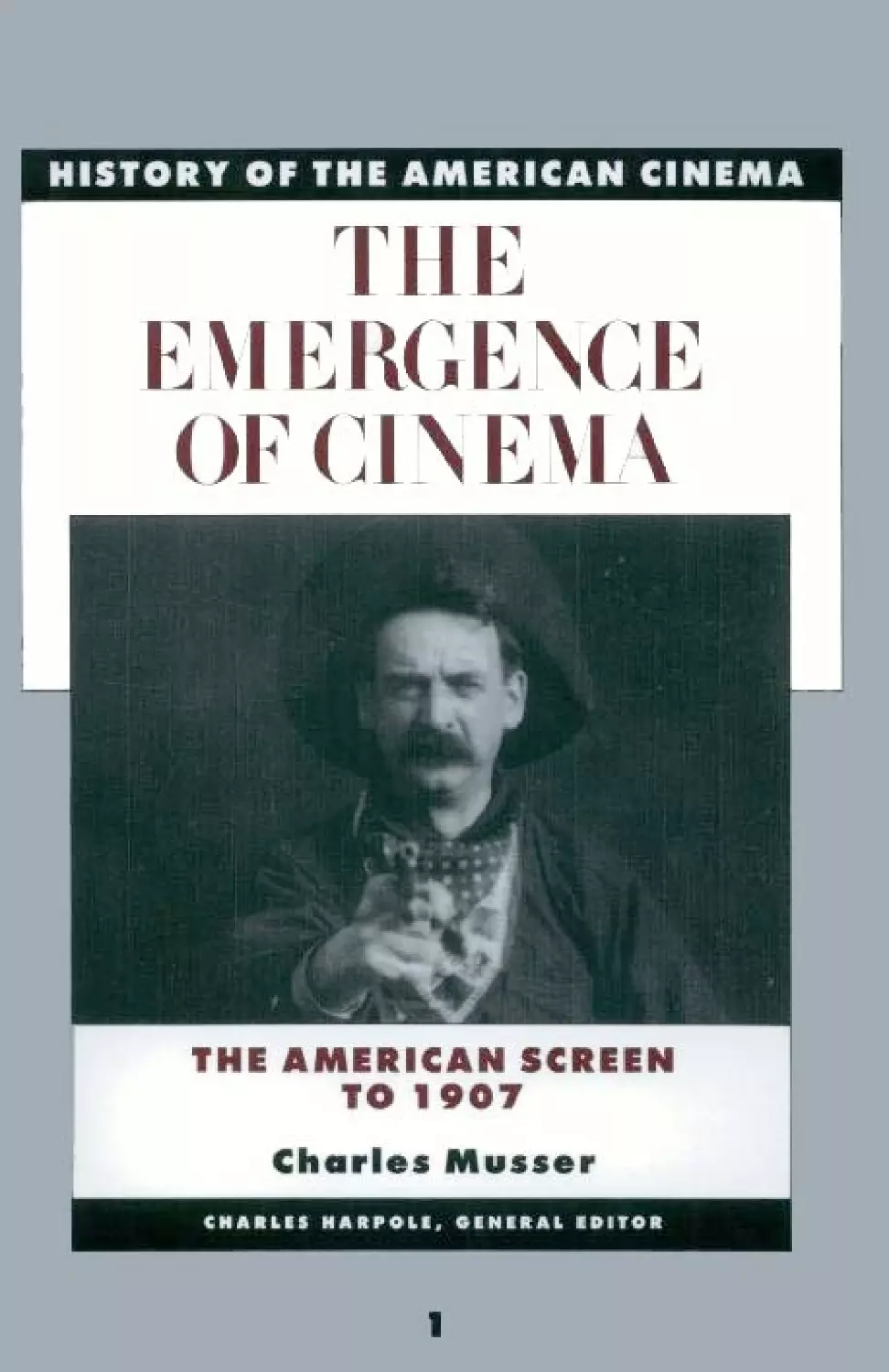


Автор: Musser C.
Теги: cinema american culture film history us cinema film industry
ISBN: 0-684-18413-3
Год: 1990
Похожие



Текст
                    a
HISTORY OF THE
AMERICAN CINEMA
Volume 1
TO1907

Film poster, ca. 2900.

HISTORY OF THE
AMERICAN CINEMA
CHARLES HARPOLE, GENERAL EDITOR
1
THE EMERGENCE
OF CINEMA:
THE AMERICAN SCREEN
TO 1907
Charles Musser
CHARLES SCRIBNER'S SONS
MACMILLAN LIBRARY REFERENCE USA
Simon & Schuster Macmillan
NEW YORK
Simon & Schuster and Prentice Hall International
LONDON • MEXICO CITY • NEW DELHI • SINGAPORE • SYDNEY • TORONTO

Copyright © 1990 by Charles Musser
Library of Congress Cataloging-in-Publication Data
Musser, Charles.
The emergence of cinema: the American screen to 1907 / by Charles
Musser.
p. cm.—(History of the American cinema; v. 1)
Includes bibliographical references and index.
ISBN 0-684-18413-3 (alk. paper)
1. Silent films—United States—History and criticism. 2. Motion
pictures—United States—History. 3. Motion picture industry—
United States—History. I. Title. II. Series.
PN1993.5.U6H55V0I. 1
[PN1995.75] 90-48307
CIP
ISBN 0-684-18413-3
Charles Scribner's Sons
1633 Broadway
New York, NY 10019-6785
All rights reserved. No part of this book
may be reproduced in any form without the permission
of Charles Scribner's Sons.
Impression
789

Advisory Board
Coordinators
Ian Jahvie E. Ann Kaplan
York University State University
of New York
at Stony Brook
Joseph L. Anderson
WGBH, Boston
Tino T. Balio
University of Wisconsin—Madison
Eileen Bowser
Museum of Modern Art
Henry S. Breitrose
Stanford University
Peter J. Bukalski
Southern Illinois University at
Edwardsville
Noel Burch
Jack C. Ellis
Northwestern University
Raymond Fielding
Florida State University
Donald Fredericksen
Cornell University
Michael Glenny
Ronald Gottesman
University of Southern California
John G. Hanhardt
Whitney Museum of American Art
Lewis Jacobs
Garth Jowett
University of Houston
John B. Kuiper
University of North Texas
Daniel J. Leab
Seton Hall University
James Leahy
Slade School of Fine Art, London
Jay LEYDAt
New York University
John Mercer
Southern Illinois University at
Carbondale
Jean MiTRYt
Peter Morris
York University
John E. O'Connor
New Jersey Institute of Technology
Edward S. Perry
Middlebury College
Vlada Petric
Harvard University
Raymond Ravar
Centre International de Liaison des
kcoles de Cinema et de Television,
Brussels
Robert Rosen
University of California, Los Angeles
Donald E. Staples
University of North Texas
Alan Williams
Rutgers University
Vitaly Zhdan
VGIK State Film School, Moscow

The Cinema History Project and the
History of the American Cinema
have been supported by grants from the
National Endowment for the Humanities and the
John and Mary R. Markle Foundation.

For my parents

Contents
General Preface xi
Acknowledgments xv
Introduction 1
PART 1
Before Cinema
i Toward a History of Screen Practice 15
2 Thomas Edison and the Amusement World 55
3 Projecting Motion Pictures: Invention and Innovation 91
PART 2
The Novelty of Cinema: 1896-1897
4 The Vitascope 109
5 Early Motion-Picture Companies 133
6 The Proliferation of Motion-Picture Companies and an Assessment
of the Novelty Year 159
PART 3
The Exhibitor Plays a Creative Role: 1897-1900
7 Full-Length Programs: Fights, Passion Plays, and Travel 193
8 Commercial Warfare and the Spanish American War: 1897-1898 225
9 The Film Industry Achieves Modest Stability: 1898-1901 263
PART 4
The Production Company Assumes Creative Dominance: 1900-1905
10 A Period of Commercial Crisis: 1900-1903 297
11 The Transition to Story Films: 1903-1904 337
12 Cinema Flourishes Within Its Existing Commercial Framework:
1904-1905 371
PART 5
The Beginnings of the Nickelodeon Era: 1905-1907
13 Nickels Count: Storefront Theaters: 1905-1907 417
14 Production as the Nickelodeon Era Begins: 1905-1907 449
Concluding Remarks 491
List of Abbreviations 497
Notes 499
Bibliography 529
Picture Sources 545
General Index 547
Index of Films 597

General Preface
ZThe History of the American Cinema is a narrative, analytic, chronological
treatment of our film heritage in an anticipated ten volumes. Within its loosely
decade-by-decade plan, the scheme of organization of each volume has been
determined by the special conditions of the period under discussion and the
requirements of sound scholarship. Thus, readers should not look for the same degree of
concentration on specific topics from volume to volume. Each author has attempted
to render a dispassionate and clear historical vision of an era, accommodating so far
as possible both the author's individual research and the soundest findings available
in the existing literature. Much of the research in these pages appears for the first
time, and the illustrations have been selected for their rarity as well as for their
aptness.
The series is intended for a wide readership, including students, scholars,
archivists, and professionals, as well as the interested general public. The general reader
will be served by the organized overviews of each time period, and the scholar will
find the thorough documentation valuable both in teaching and in extending the
findings of the series. The archivist will be particularly interested in these books'
implicit advice concerning the films and film records that demand preservation and
dissemination. The industry professional may be especially interested in following
marketing trends dating back to the earliest motion pictures and the conception and
development of film styles that now permeate cinema practice. With this broad
audience in mind, the authors have attempted to make their volumes as
comprehensive as the current state of material resources and publishing constraints will
allow. Since the very intellectual foundations of this series rest on the evolutionary
nature of the scholarly process, it is our hope that the present contributions to
knowledge will evoke an even fuller literature of cinema history from those who
follow.
Film history involves three major forces: technology, social and economic
conditions, and style and aesthetics. The technological apparatus defines and limits
everything that appears on the screen. Technology has also made cinema an expensive
medium. Films cannot be made without significant financial investment, and in
capitalist America films are almost always made with the hope of profit. Financial and
social pressures affect every aspect of cinema history. Finally, filmmaking is an art,
and each volume in this series records the development of its many styles. The three
forces interact in intimate ways, and the examination of this interaction is one of the
many unique qualities of the series.

xii
General Preface
Our purview is the films and film industry of the United States and those foreign
films and filmmakers that impinge most directly on the American experience. Our
concentration is on the traditional narrative feature film, the documentary, and the
"avant-garde," "experimental," or "art" film. Excluded, or treated in less detail, are
most military, scientific, and industrial films. By concentrating on the major forms,
we have sought to render history with a depth and clarity not possible on a broader
front—to take readers from pre-production (including securing financing) to
production (including scriptwriting as well as editing and printing of the release prints) to
distribution (including wholesale marketing) to exhibition and consumption
(including viewers' reception of films and the audiences impact on the shaping of later
cinema).
In a discipline where theory has tended to outstrip historical investigation as the
dominant mode of inquiry, the need for a carefully researched and comprehensive
history is obvious. Vigorous research based in semiotics, feminist studies, and a
broad spectrum of politically and ideologically rooted disciplines has enriched our
understanding of the nature of cinema. But few theorists would deny that intellectual
investigation ought to be based on a solid knowledge of the past. The History of the
American Cinema has been conceived to provide just such a historical foundation.
The individual authors attempt to outline as much of the past as can be traced
through existing records, in some cases breaking new scholarly ground in their
examination of the earliest filmmaking equipment, memoirs, business documents,
archives, the oral recollections of the few surviving film pioneers, and, above all, the
crumbling celluloid remnants of our film heritage. They also interpret the evidence
they gather, while acknowledging that the order imposed on a subject emerges
ultimately from our own schemata, not necessarily those of the past itself.
From the first it was obvious that no one scholar could hope to address the entire
first century of American film. To embrace not only the traditional aesthetic of the
narrative feature film but also the technological and socioeconomic factors at work
throughout the industry, a broad-based team approach was deemed essential. To that
end I organized a planning conference, which was held near Carbondale, Illinois, in
November 1980, with funding provided by the National Endowment for the
Humanities, the Markle Foundation, and Southern Illinois University.1 Out of that
meeting emerged commitments to research, advise, and write for the projected
series. Fortuitously, the conference also drew a representative of Charles Scribner's
Sons, Publishers, and Marshall De Bruhl of the Reference Division soon offered the
publishing contract that officially launched the project. Dedicated funding for the
initial three volumes was secured from the National Endowment for the Humanities
in 1981, and the Society for Cinema Studies endorsed the project the same year. At
the NEH, Harold Cannon was the first to encourage the project, and David Wise has
observed the development of the series from its first application. Mary Milton at the
Markle Foundation was also an early friend of the project, and Markle provided key
planning funding in the early years. The grants administration offices of Southern
Illinois University, the University of Texas at Dallas, the Ohio State University, and
the University of Central Florida have given funding, leave time, and graduate
1. The conference participants were Jeanne Allen, Robert C. Allen, Roy Armes, Richard Blumenberg,
Eileen Bowser, Marshall Deutelbaum, Jack Ellis, John Fell, Jane Feuer, Lucy Fischer, Ian Jarvie, Stuart
Kaminsky, E. Ann Kaplan, Gorham "Hap" Kindem, Richard Koszarski, James Leahy, Jay Leyda, Jayne
Loader, Timothy Lyons, John Mercer, Bill Nichols, Donald Staples, Birgitta Steene, and Howard Suber.

General Preface
xiii
student research assistantships. David R. Holdridge of James Madison University
volunteered a personal donation. Michael McGinley, Charles E. Smith, and Karen
Day have each in turn carried the series forward at Scribners. To John Fitzpatrick of
Scribners has come the job of preparing the manuscripts for publication. His steady
hand has been of great help.
A host of graduate students assisted the project over the years. For expediting the
planning conference, helping to prepare the manuscripts, and assisting with funding
proposals and library research, profound thanks are due, in order of service, to:
Rebecca Thompson, Fred Marx, Michelle Edmonds, Kelly Yuen, Michael Presnell,
Darien Smith, Diane Welch, Andrew Short, Susan Tong, Paul Cornelius, Mary
Charlotte Johnson, and Chester Gallant. I have fond memories of the camaraderie we
shared.
Development of the series also benefited from the generous cooperation and
interest of the American Film Institute, the Motion Picture Producers Association of
America, and, early on, a number of scholars from abroad who lent a valuable
international perspective. Ian Jarvie and E. Ann Kaplan deserve special thanks as
coordinators of the Advisory Board, which provided guidance at many points.
Beyond the Board proper, John Fell contributed wise counsel and invaluable research
guidance. The authors' acknowledgments in each volume of the series expand further
on the great and selfless contributions made by scores of film studies professionals.
Personally, I must pay tribute to Jay Leyda, my mentor and friend and to whose
memory I dedicate my own work on this series. Both an unrelenting researcher and
a thoughtful and generous teacher, Jay was the kindest and the strongest intellectual
I have known. In my personal life, I have been sustained by Carole Harpole and our
son, Andrew, and by Hank and Kathrine, and Beanie and Nell. Above all I thank
Mary, whose most special friendship has enriched my life and work.
Charles Harpole
General Editor

Acknowledgments
J'his work culminates more than a dozen years of research, reflection, and writing
on America's early cinema. Inevitably such an enterprise leaves me deeply
indebted to numerous individuals and institutions. My gratitude begins with Charles
Harpole, who gave me the opportunity to undertake the book at hand and guided it
through to successful completion. John Fell, who was originally scheduled to be its
author, kindly sponsored me as his replacement and provided invaluable advice. The
writers of volumes two and three, Eileen Bowser and Richard Koszarski, offered
useful information, insightful criticisms, and psychological support. I could not have
chosen better collaborators.
Extensive, in-depth research on a historical period is only possible when the
requisite materials have been acquired, preserved, and made available by museums
and archives. Not only does the Museum of Modern Art in New York City have
extensive holdings related to early cinema, but its staff has long played a special
nurturing role for me as for many others. Here I would like to thank Curator Eileen
Bowser as well as Charles Silver, Jon Gartenberg, Mary Lea Bandy, Clive Phillpot,
Janice Ekdahl, Peter Williamson, Ron Magliozzi, John Johnson, Nancy Barnes, and
Jyette Jensen. In the course of my many visits to the Library of Congress to see films
and scan microfilm, Paul Spehr, Patrick Sheehan, Pat Loughney, Kathy Loughney,
Barbara Humphries, Madeleine Matz, and Emily Sieger often went out of their way
to help. The staffs of the UCLA Film and Television Archive (particularly Robert
Rosen and Robert Gitt), the British Film Institute (particularly David Francis, Roger
Holman, and Elaine Burrows), and the George Eastman House (particularly John
Kuiper, the late George Pratt, Jan-Christopher Horak, and Paolo Cherchi-Usai) all
extended their hospitality in ways that aided my research. Responding to my pleas,
Sam Gill and Anthony Slide at the Academy of Motion Picture Arts and Sciences gave
me access to the Charles Clarke/William Selig Collection. Many individuals at these
institutions share a deep commitment to early cinema and have facilitated serious
work in this field. George Pratt, who shared his discoveries and taught me how to
research local newspapers, deserves special mention. Likewise, Pat Loughney
brought obscure holdings to my attention and then inconvenienced himself to take
many photographs for this book.
Sustained historical work is made possible by a community of scholars. In my case,
Domitor (the Society for Early Cinema), the Society for Cinema Studies, the
Columbia University Seminar on Film and Interdisciplinary Interpretation, the Magic

xvi
Acknowledgments
Lantern Society of the United States and Canada, the Thomas A. Edison Papers at
Rutgers University, the Film Division at Columbia University, and the Department
of Cinema Studies at New York University have all provided an important sense of
fellowship. Tom Gunning, Miriam Hansen, George Pratt, Alan Williams, John
Mercer, William Welling, and Dan Greenberg served as thoughtful readers of this
manuscript and helped me refine it. X. Theodore Barber, who is currently writing a
dissertation on the magic lantern in America, kindly reviewed the opening chapter.
Reese Jenkins reviewed chapter 2. Linda Kowall enhanced my understanding of
Sigmund Lubin's activities, while Veyda Semarne reviewed relevant sections on the
Lumiere brothers. Robert Sklar and the late Jay Leyda directed my energies into
profitable areas of inquiry and provided crucial advice and criticism as well. Andre
Gaudreault, Janet Staiger, Noel Burch, Judith Mayne, Roberta Pearson, Robert C.
Allen, Martin Sopocy, and David Levy have all shared ideas, criticisms, and
information with me at key moments. Their work, as well as the contributions of others
mentioned above, deserves more mention in these pages than I can give.
Related projects helped immensely. With Reese Jenkins and the Thomas A.
Edison Papers staff, I gathered together early motion-picture catalogs to produce
Motion Picture Catalogs by American Producers and Distributors, i8q4-iqo8: A
Microfilm Edition (1985), which was an invaluable resource. With support from
Wilder Green and Sam McElfresh at the American Federation of the Arts, Jay Leyda
and I curated the 1986 "Before Hollywood" show and catalog that made available
many important films from this era. Carol Nelson involved me in a book and film
project on traveling exhibitor Lyman H. Howe. My own work on Edwin S. Porter
and the Edison Manufacturing Company provided a firm base from which to develop
the wider scope of this project. An earlier, shorter version of chapter 1 appeared in
the Quarterly Review of Film Studies.
Mention should be made here of two conventions observed in the present volume,
though not in other parts of the series. First, the word "theater/theatre" is given
throughout in the former spelling (except in direct quotations). Usage varied in the
early period for both the trade and the press, but it has seemed best to simplify
matters for the modern reader. Also, I have adopted the convention recommended
by the Thomas A. Edison Papers of using uppercase letters for companies, such as
Vitagraph and Biograph, but lowercase for the particular inventions they operated,
such as the vitagraph and the biograph. This distinction is observed here even when
(as in the preceding examples) the names were frequently, if inconsistently,
capitalized during the period.
One boon to my research efforts has been living in the "golden triangle" formed by
three research branches of the New York Public Library that I visited almost daily:
the Library for the Performing Arts at Lincoln Center, the Annex at Forty-third
Street and Tenth Avenue, and the Main Research Library at Forty-second Street.
Mimi Bowling, Ed Pershey, and Faye Whitaker at the Edison National Historic Site
and Florence Bartoshesky at the Baker Library of Harvard Business School have
likewise been of great assistance. Paula Jescavge at New York University's Elmer
Holmes Bobst Library arranged for the interlibrary loan of endless reels of microfilm.
Personnel at the Federal Archive and Record Centers in Bayonne, Philadelphia, and
Chicago helped give me important access to court records. Lynne Kirby, Richard
Balzer, Charles Hummel, Francoise Levie, Marc Wanamaker, Carey Williams, and
Joyce Jesionowski kindly provided illustrations. Among the many who extended

Acknowledgments
xvii
themselves on behalf of this volume are Kathy Oberdeck, Germaine Lacasse, Hiroshi
Komatsu, Willaim K. Everson, George Hall, Susan Kemplar, Raymond Fielding,
Martin Sopocy, Herbert Reynolds, Cal Pryluck, H. Mark Gosser, Robert Haller,
Elizabeth Gorla, and Alexis Krasilovsky. The students in my seminar at Yale
University also provided a forum for me to develop and clarify some of the ideas that
follow. John Fitzpatrick, Miriam Rosen, and Karen Day at Scribners were
wonderfully patient, sensitive, and supportive as they proceeded with the publication of this
book.
Above all, I extend heartfelt appreciation to the friends and colleagues who have
tolerated my obsessions for so long. In these days of word processors, no one need
be thanked for typing this manuscript except my Macintosh computer. Nevertheless,
Lynne Zeavin had to live with this undertaking almost as much as I did (and with few
of the compensations!). She has offered intriguing observations from her own field of
psychology as well as the many pleasures of daily life. In this regard I am particularly
fortunate.
Charles Musser, 1990
For the second and third printings, I have been able to make a few modest
corrections and additions. In this regard, I would like to thank Paolo Cherchi-Usai,
Robert Klepner, Richard M. Bueschel, and Tom Gunning for pointing out small
inaccuracies.
In addition, work by X. Theodore Barber on the magic lantern and Gregory Waller
on moviegoing and filmmaking in Lexington, Kentucky, has required me to add
important information about prior lantern showings and filmmaking by William Se-
lig. Barber's dissertation, "Evenings of Wonders: A History of the Magic Lantern
Show in America," is essential reading for those wishing more information on this
subject and will soon be published in book form. I also thank Scribners for its
eagerness to incorporate these changes—an attitude that exemplifies the very best in
American publishing
CM., 1993

Q
HISTORY OF THE
AMERICAN CINEMA
Volume 1
TO 1907

Introduction
ZTiis book, the first in a multivolume history of American film, looks at the initial
twelve years of cinema, from 1895 to the fall of 1907. Here, cinema refers to
projected motion pictures and their sound accompaniment, but two closely related
developments must also be considered. First, there is the history of screen
practice—projected images and their audio complement—which dates back to the
seventeenth century and includes the magic lantern, a precursor of the modern slide
projector. As the title of this book suggests, cinema was neither "born" nor a "new
art form": it emerged out of, even as it soon dominated, screen practice. For this
reason, the first chapter briefly traces the history of earlier projected images as they
originated in Europe and subsequently developed within the United States. Second,
this volume is concerned with the history oimotion pictures, which includes not only
cinema but forms of exhibition that did not involve projection. Of these exhibition
formats, individualized or peephole viewing was the most important. The history of
commercial motion pictures in fact began in 1894 with Edison's peephole kineto-
scope, while the mutoscope, a peephole flip-card device, was an important presence
during the late 1890s and early 1900s. The cinema, the screen, motion pictures—
these involve distinct though overlapping practices.
Although the cinema was to become known affectionately as "the movies" or "the
flicks," in the 1890s and early 1900s it was called "animated photographs," "moving
pictures," and sometimes even "life-model motion pictures." Today, some turn-of-
the-century terminology may seem foreign or quaint, while other expressions retain
the seeming freshness of contemporary idiom. Correspondingly, as Judith Mayne has
pointed out, turn-of-the-century images appear to combine similar qualities of
strangeness and familiarity.1 Whatever the case, these films and the corresponding
practices do not readily open themselves to our understanding: they are frequently
strange and familiar in unexpected ways. The methods of production and
representation were so different from today's mainstream cinema that apparent parallels can
readily deceive rather than illuminate. But, properly understood, the foreignness of
the earlier period gives us a remarkable perspective on present-day moving images,
whether those of Hollywood and its blockbusters, television and the evening news,
or American independents and avant-garde explorations. The purpose of this study is
not to revel in the seeming eccentricities of early cinema (the label historians often

2
Introduction
apply to this period and the one used here as well) but to make its methods
understandable within the context of its own norms and practices.
Any multivolume history must justify its periodization. While starting with the
"beginnings" is logical enough, it remains to explain why this volume ends around
September 1907. Here a combination of factors must be cited. The brief economic
recession that started in October 1907 encouraged important changes in the
organization of the industry, including the formation of various patent-based alliances that
culminated in the Motion Picture Patents Company. Moreover, the modes of
representation and production began to change in new and far-ranging ways late in 1907.
Finally, although American cinema experienced many transformations between 1895
and 1907, there were also fundamental continuities that make it appropriate to see
the period as a coherent one.
Elements of Stability in Early Cinema
Early cinema enjoyed a distinctive "mode of reception." The ways in which
spectators understood and appreciated motion pictures regularly took one of three basic
forms, none of which was privileged or preferred. First of all, the film's subject or
narrative was often already known by the spectators. Especially with the aid of a brief
cue (such as a main title) to identify the well-known story or event, viewers brought
this special knowledge to bear on the film. When the Biograph Company showed
filmed excerpts of Joseph Jefferson performing his famous stage role in Rip Van
Winkle, for example, the audience's familiarity with the play was assumed. Early
cinema thus evidenced a profound dependence on other cultural forms, including the
theater, newspapers, popular songs, and fairy tales.
Alternatively, the spectator might rely on the exhibitor to clarify the film's
narrative or meaning through a live narration and other sounds (music, effects, even
dialogue added by actors from behind the screen). Parsifal (Edison, 1904) and
William Selig's films of Armour & Company (the meat-packing concern) were
intended to be presented with a lecture. The exhibitor's spiel usually did more than
simply clarify, however: it conveyed the showman's own interpretation of these
images or rendered them subordinate to his authorial vision.
Finally, spectators might easily find themselves in a position where they had to
understand the film story without recourse to either special knowledge or the
exhibitors' aid. Here, the representational system sharply limited the filmmakers'
ability to present a self-sufficient narrative. Certain genres, such as Melies' trick films,
did not require the spectator to discern a coherent plot, since their narratives were
not based on a logical progression of events. Some pictures—for example, chase films
such as Meet Me at the Fountain (Lubin, 1904)—told simple stories that could
be readily understood. Others, such as A Kentucky Feud (Biograph, 1905), relied
heavily on intertitles to explain the story line.
Since the mechanisms for audience comprehension were so diverse, one might
wonder what they shared. Here, if only for a moment, early cinema is worth defining
negatively: its representational system could not present a complex, unfamiliar
narrative capable of being readily understood irrespective of exhibition circumstances or
the spectators' specific cultural knowledge. In practice, a significant number of films
left their viewers somewhat mystified and confused. Often, the key to following the

Introduction
3
narrative was not widely known or exhibitors failed to perform their job, but it was
also not unusual for filmmakers to exceed the capacities of their representational
system. This does not mean that cinema lacked an array of conventions that facilitated
audience comprehension of projected images, for spectators were generally familiar
with various strategies for conveying meaning (certain genres, certain gestures by
actors or relations between shots). Rather, these conventions only operated
effectively within strict limits.
The early cinema's system of representation became more elaborate over time but
did not fundamentally change. Once again, it was not until 1907 that the system
began to break down. This mode of representation was predominantly presentational
in its acting style, set design, and visual composition as well as in its depiction of
time, space, and narrative. Rooted in theatrical discourse, the concept of a
presentational style was originally used to describe a method of acting that dominated the
American and English stage during most of the nineteenth century. Actors not only
played to the audience but used highly conventionalized gestures to convey forceful
emotions. The style was frontal and relied on indication. Among many late-
nineteenth-century practitioners of high theatrical art, the presentational style was
superseded by one that emphasized greater verisimilitude and restraint. The older
representational techniques continued, however, in diverse cultural forms, including
not only such popular theatrical genres as melodrama and burlesque but the magic
lantern, cartoon strips, and early cinema.
The presentationalism of early cinema is most obvious in the pro-filmic elements
(the mise-en-scene) and the manner in which they were organized vis-a-vis the
camera and the audience. Lacking words, actors often resorted to extensive
pantomime to convey their thoughts or actions, pushing the use of conventionalized
gestures to an extreme. Within scenes, time and space were likewise indicated rather
than rendered in a verisimilar manner. In Lost in the Alps (Edison, 1907), the
time it takes for actions to occur offscreen (i.e., "offstage") is radically condensed.
The mother, looking for her children, leaves but quickly returns. Yet the audience
knows that this search took much longer than was actually depicted. The passage of
time is thus signaled and dealt with in terms that satisfied old-style theatrical
conventions (in the naturalistic theater that was replacing this system, meanwhile, such
indicating was much less acceptable).
The same type of indicating also characterized the production design for many of
these films. Schematic sets eschewed all illusionism. For How They Rob Men in
Chicago (Biograph, 1902), a simple flat identifies the type of location without
actually trying to simulate it. The fact that the same backdrop was shot with the same
frontal camera framings for many other Biograph films amply demonstrates its iconic
nature. Elaborately painted theatrical drops were also commonly integrated into
these films, but again, they only suggest depth and perspective. Their effect was
quite different from that of full three-dimensional sets or real locations for exterior
scenes. Studio sets were routinely used for exteriors as well as interiors, reflecting
not only a theatrical tradition but a continuing practice of indication.
Early cinema's presentational approach was also, as Tom Gunning has pointed out,
concerned with display, exhibitionism, and the offering of spectacular, realistic, or
novel effects.3 As in Dr. Dippy's Sanitarium (Biograph, 1906), set designs often
sacrificed realistic perspectives for an opening up of the space and mise-en-scene. In
a film such as Grandpa's Reading Glass (Biograph, 1902), objects are shown in

4
Introduction
close-up "as if" viewed through a magnifying glass. But this "as if" is based not on
verisimilitude but on display, for the objects were photographed against plain
backgrounds that removed them from the mise-en-scene, further isolating them for the
spectator. This style often involved an acknowledgment of the camera and the
spectator. The genre of facial-expression films, for example, usually entailed a single
close-up of a performer confronting the camera. In Facial Expression by Loney
Haskell (Biograph, 1897), the performer grimaces into the camera and shares the
humorous results with his audience. The viewer is a voyeur but not, as in later
cinema, apparently effaced. The compositional dynamics of many chase films, such as
the immensely popular Personal (Biograph, 1904), in which pursuer and pursued
run toward and past the camera, offer another form of this display.
Cinema's pervasive presentational style was not limited to fiction films with their
recognizable theatrical antecedents or parallels. The train (Empire State Express
[Biograph, 1896]) or cavalry (Charge of the Seventh French Cuirassiers [Lu-
miere, 1896]) rushing toward the camera and visually assaulting the spectator was
equally characteristic. Since speeches, parades, and inaugurations were subjects that
involved conscious uses of display and spectacle, this approach was readily applied to
the making of actualities (i.e., films of actual events). These events replicated and
reinforced a tendency toward frontal compositions. Nonetheless, it was with
actualities that the presentational style was most vulnerable. Feeding the Baby (Lu-
miere, 1895) or Herald Square (Edison, 1896) captured the phenomenal world as
it unfolded in resolutely real time. Camera movement, which became increasingly
common after 1897 but was initially used only for actualities, further emphasized the
existence of offscreen space and a real world beyond the edges of the frame. Here the
cinema offered a verisimilar approach that was compatible with naturalistic theater.
What Georges Sadoul describes as the snapshot quality of these films4 and their
application to fiction filmmaking in the early 1900s might have undermined the
strong presentational tendencies of early cinema much sooner except for the fact that
the system of representation was resolutely syncretic in its combination and
juxtaposition of different mimetic means. In many films, such as Francesca di Rimini
(Vitagraph, 1907), exteriors were taken both in specially constructed studio sets and
on location. Even within many sets, some props and design elements were rendered
with paint, while others were three-dimensional or real objects. In The Bold Bank
Robbery (Lubin, 1904), a real lamp is used, but the light rays are painted on the
wall. Filmmakers thus routinely shifted between different levels of representing
reality. This syncreticism can be contrasted with later cinema's predominant
emphasis on mimetic consistency. To be sure, artifice such as backdrops would continue to
be used, but the goal was increasingly to meld the juncture of different mimetic
means until they became seamless. Early cinema was predominantly syncretic,
presentational, and nonlinear, while later classical Hollywood cinema favored
consistency, verisimilitude, and a linear narrative structure, particularly in its dramas and
light comedies.
The presentational approach was also apparent in the way narratives were
depicted. Many narratives were highly conventionalized and operated within genres far
narrower than those found in later cinema. The bad-boy and fire-rescue genres are
only two examples.5 The spectator knows that the bad boys will engage in a series of
humorous, mischievous acts; only the specific form of their mischief is in doubt. In
other instances, as Noel Burch points out, stories were not told "as if for the first

Introduction
5
time" insofar as they were assumed to be a part of the viewers' previous knowledge.6
Since the films did not usually create or convey a complex original story in
themselves, the producers' energies could be directed elsewhere. The filmmakers
assembled spectacular images that evoked the story rather than telling the story in and of
itself; indeed, images jumped from high point to high point with crucial causal
connections left unarticulated. This was also true for magic-lantern images, while a
similar presentationalism was enjoying its greatest success in the theater. The
repertoire of plays, Janet Staiger indicates, was limited and well known to the audience:
"Sets, props and costume were conventional and spare; the drama was less the plot
and more the actor and the individual interpretation of the plot."7
With melodrama continuing the presentational approach on the tum-of-the-
century stage, it is not surprising that cinema quickly appropriated many of its
characteristics. As Roberta Pearson reports, character motivation was notably absent
in both melodrama and early film.8 In both cases, characters "do not carry the full
weight of real life" and "are devoid of any individuality."9 In The Paymaster (Bio-
graph, 1906), the factory manager embodies evil as he tests the good paymaster and
the mill girl. Moreover, chance rather than a realistic or "organic" development of
events propels the plot, which is therefore subject to dramatic, striking reversals: a
chance discovery of the stolen money exposes the factory manager's scheme at the
crucial moment. Film companies also adopted the common melodramatic technique
of double titles, as with Vitagraph's Adventures of Sherlock Holmes; or, Held
for a Ransom (1905) or Selig's Tracked by Bloodhounds; or, A Lynching at
Cripple Creek (1904). Both play and film titles played a key naming function, and
the titles of play acts and film scenes within the respective productions also had a
common orienting or identifying role.10
One of the pre-1907 cinema's most distinctive features was its nonlinear
temporality in the arrangement of scenes. The relationship between the outgoing and
incoming shots could take several forms. As seen in the seminal Life of an American
Fireman (Edison, 1902-1903), filmmakers often relied on temporal repetitions,
returning to earlier points in time to pick up their story. The same actions or event
could thus be shown from multiple viewpoints, as in The Launching of the U.S.S.
Battleship "Connecticut" (Biograph, 1904), wherein the launching was shown
three times, each time for a different camera position. In other instances, different
lines of action that occurred simultaneously were shown successively; in The
Kleptomaniac (Edison, 1905), for example, the concurrent lives of two women are
presented one after the other, rather than shifting back and forth between the two.
By 1908-1909, temporal repetition, early cinema's solution to the problem of
simultaneity, was superseded by a linear progression and parallel editing. Linear
continuities with matching action across the cuts did appear, however, in a few early
films, such as The Escaped Lunatic (Biograph, 1903), which contains a cut to a
different camera position just as the lunatic throws a guard off the bridge. Yet
employment of this type of continuity was exceptional, and spectators could not
assume that a film story would unfold in simple chronological order. This nonlinear
organization of shots was consistent with the general framework of reception
discussed above. While repeated actions or narrative cues sometimes provided
sufficient information for the spectator to follow the flow of events and relationships
between shots, in other cases, help had to come from external sources—either the
exhibitor or the spectator's previous knowledge of the story.

6
Introduction
In contrast to this temporality, the spatial relations constructed through editing are
much more familiar to the modern viewer. Exterior/interior relations, the
establishing shot and closer view, even the point-of-view shot, all appear with some frequency
in early cinema. Indeed, all had well-established antecedents in screen history.
Although extensive creation of a spatial world through successive close-ups within a
scene, shot/counter-shots, and cuts on the glance was part of a later repertoire of
cinematic techniques, none of the spatial constructions that appeared in early films
were later excluded by Hollywood. Rather, pre-1907 methods of constructing a
spatial world through editing became more frequent, subtle, and suggestive of mood
in later years.
Although many aspects of film production changed between 1895 and 1907, the
organization of work within the small studios remained relatively constant. Here
again, early filmmaking activities were organized in many different ways. The most
characteristic method of production, however—which might be called the
collaborative system—usually involved two men, the stage manager and cameraman, who
worked together in an informal and nonhierarchical manner. Throughout this period,
America's film companies were often started or at least staffed with collaborative
teams. J. Stuart Blackton and Albert E. Smith of Vitagraph, Edwin S. Porter and
George Fleming at Edison, William Paley and William Steiner of Paley & Steirter,
and Wallace McCutcheon and Frank Marion of Biograph are only some examples.
Such collaborative methods of work were also evident in the invention of cinema's
"basic apparatus"—the camera and projector.
Within this system, and unlike the dominant post-1907 production methods that
organized staff along more hierarchical lines of authority and accountability, early
filmmaking involved little specialization. The originator(s) of a story would often
direct the actors, appear in the films, operate the camera, develop the exposed raw
stock, cut the negative, and—if necessary—run the projector. This knowledge of all
aspects of the craft was what distinguished these pre-1907 filmmakers from their
more specialized successors.11
Finally, it must be recalled that film production occurred within a white, virtually
all-male world. Even female roles were often played by men—either professional
female impersonators like Gilbert Saroni in The Old Maid Having Her Picture
Taken (Edison, 1901) or employees like the bookkeeper who played "the wife's
choice" in The Servant Girl Problem (Vitagraph, 1905). The selection of
narrative elements and the application of presentational techniques consistently enhanced
the element of male voyeurism. The display of normally concealed female anatomy
was common, particularly in Biograph productions. Many short comedies were made
by men, for men, and revealed a number of the preoccupations and assumptions of
this "homosocial" world that was just beginning to break down.12
Changing Methods of Production and Representation
Despite many stable elements, the cinema underwent a staggering array of
fundamental changes between 1895 and 1907. During the first months of widespread
projection, short (one-shot) films were enjoyed primarily for their ability to
reproduce lifelike motion and exploit isolated presentational elements. While such
comparatively non-narrative uses of film continued and developed in what Tom Gunning

Introduction
7
has called "the cinema of attractions," many exhibitors began to organize these short
films into rruiltishot narratives. Although arranging these scenes was the chief
responsibility of exhibitors during the 1890s, production companies had largely
assumed control over this process (i.e., editing) by 1903-1904. The era of storefront
motion-picture theaters or "nickelodeons," which began in 1905-1906, involved a
new organization of exhibition that had profound effects on all other aspects of film
practice.
Change creates new necessities, new opportunities, and new practices even as it
eliminates old ones. In many respects, the introduction of a single fundamental
change—the adaptation of Edison's moving pictures to projection—precipitated a
series of shifts and transformations within the field of screen entertainment that could
be likened to a row of falling dominos. While nothing inherent in the medium
necessitated this rapid succession of innovations, the economic and cultural dynamics
of American society in general and screen practice in particular pressured the film
industry to change along the general lines that it did. Perhaps a somewhat different
kind of development would have taken place if William Kennedy Laurie Dickson had
remained with Thomas Edison or if a patents company had been established in the
1890s. Yet even here the differences would have been limited. Motion-picture
practices did not evolve as they did because of the extraordinary genius of a few
individuals but because significant numbers of people recognized new commercial and
artistic opportunities implicit in previous change and so, in turn, further altered the
practice of cinema.
In seeking to- explain the underlying dynamics of a rapidly changing film practice
and to provide an account of the American screen before 1907, this volume does not
dwell on the theoretical and methodological framework.13 In some respects it
remains rather "old-fashioned" in that it is very concerned with who did what, where,
and when. The reasons why something was done and its significance or relation to the
larger industry are carefully investigated. Nonetheless, this narrative treatment
functions within a carefully worked-out historical model. A central aspect of this model
explores the interaction between cinema's mode of production (how the cinema is
made) and the mode of representation (how a story is told or a subject represented).
The gradual shift in editorial responsibility from exhibitor to producer in the early
1900s, for example, allowed for new ways of articulating a narrative. As filmmakers
explored the new representational possibilities resulting from this shift, the
commercial success of these innovative pictures provided further impetus for centralizing
the control of editing inside the production companies.
In examining the cinema's production methods, we must begin by looking at how
films were made, shown, and appreciated: in other words, by looking at the
production companies, the exhibitors, and the spectators. Although the spectators'
relationship to the screen experience remained relatively constant through 1907, the
interactions between image production and exhibition underwent multiple
transformations. Each shift involved complex adjustments between the two areas. It is not
coincidental that most of the leading filmmakers from the early 1900s had previous
experience in exhibition: Edwin S. Porter, James White, J. Stuart Blackton, Wallace
McCutcheon, and William Paley—to name only a few. Since distribution is at the
interface of film production and exhibition, it is hardly surprising that it too
underwent substantial changes. Although the industry had autonomous sales agents and a
few exchanges from the outset, many distribution functions were performed by

8
Introduction
either producers (who commonly sold their films directly to "the trade") or exhibitors
(who rented films to theaters as one part of their service package). Only after key
postproduction responsibilities were assumed by the film producers did the
development of the rental system become possible and specialized distribution companies
or "exchanges" emerge as important factors in the field.
The Industry
To address such dramatic changes, it is expedient to organize this volume
chronologically. Chapters deal with the activities of the industry's principal production and
exhibition companies during relatively short periods of time—a few months to a few
years. While several important businesses blossomed only briefly as the film industry
began, greater continuity is evident by the late 1890s. Since change was instituted on
a company-by-company basis, commercial enterprises rather than individuals usually
provide the most appropriate unit of inquiry and organization. The collaborative
method of work, the eventual recognition of the production company as the author
of a screen narrative, and the fact that the individuals responsible for many films were
rarely publicized and even now frequently remain unknown: all these factors justify
such an organizing principle.
The ten corporations that formed the Motion Picture Patents Company (discussed
in the next volume) were all active by mid 1907. The two that became preeminent
in this organization also played crucial roles throughout the earlier period. The
Edison Manufacturing Company introduced commercial, modern motion pictures to
the world. Its owner, Thomas A. Edison, achieved immense influence through both
his company's activities and his use of patent litigation as a commercial weapon. The
American Mutoscope & Biograph Company (originally named the American Muto-
scope Company, and often referred to as the Biograph Company after its biograph
projector) was the most commercially successful American film enterprise during the
late 1890s and again in 1904-1905. A large and well-financed corporation, it mounted
an effective challenge to Edison's patent claims and was perhaps the only entity in
the United States that could have done so. The multifaceted rivalry between the two
organizations colored the entire industry.
Although substantial information from this period—paper documentation as well
as a large number of films—survives for both companies, much more has been
written about the Edison enterprise. Interest has focused on the invention of motion
pictures at the Edison laboratory and its early commercial history. Additional work
has been done on Edwin S. Porter, the earliest American filmmaker to enjoy a
significant reputation, who was an Edison employee from late 1900 to 1909.14
Although Biograph has been understandably associated with the D. W. Griffith years
(1908-1913), the company's role in the earlier period was crucial.15 This volume
seeks to redress that imbalance with a careful examination of Biograph's activities.
Other Patents Company members played significant but ultimately less central
roles in the pre-1907 period. Sigmund Lubin, who did business under his own name,
and William Selig, who formed the Selig Polyscope Company, as well as American
Vitagraph, which was owned by J. Stuart Blackton, Albert E. Smith, and William T.
Rock, were all involved in both production and exhibition by 1898. Here again, more
has been written about Vitagraph than about either Lubin or Selig, and so this

Introduction
9
volume makes a particular effort to trace the activities of the latter two.16 The Kleine
Optical Company, run by George Kleine, entered the motion-picture field in 1896
and served as a leading sales agent for domestic and foreign producers throughout the
period covered by this study.
Only two production companies allied with the Motion Picture Patents Company
were not active by the 1890s. These late additions, however, were headed by men
who had owned and/or managed important film businesses before the turn of the
century and finally entered the production field in early 1907. The Kalem Company
was owned by George Kleine and two former Biograph employees, Frank Marion
and Samuel Long. The Essanay Film Manufacturing Company was formed by George
Spoor, who ran a leading exhibition service, and Gilbert M. Anderson, an actor and
director who had previously worked for four other American producers. These
companies thus represented a consolidation of earlier achievements even though they did
not enjoy prominence until the period covered by the next volume in this series, The
Transformation of Cinema. The Patents Company also had two foreign members
whose films already enjoyed wide popularity in the United States during the 1890s
and early 1900s: Georges Melies and Path£ Freres. To better exploit this popularity,
both firms established sales offices in New York City during 1903-1904 and played
influential roles in the American industry. Carefully examined, the activities of these
recurring figures through 1907 offer fundamental insights into the rapidly changing
industry.
These leading businesses did not, of course, begin to constitute the entire
industry. Numerous individuals enjoyed noteworthy if more modest careers within the
time frame considered here. Among those acquiring some production experience
were William Paley, the Miles brothers, Burton Holmes, and Lyman H. Howe.
Many other enterprises were influential but short-lived. This is particularly true of
cinema's first two or three years, when the Lambda Company, Eidoloscope
Company, Vitascope Company, Lumiere Agency, and International Film Company
played influential roles. Figures such as William Fox, Carl Laemmle, and the Warner
brothers entered the field at the beginning of the nickelodeon era, but they were to
achieve their greatest success in subsequent years. Many minor figures whose
careers are interesting and illuminating cannot be considered—at least not
systematically—within the limited framework of this study.
Exhibition poses a particular problem for the historian. No records survive for
many, perhaps most, of the screenings that occurred in this early era. Tracing and
assessing them is extremely difficult, and conclusions must be couched in tentative
terms. Nonetheless, the research done for this volume suggests that motion pictures
were a much more important part of American life during their first ten years than
has been widely recognized. Moreover, the types of exhibition sites were more
diverse than usually acknowledged, at least by those focusing on vaudeville
exhibition. Films were often shown between acts of plays, in black tents at carnivals, as
complete evenings of entertainment in the local church or opera house, as part of an
illustrated lecture, and in storefront theaters. This study seeks to outline the scope
of these diverse exhibition sites and practices, which were often subject to financial
instability and frequent shifts in their relative importance.
As will be seen, there was considerable regional variation in exhibition. Since
vaudeville was never popular in the South, people in that area usually had to rely on
carnivals and a few traveling exhibitors to see films before the nickelodeon era. In

10
Introduction
contrast, small-time vaudeville was so popular in the Pacific Northwest that it
impeded the introduction of the more specialized motion-picture theaters. This
volume, however, highlights those locales that best help to explain the overall
development of the industry. Activities occurring in a relatively few large cities along
the East Coast and in the Midwest influenced the course of film practice much more
than activities outside of these centers. While much still needs to be learned and said
about exhibition in many areas of the United States, such an undertaking is beyond
the scope of this study.
Grappling with the diversity of exhibition is mild, however, compared to questions
about spectatorship. The specialized motion-picture spectator, the regular filmgoer,
was developing only at the end of this period. Moreover, there were no professional
moviegoers—i.e., film reviewers—whose biases and attitudes we might trace as
cinema developed. Occasionally, cultural reporters or theatrical reviewers would
comment on the films or note a strong reaction by fellow spectators (a scream or
offhand remark by someone in a neighboring seat). More often, the likely response
or interpretation of an image can only be established circumstantially. An image
implies or constructs one or more hypothetical spectators, but these imaginary
spectators were often contradicted by real ones. Films directed at male spectators were
also watched by women, whose presence often challenged and reinterpreted the
all-male discourse. Bad-boy films were directed at adult, middle-class males who
were expected to recall the carefree days of childhood. Yet, when shown to children
and working-class immigrants, they became potentially subversive.
Spectators must almost inevitably be treated in groups, their presence inferred
from the exhibition site, ticket price, and other indirect evidence. Here the purpose
is not only to explore the way spectators understood the films but to break down the
assumption that cinema appealed almost exclusively to lovers of commercial popular
culture and was ignored or opposed by other groups. In fact, the situation was far
more complex, for motion pictures were also enjoyed by members of conservative
religious groups and proponents of genteel culture; it was the rise of the story film
and the nickelodeon that turned the cinema into a form overwhelmingly oriented
toward amusement.
In the various relationships between the films and the key groups that make up
film practice (spectators, exhibitors, and film producers), cinema's social and
ideological role becomes apparent. Here a double movement can be defined. First, as
this study shows, the ideological viewpoints of society in general, various
socioeconomic groups more specifically, and the filmmakers in particular were articulated in
the films themselves. Although these films generally expressed middle-class beliefs,
the American middle class was then extremely heterogeneous. Thus the critical, yet
often defensive, "old middle class" perspective of many Porter-Edison films can be
contrasted with the exuberant, urban "new middle class" viewpoint found in many
Biograph and Vitagraph subjects. Lubin films generally articulated a distinctive if
sometimes eccentric laissez-faire anarchism that was undoubtedly shaped by the
Jewish producer's experiences as part of an ethnic minority in the United States. This
ideological vantage differs again from the cinema of reassurance practiced by Lyman
Howe or the elitist social, cultural, and economic assumptions of Burton Holmes.
Motion pictures also helped to reshape the culture and society that produced
them. Responses are often difficult to gauge, particularly because the system of
representation and the subsequent forms of presentation allowed spectators diverse

Introduction
11
and particularly active roles in constructing a film's meaning. Yet the cinema's impact
on American life cannot be attributed merely to the films. As Robert Sklar has
pointed out, the moviegoing experience itself fostered new modes of behavior,
leisure, desire and consciousness.17 By the end of this period, cultural observers were
beginning to recognize that the cinema was threatening if not transforming many of
American society's most cherished and long-standing values.
Because there has been no previous book-length overview of American early
cinema, many central developments and countless facts either are not well established
or are coming to light now for the first time. Extensive new research has often revised
previous assessments, thus requiring careful documentation of sources. These
materials are diverse and clearly not all are equally reliable. Historian Terry Ramsaye,
who had access to people and documents no longer in existence, thrived on lively
tales that have sometimes proved fanciful. Yet, he often recounts momentous events
that are reconcilable with the known facts even though they cannot be absolutely
verified. Such sources should not be ignored, but they must be used cautiously, for
as Robert C. Allen suggests, many assertions about the cinema have been passed
from one historian to another without ever being verified or challenged.18 Whenever
possible, this study has sought to rely on primary source material.
To avoid excessive or unnecessary footnoting, certain rules have been applied.
Primary source references are grouped by paragraph where possible. Information
about exhibitions in individual cities or at particular theaters was generally
established by systematic searches of local newspapers (usually the theater page of Sunday
editions). These papers are listed in the bibliography and are cited only if a quotation
or elusive piece of information is being provided. Titles of newspaper articles have
been retained only where they serve a descriptive function. When documenting the
activities of the Edison Manufacturing Company, Lyman Howe and his traveling
exhibition companies, or American Vitagraph before 1901, few footnotes are used.
Appropriate citations as well as more informatidn on these subjects may be found in
my two other books and one lengthy article.19 The present volume builds on these
works, seeking to complement their more focused perspectives with a broader
overview. The still-numerous citations will enable interested readers to verify facts and
interpretations and will open up primary sources for future research. It is hoped that
this book will provide a starting point for future historians as well as a useful resource
for those seeking a general understanding of American cinema before 1907.

Before Cinema

A hand-painted lantern slide in which the character confronts the audience. A
presentational approach is evident in these nonphotographic images.

1
Toward a History of
Screen Practice
Otarting points always present problems for the historian, perhaps because they
AJ imply a "before" as well as an "after." For the film historian, "the invention of
cinema" is customarily viewed as the creation of a new form of expression, a new art
form. Such a perspective presupposes not only cinema proper but "pre-cinema," an
area of historical inquiry that raises significant methodological and ideological issues.
This chapter (and the entire volume) questions the value of that starting point and
the historical models it supports. Nonetheless, it does not seek to forsake starting
points entirely nor, as Jean-Louis Comolli has done, to offer the possibility of so many
starting points that the notion of a beginning is not only diffused but ultimately
avoided.1 Rather, it suggests an alternative perspective, one that places cinema
within a larger context of what we shall call the history of screen practice.
In such a history, cinema appears as a continuation and transformation of magic-
lantern traditions in which showmen displayed images on a screen, accompanying
them with voice, music, and sound efiects. In fact, this historical conception of
cinema was frequently articulated between 1895 and 1908. The Optical Magic
Lantern Journal of November 1896, for example, observed that "The greatest boom the
lantern world has ever seen is that which is still reverberating throughout the land—
the boom of the living photographs." In Animated Pictures (1898), C. Francis Jenkins
wrote:
It has frequently been suggested that the introduction of chronopho-
tographic apparatus sounded the death knell of the stereopticon, but with
this opinion I do not agree. The fact is, the moving picture machine is
simply a modified stereopticon or lantern, i.e. a lantern equipped with a
mechanical slide changer. All stereopticons will, sooner or later, as are
several machines now, be arranged to project stationary pictures or
pictures giving the appearance of objects in motion.
These observations were echoed by Henry V. Hopwood in Living Pictures (1899): "A
film for projecting a living picture is nothing more, after all, than a multiple lantern
slide."2 In essence, these writers were emphasizing continuities where recent film
histories have tended to see difference. It is this sense of continuity that must be
reasserted if we are to understand transformation as a dialectical process.

i6
Before Cinema
The origins of screen practice—as distinct from either earlier uses of projected
images or the later introduction of cameras—can be traced back to the mid 1600s and
the demystification of those magical arts in which observers confused the "lifelike"
image with life itself. The much later invention of motion-picture projection was only
one of several major technological innovations that transformed screen practice in the
course of its history—the development of the magic lantern during the 1650s, the
adaptation of photography to projection around 1850, and the synchronization of film
with recorded sound, which achieved permanent commercial standing in the late
1920s.
In contrast to this historical model, most histories of cinema and pre-cinema apply
three different levels of inquiry to what are seen as discrete and successive historical
phases (often but not always by making use of a biological metaphor). First, there is
the history of invention, which is associated with pre-cinema. As presented by
Jacques Deslandes and Kenneth Macgowan, the historical paradigm is formulated in
terms of, and based on, court cases disputing patent rights, where lawyers argued the
fine points of technological priority for their industrialist clients.3 This phase
culminates with the invention of the "basic apparatus," the camera/projector that made
cinema possible. With the advent of cinema, the focus then shifts to a history of
technique, the development of basic procedures such as the interpolated close-up
and parallel editing (many of which were part of the screen repertoire before cinema
came into existence). Only in the third stage do these historians focus their attention
on film as art, as culturally significant work.
The three-stage historical treatment implies a kind of technological determinism
in which film language is a product of technology and film art exists within the
framework of that language. The model presented here, in contrast, argues that
screen practice has always had a technological component, a repertoire of
representational strategies, and a social-cultural function, all of which undergo constant,
interrelated change. This model refines a second historical approach that explores
film's debt to other forms of cultural expression and sees the motion picture as a
new medium/technology in need of a content and an aesthetic. In early,
methodologically crude studies such as Robert Grau's The Theatre of Science and Nicholas
Vardac's Stage to Screen, cinema is treated as a void that adopted the essentials of
a theatrical tradition and then pushed them to new extremes in the "photoplay." John
Fell and Erwin Panofsky have argued that film borrowed freely from many
different forms of popular culture, including comic strips, dime novels, popular songs,
the magic lantern, and theater. More recently, Robert Allen's work has foregrounded
the connections between film and vaudeville. Thus, in the nature (technology) vs.
nurture (cultural context) debate, these authors have emphasized the cultural
determinants.4
The continuities of screen practice offer an alternative to tabula rasa assumptions
of a new "medium." At the same time, moments of profound transformation (such as
the adaptation of photographic slides or Edison's moving pictures to the screen) allow
for new possibilities, for an influx of new personnel, and for disruption and
considerable discontinuity. When the screen enters a period of flux, it is particularly
receptive to new influences from other cultural forms; it is at such moments that its
cultural interconnectedness becomes most apparent and perhaps important. During
periods of comparative stability, the screen continues to function in relation to other
cultural forms, but because the nature of these connections does not change so

Toward a History of Screen Practice
17
drastically, they appear less obvious or are taken as givens. A history of the screen
can offer a more fruitful model for analyzing those cultural borrowings that Fell and
others rightly see as crucial. Such influences, however, existed before there was
cinema. Cinema did not emerge out of the chaos of various borrowings to find its true
or logical self: it is part of a much longer, dynamic tradition, one that has undergone
repeated transformations in its practice while becoming increasingly central within a
changing cultural system.
A history of the screen also helps to define the subject of "pre-cinema." In the past,
the boundaries of pre-cinema were limited by preoccupations with technology and
invention, and an obvious teleology. Once this framework is demolished pre-cinema
loses its specificity; anything that the historian might subsequently consider relevant
to our understanding of cinema as a cultural, economic, or social practice becomes a
fitting subject of inquiry. Thus, a work such as Michael Chanan's The Dream That
Kicks explores the pre-cinema development of photography, music halls,
consumption, patent law, and cultural institutionalization.5 While shedding light on the world
in which motion pictures "appeared," the book often functions simply as a cultural
history of nineteenth-century England. Certainly such history is fascinating and
important. Certainly context is crucial. But what is being contextualized? Something
that does not yet exist. Simply put, it is a history of screen practice that provides the
context with an appropriate object and so gives the field a necessary focus and
framework for historical inquiry.
A history of the screen is not new in itself. Historians such as Olive Cook have
argued the case of Hopwood and the Optical Magic Lantern Journal—that cinema is
an extension of the magic lantern.6 Unfortunately, they do so by arguing that the
invention of the magic lantern is the crucial technological innovation and so the
appropriate starting point. Such a starting point is no different from the invention of
cinema chosen by most film historians: both begin with a technology, not with a
cultural practice; both see the technology as determining practice, not as a
component part of this practice. Here the work of Athanasius Kircher (1601-1680), a
German-born Jesuit priest and scientist, proves to be crucial. A proper reading of his
texts makes it clear that the practical use of screen technology was more important
than the technology itself. Furthermore, it was this practice that provided a
framework in which technological innovation became possible.
Kircher and the Demystification of the Projected Image
While recent research has clearly shown that Kircher did not invent the magic
lantern, his Ars magna lucis et umbrae still occupies a privileged place at the start of
the screen's history.7 In the first edition of Ars magna (1646), Kircher described a
"catoptric lamp" he used to "project" ("reflect" might be the more accurate word)
images onto a wall in a darkened room. While this lamp was an improvement over
earlier devices of a similar nature, Kircher's improvements were less important than
his militant stance toward the demystification of the projected image. He laid out the
apparatus for all to see (at least all who had access to his book), not only through
description but by illustration. He also urged practitioners (exhibitors) to explain the
actual process to audiences so that these spectators would clearly understand that the
show was a catoptric art (involving reflection and optics), not a magical one. Kircher's

i8
Before Cinema
Kircher's room for projected images (1646).
argument suggests a decisive starting point for screen practice: when the observer of
projected/reflected images became the historically constituted subject we now call
the spectator. The history of the pre-screen is therefore concerned with the period
before this demystification took place, the period when projecting apparatus were
used to manipulate the unsuspecting spectator with mysterious, magical images.
Kircher actually offers a historical section in Ars magna that is a history of the
pre-screen thus defined. When such an instrument was used in the time of King
Solomon, he points out, the rabbis thought it was magic. And, he adds, "We've read
of this art in many histories in which the common multitudes look on this catoptric
art to be the workings of the devil." Again and again he warns his readers that in the
past these techniques produced "such wonderful spectacle that even those
considered philosophers were not infrequently brought under suspicion of being
magicians" (pp. 792-794). Since someone practicing the devil's art might suffer torture
and a slow death, such accusations were not to be taken lightly.
Kircher's text indicates that the revelation of the technical base of projection to the
audience was a necessary condition of screen entertainment. The instrument of
projection had to be made manifest within the mode of production itself, so that

Toward a History of Screen Practice
19
projected images did not appear as magic but as "art." Images were subsequently
described as "lifelike," not as life itself. This demystification, however, cannot be
assumed. Into the nineteenth century, mediums used projected images, concealed
their source, and claimed these images were apparitions. Indeed, the potential for
deception remained an underlying concern of early cinema, which enjoyed an even
greater level of technical illusionism. R. W. Paul's The Countryman's First Sight
of the Animated Pictures (1901) and Edwin Porter's Uncle Josh at the
Moving-Picture Show (1902) spoof the country rube who lacks the cultural
framework needed to distinguish an image from real life.
The genesis of the screen coincided with a profound transformation in Western
culture, particularly in Holland (where magic-lantern inventor Christiaen Huygens
was working), and in England. As Christopher Hill argues, the English Revolution of
the 1640s marked the end of the Middle Ages in key areas of English social,
economic, and cultural life. The resulting political and social structure was much more
open to—and even encouraged—capitalist production. Accompanying this
development was an intellectual revolution that moved from proof by authority toward
rationalism.8 While the emergence of the screen as a form of entertainment resulted
from social and cultural changes often referred to as the seventeenth-century
Scientific Revolution, it was not merely rapid progress in science and technology that
made this emergence possible. As belief in ghosts declined, as witch burnings ceased,
the apparent logic and effectiveness of projecting apparatus as instruments of
mystical terror also diminished.
The demystification of the screen established a relationship between producer,
image, and audience that has remained fundamentally unaltered ever since. Kirch-
er's own description of his primitive (yet amazingly elaborate!) catoptric lamp
suggests ways in which continuities of screen practice can be traced to the present day,
even though the means and methods of production have been radically altered. The
illustration accompanying Kircher's text shows how images were "projected" into a
darkened room. Words or other images were etched or painted upside-down and
backward onto a mirror. A lenticular glass or lens was placed between the mirror and
the wall on which the image was to be thrown. The sun usually provided the
necessary illumination, although Kircher claimed that artificial light could be used if
necessary. It was possible to use several catoptric lamps at the same time, so that
both writing and images appeared on the wall independently yet simultaneously. The
images were colored with transparent paints (to "increase the audience's
astonishment"). Theaterlike scenes incorporating movement also could be made. Kircher
suggested:
Out of natural paper make effigies or images of things that you want to
exhibit according to their shape, commonly their profile, so that by the
use of hidden threads you can make their arms and legs go up and down
and apart in whatever way you wish. With these shapes fastened on the
surface of the mirror it will work as before, projecting the reflected light
along with the shadow of the image in a dark place (Ars magna, p. 794).
Kircher offered other ways to present moving images: "If you wish to show live flies,
smear honey on the mirror and behold how the flies will be projected on the wall
through the surface of the mirror with extraordinary size." Finally, objects could be

20
Before Cinema
moved using a magnet behind the mirror. Already Kircher emphasized the
combination of words and images, the use of color and movement, the possibility of
narrative, and the special relationship between theater and the screen that has continued
to this day. While the manner in which these fundamental elements were used, as
well as the technology that produced them, has changed radically over the
intervening three hundred years, their existence within the repertoire of screen
entertainment has not.
The Magic Lantern
The inaccuracies generally found in film histories that discuss the magic lantern's
origins should come to an end as information presented in H. Mark Gosser's
thoroughly researched article on the subject is taken into account.9 By 1659 the Dutch
scientist Christiaen Huygens had developed a simple lanterne magique. His key
innovation substituted images painted on glass for those etched on mirrors. Instead
of reflecting sunlight off the image surface, he used an artificial light source to shine
directly through the glass. Although Huygens sketched some skeletons as possible
images for projection, he did not exploit the magic lantern for its commercial
possibilities. This was first done by Thomas Walgensten, a Danish teacher and lens
grinder who lived in Paris during the 1660s. There, he developed his own magic
lantern and, by 1664, gave exhibitions. Walgensten subsequently traveled through
Europe presenting lantern shows to royalty in Lyons (1665), Rome (mid to late
1660s), and Copenhagen (1670).
In the second edition of Ars magna (1671), Kircher described Walgensten's "magic
or thaumaturgic lantern" and attempted to illustrate it. He maintained that his own
catoptric lamp was the equal of Walgensten's magic lantern: it could "display in
lifelike colors all that they are accustomed to show with [Walgensten's] mobile lamp"
and "show the same images even when there is no sunlight through a concave
mirror" (pp. 768-770). He further insisted that his own shows were actually preferred by
audiences. The main difference between the two was "only" the technology.
In discussing this new magic-lantern technology in the second edition of Ars
magna, Kircher was much less concerned with the demystification of projected
images than with issues of narrative. Referring to his own use of the catoptric lamp, he
wrote, "At our college we are accustomed to exhibiting new pictures to the greatest
wonder of the audience. Indeed, it is most worthwhile seeing, for with its aid whole
satiric scenes, theatrical tragedies, and the like can be shown in a lifelike way." The
magic lantern, however, performed these same tasks more efficiently: it became
much easier for the exhibitor to present a succession of images that could be used for
storytelling purposes. With the magic lantern, a long glass slide containing eight
discrete scenes could be passed between the light source and the lens, one image at
a time, as in the Ars magna illustration. The enlarged images appeared on the screen:
"Whence it is obvious," according to Kircher, "that if you have four or five such
parallelograms, each of which repeats different images, you can display whatever you
wish in a dark room" (pp. 768-770).
Telling a story with a series of images had many precedents, including illustrated
books and wall paintings, and these provided suitable models for early screen
practitioners. Even in these early stages, the screen was used to present two quite different

Toward a History of Screen Practice
21
Walgensten's magic, or thaumaturgic, lantern as illustrated in Kircher's Ars magna
(1671). Note that the lens is shown incorrectly, behind the glass slides rather than in
front, and that the images are not properly inverted.
types of material. If Kircher enjoyed presenting satirical scenes and theatrical
tragedies, his fellow Jesuit Andreas Tacquet used a catoptric lamp to give an illustrated
lecture about a missionary's trip to China.10 Fictional narratives and documentary
programs were part of the screen's repertoire from the outset.
Although Kircher has been faulted for not emphasizing the differences Ifetween
the magic lantern and his own catoptric lamp, he may not have fully realized the
implications of this new technology. He probably lacked the firsthand experience
with the magic lantern which might have convinced him that the Huygens and
Walgensten apparatus were much more flexible, efficient, and inexpensive than his
own.11 The magic lantern liberated screen practitioners from the elaborate setups
and specialized rooms of Kircher's college or other select sites. At the same time,
certain effects that Kircher achieved with his catoptric lamp were no longer possible
with Walgensten's magic lantern (the magnet technique, the use of live flies). Like
later technological improvements, this one created new possibilities but also
eliminated old ones.
The second edition of Kircher's Ars magna offered not only an explanation of the
magic lantern but new descriptions of other optical devices, notably a peephole
viewer he called the "Magia Catoptrica," with which a spectator could see "the same
things projected by the lantern." Eight scenes were painted on a circle of glass that
the spectator revolved so as to bring a succession of images to the eyepiece, which

22
Before Cinema
Kircher's magia catoptrica, a peephole device for looking at images.
made the images seem larger. "I usually show the Lord's passion in this way, as figure
KL shows," remarked Kircher. "This method can also be used to show any story
painted in the sections of the glass" (p. 771). The two instruments shared many
elements—including subject matter—but had distinctive qualities as well. One
encouraged collective viewing, the other private spectatorship and voyeuristic
satisfaction. These two ways of seeing images were to produce closely related,
overlapping practices that paralleled each other throughout the period covered by this
volume.
The magic lantern provided a technological leap that made possible the new era of
traveling exhibitions heralded by Walgensten. According to Kircher, Walgensten not
only traveled with his lantern but sold a number of similar devices to Italian princes.
After the initial period of novelty, however, the magic lantern passed from the hands
of royalty into those of common showmen. These exhibitors were soon touring
Europe, presenting their entertainments at fairs—a pattern of exhibition that continued
into the twentieth century.12
An emerging capitalism had little apparent use for the magic lantern during the
first hundred years after its invention. Olive Cook's research suggests that many
eighteenth-century lantern shows presented versions of miracle plays that were many
centuries old. This budding form kept alive a folk culture that was marginalized by
those very changes within society that, paradoxically, had made possible screen
entertainments. X. Theodore Barber has shown that "Magick Lanthorn" exhibitions
were given periodically in Philadelphia, New York City, and Boston from the 1740s
onward, usually in homes, coffeehouses, or commerical establishments.13 When
John Brickell gave his show at Mr. Pacheco s Ware-House in Martfield. Street, it
included

Toward a History of Screen Practice
*3
Magic-lantern projection usually occurred before small groups in the eighteenth
century.
upwards of 30 humorous and entertaining Figures, larger than Men or
Women; at the Rising Sun, the Friendly Travelers, the Pot Companions,
the blind Beggar of Gednal Green and his Boy, the merry Piper dancing
a Jigg to his own dumb Musick, the courageous Fencing Master, the Italian
Etienne Gaspar Robertson's fantasmagorie show as depicted in his Memoires
(1831).

24
Before Cinema
Mountebank or famous infallible Quack, the Man riding on a Pig with his
Face toward the Tail, the Dutchman seating on the Ice in the midst of
Summer; with a great variety of other Figures equally diverting and curious, too
tedious to mention. (New York Evening Post, 8 September 1746)
It was only in revolutionary France that the screen's possibilities were first
effectively exploited—both ideologically and commercially—by the newly victorious
bourgeoisie. In particular, Etienne Gaspar Robert (Robertson) was giving fantasmagorie
(magic-lantern) performances at the Pavilon d'Echiquier in Paris by 1799, at the high
point of the Revolution. Three years later he began to present his shows at a former
Capuchin convent.
Robertson and the Fantasmagorie
Robertson's exhibitions reflected the anticlerical outlook of the Revolution while
exploiting the Capuchin convent's residual associations of sacredness to create a
mood of uneasy fear in the spectators, who filed through a series of narrow
passageways into the main chapel, where the performances took place. By showtime,
Robertson wrote in his memoirs, "everybody had a serious, almost mournful expression
on their faces and spoke only in whispers."14 He then appeared and directed some
preliminary remarks to his audience:
That which is about to happen before your eyes, messieurs, is not
frivolous spectacle; it is made for the man who thinks, for the philosopher
who likes to lose his way for an instant with Sterne among the tombs.
This is a spectacle which man can use to instruct himself in the bizarre
effects of the imagination, when it combines vigor and derangement: I
speak of the terror inspired by the shadows, spirits, spells and occult work
of the magician: terror that practically every man experienced in the
young age of prejudice and which even a few still retain in the mature age
of reason (Robertson, Memoires, vol. 1 [Paris, chez l'auteur et Librarie de
Wurtz, 1831], pp. 278-279).
Robertson's remarks played on the simultaneous realization that the projected image
was only an image and yet one that the spectator believed was real.15
After Robertson completed his extended speech, the lights were extinguished and
the mood heightened still further by sound effects (rain, thunder, and chimes
sounding the death toll). An apparition approached the spectators until they were ready to
scream—at which point it disappeared. This was followed by a series of sad, serious,
comic, gracious, and fantastic scenes (the adjectives are Robertson's). Some
pandered to the audience's political sentiments. In one, Robespierre left his tomb,
wanting to return to life (as the sans-culottes had wished soon after his execution).
Lightning struck and reduced the "monster" and his tomb to powder. After the
elimination of this "spectre of the Left," images of the cherished dead were shown:
Voltaire, Lavoisier, Rousseau, and other heroes of the bourgeoisie (pp. 283-284). In
this "Age of Reason," magic was secularized and turned into a source of
entertainment, with a church functioning as an exhibition site.
Fantasmagorie/phantasmagoria exhibitors developed elaborate methods for
creating effects and motion. Slides were projected from behind the screen, with several

Toward a History of Screen Practice
25
different lanterns used simultaneously to produce a composite image. A large
stationary lantern often displayed a background on which figures projected from smaller
lanterns could move. Operators of these small lanterns roamed about behind the
screen to change the relative size and position of their images. The operator even
controlled the intensity of light: when he approached the screen, the amount of
projected light was reduced so the image would not brighten. Obviously, elaborate
coordination and skilled technicians were needed to give a successful exhibition. By
contrast, glass images for such exhibitions could be produced by a solitary painter.
These production methods are almost the reverse of modern screen entertainments,
where exhibition requires one (largely unskilled) projectionist, but production
requires the coordination of many skilled artists and technicians. At the beginning of
the nineteenth century, each show was unique, having much in common with a stage
performance, but by the beginning of the sound era, screen exhibitions were
completely standardized. Exploring the transformation of these production practices
during the period between 1800 and 1930 is a crucial task for screen historiography
and the "film" historian.
Robertson's exhibitions established a sophisticated, adult, urban audience for
theatrical lantern entertainments. The Industrial Revolution begun in England and the
political revolution in France ensured the rapid spread of similar productions.
Robertson later complained that his many imitators presented their shows across Europe
without offering him financial compensation. Paul de Philipsthal gave
phantasmagoria performances in London from October 1801 through April 1803, then in
Edinburgh. Barber reports that a "tremendous spectacle of Phantasmagory" was given at
a covered rotunda at Mount Vernon Garden in New York City. Screenings occurred
three times a week (Tuesday, Thursday, and Saturday evenings) at eight o'clock from
late May through early June 1803. The New York Chronicle Express reported that
these shows featured phantoms that "appear at a great distance, and become
gradually larger, and at last disappear from the spectator" (30 June 1803). Showmen
Bologna and Tomlinson, claiming to have previously entertained enthusiastic crowds
in London, gave what they called the first phantasmagoria exhibition in the United
States at the City Hotel in New York City on 7 November 1803. The partners
advertised their phantasmagoria thus:
Wonderful display of Optical Illusions. Which introduces the Phantoms,
or Apparitions of the Dead and Absent, in a way more completely illusive,
than has ever yet been witnessed, as the objects freely originate in the air,
and unfold themselves under various forms, and sizes such as imagination
alone has hitherto painted them, occasionally assuming a figure and most
perfect resemblance of the heroes and other distinguished characters of
past and present times. This Spectrology professes to expose the practices
of artful imposters and exorcists, and to open the eyes of those who still
foster an absurd belief in Ghosts or Disembodied Spirits (New York
Evening Post, 4 November 1803, p. 3).16
The phantasmagoria was included in a three-part lantern show along with the "Skia-
graphic" and "Brilliancies of Perrico." These latter two were apparently more
traditional lantern shows with the equipment located in front of the stage. The skiagraphic
included scenes of an African forest and an "extensive view of the Western Ocean,
storms arise, calms succeed, cloudy and serene skies alternately, ships in different

26
Before Cinema
Operators working backstage at a phantasmagoria show.
situations of sailing; after which an Atlantic Hurricane and shipwreck." The Magician;
or, the Metamorphic Grotto of Merlin was a trick subject that showed "the wonderful
changes of the place, and transmigration of its numerous objects." The French Cook;
or, Confusion in an English Hotel was a short comedy.
Bologna and Tomlinson, charging one dollar for admission, promised an evening
that "will prove highly interesting to the spectator, and give more general satisfaction
than any species of Entertainment hitherto offered in this, or any other country."
Unfortunately, as the New York Evening Post reported on 8 November, their debut
was marred by difficulties, "part of the Machinery having been badly constructed
through the hurry of the first representations" (p. 3). By the second showing, two
days later, these problems were solved, and with adults soon charged fifty cents and
children admitted at half price, their performances continued, shifting to the Union
Hotel in December.
Bologna and Tomlinson may have soon returned to England, for the
phantasmagoria did not debut in other American cities until somewhat later. Bostonians could
not see the phantasmagoria until 18 June 1804, when a Mr. Bates performed at the
Columbian Museum. His program, as reported in the Boston Gazette of 28 June
1804, included the following projections: "The /Eriel Progression of Old Father
Time—A Female Spirit, rising from the Tomb—The King of Terror—The Ghost and
Hamlet—Washington—The President of the United States—A Bust of Dr.
Franklin—An Egyptian Pigmy Idol, which instantaneously changes to a Human

Toward a History of Screen Practice
27
Skull." It was preceded by The World as It Goes; or, A Touch at the Times, a medley
written and performed by Bates, consisting of character sketches, whimsical
anecdotes, and comic songs. The evening concluded with Chinese fireworks. Admission
was fifty cents. In the view of one enthusiastic critic:
The novel performance created a very surprising and pleasing effect; as
the objects diminished on the eye of the spectator in an inconceivable and
wonderful manner. Some of the Figures, indeed did not seem so perfect
as others; the most particularly effective and striking were those of Time,
a Female Spirit, Hamlet, Washington, and the Bust of Franklin; all of
which formed striking resemblances of the objects they were intended to
represent, and received general plaudits of approbation, and as we are
given to understand, Mr. Bates had no direct model to frame the
exhibition from—but formed it entirely from conjecture and surmise, we
highly commend his ingenuity and trust (on repetition of the
performance) he will, for public liberality, receive its recompense (Independent
Chronicle [Boston], 21 June 1804, p. 2).
Bates was apparently an American moving into a European-dominated practice. As
Charles Pecor has demonstrated, the phantasmagoria quickly became a popular form
of amusement, presented in such cities as Philadelphia (by April 1808), Baltimore,
Providence, Cincinnati, Savannah, and Lexington.17
One of the most successful early exhibitors operating in the United States was a
Mr. Martin, who gave his first American show at Boston's newly rebuilt Columbian
Museum in early December 1806. His programs included the "Merry Dance and
Balancing, on the Slack Rope, by an Automaton, representing a natural Boy of 5 years
of age" and "curious experiments on the various gases—viz—Vital, Combustible and
Mephitical.18 The phantasmagoria performance then began, including a scene from
Romeo and Juliet in which the two lovers "appear dying as in reality." It ended with:
FROLIC DANCING and Multiplication of WITCHES. By this
extraordinary and magical illusion, one Phantom will multiply to an innumerable
number of them, in such a manner that the whole room will appear full
of these extraordinary dancers (Boston Gazette, 29 December 1806, p. 3).
Like Bates, Martin made the lantern only one part of a multifaceted program and
likewise embraced a wide variety of subject for his phantasmagoria performances.
Their use of the museum as a venue would be continued by many exhibitors
(ultimately including those showing film) in the years ahead.
Martin's performance was applauded for its novelty, and his transparencies were
considered "superior to any thing of the kind, ever exhibited in this country."19
Within six weeks, this "celebrated artist of the theatre de la Nouveautg in Paris"
experienced what may have been the first projector-related fire in American screen
history, destroying both his apparatus and the museum. Six people were killed and
the damage was estimated at twenty thousand dollars.20 Destitute, Martin advertised
in the paper for a loan that would enable him to acquire a new outfit. The plea may

Broadside for Eugdne Robertson's phantasmagoria exhibition (1825-1826).

Toward a History of Screen Practice
29
have been successful, for he was exhibiting again by April 1808 and subsequently
performed in New York, Philadelphia, Savannah, and Baltimore. While at this last
city in 1811, Martin offered his equipment for sale and probably retired from the
peripatetic life of a showman.
Europe continued to be the center of magic-lantern activity. In England, Henry
Langdon Childe devoted his entire life to giving magic-lantern shows after having
started his career as a painter for Paul de Philipsthal in 1802. By the 1830s he had
developed and perfected the technique of "dissolving views," in which one picture
faded out as the next one faded in. The images were aligned on the screen and the
light remained at a constant intensity, creating a smooth, gradual transition. This
permitted a wide variety of effects that had not previously been possible.21 The magic
lantern was also enhanced after Sir Goldsworthy Gurney developed a new
illuminant—limelight—in 1822. A flame created by applying a mixture of oxyhydro-
gen gas to a small cylinder of lime was first used in 1826 for lighthouses but was
quickly adopted by showmen. Most equipment and hand-painted slides continued to
be imported into the United States from England and France.
By the 1820s, magic-lantern exhibitions were frequently a part of programs offered
at museums like Peale's Museum and Gallery of Fine Arts at 252 Broadway in New
York City.22 In 1825-1826, Eugene Robertson, the son of Etienne Gaspar Robertson,
visited the United States and attracted wide attention with his balloon ascents.
During his stay, he also gave phantasmagoria exhibitions accompanied by scientific
demonstrations and hydraulic experiments. He offered similar exhibitions on a
return trip in 1834. ^ Such presentations were common through the 1840s and later.
The Stereopticon: Projecting Photographic Images
The development of photography did not give lanternists immediate access to
projected photographic images: this had to wait for the development of the albumen and
collodion processes in the late 1840s. These new techniques enabled a photographic
image to adhere to a glass surface, whereas previous methods (daguerreotypes and
talbotypes) had used either a silver-plated copper surface or paper as a base. When
John A. Whipple and William B. Jones of Boston patented an albumen process (using
egg whites as an adhering agent) in June 1850, they had been using it for several
years. The Langenheim brothers, William and Frederick, who had also been working
with the albumen process, played an important role in the introduction of
photographic lantern slides.24
During the 1840s, the Langenheims facilitated the introduction of several new
photographic processes into the United States. Interested in the paper photography
developed by William Henry Fox Talbot, they became its exclusive agents in the
United States. While licensing the talbotype process was not commercially
rewarding, the venture encouraged them to adopt and to improve the albumen process.
Employing glass as a support for the emulsion, the Langenheims began making
photographic lantern slides, for which they claimed:
The new magic-lantern pictures on glass, being produced by the action of
light alone on a prepared glass plate, by means of the camera obscura,

30
Before Cinema
must throw the old style of magic-lantern slides into the shade, and
supersede them at once, on account of the greater accuracy of the smallest
details which are drawn and fixed on glass from nature, by the camera
obscura, with a fidelity truly astonishing. By magnifying these new slides
through the magic lantern, the representation is nature itself again,
omitting all defects and incorrectness in the drawing which can never be
avoided in painting a picture on the small scale required for the old slides
(Art-Journal [London], April 1851, p. 106).
By 1851 they were exhibiting slides at London's Crystal Palace Exhibition, where
these "hyalotypes" received extensive praise. Subjects included buildings and
landmarks in Philadelphia (United States Custom House, Pennsylvania State
Penitentiary), Washington (Smithsonian, the Capitol), and New York (Croton aqueduct) as well
as portraits of well-known Americans. These were mounted in rectangular wooden
frames that measured 3% X 6% inches with a 2%- or 3-inch circular opening for the
image. From the outset, many of these stereopticon slides, which cost four to five
dollars apiece, were hand-colored. For a tour of South America in 1852, Frederick
Langenheim used such slides in a four-part program that included " 1. Views of Niagara
Falls; 2. Interesting Views of the United States and other countries of the world; 3.
Microscopic Views magnified two thousand times; 4. Magical and Comical Pictures. "^
In 1850 the Langenheims also introduced the stereoscope into the United States.
This peephole-viewing instrument owed its immense popularity to the illusion of
depth that was created when the spectator looked at two pictures of an object, each
taken from a slightly different perspective. These stereo views were often transfer
printed onto ground glass so the spectator could hold them up to the light. Since the
Langenheims and other dealers sold both stereoscopic views and lantern slides, they
often cut the double images in half and projected individual slides with a magic
lantern. Because these slides were so frequently used in the lantern, Americans often
called the projector of photographic slides a "stereopticon."26
P. E. Abel and T. Leyland exhibited the Langenheims' slides at the Concert Hall
in Philadelphia on 22 December i860, calling their magic lantern a "stereopticon."
Images from Europe and North America were shown—initially without a lecturer,
though one was soon added. The rapidly approaching Civil War distracted potential
patrons, and the stereopticon closed after twelve weeks, only to reopen in Boston on
8 July 1861. Chemist John Fallon of Lawrence, Massachusetts, developed an
improved stereopticon and exhibited it with considerable success in the 1860s. Leyland
supervised the Brooklyn, New York, debut of this "scientific wonder of the age" at the
Atheneum on 14 April 1863. Although audiences were embarrassingly small at first,
the city's leading citizens (including Mayor Martin B. Kalbfleisch and Charles J. Spra-
gue) urged Fallon and Leyland to remain "so that all may enjoy its beauties and profit
by its instructions." It ultimately ran almost continuously for six weeks, with a twenty-
five-cent admission fee. The evening debut consisted of "a choice selection of
landscapes, architectural views and sculptures gathered from travels in the most illustrious
parts of Europe, Asia and our own country," and one reviewer suggested that "you can
imagine yourself borne away on the enchanted carpet of the Arabian tale, and brought
where you can look down upon the veritable Paris, and Rome, and Egypt." Leyland
soon made almost daily program changes, devoting each illustrated lecture to a specific
country or region: "Great Britain," "France," "Switzerland and the Rhine," and
"Italy." For another popular program, the "wall photographer" exhibited photographs of

Toward a History of Screen Practice
3i
statuary. These evening shows—with Wednesday and Saturday matinees at reduced
fee—reportedly were "attended by the learned and scientific portion of society as well
as others." For the last ten days of its run, Fallon's stereopticon was presented under
the auspices of the Central Congregational Sunday School.27
While strong ties between the stereopticon and the cultural elite were being
forged in Brooklyn, P. T. Barnum hastened to appropriate the invention for his own
amusement purposes in Manhattan. On 4 May 1863, the "Great English
Stereopticon" opened as the principal attraction at his American Museum with "photographic
views of scenery, celestial and animated objects, buildings, portraits, &c, &c." For
this "new pleasure," which Barnum claimed to have cost thousands of dollars, "the
picture stands out upon a curtain with the same perspective that is seen in nature,
and thousands of people can see it at the same time."28 After two weeks, the
stereopticon was being shown between acts of Dion Boucicault's drama Fauvrette.
Fallon's "great work of art, the stereopticon" opened in Manhattan on 15 June at
Irving Hall, where it ran for five weeks. Returning the following May, the showman
gave exhibitions every evening (with matinees on Wednesdays and Saturdays) for
seven weeks. His collection included one thousand slides, and programs changed
each week. The return engagement commenced with "Celebrated Places and
Statuary," which included portraits of various Union Army generals. A subsequent
screening offered local views—images of New York harbor, a recent fair, and the new
Worth Monument.29 The final week was devoted to a program on the war, "The
Army of the Potomac," which used photographs taken by Alexander Gardner, the
official photographer for the army of the Potomac, and a corps of his associates.
Advertisements announced:
The views illustrate the army from the first battle of Bull Run up to its
present position under the commands of Gen. McDowell, Gen. McCel-
lan, Gen. Burnside, Gen. Hooker, Gen. Meade and Lieut. Gen. Grant
are vouched for by all our generals, and bring the battle fields, their
incidents and localities, before us in the most faithful and vivid manner,
each view being reproduced on a canvas covering a surface of over 600
square feet (New York Daily Tribune, 27 June 1864, p. 3).
The journalistic praise accorded the stereopticon evokes the amazement that
greeted the first screen images and anticipates the later enthusiasm for the novelty
of projected motion pictures. "The dead appear almost to speak; the distant to
overcome space and time and be close and palpable," noted the New York Tribune.
When Professor Cromwell acquired Fallon's stereopticon and returned to New York
City in the late 1860s, a publicist wrote:
It will be seen that the [stereopticon] exhibition differs from the
exhibition of painting [on glass], in that it presents us with a literal transcription
of the actual, heightened into all the beauty and effect of the chiaro
obscuro, by the combination of optical laws so feebly hinted at in the
Magic Lantern. Stereoscopic Pictures are placed before us which are the
exquisite shadows of the photograph, freighted with all the minute details
of the subject as it really exists, not a flat monochromatic shadow, but a
rounded, glowing picture, thrown up into splendid relief with all its
marvelous accuracy magnified, all its tints preserved, and the whole
character, subtle and sublime of the existing thing itself, reproduced in a

32
Before Cinema
splendid shaft of artificial life, so that for the moment, we seem to be
looking at bold picturesque facts and not ingenious and shadowy fancies
(A Guide to Cromwell's Stereopticon, introduction by A. C. Wheeler
[New York, ca. 1869], p. 8).
Audiences, accustomed to projected images painted on glass, were overwhelmed by
the realism of life-size photographs on the screen.
The shift from painted images to photography was one aspect of the complex
transformation of screen practice occurring shortly after midcentury. Before the
stereopticon, the screen had been strongly associated with the phantasmagoria's
mystery and magic. In the minds of a growing group of enthusiasts, the application
of photography to projection provided the lantern with a new scientific basis.
Photographic slides not only enhanced the lifelike quality of the screen image but offered
a much more accurate record of reality. For popular scientific demonstrations, reality
itself was often projected on the screen via specially constructed slides in which small
living insects were able to move about. Professor Henry Morton designed
"Refraction; or, Prisms and Lenses," his February 1866 illustrated lecture at Philadelphia's
Academy of Music, as much for its aesthetic effect as for the information it conveyed:
A little aquarium containing living fish and plants was placed in the
lantern, and an immense image thrown upon the screen. Salt water was
then poured into the aquarium, as it gradually mixed with the fresh, it
refracted the light at all surfaces of contact, thus producing beautiful,
changing, cloud-like shadows on the screen, and also causing a great
commotion among the frightened fish, lizards, &c., which greatly amused
the audience to see their singular acrobatic and gymnastic evolutions and
contortions (Philadelphia Photographer 3 [1866], p. 119).
The technique Kircher had used to show "live flies" was thus resurrected in a new
form. Crystals, leaves, and microscopic materials were also commonly shown, usually
sandwiched between two pieces of glass.30
Photography provided the first key element of standardization in screen practice.
With the ability to make multiple copies of a single image, slide producers now had
a process of manufacture that was much more efficient than hand painting, and this
development was accompanied by corresponding advances in lithography, which was
also used to make lantern-slide images. Multiple photographic images could be
smaller than painted slides yet provided greater detail and were much cheaper to
produce. Lanterns could be scaled down, made more portable, and sold for less.
Screen practitioners had begun to adopt methods of industrial manufacture.
Slide production and exhibition increasingly became specialized, independent
branches of an industry whose relations were characterized by the maturing system
of capitalism. Until after the Civil War, magic lanterns and slides were only one line
of goods sold by the optical trade. John McAllister opened a Philadelphia shop
dealing in optical goods in 1796. Renamed McAllister & Brother when it was taken
over by his grandsons (W. Y. and T. H.) in 1855, the enterprise became the country's
first major dealer in lanterns. In 1865, T. H. McAllister moved to New York City and
set up his own business, which came to specialize in lanterns, slides, and related
supplies. By the 1880s, McAllister was best known for its calcium-light lanterns,
which cost between $100 and $450.31 T. H. McAllister would subsequently deal in
motion-picture projectors and films as well.

Toward a History of Screen Practice
33
Illustration of an "oxy-hydrogen" or calcium-light stereopticon from T. H.
McAllister's 1885 catalog.
In 1850 Daniel H. Briggs of Abington, Massachusetts, found himself painting
slides for his own lectures, then a common practice. Fellow exhibitors were soon
buying his highly regarded slides, and the demand for these hand-painted glass
images became greater than he could supply. In 1853 he learned of the collodion
process developed by Frederick Archer and adopted it as a way to increase the
efficiency of his production. He prospered and moved to Norton, Massachusetts,
where his son, Casper W. Briggs, assumed active management of the slide business
in 1868. Exhibition was forgotten and the focus placed on manufacture and sales.
C. W. Briggs moved his business to Philadelphia in 1872 and two years later
purchased the Langenheims' business when William died and Frederick retired. The
Briggs firm, which remained the dominant American slide producer through World
War I, specialized in drawings that were then photographed and usually hand-tinted.
Among the many artists employed by the firm, the best known was Joseph Boggs
Beale, who had established a reputation as a magazine illustrator. From about 1890
to 1917 he made roughly 1,800 drawings, or an average of less than two a week.
Beale's biographer, Terry Borton, indicates that approximately six hundred images
were of historical events (recent or past), focusing on subjects like the American
Revolution or the Boer War. Another six hundred slides were religious. Others were
made for secret societies or emphasized temperance themes or comic incidents.
Many of these images reworked and evoked well-known paintings, such as Emanuel
Leutze's Washington Crossing the Delaware (1851), but most were original, based
on art direction provided by Briggs. The addition of color was often critical to these
slides' visual effect, although the manner of execution varied widely according to the
range of tints employed, as well as the talents and care of the colorists. Briggs had a

Sequence of twelve magic-lantern slides painted about i8qo by Joseph Boggs Beale
for "The Raven" by Edgar Allan Poe. Each of the twelve lines from the poem is affixed
to the appropriate slide with a printed label, suggesting the point at which the
exhibition might cut or dissolve to the new image.
4-}
K'
• r
-i*
r !
"si 'r—
-f.
i
.j*
11
~-»- <*
While I nodded, nearly napping,
suddenly there came a tapping.
Here I opened wide the door; darkness
there, and nothing more.
-fc
IT
4
- 1
.;' too
en
t
_; « -
In fftere stepped a stately raven of the
saintly days of yore.
f-
\
A
«■
1/
' ***
>■:
. * ^
,i
■A
ti
4
M
.a"
*
»i
—
— (
•";<"
'**
■T'
YC-
.'•/ \.
Tell me what thy lordly name is on the
Night's Plutonian shore!
'A,
^—-4j •■ 'i
■-.m
L r-
*
'IF*
t '
l"- *,#*V
„/
^..
!* ** «
i"'" v
Straight I wheeled a cushioned seat in
front of bird, and bust, and door.
But whose velvet-violet lining, with the
lamp-light gloating o're, She shall press,
ah, nevermore!

Toward a History of Screen Practice
35
^y.//-',-/v.
4t-
■''''- b^1^-" i*~H±
*.»^
V
'f " S^
Then, methought, the air grew denser,
perfumed from an unseen censer.
Of this home by Horror haunted—tell
me truly, I implore—
Li -*
4U ■
s >
« "* 'HI
h
o
1*1 . -■».
*J
"Prophet!" said I, "thing of evffl-
prophet still, if bird or devil! ..."
'4*
It shall clasp a sainted maiden whom the
angels name Lenore—
m
M
- \ '. —# *f.
W v
-..v
"Get ffoe feocit into the tempest and the And my soul from out that shadow that
Night's Plutonian shore! ..." lies floating on the floor. Shall be lifted—
nevermore!

36
Before Cinema
dozen women working on the slides, which were often passed down the line, with
each woman specializing in a different color.32
Beale's slides embody a strong presentational approach. In illustrating a narrative,
Beale selected melodramatic high points and drew them with heightened emotional
effect and gestures. This is evident in a twelve-slide rendering of Edgar Allan Poe's
poem "The Raven," which he made around 1890. The series is theatrical in style: the
character's posture and gestures recall a histrionic acting tradition, while the entire
tale unfolds within the confines of one setlike room. The "fourth wall," where the
spectator is supposedly sitting, is never shown; the foreground remains empty; and
a proscenium arch is likewise suggested. Nevertheless, the viewpoint offered the
spectator is a mobile one. The perspective shifts, "moving in" and "panning" from
right to left for the first three slides and "pulling back" for the fourth. This spatial
instability creates a mood of unease and disorientation well suited to the poem. It also
sets up the next slides, in which specters appear. Specifically the progressions from
slides four to five and then from seven through ten retain single perspectives and
display excellent continuity. By dissolving from one view to the next, the exhibitor
could thus create a particularly haunting succession of images.
A reading of Poe's poem was meant to accompany these images, and lines
suggesting the cues on which to "cut" were placed along the edge of each slide. The reader
who compares the images to the text will note that the slides of specters are projected
in quite rapid succession in comparison with the others. The passage of time is
suggested by the interaction of verse and image, with the text perhaps dominant.
Individual exhibitors would have varied these impressions through the pace of verbal
delivery and successive slides, or might have more fundamentally determined them
by dropping lines and rearranging or even repeating slides. Temporality, however,
is underdeveloped—suggested or indicated by this string of frozen moments rather
than rendered continuously in some analogous or verisimilar form.
Philadelphia functioned as the center of the American photographic and lantern-
slide industries for several decades. Optician Lorenzo J. Marcy, for example,
patented a series of improvements on the magic lantern in the late 1860s, then moved
from Newport, Rhode Island, to Philadelphia. There he marketed his sciopticon, a
double-wick lantern that burned kerosene oil and generated a stronger light (as much
as ten times the brilliance) than previous oil-burning projectors. Small and
inexpensive (forty-five dollars), it enjoyed considerable popularity. Other Philadelphia
lantern and slide dealers included M. F. Benerman and Edward L. Wilson, T. J.
Harbach,,and the optician Sigmund Lubin. Lubin established his business in 1882.
Within five years he had fourteen employees and a reputation as a "sharp, shrewd
businessman." On more than one occasion he was in court contesting a claim.
Although he went bankrupt in the late 1880s, he managed to recover and eventually
assumed a prominent role in the motion-picture industry.33
French and English lantern suppliers had a large share of the American market. In
1874, Benerman & Wilson acquired the American agency for Levy & Company, a
French firm whose photographic shdes were considered among the best in the world.
These images were almost exclusively actuality scenes of various sights throughout
the world. To promote them, Wilson wrote and published a series of "lantern
journeys"—lectures that could either accompany the slides or be read while privately
examining the corresponding stereoscopic views. Levy slides cost a dollar each, while
others sold for as little as seventy-five cents (before discounts). A one-hundred-dollar

Toward a History of Screen Practice
37
outfit with sciopticon and one hundred slides was meant to "enable everybody to go
into the exhibition business." Benerman & Wilson also published the Magic Lantern,
one of the country's earliest trade journals for lantern enthusiasts. It was started in
September 1874 by partner and chief editor Edward L. Wilson, who was already
editor of the Philadelphia Photographer.34
Although New York City was of only secondary importance in the lantern world,
it claimed several noteworthy enterprises. Besides T. H. McAllister, E. and H. T.
Anthony prospered as producers and dealers in stereoscopic views and lantern slides.
Charles B. Kleine opened a small optical firm in 1865 and soon was selling stereop-
ticons. Two sons followed him into the business, including future movie producer
George Kleine, who moved to Chicago and opened the Kleine Optical Company in
1893. ^ By then, Chicago had become another important commercial center in the
"optical trade," serving as a distribution point for the sale of lanterns and slides
throughout the Midwest.
Although early screen practices varied, all methods shared certain underlying
characteristics in terms of both production and exhibition. As one approach, manufacturers
produced negatives or lithographic masters from which they could make large
quantities of slides. Reliance on photography became more pronounced after the late 1870s
with the introduction of factory-coated gelatin plates, which further reduced the cost
of manufacturing slides and increased the sensitivity of emulsions. Exhibitors bought
these slides either individually or in sets. Having selected the images, they
sequenced the slides and then projected them with an accompanying lecture, music,
and perhaps even sound effects. Using another approach, lantern exhibitors frequently
made their own slides, either by photography or by painting on glass. Photographers
such as J. W. Bryant supplemented their regular income with evening lantern shows.
In an article titled "How I Push the Show' Business," Bryant reported:
At the beginning of winter I commenced preparing for the lantern
entertainments, and although I employ three assistants, and work
constantly in the [photography] gallery myself, I am making more clear
money from the evening entertainments than from my regular business.
In addition to the slides obtained from [Benerman & Wilson], I make
slides of my best negatives, being careful to take those best known and
most respected. My experience is, there is nothing that pleases better
than portraits of persons well known by the audience. I also display
outdoor pictures, taken of scenery, public buildings, and private
residences, which I have taken in and around this city; in short, anything I
can get of a local character (Magic Lantern, April 1875, p. 9).
Like many showmen, Bryant hired an advance man who booked engagements for
him at Sunday schools, churches, lodges, societies, and public schools.
In the selection and juxtaposition of images, which is a key aspect of the process we
now call editing, exhibitors could impose different degrees of continuity and
discontinuity. As photographic slides became more widely used, their organization relied
less on principles of diversity and variety and more on what one commentator called
"the continuous plan":
The continuous plan is liked best. By that we mean the arranging of
your exhibition into one or more parts, and so connecting the pictures

38
Before Cinema
that they are made to illustrate some one subject continuously. The old-
fashioned, spasmodic, hitchy way, of showing first a view of Paris, say,
then a comic slide, and then a scripture scene, and then another Paris
view, and so on, is without interest. You should interest your audience at
once, and then keep up the interest. You would grow very tired if you
were travelling, and had to jump out and change cars every mile or two.
You want to keep on—the scene to change, yet all the time working
towards the completion of some interesting story or journey (Magic
Lantern Journal, February 1875, p. 7).
Spatial continuities became important in the later part of the nineteenth century.
Surviving documentation, some as early as i860, indicates that in sequencing
photographic views, practitioners were often preoccupied with the creation of a spatial
world.36 As travel lectures became more elaborate, they often placed the traveler/
photographer within the space constructed by a narrative. Thus, spatial relations
between the slides—such as cut-ins, exterior/interior, point-of-view, and shot/
counter-shot—became codified within the framework of the travel genre. Edward
Wilson's lectures from the mid 1870s to the mid 1880s indicate frequent dissolves
from exterior to interior and continued spatial references on a reduced scale: "We are
looking in the opposite direction from our last picture" is a typical remark. The later
travel lectures of John Stoddard, who was active in the 1880s and 1890s, included
shots of the traveler/lecturer in his railway car that were intercut with scenes of the
countryside through which he was traveling. In some instances, the spectator saw
Stoddard in his car, then saw what he had seen out the window. Such connections
between images were usually made explicit through the lecture.37
The lanternists' preoccupation with the faithful duplication of reality and the
creation of a seamless spatial world remained limited, however, and disparate mimetic
techniques were routinely juxtaposed in the,course of a program. Lithographic and
photographic slides, for example, were frequently integrated into one program. In
travel lectures like Stoddard's program on Japan, actuality material and studio
photographs were combined in the same sequence.38 This syncretism might even occur
within the same slide. Slide producers often placed actors against sets that combined
real objects and objects painted on the backdrop; sometimes the actors were shot
against a white background and the milieu subsequently drawn in. When the
opportunity later arose, these showmen did not hesitate to juxtapose moving and static
images.
Illustrated Lectures and Their Authors
In the eyes of spectators and critjcs, the exhibitor, not the slide producer, was the
author. It was the presenter's role that shaped the material, and as with John
Stoddard, it was his art that the newspapers reviewed. Stoddard delivered his first
lecture, without illustrations, at a Boston church in the spring of 1877, but two years
later, he started his professional career with illustrated talks on St. Petersburg,
Moscow, and Spain. His second "season," 1880-1881, with its elaborately illustrated
account of the recent passion-play performance in Oberammergau, Germany,
established him as a prominent lecturer. By the following season he was playing all major

Toward a History of Screen Practice 39
Two slides from John Stoddard's illustrated lecture on Japan (18Q3).
cities from Chicago to Boston and receiving $250 a lecture. For many years he was
content to purchase his slides from Levy & Company and other dealers, but
eventually he began surveying the firm's collection in advance and then hired local
photographers to take special views that he needed and he alone could use. While his
programs during the 1880s were limited to Europe and the Mediterranean, in 1890
he traveled through Mexico and in 1891 went around the world. By 1893-1894 he
was giving a five-part course of lectures that included two sessions on Japan, one on
China, and two on India.39
The large fraternity of illustrated travel lecturers also included E. Burton Holmes,
who would subsequently incorporate motion pictures into his programs. Born into a
cosmopolitan Chicago family in 1870, Holmes left school at age sixteen and traveled
to Europe with his grandmother. A camera fanatic, he gave his first travel lecture,
"Through Europe with a Kodak," before the Chicago Camera Club in 1890. It was a
success and was repeated the next year. After traveling to Japan (and meeting
Stoddard on the trip), the young man embarked on a professional career, beginning with
a lecture at the 350-seat Recital Hall in Chicago on 15 November 1893. As he toured
other Midwestern cities, Holmes was applauded for his delivery, the quality of his
photographic work, and the beautiful hand-tinting of his slides. The Milwaukee
Sentinel judged his presentations "among the treats of the season." "In the first
lecture," explained Holmes in the program of his first professional lecture, "the
audience is taken to the heart of the Real Japan, far beyond the reach of foreign
innovations. The experiences of three Americans on a tramp of over three hundred
miles through the interior provinces, are vividly described and illustrated." Oscar
Depue, then working for a Chicago supplier of optical goods, was hired to project the
slides at Recital Hall; he subsequently remained as the lecturer's full-time operator
and longtime associate. By the 1895-1896 season Holmes had a full course of five
programs just like Stoddard.40
As the documentary tradition matured in the era between Reconstruction and the
Spanish-American War, the travel lecture provided the dominant paradigm. From

40
Before Cinema
within the travel genre, however, there emerged examples of what we would now
call ethnographic programs, such as "Land of the Eskimos," delivered by Lieutenant
Robert Edwin Peary in 1894. These explorations of distant places and seemingly
primitive, impoverished peoples were mirrored by an investigation of another group
of "others" who lived much closer to home. In 1888 former police reporter Jacob Riis
almost single-handedly launched the social-issue screen documentary, which
prospers, now primarily on television, to this day. His ground-breaking exhibition, "The
Other Half: How It Lives and Dies in New York," made use of new photographic
techniques utilizing a flash. It enabled Riis to go into New York City's slums and to
capture photographically those people who lived in dark alleyways and basements
amid destitution and disease. His illustrated lectures shocked the well-to-do and did
much to stimulate the burgeoning movement for social reform. In exploring
differences of class, ethnicity, race, and even gender, in focusing on the dislocations
between the private and public spheres that were symptomatic of the daily life of the
poor, and by conveying a powerful sense of claustrophobia through the succession of
enclosing images, Riis challenged the implicit assumption of a metropolitan
experience shared by all city dwellers, articulated in previous illustrated lectures on urban
life delivered by the Langenheims and their successors.41
Alexander Black of neighboring Brooklyn explored the growing urban landscape of
his city in a less disturbing manner. Enjoying an excellent local reputation in the
early 1890s, Black became well known for his illustrated lecture sometimes called
"Life Through a Detective Camera" and other times "Ourselves as Others See Us."
Relying on "instantaneous photography" and hidden camera work, Black constantly
reworked the presentation so that audiences would see a different program on return
dates. He not only took his own slides but authored Photography Indoors and Out:
A Book for Amateurs, which was published by Houghton, Mifflin in 1893. He
ultimately distinguished himself from his colleagues by writing, photographing, and
presenting a full-length fiction "picture play," Miss Jerry, which premiered in New
York City on 9 October 1894.
Unlike Stoddard, Black was committed to an aesthetic of seamless realism. As he
subsequently described his achievement in the preface to Miss Jerry (published by
Scribners in 1897):
In this triangular partnership between the art of fiction, the art of the
tableau vivant and the science of photography, I have sought to test
certain possibilities of illusion with the aim always before me, that the
illusion should not, because it need not and could not safely be that of
photographs from an acted play, nor that of an artists illustrations, but the
illusion of reality. If it is the function of art to translate nature, it is the
privilege of photography to transmit nature. Thus, I sought to illustrate
art with life (p. ix).
Although Black thought of his exhibition as a kind of play, the camera enabled him
to use a wide range of exterior locations. Interiors were generally sets, though real
locations were used in at least one instance (the office of Chauncey Depew, president
of the New York Central & Harlem River Railroad). For each scene, many stills were
usually taken from a single camera position. These were shown on the screen at the
rate of three or four a minute with one dissolving into the next, thus providing not

Toward a History of Screen Practice
41
*«.*.
'I*
*l
fif
j-"«
•%" T
■ &
"**"„
• lift •■
4*
1
Miss Jerry (1S94).
an illusion of motion but an indication of the characters' actions and movements. For
his monologue, Black played all the different parts and changed his voice to mimic
each character. The enthusiasm that greeted this undertaking encouraged him to
produce additional picture plays, including A Capital Courtship, set in Washington,
D.C., and Miss America. As Terry Ramsaye has remarked, they anticipated many
aspects of the feature film by almost twenty years.42
Although stereopticon lecturers (as well as photographers) were overwhelmingly
men and represented the world as they saw and understood it, they directed their
exhibitions to mixed-sex audiences. Travel scenes, by focusing on landscapes and
local customs, were generally non-erotic and appealed to spectators in non-gender-
specific ways. However, the exhibitor often became a strong figure of identification
for his audiences. Men commonly saw these authoritative world travelers as
individuals to respect and even emulate. Women's admiration not uncommonly turned
into infatuation with their matinee idols.
The propriety of illustrated lectures appealed to two important cultural groups in
American life. The first was the refined culture associated with Harper's Weekly and
polite literature. In the form and ideological attitudes of Stoddard's lectures, one
finds the social, cultural, and aesthetic concerns underlying Frederick Olmsted's
vision of Central Park in New York: harmony, cultivated sensibility, propriety,
genteel elitism.43 It was places like the Brooklyn Institute of Arts and Sciences, one of
the nation's foremost cultural institutions, that most warmly received Stoddard and
Black. Black, who had the same agent as Mark Twain—Major James Burton Pond—

42
Before Cinema
also exhibited on the Lyceum circuit, which sponsored popular middle-brow cultural
events.
The second group that embraced the illustrated lecture consisted of church-based
institutions. Churches regularly sponsored cultural events, usually as an alternative
to corrupting amusements (melodramas, musicals, and so forth) at the local theater
or small-town opera house. They were engaged in a more or less explicit crusade for
the souls of the community. Ministers considered the illustrated lecture to be just
one of many weapons in their arsenal and frequently presented them. In Orange,
New Jersey, the Reverend J. Lester Wells gave a Riis-inspired "flash-light lecture"
on "Lower Jersey City and the People's Palace" at the Orange Valley Congregational
Church. According to the Orange Chronicle, "He projected upon canvas a series of
stereopticon views which graphically portrayed the changes which have been going
on in lower Jersey City, showing how the population has almost entirely changed in
the past few years, the wealthy moving away and the industrial classes taking their
places." Two weeks later, the First German Presbyterian Church in the same town
offered a stereopticon lecture on the World's Fair and Alaska.44
These two groups did not constitute a monolithic bulkwark of middle-class culture;
at various points, genteel culture with its underlying humanistic philosophy was in
conflict with the evangelical nature of many Protestant denominations. Yet a deep
compatibility was often evident. Alexander Black, for example, periodically delivered
his picture plays at church-sponsored events. In the mid 1890s, on the eve of
projected motion pictures, it was these two groups that provided the most receptive
audiences for screen images. By contrast, producers of popular, urban commercial
entertainment rarely employed the stereopticon.
Vaudeville houses seldom hired showmen to project lantern-slide images in their
theaters in the mid 1890s. In St. Louis, for example, over a hundred programs for a
leading variety theater during the 1870s refer to the magic lantern only twice, for a
two-week engagement in November-December 1874, when Professor Schaffner of
the Royal Polytechnic in London showed "dissolving views and comic illustrations."
Similarly, in Boston during the fall of 1894, stereopticon slides appeared in
vaudeville houses only once. At the New Lyceum, reported the Boston Herald, Professor
George H. Gies "gave his first presentation in this city of his beautiful art pictures,
and to say that they were admired and appreciated but mildly expresses the effect
they had upon the audiences. The pictures they presented are exact copies of the
originals, and are the most fascinating of paintings." The following fall, projected
views in Boston vaudeville houses were advertised only twice. In October, Howard
and Emerson "sang a number of descriptive songs illustrated with beautiful
dissolving views" at Benjamin F. Keith's theater; two months later, Professor Gies
presented "Beautiful Dissolving Views" there. Although New York managers showed
greater interest, the increasing use of the stereopticon (particularly for illustrated
songs) by vaudeville and popular theater would more or less coincide with their
adoption of moving pictures in 1896-1897. In some localities, such as San Francisco,
the two forms of screen entertainment made virtually simultaneous appearances.45
Moving Images for the Screen
The cinema (projected motion pictures) was the culmination of long-standing efforts
to present ever more lifelike moving images on the screen. As we have seen, lantern
exhibitors had always had an array of procedures for creating movement—whether

Toward a History of Screen Practice
43
by projecting shadows of living things or by moving multiple lanterns around behind
the screen—but the repertoire of such techniques increased during the nineteenth
century. The diverse ways of making images move at midcentury were suggested by
Benjamin Pike, Jr.'s, 1848 Catalogue of Optical Goods:
The person who manages the lantern must fasten it to his middle with a
leather strap passed through the loop soldered to the back of the lantern,
and holding the lantern with one hand adjust the top with the other. He
should now go up pretty close to the screen and draw out the tube until
the image is perfect, which, of course, will be very small; then walk slowly
backward and slide the tube in at the same time to keep the image
distinct.
To give motion effect to the images, a variety of movable sliders are
made for this purpose, many of which produce very curious appearances;
but with the usual sliders the images may be made to travel in a circular,
elliptical or other direction by moving the lantern in the corresponding
way. ... A shivering motion may be given to the images by giving the
lantern a sudden shake. ... By standing at the bottom of stairs a figure
may be made to appear to be going up by giving the lantern a slight
angular motion. ... In the same way this figure may be made to lie on
the floor and rise to a sitting or standing posture (quoted in George
Kleine, "Progress in Optical Projection in the Last Fifty Years," Film
Index, 28 May 1910, p. 10).
Some slides had levers to make portions of the image move. Rack-and-pinion and
pulley systems produced slides that could be rotated without restriction. In one
particularly popular comic slide, a rat crawls across a sleeping man and into his open
mouth. Chromatropes had design patterns that were rotated using the pulley system.
Panoramic slides were twelve to fourteen inches long and consisted of a single
image. They were moved slowly through the slide holder. Dioramic paintings with
moving figures had two pieces of glass, "on one of which the scene is painted and the
other the figures. The glass containing the figures is moved in a groove, and the
figures, vessels, etc., pan across the scene."46 Slip slides allowed an image to be
quickly altered. On one such slide of a man's full figure, the head of a pig replaced
the human head. As this example suggests, slip slides were generally used to create
mystical or comic effects. In 1866 L. S. Beale developed the choreutoscope, a ratchet
device with a front shutter that allowed six images of a skeleton to be projected in
rapid succession. (See illustration on page 45.) The results suggested a moving
image.47 This repertoire of techniques enabled exhibitors with multiple lanterns at
their disposal to present elaborate screen narratives.
Photography, with its realistic aesthetic and its scientific basis, seemed
incompatible with such methods of image movement. Instead, the search for movement using
photographic techniques was directed toward solutions based on the illusion of
movement and the persistence of vision. Once again, two Philadelphians from the world
of photography came to the fore, both of whom experimented with the presentation
of a series of photographs in such a way as to create "moving pictures. "48 The first was
Coleman Sellers, chief engineer for William Sellers & Company, a manufacturer of
machinery and machinists' tools. In 1861 Sellers patented the kinematoscope, an
improvement on the stereoscope that showed movement through a succession of
images. As he explained in his patent application:

Before Cinema
^■<fr*\*
if
1 , V'X
1
^V
a*
*
X ^
A nineteenth-century slip slide.
-»j»
v^
«4
X
A -*?

Toward a History of Screen Practice
45
Beale's choreutoscope.
What I aim to accomplish is ... to so exhibit stereoscopic pictures as
to make them represent objects in motion such as the revolving wheels of
machinery, and various motions of the human body, adding to the
wonders of that marvelous invention "the stereoscope" a semblance of life that
can only come from motion. It is to breathe into the statuelike forms of the
stereograph, as it were, the breath of life. It may have occurred to many
the possibility of effecting this desirable result, and the "phantasmascope"
gives a clue to the manner of accomplishment of it. That is, that it must
be done by viewing in succession a series of pictures (taken in different
positions of the moving object) with sufficient rapidity to insure the image
of one being retained on the retina until the next one is brought into view
(Patent No. 31,357, exhibiting stereoscopic pictures of moving objects,
issued 5 February 1861).
Although acknowledging his debt to the children's toy that was best known as the
zoetrope (i.e., the "phantasmascope"), Sellers concluded that "the pictures should be
entirely at rest during the moment of vision or that motion should be in a direction
of the line of vision." He designed several instruments that could be used to show
such pictures. If simple, repetitive actions such as sawing or rocking were being
shown only three different photographs were needed: the two extreme positions and
one in between. These could then be shown as a recurring series in a simple
drumlike instrument. For complicated actions, he designed a more complex instrument
with "the series of pictures [attached] flatwise to an endless band of cloth." The
technical state of photography, however, imposed certain limitations on what Sellers
could achieve. Lengthy time exposures meant that each shot had to be taken
individually and with the subject in static positions.49 Developed at the early stages of the
Civil War, the kinematoscope was never marketed commercially.
Some of Coleman Sellers' principles were applied to projection by Henry Renno
Heyl in 1870. Once again the intimate relationship between peephole, privatized
viewing and group reception within a theatrical context was continued. Improving
upon a mechanism that was invented by O. B. Brown of Maiden, Massachusetts,
Heyl called his modified magic lantern a "phasmatrope." This wheel-like attachment
held sixteen photographic slides mounted radially along its outer edge. The pictures

46
Before Cinema
f
, <
i.
»•*,»■
rr;
<i
V
r
^ ^
Coleman Sellers with his kinematoscope.
The wheel section ofHeyl's phasmatrope, used for mounting and displaying slides.
v \r
'W

Toward a History of Screen Practice
47
were successively passed along in front of the light source (using an intermittent
mechanism and a shutter) with the views repeated as many times as the exhibitor
desired. Heyl made at least three series of photographs for his projection device and
showed them at the Philadelphia Academy of Music on 5 February 1870, as part of
a benefit for the Young Men's Society of St. Mark's Evangelical Lutheran Church.
According to the program, these included "a representation of little All Right [a
popular Japanese acrobat] in a number of his daring feats" and "a characteristic
address from Brother Jonathan [the 1870 name for Uncle Sam] to the audience." For
this second piece, a series of photographs were taken of an "actor" with his lips in
different positions. When these were projected, he appeared to be speaking to the
audience. This was accompanied by synchronous dialogue delivered from behind the
screen:
Ladies and Gentlemen:
We are tonight to see for the first time, photographs of persons shown
upon a screen by the aid of a magic lantern, the figures appearing to move
in most lifelike ways. How this effect is produced we cannot briefly
explain, but you will have the evidence of your own eyes to convince you
that this new art will rapidly develop into one of the greatest merit for
instruction and enjoyment.
This beginning of greater things is not an imported product but it was
perfected right here in Philadelphia, where it adds one more to the list of
first inventions of real merit that stand to the credit of the City of
Brotherly Love.
Two images for Heyl's phasmatrope. Each position was posed separately.

48
Before Cinema
The photographs were made at 1208 Chestnut Street in the studio of
Mr. O. H. Willard, which place may now be well named "The Cradle of
the Motion Picture."
Another series of a waltzing couple is the only one to survive. For this, the costumed
dancers (Heyl was the man) were photographed in four positions and the
photographs were repeated four times to fill out the sixteen slots.50
The phasmatrope provided only one portion of the Academy of Music
entertainment, which opened with various stereopticon views of Niagara Falls in winter,
Yosemite Valley, and Alpine glaciers, as well as illustrations of the legend of Rip Van
Winkle. Magical and comic illusions were created by the phantasmagoria, but
tableaux vivants and shadow pantomimes were also among the offerings given for that
evening's cultivated program. Although Heyl subsequently claimed that 1,500
paying customers enabled the organizers to clear $350 for the church coffers, he does not
appear to have exploited the phasmatrope's commercial potential. A somewhat
similar device was developed by the Englishman John Arthur Roebuck Rudge in 1875.51
In all these instances, a series of photographs were shown in rapid succession to
create some degree of illusory movement even though the photographs were not
taken as part of a continuous series—because they could not be. This important
advance in photographic methods was achieved by Eadweard Muybridge.
Eadweard Muybridge and Photographic Projections
of Animals in Motion
Eadweard Muybridge was an English-born photographer who settled in the
American West during the 1860s.52 He undertook many commissioned works both in his
hometown, San Francisco, and on extensive trips to such wide-ranging sites as the
Yosemite Valley, Alaska, and Central America. The final product of this work took
different forms, including the illustrated lecture. In this respect, the photographer
was not unusual—until he was approached by California industrialist Leland Stanford
in 1872. Stanford was interested in proving that at one point in a horse's stride all four
feet were off the ground, contrary to conventional renderings by painters and the
consensus of experts. Photography was to provide the evidence. Muybridge made a
series of individual photographs, a few of which were promising, but his work in this
area was seriously interrupted by a murder trial (he killed his wife's lover) and
self-imposed exile in Central America during most of 1875.
Muybridge's work on photographing horses in motion was resumed in 1877, again
under Stanford's sponsorship. A battery of cameras was constructed, but activating
the shutter mechanisms proved to be a serious problem. Results were inconsistent.
John D. Isaacs, a technical expert for Stanford's Central Pacific Railway, was brought
in and designed elaborate electromagnetic shutters for each camera. These were
triggered when the horse broke a thread that was stretched across the track in its path
and the magnets were connected.53 The photographs were taken against a white
background with black vertical lines to delineate the space. Each shot was exposed
for approximately V%oo of a second, and the exposures were separated by
approximately Vis of a second. Since the exposures were activated by animals snapping the
strings, the time between shots was not a standard unit. By June 1878 the system was

Toward a History of Screen Practice 4Q
working smoothly as horses Sallie Gardner and Abe Edgington raced and trotted
down the track.
To reap the rewards of this invention, Muybridge delivered the first of many
illustrated lectures on the subject at the San Francisco Art Association on 8 July.54
According to the San Francisco Chronicle:
The attendance was not so large as might have been expected,
considering the unique manner in which the subject was treated and the ability
with which the illustrations were described. The stride of Abe Edgington,
and of the still more celebrated trotter Occident, was depicted in a clear
manner in ten photographs as each passed a space of ground measuring
some 21 feet, at a 2:20 to 2:24 gait, and the strange attitudes assumed by
each animal excited much comment and surprise, so different were they
from those pictures representing our famous trotters at their full stride.
But that which still more aroused astonishment and mirth, was the action
of the racer at full gallop, some of the delineations being seemingly utterly
devoid of all naturalness, so complex and ungraceful were many of the
positions, where on the race track beauty, elegance, and symmetry are all
so combined. After showing some of Governor Stanford's celebrated
trotting stock, Mr. Muybridge supplemented the equine series by a very
pretty set of pictures delineating life and scenes in Central America,
concluding with a perfect panorama of San Francisco and the surrounding
country. Altogether it was a very pleasant entertainment, and Mr.
Muybridge showed himself to be a clever and lucid lecturer on a very difficult
subject, while his remarks on the Central American series were humorous
and excelled in descriptive powers (9 July 1878, p. 3).
The exhibition focused on various aspects of Muybridge's work. Already the serial
images of horses in motion were dissolved on and off the screen with sufficient
rapidity to suggest their sequential nature. To emphasize the importance of this
work, Muybridge contrasted his photographs with artists' renderings of horses in
motion. This approach formed the core of a presentation that he would develop
over the following years.
During 1878 and 1879, Muybridge's work in serial photography moved forward on
several fronts. While continuing to lecture occasionally, he returned to his cameras
(increasing their number to twenty-four) and photographed sequences of dogs, deer,
oxen, and other animals as they walked or ran along the track. Series were also taken
of athletes as they leaped, wrestled, performed somersaults, and ran. Again with
Leland Stanford's financial backing and encouragement, Muybridge constructed an
elaborate mechanism that was attached to the magic lantern. The machine, initially
called the zoogyroscope but eventually renamed the zoopraxiscope, exhibited series
of images so as to reconstitute the motion his camera had analyzed. The device
projected images on a constantly turning glass wheel, while a disk with series of slits
turning in the opposite direction acted as a primitive shutter. Lacking an intermittent
mechanism, it was, in this respect at least, less developed than Heyl's phasmatrope.
As a result, these circular slides contained not actual photographs but colored,
elongated drawings that compensated for the moving shutter. Although the innovations
and significance lay in the images rather than in how they were projected, few people
were familiar with earlier devices such as Heyl's; it could be argued that in a sense
Muybridge actually set back the technology of rapidly projecting successive images.

So
Before Cinema
Vr-s
\
V
9 /
\
r
A circular glass plate used for projecting on Muubridge's zoopraxiscope.
The zoopraxiscope had its commercial debut at the San Francisco Art Association
on 4 May 1880. Admission cost fifty cents, and the exhibition was extended,
eventually running over nine days. The San Francisco Chronicle reported that "the effect
was precisely that of animals running across the screen." Another reviewer declared,
"Mr. Muybridge has laid the foundation of a new method of entertaining the people,
and we predict that his instantaneous photographic, magic lantern zoetrope will
make the round of the civilized world." Other lectures on the West Coast followed,
and in the summer of 1881 Muybridge left for Europe, where he gave many well-
attended exhibitions of his work.56
Returning to the United States in June 1882, Muybridge gave his well-honed
presentation before prestigious American audiences: the Turf Club and the Union
League in New York City, the Academy of Fine Arts and the Franklin Institute in
Philadelphia. Still the nation's center for photography, Philadelphia extended a
particularly warm reception, which led to a resumption of Muybridge's photographic
work at the University of Pennsylvania from May 1884 through December 1885.
During this period he took approximately two hundred thousand images. Dry plates

Toward a History of Screen Practice
5i
r
\.
1
' i
'l
if
/ *
Muybridge's zoopraxiscope.
replaced the wet-plate collodion system, and a black background with a grid system
replaced the earlier white wall. Serial images of an action were commonly taken from
several different angles simultaneously. Many focused on human actions and
activities that were performed by subjects wearing minimal clothing or none, and while
taken for "scientific purposes," these images had a strong erotic component. The
results of this work—more than 20,000 figures of moving men, women, children,
animals, and birds—were published in 1887 as Animal Locomotion, but they also
enabled Muybridge to return to the lecture circuit with new images at his disposal.
One of Muybridge's expanded lectures was given in Orange, New Jersey, on 25
February 1888. Although, as will be seen in chapter 2, it helped to stimulate Thomas
Edison into thinking about a new motion-picture system, the evening program
addressed much more than technology. According to the Orange Chronicle of 3 March
1888, Muybridge began by analyzing the movements of the horse and comparing
them with various paintings, after which "pictures of lions, elephants, camels, rhi-

52
Before Cinema
tHE ILLUSTRATE/)
' «0. a
\
jmiiu- '-— t
/
4.
%
/
» >4K**A
Muybridge lecturing on animal locomotion at the Royal Society in London (i88q).

Toward a History of Screen Practice
53
nocerousses, bufialoes, tigers, deer, elks, kangeroos, dogs, hogs, and a vast variety of
other animals were shown, the law of locomotion being uniform without exception."
He then made a strategic move that reflected Darwin's theory of evolution: he
presented photographs of scantily clad people, treating them much as he had the
animals. The final blow of a fight was shown, as was "a series of pictures of female
dancers pirouetting, which called down repeated applause."57
Responses varied among the six hundred spectators, but some were deeply
disturbed by the choice of subjects. One patron protested to the Orange Journal:
Yet it may well be asked whether the realm of animated nature does not
furnish illustrations of locomotion besides those found in the "sporting
world." All that were used on that occasion were taken from the horse as
seen on the turf, or man in the ring. At least these were the prominent
motions—running, boxing, athletic games—all of which were interesting
to those who have a taste for such sports, but not so to many others.
But a more important question is as to the propriety of exhibiting
semi-nude human figures to a promiscuous assembly.
Whether the object in view may not be entirely defeated by the shock
to the delicate sensibilities.
To be sure, it is said by persons of cultivated taste that a prudish,
squeamish shrinking from nudity argues a low grade of intelligence—that
nature is always more to be admired than art. But suppose certain
persons should undertake to appear in our streets and assemblies in puri
naturalibus, could they appeal to artistic taste in arrest of judgment as
criminals or lunatics? Yet what better than this is a life size and life like
representation of the nude human form, on canvass before a mixed
assemblage?
Among savages such exhibitions are entirely natural and expected, but
in civilized society they are shocking to the moral sentiment, indecent
and demoralizing (3 March 1888, p. 2).
There is little doubt that Muybridge intended to provoke such a reaction from his
audiences. Within the framework of refined Victorian culture, he challenged the
beliefs of conservative religious groups and established new parameters for discourse:
his presentations were subversive not only of traditional assumptions about animal
locomotion but of conventional religious and moral wisdom. As one of the screen's
many practitioners, Muybridge integrated these moving images into a larger
program that had cultural significance far beyond its contribution to the development of
motion-picture technology.
Nineteenth-century screen practice evidenced extraordinary vitality in the
growing fraternity of producers and exhibitors, the changing methods of production, and
the diverse means of representation. There were an increasing number of ways to
present movement on the screen, but all were extremely limited in what they could
show. As the last decade of the century began, an overall solution to the problem
had yet to be found, even though many were working on the challenge: Louis Le
Prince, William Friese-Greene, Ottomar Anschiitz, Etienne-Jules Marey, and finally,
Thomas Edison. Although this goal—what we now call "the cinema" or projected

54
Before Cinema
motion pictures—was readily achievable once more sensitive photographic
emulsions and flexible celluloid film became available, it did not happen all at once. As
had been the case with previous innovations in image making, modern motion
pictures were shown first in a peephole device rather than on the screen. Both the
motion-picture camera that exposed these films and the peephole device that first
showed them were developed at the Edison laboratory.

Thomas Edison and the
Amusement World
/n "inventing" modern motion pictures, Thomas Alva Edison and William Kennedy
Laurie Dickson developed a complex communications system—not a single
invention but a whole group of inventions. While this achievement occurred within the
framework of multifaceted influences—the work of Muybridge, Etienne-Jules Marey,
and others; Edison's own prior accomplishments also shaped their thinking, the
process of invention, and the way the developing motion-picture system was initially
employed. In the 1870s Thomas Edison had established himself as the businessman's
inventor. He was hired to make various improvements on the telegraph for Western
Union, Jay Gould, and other financial powers then striving for dominance in the
fields of communication and transportation. One of Edison's inventions, the quadru-
plex, could send four messages over one wire at the same time (two in each direc-'
tion), an innovation that saved companies millions of dollars. He also worked on the
talking telegraphr-ortelephone, improving its transmitter and its ability to function
over long distances. HiiTlnQst impressive invention in the communications field was
undoubtedly the phonograph, and its development and use eventually served him as
a model for the development of a motion-picture system.
Edison earned his reputation as an inventor of utilitarian devices employed for the
organization of large-scale enterprises.1 Yet even practical communications
technology sometimes provided entertainment in mid-nineteenth-century America. In the
1840s Professor James B. Brown and Dr. A. T. Johnson's "Grand Exhibition of
Nature and Art" demonstrated the telegraph and a wide range of other inventions,
including Colt's submarine battery, the Boston fire alarm bell, and an"Electronome: Or
shocking Machine, of great power, for applying Electro-Magnetism to the human
body." In the late 1870s telephone concerts presented "speech, music, imitations &c,
over a long wire."2 The musician or elocutionist, who was outside the visible and
audible reach of the audience, directed sound into the telephone speaker for
reproduction by a receiver in the hall. Always accompanied by lectures that explained the
scientific and technical basis of the inventions, such demonstrations revealed one
aspect of an "operational aesthetic," which Neil Harris finds characteristic of nineteenth-

56
Before Cinema
century American culture.3 This approach focused attention on the structure of some
technology or activity in a way that encouraged audiences to learn how it worked. For
Americans, exhibitions of this type had become a form of recreation; they were part
of a culture of enlightenment that included the illustrated lecture discussed in the
previous chapter. Advocates considered them elevating experiences capable of
winning citizens away from those rival amusements that were corrupting and base.
The Phonograph Becomes a Source of Entertainment
Insofar as the phonograph provided Edison with a model for his subsequent motion-
picture endeavors, it merits careful attention here. When first invented, the
phonograph was predictably seen as another communications device with a fundamentally
utilitarian purpose. In the summer of 1877, during the course of experimentation at
his Menlo Park, New Jersey, laboratory, Edison encountered certain unexpected
phenomena that enabled him to invent an instrument for recording and playing back
sound. He called this device die phonograph: the term, derived from the Greek,
meant "sound writer." As Reese Jenkins points out, he initially explored three
different formats for storing the sound information: in two cases waxed paper or tin
Edison and his tin-foil phonograph (1878).

Thomas Edison and the Amusement World
57
foil were wrapped around a cylinder or shaped into a disk, while the third possibility
involved a paper tape similar to stock-ticker tape, with which Edison was intimately
familiar.4 In the end, he pursued cylinders wrapped in foil. A short time after
constructing and testing this novel recorder, the inventor gave a demonstration at the
offices of Scientific American.5 The public was amazed, and a whirlwind of publicity
culminated in an impromptu entertainment for President Rutherford Hayes at the
White House. Almost overnight, Edison became a popular hero dubbed "the Wizard
of Menlo Park."
Everyone believed that the phonograph's long-term value was as a business
machine. But because it was still too primitive to be employed "for the practical uses of
commerce," the instrument was exhibited as a technological novelty. The Edison
Speaking Phonograph Company was organized in the first part of 1878 to market and
exhibit the new invention. James Redpath, founder of a Lyceum bureau in Boston,
organized this aspect of the machine's exploitation. Showmen were assigned
territories for their exhibitions, which consisted of practical demonstrations accompanied
by elaborate explanations: another instance of the operational aesthetic at work. Only
a few hundred exhibition phonographs were built; these used tin foil, wrapped
around a cylinder, as a recording material. The instrument was hand-cranked, during
both recording and playback. Each impression (the stylus making indentations on the
foil) could be used only a few times before its quality degenerated beyond
recognition. At exhibitions, the phonograph reproduced speeches and natural sounds as well
as music. People were brought onstage to speak into the mouthpiece and then heard
their voices emanate from a funnel attached to the phonograph.6 As a Massachusetts
newspaper reported in 1878:
The experiments were intensely interesting. The operator repeated the
juvenile poem,
"Mary had a little lamb,
Its fleece was white as snow,"
and immediately as he reversed the crank, it was repeated through a
pasteboard tunnel, giving all the inflections of his voice. A cornet player
performed several tunes, placing his cornet over the mouthpiece, and
they were all repeated with wonderful accuracy. Someone sang in the
mouthpiece and the singing was reproduced. Imitations of crowing,
barking, cat calls, whistling and singing, were also repeated, affording much
mirth (Cape Ann Advertiser, 24 May 1878).
The craze lasted for a little less than a year; once the pool of customers had been
exhausted, the novelty failed. Edison then turned his attention to another problem,
incandescent light.
After a five-year period during which the phonograph had all but disappeared from
commercial use, Alexander Graham Bell and several colleagues unveiled a vastly
improved recording system. Tin foil was replaced by a wax-coated cardboard
cylinder, and Edison's rigid needle by a free-floating stylus. Impressions were made by
"engraving," which meant removing materials from the cylinder rather than simply
indenting. The new system utilized much narrower grooves, allowing for more
playing time. Acknowledging their debt to Edison, the Bell associates reshuffled the
name of his invention and called their own machine the graphophone. They also

58
Before Cinema
j
P 'p
% * ' i
* ■
-%•
d
Edison and his key associates for the improved phonograph project (1888). Seated
(left to right): Fred P. Ott, Edison, and George E. Gourand. Standing: W. K. L.
Dickson, Charles Batchelor, A. Theodore E. Wangemann, John Ott, and Charles
Brown.
sought a commercial alliance with the Menlo Park inventor, but Edison angrily
refused and embarked on his own improvements. His "perfected phonograph,"
although still requiring further refinement before it could function reliably in practical
situations, was unveiled in May 1888.7 That spring Jesse Lippincott, a successful
industrialist, gained control of the recording industry, first acquiring the marketing
rights for the graphophone and then for Edison's phonograph. These rights were
dispersed on an exclusive basis among approximately thirty regional subcompanies,
including the Holland brothers, who controlled the Canadian territory.8 These sub-
companies were to lease (not sell) the machines to their customers for forty dollars a
year, exclusive of batteries and other sundries.
The perfected phonograph was expected to fulfill the invention's promise as a
useful business machine. Low-paid personnel could simply transcribe an executive's
dictation off the cylinder. The new instrument was hailed as "a stenographer which
will take with unfailing accuracy from the most rapid dictation, which never goes out
to 'see a man,' which is ready for work at any hour of the day, which repeats its notes
as often as may be desired, which is never dissatisfied, sick or 'looking for a raise.' "9

Thomas Edison and the Amusement World
59
It could even do away with letter writing. Businessmen could send correspondence
via a phonogram, as these cylinders were often called, and so save the time and
expense of having letters typed on still-primitive typewriters. Like the quadruplex
and the telephone, the phonograph was meant to increase communication efficiency
and decrease the costs of running an office. Yet subcompany managers encountered
resistance when they marketed the phonograph as a respectable business machine.
Phonograph agents testified to the practical difficulties that inexperienced people had
in operating the machine. Managers soon realized that only by using the phonograph
as a source of entertainment could they make money.10 This idea took two forms: the
phonograph concert and the nickel-in-the-slot phonograph, forms of presentation
that paralleled projection and various peephole devices.
Phonograph concerts continued the demonstrations given for the Edison Speaking
Phonograph Company. Initially, many of these exhibitions took place in storefronts,
sites used by traveling museums and related amusements. During the first part of
1890 Lyman Howe and a partner traveled through eastern Pennsylvania presenting
their phonograph in stores and small rooms. Open continuously each afternoon and
evening, they gave concerts lasting about half an hour for an admission fee of ten
cents. Their varied selections included music, speeches, and on-the-spot recordings
of local personalities. These early concerts were "visited by people from every walk
in life . . . and [the phonograph] excited the wonder and curiosity of all who heard
it."11 The well-to-do often came more than once.
Concerts given in lecture halls, opera houses, and churches usually lasted two
hours or more. As early as February 1889, Edison associates gave a phonograph
concert at Commonwealth Hall in East Orange, New Jersey, for the benefit of the
Calvary Methodist Episcopal Church. This entertainment, as reported in the Orange
Chronicle, also included a lecture on the Moors of Spain illustrated by stereopticon
slides. When Howe became a solitary exhibitor in late 1890, he adopted the longer
format and charged twenty-five cents for admission. Like Howe, showmen leased
(and later bought) their phonographs from a subcompany and then traveled through
a designated territory giving exhibitions. According to phonograph showman M. C.
Sullivan, these concerts required "all the tact and versatility of the man who
manipulates the instrument." He had to introduce each selection in a way that maximized
its effectiveness yet melded these individual recordings into a coherent program
"governed by the well known laws of dramatic practice." While a concert should have
a beginning, middle, and end, it still depended on variety principles for its
construction. "Serious incidents," advised Sullivan, "should be of short duration and made
powerful. Comic incidents should be numerous and carefully mingled with the
serious." Novelty was also important. "Sounds from nature," such as cackling hens and
crowing roosters, amused audiences simply because they were incongruous and
unexpected in a lecture hall. As a climax to the evening, a local band or minister often
performed for the phonograph; the playback always left audiences "awed by mystery
and amazement."12
Coin-operated phonographs (the precursor of the modern-day jukebox) became
popular during 1890. In February the Automatic Phonograph Exhibition Company
was incorporated to "manufacture, lease, use, and sell a nickel-in-the-slot machine by
means of which the dropping of a coin in the slot will operate a mechanism which will
cause a phonograph or phonograph-graphophone, to produce the sound recorded
upon its cylinder." For five cents an individual could listen to a recording through

6o
Before Cinema
I 1. II
IT* "Tl ■» •
i I
.•>
1
A
>-
>
One o/ffte Onio phonograph parlors that opened in i8go.
earphones. By that summer, a dozen were installed at different locations in
Richmond, Virginia. The Missouri Phonograph Company placed forty-eight machines in
Kansas City and realized as much as fifteen hundred dollars per month.13 The Ohio
Phonograph Company found it more profitable to group its machines in arcades. At
the second annual convention of local phonograph companies of the United States,
James L. Andem, president of the Ohio company, explained:
We commenced putting out the Automatic Company's machines, and
confined it to the largest cities, such as Cincinnati and Cleveland. The
receipts at first were quite large, but the cost of inspection was very
heavy, the cylinders were easily damaged and thrown out of adjustment,
and people treated the machines in a pretty rough manner at times. We
finally grouped them together in what we call a system of arcades. . . .
We found there that by putting the machines in groups of ten, having an
attendant present to make change and keep the machines in the best
adjustment in which they can be kept, the receipts were larger
(Proceedings of the Second Annual Convention, pp. 58-59).
A Cleveland arcade was opened with twelve phonographs on 15 September 1890,
and another in Cincinnati followed less than two months later. These served as
models for the many phonograph parlors (and later, kinetoscope parlors) that soon
appeared throughout the country. By June 1891 over a third of the country's 3,200

Thomas Edison and the Amusement World
61
phonographs were being used as nickel-in-the-slot machines.u Most others were still
employed for business purposes, but over the next several years entertainment
became their dominant purpose.
The nickel-in-the-slot phonograph and the phonograph concert appealed to
antagonistic cultural groups. The first type was located in saloons, hotels, and railroad
stations, sometimes offered racy stories, and was occasionally subject to censorship.15
Part of the "slot machine" phenomenon, it was strongly opposed by religious and
civic groups as morally corrupting. Not long after its appearance, the nickel-in-the
slot phonograph with its multiple users was called a health hazard: infectious diseases
were said to spread via the earphones.
By contrast, religious organizations, which frequently opposed the "ordinary
phonograph," sponsored phonograph concerts to raise money. (For handling publicity,
providing exhibition space, and drawing upon their members and friends, such
groups received 30 to 40 percent of the gross receipts.) Commonly located in
Program for a Lyman H. Howe phonograph exhibition. Selections included music
from Gilmore's band as well as recordings made by Howe himself

62
Before Cinema
churches and presided over by ministers, these exhibitions featured sermons or
hymns and involved group participation. In their format and selections, they
continued the evening concert tradition of music, song, and recitations delivered by
church members with occasional assistance from a visitor. Yet for Edison and the
phonograph companies, the nickel-in-the-slot machine was far more profitable. While
the Ohio Phonograph Company had over sixty nickel-in-the-slot devices, four
phonograph exhibitors covered the entire state.16 Cultural prejudices were forgotten in
the face of commercial opportunity, and when Edison sought to extend his
phonograph into the visual realm, the inventor developed a method of exhibition modeled
after the arcade machine—the peephole kinetoscope.
Edison and the Invention of Modern Motion Pictures
While Edison struggled to turn his phonograph into a viable commercial machine, he
"talked up" its myriad possibilities to the press. One possible application had been
suggested to him by Eadweard Muybridge, who, it will be recalled, exhibited his
zoopraxiscope at the nearby Orange Music Hall on Saturday, 25 February 1888. Two
days later, Muybridge met with Edison at his laboratory. There the photographer-
lecturer proposed that they combine his projecting machine with the inventor's
phonograph. Edison was intrigued. A few months later, a journalist visiting the West
Orange laboratory reported:
Mr. Edison said that Prof. Muybridge, the instantaneous
photographer, had visited him lately and had proposed to him a scheme which, if
carried to completion, will afford an almost endless field of instruction and
amusement. The photographer said that he was conducting a series of
experiments recently and had almost perfected a photographic appliance
by which he would be enabled to accurately reproduce the gestures and
the facial expression of, for instance, Mr. Blaine in the act of making a
speech. This was done, he said by taking some sixty or seventy
instantaneous photographs of each position assumed by the speaker, and then
throwing them by means of a magic lantern upon a screen. He proposed
to Mr. Edison that the phonograph should be used in connection with his
invention, and that photographs of Edwin Booth as Hamlet, Lillian
Russell in some of her songs, and other artists of note should be experimented
with. Mr. Edison, he said, could produce with his instrument the tones
of the voice while he would furnish the gestures and facial expression.
This scheme met with the approval of Mr. Edison and he intended to
perfect it at his leisure (New York World, 3 June 1888, p. 16).
Perhaps finding some free time a few months later, Edison began to recognize the
limitations of Muybridge's techniques. The images were hand-drawn and few in
number. In terms of efficiency, reproducibility, and ease of use, Muybridge's system
could not compare with his phonograph. Reworking the idea until it became his own,
Edison was later to deny that Muybridge had ever shared it with him.17
While Edison wondered what to call his proposed invention, he was determined
the name would share the same ending as his phonograph. He first proposed "mo-
tograph," but his patent lawyer, Eugene A. Lewis, advised against the mixing of two

Thomas Edison and the Amusement World
63
languages—moto from the Latin and graph from the Greek. Lewis then consulted
ex-governor Daniel H. Chamberlain, who spoke ancient Greek and suggested "ki-
nesigraph." Not satisfied, Edison turned to Webster's Dictionary, found the term
kinet or kineto—Greek for "movement"—and adopted it, with the result that the
machine to take motion pictures was called a kinetograph and the one that showed
them a kinetoscope, derived from the Greek word scopos, "to watch."
Edison's drawing of the micro-kinetoscope, from his October 1888 caveat.

64
Before Cinema
For Thomas Edison and his associates, the phonograph provided a familiar frame
of reference as they pursued the development of a motion-picture system. As Edison
wrote in October 1888: "I am experimenting upon an instrument which does for the
Eye what the phonograph does for the Ear, which is the recording and reproduction
of things in motion, and in such a form as to be both Cheap practical and convenient.
This apparatus I call a Kinetoscope 'Moving View.' " Such parallelism could also
prove a stumbling block, however. Edison's initial idea was to have approximately
42,000 images, each about Y32 of an inch wide, on a cylinder that was the size of his
phonograph records. These were to be taken on a continuous spiral with 180 images
per turn. The spectator would look at the pictures through a microscope while also
listening to sound from the phonograph. Each cylinder would contain twenty-eight
minutes of pictures. In March and August 1889 Edison filed two additional caveats
that tried to solve some of the problems inherent in his initial formulation. The image
surfaces were to be flat, and the cylinders made of glass and wrapped with
photographic film.18
Tracing and accurately dating the various stages of invention that finally led to a
commercially successful form of motion pictures is no easy task for the historian. As
Gordon Hendricks has demonstrated in The Edison Motion Picture Myth, Edison
and his associates distorted the record in their efforts to sustain both the inventor's
patents and his legend. They testified that Edison's motion-picture achievements
occurred years earlier than was actually the case. Newspaper accounts, however,
provide a useful source of dating because the inventor, as we have seen with the
phonograph, was quick to present his successful accomplishments to the press and
prominent members of the public. (Indeed, newspaper accounts were often
submitted in patent interference and infringement cases as evidence of an idea's "reduction
to practice.") Unsuccessful experiments, such as the various applications of the
photographic-cylinder idea, are more difficult to document for several reasons. They
did not quickly become part of the public record; later testimony distorted what took
place, and many relevant documents were lost or destroyed. Hendricks' exhaustive
research, however, has uncovered important clues to the sequence of events and the
time frame in which they occurred (even if the author's virulent anti-Edison attitude
frequently hampered his ability to offer credible conclusions).
William Kennedy Laurie Dickson Becomes
Edison's Motion-Picture Expert
As was the case with other important innovations in motion-picture technology, the
kinetograph was the result of a collaboration. Some historians, most notably Terry
Ramsaye, have favored Edison's role; others, particularly Gordon Hendricks, have
championed Dickson. Similar historiographic differences, as we shall see in the next
two chapters, have arisen around the invention of projection technology. The process
of invention via collaboration is complex and almost always difficult to document in
detail because it relies on the exchange of ideas. The so-called expert may often need
the perspective of his or her less specialized partner. The informal process of give and
take, the very ability to shape ideas jointly: these are qualities that often yield
successful results yet make it impossible to give credit to one member of the team

Thomas Edison and the Amusement World
65
over another. Indeed, the overriding aspect of these inventive processes was the
collaborative framework in which they occurred.
In February 1889 the Edison laboratory opened a kinetoscope account, coinciding
with the writing of Edison's second caveat. Pattern makers, machinists, and
blacksmiths may have spent the next several months building a model that conformed to
'Edison's idea of a photographic cylinder. Charles A. Brown and W. K. L. Dickson
were brought into the kinetograph effort by late June.19 Edison may have chosen
Dickson reluctantly, since he was the inventor's key associate on the laboratory's
priority undertaking at the time, the iron-ore-milling project, as well as its
preeminent photographer. But if Dickson was overcommitted, he was probably the only
staff member with the necessary expertise.
Initially, Dickson and Brown were applying the photographic emulsion directly
onto the cylinders. As Dickson later recalled, "The photographic portion of the
undertaking was seriously hampered by the defects of the materials at hand, which,
however excellent in themselves, offered no substance sufficiently sensitive. How to
secure clear-cut outlines, or indeed any outlines at all, together with the phenomenal
speed, was the problem which puzzled the experimenters."20 Various emulsions
were tried, but each was lacking in light sensitivity or had excessive grain for the
microscopic images.
During the summer of 1889 Dickson and Brown devoted virtually all their time to
the kinetoscope project. After Edison had left for Europe and the Paris Exposition in
early August 1889, they constructed a special building for this and other
photographic work.21 Soon they were experimenting with cylinders wrapped with celluloid
sheets that carried a photographic emulsion—much as Edison had wrapped his orig-
Surviving films from Edison's cylinder experiments showing "monkeyshines."

•)
w. •
n*.
- U
>
">
V1-
i j
... ,*.
^ •-*»
A cylinder used for Edison's and Dickson's early motion-picture experiments.
inal phonograph with tin foil.22 Three photographic sheets similar to those used for
these experiments survive; they show an Edison employee dressed in white, placed
against a black background and performing an array of movements or "monkey-
shines" for the camera.23 When Edison returned that October, he saw some results
from Dickson's cylinder experiments. While these were somewhat disappointing, die
inventor himself had a new approach to pursue.
During his visit to Paris, Edison had met Etienne-Jules Marey and become
acquainted with the Frenchman's methods of photographing continuous series of
images on a film strip that was moved along intermittently in front of a single camera
lens. This approach pointed toward a conceptual break from the too-literal
application of phonograph-kinetoscope parallels. It sent Edison back to earlier design medi-
ods, including the ticker-tape-like method of organizing information that he had
briefly considered in 1877 while developing his "sound writer." Shortly after his
return, Edison drew up a new caveat for motion pictures that reflected these
conceptual advances (which were thus also regressions to earlier methods of design,
presumably stimulated by a brief exchange with Marey). "Figure 46 is a Kinetoscope.
The sensitive film is in the form of a long band passing from one reel to another in
front of a square slit as in figure 47. On each side of the band are rows of holes exactly
opposite each other & into which double toothed wheels pass. . . . Fig 48 gives
rough idea of positive feed mechanism of course this principle can be applied to
cylinders covered with the photo material as well as in bands."24
Actual production of an instrument based on these principles, however, was almost
a year and a half away. Edison and his experimenters were trying to develop a
complete kinetograph/kinetoscope system, and Marey's achievements did not seem

Thomas Edison and the Amusement World
6?
d
■ , /
<i C0 e> «5 &""
D
€> €Q C* O ml.
<k-V O OCT O ,
^>—1 « O O Oj
*7
9
1 C
~7-
~1
■^S"
Edison's drawings for his post-Paris caveat (November i88q).

68 Before Cinema
The photographic building at Edison laboratory (constructed i88g).
to suggest an effective method of exhibition. Dickson, no longer restricted to the
cylinder idea, briefly reconsidered the disk method of organizing his images. He
turned to the tachyscope of Ottomar Anschiitz, a device that displayed a series of
fourteen to twenty-four images placed along the edge of a disk in a manner
somewhat similar to Heyl's phasmatrope. The disk moved continuously, widi the images
illuminated by a strobe effect. This work occurred in late 1889 and early 1890. ^ The
cylindrical and circular motifs evident in the phonograph and Muybridge's disks
for the zoopraxiscope combined to bar the way to a quick solution. Moreover
Edison's return from Paris meant that Dickson and Brown had little time to devote to the
kinetoscope, since Dickson now rejoined Edison on the ore-milling experiments.
It was not until October 1890 that Dickson returned to the motion-picture project.
This time, he worked closely with a new assistant, William Heise, whose expertise in
advancing rolls of paper tape through an automatic telegraph made him a valuable
new partner.26 The new twosome briefly pursued the cylindrical experiments but
was soon working to develop a horizontal-feed motion-picture camera from Edison's
Marey-inspired caveat.27 By then, they were familiar with the work of William
Friese-Greene, who claimed to have taken a continuous series of photographs from
a single point of view at the rate often shots per second.28 Finally, on 20 May 1891,
Edison unveiled a peephole viewing machine to a large group attending a convention
of the Federation of Women's Clubs: "They saw, through an aperture in a pine box
standing on the floor, the picture of a man. It bowed and smiled, and took off its hat
naturally and gracefully. Every motion was perfect, without a hitch or a jerk."29 The
person in the film was Dickson (and the description recalls the subject he supposedly
showed to Edison on the latter's return from Paris in 1889).

Charles Kayser and the horizontal-feed kinetograph.
A newspaper cut of Edison's experimental kinetoscope (1891).

70
Before Cinema
Charles Batchelor's notebook with samples of negatives from Edison's experimental
motion-picture subjects. Other references on the page pertain to Edison's ore-milling
efforts.

Thomas Edison and the Amusement World
7i
The club members were quickly followed by reporters. Edison claimed that his
films were shot at the rate of forty-six frames a second, probably an exaggeration but
one that was meant to distinguish his machine from those of competitors like Friese-
Greene. "The trouble with all attempts heretofore made to reproduce action and
motion by photographs," Edison told a reporter, "was that the photographs could not
be taken in series with sufficient rapidity to catch accurately the motion it was desired
to reproduce." Edison was excited about the results. "Now I've got it. That is, I've
got the germ or base principle. When you get your base principle right, then it's only
a question of time and a matter of details about completing the machine." And, the
reporter noted, Edison "ran up stairs with the step of a boy" as he prepared to show
the machine.30
The films at these May demonstrations were only three-quarters of an inch wide
and were taken with a horizontal-feed apparatus rather than the vertical-feed system
that would characterize modern motion pictures. Positive filmstrips were made from
the original camera negatives. A single row of small perforations ran along the bottom
edge of the films (these were inverted, top down, however, as they ran through the
camera). Images on the film were circular, a technique common to magic-lantern
slides. Different subjects were filmed against black backgrounds in a manner
recalling Muybridge's earlier photographs. Several showed James Duncan, a laborer at the
laboratory who was assigned to the project as an inexpensive and genial subject; these
included a close-up of him smoking a pipe, which was designed to capture his facial
expressions. Others were of athletes from Newark, New Jersey. Variety in camera
framing and the focal plane were assumed from the outset.31
Edison did not wait for refinements before beginning the process of patenting this
work. In June 1891 Dickson and Edison's lawyers started preparing two patent
applications for a motion-picture camera or kinetograph, and one for a peephole-
viewing device or kinetoscope. These were submitted on 24 August to the U.S.
Patent Office, inaugurating a process of review, claim and counterclaim, suit and
countersuit that was to last for over twenty years. Similar applications were not
submitted to patent offices overseas. While Edison later claimed that this "oversight"
was meant to save money, it seems more plausible that he realized that his broad
Frames from one of Edison's 3A-inch (iQ-mm) films.

72
Before Cinema
patent claims would be challenged and defeated overseas, where similar work had
already been done and was well known.32
With the basic principles established, Dickson improved the system, adopting
wider strips of film that were less susceptible to breakage. In early November, he
ordered raw stock that was 1Y2 inches wide, 50 feet long, and yiooo of an inch thick.
Already this order was for film of two different sensitivities, one for negatives and
another for positive film prints. This order to the Eastman Dry Plate and Film
Company was not filled until early December—and then only in an unsatisfactory
manner, since the emulsion did not stick to the celluloid base. A month later,
Dickson was still waiting for usable stock to arrive (such technical difficulties and
delays eventually caused him to switch to film stock made by the Blair Camera
Company). Meanwhile, Dickson had ordered two lenses for his camera (one "of
telescopic character to bring more distant objects clearly and larger to the front. . .
say a horse race 200 to 500 feet off large enough to be clearly defined in a 1" picture")
and a third for a viewing device. Rubberized trays and drums were also ordered for
developing the film.33
By late 1891 the inventors were well on their way to completing a vertical-feed
motion-picture camera. Firm evidence of this, however, did not appear until
October 1892, when frames of motion-picture subjects were published in the Phonogram.
Two were of men wrestling and fencing; another showed Heise and Dickson standing
against a black background and shaking hands for the benefit of the camera. The
presentational approach that would characterize most films made for Edison's
peephole kinetoscope was already evident.34
Commercial Moving Pictures
In October 1892, shortly after completion of the iV^-inch vertical-feed system (the
basis for today's 35-mm film gauge), Edison's secretary, Alfred O. Tate, began to
arrange for commercial exploitation of the kinetoscope at the World's Columbian
Exposition in Chicago. To meet the anticipated demand for film subjects, Edison
built a studio at West Orange. Dickson designed the building to revolve on a graphite
core in order to follow the sun. Begun in December, the studio was finished in
February and was fully outfitted by May 1893. The studio, known as the "Black
Maria"—a slang expression for the patrol wagon it was said to resemble—was rarely
used at first because the design and manufacture of kinetoscopes experienced many
delays. These viewing devices, electrically powered (often by batteries), although
outwardly quite simple, could not be taken for granted. They needed to hold and
repeatedly present a substantial amount of film without causing significant wear to
the pictures. A new prototype for showing the lVfc-inch film gauge was not even
completed until shortly before its first public demonstration at the Brooklyn Institute
of Arts and Sciences on 9 May 1893. For this occasion, a lecture-demonstration was
given by George Hopkins of the institute. Afterward members of the audience stood
in line and peered into the machine to see Blacksmith Scene, the first commercial-
length modern motion-picture subject to be publicly exhibited. Taken in the Black
Maria, it showed three men (Edison employees) hammering on an anvil and passing
a bottle of beer around as they worked.35
Perhaps after some further adjustments were made in the prototype, Edison con-

Thomas Edison and the Amusement World
73
-\
r^
M
* ,:\
\- *
■ :1
■■ ■' ; *
"*
* *
*
« -, -•
<%
-«
#4
M
In a self-reflexive moment, Dickson and Heise congratulate each other over their
production of the first modern films.

74
Before Cinema
THE PHONOGRAM.
217
THE KINETOGBAPH.
A NEW IXDl'STEY HEKAI.DEO.
It is difficult for thosejnot familiar with
the phonograph to conceive the extent of
its field of operations, or the diversity,
one might almost say the inconsistency,
of the functions it fills. It is
like the "harp of a thousand
strings" of which we read.
Its latest role is by no means «•«—-
the least wonderful, and though , .. -
this instrument has already
achieved conquests in the sphere
of industry that may be
denominated vast, the greatest is *"*""
yet to come; and when it stands
forth before the world, will
make such gigantic strides as
were never previously wit- «.__
nessed.
At the opening of the Co- "' '■
lumbian Exposition there will
appear a dual instrument, two
steeds of almost infinite
capacity in their special powers, whose
performances it will tax the
human eye and ear to follow.
The Edison Kinetograph is
an instrument intended to
reproduce motion and sound
simultaneously, being a
combination of a specially
constructed camera and phonograph.
The camera used in connection
with this instrument will take
forty-six pictures a second,
which is "3,700 pictures a
minute, or lG-ViOO in an hour. The
rapid photographing of these
pictures upon a long band of
extremely light, sensithe film
creates tlie illusory spectacle of
real motion of the figures, and
when to this visual impression
The Phonograph is called to
join its voice, we have a combination
of effects upon both auditory and optic
nerves. This specially constructed camera
is attached electrically to a phonograph
and their combined movements are simul-
taneousy registered, and thus we have the
duplex sensation of vision and sound.
Now the advantages of the kinetograph
.1
*
t
M!
4?
¥"
• *
* *
&■«* \.
V
4»*
4» :
_<*■£
A
.ju;
N*
V
Boxing.
A page from The Phonogram, announcing Edison's successful realization of the
long-promised kinetoscope.

Thomas Edison and the Amusement World
75
Blacksmith Scene
tracted for twenty-five machines in late June. These were not completed until March
1894. Only the prototype was available for possible exhibition at the Chicago World's
Fair, and this was too valuable to send.36 Edison was quoted as saying, "I was very
anxious to have one on exhibition at the fair but we will not have it finished in
time."37 On 1 April, with the completion of the first twenty-five kinetoscopes, Edison
shifted his motion-picture business to a commercial entity, the Edison
Manufacturing Company (often referred to as the Edison Company). Up until this date, his
kinetoscope account showed the following expenses:
Kinetoscope experiment $21,736.25
Labor, etc. on twenty-five kinetoscopes 1,227.48
Photographing building 516.64
Revolving photograph building (Black Maria) 637.67
TOTAL $24,118.0438
The transition from experimentation to production was made easier by continuity
in personnel: W. K. L. Dickson remained in charge of the motion-picture business,
assisted by William Heise. The approaching completion of the kinetoscopes spurred
the Edison group to serious film production. In early January 1894 Dickson filmed
Edison Kinetoscopic Record of a Sneeze: a few days later, on January 9, it was
copyrighted as a photograph. This brief subject, meant for magazine publicity, was a
close-up of Edison employee Fred Ott against a black background, facing the camera
and in the process of sneezing. Other full-length films made during the winter
included Amateur Gymnast, showing a Newark athlete doing a backward
somersault, and The Barbershop, in which a customer gets a lightning-fast shave for five
cents. On 6 March Dickson and Heise "kinetographed" the famous Austrian strong
man Eugene Sandow, who posed in the Black Maria and then met Edison in lieu of
a $250 fee.39 Bodybuilder Sandow represented an ideal of manly physique and
strength. For one film, the strong man stripped to a loincloth and assumed an array
of positions that showed oft" his physique. In cinematography as in photography,
Dickson had a well-trained eye. His camera framed Sandow just above the knees;
against the black background, Sandow's muscular frame drew all of the viewer's
attention.

•f
&
;,C.
O
The rebuilt Edison kinetograph (camera), now at the Henry Ford Museum,
Dearborn, Michigan.
The kinetoscope.
&
$
^
1 i
L<2f
9 J ,:
•',•!'
/ -. -* '■ i
&ss
^t*.^

Sandow
Barbershop Scene

78
Before Cinema
The first films had been made by men, primarily for men, and of men, but these
conditions were to change soon after Sandow's appearance. Carmencita, a Spanish
dancer who had become a star on the variety stage, did a provocative dance for the
camera, twirling so that her dress rose and exposed her legs. As commercial
exhibition became imminent, other subjects more appropriate for mixed-sex audiences
were made, including Highland Dance, with a couple doing a Scottish fling, and
Organ Grinder. The films, which were approximately 46 feet long and shot at
approximately 40 frames per second, lasted less than 20 seconds.
Dickson and Heise kinetographed over seventy-five motion pictures in 1894, and
virtually everyone drew on some type of popular commercial amusement. Among the
many vaudeville and variety performers they filmed were the contortionist Madame
Edna Bertoldi, the facial contortionist George Layman, and the Glenroy Brothers, a
burlesque boxing team. Professor Henry Welton's animals appeared in The
Wrestling Dog and The Boxing Cats. Dancer Annabelle Whitford [Moore] made the
first of many appearances in the Black Maria by mid August in Annabelle
Butterfly Dance and Annabelle Serpentine Dance. Members of Buffalo Bill's Wild
West Show visited the studio at least four times during the fall, yielding Buffalo
Bill, Indian War Council, Bucking Broncho (photographed in a corral to the
rear of the studio), and Annie Oakley. Five films were taken of Charles Hoyt's
musical comedy A Milk White Flag, including Band Drill and Finale of ist Act,
Hoyt's "Milk White Flag." The latter showed thirty-four persons in costume,
which was "the largest number ever shown as one subject in the Kinetoscope. "40
Sex and violence figured prominently in American motion pictures from the
outset. In fact, such subjects were consistent with the individualized, peephole nature
of the viewing experience: they showed amusements that often offended polite and/
or religious Americans. Cock Fight was taken close up against a black background
that made the roosters stand out. Terriers were filmed attacking rats. Petit and
Kessler appeared in Wrestling Match, while Madame Ruth did the hoochie-
coochie for Dance de Ventre. Women dancers often wore skimpy attire. Although
many of these films appealed specifically to male voyeurism, they also attracted
women with brief glimpses of the usually forbidden world of masculine amusement.
Given this sexually charged material, kinetoscope exhibitors periodically
experienced forms of censorship. In Asbury Park, New Jersey, a summer resort dominated
by conservative Protestants, the mayor forbade the showing of Carmencita's dance
film. In San Francisco, the Society for the Suppression of Vice had a kinetoscope
exhibitor arrested for showing allegedly indecent pictures.41
The methods of film production and exhibition owed much to nineteenth-century
photographic practices and, most important, to the phonograph. Phonograph
performers were usually placed in a recording studio that isolated them from
miscellaneous sounds. Correspondingly, the Maria, with its black walls, eliminated
extraneous visual distractions. This dark background also placed its subjects in bold
relief in a manner that recalls Eadweard Muybridge's serial views. Neither
phonograph nor kinetograph, however, was always restricted to such controlled settings.
Some recordings—for instance, church chimes—were made on location, while
Dickson and William Heise filmed the tightrope walker Juan Caicedo outside the studio
with the wire "stretched in the open air directly north of the building."42 While the
kinetoscope has similarities with the viewing instruments for stereoscopic photo-

Thomas Edison and the Amusement World 79
A dance by Annabelle (1894).

Dickson's photograph of the Black Maria in late 18Q4.
Heise filming in the Black Maria. From Century Magazine, June 1894. The use of the
phonograph (at left) was for publicity and experimental purposes only.

Thomas Edison and the Amusement World
81
graphs, its immediate commercial counterpart was the nickel-in-the-slot phonograph.
Both kinetograph and phonograph focused on the same types of subject matter,
material drawn from America's increasingly vibrant urban popular culture.
Marketing and Exploiting the Kinetoscope
On 1 April 1894, as the kinetoscope business was finally getting under way, Edison
hired William E. Gilmore to replace Alfred O. Tate as his business chief. Gilmore
became vice-president and general manager of the Edison Manufacturing Company,
which handled Edison's motion-picture business over the next eighteen years. (It
also manufactured such items as batteries, dental equipment, and later, x-ray
machines.) Edison relied on three outside groups to market his kinetoscope and films,
the first and most prominent of which was a consortium of entrepreneurs that became
known as the Kinetoscope Company. It included Alfred O. Tate, phonograph
executives Thomas Lombard and Erastus Benson, Norman C. Raff, Frank R. Gammon,
and Andrew Holland.43 Through Tate, they had a long-standing order for the first
twenty-five kinetoscopes. These were finally finished in the spring of 1894. Shipped
to the Holland brothers on 6 April, the first ten machines were installed at 1155
Broadway in New York City.44 A different film subject was placed in each
kinetoscope; these were printed on a translucent film base that provided an excellent
surface for the film to catch and soften the light. Manufactured by the Blair Camera
Company, this frosted stock was the standard film for all kinetoscopes.
With the opening of the Holland brothers' kinetoscope parlor on Saturday, 14
April 1894, the history of commercial motion pictures began. At twenty-five cents a
ticket to see one row of five machines, or two tickets to see all ten, they had netted
about $120 by evening, and this before any advertising had appeared. A second
kinetoscope parlor followed in Chicago on 17 or 18 May, when the Hollands installed
another ten machines at a Masonic temple. The remaining five had a San Francisco
premiere on 1 June at Peter Bacigalupi's phonograph parlor.
In its 1 April 1895 statement, the Kinetoscope Company estimated the cost of
running a first-class kinetoscope parlor at about five hundred dollars a month:
Rent $300
Manager and attendants 140
Electricity and lights 75
Gross receipts through 1 April 1895 were $16,171.56 for its New York parlor and less
than half that amount, $7,409.84, for the one in Chicago. Other exhibitions run by
the group were of a more temporary nature. One in Atlantic City, New Jersey, and
another in Washington, D.C., for example, were located in phonograph parlors
owned by the Columbia Phonograph Company, which was also responsible for their
operation. Atlantic City receipts fluctuated between $73.75 and $193 a day in July
1894; the Kinetoscope Company kept 55 percent, while Columbia assumed many
expenses.
Edison initially sold kinetoscopes and films to a variety of customers for $250 a
machine. Purchasers included Thomas L. Tally (whose family owned a phonograph
parlor in Los Angeles although he was then based in Waco, Texas) and Walter Isaacs,

82
Before Cinema
both of whom would later play significant roles in the film industry. Kinetoscopes
were often placed in summer amusement parks, such as Eagle Rock in Orange,
where the novelty had its New Jersey commercial debut on 8 July 1894. It soon
became apparent, however, that unrestrained, disorganized exhibition threatened to
harm effective marketing, and in mid-August the Kinetoscope Company, headed by
Norman Raff and Frank Gammon, was granted exclusive rights for selling regular
kinetoscopes within the United States and Canada. They agreed to purchase
approximately ten machines a week from Edison for $200 apiece: they then sold these for
between $325 and $350 each. The Raff and Gammon partnership sold kinetoscopes
only with territorial restrictions—a method similar to that previously employed by
the North American Phonograph Company.46
The Edison Manufacturing Company gradually built relations with a second group
headed by Franck Z. Maguire and Joseph D. Baucus, who made their first purchases
in mid July and subsequently opened a kinetoscope parlor in Brooklyn. That
September they acquired the exclusive rights to sell and exhibit the kinetoscope
overseas—so long as they worked the territory to Edison's satisfaction. They were
expected to dispose of thirteen machines per week for six months and eight machines
a week thereafter. Incorporating the Continental Commerce Company for overseas
activities, the partners operated from an office at 44 Pine Street, New York City.
Their European activities commenced 17 October 1894 with the opening of a
kinetoscope parlor in London that took in between seventeen and eighteen pounds a day.
By early November, they had kinetoscopes operating at four other locations in the
city. As Maguire wrote to Edison at the time, the invention was being treated "in the
most friendly and enthusiastic way" by the British press, and arrangements were
quickly made for openings in other European cities.4
A third group, eventually called the Kinetoscope Exhibiting Company, was started
by Otway Latham, who managed the Tilden Company, a pharmaceutical business
with offices in New York City. On 16 May 1894 he deposited $1,000 toward the
purchase often kinetoscopes, each costing $245.48 He soon enlisted the aid of his
brother, Gray; his father, Woodville; and an old college friend and fellow Tilden
Company employee, Enoch J. Rector. They wanted to show films of prize fights—an
idea Edison had mentioned in the press but one that had not been realized because
of the kinetoscope's limited capacity for film. It may have been Otway Latham who
proposed a solution: to expand the kinetoscope's capacity so that it could show 150
feet of film and slow down the rate of taking exposures to 30 frames per second.
Running time was thus increased to slightly more than a minute, allowing each
machine to show an abbreviated boxing round.
The first subject for the Latham-Rector enterprise was a six-round boxing match
between Michael Leonard and Jack Cushing. The fighters, after waiting all week for
a clear day, traveled to the Black Maria on Friday, 15 June. Dickson and Heise
filmed the event, which received immediate front-page publicity in the New York
papers. Leonard, a popular pugilist, received $150, while his rival got $50. According
to the New York World,
The rounds were to last one minute only. That was necessary as the ki-
netograph could not be arranged to work more than one minute at a time.
There were to be six rounds and between each round the men were to rest

Thomas Edison and the Amusement World
83
seven minutes while the men in charge of the kinetograph prepared it to
receive new impressions (New York World, 16 June 1894, p. 1).
The papers did not report the fight's outcome, the World explained, because "Mr.
Edison and the six wise men were too excited to remember just what happened, and
the accounts of the two fighters vary." The uncertainty was clearly designed to
encourage boxing afficionados to pay sixty cents to see the fight—ten cents a round—
and learn the results "first-hand."
In July, Otway Latham and Enoch Rector officially changed their May order from
ten regular to twelve large-capacity (150-foot) kinetoscopes. In early August, Latham
paid the Edison Manufacturing Company $700, enough for the first six machines.
Another $450 payment in mid August may have been for the films, which would have
enabled them to open their parlor at 83 Nassau Street and exhibit The Leonard-
Cushing Fight. Meanwhile, Latham and Rector found a major new source of
financing in their employer, Samuel Tilden, Jr., who was heir to a large fortune left
to him by his uncle, a former governor of New York. In mid August, Otway Latham
placed an order for seventy-two special kinetoscopes at $300 a machine, not including
films and batteries. The next set of six was to be delivered in early September, and
the third, two weeks later.49
New financing allowed the group to produce a more ambitious subject of
international interest. They arranged a fight between heavyweight champion James Corbett,
then appearing in the Broadway play Gentleman Jack, and New Jersey pugilist Peter
The Leonard-Cushing Fight

84
Before Cinema
Courtney. The champion was purportedly guaranteed $5,000 if he could knock out
Courtney in the sixth round. The fighter also signed a royalty agreement that proved
even more profitable: he was to receive $150 per week (later reduced to $50) for each
set of films on exhibition in the kinetoscopes. The bout came off on 7 September as
planned. Corbett delivered a knockout blow in the sixth round and newspapers
reported the event in great detail. Prize fighting, however, was forbidden in New
Jersey, as in the rest of the country. Perhaps because this kinetoscope fight involved
the heavyweight champion, a knockout, and extensive publicity, Judge David A.
Depue in Newark started a grand-jury investigation. Edison was subpoenaed but
denied any involvement or knowledge of the event—even though his presence was
reported in the press. The matter was eventually dropped, and Corbett and
Courtney Before the Kinetograph (better known as The Corbett-Courtney
Fight) achieved wide popularity.50
The Kinetoscope Exhibiting Company opened its second parlor at 587 Broadway
in New York City. On 14 September Rector inspected the finished machines at the
West Orange laboratory, prior to their expected delivery that afternoon, and by 23
September, the enlarged kinetoscopes were in operation. The parlor soon had to shut
down, however, since, as Latham explained in a letter to Gilmore, the films were
"breaking as fast as we put them on." This mechanical problem was quickly solved,
however, and the Kinetoscope Exhibiting Company went on to open parlors in
Boston, Chicago, St. Louis, and San Francisco, after which the machines went on
tour. Arrangements were also made with Maguire & Baucus for exhibitions overseas.
Despite these initial successes, Otway Latham displayed few organizational skills and
his conflicting instructions soon strained relations with the Edison firm, with the
result that he was removed as manager. The exhibitions nevertheless proved popular
and profitable—at least for Corbett. By August 1896 he had received $13,307. Even
after projection caught on, the films remained in use, and Samuel J. Tilden, Jr., was
forced to keep paying Corbett: the final sum exceeded $20,ooo.51
The Edison Manufacturing Company enjoyed great prosperity in the year
following the introduction of the peephole kinetoscope. From 1 April 1894 through 28
February 1895, motion picture sales totaled:
Kinetoscope sales $149,548.64
Film sales $25,882.10
Kinetoscope sundries $2,416.49
$177,847.23
Profits came to $85,337.83. The three groups were responsible for approximately 80
percent of these sales. By the end of February 1895 Maguire & Baucus had purchases
totaling $71,810.44; Otway Latham and the Kinetoscope Exhibiting Company,
$14,270.45, and the Raff& Gammon and Kinetoscope Company people, $57,536.66.
This last group's gross profit on sales through 15 March was
Kinetoscopes $25,794.31
Films $2,870.91
Batteries $602.40
$29,267.62
For the following business year (28 February 1895-1 March 1896), however, total
sales for Edison's film-related business fell to $49,896.03 and profits to $4,140.94;

©
8:
A bar doubles as a kinetoscope parlor. These enlarged kinetoscopes mostly showed films of the Corbett-Courtney fight. ^

Before Cinema
' 4
. v- \
1
\
Annabelle Butterfly Dance (1S95). The C at right indicates that the film was
produced by the Continental Commerce Company.
while kinetoscope sales remained substantial into the spring of 1895, they slumped
precipitously that summer and never recovered.52
With the approaching winter of 1894-1895, production activities declined but
included Fire Rescue Scene, a spectacle with smoke effects that showed firemen
saving a family from its burning home, and Chinese Laundry Scene, a shortened
vaudeville routine in which a "Chinaman" eludes an Irish cop through an impressive
display of acrobatics. The latter film, featuring the two Italian performers Robetta and
Doreto, was an early attempt at ethnic comedy. Filmmaking picked up briefly in early
spring with scenes taken from plays (Quartette from Trilby), musical revues (James
Grundy from The South Before the War), and Barnum and Bailey's Circus (Dance
of Rejoicing with Samoan Islanders, Princess Ali). Once sales declined, however,
filmmaking was again curtailed. To encourage new activity, the wholesale price for
kinetoscopes was cut in May to $127.50, with machines retailing for not more than
$250. In fact, this did little to spur business. Another flurry of film production occurred
in late August and September as Raff& Gammon employee Alfred Clark was assigned
responsibility for making new subjects. Several were historical, including Joan of
Arc and The Execution of Mary, Queen of Scots, which Heise shot outdoors
near the West Orange laboratory. The Execution of Mary, Queen of Scots used
"stop-motion substitution" to show the decapitation of Mary (played by Robert

Thomas Edison and the Amusement World
87
. .. *? %
JVf ^
r
r* \
* : ." » ..-"1 ■
'*
:^ . -V
S » '
Execution of Mary, Queen of Scots {August 1895). A splice appears near the
bottom of the upper frame.
Thomae, secretary and treasurer of the Kinetoscope Company): just before the
beheading took place, the camera stopped, Thomae was replaced by a dummy, and the
filming resumed. When the two takes were spliced together, the interruption was not
evident to the spectator and appeared as one continuous shot. This stop-motion
substitution, along with the depiction of historical subject matter, were significant
innovations; even so, Clark's film subjects commanded only modest sales, and very few
additional pictures were made in the following months.53
Edison and his associates tried to revive their motion-picture business in April
1895 with the introduction of the long-promised kinetophone, combining
kinetoscope and phonograph. The spectator looked through a peephole viewer and listened

88
Before Cinema
S m
An experimental sound film that was never released. Dickson plays the violin into the
phonograph horn.
simultaneously to a recording through earphones. Subjects were usually dances or
musical numbers, which required only loose synchronization. Pictures were rarely if
ever made especially for the kinetophone. The only surviving exception, usually
identified as Dickson Experimental Sound Film, was never shown
commercially. Taken in the Black Maria, it shows Dickson playing the violin as two men
dance. Kinetophones began to be sold for as much as four hundred dollars, but the
demand was small and only forty-five had been made by early 1900.M
Edison's motion-picture business faced multiple difficulties by summer 1895.
Maguire & Baucus encountered serious competition in England, where Robert W.
Paul was making duplicate kinetoscopes and his own original films, and these
activities were safe from legal action because of Edison's failure to patent his motion-
picture inventions overseas. While the Kinetoscope Exhibiting Company continued
its operations, its attempts to take films of another championship fight were
repeatedly frustrated. Raff & Gammon's orders declined not only because the novelty of
kinetoscope motion pictures was fading but because, as Raff wrote to Dickson in
January 1896, "other parties got out machines and sold them at low figures."55 The
principal domestic imitation was made by Charles E. Chinnock, a former Edison
associate. On the market by early 1895, these Chinnock kinetoscopes were placed in
the Eden Musee and other amusement centers. Raff & Gammon were eventually
forced to sell machines for one hundred dollars apiece (seventy dollars wholesale),

Thomas Edison and the Amusement World
89
which greatly reduced their profit margin. Volume also dropped, and late in the
business year there were months when they did not sell a single machine.
The declining kinetoscope business was reflected in personnel changes. W. K. L.
Dickson, increasingly disenchanted with his situation at the Edison laboratory, left
the inventor's employ in April 1895, and Alfred Clark returned to the phonograph
business late in the year. James White and Charles Webster, who had worked for the
Holland brothers and then exhibited their own kinetoscopes, sold their machines.
White also reembraced the recording industry, while Webster took Clark's place at
Raff & Gammon.56 With Raff & Gammon ready to sell or even liquidate the
Kinetoscope Company, Edison's motion-picture novelty might have suffered the fate of
the tin-foil phonograph—had it not been rescued by projection.

Projecting Motion Pictures:
Invention and Innovation
e idea of adapting Edison's moving pictures to the magic lantern or stereop-
x>n was so simple and straightforward that it undoubtedly occurred to
hundreds, probably thousands, of people who peered into the kinetoscope. Fewer
individuals, but still a surprisingly large number, tried to turn this idea into a reality.
Projecting machines were invented independently and more or less simultaneously
in four major industrialized countries: France, England, Germany, and the United
States. While each inventor gave his machine a different name, their projectors all
shared the same basic principles. In France, Auguste and Louis Lumiere developed
the cinematographe at their Lyons factory, showed it privately in March 1895, and
opened commercially in Paris at the Grand Cafe on the Boulevard des Capucines on
28 December 1895. Robert Paul, who was making films and kinetoscopes in England,
realized his own idea for a projector after hearing of a Lumiere cinematographe
performance. He called it the theatrograph and demonstrated it to the public on 20
February 1896, at Finsbury Technical College. Max Skladanowsky's bioscope, which
was shown at Berlin's Wintergarten in November 1895, was the most eccentric and
commercially unimportant of the European inventions but is indicative of the many
attempts to show projected motion pictures.1
In the United States the development of a successful projector took a more
circuitous path. Although Edison always gave lip service to the idea of projection, the sales
of peephole machines were at first so profitable that he was not at all eager to disrupt
his lucrative market. Even if a "screen machine" proved more popular, the inventor
believed—with considerable reason—that it would hurt him financially.
Correspondingly it was commercial opportunity that beckoned a band of determined exhibitors
to build the first American machine for projecting motion pictures. They would call
it the eidoloscope.
The Lathams Build a Projector
While showing fight films in their oversized kinetoscopes, the Lathams became
convinced that projection would enhance their exhibition business. Soon they were
actively pursuing the idea. The impetus, according to Woodville Latham, a former
chemistry professor, came from his sons Otway and Gray:
Two of my sons were engaged at 83 Nassau street in the business of
exhibiting pictures by the use of the Edison Kinetoscope. A day or so after
7^

92
Before Cinema
they began the exhibitions, one of my sons came to me and asked if I
could not devise a machine for projecting pictures upon a screen. He said
that a number of spectators in his hearing had expressed a wish that
something of that sort might be done, and subsequently I heard from
spectators myself, similar expressions. I said to my son that I had not the
slightest doubt of my ability to do what he had suggested, and I
immediately began to consider plans for the construction of such apparatus
(Woodville Latham, testimony, 4 December 1897).2
His sons, however, gave credit to their father: "We were unable to accommodate the
crowds we had, as only one at a time could view the pictures exhibited by the
kinetoscope, and my father suggested making a machine that would enlarge pictures
of this character so that more than one could view them at the same time."3
From a showman's perspective, the commercial advantages of projection were
obvious. It was a much more efficient method of exhibition that would reduce
startup costs, since each parlor would need only one machine instead of six. Maintenance
would be easier and wear reduced. With more people seeing a film at one time,
revenues could increase. An exhibitor's mobility would also be enhanced, thus
expanding the territory where films could be shown profitably. Moreover, spectators
wanted a life-size image that would enable them to see the subject matter more
clearly and comfortably. As part of an audience rather than isolated viewers, they
could more readily share the experience with their friends. The Lathams'
undertaking even opened up the possibility of exhibiting an entire regulation-length boxing
match, which was impossible with the peephole kinetoscope's limited capacity. The
Lathams, who had no prior connections with the phonograph industry, were quick to
see that motion pictures and recorded sound presented quite different commercial
realities.
Woodville Latham and his sons did not pursue the invention of a projector within
the Kinetoscope Exhibition Company but as a separate undertaking. A group of
collaborators soon joined them. W. K. L. Dickson, increasingly dissatisfied with his
situation at the Edison laboratory, provided the needed experience with motion
pictures. He had met Otway Latham in the process of handling the kinetoscope
business and was open to new opportunities. Eugene Lauste, a Frenchman who had
worked for Edison from 1886 until April 1892, was close friends with Dickson.
Introduced to the Lathams by Dickson, Lauste was promptly hired as chief mechanic
at twenty-one dollars a week. The Lathams' activities thus illustrate one way that
technological expertise left the Edison laboratory when former associates and
employees set up rival firms.
The Lathams planned the creation of the eidoloscope projector (if not a whole new
motion-picture system which included that projector), raised the financing, and
oversaw the actual execution. Dickson made it unnecessary for the group to start
from scratch: even though his ideas about projection were not ultimately utilized, his
expertise with printers and other aspects of film production greatly facilitated the
process of developing a motion-picture system. Lauste, a mechanical expert of
uncommon dexterity, did most of the actual designing and construction.4 As with other
inventive accomplishments, however, the collaborators later disagreed about their
relative contributions, with each tending to claim the bulk of the credit for himself.
At first, Dickson's assistance was friendly, informal, and clandestine. The motion-
picture expert, still working for Edison and enjoying substantial royalties for his

Projecting Motion Pictures: Invention and Innovation 93
contribution to the kinetograph and kinetoscope, knew that his role in the Latham
enterprise was unethical and constantly worried that it would be discovered at the
West Orange laboratory. Nonetheless Dickson soon reached a verbal understanding
and possibly even a contractual relationship with the Lathams. When the Lambda
Company was formed (named after the Greek letter for L, the first letter of the
Lathams' name) late in 1894, it was agreed that he would receive 25 percent of the
stock, provided his assistance resulted in the construction of a satisfactory apparatus
for photographing, printing, developing, and projecting films. Because of his
relations with Edison, Dickson's share (valued at $125,000) was assigned to his attorney,
Edmond Congar Brown.5 Lauste also received a 4 percent share, valued at $20,000.
The remainder was mostly controlled by the Lathams.
The Lathams' projection system, like the kinetoscope, relied on a constantly
moving band of film rather than the "intermittent" mechanism that momentarily stopped
each frame of film in front of the condensor lens (the basis for all modern projection).
According to Woodville Latham's patent interference testimony, September and
October 1894 were spent in preliminary experiments "to determine the intensity of
light the projection of pictures of movement required and what were the best forms
of condenser to be employed, as well as what objective [i.e. lens] would be most
suitable for the purpose in view." Tests were conducted at Columbia College in
Manhattan, where Dickson brought an old-model kinetoscope and films. By October
or November, the Lathams had found financing for the undertaking and set up a
machine shop and offices downtown at 35 Frankfort Street. Dickson came to the
The Lathams' Frankfort Street workshop (1S95). Otway Latham at right foreground,
Eugene Lauste with elbow on apparatus, and Gray Latham between them; Woodville
Latham looks out window, second from left.

94
Before Cinema
Frankfort Street shop as often as once a week to offer advice and sometimes to
participate in the undertaking. By December, Lauste had completed a iV£-inch
(about 35-mm) gauge projecting machine. Despite the lack of an intermittent
mechanism, the machine was considered fundamentally successful. It was decided,
however, to use a wider, two-inch film that would allow more light to pass through the
larger image surface.6 Perhaps to make their system more distinctive, the Lathams
had their film move in the reverse direction from Edison's. The necessary motion-
picture camera was constructed and then tried out on the night of 26-27 February,
with Otway Latham and Dickson filming a swinging light. When this experiment
proved successful, the group filmed a simple home movie on the roof of the Frankfort
Street building: Woodville Latham smoked a pipe while others, including Lauste's
son, shuffled and cavorted (see illustration on page 96).
The new camera was briefly tried out as a projecting apparatus. According to
Woodville Latham, it worked but was abandoned because "the life of a film used in
a machine where the film is moved continuously is greatly longer than in a machine
where the movement is intermittent." Lauste remarked that the film shrank during
the process of developing and was too small for the machine's sprockets. Blinded by
the precedent of constantly moving filmstrips, they continued to pursue a projecting
machine that lacked an intermittent mechanism.7 In this respect, the eidoloscope
relied on principles similar to Muybridge's zoopraxiscope (or the zoetrope).
In January 1895, while Lauste concentrated on the "taking machine," parts were
ordered and received for five projectors. Once the camera was operating, work
shifted to constructing a projector that could use the two-inch film. The inventors
made further improvements over the projection experiments of the preceding fall. A
clear-base film stock, purchased from Eastman Kodak, replaced the frosted celluloid
appropriate for the peephole kinetoscope. In March, Woodville Latham also located
a lens that allowed more light to reach the screen than those previously acquired
from J. B. Colt and Company.8 The eidoloscope projector was soon completed and
a demonstration arranged at the Frankfort Street office on the afternoon of 21 April.
An article on their "Magic Lantern Kinetoscope" appeared the following day:
The pictures shown yesterday portrayed the antics of some boys at play in
a park [sic]. They wrestled, jumped, fought, and tumbled over one
another. Near where the boys were romping a man sat reading a paper and
smoking a pipe. Even the puffs of smoke could be plainly seen, as could
also a man's movements when he took a handkerchief from his pocket.
The whole picture on the screen yesterday was about the size of a window
sash, but the size is a matter of expense and adjustment (New York Sun,
22 April 1895, p. 2).
Although Edison belittled the event in the same news item, it was the first public
demonstration of projected motion pictures in the United States.
With its motion-picture system functioning, the Lambda Company commenced
serious production. Arrangements were made to film a fight between Young Griflb
(Albert Griffiths) and Charles Barnett on the rooftop of Madison Square Garden. The
4 May encounter involved four rounds of a minute and a half each, with half a minute
rest between rounds. The eight minutes of action, however, were filmed without
interruption. Previously, the amount of film that could be shot at one time had been

\
1
1
The eidoloscope projector. The film moved from bottom to top.
Screening the new Latham machine for the press. Illustration from the New York
Sun.
eM.AHOED K1RETOSCOPE PIOTTHBS TnKOWN ON A WUEKN.

96
Before Cinema
§
4
J
The Latham film shown to the press on 21 April 1895. Woodville Latham is seated at
far right.
limited to about 140 feet—more than that and the film would tear—but Lauste or
Dickson now added a loop to their camera so that the intermittent mechanism would
not pull directly on the unexposed film. With what became known as the "Latham
loop," the capacity for continuous shooting was limited only by the amount of
available film and the size of the film magazine. The improved camera did not stop during
the fighters' short rest periods—as with The Corbett-Courtney Fight—but
continued to operate. The result, according to the Brooklyn Eagle of 8 May 1895, was
"Continuous Pictures of the Griflb-Barnett Encounter." The filming of the event
generated considerable publicity for the company and its still unnamed machine.9
With new fight pictures, the Lathams opened a small storefront theatre at 156
Broadway in New York City on 20 May.10 Since no relevant ads appear in die
newspapers, we know that they spent little on promotion. Nonetheless, the New
York World ran an enthusiastic article on the newly named eidoloscope and its show,
remarking:
Life size presentations diey are and will be, and you won't have to
squint into a little hole to see them. You'll sit comfortably and see fighters
hammering each other, circuses, suicides, hangings, electrocutions,
shipwrecks, scenes on the exchanges, street scenes, horse-races, football
games, almost anything, in fact, in which diere is action, just as if you
were on the spot during the actual events. And you won't see
marionettes. You'll see people and things as they are. If they wink their other
eye, even though not so expressively as Miss Cissy Fitzgerald winks hers,
or Thomas C. Piatt winks his, you will see the lid on its way down and up.
If their hair raises in fright, or grows gray in a half hour, you'll see all the
details of the change {New York World, 28 May 1895, p. 30).

Projecting Motion Pictures: Invention and Innovation gy
No. 707,934.
(Mo Modal.)
W. LATHAM.
PROJECTING KINETOSCOPE.
(Application AUd Jun« 1, ISM.)
Patented Aug. 26, 1902.
4 Sheets—Sheet 4.
]'-\ hy////////A
Wetnesses: zr
Patent drawing showing the Latham equipment and the "Latham loop.'

A broadside promoting Lathams eidoloscope.

Projecting Motion Pictures: Invention and Innovation 99
The shift from peephole to projection was much appreciated by the sporting crowd,
many of whom acted just as if they were ringside. "It is all realistic, so realistic,
indeed," reported the World in the same article, "that excitable spectators have
forgot themselves and cried 'Mix up there!' 'Look out, Charlie, you'll get a punch,'
'Oh! What do you think of that Mr. Barnett?' and other expressions of like character."
The Lambda Company went on to film a wide range of subjects, including a horse
race at the Sheepshead Bay track, dancing girls, and several wrestling bouts on the
roof of the Police Gazette building.11 Unlike the Edison camera, which was confined
to the Black Maria or the laboratory grounds, the Latham machine was sufficiently
portable to take views at diverse locales, even Niagara Falls. Two additional cameras
were built late in 1895 with the hope of filming the Corbett-Fitzsimmons fight, but
the event did not materialize owing to protests from reformers and restrictions by
state and local governments.
Although the Lathams had only one completed eidoloscope projector during most
or all of 1895, they exhibited in several types of venues employed for motion-picture
showings over the next ten years. From the storefront theater on Broadway, Lambda
moved farther downtown to another storefront theater on Park Row. In late August
the company presented films for one week at Chicago's Olympic Theater, a
vaudeville house. The eidoloscope was then shifted to Kohl & Middleton's Clark Street
Dime Museum, remaining for three weeks as part of the variety show (along with the
Irish talkers Cloud and Keshaw and Professor Sherman's school of educated goats).12
Shortly thereafter, they went to the Cotton States Exposition in Atlanta.
Despite these efforts, however, the eidoloscope was not very successful; the
Lathams found themselves running out of money, and the Lambda Company had
accumulated considerable debt. Perhaps in an effort to escape this financial crisis, the
Eidoloscope film of a wrestling match.

100
Before Cinema
Lathams sold exhibition rights (accompanied by newly completed projectors) for
various territories. The first sale, for the state of Virginia, was made to Woodville
Latham's nephew, LeRoy Latham, who opened in Norfolk. An eidoloscope
controlled by Vandergrift opened at Keith's Bijou Theater in Philadelphia for one week
in late December. D. C. Porter apparently purchased the rights for New York State
and played Rochester's vaudeville theater for two weeks in mid January 1896.13
According to the Rochester Democrat and Chronicle:
There is an eidoloscope among the attractions at Wonderland this week
and the exhibition given by it, though the device is as yet very far from
perfect, is extremely interesting. Eidoloscope pictures, like magic lantern
pictures, increase in size in proportion to the distance of the lens from the
screen and the stage of the Wonderland is so shallow that the moving
figures in eidoloscope pictures shown there cannot be made more than a
foot or so in height. Sometimes, too, slight alternations in the focal
distance momentarily dim the image. Nevertheless, the exhibition is most
remarkable and to those who have never seen a kinetoscope must be a
really startling novelty (Rochester Democrat and Chronicle, 21 January
1896, p. 15).
In late March, Porter opened his eidoloscope in Syracuse for two weeks at a
storefront on Salina Street.
In fact, "states rights" sales did not solve the Lambda Company's problems, and in
January or February the enterprise was reorganized as the Eidoloscope Company,
which absorbed Lambda and assumed many of the Lathams' debts. The eidoloscope,
however, was about to face competition from technically superior projectors.
Jenkins and Armat Invent the Phantoscope
C. Francis Jenkins, an aspiring but impoverished inventor, had been working on
"new methods of, and apparatus for, the recording and reproduction of action" by the
beginning of 1893. His tentative efforts were soon preempted by Edison's motion-
picture system. Jenkins then turned to devising a peephole machine similar to the
kinetoscope but operating on sufficiently different principles to avoid Edison's
patents. This "cabinet phantoscope" premiered at the Pure Food Exposition in
Washington, D.C., in mid November 1894.14 Whether or snot the machine was actually
operational is unknown, but it enjoyed little subsequent commercial success.
That fall, Jenkins met Thomas Armat, a real-estate entrepreneur, at the Bliss
School of Electricity. After frequently discussing the possibilities of projected moving
pictures, the two formed a partnership and signed a vaguely worded agreement on
25 March 1895. Jenkins contributed his patent application for a "stereopticon
phantoscope," while Armat was responsible for "immediate construction and subsequent
public exhibition and proper promotion . . . of a stereopticon phantoscope, built in
accordance with the principles set forth in the patent application." This projecting
machine, which used rotating mirrors, was completed in April 1895 but proved to be
a failure. Lacking an intermittent mechanism, it was conceptually similar to the
Lathams' eidoloscope. Practically, it was even less viable.15

Projecting Motion Pictures: Invention and Innovation 101
Jenkins' phantoscope on display at the Pure Food Exposition.
By the end of July 1895 Jenkins and Armat were pursuing the idea of an
intermittent mechanism. They were aided by Edward F. Murphy, who worked for the
Columbia Phonograph Company and gave them ready access to films. "I am very
sorry to say that I have not received those intermittent gears from Boston for the
lantern although I ordered them more than a week ago," Jenkins wrote to Murphy
on 8 August. "The elliptical gears give the desired results but are entirely too
noisy. . . . If the gears come today or even tomorrow, we will be on the Jersey coast

102
Before Cinema
ready for business Monday evening." Success did not come quite so quickly. It was
not until 28 August that Jenkins and Armat submitted a patent application to the U.S.
Patent Office—only a week ahead of the Lumieres. At the end of August, Jenkins was
again writing Murphy:
The lantern gears were a grand success, with the exception of the terrible
noise, as long as they lasted, but the necessity for starting and stopping
the sprocket and driven gear so fast, generated so much work that a
one-eighth H.P. motor could not drive them above 1000 or 1200 revolu-
Drawings for one of the key Jenkins-Armat phantoscope patents.
(No Model.) 2 Sheats—8heet 1.
C. P. JENKINS & T. ARMAT.
PHANTOSCOPE.
No. 586,953. Patented July 20, 1897.

Projecting Motion Pictures: Invention and Innovation 103
tions per minute. This is too slow, as you know, for all films except
dancing girls and similar ones. Fights were a dismal failure; it would take
half a minute for a man to fall. Well pretty soon the terrible pounding
battered down the locking part of the gears and the whole thing went
wrong and we had to abandon it. ... I anticipate good results from
tonights experiments. We are doing our best to prepare for Atlanta
immediately it opens, and we will want you to go with us, of course.
Finally, on 7 September 1895, Jenkins informed Murphy, "The lantern is simplicity
itself, Ed, and I know you'll be pleased with it. It is the grandest success you could
imagine. I am blessed glad it's finished, too, for I'm dreadfully tired living with it day
and night."16
Initial Commercial Exploitation
To finance the phantoscope's exhibition, Armat quickly arranged a business deal with
his brothers. They promised to provide up to $1,500 "to be applied to the expenses
of exhibiting the Phantoscope at Atlanta, Ga., New Orleans, La., and at the Mexican
Exposition," with Armat and Jenkins agreeing to pay them "one-half of the net profits
of exhibiting said Armat-Jenkins Phantoscope." Later, Armat claimed that they had
invested over $2,000 in this enterprise.
In late September, Jenkins and Armat took their projector to Atlanta, where they
arranged to exhibit pictures at the Cotton States Exposition. The partners secured
one of the last concessions on the eastern edge of the midway for five hundred
dollars, and erected a building to house their show. Meanwhile, Jenkins returned to
Washington, D.C., for two additional machines that were being built at the shop of
John Shultzbach.18 While in Washington, he promoted the endeavor and garnered a
prominent news article:
The last concession of space made by the Atlanta Exposition management
before the opening of the big Cotton States show will be occupied by the
machine that Edison has been working years to perfect. There is no
Edison in this, however. The Wizard of Menlo Park has been beaten at
his own game by two young Washingtonians, and they left this city last
week for Atlanta, where they will put up a $5,000 building to display their
new device. It is known as the phantoscope and is a combination of the
kinetoscope principles with those of the stereopticon (Baltimore Sun, 3
October 1895, p. 2).
Jenkins returned to the exposition with the additional machines and helped to install
them in the newly constructed theater. According to Armat, "The exhibition place
was divided into two rooms with a gallery at the end so arranged that we could point
one of the machines at the screen in one room and the other at the screen in the
adjoining room so that as we were giving exhibitions in one room the public could be
entering the other. We had an extra third machine to take the place of either of the
two that were in use in case of a breakdown."19 This was the first instance of modern
commercial cinema—projected moving pictures using an intermittent mechanism—
in the United States.

104
Before Cinema
The films shown by Jenkins and Armat had been made by the Edison
Manufacturing Company for its peephole kinetoscopes, and their semi-opaque celluloid base
was not well suited to projection. Despite this impediment, the Atlanta Journal gave
the phantoscope favorable if minor notice:
THE MARVELOUS ELECTRIC PHANTOSCOPE
This is unquestionably the most wonderful electric invention of the age.
It is the first public exhibition and nothing like it has ever been seen
before, consequently is difficult to describe.
By means of this wonderful invention you see a perfect reproduction,
full life size, of the living originals, every act and motion absolutely
perfect, even to the wink of an eye.
Repertoire includes two acts from Trilby; one act from 1492; Carmen-
cita, Sousa's Band; dances, fist fight; Annabelle in the Sun and Serpentine
dances; a cock fight and numerous other interesting subjects.
It is located at the extreme east end of the Midway and everyone should
see it (21 October 1895).
Jenkins and Armat were ready for crowds, which never came. According to Jenkins,
"The exhibition, itself, was a very successful one," but there were few patrons.20
The problem was primarily one of promotion. The Cotton States Exposition
attracted other people in the moving-picture field, and the phantoscope's significance
may well have been lost on the casual fairgoer. Gray Latham was there with the
eidoloscope, and Frank Harrison represented Raff & Gammon's Kinetoscope
Company with its peephole machines. Latham saw screenings of the Armat-Jenkins
projector and vice versa. While Jenkins and Latham privately discussed the
possibility of working together in the future, Armat conversed with Harrison. As Armat
recalled, "He was very much impressed with the exhibition, and stated to me that
Messers. Raff and Gammon were exceedingly anxious to secure such an apparatus as
that I was exhibiting."21
Jenkins eventually left the Exposition and took one of the three phantoscopes to his
brother's wedding in Richmond, Indiana. Films were then shown at his father's
jewelry store, and according to the Richmond Daily Times, "Those fortunate enough
to see them were enraptured at the wonderful and beautiful effects seen." In Atlanta
Armat experienced unexpected difficulties, however: on 15 October 1895 a fire was
started in the adjacent "Old Plantation Show" and badly damaged the partners'
theater.22 Discouraged by this and the poor box-office receipts, Armat soon left.
After they returned to Washington, Armat and Jenkins had a falling-out. Once
again, a collaboration that had produced valuable results broke down as the invention
began to be exploited for financial gain. Each man then acted independently and
sought to maximize his claims and commercial opportunities. On 25 November,
Jenkins filed a patent application, maintaining that the phantoscope was his own
exclusive invention. He also arranged a screening at the Franklin Institute in
Philadelphia on 18 December, just prior to the opening of the eidoloscope at Keith's
Bijou Theater. Meanwhile, Armat arranged an exhibition for Raff & Gammon.
According to Armat:
In the month of December 1895, Mr. Gammon came over to my office on
F street to see an exhibition. I had the machine in the basement of the

Projecting Motion Pictures: Invention and Innovation 105
office. Mr. Gammon stated to me in the office, before he went down to
see the exhibition in the basement, that he did not believe that I had a
successful apparatus for projecting pictures, as his firm had been
endeavoring for months to have Mr. Edison produce for them a successful
machine for this work. He stated that he had not been able to produce such
a machine, and that he did not believe that anyone else could. When he
saw the exhibition he was very much astonished, and the result of our
interview on that occasion was the contract under which his firm
undertook to exploit the invention (Animated Projecting Co. v. American Mu-
toscope Co., p. 87).
Just as Raff & Gammon were contemplating the abandonment of their moving-
picture business, Armat's machine offered them new hope. For Armat and his
relatives, it was a way to exploit the invention without risking additional capital.
The preceding chapters have traced the history of projected images as a cultural
practice originating in the mid seventeenth century. From this early date the screen
developed dynamically, its practitioners incorporating technological advances in a
timely fashion (chapter 1). A second line of pre-cinema development occurred with
the invention and exploitation of communication technologies—telegraph,
telephone, phonograph, and so forth—and was centered to an unusual degree at Thomas
Edison's New Jersey laboratories in the last quarter of the nineteenth century. For
Edison and his competitors, these successive breakthroughs reached a culmination of
sorts with the kinetograph. This achievement confirmed a shift from pragmatic,
business-oriented technologies to consumer-oriented ones (chapter 2). By adapting
Edison's motion pictures to the magic lantern, American inventors and
entrepreneurs brought about a conjunction of these two lines of development. This synthesis
had been achieved by the end of 1895, but its effects had not yet been felt in the
social and cultural life of the nation (chapter 3). That would occur in the "novelty
year" of 1896-1897, which is the focus of the following chapters.

TV
The Novelty of Cinema:
1896-1897

4
The Vitascope
Z'he vitascope effectively launched projected motion pictures as a screen novelty
in the United States. In late April 1896 the vitascope was showing films in only
one American theater, Koster & Bial's Music Hall in New York City, but the
subsequent pace of diffusion was remarkable. By May 1897, only one year later, several
hundred projectors were in use across the country. Honolulu had its first picture
show in early February 1897, while Phoenix, in Arizona Territory, followed that
May.x In the Northeast and Midwest, villages of a few thousand inhabitants had been
visited by showmen with motion pictures not once but two or three times. The vast
majority of Americans had the opportunity to see motion pictures on a screen, and
many took it. Their responses were not unlike those that greeted the magic lantern
in the 1650s or the stereopticon in the 1860s—astonishment at the lifelike quality of
the images. It was during this brief thirteen- or fourteen-month period that most of
the future owners of film-production companies associated with the Motion Picture
Patents Company entered the field. A new industry was established and staffed. New
practices were introduced and old ones reasserted. It was a period of ferment and
rapid change. By its close, a framework for the development of subsequent motion-
picture practice had come into being.
Controversy surrounds the history of "Edison's vitascope." For some historians,
notably Terry Ramsaye, it is a history of heroic accomplishment that allowed
American cinema to achieve meaningful expression. For others, such as Gordon Hendricks
and Robert C. Allen, it is a history of greed, dishonesty, and ineptitude.2 Both views
have some validity. Despite its fresh name, the machine was a phantoscope that had
been slightly refined by Thomas Armat. Although Edison, Armat, and others reaped
ample financial rewards from the machine during its brief commercial life, a group of
small-time and often naive investors lost substantial amounts of cash. The only thing
these hopeful entrepreneurs made for themselves was a place in film history, insofar
as they introduced Americans to projected motion pictures, almost always in the face
of severe technical difficulties. Moralizing tales of heroism and villainy have their
appeal, but they can easily obscure other issues vital to our understanding of the
cinema's beginnings.
The Phantoscope Is Commercialized as the Vitascope
The commercial exploitation of the Jenkins-Armat phantoscope required effective
organization, financing, and promotion, which Raff & Gammon were capable of
providing. Reaching a contractual agreement was the first step. More than a month

110
The Novelty of Cinema: 1896-1897
of negotiations followed Armat's December screening for Frank Gammon before a
final understanding was reached. Armat hoped to manage the business with Raff &
Gammon, but the partners refused. "We cannot agree to divide the responsibility
and policy of the business with you," they insisted. "As it is our money alone which
is to be at stake, and the entire risk is ours, and as we have had long experience in
business of a similar nature, we think it right and proper that the management of the
business should remain in our hands." Differences over the division of income also
had to be negotiated. While Armat bowed to the demands of the kinetoscope dealers,
he wanted to retain the exclusive exhibition rights for Washington, D.C., and
Atlantic City. Raff & Gammon were agreeable but asked in return, "the right to
establish and exhibit in New York for our own exclusive benefit," thus deftly
acquiring the rights to the smallest but most lucrative piece of territory in the United
States.3
The final contract gave Raff & Gammon "the sole and exclusive right to
manufacture rent or lease or otherwise handle (as may be agreed upon in this contract or by
future agreement) in any and all countries of the world the aforesaid machine or
device called the 'Phantoscope.' " Armat received 25 percent of the monies gained by
selling exhibition rights and 50 percent of the gross receipts (minus the cost of
manufacture) for other areas of the business up to $7,500—above which he was to
assume half the general expenses of running the business. Such income would come
from the rental of machines, the sale of films, and other miscellaneous services, since
the owners of states rights would be obliged to deal exclusively with Raff & Gammon.
Pr jjecting machines, moreover, were to be leased—not sold—and were to remain
Armat's property.4
Once Raff & Gammon reached an agreement with Armat, they did not
immediately send him the contract. Rather, they nervously approached Thomas Edison and
his chief business executive, William Gilmore, whose reactions to the adoption of a
non-Edison screen machine were considered unpredictable. Less than a year before,
the Lathams had exhibited their machine to the press and encountered Edison's
wrath. A somewhat similar reaction to this new machine seemed possible if not
probable. In the interim, however, Edison's motion-picture business had fallen off
and commercial rivals had multiplied. While Armat's machine posed yet another
threat, it could also help to revive Edison's kinetograph enterprise. For these
reasons, the "Wizard" was predisposed to bring the phantoscope into his circle. Meeting
with Gilmore and Edison on 15 January 1896, Raff & Gammon obtained an
agreement by which the Edison Manufacturing Company was to supply the necessary
films and manufacture the projectors. Delighted to have Edison's cooperation, Raff
& Gammon informed Armat of their successful arrangements. "We feel like
congratulating ourselves over the results of our efforts in this direction and we now have no
further doubts as to getting the business promptly into operation and upon a
successful and profitable basis, as soon as you furnish us with the machines called for in
the contract." These new activities did not continue the old Kinetoscope Company,
which Raff & Gammon would liquidate when the appropriate opportunity arose, but
formed a new enterprise.5
Soon after signing the contract, Raff & Gammon learned of Jenkins' independent
activities. The precise moment is uncertain, but by early February all parties
recognized that their machine required its own trade name. Raff & Gammon suggested
"vitascope"—from the Latin vita, "life," and the Greek scope, "to see." Armat
countered with "zoescope," which he argued, "means the same as 'Vitascope,' but it has

The Vitascope
111
the advantage of having both roots derived from the Greek." "Zoescope" was
rejected, however. "While we have no special preference for the name 'Vitascope' yet
we do not like the name 'Zoescope' as it is too much like 'Zoetrope,' which was
brought out by a German here some years since, and was a total failure," explained
RafF & Gammon. "We do not like to have the new machine called by a name or
similar to that borne by a machine which was a failure." Once the name was settled,
RafF & Gammon raised a more delicate question, that of marketing and profit
maximization. Potential investors as well as potential audiences were waiting for the
screen machine that Edison had promised them many times before. Commercial
exhibitions of projected motion pictures by non-Edison showmen had already been
given but without notable success. Armat, of course, had some personal experience
in this regard. RafF & Gammon, therefore, wanted to attach Edison's name to the
machine. Armat and Edison agreed. Henceforth, the machine was known as
"Edison's vitascope."
The vitascope group confronted several technical issues during the winter months.
Armat was anxious to improve the quality of the projected image by using a clear-
base film stock, like that already being used by the Lathams, rather than the frosted
or translucent surface best for kinetoscopes. The Blair Company, however, had
difficulties providing a serviceable product of this kind, and it was many months
before the Edison Company turned out films suited for projection. RafF & Gammon
also wanted to switch to a larger-gauge film. As they explained to Armat, "The object
in making it wider is not to show scenery, but simply to enable us to make a picture
of proper width to exhibit on a theatrical stage. As you yourself heard while here, the
criticism made by all the theatrical people is that the picture is too narrow in its
width." This change would have been quite easy because the Edison Company had
already constructed two kinetographs that used a two-inch format. In the end it was
Armat who wisely pushed the idea aside: "Notwithstanding the fact that I think it is
a very simple matter to use the wide films, difficulties may arise that it will take
experiments to overcome, and experiments take time, and time is a most important
factor, so I would certainly rush the machines just as they stand, and they can be
modified afterward if desired, for the wide films, with very little expense." Armat
spent much of the winter making minor alterations on the vitascope and constructing
a new model for the Edison laboratory. RafF & Gammon found it to be "a great
improvement over any we have yet seen."7
Marketing the Vitascope
The commercial exploitation of the vitascope was affected by the imminent
appearance of rival machines. If not for that impinging reality, RafF& Gammon would have
orchestrated a more gradual and effective marketing approach. By early March,
C. Francis Jenkins had emerged as a disruptive force that could scare away investors.
Although he seemed to have held few exhibitions after the Franklin Institute
screening, Jenkins frequently boasted that his phantoscope's capabilities were equal or
superior to those of the vitascope. When rumors reached the vitascope group that
Jenkins had rented a storefront for exhibitions and was making additional machines,
RafF & Gammon were deeply concerned. By mid March, they were on the verge of
a commercial coup: down payments had been made on territory that would yield
more than sixteen thousand dollars when the purchases were completed. Total sales

112
The Novelty of Cinema: 1896-1897
of states rights were expected to exceed twenty-five thousand dollars. Once all the
territory had been sold and the money paid in, the enterprise could survive such
disruption. "But while we are in the midst of the work of disposing of territory, we
must be free from these annoying conditions and dangers which threaten to
completely counteract our efforts, and not only prevent future sales, but even upset the
sales we have made already," they wrote to Armat. Concluding that "incalculable
injury and immense loss to us may be occasioned in a day," they insisted that Armat
bring Jenkins' activities to a halt even if it meant "making Jenkins a good, stiff
payment, rather than take chances of his going further." Instead Armat instituted a
replevin suit and took possession of Jenkins' machine. Temporarily thwarted, Jenkins
and his business associates nonetheless publicized their plans to market a projector
in the near future.
Although the Lumiere cinematographe had been exhibited in Paris since late
December 1895 and had opened in London on 20 February, definitive reports of
projected motion pictures in Europe only reached Raff & Gammon in mid March.
While initially unsure of their rivals' capabilities, Raff & Gammon soon learned that
the cinematographe was "creating a sensation" in London. On 25 March several New
York theatrical managers received cables offering them the opportunity to book the
Lumiere machine. In an effort to delay its entrance into the American market, Raff
& Gammon arranged for one of these managers (presumably Albert Bial of Koster &
Bial's Music Hall) to reply that he already had the Edison machine.9 The likelihood
of foreign and domestic competition undoubtedly discouraged some knowledgeable
amusement managers from investing in the vitascope.
Faff & Gammon marketed the vitascope by selling exclusive exhibition rights for
specific territories, as they had just done with the kinetoscope and the North
American Phonograph Company had done with the phonograph. This approach not only
provided the group with a windfall profit but bound a large number of investors to
their undertaking. In seeking to recoup their money, "states rights" owners would
pursue their activities with zeal, often reselling the rights to cities and counties to
others, who would, in turn, lease additional machines and maintain the business on
a large scale. As Raff & Gammon explained to Armat in convincing terms, "The
maintenance of this territorial plan is of vital consequence to our business. "10
The "States Rights" Owners
Raff & Gammon began to market the vitascope by looking for purchasers of exhibition
rights among their established customers. In early February they offered to sell the
California rights to Peter Bacigalupi, owner of a San Francisco phonograph and
kinetoscope parlor, but he declined. Interested customers included Thomas L. Tally,
who wanted to feature the vitascope in his Los Angeles kinetoscope parlor, and
Lyman H. Howe, who hoped to purchase the rights to Pennsylvania and incorporate
moving pictures into his phonograph concerts.11 For both the price proved too high.
Among those who did actually become vitascope rights owners, many entered the
field because of a previous interest in the phonograph and/or kinetoscope:12
• Robert Fischer, a locksmith with a bicycle repair shop in Great Falls, Montana,
owned a kinetoscope and two nickel-in-the slot phonographs. He and J. B. Mau-

The Vitascope ng
THE LATEST MARVEL
"\?ftascope"
ANEW MACHINE is now ready
to be exhibited to the public,
which is probably the most
remarkable and startling in its results of
any that the world has ever seen J*
Several marvels of inventive genius have, in
past years, gone forth from the Edison
Works, located at Orange, New Jersey J*
" The Wizard of Menlo Park " has
conceived and in due course perfected the
Phonograph, the Kinetoscope and the
Kinetophone, each of which in turn, has
excited the wonder and amazement of
the public and, from a practical
standpoint, opened up opportunities for
exhibition enterprises, many of which are
paying handsomely to this day J* J*
A page from the Vitascope Company's promotional brochure.
rer, who ran a general store with his brother, purchased the rights to parts of
Colorado (including Denver) and the state of Washington.
• W. R. Miller, a traveling phonograph exhibitor from Stratford, Connecticut, was
exhibiting the phonograph throughout the South when he purchased the rights to
Tennessee for a thousand dollars in cash and additional deferred payments.
• The Holland Brothers, who were then marketing the phonograph and kinetoscope
from their base in Ottawa, Canada, waited patiently through the first months of
enthusiasm. They received permission to exhibit the vitascope in Canada gratis
and were promised a generous commission if they sold the territorial rights.
• Allen F. Rieser, the first to purchase territory, was also involved with phonograph
exhibition. Rieser was president of the American Publishing Association, which

ii4
The Novelty of Cinema: 1896-1897
supplied public schools with library books and helped libraries raise the necessary
money for their purchases by giving phonograph concerts. He acquired the rights
to Pennsylvania, except for Philadelphia and Allegheny County (including
Pittsburgh) for $1,500 at the beginning of March and eventually went on to purchase
the Ohio rights for another $5,000. A number of his friends and acquaintances also
became involved.
Amusement and theatrical entrepreneurs formed another large group of states
rights owners:
• Thomas J. Ryan, an amusement entrepreneur with phonograph interests,
purchased the rights to Pittsburgh and Philadelphia.
• C. O. Richardson, who purchased the rights to Maine, had worked for the
previous twenty years in theatrical circles.
• Walter J. Wainwright, a tightrope walker and carnival showman, and William T.
Rock, who had once been in the circus but was then extricating himself from
ownership of an unsuccessful electrical company, waited for the first flurry of
enthusiasm to pass and then purchased the Louisiana rights for $1,500.
• William A. McConnell, business manager for Koster & Bial's, acquired the rights
to Connecticut for $3,000.
• Eurio Hopkins, Jr., also had some background in the entertainment field. He was
part of the consortium of White, Barry & Hopkins, which owned the rights to
Rhode Island and Texas. One of his backers, Abraham White, was a financial
speculator with offices in downtown Manhattan.
At the same time, investors also included many small businessmen and
professionals with little experience in the amusement field:
• Peter W. Kiefaber, a Philadelphia dealer in butter, eggs, and poultry, purchased
the rights first to New Jersey (including Atlantic City) and then to Massachusetts,
Illinois, and Maryland. He was encouraged by A. F. Rieser, who had also been in
the wholesale produce business.
• Four merchants from Connellsville, Pennsylvania—J. R. Balsley, builder and
lumber-mill owner; Richard S. Paine, shoe-store owner; F. E. Markell, owner of
several drug stores, and Cyrus Echard, who was active in the coal trade—formed
a consortium and purchased the rights to Indiana for $4,000. Balsley and Paine
went on to buy the rights to California for $3,5oo.13
• M. M. Hixson, a doctor in the small town of Dupont, Ohio, bought the rights to
Wisconsin with J. J. Wollam, a mechanical expert.
• In Ottawa, Ohio, bank president W. F. Reed and Frank G. Kahle were induced
to purchase the rights to Iowa.
• The express agent in St. John, North Dakota, John C. Ryderman, bought the
rights to his home state.
• A merchant, Edmund McLoughlin, sold or closed his business in downtown
Manhattan to purchase exhibition rights to most of New York State with Arthur
Frothingham.
• George J. Llewellyn, the protonotary for Luzerne County, Pennsylvania, and
James M. Norris, chief clerk at the county courthouse, purchased the rights to
Michigan. Llewellyn, a Wilkes-Barre law student who had recently sold his
hardware business, came from the same town as Lyman H. Howe and was the same
age; it appears that the protonotary witnessed the showman's excitement over the

The Vitascope
ii5
vitascope and took the plunge on his own. Such a web of intersecting relationships
was typical among states rights owners.
A final group, closely related to those exploiting the phonograph and kinetoscope,
consisted of individuals with backgrounds in electricity. They tended to see
themselves as simply working with another Edison-inspired invention. W. G. Brown, for
example, owner of the Brown Electric & Machine Company, bought the rights to
Arkansas (he also had previously been involved in the kinetoscope business).14 In
several other instances, people with electrical experience supplied the enthusiasm if
not the cash. Edwin S. Porter, a twenty-five-year-old telegraph operator and
electrician with the U.S. Navy, became aware of the vitascope while working at the
Brooklyn Navy Yard and informed his hometown friends of the vitascope
"opportunity"; after they bought the rights to California and Indiana, he worked for them as
an operator. Robert Fischer, co-owner of the rights to Colorado and Washington
state, did "Electrical Work of all kinds," according to his stationery. The latter
partner of Hixson & Wollam was likewise an electrical expert. (Exhibition rights to
states such as New Hampshire, Kansas, and Nebraska were also sold, though
information about their purchase is scanty.)
RafF& Gammon were eager to sell vitascope rights overseas—a logical desire given
the Continental Commerce Company's previous accomplishments. Juggler Paul
Cinquevalli was ready to purchase the English and French rights for $25,000 each,
until he returned to London and saw the Lumiere cinematographe and other
machines in operation. Still hoping to open up European markets, Raff & Gammon sent
Charles Webster and a vitascope to London on 22 April, the day before the
projector's New York premiere. On his arrival, Webster saw the Lumiere cinematographe
in action and was deeply impressed. Writing to his employers, he detailed the
various Lumiere views while stating that "other machines are sold for $200.00 and
that quite a number have been sold in France." Webster toured with the vitascope
in various parts of Europe but never realized the large profits that Raff & Gammon
had initially anticipated. To fill Webster's position during his trip, Raff & Gammon
hired James White, who quickly became a key figure in the new enterprise. When
the Vitascope Company was officially incorporated in May, he was given one share of
stock and placed on the board of directors.15
The New York Debut
Raff & Gammon choreographed an abbreviated but effective promotional campaign
to launch the vitascope. From the outset, they had decided to have the premiere in
New York City, the nation's entertainment and media capital. "Judging from our
experience with the Kinetoscope, we are pretty well satisfied that we can do much
better and make more money for both parties by exhibiting the machine at the start
exclusively in New York City," they wrote to Armat, explaining that the "reports
through the news-papers go out through the country, and we shall do a lot of
advertising in the shape of news-paper articles which will excite the curiosity of parties
interested in such things."16
Edison's name and involvement guaranteed extensive media attention. The degree
of his cooperation, however, remained uncertain until the popular hero had actually
attended a private screening on 27 March. Not only did the machine receive his

n6
The Novelty of Cinema: 1896-1897
complete approval, but the "Wizard of Menlo Park" stood ready to play the role of
inventor assigned to him. Participating in a press screening at his laboratory on 3
April, he stole the show; if Armat was present, he stayed discreetly in the
background. As the New York Journal reported the next day:
For the first time since Edison had been working on his new invention,
the vitascope, persons other than his trusted employes and assistants
were allowed last night to see the workings of the wonderful machine. For
two hours dancing girls and groups of figures, all of life size, seemed to
exist as realities on the big white screen which had been built at one end
of the experimenting rooms.
Representatives of the New York World and other dailies also attended. As
predicted, their reports soon appeared in newspapers nationwide.
On 23 March Raff & Gammon approached Albert Bial and asked him to book the
vitascope at his Koster & Bial's Music Hall on Thirty-fourth Street and Broadway for
a fee of $800 a week.17 These negotiations were concluded in early April, and when
the entertainment opened on 23 April, according to the New York Dramatic Mirror,
it "was a success in every way and the large audience testified its approval of the
novelty by the heartiest kind of applause. "18 The debut helped to sell additional
territory; soon only exhibition rights for the South remained unpurchased.
Although Koster & Bial's program promised as many as twelve views, only six
scenes were shown on opening night according to New York newspaper accounts:
The first view showed two dancers holding between and in front of
them an umbrella and dancing the while. The position of the umbrella
was constantly changed, and every change was smooth and even, and the
steps of the dancing could be perfectly followed. [Umbrella Dance]
Then came the waves, showing a scene at Dover pier after a stiff blow.
This was by far the best view shown, and had to be repeated many times.
As in the umbrella dance, there was absolutely no hitch. One could look
far out to sea and pick out a particular wave swelling and undulating and
growing bigger and bigger until it struck the end of the pier. Its edge then
would be fringed with foam, and finally, in a cloud of spray, the wave
would dash upon the beach. One could imagine the people running away
(New York Mail and Express, 24 April 1896, p. 12).
This was followed by a burlesque boxing bout, in which the contestants
were a very tall, thin man and a very short, stout one. The little fellow was
knocked down several times, and the movements of the boxers were well
represented. A scene from "A Milk White Flag" was next shown, in which
soldiers and a military band perform some complex evolutions. A group
representing Uncle Sam, John Bull, Venezuela and the Monroe doctrine
got a good welcome from the patriotic. The last picture was a serpentine
dancer. The color effects were used in this, and it was one of the most
effective of the series (New York Daily News, 24 April 1896).
The Music Hall band accompanied the images with appropriate music. Two of the
films were in color, using a hand-tinting process similar to that for stereopticon

The vitascope at Koster ir Bials Music Hall (April—May i8g6). Patrons watch Robert Pauls
Rough Sea at Dover, taken in England.
slides. This was almost certainly done by the wife of Edmund Kuhn, an Edison
employee in Orange, New Jersey.19
Reviewers considered the projection of Edison's peephole figures in stereopticon
fashion as a screen novelty. The New York Mail and Express explained to its readers,
"In the vitascope the figures of the kinetoscope are projected, enlarged to life-size,
upon a screen in much the same manner as ordinary, everyday stereopticon images."
The exhibition methods that typified later vitascope screenings were already in use
at the premiere. As with the kinetoscope, each film was spliced end-to-end to form
a continuous band so that a brief twenty-second scene could be shown over and over
again. Jump cuts regularly appeared at the splice. With the dancers and the waves
rolling onto the beach, this jump was not disruptive; with most other subjects,
however, the splice created what the Mail and Express called "a few hitches in the
changes."20 Although one exhibitor reported showing each endless band of film only
three times before turning ofifhis machine, a subject was usually repeated at least half
a dozen times. As was to be the case at some other important showings, Koster &
Bial's used two vitascopes, so that while one film was being shown on one machine,
the subject on the other could be taken off and replaced by a new one (a process that
took approximately two minutes).
By projecting one-shot films in an endless band, the vitascope emphasized
movement and lifelike images at the expense of narrative. As RaflF& Gammon claimed in
their prospectus, "When the machine is started by the operator, the bare canvas
before the audience instantly becomes a stage, upon which living beings move about,
and go through their respective acts, movements, gestures and changing expressions,
surrounded by appropriate settings and accessories—the very counterpart of the
stage, the field, the city, the country—yes, more, for these reproductions are in some

n8
The Novelty of Cinema: 1896-1897
respects more satisfactory, pleasing and interesting than the originals." The
spectators were thus assumed to make a conscious comparison between the projected
image and the everyday world as they knew and experienced it directly. It was the
unprecedented congruence between the two that was being celebrated. Projected
images were conceived as a novelty in which lifelike movement in conjunction with
a life-size photographic image provided a sense of heightened realism and intensified
interest in the quotidian. This new level of realism dramatically expanded the screen's
importance as a source of commercial amusement.
Production for the Vitascope
The Koster & Bial screening in April emphasized a problem that had concerned Raff
& Gammon for some time: the need for fresh subjects. Few new negatives had been
made because of the declining kinetoscope business, and Raff & Gammon were
forced to rely heavily on films of dancing girls and excerpts of plays that had long
been available for peephole viewing. The dearth of new films was filled to some
extent by importations from abroad. The hit film on opening night at Koster & Bial's
was Rough Sea at Dover, produced in England by Robert Paul. Two other foreign
films were listed in the opening-night program but not shown; one, Kaiser Wilhelm
Reviewing His Troops, was undoubtedly The German Emperor Reviewing His
Troops, taken by Birt Acres in the summer of 1895. The other, Venice Showing
Gondolas, was a Lumiere film that had been acquired surreptitiously overseas by
Albert Bial. Even though the latter was not presented on opening night, duplicate
copies were shown in the vitascope at least a month before the Lumiere cinemato-
graphe had its United States debut.21
Although the Black Maria had fallen into disrepair and had a poor reputation in the
theatrical community, the New York World arranged for two prominent actors, May
Irwin and John C. Rice, to visit the West Orange studio in mid April, on the eve of
the Music Hall premiere. There, they went before the Edison camera to reenact the
climax of the musical comedy The Widow Jones, when the widow and Billie Bikes
kiss. William Heise rehearsed the actors several times to get the prelude and the
osculatory high point on film, then shot it only once. The results were a success, and
The May Irwin Kiss became the most popular Edison film of the year. Under the
headline "The Anatomy of a Kiss," the Sunday World of 26 April 1896 devoted almost
a full page of text and illustration to the production.
For many reasons, however, the Black Maria was no longer adequate to meet Raff
& Gammon's needs. Its distance from New York's theater district was a barrier to
regular, inexpensive production. Moreover, as Rough Sea at Dover dramatically
demonstrated, scenes of everyday life were often greeted with much greater
enthusiasm than excerpts of plays and vaudeville acts. Anticipating foreign and domestic
competition, the Edison Company constructed a portable camera that Heise used to
take local pictures around New York City starting on 11 May.22 The results included
Herald Square, showing streetcars moving along and the elevated train visible
at the extreme left, and Central Park, with children and elderly people around
the fountain.23 Elevated Railway, 23RD Street, New York, a view of a train
pulling into the station, wrote the Boston Herald, was "so realistic as to give those
in front seats a genuine start. ',24 A head-on collision of two trains was filmed in
Canton, Ohio, on 30 May. Views of Niagara Falls were shot in late May or early June.

The Vitascope
119
Inspired by the Lumiere view of the Venice canals filmed from a gondola, Heise
photographed at least one scene of the Falls from a moving train (Niagara Falls
Gorge).25 These films were photographically flawed, however, and most did not
have the spectacular effect on audiences that had been intended. As production
continued throughout the summer, subjects shot closer to home were usually
realized more successfully.
Edison subjects were generally made under Raff & Gammon's auspices, with
James White as producer. Some were taken at the makeshift rooftop studio above the
Vitascope Company's new office at 43 West Twenty-eighth Street. The steady supply
of films enabled the vitascope to stay in major urban theaters almost indefinitely.
After a two-month run at the same Boston theater, the Boston Herald reported:
If there be any let-up in the interest taken in the vitascope, there are
no signs of it in the only place where it is being exhibited in Boston, for
the applause that follows every display of a picture at each performance is
as hearty and admiring as when Edison's wonderful invention first came
to the city. This is accounted for, of course, by the promptness with which
the management has secured new views. . . . Each new lot seems more
admirable than those which preceded them (or at least it appears so), and
the applause of last week was equally distributed between the Suburban
handicap horse race, shooting the chutes, the surf scene and the "Widow
Jones" kiss, the latter having retained its popularity since the outset—just
like the laugh creating comedy it is taken from (5 July 1896, p. 11).
The May Irwin Kiss

120
The Novelty of Cinema: 1896-1897
Shooting the Chutes
Raff & Gammon and the Edison Company were uniquely able to deliver scenes of
American life. Among the subjects reported in the newspapers in late June and July
were The Suburban Handicap; Ferry Boat Leaving Dock, New York;
Shooting the Chutes; Parade of Bicyclists at Brooklyn, New York; Parade of
New York City Crossing Sweepers; Passaic [Paterson] Falls, New Jersey;
several views taken at Atlantic City; Return of the Fisherman; The Bad Boy and
the Gardener; Street Sprinkling and Trolley Cars; and two scenes
illustrating the movements and drill of a battery of artillery.26
New Edison films in August included The Haymakers at Work and The
Arrival of Li Hung Chang. Continuing their friendly association with the New York
World, Raff & Gammon also arranged for Edison cameras to film The N. Y. "World"
Sick Baby Fund, "showing children of the poor people enjoying themselves in
swings and on hobby-horses."27 Undoubtedly this was seen as useful publicity for the
newspaper's charity, which helped poor infants and children survive the summer
heat. In late July or early August a young World cartoonist, J. Stuart Blackton, also
performed for the Edison camera, almost certainly at Raff & Gammon's rooftop
studio. Three 150-foot films were made:
No. 1 represents him as drawing a large picture of Mr. Thomas A.
Edison.
No. 2 showing the artist drawing pictures of McKinley and President
Cleveland.

Edison Drawn by "World" Artist
No. 3 is a humorous selection, showing the artist drawing a life-size
picture of a female figure, in which the expressions of the countenance are
rapidly changed (Phonoscope, November 1896, p. 16).
The first of these films, Edison Drawn by "World" Artist, became a hit. One
publicist concluded his remarks on a vitascope exhibition by observing that "the most
curious and interesting of the new views was that showing the rapid sketching of
Wizard Edison's portrait by a well-known cartoonist."28 As a result, Blackton became
somewhat of a celebrity and found new opportunities to appear on the vaudeville
stage.29 This success whetted his interest in motion pictures as well and subsequently
encouraged him and his partner, Albert E. Smith, to enter the field as exhibitors.
Blackton cartoon from the New York World, 24 June 1896.

122
The Novelty of Cinema: 1896-1897
Local Debuts of the Vitascope
While the New York debut created intense demand for "the latest Edison invention,"
the ability to satisfy this desire was hampered by delays in the manufacturing of
vitascope projectors. This was particularly frustrating for states rights owners, who
had to watch enticing contracts disappear for lack of machines. The most lucrative
commercial arrangements could be made during the regular theatrical season, which
drew to a close in most parts of the country sometime during May. Allen F. Rieser,
who had been promised a machine in mid March, was impatient and "d mad" by
the second week in May. "The [Summer] Parks that want to engage the Vitascope
that I know of wire us if we cannot show them what we have and conclude our
engagement they will drop us," he wrote to Raff & Gammon. "Just now I got a
telegram from Cleveland Ohio asking whether I could be there on the 16th with the
machine. This is the biggest Park in that section of the country. I have to reject them
which may be a matter of a couple of thousand dollars." W. R. Miller likewise wrote
that he could have extended his phonograph tour and made another five hundred
dollars instead of vainly waiting in Tennessee for a promise to be kept.30 It was not
until mid May that the Edison Manufacturing Company completed the first group of
projectors.
The vitascope opened in a dozen major cities and resorts, between mid May and
mid June. Many others followed in subsequent weeks:
Boston (18 May) New London, Ct. (15 June)
Camden, N.J. [?] (21 May) St. Louis (15 June)
Hartford (21 May) Portland, Me. (22 June)
Atlantic City (23 May) Bergen Beach, N.Y. (ca. 22 June)
Philadelphia (25 May) Scranton (22 June)
New Haven (28 May) New Orleans (28 June)
Providence (4 June) Wilkes-Barre, Pa. (29 June)
Buffalo (8 June) Cleveland (1 July)
San Francisco (8 June) Asbury Park (1 July)
Meriden, Ct. (8 June) Detroit (1 July)
Nashville (13 June) Los Angeles (5 July)
Baltimore (15 June) Chicago (5 July)
Bridgeport, Ct. (15 June) Milwaukee (26 July)
Vitascope openings occurred throughout the continental United States in any locality
large enough to boast an electrical system. The rapid pace of these debuts strained
Raff & Gammon's resources beyond the breaking point (Raff even suffered a nervous
breakdown), but they were generally well received, and the resulting popularity,
publicity, and broad diffusion established "Edison's vitascope" as the first motion-
picture projector in the minds of the American public.
The vitascope was presented in various types of entertainment venues, thus
extending the eclectic nature of sites already used for motion-picture exhibitions by the
Lathams. Vaudeville introduced amusement-goers to projected motion pictures in
many major cities:
• The vitascope ran at Benjamin F. Keith's Boston vaudeville house for twelve
weeks and at his Philadelphia theater for nine. In each locale, it remained the
principal feature on the bill throughout the run.

The Vitascope 123
Mi,
- .1 \
t *m&JL% -
i;
1 ■" 7*
**«
1
A
v
\
\
A vitascope projector.
The California states rights owners arranged with Gustave Walter to play his
Orpheum houses in San Francisco (three weeks) and Los Angeles (two weeks).
The vitascope had its Chicago premiere at Hopkins' South Side Theater, where it
remained on the vaudeville bill for twenty consecutive weeks. "It is not only an
interesting and instructive novelty for the regular patrons of the house," manager
J. D. Hopkins declared, "but is drawing scores and hundreds of people who never

iz4 The Novelty of Cinema: 1896-1897
before attended this popular form of entertainment." He went on to claim that die
previous Sunday's business "was the heaviest ever known in the 'ten-twenty-
thirty' style of entertainment in this country."31
• In Louisville, the vitascope was introduced on 20 September at a newly opened
vaudeville house and helped to make it a success.
• In Cleveland, where no vaudeville was presented during the summer, A. F.
Rieser engaged a hall and presented the vitascope along with his own small
vaudeville company.32
Theaters offering other entertainment forms also showed the vitascope. In
Connecticut, "Wizard Edison's most marvelous Invention" joined with the touring
hypnotist Santanelli. Starting in Hartford and moving next to New Haven's Grand Opera
House, Santanelli often received more attention than the vitascope. More
commonly, films were shown in conjunction with plays, musicals, and even operas.
Allen F. Rieser advertises his exhibition in the New York Clipper.
'Here's to the
Health or Mother,"
II, VOIillAI RR A MVEH.
A lnuilifiil ami |ifttliel)C i]e«cri|j|ivc sih.jj.
"I Love Xohodj,
.\ohody Loves Me,"
i.1.1 MM WILLI A*
\ (iirl Who Loves
Mother and Home,"
A i,nm nil Hah/. IUIlx.1.
By JAS*. J. SWEENEY.
DAVE MARIONS VERY LATEST,
'I Know Some One
Who's Thinking or Me."
*"ou will wait a li'np tiinr before rt«u hear a* icootl a
-.dhc t» thin.
Sfti.l -ii)iii|> an>t |>r<H:r;itniii« for prolesMiunal ro|ii«M.
(fiAH'MiT!-: <»lti-|IK«Jri:ATHlNW lUr.
A.MiP" nil r»iini>uiiiinli»ii>
H. M. MITCHELL, Sole Proprietor,
DAVE MARION & CO.,
241 Wabash Ave., Chicago, ML
PARTNER WANTED
By clever Kinging and Dancing
Comedian. 1 play cornet.
AMATEURS, Nit! Address
W. NORTON,
117 K-rtli l.,tb St.. 1'hilwl.lphl^ Fa.
«■ P*rf»rm«MC«.
RvmUk PrrforMMMcv.
WANTED,
Circus Acts
Of all ltlnda for p«rMU«ail|r lot?* t eel
•Iiom. lVrllt> or Mlrr uailck.
h\ D. (UYLE & CO.,
MKonatiri ExthaMn,
Abbe-y Thvatr* Bid.. N«w York.
_j\PP'y ■»»" nmll or ■♦airgraph oaljr.
Cood Dramatic People
rVi ^iminirr ami n»»\i aeiroD- Alan flrM rlin ■ueinena
Mmwrt wlm unilcratMiila IiooidItik a lrftltiiiiftt* altrae
i iou. )Vo|-1« muni he turner anil reliable aod ulariti
1»» l.ir Snnimrr. \. It —*"mn un a few itikiJ fair data* iaj
ItiwaaD'l MiKMiurl. AiMrmi
-HMIX DOHMiiND, Oder Rapiilw. Iowa.
Oscar IMorin.
CHAMPION HIOH
iiiki for th. wmt«r »«..un
.. wall a* ■■■■ ..DH.tit.n.l ti
rullllllcO ll> > 111... t.f rfclHC*.
«d<] trick ill* tDK .ml f»D>>
A KD TRIfK DIVER OF TDK WOH I.O. .....|V« .,,-«»w.fk.tbi. "M"™,- ■«*■
„n »7llTl"l*.ta.V,,? |l« Jl>w ir..m .... html.,. »n.| .1.. „™.t..Ui~...t I.I. 1,1.1. dim.
UnciJl.M£ "JSJ|»«.- T« ri..n„.„..- .I»,l> lo tl.c ...,„■,« I,. JT.... ...r
..... .n.«r*in«.lr.nVli.lirl.t Tli. «xliliji,i liit" ir....i 9lm.1i mil... including Incl.
^\.»l!.!£.r,J?'«>".,."ir..»ii UII...I- H «»r ..... f...r., tl..o Ml. huh.
... nr ..... i. ...ii.r..ra Si S..KIN .l~..Iinlknirr. »n,i y h.I.isl. .1.1 IrirL Ji.li.B. l-r .«> ■""■ -I "■>"•/»'*
of A No. I r.„rt. .nO ,!.«...- I-I.— -r... .1"°" 'j'.,,,,,.,,..,,, »U."' j? I■" V^KWffftlwS<*f "V J
nora. „ SENSATtON.
TO MANAGERS
Of Summer Resorts, Parks and Cuius,
rvs,v.»..-t Tv
I Am Now Prepared to Accept Oa>n for
Ul
fTTASCOrS
ninu* nnnitrnTv rnn
»■••* •iirin
IN THE STATES OF OHM AND PENNSYLVANIA.
The Greatest Electrical Novelty in the World,
NOW CREATING A SENSATION AT KOSTER & BIAL'S, NEW YORK.
Aim booking for next season at First Class Theatres in above States
only. THE EDISON VITASCOPE will take the road Sept. 7, >»«,
supported by a High Class and Select Vaudeville Company. Managers
write quick. Time Ailing rapidly. Address HARRY CLARK,
Sole Authorized Agent and Bus. Mgr., Weddell House, Cleveland, Ohio.
A. F. RIESER, General Manager.
ACADEMY OF MUSIC
r, OHIO.
GANNON BROTHERS, Proprietors. JAR J. GANNON, Manager.
Theoniy lefflUmBUSummer TindftTilleUicatre In trie city. Owd the \mr around. Owlnar t»a vla-oroan and
liberal aunaxapBDi. th« ACADEMY l*»jr*-n *nj«.yfne: U«nlJ time |K.|-t.Urit}. M.>u<-ler elMlr.c fas*. Tba entlr*
Iiddm ta liBbi4d *j alectriclty and |u. NOTE —S*> cual oil uaeil.

The Vitascope 125
Tin Do Da!!y--A.C^Lr>BS^ff "5T -n- £ti 8 P. J
TODAY Will. f.»ui»iini.i|{ t-iitn<li.t>- Muilncc, .I«i.v -*» TODAY
1
*S& " v^- ■'XiW ■:--VA ***4^f
YAWIIiTY CO.
MONS. DEBESSELL
RAY L ROYCE
VITASCOPE
Atts oi Succcailui PUys, Arti&t-c
Dances, Actual F*gure»,
Ctrcu» Acts. Etc.
DRAMATIC CO.
A M* i',«ngcr front J*»vis
3-BIQ SHOWS-3—10c-20c-30c=3 BIG SHOWS3
Advertisement for the Academy Theater in the Milwaukee Sentinel, 26 July i8g6.
• In St. Louis, vitascope moving pictures were exhibited immediately after the
opera The Bohemian Girl. Spectators could either see the films from an outdoor
garden or remain inside the theater.
• In Milwaukee, the manager of the Academy of Music engaged Hixson and Wol-
lam's vitascope for an exclusive appearance at his theater, which featured a new
play each week and a few specialties between acts. Receiving four hundred dollars
a week, the vitascope entrepreneurs played two weeks in late July and early
August, then returned for another two weeks in mid September and a single week
in early November.
• In Albany, New York, on 17 August, the vitascope debuted between the acts of a
play presented by the Corse Payton Company.
• At an opening in Atlanta, Georgia, on 16 November, the Florence Hamilton
Company staged a different play each night, with moving pictures concluding
each performance. Although Jenkins and Armat had failed to draw audiences of
any size at the city's Cotton States Exposition, their invention now became "the
reigning fad."33
Storefronts were another frequently used outlet for vitascope entrepreneurs. Such
premises had often been occupied by phonograph exhibitors and other showmen
anxious to avoid the expense and brief runs associated with a regular theater. Once
an appropriate space was rented, they could give exhibitions for weeks at a time and
pocket all the income above expenses.
• Residents of Providence, Rhode Island—including the mayor and the city's
leading citizens—flocked to a storefront show during the first part of June to see ten
films for twenty-five cents. Screenings went on twelve hours a day (11 a.m. to 11
p.m.) for four weeks, and according to the Providence Journal of 7 June, the
"Standing Room Only" sign was often on display in both the afternoons and the
evenings.

Providence Journal, 4 June i8g6.
• After playing for a month at a nearby summer park, Walter Wainwright and
William Rock operated a storefront moving-picture show at 623 Canal Street in
New Orleans. With a ten-cent admission fee, this profitable effort (one of the few)
ran from 26 July through September.
• After earlier turns in nearby summer parks, the New York Vitascope Company
opened storefronts in Rochester on 4 September and in Buffalo later in the month.
Although the Rochester venue at 64 South Street was "a very fine store in the best
location in the city," McLoughlin grossed only one hundred dollars during the
first seven days—much less than expenses. Nonetheless, he remained there at
least a month. In late December, he opened another storefront in Utica and

The Vitascope
127
stayed for five weeks. Fifteen films were presented at each showing for an
admission fee of ten to fifteen cents.
Many of these storefronts were variations on phonograph and kinetoscope parlors.
• In Nashville, Tennessee, the vitascope was featured in the main room, while
nickel-in-the-slot phonographs were in the foyer. There, W. R. Miller tried
various methods of ballyhooing his films. "I started giving a half hour show for 250
but it didn't work, so I put the price [at] io0 and run one film and change every
fifteen minutes in the evening. In that way many people spend 500 or more where
they would not spend a quarter."
W. R. Miller's floor plan for storefront.

128
The Novelty of Cinema: 1896-1897
• The California vitascope exhibitors began to show their machine in the rear of
T. L. Tally's Los Angeles kinetoscope and phonograph storefront in late July.
• In Asbury Park, Edison's Electrical Casino had the vitascope in its small theater,
and kinetoscopes and phonographs in the annex.
Summer parks and resorts provided popular locations for vitascope exhibitions
during the warm weather. In most cases these venues were either small theaters that
functioned like the urban storefronts or summer theaters adapted for vaudeville.
• The vitascope was presented at three summer parks near Philadelphia, one of
which, Willow Grove Park, featured the vitascope, an X-ray machine,
kinetoscopes, and phonographs in its newly opened theater.
• At the Casino, a summer vaudeville theater at Baltimore's Arlington Electric Park
(run by Ford's Theater manager Charles E. Ford), there was only one projector
in operation, and a film was shown after each vaudeville act. By the second week
of the vitascope run, 3,500 people attended on a single day, with each paying
twenty-five cents. Most were drawn by the screen novelty, and, the Baltimore
Sun reported, the show became "a favorite point for cyclers out on an evening
ride."
• In Atlantic City, which relied heavily on Philadelphia vacationers, Peter Kiefaber
exhibited the vitascope at the Scenic Theater, at "the very centre of the
'Boardwalk' and the only room fitted up in theatrical style, finely lit up by electricity and
with drop seats." Arthur Hotaling, who saw his first motion pictures there, felt
that Kiefaber's lack of showmanship was responsible for his poor box-office
receipts. Hotaling, who had previously run a "living picture show" in which
performers formed tableaux in imitation of well-known paintings, offered his expertise
to the inexperienced showman and was soon managing the theater. Later he
recalled:
As a showman one of my best assets was an ability to handle a brush, and
the first thing I did was to plaster the front with banners. The two star
films were Cissy Fitzgerald in her dance and the John C. Rice-May Irwin
kiss, and I decorated the front with these in vivid color. Then I fixed up
the entrance so that the curtain could be drawn back to display the
screen. If we saw anyone in the crowd getting interested we would drop
the curtain and he would have to pay his dime to see the rest. Generally,
though, we would show part of the Fitzgerald picture and I would make
a "spiel" about the kiss picture, which was from "The Widow Jones," then
a recent Broadway hit. Business picked up (MPW, 15 July 1916, p. 380).
In August Kiefaber was running another vitascope in a second Atlantic City location,
probably a storefront.
• At Bergen Beach, a resort near Coney Island that was run by Percy Williams, the
vitascope played in its own small theater and each day, according to the Brooklyn
Eagle, delighted "hundreds by its almost perfect simulation of moving scenes in
real life."36
Problems with the Vitascope
The vitascope entrepreneurs were plagued by a wide range of problems. At first, only
a handful of people (Thomas Armat and his brothers, Edward Murphy, James White,

The Vitascope
129
and one or two others) knew how to set up and operate the machines; these experts
raced from city to city trying to salvage dire situations. Eurio Hopkins' terse telegram
from Providence was typical: "Rush Murphy quick. In trouble. Also competent man
permanent. Turned five hundred away. Unable to give performance." There were no
instructions to send out with the machines; in the best of circumstances,
mechanically minded men like Tennessee rights owner W. R. Miller figured out how to
assemble the parts and run the machines on their own.37 Adjustments were often
imperfect and sometimes resulted in unnecessary technical difficulties.
The electricity needed to power the vitascopes was one of the entrepreneur's
biggest headaches. The machines were designed to run on the direct current favored
by Edison, but many locations were wired for alternating current instead. As Robert
C. Allen has pointed out, the nation's patchwork of conflicting currents and voltages
meant that the projectors frequently had to be adapted to different conditions when
moved to a new locale. In some instances, electricity had to be pulled off streetcar
lines: when J. Hunter Armat confronted this situation in Baltimore, he declined to
present the show, and it was several days before his more experienced brother
Christopher arrived and solved the problem. With streetcars using five hundred
volts, the vitascope was overloaded and frequently subjected the motion-picture
operator to painful shocks. The electrical problem was so severe that theater manager
Charles Ford decided not to renew his four-week contract and waited for a more
amenable machine to come along. From Halifax, Nova Scotia, meanwhile, Andrew
Holland wrote Raff & Gammon that "If I have to get a special motor for every town
I go into I may as well drop this country altogether, except in towns large enough to
support an electric railway system. In Ottawa the alternating system is 52 volts 1600
frequency; here it is 104 volts. I do not know the frequency, but I thought you had
overcome the difficulty of differences in frequency by the adoption of cone pulleys."
The Halifax showing was a failure because of electrical problems, and Holland lost
two hundred dollars out of pocket.38
Solutions were diverse, often ingenious, but rarely satisfactory. In Los Angeles,
R. S. Paine, Charles H. Balsley, and Edwin S. Porter relied on batteries to power
their machine; after working imperfectly on opening night, the vitascope was soon
performing up to standard. But such a solution was not generally practical, since the
quantity of batteries needed to project the films would have been prohibitive for
someone moving from town to town. Many locales simply did not have electricity. In
North Dakota, for example, only four towns could supply electrical power of any
kind. In Canada, Andrew Holland tried bicycle power in the hope that "I can make
myself entirely independent of electric light and power, and consequently will be
able to work the small towns through this country to advantage."39 This, however,
did not give the same steady power and clean light as electricity.
Films were another major expense, costing as much as $12.50 for a new 50-foot
(actually 42-foot) subject. To make matters worse, the Edison Company often failed
to turn out film prints of acceptable quality. The first exhibitions relied on the
semitranslucent strips intended for kinetoscopes. When the Blair Camera Company
finally produced a clear-base celluloid film stock, it proved unsatisfactory as the
emulsion peeled off the base. Exhibitors despaired at the poor quality of films: some
prints lasted only a couple of nights. A. F. Rieser was reduced to sending back those
that wore out in less than a week. Edmund McLoughlin complained that his films
were very gray and discussed the problem with experts at Eastman Kodak of
Rochester, New York, already the country's leading manufacturer of photographic sup-

130
The Novelty of Cinema: 1896-1897
plies. They suggested that Edison was not using the proper emulsion. McLoughlin
also informed them that "the Eastman Co. are shipping very heavily to France. They
made a positive and negative emulsion and claim better results than you get."
Finally, in mid September the Edison Manufacturing Company shifted its purchases of
raw stock to Eastman. From that time on, the photographic manufacturer has been
the principal American supplier of motion-picture raw stock.40
Individual vitascope entrepreneurs faced still other problems. In more rural areas,
the screen novelty was greeted with little enthusiasm or patronage. "After the thing
becomes ancient history these Yankees may become interested. But it is a harder task
to interest the Maine natives in something new, than it is to preach free silver
coinage to Wall Street bankers," declared C. O. Richardson in a letter to the Vita-
scope Company. W. R. Miller apparently had the same problem with Southerners,
as his gross income with the vitascope generally fluctuated between five and thirty-
four dollars a day. Far from major urban centers, people were often suspicious of
urban popular amusements. In Skowhegan, Maine, Richardson reported,
Watermelon Contest was considered "nasty and vulgar because of the spitting and
slobbering," and he thus had to ask Raff& Gammon for a replacement. City, county,
and state licenses often reflected this hostility. As the owner of the Tennessee rights
complained, "The only city where a good business can be done is Memphis where
the City license is $22.50 per day. State and county are extra so you see that is
prohibitive."41 Eventually, many of the problems evoked by states rights owners
were resolved: electrical difficulties were ameliorated if not completely eliminated;
Eastman's satisfactory film stock was adopted; and although vitascope exhibitors
complained about the shortage of films, their choice of titles continued to grow.
Despite these improvements, states rights owners rarely recouped their
investments. Most did little more than meet expenses, and Wainwright and Rock were the
only ones ever to claim a profit. In early September a Holland brother wrote to Raff:
I am completely disheartened about the Vitascope business in
consequence of the wretched films we have been receiving of late. If there is no
improvement, it is simply out of the question altogether doing business
under present conditions, and I do not wonder at the statements I hear
from exhibitors in the United States that they are not making money to
warrant paying large bonuses for territory (3 September 1896, MH-BA).
A month later, C. O. Richardson reported to the Vitascope Company:
The Vitascope business in Maine has been no picnic by any means.
Without counting a dollar for services of myself, wife and daughter, who had
done all the work, we have since June, profited enough above running
expenses to just pay costs of film and rental. After four months work with
state two thirds covered I am still out my original $1000 for state (4
October 1896, MH-BA).
The expense and difficulty of introducing a new technology became their burden,
allowing others to prosper.
Raff & Gammon, Thomas Armat, and Thomas Edison were the people who chiefly
profited from the vitascope. Although the novelty's New York run at Koster & Bial's
ended in mid August 1896, Raff & Gammon reopened at Proctor's two New York

Watermelon Contest
vaudeville houses in mid September and remained for almost two months. By the
time this run was concluded, Raff & Gammon had made over $10,000 from their
exhibition contracts in that city alone.42 Sales of territory and business dealings with
the states rights owners must have roughly tripled that amount. Armat probably
accrued more than $10,000. The Edison Company's film-related profits for the 1896
The Lone Fisherman: one of several Edison comedies made in the summer ofi8g6.

132
The Novelty of Cinema: 1896-1897
Edison's Marvelous Vitascope.
'.'rJ'f:-:r--'r- ... s',1 . J.v J*Tl!;,."Si1 1:
'■'/Va'.,*-^ .-#.„'V
*^5Ki t
S3
t UJM&&.A*.
1*
$
TMCW A EDISON
CDc Greatest Scientific exhibition Before the public-
Ttic Hew York Viiascope Company eumlnd mcloughlain. mm bho>uwAv. j. h. laine,
e>ciu.i*. uwncn I3di«n". viiucopc AHTMUH FROTHINGHAM. ' / ° Ho;m w HmIbsm ABBni
St>t« of New York. f
C l/^Aa^XLSLJ!t-^^e *$>■ ff
■^^i-S-^A^,^ KU(X*S< fr^J^-^^y^ A> - <tJl£-<A^ r>-^^C^ 8~~->^^t /j-^^e^a A^—
^?^ d4 iK^^ /0 <^ tO <y^ rU~a*c\
UkXiA^t^v. Xt*_Jl % ^vO-^JUfl^- rv-4^^^W-. <»i. ^^^^U.
E. M. McLaughlin complains to the Vitascope Company about rival projectors
invading his territory.
business year were almost $25,000, while the famed inventor received additional
compensation from Raff & Gammon in an informal royalty arrangement. Their
success was thus in stark contrast to the fate of states rights owners, who never regained
the money from their purchase of territory. These local entrepreneurs faced many
impediments to success, but only one that could not be overcome: the problem
created by competing motion-picture enterprises.

Early Motion-Picture
Companies
\ lthough "Edison's vitascope" was the first successful screen machine in the Amer-
-/Xican amusement field, competing projectors and enterprises began to appear
within a month of its Koster & Bial's debut. Even before this premiere, F. F. Proctor
promised the imminent presentation of a mysterious "kintographe"—a promise he
did not keep but one that told amusement-goers that the vitascope was not unique.1
During the spring and summer of 1896, several other companies established
themselves as leading enterprises in the field: the Eidoloscope Company, the Lumiere
firm, and the American Mutoscope Company. While organized somewhat
differently, they shared underlying similarities with the Vitascope Company. Each one
developed a complete motion-picture system, built its own equipment (cameras as
well as projectors), and acted as a self-sufficient entity. All four sought to control the
exhibition as well as the production of their films. This was the characteristic
structure of film companies in the initial stages of the novelty period.
The Eidoloscope: Its Revival and Demise
In May 1896, before a single vitascope states rights owner had received a machine,
the Lathams and their eidoloscope reemerged as a significant competitor." Gray
Latham, attending one of the early Koster & Bial screenings, saw the vitascope's
inner workings and realized it depended on an intermittent mechanism.2 Quickly
adding intermittent mechanisms to their own projectors, the Lathams opened at
Hammerstein's Olympia Music Hall in Manhattan on 11 May. They also exhibited at
the St. James Hotel near Herald Square, in a makeshift theater set up while the hotel
was awaiting demolition. Later that summer, an eidoloscope was exhibited in a tent
at Coney Island. Others appeared in theaters outside New York City. T. L. Diggens,
who acquired eidoloscope rights to Michigan, opened at the Detroit Opera House on
28 May and stayed for four weeks. When the vitascope occupied the Opera House on
1 July, Diggens shifted to a summer park for another week and a half. In Boston,
theatrical managers hoping to revive the fortunes of their operetta The Yankee
Cruiser added the new attraction in mid June. The musical was abridged to make it
more palatable, and the films were shown after the final curtain. Big crowds attended
the eidoloscope's first night, but patronage fell off rapidly and the show closed at

134 The Novelty of Cinema: 1896-1897
week's end. In early July, it moved to Providence and occupied the storefront left
vacant by the vitascope. Yet another machine opened in Atlantic City in early July
and competed with the vitascope.3
Eidoloscope exhibitions were aided by recently filmed subjects. Two were made in
Mexico by Gray Latham and Eugene Lauste. Bullfight, shot in Mexico City on 26
March, was the customary headline attraction. Lasting more than ten minutes, it was
sometimes billed as a "continuous picture"—one that could play for twenty minutes
without having to repeat itself. The Lathams' camera, however, did not pan or tilt on
its tripod. As a result, the New York Dramatic Mirror reported, "The bull was out
of sight a good deal of the time, but one could tell by the actions of the bullfighters
that he was making things very hot for them. When he did come into view it was seen
that he was a very fierce animal indeed." Among the other recent films on the first
program at the Olympia were Drill of the Engineer Corps, also made in
Mexico; Whirlpool Rapids, Niagara Falls; and Fifth Avenue, Easter Sunday
Morning. During their five-week New York run, the Lathams shot a new picture,
The Sidewalks of New York, borrowing the title from a popular play. "It was
taken on Frankfort Street and shows a lot of little urchins dancing to the music of a
street organ," according to the Dramatic Mirror.4 All these recent selections were
actuality subjects, scenes of daily life that were similar to those being taken by the
Lumieres but not dependent on them for inspiration.
While Bullfight was sensationalistic enough to pack the theater when the
eidoloscope first appeared, the Lathams were hurt by the poor quality of their
projection.5 One reviewer who disapproved of the film, however, found that this
sometimes worked to its advantage:
The whole ended with the incident of a bull fight, set forth in
uninterrupted sequence. Here again there were disappointments and imperfect
focussing, but there were thrilling moments when the baiting and torture
of the luckless animal came out with perfect clearness. The rushes of the
bull at its persecutors were vivid in their truth of life, and nothing could
be more deceptive than the clouds of dust that it pawed up in the arena
as it darted madly on its foes. Fortunately, the scene in which it gores a
wretched horse was confused in outline, and the final slaughter of the
creature, its spirit cowed and its energies wearied by the cruelties to
which it had been subjected, was similarly dim and uncertain (Boston
Herald, 23 June 1896, p. 9).
The Eidoloscope Company suffered still further from internal squabbling. When
the Lathams discovered the secret of the "intermittent" (as it came to be known),
Woodville, claiming he had invented such a device early in 1895, applied for a patent
to cover it on 1 June 1896.6 Over the next two months, Eidoloscope shareholders
repeatedly demanded that the patent application become company property.
Woodville refused and finally he and his sons were expelled from the corporation. They
were no longer paid their stipulated salaries; Otway was removed from the board of
directors and replaced as secretary.7 The Eidoloscope Company brought suit against
Woodville Latham in the Supreme Court of New York in an unsuccessful attempt to
acquire the patent application; a countersuit was also brought though not prosecuted.
With the Lathams' departure, production of new eidoloscope films ceased and

Early Motion-Picture Companies
135
exhibitions became less frequent. Finally, in the fall of 1896, the company was sold
to Raff & Gammon. One eidoloscope was subsequently attached to a touring
theatrical company that performed a dramatic version of Carmen, and the bullfight film
was incorporated into the fourth act as a feature. Playing in Atlanta, on 23-24
November 1896, the scene "created a great deal of enthusiasm" and the entire
performance was described as "a brilliant production." On 11 December Carmen provided
residents of Austin with one of their first opportunities to see projected motion
pictures.
After leaving the Eidoloscope Company, the Lathams did not immediately retire
from the motion-picture business. Woodville's patent application, which gave them
a chance of controlling important aspects of the industry, attracted E. & H. T.
Anthony & Company as an investor. President Richard A. Anthony agreed to
manufacture and sell a version of the eidoloscope, renamed the biopticon, which (like the
Lumieres' cinematographe) was adapted to serve as both a camera and a projector.
His company also provided funds to pursue the various patent-interference cases in
which Woodville Latham was involved. After the biopticon proved defective and a
costly failure, E. & H. T. Anthony & Company eventually gained control of Latham's
patents.9 Occasional eidoloscope exhibitions continued until mid 1897, but the
projector did not survive cinema's novelty era.10
The Lumiere Cinematographe Reaches America
For slightly less than six months, the Lumiere enterprise was the most popular
motion-picture service in the United States. Early in 1895 Auguste and Louis
Lumiere came up with a simple, multipurpose machine that could be used as a camera,
projector, and printer. Unhampered by the kinds of technological preconceptions
that burdened Edison's kinetograph, the Lumieres devised a much simpler
instrument that relied on hand-cranking rather than electricity for its power. It was far
more versatile and portable than the first cameras built in the United States.
(Although the cinematographe used 35-mm film, a width almost identical to the lVk-inch
gauge introduced by Edison, each frame had single round perforations on the edge
of the film. The Lumiere and Edison sprocket holes were thus incompatible.) Unlike
Thomas Armat and C. Francis Jenkins, their American counterparts in the invention
of projection technology, the Lumieres had not only a complete motion-picture
system (Armat claimed to have a camera, but it did not work) but the financial
resources and skills to exploit the invention themselves.1
The Lumieres gave their first public demonstration of the cinematographe on 22
March 1895, at the Society for the Encouragement of National Industry in Paris.
They used the following nine months, prior to their first commercial exhibitions, to
create a demand for their new product through judicious screenings at conferences
and a coordinated publicity campaign. As Alan Williams has pointed out, the
Lumieres initially addressed a bourgeois, serieux, technically informed public.1 They
used the lecture circuit to explain their experiments not only in cinematography but
also in color photography (with lantern slides). Their subjects and the ways in which
they were shot were well suited to these occasions, although audience attention was
focused less on the subject of these images than on the apparatus that produced their
lifelike quality. The operational aesthetic of earlier technological demonstrations
continued.

Shooting a scene with the Lumiere cinematographe.
Projecting a film with the Lumiere cinematographe.

Early Motion-Picture Companies
137
In France and elsewhere in Europe, the Lumieres self-financed their motion-
picture enterprise, chiefly through profits from their screenings. This setup gave
them control over all commercial decisions but meant a slower start in comparison to
that of Raff & Gammon, who, via their association with Edison, quickly raised the
necessary financing through the sales of states rights. Self-financing was one of the
reasons why the cinematographe was not shown in England until 20 February 1896—
the same day the Englishman Robert Paul gave the first public demonstration of his
theatrograph/animatographe projector. The cinematographe had its first U.S.
screening at Keith's Union Square Theater in New York City on 29 June, more than two
months after the vitascope's New York premiere.1
In America Benjamin F. Keith not only booked the cinematographe for his
vaudeville circuit but acquired U.S. rights to the machine for the first months of its
operation. The Frenchmen may have felt ill-prepared to exploit the American market
on their own behalf yet recognized the need to act in a timely fashion. Advertised by
Keith as "the greatest fashionable and scientific fad of London, Paris, Vienna, Berlin
and the entire continent," it was immediately hailed as a sensational hit. "The
Cinematographe is worked in the same way as the Vitascope and the Eidoloscope,"
explained one theatrical journal, "but the pictures are clearer and there is less
vibration, so that the pictures are not so trying on the eyes as those produced by the
other machines." In fact, patrons at Keith's theaters could make the comparison for
Keith's Union Square Theater, New York City, ca. 1895.

i38
The Novelty of Cinema: 1896-1897
themselves, since Raff & Gammon placed a vitascope in a storefront on Fourteenth
Street only a few doors away from the Union Square Theater.14
Scenes at the Lumieres' American premiere included A Dip in the Sea, showing
"several little boys running along a plank on stilts, and diving into the waves, which
dashed upon the shore in the most natural manner," The Gardener and the Bad
Boy; Washing Day in Switzerland; Hyde Park, London; The Cascade
(Geneva Exposition); and The Messers. Lumiere at Cards. "The best picture
was The Arrival of the Mail Train," claimed one reviewer. "The train came into
the station, passengers alighted, met their friends and walked about, and all the
bustle incident to affairs of this kind was shown to perfection." Another, who
preferred more militaristic displays, argued that "Nothing more realistic or thrilling than
the 'Charge of the Seventh Cuirassiers' has been seen on the local stage in many a
month." A lecturer, Lew Shaw, explained the pictures as they were shown, "but he
was hardly necessary as the views speak for themselves, eloquently." Theatrical
sound effects were also employed to heighten the realism.15
Four weeks after the New York premiere, a second cinematographe reached the
United States and replaced the vitascope at Keith's Bijou Theater in Philadelphia.
The appearance of vitascopes at various summer parks in Philadelphia's environs
undoubtedly annoyed Keith and encouraged this substitution, but in any case, the
French machine entertained audiences with unfamiliar pictures and was soon
"creating a genuine sensation." When the third cinematographe to reach the United
States replaced the vitascopes at Keith's Boston theater on 10 August, manager E. F.
Albee wrote vitascope entrepreneur Peter Kiefaber, "I am sorry to be unable to
continue longer, but I have done all I possibly could in giving this feature more
Charge of the Seventh Cuirassiers

Early Motion-Picture Companies
139
attention than any other branch of our business in order to get good results [but]
without success the last four (4) weeks." Notwithstanding Albee's assertion that "it is
no more value to me and not at all interesting to patrons," however, the vitascope
continued to receive positive press notices even after the cinematographe had been
announced.16 But Keith's commercial interest in the cinematographe, as well as the
enthusiastic public reception given the French machine in Philadelphia and New
York, doomed its American rival on the Keith circuit.
The first three Lumiere machines played Keith's New York theater for twenty-
three weeks, his Philadelphia theater for nineteen weeks, and his Boston theater for
twenty-two. By early September, new shipments had begun to arrive, and over the
next eight months, the Lumieres' New York office accumulated 24 machines and
more than 1,400 "views." Cinematographes that left the Lyons factory were usually
accompanied by an operator who was instructed to keep the machine with him at all
times. According to Felix Mesguich, one of the first operators to reach the United
States, the employees brought in the machines as personal property, a ruse that
avoided immediate difficulties with American customs but eventually created serious
problems for the French concern.1
In Pittsburgh, amusement entrepreneur Harry Davis opened the cinematographe
at his vaudeville house on 7 September even as a rival manager gave the local
vitascope premiere in conjunction with a play, The Sidewalks of New York. Although
both machines were enthusiastically received, the vitascope remained for only three
weeks, while the cinematographe lasted three months. On 14 September the French
machine opened in Chicago and at New Haven's Wonderland Theater, a vaudeville
house run by Sylvester Z. Poli. "Never in all our experience have we seen an
attraction draw such crowds as the cinematographe, and never have audiences left a
theater with more enthusiasm for the merits of an attraction," remarked the New
Haven Evening Register. "The cinematographe is, indeed, the fad at this time, and
that New Havener is out of fashion who has not seen it." Over a three-week period,
Poli's drew 122,607 people—"an average of nearly 6,000 a day, which undoubtedly
surpasses any theatrical attendance record in the history of New Haven."18
Keith's control over the cinematographe lasted only a few months, until
approximately 1 November, when the French company opened the Lumiere Agency at 13
East 30th Street in New York City and offered to sell states rights or lease its
machines. A month later, a Lumiere employee, M. Lafont, arrived from France and
took charge of the agency. Knowing neither English nor "the American mentality,"
Lafont failed to maximize business opportunities—at least in the estimation of Felix
Mesguich.19
While vaudeville provided an important outlet for the cinematographe, the
Lumiere machine played other venues as well, especially those with genteel
orientations. In Brooklyn, for example, when it opened in a storefront (the old post-office
building) on 17 August, publicity appealed to a more sophisticated clientele by
emphasizing that the pictures "will be of special interest to those who know
something of the artistic side of photography." On 1 November the operation moved to a
larger storefront opposite Association Hall, where lectures appealing to lovers of
refined culture were regularly given. After announcing that it had leased the
premises for one year, the Lumiere Agency ceased advertising, thus obscuring the actual
length of the run. Another Lumiere storefront opened in Philadelphia at Chestnut
and 11th streets in December, a few weeks after its run at Keith's nearby Bijou came
to an end.20

140 The Novelty of Cinema: 1896-1897
Lumiere advertisement in the New York Clipper, 7 November i8g6.
In some cities the cinematographe appeared in places where refined cultural events
such as musical recitals and lectures were usually held. On 3 December 1896 it
opened at Hartford's Unity Hall; the appeal to an elite audience was evident in the
admission fees, which began at fifty cents for adults and twenty-five cents for
children. The Lumiere cinematographe opened in Washington, D.C., around 1 January
1897, but ran for only two or three weeks before being replaced by the biograph. In
both cases, the programs were devoted exclusively to motion pictures and lantern
slides, with "full explanatory lectures, musical accompaniment and all the possible
accessories to add to the realism." (In other cities, among them Toronto and Boston,
the cinematographe appeared in department stores as a way to attract shoppers. )21
The Lumiere organization offered types of subject matter that had wide appeal but
were generally directed at a more elevated audience than were the exhibitions of
their American counterparts, who favored dancing girls, boxing matches, bullfights,
and vaudeville acts. Of course, these distinctions were not absolute: Vitascope
showmen presented scenes of daily life even before the cinematographe arrived, and the
first Lumiere exhibitions also included subjects like A Friendly Boxing Match.
More often, however, as with The Horse Trough, which resembled Rosa Bon-
heur's famous painting The Horse Fair, they evoked the artistic aspirations of the
more refined middle class.22 Many Lumiere films were travel views—scenes of life
in foreign countries such as France, Italy, Britain, and Russia. In the course of a
twenty-minute turn, operators could transport spectators across Europe with generic
views of famous places such as London's Hyde Park, the Paris Botanical Gardens, the
Bridge of Sighs in Venice, or the Minerva Baths in Milan.
Other films familiarized audiences with the Lumieres, their business, and their
family pastimes. Keith patrons often saw Employees Leaving the Lumiere
Factory, set in Lyons, France. According to one viewer, "As the whistle blew, the
factory doors were thrown open and men, women and children came trooping out.
Several of the employes had bicycles which they mounted outside the gate, and rode
off. A carryall, which the Lumieres keep to transport those who live at a distance
from the factory, came dashing out in the most natural manner imaginable." This
vignette, in other words, testified to the Lumieres' affluence as well as to their

Early Motion-Picture Companies
141
The Horse Trough
generosity toward their employees—bicycles were still a middle-class luxury item
rarely available to the American working class. Almost every program seemed to
have at least one film featuring the family, including Feeding the Baby, with
Lumiere parents and child, and M. LUMIERE RECEIVING GUESTS.23 Even the travel
views testified to the international nature of the Lumiere organization. Many films,
therefore, acted as effective publicity for their enterprise.
Genres often overlapped. Some films of the Lumieres formed part of a family genre
that included Children at Play, The Children's Seaside Frolic, and The
Babies' Quarrel, "showing two babies sitting in their high chairs having an infantile
battle over their bowl of bread and milk." The latter was also described as a "laughable
little comedy." There are several versions of another Lumiere subject that was often
called The Gardener and the Bad Boy: Le Jardinier et le petit espiegle (1895)
and Arroseur et arrose (1896). Frames from the latter appear on p. 146. This was
another "domestic scene": "A bad boy steps on the hose, causing the water to squirt
into the gardener's face. He drops the hose, runs after the boy, and gives him a sound
thrashing." This film, or an American remake, had been shown on the vitascope even
prior to the cinematographies American premiere. Considered "the funniest view yet
given in any series of this sort," it was frequently imitated by American producers and
made a formative contribution to the popular bad-boy genre of early film comedy.
Other comic scenes included "a photographer's trouble with a stupid subject"24 and
The Sausage Machine, in which dogs were "transformed" into sausages.
Vaudeville managers and the Lumiere Agency heavily promoted military scenes,
which were enthusiastically received by audiences. In Philadelphia, "a number of
pictures are such phenomenal hits that they are demanded week after week. This is

142
The Novelty of Cinema: 1896-1897
i* ' -.\. j-"4 ■•■
* ^ y.. v^ *■ s#-» ■giiiP*^
■ "S ■
tt.
>*^ a ' ■. x
■***«*■ At: j-
IS.
•*',.*
j
'■■■ V
k **
* ■ r
V
^~
. >
The Gardener and the Bad Boy. iTie Lumiere perforations used only one round
hole on each side of a frame.

Early Motion-Picture Companies
143
especially true of the military pictures, The March of the 96th Regiment of the
French Infantry, The Charge of the Cavalry and the Cavalry Sham Battle." It was
certainly effective propaganda for the French military; as one reviewer remarked,
"That same impetuous dash that in the days of Napoleon earned fame for these
troopers is visible and is reproduced on the screen with all the naturalness of life.
One sees them charging down the field, urging their excited chargers to renewed
efforts as they fly; in their eyes the fierce fire of battle, in their faces the grim, set
determination to do or die, and over all an air that betokens victory."25 At the same
time that the army was made heroic, the spectator was placed in the position of the
enemy being attacked. Patrons in the forward rows were unnerved by the assault
even though the miracle of cinematography allowed them to enjoy the viewpoint and
admire the cavalrymen. Indeed, the tension induced by these two conflicting
reactions was the secret of these films' appeal. At first, the soldiers were exclusively
French, but German, Italian, and Spanish forces were gradually introduced. While
the need for variety tempered French nationalism, such scenes introduced a military
motif that would continue to play a central role in American cinema.
Lumiere films, like their American counterparts, were shot by men and reflected
male preoccupations. The military scenes—particularly those of cavalry charging
with drawn sabers, threatening to penetrate the spectators' space in the theater—
offered a dynamic visual expression of masculinity in the all-male world of the army.
This perspective found more complex expression in comedies like The Gardener
and the Bad Boy. On one level, this film functions as what Noel Burch has called
a moral tale, warning, "Don't interfere with a person's work or you will be punished."
It thus humorously affirms the socialization process of male adolescents in a way that
would please Henri Bergson (as would the comic reversal). Yet this comic situation,
in which the gardener and the bad boy humiliate each other, reveals a rich latent
content from a psychoanalytic perspective. The long nozzle attached to the hose,
which practically runs between the gardener's legs, is an allusion to the phallus. The
boy's actions in blocking and unblocking the hose suggest masturbatory play with
some homosexual references. While the boy's punishment at the end resonates with
societal prohibitions against masturbation, it does not fully negate the pleasure
involved in the boy's play with the hose. Moreover, an (implicitly assumed) adult male
spectator could find nostalgic pleasure in both the transgression and the punishment.
Although every cinematographe could act as a camera and printer, the Lumieres
did not immediately offer views of the United States to American audiences. Charles
Hurd, who ran the concession for Keith, was anxious to have operators film local
scenes because "nothing interests Americans as much as Americans," but Lumiere
films were not shot by just any operator. Keith had to wait for the arrival of one of the
Lumieres' leading photographers, Alexandre Promio. Disembarking in early
September 1896, Promio traveled along the East Coast and as far west as Chicago. On
25 September, after three weeks of shooting, he returned to France with the exposed
film. The negatives were developed there and the resulting prints were shipped back
to the United States—and the rest of the world. Only in mid November, after failing
to fulfill many promises, did the Lumiere Agency begin to show American scenes. By
then they had resumed control of their machines in U.S. territory.26
Contrary to general historical opinion, locally produced scenes did not usually play
a key role in Lumiere exhibitions.27 American views appear to have been made with
international more than American showings in mind. Scenes taken in New York City

144
The Novelty of Cinema: 1896-1897
Ji
I
,r
# - -
_* .x ^ —,:,^^,^m ..1.
J' -"
1L>
f*JV' -<
It ■ ■
M
*
. 1
3 I, 1
/ —.- i f
/
<
Lumiere films taken in America: Passengers Descending from the Brooklyn
Bridge and one of several scenes along Broadway.
.<»
if*
U»'
,t ""* *% • "S -*«!»<><%
.jk
r - ,„i^ ft fi . >
* 1
>V
. W k
.^1 --^
|v
*^
I
\

Early Motion-Picture Companies
145
(Skating in Central Park and Brooklyn Bridge), Chicago (Chicago Police
Parade), and Boston (Atlantic Avenue, Boston), or at Niagara Falls, were
similar to those previously taken by American producers. They were, as advertisements
claimed, "typical street scenes" and had a generic, nonspecific quality to them.28 The
fact that the Lumiere films of McKinley's inauguration (March 1897) were not shown
until the following month (four weeks after Biograph showed its version of the
ceremony) suggests that the American agency may have never established its own
laboratory facilities but rather continued to send negatives back to Lyons for
developing and printing. In fact, Lumiere production in the United States was much more
modest than Mesguich and others have led historians to believe, and it was
undoubtedly scenes of foreign lands that provided the cinematographe with its chief attraction
for American audiences.
The American Mutoscope Company:
A Different Technology
By 1897 the American Mutoscope Company, later renamed the American Mutoscope
& Biograph Company and frequently called the Biograph Company after its biograph
projector, replaced the Lumiere enterprise as the foremost motion picture company
in the United States and retained that dominance over the next four years.29 It
resulted from a collaborative venture that brought together the talents of William
Kennedy Laurie Dickson, Herman Casler, Harry Norton Marvin, and Elias Bernard
Koopman. In 1893 Marvin, Casler, and Dickson together invented the photoret, a
detective camera the size and shape of a watch that was subsequently marketed by
Koopman's Magic Introduction Company in New York City.30 The financial rewards
from this joint effort were small, but the four felt comfortable working together.
Their alliance resumed when they decided to develop and exploit a peephole motion-
picture device that would be superior to Edison's then popular and profitable kinet-
oscope. Dickson, though still working for Edison and surreptitiously helping the
Lathams with the eidoloscope, provided the group with the basic idea for the
invention. His flip-card device showed a series of photographic images in rapid
succession and so created the illusion of movement. Called a mutoscope and designed
to run by hand, it would serve the same function as the peephole kinetoscope but
work more cheaply and efficiently.
The "K.M.C.D." group, as they called themselves (using the first initials of their
last names), set to work. Koopman provided the necessary financing while Casler
designed and constructed a mutoscope prototype at the Syracuse, New York,
machine shop where he was then employed. The model was completed and a patent
application filed in November 1894, when Edison's kinetoscope business was still
booming.31 After Koopman approved the invention, Casler began work on a'muto-
graph camera that would make the necessary series of photographic images. Dickson
again supplied crucial advice, and the camera was ready for preliminary testing by
late February, when paper was run through it "to determine that the various
elements of the mechanism were properly performing their respective functions."32
Like the kinetograph, the mutograph camera relied on electricity to power its
mechanism, but the principles involved were quite different from those of Edison's device.
Instead of using sprockets to guide the film through the camera, the mutograph

146
The Novelty of Cinema: 1896-1897
*.
■;■.-■■ 9. ;*
•*#*.
, .^|™-
Biograph Film No. 1, Sparring Contest at Canastoda.
relied on a friction feed. In addition, the film stock, 70 mm (2% inches) wide,
provided more than four times the image surface of a standard 35-mm frame. It was
as bulky and complicated as the mutoscope was simple.
In June the camera was successfully tested with actual strips of film, which showed
Marvin and Casler sparring. The same month Harry Marvin opened the Marvin
Electric Rock Drill Works in Canastoda, New York. Casler joined him as
superintendent at ninety dollars a month and brought his motion-picture experiments to this
new site. Dickson, who had left Edison's employ in April and distanced himself from
the Lathams, stayed with Marvin for part of the summer and fall as work moved
forward. On 5 August the first "official" mutoscope film was taken of two more
practiced pugilists, Professor Al Leonard and his pupil Bert Hosley—boxing matches
were clearly seen as important subject matter in the mutoscope's future. Dickson
either was not present or remained discreetly in the background.
While improvements were undoubtedly made between the June test and the
August production, the camera probably did not embody all the characteristics
detailed in Casler's patent application until shortly before it was filed on 26 February
1896. The mechanism, using a continuously moving friction-feed device, brought the
film in front of the aperture, where a pressure plate held it in place while a double
punch made holes in it, and the shutter opened and exposed it. Because the resulting

Early Motion-Picture Companies
147
frames were not evenly spaced along the negative, the holes provided the necessary
registration of images during the printing process.33
By the time that work on the mutograph was well advanced, the peephole motion-
picture business had fallen on hard times. People in the field were looking toward
projection rather than alternatives to Edison's kinetoscope. On 22 September 1895,
the K.M.C.D. group met at Marvin's home in Canastoda, posed for a group portrait,
and discussed their future. Dickson, who was still in touch with Raff & Gammon and
the Lathams, may well have urged the group to develop a projector. Unaware that
others had already discovered the secret of projection, they began work and
experimentation afresh. One employee at Koopman's Magic Introduction Company later
recalled, "We had made several experiments, in which we threw the two arc lights
on the Mutoscope [opaque] bromide-paper pictures as they revolved on the reel. We
projected them with this reflected light, panopticon method."34 This approach was
not notably successful, and by November 1895 tne 8rouP had adapted the mutograph
camera to work as a projector. Light was directed into the camera and reflected onto
a mirror before passing through the film and onto the screen. In a later form, the
company's biograph projector dispensed with the mirror, and the light source
assumed its now-familiar place behind the film gate and lens. Nonetheless, the pro-
The founders of the American Mutoscope Company in Canastoda, New York
(September 1895). Left to right: Harry Marvin, William Kennedy Laurie Dickson,
Herman Cosier, and Elias Koopman.

148
The Novelty of Cinema: 1896-1897
jector, like the camera, used not sprockets and perforated film but rather a constantly
moving friction-feed device with a clamp to hold the film steady while light passed
through it and onto the screen.35
The K.M.C.D. group formed the American Mutoscope Company as a New Jersey
corporation at the end of December 1895. In mid January the rights to Casler's
mutoscope patents and applications were assigned to the company and then offered
as security for first-mortgage coupon bonds in the amount of $200,000 by the New
York Security and Trust Company. By February 1897, $115,000 from this fund had
been subscribed. This money plus the sale of stock to various investors provided
American Mutoscope with extensive financial backing, which allowed it to avoid
some of the funding pitfalls of both the Vitascope Company and the Lumieres. Dun
& Company reported that "all identified with the business are considered shrewd
and capable and are well known in the commercial world." The company president,
George R. Blanchard, was commissioner of the Joint Traffic Association and one of
the most prominent railroad executives in the country. First vice-president William
H. Kimball was national bank examiner; secretary John T. Easton was a prominent
lawyer. The board of directors boasted men such as E. J. Berwind, part owner of the
Berwind & White Coal Mining Company, "considered a shrewd and capable
merchant, and reputed to be very wealthy." Joseph Jefferson, a famous actor, and Abner
McKinley, brother of the future president of the United States, also invested in the
enterprise. These investors represented large-scale capital; their background and
resources differed markedly from those of the small-time businessmen who bought
the vitascope rights. With their support, Dickson and Koopman were installing
machinery and other appliances at 841 Broadway in New York City by the end of
January. A few months later, a developing and manufacturing plant was being
constructed in Hoboken, New Jersey.
The American Mutoscope Company was not prepared to enter the amusement
field upon its formation: only six films were available, all of them taken in
Canastoda.37 Four of these were labeled Sparring Contest at Canastoda (Nos.
1-4), while two others demonstrated the workings of machinery: Threshing
Machine (No. 5) and Engine and Pump (No. 6). Production for commercial
amusement did not really commence until the mutograph camera was moved to New York
City. In the spring of 1896 Dickson took charge of the camera and photographed two
views of Union Square from the rooftop of 841 Broadway. Six other subjects, among
them Skirt Dance by Annabelle (No. 9), Tambourine Dance by Annabelle
No. 10), and Sandow (Nos. 12 and 13), may have been made on the same rooftop.
They were taken against a black background and bear a strong resemblance to the
Black Maria films that Dickson had produced two years earlier. Similar scenes
continued to be made against black or white backgrounds throughout the summer as
Sandow and Annabelle Whitford [Moore] returned for additional sessions before the
mutograph. Other posed subjects with actors included Trilby and Little Billee
(No. 36), an excerpted moment from the popular play Trilby, and vignettes of African
Americans in "characteristic poses." A Hard Wash (No. 39) shows a black woman
scrubbing her child. Spectators were expected to consider the scene humorous since
no matter how hard the mother scrubbed, she would never get him "truly clean" (i.e.,
white). As with Watermelon Feast (No. 40) and Dancing Darkies (No. 41), the
plain backgrounds turned these activities, like the images of Sandow flexing his
muscles, into exhibits for curious audiences. Even these first motion pictures of African

01
-^
3
I
*».
o
o
3
■e
s
CO
A Hard Wash, Watermelon Feast, and Dancing Darkies: denigrating stereotypes of African Americans
that typified an era.

150
The Novelty of Cinema: 1896-1897
Americans conformed to degrading, white-imposed stereotypes characteristic of
American filmmaking throughout the period covered by this volume.
Despite its immense bulk, the company's only camera was frequently removed
from the rooftop and used to film the everyday world. In these efforts, Dickson was
often helped by a young employee of the Magic Introduction Company, Johann
Gottlob Wilhelm ("Billy") Bitzer. On 6 June, Dickson shot Bicycle Parade on the
Boulevard (Nos. 15 and 16) on Broadway north of Columbus Circle. Another large
group of films was taken in July at Atlantic City and on the tracks of the Pennsylvania
Railroad. Panoramic View from Trolley (No. 22), like an earlier Edison film of
Niagara Falls, was photographed from a moving trolley car. Toward the end of
August, Dickson visited his friend Joseph Jefferson at his summer home in Buzzard's
Bay. There, against natural backgrounds, the actor performed highlights of his famed
role in the play Rip Van Winkle. Eight scenes were shot, including Rip's TOAST (No.
45), Rip's Twenty Years' Sleep (No. 50), and Rip Leaving Sleepy Hollow (No.
52). Stable on Fire (No. 44), in which horses are led from a smoking barn, was
taken on the same trip. On another expedition, in mid September, Dickson filmed
cadets at West Point, took eleven films of Niagara Falls, and shot political
demonstrations in Canton, Ohio (McKinley at Home, Canton, O. [No. 72]). From
there, Dickson visited Canastoda and took five films of onrushing trains, including
Empire State Express (Nos. jj, 78, 81). The camera was placed close to the tracks
and pointing toward the train, which came toward and then past the camera. Groups
of related films were taken at each location.38
Initial Exploitation of the Biograph
The Biograph Company's exhibition efforts began modestly but expanded steadily.
During the summer of 1896 Charles B. Jefferson, Joseph Jefferson's son, was
organizing a touring vaudeville company that featured Eugene Sandow. Calling it "San-
dow's Olympia," Jefferson arranged for the biograph to be one of the acts. It was the
only biograph in operation during September and October. Since the vaudeville
troupe only stayed in a city for one week, the American Mutoscope Company did not
have to worry about changing subjects, which was a desirable arrangement at this
stage in the company's development. When "Sandow's Olympia" opened on 14
September in Pittsburgh, Biograph was only one of three exhibition services in the
city's theaters. Shown at the conclusion of the program, its presentation was
endorsed for its "clear-cut and distinct" images that were nearly twice as large as those
shown in other houses. "Sandow's Olympia" moved to Philadelphia and Brooklyn
and then concluded its tour at the Grand Opera House in New York City on 10
October. Among the scenes exhibited on this brief tour were Trilby and Little
Billee, three scenes from Rip Van Winkle, Stable on Fire, A Hard Wash, views
of Sandow, and a timely news subject, Li Hung Chang at Grant's Tomb (No. 55),
taken on 30 August.39 These exhibitions generally received favorable notices,
although the Brooklyn Eagle called one "pretty fair, but not as life like as the cine-
matographe." With several costly acts, the vaudeville troupe proved "unprofitable
financially" and the tour was shorter than originally expected.40
Immediately after "Sandow's Olympia" closed, the biograph appeared at Ham-
merstein's Olympia Theater, advertised under its own name and described in the

I
o
s
I
S
o
o
I
s
Stable on Fire (No. 44) Rip's Toast (No. 45) Rip Meets the Dwarf (No. 46)

^52
The Novelty of Cinema: 1896-1897
program as "the 'dernier crx in the art of producing light and motion." The official
opening on Monday evening, 12 October, was a staged event that served as a political
rally for the Republican party. Among the many prominent Republicans present was
Garret Hobart, candidate for the office of U.S. vice-president. According to one
Republican newspaper:
The scene of the McKinley and Hobart parade at Canton called forth
great applause, but when a few minutes later the audience caught sight of
the next President himself, "in the flesh," pandemonium broke loose for
five minutes. Men stood up in their seats and yelled with might and main,
and flags were waved by dainty hands that would fain cast a vote on
November 3, for the good cause. To satisfy the audience the Major was
brought forth again with like result. There he stood on his much-
betrampled lawn at Canton, talking with his son. Leisurely he read a
telegram of congratulations, and then turning he came toward the excited
audience, until it seemed as though he were about to step down into their
very midst. But at that moment came the edge of the curtain, and he
vanished round the corner to address a delegation of workingmen (New
York Mail and Express, 13 October 1896, p. 5).
The biograph itself was hailed for the absence of flicker and "jump," noticeable in its
competitors, and the fortunes of the high-quality machine and the businessman's
candidate easily became linked. "No good Republican or upholder of sound money
doctrine can afford to miss the lifelike representation of their champion on the lawn
of his home at Canton," declared the Mail and Express. For the next two weeks,
Republicans poured into Hammerstein's Olympia, wanting a glimpse of their
candidate "in the flesh"—a rare opportunity since McKinley's front-porch campaign kept
him in Canton. In some cases, local Republican clubs bought entire blocks of box
seats.
Biograph left Hammerstein's theater after a two-week run and reopened on
election eve at Koster & Bial's Music Hall. (During the hiatus, on Saturday, 31 October,
Dickson shot Sound Money Parade [Nos. 89 and 90], showing a huge pro-
McKinley rally in New York City.) At the new location, political demonstrations
reached a fever pitch. When the biograph showed McKinley AT HOME, a supporter
of Democratic candidate William Jennings Bryan booed the image. "Mr. Bryan's
friend hissed in his feeble way," reported the Mail and Express, "and then there
came a sudden thunderclap of cheering which echoed the applause of Saturday's
parade, and continued for several minutes. The picture was shown again to the
patriotic audience, and the popocrat was observed to escape hurriedly past the box
office, where they do not furnish return checks."41 The following week, after the
Republican victory, the biograph showed Sound Money Parade and New York
Fire Department (No. 87). Many in the audience may have seen both McKinley
and the fire fighters as men coming to the rescue.42 In any case, these exhibitions
provided occasions for the political emotions of the spectators to be collectively
expressed.
At the same time, Biograph did more than pander to the political sentiments of its
audiences. Empire State Express was a phenomenal hit that thrilled—and
momentarily terrorized—unsuspecting viewers. In one instance, "two ladies in one of

Early Motion-Picture Companies
153
Frame enlargements and related information from Biograph photo catalogs.
V. . . .¥■ • •
* ■"*'■ , $
IS*
' #i» - t
J
^.MtfflWg"
t
I
i
4* a -*
..»■
. c.
>
"*»/
1 ■::..
h
^
■ »* i
* i
.♦ *
^ *** -
No. '<>
Titk Parade. Canton, Ohio.
Sound Money CJuh
Length 3*9 ft.
CodcWord Molhpes.
**S
I f
No. /*
Title Empire 5tata Expre&o
Length /££! A.
Code Word Molliscomo

154 The Novelty of Cinema: 1896-1897

Early Motion-Picture Companies
*55
the boxes on the left-hand side of the horseshoe, which is just where the flyer
vanishes from view, screamed and nearly fainted as it came apparently rushing upon
them. They recovered in time to laugh at their needless excitement."43 Such films
attracted their own constituency. Biograph's first night at Hammerstein's, for
example, was attended by a large group of men from the New York Central Railroad; on
the following Thursday, the railroad bought a block of two hundred seats in the
orchestra. The biograph retained its popularity and continued at Koster & Bial's into
the new year.
By November, American Mutoscope had additional biographs available for
screenings. One machine toured with W. S. Cleveland's Minstrels, opening at Ford's
Opera House in Baltimore on 2 November. A third joined Palmer Cox's Brownies,
a touring theatrical entertainment also produced by Charles Jefferson, and opened in
Chicago on 16 November. Two debuts on 30 November occurred in vaudeville
houses: at Poli's Wonderland Theater in New Haven and at Cook's Opera House, in
Rochester, New York (the latter may have been a tryout as it lasted a week and only
momentarily interrupted a long and successful cinematographe run). The biograph
also opened on 14 December in Atlanta in conjunction with plays given by a
theatrical stock company. By Christmas week, the biograph was playing in at least six
theaters, including J. D. Hopkins' vaudeville houses in Chicago and Pittsburgh.
Biograph's debut at Poli's Wonderland Theater in New Haven was particularly
significant because it inaugurated the company's long-standing practice of taking local
views. In mid November, Dickson traveled to New Haven and took Fire
Department Run, New Haven (No. 91) and Winchester Arms Factory at Noon (No.
92), which showed employees leaving for dinner. Another street scene, An Arrest
(No. 93), was staged immediately outside the front entrance of Poli's theater. In
another film, Dickson on 18 November caught the Yale football team at practice.
Although none of these local scenes was unveiled during the biograph's first week at
Poli's, reactions to the initial screenings were highly favorable. The New Haven
Evening Register reported that "the wonderful machine at once established its claims
to superiority over all other inventions for the display of moving pictures, and the
views shown at once won their way into public favor." For the second week, the
biograph showed its views of the Yale football team and "made a vivid impression on
the spectator" with its heroic portrayal of the players: "So strikingly has the
photographer caught the detail in this picture that the face of every man is recognizable as
he stands strained for the rush. There is Captain Murphy at tackle, with taut drawn
face and determined air; the powerful Chamberlain at center putting the ball into
play and watching for an opening against the opposing team." The remaining local
views were shown the following week and "caught on immensely."
Dickson returned to New Haven on 21 and 22 December to make a second group
of films, including not only local scenes but three or four comedies acted on a
temporary stage behind Poli's theater. Before the end of the year, the new films were
being shown at the Wonderland and received hearty praise:
The local views came in for the liveliest manner of commendation,
particularly those of a comedy cast. One very funny view, which was
appreciated by many who had been there, was one showing a married
couple's misery when awakened after midnight by their crying hopeful
and their desperate effort to reduce the fractious infant to terms [Why

156
The Novelty of Cinema: 1896-1897
Cf5
.^U •» '«-•
-1
»
*"*
.||i#
»r i
* k
fe
1
-
*n~^
fr- L •
x1-,. * >*
■■y* 1 *
' > ^
&
1"
' V%^""
1 »•
'AT"
•4
...
r i
*»
jf*
i
-V
* - r
-■**.
A .
li.ti
^s:
V *
;■
\,*1-S
1 ^£jr _ T •
I
\ Vj
I
No. It**4
Title WVt r-»/?'' 6/7* Vrt
No. I<M*
Title £<acA Mace
Length /£'& It,
Code Word I. 0
Length J66 h.
Code Word Mmlctilos.

Early Motion-Picture Companies
157
Papa Can't Sleep, No. 108]. Still another laughing picture shows a
prominent club man returning to his home after midnight in a jolly
condition and reveals his trouble when he attempts to find his way into bed
[The Prodigal's Return, No. 107] (New Haven Evening Register, 29
December 1896, p. 10).
These locally produced comedies became a popular part of the Biograph Company's
repertoire even though S. Z. Poli retained the exclusive exhibition rights to
Connecticut. The exhibition of local scenes became a specialty service that the Biograph
Company offered to theater managers who wanted to enhance the popularity of their
bills.
By the end of 1896, the Biograph Company had also established the commercial
ties with Benjamin F. Keith that would continue for the next eight and a half years.
The biograph opened at Keith's Bijou Theater in Philadelphia on 28 December, at
Keith's New Theater in Boston on 11 January, and at Keith's Union Square in New
York on 18 January. By then, the American Mutoscope Company was well on its way
to supplanting the Lumiere cinematographe as the exhibition service favored by
first-class theaters.45 While the demand for moving pictures could have easily
accommodated three or more major exhibition companies, even allowing for significant
variation in the technical quality of their exhibitions and the attractiveness of subject
matter, only the Biograph Company had a significant share of the American market
by the end of the 1896-1897 theatrical season. The proliferation of independent
exhibitors, who simply purchased 35-mm projectors and films, undermined the Vi-
tascope Company and, to a lesser extent, the Lumiere Agency and its
cinematographe.

158

The Proliferation of Motion-
Picture Companies
and an Assessment of the
Novelty Year
ZTie number of motion-picture companies increased rapidly during the 1896-1897
theatrical season. These enterprises no longer tried to develop their own self-
contained technological systems but adopted and adapted one already in existence:
the 35-mm format with Edison perforations. While an astoundingly large number of
firms made projectors that could handle Edison films, only a few actually began to
produce their own films. The impetus behind this production of projectors and films
came from the many independent exhibitors who began showing motion pictures
during the summer of 1896 and whose numbers rapidly proliferated over the course
of the new theatrical season. Buying films and machines from one or more
manufacturers, they gave entertainments without having to worry about territorial
restrictions, royalties, or licensing fees.
The Phantoscope and Other Projectors
The first machine (with an intermittent) sold outright on the American market was
Jenkins' phantoscope. On 14 May Edward D. Easton of the Columbia Phonograph
Company and the American Graphophone Company came to an agreement with
C. Francis Jenkins to manufacture and exploit the phantoscope (which Jenkins was
then claiming as his own invention). Because the Columbia Phonograph Company
had acquired some expertise in the motion-picture field by running peephole kine-
toscopes in its phonograph parlors, this was a logical extension of its business
operations. Moreover, Columbia found the competitive opportunity irresistible since
Edison had recently tried to destroy its phonograph business. According to Easton,
"The American Graphophone Company made a large investment in the business
covered by the said agreement with Jenkins." Jenkins conducted the company's
motion-picture business, receiving a 10 percent commission on sales and gross
receipts from exhibitions. Soon Columbia was selling phantoscopes without territorial

i6o
The Novelty of Cinema: 1896-1897
/?.
,.F
^
t-
* *<
*x
-V' ft
JT\
■*w.
C. Francis Jenkins coaxing a young girl to appear before the camera.
restrictions. Although Armat's associates countered with a lawsuit, their request for
a preliminary injunction was denied. Columbia's activities, however, were seriously
thwarted that December when Armat and his cousin, T. Cushing Daniel, paid
Jenkins $2,500 for withdrawing his exclusive claim to the phantoscope patent and for
contractually recognizing Armat's earlier "sale" of the Armat-Jenkins projection
patents to Daniel.1
A "vidiscope," probably a renamed phantoscope, was in Coney Island in late June,
giving the vitascope serious competition. According to the Brooklyn Eagle, a barker
stood at the front entrance promoting "the genuine and only vidiscope" as "the
renowned and successful invention that has captured New York city and attracts
more attention than the gold and silver question in politics." For their part, the Long
Island vitascope owners sued the exhibitors in Kings County Supreme Court
claiming that "the vidoscope [sic] exhibition is not genuine and that great damage will
come to them if the show goes on." They were fortunate to win a temporary
injunction.2
In Chicago, vaudeville manager John D. Hopkins faced a difficult situation. Shortly
after he added the vitascope to his bill (paying Kiefaber $350 a week for exclusive
Chicago rights), a nearby phonograph parlor began to advertise the phantoscope as
a vitascope and, even worse, to show it without charging admission. The firm
responsible, the Chicago Talking Machine Company, was eventually enjoined from

The Proliferation of Motion-Picture Companies/The Novelty Year 161
using the name, but exhibitions were allowed to continue. On 11 August, Hopkins'
"exclusive" faced further competition when a phantoscope appeared at Chicago's
Great Northern Roof Garden. Yet as the Chicago Tribune reported, "The apparatus
did not work well, and the time apportioned to it was chiefly devoted to cheap
kaleidoscopic pictures. It will not be seen again." Hopkins was the first to admit that
the episode was not indicative of the phantoscope's true worth: "I had a great deal to
do with the failure of the machine," he boasted in a letter to the Vitascope Company,
explaining that "one of our electricians was engaged to run it—so you understand the
rest." Hopkins sabotaged the phantoscope's Chicago screening, but he was striking
a more complicated deal than Raff & Gammon at first realized. At his recently
opened St. Louis vaudeville house, Hopkins added the "wonderful phantoscope" to
his bill, then supplied the exhibitor there with films purchased from the Vitascope
Company for his Chicago house. When Raff & Gammon discovered the ruse, they
planned to cut off his supply. By then, however, it was becoming clear that Edison
films could be acquired from other sources, notably Maguire & Baucus, and so Raff
& Gammon reluctantly accepted the arrangement.3
Once projected moving pictures were proven feasible and commercially
successful, foreign and American mechanics set to work constructing machines to project
Edison-gauge film. The technology was not complicated and many succeeded, with
the result that by September, a substantial number of projectors were available to
amusement entrepreneurs. A. Curtis Bond, press agent for the Bijou Theater in New
York City, acquired the American rights to the kineopticon constructed in England
by Birt Acres. After its London premiere on 21 March 1896, the kineopticon ran at
Columbia Phonograph Parlor, Atlantic City (i8q6). Patrons could peep through a
series of small windows and see films projected by the phantoscope.

162
The Novelty of Cinema: 1896-1897
Tony Pastor's Theater from 24 August until 17 October. Its selection of mostly British
views included Prince of Wales's Famous Horse and Persimmons Winning
the Derby, both shot by Acres. By early September, Bond was offering to sell
machines and states rights. That month the zooscope, made in Maiden,
Massachusetts, was being sold outright for eight hundred dollars. The magniscope was also
advertised by Chicago-based Oscar B. and George Kleine, sellers of magic-lantern
and stereopticon goods.4
The magniscope was built by Edward Hill Amet, whose Amet Talking Machine
Company in Waukegan, Illinois, was then turning out high-quality phonographs.
George K. Spoor, the local Waukegan theater manager whose principal living came
from a newsstand at the Northwestern Railroad station in Chicago, helped finance the
development of the projector. "Sold outright, without restrictions and at a reasonable
price," the seventy-pound magniscope was portable and designed for work with
touring companies. Many itinerant showmen, particularly in the Midwest, eagerly
purchased the screen machine and toured the smaller cities and towns. It also found
employment in major urban vaudeville houses. Beginning on 9 November 1896,
J. D. Hopkins presented the Amet magniscope at his Duquesne Theater in
Pittsburgh; a week later, it replaced the vitascope at his Chicago house. Although these

The Proliferation of Motion-Picture Companies/The Novelty Year 163
runs were fairly brief, other high-profile Chicago theaters engaged the magniscope in
subsequent months.5
With his projector selling well, Amet moved into film production sometime during
March 1897, building his own camera and setting up laboratory facilities in Wauke-
gan. Subjects included a street scene outside the offices of the Chicago Tribune,
which devoted a lengthy article to the new enterprise. Amet's way of developing a
60-foot film was described as follows:
Two men take the exposed film into the dark room and begin
operations. . . . Starting at one end, the film is rapidly fed into the long trough,
being run back and forth until it is all placed in layers in the developer.
Then, starting again with the same end as at first, it is drawn out of the
developing solution at the same rate as it entered, and is run into a jar of
water to wash. By that time the proper amount of development is
obtained and the film next goes into the fixing solution, emerging from that
to be soaked in the washing tanks in the drying room.
In the drying room are loops and strings of film sufficient to decorate a
theater. The room is fifty feet high, with the ceiling made so that the films
may be hung easily from it. Here after the long negatives are washed,
they are festooned about until thoroughly dry and ready for printing
(Chicago Tribune, 4 April 1897, p. 37).
Edward Amet with his camera (1897).

164
The Novelty of Cinema: 1896-1897
Edison Breaks with Raff & Gammon
As a variety of projectors became available, the leading companies' chief assets were
their exclusive ownership of popular subjects. Yet controlling the distribution of
standard-gauge films was extremely difficult, perhaps impossible. Edison films from
1894 and 1895 had been sold to a large number of peephole kinetoscope owners.
These films could be placed on projecting machines as readily as on kinetoscopes.
New films, sold to vitascope exhibitors, were easily resold or traded. Since Edison
films were not copyrighted, they could be freely "duped" (i.e., duplicated, usually by
someone other than the original owner). The Columbia Phonograph Company found
it expedient to "dupe" such films because Jenkins did not have a working camera.
The Lumieres, as noted in chapter 4, encountered similar difficulties. By August
Maguire & Baucus had acquired a large shipment of Lumiere films, including SCENE
from the Coronation of the Czar of Russia (taken in late May), Russian
Street Scene, and Place de la Concorde, which they sold for twenty-five dollars
per 52-foot film. Some independent exhibitors acquired a selection of both Edison
and Lumiere films. For example, the kinematographe with Hopkins' Trans Oceanic
Star Specialty Company, a touring vaudeville show, was showing the Lumieres'
Scene from the Coronation of the Czar and Edison's Herald Square.6
By October 1896 the Vitascope Company was disintegrating under the pressure of
external competition and internal discord. Having made little money from the sale of
vitascopes, the Edison Manufacturing Company was dissatisfied with its relationship
to Raff & Gammon. Only seventy-three machines had been manufactured, and
additional demand was unlikely because other projectors were coming on the market at
a lower price and without territorial restriction. Likewise, limiting print sales to
vitascope entrepreneurs reduced profits and made little commercial sense. The
Edison Manufacturing Company therefore shifted its approach and sold prints to all
potential customers, either through Maguire & Baucus or directly from its factory.
Over the next eight months, beginning with FEEDING THE DOVES (© 23 October
1896) and several other pictures, films were submitted for copyright to deter if not
eliminate unauthorized duplication. James White, hired away from the Vitascope
Company, was placed in charge of Edison's kinetograph department, for which he
received one hundred dollars a month plus a 5 percent commission on film sales.7
White launched an ambitious production schedule. In many instances he shot
groups of related films, including several of New York police (MOUNTED POLICE
Charge and Runaway in the Park—both © 2 November 1896). With the
cooperation of the Lackawanna Railroad, which supplied transportation and special cars
for filming, White and Heise toured New York and Pennsylvania shooting films.
Black Diamond Express (© 12 December 1896) was an imitation of Biograph's
popular Empire State Express. Going to the Buffalo area, they improved on the
scenes of Niagara Falls that Heise had taken earlier in the year; seven views were
subsequently copyrighted, including American Falls from Incline Railroad
and Rapids Above American Falls (both © 24 December 1896). Exhibitors would
make selections from these productions and organize them into sequences. Other
films imitated popular subjects made by rival producers. A Morning Bath (© 31
October 1896) remade Biograph's A Hard Wash. Both Clark's Thread Mill (©
31 October 1896), which showed workers leaving a factory, and Charge OF West
Point Cadets (© 27 November 1896) emulated earlier Lumiere successes. A group

The Proliferation of Motion-Picture Companies/The Novelty Year 165
«R
»^-
%
«
r
*y
Clark's Thread Mill and Market Square, Harrisburg, Pa.
Iff >. » -I •■■ ' - '
•J.
- *'* If- •"' ■ }' •
■ --.;■■'» . i * ** . Y
k ; T - . r , ,' 'At* ->■-. ' ! ■
, I «>- * - . ! •■'- '
.id': • ! . J i

i66
The Novelty of Cinema: 1896-1897
of films taken of Barnum and Bailey's Circus in New York City (Horse Dancing
Couchee Couchee and Trick Elephants No. 1—both © 8 May 1897) added to
Edison's substantial repertoire of circus-related subjects.
Thomas Edison, having made substantial profits from the sale of peephole kine-
toscopes, was likewise eager to sell projecting machines to the general trade. His
company soon had its own projector, known as the projectoscope or projecting
kinetoscope, which debuted on 30 November at the Bijou Theater in Harrisburg,
Pennsylvania, one of the few important cities that had not previously hosted a motion-
picture show. The initial morning performance was attended by the mayor, city
officials, and the newspaper fraternity, who gave it laudatory front-page reviews. "It
is the greatest attraction ever seen in this city, and the crowds will be big all week,"
wrote one local paper. Although several projectoscopes were in use by early 1897,
the machine did not become generally available until late February. Its $100 price
tag was affordable for even modest showmen. J. Stuart Blackton and Albert Smith,
for example, bought a projecting kinetoscope and presented a group of moving
pictures during their Lyceum entertainments. So did D. W. Robertson, a former
musician who was then organizing entertainments for church groups through his
Brooklyn and New York Entertainment Bureau. The price of films, however,
remained quite high. Although discounts were often available, Edison films sold for
thirty cents a foot, a price that changed little during the year. Indeed, Edison
Manufacturing Company records reveal that films provided its key source of income:
McKinley Taking the Oath. One of a dozen films related to the new president's
inauguration on 4 March 1897.
i. '•'
* .*
* . ■ : * 'AW.,
-^ s"' '' "-'■-"<&?■ . ■ \-afv V"

The Proliferation of Motion-Picture Companies/The Novelty Year 167
profits from film sales exceeded $24,000 for both the 1896-1897 and 1897-1898
business years, compared to projector profits of approximately $1,500 and $5,000.
This reversed the ratio of equipment sales to film sales that had previously existed.8
A Flood of Projecting Machines
Charles H. Webster had left the Vitascope Company by October and was involved
with at least two rival motion-picture enterprises. On 21 October he, Charles G. S.
Baker, and William C. McGarth incorporated the Cinographoscope Company of
New York; two weeks later their cinographoscope projector was being advertised for
sale. At about the same time, Webster also formed the International Film Company
as a co-partnership with Edmund Kuhn, and by November they were selling "dupes"
of Edison films as well as original films. One of their first original films was Sound
Money Parade, taken on 31 October. Once film production was launched, the
International Film Company commenced to manufacture its own projector. This
projectograph was less expensive than those previously on the market, costing $200
in December and $150 a short time later.10
By early 1897 scores of different projectors were available to American showmen.
Although little noted by historians, these machines had diverse capabilities and
constructions. Some depended on electricity for power, but most were hand-cranked
and the operator could use limelight as an illuminant. Many were of European origin,
including Robert Paul's highly popular animatographe, one of which toured
Pennsylvania with Waite's Comedy Company during much of the 1896-1897 theatrical
season. A motograph, probably manufactured by W. Watson & Sons of London, was
ballyhooed by Hi Henry's Minstrels, and another was shown by William H. O'Neill
at a Boston department store. The kinematographe, first shown at London's Royal
Aquarium in April 1896, made several American appearances, including Braden-
burgh's Ninth and Arch Museum in Philadelphia and Huber's Museum in New York
City.11
Many projectors were built in the United States. Little more than pirated vita-
scopes, centographs were at Miner's Bowery Theater in New York City during early
October and toured with Irwin Brothers' Big Specialty Company. By November,
J. Whitney Beals, Jr., of Boston was selling his "Wonderful Panoramographe."
Lyman H. Howe built his own projector, the animotiscope, and integrated a small
selection of Edison films into his phonograph concerts. His first public presentation
took place at his hometown YMCA in Wilkes-Barre, Pennsylvania, on 4 December
1896. Thereafter he traveled through Pennsylvania, New York, and New England—
one of many traveling exhibitors to present film programs to people living in smaller
cities and towns. William Paley was an X-ray exhibitor who had suffered adverse
effects from excessive radiation—peeling skin, loss of fingernails, rapidly graying
hair, and "a slight buzzing in the ears," The English-born showman had studied
electricity in his native country before coming to the United States. Abandoning
X-ray exhibition, he built a projector that was similar to the vitascope but with
numerous improvements. Paley used the resulting kalatechnoscope (meaning "good
technical viewer") to show films with Weber's Olympia Company in March and then
began to sell the machine for one hundred dollars.12
William Selig, who had been a magician and theatrical-company manager, was

168 The Novelty of Cinema: 1896-1897
trying to build a projector when he discovered that his machinist had surreptitiously
made a duplicate cinematographe for a Lumiere employee. Using the blueprints
accumulated on the project, the machinist built another for Selig and modified it to
take Edison-sprocketed film.13 Charles Urban, who had had a phonograph parlor in
Detroit and later toured the Midwest with a projector, had Walter Isaacs
manufacture a modified Lumiere cinematographe and then sold it as a bioscope.
On the West Coast, William L. Wright of Portland, Oregon, was constructing a
projecting machine by early 1896. Later he moved to San Francisco, where he
incorporated the United States Animatoscope Company with Gustave Walter, who
ran the Orpheum vaudeville circuit, and several other entrepreneurs. Its purpose
was "to deal in machines for reproducing photographic films in an enlarged form on
canvas." The animatoscope opened at the Chutes, a multi-attraction amusement
center in San Francisco, around 9 November. The films were shown outdoors in the
evening, with a different film projected every fifteen minutes. The amusement
remained at the Chutes on a fairly regular basis for many years. Shortly after his San
Francisco opening, Wright returned to Portland, operated a store show for a few
days, and then continued up the coast.14 The animatoscope had wide exposure in the
Rocky Mountain area and along the West Coast.
Prominent dealers in magic-lantern goods also built and/or sold motion-picture
Lubin's cineograph projector {June i8gy).

The Proliferation of Motion-Picture Companies/The Novelty Year i6g
Dewars Scotch Whisky
Prominent dealers in magic-lantern goods also built and/or sold motion-picture
projectors. The Riley brothers sold their kineoptoscope. Sigmund Lubin of
Philadelphia enlisted the aid of C. Francis Jenkins and, after some difficulty, constructed
the cineograph projector, which he offered for sale in January 1897 at a cost of $150.
By the end of February, Lubin had also become an important agent for Edison films.
In late March his recently formed cineograph exhibition service gave its first
exhibitions in vaudeville, at Bradenburgh's Ninth and Arch Museum, with The
CORBETT-COURTNEY Fight providing the theater's main attraction. The optician
soon established his own production capabilities, taking Unveiling of the
Washington Monument on 15 May.15
During cinema's novelty year, motion pictures found their way into most aspects
of American entertainment. By spring 1897, circuses and carnival men were using
films, sometimes in light-inhibiting black tents. Leon W. Washburn's Shows, starting
out in Passaic, New Jersey, gave free exhibitions every night with the vitascope; the
films featured acts that spectators could later see live in big tents and were
presumably taken with Peter Kiefaber's own camera by his chief photographer, Jacob (James)
Blair Smith. The Curtis & Howard Electric Belt Company, active in Ohio and
Indiana, featured a high-wire act, juggler, magician, and magniscope. The Bonheur
Brothers, who traveled by wagon through the Plains states, offered a variety of acts.
The magic lantern had been an important staple in their amusement repertoire, and
by April they boasted an imatoscope which may have been a motion-picture
machine. In large cities, exhibitions were given for advertising purposes, projected from
rooftops onto large canvases hung at busy intersections such as Herald Square in New
York.16 The International Film Company's Dewars Scotch Whisky (1897) was
made for this kind of outlet. Such screen advertising had been popular in previous

170
The Novelty of Cinema: 1896-1897
years, when exhibitors had shown only slides. Now films were added to their
repertoire. This was part of the rich diversity of exhibition circumstances generally
provided by independent exhibitors who were not associated with larger
organizations.
The Biograph at Home and Abroad
Large-scale organization can provide commercial enterprises with many advantages,
and the American Mutoscope Company generally maximized these opportunities of
scale. By early 1897 the company was paying expenses and making a profit. "Our
machine known as the Biograph is meeting with success and we now have about 25
exhibits throughout the country," Koopman reported on 11 February. "These
machines are rented, and we derive a good income therefrom." In many instances,
Biograph rented its services to local theatrical entrepreneurs. Thus, its Washington,
D.C., exhibitions were known first as Allen's Biograph and then Jay Denham's
Biograph.17 But while most people who hired the Biograph service were amusement
professionals, there were also cases like that of the Oneida County Wheelway League,
which rented the Biograph service for a week in April and ran it at the Utica Opera
House. Not only were free passes given to children from the Utica Orphan Asylum
and other groups who could not afford admission but, according to announcements,
every penny of profits will be devoted to the construction and repair of
the cinder paths. Inasmuch as every 'cyclist finds pleasure in riding the
cinder paths, it is the duty of every cyclist to contribute to their
maintenance. The officers of the League have provided the Biograph
entertainments for the purpose of tempering the stern sense of duty with an
alloy of pleasure, for each patron may have entire confidence that the
entertainments will be well worth the cost of seeing them (Utica
Observer, 9 April 1897, p. 6).
Once success was assured, the American Mutoscope Company constructed a
motion-picture studio on the roof of its building at 841 Broadway. As he had with the
Black Maria, Dickson insisted on an elaborate setup that could be rotated to face the
sun. This outdoor studio was ready for filmmaking early in 1897. Sausage Machine
(Nos. 132 and 133), an imitation of the Lumieres' Sausage Machine, may well have
been taken on the completed stage in late February. A production still of Love's
Young Dream (No. 154), taken soon after McKinley's March inauguration, indicates
that the studio was in full operation by this date. Elaborating on the osculatory motif,
the film shows two lovers kissing in the parlor when they are interrupted by the girl's
irate father. Several one-shot comedies were quickly filmed on the new rooftop. In
A Bungling Waiter (No. 156), the waiter spoils a tete-a-tete between a young
couple by spilling food on them. A Pillow Fight (No. 158), showing four young
girls hitting each other with pillows until the feathers pour out, was extremely well
received—in Boston it was encored until shown again—and the Edison Company
promptly responded with an imitation called Pillow Fight (© 24 May 1897). The
Miser (No. 160) was a close view of "the familiar character played by Paul Gilmore,"
giving spectators a much more intimate look at the actor than they normally enjoyed
in the theater.18

The Proliferation of Motion-Picture Companies/The Novelty Year 171

172
The Novelty of Cinema: 1896-1897
Filming Love's Young Dream on Biograph's rooftop studio.
Dickson remained in charge of the American Mutoscope Company's single camera
throughout this period. One typical filming trip found him in Hartford, Connecticut,
on 8 April 1897, ready to photograph local views. Rainy weather delayed filming until
four days later, when a clear day provided sufficient light. After a rehearsal in which
the city's horseless fire engine, Jumbo, charged down Wyllys Street, the fire run was
repeated twice more for Dickson's camera (Jumbo, Nos. 170 and 171). He then shot
Columbia Bicycle Factory (No. 172), showing workers leaving the Pope
Manufacturing Company at noon, and A Newsboys' Scrap (No. 173), featuring paperboys
for the Hartford Times.19 After the Hartford filming, Dickson headed north to Fort
Ethan Allen near Burlington, Vermont, and took eleven scenes of military drills and
maneuvers (Musical Drill, Troop A, 3RD Cavalry, No. 176). Back in New York,
he was responsible for ten films of the 27 April parade celebrating the dedication of
Grant's Tomb.
The American Mutoscope Company expanded its operations overseas during the
first part of 1897. Biograph's London premiere came at the Palace Theater on 18
March. The reception was favorable, and on 12 May, Dickson and Koopman left New
York for England, bringing with them at least one camera (increasingly referred to as
the "biograph camera" rather than a "mutograph"). Their first subjects in England
were Queen Victoria's Diamond Jubilee celebrations on 22 June. Lacking facilities
for developing and printing the films, Dickson sent back lantern slides of the jubilee
to the American office. "The biograph keeps well up with the times," reported the
New York Mail and Express, "and yesterday it showed two good views of the
intercollegiate boat races as well as five stationary views of the Queen's jubilee, the
latter being the first in America of that famous celebration." A royal command
performance of the biograph and its jubilee pictures for the Prince of Wales on 20

The Proliferation of Motion-Picture Companies/The Novelty Year 173

i74 The Novelty of Cinema: 1896-1897

The Proliferation of Motion-Picture Companies/The Novelty Year 175

176
The Novelty of Cinema: 1896-1897
July forced the Biograph group, notably Eugene Lauste, to work around the clock to
set up the developing system of tanks and wooden reels and then to make the
necessary films. The screening was a success and was followed by exhibitions in
leading music halls throughout the British Isles. In London they constructed a
rotating studio similar to the one at 841 Broadway.20 After setting up the British
Mutoscope Company, Biograph was on its way to becoming an international network
of sister companies.
Biograph soon took over the market for peephole motion-picture devices. In 1896
the mutoscope had been of marginal importance. "The first pictures we took were of
loom-weaving materials which the traveling salesman could use to show merchants
what they were buying," cameraman Billy Bitzer recalled. "We also photographed
very large machines, whose working parts could be demonstrated by this method
better than they could by chart. All the salesman needed was to carry a lightweight box
with a cord to hook into the electric plug. Inside the box was a series of postcard-size
flip pictures, which could be stopped at any point for discussion or inspection, and
were a great boon to sales." Such limited use was necessary since producing mutoscope
reels in large quantities was difficult at first. According to Bitzer, these "were hand-
assembled, and it was a Chinese puzzle to squeeze and crowd, say, the last pack of
cards around the block and have them all—from one to 999— steady." A solution to
this problem was found by punching holes in the cards, running a rubber band through
the holes, and tying the ends. These could then be stretched over the large wooden
spools and cinched by flanges.21
The Biograph Company did not start to exploit its mutoscopes extensively until
launching them for amusement purposes early in 1897. On 10 February it was said to
be "engaged in manufacturing for early introduction before the public, coin-operated
Mutoscopes, the introduction of which will be undertaken by local companies, a
number of which have already been organized, and others are organizing in various states."
An extensive publicity campaign soon detailed its advantages over the kinetoscope.
The mutoscope was attractive to investors, explained the New York Herald, because
"it is operated by hand and requires no motor battery or attendant; so simple is it that
a child can operate it." Likewise, the device was attractive to the viewer because "in
the operation of the mutoscope the spectator has the performance entirely under his
own control by the turning of the crank. He may make the operation as quick or as slow
as fancy dictates, or he may maintain the normal speed at which the original
performance took place; and if he so elects the entertainment can be stopped by him at any
point in the series and each separate picture inspected at leisure. ',22 Little Egypt
(Nos. 136, 140, 141), the first mutoscope hit, showed the famed hoochie-coochie
dancer. It was soon followed by subjects such as Parisienne Girls (No. 165) and A
Dressing Room Scene (No. 228). Subjects like these appealed to male spectators
who not only wanted to peep but to control the unfolding of the image, perhaps
searching for that frame which most revealed these women's bodies.
The Lumiere Cinematographe in Decline
While the American Mutoscope Company expanded overseas, the Lumieres faced
increasing difficulties within the United States. Initially, although their
cinematographe had lost many of its original venues, it found alternate sites in many instances.

The Proliferation of Motion-Picture Companies/The Novelty Year 177
Expelled from all of Keith's theaters by early January 1897, the Lumiere service soon
reopened in New York at Proctor's two theaters, and in Boston at the Grand Opera
House—with the result that the French enterprise remained reasonably prosperous
during the first months of 1897 and grossed an average of ten thousand dollars a
month.23
Despite the availability of alternate venues, the cinematographe ceased to be a
powerful force in American cinema during the spring of 1897. According to Felix
Mesguich, the Lumiere Agency suffered setbacks when the American Mutoscope
Company, with its powerful political connections to the Republican Party, was
rewarded by the new pro-tariff administration. The French enterprise faced legal
actions for customs irregularities because the cinematographes had been brought into
the country as personal property rather than as commercial goods. Lumiere manager
Lafont eventually learned that he faced arrest for his company's activities and fled the
country, reaching a French liner in the Hudson River by canoe.24
The liquidation of the Lumieres' American holdings of machines and stock,
commencing in April 1897, would seem to support Mesguich, except that the company
adopted a similar commercial strategy in England at the same time,25 which suggests
that intervention by the U.S. government was not the only and perhaps not even the
principal reason for their withdrawal from the American market. By that date, the
cinematographe was becoming technologically outmoded. Its single-hole sprocket
system was incompatible with English and American projectors that had adopted
Edison's four-sprocket format, which meant that only Lumiere films could be shown
on Lumiere projectors. Since Lumiere prints were increasingly available in the
four-sprocket format, the French machine was not a wise choice for someone
purchasing a projector. Whether the marketing of cinematographes was a desperate
attempt to reassert the Lumiere format, a retrenchment within the world market, a
response to customs problems, or some combination of the three remains unclear.
The sale, however, accelerated the decline of the French company on the American
market.
The Lumiere Agency sold its equipment and films to a variety of small-time
exhibitors. Boston's Grand Opera House purchased a cinematographe and then
rented a complete change of films each week to keep its selections fresh and
attractive. F. F. Proctor chose not to become an owner, and the cinematographes left his
theaters after the first week in May. Maguire & Baucus purchased fifteen hundred
films of various subjects and soon became the American (and English) agent for
Lumiere films. 6 While exhibitions on the cinematographe retained some of their
popularity into 1898, the Agency's large-scale, effectively coordinated organization
had ceased to exist.
By the end of the 1896-1897 season, the American industry was proceeding along
two somewhat different lines. On one hand, the Edison Manufacturing Company,
the International Film Company, Edward Amet, Sigmund Lubin, and the Lumieres
(via Maguire & Baucus) were principally concerned with selling films and hardware
to anyone who wished to purchase them. On the other hand, the Biograph Company
featured a special-size film that other exhibitors could not use. It showed only its own
productions, and soon those of its sister companies overseas. With its superior image
and high fee, the biograph service tended to play in first-class houses as a leading
attraction. Thus, film production and exhibition were unified under one enterprise
when it came to 70-mm (or other nonstandard formats) but were commonly
performed by independent entities in the 35-mm branch of the industry.

178
The Novelty of Cinema: 1896-1897
Assessing the Novelty Year: Sound and Image
The first year of projected moving pictures reaffirmed and established screen
practices that would be elaborated in ensuing years. Nothwithstanding frequent
references to the "silent screen," the cinema had an important audio component from the
outset. At the vitascope's Boston premiere, a pianist was used during the first week.
Soon after, stage effects provided the sounds of hammer blows when The
BLACKSMITH Shop was shown. In New York, the cinematographe was accompanied by "the
flash of sabers, noise of guns, and all the other realistic theatrical effects."27 After
seeing a performance at Keith's Bijou, one Philadelphia critic remarked:
No play of the past season has contained a situation more thrilling than the
reproduction of a parade of the Ninety-sixth Regiment French Cavalry.
The soldiers march to the stirring tune of the "Marseillaise" and the scene
stirred the audience to a pitch of enthusiasm that has rarely been equaled
by any form of entertainment. The playing of the "Marseillaise" aided no
little in the success of the picture. In the sham battle scene the noise and
battle din created also added to the wonderful realism of the scene. A
political argument and a street scene (children dancing to the strains of a
hand-organ) were also excellent specimens of the work of the
cinematographe (Philadelphia Record, 11 August 1896, p. 2).
This policy continued with the biograph. The same newspaper later reported:
Not content with showing the living picture, Manager Keith furnishes
with every view the noises which accompany the scene. Thus is
anticipated what will come soon—a device that will be a phonograph as well as
a reproducer of scenes. At the Bijou the roar of the waves, splashing of
water, the playing of bands of music, a locomotive whistle, bell, stream,
etc., are accompaniments that have played no small share in the 48 weeks'
success of the biograph (Philadelphia Record, 23 November 1897, P- 2)-
Other exhibitors showed projected images with phonograph recordings. "Music
can be very appropriately and effectively rendered simultaneously with the
exhibition of many vitascope subjects," Raff & Gammon told prospective buyers in their
brochure. "The Edison phonograph can thus be utilized to render band and orchestra
selections." But some showmen went beyond this. When Lyman Howe projected
films, many "were accompanied by the phonograph, which reproduced the sounds
suitable to the movements in the pictures." Thus he recorded an approaching train
for Black Diamond Express, so that, according to one newspaper account, "it
seemed as if the train were dashing down upon the audience, the rushing of steam,
the ringing of bells and the roar of the wheels making the scene a startlingly realistic
one." After witnessing Edison's Wonderful Magniscope and Concert Phonograph,
one spectator remarked, "Not only could the observer see the moving pictures, but
by some contrivance entirely new here, the sound of the horses' feet while running
upon the pavement and the whistle of the Black Diamond Express could be distinctly
heard."28

The Proliferation of Motion-Picture Companies/The Novelty Year lyg
Modern-day film producers distinguish four basic kinds of sounds: music,
narration, effects, and dialogue. Of these, all but the fourth were commonly used during
the first year of moving pictures. But even dialogue was employed within a short time
as actors or singers were placed in back of the screen. Since sound accompaniment
remained the responsibility of the exhibitors—as had been the case with pre-
cinematic screen practice—variation was inevitable, and the complete lack of sound
accompaniment was one of many possibilities. The introduction of projected motion
pictures, which had such a profound effect on image production and exhibition, had
very little effect on sound production.
The Arrangement of Scenes
Exhibitors were also responsible for the arrangements of films. At first, they evinced
very limited concern with the issue of editing, in the sense of juxtaposing one film to
the next. This was particularly true for the early vitascope screenings. Each scene
was a completely self-contained, one-shot unit, unrelated to the preceding or
following film. Generally, no thematic, narrative, spatial, or temporal relationships
existed between scenes. Only a few possible exceptions to this practice were
reported in the first months. When showing scenes of Niagara Falls in June and
Shooting the Chutes in July, vitascope exhibitors presented two or more scenes
of the main attraction on the same bill.29 Even then, however, it is not certain that
the related films were shown successively to create any kind of continuity.
Rather, exhibitions were initially organized along variety principles that
emphasized diversity and contrast even while the selections often built to a climax and
ended with a flourish. In this regard, vitascope exhibitions represented only an
extreme instance of a general trend: even exhibitions on the Lumiere cinemato-
graphe, which was technically incapable of showing films as loops, operated within
the same conceptual framework. Surviving programs from the period suggest the
extent to which exhibitors favored variety over possible spatial, temporal, narrative,
or thematic continuities. At Proctor's Twenty-third Street Theater in March 1897,
the Lumiere cinematographe was listed as showing the following twelve subjects:
1. Lumiere Factory.
2. Columbus Statue, Entrance Central Park.
3. A Battle with Snowballs.
4. Niagara Falls.
5. Children Playing.
6. Dragoons of Austrian Army.
7. Brooklyn Bridge.
8. French Cuirassiers.
9. Union Square.
10. The Frolics of Negroes While Bathing.
11. Card Players.
12. Shooting the Chutes.30
The four scenes of New York were scattered throughout the program. The military
scenes were also separated. Children Playing was far removed from Card
Players. Clearly, in this instance, discontinuity was preferred to other editorial possi-

i8o
The Novelty of Cinema: 1896-1897
bilities, but in the course of the novelty year, a range of editorial techniques emerged
to permit the exhibitor to organize shots into sequences.
When Biograph first exhibited at Koster & Bial's, during election week, it offered
this program:
• Stable on Fire
• Niagara Upper Rapids
• Union Square at Noontime
• Trilby and Little Billee
• Joseph Jefferson—Toast Scene from Rip Van Winkle
• A Hard Wash
• Niagara American Falls
• Empire State Express, 60 Miles an Hour.
• McKinley and Hobart Parade at Canton, O.
• Major McKinley at Home.31
Rather than grouping Niagara, Upper Rapids (Upper Rapids from Bridge,
Niagara Falls, No. 71) with Niagara, American Falls (possibly American Falls,
Luna Island, No. 63), Biograph separated them. McKinley and Hobart Parade
at Canton, O. and Major McKinley at Home, however, were shown one after
the other. Both dealt with the same subject and were photographed in the same town
at approximately the same time. Here, the juxtaposition served to emphasize the
McKinley pictures as the headline or feature attraction. But the general organization
still suggests a return to "the old-fashioned, spasmodic, hitchy way" of showing
images that was described by a lantern exhibitor in the 1870s (see page 38). Now the
perfected continuity of successive film frames in each "series of images" or scene
allowed for discontinuity to be reasserted on another level.
By the fall of 1896 W. K. L. Dickson at Biograph and James White at Edison were
regularly producing groups of subjects that exhibitors could select and sequence.
Such production was highly practical since filming different aspects of the same
subject was easier and cheaper than filming the same number of unrelated ones. It
also anticipated the desires of exhibitors. Lyman Howe's first film program in
December 1896 was remarkable for its interweaving of variety techniques with narrative
and thematic relationships between shots. Howe grouped his fifteen films into two
series. In the first series, two films of police activities in Central Park, Mounted
Police Charge and Runaway in the Park, were shown successively—thus
maintaining continuities of subject and place. In the next series, three fire-rescue films
were shown in succession to create a clear, brief narrative on which Howe later
elaborated by adding new scenes. At the same time, this fire sequence was framed
by two comedies, both scenes involving water play (Tub Race and Watermelon
Contest). Both "series" ended on high points with two very popular subjects, The
May Irwin Kiss and Old Ocean off Manhattan Beach (probably Surf at
Long Branch, an Edison remake of Rough Sea at Dover).
To maintain its hold on the public, the Biograph Company increasingly relied on
establishing continuities between shots. In early April, it offered the following views
in succession: Inaugural Parade, 71ST Regiment, New York (No. 142); The
Governor of Ohio and Staff (No. 147); and Troop A of Cleveland and the
President (No. 143). As was the Biograph custom, each film was preceded by an
announcement slide projected by the magic lantern. Since Biograph had only a
single, ponderous camera, these scenes were all taken from the same camera position

The Proliferation of Motion-Picture Companies/The Novelty Year 181
and did not create a spatial world with different perspectives. When Biograph showed
scenes of Queen Victoria's jubilee several months later, it was announced that the
views—apparently also shot from a single camera position—"are three in number,
but will be exhibited as one continuous picture." Editorial contrast, which relies on
establishing many similarities to pinpoint specific differences, was also employed.
Thus a Biograph series featuring the Chicago electric train was "in two sections, and
affords the spectator an opportunity of seeing the contrast between steam and electric
power." Editorial technique became increasingly elaborate as the novelty year
progressed.
The Motion-Picture Operator
The motion-picture operator (i.e., the projectionist) not only played a crucial creative
role but was a highly skilled technician whose job was in many respects comparable
to that of the motion-picture photographer. In fact, an experienced projectionist
could easily become a cameraman: Charles Webster, James White, Edwin S. Porter,
Arthur Hotaling, Oscar Depue, Billy Bitzer, and Albert Smith were among the many
American projectionists who later became cinematographers. One of the most
compelling passages in Billy Bitzer's memoirs details the complex acrobatics and timing
required to show a reel of film. He operated two "lanterns," one for slides and one
for film. The biograph projector held approximately ten films spliced together on a
reel with leader between each subject. Before each scene, he showed a slide that
announced the forthcoming picture, then engaged the motor and quickly brought the
machine up to speed:
I gingerly started the large motor controller, my left hand reaching up to
help guide the film. When I got up to speed, my right hand quickly
clutched the rod that controlled the picture on the screen. The beater
cam movement, which pulled the picture down into position, was uneven
and could gain or lose into the aperture frame. The lever which operated
a friction drive disk controlled this; when I put my foot down and pushed,
the pedal would open the light gate.
I had hung a mirror in a wooden frame on the front drape, at an angle
which enabled me to intermittently observe how the film was feeding. If
it tried to creep toward the edge of the feeder pulley, I would give it a
push back with my forehead or nose. I straightened it out enough to finish
the first one-minute picture, all the while keeping my eyes pretty well
glued to the screen, otherwise the picture would have started riding up
and down (Billy Bitzer, pp. 16-17).
At the end of the film, the machine was stopped, a new slide thrown on the screen,
and the whole process repeated. Since the first motion-picture cameras did not pan
on a tripod, and full sunlight provided the only lighting conditions under which a
scene could be filmed (because of the limited sensitivity of the photographic
emulsions), the process of making a single-shot film was, in certain respects, easier than
showing it afterward.
An operator's failures could be costly. Bitzer mentions the many times he
momentarily quit or was fired after something went wrong with an exhibition.33 One careless
moment could blow up an entire machine and produce a raging fire. One of the first

182
The Novelty of Cinema: 1896-1897
»1E«IEI£'AmERII'AN
k. .;,
rv
\|n M\lh>\. \|;|. >, ,, Mil IIP
M \\ \MKk. AI'KII.
Mfc
^
:!' "
«<
*»■»
i
P ^
»,
, -
y. I*
•
' ' **
. THE DARK BOOH AND MIX FOR DI
\ 1
',)
■'4
n,. 3. THI KHXULWi Al »i>lU 1» A HAW KUU[ lUAiTlH
Fife 9 HTLKIOK OF TOT. HUTOkCurL
#$
■I
•1 1
*1
*\I
Projecting on the biograph (left) and filming with the battery-driven mutograph
camera (bottom). The Model A mutoscope, called the "wooden mutoscope" and used
for initial commercialization, is also shown.

The Proliferation of Motion-Picture Companies I The Novelty Year 183
film fires occurred on 9 September 1896 at the Pearl Street Theater in Albany, New
York. Hopkins' Trans Oceanic Star Specialty Company was just commencing its fall
tour with a cinematoscope as its leading attraction. The operator was inexperienced,
and the curtain surrounding the machine caught fire during the screening:
Notwithstanding the efforts of the performers on the stage to quiet the
audience, a panic ensued on the cry of fire, and many persons were
injured in their endeavors to reach the street. The exits became blocked,
men and women rushed for the windows, and from them dropped to the
street below. Fortunately, no one was fatally hurt. The fire department
responded quickly to the call, and speedily put the fire out. It is said the
cinematoscope is ruined but the damage to the theatre is trifling (Clipper,
19 September 1896, p. 456).
This was hardly the last such incident. On 14 June 1897 the Eden Musee was almost
burned down by Eberhard Schneider's "American cinematograph." A few months
later, on 5 September, an independently operated Lumiere cinematographe caught
fire at the Orpheum Theater in San Francisco. On 29 September at Association Hall
in New Brunswick, New Jersey, an electroscope was being shown to a small
afternoon audience when the film broke, touched the arc lamp, and burned. The
auditorium walls were still decorated with dried grasses and netting from a recent bazaar,
and the fire spread quickly, badly burning one member of the audience; had it been
an evening performance with good attendance, many deaths would have resulted.
When a magniscope burst into flames at the Grand Opera House in New Haven on
22 November 1897, one man broke his leg and a woman was knocked senseless as the
crowd rushed to the doors. Nonetheless, while other film fires followed—almost
twenty have been documented for the pre-nickelodeon era, and many more
undoubtedly occurred—a serious disaster like the charity bazaar fire in France was
fortuitously avoided.
Audiences and Cultural Groups
Ascertaining who watched the early motion-picture shows is a difficult task. One
major factor was economics, and poorer members of the working class and the
underclass rarely if ever saw films within an entertainment context (although in large
urban areas they might see them in the form of commercial advertisements). From
the outset, however, the cinema drew its audiences from across the working, middle,
and elite classes. Vaudeville theaters and local opera houses offered a scale of prices
that accommodated people of diverse financial status.35 While Benjamin F. Keith's
theaters had a fee scale that ranged from twenty-five cents to a dollar fifty, Huber's
Museum in New York City, Austin & Stone's in Boston, and Bradenburgh's Ninth
and Arch Museum in Philadelphia all charged ten cents. In Boston, the Nickelodeon
Theater charged only five cents and showed films at least occasionally. In many other
cities, as already noted, vaudeville played in "ten-twenty-thirty houses" that charged
between ten and thirty cents. Traveling exhibitors visiting more rural areas usually
charged between ten and fifty cents.

184
The Novelty of Cinema: 1896-1897
While motion pictures were still a novelty, they sometimes altered the makeup of
a theater's customary audience by attracting an elite clientele. With the cinemato-
graphe at Keith's Bijou, "theatre parties and box parties take up almost all of the
reserved section of the house," the Philadelphia Record reported. "Gentlemen
prominent in the professional and business life of the city bring their families to enjoy the
clean, wholesome and high-class vaudeville entertainment provided. "36 With dime
museums, repertory companies, and storefronts offering motion pictures for as little
as ten cents, the more prosperous members of the working class could afford to see
the late-nineteenth-century novelty, too. Spectatorship was undoubtedly distributed
unevenly through these different economic groups, but economic difference was only
one of many factors that determined attendance. Geography, general accessibility to
cultural events, age, sex and standing within one's family, ethnic and racial
background, religion, and personal tastes all affected the likelihood of seeing films.
Cultural differences weighed heavily in determining the composition of early film
audiences. While cultural orientation was influenced by economic status, it remained
a far more complex factor than most film historiography has acknowledged. Too
often, scholars have seen frequenters of secular, commercial, urban-oriented
amusement as the audience, but this was not the case. While venues that provided this sort
of entertainment had a virtual monopoly on exhibition during the first months of
public exhibition and continued to dominate the industry, two other cultural groups
were very important: churchgoers (many of whom opposed commercial, secular
amusements) and lovers of refined entertainments.
In addition, even commercial, urban amusements consisted of several subgroups
with important differences. Keith's and Poli's, for example, emphasized the
presentation of clean amusement. Sexual jokes that were too explicit or risqu6 did not
receive the management's approval, and some acts were designed to appeal to
children. In contrast, burlesque houses commonly called their film shows the "tabasco-
scope" or the "cinnimatograph" to suggest that their presentations were "spicy."
Some films were suitable only for adults, others only for men. With the press
screening of the vitascope featuring films of women dancers, Edison purportedly "clapped
his hands, and turning to one of his assistants, said: "That is good enough to warrant
our establishing a bald-head row, and we will do it, too.' "37 Yet the assumption
(conscious or unconscious) of a male audience could lead to unexpected
contradictions. While scenes of a scantily clad Sandow were meant for male patrons interested
in the manly physique, they must have held considerable erotic interest for women
spectators. Thus, the very films that were meant to affirm the masculine, homosocial
world of amusement often encouraged its breakdown. The original intent of such
films was overturned by the unexpected conditions of their reception. Because of this
dynamic quality even more than because of its size, the cinema of commercial
amusement was of central concern to all involved with film. Its dynamism was indirectly
acknowledged by contending cultural groups, all of which were compelled to situate
themselves in relation to it.
During the 1890s, religious groups, particularly Protestant ones, commonly
sponsored film programs. While the Methodist-Episcopal Church had reaffirmed its ban
on commercial theatrical amusements in May 1896, it offered alternate forms of
officially sponsored entertainment to its faithful through the Epworth League.
Founded in 1889, the league rapidly grew to include more than eight thousand
chapters, and by the late 1890s it was enjoying its greatest success. One of its main

The Proliferation of Motion-Picture Companies/The Novelty Year 185
purposes was to blunt the threat posed by the urban amusements that were
penetrating into the smaller cities and towns. As the church ceased to be the center of the
community's cultural life, the Epworth League embarked on counter-revolution.
Other denominations had equivalent organizations, and the nondenominational
Young Men's Christian Association served similar goals. Organized sports, meetings,
and classes were meant to fill the independent males' leisure time and keep them out
of the saloons. Many YMCA's had lecture halls, which they used for their own
entertainments or rented out to acceptable religious and civic groups.
The "entertainments" offered by these religious organizations regularly
incorporated sanitized elements of popular culture. At the same time, they raised money
that could be used for other programs and for building expenses. For the sponsoring
groups, who had frequently offered screen entertainments in the past, moving
pictures were acceptable and logical extensions of established practices. This
phenomenon is evidenced, for example, by Lyman Howe's first two seasons as a
motion-picture exhibitor: out of thirty-seven well-documented engagements, twenty-
five were sponsored by church groups, including eight Methodist (five being local
Epworth chapters), seven Baptist, two Congregational, two Lutheran, and two
Presbyterian. Six others were sponsored by quasi-religious organizations, including four
YMCA's. Only the remaining six engagements were sponsored by civic groups, and
a third of these exhibitions actually took place in churches.
Exhibitors who addressed audiences under church sponsorship showed many of
the same 35-mm films as commercial theaters. Dancing girls and fight films were
generally absent—although Lyman Howe did show a hand-tinted film of a serpentine
dance by Annabelle, a bullfight scene, and The May Irwin Kiss. Serious opposition
rarely arose within a congregation, although older, more conservative members of
the Methodist-Episcopal Church did occasionally resent the incursions. Exhibitors
had to gauge their sponsors, making their programs as enticing as possible without
alienating their constituency. The potentially sinful quality of these pictures was
perhaps somewhat mitigated by the obvious financial compensation that such events
generated. Whether or not this was a pact with the devil, church members could see
a wide selection of films but in a sanctioned setting and presented by exhibitors who
knew how to appeal to their sensibilities. Religious, morally conservative groups who
saw themselves opposed to commercial amusements were thus leading users of films.
Lovers of refined culture sometimes saw moving pictures as part of lecture series,
particularly those focusing on travel. Thus the Lumiere cinematographe made an
early though limited appearance on the American lecture circuit under the auspices
of the Brooklyn Institute of Arts and Science (which, it will be recalled, had provided
Edison with the first public forum for his peephole kinetoscope in 1893). In hopes of
pursuing its members' long-standing interest in animated photography, a trustee and
one of the institute's organizers went to Koster & Bial's Music Hall to look at the
vitascope. This pair, neither of whom had previously ventured into a vaudeville
theater, were disappointed and soon found themselves at Hammerstein's Olympia,
but the eidoloscope was not to their liking, either, and so they eventually secured the
French machine for an exhibition on 27 November 1896. The cinematographe, with
subjects designed for a similarly sophisticated bourgeois audience in Europe, was
conveniently (and not coincidentally) located across the street from the institute's
main gathering spot, Association Hall. So the machine was easily moved across the
street. Although Alexander Black was scheduled to introduce the opening program,

Announcement for A Capital Courtship at the Brooklyn Institute.

The Proliferation of Motion-Picture Companies/The Novelty Year 187
he was replaced by the lecturer Franklin W. Hooper, who commented on the films.
The evening was filled out with Hooper's lecture on glaciers in Switzerland, which
utilized color photographic slides. This combination of color and animated
photography thus paralleled the Lumieres' early lectures in France, described in chapter 5.
Since the color slides were sensitive to heat and could only be shown using gaslight
as an illuminant, they proved somewhat of a disappointment. The exhibit as a whole,
however, was enthusiastically received.
Many times during 1897 speakers associated with the Brooklyn Institute gave
illustrated lectures that incorporated motion pictures. On 13 January Alexander
Black presented his well-known talk "Ourselves as Others See Us," which was
"illustrated by Cinematographe, Chromograph and Stereopticon."38 On 11 February
Professor Henry Evans Northrop gave the first of several lectures entitled "An
Evening with the Cinematographe," which included slides and at least thirty films.
By March it had been retitled "A Bicycle Trip Through Europe" and included a
collection of his own stills interspersed with Lumiere films of various European
scenes. This shifting back and forth between slides and film may have been
awkwardly handled, for one critic remarked that while the pictures were "excellent" and
the cinematographe views "especially interesting," the lecture itself "was not on a
par with the pictorial part of the entertainment because Professor Northrop is not, in
the sense of the word, a lecturer. He is not cut out for stage work, and should
either follow a carefully written text in describing his pictures or engage someone else
to do the talking."39
As the case of Brooklyn demonstrates, the unified enthusiasm that first greeted
motion pictures was disintegrating as exhibitors increasingly appealed to distinct
cultural groups with specific kinds of films. With its strong emphasis on cultural
refinement, Brooklyn differed from the general pattern of exhibition found in most
other large American cities during the first year. The institute lecturers who
incorporated films into their lantern-slide programs seemingly had no immediate
counterparts elsewhere in the country, and indeed, when Northrop and Black traveled
outside their home city, they went without the cinematographe views. Even the
Lumiere storefront show appealed to the more elite elements of the populace, and if
films were also shown in Brooklyn churches, they were rarely shown in theatrical
venues. At the same time, Brooklyn was host to one of the most dynamic and
controversial sites of commercial popular culture in the nation, Coney Island, which
often served as a target for conservative groups. When the Biograph Company
scattered its mutoscopes throughout the resort, outrage from religious elements was not
far behind. In July 1897 the Reverend Frederick Bruce Russell personally raided a
number of Coney Island locales in order to halt the showing of pictures. Those that
fell under the ban of the reformer's eye were entitled What the Girls Did with
Willie's Hat (Kicking Willie's Hat, No. 219) and Fun in a Boarding House
(Girls' Boarding School, No. 220).40
During cinema's first year of success, motion pictures enjoyed the status of a
novelty. This very concept or category served to address the problem of managing
change within a rapidly industrializing society: novelties typically introduced the
public to important technological innovations within a reassuring context that
permitted spectators to take pleasure in the discontinuties and dislocations. While
technological change created uncertainty and anxiety, "novelty" always embodied
significant elements of familiarity, including the very genre of novelty itself. In the

i88
The Novelty of Cinema: 1896-1897
•/
! ,'
.*■
fc
1 ^-4v
,r* -.
no. *ir.»
Title Kicking Willie's Hat
No. VJ-JO
Title Girh'BodiJtng bchool
Length A50 // Length /£/ /*.
Code Word ukerws Code Word MuJcendj.
Salacious images that earned the wrath of the Rev. Frederick Bruce Russell.

The Proliferation of Motion-Picture Companies I The Novelty Year i8g
case of cinema, greater verisimilitude was initially emphasized at the expense of
narrative. But if the American public responded positively—typically enjoying their
initial experience of projected motion pictures—the dynamic of novelty was such that
film companies had to quickly move beyond the simple task of dispersing a
technological innovation through large sectors of society. As a result, film practice
underwent a radical and extensive reorganization that made it different from other novelties
before it, even the peephole kinetoscope. The novelty year soon saw the
development of narrative through both the elaboration of brief skits (primarily comedies like
Love's Young Dream) and the sequencing of shots by the exhibitor. Though not
totally replaced, the endless-band technique of exhibition, typified by the vitascope,
gave way to a more linear, singular unfolding of the film through the projector.
During this year-long period cinema's industrial organization changed as well,
moving from self-sufficient and closely held companies, each with its own distinctive
technological system, to an industry where the technology or hardware was readily
available at an affordable price. The initial potpourri of formats thinned, and 35-mm-
gauge film with Edison-type perforations came to be widely used, while the Lathams'
format and the Lumieres' perforations had reached their zenith and were being
phased out. Only the Biograph Company, which sponsored the last of the four major
formats to appear, retained the vertically integrated organizational structure that
characterized these initial efforts. The use and even the development of unique
formats were not ending, but they now occurred within the technological framework
of a widely accepted 35-mm standard. Likewise, equipment had improved to the
point where exhibitors had much greater flexibility. Finally, within the 35-mm
branch of the industry, producers generally sold films and equipment to anyone who
wished to buy, without restrictions on their use (other than that of copyright). Thus
the novelty period involved dispersion outward from the motion-picture industry's
centers (New York City and to a lesser extent Chicago and Philadelphia) and
transformation within these centers.

PART 3
The Exhibitor
Plays a Creative Role:
1897 -1900

7
Full-Length Programs:
Fights, Passion Plays,
and Travel
/n the post-novelty period, exhibitors played a key creative role in the motion-
picture field. Their claims to authorship were indeed often merited as they
expanded and explored the wide-ranging possibilities for expression under their
control. These showmen were responsible for the rich panoply of sound
accompaniment that included voice, music, and effects. Perhaps even more fundamentally,
they were responsible for either the construction of elaborate narratives or the shape
and character of the variety programming. This potential for creativity was no more
evident than in the evening-length, single-subject screen entertainments that
became common during 1897-1898. These programs fell into three distinct genres,
each of which was directed at a different cultural group. They thus underscored
another significant aspect of the post-novelty era: the reassertion of social and cultural
differences within the realm of reception or spectatorship.
A few travel lecturers, operating within the well-established expectations of
refined culture, added motion pictures to their stereopticon exhibitions. Here the
integration of motion pictures into conventional screen entertainment was
particularly straightforward. Two other genres involved more complex issues that deserve
particular scrutiny. These revolved around the passion play and boxing matches.
Although at opposite ends of the cultural spectrum, both depended on the cinematic
medium for their success in somewhat analogous ways. In each instance, their
subject matter lacked societal approval when presented as live performances, yet came
to enjoy wide acceptance when mediated by cinematography.
Prizefighting had an impassioned following among those enjoying blood sports and
other male-oriented amusements, not withstanding the strong opposition of religious
groups and cultural elites. Although bouts were technically illegal in every state of
the Union, they continued to be fought, often under the guise of "boxing exhibitions"
or "sparring contests." The police, however, often stopped these "performances," as
when they abruptly ended a "Boxing and Bag Punching Entertainment" at New
York's Academy of Music with the arrest of the two contenders, Mike Leonard and
George Dixon, in August 1895.x Even fights in out-of-the-way places were not
entirely safe from interruption, but the more prominent the match, the greater the
likelihood of government intervention. As the grand-jury investigation of The
Corbett-Courtney Fight demonstrated, filming such matches only added to the

iQ4 The Exhibitor Plays a Creative Role: 1897-1900
difficulties. Motion-picture photography of bona fide bouts required elaborate
preparation and extensive publicity to maximize the public's interest and assure a
profitable return on investment.2 These requirements encouraged civic protest and made
state intervention almost inevitable.
Because the Lathams had already demonstrated the popularity of fight films, many
amusement entrepreneurs were eager to capitalize on this commercial opportunity
even as they tried to avoid controversy. Harry Davis, a Pittsburgh theatrical
magnate, produced The Maher-Choynski Fight in a way that avoided many
production problems—including the uncertain legality of fistic encounters. Peter Maher and
Joe Choynski fought a contest that was slated to go twenty rounds at New York's
Broadway Athletic Club on Monday evening, 16 November 1896; in the sixth round,
Maher knocked out his opponent. Since Maher spent much of his time in Pittsburgh,
Davis arranged for the fight to be reenacted there, apparently using both boxers and
local Pittsburgh "sports" as audience members. As shown on the "zinematographe,"
the six-round Maher-Choynski Fight opened at Davis' Eden Musee in Pittsburgh
on 1 February and received a favorable response.3 Less than twenty minutes long,
The Maher-Choynski Fight was subsequently displayed at Bradenburgh's 9th
and Arch Dime Museum in Philadelphia, Huber's Museum in New York, and other
big-city venues that appealed to frequenters of inexpensive, sensationalistic
amusement.
The Corbett-Fitzsimmons Fight
Films of championship bouts promised to generate the greatest financial rewards.
Following the success of The Corbett-Courtney Fight, the Kinetoscope
Exhibition Company sought a similar subject for its large-capacity peephole kinetoscopes
but encountered many obstacles. Samuel Tilden, Jr., and Enoch Rector arranged
with fight promoter Dan Stuart to film a heavyweight bout between Corbett and
Robert Fitzsimmons in Texas. The Edison factory even constructed new, wide-
format cameras to photograph the event. When Texas chief justice James M. Hunt
ruled on 17 September 1895 that no law in that state prohibited pugilistic exhibitions,
Stuart's plans seemed almost certain to reach fruition. A few weeks later, however,
the governor requested and the Texas legislature enacted a bill that outlawed
prizefighting.4 Subsequent attempts to stage the bout in Arkansas likewise ended in
disappointment.
By November, Stuart was trying to hold the fight in Mexico, just across the border
from El Paso, Texas. When Corbett announced that he had retired and turned his
championship over to Pete Maher, Fitzsimmons angrily accepted the new matchup
against Maher. On 21 February 1896, two hundred dedicated boxing aficionados took
a train from El Paso to Langtry, Texas, tramped through a half mile of deep sand
mixed with mud, crossed a pontoon bridge, and eventually reached a crude ring. The
heavily overcast sky precluded cinematography, but delay was impossible lest the
authorities disrupt the proceedings. Maher, still recovering from an eye infection,
was routed in one minute and thirty-three seconds. Rector then offered a five-
thousand-dollar purse for the two to fight for the kinetograph on the following day,
but Fitzsimmons demanded ten thousand dollars and 50 percent of the profits. His
price was too high, and the match failed to materialize.5 After six months of almost

Full-Length Programs: Fights, Passion Plays, and Travel 195
continual preparation and expense, the kinetoscope group still lacked a fresh subject
to place in its peephole machines.
Projection came before further boxing matches could be arranged. Finally, on 4
January 1897, Robert Fitzsimmons and James Corbett signed an agreement to fight
for a ten-thousand-dollar purse offered by Dan Stuart. The kinetoscope figured
prominently in the negotiations. Fitzsimmons demanded and eventually received an equal
share of the revenues, 15 percent of the profits going to each of the fighters.6 Stuart's
task was to find a place to hold the prizefight legally: only then could he attract a large
number of ringside spectators and sufficient press to publicize the bout, and only
then would it be possible to organize the filming. While all states forbade
prizefighting, they did not prohibit the exhibition of prizefight films. Thus the participants
planned to make money not from the fight itself but from the films. Motion pictures
suddenly made boxing a profitable sport per se. Previously, fighters like John L.
Sullivan and James Corbett had made their living on the stage—by giving exhibitions
and appearing in plays. The heavyweight championship had turned these boxers into
celebrities, but fighting had not in itself been enormously profitable. Motion pictures
changed this.
Stuart convinced Nevada officials that the Corbett-Fitzsimmons fight would help
the state's struggling economy. Despite protests from state governors and religious
leaders, prizefighting was legalized on 26 January. Stuart selected Carson City as the
site and 17 March as the date. Corbett, then appearing in A Naval Cadet, disbanded
his theatrical company in Kansas City on 6 February and headed west to train for the
bout. Meanwhile, Enoch Rector built new cameras especially for the event. These
used a 2%6-inch-gauge film stock with a wide-screen format ideally suited for
photographing a boxing ring.7
The reaction from Protestant groups and moralistic legislators was predictably
angry. Congressman William F. Aldrich, at the request of the Reverend Wilbur F.
Crafts of the National Reform League, submitted a bill providing that "no picture or
description of any prize fight or encounter of pugilists or any proposal or record of
betting on the same shall be transmitted by the mails of the United States or by
inter-state commerce, whether in a newspaper or telegram."8 Clergy gave countless
well-publicized sermons attacking this form of amusement. In a typical sermon,
"Nevada's Shame and Disgrace," the Reverend Levi Gilbert of the First Methodist
Church of Cleveland declared:
This state, this deserted mining camp, revives brutality by an exhibition
that must make its Indians and Chinamen wonder at Christianity. Corbett
is called a gentleman, yet acted like an infuriated animal in his last fight.
He is dissipated as is John Sullivan, who clubs his wife, and both of these
are shining lights of the theater, and Christian people are lampooned for
non-attendance.
Such exhibitions promote criminality by feeding the bestial in man.
They debauch the public ideal. Such men sell their bodies for
merchandise as surely as the harlots of the street. They show pluck, yes, but no
better than the bulldog or the tiger (New Haven Register, 9 March 1897,
p. 12).
Yet even those newspapers that condemned the bout devoted large amounts of
space to its preparations as the fight became a national event. Gunfighter Wyatt Earp

ig6 The Exhibitor Plays a Creative Role: 1897-1900
Watching the Corbett-Fitzsimmons fight in Carson City.
was a special reporter for the New York World. Bat Masterson attended. And, as the
Boston Herald announced in a front-page headline, "The Kinetoscope will Dominate
Wholly the Arrangements for the Holding of the Battle." The battery of cameras,
grouped together in a wooden shed, were given the best seats in the house while
paying customers were forced to look into the sun. Stuart arranged for several lesser
bouts so that the big fight could be postponed and the spectators placated, if the day
was cloudy. On the night before the battle, Stuart even had the ring cut down from
the regulation twenty-four feet square to twenty-two feet so the cameras would be
certain to capture all the action. Only in this last instance was he unsuccessful, for the
referee noticed the difference and insisted that the original size be restored.
As the fight unfolded, round-by-round descriptions were telegraphed to the
nation's theaters and read from the stage. In large cities, it was reenacted by experts—
at Proctor's Pleasure Palace, for example, in a simultaneous exhibition billed as "a
purely scientific illustration of the blows and ring tactics used at Carson," Fitzsim-
mons was played by Professor Mike Donovan, the New York Athletic Club's boxing
instructor, while the role of Corbett was assumed by Professor Alfred Austin, an
ex-middleweight champion of England. In Massachusetts, legislators left a debate on
a women's-suffrage bill to follow its progress. For once, the bout went off as
scheduled, and Fitzsimmons defeated Corbett with a blow to the heart in the fourteenth
round. The fray equaled everyone's highest expectations. "I consider that I have
witnessed today the greatest fight with gloves that was ever held in this or any other

Full-Length Programs: Fights, Passion Plays, and Travel 197
country," declared Wyatt Earp.10 But some spectators claimed that Fitzsimmons
fouled his opponent with a smashing blow to the jaw as Corbett collapsed from the
jab to the heart. If the punch had been late, partisans argued that Fitzsimmons
should have lost. Many were anxious to see the films and judge the timing of the blow
for themselves.
While the New Haven Evening Register believed that legality would tear the veil
of romance from prizefighting and leave it "exposed in all its hideousness and
depravity," most opponents of pugilism rejected a laissez-faire approach. Bills to
prohibit the exhibition of fight films were introduced in Massachusetts, Pennsylvania,
Illinois, as well as other state legislatures, although in most instances they were
defeated. Probably to reduce similar efforts, Rector announced that the Corbett-
Fitzsimmons negatives had been ruined and that no exhibitions would take place. In
some cases Dan Stuart's generous distribution of funds to lawmakers may have made
a significant difference. In Massachusetts, the legislative calendar was drawing to a
close and introduction of new bills needed approval by four-fifths of the legislature.
This did not happen, for many of the legislators were themselves anxious to see the
films. Only in Iowa and perhaps a few other states was the exhibition of fight films
banned. A few localities, such as Pueblo, Colorado, also prohibited them.11
The Corbett-Fitzsimmons Fight, shown by the Veriscope Company, had its
debut on 22 May 1897 at the Academy of Music in New York City. Developing and
printing the films as well as building the necessary apparatus for projection had taken
over two months. The opening was heavily promoted, particularly by the New York
The Corbett-Fitzsimmons Fight.- Corbett is down after the blow to the heart.

ig8 The Exhibitor Plays a Creative Role: 1897-1900
World, which published a two-page spread showing drawings of the fight derived
from key frames of the films. According to this pro-Corbett perspective, the term
"veriscope" or "truth-viewer" was appropriate because it emphasized one of the
selling points of the pictures: the camera recorded the foul that had eluded the
referee. In the words of the World, it illustrated "a triumph of science over the poor,
imperfect instrument, the human eye, and proves that the veriscope camera is far
superior." Spectators could judge for themselves whether or not Fitzsimmons had
fouled Corbett. The average man did not have to accept the authoritative word of the
referee or the sportswriter but could reach his own conclusions. But were the World's
drawings faithful to the film? "I do not believe there is single picture in the veriscope
that will substantiate those published in The World," replied Fitzsimmons. "Those
purporting to be scenes from the fight are manufactured."12
The war of fists had become a war of words, and the Academy of Music was
jammed on opening night. The program lasted for approximately a hundred minutes
and was one of the first full-length performances devoted exclusively to motion
pictures. The projected images, according to the New York Tribune, "were larger
than any that have been seen hitherto, but the flickering and vibration were most
troublesome to the view and extremely trying to the eyes." Nonetheless, for the first
time in almost everyone's experience, they could see a regulation championship
fight, if not live, then recorded mechanically. Theater seats became seats at ringside
as patrons saw this ritualized sport unfold from a single camera perspective in
realistic time. As was to become the custom when exhibiting fight films, an expert stood
to the side of the screen and offered a running commentary: the sports announcer had
arrived.
In the sixth round, when Fitzsimmons was brought low for a few
seconds, the crowd became so much excited that the lecturer who was
explaining incidents had to give it up and let the spectators understand
the rather complicated situation the best they could. He managed to get
in just a word of explanation when it was nearly over.
Although the fight seemed to be pretty familiar to most of the persons
present, the final blow of Fitzsimmons was unexpected, and few, if any,
were prepared to say afterwards that they saw it. Corbett was seen
suddenly to go down on one knee and crawl away, while the house rang with
shouts of "Where's the foul? Where's the foul?" Corbett's attempt to get
at Fitzsimmons after the fight was over was shown with great clearness,
and was one of the most interesting incidents of the exhibition. At the end
there were loud requests for the last round to be shown over again, but
the operators seemed to think that they had done enough (New York
Tribune, 23 May 1897, p. 8).
While the single-camera perspective (perhaps with some jump cuts as one camera
stopped and the next began) encouraged a sense of theatrical space, and indeed, the
whole event had been engineered as a display for the camera, the presentational
elements of The Cobjbett-Fitzsimmons Fight were most evident in the use of a
commentator beside the screen. The details and significant moments that would one
day be brought out by close-ups were now emphasized by the narration.

-'„• 1
<r - — ■
I
1
m ■ .. «r;» v .3L :i n -yr a- .*'v\
p
-> *
f^^^^-'M^^^m
(\
*
r
*-■*-»>.
:*,mv ,
-.,,. «*
Vw
During the summer months Coney Island patrons might take in "Corbett's Last
Fight."
The veriscope played at the 2, loo-seat Academy of Music for just over five weeks
and then moved to Brooklyn for two more. It opened a four-week stand in Boston on
31 May and one of nine weeks in Chicago on 6 June. According to the Chicago
Tribune, the attraction drew "immense audiences at the Grand Opera House both at
the evening and daily matinees, and the receipts for this reproduction have broken
all records of the theater since its existence." Admission ranged from twenty-five
cents for a gallery seat to one dollar in the orchestra. Generally, there were breaks
of three to five minutes every fourth round while the operator changed reels of film
on his single projector. In Boston, at least, these intermissions were considered a
desirable means of saving the spectators' eyes. Efforts were quickly undertaken to
solve some of the exhibition's technical problems: improvements were made in the
printing and developing as new prints replaced the first positives, and the projecting
machines may have also been modified. Additional openings soon followed: Buffalo
for four weeks on 7 June, Philadelphia for three weeks on 26 June, and Pittsburgh for
two weeks on 3 July.13 A West Coast company opened in San Francisco on 13 July
for three weeks and then moved up to Portland. Also widely exhibited overseas, the
veriscope opened in London on 27 September.
The program was seen by enormous numbers of Americans, not only in large cities
but smaller towns. Distribution was frequently handled by sales of territory on a
states rights basis. By fall, approximately eleven companies were touring the United
States with The Cohbett-Fitzsimmons Fight, usually performing in crowded

200 The Exhibitor Plays a Creative Role: 1897-1900
theaters. The program also returned to many cities. For its two-week Boston reen-
gagement in April 1898, admission was lower, the technical quality had improved,
and 1,400 feet of film showing the ring after the fight had been added. This program
sparked interest in the Bob Fitzsimmons Vaudeville Company, which played
immediately afterward at the same theater. A Veriscope and Vaudeville Company toured
other major cities for one-week stands during the 1897-1898 season. In remote parts
of the country, veriscope exhibitions continued to be given, albeit with decreasing
frequency and attendance, until 1900. With profits said to exceed $120,000
(apparently after the fighters received their percentages), Rector was forced to sue Dan
Stuart for an accounting and his share of the proceeds.14
Although men of sporting blood were the veriscope's intended audience, the fight
films drew from an unexpectedly broad cross section of the population. Many
attendees had never previously seen a boxing match of any kind. Not only members of
New York's four hundred families (who symbolized refined culture) but members of
"the fairer sex" visited the Academy of Music. In Boston, women were reported to
form "a considerable portion of the audience," and according to at least one source,
women constituted fully 60 percent of Chicago's patronage. In many other cities and
towns, a similar pattern emerged. To male reporters, it was a puzzle. Perhaps the
absence of noise, blood, and the sounds of distress made the fight acceptable to
women's more refined sensibilities, the Boston Herald suggested, or perhaps many
of them attended "with the expectation of being shocked and horrified." Today other
explanations seem more credible. By attending, women asserted their independence
and loosened a code of conduct that narrowly circumscribed their public sphere.
Many middle-class women took this opportunity to see a part of the male world from
which they were normally excluded. The theaters housing the veriscope were those
that women regularly visited, and many of the "fairer sex" felt free to go on their own,
at least to the matinees. Suddenly they had access to the forbidden and could peruse
the semi-naked, perfectly trained bodies of the male contestants. For women of the
leisure class, the Herald noted, it had "become quite the proper thing to drop in and
see a round or two of the pictures."15
The fact that The Corbett-Fitzsimmons Fight was an "illustration" of a fight
rather than a fight itself made the attraction not only legally but socially acceptable
viewing material. The moralistic, conservative Protestant groups who condemned
the sport as barbaric were at least temporarily routed, defeated by proponents of
popular culture who had managed to win over or neutralize the cultural elites as well.
Opponents of pugilism were put on the defensive. Fighting was legalized in New
York State, at least for a time, and several championship bouts would be fought there
in the late 1890s. Although the death of a fighter later set back the cause of legal
boxing in New York, never again did championship fighters lack an American location
where they could hold a contest.
Lubin and Facsimile Reproductions
The Corbett-Fitzsimmons fight raised other questions about filmic representation.
When live bouts had been so hard to see, urban "sports" often had to be satisfied with
staged reenactments that either coincided with the event (like the one at Proctor's
Pleasure Palace mentioned above) or were restaged by the reigning champion as he

Full-Length Programs: Fights, Passion Plays, and Travel 201
toured the country's theaters. During the 1897-1898 theatrical season, for example,
Fitzsimmons toured with his vaudeville company and gave a sparring exhibition with
Yank Kenny, who "wears his hair in a pompadour and greatly resembles Jim Corbett
in style and action." Sigmund Lubin took advantage of the reenactment tradition to
produce his own fight films "in imitation of Corbett and Fitzsimmons." The
performers, two freight handlers from the Pennsylvania Railroad, were made up to look
like the champions and acted out the drama on a makeshift rooftop studio.16 By
condensing the action and decreasing the camera speed (the number of frames
exposed per second), Lubin filmed each round on fifty feet of 35-mm stock.
Lubin advertised his Reproduction of the Corbett and Fitzsimmons Fight
a week before the Veriscope's premiere and sent several exhibition units on the road.
The Veriscope Company threatened to sue, but nothing legally prohibited the
practice. Audience reaction was less easily ignored, however. In Chicago, the " 'fake'
veriscope" opened in a storefront. According to one published account,
the fighters maul each other in unscientific fashion and the supposititious
knockout in the fourteenth round is a palpable burlesque. Several patrons
of the performance protested yesterday and were informed by the
gentleman in charge that they were "lobsters." "We advertise a facsimile of
the fight," he declared, "and that's what we give. What do you expect for
10 cents, anyhow?" (Phonoscope, June 1897, p. 12).
In many locales, hoodwinked patrons proved less complacent. When the Arkansas
Vitascope Company showed the films in Little Rock, five hundred people attended
opening night, including ex-governor Clarke and many members of the state
legislature. According to one published account:
The audience was entitled to a kick before the exhibition was five
minutes old. The views were decidedly on the fake order, being
unrecognizable by people who are familiar with the ring and who know pictures
of Corbett and Fitz. The first round was so tame that the lovers of the
manly art could not restrain the disgust they felt at the palpable fakeness
of the alleged representation.
"Fake!" "Cheat!" "Give us our money back!" and various other cries
rang out in all parts of the theatre. Dozens of people picked up their hats
and started out. Some left the theatre and others lingered in the entrance
lobby around the box office. Some others remained in their seats hoping
that the succeeding views would be better; but they were doomed to
disappointment. At the conclusion of the third round, the indignation of
the duped spectators knew no bounds. A rush was made for the box office
and the cries of "Give us our money back!" were deafening. The "fight"
came to an abrupt termination at the end of the third "round" for lack of
an audience. Scores of indignant men joined the clamorous crowd in the
lobby and declared that they would not budge an inch until their money
was refunded. Several policemen were on hand but they could no more
restrain the impatient and thoroughly exasperated crowd from rushing
pell-mell at the box office than human hands could push back the
Johnstown flood (Little Rock Gazette, in Phonoscope, June 1897, p. 12).

202 The Exhibitor Plays a Creative Role: 1897-1900
At Ringling Brothers Circus, amusement-goers could see Lubin's Reproduction of
the Corbett and Fitzsimmons Fight (1897).
The opera-house manager, fearing a riot, turned over receipts of $253 to a state
senator who, after a brief deliberation, refunded the patrons' money. Members of the
crowd fought their way to the box office. "The fellow with a 25 cent check ran the risk
of having his limbs broken, his face smashed and his clothes torn off, but it seemed
to make no difference. The satisfaction of getting the money back after being duped
was worth a great deal." Similar "misunderstandings" occurred elsewhere. In
Elizabeth, New Jersey, when people with fifty-cent seats learned the meaning of the
word "facsimile," the theater management also felt fooled and, anxious not to alienate
its regular customers, offered a refund.17
In urban settings, where the conventions of fight reenactments were well known,
spectators came to accept facsimile reproductions as a legitimate form of amusement.
Over the next ten years Lubin produced at least a score of such subjects, which found
regular outlets in places like Bradenburgh's Ninth and Arch Museum in Philadelphia
and Huber's Fourteenth Street Museum in New York. One clever manager even
made moralistic arguments in favor of the reproductions, claiming that the ring's
"objectionable environment" had been eliminated.1 Generally shown where
admission fees were lower, these films were usually part of a larger variety entertainment.
Lubin's facsimile reproductions became the poor man's way to see the fight.
Although The Corbett-Fitzsimmons Fight was immensely profitable and the
pictures served as a long-standing model for future amusement entrepreneurs, these
epigones often encountered misfortune. On 9 June 1899, the American Vitagraph
Company photographed the next heavyweight championship bout, between
Fitzsimmons and Jeffries, at night under the intense illumination and heat of seventy-five arc
lights. When the lights overheated and burned out, filming came to an abrupt halt.

y
A Lubin "facsimile reproduction" of round ten o/Sharkey-McCoy Fight
Reproduced in 10 Rounds (February i8qq).
Nonetheless the bout continued, with Jeffries the victor in eleven rounds. Lubin's
reproductions with counterparts filled the resulting void and enjoyed wide
circulation; even Vitagraph used them for a time. Somewhat belatedly, Vitagraph and the
Edison Manufacturing Company filmed their own reenactment with the actual
fighters. The Palmer-McGovern fight encountered somewhat different adversity. Filmed
by the American Sportagraph Company on 12 September 1899, the bout was
expected to be a vicious, closely fought battle, and interest was high. Modeling
themselves on the Veriscope Company, the group built their own special-gauge cameras,
printers, and projectors, but when Terry McGovern knocked out "Pedlar" Palmer in
the first round, American Sportagraph folded.
The most successful set of fight pictures after the Veriscope effort was The
Jeffries-Sharkey Fight, taken on 3 November 1899 at the Coney Island Sporting
Club. This twenty-five-round fight went the distance, with the decision given to
Jeffries. Biograph shot the entire bout with 70-mm film, and some 350 miniature arc
lights to illuminate the nighttime scene. The 10,050 spectators were not permitted to
smoke lest it harm the quality of the pictures. Although Lubin produced his usual
reenactment and American Vitagraph smuggled a camera into the club and filmed
some of the rounds, Biograph enjoyed marked success after opening its program in
New York on 20 November, less than three weeks after the event. This initial
program interspersed vaudeville acts between films of each round—a practice that
was generally not continued in other venues. Publicity once again emphasized that
spectators could decide for themselves whether the referee's decision was just. In
Philadelphia at least, the theater manager distributed ballots to his patrons "so that
every spectator may vote on the question."20 Biograph soon had at least six
companies on the road, first playing major cities for a few weeks and subsequently touring
the smaller population centers for the remainder of the 1899-1900 season.
Although fight films continued to be a prominent if financially risky genre
throughout the period covered by this volume, they never enjoyed the broad-based success
of The Corbett-Fitzsimmons Fight. After their initial glimpse of the exclusively

Biograph's production team for The Jeffries-Sharkey Fight. The four
cameramen are (left to right) Frederick S. Armitage, G. W. Bitzer, Arthur Marvin, and
possibly Wallace McCutcheon. Harry Marvin stands in left foreground.
The Battle of Jeffries and Sharkey for Championship of the World, shot
by Vitagraph, copyrighted by James White on 4 November i8qq, and subsequently
marketed by the Edison Manufacturing Company.

The advertising battle for The Jeffries-Sharkey Fight was three-sided: Edison k
versus Lubin versus Biograph. c/i

206 The Exhibitor Plays a Creative Role: 1897-1900

Full-Length Programs: Fights, Passion Plays, and Travel 207

208 The Exhibitor Plays a Creative Role: 1897-1900
male sporting world, women ceased attending these amusements in significant
numbers. Having satisfied their curiosity and asserted their right to see such events, they
withdrew. The faddish aspects of fight films passed away, and the all-male world of
blood sports reasserted its homosocial identity.
Fight films focused attention on representational issues. Before cinema, an event
could not really be re-presented. It could be recounted, recreated, or reperformed
but the results always involved the subjective reinterpretation of the performers or
reporter. Now a view of an event could be captured on film and shown again and
again. Promoters and spectators recognized the possibility of, and the demand for,
what is now called "observational cinema."21 The filmmaker's role was to record an
event and then re-present it with as little intervention as possible, so that the
audience was in a position to judge the outcome for themselves. The kinds of re-
enactments or even jump-cut ellipses commonly found in turn-of-the-century
documentary material had the opposite effect. Although fight films utilized
performances of a kind as their raw material, they implicitly challenged certain theatrical
conventions that had been carried over to film, for instance the indicating of
unfolding time (through manipulation of the mise-en-scene) rather than a credible
rendition of its actual unfolding. Fight pictures thus worked against crucial aspects of the
presentational approach that dominated early cinema, even as they retained or
reinforced other aspects, such as the lecture.
Passion Plays
The passion play has had a tumultuous history in the United States. On 3 March
1879, a dramatic version by Salmi Morse was performed in San Francisco amid much
controversy. The play opened despite vehement protests, but the manager deemed
it wise not to perform the last scenes of the Crucifixion and Resurrection, and the
performance ended with Christ (played by James O'Neill) being turned over to
Pontius Pilate.22
Salmi Morse found a new backer for his play in Henry E. Abbey, a leading New
York impresario who later explained, "I was so impressed by the subject and
treatment by him that I signed a contract for its production at Booth's under his personal
supervision." This New York City debut was scheduled for 7 December 1880.
Opposition from religious groups and the press intensified, however, as the board of
aldermen voted, with only one dissenter, to do everything possible to ban the
production. The Baptist Ministers' Conference, noting the general outcry among
Protestant leaders, condemned the "sacrilegious use of the most sacred things of our
religion." In the face of such pressure, Abbey withdrew the play the Sunday before
it was to open. Ministers quickly altered their sermons to fit the new situation. The
Reverend John P. Newman of the Central Methodist Church noted "the
impossibility of an actor projecting himself into the character of Christ according to the
requirements of his art." He predicted such a play would increase infidelity since it
represented only the weakness of Christ without a counteracting view of his divinity.
Newman praised the many newspapers, community leaders, and even the the "best"
theatrical managers and actors whose opposition prevented the play from being
produced. In a desperate and final effort, Morse gave a reading of his play. The New York
Times reprinted portions of the text, praised the music, found the playwright to be of

Full-Length Programs: Fights, Passion Plays, and Travel 209
reverential spirit, and then called it a "painful burlesque of sacred mysteries."23 The
fiasco was indelibly imprinted on the memory of every amusement entrepreneur.
Cultural activities, nonetheless, often embody contradictions. The passion play
had just been performed at Oberammergau, Bavaria, that summer, an event
occurring once every decade. On 11 December 1880, only four days after the abortive
premiere of the Morse drama, travel lecturer John L. Stoddard presented his
illustrated lecture "Ober-Ammergau's Passion Play" in New York. Taking his audience on
a tour of the village and introducing the principal actors going about their everyday
lives, Stoddard argued that these villagers were not rude peasants but artists whose
rendition retained "all the simplicity and reverence of ancient days." Having
established the milieu from which the play sprang, Stoddard showed fifty stereopticon
slides of the performance. At the drama's high point, as Christ dies on the cross,
Stoddard dissolved from one lantern slide to the next. Otherwise identical, the two
slides gave an illusion of movement as Christ's head dropped to his breast.24 At this
moment Stoddard was saying:
Finally it is evident that the end draws near. With a loud voice he cries
at last:
"Father, into thy hands I commend my spirit." The head drops wearily
upon the breast. It is finished (John Stoddard, Red Letter Days Abroad
[1884], p. 98).
Stoddard's lecture, attended by people who had objected so strenuously to the
Salmi Morse play, was widely praised and enhanced his reputation. After the 1890
performance at Oberammergau, many itinerant lecturers gave screen presentations
that closely followed Stoddard's. The possibilities of using motion pictures to present
a similar program were obvious to everyone. While preparing for the vitascope's
commercial debut, Thomas Armat imagined such an undertaking. So, apparently,
did the Lumieres. Although a twelve-scene passion play was filmed by a Frenchman
named Lear in the spring of 1897, The Horitz Passion Play, filmed in an Austrian
Village (now Hofice, Czechoslovakia), was much more ambitious and apparently was
the first to be shown in the United States.25
The Horitz Passion Play
The Horitz villagers had performed miracle plays for centuries, and their passion
play, first mounted in 1816, had become an elaborate production by the early 1890s.
A major tourist attraction attended by royalty, the play still used local actors but had
a professional staff. Zdenek Stabla reports that the Lumieres' American
representative, Charles Smith Hurd, had returned to Europe in 1896, visited Horitz, and saw
a performance of their passion play.26 He immediately approached the theater group
about making a film and negotiated a contract which called for the actors to be paid
1,500 Austrian florins and the company to receive 2,000 florins per year for five years.
Exhibitions were also limited to non-German-speaking countries. With permission in
hand, Hurd looked for a producer to finance the production, exhibit the films, and
share the profits.
Hurd's search for financing ended when his proposition was accepted by the

2io The Exhibitor Plays a Creative Role: 1897-1900
theatrical producers Marc Klaw and Abraham L. Erlanger. They placed Dr. Walter
W. Freeman in charge of the project and hired Charles Webster and the
International Film Company to do the cinematography and lab work. Although the "Lu-
miere process" was said to be used, the cinematographe had become readily available
and the undertaking had no formal ties to the Lumiere organization. The group spent
much of the following spring and summer in Horitz as Freeman supervised the taking
of slides and films. Once again the earlier Stoddard lecture was used as a model, and
the leading performers were introduced with lantern-slide portraits. Some of the
play's opening tableaux, among them one of Adam and Eve being expelled from the
Garden of Eden, were also presented as lantern slides.27 The Horitz rendition
traveled quickly through the Old Testament and Christ's early years, before focusing on
the traditional events leading up to the Crucifixion. The final program of thirty
negatives totaled 2,400 feet of film. Unfortunately, neither prints nor frame
enlargements exist to tell us any more about this ambitious project.
The Horitz Passion Play was presented in an hour-and-a-half exhibition that
also included projected slides, a lecture, organ music, and sacred hymns.28 Klaw and
Erlanger, acquainted with New York's reaction to the Salmi Morse production, chose
to tour other cities before arriving in the nation's theatrical capital. The American
A drawing taken /row The Horitz Passion Play (Philadelphia Record, 23
November 1897).

Full-Length Programs: Fights, Passion Plays, and Travel 211
premiere occurred on 22 November 1897 at the Philadelphia Academy of Music and
received a highly favorable response, with local clergy making up a substantial
portion of the appreciative audience. Calling it the "most notable, and certainly the most
noble use to which that marvelous invention, the cinematograph, has yet been put,"
the Philadelphia Record observed:
Endless lectures on Ober-Ammergau have not been able to give so
vivid an idea of that more famous Passion Play as last night's spectators at
the Academy gained as they sat in silent and all-absorbed attention before
these scenes. The Horitz drama is much more marked by primitive
simplicity than that of Ober-Ammergau. There is a decidedly more naive and
child-like treatment of these great sacred themes and episodes. Without
the life-like movement of these views it would have been impossible to
have appreciated anywhere near to the full the unquestioning, credulous
simplicity of this theatrical representation. In these pictures, however,
we actually see the half-naked Adam and Eve running about in a quaint
little Garden of Eden, with invading devils lurking under the Tree of Life,
and an odd-looking Serpent of Evil leaning its flat head out of the boughs.
Cain kills the kneeling Abel, but one sees how the pretense of realism is
not so necessitous but that the bad brother brings his club down
unmistakably far away from Abel's head. The Flood scene, with its swimmers in
the immovable scenic waves, affords also a queer spectacle (23 November
1897, p. 6).
Various technical imperfections (blurred images and flickering) were noted but were
played down. After the first week, The Horitz Passion Play moved to
Horticultural Hall, where it remained for an additional two weeks. The exhibition was
gradually polished. While organ music accompanied the lecture from the outset, the
producers soon added three singers, including baritone N. Dushane Cloward.29
The producers, assuming they had an exclusive attraction, opened next in Boston
on 3 January and remained for two weeks. The program provoked little controversy,
in part because of the careful way it was promoted. Initial publicity distinguished the
exhibition from a regular theatrical performance. "There will be no real' actors, no
living personages in the presentation of this most sacred and sublime of the world's
tragedies," the Boston Herald assured its readers, "and yet it will seem to be instinct
with life and physical movement but with an entire absence of flesh and blood and
vocal concomitants, that will relieve it from all trace of irreverence and make the
conception seem sublime." The newspapers also ran an interview with Professor
Ernest Lacy, who delivered the descriptive lecture. Lacy, a Philadelphia high-school
teacher, was described as a "brilliant young scholar, poet and playwright." Alluding
to his previous appearance in Philadelphia, the Herald told Bostonians that "a finer
or more reverent piece of word-painting has seldom been heard." ° Lacy's reputation
was a guarantee of high quality.
Because past lectures on the passion play had celebrated the Oberammergau
performance as something special and unique, focusing on Horitz posed potential
hazards. To avoid these dangers the Klaw and Erlanger group astutely situated their
exhibition in relation to the Oberammergau play. On one hand, they promoted the

2i2 The Exhibitor Plays a Creative Role: 1897-1900
Horitz actors as the "Austrian Oberammergau Company" and imposed a format on
The Horitz Passion Play that inevitably recalled Stoddard's famous lecture. On
the other, Lacy defused the danger of seeing the Horitz play as a cheap imitation by
arguing:
The Horitz production is nearer to nature, in that the players who
perform the various parts are untutored, unread peasants, with nothing
but their faith to guide them.
. . . The Oberammergau production is more up-to-date as it were, and
the effect of sincerity is not so deeply impressed on the mind as in the
Horitz production (Boston Herald, 2 January 1898, p. 32).
The Horitz rendition, it was asserted, was preferable to the better-known
performance. A brief history of the Horitz passion play was provided to authenticate this
choice.
Publicity had the desired results. Boston's opening night was attended by what the
Boston Herald called "a splendid audience, including in its numbers not only regular
theatregoers but a considerable contingent of people who are much oftener to be
found at church than attending a play." For the paper's reviewer, the exhibition had
all the power of a theatrical performance yet none of its drawbacks. At first aware that
the images were only representations of a representation, the critic soon felt in the
presence of the actors themselves. "Then the players begin to depict the birth and
life of Christ, and with this change of subject there comes a new change of mental
attitude. So absorbing becomes the interest of the pictures that the onlooker, from
merely regarding the figures of the real, live people who acted the play in Bohemia,
begins to forget all about what was done in Bohemia and henceforth is lost in the
thought that the faces and forms before him are the real people who lived in Palestine
2000 years ago, and with their own eyes witnessed the crucifixion of Christ." 1
As late as April 1898 only a single set of Horitz films was available for exhibition.
After Boston, these were shown for two weeks in Baltimore, where Cardinal Gibbons
attended and endorsed the pictures as "wonderfully realistic and deeply religious."
A Rochester, New York, opening followed. By the time that The Horitz Passion
Play opened in New York City on 14 March as a Lenten lecture at Daly's Theater,
any possibility of controversy had been dissipated, not merely because of the positive
reactions generated in other cities but because a similar type of exhibition had
already opened at New York's Eden Musee.32
The Passion Play of Oberammergau
New York City's Eden Musee was on Twenty-third Street, west of Madison Square.
Opened in late March 1884, it appealed primarily to a well-to-do clientele by cannily
mixing an "educational" approach with sensationalism. Waxworks and musical
concerts were its key programming elements until 18 December 1896, when films were
first projected in the Musee's Winter Garden. Popular with patrons, moving pictures
quickly became a major commitment.33
Richard Hollaman, the Musee's president, had been anxious to acquire the film
rights for the Horitz passion play and felt betrayed when Hurd gave the contract to
Klaw & Erlanger. Nevertheless, Hollaman and an associate, Frank Russell, attended

Advertisement in The New York Clipper, 26 February 1898.
the Philadelphia premiere and were sufficiently impressed to embark on their own
production, which, for promotional purposes, was said to be based on the Bavarian
staging. In reality, while photographs and drawings from that famous rendition may
have provided some guidelines, the Salmi Morse play was dusted off and generally
performed the role of scenario—as one informed critic later noted, nearly one-third
of the scenes in Hollaman's version did not even exist in the Oberammergau passion
play. Albert Eaves became involved in the Hollaman effort and provided the
costumes that he had acquired from the Abbey production. The well-known stage
director Henry C. Vincent supervised the production, painted the scenery, made the
properties, and selected the actors. Frank Russell played Christ, while William
Paley, who had given exhibitions with his kalatechnoscope projector, photographed
the scenes with his camera on the roof of the Grand Central Palace.34 With
cinematography possible only on sunny days and even then only for a few hours, it took six
weeks to accumulate twenty-three scenes totaling approximately 2,000 feet. Shot at
about thirty frames per second, they produced some nineteen minutes of screen
time. The resulting scenes, with their sparse sets and simple, frontal compositions,
evoked the long, powerful tradition of religious paintings.
The films were made in great secrecy. Just as putting on a boxing match was illegal
but showing films of such a match was fine, the discovery that an actor was playing
Christ for money might have created a public outcry even though the exhibition of

214 The Exhibitor Plays a Creative Role: 1897-1900
3
"k
* 7
J* ,
fc^>* • *'
■ki
-. /
*?
3 -v* .
* .iS\*'
I
K
Scenes from The Passion Play of Oberammergau. Salome's Dance Before
Herod, The Messiah's Entry into Jerusalem, Carrying the Cross, The
Crucifixion.

Full-Length Programs: Fights, Passion Plays, and Travel 215

216 The Exhibitor Plays a Creative Role: 1897-1900
such films would not. And it would surely have alerted Klaw & Erlanger, who might
well have preempted the Musee's New York debut. Hollaman was also uncertain how
to publicize the resulting Passion Play of Oberammergau. The Horitz Passion
Play had gained public acceptance in part because it was performed by simple
Bohemian peasants. The reaction to Hollaman's project, if its actual production
circumstances were known, could not be fully predicted. Ties to the Oberammergau passion
play were thus maximized and the re-enactment aspect downplayed. It was hinted, if
not clearly stated, that the filming involved the Oberammergau villagers.
Following a press screening on 28 January, it became clear that journalists were
less concerned about the potential for religious sacrilege than about
misrepresentation. "All the preliminary announcements of this exhibition have tended to convey
the impression that this is a genuine reproduction of the celebrated passion play at
Oberammergau," the New York Herald protested in its February review. In the face
of such skepticism, Hollaman made a strategic retreat, and subsequent
advertisements and publicity emphasized the reenactment aspects of the production—
although the debt to the Morse play went largely unmentioned.
By 1898 the screen presentation of religious subjects was sufficiently familiar that
the Musee's awkward handling of the press failed to harm the program's popularity,
and the show did even better than Hollaman had expected. Among the many visitors
were ministers and church people, many of whom enthused about the moral benefits
of the passion-play pictures. "The 'Passion Play' might well be said to give those who
see it a personal and loving acquaintance with the Divine One. After the exhibition
was over I left feeling like living a better life, becoming a better man, trying to follow
the teachings of One whom I now know as I never knew before," a prominent lawyer
told the Musee manager.35 A short time later, the Reverend R. F. Putnam wrote the
editor of one prominent magazine:
The performance of this play in New York by living actors and actresses
was prohibited by the conscientious sentiment of the people, the
influence of the press and the action of the authorities. But to the rendition of
it by these pictures there can be no objection. One might as well object
to the illustrations of Dore and other artists in the large quarto Bibles.
Intensely realistic they are, and it is this feature which gives them
truthfulness and makes them instructive. Painful they are necessarily to
sensitive and sympathetic souls, and so are many of the pictures which
surmount some of the altars of our churches. ... I cannot conceive of a
more impressive object-lesson for Sunday school scholars (Home Journal,
15 February 1898, reprinted in Motion Picture World, 22 February 1908,
P- 133)-
Other ministers, including Madison C. Peters of the Bloomingdale Reformed
Church, attended and offered their endorsements.36 The devout saw The PASSION
Play of Oberammergau as an effective way to convert those who were not
religious and to inspire the faithful. At times, the Musee seemed like a church.
The Passion Play of Oberammergau had no fixed form. Because reviews
usually focused on the films, the full diversity among programs is difficult to establish
fully. At the Musee, a well-known lecturer, Professor Powell, stood beside the screen
and accompanied the films with a narration. The extent to which lantern slides were

The Passion Play of Oberammergau went on the market in February i8q8.

218 The Exhibitor Plays a Creative Role: 1897-1900
integrated into these initial programs in order to create a full-length entertainment
is uncertain. The immense popularity of these exhibitions, however, meant that the
Musee was soon sending out traveling companies to present two-hour passion-play
entertainments. One of the first units traveled through the Northeast, opening at the
Hyperion Theater in New Haven on 14 March. This full evening's entertainment,
narrated by the Reverend N. B. Thompson of New York, used slides and film and
began "by showing a map of the Holy Land and then [took] the listener on an
imaginary journey detailing the many events in the life of Christ and the most
important of which were illustrated by the cinematograph."37
Thompson's Musee-sponsored exhibition, however, immediately found itself in
competition with a rival showing identical films. For reasons discussed in the
following chapter, films from the Eden Musee's production were quickly sold on the
open market. Professor Wallace, a Boston-based exhibitor of lantern slides and films,
opened a passion-play program at Sylvester Z. Poli's Wonderland vaudeville theater
in New Haven one week before Rev. Thompson's Hyperion run. Poli charged ten
and twenty cents for admission, much less than the Hyperion had intended. But the
show not only appealed to Poli's regular, often working-class, clientele: according to
local press reports, the theater was crowded with "audiences representing the best
people of the city." Church people entered a vaudeville house! "Some beautiful
sacred music is introduced, and while the audiences are coming and going a fine set
of stereopticon views of semi-sacred subjects are shown," one reviewer noted.
"During the performance of the play no passing to and fro will be permitted, and the doors
will be closed against newcomers."38 The Passion Play of Oberammergau had an
appeal beyond the specific audience of evangelical Christians to include frequenters
of more refined and popular commercial culture.
After its commercial runs, The Passion Play of Oberammergau was shown
increasingly in churches and for religious purposes. Colonel Henry H. Hadley, a
noted Methodist evangelist, also bought a set of these films, which he showed in a
tent at Asbury Park, New Jersey, during the summer of 1898 and then at evangelistic
meetings during the fall. Hadley's program had two parts: first, a lantern lecture on
missionary rescue work delivered by the English evangelist Sara Wray and then a
nineteen-scene presentation of The Passion Play. Hadley's program appears to
have included individual scenes from several productions including those by
Hollaman-Eaves and Klaw & Erlanger.39
Early cinema's presentational elements were powerfully articulated in these
passion-play programs. The images were designed as moving illustrations of "the
greatest story ever told." Yet the narratives were actually constructed both in the
spectators' responses to familiar iconography and through the lecturers' narrations.
The programs' dominant presentationalism was not only in their old-style theatrical
indicating of space, time, and place but also in their consistent reliance on lecturers
who linked and interpreted the images.
Other Passion Plays and Religious Subjects
Other versions of the passion play were made and/or shown in the United States. The
Lear passion-play scenes appear to have had their American debut in February 1898,
when the Reverend Thomas Dixon, Jr., future author of The Clansman (the basis for

Full-Length Programs: Fights, Passion Plays, and Travel 219
D. W. Griffith's The Birth of a Nation), gave an illustrated lecture on "The Story
of Jesus" in New York. Fifty stereopticon slides were also used, and music was
provided by an organ and choir. Sigmund Lubin made his own version of The
Passion Play of Oberammergau in the spring of 1898.40 Although the Horitz and
Eden Musee passion-play films were initially offered to exhibitors only in complete
sets, they were soon sold on a scene-by-scene basis so that exhibitors could purchase
and then organize individual scenes into any combination that they desired. In some
cases, an exhibitor used films made by more than one producer, purchasing the
scenes he liked best or adding to his collection when finances permitted. Many
exhibitors showed passion-play films, but no two programs were exactly alike.
Showmen exercised a fundamental, creative role. They each selected their own moving
pictures and stereopticon scenes, placed them in a particular order, wrote and
delivered a narration, and provided incidental music. They had to know the audience
to which they were appealing in order to avoid offending religious sensibilities. In
short, their exhibitions revealed a strong continuity with earlier screen traditions.
Religious subjects in general were an important genre for the early film industry.
Early in 1898, W. K. L. Dickson arrived in Rome with references from an array of
prominent prelates and spent the next four months trying to obtain permission to film
at the Vatican. He won Pope Leo XIII's cooperation after explaining that "in this way
the pontifical blessing could be conveyed to his many thousands of subjects in Amer-
W. K. L. Dickson filming Pope Leo XIII.
J
1
3
■<i *
/
\

Pope Leo XIII in Carriage. The pope bestows his blessing on the camera.
ica." That April and May, Dickson photographed twelve scenes of the pope. Leo
XIII, who saw at least one of the films on a mutoscope before giving his consent to
having them shown, was reportedly delighted with the results. These had their New
York premiere at Carnegie Hall on 14 December 1898 and were enthusiastically
received. "In all the pictures the face of the Pope came out with extraordinary
distinctness, while his white robes contrasted strongly with the dark color of his
attendants and guards, and made him the most prominent object in every picture,"
the New York Tribune reported. "The Pope was seen being carried in his sedan chair
through the chamber of the Vatican, walking in the grounds, on his way to an
audience, driving in his carriage, and sitting on his bench in the grounds." According
to the same source, the high point for the audience came when "His Holiness blessed
the instrument which had recorded his movements, and through it . . . those who
would see the pictures afterwards." As with the passion-play exhibitions, an
accompanying lecture was given by a church official, in this instance the Reverend Thomas
N. Malone; the Catholic clergy were now in heavy attendance.41
By the end of 1898, a program of Pope Leo films was being shown in Boston with
its heavily Irish Catholic population. Playing at Keith's Theater on Sundays and at the
vaudeville magnate's smaller, underutilized Bijou Opera House during the week, the
films were preceded by a stereopticon lecture, "Ancient and Modern Rome."
M. T. H. Cummings, who had lived for several years in Rome, narrated both parts
of the program.42 The well-publicized show enjoyed an eight-week run.
Watching inspirational religious subjects was usually seen as a desirable Sunday
afternoon activity. The Reverend Thomas Dixon, Jr., gave his passion-play lecture on

Full-Length Programs: Fights, Passion Plays, and Travel 221
that day, and the Reverend N. B. Thompson also performed regularly on the holy
day. "Sunday concerts" featuring Pope Leo films were given at a Rochester
vaudeville house and at New York City's 14th Street Theater. Other films in these Biograph
programs, however, were less serious. In Rochester, scenes of football games were
projected in reverse, producing a ludicrous effect and much hilarity. (Even in the
original Pope Leo exhibition at Carnegie Hall, scenes of the pontiff, too brief to
constitute an entire program, were supplemented by coronation views of Queen
Wilhelmina of Holland as well as other American and European scenes.) For many
showmen, religious subjects simply became a way to evade Sunday blue laws. While
Waite's Comic Opera Company showed regular films between the acts of its musical
comedies during the week, it presented The Passion Play of Oberammergau on
Sundays, when the troupe could not otherwise perform.43 A strong argument could
be made that in the end amusement entrepreneurs exploited religious subject matter
for their own commercial purposes and ultimately absorbed it within their own
cultural framework. Religious subjects did not necessarily oppose the flourishing
world of popular amusement but rather were often subsumed by it.
Travel Lectures
Films of religious subjects and boxing matches often attracted more than their
intended audiences of devoted churchgoers and fight aficionados. This was less true for
illustrated travel programs, which embodied principles of America's refined culture.
While Henry Northrop and Alexander Black gave combined motion-picture and
stereopticon programs during 1897-1898, both eventually lost interest in motion
pictures and returned to their earlier, exclusively lantern-slide formats. However,
two prominent travel lecturers made long-term commitments to using films:
E. Burton Holmes and Dwight L. Elmendorf.
Many believed that E. Burton Holmes was the first to show moving pictures as
part of the illustrated travel lecture, perhaps because Holmes laid claim to this "first"
in his programs. While this is not strictly true, he appears to have been the first to
make films specifically for his own lectures and to use films regularly in conjunction
with a course of such refined presentations. During the summer of 1897, Holmes's
lantern operator, Oscar Depue, purchased a 60-mm motion-picture camera from
Leon Gaumont in Paris and with his new acquisition, took films of Rome, Venice,
Milan, and France. The exposed stock was then turned over to Gaumont for
developing and printing. When Depue returned to the United States, he became self-
sufficient by building his own printer and turning the camera into a projector. This
accomplished, the cameraman filmed an onrushing express, Fort Sheridan, and
various sights in Yellowstone National Park. At the conclusion of each lecture, Holmes
showed seven to nine films, with selections usually focusing on a few locales.44
The year 1897 was a momentous one for Holmes. John Stoddard retired from
lecturing after the 1896-1897 season and designated the young man as his successor.
Holmes thus stood out from his competitors and was given many new opportunities.
For the first time, he presented lectures in New York City, Brooklyn, and Boston. As
Stoddard had done, Holmes gave "courses" of five lectures that generally met once
or twice a week, in either the afternoon or evening. A course ticket cost $5, with
single tickets selling for 500 to $1.50, thus excluding all but the well-to-do. Holmes's

222 The Exhibitor Plays a Creative Role: 1897-1900
first New York lecture, "The Wonders of Thessaly," won over a large majority of his
audience, and critics praised the lecturer, who took his own photographs, for his
ability "to recognize just what would make an interesting, an instructive, a
characteristic or an amusing picture." According to the Brooklyn Eagle, "New Yorkers will
agree that however he may differ from John L. Stoddard in looks, manners and
platform methods he is every way worthy to fill the latter's place."
Critical popularity was reflected at the box office. Holmes's 4 March afternoon
lecture, "The Yellowstone National Park," grossed $578, of which he kept half. On
other days he did less well but usually grossed from three to four hundred dollars a
performance—enough to guarantee his return the following year. Films helped to
give his presentations their own distinctive appeal. At his Manhattan lectures, a critic
noted with surprise that "motion pictures seemed to be an entire novelty to a large
part of the audience, in spite of the feet that such pictures have been on constant
exhibition for the last year and half and more in the music halls and continuous
performance theatres and have been used for advertising purposes in the streets."4
Holmes, like other travel lecturers, appealed to an elitist group that was little
concerned with novelty outside its own select world. Since films had often been shown
at Brooklyn Institute functions, Holmes's moving pictures aroused little comment at
that location.
During the 1898-1899 season, Dwight L. Elmendorf used films in his programs
and enjoyed increased attention as a result. To prepare his exhibitions, the New
Yorker traveled to Mexico and throughout the West Indies, and spent time with a
military unit in Cuba. He not only accumulated 160 slides for his program, "The
Santiago Campaign," but purchased pertinent standard-gauge films from producers
and interspersed them throughout his presentation. One enthusiastic critic devoted
almost a full column to his review, remarking:
Mr. Elmendorf was with the Ninth Regular Infantry. Their marches and
evolutions, the routine of camp life and the amusements indulged in by
the soldiers while waiting to go aboard the transports were deftly and
wittily described as the successive scenes were actualized on the canvas.
Stationary and cinematograph pictures of cavalry and artillery evolutions
followed, with a good word for the black cavalry, especially the famous
Tenth, whom the lecturer alluded to as "the black rough riders." Portraits
of Colonel Adna R. Chafee, of General Wheeler and the familiar figures
of Colonel Wood's and Lieutenant Colonel Roosevelt's command came in
such a way as to arouse a demonstration (Brooklyn Eagle, 4 April 1899,
P. 3)-
Elmendorf s lecture "Old Mexico and Her Pageants" also interwove slides and films,
including motion pictures of a Mexican bullfight.
Holmes, meanwhile, continued to show films only at the conclusion of his lectures.
During the summer of 1898, he had visited Arizona and America's newly annexed
Hawaiian Islands, where he took still photographs and Depue shot the motion
pictures. For programs on these subjects, the films focused on the same topic as the
main exhibition. Holmes's remaining programs, however, repeated earlier lectures
and lacked films that paralleled the principal topics. It was not until the following
season (1899-1900) that he integrated films into his lantern-slide programs, using

Full-Length Programs: Fights, Passion Plays, and Travel 223
material he and Depue had gathered while in Hawaii, the Philippines, and Japan.
The lecture on Hawaii, reworked from the previous year, emphasized the local
populace's enthusiasm for annexation and focused on the warm reception given U.S.
soldiers on their way to the Philippines. His lecture "Manila and the Philippines"
emphasized the primitive conditions of life on the islands as well as the heroic actions
of American soldiers fighting the local guerrillas.47
To dismiss these programs as mere travel lectures is too simplistic. They were
elaborate, sophisticated documentary presentations. Some were political, focusing
on the Spanish-American War and the United States' expansionist policies in the
Pacific. Others, like Holmes's study of Mokiland, were ethnographic in orientation.
While they appealed primarily to aficionados of refined entertainment, they were
considered sufficiently enlightening and informative to have the support of moralistic
Protestant religious groups. Thus, when Association Hall was booked, the Brooklyn
Institute often held its illustrated lectures in a local church. The long-standing
alliance of church moralism and polite culture continued to operate. Travel lectures,
however, did not generate broad patronage comparable to the veriscope and The
Passion Play of Obebammergau. In a few cases, these were condensed and
appeared on the vaudeville stage. Early in 1899 J. C. Bowker gave "an entertaining
number" entitled "Travelogue on Hawaii" in Keith theaters.48 His stereopticon
program was one of Keith's many attempts to provide vaudeville with a more refined
image.
Travel programs were limited in their commercial success partly because they
were not designed for exhibition by multiple units. An Elmendorf lecture required
Elmendorf to accompany the images with his thoughts and voice: it was his
perceptions and analyses that were presented. Holmes was one of the rare lecturers ever to
use stand-ins, but even so in an extremely limited way. In contrast, The Corbett-
Fitzsimmons Fight and the various passion-play programs simply relied on an
appropriate individual to narrate them. Travel lectures not only addressed a different
audience but involved distinctively different methods of exhibition from other
feature-length film programs.
For all their differences, these three kinds of full-length programs functioned
within an already extensive practice of nonfiction screen presentations. They looked
backward to the stereopticon lecture and forward to what became known as the
documentary.49 Reviews and other information about these evening-long programs
testify to the ambitious scope of motion pictures in the wake of the novelty era. In
contrast, the smattering of surviving films, frequently of poor quality, offers only the
slightest idea of what it was like to witness those exhibitions. Unless today's viewers
recognize that these brief pictures were frequently the building blocks for much
larger shows, they will fail to understand some of the most basic characteristics of
1890s cinema, for on these occasions the exhibitor was typically the creator—or at
least the arbiter—of narrative, the author of the show. Showmen integrated moving
pictures into established screen practice and so transformed it.

A political cartoon, New York Journal, 28 April i8q8.

Commercial Warfare and the
Spanish-American War:
1897-1898
TTTith the onset of the Spanish-American War the motion-picture industry dis-
V V covered a new role and exploited it, gaining in confidence and size as a result.
The cinema's capacity as a visual newspaper was extended as exhibitors unspooled
scene after scene related to the struggle. Even more impressively, however, motion-
picture showmen evoked powerful patriotic sentiments in their audiences, revealing
the new medium's ideological and propagandistic force in the post-novelty era. Across
the country, exhibitors found ways to tell the story of the war with slides and motion
pictures. While special evening-length productions, like those discussed in the
previous chapter, expanded the boundaries of cinema practice, they operated at the
periphery of the small and vulnerable industry. It was the ongoing production of a
few firms that provided the commercial foundation for the American industry, and it
was the war that gave this sector new life.
The established companies generally ran into difficulties at the end of the 1896-
1897 novelty season, as moving pictures showed signs of fading, at least when
exhibitors did not appeal to specific audiences with the passion play or The Corbett-
Fitzsimmons Fight. The small town of Owego, New York, was not unusual: while
projected motion pictures drew crowded houses when first shown in March 1897,
interest faded with familiarity. Two months later, another showman booked films for
three nights at the local opera house. "Although it was a good exhibition, there was
less than half a house the first night," reported the Phonoscope. "The second night
the attendance was not sufficient to pay for the gas and subsequent exhibitions were
'declared off.' "* Although the number of exhibitions in the nation's opera houses
increased slightly during the fall of 1897, the vast majority (approximately 85
percent) were given by the Veriscope Company. The number of independent exhibitors
showing regular 35-mm productions in these venues had declined precipitously.
Contraction was palpable in the large cities. While Boston newspapers had
advertised as many as seven concurrent motion-picture exhibitions in May 1897 (including
two storefronts), by fall this number never exceeded four and for many weeks fell to
one (a biograph at Keith's). In New York City, the number fluctuated between five
and one (the Eden Musee) during the fall and early winter. In Philadelphia and
Chicago weeks went by without films being shown in commercial theaters. Adversity
battered many small-time exhibitors, encouraging them to look elsewhere for profits
and employment.

226 The Exhibitor Plays a Creative Role: 1897-1900
Nonetheless, the industry bounced back in early 1898 as events leading up to the
Spanish-American War revived interest in moving pictures. Indeed, warfare not only
provided American producers with their key subject matter but served as an apt
metaphor for commercial competition within the industry itself. Both conflicts
involved issues of markets and dominance of their respective realms. Within the film
world, Edison used his patents and the legal system as weapons to vanquish rival
producers. Yet ironically, the Spanish-American War created such a demand for films
that other producers soon appeared. Throughout it all, the major companies—
Biograph and Edison—were locked in a multilevel struggle.
Biograph Continues to Prosper and Expand
During the course of 1897 and 1898, the American Mutoscope Company (i.e.,
Biograph) expanded rapidly and solidified its commercial position. Its rate of production
steadily increased, from approximately two hundred subjects for the year ending 31
May 1897 to roughly 350 new negatives during the year ending 31 May 1898 and nearly
five hundred new negatives during the year ending 31 May 1899. After W. K. L.
Dickson and Elias Bernard Koopman departed for England in the spring of 1897, Wallace
McCutcheon assumed charge of production. That June the company established a
second production unit. One camera usually stayed in the New York area and was often
used at the rooftop studio. A second machine operated in diverse locations but spent
much of its time in the Boston environs. Few of the new films were meant exclusively
for local audiences. Throwing Over a Wall (No. 231, photographed 12 June 1897),
for example, imitated a popular Lumiere subject (Falling Wall) but on a grander
scale. The photographers also returned to Buzzard's Bay and filmed the Jefferson
family of actors in a group of one-shot comedies. The Tramp and the Bather (No. 242)
was one of the first tramp comedies, a genre that remained popular throughout the
period covered by this volume. After a tramp steals a bather's clothes, the victim swims
to the shallows, squirms into a barrel to conceal his nakedness, and gives chase. In The
Biggest Fish He Ever Caught (No. 250), Charles Jefferson hooks a fish but tumbles
into the water going after it. In Still Waters Run Deep (No. 243) "a nephew is
deposited in the stream through the breaking of a plank over which he is following a
young lady into a boat."2 Such scenes relied on a simple gag that had the narrative
complexity of a newspaper cartoon, from which many were undoubtedly derived.
Biograph embraced the world of journalism, and its programs often acted as a
visual newspaper. If the short comedies were like comic strips, many scenes showed
front-page news events. The Harvard-Yale-Cornell boat races, photographed by Bio-
graph's other camera in Poughkeepsie, New York, on 25 June, were a sports-page
equivalent. Another newspaper-film connection was made when the camera crew
visited the New York Journal's summer camp for young urchins in New City
(Rockland County), New York. In Trial Scene (No. 260) the campers learned about the
operations of the American judicial system—-a way to make them law-abiding
citizens. For Hearst and the Journal, this effort at Americanizing recent immigrant
groups demonstrated their good works and sense of responsibility. For Biograph, the
film built good relations with a news organization that could give it assistance as well
as publicity.

Commercial Warfare and the Spanish-American War: lSgy-iScfi 227
' mm
i
rr
.«•
-v-
'*-
* .'«.• »
N.. 'J I 1
Title /*/f fr ,1'nn jjid Uic
j"cr
I ciijfth /^# /
OjJc Word 1/i. U//71*
• **
I
No. 'ii:;
Title Still Water* RunDeeu.
Lo«th /VtS /*.
Co* Wort vV^y?f uert*

22§ The Exhibitor Plays a Creative Role.- 1897-1900
During the summer of 1897, Biograph's itinerant cameramen returned to Atlantic
City, where the company was showing films on Steel Pier. They took various scenes
of happy vacationers (No. 275, A Jolly Crowd of Bathers)—until the camera was
destroyed and the operators seriously injured while photographing Atlantic City
Fire Department (No. 278). "It is a turnout of the fire department at Atlantic
City," reported the Boston Herald, "and the driver of the chemical engine had to
take choice between running down a hand engine or the biograph apparatus and
chose the latter. One of the funny results is that the horses seem to be about to jump
into the auditorium of the theater. "3 The unfortunate mishap only temporarily
disrupted the company's production schedule.
Perhaps the most popular Biograph film was The Haverstraw Tunnel (No.
301), taken on the West Shore Railroad along the Hudson River. While cameras had
been placed on moving trains for more than a year, in this novel film the camera was
mounted on the cowcatcher and sent through a tunnel. When shown in the theater,
this "attraction" (to use Tom Gunning's term) demonstrated that moving pictures
could still elicit a strong visceral response. As described by the Boston Herald, "One
first has a view of track and surrounding country, then the entrance to the tunnel
looms up ahead, draws nearer and is finally entered. There is momentary darkness,
such as one experiences when suddenly plunged into such a tunnel, and then the
opening at the other end appears and finally the train emerges into the light once
more, and the beautiful panorama of scenery is continued." And, the Herald noted,
"The applause which followed was the heartiest accorded any picture since the
Empire State [Express] was first shown." According to one New York critic, "The
shadows, the rush of the invisible force and the uncertainty of the issues made one
instinctively hold his breath as when on the edge of a crisis that might become a
catastrophe. If there had been a collision in that tunnel half of the women in the
audience would have been carried off in a collapse. "4
Acted films, which included such diverse genres as comedies and scenes of dancers
and vaudeville performers, constituted a large percentage of Biograph's output and
distinguished the company from Edison and other American competitors. Of the
ninety-seven titles listed between production No. 200 (Caught Napping) and No.
300 (Soap Bubbles), fifty-nine fell into this general category. Most were studio
productions, and many continued to present women as objects of sexual desire. An
Affair of Honor (No. 238), for example, based on a popular painting, shows two
women who strip off their outer garments and engage in a sword fight until one is
seriously wounded. In One Girl Swinging (No. 246), two coquettes push a woman
on a swing. She is facing the camera, and at the top of each arc her undergarments
are revealed. The back-and-forth motion directed at the camera is equally suggestive.
Peeping Tom (No. 245) employed a reflexive strategy: the male spectator inside the
frame acts as a surrogate voyeur in relation to the film spectator. Perhaps the first
such scene made in the United States, this archetypal situation had already been
employed by the French; it proved very popular and would be reworked many times.
(Biograph eventually remade the subject in 1905 as Peeping Tom in the Dressing
ROOM.) These sexually enticing scenes continued to be made primarily for the mu-
toscopes and were clearly directed at a male audience, even though women might
glimpse these forbidden pleasures as they had done with fight films.
Less sexually suggestive genres were deemed more appropriate for vaudeville
audiences that included women and children. Bad Boy and Poor Old Grandpa

Commercial Warfare and the Spanish-American War: i8gj-i8g8 229

230 The Exhibitor Plays a Creative Role: 1897-1900

Commercial Warfare and the Spanish-American War: i8gy-i8g8 231
(No. 269), in which a naughty boy creeps up behind an old man reading the
newspaper and sets it on fire, was part of the bad-boy genre. The Vanishing Lady (No.
271) was modeled on a well-known magic trick, though an early Melies subject
served as a more direct antecedent. Most of these acted films were self-contained
one-shot units that could be used in either a simple variety program or a mutoscope.
In November 1897, however, Biograph took a three-part series of Christmas films
(Nos. 372-374) that was remade into an expanded, four-part series shortly thereafter:
The Night Before Christmas (© Hanging Stockings Christmas Eve), Santa
Claus Filling Stockings (© Santa Filling Stockings), Christmas Morning,
and Christmas Tree Party (Nos. 380-383). All four pictures used the same set and
were photographed from the same camera position. Title slides specified the
unfolding of the narrative and bridged ellipses (as previously done with multiple parade
scenes taken from the same camera position). "The series of Christmas pictures,
designed especially for the little folks, are pleasing their elders just as much," Boston
Herald readers were informed, "and are no doubt serving as a reminder to many how
happiness can be given at this season by the bestowal of a small present upon a
child."5
With its increased level of production, Biograph needed story ideas and began to
advertise that it would pay five dollars "for any suggestion of a good scene adopted
and used by the Mutoscope Company for their Biograph or Mutoscope." The ad led
to over fifteen hundred suggestions from interested spectators in the course of one
week—almost all of which were impractical. One New York newspaperman, Roy L.
McCardell, found this offer to be a profitable way to make extra money and regularly
contributed ideas. Soon he was hired on a permanent basis not only to provide
sketches but to handle advertising and promotion. He may have also been
responsible for placing a long-running series of promotional articles and photographs on the
Biograph company in the New York Mail and Express.6
Biograph further augmented its repertoire of films with subjects received from the
British Mutoscope & Biograph Company, commencing with W. K. L. Dickson's
moving pictures of Queen Victoria's jubilee, three scenes of which were finally shown
"as one continuous picture" inearly August.7 The steady flow of European subjects
included scenes of royalty, displays of military pomp, and news films (such as Queen
Victoria reviewing the Coldstream Guards at Aldershot). Once production facilities
were established in London, Dickson made periodic filming trips to the Continent,
shooting Kaiser Wilhelm of Germany and Emperor Franz Josef of Austria in
Budapest, and the coronation of Queen Wilhelmina of Holland at The Hague. These
European activities provided invaluable diversity of subject matter for Biograph's
American exhibition service.
Biograph had established a nationwide exhibition network by the fall of 1897, when
its activities reached the West Coast. Bypassing the United States Animatoscope
Company, in which he had invested, Gustave Walter hired Biograph for his Or-
pheum vaudeville circuit. When a biograph opened at his San Francisco theater on
25 October, it was called "the best of all the projectoscope machines yet seen." After
a six-week run, it moved to Walter's Los Angeles theater for several weeks in
December. Overseas exhibitions likewise proliferated, with the German premiere in
Berlin during late August, the French debut in Paris the following month, and an
opening in Australia.8 All were successful and led to long runs, allowing Biograph to
develop an international network of production and exhibition that recalled the
Lumieres' efforts of the previous year.

232 The Exhibitor Plays a Creative Role: 1897-1900
James H. White and Edison Production Activities
The Edison Manufacturing Company, like other 35-mm producers, faced strikingly
different circumstances. Edison was not engaged in exhibition but manufactured
films and projectors that were marketed to exhibitors. While distribution was
nationwide, Thomas Edison did not establish sister companies or branches overseas.
His company's film output was roughly the same as Biograph's during 1896-1897,
and while it increased slightly the following year, this growth did not keep pace with
that of the American Mutoscope Company. And while the Edison Company still
enjoyed robust film sales, it was increasingly challenged not only by Biograph but by
rival 35-mm producers. When its output fell during 1899, Edison's production was
only about 20 percent that of its chief rival:
1 May 1896-31 May 1897 ca. 160 films produced
1 June 1897-31 May 1898 ca. 200 films copyrighted
1 June 1898-31 May 1899 ca. 80 films copyrighted9
The Edison Company rarely used the Black Maria studio and, in contrast to
Biograph, favored less-expensive actualities. No more than 15 of the 67 Edison films
copyrighted in the last six months of 1897 were "acted" (involving fictional narratives
or vaudeville performers), and only a handful of these were shot at the West Orange
facility. The ratio was even lower during the first six months of 1898, when only 5 of
136 films fitted into this category (all five, however, were shot in the studio). The
Edison Company had clearly departed from its earlier, pre-projection and pre-
Lumiere production practices.
During the summer of 1897, kinetograph department manager James H. White
and cameraman William Heise filmed a diversity of outdoor scenes, including
Waterfall IN THE CATSKILLS; BUFFALO POLICE ON PARADE; and SHEEP RUN,
CHICAGO Stockyards (all © 31 July 1897). Most films showed only a single scene. Some
were taken from a single camera position but consisted of more than one "take," or
subshot. Philadelphia Express, Jersey Central Railway first showed a train
racing toward and past the camera. The cameraman then turned off his machine and
waited until a second train approached on another track to resume filming. These two
takes were joined together in an almost invisible fashion. The results undercut the
depiction of real time: the time taken for the action to unfold is indicated rather than
actually depicted, offering a filmic equivalent to the presentational methods of
condensing time through unrealistically rapid exits and entrances.
The Edison crew photographed several horse races, including the Suburban
Handicap run at Sheepshead Bay, New York, on 22 June. Suburban Handicap, the
resulting 150-foot film, was an exception to the general practice of equating one film
with a single camera setup. It consisted of four shots and showed the horses passing
on parade before the race, the start, the finish, and the weighing out. While Biograph
would have treated each shot as a separate film (thus retaining maximum flexibility
in the arrangement of its programs), the Edison Company found that it made more
commercial sense to combine these scenes and sell them as a single unit. The camera
frame, however, remained static, since Edison personnel still lacked the technology
needed to pan their camera on its tripod.
Later that summer, White departed on an ambitious filming trip that took him
halfway around the world. Heise was left behind at the West Orange laboratory,

Commercial Warfare and the Spanish-American War: 1897-1898 233
where he supervised the development of negatives, the manufacture of positive
prints, and the production of local films. White traveled and collaborated with
photographer Frederick W. Blechynden. They reached San Francisco by late August, on
a tour that lasted approximately ten months and yielded over 120 copyrighted
subjects. Among their resources was a tripod that enabled an operator to pan his camera.
While incapable of smooth movement, this rather crude device could keep a moving
subject within the camera frame. Filming of Return of the Lifeboat was
interrupted at several points as White re-aimed the camera at the boat pulling toward
shore. As the boat approached the beach, the camera followed: the rough movement
emphasized the intensity of the action and the unpredictable nature of the event.
Return of the Lifeboat. White turns the camera to keep the action in frame.

234 The Exhiritor Plays a Creative Role: 1897-1900
White's trip was facilitated and often subsidized by transportation companies
interested in promoting tourism, including the Denver and Rio Grande Railroad, the
Atchison, Topeka & Santa Fe Railroad, and the Mexican International Railroad.
These commercial arrangements repeated those already established with important
railroad companies in the East. Many of the resulting films featured the railroads
themselves in their most heroic settings (Southern Pacific Overland Mail and
Going Through the Tunnel). While some presented hotel accommodations
(Hotel Del Monte), most featured natural beauty or tourist sights (Lick Observa-
tory, Mt. Hamilton, Cal.). California Orange Groves, Panoramic View
was taken from the front end of a train passing through endless expanses of orange
trees. With travel expenses paid, White and Blechynden toured the Far West,
stopping in Denver and sweeping south into Mexico, where they photographed a
bullfight.
Back in San Francisco, the photographers arranged passage with a shipping firm,
and in early February 1898 they embarked for Hong Kong via Yokohama on the SS
Coptic. On their way, they filmed the ship as it was buffeted by a monsoon (S.S.
"Coptic" Running Against the Storm). A group of films were taken in China and
Japan, including Hong Kong Wharf Scene, Shanghai Police, and Theatre
Road, Yokohama. Returning home on 10 May, White and Blechynden stopped in
the recently acquired U.S. possession of Hawaii (Wharf Scene, Honolulu). By
then, the United States was at war with Spain. A week later White reached the West
Coast, took a few scenes relevant to the war (Troop Ships for Philippines), and
headed East, seriously ill from his travels. The trip, which reflected White's
adventurous spirit, found him on the wrong side of the world when war was declared.
During White's absence, William Heise's output included scenes of winter sports
(Hockey Match on the Ice) and a baseball game. At the Black Maria he filmed
dance scenes such as Charity Ball and a handful of one-shot comedies. What
Demoralized the Barbershop, perhaps Heise's most ambitious studio
production, may have been made about this time.10 In this elaboration on The Barbershop
(1894), the all-male world of a cellar barbershop is disrupted by the unexpected
display of the legs of two women. The customer receives a mouthful of shaving cream
from the distracted barber. The women, apparently prostitutes, are trying to drum
up business. Their legs, centered in the upper part of the frame, invited film
spectators to look up the women's skirts along with the men in the barbershop. Once
again, surrogate male spectators were placed in the scene. Remaining in the Newark
area, Heise made little effort to take newsworthy, war-related events.
Lubin and the International Film Company
Other American producers of 35-mm films emphasized actualities much as the
Edison Manufacturing Company did. In July 1897 Lubin offered a series of films that
included Shooting the Chutes at Atlantic City; only Life Rescue at
Atlantic City, in which a drowning person is saved by lifeguards, could be described
as an acted subject. Lubin exhibited these and many local views at Bradenburgh's
Ninth and Arch Dime Museum when it reopened in September; The Philadelphia
City Hall, Scene on the Delaware River, and others competed with the local
scenes that Biograph was then presenting at Keith's Philadelphia theater. In No-

What Demoralized the Barbershop

236 The Exhibitor Plays a Creative Role: 1897-1900
vember, after a brief hiatus, Lubin's cineograph returned to Bradenburgh's museum
with new local views, including recent parades by the police and fire departments
and the departure of two cyclists starting on a fifteen-thousand-mile trip. Lubin also
sold these films to other exhibitors, sometimes making them more attractive by
selective tinting. Advertisements for Sixty Minute Flyer announced that "the
signal can be seen changing color. "n
During the fall, Lubin established a working relationship with C. A. Bradenburgh.
His Dime Museum not only became a reliable customer for Lubin's exhibition
service, but he allowed Lubin to build an open-air studio on its rooftop. Indulging in
some customary exaggeration, the "manufacturing optician" claimed that he had
spent $100,000 building a complete film plant. Earlier he announced that he had
hired experts previously associated with the Edison and Lumiere companies. In fact,
these two new employees were probably Jacob (James) Blair Smith and Arthur D.
Hotaling, who had previously been connected with Peter Kiefaber, the former vi-
tascope states rights owner. They worked under John J. Frawley, who headed
Lubin's filmmaking activities. Among the fall productions were such fiction films as
Burglar Caught in the Act and Lover in a Broker's Office, which Lubin's
cineograph service showed not only in Philadelphia but in New York City and
Louisville, Kentucky.12 Lubin's business was becoming one of regional importance.
Webster and Kuhn's International Film Company produced numerous actuality
subjects, including a series made at New York's summer resort of Glen Island and
another shot on a farm. The firm offered its clients a variety of dance scenes, train
scenes, and comic vignettes. In Farmer's First Trip to Bergen Beach, a rube
character runs after a street car and stumbles, whereupon his bag splits open,
allowing a live duck to escape. According to the Phonoscope, "The struggle of Reuben
to regain possession of his duck is most comical and laughable." Many films—for
example, Loving Against Papa's Wishes and Passaic Falls—were remakes of
rival companies' hits.13
Little is known about the activities of Edward Amet of Waukegan, Illinois. His
films and magniscope continued to be available to exhibitors through the Kleine
Optical Company in Chicago and McAllister in New York, but since their trade
advertisements rarely specified titles, characterizations of Amet's work remain
speculative. Modestly produced, they would appear to be consistent with the practices
pursued by Lubin and the Edison Company. The heavy emphasis on actualities was
particularly obvious in the case of Lumiere films. Available to American showmen via
Maguire & Baucus, these were almost exclusively travel scenes and foreign views of
daily life.14 In contrast to the American Mutoscope Company, 35-mm producers
heavily favored the making of actuality subjects.
Legal Battles
For most producers, competition among rival firms was a reality of commercial life.
For Thomas Edison, once the world's sole producer of motion pictures, competition
often seemed the work of upstarts who were pirating his invention. As he and other
inventors had done in the past, he sought recourse through the courts. Indeed, in the
early motion-picture industry, commercial warfare involved a crucial legal
dimension. Thomas Edison, Thomas Armat, and Woodville Latham generally sought to

Commercial Warfare and the Spanish-American War: i8gy-i8g8 237
C. A. Bradenburgh's Dime Museum, Philadelphia.

Charles Webster and Edmund Kuhn filming Royal Blue, Limited (1897).
have their patents recognized in the broadest possible terms so they could use them
to control key parts of the industry. Since the Lathams' eidoloscope and Armat's
vitascope enterprises were commercial failures, their principal recourse was through
the courts. Biograph, in contrast, sought not only to have its own patents recognized
but to invalidate or restrict those patents that threatened to curtail important parts of
its business; only the company's mutoscope was safe from prior patent claims.
Edison, however, was in a unique position because he headed a viable motion-picture
company, the Edison Manufacturing Company, and had strong patent claims as well.
Moreover, he could afford the legal costs better than most, while his mythic position
in American culture gave him a psychological edge in these confrontations.
As mentioned in chapter 2, Edison's patent applications encountered difficulties in
the U.S. Patent Office. All claims for application No. 403,534, which covered his
method of taking and showing pictures, were rejected, first on 2 January 1892 and
again on 15 October 1895. Waiting until 18 April 1896, the last day he could appeal
and less than a week before the vitascope's debut at Koster & Bial's, the inventor's

Commercial Warfare and the Spanish-American War: 1897-1898 239
lawyers appealed and offered a new set of specifications. These were accepted on 28
December and created a patent-interference case, Casler et al. v. Edison, which was
decided in Edison's favor on 26 March 1897. Shortly after the interference was
dissolved, Biograph's Harry Marvin petitioned the commissioner of patents seeking
authorization "to take depositions of witnesses to prove that the apparatus described
and claimed in the application of Thomas A. Edison, filed August 24, 1891, Serial No.
403,534, was in use for more than two years prior to the date of making any claim for
said apparatus in this application." Marvin maintained that the new specifications
were for an entirely different invention from the one Edison had originally
submitted. In his ruling of 31 July 1897, however, Commissioner Benjamin Butterworth
threw out the petition on a technicality. Edison's patent for a motion-picture camera,
No. 589,168, was issued a month later, on 31 August. Marvin later insisted that fraud
was involved.15
With a broad patent, Edison's lawyers prepared to bring suit against the inventor's
commercial rivals on both the new patent, No. 589,168, and kinetoscope patent No.
493,426, granted 14 March 1893. On 7 December 1897 Edison filed two suits against
Charles H. Webster and Edmund Kuhn individually and as members of the
International Film Company. On that same day, he also brought suit against Maguire &
Baucus Limited, the principal selling agent for International and Lumiere films and
the bioscope projector. The following month he sued Sigmund Lubin in the Eastern
District of Pennsylvania and Edward H. Amet in the Northern District of Illinois.
The International Film Company hesitated, uncertain whether it should fight the
case or retire from the field. In February, after suffering a serious fire, Webster and
Kuhn decided not to contest the suit and agreed to close their film plant. Deterred
by the enormous expense involved in litigation, they chose "to rest on their oars
(with two years' handsome profit) and let the larger fish foot the bill of litigation."
Maguire & Baucus also declined to contest the suits and arranged with Edison to sell
Lumiere films under special license. They stopped selling the Urban bioscope in the
United States and concentrated most of their energies on business opportunities in
England. Lubin and Amet, however, contested the suits. Because Edison lawyers
were not eager to pursue cases outside the New York area, these two cases were not
brought to a hearing.16
Edison brought further actions in the Southern District of New York instead. The
Eden Musee and its president, Richard Hollaman, producer of The Passion Play
OF Oberammergau, were served with a warrant on 8 February; the makers of the
rival Horitz Passion Play were sued a short time later. Rather than contest the
suit, Richard Hollaman became an Edison licensee, and prints of The Passion Play
of Oberammergau were sold through the newly licensed F. Z. Maguire and
Company. When Klaw & Erlanger hesitated in settling the Edison suit, the inventor
announced his intention to prosecute anyone showing an "unauthorized version" of
the passion play and backed it up by suing Augustin C. Daly, whose New York
theater was showing the Horitz films. The latter case was quickly discontinued after
Klaw, Erlanger, and Freeman came to a licensing agreement with Edison. This
involved the outright sale of film prints, with Edison receiving a 70-per-foot royalty
or $168 per complete 2,400-foot set for the first four sets. For subsequent sets the
Edison Company would receive 160 per foot or $384 per set, though it was also
responsible for manufacturing the films.17 Klaw & Erlanger thus encountered heavy
additional expenses on top of the royalties already owed the Horitz performers.

240 The Exhibitor Plays a Creative Role: 1897-1900
Outright sales, moreover, undermined a policy of retaining exclusive exhibition
rights.
Edison also sued Walter S. Isaacs, manufacturer of the Urban bioscope as well as
his own cinematograph projector. Like others, Isaacs was unwilling to challenge the
famous inventor. When the Veriscope Company was sued and proved ready to
defend its interests, Edison lawyers found it a difficult target, since its films of the
Corbett-Fitzsimmons fight were made prior to the issuance of Edison's patent.18
After intimidating most New York-based 35-mm film producers and equipment
manufacturers, Edison sued the American Mutoscope Company and Benjamin F.
Keith on 13 May 1898.19 Biograph was not only a large, profitable concern but one
that used its own unique system of motion-picture technology, and the company
undertook a spirited defense: even a preliminary ruling would be more than three
years away. Nonetheless, Edison had greatly strengthened his company's
commercial position. Some competitors had gone out of business, while others were
operating under an Edison license.
Legal complexities also occurred with projection patents. Once Patent
Interference No. 18,032, Jenkins v. Jenkins and Armat, had been dismissed on 24 February
1897, and their phantoscope patent, No. 586,953, had been granted on 20 July 1897,
Armat and T. Cushing Daniel brought suit against the American Mutoscope
Company and Benjamin Keith. Yet this case was discontinued, as Herman Casler—with
the backing of the American Mutoscope Company—challenged the patent's validity
in two other patent-interference cases. In Casler v. Armat, Patent Interference No.
18.460, Casler successfully argued that certain fundamental aspects of the Jenkins-
Armat patents had been anticipated by Etienne-Jules Marey, who had intended to
use his camera as a projector. Projection of motion-picture film was not something
Jenkins and Armat could claim to have invented per se.20 Patent Interference No.
18.461, Edward H. Amet, Woodville Latham, and Herman Casler v. Thomas Armat,
was undertaken as Casler and Latham unsuccessfully—and from different
perspectives—tried to have the Jenkins-Armat patent thrown out. Latham, of course,
wanted his claim for prior projection to be accepted, while Casler continued to seek
rulings that would limit the patent's commercial impact and value. Biograph was
confident of its ability to prosper in an American market where patents did not play
an important role. In contrast, Edison and Armat each wanted to use their respective
patents to regain a dominant position in the industry. The courts would not rule on
the merits of these cases until the beginning of the new century.
The Spanish-American War
As commercial warfare within the film industry was reaching new levels of intensity,
the United States found itself involved in a real war. On 15 February 1898, the day
Edison brought suit against Klaw & Erlanger, the USS Maine blew up in Havana
Harbor. Although the cause of the explosion was never definitively established,
commentators suggested that a Spanish mine or torpedo was responsible. Anti-
Spanish, pro-Cuban sentiment in the United States was strong, and many Americans
wanted their country to assert its power and even begin to build an overseas empire.
However, proponents of American imperialism were matched by strong isolationist
supporters. Newspaper magnate William Randolph Hearst wanted war and filled his

Commercial Warfare and the Spanish-American War: i8gj-i8g8 241
newspapers with lurid accounts of Spanish atrocities, but President William Mc-
Kinley was initially reluctant to start such a conflict.
The Cuban crisis and the Spanish-American War revived the film industry after a
brief period of commercial difficulty. Even Biograph had been struggling; although
its year-long run continued in Keith's Boston house, Keith's Philadelphia and New
York theaters terminated their biograph engagements early in 1898. This was an
ominous sign, although many leading vaudeville theaters still employed the service.
In Chicago, where films had not been shown—or at least advertised—for eight weeks
during the fall and early winter of 1897-1898, Hopkins' Theater added the Biograph
service beginning Monday, 7 February. J. Austin Fynes, former manager of Keith's
Union Square Theater and recently made head of the rival Proctor organization,
hired a biograph for the Pleasure Palace on East Fifty-eighth Street, where it opened
on 14 February. From these theaters came the patriotic wave that tossed Biograph
to new heights.
Although Hearst and other newspaper editors sought to fan American outrage over
the Maine, reading their inflamed rhetoric remained a private act. It was in the
theater that their readers' emotions found public expression. According to the New
York Tribune:
There is no other place where it is so easy to get the people of New York
together as in a theatre. ... So it is naturally to the theatres that one
turns to find public sentiment expressed. As far as there is any record it
was Daly's Theatre that began it. About the second night after the Maine
was sunk the orchestra at Daly's played "The Star Spangled Banner" and
"Yankee Doodle" between the acts and the audience showed its approval
of the tunes in no uncertain manner.
The next night half the theatres in town were doing things of the same
sort or were announcing what they were going to do as soon as they could
make the necessary elaborate preparations. And they all did it. The
determination seems to have been to stir the audience with the sight of a flag
or the sound of a tune at every possible or impossible opportunity (25
February 1898, p. 3).
If an American flag touched off a demonstration, imagine the effect of a lifelike image
of the Maine in all its glory. Biograph did not have such an image, but it was easily
created. A few months earlier, Biograph had fortuitously filmed Battleships
"Iowa" and "Massachusetts;" now the film was relabeled Battleships "Maine"
AND "Iowa" (No. 367), put into the theaters, and prominently advertised. It became
an instant hit. In Chicago, the New York World reported, "there was fifteen minutes
of terrific shouting . . . when the battleships Maine and Iowa were shown in the
biograph manoeuvering off Fortress Monroe. The audience arose, cheered and
cheered again, and the climax was reached when a picture of Uncle Sam under the
flag was thrown on the canvas." These pictures were quickly augmented by other
"patriotic subjects"; scenes of Grant Day and of American cavalry charging the
camera were "cheered to the echo."21
Looking for new subjects to enrich its exhibitions, Biograph filmed Spanish
Battleship "Vizcaya" (No. 443) on 28 February, while the vessel was paying a visit to
New York. Unable to film Captain Charles Sigsbee, commander of the Maine, or

242 The Exhibitor Plays a Creative Role: 1897-1900

Commercial Warfare and the Spanish-American War: i8gy-i8g8 243

244 The Exhibitor Plays a Creative Role: 1897-1900
Consul General Fitzhugh Lee, who was responsible for investigating its sinking, Bio-
graph filmed them "in counterpart." First exhibited during the second week in March,
even this "counterfeit presentment" was deemed "highly instructive" by the press.
The political demonstrations that had greeted scenes of presidential candidate
McKinley were being revived, but images of McKinley, the reluctant warrior, now
received as many boos as cheers. An extensive report of one exhibition at Proctor's
Pleasure Palace suggests how the skillful manipulation of images and text (via the
magic lantern) could affect the audience:
Loud applause followed the production on canvas of life-like pictures of
the Thirteenth Regiment on parade, a cavalry charge and sailors marching
in review before Grant's Tomb.
The Spanish ship Vizcaya was exhibited crossing the bar. But no
demonstration was made until a huge illuminated sign was shown bearing this
inscription:
"No hidden mines here."
This brought men and women to their feet, and for several minutes the
place was in a tumble.
But the most remarkable demonstration was to come near the close of
the performance. The pictures of Capt. Sigsbee and Consul General Lee
had been loudly cheered. Next came an excellent likeness of President
McKinley. For a moment there was silence, followed by some hand
clapping and an equal amount of jeers and hisses.
The operator of the biograph was equal to the emergency, and quickly
flashed on the canvas the Stars and Stripes. Then the good humor of the
crowd was restored, and as the curtain went down they shrieked their
approval (New York World, 8 March 1898, p. 4).
The situation varied from city to city. In Rochester, where the biograph opened in
late March, a film of the Vizcaya had to be eliminated from the program. According
to the Rochester Post Express, "At first the audience hissed and with every
performance there were indications of an approaching storm. Finally the gallery gods
showed their disapproval with potatoes and other garden truck, and as the
management did not care to start a grocery, the obnoxious picture has been permanently
removed." In Boston, where war fever and patriotic display were less pronounced,
the biograph was given little prominence; likewise, the biograph and its war views
were not brought back to Keith's Philadelphia theater until April.23
Biograph and Edison Cameramen Travel to Cuba
Harry Marvin, Wallace McCutcheon, and other Biograph executives quickly
recognized the production opportunities offered by the Cuban crisis. By early 1898, they
had three camera units in almost constant operation: one in Boston, another in New
York, and a third in New Orleans filming The Mardi Gras Carnival (No. 452) and
other scenes. Shortly after the Maine was sunk, cameramen G. W. Bitzer and Arthur
Marvin (Harry Marvin's brother) headed south to Cuba. Despite the high cost of the
trip (subsequently estimated at one thousand dollars), Biograph executives were

Biograph man Arthur Marvin filming from aboard Hearst's news yacht, Anita.
determined to acquire pictures of the sunken Maine and events occurring on Cuban
soil.24 Once in Tampa, the photographers were forced to wait, impatiently filling
their time by shooting Fighting Roosters in Florida (No. 459) and other scenes.
Finally, they reached Havana and filmed Divers at Work on the Wreck of the
"Maine" (No. 476), and The Wreck of the "Maine" (No. 477) from a circling
tugboat. Landing in Cuba, the crew took The Christian Herald's Relief
Station, Havana (No. 475), A Run of the Havana Fire Department (No. 479), and
Cuban Reconcentrados (No. 484). In the meantime another camera crew headed
to the Washington, D.C.-Virginia area and filmed Launching the Battleship
"Kentucky" (No. 483) at Newport News, Virginia, Bareback Riding, Sixth U.S.

246 The Exhibitor Plays a Creative Role: 1897-1900
1'
1
! vi
•
«
1 *
r. \
\
1
3V"_ •
>■
11
. L
4
—
"* ~ fc
V
, . \
*• V —
l
No. 4 7«>
«■»
1
No. 4 7
»
^^
1
\l. '
* „ -
1
1
1
•
Ai '
4
Tiik Divert at ork on Tak The Wreck of the
the reck of the" dine" Maine
Lwfth 169 ft. Unfth
Code Word TY&ctkma
#•
66 ft-
Code Wor4 Thtdtcdha.

Commercial Warfare and the Spanish-American War: 1897-1898 247
Cavalry (No. 486) at Fort Myers, Virginia, and Theodore Roosevelt (No. 490),
which showed the assistant secretary of the navy outside the White House. In the
words of the New York Clipper, these films, which reached American screens during
the last week of March as peace and war hung in the balance, guaranteed that "the
patriotic feelings of the audience invariably get plenty of fresh and sterling material
for frequent outbursts." Advertisements read, "Peace at Any Price! Do We Want It?
Read the Answer in the Wonderful Biograph." It was excellent business. With the
biograph in demand, the company charged several hundred dollars for a week-long
exhibition.
In mid May, the American Mutoscope Company listed seventeen American cities
where the biograph was enjoying extensive runs.26 Rival managers competed for its
services. Fynes's acquisition of the biograph for Proctor's vaudeville circuit
distressed and embarrassed the Keith organization and may well have encouraged the
circuit's reorganization. While each local manager had formerly been responsible for
hiring acts in his own theater, all acts were now booked under the direct supervision
of E. F. Albee.27 Albee used his leverage to reacquire the biograph for Keith's Union
Square Theater—taking it away from Proctor's—beginning 25 April, a few days after
Spain declared war on the United States. In large cities several theater managers
wanted the Biograph service, but the company's contracts were customarily made on
an exclusive basis for a given locality. Satisfying the demand for war films thus
opened up opportunities for exhibitors using 35-mm films.
The sinking of the battleship Maine occurred at a time when the 35-mm portion of
the film industry was in disarray. The International Film Company photographed a
sister ship of the Maine and passed it off as an authentic film of the Maine taken in
Havana Harbor before the disaster, but the company itself was going out of
business.2 At Edison, James White, manager of the kinetograph department, was on
his way to the Far East, leaving behind William Heise, who was incapable of
responding to the demands and opportunities created by the war. In addition, Edison's
general manager, William Gilmore, had many responsibilities and little expertise
when it came to production. Since Edison's new licensees—particularly sales agents
Maguire & Baucus and the Eden Musee—needed films pertinent to the Cuban crisis
if they were to compete successfully with Biograph, they were forced to fill in for the
absent White. F. Z. Maguire arranged for William Paley, the Eden Musee's cine-
matographer, to become an Edison licensee and cover the Cuban crisis. The Edison
Manufacturing Company agreed to provide Paley with negative stock and to pay him
fifteen dollars for every 50-foot negative they accepted, plus a royalty of thirty cents
for each print that was sold (with double and triple the amounts for 100-foot and
150-foot subjects).29 Maguire also arranged for the New York Journal to provide
Paley with transportation to Cuba, a position on one of its news yachts, and a
collaborator—reporter Karl C. Decker. The Hearst organization, recognizing the
propaganda value of these films, happily cooperated with Edison as well as Biograph.
Paley arrived in Key West in time to film Burial of the "Maine" Victims on 27
March. This 150-foot subject showed a procession of nine hearses, each draped with
an American flag. Other films taken at that locale included War Correspondents,
a staged scene in which correspondents race to the cable office to telegraph news to
their newspapers, and U.S. MONITOR "TERROR," showing one of the warships
coaling at the nearby wharf. Putting out to sea on a Journal yacht, Paley was able to
photograph Cruiser "Detroit," U.S. Battleship "Iowa," and other scenes of

r
■m
*.■■■■• -k- ■.
■M'tt'
0
Edison's Burial of the "Maine" Victims.
warships in the Dry Tortugas, the open water west of Key West. Although Paley's
camera lacked a panning mechanism, Hearst's boat was a convenient moving
platform; from it the cameraman also took sweeping traveling shots for Wreck of the
Battleship "Maine" and "Morro Castle," Havana Harbor. The films were
shown for the first time at the Eden Musee on 18 April, copyrighted by Edison the
next week, and quickly offered for sale by Maguire.
In mid April, as war became increasingly likely, Biograph and Edison cameramen
returned to Florida and Cuba. While Biograph photographed a captured Spanish
ship (No. 523, Capture of the "Panama") in the opening days of the war, most of
its films were taken at military camps where soldiers trained and awaited orders. In
Roosevelt Rough Riders (No. 642), shot at Tampa Bay, the horse soldiers of
Theodore Roosevelt's popular military unit were filmed in two takes from a single
camera position. First they charged the camera, and then they galloped across the
frame, offering a side view; the troops were shown from two perspectives but without
any attempt to construct a spatially or temporally continuous world. Among Bio-
graph's other noteworthy titles were Admiral Cervera and Spanish Officers
Leaving "St. Louis" (No. 703), made of war prisoners at Annapolis, Maryland, on
16 July, and The Wreck of the "Vizcaya" (No. 707), shot off the coast of Santiago
on 3 July:30 both suggest Biograph's willingness to expend considerable resources for
an attention-grabbing picture. In early September, once the war had ended, its
cameramen made additional films at Camp Wikoff on Montauk Point, Long Island
(President McKinley's Inspection of Camp Wikoff, No. 783), and Camp
Meade, Pennsylvania (22ND Regiment, Kansas Volunteers, No. 785). Later that
month, they staged and filmed numerous battle scenes at Camp Meade, including
The Last Stand (No. 799), In the Trenches (No. 802), and Defense of the

Commercial Warfare and the Spanish-American War: 1897-1S98 249

250 The Exhibitor Plays a Creative Role: 1897-1900
Flag (No. 804), but long after Lubin had produced re-enactment films of this kind.
Despite its deep commitment to war-related actualities, Biograph continued to
produce a wide range of comedies and acted films. Of the one hundred productions
between Nos. 600 and 699 (roughly from early June to early July 1898), seventy-
seven were photographed in the studio, and seventy-nine could be called acted,
fiction films. Although this sampling overrepresents Biograph's output of fiction
material, it was not a fluke. Of the ninety-seven productions listed from Nos. 700 to
799, forty were fictional in nature. In many cases, the rooftop stage was dressed as
either an army camp or the deck of a ship. Thus, in Uncle Rube's Visit to a Man
o' War (No. 588), sailors play a practical joke: they lead a farmer to a soap-covered
deck area where he loses his balance and falls. In He Wanted Too Much for His
Pies (No. 584), a farmer visits an army camp and, after demanding high prices for his
pies, has them pushed in his face.
Other studio productions, such as Trying TO Skin the Cat (No. 634) and Doing
Her Big Brother's Tricks on the Bar (No. 635), offered the customary scenes of
women doing acrobatics that reveal their underclothing. In A Windy CORNER (No.
643), a girl crosses a grate and her dress blows up. Within a framework of male
voyeurism established by the filmmakers, women spectators were allowed to revel in
the pleasures of exhibitionism via their screen counterparts. Although the intent was
to elicit a certain "naughty" pleasure from both men and women, other reactions
from spectators were possible, either separately or in combination. Women could
share in the voyeuristic pleasure, partaking of the male gaze in a way that polite
society found disconcerting. Of course, members of both sexes were sometimes
shocked by the suggestive nature of the images and peephole viewing.
Short Biograph comedies often presented sexuality as a source of social disruption
and personal embarrassment. In How the Ballet Girl Was Smuggled into
Camp (No. 592), military discipline is breached as two soldiers sneak a woman into
camp in a large barrel, while in A Time and a Place for Everything (No. 702),
a man kisses a maid and she drops the dishes as a result. Authority is frequently
challenged, outwitted, or lampooned. In How the Athletic Lover Outwitted
the Old Man (No. 608, also listed as The Athletic Lover), the father spies on his
daughter's "lovemaking" by climbing onto a chair and looking through the transom.
Preparing to shoot her lover with a rifle, he makes some noise that alerts the couple.
When the young man races out the door to see the source of the sound, he knocks
the father to the ground. This comic defeat of the oedipal father lends itself to a
psychoanalytic reading.
Figures who represent the law often use this power to their own ends. In
Military Discipline (No. 593), a sentry is wooing an attractive woman when his
superior officer appears, orders the private back to work, and walks away with the girl.
Women without men are frequently ridiculed, as can be seen in this Biograph
description of The Old Maid and the Burglar (No. 700):
This old maid has been looking under her bed for years for a man. At
last she finds one, as our picture shows, who happens to be a burglar; but
that makes no difference to the old maid, and she promptly falls on his
neck and gives him an effusive welcome, much to his surprise and disgust
(Picture Catalogue, November 1902, p. 17).

Commerciul Warfare and the Spanish-American War: i8gj—i8g8 251
1 v »JI
< ♦
if I. *
«
1 'I
4 .«u
1 1
1
ICZL
IT
r
'I
1
1 -
1
1
(
•if
1
1
"I
tVr4
--ft-'
•••
no. «',i»s
Title How the Athletic Lo\ er
0' \, ittci Lht. Old Mdn
Length /S5 //.
Code Word Venulu6
No. f>HM
Title A Romp in Camp.
Length 1S6 It.
Code Word Venusium.

252 The Exhibitor Plays a Creative Role: 1897-1900
The burglar pays for his transgressions by receiving the undesired attentions of a
desperate old maid. Some comedies, such as How Bridget Served the Salad
Undressed (No. 539, copyrighted as No Salad Dressing Wanted), were made at
the expense of ethnic groups, in this case the "thick-headed" Irish. Bridget is asked
to serve the salad "undressed," so she takes off her clothes before entering the dining
room. (As Patrick Loughney has shown, this joke had been presented earlier as a
comic photograph.31)
The Edison Company's percentage of acted, fiction films was much lower than
Biograph's. Of the fifty-nine subjects Edison copyrighted in June, July, and August
1898, only five could be comfortably placed in this category, and two of these had
been previously copyrighted in May. Fake Beggar, shot on the street, shows a
legless, blind beggar who is given alms by passersby. When a coin misses his cup, the
beggar picks it up, exposing his charade to a nearby policeman. To escape, he stands
up and runs away. Cuban Ambush and Shooting Captured Insurgents were
staged battle scenes probably shot in New Jersey.
The Edison films in greatest demand were made by William Paley, who returned
to Florida just before the declaration of war. Because he was transported and housed
by the New York Journal, the trip was expected to cost Edison and Maguire &
Baucus almost nothing. In Tampa, Paley filmed American troops preparing for the
invasion of Cuba (U.S. Cavalry Supplies Unloading at Tampa, Florida;
Roosevelt's Rough Riders Embarking for Santiago; etc.). Many of these
scenes suffered from poor frame registration on Paley's Gaumont camera (see, for
example, Colored Troops Disembarking). Paley accompanied reporters covering
the Cuba invasion (Mules Swimming Ashore at Daiquiri) and filmed various
scenes behind American lines (Troops Making Military Road in Front of
Santiago). Finally, the intrepid cameraman found a wagon to take his bulky camera
from Siboney on the coast to El Caney, where General William Shaffer's
headquarters were located. The cart broke down en route, however, and Paley spent a rainy
night in the open with his camera. While the cart was fixed the next morning, his
camera no longer worked, and Paley soon came down with a fever. He returned to
Siboney with the help of Charles H. Hand, a correspondent for the London Daily
Mail, and reached New York seriously ill. Bitzer of Biograph likewise suffered
serious illness from his Cuba sojourn and was unable to work for several months
thereafter.32
Even before Paley's films were marketed in April, the Cuban crisis enabled many
35-mm exhibitors to find new venues or to return to old ones. Lubin's cineograph was
reengaged as the headline attraction at Bradenburgh's museum in late March with
"an Extensive Series of Genuine and Realistic Views of Scenes and Incidents Relating
to the Maine." In Jersey City, New Jersey, a Lumiere cinematographe that featured
war films opened in a storefront at the beginning of April and drew large crowds.
New York City theaters also added a group of films to their programs. At Huber's
Museum, Minnie Schult sang patriotic tunes illustrated with moving pictures,
including "The Battleship Maine Song." By May, motion pictures were being shown in
at least seven New York theaters—an all-time high. In most cases, these exhibition
services were labeled "the wargraph" or "warscope," generic titles that often make
identification of the specific showman extremely difficult.33
New York exhibitors enjoyed unique advantages during the war. In no other city
did chauvinistic feelings produce a comparable demand for films. In Boston, for
example, only two or three theaters had motion pictures on their bill. Since each

Commercial Warfare and the Spanish-American War: 1897-1898 253
Eberhard Schneider's business card.
New York theater manager generally demanded an exclusive arrangement with the
exhibition service that he hired, a strong need existed for additional showmen.
Eberhard Schneider, the German immigrant who had shown films at the Eden
Musee in the early part of 1897 (until the fire noted in chapter 6), prospered in part
because of his development of a refraining device. Since the beginning of projection,
exhibitors had been plagued by films jumping out of the projector sprockets so that
the frame line ran across the middle of the screen. The operator then had to stop his
machine and rethread the film before the screening could resume. With the
technological improvement of a reframing device, an operator could make a quick
adjustment while continuing his projection. Any exhibitor who could assure theater
managers that their programs would avoid these embarrassing interruptions had a
clear advantage. Schneider's service thus filled the void at Proctor's Pleasure Palace
when the biograph returned to Keith's. Schneider also found a number of
opportunities outside New York City.34
Blackton and Smith Move into Production, Form American
Vitagraph, and Become Edison Licensees
J. Stuart Blackton and Albert E. Smith owed much to the Spanish-American War.
Seeking out new ways to make a living, the partners started the Commercial
Advertising Bureau and rented a small office at 140 Nassau Street, New York City, in late
December 1897. By spring they owned two outdoor "branches" where advertising
slides and films were being projected onto canvas. Shortly after selling one branch for
$250 in mid April, they bought a group of Paley war films for $87 and broke into
vaudeville exhibition at the Central Opera House at Sixty-seventh Street and Third
Avenue, in New York City. For this new enterprise, which they called American

254 The Exhibitor Plays a Creative Role: 1897-1900
Vitagraph, the partners received $47.50 a week for two weeks. That month Blackton
and Smith made two important steps that brought them to the forefront as an
exhibition service: first, they modified their projectors by adding a reframing device, thus
improving the quality of their exhibitions; they also purchased another Edison
projecting kinetoscope and turned it into a camera.35 Entries in the Commercial
Advertising Bureau's account books for 19 May indicate that the firm bought two naval
books, gunpowder, and sensitized film. These were undoubtedly for Battle of
Manila Bay, a miniaturized reenactment of Dewey's great naval victory, which had
occurred two weeks earlier. This and other productions helped them to break into
first-class vaudeville at Proctor's. After Blackton performed his chalk act at Proctor's
New York vaudeville houses for two weeks in June, manager J. Austin Fynes hired
the vitagraph service for his Twenty-third Street house.
Blackton and Smith soon encountered Thomas Edison's legal arm in a situation
that was precipitated by their desperate shortage of cash. Unwilling to sell their own
films—their exclusive control of these films made vitagraph exhibitions attractive to
theatrical managers—they chose to generate additional income by selling duplicates
of Paley's copyrighted films for seven dollars each. Among the visitors to Blackton
and Smith's Nassau Street office on 2 June were Eugene Elmore, who was in charge
of film exhibitions at the Eden Musee; Edwin S. Porter, now Elmore's assistant; and
a salesman for Maguire & Baucus. They acquired the necessary evidence, and in mid
July Edison filed three suits, two for patent infringement and one for copyright
violation.36 Blackton and Smith panicked. The two young men had no money to fight
the cases; moreover, they were challenged by one of America's great popular heroes
and felt certain to lose. The next day, both men visited Edison's general manager,
William Gilmore, and worked out a deal. If they did not contest the lawsuits, they
would be allowed to work as Edison licensees, to take films for their own exhibitions,
and to sell prints of their original subjects through the Edison Manufacturing
Company under an arrangement similar to William Paley's. Blackton and Smith's talents
as performers were valuable assets that helped them win such an agreement, since
White, Heise, and Paley had little experience in making the acted films that were an
important component of Biograph's output. The young partners were also willing to
turn over their reframing device, allowing it to be incorporated into Edison's
projecting kinetoscope. The result of the Edison-Vitagraph confrontation was a new
working relationship that benefited all concerned, at least for the short term.
Exhibitor William Rock noted Blackton and Smith's rapid settlement of the
lawsuits and made some rapid calculations. Rock, one of the few vitascope states rights
owners still in the film business, had moved his base of operations to New York City,
where he was running a small film exchange. The showman remained on friendly
terms with Thomas Armat, who authorized him to sue "Proctor, of Proctor's Theatre,
and the party or parties who have the animated picture apparatus at said theatre,
which said apparatus is an infringement upon my U.S. patent No. 578,185, if they
refuse to pay a royalty."37 Rock threatened Proctor, Blackton, and Smith with a
lawsuit. Perhaps he was hoping to supplant Vitagraph at Proctor's Theater or to
receive a percentage of Armat's royalty. From Proctor's perspective, the Vitagraph
service, with its exclusive subjects and reframing device, was not easily discarded.
Instead of litigation, the parties formed a new alliance, with Rock joining American
Vitagraph as a third partner—without in any way compromising his own independent
motion picture business. As part of this peace agreement, Vitagraph may have re-

Commercial Warfare and the Spanish-American War: 1897-1898 255
ceived a contract to exhibit films at Proctor's Pleasure Palace, beginning on Labor
Day, 5 September. Profits had to be divided another way, but the two young men
had gained an older, more experienced partner, whom they came to call "Pop."
Selig, Lubin, and Others
Chicago was another center of war-related motion-picture activity. A magniscope
opened at the Clark Street Museum with war scenes on 2 May and remained into the
fall. As was the case with most exhibition services, the machine became known as the
"wargraph." Whether it was run by George Spoor is not known. A cinematograph
that showed films at the Schiller Theater for one week in mid May, however, was
apparently owned by William Selig. The demand for Spanish-American War films
had encouraged Selig to move into production, and he shot a series of pictures
depicting life at Camp Tanner in Springfield, Illinois. According to the Chicago
Inter-Ocean, the "Cinematographe Views," including Soldiers at Play, Wash
Day in Camp, and First Regiment Marching, were "a feature which caught the
crowds . . . and were cheered to the echo."38
Edward Amet also continued to make films for sale during the war. Although he
took scenes of military camp life, his most successful and elaborate productions
featured naval battles done with miniatures. Advertisements strongly implied that
William Selig's Soldiers at Play.

256 The Exhibitor Plays a Creative Role: 1897-1900
these were photographed accounts of actual battles. Thus, according to a description
of Bombardment of Matanzas:
The new TELESCOPIC LENS is a triumph of modern photography. It
is possible to obtain accurate pictures at very long range. This is a most
marvelous picture; in the distance can be seen the mountains and shore
line where are located the Spanish batteries. The flag ship New York and
monitor Puritan are in full action pouring tons of iron and steel at the
masked batteries on the shore. Volumes of smoke burst from the monster
guns, while shot and shell fall thick and fast. Some shells are seen to burst
in the air, scattering their deadly missiles in all directions, while others
explode in the sea, throwing volumes of water in the air. A final shot from
one of the thirteen inch guns of the Puritan lands exactly in the centre of
the main battery, completely blowing it out of existence. 600 feet of this
engagement was taken and it has been cut down to 100 feet, using only
the best and most interesting parts. Price of this film only $30 (Clipper,
2 July 1898, p. 302).
Flickering and other flaws in the 35-mm projection system were still severe enough
to help obscure at least some of the fake qualities.39 Other films of this type included
Flagship "New York" Under Way, Firing Broadside at Cabanas, Dynamite
Cruiser "Vesuvius," and Spanish Fleet Destroyed, which, according to one
Edward Amet's Bombardment of Matanzas.

Edward Amet's Freedom of Cuba.
advertisement, showed "Cruiser Vizcaya under heavy fire, beached and burned. "40
In addition to scenes of military activities, Amet filmed allegorical tableaux such as
Freedom of Cuba.
Sigmund Lubin's business boomed as he produced and exhibited war-related
subjects. At the outset of the war, he acquired a new, more mobile camera and used it
to film The Big Monitor "Miantonomah" as the vessel left the Cramps Navy Yard
in Philadelphia on 22 April. Other actualities were taken in the Philadelphia area
over the next months and shown at the local Woodside Park. When President Mc-
Kinley visited Camp Alger, near Falls Church, Virginia, a Lubin cameraman
photographed 15,000 Soldiers Reviewed by the Pres. at Camp Alger, May 28 and
related scenes. Other Lubin views were taken at Camp Chickamauga, in the
northwest corner of Georgia. By May, he was offering to sell the films for fifteen cents per
foot, considerably less than Edison's twenty-cent-a-foot sale price.41
Lubin, perhaps encouraged by the success of his fight films taken with
"counterparts," soon began to stage battle scenes. In late June he was selling "Four New
Battle Films of the Spanish American War Just Received from the Battlefield":
Capture of a Spanish Fort near Santiago, Battle of Guantanamo,
Hoisting the American Flag at Cavite, and Fighting near Santiago. "In these
films can be seen the dead and wounded, and the dismantled cannon lying on the
battlefield," Lubin ads announced. "The men are seen struggling for their lives,
and the American flag proudly floats over them and can be plainly seen through the
dense smoke."42 Others such as Execution of the Spanish Spy and Spanish

258 The Exhibitor Plays a Creative Role: 1897-1900
Infantry Attacking American Soldiers in Camp quickly followed. These were
only 50 to 100 feet in length, but After the Battle, which showed priests and
nuns administering the last rites, was 200 feet long and yielded over three minutes of
screen time. In every case, however, an exhibitor could purchase the length that he
desired in 50-foot segments; After the Battle was thus sold in 50-, 100-, and
200-foot lengths.
The war boom extended to other forms of projected images as well. Special sets of
war-related lantern slides were placed on the market, and many illustrated lectures
on the subject were offered. Lubin claimed to be selling over one thousand different
slides on Cuba and the war plus twenty-two illustrated songs. With Biograph and
other urban exhibition services offering a visual newspaper of up-to-date news films,
several prominent vaudeville managers introduced the stereopticon to their
vaudeville theaters on a similar basis. In early February 1898 Keith's Boston theater
"introduced the idea of picturing current events by means of stereopticon slides,
starting with scenes in and around Boston during the recent blizzard, pictures of men
who were lost in the Merrimac street fire and reproductions of the Heralds picture
of Senor Lome and the cartoon that accompanied it." A few weeks later, Keith's ads
declared that Professor George H. Gies's stereopticon album was "commanding as
much applause as any feature in the show." At Keith's Philadelphia theater, Professor
Mapes's stereopticon showed local and patriotic views for many weeks prior to the
biograph's return.43 During the summer, Keith's large Sunday advertisements often
devoted over half their space to listing the stereopticon views being shown. These
and the biograph were clearly the featured acts on the program. The stereopticon
thus acquired a permanent place at Keith's theaters.
Slides and films were commonly interwoven to produce unified programs, not just
by a few travel lecturers but within the larger world of amusement. By November
1897, William B. Moore of the Stereopticon and Film Exchange in Chicago was
offering a "Stereoptigraph, a Combination Moving Picture Machine and
Stereopticon. Something radically new." While British dealers had offered this combination at
an earlier date, Moore's machine was an American innovation that was promptly and
widely imitated by almost every domestic manufacturer. As Lubin's advertisements
for his "Cineograph and Stereopticon Combined" explained, exhibitors wanted to be
capable of interspersing slides and film in the course of a single program. The general
shortage of films as well as their expense encouraged Maguire & Baucus and many
other sales agents to sell slides of Cuba and the Maine along with their films.44
The Role of the Exhibitors
All exhibitors, not just those creating evening-length single-subject programs, held
important creative responsibilities. As already noted in chapter 6, the initial
approach to organizing slides and films was largely based on principles of variety. The
survival—and mastery—of this "noncontinuous program" is well exemplified by the
presentations of Eberhard Schneider. In his opening show at Fox's Pleasure Palace
in Reading, Pennsylvania, the sixteen-film program included six war-related
subjects, from a cavalry charge and a view of the USS Iowa to a patriotic finale with "Old
Glory," but these war images were always separated from one another by vastly

Commercial Warfare and the Spanish-American War: i8gy-i8g8 259
different subjects from the repertoire of comedy, travel, dance, melodrama, boxing,
and the like:
The Gardener 8. Negroes Eating Water Melon
Cavalry Charge 9. Barracks in Havana
The Alarm 10. A Warm Reception
Cubans Firing Dynamite Gun 11. Storm at Sea
Annabelle Butterfly Dance 12. Boxing Match
USS Iowa 13. Fun in Camp
Panorama Scene from a Moving 14. Old Glory45
Train
This emphasized variety but also encouraged spectators mentally to reorder scenes so
as to form other kinds of connections.
By 1898, however, programs that offered a much higher degree of continuity were
very common. Biograph, for example, often presented complete sets of war views:
Now that we are going to have war sure New Haven people wish to realize
what it is all about and what we have to do it with. The great American
biograph at Poli's Wonderland theater gives the answer in the most
important series of views ever shown by the machine. There is the case of
the Maine, shown both before and after her destruction, not a mere
picture but a view on all sides, for the machine was carried around the
vessel and wreck in each instance, giving the view such as one could
obtain while in a boat sailing around the object biographed. This by no
means ends the series of views. Another shows the divers at work on the
wreck, and still more show the Spanish cruiser Vizcaya, under full
headway, General Lee leaving his hotel, when he started to make that
memorable farewell call to Blanco, a rattling cavalry charge, a review of
marines, President McKinley, Captain Sigsbee, who now commands the
Yale, Cuba's flag, "Old Glory," all the Yankee cruisers, gunboats and
torpedo boats and the crew of the Maine (New Haven Journal-Courier, 21
April 1898, p. 3).
This series utilized some phenomenological continuity, for the first group of films
were all taken on board ship, causing at least one susceptible spectator to fear
seasickness. This and other Biograph programs also offered couplets of contrasting
shots. Thus the Maine was shown before and after the explosion. For a later couplet
entitled "Before and After Taking Uncle Sam's Medicine," the Vizcaya was first
shown leaving New York Harbor and then wrecked off Santiago Bay. Lubin's
programs, which used both slides and films, were usually grouped by subject matter and
at least in some instances were accompanied by "A Brilliant Descriptive Lecture."
New York's Eden Musee made a regular practice of focusing each program on a single
subject. Some groupings merely consisted of scenes that were thematically related,
as in late May, when Musee employees Eugene Elmore and Edwin Porter showed
"scenes in and about Key West and Tampa, Florida." Other programs, however, had
a clear narrative line. Once the war was over, the Musee showmen offered "a
panorama of the whole war." According to their announcements: "The moving picture
scenes begin with the arrival of the soldiers at Tampa, and it includes the various

Broadside for Vitagraph exhibition (i8g8).
important movements that followed up to the surrender of Santiago. Over twenty
views are shown."46
Lyman H. Howe's program for the fall of 1898 also focused on the war. Although
it was introduced by a selection of miscellaneous views, the veteran exhibitor
followed these with several series of war films. The first began with The 71ST
Regiment OF New York, showing the unit on parade before it left for the front, and then
shifted to Tampa with the arrival of troops and the subsequent embarkation for Cuba.
It culminated with Thrilling War Scene, depicting the defense of the American
flag. After an interval of stereopticon slides, Howe shifted his focus from the army to
the navy, retelling the history of the war, but this time exclusively with naval scenes.

Amet's traveling picture show featured war films (i8g8).
These began with Battleship "Maine" before the vessel left New York harbor and
included a faked picture showing the explosion of the Maine, a few scenes of
American warships, and then Amet's battle reenactments, culminating with The
Bombardment OF MatanzaS. Howe's audience experienced the joys of victory not
once but twice in the course of the evening.
J. Stuart Blackton and Albert E. Smith also devoted one of two evening programs
they gave while on vacation in Martha's Vineyard to an illustrated war lecture, "With
Dewey at Manilla," for which Blackton posed as an eyewitness. Similar, though more
authentic, eyewitness accounts were offered by travel lecturers such as Dwight
Elmendorf. Many other exhibitors toured the country with their wargraphs and
warscopes during the 1898-1899 theatrical season, each one offering his own
distinctive selection and organization of motion-picture and stereopticon views.
In the wake of the novelty era, the American industry struggled to find its
direction. The commencement of the motion-picture patent wars in late 1897 (which
would not be fully resolved for another fifteen years) only added to the
demoralization. But before this malaise reached crisis proportions, the Spanish-American War
gave the industry new hope and new opportunities. Its more hardy, astute members
filled the screen with emotionally charged images and enjoyed renewed prosperity.
On an unprecedented and previously unimagined scale, they demonstrated cinema's
value as a visual newspaper and as propaganda. Moving pictures had a tangible effect
on the way Americans experienced a distant war. Much has been written about the
yellow journalism and jingoistic press of Hearst and Pulitzer, but cinema
complemented these efforts in a way that made them much more powerful and effective.
Moving pictures projected a sense of national glory and outrage. It would be a gross
exaggeration to say that the cinema launched a new era of American imperialism. But
cinema had found a role beyond narrow amusement, and this sudden prominence
coincided with a new era of overseas expansion and military intervention. Who can
say what fantasies of power audiences experienced in those darkened halls, and how
these emotions continued to resonate outside the theater?

The Model D mutoscope, called the "Clamshell' (January i8gg), used for the popular
mutoscope parlors. Actress Anna Held takes a peek.

The Film Industry Achieves
Modest Stability: 1898-1901
Biograph at Its Zenith
/n the years immediately following the Spanish-American War, the motion-picture
industry gained a modicum of stability as exhibitors found permanent venues for
their services, primarily in vaudeville houses. Since dependable outlets in turn
required a larger and more regular supply of films, all aspects of the industry were
affected. Biograph, in particular, prospered. By October 1898, Biograph's service
was employed at twenty different locations. After the war, biographs remained at
Keith's four vaudeville theaters on a permanent, year-round basis. Across the
country, most other first-class vaudeville managers booked the biograph for at least one
extended run per theatrical season, a policy that continued for the next two to three
years. At Cook's Opera House in Rochester, New York, it played for twenty-one
consecutive weeks during the 1898-1899 season, fifteen weeks over two runs during
1899-1900, and nine consecutive weeks during 1900-1901. The Orpheum theaters in
San Francisco and Los Angeles shared a biograph during the same three seasons.1
Biograph's mutoscope business also thrived. The machines were initially placed in
saloons, amusement resorts, and railway stations and on steamers, where each earned
between 750 and $1.80 per day. At bicycle races, sportsmen's exhibits, and dog
shows, groups of three to fourteen mutoscopes earned as much as $5 per machine per
day. Early in 1898, Biograph began to build a network of mutoscope parlors. The first
opened at 1193 Broadway, New York City, where seventeen machines brought in
$236.05 over seven days—an average of $2.32 per day per machine. Three additional
Manhattan parlors soon appeared, with machines averaging between 920 and $1.98
per day. A parlor with twenty mutoscopes was established in Boston. When another
opened in Philadelphia early the following year, it was received as something
"entirely new to this city" but quickly "established itself with the amusement-loving
public, including the women and children." Biograph estimated that mutoscopes
would gross approximately $1.00 a day or $300 a year. With expenses (maintenance,
commissions, and rental of new subjects) and a 15 percent ($45) royalty, investors
could expect to earn $135 per year per machine. Regional subcompanies like the

264 The Exhibitor Plays a Creative Role: 1897-1900
New England Mutoscope Company and the Ohio Mutoscope Company, formed in
1899, not only boosted the parent company's sales as they acquired mutoscopes and
reels of cards but continued to pay substantial royalties.
By mid 1899, when it had officially changed its name to the American Mutoscope
& Biograph Company, Biograph was part of an international organization that
included eight sister companies: the British Mutoscope and Biograph Company (for
which Dickson remained chief producer and cameraman), the Biograph and
Mutoscope Company for France, Ltd., and the Deutsche Mutoskop and Biograph Gesell-
schaft in Berlin, as well as companies in the Netherlands, Belgium, South Africa,
Italy, and India.3 The viability of these organizations varied, as did their actual
contributions of films to the parent company. Biograph's "remarkable series of
panoramic views of Venice," for example, were taken by W. K. L. Dickson, not by the
Italian organization. In early September 1899, Dickson also went to Gibraltar, at the
entrance to the Mediterranean, and took a series of views of Admiral Dewey and his
fleet on their way to the United States.4 These were shot for the American company
and sent directly to the New York office, where they arrived prior to Dewey. As the
war hero's return stirred the nation, Admiral Dewey Receiving His Mail (No.
1234), Officers of the "Olympia" (No. 1238) and "Sagasta," Admiral Dewey's
Pet Pig (No. 1240) were shown to enthusiastic audiences. Assuring an international
selection of films and an added market for the American product, Biograph's network
of sister companies reached its apex at about this time.
The American Mutoscope Company's production levels remained high:
1 June 1898-31 May 1899 486 views
1 June 1899-31 May 1900 437 views
1 June 1900-31 May 1901 412 views
By mid April 1899, when Biograph records become more detailed, the company
had four main cameramen: Frederick S. Armitage, "Billy" Bitzer, Arthur Marvin,
and C. Fred Ackerman. In addition, head producer Wallace McCutcheon
occasionally acted as cameraman, primarily for studio productions. (Eugene Lauste also
made a series of short films in New Haven in May 1899.) These cinematographers
periodically shifted assignments, either as individuals rose and fell in the esteem of
executives or to ensure that no one was constantly on the road. F. S. Armitage shot
the vast majority of studio films from April 1899 to May 1900, when Arthur Marvin
took over and Armitage was sent out on location. After a few months, Armitage
returned and they shared the duties. Despite what he suggests in his memoirs,
Bitzer would not photograph a significant number of studio or acted films until
1903-
Biograph was the only American company to send a cameraman to the Philippines,
where the U.S. military was fighting a dirty guerrilla war against the native
independence movement. There, from November 1899 until early March 1900, C. Fred
Ackerman took scenes of America's newest territorial acquisition and U.S. troops
fighting to secure it: Co. "L" Thirty-Third Infantry Going to Firing Line (No.
1350), Repelling the Enemy (No. 1383), and Making Manila Rope (No. 1384).
This ambitious undertaking was matched by Biograph's English sister company,
which sent W. K. L. Dickson to South Africa to film the Boer War. Ackerman

The Film Industry Achieves Modest Stability: i8g8-igoi 265
returned to the Far East in September 1900 and shot films in China during the Boxer
Rebellion (Sixth Cavalry Assaulting South Gate of Pekin, No. 1763; In the
Forbidden City, No. 1766). Home from his Far East assignment, Ackerman
assumed the role of projectionist and teamed up with war correspondent Thomas F.
Millard. Together they toured the United States presenting the illustrated lecture
"War in China" which included Ackerman's own lantern slides as well as his biograph
films. In Boston their lecture was "classed among the most interesting of the season's
entertainments," and some of the pictures were said to be "thrilling enough to arouse
the patriotism of the most apathetic soul."5 Biograph's propagandistic stance
continued.
As Ackerman's activities suggest, the line between photographer and projector
operator was a thin one at Biograph. Bitzer had started out as a projectionist (and
Dickson's camera assistant) before becoming a cinematographer. F. A. Dobson, who
ran a biograph at the Lyceum Theater in Memphis, Tennessee, for eight weeks late
in 1898, would work as a Biograph cameraman from June 1904 to June 1907.
Cameramen often had more than one job. Bitzer not only made films but was a trouble-
shooter, responsible for keeping projectors in running order.6 Avoiding narrow
specialization, many of Biograph's personnel thus familiarized themselves with
different phases of cinema practice.
Biograph organized production along different lines depending on the choice of
subject matter and the circumstances under which it was to be filmed. What has been
termed the cameraman system was frequently used for shooting actualities. Here a
cameraman, usually part of a team, was responsible for production. Bitzer, for
example, headed a three-man unit while taking local views in Boston. As the
equipment became easier to handle, a cinematographer (like Ackerman) may have
occasionally functioned on his own. Yet cameramen frequently worked closely with
Wallace McCutcheon, who, as general manager, assumed the role of producer. He
arranged the filming of actualities even when he was not directly responsible for the
camera. As the New York Clipper remarked more than once, "Wallace McCutcheon
keeps that machine in the front rank of animated picture machines." When the New
York Naval Parade steamed up the Hudson on 20 August 1898, "McCutcheon was on
hand with a tug and secured a striking reproduction of the seven battle scarred
victors in parade, and the biograph added another link to its chain of success."8
Important news events, such as New York's Dewey celebration in late September
1899 and the America's Cup races that immediately followed, involved complex
logistics and extensive filming with multiple cameras. The results justified the
expense: these films became the featured act at Keith's and other theaters.
In its dual role as production entity and exhibition service, Biograph was in a
unique position to meet the demands of amusement managers by making films of
particular interest to a specific theater's patrons. Biograph's methods for delivering
these scenes took two principal forms. In some instances, the cameraman would visit
a gathering of fraternal organizations or military units and selectively photograph
groups hailing from cities where Biograph was showing or would soon be showing its
films. During the Spanish-American War, for example, cameramen filmed pertinent
regiments at various army camps. After the war, a Biograph cameraman shot at least
a dozen views of the Knights Templar parade in Pittsburgh on 11 October 1898,
including St. Bernard Commandery, Chicago (No. 813), Boston Commandery

266 The Exhibitor Plays a Creative Role: 1897-1900
Billy Bitzer and other Biograph personnel outfitted to take local views in the Boston
area (summer i8qq). According to a clipping accompanying the photograph, "The
total weight of the outfit is over 1700 pounds and it comprises a large camera and
electric motor, weighing about 265 pounds, five storage batteries weighing 200 pounds
each, and a large trunk containing films, lenses, cable and other paraphernalia."
(No. 821), and The Grand Commandery of New York State (No. 822). When
Boston Commandery was shown at Keith's Boston vaudeville house, "the new
pictures made the biggest hit of the program."9
In other instances, a cameraman traveled to a specific city and took various local
views for use on the contracting theater's bill. Thus, in early April 1899, an unknown
cameraman (probably Billy Bitzer) went to Providence and shot Providence Fire
Department (No. 917), Market Square, Providence, Rhode Island (No. 920),
and other scenes. In late August F. S. Armitage took eight views of Rochester, New
York. That fall, during its eleven-week run, Biograph showed a new local view each
week except for the first and last weeks (with many of these views reprised for the
finale). On occasion, a special trip might yield only a single subject, as when Arthur
Marvin photographed Heroes of Luzon (No. 1199), a scene of President McKinley
reviewing troops in Pittsburgh on 28 August 1899. At the other extreme, Bitzer
stayed in the Boston area for most of 1899 (since he had grown up in nearby Roxbury,
he was a logical choice). By this stage the resulting pictures were intended primarily
for Keith's Boston house.
Meanwhile the Biograph camera itself was undergoing significant modifications.
By early 1899, its tripod had a panning head that turned smoothly and quickly,

The Film Industry Achieves Modest Stability: i8g8-igoi 267
yielding results far superior to any achieved by the Edison group. The new head was
employed for In the Grip of the Blizzard (No. 875) in mid February and then
Panoramic View of Niagara Falls in Winter (No. 878, copyrighted as
Niagara Falls, Winter), which contains a sweeping panorama of about ninety degrees
moving from left to right and then reversing itself. Biograph employed the same
apparatus several times during the next months, but it was not applied to fictional
film until September 1900, when Bitzer shot Love in the Suburbs (No. 1632), a
one-shot comedy. By this time, Bitzer was using an experimental, hand-cranked
camera that had been developed and tested by Marvin and Casler earlier that year.
Much more portable than earlier models, it also was used by him while he was
photographing the Galveston disaster that same month.10
Studio productions were made by collaborative teams and not, as Bitzer's memoirs
suggest, spontaneously created by individual cameramen. Even simple gags required
scenarios, sets, and careful planning, and the potential expense in wasted stock alone
was high enough to concern Biograph executives. Most studio comedies consisted of
about 132 feet of 70-mm film. Since Biograph's camera and projectors consumed
roughly 4 feet of film per second, a 132-foot subject lasted less than 35 seconds.11
Although the length was sometimes doubled in 1899 and 1900, Biograph productions
developed a reputation for being short and rarely very complex.
A production still from The X-Ray Mirror (No. 1179), taken 17 July 1899,
documents the personnel involved in such productions: five men off-camera and
three women and a man performing. One man (McCutcheon) is clearly giving
directions, since a second (Frank J. Marion?) stands by his right shoulder, timing the
scene. Three stagehands also watch the proceedings. In addition, a camera operator
may be in the booth with the camera.12 Carefully rehearsed comic timing is evident
in A Good Shot (No. 1024), which Armitage filmed on the rooftop. The set is the
backyard of a house, where a girl holds a target attached to a broom while a boy
shoots at it with his rifle. The first time everything works well, but then Bridget (the
Irish maid, played by a hefty man in drag) comes out and does some laundry. The
children, enjoying their activity, repeat it: this time Bridget feels the charge in her
behind. The gag is thus set up by the successful trial, allowing the audience to
anticipate and enjoy the denouement.
Careful planning was particularly evident in a few multi-shot fiction narratives that
Biograph made in 1900, by which time the company was lagging behind many
domestic and foreign rivals in this area.13 That May, Arthur Marvin shot and
McCutcheon produced The Downward Path (Nos. 1471-1475) with each scene listed
separately in the catalog. The series, according to the catalog, was "intended to
convey a moral lesson in the career of a young country girl who succumbs to
temptations, and becomes involved in the wickedness of a big city." The country lass is
seduced by a book agent who "pictures to her the fascinations of the city" (The
Cheeky Book Agent). She flees from her family and elopes with the book agent
(She Ran Away with the City Man). In the city, she becomes a streetwalker, and
the book agent prevents her from being rescued by her aged parents (The Girl
Who Went Astray). She takes a job in a Bowery concert hall as a dancer and
prostitute (THE New Soubrette). Finally, the fallen woman is deserted by the book
agent and despairingly commits suicide with carbolic acid (In Suicide Hall). One
month later, Marvin photographed the five-part A Career of Crime, which showed
the ruin of a young man. Although he nabs a thief at his new job, the youth is soon

-" ES
~;.:.ar f|*y
'*<.
*- —
i.
**
i "■
i
jf
i
*
l
«.
-
No. tni
Title The Downward Path
The .Ye ir Soi/jbrette
Length /67 A.
Code Word Gaethcicke
in
M»
^
** ""
«.,~,
• .■*-'
1
I
*«-*»
v.'
- -./
-■» -i
,^^#-
«
.s .
^*V
4
■ -
„
I'
*
9 ,
* „
i «k.
- 1
No. 147*2
Title The Downward Path,
The CteejtyMook Agent
Length /6V it
GxleWofd Gdetont.
The proper sequence for The Downward Path: Nos. 1472, 1475, 1473, 1471, and
1474.

to k.
1 < '
j
*
y
lr*»*
-
1
PNC ,1j*J
-
*
k
^ —
f
«i»
*•
»
-
No. 14 7.5
Title The Downward Path
Girl Who Went Astra
Length 00 U
Code Word rir/l/Jcr
~' <♦
[ •... w ■ «
r
•
ft«
4' - *
*
M
A
i
t
t
v.
.•*
\
i:#_
t
No. Il<l
Title /7?<? /^M- m <ir *
n 6it icide Hal
Length is /
Code Word

270 The Exhibitor Plays a Creative Role: 1897-1900

The Film Industry Achieves Modest Stability: i8q8-iqoi 271
on the downward path as well. Losing his hard-earned money at the horse races, he
turns to a life of crime. While robbing a safe, the young man kills a banker and
afterward indulges his wanton desires in a disreputable saloon, only to be captured
by the police. He finally pays for the crime in the electric chair. Here again, the tale
recalls a Briggs lantern-slide series, "Story of a Country Boy."
In both multi-shot subjects, key moments of conflict are represented in a
rudimentary fashion; the woman's seduction by the agent, for example, is stated rather
than shown. The characters lack any psychology or individuality: why and how the
young man ends up at the racetrack is never explained. Yet these brief scenes, which
appropriated situations if not complete narratives from popular melodramas, laid out
many themes found in subsequent American dramatic films. The Downward Path
already emphasizes the central role of the family; the parents' failed attempts to
rescue their daughter and their grief over her death intensify the moral lesson. The
family is the principal obstacle to corruption, the key social institution in the struggle
against evil. By contrast, the policeman, a representative of the law and the state, is
indifferent to the woman's plight in scene 3 and shrugs off her death at the
denouement. The evil of the large, impersonal city is contrasted to the innocence of the
countryside. The city slicker corrupts an unsuspecting country girl, and the upright
country boy, ruined by the racetrack, eventually turns to murder. At the same time,
the countryside is threatened by the city, thus evoking not only an economic reality
but the social counterpart of industrialization: the massive migration of rural
Americans into urban areas, where they encountered a harsh and impersonal world.
Nonetheless, when these "dramas" (actually listed under "Miscellaneous Views" in
Biograph's 1902 catalog) are compared to Biograph's many comedies and sexually
suggestive scenes, certain contradictions emerge. The gay young women who display
their bodies before the camera are meant to be savored and enjoyed. Their
"downward path" is not emphasized lest it interfere with the pleasure of viewing. The
wisdom of authority (the father, who throws out the book agent) is venerated in the
dramas but lampooned in the comedies. Tramps and burglars are distanced from the
viewer through burlesque. The male spectator does not pause to think that he could
enter such a downward spiral. Film comedy and film melodrama both confront
urbanization and industrialization, just as both articulate progressive and
conservative values—but in inverted relation to each other. In fact, the moralizing dramas
were atypical of most Biograph productions, which epitomized the freedom,
excitement, and opportunity of city life. They played with and/or appealed to people's
desires—sexual desire; the desire for sophistication; the desire to belong, to succeed,
to consume.14
35-mm Exhibitors Experience an Interim Period of Difficulty
The 35-mm section of the industry did not achieve commercial stability as readily as
Biograph. Although the Spanish-American War had rescued these exhibitors from
commercial difficulty, unsettling conditions returned at its end. The number of
theaters showing films in New York City again declined; by late September 1898,
there were only four prominent ones: Keith's, the Eden Musee, Proctor's Pleasure
Palace, and Proctor's Twenty-third Street Theater. At Proctor's houses, Vitagraph
supplemented war-related scenes with its own version of Vanishing Lady in Sep-

272 The Exhibitor Plays a Creative Role: 1897-1900
s
4
Albert E. Smith in Vanishing Lady.
tember and a short comedy, The Burglar on the Roof, in early October. The
press commended the exhibition service for its efforts; nonetheless, its run at the
Pleasure Palace was terminated in early November, "much to the relief of the regular
patrons."15 A month later, Vitagraph's presentations at the Twenty-third Street
Theater ended as well, leaving the function of a visual newspaper to be continued by
Tobey's views on the stereopticon. By the end of the year, the Eden Musee was the
only New York theater regularly showing 35-mm films. Exhibitors had to scramble
for short-term opportunities in order to survive.
The stability of the 35-mm industry was made even more uncertain as Edison
continued to sue competitors, often with the encouragement of its licensee,
American Vitagraph, which tried to replace the unlucky defendants in the theaters.
Although Eberhard Schneider attempted to join the Edison group, his efforts were not
successful, and he was served with a subpoena just before Christmas. When he failed
to appear in court, an injunction, widely publicized by the Edison Company, was
issued against him. Schneider claimed, however, that he had been tricked into going
to the company's offices on the court date after being promised a license. Whatever
the cause, he was required to show only Edison films on his programs. George
Huber, manager of Huber's Museum, was also sued for patent infringement after he
hired several unlicensed exhibitors, culminating with d'Hauterives's historiographe
in April 1899. In response, Huber simply removed all films from his bill.16
With biographs in the top vaudeville theaters, 35-mm exhibitors generally
depended on outlets in second- or third-class houses for the 1898-1899 season. In
Boston, Austin & Stone's Museum offered films during most of that period (though
often switching services). In San Francisco, 35-mm films were shown regularly at the
Chutes (a mostly outdoor entertainment center) and later also at A. W. Furst's small
Cineograph Theater, which opened sometime in 1899 and offered a picture show for

The Film Industry Achieves Modest Stability: i8g8-igoi 273
ten cents. Venues of any kind were scarce. In St. Louis, only after Biograph
concluded a three-month stay did 35-mm showmen win a few brief contracts over the
remainder of the theatrical season. In Chicago, the biograph was at two theaters
during the fall of 1898, while 35-mm films were rarely shown (or at least advertised).
For many weeks during the winter and spring of 1899, Chicago's commercial theaters
were not showing films of any kind. Yet this retreat was a brief pause while vaudeville
managers absorbed the lessons of the Spanish-American War. The war had taught
them that under the proper circumstances motion pictures could act as a headline
attraction on the bill. Yet to benefit fully from such circumstances, vaudeville
managers had to nurture the exhibition services they called upon.
35-mm Moving Pictures Become a Permanent Vaudeville Attraction
The bleak situation endured by 35-mm exhibitors changed dramatically during the
course of 1899 as vaudeville theaters established permanent relations with exhibition
services. Lubin's cineograph was first: returning to Bradenburgh's museum in
Philadelphia on 30 January, it henceforth remained on the bill whenever the amusement
center was open (it closed during the summer). American Vitagraph was next: the
vitagraph opened at Tony Pastor's Theater in New York City on 19 June and provided
what the New York Clipper called "an entertaining part of the programme."17 With
their own production capabilities, the Vitagraph partners offered an effective, timely
service that rivaled the biograph at Keith's. Continued enthusiasm gave it a
permanent place on Pastor's vaudeville bill for the next nine years.
Pastor's decision to hire Vitagraph for an indefinite run paid rich dividends when
Admiral Dewey arrived in New York City on 26 September to celebrate his victory
over the Spanish fleet in Manila Bay. As a theatrical journal subsequently reported:
"The American Vitagraph has been excelling in enterprise during the past week.
Several views were taken at the Olympia [the Admiral's flagship] and projected here
the evening of the same day, and the Dewey land parade was seen on Saturday
evening, five hours after the views were taken. The vitagraph is a popular fixture
here and continually gains in favor." Vitagraph cameramen then followed Dewey to
Washington and filmed his reception there on 3 October. The views were shown the
following day at Pastor's matinee. Following a rough chronological order, Vitagraph's
programs offered a narrative account of "Dewey's Doings":
• A panoramic view of the Olympia
• Receiving of Mayor Van Wyck and the reception committee by Admiral Dewey
• Departure of Mayor Van Wyck and the committee
• Arrival of Dewey at the city hall
• Presentation of the loving cup to Dewey by Mayor Van Wyck at the city hall
• Start of the Dewey parade from Grant's Tomb, led by Sousa's band
• The West Point Cadets
• Dewey reviewing the parade at the Dewey Arch
• Parade from the White House, Washington, led by Dewey and President
McKinley
• Presentation of the sword to Dewey by Secretary Long and President McKinley

/. Stuart Blackton waits to film the Dewey Celebration at City Hall, New York.
Proctor's theaters did not show films of the Dewey celebration, although the
Twenty-third Street house celebrated the admiral's arrival by exhibiting a cycloramic
oil painting of the Manila bombardment. Stereopticon slides of Dewey's reception
were also projected, but moving pictures shown at other houses received much more
favorable comment in the press. Proctor's was outdone again the following week on
the occasion of the America's Cup yacht races. While Vitagraph received applause for
showing pictures of the events at Pastor's and Koster & Bial's Music Hall only a few
hours after their occurrence, Proctor's opted for a cumbersome and ultimately less
interesting presentation: the positions of the boats on the race course were reported
to the theater by Marconi's wireless and their progress charted on an immense map
between acts.20 Since the races occurred during the day such a map was useless
during the evening, when most patrons attended the theater—and on off-racing days
as well.
When manager J. Austin Fynes and owner F. F. Proctor saw the error of their
ways, they quickly formalized a relationship with William Paley, famed for his films
of the Spanish-American War. His kalatechnoscope opened on 9 October at Proctor's
Twenty-third Street Theater and two weeks later at the Pleasure Palace, where Paley
soon had an office and lab facilities that enabled him to put films on the screen with
maximum speed. Paley filmed a vessel that caught fire in Long Island Sound off Rye,
New York, on 14 October and then showed the results, The Burning of the
"Nutmeg State," that same evening. He filmed Automobile Parade and Dick

The Film Industry Achieves Modest Stability: i8g8-igoi 275
Crocker Leaving Tammany Hall in November and quickly put them on the
screen.21 In the trade papers, Fynes declared:
The secret of Moving Pictures consists in the TIMELINESS. Without
that feature such an Exhibition must inevitably fail. I regard the Kalatech-
noscope as incontestibly the most perfect and most thoroughly Up-to-date
Machine in existence. It has proved its superior qualities in these Houses
and I have booked it for an indefinite run (Clipper, 4 November 1899,
P- 756)-
The kalatechnoscope was soon at Proctor's house in Albany, New York, as well, and
once the vaudeville impresario took over the Fifth Avenue Theater in May 1900 and
the 125th Street Theater in August, Paley had his service in five Proctor houses on
a full-time basis. The opening of Proctor's Montreal theater in March 1901 provided
Paley with a sixth permanent outlet. Although Paley exhibited in other venues, these
contracts were of brief duration; Proctor was to remain his key customer in the years
ahead.
The general popularity of moving pictures at this time is underscored by Paley-
related evidence. A photograph of Proctor's Twenty-third Street Theater in 1900
shows that over the marquee there was a sign in bright lights announcing "Moving
Pictures." The kalatechnoscope was also given a prominent role in Charles Froh-
man's theatrical production of Hearts Are Trumps, which opened at New York's
Garden Theater on 21 February 1900. According to Cecil Raleigh's script, a music-
hall girl lures a lecherous, evil earl to a studio and has him surreptitiously filmed as
they do a dance. Later, after the nobleman's perfidious nature is revealed, he is
humiliated—and the music hall is saved from bankruptcy—when the films are shown
to delighted crowds.22 For the play's story to be believable, film exhibitions had to
be seen as having drawing power, particularly when they could offer a popular
subject.
Another exhibition service that established a permanent outlet in New York City
was the newly formed Kinetograph Company. This enterprise had two silent
partners: James White, head of Edison's kinetograph department, and John Schermer-
horn, assistant general manager of the Edison Manufacturing Company and also
William Gilmore's brother-in-law. The third, public partner was Percival Waters, a
small, New York-based jobber of Edison films and former Vitascope Company
employee. Since the Edison Company—unlike its principal licensees and rivals—did
not have its own exhibition service, this newly formed partnership partially filled the
void. Although Waters ran the enterprise, White and Schermerhorn sent business to
him, extended him several thousand dollars worth of credit, and made films that
would help their joint enterprise.23 In November 1899, Waters' kinetograph service
opened at Huber's Fourteenth Street Museum, where it remained for many years.
By the end of 1900, eight New York theaters—seven of them vaudeville houses—
were showing moving pictures on a permanent basis. These managers had come to
conceive of films quite differently from other vaudeville turns. They were permanent
fixtures, not acts booked for a few weeks or months at a time. (Not coincidentally the
widespread diffusion of the reframing device at this time, improved exhibitions and
made a permanent service more attractive.) Vaudeville managers had come to
provide film companies with steady commercial outlets that enabled them to retain the

276 The Exhibitor Plays a Creative Role: 1897-1900
necessary staff and resources to cover important news events and provide a reliable
service.
The White Rats Strike
According to one contemporary observer, Robert Grau, film exhibition in vaudeville
houses assumed special prominence and reached a quantitative peak with the White
Rats vaudeville strike of 1901. While this claim has been alternately accepted and
contested, historians have generally shied away from the extensive research
necessary for even a preliminary assessment.24 On 21 February, the White Rats of
America, an organization of vaudeville performers, walked out of the theaters controlled by
the Eastern members of the Association of Vaudeville Managers, which included
Renjamin F. Keith, F. F. Proctor, P. R. Chase in Washington, and Hyde & Rehman
and Percy Williams in Rrooklyn. For Grau, who was then a theatrical agent, "the
situation proved not only an opportunity but a harvest," reported the New York
Dramatic Mirror on 2 March. "He met the difficulty thoroughly and didn't sleep for
seventy-two hours." Scouring New York's metropolitan area for acts to place in these
short-handed houses, Grau experienced the crisis firsthand.
The strike appears to have had little impact on the number of machines used in
Manhattan, Roston, and several other cities, since the houses that were struck
already exhibited motion pictures on a regular basis. In these places, however, films
often assumed a more important role insofar as they filled in for missing acts.25 Not
surprisingly, evidence for such activities is sketchy, since the newspapers generally
played down the troubles of managers who advertised prominently in their pages.
The situation was quite different in Rrooklyn, where not a single vaudeville house
showed films on a permanent basis prior to the strike. Although Percy Williams had
occasionally placed the vitagraph in his three theaters since January 1899, many
weeks went by when films were not shown in any Rrooklyn house. As the strike
began, one Williams venue happened to be showing films (The McGovern-Gans
Fight), but it belonged to a touring vaudeville company. Ry the following week,
however, the vitagraph was playing in all three of Williams' locations, and the bio-
graph became a last-minute addition at Hyde & Rehman's. Thus, as the strike went
into its first full week, four Rrooklyn vaudeville houses had added films.
Managers were clearly ready to use films to fight the strike and fill out their bills.
Just as clearly, the motion-picture companies were pleased to accommodate them. It
is worth noting, moreover, that those houses supporting the White Rats, such as
Koster & Rial's, did not have any motion pictures on their bills during the strike.
Vaudevillians generally evinced negative attitudes toward motion pictures, seeing
them as a money-saving device for management. Although Rrooklyn was an extreme
example, the Riograph Company reported that "there are more Riographs playing in
the leading vaudeville theatres of the United States than have been in any week since
moving pictures were invented."26 In Washington, P. R. Chase hired the biograph
to fill out his strike-battered bill and kept it there for almost four months. Generally,
the boom was short-lived. In Rrooklyn, Hyde & Rehman quickly dropped the
biograph, and Williams soon retained the services of only one vitagraph, which he
rotated among his theaters. Nonetheless, Vitagraph had won a new, permanent
outlet and cemented relations with an important manager.
The impact of motion pictures on the White Rats strike, and vice versa, was thus
real if modest. Films provided only one of several ways to flesh out bills depleted by

The Film Industry Achieves Modest Stability: i8g8-igoi 277
striking performers. In some cases, the pictures made a difference in the managers'
ability to operate their houses, but they were not in themselves decisive.
Nevertheless, the exhibition services had proved that they were the managers' allies, bringing
the two groups closer together. Perhaps this saved some outlets for films during the
"chaser period" that would follow. (See chapter 10.) Grau therefore seems a credible
chronicler of events, but with an important proviso: generalizing from his own
experiences with the Brooklyn houses, where the situation was the most serious, he
overstated the nationwide significance of this incident.27
Steady outlets and relative prosperity required new organizational structures. The
heads of successful 35-mm exhibition services became less involved in actually
presenting the films and focused more on management. At Vitagraph, Blackton and
Smith were responsible for keeping accounts as well as acquiring and making new
films, while Rock booked theaters and handled commercial relations. Others were
hired to serve as projectionists. (Nonetheless, all three partners continued to pursue
outside interests: magic work for Smith, chalk acts for Blackton, and slot machines for
Rock.) The activities of traveling exhibitor Lyman Howe also reflected this separation
of planning and execution. Beginning with the 1899-1900 theatrical season, he
stopped traveling with his company and instead established a base in his hometown
of Wilkes-Barre, Pennsylvania, to devote himself to planning and administration.
Freed from actual performances, Howe cultivated his contacts with New York
producers, enriched his selection of films, and improved the quality of his exhibitions.
As they sought to change programs each week at their permanent venues (a goal
not always attained), American exhibition services benefited from a growing diversity
of films from foreign sources. Walter Wainwright, William Rock's original partner in
the Louisiana Vitascope enterprise, acted as Vitagraph's special London agent, thus
assuring an attractive supply of European subjects. In 1900 American Vitagraph had
246 non-Edison films in its collection, 117 of which were made in England and 66 in
France. M6lies's trick films in particular were reported to have "created no end of
merriment" among American spectators and proved an invaluable antidote to a year
of war topicals; by 1899 Lubin boasted two such trick films, both of which he called
A Trip to the Moon (one was undoubtedly La Lune A UN metre, otherwise
known in English as The Astronomer's Dream).28 The most popular and
influential M6lies's film was Cinderella, which first appeared in the United States during
the 1899 Christmas holidays. Its use of dissolves when shifting from scene to scene
was soon emulated by Blackton and Smith (Congress of Nations © 16 November
1900) and then others, but the unprecedented spectacle of CINDERELLA exceeded
any American accomplishment for some time. Over the next few years the film was
a featured attraction wherever it played, underscoring both the importance of
international contacts and the popularity of more ambitious films. American production,
weakened by Edison's patent suits, was increasingly supplemented by overseas
productions.
Edison and His Licensees
The symbiotic relationship between the Edison Manufacturing Company and its
licensed affiliates functioned effectively in many situations. To cover the Dewey
celebration, Edison manager James White organized and coordinated eight camera
crews, many composed of licensed filmmakers. By relying on its licensees, the
Edison group covered more locations than Biograph. Arrangements among the licensees

278 The Exhibitor Plays a Creative Role: 1897-1900
were handled equitably as prints simultaneously reached all the license-affiliated
theaters. The subjects were then quickly copyrighted and offered for sale to other
exhibitors, enabling Edison to achieve a profit. Edison also depended on Vitagraph
for developing and duping uncopyrighted Lubin and Amet films, which it then
marketed.
Perhaps half of the films sold by the Edison Company in the period between 1898
and 1900 were made by its licensees, while the other half were made by White and
Heise. By the end of the century, acted films had become a larger part of the Edison
Company's repertoire: approximately 40 percent in 1899 (32 of Edison's 77
copyrighted subjects) and in 1900 (27 of 69). Vitagraph supplied many popular comedies
(Maude's Naughty Little Brother copyrighted by Edison 16 November 1900)
and various trick films (The Clown and the Alchemist copyrighted by Edison 16
November 1900). Blackton and Smith combined the mysterious and comic in A Visit
to the Spiritualist, which, according to the Edison catalog of March 1900, was
"acknowledged by exhibitors to be the funniest of all moving magical films." Using
double exposures and stop-action techniques, the film showed a country rube who is
mesmerized by a spiritualist and "sees funny things." A handkerchief turns into a
ghost. The rube tries to shed his clothes, but they jump back onto his body. The
naive farmer is once again a victim of the sophisticated city and modern technology,
in this case the motion-picture camera.
After James White recovered from an illness contracted in the Far East, he
assumed multiple roles: producer, salesman, department executive, cameraman, and
actor. Blessed with a sparkling personality, the kinetograph department manager
used his position to enjoy life to its fullest. He not only made the Adventures of
Jones series, a group of nine short comedies that were shot intermittently during
1899 and 1900, but sometimes played the title role. In these brief vignettes, Jones is
a clubman, a well-to-do businessman (the catalog description suggests a broker) who
indulges in alcohol and extramarital sex, and must often pay for his excesses. In
Jones' Return from the Club, a fight ensues after the drunkard insults and abuses
a helpful policeman. In Why Mrs. Jones Got a Divorce, Jones seduces the pretty
cook, only to be discovered by his wife. White also produced reenactments of
military battles taking place in the Philippines (Advance of Kansas Volunteers at
Caloocan and Filipinos Retreat from Trenches) and South Africa (Battle of
Mafeking). Like McCutcheon, this manager performed many functions that would
later be assigned to different individuals and whole departments.
James White may have been a problematic executive, but he understood what
many exhibitors wanted: groups of related films that could be sequenced into larger
units. During the summer of 1900, he visited the Paris Exposition, enjoyed the
sights, and shot at least sixteen films (Panorama of Paris Exposition, from the
Seine). On his trip, he may also have picked up a new piece of camera equipment—a
panning head for the tripod—since the camera now swiveled with much greater ease
than in earlier Edison productions. The photographer indulged the camera's
newfound freedom in Panorama of Place de l'Opera, where his framing follows one
carriage, then picks up and follows a bus, and finally assumes a static position as the
frantic vehicles move on- and off-screen. For Panorama of Eiffel Tower, White
moved the camera vertically, first showing the base of the tower, then tilting up to
its top, and finally returning to eye level. Edison camera pans, however, still lacked
the evenness and precision found in Biograph's camera movements from this period.

The Film Industry Achieves Modest Stability: 1808-igoi 279
n '/
1! '■
"ir - w-
*
W~W
I fi,- ■ ^ ... # mwm
K {
»*
If
^\
*»l
1
i >
1
I *
,1
* -4
1
i
1 ••■
1
u
■
i
%
■
#•
A Visit to the Spiritualist (1899)
t -.
V ,f
£1 '*
*' — '4
•■■" »* ^_ I / I* I 11
V
\
«l
-
'#
f/- vsr*
* ;.' ' Vs-
■ ■ ■ ■
!J

2§o The Exhibitor Plays a Creative Role: 1897-1900
j .
* I
«*■&>
1
•■* , ■ ' ■•'
* ' -,.'.:
*'
rf
V
' 1 ■
t
* i ■
■■#!_;
*H
, .. »-|
" NpV'
James White used sweeping camera moves when filming Panorama of Place de
l'Opera.
1 ty
*■;
#*
<"f . ' :,*..: #£» -■ *■
4f*
* ■ * ■ .

The Film Industry Achieves Modest Stability: i8g8-igoi 281
The vast majority of films at this time still consisted of one shot, but in the latter
part of 1899 White made several multi-shot films. As with the 1897 Suburban
Handicap, he was ready to impose his editorial ideas when the situation seemed
appropriate. Shoot the Chutes Series showed that familiar pastime from three
different vantage points. The camera was placed first at the bottom of the chutes,
then at the top looking down the ramp, and finally in a boat as it went down the ramp
and into the basin. With two or more takes made from each camera position, the film
totaled 275 feet. White made two multi-shot acted films late in 1899 as well, both of
which were "picture songs," an application of the song-slide idea to motion pictures.
As described in the March 1900 Edison catalog, the more elaborate was the six-shot
Love and War, in which a soldier is promoted to the rank of captain for bravery,
meets and marries a Red Cross girl, and returns home to his parents. The Edison
Company also supplied the necessary words and music. The illustrated-song idea
allowed the production company to assume responsibility for the complete
organization of picture and sound. Since these appropriations of editorial control remained
infrequent, however, they did not challenge the exhibitor's dominant responsibility
for the arrangement of scenes.
Although Edison's licensing arrangements provided his company with a diversity
of film subjects for its customers, the licensor-licensee relationship did not work as
well as the inventor must have initially expected. Four of the five New York-based
exhibition services with permanent outlets were licensees, yet the Edison Company
did not prosper. Its profits from film sales fell from more than $24,000 a year for the
1896-1897 and 1897-1898 business years to sums fluctuating between approximately
$13,000 and $20,000 for each of the following three years. Gross income from such
sales was also considerably reduced. While the sale price of films had been driven
down during the course of 1898 to fifteen cents a foot, the number of feet sold either
remained steady or decreased slightly.
The licensing arrangement often benefited the licensees more than the licensor.
Since licensed exhibitors made their own films, their demand for Edison's product
was much lower than if they had been without this capability. In addition, many
licensee activities were such that Edison could not make a profit. Frequently, news
films were not turned over to Edison until their economic value had faded. Vitagraph
sometimes serviced its clients by giving them special films that would have been of
no interest to anyone else. When the First American Vaudeville Excursion, which
toured with a vitagraph, went to Cuba early in 1899, a film was made of the members'
departure, developed on board ship, and shown in a Havana theater on their arrival.
Likewise, when Paley's kalatechnoscope presented local views in Worcester,
Massachusetts, in the spring of 1900, the trade press reported that they "drew very
heavily." But while Paley received substantial remuneration from this undertaking,
the films were of no economic value to Edison (they were neither copyrighted nor
offered for sale).29 Since Paley's and Vitagraph's incomes were derived chiefly from
their exhibitions, they considered film sales of little importance. Yet such sales were
the keystone of Edison's motion-picture business.
Edison, frustrated by his licensing arrangements, tried to shift the commercial
balance in his favor when he contracted with the Klondike Exposition Company in
March 1899. Organized by Thomas Crahan of Montana, the Klondike Exposition
Company acquired two large-format motion-picture cameras that the Edison
Company had built the previous year, in clear emulation of Biograph. That summer,

282 The Exhibitor Plays a Creative Role: 1897-1900
,, - '-'"' *t
s
For Boston Horseless Fire Department (1899), White juxtaposed the new fire
truck with old horse-drawn apparatus. Despite innovative editing technique, the film
suffered from poor image quality caused by water spots left during developing and
inadequate focusing. These were common problems in the i8qos (particularly at the
Edison Company) and were further compounded by projection flicker.

The Film Industry Achieves Modest Stability: i8q8-iqoi 283
accompanied by Edison's motion-picture expert Robert K. Bonine, Crahan went to
Alaska to make films for possible display at the 1900 Paris Exposition. From the
exhibition of these films, Edison was to receive 20 percent of the net receipts, but the
cameras failed to operate properly, and the company exhausted its cash long before
any films were ready. Thus this attempt to establish a new kind of licensing
arrangement failed.
The symbiosis between Edison and his licensees became increasingly tense.
Perhaps attempting to redefine the relationship, Edison failed to acknowledge (through
either cash or credits) Vitagraph's royalties on print sales. Finally, "Pop" Rock
threatened to sue for an accounting. As a result, Edison terminated Vitagraph's license on
20 January 1900 and forbade any activities that did not use Edison films and
machines. Since such restrictions were certain to ruin Vitagraph's business, the Vita-
graph partners responded by turning their company over to a new corporation of the
same name that was owned by George S. W. Arthur, Albert Smith's father-in-law,
and Ronald Reader, an earlier associate of Blackton and Smith from their days on the
Lyceum circuit. This "new" management then rehired the "old" partners as
employees. Forbidden to violate Edison's patents, Blackton and Smith simply had someone
else turn the camera crank. While this bold ruse allowed Vitagraph to continue its
operations for a time, Edison challenged the evasion in court. Judge E. Henry
Lacombe believed that Blackton and Smith had conspired to disobey the court's
earlier injunction and was ready to punish them with imprisonment. He insisted,
however, that Edison first pay for a close examination of the new corporation and its
stockholders.
In the fall of 1900, before further action was taken, the Edison Company
reconciled its differences with Vitagraph. White was eager to market the Happy
Hooligan Series, a group of comedies that Blackton and Smith had made over the
summer. When a hurricane struck Galveston, Texas, in September 1900, Albert
Smith traveled to the devasted town and photographed the aftermath. Using the new
tripod head, he filmed the ruins in long, sweeping panoramas. Eight subjects,
including Searching Ruins on Broadway, Galveston, for Dead Bodies, were
copyrighted, and between seventeen and thirty-five positive prints of each subject
were sold. In resuming a licensee relationship with Edison, the new American
Vitagraph Company acknowledged Edison's patents (making future attempts to avoid
court injunctions impossible) and agreed to pay Edison a 10 percent royalty on its
exhibition income. This seemed certain to provide Edison with a new source of
profits from his licensee. Similar arrangements also may have been made with Paley.
Edison faced many difficulties in the motion-picture field: not only were profits
low, and licensees recalcitrant, but Biograph was posing very serious competition.
Biograph's profits for the first two months of 1900 were more than Edison's total
film-related profits for that entire year. Its spirited legal defense against Edison's
patent-infringement suit stood a strong possibility of success, and if it won, Edison's
licensees were certain to join the ranks of its competitors. Discouraged, Thomas
Edison contemplated selling his business to Biograph. On 12 April, Biograph
executive Harry Marvin paid Edison $2,500 as an option for the right to purchase
Edison's motion-picture interests for $500,000.30 When the financing fell through,
however, Edison withdrew from the arrangement and began to restructure and
expand his business—even as Biograph was finding itself in a less favorable
commercial position.

284 The Exhibitor Plays a Creative Role: 1897-1900
Lubin rooftop studio (ca. 1899).
The Industry Outside New York
The 35-mm motion-picture industry functioned on two different levels in the late
1890s. Film sales were commonly international in scope even as exhibitions were
executed by regionally based companies. New York was clearly the industry's heart,
but Chicago and Philadelphia were active centers too. In Philadelphia, Lubin
prospered as his cineograph service became a permanent attraction at Bradenburgh's
Museum and toured with traveling vaudeville and burlesque companies like Sam
Devere's Own Company. Other exhibition outlets included a small, portable theater
that opened in October 1899, on the esplanade of Philadelphia's National Export
Exposition and remained for a month.31 Lubin even began to penetrate the New
York market early in 1899, when the cineograph played at Huber's Museum. Yet the
threat (and reality) of legal action against theaters employing his service prevented
Lubin from establishing a strong presence in New York.
The scale of Lubin's film production may well have rivaled Edison's during this
period. Although the Philadelphia producer relied heavily on fight-film reenact-

The Film Industry Achieves Modest Stability: i8g8-igoi 285
ments, he made many comedies and actualities (even if they were less prominently
advertised). His photographers shot many newsworthy subjects in the Philadelphia
area, including the G.A.R. (Grand Army of the Republic) parade on 4 September
1899 and the Republican National Convention in mid June of the following year. A
fire in Hoboken, New Jersey, involving three ocean liners and the loss of three
hundred lives was filmed on 30 June 1900. Lubin, like Biograph and Edison, sent a
cameraman to film the Galveston disaster with sweeping panoramas. For Taking
out the Dead and Wounded and Scenes of the Wreckage from the Water
Front, the photographer introduced large signs that clearly named the ruined busi-
Lubin's Cineograph Theater (1899).

Lubins Scenes of the Wreckage from the Water Front (1900).

The Film Industry Achieves Modest Stability: i8q8-iqoi 287
Chinese Massacring Christians
nesses and buildings. Some distant news events, such as the Boxer uprising in China,
were reenacted on Lubin's rooftop studio, as with the one-shot Chinese
Massacring [sic] Christians and Beheading a Chinese Prisoner (both June 1900).
The Tramps Dream is a remarkable three-shot subject made late in 1899.32 The
opening shot, showing a tramp asleep on the grass, is followed by that of the dream—
the tramp graciously received in a parlor by members of well-to-do society. He
charms an attractive young lady and enjoys a delicious lunch.The final shot returns
to the sleeping tramp as he wakes up and disappointedly realizes that the preceding
scene was only a dream. The film's title assisted the spectator in understanding the
relationship between shots. This and other films suggest that Lubin's filmmaking
activities were much more vital in this period than has been generally recognized.
The situation in Chicago was different from that on the East Coast. For one thing,
vaudeville managers had not developed comparable relationships with exhibitors.
Kohl, Castle, and Middleton, who controlled many of the major vaudeville houses in
Chicago, almost never placed films on their programs. From early 1899 to mid 1901,
the average number of advertised exhibitions in Chicago had declined 30 percent
from *he novelty era, averaging less than two sites per week. Nor was the concept of
cinema as a visual newspaper so fully developed, in part because Chicago was not

288 The Exhibitor Plays a Creative Role: 1897-1900
comparable to New York as a news center.33 The Dewey celebration in New York
City, for example, occurred in September 1899, while its Chicago equivalent was not
held until 1 May 1900, by which time commemorating Dewey's victory had become
a somewhat tiresome ritual. Boat races and visits by foreign dignitaries occurred
earlier or more frequently on the East Coast than in the Midwest. Finally, the rivalry
between Chicago and New York was particularly strong in the areas of culture and
entertainment, and not surprisingly, East Coast exhibitors—with their emphasis on
East Coast news—were avoided by Midwestern managers.
William Selig and George Spoor emerged as the principal Chicago-based
exhibitors in the period after the Spanish-American War. Like their East Coast
counterparts, they abandoned the generic term "wargraph" in late 1898 or early 1899 and
took distinctive names for their services. Selig's service was known as the polyscope,
Spoor's as the kinodrome. Spoor's kinodrome appeared at two Kohl & Castle's
theaters for a week each in September and October 1899. From February to May 1900,
it enjoyed almost steady employment at one of four Chicago houses as it showed
Melies's Cinderella.
Most kinodrome screenings occurred outside the city, in the Midwest and the
Mississippi Valley. The service briefly appeared on vaudeville programs in New
Orleans and St. Louis during February and March 1899, and that October it became
a permanent vaudeville attraction at St. Louis' Columbia Theater. Except for the
1901-1902 theatrical season, it remained there into the nickelodeon era,
corresponding to the long-term contracts enjoyed by East Coast exhibition services. Spoor's
kinodrome appeared at Kansas City's Orpheum Theater in the fall of 1899; a year
Lubin's The Tramp's Dream.

later the Orpheum hired it as a permanent attraction. In time the Orpheum circuit
would become one of Spoor's key customers. After the 1899-1900 season, the kino-
drome was supplanted by the polyscope at many theaters. The precise reasons
remain unclear, but Edward Amet ceased his filmmaking activities at about this time,
leaving Spoor at a disadvantage because he had no production capability.34

2QO
The Exhibitor Plays a Creative Role: 1897-1900
William Selig's Polyscope Company, with its own production capacity, dominated
35-mm exhibition in Chicago and much of the Midwest during the 1900-1901 season
and the first part of the 1901-1902 season. Selig's largest customer was J. D.
Hopkins, who employed the polyscope at his Chicago vaudeville house in August 1900
and kept it there until late January 1901. Hopkins also hired it for his Grand Opera
House in Memphis, Tennessee, where it ran from September through January. To
maintain interest toward the end of the run, local views were filmed of Main Street,
the riverfront, and the Memphis Bridge. According to the Memphis Commercial
Appeal, they made the polyscope "one of the very popular features of this season's
attractions." As was often the case, a film of the local fire department drew the most
comment.35 The cameraman then moved on to Louisville, Kentucky, where he
filmed Louisville Fire Department, L & N's New Florida Train, and Fourth
Avenue, Louisville in January. The polyscope had opened at that city's Temple
Theater in mid December, when the local manager supplemented his plays with
vaudeville acts provided through J. D. Hopkins; it remained through the end of
March. Selig was also active in Milwaukee and the Great Lakes region.
By November 1900, Selig's operations were sufficiently large for him to
incorporate the Selig Polyscope Company. His visibility was also such that he attracted
Edison's attention and on 5 December 1900 was sued for patent infringement. Selig,
who had no intention of being intimidated, acquired the services of the law firm of
Banning & Banning. His recent incorporation facilitated this process, and Ephraim
and Thomas A. Banning agreed to defend the new corporation until 1 January 1903,
in exchange for stock estimated at $12,500. Of a total of 500 shares of stock, they at
one point held 100 shares to Selig's 373. The lawyers not only succeeded in deflecting
Edison's suits but assumed an influential role in the company.36
The size and scope of Selig's film business is suggested by information relevant to
its incorporation. The business, based at 43 Peck Court in Chicago, was generously
valued at $50,000, with net profits averaging $350 to $400 a month. Equipment
worth $5945 included three regular cameras and six projectors as well as perforators,
developing drums, lenses, rheostats, and four hundred lantern-slide negatives. Over
a hundred film negatives were valued at $33,065. Two of Selig's trusted employees
were John J. Byrnes, who was vice president of the new corporation until the spring
of 1901, when he was replaced by William Rattray, and Thomas Nash, who helped
evaluate Selig's business in late 1900 and finally replaced Rattray as vice president
early in 1903.37 Even at this early date, Nash was probably responsible for the
production of many Selig films.
Financial information for December 1900 through June 1901 outlines the
economics of Selig's activities:
Month Receipts Disbursements Net Profits
December 1900 $5,142.01 $4,998.21 $143.83
January 1901 684.37
February 1901 84.41
March 1901 408.84
For the following quarter, finances were noted in a manner that lacks obvious
consistency but suggests a surge that made Selig almost the equal of Edison or Lubin:

The Film Industry Achieves Modest Stability: i8g8-igoi 291
Month Disbursements Earnings
April 1901 $2,315.30 $1,655.70
May 1901 1,929.70 2,204.89
June 1901 2,3°7-58 i,952-24
During the following quarter, Selig claimed an actual net gain of $2,032.72, including
$1285 for an increase in materials and $600 for purchase of stock. The cash gain for
the quarter, however, was given as only $147.70."^ As with Lubin, virtually all his
assets were tied up in the business.
Although Selig's productions from this period have not survived, catalog
descriptions and a list of negatives available at the time of incorporation are illuminating. His
most important subject was Life of a Fireman, a 450-foot film that was valued at
$2500. Designed "to illustrate the entire workings of a model fire department," it
consisted of at least three shots:
This picture, in its complete form, shows the firemen sitting in front of
a fire house, when suddenly an alarm is sounded. You see the rush and
break for the inside of the fire house, to get to their respective places on
the apparatus before going to the fire. The next picture shows them
leaving the engine house; the mad dash out of doors, and the most
realistic fire run ever shown on canvas. Twenty-eight pieces of fire fighting
machines madly rushing and plunging down a thoroughfare on the way to
the fire (Selig Polyscope Company, 1903 Complete Catalogue of Films
and Moving Pictures, p. 11).
Once again, an American producer assumed editorial control to make a more
ambitious production with a simple narrative. It was in fact one of the first multi-shot films
on this popular subject, antedating James Williamson's Fire! by many months. As
was the case with other producers, however, Selig's assumption of editorial
responsibility was limited. Other fire subjects on his list (Chicago Fire Run, Fire
Engines at Work, and The Fire Run) were apparently only a single shot. In these
instances, exhibitors remained free to construct their own narratives, by combining
individual films, if they so wished. With all these pictures, the image of the heroic
firefighter offered an alternative to the often bitter class conflicts of American life:
daring workingmen risk their lives to save innocent children, the property of the
wealthy, and society as a whole. With the Chicago fire still a living memory for some,
such films must have inspired strong emotions.
Selig also valued his "Stockyards set, complete" at $2500. This was apparently the
Stock Yards Series he made for the large meat-packing corporation Armour &
Company. This group of approximately sixty individual films, the 1903 catalog
indicates, was "made with a POLYSCOPE CAMERA with the aid of powerful electric
lights." Copyrighted by Armour & Company on 3 June 1901, these were sold both
in sets and individually. One such set, entitled "Cattle Department," included
Entrance to Union Stock Yards, Arrival of Train of Cattle, Bridge of
Sighs, Stunning Cattle, Dumping and Lifting Cattle, Sticking Cattle,
Koshering Cattle, Dressing Beef, and Cutting Beef. Selig's extensive pro-

292 The Exhibitor Plays a Creative Role: 1897-1900
duction capabilities were confirmed by his filming of The Gans-McGovern Fight
on 13 December 1900, for which the ring was lit by six hundred arc lamps. But once
again, filmmakers had bad luck, and Terry McGovern knocked out Joe Gans after two
minutes of the second round.
Selig, like other prominent 35-mm exhibitors at this time, supplied his customers
with images of local interest. Several news films were taken of well-publicized
ceremonies in Chicago: President McKinley Laying Corner Stone, shot on 9
October 1899; Dewey Parade, taken on 1 May 1900; and Scenes and Incidents
in the G.A.R. Encampment, taken in the last week of August 1900. Other scenes
taken in the Midwestern city included Panoramic View of State Street,
Chicago Police Parade, and Winter Sports on the Lake. Cook County
Democracy Parade, Bryan at Home (shot in Lincoln, Nebraska), and Roosevelt in
Minneapolis (taken 17 July 1900) captured politicians and political events that were
pertinent to the 1900 election. Floral Parade and Fools Parade, taken at the
Milwaukee Carnival, were essentially local views.
Selig, who had been a magician and manager of a minstrel show, made films that
revealed his theatrical background. Shooting Craps, Who Said Watermelon?,
Prizefight in Coontown, and A Night in Blackville are examples of the
minstrel humor that Selig adapted to film. The last-named
shows a "coon" dance in full swing; all the boys have their best babies; the
old fiddler and orchestra are shown seated upon a raised platform; the
dance is on. Six coons are shown. A bad coon starts a fight. Razor drawn,
girls faint, coon with razor starts to do some fearful execution, when little
coon lets fly with a large 45 gun; finale, coon seen jumping through
window; big bass viola broken and dance ends in general row. The picture
is simply great; one continued round of laughter (1903 Complete
Catalogue, p. 4).
These burlesque comedies portrayed African Americans as childlike beings—
unsocialized, opportunistic, and easily frightened—and ultimately, as comic
counterparts to the white world: Something Good—Negro Kiss was simply labeled
"Burlesque on the John Rice and May Irwin Kiss."40 Selig magic films were frankly
unexceptional. In Hermann Looked Like Me, a magician dressed to look like the
Great Hermann makes a litter of rabbits disappear. Rather than work extensively in
this genre, Selig acquired a large supply of M6lies subjects. In these and many other
instances, he made duplicate negatives and sold prints to independent exhibitors.
Though weak in production, Chicago was already a major supplier of motion-
picture goods. Indeed, the role that Chicago assumed in the film industry was not
unlike the one it played in the general economic life of the United States: the major
distribution center in the Midwest. Thus the Kleine Optical Company, after being
threatened with an Edison lawsuit for patent infringement, became a selling agent for
Edison films and projectors in June 1899. Sears, Roebuck & Company did a
substantial mail-order business in motion-picture equipment and prints. The manager of
this department, E. E. Wade, had close ties with William Selig and sold many of his
films.41 John Hardin managed a similar department for the Montgomery Ward
Company. In addition, several companies catered exclusively to the "optical trade"—
magic-lantern and moving-picture exhibitors (often semiprofessionals). All featured

The Film Industry Achieves Modest Stability: i8g8-igoi 293
the optigraph projector, manufactured by the Chicago-based Enterprise Optical
Company and depending on two improvements patented by Frank McMillan and
Alvah C. Roebuck.42 These firms also sold Selig films to exhibitors, and many of them
were sued by Edison: Sears, Roebuck in April 1900, the Stereopticon and Film
Exchange managed by William B. Moore in February 1901, the Chicago Projecting
Company and Enterprise Optical Company that September. Unlike many of their
New York counterparts, all resisted the suits—the latter two, in fact, used Selig's law
firm, Banning & Banning, for their defense.4
To appreciate the importance of the 1898-1899 period for the formation of the
early motion-picture industry, one has only to recall that the movie moguls of the
studio era would be drawn from those exhibitors and distributors who best exploited
the opportunities of the nickelodeon era. Then consider an earlier parallel: those
motion-picture entrepreneurs who located permanent venues in vaudeville between
1898 and 1900 would generally go on to own the major production companies of the
next ten years. These theaters, which usually wanted new pictures each week,
encouraged production and fostered a certain level of filmmaking expertise. Through
their weekly exhibition fees, they provided producers with the crucial financial
capital that allowed them to expand. Perhaps only the Edison Manufacturing Company
(where the affiliated Kinetograph Company played the same role) could have
survived without this support. For William Selig, George Spoor, Sigmund Lubin,
William Paley, American Vitagraph, and even Biograph, such resources were
critical. Despite the diversity of exhibition outlets that existed at the turn of the century,
vaudeville clearly had a unique impact on the film industry. In effect, a handful of
vaudeville managers, by hiring exhibition firms on a long-term basis, chose the
emerging generation of industry leaders.44 They ended the turmoil of the mid 1890s,
when film companies appeared, achieved prominence, and then disappeared, all
within extremely short periods. Uncertain and difficult times were still ahead for all
these producer-exhibitors, particularly as the Edison-initiated litigation progressed.
But the figures whose activities dominate the remainder of this volume had already
come to the fore.

The Production Company
Assumes Creative
Dominance:
1900 -1905

Penny arcade at Rocky Point, Providence, Rhode Island, runs the "Clamshell"
mutoscope across the back wall (ca. igoi).

10
A Period of Commercial
Crisis: 1900-1903
y 1900, producers were assuming occasional though still infrequent control over
editing and the construction of multi-shot narratives. This slight shift, however,
became much more pronounced over the next several years as the production
companies appropriated more of the responsibilities that had previously been shared with
or determined by the exhibitor. This was particularly pronounced in fiction
filmmaking, where centralization of control allowed producers to explore new
representational techniques that proved popular among audiences. Although resistance to
such a shift occurred with the illustrated lecture or travelogue, exhibitors were
generally more and more restricted to supplying the sound accompaniment and
acting as programmers. To be sure, these residual responsibilities still merit close
attention, since the aggressive use of innovative sound could strongly shape the
spectators' experience of the narrative and of the screening more generally.
Nevertheless, during the 1900-1903 period, the production company became the principal
site for cinematic creativity. This radical reorganization of cinematic practice had
many underlying causes, but the rapidity of such change was clearly sparked by a
period of sustained commercial crisis.
The American motion-picture industry experienced severe difficulties in the early
1900s on account of numerous factors: problems with technological standardization,
patent and copyright problems, audience boredom with predictable subject matter,
stagnant demand, and cutthroat competition. Sometimes old formulas still worked.
In many localities film exhibition even enjoyed brief booms, but sustaining interest
proved to be more difficult. Vaudeville theaters in cities such as Washington, D.C.
(Chase's Theater), Philadelphia (Keith's), and Rochester, New York (Cook's Opera
House), dropped motion pictures from their bills.1 During most of the 1902-1903
season, Keith's Bijou was the only theater in Boston advertising motion pictures;
similarly, there were many weeks in Philadelphia during both the 1901-1902 and
1902-1903 seasons when either Bradenburgh's or Keith's was the only theater
showing films. In Pittsburgh, films were shown for only a few weeks during the course of
B

2q8 The Production Company Assumes Creative Dominance
1901. Although moving pictures enjoyed a local revival early in 1902, they eventually
moved to the bottom of the bill and assumed the role of "chasers. "2
"Chaser" was a vaudeville term that referred to the concluding act of a program,
during which large portions of the audience left the theater. It sometimes had a more
pejorative sense, as when managers purposely put a bad act on the bill to "chase"
patrons out of the theater so that new customers could be seated, but generally, it
was analogous to the chaser of beer that followed a shot of whiskey (the star act of the
show). Thus, "medium" or inexpensive acts were usually placed in this end position.
As Keith's Boston manager remarked, "It seems a shame to waste [a good act] down
in this part of the bill, for that is practically what it means as people keep going out
all through the act. Personally, I believe it would be better to close the show . . .
with a medium act, as not more than half the audience will remain to see a good one,
no matter what it is."3 By 1900 a "turn" (ca. fifteen minutes) of 35-mm films had
become an inexpensive act. In Cincinnati, one long-standing critic later remarked:
When pictures first came out people said it was only a craze—that it
would not last—that the people would soon tire of it and after a few years
it did seem that the public was really getting tired of moving pictures.
One illustration of this seeming indifference was the habit the people got
into of walking out of the vaudeville theatre as soon as the moving
pictures, which closed the show, would be put on. ... It did seem for a
while that moving pictures would go out of fashion (Billboard, 27 June
1908, p. 8).
Many vaudeville houses billed their shows as "continuous," so that inexpensive
acts were routinely used at slack times, and films in particular were shown more than
once in the course of the day. "Chasers" often signaled the end of the leading acts and
the beginning of the "supper show." Such was the case at Harry Davis' Avenue
Theater in Pittsburgh when the nitrate films caught fire at the beginning of a
screening in November 1903. As one reporter described the incident:
When the film exploded a great portion of the audience was leaving the
theater. The cinematographe is used as a sort of interval between the
feature acts of the programme and what is termed the "supper show." At
the conclusion of the regular acts many of the people in the house leave,
and it is the late comers, those who drop in for a few minutes, who stay.
The audience was wending its way leisurely to the exits when the
explosion occurred (Pittsburgh Dispatch, 26 November 1903, p. 1).
Even during this period motion pictures seem to have had a small band of devotees,
which is perhaps one reason they remained on the bill. Retrospective comments from
the early nickelodeon era (1906-1908) suggest that the film-chaser phenomenon
remained common at least through 1903.4 Verification of this habit is difficult,
however, since moving pictures then received very little critical attention. Yet the
general indifference to film programs—in reviews, promotional blurbs, and advertising—
seems to confirm these retrospective statements.

A Period of Commercial Crisis: 1900-1903
299
Storefront Theaters Struggle
Other kinds of exhibition also encountered difficulties. Storefront picture shows
continued to operate, particularly in the Far West, generally for short periods. The Miles
brothers operated in a vacant Seattle storefront for four months, beginning in
November 1901. The capacity (seating and standing) was 160 people. Admission was ten cents
and receipts were said to be as high as $160 a day. More typically these specialized
houses suffered from a shortage of films and often failed in the face of competition from
vaudeville. In Washington, D.C., for example, the Armat Moving- Picture Company
turned the Halls of the Ancients into a picture house that opened on 10 September
1902. With six shows a day and a twenty-five-cent admission, it soon became a fairly
popular entertainment center, showing such subjects as A Trip Through China and
Through Switzerland for several weeks at a time. (Many of the films were supplied
by Burton Holmes as part of a licensing arrangement.) The city's principal vaudeville
house, however, responded to this competition by adding the vitagraph to its bill in
late November. Starting with A Trip to the Moon, Vitagraph presented a new
headline attraction each week, and within a month, the Halls of the Ancients had closed.5
Perhaps the best-known storefront from this period is Thomas L. Tally's Electric
Theater, which debuted in Los Angeles on 16 April 1902. Open each evening from
7:30 to 10:30 p.m., it featured Capture of the Biddle Brothers, New York
City in a Blizzard, and other views that Tally had apparently purchased. After a
month, a new headline attraction was presented: The Great Bull Fight. This was
followed by films of the Martinique disaster and King Edward's coronation, each of
which headed the bill for more than a month. Tally, faced with competition from a
growing number of ten-cent vaudeville houses, may have closed his theater for
several months (in any event, he stopped advertising) and toured as a traveling
exhibitor. When he reopened in January, he had a new selection of films and a new
feature—A Trip to the Moon. Nevertheless, six months later Tally turned the
Electric Theater into a ten-cent vaudeville house renamed the Lyric. That October,
he announced his newest discovery, Melies's Fairyland; or, The Kingdom of
the Fairies, which he billed as "Better Than a Trip to the Moon." In a lengthy
column the Los Angeles Times called it "an interesting exhibit of the limits to which
moving picture making can be carried in the hands of experts equipped with time and
money to carry out their devices." Nonetheless, after playing the picture for two
weeks, Tally closed his theater and took to the road. He found that traveling
exhibition was more profitable—at least until the nickelodeon era got under way.6
One ambitious effort to make storefront exhibition viable was launched by James
MacConahey, who ran a chain of four or five such theaters from his base in Seattle.
Besides the flagship house at 13053 Second Avenue in Seattle, there were houses in
Spokane and Tacoma, Washington, as well as Victoria and Vancouver, British
Columbia. The most detailed records exist for the storefront in the Donnelly Hotel at
744 Pacific Avenue in Tacoma. It was run by Mrs. Sally C. Sloan, a widow and one
of the few women involved in motion-picture exhibition in the pre-nickelodeon era.
Her picture house opened in mid November 1900 and ran through 1 June 1902.
During the last eight weeks of 1900, gross income varied from $101.10 to $160.00 per
week. During the first nine months of 1901, receipts usually fluctuated between
$123.00 and $61.30, with $90 being about average. For three atypical weeks
(holidays, convention weeks), however, the gross went as high as $299.30. The Search-

300 The Production Company Assumes Creative Dominance
light Theater sufiFered a declining gate from late 1901, when films related to the
McKinley assassination were shown, until it closed (see table 1). Not only did
attendance decline in general, but repeated programs almost always drew fewer
Table 1. Searchlight Theater Receipts
Week
13-19 Oct.
20-26 Oct.
27 Oct.-2 Nov.
3-9 Nov.
10-16 Nov.
17-23 Nov.
24-30 Nov.
1-7 Dec.
8-14 Dec.
15-21 Dec.
22-28 Dec.
29 Dec.-4 Jan.
5-11 Jan.
12-18 Jan.
i9-25 Jan.
26 Jan.-i Feb.
2-8 Feb.
9-15 Feb.
16-22 Feb.
23 Feb.-i Mar.
2-8 Mar.
9-15 Mar.
16-22 Mar.
23-29 Mar.
31 Mar.-6 April
7-13 April
14-20 April
21-27 April
28 April-4 May
5-11 May
13-18 May
19-25 May
26 May-i June
Featured Subject
McKinley Funeral
McKinley Funeral
—
—
Transformations/Egypt
Corbett and Fitzsimmons
Bullfight
War Scenes
McKinley Funeral
Tarrant Fire
Execution of Czolgosz
Carnival Program
Carnival Program
Bulldog Tramp
Bulldog Tramp
Eiffel Tower
Eiffel Tower
McKinley Speech
Czolgosz Execution
Red Riding Hood
Cinderella
Trip Through Egypt
Rough Riders
[illegible]
[illegible]
—
Boer War
Bullfight
Carnival Program
N.Y. Police Parade
Queen's Funeral
Red Riding Hood
—
Receipts
$ 99- 25
99-10
80.85
81.60
75-40
89.00
88.35
70.15
83-85
82.45
148-95
109.80
61.10
73.10
56.40
3090
57-85
58.50
80.35
70-35
75-05
62.50
71.90
86.00
86.30
5705
59-70
60.25
48.00
40.40
35- 80
35- 70
29-55
SOURCE: Searchlight Theater, account book, 1900-1902.

J
* i
-J
N IO' l>ISOlV
ovin<,
t
■
A
f>«
■X
PltTUBfS
EiMuniwit -
I
The Searchlight Theater in Seattle, Washington.
Mrs. Sally C. Sloan of the Searchlight Theater in Tacoma.
f^

"SEARCHLIGHT"
CONTINUOUS ENTERTAINMENT
EDISOU'S
III Moving Pictures in
I to 5. 6:30 to IO
744 PACIFIC AYE
DONNELLY HOTEL.
THIS WEEK'S PROGRAM
Volunteers Returning Home from the Phillipines
The Henley Boat Race
A Pillow Fight.
Santa Claus* Visit on Xmas Eve.
A GolJ Trick on a Cold Night-Very Funny
May Pole Dance and Unthreading the May Pole
DRAGON RAILWAY AT PARIS
THE OLD TIME MINUET DANCE
Snow Scene—A French Hellowone Night
PanoramicView of AubumState Prison
Wln-ri- LEON CZCLQOSZ »"* taken after hi* »n-
it-mi-, uh.l kv|it milil Hit' day of liia EXECUTION.
Tin- .I.ht li-u.limt t<i iln> DEATH CELL. Taking
«Z.,IB,.« i.. ihr EXECUTION ROOM. T.tlinn .l.-c-
lri<' i-lmir with l:mt|n. Arrival nf t'soltrtwz. IK' ■tuililiii'fl
a* lie rnincf lt> flu- rliair. Tliia wit* liia unlv faulHT. Kv
<« iv. .1 3 SHOCKS OF IB.000 VOLTS •">,! ■•
pron<>un<ii1 ih-ari )>y tliv <li>i-u>n>.
The Mysterious Mirror Illusion
744 Pacific Ave.
llMtNNKI.I.Y IIOTKI.)
1 to 5; 6:30 to 10.
ADMISSION 10 CTS.
Searchlight Theater program, Christmas week igoi.

A Period of Commercial Crisis: 1900-1903
303
customers the second and third time. Lacking new and exciting films, the Searchlight
Theater closed its doors.7 Storefront theaters like this one proved to be an exhibition
form of limited viability in the early 1900s.
Traveling exhibition experienced a similar crisis, with the number of full-scale
motion-picture exhibitions given by traveling showman in commercial venues
reaching unprecedented lows from fall 1900 to fall 1902. The exhibitors who survived, men
such as D. W. Robertson and J. P. Dibble, usually played in churches, schools, and
YMCA's, where the audience's expectations were different from those of theatrical
outlets, and sponsors could deliver patrons. Lyman H. Howe was the only traveling
motion-picture showman who regularly played in commercial theaters and prospered.
If this decline is examined from the other end of the industry, namely from the
point of view of raw-stock manufacturing, sales figures suggest an industry-wide
crisis. Thus, Eastman Kodak's sales of cinematograph films reached a high in 1899
and then began to fall:
1897 $129*383
1898 72>546
1899 134,654
1900 104,425
1901 85,317
1902 89,153s
The crisis of this period may be best understood by examining the major American
producers and exhibition services.
Biograph Struggles
While virtually every American producer and exhibitor encountered serious
problems during the early 1900s, none faced greater difficulties than Biograph. Despite
its unprecedented number of projectors in vaudeville houses during the White Rats
strike of February-March 1901, many established customers either had abandoned
the service or were soon to do so. In New Haven, S. Z. Poli stopped using Biograph's
service after the 1898-1899 season and subsequently relied on various 35-mm
exhibition services, particularly the vitagraph. In Rochester, Cook's Opera House avoided
the biograph after a nine-week run from January to March 1901. In Chicago, Kohl &
Castle tried the biograph in their vaudeville houses for May and June 1901 but then
switched to a 35-mm service; Biograph's presence in that market was supplanted by
Selig's polyscope and Spoor's kinodrome.
In part, the decline stemmed from the fact that Biograph's collage of short
comedies, news films, and travel scenes had become familiar to audiences and no longer
merited the service's high cost. With standard-gauge exhibitors offering similar
programs at much lower fees, Biograph had to reduce its fees to remain competitive; by
May 1901, the company was renting a biograph and twenty mutoscopes to summer
parks for only $135 a week. This made Biograph competitive but devastated company
profits. Barely two months after the White Rats strike, Biograph's exhibition'service
was losing money. Since the company was reluctant to cut expenses by reducing its

A European-style fairground front for an unidentified traveling showman (1902).

A Period of Commercial Crisis: 1900-1903
305
rate of production (as the previous chapter showed, its output remained essentially
unchanged), profits turned into losses.9
Biograph's deteriorating financial situation was documented in a series of monthly
reports, shown in table 2. Soon Keith's vaudeville circuit and the Orpheum houses
in San Francisco and Los Angeles were among the company's few remaining
customers.
Biograph's downward spiral was exacerbated by developments in the courts.
Edison's patent-infringement suit against Biograph was decided in the U.S. Circuit
Court for the Southern District of New York on 15 July 1901. Judge Hoyt Henry
Wheeler ruled that Biograph "appears to have taken the substance of the invention
covered by these claims, and the plaintiff, therefore, appears to be entitled to a
decree."10 Although his opinion was expressed in tentative terms, Wheeler was
prepared to issue an injunction. Desperate Biograph executives sought a stay while
they appealed the ruling to a higher court. In a deposition accompanying the motion
for a stay, Harry Marvin declared:
An injunction against us at this time would not only stop the production
and reproduction of new films, but would render valueless most of the
large stock of films on hand, for even should we ultimately succeed in the
suit, those films which are in present demand because of their novelty and
public interest, would have become obsolete and uncalled for, because of
the distraction of the public mind by intervening events. Besides this,
such an injunction would, of course, necessitate the immediate breaking
of every contract we have with users of mutoscopes and biographs, for it
would mean the withdrawal from the latter of all the films which they now
have, and would stop the supply of mutoscope reels to users of the mu-
Table 2. Monthly Earnings of the American Mutoscope &
Biograph Company
1900
Net Earnings
Jan.
Feb.
Mar.
Apr.
May
June
July
Aug.
Sept.
Oct.
Nov.
Dec.
TOTAL
$ 23,501.04
12,783.88
9.31508
10,986.23
14,025.66
14,822.29
5,832.90
8,817.93
14,361.42
5,070.68
9,094.96
6,220.25
$134,892.02
Jan.
Feb.
Mar.
Apr.
May
June
Total
1901
Biograph Earnings
$1,788.54
3,007.06
2,278.62
1,953-82
Loss 926.41
Loss 1,261.27
$6,840.36
Net Earnings
$5,371.10
5> 18963
4,130.62
4.954-41
Loss 49931
98.44
$i9,245.6g11

306 The Production Company Assumes Creative Dominance
toscope. I have every reason to believe that this would result in such a
multiplicity of damage suits against us by our licensees as would bankrupt
and utterly ruin our Company (23 July 1901, Edison v. American Muto-
scope Company).
The stay was granted, subject to certain conditions, including a careful financial
accounting. Biograph continued the production of news and actualities but not of
studio or acted productions. It was also unable to alter its commercial methods: when
Biograph attempted to sell 35-mm films supplied by the British-based Warwick
Trading Company, the new enterprise was quickly blocked by the threat, if not the
fact, of judicial action.12
During the eight-month appeal process, from 17 July 1901 (production No. 1950)
to 14 March 1902 (production No. 2120), Biograph entered 171 films into its catalog,
all of which were actualities. Robert K. Bonine, a cameraman who had previously
worked for Edison, toured the Far East. Leaving San Francisco in June, he took
almost seventy films in Hawaii (Cutting Sugar Cane, Honolulu, No. 1968), the
Far East (Street Scene, Tokio, Japan, No. 2014; Chien-men Gate, Pekin, No.
2052), and across the United States (Coaching Party, Yosemite Valley, No.
2063). Other cameramen photographed President McKinley's funeral ceremonies in
September (almost twenty films) and the America's Cup race in late September and
October (twelve films). Additional subjects included horse races, groundbreaking
ceremonies for the forthcoming St. Louis World's Fair, and some local views in
Cleveland, where the biograph was being featured. Based on court-mandated
monthly financial reports providing the gross income of its biograph service plus the
cost of negatives and prints, it is almost certain that the Biogi^ph Company
continued to lose money on its exhibition service given other business expenses (table 3).
The American Mutoscope & Biograph Company won a major legal victory on 10
March 1902, when the circuit court of appeals reversed the lower court's decision and
dismissed Edison's case. Judge William J. Wallace found the inventor's patent claims
to be fatally flawed because "the functional limitations which are inserted in the
claims do not restrict the patent to the scope of Mr. Edison's real invention."13
Edison's key motion-picture patents were declared invalid, terminating all of
Edison's lawsuits for patent infringement. Biograph was thus free to pursue its motion-
picture activities without restriction and immediately sought ways to bolster its
faltering finances and revitalize its commercial activities. The company started to sell
Table 3. Biograph Reports, 1901-1902
Month Gross Income Film Costs
Aug.
Sept.
Oct.
Nov.
Dec.
Jan.
Feb.
$4565.66
4357-78
5"0-13
4i73-5o
4824.00
4074-79
4373-25
$ 710.00
1621.73
1402.04
792.22
1594.10
954-87
818.9814

!C
THTC NEW YOTIK OT/TPPTCn.
M Mil II •£>_
We Are Sole Agoots
rO« THC CCLCBRATCD
fAiwici mis
BI6 STOCK ON HAND.
r,
All Biflinpl Saajects
FOR SALE.
j Reduced to Standard Sprocket
| Film Sue.
UNITED eTATt* CIRCUIT COURT Or ARRCAL*
eeoend Circuit.
Appellee,
TNI AMIRICAN MUTMOOPI COMRANT,
Appellant.
WALLACI, Clreult Jud*,e
"W* eenclude that th- r
with ceete, and with Inetruetlene t* the eeurt belew t* dlemlee the bill."
W* eenclude thet th* Ceurt below erred In euetelnlnp the velldlty ef the cleime In centroverey, and thet the decree
' die ■ "
BIOGRAPH
OUR NEW a>P»ROO»<K-r PT||_M
PROJECTING MACHINE,
"BIOGRAPHET."
■uperler te AH Other MacMnee. rilm Rune Centlnueuely. Me Mutter,
Me rileker. Mt.00 Per Week, Maehln* end Operator.
With All the F Im Teu Want.
We Sell
Melies
Star Films.
"~i
WINS
r
We Nov
"i
Standard Fihas.1
i i
■> virtue *f the abate riHAL DtClelON. we new eftar t*. .ale etendard
alia apreckat film made Irem the ORICIN'L RIOCRAPH NtCATIVCtthe
FAMOU* MlUIe (TAR FILM., end the celebrated film, et th.WAR mi
AMERICAN MUT08C0PE ft BKNIRAPH CO. Nt,
841 BROADwv N.T.

308 The Production Company Assumes Creative Dominance
35-mm "reduction" prints of its earlier large-format films. These were printed
optically, usually dropping every other frame to reduce the "proper" projection speed
from thirty frames per second to a more typical fifteen.15 It also became the American
agent for the Warwick Trading Company. Yet the company's jaunty advertisements,
declaring "The Biograph Wins," masked the fact that this shift in policy took time and
money to implement. Biograph's first sales catalog was not distributed until
November, and copyright records suggest that the process of making its full repertoire of
films available in 35-mm may have taken over a year, from mid 1902 to mid 1903.
Biograph also continued to push its old-style 70-mm-gauge exhibition service for
$105 a week along with the standard 35-mm format (first known as the biographet,
then the bioscope) for $65 a week.16 With Robert K. Bonine acting as principal
cameraman, production activities were expanded. The first production was WHEN
the Cat's Away, the Mice Will Play (No. 2122), a simple studio film of rats in
silhouette, which may have been intended to comment on Edison's defeat. Although
feline Edison was at least temporarily incapacitated, the Biograph mice did not
resume studio production of acted films until mid May. Meanwhile, Biograph used
cameras of two different gauges to complement its different services. In some cases,
both types were at the same events. Two films entitled Installation Ceremonies
of President Butler, Columbia College (Nos. 2132 and 2133) were
photographed on 19 April 1902, one in each gauge.
Of the approximately 110 Biograph films taken between mid May and mid
September, about 45 (40 percent) used actors. Most comedies were in 70-mm, including
A Poet's Revenge (No. 2142) and A Pipe Story of the Fourth (No. 2183, also
known as Uncle Pete's Pipe: A Tragedy of the Glorious Fourth). Frederick
Burr Opper's well-known comic-strip characters Alphonse and Gaston were
presented in Alphonse and Gaston Helping Irishman (No. 2169), The Polite
Frenchmen (No. 2171), and The Smoking Lamp (No. 2187), all of which were shot
on 70-mm stock. Wallace McCutcheon, however, chose 35-mm negative for the
eight-part Foxy Grandpa Series (Nos. 2141, 2145-2151), which, according to the
catalog, "illustrates scenes and incidents from Wm. A. Brady's musical production
Foxy Grandpa." The films used the actors and sets of the musical that was then (mid
May) concluding a four-month run at the nearby Fourteenth Street Theater. The
musical was based, in turn, on a well-known comic strip created by Carl E. ("Bunny")
Schultz. One scene, The Creators of Foxy Grandpa, introduced Schultz and the
principal performers—Joseph Hart (Foxy Grandpa), Carrie DeMar (Polly), and the
two actors playing mischievous boys. The others were comic vignettes, similar in
complexity to a newspaper comic. While the scenes were often shown as individual
subjects, exhibitors also grouped them in more elaborate combinations.
Multi-shot acted films were still rare at Biograph. A Pipe Story of the Fourth,
filmed by Bitzer, was composed of two shots: the first shows an old gentleman
entering a store and buying fireworks; in the second he is walking home and smoking
a pipe when the fireworks catch fire and explode. Caught in the Undertow (No.
2210) begins with a broad establishing shot taken from a pier: a swimmer tires, and
the lifeguards launch their boat and rescue the stricken vacationer. The next scene,
a much closer view that was taken on the beach, shows the victim being resuscitated.
(The subject recalls the two-shot Life Rescue at Atlantic City [© as Life
Rescue at Long Branch], taken by the Edison Company a year earlier.) Grand-

A Period of Commercial Crisis: 1900-1903 309

310 The Production Company Assumes Creative Dominance

A Period of Commercial Crisis: 1900-1903 311

312 The Production Company Assumes Creative Dominance
pa's Reading Glass (No. 2197) reworked a popular film made by the Englishman
G. A. Smith, Grandma's Reading Glass. Biograph's fourteen-shot film intercuts
scenes of a little girl looking through a magnifying glass with views of the objects at
which she is looking. This second group of shots does not show the objects from her
perspective but rather, isolates them against a black background and further
concentrates the spectator's attention with a circular matte that is meant to suggest the
reading glass. The objects, in other words, are presented to the audience rather than
being integrated into a verisimilar spatial world.
Biograph's many problems did not end with its March victory over Edison. On 30
September 1902, the Wizard of Menlo Park obtained two patent reissues based on
more refined claims, Nos. 12,037 and 12,038. In November, Edison once again sued
the American Mutoscope & Biograph Company for patent infringement.17 Even
before the suit, Biograph was making few films for its vaudeville service, which
suggests that this area remained unprofitable and that cost cutting was necessary.
Instead, the company turned to industrial films for clients such as the National Cash
Register Company. EarK/ in 1903, Bonine took approximately thirty standard-gauge
films in Dayton, Ohio, including Girls in Physical Culture, N.C.R. Co. (No.
2270), Testing Jacks (No. 2280), and many scenes of company executives. These
films were used for illustrated lectures promoting innovative company activities. In
March, Biograph also acquired some forty 35-mm films made by the Miles brothers
in the Klondike and California and was soon marketing their Blasting in Tread-
well Gold Mine (No. 2305) and Dog Baiting and Fighting (No. 2326) to
interested exhibitors.18
Biograph's limited production and its uneasy split between two film gauges
adversely affected its exhibition service. Although the price of its 70-mm service was
reduced to eighty dollars a week plus transportation (and its 35-mm bioscope service
to forty dollars), even Benjamin F. Keith grew unhappy, and when the vaudeville
magnate opened his new Philadelphia theater in late November 1902, the biograph
was not on the bill. At his other houses, Biograph offered a "very ordinary selection
of pictures this week, there not being one of exceptional interest." Dissatisfied
patrons often left in large numbers before the program was over. "Personally, it is
always attractive for me," reported Boston manager M. J. Keating, "and I cannot see
why it does not interest others." Keith's managers tried to revive interest by moving
the biograph from its final "chaser" position to one that was earlier on the bill. There,
it "seemed to catch a class of people to whom it was comparatively new," but their
initial interest faded with greater familiarity.19
A typical Biograph program relied on a variety format of short actualities with a few
trick films and comedies thrown in for relief. One "fairly good selection of views"
from late March, according to New York manager S. K. Hodgdon, ran thirteen
minutes and included the following:
THE AMERICAN BIOGRAPH
The Most Perfect of All Picture-Moving Machines
The Four Madcaps (New)
Acrobatic dance by a famous troupe
from the Winter Garden, Berlin.
"Two's Company"
An animated reproduction of the famous
painting by Vergillio Tojetti.

A Period of Commercial Crisis: 1900-1903
3i3
A Quiet Hookah (New)
A vivid and characteristic bit of local
color from Constantinople.
An Ocean Flyer
SS St. Paul of the American Line, at full
speed in the Narrows, New York
Harbor, as she appears on her way to
Southampton.
An Attack by Torpedo Boat
Splendid work by a German flotilla in
their famous wedge formation. Taken at
Kiel.
A Little Ray of Sunshine
Comedy scene.
The Galetea Bridge (New)
The only bridge to Stamboul. A
remarkable picture of Turkish life.
All but one new picture came from Biograph's sister companies in Europe. No news
films or multi-shot productions were included on the program. The travel scenes of
Turkey were scattered throughout rather than consolidated into a single headline
attraction as Vitagraph was then doing. The following week, Keiths managers
expressed their universal disappointment, and beginning with the week of 6 April,
Biograph was supplanted by Vitagraph in Keith's Boston and New York theaters.20
Manager Hodgdon in New York was enthusiastic about the vitagraph:
This is the first day of the new moving picture machine, which is
evidently going to be a big success, judging from the way it was received
by the audience this afternoon. There is no question that when it comes
to steadiness the Biograph is the nearest mechanically perfect of any of
the motion picture machines, but so far as interesting subjects are
concerned, the people who control this instrument have them badly beaten
(Keith Reports, week of 6 April 1903).
Similar relief was expressed throughout the circuit as Vitagraph offered Melies's
Robinson Crusoe and A Trip to the Moon. Biograph's 70-mm service made its
last appearance at San Francisco's Orpheum Theater in September 1903, and even
during its final year, the Orpheum increasingly "rested" the service (i.e., dropped it
from the bill for a week or two at a time). Meanwhile Biograph's 35-mm bioscope
service found outlets in a number of second-class theaters, including Grauman's
small-time vaudeville house in San Francisco.21 Not until the fall of 1903 did
Biograph complete its transition to the 35-mm standard format. Until then, its ability
to act as an effective exhibition service was severely limited, thus giving credence to
the argument that film exhibition in the 1901-1903 era commonly functioned as
"chasers."
The Grand Fountain
Longchamps Palace, Marseilles, France.
In the Redwoods of California
(New)
A tourist coaching party on the road to
the Yosemite.
The Black Sea (New)
A beautiful panorama.
Diverse Dives
Bathing scene at Bath Beach, L.I.
A Modern Miracle
The law of gravitation overcome by the
expert swimmers at Bath Beach, L.I.
Backward leaps from the water to the
pier.

314 The Production Company Assumes Creative Dominance
Edison and His Licensees
Thomas Edison's actions affected the 35-mm sector of the industry as well. By 1900
the inventor's reliance on licensees was a failure, not only curtailing his potential
profits but leaving him vulnerable if the courts did not sustain his motion-picture
patents. In response to this undesirable situation, the Edison Manufacturing
Company inaugurated several important changes. That November, general manager
William Gilmore and kinetograph department head James White hired Edwin S.
Porter to improve their technical system. Porter had previously built highly regarded
cameras, printers, and projectors, but his workshop had suffered a devastating fire.
Now he agreed to work on the projecting kinetoscope for fifteen dollars a week. The
resulting 1901 model was "a complete revolution in projecting machines" and the
first to take up 1,000 feet of film on a single reel.22 The Edison Company also
constructed a new motion-picture studio to replace the Black Maria. Located at 41
East Twenty-first Street, it was in the heart of New York's entertainment district,
where all the material and personnel needed for production were readily at hand.
Although the rooftop studio depended on sunlight for illumination, it was glass-
enclosed and could operate year-round. Construction began in October, cost $2,800,
and was completed by January 1901. A month later, the studio was in operation,
outclassing the open-air stages of Biograph, Lubin, and others.
Even as the Twenty-first Street studio was being finished, Edison's relationship
with his most important licensee changed drastically. On 10 January, after American
Vitagraph failed to pay its 10 percent royalty on exhibition income, Gilmore and
White terminated the company's license, forcing Blackton and Smith to stop making
films. Although Vitagraph henceforth suffered under Edison's onerous restrictions,
the company still managed to extend its exhibition circuit. When a vaudeville theater
opened in Utica, New York, on 19 January 1901, a vitagraph was regularly featured
on its bill. In Brooklyn, Percy Williams offered Vitagraph steady employment after
the White Rats strike. In New Haven, Vitagraph became Poli's exhibition service of
choice during the 1901-1902 and 1902-1903 seasons. Though legally required to
show only Edison films, Vitagraph increased its reliance on European pictures to fill
the void left by its own curtailed production. In fact, this halt in filmmaking may
not have been absolute. To retain its newly acquired New Haven outlet, Vitagraph
may have filmed President Roosevelt's visit to New Haven for Yale University's
two-hundredth anniversary on 23 October 1901. ^ If so, such activities were rare and
much too risky to undertake in the immediate New York area.
While William Paley with his kalatechnoscope continued as an Edison licensee
(apparently paying a substantial royalty), his productions were of only minor
importance to the Edison enterprise. Much of Paley's energies went to servicing
Proctor's growing chain of theaters with local views. Several were taken for the
opening of Proctor's Montreal theater in March 1901, but only one of these,
Montreal Fire Department on Runners, was copyrighted by Edison and sold to
independent exhibitors.24 Another group of Canadian subjects, including Arrival
of Governor General, Lord Minto, at Quebec, were taken for the Montreal
theater in February 1902 and likewise copyrighted by Thomas Edison. The need
for new subjects, however, was primarily filled by the kinetograph department's
own productions.

A Period of Commercial Crisis: 1900-1903
315
u LI , 1
H ■■.>:,;■
^
' t
Montreal Fire Department on Runners
Production at the New Edison Studio
Between early 1901 and early 1903 film production at the new Edison studio was
clearly the most important in America. There, filmmaking personnel assumed
unprecedented (by American standards) control over motion-picture storytelling, and
as a result, the production company, rather than the exhibitor, began to create the
program. Edison's filmmakers, along with those in other countries, began to
elaborate a system of representation, of spatial and temporal relations between shots, that
typified the cinema for the remaining years covered by this volume. An
understanding of this development requires careful scrutiny of the films because the process
took place over the course of many pictures, and with frequent interruptions and
digressions.
The collaborative team undertaking this important shift consisted of George S.
Fleming, an actor and scenic designer, and Edwin S. Porter. The Edison Company
hired Fleming for twenty dollars a week and placed him in charge of its new studio,
while Porter was shifted from the Edison laboratory to serve as cameraman. Although
Porter was the junior member of this collaborative team, he quickly emerged as its
key contributor: his expertise as an electrician and mechanic help to maintain the
studio in operating order, and at the same time, his work as a motion-picture
operator and exhibitor made him familiar with the kinds of films that pleased audiences.
Working under White's supervision, Fleming and Porter soon established their
worth with films like Kansas Saloon Smashers (© 23 February 1901), which

316 The Production Company Assumes Creative Dominance
reenacted and burlesqued a recent news event—Carrie Nation's saloon-smashing
spree in Wichita, Kansas. For the one-shot film, men in drag played many of the
female roles, making the women sexually unappealing. The women's invasion of a
male refuge is seemingly attributed to sexual frustration and the concomitant need
for revenge. With imitation a sure indication of a film's commercial value, it was
notable that Lubin was selling Mrs. Nation and Her Hatchet Brigade by early
March, and Biograph made Carrie Nation Smashing a Saloon (No. 1845) for its
exhibition service and mutoscopes in early April. Porter and Fleming had quickly
produced a hit.
The new studio resulted in a burst of activity; Edison copyrighted sixty films in the
six months following its completion, and many more pictures were made. Thirty-five
(58 percent) used actors of some kind. Among the vaudeville performers who
frequented the studio were the Gordon Sisters with their boxing act, the Lukens
brothers, who were novel gymnasts, and the Faust family of acrobats. Laura Corn-
stock and her dog, Mannie, appeared in Laura Comstock's Bag-Punching Dog,
a two-shot film in which Porter asserted editorial control by following a portrait-like
view of the attractive Comstock and her dog with a shot of Mannie punching a
suspended bag with his nose. In the late 1890s, as we have seen, exhibitors often
showed portraits of prominent persons in their programs using lantern slides.
Portraits of admirals were followed by scenes of their ships. Porter, the veteran
exhibitor, recognized that the film producer could adeptly appropriate this practice, and
thus Laura Comstock's Bag-Punching Dog introduced what Tom Gunning calls
the "emblematic close-up." This technique became popular with other American
producers and remained in frequent use throughout the period.25
The Edison Manufacturing Company produced an abundance of comedies. Some,
such as Happy Hooligan April-Fooled and Happy Hooligan Surprised,
consisted of one shot and were quite similar to those made in the 1890s. Often Porter
added a brief tag or punch line at the conclusion of a typical one-shot scene. In The
Finish of Bridget McKeen, made that February, the Irish cook has difficulty
lighting the stove and adds kerosine. With Porter substituting a dummy for the actor
by using stop-action techniques, an explosion sends the cook flying up into the air.
After an extended period, pieces of her body fall back to earth. (Here time is stretched
rather than condensed, as with most pro-filmic manipulations of time in early
films.) The picture then dissolves to the last scene, a painted backdrop of a grave
on which is written "Here Lies the Remains of Bridget McKeen, Who Started a
Fire with Kerosine." This additional shot did not make any sense when shown on
its own and so was sold with the first scene. In this regard, the output of two-shot
pictures did not directly challenge the editorial prerogatives of the exhibitor. Yet
these films reveal a filmmaking team eager to juxtapose shots to produce a more
effective picture.
Beginning with The Finish of Bridget McKeen, the dissolve from one scene to
the next became a common procedure at the Edison Manufacturing Company.
Executed during the printing process rather than in the camera, it enabled the producer
to exert editorial control in a manner that enhanced exhibition. In most high-class
lantern programs, exhibitors dissolved from slide to slide; some exhibitors even
dissolved from slides to film or from film to film. To execute such techniques in the
projection booth with films was difficult and required extra personnel. Thus Porter
and Fleming found ways to give potential purchasers something extra.

Laura Comstock's Bag-Punching Dog
Groups of actualities, filmed under White's supervision, complemented Fleming
and Porter's comedies. In addition to President McKinley's second inauguration,
particular emphasis was placed on the Pan-American Exposition at Buffalo, New
York. Opening, Pan-American Exposition was photographed on 20 May 1901,
and at least another twenty films followed shortly thereafter.26 One of the most
popular of these was A Trip Around the Pan-American Exposition, a 625-foot,
ten-minute film taken from the front of a launch that toured the canal winding
through the exposition grounds. Exhibitors could purchase the film in shorter lengths
of 200, 300, 400, or 500 feet. Pan-American Exposition by Night, photographed
by Porter, was a technical tour de force that began with a smooth, sweeping pan-

T1IK irKKiMXi I'K ITI'HK OK THK HOW tun i
-— . . .-.. A ^ i ■ ^ ■ •fcJlOK IIIKI « l.»t* *H»U>i ll*jf... U
,▼■ * V .^ /V* m ■ *.* I S^ *, r. i»«i\-r i iiki - iM>nti\Kii
ADDRESS AU COMMUNICATIONS TO rRAWK TAYLOR. :M« Wl
EDISO
DR. W. MAMMON
STAFF OF
Expert Specialis
1801 MODI
PROJECTING KINETOSCOPE
IS UNIVERSALLY APPROVED BY
THE PROFESSIONAL EXHIBITOR.
Full Particulars in Catalogue 104. !
Get an Edison Machine
AND MAKE GOOD.
80
8
EXPOSITION
-IL-rVIS ARE NOW READY.
WE HAD SPECIAL PHOTOBtMPHIC
CONCESSIONS
CRANTED, WHICH CANNOT BE
OBTAINED BY ANYBODY EL8E. SEND
FOR OUR
PAN-AMERICAN
SUPPLEMENT, WHICH
FULL DESCRIPTIONS.
CONTAINS
The first of our series of Pan-American Exposition
films is now ready. On May 30 we secured pictures of
the opening crremoniiti. including the parade, headed
by Vice President Roosevelt, circular panoramic views
of the principal buildings, including the gorgeous
electric tower. Temple of Music. U. S. Government
buildings, main entrance and colonnades. Complete views of
the Pan-American Exposition will bs ready on June 3.
Send for our advance lists of Pan-American films at
once. The photography is marvelously perfect and
great crowds are seen promenading the grounds. Every
one of these films are headliners.
BPSIOIAXj.
BLK^IVI. (IF J»*l VK AH< (Inrir Marti. I BMlln>.li NOW p*t.
fill lay IK* rnwmmlrtr at**-)- ml" the HIV anil ri*>*lrt»r lh*> h»nlar *f
Krawr. la II Tatilr ■*•*.. rirplilla* Ih* lift- nr Jmm «r An- Irnm fha.
llntv shr •*•■ a ■hs-phs'ril girl Malihlag hvr Norhs aalll h*>r tra.alr
rlealh ■ ■ Ih* aiako. A ••>••-•■Iff •> at** laa; pli l«r*> rihlhlllna la llislf,
"•••(» pr»|ilr la lh» >irar.
Oar Lataat TUm* Aro Balms BsklMto* Dailr al taa lallowlac Maw
T«rk Taaatraa: Praetar'* Twmr Rtuw. Taa* Pkitari m4 U«a ttaaaa
Which la a atraBK 1U ofm»i4«ttoi u %» Taalr atari*. Taa Sfcaa.M
Fallow la Taalr raatrtap*.
Versatile Performers
ll)n 1(111—. wlc-. Ill i IliriKi- iiTtmi mis.-
plmiiiir f<r*— |in ffrn-il.
8 Experienced
Lecturers'* Office Wofkt
M. D's. Pnfirnd.
Himl lif'k tin- purl mii>1 aiolii'J m-Hi-t-. Ei. rt
will Ih- ■l-mi- i.i t.riiiir Uiriu in yi.u, l»n .1
r.-I. Tin- Ihi;Ih!>I |»-r ••■U. ir mil »!•• tin-
4 Competent
Moving Picture Machi
Operators.
Muni have the iMlf^i mmlt I mm hi Mr* an.I -
opTh «n i nmhlnrfl. wlili vnuiipli Dims anil «h>i
rlianre on* Witt.
Tkui tlit siig lllistnM Si
prtforrid.
4 ORCHESTRAS
Six Pieces Each.
Hun... Flr»i Vi..lni, ivtwi. rl«,n..n.i Tr-.m
>n>1Tni|. I»r<iiiinn'r:
Must Divbkj Brass.
4 Advance Agents,
I In 'an iU»tl. mpl.tr -i -i I
4 Boss Canvas Men,
■ rimi hi. i .i
4 Bill Posters,
life
Ksrtcr mm.
rrr.r^^ri edison mfc. co. rs
{KW TOM OFFICE! oraroi. it. j., u. s. a. A
( AN1INKKTNIVF. I *"W Y»HK MALKhK(M>B. |M FlrTH AT It. r
CALLAT VI'
KWYOM OFFICE
AN1INKKTNKRK I
WONIIFKFl'I.FILMMl
1=
MCW VOKK MALKhftOUa'. |M FlrTH AVE.
the rRiir- of fii.ii** ■<• turn ffk i« fk
Mtxirirr »r l*in*rr l.tigihs In FTrifxininn.
TO JILL:
SEASON OPENS MONDAY, JUL
■rth Tent N«. 1. in IMttft Tfrnfet-)
Ttnt No 2. in Fl •arth. Ten.. July 8
Ttnl Ho. 3. in San Anionic. Tn
Tcnl Ho. 4. Oalahama Territory i
.\JllM'"H-
S. A. VOORHEE
Can'I Manager.
SHMNEE. SKLIHOM TEMtlTOT
Al FLUTE and PICCOLO (Boe

A Period of Commercial Crisis: 1900-1903
3i9
A Trip Around the Pan-American Exposition utilized a common technique and
turned the spectator into an armchair tourist.
orama of the electric tower during the day and continued at night in the same
direction and at the same pace, with the lights of the tower providing a decorative
image. Only a new and highly sophisticated panning mechanism made this film
possible. The time change was modeled on a popular stereopticon convention—day-
to-night dissolving views.
In early September, James White and several kinetograph department employees
filmed William McKinley's visit to the Pan-American Exposition on President's Day,
5 September (President McKinley's Speech at the Pan-American Exposition
and President McKinley Reviewing the Troops at the Pan-American
Exposition). On the following day, the camera crew waited outside the
Temple of Music while McKinley was inside shaking hands with well-wishers.
Suddenly the President was gunned down by the anarchist Leon Czolgosz, and the
camera crew filmed the stunned and angry crowd. These scenes were an Edison
exclusive. After McKinley's death, Edison cameramen, like their Biograph rivals,
filmed the funeral ceremonies. President McKinley's Funeral Cortege at
Buffalo, New York; President McKinley's Funeral Cortege at
Washington, D.C., and a half-dozen films of the funeral at Canton, Ohio, fulfilled cinema's
promise as a visual newspaper. Films such as Funeral Leaving the President's
House and Church at Canton, Ohio consisted of many brief shots as the
cameramen struggled to capture glimpses of the casket on the way to the cemetery.
Camera movement and improvised shooting convey a sense of immediacy and
urgency.

320 The Production Company Assumes Creative Dominance
The Edison Company assumed greater editorial control than before. President
McKinley's Funeral Cortege at Buffalo, New York was a 400-foot "series"
consisting of four separate films held together by dissolves introduced in the printing
stage. Complete Funeral Cortege at Canton, Ohio was another series,
consisting of six different subjects. A similar approach was used for the America's Cup
races, which Edison cameramen filmed in early October. In these several instances,
editorial responsibility had become a contested arena. If the exhibitor did not like the
sequence of subjects or only wanted some of the films and not the whole series,
Edison was happy to sell them on an individual basis. Programs and reviews indicate
that most prominent exhibitors were not yet willing to relinquish control over this
area of practice.
Editorial control remained ambiguous in the four-shot Execution of Czolgosz
with Panorama of Auburn Prison, Porter and Fleming's most ambitious
undertaking during 1901. Exhibitors could purchase the picture either with or without the
opening two shots, which were sweeping panoramas of Auburn State Prison taken on
the morning that McKinley's assassin, Czolgosz, was executed. Porter then dissolved
to two studio scenes that reenacted the execution. Shot 3 shows Czolgosz in his cell.
The wardens enter, open the cell door, and escort him off-camera. Shot 4 shows the
testing of the electric chair, Czolgosz's entrance, his being strapped to the chair, and
the actual execution. Its strong frontal composition leaves the spectator with a head-
on view of the assassin's death. Not only is the operational aesthetic at work in this
display, but the spectator is turned into a witness (with the reenacted nature of this
event suppressed).
Execution of Czolgosz focuses attention on the filmic representation of space
and time. In its longer form, at least, the film offers a well-developed spatial world.
Its relationship between outside and inside, while just beginning to be utilized by
American and European producers, was hardly novel, for it had been commonly used
in stereopticon shows. Temporality was more puzzling and complex. Czolgosz's cell
was right next to the execution chamber, and in the actual sequence of events, the
wardens tested the chair before removing the condemned man from his cell. The film
did not present the scenes along a simple, linear time line. First, all actions in
Czolgosz's cell are shown, then everything of interest that took place in the execution
chamber. Time does not move steadily forward as the scene shifts from scene 3 to
scene 4. Portions of the two scenes occur simultaneously as Porter offers two different
perspectives on the same event. Film thus allowed the spectator to be in two places
simultaneously or see an event from two perspectives. It was this insight that
underlay many of the innovations in cinematic representation that followed.
Edison's July 1901 court victory over Biograph, although later overturned, meant
that his company was virtually the only American film manufacturer providing
exhibitors with films (the setbacks suffered by 35-mm competitors are discussed
below). Pressure to reduce prices was eliminated as film sales rose 65 percent (from
$49,756.22 in 1900-1901 to $82,107.82 in 1901-1902) and film profits rose 85 percent
(from $20,278.26 to $37,433.90). The McKinley films provided the Edison
Manufacturing Company with a rare opportunity to derive maximum commercial benefit
from its legal monopoly, and it sold more than $45,000 worth of films in the last four
months of 1901—practically equal to the whole of the previous business year.
The Edison Manufacturing Company adequately met its new responsibility as sole
domestic supplier of films to American exhibitors throughout the summer and early

A Period of Commercial Crisis: 1900-1903
321
Execution of Czolgosz (scene 4) uses presentational staging to reenact the
electrocution.
fall of 1901. However, the absence of competition was soon felt, and by November,
studio production had declined and then almost ceased. Only fourteen of the ninety-
seven films copyrighted by Edison between mid November 1901 and mid April 1902
relied on actors, and many of these were acquired from Vitagraph. Much energy was
devoted to Jeffries and Ruhlin Sparring Contest at San Francisco, Cal.,
November 15, 1901. Since the disappointing fight had lasted only five rounds (barely
twenty minutes), the picture could be shown only as one act in a variety program.
New scenes were taken along the West Coast (Panoramic View Near Mt. Golden
on the Canadian Pacific R.R. and Ostrich Farms at Pasadena) and in Mexico
City, where James White photographed a bullfight on 2 February.
During White's absence, production on the East Coast practically ceased. Porter
and Fleming returned to the studio in early 1902 with a few productions, but nothing
compared to the first months of 1901. One clever effort was UNCLE Josh AT THE
Moving Picture Show, which lampoons a rube farmer who confuses what he sees
on the screen with real life and becomes more and more involved with the images.
He climbs on stage and mimics an attractive female dancer in the first film but jumps
back into his seat as the onrushing Black Diamond Express approaches in the next.
The denouement comes when he tries to break up a kissing scene and stops the show

322 The Production Company Assumes Creative Dominance
I
* ♦'
.*
PARIS *
Mi f- -
V
*
*!•
Uncle Josh at the Moving Picture Show. A title slide introduces the films. Rear-
screen projection, although featured in this film, was unusual (but not unknown).
instead. An imitation of Robert Paul's The Countryman's First Sight of the
Animated Pictures (1901), Edison!s version was redone to feature its own films and
titles, advertising the projecting kinetoscope.
Duping of European fiction films effectively substituted for studio production,
although the Edison staff still found it necessary to shoot American news events and
scenes of local interest. With White's return from Mexico, the kinetograph
department resumed its treatment of cinema as a visual newspaper. Films were taken of

A Period of Commercial Crisis: 1Q00-1Q03
323
1
1 %
•v..
//
• *
important news events such as the Paterson, New Jersey, fire of 9 February 1902.
Multicamera coverage was used for the visit of Prince Henry of Prussia to the United
States in late February and early March. A kinetograph record of Theodore
Roosevelt's appearance at the Charleston (South Carolina) Exposition on President's
Day, 9 April, demonstrated the chief executive's courage in emulating McKinley's
fateful visit to the Buffalo Exposition six months earlier (President Roosevelt
Reviewing the Troops at Charleston Exposition).

If cinema was typically seen as a visual newspaper in 1902, newspapers sometimes
borrowed from the cinema. A Sunday comic strip from The New York Journal.

A Period of Commercial Crisis: 1900-1903
325
Edison Story Films
The dismissal of Thomas Edison's patent suit in March 1902 dramatically altered his
company's commercial standing. As Biograph and other producers resumed
business, the inventor's firm was compelled to undertake more ambitious projects. With
Fleming increasingly in the background, Porter began work on a series of story films,
including the three-shot Appointment by Telephone (April 1902), the ten-shot
Jack and the Beanstalk (June 1902), the three-shot How They Do Things on
the Bowery (October 1902), and the nine-shot Life of an American Fireman
(November 1902-January 1903). With these works he asserted clear control over the
editing process, explored the possibilities of fictional storytelling, and further
developed the possibilities of spatial and temporal relations between shots. This small
group of films is among the most innovative in American cinema
Appointment by Telephone was a preliminary application of principles that
Porter used for Jack and the Beanstalk, a 625-foot fairy-tale film that took six
weeks to make and cost almost one thousand dollars. In both cases, the narrative was
distributed among the various shots, a marked innovation over previous Edison
fiction films. Jack and the Beanstalk was modeled on several Georges Melies
productions, particularly Bluebeard (1901), and followed the well-known,
bowdlerized version of the fairy tale, in which a fairy tells Jack that the bags of gold,
magical harp, and hen once belonged to his father (the giant took them after killing
him) and that Jack must slay the giant and regain his rightful possessions.27 In the
course of telling this story, Porter created visions using "object animation"
superimposed against black backgrounds. While temporality remains nonspecific, if generally
linear, the spatial world is meticulously constructed, often by effective use of
entrances and exits. In shot 5, for example, Jack exits by climbing the beanstalk and
moving out of the frame. In shot 6 he is still climbing the beanstalk, then looks
downward and waves as if to his mother and playmates beneath him. Such glances
reinforce the spatial relationships between shots.
Temporality became a central concern in Porter's next two story films. Once again,
M6lies provided a picture to emulate—A Trip to the Moon (Le Voyage dans la
LUNE). In one juxtaposition of shots, a scene ends with the rocket hitting the man in
the moon in the eye, and the next scene begins with the rocket landing on the moon's
surface and its travelers disembarking. The landing of the space vehicle is thus shown
twice in rapid succession. Porter applied this brief temporal overlap to a problem that
he had previously explored: the depiction of simultaneous actions and the
representation of an event from multiple points of view. The results can be seen in How They
Do Things on the Bowery. The first shot takes place on a city street as the rube
is picked up by a prostitute and they go inside a saloon. In scene 2, they enter the
saloon and sit down. The woman drugs the farmer's drink, and when he feels its ill
effects, she takes his valuables and leaves. The waiter, discovering that he cannot pay
the bill, ejects him and his suitcase. The final scene takes place outside: a paddy
wagon comes down the street, parks, and waits for the rube and his suitcase, which
are soon thrown in the gutter. Actions unfold in staccato form, with the passage of
time manipulated for comic effect. Events that happen simultaneously are shown in
successive views. The repeated ejection of the rube and his suitcase at the end of
shots 2 and 3 specifies the temporal and spatial relationship between the two shots
that would have previously remained imprecise or dependent on extra-textual clar-

326 The Production Company Assumes Creative Dominance
Porter's Jack and the Beanstalk. The fairy shows Jack the giant's castle magic-
lantern style {shot 7). Jack steals the gold from the giant's home, which is furnished
with a real table and a pasteboard cauldron {shot 8). In the closing tableau, the fairy
leads Jack and his mother to their new home.

A Period of Commercial Crisis: 1900-1903
327
.5. *v *
■7n ."'
fc
ification. This was also the first Edison fiction film with a panning camera, a
technique that not only conveyed the immediacy of actualities but emphasized the
existence of a spatial world beyond the confines of the camera frame.
Porter systematically applied these techniques to Life of an American
Fireman, which he made with James White. As already noted, almost every producer
had a selection of fire films, and several were multi-shot films, such as Selig's Life
of a Fireman, Lubin's Going to the Fire and Rescue, and James Williamson's
Fire! The plethora of such subjects encouraged innovation, however, as James White
and Porter emphasized spectacle, introduced novel scenes, and utilized new
strategies of representation.
It is hard to give a precise narrative account of Life of an American Fireman.
The Edison Manufacturing Company, for example, offered two quite different
descriptions. In the often-reprinted catalog version, the opening scene shows a fire
chief dreaming of his wife and child, whom he subsequently rescues, while another
description, offered in the New York Clipper, emphasizes the film's documentary
qualities over the elements of fictional narrative.28 Thus it becomes clear that
exhibitors could shape the spectators' understanding of the screen narrative along
divergent lines through their live narration and advance publicity (newspaper promotions,
posters, etc.).
Life of an American Fireman is one of the most extreme expressions of early
cinema's distinctive nonlinear continuity, one that was so unfamiliar to later
spectators and scholars that a modernized, reedited version of the film was long accepted
as the original, "logical" ordering of shots. In fact, the authenticated version relies on
overlapping action and extreme forms of narrative repetition. Overlapping action is
evident in shots 3 and 4, where a long line of firemen jump out of their beds and slide

Life of an American Fireman. Two frames each from eight of the nine shots (shot
.<? is shown once, shot 7 is missins).

A Period of Commercial Crisis: 1900-1903 329
down the fire pole, and then come down the pole again and harness their horses
inside the firehouse. At the next cut, the horse-drawn engines dash off twice, in
interior and exterior views. The last two shots show the rescue from two different
perspectives. Shot 8 shows an interior of the burning bedroom, where the woman
struggles to the window, cries for help, and collapses. The fireman enters and breaks
the window (at which a ladder promptly appears); he then carries her out through the
window and returns via the ladder for the child hidden in the bed covers. In shot 9,
the same actions are shown from the exterior, yet these two concluding scenes are
complementary rather than redundant. The same event unfurls twice, but time is
severally condensed whenever something happens offscreen. In the interior scene,
for example, the time allowed for the fireman to go down or up the ladder is very
brief. Together, these final shots provide a "complete" idea of what is actually taking
place, demonstrating how indicational rather than verisimilar temporality within
scenes complements the relationship between scenes. Porter thus offered a concept
of continuity (indeed, scenes such as these were often referred to as "continuous")
that is radically different from the linear continuity of the classical Hollywood
cinema. In early cinema, time rather than space could be easily manipulated both within
scenes and in the relation between scenes. These sequences also encouraged
spectators to mentally reorder and synthesize the actions depicted in different shots. Such
reorganization is not unlike that required of the variety-program spectator, who
needed to mentally integrate related scenes that had been separated for purposes of
diversity (see programs, pp. 259, 312-313). Variety programs and story films thus
demanded surprisingly similar methods of interpretation and reception.
This burst of innovative filmmaking might suggest that the industry was fully
capable of supplying exhibitors and spectators with new, attractive films. Yet the
output of such subjects was very limited. Edison was the sole American producer of
elaborate story films during 1902 and even its ambitious undertakings came to an
abrupt end after Life of an American Fireman. A virtual ban on production at
Edison lasted for almost four months. Once again, these disruptions were caused by
events in the courts. Two quite different types of cases were involved. The first and
most important (at least in terms of production) dealt with copyright infringement
and was precipitated by Sigmund Lubin, while the second involved Edison's
infringement of Thomas Armat's projection patents. To understand these problems,
Lubin's activities during this period need to be considered.
Sigmund Lubin
Production and exhibition continued at Lubin's company during the first half of 1901.
Some of his films were remakes of popular subjects made by competitors, such as An
Affair of Honor, which mimicked the popular Biograph film of the same name.
Others elaborated on the original: Mrs. Nation and Her Hatchet Brigade, for
example, inspired by Porter's one-shot KANSAS Saloon SMASHERS, became a two-
shot film billed as "Direct from Kansas."29
Mrs. Nation addressing a large number of her followers after which she
leads them into the Senate Saloon and proceeds to demolish the interior.
Bottles are seen flying through the air, and beer kegs are rolled into the

330 The Production Company Assumes Creative Dominance
street and emptied. The picture concludes when a policeman arrests Mrs.
Nation followed by hundreds of persons hooting and yelling (New York
Clipper, 9 March 1901, p. 44).
This precocious film almost certainly confronted the crucial conceptual problem of
depicting spatial and temporal relationships between outside and inside—several
months before Execution of Czolgosz—and for this reason, it is particularly
unfortunate that a print does not survive. But imitation was not practiced only by
Lubin. He produced Photographer's Mishaps and Two Rubes at the Theatre
in March 1901 and saw them remade by the Edison Company later in the year.
Although Edison claimed "special photographic concessions" for the Pan-American
Exposition, Lubin took many films there, including PANORAMA OF THE EXPOSITION,
Couche Dance on the Midway, and Wedding Procession in Cairo. He was
also granted the only concession on the midway as a moving-picture exhibitor, which
Edison lawyers attempted to end by threatening legal action against the Pan-
American Exposition Company. The company, however, declined to terminate
Lubin's contract, remarking that "no matter what concern we might grant a concession
to for the exhibition of moving pictures we would, in all probability, be sued or at
least be threatened with suit by a number of other concerns manufacturing similar
apparatus. Mr. Lubin happened to offer us the best terms for a concession." °
Edison curtailed Lubin's business with greater success after his court victory
against Biograph. One of Lubin's leading cameramen, J. Blair Smith, joined Edison's
staff in July 1901 and was in a position to testify to Lubin's infringing activities. The
Philadelphia filmmaker then stopped advertising films in the United States (though
small ads for his cineograph projector occasionally appeared in the New York
Clipper) and fled the country; he continued to sell films, but through offices in Berlin.31
When Bradenburgh's museum reopened that September, Lubin's cineograph was no
longer on the bill. Although it returned to the museum in December, Lubin's service
was unable to offer the local views that had previously made it such a popular
attraction.
Biograph's court victory was also a victory for Lubin. Edison's suit against him was
dismissed, and the Philadelphia optician immediately reopened for business. He
quickly published advertisements in the New York Clipper, declaring:
Lubin Is Victorious
The United States declares that we are legitimate Manufacturers of
"Films" and Moving Picture Machines. There will be no more bluffs
made about infringements on patents. The Bluff has been called. Now,
buy your Films where you get the most for your money (22 March 1902,
p. 88).
Edison's temporary legal victory had left Lubin's business in serious disarray.
Claiming to have invested $150,000 to $200,000 in his film enterprise, Lubin conceded that
it was no longer worth more than $10,000, while he had liabilities of $2,000 to $3,000.
He owned no real estate or other holdings outside the business. It was many months
(perhaps years) before the fifty-six-year-old Jewish immigrant fully recovered.
Moreover, he was sued again in November 1902 for infringement of Edison's patent
32
reissues.

A Period of Commercial Crisis: 1900-1903
33i
Lubin was never someone who passively deflected Edison's legal assaults. He too
went on the commercial and legal ofiFensive. Reopening for business, Lubin openly
sold films of Prince Henry's well-publicized visit to the United States early in 1902—
Edison-copyrighted films that he had duped. Edison, refusing to tolerate this
disregard for his ownership, again sued Lubin, this time for copyright infringement.33
Lubin defended himself by claiming that Edison's method of copyrighting films was
inadequate. According to Lubin, each frame, rather than each film, had to be
submitted separately. In fact, Edison's submitted copyrighting practice had never been
tested in court. When, on 25 June, the inventor's lawyers asked Judge George Mifflin
Dallas to grant a preliminary injunction against Lubin's activities, their request was
denied, and the following January Dallas handed down a decision favoring Lubin. He
ruled that each image had to be copyrighted separately in order to be protected and
that Congress would have to legislate new copyright methods before Edison could
find the kind of protection he envisioned. As a result of this decision, it became
imprudent for an American producer to invest substantial sums of money in a film's
negative, and the copyright issue disrupted American production for several months,
until the court of appeals found in Edison's favor.
As part of his commercial ofiFensive, Lubin challenged Edison's price structure by
selling films for eleven cents a foot. Ultimately this move forced the Edison Company
to reduce the sale price for its dupes and older or less-expensive subjects from fifteen
to twelve cents a foot. Selig and Biograph likewise came down to twelve cents a foot
and so reduced their profit margin.34 The duping of European imports, including
Pathe's The Prodigal Son, Melies's Robinson Crusoe, and others, became the
principal means for American producers to meet the growing demand for story films.
Lubin and his chief photographer, John J. Frawley, resumed production after
Biograph's court victory, but hardly a single film from the 1902-1903 period seems
to have survived. In late April, a Lubin cameraman filmed the Forepaugh-Sells
Circus on its Philadelphia visit (Cake Walking Horse, Burlesque Cock Fight,
Feeding the Rhinocerous, etc.). Fight-film reenactments resumed with
Reproduction of the Jeffries-Fitzsimmons Fight in 1902. By September, Lubin's
company had taken Rube Waddell and the Champions Playing Ball with
the Boston Team and a large number of comedies, including Serving Potatoes,
Undressed (a remake of Biograph's How Bridget Served the Salad
Undressed). For Who Said Watermelon? the catalog explained that "the demand
for a new watermelon picture has induced us to pose two colored women in which
they are portrayed, ravenously getting on the outside of a number of melons, much
to the amusement of the onlookers."35
Like his contemporaries, Lubin pursued the notion of cinema as a visual
newspaper. In the fall, the coal strike in eastern Pennsylvania was front-page news and was
covered by one of his photographers, probably Frawley. Films included Train
Leaving Philadelphia with Troops for the Coal Mines and Non-Union Miners
at Work Under Guard of the Troops. On 29 October, the cameraman took
Mitchell Day at Wilkes-Barre, Pa. (100 feet), showing "a parade which took
place on the day the great coal strike was settled," and President Mitchell's
Speech, showing the union president addressing the miners and their supporters.
To exhibitors, Lubin promotional material suggested, "If you want an effective and
striking picture, buy the strike parade and join it on the front end of the Mitchell's
Speech Film."36 Here, as elsewhere, such editorial recommendations may have
already been tested by his own exhibition service.

> , .y
-&*
/
. *\S
•.«.
\
!l
}
* i
1 i
' , '
\*
*t<
<C I
i
Lubin's The Holy City.

A Period of Commercial Crisis: 1900-1903
333
At the beginning of December 1902, Lubin released The Holy City, a 350-foot
subject designed to be accompanied by the singing of that well-known hymn. He
advertised it as a three-thousand-dollar production with eighteen scenes. While the
first figure was certainly exaggerated and the second one may have been as well, two
surviving stills suggest it was of a spectacular nature.37
After his own January 1903 court victory invalidated any viable copyright practice,
Lubin virtually ceased making original productions. Thus, a Lubin advertisement in
February listed The Royal Levee in India (then also being sold by Edison and
Biograph), James Williamson's The Soldier's Return, and other subjects made by
foreign manufacturers. Since Lubin and Edison had mutually agreed that the loser of
their court case would not be fined and the victor would not use the decision for
publicity purposes (the goal being merely to establish a verdict that would have the
force of law), the final vindication of Edison's practical methods of copyright may
have been as desirable for Lubin as Edison.38 After Lubin's initial victory, the case
was brought to the court of appeals and reversed in April 1903. The court declared
that the frame-by-frame method of copyrighting was impractical, and so the lower
court's ruling violated the intent of Congress. Rather each film could be covered in
its entirety by one copyright submission.
Thomas Armat Goes to Court Too
Thomas Armat contributed to the disruptive nature of the 1900-1903 period as he
sought to establish the commercial value of his projection patents. The Armat
Moving-Picture Company, which owned the Armat-Jenkins patents, pursued its suit
against the American Mutoscope & Biograph Company, seeking a judgment of
$150,000 in damages. On 21 October 1902, Armat won a favorable decision from
Judge John R. Hazel. With Biograph prepared to appeal, both sides acknowledged
the uncertainties continued litigation would involve for them and thus reached an
agreement whereby, in exchange for accepting the lower-court ruling, Biograph did
not have to pay a penalty and would not have to pay licensing fees until the Edison
Company did so. The Armat Moving-Picture Company, therefore, promptly filed
suit against the Edison Manufacturing Company for infringement of Patent No.
585,953, and Edison was enjoined on 8 January, though the injunction was
suspended later that month.39 At that point, Armat, still reluctant to test his patent in
higher court, ceased to pursue his infringement cases with much vigor.
Throughout this period Armat pressed for a combination of Armat, Biograph, and
Edison patents that would withstand any court challenge and remunerate him (and
the others) financially. As he wrote to Edison late in 1901:
This combined action would establish a real monopoly, as no infringer
would stand against a combination of all these strong elements. The way
things are now the woods are full of small infringers who are reaping that
which belongs to yourself and ourselves. Prices have sunk in vaudeville
until now the top-notch price, I understand, is about $40 a week, while
free shows of motion pictures are becoming more and more common.
These small incompetent exhibitors are getting the business into such
disrepute that it will require great effort to raise it to a really profitable

334 The Production Company Assumes Creative Dominance
plane. There is big money in all ends of this business if properly
conducted and little otherwise. For instance the number of films you sell in
Washington is but a small percent of the number that could be used under
the close organization of the trust (15 November 1901).
Armat envisioned a centralized office in charge of production and exhibition
throughout the United States. In actual practice he tried to intimidate smaller exhibitors into
paying a licensing fee. Thus, at the end of 1900, Burton Holmes acquired a license
that ran for three years at a cost of twenty-five dollars a week. During the next two
years Armat freely distributed flyers and circulars threatening costly patent suits;
these informed showmen that they were "liable to summary injunction, to damages
(as much as three times the actual damage), and for past profits." He also brought
suits against leading exhibitors, including Vitagraph at Chase's Theater in
Washington, Sigmund Lubin in Philadelphia and at the Pan-American Exposition, Lyman
Howe, and the Eden Musee. The Edison Manufacturing Company was forced to
announce its intention "to vigorously resist any and all encroachments upon our
rights and to protect all customers using moving picture apparatus and films of our
manufacture."40 These threats and lawsuits merely added to the commercial
uncertainties that characterized the "chaser period."
Chicago and the Selig Polyscope Company
While the East Coast was thrown into turmoil by Edison's court victory over Bio-
graph in 1901, the Chicago area was not so directly affected. The Selig Polyscope
Company continued to make films, often relying on local views to maintain interest
in its programs. Nonetheless, the company suffered a major setback involving the
Chicago-based theatrical manager J. D. Hopkins, who was then using the polyscope
service in his several theaters. In late August 1901, Selig's photographer filmed
Knights Templars Parade at Louisville, Ky. and several related subjects for
presentation at the Hopkins-run Temple Theater in Louisville. Shown between the
acts of plays performed by the theater's stock company, these local views were hits.
Then, on the afternoon of 22 October, the polyscope exploded and the frightened
spectators ran for the exits. Fourteen people were seriously injured in the stampede,
and Selig's exhibition service was promptly banished from the Hopkins circuit
(Louisville, Chicago, etc.), to be replaced in some instances by the biograph.41 Having
lost its largest customer, the Selig Company's receipts and earnings plummeted.
Selig enjoyed few exhibition opportunities after the Louisville fire, and the disaster
permanently hurt his service.
As soon as Biograph's March 1902 victory over Edison made it safe, Selig
advertised his goods in the New York Clipper, thus suggesting that the patent-infringement
case also may have limited his opportunities for film sales. The copyright issue hurt
as well. Although Selig's fiction-film production at this time is hard to ascertain, the
available evidence indicates that those fiction films his company did produce were
not offered for sale during the period of copyright uncertainty. Selig's New York
Clipper ads from mid 1902 list dupes of European films and then ceased altogether.
Otherwise Selig limited himself to producing actualities subsidized by railroad
companies. By fall 1902, he was selling two dozen subjects taken in Colorado. Mostly

A Period of Commercial Crisis: 1900-1903
335
scenery photographed from railway cars, these films were designed for lectures
promoting the state as a tourist attraction. A second catalog issued in February of the
following year listed more of the same. Selig's "Western representative," H. H.
Buckwalter, was based in Denver and involved in organizing the shooting. Since the
goal for these films was broad distribution, and since the railroads had absorbed most
or all of the costs, sales policy was not affected by the copyright issue. Only after the
question of copyright was resolved did the Selig Polyscope Company offer its own
original, acted films for sale. Moreover, Selig was among those sued by Thomas
Edison for infringement of the inventor's reissued patents in November 1902.^
In contrast to Selig, Spoor's kinodrome service enjoyed relative prosperity as it
became a permanent attraction in key Chicago theaters. In July 1901—at the very
moment that Edison won his patent victory in Federal Circuit Court—a group of
Western vaudeville managers who included Kohl & Castle, J. D. Hopkins, and the
Orpheum Theater Company formed a "vaudeville trust" to oppose Eastern
vaudeville interests then threatening to enter the Chicago market. Preparing for a
possible commercial confrontation, Kohl & Castle solidified a relationship with Spoor's
exhibition service. The kinodrome was regularly rotated among their Haymarket,
Chicago Opera House, and Olympic theaters after 21 July 1901. Starting in October,
Kohl & Castle rotated two projectors among the theaters. Perhaps the appearance of
films related to McKinley's assassination encouraged this expansion and underscored
the value of having a film service. In May 1902, when the Olympic and Haymarket
theaters closed for the summer, Spoor's service remained as a permanent feature at
the Chicago Opera House. When the two other houses reopened in late August, the
kinodrome had a permanent position on all three bills. Selig's misfortunes gave Spoor
a clear field. Although his kinodrome lacked production capabilities, it not only won
over the three Kohl & Castle vaudeville houses in Chicago but had secured the
eastern portion of the Orpheum vaudeville circuit, notably its houses in Denver,
Omaha, Kansas City, and New Orleans, by the early part of 1903. It soon achieved
a commanding presence throughout the Midwest, the Far West, and much of the
South.
American Vitagraph Builds Its Exhibition Circuit
In the Eastern United States, American Vitagraph returned to more active
production after Biograph's victory. Blackton and Smith took films of local news events such
as the trial trip of the yacht Meteor in May 1902. They also filmed an excerpt from
the stage play A Gentleman of France, starring Kyrle Bellew; completed in late 1902,
The Great Sword Combat on the Stairs ran five minutes and showed the high
point of the drama.44 These films were not sold on the open market but were used
almost exclusively for Vitagraph's own exhibitions. Nonetheless, the partners placed
less emphasis on filmmaking during 1902-1905 than in the 1890s. Vitagraph's ability
to acquire European subjects from overseas in a timely fashion and its promotion of
"headline attractions"—subjects of either a fictional or documentary nature that
lasted between six and twenty minutes—enabled its exhibition circuit to expand
without resorting to expenses associated with the making of ambitious story films.
By March 1903 Vitagraph was showing films at Pastor's, Hurtig & Seamon's Music
Hall, and Percy Williams' Circle Theater in New York; at the Orpheum in Brooklyn;

336 The Production Company Assumes Creative Dominance
at Poli's in New Haven; and in Detroit, Toledo, and Washington, D.C. That April,
as mentioned above, it took over the Keith circuit from Biograph, losing at least one
customer in the process. (S. Z. Poli switched to the electrograph service rather than
share the same service with Keith.) Its success was qualified, however. Although A
Trip to the Moon and other Melies story films created an immediate sensation on
the Keith circuit, after only a few weeks, Keith managers commented that the films
"were not as productive of laughter or applause as those of the first or second
week."45 A backlog of popular 35-mm films that had never been shown in Keith
theaters assured Vitagraph's success for some time, but local managers occasionally
questioned the film selections and complained about the technical quality. In
situations where Vitagraph had long runs, the same subjects were often repeated for
several weeks or replaced by less-interesting scenes that did not sustain everyone's
interest.
To label the early 1900s the "chaser period" is somewhat reductive, and the term
can, for that reason, be problematic. The role of motion pictures as "chasers" in
vaudeville houses was only symptomatic of the complex crisis that gripped the film
industry. It was easily the most severe and extended of the four contractions that the
motion-picture industry experienced from its start in 1894. ^ This was due in large
part to its multiple determinants: patent wars, copyright chaos, technological
incompatibility, fee reductions, and too-familiar subject matter that resulted in audience
boredom. For many veterans, recurrent commercial instability seemed to be a fact of
life in the moving-picture world. Some, like Edwin Porter, contemplated leaving the
business.
The crisis—in its immediate and cyclical forms—was gradually overcome as these
interlocking causes were resolved. Important problems such as copyright and
technological standardization were ultimately worked out, placing the American industry
in a stronger position that justified more adequate investment for film production.
Likewise, Edison's eventual setback in the courts gave his rivals greater confidence
and unleashed their productive and creative energies. When Edison sued them
again, they were not so quick to fold. Most important, however, the problem of
subject matter was resolved by a new conception of cinema as a storytelling form.
With this development came new techniques that made the storytelling itself more
compelling. Nevertheless, as we have seen, these solutions were neither obvious nor
easily instituted on a wide basis in a period of commercial uncertainty and economic
contraction.

11
The Transition to Story
Films:
1903-1904
Z'he American film industry was entering a new phase of rapid expansion by
mid-to-late 1903, and a key factor in this revival was the popularity of story films.
If such subjects had yet to become the dominant product for American
manufacturers, they had at least become the kind of cinema emphasized at urban theaters. In
their Sunday newspaper advertising, Kohl & Castle announced the featured pictures
at their three Chicago theaters where Spoor's kinodrome service was used. An
analysis of these announcements in terms of actuality or documentary-like subjects on the
one hand and acted or fiction subjects on the other yields the progress charted in the
graph on page 338. As discussed in the previous chapter, a similar shift had taken
place at Keith theaters only a few months earlier, when Vitagraph was hired. By mid
1903 successful exhibition companies and the theater managers who hired them
recognized the enthusiasm with which audiences greeted story films. Although
making story films required a substantial investment, American producers felt ready to
meet this demand with original subjects now that they were clearly protected by
copyright law.
Biograph and Its New Fourteenth Street Studio
Biograph was in the forefront of this revival. Production had slowed to a virtual
standstill during late 1902 and early 1903 while personnel devoted much of their
energies to building a new indoor studio at 11 East Fourteenth Street. This ambitious
and expensive undertaking was the first motion-picture studio in the world to rely
exclusively on artificial light, depending on banks of long, tubular lights, supplied by
Cooper-Hewitt, to illuminate the stage.1 These powerful lights had a greenish cast
that made them highly desirable for photography and cinematography since film
emulsion was orthochromatic and insensitive to the red end of the light spectrum. As
one trade journal subsequently described this new technology:
The very quality of eliminating the red rays is what makes the Cooper-
Hewitt lights so valuable in photography. Pictures made . . . [with them]

338 The Production Company Assumes Creative Dominance
Top: Fictional vs. documentary-like subjects shown in three Chicago theaters in 1903.
Bottom: Pages from Vitagraph's summer 1903 catalog showing the importance of
story films and European productions.

The Transition to Story Films: 1903-1904
339
F0» THE UWtl OUST
'<
FOR THE UPPER OUST
FOR THE UPPEt CWST
F3
*--««•
1 *
?
No. 2342 n<, -i355 c
Tn\cfh»Lt?Lr?tj.e.' €>-vs[ T-fe P L'QC'' 1 'r?'< k
Biograph's first pictures using Cooper-Hewitt lights. The "S" appearing after the
production number means that the film was shot on standard or 35-mmfilm.

340 The Production Company Assumes Creative Dominance
stand out as clear and sharp as any daylight pictures ever made (Film
Index, 15 December 1906, p. 4).
The lighting, however, tended to be flatter and more diffuse than sunlight.
The first tests were made in late March with For the Upper Crust (No. 2342)
and Spilt Milk (No. 2343), but it was not until May that the studio went into full
operation, perhaps with A Shocking Incident (No. 2355), a one-shot, 85-foot film
in the bad-boy genre. According to the Biograph Bulletin, "Willie attaches the wires
of an electric battery to the legs of a turkey which Bridget is preparing for dinner.
Bridget takes hold of the legs with disastrous results." Many ensuing comedies dealt
with risque subjects; The Pajama Girl (No. 2366), for example, presented "a young
and shapely girl in pajamas taking her morning bath." But at the other end of the
spectrum, "I Want My Dinner" (No. 2362) showed Wallace McCutcheon's two-
year-old son Ross "first crying for his dinner and then devouring a big bowl of bread
and milk with the utmost satisfaction." The film was a hit. According to one manager,
it was "scoring as much laughter and receiving as much applause, proportionately, as
any act on the bill."2
Once Biograph had its new studio in working order, its production output easily
exceeded that of the Edison Company. Between 1 May 1903, and 1 May 1904,
Biograph listed 653 new subjects in its production records (Nos. 2351-2904). These
were not only more numerous than at the turn of the century but in many cases much
longer and more ambitious: during the same period, Edison copyrighted only 129
films.3 Although Robert K. Bonine left the Biograph Company when the new studio
was being put in working order, Biograph retained a large staff of photographers. Its
two principal cameramen, G. W. Bitzer and A. E. Weed, not only worked
extensively in the studio but also took actualities and other films on location. At times
Wallace McCutcheon assumed control of the camera, perhaps when these two were
otherwise occupied. In addition, Fred Armitage and Arthur Marvin were sent afield
for special projects, and Herbert J. Miles continued to provide Biograph with a few
films taken on the West Coast.
A remarkable burst of creativity came out of the Biograph studio in the year and
a half following its opening. This flowering was the responsibility of a collaborative
team, with Wallace McCutcheon and Frank Marion, his friend and one-time
housemate, playing crucial roles in the production process.4 McCutcheon sometimes wrote
(with or without Marion), usually directed the actors, and occasionally even did the
camera work. Marion wrote and frequently produced. Bitzer, now an experienced
electrician, and Weed undoubtedly contributed as well. Freed from the restrictions
of a large-format film and the conception of cinema as a visual newspaper, Biograph
quickly regained its reputation for quality productions.
While the first films made under electric light were primarily short comedies,
Biograph was eager to sell more ambitious "headliners," which an exhibitor could use
to promote his show. This was evident in the release of Rip Van Winkle in mid May.
This 200-foot, eight-shot subject featuring Joseph Jefferson was a collection of scenes
taken in 1896. When first made, they were shown separately on vaudeville bills, but
now Biograph released them as a single package. The first fiction headliner to be
made in the new studio was The Haymarket (No. 2400), shot on 20 June. According
to the Biograph Bulletin, "It depicts in six scenes, six lively hours at New York City's
famous Tenderloin dance hall." The spatial and temporal relations between the shots

I
«
\ft
■: ■?
341
No. 2400 S
ntk The HayjmarVet.

342 The Production Company Assumes Creative Dominance
remain imprecise; even though they clearly exist as action moves from one location
to another, these relationships lack the kind of obvious continuities that Porter and
Melies had laid out. Beginning with the opening of the dance hall and ending with
a police raid, The Haymarket emphasizes daily life and the re-creation of a real
world rather than melodramatic narrative.
Other multi-shot dramatic films quickly followed, though the company did not
always assume control over the editorial process. The Divorce, shot 2 July 1903,
was a three-part narrative in which each scene was listed and sold individually. In the
opening "Detected" (No. 2410), the husband bids his wife and child good-bye but
drops a compromising letter that she reads. In "On the Trail" (No. 2411), the wife
visits a detective agency and makes the necessary arrangements. In "Evidence
Secured" (No. 2412), the detective is in a hotel corridor and peeks through a
keyhole. Calling the wife to the scene, the sleuth bursts into a bedroom, exposing the
husband and his lover. These scenes were sold separately, in part, so that the
exhibitor could introduce each one with a lantern-slide title, as Biograph had been
doing since its inception. These title slides, which could be made up inexpensively
by the exhibitor, were used like intertitles in later silent films. The Unfaithful
Wife (Nos. 2427-2429) was a similar three-part subject that focused on a wayward
woman. Both films conveyed a strong moral message.
The American Soldier in Love and War (Nos. 2418, 1575, 516, 2419, 2420)
consisted of three newly filmed studio scenes that were "used in connection with two
war views to make a complete story in one film for projection."6 During the United
States' war in the Philippines, a soldier bids farewell to his sweetheart as he goes off
to fight. The recycled second scene (Fifteenth Infantry, USA, No. 1575) shows
troops at Governor's Island as they march off to war, while the third (Practice
Warfare, No. 516) is realistically staged battle footage. These segments provided a
credible milieu for the story, especially in contrast to the following studio-created
jungle scene in which the wounded soldier is saved from certain death by a Filipino
woman who intercedes with his captors. In the last scene, two native women are
caring for the convalescing soldier when his sweetheart arrives. After learning that
one of the women saved his life, the American woman gives her a necklace. As at
Lubin and Edison, the filmmakers displayed little interest in trying to create a
consistent mimetic world. The picture's system of representation thus relied on
disparate, syncretic elements and was rooted in the practices of exhibitor-dominated
cinema.
In all three of the films discussed above, continuity operates almost exclusively on
the level of narrative and performance. Although this continued to be the case with
other multi-part subjects, such as The Kidnapper (Nos. 2442-2444) and The Wages
of Sin (Nos. 2445-2446), Biograph placed increasing emphasis on constructing a
spatial/temporal world through the organization of shots, as Porter, Melies, G. A.
Smith, and others were already doing. The two-shot A Discordant Note (No. 2404),
which was taken by Bitzer on 26 June, uses a temporal overlap to show the climactic
moment from two different perspectives. It begins with the interior of a private
house where a pleasant party is interrupted by an amateur singer. After a frustrated
listener throws the singer out, through the window, the film cuts to an exterior view
of the house, where the singer again crashes through the window and lands in the
street. A similar construction is used in Next! (No. 2678), a live-action comedy that
was shot in early November. Cartoon characters Alphonse and Gaston are in a
barbershop. When each repeatedly defers to the other rather than exiting through

The Transition to Story Films: 1903-1904
343
«rf£ ■*.
***>
54
V
I
,V
1*
* -
«.»
1 ^
•' >
M
*
/
1«,
i J
.7
.*
*
*n
X
t
!<"»*"
j.«*
TV<";
u
*■'• J
n ^419 5
Title 1 "Wen Can
l 3ier Ljv? ard VYar
Length *t
Codeword la^dUlfa
1
t
« -»
£
No. 2\20 3
Talc T ri<
'Vdw 'u Lev j: \\,
Length ♦ > •
Code Wordki8>'VA\ i
Two studio scenes from The American Soldier in Love and War.

344
The Production Company Assumes Creative Dominance
!
H2
n
-w
tf *
BA BE*
s or
Next!

The Transition to Story Films: 1903-1904
345
the door, the barbershop patrons throw both through the window, one after the
other. An exterior view of the shop shows them again crashing through the window
in the same fashion.7 The Burglar (No. 2491), taken by A. E. Weed in August, was
described by Biograph as "a very humorous picture in two continuous scenes."8 The
burglar sneaks from the bedroom to the adjoining room. Again there is a temporal
overlap, although this is apparent to spectators only if they assume that the two
rooms are contiguous spaces, as the catalog specifies.
A Search for Evidence (No. 2433) used a visual device similar to the looking
glass in Grandpa's Reading Glass, in this case a keyhole. Elaborating on the scene
"Evidence Secured" from The Divorce, a detective and a woman search a hotel
corridor for her husband. Each time she looks through a keyhole, the scene cuts to
a new view with a keyhole mask. From her point of view, the spectator sees a young
man taking care of a baby, a rube trying to light a match on an electric lightbulb, and
so forth. The same set and shot-setup and are repeated (with only the numbers on the
door changing) as the wife and detective move down the hall. Finally, at room 13, she
discovers what she is looking for—her husband. Point-of-view motivation is used
twice as the wife and then the detective peer through the keyhole. The final shot,
from inside the bedroom as the wife and detective confront the husband and his
lover, is from an angle perpendicular to the previous scene of the hallway. The
temporal relationship between the shots is not precisely delineated (it could be a
match-cut with linear continuity but it also could involve some overlap of time).
Biograph's commercial situation was affected by the fate of its sister companies
overseas. The British Mutoscope & Biograph Company made little effort to adopt the
35-mm format and continued to supply the parent American company with 70-mm
films well into 1903. When American Biograph made a complete switch to standard
gauge, the British company rapidly faded. In 1904, the rights to its films were taken
over by Gaumont, and Dickson returned to inventing.9 Biograph retained good
contacts in Britain, however, particularly with the American Charles Urban, who left
the Warwick Trading Company to start his own enterprise, the Charles Urban
Trading Company, early in 1903.
As Biograph switched to a 35-mm format, it introduced a three-blade shutter that
greatly improved projection quality. Previous shutters had blocked the projected
light whenever the film in the gate was moving, so that the alternation of image and
its absence coincided with the number of frames per second. As the number of
frames per second became fewer, the flicker effect became worse. With the three-
blade shutter, the picture was blocked for fractions of a second even when the film
strip was not being moved. This tripled the alternation of image and non-image, and
since the eye synthesized this rapid alternation more readily, the flicker effect was
considerably reduced. The device was developed by John Pross, working with
Marvin and Casler in Canastota, New York; Biograph submitted a patent application on
19 January 1903, and it was granted on 10 March 1903. Biograph, though not making
its own 35-mm projectors, adapted the shutter to its Urban bioscopes.10 The use of
a three-blade shutter in conjunction with its new and often exclusive productions
soon gave the company an opportunity to revive its exhibition service.
By mid July, Biograph had won a new contract with Keith and returned to his
circuit's Boston and New York theaters on 27 July; the following week, it was in
Keith's Philadelphia theater as well. The reaction from the managers was initially
mixed. In Boston, M. J. Keating complained:

346 The Production Company Assumes Creative Dominance
V*
V:
f
i
Title iSeaT/i fjr*Lt;jt n
L ength -. '/
Biograph's catalog shows the keyhole shots, concluding with a view of the
philandering husband.

The Transition to Story Films: 1903-1904
347
The show was greatly hurt by the inability of the Biograph people to
perform this work. For two weeks I have been at them anticipating some
trouble, and felt that I had forestalled any possible accident but after
promising me that they would be ready to give a performance today, at
the last moment they failed. As a consequence the entire show was
delayed twenty or twenty-five minutes (Keith Reports, week of 27 July
1903)-
The New York manager, meanwhile, stated, "While there is no question but that the
biograph machine pictures are very fine from a mechanical standpoint, the list of
views that they sent us this afternoon is rather ordinary." But the following week, the
Philadelphia manager reported, "Pictures are smaller than Vitagraph; pictures are
clearer. Views this week were good," and the New York manager announced, "The
selection of views they have furnished us this week is a great improvement over that
of last week, nearly all of them are new and all are good."11 After two years of
disruption and declining prospects, Biograph's commercial position was once again
on the rise.
The Edison Company Resumes Production
The Edison Manufacturing Company resumed production activities in the United
States in late April 1903, shortly after the copyright issue was resolved. In the
meantime, James White had left for Europe to represent Edison's phonograph and
film interests. William Markgraf, brother-in-law of Edison general manager William
Gilmore, assumed White's title if not his role. Markgraf, who had little motion-
picture experience, could not offer the know-how and experience that White had
provided. By this time the Edison Manufacturing Company had three cameramen:
Edwin S. Porter, Alfred C. Abadie, and James Blair Smith. Fleming had left and
been replaced by William Martinetti, a scenic designer, but Porter was now in full
charge of the studio, and the only one to photograph subjects made within its
confines. Outside the studio, he usually worked only in the New York City area. Abadie,
who had been responsible for Edison's motion-picture interests in Europe, was freed
from these obligations with White's arrival. After filming in the Middle East and
Europe from mid March to mid May 1903, he returned to the United States. In June,
he was sent to Wilmington Springs, Delaware, to take local scenes for the exhibitor
N. Dushane Cloward, who had a summer motion-picture theater at the local park.
Abadie subsequently devoted most of his efforts to taking news films and actualities,
including a flood in Paterson, New Jersey, the ruins of a fire in Coney Island, and the
Princeton-Yale football game. Smith filmed a few news films and actualities but spent
most of his time supervising the development of negatives and the production of
prints at Edison's factory in Orange.
When Edwin S. Porter returned to filmmaking in late April 1903, he collaborated
with J. Blair Smith on a series of actualities showing the "other half" of city life with
views such as New York City Dumping Wharf; Sorting Refuse at
Incinerating Plant, New York City; and New York City "Ghetto" Fish Market.
Studio production resumed on 16 July with Porter filming a young vaudeville
performer for Little Lillian, Toe Danseuse. Short comedies, including The Gay
Shoe Clerk, followed. In this three-shot film, a shoe clerk helps a young woman try

The Gay Shoe Clerk. The cut-in to a closer view. The background and petticoats
change with the cut as well.
on some shoes, while her chaperone settles in a chair and reads the paper. This is
followed by a close view of the woman's leg as she discreetly raises her skirt and the
shoe clerk's hands slowly move up her calf. In a return to the establishing shot, the
two kiss, but osculatory pleasure is interrupted as the chaperone hits the shoe clerk
over the head with her umbrella. Presentational elements occur on several levels as
the woman displays her ankle to the shoe clerk and, in turn, to the spectator. The
close view takes place against a white background rather than the set, further
focusing the spectator's attention.
The Gay Shoe Clerk is the site of two intersecting genres typified by What
Demoralized the Barbershop and The May Irwin Kiss. On one hand, the

The Transition to Story Films: 1903-1904
349
comedy makes use of the voyeurism of a hypothetical male spectator. Unlike the shoe
clerk, who can touch and even kiss the girl but gets punished, the male viewer can
see but runs no risk of chastisement. He can enjoy the shoe clerk's fate in contrast to
his own safety. The Gay Shoe Clerk thus savors the spectatorial position of the
male cinematic voyeur. The position of the female spectator is harder to construct
(unless the woman assumes the role of a mock male self), for the camera's point of
view is male oriented. The film suggests the woman's pleasure at being seen (at least
the young woman in the picture seems to enjoy displaying her leg) and perhaps a
slight sadistic satisfaction as she entices the young man toward his defeat. At the same
time, The Gay Shoe Clerk can be seen as a kiss film that places the young couple
in opposition to the chaperone and Victorian norms of propriety. In this sense the
camera exalts this intimacy taken on the sly.
None of these short studio productions was released for distribution as Porter and
the Edison staff prepared for the making of Uncle Tom's Cabin, completed in late
July. Like Biograph's Rip Van Winkle, Edison's Uncle Tom's Cabin was an
example of filmed theater. Even more than Rip Van Winkle, this fourteen-shot
"feature," or principal film, evoked a story that native-born Americans outside the South
knew intimately. The play was regularly presented in the nation's small-town opera
houses by touring companies, and it was just such a company that was hired to
perform in the Edison studio. Porter's skill came in adding a few special effects (such
as Eva's spirit ascending to heaven) and most important, in reducing the evening-
length performance to approximately fifteen minutes. Taken at twenty frames per
second, this yielded 1,100 feet of film, which was longer than any studio subject
Porter had yet produced and too large for the standard 1,000-foot reel that equipped
most projectors. Despite its length, the sets had already been built and the play
staged, so it undoubtedly cost significantly less than Jack and the Beanstalk.
While production decisions made it difficult to create a spatial/temporal world as
Porter had done in several earlier films, this was not a notable failing since audiences,
like the producer, recognized that the film was operating in a different genre from
either Life of an American Fireman or The Gay Shoe Clerk—that of filmed
theater.
Uncle Tom's Cabin did inaugurate one important innovation in American
production by borrowing a representational technique from the English fairy-tale film
Dorothy's Dream, made by G. A. Smith. Each scene was prefaced by a title on
film, which helped the audience follow the story by identifying the scene and some
of the principal characters. While films and scenes within multi-shot films had been
previously announced by titles, they were the responsibility of exhibitors, who either
purchased the necessary title slides or made their own. (Some exhibitors, of course,
had simply provided an on-the-spot commentary to identify films and add needed
information.) With Uncle Tom's Cabin and many subsequent films, the producer
assumed control over the titles. This was not the case with every film (short comedies
from this period still generally lacked main titles), but for the most ambitious ones,
producers soon followed the lead of G. A. Smith and Porter.
Porter was responsible for two other notable multi-shot "features" during that
summer, Rube and Mandy at Coney Island and A Romance of the Rail. Both
used actors and tentative stories yet remained tied to the travelogue and its
repertoire of techniques (for instance, the frequently panning camera). Rube AND Mandy
at Coney Island was designed to show off the famed New York amusement park,

350 The Production Company Assumes Creative Dominance
Rube and Mandy at Coney Island. In one scene the couple are barely noticeable
as they tour the amusement park (they are going down the steps near the right edge
of the frame), allowing the panning camera to caress the spectacular locale. In a later
scene the couple themselves become spectacle, not only for the camera but for the
amusement seekers in the background.

The Transition to Story Films: 1903-1904 351
which fascinated Americans. Like Biograph's The Haymarket, it emphasized
everyday events at one of New York's famous "resorts." A ROMANCE OF THE Rail
worked within the popular railway subgenre of the travelogue. Exhibitors frequently
assembled programs of passing scenery, viewed from the front end of a train, with
vignettes of actions taking place at the station or in the trains. Many of the vignettes
were, of course, comic in nature. Whether or not a showman intercut A Romance of
THE Rail with railroad-travel films, the conventions would have been immediately
recognized by audiences. Yet the picture differs from other such comedies because
of its cultural specificity. This 275-foot, six-shot travel film lightheartedly spoofed the
Lackawanna Railroad's extensive advertising campaign, in which Phoebe Snow rode
the company's trains in a white gown. Despite the fact that the Lackawanna was
known as a major coal carrier, her clothing never became soiled. Porter created a
male counterpart, also dressed in white, who appears at the station and meets Phoebe
Snow. They board and the train pulls out. Traveling through the Delaware Water
Gap, the couple watch the scenery from the observation platform at the rear of the
train: the camera is framed to present the passing scenery as much as their
interaction. Romance blossoms and a minister—also in white—promptly marries them from
the rear platform. Here a documentary genre is reoriented around the emerging
story film.
Fiction "Features" at Biograph and Edison
The three Edison "features" discussed above were specifically American in their
subject matter and depended heavily on the domestic market for sales. Although the
Uncle Tom's Cabin narrative was known overseas in book and even play form, its
audience was much more limited there than in the United States. Since familiarity
greatly facilitated the spectators' understanding of the film, many foreigners must
have considered the film a puzzling American curiosity. A Romance OF the Rail
would have been even more puzzling, since it depended on familiarity with an
advertising campaign that only Americans could be expected to have seen. Biograph
often took a similar U.S.-oriented approach. The ten-shot Kit Carson (Nos. 2538-
2547) and the six-shot The Pioneers (Nos. 2555, 2557-2561)—both made by Mc-
Cutcheon in early September—revolved around heroic actions of the famed
American scout, who was the subject of various plays and many dime novels that
were particularly popular in the United States.
In Kit Carson, the scout and his companion are trapping in the woods and are
attacked by Indians. Carson is captured and escapes, then is recaptured. Tied to a
tree in the Indian village, he is rescued by an Indian maiden who cuts him loose. In
the last scene, he is reunited with his family. In The Pioneers, Indians kill a family
of settlers except for one girl who is taken captive and eventually freed by Carson and
his band of scouts. All the scenes were photographed in the Adirondack Mountains
in an effort to provide appropriate scenery. Nonetheless, their mise-en-scene is
highly theatrical: the performances are frontal, the camera is at eye level, and the
landscape is often treated as a stage. As a result, the potentially dramatic impact of
the scenery is largely lost, revealing the limitations of McCutcheon's camerawork.
While there is one camera pan, the scenes are disconnected spatially and temporally.
Though later Biograph brochures offer introductory titles for each of the scenes, they
were not copyrighted with the images. For almost a year, Biograph's exhibition

352 The Production Company Assumes Creative Dominance
service retained exclusive use of these pictures and continued to use slides for titles
rather than switching to filmed intertitles as Edison had done.
In November, Biograph and Edison each made a picture that synthesized many of
the advances apparent in their previous film practice: The Escaped Lunatic (No.
2693) and The Great Train Robbery. Both films were strongly influenced by a
group of English imports—story films of violent crime in which burglars, thieves, and
poachers are pursued by representatives of the law. In Biograph's ten-shot The
Escaped Lunatic, these elements are employed for comic purposes. Photographed
by Weed, but also the responsibility of Wallace McCutcheon and Frank Marion, the
film was the first American production to be structured around the chase. In
addition, it displays continuities of space, time, and action at opportune moments. In the
opening, interior scene, the title character, who believes himself to be Napoleon,
breaks his cell window and climbs through it. The action overlaps slightly with the
following exterior shot as he climbs out of the window, drops to the ground, and
makes good his escape—with the guards in close pursuit. Several chase scenes follow
as the lunatic eludes his pursuers. The lunatic loves the chase: when he discovers the
guards asleep on the grass, he wakes them up so their "game" can be continued.
Internal cuts often occur within shots. A "take" photographed in reverse motion and
another using regular forward motion are incorporated into a single shot using an
"invisible" cut. This allows the lunatic to climb quickly and easily up a rope, creating
a crazy world that distorts normal expectations.
The Escaped Lunatic contains one particularly notable scene in which a guard
grapples with the patient on a bridge. Here, the filmmakers cut to a distant shot of the
two combatants taken from a different angle, with a dummy substituted for the guard.
The cut, recently experimented with in Off His Beat (No. 2679) and A Guardian
of the Peace (No. 2680), is a perfect match. The change of angle functions within the
trick-film repertoire and conceals the substitution more effectively than if executed
using a single camera position. After the guard is thrown off the bridge and into a rocky
stream, a conventional stop-action substitution (executed from one camera position)
replaces the dummy with the actor, who continues on his way. Eventually the lunatic
returns to his cell, where the exhausted guards find him reading a newspaper. The
chase, violence, a simple but effective narrative as well as a coherent spatial and
temporal world: all these mark the film as a significant breakthrough.
Edison's The Great Train Robbery was—and still is—the best known and most
commercially successful film of the pre-Griffith era. Edwin S. Porter was responsible
for producing and photographing it in November 1903, but the young actor
G. M. Anderson probably helped him with the staging. Anderson, who had just
appeared as the man trying to steal a kiss in What Happened in the Tunnel,
played several small roles (the passenger who is shot trying to escape, the tenderfoot
dancing to the sound of six-shooters, and an outlaw). Another actor, Justus D. Barnes,
played the bandit chieftain Barnes, while many of the passengers were employees at
Edison's factory. Professional and nonprofessional actors were used, and Porter, as
he had done earlier with Fleming, worked collaboratively.
The film had a plethora of antecedents. The title and basic story were inspired by
Scott Marble's play The Great Train Robbery (1896). Some scenes, such as the fight
on the tender in scene 4, were modeled on train robberies in the Far West. 2 The
film carefully analyzes the robbery and the bandits' getaway in the first nine scenes,
starting with the false message that the outlaws force the telegraph operator to hand
the engineer. The outlaws board the train at the water tank (scene 2) and overpower

The Transition to Story Films: 1903-1904 353
The Great Train Robbery. Outlaw Barnes shoots at the spectator as passenger; in
the mail car of the train, passing scenery is shown with a matte shot.

354 The Production Company Assumes Creative Dominance
The camera follows the escaping outlaws in scene 7 of The Great Train
Robbery.
the messenger in the express car (scene 3). Another bandit hurls the fireman off the
tender (scene 4); the engine is uncoupled from the rest of the train (scene 5);
passengers are forced onto the tracks and relieved of their valuables (scene 6). The
bandits escape on the engine (scene 7), scramble down the embankment (scene 8),
and race across a stream to their horses (scene 9). An operational aesthetic, with its
emphasis on process, was at work.
Although The Great Train Robbery lacks repeated actions that signal temporal
overlaps, the film nevertheless returns to earlier points in time. The catalog
description indicates that scenes 3 and 4 occurred simultaneously. As Andr6 Gaudreault has
pointed out, a second line of action developed in scenes 10 and 11 (the freeing of the
telegraph operator by his daughter and the raising of the posse at the dance hall) is
unfolding while the robbery takes place.13 These two lines of action come together in
scene 12 as the posse chases the bandits on horseback. The opportunity for chase,
maximized in Biograph's The Escaped Lunatic, is limited to this single shot. The
final scene is the shootout, in which the posse is victorious.
In making his famous film, Porter included one emblematic shot of the outlaw
leader Barnes shooting his gun directly at the camera and audience. Labeled
"Realism" in the catalog, this extra shot could be placed at either the beginning or end
of the film. At the beginning, it introduced the leading character just like the opening
shot in Edison's earlier Laura Comstock's Bag-Punching Dog. Shown at the end
as an "apotheosis," it abstracted a single moment from the narrative as had been done
with Rube and Mandy at Coney Island. In either position (but more effectively
at the beginning) the shot added realism to the film by intensifying the spectators'

The Transition to Story Films: 1903-1904
355
identification with the victimized travelers. It reiterated and intensified the viewer-
as-passenger convention of the railroad subgenre.
The term "realism" can also be applied to the entire film, reflecting the ways in
which the filmmaker integrated common cinematic practices into an effective whole.
Although the opening scene was filmed at the studio, a view of the train pulling into
the station was matted into a window frame. This striking ability to show outside
activities through the window set the tone for later scenes. As David Levy has
pointed out, camera movement, particularly in scene 7, where the cinematographer
struggled to keep the outlaws in frame by panning and tilting simultaneously,
provided a cinematic technique that was already associated with the urgency of news
films.14 The careful attention to the details of robbing a train, the emphasis on
process as narrative, almost takes The Great Train Robbery out of the realm of
fiction and suggests a documentary intent.
While the Edison Company was working on The Great Train Robbery,
Biograph made yet another story film, The Story the Biograph Told (No. 2705). As
with Porter's epic, Biograph confronted the problem of depicting actions occurring
simultaneously in two distant locations. The film was loosely inspired by a vaudeville
skit, In the Biograph (© 29 May 1901 by Wilfred Clarke). In this nineteen-minute
playlet performed by Wilfred Clarke and his acting troupe, a motion-picture camera
catches a doctor in a compromising situation:
"In the Biograph" is full of action and calls for a new laugh each moment.
It deals with the adventure of a prominent physician who, seated on a
bench by the seaside, suddenly has an infant thrust into his arms, the
mother of the child hastening away. It develops that the incident has been
photographed for biograph reproduction. The physician's wife, who is
jealous, and the father of the child, said father being a professional strong
man, chance to see the picture reproduced and recognize the principals.
Stormy scenes follow, but, of course, all ends happily (Washington Star,
28 January 1902, p. 10).
The act "goes briskly and creates a great deal of laughter," reported one vaudeville
manager.
In The Story the Biograph Told, the office boy at a film company is shown how
to use the camera. When the boss and his pretty "typewriter" (i.e., secretary) arrive,
work is forgotten as she sits in his lap and they kiss passionately. Meanwhile, the
proprietor's wife calls on the phone, and the naughty office boy surreptitiously uses his
new talents to grind away with the camera. In the next shot, the husband and wife are
in box seats at the theater and a card onstage announces the biograph. The third shot
shows the close-up of the screen: the kissing scene taken by the "bad boy." In shot 4,
the outraged wife beats her husband and leaves the theater. In the fifth and final shot,
the wife enters the husband's office and replaces the "typewriter" with a young man.
In the first shot, the producers were faced with the problem of showing the
husband and the wife in two locations as they spoke to each other on the phone.
Neither a split-screen effect nor a narrative repetition seemed suitable, and cross-
cutting between the two scenes, which would be the logical procedure at Biograph
within another five years, was not yet possible. Instead, the two scenes were shown
simultaneously by double exposure: the image of the wife begins when the husband
pick up the phone and ends when it is placed on the hook. In certain respects, this

356 The Production Company Assumes Creative Dominance
The Story the Biograph Told. The first two stills are from the opening, as the
office boy films the illicit lovers. The second still, a double exposure of two
simultaneously unfolding scenes, is muddy and extremely difficult to decipher. The third still
is the office boy's "film" as it is shown in the theater.
r
£7*
r
> *■
*•
♦. 14
U
^♦V
'V
I

The Transition to Story Films: 1Q03-IQ04
357
A
&
* * ^ uF
solution is more "advanced" than the one offered by Porter in THE Great Train
Robbery, where viewers had to infer the temporal relations between shots. Here
the temporal relationship between the two shots is made explicit. Yet, what Biograph
gained in specificity it lost in clarity; the image became muddied and hard to
decipher. For this reason, Biograph's experiment was discarded, and overlapping action
and temporal repetition remained the dominant means of spatial/temporal and
narrative construction through 1907.
Both Edison and Biograph made fewer "headline" fiction films during the winter
and spring of 1904. In this respect, Edison output was particularly meager, and one
factor may have been the dismissal of kinetograph department head William Mark-
graf after he had gone on a drunken binge in late December. It was not until March
that a replacement, Alex T. Moore, was found, and he lacked any previous film-
related experience. The commercial success of The Great Train Robbery also may
have kept the Edison factory operating at full capacity to produce positive prints,
thus allowing several months to pass before the need for new negatives was felt. At
any event, it was not until early March that Porter completed Buster Brown and
His Dog Tige (copyrighted as The Buster Brown Series), a 710-foot, seven-shot
film that was based on the well-known Buster Brown cartoon strip. The opening
scene showed the strip's creator, Richard F. Outcault, making a charcoal sketch of
Buster and Tige. Remaining scenes were live-action vignettes of Buster creating his
comic mayhem. It was sold "in one length only," a departure from the marketing of
earlier comedy series on an individual-scene basis. A common character thus
provided the production company with sufficient justification to assume editorial
control, suggesting that the centralization of production and postproduction under one
roof was rapidly advancing, at least when fiction filmmaking was involved.

t
I
1
I
In Photographing a Female Crook (No. 2781, January 1904) the camera dollies
in to a close-up. The woman contorts her face, seeking to hide her identity in the mug
shot.

The Transition to Story Films: 1903-1904
359
Biograph, meanwhile, moved most of its production activities into the studio for
the winter and likewise curtailed its efforts to create ambitious fiction films. A modest
exception was Out in the Streets (No. 2864, copyrighted as The Waif), the story
of a desperate, impoverished woman who is unable to feed her children, and
abandons the youngest on the doorstep of a rich but childless couple. Four studio sets—
two interiors and two exteriors—depict the woman's garret apartment and the house
of the wealthy family. The abandonment and subsequent discovery of the infant at
the mansion occur simultaneously with the eviction of the woman's older child in the
middle of a snowstorm. A policeman befriends the child and takes him home.15
Discovering this second loss, the bereft mother collapses on the wealthy couple's
doorstep, is brought inside, and is reunited with her baby. At the end, the rich
couple take the mother to her dwelling, the policeman returns the child, and all is
well. The Waif is filled with the characteristic elements of nineteenth-century
melodrama: contrasts, extremes of emotion, coincidence, and a moral ending. The
causes of the woman's impoverishment and the couple's wealth are never suggested,
and class barriers are easily bridged, though only in a charitable, paternalistic
fashion.
While Weed and McCutcheon worked in the studio, Bitzer filmed scenes of daily
life at St. John's Military Academy in Syracuse, New York. During his stay there, he
also made The Battle of the Yalu (Nos. 2846-2848, 2855), in which the military
cadets reenacted a battle in the recently begun Russo-Japanese War. Costumes were
credibly authentic, and its four scenes trace the ebb and flow of battle with attack and
counterattack. The film received extensive publicity, including a full-page article in
the Hearst newspapers, and was a featured presentation in Keith theaters.16 Rather
than keep it as an exclusive for the exhibition circuit, Biograph quickly put it on the
market in both 400-foot and 623-foot lengths. The Edison Company quickly
responded by making Skirmish Between Russian and Japanese Advance Guards
(565 feet), which was virtually identical.
Production records testify to the diversity and scope of Biograph's other
filmmaking ventures. Of the 653 films made from 1 May 1903 to 1 May 1904, more than
120 were sponsored by large corporations or the United States government. In late
July, Weed was sent to Washington, D.C., to film United States Post Office
Department employees sorting letters, loading cars, and delivering mail. Other
agencies of the federal government soon wanted to promote their services. Extensive
series were made for the United States Navy, showing recruitment, training, the
administration of first aid, and the auctioning of personal property left behind by
deserters. The Department of the Interior commissioned films of its Indian schools
(Fire Drill, Albuquerque Indian School, No. 2654) and daily life on the
reservation (Navajo Squaw Weaving Blankets, No. 2659), as well as views of the
Grand Canyon and Yosemite National Park. Films taken for the Missouri
Commission showed students from various schools across the state; these were probably
made for exhibition at the forthcoming St. Louis World's Fair (Louisiana Purchase
Exposition).
Bitzer photographed the Westinghouse works in East Pittsburgh, Wilmerding,
and Trafford, Pennsylvania, in April and May 1904. Many of these films show factory
interiors with women punching their time cards and winding wire on armatures for
generators (Girls Taking Time Checks, No. 2887 and Coil Winding, Section E,
No. 2889). Several stunning traveling shots were taken from overhead cranes that

360 The Production Company Assumes Creative Dominance
moved the length of these huge buildings. Today they offer some of the earliest film
documentation of the American workplace. Designed for lecture formats rather than
amusement, the pictures then enjoyed significant sales overseas. Frank Marion
reported:
Among all the nations of the world the Japanese are among our best
customers. They are intensely keen in regard to everything that shows the
interior workings of American establishments, the factory, the hotel, the
store, the municipal and Government buildings. We sent a portrayal of
the postofflce department and that vied in popularity with the Westing-
house factories (Pittsburgh Post, 11 November 1906, p. 66).
Biograph also made a small number of advertising films for Shredded Wheat
Biscuits, Mellin's Baby Food, and the Gold Dust Twins. More than a dozen films
taken in October and November 1903 were for "thumb books"—"riffle" or "flip"
books of still photographs that are transformed into a moving image when the viewer
bends back and then releases the pages in rapid succession. Made for the New York
Journal, these featured its leading comic-strip characters: Foxy Grandpa, Alphonse
and Gaston, Toodles, Happy Hooligan, and the Katzenjammer Kids.
Biograph's diverse output thus included many sponsored films, mutoscope
subjects, and pictures for Biograph's own exhibitions or outright sale to independent
showmen. But with this impressive array of films, it is worth considering why the
Edison Manufacturing Company and Porter retained a higher profile both at the time
and in subsequent histories. The most important reason would seem to be that
Edison sold its films as soon as they were completed. By Christmas week of 1903, all
the major exhibition services in New York City owned copies of The Great Train
Robbery and were showing them in eleven Manhattan and Brooklyn theaters.
Throughout the country exhibitors quickly acquired the film.17 In contrast, Biograph
retained its most attractive productions for its own exhibition circuit, and even at
these limited outlets, the films were not displayed immediately. Rather, the
company waited until the winter months, when weather conditions created a shortage of
new products, before unveiling its exclusive story films. Kit Carson, for example,
was not shown at Keith's Boston theater until late January, four months after it was
produced and well after The Great Train Robbery was seen in Boston. And
although the hand-tinted print was hailed as the star feature on the bill—"It is
splendidly worked out, much of the photography is almost stereoscopic and the
coloring is the work of the artist"—Keith's patrons were warned, "It will not be seen
elsewhere in New England."18 Likewise, The Escaped Lunatic was shown at
Keith's in late March. Since neither film was sold to exhibitors, their distribution was
primarily limited to vaudeville. Both Edison and Biograph found effective ways of
achieving profits, but the Edison policy assured more immediate impact and greater
diffusion.
Other American Producers Revive Production
The affirmation of viable copyright practices in April 1903 encouraged other
American producers to embark on more ambitious projects, particularly the making of
longer story films. While few of these productions, unfortunately, have survived,

The Transition to Story Films: 1Q03-1Q04
361
they reflect the industry's general revival. Lubin found still more ways to challenge
Edison's commercial base. A week after Edison marketed Uncle Tom's Cabin at a
cost of $165, Lubin announced the imminent release of his own 700-foot version for
$77.19 It was shot at fewer frames per second and eliminated a cakewalk dance but
was remarkably similar in other respects. This film was followed by Ten Nights in
a Barroom, also 700 feet, in mid October. Lubin's advertisements suggest that this,
too, was an example of filmed theater.
In mid December, the producer offered three new "song films": Dear Old Stars
and Stripes Good-bye (340 feet), Only a Soldier Boy (215 feet), and Every
Day Is Sunshine When the Heart Beats True (255 feet).20 Illustrating
sentimental and patriotic ballads, these elaborate productions contained at least four shots
each and ran three and a half to five minutes. Every Day Is Sunshine When the
Two scenes from Lubin's Uncle Tom's Cabin catalog. In "The Auction of St. Clair's
Slaves" Sigmund Lubin (third from left in the front row) plays the auctioneer.

linages and words for part of Lubin's Only a Soldier Boy.

The Transition to Story Films: 1903-1904
363
Heart Beats True was written from the perspective of a man who has lost his
beloved wife and recalls their happiness together. The chorus of Only a Soldier
Boy, which was intended to be sung as pertinent sections of the film were projected,
went:
You are a soldier boy, that's all you know,
When duty calls you're always first to go
You're not supposed to have a heart,
Let others play the lover's part,
So brush off your sweetheart's tears and say "good-bye."
Don't let her hear your parting sigh.
When the band begins to play, fall in line
And march away, for you're only a Soldier Boy.
Lubin also sold sets of lantern slides for a long list of illustrated songs (including
Only a Soldier Boy and Every Day Is Sunshine When the Heart Beats
True).21
Lubin also continued to make short comedies, such as Street Car Chivalry,
where men willingly offer their seats to a pretty woman but not to an ugly one.
Although news films, such as one of the Iroquois Theater fire in Chicago, and fight
reenactments remained commercially viable, longer acted films became increasingly
important for the Philadelphia producer. Perhaps these signs of prosperity
encouraged Lubin's chief sales manager, Lewis M. Swaab, to leave the producer's employ
and open his own business—as agent for many of Lubin's competitors in the
Philadelphia market—in April 1904.22
Since Selig advertised only irregularly and without listing most of his films, his
productions are harder to trace. By the time he printed his complete catalog
sometime late in 1903, he was selling two original productions based on well-known fairy
tales: Pied Piper of Hamelin and Scenes from Humpty Dumpty. Pied Piper of
Hamelin (350 feet) was indebted to Robert Browning's poem of that name, and
according to the Selig catalog, "Even those who fancy the great poet to be as
intelligible read backwards as forward, are constrained to make an exception in favor of
the charming ballad which sets forth, in fantastic fashion, the danger of leaving one's
debt unpaid." The film thus acted as a moral tale for children and adults. Scenes
from Humpty Dumpty, meanwhile, "were made from the great pantomime
Humpty Dumpty and were posed for by one of the greatest European Pantomim-
ists." This 675-foot film had eight scenes, each of which was sold separately at
thirteen cents a foot, and the catalog assured potential exhibitors that "these films are
without doubt the finest ever made and will create no end of amusement to the little
folks as well as the old folks, who in these films will recognize the familiar scenes of
their childhood when they witnessed Humpty Dumpty. "^ Such fairy tale films were
designed for adult nostalgia as much as for children, linking them in significant ways
to the bad-boy comedy genre.
Selig continued to produce numerous actualities. In the spring of 1903, one of his
cameramen toured with President Roosevelt and took scenes at the dedication
ceremonies for the Louisiana Purchase Exposition in St. Louis on 30 April. The cine-
matographer then journeyed to Oregon and Washington for the president's May tour
(President Roosevelt at Walla Walla) and also took a series of films along the
Columbia River (Panoramic View of Multnomah Falls). A 600-foot scene of a

364 The Production Company Assumes Creative Dominance
Mexican bullfight was shot sometime in 1903, though the locale may have actually
been a Chicago stockyard.24
Vitagraph's production activities were modest, and its original subjects were
principally for use on the company's exhibition circuit. Acted films played a modest role.
Like its competitors, Vitagraph produced an example of filmed theater, East Lynne.
Condensing the well-known melodrama into fifteen minutes of screen time, Vita-
graph claimed to offer "the entire play acted by well-known members of the
theatrical profession."25 A news film of a devasting fire in Rochester was prominently
advertised in that city and attracted patrons to the Baker Theater, where Vitagraph
was giving a Sunday program. As with Biograph, Blackton, Smith, and Rock used
these exclusive subjects to win and retain venues. Perhaps more importantly,
Vitagraph rushed its European purchases to the United States and projected them ahead
of their rivals.
By the end of 1903, Vitagraph, Lubin, and Selig all made longer narrative films
with clear theatrical antecedents, coinciding with the fairy-tale or filmed-theater
orientation previously explored by Melies, Porter, and G. A. Smith. However, they
failed to move quickly into the production of chase and crime films as did Edison and
Biograph. This failure meant that, in the realm of commercially successful
filmmaking at least, they could not challenge their larger, better-established rivals. They
made up the second tier of American production companies.
The Impact of the European Industry
on the United States
The European industry continued to play a major role in shaping American cinema
even though French and English producers had had little direct access to American
markets since 1896-1897. While they sold a certain number of prints to American
exhibitors with overseas connections, their films generally reached American screens
as dupes marketed by U.S. companies. Undoubtedly the world's leading filmmaker
during the first years of the new century was the Parisian Georges M6lies, whose
pictures had been duped by every major American producer. Dissatisfied with this
state of affairs, he sent his brother, Gaston M6lies, to the United States to represent
his interests. Gaston arrived in March 1903—while the copyright case was still
unresolved—and discovered, for example, that Biograph had been paying Charles
Urban one-cent-per-foot royalties for prints of Melies subjects. The money, of course,
had never reached the original artist.26
To secure the economic benefits of these films for their creator, Gaston opened a
New York office and factory in June. Georges M6lies began to make two negatives of
each subject and ship one to New York, so that his brother could not only distribute
but also print his Star-brand films. (Gaston, as agent, received a salary plus 25 to 40
percent of the profits, the percentage growing as the size of the profits increased.) In
his first catalog, Gaston chided American manufacturers, who "are searching for
novelties but lack the ingenuity necessary to produce them" and "found it easier and
more economical fraudulently to copy the Star Films and to advertise their poor
copies as their own original conceptions." In opening the New York branch, he
announced, "we are prepared and determined energetically to pursue all
counterfeiters and pirates. We will not speak twice, we will act." To make the threat real,

The Transition to Story Films: 1903-1904
365
Gaston took the precaution of registering his films with the Library of Congress,
commencing with The Enchanted Well (© 25 June 1903). This forestalled the
duping of most subsequent Star films.27
Notwithstanding Melies's actions, American companies still had a wide choice of
European films to dupe. Among their favorites were those of Pathe Freres, such as
Sleeping Beauty (January 1903), Don Quixote (August 1903), and Christopher
Columbus (March 1904). Several English story films that reached the United States
during the summer of 1903 were also duped, including the Sheffield Photo
Company's A Daring Daylight Burglary, Robert Paul's Trailed by Bloodhounds,
and Walter Haggar's A Desperate Poaching Affray. While Edison sold only
dupes it had acquired surreptitiously through James White, Biograph usually made
arrangements with the original producers. In some cases the latter offered to sell
either prints made from the original negative (for fifteen cents a foot) or duplicates
made from prints (twelve cents a foot).28
The three British films mentioned above offered two important innovations. First,
and in sharp contrast to the earlier fairy-tale films, they were films of violent crime.
In A Daring Daylight Burglary, for example, a burglar looting a house is
discovered by police, makes his escape, and is finally captured after a prolonged chase,
while in Desperate Poaching Affray, two poachers are chased by game wardens,
with resulting shootings and hand-to-hand fights. Second, these films used the chase
as a central narrative element. As a result, the British conveyed a sensationalistic
energy that American and French producers soon emulated.
Despite their innovative subject matter, however, British firms did not establish a
solid base in the United States. Most producers were small and sold their films
through larger distributors, particularly the Charles Urban Trading Company or
British Gaumont. Similarly, during the period covered by this volume, not a single
British film company opened an American agency, but rather sold films through
American sales agents. While Gaumont sold Biograph films in England, Biograph
served as the American agent for Gaumont and several other British companies,
including Hepworth and Robert Paul.29 The American company was soon protecting
these rights by copyrighting such pictures as British Gaumont's An Elopement a la
Mode (© 1 December 1903 as Runaway Match) and The Child Stealers
(© 9 June 1904).
Exhibition and Distribution
The rise of the story film coincided with other important changes in the film industry,
including increased production and improved projection: all contributed to cinema's
revived and increasing popularity. The number of theaters showing films as a
permanent feature as well as the number of traveling exhibitors rose rapidly. During
October and early November 1903, approximately eleven prominent New York
theaters were showing films, a figure that had changed little in three years. By April
1904, the number had increased to seventeen. Keith's had been the only Boston
theater to show films on a regular basis during the 1902-1903 season, but by fall 1903,
films were appearing at four theaters. Two of these also gave Sunday concerts that
included films. Although still shown at the end of the bill, these films, wrote the

366 The Production Company Assumes Creative Dominance
Boston Herald, "caused many persons to forget that there were such things as railway
schedules."30 The "chaser period" was coming to an end.
In Rochester, moving-picture exhibitions reappeared on a sporadic basis at
commercial theaters in March 1903. Their increasing frequency in the fall coincided with
the programming of story films. The Kinetograph Company's screening of The
Great Train Robbery created tumultuous excitement in January 1904 and
reportedly "scored the biggest moving picture hit ever made in Rochester. "31 The following
Sunday it was shown at another theater, where crowds packed the house from gallery
to orchestra and a great many people were turned away. Two weeks later, in
response to many requests, a return engagement was arranged. Soon the Kinetograph
Company was exhibiting at Cook's Opera House on a permanent basis, while Sunday
film shows were given at a rival theater.
A similar boom began among traveling exhibitors in the nation's opera houses. A
survey of records documenting these showmen's activities suggests that the number
of exhibitions given in the spring of 1903 was almost double that of the previous two
years. These numbers increased another 50 percent in the fall, and more than 50
percent again in the spring of 1904. Lyman Howe started a second exhibition
company to travel through the Midwest in early 1903. That summer, an employee,
Edwin Hadley, left and started his own company. Archie Shepard, who had shown
films between play acts for the Maude Hillman Stock Company, started his own
traveling motion-picture show in the fall of 1903; he added a second unit in January
and a third in February 1904. Other exhibitors were either getting started or moving
into commercial venues at about the same time. Morgan & Hoyt's Moving Picture
Company may have been operating during the first years of the new century, but in
the fall of 1903, they added a ladies' orchestra, a whistling soloist, and two singers to
present illustrated songs. They were thus assured of successful exhibitions in
commercial theaters.32
Perhaps the only form of exhibition that did not prosper during this period was,
ironically, the storefront theater, which, for reasons discussed in the previous
chapter, suffered as existing vaudeville theaters added motion pictures to their bill.
Moreover, new vaudeville houses opened in many middle-size cities, such as
Hartford, Connecticut, where S. Z. Poli added a theater in September 1903; here as
elsewhere on the Poli circuit, the electrograph had become a permanent attraction.
The proliferation of inexpensive vaudeville was particularly characteristic of the Far
West (Portland, Los Angeles, etc.). Known as small-time vaudeville, these places
had between six and eight acts on their bill—much fewer than at Keith's—and the
admission charge was correspondingly less, usually a dime. Motion pictures had a
prominent role in these houses, but potential patrons received more for their money
in these situations than at specialized storefront picture shows.
During 1903-1904, fundamental changes in the method of distribution became
widespread. Until this period, distribution had been only one of several functions
performed by exhibitors. Now, some established companies began to rent a reel of
film to the theater for less money (about twenty-five dollars a week) and let its
management be responsible for the actual projection. The theater thus became the
exhibitor, while the old exhibition service retained the more limited role of
distributor. This development was not some belated "discovery" but a practical response to
recent changes in the industry. The exhibitor's role had become simpler and easier.
With titles usually incorporated into the films rather than on separate slides, the

The Transition to Story Films: 1903-1904
367
mechanics of the editorial process were no longer performed in the projection booth,
at least in vaudeville houses where a single reel of film was being shown. With
projectors easier and safer to operate, astute exhibition services shifted projection
responsibilities onto the theater's electrician (often selling a projector to the theater
in the process).
While films had been rented occasionally in the past, the practice now became
much more common. In August 1903 Lubin announced that "A Million Feet of Film
of all the latest and Up-to-date Subjects will be rented."33 Yet this ofiFer did not have
the commercial impact of similar moves made by others, particularly the Miles
Brothers and Percival Waters' Kinetograph Company. In December, several months
after making the shift to story films, Biograph sought to dispose of many of its old
actuality subjects by offering them for sale at eight cents a foot. The Miles Brothers,
who had located their New York office first in Biograph's new building on Fourteenth
Street and then across the street, saw a commercial opportunity in the sale.
According to Albert Smith, "They bought a number of these old copies of films, and went
across the country to San Francisco, stopping at the small towns en route, and
making arrangements with the managers of theaters in these small towns to supply
them with programs from week to week on a circuit basis."34 Because they had
purchased the film at a low price, the Miles Brothers could offer theater managers an
attractive bargain. Many of their customers were in the Far West, where small-time
vaudeville managers found films an effective way to keep within their budgets.
Even though it was inaugurated with actuality footage, the Miles Brothers' venture
was made possible by the shift toward story films. As this contradiction suggests,
advances within the film industry were rarely instituted uniformly. A company
making advances in one area, in fact, usually did not make comparable advances in
others. The Miles Brothers' picture circuit indirectly challenged the business
practices of exhibition services by simply renting a reel of films rather than a service that
also included projector and operator. Perhaps because the theaters supplied by the
Miles Brothers were small and removed from New York City, and the films were
secondhand and nonfiction, the implications of this commercial strategy were not
immediately apparent. The separation of distribution from exhibition and the
treatment of a reel of film as a standardized interchangeable commodity had commercially
revolutionary implications for the film industry.
Percival Waters' Kinetograph Company made the move to renting a reel of film at
about the same time as the Miles Brothers. The precise date is uncertain, but the
results were obvious. Four Boston theaters were showing films at the beginning of
December 1903: Keith's with the biograph, the Boston and Majestic with the vita-
graph, and Howard's with the cineograph. A month later, five theaters were showing
films: Waters' kinetograph or kinetoscope service was at the Howard, Majestic, and
Music Hall, while the biograph remained at Keith's and the vitagraph at the
Majestic. In Rochester, where the biograph, vitagraph, and kinetograph were all
contending for a place on the local vaudeville bill, the Kinetograph Company probably won
the competition because of its lower cost. Nor is it surprising that the Kinetograph
Company was the first to make such a move toward rentals. Unlike Biograph or even
Vitagraph, Waters could rarely offer exclusive programs. He was thus forced to
experiment with innovations in other areas to challenge his leading competitors.
The policy of renting films was quickly adopted by others. In Chicago, Eugene
Cline and Company was advertising "Film for Rent" by the beginning of January

3@8 The Production Company Assumes Creative Dominance
1904. In New York City, Alfred Harstn & Company followed in March, and William
Paley by April. By that month George Spoor, whose kinodrome was the leading
exhibition service in the Midwest, was also renting films through his National Film
Renting Bureau.35
High-Class Moving Pictures
The rise of the story film and the decline of film as a visual newspaper meant that
moving pictures were assuming more and more clearly the role of commercial
amusement. Not surprisingly, more genteel motion-picture exhibitions did not experience
the same dramatic expansion. Burton Holmes and Dwight Elmendorf remained
among the few to show films in their travel lectures. Holmes had switched from
60-mm to regular 35-mm film stock in 1902. Although his original productions (still
taken by Oscar Depue) remained central, the lecturer would now include films taken
by other producers in his programs. For the 1903-1904 season, Holmes delivered a
series of lectures on America, "having chosen them with the patriotic intention of
extolling the beauties of our own country."36 These included "The Yellowstone
National Park: The Wonderland of America," in which, according to one critic:
By means of motion pictures and stationary projections, accompanied
by almost sublime word painting, the speaker carried the audience from
Livingston, Mont., through the Gate of the Wonderland, indicating as he
proceeded the changes wrought in the last seven years, taking the
observer to the very crater of the famous geysers, skirting the various falls
and rushing down through the canyons and gorges. Not for a minute did
interest lag. Among the most interesting and thrilling of the many motion
pictures were those showing the mammoth buffalo herd, the minute man
in action, the great fountain, the Black Warrior geyser, brink of the upper
fall, the great fall of the Yellowstone and the upper falls from the right
bank (Pittsburgh Post, 28 November 1903, p. 4).
By late February 1904, Holmes had added "St. Petersburg and the Russian Army,"
which, reported the New York World, was based on a trip he had taken to Russia
three years earlier, during which "he made a close study of the Czar's military
system."37 Thus a simple travelogue became a timely documentary program on a
country engaged in war.
During the 1903-1904 season, Elmendorf gave his own illustrated lecture "The
Yellowstone Park: The Wonderland of the World." One critic wrote:
Moving pictures constituted more than half the views shown on Saturday
and included the majority of the geysers in the park first pictured in the
gorgeous coloring of their surroundings and then shown in action. There
were also many comical pictures of bears, one of an old bear and her cub,
being immediately suggestive of "Mrs. Grumpy" and "Little Johnny" of
Mr. [Ernest Thompson] Seton's tales of the animals of the Yellowstone
(Brooklyn Eagle, 16 November 1903, p. 5).

The Transition to Story Films: 1903-1904
369
Elmendorf and Holmes thus offered their overlapping audiences different views of
the same subject. The following year, Elmendorf became a cause celebre with "Old
and New Castile." As originally announced, the illustrated lecture at the Brooklyn
Institute was to include "the only moving pictures of a complete bull fight from start
to finish," and announcements of the event jammed Association Hall with 1,500
eager patrons, two-thirds of whom were women. Elmendorf's intentions were
thwarted by Professor Franklin W. Hooper and officers of the institute, who forbade
the film. Elmendorf protested but reluctantly accepted the censorship. At the
exhibition, however, there were vehement calls for the banned subject. "The audience
was made up of the very best people in Brooklyn, and there was nothing rowdyish or
threatening in the demonstration, but it was certainly carried to the extreme limit of
expression which well-bred people permit their emphatic and earnest disapproval to
take."38 Despite these protests, the film was not shown.
Illustrated lectures had a strong following by 1903-1904, yet few joined Holmes
and Elmendorf in appealing to patrons of refined culture with motion pictures.
Likewise, American producers made little effort to cultivate religious groups with
films on sacred subjects. Although exhibitions in noncommercial venues are
particularly difficult to document, church-sponsored exhibitions do not appear to have
grown with the same rapidity as those located in theatrical amusement centers. But
even the exhibitors who appealed to religious groups were sometimes attracted to
films of violence and crime. Lyman H. Howe, who retained important ties to
Protestant groups, included A Desperate Poaching Affray in his repertoire—and this
must have dismayed conservative churchgoers. Film practice thrived when it catered
to one particular cultural group, lovers of commercial amusement, and it was here
that virtually all the innovations in production, representation, and industrial
organization were made in the early 1900s.

Cinema Flourishes
Within Its Existing
Commercial Framework:
1904-1905
uring 1904-1905, the number of exhibition venues increased rapidly and soon
reached a saturation point as the industry secured reliable but limited outlets for
exhibition. As Views and Film Index later recalled; "Scores of picture companies
toured the country with brass bands, lady orchestras, widespread billing and
newspaper puffing that threatened to put the circus out of business. Swell advance agents
swaggered about the theatre lobbies and hotel corridors, boasting of how their
picture shows were 'packing them in.' Managers of theatres were given the alternative
of conceding a fat percentage or suffer a dark house while the coin rolled into the
opposition theatre." By September 1905 George Kleine could say that "We know of
no vaudeville house in the United States which does not fill one number of its
programme with motion pictures."1
Arcades with phonographs, mutoscopes, and other film-showing devices
(sometimes including a small room for projection at the rear or on the second floor) steadily
gained in popularity. Mitchell Mark of Buffalo and two partners had a small arcade
on 125th Street in New York City. The trio wanted to open a bigger arcade on 14th
Street, in the heart of the city's entertainment district, but lacked the finances. One
partner, Max Goldstein, convinced his cousin, Adolph Zukor, a furrier, and Zukor's
partner, Morris Kohn, to invest in the operation. In March 1904, the Automatic
Vaudeville Company was formed, with Mitchell H. Mark of Buffalo and Adolph
Zukor of New York City acting as president and secretary respectively. When their
Automatic One-Cent Vaudeville enterprise opened on Fourteenth Street east of
Broadway and proved popular, other arcades followed. In November 1905, Zukor
visited Pittsburgh, leased a building, and planned a "sumptuously furnished" arcade
where, according to the local press, "attendants will all be uniformed and all
attractions will be of the highest order."2 By then the group had more than a dozen arcades
in Buffalo, Boston, and the New York area.
Because motion pictures were, in many respects, simply part of a diverse
amusement industry, the extensive nature of some types of showings has been obscured.
D

Automatic One-rCent Vaudeville on Fourteenth Street, New York City (interior on
following page). Adolph Zukor was one of the owners.

. >
1 v
* .'-
Ar ^Vi
74
± i
4M<
'4
t^Tk-1
^^
•fiF"-"
'I •
.1'
^
!
(Si:
M #
V,

374 The Production Company Assumes Creative Dominance
Films were often screened in caf6s, for example, particularly around amusement
parks such as Coney Island:
Of the hundred [Coney Island] halls of beer and smoke with stage
performances half are run this season with motion pictures, yet not so
very cheaply either. A boy or a woman with a strong voice to sing ballads
for illustration, an operator for the projectoscope, a barker outside to tell
folks that it costs nothing to get in, and a force of waiters to convince them
that they can't stay in without buying drinks, make up the pay roll (Kansas
City Star, 28 May 1905, p. 7B).
Likewise, regular Sunday motion-picture shows were given in many Eastern cities
and towns: by late 1905 Archie Shepard was supplying twenty-two regular theaters
on Sundays. These houses, including the West End, Third Avenue, and Fourteenth
Street theaters in New York, showed motion pictures "to evade any contact with the
authorities," who were busy enforcing the Sunday blue laws that prohibited most
regular theatrical entertainments.
Coney Island in 1Q03: a Lubin fight film is featured at one arcade. Two years later,
half the resort's beer halls would be showing films as well.
r

Cinema Flourishes Within Its Existing Commercial Framework 375
The proliferation of exhibition outlets further increased the demand for new story
films. Although these were generally more difficult and expensive to produce, their
popularity encouraged and finally necessitated a further shift in the production
practices of major American producers. A statistical analysis of Edison production records
for 1904-1905 shows that staged or acted films sold approximately three and a half
times as well as actualities, a ratio that remained constant for the following two years
of this survey and was probably typical of the wider industry. Furthermore,
producers recognized that the quantity of actuality footage that they could sell was limited
and tied to important news events. As a result, American producers came to rely on
longer fictional narratives for the bulk of their revenues—and the bulk of their
production expenses—by the second half of 1904.
Biograph Makes Story Films Its Dominant Product
The Biograph Company was the first in the United States, if not the world, to make
the decisive shift toward fiction "feature" films—headline attractions that filled at
least half of a thousand-foot reel. Beginning with PERSONAL (No. 2934), shot in early
June 1904, the company's creative team averaged more than one new story film a
month over the next year. The next story film, THE MOONSHINER (No. 2939, June-
July), was copyrighted with film intertitles, a policy that became standard with
subsequent pictures, including The Widow and the Only Man (No 2964,
August), The Hero of Liao-Yang (No. 2968, September), The Lost Child (No
2974, October), The Suburbanite (No. 2975, October), The Chicken Thief (No.
2977, November), The Gentleman Highwayman (No. 2980, January 1905), Tom,
Tom, the Piper's Son (No. 2987, February), The Nihilists (No. 2992, February),
and Wanted: A Dog (No. 2997, March 1905).
By means of complex spatial and temporal constructions, camera movement, and
interpolated close-ups, these Biograph films yield accomplished examples of the
representational system established in the pre-nickelodeon era. In The
Suburbanite, for example, a coherent spatial world is created as different camera angles show
overlapping spaces in successive shots (e.g., the front of the house in shots 2 and 3).
However, specific temporal continuities are rarely established between scenes: the
film is structured by a series of imprecise ellipses, with two exceptions (shots 12
through 14) where overlapping actions are used to show activity moving back and
forth between two contiguous rooms. While subservient to a narrative, each shot is
still discretely organized.
Similarly, a presentational approach is evident in the use of emblematic shots at
the beginning of The Chicken Thief and The Widow and the Only Man. These
individual close-ups of principal characters were shot against plain backgrounds as a
way of clearly showing their facial features. Interpolated close-ups sometimes freeze
the narrative, allowing the spectator to savor the moment or a single action outside
of the normal advance of pro-filmic time. In The Widow and the Only Man, for
example, a close-up simply focuses on the widow smelling a bouquet of flowers, while
in The Lost Child, the filmmakers cut-in to a medium shot of the supposed
kidnapper and hold a tableau-like moment in which the baby is revealed to be a
guinea pig. Chase films such as Personal and The Lost Child, in which the
performers run almost directly at the camera, continue a convention of confrontation

Two scenes from The Lost Child. The outraged, if eccentric, populace gives chase.
After they capture the culprit, a medium shot features their facial expressions as they
react to the unexpected discovery.
that dates back to The Empire State Express. Thus, although Biograph had
brought the editorial process firmly under its control in these films, there are residual
traces of a still-recent period when the shot, rather than the larger narrative, was the
"basic unit" of film production. Even in 1904-1905, the transitions across shots are
not completely integrated into a consistent fictional world.
In their content, these Biograph films stand as a remarkable articulation of a

Cinema Flourishes Within Its Existing Commercial Framework 277
self-confident, urban popular culture aligned with the new American middle class.
This self-assurance is apparent in a film such as Personal, which lampooned the
tendency of American girls from wealthy families to marry impoverished foreign
aristocrats, thus refinancing noble titles in exchange for international social standing.
For this relatively sophisticated sexual comedy, much is made explicit in the catalog
description (a possible source for live narration) or implied through specific cultural
references. The French gentleman is named Alphonse and owes something to the
comic-strip character who appears in previous Biograph films such as Next! The film
takes its title from the fact that the gentleman has placed an ad in the New York
Heralds personal column indicating his desire for matrimony and requesting a
meeting with interested parties at Grant's Tomb. Since it is summer, the wealthy women
he seeks are out of town, and instead, he is greeted at the advertised rendezvous by
a rapidly growing crowd of enthusiastic widows, old maids, fat girls, and working-
class women. Panicked by the sheer numbers, he runs off, and the women follow. At
this point, Personal turns into a chase film: each of the next eight scenes begins
with Alphonse entering in the distance and running toward and past the camera
pursued by the women, and ends with the last of the women exiting in the
foreground. As the women encounter one geographic barrier after another (a stream, an
embankment, a rail fence), they expose enticing portions of their anatomy. "A neat
little lady with white stockings also attracts attention as she lifts her fluffy skirts and
Personal
«
• r m « t
^ -v ft.
1 - ■ k. . ■*
... rl
*
**
7%p
ZV
1

378 The Production Company Assumes Creative Dominance
chases the Frenchman," noted the Biograph catalog. Finally, in the last scene, "one
fleet-footed Diana discovers him, and drawing a revolver from her shopping bag she
holds him up and claims him as her own."3 Here feminine and masculine are cleverly
reversed, with the woman drawing on the phallic power of the gun and thus
subverting the usual position of man as aggressor and suitor. This burlesque would have
held particular appeal for a male American audience, and all the more so because the
Frenchman suffers considerable humiliation. Along with working-class women,
upper-class foreigners are parodied and marked as socially declassed
Brash self-confidence took another form with The Lost Child, which played on
a popular genre originating in Europe—the kidnapping film. Like British Gaumont's
The Child Stealers, most films in this genre were simple dramas in which the
family's only child is stolen by Gypsies or some other type of ne'er-do-well. After the
parents suffer anguish and guilt, the child is finally restored to them through good
fortune and police intervention. In The Lost Child, a mother believes her child is
kidnapped and dashes after a passerby with a basket, who flees as she approaches.
The chase is joined by a policeman and various onlookers. Finally the suspect is
caught, but when the contents of his basket are inspected, a guinea pig is discovered,
and the man is freed. Society's insecurity and paranoia are gently spoofed when the
woman returns home and finds her child hiding in the doghouse.
Those seeking refuge from the dynamism of the city receive similarly good-natured
ridicule in The Suburbanite. As Pat Loughney has pointed out, the film's title
derived from a newsletter of that name which was passed out on the New Jersey
Central Railroad, a line the Biograph team often took when traveling to more rural
locations.4 The handout described suburban life in glowing terms that were similar
In The Suburbanite, one disaster follows another. The movers destroy the
furniture, the mother-in-law arrives, and then the cook annihilates the kitchen.
.<
•h
V "*
^M \ +fi\
*
B

%%
>*
>U; { i
4*
>4^
/
*W
I I
v\
%.
to The Suburbanite's first intertitles: "A Sweet Little Home in the Country" and
"Such a Nice Place for the Children." These homilies are quickly lampooned by the
succeeding images: the home may be "sweet," but the movers destroy every piece of
furniture the poor family owns. The children, meanwhile, cover themselves with
suburban mud, to the distress of their mother. In subsequent scenes the reality
behind this heavily promoted paradise becomes even more unpleasant. The third
title reads, "Plenty of Good Help" but then adds, "The Sixth Girl in Three Weeks."
This cook, a man dressed as a middle-aged Irish maid, is bigger and tougher than the

380 The Production Company Assumes Creative Dominance
family head. By the last title, "Mother-in-law Arrives," the idyllic claims are fully
exposed. Utter disaster looms as the mother-in-law's taxi wheels down the street,
following the path earlier established by the nightmarish moving van. When she
challenges the intoxicated cook, only the police can restore order. In the final scene,
the father puts out a sign, "To Let Furnished," and leads his (suddenly much larger)
family back to their original home, presumably in the city.
Other films offer comedies of manners. The Widow and the Only Man was
loosely based on the O. Henry short story "Transients in Arcadia," published three
weeks earlier in the New York Sunday World.5 At a summer resort, a horde of
women wait impatiently for available men to arrive. When "the only man" finally
appears, he has a wide choice from the eager group but settles on an attractive young
widow. They go for a canoe ride, the craft capsizes, and he saves her from drowning.
He courts the temporary invalid with flowers, which she nuzzles appreciatively. She
has been won. The film has an unexpected denouement, however, as the widow
visits the ribbon counter in a fashionable department store, finds herself waited on by
her "only man," and faints. The unconventionality of resort life had made possible
the meeting of strangers of disparate backgrounds and the man's misrepresentations.
But here the dangers of city life are a source of comedy, not of crisis and melodrama,
as is the case in Edwin S. Porter's The Ex-Convict (1904) or The Miller's
Daughter (1905).
In contrast to the foibles of city living, existence in rural communities is depicted
as impoverished and violent. The Moonshiner, though filmed in Scarsdale, New
York, portrays the primitive life of mountain folk in Kentucky. The desperate
confrontation between moonshiners and revenuers ends in a shootout and tragedy as the
head mountaineer is killed. His death is immediately avenged by his wife, who
shoots the deputy, thus continuing a cycle of senseless violence. The film treats the
story in a realistic, reportorial manner as it seeks to reenact typical incidents of rural
life. The characters are never named. The operational aesthetic described by Neil
Harris remains evident as the process of exchanging corn for liquor, of readying the
concealed still, and of making the whisky are carefully shown for their own sake. Such
documentary-like elements were also employed in popular theatrical melodramas of
the day such as The Kentucky Feud by James R. Garey and William T. Koegh.
Claiming to lift the veil on a way of life that few had seen, it featured "The Haunts
of the Moonshiners, an Illicit Distillery in Full Blast, True Pictures of the Blue Grass
State." Although incorporating melodramatic elements, the film lacks a strong moral
message. The last title ("The Law Vindicated") is a sop to moralizing sensibilities that
has no place in the logic of the story, which actually builds considerable sympathy for
the moonshiner, a good family man with a devoted wife and children. Rural poverty
and backwardness appear to be the underlying causes of the meaningless carnage.
Violence is again linked with rural poverty in The Chicken Thief, one of several
Biograph "comedies" using racial stereotypes. "From the opening of the picture
where the coon with the grinning face is seen devouring fried chicken, to the end
where he hangs head down from the ceiling, caught by a bear trap on his leg, the film
is one of continuous laughter," the catalog insists.7 In fact, the film elaborates on A
Nigger in the Woodpile (No. 2866), shot less than six months earlier, and in both
cases, African Americans are portrayed as lazy, petty thieves stealing wood for their
fire or chickens for their dinner. The "comedy" comes after whites retaliate, by either
placing a stick of dynamite in a log so that a black parson's home is blown apart or
setting a bear trap in a chicken coop so that the thief can be trapped like an animal

Cinema Flourishes Within Its Existing Commercial Framework 381
* *
„• c j^^"^'mr
\
\
The Moonshiner
4 *-
and successfully tracked by a group of white farmers. As the enthusiasm of the catalog
suggests, the filmmakers' own racism has clearly been displaced onto the rural "Sunny
South."
The opposition between city and country life portrayed in this group of Biograph
films departs significantly from earlier productions like The Downward Path and,
as we shall see, many films made by Edwin Porter at Edison. The country is no
longer an idyllic refuge from the corrupting influences of the city; rather, the city
becomes the site of leisure, wealth, opportunity, and pleasure. In this respect, such
films act as an affirmation of the filmmakers' own life-style as well as of the
socioeconomic and cultural conditions that made cinema possible.
Biograph's endorsement of modern life can be seen in two films dealing directly
and indirectly with the Russo-Japanese War. The Hero of Liao-Yang treats the

382 The Production Company Assumes Creative Dominance
Japanese in sympathetic terms. A young Japanese army officer is "interrupted from
the quiet pleasures of his home life" and soon finds himself at the front, where he is
called upon to carry a message.8 Wounded and captured by the Russians, he
nonetheless makes his escape and reaches company headquarters with his message in the
midst of a decisive battle. Biograph's shift from the expected Eurocentric viewpoint
might best be explained by distaste for Russia's backwardness coupled with
admiration for the Japanese efforts at industrial and military modernization. The Nihilists,
by contrast, focuses on the Russians and strongly condemns the tsarist state. As is
often the case in films from this era, the protagonist is shown to be sympathetic
because he is surrounded by a loving family. In this instance, a happy family of the
The Chicken Thief elaborates on earlier degrading stereotypes of African
Americans, unifying them around a narrative.
* •
/

Cinema Flourishes Within Its Existing Commercial Framework 383
Polish nobility is shattered when the elderly father is accused of revolutionary acts
and arrested.
While all these films played on popular stereotypes, many continued to rely on
well-known antecedents to provide audiences with a framework to understand—and
even more important, to enhance the enjoyment of—the narratives. Tom, Tom, the
Piper's Son, which operated within the bad-boy genre even as it was given a
historical dimension, took its simple premise from a nursery rhyme:
Tom, Tom, the Piper's Son
Stole a pig and away he run.
Costumes, scenery, and the film's opening scene at the fair were based on a print by
William Hogarth, Southwark Fair (1733). This quoting of a work of art is particularly
noteworthy because historians have generally seen the initial shot as an extreme if
characteristic example of early cinema's compositional nalvete\ Inspired by
experimental filmmaker Ken Jacobs' Tom, Tom, the Piper's Son (1967), which reworked
the Biograph film using an optical printer, they argue that early filmmakers had not yet
learned how to organize pro-filmic elements within the frame (as Griffith and others
would do) and therefore important action was not clear to the spectator.9 In fact, the
reference to the Hogarth print suggests a sophisticated if not totally successful
principle of organization, whereby references to the poem and engraving provided some
spectators with a basis for deciphering the film's complex, busy opening scene.
Admittedly, those unaware of this antecedent were dependent on whatever clarification
the exhibitor supplied, but the other shots in this film have clearly "readable"
compositions. Although useful for comprehension and appreciation of the preliminary
shot, an intertextual framework is unnecessary for the subsequent seven scenes, in
which Tom is pursued, caught, and chastised for his transgression.
During 1904-1905, Biograph continued to take numerous actualities. Among the
most elaborate were The Slocum Disaster (No. 2932), Fighting the Flames—
Dreamland (No. 2950), Launching of the USS Battleship "Connecticut"
(No. 2973), and Midwinter Bathing (February 1905, No. 2993). The launching of

384 The Production Company Assumes Creative Dominance
V
/ V
5*
- - . *N,
\fi *.
*\4m ^'i
vi^
a
V
-^"
«K&&
*» 1
I
^
Tl < l A- *- **, .,
.*>*&•% ^- *** ^*
ww**" —-
Hogarth's Southwark Fair served as a model for the opening scene of Tom, Tom,
the Piper's Son.
■"* iwif^ii nun
*7 1
1
»
4
i
f
\
!
1
* *
•
-

Cinema Flourishes Within Its Existing Commercial Framework 385
Filming an unidentified subject at Biograph's Fourteenth Street studio (ca. 1905).
the Connecticut is particularly noteworthy. Photographed by the company's full staff
of cameramen (McCutcheon, Weed, and Bitzer) on 29 September, the film was
featured at Keith's Union Square Theater during the following week. According to
manager Hodgdon, it was "a new idea and a good picture" with "five views, each
from a different position."10 In fact, the surviving copyrighted version shows the
launch from only three positions but still utilizes temporal and narrative repetitions
that were consistent with the methods employed for the concluding scene of Life OF
an American Fireman. This multi-camera approach enabled spectators to see the
launching from several vantage points and reflected a preoccupation with sight and
point of view that was manifest in many different areas of American culture, including
amusements like baseball, where the need for multiple umpires was being strongly
felt.11
With its ambitious output of story and news films, Biograph reestablished its
position as the leading American film company and soon threatened to create
difficulties for rival firms through its policy of retaining key films exclusively for its
exhibition service. Percival Waters found that the theaters his Kinetograph Company
was supplying desperately wanted Personal. After he tried to acquire a print but
failed, Waters suggested that the Edison Manufacturing Company make an imitation
and place it on the market, of course allocating the first prints to himself. Porter's

386 The Production Company Assumes Creative Dominance
remake, How a French Nobleman Got a Wife Through the New York
"Herald" Personal Columns, sold seventy-one copies over the next six months,
making it the most popular Edison subject of that business year. Although Biograph
responded by selling prints of its original version, the Edison Company probably
enjoyed the bulk of the sales.
In an effort to recoup its loses, Biograph sued the Edison Company for copyright
infringement but failed to gain an injunction and lost its case both in the lower courts
and on appeal.12 Biograph had copyrighted the film as photographs, but the judges
ruled that this measure only prevented duplication of the actual image and did not
protect the subject matter or story. For many months afterward, Biograph
copyrighted its story films as both dramatic productions and photographs. In the
meantime, the Edison Company remade Biograph's popular The Escaped Lunatic,
called it Maniac Chase, and sold it on the open market as well. The systematic
employment of this policy forced Biograph to sell its films shortly after they were
made rather than keep them as exclusives for its exhibition service.
In the spring of 1905 the Edison Manufacturing Company challenged Biograph's
dominance on the level of its production staff as well. Early in the year, Edison hired
former Biograph employee Robert K. Bonine; soon after, a talent raid enticed away
Wallace McCutcheon and cameraman A. E. Weed. Cinematographer Frederick S.
Armitage also left Biograph at this time (his last recorded filming was in April). The
creative team that had worked together over the previous years was broken up,
leaving only Marion as producer and Bitzer as cameraman, with projectionist F. A.
Dobson now assuming responsibility for much of the camerawork. McCutcheon's
departure was a particularly severe blow, since neither Marion nor Bitzer had much
aptitude for directing actors.13
This talent raid seriously disrupted Biograph production. The Wedding (No.
3005), a 484-foot film released in late May, did little more than reenact the typical
wedding day of many middle-class Americans. Using actors in a documentary-like,
process-oriented portrayal, it was recommended for "those exhibitors who cater to
church entertainments." A month later, Biograph advertisements featured The
Deadwood Sleeper (No. 3029), a 230-foot, one-shot subject that shows a plethora
of events unfolding inside a Pullman car (the protests of a finicky old maid, the
wedding night of a rube couple, a robbery). Like What Happened in the Tunnel,
it was well suited for exhibitors looking for comic moments to cut into railway-travel
scenes. Reuben in the Subway (No. 3034) was copyrighted in several parts,
perhaps because Edison's lawyers were then arguing in court that each shot had to be
registered independently if a film was to be properly copyrighted. One brief shot,
copyrighted under this release title, shows an entrance to the Fourteenth Street
subway and the rube heading underground. This was followed by the first section of
a film copyrighted as Interior New York Subway, 14TH Street to 42ND Street,
for which Biograph mounted its electric lights on an open subway car and filmed
another train moving through the tunnel. When the scene reaches the Twenty-third
Street stop, the film cuts to another studio scene, copyrighted as A Rube IN THE
Subway. The country bumpkin gets out of the car, is pickpocketed, misses the
departing train, tries to jump on the back platform, ends up on the electrified third
rail, and is finally rescued in "a badly shocked condition."14 The film then concludes
with the train arriving at the Forty-second Street station. These films not only were

Cinema Flourishes Within Its Existing Commercial Framework 387
# *
I J»»
" ft)
-*•
nun
111 Mfl
' n
"4
^ — v*. ' »*
t i
Interior New York Subway, 14TH Street to 42ND Street

*k
1
r
,? -
4
' II '
\
(
i
*
>"V;'"'' '■•" >p
Production still showing Biograph's Cooper-Hewitt lights mounted on open subway
cars (1Q04).
short but lacked the clever narratives and representational techniques that
characterized McCutcheon's efforts.
Biograph was hurt again in July 1905 by its loss of the Keith circuit to Percival
Waters' Kinetograph Company, the Edison-associated film exchange—a shift that
may have been facilitated by McCutcheon's recent affiliation with Edison. This time
Biograph did not regain the lucrative contract. Decimating if not immediately
destroying Biograph's distribution/exhibition business, this loss put greater emphasis
on the company's ability to sell prints to exchanges and exhibitors. Under Frank
Marion's leadership, production returned to some semblance of order in late July
with The Firebug (No. 3055), and from this point on, Biograph's rate of production
was increased to roughly two story films per month. Many films imitated earlier
Biograph successes, while others were based on welj-known songs, comic strips, or
other antecedents in American popular and mass culture—strategies Biograph had
employed since its inception.
The Edison Manufacturing Company Reluctantly Makes
a Commitment to Story Films
In mid 1904, the Edison Company concentrated on producing news and human-
interest films such as Annual Parade, New York Fire Department; Inter-
Collegiate Athletic Association Championships, 1904; Opening
Ceremonies, New York Subway, October 27, 1904; Elephants Shooting the
Chutes at Luna Park and Boxing Horses—Luna Park, Coney Island.

Cinema Flourishes Within Its Existing Commercial Framework 389
Edison's peripatetic cameraman Alfred Abadie also shot a series of Western scenes
in Bliss, Oklahoma Territory. The absence of new Edison story films may have
been due to commercial decisions by company executives as they pursued an
effective cost-reducing policy of duping European films and selling them through the
Kleine Optical Company and other sales agents. Following The Buster Brown
Series (March 1904), Porter did not complete another feature story film until
How a French Nobleman Got a Wife Through the New York "Herald"
Personal Columns in late August. Since Biograph films were at least partially
protected by copyright, Edison's various remakes were the ethical equivalent of
duplicating foreign subjects. Capture of "Yegg" Bank Burglars, which Porter
made in August and early September, bore a strong resemblance to Lubin's newly
advertised The Bold Bank Robbery. It may have been seen as a way of
undercutting the Philadelphia producer, but in addition to being first in the field, Lubin
offered lower prices.
During the later part of 1904 the Edison Company produced several longer films,
but all were made inexpensively. European Rest Cure burlesqued the travel genre
as a vacation becomes an ordeal for an American tourist—he has a disastrous fall
while leaning over to kiss the Blarney Stone, is robbed, suffers through a mud bath,
and so on. Pasteboard sets of the pyramids and Roman ruins are syncretically
combined with four previously released actuality films that exhibitors had often used for
their travelogues. The actualities helped to specify the genre and hold down costs by
reducing the amount of new footage. Parsifal, shot in early October, was based on
the Wagner opera, which was enjoying great popularity at the time. Despite its
1,975-foot length, the film was also relatively cheap to produce, since the Edison
Company had been approached by theatrical producer Harley Merry, who had
already obtained the motion-picture rights to a dramatic production as well as the
actors' cooperation in staging the play for the camera. Although extensively
advertised, the film sold only a small number of copies, and Merry almost certainly lost a
substantial portion of his $1,800 investment.
Edison's failure to create its own original story films, coupled with the growing
popularity of its competitors' productions, undercut the company's commercial
position. George Kleine, for instance, who had dealt exclusively in Edison films, began
to sell Biograph and Pathe pictures to many of his customers. Angered by this move,
Edison general manager William Gilmore ended the corporation's close association
with Kleine and opened a Chicago office to market its own films in October 1904.
Kleine subsequently became a selling agent for several American and European
producers, including Biograph, Paley & Steiner, Pathe, and Melies.15
Pressure from foreign and American competitors finally forced Edison to alter its
production policies. While often continuing to rely on established genres and well-
known antecedents in popular culture, Porter and his colleagues began to make story
films that were no longer strict imitations of competitors' hits. This shift coincided with
the hiring of W. J. Gilroy as Porter's full-time assistant and was enhanced by the
addition of Wallace McCutcheon to the staff in May 1905.16 Beginning with The Ex-
Convict, produced in November 1904, Porter made approximately twenty feature
story films over the next year. While he retained responsibility for the making of
actualities both in the New York area (Coney Island at Night, June 1905) and
elsewhere along the East Coast (Scenes and Incidents, Russo-Japanese Peace
Conference, Portsmouth N. H., August 1905), fiction films had become a priority.

39« The Production Company Assumes Creative Dominance
For these, Porter and his collaborators generally selected the story or subject and
shaped the narrative. The shooting ratio (the amount of film shot compared to the
length of the final film) varied from approximately 1.2 to 1 (The Miller's Daughter,
1,147 feet reduced to 974 feet) to 2.1 to 1 (The Night Before Christmas, 1,670 feet
reduced to 798 feet). Although some of these films were clearly influenced by Wallace
McCutcheon's presence and others were clever though straightforward adaptations of
hit songs and cultural crazes, many offered an elaborate view of American life that was
distinctly different from the one presented in the Biograph films of the same period.
While Biograph articulated the attitudes and beliefs of a self-confident new urban
middle class that prospered with the rise of large-scale capital, Porter tended to express
the outlook of an old middle class that often felt under siege. These two perspectives
had many attitudes in common, but they also had significant differences.
The Miller's Daughter (September 1905), made by Porter and McCutcheon in
Scarsdale, New York, and New York City, used some of the same locations as The
Moonshiner, but this free adaptation of a well-known melodrama, Steele Mackaye's
Hazel Kirke (1880), viewed the city/country opposition in terms virtually the reverse
of Biograph's. Hazel, the miller's daughter, is courted by two men: Aaron Rodney,
an honest country farmer, and Arthur Carringford, a sophisticated city-bred artiste.
The miller favors Rodney, but Hazel is fooled by Carringford's worldly ways and
elopes with him. As they are about to marry, Carringford's wife appears and stops the
ceremony. Hazel returns home but is banished by her angry father. Expelled from
the Eden of the countryside, she enters the hell of city life and works on a sewing
machine to earn her living. When Hazel's machine is repossessed, she again returns
home and once again is rejected by her father. In despair, Hazel jumps into the
swirling waters of the mill stream but is rescued by Rodney, the faithful farmer.
Rodney and Hazel are reunited and have a child, who becomes the vehicle for
reconciliation between Hazel and her father.
Through Porter's camera's eye, the city is anonymous and uncaring. Family values
have no chance there. Underneath the suave sophistication and wealth of city life lurk
corruption and degradation. Its surface appeal threatens country life, drawing
innocent youths into its destructive vortex. Left behind are the elderly—the miller and his
wife—and the values of family, decency, and greater economic equality. It is Rodney's
courage that saves Hazel and this way of life. These are the angry yet nostalgic themes
of much late-nineteenth-century melodrama, themes that Biograph had only sketched
briefly and obligatorily in The Downward Path. In fact, they coincided with Porter's
own youthful experiences, for he had moved to the city after his small, hometown
tailoring business had been forced into bankruptcy by the popularity of ready-to-wear
clothing (made in cities like New York) and the 1893 depression.
Porter's view of the city is elaborated in films such as The Ex-Convict, The
Kleptomaniac, and Life of an American Policeman. The Ex-Convict was an
adaptation of a well-known vaudeville sketch by Robert Hilliard, Number 973, which
previewed in March 1903, but once again Porter added many new elements and
reshaped the narrative. The ex-convict is a happy family man until a policeman
informs his employer of his past and he is discharged from his job. Reduced to
poverty, he is forced to return to a life of crime in order to feed his sick child. A
wealthy homeowner catches the ex-convict stealing but befriends him after learning
that the thief had saved his daughter's life by pulling her from the path of a speeding
automobile. Here, family ties become a mechanism for transcending class conflict.

Cinema Flourishes Within Its Existing Commercial Framework 391
The Miller's Daughter. Having disobeyed her father, Hazel is forced into
urban poverty and eventually attempts suicide by jumping into the patriarchal mill
stream.

392 The Production Company Assumes Creative Dominance
In The Ex-Convict the two fathers ultimately act on each other's behalf. The
well-to-do homeowner and the out-of-work ex-convict are bound together by a
recognition of familial responsibilities, implied by the representations of their respective
homes.

Cinema Flourishes Within Its Existing Commercial Framework 393
The ex-convict's decision to return to a life of crime is viewed empathetically, while
a society that destroys a man's life after he has already paid for past mistakes is
condemned. Thus many of the criticisms being raised by Progressive reformers of the
period were expressed in motion-picture form.1
Like Biograph's output, Edison films often pitted established society against its
outcasts—the tramps, thieves, Gypsies, or other evildoers who threaten the social
fabric. In The Burglar's Slide for Life (April 1905), the message takes a comic
form. The slide for life was a madcap feat often performed at amusement parks: the
daredevil held onto a pulley-like attachment that moved along a descending wire,
and at the proper moment, he had to leap from his rapidly moving attachment or risk
death. In The Burglar's Slide for Life, the tramp flees an urban apartment that
he is burglarizing, using the clothes line as a "slide for life." He is hotly pursued by
the Edison dog, Mannie, who finally catches up with him and bites into his pants.
Here, "man's best friend" punishes a threat to society. The Train Wreckers
(December 1905), the most popular Edison film made that year, used melodrama to
demonstrate the need for social cohesion. A romance between the engineer and the
switchman's daughter is threatened by a group of train wreckers seeking to derail a
train. The girl overhears their plans, is captured, escapes, and successfully warns her
lover. Ready to try again, the train wreckers knock her out and leave her on the
tracks to be run over. After the heroic engineer courageously positions himself on the
train's cowcatcher and rescues her from certain death, railroad personnel and
passengers chase and kill the desperados: society unites to protect itself.
Among Porter's most successful cinematic innovations of this period were "jumble
announcements," animated intertitles whose letters and shapes swirled around the
black background, finally forming words and silhouettes.18 These were used
extensively in several comedies, starting with How Jones Lost His Roll (March 1905)
and continuing with The Whole Dam Family and the Dam Dog (May 1905) and
Everybody Works but Father (November 1905). Many of the most successful
Edison films were comedies, and these often adapted popular crazes to the screen.
Everybody Works but Father and On a Good Old 50 Trolley Ride were
based on lyrics from popular songs, while The Whole Dam Family and the Dam
Dog, which sold 136 copies during the next year and a half, adapted images from a
picture postcard that was then enjoying wide circulation. Comedies and simple films
of violent crime typically commanded much larger sales than more serious films like
The Miller's Daughter (thirty-eight copies during 1905-1906) or The
Kleptomaniac (forty-three copies during the same period).
Sigmund Lubin Prospers
During 1904, smaller American producers increasingly emphasized the production of
story films as they abandoned fairy tales and moralistic plays to concentrate on
comedies and crime. By the fall, Sigmund Lubin was producing approximately one
fiction "feature" a month, with a marked emphasis on the two popular genres. Lubin
remade Edison's The Great Train Robbery in June 1904; as he had done earlier
with Uncle Tom's Cabin, the Philadelphian made his version significantly shorter
than the Edison original—600 feet as opposed to 740 feet. Because the number of
frames per second was lower, Lubin could add a new scene of the robbery

394 The Production Company Assumes Creative Dominance
being planned and additional shots of the chase between posse and bandits, and still
offer a shorter film. Instead of attempting the complicated matte shots in the station
scene a la Porter, Lubin's filmmaker, apparently John J. Frawley, built a set by the
railroad tracks and had a train pull in. With Lubin's picture selling for $66—versus
$110 for the Edison original—it was bought by small-time traveling showmen whose
modest income had precluded purchase of the Edison film.
In early November, Lubin offered The Lost Child and A New Version of
"Personal," both remakes of Biograph hits. Scenes in the latter, a 400-foot comedy,
were connected by dissolves. While Lubin appropriated Biograph's premise of a
desperate French gentleman (Count Hardup) seeking an American bride through
the personal columns of a New York newspaper (in this instance, said to be the
Journal), his Philadelphia locations created a distinctive flavor. Gilbert Saroni, a
female impersonator, played the ultimately successful old maid who goes to great
lengths to capture a husband. Two weeks after the film's release, seventy-five feet of
new footage were added, including an emblematic shot of the count at the beginning
that complemented a kissing scene in close-up of "the victor and the victim" at the
end. The longer version of the film was then retitled Meet Me at the Fountain
to avoid a legal confrontation with Biograph. (In fact, Edison's remake copied the
original subject more closely even though it did not use the same title.) Saroni also
played the mother in The Lost Child, which was soon retitled The Kidnapped
Child (despite the fact that the child only hid in the doghouse and was never
kidnapped).19 Both were attractive buys to exhibitors with limited budgets.
Tramp's Revenge and A Dog Lost, Strayed, or Stolen (June 1905) were both
indebted to Biograph's Wanted: A Dog, and though selling them separately, Lubin
urged exhibitors to show them together. In Tramp's Revenge, three tramps visit a
suburban house in rapid succession, looking for handouts. The first two tramps are
successful, but the frustrated homeowner (Mrs. Brown) sics her dog on the third,
who captures the canine and takes it away, thus creating a premise for the Wanted:
A Dog narrative that was lacking in the Biograph original. A Dog Lost, Strayed,
or Stolen, however, simply follows the Biograph story line as Mrs. Brown offers
twenty-five dollars for her missing dog but fails to describe it; huge numbers of
reward seekers appear and a chase ensues. I. B. Dam and the Whole Dam Family
(July) imitated Edison's The Whole Dam Family and the Dam Dog but was
shorter (150 feet versus 300 feet), while its $16.50 price tag made it a good buy
compared with Edison's $45.
Lubin did more than imitate his rivals' successes. In September 1904 he produced
Life of an American Soldier, a 600-foot film of approximately eighteen scenes.
Like Biograph's The American Soldier in Love and War, the film combined
newly shot fictional scenes with actuality footage, but here, the narrative focuses on
a family man who answers the president's call for volunteers. His enlistment and
farewell to his aged mother, wife, and baby, are followed by scenes of military life,
probably shot at the time of the Spanish-American War; these not only provided the
film with a sense of spectacle but reduced negative costs. The film then cuts away to
the hero's home, where his sick child struggles for life. The soldier receives a letter
and later dreams (via a dream balloon) of his wife and child. Eventually he is reunited
with his family, and the picture concludes with a medium shot of him saluting the
camera/audience, clearly associating spectators (many of whom would have been
immigrants) with the nation.

Lubins Meet Me at the Fountain. The women chase Count Hardup around
Philadelphia. The winner, played by female impersonator Gilbert Saroni, shows off
her prize.

396 The Production Company Assumes Creative Dominance
The following month Lubin released The Bold Bank Robbery, a 600-foot,
twenty-four-scene picture that opens with an emblematic shot of three well-dressed
men who plan and execute a robbery and concludes with a similar portrait of the trio,
this time in prison stripes. The film's motifs were drawn from earlier American and
European crime films. Among his 1905 offerings were Saved from a Watery
Grave (January), made with the cooperation of the U.S. Life Saving Service; The
Counterfeiters (February); The Sign of the Cross (April), "a Soul Stirring
Drama of the Christian Persecution"; and The Fake Blind Man (May). The few
news and actuality films that Lubin was producing by this time included The
Liberty Bell on Its Way to the Exposition (July 1904) and Shad Fishing, which
detailed the process of catching shad on the Delaware River during the spring of
1905. Crime subjects such as Highway Robbery (July) and comedies such as
Through the Matrimonial Agency (October), a reworking of the Personal
narrative, were more typical of Lubin's productions in this period.
Many subjects were taken at Lubin's recently acquired forty-acre farm, located a
short distance from Philadelphia, including Fun on the Farm (November 1905),
which shows rural folk enjoying themselves at harvest time. Farmers claim free kisses
at every opportunity from women (whose reactions vary) in the midst of washing and
milking, on hay rides, or at corn huskings. Another source of merriment for these
white farmers is provided by chasing the local "chicken thief," a "darky" who is tarred
and feathered after being caught stealing chickens and . . . pumpkins. While
appropriating elements from Biograph's The Chicken Thief and Edison's Watermelon
Patch, the German-born producer and his staff failed to master the correct cultural
references; among other things, the substitution of pumpkins for watermelons
implicitly exposes the racist conventions and becomes anarchic. This is the kind of film
that the surrealists would later celebrate as unintentionally subversive.20
Lubin's success was based on a combination of elements. While retaining
particularly close ties to hit films or genres already established by his competitors, his films
consistently offered larger doses of sex, violence, and sensationalism than those of the
other American companies. They were designed to appeal to immigrant, working-
class, and lower-middle-class audiences and were consonant with his pricing
structure, which placed them in venues with lower admission fees. This appeal is apparent
in such short comedies as A Policeman's Love Affair (May 1905), in which a
policeman is wooed by a cook with free meals and kisses—until the mistress of the
wealthy household discovers the couple together. (For the kissing scene, the
filmmakers cut-in to a closer view of the lovemaking.) The cop, knowing he has violated
the code of social order that he is supposed to defend, tries to escape, but his efforts
prove futile when the upper-class woman douses him with a pail of milk as he jumps
out the window. Working-class audiences obviously found amusement in seeing the
economic elite at odds with law enforcers who were designated to serve their
interests. In The Policeman's Pal (120 feet), a policeman chases a purse snatcher, but
after the two men jump over a wall they abandon appearances and prepare to divide
the spoils, only to discover that the stolen satchel is empty. Lubin films often portray
the police as hypocritical and undermine their moral authority. His deep-seated
skepticism about the existing social order, formed in part by the anti-Semitism he
encountered, is evident in these anarchic constructions.
Lubin's commercial interests remained diverse. Well known for the excellent
photographic quality of his films, the Philadelphia producer continued duping Pathe

Cinema Flourishes Within Its Existing Commercial Framework 397
A Policeman's Love Affair. There is a cut from establishing shot to two shot.
However, continuity remains problematic as the maid pours an unfamiliar bottle of
wine in the closer view.

39S The Production Company Assumes Creative Dominance
and other foreign films throughout this period—long after Pathe had opened a branch
office in New York and appointed a former Lubin employee as its local agent in
Philadelphia. His cineograph continued to be a widely used projector; the Exposition
model sold for seventy-five dollars, complete with an electric lamp, adjustable
rheostat, and calcium light.21 The company also offered its customers a wide array of song
slides, many made by Lubin photographers. During this period, Lubin also helped
to introduce at least one technical innovation, "mono-tinting." Hand-tinting
individual frames had been a common if expensive practice from the beginning of cinema;
in April 1904, however, Lubin announced that he was offering subjects in several
tints at no extra charge. Interested parties soon discovered that Lubin was playing on
a confusion of words and that each shot was chemically dyed a single color. In fact,
even this effect was not entirely novel, since exhibitors had occasionally placed tinted
glass over their lenses when projecting black-and-white images, but the shift in
responsibility from exhibitor to producer made the use of toned images much more
practical. This innovation, which may not have originated with Lubin, gradually
became widespread; more than a year later it was still considered "new."22
Lubin experimented not only with color but with sound, and in August 1904
marketed the cinephone, which, his advertisements announced,
is the Combination of Instrumental Music, Song and Speech with Life
Motion Pictures. You see the Black Face Comedian in Life-motion
Pictures on the screen, and you hear him talk and sing at the same time. You
see the Cornet Soloist playing and at the same time you hear the melody
he plays (New York Clipper, 27 August 1904, p. 613).
With the exception of one song, the 100-foot films were instrumental solos; they were
meant to be projected with Victor Monarch disk records not specifically made for this
purpose. The process of synchronization was very primitive: showmen were told to
"use your own machine" and had to retain approximate synchronization by increasing
or decreasing the projection speed. Extensive utilization was thus impractical.23
Lubin's expansion in many areas of production paralleled his continued success
with distribution that had been enhanced by his early adoption of the rental system.
Distribution guaranteed an outlet for films and provided an incentive for novelties
that might attract new customers.
Selig s Exhibition Service Fades
William Selig, based in Chicago, did not enjoy the same degree of prosperity as
Lubin. A key factor was the failure of his atrophied exhibition service to survive the
transition to a rental system; as a result, he concentrated more and more on selling
the polyscope projector and prints made from his original negatives. By July 1904
Selig had joined other producers in exploiting the popularity of violent crime films by
making Tracked by Bloodhounds; or, A Lynching at Cripple Creek, a 450-
foot subject shot in Colorado with crucial assistance from Selig's western agent,
H. H. Buckwalter.24 Promoted as "the most sensational picture ever made," this
twelve-scene melodrama depicts the killing of a generous woman by a ruthless tramp,
the husband's vow of vengeance, and the pursuit, capture, and lynching of the tramp.

Cinema Flourishes Within Its Existing Commercial Framework 399
At the beginning of October, Selig and Buckwalter produced The Hold-up of
the Leadville Stage, which was photographed near Colorado Springs and
directed by Selig. According to promotional literature, the film reenacted incidents
that had occurred twenty-five years earlier and used the stagecoach and driver who
had actually made these dangerous journeys and been robbed many times. Typically,
the film showed the planning and execution of the holdup, the killing of a fleeing
child (recalling the shooting of a fleeing passenger in The Great Train Robbery
but displaying even greater brutality), and a chase in which all but two of the robbers
are captured or killed. The two remaining bandits fight over the loot and one dies.
As the survivor is about to escape, he is overpowered by the posse and "the picture
ends with the triumph of right over wrong and the supremacy of law over the bandits
and their evil ways." Despite this strong narrative, the filmmakers allowed
themselves a digression to show Colorado's magnificent countryside:
A dozen different views are given of the stage climbing the mountain
trails toward the cloud city of silver and gold. In each case the background
includes some famous spot of deep significance or absorbing interest to
those who have journeyed over the route. Ute Pass, North Cheyenne
canyon, Garden of the gods, Pike's Peak, Cheyenne mountain, Cameron's
Cone and a hundred other points are easily recognized (Selig Polyscope
Company, The Hold-up of the Leadville Stage).
The display of Colorado's scenery, which had been the prime purpose of earlier Selig
travel films taken in the area, remained strong enough to dominate the narrative
impulse for part of the film.
The Hold-up of the Leadville Stage generated considerable publicity, and
in a local report of the filming, Selig emphasized the indirect advertising benefits
for the area: "We are asking no subscriptions or contributions of any sort for this
work for the pictures themselves are a strong attraction for our circuits," Selig
informed the reporter but added, "The amount of good advertising the state will get
can hardly be estimated."25 As if to confirm this statement, a national publicity
stunt soon appeared in the Hearst papers. According to the Hearst story, titled
"The Joke Was on the Bandits," tourist Mr. Fred C. Aickens (i.e., Fred C. Aikens)
stumbled innocently across Selig's crew filming the holdup. Upon witnessing the
innocent child being gunned down:
"By gum! This is too much!" exclaimed Mr. Aickens, and blazed away
at the bandits.
The driver, equally indignant, let his revolver speak and the cartridges
in these revolvers were not blank. Colonel Selig, who had come out of the
coach with the other terror stricken passengers, uttered a yell, and his
arm dropped to his side, shot through the fleshy part. Another bullet
went through a bold bandit's hat, neatly shaving his hair (San Francisco
Examiner, 30 October 1904, magazine section).
This story ended with the outraged local citizenry setting fire to the coach. Aikens,
however, was not an innocent passerby but co-founder of the Amusement Supply
Company, a Chicago-based mail-order house for motion-picture goods (including
Selig films) that was started in October 1903 with Alvah C. Roebuck.26

400 The Production Company Assumes Creative Dominance
In October 1904, Selig began to sell The Girls in Overalls, a six-minute picture
also taken during the Colorado trip. Shot at the Vidal ranch near Gunnison, the film
shows seven sisters performing traditionally masculine farming tasks, as they did
each summer in order to pay off a loan that threatened to put the family property
into the hands of a moneylender. Cavorting for the camera, they defend their father's
legacy.27
Selig produced only two longer fiction films in 1905, both of which were comedies.
The Serenade was based on a four-scene dramatic composition that Selig wrote and
then copyrighted on 1 May 1905, although the film itself, elaborated to twelve
scenes, was not offered for sale until September. Freddie, a "Romeo," serenades
Fannie, his "Juliet," until the girl's father sets the dog on him. The young man flees
but too late, for the dog grabs his pants. A chase follows, with the father and daughter
both in pursuit, but for different purposes. Finally the girl rescues Freddie, and the
couple leaves the exhausted father behind. The Gay Deceivers, "a somewhat
different comedy" of 775 feet, dealt with the delicate issue of marital infidelity. Two
husbands concoct a story and leave their unsuspecting wives at home while they
rendezvous with two attractive women. The wives discover their plans and, aided by
binoculars and a camera, document their activities. When the men return home,
they receive a firm thrashing.28 As was the case with other American producers, Selig
relied heavily on sex and violence to sell his products.
Nonfiction filmmaking continued to be a significant part of Selig's production
efforts. A Selig cameraman visited the South Pacific during the winter of 1904-1905
and returned with more than 700 feet of film depicting Samoa and the Fiji Islands;
several scenes held out the exotic and even erotic possibilities of semi-naked native
dancers. Exhibitors and exchanges could purchase either individual scenes (to
construct their own programs) or a single 600-foot subject, A Trip Through Samoa and
the Fiji Islands.29 Overall, Selig made far fewer important subjects than Edison,
Biograph, or Lubin.
Paley Moves into Fiction-Film Production
The expansion of the industry, the increasing emphasis on longer story films, and the
more limited responsibilities of exhibition-services-turned-exchanges encouraged two
leading firms to move extensively into fiction-film production and sell their products
on the open market: William Paley and American Vitagraph. By mid 1904 Paley,
whose kalatechnoscope remained in all the Proctor theaters, had formed a
partnership, Paley & Steiner, with William F. Steiner. While the origins of this collaboration
are unknown, Steiner had probably been working with or for Paley in previous years.
Whatever the case, Paley & Steiner copyrighted a group of their Crescent films at the
end of October and placed them on the market. Six of the seven films that they
advertised were short comedies. Just Like a Girl contained one shot: a man jumps
in a pond to escape a woman, and rather than jump after him, she stays at the water's
edge desperately waving her hands. Tramp on the Farm lasted less than three
minutes but had at least six shots: a farmer leaps off a moving streetcar and is saved from
serious injury by landing on a tramp; in gratitude, the rube befriends the vagabond,
who happily wallows in a pigsty, sleeps in a doghouse, and finally ends up sharing a
drink with the dog. The Trials and Troubles of an Automobilist, a chase film,

Cinema Flourishes Within Its Existing Commercial Framework 401
■**i 1
♦ «
,t*<
V*-
»
\ ■ . . ■
Tramp on the Farm. The unsocialized tramp takes advantage of his benefactor's
hospitality and enjoys the life of a domesticated animal.
• ■ T
%,
\
1
h
I
««■»«»,

402 The Production Company Assumes Creative Dominance
was the most ambitious of this group: an auto knocks over an apple cart and is pursued
by the vendor and police; the driver is beaten up and escapes but is finally captured.30
The partners continued to release Crescent films at frequent intervals over the
following months; by late January 1905 they had more than twenty films for sale.
Their most sensational was Avenging a Crime; or, Burned at the Stake (© 19
November 1904), the story of an African American (played by a white in blackface)
who loses at gambling, kills a woman, and flees. After a chase, the killer is caught,
tied to a stake, and burned alive; as in Edison's later The "White Caps," vigilante
justice is portrayed as effective and reliable. Around New York in 15 Minutes (©
31 January 1905), a travelogue showing various street scenes in Manhattan and
Brooklyn, was a compilation of shots that Paley & Steiner also offered as short films.
The last scene, "Flat Iron Building on a Windy Day," shows women's skirts blowing
up to reveal their underwear.31
The production methods that Paley & Steiner used in making these films are not
known in any detail. Both individuals, however, were competent cameramen and
trained in all phases of filmmaking. As partners they had approximately equal input,
an arrangement suggesting that a collaborative method of production was being
practiced at their firm. Seemingly on their way to success, they suddenly
encountered difficulties and hesitated. The reasons are not fully known, but Thomas Edison
sued Paley & Steiner (along with Melies, Pathe, and Eberhard Schneider) on 23
November 1904. Rather than confront Edison in the courts, the partners may have
reached an agreement whereby they ceased producing fiction films, which competed
In Avenging a Crime, a black kills a woman. He is then pursued and lynched by a
vigilante squad (following page).

Cinema Flourishes Within Its Existing Commercial Framework 403

The growth in motion-picture business is suggested by a page filled with relevant
advertisements in The New York Clipper, 19 November 1904.

Cinema Flourishes Within Its Existing Commercial Framework 405
with Edison's own efforts, but were allowed to continue making local views and
actualities, perhaps under some kind of licensing arrangement. In August 1905,
Biograph announced its acquisition of the Crescent negatives, including the
previously unreleased The Lucky Wishbone (820 feet), and its sale of prints to the
trade.32 By this time, the Paley-Steiner partnership was being dissolved.
After Paley & Steiner closed, Paley continued his exchange and exhibition service.
When Proctor opened his vaudeville theater in Troy, New York, in the fall of 1905,
the veteran cameraman took local views of the police and fire department. The films
brought huge crowds to the theater and were held over for a second week.33 Steiner
started the Imperial Motion Picture Company, focused much energy on
Connecticut, and established his presence as an exhibitor by offering local views. In Meriden,
Steiner was called an Edison operator; his visit received front-page coverage:
The first pictures were taken at the corner of Colony and Main streets
[this] afternoon, just as the crowds came from the factories, offices and
schools. Hundreds and hundreds of men, women and children as they
came to the principal crossing of the city stepped in front of the camera,
unconscious that they were being photographed, then manager W. D.
Reed, of the [Meriden] theatre, threw handfuls of pennies into the air,
and the boys and girls scrambled for them in delight, while the picture
machine recorded their actions on the films (Meriden Daily Journal, 15
November 1905, p. 1).
Steiner also supplied Connecticut theaters with films for Sunday shows. Seeking to
avoid risk, these two men retreated into the backwaters of actuality filmmaking at a
time when fiction film was on the ascendant. It was a decision they would soon
regret.
Vitagraph Becomes an Important
Production Company
The American Vitagraph Company was one of the last old-line exhibition services to
begin offering film rentals to its clients. As the company's half-page ad announced in
April 1905, "We Don't Rent Films. We Don't Have To! When our subjects become
scratched, worn out and passe we sell them to the concerns who do rent films."
Despite this boast, Blackton, Smith, and Rock lost some vaudeville customers to
renters and assumed a less prominent role in this area than they had in the recent
past. By the fall of 1904, however, they also had four exhibition companies touring
opera houses in various sections of the United States. A cameraman preceded at least
some of these units by approximately ten days and took local views for the
forthcoming shows. Films were taken of local fire departments, employees leaving nearby
factories, and children at school. Townspeople were informed, "You can see pictures
of your very own town, your very own fire department, and what is more, you can
see yourself." The entire community was encouraged to participate in the process of
making as well as seeing the films. Newspaper announcements urged townspeople to
make suggestions for possible subjects or to appear at certain places for the filming.34
The results drew huge crowds to the theaters and assured return dates, when the
same local views were shown again but with a full complement of new pictures.

406 The Production Company Assumes Creative Dominance
During this period, Blackton and Smith continued to film current events such as
the opening ceremonies for the New York subway system on 27 October 1904 and
President Roosevelt's inauguration on 4 March 1905. (Their filming of these events
provided Edison with some of the evidence he needed to initiate a new suit for patent
infringement. )35 If story films were produced, they were used only on Vitagraph's
circuit. The changing role of exhibition must have helped to convince Blackton,
Smith, and Rock that it was time to inaugurate full-scale commercial production and
then sell the films on the open market. In August 1905, construction was begun on
a studio on Locust Avenue in the Flatbush section of Brooklyn at the same time that
production was started on the rooftop of their Manhattan office building.36 As we
shall see in the next chapter, these events coincided with the beginnings of the
nickelodeon boom.
After incorporating its production entity as Vitagraph Company of America, Vita-
graph formally introduced its new commercial policy in September 1905, by selling
the vitagraph projector as well as films. Pictures, however, were first distributed by
the company's rental operation several weeks before being sold outright. Raffles,
the Amateur Cracksman (© 23 August 1905) was thus exhibited in Washington,
D.C., for the week beginning Monday, 10 September, yet it was not advertised for
sale until 23 September (at 120 per foot or $126 for 1,050 feet). The film was inspired
by E. W. Hornung's stories of a society burglar and the stage adaptation starring
Kyrle Bellew (the actor who appeared in Vitagraph's The Great Sword Combat
on the Stairs, 1902). By this time, a comic strip based on the Raffles character had
also appeared, as had the Edison comedy-drama Raffles—The Dog. Rather than
produce a film version without arranging permission from the owner, as most
companies then did when making such adaptations, Vitagraph acquired the exclusive
picture rights from Bellew and Liebler & Company, a policy it pursued in several
other instances, notably with Adventures of Sherlock Holmes; or, Held for
a Ransom (McClure, Phillips & Company), Monsieur Beaucaire (Booth
Tarkington), and later, A Curious Dream (Mark Twain).37
On the basis of the brief fragments that survive (the paper prints submitted for
copyright), Raffles, the Amateur Cracksman appears to have consisted of long
establishing shots that retained the distant, frontal spatial relationship typical of
theater with a proscenium stage. Familiarity with the play and short stories helped
audiences follow the narrative of Raffles' secret life as pickpocket, robber, and gang
leader. The picture was notable for its depiction of criminal activities by a respectable
member of high society who is not a conventional villain and is never caught. Such
portrayals might have been acceptable in books or plays directed at the middle class,
but when they were presented to working-class audiences in nickelodeons, many
community leaders soon voiced their opposition.
Vitagraph's biweekly releases retained close ties to specific cultural works as well
as established genres. Monsieur Beaucaire—The Adventures of a Gentleman
of France (© 13 November 1905) was based on the play and novel by Booth
Tarkington. Burglar Bill (© 9 November 1905) took its title and main character
from a well-known comic strip. Escape from Sing Sing (© 30 September 1905) and
The Green Goods Men; or, Josiah and Samanthy's Experiences with the
Original "American Confidence Game" (© 4 December 1905) borrowed titles
from well-known melodramas but were not indebted to their plots. Both chase films
survive, the latter in somewhat truncated form. In The Green Goods Men, scenes

Raffles, the Amateur Cracksman. The police are baffled and Raffles plays the cop.

408 The Production Company Assumes Creative Dominance
The Green Goods Men. After demonstrating their scam, the con artists approach
their victims.
' h}\v OR/
jl $4 eJosiaJv*"*
SamantJxys experiences
with the ordinal American
confidercce Gajne *
Copyright 1*05 V *• V4^r»j>K Campaiy y Amcnc*.
St IlHr THE TRAP
„ "Confidence Ike'and
Sam. Slick" testing the-
'apparatus."
(Original IrickTabic borrowed
* from the collecfcioa at .
police Headquarters.) ^-

Cinema Flourishes Within Its Existing Commercial Framework 40Q
■**""*" tmm»«im^mmm^'i
i
i ' 1
!w
»■«
1
I
\ >
i';
•"%<
I
^
h
ir- *
mm
}
A
it
•0

410 The Production Company Assumes Creative Dominance
are introduced by intertitles, which, like the main title itself, clarify the action.
Country folks, easily fooled by a letter from "Green Goods Men" (i.e., con artists),
come to the city with their life savings. The process whereby they are relieved of
their money is carefully detailed. Following the title "Setting the Trap," the second
scene gives a demonstration of an "original trick table borrowed from the criminal
collection at Police Headquarters." The ruse is pulled oflf, but the police come to the
rescue, and a rooftop chase ends as "the Green Goods Men crawl down the wrong
chimney and land in a POLICE STATION."38 Throughout the film, the Vitagraph
Company used a distant camera without the editorial elaboration of interpolated
close-ups or intercutting. Nonetheless, both The Green Goods Men and Escape
from Sing Sing convey a manic energy that made them popular with audiences.
At the core of Vitagraph's films is the vital, often humorous, quality of city life:
dynamism, not morality, is the issue. The city offers opportunity, as in The
Newsboy, a Horatio Alger-type story that follows the hero's upward path from poor boy
to Supreme Court justice. Moving Day; or, No Children Allowed (© 20
September 1905) applauds ingenuity in skirting the rules: parents pack their numerous
offspring into trunks and move into new quarters where children are prohibited.
Once again these films were made by men and usually addressed masculine
aspirations, fantasies, and fears. The Servant Girl Problem (© 1 September 1905), for
example, begins with close-ups of two different women labeled, "His Choice" and
"His Wife's Choice." The first is a beautiful woman, the second a vacuous matron
played by a man. In the course of the narrative "His Wife's Choice" wins the "servant
girl" opening, and the film ends with the husband doing the dishes.
Of all the symbols of urban life, Vitagraph was most enchanted by the automobile,
which was still a vehicle for the well-to-do. The Vanderbilt Auto Race, shot on
14 October with as many as ten different cameras, was the only actuality film that
Vitagraph offered for sale in 1905.39 Another film, License No. 13; or, The
Hoodoo Automobile, used various camera tricks as well as titles in comic verse before
each scene:
Charlie and Molly go out for a spin,
In Charlie's new automobile
But the number's thirteen and as soon will be seen
It bothers them quite a good deal.
(New York Clipper, 14 October 1905, p. 880)
Information about Vitagraph's production practices during 1905 and early 1906 is
minimal. In later biographical sketches, G. M. Anderson (then known as George,
and later as Gilbert, Maxwell Anderson) claimed directing credit for Raffles, the
Amateur Cracksman. He directed and acted in many Vitagraph films produced
from August 1905 to early 1906. Vitagraph projectionist Max Hollander later
recalled, "When we were idle, G. M. Anderson (Broncho Billy) would use us as extras
in his pictures. Anderson was directing and acting in Vitagraph pictures which were
soon to make his name famous throughout the country." After William Ranous was
hired as a second director, two production units were active. One was headed by
Blackton and the other by Smith. With the two partners acting as cameramen for
their respective units, they adopted the collaborative model of production previously
employed when working on a more intimate scale.40

The Servant Girl Problem

412 The Production Company Assumes Creative Dominance
Moving into fiction filmmaking during the later part of 1905, Vitagraph promptly
established itself as a major American producer. Its pictures tapped into many of the
playful, liberating possibilities of commercial entertainment. As exhibitors, their
prolonged exposure to the tastes of urban pleasure seekers as well as their protracted
struggles with Edison and other powers within the industry armed these filmmakers
with a strong irreverence.41 This sensibility found an eager reception in vaudeville
and in the nickelodeon theaters that were just beginning to proliferate. The
company's heavy commitment to story films, moreover, underscores the extent to which
this type of production had become the mainstay of the American industry. The five
major production companies—Edison, Biograph, Lubin, Selig, and Vitagraph—all
depended on them for their commercial vitality.
Pathe" and the Europeans
By 1904, Pathe, with a strong commercial base in the French motion-picture and
phonograph industries, was rapidly setting up sales offices in countries throughout
the world, from Germany and England to Japan and South America. The French
concern had an agent in the United States during the first part of that year and finally
opened a full-scale branch in late August at 42 East Twenty-third Street.42 Rather
than copyright its films as Melies did, Pathe pursued a commercial solution to the
duping problem: it began to market pictures in the United States before selling them
in Europe.43 This move undercut Edison and other producers who bought Pathe
films in London and then shipped them back to the United States for duping. Yet
ultimately, Pathe's output was so popular, and the company had so much difficulty
satisfying the American demand, that Edison and Lubin bought popular films from
Pathe's New York office and sold duplicate copies to meet the demand.
By the time the New York office opened, Pathe's rate of production at least
equaled that of any American production company and was increasing rapidly. Among
its many popular films were Annie's Love Story (May 1904), which traces the fall
of a young woman in a manner that recalls Biograph's The Downward Path (1900);
Cowboys and Indians (August 1904), a Western shot in France; and Barnum's
Trunk (1904), one of the company's many popular trick films. By May 1905 Pathe
was advertising "Something New Every Week."44
Widely seen on American screens, Pathe films covered a diverse range of subjects.
Many, like The Faithless Lover (1905) and A Father's Honor (1905), are
melodramas of love, betrayal, and revenge. Sensationalism, combined with a
detailing of process similar in style and approach to Biograph's The Moonshiner, is
evident in Scenes of a Convict's Life (1905). The film's emotional impact is
heightened by the matter-of-fact way in which it traces the fate of a prisoner from his
incarceration through his failed escape and death by firing squad to the disposal of his
body in the sea. Some films, such as Modern Brigandage (1905), operate within
the crime genre; others, such as A Pastry Cook's Practical Jokes (1905), are
comedies. In the case of Cinderella (1905?), Pathe was among the few companies
still producing fairy-tale films.
Pathe often portrayed working-class life and class conflict, but, more frequently
than American films, did so by showing events occurring in the workplace. The
Mining District (1905) shows a man and his son toiling in a coal mine when an

Cinema Flourishes Within Its Existing Commercial Framework 413
explosion occurs, killing the son. It concludes with the weeping father standing over
the body of his dead child. Location and studio filming are syncretically combined.
In The Strike (July 1904), the just demands of the striking factory workers are
ignored by the owner, and a confrontation occurs in which several workers are shot
dead. A woman then avenges her husband's death by killing the owner, but when she
is brought to trial, the owner's son, knowing that his father was wrong, asks that the
woman be acquitted, and she is freed. A concluding apotheosis shows labor and
capital reconciled. This sympathetic portrayal of striking, even violent, workers
occurred within a framework that sustained existing social relations, albeit in a more
enlightened form: a liberal and more insightful son takes over from his father.
Melies pictures, in contrast to Pathe films, faded in popularity as the Parisian
filmmaker failed to adopt the crime and comedy-chase genres. Longer films such as
An Impossible Voyage (1905) and The Palace of the Arabian Nights (1905),
though executed on a grander scale, were fairy-tale films similar to earlier efforts.
The Barber of Sevilla (1904) and Rip's Dream (1905) were versions of well-
known plays or operas, and recalled previous efforts such as Biograph's Rip Van
Winkle. Most Star productions were shorter (100-300 feet) trick films similar to
those made in earlier years. Melies's "artistic integrity," his determination to make
films within prestidigitator traditions, may have been admirable, but it cost him his
central role in the industry. It was the Pathe approach—a wide range of subject
matter, a hierarchical organization with various departments, and international
branch offices—that was proving successful.
Moving pictures as a popular form of amusement boomed during 1904-1905.
Within the existing framework of possibilities, exhibition outlets proliferated, and the
demand for new films was such that print sales per picture increased dramatically.
This surge in demand, however, was limited primarily to story films, which became
the key product of all the major producers. Profits increased, providing the incentive
for further investment as well as the necessary funds. The years of commercial
troubles had been left behind. Making an analogy that evokes the Wright brothers'
startling 1903 invention, the airplane, we can say that the film industry was taking off
and would soon soar upward to unimagined heights.

The Beginnings
of the Nickelodeon Era:
1905-1907

Biograph's Model E "New Style" mutoscope, nicknamed "The Eagle.

13
Nickels Count:
Storefront Theaters,
1905-1907
J\e rapid proliferation of specialized storefront moving-picture theaters—
commonly known as "nickelodeons" (a reference to the customary admission
charge of five cents), "electric theaters," and "theatoriums"—created a revolution in
screen entertainment.1 They would alter the nature of spectatorship and precipitate
fundamental shifts in representation. Their explosive demand for product would not
only increase film production but force its reorganization. It is not too much to say
that modern cinema began with the nickelodeons.
In retrospect, the period between 1895 and 1905 witnessed the establishment and
finally the saturation of cinema within preexisting venues. By the fall of 1905,
nickelodeons were becoming recognized as important outlets for films. Commenting on
this new development, George Kleine noted that "many circuits of so-called ten-cent
houses are springing up, some of them of pretentious construction and heavy
investment. These make motion pictures and illustrated songs the chief, sometimes the
only numbers on their program." Nickelodeons transformed and superseded earlier
methods of film exhibition. Saloons, particularly around amusement parks, had shown
films to customers; now picture houses as inexpensive sources of entertainment
and socializing began putting many of them out of business.2 Theaters presenting
melodramas had shown films between acts; suddenly they saw a falling off of
business, and some would eventually be converted into picture houses. Burlesque, penny
arcades, vaudeville: each found its circumstances challenged by the nickelodeon
craze.
The storefront theater, a minor venue for picture shows since 1895, rapidly
became the dominant site of exhibition because changes in motion-picture practice had
created new conditions that made it immensely profitable. These new elements
included a large and growing audience base, a minimal level of "feature" production,
a rental system of exchanges, the conception of the film program as an
interchangeable commodity (the reel of film), frequent program changes, a continuous-exhibition
format, and cinema's relative independence from more traditional forms of
entertainment (except illustrated songs). While such changes were gradual and
cumulative, a turning point of sorts was reached after the Miles Brothers began to advertise
a semiweekly change of films for their customers in July 1905, and George Spoor's
National Film Renting Bureau followed in September.3 This move pointed toward

418 The Beginnings of the Nickelodeon Era: 1905-1907
new patterns of exhibition since the previously standard once-a-week program change
had been based on vaudeville's weekly rotation of acts. By summer 1905 something
new was in the making: the nickelodeon era was getting under way.
Although New York City was the center of the American film industry and the
source of many innovative commercial practices, nickelodeons did not appear there
first. Rather, the nickelodeon phenomenon began in urban, industrial cities of the
Midwest like Pittsburgh and Chicago. (Not only was Harry Davis' picture house in
Pittsburgh often called the first nickelodeon, but, according to at least one nearly
contemporary source, Eugene Cline's Chicago storefront was the second of its kind
in the United States.) As one trade journal remarked in May 1906, "Smaller places
could boast of these moving picture shows long before it was ever thought that New
York would ever have one." Why Pittsburgh and Chicago as opposed to New York or
Boston? The different structures of the entertainment industries in these cities was
one key determinant. Sunday was the only full day of the week that working-class
people had leisure. In New York and Boston, exhibitors gave "Sunday concerts" in
theaters banned from providing their customary forms of entertainment on "God's
day." Since there were no blue laws in Chicago, vaudeville and other types of
theaters showed the same programs all week long; as a result, they could not respond
to the post-1903 rise in the popularity of films by showing them on Sundays. In
Pittsburgh, blue laws were so strict that there were no Sunday concerts at all.4 Thus,
in Chicago and Pittsburgh, the fact that traditional structures were less open to the
incorporation of motion pictures and alternate exhibition practices encouraged the
early appearance of storefront theaters.
Harry Davis and the "Pittsburgh Idea"
While favorable conditions existed for the appearance of nickelodeons in many
Midwestern cities, the nickelodeon boom began in Pittsburgh in June 1905, when Harry
Davis opened a storefront theater on Smithfield Street. The significance of this
theater is not that it was some official "first" but that it was to some degree
responsible for the rapid proliferation of theaters across the United States. But who was this
Harry Davis? As we have seen, he was Pittsburgh's leading vaudeville magnate,
whose Grand Opera House included a group of films (supplied by the Kinetograph
Company) on its vaudeville bill during the 1904-1905 season. By the later part of
1904 the Grand provided Davis with clear evidence of the cinema's popularity. As
one reporter noted, "The bill is closed by the realistic bank robbery portrayed by the
kinetograph, and very few people left their seats until it was concluded." Even more
important, Davis was Pittsburgh's leading purveyor of popular amusements. At his
Avenue Theater, the Harry Davis Stock Company offered a different play each week.
In October 1904, he opened a third theater, the Gayety, with the Harry Davis
Travesty Company. The experiment was not successful but illustrates how Davis
operated as a local entrepreneur who was willing to try out a wide range of new
entertainments on local citizens.5
Davis also faced challenges from potential competitors. The most serious was B. F.
Keith, who acquired a downtown theater site and threatened to open a rival
vaudeville house. Keith was bought off, but in October 1904 a small-time vaudeville house
opened with motion pictures. Clearly, Davis had to rely on his knowledge of the

Exterior and interior view of Harry Davis' original Nickelodeon.

420 The Beginnings of the Nickelodeon Era: 1905-1907
Pittsburgh market to retain his position. The previous April, he had opened an
amusement arcade; by fall, he was using part of it to exhibit films. Located on
Diamond Street, just below the Grand Opera House, this arcade theater was run by
Howard Royer, a Davis employee. According to Royer, who claimed credit for its
introduction:
An idea of the size of the space can be imagined when it is stated that
the room only accommodated 32 people standing. If chairs had been
installed, there would have been room for only about 15. A picture about
2X4 feet was projected from an Edison machine and a reel of film 300
to 400 feet in length was a complete show, lasting four or five minutes.
After each show the house was cleared and filled up again while the
operator was rewinding (Pittsburgh Moving Picture Bulletin, 23 April
1914, p. 4).
This practice, which was common in other cities, suggests one way in which the
penny-arcade business pointed toward the nickelodeon era. In Pittsburgh, this small
room was "an instant hit." When a fire burned down the Avenue Theater and
destroyed the arcade in June 1905, Davis moved his motion-picture show to a larger
storefront on Smithfield Street. He called it the Nickelodeon, a title that had been
used for other amusement ventures that cost only a nickel. When Davis' brother-
in-law, John P. Harris, was named manager, Royer went into the nickelodeon
business on his own.6
Two additional factors help to explain the early appearance of nickelodeons in
Pittsburgh. First, the Pittsburgh area was enjoying unprecedented prosperity. Men
in the steel mills were earning record pay, giving them disposable income that they
could spend on cheap amusements. The second factor again involved Davis: like
others in that city, he was speculating extensively in real estate. In June 1905 he
made a $25,000 profit from the sale of two buildings. At the time one observer of the
real-estate market noted, "He has been setting the pace in the downtown realty
market this year, and since January he has been the principal in purchases and sales
of fully $2,500,000 worth of downtown property, on which he has made many
thousands of dollars and he is still the leading factor in the market." In July he was offered
$525,000 for property on Fifth Avenue and Olive Street but declined, explaining that
the property was worth at least $600,000 and that he planned to put an amusement
hall on the first floor. When offered $600,000 a few months later, he again declined.
"Davis says the property is not on the market," one journalist reported. "He is
spending money liberally in remodeling the first floor of the building into an
amusement hall and is going to put the entire building in good condition."7 Davis'
commercial property, some of it temporarily vacant storefronts, gave him space to try out
the nickelodeon idea. When it succeeded, he had the ability to increase quickly the
number of picture houses.
The success of his first nickelodeon theater not only led to Davis opening similar
theaters but was emulated by other Pittsburghers, many of whom had no experience
in the field. On 18 November, the Grand Moving Picture Machine Company opened
a theater on Penn Avenue. When owner Sol Leight sent the regular operator out for
dinner and tried to run the projector himself, the film caught fire; it quickly spread,
injuring thirty people. This was one of the first fires in the new nickelodeons and

Nickels Count: Storefront Theaters, 1905-1907 421
sparked a formal inspection of several downtown picture houses by city officials.
According to the press account, the inspectors "made many recommendations and
ordered changes in the buildings. All places were ordered to use magazine boxes and
take-off reels instead of allowing the celluloid films to fall upon the floor, and oil
lamps kept lighted near the door, so that people might see to get out in case the
electric lights failed." Once the officers made their reports, regulations were to be
issued for the conduct of these places, which the news report generically called
nickelodeons after Davis' Smithfield Street house.8
By the new year, the proliferating nickelodeons were causing complaints in the
business district. According to one local paper,
Brokers and property owners in the downtown district especially are
complaining because so many places are springing up where moving
pictures are on exhibition at an admission of five cents. The places are
becoming so numerous as to be nuisances. Of themselves they are not
objectionable except that each is equipped with a noisy phonograph that
annoys everybody within hearing of it. The latest place of the kind to open
is at 409 Fourth Avenue. The rooms used were formerly occupied by a
real estate firm and are certainly not well suited as a place of amusement.
Offices in the vicinity lose much of their desirability by the constant noise.
An amusement place such as the one next to the Park building on Fifth
Avenue is legitimate, but if landlords and property owners keep up the
agitation recently started the makeshift amusement parlors will not last
long (Pittsburgh Dispatch, 5 January 1906, p. 8).
In fact the agitation was not successful, and the nickelodeons continued to multiply,
increasing at the rate of five to eight a month during the first six months of 1906. By
June of that year, forty-two nickelodeons were paying a two-dollar-per-month license
fee to the city.9
Davis understood how he could combine motion pictures and real-estate
speculation to make a fortune: they were two sides of the same coin. He also took the
"Pittsburgh idea" to other cities. Late in 1905 he opened the first motion-picture
theater in Philadelphia and had four in that city by 1907. Another Bijou Dream
(while his first theater was called the Nickelodeon, most Davis houses were named
Bijou Dream) was the first such theater in Rochester, New York, opening during the
early part of 1906. Other Davis theaters appeared in Toledo, Buffalo, and Cleveland,
and by the later part of 1907, he had a total of fifteen in Pittsburgh alone. His strategy
for rapid expansion depended on leveraging his theaters. In Philadelphia, Moving
Picture World reported, "he made $35,000 within a few weeks on the property at the
southeast corner of Eighth and Market streets. The store and basement had been
bringing $6,000 a year rental. Davis bought the building for one of his Bijou Dreams.
After executing a lease to himself for the store and basement at $15,000 a year, he
sold the property at a profit of $35,000. "10 When a sharp depression hit toward the
later part of 1907, the danger of this aggressive activity came back to haunt him as a
drop in patronage made it impossible to pay costly leases. Nonetheless, this method
of financing enabled Davis to build a large chain of theaters speedily.
His nickelodeons were quickly copied by other entrepreneurs. In Philadelphia,
moving pictures accompanied by illustrated songs had become "a big fad" by January

422 The Beginnings of the Nickelodeon Era: 1905-1907
1906. By mid 1908 over two hundred Philadelphia nickelodeons were in operation.
Moving pictures also did well in Rochester; by August 1907, the Bijou Dream had
been joined by eight others, with two more in the course of construction.11 In a
number of instances, fellow Pittsburghers moved to new cities and became the first
to open a storefront picture house:
• Josiah Pearce and his sons, J. Eugene and Frederick W., moved to New Orleans
in late 1905 and opened the 250-seat Electric Theater. Their 125-seat Theatorium
opened in Birmingham, Alabama, in January 1906. Within the year, "the
Pittsburgh of the South," had eight to ten houses.12
• W. C. Quimby left Pittsburgh for Zanesville, Ohio, and opened the Pictorium on
1 February. "Shortly after the advent of the original place," Billboard reported,
"it could not accommodate the crowds, so another one, known as the Electric
Theatre, was opened in the Signal Building on Main Street. Added interest and
larger crowds encouraged a third one, known as the Nickelodeon in the Merrick
Block, all under one management." Quimby had several other motion-picture
theaters in neighboring towns.13
• The first nickelodeon in Wilkes-Barre, Pennsylvania, was opened by C. R. Jones
of Pittsburgh in March 1906.14
Apostles of "the Pittsburgh Idea" did not always have to travel to other cities to
spread the moving-picture craze, for the news of quick money spread in other ways.
When Chicago's second nickelodeon opened on State Street on 26 November 1905,
Billboard credited Pittsburgh, explaining,
As a matter of record, it is but fair to state that nearly all of the films
used in Pittsburgh are rented by a certain leading Chicago firm. They call
these shows "Nickelodeons"—by reason of the fact that five cents is the
price of admission. Continuous shows are given from early in the morning
to late at night. Now we are to have them in Chicago, and soon they will
be sprinkled all over our business districts wherever suitable locations can
be secured" ("Adopts Pittsburgh Idea," Billboard, 2 December 1905,
P- 3«)-
Eugene Cline, who was almost certainly the person renting films to the Pittsburgh
theaters, probably opened the first nickelodeon in Chicago. The next theater,
referred to above, was called the Electric and was owned by either Davis or his
proteges, the Riley brothers.15
By the time Carl Laemmle visited Chicago in January 1906, a handful of small
five-cent theaters were in operation. Laemmle paid his nickel and entered a small
converted storefront on State and Polk streets, where, he later recalled, "Not only
was every seat occupied, but the right and left sides were jammed with standing
patrons. The rear was also filled and after waiting ten minutes, the duration of the
performance, at which time people trickled out, I was finally able to secure a seat."
Laemmle, the future president of the Universal Film Company, quickly convinced
himself that starting his own moving-picture theater was preferable to the five-and-
ten-cent store he had originally planned. (With a background in mass-market
retailing, Laemmle is the appropriate symbol of this new era of exhibition.) He opened the
214-seat White Front Theater in Chicago on Saturday, 24 February 1906, and
followed it with a second two months later.16

The Chicago Theater on South State Street between Harrison and Polk, opened by
Gustav Hollenberg in early 1906.

424 The Beginnings of the Nickelodeon Era: 1905-1907
In April 1906, the proliferation of storefront theaters had advanced sufficiently to
be noted by the Chicago Sunday Tribune:
NICKEL THEATRE PAYS WELL;
SMALL COST AND BIG PROFIT.
Nickels count. They have to, if the so-called vaudeville theaters where
the entertainment provided consists of moving pictures, with sometimes
an illustrated song or two thrown in, are to pay. That the ventures are
profitable is evidenced by their multiplication, and there hardly is a
section of the city that is without this class of show houses. From the
theater in the heart of the shopping district on State street, where the
rental is $2100 a month and the daily expenses $110, to the more modest
establishment well up North Clark street, where $200 satisfies the
landlord and other expenses are proportionately lower, is a far cry, but all
along the line comes the cheering note that nickels count, and profits are
regular.
. . . [At the shopping-district theater], they must gather 2,200 5 cent
coins before profit begins. The house seats 399 people, and two shows an
hour are given, except Saturday and Sundays when the crowds are largest
and an extra performance is wedged into every sixty minutes.
The hours are from 10 a.m. to 10 p.m., and during this time there is no
cessation. It is the genuine continuous. The rush hours of the theater's
day are from 12 to 2, and from 6 to 8 p.m., when the capacity of the house
is taxed as a rule (8 April 1906, p. 3).
The nickelodeon boom produced its own trade paper, Views and Film Index, which
was first published on 25 April 1906. It was owned by Vitagraph and Pathe—the two
production companies that took best advantage of the initial nickelodeon craze.
By this time, the boom was also under way in New York. Views and Film Index
remarked, "These enterprises are practically new to this city but are now springing
up in all the boroughs." Six months later, New York was assumed to have more shows
than any city in the nation. The Miles Brothers and J. Austin Fynes, who had left
Proctor's in November 1905, were among the first to open moving-picture houses in
Manhattan.17 The largest concentration was on Park Row and the Bowery, where at
least two dozen picture shows and as many arcades were scattered along a mile-long
strip. Reporting on the burgeoning phenomenon, Views and Film Index commented:
They all do business. This is evident at any hour during the day and up
to 12 o'clock at night. Places are continually opening. East of the Bowery
lies the great East Side section of New York, with its great tenements and
the countless humanity living in it. The character of the people who use
the Bowery as a thoroughfare and who may be classed as transient is not
of such a nature that they would attend these shows: therefore the logical
conclusion, and what is now the established fact, is that these moving
picture shows and arcades are supported by the residents of the vicinity,
the great Italian settlement on the one side and the great Jewish
settlement on the other. Proof of this is that on Saturdays, which is the Jewish
Sabbath, great holiday crowds from the East Side throng the Bowery,
peeking into the slot machines, looking at the pictures and testing their

Nickels Count: Storefront Theaters, 1905-1907
425
powers on other devices, and this is the best day of the week (6 October
1906, p. 3).
While Jewish, Italian, and other working-class groups were hard-core filmgoers,
middle-class shoppers from the Upper East Side and Upper West Side helped
support the theaters along Fourteenth Street and Sixth Avenue. The attendance of this
wealthier clientele was incidental to the main purpose of their daily trips, however;
when New York's middle classes went to an amusement in the evening, it was to a
play or a vaudeville show, not to motion pictures.18
The "nickel madness" of motion pictures spread outward from its Midwestern,
urban base in an uneven pattern; almost two years passed before all areas of the
United States experienced its presence. Although the five-cent theater had "at last
gotten into Kansas" by May 1906, Topeka's first picture house, the Oddity, did not
open until early December. (Two more were opened by March 1907.) Likewise,
Dallas, Texas, did not have its first picture house until that fall. By October 1906, the
"gold rush" was on. As Billboard informed its readers, many of whom worked for
carnivals or in summer parks, "Excellent opportunities are presented to the summer
show people who are about to retire without definite plans for the investment of small
capital for the winter. There is an abundance of new territory to be opened up for the
five-cent theater, or nickelodeon, and the vogue of this institution promises a great
future."19
Cities and towns in New England and upstate New York generally did not begin
to have specialized motion-picture theaters until the later part of 1906:
• The Theater Comique, owned by Mitchell H. Mark, was Boston's first motion-
picture house, opening 30 August with a ten-cent admission. Mark and the
Automatic Vaudeville Company added the city's second picture house, the 400-seat
Theater Premier, on 2 April 1907.20
• In Worcester, the Palace Museum was reopened as a film house, the 890-seat
Nickel, on 24 September 1906.21
• In Haverhill, Massachusetts, Archie L. Shepard opened the town's first
nickelodeon on 19 January 1907. Later that year, his Bijou Theater was transformed
from a simple storefront into an ornate 500-seat house. Competition came from
the Orpheum, which had opened by early December. Owned and managed by
twenty-four-year-old Louis Burt Mayer, it featured Miles Brothers Moving
Pictures.
• In Middletown, Connecticut, the first picture house did not appear until 25
February 1907, when the McDonough Opera House reopened as the 850-seat
Nickel Theater.22
• Oswego, New York, had a regular Sunday motion-picture show during 1906, and
a grocery store was converted into a nickelodeon by 3 December.23
• In Troy, New York, a small penny arcade reopened as the Nickolet Theater on 20
December. Two other Troy picture houses were opened the following March.24
Typically, the first picture show in a large town or small city lost its local monopoly
within a few months.
The Keith organization, under E. F. Albee's guidance, became an important
operator of motion-picture theaters in New England and Canada. Most were called the
Nickel and charged five cents admission. Keith's first picture house was also the first
in Providence, Rhode Island, opening on 19 April 1906. From opening day, the

Amusement advertisements in the Lewiston (Me.) Evening Journal on Saturday, 2
February 1Q07.

Nickels Count: Storefront Theaters, 1905-1907 427
thousand-seat former Park Theater was well attended, clearing eight hundred to one
thousand dollars a week. When Keith's nearby Pawtucket Theater ended its regular
season, motion pictures took over for the summer on 28 May and, according to the
local press, "caught the fancy of Pawtucket people like Wild Fire." On 20 August,
when the theater prepared to reopen with a stock company of actors, Keith
executives shifted their moving-picture enterprise to the nearby music hall.25
The success of motion pictures gave the Keith organization greater flexibility. In
Lewiston, Maine, for example, it acquired and revamped a 1,254-seat theater during
November 1906 and reopened with vaudeville and a turn of films. When the theater
lost money, management switched to motion pictures and illustrated songs for the
week before Christmas. After another week of vaudeville, Keith switched perma-
Keith's Nickel Theater in Bangor, Maine, opened 12 August igoy.

428 The Beginnings of the Nickelodeon Era: 1905-1907
nently to motion pictures, renaming its Lewiston theater the Nickel. The "Lewiston
policy" was also instituted in Manchester, New Hampshire, where vaudeville had
been marginally profitable at best, even prior to the opening of the 250-seat Or-
pheum picture house in November 1906. On 1 April 1907, Keith's 1,700-seat
Manchester theater became the Nickel, with moving pictures and illustrated songs.26
Motion pictures, it was said, turned unprofitable theaters into veritable "klondikes"
(i.e., gold mines).
In December 1906, Billboard published a list of 313 nickelodeons in thirty-five
states (including Oklahoma, which was then "Indian Territory") and three Canadian
provinces. The thirteen unrepresented states included Virginia, North and South
Carolina, and Arkansas in the South; Connecticut and Vermont in the Northeast; and
the Rocky Mountain states of Idaho, Montana, Wyoming, Arizona, Nevada,
Colorado, and Nebraska, but at least one state, Connecticut, had motion-picture theaters
by this date. Denver did not have its first nickelodeons until mid 1907; Castonia,
North Carolina, acquired its first on 13 June. Many middle-sized towns in the South
and Northwest did not have a picture house until 1908.27 In many parts of the
country, however, the number of nickelodeons had saturated the market by the first
part of 1907:
• By 1 February 1907, Chicago had 158 theaters showing films.28
• Seven new theatoriums opened in Akron, Ohio, during one ten-day period in
February.
• Austin, Texas, had at least four electric theaters in early March; by May it had
nine.
• Youngstown, Ohio, had twenty nickelodeons by April.
• Downtown Nashville, Tennessee, had sixteen picture shows in June.
• According to Police Commissioner Theodore Alfred Bingham, New York City had
over four hundred picture houses and arcades by June.29
Diverse patterns of early motion-picture exhibition emerged. New England, with
its many large converted theaters, differed from the Midwest with its small
storefronts. The Northwest, with its numerous small-time vaudeville houses, did not
experience a rapid boom of specialized motion-picture theaters like the Midwest or
Northeast. San Francisco did not have its seventh nickelodeon until June 1907. The
South also differed, for vaudeville was a comparative rarity and economic
underdevelopment often delayed the appearance of picture houses.
Exhibition Practices in the Early Nickelodeons
The 1906 storefront theaters were generally small: rarely more, but often less, than
two hundred seats. The number of seats, however, did not indicate a nickelodeon's
true capacity since the shows were short enough for patrons to stand.
• Nine Pittsburgh nickelodeons listed in Billboard ranged in size from 70 to 200
seats. Four had 100 seats, three had 200, and the other two 70 and 90 seats. These
Pittsburgh venues gave between fifteen and forty shows a day, although twenty-
five was the standard.
• Five Baltimore theaters reported having 60, 75, 84, 108, and 110 seats,
respectively, and giving between forty and fifty-two shows a day, with fifty the mean.

Nickels Count: Storefront Theaters, 1905—1907
429
• In Birmingham, Alabama, Pearce's 125-seat Theatorium gave forty-five shows a
day, while a rival nickelodeon, one block away, seated 100 and gave sixty shows.
A third seated 200 and turned the house over forty times a day.
• Rochester's Bijou Dream seated 250 and gave twenty shows a day.
• In Chicago, Laemmle allowed ten minutes for the film to be projected and
another ten minutes for customers to enter and exit. On his second day, the former
clothing store manager took in $200 (50 X 20 shows X 200 seats), thus coming
within $20 of his weekly expenses. Box office receipts usually ran about $180 a
day. Laemmle subsequently claimed to have made $15,000 at his first theater
during its first year of operation.31
Not all theaters were so small or so rapid in their turnover, however.
• Four Jersey City theaters reported seating capacity/shows per day as 425/12,
200/10, 200/14, and 450/?
• Six Iowa houses reported 200/2, 200/3, 300/continuous, 500/15, 400/8, and 400/3.
• Sigmund Lubin's Bon Ton Theater in Philadelphia had 1,000 seats and thirty-five
shows a day.
• Two houses in Newark, New Jersey, seated 500 each.32
The New England houses, with seating capacities already mentioned, were even
larger.
Another form of specialized motion-picture exhibition that developed
simultaneously with the nickelodeons took the viewer-as-passenger convention
characterizing many travel programs to its logical conclusion.33 Hale's Tours and Scenes of the
World initiated the craze with a theater that looked like a railway car from the
outside. Spectators boarded the "train," paid their dime to a "conductor," and sat in
a theater that resembled the interior of a carriage. With rear-screen projection, the
film was projected onto a screen at the front of the space—the equivalent of an
observation car. In some of the more elaborate shows, the pictures were
accompanied by the rocking of the car and the sound of railway clatter. The novelty was
simply a refinement of efforts made by previous showmen: "Le Ballon Cineorama,"
for example, had used film in a similar way at the 1900 Paris Exposition, where Hale
had presented his exhibition of American firefighting.34 In another popular
nineteenth-century entertainment, the spectator sat in a mock railway carriage and
watched the scenery—painted on a moving canvas—pass by; this technique was
subsequently used in the production of such films as Lubin's The Great Train
Robbery and Biograph's Holdup of the Rocky Mountain Express.
George C. Hale, a former Kansas City fire chief, opened his first touring cars at
Kansas City's Electric Park on 28 May 1905, showing films from a train going over a
rocky gorge and another going down Broadway. Even as it opened, entrepreneurs in
other summer parks sought a Hale concession for themselves. That summer the craze
was introduced at Coney Island. When the annual exposition opened in Pittsburgh
on 30 August, it included "In and Around New York," a variation of Hale's Tour. By
early September, Hale had joined forces with Fred W. Gifford and sold licenses and
territory. The Brady-Grossman Company, incorporated by William A. Brady of New
York and Edward B. Grossman of Chicago on 26 January 1906, owned rights to ten
Eastern states. Their Hale's Tour on Fourteenth Street east of Union Square
included among its offerings Biograph's Holdup of the Rocky Mountain Express,

430 The Beginnings of the Nickelodeon Era: 1905-1907
An advertisement announcing the first opening of a Hale's Tours, at Electric Park,
Kansas City.
a trip to California where "passengers" saw the devastating effects of the San
Francisco earthquake, and The Great Train Robbery.35
By the following summer, Hale's Tours and its many imitators were popular features
at the nation's amusement parks. Claude L. Hagen's "Le Voyage en l'Air," which
simulated a balloon voyage, was shown at Coney Island and Happyland on Staten Island,
while Tim Hurst's Auto Tours had three cars at Coney Island. Other imitators included
the Trolley Car Tours Company and the Trip to California Amusement Company.36
Such specialized theaters proved to be a fad in the way that the nickelodeons were not.
After the 1906 summer season, their impact on film practice receded, although in at
least a few situations they continued to operate into the 1910s.
Electric theaters, theatoriums, and nickelodeons created a new kind of specialized
spectator, the moviegoer, who did not view films within the variety format of
vaudeville, as part of a visit to a summer amusement park, or as one of an opera house's
diverse offerings over the course of a theatrical season. Over several years, this
transformation would stimulate the evolution of new methods of cinematic represen-

Nickels Count: Storefront Theaters, 1905-1907 431
J*
\
I
\ ,_'
4"- V I \
y
il'» -»
A*
.ll
I
V*. «■»-
3
5
as
e
o
"g
3
o

432 The Beginnings of the Nickelodeon Era: 1905-1907
tation and audience reception. Nickelodeons often integrated theatrical amusement
into people's daily lives (particularly the daily lives of the working class) in ways that
previously had not been possible. Going to vaudeville or the theater took an entire
evening and commonly cost ten to twenty-five cents. Summer parks were a day's
outing, a special occasion. But picture houses were almost everywhere: on the major
thoroughfares, in shopping districts, and in many working-class neighborhoods. Shows
lasted from ten minutes to an hour; they could be taken in during lunch, on the way
home from work, or in the evening, without constituting a major expenditure.
Moviegoing was generally seen as a working-class activity. In this respect it was
different from other theatrical forms of entertainment. Scaled admission fees gave
most classes access to vaudeville and melodrama, but once inside, the classes were
segregated by ticket price. The single price at nickelodeons not only gave the
working class ready access to the theater but, once they were inside, annihilated class
distinctions on that class's terms. Those who had known only the gallery suddenly sat
in the orchestra. Such economic democracy had social and political implications that
the custodians of conservative middle-class values found unsettling. Members of the
upper-middle and upper classes (the cultivated or leisure classes, often called the
"better" classes) generally were not part of the moviegoing public, at least in large
cities. Although the "better" classes saw films, they did so at illustrated lectures like
those given by Burton Holmes or at vaudeville performances, not in dingy
storefronts. As newspaper editorials soon made clear, these classes usually viewed the
nickelodeons with condescension, if not alarm.
In smaller locales where there was a more homogeneous population, nickelodeons
were not always seen as the preserve of the working class. Yet even there, cultural
distinctions remained in effect. Conservative religious leaders, whose churches might
sponsor film exhibitions in their halls under proper supervision, continued to oppose
popular culture in general and focused their strongest condemnations on this
emerging form of mass entertainment in particular. In large cities or small towns, this
opprobrium surely discouraged committed Methodists and other religious
conservatives from attending.
The nickelodeons offered not only a kind of economic democracy but greater sexual
egalitarianism, as women were encouraged to attend and did so in large numbers.
Kathy Peiss has observed that immigrant parents were more willing to let their
daughters attend the picture show than any other form of amusement, and the price
also was low enough so that working-class women, with their lower wages, could
scrape together the admission fee. Even many married women were able to integrate
moviegoing into their constant round of household responsibilities. As the
nickelodeons opened, almost every one emphasized that it catered "especially to the ladies
and children." In Dallas, women and children established themselves as loyal
customers before men began to attend in significant numbers. Promotional material for
Keith's Lewiston house emphasized that "Everything is clean and neat, the
attendants are polite and the best of order is maintained, and the ladies and children can
enjoy the pictures in comfort and peace." At the rival Bijou, the manager was soon
dispensing Teddy Bear souvenirs to female patrons, in acknowledgment of women's
increasingly important role as consumers. When a third Lewiston theater opened in
June, it announced that "baby carriages will be taken care of while parents are seeing
the show." The emphasis was not only on women patrons but on cultivating mixed-
sex patterns of social interaction.37
Picture houses also provided children with unprecedented access to popular

Nickels Count: Storefront Theaters, 1905-1907
433
*
4
*<
r
/
1 f
The Wonderland Theater in Troy, New York. Women and children were an
important audience.
amusements. Over two-thirds of the people seriously injured in Pittsburgh's first
nickelodeon fire were children between the ages of seven and sixteen (with twelve
being the average age). Keith's Lewiston Nickel encouraged parents to send their
children after school; unaccompanied children were seated in the balcony so they
would not disrupt the adults' enjoyment.38 This type of encouragement often turned
theaters into centers around which local communities built much of their socializing.
Perhaps not seeing these community ties so clearly, reformers would soon find this
easy access for children and unaccompanied young women deeply disturbing.
Moviegoing was a casual activity that made frequent viewing practical and
seductive. Sigmund Lubin was one of many who recognized that moving pictures were
becoming part of everyday life and would soon be as common as the ice cream parlor
or soda fountain. Extrapolating on this trend, he predicted that "the time will come
when the life moving picture machine will be part and parcel of every up-to-date
home" and "the moving picture will be delivered at home as is the morning
newspaper of today." To attract the avid moviegoer, nickelodeons found it profitable to
change their offerings with increasing frequency. While new programs were being
offered twice a week in July 1905, three changes a week were becoming common by
November 1906. By May 1907, nickelodeons were beginning to change programs
every day but Sunday.39 The cinema was rapidly becoming a site of mass
entertainment and mass consumption. Although this process was not complete, the lateral
expansion of motion-picture houses across the country and the vertical increase of
program change caused a tremendous demand for films.
A New Generation of Film Exchanges
Nickelodeons created immense opportunities not only for exhibitors and producers
but for film renters, who operated at the interface of production and exhibition.
Chicago became the first and largest center for these new film exchanges. The early

434 The Beginnings of the Nickelodeon Era: 1905-1907
"Unique" was a common name for the many picture theaters that opened around the
United States.
and rapid proliferation of nickelodeons in the Midwest and the city's traditional role
as a distribution center helped this group to dominate the field. By March 1907
approximately fifteen Chicago exchanges controlled as much as 80 percent of the
rental business in the United States. George K. Spoor's National Film Renting
Company, Eugene Cline & Company, Max Lewis' Chicago Film Exchange, and
Robert Bachman's 20th Century Optiscope were all active film renters by 1905.
Cline, who had been earning a $6 a week salary in 1900, claimed to be making in
excess of $100,000 a year by 1907, when he was twenty-five years old. Max Lewis was
the same age. He had come to the United States from Russia in 1901, entered the
carnival business, and had two hundred customers and thirty employees by July
1907. They were joined by the Inter-Ocean Film Exchange, which first advertised in
April 1906. William Swanson became a renter in the spring of 1906. Swanson, who
had been a traveling exhibitor showing Lubin's filmed reenactment of the Britt-

Nickels Count: Storefront Theaters, 1905-1907 435
Nelson fight in late 1905, settled in Chicago, where he worked briefly as an operator/
projectionist in one of the city's first nickelodeons (the Electric). Aided by William
Selig, who did not enter the rental business himself, and a partner, James H. Maher,
Swanson started William H. Swanson & Company. It prospered and by November
had purchased half a dozen storefront theaters.40 The Temple Film Company began
to offer films for rent in June.
Renting films for his two Chicago theaters during mid 1906, Carl Laemmle felt
dissatisfied with the high-handed treatment he received. The exchanges, he later
recalled, were "enthroned as 'czars.' " Pictures were promised but not always
delivered; sometimes an exchange would take back a film and rent it to a nearby
competitor who offered to pay a higher fee:
You paid your money and you had no choice. More often than not, the
prints were fit for the scrap heap. It must be explained that the distributor
owned these prints outright, having purchased them from the
manufacturer at an average price of ten cents per linear foot, and his only
interest was to squeeze as much revenue as possible out of its rental. For
example, a subject of eight hundred feet cost eighty dollars and would be
rented and rerented until the characters became blurred to the naked eye
(Laemmle, "The Business of Motion Pictures," p. 41).
The only way that Laemmle was assured of good-quality prints and fresh subjects was
by renting new pictures for $35 a week, compared with an earlier $27.50 a week for
one reel and a semiweekly change. He soon discovered that nearby nickelodeons
w^re doing the same. Such problems were severe enough, and the commercial
opportunities large enough, for Laemmle to start his own exchange rather than
develop a chain of theaters.
Setting out to attract customers by offering them "service" as well as a reel of
film, Laemmle found an office, bought some secondhand films from George Spoor,
contracted for films with two local film agents, and began to advertise. He was
fortunate to have ties to a local advertising firm, the Cochrane Advertising Agency.
The ads, which changed each week, were folksy in style and contributed
significantly to his success. His first advertisement, appearing in Billboard on 6 October,
announced:
Absolutely disgusted with our inability in recent months to rent good,
clean, clear, lively and strikingly new films, we have gone into business
ourselves with the grim determination to supply ourselves and a few
select others with
THE BEST FILM SERVICE THAT
CAN POSSIBLY BE MAINTAINED
Not a single old or time-worn subject on our list!
Not a single film that is disappointing!
Not a single film that blurs or skips or dazzles!
Everything you want and nothing you don't want! (p. 22).
A few weeks later, Laemmle further individualized his service with ads in the first
person. He assured potential customers that "I know your film troubles. I've had
them myself. . . . During the brief time I have been advertising my film service and

436 The Beginnings of the Nickelodeon Era: 1905-1907
furnishing managers with the kind of film service they want, I've received dozens and
scores of letters—AND NOT A COMPLAINT IN THE LOT." Emphasizing his
identification with fellow exhibitors and encouraging the same exhibitors to identify
with him, Laemmle's advertisements soon featured the exchange man's portrait.
Many of these methods would be used again in 1909-1910, when he promoted his
films by featuring their leading actors. Certainly his promotional techniques hit a
responsive chord in 1906. Three years later, the Laemmle Film Service would be
known as "the largest in the world."41
Fred C. Aiken and Alvah C. Roebuck, partners in the Amusement Supply
Company, were operating the Theater Film Service Company with Samuel S. Hutchinson
by the end of 1906. The resources required to start such an enterprise are suggested
by the exchange's January 1907 incorporation papers, whereby the three equal
partners each received stock valued at $4,000. This stock was given in exchange for:
86 reels of motion-picture film $8,600.00
30 sets of song slides or transparencies 240.00
1 desk and revolving chair 50.00
2 plain tables 15.00
2 chairs 2.00
1 film cabinet with 85 compartments 75.00
1 film reeling mechanism on inspector's table 10.00
1 letter file cabinet 15.00
95 reels 60.00
sundries, printing, printed matter, stationery, and advertising 3,000.00
:42
$12,067.00
Though the trio were equal partners, Hutchinson and Aiken were to become major
figures in the industry.
By March 1907 other Chicago film exchanges included the Globe Film Exchange,
American Film Company, General Film Exchange, New Era Film Exchange, United
States Film Exchange, Grand Film Rental Bureau, and Mutual Film Exchange.
Competition intensified. As one Chicago correspondent remarked, "Some people in
the trade here, who are very humorous, say, 'there will soon be more renters than
store shows.' This remark, although a little exaggerated, should, however, be given
serious consideration. Some people in the trade predict that a number of new renters
will eventually come to a survival of the fittest." Laemmle revealed that many of
these exchanges were part of a "Film Trust" operating under different names but
controlled by the same person, Eugene Cline. The number of Chicago-based film
exchanges continued to increase through 1907 and 1908, although their control over
national distribution gradually waned.43
The New York film rental business was at least six months behind Chicago's.
Although Eberhard Schneider had started a rental business by November 1906, and
L. Hertz by February, neither they nor Harstn & Company and Paley became
important renters. William Fox, who operated a group of theaters in Brooklyn, did
not open his Greater New York Film Rental Company until March 1907. To William
Selig he wrote, "You can put my name on your books for one print of every subject
you make in the future and if my business grows, which we trust it will, we will
increase our order accordingly." Soon he was advertising in Moving Picture World.

An early advertisement for Laemmle's film exchange in Billboard.

438 The Beginnings of the Nickelodeon Era: 1905-1907
Charles Dressier and Isaac W. Ullman formed the Consolidated Film Company of
New York at about the same time.44
Increasingly exchanges appeared in cities outside the traditional centers: New
York, Chicago, and Philadelphia. Many were started by exhibitors who wanted to be
guaranteed a steady supply of films for their theaters. Some were agents for film
producers and found their customers wanting to rent films rather than buy them;
others had previously supplied exhibitors with equipment and supplies.
• In Pittsburgh, the owner of the Pittsburgh Calcium Light Company died and was
succeeded by his son, Richard A. Rowland, who formed a partnership with James
B. Clark. In April 1906 the company was renamed the Pittsburgh Calcium Light
and Film Company and became a prominent exchange.
• Harry Davis had entered the rental business by March 1907, by which time he
controlled "twenty-five of the largest and most successful picture shows in
America. "
• Harry Warner, who operated a circuit of nickelodeons with his brothers in
western Pennsylvania, began to buy films for his Pittsburgh-based Duquesne
Amusement Supply Company in April 1907.
• In St. Louis, O. T. Crawford, manager of the Gaiety Burlesque House and owner
of ten nickelodeons, opened an exchange at the end of 1906. Initially he kept a
small supply of films (fifteen or twenty reels) that he used and rented to others.
"We just went into Crawford's place and looked over his subjects and took what
we wanted," recalled one nickelodeon manager. By mid February 1907, however,
his exchange was renting to twenty-five of twenty-seven motion-picture venues in
St. Louis and one hundred in all.
• In Kansas City, A. D. Plimton and several partners operated two small-time
vaudeville houses. Tired of renting films from Eugene Cline in Chicago, they
opened the Yale Film Exchange sometime in 1906.
• Josiah Pearce and Sons, owners of a circuit of nickelodeons in the South, started
an exchange in Birmingham, Alabama, by March 1907.
• Marcus Loew, owner of several theaters in Cincinnati and New York, placed a
standing order with William Selig at about the same time. Loew was apologetic,
yet confident: "It is impossible for us to buy two of a copy at the present time but
we are branching very extensively in this business and no doubt by next fall we
may be able to buy ten of a copy."45
Similar moves into distribution were made by entrepreneurs in other cities.
Implications of the Nickelodeon Era
for Those Involved in Exhibition
The nickelodeons transformed exhibition practices. With theaters changing programs
between three and six times a week, the relationship between the exhibitor and what
he showed became more and more attenuated. The theater manager, however,
continued to exercise control over the sound component of the audiovisual screen
experience, even though the economics of the nickelodeon restricted the range of
possibilities. Musical accompaniment of some sort was standard, with options includ-

Nickels Count: Storefront Theaters, 1905-1907
439
ing a phonograph, player piano, piano player, or small orchestra. In larger theaters
a sound-effects person was often employed. In August 1907 Lyman H. Howe began
to promote his use of actors behind the screen as "Moving Pictures That Talk."46 The
dialogue dubbed synchronously with the image was not only enjoyed but soon
imitated. It became extremely popular in 1908-1909, although the expense generally
made it impractical for small nickelodeons. The lecture also enjoyed a revival as an
accompaniment to films in amusement venues.
Nickelodeon exhibitors did not simply cease to play an editorial role, as had many
of their predecessors: even their opportunities to act as film programmers were
circumscribed. During the early nickelodeon era, there was a general shortage of
product. One of the chief criteria for a desirable exchange was its ability to supply
films not previously shown in that town or neighborhood or, at the very least, to
avoid "repeaters"—films that had already been shown in the same theater. Through
early 1908 nickelodeons that changed films three or more times a week showed
virtually everything made by the major American and European producers. Some
managers urged their exchange to satisfy patrons' interest in actualities, while others
pleaded for sensational melodramas, but the range of possibilities was severely
limited. Keith's circuit of theaters was one of the few customers with sufficient economic
clout to receive individual attention. To keep them satisfied, Percival Waters' Kine-
tograph Company periodically arranged for the Edison Company to make special
news films (e.g., Auto Climbing Contest, which showed a race at Crawford
Notch, New Hampshire, on 31 July 1906). Since most nickelodeon owners and
managers were new to the film business, they were relatively unaware of this loss of
creative responsibility, considering their theaters instead simply another business
venture.
To be sure, exhibitors hired singers and were involved in the selection of
illustrated songs, but in 1906-1907 their programming choices were circumscribed.47
Showmanship of a more entrepreneurial kind offered these exhibitors increasing
opportunities for individual activity. As early as March 1907 the owner and manager
of a Philadelphia nickelodeon "had souvenir postal cards made of the beautiful snow
white front of their theatre and the cards are in all the novelty stores. It has helped
popularize the place." A California proprietor gave a watch away to a lucky ticket
bearer. To gain maximum return on the gimmick, the promotion was spread over
several screenings.48
Exchanges, while specializing in distribution, continued to practice residual
activities that reflected their earlier role as old-line exhibition services. They still acted as
programmers, usually by adding a few shorts to a longer story film in order to fill out
a thousand-foot reel. They also determined the range and mix of films available to an
exhibitor via their purchases. Exchanges associated with certain producers
predictably favored their works, though here again the shortage of pictures meant that most
large exchanges acquired at least one print of virtually every available fiction film. A
few exchanges (again usually those associated with producers) had the capability to
take films of some news events, which they could supply as specials to their
customers. Some, notably the Miles Brothers, arranged to acquire exclusive films from
European sources.49 A few also created their own "head titles" to place on films, a
residual strategy for claiming authorship. Thus the main title on a surviving print of
Vitagraph's Automobile Thieves (1906) reads "Bold Bank Robbery" and displays
the logo of J. W. Morgan, a film renter in Kansas City.50

440 The Beginnings of the Nickelodeon Era: 1905-1907
a>
-§
«
v.
8
r-C
Kc
<3
v.
,0
«,
&>
•^
.0
•^
•h
<w
ta
sav
a
~B
*a
bfi
0
v.
3
O
0
S
«Ll
£
cc
W
E^
*£
*9
§
^
v.
0
**
c/3
the
+*
%
W>
Sl>
s»
*,
0
•S
%>
0
8
~C
^■■4
1
3
v.
s
g
3r>
-V
0
3
<-5
%>
.e
■^i
^
v.
f-iS
O
r-s:
*>
s
r-C
3
M
.c
«
V.
•< "■$

Nickels Count: Storefront Theaters, 1905-1907
441
The Projection Booth Becomes a Sweatshop
The individuals whose work, status, and economic opportunities suffered the greatest
damage as a result of the nickelodeon era were the motion-picture operators, who ran
the projectors. Once they had handled complicated machines that required
dexterity, wide-ranging mechanical expertise, and experience. In the late 1890s and early
1900s many operators (including Edwin Hadley and Ben Huntley) headed their own
exhibition companies. Others (G. W. Bitzer and C. Fred Ackerman) doubled as
cameramen. A few (Edwin S. Porter and Nicholas Power) were equipment
manufacturers. Many were skilled mechanics. The early 1900s saw not only a shift in
creative and editorial responsibilities to the production company but a simplification
of the projection process. Much less skill was required of the operators to give a
minimally competent show.
The rapid proliferation of nickelodeons put downward pressure on operators'
wages; novices were frequently hired at ten to twelve dollars a week, and by early
1907 many veterans accustomed to salaries ranging from twenty to twenty-five dollars
a week found themselves looking for jobs.51 Many of them complained loudly about
their new circumstances. J. A. Shackelford, an experienced but unhappy operator in
Florida, wrote in a letter to the editor of Moving Picture World:
I have operated machines for eleven years and know my business; can
give a good show, know what light I can get, how to wire my machines,
and take care of films.
A lot of dissatisfaction is caused by not having [films] properly spliced
and in running order. I believe that if the film-renting agencies would
take the matter up, and require a registered operator, and one who knows
how to handle a film properly, half the damage now caused could be
avoided and a longer lease given to the life of the films. They could then
reduce the cost of renting to about one-third and be a large saving to the
theater people. I shall be pleased to give my views on the requirements
of an operator to give a good exhibition (6 April 1907, p. 73).
In a letter to the same publication, an Indiana operator remarked, "The managers in
this locality are inclined to hire some boy to handle the machine, at a salary that no
one but a boy can exist on."52
Working conditions deteriorated for operators. Most nickelodeons had only one
operator and were in active operation twelve hours a day, six and often seven days a
week. The same reel or two of film was screened on hand-cranked projectors over
and over again at the many houses with continuous shows. While rewinding, the
projectionist was showing illustrated songs. The pace was so unrelenting for one poor
operator that "the habit had grown upon him so that it is said he often while asleep
goes through the motions of turning a crank." The manager or someone else might
spell the operator briefly on his breaks, but these people had their own
responsibilities and lunch or dinner time must have been brief. As if this was not enough,
operators often had to sweep out the theater and put up advertisements before their
real task began. Some were even expected to explain the pictures and turn the crank
at the same time.53
Nickelodeon operators faced not only unprecedented tedium and long hours but

442 The Beginnings of the Nickelodeon Era: 1905-1907
physically uncomfortable, sometimes dangerous, and finally unhealthy working
conditions. The projection booth became a furnace from the immense heat generated by
the arc light and rheostat. City and state legislatures frequently passed fire laws
requiring operating booths made of steel, with very limited openings for ventilation.
Temperatures of 113 degrees Fahrenheit were typical. "The effect of the continuous
high temperature in which the operator is compelled to work will be the general
weakening of the entire system," remarked Willis Elliot Reynolds of Philadelphia.
The carbon dust from the arc lamps used for projection also filled the booth and with
it, the operator's lungs. "It may not matter for a few months; perhaps a year, but in
time the tiny particles of dust will produce irritation of the mucous membrane. It is
therefore highly injurious to the lungs, throat and membrane of the nose," warned
Reynolds. "From this irritation may result pneumonia, pleurisy, tonsillitis and
chronic catarrh of the nose. It also produces weakness of the brain, excites the
nervous system and impoverishes the blood." A further health hazard unknown to
Reynolds was created by the asbestos that lined many projection booths, often at the
insistence of fire marshals and insurance underwriters. Furthermore fires in the
projection booth posed the risk of serious burns, injury, or in a few cases, death.54
The projection booths in nickelodeons became small, individualized sweatshops.
"What is an operator?" asked one experienced projectionist. "A machine, a slave, a
dog to be kicked or a man to whom some consideration should be shown?" Suffering
a falling wage scale, loss of status, and deteriorating working conditions, operators
began to organize by early 1907. Some attempts were made to limit the labor pool
through an operators' league and certification of operators by the state, but this tactic
proved cumbersome and ultimately ineffective since it depended on local and state
governments to take action. At the same time, operators were being organized by
established unions. In Philadelphia, a series of preliminary meetings in late 1906 led
to the formation of the Moving Picture Operators Union on 6 January 1907 with
thirty-five members. The group met each week on Sunday afternoons. In New York
City the International Brotherhood of Electrical Workers organized a local in
February with almost seventy-five members after its first month of meetings. By August
the American Federation of Labor and the International Association of Theatrical and
Stage Employees (IATSE) were fighting over who should organize and represent the
picture operators.55
Although unions often set some standards for accepting new members, their main
goal was to organize operators whatever their skill and experience and then form
them into a cohesive body. As F. II. Richardson, who would subsequently become
Moving Picture Worlds correspondent on projection, argued in a letter to that
publication:
What is needed is a bona fide union of operators, affiliated with the
electrical workers' union, whose avowed and only purpose is to protect
the operator. There is one thing and one thing only [that] will ever
eliminate the incompetent man, and that is establishment of a uniform
wage scale. When the employer has to pay the same for the incompetent
as for the good man he will naturally employ the latter, but so long as he
is allowed to put on an incompetent because he can get him cheap the
incompetent will be with us. You may attempt his elimination by means
of "examining boards." That would probably help some, but only in a very

Nickels Count: Storefront Theaters, 1905-1907
443
measurable degree. An operators' union by itself would be able to
accomplish little, but by the aid of the electrical workers it could do much.
An operator should receive 50 cents per hour on long hauls with time and
a half for "evening only" shows but he will never again get that wage
except through a fight (11 January 1908, pp. 25-26).
The diversity of the operators' backgrounds, the low level of skill needed to present
some kind of image on the screen, the elitism of some veterans, and the tenuousness
of unionism in the United States prevented these efforts at organization from being
immediately effective.
Film Fires in the Nickelodeon Era
Film fires were a highly controversial subject in the motion-picture, theatrical, and
amusement industries. Views and Film Index had a policy of not reporting them,
considering this kind of publicity bad for business. While Billboard provided
occasional mentions, Moving Picture World was the only trade journal to cover the issue
extensively. As we have seen, such fires had been a problem since the beginning of
cinema, but the nickelodeon boom turned it into a crisis. (Nitrate film has a
combustion point of only 284 degrees Fahrenheit.) Theater owners often lacked the
expertise or financial resources to make their theaters safe, and the large number of
inexperienced operators created by the rapid spread of nickelodeons further
increased the likelihood of disaster. By the summer of 1907 two to three film fires were
occurring each week in the state of Ohio, where the press reported "75 disastrous
fires within the past year." Although Akron had only three picture houses in
December 1906, it suffered two minor film fires in a single week. By the following
August, Birmingham, Alabama, had experienced three fires in its picture houses.56
The total by late 1907 was perhaps a thousand. And although the vast majority were
minor, were confined to the projection booth, and frequently involved only the loss
of a reel of film, the possibility of something much more serious—the death of a large
number of moviegoers—always existed.
This risk to society quickly led to the intervention of state and local governments.
In early 1905, even prior to the nickelodeon boom, the Massachusetts legislature
passed a law requiring certain safety standards for motion-picture projection. Film
reels had to be mounted in enclosed metal cases, a rail placed around the machine,
and the machines inspected by the district police; the operator, meanwhile, was
required to have at least six months of experience or show sufficient evidence of his
abilities. More often, however, local ordinances and police inspectors came in the
wake of a fire in a local nickelodeon. Although Akron's mayor and fire chief closed all
three picture houses after its two fires, these theaters were quickly reopened once
the owners made small changes. Following the fires in Birmingham, electricity was
cut off in all but one of the city's nickelodeons until they conformed to newly adopted
fire laws. In some cases, the regulations were severe and even unreasonable. Thus,
after repeatedly complying with a series of escalating demands—the final one
required the use of asbestos wiring that was manufactured only by a French firm—
Houston's nickelodeon owners had to sue the city to get an injunction that would
allow them to reopen their houses. The rash of fires also proved of great concern to

444 The Beginnings of the Nickelodeon Era: 1905-1907
insurance underwriters, who often encouraged draconian measures in an attempt to
reduce the risks. In many cases, they raised their premiums $1 per $100 of insurance
on buildings that housed picture theaters, with some reductions for those that
conformed to the rules of the National Board of Fire Underwriters and the National
Electric Code. Problems involved not only standards for machines and licensing of
operators but fire exits, wiring, and even locations (in New York, nickelodeons were
not allowed in tenement buildings).57 Fires and the issues surrounding their
prevention continued to be of great concern through the first five years of the
nickelodeon era.
Traveling Exhibition as the Nickelodeon Era Begins
The growing popularity of motion pictures, which made the nickelodeon system of
exhibition possible, at first benefited the traveling exhibitors. Lyman Howe not only
added a third company in the fall of 1904 but purchased a camera and began to take
some local views for inclusion in his programs. By early 1906 D. W. Robertson had
five units, one based in New York City and four traveling around the country and
playing primarily to religious groups.58 For many traveling picture men, however,
prosperity soon gave way to poverty as the nickelodeons destroyed their business
wherever these new venues were established.
It would be wrong to say that traveling exhibition was more expensive for patrons.
Nickelodeons' ten-to-thirty-minute shows for five cents were no less costly per
minute than the traveling exhibitors' two-hour entertainments for ten to twenty-five
cents. Yet, unlike the traveling shows, nickelodeons targeted their local audiences on
a daily basis. Sometimes they arranged to screen the same films as the itinerant
showman but before his arrival. And because they operated continuously, the
storefronts were also more convenient. As the spread of nickelodeons increasingly
restricted the territory within which traveling exhibitors could profitably operate, they
were forced to rely on smaller and smaller communities—those that did not yet boast
their own picture show.
If by mid 1908 a whole generation of traveling showmen had lost their calling as a
result of the nickelodeons, many had already made a successful transition into this
new exhibition era. Archie Shepard, for example, opened the first picture house in
Meriden, Connecticut, on 20 October 1906. Then, after a competing theater
appeared by the following April, the showman opened a second theater in the same
town. By the end of April, the former projectionist had picture houses in New York
and a number of other cities, including Lewiston, Maine, where his traveling
companies had provided regular doses of motion-picture entertainment between 1904
and 1906. Elsewhere Shepard continued to ply his specialty of Sunday concerts, and
during the summer of 1907 he enjoyed substantial profits giving regular picture
shows at legitimate theaters in various Eastern cities. Thomas L. Tally was another
traveling exhibitor who shifted easily to nickelodeon exhibition. He opened the
five-hundred-seat New Broadway Theater at 554 South Broadway in Los Angeles on
3 March 1906 and by November was operating a film exchange. J. A. Le Roy,
meanwhile, who would later make a bogus claim to have been the first to project
motion pictures, shifted from traveling exhibition to equipment manufacture (the
acmegraph projector) and operated a modest film exchange.59

Nickels Count: Storefront Theaters, 1905-1907
445
Tally's New Broadway Theater (as photographed in 1910).

446 The Beginnings of the Nickelodeon Era: 1905-1907
Many showmen, however, suffered the fate of Max Hollander, who toured a circuit
of small towns in northern New York and gave picture shows during the summer of
1906. By the following year, he found that the same localities were supporting
nickelodeons. As a result, he became a projectionist for one of the very few
individuals who continued to prosper as a traveling showman in the nickelodeon era: Lyman
Howe.60
Howe and his general manager, Samuel Maxwell Walkinshaw, took advantage of
cinema's growing popularity by making their first tentative moves into the big cities—
Detroit and Cleveland—during the spring of 1905 and added Baltimore, Milwaukee,
and Boston the following theatrical season. Howe's picture shows offered an
alternative to the type of film entertainment presented in either the new picture houses
or vaudeville. For the 1905-1906 season, films of the Russo-Japanese War provided
him with an unusual headline attraction. They were acquired on a semi-exclusive
basis from Charles Urban, whose cameraman Joseph Rosenthal had been at Port
Arthur during the siege. With President Roosevelt sponsoring a peace conference
that brought the war to a close in August 1905, Americans found these films of
tremendous interest. In addition, Howe filmed Roosevelt's visit to his hometown of
Wilkes-Barre immediately after the successful conclusion of the president's
diplomatic mission. These subjects enabled one Howe company to gross almost six
thousand dollars in eight consecutive play dates. He also enjoyed a highly successful
week-long engagement at Ford's Opera House in Baltimore during May 1906.
(Before this, Howe's companies stayed in a theater for a few days at most.) The following
May, Howe returned and generated 21,477 P^d admissions—more than seven
thousand dollars—in six days. This was so successful that one of his companies revisited
Baltimore in August 1907 to play a four-week summer season with program changes
at the beginning of each week. For the next twelve years, Howe's companies were to
present summer seasons of motion pictures in prominent, big-city theaters.
Howe's shows appealed to people who often felt out of place in the nickelodeons.
Admission fees of twenty-five, thirty-five, and fifty cents (fifteen cents for children at
matinees) as well as his mixture of actualities (rarely shown in the nickelodeons) and
sanitized comedy distinguished these exhibitions from the storefronts. The showman
drew audiences from middle-class amusement goers (or those aspiring to the middle
class), from conservative Protestants who wanted to be entertained even though they
needed to feel they were receiving some instruction, and from consumers of refined
entertainment. As a Howe employee would later explain to a prominent theater
manager, "Each of the programs is so assembled to appeal to all classes. In subject
matter they are just heavy enough to attract the serious minded and yet light enough
for those seeking amusement only."61
In many respects, Howe had continued to refine and rework the types of subject
matter evident in the earlier Lumiere programs, though from a pro-British
perspective. Military subjects were always an important part of his show (England's Naval
Display, Servia and Its Army, etc.), with England favorably portrayed as the
dominant world power and the military buildup that led to World War I glorified.
Many films, such as Teak Forest in India and Picturesque Java, showed the
exoticism and economic value of distant colonies. Such display of foreign military and
colonial spectacle supported the interventionist, imperialist policies of President
Roosevelt. Other scenes showed royalty and the wealthy enjoying leisure activities.
These programs, like Howe's earlier exhibitions, lacked a critical stance toward their

Nickels Count: Storefront Theaters, 1905-1907
447
subject matter. They offered a cinema of reassurance, albeit by excluding large areas
of reality from their view. A few other exhibitors, such as Edwin Hadley, survived by
following Howe's programming lead.
The growing popularity of motion pictures finally affected the illustrated lecturers.
With the 1906-1907 season, a number of these men joined Burton Holmes and
Dwight Elmendorf in incorporating films into their programs. Frederick Monsen's
four lectures on California and the Southwest, including "The San Francisco
Earthquake" and "Arizona: The Egypt of the New World," used slides tinted by the
speaker and motion pictures he acquired from commercial sources. Edward Howe,
editor of the Atchison (Kansas) Globe, gave a travel lecture, "Around the World,"
featuring stereopticon slides taken by himself and his daughter with a Kodak. The
evening concluded, however, with moving pictures of the 1906 Atchison Corn
Carnival, shot by William Selig especially for Howe. Edward S. Curtis, who had earlier
given illustrated lectures on the American Indian, added motion pictures to his talks
by 1907, the year that his first volume of The North American Indian (1907-1930)
appeared. Topics included "The Apaches and the Navahoes," "The Northwestern
Plains Tribes," and "The Alaskan People and Eskimo Life," with photographs and
films taken by Curtis and his assistants.62 During 1906 and 1907 Robert K. Bonine,
the Edison cameraman, traveled to Hawaii, Yellowstone Park, and the Panama Canal
to take both stills (which he owned) and films (which were the property of the Edison
Company). He then used some of the slides and films to give his own illustrated talks
on Hawaii. All the films were placed on the market, however, and purchased by a
variety of lecturers for their own programs.
The growing popularity of motion pictures meant that Americans of all classes and
cultural backgrounds were likely to see more and more of them. This expansion,
however, was not uniform, nor did it have the same impact on all groups or types of
film practice. Elites saw motion pictures within the illustrated-lecture format that
had been well established by the 1870s and 1880s. If D. W. Robertson's success is
any indication, church-sponsored film entertainment continued to be popular and
may even have expanded. But it was the nickelodeons that spread like wildfire.
When people thought of picture shows they increasingly thought of storefront
theaters. These offered amusement and a regular theatrical experience to many working-
class people who never before could afford it. It was something new in American life.
Outside of the large cities, theaters had traditionally been built and controlled by
local elites. Now they were started by an ex-saloon keeper, the owner of a dry-goods
store, a furrier, car dealer, or someone who had recently left the carnival.
Nickelodeon managers were often immigrants, often Jewish, and often from out of town.
Established community leaders didn't know what to think about the change except to
know that they did not control it. Some thought it should be abolished, others were
more laissez-faire. A few embraced it, but many thought it needed to be reformed.
Film fires proved they were dangerous, but there was even more concern with the
way the collective though intimate experience of the screen could change—and from
a certain viewpoint corrupt—the consciousness of its devotees. The nickelodeons
inaugurated an era in which the "movies," as they came to be called, were seen in a
new light.

Power's Cameragraph projector (iqo6) sold for $140 without fireproof magazines or
take-up device, and $175 with them.

14
Production as the
Nickelodeon Era Begins:
1905-1907
rhe proliferation of nickelodeon theaters created a huge demand for films and
film equipment. Projector sales boomed for the chief hardware manufacturers:
Edison (projecting kinetoscope), Lubin (cineograph), Selig (polyscope), Nicholas
Power (cameragraph), the Enterprise Optical Company (optigraph), and Charles
Dressier (American projectograph). Vitagraph meanwhile ceased manufacturing its
projector and concentrated on film production, and the Urban bioscope, imported
from England, no longer held an important share of the market. A number of small
concerns also entered the field in 1906-1907, including the Viascope Manufacturing
Company (viascope) and Eberhard Schneider with his Miror-Vitae projector. By mid
1906, Nicholas Power had forty employees and was turning out approximately two
machines a day, or seven hundred a year. By September 1907, Lubin had eighty-six
employees whose time was devoted solely to the manufacture of projectors.*
The skyrocketing demand for these machines is suggested by figures available for
the Edison Manufacturing Company. Edison projectors, generally selling for $135,
generated $182,134.52 in sales during the 1906 business year, an increase of 131
percent over 1905, and then jumped another 130 percent in 1907 to $418,893.33.
Accounting for discounts to agents, Edison probably sold more than 1,500 projectors
in 1906 and more than 3,500 in 1907. With the cameragraph and projecting
kinetoscope enjoying the best reputations, Edison may have commanded 30 percent of the
market. Although some projectors went into vaudeville houses and others replaced
damaged or worn-out machines, a large majority were purchased to open
nickelodeons at a time when virtually every theater relied on a single projector.
Film supply likewise responded to the intense demand. New subjects coming on
the market in January and February 1906 totaled approximately 7,000 feet a month.2
If one ignores the substantial backlog of subjects available to newly opened
nickelodeons and assumes a theater was showing 1,000 feet of film and changing its
program twice a week, the rate of film production was insufficient to avoid repeaters. If
several theaters were located close together, the lack of variety inevitably created
serious problems. Demand was far greater than supply. Moving Picture World sub-

4So The Beginnings of the Nickelodeon Era: 1905-1907
sequently estimated that the following amounts of new subjects were available to the
nickelodeons:3
November 1906 10,000 ft February 1907 14,000 ft
December 1906 10,800 ft March 1907 28,000 ft
January 1907 12,200 ft August 1907 30,000 ft
These figures suggest that the increasing rate of program change, from two to three
times a week in November 1906 and from three times to six times a week in the
spring of 1907, became practical only when output had reached sufficient levels.
Production practices undoubtedly acted as an impediment to the rapid
transformation of exhibition. Correspondingly, this new form of exhibition created pressures on
film producers that forced and encouraged them to change.
The big March increase resulted from the greater availability of foreign films,
primarily through George Kleine, and not from a sudden expansion in domestic
production (which only rose dramatically much later in the year). While foreign
manufacturers moved successfully into this new market, American producers had
difficulty increasing their supply. Some even had periods when their production
dipped or suffered temporary disruption. Of the established American producers,
Vitagraph and Lubin took most effective advantage of the new opportunities created
by the nickelodeon era. Biograph, Edison, and Selig, however, encountered
difficulties or failed to expand their film output rapidly.
Various factors kept American production in disarray. Ironically, one was the vigor
of the nickelodeon expansion and the immense profitability of picture theaters and
rental exchanges. Opening nickelodeons and exchanges could be done more quickly
and involved much lower cost than establishing production facilities. The expertise
needed to operate a profitable picture house was simpler and took less time to
acquire than the skills needed for successful film production. Industry entrepreneurs
therefore focused initially on expansion in exhibition and distribution rather than
production. Even so, new opportunities in production created short-term disruptions
as experienced personnel left long-standing companies like Biograph and Selig to
form their own enterprises such as Kalem and Essanay. Output at the affected
concerns was curtailed as new personnel established themselves. The building of
new studios, while essential for long-term expansion, took energy away from
immediate production. In some instances, notably at Edison, the strong demand for films
actually reinforced the status quo, since larger print sales per picture meant that
facilities for positive-print production ran at full capacity and the company could
boast much higher profitability. Finally, established methods of film production and
representation were not amenable to a rapid increase in the output of new negatives.
While the transformation of these practices was necessary if expansion was to occur
efficiently, many production personnel either resisted or failed to recognize the
underlying pressure for change and the direction it would take.
The status of Edison's patents was another factor that deterred a rapid increase of
domestic production capabilities. Edison, as detailed earlier, had once again sued all
the leading American producers and foreign importers between late 1902 and 1905.
On 26 March 1906, Judge George W. Ray handed down a decision that narrowly
interpreted Edison's camera patent and would have allowed film producers to
operate without fear of infringement. Yet, Edison's lawyers promptly appealed the case

Production as the Nickelodeon Era Begins: 1905-1907 451
to a higher court, and intense uncertainty still reigned within the industry. There was
little incentive for substantial investment in a studio and plant that might easily prove
worthless. On 5 March 1907 the court of appeals rendered a new decision that
reversed part of the lower court's ruling. The case, in fact, involved two types of
cameras: the Warwick camera, a standard 35-mm camera made by the Warwick
Trading Company in England and used by many producers, and the old Biograph
camera with its unusual method of moving the film forward and punching holes in the
film just before each exposure. According to the judges, Alfred C. Coxe, E. Henry
Lacombe, and William J. Wallace, the device that moved the film through the
Warwick camera was "the fair equivalent" of the mechanism patented by Edison and
so infringed on Edison's invention. They declared, however, that the Biograph
camera was not an infringement since it operated on a different principle. This decision
allowed Biograph to function without further legal interference as long as the
company used 35-mm equivalents of its old 70-mm cameras. But while freeing Biograph,
the opinion offered strong support for Edison's legal position in his many other suits.
Both parties were, therefore, sufficiently content that neither appealed the case to
the Supreme Court. Legal developments became even more ominous as Edison's
lawyers reactivated the inventor's infringement case against William Selig. Thus, the
climate for investment in American film production grew steadily worse as the
nickelodeon era began.4
The shortage of domestic films was also due to specific shortcomings at Biograph
and Edison. Neither company effectively exploited the opportunities presented by
the nickelodeon boom, even though they alone were spared the many legal
uncertainties facing their American competitors. One might expect that they would
increase their supply of new pictures to meet the increased demand, but this did not
happen. In fact, for extended periods of time, each company actually decreased its
rate of production, albeit for opposing reasons. Biograph became less and less
profitable and, incredibly, was on the verge of being closed by mid 1907.
Biograph Fails to Expand Production
Francis J. Marion had chief responsibility for Biograph films from the second half of
1905 until his departure at the end of 1906. During this period, the rate of production
remained at two major releases per month. For The Cruise of the "Gladys" (No.
3217, August 1906) and lesser productions, Marion directed. For more ambitious
efforts Marion usually hired a stage director: The Paymaster (No. 3203, June 1906),
for example, was directed by a Mr. Harrington. Marion often felt more comfortable
working within a modified collaborative framework.5
From The Firebug (No. 3055, August 1905) to Trial Marriages (No. 3268,
December 1906), comedies and melodramas were the core of Biograph's output,
with the former outnumbering the latter by a 3:2 ratio. In addition, there were a
smattering of comedy-dramas (A Friend in Need Is a Friend Indeed, No. 3138,
January 1906) and novelty subjects. Among the latter, "Looking for John Smith"
(No. 3212, July 1906) utilized the cartoon tradition as "the characters are made to
speak their lines by means of words that appear to flow mysteriously from their
mouths."6 Actualities continued to be made, including a few news films (Departure
of Peary for the North Pole, No. 3062) and human-interest subjects (Society

452 The Beginnings of the Nickelodeon Era: 1905-1907
Ballooning, Pittsfield, Mass., No. 3159). A group of Hale's Tours pictures were
also produced in the spring to meet demand for this type of film (In the Haunts of
Rip Van Winkle, No. 3152, April 1906). Through the end of 1906, Biograph also
continued to sell films made by Gaumont of London and Paris, including The
Olympian Games, Rescued in Midair, The Dog Detective, and The Life of Christ.
From Biograph's advertising, it is evident that the company's energies were focused
on fiction films.
Many Biograph comedies reworked ideas underlying the company's earlier hits.
The Summer Boarders (No. 3068), in which a city family goes to the country for a
week of vacation, bears a marked resemblance to The Suburbanite. Wanted: A
Nurse (No. 3230, September 1906) and Married for Millions (No. 3260) are
indebted to Personal. Other films retained strong ties to American culture.
Everybody Works but Father (Nos. 3100-3101, October 1905), acted straight and in
blackface, was meant to be accompanied by the singing of Lew Dockstader's hit song
of the same name. Mr. Butt-in (No. 3139) was based on the well-known cartoon
strip of that name then appearing in the New York World. It has an episodic, comic-
strip structure as the character interferes in a variety of situations, each time with
disastrous results. Dr. Dippy of Dr. Dippy's Sanitarium (No. 3237) was also "made
famous by the comic supplements." Dream of the Race-Track Fiend (No. 3091,
September 1905) evoked Winsor McCay's famed cartoon strip Dream of the Rarebit
Fiend in its structure and use of dream.
The newspaper, the dominant form of mass communication, continued to provide
spectators with a central frame of reference for many Biograph films. Trial
Marriages (No. 3268, December 1906) evokes a scandal that was widely publicized in
the Hearst press when Mrs. Elsie Clews Parsons, wife of Congressman Herbert
Parsons, published a book in which she advocated temporary or "trial" marriages.
"Mrs. Parson Recommends Marriages 'On Trial' " was a front-page headline in the
New York American, and it was followed by additional coverage on the subject. The
Biograph film cites the initial article as a frame of reference when its opening medium
shot of a man reading the newspaper is followed by a close-up of the New York
American headline. The impressionable young man then tries a series of "trial
marriages" with "the crying girl," "the jealous girl," etc. Each situation proves
unappealing, and he finally gives up on the idea of marriage altogether.7 The Subpoena
Server (No. 3160, April 1906) was a chase film in which "the hero" tries to serve a
millionaire with a subpoena. It followed "the recent experience of the Standard Oil
magnate," John D. Rockefeller, which had received wide coverage in the
newspapers.
Biograph also combined theatrical and newspaper antecedents to generate stories
and provide a context for publicity and audience appreciation. Dalan Ale, the main
character in The Critic (No. 3140), witnesses several horrendous vaudeville acts,
criticizes them in the press, and is later assaulted by those he roasted—a burlesque
of the fate of Alan Dale, a caustic theater critic for the New York American. In The
Barnstormers (No. 3109, November 1905), a fourth-rate Uncle Tom's Cabin
theatrical troupe arrives in Rahway, New Jersey, and performs its specialty. The staging
burlesques the most famous scenes from the play. With a solitary puppy standing in
for a pack of bloodhounds and three white squares representing the ice floe, the
actors are bombarded with food and forced to make their escape. The manager
absconds with the funds and the film ends with the company walking the tracks back

Production as the Nickelodeon Era Begins: 1905-1907 453
to New York. Assuming audience knowledge of the play, the Biograph Bulletin
described the film's story with a news report clipped from the Rahway Times.
The crime genre and melodrama were virtually synonymous during Marion's reign.
Although A Kentucky Feud (No. 3106) took its title and some plot elements from
a popular melodrama that had earlier inspired Biograph's The Moonshiner, it
depicted the well-publicized feud between the Hatfields and the McCoys.9 The feud
finally destroys the love between Sally McCoy and Jim Hatfield as Sally witnesses a
knife fight between her brother and her lover. Paralyzed by indecision, she watches
them kill each other. Once again the primitive, violent nature of country life was
emphasized. Lengthy intertitles were necessary to assist the audience in following
the story line and identifying characters, but much of the film's commercial value and
audience enjoyment came from their prior knowledge of the feud.
Most crime films, at Biograph and elsewhere, show family and society confronted
with a group of evil outlaws. The River Pirates (No. 3071), shot by Bitzer in
September 1905, was loosely based on the robbing of Paul Bonner's summer
residence in Sound Beach, Connecticut, near Frank Marion's home, the month before.10
Marion retained key elements, such as the removal of the safe by boat, but
superimposed a melodramatic plot. The robbers murder the wealthy landowner after their
leader has been jilted by his daughter. Eventually, they are caught and the
ringleader is killed. Even though the real thieves escaped undetected, the filmmakers
added a "crime-doesn't-pay" ending. Supposedly based on another unsolved crime in
which a strongbox of jewelry mysteriously disappeared in transit, The Great Jewel
Mystery (No. 3093) was more indebted to the play The Great Diamond Mystery.
Two other 1906 Biograph films were also said to be based on recent events in the
New York underworld: The Silver Wedding (No. 3148) and The Black Hand
(No. 3150). All four crime pictures end with the capture and/or death of the
evildoers, but what is most convincingly detailed is the execution of their plans, while
their seizure appears arbitrary and often unbelievable. The lack of credible moral
endings and the emphasis on criminal violence were not unusual. In the face of a
rapidly growing audience for these cheap amusements, many influential Americans
greeted the tawdry nature of such melodramas with mounting concern.11
During 1906 Marion produced three pictures set in the workplace, an unusual
locale for American films of this era. The Paymaster (No. 3203, June), shot at a
factory in Mianus (near Greenwich), Connecticut, opens with a scene of a mill girl
(Gene Gauntier in her first screen role) working at a power loom—one of the first
filmed interiors to rely exclusively on natural light. The paymaster is the girl's lover,
but the superintendent uses his power to force his unwelcome attentions on her.
Killing two birds with one stone, the superintendent steals the payroll and frames the
paymaster for the deed. When a dog finds the hidden money and the superintendent
is confronted by the mill girl, the villain throws her into the pond, thus revealing his
true perfidious nature.
Both The Tunnel Workers (No. 3251, October) and Skyscrapers (No. 3258,
November) involve similarly melodramatic confrontations between men from
different levels of management, and both were shot on locations that received significant
news coverage. In The Tunnel Workers, the superintendent's secret relationship
with the foreman's wife is discovered as the film begins.12 This studio scene is
followed by a series of actuality shots showing the building of the tunnel between
Manhattan and Long Island, according to one title, "the greatest engineering feat the

454 The Beginnings of the Nickelodeon Era: 1905-1907
world has ever known." Next, in the bowels of the earth, the two men enter an air
lock and fight over the woman. As the foreman is about to brain the superintendent,
there is an explosion. After this fortuitous (or divine) intervention, the foreman
comes to his senses and rescues his rival. A tentative reconciliation occurs at the end
as the superintendent visits his rescuer's bedside and asks forgiveness. A film rich
with interpretive possibilities, The Tunnel Workers explores the tensions
between the all-male workplace and the domestic life of the family.
Skyscrapers was filmed at a construction site for the tallest office building in
New York City. A worker, "Dago Pete," robs the contractor but pins the blame on
the foreman. In a fight on the unfinished skyscraper, the foreman throws the
contractor oft" the platform, but the loser luckily grabs hold of a girder and stops his
fall. At the foreman's trial, however, Dago Pete is exposed by the foreman's
daughter and the two levels of management—contractor and foreman—are reconciled.
The plot is inconsistent and sometimes illogical, but the titles preserve a minimal
coherence. The film itself reveals an anti-immigrant (particularly anti-Italian)
prejudice, with ethnic background providing the sole motivation for reprehensible
actions and the immigrant himself fostering misunderstandings between native-born
whites. All three workplace films present the lower-level manager (often with a
working-class background) as a character who is falsely accused or otherwise
betrayed and struggles to redeem himself. On one hand, the focus is on someone
with whom many male nickelodeon spectators could comfortably identify, someone
a notch or two above them in social or economic standing. On the other hand, the
last film was insensitive to the heavily immigrant composition of the new
audiences. Italian moviegoers, living only a few blocks from the Biograph studio, were
likely to be offended.
The system of representation used for these films, moreover, changed little from
Biograph efforts of the previous two years. Narratives were generally made
understandable through intertitles used in a title/scene/title/scene format. With A Friend
in Need Is a Friend Indeed, the story of a man and his faithful dog (performed by
Mannie) is virtually told through titles, with the images carrying little of the narrative
burden. By contrast, the intertitles of The Lone Highwayman (No. 3223) are brief,
if frequent, naming a scene rather than explaining the story (continuing a convention
of theatrical melodrama). Generally, title cards were a way to provide spectators with
necessary "special knowledge" just before they saw the relevant scene. This was
essential because, for the most part, the narratives were neither clearly nor
effectively depicted within the scenes. In this respect, Biograph films regressed in Mc-
Cutcheon's absence.
The depiction of temporality had not changed either. In The Tunnel Workers,
for example, there is still overlapping action as the rivals move back and forth
between tunnel and air lock. Editing structures were generally simpler compared to
previous efforts involving McCutcheon. There were few close-ups. While Biograph
continued to use three-dimensional sets (as it had done consistently since 1904-
1905), this realistic touch was easily accommodated by a more general syncretic
framework. Thus, Skyscrapers juxtaposes actuality material with scenes displaying
a wide range of presentational elements (conventionalized acting gestures,
melodramatically contrived plots) with the result that an informal, spontaneous, catch-as-
catch-can style of filming suddenly shifts to old-style theatrical conventions as
quotidian space is transformed turned into a stage. While individual elements of a

Production as the Nickelodeon Era Begins: 1905-1907 455
later proto-Hollywood system may be present, they are structured within the system
of early cinema.
In May 1906, Biograph opened a Los Angeles office under G. E. Van Guysling,
who had previously increased the standing and profitability of its mutoscope
business. This Pacific Coast branch briefly served as a second production center as Otis
M. Gove shot A Daring Hold-up in Southern California (No. 3209), which
depicted the robbery of a trolley car and the ensuing pursuit and capture of the
bandits. Other films were taken of such well-known local sites as the mammoth
ostrich farm in Pasadena. By October the branch had moved to a larger office at 116
North Broadway, where films were sold and mutoscope reels rented.13
Biograph suffered another upheaval at the beginning of 1907 as Marion left to form
a new production company, Kalem, with fellow Biograph employee Samuel Long,
manager of the Hoboken factory where prints and mutoscope reels were made.
Trial Marriages and Mr. Hurry-up (No. 3262) were among Marion's last
productions; these were already perfunctorily executed and suffered in comparison to
those made by rival producers. After seeing Mr. Hurry-up at Pastor's vaudeville
house, Sime Silverman, founder of Variety, complained, "Other than being
considerably too long, this picture contains little fun, and that only at long intervals." Even
the parts that were suppose to be funny had "no humorous effect to speak of."14
Van Guysling replaced Marion as vice-president and general manager in early
1907.15 Although attempts were made to continue releasing subjects at the same
pace, the company lacked experienced production personnel. Indeed, the search for
a new creative head did not fully end until Griffith assumed the role of director in
1908. For The Fencing Master (No. 3279, February 1907), Biograph enlisted the
assistance of two Frenchman to tell a story of love and remorse that was supposedly
set in Paris. In addition to his camera responsibilities, Billy Bitzer may have been
given the chief creative role in such productions as If You Had a Wife Like This
(No. 3278), a comedy farce about a Mr. Peck who is henpecked by his wife. If so, the
surviving pictures explain why he was not made producer-director on a more
permanent basis.
At least from April (Hypnotist's Revenge, No. 3300) through June (Terrible
Ted, No. 3320), Joseph A. Golden, an experienced stage director and stock-company
manager, wrote and mounted many of the company's productions.16 Among them
were several clever comedies, including Terrible Ted, which gives an unusual twist
to the bad-boy genre. A boy reads a dime Western, Terrible Ted, and imagines that
he is an invincible gunslinger who sends cops running through the streets, shoots a
band of outlaws, and saves an Indian girl from a bear that he kills with a knife. He also
eliminates a tribe of Indian warriors and subsequently displays their scalps to the
camera and audience. His reveries end, however, when his mother enters and gives
him a sharp slap. The evil influence that popular culture was said to have on young
minds is spoofed, but the filmmakers displace its supposed immorality from the
movies onto cheap literature.
Golden's production team employed extensive object animation—something
already popularized by Vitagraph—for three Biograph films: Dolls in Dreamland
(No. 3294), Crayono (No. 3295), and The Tired Tailor's Dream (No. 3313). In
the last of these, the technique was used for a dream sequence where a tailor, obliged
to finish a suit in one hour, falls asleep and dreams that his almost impossible task is
accomplished without any human labor. When the customer returns, the new clothes

456 The Beginnings of the Nickelodeon Era: 1905-1907
r '
\
Terrible Ted

Production as the Nickelodeon Era Begins: 1905-1907 457
The Tired Tailor's Dream

458 The Beginnings of the Nickelodeon Era: 1905-1907
dress him without his assistance, again through object animation. This reverie of
production without anxiety or labor may have had considerable appeal for working-
class audiences, whose experience of the workplace was radically different. The film
itself must have been very time-consuming to photograph, although Biograph's
studio lighting made the task much easier than if sunlight had been used. The results,
while impressive, are also quite lengthy and slow-moving.
By mid 1907 Biograph had fallen into a state of profound crisis. After Marion's
departure, its operations were disorganized: films ceased to be copyrighted, and old
subjects had to be dusted off for release. When the corporation's board of directors
met on 17 July, Jeremiah J. Kennedy was elected company president. According to
Terry Ramsaye, he was assigned the task of liquidating the company, since interest
payments on its $200,000 loan/investment from the New York Security and Trust
Company were long overdue. Instead, Kennedy decided to restructure the company
and began by firing Van Guysling, who departed in a state of nervous prostration.
Golden left at the same time. By October, Wallace McCutcheon had rejoined
Biograph and was making Wife Wanted (No. 3377), another variation on the
Personal idea. His return was not an immediate cure-all, however: the financial panic
of October 1907 resulted in the laying off of many Biograph employees.17 Biograph
thus struggled to survive at the very moment that the industry was booming.
Production at Edison Declines
While the Edison Manufacturing Company prospered, its rate of negative production
(of new subjects) was significantly lower from the end of 1905 through the first seven
months of 1907 than it had been over the course of the previous year. During this
twenty-month period, Porter produced only fifteen fiction "features" for sale and
distribution by the Edison organization.18 Sales on a per-film basis, however,
increased dramatically with Dream of a Rarebit Fiend (February 1906), which sold
192 copies during its first year of release, twice the number sold by the most popular
Edison subject of the previous year. Even at the low end, Waiting at the Church
(July 1906) managed to sell fifty-two prints. While sales per film roughly doubled
from 1905 to 1906, fewer new subjects meant that total sales increased only 64
percent from one business year to the next. Yet increased sales allowed for more time
to be spent on individual subjects. With the Edison factory working at full capacity
in an effort to fill its print orders, the production team led by Porter and McCutcheon
was under no pressure to increase output. Dream of a Rarebit Fiend, while only
470 feet, took almost two months to make.
The production of actualities continued at Edison through the first months of 1907.
News films were seldom made and rarely for general release; rather, most were
travel scenes taken by Robert K. Bonine. These sold far fewer copies than the acted
films, and some failed to sell at all. Bonine, who felt that the Edison Company was
only interested in fiction subjects, left in May and was not replaced. Thereafter,
virtually all attention was focused on satisfying the nickelodeons' voracious appetite
for story films.
Porter's involvement in all phases of Edison film activities also made it difficult for
negative production to increase. The filmmaker not only spent time refining the
projecting kinetoscope but helped to supervise the building of Edison's new Bronx

Dream of a Rarebit Fiend

460 The Beginnings of the Nickelodeon Era: 1905-1907
film studio. Construction began in early 1906 and cost $39,556.97 (not including the
purchase of land). Even after the studio officially opened on 11 July 1907, putting the
facility in working order required large amounts of Porter's energy. Despite such
time-consuming responsibilities, Porter never assigned Wallace McCutcheon to his
own film projects—an option that could have increased the output of new subjects.
At Edison, McCutcheon worked collaboratively with Porter, much as he had worked
with Marion during his previous stint at Biograph. In making a film, Porter not only
produced but worked on scripts, served as cameraman, did lab work on the exposed
negative, and "trimmed" the negative (apparently without making a positive print).
McCutcheon worked on scripts and was responsible for the actors. It was perhaps
because of tensions around their collaboration that McCutcheon left in May 1907
(and as we have seen, he returned to Biograph). In any case, his role was filled by
James Searle Dawley, a dramatist and stage manager who had been working for the
Brooklyn-based Spooner Stock Company. It took Porter and Dawley time to evolve
a smooth working relationship and put the studio in full operation. Only in August
did Edison begin to turn out two story films a month. By then the nickelodeon era
had been under way for roughly two years.
Of the twenty films Porter made for Edison distribution between December 1905
(The Night Before Christmas) and September 1907 (Jack the Kisser), several,
such as Life of a Cowboy, were 1,000 feet (sixteen minutes), while the great
majority were between 755 feet and 975 feet, with shooting ratios still varying
between 1.2:1 and 2.1:1. Half were comedies, a fourth melodramas, and the remainder
fell into miscellaneous categories. These Edison films had much in common with
their Biograph counterparts (the ratio of comedies to melodramas, for example, was
quite similar); but while the companies operated within the same system of
representation, their products had distinctive styles. Edison pictures were not as closely
tied to the newspaper nor were its melodramas in the contemporary-crime genre.
Although the heroine is kidnapped in Kathleen Mavourneen (May 1906), the
action is set in Ireland during an earlier era. Based on an immensely popular play of
the same name, the results were promoted as a "new style of film" and helped lead
to the adaptation of theatrical material that became common in later years.19 Daniel
Boone; or, Pioneer Days in America (December 1906) was also based on a
well-known historical drama and thus set in a previous century. The violence in Life
of A Cowboy occurred on the distant frontier, where civilization had yet to
penetrate fully.20 Perhaps for this reason, in comparison with the pictures of other
producers, Edison films were rarely considered "off-color. "21
As with Biograph's output, almost every Edison film focused on some well-known
story or incident in American popular culture. Edison comedies included Waiting
at the Church (July 1906), which played off the song of the same title. The Rivals
(August 1907) was based on a T. E. Powers comic strip, often called Chollie and
George, that ran intermittently in the New York American; here, the title characters
compete for the affections of a young woman until she finally leaves both for a third.
The Terrible Kids (April 1906) was part of the popular bad-boy genre. After
disrupting a community with their pranks, the boys are finally captured by the police;
at the end, however, they escape punishment with the aid of their faithful dog
(played by Mannie). The Nine Lives of a Cat (July 1907) was inspired by the
well-known saying in the title: a man repeatedly tries to kill a cat, but each time it
survives. In these last three examples, the films are constructed out of "linked

Edison's new Bronx studio as it appeared in its finished state (taken March igo8).

462 The Beginnings of the Nickelodeon Era: 1905-1907
vignettes." Built around a single premise, these variations on a gag do not portray a
complicated story. In all Edison films, the main title performs a key naming function
and provides a framework for audience response.
Dream of a Rarebit Fiend was a trick film that took its title from Winsor McCay's
comic strip, Dream of the Rarebit Fiend; nonetheless, it was a close imitation of Pathe's
popular Reve A la lune (1905). The Night Before Christmas was a special
holiday subject that closely followed Clement Clarke Moore's well-known story and
introduced scenes with lines of the poem, appealing both to children and
The "Teddy" Bears. Goldilocks looks through a peephole at the animated teddy
bears. Rescued from the bears by paternalistic President Theodore Roosevelt, she
saves the baby bear from further carnage.

Production as the Nickelodeon Era Begins: 1905-1907 463
to adult nostalgia. The "Teddy" Bears (February 1907) was based on Goldilocks and
the Three Bears but also referred to Teddy Roosevelt's killing of a mother bear and
his capture of her cub, said to be at the origin of the teddy bear craze then at its
height. The penultimate scene reworks the 1902 political cartoon that made this
incident famous: instead of nobly refusing to shoot the bear cub as in the cartoon,
Roosevelt is deterred from his carnage only by the pleadings of Goldilocks. These
adult references are crucial for a full appreciation of the picture, although one critic
of the time chose to ignore them and thus viewed the picture as a macabre children's
■»;
>
*,w.

464 The Beginnings of the Nickelodeon Era: 1905-1907
One version of the 1902 political cartoon showing Roosevelt sparing the bear cub.
film.22 Three American Beauties was a one-minute subject intended to close an
evening performance with its hand-tinted images of a rose, a young woman, and the
American flag. Expanding upon a well-established genre (shots of the American flag
often brought an exhibition to a close), the picture was so popular that the negative
wore out and the film had to be remade.
The 1906-1907 Edison films continued to operate within the representational
framework that Porter and his associates had already established. Relying on well-
known stories, songs, and anecdotes, they avoided intertitles almost completely. The
audience's special knowledge, however, sometimes proved inadequate, and films
such as Daniel Boone, with its complicated narrative, were considered best suited
for a lecture. Sets routinely combining pasteboard props with three-dimensional
elements retained a strong syncretic approach, and temporal repetitions were com-

Production as the Nickelodeon Era Begins: 1905-1907 465
*
mon. Although studio head Edwin S. Porter would later resist any move away from
early cinema's system of representation, such resistance was not yet a problem, and
Edison films remained popular. Their timely and often ambitious narratives, the
cleverness with which the ideas were executed, and the care often taken in the actual
production all served to distinguish them from their Biograph counterparts and at
least partially account for the increasing profitability of the Edison Manufacturing
Company.
Continued dependence on the specifics of American culture—key to Edison films
and, to a lesser degree, those made by Biograph—meant that transatlantic sales,
particularly on the Continent, were necessarily limited. Waiting at the Church
must have seemed bizarre to people unfamiliar with the song; likewise, Kathleen
Mavourneen was hardly an attractive purchase in a country where the play was
unknown, and Trial Marriages obviously lost some of its effectiveness when
audiences did not know the humorous context within which it was made. Edison had
European offices for its phonograph business, and these did make some motion-
One scene from Three American Beauties. The woman smells a rose known as an
American Beauty.

466 The Beginnings of the Nickelodeon Era: 1905-1907
«
picture sales, but attempts to turn Europe into an important market did not succeed
during this period. Biograph found that "the humorous and tragic scenes of American
life are probably what they want and appreciate best," and Marion's contemporary
crime films must have enjoyed some popularity overseas.23 Yet Biograph's foreign
sales declined as the quality of its films deteriorated, and its reciprocal agreement
with Gaumont ended in early 1907. The domestic market was the principal one for
both Edison and Biograph.
Vitagraph Becomes the Leading American Producer
By the end of the period covered in this volume, Vitagraph had emerged as the leading
American producer with a repertoire of films conveying a dynamism that was closely
associated with urban life. In The 100 to One Shot; or, A Run of Luck (July 1906),
a farmer facing foreclosure on his home goes to the city, where he pawns his remaining
possessions and looks for last-minute salvation. Deciding to risk everything at the
horse races, he plays a hot tip and wins. With some of his new wealth, he hires an
automobile and races home to prevent the landlord from expelling his aged parents.
The city provides new opportunities, just as it had for Blackton and Smith, who had
found a hot tip in moving pictures, bet on their future, and won. In this film, the "evil"
of gambling serves a positive function, violating the moralistic messages of
conservative religious groups. In The Jail Bird and How He Flew (June 1906), an escaped
prisoner outwits the prison wardens by assuming different disguises. Finally they
catch an innocent bystander (a man in a white suit who sits down on a newly painted
park bench) as the escapee waves at the departing guards. Once again, cleverness,
luck, and the unexpected are valued more than conventional morality.
Automobile Thieves

Production as the Nickelodeon Era Begins: 1905-1907 467
Vitagraph's fast-paced, energetic style drew the attention of a Brooklyn Eagle
reporter who visited the company's offices in the summer of 1906 and wrote that the
scenario writer (probably J. Stuart Blackton) "must have something happening every
minute, allowing for no padding with word-painting, following climax with climax,
and developing all kinds of intricate situations so that the interest of the onlookers
will never sag from the picture on the canvas."25 The Automobile Thieves
(September 1906), in preparation at the time the article was published, is exemplary of
this approach. During the course of the 985-foot, twenty-three-shot drama, the

468 The Beginnings of the Nickelodeon Era: 1905-1907
thieves—an attractive young couple—commit a string of holdups and robberies.
They are indifferent to the fate of their victims, who are often beaten or shot. They
manage to escape a police trap, largely because of the fearless intervention of the
woman, but the ensuing chase ends in a shootout and the death of the couple. At the
conclusion, the dying man staggers to his beloved, kisses her, and dies. (In fact, his
actions throughout appear based on sexual obsession, and his periodic sense of guilt
is assuaged by alcohol.) Romance, traditionally the domain of the hero and heroine
(The Train Wreckers, etc.), is shifted to those outside the law. The thieves
become the protagonists and the police the antagonists in this explosive mix of sex and
violence.
Vitagraph comedies contained important slapstick elements and often lampooned
authority. Oh! That Limburger: The Story of a Piece of Cheese (April 1906)
is a bad-boy comedy in which mischievous youngsters hide some smelly cheese in
their father's suit pocket. Putting on his coat and going to work, the father alienates
all acquaintances and receives various beatings in a series of linked vignettes. The
jokesters are ultimately discovered and receive a thrashing in kind. In Please Help
the Blind; or, A Game of Graft (May 1906), a cop emulates undersocialized boys
and a tramp by using a "Please Help the Blind" sign to beg from passersby. Soon this
figure of authority must flee from a squad of fellow policemen seeking his arrest. He
ultimately escapes by hanging the sign (and the responsibility) on an unsuspecting
housepainter. In The Snapshot Fiend; or, Willie's New Camera (July 1906), the
boy uses his new camera to take portraits. This activity serves as an excuse for a variety
of facial-expression shots, including one of a preacher in the arms of an old maid.
Most scenes for these 1906 films were filmed outdoors in Brooklyn or Manhattan.
The few interiors were shot on the open-air stage above Vitagraph's New York office.
The schematic sets were photographed in ways that generally reproduced the fron-
tality and framing of theatrical space. In Automobile Thieves, the opening scene
includes a fake-looking bookcase constructed of pasteboard, an actual writing table
(which is reused in a later, unrelated scene), and a convincing safe. Police
headquarters is an almost barren stage with handcuffs and nightsticks painted on the back
wall running perpendicular to the camera. Spatial and temporal relations between
shots are frequent though inconsistently handled, with overlaps in some instances
and a strong linearity across cuts in others.
The company's new Brooklyn studio, started in 1905, was designed to provide
facilities for increased, more efficient filmmaking and to improve production values,
thus silencing the criticism that was sometimes directed at the slapdash quality of
Vitagraph releases.26 Completed in November of the following year, the studio cost
approximately twenty-five thousand dollars:
The building which is made of concrete blocks is supplied with a 100
horse-power engine which will operate dynamo to furnish electric light,
heat and power for the machine shop and dark room. There will be a
complete outfit of Cooper-Hewitt lights in the studio.
Special apparatus and stage have been made for taking novel pictures
with special scenic effects. The entire roof and upper part of the building
is covered with a specially designed prismatic glass. This construction of
glass diffuses and intensifies the rays of light so that shadows are not
perceptible (Film Index, 25 August 1906, p. 6).

Vitagraph's new Brooklyn studio as it neared completion (igo6).

470 The Beginnings of the Nickelodeon Era: 1905-1907
Vitagraph thus opened the first American studio of the nickelodeon era, beating
Edison, Selig, and Lubin by almost a year.27 As Jon Gartenberg has noted, the studio
allowed for a big jump in production quality. The studio sets were so large that in a
film like Foul Play (December 1906), the camera panned across one room and
(relying on an absent fourth wall) followed the characters into the next. In other
scenes, the framing became closer and more intimate, reducing the sense of stagelike
compositions. The combination of artificial and diffused natural light resulted in
superior images and a heavier reliance on sets.
During late 1906 and early 1907 Vitagraph frequently produced accomplished
dramas and comedies. Foul Play, for example, is an effectively told tale of a bank
clerk who steals money and frames a fellow employee for the crime. The victim's wife
subsequently tracks the clerk, drugs his drink, steals incriminating evidence, and
soon has the real crook exposed and arrested. Justice triumphs though the victory is
achieved by underhanded means. And the Villain Still Pursued Her; or, The
Author's Dream (November 1906) and On the Stage; or, Melodrama from
the Bowery (April 1907) burlesque the conventions of melodramatic theater and
cheap literature. In the first, an impoverished playwright works in a garret where
the signatures of William Shakespeare and melodramatist Charles E. Blaney—
presumably two of his role models—comically coexist on the back wall. He falls
asleep and dreams of a story in which a dastardly villain pursues a beautiful young
On the Stage; or, Melodrama from the Bowery
■T_^, -» I ^m -■ »am. w -■■■"■-
0
%.
pv, '
I *" -
- ,0 «w «*

Production as the Nickelodeon Era Begins: 1905-1907 471
" - V
^H
f
^* *%P*v^.-
* %*
f
/. Stuart Blackton in Lightning Sketches.
woman. The dream ends with the author—who casts himself as the hero to the
rescue—leaping from a cliff and crashing into his own bed. He then wakes up and
begins to write. A Mid-Winter Night's Dream; or, Little Joe's Luck
(December 1906) was a Christmas story in which a street urchin falls asleep and dreams of
being taken in by a wealthy family. Although his dream proves a mirage, he is
befriended by a kind policeman who rescues him from the snowy cold.
Vitagraph became a pioneer in various animation techniques. Humorous Phases
of Funny Faces (April 1906) elaborated on earlier films of Blackton executing
"lightning sketches" on an easel. Through the use of object-animation techniques and
various stop-motion substitutions, Blackton extended the form while keeping many
presentational elements intact from his days as a vaudeville performer. Lightning
Sketches (July 1907) further elaborated on many of these achievements: the
execution of still more complicated animation techniques was aided by the new studio
with its electric lights. Object animation using toy animals was introduced in A
Mid-Winter Night's Dream. Similar techniques were employed for other Vita-
graph subjects during 1907, including The Haunted Hotel (February 1907) and
possibly The Disintegrated Convict (September 1907). These films were closely
related to trick subjects such as the immensely popular Liquid Electricity; or,
The Inventor's Galvanic Fluid (September 1907), where an old professor sprays

472. The Beginnings of the Nickelodeon Era: 1905-1907
I
I
The Boy, the Bust, and the Bath
people with galvanizing fluid and, through accelerated action (i.e., undercranking
the camera), unleashes hidden reservoirs of energy.
Although Vitagraph pictures were closely bound to American popular culture, they
rarely focused or depended upon specific antecedents. Typically, the producers
worked within a wide range of previously established genres, from the fire rescue
(Man with the Ladder and the Hose, February 1906) to the Western ("The
Bad Man"—A Tale of the West, January 1907). More than Biograph and Edison,
they managed to steer a middle course between very simple, minimal stories and
those so complex that they were difficult to follow without special assistance. In fact,
surviving Vitagraph films from 1906-1907 consistently avoided intertitles until
Francesca di Rimini; or, The Two Brothers (September 1907), which used
titles to clarify otherwise elusive narratives. Only thereafter does it seem to have
become a regular practice.
These Vitagraph films incorporated a rich array of well-executed representational
techniques. The filmmakers used a panning camera for both interior and exteriors.
Cutting in to closer views or cutting back to establishing shots was quite common
(particularly in A Mid-Winter Night's Dream). The company's production
increasingly adopted a linear time line. In The Boy, the Bust, and the Bath
(August 1907), for example, there is a whole series of match-cuts as the characters
move between the hallway and bathroom. Yet later conventions of screen direction
involving exits and entrances are not employed between the opening two shots.
Some scenes also rely on frontal compositions, and a presentational approach remains

Production as the Nickelodeon Era Begins: 1905-1907 473
evident as the male characters communicate extensively with the camera/spectator.
Nonetheless, the unsuspecting female housekeeper (played by Florence Lawrence)
is unaware of the camera's presence, a mixed convention that was continued in the
comedies of the 1910s. Its genre (the omnipresent bad-boy genre) and many
narrative elements (the infantile sexuality and voyeurism of the male boarders) are
squarely within the parameters of early cinema, but the elaboration of a single prank
over the course of the film points toward a later era.
Vitagraph subjects were so popular that the company found itself sixty days behind
on print orders even though its developing rooms operated night and day. This
strong demand was due not only to domestic consumption but to the company's
international activities. At first, Charles Urban sold Vitagraph films in Europe (just
as Vitagraph sold Urban films in the United States). But by February 1907 the
company had opened its own sales offices in London and Paris. The Vitagraph
partners, all of European birth, paid particular attention to these markets and soon were
the one American company with large foreign sales. By the end of March, Vitagraph
was expanding its Flatbush facilities, adding a new and much larger building.28 In
May, the company began to release one new fiction film a week (often more when
short [ca. 250 feet] subjects were involved). By August the company was selling at
least two new pictures each week, though most were half reels of approximately 500
feet.
Vitagraph's methods of production underwent a profound reorganization during
this period. Between October 1906 and early 1907, there were three production
units, headed by cameramen J. Stuart Blackton, Albert E. Smith, and their senior
and most trusted employee, James Bernard French (Vitagraph's first-hired
projectionist). Working with each was an "artist and general assistant" who was responsible
for the "posing and arranging of scenes." These included G. M. Anderson (until
spring 1906), William Ranous, and George E. Stevens (between October 1906 and
March 1907). Clearly it would be inaccurate to consider these stage directors/stage
managers to be "film directors" in the somewhat later sense of the word. They
worked collaboratively with the cameramen, who were, in two of the three cases, the
producers and company owners. Each unit was largely autonomous, functioning
independently under the protection of a key figure. At the same time, almost
everyone had multiple responsibilities. French was also in charge of the production
department, which hired operators. Stevens was occasionally responsible for
camerawork on exterior scenes. Out-of-work operators often served as extras.29 Lack of
specialization and broad expertise thus characterized production at Vitagraph, the
most successful American producer, into early 1907.
Things began to change when Albert Smith left for Europe to establish Vitagraph's
European branch offices at the beginning of 1907. With his departure, French
assumed responsibility for managing the increasingly large studio, and Blackton
remained as producer to oversee all three units, each headed by a director. While
Blackton and even Smith remained actively involved in production, less experienced
cameramen, among them perhaps operators who took local views for Vitagraph's
now-disbanded traveling exhibition units, were hired to work under these
directors.30 The cameramen, however, reported not only to the new directors but
also to the producer and the studio manager. Nevertheless, a new hierarchical
organization of production, fundamentally different from the previous horizontal one,
was emerging.

474 The Beginnings of the Nickelodeon Era: 1905-1907
Bargain Fiend; or, Shopping A la Mode
The increasing level of production likewise encouraged Vitagraph to establish a
stock company of actors, and by 1907, many leading players and stars of later films
were working for the studio in some capacity. Leo Delaney appeared in Foul Play
(1906) and The Wrong Flat (June 1907). William J. Shea, who later appeared with
John Bunny in such comedies as Davy Jones in the South Seas (January 1910),
had a role in Amateur Night; or, Get Out the Hook (April 1907). Florence
Turner teamed up with Florence Lawrence in Athletic American Girls (July
1907) and Bargain Fiend; or, Shopping A la Mode (July 1907). Elements of the
studio system were beginning to emerge in the second half of 1907.
Paley's Fortunes Fade
as Selig Enjoys Good Luck
William Paley was forced out of business as an independent producer and renter
sometime in late 1906 or early 1907. The merging of the Proctor and Keith circuits
in June 1906 led Proctor to switch his film rental account from Paley's Kalatechno-
scope Exchange to the Edison-affiliated Kinetograph Company. The veteran
producer and cameraman felt betrayed and particularly bitter, for he, more than any
other figure in the industry, had been willing to acknowledge Edison's patents. This
loss of the Proctor account undermined the basis of Paley's business, and he soon
found himself looking for work as a free-lance cameraman. 1

Making Bargain Fiend (August 1907) in Vitagraph's new studio. The director is
probably William Ranous.

476 The Beginnings of the Nickelodeon Era: 1905-1907
The Selig Polyscope Company was on the edge of bankruptcy by late 1905.
Changes in film practice and legal expenses from fighting Edison's patent suit had
undermined Selig's business, and his advertisements ceased to appear in trade
journals. Then in February 1906 Upton Sinclair's The Jungle was published and caused
a furor with its revelations of conditions in the meat-packing industry. According to
Terry Ramsaye, Armour & Company turned to Selig, whose films of its stockyards
and slaughterhouses, made with an eye toward promotion, presented the company's
activities in a more favorable light. Armour not only arranged for these to be
exhibited but provided Selig with legal support and a badly needed infusion of capital.32
Armour's support enabled Selig to return to production after a long hiatus, and he
resumed with The Tomboys, a 535-foot comedy released in the middle of August. At
about this time, Selig hired the actor/director G. M. Anderson, who had previously
worked for Edison, Vitagraph, and Harry Davis (discussed later in this chapter).
Anderson was not given the partnership he wanted but worked on a commission
basis. After the completion of Trapped by Pinkertons (October 1906) and a half-
dozen other fiction films, Selig sent Anderson to Colorado, where his Western agent,
H. H. Buckwalter, helped the director make several Westerns, including The Girl
from Montana (March 1907), The Bandit King, and Western Justice (released
June 1907).M Returning to Chicago from Colorado, Anderson continued to direct for
Selig and was soon recognized by Show World as "one of the most prominent moving-
picture producers in the country."34 During July, the company released four story
films, including The Matinee Idol, another takeoff on the Personal idea, in
which a theater star is pursued by a bevy of overly enthusiastic female fans.
Sometime during that month, Anderson left Selig to start up his own motion-picture
company.
Selig's output was lower for August and September, not only because of
Anderson's departure but because his company was deeply involved in the construction of
a new Chicago studio that was in full operation by the end of the year. Until then,
Selig relied heavily on exterior locations: the rare interior scenes, in All's Well
That Ends Well (August 1907), for example, reveal lighting by harsh direct sun.
The new studio would make more diffuse lighting possible, as seen in films like
What a Pipe Did (November 1907).35 Selig quickly found replacements for
Anderson, among them Otis Turner, Francis Boggs, and John M. Bradlet, and began an
ambitious process of expansion.36 By November he was releasing a new film every
week. While suffering serious difficulties at the outset of the nickelodeon era, the
Selig Polyscope Company regrouped and finally expanded with the boom.
Although fiction filmmaking was paramount, Selig continued to make some
actualities: the 600-foot World Series Baseball Game of the 1906 White Sox-Cubs
championship, a series of scenes of the G.A.R. encampment in Minneapolis, and a
November flood in Seattle. In 1907 William Selig himself took views of tarpon fishing
off Padre Island in South Texas.37 As at Edison, actuality production had become
quite separate from production of story films.
None of Selig's 1906-1907 films survive except for a few brief paper fragments
submitted for copyright purposes. This is particularly unfortunate because catalog
descriptions and reviews suggest that they displayed noteworthy vitality. With The
Grafters, Variety reported, the filmmakers had "managed to extract a considerable
amount of active fun out of the subject based upon nature's desire to secure
'something' for nothing," and it was "exhibited to large, interested audiences in a number

*'. •. *
\
r
!
vi • • i
t
'-3* | * /£•> 7" ... . • x i •
lift'
Pansy Perry in The Girl from Montana.
Ik
*
• i
i
.'I
V
. Hi

478 The Beginnings of the Nickelodeon Era: 1905-1907
of Chicago theaters." Some Selig subjects employed advanced editorial
constructions. In When We Were Boys (January 1907), two old men are shown conversing
about their childhoods and the many pranks they pulled. The film cuts back and forth
between the old men and scenes of their youth. In an elaborate flashback
construction that predated regular use of alternating scenes, the film makes explicit the
nostalgic nature of this pre-nickelodeon genre that was then coming under attack.38
Wooing and Wedding a Coon (November 1907) and The Masher (June 1907)
indicate that the depiction of African Americans at Selig had not changed from the
owner's minstrel-show days.
A number of Selig pictures show women assuming active roles often associated
with masculine behavior. In The Tomboys, young girls act like their bad-boy
counterparts by skipping school and playing pranks on adults. The protagonist of The
Female Highwayman (November 1906) is a clever thief who executes her crimes
with daring and nerve. The catalog description suggests that her detection and final
capture was an unconvincing, obligatory ending. Likewise the heroine in The Girl
from Montana (March 1907), played by Pansy Perry, saves her lover from death
and several times keeps angry mobs at bay with her revolver.39 In many respects, the
Western with its cowboys supplanted the bad-boy genre. The personal nostalgia of
the male filmmakers and spectators was replaced by a more mythic conception of the
recent but still-fading past. In these Westerns, codes of civilized conduct were not
yet fully asserted, so men and women alike were freer to assume nontraditional roles
and responsibilities. It thus provided a place where women might forge new, more
active identities.
Lubin Is Involved in All Phases of the Industry
Lubin's business expanded with alacrity as the nickelodeon boom gathered speed.
During the first half of 1906, however, he barely produced one new subject a month,
and some of these, such as Impersonation of Nelson-McGovern Fight (March
1906) and The San Francisco Disaster (May 1906), were still fight reenactments
or news films. Others were remakes of rivals' popular hits, continuing the policy
discussed in chapter 12. The Wreckers of the Limited Express (January 1906,
800 feet) closely followed Edison's The Train Wreckers; Rescued by Carlo
(April 1906) mimicked Cecil Hepworth's Rescued by Rover; A Night Off (July
1906, 800 feet) was heavily indebted to Edison's Dream of a Rarebit Fiend
(February 1906); and even Good Night (November 1906, 65 feet) was similar to
Edison's Three American Beauties. With A Night Off Lubin used a somewhat
different commercial strategy. While immensely popular, Dream of a Rarebit
Fiend was only 470 feet long and very compact in its use of cinematic tricks. Lubin's
trick comedy followed the same story and often used similar sets and tricks but added
several flourishes, notably a chase that almost doubled the length.
As the pace of Lubin production increased by mid 1906, new personnel were hired
and films of greater originality were produced. The Secret of Death Valley
(September 1906) was a story of murder and revenge. The picture's power derives
from a series of visions attributed to the principal characters. In the final scene, the
wife, whose vision reveals how her husband was killed, avenges his death by killing
the murderer, who has himself just guiltily recalled his dastardly act.

Production as the Nickelodeon Era Begins: 1905-1907 479
Although The Bank Defaulter (November 1906, 1,000 feet) had an obvious
antecedent in Edison's The Kleptomaniac, it was a free and extremely interesting
reworking. In the Edison drama, the wealthy kleptomaniac is called Mrs. Banker,
indirectly linking her thievery with the banking activities of her husband. (Such
identification, however, appears only in the catalog description—for use in the
exhibitor's lecture—and not in the film itself.) This implied allusion became the new
film's focal point, with the banker serving as the film's central character. In the
opening scenes, he attends church and dotes on his family, evincing all the outward
trappings of social responsibility. A second line of action is then established as
working-class congregation members deposit their savings at his bank. Subsequently,
the banker's double life is revealed by a visit to his mistress, the theft of a large sum
of money, and eventual flight. The film returns to the second line of action with one
of the depositors, an older woman, working at a scrub tub presumably after losing all
her savings. It cuts to the banker being arrested and then shifts to a courtroom where
the old woman is convicted of stealing bread. The banker is brought before the judge
as well but is acquitted of his crime. An allegorical apotheosis of "Justice Ashamed"
concludes the subject. The stories of the banker and the depositors are interwoven
throughout the course of the film, whereas the Porter-Edison film presents Mrs.
Banker and the poor, desperate mother in separate stories that are not united until
the final scene. The Lubin film's explicitly subversive view of society is intensified by
this alternation between different lines of action.
The sensationalism of The Bank Defaulter, with its revelation that the rich
were unprincipled and had secret lives, may have suggested the making of the most
controversial American film produced prior to the establishment of the Board of
Censorship in 1909: The Unwritten Law: A Thrilling Drama Based on the
Thaw-White Tragedy (March 1907). Still well known today, the "tragedy" was a
front-page news item for many months. On 25 June 1906, millionaire Harry K. Thaw
shot and killed famed architect Stanford White at the Madison Square Roof Garden.
Thaw's wife, Evelyn Nesbitt, had been White's mistress prior to (and perhaps even
after) her marriage. Thaw went on trial for murder and was ultimately judged insane.
The trial, however, was still under way when Lubin's film appeared, taking a pro-
Thaw position with the argument that the killing was condoned by "unwritten law."
To make its point, the film shows Evelyn's visit to White's "room with the velvet
swing," his drugging of her wine, and her rape/seduction. The film's integration of
sex and violence, its revelation of decadence and corruption among the rich,
fascinated many and scandalized others. It was banned in Houston, Texas, and many
other locales, but in others it was the biggest hit of the year. Six months later Lubin
scathingly burlesqued oil king John D. Rockefeller with John D. and the
Reporter (September 1907), in which the president of Rancid Oil tries to escape the
reach of the law, but an ambitious reporter finally serves him with a summons. In the
last scene the tycoon pays a $29 million fine, "which is squeezed out of the poor
consumers' pockets and poor John D. is happy again. "40
While many of these Lubin films articulate a viewpoint that resonated with
working-class audiences, they were frequently misogynist and, as we have already
seen, relied on demeaning racial stereotypes. In Too Much Mother-in-Law (May
1907), newlyweds find it impossible to escape the wife's mother. In despair, the
husband commits suicide, and in like manner, the bride follows her husband to
Hades. The mother-in-law won't give up, however, and kills herself so she can join

480 The Beginnings of the Nickelodeon Era: 1905-1907
The heroine and her husband's killer share the same vision over the course of The
Secret of Death Valley.
TH I
1 ION
t
S'
v '■s-
*. /-*" * "* "*•*
r >
*» r
»

Production as the Nickelodeon Era Begins: 1905-1907 481
>*
*-t
..*:-'.■
***
N^j. ^ ?"*»..
■-Y-
TiT-.fr
I
•v »
* ?!»•
X.
I'u-J'
V <~
i $B%\%
A
*v
^U SSI. %f«r-»"«- *—
# 1
L ~\

482 The Beginnings of the Nickelodeon Era: 1905-1907
them there. In When Women Vote (June 1907, 700 feet), Mr. O'Brien takes care
of the baby while Mrs. O'Brien prepares and delivers her campaign speech. During
the election, women vote but men are arrested when they approach the polls. After
Mrs. O'Brien wins a judgeship, she sends one man to prison for twenty years when
he tries to kiss his wife. Her own husband is stuck with the housework and wants a
divorce, but, according to Lubin's promotional material, "such cannot be obtained
when women vote."41 While the film creates an absurd exaggeration to articulate its
anti-suffrage position, it unintentionally exposes the excesses of patriarchy in ways
that provide a double-edged message. In this respect, it recalls Lubin's earlier Fun
on the Farm.
Those films which were clearly aimed at female spectators placed them in a passive
position and indulged their most masochistic fantasies. In Mother's Dream (June
1907), for example, the mother puts her children to bed, and then falls asleep on the
couch. Dreaming of her own death and the difficulties facing her orphaned children,
she finally awakens in a state of joyful disbelief. The narrative's ideological
implications obviously differed from the Anderson-Selig films, with their dynamic, self-
assured female protagonists.
Lubin enjoyed a booming business during 1907, releasing one film a week by May
and producing three a week by September. As fall began, he was about to open a new
indoor studio at 926 Market Street, complete with electric lights, Billboard reported,
The Unwritten Law. Stanford White prepares a drug for the unsuspecting Evelyn
Nesbitt, Harry K. Thaw kills White on the Madison Square Garden rooftop; the
resulting trial.

Production as the Nickelodeon Era Begins: 1905-1907 483

484 The Beginnings of the Nickelodeon Era: 1905-1907
"so that the pictures may be taken in any kind of weather." Meanwhile, the
Philadelphia entrepreneur was expanding his involvement in other phases of the picture
business as well. He not only had a successful film rental exchange but had moved
into exhibition. According to Lubin, he became a theater operator when a local
theatorium closed and assumption of ownership was the only way to gain payment.
Appreciating the nickelodeon's profitability, he began to build a chain of picture
houses in Philadelphia and elsewhere. His thousand-seat Bon Ton Theater was
operating in Philadelphia by late 1906. He opened a multi-unit vaudeville/motion-
picture theater in Baltimore on 1 April 1907, with local scenes taken especially for the
occasion. Vaudeville was upstairs for ten cents admission (five cents in the balcony),
while the basement was devoted exclusively to motion pictures and illustrated songs.
The first floor of his new five-story headquarters at 926 Market Street was opened as
a motion-picture theater on 4 July. By September he had another Philadelphia
theater at 217 North Eighth Street, three more about to open in the same city, and
other picture houses in Wilmington, Delaware, and Reading, Pennsylvania.42 Lubin
was thus the only established producer in the motion-picture business to be building
a vertically integrated business.
New Production Companies
The demand for films also encouraged the formation of new production companies.
Capital acquired from other areas of the industry usually provided the means as
successful entrepreneurs in distribution and exhibition moved into production. Early
in 1906, the Miles brothers became seriously committed to making story films and
constructed an elaborate studio in San Francisco. They might have become major
producers if the earthquake and fire had not destroyed their facilities. Although the
financial setback stymied their attempts, they continued to make actualities (Shrin-
ers' Conclave at Los Angeles, Cal. , May 1907), and they established a
reputation for filming important boxing matches. When The Gans-Nelson Contest,
Goldfield, Nevada, September 3, 1906 was shot in Nevada, it was announced
during the preliminaries that President Roosevelt's son (Theodore, Jr.) was at
ringside; according to a press account, as the fans cheered, "Some one stood up in the
crowd and yelled: 'Show yourself and turn your face toward the moving pictures.
On 26 November 1906 the Miles brothers shot The O'Brien-Burns Contest, Los
Angeles, Cal., Nov. 26TH, 1906 under Cooper-Hewitt lights, which turned blood
to a sickening green. By mid 1907, they had engaged Fred A. (George) Dobson, a
former Biograph cameraman, to take actualities in the New York City area.43
Harry Davis moved into film production on 22 May 1906, when his new Pittsburgh-
based company shot a local Knights Templar parade.44 A Decoration Day baseball
game between Pittsburgh and the Cincinnati Reds was next shot, and both films were
shown at Davis' Grand Opera House in early June. Company offices were located
above the Dreamland penny arcade and across the street from the Grand Opera
House. Davis employed James Blair Smith, formerly in the Edison Company, as a
cameraman and technical expert. G. M. Anderson came from Vitagraph to write and
stage pictures for forty dollars a week. Only a few films were made, including one
chase comedy, before Anderson moved on to Selig. By the following year Davis had
withdrawn from the production field.45 The exchanges did not purchase his films in

Production as the Nickelodeon Era Begins: 1905-1907 485
1
t •
,f
The O'Brien-Burns Contest, Los Angeles, Cal., Nov. 26th, 1906.
large quantities, and playing these original subjects as "specials" in his various
theaters may not have markedly increased box-office receipts, at least once the initial
novelty had passed. The costs and effort of production proved too high, causing Davis
to shift his expansionary energies into setting up film exchanges to service
nickelodeons, particularly his own.
It was not until 1907 that businessmen in the motion-picture field moved into
production in substantial numbers. The Kalem Company began operations on 12
April and was incorporated on 2 May. Fifty shares of stock were issued: twenty-nine
went to Frank Marion, ten to Samuel Long, and ten to George Kleine (with a single
share going to employee Walter Hatt). Kalem (the company's appellation was an
acronym derived from the initials of these owners' last names) had offices at 131 West
Twenty-fourth Street in New York City and production facilities at Marion's home in
Sound Beach (near Greenwich), Connecticut. Its first picture was The Runaway
Sleighbelle.46 When the company started actively selling films in June, it already
had a half-dozen completed subjects to offer. With stock company and repertory
theaters closed for the summer, an array of experienced players joined the
enterprise, including Gene Gauntier (whose real name was Genevieve Liggett), Joseph
and Fred Santley, Ed Boulden, Joe Sullivan, and Gus Carney. As Gauntier later
recalled,

486 The Beginnings of the Nickelodeon Era: 1905-1907
Mr. Marion had been compelled to give up directing because of
increasing duties in the business end. It was a lucky contingency and made the
difference between success and failure for the infant project. Mr. Olcott
accepted the position of director for the summer at the munificent
remuneration of ten dollars a picture. He gathered about him a score of actors
who were personal friends and threw himself whole heartedly into the
work ("Blazing the Trail," unpublished MS, n.d.).
Sidney Olcott (actually John Sidney Allcott) became the company's regular director
and was soon producing almost one new subject a week, with Gauntier writing many
of the film scripts. The films, most of which were comedies, were noted for their
elaborate intertitles, which included cartoons as well as text (and continued the
emphasis on intertitles evident in earlier Biograph films made under Marion's
supervision). In the fall, however, Gauntier left to assume the title role in the stage play
Texas.4 A firmly established stock company of actors had yet to be introduced.
Essanay Film Manufacturing Company, which began its existence as the Peerless
Film Manufacturing Company, was formed in Chicago by Gilbert Maxwell Anderson
and George K. Spoor, who filed incorporation papers in late April. Anderson, who
continued working for Selig even after their plans were well advanced, had finally
accomplished his goal: ownership in a film company. Spoor, however, retained the
controlling interest, owning fifty-one of one hundred shares of stock, with forty-eight
going to Anderson and one to a third board member. Gilbert P. Hamilton, who
began his motion-picture career as a projectionist for the Eidoloscope Company and
eventually worked for Spoor's Kinodrome firm as an operator, was promoted to
cameraman and worked closely with Anderson. By the end of July, their developing
and printing facilities were set up and Essanay advertised its first film, An Awful
Skate, a 612-foot comedy that took advantage of the roller-skating craze to show a
tramp on rollers. Anderson's experience enabled Essanay to turn out popular films,
and according to Billboard, "Its first productions were grabbed up so quickly that the
factory was run night and day."48
By August the Filmograph Company had completed and was selling several
comedies working within well-established genres, including Young Americans, about
mischievous boys playing pranks on a variety of adults, and Work for Your Grub,
a tramp comedy. This new Philadelphia concern hired Fred Balshofer, a former
Lubin cameraman, to photograph the films. The firm was short-lived, however, and
when Balshofer visited New York, he found a job with the Actograph Company,
which had been recently formed by Norman Mosher, Edward M. Harrington, and
Fred L. Beck (who was later bought out by A. C. Hayman). By late August, Balshofer
was taking films from the front end of a train going through Sacandaga Park, a
summer amusement center with a Hale's Tour car that subsequently showed the
local view. The Actograph Company's first official release, Sports of the Adiron-
dacks, appeared in early September. By 1 December they were preparing to make
fiction films starring Mosher's dog, Mannie, who had appeared in many Edison and
Biograph films.49
In Detroit, William H. Goodfellow, owner of the successful Detroit Film
Exchange, started the Goodfellow Manufacturing Company, which was turning out long
story films by September 1907. The month before, the St. Louis-based O. T.
Crawford organization, which owned many theaters and several exchanges, had announced

Production as the Nickelodeon Era Begins: 1905-1907 487
Kalem Films
,THE NEY\ LINE 1
•THE
«
A*
>
*9
A Merry Western Comed>
Full of Laughs and Ginger
LtNGIH, S50 FEFI
READY JUV 31
TMi; THNIJIRFOOr .•- <i
cnUoiw Kftstem yo'.uli who
goes Wi-st vwiib ,i[i amliition
to become a cow ;n nc her
Of course hi is .tti i-hsj mark
from tile inon.cnt lie -rtrike'-
ihe rancli, and the i n*l>o\s
hiivc no end of .rj . ith hni
mil! oae line ..i, tliuy ».ii-
\eiKle bi 111 1 tn u k-mu "'
|mker Thl 1 the 'i .tl s (1
delil)'cli»n^es am! 'lie 'm-
ilen'ocrt ias >■ ihi- ((.ti'i .mil
the girl
B Great
Scenes
With
Cartoon
Titles
1. HEAP BAD INJIN.
2. HeWould Be a Cowboy.
I- loie a la Carle.
4. The Bear Hunt.
5- laptured by Redskins
fc- Slung.
"Nr*v
;v
RECENT KALEM SUCCESSES
HI HOBO IUKO, 700 ft. Bow»er-aHou!U>tleaam<>,, t>73 |i.
•"•"V I «presm. 880 " Docj Snalcher . 59^ ••
■"•v* Hired Man. i7» •• Gentleman I nrmer 7.10
Kunat*av Sleighbelie, Ml Feet
KALEM COMPANY, Inc.
•>' * 24th StHff I (Tci>»!ion« miv H..NX Nf W VOHK fliy
SAi* Voiti.Klelne Optical Co. 02 State St., Chicago
A New One in America
ESSANAY FILMS
now readv for delivery
A SURE HIT
tremendous laugh-making picture
that will make a warm weather
audience wilt.
"AN AWFUL SKATE"
The Hobo on Rollers
Length, G14 feet
Originated by <». W. Anderson, responsible f»r "His first
Hide,*' "Girl from Montana," and a long list of best American
films.
(iff I HIS ONE!
It will show you a ncti' standard ot
photographic quality has been
attained by new American
makers.
P. S. "An Awtul Skate" has
been copied by a rival concern
who employed spies to follow
our camera. Our picture is the
original and best value tor vour
money Don't let anyone
convince vou otherwise
ORDER AT ONCE
ESSANAY FILM MEG. CO.
IncorDomUd
501 Wells Street, CHICAGO, ILt.
Advertisements from two new companies, Kalem and Essanay, 27 July 1907.

488 The Beginnings of the Nickelodeon Era: 1905-1907
its intentions of going into production. Its first film was taken at the International
Balloon Races in St. Louis on 21 October; Crawford, however, was constructing a
studio and planned to make "clean comedy and thrilling dramatic subjects" under the
name American Films.50 By fall 1907, a rapidly increasing number of industry
personnel were starting their own production companies, and threatening the
dominance of established producers, particularly Edison and Biograph.
Foreign Productions Flood the American Market
The shortage of American pictures in 1906 and early 1907 opened up tremendous
opportunities for foreign producers. Lawrence Karr has found that only one-third of
the films released in the United States during 1907 were American-made. The other
two-thirds were European. Of this group, Path6 Freres was easily the most
important, being responsible for over a third of the films shown on American screens. Its
films enjoyed a certain mystique: as one Coney Island exhibitor remarked in May
1906, "We rather prefer the foreign films ourselves, especially the Pathe. They're
fine." Pathe was known for a wide variety of subjects: elaborately hand-colored
scenes, outrageous chase comedies like The Policeman's Little Run (January
1907), violent stories of crime like The Female Spy (December 1906), historical
dramas like Venetian Tragedy (December 1906), and some social dramas and
actualities. (With a few exceptions, these films were between 200 feet and 600 feet
long with 400 feet being typical. )51
Path6 was operating on a much larger scale than any contemporary American
concern, and the level of organization and planning was commensurate. Thus the
Coney Island showman justified his admiration for Path6 films by explaining:
That company you know is big. They have a capacity of 2,500,000
francs. Over in France they have no less than four theatres to pose their
shows for filmmaking, and a huge open-air amphitheatre besides. They
keep permanently a regular company of professionals to rehearse the
shows they get up (Film Index, 19 May 1906, p. 6).
Thus by mid 1906 the French company had already introduced such key aspects of
the studio system as a stock company of actors and multiple production units, both
of which did not become common in the United States for at least another two years.
Pathe had offices in London, Berlin, Vienna, Milan, Moscow, Barcelona, and
Shanghai, as well as New York. By October 1906 it was exporting as many as twelve
pictures a week and seventy-five copies of each film to the United States. By year's
end it released at least one new film each day. Pathe's position as a foreign company
with international markets made it less dependent upon the outcome of litigation in
the United States. Nonetheless, this country was a crucial outlet for its goods. As
Charles Path6 recalled, "The American market by itself amortised the costs, however
modest, of our negatives. We sold at least as many in the rest of our offices. There
were then fourteen. The columns of American receipts represented a net profit or
nearly so."52
Melies retained its American offices but, in contrast to Pathe, faced increasing
difficulties. Problems with anachronistic subject matter were augmented by the theft

Production as the Nickelodeon Era Begins: 1905-1907 489
of many original negatives, including Joan of Arc and A Trip to the Moon, from
his New York office on 19 May 1907. ^
George Kleine emerged as the leading American agent for European producers.
After severing ties with Biograph at the end of 1906, Gaumont immediately
associated itself with Kleine, and when the Vitagraph-Urban alliance broke down in early
1907, he began representing both the Charles Urban Trading Company and Urban-
Eclipse. Representing Theo Pathe as well, Kleine could list 117 new subjects,
totaling more than 45,000 feet, for the first four months of 1907. After enjoying successful
European buying trips, the Miles brothers opened London and Paris offices in the
spring of 1907 "to handle the exclusive American trade—for leading Foreign
Makers." Herbert Miles, meanwhile, claimed to have secured the agencies for roughly
eighteen foreign companies, among them the Danish firm Nordisk; their
representation of these firms, however, was of short duration. Lubin, Charles Dressier &
Company, and Williams, Brown & Earle likewise became American agents for one or
more European concerns, but with the exception of Kleine's ties to Gaumont and
Urban, the match of American agents with European producers usually proved
unsatisfactory for one or both parties, and alliances shifted frequently.54
European producers were generally much more dependent on international
markets than their American counterparts—not just the United States but Europe and to
a lesser extent South America and the Far East. Since cinema enjoyed increasing
popularity in Europe but lacked the dynamic expansion and the reorganization of
exhibition practices that characterized the American nickelodeon boom, production
may have offered European entrepreneurs more desirable opportunities for
expansion than in the United States. Because of this dependence on foreign markets,
however, European producers had to take a more cautious approach toward the
ephemera of their local national culture than did most of their American
counterparts. Imports generally avoided titles or reduced them to a bare minimum. Pathe
films occasionally had intertitles, which the French concern was equipped to provide
in most European languages. Like Vitagraph in the United States, the Europeans
looked toward creating a more international, nonspecific popular culture that relied
on genres much more than on particular antecedents.
During the first two years of the nickelodeon boom, several well-established
American producers found it difficult to exploit the intense demand for new pictures by
significantly expanding their output. Taking advantage of this failure, their European
counterparts found the United States to be a ready market for foreign films.
Nevertheless, American filmmakers, working within the framework of a firmly developed
representational system, turned out an impressive array of pictures. Vitagraph's
Automobile Thieves, Edison's The "Teddy" Bears, Biograph's Terrible Ted,
and Lubin's The Secret of Death Valley make us regret the loss of so many films
from this period all the more.

1
Concluding Remarks
y the fall of 1907, American companies were beginning the rapid expansion of
film production that would continue throughout the period covered by Eileen
Bowser in volume 2 of this series. Yet to be successful, or even possible, this increase
required a radical reorganization of film production based on hierarchy and
specialization—something that Path6 and Vitagraph were just beginning to institute. These
changes quickly annihilated existing methods of representation and transformed
established ways of audience reception. As Bowser shows in The Transformation
of Cinema, this process of reorganization was not simple. Only hints of such
innovations can be seen at the very end of this period, in such films as Vitagraph's The
Boy, the Bust, and the Bath and Pathe's The Doings of a Poodle (1907).
Their linear organization of shots, once well established, would provide audiences
with a new framework for understanding and appreciation at the same time as it
created opportunities for new cinematic techniques such as parallel editing. The
changes in quantity and quality of production thus brought to a close the period in
film history that has been labeled "early cinema" and soon pushed many prominent
pre-1907 filmmakers, such as Wallace McCutcheon and Georges Melies, to the
periphery of the industry. The next volume shows how the presentationalism and
syncretism of early cinema were curtailed and dominated by new assumptions about
the "well-made" film. In the process a new, proto-Hollywood system of
representation emerged.
The early years of American cinema have often been treated as a romance in which
a few people with keen insight saw the future of motion pictures, struggled for a time,
and finally prospered. In an industry that enjoyed extraordinary growth, such a
perception is not without basis. Nonetheless, the industry's growth was erratic and
unpredictable; many shared the same vision of cinema's future, yet some of them
failed. In this respect, Woodville Latham, William Paley, and a few others whose
careers have been chronicled in these pages can stand for the many who were less
talented, less well situated, or less lucky and as a result faced continual struggles
simply to survive. Nor should it be forgotten that a whole class of people working in
the industry, the motion-picture operators, experienced the debasing of their work
and the daily grind of sweltering nickelodeon projection booths.
B

492 The Beginnings of the Nickelodeon Era: 1905-1907
Yet the history of cinema should not be recounted as a tragedy either. As Miriam
Hansen notes, a whole series of changes, dislocations, and contradictions within
cinema created new opportunities to affirm or to challenge the dominant ideology
and power relations within the nation's social, political, and cultural realms.1
Creative personnel who had been marginalized (and in some respects radicalized) by
other cultural practices found new freedom in this quickly transforming domain.
Those who entered the motion-picture industry often did so because they were stuck
at the periphery of related fields or because they had failed outright in some other
business. G. M. Anderson, an actor relegated to minor theatrical troupes touring the
nation's small-town opera houses, saw films as an alternative to life at the margins.
Sigmund Lubin, a modestly successful optician and supplier of photographic goods
who had suffered bankruptcy, was also ready to exploit an innovative product in his
field. Edwin S. Porter, who had gone bankrupt in the early 1890s and so had
abandoned the hope of owning his own small-town business, entered the navy and
eventually moved to New York to find work in the field of electricity. For them, cinema
represented a break from the status quo. And while this break did not occur
systematically in all areas of their thought and action, neither was it an isolated
phenomenon. A few, such as Lyman H. Howe, D. W. Robertson, Dwight Elmendorf,
and Burton Holmes, projected relatively conservative public personas in their efforts
to woo particular groups. But the vast majority of the motion-picture industry's first
generation looked elsewhere for patrons and eagerly contributed to the dynamism of
America's popular culture in all its contradictory convictions.
The motion-picture industry exemplified a general trend toward larger commercial
units and a hierarchical structure. Yet such conservative trends were often
contradicted or reversed, at least in the near term. Despite all his efforts in the courts and
through commercial means, Thomas Edison was never able to completely rout the
independents who sprang up around him. By the late 1910s, the Edison and Bio-
graph companies would be out of the motion-picture business altogether. Ironically,
the very dynamics of change that favored consolidation and rationalization frequently
worked against those in a dominant position. Change was commonly introduced by
those companies or individuals who were at a competitive disadvantage. Lubin was
the first 35-mm producer to find a permanent outlet in vaudeville, while the Edison
organization, via the Kinetograph Company, was the last. Vitagraph, with its
reputation as an exhibitor, was the last to become a renter, while these older rental firms
generally gave way to a new group of Young Turks. Opportunities to succeed or fail
abounded: many individuals and firms did one, and then the other. The rapid
reorganization of cinema's methods of production was part of a profound transformation
of American life in which the positive and negative aspects were inextricably
intertwined.
Although the period surveyed here concludes just as motion pictures were
becoming a new form of mass communication, it should be clear that screen practice
even during this early era profoundly altered American life. Even though cinema
continued a presentational framework evident in screen and related cultural
practices, it also strengthened contradicting impulses that eventually found expression in
the seamless realism of Griffith. Projected motion pictures redefined the horizon of
expectations for realism and eventually for intimacy and spectacle. They had not only
an immediate impact but a cumulative one that echoed throughout Western culture,
affecting a wide range of forms and representational systems.

Concluding Remarks
493
By 1897 the moving image was already transforming the world of sport, turning it
into a big business. Yet instead of simply expanding and affirming male homosocial
amusement, fight films sometimes (but not always) had the opposite effect, giving
women access to many aspects of that world. Likewise, while many films assumed
and overtly supported a male-privileged society, their intent was frequently
subverted by unexpected conditions of production or reception. The influx of theatrical
personnel toward the end of the period, as well as the new audience created by the
nickelodeons, thus set the stage for a pro-suffrage cinema in the 1910s. The
filmmakers may have intended to bolster the privileged world of white, middle-class
males, but in seeking to secure their own place within that world, they actually
changed it.
Early cinema in America displayed surprising ideological diversity, even though
the worldviews it expressed were centered around clusters of middle-class belief.
Actualities and documentary programs often offered an overtly conservative agenda,
with Lyman Howe's cinema of reassurance exemplary in this respect. During the
Spanish-American War, cinema demonstrated its effectiveness as a vehicle for
political and wartime propaganda. Here, perhaps more than anywhere else, the
immediate results unambiguously championed the extension of American power overseas
and emphasized the responsibility of Nordic Americans to protect and then rule
those seen as less skilled in (and less suited for) self-government. Certainly the
marginalization of these traditionally dominant forms of screen entertainment by
1904 was seen (and properly so) as a defeat for the efforts of traditional cultural
arbiters to dictate cultural and ideological tastes. The ascendency of fiction films
meant that ideological domination would have to be less direct and less predictable.
The methods and consequences were more mysterious and often puzzling. Yet if this
new cinema worked less directly, it also worked more pervasively with the arrival of
cheap film theaters—and perhaps more deeply as well. Comedies, in particular,
favored more relaxed attitudes toward sex and contributed to the breakdown of
Victorian values. They might have appeared to be simple moral tales wherein
transgressors received just punishment, yet images and actions could have quite different
effects: the shoe clerk who steals a kiss under the eyes of the chaperone may suffer
a beating in The Gay Shoe Clerk, but the pleasure of the kiss is not entirely
eradicated. This 1903 film, set appropriately in a shoe store, looked toward a
consumer society of mass-produced goods and greater leisure. Did it liberate the
spectator from the constricting norms of the past or did it more firmly and more insidiously
bring the spectator under industrial society's domination? These contradictory
movements occurred simultaneously and functioned in a way that even today remains
familiar.
Early cinema embraced contradictory qualities. Its technological sophistication, its
initial appearance as a novelty and early association with the newspaper and
vaudeville, its frequent rejection of the genteel values of nineteenth-century America, its
raucous commercial life, and its rapid development as an entertainment form all
associated moving pictures with the new, the modern, and the dynamic. Yet the
cinema also looked back longingly at a receding, idealized past. The bad-boy and
fairy-tale genres nostalgically remembered a less-regimented world. The plethora of
family-centered dramas that focused on separation and reunion, at a time when
migration from country to city and from Europe to the United States split up many
families, reveals a cinema compensating for loss. Films such as The Miller's

494 The Beginnings of the Nickelodeon Era: 1905-1907
Daughter romanticized rural life and condemned the alienation and impersonality
of the city; others such as The 100 to One Shot did the reverse. Truly, American
early cinema was, as Noel Burch has said about the work of Edwin S. Porter, a
two-headed Janus looking backward toward the past and forward into the future. It
is the intensity and the intimacy of these contradictory phenomena that are so
striking. Every backward look seemed to be accompanied by slippages and dislocations
that propelled cinema forward.
New forms of communication emerging in the 1890s, notably the phonograph and
moving pictures, provided Americans with unexpected sources of pleasure. This
tentative shift toward a consumer culture was greatly extended with the proliferation
of storefront theaters, which only a year or two before had suffered a seemingly
irreversible setback owing to the success of vaudeville. The unexpected success of
nickelodeons posed new challenges and offered new possibilities. Filmmakers had
tended to assume that their audiences matched their own backgrounds in terms of
class and culture. Before the nickelodeon era, this assumption was not literally true,
but it was not inappropriate either. From the filmmakers' perspective the bad-boy
films were a return to carefree days, and these comedies do seem to have been
accepted on those terms. But with the nickelodeons these pictures were seen very
differently—as schools of crime for American youth. Vestigial memories suddenly
posed a powerful threat against the existing order when appropriated by those who
had previously been all but excluded from theatrical-style entertainments.
Many American films of the early period, for instance Cohen's Fire Sale
(Edison, 1907), often treated European ethnic groups in a demeaning fashion. Yet other
films reflected the inter-ethnic nature of much film production. In 1904 the Edison
motion-picture studio, operating under the WASP Edwin S. Porter, employed two
Jews, a Lebanese Arab, and an Italian. This basis for production suggests a more
sympathetic interpretation of some pictures than they have generally received. For
example, in the short comedy Cohen's Advertising Scheme (Edison, 1904) a
Jewish businessman combines charity with shrewd business in a way that need not be
seen as anti-Semitic. The differences between such films, moreover, may be
productively understood if we realize that Edison's two Jewish employees had moved on
to new opportunities in the intervening three years and had not been replaced.
Anglo-Saxon exclusivity and nativism vied with Anglo-Saxon inclusivity and
interracial collaboration for dominance. Although the polyglot nature of many motion-
picture companies can sensitize us to the potential ambiguity and contradiction in
their representations of diverse European ethnic groups, there can be no
equivocation or excuse for the demeaning racial stereotyping of African Americans and others
outside the European pale.
With the advent of the nickelodeons, moving pictures became a democratic art, at
least by the standards of the day. Inside the new movie houses, particularly in the
downtown areas, an Italian carpenter in need of a bath might sit in an orchestra seat
next to a native-born white-collar salesman or a Jewish immigrant housewife—in
short, next to anyone who shared with him a sometimes secret passion for what might
flicker across the screen. The working class had unprecedented and frequent access
to the pleasures of theatrical entertainment, often to the kinds of stories that had
previously been available only to more well-to-do citizens. This access brought a new
degree of equality, but it also brought screen narratives with middle-class and even
elitest assumptions. And yet the fantasies of sex, violence, success, and death that

Concluding Remarks
495
found intensely graphic depiction on the screen seemed to take on new meaning, a
different resonance, when watched by people subjected to long hours of exploitative
labor, tedium, and even danger in the course of their workweek. What all this meant
was just beginning to be debated, as it is debated today in more sophisticated but also
sometimes more arcane form.
This study has explored the many continuities and affinities that allow us to
consider pre-1907 cinema a unified period. Yet it has also emphasized the enormous
changes that occurred within that time frame. Ironically, these changes were so
fundamental that they have often gone unrecognized. They raise troubling issues that
call for seeing motion-picture history not as the history of a product (the films) or of
an industry (Hollywood and its precursors) but of a practice. Fitting the film product
or the producers into this larger practice has required extensive research and a new
approach. As a result, however, we can begin to understand how a simple one-shot
film with no obvious narrative component can, by being placed next to another film
and perhaps accompanied by narration, become part of a narrative. Something that
appears to today's viewer as one thing was often, but not necessarily, seen as its
opposite in its original context. This explains why the history of early cinema cannot
be a history of its films alone. For it is during this early period that the gap between
the surviving product and the largely forgotten practice is greatest and the most
fundamental transformations of screen practice occurred. By exploring the many
distinctive qualities of early motion pictures, I have sought to lay the basis of a new
historical perspective for looking at subsequent cinema and even today's moving-
image practices in film and video. We may even gain a greater freedom to imagine
how we as filmmakers, exhibitors, teachers, students, archivists, producers, and
spectators might make our cinema, our culture, and our society more open, and more
constructive as we live our lives.

List of Abbreviations
FREQUENTLY CITED PERIODICALS
Clipper
Film Index
Mail and Express
MPW
NYDM
New York Clipper
Views and Film Index
New York Mail and Express
Moving Picture World
New York Dramatic Mirror
CLAc
CBevA
CLCM
CLU
CU-BANC
DLC
DNA
ICFAR
ICHi
ICC
IaU
MdSuFR
MH-BA
MH-TT
NN
NNHi
NNMOMA
NNMus
NNNCC-Ar
NR-GE
NjBaFAR
NjWOE
ARCHIVAL COLLECTIONS
Academy of Motion Picture Arts and Sciences,
Margaret Herrick Library, Los Angeles
American Film Institute, Center for Advanced Film
Studies, Los Angeles
Los Angeles County Museum of Natural History
University of California at Los Angeles
University of California at Berkeley, Bancroft
Library
Library of Congress, Washington, D.C.
National Archives, Washington, D.C.
Federal Archive and Record Center, Chicago, 111.
Chicago Historical Society
Cook County Clerk's Office, Chicago
University of Iowa Library, Iowa City, la.
Washington National Record Center, Suitland, Md.
Harvard Business School, Baker Library, Boston
Harvard Theater Collection, Harvard University
New York Public Library
New-York Historical Society
Museum of Modern Art, New York City
Museum of the City of New York
New York County Clerk Archives, Division of Old
Records
George Eastman House, Rochester, N.Y.
Federal Archive and Record Center, Bayonne, N.J.
Edison National Historic Site, West Orange, N.J.

498
List of Abbreviations
PP Free Library of Philadelphia
PPFAR Federal Archive and Record Center, Philadelphia
PPS Franklin Institute of Arts and Sciences,
Philadelphia
PW-bH Wyoming Historical and Geological Society,
Wilkes-Barre, Pa.

Notes
INTRODUCTION
i. Judith Mayne, "Uncovering the Female Body," in Jay Leyda and Charles Musser, eds., Before
Hollywood: Turn-of-the-Century Films from American Archives (New York: American Federation of
the Arts, 1986), pp. 63-67.
2. Since very few women acted as exhibitors, cameramen, projectionists, and producers during this
period, masculine pronouns will be applied to these categories.
3. Tom Gunning, "The Cinema of Attraction[s]," Wide Angle 8, no. 3-4 (1986), pp. 63-70.
4. Georges Sadoul, Histoire generate du cinema (Paris: Editions Denoel, 1948), vol. 1, p. 304.
5. Eileen Bowser, "Preparation for Brighton: The American Contribution," in Roger Holman, comp.,
Cinema 1900-1906 (Brussels: Federation Internationale des Archives du Film, 1982), vol. 1, pp.
3-29-
6. Noel Burch, "Porter, or Ambivalence," Screen 19 (Winter 1978/1979), pp. 91-105.
7. Janet Staiger, "The Eyes Are Really the Focus," Wide Angle 6, no. 4 (1985), p. 15.
8. Roberta Pearson, "The Modesty of Nature: Performance in Griffith's Biographs" (Ph.D. diss., New
York University, 1986).
9. Daniel Gerould, "Russian Formalist Theories of Melodrama, "Journal of American Culture 1 (Spring
1978), p. 160.
10. Ibid.
11. David Bordwell, Janet Staiger, and Kristin Thompson, The Classical Hollywood Cinema: Film Style
and Mode of Production to i960 (New York: Columbia University Press, 1985), p. 117.
12. Kathy Peiss, Cheap Amusements: Working Women and Leisure in Turn-of-the-Century New York
(Philadelphia: Temple University Press, 1986).
13. Interested readers may consult other writings by the author for a more detailed treatment of these
issues, particularly Before the Nickelodeon: Edwin S. Porter and the Edison Manufacturing Company
(Berkeley: University of California Press, 1991).
14. Book-length treatments include Terry Ramsaye, A Million and One Nights (New York: Simon and
Schuster, 1926); Gordon Hendricks, The Edison Motion Picture Myth (Berkeley: University of
California Press, 1961), and The Kinetoscope: America's First Commercially Successful Motion Picture
Exhibitor (New York: Beginnings of the American Film, 1966); David Levy, "Edwin S. Porter and the
Origins of the American Narrative Film, 1894-1907" (Ph.D. diss., McGill University, 1983); Musser,
Before the Nickelodeon.
15. Gordon Hendricks, Beginnings of the Biograph (New York: Beginnings of the American Film, 1964);
Paul Spehr, "Filmmaking at the American Mutoscope and Biograph Company, 1900-1906,"
Quarterly Journal of the Library of Congress 37 (Summer-Fall 1980), pp. 413-421.
16. Albert E. Smith with Phil A. Koury, Two Reels and a Crank (Garden City, N.Y.: Doubleday, 1952);
Anthony Slide, The Big V: A History of the Vitagraph Company (Metuchen, N.J.: Scarecrow Press,
1976); Charles Musser, "American Vitagraph: 1897-1901," Cinema Journal 22 (Spring 1983), pp.
4-46; Jon Gartenberg, "Vitagraph Before Griffith: Forging Ahead in the Nickelodeon Era," Studies in
Visual Communication 10 (Fall 1984), pp. 7-23; Kalton C. Lahue, ed., Motion Picture Pioneer: The
Selig Polyscope Company (South Brunswick, N.J.: A. S. Barnes, 1973); Joseph P. Eckhardt and Linda
Kowall, Peddler of Dreams: Siegmund Lubin and the Creation of the Motion Picture Industry,
1896-1916 (Philadelphia: National Museum of American Jewish History, 1984). Lubin usually
simplified his first name to "Sigmund," the spelling that will be used here.

Soo
Notes to Pages 11-27
17. Robert Sklar, Movie-Made America (New York: Random House, 1975), p. 18.
18. Robert C. Allen, "Contra the Chaser Theory," in John Fell, ed., Film Before Griffith (Berkeley:
University of California Press, 1983), pp. 162-175.
19. Musser, Before the Nickelodeon; "American Vitagraph, 1897-1901"; and, with Carol Nelson, High-
Class Moving Pictures: Lyman H. Howe and the Forgotten Era of Traveling Exhibition (Princeton:
Princeton University Press, 1991).
chapter 1. Toward a History of Screen Practice
1. Jean-Louis Comolli, "Technique and Ideology: Camera, Perspective, Depth of Field," in Film Reader
2 (Evanston, 111.: Northwestern University Press, 1977), pp. 128-140.
2. Cecil M. Hepworth, "The Electric Light in the Optical Lantern," Optical Magic Lantern Journal, 7
November 1896, p. 184; C. Francis Jenkins, Animated Pictures (Washington, D.C.: By the author,
1898), p. 100; Henry V. Hopwood, Living Pictures: Their History, Photoduplication, and Practical
Working (London: Optician and Photographic Traces Review, 1899), p. 188.
3. Jacques Deslandes, with the collaboration of Jacques Richard, Histoire comparee du cintma, 2 vols.
(Brussels: Casterman, 1966-1968); Kenneth Macgowan, Behind the Screen (New York: Delacorte
Press, 1965).
4. Robert Grau, Theatre of Science (New York: Broadway, 1914); A. Nicholas Vardac, Stage to Screen:
Theatrical Methods from Garrick to Griffith (Cambridge: Harvard University Press, 1949); John Fell,
Film and the Narrative Tradition (Norman: University of Oklahoma Press, 1974); Erwin Panofsky,
"Style and Medium in the Moving Pictures," in Daniel Talbot, ed., Film: An Anthology (New York:
Simon and Schuster, 1959), pp. 15-32; Robert C. Allen, Vaudeville and Film, 1895-1915; A Study in
Media Interaction (New York: Arno Press Dissertation Series, 1980).
5. Michael Chanan, The Dream That Kicks: The Prehistory and Early Years of Cinema in Britain
(London: Routledge and Kegan Paul, 1980).
6. Olive Cook, Movement in Two Dimensions (London: Hutchinson, 1963), p. 82.
7. Athanasius Kircher, Ars magna lucis et umbrae (Rome, 1646; 2d rev. ed, Amsterdam, 1671). All
translations are made from the revised edition of 1671, which included new sections with the old ones.
Translations are by Barbara Hurwitz.
8. Christopher Hill, The Pelican Economic History of England: Reformation to Industrial Revolution
(London: Weidenfeld and Nicolson, 1967; reprint, Harmondsworth and Baltimore, Penguin Books,
1969), pp. 190-210.
9. H. Mark Gosser, "Kircher and the Lanterna Magica—A Re-examination," Journal of the Society of
Motion Picture and Television Engineers 90 (October 1981), pp. 972-978.
10. Kircher, Ars magna, pp. 768-770; Gosser, "Kircher and the Lanterna Magica," p. 972.
11. Kircher's illustrations of the magic lantern in his 1671 edition have the lens incorrectly placed between
the light source and the glass slides; in addition, the slides are not flipped. Such shortcomings suggest
that his firsthand knowledge was extremely limited and perhaps nonexistent. Given that this edition
was printed in Amsterdam, not Rome (where Kircher lived), however, the errors may be mistakes of
the engraver.
12. Deslandes and Richard, Histoire comparee du cinema, vol. 2, pp. 101-211.
13. Cook, Movement in Two Dimensions, p. 82; William Hone, Ancient Mysteries Described (London,
1823), pp. 230-231 quoted in Richard D. Altick, The Shows of London (Cambridge: Harvard
University Press, 1978), p. 233. Xenophon Theodore Barber, "Evenings of Wonders: A History of the
Magic Lantern Show in America" (Ph.D. diss., New York University, 1992), chap. 1.
14. E[tienne] G[aspar] [Robert] Robertson, Mimoires ricreatifs, scientifiques et anecdotiques, vol. 1
(Paris: Chez l'auteur et Librarie de Wurtz, 1831), pp. 278-279.
15. Robertson thus prefigured many of Christian Metz's observations on "the reality effect." See Christian
Metz, "On the Impression of Reality in Cinema," in Film Language (New York: Oxford University
Press, 1974), pp. 3-15.
16. Their claim about London was probably true, for the first half of this audacious partnership must have
been Jack Bologna, who provided Londoners with a variety of entertainments (Altick, The Shows of
London, pp. 79-80, 217-219).
17. Charles Joseph Pecor, The Magician and the American Stage (Washington, D.C: Emerson and West,
1977), pp. 167-168. Pecor's excellent work on early phantasmagoria exhibitions provides the basis for
this section.
18. Boston Gazette, 22 December 1806, p. 3; 29 December 1806, p. 3.
19. Boston Gazette, 1 January 1807, p. 2.

Notes to Pages 27-41
501
20. Boston Gazette, 15 December 1806, p. 3; "Fire!" ibid., 19 January 1807, p. 2.
21. Franz Paul Liesegang, Dates and Sources: A Contribution to the History of the Art of Projection and
of Cinematography (London: The Magic Lantern Society of Great Britain, 1986), p. 20. Richard Altick
(The Shows of London, p. 219) dates this development between 1807 and 1818.
22. New York Evening Post, 15 March 1826.
23. New York Evening Post, 7 July 1825; 6 September 1826; 9 October 1826; "E. Robertson's Exhibition,"
programme, courtesy of Francoise Levie.
24. Patent No. 7,458, improvement in producing photographic pictures upon transparent media, issued
25 June 1850; Louis Walton Sipley, "The Magic Lantern," Pennsylvania Arts and Sciences 4
(December 1939), pp. 39-43; Louis Walton Sipley, "W. and F. Langenheim—Photographers,"
Pennsylvania Arts and Sciences (193.) pp. 25-31; William Welling, Photography in America: The Formative
Years, i83g-igoo (New York: Thomas Y. Crowell, 1978), pp. 43-79.
25. F. Langenheim, broadside, 27 June 1852, cited in Sipley, "The Magic Lantern," p. 42.
26. L. J. Marcy, The Sciopticon Manual: Explaining Marcy's New Magic Lantern and Light, Including
Lantern Optics, Experiments, Photographing and Coloring Slides, Etc., 5th ed. (Philadelphia:
Sherman, 1874), P- 52- Some other commentators suggested that the term "stereopticon" referred to the
use of two lanterns so that the exhibitor could dissolve from one slide to the next. The introduction
and wide acceptance of the name may well have involved multiple sources.
27. Barber, "Evenings of Wonders," chap. 2; MayorM. B. Kalbfleisch et al. to John Fallon, 25 April 1863,
reprinted in Brooklyn Eagle, 4 May 1863, p. 17; "The Stereopticon at the Atheneum," ibid., 15 April
1863, p. 3; "Modern Miracles,"ifcid., 15 April 1863, p. 3; 29 April 1863, p. 1; 15 May 1863, p. 1; 7 May
1863, p. 3.
28. New York Daily Tribune, 4 May 1863, p. 7.
29. New York Daily Tribune, 17 May 1864, p. 3; 30 May 1864, p. 3.
30. "Professor Morton's Lantern Lectures," Magic Lantern, August 1875, p. 14.
31. T. H. McAllister, Catalogue and Price List of Stereopticons (New York, 1885).
32. Sipley, "The Magic Lantern," p. 40; Terry Borton, "The Magic of America: Joseph Boggs Beale"
(report on a work in progress, presented at the 1987 conference of the Magic Lantern Society of the
United States and Canada, Museum of Our National Heritage, Lexington, Mass.).
33. Patent No. 77,800, improvements in magic lanterns, issued 28 April 1868, and Patent No. 92,330,
improvements in magic lanterns, issued 6 July 1869; L. J. Marcy, The Sciopticon Manual
(Philadelphia, 1871); "Sigmund Lubin," Dun and Co., Pennsylvania, vol. 163, p. 56, MH-BA.
34. "Wilson's Lantern Journeys," The Magic Lantern, December 1874, p. 5; "$100—Our $100 Outfit—
$100," ibid., October 1874, p. 14; November 1874, p. 24.
35. "C. B. Kleine Retires," Moving Picture World, 4 November 1910, p. 371; George Kleine, "Progress
in Optical Projection in the Last Fifty Years," Film Index 28, May 1910, p. 10.
36. William Despard Hemphill, Stereoscopic Illustrations ofClonmel and the Surrounding Countryside
(Dublin: William Curry, i860).
37. See Edward Wilson, "How They Live in Egypt," Wilson's Lantern Journeys, vol. 3 (Philadelphia: By
the author, 1874-1886), p. 215; John L. Stoddard, John L. Stoddard's Lectures, vol. 7 (Boston: Balch
Brothers, 1897-1898), pp. 226-268.
38. Stoddard, vol. 3, pp. 120-138.
39. "Stoddard on Napoleon," Philadelphia Record, 25 April 1896; "The Lecture Platform," New York
Daily Tribune, 12 December 1880, p. 2; Daniel Crane Taylor, John L. Stoddard: Traveler, Lecturer,
Litterateur (New York: P. J. Kennedy, 1935), p. 126.
40. Genoa Caldwell, The Man Who Photographed the World. Burton Holmes: Travelogues, i886-iQ38
(New York: Harry N. Abrams, 1977); Oscar A. Depue, "My First 50 Years in Motion Pictures,"
American Cinematographer, April 1948, pp. 124-127; E. Burton Holmes, programs, 1890-1896,
courtesy Burton Holmes International (BHI).
41. "Land of the Eskimos," Brooklyn Eagle, 14 April 1894, p. 7; "The Society of Amateur Photographers
of New York," Photographic Times, 3 February 1888, pp. 58-59; "Flashes from the Slums," New York
Sun, 12 February 1888, p. 10; "How the Other Half Lives: Studies Among the Tenements," Scrib-
ner's Magazine 6 (December 1889), pp. 643-662. Two years later Jacob Riis adapted and expanded
his illustrated lectures to produce the classic How the Other Half Lives (New York: Charles Scribner's
Sons, 1890). See also Ferenc M. Szasz and Ralph F. Bogardus, "The Camera and the American Social
Conscience: The Documentary Photography of Jacob Riis," New York History 60 (October 1974), pp.
409-436; and Peter Hales, Silver Cities: The Photography of American Urbanization, 1839-1915
(Philadelphia: Temple University Press, 1984).

502
Notes to Pages 41-57
42. Ramsaye, A Million and One Nights, pp. 91-103.
43. Alan Trachtenberg, The Incorporation of America: Culture and Society in the Gilded Age (New York:
Hill and Wang, 1982), pp. 107-112.
44. Orange (N.J.) Chronicle, 27 October 1894, p. 6.
45. "Harry Knapp's Excellent Collection of Old Theatre Programs," Billboard, 1 June 1907, p. 20; Boston
Herald, 9 October 1894, p. 9; 29 October 1895, p. 7; "The Illustrated Song Is Now the Latest Novelty
of the Stage," San Francisco Examiner, 7 June 1896, p. 33. Joseph E. Howard and Ida Emerson were
soon considered "the best in the business" of giving "illustrated songs" and then went on to become
"the first artists to apply motion pictures to the illustration of popular songs" ("Bijou Theatre,"
Washington Evening Star, 22 December 1900, p. 22).
46. L. J. Marcy, Priced Catalogue of Sciopticon Apparatus and Magic Lantern Slides, 6th ed.
(Philadelphia, ca. 1878), p. 32.
47. C. W. Ceram, Archeology of the Cinema (New York: Harcourt, Brace, and World, 1965), p. 71.
48. Thomas Coulson, "Philadelphia and the Development of the Motion Picture, "Journal of the Franklin
Institute 262 (July 1956), pp. 1-16.
49. Welling, Photography in America, p. 151. In fact, Sir Charles Wheatstone had already sought to
integrate the illusions of depth and movement with a kine-viewing device in 1852.
50. Patent No. 93,594, optical instrument, issued 10 August 1869; Academy of Music program, 5
February 1870, Merritt Crawford Collection, NNMOMA; Heyl Papers, Franklin Institute, quoted in
Coulson, "Philadelphia and the Development of the Motion Picture," p. 8. The Heyl papers were
unfortunately unavailable for study while this volume was being written.
51. Ceram, Archeology of the Cinema, p. 118.
52. Full-scale studies on Muybridge include: Robert Bartlett Haas, Muybridge, Man in Motion (Berkeley:
University of California Press, 1976); Gordon Hendricks, Eadweard Muybridge: The Father of the
Motion Picture (New York: Grossman, 1975); Anita V. Mozley, Eadweard Muybridge: The Stanford
Years (Palo Alto: Stanford University, Department of Art, 1972). See also Thom Andersen's
documentary film Eadweard Muybridge, Zoopraxographer (1975).
53. Patent No. 212,865, improvement in the method and apparatus for photographing objects in motion,
filed 27 June 1878, issued 4 March 1879. Whatever Isaacs' contribution, it was Muybridge who took
out the patent.
54. Geoffrey Bell, The Golden Gate and the Silver Screen (Cranbury, N.J.: Associated University Presses,
1984), pp. 17-37.
55. "Muybridge's Photographs," Daily Alta California, 9 July 1878, p. 2.
56. "Moving Shadows," San Francisco Chronicle, 5 May 1880, p. 3; "Muybridge's Magic Lantern Zoe-
trope," San Francisco Alta, 5 May 1880, p. 2. The basic text for these lectures is reprinted as an
appendix in Hendricks, Eadweard Muybridge, pp. 234—242.
57. Orange (N.J.) Chronicle, 3 March 1888, p. 5.
chapter 2. Thomas Edison and the Amusement World
1. Matthew Josephson, Edison (New York: McGraw-Hill, 1959), pp. 131-155; Robert Conot, A Streak
of Luck (New York: Seaview Books, 1979). The Thomas A. Edison Papers and scholars associated with
that organization are currently embarked on a far-reaching reevaluation of Edison's life, inventions,
and business practices. The early results of this include Thomas E. Jeffreys et al., Thomas A. Edison
Papers: A Selective Microfilm Edition, part I, 1850-1878, and part II 1878-1886 (Frederick, Md.:
Unversity Publications of America, 1985); and Reese Jenkins et a?., The Papers of Thomas A. Edison,
vol. 1, The Making of an Inventor, February 1847-June 1873 (Baltimore: Johns Hopkins University
Press, 1989).
2. "Grand Exhibition of Nature & Art," broadside [mid to late 1840s], Ohio Historical Society; "Church
Entertainments," 22 July 1879, Thomas A. Edison Papers; A Selective Microfilm Edition (hereafter
TAEM), 25:294. See also Daniel J. Czitrom, Media and the American Mind: From Morse to McLuhan
(Chapel Hill: University of North Carolina Press, 1982), pp. 6-7.
3. Neil Harris, Humbug: The Art of P. T. Barnum (Boston: Little Brown, 1973), pp. 57, 72-89, 108, 213,
290.
4. Reese V. Jenkins, "Words, Images, Artifacts, and Sound: Documents for the History of Technology,"
British Journal of History and Science 20 (January 1987), pp. 39-56.
5. "The Talking Phonograph," Scientific American, 22 December 1877, p. 384.
6. Thomas Edison, Gardner [sic] G. Hubbard, G. L. Bradley et al., contract, 30 January 1878, TAEM,

Notes to Pages 58-67
503
19:2-16; Edison Speaking Phonograph, certificate of incorporation, 24 April 1878, TAEM, 19:62;
Gardiner G. Hubbard to Thomas Edison, 16 April 1878, TAEM, 19:56; James Redpath to Thomas
Edison, 6 June 1878, TAEM, 19:81; Cape Ann Advertiser, 24 May 1878, TAEM, 25:214; see also
Roland Gelatt, The Fabulous Phonograph, 1877-1977, 2d, rev. ed. (New York: Collier Books, 1977),
pp. 17-32.
7. Conot, A Streak of Luck, pp. 264-265.
8. Contract, Thomas A. Edison and Jesse Lippincott, 28 June 1888, NjWOE; Ottawa (Ontario) Journal,
19 October 1891, clipping, NjWOE.
9. "The Phonograph," Ottawa (Ontario) Journal, 19 October 1891, clipping, NjWOE; See also Edward
Thompson to Thomas Edison, 11 January 1889, NjWOE. Thompson estimated that the phonograph
would save him at least $3 per day.
10. Boston Transcript, 1 February 1889, and other clippings, NjWOE; James B. Metcalf, chairman of the
Metropolitan Phonograph Company, to Jesse Lippincott, 1 August 1889; Proceedings of the 1890
Convention of Local Phonograph Companies of the United States Held at Chicago, May 28 and 29,
1890 (Milwaukee: Phonograph Printing Company, 1890); L. Halsley Williams to Thomas Edison, 18
June 1889, NjWOE; Proceedings of the Second Annual Convention of Local Phonograph Companies
of the United States, 16-18 June 1891, pp. 53, 60.
11. AUentown Daily City Item, 2 April 1890, HPS.
12. Orange Chronicle, 23 February 1889, p. 4; M. C. Sullivan, "How to Give Concert Exhibitions of the
Phonograph," Phonogram, February 1893, pp. 324-325; Allentown Chronicle and News, 27
November 1891, Howe Phonograph Scrapbook, courtesy of Lyman Howe III.
13. "A Nickel Brings the Phonograph," New York Times, 9 February 1890, p. 2; Richmond (Va.) State,
29 August 1890, clipping, NjWOE; Proceedings of Second Annual Convention, p. 56.
14. "The Exhibition Parlors of the Ohio Phonograph Company," Phonogram, November-December
1891, p. 248; Proceedings of Second Annual Convention, pp. 52-53.
15. Lansing (Mich.) Journal, 18 January 1895, NjWOE.
16. Lyman H. Howe, contract form, early 1890s, PW-bH; Proceedings of Second Annual Convention, p.
53-
17. Gordon Hendricks, The Edison Motion Picture Myth, p. 12.
18. Thomas Edison, Caveat 110, 8 October 1888, filed 17 October 1888, patent records, NjWOE; Reese
V. Jenkins, "Elements of Style: Continuities in Edison's Thinking," Annals of the New York Academy
of Sciences, 424 (1984), pp. 149-162; Thomas Edison, Caveat 114, 3 February 1889, filed 25 March
1889; Caveat 116, 20 May 1889, filed 5 August 1889, patent records, NjWOE. These caveats, of
course, may have reflected suggestions made by Edison's associates and employees, including
W. K. L. Dickson. Edison's four motion-picture caveats are transcribed in Hendricks, The Edison
Motion Picture Myth, pp. 158-163, but without the accompanying illustrations.
19. Edison Laboratory, General Ledger No. 5, January 1888-June 1890, p. 806, Edison Caveat 114;
Complainant's Exhibit, "Work on Kinetoscope Experiment from February 1, 1889 to February 1,
1890," Thomas Edison v. American Mutoscope Company and Benjamin Franklin Keith, No. 6928,
Circuit Court, Southern District of New York, filed 13 May 1898, NjBAR.
20. Antonia and W. K. L. Dickson, The Life and Inventions of Thomas Alva Edison (New York: Thomas
Y. Crowell, 1894), pp. 303-304.
21. Complainant's exhibit, "Work on Photograph Building," Edison v. American Mutoscope Co. This was
authorized by Charles Batchelor, a trusted Edison associate who ran the laboratory in Edison's
absence.
22. Here Hendricks' anti-Edison skepticism leads him to dismiss almost all Edison motion-picture
experiments prior to late 1890 in a way that is hard to justify.
23. Hendricks convincingly dates the photographic sheets from November 1890, when the likely subject,
G. Sacco Albanese, was briefly employed for kinetoscope experiments.
24. Thomas Edison, Caveat 117, 2 November 1889, filed 16 December 1889, NjWOE.
25. Dickson, The Life and Inventions of Thomas Alva Edison, p. 305; Hendricks, The Edison Motion
Picture Myth, pp. 84-86.
26. Notes in Legal Files, Box 71, NjWOE; Andrd Millard, Edison and the Business of Innovation
(Baltimore: Johns Hopkins University Press, 1990), chap. 7.
27. Dickson ofiFers this chronology and Hendricks (pp. 99-100) follows it. Why Dickson and Heise
persisted with the cylinder approach is puzzling. Perhaps they were trying to avoid duplicating
Marey's methods or perhaps Edison was so committed to parallels with the phonograph that he
refused to give them up. Yet even here the historical record is not entirely clear. Dickson ordered six

504
Notes to Pages 67-82
strips of y4-inch film, each fifty-four feet long. While he claimed these were for astronomical
experiments, they may well have been used then or subsequently for motion-picture experiments (Dickson
to Eastman Co., 21 November 1889, reprinted in American Cinematographer, July 1989, p. 59).
28. William Friese-Greene to Thomas A. Edison, 18 March 1890, NjWOE.
29. "Mr. Edison's New Invention in Electrical Photography," Phonogram, May 1891, pp. 122-123. Th's
visit by the clubwomen was not mentioned in any of the Orange newspapers and the precise date
remains somewhat speculative ("Notable Gathering of Women," Orange Journal, 23 May 1891, p. 7).
30. "The Kinetograph," New York Sun, 28 May 1891, p. 2.
31. Notes in legal files, Box 71, NjWOE.
32. Terry Ramsaye (A Million and One Nights, pp. 74-79) perpetuates the myth of Edison's shortsighted
decision. Instead, one might argue that his decision to not pursue overseas patents was astute (at least
in the long run), since patent defeats overseas would have inevitably impacted on decisions made in
the courts at home.
33. W. K. L. Dickson to Eastman Dry Plate and Film Co., 2 November 1891; 7 December 1891; 13
January 1892; W. K. L. Dickson to Messers Zeiss, 29 December 1891 and 4 January 1892; W. K. L.
Dickson to Columbia Rubber Co., 12 November 1891 (all NjWOE).
34. "The Kinetograph," Phonogram, October 1892, pp. 217-218
35. Alfred O. Tate to Thomas A. Edison, 31 October 1892, NjWOE; John F. Randolph, testimony, 3
February 1900, Edison v. American Mutoscope Co.; "First Public Exhibition of Edison's
Kinetograph," Scientific American, 20 May 1893, 310.
36. The presence or absence of the kinetoscope at the fair has been a topic of considerable historical
controversy. Terry Ramsaye claimed, quoting Norman Raff, that no Edison peephole kinetoscope was
shown at the Columbian Exposition (A Million and, One Nights, p. 85). Gordon Hendricks suggests
that at least one machine—the model shown at the Brooklyn Institute—was part of the Edison
phonograph exhibit (The Kinetoscope, pp. 40-45). A careful review of the available evidence indicates
that Ramsaye was correct.
37. "Mr. Edison Wants to Fly," Albany (N.Y.) Telegram, 3 November 1893, clipping (incorrectly filed
under "1895 Motion Pictures"), NjWOE.
38. J. F. Randolph, testimony, 3 February 1900, Edison v. American Mutoscope Co.
39. New York World, 18 March 1894, p. 21; "Edison and the Kinetoscope," Photographic Times, 6 April
1894, pp 209-212; "Edison's Kinetoscope Perfected," Orange (N.J.) Journal, 8 March 1894, p. 5.
40. Raff & Gammon, Price List of Films, n.d. [ca. late June 1895], m MH-BA and Charles Musser et al.,
Motion Picture Catalogs by American Producers and Distributors, 1894-1908: A Microfilm Edition
(Frederick, Md.: University Publications of America, 1985), frames A005-A007; Brooklyn Citizen, 16
August 1894, cited in Hendricks, The Kinetoscope, p. 113; Kinetoscope Company, Bulletin no. 2,
January 1895, MH-BA. All catalogs cited in this volume can be found in the Musser et al. microfilm
edition.
41. Hendricks, The Kinetoscope, pp. 78-79.
42. "Signor Caicedo's Fine Exhibition," Orange Chronicle, 28 July 1894, p. 5.
43. As serious filmmaking commenced, the task of finding performers and the expense of taking films was
assigned to Edison's kinetoscope sales agents rather than the Edison Company itself. These agents
effectively owned the negatives, which remained at the laboratory under Edison control. By
September 1894 identifying the owner of these subjects was becoming a problem; as a result, small signs
were placed in the scenes being photographed. "R" indicated a film was produced by Raff & Gammon,
"MB" by Maguire & Baucus. In early 1895 the "MB" was apparently replaced by a "C," standing for
the Continental Commerce Company, which was owned by Maguire and Baucus.
44. A. O. Tate to Thomas Edison, 13 February 1894, NjWOE; Randolph, testimony, Edison v. American
Mutoscope Co.; Alfred O. Tate, Edison's Open Door (New York: Dutton, 1938).
45. Kinetoscope Company, financial statement, 1 April 1895, in Ramsaye, A Million and One Nights, pp.
836-837.
46. Edison Manufacturing Company, Cash Book No. 2, pp. 92, 102, 108, 110, 116 and 118; "Kinetoscope
at Eagle Rock," Orange Journal, 12 July 1894, p. 7; Thomas A. Edison, Norman Raff, Frank Gammon,
agreement, 18 August 1894, NjWOE; Raff & Gammon invoices, vol. 1., MH-BA.
47. Edison Manufacturing Company, Cash Book No. 2, entry for 11 July 1894, received $1,275.00;
Thomas Edison to Maguire & Baucus, 3 September 1894, NjWOE; Continental Commerce
Company, certificate of incorporation, filed 10 September 1894, NNNCC-Ar; F. Z. Maguire to Thomas A.
Edison, 9 November 1894, NjWOE.
48. Otway Latham to William Gilmore, 16 May 1894, NjWOE.

Notes to Pages 83-100
505
49. Enoch J. Rector to Edison Manufacturing Company, 30 July 1894, NjWOE; Edison Manufacturing
Company, Cash Book No. 2, entry for 6, 16 and 20 August 1894, pp. 110, 114, 116; Thomas A. Edison
to Otway Latham, 18 August 1894, NjWOE.
50. New York Herald, 8 September 1894, p. 11; Phonoscope, March 1898, p. 9; "Inventor Edison and the
Grand Jury," New York Times, 14 September 1894, p. 9; Hendricks, The Kinetoscope, pp. 108-109.
51. Otway Latham to William Gilmore, 14 and 24 September 1894, NjWOE; letterhead, Kinetoscope
Exhibition Company, NjWOE; Phonoscope, March 1898, p. 9.
52. Edison Manufacturing Company, Cash Book No. 2, entries for November 1893-1 March 1895,
NjWOE. The sales figures for the Kinetoscope Company include purchases by the Holland brothers
and the International Novelty Company for their own use. Unaccounted sales were those initially
made to unaffiliated individuals. Kinetoscope Company, financial statement, 1 April 1895, in Ram-
saye, A Million and One Nights, p. 836. Operating expenses were $7,282.37, yielding a profit of
$21,984.25. Other substantial revenues came from Kinetoscope Company parlors. Edison
Manufacturing Company, statement of profit and loss, NjWOE.
53. Hendricks, The Kinetoscope, p. 132; Alfred Clark, oral history, NjWOE. These reverted to tried and
true scenes of dancing girls (e.g. Umbrella Dance).
54. James H. White, deposition, 9 February 1900, Edison p. 165.
55. Raff to Dickson, 20 January 1896, 3:204, MH-BA.
56. James H. White, testimony, 9 February 1900; Charles Webster, testimony, 9 February 1900, Edison
v. American Mutoscope Co.
chapter 3. Projecting Motion Pictures: Invention and Innovation
1. Macgowan, Behind the Screen, pp. 80-81; John Barnes, The Beginnings of the Cinema in England
(London: David and Charles, 1976), p. 41.
2. Woodville Latham, testimony, 4 December 1897, Woodville Latham v. Thomas Armat, Patent Appeal
Docket No. 153, printed record, p. 8. The case was originally begun as Thomas Armat v. Herman
Casler v. Edward H. Ametv. Woodville Latham, Patent Interference No. 18,461. Patent-interference
cases were created by the U.S. Patent office when two or more inventors made competing or
overlapping claims. The resulting process ascertained which inventor had priority to which claims so that
the appropriate patents could then be issued. Much of the testimony for this case was subsequently
reprinted in Motion Picture Patents Company v. Independent Moving Picture Company, No. 5-157,
District Court, Southern District of New York, filed 10 February 1910, NjBAR. For biographies of the
Lathams see Hendricks, The Kinetoscope, pp. 147-153 and Woodville Latham, testimony, 4
December 1897, Latham v. Armat, pp. 20-21.
3. Otway Latham, testimony, 13 December 1897, Latham v. Armat.
4. Merritt Crawford, biography of Eugene Lauste, unpublished manuscript, Merritt Crawford
Collection, NNMOMA.
5. Woodville Latham, testimony, p. 71.
6. Latham, pp. 13, 72; Eugene Lauste, testimony, 29 April 1898, Latham v. Armat.
7. Woodville Latham, testimony, p. 19; Lauste, testimony.
8. Woodville Latham, testimony, pp. 75-76.
9. Brooklyn Eagle, 8 May 1895, p. 4. Although tentatively called the pantoptikon in the New York Sun
(22 April 1895, p. 2), the machine had not been given an official name by the time of the filming on
4 May.
10. Ramsaye, A Million and One Nights, p. 136, gives the address as 153 Broadway, a minor inaccuracy
perpetuated by others. The correct address is given in the patent-interference testimonies of
Woodville and Otway Latham (pp. 20, 149).
11. Otway Latham, testimony, p. 147.
12. Ramsaye, A Million and One Nights, pp. 182-183; Chicago Inter-Ocean, 25 August 1895, p. 33, and
15 September 1895, p. 37. Ramsaye incorrectly implies that the eidoloscope was opening in many
major cities, including Boston, at the time of the Chicago opening. This is not supported by the
testimony in Patent Interference No. 18,461 nor by searches through the Boston Herald and other
newspapers of the period.
13. Ramsaye, A Million and One Nights, pp. 183-184; Phihdephia Record, 22 December 1895, p. 10.
George Pratt, "Firsting the Firsts," in Marshall Deutelbaum, ed., "Image" on the Art and Evolution
of the Film (New York: Dover, 1979), pp. 20-22, provides a useful look at the eidoloscope and
important information on New York State exhibitions.

506
Notes to Pages 100-112
14. C. Francis Jenkins and J. P. Freeman, contract, 17 January 1893, PPS; "Some Cooking Recipes,"
Washington Star, 15 November 1894, p. 9.
15. Thomas Armat, testimony, 10 August 1911, Motion Picture Patents Company v. Independent Moving
Picture Company, No. 5-167, District Court, Southern District of New York, 3 vols. 1:544, 546, 600;
Armat-Jenkins Agreement, 25 March 1895, Animated Projecting Company v. American Mutoscope
Company and Benjamin Keith Company, No. 7130, Circuit Court, Southern District of New York,
filed 31 December 1898, NjBaFAR. Normal procedure for a patent application required the machine
to be built before an application was applied for. Ramsaye (A Million and One Sights, p. 142) dates
this contract a year earlier, perhaps in an attempt to validate Armat as sole inventor.
16. Jenkins to Murphy, 8 and 30 August 1895 and 7 September 1895, Motion Picture Patents Co. v.
Independent Moving Picture Co., 1:553-559. Charles Francis Jenkins and Thomas Armat, patent
specification, filed 28 August 1895 and granted 20 July 1897 as Patent No. 586,953; Lumiere Patent
No. 592,882 filed 6 September 1895, granted 30 March 1897; Parker W. Page, question, 9 February
1900, Animated Projecting Co. v. American Mutoscope Co., p. 23. For additional information on the
Jenkins-Armat collaboration see Gene G. Kelkres, "A Forgotten First: The Armat-Jenkins Partnership
and the Atlanta Projection," Quarterly Review of Film Studies 9 (Winter 1984), pp. 45-58.
17. Thomas Armat, C. Francis Jenkins, Chris Armat, S. Brooke Armat, and J. Hunter Armat, agreement,
16 September 1895, Animated Projecting Co. v. American Mutoscope Co. exhibit; Thomas Armat,
testimony, 1:550.
18. Thomas Armat, testimony, Motion Picture Patents Co. v. Independent Moving Picture Co., 1:586.
19. Ibid., 1:549.
20. C. Francis Jenkins, testimony, 17 January 1911, Motion Picture Patents Co. v. Independent Moving
Picture Co., 2:140.
21. Thomas Armat, testimony, 1:600-601; idem, testimony, 10 October 1901, Animated Projecting Co. v.
American Mutoscope Co., p. 87; Gray Latham, testimony, 17 December 1897, Latham v. Armat, pp.
217-218.
22. Richmond (Indiana) Daily Times, 30 October 1895, PPS; Atlanta Journal, 15 October 1895, PPS;
Atlanta Constitution, 16 October 1895.
chapter 4. The Vitascope
1. Phoenix Gazette, 17 and 18 May 1897, courtesy George C. Hall; Honolulu Evening Bulletin, 4
February 1897, p. 5 and 6 February 1897, p. 1, cited in Robert C. Schmitt, "Movies in Hawaii,
1897-1932," Hawaiian Journal of History 1 (1967).
2. Ramsaye, A Million and One Nights; Hendricks, The Edison Motion Picture Myth, pp. viii, 4; Robert
C. Allen, "Vitascope/Cinematographe: Initial Patterns of Film Industrial Practice," in Fell, ed., Film
Before Griffith, pp. 144-152.
3. Raff & Gammon to Daniel and Armat, n.d. [ca. 26 December 1895], 3:179, 181, MH-BA.
4. Armat-Raff & Gammon contract, exhibit, Animated Projecting Co. v. American Mutoscope Co.
5. Raff & Gammon to Daniel and Armat, 17 January 1896, 3:201; Raff& Gammon to W. K. L. Dickson,
20 January 1896, 3:204, MH-BA.
6. Armat to Raff & Gammon, 10 February 1896, and Raff & Gammon to Armat, 13 February 1896,
exhibits, Animated Projecting Co. v. American Mutoscope Co.; Raff & Gammon to Armat, 5 March
1896, 3:289-290, MH-BA.
7. F. R. Gammon to Thomas Armat, 5 March 1896, 3:285, MH-BA; Kinetoscope Co. to Armat, 3 March
1896, 3:274, MH-BA; Armat to Raff & Gammon, 27 March 1896, exhibit, Equity No. 7130; Raff &
Gammon to Armat, 28 March 1896, exhibit, Animated Projecting Co. v. American Mutoscope Co.
8. Raff & Gammon to Armat, 4 March 1896, 3:279, MH-BA; Raff & Gammon to Armat, 17 March 1896,
3:368, MH-BA; Raff & Gammon to Armat, 19 March 1896, 3:379, MH-BA.
9. Raff & Gammon to Armat, 16 March 1896, exhibit, Animated Projecting Co. v. American Mutoscope
Co.; Raff & Gammon to Armat, 21 March 1896, 3:390, MH-BA; Raff & Gammon to Armat, 26 March
1896, 3:409, MH-BA.
10. Raff & Gammon to Armat, 17 March 1896, 3:367, MH-BA.
11. Raff & Gammon to Peter Bacigalupi, 5 February 1896, 3:212; The Kinetoscope Company to Lyman
H. Howe, 17 February 1896, 3:215; Raff & Gammon to T. L. Tally, 4 April 1896, 2:58, all MH-BA.
12. For the following information see correspondence files for the vitascope entrepreneurs (the W. R.
Miller file, Robert Fischer file, and so forth) in the Raff & Gammon Collection, MH-BA. Much is

Notes to Pages 114-130
507
revealed by letterheads. See the following correspondence in particular: A. F. Rieser to Raff &
Gammon, 28 March 1896; Thomas J. Ryan to Raff & Gammon, 26 May 1896; C. O. Richardson to
Vitascope Company, 13 November 1896; Llewellyn to Vitascope Company, 28 June 1896. Additional
information came from "Death of William T. Rock," Moving Picture World, 12 August 1916, p. 1078;
New York City directories, 1895-1897; Wilkes-Barre City Directory, 1896; Rev. Horace Edwin
Hayden, Hon. Alfred Hand and John W. Jordan, Geneaological and Family History of the Wyoming
and Lackawanna Valleys (New York: Lewis, 1906), vol. 2, p. 596.
13. For a detailed look at this group's activities see Musser, Before the Nickelodeon, pp. 75-94.
14. Raff & Gammon, invoice, 27 February 1897, 1:336, MH-BA.
15. Raff& Gammon to Cinquevalli, 17 March 1896, 3:373, MH-BA; Raff & Gammon to Armat, 16 March
1896, exhibit, Animated Projecting Co. v. American Mutoscope Co.; Raff & Gammon to E. Kuhn, 18
April 1896, 2:258, MH-BA; Charles Webster to Raff & Gammon, 31 April 1896, reprinted in Ramsaye,
A Million and One Nights, pp. 240-241; Raff & Gammon to J. H. White, 10 April 1896, 2:135-136,
MH-BA; Vitascope Company, certificate of incorporation, 5 May 1896, NNNCC-Ar.
16. Raff & Gammon to Daniel and Armat, n.d. [ca. 26 December 1895], 3:180, MH-BA.
17. Raff & Gammon to Albert Bial, 23 March 1896, 3:402; Raff & Gammon to Albert Bial, 7 April 1896,
2:108, MH-BA. This figure is extremely difficult to decipher and may have been three hundred dollars
per week.
18. New York Dramatic Mirror, 2 May 1896, p. 19 (hereafter NYDM).
19. E. Kuhn to Frank Gammon, 28 July 1896, incoming letters, July 1896, MH-BA.
20. New York Mail and Express, 24 April 1896, p. 12.
21. Barnes, The Beginnings of the Cinema in England, pp. 58-59; Albert Bial to Raff & Gammon, 26
March 1896, MH-BA; Boston Herald, 31 May 1896, p. 27.
22. Raff & Gammon to P. W. Kiefaber, 6 May 1896, 2:477, MH-BA; "Herald Square Vitascoped," New
York Herald, 12 May 1896, p. 9.
23. "The Vitascope at Keith's," Boston Herald, 19 May 1896, p. 9.
24. "Keith's New Theatre," Boston Herald, 26 May 1896, p. 7.
25. P. W. Kiefaber to Vitascope Company, 25 May 1896, MH-BA; Boston Herald, 23 June 1896, p. 9.
26. Boston Herald, 28 June 1896, p. 11, 12 July 1896, p. 11; Philadelphia Record, 19 July 1896, p. 11;
Boston Herald, 28 July 1896, p. 7, 4 August 1896, p. 7.
27. Phonoscope, November 1896, p. 16.
28. Mail and Express, 15 September 1896, p. 5.
29. Keith's Union Square Theater, program, 22 February 1897; Boston Herald, 6 July 1897, p. 9.
30. A. F. Rieser to Raff & Gammon, 8 May 1896; W. R. Miller to Raff & Gammon, 19 May 1896, MH-BA.
31. Chicago Tribune, 26 July 1896, p. 34. "Ten-Twenty-Thirty" refers to vaudeville admissions prices
ranging from ten cents in the gallery to thirty cents in the orchestra.
32. Louisville Courier-Journal, 20 September 1896, p. 6B; Cleveland Plain-Dealer, 12 July 1896, p. 15.
33. New Haven Journal-Courier, 29 May 1896, p. 7; New Haven Register, 5 June 1896, p. 2; St. Louis
Republic, 16 June 1896, p. 11; Albany Times-Union, 18 August 1896, p. 1; Atlanta Constitution, 21
November 1896, p. 7.
34. Providence Journal, 7 June 1896, p. 8. Edmund McLoughlin to Raff & Gammon, 3 September 1896;
Edmund McLoughlin to Raff & Gammon, 12 September 1896, MH-BA; Utica Observer, 29
December 1896, p. 1.
35. Miller to Vitascope Co., 21 June 1896; Miller to Vitascope Co., 14 June 1896, MH-BA; Asbury Park
Dail Press, 17 July 1896, p. 4.
36. Philadelphia Record, 9 August 1896, p. 11; Baltimore Sun, 23 June 1896, p. 10; P. W. Kiefaber to Raff
& Gammon, 31 March 1896, MH-BA; Atlantic City Daily Union, 19 August 1896, p. 1; Brooklyn Eagle,
21 June 1896, p. 23. Hotaling eventually became a prominent producer-director for Sigmund Lubin.
37. E. Hopkins, Jr., to Raff & Gammon, 2 June 1896; W. R. Miller to Raff & Gammon, 24 May 1896,
MH-BA.
38. Robert C. Allen, Vaudeville and Film, 1895-1915, pp. 97-98; J. Hunter Armat to P. W. Kiefaber, 17
June 1896; P. W. Kiefaber to Vitascope Company, 11 June 1896; Andrew Holland to Raff, 8
September 1896, MH-BA.
39. Holland to Gammon, 26 September 1896, MH-BA.
40. H. R. Kiefaber to Raff & Gammon, 29 July 1896; Purdy & Kiefaber to Vitascope Company, 17 August
1896; A. F. Rieser to Raff & Gammon, 25 September 1896; Edmund McLoughlin to Raff & Gammon,
4 August 1896, MH-BA.

So8
Notes to Pages 130-13Q
41. C. O. Richardson to Vitascope Company, 4 October 1896; 13 November 1896, MH-BA; W. R. Miller
to Raff & Gammon, 14 August 1896, MH-BA.
42. Holland to Raff, 28 December 1896, MH-BA.
chapter 5. Early Motion Picture Companies
1. New York World, 19 April 1896, p. 14.
2. Thomas Armat, testimony, 11 August 1911, Motion Picture Patents Company v. Independent Moving
Picture Company, No. 5-167, NjBAR.
3. "Eidoloscope Attachment," New York Tribune, 3 September 1896, p. 13; "A Spaniard's Delight,"
Detroit Free Press, 29 May 1896, p. 5; "Eidoloscope Al Fresco," ibid., 2 July 1896, p. 10; Atlantic City
Dad Union, 2 July 1896, p. 4; Purdy & Kiefaber to Vitascope Company, 8 July 1896, MH-BA.
4. "Museum—Yankee Cruiser," Boston Herald, 21 June 1896, p. 10; Ramsaye, A Million and One
Nights, p. 292; NYDM, 23 May 1896, p. 19, cited in Pratt, "Firsting the Firsts"; NYDM, 6 June 1896,
p. 17.
5. New York Times, 12 May 1896, p. 5; New York Mail and Express, 12 May 1896, p. 7.
6. When Patent Interference No. 18,461 (Latham v. Armat) was resolved, this became Patent No.
707,934, submitted 1 June 18%, granted 26 August 1902. This patent involved the famous "Latham
loop," which was the center of later controversy. See "Biograph Company Defines Its Position in
Fight," Variety, 14 March 1908, p. 12; "Latham Loop Patent Adjudicated," MPW, 21 August 1912,
P- 747-
7. Woodville Latham, testimony, 8 December 1897, Latham v. Armat, p. 8i.
8. Otway Latham, testimony, 13 December 1897, Latham v. Armat, p. 172; Atlanta Constitution, 24
November 1896, p. 3; NYDM, 19 December 1896, p. 9. Early motion-picture exhibitions were far
more common than some surveys suggest. Burnes St. Patrick Hollyman, "The First Picture Shows:
Austin, Texas," in John Fell, ed., Film Before Griffith, pp. 188-206, is notably incomplete, placing
the first exhibition of projected motion pictures in Austin during 1900.
9. Richard A. Anthony, testimony, 10 December 1897, Latham v. Armat, pp. 110-119. Ramsaye (A
Million and One Nights, pp. 292-294) suggests that Anthony loaned Woodville Latham a thousand dollars
against his patents in 1898. The family was never able to repay, and Anthony finally took control.
10. Eidoloscope films were apparently shown in New York City at Hermann's Theater on Broadway
between Twenty-eighth and Twenty-ninth streets in the spring or early summer of 1897 (Otway
Latham, testimony, Latham v. Armat, p. 172); see also Pratt, "Firsting the Firsts," in Deutelbaum,
ed., "Image," pp. 20-22.
11. The Lumieres had filed for French patents on their cindmatographe during February 1895. In April
they made similar applications throughout Europe, including Belgium, England, Austria, and Spain.
The brothers failed, however, to apply for U.S. patents until 6 September 1895 (Patent No. 579,882,
granted 30 March 1897), a week after Jenkins and Armat submitted their claim. As the United States
Patent Office then operated, the Jenkins-Armat patent application was given priority for its various
claims. Ironically, the shortsighted "mistake" of failing to take out key patents in foreign countries has
been attributed to Edison (for the most part inappropriately since his sweeping claims would never
have been sustained in Europe as they often were in United States). In contrast, this "oversight" was
much more costly for the Lumieres.
12. Alan Williams, "The Lumiere Organization and Documentary Realism," in Fell, ed. Film Before
Griffith, pp. 153-161; See also Deslandes and Richard, Histoire comparie du cinema, vol. 1. The
wisdom of the Lumieres' approach contrasts with the example of Jenkins and Armat, whose rapid and
unsuccessful deployment of their phantoscope was a failure of marketing rather than hardware.
13. The cindmatographe, which generally used a calcium light, was adapted to Keith's large Union Square
Theatre by the addition of an electric arc lamp that provided a much brighter image.
14. New Haven Register, 19 September 1896, p. 2; Keith advertisement, New York World, 28 June 1896,
p. 14; NYDM. 4 July 1896, p. 17; 11 July 1896, p. 18.
15. NYDM, 11 July 1896, p. 18; Mail and Express, 4 July 1896, p. 5; NYDM, 16 July 1896, p. 17; Clipper,
11 July 1896, p. 296. English titles of French subjects varied widely and will here be used as first cited
or most commonly employed. The Arrival of the Mail Train was almost certainly the well-known
L'arrivee d'un train en gare.
16. Philadelphia Record, 16 August 1896, p. 11; Albee to Kiefaber, 29 July 1896, MH-BA; Boston Herald,
4 August 1896, p. 7.
17. "Vaudeville Jottings," NYDM, 8 August 1896, p. 18; Clipper, 10 April 1897, p. 100; F6lix Mesguich,
Tours de manivelle: Souvenirs d'un chasseur d'images (Paris: Bernard Grasset, 1933), pp. 8-9. The

Notes to Pages 130-148
509
prominent role that Mesguich assigns himself in this professional memoir does not appear warranted
on the basis of newspaper accounts. Moreover, his assertion that the cindmatographe opened at
Koster & Bial's rather than Keith's suggests that he was not even present during the first month of
cin^matographe activity in the U.S.
18. Pittsburgh Dispatch, 6 September 1896, p. 21; New Haven Evening Register, 7 November 1896, p.
9; 8 October 1896, p. 4. The total population of New Haven in 1900 was 108,027.
19. Clipper, 7 November 1896, p. 570; Mesguich, Tours de manivelle, p. 13.
20. Brooklyn Eagle, 15 August 1895, p. 2; 25 October 1896, p. 24; 1 November 1896, p. 17. Nizier
Delorme, who first projected at Keith's Union Square Theater, was later based at the Brooklyn store
show—before being sent to exhibit in Syracuse, New York. (Nizier Delorme, testimony, 20 June
1907, Armat Moving Picture Company v. Edison Manufacturing Company).
21. Lumiere advertisement, Hartford Courant, 3 December 1896, p. 5; Holland to Raff, 23 September
1896, MH-BA.
22. Film No. 1168, in Maguire & Baucus, Ltd., Lumiere Films, Edison Films, International Films, Fall
1897, p. 3 ("Showing the long trough in the barracks at which a large number of cavalry men are
watering their horses"); Philadelphia Record, 6 September 1896, p. 10. Bonheur's The Horse Fair
(1848) was in the collection of the Metropolitan Museum of Art in New York and was certainly
Bonheur's best-known painting in the United States, but Chevaux sortant de Vabreuvoir (1843) also
seems possible.
23. "Keith's Union Square," NYDM, 11 July 1896, p. 17; New Haven Register, 19 October 1896,
P- 9-
24. Philadelphia Record, 9 August 1896, p. 11; 23 August 1896, p. 11; "The Cin^matographe at Keith's,"
NYDM, 4 July 1896, p. 17; Philadelphia Record, 30 August 1896, p. 11.
25. Philadelphia Record, 23 August 1896, p. 11; New Haven Evening Register, 29 September 1896, p. 10.
26. Mesguich, Tours de manivelle, p. 7; Brooklyn Eagle, 6 September 1896, p. 13; Brooklyn Eagle, 27
September 1896, p. 24; Philadelphia Record, 22 November 1896, p. 10; New Haven Register, 10
October 1896, 6. The Lumieres may have been reluctant to print and develop films in the United
States until they regained control of their concession.
27. For example, Robert C. Allen, "Vitascope/Cinematographe: Initial Patterns of American Film
Industrial Practice," in Fell, ed., Film Before Griffith, pp. 144-152.
28. New York World, 21 February 1896, p. 15; 28 February 1896, p. 15; 7 March 1896, p. 15; Cleveland
Plain Dealer, 28 March 1897, p. 7; Proctor's Pleasure Palace, programs, 15 February 1897, 15 and 29
March 1897; New York World, 19 July 1896, p. 13.
29. Gordon Hendricks, Beginnings of the Biograph, provides the basis for much of this section.
30. Patent No. 509,841, photographic camera shutter, filed 1 March 1893, issued 28 November 1893. The
patent was granted to Casler, while Marvin was assigned half ownership (thus Marvin logically
received one-half the royalties, not Dickson, as Hendricks suggests). Since Dickson claimed to have
invented the device, he was clearly linked to the enterprise (Orange Chronicle, 16 December 1893).
31. Patent No. 549,309, mutoscope, filed 21 November 1894 and issued 5 November 1895.
32. Harry Marvin, testimony, Latham v. Armat, cited in Hendricks, Beginnings of the Biograph, p. 14.
33. Patent No. 629,063, kinetographic camera, filed 26 February 1896, issued 18 July 1899 ("kineto-
graphic camera" was the descriptive title assigned to the mutograph by the U.S. Patent Office).
34. G. W. Bitzer, Billy Bitzer: His Story (New York: Farrar, Straus and Giroux, 1973), p. 18. The
"projecting mutoscope" was actually offered for sale by the Biograph Company in 1897 (Clipper, 11
September 1897, p. 470).
35. Herman Casler, Patent No. 666,495, consecutive-view apparatus, applied 26 February 1896, granted
22 January 1901.
36. American Mutoscope Company, certificate of organization, filed 30 December 1895, Hudson County
Clerk's Office, New Jersey; Dun & Company, "American Mutoscope Company, 10 February 1897,
NjWOE; Transfer of Patents, vol. J-52, cited in Hendricks, Beginnings of the Biograph, p. 31; George
R. Blanchard obituary, New York Times, 9 October 1900, p. 7; Ramsaye, A Million and One Nights,
p. 216.
37. American Mutoscope and Biograph, photo catalogs. These catalogs provide a key resource in tracing
Biograph's production history. They can be found in Musser et al., A Microfilm Edition of Motion
Picture Catalogs by American Producers and Distributors, 1894-igog. In this volume, all Biograph
films will be listed with their production number to provide the reader with a stronger sense of
production chronology. The vast majority of surviving Biograph films from this period are in the Paper
Print Collection at the Library of Congress.

5*0
Notes to Pages 150-164
38. Bitzer, Billy Bitzer, pp. 8-13; "New York on Wheels," New York World, 7 June 1896, p. 5; Canastoda
Bee, quoted in Hendricks, Beginnings of the Biograph, p. 44. Production nos. 77-81 were
undoubtedly all taken on the same filming trip. No. 81 survives in the Paper Print Collection.
39. Pittsburgh Post, 15 September 1896; Philadelphia Record, 22 September 1896, p. 2; Philadelphia
Times, 22 September 1896; New York World, 31 August 1896, p. 1.
40. Brooklyn Eagle, 29 September 1896, p. 7; "Sandow's Olympia to Close," New York Herald, 6 October
1896, p. 9.
41. New York Mail and Express, 3 November 1896, p. 4. "Popocrat" is an amalgam of Populist and
Democrat, the two parties that had nominated Bryan.
42. New York Mail and Express, 7 November 1896, p. 13.
43. "Vaudeville," New York Mail and Express, 17 October 1896, p. 13.
44. New Haven Evening Register, 1 December 1896, p. 8; 8 December 1896, p. 9; 16 December 1896,
p. 7.
45. At Willard's Hall in Washington, D. C., the cin^matographe closed one week and the biograph opened
the next. In Hartford, the Biograph Company opened at Unity Hall on 4 February, less than three
weeks after the Lumiere cinematographe completed a six-week run. For four weeks the Biograph
Company presented a screen program consisting of a stereopticon lecture on Cuba and a selection of
films (Hartford Courant, 5 February 1897, p. 5).
chapter 6. The Proliferation of Motion-Picture Companies and an Assessment of
the Novelty Year
1. Edward D. Easton, deposition, 24 December 1902, Armat Moving Picture Company v. Edison
Manufacturing Company, No. 8303, Circuit Court, Southern District of New York, filed 28
November 1902, NjBaFAR; T. Cushing Daniel et al. v. C. Francis Jenkins, No. 17,416, Supreme Court for
District of Columbia, filed 27 May 1896, MdSuFR; T. Cushing Daniel, testimony, 26 December 1902,
Armat Moving Picture Co. v. Edison Manufacturing Co.
2. "Living Pictures Stopped," Brooklyn Eagle, 14 July 1896, p. 14. The article uses both spellings; it is
unclear which is correct.
3. J. D. Hopkins to Vitascope Company, 3 and 7 August 1896, MH-BA; Vitascope Company v. Chicago
Talking Machine Company, No. 24,219, Circuit Court, Northern District of Illinois, ICAR; Chicago
Inter-Ocean, 9 August 1896 cited in Ramsaye, A Million and One Nights, p. 273; Chicago Tribune,
11 August 1896, p. 7; Hopkins to Vitascope Company, August 1896, quoted in Ramsaye, A Million and
One Nights, p. 273; St. Louis Republic, 23 August 1896, p. 13; P. W. Kiefaber to Vitascope Company,
2 September 1896, MH-BA.
4. Barnes, The Beginnings of the Cinema in England, pp. 66-67; Clipper, 12 September 1896, p. 450;
26 September 1896, p. 480; 19 September 1896, p. 462.
5. Raff and Gammon to Amet Talking Machine Company, 7 March 1896, 3:302; Ramsaye, A Million and
One Nights, pp. 300-302; "Kinodrome Making Is an Art," Show World, 10 August 1907, p. 14;
Clipper, 14 November 1896, p. 595. The Chicago-based Western Phonograph Company began
soliciting engagements for its magniscope in November and claimed responsibility for the exhibitions at
Schiller's Theater (Clipper, 28 November 1896, p. 627, and 23 April 1897, p. 134). It is not known
whether George Spoor was involved in obtaining any of the Chicago engagements.
6. Maguire & Baucus to customers, 25 August 1896, MH-BA; Rochester Post-Express, 13 October 1896,
p. 8.
7. James White, testimony, 9 February 1900, Edison v. American Mutoscope Co., Paul Spehr, "Edison
Films in the Library of Congress," in Iris Newsom, ed., Wonderful Inventions: Motion Pictures,
Broadcasting, and Recorded Sound at the Library of Congress (Washington, D. C.: Library of
Congress, 1985), pp. 34-50; Edison Manufacturing Company, journal, 1897-1904. Vitascope
entrepreneurs generally felt abandoned and betrayed by Edison's independent activities. As rival machines
grew in numbers, they painfully discovered that Armat's patent applications offered them no
protection for the foreseeable future. Moreover, Maguire & Baucus sold Edison films for 25 percent less
than Raff & Gammon, from whom states rights owners were contractually bound to purchase their
films (A. F. Rieser to Vitascope Company, 9 November 1896, MH-BA). "You sold goods that you have
been unable to deliver; your franchise, as most franchises are, [is] like the old woman's passage
(principally wind)," M. M. Hixson penned Raff. "The money I have paid to you was the hard earnings
of a 'Country Doctor' and paid according to agreement and in good faith. It matters not to us what your
difficulties have been. We are the ones suffering" (M. M. Hixson to N. C. Raff, 23 November 1896,

Notes to Pages 167-183
5ii
MH-BA). As I am situated today," Peter Kiefaber wrote Raff & Gammon, "you have all my good
money in addition to the hard year's work done on my part, for which I do not have a cent to show
for my services" (P. W. Kiefaber to Vitascope Company, 31 October 1896, MH-BA).
8. "Manager Foley's Treat," Harrisburg Patriot, 1 December 1896, p. 1; Maguire & Baucus,
Preliminary Circular, Edison Perfected Projecting Kinetoscope, 16 February 1897, NN; Maguire & Baucus,
Edison FUms, 20 January 1897, NN; Maguire & Baucus, Lumiere Films, Edison Films, International
Films, Fall 1897, NjWOE; Edison Manufacturing Company, statements of profit and loss, NjWOE.
9. Phonoscope, November 1896, p. 15; Clipper, 7 November 1896, p. 576. The company's "cinagraph"
projector was advertised later in the theatrical season (Clipper, 24 April 1897, p. 133).
10. Phonoscope, December 1896, p. 13.
11. New Haven Register, 16 April 1897, p. 2; Phonoscope, December 1896, p. 13; January-February
1897, p. 12; Barnes, The Beginnings of the Cinema in England, pp. 130-131.
12. Clipper, 17 October 1896, p. 522; New York Mail and Express, 21 November 1896, p. 14; Clipper,
14 November 1896, p. 595; "Dangers in X-Rays," Phonoscope, January-February 1897, p. 15; New
York World, 21 March 1897, p. 15; Clipper, 3 April 1897, p. 84.
13. Ramsaye, A Million and One Nights, pp. 304-307; Lexington Herald, 15 September 1897, p. 30.
14. Phonoscope, November 1896, p. 15; San Francisco Chronicle, 14 December 1896, p. 10; 20
December 1896, p. 13; Phonoscope, January-February 1897, p. 14.
15. Clipper, 6 March 1897, p. 15; 16 January 1897, p. 739; Edison Manufacturing Company, Cash Book
Nos. 3 and 4, NjWOE; "The Real Corbett," Philadelphia Record, 30 March 1897, p. 2; Clipper, 1 May
1897, p. 150.
16. Clipper, 24 April 1897, p. 125; Jacob B. Smith, testimony, 27 March 1903, Thomas A. Edison v.
Siegmund Lubin, Nos. 24 and 25, October Sessions 1902, Circuit Court, Eastern District of
Pennsylvania, PPFAR; Clipper, 1 May 1897, p. 141; Clipper, 24 April 1897, p. 125; Phonoscope, August-
September 1897, p. 9.
17. "American Mutoscope Company," Dun & Company, 16 October 1897, NjWOE; Clipper, 13
February 1897, p. 794, and 15 May 1897, p. 168. Whiting Allen not only managed the show in February and
early March but gave a brief spiel during the screenings ("The Biograph," Washington Star, 22
February 1897, p. 24).
18. Boston Herald, 20 April 1897, p. 9; 11 April 1896, p. 11.
19. Herman Casler, testimony, 24 March 1897, Latham v. Armat; " 'Biographing' Jumbo," Hartford
Times, 8 April 1897, p. 1; "Fine Day for Biograph," ibid., 12 April 1897, p. 1.
20. Barnes, The Beginnings of the Cinema in England (London: Bishopsgate Press, 1983), pp. 143-144;
Orange Chronicle, 15 May 1897, p. 6; Merritt Crawford, "Eugene Augustin Lauste," pp. 34-35, New
York Mail and Express, 15 July 1897, p. 7; Rachel Low and Roger Manvell, The History of British
Film, i8g6-igo6 (London; Allen and Unwin, 1948), pp. 15-16, 30.
21. Bitzer, Billy Bitzer, pp. 9, 21.
22. Dun & Company, "American Mutoscope Company," 16 October 1897; "Another 'Scope," New York
Herald, 7 February 1897, p. 9D.
23. Clipper, 10 April 1897, p. 100.
24. Mesguich, Tours de manivelle, pp. 15-16.
25. Clipper, 10 April 1897, p. 100; Barnes, The Beginnings of the Cinema in England, p. 122.
26. Boston Herald, 11 April 1897, p. 10, and 2 May 1897, p. 10; Phonoscope, May 1897, p. 9.
27. Boston Herald, 19 May 1896, p. 9; 26 May 1896, p. 7; "Union Square," New York Mail and Express,
4 July 1896, p. 5.
28. Raff & Gammon, The Vitascope, p. 5; Port Jervis Evening Gazette, 12 December 1896, HPS; "Mr.
Howe's Fine Entertainment," Wilkes-Barre Record, 9 January 1897, p. 5; Geneva (N.Y.) Advertiser;
6 April 1897, p. 3.
29. Boston Herald, 23 June 1896, p. 9; Philadelphia Record, 19 July 1896, p. 11.
30. Proctor's 23rd Street Theater, program for week of 8 March 1897, MH-TT.
31. Koster & Bial's Music Hall, program for week of 2 November 1896, MH-TT.
32. "Jubilee Pictures," Boston Herald, 1 August 1897, p. 10; ibid., 10 August 1897, p. 6.
33. Bitzer, Billy Bitzer, p. 22.
34. "A Cinematograph Fire," Danbury Evening News, 6 September 1897, p. 8; "Fire and Panic," New
Brunswick (N.J.)Daily Times, 30 September 1897, p. 1; "Fire and Panic," ibid., 29 September 1897,
p. 1. Other pre-nickelodeon-era fires that have been located include 3-4 February 1898: YMCA,
Scranton, Pa.; 8 November 1899: Lyman Howe's Moving Pictures at Wilson Opera House, Oswego,
New York; 26 February 1900: vitagraph at Miner's Harlem Theater, New York City; 22 October 1901:

5^
Notes to Pages 183-209
Selig's polyscope at Temple Theater, Louisville, Kentucky; 18 November 1901: Paley's kalatechno-
scope at Proctor's 58th Street Theater, New York City; 3 October 1903: Landsburg Department Store,
New Brunswick, N.J.; 19 October 1903: Metropolis Theater, New York City; 25 November 1903:
cinematograph at Harry Davis' Avenue Theater, Pittsburgh, Pa.
35. Robert Snyder, The Voice of the City: Vaudeville and Popular Culture in New York (New York:
Oxford University Press, 1990).
36. Philadelphia Record, 6 September 1896, p. 10.
37. New York Journal, 4 April 1896, clipping, MH-BA.
38. Brooklyn Institute of Arts and Science, ticket No. 14, 1896-1897.
39. "An Illustrated Lecture," Brooklyn Eagle, 9 March 1897, p. 7.
40. Utica Observer, 31 March 1898, p. 1; "Picture Machines Raided," Brooklyn Eagle, 30 July 1897,
p. 1.
chapter 7. Full-Length Programs: Fights, Passion Plays, and Travel
1. Clipper, 24 August 1895, p. 391. Jeffrey T. Sammons, Beyond the Ring: The Role of Boxing in
American Society (Urbana: University of Illinois Press, 1988), provides an insightful account of
prizefighting in this era but ignores the crucial importance of motion pictures.
2. Raff & Gammon made several films of unpublicized bouts for its kinetoscopes, but these commanded
little attention and modest sales.
3. "The Eden Musee," Pittsburgh Dispatch, 2 February 1897, p. 9.
4. "Prize Fighting Legal in Texas," Clipper, 28 September 1895, p. 473; 12 October 1895, p. 508.
5. "The World's Championship," Clipper, 29 February 1896, p. 829.
6. Phonoscope, January 1898, p. 8; Ramsaye (A Million and One Nights, p. 286) is probably incorrect
when he asserts that each fighter received 25 percent of the profits.
7. Clipper, 6 February 1897, p. 783; Ramsaye, A Million and One Nights, pp. 296-297.
8. "The Prize Fight Bill," Brooklyn Eagle, 28 February 1897, p. 4.
9. Boston Herald, 17 March 1897, p. 1; 16 March 1897, p. 1; Clipper, 27 March 1897, p. 64.
10. New York World, 14 March 1897, p. 15; "Prize Ring vs. Woman Suffrage," Boston Herald, 18 March
1897, p. 3; "Corbett Hasn't a 1 to 10 Chance," New York World, 18 March 1897, p. 4.
11. "A Gratifying Exposure," New Haven Evening Register, 16 March 1897, p. 6; Utica Observer, 10 April
1897, p. 6; Phonoscope, July 1899, p. 9; "Want No Fight Pictures," New Haven Evening Register, 20
March 1897, p. 7. "Bonheur Notes," Clipper, 11 May 1897, p. 141; Phonoscope, May 1897, p. 9.
12. "The Veriscope Shows the Fight," New York Tribune, 23 May 1897, p. 8; "The Record by the
Veriscope of the Corbett-Fitzsimmons Fight at Carson City," New York World, 22 May 1897, pp.
3-4; "Fitzsimmons Cries Fraud," ibid., 23 May 1897, p. 4.
13. Chicago Tribune, 20 June 1897, p. 32; Boston Herald, 26 April 1898, p. 9. Although not playing New
Haven, Connecticut, until 15 November, the veriscope attracted immense crowds at Poli's
Wonderland, where it remained for one week. Admission was pegged at Poli's regular ten- and twenty-cent
fees, with four daily shows, including some vaudeville (New Haven Evening Register, 15 November
1897, p. 7).
14. Phonoscope, July 1899, p. 9; "Veriscope Pictures," Boston Herald, 26 April 1898, p. 9; Philadelphia
Record, 9 November 1897, p. 2; Baltimore Sun, 18 April 1898, p. 1; Phonoscope, July 1898, p. 9.
15. "Does Its Work Well," Boston Herald, 1 June 1897, p. 7; Phonoscope, June 1897, p. 11; Boston
Herald, 30 May 1897, p. 10; 1 June 1897, p. 7; 8 June 1897, p. 9.
16. "Park Theater," Boston Herald, 10 May 1898, p. 9; Ramsaye, A Million and One Nights, p. 288.
17. Phonoscope, June 1897, p. 12; August-September 1897, p. 8.
18. "Opening of Poli's," New Haven Journal-Courier, 4 September 1899, p. 3.
19. New York Evening Telegram, 8 June 1899; New York World, 10 June 1899, pp. 1, 8; Clipper, 19
August 1899, p. 504, 9 September 1899, p. 571.
20. "Fighters Bothered by Intense Heat," New York Herald, 4 November 1899, p. 4; "New York,"
Clipper, 25 November 1899, p. 814; "Fight Pictures," Philadelphia Record, 19 December 1899, p. 8.
21. Colin Young, "Observational Cinema," in Paul Hocldngs, ed., Principles ofVisual Anthropology (The
Hague: Mouton, 1975), pp. 65-88.
22. "The Passion," San Francisco Chronicle, 4 March 1879, p. 3.
23. "Mr. Abbey's Decision," New York Times, 28 November 1880, p. 7; "Aldermanic Virtue Aroused,"
ibid., 24 November 1880, p. 8; "The Passion Play Denounced," ibid., 16 November, 1880, p. 2;

Notes to Pages 209-221
513
"Pastors to Their Flocks," ibid., 29 November 1880, p. 2; "The Passion Play Read," ibid., 4 December
1880, pp. 2, 4 (editorial).
24. "Ober-Ammergau's Passion Play," New York Times, 12 December 1880, p. 5; "The Lecture
Platform," New York Tribune, 12 December 1880, p. 2. Actual photographs of the play had been taken
for the king of Bavaria. Taylor, John L. Stoddard, p. 98.
25. Thomas Armat to Raff & Gammon, 24 February 1896, exhibit, Animated Photo Projecting Company
versus American Mutoscope Company, No. 7130, Circuit Court, District of Southern New York, filed
31 December 1898, NjWOE; Boston Herald, 2 January 1898, p. 10; Sadoul, L'Invention du cinema,
pp. 368-369. Unlike Sadoul, Zdenek Stabla correctly dates the Lumiere Passion Play as 1898 rather
than 1897 (Queries Concerning the Hofice Passion Film [Prague: Film Institute, 1971].
26. Stabla, Queries, pp. 10—16. Hurd is usually given the initials "W.B.," but the only source for this
appears to be Terry Ramsaye (A Million and One Nights, p. 367). It is likely that Ramsaye or his
informant was misinformed, since a Charles Hurd was in Horitz during the filming and subsequently
involved with contractual matters involving the Horitz play (C. S. Hurd to Edison Manufacturing Co.,
8 August 1901, NjWOE). Of course, it is quite possible that there was a W. B. as well as a Charles
S. Hurd, but no contemporaneous evidence of this has been found.
27. Phonoscope, November-December 1897, p. 9; "The Passion Play at Horticultural Hall," Philadelphia
Record, 28 November 1898, p. 16; "The Passion Play," Boston Herald, 2 January 1898, p. 10; "Passion
Play in Pictures," New York Times, 15 March 1898, p. 7; New York Herald, 13 March 1898, p. 9.
28. Kemp Niver with Bebe Bergsten, Klaw i? Erlanger Present Famous Plays in Pictures (Los Angeles:
Locare Research Group, 1976), includes useful information about the exhibition of The Horitz
Passion Play and reprints several complete reviews.
29. "The Passion Play," Philadelphia Inquirer, 23 November 1897, p. 5; "The Passion Play at Daly's,"
New York Herald, 15 March 1898, p. 13; Rochester Post-Express, 22 February 1898, p. 7; Pittsburgh
Post, 24 May 1898, p. 4.
30. "The Passion Play," Boston Herald, 2 January 1898, p- 10; "Inspired Peasant Actors," ibid., 2 January
1898, p. 32. Lacy had written Chatterton for Julia Marlowe, and his play in blank verse, Rinaldo, had
enjoyed critical acclaim in Boston and other cities.
31. "Passion Play Given Here in Boston," Boston Herald, 4 January 1898, p. 6.
32. Thomas Edison, Marc Klaw, Abraham L. Erlanger, Walter W. Freeman, William Harris, and Franck
Z. Maguire, contract, 7 April 1898, NjWOE; " 'Passion Play' Scenes," Baltimore Sun, 8 February
1898, p. 7.
33. For more information on the Eden Musee see Musser, Before the Nickelodeon, pp. 118-144.
34. "Scenes on Bible Subjects," New York Tribune, 29 January 1898, p. 9; Moving Picture World, 22
February 1908, p. 132; Ramsaye, A Million and One Nights, pp. 370-371.
35. "Crowds at the Musee," New York Mail and Express, 5 February 1898, p. 15; "Passion Play at the
Eden Musee," ibid., 1 February 1898, p. 3.
36. Madison C. Peters to Hollaman, 1 April 1898, reprinted in MPW, 22 February 1908, p. 133. Peters
was subsequently to become active in the film industry as a religious adviser.
37. Mail and Express, 19 February 1898, p. 15, 26 March 1898, p. 15; New Haven Journal-Courier, 15
March 1898, p. 5. Two years later, Thompson lectured with the same program for three weeks during
Lent at Willard's Hall in Washington, D.C.
38. New Haven Journal-Courier, 8 March 1898, p. 3; 7 March 1898, p. 6.
39. Ramsaye, A Million and One Nights, pp. 374-376; "Moving Pictures in Church," Danbury News, 9
November 1898, p. 8.
40. New York World, 27 February 1898, p. 15; Clipper, 28 May 1898, p. 222; Selig Polyscope Company,
Films of the Passion Play (ca. 1900).
41. W. K. L. Dickson, 'The Man Who Took the Pope's Pictures Tells How He Did It," St. Louis
Republic, 4 December 1898, p. 2B; "Pope Leo XIII as He Is," New York Mail and Express, 15
December 1898, p. 7; "Moving Pictures of the Pope," New York Tribune, 15 December 1898, p. 7;
"Biograph Views of the Pope," New York Times, 15 December 1898, p. 5.
42. Boston Herald, 1 January 1899, pp. 14-15.
43. Hartford Courant, 19 March 1898, p. 5, 28 March 1898, p. 5; Rochester Democrat and Chronicle, 6
November 1899, p. 10; New York World, 31 December 1899, p. 3E; Utica Observer, 31 May 1898,
p. 8, and 3 June 1898, p. 5.
44. E. Burton Holmes, The Burton Holmes Lectures, 1897-98, p. 3 (courtesy Burton Holmes
International [hereafter BHI]; Oscar A. Depue, "My First 50 Years in Motion Pictures," American Cinema-
tographer, April 1948, pp. 124-126; E. Burton Holmes, account book, 16 March 1898, BHI.

5*4
Notes to Pages 222-239
45. "Tour Through Thessaly with Burton Holmes," Boston Herald, 6 January 1898, p. 9; "The First Lenten
Lecture," New York Tribune, 25 February 1898, p. 7; "A Successor to Stoddard," Brooklyn Easle, 13
March 1898, p. 32. The New York World, however, criticized Holmes for the "hard and wooden and
somewhat monotonous" quality of his delivery (25 February 1898, p. 9).
46. E. Burton Holmes, account book, 4 to 16 March 1898, BHI; New York Tribune, 25 February 1898,
p. 7.
47. E. Burton Holmes, program, 1898-99, BHI; "Holmes Lecture on Hawaii," Brooklyn Easle, 28
December 1899, p. 13; "Manila and the Philippines," ibid., 30 December 1899, p. 4.
48. "Brooklyn Institute News," Brooklyn Easle, 1 December 1900, p. 9; 8 February 1898, p. 12; 17
January 1899, p. 6; New York Clipper, 4 March 1899, p. 8; Philadelphia Record, 19 February 1899,
P- 9-
49. Of the three genres, the fight film was clearly a new element in nonfiction screen practice—a genre
that has never really been seen as part of "the documentary tradition." The passion play as an oeuvre,
on the other hand, emerged out of the travel lecture, and in some cases travel lecturers continued to
give programs on that subject. The Horitz Passion Play and The Passion Play of Oberammer-
gau, however, were distinctive in their production methods and came to be seen as part of a separate
religious genre.
chapter 8. Commercial Warfare and the Spanish-American War: 1897-1898
1. Phonoscope, June 1897, p. 7.
2. Orange (N.J.) Chronicle, 15 May 1897, p. 7; Boston Herald, 30 May 1897, p. 11; 13 June 1897, p. 14;
6 July 1897, p. 9.
3. "Keith Theatre," Boston Herald, 17 August 1897, p. 6.
4. Tom Gunning, "The Cinema of Attractions," Wide Angle 8, no. 3-4 (Fall 1986), pp. 63-70; Boston
Herald, 21 September 1897, p. 9; "Life on Canvas," New York Mail and Express, 21 September 1897,
p. 2.
5. Boston Herald, 14 December 1897, p. 9.
6. Boston Herald, 6 June 1897, p. 11; 16 January 1898, p. 10; "The First Photoplaywright," MPW, 14
December 1912, p. 1075.
7. Boston Herald, 1 August 1897, p. 10.
8. San Francisco Chronicle, 31 October 1897, p. 5; Clipper, 21 May 1898, p. 200; "Reouverture du
Casino de Paris," he Figaro, 17 September 1897, p. 5.
9. Based on copyright records and, prior to September 1896, newspaper information. While these
comparisons are revealing, they are not precise since Edison not only made films it did not copyright
but copyrighted films it did not make.
10. While this film was not copyrighted until 16 December 1898, Heise apparently completed it
sometime in 1897, since a notice reading "copyrighted 1897" is on a surviving copy of the film.
11. Phonoscope, July 1897, p. 14; "Dime Museum," Philadelphia Record, 5 September 1897, p. 9; 14
November 1897, p. 16; Phonoscope, November-December 1897, p. 13.
12. Clipper, 4 December 1897, p. 666; 4 September 1897, p. 446; 13 August 1898, p. 398; and 23 October
1897, p. 566. "Arthur Hotaling Recalls the 'Good Old Days,' " MPW, 15 July 1916, p. 380; Jacob Blair
Smith, testimony, 27 March 1903, Thomas A. Edison v. Siegmund Lubin, Nos. 24 and 25, October
Sessions 1902, Circuit Court, Eastern District of Pennsylvania, filed 6 November 1902, PPFAR.
Hotaling, who often operated a projector for Lubin's cineograph service during the 1890s and early
1900s, went on to become one of Lubin's major directors.
13. Phonoscope, July 1897, p. 14; September 1897, p. 15; October 1897, p. 13.
14. Maguire & Baucus, Lumiere Films, Edison Films, International Films, pp. 7-8.
15. Hendricks, The Edison Motion Picture Myth, p. 133; Commissioner Benjamin Butterworth, decision,
31 July 1897, in Decisions of Patents and of United States Courts in Patent and Trade-mark Cases
1897 (Washington; Government Printing Office, 1898); Harry N. Marvin, answer, 15 July 1898,
Thomas A. Edison v. American Mutoscope Company, NjBaFAR.
16. Thomas A. Edison v. Charles H. Webster, individually and as a member of the International Film
Company, and Edmund Kuhn, individually and as a member of the International Film Company,
Nos. 6795 and 6796, Circuit Court, Southern District of New York, filed 7 December 1897,
NjBaFAR; Thomas A. Edison v. Maguire h Baucus, Limited, Joseph D. Baucus, individually and as
President of said Maguire h Baucus, Limited, Franck Z. Maguire, individually and as Vice-President
and Managing Director of said Maguire h Baucus Limited and William M. Paxton, Jr., individually

Notes to Pages 239-254
515
and as Secretary of said Maguire 6- Baucus, Nos. 6797 and 6798, Circuit Court, Southern District of
New York, filed 7 December 1897, NjBaFAR; Thomas Edison v. Siegmund Lubin, No. 50, October
Sessions, 1897, Circuit Court, Eastern District of Pennsylvania, filed 10 January 1898, PPFAR;
Thomas A. Edison v. Edward Amet, No. 24,753, Circuit Court, Northern District of Illinois, filed 10
January 1898, ICFAR; Phonoscope, March 1898, p. 11, April 1898, p. 6; Siegmund Lubin, answer, 19
March 1898, Edison v. Lubin, October Sessions, 1897, PPFAR.
17. Thomas A. Edison v. Eden Musee American Company, Ltd., and Richard G. Hollaman, individually
and as President of Said Company, Nos. 6845 and 6846, Circuit Court, Southern District of New
York, filed 7 February 1898, NjBaFAR; Thomas A. Edison v. Marc Klau> and Abraham Erlanger,
individually and as members of the firm ofKlaw and Erlanger and W. W. Freeman, Nos. 6853 and
6854, Circuit Court, Southern District of New York, filed 15 February 1898, NjBaFAR; Edison to
F. Z. Maguire & Co., 26 February 1898, printed in Clipper, 5 March 1898, p. 15; Thomas A. Edison
v. Augustin C. Daly, No. 6877, Circuit Court, Southern District of New York, filed 14 March 1898,
NjBaFAR; Thomas A. Edison, Marc Klaw, Abraham L. Erlanger, Walter W. Freeman, William
Harris, and Franck Z. Maguire, agreement, 7 April 1898, NjWOE.
18. Clipper, 11 December 1897, p. 686; Ramsaye, A Million and One Nights, p. 363; Thomas A. Edison
v. Water L. Isaacs, Nos. 6882 and 6883, Circuit Court, Southern District of New York, filed 22 March
1898, NjBaFAR; Thomas A. Edison v. the Veriscope Company, Daniel A. Stuart, individually and as
President of the company, and Frank C. Meehan, individually and as Secretary of the company, No.
6857, Circuit Court, Southern District of New York, filed 19 February 1898, NjBaFAR.
19. Thomas A. Edison v. American Mutoscope Company and Benjamin Franklin Keith, No. 6928, U.S.
Circuit Court, Southern District of New York, filed 13 May 1898, NjBaFAR.
20. Decisions of the Commissioner of Patents and of the United States Courts in Patent and Trade-mark
Cases 1897 (Washington: Government Printing Office, 1898), pp. 202-203; T. Cushing Daniel,
Trustee, Christopher Armat, John H. Armat, and Selden B. Armat v. American Mutoscope Company
and Benjamin Keith, No. 6753, Circuit Court, Southern District of New York, filed 11 October 1897,
NjBaFAR; Cosier v. Armat, Patent Interference No. 18,461, MdSuFR.
21. "Chicago Enthusiasts," New York World, 24 February 1898, p. 3; Clipper, 5 March 1898, p. 6.
22. Philadelphia Record, 31 July 1898, p. 9; "Proctor's Pleasure Palace," Clipper, 19 March 1898, p. 42.
23. Rochester Post Express, 5 April 1898; Boston Herald, 27 March 1898, p. 10; Philadelphia Record, 3
April 1898, pp. 16-17.
24. F. Z. Maguire to William Gilmore, 20 April 1898, NjWOE.
25. Clipper, 9 April 1898, p. 92; New York World, 31 March 1898, p. 7; Utica Observer, 9 May 1898,
p. 6.
26. Clipper, 21 May 1898, p. 200. Four other cities where substantial runs had recently been completed
were also listed. In addition to the locations specified in Biograph's ads, its machine was attached to
a few traveling theatrical companies like Hallen and Fuller's First Prize Ideals (Baltimore Sun, 31
January 1898, p. 1). A handful of machines were also engaged for brief runs, playing for instance at
Hyde & Behman's Brooklyn vaudeville house for one week in late March and the Shuberts' Utica
Opera House, where the biograph showed films between theater acts for two weeks (Brooklyn Eagle,
27 March 1898, p. 25; Utica Observer, 10 May 1898, p. 6).
27. "Extending the Keith Circuit," NYDM, 12 March 1898, p. 19.
28. Phonoscope, February 1898, p. 8.
29. W. E. Gilmore to William Paley, 7 March 1898, NjWOE.
30. Philadelphia Record, 31 July 1898, p. 9.
31. Patrick Loughney, "A Descriptive Analysis of the Library of Congress Paper Print Collection and
Related Copyright Records" (Ph.D. diss., George Washington University, 1988), p. 223.
32. "Bill Paley, the Kinetoscope Man," Phonoscope, August 1898, pp. 7-8; G. W. Bitzer, Billy Bitzer, pp.
38-40.
33. Philadelphia Record, 27 March 1898, p. 17; NYDM, 9 March 1898, p. 3; New York Mail and Express,
2 April 1898, p. 14; New York World, 1 May 1898, p. 15, and 19 June 1898, p. 15.
34. Baltimore Sun, 25 April 1898, p. 1; Reading Eagle, 21 August 1898 through 2 October 1898.
Schneider later claimed that he was the first to have such a device and that this "trade secret" had been stolen
by American Vitagraph. Although hard evidence is lacking, the general popularity of Schneider's
exhibition service makes the statement credible ("Correspondence," MPW, 10 August 1907, p. 360).
35. PatentNo. 673,329, kinetoscope, filed 15 March 1900, granted 30 April 1901; and Albert E. Smith,
deposition, 9 April 1900, Thomas A. Edison v. /. Stuart Blackton, and Albert E. Smith, individually
and as co-partners trading under the name and style of Commercial Advertising Bureau and Amer-

5i6
Notes to Pages 254-267
ican Vitagraph, Nos. 6990 and 6991, Circuit Court, Southern District of New York, filed 12 July 1898,
NjBaFAR. Commercial Advertising Bureau, account books, Albert Smith Collection, CLU. Albert
Smith filed a patent application for the reframing device well after it was in general use. Later he not
only claimed this improvement as his own idea but enjoyed a royalty of one dollar per machine under
the arrangements with the Motion Picture Patents Company. (See Volume 2 of this series.)
36. New York Clipper, 4 June 1898, p. 234; Thomas A. Edison v. J. Stuart Blackton and Albert E. Smith,
individually and as co-partners trading under the name and style of Commercial Advertising Bureau
and American Vitagraph, Nos. 6989, 6990, and 6991, Circuit Court, Southern District of New York,
filed 12 July 1898, NjBaFAR.
37. Thomas Armat to William T. Rock, 18 August 1898, Armat Letter Book, 1898. Thomas A. Armat/
Glenn E. Mathews Collection, NR-GE.
38. Chicago Tribune, 15 May 1898, p. 42; Chicago Inter-Ocean, 17 May 1898, p. 6. These subjects seem
to coincide with titles listed in Selig Polyscope Company, 1903 Complete Catalogue of Films and
Moving Picture Machines, pp. 2-3, 47. At the same time the American War Film Company of
Chicago, which was selling Amet's films, did offer a series called "Life in Camp," which could
conceivably have been these films (Clipper, 2 July 1898, p. 302).
39. See Ramsaye's account in A Million and One Nights, pp. 390-391.
40. Clipper, 6 August 1898, p. 379.
41. Clipper, 30 April 1898, p. 154; Philadelphia Record, 29 May 1898, p. 17; Clipper, 11 June 1898, p. 254.
42. Clipper, 25 June 1898, p. 286.
43. Clipper, 12 March 1898, p. 33; 19 March 1898, p. 65; 11 June 1898, p. 254; Boston Herald, 13
February 1898, p. 10; 27 February 1898, p. 11; Philadelphia Record, 27 March 1898, p. 17.
44. Clipper, 13 November 1897, p. 617; 11 December 1897, p. 686; 12 March 1898, p. 33; and 19 March
1898, p. 65.
45. Reading Eagle, 28 August 1898, p. 2. Schneider's programs at Proctor's Pleasure Palace are likewise
exemplary in this regard.
46. New Haven Journal-Courier, 22 April 1898, p. 3; Philadelphia Record, 31 July X898, p. 9, 27 March
1898, p. 17; New York Mail and Express, 21 May 1898, p. 14, 22 November 1898, p. 7.
47. Lyman H. Howe, program, fall 1898, reprinted in Musser and Nelson, High-Class Moving Pictures.
chapter 9. The Film Industry Achieves Modest Stability: 1898-1901
1. NYDM, 22 October 1898, p. 22; "American Mutoscope & Biograph Company to Our Patrons," 22
December 1900, reprinted in Niver, ed., Biograph Bulletins, p. 54.
2. Phonoscope, May 1898, p. 11; "Commercial Features of the Mutoscope," American Mutoscope
Company, n.d. [1898], CLAc; "The Mutoscope," Philadelphia Record, 26 February 1899, p. 9; "New
Corporations," Phonoscope, February 1899, p. 14.
3. American Mutoscope & Biograph Company, "The American Biograph," July 1899, reprinted in
Niver, ed., Biograph Bulletins, p. 45.
4. "The Biograph in Venice," New York Mail and Express, 1 April 1899, Illustrated Magazine, p. 13;
"Taking the Dewey Pictures," Boston Herald, 24 September 1899, p. 47.
5. William Kennedy Laurie Dickson, The Biograph in Battle (London: Fisher Unwin, 1901); "The War
in China," Boston Herald, 10 March 1901, p. 17.
6. American Mutoscope Company, "Biograph Operator's Instructions," 12 October 1898, CLCM; Bitzer,
Billy Bitzer, p. 27.
7. Bordwell, Thompson, and Staiger, The Classical Hollywood Cinema, pp. 116-117.
8. "Keith's Union Square Theatre," Clipper, 11 June 1898, p. 244; 3 September 1898, p. 444.
9. Boston Herald, 1 November 1898, p. 9. When the biograph was at Keith's new vaudeville theater in
Providence, Rhode Island, a local critic reported, "The biograph pictures were warmly applauded,
especially one showing the Providence pets, the First Rhode Island Volunteers, at Camp Meade"
(NYDM, 5 November 1898, p. 21).
10. Bitzer, Billy Bitzer, pp. 45-46; American Mutoscope & Biograph Company, production records,
production nos. 1376 and 1378, NNMOMA.
11. When these were sold later (in 1902) as 35-mm films, their length came to about 28 feet, or half the
length of short comedies made by 35-mm producers. These negatives were printed optically, not only
to reduce the frame from 70 mm to 35 mm but apparently so that only every other frame was used.
(See films taken from paper prints that Biograph submitted for copyright purposes in 1902-1903.)
Free-lance exhibitors could thus show them at about fifteen frames per second rather than thirty.

Notes to Pages 267-290
5*7
12. Deslandes and Richard, Histoire compare du cinima, vol. 2, p. 282. Although McCutcheon was
credited as cameraman, it seems unlikely that he was in the booth.
13. These films differed from earlier efforts such as the scenes from Rip Van Winkle, which had not been
shown—as far as is known—as part of a single sequence. The Christmas series of 1897 had used only
a single set and camera position, but, more important, it had not been repeated.
14. Albert F. McLean, Jr., American Vaudeville as Ritual (Lexington: University of Kentucky Press,
1965)-
15. Clipper, 10 September 1898, p. 412; NYDM, 19 November 1898, p. 20.
16. Thomas A. Edison v. Eberhard Schneider, Nos. 7124 and 7125, Circuit Court, Southern District of
New York, filed 21 December 1898, NjBaFAR; Thomas A. Edison v. George Huber, No. 7224, Circuit
Court, Southern District of New York, filed 28 April 1899, NjBaFAR. See Germain Lacasse, L'his-
toriographe: Les debuts du spectacle cinematographique au Quebec (Montreal: Cinematheque Qu6-
bequois, 1985) for a rigorous though partial history of these French showmen operating in North
America.
17. Clipper, 24 June 1899, p. 328.
18. Clipper, 7 October 1899, p. 652. However, not all the Dewey films shown at Pastor's were taken by
Vitagraph employees.
19. New Orleans Picayune, 9 October 1899, p. 7.
20. NYDM, 14 October 1899, p. 18.
21. New York World, 5 November 1899, p. 8E; 19 November 1899, p. 6E.
22. Photograph, Twenty-third Street, New York City, fall 1900, NNMus; Clipper 19 May 1900, p. 264;
"A Big Pictorial Melodrama at the Garden Theatre," New York Times, 22 February 1900, p. 7. George
Pratt has reported that this play also marked Cecil B. DeMille's professional debut as an actor.
23. James H. White and John Schermerhorn v. Percival Waters, Supreme Court, New York County,
NNNCC-Ar. The case focused on the nature of this partnership with its obvious conflict-of-interest
implications.
24. Robert Grau, Theatre of Science (New York: Broadway Publishing Co., 1914), p. 26. Accepted at face
value by most survey histories, the issue has been explored in greater depth in Joseph H. North, The
Early Development of the Motion Picture: 1887-igog (New York: Arno Press, 1973), pp. 187-188;
Allen, Vaudeville and Film, pp. 167-172; Charles Musser "Another Look at the Chaser Theory,"
Studies in Visual Communication 10 (Fall 1984), p. 51.
25. Providence Journal, 23 February 1901, cited in Allen, Vaudeville and Film, p. 175.
26. American Mutoscope & Biograph Company, announcement, 5 March 1901, reprinted in Niver,
Biograph Bulletins, p. 55.
27. Such overstatement is characteristic of both Grau's The Theatre of Science and Ramsaye's A Million
and One Nights, which devotes entire chapters to such relatively minor events. The distortions must
be corrected, yet the specific incidents are ignored or dismissed only at the contemporary historian's
peril.
28. Wilkes-Barre Record, 26 October 1899, p. 5; Mail and Express, 8 April 1899, p. 11; Philadelphia
Record, 18 April 1899, p. 2; 29 October 1899, p. 9. The trick films were promoted under the "Houdin"
brand name, which referred to Melies's famous Theatre Robert-Houdin in Paris.
29. NYDM, 7 April 1900, p. 11; "News and Gossip of the Players," Utica Observer, 18 February 1899,
P- 9-
30. Ramsaye, A Million and One Nights, p. 384.
31. Pittsburgh Post, 5 November 1899, p. 7; "Exposition Esplanade—Lubin's Cineograph," Philadelphia
Record, 26 November 1899, p. 9.
32. This film was advertised in F. M. Prescott, Catalogue of New Films (New York, 20 November 1899),
p. 4.
33. A New York bias has dominated news-gathering in the United States since 1849, when the city's
newspapers formed the Associated Press (see Daniel J. Czitrom, Media and the American Mind: From
Morse to McLuhan [Chapel Hill: University of North Carolina Press, 1982], pp. 16-29).
34. Amet films were still for sale in the fall of 1899 (Clipper, 23 September 1899, p. 619) and still being
shown by Vitagraph the following year (Blackton and Smith to Edison Manufacturing Co., 10
September 1900), but there the trail stops. Further research remains to be done on Amet.
35. Memphis Commercial Appeal, 20 January 1901, p. 19.
36. Selig Polyscope Company, certificate of incorporation, filed 21 November 1900, incorporated 4
December 1900, ICC; Thomas A. Edison v. William N. Selig, No. 25,761, Circuit Court, Northern
District of Illinois, filed 5 December 1900, ICFAR; Selig Polyscope Company, minutes, 1900-, CLac.

5i8
Notes to Pages 290-312
37. Selig Polyscope Company, minutes, pp. 9-29.
38. Ibid., pp. 21, 26.
39. Selig Polyscope Company, 1903 Complete Catalogue, p. 43.
40. Ibid., p. 27.
41. Selig Polyscope Company, Minutes, p. 8.
42. Patent No. 628,413, kinetoscopic apparatus, applied 25 February 1898, granted 4 July 1899; Patent
No. 632,472, kinetoscopic apparatus, applied 16 March 1899, granted 5 September 1899. Roebuck
had left Sears, Roebuck & Company and was a principal owner of the Enterprise Optical Company
(Enterprise Optical Company, certificate of incorporation, filed 27 December 1900, ICC).
43. Thomas A. Edison v. Sears, Roebuck and Co., Nos. 25,552 and 25,553, Circuit Court, Northern
District of Illinois, filed 30 April 1900; Thomas A. Edison v. Stereopticon and Film Exchange, and
William B. Moore individually and as Treasurer and Manager of said Company, Nos. 25,808 and
25,809, Circuit Court, Northern District of Illinois, filed 5 February 1901; Thomas A. Edison v. The
Enterprise Optical Mfg. Company and Frank McMillan, individually and as President and Manager
of said Company, Nos. 25,993 and 25,994, Circuit Court, Northern District of Illinois, filed 14
September 1901; Thomas A. Edison v. Edward D. Otis and N. M. Kent individually and as
copartners trading under the firm name and style of Chicago Projecting Company, No. 25,996, Circuit
Court, Northern District of Illinois, filed 16 September 1901, ICFAR.
44. These sweeping statements, of course, require nuance and some qualification. Since vaudeville
managers made their selections from among the most successful firms, their choices were necessarily
limited. Paley would falter, while Spoor would seek a new partner as he moved into production. But
Eberhard Schneider could have been among these leaders if he had found the support of a vaudeville
manager.
chapter 10. A Period of Commercial Crisis: 1900-1903
1. In fact, George Pratt's research indicates that no films of any kind were shown in Rochester theaters
from March 1901 to March 1903 ("No Magic, No Mystery, No Sleight of Hand," in Deutlebaum, ed.,
"Image," pp. 39-46).
2. "Revival of Moving Picture Craze," Pittsburgh Post, 23 February 1902, p. 6C.
3. M.J. Keating, "Boston Show," Keith Reports 1:73 (week of 24 November 1902), IaU. See also Musser,
"Another Look at the 'Chaser Theory.' "
4. Clipper, 24 March 1906, p. 134; Film Index, 12 May 1906, p. 4, 29 September 1906, p. 4; Manchester
(N.H.) Mirror, quoted in Moving Picture World, 26 October 1907, p. 541.
5. "Miles Brothers Made Early Start," MPW, 15 July 1916, p. 399; "Halls of the Ancients," Washington
Evening Star, 10 September 1901, p. 16.
6. Los Angeles Times, 16 April 1902, p. 1; "Clever Moving Pictures," ibid., 11 October 1903, p. 2F.
7. Searchlight Theater, account book and broadsides, 1900-1902, DLC.
8. Reese V. Jenkins, Images and Enterprise: Technology and the American Photographic Industry,
1839-1925 (Baltimore: Johns Hopkins University Press, 1975), p. 279. Unfortunately figures are not
available for the 1903-1905 period. A further check of the Kodak Company Archive proved
unproductive: apparently the company has a policy of destorying virtually all records after five years.
9. Clipper, 29 December 1900, p. 986; 11 May 1901, p. 265.
10. 110 Federal Reporter, pp. 660-664.
11. H. J. Collins, deposition, 2 August 1901, Edison v. American Mutoscope Company, NjBaFAR. Note
that "Biograph Earnings" + "Mutoscope Earnings" = Net Earnings.
12. 110 Federal Reporter, pp. 664-665; Dyer, Edmonds, and Dyer to Kerr, Page, and Cooper, 3
December 1901; and Dyer, Edmonds, and Dyer to William Gilmore, 18 December 1901, NjWOE. The
Warwick Trading Company was owned by Maguire & Baucus and managed by Charles Urban.
13. 114 Federal Reporter, p. 934.
14. H. J. Collins, monthly income reports, 16 September 1901 to March 1902, Edison v. American
Mutoscope Co., NjBaFAR.
15. See the paper prints of Biograph films produced between 1896 and 1902 at the Library of Congress.
They give very little idea of the quality of the original 68-mm productions, however. Biograph had
developed the ability for optical printing early on since its mutoscope cards were enlarged from the
negatives.
16. Clipper, 29 March 1902, p. 110.
17. Thomas A. Edison v. American Mutoscope ir Biograph Company, Nos. 8289 and 8290, Circuit Court,

Notes to Pages 312-335
519
Southern District of New York, filed 7 November 1902, NjBaFAR. This important case, which
gradually worked its way through the courts over the next several years, will be considered further in
chapter 14.
18. Clipper, 28 March 1903, p. 128.
19. Clipper, 30 August 1902, p. 616; Keith Reports 1:73 (week of 24 November 1902), 1:26 (week of 20
October 1902), 1:443 (week of 5 January 1903), IaU.
20. Keith Reports 1:217 (week of 23 March 1903), IaU; Keith's Union Square Theatre, program, 23 March
1903, Theater Collection, PP; Keith Reports 1:227, 228, 231 (week of 30 March 1903), 1:236, 241
(week of 6 April 1903), IaU.
21. San Francisco Chronicle, 7 June 1903, p. 30. Biograph also made a short film of Sid Grauman bowing
to the audience, perhaps as a way to introduce the pictures in his theaters.
22. Clipper, 2 March 1901, p. 24.
23. New Haven Journal Courier, 29 October 1901. It is also possible that Poli arranged for an Edison
cameraman to take the film.
24. La Presse, 23 and 30 March 1901, cited in Lacasse, L'historiographe, p. 25. The Great Albany Car
Strike, which Paley took for Proctor's Albany house in May, was immediately offered for sale by Edison
but never copyrighted (Albany Evening Journal, 20 May 1901, p. 10; Clipper, 25 May 1901, p. 292).
25. Tom Gunning, "The Non-Continuous Film," in Holman, Cinema, igoo-igo6.
26. Clipper, 8 June 1901, p. 336, and 29 June 1901, p. 396.
27. Bruno Bettelheim, The Uses of Enchantment (New York: Alfred A. Knopf, 1976), pp. 183-195.
28. Edison Films, February 1903, pp. 2-3; Clipper, 31 January 1903, p. 1100; both reprinted in Musser,
Before the Nickelodeon.
29. Clipper, 2 March 1901, p. 24.
30. Clipper, 25 May 1901, p. 312; 29 June 1901, p. 396; Oscar T. Taylor to Dyer, Edmonds, and Dyer,
13 June 1901, NjWOE.
31. Lubin Cineograph- und Film-Fabrik, advertisement, legal files, NjWOE.
32. Dun & Company, "Siegmund Lubin," 5 May 1902 and 29 May 1902, legal files, NjWOE; Thomas A.
Edison v. Siegmund Lubin, No. 25, October Sessions 1902, Circuit Court, Eastern District of
Pennsylvania, filed 6 November 1902, PPFAR.
33. Thomas A. Edison v. Siegmund Lubin, No. 36, April Sessions 1902, Circuit Court, Eastern District
of Pennsylvania, filed 6 June 1902, PPFAR.
34. Clipper, 5 April 1902, p. 140, and 12 July 1902, p. 444; Selig Polyscope Company, Special Supplement
of Colorado Films (November 1902).
35. Clipper, 3 May 1902, p. 256, 2 August 1902, p. 504, 27 September 1902, p. 688; S. Lubin, Lubin's
Films, January 1903, p. 36.
36. Clipper, 1 November 1902, p. 808; S. Lubin, Lubin's Films, January 1903, p. 55.
37. Clipper, 6 December 1902, p. 920; S. Lubin, The Holy City and Other Illustrated Songs in Life
Motion Pictures (1905). The later catalog raised the cost to $5,000.
38. Clipper, 28 February 1903, p. 36; Thomas A. Edison and Siegmund Lubin, memorandum of
agreement, 15 October 1902, legal files, NjWOE.
39. "Armat Moving Picture Company to Exhibitors of and Dealers in Moving Picture Machines, Films,
and Supplies," 25 March 1902, reprinted in United States v. Motion Picture Patents Company, pp.
2127-2133; 118 Federal Reporter, pp. 840-850; Armat Moving Picture Company v. Edison
Manufacturing Company, No. 8303, Circuit Court, Southern District of New York, filed 28 November
1902, NjBaFAR.
40. Armat Moving Picture Company and E. Burton Holmes, agreement, 12 December 1900, reprinted
in Thomas Armat, testimony, United States v. Motion Picture Patents Company, pp. 2119-2121;
"Armat Moving Picture Company to Exhibitors of and Dealers in Motion Picture Machines, Films,
and Supplies," 25 March 1902; Armat Moving Picture Company v. Eden Musee American Company,
Ltd., No. 8361, Circuit Court, Southern District of New York, filed 5 February 1903, NjBaFAR;
Edison Manufacturing Company, circular letter form, ca., August 1903, NjWOE. See also B. B. H.
Lawrence to W. E. Gilmore, 16 May 1903, NjWOE.
41. Louisville Courier-Journal, 24 September 1901, p. 4; "Men Fought Women in Temple Theater
Panic," Louisville Courier-Journal, 23 October 1901, pp. 1, 2; "Theater Panic," ibid., 24 October
1901, p. 4.
42. Clipper, 9 March 1902, p. 109; Selig Polyscope Company, New Films, 2 February 1903; Thomas A.
Edison v. Selig Polyscope Company, No. 26,512, Circuit Court, Northern District of Illinois, filed 7
November 1902, ICFAR.

520
Notes to Pages 335-360
43. "Now a Vaudeville Trust," Chicago Tribune, 15 July 1901, p. 2; "Vaudeville Theaters Effect a
Combine," San Francisco Chronicle, 15 July 1915, p. 6.
44. Edwin S. Porter, affidavit, ca. 1907, legal files, NjWOE; American Vitagraph Company, New Vita-
graph Features! p. 10; New Haven Journal Courier, 28 December 1902, p. 3.
45. Clipper, 14 March 1903, pp. 65-73; Keith Reports 1:25 (week of 27 April 1903), 1:247 (week of 20
April 1903), IaU.
46. The others were from late 1895 to early 1896, late 1897 to early 1898, and late 1898 to early 1899. The
last two, however, were subject to considerable regional variation.
chapter 11. The Transition to Story Films: 1903-1904
1. American Mutoscope & Biograph Company, "Select Comedy Films," 12 September 1904, reprinted
in Niver, ed., Biograph Bulletins, p. 126.
2. American Mutoscope & Biograph Company, Bulletin no. 6 (1 June 1903), in Niver, Biograph
Bulletins, pp. 83, 84; M. J. Keating, Keith Reports 1:312 (week of 17 August 1903), IaU.
3. The number of films made at Edison that were neither copyrighted nor entered in its catalog is
uncertain since comprehensive production records like those of Biograph are lacking. Thomas Edison
copyrighted 90 films between 1 July 1903 and 1 July 1904, while Biograph listed 529 productions in
its catalog for the same period. Copyright registration offers only a partial picture of any company's
filmmaking activities, since films were often made for clients or did not merit the expense of
copyrighting. Moreover, Biograph often listed scenes for a single subject separately. Although the
differences are not as extreme as these figures suggest, it is clear that Edison's three cinematographers did
not match Biograph's output.
4. The 1900 census reports that McCutcheon and Marion (both married with children and both at
Biograph) shared living quarters in Manhattan.
5. American Mutoscope & Biograph Company, Bulletin no. 5 (14 May 1903) and Bulletin no. 9 (29
August 1903), reprinted in Niver, ed., Biograph Bulletins, pp. 82, 88. The first shot of The Haymar-
het, photographed on a studio set, shows people waiting outside the street entrance. A sign reads
"Doors open at 8:45," providing a time frame as people begin to go inside, including a man and a
prostitute he picks up by the front door. The next shot shows the dance floor and the Haymarket's
denizens executing various popular steps. People in the first shot appear in the second, but
considerable time has presumably elapsed. The third shot takes place in another part of the Haymarket—
according to the catalog description, the wine room—where a fight starts. The manager, who has
already appeared in shot 2, intervenes. The fourth shot returns to the opening camera position, an
exterior of the Haymarket, as the bouncer and waiter throw out the two fighters. The fifth scene
occurs on the dance floor as the police raid the hall. The final scene returns to the exterior view as the
patrons are loaded into a paddy wagon. It is likely that each shot was introduced by a title.
6. Ibid., 29 August 1903, p. 90.
7. The ability to replace one cameraman with the other and achieve the same result reveals the extent
of the teamwork at Biograph.
8. American Mutoscope & Biograph Company, Bulletin no.. 14 (21 September 1903), reprinted in Niver,
ed., Biograph Bulletins, p. 102.
9. Low and Manvell, The History of British Film 1896-1906, p. 16.
10. Patent No. 722,382, animated picture apparatus, issued 10 March 1903 to John A. Pross, assignor to
American Mutoscope & Biograph Company. The company also apparently shared the technology with
Charles Urban, providing him with one of the key assets that launched his business.
11. Keith Reports 1:301 (week of 27 July 1903), 1:305, 306 (week of 3 August 1903), IaU.
12. A scene-by-scene Edison catalog description of this film can be found in Jacobs, The Rise of the
American Film, pp. 43-46.
13. Andre Gaudreault, "Detours in Film Narrative: The Development of Cross-Cutting," Cinema Journal
(Fall 1979), pp. 39-59.
14. David Levy, "The Fake Train Robbery," in Holman, Cinema, 1900-1906.
15. Temporality and some plot elements of Out in the Streets are only made explicit in the catalog
description, which would have been the basis for a showman's lecture or his title slides, Biograph
Bulletin no. 55 (27 November 1905), reprinted in Niver, ed., Biograph Bulletins, p. 217.
16. See, for example, "The Awful Battle of the Yalu Fiercely Fought by Boys of a Military School in Front
of the Mutoscope-Biograph Camera," San Francisco Examiner, 10 April 1904, magazine section.
17. Clipper, 9 January 1904, p. 1113.

Notes to Pages 360-380
521
18. Boston Herald, 26 January 1904, p. 11.
19. Clipper 12 September 1903, p. 692.
20. Clipper, 19 December 1903, p. 1040.
21. S. Lubin, The Holy City and Other Illustrated Songs in Life Motion Pictures (1905) and Illustrated
Song Slides, 1905.
22. Clipper, 30 April 1904, p. 233.
23. Selig Polyscope Company, Complete 1903 Catalogue, pp. 46, 48.
24. Selig Polyscope Company, "Special President Roosevelt Circular" and The New Bull Fight; Clipper,
2 July 1904, p. 450.
25. American Vitagraph Company, New Vitagraph Features! (1903) p. 11; Rochester Democrat and
Chronicle, 6 March 1904, p. 16. The film of the Rochester fire may have been purchased from a local
cinematographer (perhaps associated with Kodak) and was eventually sold by the Edison
Manufacturing Company.
26. William T. Rock and J. Stuart Blackton to Albert E. Smith, 27 February 1908, CLU.
27. Gaston Melies, testimony, 29 December 1909, Georges M£lies Company v. Motion Picture Patents
Company and Edison Manufacturing Company, No. 15-5826, District Court, District of New Jersey,
filed 21 May 1909, Nj WOE; Georges Melies, Complete Catalogue of Genuine and Original Star Films
(New York, 1903), p. 5; William Rock and J. Stuart Blackton to Albert E. Smith, 27 February 1908,
CLU. Since Biograph retained an agency for Melies films for a period of time, it seems that the
company told Gaston about copyright procedures. Melies, however, ceased submitting paper prints
in 1904. Balshofer reports that Lubin, at least, was duplicating Melies productions during 1905-1906
(Fred J. Balshofer and Arthur C. Miller, One Reel a Week [Berkeley: University of California Press,
1967]. PP- 5-9)-
28. Bulletins 10 [sic 11], 12, 14 (3, 18, and 21 September 1903), reprinted in Niver, Biograph Bulletins,
PP- 95. 98-99. 107-
29. Low and Manvell, The History of British Film, 1896-1906, pp. 17-22.
30. Boston Herald, 9 February 1904, p. 9. See also 27 March 1904, p. 6.
31. Rochester Democrat and Chronicle, 14 February 1904, p. 16.
32. Musser and Nelson, High-Class Moving Pictures.
33. Clipper, 8 August 1903, p. 572. Of course, it is highly unlikely that he had that many takers. Even so,
Lubin's contribution to this industry-wide shift may not have been properly credited because he was
not directly competing in the key New York market.
34. Clipper, 5 December 1903, p. 992; Herbert L. Miles, testimony, February 1911, Motion Picture
Patents Company v. Independent Moving Picture Company, no. 5-167, NjBaFAR; Albert E. Smith,
testimony, 14 November 1913, U.S. v. Motion Picture Patents Company, pp. 1702-1703. Albert E.
Smith remembered that the Kinetograph Company made the move before the Miles Brothers, while
the Miles Brothers always claimed to be the first to open a rental exchange. Who came first seems less
important than the fact that both made the move at about the same time.
35. Clipper, 9 January 1904, p. 1113; 5 March 1904, p. 36; 30 April 1904, pp. 232, 238. At this point, the
National Film Renting Bureau was simply named the Film Rental Bureau.
36. "Burton Holmes Lectures," Boston Herald, 29 November 1903, p. 17.
37. "Lenten Lectures on Distant Lands and People," New York World, 28 February 1904, p. 4M.
38. " 'Give Us the Bull Fight,' Cried Men and Women," Brooklyn Eagle, 13 November 1904, p. 1.
chapter 12. Cinema Flourishes Within Its Existing Commercial Framework:
1904-1905
1. Film Index, 21 November 1908, p. 3; Clipper, 30 September 1905, p. 824.
2. "Plimton in on Ground Floor," MPW, 15 July 1916, p. 389; Adolph Zukor with Dale Kramer, The
Public Is Never Wrong (New York: G. P. Putnam's Sons, 1953), pp. 36-37; "Zukor Quits Furs for
Films," MPW, 15 July 1916, p. 415; Automatic Vaudeville Company, certificate of incorporation, 4
March 1904, and related documents, NNNCC-Ar; "Another Amusement Project," Pittsburgh
Dispatch, 16 November 1905, p. 14.
3. Biograph Bulletin no. 28 (15 August 1904), reprinted in Niver, ed., Biograph Bulletins, p. 121.
4. Loughney, "The Suburbanite," in Leyda and Musser, eds., Before Hollywood, p. 119.
5. New York World, 17 July 1904, Sunday magazine section.
6. Academy Theater advertisement, Washington Star, 29 November 1902, p. 21.
7. Bulletin no. 39, reprinted in Niver, Biograph Bulletins, p. 142.

522
Notes to Pages 382-406
8. Bulletin no. 55 (27 November 1905), p. 28, reprinted in Niver, ed., Biograph Bulletins, p. 218.
9. Noel Burch, "Primitivism and the Avant-Gardes: A Dialectical Approach," in Philip Rosen, ed.,
Narrative, Apparatus, Ideology (New York: Columbia University Press, 1986), p. 502.
10. Keith Reports 3:166 (week of 3 October 1904), IaU.
11. G. H. Fleming, ed., The Unforgettable Season (New York: Holt, Rinehart, and Winston, 1981), p. 209.
12. American Mutoscope 6- Biograph Company v. Edison Manufacturing Company, No. 10-221, Circuit
Court, District of New Jersey, filed 12 November 1904, NjWOE. (Court records for the District of
New Jersey were lost in a fire; some pertinent records survive at the Edison National Historic Site.)
13. Gene Gauntier, "Blazing the Trail," unpublished manuscript, NNMOMA; Edison Manufacturing
Company, payroll book, 1895-1906, NjWOE.
14. Clipper, 3 June 1905, p. 392; "Defendant's Brief on Demurrer to Bill," 18 April 1905, American
Mutoscope 6- Biograph Company v. Edison Manufacturing Company; Clipper, 1 July 1905, p. 488.
Interior New York Subway, 14TH Street to 42ND Street (No. 3031) was also sold and shown
separately.
15. Clipper, 17 December 1904, p. 1020.
16. In the later part of 1904, both A. C. Abadie and J. Blair Smith left Edison's employ. For a more
detailed account of Edison's hirings and firings see Musser, Before the Nickelodeon.
17. See Richard Hofstadter, ed., The Progressive Movement, 1900-1915 (Englewood Cliffs, N.J.:
Prentice-Hall, 1963).
18. This animation was probably done by shooting the titles upside down. The titles were first shot in their
final position and then scattered by moving them slightly between single-frame exposures. After
development, the negative was turned so that the tail became the head, and vice versa.
19. Lubin, Meet Me at the Fountain, p. 10, and Lubin Films (1905), pp. 7-9, CLAc. Like other surviving
catalogs of this era, these may be found in Musser et al., eds., Motion Picture Catalogs by American
Producers and Distributors, 1894-1908.
20. Billboard, 11 November 1905, p. 30; Paul Hammond, ed., The Shadow and Its Shadow; Surrealist
Writing on Cinema (London: British Film Institute, 1978), pp. 8-9.
21. Clipper, 1 October 1904, p. 752.
22. Clipper, 30 April 1904, p. 240; Billboard, 11 November 1905, p. 5.
23. Clipper, 27 August 1904, p. 613. The record producer, Victor, was based in Camden, New Jersey,
and, paralleling Lubin's situation, was in direct competition with Edison's phonograph operations.
24. Clipper, 9 July 1904, p. 450.
25. "Stage Coach Held-up Within Mile of the City," Colorado Springs Gazette, 3 October 1904,
P- 3-
26. Moving Picture World, 3 July 1909, p. 15.
27. "New Ways for Girls to Make Money," San Francisco Examiner, 23 October 1904, magazine section;
Chicago Tribune, 16 October 1904, magazine section.
28. Billboard, 2 September 1905, p. 47; Selig Polyscope Company, The Gay Deceivers; CLAc; Billboard,
28 October 1905, p. 40.
29. Clipper, 25 March 1905, p. 134; Selig Polyscope Company, Samoa and the Fiji Islands (1905), CLAc.
30. Clipper, 29 October 1904, p. 837. Short fragments of these pictures survive in the Paper Print
Collection at the Library of Congress and provide tentative information about their form and subject
matter.
31. Clipper, 28 January 1905, p. 1188; Ramsaye, A Million and One Nights, p. 424.
32. Thomas A. Edison v. William Paley and William F. Steiner, doing business under the name Paley 6-
Steiner, No. 8911, Circuit Court, Southern District of New York, filed 23 November 1904, NjBaFAR;
Clipper, 12 August 1905, p. 636.
33. Troy, N.Y., Northern Budget, 22 October 1905, p. 6; 29 October 1905, p. 6.
34. Clipper, 29 April 1905, p. 268, 23 September 1905, p. 795; Norwalk Hour, 7 October 1904, p. 7; New
Britain Record, 25 November 1904, p. 3.
35. Thomas Edison v. American Vitagraph Company, William T. Rock, J. Stuart Blackton, and Albert E.
Smith, No. 9,035, Circuit Court, Southern District of New York, filed 13 March 1905, NjBaFAR;
Edwin S. Porter, unused deposition, ca. 1907, NjWOE.
36. Gartenberg, "Vitagraph Before Griffith: Forging Ahead in the Nickelodeon Era."
37. Clipper, 23 September 1905, p. 795; E. W. Hornung, Raffles (New York: Charles Scribner's Sons,
1901) and The Amateur Cracksman (New York: Charles Scribner's Sons, 1902); Clipper, 7 October
1905, p. 852, 9 December 1905, p. 1072, 16 March 1907, p. 124. American Vitagraph Company

Notes to Pages 410-424
523
remained the name for Blackton, Smith, and Rock's exhibition-rental entity until it was sold to the
General Film Company on 15 August 1910 (U.S. v. Motion Picture Patents Company, p. 191).
38. Clipper, 6 January 1906, p. 1188.
39. Clipper, 21 October 1905, p. 906.
40. NYDM, 3 May 1911, p. 34; Max Hollander, "Recollections of an Old-Timer," Motion Picture
Projectionist, October 1927, p. 10; William Basil Courtney, "History of Vitagraph," Moving Picture News,
21 March 1925, p. 1222.
41. The Vitagraph partners had learned from past mistakes; unlike Paley & Steiner, they contested
Edison's patent-infringement suits and prospered.
42. Clipper, 27 August 1904, p. 613.
43. Alex T. Moore to James White, 10 October 1904, NjWOE.
44. Clipper, 3 May 1905, p. 290.
chapter 13. Nickels Count: Storefront Theaters, 1905-1907
1. The nickelodeon era of storefront motion-picture theaters has been a subject of considerable study and
debate. Robert Sklar provides an excellent overview of the positions taken by a range of scholars in
"Oh! Althusser!: Historiography and the Rise of Cinema Studies," Radical History Review 41 (1988),
pp. 11-35. Besides those articles mentioned elsewhere in this chapter, the interested reader is
referred to Garth Jowett, Film: The Democratic Art (Boston: Little, Brown, 1976); Elizabeth Ewen,
"City Lights: Immigrant Women and the Rise of the Movies," Signs 5, no. 3 Supplement (1980), pp.
S45-65; Judith Mayne, "Immigrants and Spectators," Wide Angle 5, no. 2 (1982), pp. 32-40; Miriam
Hansen, "Early Silent Cinema: Whose Public Sphere?" New German Critique 29 (Winter 1983), pp.
147-184.
2. Clipper, 30 September 1905, p. 824; Roy Rosenzweig, Eight Hours for What We Will: Workers and
Leisure in an Industrial City (Cambridge: Cambridge University Press, 1983), pp. 191-221.
3. Clipper, 15 July 1905, p. 540; Billboard, 23 September 1905, p. 48. The Miles Brothers indicated that
they would rent films with changes "oftener" than once a week as early as May 1905 (Clipper, 27 May
1905. P' 368).
4. "Among the Picture Theaters," MPW, 11 January 1913, p. 163; "Our Head Office Boy Wants to be a
Reporter," Film Index, 5 May 1906, p. 11; "Will Enforce Sunday Laws," Pittsburgh Post, 2 May 1904,
p. 8; "Soda Fountains Exempt in New Sunday Closings," Pittsburgh Dispatch, 12 May 1905, p. 14.
5. Pittsburgh Post, 4 September 1904, p. 6B; and 11 October 1904.
6. "Alvin Becomes Property of B. F. Keith," Pittsburgh Post, 1 May 1904, p. 2C; "The Stage and Its
People," ibid., 12 June 1904, p. 5C; "The Star Theater," ibid., 16 October 1904, p. 3B; Clipper, 27
February 1904, p. 18; Pittsburgh Dispatch, 4 June 1905, p. 5; Pittsburgh Moving Picture Bulletin, 23
April 1914, p. 4. Royer ran as many as twelve houses at one time with George Balsdon.
7. "Record Pay in Towns of the Monongahela," Pittsburgh Dispatch, 16 April 1905, p. iB; 4 June 1905,
p. 5B; 24 August 1905, p. 12; and 28 October 1905, p. 16.
8. "Amusement Is Turned to Horror," Pittsburgh Post, 19 November 1905, p. 1; "Picture Machine Gets
Afire in Packed Room and Many Are Injured," Pittsburgh Dispatch, 19 November 1905, p. 2;
"Inspect Nickelodians," Pittsburgh Post, 23 November 1905, p. 3.
9. Film Index, 30 June 1906, p. 6.
10. "Rochester," Billboard, 27 June 1908, p. 36; "The First Nickelodeon in the States," MPW, 30
November 1907, p. 629; "Pittsburgh, Pa., Has a Record Date for 'Store Shows,' " ibid., 15 July 1916,
p. 405; "The Situation in Philadelphia," ibid., 26 October 1907, p. 540.
11. Billboard, 27 January 1906, p. 7; and 27 June 1908, p. 13; and 31 August 1907, p. 5.
12. "New Orleans Records Wonderful Development," MPW, 15 July 1916, p. 403; Billboard, 29
December 1906, p. 41, and 15 December 1906, p. 32.
13. "Zanesville," Billboard, 27 June 1908, p. 36.
14. Wilkes-Barre Record, 30 March 1906, p. 5.
15. "Chicago Reports Many Variations in Picture Shows," MPW, 15 July 1916, pp. 413-414. The Cline
theater goes unmentioned in this account.
16. Carl Laemmle, "This Business of Motion Pictures," n.d., CBevA; "Carl Laemmle Made Start in
Chicago Storefront," MPW, 15 July 1916, p. 420.
17. "Our Head Office Boy Wants to Be a Reporter," Film Index, 5 May 1906, p. 11; "An Unexploited
Field and Its Possibilities," ibid., 6 October 1906, p. 3; Variety, 16 December 1905, p. 4.

524
Notes to Pages 425-438
18. Film Index, 6 October 1906, p. 3. This article indicates that Bowery film theaters drew most of their
patrons from the Lower East Side and that Italians from this area were important moviegoers,
contrary to the claims made in Robert C. Allen, "Motion Picture Exhibition in Manhattan, 1906-
1912," in Fell,ed., Film Before Griffith, pp. 166, 169-170.
19. Billboard, 12 May 1906, p. 9; Topeka State Journal, 1 December 1906, p. 7, 9 March 1907, p. 5;
"Moving Pictures at Dallas," MPW, 23 March 1907, p. 40; Billboard, 13 October 1906, p. 20.
20. "New Theatre Comique Is Crowded All First Day," Boston Herald, 31 August 1906, 7; ibid., 2 April
1907, p. 10; MPW, 13 April 1907, p. 88. Russell Merritt thus incorrectly dates the first Boston
nickelodeons. In various other ways, his Boston-based study is not typical of developments in other
parts of the nation (Merritt, "Nickelodeon Theaters, 1905-1914: Building an Audience for the
Movies," in Tino Balio, ed., The American Film Industry [Madison: University of Wisconsin Press, 1976],
pp. 50-82).
21. Rosenzweig, Eight Hours for What We Will, p. 192.
22. William John Mann, "The Movies Come to Middletown: The Cinematic Experience of a Small Town,
1897-1917" (M.A. thesis, Wesleyan University, Middletown, Conn., 1987), pp. 45-46.
23. "Pictures and Vaudeville," Oswego Palladium, 19 November 1906, p. 5; "At Wonderland," ibid., 3
December 1906, p. 1.
24. Troy Daily Times, 20 December 1906, p. 6; 9 March 1907, p. 2; and 21 March 1907, p. 6.
25. Lewiston Evening Journal, 7 January 1907, p. 3; Pawtucket Evening Times, 5 June 1906, p. 7.
26. "In the New Nickel," Manchester Union, 2 April 1907, p. 3.
27. Billboard, 13 December 1906, pp. 32-33; Show World, 23 June 1907, p. 20; Billboard, 6 July 1907, p.
33-
28. Billboard, 16 March 1907, p. 32. Show World (29 June 1907, p. 28) claimed 160 Chicago theaters
were showing only films and another 20 theaters had them on their bill. In August 1907 Moving
Picture World reported that Chicago had 116 five-cent picture shows and 18 ten-cent vaudeville/
motion-picture theaters (10 August 1907, p. 359). Such discrepancies are common.
29. "Heaven Save Us from More," Akron Beacon-Journal, 15 February 1907, p. 4; Billboard, 2 March
1907, p. 34; ibid. 25 May, p. 39; Moving Picture World, 8 July 1907, p. 214.
30. "Electric Theaters and Nickelodeons," Billboard, 15 December 1906, pp. 32-33.
31. Moving Picture World, 15 July 1916, p. 421; Variety, 30 May 1908, p. 11.
32. Billboard, 15 December 1906, pp. 32-33.
33. Raymond Fielding, "Hale's Tours: Ultrarealism in the Pre-1910 Motion Picture," in Fell, ed., Film
Before Griffith, pp. 116-130, provides an excellent study of this subject.
34. Deslandes and Richard, Histoire compare de cinema, vol. 2, pp. 44-50.
35. "Chief Hale's New Concession at Electric Park," Kansas City Star, 28 May 1905, p. 7B; Film Index,
5 May 1906, p. 4; Pittsburgh Post, 27 August 1905, p. 3B; Billboard, 9 September 1905, p. 29;
Brady-Grossman Company, certificate of incorporation, filed 2 March 1906, NNNCC-Ar; Bulletin
No. 73, 30 June 1906, reprinted in Niver, ed., Biograph Bulletins, pp. 250-251; Film Index, 23 June
1906, p. 6; 30 June 1906, p. 4. Historians have incorrectly asserted that Hale's Tours was at the St.
Louis World's Fair in 1904. Advertisements and promotional material make it clear that the Electric
Park show was the first.
36. Film Index, 21 July 1906, p. 6; 7 July 1906, p. 2; 19 May 1906, p. 7.
37. Peiss, Cheap Amusements, p. 152; Manchester, N.H., Union, 27 November 1906, p. 12; MPW, 23
March 1907, p. 40; Lewiston Evening Journal, 14 January 1907, p. 2; "Teddy Bear Souvenir Reception
at Bijou, Friday," ibid., 29 May 1907, p. 2; 5 June 1907, p. 2.
38. "Amusement Is Turned to Horror," Pittsburgh Post, 19 November 1905, p. 1; "New Pictures at the
Nickel," Lewiston Evening Journal, 11 January 1907, p. 2.
39. Film Index, 28 July 1906, p. 3; 1 December 1906, p. 3; Billboard, 18 May 1907, p. 43; Variety, 6 July
1907. P- 5-
40. Billboard, 16 March 1907, p. 33; Clipper, 7 October 1905, p. 842; "Large Profits in Motion Views,"
Show World, 6 July 1907, p. 16; "Moving Pictures in the Parlor," ibid., 20 July 1907, p. 16; Billboard,
16 June 1906, p. 26; MPW, 15 July 1916, pp. 413-414; Swanson, testimony, U.S. v. Motion Picture
Patents Company, p. 650; Film Index, 24 November 1906, p. 8; Billboard, 15 June 1907, p. 18.
41. Billboard, 27 October 1906, p. 24; Laemmle, "This Business of Motion Pictures," p. 63.
42. Theater Film Service Company, certificate of incorporation, filed 9 January 1907, ICC.
43. Film Index, 1 December 1906, p. 6; Billboard, 8 December 1906, p. 28.
44. Greater New York Film Rental Company, certificate of incorporation, filed 25 March 1907, NNNCC-
Ar; William Fox to Selig Polyscope Company, 5 April 1907, CLAc; MPW, 27 April 1907, p. 113.

Notes to Pages 438-451
525
45. MPW, 15 July 1916, 405; Film Index, 1 September 1906, p. 10; ibid., 2 March 1907, p. 6; Harry
Warner to Selig Polyscope Company, 22 April 1907, CLAc; MPW, 15 July 1916, p. 395; Clipper, 16
February 1907, p. 1372; MPW, 15 July 1916, p. 389; Josiah Pearoe & Sons to Selig Polyscope
Company, 15 March 1907, CLAc; Marcus Loewto Selig Polyscope Company, 11 March 1907, CLAc.
46. Baltimore Sun, 4 August 1907, p. 1.
47. This dearth of opportunities soon changed: after late 1907 many managers would add vaudeville acts
to their bills and eventually a theater's staff would even condense or re-edit films to "improve" their
shows and keep up the pace. See Eileen Bowser, The Transformation of Cinema, chap. 1; Richard
Koszarski, An Evening's Entertainment, chap. 6; and Miriam Hansen, Babel and Babylon: Specta-
torship in American Silent Film (Cambridge: Harvard University Press, forthcoming).
48. Billboard, 16 March 1907, p. 80; Film Index, 16 March 1907, p. 6.
49. Billboard, 13 April 1907, p. 53.
50. This copy of the film is at NNMOMA.
51. MPW, 30 March 1907, p. 59.
52. H. S. Lewis, MPW, 4 May 1907, p. 133.
53. MPW, 7 September 1907, p. 422; "What Is an Operator?" ibid., 6 June 1908, p. 495. Operators at
vaudeville houses or those with traveling showmen may have often worked similar hours, but their
responsibilities were diverse and the amount of time spent projecting films and slides seldom totaled
more than two or three hours per day. For the traveling operator, much time was spent traveling,
setting up and breaking down the projector, and so forth. In vaudeville, operators working for an
exhibition service might perform a variety of jobs between their stints projecting films.
54. "New Moving Picture Theater a Decided Success," MPW, 6 June 1908, p. 492; "The Health of the
Operator," ibid., 29 February 1908, p. 165; "Moving Picture Shows Have Resumed," Akron Beacon-
Journal, 20 December 1906, p. 4; "Asbestos Booths Now the Order," MPW, 21 March 1908, p. 267;
"Hero Loses Life in Theatre Fire," ibid., 6 April 1907, p. 72; "As They Appeal to the Fire Fighters,"
ibid., 2 November 1907, p. 561; "Singer Falls to Death in Panic," Cleveland Plain Dealer, 19
December 1906, p. 1. (The singer was projecting the films when the fire occurred.)
55. "A Plea for Fair Treatment of the Operator," MPW, 9 March 1907, p. 10; "Moving Pictures," Clipper,
2 February 1907, p. 1321; "An Operators' League and Why?" MPW, 9 March 1907, p. 11; "I.B.E.W."
ibid., 30 March 1907, p. 52; Variety 31 August 1907, p. 9.
56. MPW, 24 August X907, p. 392; Akron Beacon-Journal, 1 October 1907, p. 6; "Explosion of Moving
Picture Films," Fireman's Herald (ca. October 1907) cited in MPW, 2 November 1907, p. 561;
"Picture Men Before Officials," Akron Beacon-Journal, 19 December 1906, p. 9; MPW, 24 August
1907, p. 391. By this date, Milwaukee and Cleveland had each suffered at least two significant film
fires during the previous eight months.
57. MPW, 23 March 1907, p. 36; 24 August 1907, p. 391; 18 May 1907, p. 169; 24 August 1907, p. 391.
58. "The Projectoscope," Film Index, 23 June 1906, p. 5.
59. Meriden Journal, 18 October 1906, p. 14; Los Angeles Times, 2 March 1906, p. 2; Thomas L. Tally to
Selig Polyscope Company, 17 November 1906, CLAc; Film Index, 2 June 1906, p. 10.
60. Hollander, "Recollections of An Old-Timer," pp. 10-11.
61. W. C. Pflueger to J. J. Shubert, 5 March 1909, Shubert Archives.
62. "Ed Howe Lecture," Topeka Daily Journal, 19 January 1907, p. 1; "E. S. Curtis' Lecture," Brooklyn
Eagle, 29 April 1907, p. 6; Bill Holm and George Irving Quimby, Edward S. Curtis in the Land of
the War Canoes: A Pioneer Cinematographer in the Pacific Northwest (Seattle: University of
Washington Press, 1980).
chapter 14. Production as the Nickelodeon Era Begins: 1905-1907
1. Film Index, 26 May 1906, p. 4; Musser et al., Motion Picture Catalogs by American Producers and
Distributors, 1894-1908; Film Index, 23 June 1906, p. 5; Billboard, 21 September 1907, p. 28. On the
other hand, motion-picture cameras continued to be made almost exclusively in Europe—a legacy of
Edison's patent suits.
2. This estimate was based on a survey of the New York Clipper, adjusted to account for films unsuitable
for nickelodeon use and for some European productions that were not advertised.
3. Figures combine MPW, 4 May 1907, p. 134, and Billboard, 24 August 1907, p. 4. Kleine appears to
be the source in both instances. In mid March 1907, however, Billboard estimated the supply of films
at approximately two thousand feet a week or ten thousand feet per month (16 March 1907, p. 33).
4. 144 Federal Reporter, pp. 121-128; 151 Federal Reporter, pp. 767-774. Patents continued to play a

526
Notes to Pages 451-476
crucial role in the motion-picture industry during the next eight years and will be discussed in th.
second volume of this series. Edison's central, ongoing role in these legal and commercial maneuvers
is also examined in Musser, Before the Nickelodeon, pp. 379-386, 437-450.
5. Gauntier, "Blazing the Trail." "Mr. Harrington" was probably either Edward M., who later helped to
establish the Actograph Company, or George, who worked at Edison as a director in 1909. Relations
between Marion and his directors were neither equal nor ongoing; thus the organization of production
at Biograph looked toward a more modern producer-based cinema.
6. Bulletin no. 77, 6 August 1906, reprinted in Niver, ed., Biograph Bulletins, p. 256.
7. Elsie Clews Parsons, The Family: An Ethnological and Historical Outline with Descriptive Notes,
(New York: G. P. Putnam's Sons, 1906); New York American, 16 November 1906, p. 1; "Trial
Marriages by Two Women Who Have Tried It," ibid., 2 December 1906, magazine section, p. 2; 8
December 1906, p. 12. Among Frederick Oppers' political cartoons, there was one that proposed "a
Realistic Moving Picture Entitled 'Our National Trial Marriage,'" in which "The Trusts" go to bed
with "The Common People."
8. Bulletin no. 58, 21 November 1905, reprinted in Niver, ed., Biograph Bulletins, p. 232.
9. "Academy of Music," Washington Evening Star, 29 November 1902, p. 20.
10. "Thieves Carry Out Safe," New York Herald, 31 August 1905, p. 7.
11. "Do Moving Pictures Breed Immorality?" Film Index, 22 September 1906, p. 3.
12. In this respect, the Biograph Bulletin for The Tunnel Workers tells a completely different story
from that of the intertitles. In the Bulletin the men are both engineers and equals, while the wife's
friendship with the other man is totally innocent.
13. Billboard, 10 November 1906, p. 15; 16 March 1907, p. 32; 13 October 1906, p. 21.
14. Clipper, 19 January 1907, p. 1266; Variety, 16 February 1907, p. 8.
15. Billboard, 16 March 1907, p. 32.
16. MPW, 7 August 1909, p. 209.
17. MPW, 27 July 1907, p. 327; Billboard, 3 August 1907, p. 17; MPW, 12 October 1908, p. 502, 16
November 1907, p. 598; A. W. Koenig to Delos Holden, 9 April 1908, NjWOE.
18. In addition, the Edison Company was commissioned to make Colonial Virginia: Historical
Scenes and Incidents Connected with the Founding of Jamestown, Virginia for
presentation at the Jamestown Exposition. Shot in May, the negative measured 2,285 fee' and cost 'ne client
$1,866.24. Other films were also commissioned, but no others are known to be "features."
19. Billboard, 13 October 1906, p. 21.
20. The narrative of Life of a Cowboy may have had well-known antecedents that have yet to be
identified. Porter later argued that this film was "the first Western," even though his The Great Train
RORRERY is now assigned that honor. In fact, the earlier picture was made and initially seen within
the context of the crime genre.
21. Billboard, 24 August 1907, p. 5.
22. For a provocative reading of this film see Miriam Hansen, "Adventures of Goldilocks: Spectatorship,
Consumerism, and Public Life," Camera Obscura 21 (Spring 1990).
23. Pittsburgh Post, 11 November 1906, p. 6G.
24. Jon Gartenberg, "Vitagraph Before Griffith: Forging Ahead in the Nickelodeon Era," Studies in Visual
Communications 10 (Fall 1984), pp. 7-22, provides a fine analysis of Vitagraph's activities during this
period.
25. "Moving Pictures Amuse and Instruct," Brooklyn Eagle, 9 September 1906, p. 1D.
26. Clipper, 13 January 1906, p. 1207.
27. Billboard, 27 October 1906, pp. 18-19.
28. Billboard, 16 March 1907, p. 32; Film Index, 18 August 1906, p. 11, 16 February 1907, p. 6.
29. George E. Stevens, unfiled deposition [April 1907], NjWOE; Hollander, "Recollection of an Old-
Timer," pp. 9-10.
30. J. Stuart Blackton to Albert E. Smith, 15 February 1908, CLU; Elmer Macintosh, affidavit, 26 April
1911, Motion Picture Patents Co. v. Independent Moving Picture Co. pp. 48-50, NjBaFAR; Albert E.
Smith, affidavit, 25 March 1911, Motion Picture Patents Co. v. Carl Laemmle and Independent
Moving Picture Co. of America, NjBaFAR.
31. A. W. Koenig to Delos Holden, 3 April 1908, NjWOE.
32. Ramsaye, A Million and One Nights, pp. 386-387.
33. Film Index, 18 August 1906, p. 9. Anderson claimed responsibility for Girl from Montana and His
First Ride in an advertisement for his and George K. Spoor's Essanay Film Manufacturing Company
(MPW, 27 July 1907, p. 335).

Notes to Pages 476-492
527
34. "Manufacture of Moving Pictures Is a Science," Show World, 6 July 1907, p. 17.
35. Billboard, 24 August 1907, p. 39. For frame enlargements of these films, see Selig catalogs, CLAc.
36. MPW, 7 November 1908, p. 361, provides a retrospective, detailed account of the making of Selig's
Four-Footed Hero in late 1907.
37. Selig Polyscope Company, Catalog of the Selig Polyscope and Library of Selig Films (1907); MPW, 12
October 1907, p. 503.
38. Variety, 2 February 1907, p. 11; Catalog of the Selig Polyscope and Library of Selig Films (1907),
p. 46.
39. Show World, 6 July 1907, p. 9.
40. "Houston Authorities Object to Picture of Thaw-White Tragedy," MPW, 20 April 1970, p. 102;
Sigmund Lubin, John D. and the Reporter, CLAc.
41. Sigmund Lubin, When Women Vote, CLAc.
42. Billboard, 21 September 1907, p. 28; 27 June 1908, p. 13; Baltimore Sun, 2 April 1907, p. 12.
43. MPW, 19 August 1911, p. 441; New York World, 4 September 1906, p. 1; Film Index, 15 December
1906, p. 4; Balshofer and Miller, One Reel a Week, pp. 11-13; Fred A. Dobson, affidavit, 9 December
1909, Motion Picture Patents Company v. Carl Laemmle and Independent Moving Picture Company,
No. 5-167, NjBaFAR.
44. "How Moving Pictures Are Made in Pittsburgh for Amusement, Practical, and Scientific Purposes,"
Pittsburgh Post, 9 December 1906, p. 4G. The film survives in the Kleine Collection at DLC but is
undated and is improperly attributed to the Edison Company.
45. "The Life Story of Harry Davis," Pittsburgh Sun-Telegraph, 3 January 1940, clipping, University of
Pittsburgh, Theater Collection; Billboard, 15 December 1906, p. 12.
46. Billboard, 3 August 1907, p. 32; Kalem Company, certificate of incorporation, filed 2 May 1907,
NNNCC-Ar; MPW, 8 June 1907, p. 223; Gauntier, "Blazing the Trail."
47. Billboard, 14 December 1907, p. 5.
48. Peerless Film Manufacturing Company, certificate of incorporation, filed 29 April 1907, incorporated
21 May 1907, ICC; Billboard, 24 August 1907, p. 4; Gilbert P. Hamilton, affidavit, 13 April 1911,
Motion Picture Patents Company v. Laemmle and Independent Moving Picture Company, No. 7-151,
NjBaFAR.
49. Clipper, 10 August 1907, p. 674; Balshofer and Miller, One Reel a Week, pp. 11-13; Actograph
Company, certificate of doing business under an assumed name, 12 June 1907, NNNCC-Ar; MPW, 31
August 1907, p. 406; Film Index, 7 September 1907, p. 6; Billboard, 7 December 1907, p. 74. Mosher
co-owned the dog with his wife, Laura Comstock.
50. MPW, 20 July 1907, p. 311, 7 September 1907, p. 424; Show World, 2 November 1907, p. 11.
51. Lawrence Karr, "Introduction," in Rita Horwitz, An Index to Vol. 1 of "The Moving Picture World
and View Photographer" (Washington, D.C.: American Film Institute, 1974); "The Pictures from the
Standpoint of One Who Shows Them," Film Index, 19 May 1906, p. 6.
52. Film Index, 19 May 1906, p. 8; Billboard, Oct 13, 1906, p. 21; Charles Pathd, De Pathi Freres a Pathi
Cin&ma (Nice, 1940; Paris: Premier plan, 1970), p. 62.
53. "Burglars Break In and Steal," MPW, 25 May 1907, p. 188.
54. MPW, 18 May 1907, p. 172; Billboard, 13 April 1907, p. 53; MPW, 4 May 1907, p. 136.
chapter 15. Concluding Remarks
1. Miriam Hansen, "Adventures of Goldilocks: Spectatorship, Consumerism, and Public Life," Camera
Obscura 21 (Spring 1990).

Bibliography
BOOKS
Allen, Robert C. Vaudeville and Film, 2895-2925: A Study in Media Interaction. New York:
Arno Press Dissertation Series, 1980.
Allen, Robert C, and Douglas Gomery. Film History: Theory and Practice. New York: Alfred
A. Knopf, 1985.
Altick, Richard D. The Shows of London. Cambridge: Harvard University Press, 1978.
Anderson, Robert J. "The Motion Picture Patents Company." Ph.D. dissertation, University
of Wisconsin—Madison, 1983.
Andre, Jacques, and Marie Andre. Une saison Lumiere. Perpignan: Institut Jean Vigo, 1987.
Auerbach, Erich. Mimesis. Princeton: Princeton University Press, 1953.
Balio, Tino, ed. The American Film Industry. Madison: University of Wisconsin Press, 1976.
Balshofer, Fred J., and Arthur C. Miller. One Reel a Week. Berkeley: University of California
Press, 1967.
Barber, Xenophon Theodore. "Evenings of Wonders: A History of the Magic Lantern Show in
America." Ph.D. dissertation, New York University, 1993.
Barnes, John. The Beginnings of the Cinema in England. New York: Barnes and Noble, 1976.
. The Rise of the Cinema in Great Britain: Jubilee Year 2897. London: Bishopsgate
Press, 1983.
. Pioneers of the British Film, i8g8: The Rise of the Photoplay. London: Bishopsgate
Press, 1989.
Barnouw, Erick. The Magician and the Cinema. New York: Oxford University Press, 1981.
. Documentary. New York: Oxford University Press, 1974.
Bell, Geoffrey. The Golden Gate and the Silver Screen. Cranbury, N.J.: Associated University
Presses, 1984.
Bettelheim, Bruno. The Uses of Enchantment. New York: Alfred A. Knopf, 1976.
Bitzer, G. W. Billy Bitzer: His Story. New York: Farrar, Straus, and Giroux, 1973.
Black, Alexander. Photography Indoors and Out: A Book for Amateurs. Boston: Houghton
Mifflin, 1893.
. A Capital Courtship. New York: Charles Scribner's Sons, 1897.
. Miss Jerry. New York: Charles Scribner's Sons, 1897.
. Time and Chance. New York: Farrar and Rinehart, 1937.
Bordwell, David. TheFdmsofCarl-TheodorDreyer. Berkeley: University of California Press,
1981.
Bordwell, David, Janet Staiger, and Kristin Thompson. The Classical Hollywood Cinema: FUm
Style and Mode of Production to 2960. New York: Columbia University Press, 1985.
Bowser, Eileen, ed. Biograph Bulletins, 2908-2922. New York: Farrar, Straus, and Giroux,
1973-
, ed. Film Notes. New York: Museum of Modern Art, 1969.

530
Bibliography
Braverman, Harry. Labor and Monopoly Capital: The Degradation of Work in the Twentieth
Century. New York: Monthly Review Press, 1974.
Brownlow, Kevin. The Parade's Gone By. . . . New York: Alfred A. Knopf, 1969.
. Hollywood: The Pioneers. New York: Alfred A. Knopf, 1979.
Burch, Noel. Theory of Film Practice. New York: Praeger, 1969.
. Correction Please: A Study Guide. London: Arts Council of Great Britain, 1980.
. To the Distant Observer. Berkeley: University of California Press, 1982.
. In and Out of Sync. Aldershot, England: Gower, 1990.
. Life to Those Shadows: Contributions to the History of Film Language, igo2-igi4.
Berkeley: University of California Press, forthcoming.
Caldwell, Genoa. The Man Who Photographed the World: Burton Holmes, Travelogues,
1886-IQ38. New York: Harry N. Abrams, 1977.
Carmen, Ira H. Movies, Censorship, and the Law. Ann Arbor: Univ. of Michigan Press, 1966.
Caughie, John, ed. Theories of Authorship. London: Routledge and Kegan Paul, 1981.
Ceram, C. W. [Kurt Wilhelm Marek]. Archaeology of the Cinema. New York: Harcourt,
Brace, 1965.
Chanan, Michael. The Dream That Kicks. London: Routledge and Kegan Paul, 1980.
Cherchi-Usai, Paolo., ed. Vitagraph Company of America: II cinema prima di Hollywood.
Pordenone: Edizioni Studio Tesi, 1987.
Conant, Michael. Antitrust in the Motion Picture Industry: Economic and Legal Analysis.
Berkeley: University of California Press, i960.
Conot, Robert. A Streak of Luck: The Life and Legend of Thomas Alva Edison. New York:
Seaview Books, 1979.
Cook, David A. A History of Narrative Film. New York: W. W. Norton, 1990.
Cook, Olive. Movement in Two Dimensions. London: Hutchinson, 1963.
Crafton, Donald. Before Mickey: The Animated Film (18Q8-1Q28). Boston: MIT Press, 1982.
Cripps, Thomas. Slow Fade to Black: The Negro in American Film, 1900-2942. London:
Oxford University Press, 1977.
Czitrom, Daniel J. Media and the American Mind: From Morse to McLuhan. Chapel Hill:
University of North Carolina, 1982.
Defleur, Melvin L., and Everette Dennis. Understanding Mass Communication. Boston:
Houghton Mifflin, 1981.
Deslandes, Jacques. Le boulevard du cinema. Paris: Editions du Cerf, 1963.
. Histoire comparee du cinema. Vol. 1, De la cinematique au cinematographe, 1826-
i8q6. Tournai: Casterman, 1966.
Deslandes, Jacques, and Jacques Richard. Histoire comparee du cinema. Vol. 2, Du
cinematographe au cinema. Tournai: Casterman, 1968.
Deutelbaum, Marshall A., ed. "Image": On the Art and Evolution of the Film. New York:
Dover, 1979.
Dickson, William Kennedy Laurie. Biograph in Battle. London: Fisher Unwin, 1901.
. History of the Kinetograph and Kinetophonograph. 1895. Reprint, New York: Arno,
1970
Dickson, William Kennedy Laurie, and Antonia Dickson. The Life and Inventions of Thomas
Alva Edison. New York: Thomas Y. Crowell, 1894.
Dyer, Frank, Thomas Martin, and William Meadowcroft. Edison: His Life and Inventions.
New York: Harper and Brothers, 1929.
Eckhardt, Joseph P. and Linda Kowall. Peddler of Dreams: Siegmund Lubin and the Creation
of the Motion Picture Industry i8q6—iqi6. Philadelphia: National Museum of American
Jewish History, 1984.
Eisenstein, Sergei. Film Form: Essays in Film Theory. Translated and edited by Jay Leyda.
New York: Harcourt, Brace, and World, 1949.
Elsaesser, Thomas. Early Cinema. London: British Film Institute, 1990.

Bibliography
53*
Everson, William K. American Silent Film. New York: Oxford University Press, 1978.
Fell, John L. Film and the Narrative Tradition. Norman: University of Oklahoma Press, 1974-
, ed. Film Before Griffith. Berkeley: University of California Press, 1983.
Fenin, George N., and William K. Everson. The Western from SUents to Cinerama. New
York: Bonanza Books, 1972.
Fielding, Ray, ed. A Technological History of Motion Pictures and Television. Berkeley:
University of California Press, 1967.
Fleming, G. H., ed. The Unforgettable Season. New York: Holt, Rinehart, and Winston,
1981.
Frohman, Daniel. Daniel Frohman Presents: An Autobiography. New York: Claude Kendall
& Willoughby Sharp, 1935.
Frazer, John. Artificially Arranged Scenes: The Films of Georges Melies. Boston: G. K. Hall,
1979-
Gaudreault, Andr6, ed. Ce que je vois de man cine: La representation du regard dans le
cinhna des premiers temps. Saint-Etienne: Impression Dumas, 1988.
Gauntier, Gene. "Blazing the Trail," unpublished manuscript, NNMOMA.
Gelatt, Roland. The Fabulous Phonograph 1877-1977, 2d revised edition. New York: Collier
Books, 1977.
Grau, Robert. The Business Man in the Amusement World. New York: Broadway, 1910.
. Theatre of Science. New York: Broadway, 1914.
Green, Abel, and Joe Laurie, Jr. Show Biz: From Vaude to Video. New York: Henry Holt, 1951-
Guibbert, Pierre, ed. Les premiers ans du cine'ma francais. Perpignan: Institut Jean Vigo, 1985.
A Guide to Cromwell's Stereopticon. Introduction by A. C. Wheeler. New York, ca. 1869.
Gunning, Thomas. "D. W. Griffith and the Narrator-System: Narrative Structure and Industry
Organization in Biograph Films (1908-09)." Ph.D. dissertation: New York University,
1985-
. D. W. Griffith and the Rise of the Narrative Film. Urbana: University of Illinois Press,
forthcoming.
Gutman, Herbert G. Work, Culture, and Society in Industrializing America. New York:
Vintage Books, 1977.
Guy, Alice. Autobiographie dune pionniere du cinema. Paris: Editions Denoel, 1976.
Haas, Robert Bartlett. Muybridge: Man in Motion. Berkeley: University of California Press,
1976.
Hales, Peter Bacon. Silver Cities: The Photography of American Urbanization, 1839-1915.
Philadelphia: Temple University Press, 1984.
Hall, Stuart, and Paddy Whannel. The Popular Arts. New York: Pantheon Books, 1964.
Hampton, Benjamin B. A History of the Movies. New York: Covici, 1931. Reprint (as A
History of the American Film Industry from Its Beginnings to 1931, ed. Richard
Griffith), New York: Dover Books, 1970.
Hammond, Paul. Marvellous Milies. New York: St. Martin's Press, 1975.
, ed. The Shadow and Its Shadow: Surrealist Writing on Cinema. London: British Film
Institute, 1978.
Hansen, Miriam. Babel and Babylon: Spectatorship in American Silent Film. Cambridge:
Harvard University Press, forthcoming.
Harris, Neil. Humbug: The Art of P. T. Barnum. Boston: Little, Brown, 1973.
Hawaii Film Board. Celebration of the 80th Anniversary of the First Film Showing in Hawaii.
Honolulu, 1977.
Heider, Karl G. Ethnographic FUm. Austin: University of Texas Press, 1976.
Hemphill, William Despard. Stereoscopic Illustrations of Clonmel and the Surrounding
Countryside. Dublin: William Curry, i860.
Henderson, Robert M. D. W. Griffith: The Years at Biograph. New York: Farrar, Straus, and
Giroux, 1970.

532
Bibliography
Hendricks, Gordon. The Edison Motion Picture Myth. Berkeley: University of California
Press, 1961. Reprint, New York: Arno, 1972.
. Beginnings of the Biograph: The Story of the Invention of the Mutoscope and the
Biograph and Their Supplying Camera. 1964. Reprint, New York: Arno, 1972.
. The Kinetoscope: America's First Commercially Successful Motion Picture Exhibitor.
1966. Reprint, New York: Arno, 1972.
. Eadweard Muybridge: The Father of the Motion Picture. New York: Grossman, 1975.
Hepworth, Cecil M. Came the Dawn: Memories of a Film Pioneer. London: Phoenix House,
1951-
. Animated Photography: The ABC of the Cinematograph. 1900. Reprint, New York:
Arno, 1970.
Hepworth, Thomas Cradock. The Book of the Lantern. 1899. Reprint, New York: Arno, 1978.
Hill, Christopher. The Pelican Economic History of England: Reformation to Industrial
Revolution. London: Weidenfeld and Nicolson, 1967.
History of Coney Island. New York: Burroughs, 1905.
Hobsbawm, E. J. The Age of Revolution. London: Weidenfeld and Nicolson, 1962.
Hockings, Paul, ed. Principles of Visual Anthropology. The Hague: Mouton, 1975.
Hofstadter, Richard. The Age of Reform from Bryan to F.D.R. New York: Alfred A. Knopf,
1955-
, ed. The Progressive Movement: 2900-2925. Englewood Cliffs, N.J.: Prentice-Hall,
1963-
Holman, Roger, comp. Cinema 1900-1906: An Analytical Study by the National Film Archive
(London) and the International Federation of Film Archives. 2 vols. Vol. 1, Brighton
Symposium, 2978. Vol. 2, Analytical FUmography (Fiction Films), 2900-2906.
Brussels: F6de>ation internationale des archives du film, 1982.
Hone, William. Ancient Mysteries Described. London, 1823.
Hopwood, Henry V. Living Pictures. 1899. Reprint, New York: Arno, 1970.
Horn, Maurice, ed. World Encyclopedia of Comics. New York: Chelsea House, 1976.
Horwitz, Rita. An Index to Volume 1 of "The Moving Picture World and View Photographer."
Introduction by Lawrence Karr. American Film Institute, 1974.
Horwitz, Rita, and Harriet Harriman. The George Kleine Collection of Early Motion Pictures
in the Library of Congress: A Catalog. Washington, D.C.: Library of Congress, 1980.
Hoyt, Harlowe R. Town Hall Tonight. Englewood Cliffs, N.J.: Prentice-Hall, 1955.
Hulfish, David. The Motion Picture: Its Making and Its Theater. Chicago: Electricity
Magazine Corporation, 1909.
Irwin, Will. The House That Shadows Built. Garden City, N.Y.: Doubleday, Doran, 1928.
Jacobs, Lewis. The Rise of the American Film. New York: Harcourt, Brace, 1939. Rev. ed.,
New York: Teachers College Press, 1967.
Jeffreys, Thomas E., et al. Thomas A. Edison Papers: A Selective Microfilm Edition. Part I,
1850-1878. Part II, 1878-1886. Frederick, Md.: University Publications of America,
1985-
Jenkins, C. Francis. Picture Ribbons. Washington, D.C.: H. L. McQueen, 1897.
. Animated Pictures. Washington, D.C.: H. L. McQueen, 1898.
Jenkins, C. Francis, and Oscar B. Depue. Handbook for Motion Picture and Stereopticon
Operators. Washington, D.C.: Knega, 1908.
Jenkins, Reese V. Images and Enterprise: Technology and the American Photographic
Industry, 2839-2925. Baltimore: Johns Hopkins University Press, 1975.
Jenkins, Reese V., et al. The Papers of Thomas A. Edison. Vol. 1, The Making of an Inventor,
February 1847—June 1873. Baltimore: Johns Hopkins University Press, 1989.
Jones, John. Wonders of the Stereoscope. New York: Alfred A. Knopf, 1976.
Jordan, John W., and James Hadden, eds. Genealogical and Personal History of Fayette
County. New York: Lewis Historical Publishing Company, 1912.

Bibliography
533
Josephson, Matthew. Edison. New York: McGraw-Hill, 1959.
Jowett, Garth. Film: The Democratic Art. Boston: Little, Brown, 1975.
Julius Cahn's Official Theatrical Guide. New York, 1896.
Kindem, Gorham. The Amerian Movie Industry: The Business of Motion Pictures. Carbon-
dale: Southern Illinois University Press, 1982.
Kircher, Athanasius. Ars magna lucis et umbrae. Rome, 1646. 2d ed., rev., Amsterdam, 1671.
Kolko, Gabriel. The Triumph of Conservatism: A Re-interpretation of American History. New
York: Free Press of Glencoe, 1963.
Koszarski, Richard, ed. Hollywood Directors, 2914-1940. New York: Oxford University Press,
1976.
Kuleshov, Lev. Kuleshov on Film. Edited and translated by Ronald Levaco. Berkeley:
University of California Press, 1974.
Lacasse, Germain. L'historiographe: Les debuts du spectacle cin6matographique au Quebec.
Montreal: Cinematheque Qu6b6coise, 1985.
Laemmle, Carl. "The Business of Motion Pictures." Unpublished manuscript, CBevA.
Lahue, Kalton C, ed. Motion Picture Pioneer: The Selig Polyscope Company. South
Brunswick, N.J.: A. S. Barnes, 1973.
Levy, David. "Edwin S. Porter and the Origins of the American Narrative Film, 1894-1907."
Ph.D. dissertation, McGill University, 1983.
Leyda, Jay. Kino. London: Allen and Unwin, i960.
Leyda, Jay, and Charles Musser, eds. Before Hollywood. New York: American Federation of
the Arts, 1986.
Liesegang, Franz Paul. Dates and Sources: A Contribution to the History of the Art of
Projection and to Cinematography. London: The Magic Lantern Society of Great
Britain, 1986.
Loughney, Patrick. "A Descriptive Analysis of the Library of Congress Paper Print Collection
and Related Copyright Records." Ph.D. dissertation, George Washington University,
1988.
Low, Rachel. The History of the British FUm, igo6-igi4. London: Allen and Unwin, 1949.
Low, Rachel, and Roger Manvell. The History of the British FUm, i8g6-igo6. London:
George Allen and Unwin, 1948.
McAllister, T. H. Catalogue and Price List of Stereopticons. New York, 1885.
Macgowan, Kenneth. Behind the Screen. New York: Delacorte Press, 1965.
Macgowan, Kenneth, and William Melnitz. The Living Stage: A History of the World Theater.
Englewood Cliffs, N.J.: Prentice-Hall, 1955.
Mann, William John. "The Movies Come to Middletown: The Cinematic Experience of a
Small Town, 1897-1917." M.A. thesis, Wesleyan University, 1987.
Marcy, L. J. The Sciopticon Manual. Philadelphia, 1871.
. The Sciopticon Manual: Explaining Marcy's New Magic Lantern and Light, Including
Lantern Optics, Experiments, Photographing and Coloring Slides, etc. 5th ed.
Philadelphia: Sherman, 1874.
. Marcy's Sciopticon: Priced Catalogue of Sciopticon Apparatus and Magic Lantern
Slides. 6th ed. Philadelphia, ca. 1878.
Mast, Gerald, ed. The Movies in Our Midst: Documents in the Cultural History of Film in
America. Chicago: University of Chicago Press, 1982.
. A Short History of the Movies. 4th ed. New York: Macmillan, 1986.
May, Lary Linden. Screening the Past: The Birth of Mass Culture and the Motion Picture
Industry. New York: Oxford University Press, 1980.
McLean, Albert F. Jr. American Vaudeville as Ritual. Louisville: University of Kentucky
Press, 1965.
Mesguich, F6lix. Tours de manivelle: Souvenirs d'un chasseur d'images. Paris: Bernard Gras-
sett, 1933.

534
Bibliography
Metz, Christian. Film Language. New York: Oxford University Press, 1974.
Millard, Andre\ Edison and the Business of Innovation. Baltimore: Johns Hopkins University
Press, 1990.
Mitry, Jean. Histoire du cinema. Vol. 1. Paris: Editions universitaires, 1967.
Montgomery, David. Workers' Control in America: Studies in the History of Work,
Technology, and Labor Struggles. Cambridge: Cambridge University Press, 1979.
Mozley, Anita V. Eadweard Muybridge: The Stanford Years. Palo Alto, Calif.: Stanford
University, Department of Art, 1972.
Musser, Charles. Before the Nickelodeon: Edwin S. Porter and the Edison Manufacturing
Company. Berkeley: University of California Press, 1991.
Musser, Charles, with Carol Nelson. High-Class Moving Pictures: Lyman H. Howe and the
Forgotten Era of Traveling Exhibition. Princeton, N.J.: Princeton University Press,
199°-
Musser, Charles, et al. Motion Picture Catalogs by American Producers and Distributors,
18Q4-IQ08: A Microfilm Edition. Frederick, Md.: University Publications of America,
1985.
. A Guide to "Motion Picture Catalogs by American Producers and Distributors,
18Q4-1Q08: A Microfilm Edition." Frederick, Md.: University Publications of America,
1985-
Newsom, Iris, ed. Wonderful Inventions: Motion Pictures, Broadcasting, and Recorded Sound
at the Library of Congress. Washington, D.C.: Library of Congress, 1985.
Niver, Kemp R. Motion Pictures from the Library of Congress Paper Print Collection, 18Q4-
1Q12. Berkeley: University of California Press, 1967.
. The First Twenty Years: A Segment of Film History. Los Angeles: Locare Research
Group, 1968.
. Klaw and Erlanger Present Famous Plays in Pictures. Edited by Bebe Bergsten. Los
Angeles: Locare Research Group, 1976.
. Early Motion Pictures: The Paper Print Collection in the Library of Congress.
Washington, D.C.: Library of Congress, 1985.
, ed. Biograph Bulletins, i8g6-igo8. Los Angeles: Locare Research Group, 1971.
Nochlin, Linda. Realism. Harmondsworth, England: Penguin, 1971.
North, Joseph H. The Early Development of the Motion Picture: 1887—iqoq. New York: Arno,
1973-
Path6, Charles. De Pathk Freres a Pathk Cinema. Nice, 1940; Paris: Premier plan, 1970.
Pearson, Roberta. "The Modesty of Nature: Performance in Griffith's Biographs." Ph.D.
dissertation, New York University, 1986.
Pecor, Charles Joseph. The Magician and the American Stage. Washington, D.C.: Emerson
and West, 1977.
Peiss, Kathy. Cheap Amusements: Working Women and Leisure in Turn-of-the-Century New
York. Philadelphia: Temple University Press, 1986.
Pratt, George C. Spellbound in Darkness: A History of the Silent Film. Greenwich, Conn.:
New York Graphic Society, 1966.
Proceedings of the i8go Convention of Local Phonograph Companies of the United States Held
at Chicago, May 28 and 29, i8go. Milwaukee: Phonograph Printing Company, 1890.
Proceedings of Second Annual Convention of Local Phonograph Companies of the United
States, 16-18 June 1891.
Ramsaye, Terry. A Million and One Nights. New York: Simon and Schuster, 1926.
Richardson, F. H. Motion Picture Handbook, igio. New York: Moving Picture World,
1910.
Riis, Jacob. How the Other Half Lives. New York: Charles Scribner's Sons, 1890.
Rittaud-Hutinet, Jacques. Le cine'ma des origines: Les freres Lumi&re et leurs op&rateurs.
Seyssel: Editions du Champ Valon, 1985.

Bibliography
535
Robertson, E[tienne] G[aspar] [Robert]. Memoires recreatifs, sdentifiques et anecdotiques. 2
vols. Paris: Chez l'auteur et Librairie de Wurtz, 1831-1833.
Rosen, Philip, ed. Narrative, Apparatus, Ideology. New York: Columbia University Press,
1986.
Rosenzweig, Roy. Eight Hours for What We Will: Workers and Leisure in an Industrial City,
2870-2920. Cambridge: Cambridge University Press, 1983.
Sadoul, Georges. Histoire generate du cinema. Vol. 1, L'invention du cinema, 2832-Z897. Vol.
2, Les pionniers du cinema: De Melius a Pathe, 1897-2909. Paris: Editions Denoel,
1947-1948.
. British Creators of Film Technique. London: British Film Institute, 1948.
. Louis Lumiere. Paris: Editions Seghers, 1964.
. Lumiere et Melies. Revised by Bernard Eisenhitz. Paris: L'Herminer, 1985.
Salt, Barry. Film Style and Technology: History and Analysis. London: Starwood, 1983.
Sammons, Jeffrey T. Beyond the Ring: The Role of Boxing in American Society. Urbana:
University of Illinois Press, 1988.
Sanderson, Richard Arlo. "A Historical Study of the Development of American Motion Picture
Content and Techniques Prior to 1904." Ph.D. dissertation, University of Southern
California, 1961.
Schivelbusch, Wolfgang. The Railway Journey: Trains and Travel in the igth Century. New
York: Urizen Books, 1977.
Seldes, Gilbert. The Great Audience. New York: Viking Press, 1950.
Sitney, P. Adams, ed. The Essential Cinema: Essays on Film in the Collection of Anthology
Film Archives. New York: New York University Press, 1975.
Sklar, Robert. Movie-Made America: A Cultural History of American Movies. New York:
Random House, 1975.
Slide, Anthony. Early American Cinema. New York: A. S. Barnes, 1970.
Slide, Anthony, with Alan Gevison. The Big V: A History of the Vitagraph Company. 2nd ed.
Metuchen, N.J.: Scarecrow Press, 1987.
Smith, Albert E., with Phil A. Koury. Two Reels and a Crank. Garden City, N. Y.: Doubleday,
1952-
Snyder, Robert. The Voice of the City: Vaudeville and Popular Culture in New York. New
York: Oxford University Press, 1990.
Spehr, Paul C. The Movies Begin: Making Movies in New Jersey, 2887-2920. Newark: Newark
Museum—Morgan and Morgan, 1977.
Stabla, Zdenek. Queries Concerning the Hofice Passion Film. Prague: Film Institute, 1971.
Stoddard, John L. John L. Stoddard's Lectures. 10 vols. Boston: Balch Brothers, 1897-1898.
. Red Letter Days Abroad. New York, 1884.
Talbot, Daniel, ed. Film: An Anthology. New York: Simon and Schuster, 1959.
Tate, Alfred O. Edison's Open Door. New York: Dutton, 1938.
Taylor, Daniel Crane. John L. Stoddard: Traveller, Lecturer, Litterateur. New York: P. J.
Kennedy, 1935.
Thompson, Kristin. Exporting Entertainment: America in the World Film Market, 1907-2934.
London: British Film Institute, 1985.
Toulet, Emmanuelle. Domitor Bibliographie international^ du cinema des premiers temps:
Travaux des members. Quebec: Domitor, 1987.
. Cinematographe: Invention du siecle. Paris: Gallimard, 1988.
Trachtenberg, Alan. The Incorporation of America: Culture and Society in the Gilded Age.
New York: Hill and Wang, 1982.
Vardac, A. Nicholas. Stage to Screen: Theatrical Methods from Garrick to Griffith.
Cambridge, Mass.: Harvard University Press, 1949.
Walls, Howard Lamarr. Motion Pictures, 2894-2922. Washington, D.C.: Library of Congress,
1953-

536
Bibliography
Welling, William. Photography in America: The Formative Years, 2839-2900. New York:
Thomas Y. Crowell, 1983.
White-Hensen, Wendy, and Veronica M. Gillespie. The Theodore Roosevelt Association Film
Collection: A Catalog. Washington: Library of Congress, 1986.
Williams, Raymond. Marxism and Literature. New York: Oxford University Press, 1977.
Wilson, Edward. Wilson's Lantern Journeys. 3 vols. Philadelphia: By the author, 1874-1886.
Zukor, Adolph, with Dale Kramer. The Public Is Never Wrong. New York, G. P. Putnam's
Sons, 1953.
ARTICLES
Allen, Robert C. "Film: The Narrow Discourse." Film Studies Annual, 1977: 9-17.
. "Looking at 'Another Look at the Chaser Theory.' " Studies in Visual Communication
10 (Fall 1984): 45-50.
Black, Alexander. "Photography in Fiction." Scribner's Magazine 18 (September 1895): 348-
360.
Bottomore, Stephen. "Joseph Rosenthal." Sight and Sound 52, no. 3 (Summer 1983): 152-153.
. "The Most Glorious Profession." Sight and Sound 52, no. 4 (Autumn 1983): 260-265.
Brewster, Ben. "A Scene at the 'Movies.' " Screen 23 (July-August 1982): 4-15.
. The Big V: A History of the Vitagraph Company. 2d ed. Metuchen, N.J.: Scarecrow
Press, 1987.
Burch, Noel. "Porter, or Ambivalence." Screen 19 (Winter 1978-1979): 91-105.
. "Charles Baudelaire v. Dr. Frankenstein." Afterimage 8-9 (Spring 1981): 4-21.
. "How We Got into Pictures: Notes Accompanying Correction Please." Afterimage 8-9
(Spring 1981): 22-38.
. "Un mode de representation primitif." Iris 2 (Spring 1984): 113-124.
Carroll, Noel. "Film History and Film Theory: An Outline for an Institutional Theory of
Film." Film Reader 4 (1979): 81-96.
. "Art, Film, and Ideology." Millennium 13 (1983): 120-32.
Cassady, Ralph. "Monopoly in Motion Picture Production and Distribution, 1908-1915."
Southern California Law Review 32 (Summer 1959).
Coulson, Thomas. "Philadelphia and the Development of the Motion Picture." Journal of the
Franklin Institute 262 (July 1956): 1-16.
Comolli, Jean-Louis. "Technique and Ideology: Camera, Perspective, Depth of Field." In
Film Reader 2 (1977): 128-140.
Cosandey, Roland. "Revoir Lumiere." Iris 2 (Spring 1984): 71-82.
Czitrom, Daniel. "The Redemption of Leisure: The National Board of Censorship and the Rise
of Motion Pictures in New York City, 1900-1920." Studies in Visual Communication 10
(Fall 1984): 2-5.
Depue, Oscar A. "My First 50 Years in Motion Pictures," American Cinematographer, April
1948: 124-127.
Dickson, Antonia. "Wonders of the Kinetoscope." Leslie's Monthly, February 1895, pp. 245-
251-
Engberg, Marguerite. "Le cinema de fiction au Danemark avant 1908." Iris 2 (Spring 1984):
125-137.
Ewen, Elizabeth. "City Lights: Immigrant Women and the Rise of the Movies." Sign* 5, no.
3, supplement (1980): S45-65.
Fell, John L. "L'articulation des rapports spatiaux." Les cahiers de la Cinematheque 29
(Winter 1979): 81-87.
Field, Simon. "Beginning . . . and Beginning Again." Afterimage 8-9 (Spring 1981): 2-3.
Gartenberg, Jon. "Camera Movement in Edison and Biograph Films, 1900-1906." Cinema
Journal 19 (Spring 1980): 1-16.

Bibliography
537
. "Vitagraph Before Griffith: Forging Ahead in the Nickelodeon Era." Studies in Visual
Communication 10 (Fall 1984): 7-23.
. "The Brighton Project: The Archives and Research." Iris 2 (Spring 1984): 5-16.
Gaudreault, Andre\ "Detours in Film Narrative: The Development of Cross-Cutting." Cinema
Journal 19 (Fall 1979): 39-59.
. "Un cinema sans foi ni loi." Iris 2 (Spring 1984): 2-4.
. "Film, r6cit, narration: Le cinema des freres Lumiere." Iris 2 (Spring 1984): 61-70.
. "La transgression des lois du copyright aux debuts du cinema: Consequences
pratiques et s^quelles th^oriques." Film ^change 28 (1984): 41-49.
. "The Infringement of Copyright Laws and Its Effects, 1900-1906." Framework 29
(1985): 2-14.
Gosser, H. Mark. "Kircher and the Lanterna Magica: A Reexamination. "Journal of Society of
Motion Pictures and Television Engineers 90 (October 1981): 972-978.
. "The Literature of the Archeology of Cinema." Quarterly Review of Film Studies 9
(Winter 1984): 3-10.
Guillaudeau, Thomas. "Les productions Path6 et Melies en 1905-1906 (notes preliminaires)."
Iris 2 (Spring 1984): 33-46.
Gunning, Tom. "Le style non-continu du cinema des premiers temps." Les cahiers de la
Cinematheque 29 (Winter 1979): 24-34.
. "Weaving a Narrative: Style and Economic Background in Griffith's Biograph Films."
Quarterly Review of Film Studies 6 (Winter 1981): 11-26.
. "Non-continuity, Continuity, Discontinuity: A Theory of Genres in Early Films." Iris
2 (Spring 1984): 101-112.
."The Cinema of Attractions: Early Cinema, Its Spectators, and the Avant-Garde."
Wide Angle 8, no. 3-4 (Fall 1986): 63-70.
Hagan, John. "L'eYotisme des premiers temps." Les cahiers de la Cinematheque 29 (Winter
1979): 72-79. ^
Hammond, John H. "Movement, Color, and Sound in a Darke Roome." Quarterly Review of
Film Studies 9 (Winter 1984): 33-41.
Hammond, Paul. "Georges, This Is Charles." Afterimage 8-9 (Spring 1981): 39-49.
Hansen, Miriam. "Early Silent Cinema: Whose Public Sphere?" New German Critique 29
(Winter 1983): 147-184.
. "Adventures of Goldilocks: Spectatorship, Consumerism, and Public Life." Camera
Obscura 21 (Spring 1990).
Harris, Adrienne. "Women, Baseball, and Words." PsycheCritique 1 (1985): 35-54.
Hendricks, Gordon. "A New Look at an Old Sneeze." Film Culture 22/23 (1961): 90-95.
Herzog, Charlotte. "The Archeology of Cinema Architecture: The Origins of the Movie
Theatre." Quarterly Review of Film Studies 9 (Winter 1984): 11-32.
Jenkins, Reese V. "Elements of Style: Continuities in Edison's Thinking," Annals of the New
York Academy of Sciences 424 (1984): 149-162.
. "Words, Images, Artifacts, and Sound: Documents for the History of Technology."
British Journal of History and Science 20 (January 1987): 39-56.
Kelkres, Gene G. "A Forgotten First: The Armat-Jenkins Partnership and the Atlanta
Projection." Quarterly Review of Film Studies 9 (Winter 1984): 45-58.
"The Kineto-Phonograph." Electrical World, 16 June 1894, pp. 799-801.
Levy, David. "The 'Fake Train Robbery': Les reportages simul6s, les reconstitutions et le film
narratif am^ricain." Les cahiers de la Cinematheque 29 (Winter 1979): 42-56.
Loughney, Patrick G. "In the Beginning Was the Word: Six Pre-Griffith Motion Picture
Scenarios." Iris 2 (Spring 1984): 17-32.
. "Still Images in Motion: The Influence of Photography on Motion Pictures in the
Early Silent Period," in Annette Michelson et ah, The Art of Moving Shadows.
Washington: National Gallery of Art, 1989. Pp. 31-47.

538
Bibliography
Maguire, Thomas. "The Kinetograph." Frank Leslie's Weekly, 5 April 1894, pp. 224-226.
Mayne, Judith. "Immigrants and Spectators." Wide Angle 5:2 (1982): 32-40.
Mottet, Jean. "Le cinema des debuts, ou l'ambiguit6 reVelatrice." Iris 2 (Spring 1984): 91-100.
Musser, Charles. "The Early Cinema of Edwin S. Porter." Cinema Journal 19 (Fall 1979):
1-38.
. "American Vitagraph: 1897-1901." Cinema Journal 22 (Spring 1983): 4-46.
. "The Travel Genre in 1903-4: Moving Toward Fictional Narrative." Iris 2 (Spring
1984): 47-60.
. "Another Look at the Chaser Theory." Studies in Visual Communication 10 (Fall
1984): 24-44, 51-52-
Pryluck, Calvin. "The Itinerant Movie Show and the Development of the Film Industry."
Journal of the University Film and Video Association 36 (Fall 1983): pp. 11-22.
Sadoul, Georges. "English Influence on the Work of Edwin S. Porter." Hollywood Quarterly
3 (Fall 1947): 41-50.
Salt, Barry. "Film Form, 1900-1906." Sight and Sound 47 (Summer 1978): 148-153.
. "What Can We Learn from the First Twenty Years of Cinema?" Iris 2 (Spring 1984):
83-90-
Schmitt, Robert C. "Movies in Hawaii, 1897-1932." Hawaiian Journal of History 1 (1967).
Sipley, Louis Walton. "The Magic Lantern." Pennsylvania Arts and Sciences 4 (Decembei
1939): 39-43-
. "W. and F. Langenheim—Photographers." Pennsylvania Arts and Sciences (193-),
PP- 25-31-
Sklar, Robert. "Oh! Althusser!: Historiography and the Rise of Cinema Studies." Radical
History Review 41 (1988): 11-35.
Sopocy, Martin. "A Narrated Cinema: The Pioneer Story Films of James A. Williamson."
Cinema Journal 18 (Fall 1978): 1-28.
Spears, Jack. "Edwin S. Porter." Films in Review 31 (June-July 1970): 327-354.
Spehr, Paul C. "Filmmaking at the American Mutoscope and Biograph Company, 1900-
190.6." Quarterly Journal of the Library of Congress 37 (Summer-Fall 1980): 413-421.
Staiger, Janet. "Combination and Litigation: Structures of U.S. Film Distribution, 1891-
1917." Cinema Journal 23 (Winter 1984): 41-72.
. "The Eyes Are Really the Focus." Wide Angle 6, no. 4 (1985): 14-23.
Stoneman, Rod. "Perspective Correction: Early Cinema to the Avant-Garde." Afterimage 8-9
(Spring 1981): 50-63.
Toulet, Emmanuelle. "Le cinema a I'Exposition Universelle de 1900." Revue d'histoire
moderne et contemporaine 33 (April-June 1986): 179-209.
Waller, Gregory A. "Introducing the 'Marvellous Invention' to the Provinces: Film Exhibition
in Lexington, Kentucky, 1896-1897." Film History 3 (1989): 223-234.
Walton, Kendall. "Categories of Art." Philosophical Review 74 (1970): 334-367.
FBLMOGRAPHY
A significant group of films, primarily documentaries, have been made about screen
practices prior to 1907. These include:
Andersen, Thorn. Eadweard Muybridge, Zoopraxographer, 1975. Distributed by New
Yorker Films.
Burch, Noel. Correction Please; or, How We Got into Pictures, 1979. Distributed by
the Museum of Modern Art.
. What Do Those Old Films Mean?, 1986. Television series; episode four,
"Tomorrow the World: USA, 1902-1914."
Musser, Charles. Before the Nickelodeon, 1982. Distributed by First-Run Features.
Nekes, Werner. Film Before Film, 1983.
Nelson, Carol, and Ben Levin. Lyman H. Howe's High-class Moving Pictures, 1983.

Bibliography
539
NEWSPAPERS AND PERIODICALS
The following trade periodicals and local newspapers were used extensively for the dates
indicated in brackets:
Trade Periodicals
Billboard [1904-1906]
Magic Lantern [1874-1878]
Moving Picture News [1911]
Moving Picture World [1907-1917]
New York Clipper [1895-1909]
New York Dramatic Mirror [1896-1909]
Optical Magic Lantern Journal [1895-1901]
Philadelphia Photographer [1864-1888]
Phonogram [1891-1893]
Phonograph Monthly [1903-1907]
Phonoscope [1896-1900]
Photographic Times, [1888-1900]
Show World [1907-1909]
Variety [1905-1909]
Views and Film Index [1906-1910]
Daily and Weekly Newspapers
Albany Times-Union [1895-1906]
Asbury Park (N.J.) Daily Press [1895-1900]
Atlanta Constitution [1895-1897]
Atlantic City Daily Union [1896-1900]
Baltimore Sun [1895-1907]
Boston Gazette [1804-1807]
Brooklyn Eagle [1863-1907]
Boston Herald [1894-1907]
Chicago Inter-Ocean [1895-1901]
Chicago Tribune [1896-1907]
Cleveland Plain Dealer [1896-1907]
Danbury (Ct.) Evening News [1896-1904]
Detroit Free Press [1896-1907]
Harrisburg Patriot [1896-1897]
Hartford Courant [1896-1907]
Independent Chronicle (Boston) [1804-07]
Lewiston (Me.) Evening Journal [1903-1907]
Louisville Courier-Journal [1896-1902]
New Haven Evening Register [1896-1904]
New Haven Journal-Courier [1896-1907]
New Orleans Picayune [1896-1905]
New York Daily Tribune [1863-1904]
New York Evening Post [1803-1826]
New York Herald [1896-1907]
New York Journal and Advertiser [1896-1906]
New York Mad and Express [1896-1901]
New York Sun [1891-1896]
New York Times [1880-1907]
New York World [1894-1907]

54«
Bibliography
Troy, N.Y. Northern Budget [1896-1907]
Orange (N.J.) Chronicle [1888-1907]
Orange (N.J.) Journal [1888-1907]
Pawtucket (R.I.) Evening Times [1901-1907]
Philadelphia Record [1895-1906]
Pittsburgh Dispatch [1896-1906]
Pittsburgh Post [1896-1907]
Providence Journal [1896-1907]
Reading (Pa.) Eagle [1896-1907]
Rochester (N.Y.) Democrat and Chronicle [1896-1906]
San Francisco Chronicle [1879-1907]
San Francisco Examiner [1876-1904]
St. Louis Republic [1896-1906]
Utica (N.Y.) Observer [1896-1907]
Washington Evening Star [1894-1906]
Wilkes-Barre Record [1896-1907]
ARCHIVAL COLLECTIONS
Academy of Motion Picture Arts and Sciences, Margaret Herrick Library. (CLAc)
1. J. Searle Dawley Collection.
2. William Selig Collection.
3. Charles Clark Collection.
American Film Institute, Los Angeles. (CBevA)
1. Library.
Cook County Clerk's Office, Chicago. (ICC)
1. Incorporation Records.
Edison National Historic Site. (NjWOE)
Federal Archive and Record Center, Bayonne, New Jersey. (NjBaFAR)
1. Court Cases for the U.S. Circuit Court, Southern District of New York.
A. Equity No. 6753, T. Cushing Daniel, Trustee, Christopher Armat, John H. Armat,
and Selden B. Armat v. American Mutoscope Company and Benjamin F. Keith,
filed 11 October 1897.
B. Equity No. 6761, American Mutoscope Company v. Walter L. Isaacs, filed 18
October 1897.
C. Equity No. 6762, American Mutoscope Company v. Robert H. Ingersoll and
Charles H. Ingersoll, filed 18 October 1897.
D. Equity Nos. 6795 and 6796, Thomas A. Edison v. Charles H. Webster, individually
and as a member of the International Film Company, and Edmund Kuhn,
individually and as a member of the International Film Company, filed 7 December 1897.
E. Equity Nos. 6797 and 6798, Thomas A. Edison v. Maguire & Baucus, Limited,
Joseph D. Baucus, individually and as President of said Maguire & Baucus,
Limited, Frank Z. Maguire, individually and as Vice-President and Managing Director
of said Maguire & Baucus, Limited, and William M. Pax ton, Jr., individually and as
Secretary of said Maguire & Baucus, filed 7 December 1897.
F. Equity Nos. 6845 and 6846, Thomas A. Edison v. Eden Musee American Company,
Ltd., and Richard G. Hollaman, individually and as President of Said Company,
filed 7 February 1898.
G. Equity Nos. 6852 and 6853, Thomas A. Edison v. Marc Klaw and Abraham Er-
langer, individually and as members of the firm of Klaw & Erlanger, and W. W.
Freeman, filed 15 February 1898.

Bibliography
S4i
H. Equity No. 6857, Thomas A. Edison v. the Veriscope Company, Daniel A. Stuart,
individually and as President of the company, and Frank C. Meehan, individually
and as Secretary of the company, filed 19 February 1898
I. Equity Nos. 6876 and 6877, Thomas A. Edison v. Augustin C. Daly, filed 14 March
1898.
J. Equity Nos. 6882 and 6883, Thomas A. Edison v. Water L. Isaacs, filed 22 March
1898.
K. Equity No. 6928, Thomas Edison v. American Mutoscope Company and Benjamin
Franklin Keith, filed 13 May 1898.
L. Equity Nos. 6989, 6990, and 6991, Thomas A. Edison v. J. Stuart Blackton and
Albert E. Smith, individually and as co-partners trading under the name and style
of Commercial Advertising Bureau and American Vitagraph, filed 12 July 1898.
M. Equity Nos. 7124 and 7125, Thomas A. Edison v. Eberhard Schneider, filed 21
December 1898.
N. Equity No. 7130, Animated Projecting Company v. American Mutoscope Company
and Benjamin Keith, filed 31 December 1898.
O. Equity Nos. 7224 and 7225, Thomas A. Edison v. George Huber, filed 28 April
1899-
P. Equity Nos. 7275 and 7276, Thomas A. Edison v. Frederick M. Prescott, filed 9
June 1899.
Q. Equity Nos. 7521 and 7522, Thomas A. Edison v. the Enterprise Optical
Manufacturing Company and William J. Fry individually and as Manager trading under
the name and style of Entertainment Supply Company, filed 31 May 1900.
R. Equity Nos. 7596 and 7597, Thomas A. Edison v. American Vitagraph Company
and Walter Arthur individually and as General Manager of said Company, filed 13
September 1900.
S. Equity Nos. 7598 and 7599, Thomas A. Edison v. William T. Rock, filed 13
September 1900.
T. Equity Nos. 7649 and 7650, Thomas A. Edison v. the "Farmer" Dunn Moving
Picture Machine Company and Elias B. Dunn, individually and as President of said
Company, filed 15 November 1900.
U. Equity Nos. 8289 and 8290, Thomas A. Edison v. American Mutoscope & Biograph
Company, filed 7 November 1902.
V. Equity No. 8303, Armat Moving Picture Company v. Edison Manufacturing
Company, filed 28 November 1902.
W. Equity No. 8317, Thomas A. Edison v. Arthur D. Hotaling, filed 4 December 1902.
X. Equity No. 8361, Armat Moving Picture Company v. Eden Musee American
Company, Ltd., filed 5 February 1903.
Y. Richard F. Outcault v. Edison Manufacturing Company and Percival L. Waters,
filed 6 May 1904.
Z. Equity No. 8911, Thomas A. Edison v. William Paley and William F. Steiner, doing
business under the name Paley & Steiner, filed 23 November 1904.
AA. Equity No. 8912, Thomas A. Edison v. Compagnie Generale de Phonographes,
Cin^matographes, et Appareils de Precision, and J. A. Berst, doing business under
the name Path6 Cinematographe Co., filed 23 November 1904.
BB. Equity No. 8913, Thomas A. Edison v. Georges Melies and Gaston Melies, doing
business under the name of Georges Melies, filed 23 November 1904.
CC. Equity No. 8914, Thomas A. Edison v. Eberhard Schneider, doing business as
American Cinematograph Company and German-American Cinematograph and
Film Co., filed 23 November 1904.
DD. Equity Nos. 9034 and 9035, Thomas Edison v. American Vitagraph Company,
William T. Rock, J. Stuart Blackton and Albert E. Smith, filed 13 March 1905.

542
Bibliography
2. Court Cases for the U.S. Circuit Court, Eastern District of New York.
3. Court Cases for the U.S. Circuit Court, District of New Jersey.
A. Equity No. 10-221, American Mutoscope & Biograph Company v. Edison
Manufacturing Company, filed 12 November 1904. Documentation at NjWOE.
4. Court Cases for the U.S. District Court, Southern District of New York.
A. Equity No. 5-95, Motion Picture Patents Company v. Carl Laemmle and
Independent Moving Picture Company of America, filed 11 December 1909.
B. Equity No. 5-167, Motion Picture Patents Company v. Independent Moving
Picture Company, filed 10 February 1910.
C. Equity No. 7-151, Motion Picture Patents Company v. Independent Moving
Picture Company, filed 27 March 1911.
5. Court Cases for the U.S. District Court, Eastern District of New York.
6. Court Cases for the U.S. District Court, District of New Jersey.
A. Equity No. 15-5826, Georges Melies v. Motion Picture Patents Company and
Edison Manufacturing Company, filed 21 May 1909. Documentation at NjWOE.
Federal Archive and Record Center, Chicago, Illinois. (ICFAR)
1. Court Cases for the U.S. Circuit Court, Northern District of Illinois.
A. Equity No. 24,219, Vitascope Company v. Chicago Talking Machine Company,
filed 13 August 1896.
B. Equity No. 24,579, Veriscope Company v. John W. White, filed 4 August 1897.
C. Equity No. 24,753, Thomas A. Edison v. Edward Amet, filed 10 January 1898.
D. Equity Nos. 25,552 and 25,553, Thomas A. Edison v. Sears, Roebuck, and
Company, filed 30 April 1900.
E. Equity Nos. 25,760 and 25,761, Thomas A. Edison v. William N. Selig, filed 5
December 1900.
F. Equity Nos. 25,808 and 25,809, Thomas A. Edison v. Stereopticon and Film
Exchange and William B. Moore individually and as Treasurer and Manager of said
Company, filed 5 February 1901.
G. Equity Nos. 25,993 an(^ 25>994> Thomas A. Edison v. the Enterprise Optical Mfg.
Company and Frank McMillan, individually and as President and Manager of said
Company, filed 14 September 1901.
H. Equity Nos. 25,995 an(^ 25,996, Thomas A. Edison v. Edward D. Otis and N. M.
Kent individually and as co-partners trading under the firm name and style of
Chicago Projecting Company, filed 16 September 1901.
I. Equity Nos. 26,512 and 26,513, Thomas A. Edison v. Selig Polyscope Company,
filed 7 November 1902.
J. Equity No. 28,856, Vitagraph Company of America v. 20th Century Optiscope
Company and Robert Bachman, filed 25 October 1907.
Federal Archive and Record Center, Philadelphia. (PPFAR)
1. Court Cases for the U.S. Circuit Court, Eastern District of Pennsylvania.
A. Equity No. 50, October Sessions, 1897, Thomas A. Edison v. Siegmund Lubin,
filed 10 January 1898.
B. Equity No. 59, April Sessions, 1901, Armat Moving Picture Company v. Siegmund
Lubin, filed 1902.
C. Equity No. 36, April Sessions, 1902, Thomas A. Edison v. Siegmund Lubin, 6 June
1902.
D. Equity Nos. 24 and 25, October Sessions, 1902, Thomas A. Edison v. Siegmund
Lubin, filed 6 November 1902.
E. Equity No. 27, October Sessions, 1903, American Mutoscope and Biograph
Company v. Siegmund Lubin, filed 24 November 1903.
2. Court Cases for the District Court, Eastern District of Pennsylvania.

Bibliography
543
A. Equity No. 889, September Sessions, 1912, United States of America v. Motion
Picture Patents Company et al., filed 16 August 1912.
Franklin Institute of Arts and Sciences, Philadelphia. (PPS)
1. C. Francis Jenkins Collection.
George Eastman House. (NR-GE)
1. Glenn Matthews/Thomas Armat Collection.
2. Film Collections.
Harvard Business School, Baker Library, Boston. (MH-BA)
1. Manuscript Collection.
A. Dun and Company Collection.
B. Raff & Gammon Collection.
Harvard Theater Collection, Cambridge, Mass. (MH-TT)
Library of Congress, Washington, D.C. (DLC)
1. Motion Picture, Television, and Recorded Sound Division.
A. Paper Print Collection.
B. AFI Collection.
C. Searchlight Theatre Collection.
2. Manuscript Division.
A. George Kleine Collection.
Los Angeles County Museum of Natural History. (CLCM)
1. Thomas Armat Collection.
2. Miscellaneous catalogs.
Museum of the City of New York. (NNMus)
1. Theater Collection.
2. Photograph Collection.
Museum of Modern Art, New York City. (NNMOMA)
1. Film Study Center
A. Merritt Crawford Collection.
B. Edison Collection.
C. Film collections.
2. Library.
A. American Mutoscope and Biograph Company records.
National Archives, Washington, D.C. (DNA)
1. Motion Picture Section.
New-York Historical Society. (NNHi)
1. Bella Landour Collection.
New York Public Library. (NN)
1. Newspaper and Periodical Collection.
2. Billy Rose Theater Collection.
New York County Clerk's Office. (NNNCC-Ar)
1. Court cases for the Supreme Court of New York State.
2. Partnership and incorporation records.
Free Library of Philadelphia. (PP)
1. Theater Collection.

544
Bibliography
University of California at Los Angeles. (CLU)
1. Albert Smith Collection.
2. UCLA Film and Television Archive.
University of Iowa at Iowa City. (IaU)
l. Special Collections
A. Edward Albee Papers.
Washington National Record Center, Suitland, Md. (MdSuFR)
1. Cases for the Supreme Court, District of Columbia.
A. Equity No. 17,416, T. Cushing Daniel et al. v. C. Francis Jenkins, filed 27 May
1896.
B. Equity No. 19,962, the Animated Photo Projecting Company v. N. Dushane Clow-
ard et al., filed 30 November 1898.
C. Equity No. 22,103, Armat Moving Picture Co. v. Plimpton B. Chase, filed 7 March
1901.
D. Equity No. 22,448, Armat Moving Picture Co. v. Plimpton B. Chase, filed 9 July
1901.
E. Equity No. 27,419, Armat Moving Picture Company v. Interstate Amusement Co.,
filed 18 October 1907.
2. Cases for the Court of Appeals for the District of Columbia.
A. Patent Appeal Docket No. 153, Patent Interference No. 18,461, Box 720 of
Accession No. 53DOO37.
Wyoming Historical and Geological Society, Wilkes-Barre, Pa. (PW-bH)
1. Robert Gillaum Collection.