/





Текст
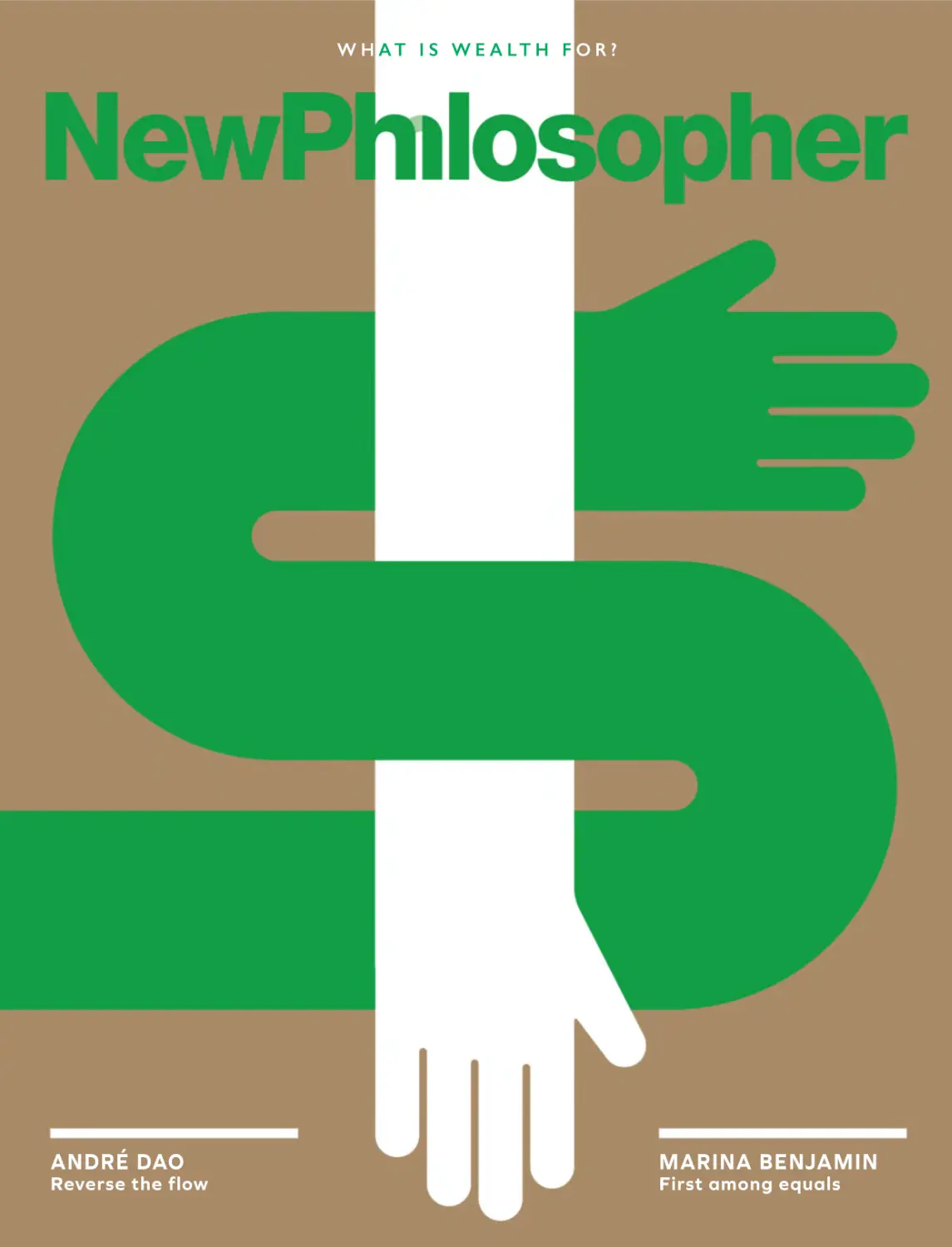
                    W H AT I S W E A LT H F O R ?

ANDRÉ DAO

Reverse the flow

MARINA BENJAMIN
First among equals

Editor-in-Chief
Zan Boag

Editorial Director
Antonia Case

“Few rich men own their property. The property owns them.”
– Robert Ingersoll

Cover Design
Genís Carreras

Editor-at-large

Wealth

Nigel Warburton

Contributors

In contemporary society, it’s all but impossible to operate without money; without joining the game of chasing and building
wealth. Sure, there are a brave few who attempt to operate outside
of the economic system, as well as historical examples like the Iroquois in North America, but a moneyless economy such as a Time
Bank or Core Economy is – at this stage, at least – no more than a
utopian vision. Perhaps the interdependence of the family household is as close as we’ll ever get.
Obtaining money in order to live is serious business: without
money, surviving and thriving is cast adrift. No ticket, no entry;
without money the human essentials of seeking food and shelter
shift from an assumed right to a battle for survival all over the world
– a sobering fact that is brought into stark relief when you consider,
based on research conducted by the World Bank, that 650 million
people live on less than $1 a day and half the world’s population (yes,
that’s right, half ) live on less than $6.85 a day. Even the Temple of
Wealth isn’t immune, with the most recent US Census revealing
that 12.4 per cent of Americans, or 37.9 million people, were regarded as living in poverty in 2022; in the UK 22 per cent live in
poverty, and in Australia it is much in line with the US. In Sub-Saharan Africa the figure is 62 per cent. And while half the world
struggles to survive, the 400 wealthiest Americans boast a combined
$4.5 trillion in wealth – an average of $11.25 billion each.
But what of those who fall in the middle – those who earn enough
to survive but don’t own a football team or a space travel company?
This wealthy majority might be lucky enough to own property and
need not worry about their next meal, but they still face a very real
threat: that the chasing of wealth defines their very existence; that
instead of owning their property, their property owns them.

Mariana Alessandri, Marina Benjamin, Antonia
Case, Samuel Chambers, Tom Chatfield, Myisha
Cherry, André Dao, Tiffany Jenkins, David S.
Oderberg, Philippe Van Parijs, Christopher Spencer,
Patrick Stokes, Nigel Warburton

Illustrators / Artists
Genís Carreras, Russel Herneman, Corey Mohler,
Christopher Spencer

Photographers
Johnny Briggs, Sven Cirock, Gareth Harrison, Carl
Mydans, James Edward Purdy, Kurt Schraudenbach,
Dougie Wallace

Administration
Marnie Anderson, Claudio Faerman

Subscribe
newphilosopher.com/subscribe

Contact
subscribe@newphilosopher.com

Other editions
Korean: Bada
Arabic: Mana
Chinese: CITIC
Digital: Poet Press, Apple iTunes, Google Play,
Amazon Kindle, Zinio, EBSCO, Air France, KLM

Views expressed by the authors are not those
Zan Boag
Editor-in-Chief
New Philosopher

of the publisher. Reproduction in whole or in
part is prohibited.

ISSN 2201-7151 Issue 43, 2024

3

Contents

4

3

Editor’s letter

64 Wealth of philosophers ~ Nigel Warburton

6

Contributors

68 Cautionary tales ~ Christopher Spencer

8

News from nowhere

76 Six thinkers

15

The rich list

78 Cultural capital ~ Tiffany Jenkins

16

Existential Comics ~ Corey Mohler

82 The meaning of wealth

18

First among equals ~ Marina Benjamin

84 Social health is wealth ~ Myisha Cherry

21

Fortunes won and lost

88 Yesterday and today ~ Khalil Gibran

24

What is wealth for? ~ Tom Chatfield

90 What is money? ~ Samuel A. Chambers

28

How rich is too rich? ~ Patrick Stokes

100 Money ~ Émile Zola

34

Wealth and worth ~ Mariana Alessandri

108 The waste land ~ Johnny Briggs

38

Great minds

114 Our library

40

Wealth divides ~ Dougie Wallace

118 The Wealth of Nations ~ Adam Smith

50

Thoughts on... wealth

126 Documentaries

52

Reverse the flow ~ André Dao

128 Subscribe

58

Basic income ~ Philippe Van Parijs

130 13 questions ~ Justin Weinberg

– 68 –

– 64 –

– 52 –

ART
Cautionary tales

RICHES
Wealth of philosophers

EQUALITY
Reverse the flow

Christopher Spencer

Nigel Warburton

André Dao

– 40 –

Wealth

PHOTOGRAPHY

Wealth divides
Dougie Wallace

– 18 –

FAMILY
First among equals

Marina Benjamin

– 24 –

– 78 –

– 16 –

WEALTH
What is wealth for?

FOOD
Cultural capital

COMIC
Texas Hold’em

Tom Chatfield

Tiffany Jenkins

Corey Mohler

5

Contributors

Contributors
Philippe Van Parijs

Nigel Warburton

Antonia Case

Philippe Van Parijs is Professor at the
University of Louvain and Director of
the Hoover Chair of Economic and
Social Ethics. He has been a Visiting
Professor of Philosophy at Harvard
University and at Oxford University.
He is a member of the editorial boards
of many international journals, including Journal of Political Philosophy and
Philosophy & Public Affairs and is the
author of 19 books. In 2001, he was
awarded the Francqui Prize, Belgium’s
most generous scientific prize.

Nigel Warburton is a freelance philosopher, podcaster, writer, and the
Editor-at-large of New Philosopher.
Described as “one of the most-read
popular philosophers of our time”, his
books include A Little History of Philosophy, Thinking from A to Z, and Philosophy: The Classics. The interviewer for
the Philosophy Bites podcast, Warburton was previously Senior Lecturer
in Philosophy at the Open University
and Lecturer in Philosophy at Nottingham University.

Antonia Case is Editorial Director of
New Philosopher, was Founding Editor
of Womankind, and is an award-winning writer and journalist. She is the
author of Flourish, on personal identity and change, published by Bloomsbury. She was the winner of the 2013
Australasian Association of Philosophy Media Professionals’ Award and
in 2016 was shortlisted for Editor of
the Year. Case was selected as ‘philosopher in residence’ for the 2016 Brisbane Writers’ Festival.

Samuel A. Chambers

Myisha Cherry

Tiffany Jenkins

Samuel A. Chambers is Professor of
Political Science at John Hopkins, coEditor-in-Chief of the journal Contemporary Political Theory, and is series
co-editor of Routledge’s Innovators in
Political Theory. He has authored eight
books and published three dozen journal articles and has published three
related books on capitalism, money,
and political economy: Money Has No
Value, Capitalist Economics, and There is
No Such Thing as “The Economy”: Essays
on Capitalist Value.

Myisha Cherry is Assistant Professor of Philosophy at the University of
California. Cherry is the co-editor of
The Moral Psychology of Anger, and has
written about emotions, race, and state
violence in Hypatia, Radical Philosophy
Review, Critical Philosophy of Race, the
Los Angeles Times, Salon, and the Huffington Post. Cherry is the host of the
UnMute Podcast and the author of The
Case for Rage.

Tiffany Jenkins is an author, academic,
and broadcaster. Her books include
Keeping Their Marbles and Contesting Human Remains in Museum Collections, and she has written for The
Observer, the Financial Times, The
Scotsman, and The Spectator. She is an
Honorary Fellow at the University of
Edinburgh and a former visiting fellow at the London School of Economics. Jenkins holds a BA in art history and a PhD in sociology.

Patrick Stokes

Mariana Alessandri

Marina Benjamin

Patrick Stokes is Associate Professor
in philosophy at Deakin University,
Melbourne. He specialises in 19th and
20th century European philosophy,
personal identity, narrative selfhood,
moral psychology, and death and remembrance. Stokes is the author of
Digital souls: a philosophy of online
death, The naked self: Kierkegaard and
personal identity, and Kierkegaard’s
mirrors. In 2014 he was awarded the
AAP Media Prize.

Mariana Alessandri is an Associate Professor of Philosophy at the
University of Texas Rio Grande Valley, where she focuses on MexicanAmerican studies and gender and
women’s studies. Alessandri’s essays
have been published in The New York
Times and Womankind. Her book,
Night Vision: Seeing Ourselves Through
Dark Moods, is out now with Princeton University Press.

Marina Benjamin is a writer and editor. As a memoirist, she is best known
for The Middlepause, which offered
a poetic and philosophical take on
midlife. Benjamin is also the author of
Insomnia and her new memoir A Little
Give. She was arts editor of the New
Statesman and deputy arts editor at
the London Evening Standard, and is a
senior editor at Aeon. Her book Rocket
Dreams was shortlisted for the Eugene
Emme Literature Award.

6

Contributors

Tom Chatfield

André Dao

Zan Boag

Dr Tom Chatfield is a British author
and philosopher of technology, with a
special interest in critical thinking, AI
and ethics. His most recent book, Wise
Animals, explores the co-evolution of
humanity and technology, and what
the present might learn from our deep
past. His other books exploring digital
culture and critical thought are published in over thirty languages.

André Dao is a Melbourne-based
writer, editor, and artist. His debut
novel, Anam, won the 2021 Victorian Premier’s Literary Award for an
Unpublished Manuscript. He is also
the co-founder of Behind the Wire, an
award-winning oral history project
documenting the stories of the adults
and children who have been detained
by the Australian government after
seeking asylum in Australia.

Zan Boag is Editor-in-Chief of New
Philosopher, published in English, Arabic, Korean, and Chinese, and was
Editorial Director of the international
magazine Womankind. In 2017 he won
the Australasian Association of Philosophy Media Professionals Award and
was shortlisted for Editor of the Year
in the Stack Awards. Boag was a judge
at the AOI World Illustration Awards
and is the host of the philosophical discussion series Bright Thinking.

Russel Herneman

David S. Oderberg

Genís Carreras

Russel Herneman is an award-winning
cartoonist whose work has appeared in
The Times of London, Private Eye, Prospect, The Spectator, and many others.
He was awarded Pocket Cartoon of
the Year 2018 in the Political Cartoon
Awards, the 2020 European Newspaper Design award for illustration,
and the 2021 Society of News Design
Award of excellence for Illustration.

David S. Oderberg is Professor of Philosophy and Head of the Philosophy
Department at the University of Reading, UK. He has published over thirty
academic papers, edited five books,
and has authored five books, including
Real Essentialism, Applied Ethics, Moral
Theory, and The Metaphysics of Identity
over Time. His most recent book is The
Metaphysics of Good and Evil. Oderberg
was appointed editor of Ratio in 2012.

Genís Carreras is the cover designer
of New Philosopher magazine and the
creator of Philographics: Big Ideas in
Simple Shapes. Carreras’s work has been
recognised in the AOI World Illustration Awards, the Laus Awards, and the
Stocks Taylor Benson Awards, and his
work has been featured in the books
MIN: New Simplicity in Graphic Design,
Playing with Type, Geometry Makes Me
Happy, and Geo/Graphics.

Subscribe at
newphilosopher.com

newphilosopher.com is an online portal for
exploring philosophical ideas on ways to live a more
fulfilling life. Read the articles, join in discussions,
and watch free online documentaries.

7

News from nowhere

The way
to wealth
“Pride is as loud a beggar as want, and a great deal more saucy. When you have bought
one fine thing, you must buy ten more, that your appearance may be all of a piece; but…
It is easier to suppress the first desire, than to satisfy all that follow it. And it is as truly
folly for the poor to ape the rich, as for the frog to swell, in order to equal the ox.”

Benjamin Frankl in, by Joseph-Siffred Duplessis, 1785 + l ibrary background

– Benjamin Franklin, The Way to Wealth

Benjamin Franklin, one of the founding fathers of the United States, was
the 15th of 17 children, and left school at age 10. His father was a soap and
candle maker.
Despite his lack of formal education, Franklin was an avid reader, and spent
much of his spare time satisfying his appetite for books. At age 23, Franklin bought
the popular newspaper The Pennsylvania Gazette, and some years later published
a yearly almanac, called Sir Richard’s Almanack, under the pseudonym of ‘Poor
Richard’ or ‘Richard Saunders’, which continued for 25 years.
Franklin, a political philosopher, writer, scientist, inventor, statesman, diplomat,
printer, and publisher, was particularly fascinated by the topic of wealth, so much
so that he collated material from his Almanack and published it as the essay, The
Way to Wealth.
In this essay, Franklin, through the character Father Abraham, offers a crowd
of people some financial advice. “Pray, Father Abraham, what think you of the
times? Will not those heavy taxes quite ruin the country! How shall we be ever
able to pay them?”
Father Abraham stands up, and replies, “If you would have my advice, I will give
it to you in short.” The crowd gather around him. “Friends,” he continues, “the taxes
are indeed very heavy; and, if those laid on by the government were the only ones
we had to pay, we might more easily discharge them; but we have many others, and
much more grievous to some of us. We are taxed twice as much by our idleness,
three times as much by our pride, and four times as much by our folly; and from
these taxes the commissioners cannot ease or deliver us by allowing an abatement.”
The way to wealth, according to Franklin, is to take personal responsibility
for our lot (“God helps them that help themselves,” he writes), and to use our
time wisely (“If time be of all things the most precious, wasting time must be the
greatest prodigality.”)
Let us be up and doing, urges Franklin, and “doing to purpose”.

9

News from nowhere

What makes one wealthy?
From the late 1940s onwards, the tool most used
to measure national wealth has been Gross Domestic
Product (GDP), the brainchild of Belarus-born Simon
Kuznets. GDP adds up how much we spend on items like
cars and couches, and then adds on top how much the
government and business spend each year. When GDP is
divided by the population, you arrive at a GDP per capita
figure, which is used to assess the economic prosperity of
the average person in a given country.
Underpinning this analysis of wealth is the feeling
that it is ultimately tied to how much we’re all producing
and spending each year. A populace that’s shopping a lot
is healthier, in economic terms, than one that’s reading
Chaucer at home by the fire. A person who buys widgets
to resell to someone else has a higher economic wellbeing than another who volunteers or learns French culinary techniques at home. The problem is, when ‘wealth’
is measured for us, by way of GDP, it influences our
behaviours, goals, even our perception of happiness.

In his seminal work, Development as Freedom, economist and Nobel laureate Amartya Sen argues against using GDP as the primary measure of prosperity. Instead,
he likes to view wealth in terms of an expansion of freedoms and capabilities. We are wealthy, argues Sen, not
when we are driving the latest SUV, but when we have
the freedom to pursue the life that we value. A person, in
theory, could have $50 million in their bank account but
lack the freedom and capability to live the life of their
choosing (think celebrities, criminals, and high-profile
politicians or CEOs, whose daily lives are curtailed by the
demands and restrictions of their jobs). A person living in
poverty, by contrast, may have significantly more freedom
to pursue a life they have reason to value (provided social
infrastructure such as healthcare and education exist to
enhance these capabilities).
Sen’s capabilities approach shifts the focus from mere
resource ownership or income levels to what individuals
can do or be – essentially, their freedom to be happy.

“See, a rising tide lifts all boats.”
10

News from nowhere

La monnaie, by Master of Aristotle’s Ethics, 1455

“Most people have a price. And they have a price because of human emotions named fear
and desire. First, the fear of being without money motivates us to work hard, and then once
we get that pay cheque, greed or desire starts us thinking about all the wonderful things
money can buy. The pattern of get up, go to work, pay bills, get up, go to work, pay bills is
then set. Their lives are then run forever by two emotions: fear and greed. Offer them more
money, and they continue the cycle by also increasing their spending.
This is what I call the Rat Race.”
– Robert Kiyosaki and Sharon Lechter

11

News from nowhere

Why wealth corrupts
When construction entrepreneur
Jack Whittaker won the record-breaking $315 million Powerball jackpot on
Christmas night in 2002, the largest
undivided lottery jackpot in history,
Whittaker became an instant celebrity in West Virginia for the pot of
gold that had landed upon his doorstep. Whittaker vowed at once to be a
good example of what happens when
someone comes into riches. “I want to
promote goodwill and help people,” he
said to a television interviewer, adding
that he intended to spend more time
with his family and live as if nothing
much had changed. But just one week
later, Whittaker was found propped
up at the bar of a nearby strip club, the
Pink Pony, with $50,000 at the ready.
The decades following Whittaker’s
Powerball win were nothing short of
tragic: Whittaker fell victim to drinking and gambling; his wife left him;
he was burgled, sued, and the friend
of his drug-addicted granddaughter
was found dead at his home. Whittaker’s own daughter died of cancer,
his home was set alight, and the body
of his beloved granddaughter, age 17,
was found wrapped in a plastic tarp
and dumped behind a van.
In the poem The Deserted Village,
poet Oliver Goldsmith describes a

rural village, Auburn (Sweet Auburn,
loveliest village of the plain), a place
where villagers lived in harmony with
each other and nature, a joyful flourishing community with simple wants.
(His best companions, innocence and
health; And his best riches, ignorance of
wealth).
But economic forces and the
pursuit of wealth changed the landscape: the children left the land, and
community values of simplicity and
honesty turned to greed and vanity
(Where wealth accumulates, and men
decay). Eventually, the village became
deserted (And half the business of destruction done; Even now, methinks, as
pondering here I stand, I see the rural
virtues leave the land).
Does wealth corrupt? Are wealthy
people more unethical than the poor?
Social psychologist Paul Piff at
the University of California, Berkeley,
paired with other academics at the
University of Toronto to study the effects of wealth on behaviour. The researchers sought to uncover a picture
of how wealth shapes us. “Lower-class
individuals live in environments defined by fewer resources, greater threat,
and more uncertainty,” the study notes.
“It stands to reason, therefore, that
lower-class individuals may be more

motivated to behave unethically to
increase their resources or overcome
their disadvantage.”
But the results proved otherwise.
In the paper titled Higher Social Class
Predicts Increased Unethical Behaviour,
the academics showed that upperclass individuals behave more unethically than lower-class individuals; the
wealthy set were more likely to break
the law while driving, take valued
goods from others, lie in negotiation,
cheat to increase their chances of winning a prize, and endorse unethical behaviour at work.
And driving the behaviour of the
wealthy is a penchant for greed. “Research finds that individuals motivated
by greed tend to abandon moral principles in their pursuit of self-interest.”
As happened in the deserted village in Goldsmith’s poem, wealth can
have a distancing effect on people, in
that self-reliance breeds indifference
towards others. While the poor person
may, at some point, need the help of a
kind aunt, or uncle, friend or neighbour, the wealthy can always buy, or
outsource, help. This isolation (power
and autonomy over their environment)
augments self-centred behaviours in
the rich, like greed – and reduces altruism and generosity.

“Wealth doesn’t confer automatic happiness, whereas people who are not wealthy but very
much want to be, believe it will confer almost automatic and unrelieved happiness. This is not
true. Part of the reason is that to get the wealth you have to behave in a way that will definitely
not make you happy. It’s a beautiful circularity.”
– Felix Dennis
12

Famous currency symbols, by Satheesh Sankaran

News from nowhere

THE STATUS GAME

I

n western capitalist culture, status is determined by
the individual possession of high-value items such
as luxury cars, boats, and property – by one’s lifestyle choices (regular travel and membership in exclusive sports clubs); one’s network or social connections;
educational achievements (elite education, career, and
public recognition), all of which require the spending
of cash. At its heart, therefore, status is mostly about
spending dollars on oneself – either money made centuries ago by one’s ancestors and passed on via inheritance, or money made today.
Not all cultures, however, were so motivated. In ancient Inuit culture, status was determined not by how
much you spent on yourself, but by how much you gave
away to others. Inuit potlatches were elaborate ceremonies in which those who gifted the most – gold, animal
skins, and other riches – gained most in social standing.
Generosity trumped egoism in the status game.

“Money never made a man happy yet, nor will
it. There is nothing in its nature to produce
happiness. The more a man has, the more
he wants. Instead of its filling a vacuum, it
makes one. If it satisfies one want, it doubles
and trebles that want another way. That was
a true proverb of the wise man, rely upon it:
‘Better is little with the fear of the Lord, than
great treasure, and trouble therewith.’”
– David Alfred Doudney

Car crash, Mona, Tasmania, by Gareth Harrison

“Happiness, whether consisting in pleasure or virtue, or both, is more often found with those
who are highly cultivated in their minds and in their character, and have only a moderate
share of external goods, than among those who possess external goods to a useless extent
but are deficient in higher qualities.”
– Aristotle
14

NewPhilosopher

The Rich List

The Rich List
1087

#9: William The
Conqueror, King of
England

1967

1918

#8: Mir Osman Ali Khan,
Indian royal

#7: Nikolai Alexandrovich
Romanov, Tsar of Russia

$230 billon

$300 billon

$229.5 bi llon

1937

#6: John D Rockefeller, US
business magnate
$341 bi llon

1085

1919

1605

#5: Andrew Carnegie,
Scottish-American
industrialist

#4: Akbar I, emperor
of India’s Mughal
dynasty

$372 billon

I m m ea s u ra ble wealt h

14

1337

#3: Zhao Xu, emperor
Shenzong of Song in China

#2: Augustus Caesar,
Roman emperor

#1: Mansa Musa, King of
the Mali empire

I m me asurable we alt h

$4.6 trillion

I m m ea s u ra ble wea lt h

21st century

#1: Bernard Arnault and family, $229.1
billion. Arnault is a French businessman, investor, and art collector. He is the
founder, chairman, and CEO of LVMH,
which is the world’s largest luxury goods
company.

#2: Elon Musk, $208.6 billion. Musk is
the founder of SpaceX, CEO of Tesla,
owner of X Corp, founder of the Boring
Company and xAI, and co-founder of
Neuralink and OpenAI.

#3: Jeff Bezos, $195.7 billion. Bezos is the
founder, executive chairman, and former
president and CEO of Amazon, which is
the world’s largest e-commerce and cloud
computing company.

Source: Forbes

15

16

Greek Hold’em

17

Author/illustrator: Corey Mohler, Existential Comics. For more comics visit existentialcomics.com

First among equals

by Marina Benjamin

First among
equals

Few things divide families so much
as an unequal skew of wealth among its
different members. Whether caused by
a divisive matriarch or patriarch leaving
everything to a favoured child, while
snubbing the rest, or by one family
member striking out to make piles of
money, and succeeding, the less fortunate siblings – who are either disinterested or incapable of accruing personal
wealth – are left rumbling with barely
disguised envy and dissatisfaction. No
one wants to be the poor relative, the
hanger-on, the one who can’t keep up
or pay their way; and while generosity
is what you might expect from family
members who do have resources, it’s
often the case that wealthy people are
least generous towards those whom
they are closest to.
My father was obsessed with money, yet almost singularly incapable of
making it. Whatever he did make he’d
instantly spend, frittering it on lavish
clothing and holidays, or sacrificing it
to the gods of chance at the Roulette
18

wheel. His sister, meanwhile, married
a wealthy man and thereafter took the
greatest delight in parading her newfound means in front of my father. The
two of them had been extremely close,
but competitive as children, and so a
dynamic was already in place for my
aunt to exploit. It was like wielding a
cattle prod. Each time she boasted of a
new car, new jewellery, a house extension and, because they had the space, a
swimming pool, a startling zing of envy
made my dad wince.
Growing up in London, I watched
all this with a certain aloofness and, I
might add, no fondness for my aunt.
Then as now, money felt to me like an
abstract thing, its hoarding seemingly
as empty as hoarding sand; though I
now see that behind my aunt’s ostentatious displays there was something
genuinely nasty at work: she enjoyed
making my father suffer. Her desire to
push him down, to treat him with pity
and scorn, was her true aim in showing
off. The calculation she made was that

her wealth, somehow, and mysteriously,
increased her own inherent value.
At the time, Ali Baba and the Forty
Thieves was a favourite book, and I
owned a beautiful, large-format edition, richly illustrated to bring the
story’s characters to life. On one page
there was skinny Ali Baba, with his thin
wispy beard, his body bent in humility, as befits a man who spends his days
chopping and selling wood. Across the
opposite page strode his be-turbaned
brother Cassim, whose sumptuous
robes barely covered his well-fed belly.
Cassim cares only for money, and when
his clever wife correctly deduces that
Ali Baba has stumbled into unimaginable riches, she taunts him, saying (in
Richard Burton’s sonorous translation):
“O man, thou deemest thyself a wight of
wealth and substance, but lo, thy brother
Ali Baba is an Emir by the side of thee
and richer far than thou art. He hath such
heaps of gold that he must needs weigh his
moneys with scales, whilst thou, forsooth,
art satisfied to count thy coin.”

New Philosopher + Patten

First among equals

Cassim rages with envy. Being financially usurped by his wood-cutter
brother is not something he can long
endure, and so he sets about steeling
Ali Baba’s gold, only to meet the kind
of grisly comeuppance that fairy tales
delight in: he gets captured and killed,
his body quartered and pinned to the
walls of the robbers’ cave.
*
The American sociologist and
Princeton professor Dalton Conley
has made a career-long study of how
health and socioeconomic wellbeing
are transmitted down the generations,
famously making a link between birth
weight and life chances. It’s a variation
of the adage that money begets money.
For if you already have advantages in
life (birth weight being a relatively uncontroversial signifier) then you will
likely receive lifelong dividends.
In his book The Pecking Order, Conley studied within-family socioeconomic disparities, when one member’s
soaring wealth cannot be attributed to
social advantage. To the non-wealthy
members, the rich sibling’s success
feels like a judgement on their intelligence or drive. The sense of failure cuts
deep, even when the grudging sibling
attempts to shrug it off by dismissing
their wealthy sibling as a workaholic or

20

as someone who, in treasuring money,
has allowed their values to become tarnished and distorted.
Sociologists don’t always agree on
the life choices that give different family members a better shot at success,
though most agree that college matters. Almost everywhere, people with
degrees earn more than those without
them. Yet this kind of measure feels
too easy. Of course we have metrics for
ranking individual life chances, because
we know how modern capitalist societies work: we know what choices are
rewarded. At the same time, we now
know such measures are skewed to favour educated white men, since gender
and racial pay gaps persist in modern
societies, regardless of legal structures
put in place to ensure equal pay for
equal work.
Just a few months back, the
Guardian reported on yet another social disparity that dents women’s ability to generate wealth – the so called
‘gender tenure gap’, whereby women
last an average of 5.2 years as chief
executives compared to 8.1 years for
men. Corporate wisdom has it that
women executives face a ‘glass cliff ’ in
being set up to fail. There is a tendency, for example, to appoint women to
executive roles in times of crisis, and
so their position is more precarious
than their male counterparts.

In societies like ours, where money
matters, disparities in wealth within
families can undermine relationships,
loyalties, and self-worth. It makes
sense therefore that among ‘crossclass siblings’ friendships might trump
blood relationships – though this is in
any case true in an increasingly splintered world where people migrate for
work opportunities, and form elective
‘families’ made up of like-minded (and
similarly bankable) souls. Then again,
perhaps it was ever thus. Transport Ali
Baba and Cassim into today’s world
and you can bet they’d move in different social circles, have different priorities, values, and beliefs. It is unlikely
they’d see eye to eye on any number of
matters, from who to choose for a wife
to which political party to vote for.
That siblings differ profoundly is
not news. But when these relationships
sour and blood ties fray our curiosity is
kindled. And financial inequality is a
common cause. When I think back on
my father and his sister, on their warped
love-hate, and how their childhood rivalries played out in later life, I wonder
at their parents, who sowed discontent
between them, encouraging mutual suspicion instead of kinship and unconditional support. I wonder, too, whether if
genuine love had existed between them
the disparity in their relative wealth
would have mattered at all.

LARA AND ROGER
GRIFFITHS: $2.76M

B I L LY B O B H A R R E L L :
$31M

In 2005, this British couple won a $2.76
million lottery jackpot, after which they
did what many lottery winners do: they
bought a Porsche and went on luxury
holidays. Five years later, their underinsured house caught on fire, and media
reports suggest their 14-year marriage
broke down shortly thereafter.

While working at a department store,
Billy Bob Harrell scooped a $31 million
prize in a Texas lottery. After spending
his money on property, cars, requests
from others, and turkeys for the poor,
Harrell opted for a lump sum payout
rather than annual payments – leaving
him with much less money. Just before he
died, he said “winning the lottery is the
worst thing that ever happened to me”.

FORTUNES
WON & LOST
A m e r i c a n s s p e n d $ 7 3 . 5 b p . a . o n l o tt e r y
t i c ke t s i n t h e h o p e o f h a v i n g a b e tt e r
life. 70% of people who suddenly receive a windfall of cash will lose it within a few years, according to the National Endowment for Financial Education.

SUZANNE MULLINS:
$4.2M
In just over 10 years, Suzanne Mullins
went from $4.2 million lottery winner
to penniless, with a loan company filing a suit for $154,000 against the then
broke Mullins. After splitting the original annual payment three ways with her
husband and daughter, Mullins ended up
spending $1,000,000 on her uninsured
son’s medical bills.

ALEX AND RHONDA
TOTH: $13M

BUD POST:
$16.2M

In 1990, Alex and Rhonda Toth won $13
million in Florida, USA. 15 years later, the
money ran dry after some excessive spending and gambling, including a three-month
trip to Las Vegas. Eventually they were
undone by a tax evasion investigation by the
IRS that claimed they owed $2.5 million
in taxes, with Rhonda going to jail for two
years and Alex dying before the trial began.

William ‘Bud’ Post struck it rich in 1988
with a $16.2 million win in the Pennsylvania lottery. But the euphoria didn’t last
long: his girlfriend sued him for a third of
his winnings, his brother was arrested for
reportedly hiring a hitman to kill him, and
Bud went to jail for firing a gun after a
visit by a debt collector. He was $1 million
in debt within a year.

Online

newphilosopher.com is an online portal for
exploring philosophical ideas on ways to live a more
fulfilling life. Read the articles, join in discussions,
and watch free online documentaries.

Online at
newphilosopher.com
Deep distraction
In February 2023, Australia’s
corporate regulator came
under fire for hiring a bunch
of robots. You might be
envisioning a Robocop-type
scenario or an army of droid
soldiers right now...

Work less, live more
Why do we work so much?
Why do we even work at all?
For a great chunk of human
history it was a simple
matter of survival. We
needed every able-bodied
person working every day...

New Philosopher
back issues
Missing any New Philosopher back issues? Get your
copy of one of the back issues still in stock, from
‘Health’ to ‘Life’ to ‘Space’.
Back issues
of New Philosopher and
Womankind
delivered
worldwide.

Some back issues are sold out
(issues 1-6, 12, 15) however
many still remain, plus digital
back issues are available from
issue 19-42. Visit:
newphilosopher.com/shop

Subscribe now

newphilosopher.com/
shop/

Delivered to your door

Online store
Visit the online store for
previous issues of New
Philosopher and Womankind
magazine, subscriptions, and
gift ideas.

New Philosopher China
The Chinese version joins
the Arabic, Korean, and
English language versions of
New Philosopher magazine,
the world’s most widelydistributed philosophy
magazine.

22

To receive your copy of the beautifully-designed,
132-page print version of New Philosopher delivered
directly to your door, subscribe now at:
www.newphilosopher.com/subscribe

Subscribe

newphilosopher.com/subscribe/

23

What is wealth for?

by Tom Chatfield

What is
wealth for?

My children are eight and ten years
old, and have very different attitudes
towards money. My daughter, eight,
spends it almost as soon as she gets
it – usually on soft toys, a menagerie
of which are strewn across her room
(and half the house). My son, ten, likes
to save it up. One of his few recent
purchases was a stainless steel safe of
the kind found in hotel bedrooms,
purchased with parental assistance at
a bargain price. He is very proud of
it, and keeps precious things inside: in
particular, a handful of rare Pokémon
cards gleaned from swaps and birthday gifts, their resale value testifying to
their desirability.
Which of my children gets more
pleasure out of their money? I’m not
sure. My daughter enjoys her wealth of
fluffy companions; my son enjoys the
thought that, when the right occasion
arises, he’ll have enough money to treat
himself or others to their heart’s desire.
The minutiae of income and expenditure are, for both of them, pretty
hazy. We are lucky enough not to lack
life’s essentials, and vagueness is one
of the luxuries that comes with this.
On the other hand, they are both clear
24

about the significance of stuff. Having
stuff is good, and lacking stuff is bad.
Although one is a spender and one is
a saver, they would both agree with the
maxim that more is better – and that
this flavour of ‘better’ doesn’t have an
upper limit. There is no such thing as
too many soft toys. The latest pack of
Pokémon cards is always worth purchasing (or asking your granny to buy
for your birthday).
I don’t write these words with particular pride. My wife and I expend a
lot of effort preaching the lesson of
sufficiency: that, once your basic needs
are met, acquiring more and more of
anything tends to bring diminishing
returns. Life isn’t about stuff or money
– it’s about the experiences that these
enable. I don’t (often) quote Aristotle
at my children, but his claim in the
Rhetoric that “being wealthy consists
rather in use than in possession” is
more-or-less the message we want
to convey. For Aristotle, wealth becomes “pointless” when treated as an
end rather than a means. Ceaseless
accumulation is a distraction from
those things that ultimately make
life worthwhile, from love and social

connection to self-expression and aesthetic appreciation.
It’s at this point that I glance at the
seas of stuff filling my office and home
and realise that I’m not a very good
Aristotelian. Much of what I own is
indeed pointless, in the sense that I
make no use of it. I’m not fantastically
wealthy, but I do have more possessions
than I can conceivably put to some purpose: unread boxes of books in my loft;
kitchen cupboards groaning with gadgets and crockery; gifts and novelties and
knick-knacks gathering dust on shelves.
At the very least, I’m a hypocrite. Despite regular trips to the charity shop, I
don’t even have the time or the will to
give away everything I don’t regularly
use. No wonder my children are bewildered when I say that having enough is
all that matters.
The trick, I think, is realising that
there is a precipitous divide between, on
the one hand, the values and purposes
aligned with a fulfilled life – and, on the
other hand, your present options and
desires. To put it in less grand terms:
spending all your pocket money on
sweets, then eating them in a single
sitting, won’t make you nearly as happy

What is wealth for?

as you thought it would. But it’s hard
to believe this when standing in a sweet
shop clutching a five-pound note.
In this sense, Aristotle’s definition
of wealth isn’t as platitudinous as it
might seem. He deplores the category
error of conflating acquisition with purpose. Deriving lasting satisfaction from
confectionary means learning to savour
and share it, not amassing a houseful.
But if you can transcend the limitations
of the moment and devote your wealth
to a fine purpose, there’s nothing inherently wrong with having a great deal
of something. Indeed, there may even
be a strong case for amassing as much
wealth as possible – so long as you possess a sufficiently beneficent purpose,
plus the clarity of mind to pursue it.
At this point, we start to leave Aristotle behind and head in the direction
of movements like longtermism and effective altruism, which make the case
for precisely this kind of consequentialism: for a rigorous devotion to high impact purposes. Consider my attempts to
educate my children about insufficiency.

I’m not sure how, precisely, they ought
to spend their money; indeed, it’s partly
by allowing them to spend (or hoard) it
unwisely that I hope they’ll find their
way towards wiser purposes. I do, however, have a high degree of confidence
that lacking basic necessities presents
a profound obstacle to human thriving, aspiration, and wellbeing; and that
many millions of children and families
across the world face such a lack. One
of the most important purposes I might
pursue with what wealth I possess, then,
is the redress of this lack. Similarly, persuading others to do the same might
be among the best possible uses of my
time and aptitudes.
This is the flip side of equating
wealth with the use of something.
You cannot, by definition, make use of
something that you don’t have; and this
means that many forms of purpose and
thriving are denied to those who are
destitute. In fiscal terms, several billion
of the world’s population are negatively
wealthy, because their debts exceed the
total worth of all their possessions –

while the world’s richest one per cent
possess almost half of all its wealth.
What are we to make of statistics like
this; or their repetition, to little avail,
across countless calls to action? Rather
than focusing on inequality, I would
suggest it’s worth asking how much
of the wealth that’s out there is, in Aristotle’s terms, “pointless”: the fourth
and fifth homes; the superyachts, gigayachts and private islands; the space
tourism and survivalist bunkers; the
gilded steaks and beefburgers.
As more and more stuff is piled
up by the hyper-rich, something both
tragic and bathetic creeps into the
picture. Like teddies strewn around
a child’s bedroom, such consumption bears witness to the puerility of
those for whom the whole world is a
toyshop. What is all that wealth for?
What purposes does it serve? Perhaps
the most important feature of endless
accumulation – whether of wealth,
influence, information, or power – is
that you never need to pause and at-

Rather than focusing on inequality, I would
suggest it’s worth asking how much of the
wealth that’s out there is, in Aristotle’s
terms, “pointless”.

26

Map of poverty in London, 1898-1899

“As a general rule, nobody has money
who ought to have it.”
Benjamin Disraeli

27

How rich is too rich?

by Patrick Stokes

How rich is
too rich?

To many basketball fans, Wilt
Chamberlain was one of the greatest
players of the 20th century. To others, Chamberlain is better remembered for his claim to have slept with
twenty thousand women. (The figure
seems impossible, but Chamberlain
insisted that he’d used quite conservative assumptions in arriving at that
estimate). Among philosophers, however, Wilt Chamberlain is best known
for something he never actually did.
In his 1974 book Anarchy, State,
and Utopia, the libertarian philosopher Robert Nozick proposed what’s
known as the ‘ Wilt Chamberlain
Argument’, a simple but ingenious
rejoinder to the idea that economic
justice is a matter of how wealth is
distributed within a society. For example, many of us would assume that
a society where everyone has moreor-less equal amounts of wealth
would be better than a society with
greater inequality. Arguments about
economic justice tend to start from
28

the intuition that inequality is bad in
itself, and then either try to justify
that intuition or show why at least
some kinds of inequality are in fact
acceptable.
So, imagine that we’re living in a
society with an equal distribution of
wealth. It’s a ‘nearest possible world’,
in philosophical parlance: everything
in this world is the same as our world,
except that everyone has the same
amount of money, plus whatever other
differences that necessarily follow from
that one change. So in this world, as in
ours, Wilt Chamberlain is a talented
basketball player, with many teams
vying to sign him up. Imagine that
Chamberlain strikes a deal with one of
these teams whereby at every game he
plays, each spectator must put twentyfive cents into a bucket; at the end of
each game, Chamberlain gets to take
the bucket of coins home. Over the
course of a season, one million people
gladly pay a trivial amount each to see
the legendary Wilt Chamberlain play.

They have a great time and go home
only twenty-five cents poorer than
they came in. A bargain in any world,
imaginary or not.
Yet by season’s end this means
Chamberlain is now $250,000 richer
than everyone else in this egalitarian
society. There has been no coercion,
no extortion, and no unfairness: the
spectators are all very happy with the
deal and were each more than happy
to hand over their quarter-dollar. For
Nozick, there are three ways in which
a transfer of property can be just: if
something unowned is appropriated
in a way that does not disadvantage
anyone else, if a past injustice is redressed (say, stolen property being
returned), or if there’s a voluntary
transfer between the parties involved.
The first two conditions don’t apply
to the Wilt Chamberlain thoughtexperiment, and the third seems to
be clearly satisfied. Each individual
twenty-five cent transaction is, therefore, perfectly just. Yet the net effect

How rich is too rich?

of all these tiny exchanges is that one
person has gotten drastically richer
than everyone else. Our equal distribution of wealth has been spoiled.
For Nozick, that’s not actually a
problem. He insists justice is found
in the individual exchanges, not in
the resulting pattern of distribution.
Provided the transactions are freely
made (and nobody’s trading anything
they don’t rightly own), then Wilt
Chamberlain is morally entitled to
all of his newfound wealth. The only
way to stop inequality arising would
be to coercively interfere in people’s
freedom to spend twenty-five cents,
which seems intolerable. You and I
may not like the look of an unequal
society, but the alternative would be

worse. (In fact, says Nozick, this argument applies to any distribution you
happen to prefer, not just egalitarianism: if you think only left-handed
hazel-eyed philosophers should be
fabulously rich, the Wilt Chamberlain
Argument eventually screws up your
preferred distribution of goods too.)
Nozick’s argument is powerful
because it builds from simple premises about everyday behaviour, rather
than starting from complex distributions of wealth across society and
working backwards. It appeals to
basic principles of liberty and noninterference that are intuitively hard
to disagree with. Who could begrudge
someone paying twenty-five cents to
see a basketball game? It also seems

hard to deny that the imaginary version of Wilt Chamberlain has earned
his money fair and square. Across the
season he’s effectively entered into one
million individual contracts, and he’s
satisfied every single one of them. If
we accept that people have an entitlement to be compensated for their
labour, then it seems Chamberlain
deserves every cent he gets, however
we might feel about the resulting inequality.
Yet the Wilt Chamberlain Argument can seem to justify some pretty
absurd conclusions, not least because
the argument, by its nature, contains
no in-built limits on accumulation.
If wealth is justly held so long as it
results from free, voluntary exchange,

“It turns out you can take it with you.”

30

How rich is too rich?

In 2022, the
world’s thenrichest person,
Elon Musk, was
worth an estimated US$219
billion. To accrue
that sort of money, an average
American wage
earner would
need to work
about three million years.

then you can never make it unjust
simply by quantity alone. In other
words, there’s no limit to how rich
you can legitimately get.
In 2023, Forbes magazine identified 2,640 billionaires across the
world, with a collective wealth of
US$12.2 trillion. This vanishingly
small percentage of the world’s eight
billion people own nearly two-anda-half times the GDP of the world’s
third largest economy, Japan. They’re
getting wealthier, too: a 2024 Oxfam report noted that America’s billionaires alone are about 46 per cent
richer than they were four years ago.
Barring unforeseen catastrophes, the
first US-dollar trillionaire will probably emerge within the next decade.
If these numbers seem so large as
to be meaningless, they become even
harder to grasp if we try to translate them back into labour value. In
2022, the world’s then-richest person,
Elon Musk, was worth an estimated
US$219 billion. To accrue that sort
of money, an average American wage
earner would need to work about
three million years (and never spend
anything). Is there really anything a
person can do in the space of a single career that would be equivalent
in value to three million years of
uninterrupted human labour? Even
if we accept Nozick’s premises, this
outcome still seems perverse. Nor is
it clear what even the most profligate
billionaire could actually do with that
sort of money (even if, as in Musk’s
case, most of that wealth is tied up
in shares and illiquid assets) across an
average human lifespan.
Assume, for the moment, that all
this existing wealth meets Nozick’s
criteria for economic justice: that is,

that every billionaire has what they
have as the result of historically legitimate possession followed by voluntary transactions. That is, to put it
very mildly, a deeply improbable assumption in a world shaped by the
ongoing legacies of colonialism and
pervaded by economic power imbalances. But for the sake of argument,
let’s assume it anyway. We’re still left
with accumulations of wealth that no
longer bear any relation to either human need or the market value of human labour. At some point, it becomes
undeniable that wealth has ceased to
track our concept of earning.
But at what point? How rich is
too rich? Subjective judgment is remarkably unhelpful here because people tend to think of other people as
rich, never themselves. Outside that
small clique of billionaires lie many
more people who are objectively in
the wealthiest percentiles of their
societies but don’t feel rich. It’s not
clear that there is any magic number
at which wealth switches from wellearned prosperity to obscene over-accumulation. The answer to such tensions between libertarian entitlement
and egalitarianism ultimately have to
come from politics, not philosophy.
Near the end of his life, the real
Wilt Chamberlain came to regret
telling people about the thousands
of women he’d slept with: “All of you
men out there who think that having
a thousand different ladies is pretty
cool, I’ve found out that having one
woman a thousand different times is
much more satisfying.” It seems even
the confirmed bachelor Chamberlain,
in the end, came to realise that there
are forms of value that can’t be easily
captured in big numbers.

31

The acquisition of goods is then, as we have said, of two kinds: one, which is necessary
and approved of, is to do with household management; the other, which is to do with trade
and depends on exchange, is justly regarded with disapproval, since it arises not from
nature but from men’s gaining from each other. Very much disliked also is the practice of
charging interest; and the dislike is fully justified, for the gain arises out of currency itself,

not as a product of that for which currency was provided. Currency was intended to be a
means of exchange, whereas interest represents an increase in the currency itself. Hence
its name tokos (“offspring”), for each animal produces its like, and interest is currency
born of currency. And so, of all types of business, this is the most contrary to nature.
- Aristotle, Politics

Wealth and worth

Fur coats, by Kurt Schraudenbach, 1959

Wealth and worth

by Mariana Alessandri

Wealth
and worth

I teach at a Hispanic Serving Institution where more than half of the
students are first-generation college
students. Most are also working-class,
living at home and paying a portion
of the family’s bills. Many aspire to
take care of their parents and grandparents, and to provide for a family of
their own in the next ten years. So, they
work part- or full-time while taking as
many credits as the university will allow. Some of these young people daydream about extreme wealth – Versace
driveways and golden toilets – but the
majority just want enough money for
money not to be an issue. My students’
ideas about money were inherited from
their parents, many of whom grew up
with dirt floors and who still struggle
to keep the lights on.

Every semester, seventy students
walk into ‘Ethics, Happiness, and the
Good Life’, where I try to jostle their
inherited beliefs about money. Together, we read Plato’s Apology, in which
Socrates defended himself against a
501-man jury of Athenians who would
find him guilty of being a windbag. Instead of shrinking before these men,
Socrates accused his listeners of being
superficial, obsessed with their bodies instead of their souls, of prioritising cash over character. “Wealth does
not bring about excellence,” said Socrates, “but excellence makes wealth
and everything else good.” If you had
to choose between striving for excellence and striving for wealth, Socrates
would have you pick excellence every
time. The word for excellence in Greek

is arete, and it’s commonly translated as
virtue. If you are rich but not virtuous,
Socrates’ logic goes, you will likely fail
to use your money wisely. But if you
are living virtuously and happen upon
a bag of money, you’ll not squander it.
Each year I try to persuade my students to put more time into cultivating
their characters than into lining their
pockets. But each year I am conflicted
about trying to cool my students’ desire
for money.
Chastising the financially impoverished for dreaming of money feels
like scolding a starving person for obsessing over food. The students I teach
are neither privileged nor self-centred;
they simply want a burden lifted. They
want to not have to think about money
in the long run, so they think about it a
35

Wealth and worth

Capitalism conflates wealth and
worth every time
it pairs hard work
and money.

lot now. And isn’t not having to think
about money a sign of privilege? My
students work long hours and take a
heavy course load, but still, it feels unfair that they don’t have time for loftier
ideals. They’ve made it to college; they
deserve to wonder what it’s all for.
Philosophy begins in wonder,
thought Aristotle, and so we stay the
course. As much as Aristotle distanced
himself from Plato, he agreed that
cultivating a good character is a more
worthwhile project than accumulating
money. Not only that, but Aristotle
genuinely believed that no one makes
money for its own sake. “The life of
money-making is a kind of compulsory
activity,” he wrote, “and it is clear that
wealth is not the good being sought
since it is instrumental and for the sake
of something else.” If Aristotle’s right,
then even those misers who seem to

36

collect money for a living are not really after money. What are my students
after when they work full-time while
taking too many credits? What is the
‘something else’ we all seek?
The Roman Stoic Seneca had an
answer. In his forty-first letter to Lucilius, Seneca is talking about what
can and cannot be transferred from
person to person. Only things external
to the self, he said, can be bought and
sold, borrowed, or stolen. Take golden
reins: anyone with enough money can
buy them. You can put them on your
horse and be the envy of your neighbours. But, Seneca warns, “golden reins
do not make a better horse.” A horsetrainer knows that horses can only be
made better by training, whether in
obedience or style or light-footedness.
Time and effort must go into the horse
itself, and it will come out stronger, or
more excellent, as a result. You can always put golden reins on a wild horse,
but it won’t ride, jump, or dance more
beautifully. Horses are made excellent
through training. Likewise, we can
train ourselves to be clever or strong,
dutiful or disciplined. Or we can sport
flashy clothing.
I once saw a couple in an airport
dressed from head to toe in luxury
brands. I remembered Seneca’s assertion that “No man should be proud except of his own merit,” and I felt a ripple in my stomach. How many people
try to win respect (or envy) based solely
on outer appearance? When wealth is
used to garner praise, it only fools fools.
“What is more crazy,” Seneca asks,
“than to marvel at things which can at
any moment be transferred to another
man?” For the Stoics, virtue – moral excellence – is the only thing deserving of

praise. Becoming excellent takes a lifetime of practice, not a trip to the mall
with a fistful of cash. This difference is
crucial, and though my students aren’t
wealthy, they are nevertheless in danger
of mistaking wealth for worth.
It’s not their fault. Capitalism conflates wealth and worth every time it
pairs hard work and money. My students’ parents work hard – as hard as
any millionaire, and sometimes harder
– but have little to show for it. Despite
what they see at home, my students
(like the Athenians) still get confused
into thinking that wealth is an outward sign of inner worth. But Seneca
can help them see why mothers who
scrub floors all day to give their children a chance to buy golden reins are
more worthy of praise than children
who prioritise money over excellence.
My students recognise their parents’
worthiness, but who can blame them
for wanting to sit at the desk instead
of clean it? That’s why they’ve come
to college, they tell me: to get trained
in the profession that will help them
buy a nice house. Maybe even some
golden reins.
But instead – and somewhat
against their will – these students have
signed up for a training in excellence,
or, more accurately, for a class that asks
them to consider training themselves
in excellence. According to W.E.B. Du
Bois, this is the best that college has
to offer. “The true college,” Du Bois
wrote, “will ever have one goal – not
to earn meat, but to know the end
and aim of the life which meat nourishes.” The world of ideas can help us
distinguish between means and ends,
between golden reins and virtue, and

Photograph: W.E.B. Du Bois, by James Edward Purdy

“The true college will ever have one goal – not to earn
meat, but to know the end and aim of the life which
meat nourishes.”
W.E.B. Du Bois
37

GREAT MINDS
like to think

Subscribe
newphilosopher.com/subscribe

Wealth divides

Wealth
divides
“Welcome to Harrodsburg, home of the one
per cent and the super-rich,” says London street
photographer Dougie Wallace in the BBC series, What Artists Do All Day. The 30-minute TV
program follows Wallace for a day as he shoots
pictures of the super-rich pecking about at the
doors of department store Harrods in Knightsbridge, London, or perched in open-top convertibles. With a wry smile, Wallace prowls the street
with his camera and flash in search of that elusive
shot; ‘brash’, ‘loud’, ‘confrontational’, and ‘edgy’ are
words used to describe his work.
“Knightsbridge is like another world… the
people, the money, it’s unreal… there’s a lot of
drama on the streets, so I just come back shooting and shooting,” says Wallace. Competition for
status is cut-throat: florescent Bugattis compete
with even brighter convertible Bentleys; women
adorned in diamonds lug Harrods shopping bags
across busy streets. It’s a spectacle of excess.
Wallace sidles up to a flaming red Ferrari and
places his lens against the dashboard. At an intersection, a middle-aged woman catches his eye – an
explosion of floral and silver glitter. Desperate to
be seen, but more desperate for their anonymity,

Photography by
Dougie Wallace

Wallace finds that most people in the one per cent don’t wish
to be documented. “The new money people in the Ferraris
and the Bugattis, they hate getting their picture taken,” he
says. “They certainly don’t stop and chat.”
Born in Glasgow, Wallace left school, joined the army,
and later went on to sell cars and campervans. He purchased
his first camera when backpacking in Nepal. His initial project – taking photographs of people in buses in both Kensington and his hometown of Glasgow – was inspired by
the grim discovery that men who live in Kensington, the
adjacent neighbourhood to Knightsbridge, live for, on average, 30 years longer than men in Glasgow. “The difference
in fortunes is not only apparent in mortality,” Wallace says,
“but in the cut of their suits and coats… even their expressions tell a tale.”
While economic statistics provide insights into the
wealth divide, photographs are a faster medium to the truth.
44

Wallace describes the “cross-hatched lines, broken veins and
missing teeth” of those he photographed from parts of Glasgow, where unemployment is high, alcoholism is rife, and
children are often obese.
But for the monied set in Kensington and Chelsea, the
photographs display a different sort of angst; interestingly,
even amongst all the bling, few look, for want of a better
word, happy.
“The area is changing”, admits Wallace, “the old money, they’re all dying out, and the new breeds are coming
in.” Today, the average homeowner in Kensington needs
£2,843,750 on average to buy a place to stay. And competition for space is fierce, with foreign buyers taking up 13 per
cent of all homes in the neighbourhood.
While higher interest rates may stymie the property buying decisions of British citizens, most foreign residents buy
into upmarket Kensington or Chelsea markets with cash, or

Wealth divides

they borrow in their home country. Last year, international
buyers snapped up 45 per cent of homes sold in central London’s most affluent postcodes – many of these properties being second, third, or even 10th homes. And a sizeable chunk
of these property purchases are bought by unknown offshore
entities, concealing the identities of the real owners.
In the BBC program, Wallace meets with British broadcaster Peter York, and the pair stare up at the world’s most
expensive flat, 1 Hyde Park, on London’s Brompton Road, a
short stroll from Harrods. Built in 2011 by British property
tycoon Nick Candy and his brother Christian, apartments
range in price from £3.6 million for a one-bedroom flat to
£136 million for a penthouse; and most are owned by hidden international buyers. “At night,” comments York, “there
aren’t a lot of lights on.”
But for Wallace, who has photographed everything
from drunken revelries in Blackpool and Shoreditch to

taxi drivers in Mumbai, nothing seems to surprise him any
longer. “I’ve seen everything,” he says. And at close range too,
since Wallace’s signature style is to get as close to his subjects
as he can. “There’s a point when you’re in the picture, when
you get that close, you’re in it.”
It took Wallace over two-and-a-half years to finalise
the Harrodsburg project. And during that time he made 70
trips to Knightsbridge and took thousands of pictures. He
collated his best shots into a book, titled Harrodsburg, introduced with York’s commentary on how the ultra-affluent
elite are changing the face of the city.
What compels Wallace to be on the street day after
day? Is it activism, or some need for social reform? While
Wallace admits that he does like to provoke a little, he is
mostly just keyed into capturing that next elusive shot.
“There’s always one more trip, one more picture to be
had,” he says.

Thoughts on... wealth

“That man is the richest
whose pleasures are the
cheapest.”
– Henry David Thoreau

“We may have democracy, or we may
have wealth concentrated in the hands
of a few, but we can’t have both.”
Louis Brandeis

“Nothing incites to money-crimes like
great poverty or great wealth.”
Mark Twain

“How many threadbare souls are to be
found under silken cloaks and gowns!”
Thomas Brooks

“Part of the beauty of me is that I am
very rich.”
Donald Trump

50

Thoughts on... wealth

“No good man ever became
suddenly rich.”
Syrus

“If we command our wealth, we shall
be rich and free; if our wealth
commands us, we are poor indeed.”
Edmund Burke

“Virtue cannot dwell with wealth
either in a city or in a house.”
Diogenes of Sinope

“Truly, it is not want, but rather abundance,
that breeds avarice.”
Michel de Montaigne

“Those that have wealth must
be watchful and wary,
Power, alas! naught but
misery brings!”
Thomas Haynes Bayly

“Things are simply so
arranged that not all men
can have money.”
Søren Kierkegaard

“By right means, if you can, but by
any means make money.”
Horace

“Where large sums of money are concerned, it is advisable to trust nobody.”
Agatha Christie

51

New Philosopher + Patten

Reverse the flow

by André Dao

Reverse the flow

In 1600, as Shakespeare worked on
his great tragedies, the Mughal Empire, stretching across modern South
Asia, was arguably the wealthiest
place in the world. It produced about
a quarter of the world’s manufactured
goods and dominated the global textile industry. As British historian
William Dalrymple put it, “for their
grubby contemporaries in the West,
stumbling around in their codpieces,
the silk-clad Mughals, dripping in
jewels, were the living embodiment of
wealth and power – a meaning that
has remain impregnated in the world
‘mogul’ ever since.”
Then, something happened to reverse this flow of wealth. India became
a paradigmatic impoverished nation.

In its place, European nations – and
their settler colonies – ascended. By
the middle of the twentieth century,
a clear hierarchy had emerged, with
the wealthy nations of the ‘west’ at the
very top.
How can we explain this reversal?
Even today, with countries such as
China – and to a lesser extent, India
– returning to global economic prominence, there is an obvious divide between rich and poor nations. Indeed,
the divide is so entrenched that it is
part of everyday conversation: one
might talk of ‘first world problems’ or
‘third world conditions’.
Despite the ubiquity of such
phrases, there is little consensus
about what causes this wealth divide.

If anything, thinking about global
inequality can function as something of a political Rorschach test:
all too often, experts take what they
already believe to be a fundamental
virtue, and retrofit that virtue – and
its corresponding vice – to history.
So if having X is good, and having
Y is bad, then the argument goes:
rich countries are rich because they
had abundant amounts of X, and
poor countries are poor because they
lacked X and had too much of Y.
One example of this kind of thinking
– thankfully less palatable than it once
was – is that the wealth of rich nations
can be explained by some intrinsic quality of its people: a shared spirit of invention, or a culture of entrepreneurialism,
53

Reverse the flow

or simply an ethic of hard work. The
necessary corollary of such beliefs is that
the peoples of poor nations lack smarts
and individual ambition. Of course, this
is (not particularly veiled) racism, in
which tropes about unintelligent, lazy
peoples of colour are trotted out to not
only explain, but justify global inequality.
In other words, the distribution of wealth
is made to seem natural – and thus there
is little that can be done about it.
In seeming contrast to these outdated views are experts who look not
at intrinsic qualities of temperament,
but rather at political and economic
institutions. Take Why Nations Fail,
the bestselling book by economists
Daron Acemoglu and James A. Robinson, which argues that wealthy societies share a set of ‘inclusive’ institutions – namely, property rights including patents that encourage economic
activity, and political rights that allow
the majority of people to have a say
in how they are governed. Or take
Thomas Friedman’s The Lexus and the
Olive Tree, in which the columnist
for the New York Times argues that
the world could be divided into those
willing to put on the “golden straitjacket” necessary to build luxury cars
like the Lexus – namely, privatising
public goods, reducing public spending, deregulating foreign investment,
and liberalising trade – and those “still
caught up in the fight over who owns
which olive tree”.

On first glance, these prescriptions
for generating wealth seem less humiliating than attributing poverty to
biology. After all, it was open to every
society to establish ‘modern’ rules about
property, or to adopt free trade policies.
But if we look more closely, we can see
a familiar hubris at work – the hubris
of proposing one’s own society as the
lodestar of progress. Granted, the language of a racial hierarchy – of civilised
and uncivilised states, for instance – has
been erased. But there remains a kind
of universal timeline for the world,
with western liberal democracies at
the far end – already ‘developed’ – and
everyone else, still ‘developing’, arrayed
somewhere along the line behind.
On this timeline, poor countries
are recast as ‘backwards’ – or, better
yet, as the children of the international community. Either way, they
are seen to be in need of tutelage
– including, where necessary, the
toughest of tough love – to establish the western institutions required
to join the (rich) adult’s table. And
that is precisely what happened after
World War II, when international
economic organisations such as the
International Monetary Fund and the
World Bank took it upon themselves
to tutor the newly decolonised states
of the Global South in how to fit the
‘golden straitjacket’. This school of
hard economics – aka ‘modernisation theory’ – included forcing poor

states to abandon welfare and infrastructure programs to repay debt to
former colonial masters, abandoning
‘traditional’ patterns of land use for
‘modern’ property titles, and opening
up to multinational corporations. 75
years later, international development
remains a booming industry.
W hich makes it all the more
awkward that in that time, the divide between rich and poor has gotten worse rather than better. In fact,
between 1960 and 2000, the gap
between the richest country and the
poorest country quadrupled. One potential explanation for the failure of
modernisation theory is that despite
the rhetoric about aid and development, rich countries have deliberately
been keeping the poor down. Or, to
borrow a phrase from the South Korean economist Ha-Joon Chang, once
wealthy western countries got rich,
they kicked away the ladder.
That is, the major developed
countries all generated wealth precisely by not donning the golden
straitjacket: instead, they used interventionist and protectionist policies
to build up large-scale domestic industries. Only once those industries
were well established, says Chang,
did the rich turn around and kick
away the ladder of prosperity, insisting on ‘free’ trade policies that
decimated fledgling industries in the
Global South.

There remains a kind of universal timeline
for the world, with Western liberal democracies at the far end – already ‘developed’
– and everyone else, still ‘developing’, arrayed somewhere along the line behind.
54

Reverse the flow

A key battleground was the
rights of foreign
corporations
in postcolonial
states.

Perhaps, then, the answer to our
question is not to be found in the internal attributes of any one nation at
all – whether that be temperament,
political and economic institutions,
or indeed geography and natural resources (another popular explanation
following the logic of ‘rich countries
have X’). Instead, poverty might best
be understood as an attribute of the
global system.
It is worth recalling, in this respect,
the origins of the phrase ‘the Third
World’. Today, the term is synonymous
with poverty – as if vast swathes of the
globe were simply destined to be poor.
But for the nations that originally organised themselves as the Third World,
it was not a label of denigration but
of hope. For if the First World was
the capitalist west, led by the US, and
the Second World was the communist
east, led by the USSR, then the Third
World was neither – a collective of
newly decolonised states committed
to the idea that another world, neither
capitalist nor communist, was possible.
The Third World was thus not a place,
but a project.
Like the development industry,
that project was aimed at closing the
gap between wealthy and poor nations.
But instead of focusing on the failings of individual countries, the Third

World project was aimed at reforming
the global system that had ensured that
the flow of global wealth was unidirectional. A key battleground was the
rights of foreign corporations in postcolonial states. The former colonisers
argued that the new states had to honour the (wholly unfair) deals that had
been struck with companies to extract
raw materials such as oil and gas. The
Third World argument was that such
deals had been struck under duress – or
indeed, by colonial governments, acting in the interests of empire.
That battle – framed as a call for a
New International Economic Order
– was lost. But the fight continues: at
the height of the pandemic, in October
2020, India, along with South Africa,
called for intellectual property to be suspended on all COVID-19 vaccines, until herd immunity could be achieved in
poorer countries. It took 18 months for
a watered-down waiver to be agreed with
the US and the EU, where the world’s
largest pharmaceutical companies are
based. In the meantime, how many
people needlessly got sick – and died
– in the Global South? And what better evidence (if any more were needed)
that the putative institutions of wealth
creation, such as patent laws, have been
used to generate wealth for some – at the
expense of everyone else.

55

Basic income

Interview with:
Philippe van Parijs
Interviewer:
Zan Boag

Philippe Van Parijs is Professor at
the University of Louvain and Director of the Hoover Chair of Economic and Social Ethics. He has
been a Visiting Professor of Philosophy at Harvard University and at
Oxford University. He is a member
of the editorial boards of many international journals, including Journal
of Political Philosophy and Philosophy
& Public Affairs and is the author of
19 books. In 2001, he was awarded
the Francqui Prize, Belgium’s most
generous scientific prize.

Basic income

Zan Boag: You have been involved
in the debate about universal income for
decades. What initially prompted the idea
for you?
Philippe Van Parijs: Massive unemployment and the absurdity of the
unemployment trap inherent in Europe’s welfare states. Even in the best
among them, the beneficiaries of social
assistance or unemployment insurance
lost their benefits when finding a job,
thereby often becoming worse off, all
things considered. Why not let them
keep their benefits? Better for them,
better for the economy, and better
for society. Unfair to other workers?
Give them all the same benefit. Won’t
some of them stop working or reduce
their working time? So much the better. Some people work too much. The
jobs they will vacate can be taken by
the unemployed.
And what has been the path you have
taken over the years when it comes to promoting and defending the idea?
When the idea came to me in
1982, I suspected that it had come to
others before me. This was long before the internet, and it took me quite
some time and effort to discover a few
people who had advocated something
similar. I personally contacted all those
still alive and invited them to “the first
international conference on basic income”. The conference took place in

58

the university town of Louvain-laNeuve in September 1986 and saw
the creation of the Basic Income European Network, or BIEN. As BIEN’s
secretary and newsletter editor, I was
heavily involved in its management
until it went global in 2004 and became the Basic Income Earth Network. I then left the executive committee to become chair of its advisory
board. BIEN now holds annual congresses – the 2022 edition took place
in Brisbane, the 2023 edition in Seoul,
and the 2024 edition will take place
in Bath.
You mention coming across the 19th
century thinker Joseph Charlier and his
“dividende territorial” as a forerunner to
the idea of UBI, after you wrote about
“allocation universelle” in 1982.
Joseph Charlier lived in my own
city, Brussels. He published several
books in which he advocated a universal dividend that reflected each
citizens’ entitlement to an equal share
of the rent on land. The first of these
books, Solution du Problème Social, was
published in 1848, the same year as
Marx and Engels’ Communist Manifesto, also written in Brussels. Unlike
the Manifesto, however, Charlier’s
books were hardly noticed and soon
completely forgotten. I became aware
of them thanks to economic historians
John Cunliffe and Guido Erreygers,

Detail from The Garden of Earthly Del ights, by Hieronymus Bosch, c.1500

Basic income

who discovered them by chance in
1998 in Brussels’ Royal Library.
In the course of your research, you
mention that the most serious objections
to the idea was ethical in nature. What
were these objections?
When the idea came to me and
when I started gathering people interested in it, I did not expect the
main objection to be of a philosophical nature. It seemed to me that anyone with an open mind and any common sense would be sympathetic to
the idea and concerned only about
its feasibility. The shock came in Amsterdam in 1985, at a debate organised
by the political science department of
the university with the participation
of Bart Tromp, a sociology professor
also member of the leadership of the
Dutch Labour Party. “Notwithstanding gloomy Marxist claims about the
incompatibility between social progress and capitalism”, he said, “we
social democrats conquered universal

suffrage, developed social security, and
regulated the labour market. Of course,
we could also realise an unconditional
basic income if we wanted to. But we
shall never do so, because the right to
an income should be conditional on
work or the incapacity to work. The
able-bodied who choose not to work
are entitled to nothing.” I heard and
read this ethical objection in many
versions since and was forced to take
it seriously.
You had contact with the American
political philosopher John Rawls over
the idea of what constitutes a just society, which led to an infamous discussion
about Malibu surfers. In what way did
your ideas on a just society differ from
his? And was there any common ground?
Soon after I was forced to take
the objection seriously, I thought that
there was a ready-made answer to it,
to be found in the 20th century’s most
influential treatise of political philosophy, John Rawls’s A Theory of Justice.

His ‘Difference Principle’ seemed to
me to provide a direct justification for
an unconditional basic income, even
at the highest sustainable level. For
what this principle calls for is a social
arrangement that would grant to the
worst off a higher level of income, but
also a higher level of wealth, power,
and self-respect than any other feasible arrangement. This seemed to me
exactly what a UBI would do.
My first conversation with Rawls
was over breakfast in Paris in March
1987, on the occasion of the conference that marked the publication of
the French translation of A Theory of
Justice. I asked him whether he agreed
that his Difference Principle provided
a straightforward justification for an
unconditional basic income. To my
great disappointment, he did not.
That is when he mentioned the Malibu surfers by way of counterexample:
surely, he said, they should not expect
society to fund their life of leisure. The
Malibu surfers found their way into

“Of course you benefit from the social contract. You wrote it.”
60

Basic income

a footnote of the published version
of the lecture Rawls gave in Paris,
together with a revision of the Difference Principle intended to prevent
them from being justly fed at society’s
expense. Three years later, I was invited to give a lecture on the subject
at Harvard, and the title I gave to its
published version was ‘Why Surfers
Should Be Fed’.
This illustration was quite apt to
make my central philosophical point,
namely that Rawls was not consistent with his own liberal commitment
to neutrality between the diverse
conceptions of the good life present
in our pluralistic societies. He surreptitiously granted a privilege to a
life of paid labour. I must say, however, that having used this illustration proved a hindrance in recent
years as UBI moved from being the
subject of sophisticated philosophical discussions to being a hot topic
in public debates worldwide. Needless to say, I could not care less about
Malibu surfers.
As I wrote at the end of the ‘surfers’ article, the importance of my argument, subsequently developed in
my 1995 book Real Freedom for All,
lies in “its direct relevance to the fate
of an affluent society’s unskilled workers, its excluded youth, its dependent
housewives, its double-shift parents,
its long term unemployed. By challenging their resignation, by providing
their revolt with intellectual backing,
by immunising their demands against
a number of misguided or ill-intentioned objections, it may effectively
help them to successfully stake their
legitimate claims.”
My disagreement with Rawls on
the surfers does not prevent me from
being a ‘Rawlsian’ in several senses.
Like Rawls, I view the job of a political philosopher as a search for a

“reflective equilibrium” between our
considered moral judgements. And
I am, like Rawls or Amartya Sen or
Ronald Dworkin, a liberal egalitarian, someone who tries to develop a
conception of justice that combines
an equal concern for the interests
of all with an equal respect for their
conceptions of a good life. My main
disagreement with Rawls, however, is
not about UBI. It is about whether
liberal-egalitarian justice makes sense
only at the level of particular “peoples” – which is Rawls’s view – or also
at the global level.
Some see UBI simply as a redistribution of income – of course, it’s clear
you have a more nuanced view of what
it entails. What would be some of the
benefits of UBI over the course of people’s lives?
An unconditional basic income
must be viewed as wealth rather than
income. It is conceptually analogous
to an endowment at the beginning of
one’s life or of one’s adult life, as proposed by many from Thomas Paine to
Bruce Ackerman and Thomas Piketty.
But it is delivered in small instalments, month by month, over one’s
lifetime, thereby providing some basic economic security throughout life.
As a result, it equalises opportunities
across social and educational classes
far more than a big one-off initial
payment would do. It is this wealthlike character of an unconditional basic income that accounts for its close
connection with power and with real
freedom. As Jean-Jacques Rousseau
put it in the quote that opens our
2017 book Basic Income – a radical
proposal for a free society and a sane
economy: “The money that one possesses is the instrument of freedom;
that which one strives to obtain is the
instrument of slavery.”

Philippe van Parijs, by Sven Cirock

Wealth comprises more than just the
material – how would you define wealth
and to what extent are human capital and
social capital important?
Wealth is best conceived as consisting of all the assets you possess, not just
money. An asset is something you have
some control over and that puts you in a
position you achieve what you may wish
to achieve, whether consumption or investment or anything else. It includes
your material capital, tangible or not. It
also includes your human capital, that is
your talents and the skills that your talents, your education and your experience
enabled you to acquire. And it includes
your social capital, that is the network of
people whom you know and who know
you more or less well, the trust you enjoy
with them, the solidarity on which you
can count on their part.

61

Basic income

A UBI is intimately related to all
three forms of wealth. Once it is perceived as distributing wealth rather
than income, it is clear that it has a
direct impact on the material capital
of the least wealthy. Because it facilitates lifelong learning for those on low
incomes, it also has an indirect impact
on the human capital of many of them.
And because it facilitates volunteer
activities for the community, it can
strengthen social cohesion and thereby
help develop people’s social capital.
UBI is popular both on the left and
the right of the political sphere. Why do
you think this is the case and in what way
do the various political stances differ in
what form it might take?
If the pro-market right is defined by its commitment to freedom
– against the threat of infringements
by the state – and if it wants this freedom to be real freedom and to be enjoyed by all, it is not surprising that it
should express interest in UBI. If the
pro-state left is defined by its commitment to equality – against the morally
arbitrary inequalities generated by the
market – and if it wants not just income but real freedom to be distributed more equally, it is not surprising
that it should also express interest in
UBI. Equality-concerned libertarians
and freedom-friendly socialists can
easily converge on advocating a UBI.
It does not follow that their versions
of UBI will be identical. In particular,
proposals from the left will be keener
to preserve the hard-won achievements of the welfare state, while proposals from the right will be more
tempted by radical simplifications.
One argument against UBI is that any
improvement for those in need will eventually be undone by inflation and higher
living costs. How could this be countered?

62

Firstly, it is meant to apply to UBI
in so far as its introduction would increase the income of those in need.
But then it applies just as much to any
other measure that would have this
effect, and it is unrelated to what is
specific to UBI: not increasing the incomes of the worst off, but making the
transfers they receive unconditional.
Secondly if the increase in the income of the worst off associated with
the introduction of a UBI is covered by
higher taxes on high incomes, there is
no reason to expect a rise in the general price level. The impact of the increase in the purchasing power of the
worse off is offset by the decrease in
the purchasing power of the better off.
Thirdly, there are cases in which
the introduction of a UBI would lead
to inflation. This would be the case if
the UBI were funded, albeit temporarily, by money creation. Also, if a UBI
funded by the European Union was to
be introduced at the same level in all
member states, there would be a significant increase in purchasing power
in poorer regions with an impact on
the cost of living in those regions. In
these cases, the inflationary impact
would reduce to some extent the positive effect of the UBI on the purchasing power of those in need, but there
is no reason to believe that it would
nullify that effect.
Can UBI be part of an alternative to
capitalism as the most significant structure
for society, or is it simply another way to
maintain it? Is there a real hope of change
or are systems and processes too firmly entrenched for fundamental change?
It depends on what you call “capitalism” and “fundamental change”.
Suppose you define capitalism as a
way of organising the social division
of labour to a large extent through the
market and the private ownership of

the means of production. Then UBI
does not offer an alternative to capitalism. And if it is only a tiny proportion of a country’s GDP that takes the
form of a UBI, this cannot be expected
to produce anything worth calling a
fundamental change.
However, the higher the share
of GDP that takes an unconditional
form – a UBI, but also universal services such as education, health care
or enjoyable public spaces – the more
fundamentally capitalism is being
changed. An increasing part of the
social product is then distributed according to people’s needs rather than
according to their contribution in labour and capital. The more substantial
this part, the less workers are forced to
sell their labour power on the capitalists’ terms, and the greater their real
freedom to practise activities, both
paid and unpaid, that are meaningful to them. As Joseph Charlier put
it in 1871: “It is no longer the worker
who will have to bow before capital,
it is capital, reduced to its true role
of collaborating agent, that will have
to negotiate with labour on an equal
footing.” Somewhat over the top, but
this is the direction.
For the past few centuries, many have
had the perception of work as a moral
good, with an increase in material wealth
as the fruit of that labour. What do you
think of this idea?
I also think that work is valuable
for several reasons that do not reduce
to the wealth it produces and the income it yields to those who perform it.
Work provides recognition, insertion in
a social network, and opportunities for
using and developing one’s capacities.
In this sense, it is an irreducible “moral
good” to which all should have access. A
crucial part of the case for UBI, in contrast to traditional welfare, is that, owing

Basic income

I’ve often told
my children that
the best thing I
can bequeath to
them is a conception of the
good life that attaches little importance to lavish consumption
or accumulation
for the sake of
accumulation.

to its universal character, it increases the
real freedom to say yes to jobs, not only
the real freedom to say no.
There is much talk of technological
disruption when it comes to work – specifically the rise of automation and AI.
How do you see technology affecting the
workplace, and does the threat of technology on jobs promote the case for UBI?
It does, but not because there will
be no jobs for all and hence need
for a substitute for a job. Combined
with globalisation, automation and
AI increase the polarisation of earning power. Those with the right talents and skills or with intellectual
property rights yielding massive rents
see their earning power rise to new
heights. At the same time, the earning power of those who are working
in shrinking industries or whose skills
are becoming obsolete is falling below
the poverty threshold or threatening to do so. A UBI is not meant to
provide them with hush money that
will enable them to survive without a
job. Combined with lifelong learning,
it is meant to give them the realistic
hope of moving to other jobs at least
as meaningful as those they lost.
Material wealth is highly concentrated in the hands of a relatively small
number of people and companies, not to
mention the discrepancy in the wealth
of nations. What do you think needs to
change and why?
There is no salvation on this front
without far more resolute international cooperation. It is now not only
financial capital that is highly mobile
transnationally. The transnational mobility of human capital has increased
considerably as a result of the expansion of multinationals, of the proliferation of telework and of the spreading
of competence in English among the

highly educated worldwide. It is therefore increasingly difficult for national
governments to tax high incomes
whether from labour or capital, and tax
competition drives down the effective
tax rates that apply to them. Stronger
supranational institutions are needed
to reduce tax evasion by wealthy individual or corporate taxpayers and to
tame tax competition between countries desperate to attract or retain
them. And far more is needed to reduce international inequalities. Technology transfers, institution building,
educational cooperation, migration,
remittances, diasporas, and even systematic transnational transfers will all
have a role to play.
Aristotle thought that money-making
as an end in itself would get in the way
of attaining the ‘good life’, which he regarded so highly, and that the pursuit of
ever more wealth would push aside other
intrinsically valuable goods. What do you
think of Aristotle’s stance?
Aristotle is right, of course. Remember the second part of Rousseau’s
quote: “The money that one possesses
is the instrument of freedom; that
which one strives to obtain is the instrument of slavery.” I’ve often told
my children that the best thing I can
bequeath to them is a conception of
the good life that attaches little importance to lavish consumption or accumulation for the sake of accumulation: frugal tastes, in other words, and
perhaps even a modicum of contempt
for people who do attach great importance to such things. Many years ago,
a student magazine mentioned that I
was the worst dressed among the professors. This may be a bad signal for an
economist, supposed to be an expert
on the wealth of nations, but not at all
for a philosopher, supposed to be an
expert on the meaning of life…

63

Wealth of philosophers

64

Statue of Diogenes in Sinop

Wealth of philosophers

by Nigel Warburton

Wealth of
philosophers

Philosophers are more likely to be poor than rich. Some
have made a virtue out of that.
Diogenes of Sinope, the original Cynic, watched a mouse
that seemed to be content with very little, just a scrap of grain,
and modelled his own abstemious behaviour accordingly. If
the mouse could get by with so little, why couldn’t he? He
lived with just one cloak and no other clothes and used a large
empty storage jar for shelter. He did have a cup, but when he
saw a boy drinking using his hands, he got rid of that. His
was a minimalist life, and he claimed to be very content with
it. He managed to get some laughs at the expense of the
rich too. When he was asked what kind of wine he liked to
drink, he replied “other people’s”. And when a rich man asked
Diogenes not to spit on his exquisite marble floor or on his
fine furniture, the philosopher spat in the man’s face, saying
that was the only dirty place left to spit. When Alexander
the Great, the most powerful man in the world at that time,
visited him and offered him whatever he wanted, Diogenes
asked him to move his shadow as he was blocking the sun.
This indifference and even antagonism to wealth was mirrored later when the devil tempted another famous moral
philosopher, Jesus Christ. The devil offered Christ all the
kingdoms of the world if he would worship him. But Christ
wasn’t interested. He told the devil that he should worship

God and serve only him. In Luke’s gospel, Christ says that “it
is easier for a camel to go through the eye of a needle than for
a rich man to enter the kingdom of God”. He tells the rich
to sell all they have and give it to the poor. Rich Christians
like to think of this as a metaphor, or an exaggeration, or to
explain how much they are giving away, even though they
still retain quite a lot for themselves. They don’t tend to read
Luke’s gospel too closely, because there he tells them that the
poor are “blessed”; and he heaps woe on the rich. Nevertheless, some rich Christians have taken the aphorism of the eye
of the needle seriously. Francis of Assisi stands out for this.
He was very wealthy as a young man, gave away everything,
lived as a beggar and preached the virtues of poverty, engaging in acts of radical generosity, giving his own clothes to the
destitute. Francis called money “dung” and preached that it
was a source of evil.
Lucius Annaeus Seneca, who was born four years before
Christ, in contrast, was famously rich. That makes him unusual amongst philosophers, though not unique. He was from
a reasonably affluent family to start with but then made huge
amounts of money because of his connections with the emperor Nero. He’d taught him, and later acted as his speech
writer and adviser. Seneca also increased his wealth by lending and charging high rates of interest. He owned villas and
65

Wealth of philosophers

vineyards and threw lavish parties. And
yet at the same time he preached the
kind of Stoicism that declares that
wealth, though not something to despise, doesn’t itself bring happiness, or
at least not once your basic needs have
been met. It is an ‘indifferent’. Some of
his contemporaries thought him a hypocrite for this, preaching one approach
to life, but living another. He probably
was. His great wealth didn’t prevent
him being sent into exile because of his
alleged involvement in a sex scandal, or
later, after his return to Rome, being
ordered to kill himself because of his
supposed part in a conspiracy, an order
that he followed.
Generally, though, throughout history, philosophers have gone cap in
hand to patrons without whose support
they wouldn’t be able to find time to
get on with their thinking and writing. Thomas Hobbes and John Locke
both acted as tutors to the wealthy.
Jean-Jacques Rousseau, before his
books brought him income, relied on
the generosity of rich benefactors and
subsidised that by teaching music. Voltaire (François-Marie Arouet), though,
came up with a different solution to
the problem of how to have enough
money to survive and get on with your
philosophical writing. Together with
the mathematician Charles Marie de
la Condamine, he found a way of gaming the national lottery that was run by
the French government. They set up a
syndicate and made the equivalent of
millions of dollars by using a system

that allowed them to win much of the
time. Voltaire invested his winnings
wisely and then became super rich.
He didn’t have to worry about money
again. He could just get on with writing
his philosophy, plays, and satire.
Ludwig Wittgenstein, the great
20th century Viennese thinker, was
one of the richest philosophers of all.
He was incredibly rich by any standards. Yet, unlike Seneca and Voltaire,
he didn’t stay that way. He chose to
give it all away. When his father Karl,
one of the wealthiest industrialists in
Europe, died in 1913, Wittgenstein
received a huge inheritance. However
the philosopher was an ascetic by temperament, and deeply uncomfortable
about money and possessions. When
he was a professor in Trinity College,
Cambridge, his room was notoriously
spartan – just a table and some deck
chairs and a small wardrobe. He was
not someone to spend lavishly on himself. Far from it. He almost immediately set about passing on a large part
of his inheritance to needy writers and
artists, among them the poet Rainer
Maria Rilke and the modernist architect Adolf Loos. Then, after the First
World War, in which he served on the
front line and was captured and held as
a prisoner of war, he gave away the rest
of the money to his brothers and sisters.
He really didn’t want it and thought
others would make better use of it.
More recently, the Australian moral
philosopher Peter Singer won the 2021
Berggruen Prize, a prize that was set

up in part because there is no Nobel
Prize specifically for philosophy. The
prize money for the winner is $1 million US dollars. But Singer did not
stay wealthy for long. Like Wittgenstein, he gave it all away to people
who needed it more than him. He
immediately pledged $600,000 to
The Life You Can Save, an organisation inspired by his ideas about how
money can be used most effectively to
preserve lives threatened by poverty
and disease. He pledged the remainder to a portfolio of charities which
work to oppose factory farming and
to others that promote a plant-based
diet. This generosity is completely
consistent with his views about how
we should live, and how much weight
we should give to other people’s wishes when deciding how to act. But it’s
admirable nevertheless.

Francis of Assisi called money “dung” and
preached that it was a source of evil.

66

magazine

NewPhilosopher.com

Purchase back issues and the current edition online at newphilosopher.com.
Current edition also available at news agencies and bookstores worldwide.
Subscribe online at newphilosopher.com/subscribe/

“New Philosopher
is one of the best
things happening.”

“It utterly blew
me away.”

“New Philosopher
has given me hope
for the future of
this country’s media
landscape and for
the public discussion
emanating from it.”

“I feel like I have
been waiting for this
magazine all my life.”

“This magazine
is remarkable!”

“Fascinating and
challenging material,
attractively presented,
well bound – what
more could one ask?”

67

Cautionary tales

Interview with:
Christopher Spencer
Artwork:
Cold War Steve
Interviewer:
Zan Boag

Zan Boag: It has been said that you
draw inspiration from the Dutch artists
Hieronymus Bosch and Pieter Bruegel.
Both had a dark take on humanity’s desires and deepest fears – is that what you’re
delving into with your work?
Christopher Spencer (Cold War
Steve): Since studying it at Art College
in the early ‘90s, I’ve been fascinated
by medieval Netherlandish art – in
particular Bosch and Bruegel. Initially
I was mesmerised by the tiny nightmarish characters that populated the
paintings. These appealed to my love
of both surrealism and dark humour.
I left art college in 1993 and having failed to get into university, spent
over 20 years working in low-paid factory work. I thought that my dream
of making a living from art had truly
passed me by. The stars aligned when
technology meant that I could create
collages digitally – I had specialised
in collage at college, the old analogue
scalpel and glue version of course – and
70

Cautionary
tales

with Twitter I had a way to exhibit
my work, bypassing the impenetrable
established art world. As my skills at
digital photomontage improved, so did
my ambition. This is when I drew on
messers Bosch and Bruegel. The scale,
horror and unsympathetic ‘cautionary
tales’ were perfect for a 21st century
world of Trump, Johnson, Brexit, and
Putin. I turn out work almost continually, but the ones I enjoy most are
the vast compositions, which can take
weeks to complete. Compositionally I
look to Bosch and Bruegel, with characters, scenes and symbolism scattered
throughout a modern-day hellscape.
You have been compared to the satirists William Hogarth and James Gillray
– what do you think of this comparison?
I’m immensely flattered to even be
mentioned in the same breath as Hogarth and Gillray. I wouldn’t pretend to
have anywhere near their level of brilliance or significance, however there

are clear parallels. I’m working two to
three centuries later, but I am blessed –
I’m not sure that’s the right word – to
be presented with an equally abundant
reservoir of miscreants and immoral
grotesques from which to work with;
Gillray, for instance, had a gout-ridden
Prince Regent, Hogarth created Tom
Rakewell – the titular Rake in Rake’s
Progress – I have Donald Trump and
Boris Johnson… and many, many more
of course.
Like the Georgian satirists, I strive to
shine a light on the rapacity and subterfuge of people with power, albeit in the
digital age. Obviously my compositions
don’t involve the lengthy process of creating an etched plate for a printing press,
which means I can react to a breaking
news story in real time and publish my
finished piece immediately.
Wealth and power are two themes
that recur frequently in your artwork. In
what way are they intertwined?

71

Cautionary tales

I can categorically state that if Boris
Johnson, Jacob Rees-Mogg, and all the
other old Etonian types in government
had been born into working-class families, they wouldn’t have got anywhere
near power. Heirs of mega-rich, influential fathers, their sense of entitlement
is rarely contained. Throw in the odd
Latin phrase in a plummy voice and
the masses pull their forelocks in unison. If you take away the accent and
Latin, the substance of what they say
is actually facile bollocks. I guess the
same would apply to Trump and the
presidential dynasties of yesteryear. The
establishment are terrified by the idea
that the working class could get into
power, which is why they continually
try to divide them and set them against
each other.
The reason a labourer’s wages are
so low has nothing to do with the
Polish family that moved in down
the road. Inequality of wealth is at
the heart of many social issues in the
UK. What is a potential solution to
the problem of inequality? Inequality of wealth is perhaps the subject I
return to more than any other. Upon
gaining power in 2010, the Tories – in
coalition with the Liberal Democrats
– introduced the policy of ‘austerity’.
This was a consequence of the worldwide banking crisis of 2008. Austerity was cruel. It impacted the poorest
and most vulnerable in society, whilst
the people that caused the problems

were bailed out by the government. It
goes on.
Last year we had Liz Truss, the
shortest-serving Prime Minister in our
history. Her mini-budget, announced
just three weeks after she had taken
office, was cheered by all the usual
right-wing commentators. It was a
disaster, which resulted in driving the
pound to record lows, sparking chaos
on bond markets and increasing mortgage costs for millions of people. Despite this, Truss is still parading around
– she even spoke at the recent CPAC
in Maryland – claiming that the ‘deep
state’ scuppered her plans. Yet again,
those with the least are suffering disproportionately more than the people
that caused the problem.
What is the solution? I don’t know,
but a genuine socialist government in
the UK still seems like an impossible
dream. The only glimmer of hope I
have is with my daughter’s generation.
They are the polar opposite of the decrepit, tweed-wearing bigots currently
in power. They are progressive, compassionate, and open-minded. The governments of Britain and America – and
indeed the world – desperately needs
an injection of youth and diversity.
The Oxford PPE is seen as a factory
for politicians, which is well known in
the UK but it is also true abroad – Bill
Clinton, Benazir Bhutto, Aung San Suu
Kyi, and Bob Hawke all took the course.

Of course, this ‘factory’ gives you plenty of
fodder, but it also poses a major problem:
how can a ‘ruling class’ identify with the
issues that face the average citizen?
The ‘out of touch’ ruling class features heavily in my art. I contrast the
very real rising poverty people are
enduring, with the rising wealth and
entitlement of those in power. I hope
that it may lead to the scales falling
from the eyes of the ‘forelock tugging’
working class Tories. I am up against
it however. The most popular and influential newspapers in the UK are
The Daily Mail, The Sun, The Telegraph
and The Express. Owned by billionaire
tycoons, these publications have been
‘radicalising’ their readers for decades.
Bullshit stories about the EU, constant
polemics against asylum seekers, striking workers, the poor, the vulnerable.
This has led to a huge, admittedly ageing, proportion of the electorate consistently voting the way the tycoons
want them to.
‘Deference’ is an affliction that has
held sway over too many Britons for
too long. To believe someone is better equipped to rule over you, simply
because they have a posh accent – or
wear a top hat, à la Jacob Rees-Mogg
– is maddening.
Your satirical artwork reaches many
people in the UK and around the world.
Which topics do you hope to raise awareness for over the coming years?

The only glimmer of hope I have is with
my daughter’s generation. They are the
polar opposite of the decrepit, tweedwearing bigots currently in power.
72

Cautionary tales

My detractors accuse me of being
a typical ‘woke-leftie’ – an assertion I
can’t argue with really. Politically I’ve
always been a Socialist and using the
word ‘woke’ as a pejorative is absurd
– I embrace it. I’m often asked what
will I do if/when Keir Starmer’s Labour Party gets into power later this
year. My answer is that I will continue
to hold the government’s feet to the
fire, regardless of the colour of their
rosette. In any event, Starmer – who
is desperately disappointing as an opposition leader – has been appearing in
my work for a while.
My work as Cold War Steve began
as a coping strategy following years of
alcoholism and a complete breakdown.
Making a photomontage is still very

much a therapeutic process for me. I feel
so fortunate that I am able to channel
my despair at world events into my art.
My greatest fear for some time has been
the rise of the far-right – which seems
to have coincided with the Brexit referendum result and election of Donald
Trump. In the UK we have a Conservative government describing refugees as
an “invasion” and Gaza peace protestors
as “hate marchers”. It is clear that in an
effort to cling to power, the Tories are
attempting to divert people’s attention
away from their own ineptitude and
corruption by making people angry with
minorities; taken straight from the fascist playbook, blame the people at the
bottom for the problems created by the
people at the top.

This is a hugely significant year on
both sides of the Atlantic. I have longed
to break America… I mean if ‘A Flock
of Seagulls’ can do it, then surely I can,
right? US politics fascinates me and
Trump has been a regular in my work
since I began. I will be ramping up my
United States output as the year progresses toward the Presidential elections. The rematch of Biden vs Trump
is straight out of a Bosch triptych. The
contest for leader of the free world is
between an increasingly doddery Joe
Biden and the narcissistic, sociopathic
insurrectionist that is Donald Trump.
USA, I’m coming to save you.
Cold War Steve is the pen name of collage artist and satirist Christopher Spencer.

73

Wealth
The Novelist

The Economist

The Poet

Letitia Elizabeth Landon

John Maynard Keynes

Matthew Arnold

One wide
bond

For all rights
and efforts

The
Philistines

One great evil of highly civilised society is, the immense distance between
the rich and the poor; it leads, on either
side, to a hardened selfishness. Where
we know little, we care little; but the fact
once admitted, that there can be neither
politically nor morally a good which is
not universal, that we cannot reform for
a time, or for a class, but for all and for
the whole, and our very interests will
draw us together in one wide bond of
sympathy.

Money is only important for what it
will procure. Thus a change in the monetary unit, which is uniform in its operation and affects all transactions equally,
has no consequences. If, by a change
in the established standard of value, a
man received and owned twice as much
money as he did before in payment for
all rights and for all efforts, and if he
also paid out twice as much money for
all acquisitions and for all satisfactions,
he would be wholly unaffected.

The people who believe most that
our greatness and welfare are proved
by our being very rich, and who most
give their lives and thoughts to becoming rich, are just the very people whom
we call the Philistines. Culture says:
“Consider these people, then, their way
of life, their habits, their manners, the
very tones of their voice; look at them
attentively; observe the literature they
read, the things which give them pleasure, the words which come forth out of
their mouths, the thoughts which make
the furniture of their minds; would any
amount of wealth be worth having with
the condition that one was to become
just like these people by having it?”

1802-1838

76

1883-1946

1822-1888

What is wealth? How important is it to our everyday lives?
Here are six eminent thinkers’ views on wealth and what it
means to us.

The Politician

The Theologian

The Philosopher

Benjamin Franklin

Ambrose of Milan

Arthur Schopenhauer

Diversion or
idleness

The rich and the
poor in common

A priceless
advantage

Remember, that time is money. He
that can earn ten shillings a day by his
labour, and goes abroad, or sits idle, one
half of that day, though he spends but
sixpence during his diversion or idleness, ought not to reckon that the only
expense; he has really spent, or rather
thrown away, five shillings besides.... Remember, that money is the prolific, generating nature. Money can beget money,
and its offspring can beget more, and so
on. Five shillings turned is six, turned
again is seven and threepence, and so
on, till it becomes a hundred pounds.
The more there is of it, the more it produces every turning, so that the profits
rise quicker and quicker. He that kills
a breeding feline taint, destroys all her
offspring to the thousandth generation.
He that murders a crown, destroys all
that it might have produced, even scores
of pounds.

How far, O rich, do you extend your
senseless avarice? Do you intend to be
the sole inhabitants of the earth? Why
do you drive out the fellow sharers of nature, and claim it all for yourselves? The
earth was made for all, rich and poor,
in common. Why do you rich claim
it as your exclusive right? The soil was
given to the rich and poor in common
– wherefore, oh, ye rich, do you unjustly
claim it for yourselves alone? Nature
gave all things in common for the use
of all; usurpation created private rights.
Property hath no rights. The earth is the
Lord’s, and we are his offspring. The pagans hold earth as property.

To possess at the outset so much
that we can live comfortably, even if
only for our own person and without a
family, and can live really independently,
that is, without working, is a priceless
advantage. For it means exemption and
immunity from the poverty and trouble
attaching to the life of man, and thus
emancipation from universal drudgery,
the natural lot of earthly mortals. Only
under this favour and patronage of fate
is a man born truly free; for only so is
he really sui juris, master of his own
time and powers, and is able to say
every morning ‘The day is mine’. And
for the very same reason, the difference
between the man with a thousand a year
and one with a hundred is infinitely less
than that between the former and the
man who has nothing.

1706-1790

339-397

1788-1860

77

Cultural capital

by Tiffany Jenkins

Cultural
capital

In the critically acclaimed television drama ‘The Bear’, Carmy Berzatto,
a world-weary chef, departs from the
glitzy confines of a New York Michelinstarred restaurant to assume control of
his family’s struggling sandwich shop
in Chicago, against the backdrop of his
older brother’s suicide. As he faces the
challenging task of reviving not only a
faltering business but also healing his
dysfunctional kin, he finds that the
disciplined, hierarchical world of fine

dining holds the key to transforming
the chaotic and desolate lives of those
around him.
Fuelled by the ambition of staff
member Sydney, a young ambitious
chef, Carmy makes it his mission to
transform the fat-spattered kitchen of
Italian beef sandwich making, which
delivered lunch through a hatch, into a
prestigious dining destination. He sets
out to attain a coveted gastronomic star
for the new venture, promising delicious

delicacies, elegant tableware, exceptional service, and a bill that requires the
substantial bank balance of the superrich, or a month’s rent for the average,
middle-class household.
He dispatches his talented pastry
chef, Marcus, to Copenhagen for intensive education to refine his skills.
Marcus undergoes training at a restaurant that closely emulates the real-life
‘Noma’, widely recognised as one of the
world’s best gastronomic meccas – it has

79

Cultural capital

been on the World’s 50 Best Restaurants list many times over, though it is
closing in 2024 to much grief.
Noma, which is committed to
foraging, and credited as “redefining
Nordic cuisine”, is a destination restaurant – the cliental have often travelled from far and wide to dine here,
making reservations six months in advance, for dishes that include reindeer
brain custard, and ‘The Hen and the
Egg’, a meal the diners have to cook
themselves and which consists of potato chips, a wild duck egg, “slightly
wet hay”, wild forest plants and wild
garlic. Of course, Marcus loves the ‘fictional Noma’ and returns to Chicago a
changed man, having invented a new
gourmet dessert – a riff on a childhood
memory of a sticky sweet that his ailing mum used to make.
“What is your inspiration?”; “Why
does this mean so much to you?” the
professional chefs ask the aspiring
amateurs in the TV series MasterChef,
the global cooking reality show, one of
the many programs that treat cooking like performance art, with famous
chefs becoming household names and
making or breaking careers with their
taste buds. The answer can never simply be – “I like good food”, but rather
because it reminds the contestant of a

family member, often a grandma, who
cooked ‘authentic’ dishes as they hung
around her skirts helping her in the
kitchen. Inventing a new dish cannot
simply be inspired by one’s palate or
locality and history but also biography,
even a political philosophy.
The concept for ‘Central’ in Lima,
Peru, which won ‘the world’s best restaurant’ in 2023, showcases “biodiversity” and has a menu that takes diners
“through myriad different Peruvian
ecosystems, categorised by altitude
– from below sea level in the Pacific
Ocean to the high peaks of the Andes”.
It’s not just cooking; it’s a “unique culinary experience”, even when claiming
it’s going back to basics. ‘Agnes’, which
received Gourmet Traveller’s honour,
Best Restaurant in Australia 2023, is
known for its open kitchen with multiple woodfire pits and a menu that
features the “innovative use of fire and
smoke”: there is no gas or electricity in
the restaurant’s cooking process.
Back to The Bear, Carmy assigns
the divorced Richie, whose life is spiralling out of control, to a ‘stagiaire’
role – essentially an unpaid intern – at
a restaurant inspired by and filmed at
the real-world, fine-dining establishment ‘Ever’ in Chicago. Richie slinks
into what looks like an upscale gallery:

curved walls in grey slate and white
hues, discreet lighting casting a soft
glow. Artwork hangs from above, enhancing the sophisticated atmosphere,
while spotlessly clean counters stand in
stark contrast to the hazardous, cluttered kitchen he’s accustomed to. But
to his dismay and horror, he discovers
he’s been assigned the task of polishing forks – no knives or spoons – for
an entire week. There is zero tolerance
for any smudge or streak; only a pristine shine is acceptable. He is to do no
chopping, no frying, and to have absolutely no interaction with the clientele
in those early days – standards are that
high. “Man, I’m 45 years old, polishing
forks,” he says, downcast. And yet, it is
the making of him.
Here, Richie encounters order, authority, and exacting standards, finding something worth committing to.
He is seduced by an establishment
where every detail of a meticulously
prepared plate and the high-pressured
service demands his usually wandering attention.
Over the past two decades, the traditional markers of prestige and distinction have undergone a transformation. Once exercised in the concert hall
and opera houses and with the discerning eye of connoisseurs, cultural capital

“Man, I’m 45 years old, polishing forks,” he
says, downcast. And yet, it is the making
of him.

80

Cultural capital

Bourdieu argued that cultural capital
encompasses
the knowledge,
tastes, and habits that distinguish individuals
within a particular social class.

is now finding a new expression on the
plates of avant-garde restaurants. As the
gastronomic scene takes centre stage,
fine dining has seamlessly replaced fine
art as a prominent signifier of cultural
sophistication. Conversations about expertise and rigorous criteria used to be
found in the art world, but today that is
often dismissed as elitist, viewed merely
as a platform for social positioning. Not
so foodie culture. In an era where art
criticism wanes, restaurant reviews expand, reaching new heights of esoteric
indulgence. Critics, once revered in the
hallowed auditorium, stalls, and private
views, now wield their pens in the culinary arena, elevating chefs to a status
akin to the artists of yore.
The shift from the canvas to the
plate can be understood through the
lens of the French sociologist Pierre
Bourdieu’s seminal concept of cultural
capital. Bourdieu argued that cultural
capital encompasses the knowledge,
tastes, and habits that distinguish individuals within a particular social class.
He outlined that, traditionally, high
art functioned as cultural capital, providing a display space where the elite
could assert their refined sensibilities.
They would gather during intervals to

engage in debates about the superiority
of partitas or brush strokes. But more
recently, with the locally foraged food
that requires tweezers to place delicately
petals on the plate, and where there is
no stodgy gravy, the culinary landscape
is the new arena for the expression and
accumulation of cultural capital.
Dining out now requires research
to understand the complicated dishes
and their ingredients: ‘jus’, ‘micro-basil’,
‘hay oil’, and to discuss them knowledgably. The whole idea of ‘you are what
you eat’, and the myriad of pernickety
eaters, and special diets, and exotic ingredients is one way of marking oneself
out as special and as more refined than
the crowd. The masses are the ones that
gorge on sausages and chips and get
chubby; the expensively-toned arms of
the skinny eater who requires special
milk and who has their own sourdough
starter is a way of marking oneself out
as a ‘better’ class of person, though how
they remain so thin with the sevencourse tasting menu is a mystery. The
once-democratic high culture, accessible to all, is giving way to a more exclusive, consumption-oriented mode of
distinction. Cultural capital has found
a new muse.

81

Stuff, by Daksheeta Pattni

Definition: wealth

WEALTH
/welθ/
noun:
1.a large amount of money, property, etc. that a person or country
owns;
2. the state of being rich;
3. a large amount of something (wealth of something).

Origin:
Middle English welthe, from well ‘good’ or weal ‘for the best of someone/something’, on the pattern of health.

Source: Oxford English Dictionary

83

Children playing cards near Union Station, by Carl Mydans, 1935, NYPL.

Social health is wealth

by Myisha Cherry

Social health
is wealth

What does it take to live a flourishing
life? If social media is any indicator,
flourishing equates to happiness, and
our happiness depends on wealth.
How often have we heard people
say, “If I could only get rich, then
everything would be OK,” or “When
I win the lottery, my life is going to
change.” Not to mention the get-rich
schemes promising to give you the
life you’ve always wanted. A 2023
poll reported that 6 in 10 Americans
believe money can buy happiness,
according to financial services firm
Empower. However, research has
shown that money can only do so
much for us.
In 2010, Princeton University
economists Daniel Kahneman and
Angus Deaton found that our day-

to-day happiness rose as our annual
salary increased. But then happiness
plateaued at 75,000 dollars. What the
public took from this, and what many
headlines expressed, was that money
can buy you happiness, but only up to
a point. This catchy conclusion feeds
into our preconceived ideas about
wealth and happiness. But it doesn’t
tell the full story.
Kahneman and Deaton also
showed that higher income only
improves your evaluation of your life.
However, it doesn’t improve your
emotional well-being. Life satisfaction
“refers to the thoughts that people
have about their life when they think
about it”. But emotional well-being
refers to the “emotional quality of
an individual’s everyday experience

– the frequency and intensity of
experiences of joy, stress, sadness,
anger, and affection that make one’s
life pleasant or unpleasant”. The two
have very different determinants. Life
satisfaction is often determined by
our achievements and happiness is
found in our relationships. Money can
buy satisfaction, but not happiness.
“Emotional happiness is primarily
social,” says Kahneman.
A group of Boston, Massachusetts
adolescents in the 1930s, like many
of us today, thought their future
happiness would be determined by
their wealth and achievements. At
least, that’s what they reported when
they became the first cohort of the
80-year-old Harvard Study of Adult
Development. Through decades of
85

Social health is wealth

When we go on
social media,
we’re responding to something
that has already
happened: a picture that was
taken days ago
of an experience
that happened
without us.

questionnaires and interviews, the
study has been able to track the lives
of adolescents into old age. What
they’ve discovered is that those
adolescents’ predictions were way
off. According to the study’s fourth
Director, Robert Waldinger, Professor
of Psychiatry at Harvard Medical
School, the study has revealed that our
social connections are responsible for
happiness. The study teaches us that

86

“good relationships keep us happy
and healthier. Period,” says Waldinger.
But not any relationship will do. It’s
the quality of our relationships that
matters. For example, as Waldinger
explains, “High-conflict marriages
without much affection is bad for
your health… and living in the
midst of good, warm relationships is
protective.”
If relationships are the key to our
flourishing, then we must figure out
how to navigate barriers to creating
and sustaining them.
We can begin by making friends
(if we have none or few of them) and
treasure and invest in the ones we do
have. I mention friends here because
family members and romantic
partners are often seen as the endall-be-all to social connection, which
isn’t the case. In one of the largest
and most comprehensive studies
done to date to track friendship and
well-being, researchers at the Close
Relationships Lab at Michigan
State found that those in highquality friendships lived longer. They
found that high-quality friendships
were also associated with positive
health benefits like higher positive
affect and increased physical activity.
Friendships matter too.
To be sure, not everyone needs
to be our best friend. The Greek
philosopher Aristotle reminds us that
there are different kinds of friendships.
There are pleasure friendships, friends
with whom we share common

interests and pursuits. We get overall
pleasure from being around them.
What these friends pursue today will
be based on what they enjoy, although
those enjoyments might change later.
I have several pleasure friendships,
friends with whom I share hobbies,
like chess club members. But there
are also utility friendships, where you
get mutual benefits from each other.
They are not exploitative relationships
but reciprocal. Examples include
schoolmates and business partners.
Lastly, there are virtue friendships.
These are people you are drawn to
because of their good character. A
major part of this friendship involves
wishing the moral good for your
friend and contributing to their moral
flourishing. This could be a friend
whom you admire for their honesty
and who keeps you accountable to
your moral goals.
It’s not just enough to have these
friendships. We must also maintain
them. This requires investing in them,
although the level of investment
might differ depending on the type.
Examples include making time for
your friends, being a good friend
to others, practising emotional
intelligence, and not giving up on
the relationship without following
proper conflict resolution protocols.
This fostering of friendship can help
us fight against barriers to flourishing,
like loneliness and social isolation.
They also give us the support we need
to be happy.

Social health is wealth

Just as the quality of our
relationships matters, the quality of
our interactions does, too. There is no
substitute for an in-person connection,
according to Kay Tye, a neuroscientist
at the Salk Institute of Biological
Sciences, who works on social
connection and loneliness. For her,
social media is asynchronous. When we
go on social media, we’re responding to
something that has already happened:
a picture that was taken days ago of
an experience that happened without
us. Thus, it’s not a shared experience
or true bonding. There is much more
synchrony in person. She explains
that “social media lacks the interbrain
synchrony present in physical interactions, which heavily contributes

to meaningful social contact.” Plus,
social media wasn’t created for true
connection. It was created to make us
stay on the apps.
I recently watched the documentary
“The Black Godfather” about Clarence
Avant, the mogul, manager, and
trailblazer in the world of Black
entertainment in the United States.
I was struck by his comment about
friendships as he recounted a rough
period in his life. How did he survive
it? He called on his friends to help. “I
don’t have problems. I have friends,”
he said.
Money will run out. Tough times
will come. But if our support system is
strong, we can survive and thrive. This
is the true definition of wealth.

But not any relationship will do.
It’s the quality of
our relationships
that matters.

87

Yesterday and today

Yesterday
and today
The gold-hoarder walked in his palace park and with him walked
his troubles. And over his head hovered worries as a vulture hovers over a carcass, until he reached a beautiful lake surrounded by
magnificent marble statuary.
He sat there pondering the water which poured from the mouths
of the statues like thoughts flowing freely from a lover’s imagination, and contemplating heavily his palace which stood upon a
knoll like a birth-mark upon the cheek of a maiden. His fancy
revealed to him the pages of his life’s drama which he read with
falling tears that veiled his eyes and prevented him from viewing
man’s feeble additions to Nature.
He looked back with piercing regret to the images of his early
life, woven into pattern by the gods, until he could no longer
control his anguish. He said aloud, “Yesterday I was grazing
my sheep in the green valley, enjoying my existence, sounding
my flute, and holding my head high. Today I am a prisoner of
greed. Gold leads into gold, then into restlessness and finally into
crushing misery.”
“Yesterday I was like a singing bird, soaring freely here and there
in the fields. Today I am a slave to fickle wealth, society’s rules,
and city’s customs, and purchased friends, pleasing the people by
conforming to the strange and narrow laws of man. I was born to
be free and enjoy the bounty of life, but I find myself like a beast
of burden so heavily laden with gold that his back is breaking.”
...
“Yesterday I was rich in happiness and today I am poor in gold.”

By Khalil Gibran, from Yesterday and Today

89

What is money?

Interview with:
Samuel A. Chambers
Interviewer:
Zan Boag

Samuel A. Chambers is Professor of
Political Science at John Hopkins, coEditor-in-Chief of the journal Contemporary Political Theory, and is series
co-editor of Routledge’s Innovators in
Political Theory. He has authored eight
books and published three dozen journal
articles, along with numerous chapters
and essays. He has published three related
books on capitalism, money, and political
economy: Money Has No Value, Capitalist Economics, and There is No Such
Thing as ‘The Economy’.
Zan Boag: When looking at the research that has been conducted into money
and wealth, it appears that few academics
have studied the topic outside of economics.
Not many seem to want to delve into the
thorny topic of money.
Samuel Chambers: I’ve basically
been trying for 15 years to understand
money, and my perspective now is it
is impossible to really get your hands
around money – gain a palpable grasp
on it, be able to explain to other people
– if you are studying it from within the
specific terms of a particular academic
discipline. The short version of this story
is that most of those academics – historians, political scientists, anthropologists,
sociologists, etc. – who are studying
phenomena directly related to money
usually end up saying, in one way or another: “Well, the specific investigation of
money, especially the theory of money,
we will leave that to the economists.”
However, the economists themselves
have simply not had a good explanation
90

What is money?
or understanding or theory of money. In
fact, economists have usually been working with, or more often assuming, some
very bad theories of money.
One can adduce many reasons for
this, but the basic problem is that Economics has built its entirely disciplinary
structure around a certain way of modelling what they think of as ‘the economy’.
And so, for more than a hundred years,
mainstream economics has simply left
money out of their models – excluded it
explicitly. If you open an intro ‘econ’ textbook it basically says something like this:
“Well, we could think about money this
way, but we are describing for our students a model of the economy. And that
model can be reduced to the exchange
of commodities. The model doesn’t need
money! So we exclude it.” Economists
have, historically, taken pride in this fact;
their model is so elegant it can leave
money out.
So, when it comes to money, you
have economics not studying it very well,
and a lot of other disciplines letting the
economists study it – assuming they will
be studying it. A theory of money therefore falls through the cracks.
But if there are no disciplinary
perspectives that lend themselves to
helping us get a proper understanding of money, that greatly increases the
burden we face as students of money.
That is, in order to study money well,
we will need to bring a lot of knowledge and resources to bear. We have to
think about relations of power; we have
to think about cultural formations; we

have to think about the development of
social order; and we have to think about
very sophisticated and complex money
markets.
This last item names a distinct but
related wrinkle: money today has gotten
really, really complicated. I mean, I spend
almost 10 pages in my recent book just
trying to explain the mechanics of the
repo market in the clearest terms I can.
And some readers may read that and say,
“Well, why did we even bother?” My answer is a bit banal, but I think important:
we need to know how these things work
because they are absolutely important to
the capitalist societies we all live in. And
you can’t just gloss something like repo,
or derivatives, in a sentence.
For example, well-meaning journalists will often explain bonds with a
phrase like this: “Prices and yields are
inversely related, so when prices go up
yields go down.” That’s true. But I honestly think that for a lot of very smart
and educated people – but ones who
don’t work in banking and finance or
already understand bonds – the natural
and quite proper response to this should
be, “Huh, what does that mean?” And I
confess I read a lot of articles these days
about things like bond markets and the
articles just don’t make much sense. They
describe gyrations in the bond market
with valid empirical descriptions of what
has happened, but they don’t help their
readers understand the markets or what
is really going on in them.
I believe that we ought to be able to
grasp money as a crucial and essential

Painting by Michael Borremans, The Shaker, 2016, estimate 500-700,000 pounds, Sothebys

91

What is money?

phenomenon, one that is simultaneously
economic, political, cultural, social, and
more. And any decent theory of money
has to be able to make sense of today’s
money markets, and explain what is going on in a way that any engaged reader
can understand.
Potentially that in thinking about
money deeply, one of the problems that
economists and other academics face is that
their findings might challenge some of the
assumptions on which their thinking is
based. So they don’t want to delve into it
too deeply because then they may have to
challenge the underlying assumptions of
economics and capitalist society.
I think that’s absolutely right. But if
you really try to get into the phenomenon of money deeply, then you realise
that a lot of the kind of bedrock assumptions – what economics call ceteris paribus conditions; that which holds “other
things being equal” – well, if you think
about money rigorously, they turn out
not to be equal. When economic models
reduce a capitalist economy to a model
of commodity barter, the grounding assumptions do away with most of what
is essential to capitalist society, which is
first and foremost a monetary society.
I don’t mean just to pick on Economics; I would apply just as forceful a
critique back on the discipline in which
I was educated, political science. I think
we too have been remiss because we
have sort of pretended that you could
leave money out, and instead just study
power, politics, the governmental organisation of society without really dealing
with money – except for perhaps as a
‘technology’. That is, maybe we worry a
bit about what central bankers do; maybe we study monetary policy as a form
of public policy. But in general we never
consider the extent to which money relations are themselves fundamental to
political relations.

92

My argument today, after 15 years
of trying to understand money, is that
that is in fact the case: you can’t really
study politics properly without including
money at the deepest level of analysis.
This is particularly true if you’re studying capitalist society. To leave money out
is to miss a whole dimension of what a
democratic or authoritarian society looks
like under capitalism, because money relations are absolutely essential.
As you say, money has become that much
more complex over the course of the last few
decades. But given it’s complex and everchanging, this wouldn’t help you in coming
up with a definition of money and trying
to understand what money is. Nonetheless,
I would like to see if I can pin you down to
give me a definition of what money is.
Sure. In some ways that’s been my
goal over the decade of writing the
money book, which I published last fall.
My main aim was to answer that question, to say what money is, in a clear and
lucid way.
But I have to confess: I initially set
out to write that book as one of these
new, very short monographs of 20,000–
30,000 words. I thought, “Oh, I’ll focus
just on answering ‘what is money’ and
I’ll do it very concisely.” I failed entirely.
The book I eventually produced was
closer to 120,000 words.
Brevity is difficult when it comes to
money. But since the book came out,
I’ve been working on shorter versions
of my story; this summer I published
an article in the journal Finance and
Society, wherein I essentially took the
120,000 words and reduced them down
to 12,000. Right now I will try to turn
the 12,000 into what would hopefully be
a few clear paragraphs.
Let me start by clarifying how I even
approach money. I am trying to get at
the nature of money, at the being or
ontology of money. This means I reject

the idea that money could simply be ‘defined’ abstractly. One cannot just posit, as
in the terms of a proof in formal logic,
one cannot just say, “This is what I take
money to be.” That is a kind of analytic
approach that I think a lot of economists would take. It’s the reason why a
functionalist account of money has been
central to economics for so long.
Everyone knows the functionalist
account of money, even if they haven’t
heard that term. This way of approaching money goes back to an American,
Francis Walker, writing in the late
19th century, and it was then taken up
in Econ textbooks for over a hundred
years. Walker says “money is as money
does,” and economists then say, we define money by the functions it performs.
“Money is… a medium of exchange, a
means of payment, a store of value, a unit
of account.” This ‘definition’ means that
anything found performing these functions must be money.
I argue that functionalism is untenable as a method of explanation: it
cannot allow us to distinguish between
different things that perform the same
functions. And in the case of the functionalist definition of money, the problem is pernicious: because commodities
can – sometimes – perform any and all
of the textbook money functions. Yet if
we want to understand capitalist society
we have to grasp the radical difference
between commodities and money – they
have utterly different natures – before we
can then try to understand why capitalism is a system in which commodities
and money are swapped for one another
all the time. Any decent theory of money has to provide an account of money’s
specificity: how it’s similar to but different from other things – especially commodities. In stark contrast to a functionalist or any other analytic account that
would ‘define’ money from the mind of
the theorist, my theory of money comes

What is money?

from the world. It’s phenomenological
in a sense. I’m trying to look at what
money practices are and have been, both
in today’s capitalist societies, and across
the structures of global capitalism. What
can the history and present of capitalist
money tell us about the being of money.
Money is not universal, not transhistorical; money’s being is a historical being.
So my account is rooted in history, but
it is still a theory of money, not a history.
To develop a theory of money I
think we have to start with the fact that
the dominant theory of money is the
‘commodity theory’ of money, which
directly stipulates that money is a commodity. Money, on this account, is a
thing of positive intrinsic value. It’s a
lump of gold that you can hold in your
hand. It’s a silver coin that contains intrinsic value. We then use that value in
order to circulate goods and commodities under capitalist exchange. Simple,
that’s what money is: some concrete
entity of intrinsic value. The dominant
theories of money for at least two centuries have been commodity theories of
money. The good news is that for the last
25 years, we’ve come to a fairly definitive
conclusion. Anyone who’s really studied
money closely knows that commodity
theory is false. That’s not what money
is now, but it’s also not, and this is really crucial, it’s not what money has ever
been. So even in 17th century Europe
where coins are really important, money was not a commodity. Recent, really
good work on money over the past few
decades has finally begun to shunt aside
the commodity theory. This is a fantastic
development.
Unfortunately, the displacement of
commodity theory has made it tempting
– too easy – to replace it with a rather
shoddy theory substitute. At its core, this
new theory says that money is just some
thing ‘we all agree’ has value. Money is
a kind of society-wide fiction: we agree

to treat bits of paper and swipes of cards
and smartwatches as things of value.
It’s very important for me to say,
“No, that’s not helpful; we don’t want
to go there, because it’s a dead end.” Of
course it’s true that if we put ourselves
in the position of an anthropologist, one
step removed from our own society, we
might look around and say, “Oh, these
people seem to think these little green
pieces of paper and silver bits of metal
have value. That seems weird.” But that’s
not enough; it’s not a theory of money.
We need an explanation for why our society engages in these practices; we require a broader and more rigorous explanation of those apparent money-things.
Sorry, that was a long preamble, but
I think the context is important. With
that out of the way, here’s my theory.
Money is a relation between creditor and debtor. It is a particular type of
social relation. I think we can conceptualise money with just four elements,
which I call “the money array”. We
have to have a token. We have to have
something that symbolises this relation.
It can be coins, paper currency, digits
on a spreadsheet, or the tapping of my
smartwatch. This symbol represents the
money relation, which is a relation between two parties. Those two parties are
the second and third elements of the
array: creditor and a debtor, someone
owes and someone owed. You must have
both – not just creditor, but also debtor
– because credit/debt is the fundamental
relation. Credit and debt always go together; they are correlatives. Finally, that
credit/debt relation has to be denominated. ‘Denomination’ means two things
at once: credit/debt has to be named –
euros or rupees or dollars – in a money
of account; and it has to have a number
to be counted – €20 or Rs1500 or $30.
When you have all four elements of
the money array, then I argue the phenomenon you are looking at is money.

Samuel A. Chambers

Without all four elements, you are looking at something else.
One crucial addition: there are always multiple monies. Money is plural,
not singular. And the variety is arranged
in a hierarchy – I learned this from Perry Mehrling. Some forms of money are
better claims of credit on better debtors;
some forms of money are much weaker
or shakier claims. So money is always
going to appear as a multiplicity that
ranges across a hierarchy. But the core of
my theory of money is the money array:
token, creditor, debtor, denomination.
You’ve written a number of books, and in
your book, Capitalist Economics, you talk
about money as an “unnatural force” – that
when you want to do something, you have this
intermediate goal of obtaining money so that
you can do something else. And you use the
example of food. To satisfy our need for food,
first we must obtain money – and you say that
hunger is natural, but money is not. Can you
expand a little bit on this idea of money as
an unnatural force that acts from the outside?
That book is meant to be an introductory book either for trying to teach

93

What is money?

political economy or just for anyone
in the world to have a new fresh slate
where they can figure out what economic forces and relations are. I hope
the book can serve, for any reader, as
a new way into political economy, and
that it can provide an alternative to
what millions of students have been
taught in introductory macro- and
micro-economics courses.
Those intro econ courses teach a
particular model of ‘the economy’ in order to construct the idea of economics
as a kind of universal science. For them,
economics is natural. That means that
at any time and place, in any society
at any moment in history, we find the
same economic forces, and we find a
circumscribed economic domain – the
economy. This domain is populated by
individual utility-maximising agents;
they face conditions of scarcity, and in
response they maximise their utility
curve. The point is that their model is a
naturalising model. It articulates a kind
of economic rationality as itself the truth
of human reason.
Your question draws from the very
beginning of my book, where I’m trying
to engage with a reader who I suspect
– whether they’ve studied economics
or not – already has an intuitive sense
that economics and economic actions
are basic, natural forces. To borrow and
resignify the dominant Silicon Valley
language, I’m trying to disrupt all that.
My goal at the beginning is to start
denaturalising, because economic forces
and relations are absolutely not universal.
There are no natural economic forces or
relations. We live in social orders, and
while nature is a force – hurricanes are
real, global warming is real – we interact with those forces of nature through
social, cultural, political, and economic
logics. Those logics are structured differently in different times and places. So
one of the things I try to call attention
to in the first part of that book is to just

94

show that we live in capitalist societies.
The title of my book is Capitalist
Economics. When the title first occurred
to me, I thought, “that won’t work because there’ll be tonnes of books that
have that name”. It turns out, there were
none. And I suppose that’s because the
very idea that what we encounter in our
societies are capitalist economic forces
and capitalist economic relations, while
other societies encountered different
economic forces and relations – that’s
not something anyone has really argued.
That fact surprised me and drove me to
continue the project of this book.
I use the book to teach an introduction to political economy course, and
with my students I come back again and
again to the random example of 15th
century France. I ask them to imagine
travelling back in time and really living
in that society. If they found themselves
there, they would find real economic
forces and relations. But they would not
be capitalist economic forces and relations; they would be feudal economic
forces and relations. They would be totally different. And by ‘totally different’,
I mean that to me, you, and my students,
these forces would feel totally alien – like
a science fiction story. I ask my readers
and students to time travel.
Because if you found yourself in
that society, you would either be a serf
or a lord, and your economic conditions
would be determined by those political
conditions. You wouldn’t think, “Do I
need to earn a wage?” Or, “Do I need
my investment account to create a return?” Instead, if you were the lord you
would be thinking “How much corn is
my serf bringing me? Will it be enough
to both feed everyone on my estate, and
hand over some to the king?” If you were
the serf, you would be thinking “Are my
crops thriving such that I can meet the
quota I owe the lord? Will there be
enough to feed my family, or are we
likely to go hungry this winter?” Lots of

things that matter a lot to us wouldn’t
matter very much – money, for example.
I really stress this contrast, as it helps to
denaturalise our own capitalist society
– to show us that it is this way for historical, political, and social reasons, not
because of nature.
So, with this framework in mind,
I start the book this way: sure, maybe
we can say that hunger is biological or
physiological and that human beings in
any society are hungry or not. But if they
found themselves hungry in 15th century France or fourth century Ancient
Greece, what they would do to satisfy
that hunger would look very different
than what we would do. What we do is
immediately turn to money. I need to go
to the grocery store to buy food. I have
to have money to do that, which means
I either need to have already had money
or I need to go work for a wage.
So I’m really trying to just underscore the point that money relations are
essential to our societies, but that doesn’t
make them natural. And we could live
in other societies where people wouldn’t
worry about money much at all. Which
isn’t to say those societies didn’t also have
money, but capitalism makes money relations central – makes them fundamental in a way other societies did not.
Therefore, my point is not that
money is somehow “unnatural” but that
money’s centrality to our society is particular to our society. We need to understand it in those ways – as a capitalist
economic relation, not a universal force.
Again, if you’re that 15th century
serf, money’s not much of an issue for
you. Today, if there’s a major recession
or a global depression and people are
out of work, many of them will go hungry. They will not be able to eat because
they don’t have enough money, even if
global food production is providing
more than enough calories to feed the
global population. People in the 10th
century also went hungry, but they did

What is money?

so because of famine or war, not because of “recession.”
You talk at length about the ideas of
value of Petty, Ricardo, and Smith. Indeed,
you wrote an entire book on money saying
that money has no value. In that book you
write, and I’ll quote you here, “A capitalist social order is one structured by and for
money.” And that in such a society, money
is essential to the maintenance of social order, that life itself depends on money. So
if life itself depends on money, where does
that leave us? Do we have no choice but to
pursue money? Is the acquisition of wealth
the primary goal in a capitalist society and
there’s no way out of that?
Part of my time-shifting perspective in the Capitalist Economics book –
by constantly referring to the contrast
between capitalist societies and feudal
societies or tributary societies – is to say
two things at once about the economic
forces and relations of capitalism.
First, they exist; these forces are
real, they are powerful, and structure
our society and everyone’s lives within
society. Second, they are neither natural
nor universal. Those forces and relations
are themselves constituted by social, political, legal, and cultural relations – ones
that we ourselves establish. So capitalist
economic forces come into being not
by nature, not by the Big Bang, but by
global transformations: first, the emergence of merchant capitalism in the 13th
through 15th century; then the initial
appearance of a capitalist mode of production in English food production in
the 16th century. We created the very
‘ground rules’ that then brought about
capitalist economic forces and relations
– the very forces and relation that now
sustain, shape, and remake our societies. This means those forces are deeply,
deeply contingent.
So I have to answer your question
in sort of two modes. In one mode I assume we’re still living under capitalism,

and in that case, yes, money is at least a
necessary condition of human existence,
not just prospering and thriving, but being able – as I say repeatedly in that book
– being able to feed, clothe and shelter
yourself. All human beings living in a
society have to feed, clothe, and shelter
themselves. We’ve done it in very different ways across time and place. But
under capitalism, while we still do it in
different ways, we always need money to
do it. Whether you earn a wage, whether
that money comes from a welfare system,
from the state, or whether you inherit it
and live off the resources that it generates, money is essential.
And I think we all know anecdotally,
but in a way that speaks the profound
truth, the only people who can completely ignore money today are the very,
very rich because money is being generated for them in a way such that they
don’t have to think about it. The people
who have no choice but to be concerned
with money are going to be those whose
lives are more precarious. If you are living at the level of poverty, you are ‘obsessed’ with money for the simple reason
that you have to pay rent next month.
You may even have to decide whether or
not to buy food for your kids or to pay
the heating bill in a cold winter month.
To think that we would fix or improve or restructure capitalism in a better
way by not focusing so much on money
is therefore naïve. Only a few could do
that, and their freedom to do so depends
on capitalist structures – their wealth will
provide. But the vast majority of us, and
particularly those suffering most under
capitalism, cannot ignore it.
Now, that certainly does not mean
that we have to make money the central overriding goal for everyone, or that
we have to construct a logic where more
money always leads to more power – that
we have to accept or aim for the kind
of world that necessarily produces and
contains Elon Musks and Jeff Bezoses.

I think that’s a distinct version of
capitalism, and it’s certainly not the only
kind possible. I think we’ve had versions
of capitalism that looked very different;
there are alternatives. As most readers already know, for example, near the
middle of the 20th century the US had
both corporate and individual income
tax rates and individual income tax rates
that, at the highest margins were almost
90% or higher. If you tax both income
and wealth at those rates, an ‘Elon Musk’
figure becomes a structural impossibility.
And in such a world, even if still capitalist, people come to think about money
quite differently.
It’s interesting you mention the ultrawealthy. You mentioned that those who
have to think most about money are those
who don’t have much, who are struggling
from day to day, and the ones who have
an excessive amount of money don’t really
have to think about it at all. The question
is, how much wealth is enough? And what
happens to other goals in life when wealth
takes centre stage? Is one of the problems
− for those who are competing within a
capitalist society − that people lose sight of
what’s important to them, all in the pursuit of wealth?
Absolutely. I think Piketty’s work
here is really important to return to,
again and again, because it’s not just
that we have the massive rise of inequality, greater inequality than we’ve
seen since the late 19th century. It’s the
social and cultural importance of the
‘inequality’ of the ultra-rich. That is, if
you graph the distribution of income/
wealth for all of society, obviously the
curve rises steeply for the top 10%. But
if you graph only the top 10%, you see
the same shaped curve, rising sharply
for the top 1%. And if you zoom in to
the top 1%, the top 0.1% – the same
shaped curve keeps appearing. I don’t
think we should create political projects or public policy around the needs

95

What is money?

or desires of the top 1% or even 10%.
But I do think we need to consider the
impact that this ‘inequality of the rich’
has on our capitalist societies today.
Here’s a banal – and simplified – example. If you wanted to be a successful capitalist in 1960, your strategy would likely
be: try to repeat what Henry Ford did.
That is, build a widget that you can sell
to as many people as possible. Contrast
that with today, where so many capitalist
enterprises are started with a very different strategy: build a widget that only the
top 1% can buy. Because you can charge
so much money for it – have such high
profit margins – that you will succeed.
This seems new to me and worth
paying attention to. If you tune into an
international golf telecast it seems like
more than half the players are advertising companies like ‘Net Jets’, which sell
fractional ownership shares in private
jets. These cost anywhere from $5,000
to $20,000 per hour of flight time. The
majority of the advertising budget is thus
going to target an audience that excludes
more than 95% of the population, even
in rich countries.
I think there’s a connection – not
that I can trace it tightly – between
these conditions of capitalism, and the
fact that most of the people who have,
say, $10 million in wealth, don’t think
they have enough money. Because they
have friends and colleagues with $100
million. And the simple point is that our
current system of redistribution, which
redistributes from the poor to the rich,
is set up so that going from $10 million
to $100 million is a ‘realistic’ goal. All of
this reshapes both capitalist society itself
and the values and beliefs, ideological
commitments, sociocultural meanings
within that society.
To repeat my main point: there’s
nothing necessary or inherently dictated about that. Capitalism doesn’t have
to be that way. What would Bezos and
Musk be doing if top marginal tax rates

96

were all above 90%? I don’t know, but
I’m willing to bet it would be better than
what they are doing now.
This topic has touched you personally as
well. I read in an interview that in 2006
you bought a home at the top of the housing bubble. Then in early 2008, you had
to sell it. And that in doing this and living through that experience, it gave you
a whole new perspective of money, which
subsequently led to you researching about
this and writing these books. This must
have been a traumatic experience, as any
of these situations are when we’re dealing
with money in a negative way. In what
way did it influence the direction of your
research and writing on the topic?
Well, it was a real inflection point. It
certainly shifted my research path significantly. It wasn’t just that I watched
housing value plummet – we all did that
– but because I owned a house in the UK
but was not a citizen there, I had to sell –
not a paper loss, but a loss of real money.
But then I came back to the States
before the key events that we now call
the Great Financial Crisis had really
occurred. In a small sense, what happened in my life in the first half of
2008 allowed me to see what was coming in the last half of 2008. When I
got to the US I had already been reading ‘housing bubble’ blogs, written by
people who were absolutely predicting
what was about to happen.
I was looking at the world through
a different lens. I travelled a lot around
the US at that time, and when I would
meet old friends or colleagues, I’d ask
them about the housing market, the
economic situation. And it was striking:
literally two dozen or more individuals
all gave me the same answer: “Oh yeah,
I think the housing market may be bad
in some places, but it’s different here
(they’d then insert reasons why ‘here’ is
unique). It’s going to be fine.” Of course,
all of them ended up being wrong; while

it was worse in some places than others,
it wasn’t different anywhere. So I started
studying capitalism. How does capitalism actually work? What actually goes
on here? How is it possible that everyone
thinks their housing price is going to be
fine when I have reason to believe they’re
all wrong? What does that look like?
Why is it that I can go to these three
or four different blogs and everyone is
telling me in ways that I find completely
convincing that, “Here’s where housing
prices are and here’s where their stable
point would be when the bust happens.”
What happens with that?
My reading then led to teaching. I’m
so very grateful to great undergraduates
and graduate students at Johns Hopkins.
I taught this undergraduate course called
‘How to Be a Capitalist’, and we read a
lot of those classical political economists
I mentioned earlier. I didn’t plan it this
way, but the title of the course drew an
amazingly intellectually diverse audience. I got a lot of ardent, very conservative pro-capitalist students. And then I
got a lot of students who we’d probably
call ‘anti-capitalist’ today, but at the time
in the states, that wasn’t really a category
anyone would have identified with. Those
students taught me a tonne, and because
of them I went deeper into my researches.
That led to a number of graduate
seminars, which ultimately convinced
me that the work I had done over the
previous decade and a half in political
theory was incomplete – that if I didn’t
understand economic forces and money
relations, I didn’t have a full picture of
politics and political theory. It took me
a very long time to try to develop that
bigger picture, because it meant reading really massive literatures that no one
taught me in graduate school and that
political scientists just don’t talk about.
In the end, my bad moves in the housing
market turned into a stroke of good luck,
giving me the vantage point from which
to learn a great deal.

What is money?

Now, we’ve talked about the complexity of money and how difficult it is conceptually to get your head around what
money is. But when it comes to money
and wealth, it can also get simple very
quickly: as Bertrand Russell is said to
have quipped, “If you want to get ahead,
choose your parents wisely.” Given the
importance of money and wealth, what
should be done to make the ability to acquire wealth more equitable? Not just a
redistribution of wealth, but the ability to
acquire wealth more equitable for people?
I guess we can come at this from
first principles, by starting from a
philosophical position committed to
the basic equality of anyone and everyone, of all human beings. That is, if you
begin with an egalitarian or radically
democratic position, then the starting
point for public policy debates should
be 100% inheritance/estate tax. That
should be the default position. If we
believe in equality, no subject should
start life with an inheritance of wealth
unless all do. If we believe in democracy, every citizen should start out life
with equal monetary resources.
Now, after that starting point, there
could then be all sorts of great arguments about why 100% inheritance/estate tax is too high, why there are good
democratic and egalitarian reasons why
we should allow some inheritance. But
as everyone knows, that’s not where we
find ourselves in today’s ‘democracies’.
In the United States, there is no
federal inheritance tax whatsoever and
no federal estate tax on estates with less
than $13.6 million in assets. And those
who do have more wealth than this
have a myriad of ways to shield it from
estate taxes. I’ll note just one example,
rich with implications. Say that in 1996
I bought $100,000 of Apple stock. I die
today and that stock is worth over $26
million. But if I bequeath the unsold
stock to an heir, not only does my estate pay no taxes, but my heir can later

sell the stock and pay taxes only on
gains over the $26 million. The $25.9
million in capital gains are just erased
by my bequeathal. Policies like these
ought to be untenable on their surface.
Of course, I’ve given this entire answer
in terms of philosophical principles,
not in terms of political practice and
strategy. But I do think that the better
grasp we have on money and the more
we undo the mystification of money as
intrinsic positive value, the better off
we are.
People commonly think about
money in terms of property rights as
if we’re taking away people’s homes
when we limit the amount of money
that they can accumulate. And I think
that’s a bad metaphor built on the
myth of money as stable value. This
is, again, the dream of crypto – that,
somehow, if we could ‘store money’ on
the decentralised blockchain, its value
would be preserved.
That’s not how money works. Because money is always a claim on a
debtor, you can never have or hold
money in the present. All value is
future value. If I have a claim on my
bank, in order for that claim to be validated, my bank still has to not go bust
in the future. I think this fundamental
precarity of money means that what we
should hope for is a society in which
people start, if not on equal footing,
then at least with a fundamental basis
that makes something like democratic
equality possible.
So I think the high estate/inheritance tax is fundamental. Then there’s
the strong case made for wealth taxes,
starting with Piketty and his students but extending broadly. Wealth,
amassed capital, takes on a gravitylike force; the larger it is, the more
powerful it is, and the more quickly
it accumulates. If you have a million
dollars, depending on where you live
the interest can easily or almost sup-

port you on the interest. If you have a
billion dollars, just the annual interest is equivalent to the annual salary,
at the median income, of more than
1,200 US citizens. That leaves plenty
of money left over to buy yachts.
Once we get to capital accumulations at this scale – and for individuals and families, not corporations and
governments – at that point we simply
have to have a counterweight to those
forces. It seems hard for me to imagine that, I don’t know what the number is, and if you throw something out,
someone will probably want to contest
it, but is $100 million enough? I guess
I’d like to hear the argument for why
people need any more than that.
Or even that much.
That’s right. Or even that much.
But I think there are people now
who have $100 million and truly believe that they need more. Again, my
guess is that this is largely because
in their social circles, some people
have $500 million, and others have
$2 billion – and don’t have to worry
about the hourly rates involved with
mere fractional ownership because
they own their own jet. I don’t want
to pretend it’s simple; it’s not. But I
think in terms of philosophical principles, there is a really simple basis here.
There’s also historical precedent. It’s
surely not that everything was better
in the past, but there was a time, not
that long ago, when many people living in rich countries thought it was
normal for top marginal tax rates to go
as high as 70, 80, 90 per cent.
Today we frame that issue quite differently. But I think if we talked more
about what it means to be a democracy and to implement that democracy,
I think there are really good arguments
for why those tax rates for income and
particularly wealth, make a lot of sense
and are very defendable.

97

Great minds like to think
newphilosopher.com/subscribe

100

French Tapestry Wal l hanging: Licorne Captive

Money

By Émile Zola

Eleven o’clock had just struck at
the Bourse when, making his way into
Champeaux’s restaurant, Saccard entered the public room, all white and
gold and with two high windows facing the Place. At a glance he surveyed
the rows of little tables, at which the
busy eaters sat closely together, elbow
to elbow; and he seemed surprised not
to see the face he sought.
As a waiter passed, laden with
dishes, amid the scramble of the service, he turned to him and asked: ‘I
say, hasn’t Monsieur Huret come?’
‘No, monsieur, not yet.’
Thereupon, making up his mind,
Saccard sat down at a table, which
a customer was leaving, in the embrasure of one of the windows. He
thought that he was late; and whilst a

fresh cover was being laid he directed
his looks outside, scrutinising the persons passing on the footway. Indeed,
even when the table had been freshly
laid, he did not at once give his orders,
but remained for a moment with his
eyes fixed on the Place, which looked
quite gay on that bright morning of an
early day in May. At that hour, when
everybody was at lunch, it was almost
empty: the benches under the chestnut trees of a fresh and tender green
remained unoccupied; a line of cabs
stretched from one to the other end of
the railing, and the omnibus going to
the Bastille stopped at the office at the
corner of the garden, without dropping or taking up a single passenger.
The sun’s rays fell vertically, lighting
up the whole monumental pile of the

Bourse, with its colonnade, its pair of
statues, and its broad steps, at the top
of which there was as yet only an army
of chairs ranged in good order.
Having turned, however, Saccard
recognised Mazaud, a stock-broker,
sitting at the table next to his own.
He held out his hand. ‘Dear me, you
are here? Good morning,’ said he.
‘Good morning,’ answered
Mazaud, shaking hands in an absentminded fashion.
Short, dark, a very brisk, goodlooking man, Mazaud, at the age of
two and thirty, had just inherited
the business of one of his uncles. He
seemed to be altogether taken up
with the person opposite him, a stout
gentleman with a red and shaven
face, the celebrated Amadieu, whom

MONEY
101

Money

So there he was,
after the crash
which in October
had once more
forced him to
wind up his affairs, to sell his
mansion in the
Parc Monceau,
and rent a suite
of rooms.
the Bourse revered since his famous
deal in Selsis mining stock. When
the Selsis shares had fallen to fifteen
francs, and anyone who bought them
was looked upon as a madman, he
had put his whole fortune, two hundred thousand francs, into the affair
at a venture, without calculation or
instinct – indeed, through mere obstinate confidence in his own brutish luck. Now that the discovery of
real and important veins had sent
the price of the shares up above a
thousand francs, he had made fifteen
millions; and his imbecile operation,
which ought to have led to his being
shut up in an asylum, had raised him
to the level of men of great financial
intellect. He was saluted and, above all
things, consulted. Moreover, he placed
no more orders, but seemed to be satisfied, enthroned as it were upon his
unique and legendary stroke of genius.
Mazaud must have been dreaming
of securing his patronage.
Saccard, having failed to obtain
even a smile from Amadieu, bowed
to the table opposite, where three

102

speculators of his acquaintance,
Pillerault, Moser, and Salmon, were
gathered together.
‘Good day. Quite well?’ he asked.
‘Yes, thanks – Good morning.’
Among these men also he divined
coldness, in fact almost hostility. Pillerault, however, very tall, very thin,
with spasmodic gestures, and a nose
like a sabre-blade set in the bony
face of a knight-errant, habitually
displayed the familiarity of a gambler – the gambler who makes recklessness a principle, for he declared
that he plunged head over heels into
catastrophes whenever he paused to
reflect. He had the exuberant nature
of a ‘bull,’ ever turned towards victory; whereas Moser, on the contrary,
short of stature, yellow-skinned, and
afflicted moreover by a liver complaint, was continually lamenting, in
incessant dread of some approaching
cataclysm. As for Salmon, a very finelooking man struggling against old
age, and displaying a superb beard of
inky blackness, he passed for a fellow
of extraordinary acumen. Never did
he speak; he answered only by smiles;
folks could never tell in what he was
speculating, or whether he was speculating at all; and his way of listening
so impressed Moser, that the latter,
after making him his confidant, was
frequently so disconcerted by his silence that he ran off to countermand
an order.
Amid the indifference exhibited
towards him, Saccard, with feverish
and provoking glances, went on finishing his survey of the room, and
he exchanged no other nod except
with a tall young man sitting three
tables away, the handsome Sabatani,
a Levantine with a long dark face, illumined by magnificent black eyes,
but spoiled by an evil, disquieting
mouth. This fellow’s amiability put

the finishing touch to his irritation.
A defaulter on some foreign Stock
Exchange, one of those mysterious
scamps whom women love, Sabatani
had tumbled into the market during
the previous autumn. Saccard had already seen him at work as figure-head
in a banking disaster, and now he was
little by little gaining the confidence
of both the corbeille and the coulisse
by scrupulous correctness of behaviour
and an unremitting graciousness even
towards the most disreputable.
A waiter, however, was standing
before Saccard. ‘What are Monsieur’s
orders?’
‘Oh, anything you like – a cutlet, some asparagus.’ Then calling the
waiter back, he added: ‘You are sure
that Monsieur Huret did not come in
before me and go away again?’
‘Oh! absolutely sure.’
So there he was, after the crash
which in October had once more
forced him to wind up his affairs, to
sell his mansion in the Parc Monceau,
and rent a suite of rooms. The Sabatani set alone saluted him; his entrance
into a restaurant where he had once
reigned no longer caused all heads to
turn, all hands to be stretched forth.
He was a good gambler; he harboured
no rancour with regard to that last
scandalous and disastrous speculation
in land, from which he had scarcely
saved more than his skin. But a fever of revenge was kindling within
him; and the absence of Huret, who
had formally promised to be there at
eleven o’clock to acquaint him with
the result of an application which he
had undertaken to make to his – Saccard’s – brother, Rougon, the then
triumphant minister, exasperated him
especially against the latter. Huret, a
docile deputy, and one of the great
man’s creatures, was after all merely a
messenger. But Rougon, he who could

Money

do anything, was it possible that he had
abandoned him in this fashion? Never
had he shown himself a good brother.
That he should have been angry after
the catastrophe, and have broken with
him in order not to be compromised
himself, was natural enough; but ought
he not to have come secretly to his assistance during the last six months?
And now would he have the heart to
refuse him the final lift which he solicited through a third party, not daring
indeed to see him in person, for fear
lest he might be carried away by some
fit of passion? Rougon had only to say
a word to put him on his feet again,
with all huge, cowardly Paris beneath
his heels.
‘What wine will Monsieur drink?’
asked the waiter.
‘Your ordinary Bordeaux.’
Saccard, who, with his absentmindedness and lack of appetite, was
letting his cutlet grow cold, raised his
eyes as he saw a shadow pass over the
table-cloth. It was the shadow of Massias, a stout, red-faced remisier, whom
he had known in want, and who glided
between the tables with his list of quotations in his hand. Saccard was exasperated at seeing him march past him,
without stopping, in order to hand
the list to Pillerault and Moser. With
their thoughts elsewhere, engaged in
a discussion together, these two barely
gave it a glance; no, they had no order,
they would give one some other time.
Massias, not daring to approach the
celebrated Amadieu, who was leaning over a lobster salad and conversing in a low tone with Mazaud, thereupon came back to Salmon, who took
the list, studied it for some time, and
then returned it without a word. The
room was growing animated. The door
swung every moment as other remisiers entered. Loud words were being
exchanged at a distance, and all the

passion for business rose as the hour
advanced. Saccard, whose eyes continually turned to the window, saw also
that the Place was now gradually filling, that vehicles and pedestrians were
flocking in; whilst on the steps of the
Bourse, of dazzling whiteness in the
sunlight, men were already appearing
one by one, like black spots.
‘Again I tell you,’ said Moser, in his
disconsolate voice, ‘that those complementary elections of March 20 are a
most disturbing symptom. In fact, all
Paris is nowadays on the side of the
Opposition.’
Pillerault shrugged his shoulders,
however. What difference could it make
that Carnot and Garnier-Pagès should
be added to the ranks of the Left?
‘It is like the question of the Duchies,’ resumed Moser; ‘it is fraught with
complications. It is indeed; you needn’t
laugh. I don’t say that we were bound
to make war on Prussia to prevent her
from laying hands on Denmark; but
there were other means of action. Yes,
yes, when the big begin to eat the little,
one never knows where it will all end,
and, as for Mexico...’
Pillerault, who was in one of his fits
of satisfaction with everything, interrupted with a shout of laughter: ‘Oh,
no, my dear fellow, don’t weary us any
more with your terrors about Mexico.
Mexico will be the glorious page of the
reign. Where the deuce did you get the
idea that the Empire is ailing? Wasn’t
the loan of three hundred millions covered more than fifteen times over last
January? An overwhelming success!
Well, I’ll give you rendez-vous for ‘67,
yes, in three years from now, when the
Universal Exhibition which the Emperor has just decided upon will open.’
‘I tell you that things are very bad,’
declared Moser in despair.
‘Oh, leave us in peace; everything
is all right.’

Salmon looked at them in turn,
smiling in his profound way. And
Saccard, who had been listening, connected the difficulties of his personal
situation with the crisis upon which
the Empire seemed to be entering. He
was once more down; and now was this
Empire, which had made him, about
to tumble over like himself, suddenly
falling from the highest to the most
miserable destiny? Ah! for twelve
years past, how he had loved and defended that régime, in which he had
felt himself live, grow, and imbibe sap,
like some tree whose roots plunge into
fitting soil. But if his brother were determined to tear him from it, if he were
to be cut off from those who were exhausting that fertile soil of enjoyment,
then might all be swept away in the
great final smash-up!
He now sat waiting for his asparagus, his thoughts wandering away
from the room, where the hubbub
kept on increasing, his mind invaded
by memories of the past. He had just
caught sight of his face in a large mirror opposite, and it had surprised him.
Age had made no impression upon
his short slight figure; his fifty years
seemed to have been scarcely more
than eight and thirty. He still had the
slender build and vivacious manners of
a young man. His dark, sunken marionette’s face, with its sharp nose and
small glittering eyes, had, with the
march of years, adapted itself to his
supple, active youthfulness, so long
abiding that as yet his still bushy hair
was without a single white thread.
And irresistibly he recalled his arrival
in Paris on the morrow of the coup
d’état, that winter evening when he
had alighted on the pavement, penniless, hungry, with a perfect rage of
appetite to satisfy. Ah! that first trip
through the streets, when, even before
unpacking his trunk, he had felt the

103

Money

need of rushing through the city to conquer it in his greasy
overcoat and his boots trodden down at heel! Since that
night he had often risen very high; a river of millions had
flowed through his fingers, yet he had never been able to
make a slave of fortune, something of his own that he could
dispose of, and keep under lock and key, alive and real.
Falsehood and fiction had always dwelt in his safes, the gold
in which had always slipped out through unknown holes.
And now he again found himself upon the pavement, as in
the far-off days of the beginning, as young and as hungry as
then, still unsatisfied, tortured by the same need of enjoyment and conquest. He had tasted of everything, but was
not satiated, having lacked both opportunity and time, he
thought, to bite deeply enough into persons and things. At
this present hour he felt less wretched at finding himself
on the pavement than a beginner would have felt, and this
although the latter would probably have been sustained by
illusion and hope. He was seized with a feverish desire to
begin all over again, to regain everything, to rise higher
than he had ever risen before, to place his foot at last full
upon the conquered city. No longer the lying finery of the
façade, but the solid edifice of fortune, the true royalty of
gold enthroned upon real money bags full to overflowing
– that was what he wanted.
Moser’s voice, which again rose sharp and shrill, aroused
him for a moment from his reflections. ‘The Mexican expedition costs fourteen million francs a month; Thiers has
proved it, and one must really be blind not to see that the
majority in the Chamber is shaken. The Left now counts
thirty odd members. The Emperor himself clearly sees that
absolute power is becoming impossible, for he himself is
coming forward as a promoter of liberty.’
Pillerault vouchsafed no further answer, but contented
himself with a contemptuous sneer.
‘Yes, I know the market seems firm to you,’ continued
Moser; ‘as yet business prospers. But wait till the end. There
has been far too much pulling down and rebuilding in Paris,
you see. The great public works have exhausted everybody’s
savings. As for the powerful financial houses, which seem
to you so prosperous, wait till one of them goes down, and
then you will see all the others tumble in a row – to say
nothing of the fact that the lower orders are getting restless.
That International Association of the working classes, which
has just been founded to improve the position of those who
labour, inspires me with great fear. There is a revolutionary
movement in France, which is becoming more pronounced
every day – yes, I tell you that the worm is in the fruit. There
will be a general burst up at last!’

104

Thereupon came a noisy protest. That confounded Moser
had one of his liver attacks decidedly. He himself, however,
while talking on, did not take his eyes off the neighbouring table, where, amid all the noise, Mazaud and Amadieu
continued conversing in low tones. Little by little the entire
room began to feel uneasy over that prolonged confidential
chat. What could they have to say to each other that they
should be whispering in that way? Undoubtedly Amadieu
was placing some orders, preparing some deal or other. For
three days past, unfavourable rumours had been circulating
respecting the works at Suez. Moser winked, and lowered
his voice: ‘You know,’ said he, ‘that the English wish to prevent them from working there. We may very likely have war.’
This time Pillerault was shaken by the very enormity
of the news. It was incredible, yet the report at once flew
from table to table, acquiring the force of certainty. England
had sent an ultimatum, demanding an immediate cessation
of work. Clearly enough, Amadieu was talking of it with
Mazaud, and giving him orders to sell all his Suez shares.
A buzz of panic arose in the odour-laden atmosphere, amid
the increasing clatter of the crockery. And at that moment
the general emotion was brought to a climax by the sudden
entry of Mazaud’s clerk, little Flory, a fellow with a flabby
face, overgrown with a thick chestnut beard. He rushed in
with a number of fiches in his hand, and gave them to his
employer, saying something in his ear.
‘All right,’ answered Mazaud quietly, as he classified the
fiches in his pocket-book; then taking out his watch, he
added: ‘Already noon! Tell Berthier to wait for me. And be
there yourself; go up after the telegrams.’
When Flory had gone, he resumed his talk with Amadieu, taking some other fiches from his pocket, and placing
them on the table-cloth beside his plate. Every minute or
so some customer passing him on his way out leaned over
him and said a word or two, which he rapidly noted down
on one of the bits of paper between a couple of mouthfuls.
The false news which had originated no one knew where,
which had been born of nothing, was growing and swelling
like a storm-cloud.
‘You mean to sell, don’t you?’ asked Moser of Salmon.
However, the latter’s silent smile had something so sharp
and knowing about it, that he was left in anxiety, suddenly
doubting the existence of this ultimatum from England,
which he did not even remember had been invented by
himself.
‘For my part, I shall buy as long as anyone will sell,’
concluded Pillerault, with the boastful temerity of a gambler
without a system.

Woman and man digging money out of a giant’s navel, by Utagawa Yoshiume, c. 1830, LOC

“Riches are deservedly despised by a man of honour, because a
well-stored chest intercepts the truth.”
Phaedrus

105

109

Photos by Johnny Briggs,
Dalquharran Castle,
Girvan, UK

What is that sound high in the air
Murmur of maternal lamentation
Who are those hooded hordes swarming
Over endless plains, stumbling in cracked earth
Ringed by the flat horizon only
What is the city over the mountains
Cracks and reforms and bursts in the violet air
Falling towers
Jerusalem Athens Alexandria
Vienna London
Unreal

The waste land

From The Waste Land, by T.S. Eliot

A woman drew her long black hair out tight
And fiddled whisper music on those strings
And bats with baby faces in the violet light
Whistled, and beat their wings
And crawled head downward down a blackened wall
And upside down in air were towers
Tolling reminiscent bells, that kept the hours
And voices singing out of empty cisterns and exhausted wells.

Our library

Our library
The Wealth of Nations

The Paradox Of Wealth
And Poverty

There’s No Such Thing
As ‘The Economy’

Adam Smith

Daniel Little

Samuel Chambers

Every man is rich or poor according to the degree in which he can afford to enjoy the necessaries, conveniences, and amusements of human life.
But after the division of labour has
once thoroughly taken place, it is but
a very small part of these with which a
man’s own labour can supply him. The
far greater part of them he must derive
from the labour of other people, and
he must be rich or poor according to
the quantity of that labour which he
can command, or which he can afford
to purchase. The value of any commodity, therefore, to the person who
possesses it, and who means not to use
or consume it himself, but to exchange
it for other commodities, is equal to
the quantity of labour which it enables
him to purchase or command. Labour,
therefore, is the real measure of the exchangeable value of all commodities.

How, then, are we to steer our
world toward a future that is humane,
just, and supportive of full human development? Throughout this book, I
have examined many of the issues and
principles that are relevant to answering this question. But it is also important to have a vision of the world in
which we wish to live – a concept of a
practical utopia, a vision of the world
that is both desirable and feasible.
Such a concept is critical because it
can help guide us in the choices that
we make as citizens, as members of
human communities, and as cosmopolitans.1 In this concluding chapter,
then, I will reflect briefly on one such
concept – the ideal of a global civil society – and will consider how some of
the issues and principles we have considered in this book are pertinent to
attaining this practical utopia.

Exactly three years to the month
that Reckard first began researching
the story, the US Federal Consumer
Protection Bureau (CFPB) fined
Wells Fargo $100 million – the largest
fine in the history of the CFPB. At the
same time, they announced another
$85 million more in fines to be paid
to the Office of the Comptroller of the
Currency, and to the City and County
of Los Angeles. Pressured by lawsuits
(and the discovery process attendant
to them) and by the CFPB, Wells
Fargo admitted – based on their own
internal investigation – to the fraudulent creation of more than 1.5 million
deposit accounts and more than half a
million credit accounts, totalling more
than $2.5 million in fees charged to
customers.

The real measure

114

Human communities

Fraudulent creation

Our library

Food for thought from the New Philosopher library. We discover books
that can change the way you view
the world.

Wealth of Persons

The Unnatural Lottery

Philippe Van Parijs

John McNerney

Claudia Card

Some basic-income proposals are
explicitly restricted to adults and have
then a universal child-benefit scheme
as their logical complement. Usually,
however, a basic income is conceived
as an entitlement from birth. In this
case, its amount is usually, though not
in all proposals, set at a lower level for
minors. Second, it could vary with
geography. Within countries, a basic
income is generally conceived as being uniform, irrespective of measurable differences in cost of living (most
notably, housing costs). This makes it
function as a powerful redistributive
instrument in favour of the “peripheries.” It could, however, be modulated
to take such differences into account,
especially if it were to operate on a supranational level. This would reduce,
though not cancel, the redistributive
impact in favour of poorer areas.

If, for example, I wake up in the
favelas in São Paulo, Brazil, I have, as
you would expect, the desire to fill my
stomach with something to satisfy my
hunger. This may be a scrap of bread
I have retrieved from a rubbish tip;
nevertheless it is a good that fulfils a
particular desire. Of course, if I awake
in Manhattan, in New York, it could
be a cup of coffee and a bagel that
satisfies my need. On the level of the
satisfaction of desires the solution in
addressing a particular need is relative.
The slum dweller and the New Yorker
are seemingly satisfied even if the stark
difference in circumstances is alarming. In other words, a customer in a
Manhattan bar might frown at a scrap
of bread but to a slum dweller it is like
manna from heaven; however, both in
the end seem fulfilled.

Should it unsettle our sense of responsibility to realise that how morally
good or bad we are is not immune to
luck? I support the view that it should
not, that appreciating the impact of
luck on our lives can add depth to our
understanding of responsibility and
increase our sense of morality’s importance. One thing that makes character
valuable is that it prepares us somewhat for contingencies. Fortunately,
this does not require that it not have
arisen from contingencies itself. By
‘luck’ I understand, following Bernard
Williams and Thomas Nagel, factors
beyond the control of the affected
agent, good or bad, but not necessarily
matters of chance.

Basic Income

Entitlement from birth

Manna from heaven

The impact of luck

115

117

From Aesop’s Fables, by
Samuel Croxall

The
covetous
man

A poor covetous wretch, who had scraped together a good parcel of money,
went and dug a hole in one of his fields, and hid it. The great pleasure of his
life was to go and look upon this treasure once a day, at least; which one of his
servants observing, and guessing there was something more than ordinary in
the place, came at night, found it, and carried it off. The next day, returning as
usual to the scene of his delight, and perceiving it had been ravished away from
him, he tore his hair for grief, and uttered the doleful complaints of his despair
to the woods and meadows.
At last, a neighbour of his, who knew his temper, overhearing him, and being informed of the occasion of his sorrow said, “Cheer up, man! You have lost
nothing: there is the hole for you to go and peep at still; and if you can but fancy
your money there, it will do just as well.”

Parable of the Hidden Treasure, by Rembrandt, c. 1630

Adam Smith

The Wealth of Nations

By Adam Smith

THE WEALTH OF NATIONS

The greatest improvements in
the productive powers of labour, and
the greater part of the skill, dexterity,
and judgment, with which it is anywhere directed, or applied, seem to
have been the effects of the division
of labour. The effects of the division
of labour, in the general business of
society, will be more easily understood, by considering in what manner it operates in some particular
manufactures. It is commonly supposed to be carried furthest in some
very trifling ones; not perhaps that it
really is carried further in them than
in others of more importance: but in
those trifling manufactures which are
destined to supply the small wants
of but a small number of people, the
whole number of workmen must necessarily be small; and those employed
in every different branch of the work
can often be collected into the same
workhouse, and placed at once under
the view of the spectator.
In those great manufactures, on
the contrary, which are destined to
supply the great wants of the great

body of the people, every different
branch of the work employs so great a
number of workmen, that it is impossible to collect them all into the same
workhouse. We can seldom see more,
at one time, than those employed in
one single branch. Though in such
manufactures, therefore, the work
may really be divided into a much
greater number of parts, than in those
of a more trifling nature, the division is not near so obvious, and has
accordingly been much less observed.
To take an example, therefore,
from a very trifling manufacture, but
one in which the division of labour
has been very often taken notice of,
the trade of a pin-maker: a workman
not educated to this business (which
the division of labour has rendered a
distinct trade), nor acquainted with
the use of the machinery employed in
it (to the invention of which the same
division of labour has probably given
occasion), could scarce, perhaps, with
his utmost industry, make one pin in
a day, and certainly could not make
twenty. But in the way in which this

business is now carried on, not only
the whole work is a peculiar trade, but
it is divided into a number of branches, of which the greater part are likewise peculiar trades. One man draws
out the wire; another straights it; a
third cuts it; a fourth points it; a fifth
grinds it at the top for receiving the
head; to make the head requires two
or three distinct operations; to put it
on is a peculiar business; to whiten
the pins is another; it is even a trade
by itself to put them into the paper;
and the important business of making a pin is, in this manner, divided
into about eighteen distinct operations, which, in some manufactories,
are all performed by distinct hands,
though in others the same man will
sometimes perform two or three of
them. I have seen a small manufactory of this kind, where ten men only
were employed, and where some of
them consequently performed two or
three distinct operations. But though
they were very poor, and therefore
but indifferently accommodated with
the necessary machinery, they could,
when they exerted themselves, make

119

The Wealth of Nations

among them about twelve pounds of
pins in a day. There are in a pound
upwards of four thousand pins of
a middling size. Those ten persons,
therefore, could make among them
upwards of forty-eight thousand
pins in a day. Each person, therefore,
making a tenth part of forty-eight
thousand pins, might be considered
as making four thousand eight hundred pins in a day. But if they had all
wrought separately and independently, and without any of them having
been educated to this peculiar business, they certainly could not each
of them have made twenty, perhaps
not one pin in a day; that is, certainly,
not the two hundred and fortieth,
perhaps not the four thousand eight
hundredth, part of what they are at
present capable of performing, in
consequence of a proper division and
combination of their different operations.
In every other art and manufacture, the effects of the division of labour are similar to what they are in
this very trifling one, though, in many
of them, the labour can neither be so
much subdivided, nor reduced to so
great a simplicity of operation. The
division of labour, however, so far as
it can be introduced, occasions, in
every art, a proportionable increase of
the productive powers of labour. The
separation of different trades and employments from one another, seems
to have taken place in consequence of
this advantage. This separation, too,
is generally carried furthest in those
countries which enjoy the highest
degree of industry and improvement;
what is the work of one man, in a
rude state of society, being generally
that of several in an improved one. In
every improved society, the farmer is
generally nothing but a farmer; the
manufacturer, nothing but a manufacturer. The labour, too, which is necessary to produce any one complete
120

manufacture, is almost always divided
among a great number of hands. How
many different trades are employed in
each branch of the linen and woollen manufactures, from the growers of
the flax and the wool, to the bleachers
and smoothers of the linen, or to the
dyers and dressers of the cloth! The
nature of agriculture, indeed, does
not admit of so many subdivisions of
labour, nor of so complete a separation of one business from another,
as manufactures. It is impossible to
separate so entirely the business of
the grazier from that of the cornfarmer, as the trade of the carpenter
is commonly separated from that of
the smith. The spinner is almost always a distinct person from the weaver; but the ploughman, the harrower,
the sower of the seed, and the reaper
of the corn, are often the same. The
occasions for those different sorts of
labour returning with the different
seasons of the year, it is impossible
that one man should be constantly
employed in any one of them. This
impossibility of making so complete
and entire a separation of all the different branches of labour employed
in agriculture, is perhaps the reason
why the improvement of the productive powers of labour, in this art, does
not always keep pace with their improvement in manufactures. The most
opulent nations, indeed, generally excel all their neighbours in agriculture
as well as in manufactures; but they
are commonly more distinguished by
their superiority in the latter than in
the former. Their lands are in general
better cultivated, and having more
labour and expense bestowed upon
them, produce more in proportion
to the extent and natural fertility of
the ground. But this superiority of
produce is seldom much more than
in proportion to the superiority of
labour and expense. In agriculture,
the labour of the rich country is not
always much more productive than

that of the poor; or, at least, it is never
so much more productive, as it commonly is in manufactures. The corn of
the rich country, therefore, will not
always, in the same degree of goodness, come cheaper to market than
that of the poor. The corn of Poland,
in the same degree of goodness, is
as cheap as that of France, notwithstanding the superior opulence and
improvement of the latter country.
The corn of France is, in the cornprovinces, fully as good, and in most
years nearly about the same price
with the corn of England, though, in
opulence and improvement, France is
perhaps inferior to England.
The corn-lands of England, however, are better cultivated than those
of France, and the corn-lands of
France are said to be much better
cultivated than those of Poland. But
though the poor country, notwithstanding the inferiority of its cultivation, can, in some measure, rival the
rich in the cheapness and goodness
of its corn, it can pretend to no such
competition in its manufactures, at
least if those manufactures suit the
soil, climate, and situation, of the rich
country. The silks of France are better
and cheaper than those of England,
because the silk manufacture, at least
under the present high duties upon
the importation of raw silk, does not
so well suit the climate of England
as that of France. But the hardware
and the coarse woollens of England
are beyond all comparison superior to
those of France, and much cheaper,
too, in the same degree of goodness.
In Poland there are said to be scarce
any manufactures of any kind, a few
of those coarser household manufactures excepted, without which no
country can well subsist.
This great increase in the quantity
of work, which, in consequence of the
division of labour, the same number

Adam Smith imposed on the USD.

of people are capable of performing,
is owing to three different circumstances; first, to the increase of dexterity in every particular workman;
secondly, to the saving of the time
which is commonly lost in passing
from one species of work to another; and, lastly, to the invention of a
great number of machines which facilitate and abridge labour, and enable one man to do the work of many.
First, the improvement of the
dexterity of the workmen, necessarily increases the quantity of the work
he can perform; and the division
of labour, by reducing every man’s

business to one simple operation,
and by making this operation the
sole employment of his life, necessarily increases very much the dexterity of the workman. A common
smith, who, though accustomed to
handle the hammer, has never been
used to make nails, if, upon some
particular occasion, he is obliged to
attempt it, will scarce, I am assured,
be able to make above two or three
hundred nails in a day, and those,
too, very bad ones. A smith who has
been accustomed to make nails, but
whose sole or principal business has
not been that of a nailer, can seldom,

with his utmost diligence, make
more than eight hundred or a thousand nails in a day. I have seen several boys, under twenty years of age,
who had never exercised any other
trade but that of making nails, and
who, when they exerted themselves,
could make, each of them, upwards
of two thousand three hundred nails
in a day. The making of a nail, however, is by no means one of the simplest operations. The same person
blows the bellows, stirs, or mends
the fire as there is occasion, heats
the iron, and forges every part of
the nail: in forging the head, too,
121

The Wealth of Nations

he is obliged to change his tools. The
different operations into which the
making of a pin, or of a metal button,
is subdivided, are all of them much
more simple, and the dexterity of
the person, of whose life it has been
the sole business to perform them,
is usually much greater. The rapidity
with which some of the operations
of those manufactures are performed,
exceeds what the human hand could,
by those who had never seen them, be
supposed capable of acquiring.
Secondly, the advantage which is
gained by saving the time commonly
lost in passing from one sort of work
to another, is much greater than we
should at first view be apt to imagine it. It is impossible to pass very
quickly from one kind of work to another, that is carried on in a different
place, and with quite different tools.
A country weaver, who cultivates a
small farm, must lose a good deal of
time in passing from his loom to the
field, and from the field to his loom.
When the two trades can be carried
on in the same workhouse, the loss
of time is, no doubt, much less. It is,
even in this case, however, very considerable. A man commonly saunters
a little in turning his hand from one
sort of employment to another. When
he first begins the new work, he is seldom very keen and hearty; his mind,
as they say, does not go to it, and for
some time he rather trifles than applies to good purpose. The habit of
sauntering, and of indolent careless
application, which is naturally, or
rather necessarily, acquired by every
country workman who is obliged to
change his work and his tools every
half hour, and to apply his hand in
twenty different ways almost every
day of his life, renders him almost always slothful and lazy, and incapable
of any vigorous application, even on
the most pressing occasions. Independent, therefore, of his deficiency
in point of dexterity, this cause alone
122

must always reduce considerably the
quantity of work which he is capable
of performing.
Thirdly, and lastly, everybody must
be sensible how much labour is facilitated and abridged by the application
of proper machinery. It is unnecessary to give any example. I shall only
observe, therefore, that the invention
of all those machines by which labour
is so much facilitated and abridged,
seems to have been originally owing
to the division of labour. Men are
much more likely to discover easier
and readier methods of attaining any
object, when the whole attention of
their minds is directed towards that
single object, than when it is dissipated among a great variety of things.
But, in consequence of the division
of labour, the whole of every man’s
attention comes naturally to be directed towards one very simple object. It is naturally to be expected,
therefore, that someone or other of
those who are employed in each particular branch of labour should soon
find out easier and readier methods
of performing their own particular
work, whenever the nature of it admits of such improvement. A great
part of the machines made use of in
those manufactures in which labour
is most subdivided, were originally
the invention of common workmen,
who, being each of them employed
in some very simple operation, naturally turned their thoughts towards
finding out easier and readier methods of performing it. Whoever has
been much accustomed to visit such
manufactures, must frequently have
been shown very pretty machines,
which were the inventions of such
workmen, in order to facilitate and
quicken their own particular part of
the work.
In the first fire engines {this was
the current designation for steam engines}, a boy was constantly employed

to open and shut alternately the communication between the boiler and
the cylinder, according as the piston
either ascended or descended. One of
those boys, who loved to play with his
companions, observed that, by tying
a string from the handle of the valve
which opened this communication to
another part of the machine, the valve
would open and shut without his assistance, and leave him at liberty to divert himself with his play-fellows. One
of the greatest improvements that has
been made upon this machine, since it
was first invented, was in this manner
the discovery of a boy who wanted to
save his own labour.
All the improvements in machinery, however, have by no means been
the inventions of those who had occasion to use the machines. Many
improvements have been made by the
ingenuity of the makers of the machines, when to make them became
the business of a peculiar trade; and
some by that of those who are called
philosophers, or men of speculation,
whose trade it is not to do anything,
but to observe everything, and who,
upon that account, are often capable
of combining together the powers of
the most distant and dissimilar objects in the progress of society, philosophy or speculation becomes, like
every other employment, the principal or sole trade and occupation of a
particular class of citizens. Like every
other employment, too, it is subdivided into a great number of different branches, each of which affords
occupation to a peculiar tribe or class
of philosophers; and this subdivision
of employment in philosophy, as well
as in every other business, improves
dexterity, and saves time. Each individual becomes more expert in his
own peculiar branch, more work is
done upon the whole, and the quantity of science is considerably increased
by it.

The Wealth of Nations

It is the great multiplication of the
productions of all the different arts, in
consequence of the division of labour,
which occasions, in a well-governed
society, that universal opulence which
extends itself to the lowest ranks of
the people. Every workman has a
great quantity of his own work to dispose of beyond what he himself has
occasion for; and every other workman being exactly in the same situation, he is enabled to exchange a great
quantity of his own goods for a great
quantity or, what comes to the same
thing, for the price of a great quantity of theirs. He supplies them abundantly with what they have occasion
for, and they accommodate him as
amply with what he has occasion for,
and a general plenty diffuses itself
through all the different ranks of the
society.
Observe the accommodation of
the most common artificer or day
labourer in a civilized and thriving
country, and you will perceive that the
number of people, of whose industry
a part, though but a small part, has
been employed in procuring him this
accommodation, exceeds all computation. The woollen coat, for example, which covers the day-labourer,

as coarse and rough as it may appear,
is the produce of the joint labour of
a great multitude of workmen. The
shepherd, the sorter of the wool, the
wool-comber or carder, the dyer, the
scribbler, the spinner, the weaver, the
fuller, the dresser, with many others,
must all join their different arts in
order to complete even this homely
production. How many merchants
and carriers, besides, must have been
employed in transporting the materials from some of those workmen to
others who often live in a very distant part of the country? How much
commerce and navigation in particular, how many ship-builders, sailors,
sail-makers, rope-makers, must have
been employed in order to bring together the different drugs made use
of by the dyer, which often come from
the remotest corners of the world?
What a variety of labour, too, is necessary in order to produce the tools
of the meanest of those workmen!
To say nothing of such complicated
machines as the ship of the sailor, the
mill of the fuller, or even the loom of
the weaver, let us consider only what
a variety of labour is requisite in order
to form that very simple machine, the
shears with which the shepherd clips
the wool. The miner, the builder of the

furnace for smelting the ore, the feller
of the timber, the burner of the charcoal to be made use of in the smeltinghouse, the brickmaker, the bricklayer,
the workmen who attend the furnace,
the millwright, the forger, the smith,
must all of them join their different
arts in order to produce them. Were
we to examine, in the same manner,
all the different parts of his dress
and household furniture, the coarse
linen shirt which he wears next his
skin, the shoes which cover his feet,
the bed which he lies on, and all the
different parts which compose it, the
kitchen-grate at which he prepares
his victuals, the coals which he makes
use of for that purpose, dug from the
bowels of the earth, and brought to
him, perhaps, by a long sea and a long
land-carriage, all the other utensils of
his kitchen, all the furniture of his table, the knives and forks, the earthen
or pewter plates upon which he serves
up and divides his victuals, the different hands employed in preparing his
bread and his beer, the glass window
which lets in the heat and the light,
and keeps out the wind and the rain,
with all the knowledge and art requisite for preparing that beautiful and
happy invention, without which these
northern parts of the world could

What a variety of labour, too, is necessary in
order to produce the tools of the meanest
of those workmen!

A Stammerer, by Kim

The Wealth of Nations

scarce have afforded a very comfortable habitation, together with the
tools of all the different workmen
employed in producing those different conveniences; if we examine,
I say, all these things, and consider
what a variety of labour is employed
about each of them, we shall be sensible that, without the assistance and
co-operation of many thousands,
the very meanest person in a civilized country could not be provided,
even according to, what we very
falsely imagine, the easy and simple
manner in which he is commonly
accommodated. Compared, indeed,
with the more extravagant luxury of
the great, his accommodation must
no doubt appear extremely simple
and easy; and yet it may be true, perhaps, that the accommodation of a
European prince does not always so
much exceed that of an industrious
and frugal peasant, as the accommodation of the latter exceeds that of
many an African king, the absolute
masters of the lives and liberties of
ten thousand naked savages.
…
This division of labour, from
which so many advantages are derived, is not originally the effect of
any human wisdom, which foresees
and intends that general opulence
to which it gives occasion. It is the
necessary, though very slow and
gradual, consequence of a certain
propensity in human nature, which
has in view no such extensive utility;
the propensity to truck, barter, and
exchange one thing for another.
Whether this propensity be one
of those original principles in human nature, of which no further account can be given, or whether, as
seems more probable, it be the necessary consequence of the faculties

of reason and speech, it belongs not
to our present subject to inquire. It
is common to all men, and to be
found in no other race of animals,
which seem to know neither this
nor any other species of contracts.
Two greyhounds, in running down
the same hare, have sometimes the
appearance of acting in some sort of
concert. Each turns her towards his
companion, or endeavours to intercept her when his companion turns
her towards himself. This, however, is
not the effect of any contract, but of
the accidental concurrence of their
passions in the same object at that
particular time. Nobody ever saw a
dog make a fair and deliberate exchange of one bone for another with
another dog. Nobody ever saw one
animal, by its gestures and natural
cries signify to another, this is mine,
that yours; I am willing to give this
for that. When an animal wants to
obtain something either of a man,
or of another animal, it has no other
means of persuasion, but to gain
the favour of those whose service
it requires. A puppy fawns upon its
dam, and a spaniel endeavours, by a
thousand attractions, to engage the
attention of its master who is at dinner, when it wants to be fed by him.
Man sometimes uses the same arts
with his brethren, and when he has
no other means of engaging them to
act according to his inclinations, endeavours by every servile and fawning attention to obtain their good
will. He has not time, however, to
do this upon every occasion. In civilized society he stands at all times in
need of the cooperation and assistance of great multitudes, while his
whole life is scarce sufficient to gain
the friendship of a few persons. In
almost every other race of animals,
each individual, when it is grown up
to maturity, is entirely independent,
and in its natural state has occasion

for the assistance of no other living
creature. But man has almost constant occasion for the help of his
brethren, and it is in vain for him
to expect it from their benevolence
only. He will be more likely to prevail if he can interest their self-love
in his favour, and shew them that
it is for their own advantage to do
for him what he requires of them.
Whoever offers to another a bargain of any kind, proposes to do
this. Give me that which I want,
and you shall have this which you
want, is the meaning of every such
offer; and it is in this manner that
we obtain from one another the
far greater part of those good offices which we stand in need of. It
is not from the benevolence of the
butcher, the brewer, or the baker
that we expect our dinner, but from
their regard to their own interest.
We address ourselves, not to their
humanity, but to their self-love,
and never talk to them of our own
necessities, but of their advantages.
Nobody but a beggar chooses to
depend chiefly upon the benevolence of his fellow-citizens. Even a
beggar does not depend upon it entirely. The charity of well-disposed
people, indeed, supplies him with
the whole fund of his subsistence.
But though this principle ultimately provides him with all the necessaries of life which he has occasion
for, it neither does nor can provide
him with them as he has occasion
for them. The greater part of his occasional wants are supplied in the
same manner as those of other people, by treaty, by barter, and by purchase. With the money which one
man gives him he purchases food.
The old clothes which another bestows upon him he exchanges for
other clothes which suit him better, or for lodging, or for food, or
for money, with which he can buy

The Wealth of Nations

either food, clothes, or lodging, as
he has occasion.

talent of genius he may possess for
that particular species of business.

As it is by treaty, by barter, and
by purchase, that we obtain from
one another the greater part of
those mutual good offices which we
stand in need of, so it is this same
trucking disposition which originally gives occasion to the division of
labour. In a tribe of hunters or shepherds, a particular person makes
bows and arrows, for example, with
more readiness and dexterity than
any other. He frequently exchanges
them for cattle or for venison, with
his companions; and he finds at last
that he can, in this manner, get more
cattle and venison, than if he himself went to the field to catch them.
From a regard to his own interest,
therefore, the making of bows and
arrows grows to be his chief business, and he becomes a sort of armourer. Another excels in making
the frames and covers of their little
huts or moveable houses. He is accustomed to be of use in this way
to his neighbours, who reward him
in the same manner with cattle and
with venison, till at last he finds it
his interest to dedicate himself entirely to this employment, and to
become a sort of house-carpenter. In
the same manner a third becomes a
smith or a brazier; a fourth, a tanner
or dresser of hides or skins, the principal part of the clothing of savages.
And thus the certainty of being able
to exchange all that surplus part
of the produce of his own labour,
which is over and above his own
consumption, for such parts of the
produce of other men’s labour as he
may have occasion for, encourages
every man to apply himself to a particular occupation, and to cultivate
and bring to perfection whatever

The difference of natural talents
in different men, is, in reality, much
less than we are aware of; and the
very different genius which appears
to distinguish men of different professions, when grown up to maturity,
is not upon many occasions so much
the cause, as the effect of the division
of labour. The difference between
the most dissimilar characters, between a philosopher and a common
street porter, for example, seems to
arise not so much from nature, as
from habit, custom, and education.
When they came into the world,
and for the first six or eight years
of their existence, they were, perhaps, very much alike, and neither
their parents nor play-fellows could
perceive any remarkable difference.
About that age, or soon after, they
come to be employed in very different occupations. The difference
of talents comes then to be taken
notice of, and widens by degrees, till
at last the vanity of the philosopher
is willing to acknowledge scarce any
resemblance. But without the disposition to truck, barter, and exchange,
every man must have procured to
himself every necessary and conveniency of life which he wanted. All
must have had the same duties to
perform, and the same work to do,
and there could have been no such
difference of employment as could
alone give occasion to any great difference of talents.
As it is this disposition which
forms that difference of talents, so
remarkable among men of different professions, so it is this same
disposition which renders that
difference useful. Many tribes of

animals, acknowledged to be all of
the same species, derive from nature
a much more remarkable distinction
of genius, than what, antecedent to
custom and education, appears to
take place among men. By nature
a philosopher is not in genius and
disposition half so different from a
street porter, as a mastiff is from a
grey-hound, or a grey-hound from
a spaniel, or this last from a shepherd’s dog. Those different tribes
of animals, however, though all of
the same species are of scarce any
use to one another. The strength of
the mastiff is not in the least supported either by the swiftness of
the greyhound, or by the sagacity of
the spaniel, or by the docility of the
shepherd’s dog. The effects of those
different geniuses and talents, for
want of the power or disposition
to barter and exchange, cannot be
brought into a common stock, and
do not in the least contribute to the
better accommodation and conveniency of the species. Each animal is
still obliged to support and defend
itself, separately and independently,
and derives no sort of advantage
from that variety of talents with
which nature has distinguished its
fellows. Among men, on the contrary, the most dissimilar geniuses
are of use to one another; the different produces of their respective
talents, by the general disposition
to truck, barter, and exchange, being
brought, as it were, into a common
stock, where every man may purchase whatever part of the produce
of other men’s talents he has occasion for.

Excerpt from Adam Smith’s The
Wealth of Nations.

125

Documentaries

Documentaries
To view the documentaries below and many others, visit
www.newphilosopher.com/videos/

Wealth becomes power

For the middle classes,
work is no longer a means
of advancement. Instead,
they are str uggling to
maintain their position
and status. Young people
today have less disposable
income than previous generations. This documentary explores the question

126

of inequality in Germany,
providing both background
analysis and statistics. The
filmmakers interview leading researchers and experts
on the topic and accompany Christoph Gröner,
one of Germany’s biggest
real estate developers, as he
goes about his work.

Dirty money

Russian oligarchs and
companies have been investing in L ondon for
two decades, encouraged
by British politicians of
all stripes, but critics say
the ‘London laundromat’
cleans dirty money from

R u s s i a a n d ac ro s s t h e
globe. The F T examines
why it took Russia’s invasion of Ukraine to put the
issue in the spotlight and
whether new sanctions
and measures to tackle the
problem go far enough.

“It is a mere illusion that, above a certain income, the personal
desires will be satisfied and leave a wider margin for the
generous impulse.”
Robert Louis Stevenson

Eternal Prodigal, by Nat Karson, c. 1935

127

Subscribe

Subscribe to
New Philosopher
2 ways
to subscribe
1

Online at
https://www.newphilosopher.com/subscribe/

2

Email us: subscribe@newphilosopher.com

What our readers say:
The perfect
gift for family
& friends

Extraordinary quality in all respects.
New Philosopher is one of the best
things happening.
I love how the writing reminds
me that the types of issues we are
grappling with today are similar to
those grappled with by philosophers
for centuries.
I love this magazine. I no longer like
reading or listening to mainstream
news as it is not good for my health.
Your magazine is good for me. It has
real discussions that relate to life rather
than reporting sensational ‘news’.
Thank you.
128

Your magazine is so helpful and is
churning up the little grey cells, as
Hercule Poirot says.
Thank you, this world is brighter,
more aware, and more meaningful
with your publication in it.
Great magazine. Finally one worth
reading. Will recommend it to all
friends.
This is a quality magazine: intelligent,
lucid, lively, and beautifully designed
and produced. Recommended.
A magazine that treats its audience as
intellectual equals, that doesn’t insult
their intelligence by simplifying or
manipulating concepts or appealing to
crass consumerism as do most of the
publications out there. Thank you for
creating something that brings philosophy out of the sandstone universities
and into our lounge rooms without
losing its depth or critical stance.

You have introduced such a wonderfully fresh & intelligent publication to expand our minds & hearts.
Thank you.
I feel like I have been waiting for this
magazine all my life.
In a country so defined by the shallow, crass propaganda and cognitive
conformity coming out of its papers,
magazines, and broadcasters, yours
is a true gem. You have no idea how
happy I was to discover it, it has given
me hope for the future of this country’s media landscape and for the
public discussion emanating from it.
I have to say that it is a tremendous
relief and joy that your publication
has arrived. Your magazine provides
oxygen to the soul. I have often felt
alone, alienated or old-fashioned in
my outlook but now know I have a
soulmate to reflect and take action
with, namely New Philosopher.

Subscribe

SUBSCRIPTION
1-year subscription

2-year subscription

Digital back issues

#19 ‘life’

#28 ‘climate’

#20 ‘play’

newphilosopher.com/shop/

#21 ‘power’

#29 ‘purpose’ #30 ‘perception’

3-year subscription

#22 ‘time’

#31 ‘space’

#23‘being human’ #24 ‘balance’

#32 ‘energy’

Print back issues

#33 ‘identity’

#25 ‘death’

#26 ‘change’

#34 ‘truth’

#35 ‘love’

#27 ‘family’

#36 ‘uncertainty’

newphilosopher.com/shop/

#9 ‘property’

#10 ‘fame’

#11 ‘technology’

#13 ‘luck’

#14 ‘nature’

#16 ‘food’

#17 ‘communication’

#19 ‘life’

#22 ‘time’

#23 ‘being human’
129

13 questions

NewPhilosopher

13 questions:

Justin
Weinberg
In conversation
with Zan Boag

What is your demon?
I don’t know, but perhaps it’s related
to the fact that I’d never answer this
question sincerely in public.
Which thinker has had the greatest
influence on your life?
G. A. Cohen. For a while in college
I was a pretty hardcore libertarian.
I read Cohen’s arguments against
Nozick, grappled with them, but
ultimately they made me change my
mind about some ideas with which
I had very strongly identified, and
had probably been dogmatic about.

Justin Weinberg is associate professor
of philosophy at the University of South
Carolina and editor of the philosophy
news site Daily Nous .

If you could change one thing about
the world, what would that be?
I think the risk of unintended consequences is high with answers to
questions like this, so I’m tempted to
start small. But that’s no fun. So I’d
say: vastly improved understanding
of how to keep our planet habitable,
peaceful, and beautiful indefinitely,
and the means to act on that understanding.
How do you view wealth?
Sort of like how Homer Simpson
views alcohol: the cause of, and solution to, all of life’s problems. (Well,
not all.)
The question you’d most like to ask
others?
What’s something you think is beautiful, that you think many people
would disagree with you about?

130

What would you never do, no matter the price?
P & -P.
If you could choose, what would
you have for your last meal?
A cure.
What illusion do you suffer from?
That I have more time than I do.
Your favourite word?
Gnocchi.
What does it mean to be human?
Given biology and culture, to be
human is to have a massive amount
of opportunities other beings do not:
opportunities to think, to create, to
achieve, to appreciate, to act.
What is your motto?
Don’t let assholes turn you into an
asshole.
What is a good death?
I don’t see how we’re going to be
able to answer this question – the
answer to which seems to depend
on some empirical information –
until we develop the technology to
bring people back from the dead
who can report on their experiences.
What do people accuse you of?
Some people accuse me of being
infuriatingly charitable. I understand
why they’d say that.

For curious people looking for
solutions to the fundamental issues
faced by humankind

w w w . n e w p h i l o s o p h e r. c o m