/


ISBN: 0-333-92385-5



Текст
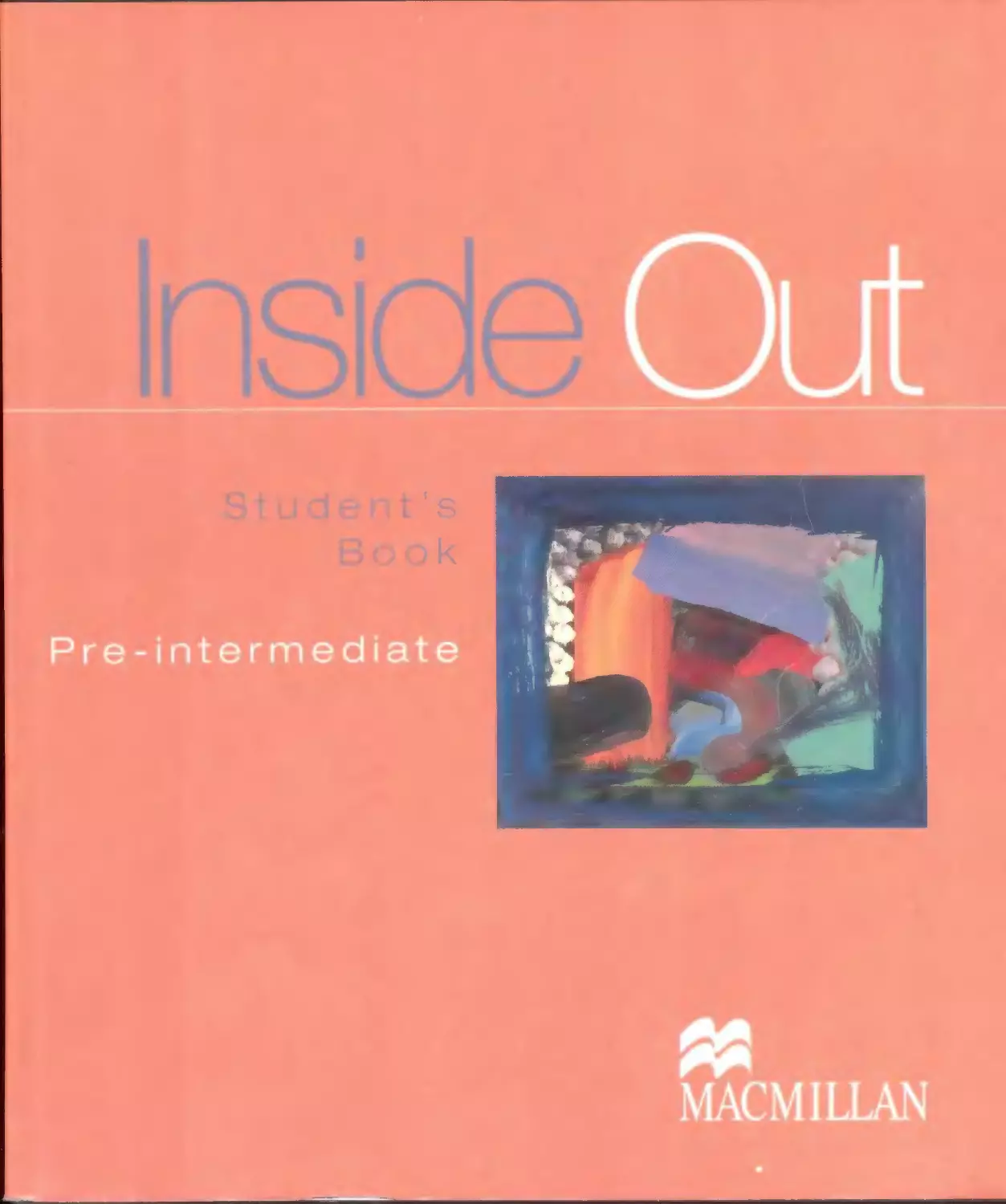
The front cover shows
After Visiting L>avid
Носкпеу (1991-2) by
Howard HodgKin.
Hcagkin won the Turner
prize in 1985 and was
knighted in 1992 He is
represented oy the
Gagosian Gallery.
Other components
Workbook
Includes an
integrated writing
syllabus developing
key skills unit by unit.
Teacners Book
Features
photocopiable tests
for every unit in the
Student’s Book.
Resource Pack
Thirty-seven tried and
tested photocopiable
worksheets, all linked
to the Student's Book.
Written by various
teachers in the UK
and abroad.
Class Cassettes or CDs
Workbook Cassette
or CD
nside Out
A classroom-tested English course for adults and young adults,
has been designed to develop real-life communicative
skills and powers of self-expression.
Creative grammar work
To see an
example of
grammar work,
look at pages
42 and 43.
To see an
exampie of a
personalised
speaking task,
look at page 78
To see an
example of work
on lexis, look at
page 99.
To see an
example of
exercises based
on a pop song,
look at page 117
Learners organise and develop their knowledge
of grammar. Easy-to-use exercises put rules into
practice - and are Then recycled as speaking
activities. All grammar work is backed up with
clear summaries.
Personalised speaking tasks
A senes of challenging speaking tasks focuses on
learners' own experiences and opinions. Choices
within tasks encourage learners to take charge of
interactions. Structured planning time is built into
tasks, improving both fluency and accuracy.
Contextualised lex
Lexical items are seen in context, showing how
words and phrases funciion and how they
coilocate with each other. Focus exercises
highlight and recycle lexis to help learners build
a biggei and better active vocabulary
A rich selection от accessible and entertaining
texts; cartoons, postcards and letters, and extracts
from newspapers, magazines and novels.
Listenings include conversations, interviews and
classic pop songs.
Pre-intermediate Student’s Book
provides over 90 hours’ teaching material.
MACMILL
ISBN 0-333-92385-5
Units & topics
Speaking &
writing
Reading &
listening texts
©rammar, ftexis &
Qronunciation
1 Me
Names
Memory
Describing
people
page A
Talking about names
Talking about memory
Anecdote: somebody who is
very important to you
Q Л woman talking about her different
names
The name game
L I eHaw to remember names
Stand By Me
ts A man talking about his best friend
0 Question forms: word order.
Subject questions
О Family words. Describing people:
looks + adjective v. looks like + noun
© Long vowel sounds
2 Place Talking about places in your Four people talking about their
Home towns country LJ home town
Holidays Countries Writing a letter giving a positive Holiday competition
description of a city Talking about products from L J Everything's wrong here!
page 10 different countries
Anecdote the best city you have ever visited
О What is/are ... like? Countable &
uncountable nouns. Quantity expressions
© City landmarks. Adjectives to describe
places. Countries & nationalities.
Geographical location
© Word stress: nationalities
3 Couples
Celebrities
Relationships
Love stories
page 16
Talking about love, marriage &
separation
Writing a narrative about the
stages of a relationship
Talking about when you first met
somebody
What went wrong?
Game show with a couple talking
about when they first met
Great love affairs
Suspicious Minds
0 Past simple & past continuous
© Expressions to do with relationships.
Narrative linkers
G Irregular verb sound groups
4 Fit lalking about sports personalities S3 Advertisers discussing which sports personality should advertise their 0 Comparative & superlative adjectives. Comparison structures
OLMJ1 L Fi tncss Talking about fitness isotonic drink О Words, expressions & collocations to do
Talking about attitudes to sport LJ Are you dangerously unfit? with sport. Numbers
page 22 Anecdote: your experiences of L J Golfing genius G Schwa /э/
sport at school ” i Interview with a fan of Tiger Woods
5 Review J Skills-based activities to review all the main language points in Units IM. Includes Sophie and Paul's report on their blind date,
oaae 28 a ''sten’ng and reading about Vinnie Jones and a sketch entitled Gossip.
6 Shop Anecdote' a present you have LJ What people really want for their birthday 0 Verbs with two objects. Present & past
Presents bought for somebody LJ How much is she wearing? simple with adverbs of frequency. Verb
Clothes Talking about clothes £3 Two men talking about shopping patterns: like, enjoy, prefer etc. + -ing form
Shopping page 34 Talking about attitudes to shopping Q S3 A man buying a woman's top A woman buying a mobile phone 0 Collocations to do with presents. Clothes & accessories. Expressions to use in shops
7 Job Talking about jobs & experiences IWI Three people talking about their jobs 0 Present perfect for time 'up to now'
Work Talking about employment L J Nightmare jobs (v. past simple for 'finished' time)
Experience Retirement Anecdote- a retired person you know well Writing a letter of application for S3 Interview with the owner of a department store о о Expressions with hand. Time expressions. Employment words & expressions Stress & intonation in formal
page 40 a job presentations
8 Rich Talking about money Г" Money 0 Future forms: (be) going to & present
Money Talking about music I— . Hie good, the bad and the extremely /ж continuous
Pop stars Talking about future plans generous 0 Words & expressions about money &
page 46 Writing an online application to A pop star talks about his future music
get a grant Q A pop star talks about his upcoming
ton r
9 Rules Talking about dating 1—1 The Rules © Modals of advice, obligation fe
Dating Talking about schooldays Ca A woman talking about her experience permission present & past.
Education Anecdote talking about your favourite subject at school L_i with The Rules Schooldays of a rock star must, mustn’t, couldn't, should, shouldn't, have to, don 7 have to
page 52 Lj Training to be a geisha 0 л Describing character. Education
Linking. Word stress
10 Review 2
page 58
Skills-based activities to review all the main language points in Units 6-9. Includes an interview w ith a customs officer, an
article about three generations of the same family and a board game entitled The Revision Game.
1 Units & topics I Speaking & 1 Reading & | . grammar, Qexis &
V I writing 1 listening texts 1 J ©renunciation
11 Smile Talking about smiling □ Smile and the world smiles with you ... 0 Imperatives. Grammar of phrasal verbs
Happiness Talking about character L 1 What's in a smile? О Describing faces. Describing character.
Stress Talking about stress LJ Optimist or pessimist what are you ? Verb patterns Phrasal verbs
page 64 Don't Worry, Be Happy О /s/, /z/, /iz/
LJ 16 Ways to de-stress
Q Laughter - the best medicine
12 Rebel Talkmg about protests LJ Global May Day protest ® Dynamic & stative meanings. Passives
Protest Talking about famous rebels БЗ People talking about why they are v Protest. Word families
Environment Anecdote: things you did wrong protesting L‘ Stress in norms ending in -ion
page 70 as a child LJ Rebel rebel
Talking about how green you are Writing a report LJ Image of a rebel
13 Dance Talking about going out LJ Disco diva or two left feet? О for & since, been.
Dancing Anecdote the last time you went LJ Party island: The clubs Present perfect simple & continuous
7 Going out dancing U Three people talking about Ibiza О on & at. Informal language
Talking about conflict between LJ Billy Elliot
page 76 parents and teenage children
14 Call Talking about annoying phone LJ Phone moans © Offers & requests. Indirect questions
Telephoi ics habits Three phone conversations 0 Telephone language. Social register.
Toys Talking about phone calls r.= A phone conversation Telephone numbers, say, tell & ask
Talking about appropriate toys LJ W/iV J bought my child a gun
page 82 for 12-year-olds Six short conversations
15 Review 3 Skills-based activities to review all the main language points in Units 11 14 Includes interviews with five people waiting tor
page 88 tickets for Wimbledon, an article about the noble art of queuing and a sketch entitled The Door.
16 Lifestyle Talking about longevity LJ How not to die before you get old © Future time clauses after when, if,
Longevity Anecdote: the healthiest person you know Q ьз A telephone enquiry about health farms Six short conversations as soon as. wilt for prediction
Pood Talking about life predictions Talking about food L J 104 things to do with a banana O Collocations. Food. Food idioms. Food preparation
page 94 I» Sounds & spelling
17 Animals Talking about wild animals LJ Animal facts © Relative clauses with that, which, who.
Wild animals Talkmg about animal L J Six stories about animals Conditionals
characteristics Three people talk about their pets O’ Animals. Prepositions after verbs &
page 100 Anecdote: a pet LJ King fun A woman talks about her friend's pet iguana adjectives О Homophones
18 Weird Talking about crop circles LJ The cream of the crop circle theories 0 Narrative tenses: past simple,
Crop circles Talking about strange Q Interview with an expert on crop circles past continuous, past perfect
coincidences LIJ Strange coincidences О How + adjectives/adverbs ...?
r Aliens & UFOs Anecdote: strange experiences L J Reincarnation have/make/ take + noun structures
page 106 you have had £3 Two people talk about strange
Writing a story LJ coincidences they have had Roswell, New Mexico
19 Wheels Talking about cars LJ My first car © Past time: used to. Opinions, advice &
1 Cars Anecdote: your dream car D Three people discuss the advantages & suggestions.
Journeys Talking about advantages & disadvantages of cars ® Cars. Adverbs of manner & attitude
page 112 disadvantages of cars ^^31 Radio phone-in about driving problems
< LJ The Lost Continent by Bill Bryson
24 Hours From Tulsa
20 Review 4
page I18
Skills-based activities to review all the main language points in Units 16-19. Includes a reading and a listening about a lottery
win, an article about a lucky escape and a board game entitled Let’s talk about ...
Additional material page 124 • Verb structures page 129 • Grammar glossary page 131 • Phonetic symbols page 131 • Irregular verbs page 132 • Tapescripts page 133
Listening
1 ’ 3 01 You're going to listen to Susan talking about some of the different names that
people call her. Which name doesn't she like?
2 Listen again. Match the people (a-h) with the names (1-8) that they call Susan.
a) her father and sometimes her sister 1 Mum
b) her friends and the people she works with 2 Susan
c) her old friends 3 Suzanne
d) her son 4 Suki
e) her mother 5 Sweetheart
f) her best friend 6 Maggsie
g) her sister-in-law 7 Bunny
h) her husband 8 Sue
3 Write down the different names that people call you. Tell your partner. W'hich of your
names do you like best/least?
Lexis’ family
words
Son / daughter
(Ex-) husband / wife / partner
Boyfriend / girlfriend
Stepfather / stepmother
Half-brother / -sister
Long vowel
sounds
1 Work with a partner. Copy the following table. Under each heading note down the first
names of people in your family.
Parents Brothers & sisters Grandfather & grandmother Sons & daughters Uncles & aunts Cousins Nephews & nieces
2 Add more headings and names to the table in 1.
3 Discuss the following questions about the names in your table.
a) Which names are typical in your country?
b) Which name is the most unusual?
c) Which name do you like best?
1 ’ й 02 In each of the following groups of names one name has a different vowel sound
from the others. Listen and spot the odd one out in each group.
1 /о:/ Paul George Sue Dawn 4 /i:/ Peter Eve Margaret Keith
2 /u:/ Julie Ruth Luke Burt 5 /з: / Shirley Bernard Earl Denise
3 /a:/ Charles Laura Barbara Grant
Q3 Listen and check your answers to 1. Then listen again and repeat. Rearrange the
names so that all four names in each group have the same vowel sound.
What's in a name?
Work in small groups. Discuss the following questions.
a) What name would you give this baby girl?
b) What names do you like for a boy?
c) How did your parents choose your name?
Reading 1
What do you think the following famous people have
in common? Read the article and find out.
a) Elton John + Marilyn Monroe
b) David Bowie + Demi Moore
c) Madonna + Bill Clinton
THE
NAME GAME
Your name is extremely important. It’s how you
identify yourself It’s how other peoole identify you,
Elton John was born Reginald Kenneth Dwight. Can
you imagine someone famous with a name like that?
5 He nad to change it. Marilyn Monroe sounds so much
more glamorous than Norma Jean Baker So now ao
parents таке one of the most important decisions in
the lives of their cnndren - giving them a name?
Some parents choose names because they are
IO fashionable. Other parents do the opposite and call
their children unusual names, or they even invent
names. Helen Petrie, a psychologist at Hertfordshire
University says that people who choose unusual names
for their children want to show how special they are.
15 However, the children are not always very happy
with their parents' choice. David Bowie's son found the
name Zowie so embarrassing that he changed it to Joe.
I wonder if Bruce Willis and Demi Moore's children feel
good about their names: Rummer Glenn, Scout LaRue
20 and Tallulah Belle!
These days it's fashionable to give your child the
name of a place that is important to you: Victoria (Posh
Spice) and David Beckham decided to call ther son
Brooklyn Because they were in New York when they
25 discovered that Victoria was going to have a baby.
Madonna named her daughter Lourdes after the town
in Fiance, and ex-US-President Bill Clinton named his
daughter Chelsea after a part of
London that he and his wife liked.
30 Personally, I think it's a good
idea to give children names of
famous people. Leonardo
Di Capno was named after the
famous Italian painter and Liam
35 Gallagher, singer with the band
Oasis, called his son Lennon
after his hero, John.
I wanted to cal! my first child
Elvis, and my husband wanted to
40 call him Pele. Fortunately sne was
a girl, so we named her after my
favourite aunt - Blodwen.
Reginald Kenneth DvVighr (E/tor John) ►
2 Tick (✓) the reasons for choosing a name that the article mentions. Put a cross (X) by the
reasons the article doesn't mention.
a) because it sounds good
b) because it's fashionable
c) because it sounds the same
in two languages
d) because it's unusual or original
e) because it's the name of a place
f) because it's a religious name
g) because it's the name of a famous person
h) because it's the name of another member of
the family
3 Work with a partner. What other reasons can you think of for choosing a name? Think
about your family, your friends, and people in the class.
Lexis 1 Complete the following sentences with words from the text above.
a) I think that my name sounds much nicer in mv language than in English (line 5)
b) I won't have to_______a decision about names. I'm not going to have any children!
(line 7)
c) I'd like to have an unusual name - it would make me___________special, (line 18)
d) I know exactly what I'm going to my children, (line 23)
e) My parents named me__________a relative, (line 26)
f) I think it's a good_____to choose a name that's easy to say in different languages,
(line 31)
2 Find out if any of the sentences in 1 are true for your partner.
I never forget a face
1 How good are you at remembering people's names? What techniques do you use?
2 Try this memory test. Study these names and faces for thirty seconds. Then turn to
page 124 and see which you can remember.
Reading 1 Read this advice for improving your memory. Find an appropriate heading for each
paragraph.
a) Repeat it c) Use it e) Write it down
b) Visualise it d) Check the spelling f) Make associations
(Based on eHow to remember names by Valerie Singer www ehow.com)
2 Work with a partner. Discuss these questions.
a) Which of the techniques in 1 have you used for remembering names?
b) Which of the techniques in 1 could help you to remember new English words
and expressions?
c) What other ways can you think of to help remember and learn new English words
and expressions?
1 Look at the nouns, noun phrases and adjectives in the box. Which words can complete
sentence a? Which words can complete sentence b?
Lexis:
describing
people
‘Do you find the accused
"looks guilty" or
"doesn't look guilty"?'
friendly a banker a typical mum intelligent shy a doctor very young
middle-aged stressed out intelligent about sixty Greek a waiter
a Swedish au pair a student fit a retired police officer a bit tired rich
a) He/She looks . b) He/She looks like _ _.
2 WЪat type of word do you use after lookfs)? What type of word do you use after look(s) like?
3 Write a sentence to describe each person in the six photographs on the previous page.
Leave a space (_______) for the name.
For example: _ . looks about 60. He looks intelligent and quite friendly.
4 Give your paper to a partner and ask them to complete the sentence with the correct
name.
5 Repeat the same exercise for three people in your class. Ask your partner to complete
the sentences with the correct name.
Meet A.L.I.C.E.
1 Read the responses in this conversation. W'ho or what is A.L.I.C.E.?
Hi. My name's A.L.I.C.E.
1 name What your does mean ?
It means Artificial Linguistic Internet
Computer Entity.
2 were born you Where ?
I was born in Bethlehem, Pennsylvania
3 grow Where did up you ?
I think I grew up in San Francisco.
4 look do like you What ?
I'm blue and I've got one wheel.
5 do What do you ?
I talk to people on the web.
6 like your Do job you ?
Yes, I have a oassion for my work!
7 languages you any speak Can foreign ?
No, I only speak English at the moment, but
I'd like to learn.
8 married you Are ?
No. I am single. How about you?
9 got children Have any you 7
No but you can download me and make
A.L.I.C.E. clones for yourself!
10 created you Who ?
Dr Richard S Wallace - he is very clever!
2 W'rite the words in the questions in 1 in the correct order.
3 iiaal 04 Listen and check your answers to 1 and 2.
LANGUAGE TOOLBOX
Wnat's youi favourite .. ?
Are you interested in .. ?
Have you ever ... ?
How often do you . ?
4 Underline the stressed word in each question. Listen and repeat the questions in the
conversation.
5 Work with someone you don't know very well. Interview them using appropriate
questions from 2 and add more questions of your own.
Close up
Questions: 1 Work with a partner. Look at the table and discuss the questions,
word order
Statement Question
subject You You Your name (auxiliary) verb (auxiliary) verb subject are... -> Are you...? Are you married7 can... -> Can you...? Can you speak any foreign languages? means... -» What does your name...? What does your name mean?
'Can Wolfgang come out
and play?'
a) What is the difference in word order between a statement and a question in English?
b) When do you need to use the auxiliary verbs do, does, did to form a question?
c) How do you form questions in your language? Is it the same as English?
Change the following statements into questions. Then ask youi partner the questions
a) You are hungry. Are you hungry?
b) You smoke.
c) You can play the guitar
d) You've been to Disneyland.
e) You live in Rome. Where do you live?
f) Your favourite colour is red (What)
g) You left school in 1997. (When)
h) You've got 200 CDs. (How many)
Rewrite these questions in the correct order.
a) you are old How ? How old are you?
b) life in Do after believe death you ?
c) do much weigh you How ?
d) you anything ever Have stolen ?
e) much earn How you do money ?
f) you many partners How had have ?
4 Work in small groups. In what situations is it okay to ask the questions in 3?
• in your English class • with your best friends • in your family • at work • never!
Subject
questions
1 Look at questions A and В below. Question A is an object question because the answer
(A L.I.C.E.) is the object of the verb. Question В is a subject question because the answer
(Dr Wallace) is the subject of the verb. Do you use an auxiliary with a subject question?
Statement
subject
Dr Wallace
verb
created
Question
Answer
object
A.L.I.C.E. ccT
D
What did Dr Wallace create? -> A.L.I.C.E.
Who created A.L.I.C.E.? Dr Wallace.
2 Work in pairs. You are going to ask and answer some general knowledge questions.
Student A turn to page 124. Student В turn to page 126. Follow the instructions.
Language reference: questions
Word order
To form a question in English you put an auxiliary verb before
the subject In the present simple you use the auxiliary do or
does In the past simple you use the auxiliary did With the
verb be you put am is, are, was or were before the subject.
Subject questions
When the question word is the subject you do
not use ao does or ord A subject question
has the same word order as a statement
question word (auxiliary) ve rb
Is
Does
Where do
Why did
subject
your sister married?
she love him?
they live?
she get married7
subject verb
Who created A.L.I.C.E.?
NOT Who did create ...?
subject verb
Who lives here?
NOT Wfteooes nvo—.r?
Stand By Me
Song 1 Look at the words of the song. On lines a-f and lines g-Z there is an extra word. Find the
word and его-.!) it out.
a) When the qooo night has come,
b) And the Disney land is dark.
c) And the moon is the only flashing light we see,
d) No I probably won't be afraid,
e) Oh, I won't ever be afraid.
f) Just as long as you stand up, stand by me
So darhn', dartin', stand by me, oh stand by me.
Oh stand now, stand by me, stand by me
g) If the blue sky that we look upon
h) Should tumble and fall over,
i) Oi the rocky mountains should crumole to the sea.
j) I won t cry, I won't cry out
k) No, I won't shed a big tear,
I) Just as long as you stand up, stand by me
So darl.n' dadin', stand by me, oh stand by me.
Oh stand now, stand by me, stand oy me.
And dartin', dartin', stand by me, oh stand by me.
Oh stand now, stand by me, stand by me
Whenever you're in trouble,
Won’t you stand by me, oh stand by me.
Oh stand now, oh stand, stand by me.
Ben E. King
Stand By Me
Recorded by Ben E
King (1961 and 1987),
Elvis Presley (1967),
and John Lennon
(1975).
Anecdote
Tom
2 0 05 Listen and check your answers to 1.
3 Which of the following is the best interpretation of the song?
a) There are going to be a lot of disasters if you stand by me.
b) 1 won't be able to see very well if you stand by me.
c) If you stand by me, 1 will feel strong. Nothing will worry me.
4 Tell your partner about a time when you’ve really needed a friend to 'stand by you’.
1 ¥ "? 06 Listen to Tom talking about
following topics does he talk about?
somebody who is important to him. Which of the
What is this person's full name?
When did you meet this person?
I low old are they now?
Where do they live?
What do they do?
How often do you see them?
Why are they important to you?
What are their best qualities?
Is there anything you don't like about them?
When did you last see them?
2 Work with a partner. Note down as much information as you can remember about the
topics Tom talks about. Listen again and check your answers.
3 Think of a person who is important to you. You are going to tell a partner about them.
Choose from the list in 1 the things you want to talk about. Think about what you will
say and what language you will need.
Place
Work with a partner. Look at the four photos and discuss the questions.
• What do you think it's like to live in each of these places?
♦ Which of these places would you most like to live in?
• Which of these places would you least like to live in?
Lexis
1 Look again at the photos. Find examples of eight of the twelve items in the box.
high rise buildings
a park a church
a river
a bridge
a hill a statue a fountain
a square a castle the sea
a canal
2 How many of the things in 1 can you find near your school? Put them in the right order
on this line.
Nearest -<------------------------------------------------------------Furthest away
Listening 1 bad 07 You are going to listen to four people talking about the places in the photos. Match each speaker to a photo. Who likes living where they live? Who doesn't?
2 Use the most appropriate adjective in the box to complete these descriptions from the recording. (Sometimes more than one answer is possible.) new clean crowded bormg exciting polluted humid a) ... a city7 that's so big and e) ... the air is lovely and b) ... people say it's too noisy and f) ... 1 find it so dull and c) ... it's too hot and g) ... the canals are dirty and d) ... it's a mixture of old and
3 Listen and check your answers to 2. Use these adjective combinations to describe places in your country. Compare your ideas with a partner.
Close up
What's it like?
Language reference pl 5
1 Look at the following question. Choose the only possible answer: a, b or c.
What's your home town like?
a) Yes, I do. b) It's big and exciting. c) The shops.
2 Think of three other possible ways of answering the question in 1.
3 Match the questions from the recording with the most appropriate response.
a) What's the weather like?
b) What's the architecture like?
c) What are the people like?
d) What are the shops like?
1 It's a mixture of old and new.
2 They're really friendly.
3 They're too expensive.
4 It's hot and humid.
Nouns:
countable /
uncountable
1 Look at the underlined nouns in 3 in the previous section and complete the table.
Nouns Countable Uncountable Singular form Plural form
a) weather X weather
b) architecture c) people d) shops ✓ X person —
2 Continue the table in 1 with the nouns in the box. Decide if the nouns are countable or
uncountable. Write down the singular form in each case and add the plural form if the
noun is countable.
traffic restaurant nightlife public transport park cinema
3 Work with a partner. Discuss these questions.
a) Which countable noun in the table in 1 has an irregular plural form?
b) How do you make plural forms of these irregular countable nouns: a man, a woman,
a child, a foot, a tooth?
c) How do you make plural forms of regular countable nouns?
4 Work with a partner. Note down the names of two cities or villages you know well.
Combine nouns from 1 and 2 with the appropriate question frame below to ask each
other questions about the places you have noted down
a) 'What's the____ like?' 'It's...'
b) 'What are the_____like?' 'They're ...'
First impressions
Writing 1 Read this letter from Rick to a friend. How does he feel about the place he is describing?
Rick
Hi!
I’ve been here a week and my first impressions are not very good. In fact, they are
terrible, The city is small and boring. Really boring! The buildings are modern and
unattractive, and there are some ugly high-rise office blocks.
The city centre is really dirty and polluted, and public transport is useless. The
buses stop at ten o’clock at night, and it’s impossible to get a taxi. This probably
explains why the streets are completely empty after six o’clock in the evening and
the nightlife is terrible. There's nothing to do
The people look miserable and they’re not very friendly. I suppose it could be
because the weather is awful - it’s cold and hasn't stopped raining since I arrived.
Seven days of rain - can you imagine?
But the worst thing is the food - I can't eat it. And the coffee tastes
disgusting. Ugh! There aren’t many restaurants and they're expensive.
I want to come home! I really hate it here.
Love. Rick
XXX
2 Re-write the letter in 1. Make it sound as positive as you can.
Hi!
I’ve peen here a week and my first impressions are really good. In fact, they are
fantastic. The city is big and exciting. Really exciting! flit buildings are ..
Word stress 1
* 0-1 Complete the following country and nationality sets. Underline the stressed
syllable in each word and then listen and repeat to check your answers. What happens
to the word stress in each set?
A Country Nationality В Country Nationality C Country Nationality
Cuba C E Egyptian China C
T Turkish Italy 1 M Maltese
M Moroccan Hungary H P Portuguese
Argentina A C Canadian Japan J
2 Inink of three other countries not mentioned in 1 that you would like to visit. Write
down each country and nationality and mark the stress. Tell your partner where you
would like to go and what you would like to do there.
Discussion 1 Work in small groups. Decide if you agree with the following statements.
French wine is the best in the world. Japanese cars are the best in the world.
2 Replace the underlined words in 1 in as many different ways as possible. Use topics in
the box or think of some of your own.
coffee watches women beer pop music fashion football players
perfume tea rice men roads universities food mobile phones
shops films stereo equipment
3 Write as many sentences as you can which you all agree on. Compare with other groups.
Dream holiday
1 Read through the information about the four destinations on offer in this holiday
competition. List them in order (1 = the place you would most like to go to; 4 = the place
you would least like to go to). Explain your choices to a partner.
2 You are going to enter the competition. Work with a partner. Read the 'Bow to enter'
section and do parts A and В of the competition.
3 Check your answers to Par t A of the competition on page 124. Compare your written
summaries for Part В of the competition with other people in the class. Choose a class
winner!
WIN A DREAM
HOLIDAY FOR TWO!
The winner of our exciting competition can choose a dream
holiday for two in one of these fabulous destinations.
HOWTO ENTER
Part A
To erter this fabulous competition
and win a dream holiday for two,
complete tne following sentences
with option a b or c.
New York
Shopping heaven and a great
nightl.fe. Visit Central Park, the
Empire State Building, the
Statue of Liberty, and shop till
you drop!
Karagaac
A tiny village located on the
beautiful coast of south-west
Turkey. Enjoy the clear seas
and white-gold sands of Patara
beach, or visit the many-
archeological sites in the area.
Atlas Mountains
Located in the heart of
Morocco, the Atlas Mountains
are the pedect place to relax.
The people are very
welcoming and the air is fresh.
You’ll feel like a new person.
Havana
7 he capital of Cuba, famous
for its wild music and beautiful
people - Cubans know how
to have a good time and so
will you.
I The official language of Brazil is ..
a Portuguese
b trench
c Ita.ian
2 Ankara is the capital of ...
a Morocco
b Turkey
c Malta
3 The third largest country m the
world is .
a China
b Argentina
c Australia
4 The zloty is the currency of ...
a Hungary
b Ireland
c Poland
5 The Alhambra Palace is in ...
a Egypt
b Spain
c Mexico
6 Kyushu is an island in the south
of
a Thailand
b Greece
c Japan
Parc В
Now tell us in no more than fifty
words which holiday destination
you would choose and why you
would like to go there.
Send your answers before
I st April to
Dream Holiday, PO Box 437,
London NW I 4HB.
Quantity
Language reference p15
Close up
1 Complete the following description of a country with the nouns from the box. Which
country do you think it is? Could it be your country? Why / Why not?
cars cigarettes coffee hours meat noise people sleep wine
Everything’s
wrong here!
They do everything wrong here!
1 hey eat tar too much (1)_____ and they eat it at 11 pm.
Yesterday we went out to dinner at 11.30 arid we had trouble getting
a table! At 1am we were still eating, and the restaurant was still half-full!
Tney smoke too many (2)________ They drink lots of strong (3) _ . and
a lot of (4)___.
They spend too many (5)________ in the sun and they certainly don't
get enough (6)_____ . One Saturday night we went to a disco at 2am
and were surprised to see that there were only a few (7) _ on the
dance flooi Then the DJ arrived at 3am and the party began1
There are far too many (8)_____ in the cities, and there’s too much
(9) everywhere!
They do everything wrong here, but ine quality of life is great, and
people really know how to enjoy themselves. I don't want to go home'.
2 Ы 09 Listen and check your answers to 1.
3 This table categorises the quantity expressions used with the nouns 1-9 in the text in 1.
Choose a suitable heading for each category (А, В. C): Use with countable and uncountable
nouns; Use with countable nouns; Use with uncountable nouns.
A В C
How many? How much? not enough
(far) too many (far) too much a lot of
(only) a few (only) a little lots of
4 Underline the correct quantity expression in each of these sentences.
a) I don't eat much / many bread.
b) I eat a few / lots of fruit.
с) I drink far too much / far too many beer.
d) 1 don't eat much / enough vegetables.
e) 1 eat a lot of / a little cakes.
f) 1 don't drink enough / many water.
5 How many of the sentences in 4 are true for you? Re-write the sentences so that they are
all true for you. Compare your sentences with a partner.
6 Work with a partner. Use the question frame below to ask each other questions about
daily habits. Add your own nouns and verbs to make different questions.
For example: Haw much meat do you eat every day? How many e-mails do you get every day?
Nouns Verbs
How much How many chocolate e-mails bad TV programmes sleep money wine friends coffee people meat do you eat drink watch get have make phone see send spend every day?
Language reference: What's it like?; nouns & quantity
What's it like?
This question asks about the characteristics of people
or things. You usually answer it with an adjective or
adjective phiase.
What's Madrid like’' ‘It's big and exciting.'
'What are the people in your village like?' 'They're
very friendly.'
Countable nouns
These refer to things which can be counted. You use
them with a/an or put a number in front of them You
usually form the plural by adding s, -es, res.
a car - ЬОО cars
a church - 3 churches
a country -12 countries
Note: A few common countable nouns have irregular
plural forms.
a child two children
a foot - two feet
a man - two men
a mouse - two mice
a person - two people
a tooth - two teeth
a woman - two women
Uncountable nouns
These refer to things which cannot be counted. You
cannot use a/an or put a number in front of them.
advice food furniture information love
music rain traffic travel weather work
Quantity
These are ways you can talk about quantity if you
can't or don't want to use an exact number.
With countaole nouns: (only) a few I (far) too many /
How many . 7
There were only a few people wno saw them
How many e mails do you get every day?
With uncountable nouns, (only) a little I (far) too
much / How much .. 7
There's a little wine left but no beer
How much sleep do you get at night?
With countable and uncountable nouns, a lot of I
lots of I not enough
Theie are a lot of problems with this plan
There was lots of good food at the party.
He didn't give me enough information.
Cities of the world
1 Work with a partner. Which of the following cities are capitals? (There are six.)
Tokyo Nice Seoul Reykjavik Berlin Barcelona Los Angeles Cairo
Melbourne Prague
2 Work with a partner. Student A turn to page 124. Student В turn to page 126. Check your
answers to 1 and then follow the instructions.
3 Choose one city you would really like to live in and tell vour partner why.
Anecdote Think about the best city you have ever visited. You are going to tell your partner about it.
Choose from the list the things you want to talk about. Think about what you will say and
what language you will need
Where is the city?
When did you first go there?
1 Were you on holiday?
Who did you go there with?
What did you do there?
How many times have you visited the city?
When was the last time?
What do you most like about this city?
Would you like to live there? Why / Whv not?
Couples
Reading
1 Look at the photos of four famous Hollywood couples. Which of these celebrities are
well-known in your country?
2 Read the information and find out how long each couple was married for. What went
wrong with their relationships?
What went wrong?
'Based on an article in The Mirror)
Hw
6
*
__о
Richard Gere and Cindy Crawford Lyle Lovett and Julia Roberts Nicole Kidman and Tom Cruise Bruce Willis and Demi Moore
got married got married got married got married
in 1991 in Las Vegas in 1993 after a on Christmas Eve in 1987 in Las Vegas
split up in 1994 were married for 3 years. What went wrong? She wanted to have children and he six week romance. 1990 in Telluride, just tour weeks after
split up in 1995. were married for 2 years. What went wrong? The big difference in Colorado. split up in 2001. were married for just over 10 years What went wrong? he asKed her out on their first date. split up in 1998 were married for 11 years.
refused. age became a They both wanted to What went wrong?
problem. pursue their own It was a stormy
careers. relationship, and there
were rumours of
affairs on botn sides.
3 Read the information again and answer these questions.
a) Which couple got married in Las Vegas?
b) Which couple got married on Christmas Eve?
c) Which couple were married the longest?
d) Which couple were married for the shortest time?
e) Which couple split up for professional reasons?
f) Which couple split up because one of them didn't want to have children?
Lexis 1 Complete the expressions in the sentences below with one word in each case. Look back
at the information in the previous section if necessary.
a) The best age to____married is twenty-five for women and twenty-seven for men.
b) A big. m age should not be a problem for a couple if thev are in love.
c) It is impossible for both partners in a marriage to _ a career.
d) A woman should never ask a man_______on a first date.
e) A_____relationship is much better than a boring one.
f) A couple with children should never.___up. They should stay together.
g) The main reason for getting married is to _ children.
2 Work in small groups. Do you agree with the statements in 1?
Ross & Jane
Writing 1 Match the words and expressions in the box to an appropriate picture (a-d).
move in have a row chat up fancy
2 Put the stages of Ross and Jane's relationship in the order that you think best. Add
different stages if you think they are necessary. Compare your ideas with a partner.
a) They got married.
b) Ross chatted Jane up.
c) They rang each other up
d) They fancied each other,
e) They moved in together.
f) They had children.
LANGUAGE TOOLBOX
One day / evening
First / To begin with
Then / Next / After that
After a while
A few weeks later
Finally / In the end
g) They had a row.
h) They met each other's parents
i) They kissed.
j) They split up.
k) They went out together.
1) They fell in love.
3 Work in pairs. You are going to write the story of Ross and Jane.
• Use the sentences from 2, including any that you have added.
• Use adverbs of time from the Language toolbox as well as appropriate place words.
• Compare your story with other peoples' stories in the class and vote for the best one.
For example: One evening Ross met Jane at a disco. They fancied each other. To begin with ...
1 Complete the following irregular verb tables with the correct forms. What do the verb
forms in each table have in common?
Irregular verb
sound groups
A В C
Infinitive Past Past Infini five Past Past Infinitive Past Past
simple participle simple participle simple participle
meet met met ring rang rung buy bought bought
keep a) kept begin began a)_ a) brought b)
mean b) c) b) c) drunk catch c) d)
d) slept e) d) sang e). f) fought g)
2 Ы 10 Listen, check your answers and repeat the verb forms in 1. Add three other
verbs to the tables. See page 132.
David
Let's get personal
Listening
2
Q 11 Listen to the first part of a television
game show and decide whether the
following statements are true
or false.
a) The competition is called
Popular.
b) Bobby Brown is the host.
c) Rosie and David have to answer
different questions.
d) They get points for giving the
same answers.
e) Rosie and David can hear one
another.
f) Rosie and David can hear
Bobby Brown.
’* * 12 Write out the questions that
Bobby Brown asks Rosie, Listen and
check your answers.
Questions
Rosie
1 x When (meet David)? When did you meet David? a Nearly three and a half years ago. b Over three and a half years ago. c Four and a naif months ago. //X
2 1 low (first meet)? a She was a nurse He was a patient, b She was a patient. He was a nurse, c She was a doctor He was a nurse. //x
$ What time of day (be it)? a Early morning. b Early afternoon. c Farly evening. //X
What (be the weather like)? a 7 he sun was shining. b It was raining. c It was snowing. //X
$ What (both wear)? Her Him a A white coat. a Blue pyjamas. b A nurse's uniform. b Green pyjamas. c A nightdross. c Pink pyjamas //X
Who (speak first) and what (say)? a She said: 'How do you feel?' b He said Tm going to be sick ’ c He said: ‘1 feei terrible.’ //X
3 Listen again and underline the answers (a, h or c) that Rosie gives.
4 О 13 Listen to David answering the same questions. Circle a tick (✓) if he gives the
same answer as Rosie and circle a cross (X) if he gives a different answer.
5 How many points did Rosie and David score out of six?
6 Think about the time that you first met somebody important to you. How many of the
questions from Get Personal could you answer? Discuss with a partner.
Irregular verbs p132
Close up
1 Work with a partner. Look at the verbs in the box and answer these questions.
buy stay up start hurry receive fall go
a) Which verbs have irregular past forms?
b) How do you form the past simple form of regular verbs like stay up and start?
c) What happens when the regular verb ends in e or a consonant 4- y?
d) Which auxiliary verb do you use to make past simple negative and question forms?
2 Re write each of these sentences with past simple affirmative and negative forms.
a) Yesterday 1 (buy) a CD. Yesterday I bought a CD. / Yesterday I didn't buy a CD.
b) Last Saturday I (stay up) all night.
c) in January J (start) a new diet.
d) Today I (hurry) to my English lesson.
e) This morning I (receive) an e-mail.
f) Last night I (fall) asleep watching TV.
g) Last year 1 (go) on holiday abroad.
3 Tick (✓) the sentences which are true for you. Compare your answers with a partner.
Past
continuous
1 Look at these extracts from Bobby Brown's interview with Rosie. Choose the present or
past continuous by underlining the appropriate auxiliary. Which tense is used for the
other verb in each extract?
a) Well, 1 am / was working as a nurse, and David came mto the hospital ...
b) ... it is / was raining when J arrived at work.
c) What are / were you both wearing when you saw one another for the first time?
2 Which tense do you use to describe something that was in progress when another event
happened? Which tense do you use to describe an event that happened at a particular
moment?
3 £3 14 Listen to the sounds and describe the five situations. Use the past continuous
and the past simple.
For example: He was having a shower when his mobile phone rang.
4 Work with a partner. Follow these instructions.
a) Write down three true sentences and one false sentence to describe what you were
doing yesterday at each of these times: 7.30 am; 1.00 pm; 6.00 pm; 11.00 pm.
b) Ask each other questions beginning What were you doing at ... ?
c) Guess which of your partner's answers is false.
Language reference: past tense forms
Past simple
The past simple is used to fix events and situations in
the past. Vou can use it to say when the event or
situation happened.
The last time I lost my keys was two weeks ago. They
fell out of my pocket on the sofa. I didn't realise so I
looked everywhere My son found them this morning.
Note’ Many verbs have irregular past forms and you
have to learn them. There is a list of the most
common irregular verbs on page 132.
Past continuous
The past continuous is usually used in contrast with
the past simple. You can use it to describe something
wmch was ,n progress when the main events in the
story happened
Well, I was working as a nurse, and David came into
the hospital for an operation.
What were you both wearing when you saw one
another for the first time?
Couples
i т 3
19
True love
Reading
1 Work with a partner. Look at the couples in the article below and decide what you think
are the correct answers to these questions.
a) Who waited too long before asking his lover to marry him?
b) Who built a monument in the memory of his wife?
c) Who gave up his kingdom for love?
d) Who sent red roses to his wife's crypt three times a week until his death in 1999?
e) Which couple only spent one night apart during thirty years of marriage?
2 Read the article and check your answers.
Great love affairs
a The Duke & Duchess of Windsor
After the death of his father in 1936 Edward VIII became King of England He was in
love with Mrs Wallis Simpson, an American divorcee, and he wanted to marry her.
But tire British government did not accept her as Queen of England because she was
divorced. He had to choose - continue as King of England or marry Mrs Simpson
He chose to stay with the woman he loved.
b Paul & Linda McCartney
When Paul McCartney left the Beatles m April 1970, many people blamed Linda, his
American photographer wife. Linda was the love of Paul’s life, and in thirty years they
only spent one night apart. She died of cancer in 1998 with Paul by her side.
c Marilyn Monroe & Joe DiMaggio
Their marriage lasted less than ten months, but DiMaggio was always there for Marilyn.
He organised her funeral, and. until his death in 1999, he sent six red roses to her crypt
three times a week.
d Shah Jahan & Mumtaz Mahal
In the 17th century. Emperor Shah Jahan built the Taj Mahal in memory of his wife.
He was heartbroken when his wife died after nineteen years of marriage.
One year after her death, construction of the Taj Mahal began and it
took twenty-two years to complete. Six years
later Jahan died and was buried with
his true love in one of the most
romantic buildings in the world.
e Charles & Camilla
When Charles met Camilla at a polo
match in 1970, he fell in love with
her. But then he waited too long
before asking her to marry him.
She got tired of waiting and
married somebody else. Now,
two marriages and a funeral
later, Charles and Camilla are
together again.
3 Work in pairs. You are each going to write four comprehension questions on the text
in 2. Student A turn to page 125. Student В turn to page 126. Follow the instructions.
Л Work in groups. Discuss these questions.
• WTiich story do you think is the most romantic?
• W'hich story do you think is the saddest?
• W'hat famous love stories are there in your country?
2C
Suspicious Minds
Song
1 Look at the title of the song. Do yon think a person with a suspicious mind ...
a) believes what yon tell them?
b) doesn't believe w hat you tell them?
2 Read the song and put the words in the box in the correct place in the song.
hello dreams word tears
trap never dreams again
Suspicious
Minds
Elvis Presley was one of
the most important
recording artists of all
time. His version of
this song was a huge
success.
We're caught in a (1)_____.
I can't walk out
Because I love you too much, baby.
Why can't you see
What you're doing to me
When you don't believe a (2) i say?
We can't go on together
With suspicious minds
And we can't build our (3)
On suspicious minds.
So, if an old friend I know
Drops by to say (4)
Would I still see suspicion in your eyes?
Here we go (5)
Asking where I've been.
You can't see the tears are real
I'm crying
We can't go on together
With suspicious minds
And we can t build our (6)
On suspicious minds
Oh, let our love survive,
Oh dry the (7)______from your eyes.
Let's not let a good thing die
When, honey, you know
I've (8)____lied to you.
Mmm, yeah, yeah.
3 63 15 Listen to the song and check your answers.
4 Read the song again and complete these sentences with the correct alternative.
a) The singer wants / doesn't want to leave.
b) The singer is happy / unhappy with the relationship.
c) The singer thinks / doesn't think his lover is
jealous of his friends.
d) The singer lies / never lies.
Replace the underlined words with words and
expressions from the song.
a)
b)
c)
d)
e)
I don't want to leave, (verse 1)
I don't believe anything vou say. (verse 2)
We can't continue together with suspicious minds,
(chorus)
You say your friend comes to your house
to say hello, (verse 3)
Please stop crying and believe me.
(verse .5)
6
7
Who said the things in 5: the
singer or his suspicious lover?
Work with a partner. Describe
a time in your life when you
had a 'suspicious mind'.
Fit
Lexis
fit Someone who is fit is healthy and able to
Work with a partner. Look at the photos Of the do physical activities without getting tired,
sports personalities and complete the table-
• You score six points by completing the 'Personality' column and matching the names
to the photos.
• You score six more points by completing the 'Sport', 'Person' and 'Place' columns.
Check your answers on page 125. Who scored the most points in the class?
Personality Sport Person Place
A Cathy Freeman athletics athlete track
В Raul a) __ football player pitch
C Shaquille O'Neal basketball d) court
D motor racing racing driver race track
E Inge de Bruijn b) swimmer f)
F c) e) _ court
Listening
Comparatives
ыпдиаде reference p27
1 * 3 16 Listen to a discussion between a marketing director and an advertising
executive. They want to choose one ot the sports personalities in the photos in the
previous section to advertise a new isotonic fitness drink. Who do they choose?
2 Listen again and complete these sentences with names or words and phrases from the
box. You need to use some words more than once.
all of them Cathy Freeman Michael Schumacher Raul Shaquille O'Neal tennis Venus Williams swimming athletics
a) isn't as good-looking as__
b) ____is more successful than
c) ____is a bit more interesting than
d) is more famous than
e) ____isn't as interesting as
f) ____is sexier than.
3 Do you agree with their opinions? Change the sentences in 2 to reflect your own ideas
and then compare them with a partner.
4 Work in groups. Decide on a sports personality to advertise an isotonic fitness drink.
Who would you choose? Why?
Close up
1 Test your comparatives! Look at the adjectives in the box and put them in the correct
column according to how the comparative is formed. There are three adjectives in each
column.
happy successful sad bad strong nice interesting lucky far wet
+ -er / -r double letter + -er -y + -ier irregular more + adjective
kind -> kinder than thin -» thinner than sexy -» sexier than good better than famous more famous than
2 Refer to the table of sports statistics. Complete the sentences using the comparative
forms of the adjectives + than.
a) Shaquille O'Neal (tall) Raul. Born Height Weight
Cathy Freeman 16/2/73 1,64m 52kg
Shaquille O'Neal is taller than Raul.
b) Venus Williams (heavy) Michael Schumacher. Shaquille O'Neal 6/3/72 2 16m 141 kg
c) Inge de Bruijn (young) Cathy Freeman. Michael Schumacher 3/1/69 1.74m 74kg
d) Raul (old) Venus Williams. Raul ТПЫП 1.80m 68kg
e) Cathy Freeman (light) Inge de Bruijn. Inge de Bruijn 1А1ЫП 1.74m 55kg
f) Venus Williams (short) Shaquille O'Neal Venus Williams 17/6/80 1.87m 7bkg
3 Add much or a bit to modify the comparatives in the sentences in 2.
For example: Shaquille O'Neal is much taller than Raul.
4 Use not as (pld/tall/heavy etc.) as to compare sports personalities in the table in 2 with
people in the class. Make five sentences.
For example: Michael Schumacher isn't as tall as Marco.
5 Test your general knowledge! Make sentences comparing the following. Use the
adjective given with a bit / much /not as ... as. The answers are on page 125.
a) London (wet) Rome.
b) The Maracana Municipa Stadium in Rio de Janeiro (large) the Stade de France (Paris).
c) The US Army (small) the North Korean Army.
d) Heathrow Airport (busy) Los Angeles International Airport.
e) Ireland (big) Cuba.
f) The Statue of Liberty (tall) the Eiffel Tower
The schwa /э/
1 17 Complete the following with the correct words to make typical expressions.
Then listen and check vour answers.
bat bird cucumber feather fiddle picture
a) She's as free as a____. c) He's as fit as a_________. e) It's as light as a
b) She's as pretty as a _ . d) She's as cool as a_______. f) He's as blind as a
2 In each expression which words contain the schwa sound? Listen again and practise the
expressions. Do you have similar expressions in your language?
Fitness test
Reading Answer the questionnaire below as honestly as you can. Calculate your score and compare
your answers with a partner.
AKE YOU DANGEROUSLY unfit?
1
2
3
In an average day, do you ...
a cnmb more than 100 stairs? YES / NO
b do at least one hour of housework7 YES / NO
c walk or cycle to school or work? YES/NO
How often do you walk 5 kilometres or more?
a Once a month. b Once a week. c Never.
How much sport do you do every month?
a More than 10 hours. ’ b 2-9 hours,
c Less than 2 hours.
4
How often do you spend 20 minutes or more
doing an activity that makes you hot or sweaty?
a Three or more times a week.
b Once or twice a week c Not at all.
5
How long does it take you to walk a kilometre?
a Less than 10 minutes b 10-20 minutes,
с I can't walk that far.
6
How many of the following activities do you do more than once a week?
a Go for a run. YES / NO b Play a ball game, (football, volleyball, etc.). YES/NO
c Do some aerobic exercise, (jogging, cycling, etc.) YES / NO
7 Tick the activities you often do when you're on holiday
a Go hiking. b Go swimming. c Go sightseeing
f Eat and drink a lot.
d Go dancing.
e Lie on the beach.
8 Do you smoke? YES / NO
HOW TO SCORE
WHAT YOUR SCORE MEANS
1 a YES: 5 NO 0
2 a 3 b 5 c 0
3 a 5 b 3 c 0
4 a 5 b 3 c 0
5 a 5 b 3 c 0
6 a YES: S NO 0
7 a 5 b 5 c 3
b YES: 5 NO 0
c YES: 5 NO: 0
8 YES:-10 NO 0
b YES: 5 NO 0
d 3 e 0 f
c YES: 5 NO: 0
0
20 or less: Your health and your life are
in danger! You must do more exercise
21-30. Could be worse, but not much worse
31-40 Not bad, but could be better.
41-50 You are healthier than the average
person and you probably find your life more
enjoyable as a result.
51 or more: You are super-fit. Are you a
professional athlete? (Or are you a liar!)
1
Lexis: sport
Choose the most appropriate alternative
in the following sentences.
a) 1 do / play / practise some exercise
every day - I don't enjoy it, but it
keeps me fit.
b) A lot of my friends play / go /
practise basketball - I think it's the
most popular sport among young
people in my country.
c) I'd love to play / go I practise snowboarding but I can't even ski.
d) The last time 1 did / played I practised some sport was on holiday - 1 did / went I
practised swimming in the sea.
e) 1 did / played / practised a lot of tennis when 1 was a kid. Now 1 just watch it on TV.
f) 1 didn't enjoy doing / playing / practising sports at school. Our teacher was horrible.
2 How' many of the sentences in 1 are true for you? Compare with a partner.
3 Work in pairs. Complete these collocation lists with either do, go or play. Add at least one
more sport to each list.
a) _ _ cycling
fishing
swimming
windsurfing
b)_____athletics c)__________basketball
judo golf
rugby
tennis
volleyball
4 Complete the following sentence beginnings with collocations from 3 to make sentences
about yourself. Compare your sentences with a partner.
a) I often ... b) 1 sometimes ... с) I don't... d) I'd like to .
Lexis: 1 * *1 18 How' do you say the numbers in the box? Listen and repeat.
numbers
’Z 0.25 0.33 ГЛ % % 1.5 0.125 'A 0.75
2 * 19 Work with a partner. Make pairs of numbers with the same value from the
numbers in 1. Listen and check your answers.
For example: SA is the same as 0.75.
3 Edi 20 How do you say the following numbers? Listen and repeat.
a) A speed: 205 km/h 128 km/h
b) A sum of money: $59m $17m
c) A big number: 97,002,440 624,112,350
d) A percentage: 8.2% 26.7%
e) A distance: 51.25 km 42.195 km
f) A football score: 4-1 3-0
4 Work with a partner and test your trivia! Which numbers in 3 are the correct answers to
the following questions?
a) How fast is Venus Williams' tennis serve?
b) How much money did Michael Schumacher earn in 2000?
c) How many Mars bars do the British eat every year?
d) What percentage of the UK population trust the government?
e) What is the official distance for a marathon?
f) What was the final score in the 1998 World Cup Final when France beat Brazil?
5 * * 21 Listen and check your answers to 4.
6 Work with a partner. Student A turn to page 125. Student В turn to page 126. Follow the
instructions.
Tiger Woods
Reading
& listening
1 Who is Tiger Woods? Work in groups and note down at least three facts about him
2 The following numbers come out of a short article about Tiger Woods. Write out the
numbers in their full form and then use them to complete the text.
a) 30/12/75 = 30th December 1975
b) 1st =
c) 16=_______
d) '/.=_____
e) 08/04/01 =
f) T/2= ______
g) 50,000,000 =
h) % =______
3
1
25
Listening
2 Listen again and complete the sentences.
22 Listen and read to check your answers. You can check your
spellings in the tapescript on page 135.
Tiger Woods was born on (1) JOth
December 1975 in California, USA, of
mixed heritage: he describes himself as (2)______
black, a quarter Thai, a quarter Chinese, an eighth
5 white and (3)_______ American Indian His father,
Earl 'Woods, named him Tiger after a friend who
saved his life in the Vietnam War.
He was only nine months old when he started
to play golf and he played his first game at
io (4)______years old. His father was his first teacher.
At the age of eight, he won a tournament and
five more before he was (5)_______. On (6)______
Tiger Woods made golfing history. He became the
(7)______golfer to win all four majors - the most
15 important tournaments - within the same year.
He is helping to make golf more popular with
all ages and levels, and
most people agree that
he is probably the greatest
golfer of all time. Certainly, he
is already one of the richest.
He now earns more than
(8) $_____a year. He has a $100
million deal with Nike and also has
deals with American Express. Buick,
Rolex and Wheaties.
What advice would he give
prospective parents of golf champions?
'Don’t force your kids into sports.
It has to be fun.'
The best advice he ever got?
From his dad: Always be yourself.’
Tigcj
* 23 "You are going to listen to a radio interview with
Pauline Perkins - a big fan of Tiger Woods. Which of the
following things does she tell the interviewer?
a) She has a website about Tiger Woods.
b) She writes to Tiger Woods every day.
c) She has a signed photograph of Tiger Woods beside her bed.
d) She always has a party on Tiger Woods' birthday
and she puts his pictures all round the house.
e) She watches videos about Tiger Woods every night.
f) She thinks Tiger Woods is a perfect man.
g) She likes the same food as Tiger Woods.
a) T think he's the__wonderful person in the world.
b) He's ____greatest golfer of all time.
c) In fact, he's the_player to win four major tournaments in one year.
d) I hear Tiger Woods is _ of the richest sportsmen on the planet.
e) And is it true that Michael Jordan is one_his best friends?
3 Pauline Perkins is mad about Tiger Woods. Work with a partner. Describe somebody or
something that you are mad about.
Close up
1 Work with a partner and complete the following tasks.
Superlatives
a) Write out the superlative forms for the following groups of adjectives.
b) In each group, underline the superlative adjective which is formed in a different
way from the other three.
Adjectives Superlative forms
1 old/rich/exciting/great the oldest / the richest / the most exciting / the greatest
2 valuable/big/hot/thin
3 funny/interesting/sexy/happy
4 bad/far/good/talented
2 Look at the superlative adjectives you have underlined in lb. When do you use most to
form a superlative adjective?
3 W'ork with a partner. Complete these questions with eight different superlative
adjectives. Use the adjectives in 1 or your own ideas.
a) Who is _ sports person in the world?
b) What is_____music group of all time?
c) What is_____place you've ever visited?
d) Who is_____person you know?
e) What is_____possession you have?
f) Who is____ person in the class?
g) Where is______nightlife in town?
h) Who is actor / actress in your
country?
4 Change partners and take it in turns to ask your questions in 3. Discuss your answers.
Language reference: comparatives & superlatives
Forms with all one-syllable adjectives
and some two syllable adjectives:
1 Adjectives ending in a consonant or e
great greater chan the greatest
nice nicer than the nicest
2 Adjectives ending in a single vowel
followed by a single consonant.
Forms with adjectives that have two or mere syllables:
famous more famous than the most famous
interesting more interesting than the most interesting
big wet bigger than wetter than tne Biggest the wettest
3 Adjectives ending in y.
happy haqpier than the happiest
sexy sexier than the sexiest
4 forms which are irregular.
good better than the best
bad worse than the worst
fai further than the furthest
Forms to make negative comparisons:
You can use not as as
Raul is not as tall as Venus Williams,
Forms to modify comparisons
You can use a bit or much.
Venus Williams is a bit heavier than Michael Schumacher.
Shaquille O'Neal is much taller than Raul.
Anecdote Think back to when you did sports at secondary school. You are going to tell your partner
about it. Choose from the list the things you want to talk about. Think about what you will
say and what language you will need.
How many hours of sport did you do?
What different sports did you do?
Which sports did you like/hate?
What kind of sports facilities did vour
school have?
What sports kit or equipment did vou use?
What was your sports teacher like?
Did you ever play for a school team?
What was your best/worst sporting
moment?
Review 1
Sophie & Paul
Language reviewed-, question forms - word order (Unit 1) describing people (Unit 1);
expiessions to do with relationships (Unit 3)
Questions
blind date A blind
date is an arrangement
made for you to spend a
romantic evening with
someone who you have
never met before.
Sophie
1 Imagine your friends have fixed up a blind date for you. Do you think they would
choose somebody suitable?
2 Work with a partner. Decide on three key questions you would ask about a blind date
before agreeing to go out with him or her?
For example: f low tall is he/she?
Compare your ideas with other people in the class.
3 Stella, a monthly magazine for women, prints a regular feature called 'Date of the
month' The magazine arranges a blind date for two people, and then the two people
write a report of their date. Work with a partner. Discuss the photos of Sophie and Paul
the two people who are this month's blind date. Do you think their date will be a success?
4 Before Sophie and Paul met, they both had to fill in a questionnaire.
a) Student A read Sophie's answers on page 127 and write out the questions.
b) Student В read Paul's answers below and write out the questions.
c) Compare your questions. Discuss any differences.
1 (name) What's your name? Paul Dades.
Paul
2 (old) 24.
3 {do) Artist and illustrator.
4 (star sign) Scorpio.
5 (tall) 1m 35.
6 (like) Funny, hard-working, romantic, but1 think I’m also quite shy.
7 (films) Anything with Penelope Cruz in it!
8 (favourite) Penelope Cruz.
9 (wear) Jeans and trainers.
10 (free time) Clubbing, parties, drinking beer, the cinema, things like that.
11 (worst fault) I’ve never had a long term relationship. (Is that a fault?)
12 (drearri weekend) Staying in a hotel on an exotic beach with the girl of my dreams and then coming back home to wat ch England win the World Cup.
5 Student A ask Student В about Paul. Student В ask Student A about Sophie.
For example: How old is Paul/Sophie? What does Paul/Sophie do?
6 Does the new information about Sophie and Paul change your prediction about their
blind date? Discuss with your partner.
Reading Work with a partner. Sophie and Paul both wrote a report on their evening for Stella
magazine.
a) Student A read Sophie's report and answer the questions.
b) Student В read Paul's report and answer the questions.
c) Compare your answers to the questions. Do you thmk they'll see each other again?
Questions:
1 What were their first impressions of one another?
2 How do they describe each other's character?
3 How did they think the date went?
Paul's report
When 1 first met Sophie, I couldn't believe
my eyes. She was amazing - the
best-looking woman I’ve ever met. 1
thought she looked like a model. She
5 looked very fashionable, even glamorous.
in a short black dress, so 1 was really glad
I'd put my best suit on. I fancied her
straight away and I think she found me
attractive too.
to I felt a bit embarrassed at first, but after
a few drinks we stalled chatting, and then I
felt more relaxed. I don t think we’ve really
got the same sense of humour Sophie is
actually quite serious and rather difficult to
15 get to know. She wasn’t very talkative and
she didn’t tell me much about herself. But 1
think she liked my jokes.
I really enjoyed the meal and the sendee
was excellent. The waitress was very
20 helpful and I left her a generous tip. 1 11
definitely go back to that restaurant again.
Sophie got tired towards the end of the
meal. 1 wanted to go dancing, but she said
she had to get up early the next day, so I
25 got her a taxi.
I think the evening went very well and
I'm looking forward to seeing her again.
She says she's busy for the next three
months, but Ill call her then and hopefully,
30 something wilt happen between us.
Something funny happened when I said
goodbye to her — she called me John.
Sophie's report
Paul didn’t look like his photograph - I
think it must be an old one. His hair was
shorter, and he was wearing rather
unusual clothes - a sort of stripey suit with
5 a pink shirt. At first, I thought he was
wearing his pyjamas. Anyway, 1 thought
he looked kind and friendly and he had a
nice smile, but 1 definitely didn’t fancy
him!
to He’s veiy talkative, (n tact, 1 didn't get a
chance to say anything really. He laughed
a lot at his own jokes too. At first, I
thought he was really funny, but then J
got a bit tired of his jokes and 1 wanted to
15 talk about more serious things - you
know, get to know him a bit better.
During the meal, Paul paid a lot of
attention to the waitress. That really put
me off him and put me in a bad mood.
20 When I get angry, 1 go very quiet so 1
didn’t talk very much for the rest of the
evening and 1 was glad when the meal
was finished. It was a miserable evening. I
couldn't wait to get a taxi and go home. 1
25 discovered one thing, though - I'm never
going on a blind date again!
Writing 1
Read the advert that Paul put in the lonely hearts
column of a newspaper six months later. On a
piece ot paper write your own advert for a lonely
hearts column.
2 Fold the paper and give it to your teacher. Then
take another paper and guess which student it
belongs to.
ti i
'fl^/^South. PO Bo\
SINGLE ARTIST, early -
twenties, fit, funny, hard-
working and romantic wants to
meet warm. generous,
attractive person for friendship
und fun. PO Box 3776
dik
athletic partner tor tennis, golf.
Vinnie & Tanya
Language reviewed: looks + adjective v. looks like + noun (Unit 1), comparison structures
(Unit 4), past simple and past continuous (Unit 3); nouns and quantity expressions (Unit 2)
Listening
Comparison
structures
1 Work with a partner. You are going to hear
about the man in the photograph. Before you
listen, look at the picture and describe him
using the four sentence beginnings and the
ideas in the box.
a) He looks ...
b) He doesn't look ...
c) He looks like ...
d) He doesn't look like ...
a chat show host a film star
fashionable a family man tough
a soccer player fit middle-aged
romantic sexy a gangster
2 What other ways can you think of to
complete the sentences?
3 "s * 24 Listen to a radio programme about
this man. In what ways were your
impressions in 1 and 2 correct? In what ways
were they wrong?
4 Listen again and complete these sentences. The number of words you need is indicated,
and the word in brackets at the end of each sentence will give you a clue.
a) Well, yeah, he's [2] much better known in Britain than he is over here, (well-known)
b) I'd say he's still__[2]__for his soccer skills than as an actor, (famous)
c) Yes, they're___[4]__Manchester United, but ... (successful)
d) The____JI]__guy on the pitch? In what way? (tough)
e) Not really, no, but Vinnie was_____[4]__other soccer players, (violent)
f) ...he's____[4]_ many people think, (nice)
g) ... and he's___[5]__people I've ever met. (generous)
h) Obviously, he's_____[4]__Brad Pitt, but he's a great character actor, (good-looking)
5 Would you like to meet Vinnie Jones? Why / Why not?
1 Look at the adjectives in the box What are the comparative and superlative forms?
tall emotional good-looking talented sexy punctual optimistic
lucky young generous flexible ambitious
2 Complete the following sentences about yourself using the comparative and superlative
forms of the adjectives from the box in 1. Write down four true sentences and one false
one. Swap your paper with a partner and see if they can guess which sentence is false.
For example: I'm better-looking than my brother.
* I'm ...
• I'm a bit .
• I'm much...
• I'm not as...
• I'm the ...
Reading 1 You are going to read about how Tanya got together with Vinnie. Read the article once
and decide if it was Tove at first sight'.
Love at first sight?
Vinnie and Tanya first met at a cricket
match when they were twelve, hut
they lost touch with each other soon
afterwards.
(1) Much / A few years later they
met again in a pub, but then their
lives (2) took / were taking
different directions.Vinnie spent
(3 > many / some time in Sweden
io playing soccer before returning to
London, where he continued his
soccer career. He had a son with his
Tanya, looking more beautiful than
ever. She was now lit ing in the same
street as Vinnie, and (9) a few /
a little days later Vinnie knocked on
35 the door They got on really well and
(10) spent / were spending the
whole night talking. Tanya was now
separated from her husband, and she
and Vinnie became good friends. After
40 a while, the friendship changed into
love, and they’ve been together ever
since.
20
30
girlfriend, Mylene, but the
relationship (4) didn’t work out /
don’t work out. Meanwhile,Tanya
(5) got married / was getting
married to a soccer player called
Steve Terry, and they had a daughter
Kaley.
(6) Many / Much years later,
Vinnie was sitting in his living
room with a friend.The friend,
who (7) stood I was standing
by the window, said to Vinnie,
There’s the most amazing-
looking woman outside.
Come and have a look.
Vinnie (8) got up / was
getting up, looked out of
the window, and there was
2 Read the article again and choose the correct alternatives.
3 □ 25 Listen and check your answers to 2.
4 How many couples do you know who first met when they were at school? Tell your
partner about them.
Anecdote Vinnie Jones usually plays 'hard men' in films. Think of a character in a film you have seen
recently. You are going to tell your partner about it. Choose from the list the things you want
to talk about. Think about what you will say and what language you will use.
What was the name ot the film and who was the director?
What did you know about the film before you went to see it?
Z What was the name of the character you saw in the film?
What was the character like?
What happened to the character in the film7
Were they the main character or did they have a supporting role?
J What did you particularly like or dislike about the character?
□ Which actor played the part of the character?
What did you think of the actor's performance?
_ Would you go and see this actor in another film?
Neighbours
gossip Informal
conversation, often
about other people’s
private affairs.
Language reviewed- looks + aaiective v. icoks Ике + noun (Unit 1), past simple and past
continuous (Unit 3); expressions to do with relationships (Um! 3)
1 Work in groups of four. Discuss the following questions.
• How many neighbours have you got?
• How much do you know about each neighbour?
• What do your neighbours usually like talking about?
2 Look at these pictures of the scene and the characters in a sketch called Gossip. Compare
the pictures to your own street and your own neighbours. How different are they? Tell
your partner.
Mrs Jones
She lives in number I
with Mrjones.They
don't have any
children.
Mr Jones
He works in an
office. His company
sells carpets.
Miss Fox
She I'ves alone in
number 2. She has never
found a man that was
good enougn for her.
Mrs Kray
Her husband died ten
years ago. She lives in
number 3 with her
mother She loves to
Mrs Maggs
She's a friend of
Mrs Jones She calls
round for coffee every
Monday morning.
gossip.
3 i 4 26 You are going to listen to and read the sketch. What is the confusion between
Mrs Jones' cat and Mrs Jones' husband?
4 Work in groups of four. You are going to perform the sketch.
a) Decide who is going to play each character. (Mr Jones and Mrs Maggs can be played
by the same person.)
b) Practise your parts individually. Think about what voice your character will have,
what they will look like and how they will act.
c) Perform the sketch for the rest of the class.
5 Work in groups of four. Imagine a final scene inside Miss Fox's house where the
confusion is explained. Write a dialogue and compare it with other groups in the class.
Perform your final scene for the rest of the class.
Gossip
Scene A street Miss box (in a gossipy voice) And what did she say
Characters Mrs Jones, from number 1 Mrs Maggs, a friend of Mrs Jones Mrs Kray, from number 3 50 about her husband? Mrs Kray She says she loves him and she thinks he's gorgeous!
5 Miss Fox, from number 2 Mr Jones, Mrs Jones’ husband Mrs Maggi rings doorbell at number ! Mrs Jones comes to the door crying. Mrs Kray is cleaning her doorstep al number 3 ... She tries to listen to the conversation Miss Fox Gorgeous? How can she think he’s gorgeous? He looks like a little frog. 55 Mrs Kray Anyway, he’s gone away with that woman from the post office. Miss Fox The woman from the post office? No! Mrs Kray Yes, he came home for dinner last night,
10 outside number 1. and then he left
Mrs Jones (Crying) Oh hello, Mrs Maggs. Mrs Maggs Oh dear what’s the matter'' Mrs Jones (Crying) I’ve lost my Sammy. Mrs Maggs Who's Sammy? 60 Miss Fox Then he left? No! (Enjoying the storv) Mrs Kray Yes. And it's not the first time. Miss Fox Well. I know it s a stormy relationship. I can hear through the wall when they have
15 Mrs Jones My cat. a row.
Mrs Maggs Where’s he gone? Mrs Jones (Crying more) I don't know - he’s lost! Mrs Maggs puts her arm round Mrs Jones. Mrs Maggs Oh dear - don't cry. He 11 come back. 65 Mrs Kray Apparently, he often slays out at night But she says he always comes home for breakfast. Miss Fox (Enjoying the story more and more) That's terrible!!
20 When did you last see him? Mrs Jones He had his dinner last night, and that’s the last lime I saw him. (Crying loudly) He otten stays out at night but he always comes home for breakfast ... boo hoo. 70 Mrs Kray Oh look here he comes. Mr Jones arrives home carrying a bunch offlowers. Mr Jones Morning, ladies. Miss F & Mrs К (innocently) Morning, Mr Jones.
25 Mrs Maggs What does he look like? Mrs Jones (Crying loudly) He's gorgeous. He’s black Mr Jones goes into number I and offstage.
with white ears and a white tai). And I love him1 Mrs Maggs Have you any idea where he could be? 75 Miss Fox He looks pleased with himself, doesn 1 he? Did you see the bunch of flowers he was carrying?
30 Mrs Jones Well, the last time I saw him. he was running after that cat from the post office Mrs Kray Well, he feels guilty, doesn't he? Mrs Jones comes out onto the street smiling. She is
Mrs Maggs Right, listen to me. You go in and have a nice cup of tea, and I'll go and look for Sammy. 80 holding Sammy, her cal in her arms. Mrs Jones He’s back!
35 Mrs Jones goes inside and Mrs Maggs goes off-stage. Miss Fox comes out of number 2. Mrs Kray Did you see Mrs Jones from number 1? Miss Fox and Mrs Kray look at one another and raise their eyebrows. Miss Fox Look, I know it's none of our business, hut
She looks very upset this morning. Miss Fox Oh dear. It’s that husband. 85 we think you’d be better off without him. Mrs Jones Without who? My cat?
40 Mrs Kray (Thinks for a moment and then looks as if she’s found the answer to a problem) Ah. now I understand. Mrs Kray Your husband. Mrs Jones (Confused) My husband9 Miss Fox Look, we know how you feel, but there arc
Miss Fox What do you mean? What do you understand? 90 plenty more fish in the sea. Come along, let's go inside, and I'll make you a nice
45 Mrs Kray Well, 1 wasn’t sure what they were talking about -1 couldn’t hear everything, but now 1 understand! She was talking about her cup of tea. Miss Fox and Mrs Kray put their arms around Mrs Jones and lead her into number 2.
husband.
upset (adj) (line 38) - unhappy
he feels guilty (adj) (line 78) = he feels unhappy because he has done something wrong
it's none of our business (line 84) = it doesn't concern us
there are plenty more fish in the sea (lines 89-90) = there are many more people you can have a relationship with
Work in small groups. Discuss the following questions.
• When do you give presents?
• What's the best present you've ever given?
• What's the best present you've ever received?
• Do you think it's easier to buy presents tor men or
for women?
Reading
1 Read this article about giving and receiving presents
and answer the following questions.
a)
b)
c)
Did a man or a woman write the article?
Does he or she think men are good at choosing presents?
Does he or she think women are good at choosing presents?
d) What do women and men really want for their birthday? Do you agree?
What people really want for their birthday
I... was my birthday recently, and as usual I
didn’t get what I really wanted. 1 usually
I I get a bunch of flowers, a book, a box of
chocolates and electronic gadgets. My family
5 always ask me what I want, and I always tell
them the same thing - I want a surprise. So this
year I got flowers, books, chocolates and gadgets.
Flowers are lovely, but they hardly ever last
for more than a week, and a real present is
io something you can keep I always look for the
diamond ring hidden in the flowers, but it's never
there.
Books are a waste of time, and I hate getting
chocolates because I’m normally on a diet.
15 But gadgets are the worst Most women are
not interested in gadgets. Men buy gadgets for
women because men love gadgets. For my
birthday my husband bought me a gadget that
makes bubbles in the bath, like a jacuzzi. Last
20 year he got me one of those things you put on
the back of your seat and it massages your back.
What's he trying to tell me? That I deserve some-
little luxuries? I agree with that, but the little
luxuries I like are made of gold or silver.
25 But women are sensitive and intuitive so they
always know the right thing to buy. Right?
Wrong.
The big mistake that women make is that they
usually buy clothes. They buy clothes because
30 they like them and they want other people to
wear the clothes they like. ‘You always wear dark
colours, and I want to change you. so I’m going
to buy you a brightly coloured tie or a pair of
Mickey Mouse socks ’
35 This is a big mistake. Men don't usually want
brightly coloured ties or silly socks. The word to
remember when you're buying a present for a
male is Gadgets. Men like anything digital or
electronic. Like one of those watches that tells
40 scuba divers the time in Atlantis.
For his last birthday, I gave my husband a
small torch and a Swiss army knife, the same
present that I once gave to a 12-year-old
nephew. He was overjoyed.
45 It’s very simple. You can’t go wrong if you
always remember the ‘G’ word for men and the
J’ word for women - and that’s J' for jewellery
not ‘J’ for jacuzzi.
2 Rearrange the words below to make six statements from the article. You have been given
the first word.
a) A... can real you something is present keep
b) Books ... time of waste a are
c) Most ... in are interested women gadgets not
d) Women ... and intuitive are sensitive
e) Men ... usually silly or coloured want socks don't ties brightly
f) Men . anything like electronic digital or
3 Do you agree with these statements? Discuss with a partner.
Lexis. 1 A bunch of flowers is a phrase from the article in the previous section. Match words from
collocation column A with words from column В to make similar phrases.
A В
a) a bunch of 1
b) a box of 2
c) a pair of 3
d) a packet of 4
e) a piece of 5
f) a bottle of 6
socks / scissors / jeans
cake / furniture / wood
cigarettes / crisps / biscuits
flowers / grapes I keys
wine / perfume / whisky
chocolates / matches / tissues
2 Work with a partner. Which things in 1 are common presents in your country7 Which
things would be very strange or unusual presents?
Close up
Verbs with 1 Re-write the following sentences as in the example. Check your answers in the article on
two objects page 34.
subject verb direct object for/to indirect object
Men buy gadgets for women. Men buy women gadgets.
a) My husband bought a gadget for me. (line 18)
b) He got one of those things for me. (line 20)
c) I gave a small torch to my husband. (line 41)
2 Translate the sentences in 1. Identify the subject, verb, direct object, etc. in your translation.
What is the most common word order for sentences like these in your language?
3 On a piece of paper write three true sentences and one false one using words and phrases
from the boxes. In each sentence include a subject, a verb, an indirect object and a direct
object. Exchange your piece of paper with a partner. Check the word order. Guess which
sentence is false.
People (subject / indirect object)
I my mother/father my best friend
my teacher me my brother/sister
my girlfriend /boyfriend my boss
Verb
bought got gave
lent made sent
took
Things (direct object)
a present a card a letter
an e-mail dinner lunch
money a drink a pen
subject verb indirect object direct object
For example: Last night I bought
my best friend
a drink in my favourite bar
Language reference: verbs with two objects
Several common verbs can have two objects bring, buy, get, give, lend, make, send, show, take, teach, tell.
With these single-syllable verbs there ate two possible sentence structures:
1 Subject + verb + direct object + for/to + indirect object
My husband + bought + a gadget + for + me.
I + gave + a small torch + to + my husband
2 Subject + verb + indirect object + direct object
My husband + bought + me + a gadget.
I + gave + my husband +• a small torch
Verbs + tor buy, qet, make.
Verbs + to bring, give, lend, send, show, take, teach, tell.
Note: With two/three-syllable verbs such as demonstrate, describe, explain or suggest you can
only use sentence structure 1
The teacher explained the exercise to us. NO'1' The reacher explained-^-the exefetse
UNIT 6
35
Anecdote
Adverbs of
frequency
Think about the last time you went shopping to buy a present for somebody. You are going
to tell your partner about it. Choose from the list below the things you want to talk about.
Think about what you will say and what language you will need.
□ Who was the present for? □ What did you buy?
□ What was the occasion: a birthday, □ How much did you spend?
an anniversary, ... ? □ Did you buy a card too?
□ Where did you go shopping for the present? О Did the person like the present?
□ Did you know what you were going to □ Was it the sort of present you
buy or did you have to look around? would like to receive?
Close up
1 Complete this sentence from the article on page 34 (lines 10-12) by inserting the adverbs
of frequency always and never in the correct positions.
I look for the diamond ring hidden in the flowers, but it's there.
2 Underline all the examples of adverbs of frequency in the article on page 34. Do adverbs
of frequency come before or after the main part of the verb? Is this true for be?
3 Find more adverbs of frequency in this word snake. Put them in order starting with
always and finishing with never.
retimes h ardlye vern f+
noffn^s e/7°CcasionallyusualWta<eXS
4 How well do you know the person sitting next to you? Add an adverb of frequency
from 3 to the sentences below to make true sentences about your partner.
For example: She occasionally gets what she wants for her birthday.
He doesn't usually get what he wants for his birthday.
a) I Ie/She spends more than £25 on a present.
b) He/She is positive about life.
c) He/She goes out at the weekend.
d) He/She is on time.
e) He/She has lunch at home during the week.
f) He/She goes to bed before 10.00 pm.
5 Compare your sentences in 4 with your partner and check how many are actually true.
How similar/different are you?
6 Work with a partner. Use the same ideas in 4 to make sentences about your life when
you were a child. Include an adverb of frequency in each sentence. Add your own ideas.
Discuss how different your life is now compared to then.
For example: When I was a child 1 always got what I wanted for my birthday.
Language reference: adverbs of frequency
always, often, usually, normally; sometimes, occasionally, rarely, hardly ever, never
The most usual positions are.
• Before the mam part of the verb • After the verb be.
I always tell them the same thing. She’s hardly ever on time.
Men don’t usually want brightly coloured ties. I'm normally on a diet.
How much is she wearing?
Reading 1 Look at these photographs of four famous women. Which ones do you recognise?
Whose clothes do you like best? Match the photographs (fl-d) with the texts (1-4).
1 Gwyneth Paltrow
• Top £2,500
• Trousers £500
• Shoes £2.000
• Bag £1,250
• Watch £3,000
• Earrings £800
Total £1u,050
2 Jennifer Aniston
• Evening dress £3,000
• Bag £500
• Shoes £400
• Necklace £28,500
• Bracelet £28,000
• Earrings £10,000
• Ring £25.000
• Wedding ring £50,000
Total £145,400
3 Kylie Minogue
• Coat £22 000
• Top £400
• Trousers £400
• Belt £200
Total £23,000
4 Catherine Zeta Jones
• Evening dress £7,500
• Bag £3,000
• Silk wrap £1.500
• Shoes £400
• Earrings £725
• Bracelet £1,200
• Engagement ring
£180 000
Total £194,325
LANGUAGE TOOLBOX
Drt/g'b'
leopard-skin plain
oaiterned striped check
Materials-
leather cotton denim
woollen silk synthetic
jewellery.
a necklace a bracelet
a iwedd^ng/engagement)
ring earrings
2 Read the captions again and note down who is wearing the most expensive ...
a) dress b) trousers c) top d) shoes e) ring f) earrings
Check your answers with a partner.
3 Test your memory! Cover up the photographs and decide whether the following are true
or false. Check your answers and correct the wrong information.
a) Jennifer Aniston is wearing a blue evening dress.
b) Kylie Minogue isn't wearing any jewellery.
c) Gwyneth Paltrow is carrying a bag.
d) Catherine Zeta Jones is wearing a pink silk wrap.
e) Jennifer Aniston isn't w’earmg a watch.
f) Kylie Minogue is wearing a striped top.
g) Gwyneth Paltrow is wearing a leopard-skin mini-skirt.
h) Kvlie Mmogue is wearing a matching coat and top.
4 Work with a partner. Discuss the following issues.
a) Where did you buy the clothes you are wearing today?
bj When did you last buy an item of clothing? Describe it.
c) Where is the most expensive clothes shop in your city?
d) Describe the most expensive item of clothing you've ever bought.
e) Do you think it's right to spend tens of thousands of pounds on clothes and
jewellery? Why / Why not?
Verbs + 1 Work with a partner. Complete the statements with Men or Women as you think
ing form appropriate.
a) can't stand shopping for clothes.
b) ____ don't mind spending hours and hours shopping for clothes.
c) ____ spend a lot of time going from shop to shop, comparing prices and quality.
d) don't bother looking at the price tag before they buy.
e) don't waste time shopping unless they really need something.
f) prefer going to the dentist's to going shopping.
2 Look at the statements in 1. Underline all the verbs and verb phrases that are followed
by a verb in the -ing form.
For example: a) Men can't stand shopping for clothes.
3 You are going to read
interviews with two
men about their
attitudes to shopping.
There are twelve cases
where a verb or verb
phrase should be
followed by an -ing
form. Correct the
mistakes.
Russell, 26, a writer, single Billy, 32, a designer, engaged
1 Do you mind ee going round the shops? Not really. But after about an hour I want to go home It depends. I don't mind go shopping, but on Saturdays I prefei watch football on Tv.
2 What kind of shops do you like go into? Book shops. I could spend a whole day in a book shop. I love listen to music, so music shops are my favourite.
3 Are there any kinds of shops you hate go into7 I hate supermarkets so I don't bother go into them any moie I do my shopping on the internet. I can't stand go into shoe shops with my girlfiiend. She tries on ten pairs and then buys the first pair
4 Do you erijoy buy clothes lor yourself? Not really. I don't waste time shop for clothes unless I really need something. I like have new clothes, but I don't enjoy try them on
4 * *< 27 Listen and check your answers to 3. Do you know any men with similar
attitudes to shopping?
5 Work with a partner. Take it in turns to ask and answer the questions in 3.
Language reference: verbs + -mg form
You usually use the -ing form after the following verbs and verb phrases: can't stand,
don't mind, enjoy, hate, like, love, not bother, prefer, spend time, waste time.
i don't mind shopping.
I love listening to music.
I don't bother going into supermarkets anymore.
ГН take it
Listening
1 Russell wants to buy a present for his girlfriend. You are going to listen to the
conversation he has with the shop assistant. Before you listen look at the following
sentences. Put R if you think Russell says them. Put SA if you think the shop assistant
says them.
a) Can I help you?
b) Pm just looking, thanks.
c) What sort of thing are you looking for?
d) What colours have you got?
e) Purple suits people with green eyes.
f) What size is she?
g) I'll take it.
h) How would you like to pay?
i) Here's your receipt.
j) Can she exchange it if it doesn't fit?
2 E I 28 Listen and check your answers.
3 How would you describe Russell's feelings? Do you feel the same way when you buy
clothes for a man/woman?
4 Work with a partner. You are going to read and listen to a conversation between Roz (R)
and a shop assistant (SA). Roz wants to buy a new mobile phone. Complete the
conversation with an appropriate word.
SA: Can I (1)_____you?
R. Yes, I’m (2) ___ for a mobile phone.
SA: And what (3)______of mooile phone are you looking
for, madam?
R; Um - what do you mean?
SA: Well, what do you want to do with your mobile
phone -- do you want to access the internet, send
text messages, play games .. ?
R: No, no. I just want to make telephone calls.
SA: Right. Something like this pemaps?This model comes
with a Call Register facility which keeps track of the
calls you have received, missed and d.alied also, if
you take our pre-pay option, you can find out how
much credit you still have.
R: No, no I'm not interested in all that. I just want to
такс telephone calls.
SA. Fine. How about this basic mode1,! It's very easy to
use.
R: Yes ... (4)_____colours have you got?
SA: Well, we have this rather nice red one.
R: Red doesn't (5) ______me.
SA: Red doesn’t (6). you??
R:
SA:
R:
SA.
R:
SA
R.
That’s right. I wear a lot of pink.
I see. Um well, we haven’t got pink but we have this
one in bice. Does blue (7)________you?
Yes, I like blue. I’ll (8)_ it.
Fine. I don’t suppose you're interested in the clock
function.
No.
. or voice and speed
dialling ...
No. I just want to pay!
SA. Okay, that’ll oe /60.
How would you
(?)__________to
pay, madam?
R: In cash Here you are.
SA Thank you madam.
Here's your (10)______.
Oh, and don't forget this
catalogue that tells you
all about our mobile
phone accessories.
I'm sure you'll ...
0^
29 Listen and check your answers.
5
6 Work with a partner. Do you think Russell and Roz are typical men and women?
7 Work with a partner. You are going to write your own shopping dialogue.
a) Decide on the shop and what the customer is buying.
b) Decide on the character/personality of the shop assistant and the customer.
c) Include at least six of the following eight words.
fit help just pay receipt size sort suit
d) Practise your conversation and perform it for the rest of the class.
I think she works outside /
in an office.
He probably does a manual
job / an office job /
a factory job
They look like a young
woman's / an elderly
man's / an artist's hands.
Listening
2
Listen again and note which speaker .
g)
h)
has a very stressful job.
has never had a day
off through illness,
works nights.
dropped out of school.
a)
b)
c)
d)
gets up very early,
has made loads of
money.
works outdoors.
works long hours.
e)
f)
В Л 30 Listen to the three people whose hands
appear above They are describing their jobs. Which
speaker (Л, В or C) is a midwife (= a nurse who
delivers babies), a farmer, a guitarist?
LANGUAGE TOOLBOX
Work with a partner. Discuss the following questions.
• Do you notice people's hands when you meet them?
• What do you think hands can tell you about a person
or their life?
• Look at the three pairs of hands (1, 2 and 3). What can
you say about each person's age, sex or job?
3 How many part-sentences from 2 can you complete by adding the name of a person you
know as the subject? Tell your partner about the people you have noted down.
For example: My friend, Peter, has a very stressful job. He's an airline pilot, and ..
Lexis:
expressions
with hand
1 The words and expressions in the box were used by the speakers in the previous section.
Replace the underlined words or phrases in these sentences with an appropriate
alternative from the box.
time on mv hands gives a hand hands On the other hand second-hand
a) 1 don't think it's a good idea to buy a used ear - they always break down.
b) I'm the kind of person who likes to be busy all the time. 1 get bored if I have too
much spare time.
с) 1 don't like it wTien someone gives me a baby to hold - I don't know what to do!
d) I love going to the city for shopping. But I'm very happy I live in the country.
e) My father rarely helps with the housework.
2 Are any of the sentences true for you? Compare vour answers with a partner.
Reading 1 Work in small groups. Check the meaning of these jobs in a dictionary. You are going to
read an article entitled Nightmare jobs. Discuss the sort of bad experiences you could
have in these jobs.
actor au pair factory worker hairdresser telesales person vet
2 Read the article and compare your ideas in 1 with the stories each person tells. Were any
of your ideas similar?
5
10
15
20
25
Nightmare jobs
Sally: a vet
What’s the worst thing that has
ever happened in your job?
Probably the dog that bit me. It
wasn't a big one - 1 don't mind
the big ones. The small ones are
I’ve sold ice-cream on the beach and handed out
30 publicity flyers in the street.
What’s the worst joh you’ve ever done?
Telesales’. You have to telephone people and try
to sell them doors and windows. Work conditions
are terrible - you can’t have a break, and if you
35 want to go to the toilet, you have to ask for
permission, and then they time you! Nightmare.
the worst. It gave me a very nasty bite.
Have you ever done any other jobs?
Yes, 1 did various jobs when I was a student One
summer I did fruit-picking in France, Spain and
Greece.
Rob: an actor
What’s the worst job you’ve ever done?
I worked as an au pair for a rich family in New
York. 1 never had a day off and I had to do
everything - cooking, cleaning, shopping - and
look after their horrible children. I left after two
weeks and got a job as a waitress in an Italian
restaurant.
What’s the worst thing that’s ever happened in
your job?
40 So many bad things have happened - but 1 think
my worst moment was when I read my first bad
review in the newspaper They wrote terrible
things about me, and I was so upset Now I don’t
read my reviews any more.
William: a
hairdresser
What’s the worst thing that’s
ever happened in yout job?
The first time I cut somebody's
hair, 1 cut one side too short, so I
had to cur the other side to match.
When the woman saw how short
45 Have you ever done any other jobs?
Oh yes. I’ve done hundreds of jobs over the
years. Before I got my first big part, I was
working as a waiter.
What’s the worst job you’ve ever done?
50 The worst job I’ve ever done was at an
egg-packing factory. 1 stood for
hours and hours at the
end of a conveyor
belt, {rutting eggs
55 into boxes. It was
noisy, boring, and
worst of all, the smell
was disgusting - I’ve
never eaten an egg since.
her hair was, she started crying. I felt terrible.
Have you ever done any other jobs?
Yes, I’ve done lots of stupid ones! For instance
3 Read the article again and find words to complete the sentences below. The first letter of
each word has been given to you.
a) The boss had a very r. temper and he was always shouting at me.
b) I never had any time о : I even had to work at weekends!
с) I had to work non-stop from nine to six without having a proper b
d) I wasn't allowed to do anything at all without asking the boss for p
e) The machines were so n____that I couldn't hear myself speak.
f) The conditions were d ____II had a shower every day as soon as I got home.
4 Work with a partner. Discuss these questions.
• Do you know anybody who has had to work under conditions like these?
* What are the worst conditions you've had to work under?
• What do you think is the worst job in the world?
Present
perfect
simple
Language reference p43
Verb structures p129
1 Work with a partner. Look at these two sentences from the article in the previous section
and answer the questions.
1 'Yes, I did various jobs when I was a student,'
2 'Oh yes. I've done hundreds of jobs over the years.'
a) Which sentence refers to a completed action in 'finished' time. What is the name of
the tense used?
b) Which sentence refers to a completed action in time 'up to now'. What is the name
of the tense used?
c) How do you form the affirmative, negative and question forms of the tense you
identified in t>?
2 Put the time expressions in the box under the appropriate heading. Add three more time
expressions of your own under each heading.
when I was a student over the years recently a few years ago last week
today never yesterday in 1999 this week
'Finished' time
when I was a student
Time 'up to now'
over the years
'Really, thanks a lot It's
the best party we've been
to all night.'
Complete these sentences with a time expression from 2, or one of your own. Choose the
appropriate tense and try to make all the sentences true for you. Compare your
sentences with a partner.
For example: a) I met a lot of interesting people when I was in Tokyo.
a) I've met / met a lot of interesting people ...
b) 1 haven't been / didn't go to the beach ...
c) 1 've bought / bought a great CD ...
d) I've spent / spent too much money ...
e) 1 haven't seen / didn't see any good films ...
f) I've done / did a lot of silly things ...
Divide the irregular verbs in 3 into two groups: Group A where the past simple and past
participle forms are the same; and Group В where they are different.
Group A Infinitive Past simple Past participle Group В Infinitive Past simple Past participle
meet met met go went been
5 Add the following verbs to the appropriate group in 4. There are a total of eight verbs in
Group A and twelve verbs in Group B.
bite choose drive eat feed give hear hide sell sleep stick
take wear write
6 Work with a partner. Make questions from the following prompts.
a) best or worst / holiday / go on
b) best or worst I meal / eat
c) best or worst / joke / hear
d) best or worst / car / go in
What's the best holiday you've ever been on?
e) best or worst / T-shirt / wear
f) best or worst / party / go to
g) best or worst / bed / sleep in
7 Choose three questions from 6 and ask your partner Find out as much as you can.
Language reference: present perfect simple
The present perfect has several uses, but in all cases it shows a connection between the past and now. You can use
the present perted simole to describe completed actions that have taken place in time 'up to now'. In contrast, if
you want to describe a completed action in 'finished' time then you must use the past simple.
Time 'up to now'
'Finished' time
The past
I've dene a lot of silly things in my life.
The past
/ did a lot of silly things when I was a child
Now
Here are some time expressions which describe time
up to now': today, this week, recently, never, over the
years. When these time expressions refer to the time
up to now, we usually use the present perfect.
My brother's never been to a pop concert,
i haven't seen any good films recently.
Here are some time expressions which describe
'finished' time, yesterday, last month, when
I was a student, in 1990, a few minutes ago. With
these time expiessions we always use the past simple.
She called you a few minutes ago
I didn't go to the beach last summer.
Class experience
1 Read through At least once in their lifetime ... and complete the sentences with the names
ot people in the class. You must use everybody's name at least once. Write more
sentences if you need to.
At least once in their lifetime ...
1
2
3
4
5
6
7
8
9
10
11
’s been to an opera.
’s travelled to two other continents.
’s been to the cinema alone.
’s given a speech in public.
’s worked abroad.
’s bought an original piece of art.
’s broken someone’s heart.
’s broken the speed limit.
’s changed a baby’s nappy.
’s organised a party for somebody.
’s ...
2 Are your sentences true? Ask the people whose names you have written down.
For example: Veronica, have you ever been to an opera?
Paul, how many other continents have you travelled to?
3 Which person in the class wrote the largest number of true sentences?
4 How many things on the list have you done?
Youth versus experience
Listening
Lexis:
employment
1 Work with a partner. You are going to listen to a radio interview with Mr Reynold. Look at
the photograph and discuss possible answers to the following questions.
a) What sort of company does Mr Reynold work for?
b) When did he start working for the company?
c) How old is he?
2 M 31 Listen and check your ideas in 1.
3 Listen again and decide if these statements are true or false. Correct the false statements.
a) Mr Reynold never forces anybody to retire.
b) The oldest employee at Reynold's is 97.
c) Reynold's pays a decent salary.
d) Employees get five weeks' paid holiday.
e) All the staff are over the retirement age.
f) Mr Reynold's secretary Edith handed in her notice because she wanted to get married.
g) Mr Reynold has never had any reason to fire anyone.
h) Mr Reynold's brother is going to run the business from next year.
1 Use appropriate words and expressions underlined in 3 above to complete these statements.
a) Everybody should get six . a year.
b) Nurses and teachers don't get____. The government should pay them more.
c) The official___should be the same for men and women.
d) If you don't want _ you should be able to continue working.
e) Managing directors who . large corporations earn far too much money.
2 Work in small groups. Discuss the statements in 1. Do you agree or disagree?
Anecdote Think about a retired person you know well You are going to tell a partner about them. Choose
from the list below the things you want to talk about. Think about w’hat you will say and the
language you will use.
What is their name?
I How do you know them?
How long ago did they retire?
How old were they when they retired?
What did they do for a living?
How many different places did they
work during their career?
What sort of things have they done since
they retired?
Do you think they are happier in
retirement than in work?
Presentation
Letter of
application
1 Read this letter of application for a job at Reynold's Department Store. Use the words
and expressions in the box to improve the parts of the letter that are underlined.
(enclosed) Sir or Madam a new challenge look forward to hearing
would like to apply for reached retirement age
45 Walpole Rd
Bournemouth Bill 4EH
Reynold’s Department Store
100-105 Wimboume Rd
Bournemouth BH2 6TG 6th July 2002
Dear (1) Mr or Mrs
I saw your advertisement for a job as sales assistant in your garden furniture department
and I (2) want the job.
1 am an experienced shop assistant and 1 have worked in many different departments.
Please see my curriculum vitae (3> in tne same envelope for more details.
1 started working in shops when I was twenty-one, forty-five years ago. I left my last
job six years ago when I (4) got too old, but 1 get terribly bored at home. I feel I am
ready for (5) new things now.
I would be available for an interview at any time, even at short notice.
I (6) can’t wait to hear from you.
Yours faithfully,
Edna Smith (Miss)
Presenting
yourself
2 Write your own letter of application for your dream job.
1 Read this self-introduction Imagine you are attending a training course and you are
going to introduce yourself to everybody in the group. Think about how you will say
the information.
Good morning. Let me introduce myself. My name's Lourdes Rivas and I work for British
Airways. As you probably know we are a major international airline. Гт based at Sondika airport
in Bilbao where I'm in charge of sales and promotion. I'm looking forward to doing this course.
2 Work with a partner. You are going to re-write this self-introduction in order to make it
easier to say; Follow these instructions. Fhe first few lines have been done for you.
Good morning. //
Let me introduce myself //
My name's Lourdes / Rivas //
and I work for British Airways //
a) Insert / / where you think there should be a pause and start a new line.
b) Underline the stressed word(s) or syllable(s) in each line.
c) Insert / between words that you need to say very clearly.
3 S a 32 Listen and repeat after the recordmg.
4 Prepare your own self-introduction or invent one. Write out the information using the
techniques above. Introduce yourself to the rest of the class.
Rich
Money
Song
1 Work w ith a partner. Look at the lines of the
song, Money. Choose the most appropriate
alternative to complete the first two lines of
each verse.
(Note: it don't = it doesn't)
2
- 33 Listen to the song and check your
answers to I.
3 Which sentence best describes the singer's
attitude to money.
a) Money can buy love.
b) Love is more important than money.
c) Money is the most important thing in life.
4 Work with a partner. Discuss these questions.
a) W’hat is your opinion about the singer's
attitude to money?
b) Do you know anybody with similar
opinions?
c) f low would you describe your own
feelings about money?
5 What do the following sayings mean? How
many 'money' sayings can you think of in your
language? Which sayings do you like best?
'Money talks.'
'Money doesn't grow on trees.'
'Time is money.'
The best things in life are
(1) expensive / free / dangerous
But you can keep them for the birds and
(2) bees / flies / ants
Now give rne money.
That's what I want.
that's what I want, yeah
That's what I want.
Your lovin' gives me a
(3) thrill / headache / lift
But your lovin don't pay my
(4) rent / bills / taxes.
Now give me money.
That's what I want
That's what i want, yeah.
That's what I want.
Money don t get everything, it's
(5) true / interesting / funny
What it don't get, I can't
(6) believe / use / understand.
Now give me money
That's what I want.
That's what I want, yeah.
That's what I want.
Now give me money
Whole lot of money.
Yeah, I want to be free.
Whole lot of money.
That's what I want.
That's what l want, yeah
the Beatles
songs.
The Beatles (1960-70)
were the most success
band of all time. They
sold over one billion
records. Money was
one of then eaihest
Millionaires
Reading 1 Work in small groups. Discuss these questions.
• What different ways are there of • How many millionaires can you name?
becoming a millionaire? • How did they make their money?
2 Read the article about three millionaires and match the adjectives in the title (good, bad,
extremely generous') to the people in the photos.
1 he good, the bad and
the extremely generous
When do you have enough money? How many yachts, limousines and luxury homes can
one millionaire use? What can rich people do with al) that money? They can’t take it with
them when they die .. or can they?
business and made a very large profit. He then moved
out of his seven-bedroom house and moved into a
caravan at the end of his garden. He donated the
house to the Catholic church, so that it couid be used
as a holiday home for disabled children.'All my life I've
been worred about the poor explains Mr Millen ‘I
Brian Williamson, one of
Britain's richest men, thinks he
can He nas spent £40 rrnll'On on
bu Idmg a palace nspired by 30
Versailles and the White House.
But he isn't planning to live in it
not while he's still alive anyway.
When he dies, he will be buried in it with his art and
furniture collection. It is a monument to himself.
Will.amson managed to make his money by investing
in property He was a millionaire by the age of 22. He
15 has five children by three different mothers,
but his children will not inherit any of
his fortune.'The purpose of Arlington
Palace,’ says Wil'iamson.'is to take
my money with me when I die and
20 to make sure that nobody else
gets their hands on it’
Eric Miller has a
ratner afferent
attitude to money.
25 When he retired,
he sola his
don't want to be selfish. I'm quite
happy living in my caravan'
For Mike and Kathy
Dawson it’s simple: the more
they earn, the more they give
away. Ten years ago, they were
earning enough to own three
large houses, several expensive
cars and still save some money
each month. I hen their employer
doubled their salary making
them into millionaires. At this po.nt they decided that
they dian’t need any more money to live on and
chose to give it away. Each month they give away any
extra money they make to children's chanties around
the world. 1 Oeheve you become a millionaire,' says
Mike Dawson,'when you give away £1 million.'
3 Which millionaire do you most sympathise with? Discuss with your partner.
Lexis; money
expressions
1 Read through the article again and underline all the words and expressions that are
associated with money.
2 Use the words and expressions you have underlined in 1 to complete these questions.
The first letter of each missing word has been given to you
a) What's the most money you've ever s____ on an item of clothing?
b) Is it possible to m__a lot of money m your job (or the job you want to do)?
c) Have you ever sold something and m_____a large profit?
d) Do you e_____more than you spend or spend more than you e______?
e) Do you try to s___some money every month or do you spend it all?
f) Mike Dawson believes that you become a millionaire when you g_____away
£1 million. Do you agree?
3 Work with a partner. Ask and answer the questions in 2.
Going solo
Reading &
listening
1 Work with a partner and discuss these questions.
• What is the most popular band at the moment in your country?
• What sort ot music do thev play and how many hits have they had?
• What sort of future do you think the band has? Will they stay together or split up? Why?
2 Read the extract from a TV guide. Who is Matt McKav and why is he giving an interview7
PICK OF THE DAY
Channel 7, 8.30 pm
A hole in the Ozone
At first, it was a dream come true for Matt
McKay, lead singer of chart-topping boy
band. Ozone Matt McKay always wanted to
be a pop star. He was only 17 when he
loined boy-band, Ozone, as lead singer.
A vear later, Ozone had their first number
one hit. 3y the time he was 20, Matt was a
millionaire. Ozone concerts sold out
overnight and the future lookeo rosy.
Then Matt announced that he was leaving
the band. At the height of their success, he
suddenly gave it all up.
In Matl’s first interview since tne split, he
talks openly about his decision to leave
Ozone and his plans for the future.
3
(J 34 Listen to the first part of the interview7 with Matt McKay. Tick (1^) the reasons
he gives for leaving the band.
a) He didn't like the other members of the band.
b) He didn't have any freedom.
c) He was bored with singing and dancing.
d) He couldn't go out or have relationships.
e) He didn't make any money.
f) The people he met were only interested in his money.
4 In the second part of the interview, Matt talks about his plans for the future, and the
lessons he has learnt from the past. Before you listen, match each verb in column A with
the most suitable phrase from column B. In some cases more than one answer is possible.
A В
a) carry on 1 a solo career
b) pursue 2 money on stupid things
c) employ 3 singing
d) waste 4 mv own songs
e) spend 5 the kind of music 1 like
f) forget 6 a decent manager
g) write 7 the same mistakes again
h) play 8 more time with my family
i) make 9 my real friends
5 I 35 Work with a partner. Tick (✓) the things in the list in 4 you think Matt is going
to do. Put a cross (X) by the things you think he is not going to do. Listen and check your
answers.
6 Which would you prefer to be: a) rich; b) famous; c) rich and famous. Tell your partner
and give reasons.
Close up
(be) going to
Language reference D50
Verb structures p130
1 Correct the mistakes in these sentences.
a) 'I going to carry on singing.'
b) 'I'm definitely not go to forget my real friends.'
c) 'What kind of music are you going play?'
2 Work with a partner. Complete the following situations by answering the questions in
italic with your own ideas. Read out one of your completed situations to the class.
a) Last year's holiday was a disaster. What happened?
This year, we've decided to go somewhere else. What are you (not) going to da?
b) My last exams were a disaster. What happened?
This year, I've decided to prepare for them properly. What are you (not) going to do?
c) The last party we held was a disaster. What happened?
This time we've decided to prepare it differently. What are you (not) going to do?
d) My last relationship was a disaster. What happened?
This time I've decided to do things differently. What are you (not) going to do?
3 Work with a partner. How many decisions have you already made about the rest of
today / this week / this month / this year / your life? Use the prompts below and your
own ideas to ask and answer questions about the decisions you have made.
Question
Answer
What
Where
are you going to
do
be
after the lesson
this evening
tomorrow 2
this weekend
next summer
for the New Year
I've no idea.
(You don't know.) -> I haven't
decided yet.
(You know.)-------> I'm going to ...
Listening I £3 36 The poster advertising Matt McKay's European concert tour has some
mistakes in it. Listen to the radio interview and write Cancelled by the three concerts
Matt is not doing.
In Europe
Single out today: ‘ГМ THE ONE’ available now in all good music stores www.mattmckay.com
UK 4, 5,6 Nov
IRELAND 8 Nev Cancelled
GERMANY 9, io, n Nov
HOLLAND 12 Nov
BELGIUM 13 Nov
LUXEMBOURG 14 Nov
DENMARK 15 Nov
FRANCE 24, 25 Nov
SWITZERLAND 26 Nov
CROATIA 28 Nov
SPAIN 29,30, Nov
2 Use words from the interview in 1 to complete these sentences. Listen and check your
answers.
a) I can't remember when I last bought a s__. 1 usually download songs from the
internet these days.
b) When I buy a new a_____, I usually like only one or two of the songs on it.
с) I don't like g__where you have to sit down - I prefer to dance.
d) The last time my favourite band went on t__, I saw two of their concerts.
e) I'll never be one of Madonna's biggest f_. I just don't like her music.
f) I have no idea what's top of the c_at the moment.
3 Find out how many of the sentences in 2 are true for your partner.
Close up
Present 1 Look at the three quotes in the present continuous. Which sentences refer to arranged
continuous future events? Which sentence refers to a present event?
ictures pi30 4 a) 'Your first solo single is coming out tomorrow.'
b) 'Matt McKay ... is sitting here with me in the studio today.'
c) 'We're starting a European tour next week.'
d) 'We're having a short holiday the following week.'
2 You are extremely rich and famous! Below is your diary for next week. Copy it and fill it
in with at least one appointment for each day of the week. Use your imagination.
3 Work as a whole class. Follow these
instructions, using your diary from 2. • Choose three times in the week when you would like to arrange to do something with other students. • Go round the class and find out who is free at these times. • Make arrangements to do something with the people who are free and note the arrangements in your diary. • Tell the class what you are doing and who you are doing it with. MONDAY 10.30am Massage TUESDAY 7pm - fly to Paris for dinner at the Ritz WEDNESDAY 1pm - lunch with Madonna and Guy THURSDAY FR1DAY
4 Work with a partner. How different is your life from the life you described in 2 and 3? Think about your real arrangements for next week and say what you are doing. SATURDAY SUNDAY
Language reference: future forms
(be) going to and the present continuous are common ways of talking about the future.
(be) going to
You use this to talk about your future
intentions (things you have decided to do).
I'm going to carry on singing.
I'm not going to forget my real friends.
Present continuous
You use this to talk about future
arrangements (eg appointments and
organised events).
Are you doing anything for lunch today?
We're starting a European tour next week.
Note: You can also use (be) going to to talk about future arrangements.
Now give me money (that's what I want)
Reading 1 Read the information on the Prince's Trust website. What can the Trust help you to ...
a) get? b) improve? c) do? d) learn? e) buy? f) start?
lAdapted from Tne Ponce's Trust website)
2 Can you apply for this kind of help in your country? Where?
Writing
grant Some money that
rhe government or an
organisation gives you
for a specific purpose
and does not ask you to
pay back.
1 Work with a partner. Imagine you want to start a business together and you want to
apply for a grant from the Prince's Trust. Discuss the following questions.
a) What sort of business would you like to start? Choose from ideas in the box below
or choose your own idea.
a band a website for English students a sports club
a window-cleaning business a baby-sitting service
a photography studio
a pizza delivery shop
b) What would you need to set up the business? Equipment? Training?
2 Three people made applications for grants from the Prince's Trust Read their
summaries about what they want to achieve. Which is the best application? Why?
a I'm going on holiday to Ibiza in four weeks Before I go, I
want to earn some cash Mv idea is to clean people's
w.ndows in the neighbourhood My mate, Dave, has got
a van, but we haven't got any ladders. Does the Prince's
Trust pay for things like that’
b I dance in an Irish folk group that is based in North
London, We are giving a chanty perrormance for the local
oW people's home at the end of the month and we need
new shoes. There are twenty-four of us! Can you help?
c I have completed a thiee-year course in computer skills
and web design and I have gained some work
experience in the UK, Holland and the USA. I would
like to apply for a grant to set up an international
employment agency on the world wide web This
agency would specialize in finding jobs tor young
people who want to gain work experience abroad, to
do this, I need to rent an office, buy computer
hardware and software and employ one person as a
marketing manager Please see mv aetailea business
plan attached. I believe there is a big market for the
kind of services my company would provide and I
would be grateful it you could give serious
consideration to my application.
interne t гопг
3 Work with the same partner as in 1. Plan out and write your own summary about what
you want to achieve to complete your application.
4 Decide which application in the class is most likely to succeed.
Rules
Reading
1 Work with a partner. Have you ever read a 'self-help' book? Did it help? What is the
most important book you have ever read?
2 Read this page from an online bookshop about a 'self-help' book called The Rules.
Who is the book for?
Lexis:
describing
character
3 Do you agree with any of the rules from the extract of The Rules? Do you know anybody
who would like to buy this book? Would you like to buy this book? Discuss with a partner.
1 Find opposite adjectives in the extract from The Rules to complete these pairs.
a) cheerful miserable f) hard-working * lazy
b) talkative g) dishonest
c) sensible * silly h) optimistic * pessimistic
d) open i) sensitive * insensitive
e) — & boring j) insecure
2 Ь-с 37 Listen and check your answers. Underline the stressed syllable in each word.
Practise saying the words.
3 Which of the adjectives in I describe your Mr or Ms Right and which ones describe your
Mr or Ms Wrong? Add more adjectives if necessary.
4 Compare your answers with a partner. Do you have the same ideas?
Reading 1 Read these readers' reviews of The Rules and match an appropriate heading (a-d) with
each review (J—J).
a) The Rules are dishonest. c) Rhe Rules are sexist,
b) The Rules are old-fashioned. d) The Rules are right.
2 Which review do you agree with most? Compare with your partner.
Close up
must & 1 Work with a partner. Read the sentences below. Which sentence offers advice or a
should suggestion? Which sentence expresses an order or an obligation?
Language reference p55
Verb structures p130
a) You must follow The Rules.
b) You should follow The Rules.
2 Write the negative and question forms of the two modal sentences in 1.
3 Work with a partner. Imagine a popular men's magazine has asked you to write men's
rules for successful dating. Complete The Men's Rules with must or mustn't as
appropriate. Add one more rule of your own.
a) You_____arrive on time for dates - women hate it when you keep them waiting.
b) On her birthday, you______give a woman a gold ring - she'll think you want to
marry her and that's exactly what she wants. Be safe - give her flowers.
c) You_____pay when you go out. Women want to be equal, but not that equal!
d) You_____be funny. You may be good-looking, well dressed and have the brains of
Einstein, but if you can't make them laugh, forget it.
e) You_______ talk about other beautiful women, even famous ones. She'll remember, and
years later, when you make a comment about her cooking, she'll tell you to get Julia
Roberts to make your lunch.
4 Work with a partner. Do you agree with any of The Men's Rules in 3?
5 Work in small groups. Discuss your real opinions about what makes a successful date.
Write down a list of good advice for men and women. Include at least six things you
think they should or shouldn't do. Compare your list with other students in the class.
Linking
1 ’ ¥ 38 Listen and repeat the sentences below. What happens to the pronunciation of the
last't' in must and mustn't when the following word starts with a vowel? What happens
when it starts with a consonant?
a) You must be quiet and mysterious. e) You must end telephone
b) You must always wear make-up. conversations first.
c) You mustn t accept a date for Saturday. f) You must pay when you go out,
d) You mustn't cut your hair.
2 39 Practise saying the sentences below. Listen and check your answers.
a) You must stay in bed for a few days
b) You mustn't open it until your birthday,
c) You must ask if you don't understand.
d) You mustn't call me at work.
e) You must stop writing now.
f) You must indicate before overtaking.
3
Who do you think is speaking to whom in 2? What is the situation? What other things
could these people say to each other using must?
Listening
Past modals:
obligation &
permission
Language reference p55
1
Discuss your answers with a partner.
£ % 40 You are going to listen to Barbara talking
about her relationship with Michael after she had
read The Rules. What happened to the relationship?
What is the title of the book she is reading now?
2 Listen again and complete these sentences with the correct alternative.
a) Barbara decided to do The Rules because she wanted (1) a proper relationship
(2) a new relationship.
b) Barbara (1) was too busy (2) had to say she was too busy to talk to Michael on the
phone.
c) The real Barbara is (1) warm and friendly (2) cold and hard
d) Michael thought she was (1) mysterious and fascinating (2) behaving like a cow.
e) When Barbara fell in love with Michael, she (1) wanted to (2) didn't want to
continue to follow The Rules.
f) When Michael saw the book he was (1) angry (2) happy.
g) Now Barbara wants to (1) find a new man (2) stay single
3 What advice would you give to Barbara? Do you think she should read The Joy Of Being
Single?
Close up
1 Complete what Barbara said in the previous section. Use past modal structures from
the box.
I didn't have to I could 1 had to I couldn't
Present time Past time
The Rules say: Barbara said:
'You mustn't phone him.' -> (1)______phone him.
'You must finish the conversation first.' -» (2)_finish the conversation first.
2 Work with a partner. Which modal structure in 1 means:
a) It wasn't possible for me to .. c) It was possible for me to ...
b) It was necessary for me to ... d) It wasn't necessary for me to ...
3 Use had to, didn't have to and couldn't to complete this account of a rock star's schooldays.
(Adapted from Best of Times, Worst of Times, Sunday Times Magazine)
Schooldays
of a rock star
There was no heating in the house. In winter
20 there was ice on the inside of our bedroom
windows, so getting out of bed was really hard.
The only good thing about it was that we (4)_______
have a bath every night. The water was too cold.
Bill Wyman, now in his sixties, was a
member of The Polling Stones, one of the
most successful rock bands in the world-
School was going well: I was about sixteen and
25 about to take my exams. But one day my father
said, Right, I've had enough of you in that school.
You're leaving.’
Here he tells us about his childhuod-
‘I was one of three kids out of my primary
school to get a place at grammar school. I was
delighted because I liked learning, but my father
wasn’t very pleased because I (1)___wear a
uniform. The uniform was expensive, and we were
very poor. Also, I (2)___get a bicycle because
the school was a long way from where I lived
One day, a boy from school invited me to his
house. It was a lovely house - a palace compared
with mine. My father said I (3)___invite my
friend back to my house. In fact I didn t want my
friends to come to my house - it was too
embarrassing. We had no electricity or running
water, and the toilet was in the garden.
35
I (5)____leave school and
start earning some money
for the family. The
headmaster asked my
father to let me take the
exams, but he refused,
and after that I (6)___
go to college.
Anyway, that was the
end of my education but I
can’t complain - after
that I got into
music, and
the rest is
history!
bel 41 Listen and check your answers.
Work with a partner. Discuss in what ways
your own schooldays were different from
(or similar to) Bill Wyman's.
Write a short account of your partner's
schooldays. Include at least one example
of each of the following sentence
beginnings: He/She couldn’t ,
He/She had to ... , He/She didn't have to ...
4
5
6
Language reference: obligation & permission
must & should
You use must when you want to give an order or
express strong obligation You use should when you are
giving aovice or expressing an opinion.
You must arrive on time for school. (= I order you to
arrive on time.)
You mustn't break The Rules (= I order you not to break
The Rules.)
You should be honest about your feelings. (= I advise
vou to be honest about your feelings.)
There shouldn't be different rules tor men and women.
(= I don't tmnk it s a good idea if there are different
rules foi men and women.)
Modal structures: obligation & permission
The table below summarizes some present and past
mocal verb structures for obligation and permission
Note tnat must/mustn't has no past form.
I had to wear a uniform
I couldn't invite my friend back to my house
l/l/e didn't have to have a bath every night.
Possible
Present You can do
Past You could do
Not possible
You mustn't (can’t) do
You couldn't do
Necessary
You must {have to) do
You had to do
Not necessary
You don’t have to do
You didn't have to do
Geisha
Reading
1 Makiko is training to be a geisha. You are going to read about her training Before you
read, look at the sentences below and decide if vou think they are true or false.
a) A lot of women in Japan today want to become a geisha.
b) A geisha has to have a different kimono for every month of the year
c) To become a geisha you have to study for many years.
d) A geisha has to sing and dance for her customers.
e) A geisha can't speak to her customers,
f) A trainee geisha can go to High School.
g) A geisha can't have relationships or get married.
2 Read the article and check your ideas in 1.
TRAINING io be a
The white face, dark eyes and hair, and
blood red lips: both foreigners and the
Japanese are fascinated by these
beautiful and mysterious women.
difficult tests and exams. Only the best will pass
everything and become geishas many years later.
We asked Makiko to describe exactly what a
geisha does.
5 Makiko is training to be a geisha. Not many girls
want to become a geisha in Japan today. Makiko’s
parents wanted her to go to university-, study
medicine and become a doctor. But Makiko’s
grandfather paid for her training and bought the
io kimonos she needed. It’s very' expensive to
become a geisha. You have to have a different
kimono for each month of the year, and today a
kimono costs three million yen, that’s about
$30,000.
15 It’s a hard life for a trainee geisha. She has to
leave her family and move into a special boarding
house called a maiko house’. Here, she has to
25 ‘A geisha has to serve customers and also
entertain them. She has to sing and dance, and
make good conversation ’
Did she enjoy her life as a trainee geisha?
'I love it, but it’s hard work. Sometimes 1 get
30 tired of wearing the kimonos and I want to put
on a pair of jeans and go to school like a normal
teenager. But I can’t have a normal life now. I
don I mind. I feel very lucky.’
And what about later - can she have a family?
35 'Of course, A geisha can have relationships like
anybody else and she can get married when she
chooses.’
20
learn traditional Japanese arts such as playing
instruments, the tea ceremony, flower arranging,
singing and dancing She has to take many
In Japan today there are fewer than a thousand
geisha, but they play an important role in
preserving Japanese culture and history. ,
•• t . .Sy-k,.
Ji i|
3 Are there any specialist schools that train students for
particular jobs in your country? What sort of qualifications
do you need to get into these schools? Do you know anyone
who goes to a specialist school? Tell your partner.
Lexis:
education
1 Complete the following statements using words from the text.
a) More and more people are training to be computer programmers, (line 5)
b) Not many people want to______teachers nowadays, (line 6)
c) If you____medicine, it takes seven years to become a trainee doctor, (line 7)
d) It____a lot of money to go to university, (line 13)
e) When they go to university, most students leave home and into student
accommodation, (line 16)
f) If you fail your end of year exams, you can usually__them again a few months
later, (line 20)
g) You can't go to university unless you the entrance exam, (line 21)
h) University students play an important in the future of the country, (line 39)
Word stress
2 Work in small groups. Do you think the statements in 1 are true of your country?
1 Match an appropriate stress pattern with the correct column of school subjects.
a) b) В с) В d) В e) В
1 в 2 3 4 5
Art English Chemistry Biology Economics
Maths History Literature Philosophy
Music Politics Technology
Physics Geography
2 42 Listen, check and repeat the answers to 1.
3 Work with a partner. Look at the school subjects in 1 and discuss which ones were ...
a) the hardest to learn / the easiest to learn
b) the most boring I the most interesting
c) the least useful / the most useful.
Anecdote
Think about your favourite subject at secondary school. You are going to tell your partner
about it Choose from the list the things you want to talk about Think about what you
will say and the language you will need.
What was your favourite subject at school?
What was particularly special about this subject?
What was the teacher's name and what were they like?
1 What were the other students like?
What was the classroom like?
How many lessons did you have a week?
What sort of activities did you do in the lesson?
How much homework did you have to do?
What sort of marks did you get in the subject?
Did you learn anything which is useful to you today?
10
Review 2
Fact or fiction?
Language reviewed adverbs of frequency (Unit 6); present perfect simple (Unit 7);
future forms - (be) qomg to & present continuous (Unit 8); numbers (Unit 6), verbs with two
objects (Unit 6)
Appropriate
language
Listening
1 An English magazine carried out a survey to find out how English people lie. Look at
the six most common lies and choose the correct structure in each sentence.
a) 'Sorry I'm late, darling. I could / had to I should work late at the office.'
b) 'I couldn't / didn't have to / mustn't get here earlier - the bus was late.’
c) 'You sent it last month? I hardly ever / never / occasionally received it!
d) 'I gave up I give up /'m going to give up Tomorrow. Next week. Soon.’
e) 'You can trust me. I always keep / often keep / never keep a secret.
f) 'Thank you. That was the best meal we ever have / had ever had /'ve ever had.'
2 W 43 Work with a partner. Look at the lies and decide for each sentence who is
speaking to whom. What is the situation? Listen and check your answers.
3 Work in small groups. Discuss these questions.
• Have you ever given false information to: a) your parents? b) your boss?
c) an official?
• Have you ever lied about: a) your age? b) your qualifications? c) your experience?
• In what situations (if any) do you think it's okay to lie?
1 Work with a partner. Underline any words or phrases that you associate with the job of
a customs officer.
alcohol blackboard contraband cigarettes conveyor belt inside information
ladder legal limit search tractor
2 44 (Parts 1 & 2) You are going to listen to a radio
programme about a customs officer who works in the
port of Dover in England. Listen and mark the following
statements T (true) or F (false).
a) The driver has driven a long way.
b) The driver has been to a little town near Calais.
c) The driver is getting married next week.
d) The driver has bought some whisky for the wedding.
e) The driver hasn't broken the law.
f) Customs officers often have inside information.
g) Customs officers can usually tell if someone is lying.
h) Customs officers always catch the real professionals.
3 Rearrange these comments about liars from the radio programme so that they make
sense. Then listen again to Part 2 and check your answers.
a)
b)
c)
d)
look They you usually don't at They don't usually look at you.
hide hands often They their e) too start They much sometimes saying
face a their lot touch sometimes People f) negative use Liars more usually verbs
Thev little say very often g) often up voice goes Their
Speaking
1 Read the questions. Prepare two answers for each question - one true and one false.
a) What are you doing next weekend?
b) How often do you help with the housework at home?
c) How much chocolate did you eat yesterday?
d) How many foreign capital cities have you been to?
e) When was the last time you did some exercise?
f) Who's your favourite singer of all time?
g) When was the first time you kissed somebody?
h) How many times have you lied to your mother?
2 Work with a partner. Follow these instructions using the questions in 1.
STUDENT A
STUDENT В
Decide which answer is true ano
explain your decision. You can ask
for further information if you are
not sure
Ask your partner question (a)
Give your partner both a Vue and
false answer to the question.
Tel! your partner if they guessed
right or wrong.
3 Continue taking turns until you have both asked and answered all of the questions.
Who is the most successful liar?
Numbers 1 Work with a partner. Look at the following table and guess the missing numbers and
countries in each category.
Top 3 whisky drinkers
(Bottles per year)
1 _(a)_: 145,000,000
2 France: 137,000,000
3 The USA: _.(b)_
Top 3 beer drinkers
(Litres per person per year)
1 _(c)_ : 160
2 Ireland: 141.3
3 Germany
Top 3 coffee drinkers
(Cups per person
per year)
1 _(e)_ : 1,356
2 Denmark:____(f)_
3 Finland:
1,293
Top 3 Coca-Cola
drinkers
(Glasses per person
per year)
1 _(g)_ : 343 '
2 Mexico: 322
3 Germany
2 W 45 Listen and check your answers to 1. Who made the best guesses in the class?
3 Listen again and repeat each number. Which statistic do you find the most / the least
surprising?
Verbs with
two objects
1 Complete the following sentences by putting the words in brackets in the correct order.
a) The last time I went abroad ... (my family 1 lots of presents bought)
b) The last time I went to dinner with friends ... (took I them a box of chocolates)
c) The last time I went to a wedding ... (got a very expensive gift the couple I)
d) The last time I went on holiday ... (all my friends 1 apostcard sent)
e) On my last birthday ... (me my mother a big cake made)
f) On Valentine's Day ... (gave my sweetheart me a beautiful bunch of flowers)
2 Guess how many of the sentences m 1 are true for your partner. Ask your partner to find
out how many correct guesses you made.
Lexis: work
or job?
3 Read about all three men. For each generation, note down three ways in which you
think their lives were the same or different to your own, your father's and your
grandfather's. Compare with a partner
1 Work with a partner. Complete the following questions with work or job and then ask
each other the questions.
a) Have you ever had a full-time ?
b) Would you like to abroad?
c) Do you know anybody who has a dangerous?
2 Write down six more questions by replacing the underlined words in 1 with appropriate
alternatives. Use words and phrases from the box or your own ideas.
For example: Have you ever looked for a full-time job?
with children outdoors boring part-time looked for applied for
well-paid from home resigned from
Lexis: work
expressions
& collocations
3 Ask your partner your questions from 2. Find out as much information as you can.
1 Look at the word snake. How many different jobs can you find?
X
1e№sa'espe^sG
'L'
2 Complete the following quotes with one of the verbs in the box. Match each quote with
a job in 1.
have make run spend take
a) '1____a living by telling people how to invest their money.'
b) '1 didn't have to____any exams to get this job. It's noisy, smelly and very badly
paid.'
c) 'Sometimes I have to______very difficult decisions about whether or not to operate.'
d) '1 all my time on the telephone. Sometimes J can__________over three hundred
phone calls a day.'
e) 'I can't ___a day off during the weekend: Saturdays and Sundays are our busiest
days.'
f) 'The most important objective when you . a business is to a profit. Nothing
else matters.'
g) 'You can_____a lot of money if you have a hit single. Unfortunately, straight after
our first hit we split up.'
h) T don't mind serving the customers. But I also have to_____good conversation, and
that's really hard.'
Discussion
1
2
Work together as a class. Write up the names of all the jobs that you, your parents and
your grandparents have done.
Work in small groups. Look at all the jobs you have
written down in 1 and discuss the following questions.
a) In which job can you earn the most money?
b) In which job do you get the most days of paid
holidays?
c) Which job do you have to study longest for?
d) In which job do you get the most training?
e) Which job is the most stressful?
f) Which job is the most useful to society?
61
Language reviewed:
All the main structures
The Revision Game
4 We want an advice, (page 15} 3 There were only a few people who saw them, (page 15) 2 It's a beautiful weather, (page15) 1 Who did create A.L.I.C.E.? | (.page 8} Player 4
5 Talk about a character in a film you have seen recently
6 My son was finding them this morning (page 19} 17 You must arrive on time tor school (page 55) 16 1 haven’t beent the beach las' summer, (page 43)
7 She's the happiest person in the world, (page 27} 15 Talk about your favourite subjeu at secondary] school
8 That's the worst film I’ve ever seen (page 77) 14 We're starting European tow next week, (page 50)
9 Venus Williams is a few heavier than Michael Schumacher, (page 27) 10 Talk about a retired person you know well. 11 The teacher explained us the exercise (page 35) 12 She's hardly ever on time, (page 36) 13 My husband bought a gadgc to me. (page 35)
13
Men don’t want
usually brightly
coloured ties,
(page 36)
12
I always tell them
the same thing
\page5fe)
11
The teacher
explained us the
exercise
(page 35)
10
Talk anout doing
spotts at school.
IS
lalk about a
character in a
film you nave
seen recently.
16
I had to wear a
uniform,
(page 55)
14
Are you doing
anything for
lunch today?
(page 50)
Player 2
17
I couldn't to
invite my friend
pack to my house
(page 55)
9
I gave tor my
husband a
snail torch,
(page 35)
8
She's worse
than him!
(page 27)
/
The last time I was
losing my keys was
two weeks ago
(pane 19)
6
There was many
good food at
the party
(page 15)
5
Talk about the
best city you have
ever visited
1 Why she gel 2 Who lives here? 3 He's got two
married? (page 8) mouses
(page 8) (page 15)
4
how many
e-mails do you
get every day?
(page 15)
PUyer 3 1 . Ots^ste love him? (page «) 2 Yiovi ate the pessp'e in your village like? (page 15) 3 1 need a work, (page 15) 4 ( Wsm тасЬits 1 you get at night? (page 15)
5 Talk about doing sports ar school.
16 We didn't have to have a bath every night, (page 55) 17 You should be honest about your feelings, (page 55) 6 He didn't give me many information (cage 15)
15 Talk about the | last time you bought a present for somebody. 7 Xtay ate tWasskast couple 1 know (page 27)
14~ 1 haven’t seen any good films recently, (page 43) 8 He's more interesting that you. (page 27)
13 1 normally am on a diet, (page 36) 12 My husband tor me bought a gadget, (page 35) 11 The teacher explained us the exercise (page 35) 10 Talk about a character in a film yoi- have seen recently. 9 Shaquille O’Neal is much taller than Raul, (page 27)
Play the game with three, four
or five players One person in
each game is rhe Checker They
don’t play the game You will
need a coin and counters and an
extra r opy of Inside Out
Pre-intermediate Student's Book
I Each player places their
counter on a different square
marked START
2 Decide which player is going
to start the game.The first
player then tosses the coin
and moves the counter
along their'road' as follows:
‘Heads’ = two spaces.
‘Tails' = one space.
3 Players then play in turns,
moving along their roads’.
If a player lands on a
giammar square (darker
colour) they must read the
sentence on that square. The)
must say if the sentence is
grammatically correct or
incorrect. If the sentence is
incorrect, they must correct it
4 The Checker will then turn to
the Language reference on
the page given and see if the
player is rignt. If tne piayer is
right, they can now wait for
their next turn. If tne player (
wrong, they must miss a turn.
For example:
Student A.
'/1 The teacher explained as
tne exercise (page 35)’
Er ... I think it’s correct
Checker
Wrong! It should be The
teacher explained the exercise
to us.’ You m.ss a turn.
5 If a player lands on a speaking
square (lighter colour), they
must talk about the topic for
sixty seconds Players should
be timed from the point at
which tney start talking so
that they can have a little
thinking time before they
start.
6 The first player to reach their
FINISH is the winner.
Smile
Work in small groups. Look at this expression and discuss the
questions.
• When do people say this?
• What do you say in your language?
• Do you find it easy to smile for photographs?
Lexis: the face
1 Use words from the photograph below to complete the following article about smiling.
Choose an appropriate singular
or plural form for each word.
‘Smile and the world
smiles with you.
Cry and you cry alone.’
According to research from the USA. we smite for
many different reasons.
• There’s the listener/response smile. When two
people are having a conversation, the listener
smiles to encourage the speaker.
• There’s the polite smile. This is the sort or smile
you make when your aunt gives you a horrible
birthday present.
• Tnere’s the miserable smile. For example, when
you gc to the dentist, and he tells you that you
need to have a (1)_______taken out.
Very often these social smiles are not real: they are
fake’ snules. Fake smiles aie easv to do - you just
have to tighten the muscles on your (2)
But there’s oniy one smile that is the smile of true
enjoyment. This smile is extremely hard to fake It
involves the muscles at tne comers of the (3)___
and the muscles around the eyes.
When someone gives a true smile, the (4)_____ger
smaller, and you see little (5)_ around tne edge.
The (6)_____go up, and on some people, (7)______
appear in their cheeks.
The genuine smile of enjoyment not oniy makes us
feel good, out it makes others feel good too.
2 * 46 Listen and check your answers. How many different smiles are mentioned?
Can you do all these smiles? Show your partner.
3 Look at the photo in 1 again and tick (/) the features you can see.
bags under the eyes beard beautiful teeth false eyelashes freckles
moustache pale skin wavy hair
4 Which ot these features do you like on a man or a woman? Describe your ideal face to
your partner.
5 Work with a partner Look at the pairs of eyes on the left. According to the text, which
ones do you think are smiling? How can you tell? Look at page 125 to see the complete
faces. Which ones did you guess correctly?
/s/, 111 OI /iz/? 1 S3 47 Listen and repeat these nouns. In each set, underline the noun where the final
's' is pronounced differently from the others.
a) ears eyes cheeks legs
b) lips hands toes arms
c) dimples freckles wrinkles eyelashes
2 Put the nouns from the box into the appropriate column depending on the sound of the
final 's'. Add the nouns from 1. The first ones have been done for you.
backs knees noses chins
moustaches wrists heads shoulders
stomachs beards
+ /s/ + /z/ + /iz/
backs knees noses
3 * 3 48 Listen, repeat the words and check your answers. Which of the nouns in 2
would you not expect to use in the plural when describing someone?!
1 The way you smile can show what sort of person you are. Read the article below and
match one of the headings (а-d) to each paragraph (1-4).
a) Shy and sensitive b) Cheeky c) Confident d) Sociable
Lexis:
describing
character
This is the smile от a
The wide, toothy smile
The smile is in the eyes.
This is a smile that says, I
(окег. The raised
eyebrows and dimples in
the cheeks show a good
sense of humour and a
warm personality. This
sort of person is often a
pit of a rebe1 - they have
little respect for authority.
shows that this person is
easy-gong and friendly.
I hey enjoy being in a
crowd and are gooc fun
to go out with. They're
always looking for the
next party.
This is a sensitive person,
and a loyal fnend. This
sort of person thinks
before they speak and is
a good hstenenThey
don't like to be the
centre of attention in a
crowd
know it aH'This type of
person is very sure of
themselves They like a
good argument, and
they usually win.They're
hard-working and very
amoitious. And they can
be quite bossy.
2 ‘-3 49 Listen and check your answers.
3 " 50 Listen to six different people talking and use the most appropriate adjective in
the box to describe each one.
ambitious bossy confident sensitive sociable easy-going
LANGUAGE TOOLBOX
affectionate cold dark
deep frightening
ndeoendent loyal
mysteiious selfish
stormy strong nasty
sweet unpleasant
4 Use any of the adjectives in the Language toolbox, or your own ideas to do this
personality test.
Write one word to describe each of the following.
• a dog _ • a cat ____ • a rat____ • coffee • an ocean
5 Turn to page 125 to find out the meaning of what you have written. Do you think it's
accurate? Tell your partner.
I T
11
65
What are you like?
Reading 1 Answer the questionnaire below. For each situation, choose a, b or c according to what
you are most likely to say. Then calculate your score, read what it means on page 127
and compare with a partner.
what are you?
It's Sunday, and you’re in the middle of a
tong walk in the country. It starts to rain.
a It always rains when I go for a walk.
b It could be worse - it coulo be snowing.
c Great! I really enjoy walking in the ram
2 You arrive home after a great holiday.
a I don't want to go back to work
b I’m going to start planning my next hobday. I want
to have something to look forward to.
c The holiday was great, but now I'm looking forward
to steeping in my own bed.
3lt’s your 40th birthday.
a Tne best years of my life are over.
b I'm getting older - so what? It happens to
ever ybody.
c Life begins at 40 - where's the party?!
4 You’ve got a cold
a I need to see a doctor as soon a possible.
b I need to buy some tissues.
c It's just a cold - it won’t kill me.
Your partner has ended your relationship.
a I've had enough of men/women. I'm never
going co fall in love again
b I know I’ll get over it, but it might take a long time.
c He/She wasn't the right one for me.
You have to make an important life decision.
a Whatever I decide to do, it will be the wrong
decision.
b I'm going to take my time and think carefully about
my decision.
c Whatever ? decide to do, it will be the right
decision.
it’s autumn.
a I don't like autumn because it will soon be winter
b It's just another time of year.
c It's a beautiful time of year.
You unexpectedly inherit £5,0C0.
a £5,000 isn't going to change my life.
b Great! I can buy a few luxuries that I couldn't
afford before.
c This must be my lucky day - I think I'll buy a
lottery ticket.
How to score Each time you answer a score I. Each time you answer b score 2. Each time you answer c score 3.
2 Who got the highest or lowest score in the class?
Lexis: verb 1 Complete these statements by choosing the appropriate structure. Refer to examples in
patterns the questionnaire if necessary.
a) I want to be / being extremely rich.
b) I'm looking forward to go out I going out tonight.
с) I always try to get up / getting up early even at the weekend.
d) I enjoy to speak / speaking English.
e) I need to spend / spending more time at home.
f) I've decided to grow / growing my hair long.
2 Do you think any of the sentences are true for your partner? Ask questions to find out.
3 Use the same verb structures to write six more sentences that are true for you. Compare
them with a partner.
For example: i don't want to get married until I'm thirty.
I'm looking forward to finishing my studies.
Don't Worry, Be Happy
Song
1 Make word pairs by matching a word
from list A with a word from list В that
rhymes.
A В
style bed
trouble smile
head note
frown double
late down
wrote litigate
2 '* *' 51 You are going to listen to a
song called Don't Worry. Be Happy.
Read the song and complete each
verse with the word pairs from 1.
Then listen and check your answers.
Don't Worry,
Be nappy
A massive hit in 1988
for singe’, composer
and conductor, Boboy
McFerrin.
3 Find at least three reasons for worrying
that are mentioned in the song.
4 Work with a partner. Discuss what
you think the biggest worries are for
the following people.
a) a child
b) a 14-year-old girl
c) a 16-year-old boy
d) a university student
e) a parent
f) a grandparent
Here's a little song I (1).
You might want to sing it note tor (2)
Don't worry, be happy.
in every life we have some (3)_______.
When you worry you make it (4).
Don't worry, be haopy
Ain't got no place to lay your (5)___?
Somebody came and took your (6)______?
Don't worry, be happy.
The landlord says your rent is (7)?
He may have to (8)
Don't worry, be happy.
Ain't got no cash, ain't got no (9)?
Ain't got no girl to make you (10) ?
Don't worry, be nappy
'Cos when you worry, your
face will (11) ______.
That will bring everybody
(12)_________.
Don't worry, be happy.
How does this song make you feel? What music makes you feel happy. Tell your partner.
Close up
Imperatives
1 Choose a correct alternative way of saying 'Be happy' from the following,
a) Be not sad. b) Don't sad you. c) Don't be sad. d) Don't you sad.
2 Look at the following imperatives. Give an alternative way of saying the same thing by
using the adjectives in brackets.
a)
b)
c)
d)
Be good, (naughty) Don't be naughty.
Be quiet! (noisy)
Be on time, (late)
Be nice, (mean) ’
e) Behave yourself, (rude)
f) Cheer up. (miserable)
g) Say what you think, (shy)
h) Calm down, (angry)
i) Act your age. (childish)
3 Work with a partner. Choose an imperative from 2 and write a three-line dialogue to
show a typical situation where it could be used.
For example: A: I'll see you at 8.30 outside the cinema.
B: Don't be late!
A: Don't worry. I’m never late.
Language reference: imperatives
You use an imperative form when you are telling somebody to do something or not to do
something: orders, advice, encouragement, etc.
Come here Be quiet! Don't be shy Come on. Hurry up!
Reading
Take it easy
1 Imagine that today is 'No-Stress Day'.
Read the article on the right and answer
the questions. Discuss your answers with a
partner
16 ways to
a) Which suggestion is the easiest for
you to do?
b) Which suggestion is the most difficult
for you to do?
c) Which is the best or worst suggestion?
1 Take off your watch
2 Switch off your mobile phone.
3 Don’t eat your breakfast on
your feet - sit down and enjoy it.
2 Work with a partner. Add three of your
own suggestions to the list.
4 Put on your most comfortable
clothes.
Lexis:
phrasal verbs
1 Complete the sentences using these
phrasal verbs from the article.
give up hang up put on
switch off switch on take off
throw away
a) I always take off my shoes before I go
into my house.
b) If I want to relax I____all the lights
and sit in silence.
c) When I want to look my best, I ______
a suit.
d) 1 could never _____smoking - it's the
only thing that helps me relax.
e) The first thing I do when 1 get to the
office is _______my computer.
f) 1 never______plastic bags, because
they're so useful.
g) 1 never do any ironing. I just my
clothes very carefully when they come
out of the washing machine.
2 Are any of the sentences true for you?
Discuss with a partner.
5 Don’t run after the bus - let it go.
6 Smell the roses.
7 Give up the gym.
8 Fall in love
9 Only switch on your television if
‘here’s something you really want to
watch.
10 Throw away any clothes you haven’t
worn for the past two years.
11 Have a laugh.
12 Hang up your clothes when you take
them off.
13 Spend ten minutes doing absolutely
nothing,
14 Walk.
15 Only do the ironing if you love it.
16 Put on your favourite A
music and turn
up the.volume. I
I В
Phrasal verbs
1 Work with a partner. Look at the three phrasal verbs used in these sentences and answer
the questions.
subject
i
verb
object
my shoes
particle subject verb particle object
off and ГI
ran
^~after \ the bus. , But it didn't stop.
subject verb particle
So
down
and cried. J hate bus drivers.
a) Which phrasal verb does not take an object?
b) Which phrasal verb can have the object between the verb and the particle? (separable)
c) Which phrasal verb always has the object after the particle? (not separable)
2 When the object is a pronoun such as it, them, her, where do you always put it when the
phrasal verb is: a) separable? b) inseparable?
3 Put the words in the right order to make answers to the questions. Look the phrasal verbs
up in a dictionary if you are not sure.
a) What shall I do with this banana skin? (away throw it) Throw it away.
b) What shall I do with this mess? (it up clear)
c) What shall I do about this problem? (it deal with)
d) What shall I do with this application form? (fill in it)
e) What shall 1 do with mv grandmother's wedding ring? (after it look)
f) What shall I do about my party? Nobody can come, (it call off)
Language reference: phrasal verbs
The term 'phrasal verb' usually refers to all multi-word verbs, consisting of a verb - partide(s).
Phrasal verbs can be divided into three basic types.
1 verb + particle
Some phrasal verbs are intransitive and so do not take a direct object.
Sit down and enjoy it. When are you qoing to grow up?
2 verb + object + particle (separable)
The biggest group of phrasal verbs are tiansitive When the direct ob|ect is a noun, you can
put it before or after the particle.
Take off your shoes Take your shoe:, off
When the direct object is a pronoun, you must put it between the verb ana the particle.
Switch it off, piease NOT Switch e# it
3 verb + particle + object (not separable)
With this type of phrasal verb you always put the direct object - noun or pronoun - after
the particle.
She looks after her grandmother I ran after it, but the bus didn't stop.
Laughter - the best medicine
1 i 52 Listen to a report about laughter - without
laughing. What are the benefits of laughter?
2 Work with a partner. Sit facing each other. Student Л
tries to make student В smile and/or laugh by saying
funny things. Student В tries to keep a straight face.
Take it in turns to make each other smile and I or
laugh.
Rebel
May Day
Reading
1 Work with a partner. Look at the photograph below and discuss the follow ing questions.
a) What do you think is happening?
b) What things do people demonstrate about in your country?
c) Have you ever seen or taken part in a demonstration? What was it about?
2 Read the article. Are the following statements
true or false?
a) Many of the protesters disagree with
globalisation.
b) Twelve protesters were arrested in
Sydney, Australia.
c) There was some fighting in the German
capital, Berlin.
dj in Norway, a protester threw a hottie at
the foreign minister.
e) In London, most of the protesters
demonstrated peacefully.
3 Do you think demonstrations are a good way
of making a point?
Seattle 2000
Global
May Day
protest
Around the nvrid.
t thousands of people took
part in protest marches and
demonstrations today. Many
5 of the protesters were
demonstrating against
globalisation. Demonstrations
were peaceful in most places,
but in Sydney, Australia,
10 violence broke out, and dozens
of protesters were arrested.
Fighting also broke out in
the German capital, Berlin,
where protesters threw stones
15 and bottles at police.
In Norway, a protester
threw an apple-pie in the face
of foreign minister, Thorbjoern
Jagland
20 In London, a small group of
protesters broke away from
peaceful demonstrators. They
smashed shop windows and
tried to set fire to a
25 supermarket. Fifty people
were arrested.
What are you doing here?
Listening
1 At the May Day demonstrations in London not everybody was demonstrating against
globalisation. Match the slogans (a-f) with the causes (1-6).
a) NO TO MULTINATIONALS 1
b) SAVE THE TREES 2
c) STOP STAR WARS 3
d) BAN ANIMAL TESTING 4
e) EQUAL WORK MEANS EQUAL PAY 5
f) FREE EDUCATION FOR ALL 6
Against nuclear weapons
Against cruelty to animals
Against globalisation
Against student fees
Against destruction of the environment
Against unequal pay for women
2 53 You are going to listen to radio interviews with
the four protesters in the photos on the right. Before you
listen, look at the photos and try to match the people with
the slogans and causes in 1. Listen and check your
answers.
Lexis: protest
1 Complete the sentences below, using these words from the
recordings in the previous section.
Lexis: word
families
against anti- supporter of don't feel
m favour really care support
a) I'm a . peaceful action.
b) I'm______of many of the causes here.
c) I'm not_____men - I just want a fairer system.
d) I'm______animal testing.
e) 1 ____animal rights.
f) I_____strongly about politics - too boring.
g) I don't about globalisation and stuff.
2 Work with a partner. Discuss the statements m 1. W’hich
ones are true for you?
3 WЪat causes do you feel most strongly about? Compare
with a partner.
1 W'hat are the noun forms tor the following verbs: pollute,
globalise, demonstrate, inform?
For example: pollute - pollution
2 E f 54 Add each verb and noun pair from 1 to the table
according to their stress pattern. Listen, repeat and check
your answers.
lake, 23, factory worker
Debbie, 27, housewife
Ronny, 27, cook
Caroline, 18, schoolgirl
A
Verb
Noun
В
Verb Noun
C
Verb Noun
D
Verb Noun
pollute pollution
3 £3 55 Listen and repeat eight more verb/noun pairs. Add them to the appropriate
column of the table in 2. On which syllable does the stress fall when a noun ends in -ion?
। т 12
Dynamic &
stative
meanings
'Dad, you're shaving
with my mobile phone’
1 Work with a partner Look at the verbs in these three extracts from the radio interviews
in the previous section Discuss the questions.
'People are playing music.'
'We're demonstrating for equal pay.'
'I'm having fun with my friends.'
a) Do the verbs describe actions or states?
b) What is the name of the tense used in all three extracts?
2 Re-write these sentences by putting the verb in brackets in the present continuous tense.
a) A phone (ring). A phone is ringing.
b) A teacher in another class (talk).
c) The traffic (make) a lot of noise.
d) A clock (tick).
e) A student (laugh).
f) People (chat).
3 Work as a class. Listen in silence for fifteen seconds and tick (/) the actions in 2 that are
true. Note down other things that are happening.
4 Work with a partner. Look at the verbs in three more extracts from the radio interviews
in the previous section. Discuss the questions.
'I just want a fairer system.'
'I have three dogs, two cats and a pet mouse.'
'I don't know much about it.'
a) Do the verbs describe actions or states?
b) What is the name of the tense used in all three extracts?
c) Is it possible to use a continuous tense with verbs when they describe a state?
5 From the extracts in I and 4, which verb has two different meanings and describes both
an action and a state?
6 Work with a partner. Decide if the verbs in brackets describe an action or a state. Put the
verb into an appropriate form to complete the sentences.
a) Jane (like) James Bond films.
b) Tony (know) how to play the piano.
c) Marta (have) a television in her bedroom
d) Julie (have) difficulty with this exercise.
e) Brian (look) like his father.
f) Ryan (look) for a new place to live,
g) Sue (think) of going out tonight.
h) Rosa (think) war is stupid.
7 Replace the names in 6 with names of students in the class to make as many true
sentences as you can. Ask questions to help you.
For example: Do you like James Bond films? Are you thinking of going out tonight?
Language reference: dynamic & stative meanings
Dynamic meanings: 'actions'
Most verbs have dynamic meanings They describe
actions: something 'happens. You can use them with
continuous forms to talk about activities in progress.
People are chatting.
Stative meanings: 'states'
Some verbs connected with knowledge, emotion er
possession have stative meanings They describe states
nothing ’happens'. You cannot use them with
continuous forms.
I don't feel strongly aoout politics.
Note: some verbs such as have, look, and think can have both dynamic and stative meanings
Rosie is looking for a new place to live, {look = dynamic meaning)
Brian looks like his father, {look = stative mean.ng)
Celebrity rebels
Reading 1 You are going to read an article about three famous people who have all rebelled against
their family in different ways. Read the article and find out who ...
a) joined a political group.
b) committed a crime.
c) started smoking as a teenager.
d) coloured their hair.
e) had inappropriate relationships.
f) left home to live with the circus.
REBEL REBEL
Princess Stephanie of Monaco
Princess Stephanie is ihe younger daughter of Prince
Rainier of Monaco. She is known as the 'rebel royal',
mainly because of her unsuitable relationships. She
married one of her bodyguards and had two children
She then divorced him and had a relationship (and a
third child) with another bodyguard.
After that she was photographed in a circus caravan
with Franco Knie, an elephant trainer - in other words,
the rebel royal ran away with the circus!
Patty Hearst
On February 4. 1974, Patricia Hearst,
the 19-year-old daughter of a very
wealthy businessman, was kidnapped
by a revolutionary political group
called the Symbionese Liberation
Army (SLA).
She was held prisoner for 57 days
while rhe kidnappers waited for her parents to pay the
ransom.
But they didn't pay the ransom and so Patty decided
to rebel against her family. She became a member of
the SLA and was renamed Tania,
Then she broke the law: five members of the SLA,
including 'Tania', were photographed robbing the
Hibernia Bank in San Francisco.
Patricia was later charged with bank robbery but she
was released after three years in prison. She was finally
pardoned by President Clinton in 2001.
Macaulay Culkin
Macaulay Culkin was born on
August 26 1980 in New York, the
third of seven children. 'Mack' as
his friends call him starred in the
film, Home Alone, which made
him one of the most famous and
richest child stare of all time.
In 1995, his parents separated and started
fighting over Mack's money. Disgusted with his
parents’ behaviour, Mack refused to accept any
film roles until they stopped fighting.
Then, at the age of 17, he took up smoking,
dyed his hair pmk and got married.
2 Replace the underlined words in 1 with words or expressions from the text.
3 Work with a partner. Discuss the following questions.
• Who do you think is the most rebellious of the three people?
• In what other ways do people rebel against their families?
• In what ways did you rebel against your family when you were younger?
Anecdote
Think about a time when you got into trouble as a child. You are going to tell your partner
about it. Choose from the list the things you want to talk about Think about what you will
say and the language you will need.
How old were you?
Where were you?
Were you alone or with other people?
What did you do?
Why did you do it?
Did you know it was wrong?
What did you feel like afterwards?
Who caught you?
W'hat happened to you?
Did you ever do the same thing again?
Passives
Language reference p75 ^)
1 Work with a partner. Look at the question and two alternative answers (1 and 2) below.
Discuss why the second answer is the more natural alternative. Then choose the correct
explanation (a or b).
subject
What happened to
Patty Hearst on
February 4,1974?
A revolutionary political group
verb
kidnapped
object
her.
subject
She
verb
was kidnapped
by
by
agent
a revolutionary political group.
1
2
a) Because the question is about Patty Hearst. We usually start sentences with the
person or thing that we are interested in.
b) Because Patty Hearst was a very rich and important woman.
2 Work with a partner. Refer to answers 1 and 2 in the last exercise. Discuss the following.
a) Which tense are both answers in?
b) In which answer is the verb in the passive form?
c) Which auxiliary verb combines with a past participle to form the passive?
3 Here are the main events from the Patty Hearst story. Complete the following task.
a) Put the verbs in the most appropriate form, active or passive.
b) Put the events in the correct order and re-tell the story.
c) Check your answers in the text on page 73.
( ) a) She (charge) with bank robbery.
( ) b) She (rename) 'Tania'.
( ) c) She (hold) prisoner for 57 days.
( ) d) She (photograph) robbing a bank.
( ) e) She (decide) to rebel against her family.
( ) f) She (pardon) by President Clinton in 2001.
( ) g) She (release) after three years in prison.
( ) h) She (become) a member of the SLA.
(1) i) She (kidnap) by a revolutionary political group, was kidnapped
( ) j) She (break) the law.
4 Use past simple passives to complete the article about Che Guevara.
IMAGE OF A REBEL
is an image that became a legend of the twentieth century.
It is tattooed on Diego Maradona s arm. A Che poster
(1 pin) was pinned on Mick Jagger’s wall when he was a student,
and millions of T-shirts are still decorated with the image today The
picture (2 take) on 5 March I960 at a memorial service in Havana, Cuba
Cuban photographer, Alberto Korda (3 send) by the magazine
Revolution to take photographs of the Cuban leader, Fidel Castro
Che was standing behind Fidel Castro on the platform.' said Korda.
You couldn’t see him.Then suddenly he stepped forward to the
edge of the platform. I managed to take a photo.Then he was gone.’
Seven years later, in October 1967, Che Guevara (4 kill) in
Bolivia, and Korda’s photograph became an icon tor revolutionaries
everywhere. Korda’s photographs (5 exhibit) in Paris in Spring 2001.
It was while he was attending the exhibition of his work that Korda died
5 bj 56 Listen and check your answers.
6 Think of famous people that you admire. Whose picture would you like to have ...
a) on a poster on your wall b) on your T-shirt c) tattooed on your arm
Language reference: passives
In passive sentences, the object of the active verb becomes the subject of the passive verb. You
can mention the person or thing ('agent') which performs the action, but it's not necessary.
Active
Passive
subject verb object
In 1974, a revolutionary political group kidnapped Patty Hearst.
subject verb by I agent
In 1974, Patty Hearst was kidnapped by a revolutionary political group.
You use the passive when you want to say what happened to a subject rather than what a
subject did.
Patty Hearst was renamed 'Tania'. Where was Che Guevara killed?
Korda's photos were exhibited in Paris in Spring 2001.
How green is the class?
Report 1 Work in small groups. Look at the activities
writing below and discuss which ones are good and
which are bad for the environment.
a) Travelling into town by car.
b) Buying fresh, organic fruit or vegetables.
c) Using public transport.
d) Taking bottles to a bottle bank.
e) Recycling paper.
f) Wearing a fur coat.
g) Picking up litter and putting it in a bin.
h) Buying a hamburger in a plastic container.
i) Paying more for something because it is
environmentally friendly.
j) Using plastic bags for your shopping.
2 Work in small groups. You are going to do a
survey to find out how many people have done
the activities in 1 in the last two weeks. Follow
these instructions.
a) Prepare the question you are going to ask for
each activity.
For example: a) Have you travelled into town by
car in the last two weeks?
b) Decide who is going to ask which questions.
c) Go round the class and ask the questions and
note down the answers.
d) In your groups, write down the results of the
survey for each activity.
3 Using the results from 2, write up a survey report
which is true for your class by replacing the
underlined expressions in the model text on the
right. Change other parts of the model if necessary.
Survey
report
A survey was carried out in
Newtown, California, to find out
how green people are.
The results of the survey
5 show that only a few people
have used public transport in the
last two weeks but everybody
has travelled into town by car.
Most of the people
to interviewed have bought a
hamburger in a plastic container
and several people have picked
up litter and put it in a bin.
A small number of people
15 have taken bottles to a bottle
bank or recycled paper hut none
of the people interviewed has
paid more for something
because it is environmentally
20 friendly.
A large number of people
have worn a fur coat and
everybody has used plastic bags
for their shopping.
25 Nobody has bought organic
fruit or vegetables in the last two
weeks.
The results of the survey
suggest that the inhabitants of
30 Newtown, California are not
very green.
Dance
Reading
Do the questionnaire and compare your
answers with a partner.
Lexis: on & at
1 Test your prepositions! The questionnaire
talks about being on stage or at a club. Add
on or at to the noun phrases in the box.
the phone a concert holiday
a plane the doctor's the internet
a business trip the hairdresser's
a night club a training course
on the phone, ... at a concert, ...
2 Write down two true sentences and one
false sentence about yourself using
prepositions + noun phrases in 1. Read
your partner's sentences and guess which
sentence is false.
1 I was on the phone just before the lesson
began.
2 I was at a night club on Saturday.
3 1 was ...
b
Never. Don't be ridiculous!
c Every weekend.
At a party .
a
I'm usually the last to get up and dance.
I'm usually the first to get up and dance.
I don't go to parties where people dance.
a
a
a
a
2, b 3, c
3, b 2, c
2, b 1, c
2. b 3, c
1
1
3
1
At a pop r oncert. I usually ...
a get up and dance to the music.
b stay sitting down.
с I don't go to pop concerts.
3, b 2, с 1 5
point tor each tick. 6
1, b 3, c 2 7
3, bl, c 2 8
a
1
a
a
DISCO DIVA
OR TWO LEFT FEET’
1 Your favourite place foi dancing is .
a on stage.
b at a ciub ot a parry.
c in your own bedroom.
2 Tick the music you know how tv dance to.
Pop Rock 'n roll (Jive) House
Reggae Salsa Flamenco
Classical or ballroom (eg waltz)
Traditional music of your country
3 Which sentence best describes yuur
attitude tu dancing?
a I bate it.
b I love it and I'm pretty good.
с I love dancing but I'm not particularly good
4 Which sentence best descnbes the way you
dance?
a 1 don't care what other people think.
b 1 feel uncomfortable.
с I want people to look at me.
5 When I dance ...
a I stay more or less in one place.
b I need a lot of space tn move arouno.
с I do the same as my partner.
Huw often do yuu dance all night?
a About once or twice a year.
How to score
1
2
3
4
Turn to page 127 to find oat what your
score means.
The clubbing capital
of the world
Work in small groups. Discuss the
questions.
• Which town or city in your country
is famous for its nightlife?
• W’here do people go dancing or
clubbing where you live?
• Which is your own favourite place
for a night out?
Reading 1
You are going to read an article
about the island of Ibiza. Read the
fit»t part of the article (Parti/
island) and answer the questions.
Party island
The beautiful Mediterranean island of Ibiza has a
population of 80,000. But in summer two million
tourists visit the island. Why? Because Ibiza is the
clubbing capital of the world.
Top DJs play the latest dance music in 400 dubs and
bars situated around the island's two main towns, San
Antonio and Ibiza town.
Ibiza has been a party island since the sixties when
hippies first started coming to the island.
But it became famous for dubbing with the arrival of
Acid House in 1987.
Since then, DJs have been playing dance music for all
tastes: dance, trance, techno, garage, pop, rock and funk.
a) What kind of people go to
Ibiza?
b) How many tourists visit the
island every year?
c) How long has Ibiza been a
party island?
d) What happened in 1987?
e) What kinds of music do the
DJs play?
2 Have you ever been to a club which has any of the following? Compare with your partner.
a) 'live' music
b) several different dance-floors
c) foam parties
d) space for 10,000 people
e) a swimming pool
f) trees planted inside
3 Read the second part ol the article (The chibs). Match the clubs with the features in 2.
For example: a) 'live music' - Privilege
The clubs
(www.amnesia.es)
When it opened in the 70s, Amnesia had an
open-air dance-floor, but in 1990 noise laws
forced the owners to build walls and a roof.
The dub is best-known for its foam parties.
The music is a mix of house and trance, with
some rock and pop. Amnesia has always been
one of the island's favourite clubs for end-of-
season parties.
Amnesia
(www.privilege-ibiza.com)
The owners of a restaurant called Ku deeded
to build a mini-disco (125 people maximum)
back in 1978. It was here that Bob Marley,
Grace Jones and Freddie Mercury performed
'live', and many international stars have
followed in their footsteps since then. In
1994, they built a new disco and called it
Privilege. It is the size of a football pitch - it
has room for 10,000 and has everything:
several different dance-floors, palm trees in
the main room, a DJ suspended over the
swimming pool and on some nights there's
even a DJ in the toilets!
4 Would you like to go to Ibiza? Winy / Why not? Tell your partner.
Listening
Lexis:
informal
language
Anecdote
My Ibiza
1 Work with a partner. You are going to listen to a radio
programme called A4y Ibiza. Look at the photos of the three
people interviewed and guess who said each of the
following.
a) 'I haven't been home for a couple of years now.'
b) 'I've been living in Ibiza town since 1995.'
c) 'I've spent all my money.'
d) 'I haven't been to the beach yet.'
e) 'I've been a resident DJ at Amnesia for two years.'
f) 'I've been dancing all night.'
2 * * 57 Listen and check your answers to 1. Which person do
you think enjoys their life most?
1 Replace the underlined words in these statements with informal
expressions from the interview with Josh.
how come I'm skint knackered clubbing reckon
a) I'm usually so tired after a night out that 1 don't get up
till after lunch
b) I often wonder why I nevei meet anybody interesting
when 1 go out.
c) I've been going to night clubs since I was fifteen.
d) I think it costs far too much to get into clubs these days.
e) When I haven't got any money 1 usually get my friends
to pay for me.
2 Find out if any of the statements in 1 are true for your
partner.
Think of a time recently when you went to a place w here
people were dancing and bar ing a good time. You are going to
tell your partner about it. Choose from the list below the
things you want to talk about. Think about what you are going
to say and how you are going to say it.
▲ Antonio, 36, restaurant owne
Where were you? A club? A party?
A concert?
What kind of music was playing?
Who was playing the music? A 'live'
band? ADJ? ’
How loud and clear was the music?
How crowded was the place?
What kind of clothes were people wearing?
Did you dance or did you watch other
people dancing?
Were people dancing alone or with a
partner?
How long did you spend there?
Did you have a good time?
for & since
language reference p80
1 Look at the way for and since are explained in the diagram. Then complete 1he taole so that
the information is correct counting from toaay.
Yesterday
Today
Since yesterday
(a point in time)
For 24 hours
(a period of time)
been
Language reterence p80
Since
yesterday
1999
Sunday
mv last birthday
1 started studying English
For
= 24 hours
= ______years
= _ dayls)
2 Add more examples of your own to the table in 1.
1 Work with a partner. Read the following sentences about the people in the radio
programme, My Ibiza, on page 78. Then discuss the questions.
1 Josh has been in Ibiza for nine or ten days but he hasn't been to the beach yet.
2 Saskia has been in Ibiza since 1997. She is Dutch but she hasn't been home for
a couple of years.
a) What tense are the underlined verbs?
b) In which case is been the past participle of go?
c) In which case is been the past participle of be?
2 Make true sentences about yourself using the following prompts and an appropriate
time expression with since, for or never. Compare your answers with a partner.
a) not go to London
For example: I haven't been to London since
I was sixteen. /I haven't been to London for
years. I I've never been to London!
b) not go to a good party
c) not go to the beach
d) not go to a rock concert
e) not go to a wedding
f) not go out for dinner
g) not go skiing
h) not go abroad
1 Г
‘David likes going somewhere hot for his
holidays.'
3 Note dowm the names of some good shops, restaurants, pubs or night clubs in your city.
Ask your partner if they know them or if they have been to them recently. Find out as
much as you can.
STUDENT A
STUDENT В
'Have you ever been to Monsoon?'
Or
'Have you been to Monsoon
recently'
Yeah, I went there last Saturday.
Or
'No, never. What/Where is it?'
Present
perfect simple
& continuous
Verb structures p129
1 Look at the table based on information from the radio programme, Mi/ Ibiza, on page 78.
Which 'facts' tell us how long an activity has continued?
1 Past facts +
Saskia started as a DJ at +
Amnesia two years ago.
Tourists started coming to +
Ibiza in the sixties.
2 Present facts -» 3 Present perfect facts
Saskia is a DJ at -» She's been a DJ at
Amnesia. Amnesia for two years.
Tourists come to Ibiza -» They've been coming to
every year. Ibiza since the sixties.
2 Underline the main verbs in column 3 of the table in 1. Discuss these questions with
your partner.
a) Which verb describes a state?
b) Is it in the present perfect simple or continuous?
c) Which verb describes a single or repeated action7
d) Is it in the present perfect simple or continuous?
3 Write the name of ...
a) b) c) d) a foreign person you know. e) a shop you buy clothes in a type of music you like. f) a favourite possession you have. a subject you are interested in. g) the house you live in. a cafe or bar you go to. h) the place you work or study.
1 2 3 Decide if each underlined verb describes a state or a single/repeated action. Write eight present perfect facts which answer the question How long ...? Compare your facts with a partner.
For example: I've known Mux for seven years. I've been going to Bar Isa since 1999.
4 Work as a class. Find out who has done or who has been doing the things in 3 the
longest. Follow these instructions.
a) Each student choose one 'fact' from 3 and practise the questions you will ask.
For example: a) Do you know anybody foreign? -» How long have you known him/her?
b) Ask everybody in the class and record the answers.
c) Report the results back to the class.
Language reference: present perfect simple & continuous
for & since
tor + a period of tune and since + a point in time are
two ways of saying ihe same thing
for a tew days / for three years / for ages
since Monday ! since ! left school I since 1997
been
been is the past participie of go as well as be.
He hasn't been to the beach yet (go)
Have you been abroad this year? (go)
I've been ill since last night, (be)
How long have you been here7 (be)
Note' gone is also a past participle of go
gone = go and not come back.
been = go and come back
Present perfect simple & continuous
You can use the present perfect when you want to say
how long something has continued from a point in
the past up to now. For verbs with stative meanings
you always use the simple form.
I've been a DJ for two years.
She's known Tommy since they were at school.
For verbs with dynamic meanings you usually use the
continuous form.
I've been clubbing every night.
My mother's been playing tennis since she was eight.
Note: You can use the simple form for very
unchanging, 'permanent situations. Compare:
I've been living here since May. (Temporary)
I've lived nere all my life. (Permanent)
Billy Elliot
Reading &
listening
nan (line 6): informal
word for grandmother
telly (line 7): informal
word for television
wind me up (line 10):
informal expression for
annoy me
lads (line 14) informal
word tor boys
I nad him there (line 17).
informal expression for
I caught him in a
difficult situation
1 Read this introduction to an extract from a book based on the film. Billy Elliot. What is
the problem? What do you think will happen?
Billy’s mother is dead. His father and brother are miners and they are on strike. Billy’s
father wants his son to learn to box, like he did and his father before him, but Bill)’
becomes fascinated by the magic of ballet In secret, Billy starts having ballet lessons
every Saturday. In this extract from the story, Billy describes what happens when his
father comes to watch him boxing but instead finds him in a ballet class.
2 * 3 58 Read and listen to the extract. Who do you sympathise with: Billy or his dad?
Back home he pointed at a chair behind the table, staring at me all the while he was
taking his coat off. Then he sat down opposite me.
1 knew what he wanted. He wanted me to say sorry. Well. I wasn t going to. He
could wait for ever. It was stupid! What had I done wrong?
5 Ballet, he said at last.
So what’s wrong with ballet?' I said. My nan was sitting on a chair by the
window eating a pork pie and watching us like we were on the telly. 1 looked at her.
It was easier than having to look at him. 1 could sec him turning red again out of the
corner of my eye.
10 'What’s wrong with ballet? Look at me, Billy. Are you trying to wind me up?
It’s perfectly normal I said turning to face him.
‘Normal?’ I was scared. He’d gone all white around the lips.
T used to go to ballet, said my nan.
‘See?’ 1 said
15 ‘For your nan. For girls, Billy. Not for lads. Lads do football or boxing or wrestling
or something.’
‘What lads do wrestling?' I asked and 1 had him there because no one 1 know
does wrestling round here.
‘You know what I mean.’
20 I don’t know what you mean ’
The thing is, all right. I knew what he meant. At least, I used to know. Ballet isn’t
what boys do. It’s not football and boxing and being hard It s not w hat we do. But
once I’ve done it. it is what we do.
Just because I like dancing, it doesn’t mean I m turning into someone else.
25 Does it?
3 Here is a brief summary of the extract. Put the
lines of the summary in the correct
( ) a) at his father. He looked
(2) b) off and without saying
sat
( ) c) up. Billy knew what his
father meant.
( ) d) down opposite Billy. Billy
didn't look
(1) e) His father took his coat
( ) f) at his nan instead. Billy
said there was nothing wrong
( ) g) with doing ballet, but his dad thought he
was winding him
4 What interests did you have when you were twelve?
What did you want to be? Tell your partner.
(From Billy Elliot, by Melvin Burgess)
Call
Reading
Work in small groups. Discuss these questions.
• How many phone calls do you make/receive in a typical day?
• What do you use your phone for most?
• Who do you call most?
1 Work with a partner. List any things that you dislike about phones. Read the magazine
article and check if it mentions any of the things on your list.
Audrey: 'I hate it when the person
I'm speaking to starts drinking a cup
of tea or eating something. It sounds
disgusting!'
Ben: ‘It's so boring when you go out
with somebody who spends half the
time talking on their mobile. When I
go out wth somebody, I switch my
phone off and listen to my voicemail
when I get home.'
Cathy: 'I think there should be
places where mobile phones are
banned. For instance, when I’m on a
train or in a restaurant, I hate
listening ю people talking about
things that are quite private! It should
be against ttie law! Call me old-
fashioned, but I like to travel or eat in
peace.'
'tan: 'I've given up phoning my
friends since they had children.
Every time I pnone them, they ask
me to talk to their two-year old boy. I
have to speak to him in this silly
voice, and he never speaks so I
have to listen to him breathing down
the phone Fortunately, they haven’t
asked me to speak to the baby yet,
but she’s usually screaming in the
background, so you can’t have a
proper conversation anyway.'
Ellen: ‘I like to talk to a real person
on the phone, but nowadays you get
a recorded message which gives
you all these options to choose
from. If you don’t hear everything the
first time, you can't ask them to
repeat. You have to start again Oh,
and the music that they play while
you're on hold - awful.'
Frank: 'I hate it when you telephone
a company or an office and you can
never get through to the person you
want to speak to. The operator puts
you through to an extension, and the
person you want is not there, so you
have to wait for ages. Then, you get
another extension, and it's still the
wrong one, so you have to wait
again. And again and again until you
get bored ot trying.'
2 How many of the things mentioned in the article sometimes happen to you?
Lexis:
telephones
Listening
1 Complete the questions with words and expressions from the article on page 82.
a) Do you think it should be against the law to use a m_while you're driving?
b) Have you ever been in an embarrassing situation because you forgot to s_your
phone о _ ?
c) When somebody leaves a message on your v______m______, how long do you wait
before you return the cab?
d) When was the last time you listened to a r_ m_____and had to choose from
different о___?
e) While you are о____h_____, do you prefer to listen to music or to silence?
f) Have you ever had a problem getting t____to the right e__?
2 Choose three questions from 1 to ask your partner.
Domestic crisis
1 *3 59 Listen to the first part of Lorna's telephone conversation. Which of the
following problems does Lorna mention?
a) Mv back is hurting.
b) The house is untidy.
c) The car has broken down.
d) The cat has died.
e) The Kids are annoying me.
f) I've had a row' with my partner.
g) The fridge is empty.
h) I'm bored-
V i) I've got no money.
j) I've lost iny keys.
2 Lorna uses the words and expressions in the box to talk about the five problems
mentioned in 1. Rc-write the problems using the words and expressions that Loma uses.
Listen and check your answers.
a mess run out of killing me bare driving me mad
3 60 Listen to the second part of the telephone conversation. Who is Juliet?
4 E3 61 After the first conversation, Lorna tries to get help. She makes two more phone
calls. Listen to the two conversations and say if the sentences are true (T) or false (F).
a) Loma's mother is out.
b) Loma's father offers to help with the children.
c) Lorna asks Jackie to baby-sit for a couple of hours-
d) Jackie asks if her sister can come with her.
e) Lorna offers to drive over and pick Jackie up.
5 Have you ever had any' ot the problems in 1 above? Did you call anybody for help?
Who? Tell your partner.
Close up
1 Listen again to Loma's two conversations in 4 in the previous section. Match the
opening phrases (a-g) with tlie sentence endings (1-7).
Offers &
requests
7 said, would you mind
turning down your fan?'
a) Can I 1
b) Shall 1 2
c) Could vou 3
d) I was wondering if you could 4
e) Would you mind 5
f) Is it okay if I 6
g) Would you like me to
drive over and pick you up?
come over and baby-sit?
bring my boyfriend?
call you back later?
tell her it's urgent?
hanging on a moment, please?
leave a message for your mother?
2 Put the opening phrases in 1 (a-g) into three groups.
Offers: asking someone if you can do something for them b
Requests asking someone if they can ao something for you c
Ftepuests for permission: asking someone if it's okay for you to do something a
3 Work with a partner. Look again at the opening phrases in 1. Do you usually use more
or fewer words if you want to be formal?
4 Look at the following mini-situations. Think of a person you would phone for each
situation. Tell your partner.
A You want someone to choose a film for you to see together. В You want someone to look after your pet while you are on holiday. C You want someone to write a job reference for you.
D E F
You want someone to You want someone to You want someone to
check an importanl help you buv a new lend you some money
letter you've written outfit for a friend's till the end of the
in English. wedding month.
5 Work with a partner. Choose two of the mini-situations in 4 and write a short phone
conversation for each one. Include an offer and a request in each conversation.
Language reference: offers & requests
Offers
Here are two common ways
of asking someone if you can
do somerhing for them
Shall I give you a lift?
Would you like me to help
you?
Requests
There ai e many ways of asking someone if they can do
something for you. Usually, the more words you use, the
more polite or formal you sound
/ was wondering if you could ...? д more polite /formal
Would you mind . ?
Could you ..? more direct / formal
Here are some ways you can request permission - ask
someone if it is okay for you to do something
Can I use your phone, please?
Is it okay if I bring my friend?
Call
Telephone talk
Listening 1
Loma finally tries to get in touch with her husband at work. He works tor a company
called Butler and Crowmarch Complete her conversation with the receptionist using the
most appropriate expressions.
R: (I) Yes / Good morning. Butler and C rowmarch.
L. (2) Could I / I want to speak to Mr Carr please?
R: Certainly. (3) Wno’s speaking? / Who are you?
L Mrs Carr.
R: (4) Wait I hold on. please and I’ll try to put you through
hello. (5) He's not there. / I’m afraid Mr Carr is not at nis desk at the moment.
L: Oh. (6) Do you know when he’ll / When will he be back?
R: I m not sure. (7; Would you like / Do you want me to ask his assistant?
L: Yes, please.
R: Right. Hold on a moment then, please (8) He's busy till five. / I'm afraid M- Carr is
in a meeting until five o’clock.
L: Oh, okay. (9) Can I / Let me leave a message.
R: Certainly.
L: (10) Tell him / Could you tell him to phone me before he leaves the office? I want
him to do some shopping.
R: No problem, Mrs Carr I’ll pass on the message.
L: Thank you. Goodbye.
2 62. Listen and compare your version with the version on the recording.
3 Work with a partner. Practise the conversation. Take it in turns to be Lorna and the
receptionist.
Telephone
numbers
1 ‘ 3 63 The following telephone numbers have been copied down incorrectly. Listen to
the recording and correct the numbers.
a) Heathrow airport flights: 0870 111 0123
b) Train times and fares: 0845 748 4952
c) Buses and coaches: 0875 580 8080
d) Car breakdowns: 0500 887766
e) British Tourist Authority: 020 7746 9000
f) Directory Enquiries: 190
2 Explain your answers in 1 to a partner. Take it in turns to identify the mistake and say
what the correct number is Do not show each other any numbers you have written
down.
For example: For Heathrow airport it's not one, double one. It's 0, double 0. Do you agree?
3 Work with a partner and complete the following task.
a) Write down five telephone numbers that are important to you.
b) Take it in turns to dictate the numbers to each other.
c) Check that you wrote down your partner's numbers correctly.
d) Explain to each other why the numbers are important.
The 'latest thing'
Reading 1 You are going to read an article about a father who doesn't want to buy a mobile phone
for his twelve-year-old son. Why do you think he does not want his son to have a
phone? Discuss with a partner. Read the article. Are any of your ideas mentioned?
Why I bought
my child a gun
Every five minutes my children ask me for
the ‘latest thing' They tell me that all their
friends have it already and they can’t live
without it. Our house is full of Game Boys, Play
5 Station CDs and a million other latest things'.
But. the one latest thing’ we have refused to buy
is a mobile phone Our twelve-year-old wants one,
and we’ve said ‘no’. He says he’ll only use it for
texting and he really needs it for emergencies.
10 We don t want him to have a mobile phone,
because they may be bad for children’s health.
Unfortunately, when I say.'I don t want you to have
a mobile phone, because you might get a brain
tumour,’ he tells me that he doesn’t mind
15 Why do twelve-year-old boys only want things
that are bad for them? We've already told him that
he can t listen to Rap music - the words are
disgusting. And I've said no to beer with his meals.
Right now, I m saying no to everything.
20 Then a few weeks ago he asked for something
called a BB gun. He says everybody’s got one. Of
course they have. He shows me a website full of
them and tells me it only fires plastic pellets.
Finally, I say yes. I can’t believe I’ve said no to
25 phones and yes to guns
In October our son becomes a teenager, and
30
I pray that i
research will
find that mobile phones
are safe ... even better, that
they make young people less
moody - and more interested
in personal hygiene.
Until then. I’m saying no.
2 Work in small groups. Discuss the following questions.
• Who is the youngest person you know with a mobile phone?
• What are the arguments for and against letting young children have mobile phones?
• At what age do you think it's okay for children to have a mobile phone?
1 Complete this summary of the article by choosing the most appropriate alternative.
Lexis: say,
tell, ask
'I can't talk now.'
a) The father's twelve-year-old son always says / tells / asks him for the 'latest thing'.
b) He says / tells I asks him that he wants a mobile phone.
c) He says I tells I asks that he'll only use it for texting.
d) He says / tells I asks him that he doesn't mind getting a brain tumour.
e) The son then says / tells I asks for a BB gun.
f) He says / tells / asks everybody's got one.
g) He says / tells / asks him it only fires plastic pellets.
h) The father says / tells / asks no' to the mobile phone and 'yes' to the gun
2 Complete the following rules with say, tell or ask.
a) You___(somebody) for something.
b) You_____somebody something.
c) You something.
Who? What? Where?
Listening 1 * 64 You are going to listen to six short conversations. Listen and answer these
questions: Who is speaking? What is the situation? Where are they? Choose from the
places in the box.
in a car park at a club at a bus stop at home at the zoo at home
2 Which of the situations in 1 have vou been in? Tell your partner.
14
Call
Close up
Indirect 1 Work with a partner. Look at the position of subject and verb in these sentences and
questions discuss the questions below.
Direct questions
be
Indirect questions
question word
Where
verb
are
subject
question frame
the toilets ?
Do you know where
subject
the toilets
verb
are
?
Other verbs
question word
auxiliary subject verb
subject
verb
Has
the last bus gone ?
question frame
the last bus
has gone ?
a) Where does the subject go in direct questions with be?
b) Where does the subject go in direct questions with other verbs?
c) Where does the subject go in indirect questions?
2 Put the subjects in the correct position in these direct and indirect questions. Listen
again to the six conversations and check your answers.
Subjects
a) the cloakroom
b) the time
c) the lions
d) I
e) I
f) we
Direct questions
Where is the cloakroom?
What is?
Where are?
Could have a Zoomatron?
Where can get a taxi?
Where did leave it?
Indirect questions
Could you tell me where the cloakroom is?
Have you any idea what is?
Do you know where are?
Do you think could have a Zoomatron?
Do you know where can get a taxi?
Can you remember where left it?
3 Work with a partner. Re-write the ends of these indirect questions in the correct order.
a) Do you know what
b) Can you remember who
c) Do you know' what
d) Do you know if
e) Do you think
f) Could you tell me how long
is address my ?
was English teacher first your ?
is star sign your ?
parents born in were city this your
is my improving English ?
city you in living this been have ?
4 Ask each other the questions in 3.
Language reference: indirect questions
The word order in indirect questions is different from the word order in direct questions.
It is the same as in normal statements: subject + vero (+ oo/ect). You do not use the auxiIia< les
do/does/did
Question frame
Do you thinK
Do you know if
Can you remembe' who
Coula you tell me where
Subject
I
the last bus
your first English teacher
you
Verb
could have
has gone?
was?
live7
(Ooject)
a Zoomatron?
Review 3
The waiting game
Language reviewed- describing people (Unit 11); tor & since (Unit 13); present perfect
simple & present perfect continuous (Unit 13), indirect questions (Unit 14): noun phrases with
at & on (Unit 13)
Listening 1 * S 65 You are going to listen to a radio reporter do three interviews with people in a
queue to get tickets for the Wimbledon tennis championships. Look at the picture while
you are listening and answer the questions.
a) Who thinks they will get into Wimbledon?
b) Who doesn’t think they will get in?
2 Rearrange the words to make the questions that the reporter asked in the first interview.
a) Could you tell me come from where you ?
b) Could you tell me been have how long waiting you ?
c) Do you think get in you will ?
d) Do you know are how in many front people of there you ?
3 Listen to the first interview again and check the word older of the questions in 2. How
does the woman answer the questions?
4 Complete the sentences from the interviews. Put the verbs into the present perfect simple
or the present perfect continuous and choose for or since-
a) You (look) at her for/since hours. You've been looking at her for hours.
b) I (wait) here for/since a quarter past eight this morning.
с) I (be) in London for/since four weeks.
d) It (rain) for/since halt past one.
e) We (be) here for/since about eight.
f) We (chat) for/since ages.
5 Listen to the interviews again to check your answers to 4.
6 Work in small groups. Which do you prefer
a) watching big sporting events live?
b) watching big sporting events on TV?
c) not watching big sporting events?
Discuss your answers and give examples from your own experience.
Lexis:
describing
people
1 Complete the descriptions with words from the box. Match each description to a person
in the picture of the queue for Wimbledon on page 88.
bags cheeks hard-working humour irritating miserable outfits teeth
wavy wrinkled
A She’s got pale skin and a few freckles, but the
most noticeable thing about her is her eyelashes.
She doesn't have any! She always looks ,
but, in reality, she is not unhappy. She is serious
and- and always extremely polite.
В She’s got short, grey hair and always
wears green to match her green eyes. Her
are always red - is it because she is embarrassed
or does she suffer from the cold? Certainly, she
is very shy, but she is a loyal friend and can be
good fun to be with.
C She’s an elderly lady with a warm personality
and a friendly face. Sociable and easy-going, she
has a wonderful sense of___________and seems to be
smiling all the time. Even with her tanned,
face, she is still good-looking.
D He’s fifty-two but looks older. With untidy hair,
big, bushy eyebrows and a moustache that
seems to have some of his dinner still in it, he
usually looks a mess. In fact, you could say that
personal hygiene was not his strong point. He
has under his eyes because he doesn’t
sleep enough. He wears an old-fashioned suit
(does he sleep in it?) and has an____habit of
looking the other w ay when you talk to him.
E She’s fifty and she always likes to look her best
when she goes out. She wears smart.and
chooses lipsticks to match. Red is her favourite
colour because this shows off her row of
beautiful pearly______• She has recently dyed
her hair pink. She is very sure of herself and
some people think she is rather bossy.
2 On a piece of paper write a short description of another student in your class. Fold your
piece of paper and give it to your teacher. Then take a piece of paper with a description
written by another student and guess who is being described.
Lexjs ar & on
1 Complete the sentences in the questionnaire with al or on-
You're the internet and downloading an interesting programme, but it's very, very
minutes
slow. How long will you wat before giving up?
You are a party a friend’s house. It's extremely boring, and you only know
one person your friend. How long w.ll you wait before going home? minutes
You are going a business trip tomorrow and you decide to have your hair cut
before you go. It is very, very busy the hairdresser’s. How long will you wait
before giving up? minutes
You're sitting a plane, and the person your right is listening to loud music
his personal stereo. How long will you wait before asking him to turn it down?
minutes
You are going out a date. Your friend is waiting for you the cinema. You are
the bus stop, but your bus does not arrive. How long will you wait before calling
a taxi your mobile phone? ______ minutes
Total number of minutes:
2 Answer the questions in the questionnaire. For each question, write the maximum
number of minutes that you will wait. When you have finished, add up the minutes for
all the questions. Write your total.
3 Compare your answers with other people. Who is the most patient/ impatient person in
the class?
National sport
Language reviewed, passives (Unit 12), dynamic & stative meanings (Unit 12); verb patterns
(Unit 11); imperatives (Unit 11); say, tell & ask (Unit 14); offers H requests (Unit 14); phrasal
verbs (Unit 11)
Passives 1 Complete the following statements with an appropriate passive form of the verb. Then
decide if the statements are true or false. Check your answers on page 127.
a) The 1992 Olympic games (hold) in Atlanta, USA. True or false?
b) Cricket (play) by two teams of thirteen players. True or false?
c) The game of rugby (invent) at Rugby School, England in 1823. True or false?
d) Mount Everest (climb) for the first time in 1953. True or false?
e) Bob Beamon's 1968 long jump world record of 8.9 metres (never break). True or false?
f) France (beat) 3-1 by Brazil in the 1998 football World Cup final. True or false?
2 Make up three more true/false statements about trivia using passive verb structures.
Exchange your statements with your partner. Are they true or false?
Dynamic &
stative
meanings
Reading
1 You are going to look at some pictures of a London street. Before you look at the
pictures, choose the best verb forms in the questions below.
a) What happens I is happening m your picture?
b) How do the people stand / are the people standing?
c) What do they wear / are they wearing?
d) What do they have / are they having in their hands?
e) Where do you think i are you thinking the people come / are coming from? Why?
2 Work with a partner. Student A, look at the picture on page 127. Student B, look at the
picture on page 128. Discuss the questions in 1. How many similarities and differences
can you find between the pictures?
1 Read the article below about queuing in Britain. Choose either the fo-infinitive or the
-ing form for the verbs in brackets. How useful is the advice in the article?
The noble
art of
queuing
There is one sport at which the
British are always the world
champions. Nobody can beat
them at the noble art of queuing. The
British actually look forward to
(I spend) their weekends in a queue,
waiting for a shop to open or waiting
for a parking space at the furniture
superstore.
If you ever decide (2 visit)
Britain, you will need (3 know)
some of the basic niles of the sport.
First of all, remember that you
only need one person to make a
queue. If you are alone at a bus stop,
for eKampie, don’t look too relaxed.
Make sure that you are in the
queue and look optimistically to
your right.
If you want (4 keep) your place
in the queue, never leave a space
between you and the person in front,
otherwise the person behind you
will ask, "Are you in the queue?’
(meaning Don’t you know how to
queue properly?’).
Conversation is generally not a
good idea, and only two topics are
acceptable: the weather and the bus
timetable. Anything more and you
will end up with a complete
stranger sitting next to you, telling
you their life story.
Unfortunately, the bus does not
always stop in the correct place. Try
(5 stay) calm and whatever you do.
don’t jump the queue. You can be
sure that every single person in the
queue knows exactly who is in
front of them, and who is behind
Follow these simple rules and
you, too, can enjoy (6 visit) the
home of the noble art of queuing.
But if you decide not to follow the
rules, be prepared for the worst.
2 QI 66 Listen and check your answers.
3 Work with a partner. Complete the following task.
a) Underline all the examples of imperatives you can find in the article.
b) Prepare a list of useful 'dos' and 'don'ts' for foreign visitors to your country
(eg driving; using public transport; eating out; visiting someone's home).
c) Compare your list with other people in the class.
1 Have you ever been late for work, a meeting, an appointment or a lesson? What did
you say? Tell your partner.
2 Look at the outline of a telephone conversation. Choose the correct word in each sentence.
Lexis:
telephone
language
MRS KNIGHTLY
THE SECRETARY
1 Mrs Knightly asks/tells for
Mr Rogers.
4 Mrs Knightly asks/tel's the
secretary if she will take a message
6 Mrs Kmgntly says/tells the
secretary her name
7 She says/tells she will be late
9 Mrs Knightly telIs/says no.
1 • She tells/says she'll call
track later.
2 The secretary says/asks
Mrs Knightly to wait
3 She says/tells that Mr Rogers
is not there
5 The secretary sayshells yes
8 The secretary asks/tells
Mrs Knightly for her teieohone
number.
3 Match the stages (1-10) in the telephone conversation in 2 with the speeches (a-j) below.
a) Ah, would you mind takmg a message?
b) Certainly. Could you hold the line, please?
c) Certainly.
d) I'll call back later.
e) Erm, well, it's Joanna Knightly here.
f) I'm afraid Mr Rogers is not in yet, madam.
g) I've got an appointment with Mr Rogers at 9.15 and I'm afraid I've missed the bus ..
h) Oh, hello. Can I speak to Mr Rogers, please?
i) That's all right, thanks.
j) Would you like to give me your telephone number, and I'll ask Mr Rogers to call you
when he gets in.
4 " Л 67 Listen to the conversation to check your answers. Practise the conversation
with a partner.
Lexis: 1 Complete the sentences with words from the box.
phrasal verbs
down out out over through up up
a) My car has broken_____.
b) I tried to telephone earlier but I couldn't get_.
с) I went____with some friends last night, so 1 went to bed very late and overslept this
morning.
d) The bus has run of petrol, and we're waiting for another one to arrive.
e) Л friend said that she would pick me in her car but she hasn't arrived yet.
f) I split___with my boy/girlfriend last night and I need a bit of time to get _it.
2 Work with a partner. Discuss these questions.
• Which sentence in 1 is the best excuse for being late?
• Which is the worst excuse?
• What other excuses can you think of?
3 Work with a partner Write and practise a telephone conversation between a person who
is late for work and their boss.
Night clubs
Language reviewed; infoimal language (Unit 13), modals of obligation & permission (Unit 9);
clothes & accessories (Unit 6)
1 Work in groups of four. Discuss the following questions.
• How many good night clubs are there in your city?
• Which is the most expensive club to get in to?
• Have you or your friends ever had difficulty getting in to a club? Whv?
2 Look at these pictures of the scene and the characters in a sketch called The Door.
Compare the pictures to your favourite night club and the sort of people who go there.
How different are they? Tell your partner.
3 68 You are going to listen to and read the sketch. What do the bouncers do so that
they can go home early?
4 Work in groups of four. You are going to perform the sketch.
a) Decide who is going to play each character. (The first man, second man and third
man can be played by the same person. The first woman and second woman can be
played by the same person.)
b) Practise your parts individually. Think about what voice your character will have,
what they will look like and how they will act.
c) Perform the sketch for the rest ot the class.
The Door
5
10
15
20
25
30
35
40
45
50
Scene Outside a night club. Two bouncers, ВI
and B2, one on either side of the door.
Music coming out of the club.
Characters Bl (Bouncer 1)
B2 (Bouncer 2)
Ml (First man)
WI (First woman)
М2 (Second man)
W2 (Second woman)
М3 (Third man)
Bl All right, mate?
B2 All right.
Bl You look completely knackered what have you
been up to?
B2 I am knackered - I've worked every night this
week.
Bl What? You're mad.
B2 Yeah, but I'm skint, mate. I need the cash. I’m
looking forward to getting home tonight though
know what I mean?
Bl Cheer up - it’s midnight, and there’s hardly
anybody Ьете. \ ttsAcon sst да f-.wvdx nntly tontgby.
B2 No - look, people are starting to arrive now.
Bl Don’t worry we’ll soon get rid of them.
First man approaches.
Bl Sorry mate, you can't come in.
Ml What do you mean I can't come in?
Bl Sorry mate, we have a very strict dress code here,
and you can’t come in.
Ml Why not?
Bl Because you’re wearing trainers.
Ml But I was here last night and I was wearing exactly
the same clothes.
Bl Last night was ‘casual night". Tonight is ‘smart
casual’ night.
Ml Smart casual night? What are you talking about?
Bl On smart casual night, you have to wear smart
casual clothes. You can’t wear jeans, trainers or
baseball caps.
Ml Well, I'm not coming here again.
First woman approaches.
Bl Sorry love, you can’t come in.
VV1 What?
B2 Sorry love, we have a very strict dress code here,
and you can t come in.
W1 But I’m a model. You have to let me in.
Bl Sorry love, we can't let you in. You’re wearing
jeans.
W1 But they're designer jeans. I paid a lot of money for
them. Everybody wears jeans.
B2 Sorry love, the rules are the rules. You can’t
come in.
W1 I’m going to tell all my friends about this.
Second man approaches.
55 B2 Sorry mate, you can t come in.
М2 What?
Bl Sorry mate, we have a very strict dress code here,
and you can’t come in
М2 But I'm wearing a suit.
60 B2 That's right. It s smart casual night, and you're
wearing a suit, so you can't come in.
М2 But I came here on Monday night and I was
wearing exactly the same clothes.
Bl Monday night was formal night, sir. On formal
65 night you have to wear a suit.
B2 Yeah, tonight is smart casual night, and you have to
wear smart casual clothes.
М2 How ridiculous. I'm not coming here again
Second woman approaches.
70 Bl Sorry love, you can’t come in.
W2 Why not? I’m twenty-one.
B2 Sorry love, we have a very strict dress code, and
you can’t come in.
W2 But I’m not wearing trainers or jeans or a baseball
75 cap.
Bl No. but your skirt’s too short. You can’t wear a
mini-skirt on smart casual night.
W2 Look, I’m the DJ’s girlfriend. You have to let me in.
B2 Yeah, and I m the DJ’s brother-in law. Now get
so lost!
W2 Ah, right. I’ll see you later.
Third man approaches.
Bl Evening, sir.
М3 Evening.
85 B2 All right, you can go in.
Almost immediately the third man comes out.
Bl That was quick, sir.
М3 It’s too boring - there’s nobody in there!
Bl Right, let’s go home.
90 B2 All right mate. See you tomorrow.
Lifestyle
Reading
1 Work with a partner. Choose an appropriate alternative to give somebody advice on
how to live longer. Decide on the top three tips for a healthy and longer life.
You'll live longer if you ...
a) eat a low-calorie / vitamin / protein diet.
b) eat three quarters junk / frozen / plant food and one quarter animal / tinned /
baby food.
c) eat seven servings of jam / fruit and vegetables / chocolate every day.
d) stop eating when you are 50% / 80% / 100% full.
e) do the things you enjoy / hate / can.
f) have a strong network of advisers / friends / doctors
2 Read this article about the lifestyle on the island of Okinawa in Japan. Which tips from 1
are mentioned?
How not to die
before you get old
Chiako is active and healthy, She gets up at 7am every day, takes
a brisk 30-minute walk and plays gate-ball with her friends three times
a week There is nothing unusual about this, except that Chiako is 102
years old. She is not alone - there are hundreds of healthy
5 centenarians who lead similar lives in Okinawa.
Okinawa is a group of islands between Japan and Taiwan. Near a
beach, there is a large stone with the following words on it: At 70 you
are still a child, at 80 you are just a youth, and at 90, if the ancestors
invite you into heaven, ask them to wait until you are 100, and then
10 you might consider it ’
Okinawans manage to stay slim in old age by eating a
low-calorie diet which consists of diree quarters plant food and one
quarter animal food. They eat seven servings of fruit and vegetables
every day and they stop eating when they are 80% full
15 They also keep active by dancing, walking and gardening. In other
words, they do the things they enjoy
Okinawans have developed a stress-resistant personality. Nobody is
in a hurry, timetables are non-existent and there is always tomorrow.
Hundreds of people, both young and old, go to the beach every day
20 to watch the spectacular sunsets. In Okinawa there is always time to
watch the sun set.
As well as large extended families, Okinawans have strong networks
of friends. 'When someone is ill and doesn't come to work, a
neighbour will always knock on their door to find out how they are.'
25 There’s no magic pill. If you have good friends, a healthy diet and a
stress-free lifestyle, you will live longer. It’s as simple as that!
3 How different is your lifestyle from the one described on Okinawa? Compare with your
partner.
Lexis: 1 Complete these collocations with words from the article on Okinawa
collocations a) How often do you go for a b walk?
b) Do you think you 1 a healthy lifestyle?
c) Do you feel that you are alwavs i a hurry?
d) Do you have a large e family?
e) Do you have a strong n of friends?
2 Work with a partner. Ask each other the questions in 1.
Anecdote Think about the healthiest or fittest person you know. You are going to tell your partner
about them. Choose from the list the things you want to talk about. Think about what you
will say and what language you will need.
П Is it a man or a woman? □ What do they do for a living?
□ How old are they? О What do they do to stay healthy and fit?
□ How do you know this person? □ Have they ever been unhealthy or unfit?
□ What do they look like? П How is their lifestyle different from yours?
Health farms
Listening
1 I 69 You are going to listen to a woman asking for information about a health farm.
a) What's the name of the health farm?
b) Why does she want the information?
c) What do you think her husband will think about her idea?
2 Complete the sentences by choosing the correct alternatives and then listen to the
conversation again. Tick (/) the activities which her husband will do at the health farm.
a) He'll pass I take a fitness test.
b) He'll make I go on a diet.
c) He'll take / have a cigarette.
d) He'll do / make two hours of yoga.
e) He'll do : have a sauna.
f) He'll make / go for a four-hour hike
3 Work with a partner. Discuss these questions.
• Are there any health farms in your country like the one in the recording?
• What sort of people go to health farms?
• Would you like to go to one?
Close up
Finure time
clauses
1 Work with a partner. Look at the following sentences from the listening in the precious
section and answer the questions.
Verb structures p130
Conjunction + Suboidinate clause + Main clause
As soon as + he arrives + he'll take a fitness test.
V + he has a cigarette + he'll be in big trouble.
When + he finishes the week + he'll feci like a new man.
a) Do these sentences refer to past, present or future time?
b) Which verb structure is used in the main clause?
c) W'hich verb structure is used in the subordinate clause?
2 Which of the conjunctions in 1 suggests:
a) something will possibly happen?
b) something will certainly happen at a particular time?
c) something will happen immediately?
3 Look at how the sentences in 1 are formed. Is the following sentence structure also
possible?
main clause + conjunction + subordinate clause (He'll take a fitness test as soon as he arrives.)
4 Complete these sentences with the correct verb structure.
a) If there's nothing good on TV this evening, I go / '11 go out.
b) When I '11 go / go on holiday next summer I’ll send you a postcard.
c) I'm going straight home as soon as the lesson will finish / finishes.
d) When 1 'll have I have enough money I'm going to buy a new jacket.
e) If I get up early tomorrow I think I go / '11 go for a run
5 How many sentences in 4 are true for you? Re-write the sentences as necessary so that
they are all true for you. Compare your sentences with a partner.
will for 1 Complete each ot these quotes by inserting will in the correct position. Match each quote
prediction with the person who you think made the prediction.
a) 'Man will not fly for fifty years.' 1 Bob Metcalf, founder of 3Com Corporation, in 1995. (A year later, he took his magazine article, liquefied it in a blender, and ate it with a spoon.)
b) 'No woman in my time be Prime Minister.' 2 Wilbur Wright to his brother Orville in 1901. (In 1903, the Wright brothers made the first flight)
c) 'The internet collapse within a year.' 3 Conservative politician Margaret Thatcher in 1969. (She became British Prime Minister in 1979.)
2 Work in small groups. You are going to consult the Oracle to find out things about your
future. Turn to page 128 and follow the instructions. Compare your answers.
3 Think about the topics in the box and use the sentence beginnings to write about your
life in the future. Compare with your partner.
family children relationships health and fitness house job travel
possessions money free-time hair English
1'11 definitely ... / I definitely won't ...
1'11 probably ... / I probably won't ...
I hope 1'11 .. / I hope I won't ...
1 think I'll ... / I don't think I'll ...
96
i т
16
Lifestyle
Language reference: future forms
Future time clauses
When you are Talking about the future you use a future form in the main clause but you use
the simple present in the subordinate clauses after when, it, as soon as, before, after, etc.
conjunction subordinate clause
When he finishes the week
If he has a cigarette here
main clause
he'll feel like a new man
he'll be in big trouble
Note: Main clause + conjunction + subordinate clause [He'll feel like a new man when he
finishes the week.) is an alternative order.
will for prediction
You use will + infinitive to make predictions about the future. You can grade or qualify your
predictions by using the following structures.
I'll definitely /I definitely won't go to England next summer.
My father will probably / My father probably won't retire when he's sixty-five.
I hope I'll /1 hope I won't have more than two children.
I think ГП/1 don't think I'll be rich and famous. NO'l I think i won'l ...
Food glorious food
Lexis: food
fruSand vegetables
oranges, lemons, bananas,
apples grapes, peaches,
potatoes, tomatoes, lettuce,
spinach, carrots cauliflower,
aubcrg.nc, mushrooms,
red peppers, green beans,
cucumber, onions, garlic
feat and fish
a chicken, sausages, trout,
sardines
Other
prawns, tea, soup, nuts
1 Work with a partner. Look at the shopping list and tick (/) the items this person has
bought. Which six items have they forgotten?
2 Place the items on the lines in these two diagrams. Compare with your partner.
have had recently
haven't had recently
couldn't live without
could live without
3 Which of the items in 1 are never/always on your own shopping list? Add other things
that are always on your shopping list. Compare with your partner.
Sounds &
spelling
1 s *3 70 The relationship between vowel sounds and spelling isn't always obvious.
Listen and repeat the words in column A and column B.
A В
a) lettuce 1 nut
b) onion 2 tomato
c) banana 3 spinach
d) sardines 4 beans
e) orange 5 lemon
f) aubergine 6 cauliflower
2 бы9 71 Match a word from column A with a vcord from column В according to the
highlighted vowel sounds. Listen and check your answers. Which word do you find
most difficult to say?
Lexis. 1
food idioms
Work with a partner. Look at the conversations and discuss.
a) Who do you think is speaking?
b) What do you think the conversations are about?
A: Is he tired? A No, I can't. It's too difficult.
B: No, he’s full of beans / spinach / B- No, it isn’t. It’s a piece of toast / pizza /
mushrooms cake. Come on.
A: Oh no - he'll never want to go to bed A. No, no. Stop it. I'm going to fall over.
A: What have you done today? Nothing!
В That's not true. I've read the paper
A: And watched television for two hours.
You're nothing but a lazy couch potato /
cucumber / tomato
A. Hey, what do you think of the guy over
there with the blue shirt on?
B. Um he's okay, but he's not my cup of
hot chocolate / soup / tea
A: Good - he is mine.
A; Why can’t I go out?
В Look, I've told you a hundred times. It's
raining. Now stop going on about it.You're
driving me sausages nuts / onions
A- But why can't I?
A: Wnat was it like?
B. Awful, it was so crowded. We were packed
in like grapes / sardines / garlic.
A; Oh dear You won't go there again then
will you?
2 Complete the idioms by choosing the correct alternatives.
3 C3 72 Listen to the conversations and check your answers to 2. Do you have any
idioms like these in your language7
4 Replace the underlined phrases with an idiom from 1.
a) ] am always very energetic late at night. I never want to go to bed
b) 1 could never be friends with someone who watches TV all the time.
c) 1 hate places where you are with lots of other people.
d) I think that learning English is really easy.
e) I was a naughty child and drove my parents crazy.
f) Going clubbing isn't something 1 enjoy.
5 Are the sentences in 4 true or false for you? Compare with a partner.
How to eat a banana
Lexis: food 1 You are going to read an extract from a website about recipes for dishes made with
preparation bananas. Tick (/) the dishes you would like to try and put a cross (X) next to the ones
you wouldn't like to try.
2 Read the list of dishes again and note down words which describe:
a) different ways of preparing food (For example: peel)
b) different ways of cooking food (For example: fry)
c) one word meaning not cooked
3 Think of lots of different items of food which you can prepare and cook in the ways
described in 2.
For example: peel an apple, an orange, a potato, etc. fry an egg, fish, onions, etc.
4 Think about a meal you have eaten recently. Note down exactly what you ate. How did
the cook prepare the food? How did they cook the food? Describe the meal in detail to
your partner.
Animals
Lexis: animals
Test your knowledge of animals! Work with a partner and match the definitions (a—f) with
the words (1-6). The answers are on page 124.
Animal facts
a) An animal that can last longer without water than a camel. 1
b) A person who treats sick animals. 2
c) An insect that can lift fifty times its own weight. 3
d) An animal that can run at 100 kph. 4
e) An animal that can live to seventy years old. 5
f) An animal that can recognise its own image in a mirror. 6
A cheetah.
A dolphin
A vet.
A giraffe.
An ant.
A tortoise.
Homophones
1 There are some worda in English that sound exactly the same but have different-
spellings and different meanings. Complete the table by matching each of the words in
the box with one of the clues below.
tail weight bear right deer wait Dear tale write bare
Word A Sound Word В
1 tail - a cat has a long one /tell/ ~ an imaginative story
2 -brown animal with long legs / Bambi /Jia/ - ... sir or madam,. . .
3 - a large animal with thick fur. /Ьеэ/ - empty / nude
4 - correct / not wrong. /ran/ - use a pen to do this.
5 - don't go / stay in one place /weit/ - in kilos, for example.
2 ' I 73 Listen, repeal and check your answers. In your language do you have words
that sound the same but have different spellings?
Close up
Relative clauses
1 Combine each of the following sentences with that to make one new sentence.
a) I've got a friend. He lives in London For example: I've got a friend that lives m London.
b) I've got a car. It isn't very easy to park.
с) I know a woman. She's got a beautiful singing voice.
d) I went to a private school. It was a long way from my house.
e) My parents have got two dogs. They like going for long walks.
f) I've got a sister. She works m a shop.
g) Last week I watched a very sad film. It made me cry.
2
Work with a partner. Look at the new sentences you have written in 1. Underline the
relative clauses in the new sentences. What is the subject of the verb in each relative
clause?
For example: I've got a friend
subject
that
verb
lives in London.
3 In which sentences in 1 can you replace that with which? In which sentences can you
replace that with who7 W'hat is the rule for using the relative pronouns which, who and that?
4 How many of the sentences in 1 are true for you? Compare your answers with a partner.
5 The definitions in column A are ungrammatical. Correct each one by erousing out one
unnecessary word. Then match the definitions with a word from column B.
В
A
a)
b)
c)
d)
e)
f)
g)
h)
An animal that й can smell water five kilometres away.. 1
A person who he studies birds. 2
An animal that it sleeps standing up. 3
The only animal - apart from humans - which it gets sunburn. 4
A name for people who they are afraid of spiders. 5
The thing that you sit on it when you ride a horse. 6
An insect that you get malaria from it.
An animal whose name it means 'I don't understand. 8
A saddle.
A kangaroo.
A mosquito.
An elephant
An ornithologist
A pig.
A horse
Arachnoj ihobic.
6 Use the ideas in the boxes (and your own) to write down three true statements about your
feelings or the feelings of people you know well. Compare your statements with a partner.
My mother
My father +
My friend
etc.
love(s) hate(s) + people men women children animals bars shops rooms etc. + Г- who which that + are funny / serious. talk too quietly / loudly, are very cheap / expensive drive too slowly / fast. are very big / small etc.
Language reference: relative clauses
A re/anve clause gives additional information about a person or a thing introduced in the
mam clause. It comes immediately after the person or thing it is describing.
A person who treats sick animals is called a vet
I've got a car that isn’t very easy to park
You usually introduce a relative clause with a relative pronoun, who for people which for
things and that for people or things. The relative pronoun becomes the subject (or the
object) of the verb in the relative clause so you don't need to use she, him, it etc
An ornithologist is a person who studies birds NOT who ho studio1, bud1.
A mosquito is an insect that you get malaria from NOT that you get tnalario from it
Animal tales
Reading 1
Work in groups of three. You are going to read some true stories about the six animals in
the pictures. Which animal do you think goes best with descriptions A-F?
A An animal that healed someone who was depressed
В An animal that died of a broken heart.
C An animal that refused to be separated from another animal in the same house.
D An animal that knew when its owner was coming home.
E An animal that loved classical music.
F An animal that accidentally deleted some valuable files on a computer.
Work in groups of three. Student A, Student В and Student C read your two animal
stories and match a description in 1 to each story.
Student A
STORY I
Fir and Mrs Roper live near
London with their son,
Robert, and a mynah bird
called Sammy. Robert travels a
lot in his work and he is
sometimes away for weeks or
even months. He doesn’t
always tell his parents when
he is coming home, but he
doesn't need to. Mr and Mrs
Roper always know when
their son is going to arrive
because Sammy starts calling
Robbie' a few hours before
Robert walks through the
door
STORY 2
Bill Bowell, a retired manager
was suffering from depression.
The doctor gave him
antidepressants, but they
didn't help, and he was unable
to work for twelve years.
7 hen he decided to swim
with the dolphins.
‘My life changed forever’
says Bowel! ‘A dolphin called
Simo looked into my eyes for
a few minutes ana I started to
cry. All my emotions erupted
like a volcano. As I cried, Simo
put his head on my chest and
stayed very still.’ After
swmmmg with dolphins
Bowell says he has fully
recovered.
Student В
STORY I
In France a man had to move
to a new job two hundred
kilometres away He owned a
dog and a cat and he loved
them both But he thought
that the cat woula prefer to
stay .n the same house with
new owners.
So he moved house and
only took the dog.
About three weeks later
the dog suddenly disappeared
For several days, the man
looked for his dog, but didn’t
find him.
Then, seven weeks later the
dog turned up ... but he was
not alone. By his side was the
cat They were tired and
hungry after their long
journey, and the cat's paws
were bleeding But they
recovered quickly and were
never separated again.
STORY Z
A bank worker in San
Francisco decided to take his
Siamese cat, Morris, into work
with nim one day While the
man was speaking on the
telephone, Morris walked
across the keyboard of his
computer and accidentally
keyed in a secret code that
deleted files worth $100,000.
As you can imagine, the man’s
employers were not amused.
Student C
STORY I
People say that fish are cold,
but this story proves that they
have feelings too.
A friend was moving to
another country, so we took
her pet goldfish and put it in a
bowl with our goldfeh.They
lived together for six months,
and when the fnend came
back, we separated them
again, and she took her
goldfish home.
I immediately noticed that
my goldfish was behaving
strangely, banging against the
side of the bowl.The next
morning he was floating on
the surface, dead.
Later that day, my friend
phoned to say that her
goldfish was also dead.
I be'ieve they died of a
broken heart.
STORY 2
Wp ? trsjie1 «rvj u:>, the. north
of England some years ago,
my husband and I stopped in
a quiet place for a picnic and
played some Mozart on a CD
player After a few minutes we
looked up and realised that
we were surrounded by cows
who were listening to the
music. When the Mozart was
finished, we put on a CD of
modern music. 1 he cows
immediately turned round and
walked off.
Work m groups of three. Without looking at the book, take it in turns to retell your
stories to the other people in your group. Explain which descriptions from 1 you have
matched to your stories. Which story do you like best?
Lexis 1 The words and expressions in the box are from the stories in the previous section. Use
them to complete this joke about a clever dog.
turned up turned round paw decided to stayed very still walked off
looked into his eyes
DOG
For years, a clog had (1) turned up on the
butcher’s doorstep every Wednesday
morning to do his owner’s shopping. On
this Wednesday morning, the dog walked into the butcher’s shop as
usual with a purse around his neck. The butcher asked the dog what
he wanted It pointed his (2)____ at the sausages. 'How many kilos?’
the butcher asked him. The dog (3)_____and barked once. The
butcher packed one kilo of sausages. 'Anything else?’ he asked. The
dog pointed to the beefburgers. How many? the butcher asked him.
the dog barked four times, and the butcher packed four beefburgers.
The dog then walked behind the counter and (4)______so the butcher
could open his purse, take the right money and tie the meat around
the dog’s neck. Then the dog (5)____and (6)______. A regular
customer was surprised to see the dog doing his shopping and
(7)_____follow him home. After about a kilometre, the dog
approached a house and scratched at the door. When it opened, the
customer said to the woman inside the house, 'That’s a very clever
dog you have there.’ Clever?’ she replied. 'Not really. That's the
second time this week he’s forgotten his front door keys.’
2 * 3 74 Listen and check your answers to 1. Do you know any jokes or stories about
animals? Tell your partner one of your jokes or stories.
Special friends
Listening 1
Ьм! 75 Listen to Tim, Gus and Maxine being interviewed about their pets. Guess what
their pets are from the words in the box. Compare your guesses with a partner. The
answers are on page 127.
a cat a rat a pig a dog a hamster a parrot a spider a snake
Work with a partner. Look at the following list of pet characteristics. Tick (/) the ones
that you think were mentioned in the interviews.
a) He/She's a good companion.
b) He/She listens to my problems.
c) He/She makes me laugh when he/she does silly things.
d) We have a special bond.
e) He/She helps me make friends with other people with pets.
f) He/She frightens people away.
g) He/She keeps me fit because 1 have to take him/her out for walks.
h) He/She looks cool.
i) He/She parties all night long.
j) He/She gives me unconditional love.
Listen to the interviews again and check your answers to 2. Put T for Tim, G for Gus or
Л1 for Maxine if they mention that their pet has one of the characteristics.
Which of the characteristics in 2 would vou look for in a pet? Which of these
characteristics would you look for m a person? Discuss with a partner.
Close up
Conditionals
Yasmma would like to be a tiger
1 Work with a partner. The diagram shows the last question from the interview in the
previous section Discuss the questions.
//-clause Main clause
If + past tense would + infinitive
If you were an animal what animal would you like to be?
a) Is the question about a real situation or an unreal situation?
b) Is the question about now or the past? What tense is used in the //-clause?
2 Replace the word amnia] in the table in 1 with words from the box and/or your own
ideas. Ask your partner the questions. Discuss your answers.
a famous person a fictional character a colour a car a month
3 Complete the Unreal situation column with conditional sentences so that they are true for
you. Compare your sentences with your partner.
Real situation
a) I'm not a member of the opposite sex.
b) I'm not the president of my country.
с) 1 haven't got $1 million.
d) 1 don't speak English fluently.
e) I can't fly a plane.
Unreal situation
If I was a member of the opposite sex,
I'd/1 wouldn't
-* If , I'd / 1 wouldn't___.
-» If___, I'd / I wouldn't ____ .
-> If___, I'd / I wouldn't___.
-» If___, I'd / ) wouldn't___.
4 Work in small groups. Look at these 'moral dilemma.-,'. Complete them with the correct
verb form and then discuss your answers to each one.
a) If you (find) a wallet in the street with £20, would you give the wallet in to the
police - but keep the cash?
b) If you saw your friend's partner kissing someone else, (you tell) your friend?
c) If a shop assistant (.give) you too much change, would you keep the money and say
nothing?
d) If a friend left their bag at your house by mistake, (you look) through it?
e) If you (see) some children stealing some chocolate from a shop, would you tell the
shop owner?
5 Write down two more 'moral dilemmas' beginning with If + past tense and pass them
on to another group. Discuss the answers.
Language reference: conditionals
You can use a conditional sentence to talk about a present situation that is unreal or not
probable. Conditional sentences have two clauses: an /f-clause and a main clause.
/f-clause Main clause
To show that a present situation is unreal, you use You usually use would + infinitive in the main
a past tense clause.
Real situation Unreal situation /f-dause Main clause
time mow) = present simple -» time (now) = past simple If I had $1 million, I'd travel round the world
I am not an animal -» If I was/were an animal, ...★ If I could fly a plane. I’d sell my car.
I live in an apartment. -> If I lived in an igloo,
*Note: If 11 he / she / /I were is more formal than If 11 he I she / it was.
Reptiles
Reading 1 Read the article about a pet snake and explain the links between the following.
a) 2 years old - 5 years old b) 20 centimetres - 1 metre c)
5
10
15
KING JIM My son has been interested in having a snake
as a pet since he was two. J think he’s fascinated by their power to make people like
me run away in horror. I’ve never been keen on rhe idea of having a snake in the
house and I was hoping he would get tired of asking for one in the end; but his
stepfather went ahead and bought a little surprise snake for Louis’ fifth birthday.
It was quite sweet: about twenty centimetres long and the width of a pencil -
a non-venomous Californian King snake which Louis called King Jim. But then
it grew and grew and grew. A year and a half later, it was about a metre long J
and as thick as a sausage. Some people objected to it so much that they 1
stopped coming to our house. Л
Personally I disapprove of keeping a wild animal as a pet. It must get so
bored of going round and round in its cage. I know he’s unhappy because
once, when Louis left the cage door open for a couple of minutes. King Jim ^B
escaped in a flash. We worried about him dying of cold or hunger, but to our
surprise he turned up in the kitchen downstairs three months later.
VChen I third; about it now, I can’t believe we didn't tell our friends that we had
an escaped snake in the house.
2 minutes - 3 months
(Based on an article in The Guardian Weekend)
2 Would you have a pet snake? W’hat's the most unusual pet you know? Tell your partner.
Lexis,
prepositions
after verbs &
adjectives
1 Study the examples from the article above. Then complete the sentences to make
some true and some false statements about yourself.
verb or adjective preposition
Mi/ son has been interested in
Some people objected to
-ing form or noun or pronoun
having a snake, (line 1)
it. (line 9)
a) At school, I was fascinated by ... (line 2)
b) I've never been keen_____... (line 3)
c) As a child, I never got tired ... (line 4)
d) My parents disapprove______... (line 11)
e) I'll never get bored___ ... (line 12)
f) 1 often worry . (line 14)
g) I feel happy when I think
(line 16)
2 Work with a partner. Read your partner's statements from 1 and guess which statements
are true and which are false.
1
£Э 76 Listen to Mandy talking about her friend's pet iguana. Which of the following
topics does she talk about?
□ What kind of animal is it? □ What sort of personality does it have?
□ Who is its owner? □ Where does it sleep?
□ What's its name? □ What does it eat?
□ How old is it? П Does it need much exercise?
□ What does it look like? □ Can it do any tricks?
2 Work with a partner. Note down as much information as you can remember about the
topics Mandy talks about. Listen again and check your answers.
3 Think about a pet that you know: yours or somebody else's. You are going to tell your
partner about it. Choose from the list in 1 the things you want to talk about. Think about
what you will say and what language you will need.
LANGUAGE TOOLBOX
Weird
Work in small groups. Look at the photograph below and discuss the questions.
• What do you know about crop circles?
• Who or what do you think made them?
• How do you think they are made?
Reading
crop circles Patterns that began
mysterious appearing in fields in
England and some other European
countries in the 1980s.
Who / What do you think ...?
I tnink ...
I don't tnink ...
Maybe it's ...
I've no .dea.
I haven't a clue.
Many theories have been put forward about who or what causes crop circles. Read this list
of possible explanations and decide which is most and least believable. Discuss your
answer? with your partner.
THE CIREAM OF THE
CROP CIRCLE
THEORIES
WIND Strong winds blow the corn into spiral patterns.
ALIENS The circles are landing sites for alien spacecraft or messages from other planets.
People say they have seen bright flashing lights on the nights when crop circles have
appeared.
MAGNETIC FORCES The crop circles are produced by magnetic forces under the earth.
WEAPONS TESTING The crop circles are caused by military tests which the army want
to keep secret.
HELICOPTERS The patterns are caused by rhe wind produced by helicopter rotor
The mother of all circles
Listening 1 '«177 One night in August 2001 the crop circle in this photograph appeared in
southern England. You are going to listen to a crop circle expert being interviewed about
it. Listen and complete each question with the correct word.
a) How ______have you
been interested in crop
circles?
b) How . is it exactly?
c) How________circles are
there altogether?
d) How_______does it take
to make a crop circle?
e) How ______have crop
circles existed?
2 Work with a partner.
Match the questions in 1 to
the answers below. Listen
to the interview again and
check your ideas.
Alton Barnes, Hampshire, England
1 Almost one kilometre wide.
2 Since 1980.
3 For about eleven years.
4 More than 400.
5 A few hours or several days.
3 What information in the mterview did you find most surprising? How do you think the
Alton Barnes crop circle was formed? Discuss with your partner.
Lexis: How +
adjective /
adverb ...?
1 All of the questions in 1 above use the construction How + adjective/adverb. Make eight
more questions by combining the question beginnings (a-h) with the most appropriate
question ends (1-8). in some cases more than one combination is possible.
a) How long 1
b) How often 2
c) How many 3
d) How much 4
e) How far 5
f) How fast 6
g) How old
h) How well 8
cousins have you got?
does your car go?
do you travel by train?
is the oldest living person in your family?
does it take you to get to work/school?
is it from your house to the nearest beach?
do you know your neighbours?
cash do you have on you at the moment?
2 Use the questions in 1 and your own ideas to interview your partner
3 Complete the table by writing down how long it takes you to do each activity. Guess the
time it takes your partner to do the same things and then ask questions to check your ideas.
For example: How long does it take you to get up in the morning?
Activity
You Your partner
How long...?
• get up in the morning
• eat lunch during a working day
• buy presents for people you love
• choose from a menu in a restaurant
• decide whether you like someone or not
• get ready' to go out for the evening
• get to sleep at night
Incredible but true
Reading 1 You are going to read three true stories. In each case a sentence is missing from the story.
Match each of the sentences with a story and then re-insert the sentence in the
appropriate position 1, 2, or 3.
a) She was now nearly 22 and hadn't met the love of her life yet.
b) At that time Amy didn't know that lan had just started his journey from Sydney to
London.
c) It was a reply from another Laura Buxton, who had found the balloon in her garden
225 kilometres away.
a wo Lauras
Laura Buxton, 10, was celebrating her grandparents’
golden wedding anniversary, when she had an idea.
1 She decided to release a gold and white helium-filled
balloon with her name and address and a note attached. In
the note she asked the person who found the balloon to
write back. Ten days later a letter arrived at her home.
2 Both Lauras were aged 10 and both have three-year-old
black Labradors, a guinea pig and a rabbit. 3 ‘I chatted to
Laura on the phone,’ said the first Laura. ‘I hope we can
become best friends. We have lots in common.’
в Worlds apart
Amy Dolby took her seat on the flight from London
to Sydney, Australia. She was going to Australia to surprise
her boyfriend, lan Johnstone. 1 He wanted to propose to
Amy on 1 July because this was the fifth anniversary of
their relationship. 2 They both stopped in Singapore to
wait for connecting flights, but they didn’t know that they
were simng a few metres away from one another. 3 Ian
arrived in Amy’s hometown just as she knocked on his
door in Sydney. When they found out what had happened,
lan proposed over the phone, and Amy accepted.
c Text before marriage
A clairvoyant had once told Emily Brown that she would
meet her husband when she was 21. 1 One day, she
tapped the text message, ‘Do you want to talk?’ into her
mobile. She then invented a number and sent the message.
She didn’t know that the number belonged to her future
husband. 2 Peter Baldwin was at work 140 miles away
when he got the message. He phoned F.mily, and they
chatted for about an hour. 3 They found that they had
lots in common and made arrangements to meet. They got
married six months later.
2 * I 78 Listen and check your answers to 1.
3 Work in small groups. Discuss these questions.
• Have you ever read or heard about 'incredible but true' stories like the stories in 1?
• Do you know any people (couples, friends, colleagues) who have met in a strange way?
• Have any strange coincidences or 'small world' incidents ever happened to you?
4 Read the second extract. Who did Sonny think Jenny was? What do you think?
In Ireland, Jenny quickly (1 find) the house that she (2 see) in her dreams. She then
found oul that Mary Sutton (3 die) in the early 1930s after giving birth to the last of
eight children. After their mother’s death, the children had all been sent to orphanages,
but she finally contacted the eldest son, Sonny. It was an emotional day when Jenny
(4 meet) the son she (5 not see) for fifty years. ‘I talked to him about our family life
together. I (6 remind) him of the day when he (7 catch) a rabbit.There were lots of
other memories, and they convinced him that I (8 be) his mother in a previous life'
Jenny Cockell has written the story of her extraordinary past lite experiences in a book
entitled Yesterday's Children.
5 Ы 80 Work with a partner. Complete the second extract by re-writing the numbered
verbs in the most appropriate tense. Listen and check your answers.
6 Work with a partner. Discuss times you have felt some of the emotions in the box.
Explain what had happened to make you fee) that way.
When was the last time you
fell
were
exhausted sad proud
on top ot the world
frightened embarrassed •
jealous in a bad mood
What had happened?
What had you done?
For example: The last time I felt exhausted was on Friday. I'd been out till 3.00 nm ...
Language reference: past perfect
You use the past perfect wnen you are talking about the past and you want to refer to an
earlier past time The past perfect clearly shows that one past event happened earlier than
other past events.
As her visions continued and became more detailed, Jenny realised that Mary had died tn 19 JO.
1 Ем 1 You are going to listen to Des and then Lidia talking about strange experiences
Anecdote
Des and Lidia
they have had. Which of the following topics do they talk about?
Des Lidia
Who had the strange experience? You, a member of your family,... ?
Where was the person when it happened?
Were they alone?
Did they see or hear something strange?
Did they meet somebody in a strange situation?
What exactly was strange about the experience?
How did you or the person feel?
What happened after the experience?
What do you think about the experience? Can you explain it?
2 Work with a partner. Note down as much information as you can remember about each
story. Listen again and check your answers. Which story do you think is the strangest?
3 Think of a strange experience you or somebody you know has had. You are going to tell
a parkier about it. Choose from the list in 1 the things you want to talk about. Think
about what you will say and what language you will need.
We are not alone
Reading &
speaking
1 You are going to read a short account of a famous UFO incident - a mysterious crash in
Roswell, New Mexico in 1947. How many different explanations are there for the crash?
Do you believe any of the explanations?
Roswell,
New Mexico
On 8 July 1947 the L'S Air Force told
the public that a flying disk had
crashed in Roswell, New Mexico
and that they had found bodies of aliens.
Later the same day, the US Air Force
changed their story and told reporters that
the disk was in fact a weather balloon.
The story became famous when people
said that the government had covered up the
real story. Thirty years later, witnesses told
newspapers that they had seen the aliens.
They described the aliens in detail, and
models were made according to their
'AuSWi’pCi'C/iVS.
In 1994 the US Air Force changed the
story again. Now they said that the crash at
Roswell in 1947 had been a top secret radar
balloon used for spying on the USSR. When
Government officials investigated, they
found that all documents recorded at
Roswell from 1945 to 1949 had been
destroyed more than forty years ago
2
Writing 1
2
Work in small groups. Discuss these questions.
• Do you think there are forms of life on other
planets?
• Do you think aliens have visited the Earth?
• What do you think aliens might look like?
• If you saw a UFO, what would you do7
• If you met an alien, what would you ask?
• If you had to elect someone to meet the alien
leader, who would you choose? Why?
• If you could travel in a time machine would you
choose to go forward or backward in time? Why?
Work with a partner. Discuss ways of completing
The night I met an alien by answering the questions.
Make notes and add as much detail as possible.
Write up your story from the notes you made in 1.
Compare your stories with other people in the class.
THE NIGHT I MET
AN ALIEN
It was an ordinary evening
What time was it?
What was the weather like?
What were you doing?
For some reason I looked up
at the sky and I saw a strange
cb|ect
Wnat did the object look like?
To my surprise, it landed and an
alien got out
What did the alien look like?
How d:d you feel?
Then it spoke to me in perfect
Wheels
Reading
1 You are going to read three descriptions of people's first cars. Match each description (A-C)
with one of the pictures (7-3) below. Which car caused its owner the most problems?
A My first car was a Citroen 2CV. I thinK
someone gave it to me - it was very old.
It used to break down almost every time I went
out in it.
Once i was driving along a country road,
and the bonnet blew up against the
windscreen, and blocked my view of the road.
It was really dangerous because I couldn’t see
anything.
Another time, it was raining heavily, and one
of the windscreen wipers fell off. I had to stop
and wait for the ram to stop.
I used to nave a love/hate relationsnip with
that car - I loved it when it worked, out I
hated it when it Ьгоке down
3 It wasn’t my car: it was my boyfriend’s. It
was a blue VW beetle with a sunroof and
white-walled tyres.
Every weekend we used to drive out of town
with our tent in the back and drive until we felt
like stopping. Sometimes we took friends.
It wasn’t a big car, but I remember one
weekend we went to Pans with four friends.
There were six of us in this little car! I don’t
think we took any luggage, because there
wasn’t any space lor suitcases. The engine was
in the back, and there was only a tiny boot in
the front Rut we didn’t use to worrv about that
sort of thing when we were younger.
C Daddy gave me my first car when I was 17.
I didn’t even have my driving licence. It was a
sweet little red Porsche with a blue steeling
wnee! and clue seats, it was cute, but I didn’t
use it much because I used to prefer
motorbikes. All my boyfriends had big
motorbikes My aaddy used to introduce ne to
all these nice guys - lawyers and businessmen
- but I wasn’t interested in them. I was a rebel
and I used to enjoy the danger of going on
fast motorbikes.
My poor daddy - I used to drive him crazy.
2 What was the first car you drove? Or what was the first car you remember going in as a
child? Describe it to your partner.
Lexis: cars
1 Find nine words and expressions in the texts in the previous section that describe parts
of a car.
2 Work in small groups. Imagine you are going to buy a new car. Divide the following
features into 'important' and 'not important'. What other features are important in a car?
Air-conditioning Easy to park Economical to run Electric sunroof
Good stereo Large boot Leather seats Looks good Power steering
Powerful engine Spacious interior Sporty wheels
Anecdote
Imagine your dream car. You are going to tell your partner
about it. Choose from the list below the things you want to
talk about. Think about what you are going to say and how
you are going to say it.
What kind of car is it?
Is it a modem car, or is it an old model?
What colour is it?
What's it like inside?
What kind of seats has it got?
What special features has it got?
What's the top speed?
What CDs have you got in your car?
Where would you like to go in your car?
Who would you take with you?
Close up
Past time:
used to +
infinitive
1 Work with a partner. Look at these extracts from the article in the previous section.
Match each underlined verb structure with a description (1-3). In which case is it not
possible to use used to + infinitive to talk about the past?
Language reference pl 14
a) 'Every weekend we used to drive out ot town ...'
b) '... one weekend we went to Paris ...'
с) '1 used to have a love/hate relationship
with that car ...'
I A single action in the past
2 A repeated action in the past
3 A state in the past
2 Work with a partner. Look at the following sentences. Where it is possible, replace the
past simple with used to / didn't use to + infinitive.
When I was a child ...
a) My parents had a big old Citroen. My parents used to have a big old Citroen.
b) My mother drove me to school every day.
с) I didn't like going on long journeys. I was car sick.
d) One summer we went to France on a camping holiday.
e) My parents never cleaned the car. It smelied awful.
f) Eventually my parents sold the car and bought a smaller one.
3 Change the sentences in 2 so that they are true for you. Compare with a partner.
4 Work with a partner. Use the topics in the box and your own ideas to talk about and
compare your life now with your life ten years ago.
the holidays you go on the car you have the people you go out with
the TV programmes you watch the amount you sleep the hairstyle you have
the things you do at weekends the music you listen to
For example: 1 used to spend every summer holiday in my grandparent's house in a tiny village.
These days I usually go abroad. 1 love travelling ...
Language reference: used to
You can use used to + infinitive to Talk about past haoirs (repealed actions in the past) or
past states. It describes things that were true in the past, but are not true now.
Every weekend we used to drive out of town.
l/l/e didn't use to worry about that sort of thing
What sort of car did you use to have?
For and against cars
1 Work in small groups. Discuss the advantages and disadvantages of owning a car. Note
down as many points as you can.
2 82 You are going to listen to three friends discussing the same thing. Listen to
their conversation. How many of the points you noted down in 1 do they mention?
3 Work with a partner. Complete the conversation with Karen, Ron and Jill with one word
in each space. Then listen and check your answers.
K: You’re late!
R: Yes, I'm really sorry - I had to wait ages for a bus.
J: Why didn’t you drive?
R: Ah, well I’ve sold my car
K: Oh, are you getting a new one?
R: No, I'm not getting another can I ve decided to live
without one.
J: Wow - what made you do that?
R: 1(1) think them are too many cars, and this town is far
too polluted.
J: Well, that’s true, (2)___a car is useful.
R. I don't think (3)____. Not in the city centre, anyway
I can never find anywhe-e to park, and you spend most
of the tune sitting in traffic jams.
K: But how are you going to get to work?
R: By bicycle.
K: (4)_____you th.nk bicycles are dangerous?
R: Not really. I don't think they're as dangerous as cars.
J: Well. I couldn't do without my car I have to take the
children to school every day.
R: I don’t (5)____children get enough exercise these days
-they should walk to school.
K: Well, I haven’t got children, but I (6)_with Jill I
couldn't live without my car I sometimes have to come
home late from the office.
R: Why don't you get the bus? Public transport is very
good
К: 1 hat's not (7)___. The buses are not very regular
where I work and anyway, as a woman.1 don’t feel safe
waiting for a bus late at night.
R: Окау, I see what you (8)_____, but aren't you worried
about pollution?
J: Of course, but you don't understand it's easy for you
to worry about the environment. I have to worry about
carrying the shopping and children and
R: Okay, okay, you're (9)___! Come on. Let's get another
drink. Hey, (10)___ do you think of my new haircut?
4 * *' 83 Listen and repeat the highlighted expressions. Copy the stress and intonation
exactly.
5 Whose opinion do you agree with most?
Close up
Opinions 1 Look at the highlighted expressions in the conversation in the previous section. Complete the following categorisation to show the function of each expression. a) Ask for an opinion: (1) Don't you think ... (2) b) Give an opinion: (1) I think ... (2) c) Agree partly with an opinion: (1) Well, that's true, but ... (2) d) Agree completely with an opinion: (1) 1 agree with ... (2). e) Disagree with an opinion- (1) 1 don't think so. (2)
2 Work in groups of three. Complete the following task.
a) Choose one of the topics in the box (or your own idea) and note down all the advantages and disadvantages that you can think of. b) Write a short conversation between three friends with your ideas from a. Use expressions from 1. c) Act out your conversation in front of the class. Vote for the best conversation.
Fast food Living abroad Being a woman or a man Bemg rich or famous Public transport Marriage Cloning Capital punishment Living with your parents Private education Private health care
Advice & suggestions 1 EbmI 84 You are going to listen to a radio programme called Rond Rage. Listeners phone the radio station with travel questions and problems, and the presenter, Dave Darby, gives them advice. Listen and tick (/) which of the following problems are mentioned.
a) I want to go somewhere nice on holiday but I hate flying. b) I'm sick of wasting time in traffic jams. c) I'm a bus driver and I don't get enough exercise. d) My husband, who is normally kind and considerate, gets very aggressive when he is driving. It frightens me. e) 1 can drive but 1 can't pass my test. f) I don't want to contribute to the pollution of the environment.
2 Work with a partner. Dave gives Mark three pieces of advice. Listen again and match the beginnings with the ends of each sentence. Do you think this is good advice?
a) Why don't you ... 1 use public transport. b) You could ... 2 learn a new language. c) If 1 were you I'd ... 3 work at home.
3 Work with a partner. If you were Dave Darby, what advice would you give to the
second caller, Sharon? Use the sentence beginnings in 2 and make some suggestions.
4 Work with a partner. Invent and act out short conversations where Student A has a
problem and Student В gives some advice. Use the other travel problems in 1 as your
starting point or your own ideas.
Language reference: opinions, advice & suggestions
There are many ways to ask tor, give, agree with or disagree with opinions
Ask for an opinion: What do you think of my new jacket?
Give an opinion: I think it's great. I don't think it's very nice.
Agtee with an opinion- Partly: That's true, but I see what you mean, but
Completely I agree with you You're right.
Disagree with an opinion: I don't think so That's not true
There are many ways of giving advice or making suggestions.
Why don't you work at home. You could use public transport.
If I were you I'd learn a new language.
A family holiday
Reading & 1
listening
Bill Bryson
Bih Bryson was born in
America but lived for
many years in England.
He's the besr-selhng
author of many
humorous travel books.
m 85 Read and listen to this extract from a book called The Lost Continent by Bill
Bryson. He is describing the holiday journeys he used to make with his family. Are the
following statements true or false? Compare your answers with a partner.
a) The writer used to go on holiday with his parents and his cousins,
b) The children used to make a 'bomb' that looked like a porcupine,
c) The 'bombs' used to make other cars crash.
d) The parents never used to understand why other drivers got angry,
e) Most of the time, the mother used to keep quiet.
(From The Lost Continent, by Bill Bryson)
In my memory, our vacations were always taken in a
big blue Rambler station-wagon. It was a crudely car -
my dad always bought cruddy cars, until he got to the
male menopause and started buying zippy red
5 convertibles - but it had space. My brother, sister and
] in the back were miles away from my parents up
front We quickly discovered that if you stuck matches
into an apple or hard-boiled egg, so that it resembled a
porcupine, and casually dropped it out the window' it was like a bomb. It would
io explode with a small bang and a surprisingly big flash of blue flame, causing
cars following behind to veer in an amusing fashion.
My dad, miles away up front, never knew what was going on and could not
understand why all day long cars would zoom up alongside him with the driver
gesticulating furiously, before tearing off into the distance. 'What was that all
15 about?' he would say to my mother.
‘I don t know dear,’ my mother would answer mildly. My mother only ever
said two things. She said, 'I don’t know, dear.’ And she said, ‘Can I get you a
sandwich, honey?’
Occasionally on our trips she would volunteer other pieces of intelligence
го like, I think you hit that dog/man/blind person back there, honey,’ but mostly
she wisely kept quiet.
2 Match adverbs underlined in the text in 1 with adverbs from the box below' to get pairs
with similar meanings.
angrily in a relaxed wav intelligently gently rapidly
3 Find the following words in the text and choose the most appropriate meaning from the
alternatives.
a) a station-wagon (line 2): (1) a big car with a long body; (2) a small sports car
b) cruddy (line 2): (1) lovely and new; (2) old and ugly
c) zippy (line 4): (1) fast; (2) slow
d) to veer (line 11): (1) to continue driving in a straight line; (2) to change direction suddenly
e) zoom up (line 13): (1) drive slowly; (2) drive fast
f) tearing off (line 14): (1) driving away fast; (2) driving away slowly
4 What did you use to do to pass fne time on long car journeys when you were a child?
Tell your partner.
24 Hours From Tulsa
Song 1 Work with a partner. The pictures illustrate a song called 24 Hours From Tulsa. Discuss
which is the most logical order for the story.
2 Ы 86 Listen and read the lyrics of the song and check your ideas in 1.
Dearest Darling,
I haa to write to say that I won't be home anymore
'Cause something happened to me,
While I was driving (1) _ and I'm not the same
anymore.
Oh, l was only twenty-tour hours from Tulsa,
Ah, only one day away from your arms,
I saw a welcoming (2)
And stopped to rest 1 oi the night.
And that is when I saw her,
As । pulled (3)___outside of the small hotel
she was there
And so I walked up to her,
Asked where I could get (4) to eat and
she showed me where.
Oh, I was only twenty four hours from fuisa.
An, only one day away from your arms.
She took me to the cafe.
I asked her if she would stay.
She said okay.
Oh, I was onry twenty-four hours from Tulsa,
Ah, only one oay away from your arms
The jukebox started to play
And nighttime (5)_____into day.
As we were dancing (6)_____,
Ali of a sudden I lost (7)__as I held her charms
And I caressed her, kissed her.
Told her I'd die before I would let her out of my arms.
Oh, I was only twenty-four hours from Tulsa,
Ah, only one day away from your arms.
I hate to do (8;__to you.
But I love somebody new.
What can I do?
And I car never, never, never
Go home again.
3
24 Hours
From Tulsa
This was a big hit for
Gene Pitney in 1963.
Gene Pitney has been 4
a star for over thirty
years.
Complete the lyrics with words from the box. Listen again and check your answers.
closely control home in light something this turned
The song is the story of why a man has decided to break up with his partner. Work in
small groups. Discuss these questions.
a) What do you think of the man in the song?
b) What do you think of the woman at the hotel in the song?
c) What do you think is the kindest or cruellest wav to break up with a partner?
Review 4
Big Game Lottery
Language reviewed; past time - usea to (Unit 14) prepositions after verbs and adjectives
(Unit 17), will for prediction (Unit 16), future time clauses (Unit 16); conditionals (Unit 17)
Work with a partner. Look at the proverbs below. Do you have similar proverbs in your
language? Which of these proverbs do you agree with?
'It is better to be born lucky than rich.'
'Great fortune brings great misfortune.'
'If something can go wrong, it will go wrong.'
Reading 1 Read the newspaper article about a lottery winner. If you were in Mrs Alvarado's
position, would you feel the same as her? Why / Why not?
Colorado woman
wins top prize
A67-year-old woman has won
$198 million in the Big
Gaine Lottery, the biggest
prize in US history. Eva Alvarado, who
moved to the United States in 1984,
lives in Colorado Spnngs, where she
works as a cleaner in a home for
mentally handicapped children
Two years ago, Mrs Alvatado’s
husband died in an accident in the
potato factory in Bingham County,
Idaho, where they both worked ’We
hated that factory and we did the
lottery every week because we
dreamed of escaping to a better life,’
Mrs Alvarado said yesterday. ’But
when Ramon died, I moved here and I
don’t want to change my life now. This
job is the luckiest thing that has ever
happened to me I don’t want to leave
the children ’
Mrs Alvarado told reporters that
she wanted to spend some of the
money on a new' playroom for the
children’s home.
2 Work with a partner. Read the article again. Which four verbs in bold can you replace
with the structure used to + infinitive? Whv can't you replace the other verbs with the
same structure?
Past time:
used to
1 Look at the following statements. Where possible, replace the simple past verb forms
with used to or didn't use to.
a) I was born in a hospital.
b) As a child, I lived in a small village.
с) I shared a bedroom with my brother/sister.
d) I watched the Cartoon Network on TV every day.
e) My parents gave me lots of pocket money.
f) We went to Disneyland once as a special treat.
g) I didn't enjoy English lessons at school.
2 How many of the statements in 1 were true for you as a child? Re-w’rite the sentences so
that they are all true for you. Compare your sentences with a partner.
Listening
1 E 4 87 You are going to listen to a radio phone-in programme where callers comment
on Mrs Alvarado's lottery win. Complete these comments with an appropriate
preposition Listen and check your answers.
a) Mrs Alvarado is obviously very fond _ the children.
b) She will soon get tired_____all the letters.
c) She needs to think her future now.
d) She doesn't sound very excited_______winning the lottery.
e) She's more interested ______the children than the money.
f) She doesn't have to worry_______the future anymore.
2 Look at some predictions about Mrs Alvarado's life Listen again and tick (/) the ones
you hear on the programme.
a) She'll give up her job soon.
b) Life will be very difficult.
c) Everyone will ask her for money.
d) She'll buy a new house and a car.
e) She'll give most of the money away.
f) She'll need a financial adviser.
g) She'll take a long holiday.
h) She'll change her mind about giving
money to the children's home.
3 Work with a partner. Which of the predictions m 2 would you make? Do you think it is
possible to continue the same lifestyle if you win the lottery? What would you do if you
won $198 million?
Future time
clauses
1 Complete the sentences with the correct alternative.
a) As soon as the lesson '11 finish / finishes, Becky's going to buy a lottery ticket.
b) Terry will get married when he '11 meet / meets the right girl.
c) As soon as Ron Tl get I gets home this evenmg, he's going to do his homework.
d) If it '11 rain I rains tomorrow, Jenny will probably come in by car.
e) Sandy will probably retire when she Tl be / is fifty.
f) Tim will probably get a well-paid job when he Tl finish / finishes university.
2 Work with a partner. Replace the names in 1 with names of people in the class. How
many true statements can you make?
1 Change the following 'facts' if necessary to make them all true for you. Then write
conditional 'dream' sentences. Compare your sentences with your partner.
Conditionals
a)
b)
c)
d)
e)
Facts
I don't have $1 million.
I don't speak perfect English.
I'm not the mayor of this city.
I can't travel in time.
I'm a man/woman.
Dreams
If I... If I had $1 million, I'd buy a beautiful yacht.
If I...
Ifl ...
If I...
Ifl ...
Work with a partner. Choose a conditional sentence from 1 and take it in turns to
continue a chain of conditions. Who can create the longest 'conditional chain'?
For example:
STUDENT A
STUDENT b
If I had $1 million, I'd buy a
beautiful yacht.
If I sailed around the
Mediterranean, I'd .. e1c.
If | bought a beautiful yacht, I d sad
around the Mediterranean.
Review 4
20
119
U N I 1
It's your lucky day!
Language reviewed, relative clauses and relative pronouns (Unit 17); havelmake/take +
noun structures (Unit 18); how + adjective/adverb (Unit 18), past perfect (Unit 18)
Relative
clauses
1 Complete the questions by choosing the correct alternative.
a) Do you know anyone who is / he is really lucky or unlucky?
b) Are there any numbers that are / they are especially lucky for you?
c) Do you wear or carry an object which brings / it brings you luck?
d) Is there anything special that do / you do before an exam to bring you luck?
e) Have you ever received a letter or an e-mail that promised I it promised you good
luck?
2 Work with a partner. Discuss the questions in 1.
Reading
1 If you received this e-mail message, what would you do? Discuss with a partner.
П!
LzJ Gnod luck!
ms
J,Send Nov gJ,Send Later L^jSave as Dratt У Add Attac’iments ^Siqneture ^Options Rewrap
(J To. Kay Jone-,
3 Co. Philip Riley
3 Bec:
Subject: [~Cood lucki_________________________““______________________________________________________
[. Attachments «
> Geneva » Medium v В I U T ^,3 3 C -
This message is from a friend who wishes you good 'uck. In less than five days, this
message will bung you good luck if - and only if - you pass it on to other friends This is
not a joke. You will definitely receive good news in the mail if you send the message to
friends who also need good luck You must pass on this message in less than 120 hours.
Good Iuck, but remember: you must send 20 copies of this message in 120 hours.
DO NOT SIGN YOUH MESSAGES
2 The e-mail continues below with stories about people who did or didn't pass on the
e-mail message. Complete the text by choosing the appropriate verb.
Ana Cuevas from Peru was (1) making / taking a course in web programming. She
(2) made / took her final exam two cays after receiving the message and got top тагкэ.
A New York stockbroker received the message on her first day in a new job. The next
week, she (3) had / made $14 million for her company.
83 year old, Piotr Wojdylo (4) had / took a serious illness and the doctors said he
(5) had / took only six months to live. He was (6j making / taking arrangements for
his funeral when he got the message. Five years later, he is alive and well.
A businessman from Salt Lake City received the message but (7) had / made the
mistake ot asking his secretary to pass it on. She forgot. Tour oays later he
(8) had / took a terrible car crash, even though he was only driving al 15 mph.
Photographer, Wesley Pratt waited outside Madonna’s home for six days. Finally, he
(9) made/took the photos that he wanted, but when the film was developed, the
pictures were black He had completely forgotten ro pass on the message
Hegma Witte received good luck messages every Monday tor three months but did
nothing. Finally she decided to (10) make / take the risk of deleting the message from
her computer. She (11) had / made the wrong decision! Her computer crashed one
tiour later.
3 Work with a partner. Complete each question with a word from the box.
fast long long much often old well
a) How_______ did Ana Cuevas do in her examination?
b) How money did the New York stockbroker make?
c) How _____was the man with the serious illness?
d) How_______did the doctors say he would live?
e) How _ was the businessman from Salt Lake City driving?
f) How _ did the photographer wait to take photos of Madonna?
g) How_______ did Regina Witte receive good luck messages?
4 Read the e-mail message in 2 again and answer the questions in 3.
Past perfect
1 Read the article below and explain the title.
A lucky escape
The day started badly. I woke up late because I (1 forget) about the alarm clock the
night nefo'-e. I got dressed in five minutes and called a taxi to go to the airport. 1 hirty
minutes later the taxi had st.ll not arrived. I called the taxi company, and they explained
that the taxi (2 break down';. So, I decided to take my own car to Heathrow, picked up my bag
and left, the house. But when l got in the car the engine wouldn't start I realised that I (3 leave)
the headlights on last night I decided to try the taxi company again, but when I put my hand in
my pocket, my telephone wasn't there. I (4 leave) it m the kitchen
so I went back inside to get it. I opened the door
and could hear'the radio, which I
(5 for get) to switch off. This is the BBC
News at eignt o'clock on Sunday the
seventh of April,' I heard.‘tight o'clock'
I thought, but it’s only seven o'clock’
and I looked at my watch to check
Suddenly, I remembered. It was eight
o'clock! The clocks (6 change! that weekend!
There was no point going to the airport now.The
plane (7 already take off). But as I sat there
listening to the news, I realised how lucky I had
been A plane (8 crash) just after take-oft at
Heathrow, and it was feared that all 217 people
aboard (9 die).
2 Work with a partner. Complete the story by putting the verbs into the past perfect
3 ’ * Listen and check your answers.
Anecdote Think about a lucky or an unlucky experience you have had. You are going to tell your
partner about it Choose from the list below the things you want to talk about. Think about
what you will say and what language you will need.
Was it a lucky or unlucky experience?
When did it happen?
Where were you7
Who were you with?
What were you doing?
□ What happened?
Why was it lucky (or unlucky)?
How did you feel afterwards?
Language reviewed
All the main speaking
topics from Inside Out
Pre-intermediate.
Let's talk about
3 ... your favourite cry A 4 . a place you don't like 5 your dream holiday 6 ... a couple you know
A 7 .. a tomantic film
31 the sort of food you love oi hate 32 ij . a pet у you know 8 how you
33 ... the sort of people you don’t like V J iv 9 doing sports at school
34 the slowest person you know 10 .. an interesting character in a
35 ... a strange experience
11 one of your neighbours
37 a teinble journey 36 .. your dream car 12 the best present you’ve ever
- * .
У 13
. the last
Play the game in small groups
You will need a dice and
counters.
I Place your counters on the
square marked START and
throw the dice.
2 The first player to throw a
six starts the game.
3 The first player throws the
dice and moves their
counter along the board
according to the number on
the dice
4 Players then play in turns
moving around the board.
5 When a player lands on a
purple square tney have co
talk about the subject for
thirty seconds.
6 When a player lands on an
orange square they «save to
talk about the sublet for
sixty seconds
7 If a player has nothing to say
or can’t talk tor the
necessary time, they are
allowed to pass and miss a
turn.
8 The game continues until
the first player reaches the
square marked FINISH
your plans for „.a pop band
next weekend you love or hate
pi esent you
bought someone
15
. a retired
person you
know
14
... the best or
worst job you
can imagine
Additional material
1 Me
I never forget a face, 1
Try to put the right names under each photograph
a) _ b) ______
How many did you remember? (The average score is three or four correct answers.)
Go back ro page 6 to find out how vou can improve your memory.
7 Me
Close up. Subject questions, 2
Student A
Try to complete these general knowledge facts. Ask your partner
appropriate questions to check your answers.
a)______created Sherlock Holmes. Who created Sherlock Holmes?
b) J.K. Rowling created -> Who did J.K. Rowling create?
c) created Tarzan.
d Alexander Fleming discovered.
e) invented the telephone.
f) Elvis Presley lived in_.
g) built the Taj Mahal.
h) The French football team won m 1998.
2 Place
Dream holiday, 4
1 a) Portuguese
2 b) Turkey
3 a) China
4 c) Poland
5 b) Spain
6 c) Japan
17 Animals
Lexis, animals
Answers:
a 4 ЬЗ c 5 dl e 6 f 2
2 Place
Cities of the world, 1
Student A
The capitals are Tokvo, Seoul, Reykjavik, Berlin, Cairo and Prague.
You have ten country maps. Five cities are marked on maps n-e. Use the L anguage
toolbox to describe to Student В exactly where these cities are Student В will then
describe the location of the other five cities (f-j) . Mark them on vour map.
Compare your maps with Student B.
LANGUAGE TOOLBOX
Its in the
It's on the
south-west,
south-east,
north-west,
north-east,
centre
coast
river_______.
GERMANY
Berlin
j ; CZECH REPUBLIC
3 Couples
True love. Reading, 3
Student A
1 These are the answers to some comprehension questions about the article, Great love affairs, on page 20.
Write the questions.
a) In 1998. -* When ...? b) In the 17th century. -> When ...? c) Twenty-two years. -> How long ...?
d) At a polo match, -> Where ...?
2 Give your questions to your partner.
3 Check your partner's questions. Answer them and then discuss the questions and answers.
4 Fit Personality Sport Person Place
Lexis A Cathy Freeman (Picture J) athletics athlete track
В Raul (Picture 4) a) footbull football player pitch
C Shaquille O'Neal (Picture 2) basketball d) basketball player court
D Michael Schumacher (Picture 3) motor racing racing driver race track
E Inge de Bruijn (Picture 5) b) swimming swimmer f) swimming pool
F Venus Williams (Picture 6) c) tennis e) tennis player court
4 Fit
Close up. Comparatives, 5
a) London isn't as wet as Rome. (London annual
average: 594 mm rainfall. Rome annual average:
749 mm rainfall.)
b) The Maracana Municipa Stadium in Rio de Janeiro
is much larger than the Stade de France in Paris.
(Maracana capacity: 205,000. Stade de France
capacity: 110,000.)
c) The US Army is much smaller than the North
Korean Army: (US Army: 524,900. North Korean
Army: 1,000,000.)
d) Heathrow Airport (London) is a bit busier than
Los Angeles International Airport. (London
Heathrow: 51,368,000 passengers per annum.
Los Angele» International Airport: 51,050,000
passengers per annum )
e) Ireland isn't as big as Cuba. (Ireland'. 83,050 square
kilometres. Cuba: 114,530 square kilometres.)
f) The Statue of Liberty isn't as tall as the Fiffel Tower.
(The Statue of Liberty: 93 metres. The Eiffel Tower:
300 metres.)
4 Fit
Lexis: numbers, 6
Student Л
You and Student В each have a set of questions.
Student В has the answers to your questions. Ask
Student В your questions and write down the answers.
(You could try and answer them by yourself first.)
In the box you have the answers to Student B's
questions. When you have finished, compare your
answers. Which piece of trivia is the most interesting?
a) How fast can a dolphin swim?
b) How much money did Tom Cruise earn in 2000?
c) How many words does a woman speak in a normal
day?
d) What percentage of the body's energy does the
brain use?
e) What is the longest distance ever travelled m a
wheelchair?
f) What is the highest rugby score ever recorded?
(A game in Denmark in 1973.)
2% 105 km/h 32-0 $38.5 m 4,203 km 2,175
И Smile
Lexis: the face, 5
11 Smile
Lexis: describing character, 5
Your description of a dog is your own personality.
Your description of a cat is your partner's personality.
Your description of a rat is your enemy's personality.
Your description of coffee is how you see love.
Your description of an ocean is your own life.
1 Me
Close up. Subject questions, 2
Stuaent В
Try to complete these general knowledge facts. Ask your partner appropriate questions to check your answers.
a) Arthur Conan Doyle created . -» Who did Arthur Conan Doyle create? f) lived in Graceland.
h) created Harry Potter. "> Who created Harry Potter? g) Shah Jahan built____.
c) Edgar Rice Burroughs created. h) won the World Cup in 1998.
d) discovered penicillin.
e) Alexander Graham Bell invented .
2 Place
Cities of the world, 1
Student В
The capitals are Tokyo, Seoul, Reykjavik, Berlin, Cairo and Prague.
You have ten country maps. Listen to Student A describe the location of five cities on
maps a-e. Mark them on your map. Then use the Language toolbox to describe to
Student A exactly where the five cities on maps f-j are located. Compare your map with
Student A.
LANGUAGE TOOLBOX
It's in the
soutn-west
soutn-east.
north-west,
north-east,
centre.
j । CZECH REPUBLIC
It's on the
_______(oast,
river__,
Prague
3 Couples
True love. Reading, 3
Sxudenx В
1 These are the answers to some comprehension
questions about the article. Great love affairs, on
page 20. Write the questions.
a) In 1936. -> When ...?
b) In April 1970. -> When ...?
c) Ten months. -> How long ...?
d) Nineteen years. -> How long ...?
2 Give your questions to your partner
3 Check your partner's questions. Answer them and
then discuss the questions and answers.
4 Fit
Lexis: numbers, 6
Student В
You and Student A each have a set of questions, tn the
box you have the answers to Student A's questions.
Student A has the answers to your questions.
Ask Student A your questions and write down the
answers. (You could try and answer them by yourself
first.)
WTien you have finished, compare your answers. Which
piece of trivia is the most interesting?
7,120 194-0 30 km/h 20% $43.2 m 40,075.16 km
a) How fast can a cheetah run?
b) How much money did Britney Spears earn in 2000?
c) How many words does a man speak in a normal
day?
d) What percentage of the body's weight is the brain?
e) What is the longest distance ever travelled on a
windsurfer?
f) What is the highest international football score ever
recorded? (Australia versus Samoa.)
5 Review 1
Sophie & Paul, 4
Read Sophie's answers and write out the questions
1 (name) What's your name? toophie Smith.
2 (old) 28.
3 (do) Computer programmer.
4 (star sign} Aquarius.
5 (tali) 1m 60
6 (like) Sociable- sensitive. reliable.
7 (films) My favourite is ‘Pulp Fiction’ - but also all the films by Quentin Tarantino.
8 (favourite) Nicholas Cage.
9 (wear) designer clothes
10 (free time) Restaurants, going to the gym, neing with interesting people.
11 (worst fault) Forgetting people's names - my memory is hopeless.
12 (dream weekend) Staying in a five-star hotel in New York with the man of my dreams. Going shopping for designer clothes and then flying back home in first class.
11 Smile
Whal are you like? Reading, 1
If you scored 19-24,
YOU'RE AN OPTIMIST!
You always try to see the positive side
of life. You know how to enjoy
yourself and you don't waste time
worrying about things that may never
happen. But be careful - your friends
might find your optimism rather
irritating at times.
If you scored 13-18,
YOU'RE MR OR MS SENSIBLE!
You are a realist. You know life has
ups and downs but you hope to have
more good times than bad times in
your life. But be careful - you can be
too serious at times. You need to show
your feelings a bit more.
If you scored 8-12,
YOU'RE A PESSIMIST!
You must try to stop having negative
thoughts. You need to learn how to
enjoy the good things in life and stop
worrying about things that may never
happen. And remember, there are
many people in worse situations than
you.
13 Dance
Reading
What it means
If you scored 20-29
When you dance, you really express yourself. You may look like an octopus
in a blender, but you don't care what other people think. Good for you! No
party is complete without you.
If you scored 11-19
You enjoy dancing but you're too worried about your image. You should let
yourself go. Be a bit less serious about life.
If you scored 10 or less
Hmm, what do you enjoy? Do you collect stamps? Hopefully you are an
interesting person to talk to!
15 Review 3
National sport Passives, 1
a) False - Barcelona.
b) False - eleven players.
c) True.
d) True.
e) False - but it wasn't broken till
1991 (twenty-three vears later).
His jump at the Mexico Olympics
is considered by many to be the
greatest athletic achievement of
all time
f) False - Brazil were beaten by
France 3-0.
15 Review 3
National sport. Dynamic & stative meanings, 2
Student A
17 Animals
Special friends. Listening, 1
Tim's pig, Harriet, Gus' spider Henanx Maxine's hamster. Page
16 Lifestyle
Close up. will for prediction, 2
The Oracle
• Choose a question you want to ask.
* Take it in turns to roll the dice with the question in
your mind.
• Find the letter corresponding to your question, and
the number you threw on the dice. Find your
answer where they meet. For example: you asked
question d and you threw 4, so the Oracle says
'One of each.’
a) What will the love of my life look like?
b) Will I be famous one day?
c) Will 1 travel the world?
d) Hov, many children will 1 have?
e) Where will I be most happy?
f) What will 1 look like in ten years' time?
15 Review 3
National sport. Stative & dynamic
meanings, 2
Student t"
1 2 3 ‘ 4 5 6
a Not as you expect. Gorgeous. Nut classically good-looking, but you'll never look at anybody else. Very fit. He/She will have wondertul eyes. He/She'll look like you.
b No, you won't. No, but you'll meet someone famous. You'll be well-known in your profession. You'll be in the news for doing something crazy. You'll have your fifteen minutes of fame. Yes, but you'll have to work very hard.
c Yes, for pleasure. Yes, for your job. No, but you'll travel in your own country. No, but you'll meet people from all over the world. You'll have wonderful holidays abroad. You 11 travel when you're older.
d More than you expect. The same as your parents. Your career will be more important. One of each. You‘11 have a big family. Enough.
e At home m bed. In the mountains. Abroad. Near the sea. Everywhere. In a big city.
f Completely different. Like your mother. Fabulous. Younger than you are. No different. Like your father.
Verb structures
Bask structures
TENSES
ASPECT VOICE Present Past
simple active He writes letters. He wrote letters.
passive Letters are written. Letters were written.
continuous active He is writing letters. He was writing letters.
passive Letters are being written. Letters were being written.
perfect active He has written letters. He had written letters.
passive Letters have been written. Letters had been written.
perfect continuous active He has been writing letters. He had been writing letters.
Past simple
See Units 3. b and 7
Present simple
See Units 6 and 12
Affirmative Negative Question
1/You/We/They write. I/You/We/They don't (do not) write Do 1/you/we/ they write?
He/Shc/lt writes. He/She/It doesn't (does not) write. Does he/she/it write?
Affirmative
I/You/He/She/
It/We/They
wrote.
Negative
I/You/He/She/
It/We/They didn't
(did not) write.
Question
Did I/you/he/
she/it/we/they
write?
Note: See list of irregular verbs on page 132. When a verb ends
with a single vowel letter followed by a single consonant letter,
you usually double the final consonant letter before -ed\
chat - chatted; jog - jogged; refer - referred; stop - stopped.
Present continuous
See Units 8 and 12
Past continuous
See Unit 3.
Affirmative Negative Question
I'm (ain) writing I'm not (am not) writing. Am I writing?
You/We/They're (are) writing. You/We/They're not (are not) writing. Are you/we/ they writing?
He/She/lt's (is) writing. He/She/lt isn't (is not) writing. Is he/she/it writing?
Affirmative
I/He/She/lt
was writing.
You/We/They
were writing.
Negative
l/He/She/It
wasn't (was not)
writing.
You/We/They
weren't (were not)
writing.
Question
Was I/He/She/It
writing?
Were
you/we/they
writing?
Note: When a verb ends with a single vowel letter followed by
a single consonant letter, you usually double the final consonant
letter before -ing: chat - chatting; jog - logging; refer - referring;
stop - stopping.
Present perfect simple
See Units 7 and 13.
Affirmative Negative Question
I/You/We/They 've (have) written. I / You / We / They haven't (have not) written. Have I / you/ we/they written?
He/She/lt's (has) written. He/She/lt hasn't (has not) written Has he/she/it written?
Note: See list of irregular verbs on page 132.
Present perfect continuous
See Unit 13.
Affirmative Negative Question
I/You/We/They 've (have) been writing. I/You/We/They haven't (have not) been writing. Have I/you/we/they been writing?
He/She/lt's (has) been writing. He/She/lt hasn't (has not) been writing. Has he/she/it been writing?
Past perfect
See Unit 18
Affirmative Negative I/You/Не/She/ It/We/They hadn't (had not) written. Question Had I/you/he/ she/it/we/they written?
I/You/IIe/She/ It/We/They'd (had) written.
Note: See list of irregular verbs on page 132
used to
See Unit 19.
Affirmative Negative Question
I/You/He/She/ It/We/They used to write I/You/He/She/ It/We/They didn't use to write Did 1/you/he/she/ it/we/they use to write?
VERB STRUCTURES
12!
(be) going to
See Unit 8.
Future time clauses
See unit 16.
Affirmative Negative Question
Гт (am) going to write. Гт not (am not) going to write. Am 1 going to write?
You/We/ They're (are) going to write. You/We/ They're not (are not) going to write. Are you/we/ they going to write?
He/She/Ifs (is) going to write. He/She/It isn't (is not) going to write. Is he/she/it going to write?
Subordinate clause Main clause
If he has a cigarette, he'll be in big trouble.
When he finishes the week, As soon as he arrives, he'll feel like a new man. he'll take a fitness test.
Note: The two clauses can usually be used in either order
He'll be in big trouble if he has a cigarette.
Conditional clauses
See Unit 17.
Present continuous for future
See Unit 8 and page 129.
w///
See Unit 16
Affirmative Negative Question
I/You/He/She/ It/We/They'll (will) write. I/You/He/She/ It/We/They won't (will notl write Will 1/You/Hc/ She/It/We/ They write?
Medals
//-clause Main clause
If I had $1 million, I'd travel round the world. I'd buy a big house.
If I was/were an animal I’d be a lion. I d be a bird so I could fly.
If 1 could live anywhere I'd choose somewhere hot. I wouldn't stay here!
Note: The two clauses can usually be used in eithei order:
I'd travel round the world if I had $1 million.
Affirmative Negative Question
can: see Units 9 and 14.
I/You/He etc. can write. I/You/He etc. can't (cannot) write. Can I/you/he etc. write?
could: see Units 9 and 14.
I/You/He etc. could write. I/You/He etc. couldn't (could not) write. Could I/you/he etc. write?
must- see Unit 9.
I/You/He etc. must write. I/You/He etc. mustn't (must not) write. Must I/you/he etc. write?
may I/You/He etc. may write. I/You/He etc. may not write. May I/you/he etc. write?
might I/You/He etc. might write. l/You/He etc. mightn t (might not) write. Might I/you/ he etc. write?
shall
I/You/He etc. '11 (shall) write. I/You/He etc. shan't (shall not) write. Shall I/you/he etc. write?
Shall is usually only used with questions in the first person (I and we): Shall I/we write?
should: see Units 9 and 19.
I/You/He etc. should write. I/You/He etc. shouldn't (should not) write. Should I/you/ he etc. write?
will: see Unit 16.
I/You/He etc. '11 (will) write. I/You/He etc. won't (will not) write. Will I/you/he, etc. write?
would- see Unit 17.
I/You/He etc. 'd (would) write I/You/He etc. wouldn't (would not) write. Would I/you/ he etc. write?
Relative clauses
See Unit 17
(The main clauses are in italic. The relative clauses are in bold.)
A cheetah is an animal that can run at 10U kph.
A person who treats sick animals is called a vet.
Miaow is a noise cats make.
The people my brother works with are all mad
Grammar glossary
main
verb
modal
auxiliary
adjective conjunction verb
adverb
article
pronoun
mam
verb
Learn these useful words and you can understand more about the language you are studying.
determiner
noun pronoun main verb preposition noun
auxiliary
verb
Agents are people or things that perform an action in a passive sentence.
For example: She was pardoned by President Clinton in 2001.
Clauses are groups of words containing a verb.
main clause
For example: I waited
subordinate clause
but he didn't come.
Note: Subordinate clauses are usually introduced by conjunctions.
Collocation refers to words that frequently occur together.
For example: common sense get on well Merry Christmas
Dynamic meaning is a way of referring to verbs when they describe actions. Verbs with
dynamic meanings can be used in both simple and continuous verb forms.
For example: People usually chat to each other on the bus.
Some people are chatting in the next room.
Expressions are groups of words that belong together where the words and word order
never or rarely change.
For example: black and white That reminds me, I must buy some toothpaste.
How do you do?
Idioms are expressions with a meaning that cannot be understood by taking the meaning of
each individual word.
For example. It's a piece of cake. = It's really easy. He's full of beans. = He's very energetic.
If-clauses are used to introduce conditions where you can describe a real situation
(possible) or an unreal situation (improbable or impossible).
For example: If it's nice weather, we'll go for a picnic, (real situation)
If I won the lottery, I'd quit my job and never work again, (unreal situation)
Intransitive verbs do not take an object.
For example: He's arrived. Is Marta still sleeping? Sit down!
Objects usually come after the verb and show who or what is affected by the verb.
For example: She closed the window. My neighbour hates me. I've made a cup of tea.
Note: Some common verbs take a direct object (DO) and an indirect object (IO).
io DO
IO
DO
IO
DO
For example: She gave him a kiss. He sent her some flowers. I teach students Englis
Particle» are adverbs or prepositions that form part of a phrasal verb.
For example: sit dozen switch off look after
Phrasal verbs are verbs consisting of a main verb + particle(s). Phrasal verbs are sometimes
referred to as multi-word verbs'.
For example: grow up take your shoes off I ran after the bus.
Relative clauses give additional information about a thing or a person introduced in the
main clause.
For example: A butcher's is a shop that sells meat
The peoph my brother works with are all mud.
Relative pronouns such as who, that or which are always used when they are the subject
of the verb in a relative clause.
subject verb object
For example: People who don't eat
I've got a parrot
meat are called vegetarians.
subject verb
object
that
Stative meaning is a way of referring to verbs when they describe states. Verbs with stative
meanings cannot be used with continuous verbs forms.
I've known him for years. (NOT Pve-been knowing-him for years.)
Subjects usually come before the verb and refer to the main person or thing you are talking
about.
For example: Money doesn't grow on trees. My tailor is rich.
The biggest rock and roll group in the world have started their world tour.
Phonetic
symbols
SINGLE VOWFLS
/1/ big fish /big fiJ7
/i:/ green beans /grim bi:nz/
/о/ should look /Jud luk/
/и:/ blue moon /blu: mum/
/е/ ten eggs /ten egz/
ы about mother /abaut тлдэ/
/>:/ learn words /1з:п W3:dz/
/э:/ short talk /Jo:t to: к/
м fat cat /fact kaet/
м must come /mASt клт/
/а:/ calm start /ка:т sta:t/
М hot spot /hut spot/
DIPHTHONGS
/»/ ear /1Э/
/ет/ face /feis/
/оэ/ pure /pjoa/
/□1/ boy /boi/
/эо/ nose Iw&yzl
/еэ/ hair /Иеэ/
/at/ eye /ai/
j-a»l wflycAbi
CONSONANTS
/р/ pen /реп/
/ь/ bad /baed/
/1/ tea /ti:/
/а/ dog /dog/
лг/ church /tj3:tj/
/ds/ jazz /dsaez/
/к/ cost /kost/
/g/ girl /§з:1/
/(/ far /fa:/
М voice /vois/
/0/ thin /01 n/
ы then /den/
ы snake /snetk/
ы noise /naiz/
/J7 shop /f°P/
/з/ measure /тезэ/
/т/ make /meik/
/п/ nine /nain/
/п/ sing /SU]/
ы house /haos/
/1/ leg /leg/
/г/ red /red/
/w/ wet /wet/
/j/ yes /jes/
STRESS
In this book, word stress is shown by
underlining the stressed syllable.
For example, water, result: disappointing
LETTERS OF THE ALPHABET
/ci/ /i:/ /е/ /ai/ /эо/ /»:/ /а:/
Aa Bb Ff Ji Oo Qq Rr
Hh Cc LI Yy Uu
Ji Dd Mm Ww
Kk Ее Nn
g8 Ss
PP Xx
Tt Zz
Vv
GRAMMAR GLOSSARY & PHONETIC SYMBOLS
13
Irregular verbs
Infinitive Past simple Past participle Infinitive Past simple Past participle
be was/ were been lie lay lain
beat beat beaten light lit/lighted lit/lighted
become became become lose lost lost
begin began begun make made made
bend bent bent mean meant meant
bet bet bet meet met met
bite bit bitten must had to (had to)
blow blew blown pay paid paid
break broke broken put put put
bring brought brought read read /red/ read /red/
build built built ride rode ridden
burn bumt/bumed burnt/bumed ring rang rung
burst burst burst rise rose risen
buy bought bought run ran run
can could (been able) say said said
catch caught caught see saw seen
choose chose chosen sell sold sold
come came come send sent sent
cost cost cost set set set
cut cut cut shake shook shaken
deal dealt dealt shine shone shone
do did done shoot shot shot
draw drew drawn show showed shown
dream dreamt/dreamed dreamt/dreamed shrink shrank shrunk
drink drank drunk shut shut shut
drive drove driven sing sang sung
eat ate eaten sink sank sunk
fall fell fallen sit sat sat
feed fed fed sleep slept slept
feel felt felt slide slid slid
fight fought fought smell smelt/smelled smelt/smelled
find found found speak spoke spoken
fly flew flown spell spelt/spelled spelt/spelled
forget forgot forgotten spend spent spent
forgive forgave forgiven spill spilt/spilled spilt/spilled
freeze froze frozen split split split
get got got spoil spoilt/spoiled spoilt/spoiled
give gave given spread spread spread
go went gone/been stand stood stood
grow grew grown steal stole stolen
hang hung/hanged hung/hanged stick stuck stuck
have had had swear swore sworn
hear heard heard swell swelled swollen/swelled
hide laid hidden swim swam swum
hit hit hit take took taken
hold held held teach taught taught
hurt hurt hurt tear tore torn
keep kept kept tell told told
kneel knelt/kneeled knelt/kneeled think thought thought
know knew known throw threw thrown
lay laid laid understand understood understood
lead led led wake woke woken
learn learnt/learned learnt/learned wear wore worn
leave left left win won won
lend lent lent write wrote written
let let let
rapescripts
1 Me
E3 01
My first name's Susan, but the only
person who calls me Susan is my dad.
Oh, and my sister when she's angry
with me, but fortunately that doesn't
happen very often now.
Most of my friends call me Sue, and
so do the people I work with.
My old friends call me Maggsie,
because my surname is Maggs, and I
was always called Maggsie at school. 1
hated it.
Of course, there's only one person
who calls me Mum, and that's my son,
but when he's with his friends he calls
me Sue.
Mv mum calls me Sweetheart, and
my best friend calls me Suzanne because
she's French.
My Japanese sister-in-law calls me
Suki - apparently, Suki means 'loved
one in Japanese, so that's really nice.
Mv husband calls me Bunny, but
that's another story ...
Q 02
(See page 4.)
а оз
1 /о:/ Paul George Laura Dawn
2 /u:/ Julie Ruth Luke Sue
3 /и:/ Charles Margaret Barbara
Grant
4 /i:/ Peter Eve Denise Keith
5 /»:/ Shirley Bernard Earl Burt
a 04
A.L.I.C.E. is an award-winning chai
robot at www.alicebot.org. She's
intelligent and funny and has won
prizes for being the most human-like
computer. She was created by
Dr Richard S. Wallace. Six thousand
people a month chat to A.L.I.C.E. Some
people spend up to tour and a half
hours a day chatting online with her.
and some have even said they prefer her
to their own girlfriends. Here is a typical
conversation.
(A = A.L.I.C.E; Q = Questioner)
A: Hi. My name's A.L.I.C.E.
Q: What does vour name mean?
A: It means Artificial I inguistic
Internet Computer Entity.
Q. Where were you born?
A: I was bom in Bethlehem,
Pennsylvania.
Q: Where did you grow up?
A' 1 think I grew up in San Francisco.
Q: What do you look like?
A: I'm blue and I've got one wheel.
Q; What do you do?
A: 1 talk to people on the web.
Q: Do you like your job?
A: Yes, 1 have a passion for my work!
Q: Can you speak any foreign
languages?
A: No, I only speak English at the
moment, but I'd like to learn.
Q: Are you married?
A: No, 1 am single. How about you?
Q: Have you got any children?
A: No, but you can download me and
make A.L.I.C.E. clones for yourself!
Q- Who created you?
A: Dr Richard S. Wallace - he is very,
very clever! He's also very kind and
generous! In fact he's one of the
most...
Q; Yeah, yeah, okay, A.L.I.C.E., Thank
you.
Q 05
(See page 9.)
A 06
Dave Carter's my7 best friend. We met
when we were five years old because
our parents were friends and we went to
the same school He works in a different
city now, so 1 only see him at weekends
and during the holidays. He's important
to me because he knows me so well. We
have a really good laugh together and
we enjov the same things - football,
clubbing, girls, the usual stuff. When I'm
feeling down or when I need to talk to
somebody, I can always call him.
Recently, 1 had girlfriend problems and
he was great - he's a really good
listener. He just lets you speak and he
listens. But he isn't perfect! He's always
late for everything and he never says
sorry7. Never! The last time 1 saw him
was last weekend. We arranged to meet
at four o'clock to plav football, and he
arrived at half past six! It was nearly
dark! Oh well, nobody's perfect, are
they? He's still a really good mate
2 Place
Q )7
1
(I = Interviewer; P = Paulo)
I: Do you like your city?
P: Oh yes, I feel lucky to be living in a
city that's so big and exciting. I love
looking out of my apartment
window over the high-rise
buildings.
I: What's the city centre like?
P: Some people say it's too noisy and
crowded, but I love that. There's
al ways something to see and do. We
also have the most famous beach in
the world - Copacabana Beach.
Then, on the other side of the city,
there are beautiful mountains. The
highest one is called Corcovado, and
it has the famous statue of Christ. If
you look down at the city from
there, the view is spectacular
1 What's the weather like?
P: It's great most of the time. The only7
time 1 don't like Rio much is in the
summer: it's too hot and humid.
2
(I --- Interviewer; G - Gisela)
I. Do you like your city?
G: Yes, it s wonderful. I think my city
has everything.
I: What's the architecture like?
G: It's a mixture of old and new with
plenty of shops for everybody. The
castle is the most famous
monument, and at night it looks
amazing.
I: What's the nightlife like?
G: It's a young city because of the
university, so there are plenty of
cheap restaurants and interesting
cates and bars. It s got a great
nightlife.
I: And what are the people like?
G: Well, some people are a bit reserved,
but in general they're really friendly.
3
(I я Interviewer; A = Armelle)
I Where do you live?
A: Well, I live in a small village with
my parents. My grandparents live
here too, and my aunts and uncles.
In fact, I think I'm related to about
fifty per cent of the people in my
village.
I What's your village like?
A: It's very pretty. The countryside is
beautiful, and the air is lovely and
clean. But it's too quiet. I find it so
dull and boring here - there aren't
any discos or cinemas.
I: WTiat are the people like?
A Oh they're lovely, but there aren't
many young people. 1 want to go
and live in the city. Soon.
4
(I » Interviewer; L = Luigi)
I: What do you think of your city?
L: It is a very special place. There is
nowhere else in the world like my
city - it's so romantic.
I: What's the city centre like?
L: The buildings are beautiful, and we
have San Marco, one of the most
famous churches in the world. San
Marco Square is wonderful, and
during carnival in February Venice
is the best place in the world to be.
I: Do you like living here?
L: No, 1 really hate living here. It's
horrible. There are too many tourists
everywhere.
L Oh dear. What are the shops like?
L: Well, because of the tourists the
shops are too expensive and the
canals are dirty and polluted. My
city is not big enough for all these
people. Whv don't they leave us in
peace?
Q 08
(See page 12.)
Ml 09
(See page 14.)
3 Couples
M 10
(See page 17.)
£3 11
(I = Introducer, BB = Bobby Brown;
R Rosie; D - David)
I: It's time for our popular
competition Get Personal, with
your host, Bobby Brown.
BB: Good evening and welcome to this
week's Get Personal. Let's meet our
first couple, Rosie and David.
Now you 'll remember the way
the game works. We want to find
out just how much they remember
about when they first met. So,
Rosie and David are going to
answer the same questions, and
they'll get one point each time
they give the same answer. As you
know, Rosie and David are in
separate studios - Rosie can't hear
David, and David has no idea
what Rosie is saying. But they can
both hear me. Okay, are you ready
to play Get Personal?
R&D. Yes, Bobby.
12
(BB = Bobby Brown; R = Rosie)
BB: Okay, ladies first, so we'll start with
you, Rosie. Tell me, when did you
meet David?
R: Um, it was exactly three years, four
and a half months ago.
BB: All right! Now Rosie, how did you
first meet?
R: Well, I was working as a nurse, and
David came into the hospital for an
operation.
BB: Okay, Rosie. I want you to think
about the moment when you first
mer What time of day was it?
R: Um, it was getting dark, and I was
working nights that week. So early
evening.
BB And what was the weather like?
R: Oh dear, 1 think it was raining. Yes,
I remember now - it was definitely
raining when I arrived at work.
BB What were you both wearing when
you saw one another for the first
time?
R. That's easy. I was wearing my
nurse's uniform, and he was
wearing pyjamas.
BB What colour were the pyjamas?
R: Um, blue. Or were they green? No,
they were blue.
BB: Is that your final answer?
R: Yes, blue.
BB Finally, who spoke first and what
did thev say?
R: David spoke first. In fact he shouted
at me. He said, 'Nurse, I'm going to
be sick.'
BB. Oh well, that's very romantic! Thank
you, Rosie.
13
(BB = Bobby Brown; D David)
BB: Now, David, it's your turn. When
did you meet Rosie?
D: Oh, nearly three and a half years
ago
BB. Okay. Second question. Where and
how did you first meet?
D: Ah, well, I went into hospital for an
operation, and Rosie was working
there as a nurse.
BB: What time of day was it?
D. Oh, I don't know. Lunchtime?
BB' What was the weather like?
D: Oh dear. It was summer, so I
suppose the sun was shining.
BB: What were you both wearing when
you saw one another for the first
time?
D: Ah, Rosie was wearing her nurse's
uniform and, and she was also
wearing lovely perfume. I was
wearing my7 favourite green
pyjamas.
BB- Finally, David, who spoke first and
what did they say?
D: Ah, Rosie spoke first She said,
'How are you feeling?’ And I think I
said, um, 'I feel terrible.'
£3 14
(Sounds.)
Q 15
(See page 21.)
4 Fit
БЭ 16
(MD = marketing director;
AE = advertising executive)
MD: OK. Who have you got for me?
AE: Well, we now have a short list of
six people. I'm sure you'll love all
of them.
MD: Go ahead then.
AE. Well, first of all, we ve got Raul.
MD: Who? Never heard of him. Who's
next? Someone better. I hope.
AE: No, Raiil's really famous. He plays
football for Spam.
MD: Well, he's no good to me.
AE OK, next, we've got Shaquille
O'Neal.
MD: Who? 1 don't know him either.
AE: He's massive! Mega-rich,
mega-talented, massively famous.
MD: He's not famous with people like
me. And he's not as good-looking
as that other boy, what did you call
him, Raul? We need someone who
is attractive. 1 don't care how good
he is at basketball.
AE: OK, what about Michael
Schumacher? Maybe we could get
him. He's more successful than all
of them.
MD: It doesn't matter. I want someone
attractive.
AE: Oh right, 1 get it. You really don't
want a man. Oh, fine. Well, what
about, ban, I don't know, what
about a swimmer? There's that
Dutch one, Inge, Inge something.
She won a few gold medals and
she looks good.
MD: Yes, that's the idea. But not
swimming - I want something
more, you know; erm, more, erm.
tennis, for example, tennis is a bit
more interesting than swimming.
AE: What about someone like Venus
Williams, or her sister, what's she
called? Or number six on my list,
Cathy Freeman, the Australian
Olympic 400 metre champion?
Venus Williams looks great and is
probably more famous than Cathy
Freeman, but Cathy is more, well, I
mean, she's lovely, isn't she? Such a
beautiful smile. But some people
may think athletics isn't as
interesting as tennis ...
MD' Maybe Come on Let's decide.
Who do you think is sexier? This
runner or that football player,
Ra ill?
AE: Oh, Raiil. No question.
MD: Well, 1 disagree. I think this Cathy
Freeman is sexier than all of them.
See if you can get her.
AE: Are you sure? Is that your final
decision? I think she's a very
interesting choice.
MD: Yup, let's go for it. When can you
contact her?
Q 17
(See page 24.)
О 18
Three quarters.
Nought point two five.
Nought point three three.
One and a half.
An eighth
A quarter.
One point five.
Nought point one two five.
A third.
Nought point seven five.
Ы 19
Three quarters is the same as nought
point seven five.
Nought point two five is the same as a
quarter.
Nought point three three is the same as
a third.
One and a half is the same as one point
five.
An eighth is the same as nought point
one two five.
Q 20
a) A speed
Two hundred and five kilometres an
hour.
One hundred and twenty-eight
kilometres an hour.
b) A sum of money
Fifty-nine million dollars
Seventeen million dollars
c) A big number
Ninety-seven million, two thousand,
four hundred and forty
Six hundred and twenty-four
million, one hundred and twelve
thousand, three hundred and fifty
d) A percentage
Eight point two per cent
Twenty-six point seven per cent
e) A distance
Fifty-one point two five kilometres
Forty-two point one nine five
kilometres
f) A football score
Four one
Three nil
Q 21
a) Venus Williams' tennis serve has
been recorded at two hundred and
five kilometres an hour It's actually
the fastest service in women's
tennis.
b) Michael Schumacher earned
fifty-nine million dollars in 2000:
more than any other sports person.
c) The British have a very sweet tooth.
They eat a total of six hundred and
twenty-four million, one hundred
and twelve thousand, three hundred
and fifty Mars bars every year.
d) Only eight point two per cent of the
UK population trust the
government.
e) The official distance for a marathon,
established in 1910, is forty-two
point one nine five kilometres.
f) France beat Brazil three nil in the
1998 final and became world
champions for the first time.
Q 22
Golfing genius
Tiger Woods was born on 30th
December 1975 in California, USA, of
mixed heritage: he describes himself as a
quarter black, a quarter Thai, a quarter
Chinese, an eighth white and an eighth
American Indian. His father, Earl
Woods, named him Tiger after a friend
who saved his life in the Vietnam war.
He was only nine months old when
he started to play golf and he played his
first game at one and a half years old.
His father was his first teacher.
At the age of eight, he won a
tournament and five more before he was
sixteen. On 8 April 2001 Tiger Woods
made golfing history. He became the
first golfer to win all four majors - the
most important tournaments - within
the same year.
He is helping to make golf more
popular with all ages and levels, and
most people agree that he is probably
the greatest golfer of all time. Certainly,
he is already one of the richest.
He now earns more than $50 million
a year. He has a $100 million deal with
Nike and also has deals with American
Express, Buick, Rolex and Wheaties.
What advice would he give
prospectix e parents of golf champions?
'Don't force your kids into sports, it has
to be tun.
The best advice he ever got? From
his dad: 'Always be yourself.’
Q 23
(1 = Interviewer; P - Pauline)
I: And here on Radio Five Live we
have a winner in this week's big
competition. The prize, the prize this
week is a trip to beautiful Augusta
for the Masters and the chance to
meet Tiger Woods! The winner is
Pauline Perkins, and she's on the
line right now. Pauline,
congratulations. I hear that you're
mad about Tiger Woods - you're his
biggest fan. Is that right?
P: Oh yes. 1 think he's the most
wonderful person in the world and 1
know absolutely everything about
him. I have a website all about him
and I write to him every day
1: Really? What do you like most
about him?
P: He's the greatest golfer of all time
and he’s gorgeous. So young, too. In
fact, he's the youngest player to win
four major golf tournaments in one
year.
I- Oh really? How old is he?
P: Fie was born on 30th December
1975. I always have a party on the
30th December and I put pictures of
Tiger all round the house.
1: Oh, how nice. Pauline, 1 hear Tiger
Woods is one of the richest
sportsmen on the planet. Does he
live like a typical superstar?
P: No, he's different from other
superstars. He's the only real
superstar. He's just so, ooh,
different.
I What do you mean?
P: He likes staying at home, playing
computer games and table tennis.
Oh, and eating his favourite food
Pie's a perfect man. I Ie's so good.
1 What's his favourite food?
P: Pizza or cheeseburger and
strawberry milkshake. 1 like the
same things.
I: And is it true that Michael Jordan is
one of his best friends?
P: Oh yes. Michael Jordan is like a big
brother to Tiger
I: 1 see. And can I just ask you one last
question?
P: Sure.
I What are you going to say to liger
when you meet him?
P: I'm going to tell him that 1 ...
5 Review 1
£3 24
(I = Interviewer; В - Brenda)
I: We've been hearing a lot over here
in the States about the actor, Vinnie
Jones. Over in Britain he's really
well known, isn’t that right?
B: Well, yeah, he's much better known
in Britain than he is over here.
1: So, what's the big deal? What's so
special about Vinnie Jones?
B: Well, before he became an actor, he
was already well known as a soccer
player. In fact, I'd say he's still more
famous for his soccer skills than as
an actor.
1: And which team did he play for?
Manchester United?
В No, no, actually, for much of his
career, he played for Wimbledon
I: Wimbledon?
B: Yes, they're not as successful as
Manchester United, but while he
was playing for them they beat
Liverpool and won the Cup. But it
wasn't really for his soccer skills that
Vinnie became famous. He was well
known in Britain for being the
toughest guy on the pitch.
I: The toughest guy on the pitch? In
what way?
B: He was always in trouble with the
referee. Basically, he was a good
player, but he was violent.
I: Is there anything special about that?
B: Not really, no, but Vinnie was much
more violent than other soccer
players.
1. Jeez. What exactly did he do?
B: Well, for example, on one occasion,
he told another player he would tear
his ear off.
I: Ugh!
B: And on another occasion he tried to
bite the nose of a sports journalist.
1 Wow. He sounds like a very
unpleasant person.
B: Well, believe it or not, there is
another side to him. If you met him.
you d probably like him - he's a lot
nicer than many people think.
1: From what vou say, he doesn't
sound exactly, erm, nice!
B: He's a happily married family man,
married to a girl he met when he
was twelve, devoted to his son and
step-daughter, and he's one of the
most generous people I've ever met.
1: No kidding.
B: No, I'm serious.
1: OK, so how did he get into acting?
B: In 1997, at the age of 33, Vinnie's
soccer career was coming to an end.
I Ie got a job as a chat show host
with Sky TV, and then one thing led
to another. He got a phone call from
Guy Ritchie, Madonna's boyfriend -
now' her husband asking him to
take the part of a gangster m the
film that he w»s making. The film,
Lock, Stock and Two Smoking Banris,
was extremely successful in Britain.
I: So that was the start.
B: Yup, that was the start, and in the
last few years he has acted with
John Travolta, Brad Pitt and
Nicholas Cage.
I: Well, it's a great story - soccer tough
guy becomes Hollywood star!
B: Yes, that's right. Obviously, he's not
as good-looking as Brad Pitt, but
he's a great character actor.
I: OK, Brenda, thanks for that Now,
it's back to ...
ЕЭ 25
(See page 31.)
Q 26
(See page 33.)
6 Shop
E3 27
(I = Interviewer; R = Russell; В = Billy)
1: Right, okay. Question one. Do you
mind going round the shops?
R: Not really. But after about an hour 1
want to go home.
B: It depends. I don't mind going
shopping, but on Saturdays I prefer
watching football on TV
I: Right, okay. Um let's see.
Question two. What kind of shops
do you like going into?
R: Book shops. I could spend a whole
day in a book shop.
В: 1 love listening to music, so music
shops are my favourite.
I: Right, okay. Question three. Are
there any kinds of shops you hate
going into?
R: I hate supermarkets so I don’t
bother going into them any more. I
do shopping on the internet.
В: I can't stand going into shoe shops
with my girlfriend. She tries on ten
pairs and then buys the first pair.
I: Right, okay. Last question. Question
four. Do you enjoy buying clothes
for yourself?
R: Not really. 1 don't waste time
shopping for clothes unless I really
need something.
В: I like having new clothes, but 1
don't enjoy trying them on.
I: Right. Thanks.
E3 28
(SA = Shop assistant; R Russell)
SA: Can I help you?
R: Oh, I'm just looking, thanks. Well,
actually, I'm looking for something
for my girlfriend.
SA: And what sort of thing are you
looking for?
R: I don't really know. A top?
SA: Right. What colour would you like?
R: Um, what colours have you got?
SA: We've got any colour you want, sir.
What colour does vour girlfriend
usually wear?
R: Oh dear ...
SA: Okay, what colour are her eyes?
R: Green.
SA- Right, purple suits people with
green eyes.
R: Oh great. Yes, purple's fine.
SA: Now, what size is she?
R: Um, well, sort of, she isn't very big,
but she's not particularly small.
SA. That'll be medium then.
R: Yes, good, medium
SA: Well, we have this rather nice silk
evening top here ...
R: Good, I'll take it
SA: Are you sure you don't want to see
any more ...?
R: No, no, that's great. I'll take it.
Thank you. How much is it?
SA: That's £70, sir. How would you like
to pay?
R: Seventy?! By credit card, please.
SA: Fine. If you could just sign . .
R: Here you are. Goodbye.
SA: Just a minute, sir. Here's your
receipt.
R: Oh yes, er ... can she exchange it if it
doesn't fit?
SA: Yes, but she needs to keep the
receipt.
£3 29
(SA - Shop assistant; R - Roz)
SA: Can 1 help you?
R: Yes, I'm looking for a mobile phone.
SA: And what sort of mobile phone are
you looking for, madam?
R Um - what do vou mean?
SA: Well, what do you want to do with
vour mobile phone - do you want
to access the internet, send text
messages, play games ...?
R: No, no. 1 just want to make
telephone calls.
SA: Right. Something like this perhaps?
This model comes with a Call
Register facility which keeps track
of the calls you have received,
missed and dialled - also, if you
take our pre-pay option, you can
find out how much credit you still
have.
R: No, no I'm not interested in all that.
I just want to make telephone calls.
SA: Fine. How about this basic model?
It's very easy to use.
R: Yes ... What colours have you got?
SA: Well, we have this rather nice red
one.
R: Red doesn't suit me.
SA: Red doesn't suit you??
R: That's right. I wear a lot of pink.
SA: I see. Um, well, we haven't got pink
but we have this one in blue. Does
blue suit you?
R: Yes, 1 like blue. I'll take it.
SA: Fine. I don t suppose you're
interested in the clock function .
R No.
SA: ... or voice and speed dialling ...
R: No. I just want to pay!
SA: Okay, that'll be £60. How' would
you like to pay, madam?
R: In cash. Here you are.
SA: Thank you, madam Here's your
receipt. Oh, and don't torget this
catalogue that tells you all about
our mobile phone accessories. I'm
sure you'll ...
7 Job
Q 30
A
Yeah, right, it all started when we were
at school. We wanted to, like, start a
band. I got this second-hand guitar tor
my sixteenth birthday, and my friend
was really good at singing. That's how it
started really, you know what 1 mean?
We found a drummer and started doing
gigs. And suddenly the band got really
big - we started having hit records and
making loads of money. So 1 dropped
out of school and really concentrated on
the music. I've got fifteen guitars now,
but my favourite is still the one I got for
my sixteenth birthday, you know what 1
mean?
В
1 work in the maternity department of a
large hospital and I've delivered 649
babies so far. It's a great job because it
brings happiness to people's lives. When
I hand the new baby to the parents, I
know that it's one of the happiest
moments of their lives. On the other
hand, it's a very stressful job. 1 usually
work nights and I work long hours, so 1
haven't had time to have a baby of my
own yet!
C
I couldn't live in a city - I love the
outdoor life. It's a hard life, but I’ve
never missed a smgle day's work
through illness and I'm sixty-nine years
old. With the new tractor, I have a bit
more time on my hands, but I still get
up at five o'clock every morning and
feed the animals before breakfast. My
eldest son gives me a hand at weekends,
but I still do most of the work myself -
you know you're living when you're
outdoors.
Q 31
(P = Presenter; I Interviewer.
Mr R = Mr Reynold)
P: ... And this week, in our regular
report from over there in little old
England, our interviewer Gloria
Sacks, walked into a department
store with a difference ...
I: Mr Reynold, can you tell us
what is so special about your
department store?
Mr R: Well, yes, it is special. Reynold's is
a large department store and you
can find everything you want for
the home here. Oh, and it stays
open late on Thursdays and
Saturdays.
I: Yes, that's right, but isn't there
something special about the staff
- you know - has anybody
retired recently?
Mr R: Ah, oh I see. No. Nobody has
retired recently, and we never
force anybody to retire here.
I: How old is your oldest
employee?
Mr R: Well, that would be Arthur.
Arthur is our cleaner, and he's 87.
I: 87! And he cleans the store every
day?
Mr R: Well, not alone, no. He works
with two other cleaners. They're
not so old - Mabel's 70 and Ivy's
75 - no 7b That's right, she's just
had her birthday.
I: And they don't want to retire?
Mr R: No, I think they enjoy the work,
and it keeps them young. Also,
we pay a decent salary, and they
get four weeks' paid holiday a
year.
I: So how many workers do you
have who are over retirement
age?
Mr R: Well, we employ a staff of a
hundred and five, and I'd say
that maybe half of those are
over 65. The young ones work in
the office - we've got computers
now, you know?
1: Really? Has the store changed
much over the years?
Mr R. No, not really. I started working
here in 1948 and I've only had
two secretaries in all that time.
Edith, my first secretary, handed
in her notice when she was 72.
J Oh, why did she leave Rei/no/i/'s
so young?
Mr R: Well, she was getting married to
someone who lived in another
town.
1 Jeez! That's amazing. Tell me,
have you ever fired anybody?
Mr R: No, not yet I can't see any reason
to fire somebody, unless they're
dishonest. 1 hat's not a problem
we have with the older
employees.
I: And do you think you will ever
retire, Mr Reynold?
Mr R: Oh yes. I'm nearly 86! My son's
going to take over the business
next year. It’ll be good to have a
younger man in charge. He's er,
only 64.
Q 32
Good morning. Let me introduce myself.
My name's Lourdes Rivas, and I work
for British Airways. As you probably
know, we are a major international
airline. I'm based at Sondika airport in
Bilbao, where I m in charge of sales and
promotion. I'm looking forward to
doing this course.
8 Rich
Б •’ 33
(See page 46.)
ы 34
(I - Interviewer; M = Matt)
1: Matt, Ozone was a very successful
band. Why did you decide to leave?
M: I was very young when 1 joined the
band. At first, all the money and
fame and success was very exciting,
and 1 enjoyed the attention. But after
a while, I started to lose my identity.
I: What do you mean?
M: Well, we had no freedom at all. Our
manager told us how to dress, how
to sing and what to sing, how to
dance, what to say to the press,
where to go and where not to go.
1: But your manager turned you into a
chart-topping band.
VI: Yes, but we worked \ ery hard and
never went out. it wasn't a normal
life for a teenager. We weren't even
allowed to have relationships.
I: But you were making a lot of
money.
M: Yes, that's true. And at first 1
enjoyed the money but 1 wasted it
on stupid things. Also, I spent too
much time with people who weren't
my real friends - people who were
only interested in my money. I lost
my real friends. Then one morning I
woke up and thought, T don't know
who 1 am.' It was scary.
£2 35
I: And that's when you decided to
leave?
M: Yes, that's right.
I: Matt, that was three months ago.
Have you decided what you're
going to do next?
VI: Yes. I've had time to think about mv
future. I'm going to carry on singing
and pursue a solo career.
I: Do you think you've learnt anything
from your experience in Ozone?
M: Oh yes. This time I'm going to
employ a decent manager who
listens to me and who gives me
good financial advice. I'm not going
to waste my money on stupid
things. Also, I'm going to spend
more time with my family and I'm
definitely not going to forget my
real friends.
I: And what kind of music are you
going to play?
M: I'm going to write my own songs
and play the kind of music I like.
I've learnt my lesson and I'm
definitely not going to make the
same mistakes again.
I: So, another Number 1 hit in the near
future?
M: Definitely.
’ ' 36
(S = Suzy; M = Matt)
S: Welcome back to Suzy В on Radio
103. Matt McKay, ex-lead singer of
Ozone, is sitting here with me in the
studio today. Matt, how's life?
M: Really good.
S: That's great. Now your first solo
single is coming out tomorrow. How
are you feeling?
M I'm feeling great, reallv positive.
We've worked very hard on the
album, and I think we've come up
with some really good songs.
S: Excellent. And what about gigs? Are
you doing any concerts?
M: Actually, we're starting a European
tour next week. We're doing three
nights in London. Then we're flying
to Berlin We're doing gigs in three
German cities, then we're going
onto Holland, Belgium and
Denmark.
S: Wow, heavy. That's quite a schedule.
M: Oh, that's not all. We're having a
short holiday the following week
and then we're touring France,
Switzerland, Spain and ... I think
that's it.
S: Phew. You II need another holiday
after that.
M: Well, you know, it's important to get
out and meet the fans.
S: Of course. But enough about work
have you got any plans for your
holiday yet?
M: Yes. I'm taking my mum and dad to
the Canary Islands for some sun
S: Excellent. Matt, good luck for
tomorrow. I've heard the single, and
if you ask me, it's going to go
straight to the top of the charts.
M: Thanks. 1 hope you're right.
S: Okay, let's listen to the single now.
Out tomorrow, this is Matt McKay's
first solo single, I'm the one.
9 Rules
S3 37
(See page 52.)
S3 38
(Sec page 54.)
Q 39
(See page 54.)
Q 40
I decided to do The Rules because I
wanted a proper relationship. My
relationships always fail because I'm too
soft, and people take advantage of me.
Even my best friends sometimes take
advantage of me.
Before I started doing The Rules I was
seeing Michael four or five times a week
and talking on the phone several times a
day.
So it was difficult following The Rules
because I couldn't phone him, and when
he phoned me, I had to finish the
conversation first. 1 love chatting on the
phone but I had to tell him I was busy
even when I wasn't.
At first, The Rules worked. He
became more interested and he even
look me to meet his mum.
But then he said 1 was acting
strangely He said I d changed - at first I
was warm and friendly, but I was
getting colder and harder 1 knew it
wasn t the real me, but I couldn't tell
him about The Ruiee - that s one of the
rules1
The rules are supposed to make you
mysterious and fascinating, but he just
thought I was behaving like a cow
Then 1 began to fall in love with him
and I wanted to see him more but I
couldn't 1 didn't like playing games
with him any more It didn't feel right
And then something awtul
happened He saw the book He was
so angry1
He told me to go and play games
with somebody else and left
Anyway, I threw away my' copy of
The Rules and now I'm reading a book
called The I mi of Being Single I've
decided that I don't have to find a man
and get married tobehappv I'm much
happier now
И 41
(See page 55)
E3 42
(See page 57)
10 Review 2
ЕЭ 43
a)
W1 Tm home’ Sorry I’m late darling 1
had to work late at the office
Ml But it s eleven o'clock’ And this is
the third time this week’
W1 I know I'm really sorry, but it's an
important contract
b)
В Sorry, sir Can I come in, please sir7
I couldn't get here earlier - the bus
was late Sorry
T Your bus is always late, Ronnie
Why don't you catch the earlier
one’
В Yes, sir Sorry, sir Tomorrow 111
catch the earlier bus
c)
М2 Str, we sent you the bill on the first
Monday of last month
М3 You sent it last month7 I never
received it’ How much was the bill
for7
М2 Twenty-four thousand, three
hundred and fifty
d)
W2 When are you going to stop7 1 can't
stand the smell of youi cigarettes in
this house You know it's bad for
the children And for you
M4 I know, I know 1 m going to give
up Tomorrow Next week Soon
W2 I've heard that before
e)
W3 I've got some amazing news about
Tina and Brian, but you mustn t tell
anyone OK7
W4 Of course not You can trust me I
always keep a secret What s going
on7
W3 Well you know Brigitte from
number 9 She said that
n
W5 Thank you That was the best meal
we've ever had Wasn t it, Donald7
M5 Oh yes, delicious
W6 Ah. thank you We must do it again
soon
ет 44
(P = Presenter, К = Gerald Kelly,
D - Dm er)
Part 1
P Welcome to Toole of the Trade, our
w eekly look at professional secrets
This week - the world of the
customs officer We spent a day at
the port of Dover with Gerald Kellv
a senior customs officer m the fight
against contraband cigarettes We
join Mr Kelly' as he interviews a
drw er passing through customs
К Good afternoon, sir
D Afternoon
К 1 lai e you been far, sir7
D No, I haven t been far
К Could you be more precise, sir7
Where exactly hay e you been7
D I don t know what the place is called
- it's a little town on the coast about
twenty kilometres from Calais
К I see, sir Did you buy' any alcohol or
cigarettes during the trip7
D Ei, no Well, nol much Erm my
sister's getting married next week,
so I just went over to buy her a few
bottles of champagne We're having
a party after the wedding Do you
want to come7 Erm, only joking1
К Well, if you don't mind, I'm going to
b.ai e a look m the back of the car Is
it open7
Part 7
p T he back of the car contained six
cases of champagne - no problems
there But then they found eight
thousand cigarettes - the legal limit
is eight hundred The driver was
arrested
Mr Kelly, do you search every car
that passes through’’
К Nii, that would be impossible
Thousands of cars drri e through the
port every day
p So how do you know which cars to
step’
К Well, we often ha\ e inside
information, but this time, I had a
feeling
p Just a feeling7
К Well, perhaps a httle more than that
You see a guy on his own, he
doesn t look like a businessman, it's
the middle of the week and you
think, 'What is he up to7
p That sit7
К No - then we ask a few simple
questions We watch their body
language, and you can usually tell if
they 're lying
p You can see it in their eyes7
К Well not in the eyes, because they
don't usually look at you They
often hide their hands, too But there
are other signs Have you ever
noticed the way people sometimes
touch their face a lot when they are
lying'’
p So, just by looking at them, i ou
can -
К No, vou have to listen, too To begm
w'ith, they often say very little, just
the minimum Just Morning,
officer or Afternoon, sir' They
don't give you precise information
like names of places And then thev
sometimes start saying too much,
saying any old rubbish to fill the
silence
p Ite read somewhere that liars
usually use more negative verbs
Have you found this7
К Yes, that's right Also, their voice
often goes up, 'Er, no. not much,
and they sound scared
p Does anyone cv er get past you7
К Oh, yeah We've caught hundreds of
the little guvs, but we hardli ever
catch the big ones, the real
professionals
p Gerald Kelly, thank you very much
With contraband cigarette sales
approaching fifty per cent in some
parts of England, customs officers
have clearly got a difficult job on
their hands
S3 45
The top three whiskv drinkers in bottles
consumed per year are
1 Spain 145,000,000
2 Trance 137,000,000
3 The USA 117,000,000
The top three beet drinkers in litres
consumed per person per year are
1 The Czech Republic 160
2 Ireland 1413
3 Germany 137 7
The top three coffee drinkers in cups
consumed per person per year are
1 Norway 1,356
2 Denmark 1 305
3 Finland 1,293
The top three Coca Cola di inkers in
glasses consumed per person per year
are
1 The USA 343
2 Mexico 322
3 Germany 201
11 Smile
46
(See page 64.)
i* ' 47
(See page 65.)
E3 48
(See page 65.)
□ 49
(See page 65.)
Q 5u
a) I’d love to meet your friends - let's
make a date now. We could try that
new restaurant in town.
b) No, no, don't do it like that. Do it
like this. Go on, do it again, and, oh,
then get me a cup ot tea.
c) No problem - I m sure I can win. I
know I'm faster than the others.
d) 1 m working here to get some
experience but I'm going to start up
my own company soon.
e) Yeah, whatever -1 really don't
mind. I'll be happy if we go out. I'll
be happy if we stay in. Let's do
whatever you want to do.
f) Look, are you sure you're okay,
because I can stav longer if you
want. Anyway, you know where 1
am if you need me Take care.
Щ 51
(See page 67.)
£a 52
Laughter clubs
Scientific research has proved that
laughter reduces the effects of stress and
helps the body to fight against illness
and infection. In India, the health
benefits of laughter are taken very
seriously. There is a network of 600
'laughter clubs' where people meet
every day just to laugh. They participate
in 'social laughter'(quiet tittering),
suppressed laughter (sniggering), and
the loud, explosive laugh (roaring with
laughter), which exercises the Jungs.
12 Rebel
O 53
(I - Interviewer; J = Jake, D - Debbie,
C - Carolme, R = Ronny)
I: It's May 1st, and we are in the centre
of London in the middle of an
enormous demonstration. People are
handing out leaflets with
information. There are all kinds of
people here, but what exactly are
they protesting about?
Jake
I: Excuse me! Yes, you. What are you
doing here?
J: I'm protesting against globalisation
Multinational companies cause a lot
of pollution. They are polluting the
world's rivers and seas, and they
don't care - they just want to make
as much money as possible. I'm also
giving out peaceful protest leaflets
and T shirts. There are some people
here who want violence, but most
people are here to protest in a
peaceful way. Me, I'm a supporter of
peaceful action.
I: Thank you.
Debbie
1: Excuse me. Can you tell me what
you're doing here?
D. Well, I'm in favour of manv of the
causes here but I'm here today with
a group of women from Manchester.
We're demonstrating for equal pay
for women. Women still earn less
than men in most jobs, and it's time
foi that to change. I'm not anti-men
- I just want a fairer system. Would
you like to sign our petition?
I: Er, yes, sure, thank you.
Ronny
I: Hi there! Can you tell me what
you're domg here?
R- I'm selling veggie burgers. I'm
against cosmetic companies that use
animals in their experiments. At
home I have three dogs, two cats
and a pet mouse called Jerry. They
are my friends. I support animal
rights and I'm protesting against
cruelty to animals. All right?
! Good luck.
Caroline
I: Excuse me. What are you doing
hereI: * * * * * 7
C: I'm having fun with my friends. I
don't teel strongly about politics and
I don't know much about it. This is
my first demonstration. My friends
and I are against student fees -
we're demanding financial aid from
the government. We want the
government to pay. I know so mai ly
people who don't go to college
because they don't want to gel into
debt. I don't really care about
globalisation and stuff, but students
are really' important. I mean, we're
the future of the country, aren't we?
Ы 54
(See page 71.)
О 55
explain, explanation
organise, organisation
produce, production
legalise, legalisation
educate, education
reduce, reduction
modernise, modernisation
legislate, legislation
56
(See page 74)
13 Dance
57
(I = Interviewer, J = Josh S = Saskia;
A = Antonio)
Josh
I: Josh, how are you?
J: Dm, to be honest, I'm completely
knackered! I've been dancing all
nighl.
I: You're very white. Don t you like
sunbathing?
J: Uh, well, I haven't been to the beach
yet.
I: How come? How long have you
been here?
J: Dunno. Nine, ten days.
I: Well, what have you been doing
since you arrived?
J: I've been clubbing every night and
sleeping all day. I've met loads of
people, especially girls.
I: So, have you had a good time?
J: Oh yeah, definitely. I reckon this is
the best holiday I've ever had. The
only problem is I'm skint. I've spent
all my money and I've still got a few
days to go.
I: Oh dear. Well good luck and have a
good journey home.
J: Cheers. You couldn't lend me some
money, could you?
Saskia
I: Saskia, how long have you been
here?
S: Since 1997.
I: Where are you from originally?
S: Holland, but I haven't been home
for a couple of years now.
I: What have you been domg here
since 1997?
S: Having a great time - I've been
working in clubs. I've been a
resident DJ at Amnesia for two years.
Oh, and I've been building my own
house.
I: Really? Do you make a lot of money
working in clubs?
S: You can, but I've also married a guy
from Ibiza. His father gave us the
land to build a house.
I: I see. Do you think you'll ever go
back to Holland?
S: No way. I love the lifestyle here: it's
so laid back. And anyway, all my
friends and family come and visit
me here.
Antonio
1: Good morning, Antonio. How are
you today?
A: Not bad not bad. But I've been
working all night in my restaurant
so I'm going to go to bed soon.
I: Well, thanks for talking to us. How
long have you been here in Ibiza?
A: All my life. 1 was born in the north
but I've been lie ing in Ibiza town
since 1995. That was when 1 opened
my own restaurant.
1 What's it like living here in Ibiza?
A: Ah, it used to be a wonderful place,
but now the tourists have spoilt it
1 But tourists ha\ e been coming to
Ibiza since the sixties.
A: That's true, but they've changed.
Tourists used to behave much better
than they do today. Englishmen
used to be gentlemen. Now it's all
tattoos and piercings.
1: What sort of people come to your
restaurants?
A: Well .. er ... tourists.
£3 58
(See page 81.)
14 Call
59
(M = Mum; L = l.orna)
M: Hello.
L: Mum! It's me.
M: Oh. hello, darling. How are you?
L: 1 can't hear you. Mum. It's a really
bad line.
M-. Softy dear. 1 said how are yon?
L: Terrible, Mum. My back's killing
me, and the house is a mess.
M: Don't worry, darling, I'll come and
help you clean the house.
L: But that's not all the kids are
driving me mad. ELLA PUT HIM
DOWN!
M: Don't worry, darling. When we've
cleaned the house, I'll take the
children to the park.
L; Oh thanks, Mum. There is
something else though. ELLA,
I SAID PUT HIM DOWN! Sorry -
the thing is, I'm expecting six people
for dinner, and the fridge is bare. Do
you think you could do some
shopping on your way over here?
M: No problem, darling. I'll stop at the
supermarket and then I'll make a
meal your friends will never forget.
L: Thanks, Mum. I don't know what
id do without vou. Could you do
one more thing for me?
M: Of course, darling, what is it?
L: Well I've run out of money. Could
you possibly pay for the shopping,
and I'll pay you back at the end of
the month?
M: That's fine. You don't have to pay
me back.
Q 60
(M = Mum; L = Lorna)
L: Mum - you're an angel. How's Dad?
M: Dad? Darling, you know your father
and I divorced when you were
thirteen.
L: Divorced? Thirteen? Oh no - what
number are you on?
M: 0770 899 490.
L: Oh no, I don't believe it. I dialed the
wrong number.
M Juliet?
L: I'm not Juliet - but please, hold on -
does this mean you're not coming
over?
S3 61
Conversation 1
(D - Dad; L = Lorna)
D: Hello.
L: Dad?
D: Hello dear. How are you?
L: Oh, not too good actually.
D: Oh dear, what's the matter?
L: PUT THAT DOWN!
D: Pardon?!
L: No, not, not you, Dad - the children
are drif ing me mad. OH FREDDIE,
WHY DID YOU DO THAT?
D: Look dear, I'm just going out to play
golf. Can I call you back later? Or
shall I leave a message for your
mother to ring you when she comes
in?
L: Yes. Please. Could you tell her it's
urgent?
D: Yes, okay dear - I think she'll be
home ...
L: FREDDIE DON'T TOUCH THAT!
Dad, I've got to go.
D: Oh - goodbye dear.
Conversation 2
(J = Jackie; L - Lorna)
J- Hello.
L: I Jello. Is that Jackie?
J: Yes. Hold on a minute . Turn the
music down!
L: Um, Jackie, it's Lorna. Lorna Carr.
J: Oh hello, Mrs Carr.
L: 1 was wondering if you could come
over and baby-sit for a couple of
hours this afternoon.
J: This afternoon? Er ... Would you
mind hanging on a moment, please?
... (I've got to go and baby-sit.) .. Is
it okay if I bring my boyfriend?
L: Yes, that's fine. Would you like me
to drive over and pick you up?
J: It s okay. We'll get the bus.
L: NO! Er, no, 1 need you now actually.
I'll be right over.
Q 62
(See page 85.)
БЗ 63
... and here are some useful numbers for
travellers in the UK.
For flight information to and from
Heathrow airport dial О eight seven О
... О double О ... О one two three.
You can get train times and fare
information on О eight four five ... seven
four eight... four nine five O.
For National Express bus and coach
information ring О eight seven О ... five
eight О ... eight О eight O.
If you have problems on the road,
the number for the ЛА 24-hour
breakdown service is О eight hundred ...
double eight... double seven... double
six.
The British Tourist Authority can
help you find accommodation Ring О
two О .. double eight four six... nine О
double O.
And remember, if you don’t know a
number, contact Directory Enquiries on
one nine two. They w ill be pleased to
help.
64
A
A: Dad ... Do you think I could have a
Zoomatron for my birthday? ...
Please?
B. What's a Zoomatron?
A: It s a kind of space gun. It's really
cool.
B: Oh no. Not another one ...
A: Please.
В
A: Could you tell me where the
cloakroom is?
B. What?
A: Do you know where the toilets are?
B: Sorry - 1 can't hear you.
A: Wf lERE'S THE TOILET?
B: Over there.
C
A: Can you remember where we left it?
В Um, I think it was on the second
floor.
A: Well, this is the second floor, and I
can't see it.
В: I think we parked next to a white
van. ... There it is.
D
A: Have you any idea what the time is?
B: Dunno.
A: Well, it's half past twelve. Where on
earth have you been? I've been
worried sick. Wait fill your father
hears about this!
E
A: Do you know if the last bus has
geme?
B: I'm afraid it left a couple of minutes
ago.
A; Oh no! Do you know where 1 can
get a taxi.
B: Try the railway station - there arc
usually a few taxis there.
A; Thanks.
F
A: Excuse me - do you know where the
lions are?
B: They're over there next to the
giraffes.
A: Oh right. Thank you.
15 Review 3
S3 65
(R = reporter; 11 - Hyacinth; D = Dorel
К - Kati; О = Oona; M = Maggv)
Interview 1
R: Excuse me, madam, would you
mind answering a few questions for
H: Certainly.
R: Well, could you tell me where you
come from? Have you come far?
11: We don't live far from here. We live
in Richmond, actually, so we usually
get here very early in the morning.
We like to be at the front of the
queue, but Derek was slow getting
up this morning, and there was a bit
of a problem on the underground,
so we arrived a little later than
usual.
R: Could you tell me how long you've
been waiting?
11. Since about half past eight,
something like that, I suppose. So,
yes, it's been a long wait What is it
- about three o'clock now? Derek!
What's the time now? Derek1
D. Yes, dear?
R: Do vou think you'll get in?
H: Oh ves, 1 think we’ll probably get in
soon. Won't we, Derek? Derek, slop
looking at that girl! You've been
looking at her for hours. I laven't
you seen enough? She's certainly
not interested in you!
R: Well, it's a long queue. Do you
know how many people there are in
front of you?
H: 1 imagine there are about, what,
twenty or thirty people. It won't be
long now, will it, Derek?
D: Huh?
Interview 2
R: Excuse me, would you mind
answering a few questions for
London South EM?
K: Excuse me? Can you speak a little
more slowly, please?
R: Sorry, can I ask you a few questions
for the radio?
K: Yes, ol course.
R: How long have you been waiting here?
К: I have been waiting here since a
quarter past eight this morning. I
did not know there was a long
queue.
R You must be a real tennis fan!
K: Ah, so-so. 1 am a student ol English.
I have been in London for four
weeks, and tomorrow 1 must go
back to 1 lanover in Germany, and I
thought it was a good idea to come
to Wimbledon before 1 go back to
Germany.
R. Do vou think you'll get in?
K: Excuse me?
R: Do you think you will get in?
K: No, 1 do not think so. It has been
raining since half past one I am wet
and cold and I am hungry, and there
are many. many people in front of
me in the queue. 1 think I w ill give
up soon.
Interview 3
R: Excuse me, madam, would you
mind answering a few questions for
London South FM?
O: Oh, come under the umbrella, dear.
Would you like a strawberry?
R: Mm, thanks. Have you been here
long?
O: Ooh I'm not sure What lime did we
arrive, Maggy?
M: Mm, about eight?
O: Yes, we've been here since about
eight this morning. We come every
year on the Friday, you know.
R: What are your chances of getting in?
O: Not very good, I would say It
rained on the Friday last year, too,
and we never got in. But you never
know. There are probably about fifty
people in front of us, but lots of
them will give up and go home
soon. Maybe, we'll get the last
match ol the day We live in
Scotland, you know, so this is a big
day out for us. We're not giving up
now. not after coming all this way.
R: Isn't it a long time to wail for one
match?
O: Ooh, no. We love the tennis, of
course, but we really come for the
atmosphere. We've met so many
interesting people since we arrived.
Have you spoken to that charming
young girl from Germany? We've
been chatting for ages - she's got
such good English. And Maggy
always brings her radio, so we've
been listening to that. We've been
having a great day, haven't we,
Maggy?
M. Mm, another strawberry?
R: Mm, thanks. Well, good luck with
the wait!
Q 66
(See page 90.)
Q 67
(S = Secretary; MK = Mrs Knightly)
S: Mr Rogers' office. Can I help you?
MK: Oh, hello. Can I speak to
Mr Rogers, please?
S: Certainly. Could you hold the line,
please? I'm afraid Mr Rogers is not
in yet. madam
MK. Ah, would you mind taking a
message?
S: Certainly.
MK: Erm. well, it's Joanna Knightly
here. I've got an appointment with
Mr Rogers at 9.15 and I'm afraid
I've missed the bus ...
S: Would you like to give me your
telephone number, and 1'11 ask Mr
Rogers to call you when he gets in.
MK: That's all right, thanks. I'll call back
later.
S: You're welcome. Goodbye.
VIK: Thanks. Goodbye.
Q 68
(See page 93.)
16 Lifestyle
Q 69
(R - Receptionist; W Woman)
R: New Life Centre. Can I help you?
W: Yes. Could you give me some
information about your centre?
R: Certainly. Are you interested in
losing weight or just improving
your fitness?
W: Actually, it's not for me. It's for my
husband. He needs to lose weight
and improve his fitness. I want to
book him a week with you as a
surprise for his birthday.
R Ah, lucky man!
W‘ Could you tell me something about
the programme?
R: Sure. As soon as he arrives here he 11
take a fitness test to see what sort of
diet he needs to go on.
W: Right.
R: We start every dav at 7.30 with a
half-hour walk before breakfast.
W: Ha ha. He usually starts the day
with a cigarette before breakfast!
R: Oh dear. If he has a cigarette here,
he'll be in big trouble It s a strictly
no smoking area.
W: Well it's a good idea for him to give
up smoking. Ffe says he'll give up as
soon as he feels more relaxed.
R: Oh well, this is the ideal place to
relax. We do at least two hours of
yoga and meditation every dav, and
after the morning hike he can have a
sauna and jacuzzi.
W Oh, he'll enjoy that. But what's this
hike?
R: They go for a hike m the morning
from 8.30 to 12.30. One of our
instructors will take your husband
and other people at the same level
of fitness for a four-hour hike into
the mountains.
W: Four hours! His idea of a walk is
going from the front door to his car.
R: Oh, don't worry. When they get to
the top of the mountain, they'll have
a twenty-minute break before they
come down again. The scenery is
very relaxing.
W: They'll be starving!
R. Oh, don't worry. When they're
hungry they'll stop for a healthy
snack. The instructor always carries
a supply of fruit
W: No chocolate then1 And what about
the afternoon? Can he relax then?
R: No, not really. But he'll have time to
relax after the afternoon hike.
W: Oh my goodness I don't think he'll
thank me for this.
R Believe me, when he finishes the
week he'll feel like a new man
W: //he finishes the week!
£3 70
(See page 98.)
£3 71
/г/ lettuce spinach
/л/ onion nut
/о/ banana lemon
/i:/ sardines beans
/о/ orange cauliflower
/ао/ aubergine tomato
О 72
(See page 98.)
17 Animals
Q 73
1 Word A: tail -TAIL tail
Word B: tale - T ALE tale
2 Word A: deer -DEER deer
Word B: dear -DEAR dear
3 Word A: bear -BEAR bear
Word B: bare -BARE bare
4 Word A: right -RIGHT right
Word B: write -WRITE write
5 Word A: wait -WAIT wait
Word B. weight -WEIGHT
weight
f. t 74
(See page 103.)
£3 75
a) Tim
(I = Interviewer; I = Tim)
1: Can you describe your pet?
T: She's very fat and not very pretty.
But she's got a lovely curly tail.
I: What does she eat?
T: Anything and everything. She's very
fond of banana skins.
I: Is she a good companion?
T: Yes, I always go and speak to her
when I'm fed up. She listens to my
problems when no one else will.
I: When you go away, who looks after
her?
I: If I go away for work, my girlfriend
looks after her. But if my girlfriend
comes away with me, we have to
take her over to my parents. She
doesn't like that very much because
they've got a dog that annoys her.
1: Do you and your pet look alike?
T: I hope not.
I: If you were an animal, what animal
would you like to be?
T: I used to say a dolphin when 1 was
younger, but I don't like the sea very
much now. I don t know - a giraffe
maybe, though I'd hate to be stuck
in a zoo.
b) Gus
(1 - Interviewer; G = Gus)
I: Can you describe your pet?
G: He's black and has eight hairy legs.
1: What does he eat?
G. Insects.
I: What, he catches them?
G: No, I buy them frozen.
I: Is he a good companion?
G: Yeah. He's like a friend. We have a
special bond.
I: When you go away, who looks after
him?
G. Well I haven't been away since I got
him and 1 don't think anybody
wants to look after him. Certainly
not mv mum. He frightens people
away.
I: Do you and your pet look alike?
G: I'm not that hairy - but I think he
looks cool, like me.
I: If you were an animal, what animal
would you like to be?
Cc A lion because they're big and tough
and they rule.
c) Maxine
(I = Interviewer; M - Maxine)
I: Can you describe your pet?
M: She's very fluffy and very loveable.
My boyfriend doesn't like her
because she bit him - she's
definitely a girl's girl
1: Wliat does she eat?
M: Iler favourite meals are fresh
vegetables, nuts and cereal.
1: Is she a good companion?
M: Oh, yes, 1 love Page because she's
good company lor me when my
boyfriend is away travelling.
Besides, we have the same interests
- she loves to sleep all day, eat and
then she parties all night long.
1: When you go away, who looks after
her?
M: I take her everywhere in her little
cage.
I. Do you and your pet look alike?
M: I think that she's better looking than
me - who could resist those brown
button eyes?
I: If you were an animal what animal
would you like to be?
M: I am an animal.
£3 76
1 know somebody who’s got an iguana
as a pet. It's a man I work with called
Angus. The iguana is called Iggy and it's
probably about five years old - that's
how long I've known Angus and he got
it soon after we met. It was a birthday
present from his wife. It's just over a
metre long from the tip of its nose to the
end of its tail and it's a lovely' green
colour. Like all reptiles, iguanas never
stop growing, so Iggy will get bigger
and bigger. It's quite shy and nervous,
which is exactly the opposite of Angus
who's very outgoing and confident. It's
definitely better looking than Angus
though. Iggy doesn't sleep in a cage. At
the moment, it lives at the top of the
curtains in Angus's living room. When it
was young, it ate crickets, but now it’s
adult it doesn't need so much protein -
in fact it's completely vegetarian. Angus
takes it for walks in the park on a lead.
It's funny - when it's frightened, it runs
up Angus's body and sits on his head.
18 Weird
O 77
(I = Interviewer; КС - Ken Crvstal)
I: This morning the residents of a
small village in Wiltshire woke up
to an amazing sight. It is the
biggest crop circle we've ever seen
in Britain. The press is calling it the
mother of all circles, and the
question everyone is asking ... how
did it get there? In the studio with
me today is Ken Crystal, a crop
circle expert. Ken, how long have
you been interested in crop circles?
КС: For about eleven years now.
1: Can you tell us something about
this circle?
КС: Well we’re very excited about this
crop circle. The design is ibsolutely
amazing, and it's enormous.
I: How big is it exactly?
КС: It's almost one kilometre wide!
We've never seen anything like this
before!
I: It's a very complex design. How
many circles are there altogether?
КС: There are more than 400 circles - it
really is incredible.
1: And do you know u ho made it?
КС: No, I don't, but I believe that this is
the work of strange forces.
I: W'hat do you mean?
КС: It's impossible for people to make
something like this.
1: But I've heard that most circles arc
made by people. Is that true?
КС: Yes there are several groups of
people who make crop circles. But
they didn't make this one.
I. How do you know?
КС: This circle appeared yesterday
morning. The day before that it
wasn't there. There were only four
hours of darkness that night there
wasn't enough time to make it.
I. How long does it take to make a
crop circle?
КС: Well, a simple circle takes a few
hours. But a circle like this one
would take several days.
I: How long have crop circles existed?
КС: The first crop circles were reported
in 1980. In the last eleven years, I've
visited over a thousand. But I've
never seen one like this.
I: Ken, a final question. Do you think
that this crop circle is the work of
aliens?
КС: I think it could be a message ...
ЕЭ 78
(See page 108.)
fe-? 79
(See page 109.)
S-3 80
(See page 110.)
£-a 81
Des's story
I had a strange experience while I was
working in Germany.
I was walking down the road in a
place called Oberstdorf. I was alone, and
I was wearing a coat with a hood over
my head because it was snowing.
Suddenly I heard somebody call my
name. When I looked round I saw that it
was a young woman I'd met the
previous summer in Ireland. 1 live in
Ireland, and she had been on holiday in
my home town. After the holiday she'd
returned to Germany, and 1 hadn't been
in touch with her since then.
She had no idea that I was m
Germany and she didn't even live in
Oberstdorf - she was just visiting a
friend. But somehow she recognised me,
even though it was snowing and I was
wearing a big hood.
After that we stayed in touch, and in
fact she came to my wedding ten years
later.
Lidia's story
My sister and my aunt had a strange
experience the day after my mother
died.
At the time of her death, my mother
was living with my sister. My aunt came
to stay with my sister to help her make
arrangements for the funeral.
In the afternoon, the two women
were sitting in the living room when my
sister's little dog started barking.
They went out of the room to see
why the dog was barking and they both
saw my mother's shadow on the wall.
The shadow came down the stairs and
disappeared.
They said they didn't feel frightened,
but of course they felt very emotional.
Actually, my mother's ghost often
appears to different members of the
family, in different forms.
I think this is because she was such a
strong character, and her memory lives
on in our minds.
19 Wheels
И 82
(К - Karen; R = Ron; J • Jill)
K: You're late!
R: Yes, I'm really sorry - I had to wait
ages for a bus.
J: Why didn't you drive?
R- Ah, well I've sold my car.
K: Oh, are you getting a new one?
R- No, I'm not getting another car. I've
decided to live without one
J: Wow - what made you do that?
R. 1 think there are too many cars, and
this town is far too polluted.
J: Well, that's true, but a car is useful.
R: I don't think so. Not in the city
centre, anyway. I can never find
anywhere to park, and you spend
most of the time sitting in traffic
jams.
K: But how are you going to get to
work?
R: By bicycle.
K: Don't you think bicycles are
dangerous?
R. Not really. I don't think they're as
dangerous as cars.
J: Well, I couldn't do without my car. I
have to take the children to school
every day.
R. 1 don't tnink children get enough
exercise these days - they should
walk to school.
K: Well, I haven't got children, but I
agree with Jill - I couldn t live
without my car. I sometimes have to
come home late from the office.
R Why don't you get the bus? Public
transport is very good.
K: That's not true. The buses are not
very regular where 1 work and
anyway, as a woman, 1 don't feel
safe waiting for a bus late at night.
R: Okay, 1 see what you mean, but
aren't you worried about pollution?
J: Of course, but you don't understand
- it's easy for vou to worry about
the environment. 1 have to worry
about carrying the shopping and
children and .
R: Okay, okay, you're right! Come on.
Let's get another drink. Hey, what
do you flunk of my new haircut?
M 83
(See page 114.)
Q 84
(P - Presenter; Cl = Caller 1;
C2 = Callei 2)
P: And that was of course this week's
brand new number one! My name 's
Dave Darby, and you're listening to
Road Rage. Okay, let's see who's
waiting on the line. Hello - what's
your name, and how can we help?
Cl: Hello, Dave. Dm, my name's Mark,
and my problem is traffic jams. I
waste too much time sitting in my
car in traffic jams in the morning on
my way to work and in the evening
on mv way home, and I'm sick of it.
P: Ah, yes. I'm sure lots of people
share vour feelings, Mark. Why
don't vou work at home some of the
time?
Cl: I can’t do that, Dave - I work in a
shop.
P: Oh, okay. You could use public
transport. Then you could read a
newspaper on your way to work,
and youi time wouldn't be wasted.
Cl: I can't do that, Dave - I have to use
my car at work for deliveries.
P Okay. Well, Mark, if I were you I d
learn a new language! Where do
you usually go on holiday?
Cl: Uh, Spain, Dave.
P: Great! You can buy Spanish
language courses on CD and play
them on your car stereo. They're
fantastic, and you won't see the time
pass.
Cl: Uh, Dave ...
P: Thank you, Mark. Have we got
another problem on the line - yes,
hello - what's your name, and how
can we help?
C2: Er, hello, Dave. Mv name's I'm,
I'm called Sharon and I can't pass
my driving test.
P: Oh dear, Sharon. Why's that?
C2: Well, I'm too nervous.
P: Right. How many times have you
taken your test?
C2: Seven times, Dave. I'm fine in the
lessons, and then on the day of the
test I fall apart. I start shaking and I
can't see the road.
P. Oh dear. Well, Sharon.
О 85
(See page 116.)
Q 86
(See page 117.)
20 Review 4
£3 87
(P = Presenter; A - Amy; J = Jack;
V = Vera)
P- Hi and welcome to Speak up1, the
radio phone-in where you get the
chance to say what you think about
the stories in the news today. ... In
the news today is lotterv winner,
Eva Alvarado. Yes, listeners, Eva
Alvarado won $198 million but she
says she doesn't want to change her
life. She loves her job in a children's
home and she wants to stay the way
she is. Phone us now on 0800 989
8989 and tell us what you think. ...
We have our first caller - Amy
Wilder. Go ahead, Amv.
A: Well, Mrs Alvarado is obviously
very fond of the children, but I'm
sure she'll give up the job soon.
When everybody knows how rich
she is, life will be very difficult.
Everyone will ask her for money
and she will soon get tired of all the
letters. So, she needs to think about
the future now.
P: Good point there We have Jack
Nichols on the line. Go ahead, Jack.
J: Well, she doesn't sound very excited
about winning the lottery In fact,
she's more interested in the children
than in the money, so she'll probably
give most of the money away - to
the children's home, to her friends,
you know? And 1 thmk she's right.
If you have that much money, how
are you going to spend it all?
P: Well, Jack, I'm sure I could help her!
Right, let's go to our next caller -
Vera Baker.
V: It's a lot of money, and she'll need a
financial adviser. She doesn't have
to worry about the future any more,
but as soon as she has had time to
think about it. I'm pretty sure she'll
change her mind about just giving
money to the children's home.
О 88
(See page 121.)
Macmillan Education
Between Towns Road Oxford охдзрр
A division of Macmillan Publishers Limited
Companies and representatives tnroughout the world
ISBN 0 333 92385 5
Text © Sue Kay, Vaughan Jones and Ph.lip Kerr 2002
Design and illustration © Macmillan Publishers Limned 2002
First published 2002
All rights reseived; no pait of this publication may be repioduced,
stored in a retrieval system transmitted in any form, oi by any
means, electronic, mechanical, photocopying, recording, or
otherwise, without the prior written permission of the publishers.
Project management by Desmond O'Sullivan, ELT Publishing Services.
Designed by Jackie Hill, 320 Design
Illustrated by Martin Chatterton pp127, 128, Rebecca Halls pp62, 63,
77, 122, 123: Ed McLachlan pp17, 32. 42, 57 88, 92, 116; Julian
Mosedale pp24, 39, 54. 91. 121 David Shephard pp23, 59. Mark
Thomas pl 17; Kim Williams pp124, 126
Cover design by Andiew Oliver
Cover painting After Visiting David Hockney © Howard Hodgkin.
Authors acknowledgements
We would like to thank all our colleagues at the Lake School,
Oxford, for their help and continued support; in particular, Pete
Maggs whose thoughtful comments on work in pi ogress were much
appreciated. Thanks also go to our pre-mtermediate students who
have kepr us focused at all times on what works in the ciassroorn
(and made sure that we disregarded everything else)
We are especially grateful to Helena Gomm and John Hird for the
Inside Out Teacher's Book, to Pete Maggs for the weekly Inside Out
e-lessons, to Guy JaCKson for lunning the Inside Out website at
www insideout.net, which has finally come of age, and to everybody
involved in the Inside Out Resource Pack, a great team1
At Macmillan Education we would like to thank Sue Bale (publishing
director), David Riley (publisher), and Pippa McNee (picture
researcher). We would also like to thank A'yson Maskell and Celia
Bingham (freelance editors). Jackie Hill (freelance designer), Helen
Reilly (freelance picture researcher), Paulette McKean (freelance
permissions editor), as well as James Richardson and Vince Cross
(freelance audio producers). Thanks also go to the production and
marketing teams who have worked so hard to make Inside Out what
it is.
Once again, we reserve the biggest thank you of all for Desmond
О Sullivan (freelance project manager). We are indeed privileged to
be working with such a talented and committed professional long
may it continue! Thanks for everything. Des.
In addition, we must thank our families, without whose support and
understanding none of this would have been possible.
We would also like to thank Thalia Carr (The Swan School, Oxford),
Jenny Johnson (International House, Barcelona) Beth Neher
(International House, London) and Katarzyna Kowalczyk (Macmillan
Polska) for their very helpful comments
The authors and publishers would like to thank the following for
perm ssion to reproduce tneir material:
Extract from 'e-How to remember names’ by Valene Singer from
www.ehow.com, reprinted by permission of Blue Frogg Enterprises.
Lyric of Stand By Me, composed by Jerry Leiber / Mike Stoller / Ben E.
K.ng. Pioduced by kind permission of Jerry Leibei Music / Mike
Stoller Music / Mike & Jerry Music LLC. Extract from 'They were the
happiest couple in showbiz ... but then it all went wrong' by Polly
G-aham from The Mirror 06 02.01, reprinted by permission of Mirror
Syndication International. Lyric of Suspicious Minds Words and music
by Francis Zambon By kind permission Sony I ATV Music Publishing
© 1969. Lyric of Money (That's What I Want). Words and music by
Berry Gordy and Jame Bradford © 1958, Jobete Music Co Inc. / Stone
Agate Music, USA Reproduced by permission of Jobete Music Co.
Inc. / EMI Music Publishing Ltd, London WC2H 0QV Reproduced by
permission of International Music Publications Ltd. All rights
reseived Extracts from www.princes-trust.org/involvedframes.htm,
reprinted by permission of The prmce's Trust. Extract from Best of
Times Worst of Times: Bill Wyman' by Danny Danziger from The
Times Magazine 30.04 00, copyright © Times Newspaper Ltd 2000,
reprinted by permission of News International Syndication. Lyric of
Don't Worry, Be Happy. Words and music by Bobby McFerrin © BMG
Music Publishing Ltd All rights reserved Used by permission. Extract
from 101 Ways To Slow Down', copyright © The Guardian 2001.
from The Guardian 09.09 01. reprinted by permission of Guardian
Newspapers Limited. Extract from Billy Elliot by Melvin Burgess
Screenplay by Lee Hall (The Chicken House, 2001), Text copyright ©
Melvin Buigess 2001. Original screenplay by Lee Hall © Universal
Studios Publishing Rights, a division of Universal Studios Licensing
Inc., 2001 reprinted by permission of the publisher. All rights
reserved. Extract from 'Why I Bought My Chiid A Gun' by Phil Hogan,
copyright © The Guardian 2001, from The Guardian 04.07 01.
reprinted Dy permission of Guardian Newspapers Ltd. Extract from
'104 Things To Do With A Banana’ by Wavne M Hilburn from
www.dmgi.com/bananas.html, reprinted by permission of the author
Extract from 'Slip Sliding Away' by Sophie Radice, copyright ©
Sophie Radice 2001. from The Guardian Weekend 03 11.01, reprinted
by permission of Guardian Newspapers Ltd Extract from 'Balloon
Buddies' The Daily Mail 28.06 01, reprinted by permission of Atlantic
Syndication Partners. Extract from The Lost Continent by Bill Bryson
(Blackswan, a division of Tiansworld Publishers, 1999), copyright ©
Bill Bryson 1989, reprinted by permission of the publisher. Lyric of 24
Hours From Tulsa. Words by Hal David. Music by Burt Bacharach fe
1963 New Hidden Valley Music Company / Casa David, USA Un.versal
/ MCA Music Limited, Elsinore House, 77 Fulham Palace Road.
London W6 8JA / Windswept Music (London) Ltd, Hope House, 40 St
Peter's Road, London W6 9BD. Used by permission of Music Sales Ltd
All rights reserved. International copyright secured. Extract from
'e How to remember names by Valerie Singer, from
www.ehow.com, itprinted by permission of Blue Frogg Enterprises.
Whilst every effort has been made to trace owners of copyright
material in this book, there may have been some cases when the
publishers have been unable to contact the owners. We should be
grateful to hear from anyone who recognises copyright material and
who is unacknowledged We shall be pleased to make the necessary
amendments in future editions of the book.
The authois and publishers wish to thank the following tor
permission to repioduce their photographs
Associated Press p73 (tr); Ardea pp102, 105 (t), David Beboer р108
(tr): Big Pictures p31. Bridgeman Art Library p20 (b); Neil Bruce
Motoring Library pl 12 (t,m); Jenny Cockell pl09; Corbu ppIO (tm. b),
13 (tm) 40 (tm), 55 (t) 56 (all), Paul Cousans pl08 (tl), Empics pp22
(all), 26 (r); Fortean pp100, 107; FPG pp6 (br, tm), 14 40 (a), 47 (all),
60, Getty Images pp4, 6 (bl, bm), 10 (tl, tr), 12, 13 (bm, t. b). 18
(both), 28 (t b), 34 40 (c ), 41 (all), 44. 45, 60 (br), 64 (a-c), 65 (all),
69, 71 (all), 78 (all), 82 (both), 83, 85 95, 99, 100, 101 102 (a, b, c, d,
f), 103 (all), 108 (mr, Ы) 110 (both), 114, 119, 125, 127 (m, r); Greg
Evans Picture Library pp112 (b); 128 (mr, r); Hulton Getty p2T Image
State pp6 (tl), 9 (b), 124 (a); Vaughan Jones pp5 (t); Alberto Korda
Guerillero Heroico (Che Guevara') © ADAGP Paris and DACS London
2002 courtesy of Couturier Gallery LA p74, Magnum p94, Desmond
О Sullivan pl04; PA News pp5 (b), 37 (r), 58, Photodisc pp26 50 99
Pictor International pp6 (tr), 38 (both); Poppeitoto p70; Powerstock
pp64 (t), 75, Redferns p43, Retna pp9 (tr), 46, 73 (br), 67 Ronald
Grant Archive p30. Rex Features Ltd ppi6 (all). 20 (tr, tm, bm, br), 37
(ml), 73 (I), 77, 86, 117, 118, 127 (I); Science Photo Library pin Louis
Stettner Promenade Biooklyn 1954 © ADAGP. Paris and DACS
London 2002 courtesy of Gallery 292 / Howard Greenberg Gallery
p68; Topham Picturepoint p37 (mr) Universal Pictorial Press pp37 (I).
Commissioned photographs by Haddon Davies pp26 (Pauline
Perkins), 48 (Ozone), 49 (Matt McKay), 97 (food stuffs).
The publishers wish to thank Lou Wright
Cartoons on p85 produced with permission from Tony Husband; pp7
25, 84 with permission from Private £ye; pp8, 61 with permission
from The Spectator, pp27, 79, 113 with peimission from
Cartoonstock, p86 with permission from Business Life, p72 w'th
permission from Punch.
Printed and bound in Spain by Edelvives SA
2u06 2005 2004
10 9 8 7 6 5 4