/
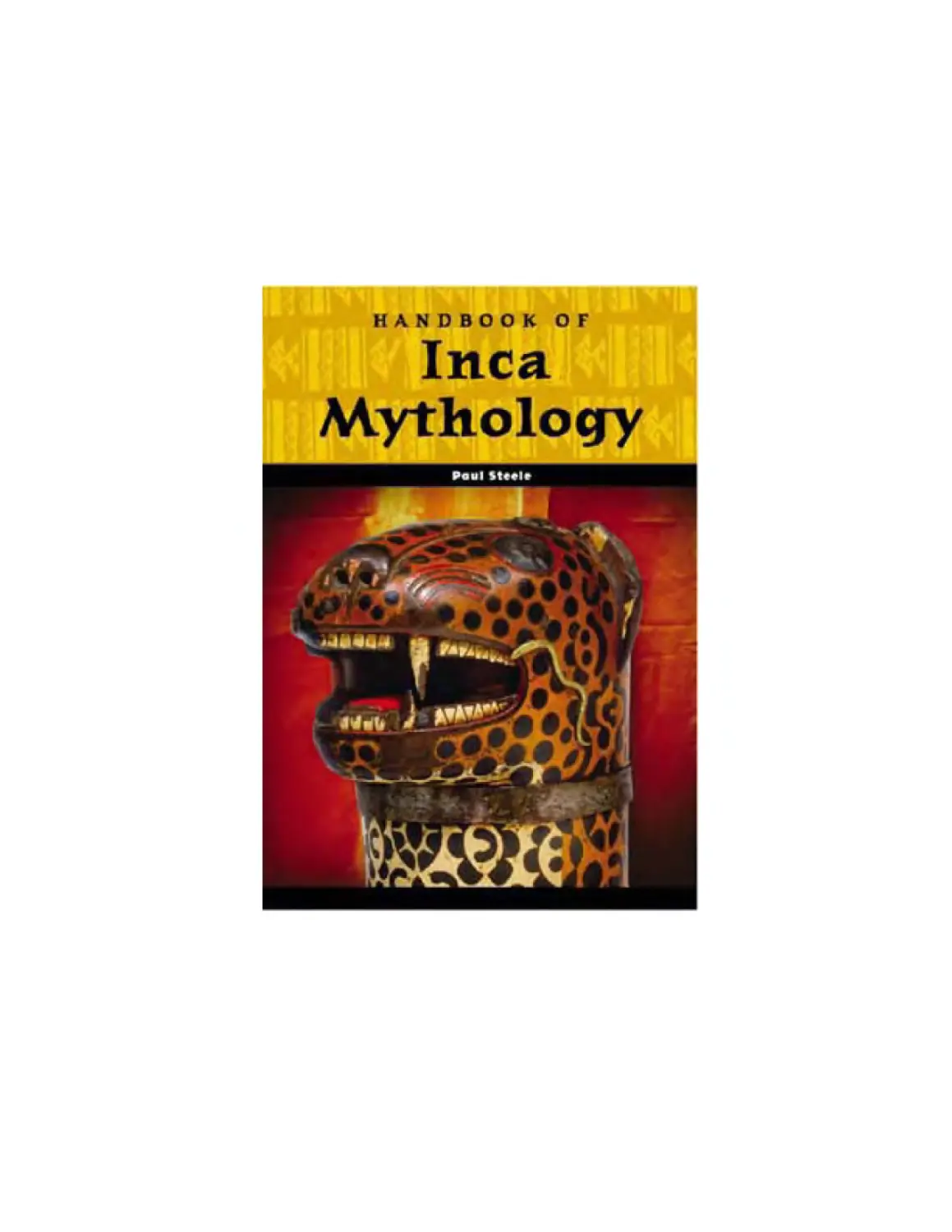


Автор: Steele P.R. Allen C.J.
Теги: ancient civilizations inca mythology south american mythology inca culture
ISBN: 1-57607-354-8
Год: 2004


Текст
                    Handbook of
Inca Mythology

TITLES IN ABC-CLIO’S
Handbooks of World Mythology
Handbook of Arab Mythology, Hasan El-Shamy
Handbook of Celtic Mythology, Joseph Falaky Nagy
Handbook of Classical Mythology, William F. Hansen
Handbook of Egyptian Mythology, Geraldine Pinch
Handbook of Hindu Mythology, George M. Williams
Handbook of Japanese Mythology, Michael Ashkenazi
Handbook of Mesoamerican Mythology,
Kay Almere Read and Jason J. González
Handbook of Native American Mythology,
Dawn Bastian and Judy Mitchell
Handbook of Norse Mythology, John Lindow
Handbook of Polynesian Mythology, Robert D. Craig

HANDBOOKS OF WORLD MYTHOLOGY

Handbook of
Inca Mythology
Paul R. Steele
with the assistance of
Catherine J. Allen

Santa Barbara, California

•

Denver, Colorado

•

Oxford, England

COPYRIGHT © 2004

BY

PAUL R. STEELE

AND

CATHERINE J. ALLEN

All rights reserved. No part of this publication may be reproduced, stored in
a retrieval system, or transmitted, in any form or by any means, electronic,
mechanical, photocopying, recording, or otherwise, except for the inclusion
of brief quotations in a review, without prior permission in writing from the
publishers.

Library of Congress Cataloging-in-Publication Data
Steele, Paul, 1967–
Handbook of Inca mythology / Paul Steele.
p.

cm.—(Handbooks of world mythology)

Includes bibliographical references and index.
ISBN 1-57607-354-8 (hardcover : alk. paper)
ISBN 1-85109-621-3 (e-book)
1. Inca mythology. 2. Legends—Andes Region.
F3429.S77

I. Title.

299.8'8323013—dc22
08

07

06

II. Series.

2004

05

04

2004009635
10

9 8 7 6 5 4 3 2 1

ABC-CLIO, Inc.
130 Cremona Drive, P.O. Box 1911
Santa Barbara, California 93116-1911
This book is printed on acid-free paper.
Manufactured in the United States of America

For my mother and father

CONTENTS
Preface, xi
Orthography, xv

1. Introduction, 1
Who Were the Incas? An Overview of Inca and Andean Civilization and
Culture, 3
How Did the Incas View the World? 18
What Happened to the Inca Empire? 28
Sources for the Study of Inca Myths, 34

2. The Unfolding of Time: Mythic Histories of the Incas, Huarochirí,
and Paucartambo, 51
Imperial Inca Mythology, 52
The Myths of Huarochirí, 66
Andean Myth Today: An Example from Paucartambo, 79
Andean Representations of Time, 83

3. Encyclopedia of Mythic Narratives, Themes, and Concepts, 93
Agricultural Fertility, 93
Amaru (Amaro), 95
Amaru Tupa (Amaro Thupa/Tupac), 98
Atahualpa Inca (Atawallpa), 100
Ayar Cachi (Cache), 102
Bear (Ukuku), 105
Birds, 107
Body, 109
Cacha, 113
Camelids, 115
Cañari Origins, 119
Catequil, 120
Ceque System (Zeq’e), 123
Chancas, 125
Chaupi Ñamca, 129
Chavín, 130

vii

viii

Handbook of Inca Mythology
Coca (Erythroxylum coca), 134
Colors, 136
Con (Kon), 140
Constellations, 142
Coricancha (Qorikancha), 145
Cuniraya Viracocha (Coniraya Wiraqucha), 149
Dead, Journey of the, 151
Dog, 154
Dualism, 156
Earthquake, 159
Felines (Jaguar, Puma), 160
Foodstuffs, 163
Fox (Atuq), 167
Giants and the Miniature World, 169
Huallallo Carhuincho (Wallallo Karwinchu), 173
Huanacauri (Wanakaure), 174
Huari (Wari), 178
Huatya Curi (Huatiacuri, Watiakuri), 181
Huauque (Wawki), 183
Huayna Capac (Wayna Qhapaq/Kapaq), 185
Inca Origins, 188
Inca Roca (Inka Roqa), 193
Inkarrí, 194
Lightning, 197
Mallqui (Malki), 201
Mama Huaco (Mama Wako), 203
Manco Capac (Manq’hue Qhapaq), 206
Mayta Capac (Maita Qhapaq), 208
Moche, 209
Moon (Quilla, Killa), 211
Mountains, 213
Naymlap, 217
Pacarictambo and Pacarina (Pacareqtampu and Paqarina), 219
Pachacamac (Pachakamaq), 221
Pachacuti (Pachakuti), 226
Pachacuti Inca (Pachacuteq Inka), 228
Paria Caca (Pariya Qaqa), 232
Petrifaction and Pururauca, 235
Pilgrimage, 238
Qoyllur Rit’i, 240

Contents
Staff Deity, 243
Sun (Inti, Punchao), 245
Textiles, 250
Tiahuanaco (Tiwanaku), 252
Titicaca, Lake (Titi Qaqa), 253
Toad (Hanp’atu), 256
Tropical Forest, 257
Tunupa (Thunupa), 260
Tutay Quiri, 261
Vilcanota River, 263
Viracocha (Wiraqucha), 265
Viracocha Inca (Wiraqucha Inka), 269

4. Annotated Print and Nonprint Resources, 273
Books and Articles, 273
Videos, 277
Websites, 278
References, 281
Glossary, 293
Pronunciation Guide, 299
Appendix: Timeline of Andean Cultures, 301
Index, 303
About the Authors, 319

ix

PREFACE
A few days into 2003, Catherine Allen contacted me about the possibility of
working on this project. Having met Catherine only once before, I was flattered
that such an eminent Andeanist would think of me. I didn’t hesitate to say yes
but immediately spurned the possibility of writing this book alone, which
would have been a daunting task. The nature of an all-encompassing encyclopedic book of reference would require a collaborative effort. I made the right decision! As an ethnographer working in the field, Catherine’s collection and analysis of modern stories based on her extensive knowledge of Andean culture
would complement my own knowledge that was gained through a doctoral
study on the myth of Inca origin. We hope our collaborative effort has produced
an accessible, informative, and ultimately enjoyable book.
The word Inca is probably the most recognizable name that applies to the
pre-Hispanic cultures of South America. The Incas were just one (though highly
successful) group that was the dominant polity when the Spaniards arrived off
the north coast of what is now Peru in the 1520s. The Inca Empire stretched for
thousands of kilometers down western South America, from Colombia to Chile
and Argentina, incorporating a myriad of ethnic identities, languages, and
mythological traditions. The scope of this handbook goes far beyond what is
strictly Inca to embrace this Andean world. However, it would be impossible to
include the mythological traditions of every Andean ethnic group covered by
this enormous geographical extent. Rather, the handbook introduces some of
the well-known mythic events, heroes, and antiheroes. In addition, we explore
mythic themes that can be tentatively traced through time and space. The handbook is aimed at new scholars rather than specialists. Thus, the analysis is in
general not overly analytical or deeply theoretical. There is plenty of further
reading cited, either the original chronicler sources or specialists in the field,
and we encourage students to avail themselves of these sources. Where possible,
we include chapter and page information for the chronicler sources as readers
may wish to consult alternative editions rather than the volumes we utilize
here.
As an Inca handbook, the book naturally focuses especially on the stories
collected by the chroniclers primarily in and around the Inca capital, Cuzco.
These included myth cycles such as the creation of the natural world and the
origins and rise of the Incas. Moving away from the Inca heartland, we draw

xi

xii

Handbook of Inca Mythology
heavily on the Huarochirí Manuscript, which provides a non-Inca provincial
view from the highlands directly east of Lima. In one sense, all of these written
accounts are not strictly true Inca or true pre-Hispanic myths. Many students
will be aware that a system of writing comparable to the Maya or Egyptians that
could record myth and history never seem to have developed in the Andes. Despite more recent attempts to decode Inca communication systems, we will
probably never know for sure the exact content of a mythological narrative before the Spaniards arrived and began to record this tradition.
The myth-stories were collected during the colonial period that witnessed
the invasion of a non-Andean alien culture. Consequently the tradition reflects
a process of ideological mixing or blending, a process often referred to as syncretism. It is not always easy to distinguish purely Inca or Andean myth elements from Western-introduced religion. For instance, the Inca creator deity
called Viracocha came to the end of his journey across the Andes and walked
over the Pacific Ocean. Could the story of Jesus Christ, who also walked on
water, have inspired this? Is an Inca story of a great flood inspired by or adapted
from Judeo-Christian biblical tradition? It is likely that Viracocha, whose innate
qualities probably represented a force that engenders and regenerates, was reinterpreted by Spanish chroniclers as a creator god akin to the god of Christianity.
The description of Viracocha as a tall, light-skinned, bearded man is obviously
derived from a commingling of traditions.
Of course this does not mean that pre-Hispanic mythological motifs cannot
be identified. This does, however, require mythologists to absorb themselves in
the Inca worldview, which may at first appear foreign and strange. The Handbook of Inca Mythology provides a broad overview of Inca myth-history within
its cultural and historical context. Our purpose is to draw readers into an Andean worldview in which the myths provide meaningful statements about the
nature of things.
The handbook’s information on Inca myth is drawn from written sources
produced during the first 150 years after the Spanish conquest in 1532. Material
on contemporary myth is drawn from ethnographic research and anthropological literature written from about 1900 onward. Archaeological remains from the
Inca period date mainly from the fifteenth and early sixteenth centuries, and we
also refer to a few sites and iconographic representations in pre-Inca traditions
going back to about 500 B.C. Although the handbook is intended for nonspecialists, some discussion of sources is necessary to help readers appreciate the nature of the information they are given.
Chapter 1 introduces readers to Inca society and culture. It includes an
overview of Inca society, a summary of the Inca belief system as expressed in
myth and ritual, an account of the Spanish conquest and the indigenous re-

Preface
sponse to missionization, continuity and change in Andean culture since the
Spanish conquest, and a discussion of the sources of information for Inca myths.
Chapter 2 shows how mythic events unfold in time. As Andean myths are
extremely localized and vary according to local landscapes and political interests, we contrast Inca imperial myths with the well-described regional myths
from Huarochirí and then show how many of the mythic stories and themes persist in the present day. This chapter ends with a discussion of some nonlinear
representations of mythic chronology more appropriate to Andean conceptions
of time.
Chapter 3 consists of dictionary-style entries on important features of Inca
myth. In addition to mythic themes (e.g., body, dualism, and petrifaction) and
specific deities (e.g., Pachacamac and Viracocha) and personages (e.g., Mayta
Capac and Pachacuti Inca), this section includes local deities as general concepts
(e.g., Mountains), important locations (e.g., Huanacauri and Lake Titicaca), and
iconographic themes (e.g., Staff Deity).
Chapter 4 provides a summary of relevant literature, both printed and
e-texts on Inca mythology. Also included is a guide to the best available videos.
In addition, a glossary of terms, including Quechua terms that may be unfamiliar to readers, is provided before the index.
Naturally, Catherine and I express our gratitude to ABC-CLIO and in particular to Simon Mason, Gina Zondorak, Laura Stine, Connie Oehring, and Sharon
Daugherty for their patience with both of us. I would like to thank friends and
colleagues in the Department of Art History and Theory, University of Essex.
My first M.A. class in October 1996 looked at a story that described how the ancestral Inca siblings emerged out of a cave and made their way to Cuzco. I remember wondering, rather dismissively, what useful purpose a story like this
could possibly have. I never dreamed that this particular narrative would later
become the subject for my doctoral thesis. For this project, I would especially
like to thank friends and colleagues who have contributed to my understanding
of mythic personages, episodes, and themes. I extend my gratitude in particular
to Bill Sillar for thoughts on the myth tradition at Cacha; to Cesár Astuhuaman
for the traditions recorded in the Huarochirí Manuscript; to Jane Feltham for the
provenance of the idol and the myth tradition of Pachacamac, to Frank Meddens
for thoughts on the Wari culture; to Stella Nair for clarification of Inca architecture in Cuzco; to Antje Muntendam for advice on the orthography; and to
Melissa Chatfield for an archaeological perspective. I would like to thank all of
those mentioned above as well as Cristiana Bertazoni and Joanne Pillsbury for
providing assistance with acquiring and/or offering images for this project. I
would also like to mention Jerónimo Cusihuaman Quispe, who generously gave
up an evening to share the local mythology and oral history in the town of

xiii

xiv

Handbook of Inca Mythology
Chinchero, Department of Cuzco. Without mythographers such as Jerónimo,
books like this would be the poorer.
Finally, I express deep gratitude to my cowriter, Catherine Allen, who remembered me from my brief visit to Washington, D.C., in 2000. At times, the
working schedule has seemed hectic, but our anxieties stem from the commitment to create a volume that will inspire future and current Andeanists and
mythologists. Above all, our relationship has been thoroughly enjoyable and on
one occasion embarrassing for me when I noted the inferiority of the coca plant
to other food crops! Catherine’s doctoral study focused on the special place coca
holds in Andean culture. I am extremely grateful for the opportunity to have
learned from and to have worked with Catherine and other respected scholars.
Paul R. Steele

ORTHOGRAPHY
The Handbook of Inca Mythology is aimed at introducing students to Andean
mythological traditions, primarily in the form of written chronicles and testimonies in colonial Spanish and native languages like Quechua. These traditions
include indigenous terms, personal names, and toponyms. One of the problems
that afflict Andean studies is the spelling of these words. Before European contact, South American languages like Quechua were not written down in syllabic
form. In colonial times, both Spanish and native Indian chroniclers included a
variety of spellings that attempted to capture the full range of Quechua and Aymara phonetic sounds. More recently scholars have developed new spellings
that attempt to get closer to what they think is phonologically correct. In Cuzco
especially, this political correctness has resulted in ever-changing complex
spellings that do not always bear much resemblance to Spanish colonial sources;
for example,
Colonial: Manco Capac; Cusco; Viracocha
Modern: Manqhue Kapaq/Qhapaq; Qosqo; Wiraqucha
Many scholars today prefer or are at least moving toward an orthography that favors, for example, W rather than HU and UQ rather than OC (in other words,
Tiwanaku over Tiahuanaco, Kamayuq over Camayoc). This is, however, a regional preference that varies throughout the Andes. No doubt new spellings will
continue to move in and out of fashion.
The first and most important point with orthography is not to alternate between spellings. Whatever orthography is chosen, stick with it! For this handbook, there is a preference for the currently unfashionable, older colonial
spellings for characters and places. This is because we utilize many passages of
text from published sources that tend to have the older spellings. Ultimately, we
hope this handbook stimulates students to consult these texts further. Therefore, we aim to avoid the confusion of variant spellings. The encyclopedic list of
entries includes alternative spellings, as does the glossary. The glossary also includes a pronunciation guide. Unless otherwise stated, all English translations
are the authors’.

xv

Map of Andean cultural region

1
INTRODUCTION

W

hile I was conducting research in the former Inca capital, Cuzco,
in July 1999, a discussion with a local Cuzqueño, Oscar, provided
a glimpse into the Andean construction of myth-history. Oscar
said that as a young boy, he had assisted the American archaeologist Hiram
Bingham, who is famous for the rediscovery of Machu Picchu. The conversation
moved on to the subject of earthquakes that periodically cause great destruction
in the Andes. I had just come from the cathedral located on the old Inca plaza
(now Plaza de Armas) that holds the Monroy canvas depicting Cuzco’s crumbling buildings and panicking inhabitants in the aftermath of a great earthquake
in the year A.D. 1650. By chance, another powerful earthquake rocked Cuzco 300
years later, in 1950. Some locals believe that these events even occurred on the
same day, though this is not true.
For seismologists, the gap of 300 years is just coincidence. However, without seeming to pause and think, Oscar immediately started to talk about another earthquake in the year 1350 that he associated with the Inca king called
Pachacuti. Where would this information have come from? Of course: Oscar had
projected back a further 300 years from the two earthquakes (1950–1650–1350).
The native Andean word pachacuti means the change or turn (cuti) of space
and time (pacha). In Andean thought, this term applies to catastrophic events
like floods or earthquakes that are thought to define moments of transition that
separate world epochs. The name Pachacuti is also attributed to the most famous of Inca dynastic rulers who is credited with reorganizing Inca society and
establishing the Incas on the path to empire. There is no way of knowing for
sure whether Pachacuti Inca did actually rule from Cuzco in the year 1350, as
the Incas do not appear to have kept a datable chronology of their kings.
For Oscar, the earthquake/pachacuti is intimately linked with the Inca ruler
Pachacuti who also effected radical change in society. Thus, Oscar dates the
reign of an Inca king by projecting back from the coincidental timing of natural
disasters. Oscar does not view Cuzco’s historical past as a random series of

1

2

Handbook of Inca Mythology
events. Rather, he thinks of time as passing in regular and repeating intervals.
The assumption of cyclical and regular patterns in history appears quite different from the concepts of linear and evolutionary or progressive time that dominate Western culture. Yet in many non-Western cultures, time is constructed or
fashioned, experienced or imagined, in various ways. In fact, modern Western
thinking could, until relatively recently, be considered just as foreign or bizarre.
From biblical tradition, the six days of creation were utilized for dating the
world to a life span of 6,000 years (4,000 years B.C. and 2,000 years after the birth
of Christ). Not until the nineteenth century were these ideas superseded with
pioneering geological studies that contributed to the revolutionary impact of
Darwinism in the latter half of that century.
It is easy to dismiss Oscar’s view of regular cosmic catastrophes as a foolish
and unscientific belief that has no place in the twenty-first century. In fact Oscar’s
story of an earthquake and an Inca king simply places greater emphasis on a cyclical perception of time and events. Moreover, anthropologists today accept that
cultures that emphasize a nonlinear view of time like Oscar’s are at least as valid.
The story is probably historically inaccurate, but for Oscar it is true. This event
took place and another earthquake will strike in the year 2250. In fact, to suggest
to Andeans that this is mito would probably result in a blank look. For Andeans,
myth is a category that cannot be true and for Oscar and many Cuzqueños these
events represent historia. Societies remember the past in a variety of ways. At
many levels, Oscar’s story reveals fundamental cultural assumptions from which
Andean myth tradition was and continues to be constructed.
Delving into the segments of space and time that are interspersed by cosmic
pachacuti, we find that Andean myth, as in other cultures, explains how the
world came to be and the place of humans in this world. Andean myths express
relationships: spatial, social, economic, and ritual, that are frequently hierarchical. In general, the geography of Andean myths tends to be localized or regional
rather than pan-Andean, although Inca expansion itself seemed to have created
an ever-extended journey from Titicaca to Ecuador for the deity Viracocha. Localized stories are found with the ancestral origins of an individual community
whose migration or emergence onto the landscape was designed to substantiate
or justify access to the natural resources of that land. Here we find that myth explained Andean social organization, both the banding together for communal
ventures and the competition between rival groups. Andean myths also reinforced and sanctified cultural assumptions and cultural practices that differentiated communities at local and regional levels.
At the level of the supernatural world, Andeans have always been confronted by dangerous forces of nature such as the Earthquake or the Lightning
that are responsible for destructive forms of precipitation. Humans attempt to

Introduction
appease and even control these forces. The feminine earth who gives up her
fruits at each harvest also needs to be nurtured and can adopt a hostile and violent persona if displeased. This dual and antagonistic nature is a persistent aspect of Andean deities such as the Sun at night and the Sun in the daytime. The
Lightning too can appear in a more beneficent role as protector rather than destroyer of agriculture. Thus Andean myth allowed cosmological forces, nature
deities, and human characters to adopt varying guises. For mythologists today,
the task is to recognize these innate characteristics. Then we can understand
how Andeans used myth stories to explain and validate their belief system.

WHO WERE THE INCAS?
AN OVERVIEW OF INCA AND
ANDEAN CIVILIZATION AND CULTURE
Andean Ecological Environment and Human Adaptability
When the Spanish conquistadors first entered the highlands of what is now
Peru, they termed the snow-capped mountain range “Andes.” The name may
have derived from Andenes, the stepped strips of cultivable land etched out from
the steep mountainsides. The word Andes is also close to Antis, the Inca name
for the forested eastern Andean slopes that descended into the tropical lowlands.
When we talk about Andean civilization and culture today, the term is not confined to the mountains or lowlands, but applies to a much more extensive area
that was covered by the Inca empire. The vast empire of the Incas stretched from
Pasto in the south of present-day Colombia, covering much of western South
America as far as the Maule River, south of Santiago, the capital of present-day
Chile. It incorporated most of Ecuador, Peru, the western half of Bolivia, and
northwestern Argentina. The region is dominated by the towering Andean
mountains that were pushed up by the subduction of the Nazca Oceanic Plate
under the Continental South American Plate. As a result of plate tectonics, the
Andean region is subject to frequent seismic activity and periodically devastating earthquakes, volcanic eruptions, and tidal waves or tsunami.
The Andean peaks are interspersed by high, featureless plains known as
puna, altiplano, or páramo. These plains are virtually nonexistent in Ecuador
and the north of Peru and form a relatively narrow strip that gradually broadens
out farther to the south to include the Titicaca basin. Lake Titicaca, at an altitude of 3,800 meters, straddles the borders of what are now Peru and Bolivia.
This is the largest high-altitude lake in the world, although its waters once covered a more extensive area and its shoreline continues to retreat.

3

4

Handbook of Inca Mythology
From the mountains originate the small streams and tributaries for large
rivers like the Marañón and Ucayali that flow north and east and eventually
come together to form the great Amazon River. On the other side of the watershed, the Pacific catchment provides more than fifty river valleys along the Peruvian coast. Of course, deep gorges also present precarious hazards to be
crossed. Hence, the Andean word for bridge, chaca, refers to both an aid to passage and a dangerous obstruction.
Fanning farther away from their highland source, the ecological environments through which these rivers flow provide an acute contrast. It is estimated
that 80 percent of the world’s ecological environments are represented in western
South America. The semitropical eastern Andean slopes (selva) run down into
the lowland forest canopy. The selva and tropical forest provides an abundance of
highly valued products like edible fruits, peanuts, and in particular coca and
other plants with medicinal properties. With exotic and frightening wildlife like
monkeys and caimans, the forest contrasts vividly with the giant ridges of sterile
sand to the west of the mountain chain that runs all the way down to the Pacific
Ocean. This relatively narrow coastal plain is an oppressive landscape in which
very little grows. The only moisture from precipitation is a fine drizzle or mist
that supports a particularly well-adapted coastal vegetation known as lomas. The
extension of this desert into Chile, where it is known as the Atacama, is officially recognized as the driest place on earth. The river valleys that run down
from the mountains provide an oasis of fertile green strips that contrasts with the
barren yellow-brown expanse it cuts through. For coastal peoples, these riverine
arteries have always been a vital source of life. In pre-Hispanic times, singlevalley and more elaborate multivalley canal systems were constructed across the
desert to bring this water supply to coastal communities.
The sterility of the coastal mainland contrasts further with the abundance
of Pacific marine resources. The prevailing cold Peru, or Humboldt, Current that
sweeps up from the south normally covers three-quarters of the Peruvian coastline northward to Trujillo. This cold current is responsible for the vast quantities of nutrients and microscopic plankton that sustain schools of anchovies,
tuna, large ocean mammals like whales, and seabirds like cormorants. These
waters are cold enough for sea lions and penguins, though the latitude is closer
to the equator than the Mediterranean.
Each year around December and January, warmer equatorial waters move
into the northern coast of Peru. Spaniards named this current “El Niño” after
the child Christ. Periodically, this seasonal change in the current extends as far
south as central Peru, with devastating effects for coastal communities. The rise
in sea temperature wipes out the plankton base of the marine food chain. The
moist air produces greater precipitation than usual that races down normally

Introduction
bone-dry ravines, while the sparse vegetation is not sufficient to soak up the
flash showers. Archaeology continues to uncover coastal urban sites that were
buried, and the damage to pre-Hispanic canal and irrigation systems can still be
seen. The higher-than-normal temperatures create a swampy environment that
today harbors outbreaks of dangerous diseases like yellow fever and malaria.
Such a rugged, varied, and unpredictable environment strains the limits of
human adaptation. On the coast, the human body is subject to the cold depths
while retrieving seashells and mollusks from the Pacific littoral (which is particularly stressful to the eardrum). In the mountains, the body experiences oxygen
deficiency, high ultraviolet radiation, and intense cold. Over the millennia, natural selection favored a short, stocky body type that conserved body heat. Also,
people who are born and grow up at these high altitudes develop a larger-thannormal lung capacity and a higher-than-normal proportion of hemoglobin in the
blood in order to capture available oxygen.
Agropastoral activities in the Andean world are very much determined by
altitude. The lower altitude valleys, known as the yunca zone, extend from
around 2,200 down to 800 meters, below which are the coastal plain and Pacific
littoral to the west and the tropical lowlands to the east. The yunca zone is
warm enough to cultivate coca, chili peppers, and avocados. Around 3,300 meters, nightly frost can damage crops. Consequently, maize cultivation is not generally attempted above this height, except where favorable microclimates are
created by orientation and rain shadow. Efforts to develop arable land transformed steep mountainside gradients into stepped or terraced fields (known as
Andenes) with irrigation canals channeling running water. Frost-resistant food
crops such as tubers like potatoes and oca as well as chenopods like quinoa can
be grown at altitudes up to and just above 4,000 meters. Above 4,000 meters, the
higher altitude puna grasslands that extend up to glacial zones are ideal for the
pasture grazing of camelids. The domesticated alpaca and llama and the wild
guanaco and vicuña have traditionally provided humans with transportation,
fuel, clothing, and food.
The highland valleys are subject to annual wet and dry seasons. Precipitation falls from October through March, with the heaviest rains from December
through February. The heavy rains mark the midpoint of the growing season. Although crops vary, in general, hoeing and planting take place around September,
and harvest is not collected until the following April. Leading up to the heavy
rains, farmers worry about early frosts that could destroy young seedlings in the
ground. After shoots appear, there is anxiety about keeping predatory scavengers
out of the fields. The coldest months of the year, June and July, are also the driest—hence, the traditional name for this time of year, “hard earth.” This intervening period outside of the agricultural season is the time of most population

5

6

Handbook of Inca Mythology
movement when travel is easiest. People are available for large projects like construction work and canal cleaning. This was also the traditional time for raiding
and warfare.
The organization of Andeans into social, political, economic, and ritual cohesion revolved around the unit of the ayllu. The term ayllu refers to a kinbased community or the extended family. On the coast, this unit was also
known as villca, and the Incas in Cuzco termed their own ayllus as panaca
(from pana, meaning “sister”), suggesting the importance of matrilineal descent.
At one level, the ayllu functioned as a localized community in which the most
important ritual celebrations focused on the mummified ancestors. On a larger
scale, the term ayllu also applied to a multivillage organization and on an even
larger scale a regional or apical ayllu, thus forming a system of units nestled into
increasingly expanded collectives.
The ayllu was intimately connected to its own immediate landscape from
which the community recorded and arranged its mythic history. The concern with
territory naturally extends to the access to resources. With food and products located at sharply differing altitudes, human subsistence in the Andes is very much a
vertical challenge. For millennia, Andean ayllu have adapted their economic strategy to tap into the range of foods and products from these diverse ecological zones.
The exchange of foods and products at periodic markets and through seasonal trading alliances remains widespread and can result in long journeys with llama pack
caravans. However, highland Andeans employed a more effective strategy that secured access to lands at different altitudes. It is thought that the Lupaca macroethnic group, located in the highlands around Lake Titicaca, retained colonies as
far as the forested eastern Andean slopes and also the Pacific coast. This economic
arrangement has consequently coined the description “vertical archipelago.” Naturally, the same vertical system did not appeal to coastal peoples.
The expansionist policies adopted by the Incas followed on from previous
attempts by highland communities to exercise greater control over the people
and products of the lower valleys. In particular, highlanders sought access to
coca-producing regions in the warmer yunca zones and even protein-rich foods
like marine fish on the coast. From their highland base in Cuzco, the Incas
claimed to be able to consume fish fresh from the ocean within twenty-four
hours. Perhaps here the Incas were attracted to the religious significance of the
coast and particularly the ocean. From the perspectives of yunca and coastal
dwellers, the challenge was to secure access to the seasonal flow of rain and
meltwater coming down from the mountains. Many of the themes that structure Inca and Andean myth-histories reflect a culture in which hostility and
confrontation as well as alliance and organization were natural responses to the
challenge of the Andean environment.

Introduction

Brief Overview of Pre-Inca Civilizations in the Andes
Evidence of human occupation in the Andes goes back to at least 12,000 B.C.
Carbon-dated plant material and human stone tools have been found at a number of caves and rock shelters like Pachamachay and Guitarrero Cave in the
highlands and Quirihuac on the north coast of what is now Peru. The claims
made for human occupation 20,000 years ago at Pikimachay (‘Flea Cave’) in the
south-central highlands are disputed. This earliest phase of Andean civilization
is known as Paleo-Indian and followed the recession of glacial sheets at the end
of the last global ice age. To what extent the retreat of the ice sheets was a positive factor that facilitated highland human habitation is still not clear. The next
phase of civilization, beginning around 7500 B.C., is known as the Archaic Period
and included the domestication of food plants like maize and the tuber and animals like the camelid. The archaeological remains of human settlement in the
highlands are confined to caves and shelters like Lauricocha where petroglyphs
(rock paintings) have been found. Open-air settlements are more difficult to
trace. On the coast in the Ancón Valley just north of Lima, the first human habitation consisted of temporary camps to take advantage of the sea fauna and seasonal lomas vegetation.
Toward the end of the Archaic Period, archaeologists define a Cotton PreCeramic Period that is also called the Formative Period. This included the introduction of cotton farming on the coastal plain and perhaps the world’s earliest
attempts at mummification by the Chinchorros culture in the Chilean Atacama
Desert around 5000 B.C. This period saw the construction in adobe of large complexes of pyramid platforms, plazas, and ramps. The architecture of coastal sites
like Aspero, Caral, and El Paraíso and in the highlands at Kotosh shows the first
monumental buildings in the Americas (see Fung Pineda 1988). These date to
around 2000–3000 B.C., contemporary with the first pyramids in Egypt, and in
fact rivaled the Egyptian building program in terms of the huge expenditure in
labor. Despite their impressive scale, the function and form of these buildings
resemble more closely temple cult shrines rather than urbanized centers that
were typical of later Andean settlements. Some features found with later Andean architectural layout can be identified such as U-shaped structures, interior
niches, large plazas for communal gathering, and, conversely, high walls and
narrow entrances that would have restricted access.
The Pre-Ceramic Period cultures on the coast provide the earliest surviving
Andean textiles. The extremely dry conditions of the coastal desert allowed the
preservation of fiber material. These textiles reveal invaluable information. Andeans did not evolve a pictorial or syllabic writing system like the cultures of
ancient Egypt, China, or Mesoamerica, so we do not know the mythical stories

7

8

Handbook of Inca Mythology
that were told before the arrival of the Spaniards. Consequently, we rely on
the iconography depicted on cloth as well as ceramic, metal, stone, and plaster to provide a gateway into their cosmology or worldview. During the PreCeramic Period, we see for the first time mythic themes like transformation
and multiple readings. The north coast site of Huaca Prieta revealed a huge
number of textiles that depict composite creatures. In the highlands, the temple compounds at Kotosh include two examples of crossed hands (right over
left) that are carved below two interior adobe wall niches. Perhaps this expressed a basic form of duality—another concept with a long tradition in the
Andean world.
Around 1800 B.C., ceramics appeared for the first time in the north of Peru,
marking the start of what archaeologists define as the Initial Period. In terms of
architecture, the U-shaped structures become even more prominent on the coast
and extend into the highlands. In the highlands there is a particular emphasis on
relatively small, sunken rectangular and circular plazas. Much of the visual imagery rendered in adobe, clay, and stone reveals familiar themes running through
later Andean iconographic tradition. In the north highlands of Peru, the ceremonial center of Sechín is fronted by reliefs depicted on upright stone slabs of alternating height. These show deceased individuals, many having been dismembered, while other figures wear hats and hold objects. The individuals appear to
be in a procession and perhaps reflect symbolic ideas about the afterlife rather
than the record of an actual gruesome battle (see Stone-Miller 2002, 27–28). On
the coast at sites like Garagay and Moxeke, the theme of human-animal transformation is found in images of insects with human heads and what is possibly a
shaman in hallucinogenic transformation. At Huaca de los Reyes, a huge adobe
sculptured head has a wide nose, pendant irises, and a fanged mouth. The
themes of shamanic transformation and the iconographic tradition of the jawless lower mouth, wide feline nose, claws, and entwined serpents are early precursors to a later art style known as Chavín.
In the early part of the twentieth century, archaeologists started to recognize the distinctive art style and iconography that emanated from the highland
site of Chavín de Huantar. This style disseminated to regions as far as the south
coast of Peru. Archaeologists subsequently recognized this development as a period of cultural unity and termed this the First or Early Horizon. The term Horizon is also applied to two later periods in Andean cultural history. These are periods of broad continuity characterized by central or state control over large
regions as well as the dissemination of iconographic and ceramic styles and accompanying religious ideas. Horizons are interspersed by intervening or intermediate periods that witnessed the return to regional art styles and the collapse
of state systems. The application of Horizons can define only broad periods of

Introduction
Andean culture. In reality many areas of the Andes were affected in different
ways at different times by the development or decline of state apparatus.
The site of Chavín de Huantar is situated in the central-north highlands of
Peru. Like many other important sites, the location of Chavín de Huantar on the
landscape is defined by the confluence of rivers, places that are still considered
spiritually powerful in the Andes. Chavín de Huantar was not the center of a
state, but rather a place of pilgrimage that competed with other cult shrines and
would have played a central role in the articulation of Andean religious beliefs.
The success of the site is based partly on its location. It could exert control over
two of a handful of intermontane passes through the Andes and was thus well
positioned to mediate the control of people and goods from both the tropical
lowlands to the east and the coastal cultures to the west. The first or old temple
complex evolved through a number of building phases beginning around 900 B.C.
The complex was based around a five-meter-high bladelike stone shaft that
functioned as an oracle. The temple was substantially remodeled around 500
B.C., providing a new and larger plaza and a change in the cult focus. Archaeologists have named some of the temple rooms after the exotic goods from the Pacific littoral and the tropical lowlands. In particular, the fauna and wildlife of
the Amazon rather than the local highland environment appear prominently in
Chavín iconography, leading some scholars to speculate about the origins and
development of Andean cosmology. Around the time of Christ, Chavín de Huantar faced new competition from cult shrines on the central and south coast of
Peru and went into decline.
With the decline of the cult center of Chavín, we enter into the First or
Early Intermediate Period (ca. 200 B.C.–A.D. 550). Although this period theoretically represents a time of regional diversity, the iconic images of fanged and
staff-wielding figures survived the decline of the Chavín cult shrine and soon
reemerged in coastal and highland cultures. During this period, the most successful culture on the north coast of Peru was the Moche or Mochica, which divided into two distinctive polities. The southern base in the Moche Valley is
dominated by the huge adobe pyramids of the sun and moon, and to the north in
the Lambayeque Valley is another site, Pampa Grande. These large urban centers and their infrastructures, which included extensive hydraulic projects, exerted control over many coastal river valleys. Moche society reveals a greater degree of social hierarchy than previously existed. The level of organization
approached that of state-level activities.
The Moche are renowned for their craftsmanship in precious metals and
ceramics. Some of the highest quality objects were discovered at the tombs of
the lord of Sipán in the 1980s. The Sipán burials reflected the standard mortuary practice that appears to have been followed by all classes in Moche society.

9

10

Handbook of Inca Mythology

The ruins of a portico stand at Chavín de Huantar, Peru. Chavín de Huantar was a
pilgrimage center that disseminated a particular art aesthetic throughout the Andes.
Ca. 900–200 B.C.E. (Charles and Josette Lenars/Corbis)

At Sipán, the difference was not in the position of the grave goods but in their
quality, with high-status gold, silver, and copper replacing more easily obtainable materials (see Alva and Donnan 1993). Moche culture flourished until adversely affected by environmental disaster around the start of the eighth century. Subsequently, the Moche began to follow more closely the ceramic styles
and iconographic tradition of highland culture. In fact, it seems that the Moche
were subject to a degree of control from the highland Wari culture, although as
with other north coast peoples the Moche are thought to derive much of their
cultural tradition from Ecuador and Colombia rather than the south of Peru.
Objects from as far as Panama have been found in the north of Peru (see Bawden
1996; Pillsbury 2001).
For the Early Intermediate Period on the south coast, two cultures in particular—Paracas and Nazca—stand out. The artists of the Paracas Peninsula initially borrowed heavily from Chavín images and then began to develop their
own unique regional style. Cloth survives much better in the drier sands of
southern Peru, and the word Paracas literally means “sand blown by wind.”
Paracas culture is best known for the high quality of woven and embroidered
textiles, many examples of which were utilized to wrap the dead in mummy
bundles (see Frame 2001; Paul 1990, 1991). These mummy bundles were

Introduction
arranged in the fetal position and located in the desert sands in bottleneck
tombs known as the Cavernas type and a square-chamber Necropolis type.
In terms of iconography, Nazca imagery initially developed from the cultural tradition of Paracas. For instance, the wide-eyed Paracas Oculate Being was
transformed into the Nazca killer whale. The Nazcans are perhaps best known
for the many fauna and animals and thousands of straight lines etched out on
the desert pampa. These geoglyphs probably retained a ritual function designed
to connect Nazcans with the distant mountain gods that controlled the flow of
water, the essential natural agent in such a harsh environment (Aveni 1990).
Like the Moche, the later phases of Nazca style, from around A.D. 700, reflect
the increasing influence of Wari rectilinear aesthetic.
For south coast cultures, there is less evidence for large-scale urban centers.
Popular cult shrines were located at Ica and Cahuachi and farther up the coast at
Pachacamac, just south of present-day Lima. The first evidence of state-level administration appears with the next stage of cultural unification that constitutes
the Middle Horizon (ca. A.D. 550–1000). This period is associated with two dominant cultures: the Wari, based in a large city of the same name (spelled Huari) in
the south-central Peruvian highlands close to present-day Huamanga (or Ayacucho). The other dominant center was the city of Tiahuanaco, located in what is
now Bolivia, not far from the southern shores of Lake Titicaca. Tiahuanaco had
already begun to flourish during the Early Intermediate Period. The impressive
civic ceremonial center with its stone monoliths and sunken plazas that attract
tourists today also appealed to the Incas, who utilized stonemasons from this region for the building of imperial Cuzco (Kolata 1993). Some narratives of Inca
creation believed Tiahuanaco stone monuments represented a race of giants
from a previous world age.
The Wari in particular were more likely to have represented a state with
provincial administration centers carved out far from its heartland. Wari infrastructure such as roads and way stations were later utilized and improved upon
by the Incas (see Isbell and McEwan 1991). In contrast, Tiahuanaco was more a
cult center that would have drawn pilgrims from long distances. Both cultures
were united in a broadly similar iconographic tradition that focused on the staffwielding figure, a figure familiar a millennia earlier at Chavín that had evolved
through cultures like Pucara. The most famous image of this deity can be seen
at Tiahuanaco, carved out above the Portal of the Sun, flanked by winged attendants. The identification of the principal figure with the sun or the creator deity
of the Incas called Viracocha, or the Titicaca lightning deity, Tunupa, can only
be assumed.
A further period of regional diversity or fragmentation is represented by the
Late Intermediate Period, which spanned the collapse of the Wari state system

11

12

Handbook of Inca Mythology
and the decline of Tiahuanaco culture from around A.D. 1000 until the expansion
of the Inca Empire around 1400. This period was described to Spanish chroniclers as a time of intense warfare among competing ethnic groups who were led
by Sinchi, strong and warlike leaders. Archaeology confirms this period of hostility, with many human settlements relocated to hilltop fortifications, known
as pucara. This break in Middle Horizon unity is evident not only in the dissolution of state systems but also in terms of ceramic style and iconography. Some
sites, like the coastal cult shrine of Pachacamac, did continue to flourish
throughout the Late Intermediate Period and into the Late Horizon. Many other
areas experienced a break and transition the cause of which is not yet well understood.
On the north coast of Peru, this break is found in the Moche Valley where
the old center of the southern Moche, with its dominating adobe pyramids, had
been abandoned and another urban settlement on the opposite side of the river
was growing. The new focus was called Chan Chan and evolved into a huge
urban sprawl that was the capital of the Chimu or Chimor Kingdom. Before subjugation by the Incas, the Chimu achieved a state-level administration that controlled many coastal river valleys as far south as Lima.
Chan Chan was located so close to a gradually uplifting seashore that its inhabitants faced a steadily deteriorating fresh water supply. Ever deeper water
wells were sunk and considerable expense was invested in a huge multivalley
network of aqueducts to bring in fresh water. Tectonic uplift meant this system
may never have actually brought water to the urban center. The high-walled imperial palace compounds that limited access to the Chimu elite contained Ushaped administrative units, royal burial platforms, and gardens. As with their
Moche predecessors, Chimu iconography indicates the existence of social
classes. Chimu imagery also concentrates on the natural world of animals, birds,
and fish. In Chan Chan, the adobe walls included repetitive friezes of marine life
and also the amaru, the Andean double-headed serpent dragon (see Moseley and
Day 1982).

Formation, Expansion, and Organization of the Inca State
The Incas were the dominant group in the Andes when the Spanish conquistadors arrived on the north coast of Peru. The geographical limits of Inca control
extended from their highland base, Cuzco (3,300 meters), in south-central Peru,
to incorporate most of the coastal strip and highlands of western South America.
The Inca Empire stretched north to the border between present-day Ecuador and
Colombia. To the south, it advanced as far as northwest Argentina and the

Introduction
Maule River, close to Santiago, Chile. The expanse of the Inca state stretched
north to south about 5,000 kilometers and dwarfed any attempt at state control
that had previously existed in the Andes.
Like other Andean peoples, the Incas retained myth-histories that explained
their origins. In general, the Spanish chroniclers were told that the first Inca,
called Manco Capac, had come from the south of Cuzco and that ten rulers succeeded him, up to and including the last independent Inca, Huayna Capac. The
earliest Incas are described as both feuding with neighboring groups and intermarrying in order to forge alliances. Not until the reign of the ninth Inca, Pachacuti, were the foundations laid for the rapid expansion of territorial control. According to the Spanish chroniclers, the eighth Inca, Viracocha, and his eldest
son, Urco, abdicated their duties in the face of the advancing Chancas, a rival
macroethnic group. With a historic victory over the Chancas, the young prince
Pachacuti Inca overhauled all facets of Inca government and religion, including
the reallocation of land and people in and around Cuzco.
The success over the Chancas appears to have been a catalyst for Pachacuti
and his two successors, Tupa Inca Yupanqui and Huayna Capac, who quickly expanded Inca control to proportions never before experienced in the Andes. The
chroniclers tell us that the Incas subdued the powerful chieftains Lupaca and
Colla around Lake Titicaca and that invading armies arrived on the north coast
in the 1470s to subjugate the Chimu Kingdom. It would appear that the Incas
were impressed with the sumptuous wealth of the north coast elite. They removed Chimu lords to Cuzco and also local gold- and silversmiths.
In the mid- to late 1520s, the first Spanish forays to the north coast of Peru
seemed to have introduced European diseases. As a result of this contact, the
ruling Inca, Huayna Capac, and possibly a designated heir both died. The unexpected death of the Inca precipitated the conflict between the half brothers
Atahualpa and Huascar. They were backed by two factions that fought a bloody
civil war for the tassel, the Inca ensign of sovereignty (see Rostworowski 1999,
106–134).
Some scholars like to use the date 1438 provided by the chronicler Miguel
Cabello de Valboa for Pachacuti’s victory over the Chancas and his succession
as Inca. The archaeological record of Inca state-ware ceramics and the imposition of Inca administration centers tends to confirm a rapid expansion, although recently archaeologists have suggested a slightly longer time span. For
the history of the earlier rulers and the real origins of the Incas, there remains
more conjecture. In part, this is due to the gap in the archaeological record of
Cuzco prior to the Incas, for we do not know what is buried under the Inca
foundations. Cuzco has been continually inhabited from Inca times to the
present, and many of the original Inca structures provide the physical founda-

13

14

Handbook of Inca Mythology
tions for colonial and modern buildings. Archaeologists today tend to base
their arguments on the development of ceramic style. Currently, it is thought
that Cuzco evolved into an important regional center throughout the Late Intermediate Period (Bauer 1992). However, there can be no certainty as to when
the early Incas ruled in Cuzco, or coexisted with other groups, or even whether
they inhabited Cuzco at all. In Cuzco, there is no architectural style identified
with individual Incas before the reign of Pachacuti Inca.
From Cuzco, the Incas divided their empire into four suyus (regions) that
formed the Tahua-ntin-suyu (four-united-parts or the four parts together). This
was made up of the Anti sector, which covered the eastern Andean slopes and
tropical lowlands; the Colla, which extended southeast to the Titicaca region
and beyond; the Cunti, which stretched southwest to the coast; and the Chincha, which covered most of the territory north and west toward the equator. The
last three suyus were named after powerful rivals to the Incas, and the recent
new Inca partition of the Andean world appeared to cut across older regional divisions of the Collasuyu. These four suyus converged on the Temple of the Sun
in the Coricancha (gold enclosure), the most sacred precinct in Cuzco. The immediate fourfold division of space around Cuzco was a sacred landscape full of
shrines that fanned out along conceptual lines called ceques.
It is interesting and little known that the word Tahuantinsuyu only seems
to appear in later colonial sources. It is possible that Tahuantinsuyu was never a
word used by the Incas. Steele suggests that this may have been a term coined by
Titu Cusi Yupanqui (1992 [1570]), the leader of the Inca resistance in Vilcabamba. Alternatively, the term may have been given in response to the Spanish magistrate Polo de Ondegardo, whose inquiries located the system of ceque
shrines around Cuzco (2000). So perhaps the term four parts united best applied
to the place where the suyus were most strongly united: Cuzco and its immediate environs.
In Cuzco, the ruling Inca was accompanied by a principal wife and secondary wives. The maternal side of the family in particular appears to have played
an important if not dominant role for the Inca process of succession. In addition
to the ruler, the Inca elite were formed into a number of royal ayllus that the
Incas termed panacas, which were divided across two moieties. According to
the chroniclers, each panaca represented a kin-based group or corporation that
cared for the mummy of the deceased Inca. Thus, in theory, a new panaca
formed after the death of each Inca. Further down the social ladder, a category
known as Incas-by-privilege that were groups allied to the Incas close to Cuzco
enjoyed certain benefits.
Under the last three Inca rulers, the architectural layout of Cuzco took
shape. It is a generally rectangular form tapering toward the confluence of two

Introduction

15

streams. Today, the imprint of Inca Cuzco permeates through colonial and modern structures. It is possible to visualize the trapezoidal dual Inca plaza, and visitors can access the sacred temples within the Coricancha. On the heights above
this ceremonial core, tourists climb among the ruins of Sacsahuaman with its
enormous cyclopean stone blocks. The central urban core of Cuzco, between
two streams, is relatively small, and successive Incas constructed private estates
out of Cuzco. The popular tourist attractions of Ollantaytambo, Pisac, and
Machu Picchu are all thought to be part of the spectacular cliff-top building program of Pachacuti Inca (see Niles 1999; Protzen 1993).
Inca subjugation was achieved in
a variety of ways. This could involve
coercion and warfare, but more frequently relied on the traditional Andean practice of reciprocity. Inca expansion was facilitated considerably
by the foundations already in place
from earlier attempts at state-level
control during the Middle Horizon.
The Wari and Tiahuanaco had exerted control over a wide area, including the Cuzco region. The Incas
reused and updated these preexisting
administrative centers, roads, and
way stations. Where no state institutions existed, the Incas created them
from scratch, such as the administrative center at Huanuco in the northcentral highlands (see Hyslop 1990;
Morris and Thompson 1985).
Other aspects of Inca imperial
strategy were also derived from longstanding Andean tradition. For instance, the Incas used a system of
periodic labor tax known as the
mit’a (turn of service). Inca-appointed
provincial governors called to- A street vendor pushes his cart up Calle Loreto toward
coyrikoq liaised with local curacas, the main plaza of the city of Cuzco. To his right is one
of the finest remaining Inca walls, formerly part of the
the non-Inca chiefs of the ethnic
Acllahuasi (House of the Chosen Women), now the
groups, over the levy of the mit’a. Convent of Santa Catalina. (Photo courtesy of
The produce of this arrangement, Catherine J. Allen)

16

Handbook of Inca Mythology
stored in collcas (storehouses), was retained and administered by the state in the
name of the sun, the moon, or individual Incas. State storehouses established
throughout the empire contained a surplus of material possessions like woven
cloth and food, especially maize, which was required to make chicha, the maize
drink that was served to mit’a workers. In return for providing local labor, the
curaca would receive a reciprocal payment that could be in the form of luxury
possessions such as textiles. Thus this arrangement was not one-sided and in
theory the process necessitated negotiation. Rostworowski suggests that the expansion of the Inca state coincided with the increase in the number of curacas
that needed to be satisfied (1999, 36–47). To meet the growing demand, later
Incas needed to increase the lands that personally belonged to them.
The Incas enforced the removal of both people and sacred objects to the
capital. This included skilled craftsmen and also the sons of local lords who
could be trained to fill lower positions in Inca bureaucracy and would ensure the
loyalty of their natal ethnic group. The removal of a community’s sacred object
(huaca) to Cuzco was also aimed at coercing obedience from provincial peoples.
This practice existed before the Incas and was continued by Andean communities into the colonial period.
In addition, the Incas selected retainers called yanacona, who occupied a
variety of positions in society. Rostworowski has discovered some cases of yana
who were appointed by the Incas as local-level lords. She suggests that yana, as
loyal individuals without direct ties to the native population, would not have
had the recourse to ask for reciprocal benefits from the Inca state (1999,
148–150). “Chosen women,” known as aclla, were often prepubescent girls
who served state cults like the sun and the moon. The word aclla literally
means “to choose,” and these girls were often taken as secondary wives in marriage alliances. The acllas were located in special buildings known as
acllahuasi (aclla houses), found in many Inca administrative centers. In Cuzco,
the acllahuasi became the Convent of Santa Catalina. These servile women
were removed permanently from their natal homeland and after the Spanish
conquest were discouraged from returning by their own community. This also
included their offspring. Patterson suggests that this Inca strategy effectively
controlled the productive and reproductive capacities of ethnic groups (1991).
The most radical program of resettlement was reserved for colonists known as
mitmaq. Whole communities of men, women, and children, including their curaca leader, were forcibly resettled in regions far from their homeland. For the
Incas, the mitmaq could be loyal groups placed in hostile frontier areas. Conversely, disloyal groups could be deported as punishment. Mitmaq could also be
moved onto land that was previously unproductive. In particular, the Incas
were keen to increase production from coca-producing regions. Under Tupa

Introduction

17

The Spanish conquistadors mistakenly thought that Sacsahuaman with its huge polygonal stone
blocks was a fortress that overlooked and guarded the Inca capital of Cuzco. Inca, Peru,
1430–1532 C.E. (Photo courtesy of Paul Steele)

Inca Yupanqui and his son Huayna Capac, many thousands of people from different ethnic groups were resettled to the valley of Cochabamba in present-day
Bolivia. The Cañari from Ecuador were defeated in battle and resettled in the
Yucay Valley. They became loyal servants to the Inca and were granted the status of Incas-by-privilege.
The administration of the Inca Empire was organized into a hierarchy of
decimal units ranging up to 40,000 that was theoretically monitored by a regular
census. The census recorded a number of age groups that classified the type of
work men and women were expected to undertake. For instance, a male individual could be expected to serve in the Inca army between the ages of twenty-five
and fifty. To store information like census records, the Incas used the quipu,
knotted colored strings suspended from a central cord. One category of official,
runa-quipu-camayoc (people-quipu-specialist), appears to have been given the
task of storing population census data.
The Inca Empire covered a huge area with numerous ethnic groups that constituted the hatun-runa (great populace), all of whom had their own languages,
cult idols, and local myth-histories. The rapid expansionist policies under the
later Incas probably undermined stability and cohesion of a state that never represented national unity. In fact a genuine policy of integration into one nationstate was never attempted by the Incas. Huayna Capac spent much of his time at
the northern base of Tumipampa in Ecuador. His two sons, the half brothers
Atahualpa and Huascar, disputed the succession from two bases that were far
apart, Cuzco and Ecuador. The dispute had favored one of these factions when
the Spanish conquistadors came face-to-face with the Inca Atahualpa in Cajamarca in 1532.

18

Handbook of Inca Mythology

HOW DID THE INCAS VIEW THE WORLD?
Concepts of Creation and Myths of Origins
Viracocha, the Creator In terms of earthly and celestial creation, the Incas described the deity known as Viracocha. Sometimes the chroniclers recorded his
full title, Con Tici (or Titi/Ticsi/Tecsi) Viracocha Pachayachachic. This deity
was believed to have emerged from Lake Titicaca and fashioned a generation of
people who were giants that lived in a world lit only by moonlight. Viracocha
destroyed this first people and created the sun and a second generation of humans who were the ancestors of the Incas and all people who now populate the
earth. He also created the animals and birds. Later, Viracocha moved over the
landscape, calling out his second wave of human creation in a way similar to the
diurnal path of the sun as it travels east to west across the Andes. En route to
Cuzco, Viracocha also followed closely the River Vilcanota and finally ended his
travels by disappearing over the Pacific Ocean on the coast at places that were
later incorporated into the Inca Empire. Perhaps the movement of Viracocha was
thought of as accompanying, or as designed to follow, Inca imperial expansion.
Or was this trajectory correlated with the movement of water and light that
brings the Andean world to life?
Viracocha appears in other colonial sources where he shapes the landscape,
providing its inhabitants with their innate characteristics. Viracocha is also a
trickster, appearing initially as a poor beggar only to later reveal his true identity. It is tempting to identify Viracocha with the staff-bearing figures from earlier Middle Horizon cultures. He could be represented by the carved relief figure
depicted above the Portal of the Sun at Tiahuanaco, but we will probably never
know for sure. Today, the great mountain deities like Apu Ausangate or the Inca
king, now deified as Inkarrí, are associated with creating and shaping the world.
Founding Ancestors and Places of Origin The Inca narrative tradition recorded
by the Spanish chroniclers started with the creative acts of the deity Viracocha,
which that were immediately followed with the origin story of the Incas. The
Inca dynasty and all local Andean communities traced their origins to ancestral
figures. The concept involved a two-tiered process: At a regional or macro level,
large numbers of ayllu collectively shared a common ancestry. They believed in
descent from celestial bodies like the sun, the deity Lightning, or great mountain deities. The Incas themselves claimed descent from their father, the sun,
and mother, the moon. Hence, they have often been described as the “children
of the sun.” At a more localized level, Andean communities believed their ancestors to have been proto- or semihuman and to have emerged from places of

Introduction
origin called pacarinas. These were natural features on the local landscape like a
crag, tree, or spring. The Incas believed their founding ancestors crawled out of a
cave called Tambo-toco (way station–window) in the settlement Pacarictambo
to the south of Cuzco. Today, Andeans still identify the origins of their ayllu
with natural features.
The Inca founding ancestors were known collectively by the name Ayar.
The first Inca, better known as Manco Capac, originally carried the name Ayar
Manco and journeyed with his siblings to Cuzco. Stories recounting the exploits
of these siblings were told and even performed among the peaks overlooking the
Cuzco Valley where the ancestors were believed to have traversed. This mythic
past described how the Ayar ancestors moved through the territory, shaping and
marking out the land, and how they were the first to introduce and cultivate
maize in Cuzco. Throughout the Andes, local community ancestors were frequently identified as agriculture progenitors. They were also believed to have
first introduced agricultural techniques to sustain those crops, like irrigation
canals. The sixth Inca, Roca, who was credited with discovering and canalizing
the stream under Cuzco, also had these ancestor-like qualities.
In the central highlands, mummified ancestors were recognized as the
founders of individual ayllus. These were called mallqui and on the central
coast munao. Also in the central highlands were people identified collectively as
Huari who believed their forebears to have transformed into rocks and crags
known as huanca, leaving a final mark of permanence on the landscape. These
stone ancestors were identified in fields where they were also known as chacrayoc (field protectors) or marca-yoc (town protectors). Andeans identified lithified ancestors in springs or canalized watercourses and so acted as owners and
guardians, allowing the living members of an ayllu to make ancestral claims to
the land and its resources. The Ayar ancestors of the Incas were also believed to
have transformed into lithic form at various stages along their journey to Cuzco.

Deities and Cultural Heroes
In the Andean world, it is possible to distinguish between deities that are associated with different realms: Hanan Pacha, the sky or celestial world; Ukhu
Pacha, the inner earth; and Cay Pacha, the world of humankind that exists on
the surface of the earth where mediating deities intervene and are active. In addition, Andean deities can be classified according to their geographical appeal:
local, regional, and panregional or universal. However, a neat and simple classification is really insufficient when attempting to understand their innate attributes. The gods and goddesses reveal a multitude of possible characteristics that

19

20

Handbook of Inca Mythology
make them difficult to pin down. The creator deity, Viracocha, is an obvious example, and lower down the religious hierarchy, cultural heroes like the founding
ancestors of the Inca dynasty and their descendants also adopt multiple aspects,
transforming themselves as they move from stage to stage.
Celestial, Earth, and Mediating Deities In Cuzco, the walled enclosure Coricancha included rooms with idols dedicated to celestial bodies like the sun, the
moon, and Venus. Andeans believed that the world initially existed only with
moonlight. This world was inhabited by a race that lived under the dim light.
The sun was created later and ushered in the age of humans. The solar cult idol
of the Incas was known as Inti, and he along with his sister and wife, the moon,
were adopted by the Incas as their own ancestors.
For the Incas, the moon (quilla) was guardian of all aspects of the feminine
world like spinning and weaving, but was considered less divine than the deity
Lightning. According to the chronicler Garcilaso de la Vega, anyone could enter
her temple to pay her a visit. The planet Venus, whose most common name is
Chasca Qoyllur, was identified as a morning star that appeared just before dawn
and was chased away by the sun. Such was the brightness of Venus that it was
known literally as a star (qoyllur). In the evening, Venus appeared again just before dusk. The Incas used these celestial bodies to order their calendar and cycles of seasons. Today, the sun is still thought to move through the sky like a
clock.
Andeans pay considerable attention to the movement of the stars at night.
Unlike Western astronomy and astrology, Andean models also identify dark
cloud constellations made up of the interstellar dust between stars. These dark
clouds are identified with typical Andean animals like the llama, toad, serpent,
and fox and also the highland digging stick the tacilla. Each night, these constellations chase each other across the Milky Way. The observation of celestial
movements was utilized by Andeans to determine the exact moment to plant
and to harvest. Sky watching continues to play a crucial role for the yearly agricultural and ritual calendar and in particular the appearance and disappearance
of the six visible stars that make up the Pleiades (see Urton 1981). Inca and local
Andean calendars were intimately linked to complex sky lore that was interwoven into myths that at first appear to be of a more terrestrial nature. Scholars
have shown that the dynastic myth-histories of the Incas were underpinned by a
calendrical and cyclical importance for their informants.
The realm of Ukhu Pacha is associated with the chthonic inner earth,
which is considered the domain of the universal Andean Earth Mother,
Pachamama. Some chroniclers also made reference to the deity Camac Pacha
(Animator of the World). Pachamama was and still is considered to be a guardian

Introduction
of fertility and reproductivity, especially of childbirth. She had many daughters
or extensions of herself in the form of guardians of specific food plants; for instance, mama-oca and mama-coca. These procreative forces were open and receptive at certain times of the year, like the planting of seeds in August. The
earthly feminine regenerative and procreative forces are thought to be vitalized
or fertilized by the male forces of the cosmos. Andean myths of a terrestrial nature often described the female Earth chased by males—for instance, the deities
Pachacamac and Cuniraya Viracocha. Celestial forces like the sun and meteorological forces like running water (such as foam) are also thought to engender the
Earth, allowing her to grow and prosper. Modern tradition describes how malevolent beings prey on people asleep at night by sucking the fat from their bodies,
thus extracting their life force.
These forces are drawn into a cyclical system: the rains nourish the earth,
and the water is then drawn up to the sky in the form of fog and dew to form
clouds. Other meteorological deities like Lightning and the Rainbow cut across
the celestial and earthly realms, facilitating the movement of these life-giving
forces. The rainbow, k’uychi, is envisaged as the double-headed serpent dragon
known as amaru. Appearing at the moment when rain is fizzling out and the sun
appears, the rainbow is naturally considered to be a sign of transition. Another
mediating agent, the Thunder and Lightning deity, then returns the life-giving
force, water, back to the earth. The k’uychi that reaches up to the sky and buries
itself in the earth can even be considered as connecting with all three levels of
the Andean cosmos.
One further group of earthly deities are huacas, a word that chroniclers
translated as any sacred thing that could be a deity, mummified ancestors and
their places of origin, or a natural feature on the landscape. A huaca could be an
oracle, either a locally popular or more famous regional cult shrine like Catequil
in the northern highlands and the coastal site of Pachacamac, just south of
present-day Lima.
State versus Local Deities The Incas, or the “Cuzqueños” as they may have
been known by provincial communities, brought with them state-sponsored
cults that focused on Inca deities and Inca cultural heroes. Conversely, the Incas
came across a variety of regional deities, localized ancestral cults, and popular
oracular shrines. What happened when Inca religion confronted provincial Andean cults?
When the Spaniards first arrived in Cuzco, the state-sponsored cults like
those of the sun and moon formed what was a relatively new and, likely, still
evolving Inca pantheon. The Incas attempted to reorganize local and panAndean cults into a new hierarchy that incorporated and elevated their own heroes

21

22

Handbook of Inca Mythology
and gods. Silverblatt suggests that Inca religion was superimposed onto popular Andean deities like Mamacocha (Mother Sea) and Pachamama. The cult of
Pachamama was venerated throughout the Andes long before the Incas, but
was relegated to a subservient position below the Moon, the divine Inca creator of women who reigned over all female deities (1987, 47–52). The Sun cult
itself may have already been the chief deity of the Colla people around Lake
Titicaca, which was later incorporated into the Inca pantheon. On the Island of
the Sun, Tupa Inca Yupanqui established an extensive shrine complex that was
apparently administered by 2,000 cult retainers. The Incas also built a solar
cult installation alongside the oracular cult center on the coast, Pachacamac.
Here the Incas attempted to co-opt the fame and power of these famous regional cult shrines.
The cult of Pachamama is essentially concerned with the earthly, day-today concerns of the local community. Likewise, the world of Huarochirí and the
groups described in the idolatry documents placed the greatest emphasis on nature and household deities and on the sacred founders of descent groups. Salomon suggests that the abstract expressions of the Inca creator deity, Viracocha,
would have mattered little to non-Inca communities away from the great calendrical rituals in Cuzco (1991, 4). The relationship between the Incas and provincial idols is nicely portrayed in the Huarochirí Manuscript. The tenth Inca king,
Tupa Inca Yupanqui, had trouble quelling rebellions in the Huarochirí region
and called the huacas to Cuzco to advise him. Tupa Inca Yupanqui summoned
all the huacas “from every single village. . . . The huacas responded, ‘yes!’ and
went to him . . . and arrived at Aucay Pata [the main Cuzco plaza]” (Huarochirí
Manuscript 1991, chap. 23, p. 114). They were obliged to go by the coercive nature of reciprocity because they had previously accepted the Inca’s favors. The
indigenous chronicler Guaman Poma de Ayala depicted the consultation of cult
idols by Tupa Inca (see illustration on p. 76).
The fourth Inca, Mayta Capac, was more hostile toward the huacas. He invited all the provincial huacas to Cuzco to take part in a procession. However,
many of the huacas fled in horror once they discovered they were to be enclosed
in the foundations of a house (Pachacuti Yamqui 1993, folio 12v, p. 206). The
process was not one-sided. The Incas tolerated and even supported certain
provincial cults. Many cults retained considerable autonomy and were even the
focus of insurgency against the Incas. For instance, a child of the principal
Huarochirí deity Paria Caca in the form of a stone was adopted as an Inca war
idol. In return, Paria Caca was revered by the Incas, resulting in more reciprocal
state goods for the Huarochirí cult retainers. MacCormack suggests that Inca interaction with provincial huacas was primarily adversarial. Consultation like
that of Tupa Inca Yupanqui reflected the “ebb and flow of hostility and coopera-

Introduction
tion” that was necessary for Inca rulers to retain effective control over the regions (1991, 323).
The arrival of the Incas also affected established myth cycles. The Inca presence on the central coast may have contributed to inclusion of the sun in the
narrative traditions of the deities Pachacamac and Con. Another myth cycle described how the deity Viracocha disappeared over the ocean. The chroniclers described this at different locations along the Pacific coast that probably mirrored
the expansion of the Inca state. For Andean history, the Inca experience was a
relatively short-lived episode. In general, veneration of the principal Inca deities
like the sun was not continued into the colonial era. Neither did this become a
symbol of resistance. Andeans preferred the established mountain and meteorological deities and the cult of Pachamama.

Summary of the Inca Belief System
There are a number of general concepts that structured the cosmos or worldview
of the Incas and continue to shape the belief system of Andeans today. These include a basic duality of the cosmos, a gendered cosmos, and an animate cosmos.
In addition, the Andean world is full of complementary and dynamic forces located in human society and in the natural world. Thus, Andeans recognize the
circulatory flow of this system and the mechanism based on reciprocity that
governs interchange. This interdependence applies equally to relationships between people and between people and objects.
Basic Duality of the Cosmos The concept of duality is one of the basic themes
that structure the Andean cosmos. This is found in myriad forms: night and day;
sun and moon; sky and earth, or the chthonic; above and below; gold and silver;
wild and tame; richness and poverty; cultivated and uncultivated; conquered
and conqueror; and solid and liquid.
Duality encompasses a division of the social and cosmological world on the
vertical plane. Andeans comprehend an upper or higher world that includes celestial deities like the sun, moon, and stars. The upper world is known as Hanan
Pacha (upper time/space). A lower world is known by the term Ukhu or Hurin
Pacha that represents the inner world of the earth and subterranean water. The
term inner is preferred to underworld, a concept more familiar from European
classical tradition. Ukhu Pacha is associated with the feminine earth mother
and the bones of the ancestors. In between is the world inhabited by humans,
animals, and plants, known literally as this world or Cay Pacha. This zone is
the interface between the upper and inner levels. The modern Macha of Bolivia

23

24

Handbook of Inca Mythology
understand their existence as mediating between the divinities of Hanan and
Ukhu Pacha (Platt 1986). To maintain their position, humans must continue to
face both ways in order to benefit from the antagonistic forces that affect their
lives. Interaction between Hanan and Cay Pacha is facilitated by meteorological
phenomena like lightning, which strikes down from above, and the rainbow,
which arches up and comes back down again. For Ukhu Pacha, openings in the
earth like caves act as portals.
Gendered Cosmos Some of the oppositions noted above have clear gender distinction: for instance, the male sun and female moon. Vertical and horizontal elements are also male and female, respectively. Gender ideologies provided
metaphors of complementarity and gave shape to male and female relationships
at the terrestrial level. These relationships are evident in divisions of labor. Traditionally, men break the soil and the women sow the seeds into the feminine
earth. The production of pottery, mining, and long trading trips are all thought
to represent the male preserve. Males then, traverse the high peaks, the Apus,
which are also more frequently male in Andean cosmology. Thus, the constructions of gender ideologies can be intimately linked to the places of these activities (Sillar 1996a).
Silverblatt identifies the high puna, rather than the Apu peaks, which in
contemporary Andean culture are thought to be female. These are considered to
be a potentially dangerous environment for males, who are associated with the
village, which represents the center of civilization. Silverblatt suggests that the
male celestial forces of outsider and conqueror oppose the earthly female forces
of the original inhabitants and the conquered (1987). This is explored further: in
the north-central highlands, the people collectively known as Huari were the
original inhabitants who venerated earthly deities. They believed that their ancestors had originated from caves, that is, from inside the earth. These ancestors
were credited with agricultural innovation. The Huari are thus associated with
fertility and the generative forces of the female earth. People who were relative
newcomers were known as Llacuaz, and believed that their apical ancestor was
the Lightning deity in the sky who had come from Lake Titicaca, a place that
symbolized the end of the world. Thus, the Llacuaz were considered outsiders.
This gender distinction continued into the colonial era, with foreigners or outsiders adopting male Christian saints as their ancestor while the original inhabitants venerated female saints.
Animate Cosmos In the Andean world, an animating or vital force is assumed
to infuse all material things: man-made products like textiles, natural features
on the Andean landscape, and the bones of the dead. The chroniclers recorded

Introduction
stories of great mountain deities who moved across the landscape competing
with each other. Likewise today, Andeans believe that mountains are able to
manipulate themselves into different topographical forms that hamper human
travel. In the modern community of Sonqo, close to Cuzco, the bones of the ancestors are also thought to be alive and able to directly affect the world of the
living.
In colonial documents, the Andean vivifying essence was known as camaquen or camac and sometimes upani and amaya. The chroniclers translated
the word camac as maker. This word is found in the name of the coastal creator
deity Pachacamac, while a person with specialized talent was called camayoc,
someone who possesses the camac. Thus, a quipu-camayoc is a quipu specialist.
In Sonqo, the colonial term is now replaced by the word sami, which is identified with the aroma from cooking or the bubbles and foam of beer or a soft drink
(Allen 2002a, 33–37). Allen notes that man-made products originally come from
living raw materials like animals and vegetables. Once the object is finished, it
adopts an animating essence that is passed on by a specialist regarded as a santuyoc, that is, possessing the saint, rather than samiyoc. The santuyuq could be
considered the inventor and master of a particular skill like weaving or a specific
pastime like chewing. The Inca creator deity, Viracocha, was also described as a
master weaver and so can be equated to santuyuq. Mastery or control is thus associated with santuyoc, whereas a samiyoc is a genius or an ebullient spirit.
Reciprocity and Circulation as Cosmic Themes Andeans believe that the animating or vital essence is manifest in human energy and basic elements such as
water, wind, and light. As conduits, water and light channel this flow of energy
in a circulatory movement. The Quechua term ayni represents the basic principle that governs this circulatory movement. This “give-and-take” can be either
positive or negative: positive when two men work each other’s fields and negative when they exchange insults. Thus, Allen writes: “Reciprocity is like a
pump at the heart of Andean life. The constant give and take of ayni and mink’a
maintain a flow of energy throughout the ayllu [community]. This flow extends
beyond the human community as well. The obligation [to maintain reciprocity]
extends to domesticated plants and animals, to Pacha [the Earth], to the many
animated places in the landscape itself, and even to the Saints” (2002a, 73).
On earth, the Incas believed that rivers originating in the high Andes flowed
down to the Pacific or Amazon lowlands and returned under or through the
ground to their highland origin. The sun was thought to descend at night under
or through the earth, traveling in subterranean canals and drinking up the excess
water because otherwise the rivers would flood. Thus, for the December solstice
at the height of the rainy season, the indigenous chronicler Guaman Poma de-

25

26

Handbook of Inca Mythology
picted a full or fattened sun from the abundant water it consumed each night. It
was considered mature and so exhibited a beard. Conversely, around the June
solstice in the middle of the dry season, the sun was considered thin and weak.
A related tradition is played out in the night sky when the Milky Way is
highly visible and Andeans identify dark cloud constellations formed within the
interstellar blackness. The Milky Way arches across the sky and is thought to
represent a celestial river that draws up moisture, which is then carried to a cosmic sea circling the earth. The deity Thunder periodically draws water from this
source to create meteorological phenomena. In addition, every night the constellation of the llama, known as the Yacana, was thought to drink up the waters of
the Milky Way to prevent the world from drowning. Today, communities close
to Cuzco equate the celestial river known as Ch’aska Mayu with the River Vilcanota that flows north of Cuzco on its way to the Amazon floodplain (Urton
1981). The terrestrial and celestial rivers mirror each other, and both systems
contribute to continual recycling of water from the earth to the sky and back
down to earth.
At a more local level on earth, the rainbow, known as k’uychi, also acts as a
conduit, redistributing water after heavy rains. The rainbow is equated with the
two-headed subterranean serpent dragon known as amaru, a mythical Andean
creature depicted in pre-Colombian art long before the Incas. The reptilian
amaru is thought to dwell in springs known as puquio. When it starts to rain,
the amaru emerges and arches across the sky. Its second head descends into the
earth, and water is siphoned between the two springs, facilitating the distribution of water at a local rather than universal level. Thus, the amaru/rainbow
could be conceived as a complete circle or system; indeed, from very high mountains, k’uychi can be viewed as a complete circle (Urton 1981). Wind and light
perform roles as circulatory agents of the earth’s energy. Wind (huayra) is believed to live in a cave in the high cold puna, an extreme environment located at
the margins of the civilized world. Wind rushes out of its abode and flows
through the atmosphere before returning home. Light, in the form of the sun,
the stars, meteorological phenomena, and reflections, is thought to be a manifestation of the circulatory flow of energy. Andean myth stories described individuals reflecting or cloaked in light. For instance, founding ancestors such as
Manco Capac and Tutay Quiri wore light-reflecting apparel that dazzled the people. The vision of Inca Yupanqui also appeared in a brilliant radiant silhouette,
as did Christ of Qoyllur Rit’i in colonial times. Inca tradition and stories told by
Andeans today describe a world age when the sun did not exist and the inhabitants lived under the moonlight. The first appearance of the sun burned away
these protohumans and ushered in the age of the current human race. In the
modern community of Sonqo, the distinction between night and day is an im-

Introduction

27

Mount Ausangate looms over pilgrims dancing at the moment of sunrise during the pilgrimage to
Qoyllur Rit’i. (Photo courtesy of Catherine J. Allen)

portant ritual moment marked daily by prescribed appropriate etiquette. We
know from an early eyewitness source that for the June solstice in Cuzco, the
Inca himself and the Inca elite spent the whole day in ritual activity that followed closely the rising and setting sun.
Other elaborate ritual occasions around the June solstice like the pilgrimage to the sanctuary of Qoyllur Rit’i or the Feast of Saint John on 24 June are
timed to take advantage of the renewal of the solar energy at the winter solstice. The combination of glacial ice and solstitial sun draws pilgrims to the
glacial shrine of Qoyllur Rit’i. At dawn, which is the precise moment the waters are illuminated by morning sunlight, pilgrims collect ice that melts to become “holy water,” used for ritual purposes (Allen 1997b, 80). The most powerful concentration of light is lightning (rayo or relampago). Although the
practice is potentially fatal, Andeans openly seek exposure to lightning strikes
to become accepted as ritual specialists (paqo). A person or animal struck by
lighting is called qhaqha. If an animal or human is killed by lightning, it is
buried on the spot where it was felled.

28

Handbook of Inca Mythology

WHAT HAPPENED TO THE INCA EMPIRE?
Spanish Conquest and Colonialization
From his base in Panama, Francisco Pizarro sailed down the western South
American coastline and heard about the fabulous wealth of a land to the south
called Peru. This was not a name used by the Incas themselves, but was applied
by Spaniards from the early to mid-1520s. A number of chroniclers discuss the
origin of the word Peru. This name may have derived from the small village of
Cariguo Peruquete near the present Panamanian-Colombian border, which the
Spaniards reached on their first forays down the coast. With a small force of
men, Pizarro landed for a third time on the mainland at Tumbes, on what is now
the far north coast of Peru, in 1531. These incursions seemed to have introduced
European diseases for which native Americans had no defense. Pathogens like
smallpox and chicken pox and even a common cold had already begun decimating the Andean population before Europeans ever set foot in the highlands. Colonial documents revealed that some ayllu communities were completely wiped
out, although in general Andeans fared a little better than North Americans,
probably due to habitation at altitudes too high for Europeans (see Cook and
Lovell 1991).
In November 1532, Francisco Pizarro arrived at Cajamarca in the northern
highlands of Peru, an Inca administrative center and temporary base for the ruling Inca, Atahualpa. The Inca did not immediately meet Pizarro. Apparently,
Atahualpa was at first unconcerned by these new people with their strange
dress, regalia, and unknown animals. In many respects, the meeting of Renaissance European culture and the Andean world was symbolized by this very encounter. A formal requirement (requerimiento) was read to Atahualpa that demanded the Inca now accept the god of Christianity and the authority of the
king of Spain. One account described how Atahualpa was presented with the
Bible, but could not hear it speak and so threw it on the ground. There soon followed skirmishes in which the Spaniards protected themselves atop a stone
pyramid platform on the Inca plaza of Cajamarca. Atahualpa was captured, and
the Spaniards demanded a ransom for his release. Popular lore described the
Inca, who was much taller than the average European, reaching up and promising to fill a room with gold and silver objects. Atahualpa was never released and
was garroted before the ransom was met.
To speed up the transfer of Inca gold to Cajamarca, a handful of Spaniards
were dispatched to Cuzco in January 1533. Little more than a year later, the conquistadors were busy stripping Cuzco of its treasures and reorganizing the Inca
capital into house lots. The dual Inca plaza was subsequently broken up, Inca

Introduction
palaces were confiscated by the leading conquistadors, and the upper tiers,
sometimes of adobe with spectacular conical grass roofs, were transformed into
Spanish-style balconies. Much of the land previously held by the Inca panacas,
the Inca state cults, macroethnic leaders (capac), and local leaders (curacas),
along with communal ayllu land, was transferred to the conquistadors (see
Julien 2001). Converted Spanish estates (haciendas) with royal grants of Indian
labor (encomienda) were based on European patterns of private property that
were completely alien to the traditional Andean systems that governed land and
property relations (see Wachtel 1977).
Throughout the sixteenth century, the Council of the Indies sought to impose greater administrative control over the new colony and was engaged in repeated initiatives to curb the power of the conquistadors as well as to quell native Andean resistance. The council presided over an extensive network of
colonial bureaucracy that was centralized in Madrid and Seville, Spain. In Peru,
this included the office of viceroy who was assisted by a number of state, treasury, and church offices like magistrate (corregidor) and town councilor (cabildo). In the 1540s, new legislation from Spain attempted to limit the privileges
of the original conquistadors and led to open warfare between the Pizarrist faction and royalist forces that arrived from Colombia and Spain.
In 1569, a new viceroy, Francisco Toledo, arrived in Peru and renewed an
earlier policy from the 1550s of forced resettlement (reducción) that moved previously dispersed local communities into a single centralized settlement. This
facilitated Spanish control of the population, especially for the collection of
taxes. For some local ayllus, the programs of forced resettlement separated people from their ancestral lands and huacas. Those who were relocated to nearby
towns could return on pilgrimage, but some communities found their ancestral
lands too far removed.
Some descendants of the Incas remained in Cuzco and accepted Spanish
rule, becoming informants for the chroniclers. In fact, it was possible for some
Andeans to survive and prosper under the new Spanish-imposed customs and
property relations. Descendants of Inca noble rank were exempt from Spanish
taxation. Along with local curacas (now called caciques), they were accorded the
status equivalent to Spanish landed gentry (hidalgos). This brought certain privileges such as freedom to engage in business transactions. In contrast, commoners (indios del común) were classed as legal minors and prohibited from engaging in commerce without the prior approval of Spanish authorities.
Many Andeans were quick to adopt European forms of land tenure and to increase their landholdings, often at the expense of their own native community.
Colonial documents revealed numerous legal battles initiated by the descendants
of Cuzco nobility, local caciques, and ordinary ayllu members. Descendants or

29

30

Handbook of Inca Mythology
those who claimed descent from pre-Hispanic Inca nobility profited most and
could even increase what they had held in pre-Hispanic times. This included
Doña Angelina, the wife of the chronicler Juan de Betanzos, who made ancestral claims to lands in the Yucay Valley and in Cuzco (Silverblatt 1987,
114–116).
Inca resistance was led by a son of Huayna Capac called Manco Inca II, who
initially cooperated with the conquistadors. In 1536, Manco was the leader of a
rebellion that besieged the Spaniards, who holed up in Cuzco for eight months.
Later, Manco retreated with the Inca court to Ollantaytambo, a cliff-top citadel
that was originally part of the building program of the ninth Inca, Pachacuti.
The site was modernized but unfinished when Spaniards forced Manco to retreat
much farther down the Urubamba River valley, past the ridge-top city of Machu
Picchu, and on to the more inaccessible site of Vitcos in the region Vilcabamba.
For about thirty-five years, the neo-Inca base at Vitcos, complete with a new
Temple of the Sun that housed the golden image of the sun, was the focus for resistance to Spanish-imposed rule. This resistance took the form of hit-and-run
raids as well as diplomatic negotiations. Titu Cusi Yupanqui, a son of Manco,
was the leader of the Inca resistance throughout the 1560s, and he left us with
the only written historical account by a member of the Inca royal family. Titu
Cusi died shortly before the Spanish authorities captured Vitcos and executed
his brother, Tupa Amaru I, who was beheaded in public on the main plaza in
Cuzco in September 1572.
How did the Inca Empire with millions of subjects collapse in the face of a
handful of conquistadors? Some chroniclers, perhaps swayed by Inca-biased reporting, were told that the reign of Huayna Capac represented a time of relative peace and stability. In fact, a state so vast and relatively young could never
really have merited this idyllic portrayal. Rostworowski suggests that the Inca
Empire lacked unity and a concept of nationality (1999). With the arrival of the
Incas, autonomous ethnic groups had lost their best lands to the Inca state and
whole communities could be moved en masse through the repopulation policy
of mitimaes. Thus, the seeds of discontent were simmering when the
Spaniards arrived.
In Mexico, the arrival of the Spaniards provided an opportunity to remove the Aztecs, who demanded excessive quantities of tribute from their
subjects. In the Andes, their arrival was a chance for local curacas to remove
themselves from the reciprocal bonds that tied them to the Incas. Thus,
groups disaffected with Inca rule offered support to Pizarro’s massively outnumbered force. The cohesion of an Andean united front that would have
driven out the aliens with their unknown technology and fearsome animals
never really materialized.

Introduction

Indigenous Interpretation of Defeat in Cosmic Terms
For native Andeans, the invasion and subsequent domination by an alien culture, complete with the devastating effects of new diseases, were far more traumatic than life under the Incas. The Indian chronicler Guaman Poma described
how the Andeans were struck with terror at the sight of Spaniards riding such
large animals as horses. The explosions caused by the Spanish harquebus or
musket were equated to the crack of thunder and the flash of lightning. The special patron of Spanish soldiers, Saint James (Santiago), was equated by the Indians with Illapa, the Andean Lightning deity. Guaman Poma described how Santiago, riding on horseback, miraculously appeared and saved the Spaniards
during the siege of Cuzco in 1536. The Thunder deity was already identified as a
god of conquest in pre-Hispanic times, and the desire of Andeans to acquire
weapons with which to fight back quickly made Santiago a popular patron for
Andeans searching to overthrow the Spaniards.
In the 1560s, unified resistance developed in the form of a messianic movement known as Taqui Onqoy, literally “dancing sickness.” This was based in Huamanga (Ayacucho) in the south-central highlands, the heartland of a pre-Inca state
known as Wari, and more recently the base of the Shining Path (Sendero Luminoso) guerrilla movement. Participants shouted the names of their huacas (sacred
shrines), invoking them to bring a sickness that would kill the Spaniards and force
those who remained to leave. Instead of Inca deities like the sun, the pantheon consisted of pan-Andean deities such as Pachacamac, Titicaca, and Tiahuanaco. Millones suggests that the preachers of Taqui Onqoy remembered the time or turn
(mit’a) of the Inca as an idealized epoch that had been overturned by the Spanish arrival (1992). The integration of a confederation of huacas showed an increasing tendency for all Indians to unite against a common foe. The restoration of an independent nation or a new Tahuantinsuyu was also accompanied by a reevaluation of the
Incas. Taqui Onqoy did not express the desire for the return of the old order but for
new traditions based on the conglomeration of older non-Inca divinities and possibly based on new forms of organization. Exactly how the Inca resistance from Vilcabamba responded and/or was the driving force for a cult that preferred local, not
Inca, deities is not well understood (Hemming 1993; Wachtel 1977).
In 1572, the Inca leader Tupa Amaru I was beheaded on the main plaza in
Cuzco. The head was placed on a spike that attracted many mourners and so
was quickly taken down and buried with the rest of the body. Two centuries
later, a descendant, José Gabriel Condorcanqui, who took the name Tupa or
Tupac Amaru II, was the leader of a native rebellion and suffered a similar fate
in Cuzco. The separation of the head from the body contributed to one of the
best-known aspects of the tradition Inkarrí, that is, Inca king: that the head is

31

32

Handbook of Inca Mythology
alive and will one day reunite with the body. The belief is associated strongly
with the theme of messianic hope for a change or turn (pachacuti) that will
usher in a new age, alleviating the plight of native Andeans. The Inca
Atahualpa as an Inca king became associated with Inkarrí and also the tradition
of a headless Inca, although Atahualpa was actually garroted and not beheaded.
Sixteenth-century accounts and early-seventeenth-century images of a beheaded Atahualpa show how Andeans had transformed the fate of the last independent Inca into a redemptive figurehead.

Does Inca Culture Survive Today?
Today, there are no more Incas, not masquerading as local officials or Inca descendants waiting to return from exile. Inca bureaucratic state apparatus
quickly fell apart after the Spaniards arrived. When we start to think about how
and where Inca culture survives, it is necessary to broaden the scope to include
Andean culture in general, which had evolved for millennia up to the time of the
Incas. Since the Spanish conquest, Andean communities have confronted far
greater upheaval than the relatively short span of Inca dominance. For nearly
500 years, Andean society has continually adapted and innovated in the face of
severe depopulation; the imposition of alien, that is, non-Andean customs; and
market forces. So it would be naive to think that today such trauma is not reflected in its cosmology and myths.
Today, Andean communities are still organized into the traditional ayllu,
and the languages Quechua and Aymara still flourish. A basic animism still pervades the world of Andeans. Thus, the mountain deities (apus and wamanis)
continue to talk to each other, discussing and ultimately influencing the lives of
Andean people. In return, humans still honor the mountains with appropriate
forms of ritual etiquette. There persist a number of themes in contemporary oral
tradition that can be equated with the mythical tradition of the Incas. This includes ancestral figures who first shaped and occupied the landscape and the interaction between animals and humans.
In addition, there are new principal actors like Christ, the Mother Mary, and
Christian patron saints. Outwardly, it could appear as if adopted Christian deities
have been superimposed onto older pan-Andean cults. For instance, colonial
paintings of the Mother of Christ represented the Mother Earth, Pachamama.
However, the simple replacement of the Andean pantheon by Christian deities
obscured a more complex process in which the new religious icons were reinterpreted and transformed into roles that have meaning for native Andeans. The

Introduction
blending process is known as syncretism and is evident through modern annual
pilgrimage routes and interaction between local communities. Traditional preHispanic exchanges between ayllus involving reciprocal feasting and ritual battles known as tinkuy have been transformed into annual pilgrimages and reciprocal visitations between Catholic saints. The tinkuy (literally encounter or
meeting) though, often fought at boundary positions, is still a regular feature of
Andean social and ritual life (see Sallnow 1987; Urton 1990).
The introduction of Christianity also affected ideas related to sin and the afterlife. Pre-Hispanic tradition described the noncorporeal body or spirit journeying back to its place of origin. The same beliefs hold in contemporary tradition,
though the afterlife is often said to be located in Christian heaven as well. The
fate of damned souls (called condenados or kukuchis) has a distinctly native
American cast. The sinful individual is unable to die properly, for his body is
weighed down by its load of sin and cannot separate from the spirit. He becomes
a putrid, rotting monster who goes howling through the night, obsessed by an
urge to eat human flesh. Finally, kukuchis reach the high glaciers where they are
condemned to stay in perpetuity. Pilgrimage to Catholic shrines like Qoyllur
Rit’i that are located near glaciers entails the spiritual courage to brave these
ravenous souls.
Today, the tradition of venerating ancestral community founders still exists, but now these figures are replaced by Christian deities and saints. For example, in the district of Pacarictambo, the village patron saints annually visit
each other and are taken on ritual circuits that re-create the paths of mythical
ancestral figures (Urton 1990). The fact that Pacarictambo was the region
where the Incas located their own pacarina (place of origin) from which their
ancestors first emerged onto the earth adds another twist to these modern ritual practices.
Urton discovered a hierarchy among the village saints. For instance, Pacarictambo is visited by the saint of the neighboring town of Yaurisque during the
festival of the Virgin of the Nativity on 8 September. At this time, people
throughout the district gather in Pacarictambo to reassess and resolve districtlevel disputes. So at the beginning of the agricultural season, the officials and
ayllus of Pacarictambo reassert their dominance over the surrounding area, reinforced by the presence of an outside saint. Influence is exerted through the
festival sponsorship (cargo) of saints’ days that are the responsibility of individual ayllus. Urton suggests that this pattern of ritual exchanges likely has
colonial and pre-Hispanic antecedents and that the interaction, especially
among the ayllus of Pacarictambo and between Pacarictambo and Yaurisque,
can be tentatively traced historically. At the very least, particular saints’ days

33

34

Handbook of Inca Mythology

Pilgrims kneel upon their arrival at the Sanctuary of Qoyllur Rit’i. This pilgrimage
includes veneration of sacred mountains as well as Catholic saints. (Photo courtesy of
Catherine J. Allen)

probably reflect a well-seasoned process of negotiation among districtwide
groups.
According to the traditions of Inca ancestor origins described to the chroniclers, the town Yaurisque was actually the place where one of the ancestors,
Ayar Cachi, was forced back to the pacarina, that is Pacarictambo, by his siblings. Another site, Huaynacancha, today is also an important local shrine visited annually on the ritual circuit. The story of Inca origins described this location as a place where the Inca ancestors stopped and a son and heir, Sinchi Roca,
was conceived. So it would seem that in Pacarictambo today, ritual Catholic
symbols mask the synthesis of traditional agricultural practices and traditional
mythology.

SOURCES FOR THE STUDY OF INCA MYTHS
Unlike the classical traditions of Greece and India, we know Inca culture only
through archaeological remains and Spanish accounts written after the con-

Introduction
quest. Unfortunately for us, the Incas and pre-Inca cultures never developed a
writing system or at least nothing that has yet been deciphered. There is no body
of documentation like that of their contemporaries in Mesoamerica, the Maya,
who used Egyptian-style glyphs to commemorate and date the historical reigns
of kings. The sort of phonetic and pictographic writing developed in Mesoamerica was not repeated in the Andes.

Archaeology and Iconography
We can learn about the world of the Incas and their Andean predecessors
through archaeology; that is, the field of study that unearths the physical remains of culture such as pottery, tools, and architecture. On a larger scale this
also includes the settlements they inhabited along with the infrastructure like
roads and way stations, irrigation systems, and mortuary structures. Material
culture helps to place in time the objects of study that shape our ideas about ancient cosmologies and myths. For instance, the position and orientation of
buildings can provide clues about the practice of archaeoastronomy and consequently the importance of celestial bodies or the practice of calendrical rituals.
An archaeobotanist can identify the initial introduction and development of
food crops, which would have manifested quickly into myths about those crops.
Mortuary paraphernalia, especially objects found in situ rather than those removed by grave looters, provide a glimpse into beliefs about the afterlife. The
tomb of the lord of Sipán demonstrates the lengths to which Andean peoples
were prepared to go in honoring their dead. So archaeology can help us study the
mythic discourse of Inca and earlier Andean cultures by identifying likely
themes that would have shaped this worldview.
Iconographical studies draw us closer to the mythic stories of ancient Andeans. For instance, the art style that emanated from Chavín de Huantar featured zoomorphic and anthropomorphic, that is, mythic, figures whose attributes can be identified with the animals and fauna of the tropical selva. Without
doubt, these fearful fanged creatures would have inspired frightening stories
about the mysterious, murky world under the tropical canopy. One figure that
was prevalent in Chavín iconography and became the dominant image throughout the Middle Horizon was the staff-bearing deity. It is possible to identify the
development of this deity in time and space from localized Chavín-inspired images to the more grand imperial styles of Wari and Tiahuanaco, through to the
colonial portraits of Incas holding staffs and other regalia.
One culture in particular, the Moche on the Peruvian north coast, depicted
realistic scenes that are more accessible than frontal or profile staff deities. One

35

36

Handbook of Inca Mythology
of the best-known images is a painted mural that shows animated objects rebelling against their masters. In particular, Moche fine-line drawings on ceramics portray choreographed figures engaged in battle scenes, sacrifices, or seal
hunting with an accompanying landscape of the ocean and a temple platform.
The themes are limited and restricted to elite practices rather than the everyday
activities of ordinary people. Humans and/or supernaturals like the Rayed God,
Bird Warrior, or Wrinkle Face are identified in recurring themes relating to presentation, sacrifice, conflict, or burial. Some characters from these scenes have
been identified from archaeologically excavated grave sites, notably that of the
Warrior Priest at Sipán. Perhaps the themes were acts from the same mythic narrative, or ritual drama.
By comparison with the Moche, the iconography of the Incas is conspicuous
for the absence of representational figurative scenes. Locally produced Inca
state-ware ceramics included geometric lines, squares, and rhomboid designs.
Perhaps this sort of minimalist standardized design communicated some simple
message intended to coerce a desired response in regions far from the Inca heartland. The sort of repetitive designs echo the repetitive adobe friezes of birds or
marine life from the Chimu capital, Chan Chan. Unfortunately, Inca nonrepresentational designs reveal arguably less about their cosmology and mythology
than any other Andean art style.
There are Spanish descriptions of Inca gold and silver life-size figurines, but
these have never been found and were probably melted down by the conquistadors. Only much smaller examples survive. These were probably used as sacrificial offerings and have few attributes like wings, fanged teeth, or appendages
with which to distinguish them. A few stone sculptures exist that are missing
heads or heads that are missing bodies. Perhaps these were representations of
Inca rulers or deities. The Incas undoubtedly knew of earlier Tiahuanaco and
Wari representational styles and came in contact with similar figurative representations from the coast so the iconoclasm seems to have been deliberate.

Inca Communication Systems
A standard or uniform body of information may have been contained in the
range of diamond, squared, windowed, and stepped geometric designs known as
tocapu. These designs are found on ritual drinking vessels (qeros and pacchas)
and on textiles from common blankets to high-status tunics (unku) (see Cummins 2002). Did they contain information about a ruler’s subjects or contain
some message as an aid to the oral recitation? Only a few Inca designs are understood, like the black-and-white checkerboard motif that has been identified in

Introduction
connection with the military. A famous Inca tunic held at Dumbarton Oaks in
Washington, D.C., repeats this design more than any other (sixteen times) and
might reflect control over the army. Whether other motifs communicated simple or more complicated messages is not yet understood.
The tocapu designs resemble the Middle Horizon iconography of the Wari
culture, which became more and more abstracted from what were originally representational forms. Unfortunately, there is no obvious development process for
Inca tocapu. Focusing on the Dumbarton Oaks example, Conklin suggests that
Inca tocapu may have had antecedents in the Staff deities of late Tiahuanaco
culture. The abstract squared designs of the Tiahuanaco central figure and two
vertical staffs were later transformed into the broad vertical bands of Inca tocapu. Incas may not have understood the representational origins of late Tiahuanaco abstract art. Alternatively, they chose to distance themselves from these
earlier deities, but still wanted to associate themselves with the visual and technical quality of surviving Tiahuanaco tunics (1999, 4–6). The sudden reappearance of representational forms in the colonial period coincided with the arrival
of the Spaniards, almost as if their presence signaled a lifting of a curfew on this
visual form. On colonial qero, tocapu designs existed side by side with the representational form. Horizontal bands showing realistic scenes from Inca history or
everyday life were commonly depicted above bands of abstract tocapu.
In terms of visual communication systems, the Incas utilized the information device known as the quipu. This consisted of colored knotted strings of
wool or cotton that were suspended from a central cord. Additional subsidiary or
tertiary cords along with the position, color, and type of knot allowed the quipu
to store a substantial quantity of information. We know this information could
include numerical data such as census and labor tributes or the quantities of
goods in state storehouses (see Ascher and Ascher 1997). Some chroniclers saw
quipu utilized to produce abstract information like history or poetry. Perhaps
the quipu could have retained a speech or discussion that was summarized in a
few words and committed to memory. Most chroniclers believed that the device
acted as a mnemonic aid to the memory of an oral myth-history. The quipu specialist, the quipu-camayoc, controlled the input and dissemination of the information. Without the quipucamayoc, the original data are difficult if not impossible to read.
Recently, scholars have shown how the fabric construction of the quipu entailed a vastly more complex process compared to other mnemonic aids such as
the North American wampum belt. The process is thought to incorporate binary
coding, making the quipu comparable to the working operation of modern computers. This binary or dual nature is compared to the basic dual nature of the
Andean cosmos such as the relationship between pairs and oppositions like odd

37

38

Handbook of Inca Mythology

The quipu was a series of knotted strings by which
the Inca kept their administrative records, although
a more esoteric function cannot be ruled out. The
quipucamayocs, “Keepers of the Quipu,” recorded
such details as numbers of llamas and quantities of
agricultural produce. Inca, Peru, 1430–1532 C.E.
(Werner Forman/Art Resource, NY)

and even numbers. It is suggested that
the quipu resembled something close to
what Western culture would understand
as a system of writing such as a syllabic
text, thus leading to subject/object/verb
construction (see Urton 2003; Urton and
Quilter 2002). Perhaps the quipu as a
form of writing will be decoded like
Mayan hieroglyphs, but as yet the actual
reading of narrative from surviving Andean quipu remains elusive.
A comparison with the recording
traditions of Mexican painted manuscripts provides a useful measure of the
problems for modern scholars trying to
extract the meaning from Inca and earlier Andean iconography. In Mexico, social structure and cosmology were explained in the ritual screen-folds, while
the narrative of a tribe’s origin and rise
was recorded in historical annals. In the
late 1530s, the governor of New Spain,
Mendoza, asked for a record of indigenous history to be made. The result was
a copy, in three parts, based on the tradition of Mexican manuscripts. At around
the same time in the Andes, when the
viceroy, Vaca de Castro, wanted to find
out about Inca history, he reputedly interviewed four quipucamayocs.
There is a significant contrast in
the way Mexican manuscripts and Andean visual information systems were
utilized both then and thereafter.
Though the vast majority of pre-Cortesian Mexican manuscripts were burned
by Spaniards, the artists/scribes (tlacuilos) continued producing native-style
histories and ritual manuscripts. Crucially, colonial versions like the Codex

Introduction
Mendoza (1541) were produced under Spanish directives or supervision and consequently contained added Spanish glosses to make them intelligible for a Western readership. Even misleading Spanish-written descriptions provide a starting
point for the rich iconography.
In contrast, for the Andes there was arguably less interchange or dialogue
between European and native American communication systems. The Latin alphabet that accompanied and explained Mexican pre-Hispanic genres is virtually absent from the Andean devices. Even the most inquisitive of chroniclers either did not have the interest to inquire, did not understand, or were not told
about the structural workings of the device. There is little in the Andean ethnohistoric record, even from Guaman Poma who was from a family of quipucamayocs, that helps with the workings of the quipu much beyond knots for
numbers. In fact, it is possible that Guaman Poma deliberately withheld information on Andean visual information systems, perhaps not wishing to concede
the invention of writing and numbers to Spaniards—powerful instruments of
colonial rule (see Cummins 1997; Urton 1997, 201–208). The lack of ethnohistorical explanation also hinders the decipherment of tocapu designs. It is rather
galling to think that no one ever thought to inquire and write down what the
different squared designs meant.
Realistic images of the deeds of past Inca kings and their conquests were apparently depicted on painted wooden boards or panels. A number of chroniclers
mentioned these painted histories. Some were expressly prepared for ritual sacrifice in a brazier, while other painted histories appear to have been retained, perhaps for consultation. Cristóbal de Molina “el Cuzqueño” said they were located at Poquen Cancha, a House or Temple of the Sun near Cuzco, while
Sarmiento said they were held in the Temple of the Sun at Cuzco. Unfortunately, these panels, which only Molina claimed to have seen, have never been
traced. Also lost are four large painted cloths (paños) illustrating Inca history
from the first Inca, Manco Capac, to Huascar Inca. On the first cloth was reputedly a visual picture of the tradition of Inca origins and the creative acts of the
deity Viracocha. In January 1572, these painted cloths were displayed to members of all the panacas, who verified the information, and were then sent to King
Philip II of Spain.
Julien suggests that the production of these painted cloths was inspired
by the memory of the wooden tablets (1999, 45, 56–58). There has to be a
word of caution, however. The Incas would have known of visual representational art style from other cultures, but we have noted how their iconography
is conspicuous for the absence of realistic figurative scenes. There can be no
doubting the existence of these painted cloths and boards in the colonial era,
but did representational art like this exist in pre-Hispanic Cuzco? Perhaps

39

40

Handbook of Inca Mythology
they were retained for the exclusive use of the Cuzco panacas, as Sarmiento
implied. Alternatively, these realistic portrayals could have been part of the
sudden reappearance of representational forms in the colonial period that coincided with the arrival of the Spaniards. If the retention of history was important for genealogical descent, then perhaps the surviving Inca elite realized the need to transform this record onto a medium that would appeal to
Europeans.

Landscape as a Cultural Code
The Spanish chroniclers learned slowly that an omnipotent god and the teachings of the gospel could not replace indigenous cult rooted in the sacredness of
the local topography. Simply destroying cult objects did not remove the Andean attachment to their enshrined landscape. The landscape in and around
Cuzco incorporated more than 300 shrines (huacas) that were located along
conceptual lines (ceques) fanning out from the Inca capital. These ranged from
monumental buildings to natural features on the landscape such as crags and
springs that could act as horizon markers. These sacred shrines were themselves manifestations of the myth-history. Niles (1999) suggests that the very
act of visiting the deceased Inca’s favorite places and carrying his weapons and
emblems was intended to spur the memory among his panaca descendants.
This act was not just to repeat the past but was meant to build it and piece it
together. Attached to these shrines were stories that survive only in fragmentary form, but refer to many of the traditions described in the longer narratives
of Inca myth-history. The physical impression of history onto the landscape
also occurred far from Cuzco. When Tupa Inca Yupanqui died, his son Huayna
Capac visited the places his father had frequented in Cajamarca (see Niles
1999, 45–82).
The attachment of Andeans to this natural iconography of sacred places
was expressed strongly through the movements and final resting places of ancestral figures. One tradition of Inca origins described the high hill Huanacauri
as the father of three founding ancestors who were subsequently lithified on
rocks or crags in and around Cuzco. Today, in Sonqo, the local people also describe sacred places in the immediate landscape as being “like parents” and as
having given rise to their community ancestors (Allen 1984). The Cuzco shrine
system was probably repeated in many local communities throughout the
Andes. There is however little surviving evidence for local shrine systems from
pre-Hispanic times. Much of the encoded Andean landscape is waiting to be rediscovered.

Introduction

Production and Performance of Inca Myth-History
While the quipu seems to have functioned as a mnemonic aid, it was up to a
special class of Inca poets or court storytellers known as amautas and
harahuicus to collate the data. They were responsible for reciting into narrative prose the myth-histories of deceased ruling Incas and included a chronological record of their battles and conquests. According to chronicler Garcilaso de la Vega, amautas turned historical events into short stories, while
harahuicus wrote poems. In Cuzco, the performance of these narratives resembled a form of Spanish medieval epic poetry known as cantares and included music and dance. Niles suggests that the narratives were performed
with stylistic devices such as recurring speeches, metaphoric repetitions, and
refrains that intentionally reshaped and elaborated on the royal myth-histories (1999, 7–11, 28–51).
There would have been various occasions when Inca myth-histories were
learned, heard, or performed. For instance, teenage Inca boys learned about
their ancestors as part of initiation into adult society. During the month
leading up to Capac Raymi (late November–December), they frequented the
peaks on the southern side of the Cuzco Valley where the Inca ancestors
stopped en route to Cuzco. The chronicler Bernabé Cobo described how they
carried “slings because when their ancestors left the cave of Pacarictambo,
they carried slings in that way” (1990, bk. 13, chap. 25, p. 127). The recounting of Inca myth-history could be performed during celebrations of military
victories, at times of royal succession such as the coronation of Manco Inca
II in 1534, and at funerals such as the deceased Huayna Capac’s entry into
Cuzco on a litter.
The first Spaniards to enter Cuzco witnessed the arrangement of the deceased Inca kings on the main plaza where their lives and deeds were recounted.
The Inca Pachacuti ordered that “songs [cantares] were ordinarily to be sung by
the servants of those statues whenever there were fiestas starting first with the
song, story, and praise of Manco Capac, and these mamaconas and servants
would sing about each lord as they had succeeded one another up to that time.
And that was the order that was followed from then on. Thus they preserved the
memory of them and their times” (Betanzos 1996, pt. 1, chap. 17, p. 79). From
colonial sources, we know of the public performance of myth-histories in
provincial communities away from Cuzco. The stories of founding ancestors
were retold especially at large communal gatherings at annual agricultural high
points such as planting and harvest. Celebrations at the beginning (Pocoymita)
and end (Caruaymita) of the agricultural season later become associated with
Christian holy days.

41

42

Handbook of Inca Mythology

Spanish Chroniclers
The first Spaniards to enter the Andes in the early to mid-1530s were the conquistadors, whose testimonies provided an invaluable written record. These included Pizarro, Cristóbal de Mena, Sancho de la Hoz, Ruiz de Arce, and Miguel
de Estete. However, at this stage, Spaniards were not interested in Inca culture.
If the conquistadors visited important shrines like the Inca place of origins, it
was to plunder objects of value. At the start of the 1550s, the Spaniards Cieza de
León and Juan de Betanzos were the first chroniclers to systematically record the
myth-history and culture of the Incas. They are among the most important
chronicler sources and are especially valuable for their accounts of the mythhistories. However, their information, along with all other colonial sources, is
not in fact a true record of Inca myth-history. Urton points out that there are no
firsthand descriptions of Inca historical events and that we should not assume
any theme was part of pre-Hispanic tradition. Rather, the accounts were collected during an era of great upheaval when the Andean world had already been
subjected to nearly two decades of alien invasion (1990, 6–9, 28).
With Cieza and Betanzos, we have to be aware of the problems of transcribing between foreign languages and alien communication systems. As a soldier
fighting in the Andean Spanish civil wars, Cieza traveled extensively throughout the Andes, entering Peru at Tumbes in 1547 and later journeying as far as
the Lake Titicaca region (1976). His Crónica del Peru (1553) (Chronicle of Peru)
includes many extensive descriptions of people and places and often provides
the first written accounts of Inca and pre-Inca ruins like Vilcashuaman and
Viñaque (now called Huari). Cieza’s El señorío de los Incas (1554) (Lords of the
Incas) recorded the myth-histories of the Incas, and as an observer and writer
Cieza was undoubtedly conscious of the need to provide accurate and faithful
versions of the stories he was told. However, Cieza could not escape the influence of his Western heritage. MacCormack suggests Cieza’s outlook was
clouded by European conventions, from which he located myths within biblical
chronology. Thus, Andean stories of the creation of the world with cataclysmic
floods were dated to a time after Noah’s Flood. Cieza also assumed that the evolution of society progressed through ascending cultural stages. Thus, Inca religious worship of the sun was equated with Greco-Roman worship of other celestial bodies (MacCormack 1991, 80–138).
Betanzos (1551–1557) too allowed Renaissance theological ideas to influence his descriptions (1996). His narrative style also maintained a certain resemblance to the narratives of European medieval epics. On the other hand, Betanzos married Doña Angelina, who was a descendent of Inca nobility. Thus
Betanzos had direct access to the oral tradition of the panaca of Pachacuti Inca.

Introduction

The stepped pyramid of Vilcashuaman, located in the south-central highlands, was
described to the Spanish chroniclers as the center of the Inca empire. (Photo courtesy
of Paul Steele)

Betanzos was fluent in Quechua and allowed his narrative description to appear
like an indigenous Andean song, slipping back into Quechua prose when recounting the life of Pachacuti (Rostworowski 1999, 23–26).
As well as cultural bias, some chroniclers clearly had easily discernible motives. For instance, Historia de los Incas of Sarmiento de Gamboa (1999 [1572])
deliberately portrayed the Incas as tyrants and illegitimate rulers. He was the official historian given the task of writing the definitive Inca history under the
stewardship of the new viceroy, Francisco Toledo (1569–1581). Sarmiento was
able to cross-examine a wide section of Cuzco’s Indian elite, gathering information from all the royal panacas and non-Inca lineages. Sarmiento stressed that
the Incas were recent conquerors who as tyrants, forcibly took power and were
thus not true kings, but illegitimate rulers. This was an integral part of the
Spanish strategy to justify their own conquest and rule over Andean people. In
January 1572, the completed history was read to an assembly of all descendants
of Huayna Capac and a copy was sent to the king of Spain.
A number of other Spanish authors were instructed to gather information
for the ecclesiastical and secular authorities and followed the general tone of
Sarmiento’s Historia. These included the parish priest Cristóbal de Molina, who
worked for many years at the Hospital for Natives in Cuzco and was fluent in
Quechua. His lost Inca history was utilized by later writers, as was his surviving
Fabulas y Ritos de los Incas (1989 [1576]) (Fables and rites of the Incas), which
provided the most detailed description of the annual cycle of Inca state rituals in
Cuzco. Other authors who provided a sequence of events broadly similar to

43

44

Handbook of Inca Mythology
Sarmiento’s include Miguel Cabello de Valboa (Miscelánea Antártica, 1951
[1586]); and the mestizo Mercudurian Fray Martín de Murúa (or Morúa), whose
three or four manuscripts (1590–1616) also included drawings thought to be by
the indigenous chronicler Guaman Poma.
Many of these chroniclers drew material from Juan Polo de Ondegardo, a
well-respected lawyer who held positions in Lima and Charcas, Bolivia, before
two terms as corregidor (magistrate) in Cuzco (1558–1560 and 1570–1571).
Through his position in local administration, Polo carried out interviews that
led to numerous reports on native customs and religious icons, especially the
discovery and confiscation of the mummified Inca kings, their coyas (queens),
and their statuary doubles (huauque). He was almost certainly responsible for
recording the ceque system of shrines in and around Cuzco.
The Jesuit scholar Bernabé Cobo utilized Polo extensively, including his
list of Cuzco ceque shrines, which is found in one of two books on the religion
and rituals of the Incas. Two other books described the history of the Incas.
These four books originally formed part of an encyclopedic history of the world
(Historia del Nuevo Mundo, 1653). Today, the four books on the Incas have
been translated into English as two separate editions. The ceque shrine system
is included in Inca Religion and Customs (1990), while the myth-histories of
the Inca kings are found in History of the Inca Empire (1979). Cobo finally completed this mammoth work exactly 100 years after Cieza and Betanzos, and it
really marked a watershed for Inca chroniclers. Cobo resided in Cuzco between
1609 and 1613 and claimed to have interviewed members of royal blood. However, rather than firsthand accounts, Cobo relied almost exclusively on earlier
works such as those by Polo, Molina, and Acosta. With this bounty of data,
Cobo often provided a variety of descriptions for the same tradition and reflected upon the differences.
One further source utilized by Cobo was the mestizo Garcilaso de la Vega,
nicknamed “El Inca.” Garcilaso was the son of a Spanish conquistador and an
Inca princess. He resided in Cuzco for the first twenty years of his life before emigrating to Spain in 1560. Much later, he wrote Comentarios Reales de los Incas
(1609) (Royal commentaries of the Incas) and a general history of the Spanish
conquest and early colonial Peru (1617). For nearly 300 years after its publication, the Royal Commentaries was popularly accepted as the definitive account
of Inca history and culture, having been translated and published into all main
European languages (1966). However, today this is generally thought to present a
utopian picture of the Incas (Zamora 1988). The publication and scrutiny of alternative histories in the late nineteenth and early twentieth centuries have
gradually weakened the credibility of Garcilaso, such that today some scholars
reject out of hand some of the information or refuse to accept data unless backed

Introduction
up elsewhere. Certainly, Garcilaso often gave unique variations of Inca mythhistories, but then so did all the other main chroniclers. He also included many
passages from another mestizo chronicler, Blas Valera, whose work was largely
destroyed in the English attack on Cadiz in 1596.
Another source that is difficult to evaluate is that of Spaniard Fernando de
Montesinos. His Memorias antiguas historiales y politicas del Perú (1991 [1644])
(Ancient memoirs of the history and politics of Peru) was based on an earlier
source also utilized by Blas Valera (see Hyland 2003). Montesinos is fascinating,
in particular for the long list of 107 kings and the descriptions of their reigns that
spanned different world ages. Some scholars believe that these represent a preInca sequence of Andean lords going back to the Wari or Tiahuanaco states. In
fact, for the first half of the twentieth century, leading Peruvian scholars regarded
Montesinos’s work as an authentic Inca history. More recently, the reliability of
the chronicle has been questioned, and it would seem that non-Andean models
were used to disseminate the information. In Montesinos’s chronicle, the mythhistories of different Inca kings were jumbled and reassigned. The names of individual lords also reappeared more than once. Perhaps, though, this represents an
indigenous myth tradition of recurring or cyclical historical episodes.
Beyond Cuzco, a few chroniclers recorded the cosmology of non-Inca cultures far from Cuzco. These include the Augustinian friars who described the
local deities and mythology of Huamachuco in the north-central highlands
(1551–1559). This included the famous oracle of Catequil. The chronicler Antonio de la Calancha (1638) recorded stories from the central Peruvian coast, including the great deity Pachacamac whose sanctuary was located near Lima, and
also the traditions of pre-Inca cultures on the north coast. The chronicler Alonso
Ramos Gavilán (1621) recorded the deities and myths from the Lake Titicaca region, including the colonial cult of the Virgin of Copacabana, which was inspired by pre-Hispanic tradition.

Indigenous Chroniclers under Spanish Rule
The Indian Felipe Guaman Poma (Waman Puma) de Ayala provided one of the
handful of written chronicles from indigenous Andean authors. His Primer
nueva corónica y buen gobierno (First new chronicle and good government) consisted of nearly 1,200 pages, with almost 400 line drawings (1980, 1989). Guaman Poma described the myths of creation and Inca origins; the Inca kings,
queens, and their captains; administrative organization; and religious and ceremonial practices such as the annual cycle of agricultural rituals. The work was
written in Spanish with Quechua words and phrases. When finally finished

45

46

Handbook of Inca Mythology
around 1615, it was sent to the intended reader, Philip III of Spain, although it
may never have reached the king. The manuscript found its way into the collection of the Danish Royal Library in Copenhagen and was virtually ignored until
the twentieth century. It was published in full in 1936, although the only English translation to date is an abbreviated summary (1978). Most recently, the
Danish Royal Library has provided an online digital version complete with each
of the 398 drawings (http://www.kb.dk/elib/mss/poma/). These drawings in
themselves have attracted the interest of art historians. The arrangement of the
page and the use of both Andean and European icons with hidden metaphors reveal a complex system of semiotic communication (see Adorno 1986, 1994;
Fraser 1996).
Guaman Poma’s ancestors were from Huanuco in the central highlands, but
his family was moved by the Incas to Huamanga (Ayacucho). This particular
episode prejudiced the author toward the Incas, which was reflected in his accounts of well-known myths that presented the Incas in a poor light. After subjugation by the Incas, his family served as quipucamayocs, the quipu specialists
whose knotted-string recording devices retained local administrative records for
the Inca state. Throughout the colonial period, Guaman Poma continued to
work in local administration as an interpreter in court proceedings and also
alongside ecclesiastical inspectors. He converted to Christianity and abhorred
the persistence of native religious practices. However, he still depicted graphic
scenes of brutality toward native Andeans on the part of Spanish clergy and state
officials. Thus, Good Government sought to expose Spanish officials and clergy
and to alleviate the distress of native Andeans that he believed had been caused
by corrupt practices.
Around the same time as Guaman Poma, another Indian chronicler, Juan de
Santa Cruz Pachacuti Yamqui Salcamaygua, finished his Relación de
antigüedades deste Reyno del Pirú (1993 [1613]) (Account of the ancient Kingdom of Peru). Pachacuti Yamqui was a curaca (local chief) from the Canas
Province, midway between Cuzco and Lake Titicaca and close to the boundary of
Quechua- and Aymara-speaking communities. In many ways, Pachacuti Yamqui
can be compared to Guaman Poma. Both authors probably utilized earlier accounts of Inca myth-history rather than narratives told firsthand by informants
from the Cuzco panacas. The regional rather than Inca pedigree of both authors is
reflected in their descriptions of provincial traditions. They were also both Christian converts who denounced Andean deities in favor of Christian gods, but still
described these new religious icons in terms of their Andean cultural heritage. As
with Spanish chroniclers like Cieza, both Guaman Poma and Pachacuti Yamqui
attempted to parallel and even assimilate the two religions, a process that mixed
European medieval ideas and models of theology with Andean cosmology.

Introduction
Pachacuti Yamqui reveals the problems of transcribing indigenous oral traditions into the Spanish written language. Through the medium of writing,
Pachacuti Yamqui described nonverbal codes and signs such as places of origin
known as pacarina. Harrison suggests that Pachacuti Yamqui was probably frustrated in his attempt to express the symbolism of Andean visual semiotic systems in alphabetic writing (1982). Like Guaman Poma, Pachacuti Yamqui also
utilized drawings as well as text. One of the best-known visual images is the
drawing of the Inca cosmos that Pachacuti Yamqui claimed was located in the

The cosmological drawing of Pachacuti Yamqui (English labels provided by Paul Steele)

47

48

Handbook of Inca Mythology
sacred precinct of the Coricancha, Cuzco. The representation of the celestial and
earthly realms and the intersection, mediation, and circulation of energy is depicted within an Andean cosmological framework that encodes feminine and
masculine categories.
The third indigenous author to warrant mention provided the first version
of the conquest written by an Indian and the only historical record by a member
of the Inca royal family. This was Titu Cusi Yupanqui, whose Relación was addressed to the departing governor of Peru, Lope García de Castro (completed February 1570). Titu Cusi Yupanqui was the third and penultimate leader of the
Inca resistance based at Vitcos in the eastern Andean slopes of Vilcabamba. He
had inherited the position after his brother Sayri Tupac had abdicated and accepted Spanish rule in 1558. The more militant faction in Vilcabamba welcomed
and/or engineered this replacement. The raids on Spaniards and their property in
towns and along roads, which were a prominent feature of the resistance under
Manco II, had dwindled under his son Sayri Tupac. Titu Cusi’s reign saw a more
vibrant protest against the usurping Spaniards and the return to the militant action of his father, Manco—especially the frequent attacks on the Cuzco-Jauja
road near Huamanga (see Hemming 1993). For the Incas, Vilcabamba signified
the hope of a reconstruction of the Inca world. The Relación expressed these
sentiments and revealed the persistence of Inca religion. The most important
shrines were the oracle of Chuquipata and Puquira, which contained a new
Temple of the Sun and the famous white stone Yurac-rumi.

Extirpation of Idolatries
Throughout the sixteenth century, the Catholic Church in Peru slowly realized
that Andean religion had not been replaced by the introduction of Christianity.
Traditional, that is, pre-Hispanic, religious practices continued to flourish, often
in secret. Confession manuals were designed to question various categories of
participants associated with the Andeans’ religious idolatry, such as the local
curaca or the religious specialists, often labeled wizards (hechizeros) (see Barnes
1992). Toward the end of the sixteenth century, the Spanish authorities deployed
ecclesiastical inspectors to report and ultimately root out idolatrous practices.
In the Department of Lima, this took the form of a judicial investigation headed
by a visitador (judge).
While attempting to remove all forms of native practices, the campaign also
left a written record of that tradition. For instance, extirpators such as Cristóbal
de Albornoz (1569–1584) were more concerned with rooting out religious icons
and the destruction of Andean religion. One of the best-known accounts is by

Introduction
Pablo José de Arriaga, the archbishop of Lima. Arriaga’s Extirpation of Idolatry
in Peru (1621) was designed as an instruction manual for interrogating Andeans.
This provided guidelines for Spanish ecclesiastical and state officials to find and
destroy religious icons such as mummified ancestors and local huacas (sacred
places) and to ultimately eradicate all forms of native Andean religion (see Mills
1997). The descriptions of idolatrous practices in the archives of the Archbishopric of Lima have been published in part by Duviols (1973). More recently, a
collection of documents from the late sixteenth to mid-eighteenth centuries
from the Archive of the Company of Jesuits in Rome has also been published
(Polia Meconi 1999). These publications reproduce the original Spanish text
only. A reliable English translation of Arriaga (by editor L. Clark Keating, in
1968) is available. The traditions captured in these sources are fragmentary compared to the longer detailed Inca narratives or the stories recorded in the
Huarochirí Manuscript. The idolatry literature rarely approached the level of detailed Inca narratives, often revealing only glimpses of longer mythic traditions.

The Huarochirí Manuscript
The Jesuit Francisco de Avila was the local extirpator in the town of San Damián
de Checa, in the province of Huarochirí (Waruchirí) in 1598. This area was located on the western Andean slopes above Lima and included the drainage area
for the Lurín and Rímac Rivers. Around the turn of the seventeenth century, a
manuscript recording the myths and history of the local area was written down
in the Quechua language by the Huarochirí inhabitants. Avila may have initiated or originally commissioned the work, perhaps in order to learn more about
the pagan practices that he intended to destroy. The manuscript appears to have
been finished by 1608 and was discovered among papers relating to Avila in the
nineteenth century in Madrid. It has been transcribed and published in full in
English (Salomon 1991).
The manuscript is sometimes named after Avila, but it would seem that the
Jesuit had little or no direct input into the questioning or compilation of the
text. Rather, the manuscript was the work of the tellers and authors, who were
local people from Huarochirí. The narratives they recorded included the creation and destruction of earthly life, stories of competing mountain gods who
fight with lightning originating from the high peaks and fire from the hot lowlands, and stories about their offspring, who represented founding ancestors and
cultural heroes. The main protagonists were the immigrant groups known as
Yauyos who moved west into the lower, more lush intermontane valleys previously occupied by the people known as Yuncas. Yauyos society was divided into

49

50

Handbook of Inca Mythology
an upper and lower division, and we hear in particular of subgroups within
Yauyos society such as the Checa and the Concha. The myth-history themes reflected not only the struggle between these people but also the assimilation and
sharing of rival ritual traditions that extended to the inhabitants of the coastal
littoral. The narratives also described the later arrival of the Incas and their relationship with the new dominant power from Cuzco and then the arrival of the
Spaniards. For an overview of Huarochirí society that appears to have been favorably treated by the Incas, see Spalding (1984).
Like the idolatry literature, the Huarochirí Manuscript reflected the daily
life of local communities, with descriptions of natural spirits and household
deities. In Cuzco, the Inca myth-histories were of a more dynastic nature. It
should be noted that the manuscript was produced seventy-five years after the
Spaniards arrived in Peru and also at a time when idolatry investigations were
just starting. Isbell suggests that the manuscript is not completely free of European ideas and that Indian tellers and authors could have reshaped some of the
information for Spanish and Christian consumption (1997, 79–80). On the other
hand, the whole manuscript is written in the Andean language, Quechua. Most
scholars today agree that the Huarochirí Manuscript represents an unparalleled
source for Andean myth-history tradition.

2
THE UNFOLDING OF TIME:
MYTHIC HISTORIES OF THE INCAS,
HUAROCHIRÍ, AND PAUCARTAMBO

T

he following mythic narratives focus on two separate bodies of ethnohistoric data and an example from modern ethnography. The first source
deals with the history and myths of the Incas. These sixteenth-century
accounts were collected by the Spanish chroniclers who interviewed the descendants of Inca elite in Cuzco and officials who had served the Inca state. Indian
informants provided stories describing the creation or origin of the world, the
first appearance and exploits of the semihuman ancestral Incas, and the more recent expansion of the Inca state. The second body of data provides a non-Inca regional perspective relating to the communities of Huarochirí on the western Andean slopes close to Lima. The information here was written in Quechua rather
than Spanish and represents a localized worldview in contrast to the more dynastic myth-histories of the Incas in Cuzco. The third and final corpus of narratives has been recorded in recent times by ethnographers working in the Andean
countryside. The selection of stories here focuses on a rural highland community located northeast of Cuzco.
Following this selection of narratives we look at various approaches to Andean representations of time. We examine how time is shaped by the narrative
cycles of Inca, Huarochirí, and Paucartambo, emphasizing the circulatory or patterned nature of Andean time. The concluding discussion asks whether we
should view these accounts as basically historical or as the mythopoeia of oral
histories, or whether the information needs to be understood from a different
perspective. It is possible to interpret the story of Inca origins as representing
historical events and processes. The same is true of the groups who opposed
each other in Huarochirí tradition and the individuals and ayllus described in
the accounts of modern-day Paucartambo. However, the narratives also reveal

51

52

Handbook of Inca Mythology
internal structures and recurring elements that reveal other sorts of meaning
that do not necessarily reflect a historical reality. For instance, Andean stories
place emphasis on age hierarchy and the promotion of the youngest sibling.

IMPERIAL INCA MYTHOLOGY
The stories of the creation of the world and of the exploits of the Inca founding
ancestors have always been among the best-known traditions of American Indian mythology. Initially, we concentrate on the traditions that account for the
origins of things: both the earth and the celestial bodies and also the first appearance of the ancestors who established the dynastic rule of the Incas in Cuzco.
The origin of the Incas describes the appearance and movements of the Inca ancestors. The chroniclers were told two differing myth cycles. One focused on a
young man, Manco Capac, who convinced the people of his lawful right to rule
with the help of light-reflecting attire. This is sometimes known as the tradition
of the Shining Mantle. The other cycle that we concentrate on here is the journey of ancestral siblings of male Ayars and female Mamas. The final act of both
traditions was the establishment of Manco Capac as the first Inca in Cuzco. The
sequence of these traditions recorded by the chroniclers appears to reflect an Andean narrative order of things. Thus, the origin of the world was immediately
followed by the origin of its people.
Our narrative sequence then moves to the time of the eighth and ninth
Incas, which includes the conflict with the rival group, the Chancas. This is
portrayed as a pivotal moment in Inca statehood that was not so remote in
time as the Manco Capac traditions. The conflict that elevated the young
prince Inca Yupanqui (later Pachacuti Inca) is assumed to have been less than
100 years before the arrival of the Spaniards in Peru. Although it is thought to
represent actual historical events, the story also appears to be structured in
terms of the number and function of the characters. It is not easy to know
whether this is the formalized or structured memory of an actual historical
event.
The main sources for Inca myth-histories include the first two treatises on
the Incas, which were written around 1550 by Cieza de León and Juan de Betanzos. Around twenty years later, Sarmiento de Gamboa and the Cuzco parish
priest Cristóbal de Molina recorded the same stories. Other sources such as
Miguel Cabello de Valboa and Martín de Murúa utilized a lost Inca history by
Molina. Together, these chroniclers recorded the best-known narrative cycles of
Inca myth and history. Other chroniclers like the Spaniard Fernando de Montesinos and the Indians Guaman Poma de Ayala and Juan de Santa Cruz Pacha-

The Unfolding of Time
cuti Yamqui Salcamaygua followed the general outline of the stories, but also
provided some interesting and sometimes unique information.
The amount of detail as well as the story itself may vary depending on the
chronicler source. Consequently, it is difficult to identify an original or definitive version for particular episodes. The descriptions of Inca origins in the earlier
accounts of Betanzos (part 1, chapters 3–4) and Cieza were much shorter than
the most detailed account from Sarmiento (chapters 10–13). Perhaps Betanzos
and Cieza just abbreviated versions of the full story. However, the words and actions of individual characters differed considerably between these accounts. If
the story was told or performed as part of the great ceremonial feasts in Cuzco,
then which version was likely to have been heard?
Different informants at different times seem to have been telling their
own unique versions of a generally known mythic tradition. Much of the detail appears to be structured in terms of numbers of characters and their individual functions. Informants were recording stories that made sense to them
within their own Andean framework. Therefore, no one story is necessarily
more authentic than the next. Different versions retain their own integral
meanings and can inform us equally about Andean culture. Thus, this section
attempts to retain a flow to the narrative sequence while highlighting necessary alternative details.

Origin of the World
First Race of Giants During an ancient time before this world, there existed
the deity whose full name, Con Tici Viracocha Pachayachachic, means the “creator of all things.” Viracocha emerged from Lake Titicaca and created a dark
world without sun, moon, or stars. After creating this world, he painted and
sculptured models of a race of giants. Viracocha wanted to see whether it would
be good to make real men of that size. He then created giants in his likeness, and
they inhabited this world of darkness.
These people were ordered to live without quarreling and to obey and serve
Viracocha. However, they defied Viracocha, for which they were converted into
stones and other things. The stone monuments at Tiahuanaco are a record of the
memory of this event. Other giants were swallowed up by the earth and by the
sea. Engulfing the land was a general flood called unu pachacuti, which means
“water that overturns the land.” It rained for sixty days and nights. Some people
believed that this drowned all created things, while others said that a man and
woman escaped by residing inside a box or drum that floated on the rising waters. After the water subsided, this box was washed up at Tiahuanaco.

53

54

Handbook of Inca Mythology
Creation of the Celestial Bodies and a Second Race of Humans Con Tici Viracocha went to Tiahuanaco or to the Island of the Sun in Lake Titicaca. There he
ordered that the sun, moon, and stars come forth and be set in the heavens to give
light to the world. These objects subsequently rose up and were “fixed” into their
positions. The moon was created brighter than the sun, which made the sun jealous at the time when they rose into the sky. So the sun threw a handful of ashes
over the moon’s face, which gave it the shaded color it now displays.
At Tiahuanaco, Viracocha began to create a second race of humans. Two or
three men called sons or brothers were preserved to help Viracocha. These new
people were to be more perfect and of Viracocha’s stature, which was the average
height of men. Juan de Betanzos says that this second wave of humanity was
formed from the pliable stones found on the banks along the lake shoreline.
Viracocha painted and sculptured models of clay or of stone for this next race of
people. Each nation was provided with its own language, songs, and seeds to
sow. They were also given individual costumes and their own distinctive fashion of hairstyle. Cristóbal de Molina says that these models were given life and
soul and descended through the earth to reemerge from their places of origin,
known as pacarinas. Viracocha told them to remain there as mitimaes (the name
given to communities forcibly resettled by the Incas), and they would later be
called into existence.
Viracocha provided instruction for the emergence of these nations. Viracocha’s servants were told to memorize the names of all tribes depicted on these
stone models and also the valleys and provinces from which they were to emerge.
Viracocha commanded: “Just the way I have painted them and made them of
stone thus they must come out of the springs and rivers and caves and mountains
in the provinces which I have told you and named, and you will go at once, all of
you, in this direction, pointing toward the sunrise, taking each one aside individually and showing him the direction he was to follow” (Betanzos 1996, 8).
Viracocha and Companions Call Out the People Con Tici Viracocha and his
companions/helpers then moved across the landscape calling out the people,
“peopling the country in the direction where the sun rises.” One of Viracocha’s
companions called Imaymana Viracocha traveled along the border of the mountains and jungle. The other companion, Tocapu Viracocha, journeyed up the Pacific coast. Con Tici Viracocha took the middle route through the central highlands toward Cuzco, following the course of the Vilcanota River valley:
By these roads they went, saying with a loud voice “Oh you tribes and nations,
hear and obey the order of Tici Viracocha Pachayachachic, which commands
you to go forth, and multiply and settle the land.” Viracocha himself did the

The Unfolding of Time
same along the road between those taken by his two servants, naming all the
tribes and places by which he passed. At the sound of his voice every place
obeyed, and people came forth, some from lakes, others from fountains, valleys,
caves, trees, rocks and hills, spreading over the land and multiplying to form
the nations which are today in Peru. (Sarmiento de Gamboa 1999, chap. 7, 34)

The third of these helpers, Taguapaca, disobeyed the commands. Viracocha
ordered the other two servants to take Taguapaca, bind his hands and feet, and
throw him into a river. Taguapaca cursed Viracocha for this treatment and
threatened to return and take vengeance. Taguapaca was carried by the river
into Lake Titicaca and was not seen again for a long time. Viracocha then made
a sacred idol and place of worship as a sign of what he had created there. Much
later, after Viracocha had departed, they said that Taguapaca came back with
others and began to preach that he was Viracocha. Initially, the local people
were doubtful, and then they finally saw that this was false and they ridiculed
Taguapaca.
Viracocha the Wandering Beggar After Viracocha created these people, “he
went on his road” and came to the town of Cacha on the banks of the Vilcanota
River in the province of Canas. There many men created by Viracocha had congregated, but these inhabitants failed to recognize him and reacted aggressively,
gathering their weapons and plotting to kill him. Then Viracocha,
falling on his knees on some plain ground, with his hands clasped, fire from
above came down upon those on the hill, and covered all the place, burning up
the earth and stones like straw. Those bad men were terrified at the fearful fire.
They came down from the hill, and sought pardon from Viracocha for their sin.
Viracocha was moved by compassion. He went to the flames and put them out
with his staff. But the hill remained quite parched up, the stones being rendered
so light by the burning that a very large stone which could not have been carried on a cart, could be raised easily by one man. This may be seen at this day,
and it is a wonderful sight to behold this hill, which is a quarter of a league in
extent, all burnt up. (Sarmiento de Gamboa 1999, chap. 7, 35–36)

Another source described the burning of the mountain Cacha because it housed
a female idol that aroused great hatred.
After this, Viracocha continued his journey and arrived at a place called
Urcos, six leagues south of Cuzco. He climbed a mountain and sat down on the
highest point. Here Viracocha ordered the Indians who were to live there to
come out of that high place. He remained there some days and was well served
by the natives. At the time of his departure, the Indians built a bench of fine

55

56

Handbook of Inca Mythology
gold and set a statue of Viracocha on it. The Spanish conquistador Francisco
Pizarro found and took this statue for himself. Viracocha continued on until he
reached Cuzco, still creating people. At Cuzco, he made a lord named Alcaviza
and also gave Cuzco its name. He ordered that the orejones (big-ears, which are
the Incas) emerge after he left.
Viracocha Vanishes over the Pacific Ocean Leaving Cuzco, Viracocha continued working miracles and providing instruction for his created beings. He disappeared westward over the Pacific Ocean in a vessel made with his cloak or by
walking on the water:
In this way he reached the territory on the equinoctial line, where are now
Puerto Viejo and Manta. Here he was joined by his servants. Intending to leave
the land of Peru, he made a speech to those he had created, informing them of
the things that would happen. He told them that people would come, who
would say that they were Viracocha their creator, and that they were not to believe them; but that in the time to come he would send his messengers who
would protect and teach them. Having said this he went to sea with his two servants, and went traveling over the water as if it was land, without sinking. For
they appeared like foam over the water and the people, therefore, gave them the
name of Viracocha which is the same as to say the grease or foam of the sea.
(Sarmiento de Gamboa 1999, chap. 7, 36)

Origins of the Incas
Emergence from Caves The Inca ancestors consisted of eight siblings who
emerged out of a cave or window that was just large enough for a man to crawl
in and out. The ancestors came out of the center of three windows called Capactoco (royal or rich window). From the two outer windows called Sutic-toco and
Maras-toco emerged ten other non-Inca groups. These caves were located in the
hill or mountain called Tambo-toco (inn or way-station window), which was situated near the site known as Pacaric-tambo (inn of production or beginning),
thirty-two kilometers south of Cuzco.
The Indian chronicler Guaman Poma depicted the three cave windows inscribed with the toponyms Tambotoco and Pacarictambo. Another Indian
chronicler, Pachacuti Yamqui, also drew the three cave openings. He described
the windows Sutictoco and Marastoco, connected to the central window by a
golden and silver tree that represented Manco Capac’s paternal and maternal ancestors, respectively.
The Inca ancestors consisted of four brothers called Ayars and their female
counterparts, Mamas. Betanzos described them as married couples, while Sarmi-

The Unfolding of Time
ento described them as siblings. In both accounts, there is a hierarchy. For Sarmiento, it was based on age. Their individual names have various translations:
Ayar Cachi: salt
Ayar Uchu: red chili pepper
Ayar Auca: enemy, adversary, traitor (postconquest: infidel; he who is not
baptized)
Ayar Manco/Manco Capac: king, stem, origin of ayllu, extinct edible plant or
cereal, cave or interior place where one could be well concealed
Mama Huaco: great-grandmother, vigorous woman, mother who shows her
teeth, medicinal antiseptic
Mama Cura/Ipa Cura: sister of father, daughter-in-law, mother of castration
Mama Rahua: burning
Mama Ocllo: plump, that is, shapely

The ancestors were described with special attire that set them apart from the indigenous people of the Cuzco Valley:
The men came out dressed in garments of fine wool woven with gold. On their
necks they brought out some bags, also of elaborately woven wool; in these
bags they carried sinewed slings. The women also came out dressed very richly
in cloaks and sashes that they call chumbis, well woven with gold and with fine
gold fasteners, large pins about two palms long, which they call topos. These
women also brought the ware with which they would serve and cook for their
husbands; this included pots and small jars and plates and bowls and drinking
tumblers all of fine gold. (Betanzos 1996, pt. 1, chap. 3, 13–14)

Manco Capac and/or Mama Huaco also carried golden halberds or staffs to test
the lands. According to Sarmiento, they also carried a bird, “like a falcon, called
indi [Inti], which they all worshipped and feared as a sacred or, as some say, an
enchanted thing, for they thought that this bird made Manco Capac their lord
and obliged the people to follow him” (Sarmiento de Gamboa, chap. 12, 1999,
48). This was carried in a closed box of straw and was kept as an heirloom down
to the time of Pachacuti Inca.
Search for Cultivable Land Throughout their journey, the siblings are described in a constant search for arable land to sow. Sarmiento included the most
detailed information about this search, including the places where they stopped:
Huaynacancha: where they remained for some time sowing and seeking fertile
land.
Pallata: not content with the land.

57

58

Handbook of Inca Mythology
Matagua: waiting to pass into the upper valley to seek good and fertile land.
Colcapampa: where a wand of gold propelled from a distance did not drive
into the soil. Thus, the soil was loose and not terraced, or the soil was
not fertile.
Huanaypata: where they knew of the fertility of the land, where they derived a
fine crop of maize.

Sibling Rivalry The ancestors made their way to the hill Huanacauri, overlooking the southeast side of the Cuzco Valley. Here Ayar Cachi fired four slingshots that leveled mountains and created ravines. Some sources associated this
act with the four suyus (regions) that converged on Cuzco, thereby establishing
the territorial claims of the Incas. The siblings feared the strength of Ayar Cachi
and resolved to remove him. Ayar Cachi also reacted angrily to news of Mama
Ocllo’s pregnancy by Manco Capac. The group tricked Cachi to go back to the
origin cave and obtain some items that they had forgotten. These were golden
vases called tupac-cusi (certain seeds) and the napa, which is the name of a sacred figure of a llama. Ayar Cachi was reluctant to return, but Mama Huaco berated him and he was forced to go back to Pacarictambo. Cachi was accompanied by Tambo Chacay, who rolled a great flagstone across the entrance, sealing
Cachi inside the cave forever. In an alternative version, the whole group followed Cachi back and then walled him inside the cave:
As soon as the others saw him inside, all three of them put a huge flagstone there
and closed up the opening of the cave where Ayar Cachi had entered. Later, with
many stones and mud they made this entrance into a thick wall. Thus when Ayar
Cachi tried to go out again he could not do it, and he stayed there. Once this was
done, they stayed there until they heard Ayar Cachi pounding the flagstone from
inside. When the companions saw that Ayar Cachi could not get out, they returned to their settlement at Huanacauri. (Betanzos 1996, pt. 1, chap. 3, 14)

Transformation into Stone Ancestors At the hill Huanacauri, the remaining
group saw a rainbow that was also called Huanacauri at the top end of the Cuzco
Valley: “Holding it to be a fortunate sign, Manco Capac said, take this for a sign
that the world will not be destroyed by water. We shall arrive there and we shall
select where we shall found our city. Then, first casting lots, they saw that the
signs were good for doing so, and for exploring the land from that point and becoming lords of it” (Sarmiento de Gamboa 1999, chap. 12, 51). Arriving at the
rainbow, they saw a stone huaca (shrine) in human form. This was in the town
of Sañu in the Cuzco Valley. The group conspired to capture the huaca, and Ayar
Uchu volunteered for the task as “he was very like it.” Ayar Uchu came to the
huaca and sat upon it, asking it what it did there:

The Unfolding of Time
At these words the huaca turned its head to see who spoke, but, owing to the
weight upon it, it could not see. Presently, when Ayar Uchu wanted to get off
he was not able, for he found that the soles of his feet were fastened to the
shoulders of the huaca. The six brethren, seeing that he was a prisoner, came to
succor him. But Ayar Uchu, finding himself thus transformed, and that his
brethren could not release him, said to them, “Brothers, an evil work you have
wrought for me. It was for your sakes that I came where I must remain forever,
apart from your company. Go! go! happy siblings, I announce to you that you
will be great lords. I, therefore pray that in recognition of the desire I have always had to please you, you will honor and venerate me in all your festivals and
ceremonies, and that I shall be the first to whom you make offerings. For I remain here for your sakes.” (Sarmiento de Gamboa 1999, chap. 12, 51–52)

Other sources described Ayar Uchu transformed into stone on the heights of
Huanacauri rather than at the huaca of Sañu. According to Cieza de León and
Betanzos, this Ayar sprouted wings, flew up to their father, the Sun, and returned with the instruction that Ayar Manco should change his name to Manco
Capac and settle in the town they had seen:
There they would find good company among the inhabitants of the town. . . .
Later Manco Capac went down with Ayar Auca to their settlement and after
they had gone down, some Indians from a nearby town came to where the idol
was. When they saw the idol made of stone, which they had seen fly up high,
they threw a stone at it, and the blow broke one of the idol’s wings. Since one of
his wings was broken, he could not fly anymore. Seeing that he was turned into
stone, they bothered him no more, and these Indians who had done this returned toward their town. (Betanzos 1996, pt. 1, chap. 4, 15)

Another of the siblings, Ayar Auca, was lithified on the site of the future Temple
of the Sun at the confluence of the two small streams that ran through Cuzco.
He was told to fly and take possession of that land. Like Ayar Uchu, the soles of
Ayar Auca’s feet touched the stone crag, and he was immediately converted into
stone: “In the ancient language of this valley the heap was called cozco, whence
that site has had the name of Cuzco to this day. From this occurrence the Incas
had a proverb which said, Ayar Auca cuzco huanca, or, Ayar Auca a heap of marble” (Sarmiento de Gamboa 1999, chap. 13, 55).
Conflict with Indigenous Inhabitants The remaining siblings arrived at Matagua, on the slopes just below the peak of Huanacauri. Here they celebrated the
Huarachico rites of the heir Sinchi Roca. They also celebrated the Quicochico,
the equivalent rites for girls; the Rutuchico, when the hair is cut the first time;

59

60

Handbook of Inca Mythology
and the Ayuscay, when a child is born. They also mourned for the loss of their
brother Ayar Uchu and invented the mourning sound for the dead, “like the cooing of a dove.” They also performed the dance Capac Raymi, the name of the important month around the time of the December solstice.
Mama Huaco was very strong and propelled two golden staffs toward the
north. One fell into a plowed field
called Colcapampa. The staff did not
drive in well because the soil was
loose and not terraced and thus not
fertile. The other staff fell closer to
Cuzco and fixed firmly into a field
called Huanaypata, from which they
knew the land to be fertile. Other
sources claimed that Manco Capac
prodded the ground with a staff that
he carried himself. The group resolved to usurp that field that belonged to an indigenous group, the
Hualla Indians, who were described
as coca producers. Mama Huaco
took a leading role in the battle, displaying what seems to have been
brutal savagery, ripping out the
lungs of the defeated enemy and the
wombs of pregnant Hualla women.
Cabello de Valboa’s version described this in terms of sacrifice that
was part of everyday Andean ritual:
They say that Mama Huaco met an
Indian who was a native of the

The coats of arms of the first Incas showing the caves
of origin in Pacarictambo and the idol Huanacauri.
Guaman Poma de Ayala, 1615. (From Felipe Guaman
Poma de Ayala, Nueva corónica y buen gobierno
[Codex péruvien illustré]. Avant-propos par Paul Rivet.
Renseignements sommaires par Richard Pietschmann.
Travaux et Mémoires de l’Institut d’Ethnolognie 23.
Paris: Institut d’Ethnologie, 1936; rpt. 1989. Originals
in Felipe Guaman Poma de Ayala, El primer nueva
corónica y buen gobierno. Copenhagen, GkS 2232, 4o.
Royal Library of Denmark.)

Huallas here in this town [Huanaypata] and killed him with a Tumi
(stone knife) that was concealed.
She removed his lungs and entrails
and inflated them in her mouth.
With his blood she anointed the
others, who thought this a hideous
gesture. The Huallas were dejected
and, believing that the people eat
human meat, abandoned the town

The Unfolding of Time
and strayed into the countryside. (Cabello de Valboa 1951, bk. 3, chap. 10; authors’ translation)

The Inca ancestors then planted maize with the seeds they had brought with
them from Pacarictambo. Thus, they took credit for introducing the most important food crop of the Inca state.
The story of Inca origins finished with further conflict with the indigenous
inhabitants of Cuzco, including the Alcaviza and Sauseray. Manco’s group was
opposed by a strong chief (Sinchi) called Copalimayta of the Sauseray nation.
Copalimayta was defeated in battle, captured, and then escaped and fled. Mama
Huaco and Manco Capac took control of the fields, houses, and people. They settled on the site at the confluence of the two small streams and constructed the
House of the Sun called Inticancha: “They divided all that position from Santo
Domingo to the junction of the rivers into four neighborhoods or quarters which
they call cancha. They called one Quinti cancha, the second Chumbi cancha,
the third Sayri cancha, and the fourth Yarambuy cancha. They divided the sites
among themselves, and thus the city was peopled. From the heap of stones of
Ayar Auca it was called Cuzco” (Sarmiento de Gamboa 1999, chap. 13, 58).

Development of the Inca State
According to Sarmiento, the journey of the Inca ancestors to Cuzco took eight
years. Manco Capac subsequently ruled in Cuzco for 100 years. On his death,
the dynasty founder, Manco Capac, was converted into stone. In 1559, the Spanish magistrate Polo de Ondegardo discovered this stone in Membilla, in what is
now a suburb of Cuzco. There were ten more Inca rulers up to and including
Huayna Capac. The accounts of the lives and deeds of the early Incas included
details of various disputes and intermarriage with neighboring groups in and
around Cuzco. Accounts of later rulers who oversaw the expansion of a vast Inca
state described contact and incorporation of nations far from Cuzco with diverse
languages and religions.
The introduction of European diseases accounted for the death of Huayna
Capac. The death of the Inca precipitated the conflict between the half brothers
Atahualpa and Huascar who were fighting for the tassel, the Inca ensign of sovereignty, when the Spaniards arrived on the northern coast in the early 1530s.
Although some chroniclers varied in their list of Inca kings, a general consensus
agreed on the following line of succession:
1. Manco Capac

61

62

Handbook of Inca Mythology
2. Sinchi Roca
3. Lloque Yupanqui
4. Mayta Capac
5. Capac Yupanqui
6. Inca Roca
7. Yahuar Huacac
8. Viracocha Inca
9. Pachacuti Inca
10. Tupa Inca Yupanqui
11. Huayna Capac
12. Huascar Inca
13. Atahualpa Inca

Incas versus Chancas In terms of the historical events that led to the domination of the Incas, by far the best-known episode or epic was the battle with the
rival group the Chancas, who were based west of Cuzco in the region of Andahuaylas. The detailed descriptions of this conflict recorded a momentous event
in Inca statehood. The Inca victory elevated the young prince Inca Yupanqui
(later Pachacuti Inca) and precipitated the reorganization of all aspects of political and religious life. These reforms were the basis for the rapid expansion of the
Inca state that subsequently controlled most of the Andean world.
The chronicler descriptions of the story varied slightly, like references to
different army captains and the course of the battle. The description of the
events leading up to the conflict and the battle itself was followed by a description of the struggle between Viracocha Inca and his two sons for the royal tassel,
the Inca ensign of sovereignty. The accounts of Betanzos (chapters 6–10), who
derived his information directly from Pachacuti’s panaca (kin corporation), and
later sources like Sarmiento (chapters 26–29) provided the most authentic versions. They attributed the Inca defense to Inca Yupanqui. A few sources, notably
Garcilaso de la Vega, actually credited the heroic deeds to his father, Viracocha
Inca. Garcilaso’s version, however, was influenced by hatred toward Pachacuti’s
descendants.
The Approach of the Chancas Sarmiento said that the Chancas revered two
warriors called Uscovilca and Ancovilca. After the warriors’ deaths, the Chancas
always carried into battle two statues of them as standard-bearers. In the Andes,
these duplicates were known as huauque. The Chancas elected two leaders, or
sinchi, called Asto Huaraca, who represented the upper (or hanan) moiety, and
Tomay Huaraca, who represented the lower (or hurin) moiety. In the time of
Viracocha Inca, these leaders decided to overthrow the Incas in Cuzco. The

The Unfolding of Time
Chanca army reached Ichupampa, five leagues from Cuzco, and news of this terror reached the inhabitants in the Inca capital. The ruling king, Viracocha Inca,
was advised by his sons and captains not to fight back on account of his old age.
They thought it would be better to leave Cuzco with his followers and go to
Caquia Jaquiahuana, a hilltop stronghold overlooking the Vilcanota River.
Betanzos said that the Chancas divided their armies into three groups. One
division, under the leadership of Malma and Rapa, traveled through the Cuntisuyu along the coastal plains to the west. Another group, led by Yanavilca and
Teclovilca, traveled through the eastern Andean slopes of the Antisuyu. The
third group, which included Huaman Huaraca and Tomay Huaraca, headed
straight for Cuzco through Chinchaysuyu and was responsible for negotiating
the Inca surrender. This group also included Uscovilca, who was described as
the Chanca leader.
The first two groups held station ten leagues from Cuzco because Uscovilca
wanted to take Cuzco for himself. Andean legitimacy required that the defeat of
Inca Yupanqui and the capture of Cuzco be “accomplished with his own hands.”
Approaching Cuzco, the Chancas laid waste to many places in their path, but in
Cuzco the ruling Inca, Viracocha, did not respond to the imminent threat. After
the Chancas arrived at Villcacunga, Viracocha Inca abandoned Cuzco with his
six sons, including the eldest and designated heir, Urco. Viracocha Inca received
Chanca emissaries or scouts at his new base, Caquia Jaquiahuana, and agreed to
comply with them. At this time, the youngest of Viracocha’s sons, Inca Yupanqui (later called Pachacuti Inca), assumed control of the defense of Cuzco. Inca
Yupanqui vowed never to disgrace himself by leaving Cuzco or the House of the
Sun. He received the help of three young sons of local lords. These three generals
or “friends,” called Inca Roca, Apu Mayta, and Vicaquirao, were accompanied by
four “servants” or “helpers.” The eight Inca defenders were opposed by a similarly numbered structure of Chancas. According to Betanzos, the Chanca leader,
Uscovilca, was assisted by his six captains.
Visions and Supernatural Warriors Inca Yupanqui sought the help of local
chiefs against the Chancas. He dispatched his four servants to local leaders, but
they were rebuffed without offers of support: “Return brothers, tell our lord
Inca Yupanqui that we love him with heart and soul; it would please us to give
him the help he requests and to come to his aid with our soldiers and forces,
but it seems to us that the forces that Chanca Uscovilca wields over Inca Yupanqui and over us are very great” (Betanzos 1996, 29). As the Chancas were approaching, Inca Yupanqui went to a place two shots of a sling from Cuzco and
prayed to the deity Viracocha Pachayachachic to come to his aid. Yupanqui fell
asleep with fatigue, and then Viracocha appeared to him in a dream or vision.

63

64

Handbook of Inca Mythology
The vision promised Inca Yupanqui that he would be victorious. Yupanqui took
heart from the dream and returned to the same spot each night where he experienced different dreams. One night, the deity promised: “my son, tomorrow your
enemies will come to do battle. I will come to your aid with soldiers so that you
will defeat your enemies” (Betanzos 1996, 29). Sarmiento said it was a vision of
the Sun, not the deity Viracocha, that appeared to Yupanqui at the spring
Susurpuquio. The Sun held up a mirror of the provinces that Inca Yupanqui would
subsequently conquer. Afterward, Yupanqui carried this mirror everywhere. The
Cuzco parish priest and chronicler Cristóbal de Molina provided the most illuminating account of this episode. Inca Yupanqui went to the spring of Susurpuquio
to visit his father, Viracocha Inca. There he saw a crystal fall in the water and a
figure appear that shone with rays like the sun: “Out of the back of its head came
three brilliant rays like those of the Sun. Serpents were entwined around its arms
and head. It had a llautu [royal fringe] and ear-pieces like those used by the Inca
nobility. Between its legs was a lion and another lion appeared over the shoulder
of the man. A sort of serpent was also twined over the shoulders.” Inca Yupanqui
was afraid, but retained the crystal as an oracle that he later consulted.
The next day, the Chancas, under their leader, Uscovilca, came down
through the heights of Carmenca, overlooking Cuzco. Subsequently, twenty
squadrons of soldiers who were not known to Inca Yupanqui appeared. They
were stationed all around Cuzco, “on the Collasuyo quarter, on the road to
Accha, and on the Condesuyo [Cuntisuyu] road” (Betanzos 1996, 30). These unknown soldiers were in fact stones that were suddenly transformed into warriors. These warriors, known as Pururaucas, converted back into their lithic
form once they had helped defeat the enemy. Many of the shrines around Cuzco
were thought to represent these stone warriors. Betanzos said that a large number of Uscovilca’s men died and that Uscovilca himself was taken prisoner and
killed. Betanzos described how the Chancas fled, abandoning the war idols of
their leaders, Ancovilca and Uscovilca. The rest retreated to Viracocha’s base at
Caquia Jaquiahuana or to Ichupampa. A second confrontation took place at
Ichupampa, five leagues from Cuzco, where the Chancas perished and Inca Yupanqui cut off the head of Asto Huaraca.
Two female leaders from the region south of Cuzco were described as aiding
Inca Yupanqui’s defense. Coya Cori Coca was a fierce woman who led the people
of Cachona and Choco, south of Cuzco. Another woman with a similar name,
Chañan Cori Coca, was also mentioned. She was depicted in colonial times
standing on the body of a defeated Chanca, holding his decapitated head.
Struggle for the Royal Tassel Betanzos said that Inca Yupanqui captured Uscovilca’s captains and acquired Uscovilca’s weapons, gold and silver jewelry, and

The Unfolding of Time
clothing with feathers. Escorted by an armed guard, Inca Yupanqui took these
insignias to his father, Viracocha Inca, and threw them to the floor so that Viracocha could tread upon them: “These lords did this as a sign that those who
brought them received approval and favor from their lord; and the work that had
been done in defeating these enemies was accepted as service rendered. . . . By
doing that [the lord] received and took possessions and dominion over the lands
that were taken and the vassals who lived there” (Betanzos 1996, 32). The
Chanca captain confirmed that the attire was from Uscovilca.
However, Viracocha Inca was envious of Inca Yupanqui and refused. Instead,
Viracocha ordered that Inca Urco, his favorite son and presumptive heir, should
tread upon them first. Vicaquirao, the emissary of Inca Yupanqui, did not allow
this to happen and returned with the spoils and prisoners to Cuzco. Inca Yupanqui said that “he had not won the victory so that such a woman as Inca Urco and
the rest of his brothers could step on them, but rather, only the person he respected as lord and father. Otherwise Inca Yupanqui would leave” (Betanzos
1996, 33). Viracocha Inca secretly ordered that Yupanqui be ambushed and killed,
and sent his son Urco to do so. Yupanqui avoided the ambush and returned to
Cuzco with captives in long dresses with tassels, like women wore, a sign of humiliation. Most of the people returned with him, proclaiming Yupanqui as their
leader, although he would accept only the fringe or tassel of office, the Mascaypacha, by lawful means. Viracocha was forced back to Cuzco to place the llautu,
the scarlet headband with hanging tassel or fringe, on the head of Yupanqui:
Taking the borla fringe [headband] in his hands, removing it from his own head, he
placed it on the head of Inca Yupanqui. It was customary among these lords that
when this was done, the one who put the headband on the head of the other at the
same time had to give him the name that he was to keep from then on. Thus as
Viracocha Inca put the borla on Inca Yupanqui’s head, he said to him: I give you
this name so that from now on your people and the other nations you may conquer will call you Pachacuti Inca Yupanqui Capac Indichuri which means turning
about of the time, King Yupanqui, son of the Sun. (Betanzos 1996, chap. 17, 76)

Inca Yupanqui, now Pachacuti Inca, then lifted up his father, as was customary,
and made him drink from a clay jar like a commoner rather than a gold goblet of
the kind that royalty normally drank from. Viracocha acted like a woman, “and
he was one.”
Immediately following the victory, the new Inca set about reorganizing all
facets of the Inca world. This included the rebuilding of Cuzco and reestablishment of territorial boundaries for non-Inca groups, who were subsequently relocated outside of the Inca capital. In Cuzco, land was given to the three young

65

66

Handbook of Inca Mythology
generals who had helped defeat the Chancas. The Inca panacas (kin corporations) of Pachacuti’s predecessors were reorganized into a new hierarchy and reallocated land and buildings. Pachacuti was credited with the reorganization of
sacred shrines that fanned out from the Temple of the Sun in Cuzco. The Sun
cult too, which was exported along with the advancing Incas, appears to have reflected Pachacuti’s own personal patronage. These reforms at the start of Pachacuti’s reign were followed by the rapid expansion of the Inca state. Under Pachacuti’s son and grandson, the Incas came to dominate most of the area covered by
the Andean mountain chain, a region never before subjugated by one polity.

THE MYTHS OF HUAROCHIRÍ
Beyond Cuzco, the ethnohistoric information collected by Spanish colonial government and ecclesiastical officials left us with sketchy, fragmentary accounts
of what must have been long and detailed oral narrative traditions. One exception is the myth-history recorded by the people of Huarochirí around the turn of
the seventeenth century. The information was written in the native language,
Quechua, and even after seventy years of Andean-European contact, the descriptions reflected a worldview largely free of Spanish influence. The mythic history
of the manuscript recorded historical movement and interaction of various
groups in the region. This was followed by invasion, first by the Incas and then
later the Spaniards. It included enthralling episodes of competition between
great mountain deities, the conquests of founding ancestors, and the relationship between intervalley highland gods and those of the lower warmer valleys
and the coast. The following narrative sequence does not cover every episode or
individual deity. Omissions such as the conquests of Paria Caca’s offspring
Tutay Quiri and the relationship between Paria Caca and Chaupi Ñamca are addressed in chapter 3.
It is important to note that throughout the manuscript’s compilation, the
Huarochirí tellers appear to have disagreed considerably over the narratives. The
disagreement bordered on confusion, which was similar to that of different
panaca informants for the Inca histories who provided alternative or even competing versions of the same tradition. Thus, the Huarochirí informants admitted
not knowing whether principal characters such as Cuniraya Viracocha existed
before, after, or at the same time as Paria Caca. At one point, after telling the exploits of Chaupi Ñamca, they debated her origin. She seems to have represented
a principal deity of the coastal and warmer lower valleys and complemented the
highland male mountain god Paria Caca. “But the fact is that in each village, and
even ayllu by ayllu, people give different versions, and different names, too. Peo-

The Unfolding of Time

67

A fanciful rendering of the Incas worshipping the sun. Copper engraving, eighteenth century.
(Bettmann/Corbis)

ple from Mama say one thing and the Checa say another. Some call Chaupi
Ñamca Paria Caca’s sister. Others say, ‘she was Tamta Ñamca’s daughter.’ Still
others say, ‘she is the Sun’s daughter.’ So it’s impossible to decide.” (Huarochirí
Manuscript 1991, 87)

Earliest Age
The Wandering Beggar Cuniraya Viracocha (Chapters 1–2) The origins of the
people who lived in ancient times are not known. They spent their time warring
with each other. They are known as the “Purum Runa, the people of desolation.”
During this age, “A long, long time ago, Cuniraya Viracocha used to go around
posing as a miserably poor and friendless man, with his cloak and tunic all ripped
and tattered. Some people who didn’t recognize him for who he was yelled, ‘You
poor lousy wretch!’” (1991, 46). Cuniraya Viracocha fashioned all the villages.
Just by his speech, he created the fields and fine masonry-walled terraces. He

68

Handbook of Inca Mythology
channeled irrigation canals out from their sources just by tossing down the
flower of a reed called pupuna. Afterward, he went around performing all kinds
of miracles, putting some of the local huacas to shame with his trickery.
Cuniraya’s essential nature almost matched Viracocha’s, for when people
worshipped this huaca, they would invoke him, saying: “Cuniraya Viracocha,
you who animate mankind, who charge the world with being, all things are
yours! yours the fields and yours the people. . . . Long ago, when beginning anything difficult, the ancients, even though they couldn’t see Viracocha, used to
throw coca leaves to the ground, talk to him, and worship him before all others,
saying, ‘Help me remember how, help me work it out, Cuniraya Viracocha!’”
(1991, 45).
In Anchi Cocha, there was once a beautiful female huaca named Cavillaca
who had remained a virgin. This woman was weaving beneath a lúcuma tree.
With his trickery, Cuniraya transformed himself into a bird and climbed into
the tree. Cuniraya put his semen into a ripened fruit and dropped it next to Cavillaca. She swallowed it and subsequently became pregnant, even though she remained untouched by any man. She gave birth and nursed her child. After one
year, when the child was able to crawl, she summoned all the huacas and villcas
(high priest) to find out who was the child’s father.
The huacas all came dressed in their finest clothes, each believing that
she would choose him over the rest. Cuniraya Viracocha, who looked like a
friendless beggar, remained at the fringes of the gathering. Cavillaca did not
question him, as she thought he could not possibly be the father of her child.
However, the child crawled along on all fours and reached the end of the gathering where Cuniraya sat. The baby then brightened up immediately and
climbed onto its father’s knee. Cavillaca could not believe this disgrace and,
with the child, headed for the ocean. Then, with the local huacas in awe, Cuniraya Viracocha put on his golden garment and started out after her, thinking: “She’ll be overcome by sudden desire for me. He called after her. ‘Here,
look at me! Now I’m really beautiful!’ he said, and he stood there making his
garment glitter” (1991, 47). Cavillaca didn’t look back. She despaired at the
beggar father of her child. She decided to disappear into the Pacific Ocean near
the sanctuary site of Pachacamac, “where even now two stones that clearly
look like people stand” (1991, 48). On her arrival she was transformed into
stone.
Cuniraya Viracocha, still chasing after Cavillaca, met up with a variety of
birds and animals who directed him and in return received their innate characteristics (1991, 48–49). The animals that provided good news were given good
fortune, and those that gave bad news were cursed. The condor was treated favorably. Later, Cuniraya came across a skunk who said that Cavillaca had gone

The Unfolding of Time
far away. The skunk was cursed: “You’ll never go around in the daytime. You’ll
only walk at night, stinking disgustingly. People will be revolted by you.” Next
Cuniraya met a puma who was told that “you’ll eat llamas. . . . Although people may kill you, they’ll wear you on their heads during a great festival and set
you to dancing. And then when they bring you out annually they’ll sacrifice a
llama first and then set you to dancing.” Cuniraya met a fox who was told it
would be despised as a thief and killed, with its body and skin thrown away.
After encountering a falcon and a llama, Cuniraya Viracocha met a parakeet
who said that Cavillaca had already gone far away and that “you will never find
her now.” Cuniraya cursed the parakeet to always be chased out of fields and
hated by humans.
Cuniraya Viracocha traveled as far as the seashore and went straight over
it, but turned back to the site of Pachacamac. There lived the two daughters of
the deity Pachacamac who were guarded by a snake. The girls’ mother, Urpay
Huachac, went into the ocean to visit Cavillaca. Cuniraya Viracocha seized
the opportunity to seduce the older daughter. He wanted to sleep with her, but
she turned into a dove and darted away: “That’s why her mother’s name
means, Gives Birth to Doves” (1991, 49). At this time, there were no fish in the
ocean. Urpay Huachac used to breed them in a small pond. Cuniraya angrily
scattered these fish into the ocean, saying, “For what did she go off and visit
Cavillaca the woman of the ocean depths? Ever since then, fish have filled the
sea” (49). Cuniraya then fled along the seashore, and Urpay Huachac chased
him. She offered to remove Cuniraya’s lice, thinking that she would knock
him into a huge abyss that had opened up. However, Cuniraya tricked her by
disappearing for a moment to relieve himself and then making his getaway. He
traveled around this region “for a long long time, tricking lots of local huacas
and people, too” (1991, 50).
Natural Catastrophe and a Time of Chaos (Chapters 3–4) In “ancient times,”
when “very early people” lived, the world wanted to come to an end. A young
llama was sad and would not eat because it knew that the ocean was about flood
the earth. The herder did not understand this llama buck and threw a maize cob
at the animal. The llama said that in five days, the ocean would overflow and
the whole world would come to an end. The llama said to go to the mountain
Villcacoto and to take food for five days. On their arrival, all varieties of animals
were already amassed on the mountain. The llama and herder huddled together
and escaped the flood. The floodwaters covered all of the land with only the
peak of Villcacoto remaining dry. The fox, clinging to the side of the mountain,
dipped its tail into the water, and that is why it has its characteristic black tip.
After five days, the waters receded and the ocean retreated all the way down

69

70

Handbook of Inca Mythology
again, exterminating all the people. Afterward, the one remaining herder began
to multiply again.
In ancient times, the Sun died and it was night for five days: “Rocks banged
against each other. Mortars and grinding stones began to eat people. Buck llamas
started to drive men. Here’s what we Christians think about it: We think these
stories tell of the darkness following the death of our Lord Jesus Christ. Maybe
that’s what it was” (1991, 53).

Establishment of a New Social Order
Conflict and Competitions: The Ancestor Mountains, Huallallo Carhuincho, and
Paria Caca (Chapters 6, 8, 9, and 16–17) In very ancient times, there were huacas called Yana Ñamca and Tuta Ñamca. Later, another huaca, called Huallallo
Carhuincho, defeated them. Huallallo Carhuincho was introduced as a huaca
from remote but not “very ancient times.” He was “the man eater, the man
drinker” who commanded the Lurín (Lower) Yauyos to restrict the number of
children per household to two, one of which had to be handed over to the deity for
him to eat as meals. Huallallo Carhuincho dwelled in the region of Upper Paria
Caca. This place was, and still is, known as Mullo Cocha, Lake of the Thorny
Oyster Shell. This was because Huallallo Carhuincho burned like fire in his conflict with the deity Paria Caca and was ultimately defeated when the place was
turned into a lake. At this time, the whole region was populated by people known
as Yuncas who were identified with the warmer lower and coastal valleys. The
land was full of subtropical animals of the coast like huge snakes and toucans.
During this time, Paria Caca, the principal deity of Yauyos society, was born
in the form of five eggs on the mountain Condorcoto. When he was fully grown,
he began to search for his enemy. The five persons of Paria Caca swung their
hunting bolas, and hail fell from the sky. Paria Caca discovered a man crying because he was carrying one of his children to Huallallo Carhuincho to be eaten.
Paria Caca ordered him to return to this spot, where in five days the two deities
would do combat. He told him, “If I overwhelm him with floods of water, you
must call out to me, ‘Our father’s beating him!’ But if he overpowers me with a
blaze of fire . . . ‘The fighting’s over!’” (1991, 67). So Paria Caca challenged Huallallo Carhuincho and his accomplice, Mana Ñamca. In the guise of five persons,
Paria Caca brought rain and lightning from five directions:
From early in the morning to the setting of the sun, Huallallo Carhuincho flamed
up in the form of a giant fire reaching almost to the heavens, never letting himself be extinguished. And the waters, the rains of Paria Caca, rushed down toward

The Unfolding of Time
Ura cocha, the lower lake. Since it wouldn’t have fit in, one of Paria Caca’s five
selves, the one called Llacsa Churupa, knocked down a mountain and dammed
the waters from below. Once he impounded these waters they formed a lake
(Mullo Cocha). As the waters filled the lake they almost submerged that burning
fire. And Paria Caca kept flashing lightning bolts at him never letting him rest.
Finally Huallallo Carhuincho fled towards the low country, the Antis. . . . He
stays at the pass down to the lowlands, the Antis, until today. Lest Huallallo
Carhuincho return. (1991, 68)

Next, Paria Caca confronted the female demon ally of Huallallo Carhuincho,
called Mana Ñamca, who also burned in the form of fire. She broke the foot of
Chuqui Huampo, one of Paria Caca’s offspring. Paria Caca defeated her, and
Mana Ñamca was expelled into the ocean.
Huallallo Carhuincho escaped by flying away “like a bird” and entered a
mountain called Caqui Yoca. Paria Caca blasted the mountain with lightning
bolts, forcing Huallallo Carhuincho to flee again. Then Huallallo Carhuincho
turned loose the amaru, a huge two-headed snake, but Paria Caca stabbed it furiously with his golden staff and the animal froze stiff, turning into stone. Huallallo
Carhuincho fled to a mountain called Puma Rauca and set a parrot called “caqui
or toucan” against Paria Caca, but Paria Caca broke off one of its wings and transformed it into stone. Huallallo Carhuincho again escaped, this time to the Antis,
the tropical lowlands, and let loose one last monster, the undefined “hugi,” but
the animal was captured. Paria Caca said, “Let Huallallo Carhuincho eat dogs and
let the Huanca people worship him.” The Huanca would venerate him with dogs
and also eat dogs themselves. Today, they are known as the ‘dog-eaters.’
Competition between the Yauyo Huatya Curi and the Yunca Tamta Ñamca
(Chapter 5) In the earliest times, the Purum Runa (People of Desolation) spent
their lives in violence and warfare. Only the wealthy and strong were respected.
They were unaware that the mountain deity Paria Caca, in the form of five falcon eggs, sat quietly, waiting to hatch on the mountain Condorcoto. The only
person to recognize the deity was a homeless fellow named Huatya Curi (Baked
Potato Gleaner), a man so destitute that he lived by scavenging potatoes to bake
in the earth. Huatya Curi was also the son or alter ego of the deity Paria Caca.
One day, Huatya Curi fell asleep on a mountainside, and, as he slept, he
overheard a conversation between two foxes. One fox had ascended the path
from the valley; the other had descended from the heights. Midway on the
mountainside, right next to Huatya Curi, the two foxes met face-to-face and exchanged news. From this conversation, Huatya Curi learned that a rich man
named Tamta Ñamca (Lord of the Feather Ruff) had fallen seriously ill. Tamta

71

72

Handbook of Inca Mythology
Ñamca was fabulously powerful and rich and lived in a beautiful house thatched
with colorful feather work. In his arrogance, he pretended to be wiser than he
was and even boasted that he was a god. Mysteriously, he had contracted a horrible disease, and not even the best healers could divine the cause. But the foxes
knew, and from them Huatya Curi learned the secret: “His disease is this: while
his wife was toasting maize, a kernel popped from the griddle and got into her
private part. She picked it out and gave it to a man to eat. Because of having
served it, she has committed adultery with the man who ate it” (1991, 56). The
woman’s mistake brought ruin to her household. Two snakes took up residence
on the peak of the roof, and a two-headed toad came to live under the grinding
stone. These animals devoured the household’s well-being and made its lord
deathly ill.
Hearing this, Huatya Curi took off at once for Tamta Ñamca’s house. On
the way, he met up with Chaupi Ñamca, the younger of the lord’s two daughters. Huatya Curi offered to cure Tamta Ñamca if Chaupi Ñamca would marry
him. The young woman accepted and took Huatya Curi to her father. Ignoring
the protests of his elder daughter’s husband, Tamta Ñamca accepted his offer.
Huatya Curi proceeded to explain the cause of the lord’s illness, proposing to
dismantle the house and kill the animals. He said to Tamta Ñamca: “Then you’ll
get well. After you recover you must worship my father (Paria Caca) in all things.
He’ll be born tomorrow or the day after. As for you . . . if you were really powerful, you wouldn’t be sick” (1991, 57). Overriding his wife’s furious protestations,
Tamta Ñamca allowed Huatya Curi to dismantle his gorgeous house. The beggar
killed the devouring snakes, but the toad got away and fled to a spring in Anchi
Cocha ravine (it still lurks there and makes passersby disappear or go crazy).
Then Tamta Ñamca recovered, and Huatya Curi married Chaupi Ñamca.
Huatya Curi’s elder brother-in-law, another wealthy and overweening man,
felt deeply ashamed to have a beggar for a brother-in-law (an important relationship in that society). He challenged Huatya Curi to a series of duels.
The first duel was a drinking and dancing contest. Paria Caca (still in the
form of five eggs) advised his son to take the form of a dead guanaco (a wild ancestor of the llama) and lie in wait for a fox and his skunk wife. Huatya Curi did
so, frightening off the animals by turning back into a man and taking possession
of a long-necked jar. Miraculously, the little jar was never emptied, and so Huatya Curi won the drinking contest. Next, the brother-in-law proposed to see
who had the finest clothing. He came forth in gorgeous feather-work garments,
but Huatya Curi had a garment of snow that dazzled the multitude. So Huatya
Curi won that contest, too. Likewise, he won when they competed by dancing
in puma skins. Early in the morning, he went to a spring and found a red puma
skin. When he danced in it, a rainbow appeared in the sky.

The Unfolding of Time
The next duel was a contest in house building. The rich brother-in-law commanded the labor of many people, and in one day his house was almost complete. Huatya Curi just laid down the foundation of his, and then strolled about
the rest of the day with his wife. At night, birds, snakes, and many other animals completed the walls of his house. In the morning, guanacos and vicuñas arrived with thatching straw, while a bobcat ambushed the rich man’s llama caravan and drove it, with his thatching materials, over a cliff.
After this victory, Huatya Curi proposed his own contest, a dance in blue
tunics and white cotton breechcloths. The rich brother-in-law danced first, and
as he danced Huatya Curi charged down the mountainside at him, screaming.
With that, the rich man panicked, turned into a deer, and ran away, followed by
his wife (Tamta Ñamca’s elder daughter). Enraged, Huatya Curi gave chase and
caught the wife on the road to Anchi Cocha. He turned her upside down, and she
turned to stone like that, with her private parts exposed. The stone is still there,
and travelers coming along the road, from the heights above and the valley
below, place offerings of coca leaves on it.
The Descendants of Paria Caca Conquer the Region: Conflicts over Natural
Resources In very ancient times, a man named Anchi Cara dwelled by a water
spring named Purui to ensure that the fields of the Allauca of Checa society
would be well watered (chapter 30). A woman called Huayllama from Surco, a
neighboring group, complained that little water came to her field: “What are the
rest of us supposed to live on?” (1991, 134). She sat down in the spring and refused to let the water flow. Anchi Cara’s children arrived and emptied the water
into Lake Lliuya. Three or four elongated stones, which are found today in this
lake, were thought to have been these children. After they had finished arguing
about the water, Anchi Cara and Huayllama had sexual relations, and both were
converted into stones that can be seen today. Each year at the end of the rainy
season, when the canals were to be cleaned, the Allauca ayllu went to Purui and
Lake Lliuya to venerate the stone Anchi Cara and his children.
In early times, the Checa were despised by the Quinti (chapter 11). This is
because the Checa were younger brothers and the last born. Tutay Quiri, a son
of Paria Caca, spoke to the Checa: “Don’t be sad, children, no matter what they
say. Let them scorn you; in spite of it you, the Checa, will in future times have
the title of villca. And as for those who belittle you, people will speak scornfully
to them, saying, ‘little Quintis, little bugs!’” (1991, 79). In ancient times, Paria
Caca’s children were considered brothers and went into battle together. Collectively, they expelled the Yunca from their villages (chapters 11–12). Choc Payco
was the eldest brother and traveled on a litter. Tutay Quiri was the strongest and
conquered two river valleys, planting his golden staff on a black mountain.

73

74

Handbook of Inca Mythology
Tutay Quiri descended the ravine of Sici Caya and the River Mama in the form
of yellow and red rain. The other brothers went on up, climbing the old road to
Tupi Cocha. They heard that Tutay Quiri had finished conquering everything,
and the brothers turned back from the spot where they could see Lima. The
group descended to the area of Lower Caranco with Tutay Quiri leading the way.
One of Chuqui Suso’s sisters waited for Tutay Quiri and seduced him by showing her private parts and breasts. Tutay Quiri was distracted and lagged behind.
Without the strong Tutay Quiri, the brothers subsequently scaled down their
conquests.
Paria Caca as Five Falcon Eggs Restructured Huarochirí Society (Chapters 5–6,
25–26) Huatya Curi went to the mountain Condorcoto where his father, Paria
Caca, in the form of five eggs, still waited to be born (chapter 5). A great wind
arose where no wind had ever been before, and Paria Caca flew forth as five falcons. Paria Caca was shocked by the arrogance of Tamta Ñamca, who still considered himself a god. Paria Caca took the form of a violent rain and washed the
people and all their possessions into the ocean, sparing no one. In that time, the
Pullao, a gigantic tree, acted as a bridge between the mountains Llantapa and Vichoca over the Lurín Valley. This tree was inhabited by semitropical animals
like monkeys, toucans, and colorful birds. This too was swept to the sea. After
Paria Caca finished, he ascended to Upper Paria Caca.
In the valley below Huarochirí, there was a Yunca village. During an important festival, Paria Caca arrived as a friendless stranger and sat down at the end
of the banquet table where he was not offered a drink (chapter 6). Late in the day,
a woman of that village brought a drink over to Paria Caca. He told the woman
that in five days’ time, an awful thing would happen to this village and warned
her to leave but not to tell the rest of the villagers. Five days later, Paria Caca ascended a mountain, also called Paria Caca, and, rising up as red hail and yellow
hail, created a torrential rainstorm that washed the people to the ocean and at
the same time shaped the high slopes and the valleys of Huarochirí. Subsequently, the Yunca people fled to the fields of Cupara across the river.
Moving over the landscape, Paria Caca extended and widened irrigation
canals. This also included lands of the Yunca people of Cupara who suffered
from poor water supply. Paria Caca took pity on a beautiful Cupara woman
called Chuqui Suso who was weeping because her maize field was drying up
from lack of water. Paria Caca laid his cloak over her little pond and promised to
make irrigation water flow. He also wanted to sleep with Chuqui Suso. She
agreed, but insisted first on the irrigation improvements. A variety of animals
vied with each other to help widen a canal that would subsequently bring water
to Lower Cupara. The fox was leading the way, but after he had laid a water-

The Unfolding of Time
course halfway up a mountain, a tinamou sprinted past and the fox fell down the
slope. A snake directed the way now, but the canal would have run at a higher
course had the fox not fallen. The spot where the fox fell is visible today and is
where the water now flows down. Paria Caca and Chuqui Suso then slept together before going to the mouth of a canal: “When they got there the woman
named Chuqui Suso said, ‘Right in this canal of mine, that’s where I’ll stay!’
And she froze stock still, and turned to stone. Paria Caca left her there and went
on climbing upward” (1991, 63).
Paria Caca Ordains His Own Cult (Chapter 9) Paria Caca drove the Yunca
down to the lowlands proclaiming that “it will now be my children who’ll live
in this region.” Paria Caca established his dwelling on the heights and laid down
rules for his veneration. The Yunca began to forget about their old god and
started to worship Paria Caca. He ordered one person in each village to hold ceremonies reenacting his life. This man was to observe the course of the sun’s
shadow and at specific times would initiate the festival. People used to go to the
mountain Paria Caca, but at the time the manuscript was written they went to
Inca Caya. Herders driving their young bucks ran a race to the summit of this
mountain. The first to arrive were rewarded. This festival was known as
Auquisna and fell in the month of June, coinciding with Corpus Christi. The
people visited the shrine of Paria Caca and the ceremonial center, Llacsa Tambo.
Other groups in the region performed similar ceremonies from other mountains.

Arrival of the Incas
The Incas Summon All the Huacas The Huarochirí region is incorporated into
the Inca Empire (chapters 14 and 22–23). Under the tenth Inca ruler, Tupa Inca
Yupanqui, the Incas conquered many provinces, mobilizing many thousands of
men. Then the Inca rested and one day said: “Why do I serve all these huacas
with my gold and silver, with my clothing and my food, with everything I have?
Enough! I’ll call them to help me against my enemies” (1991, 114). So Tupa Inca
Yupanqui summoned the huacas from all the villages. The huacas were pleased
and went to Cuzco, carried in their own litters. This even included Pachacamac.
However, Paria Caca was debating whether to go to Cuzco and sent his child
Maca Uisa to find out more. Maca Uisa arrived at the gathering and sat at the
end. The Inca demanded to know why the huacas would not come to his aid
since he regularly lavished them with gifts of gold and silver. Initially, none of
the huacas spoke up. Pachacamac then replied, explaining to the Inca that he
was a great power that would shake the whole world. He did not want to destroy

75

76

Handbook of Inca Mythology

the world and so had remained silent. Maca Uisa spoke up next and agreed to go
and subdue unconquered regions. While he spoke, a blue-green smoke emanated
from his mouth. He put on his golden panpipe and wrapped a turban around his
head. His tunic was black. He was carried in a litter to the battlefront. Maca
Uisa destroyed the villages of his enemies with torrential rain, mud slides, and
bolts of lightning. He could have
killed all of the people but spared a
few and drove some of the people
back to Cuzco. From this time, the
Incas revered Paria Caca and provided
his cult shrine with fifty retainers.
However, Maca Uisa demanded from
the Incas some thorny oyster shells
and would not accept other gifts. The
huacas were later all seated in Aucaypata, the main square of Cuzco.
Regarding the Incas’ reverence for
Pachacamac: “In the highlands they
say, the Incas worshipped the Sun as
the object of their adoration from Titicaca saying, ‘It is he who made us
Inca!’ From the lowlands, they worshipped Pachacamac, saying, ‘It is he
who made us Inca!’” (1991, 111).
These two huacas were by far the
most important and were venerated
above all others, making available
many hundreds of retainers and llama
herds for their cults. “Here’s how we
interpret this: “The Inca probably
thought, ‘The world ends somewhere
in the waters of Ura Cocha that are
Tupa Inca Yupanqui consults the provincial idols, or
huacas, that were brought to Cuzco. (From Felipe
below Titicaca, and somewhere past
Guaman Poma de Ayala, Nueva corónica y buen
the place they call Pachacamac. It
gobierno [Codex péruvien illustré]. Avant-propos par
looks like there is no village beyond
Paul Rivet. Renseignements sommaires par Richard
these points, possibly nothing at all’”
Pietschmann. Travaux et Mémoires de l’Institut
d’Ethnolognie 23. Paris: Institut d’Ethnologie, 1936;
(1991, 111–112). Each year, Pachacarpt. 1989. Originals in Felipe Guaman Poma de
mac was honored with capac hucha,
Ayala, El primer nueva corónica y buen gobierno.
the ritual sacrifice of males and feCopenhagen, GkS 2232, 4o. Royal Library of
males from all over Tahuantinsuyu.
Denmark.)

The Unfolding of Time
These sacrifices were buried alive. At times of drought, the local people, following the Inca’s orders, would send gold and silver to the mountain Sucya villca,
saying that it was their father, Pachacamac, who sent them asking for rain.
Cuniraya Viracocha and Huayna Capac Divide Up the World (Chapter 14)
Just before the Spaniards appeared, the deity Cuniraya Viracocha journeyed to
Cuzco to talk to the Inca Huayna Capac about how to divide the kingdom.
There he persuaded Huayna Capac to go to Titicaca where Cuniraya would reveal himself. At Titicaca, the Inca was instructed to “mobilize your people so
that we may send magicians and all sorts of shamans to Ura Ticsi, the world’s
lower foundations” (1991, 88). A condor shaman, a falcon shaman, and a swift
shaman who were imbued with the power to give form and force (camac) set
out with the intention to return with one of Cuniraya’s sisters. The swift
shaman arrived first and was warned not to open a small chest, as this was the
prerogative of Huayna Capac. Close to Cuzco, the shaman could not resist
looking inside the box: “Inside it there appeared a stately and beautiful lady.
Her hair was like curly gold and she wore a majestic costume, and in her
whole aspect she looked very tiny. The moment he saw her, the lady disappeared. And so deeply abashed, he arrived at the place called Titicaca in
Cuzco” (1991, 89). The swift shaman brought the woman back to Huayna
Capac and Cuniraya. While escorting her back, the shaman only had to speak
and a table with food would instantly appear. He delivered her on the fifth day
to Huayna Capac and Cuniraya Viracocha who were both overjoyed. Before
opening the chest, Cuniraya said: “‘Inca! Let’s draw a line across this world.
I’ll go into this space and you into this other space with my sister. You and I
mustn’t see each other anymore!’ he said as he divided the world” (1991, 89).
He began to open the box. At that moment, the world lit up with lightning.
Huayna Capac vowed never to return from Titicaca, but would remain there
with his new princess, and he instructed a kinsman to go to Cuzco and take
his place, assuming the name Huayna Capac. At that moment, Huayna Capac
and his lady disappeared forever, and Cuniraya did the same. Later, Huayna
Capac died, and “people scrambled for political power, each saying to the
other, Me first! Me first!” (1991, 90). At this moment, the Spanish Viracochas
appeared in Cajamarca.

Recent Times
The Coming of the Spanish Viracochas (Chapter 18) One day, a llama was sacrificed. Examining the heart and entrails, Quita Pariasca, known as Mountain

77

78

Handbook of Inca Mythology
Man, a cult retainer of Paria Caca, proclaimed that the world is not good and
that shortly our father Paria Caca will be abandoned. The “smelly Mountain
Man” was chastised for proclaiming such absurdities since Paria Caca had
power over subjects from the limits of the province of Chinchaysuyu. A few
days later, the Spanish Viracochas appeared in Cajamarca.
When the Spaniards arrived, they kept asking about the silver and garments
in the hands of the cult retainers. The retainers refused to tell anything, and the
oldest priest, called Casa Lliuya Tama Lliuya, was burned on a pile of straw. The
wind began to blow it away, so the man survived with scars. By then, clothing
and other things had been handed over to the Spaniards. The people realized that
Mountain Man Quita Pariasca was right: “‘Brothers, let’s go away, let’s disband.
The world is no longer good.’ . . . And so they dispersed, each going back to his
own village” (1991, 97).
Andean Religion and Catholicism (Chapters 20–21 and 28) The oracle Lloclayy Huancupa was a son of the world or Earth Shaker, Pacha Cuyuchic, and
was served by the people for many years. The Incas subsidized this cult with
maize from state-controlled granaries. Later, in the time of the curaca Don
Gerónimo Cancho Huaman, the people stopped worshipping Lloclayy Huancupa. When European disease afflicted the population, the people thought it was
this huaca who was causing the plague, and they started to venerate him again
in all sorts of ways. They drank in the ruined buildings of Purum Huasi (the Ancestors’ House). However, the huaca’s house caught fire, by the gods’ will.
Today, Spanish missionaries have converted the people back to God and
stamped out Andean religious practices, denouncing the huacas as demons. One
night, an Andean who had converted to Christianity, Don Cristóbal Choque
Casa, went to the house of Lloclayy Huancupa. Don Cristóbal went to a little
shed in a corral to urinate. There on the spot where a cross was placed, the
demon Lloclayy Huancupa appeared as a bright reflecting light, like the dazzling
light of the midday sun. Don Cristóbal recited prayers to God and the Virgin
Mary and then fled: “Then, just as a man entering a doorway at dusk darkens the
room even more, so it was also that night as the demon went in and out. The
demon wanted to overpower Don Cristóbal, making his ears ring with a ‘Chuy!’
sound, as if he were about to demolish the house too” (1991, 105). Don Cristóbal
kept reciting his prayers, revoking his veneration for the demon, but thought
that nothing could save him. While Don Cristóbal recited his prayers, the
demon shook the house and went out of it in the form of a barn owl. At that moment, the place became like the dawn, and the demon stopped entering and
leaving the room. Subsequently, Don Cristóbal worshipped God and Mary the
Holy Virgin even more. He proclaimed: “‘Brothers and fathers, that Lloclayy

The Unfolding of Time
Huancupa whom we feared has turned out to be a demonic barn owl. . . . Last
night with the help of the Virgen Saint Mary our mother, I conquered him for
good. From now on, none of you are to enter the house, I’ll tell the padre.’ . . .
Some people probably assented, while others stood mute for fear of that demon”
(1991, 105).
The Yunca say that the highlanders are getting along all right. It’s because
they carry on our old way of life that their people flourish so. When people journeyed to the shrine of Paria Caca, they used to cry and feed their dead: “Remembering those meals for the dead, people who hadn’t yet sincerely converted to
Christianity are known to have said, ‘The Spaniards also give food to their dead,
to their bones, on All Saints’ Day, they do feed them. So let’s go to church. Let’s
feed our own dead’” (1991, 130).

ANDEAN MYTH TODAY: AN EXAMPLE
FROM PAUCARTAMBO
Today, Andean communities continue to recall myth-histories. These stories account for the current position of the ayllus in local society, particularly their relationships with neighboring communities. They retain thematic elements familiar from Inca and colonial sources, like the exploits of pre- or protohumans
in a first world age and then the emergence of founding ayllu ancestors from the
local landscape. The stories also appear to be structured internally like the Inca
narratives. The following examples come from the Quechua-speaking community of Sonqo in the province of Paucartambo, northeast of Cuzco. The descriptions were collected between 1975 and 1985, during which time the ethnographer developed a relationship of mutual trust with Sonqueños and learned
about their narrative traditions (Allen 1984, 1993–1994, 2002a). Similar traditions are widespread throughout the Andean highlands.

Age of the Old Ones (Age of the Moon)
Ancestors Live in a Moonlit World In a time before the present human race
there existed a race of giants called machukuna (old ones) and ñaupakuna (predecessors or ancient ones). At this time, the sun had not yet been created, and the
people lived with the cool and dim light of the moon. Their dwellings were the
small, round mortuary buildings now seen on Sonqo’s most sacred hill, called
Antaqaqa (Copper Hill). These machus lived in a similar way as their descendants in Sonqo today do. They had fields “just where ours are today.” They

79

80

Handbook of Inca Mythology

One of the small mortuary buildings (chullpa) on Antaqaqa Hill, said to have been home to the
Old Ones (Machukuna). (Photo courtesy of Catherine J. Allen)

worked them and they did very nicely. The machus had three kinds of potato,
but no salt or chili peppers.
Ancestors Destroyed by Excessive Heat God (Taytanchis) decided to create the
sun, Inti. Some say that God was annoyed with the machus, others say he just
felt like it, and still others say that it was for the sake of the human race. The
machus attempted to flee from the excessive and unaccustomed heat of the sun,
hiding themselves in caves and springs. Eventually, however, they were all dried
up. Sometimes their desiccated remains come back to life and haunt the living.
Today, on moonlit nights (which is daytime for them), their bones are reanimated, and they are heard or seen working in their fields, calling to each other
with booming voices. These fields are identified in the same place as the fields
of the modern community, but “they are not the same fields.” In their benevolent aspect, the machus are addressed as machula aulanchis (our old grandfathers). At night, they help the potatoes grow big, and the wind (huayra) that
blows from their dwellings acts as a fertilizing agent. However, they also have a
malevolent aspect. The wind from their dwellings causes disease, birth defects,

The Unfolding of Time
respiratory problems, chills, and misfortune. They appear sometimes in dreams,
leaving the dreamer frightened and depressed.

Age of Human Beings (Age of the Sun)
Human Beings Come Forth from Pacarinas and Form an Ayllu
The first three runa (people) were males who sprang out of the earth like toads
and founded the ayllu of Sonqo. They were named Poma and emerged from Urcocancha (a hill enclosure); the Chura, from Yutukalli Toco; and the Yuqra, who
emerged from Colquecancha. They had many descendants, and their village was
beautiful. A Yuqra maiden carried water to Kuyo Grande, a neighboring community. The people of Kuyo Grande kidnapped her, and subsequently there have
been a lot of Yuqras in Kuyo Grande and none in Sonqo.
Plague (a Wandering Man with a Trumpet and Backpack) Destroys the Ayllu
with Disease and Taxation This new ayllu was destroyed during the Pisti
Timpu (Time of Pestilence). The plague was a little old man who came up the
path from Colquepata (the district capital) with a backpack and blowing a
pututu (conch-shell trumpet). The plague passed Q’ello Unu and Huancarani,
and when it reached Sonqo nearly all the people died. During this time, parents
butchered and ate the bodies of their dead children, and babies were left to
suckle on the breast milk of their dead mothers. There was no one to bury the
dead, and guinea pigs, normally raised in houses for food, ate the dead bodies. At
this time, money was scarce, and whenever you had money you tried to spend it
as soon as possible.
After the plague, only a few children were left, and the ayllu was repopulated by immigrants from outside. Thus, few Churas and Pomas are left now,
and most Sonqueños have foreign surnames.
The Three Anton Quispes There were three Anton Quispes, who were the
grandfathers of living Sonqueños. These three were great authorities (kamachikuq) of the ayllu. As they all had the same surname, they were distinguished from each other by reference to the places where they lived: Pillikuna
Anton Quispe, Pakupuqru Anton Quispe, and Ayapata Anton Quispe. In 1980,
these three neighborhoods were still referred to as Anton Quispe. The three
leaders walked around Sonqo with whips, threatening to lash anyone who happened to be sitting idly. People would fear them, saying, “Kinsa Anton Quispe
hamushan!” (The three Anton Quispes are coming!) and remove their hats in respect.

81

82

Handbook of Inca Mythology
Of the three, Pillikuna Anton Quispe was the senior. He was a tall, imposing man with thick braids and a montera (flat fringed hat currently worn by
women and also the mayor). Pakupuqru Anton Quispe was nicknamed Sompicha Anton Quispe, after the European-style felt hat (sompicha) that he wore.
The last of the three, Ayapata Anton Quispe, was not originally named Anton
Quispe. He came to Sonqo from somewhere else and married Juana Quispe, the
sister of Pillikuna Anton Quispe. All three men went everywhere together, and
so Ayapata was also called Anton Quispe. His original name and birthplace are
now forgotten.

Flight of the Incas and Their Return
The Sonqueños’ narrative tradition also tells of the Incas, whom they consider
the source of their distinctive customs of speech, dress, and mutual reciprocity.
While they did not know the written word, the Incas are said to have had great
gifts of speech. They could communicate directly with the earth deities, an ability their descendants have lost. Thus, these heroic ancestors were able to
straighten winding rivers and build spectacular walls by herding rocks into place
“like sheep.” Their era came to an end when the Castellanokuna (Spanish) appeared on the land.
Incas Are Expelled from Cuzco by the Spanish to an Invisible City, Paititi, in
the Depths of the Jungle Some Sonqueños say that Jesus Christ arrived along
with the invaders. When he displayed land titles for the Spanish, the Incas had
to pack up and move east into the tropical lowlands. There were twelve Inca authorities who followed different routes, some of which passed through Sonqo.
As they went, they built bridges and irrigation canals. At a place where three
streams converged, an Inca girl stopped to urinate and was transformed into
stone. Another place nearby is called Layqa Pampana (Witch’s Burial). Here an
Inca stopped and enchanted the place so that if anyone was to follow him, they
would fall asleep and forever remain there.
The Incas remain in hiding in the jungle city of Paititi. Foreigners frequently go looking for this enchanted city, but they never find it. For example,
a sonso gringo (dumb gringo) went into the jungle hunting for Inca gold. He
tried to go into the foundations of a huge talking bridge called Chimor Chaca, a
bridge so high that condors fly underneath it. He was promptly chased out by
the great felines and amarus (mythical dragon-serpents) that lived inside the
bridge. A pickup truck took him away to a medical center, and he has not been
heard of since.

The Unfolding of Time
When the World Reverses Itself Again, the Incas Will Return and Reestablish
Their Reign In the future, at the time of a pachacuti, the Incas will return, following the same route by which they left. At this time, there will be hail, lightning, wind, and earthquakes. Amarus will come roaring out of Antaqaqa Hill to
terrorize the mestizos and chase them away. The Incas will return and will recognize as descendants only the runakuna wearing traditional Andean clothing
of camelid fiber. They will reject non-Quechua speakers who prefer to speak and
read Spanish.

ANDEAN REPRESENTATIONS OF TIME
It is sometimes said that “Western” cultures experience time in a linear fashion,
as a chronological sequence, while “non-Western” cultures experience time as a
cycle. This is an oversimplification. While we “Westerners” do think of history
as a “time line” in which one event follows another, we also experience time in
terms of natural cycles—for example, in seasons that repeat themselves. Thus,
time is both an irreversible progression and a repeating cycle. Every culture recognizes these aspects of time; what varies cross-culturally is the emphasis
placed on one aspect or the other.

Time as the Alternation of Opposites
Andean myth reveals a circulatory world in which all action eventually turns
back on itself. As we have seen, time does not flow smoothly in Andean myth
but is represented as a series of stages punctuated by apocalyptic interruptions
called pachacuti, a “turning around of the world.” The cuti (turn) in pachacuti is
an alternation of complementary opposites. The story of the machus shows how
previous eras continued to exist in a different and less immediate state than the
present. In their parallel, dimly lit dimension, machus are a necessary and vital
aspect of the community’s well-being, for without them the potatoes would not
flourish. As day and night alternate, the sunlit human world alternates with the
moonlit machu world: At sunset Runakuna close their doors and avoid going
out, leaving this world to the machukuna, who exclaim “‘It’s day now!’” and
come out to work their fields, which are just where ours are. Their day ends as
ours begins (Allen 2002a, 38–40). The nighttime world is necessary but threatening, for machus are thought to be waiting for their time to come around again. In
such a pachacuti, like night replacing day on a grander scale, this present world
would lose its clarity and force as that of the machus came back into focus. For

83

84

Handbook of Inca Mythology
Andean people steeped in a weaving tradition, double-faced fabric expresses this
same relationship, as the same design shows on either side of the cloth but with
the colors reversed.

Cycle of Life: Birth-Death-Regeneration
Life and death are part of a cyclical process that passes along a gradient dotted
with intermittent stages. All living beings—people, animals, and plants—partake in this process. This resembles a “pervasive vegetative metaphor, which
connects the tender, juicy wet character of young beings (new plants, babies)
with the ever more firm and resistant, but also dryer and more rigid character of
older ones (adults, mature plants) and finally, with the desiccated but enduring
remains of beings who have left life and been preserved (preserved crops like
freeze-dried potatoes or ch’uñu [mummies])” (Salomon 1998, 11). As a person
grows from wet childhood to firm adulthood, he or she enters a web of reciprocity relations (ayni). The mature adult is a nexus of reciprocity obligations, fully
constituted and properly expressed. When this person passes through old age
into death, the desiccated remains are seen as being like dried pods from which
seeds drop to begin the round anew (Gose 1994, 103–140).
The cult of founding ancestors is intimately connected with the cyclical renewal of life and creative power. The lexicographer Gonzalez Holguín’s entry on
the word mallqui (tree) includes not only ancestor but also many terms associated with planting and young trees. The Indian chronicler Pachacuti Yamqui
also referred to mallqui when describing the ayar ancestors of the Incas. He depicted the three caves of Pacarictambo with a golden tree that connected the
middle window to the left-hand window, Marastoco, occupied by Manco Capac’s
paternal ancestors. A silver tree connected to the right-hand window, Sutictoco,
where the maternal ancestors were represented.
The ancestor-plant/tree metaphor refers to the continual cycle of regeneration and reproduction. Thus, what is recommitted to the earth is the source of
new life. Later in his Relación, Pachacuti Yamqui again drew the mallqui tree
immediately next to the collca, the storehouse that contained the produce of the
year’s harvest. The tree metaphor to describe the process of regeneration is
found in many world cultures. This pervasive vegetative metaphor extends to
the process of putrescence. Salomon notes that the Andean concept of dying involved a period of a year after the body stopped breathing and bodily fluids and
fleshy tissues dried out. Throughout this period, the noncorporeal spirit, known
as anima, emerged from the deteriorating flesh, “somewhat as living seeds escape a desiccating plant and eventually go to rest” (Salomon 1995, 340).

The Unfolding of Time

Regeneration of the World
Chapter 1 of this book began with a description of Oscar’s approach to chronology. Oscar assumed that history is both sequential and cyclical. Generalizing
from the interval of 300 years between the great earthquakes of 1650 and 1950,
he posited that pachacuti (apocalyptic world changes) occur every 300 years.
This enabled him to date the reign of legendary Inca Pachacuti to A.D. 1350.
Oscar understood time as passing sequentially, but according to a repetitive
pattern.
The Paucartambo mythic history illustrates this point very well. The
moonlit era of the machus was destroyed and replaced by the sunlit era of
human beings. The human era was itself subdivided into periods before and after
the plague. Each era followed a similar pattern. A tripartite leadership was associated with places in the ayllu: three machus were replaced by three ancestors
who were replaced by three Anton Quispes. Allen (1984) argues that the later
episodes reflect historical events condensed and patterned through a process of
mythopoeia. Around 1600, the ayllu as it had existed before the conquest was
destroyed. Its inhabitants were forcibly relocated during a time of devastating
epidemics. Although the ayllu formed again in the mid-1600s, epidemics recurred periodically. A particularly severe outbreak in the 1720s again depopulated the ayllus of Paucartambo. This historical experience of pestilence and repopulation was summed up by the one horrifying Pisti Timpu. Its details
expressed the negation and confusion of basic human relationships. Babies tried
to nurse on dead mothers; guinea pigs ate the corpses because there was no one
to bury the bodies. The mother’s body no longer sustained her child; instead, it
sustained the guinea pigs she herself should have eaten. That “there was no one
to perform the burials” points to disintegration of the fundamental bond between in-laws, who are expected to perform each other’s funerals. Social and
economic life in rural communities depends on these relationships, so their absence is a poignant statement of social collapse.
On the surface, the mention of taxes and wage labor during the Pisti Timpu
is incomprehensible, but it does make a certain symbolic and even historical
sense. Both institutions were introduced in the colonial period, with destructive
effects on community life. Indigenous people, accustomed to paying taxes in
labor, were required to pay taxes in kind or in cash. Desperate for money, many
people sold their lands, fled their communities, or entered into abusive wagelabor contracts.
Events do occur sequentially in the mythic history, but they also repeat
themselves. The stable episodes in the myth are (to use Frank Salomon’s perceptive phrase) like “renewed sightings of a constant point” (1982, 11). “In a gigan-

85

86

Handbook of Inca Mythology
tic circular current time carries us around and around past the same island.
There they are again! Our three ancestors! Nevertheless, each time we pass it,
the island has changed. . . . The pattern persists but the island is transformed”
(Allen 1984, 171).

Time as a Circulating Hydraulic System
The Quechua pacha is sometimes translated as “space/time,” for the word may
refer to the whole cosmos or to a specific moment in time. The phrase “Chay
pachapin” may be translated into English either as “In that world” or as “At that
moment.” The word kunanpi (right now, in the present) is synonymous with
sut’ipi (in clarity). The present is associated with the force and clarity of immediate experience, whereas the past and future have gone out of focus, as it were,
and are not directly accessible to experience. Our predecessors are the ñaupakuna, the ones who have gone ahead of us. The future is behind us, as though
we are standing in a river looking downstream: “Future time does not lie ahead
of us, but comes up at our backs. It wells up from under our feet; it catches us by
surprise like a wind blowing from behind” (Allen 2002a, 195).
Vallée suggests that, as an aspect of pacha, time is fundamentally linked to
the concept of pacarina, a place of origin connected with the earth (caves,
springs, lakes) (1982). The earth as Pachamama provides all, and all return to
her. She is a matrix who produces transient offspring who pass through a life
cycle in time and then return from whence they came. In her spatial aspect,
Pachamama extends in space as the land on which the community resides and
in terms of which the community is bounded or defined. She provides a space in
which her transient human offspring develop and evolve their position in a social hierarchy that determines their access to that land. The passing of time is
not so important: more fundamental is the commencement of things (because
the end leads back to the beginning).
The concept of pacarina is connected to the circulation of water. According
to the chronicler Molina, from Lake Titicaca the creator, Viracocha, sent out ancestors of the human race underground, perhaps via subterranean waterways.
They emerged from their pacarinas, which were springs, lakes, caves, and tree
roots, to found communities (ayllus). In the 1950s, Arguedas reported that in
Puquio, rivers were described as the “mountain veins,” the abode of ancestors
who had created local springs and distributed land and water among the communities of the region (also see Gelles 2000, 87). In many Andean communities, ancestors are thought to reside in mountain lakes. Rivers flow from these lakes
into the eastern jungle and then return to their origin via a subterranean path.

The Unfolding of Time
Through them, the dead travel to join the ancestral pool (Bastien 1978). In
Apurimac (Peru), the land of the dead is a subterranean lake within Mount
Coropuna and is connected to the outside world by a river named Mapa Mayu.
This river also gives rise to a wild lake named Puma Cocha (Puma Lake). According to Gose, “the two bodies of water are assumed to share a subterranean
link and an ultimate origin in the land of the dead. Through these underground
connections, the land of the dead supplies the living with water in the various
localities they inhabit” (1994, 129). Thus, human life and death are part of the
cosmic circulation that animates the world.

Discussion: Can We Distinguish Myth from History?
The narratives from this chapter—Inca, Huarochirí, and Paucartambo—span a
period of 450 years and provide a contrast from imperial or dynastic to provincial and from the Spanish chroniclers in Cuzco to indigenous authors and
tellers. All of these stories include named individuals, their ethnic identities,
and either named places in the local landscape or from distant lands considered
to be at the margin of the Andean world. They feature episodes that would at
first glance appear mythical or legendary. An obvious question arises: how much
do these sources represent the actual history?
In answer one has to be aware that the accounts of the Inca kings in Cuzco
do differ from the traditions recorded in the Huarochirí Manuscript and the stories told by Andeans today. The life and deeds of each king can be classed as dynastic accounts. However these stories lack episodes of human-animal interaction or the humorous accounts which are found in the Huarochirí Manuscript
and recorded by modern communities. For instance it is easy to envisage a group
of storytellers having fun recording the exploits of the buffoon fox or the trickery of Cuniraya Viracocha. Humorous undertones are also found in the story of
the dumb gringo who got lost while looking for gold and was carted away to hospital. The Inca sources do however, present a different problem that may have
stemmed from Spanish misinterpretation of the data. This section concentrates
on the problem of sequential history in the Inca dynastic accounts and then
looks at traditions recorded by anthropologists in communities today. We focus
on the differences between categories of story that depend on the context in
which they are told.
It is thought that the Huarochirí tradition does refer to historical human
movement and resulting conflict. Archival documentation has identified the
Yunca as coastal valley dwellers who came into conflict with the migratory
Yauyos moving out of their puna homeland into the warmer irrigated valleys.

87

88

Handbook of Inca Mythology
Salomon suggests the narrative reflected a complex highland-valley fusion. Continual incursions by highland pastoralists into coastal and valley agropastoral
society created an ideology that favored the impoverished highland wanderer
(one persona of Paria Caca) as the most powerful deity or ancestor (Huarochirí
Manuscript 1991, 5–10).
In general, the chroniclers who wrote down the traditions of the Inca kings
believed they were recording actual historical episodes. They thought some of
the stories were foolish and fantastical, but they were still prepared to accept, reflect, and ultimately incorporate these stories into a scheme of world history.
This acceptance derived in part from a biblical tradition that also contained all
sorts of supernatural or superhuman events such as the transformation of Lot’s
wife into a pillar of salt (Gen. 26:19). Today, Andeanists debate whether the narratives are essentially historical or if they actually refer to any pre-Hispanic reality. Based on a consensus of the chroniclers, Rowe proposes a dated series of Inca
kings. He considered the exploits of earlier kings possibly more legendary than
historical, while the record of later Inca expansion represented a reliable sequence of events (1963). Rostworowski suggests that without help of writing,
humans can remember two or three generations back and that the testimonies
from Andeans who claimed to have known or seen the last Incas would suggest
that the accounts of the later rulers incorporated some element of historical reality (1999).
More recently, studies have focused on the narrative genre used by the Inca
storytellers. Julien suggests that some accounts were structured by two genres: a
genealogical-descent genre that recorded the coyas (queens), through whom succession was transmitted, in addition to the male Inca rulers (1999). The natural
sequence of generations is the temporal indicator. A second separate genre was
based on the life history of an individual Inca that incorporated events like lists
of conquests (probanza) retained on quipus. This type of genre incorporated a
linear sequence of events, including age at succession, length of rule, and year of
death. The life history ended with the location of the Inca’s mummy and could
refer to the deceased Inca’s surviving panaca members. Julien suggests this information was retained because genealogical arguments affected claims of sovereignty. The familiar order of mummified Incas on the Cuzco plaza and the public performance of the deeds of these past Incas were used to forestall any
counterclaims.
An alternative view suggests that the Spaniards fundamentally misinterpreted the information, which was essentially ahistorical. Zuidema (1964, 1982,
1990) and others propose that the Inca rulers that Spaniards reported as a dynastic list never succeeded each other in real terms but represented part of a larger
group that had formed the basis of the elite from the start. They argue that the

The Unfolding of Time
rulers of the upper (hanan) and lower (hurin) moieties of Cuzco were simultaneous founders of ranked status groups called panaca into which Cuzco society divided. This rank was expressed in kin terms relative to the ruling Inca. Generation of removal (expressed in kin terms such as father, grandfather, and
great-grandfather) was used to classify individuals as more or less distantly related to the ruler and did not necessarily reflect real biological kinship. However, Spaniards interpreted the data as generations distantly removed. The
names of Inca kings and their actions identified them with specific classes of
government such as ministers of Inca state religion. They were not, according to
this argument, necessarily real biological ancestors or real chronological relationships. Ten panaca descent groups and ten non-Inca ayllus divided across two
moieties represented the organizational structure of Inca society. The Paucartambo account of the Incas’ flight is consistent with such a view, as it described
the twelve Incas as a group of contemporaries. More recently, it has been
thought that the five kings of Hanan and Hurin Cuzco simultaneously provided
a dual rule that stretched back five generations. Below is one possible representation of this system in imperial Cuzco:
Ayar/Manco Capac (Founding Ancestor)
Hurin Cuzco

Hanan Cuzco

Sinchi Roca

Inca Roca

Tarco Guaman

Yahuar Huacac

Lloque Yupanqui

Viracocha Inca

Mayta Capac

Pachacuti Inca

Capac Yupanqui

Tupa Inca Yupanqui

Huayna Capac (Panaca based in Ecuador)

Zuidema believes that Western notions of historicity and principles of dynastic succession affected the Spanish presentation of the data. The chroniclers
expected to find a sequential record of kings and overlooked the dual
hanan/hurin system. Instead, they described the Incas who represented Hurin
Cuzco that were followed by those of Hanan Cuzco in a chronological sequence
of kings. Even if some chroniclers realized this was mistaken, they still continued to record what made sense to Western understanding, irrevocably reworking
Inca history into a European-style linear chronology of hereditary titles. The
chroniclers Pedro Cieza de León and Juan de Betanzos were the first to record
these narratives. Betanzos, who spoke Quechua, comments that the narratives
seemed to have a dreamlike quality. Zuidema suggests that the original information interwove culture and religion, myth and calendrical ritual, giving one as a

89

90

Handbook of Inca Mythology
comment upon the other. These narratives did not have a chronological but a
cyclical and moral importance for their informants. Cieza and Betanzos were
first to be aware of this problem and to reflect on it and also the last, as their
successors assumed Inca narratives to be history.
Permeating the narratives are deep-seated expressions of thinking that
provided a theoretical and abstract elaboration of Andean society. Andean
models classified the natural and human world in terms of dual, tripartite, or
quadripartite categories. These categories usually implied relations of hierarchy (the first being superior to the second, the second to the third, etc.). This
helped to explain relationships in the human world. These models were also
replicated in the natural world of animals, competing mountain deities, and
cosmological bodies. For instance, in the account of Pachacuti’s great battle
with the Chancas, the Chanca army is divided into three divisions, which parallels other tripartite divisions in Andean myth, such as the three Viracochas.
Thus one naturally has to ask whether there were really three Chanca divisions or whether the whole episode should be considered mythical. The answer may lie midway: it may be that there was indeed a historical battle, but
the memory of that battle has been formalized and passed through generations
according to the old mythic formulas. Obviously, the application of such models makes the identification of actual events difficult to evaluate. It suggests
that the Andean people were (and to some extent still are) culturally predisposed to structure historical accounts according to pre-existing patterns. Does
one describe these narratives as “myth” or as “history”? Frank Salomon comments that, “the Andean ‘sense of history’ demanded not a chain of events, but
a pattern of events. . . . It may be possible to understand Andean action as the
attempt to create patterned time” (1982, 9). As we noted above, the Paucartambo tradition is structured along tripartite patterns of organization. This
structure allows participants and events to change, but the model continues to
remain constant.
For speakers of Andean languages, the source of a narrator’s knowledge and
his state of consciousness are important issues. In modern-day Paucartambo
narrators make a distinction between narratives they call kwintu (derived from
Spanish cuento, meaning story or tale), and those they describe as chiqaq (true
or straight). This is not so much a distinction between fact and fiction as between states of consciousness.
Something is considered true (chiqaq) if it exists “in clarity” (sut’ipi) and
“right now” (kunan). The “true, straight, and clear” is located in our own time
and space, in the light of our own sun (rather than that of a another world-age).
“True” narratives may tell of ordinary events like cooking dinner; but they may
also tell of extraordinary events, like encountering a condenado (demonic

The Unfolding of Time
damned soul). The remarkable (and to our sensibilities, fantastic) nature of such
narratives makes them no less “true.”
Conversely, kwintu narratives are not located in our own time and space.
Lack of context gives the narrator free rein to tell of marriages between humans
and animals; of competitions among talking animals; of travelers encountering
souls of the damned; of Star Woman marrying a human man. These are
kwintus—not because they are fantastic—but because the events have no context. They involve extraordinary experience that is located neither in our time
nor in our landscape.
The only exceptions to this kwintu/chiqaq distinction are narratives that
explain features of the landscape. For example, a lake may be said to have originated in a previous world-age as a city that was flooded by a wrathful deity.
Nearby rocks are people who turned to stone while fleeing the deluge. This account is a kwintu because it is not of our clear and present world. Nevertheless,
it is “true” because the lake and the rocks clearly exist. “It’s a kwintu because
who knows when it happened,” explained don Erasmo Hualla of Paucartambo.
“Yet it must be true (chiqaq) because the lake and the rocks are there. You can
go up there and see them.”

91

3
ENCYCLOPEDIA OF MYTHIC
NARRATIVES, THEMES,
AND CONCEPTS

AGRICULTURAL FERTILITY
Early Horizon–Contemporary
The universal Andean deity of the land and its fertility, Pachamama, is considered to be the living earth. She is the matrix from which life arises, and in
the Huarochirí Manuscript was simply named Mama (Mother). Around the
time of the Carnival, close to the harvest season, Pachamama is thought to be
ready to give up all of her fruits. She is restive when open but is considered to
lie dormant between harvest and first plowing and sowing. Ceremonial rites
for Pachamama are still performed regularly throughout the year, especially at
the high points in the agricultural cycle. In addition, rites are performed at
the commencement of long journeys or when visiting a sacred place. In Inca
harvest ceremonies, young women wearing long red dresses ritually impersonated Pachamama Suyrumama, “Mother Earth of the long dress that drags
over the ground.”
Near Cuzco, a specific field called Ayllipampa, containing miniature
women’s clothing was dedicated to her. According to Cobo, farmers worshipped
her at stone altars in the middle of fields (1990, bk. 13, chap. 14, 68). Other female deities partook of Pachamama’s qualities. These included Mama Oca,
Mama Coca, and Mama Sara, the maize mother. At harvest time, unusual ears
of corn were placed into a bin known as a pirua to ensure the productivity of
the crop for the following year: “Among the objects to be found in the towns
are three kinds of zaramama. The first resembles a cornhusk doll dressed like a
woman. It has a mantle (anaco) and a shawl (llicla) with its silver clasp (topo).
They believe that this doll has a mother’s power to conceive and bring forth
much maize” (Arriaga 1968, chap. 2, 35).

93

94

Handbook of Inca Mythology

In Andean myth, characters like
Cavillaca could stand for the principal female. The great coastal male
deity Pachacamac had several wives,
one of whom was Cavillaca, the
guano island just off the coast. She
was chased down the river by the
deity Cuniraya Viracocha, who could
represent the male inseminating
force of flowing water. The story of a
female coronation gift to the Inca
Atahualpa could also have represented the female earth.
Founding ancestors were and
still are thought to sustain the agricultural well-being of the community. Ancestors were believed to have
first introduced staple food crops and
established agricultural techniques
like irrigation canals and terraced
fields. In the north-central highlands,
the mallqui (mummified ancestor)
Condor Tocas and his sister Coya
Each August, the Inca king and Inca elite journeyed a
Guarmi brought two types of coastal
short distance out of Cuzco to a sacred field. These
fruit, pacay and lucuma, to the highrituals marked the official start of the agricultural
lands. The huaca Raco was thought
year. Guaman Poma de Ayala, 1615. (From Felipe
to have introduced the high-altitude
Guaman Poma de Ayala, Nueva corónica y buen
gobierno [Codex péruvien illustré]. Avant-propos par
grain maca. The ancestress Raihuana
Paul Rivet. Renseignements sommaires par Richard
was considered the provider of all
Pietschmann. Travaux et Mémoires de l’Institut
foods. She introduced high-altitude
d’Ethnolognie 23. Paris: Institut d’Ethnologie, 1936;
foods like potatoes and ocas as well
rpt. 1989. Originals in Felipe Guaman Poma de Ayala,
El primer nueva corónica y buen gobierno.
as low-altitude cultigens such as
Copenhagen, GkS 2232, 4o. Royal Library of
maize. In Cuzco, the Inca ancestors
Denmark.)
were also considered to have introduced staple foods and were venerated for the well-being of those crops. At the start and end of the agricultural
year, the Inca elite went a short distance out of Cuzco to the maize field called
Sausero, which was dedicated to Mama Huaco, the founding ancestress who
sowed the first maize seeds. The Inca king himself opened the planting season
amid joyful singing and solemn sacrifices of llamas and guinea pigs.

Encyclopedia of Mythic Narratives, Themes, and Concepts
Agricultural fertility was also affected by the mountain Apus and the meteorological deities like Lightning and the supernatural feline, Ccoa, who lived in
the sky and was thought to be the cause of destructive hail. The same deity
Lightning was also responsible for the clouds that hung over fields and protected
crops from nightly frost. The movements and also brightness of celestial bodies
such as the Pleiades were and still are crucial determinants of when to plant.
The sun, whose heat was ultimately responsible for rainfall, also determined a
successful harvest.
In contemporary rural ayllus, communal fields are still plowed and planted
in a festive context. Teams of men compete to determine who can work fastest
and farthest, while their kinswomen contribute a festive meal and plenty of
chicha (fermented maize beverage). Libations of chicha and offerings of coca invoke the goodwill of Pachamama, community ancestors, and sacred places.
Prayers may be offered to the patron saints of the community as well.
See also Colors: Red; Constellations; Foodstuffs; Mallqui; Mama Huaco;
Pachacamac; Petrifaction and Pururauca; Sun; Viracocha
Suggested Reading
Arriaga, Pablo José de. 1968. The Extirpation of Idolatry in Peru. Edited and
translated by L. Clark Keating. 1621. Reprint, Lexington: University Press of
Kentucky.
Gose, Peter. 1994. Deathly Waters and Hungry Mountains: Agrarian Ritual and
Class Formation in an Andean Town. Toronto: University of Toronto Press.
MacCormack, Sabine. 1991. Religion in the Andes: Vision and Imagination in
Early Colonial Peru. Princeton: Princeton University Press.

AMARU (AMARO)
The supernatural double-headed serpent was known by the Incas as the amaru.
The amaru was (and still is) thought to be a huge subterranean serpent associated with water and the sudden, violent overturning of established order. For
example, the chronicler Agustín de Zarate recorded a problem of snakes that
had multiplied with the dampness caused by a great flood in an earlier age.
These snakes harassed humans, who succeeded in killing them. It appears to
be a theme of great time depth, as pre-Colombian iconography is rich in serpentine imagery, although snakes are rare in the highlands. The Tello Obelisk,
the Chavín carved stone depicting dual caiman/crocodilian supernaturals, may
well have represented the double-bodied, double-headed amaru. The distinctive Chavín art style also represented hair as entwined serpents. Much earlier
representations of bifurcated serpents existed at the site of Moxeke on the central north coast. Later in Nazca iconography, serpentine bodies protruded out

95

96

Handbook of Inca Mythology
of anthropomorphic figures as bifurcated tongues. On the north coast, painted
Moche ceramics frequently depicted a double-headed rainbow serpent arching
over a central figure. The same image appeared in the subsequent Chimu culture on adobe relief friezes in the royal compound palaces of Chan Chan, and
in colonial painted scenes on ritual drinking vessels. The creature appeared
frequently in Inca mythology and remains a strong presence in the Andean
imagination.
The Incas equated the amaru to the huge anaconda (Yuypary; Eunectes murinus) or boa constrictor (Constrictor constrictor) from the tropical lowlands. The
Incas demanded these large snakes as tribute. Betanzos said that Inca Yupanqui
(later named Pachacuti) had jaguars and “big snakes that they call amaro” brought
from the eastern jungles of Antisuyu to a special prison in Cuzco. Prisoners of war
and criminals were thrown to them; those who survived for three days were allowed to go free (1996, pt. 1, chap. 19, 88–90). Guaman Poma’s heraldic shield of
the Antisuyu of the tropical lowlands included both jaguars and serpents. The
Inca Viracocha also took as his duplicate huauque a stone image of an amaru.
In the Huarochirí myths, the demonic mountain deity Huallallo Carhuincho sent an amaru against his rival, Paria Caca: “[He] turned loose a huge snake
called the Amaro, a two-headed snake, thinking, ‘This’ll bring misfortune on
Paria Caca!’ When he saw it, Paria Caca furiously stabbed it in the middle of its
back with his golden staff. At that very moment the snake froze stiff. It turned
into stone . . . [and] remains clearly visible to this day” (1991, chap. 16, 93). Albornoz, the Spanish extirpator of idolatries, identified a specific stratum of
white marble as this petrified amaru.
During the colonial period, indigenous artists often depicted ancestral Incas
under the arch of a rainbow emerging from the mouths of two felines. The rainbow is still described as a two-headed amaru that redistributes water from one
place to another by sucking it through its body. Because serpents are capable of
disappearing into caverns and hollows in the earth, they are naturally associated
with caves or places where water emerges. Thus, serpents are associated with
places of transition and transformation and share this trait with other animals
like the puma, jaguar, and fox. Serpents are also identified with rivers, lakes, and
the ocean. Pre-Inca iconography may even have used serpent tongues as symbols
for rivers or canals. The Huarochirí Manuscript described a serpent that guarded
the two daughters of Pachacamac who looked after the fish that had not yet been
released into the Pacific Ocean. Lake Titicaca was also thought to have been surrounded or guarded by a big snake.
The dark cloud constellation of the serpent Mach’á Cuay is intimately associated with seasonal rainfall in the highlands. The celestial serpent is visible in
the sky from the beginning of August, the time when seeds are sown in the

Encyclopedia of Mythic Narratives, Themes, and Concepts

97

earth, through February, a period that
includes the most intense rains from
December to February. The appearance
of the celestial serpent corresponds to
the activities on earth in which terrestrial serpents, reptilians in general, and
the mythical amaru emerge from
springs at the beginning of the warm
rainy season. Thus throughout the rainy
season, the terrestrial and celestial serpents, the amarus, and the rainbow are
intimately associated with meteorological activity. Their disappearance on
earth and in the night sky corresponds
to the cold, dry season (1981). A modern
story from Jauja and Huamanga told of a
frightening amaru with two llama heads
and a long tail that dwelt in a lake. Later
a rainbow entered the lake to provide
the amaru with company.
Strong gusts of wind are also
amarus. It is said that when this world
comes to an end in the next pachacuti,
the hills will break open and amarus
The adobe frieze of Huaca del Dragon is located
will burst out, along with fiery leones
close to the north coast city of Chimu. Emanating
(jaguars or pumas). This event was be- from two heads is the body of a serpent or dragon
lieved to have taken place at the birth of that is perhaps the mythical amaru. The arching
Amaru Tupa, the eldest son of Pacha- body also resembles a rainbow. Today Andeans
perceive an intimate link between the amaru and
cuti Inca. The amaru is closely associthe rainbow. Chimu, Peru, 1100–1470 C.E. (Photo
ated with the mythical feline, and con- courtesy of Frank Meddens)
temporary Quechua speakers often refer
to a composite being, León-Amaru. In
modern stories of the Inkarrí tradition, the amaru sometimes takes the place of
the Inca, with the Spaniards represented by the bull.
See also Amaru Tupa; Chavín; Felines; Huallallo Carhuincho; Huauque; Inkarrí;
Mama Huaco; Pachacuti; Paria Caca; Titicaca, Lake; Tropical Forest; Viracocha
Inca
Suggested Reading
Allen, Catherine J. 2002. “The Incas Have Gone Inside: Pattern and Persistence in
Andean Iconography.” RES: Anthropology and Aesthetics 42: 180–203.

98

Handbook of Inca Mythology
Isbell, Billie Jean. 1985. To Defend Ourselves: Ecology and Ritual in an Andean
Village. Prospect Heights, IL: Waveland Press.
Urton, Gary. 1981. At the Crossroads of the Earth and the Sky: An Andean
Cosmology. Latin American Monographs series 55. Austin: University of
Texas Press.

AMARU TUPA (AMARO THUPA/TUPAC)
Son of the Ninth Inca, Pachacuti; Late Horizon/Inca
The word amaru refers to the great dragonlike serpent of Andean lore. Amaru
was also used as a personal name by the Incas. Tupa, according to the lexicographer Gonzalez Holguín, was an honorific title indicating royal stature. Thus,
Amaru Tupa meant “Royal or Resplendent Amaru.” Amaru Tupa was the eldest
son of the great Inca ruler Pachacuti. Spanish chroniclers were told that Pachacuti Inca designated Amaru Tupa as his coruler, perhaps in response to the
perennial problems of Inca succession. However, Amaru Tupa did not appear up
to the task of governing what had become a rapidly expanding state. Consequently, Pachacuti’s younger son, Tupa Inca Yupanqui, was later nominated as
successor ahead of his elder brother. One chronicler depicted Pachacuti and his
two sons as a triad seated on equal thrones, but each holding a different type of
staff, reflecting their different positions in Inca government. The Inca Pachacuti
held the sunturpaucar characteristically topped with three feathers, while Tupa
Inca Yupanqui held the tupa yauri, a type of halberd. Both of these staffs represented royal insignia, but the staff of Amaru Tupa, the champi, a war club, was
considered inferior.
The most interesting information about Amaru Tupa came from the indigenous chronicler Pachacuti Yamqui. Amaru Tupa was described as organizing
agricultural works around Cuzco such as the installation of irrigation canals.
His association with farming activities is found in the story of his field, which
was able to produce good crops during a long period of famine. During seven
years of famine, Amaru Tupa was still able to obtain good harvests from his
farms at Callachaca and Lucri Ochullo. This was because his field was always
covered with clouds so that the dew never descended during the evening. The
name Amaru associates this Inca with the mythical two-headed serpent. On his
birth, volcanic eruptions were witnessed, and a dragon or rather amaru entered
Cuzco. During celebrations for his birth at the time of the December solstice in
the rainy season, all the ferocious animals were removed from the Cuzco area.
Amaru Tupa can be linked to Viracocha Inca, whose duplicate idol or huauque
was called Amaru Inca. Amaru Tupa’s estate, Amarumarcahuasi, was located on
the Cuzco ceque system of huacas (shrines) at a place called Chita and cared for

Encyclopedia of Mythic Narratives, Themes, and Concepts
by the descendants of Viracocha Inca. Zuidema suggests the data relate both
Amaru Tupa and Viracocha to excessive rainfall during the rainy season. Both
Amaru Tupa and Viracocha Inca can be identified as the protagonist from another story in which a giant appeared on a mountain pass called Chitacaca. The
giant was the red (swollen and muddy) waters that were about to flood Cuzco,
but was confronted and stopped by Pachacuti Inca (1982).
The history of Amaru Tupa was considered sufficiently important for the
chronicler Juan de Betanzos to expunge his name completely from the Inca dynastic record and use his history for the character Yamqui Yupanqui, a tradition
inspired by Betanzos’s native spouse, Doña Angelina. Angelina, originally
named Cusirimay Ocllo, was an influential figure in early colonial society and
claimed descent from Yamqui Yupanqui. Betanzos elevated the stature of his
wife’s ancestor by dropping Amaru Tupac from the picture and conflating his
story with that of Yamqui Yupanqui.
As noted the Inca name Tupa meant royal or resplendent. This word is more
correctly spelled Thupa, where the th is an aspirated t sound. In the colonial period the last of the royal line and leader of an Inca government in exile was
called Tupa Amaru, not to be confused with Amaru Tupa. Tupa Amaru was captured and publicly executed in 1572. Two centuries later, José Gabriel Condorcanqui, leader of the great revolt against the colonial administration, took his
name. Tupa Amaru II, like his namesake, was captured and executed before a
multitude in the plaza of Cuzco in 1781. Throughout the colonial period, the
name was increasingly rendered as Tupac, which remains a common form of
spelling today. In fact Tupac was first used by the chronicler Garcilaso de la Vega
and may have derived from the Spanish topar, “to encounter.” Thus Tupac
Amaru (Encountering Amaru) is actually a misunderstanding of the original
Quechua name, Tupa (Royal or Resplendent) Amaru. The name was revived
again by the Bolivian Tupamaro movement in the 1960s and is currently used by
a Peruvian guerrilla movement, El Movimiento Revolucionario Tupac Amaru.
See also Amaru; Pachacuti; Pachacuti Inca; Staff Deity; Viracocha Inca
Suggested Reading
Betanzos, Juan de. 1996. Narrative of the Incas. Translated and edited by Roland
Hamilton and Dana Buchanan from the Palma de Mallorca Manuscript.
1551–1557. Reprint, Austin: University of Texas Press.
Sarmiento de Gamboa, Pedro. 1999. History of the Incas. Translated and edited
with notes and an introduction by Clements Markham. Originally published
by the Hakluyt Society, 1907. 1572. Reprint, Mineola, NY: Dover.
Zuidema, R. Tom. 1982. “Myth and History in Ancient Peru.” In The Logic of
Culture: Advances in Structural Theory and Methods, edited by I. Rossi,
150–175. South Hadley, MA: J. F. Bergin.

99

100

Handbook of Inca Mythology

ATAHUALPA INCA (ATAWALLPA)
Thirteenth Inca in the Dynastic Line of Manco Capac; Late
Horizon/Inca–Present
The Inca Atahualpa is remembered as the ruler who confronted the conquistadors in November 1532 and was subsequently captured by the Spaniards and held
for ransom. The encounter between the Inca and Francisco Pizarro had just succeeded a bloody civil war in which Atahualpa Inca defeated his half brother,
Huascar. The siblings were based in two centers far apart, Huascar in Cuzco and
Atahualpa in Tumipampa (or Tomebamba) in Ecuador where their father, Huayna
Capac, had established his panaca corporation. Apparently, the Spaniards saw
Atahualpa drink from the skull of one of Huascar’s defeated generals.
It would appear that the Inca military campaign under Huayna Capac had
led to the creation of a rival center to Cuzco. Some sources described how
Huayna Capac divided the Inca Empire between his two sons, but Huascar considered himself the rightful heir to all of his father’s legacy. The chronicler
sources took sides by disputing the status of Atahualpa’s mother, who was a
local woman (see Rostworowski 1999). Atahualpa manipulated the funerary
rites of Huayna Capac. The body of the deceased Inca was taken to Cuzco from
Quito, but first Atahualpa retained the essential ingredients for a mummified
bulto (fingernail and hair clippings). Thus, a secondary bulto of Huayna Capac in
Quito established an alternative enshrined ancestor and the focus for a rival political center.
The chroniclers were told that Atahualpa had ordered the complete eradication of his enemies. This included the kin corporation panacas of Huascar and
also Tupa Inca Yupanqui, whose mummified bulto was destroyed. This extinction of the past included the quipucamayocs and the burning of their quipus. It
is possible that Atahualpa was embarking on a wholesale revision of the Inca
past, in the same mold as Pachacuti Inca. Randall (1982) identifies the civil war
as a period of chaos and transition. The theme of disruption was found in other
episodes of Inca myth history such as the Chanca war from which the sun cult
of Pachacuti Inca replaced the Viracocha cult under the patronage of Viracocha
Inca. Atahualpa was about to inaugurate a world in which Viracocha ruled.
However the Spaniards, who were even considered to be emissaries of Viracocha, arrived and the Andean world still remains in a state of chaos. Andeans
wait expectantly for the return of the Inca or Viracocha, which is now symbolized by Inkarrí (1982, 68–79).
The historical encounter between Atahualpa and the conquistadors
quickly manifested into an indigenous interpretation of the cosmic eruption of
the Andean world. The first meeting of Spanish conquistadors and the ruling
Inca Atahualpa, in which the Spanish requerimiento was read out to the Inca

Encyclopedia of Mythic Narratives, Themes, and Concepts

101

and led to Atahualpa’s capture, imprisonment, and garroting, manifested into a cycle of myth-history
that was and continues to be portrayed throughout the old Inca Empire in literature, paintings, and theatrical performances. In the colonial
period, what was known collectively
as the “Tragedy of Atahualpa” was
dramatized and performed on saints’
days and patriotic holidays. This is
also known as the Dance of the
Flowers or the Gran Conquista and
can be compared to the Dance of the
Conquest in Mexico.
Chang-Rodríguez notes how this
cycle symbolized the disjuncture between the Spanish and Andean
worlds. This was metaphorically represented when Atahualpa and his
military general met the conquistadors Pizarro and Almagro (1994,
1999). A lack of comprehension was
evident, as the Spaniards only moved
their lips and gesticulated. Felipillo, Atahualpa confronts the conquistadors at Cajamarca.
the Spanish translator, was described Guaman Poma de Ayala, 1615. (From Felipe Guaman
Poma de Ayala, Nueva corónica y buen gobierno
as Atahualpa’s executioner, because
[Codex péruvien illustré]. Avant-propos par Paul
his lack of linguistic expertise was Rivet. Renseignements sommaires par Richard
the real cause of the Inca’s downfall. Pietschmann. Travaux et Mémoires de l’Institut
Disjuncture was found in another d’Ethnolognie 23. Paris: Institut d’Ethnologie, 1936;
rpt. 1989. Originals in Felipe Guaman Poma de Ayala,
form of communication: Spanish
El primer nueva corónica y buen gobierno.
writing. The black ink on white Copenhagen, GkS 2232, 4o. Royal Library of
paper was compared to a swarm of Denmark.)
ants and provoked fear of alternating
solar cycles, that is, black on white.
The ink represented the black clouds that brought about the demise of the Inca.
Atahualpa was described as being saved from the fire only to be beheaded. In
this reinterpreted cycle, Atahualpa was beheaded rather than garroted. This is
important because cremation for Andeans was sacrilegious. The mummified
body of an ancestor allowed for the continued participation in everyday life.

102

Handbook of Inca Mythology
Atahualpa, though decapitated, thus remained a focus of messianic hope, a redemptive figure, the Inkarrí (Inca king) whose head would one day be reunited
with the body.
See also Cañari Origins; Huayna Capac; Inkarrí; Mallqui; Pachacuti Inca; Viracocha
Suggested Reading
Chang-Rodríguez, Raquel. 1994. “Cultural Resistance in the Andes and Its
Depiction in Atu Wallpaj P’uchukakuyninpa Wankan or Tragedy of
Atahualpa’s Death.” In Coded Encounters: Writing, Gender and Ethnicity in
Colonial Latin America, edited by Francisco Javier Cevallos et al., 115–134.
Amherst: University of Massachusetts Press.
———. 1999. Hidden Messages: Representation and Resistance in Andean
Colonial Drama. Lewisburg: Bucknell University Press; London: Associated
University Press.
Flores-Galindo, Alberto. 1987. Buscando un Inca: Identidad y Utopia en los Incas.
Lima: Varios ediciones.
Randall, Robert. 1982. “Qoyllur Riti: An Inca Fiesta of the Pleiades. Reflections on
Time and Space in the Andean World.” Bulletin de l’Institut Français d’
Études Andines 11 (1–2): 37–81.

AYAR CACHI (CACHE)
Inca Ancestor Sibling; Late Horizon/Inca
Ayar Cachi was one of the four Inca ancestral male siblings who emerged from
the cave at Pacarictambo, the Inca place of origin. According to the informants
of Sarmiento de Gambo, he was listed as the third of the male siblings to
emerge, which referred to a ranking system based on age authority. Ayar Cachi
was certainly the strongest of the ancestral siblings. In fact his superhuman
strength may have identified him as a giant like other founding Andean ancestors. After arriving at the hill Huanacauri, Ayar Cachi fired slingshots that reshaped the landscape. Sarmiento de Gamboa described the episode and the fear
this created among Ayar Cachi’s siblings:
Here they consulted together over what ought to be done respecting their journey, and over the best way of getting rid of Ayar Cachi, one of the four brothers.
Ayar Cachi was fierce and strong. . . . The death of Ayar Cachi being known,
they were very sorry for what they had done, for, as he was valiant, they regretted much to be without him when the time came to make war on anyone. So
they mourned for him. This Ayar Cachi was so dexterous with a sling and so
strong that with each shot he pulled down a mountain and filled up a ravine.
They say that the ravines which we now see on their line of march were made
by Ayar Cachi in hurling stones. (1999, chap. 12, 48–50)

Encyclopedia of Mythic Narratives, Themes, and Concepts
The deity Cuniraya Viracocha also reshaped the landscape, creating the
rivers and mountains, and the use of slingshots to remodel the landscape is still
associated with Andean ancestors and creator deities. According to some chroniclers, Cachi’s slingshots landed in the four suyus that would make up the Inca
state, thereby claiming the land for the ancestral Incas. One source also described the destruction caused by these stones falling onto cultivable land and
seeding beds.
The ancestral group resolved to remove Ayar Cachi, not only because of his
prodigious strength but also because he objected to the conception of Sinchi
Roca, the son and heir to Manco Capac. The group tricked Cachi by persuading
him to return to the cave of origin to collect some items they had forgotten. Betanzos described the whole group returning with Cachi to Pacarictambo where
they walled him up inside the cave. Sarmiento said an accomplice named
Tambo Chacay traveled with Cachi and that he alone placed a flagstone across
the entrance. Ayar Cachi was so strong that his cries from inside the cave shook
the surrounding mountains. The version of Cieza de León added an additional
twist: he said that Cachi, flying through the air, returned to his siblings at the
hill Huanacauri and instructed Ayar Manco to change his name to Manco Capac
and to settle in Cuzco.
The actions of Ayar Cachi, as with other characters in the Inca story of origin, were described with slight variations by different chroniclers. This led to a
variety of interpretations. Ayar Cachi was comparable with other characters
from Inca mythology such as Taguapaca, one of Viracocha’s helpers, who was
also troublesome and was ultimately removed from the story. Both Cachi and
Taguapaca and also the deity Cuniraya Viracocha displayed elements of an archetypal trickster type that is found in many world cultures. In one version of
the story, the removal of Cachi was also related to the tradition of eldest brothers who were displaced by younger brothers, a recurrent theme in the Inca dynastic accounts. Cachi could also represent the forces of ukhu pacha, the inner
world. The name Cachi means “salt,” which comes from the surface of the
earth, and he was entombed within the earth. Conversely, his brother Ayar
Uchu could represent the upper world of hanan pacha. Uchu means “red pepper,” which grows above ground, and Ayar Uchu was transformed into stone on
the heights of Huanacauri. Together, the Ayars Cachi and Uchu, salt and pepper,
were valued condiments that were forbidden during ritual fasting. Salt and pepper were, like maize, introduced into the world by the Incas. Maize was said to
have originated from seeds that the group brought from the cave of origin.
Ayar Cachi with his destructive sling stones can also be equated to the destructive persona of the Andean Thunder and Lightning deity whose special
weapon, the golden sling, hurled thunder and produced flashes of lightning. One

103

104

Handbook of Inca Mythology
chronicler described how Cachi’s stones damaged agricultural land, and likewise
the Thunder and Lightning deity was responsible for hail that could destroy
young plants newly germinated. Sarmiento’s reference to Cachi’s ability in
times of war also evoked the Thunder deity, which was a pre-Hispanic god of
conquest and in colonial times was equated to the Spanish saint Santiago (Saint
James), with his thunderous harquebus. A story from the Cuzco system of ceque
shrines described the stone Michos Amaru, which was located in the Cuzco district of Toco Cachi (window cachi), now the parish of San Blas. This shrine was
described as an unnamed Ayar ancestor who was converted into stone because
of disrespectful acts toward one of the female siblings:

It was located up against the slope of the hill of Totocache [Tococachi], and
they said it was one of those who they fancied had emerged with the first Inca
Manco Capac from the cave of Pacaritampu. They relate that one of the
women who came out of the cave with them killed him because of an act of
disrespect toward her which he committed. He turned to stone, and his spirit
appeared in this same place and ordered that they make sacrifices to him there.
Thus the sacrifice at this guaca [huaca] was very ancient. (Cobo 1990, bk. 11,
chap. 13, 51)

The story fitted the pattern of Ayar Cachi’s disruptive character. Furthermore,
Tococachi was the location of a temple housing a golden statue of Thunder that
Pachacuti Inca selected for his duplicate brother or huauque.
Ayar Cachi’s return to the Inca pacarina of Pacarictambo was also an intriguing episode. The journey is comparable with the fate of the Andean vital
force, camasca (Spanish spirit or shade) after death, for it was believed that the
spirit, too, had to be coerced back to its pacarina after the body stopped breathing. From the story, the accomplice Tambo Chacay, who sealed Cachi’s fate,
could refer to the Tambos, an ethnic group at the time of the early Incas. However, the Quechua word chaca means “entrance bearer” and also “bridge.” A
bridge in the form of Achachaca, the bridge of hairs, was the most dangerous obstacle to be crossed by the Andean spirit. Consequently, the living offered
burned human hair to aid its passage. Perhaps Tambo Chacay, who was a dangerous adversary for Ayar Cachi, metaphorically represented the precarious passage of the Andean spirit after death. Today, the return journey of Ayar Cachi
has meaning for local communities. In September, the village saint of Yaurisque
is carried on ritual procession to Pacarictambo.
The character of Ayar Cachi is perhaps the most complex of the Ayar siblings. These multiple aspects are in part due to the variety of Indian informants
who passed the narrative on to Spanish recorders. In addition, Ayer Cachi and

Encyclopedia of Mythic Narratives, Themes, and Concepts
his siblings probably represented founding ancestors of groups allied to the early
Incas. This tradition would have evolved with the rise of the Incas and the reformulation of Inca myth-history. The shrine of Michos Amaru represented an alternative and perhaps an older pre-Inca tradition of local ancestors in the Cuzco
area.
See also Ceque System; Cuniraya Viracocha; Dead, Journey of the; Foodstuffs;
Giants and the Miniature World; Huanacauri; Huauque; Inca Origins; Lightning;
Mama Huaco; Manco Capac; Mayta Capac; Pacarictambo and Pacarina; Pachacuti
Inca; Pilgrimage; Viracocha; Viracocha Inca
Suggested Reading
Betanzos, Juan de. 1996. Narrative of the Incas. Translated and edited by Roland
Hamilton and Dana Buchanan from the Palma de Mallorca Manuscript.
1551–1557. Reprint, Austin: University of Texas Press.
Classen, Constance. 1993. Inca Cosmology and the Human Body. Salt Lake City:
University of Utah Press.
Sarmiento de Gamboa, Pedro. 1999. History of the Incas. Translated and edited
with notes and an introduction by Clements Markham. Originally published
by the Hakluyt Society, 1907. 1572. Reprint, Mineola, NY: Dover.

BEAR (UKUKU)
The tale of The Bear’s Wife and Her Children is as widespread and familiar in
Native America as Cinderella is in Europe. One can trace versions of this story
all the way from the southern Andes through Mesoamerica into the North
American southwest. In California it meets up with North American Indian
bear tales, part of a complex of bear ceremonialism that originally diffused into
America from Siberia. Curiously, Bear does not figure prominently in Andean
myth or folklore until after the Spanish Conquest. The only bear native to South
America is the spectacled bear (Tremarctus ornatus), a small and rather peaceful
denizen of the forested eastern slopes of the Andes. It plays little if any role in
Inca myth or iconography. Nevertheless, pre-Columbian elements are thoroughly interwoven with a Spanish story, Juanito el Oso (Johnny the Bear). Far
from being a “pure” survival of pre-Columbian times, Ukukumanta (“About
the Bear”) is a story woven out of the colonial experience. Allen suggests that
the awkward yet powerful ukuku provides a metaphorical expression of the contradictions faced by Indian men in a Hispanic-oriented society (1983).
In the Andes, bears are believed to resemble humans in their sexual habits
and girls are warned about bear-rape. In our story, Bear disguises himself as an attractive youth in order to seduce a shepherd girl. He carries her to his cave and
keeps her prisoner there. Meanwhile he runs himself ragged providing his captive

105

106

Handbook of Inca Mythology

“wife” with meat and corn that he steals
from the surrounding countryside. The
young woman has a pair of sons who
grow up very fast. This may express a
parallel with the bear’s actual life cycle.
The gestation period of the spectacled
bear approximates that of humans, but
the cubs are self-sufficient in six
months. In the story, these powerful
cubs roll aside the rock blocking the
door of the cave and escape. They ambush and kill their father—to their
mother’s delight.
Together the three return to the
home of the woman’s parents. There,
the half-human/half-bear boys cannot
adjust to the human world. Sent to herd,
they inadvertently kill the animals;
playing marbles, they inadvertently kill
their playmates. Desperate, their grandfather sends them to live with their godfather, the town priest. The priest rapidly loses patience with them and plots,
An Ukuku (Bear) dancer. (Photo courtesy of
“How shall I kill these sons of mine?”
Catherine J. Allen)
There follows a series of attempts—the
priest sends local people of the ayllu to
push the bear-boys off a bell tower. The bear-boys push the people off instead,
but one bear-boy—the smaller one—is killed. The priest tries to get rid of the
survivor by sending him to school (he kills the teachers) and then to the army
(he kills the officers). Next he sends the intrepid bear-boy to gather firewood in
the jungle, expecting the wild animals to kill him—but he subdues the animals
and harnesses them to carry the firewood. Finally the priest sends him to a
damned hacienda, haunted by a kukuchi, the damned soul of its late owner. All
night the bear-boy fights this damned soul and finally at daybreak he is victorious. With this, the kukuchi’s soul is saved. Gratefully he cedes his hacienda and
all its treasure to the boy—now Bear-Man—and flies away in the form of a white
dove.
There are two different endings to the story in the many variants collected
by Peruvian folklorist Efraín Morote Best. In one Bear-Man lives happily ever
after as lord of the manor. In the other he is finally killed when the priest incites

Encyclopedia of Mythic Narratives, Themes, and Concepts
the hacienda peons to lure their master into a hole—ostensibly looking for
water—and bury him alive.
Ukuku also appears as a ritual clown in Corpus Christi celebrations in the
Cuzco region of southern Peru. Hundreds of ukuku dancers scale the glacial
snows during the pilgrimage to Qoyllur Rit’i and spend the night on the ice. As
the glacier is thought to harbor hordes of howling kukuchis, this feat requires
courage as well as strength and provides a kind of initiation into manhood.
Ethnographer Jorge Flores reports that alpaca herders associate the ukuku
dancer’s woolly costume with abundant fleece; this suggests that the ukuku
dancer may be subject to multiple interpretations.
See also Dead, Journey of the; Mallqui; Qoyllur Rit’i
Suggested Reading
Allen, Catherine J. 1983. “Of Bear-Men and He-Men: Bear Metaphors and Male
Self-Perception in a Peruvian Community.” Latin American Indian
Literatures 7(1): 38–51.

BIRDS
Condor, Coriquenque, Falcon, Harpy Eagle, Hawk, and Parrot
Imagery of birds, either naturalistic or anthropomorphic, has a long history in
the Andes. The crested eagle represented frequently in Chavín art was probably the monkey-eating harpy eagle, the dominant avian in the tropical forest.
Middle Horizon anthropomorphized Staff deities with hawk or falcon heads
may have represented sovereignty or the ruling class. Staff deities utilized
condor or falcon heads as body appendages, and they were also depicted with a
collar in the form of feather ruff that was known in colonial sources as tamta
or tanta. The Huarochirí Manuscript described the rich and powerful lord
called Tamta Ñamca, who decorated his home with colorful tropical bird
wings.
The regional Huarochirí deity Paria Caca consisted of five alter egos that
were born from five eggs out of which hatched five falcons that then transformed into humans. For the Inca, the hawk or small coriquenque was associated with the ruling class. In Cuzco, Inca nobles wore one or two feathers in
their headdresses, according to their rank. Birds were associated with high-ranking women as well. The indigenous chronicler Guaman Poma in particular associated birds with the seventh queen, Ipa Huaco Mama Machi, who was fond of
raising little birds, parrots and guacamayas (macaw or toucan), and other singing
birds like doves from the countryside. Hummingbirds often accompanied depictions of Inca women on qeros, the brilliantly colored wooden cups. Personal
names were often drawn from the avian world as well.

107

108

Handbook of Inca Mythology
Tropical birds in the shape of two toucans called guacamaya were considered the ancestors of the Cañari nation in Ecuador. The Inca origin story included as the huauque, or companion idol, of Manco Capac a bird known as Inti.
This was described as falcon-like. A different source described it as a large bird,
the condor, which protected Manco from the age of six or seven. Its wings
shielded Manco from the heat of the sun. The bird was kept in a box and was
later consulted as an oracle, but not until the time of the fourth Inca, Mayta
Capac.
The Huarochirí Manuscript listed parrots and toucans as the birds of the earliest world age that were perfect and beautiful. In what seems to be a later world
age, the manuscript included birds among other animals that were given their individual characteristics by the deity Cuniraya Viracocha. Cuniraya looked for the
mother of his child and first met a condor, who told him that he would find her.
Cuniraya was pleased and bestowed long life on the bird, giving it permission to
eat many dead animals, including camelids. He added that if anybody should dare
to kill the condor, then they would die themselves. The falcon also gave Cuniraya encouraging news, and the deity replied: “You’ll eat the hummingbird first,
then all the other birds, and when people kill you, the man who has slain you
will have you mourned with the sacrifice of a llama. And when they dance,
they’ll put you on their heads so you can sit there shining with beauty.” The next
bird Cuniraya encountered was the parakeet, which said the woman had gone
and that he would never find her. Cuniraya reacted angrily: “As for you, you’ll
travel around shrieking raucously. . . . Although you may say, ‘I’ll spoil your
crops!’ when people hear your screaming they’ll chase you away at once. You’ll
live in great misery amidst the hatred of humans” (1991, chap. 2, 48–49).
The llutu (tinamou) also figured in the Huarochirí Manuscript as one of
Paria Caca’s helper animals that built the irrigation canal for Chuqui Suso. As
Fox led the work, he was startled by Tinamou, who darted up whistling, “Pisc
pisc!” Fox tumbled down the slope, and “if the fox hadn’t fallen that canal of
theirs would’ve run at a higher level.” Contemporary Quechua speakers, like
the Incas, still recognize Tinamou as one of the black cloud constellations in the
Milky Way.
Condors can be grouped, symbolically, with felines and serpents, which
were associated with Ukhu Pacha, the inner world of birth and death and, in
general, fertility. The condor, which soars high in the sky, is also associated with
the mountain peaks and is considered to be keeper of the lightning. Small
whirring birds, especially hummingbirds, are sometimes recognized as visiting
souls, hovering between the dimensions of life and death. A “visit” from a hummingbird in one’s doorway is a bad omen, possibly news that a distant loved one
has passed away.

Encyclopedia of Mythic Narratives, Themes, and Concepts
See also Cañari Origins; Chavín; Constellations; Cuniraya Viracocha; Fox;
Huauque; Inca Origins; Mayta Capac; Paria Caca; Staff Deity; Tropical Forest
Suggested Reading
Huarochirí Manuscript, The: A Testament of Ancient and Colonial Andean
Religion. 1991 [1598–1608]. Translated and edited by Frank Salomon and
George Urioste. Reprint, Austin: University of Texas Press.

BODY
Interest in the body, both human and animal, and its constituent parts has a
long tradition in Andean ideology. The Nazca culture practiced body deformation in the form of cranial elongation, similar to the Maya. Occasionally, excrement was placed in the mouth of the deceased, perhaps as a sign of punishment. Nazca culture is also associated with decapitated heads that were
attached to rope and thus portable. These were either the heads of ancestors
taken out on ritual occasions or the heads of defeated enemies. These skulls
were undoubtedly thought to retain a potent force that was at the same time a
powerful resource to be utilized. Variants of this tradition were found throughout the Americas. Scalp-taking in North America was based on a similar ideology, as was ritual head-hunting in the Ecuadorian Amazon. Archaeology has
not found conclusive evidence of Inca head-taking, although colonial paintings
depict victorious Incas with the heads of the vanquished enemy. The chroniclers were told that when the Inca forces defeated a hostile army, the ruler or
his representative toasted the victory by drinking from cups fashioned out of
the skulls of defeated chiefs. Inca ancestor cults seem to have incorporated
similar ideas. Ethnohistoric accounts revealed that the bones and mummies of
ancestors embodied a reservoir of vitalizing forces and that the living went to
great lengths to obtain these powers. In fact, some sources actually referred to
a tradition whereby the conqueror took the defeated enemy as his own ancestor, thereby legitimating his own rule. In many contemporary Andean communities, families keep an ancestral skull in the house as a guardian. The symbolic importance of the head exists today with the messianic movement of
Inkarrí, the Inca king, whose head is separated from its body, but will be reunited one day.
The entrails of the body were and still are used for prognostication. The inflated lungs of a rodent, camelid, or other large animal were often inspected. The
chronicler Garcilaso de la Vega recorded that the heart, lungs, and entrails had to
be extracted in unison by hand and not cut. It was a good omen if the lungs were
still quivering. They were inflated by blowing into them, and the prognostication was determined by the swollen veins. North coast healers today diagnose

109

110

Handbook of Inca Mythology
illness by rubbing the patient with a live guinea pig, which is then killed and its
entrails inspected.
It is perhaps inevitable that blood is perceived to embody the necessary
magical properties that create life. The Huarochirí Manuscript recorded that
blood fell from the heights of the universe onto quinoa fields, from which people
were created. A modern story described an Inca who walked so slowly that his
toes bled. People mixed his blood with earth, and out of this they discovered
how to cultivate. Another modern tradition also described how ancestors’ blood
or physical juice is squeezed out and becomes an abundant source of fertility.
The body is an important theme in creation stories from the coast. The
chronicler Antonio de la Calancha described how different parts of a dismembered corpse were planted by the deity Pachacamac and subsequently germinated. The teeth produced maize, the ribs and bones sprouted manioc and tubers, and from the flesh came vegetables and fruit trees. This too is a variant of a
widespread theme in native American mythology.
Chavín art incorporated body parts like jawless fangs into compound compositions, perhaps with metaphorical significance. Urton suggests that on the Tello
Obelisk, certain animals were depicted at important junctures of the body such
as joints like the elbow and knee (jaguar) and ankle and wrist (serpents) (1996).
Orifices like the eyes, nostrils, and ears represented points of exchange with the
environment outside. Some Chavín orifices were guarded by canine teeth, suggesting boundaries. The single tooth may actually have represented the egg of a
baby caiman and the moment of hatching, that is, transition, from inside the egg
to the environment outside. Quechua ideas about anatomy allowed for comparison to the geographical domain. Thus, shoulder blades represented hills with
ravines in between. Urton suggests that the Tello Obelisk’s iconography was
structured around transition and transaction at boundaries and the rupture of
these boundaries, thus symbolically expressing the idea of the well-ordered body.
Like the body and body parts, the senses were characterized by their own
symbolic meanings. Classen suggests that through Andean sensory models, the
human body became an organic metaphor of the Inca cosmos (1993). In Andean
cosmology, the senses of sight, hearing, smell, and touch were conceptualized in
a way that was alien to Western tradition. Because sight is observed from the
front of the body, it was identified with the past, for the past was known and
thus structured and visible. Conversely, hearing, from the side or back of the
head, was associated with the future. The future is thus located behind us. One
has to listen to the oracles, like Chavín de Huantar and Catequil, to know the
future. The difference between sensory orders underscored the confrontation between the Andeans and Spaniards. Thus, the huacas were described as fighting
back against the Christian missionaries with blinding light.

Encyclopedia of Mythic Narratives, Themes, and Concepts
The actions of the deities Viracocha and Cuniraya Viracocha provide an insight into the Andean sensory world. Viracocha was the one
who spoke. Moreover, he spoke all
the languages better than any native.
Thus, in the stories of creation, the
most important sensory element
was hearing. Viracocha called humans into being, but the Indians did
not always listen to him. The oral
teachings of Viracocha were encoded
in the staff handed to his followers,
an act that merged the senses of
touch and hearing. Viracocha’s burning of the mountain Cacha was described by the chronicler Pachacuti
Yamqui as an act that “was never before heard in the world” (1993, folio
4.v, 190). Here again is a description
that merged the visual with the
aural. With the creation of the sun,
objects became fixed, that is, structured rather than fluid, which was
chaotic. Now sight became an important sense. With sight, objects
could be ordered and arranged and
detailed in space. Classen suggests
that light and sight allowed for a
more structured cosmos, but they
still remained dependent on sound
and hearing. So the sun and moon
rose up into the sky, but only in obedience to the spoken commands of
Viracocha. Likewise, the blind were
cured by his word alone. Thus, Viracocha provided sight through the
faculty of hearing.
The body and its constituent
parts could symbolize the house or

111

The relief carving on the Tello Obelisk shows a complex
interrelationship of animals, body parts, and plant life.
Chavín de Huantar, Peru, ca. 400 B.C. (Photo courtesy of
J. Q. Jacobs/www.jqjacobs.net)

112

Handbook of Inca Mythology
on a much grander scale, the entire Inca state, with Cuzco as the navel, the center. Somewhat interspersed is the urban morphology of Andean settlements,
which are often compared to the actual shape of an animal or bird. Today,
tourists are told that the Inca ruins of Pisac, Ollantaytambo, and Machu Picchu
trace the outline of animals like the llama and the partridgelike tinamou. The
idea that urban layouts were based on the form of Andean animals is best
known in Inca Cuzco, which has been compared to the shape of a puma. In fact,
only a few chroniclers gave any indication that Cuzco was designed in the shape
of the puma, although tourist maps frequently compare the city’s layout with
the head, body, legs, and tail of the animal. It is possible that some chroniclers
were influenced by European ideology of the body politic, which was rooted in
the doctrines of Plato and Aristotle and was widely discussed in renaissance
times. The puma layout of Inca Cuzco can be compared with modern Andean
communities that use body metaphors, both human and animal, to describe
local social and political organization (Bastien 1978). Zuidema suggests though,
that for Cuzco, the puma was misunderstood as a physical representation of
space rather than a metaphorical meaning that related to the problems of political succession, in particular for the Inca Pachacuti (Zuidema 1985).
Of particular interest is the metaphorical meaning associated with the
puma’s tail. In Inca Cuzco, Pumapchupan (puma’s tail) was commonly known as
the triangular area of land where two streams converged. From there, the river
Huatanay flowed down the Cuzco Valley to feed into the River Vilcanota.
Zuidema suggests that the puma’s tail symbolized the river that extended well
beyond the ceremonial core of Cuzco. The river/tail was utilized in the festival
of Mayucati in January, when the year’s ashes were thrown into the river at
Pumapchupan. The ashes were chased out of the city and down the river as far
as Ollantaytambo, a fortress marking the ecological and political border with
the non-Inca world of the tropical forest beyond. The rites here expressed the
spatial extension of the non-Inca ethnic groups closest to Cuzco who participated with the Incas in annual regulated ceremonies. During Mayucati, the
taqui (dance) called Chupay Huallo, that is, “to love and to swing the tail,” was
performed in both Cuzco and Ollantaytambo. This expressed the bond between
the body politic of the puma at the center and its geographic and ecological borders represented by the extension of the river/tail.
Zuidema explores further the links among the tail, the fertilizing agent of
water, and the body politic through ritual drinking vessels known as qero,
which included a long-tailed animal of indeterminate species on its rim. The
body of the animal was hollow, with its tail opening inside the cup. Thus, the
animal served as a kind of exterior straw, for the drinker would suck the liquid
up through the tail and body of the animal. The link between the tail and water

Encyclopedia of Mythic Narratives, Themes, and Concepts
was also found in the Huarochirí Manuscript in which the fox escaped the rising
floodwaters by clinging to the side of Villcacoto mountain. However, the fox allowed its tail to dip into the water and thus acquired its characteristic black tip.
See also Cacha; Camelids; Catequil; Chavín; Cuniraya Viracocha; Dualism;
Felines: Puma; Foodstuffs; Fox; Inkarrí; Moon; Pachacamac; Pachacuti Inca; Sun;
Viracocha
Suggested Reading
Allen, Catherine. 2002. The Hold Life Has: Coca and Cultural Identity in an
Andean Community, chap. 1. 2d ed. 1988. Reprint, Washington, DC:
Smithsonian Institution Press.
Bastien, Joseph W. 1978. Mountain of the Condor: Metaphor and Ritual in an
Andean Ayllu. American Ethnological Society Monograph 64. New York:
West Publishing.
Classen, Constance. 1993. Inca Cosmology and the Human Body. Salt Lake City:
University of Utah Press.
Urton, Gary. 1996. “The Body of Meaning in Chavín Art.” RES: Anthropology and
Aesthetics 29/30 (spring/autumn): 237–255.
Zuidema, R. Tom. 1985. “The Lion in the City: Royal Symbols of Transition in
Cuzco.” In Animal Myths and Metaphors, edited by Gary Urton, 183–250.
Salt Lake City: University of Utah Press.

CACHA
Temple and Cult Center Also Known as Racchi; Middle Horizon–Late
Horizon/Inca
The site of Cacha, alternatively known by the Spanish-imposed name San Pedro
de Racchi (Raqchi), is located along the Vilcanota River between Cuzco and
Lake Titicaca. The site is famous in Inca mythology as a place where the deity
Viracocha stopped en route from Titicaca/Tiahuanaco to Cuzco. Cacha was also
one of the stations where Inca priests stopped each year after visiting Vilcanota
or La Raya, a sacred site thought to be where the sun was born. Today, increasing numbers of tourists visit the magnificent Temple of Viracocha, which was
constructed during the reign of one of the later Incas. The principal structure is
of stone, topped with an unusually high adobe wall supported on either side by
circular pillars. The chronicler Garcilaso de la Vega described ceremonies in
which the participants processed through the temple, zigzagging around eleven
pillars that supported the temple roof. This ritual dance is thought to have connected the participants with their ancestors who were thought to have emerged
from a spring located behind the temple at the base of the volcano (Sillar 2002).
Although the temple was an Inca building, the site lay in a region occupied
by the Canas ethnic group. The site was also partially covered with the material

113

114

Handbook of Inca Mythology

Temple of Viracocha, Cacha, where the deity Viracocha caused a great rain of fire. Inca, Peru. Ca.
1440 C.E. (Photo courtesy of Paul Steele)

that spewed out of the volcano that overlooks the site. There can be no doubt
that the famous account of Viracocha was inspired by this volcanic eruption,
which may have concealed a more ancient cult shrine. Juan de Betanzos described how Viracocha came to Cacha in the guise of a wandering teacher and
preacher. The Canas inhabitants of the town failed to recognize him and reacted
aggressively, whereupon Viracocha fell upon his knees and caused the skies to fill
with fire (that is, the volcano erupted). The people were terrified and pleaded for
forgiveness, at which point Viracocha extinguished the fire with three strikes of
his staff. The charred stones became huacas (sacred objects), and carved stone
statues of Viracocha were erected in the towns of Cacha and Urcos. Juan de Betanzos traveled to Cacha and described a statue that was five varas high (about
four meters). He asked the inhabitants what Viracocha looked like, and to his
Spanish ears their description resembled a Catholic priest: “They told me that he
was a tall man dressed in a white garment that reached to his ankles and was
belted at the waist. His hair was short and he had a tonsure like a priest. He went
bareheaded and carried in his hands something that seemed to them to resemble

Encyclopedia of Mythic Narratives, Themes, and Concepts
the breviaries that priests of today carry” (Betanzos 1996, pt. 1, chap. 2, 10). This
statue may well have resembled the carved stone statues at Tiahuanaco, but no
structure survives today at Cacha. Other chroniclers told the story slightly differently; for instance, the Indian chronicler Pachacuti Yamqui, who lived in the
area, claimed that it was the deity Tunupa, rather than Viracocha, who burned
the mountain Cacha because it housed a female idol who aroused his hatred.
Chroniclers like Pachacuti Yamqui and Guaman Poma identified Viracocha
with the Catholic saints Bartholomew and Thomas and equated the rain of fire
with the end of Sodom and Gomorrah. According to the chroniclers, the site became a focus of Christian rituals fairly soon after the conquest, which demonstrates at the very least the importance of the Cacha tradition. Two centuries
later, Tupa or Tupac Amaru II, who was a local cacique, went to Cacha and appealed to the ancestral spirits for help against the Spaniards.
The mythic tradition surrounding Cacha, however, probably goes back
much earlier than even the construction of the Inca temple to Viracocha. The
actions of Viracocha or Tunupa, who came to Cacha, were inspired by a much
older tradition of the Canas Indians, who maintained the shrine as their place of
origin before the arrival of the Incas.
See also Pacarictambo and Pacarina; Pilgrimage; Staff Deity; Tunupa; Vilcanota
River; Viracocha
Suggested Reading
Betanzos, Juan de. 1996. Narrative of the Incas. Translated and edited by Roland
Hamilton and Dana Buchanan from the Palma de Mallorca Manuscript.
1551–1557. Reprint, Austin: University of Texas Press.
Garcilaso de la Vega. 1966. Royal Commentaries of the Incas. Translated by Harold
V. Livermore. 1609. Reprint, Austin: University of Texas Press.
Salles-Reese, Verónica. 1997. From Viracocha to the Virgin of Copacabana:
Representation of the Sacred at Lake Titicaca. Austin: University of Texas
Press.
Sillar, Bill. 2002. “Caminando a través del tiempo: geografías sagradas en
Cacha/Raqchi, departamento del Cuzco (Perú).” Revista Andina 35: 221–245.

CAMELIDS
Alpaca (Lama pacos), Guanaco (Lama guanicoe), Llama (Lama glama), and
Vicuña (Lama vicugna)
Camelids are prized for their wool, meat, and use as pack animals. Their dung is
used as fertilizer and combustible fuel. They thus play an essential role in Andean economic life and are celebrated in myth, ritually sacrificed, and even
mummified. Camelids appear to have held a special significance for the Wari

115

116

Handbook of Inca Mythology
culture. Some Wari tunics show camelids in the process of giving birth. They appear on the earliest representations of the Middle Horizon Staff deity in the
Colla region around Lake Titicaca. Here, the existence of powerful chieftains
who controlled vast camelid herds may have attracted the invading Incas, who
ultimately attempted to control all flocks of domesticated and wild camelids,
especially the small vicuñas that produced the finest wool. In fact, local curacas
probably retained a great deal of autonomy over their herds.
The Huarochirí Manuscript contrasted tame and wild camelids in a story
about a house-building competition between a rich man and the impoverished
hero Huatya Curi. Tame camelids were utilized by the rich lord, but were outwitted by the wild camelids that came to the aid of Huatya Curi. A different
episode described how a guanaco outwitted a skunk and a fox. While competing
with the rich lord, Huatya Curi turned into a guanaco. The animal went to a
mountain and lay down as if dead. In the morning, the skunk and fox arrived
with drums and panpipes and prepared to eat the guanaco. The guanaco then
turned back into a man and screamed so loud that the skunk and fox ran off in
fright, leaving their musical instruments for Huatya Curi.
The mythical and ritual world of camelids closely parallels that of humans.
Like humans, camelids partake in ritual rites of passage that involve ear piercing
that marks sexual maturity. Also, camelids are often thought to have originated
from lakes and springs and thus have mythological origins similar to those of
humans (MacCormack 1991, 171–178). In Andahuaylas, the Chancas believed
their ancestors emerged from Lake Choclococha. This lake and another, Urcococha, were also considered to be the origin places or pacarinas of llamas. In
colonial times, two llamas were carried on litters during Corpus Christi and sacrificed to both lakes. Similar beliefs about the origins of camelids are still very
widespread in the Andes. A Quechua speaker from Arequipa explained that in
native taxonomy, alpacas belong in the same category as fish because they originally emerged from water (Chirinos Rivera and Maque Capira 1996, 116).
Camelids are associated with the start and end of the world. When the Inca
ancestors emerged out of the cave at Pacarictambo and journeyed to Cuzco, they
were accompanied by sacred figures of llamas. This event was celebrated each
year during the ceremonies of Inti Raymi leading up to the June solstice when
the Inca was accompanied by four gold and silver life-size figures of llamas
called Corinapa and Colquinapa that were carried on litters.
Like the semiprotohuman ancestors of a previous world age, camelids could
be converted into stone or submerged beneath the rising flood waters. In some
stories they escaped and provide salvation for humans. In Ancasmarca near
Cuzco, the “sheep” were sad and not eating their food in the daytime while
watching closely the stars at night. The shepherd asked them what was wrong,

Encyclopedia of Mythic Narratives, Themes, and Concepts

117

In Cuzco, Peru, llamas are ritually honored during the month of August. This llama is being
ceremonially force-fed a mixture of chicha, barley mash, and various herbs. (Photo courtesy of
Catherine J. Allen)

and they replied that the conjunction of the stars meant that the world would be
destroyed by water. The shepherd and his family escaped on top of the mountain
Ancasmarca, which grew higher as the waters increased. In the Huarochirí Manuscript, a similar story described a young llama buck who told his stupid herder
that the ocean would overflow in five days’ time and the world would come to
an end. The llama instructed the herder to go to the highest peak at Villcacoto
Mountain, where the rest of the animal world had gathered to escape the coming
floodwaters. It is said today that at the end of the world, llamas and alpacas will
disappear again into the depths of their lakes of origin. It was probably not coincidental that the Taqui Onqoy, a nativist revival movement in the 1560s calling
for the return of Andean deities, was preceded by a llama epidemic.
In terms of salvation from flood, the llama also performed an essential
nightly role. In the middle of the night, the black cloud constellation Yacana,
the llama, came down to drink up the waters of the ocean that was believed to
surround the earth. This was necessary; otherwise, a flood would swamp the
earth. The act is comparable to the actual movement of llamas down to lower

118

Handbook of Inca Mythology
watering holes. The Huarochirí narrators described the llama constellation with
a long neck and two eyes that were represented by two prominent stars. If the
Yacana came down to drink and landed on top of a herder, then its wool could be
plucked. This plucked wool was of various colors and thickly matted together.
This was a good omen, and the herder could expect a flock of two to three thousand that multiplied rapidly, that is, supernaturally, from just two llamas.
This last point indicates the special association of llamas with fertility.
Each October, in the main square in Cuzco, a black llama was tied to a pole and
deprived of food and thus forced to weep for the expected, but vital, heavy rains
that fertilized the seedlings in the ground. Llamas were also synonymous with
multiplicity and reproduction and by extension endogamy and incest. The last
categories were perhaps inspired by Catholic influences that tried to equate llamas with the devil. In the Ayacucho area, the term qaqachas referred to demonic llamas with monstrous heads. There is no evidence of the llama/devil association in pre-Hispanic Andes and, in fact, no tradition of the devil itself.
Today, the mountain lords Apu and Huamani act as guardians of the flocks
that graze on their slopes. Offerings are made at the springs and lakes at the foot
of the highest mountain in the Cuzco region, Ausangate. It is believed that this
mountain protected the llamas at the end of the age of the machu ancestors. In a
Christian legend about the nearby pilgrimage site of Qoyllur Rit’i, the Christ
child is said to have appeared in a shining white garment to a humble Indian boy
who was pasturing a herd of llamas. As the children played, the herd multiplied
miraculously.
Herders today believe that the mountain lords may bestow small stone talismans shaped like domestic animals. In the province of Paucartambo, Catherine Allen was told that these little animals come out to graze during the month
of August. They allow favored people to hear them bleating, recognize them, and
take them home. Jorge Flores Ochoa reports that in Paratia, the animal itself enters a fog and disappears into the ground, leaving the stone behind. He quotes a
herder as explaining: “You must look carefully and quickly throw over them either an inkuña (woven napkin for keeping coca leaves) . . . or a ch’uspa (woven
coca bag). If you succeed, then the animals disappear and in their place remain
white or black stones, still warm and palpitating” (Flores Ochoa 1977, 221; authors’ translation). These stones, known variously as enqaychu or inqaychu,
illa, and conopa, are treasured as guardians of the herd and passed down through
the generations. They receive libations of chicha and offerings of coca leaves on
the eve of animal fertility rituals (Feast of Saint John the Baptist on 24 June,
Feast of Santiago on 28 July, indigenous new year on 1 August, and Carnival, the
week before the beginning of Lent). The Incas used beautifully carved conopas,
some of which are now housed in the Museo Inka in Cuzco.

Encyclopedia of Mythic Narratives, Themes, and Concepts
In some indigenous communities today, animal fertility ceremonies are
highlights of the ritual calendar:
In early August the llamas have their special day. Their human masters sit in
the corral to keep them company—drinking, chewing coca, and singing all the
while. The llamas are decorated with tassels—a painful business, for the
threads are sewn into their ears with needles. Then they get to drink a special
alcoholic brew composed of chicha, trago, soup broth, barley mash, and several
medicinal herbs. It takes at least two men to control the large, lurching animals
as bottle after bottle of this hampi (medicine) is forced down their throats. Finally, thoroughly drunk, the llamas stagger out of the corral; following them is
their retinue of tipsy humans, playing flutes and singing. (Allen 2002a, 128)

Intoxication here serves a ritual function, producing a state of consciousness
that blurs the boundary between human and animal. Libations of chicha invite
Mother Earth and mountain lords to join in the festivities. Humans, llamas, and
the landscape are said to “dance together.” In Ayacucho, herders comically imitate their animals at this time.
See also Ayar Cachi; Body; Chancas; Constellations; Dualism; Giants and the
Miniature World; Huatya Curi; Inca Origins; Mountains; Pacarictambo and
Pacarina; Qoyllur Rit’i; Staff Deity
Suggested Reading
Flores Ochoa, Jorge. 1977. “Enqa, enqaychu, illa y khuya rumi.” In Pastores de la
Puna: Uywamichiq Punarunakuna, 211–327. Lima: Instituto de Estudios
Peruanos.
———. 1979. Pastoralists of the Andes: The Alpaca Herders of Paratia.
Philadelphia: Institute for the Study of Human Issues.
Gow, David, and Rosalinda Gow. 1975. “La Alpaca en el Mito y el Ritual.” In
Allpanchis phuturinqa 8, 141–164, Cuzco: Organo del Instituto de Pastoral
Andina.
MacCormack, Sabine. 1991. Religion in the Andes: Vision and Imagination in
Early Colonial Peru. Princeton: Princeton University Press.

CAÑARI ORIGINS
The Inca state expanded into regions far from its base of Cuzco in the southern
Peruvian highlands. The Inca Huayna Capac spent much of his time on campaign in Ecuador, and his own kin corporation panaca, Tumipampa, was established there rather than in Cuzco. The future Inca Atahualpa was also born from
a daughter of a Cañari lord. The expanded geography of the Inca state found its
way into narrative traditions of creation and origins that were recorded around

119

120

Handbook of Inca Mythology
Cuzco. Thus, Viracocha disappeared over the sea at Manta in Ecuador, and in a
few sources the Incas originated in Cajatambo or Quito. The tradition of ancestral origins of the Cañari nation itself was also told to the Spanish chroniclers.
This story would have been heard around Cuzco as large numbers of Cañari
were actually relocated close to the Inca capital and enjoyed privileges as loyal
servants to the Inca.
The chroniclers Cristóbal de Molina and Sarmiento de Gamboa recorded
the story of a great flood when two brothers escaped to a high mountain called
Huacayñan. After the waters receded, the brothers searched for food and lived on
herbs and roots. One day, they returned to their house and found cooked food to
eat and chicha (maize beverage) to drink without knowing who had provided
this. This continued for ten days until the older brother discovered the feast was
prepared by two beautiful birds that were called guacamaya, that is macaws or
toucans. These birds had the faces of women, and inside the house transformed
into pallas (princesses). They were dressed in Cañari costume with their hair in
the style of the Cañari. Confronted by the older brother, the two birds were disturbed and flew off in a rage. On the following day, both brothers ambushed the
birds. Depending on the version of the story, either one or both birds were persuaded to stay, and with the brothers they later produced six sons and daughters.
These siblings were the ancestors of the Cañari people. The guacamaya birds
resided atop Huacayñan and were held in the highest esteem, especially for their
feathers, which were used as ritual paraphernalia.
See also Atahualpa Inca; Birds; Huayna Capac; Inca Origins; Mountains; Viracocha
Suggested Reading
Cobo, Padre Bernabé. 1990. Inca Religion and Customs. Translated and edited by
Roland Hamilton. Foreword by John Rowe. 1653. Reprint, Austin: University
of Texas Press.
Sarmiento de Gamboa, Pedro. 1999. History of the Incas. Translated and edited
with notes and an introduction by Clements Markham. Originally published
by the Hakluyt Society, 1907. 1572. Reprint, Mineola, NY: Dover.

CATEQUIL
North Highlands; Oracular Shrine and Cult; Early Intermediate
Period–Colonial
Based in the northern Peruvian highland region of Huamachuco and Cajamarca,
Catequil was one of the most famous oracular cults. In the middle of the sixteenth century, a group of Augustinian priests established themselves there.
They set about destroying this cult, but in doing so, also preserved the mythic
tradition in their chronicle (1560).

Encyclopedia of Mythic Narratives, Themes, and Concepts
The cult center was located at San José de Porcón. At the summit of the hill,
Cerro Ichaal, could be seen three prominent rocks that were identified as Apocatequil, his brother Piguerao, and their mother, Mamacatequil. These three
characters were principle protagonists in the mythic narrative tradition. At the
base of the summit John Topic has discovered the remains of the cult shrine
from where oracular prognostication was given (2002).
The Augustinians were told that a creator deity named Atajugu lived in the
sky. He divided himself into three persons with two servants. He sent to earth a
double, his servant called Guamansuri, who disguised his divinity by working in
the fields of the Guachemines, the indigenous group in the area. Like the Andean deities Viracocha and Cuniraya Viracocha, Guamansuri adopted the disguise of a poor man. He then made a Guachemines woman called Cautaguan
pregnant, and was subsequently burned alive for this act. Cautaguan also died
while giving birth to two eggs. The eggs rested on a dunghill, and eventually two
brothers, Catequil and Piguerao, emerged. They revived their mother and then
began to kill the Guachemines. Those who escaped were forced to flee to lower
warmer lands toward the coast, and the depopulated region was filled with a
new generation of people. In expelling the Guachemines, Piguerao and Catequil
used the weapons associated with the Andean Lightning deity, who created atmospheric effects by firing sling stones.
Zuidema suggests this tradition reveals the importance of twin relationships in Andean cosmology and is comparable to other native American stories of twins who kill their father and revive their mother (1992). The tradition also has calendrical associations. Atajugu was venerated around the
December solstice at the time when the maize shoots were first appearing
aboveground and were still vulnerable to hail. Guamansuri was venerated at
the opposite time of the year, around the June solstice, when the corn was
shelled following the harvest. Thus, Atajugu was associated with the strong
sun that was ultimately responsible for the rains, while Guamansuri was
linked to the weak sun at the height of the dry season. Zuidema points out
that the Huamachuco tradition was typical of local Andean cosmologies that
referred to the sun only indirectly.
Zuidema contends that the twins played a mediating position between the
creator deity Atajugu and humans on earth. MacCormack also notes that for Andeans in general, creator deities like Atajugu who lived in the sky appeared remote both historically and in terms of daily life. The visible and more immediate presence of the Catequil cult on earth interacted far more closely with the
daily lives of the community (1991, 141–149).
John Topic suggests that the tradition had both a general as well as more focused and localized appeal (2002). Catequil was the Thunder and Lightning like

121

122

Handbook of Inca Mythology
Illapa and Libiac whose presence was identified in the high hills, which attract
atmospheric phenomena. However, the oracle was associated directly with Cerro
Ichaal where the three huacas could be seen and at the base of the hill where the
cult shrine was located. The three-pronged mountain is possibly represented in
Pachacuti Yamqui's cosmos map (see illustration on p. 47), in which Camac
Pacha or Lord Earth includes a three-peaked mountain with a river emanating
from its base and the Lightning striking down to its left. In terms of location, the
story of the expulsion of the Guachemines referred to named places on the landscape that appeared to be boundary positions. These included pacarinas, places of
origin; thus the story is reminiscent of the myth of Inca origins where the named
toponyms were also marginal locations. Catequil was also a mobile huaca. According to the chroniclers, the Inca Huayna Capac took a son or branch idol of
Catequil with him to Quito where it was venerated. A huaca named Catequilla
was also sent to Cuzco and the Incas also carried an idol Catequil into war as a
mascot. It seems that the Incas were responsible for exporting the cult north into
Ecuador. Today the toponym Catequilla is found in the Quito area. Catequil was
considered to be an oracular huaca of considerable repute, comparable to Pachacamac on the central coast. Catequil was credited with teaching Lloclayy Huancupa, the principal huaca of Huarochirí, how to speak. Topic suggests that the
stone structures of the cult shrine may have utilized running water, which would
have given the impression that the oracle was speaking or giving its prognostication. This manipulation of running water is thought to have been employed at a
much older nearby oracular cult shrine, Chavín de Huantar, where the curving
walls allowed for drainage of intense rainfall and the resulting sound of gushing
water may have been used for dramatic effect.
Various chroniclers described how the oracle Catequil predicted death for
the Inca Tupa Yupanqui and that when the Inca Atahualpa asked about the outcome of the forthcoming conflict with his half brother, the oracle defied him
and answered in favor of Huascar. Atahualpa or one of the later Incas attempted
to destroy the cult shrine by burning the cliff face. In the colonial era, the
Spaniard Francisco Cano confiscated the remains of huaca and threw them into
the river in Lima. Subsequently people from Huamachuco went to this bridge to
worship their idol.
See also Chavín; Cuniraya Viracocha; Dualism; Lightning; Sun; Viracocha
Suggested Reading
MacCormack, Sabine. 1991. Religion in the Andes: Vision and Imagination in
Early Colonial Peru. Princeton: Princeton University Press.
Topic, John, et al. 2002. “Catequil: The Archaeology, Ethnohistory, and
Ethnography of a Major Provincial Huaca.” Andean Archaeology I: Variations
in Sociopolitical Organization, edited by W. H. Isbell and Helaine Silverman,

Encyclopedia of Mythic Narratives, Themes, and Concepts
303–336. New York, Boston, Dordrecht, London, Moscow: Kluwer
Academic/Plenum Publishers.
Zuidema, R. Tom. 1992. “Inca Cosmos in Andean Context.” In Andean
Cosmologies through Time: Persistence and Emergence, edited by Robert
V. H. Dover, Katherine E. Seibold, and John H. McDowell, 17–45.
Bloomington: Indiana University Press.

CEQUE SYSTEM (ZEQ’E)
Cuzco Shrines; Late Horizon/Inca
An extensive system of 328 huacas (shrines) radiated out in all directions from
the Temple of the Sun in Cuzco. The huacas were located along forty-one conceptual lines, known as ceques, that were divided among each of the four suyus,
or regions surrounding Cuzco for a radius of up to twelve kilometers. A few of
the ceques are thought to have extended to the limits of the Inca state, to the
north as far as the coast of Ecuador and to the south to Lake Titicaca. Each of
these huacas had individual attached stories that referred to Inca myth history,
thus forming an ordered pattern of sanctified terrain centering on Cuzco.
In the seventeenth century, the Jesuit Bernabé Cobo recorded this shrine
system, drawing his information from an earlier report. Although we are still
not certain, the information was probably first compiled around 1560 by the
Cuzco magistrate Polo de Ondegardo. Other chroniclers made reference to the
ceque system, and one chronicler, Cristóbal de Albornoz, compiled a much
shorter shrine list that included the same huacas as well as others not featured
in Cobo’s list. Thus, Cobo may not have had the complete number of shrines.
Alternatively, the number 328 actually has significance in itself. This is the
number of days in the sidereal lunar cycle (twenty-seven and one-third days
multiplied by twelve months). This observation has sparked suggestions that
the Inca calendar was based on this particular lunar year rather than the more familiar and widely used synodic lunar cycle. Each of the 328 huacas would have
represented one day and night that corresponded closely to the agricultural year,
while the remaining thirty-seven days defined the off-season when no agricultural work was undertaken. The idea that the whole ceque system functioned as
a giant calendrical ritual in which each shrine was venerated on a separate day
has yet to be demonstrated conclusively.
Each of the forty-one ceques were attributed to different panaca corporations (royal Inca ayllus) and non-Inca ayllus who were responsible for the upkeep
of individual shrines and most likely the sponsorship of rituals. The existence of
a huacacamayoc (huaca specialist/recorder) suggests that a record of the ceque
system was retained, perhaps on the Andean recording device, the quipu. The

123

124

Handbook of Inca Mythology
image of shrines located like nodules along roads that fan out from a center
equates nicely to a quipu made of knotted strings that also hang off and thus radiate out from one center cord.
The Inca Pachacuti, who was responsible for a new organization of space in
and around Cuzco, was also credited with creating or reorganizing this shrine
system. This is most evident in the direction and course the ceques followed.
Many of the huacas related to water sources like springs, caves, and fountains.
The system almost certainly helped to delimit riverine systems, both natural
and man-made, which were controlled by the individual Inca panaca corporations in and around Cuzco. The link to watercourses explains why the ceques,
that is, lines, were only conceptually straight and in fact deviated to follow the
irregular course of a river. Thus, the ceque system and indeed the quipu could
function as a map that recorded space. This space was not particularly concerned with the architectural planning in Cuzco, although some shrines were
identified with specific buildings. Rather, the system addressed the spatial organization of land controlled by the individual Inca panaca and the non-Inca ethnic groups in and around Cuzco. The shrine system was also grouped or ranked
into three hierarchical divisions, Collana, Payan, and Collao, categories that referred to the differences in status accorded to the Incas and non-Incas in and
around Cuzco. These groups fulfilled different social and economic functions,
but would come together during large-scale rituals. Thus, different social groups
utilized the ceque shrines as a system that mapped out social cohesion.
Cobo may have become weary of copying the details of all 328 shrines, as
his later entries included far less information than those nearer the beginning.
However, the attached stories, if only fragments of longer traditions, provided a
wonderful source for Inca myth-history and in particular the practice of archaeoastronomy from which stories were woven. Many of the shrines appear as
horizon markers and were possibly used for observations of the rising and setting of celestial bodies. The use as horizon markers also alerts us to the very
meaning of ceque, literally, “line.” Some of the descriptions actually equated
the ceques with roads. In fact, many Andean rituals were and still are carried out
along straight pathways. For the Incas, we know of the human sacrifice of capachucha where the individual, normally a child, walked in solemn procession
along a straight line to his or her place of sacrifice, often the top of a distant
mountain peak. Other Inca rituals also made reference to movement in straight
lines across uneven terrain. Ritual procession can be linked to the straight lines
that were marked out on the desert pampa by the earlier Nazca culture.
Many of the stories referred directly to the life and deeds of Inca kings. Niles
suggests that the Cuzco ceque shrines were themselves physical manifestations of
history that were stamped onto the landscape. For instance, when an Inca ruler

Encyclopedia of Mythic Narratives, Themes, and Concepts
died, his panaca corporation would visit the deceased’s favorite places, carrying
his weapons of war and reciting the deeds of his lifetime. So the huacas helped fix
this memory among his panaca descendants, thus literally creating a historical
memory (1999, 45–82). Some shrines referred to important moments in Inca history, such as the conflict with the Chancas. For instance, some shrines were
named as Pururaucas, the stones that transformed into warriors to help defeat the
Chancas before reverting back to their lithic form. To the south of Cuzco, in the
Cuntisuyu quadrant, many of the huaca stories referred to characters, places, and
themes from the Inca myth of origin. We hear of places where the Inca ancestors
stopped en route to Cuzco. For example, the first huaca on the fifth ceque of Cuntisuyu is “Caritampucancha, a small square which is now inside the monastery of
Santo Domingo, which they held to be the first place where Manco Capac settled
on the site of Cuzco when he came out of Tampu” (1990, bk. 13, chap. 16, 80).
Many of the shrines also referred to traditions that varied from the Inca narratives
and probably related to earlier stories of origin from indigenous non-Inca populations. Thus, the ceque stories can tell us a great deal about other groups whose
history was marginalized and obscured by the Inca tradition. The shrine network
that fanned out from Cuzco was not unique. Some chroniclers even believed that
every Andean town had a system like Cuzco.
See also Chancas; Constellations; Inca Origins; Manco Capac; Mountains;
Pachacuti Inca; Petrifaction and Pururauca
Suggested Reading
Bauer, Brian S. 1998. The Sacred Landscape of the Inca: The Cusco Ceque System.
Austin: University of Texas Press.
Cobo, Padre Bernabé. 1990. Inca Religion and Customs. Translated and edited by
Roland Hamilton. Foreword by John Rowe. 1653. Reprint, Austin: University
of Texas Press.
Niles, Susan. 1999. The Shape of Inca History. Iowa City: University of Iowa Press.
Zuidema, R. Tom. 1986. “Inka Dynasty and Irrigation: Another Look at Andean
Concepts of History.” In Anthropological History of Andean Polities, edited
by John V. Murra, Nathan Wachtel, and Jacques Revel, 177–200. Cambridge:
Cambridge University Press.

CHANCAS
Macroethnic Group, South-Central Highlands; Late-Intermediate Period–Late
Horizon/Inca
The Chancas were based in Andahuaylas, west of Cuzco, and consisted of the
people who controlled an extensive region of Huamanga (Ayacucho), Huancavelica, and Andahuaylas after the collapse of Wari power. The Chancas were made

125

126

Handbook of Inca Mythology
up of many semi-independent ethnic groups that were loosely integrated to form
what could be termed a confederacy. The chroniclers described the Chancas as
an aggressive people, like their renowned leader Huanco Huallo who escaped a
planned Inca assassination and set up a kingdom in Moyobamba. The Chancas
were said to have come into conflict with Quechua-speaking people west of the
Apurimac River and later the Incas. Frank Meddens (in a personal communication) points out that Chanca material culture appeared far inferior to the more
sophisticated buildings, wares, and iconographic tradition of their predecessors,
the Wari, and also their contemporaries, the Incas in Cuzco. In the Late Intermediate Period, Chanca settlements were often very high, defendable sites but
lacked signs of elite architecture like temples and plazas.
The Chancas believed their forebears to have emerged from the lagoon of
Choclococha, the Lake of Maize Ears, near the present town of Castrovirreyna.
According to the chronicler Murúa, the name originated after a military defeat
when supplies of maize were hastily dumped into the lagoon. The following
summer, this lagoon dried up and the seeds germinated, producing ears of maize.
Regular rituals were performed at Choclococha and another lake, Urcococha.
The conflict between the Chancas and the Incas is perhaps the best-known
episode of Inca history and the most important moment in Inca statehood.
Chronicler descriptions of the story varied slightly. The most notable discrepancy is who actually led the Inca defense against the Chancas. Most accounts
described Pachacuti Inca as the protagonist, but some sources that were influenced by hatred toward Pachacuti’s descendants, like Garcilaso de la Vega, designated his father, Viracocha Inca.
The Chancas were described approaching Cuzco, laying waste to many
places in their path. The Chancas divided their armies into three groups, one of
which traveled through the Cuntisuyu to the west and one through the Antisuyu
to the east. The last division headed straight for Cuzco, within Chinchaysuyu.
Huaman Huaraca, the leader who traveled with this last group, was responsible
for negotiating the Inca surrender. After the Chancas arrived at Villcacunga, the
ruling Inca, Viracocha, abandoned Cuzco with his two sons, Socso and Urco.
At this time, the young prince Inca Yupanqui (later named Pachacuti Inca)
assumed control of the defense of Cuzco. Inca Yupanqui was described as having
three generals, or “friends,” as well as four “helpers.” Arrayed against them was
a similarly numbered structure of Chancas. Inca Yupanqui sought the help of
local chiefs against the Chancas, but was initially rebuffed without any offers of
support. He then prayed to the creator deity, Viracocha Pachayachachic, who appeared to him in a dream, promised to send soldiers to his aid, and prophesied
victory. Subsequently, there appeared twenty squadrons of soldiers whom Yupanqui had never seen before. One day following the dream, the Chancas ap-

Encyclopedia of Mythic Narratives, Themes, and Concepts
peared on Carmenca Hill, overlooking Cuzco. Suddenly, a number of stones in
and around Cuzco were transformed into warriors and fought the approaching
enemy. After the Inca victory, these stones, known as Pururaucas, transformed
back again into their lithic form and were later venerated as huacas on the ceque
system of Cuzco shrines. A second confrontation with the Chancas took place at
Ichupampa, where the Incas were reinforced by neighboring communities. The
Chancas fled, abandoning the war idols of their leaders, Ancovilca and Uscovilca. The Incas collected a huge amount of booty.
The Inca-Chanca battle was portrayed as a pivotal moment for the Incas.
The date assigned to the battle and the beginning of Pachacuti’s reign was given
as 1438 by the chronicler Cabello de Valboa. This date is frequently cited by
scholars today, and the battle is regarded as one of the more historical episodes,
in contrast to earlier events that are more legendary in substance. Rostworowski
suggests that the booty captured by Pachacuti Inca facilitated the reorganization
and rebuilding of Cuzco and also the initial expansion of Inca control beyond the
Cuzco region (1999). Thus, Pachacuti Inca suddenly had the necessary means
with which to reciprocate for the use of non-Inca labor.
However, there remains considerable doubt about whether a historical battle of such magnitude actually took place and even whether the Inca-Chanca
conflict ever existed at all. Although the places named in the chronicles can be
identified, there is little supporting archaeological evidence for an actual battle
of such magnitude. Perhaps the Incas substituted the Chancas for the remnants
of Wari power, thereby claiming succession and legitimacy from a highland forerunner of the Inca Empire.
The structure of the conflict does not appear to resemble an actual eyewitness account but rather reflects a mental approach common to Inca myth stories. For example, the division of the Chanca armies into three groups is perhaps
the memory of an actual historical event formalized or structured according to
the pattern set in the creation myth wherein Viracocha and his two sons each
followed different paths. In addition, there is a structure of eight named principal Incas, four generals, including Inca Yupanqui himself, with three “friends,”
each of whom was associated with one of four “servants.” Though sources differed slightly, the Chanca army included the same structure of four generals and
four servants or helpers. Some scholars have identified internal associations between the combatants in terms of color and gender division. For instance, the
Chanca leaders Malma and Rapa followed the route through Cuntisuyu. Mallmani, that is, “breaking the ground with lumps,” and Rapani, that is, “women
taking grass,” both related to feminine chores. The second army was described
as that of Yanavilca and Teclovilca. Yana is “black,” while Teclo is corrupted
from Ticlla, “something made of two colours” (Zuidema 1985).

127

128

Handbook of Inca Mythology
Zuidema suggests that nothing literal should be taken from the story.
Rather, the struggle represented the feud between the priests and religion of the
father (Viracocha Inca) and the secular government and new religion of the son
(Inca Yupanqui/Pachacuti Inca). Zuidema equates the Chancas with the priestly
class Villca, because they stopped at Villcaquire and a Chanca captain who died
in Apurimac was called Villcaquire. The Chancas were identified with Inca Viracocha, who was also assigned to the priestly function through his descendants,
who performed marriage rites. After succeeding his father, Pachacuti Inca embarked on a program of religious reforms, including the construction of new
Temples to the Sun, the institution of a new class of priestly elite, the recognition of women to partake in sacrifice, and the reorganization of the Cuzco ceque
shrines. This new religion of the Sun overshadowed the older cult of Viracocha.
So for Zuidema, the story could represent the opposition between priesthood
and government, or the secular world that was opposed to the spiritual world of
the priests.
It is not easy to know how historically factual the Chanca attack really
was. Certainly, the story, whether it was magnified from minor skirmishes or
wholly invented by the Incas, continued to remain a pivotal event in Inca statehood. Niles suggests that the story resembled long memorial songs that were
performed to celebrate military victories or at funerals (1999, 9–11). They were
performed, for example, at the deceased Huayna Capac’s solemn entry into
Cuzco on a litter. Betanzos noted that after Pachacuti’s rebuilding of Cuzco, a
six-day recitation of the victory over the enemy Chanca captain Uscovilca was
performed. Niles suggests that the Chanca War was a detailed set piece and
formed part of an overall performance of Pachacuti’s deeds recounted to
Huayna Capac when he was installed as emperor. It is easy to visualize how the
excitement of the audience could have been roused by the increasing apprehension of the Inca Yupanqui in Cuzco, coupled with the inventory of settlements,
rivers, bridges, and tambos (way stations) as the Chancas approached closer and
closer. The memorial song tradition remained prominent among Cuzco nobles
until Polo de Ondegardo confiscated the Inca mummies. Even after this date,
the depiction on colonial qeros of the female leader Chañan Cori Coca who
fought with the Incas testified to the popularity and longevity of the Chanca
conflict tradition.
See also Camelids; Colors; Huari; Huauque; Huayna Capac; Pachacuti Inca;
Petrifaction and Pururauca; Viracocha Inca
Suggested Reading
Betanzos, Juan de. 1996. Narrative of the Incas. Translated and edited by Roland
Hamilton and Dana Buchanan from the Palma de Mallorca Manuscript.
1551–1557. Reprint, Austin: University of Texas Press.

Encyclopedia of Mythic Narratives, Themes, and Concepts
Duviols, Pierre. 1979. “La guerrra entre el Cuzco y los Chancas: ¿Historia o mito?”
Revista de la Universidad Complutense 28 (117): 363–371. Madrid: Editorial
de la Universidad Complutense de Madrid.
Julien, Catherine. 1999. Reading Inca History. Iowa City: University of Iowa Press.
Niles, Susan. 1999. The Shape of Inca History. Iowa City: University of Iowa Press.
Rostworowski, María de Diez Canseco. 1999. History of the Inca Realm.
Cambridge: Cambridge University Press.
Zuidema, R. Tom. 1985. “The Lion in the City: Royal Symbols of Transition in
Cuzco.” In Animal Myths and Metaphors, edited by Gary Urton, 183–250.
Salt Lake City: University of Utah Press.

CHAUPI ÑAMCA
Principal Deity in the Huarochirí Manuscript; Late Intermediate Period–Colonial
Chaupi Ñamca appeared as an ancestral heroine/divinity in the Huarochirí
Manuscript. She represented the feminine counterpart to the male deity, Paria
Caca. In primordial times Chaupi Ñamca created women, while Paria Caca created men. Like Paria Caca, Chaupi Ñamca also consisted of five selves. She was
described as the oldest of five sisters and was frozen into stone with five arms or
wings. When the Spaniard missionaries arrived, this stone idol was hidden underground in a place called Mama. Chaupi Ñamca was described as the daughter
of the chief Tamta Ñamca from Anchi Cocha, who represented the lower valley
Yunca ethnic groups. Tamta Ñamca was cured of a severe illness by one of Paria
Caca’s sons, Huatya Curi, who subsequently married Chaupi Ñamca. The
Huarochirí authors admitted that the narrative tradition varied among local
communities. They also said that she was the sister of Paria Caca, a daughter of
the Sun, and also the wife of Pachacamac, the principal coastal deity. The relationships here established a union between the highland Yauyos and lower valley Yunca society. The inclusion of Pachacamac suggests that the cult was celebrated by both coastal and highland ethnic groups.
Chaupi Ñamca was considered highly sexual: “This woman used to travel
around in human form having sexual relations with the other huacas [shrine
idols].” Her sexual appetite was ultimately the cause of her transformation into
stone. She was so enamored with Rucancoto, the last of her lovers, that she said,
“‘Only this man, alone among all the other huacas, is a real man. I’ll stay with this
one forever.’ So she turned into stone and stayed forever in Mama.” She thus existed inside the earth and was known simply as Mother, which links her with the
cult of Pachamama, the principal female of earthly fertility (1991, chap. 10, 77–78).
The cult of Chaupi Ñamca was the focus of a great regional festival in the
dry season at the time of the June solstice. She had a special priesthood called

129

130

Handbook of Inca Mythology
huacsa, whose members performed an erotic dance called Casa Yaco: “Chaupi
Ñamca rejoiced immensely because in their dancing, they performed naked,
some wearing only their jewelry, hiding their private parts with just a cotton
breechcloth. . . . After they danced this dance a very fertile season would follow.” Thus, Chaupi Ñamca’s sexuality was understood as a positive, and even
necessary, quality that ensured human well-being. The freedom with which
Chaupi Ñamca expressed herself is also comparable to the confident and virile
character of another female in Andean myth, the Inca ancestress Mama Huaco.
As with the ceremonies of Inti Raymi in Cuzco, this occasion was quickly
substituted with Corpus Christi in the Catholic liturgy. In fact, the Huarochirí
authors said that the local people used Corpus Christi as a cover to hide their
continual observation of Chaupi Ñamca’s traditional rituals. The celebration of
Chaupi Ñamca also complemented the regional festival for Paria Caca that became associated with Easter.
See also Huatya Curi; Mama Huaco; Paria Caca; Petrifaction and Pururauca
Suggested Reading
Huarochirí Manuscript, The: A Testament of Ancient and Colonial Andean
Religion. 1991 [1598–1608]. Translated and edited by Frank Salomon and
George Urioste. Reprint, Austin: University of Texas Press.
Lemlij, M., et al. 1989. Las cinco ñamcas: aspectos de lo femenino en Ritos y
Tradiciones de Huarochirí recogidos por Francisco de Avila. Mitos, vol. 1,
129–135. Lima: Sociedad Peruana de Psicoanálisis.
Salomon, Frank. 1998. “How the Huacas Were: The Language of Substance and
Transformation in the Huarochirí Quechua Manuscript (1608?).” RES:
Anthropology and Aesthetics 33 (spring): 7–18.

CHAVÍN
Cult and Art Style; Early Horizon
The Chavín or Chavínoid religious art style was the first to disseminate throughout the Andean world from the Peruvian south coast to the Amazonian cloud
forests. Some aspects of the distinctive Chavín style, like the wide feline nose
and shamanic transformation, were actually visible in earlier Andean iconography. Certain elements, like the fanged mouth, claws, and entwined serpents,
were substituted for the body parts of carnivores, such as crocodilians, felines,
and raptorial birds, as well as staff-bearing figures. The iconography was visually
confusing, deliberately allowing for alternative readings. The style appeared to
shift from one form to another, epitomizing the theme of hallucinogenic transformation that was portrayed graphically at the site of Chavín de Huantar, located in the northern highlands. Arriving at the site, the visitor was channeled

Encyclopedia of Mythic Narratives, Themes, and Concepts

131

past forty large heads that once protruded from the outside walls of the
temple. They portrayed the shaman
priest in various stages of transformation into a harpy eagle or jaguar.
With hallucinogenic snuffs, Chavín
priests took on the alter ego of wild
animals, particularly the jaguar.
At one level the Chavín imagery represented the supernatural
realm and its interaction with the
world of the Chavín shaman. An attempt to understand the deeper
meaning of Chavín imagery concentrates on the substitution and repetition of body parts. John Rowe originally proposed that myths in
Chavín art contained various forms
of visual metaphors that could be
understood as analogous to the use
of kennings, a common literary convention of metaphoric substitutions
found in Old Norse court poetry
(1977). More recently, Urton suggested that Chavín artists made use
The relief sculpture known as the Lanzon is thought to
of the body or the “well-ordered have represented a famous oracle. The Old Temple of
body” with its joints, orifices, struc- Chavín de Huantar was built around this bladelike
tures, and processes. The structure monolith. Chavín de Huantar, Peru. Ca. 800 B.C.
(Charles and Josette Lenars/Corbis)
and organization of body parts provided classificatory models that
could explain principles such as ancestry, filiation, and affinity (1996).
The location and architectural layout of the site tells us much about how
the Chavín priestly elite viewed their position in the Andean world. Like
Cuzco, the site of Chavín de Huantar was located at the confluence of two
rivers, which in the Andes were considered a magical place known by the word
tinkuy. The location of Chavín de Huantar was also strategically placed to
control at least two of the few snow-free passes over the Cordillera Blanca and
the trade routes up from the eastern slope and Amazonian lowlands and the
Pacific coast. Access to exotic produce from faraway lands is evident from the

132

Handbook of Inca Mythology
many spondylus and strombus shells imported from the warm waters off the
Ecuadorian coast.
In terms of architecture, the first or Old Temple consisted of a U-shaped pyramidal platform that enclosed a sunken circular courtyard flanked on either
side by two roughly equal wings. The focus of the Old Temple was the Lanzón, a
monolithic sculpture named because of its bladelike form similar to the highland digging stick. It was located in a cruciform gallery deep in the center of the
Old Temple, penetrating the ceiling above and thus symbolically connecting to
the celestial realm, or Hanan Pacha, above. Its incised design included four
twisted strands branching out from the base, one of which continued up the
back to mark the vertical path from earth to sky. A small channel was carved
down the front of the notch to the top of the head, leading to a cross-shaped well
with a circular depression at its center that was probably used to pour liquid
down. The cross and circle motif reiterated the position of Lanzón’s own gallery
and even the sunken circular plaza outside. The deity gestured both up and
down, which may express mediation. The concept of center, with the ability to
mediate between the earthly world where its cult and fame were based and the
world of sky and that of the inner world, was replicated at later Andean centers
such as Tiahuanaco and Cuzco.
The Tello Obelisk provides another example of Chavín’s mediating position
in the Andean cosmos or worldview. This is a long obelisk-like stone shaft covered with complex shallow carvings on two opposite sides. The two sides seem
identical at first glance but actually contain important differences. They are generally considered to be two highly complementary versions of the same animal,
a dual male-female crocodilian or supernatural two-headed amaru covered with
plants, animals, and faces. At first, the many jungle references seem to relate to
mythical origins from the tropical lowlands. In fact, the appendages include
both tropical lowland and marine references and thus mediate between the jungle and the coast. A dual scheme is also found in the gender of the two crocodilians. The female crocodilian shows an abstract S vaginal element and seed crops,
such as the bulbous chili peppers, crucial to the Andean diet as sources of vitamin C and digestive aids. In the same relative position, a serpentine animal,
whose fanged mouth emanates a manioc plant as sperm, metaphorically substitutes the male crocodilian penis. The male also displays root crops, such as the
peanut. The nose of the male is a strombus (conch) shell, from the distant waters
off the Ecuadorian coast, used as a ritual trumpet. Between the two crocodilians
is a small jaguar, an animal that inhabits both the coast and the jungle and
whose position and characteristics mediate between the oppositions of sea and
air and coast and tropics. Below the jaguar is the same cross and circle motif that
appears on the Lanzón, reinforcing the centrality of the Chavín cult.

Encyclopedia of Mythic Narratives, Themes, and Concepts
The Raimondi Stela may have
represented a later cult phase with
new themes associated with a new
enlarged temple and plaza. StoneMiller suggests that the culminating expression of duality is found in
the Raimondi Stela. Two radically
alternate views of the same monument are possible by turning the
Stela on its head. The standing figure holding two vertical staffs includes vegetation and has strong
agricultural and fertility associations. When inverted, the staffs
plunging from the sky may represent the Lightning deity. The towering headdress now becomes infested
with animal faces as do the staffs, as
if harboring a strange group of supernaturals. Thus, distinct earthly
and celestial deities are one and the
same depending on its position.
Stone-Miller suggests that the
viewer could be taught to perceive
the two versions through mental
and physical effort (2002, 42–43).

133

Detail of the Raimondi Stela. Chavín de Huantar, Peru.
Ca. 400 B.C. (Gianni Dagli Orti/Corbis)

See also Amaru; Birds; Body; Dualism; Felines; Foodstuffs; Lightning; Staff Deity;
Tiahuanaco; Tropical Forest
Suggested Reading
Burger, Richard L. 1995. Chavín and the Origins of Andean Civilization. London:
Thames and Hudson.
Lathrap, Donald Ward. 1977. “Gifts of the Cayman: Some Thoughts on the
Subsistence Basis of Chavín.” In Pre-Columbian Art History: Selected
Readings, edited by Alana Cordy-Collins and Jean Stern, 333–351. Palo Alto,
CA: Peek.
Rowe, John H. 1977. “Form and Meaning in Chavín Art.” In Pre-Columbian Art
History: Selected Readings, edited by Alana Cordy-Collins and Jean Stern,
307–322. Palo Alto, CA: Peek.
Urton, Gary. 1996. “The Body of Meaning in Chavín Art.” RES: Anthropology and
Aesthetics 29/30 (spring/autumn): 237–255.

134

Handbook of Inca Mythology

COCA (ERYTHROXYLUM COCA)
The history of the hardy coca bush in the Andes stretches back millennia to the
first domestication of plants in the region. The importance of the coca leaf as a
divine substance, with an ancient and special importance in ritual life, is apparent from its presence in burials and representation in religious iconography.
Coca and coca chewing are prominently depicted on Moche ceramics. It was a
sacred substance for the Incas, who used it as offerings to huacas as well as
medicinally.
Distributing coca was the prerogative of the elite, who dispensed it during
ceremonial work parties along with chicha and festive food. Thus, Guaman
Poma depicted Inca rulers and their queens and generals carrying coca bags. The
Incas tried to control the production and distribution of coca. The importance of
coca and fermented maize (chicha) in rituals forced regional integration as highlanders looked for access to the products of warmer and lower lands.
Coca thrives in the eroded soil of the steep and rainy eastern slopes of the
Andes and produces up to four harvests a year. Once harvested, the leaves are
dried, baled, and shipped to highland markets. Coca is a mild stimulant. The
leaves are masticated with calcium carbonate to produce a sensation of energy
and mental clarity, and to reduce feelings of hunger, thirst, and fatigue. The effects are similar in degree to those produced by a cup of coffee or a cigarette, and
even when coca is chewed continuously over several hours, the effects are very
different from those produced by ingesting cocaine. As Enrique Mayer comments, “In terms of potency and danger, coca use is as different from cocaine use
as transport by donkey is from transport by airplane” (2002, 173).
The high-altitude Andean environment, with its conditions of cold, oxygen
scarcity, and intense ultraviolet light, is one of the most physiologically stressful environments to which human beings have ever adapted. Life above 3,500
meters is physically difficult, not only for the newcomer from sea level but also
for the native people who are physiologically more adapted and who live out
their lives in this barren environment. Coca leaf is most heavily consumed in
these high-altitude communities of potato farmers and camelid herders. It is an
important part of the diet, providing vitamins A and D, iron, phosphorus, and (in
the calcium carbonate) vitamin C. Coca has medicinal uses as well; it alleviates
altitude sickness in the rarefied Andean atmosphere, settles an upset stomach,
and serves as an anesthetic compress for wounds and bruises. In lower-altitude
maize-growing communities, coca is chewed more sparingly, but its fundamental cultural importance as a medium of social interaction and religious ritual remains essentially the same.
Why is it that coca carries such a heavy symbolic load? This can be understood only within the context of Andean religious ideology. Today, as in Inca

Encyclopedia of Mythic Narratives, Themes, and Concepts
times, communication with the animate earth is considered essential to leading
a good and prosperous life. Coca leaf is the vehicle for this communication. One
blows over the leaves when chewing them, while quietly invoking Pachamama,
mountain lords, and ancestors. The k’intu, a small stack of leaves, is offered to
Pachamama (Mother Earth) and the mountain divinities, Apus, before agricultural work begins or on the commencement of long journeys. It is said that all
the skills basic to human life, like weaving, plowing, and coca chewing, were
originally invented by specific saints. Coca chewing is said to have been invented by Santissima Maria when she lost her child and absentmindedly chewed
on some leaves to allay her grief. Because coca is a vehicle for communication
with telluric deities, it is described as Hostia (“the Host”), and its ritual consumption is compared to Catholic communion.
Because the leaf is sacred, coca chewing provides the structuring social
framework within which peaceful and constructive interaction takes place.
When something serious or troubling has to be discussed, the shared chewing of
coca leaves expresses the participants’ commitment to rational and peaceful discourse. When two or more people settle down and open their coca bags or bundles, each of them offers the others tiny, carefully composed bundles of coca
leaves, called k’intus. The exact form of this coca-sharing etiquette varies from
region to region; for example, Bolivian Quechua and Aymara usually exchange
their coca bags rather than coca k’intus. It is virtually impossible to reject an
offer of coca, for this signifies a rejection of social relations. In addition, a kind of
social ranking is implied, for coca should be offered to persons of higher social
status before those of lower status. Coca is also used to seal more important and
long-term contracts. An agreement to participate in a reciprocal labor exchange
is sealed by the acceptance of coca, and when a couple enters into sirwinakuy,
the first stage of marriage, the bride’s parents signify their agreement by accepting coca from the parents of the groom.
The history of the coca leaf is fraught with irony, for its cultivation actually
increased under Spanish rule. Mine owners and landlords recognized and exploited the leaf’s energizing properties and symbolic power. Coca was distributed to starving and exhausted conscripts in the mines of Huancavelica and Potosí, contributing to an appalling death toll. Concomitantly, Spanish planters
expanded lowland coca plantations and, there too, conscripted labor from highland communities. In the 1860s, coca took on a new international role when a
German chemist refined pure cocaine alkaloid from coca leaf (cocaine is one of
several alkaloids in coca, accounting for between .0025 and .018 of the leaf’s
weight, depending on the species of plant). The new drug was touted as a wonder
cure for several decades before it was proscribed in 1914. In the 1970s, cocaine
became a popular recreational drug of choice in North America and Europe,

135

136

Handbook of Inca Mythology
stimulating an illegal drug economy along with the production of more powerful
and addictive forms of the substance. Currently, the “War on Drugs” has as one
of its major goals the eradication of coca cultivation. Nevertheless, coca remains
central to indigenous ritual in Andean countries and is widely used by all social
classes as a medicinal tea. These age-old (and legal) practices are in danger of
being swept away in the international anxiety to control drug trafficking.
See also Agricultural Fertility; Foodstuffs; Mountains
Suggested Reading
Allen, Catherine J. 2002. The Hold Life Has: Coca and Cultural Identity in an
Andean Community. 2d ed. 1988. Reprint, Washington, DC: Smithsonian
Institution Press.
Gagliano, Joseph A. 1994. Coca Prohibition in Peru: The Historical Debates.
Tucson: University of Arizona Press.
Léons, Barbara M., and Harry Sanabria, eds. 1997. Coca, Cocaine and the Bolivian
Reality. Albany: State University of New York Press.
Mayer, Enrique. 2002. “Coca as Commodity: Local Use and Global Abuse.” In The
Articulated Peasant: Household Economies in the Andes, edited by Enrique
Mayer, 173–203. Boulder, CO: Westview Press.
Pacini, Deborah, and Christine Franquemont, eds. 1986. Coca and Cocaine: Effects
on People and Policy in Latin America. Cultural Survival Report no. 23.
Cambridge: Cultural Survival.

COLORS
Black, Blue, Green, Red, White, and Yellow
Beautifully vivid colors on pre-Hispanic Andean ceramics and textiles must
have incorporated metaphorical meaning, although much of this can only be
surmised. For instance, at Chavín de Huantar, white granite and black limestone were used on the portal entrance to the New Temple and may have served
to symbolize dual or opposing forces of nature. The two supporting columns depicted the male hawk and female eagle.
The significance of some colors can be gleaned from written colonial sources.
In the Huarochirí Manuscript, Huatya Curi, the son of Paria Caca, chose to compete with his hostile brother-in-law by dancing in blue tunics and breechcloths of
white cotton. These are the colors of the sky and clouds, of the highlands and
Paria Caca, the god of the Yauyos people who was associated with atmospheric
phenomena. The color blue, which was rarely used by the Incas on ceramics and
textiles, was far more common on costumes from the start of the colonial era.
The color red was especially prominent in Moche culture with the fine-line
drawings on ceramics (red on white). This color is associated in the natural

Encyclopedia of Mythic Narratives, Themes, and Concepts
world with blood and the color of the sky at dawn and dusk and also the mudladen waters during the rainy season. The giant storm god who came down the
Urubamba River and was confronted by Pachacuti Inca, was wearing a long red
dress. For the Incas, the color red seems to have been associated especially with
conquest and government. Thus, the first Inca, Manco Capac, stood on the hill
Huanacauri above an awestruck populace wearing a red tunic. Red was also the
color of the Inca insignia of state, the Mascaypacha, which consisted of a red or
crimson tassel that hung down from a plait or braid tied around the head. The
chronicler Murúa said that each red woolen thread of the tassel represented a
conquered enemy and the blood of a severed head. Red was also the color of the
pigment and was smeared across the nose from one ear to the other. At other
times, the custom of ritual face-painting used actual blood, sometimes that of a
llama and sometimes the blood of children who were sacrificed for the capac
hucha rites. Their blood, which was painted onto the face of the deceased mummified king, helped stress the bonds of non-Incas to the new king in Cuzco.
The indigenous chronicler Guaman Poma revealed the encoding in color
symbology of the opposition between the Inca heartland in the highlands and
the non-Inca world of the tropical forest. He described Inca Roca, the sixth Inca,
who ventured into the jungle to fight the savage Chunchos Indians who worshipped the jaguar and ate people. Once Inca Roca was outside of the Inca highland habitat, he had to adopt the characteristics of those people in order to defeat
them. Thus, Roca turned into the jaguar, chewed coca and tobacco, and wore a
green mantle. The word coca in the Aymara language referred to any green tree,
not just the specific coca tree whose leaves were chewed and used as ritual offerings. Thus, green was a color associated with the Antis Indians and with other
characteristics of the tropical lowlands, such as sorcery, drugs, and love. Green
was also associated with the rainy season, with the spirits of the dead in the
form of green flies, and in general with the forces from outside. In contrast, the
highland Inca habitat was associated with the puma, the king, government, and
established society, which were symbolized by the color red (see Zuidema 1985).
The association of ancestors with the color green was also described by Betanzos, who recorded that after the death of Pachacuti Inca, his kin corporation
washed and colored themselves with green from a herbal plant. Perhaps the association with ancestors explains the green stone idol that was the likeness of
Naymlap, the founder of a north coast dynasty.
The other color specifically linked with death and the ancestors was black.
This color was symbolically used in Inca Cuzco ceremonies during the month of
Camay Quilla, in January and February, which culminated with the official end
of the rainy season. In Cuzco, contact with the ancestors coincided with the
rainy season, which began in October and ended on the date of the antizenith,

137

138

Handbook of Inca Mythology

This Inca qero, or wooden goblet, was used by people of high status during religious
rituals. This example shows a face painted with different colors. The oversized earrings
denote this face as an orejon, that is, a nobleman who wears large earrings. Inca, Peru.
1430–1532 C.E. (Werner Forman /Art Resource, NY)

Encyclopedia of Mythic Narratives, Themes, and Concepts
13 February. During the ceremony of Muruurco, people dressed in black with
their faces blackened with soot. The participants carried a long rope that spiraled around the king, and newly initiated teenage boys performed a mock
battle dressed in black tunics. The ceremonies here were similar to the principal rites associated with the deceased Inca held one year after death when
the deceased’s corporate kin members painted their faces black. This culminated with the ceremonies of Purucaya, which involved four men with blackened faces who performed just before the spirit of the Inca was thought to arrive at its destination.
In the same month, black llamas were sacrificed, symbolizing the reciprocal
ties between the Inca in Cuzco and his subjects. These ties were also expressed
through the ceremony of Mayucati (following the river) when the year’s sacrificial ashes were followed out of Cuzco at night down the river as far as Ollantaytambo. The ashes flowed through the territory of non-Inca subjects who paid
tribute to the Inca, and the final offerings were intended for the ocean and the
deity Viracocha. The participants who dressed in black, the black llamas, reference to the night, and the world beyond metaphorically represented death and
the end of contact with the ancestors and also the end of the rainy season
(Zuidema 1992).
The blackness of black cloud constellations can be linked to the colors of the
rainbow (k’uychi), which were always mentioned in specific order. According to
the chronicler Betanzos, the first was a deep or dark purple (yana morado),
known as Mama, although this actually reversed the order in which they appeared in the sky. The remaining colors that descended to the palest were known
as “lower thing” and “next thing” and thus appeared to proceed or descend from
Mama, the source of reproductive forces. Urton compares the dark rainbow color
Mama with the blackness of Andean animal cloud constellations (yana phuyu)
that were also thought to represent a store of fecundity elements that influenced
reproduction on earth. The use of blackness can be extended metaphorically to
ideas about origins, ancestors, and fecundity (Urton 1997, 90–94).
See also Camelids; Chavín; Constellations; Coricancha; Dead, Journey of the;
Foodstuffs; Huanacauri; Huatya Curi; Inca Origins; Inca Roca; Manco Capac;
Naymlap; Pachacuti Inca; Paria Caca; Tropical Forest
Suggested Reading
Urton, Gary. 1997. The Social Life of Numbers: A Quechua Ontology of Numbers
and Philosophy of Arithmetic. In collaboration with Primitivo Nina Llanos.
Austin: University of Texas Press.
Zuidema, R. Tom. 1982. “Myth and History in Ancient Peru.” In The Logic of
Culture: Advances in Structural Theory and Methods, edited by I. Rossi,
150–175. South Hadley, MA: J. F. Bergin.

139

140

Handbook of Inca Mythology
———. 1985. “The Lion in the City: Royal Symbols of Transition in Cuzco.” In
Animal Myths and Metaphors, edited by Gary Urton, 183–250. Salt Lake City:
University of Utah Press.
———. 1992. “Inca Cosmos in Andean Context.” In Andean Cosmologies through
Time: Persistence and Emergence, edited by Robert V. H. Dover, Katherine E.
Seibold, and John H. McDowell, 17–45. Bloomington: Indiana University
Press.

CON (KON)
Coastal Divinity; Early Intermediate Period–Colonial
The deity Con shaped the natural world of the sterile coastal valleys. Con created the first generation of humans and gave life to the animals and plants, but
was later displaced by the deity Pachacamac. The chronicler Agustín de Zárate
described him as arriving from the north:
They say that there came from the north a man without bones or joints, who
shortened or lengthened the roads he walked according to his wishes, and raised
or leveled mountains as he pleased; that this man created the Indians of the
time, and that since the inhabitants of the plain had displeased him he made
their country sandy, as it is to this day. He decreed that rain should never fall
there, but sent them the rivers that flow there, so that they should at least have
water to drink and to cool them. This man was called Con, and he was the child
of the sun and moon. They considered him a god and worshipped him; and they
say that to the people he created he gave the grasses and wild fruit for their
nourishment. (1968, bk. 1, chap. 10, 48)

Con then walked up and down the coast before disappearing into the sea and
then ascending to the sky. Later, from the south appeared Pachacamac, a more
powerful deity. Con’s human creations were left without a leader and protector
and were transformed by Pachacamac into various animals like the puma, fox,
monkey, and parrot.
A more recent tradition, recorded in the early twentieth century, described
the deity Wakon, a name that incorporated the word Con or Kon. Wakon, like
Con, was opposed to Pachacamac. In this myth cycle, Pachacamac represented a
sky god who, with Pachamama, the Earth, produced twins. Pachacamac died and
disappeared into the ocean, leaving his wife and the twins to fend off Wakon, a
malevolent being. The children encountered Wakon, who appeared seminaked,
residing in a cave of the same name. The deity asked the twins to fetch some
water and in their absence, seduced their mother, Pachamama, devouring part of
her body and placing the rest in a cooking pot. The children returned, discovered

Encyclopedia of Mythic Narratives, Themes, and Concepts
the fate of their mother, and fled. Wakon looked for the twins and asked a number of animals and birds where they were hiding. The spider advised Wakon to
climb a mountain and imitate the voice of Pachamama and then the twins
would appear. However the spider had made a chasm into which Wakon fell and
was killed. His death caused a violent earthquake. Later Pachacamac returned
and apologized to the twins for their misadventures and converted the boy into
the sun and the girl into the moon. Pachamama remained in the form of an impressive snow-capped peak that today is known as La Viuda (the widow).
Rostworowski suggests that the confrontation between Con and Pachacamac represented the historical consciousness of actual rivalry between the
coastal groups and highland dwellers from the intermontane valleys. Rather
than arriving from the north, which could have represented a Moche or Chimu
deity, Con may actually have represented the gods of earlier cultures to the
south, Paracas and Nazca, which flourished from the Early Intermediate Period
through to the Middle Horizon. Con, who had no bones or joints, is comparable
to Paracas and Nazca images of flying anthropomorphic beings that hold trophy
heads or plants in their hands. The replacement of Con by Pachacamac represented the decline of the southern cults, though their influence continued into
the Middle Horizon with winged (i.e., flying) attendants associated with the
Staff deity (1992, 21–27).
The name Con also appears with another central Peruvian coastal creator
deity, Cuniraya Viracocha from the Huarochirí tradition. Like Con, Cuniraya appeared as a wanderer who reshaped the landscape before disappearing into the
Pacific Ocean. Cuniraya is also comparable to Wakon—they both encounter
many different animals and birds while looking for Pachacamac’s children.
The root of the word con is associated with the energizing and creative agent
of heat. This trait is also reflected in the deity’s actions, which transformed the
coastal valleys into the arid landscape experienced today. In this role, Con can be
considered as a god of fire. The word con was also found in the full title of the
deity Con Tici Viracocha Pachayachachic, which was often abbreviated to just
Viracocha by the chroniclers. The chroniclers included the name Con especially
when describing the creative acts of Viracocha. Thus Con was associated with
ancient acts of creation. In addition, the idea of the formless figure Con is comparable with Viracocha, who represented light, water, and the cyclical or fluid
movement of these agents. Thus, the cosmic map of Indian chronicler Pachacuti
Yamqui depicted the creator Viracocha as a clear, oval shape, that is, formless.
See also Cuniraya Viracocha; Earthquake; Pachacamac; Staff Deity; Viracocha
Suggested Reading
Gisbert, Teresa. 1990. “Pachacamac y los dioses del Collao.” Historia y Cultura 17
(Abril).

141

142

Handbook of Inca Mythology
Rostworowski, María de Diez Canseco. 1992. Pachacamac y El Señor de los
Milagros. Lima: Instituto de Estudios Peruanos.
———. 1993. “El dios con y el misterio de la pampa de Nasca.” Latin American
Indian Literatures Journal 9 (1).
Zárate, Agustín de. 1968. The Discovery and Conquest of Peru. Translated and
introduction by J. M. Cohen. 1555. Reprint, Bungay, Suffolk: Penguin Books.

CONSTELLATIONS
Andean cultures invested considerable effort in tracking the path of celestial objects across the night sky. This included the cycles of the sun and moon, and the
movements of the planet Venus, individual stars, and the constellations. Astronomical observations were taken when these celestial bodies first appeared in
the night sky (heliacal rising) or upon last setting below the horizon (last heliacal setting). In and around Cuzco, the Incas used these calculations and observations to regulate their complex calendar.
Throughout the south and central Andes, the Milky Way was perceived as a
river that represented the source of all moisture on earth. The chronicler Cobo
recorded how this celestial river was utilized by the deity Thunder who controlled the fall of rain: “They say that he [Thunder] passed across a very large
river in the middle of the sky. They indicated that this river was the white band
that we see down here called the Milky Way. . . . They believed that from this
river the Thunder drew the water that he would let fall down upon the earth”
(1990, bk. 13, chap. 7, 32). In the Huarochirí tradition, the constellation of the
Yacana (llama) would drink up the waters of the ocean that circled the earth to
prevent a flood that would otherwise drown the whole world. Today, the community of Misminay south of Cuzco equates the celestial river (Ch’aska mayu)
with the River Vilcanota that flows north of Cuzco on its way to the Amazonian
floodplain. The Milky Way is believed to draw moisture up into the atmosphere,
which is then carried to the cosmic sea that is thought to circle the earth. Thus,
the cyclical flow of water is maintained.
Most of the named constellations and individual stars fall wholly within
or close to the plane of the Milky Way. Individual stars or groups of stars are
identified as agricultural implements or architectural structures. The constellations are formed not by the stars themselves, but by the dark interstellar
matter. The Huarochirí tradition described them as “black spots.” These dark
shapes or clouds are perceived as animals like the Baby Llama, Toad, Serpent,
Condor, Vulture, and Falcon. These celestial animals were responsible especially for procreation on earth. Local fables are still tied closely to the movements of these celestial animals. For instance, the creeping Toad always wins

Encyclopedia of Mythic Narratives, Themes, and Concepts

143

The dark cloud constellations, or Yana Phuyu, viewed from Misminay (from At the Crossroads of
the Earth and the Sky: An Andean Cosmology, Gary Urton [Austin: University of Texas Press,
1981])

the nightly race across the sky with the Tinamou (Huarochirí Manuscript
1991, chap. 29, 132–133).
The partridge-like Tinamou, which in Quechua is Yutu, provides an interesting example of how myth combines the earthly characteristics of the animal
and the appearance and movement of the celestial dark constellation in the
night sky. The Yutu is slow and stupid and if startled starts to fly around aimlessly. In the community of Misminay close to Cuzco, Urton noted that this
cumbersome bird is solitary and polygamous, which in human terms is unsociable. Its breeding habits would be unacceptable in the human world because it
abandons its children’s mother and continues to mate. The breeding season for
the Yutu is from July to September, around the time when the first seeds are
sown into the ground. The celestial Yutu also appears in the night sky at the beginning of September. Thus the terrestrial bird and the celestial Yutu appear as a
threat to the newly planted seeds (1981, 181–185)
Sky watching and the attached sky lore is thus intimately associated with
the calendrical system that regulates agriculture practices on earth. This applies

144

Handbook of Inca Mythology
equally to the residents in Misminay today and to the sixteenth-century
Huarochirí and the Incas in Cuzco. In Huarochirí, the brightness of the stars of
the Pleiades was important for a bountiful harvest: “If they come out at their
biggest people say, ‘This year we’ll have plenty.’ But if they come out at their
smallest people say, ‘We’re in for a very hard time’” (1991, chap. 29, 133). In Misminay, the brightness of the Pleiades was crucial at the start of the agricultural
year. A positive sign requires the Pleiades to rise bright and clearly visible, but
planting is deferred if it appears dim or obscured by clouds (Urton 1981, 125).
The strong agricultural association of the Pleiades is linked to its disappearance
in the night sky in mid-April when the harvest begins. Its return on the horizon
in early June when the harvest has been collected explains why in the Andes it
was known as the storehouse, “collca.” Throughout the Andes, all peoples regarded the Pleiades as a celestial repository of agricultural produce. After the arrival of Christianity, the movable feast of Corpus Christi was quickly equated
with the first heliacal rising of the Pleiades.
The practice and preservation of a rich sky lore evolved into elaborate
myths that indirectly referred to the appearance, movement, and disappearance
of the stars, planets, and constellations. One detailed example related to the
movement of the Pleiades (Randall 1990). This included data from the Cuzco
ceque system and related to female sacrifice and to harvest and planting rites.
The chronicler Cabello de Valboa described a love story between the Inca Huascar and a female coronation gift, Cori Qoyllur (golden star), from a regional
chief. Cori Qoyllur walked along a road and continually stopped for banquets.
Randall suggests that the resting places were shrines (huacas) along a particular
Cuzco ceque in Chinchaysuyu. The description of this ceque included information about sacrificial offerings expected of women, and Randall equates these
woman to the wives of Viracocha. The ceque information described these wives
transformed into stone while walking along the ceque at night. We know this
ceque is also aligned to the disappearance of the Pleiades in April around the beginning of the harvest. Another ceque shrine acted as a horizon marker aligned
to the antizenith solar passage on 18 August, the traditional time of the year for
the ceremonial first maize sowing. Thus, Cori Qoyllur, like the wives of Viracocha, walked along this ceque and was turned into stone on the spot where the
Pleiades set without returning the following night. She represented the Pleiades
and was also the principal female responsible for the forces of fecundity in the
universe that now descended into the ocean of the inner world throughout the
cold dry season when the earth is hard and sterile. The principal female, as
Pachamama, returned for the new agricultural cycle in August when she was literally reopened by plowing, giving access to the female forces stored within the
earth.

Encyclopedia of Mythic Narratives, Themes, and Concepts
See also Agricultural Fertility; Camelids; Catequil; Ceque System; Lightning;
Viracocha
Suggested Reading
Bauer, Brian S., and David Simon Dearborn. 1995. Astronomy and Empire in the
Ancient Andes: The Cultural Origins of Inca Sky Watching. Austin:
University of Texas Press.
Cobo, Padre Bernabé. 1990. Inca Religion and Customs. Translated and edited by
Roland Hamilton. Foreword by John Rowe. 1653. Reprint, Austin: University
of Texas Press.
Randall, Robert. 1990. “The Mythstory of Kuri Qoyllur: Sex, Seqes, and Sacrifice in
Inka Agricultural Festivals.” Journal of Latin American Lore 16 (1): 3–45.
Urton, Gary. 1981. At the Crossroads of the Earth and the Sky: An Andean
Cosmology. Latin American Monographs series 55. Austin: University of
Texas Press.

CORICANCHA (QORIKANCHA)
Late Horizon/Inca
The Coricancha, meaning “gold enclosure,” was the most sacred precinct of
Inca Cuzco. This walled enclosure led down to the confluence of the two small
streams that bounded the ceremonial core of the Inca capital. Places where
roads or rivers meet were considered special places in Andean thought, known
as tinkuy.
Many of the early chroniclers, like Garcilaso de la Vega (bk. 3, chap. 20), provided detailed descriptions of this compound, the idols located there, and the rituals that were performed. The Coricancha consisted of rooms or Temples to the
Sun and Moon and other celestial bodies and individual rooms for meteorological phenomena like the Lightning and the Rainbow. The Coricancha temporarily housed the mummified remains of the Inca rulers that were periodically
arranged in public on the main plaza of Inca Cuzco, the Aucaypata. The Coricancha also incorporated the Garden of the Sun, which was famous for many
precious metal figurines of foods and animals. Some of these were said to be lifesize representations. In addition, the chroniclers told us that the enclosing wall
was decorated with a band of gold extending around its whole perimeter.
No doubt much of the gold quickly found its way into the hands of the
Spanish conquistadors. Perhaps some of this was used to pay the ransom of
Atahualpa, whom the Spaniards held captive in Cajamarca. A golden and
light-reflecting wall and/or gold objects appear to have given the enclosure its
name. An alternative name, Inticancha (Sun Enclosure), appears to refer to an
earlier time before the present buildings existed. The myth of the ancestral

145

146

Handbook of Inca Mythology

The curved Inca wall of the Coricancha, which enclosed the most sacred precinct in Cuzco, was later
built upon by the Dominican order. Inca, Cuzco, Peru. 1430–1532 C.E. (Michael Freeman/Corbis)

Inca siblings referred to Inticancha, where the female siblings rested once
they reached Cuzco. When the Spaniards arrived, the buildings were taken
over by the Order of Dominicans and transformed into the monastery of Saint
Dominic (Santo Domingo). Spaniards typically retained Inca masonry foundations for their own less stable buildings. In 1950, a large earthquake struck
Cuzco and uncovered some of the original Inca stonework.
It is thought that the ninth Inca, Pachacuti, was responsible for the masonry
foundations and walls that are visible today (Hyslop 1990). This Inca is credited
with reorganizing Inca Cuzco’s religious and ritual world. This change included
a new religious focus, the sun, and the construction of a Temple of the Sun in
the Coricancha that housed three images of the solar deity. Pachacuti’s reorganization also involved the establishment of shrines in and around Cuzco that were
located on ceques (conceptual straight lines) that fanned out in all directions
from the Temple of the Sun in the Coricancha. It is thought that some ceques
extended to the limits of the Inca Empire—for instance, Ecuador, where the creator deity Viracocha stepped off into the ocean, and Lake Titicaca, where Viracocha first began his journey of creation. Thus, the Coricancha was not only the

Encyclopedia of Mythic Narratives, Themes, and Concepts
symbolic center of the largest empire ever known in the Americas, it was also a
religious focus for the Inca world.
According to the indigenous chronicler Pachacuti Yamqui, the Temple of
the Sun was the location of a plaque that depicted the Inca cosmos. Pachacuti
Yamqui himself provided a diagram or map of this cosmos (see illustration on p.
47) in his Relación that he annotated in Quechua, Aymara, and Spanish. Pachacuti Yamqui was a local curaca (chief) who completed his work in the early seventeenth century and would have known about the Inca cult icons inside the
Coricancha. The diagram of Pachacuti Yamqui, a convert to Christianity, had
obvious Christian overtones, but this graphic interpretation was rooted in the
traditions of the Andean world. The diagram represented a vision of the structure and workings of the cosmos that was and still is shared by Andeans today.
The diagram incorporated the cults of the sun and moon, rainbow, lightning, and stars as well as the cult of the creator, Viracocha, all of which were
represented by temples, idols, and retainers within the Coricancha. The diagram included humanity, a man and woman who were perhaps the Inca and
his sister/wife, the coya (queen). The interrelationship of these celestial, meteorological, and terrestrial forces combined with human inertia provides all
sorts of meaning on different levels. On a vertical level, the diagram described
genealogy and descent, with the androgynous creator deity, Viracocha, placed
above the celestial ancestors that are the sun, moon, and Venus as the morning
and evening stars. Beneath these were humankind. This vertical descent line
has been used to explain the kinship patterns and marriage practices of the
Inca panacas. Isbell believes the diagram showed the origins and organization
of the Inca state on the male side and of familial relationships on the female
side. The mediating element of the rainbow allowed the Inca to communicate
with his father, the sun (Inti), and also the invisible creator, Viracocha. This
arrangement emphasized the generosity of the Inca, who redistributed agricultural and human products that were held in state storehouses labeled collca
(1985, 207–214).
The diagram divided or juxtaposed a female left side and a male right side.
The male sun was opposed and complemented by the female moon, while the
male zigzagging lightning was opposed by the female ccoa cat, which had
streaming hail from its eyes. The stars of summer or the dry season (May—
October) appeared on the feminine side and were opposed by the clouds and fog
of winter or the rainy season (November—April). From Capac Pacha or Lord
Earth, emanated the river Pilcomayo, linking this deity with the male manifestation of flowing water that inseminates and germinates. This is opposed by
Pacha Cocha, which is standing water such as a lake or the ocean that expresses
feminine nurturing qualities. Isbell suggests that the elements lightning and the

147

148

Handbook of Inca Mythology
ccoa or choquechinchay cat are opposed on the vertical axis. The lightning
struck down from above while the word choquechinchay also applied to the
dangerous vapors thought to escape from the inside the earth. In February, heavy
rains loosen the soil and the ground is broken open for the selection of new
fields to plant. This is known as a dangerous and crazy (loco) time. The vapor
rises; that is, the cat springs from inside the earth and ascends. The manifestation of male and female is also found in the diagonal cross below the oval Viracocha, made up of four stars. On the horizontal plane, two stars referred to the
cooking pots of corn and of coca, both feminine concerns. The other two unnamed stars of the cross are perhaps the male counterparts.
In distinguishing these elements, Pachacuti Yamqui drew on traditional Andean ideas about the basic duality of the Andean cosmos. A few elements, like
the oval-shaped creator deity, Viracocha, at the top and the rectangular storehouse at the bottom, straddled this divide and could be androgynous. The formless void, that is, the invisible creator deity, Viracocha, could represent an idea
of completeness or totality. Alternatively, this oval shape represented the Milky
Way (Urton 1981, 202–204). The oval was complemented or juxtaposed by the
rectangular store that retained the produce of the harvest, labeled collca, at the
bottom of the diagram.
The word collca was also given to the constellation of the Pleiades, as it appears in the sky around harvest time. Thus, Pachacuti Yamqui placed the storehouse next to the group of stars that make up the Pleiades. These stars were labeled imaymana (eyes of abundance) and were in turn positioned opposite a tree
labeled mallqui, which was also a general term used for mummified ancestors.
These associations can be explained in terms of the fertilizing and regenerative
powers that were required to produce a successful harvest. A tree appeared to
grow and grow and was associated with Andean ancestors, who were also believed to possess regenerative powers that were harnessed by the living to make
the crops grow. The eyes of abundance have been compared to little stones
called inqaychus that modern communities believe contain special generative
powers. They are considered to shine like stars and are literally known as illa
(star). Thus, the successful harvest of the collca is created by the interaction of
both the terrestrial and the celestial forces.
See also Agricultural Fertility; Ceque System; Colors: Red; Constellations;
Dualism; Inca Origins; Lightning; Mallqui; Moon; Pachacuti Inca; Petrifaction and
Pururauca; Sun; Viracocha
Suggested Reading
Gasparini, Graziano, and Luise Margolies. 1980. Inca Architecture. Translated and
updated from the Spanish original by Patricia J. Lyon. 1977. Reprint,
Bloomington: Indiana University Press.

Encyclopedia of Mythic Narratives, Themes, and Concepts
Harrison, Regina. 1989. Signs, Songs and Memory in the Andes: Translating
Quechua Language and Culture. Austin: University of Texas Press.
Hyslop, John. 1990. Inka Settlement Planning. Austin: University of Texas Press.
Isbell, Billie Jean. 1985. To Defend Ourselves: Ecology and Ritual in an Andean
Village. Prospect Heights, IL: Waveland Press.
Urton, Gary. 1981. At the Crossroads of the Earth and the Sky: An Andean
Cosmology. Latin American Monographs series 55. Austin: University of
Texas Press.

CUNIRAYA VIRACOCHA (CONIRAYA WIRAQUCHA)
Principal Deity of Lower Checa Society in the Huarochirí Manuscript; Late
Intermediate Period–Colonial
The character known as Cuniraya Viracocha was one of the principal divinities
described in the Huarochirí Manuscript (chapters 1–2, 6). His name Cuni associated him with the coastal creator deity Con, although the Huarochirí tellers
equated the basic essence or nature of Cuniraya Viracocha with the deity of the
same name, Viracocha or Con Tici Viracocha, who was described by the Incas in
Cuzco. Like the Cuzco Viracocha, Cuniraya Viracocha animated humankind,
bringing the world into being through the medium of speech. Cuniraya Viracocha gave shape to the world, creating the mountains, forests, rivers, and the
fields and irrigation canals that allowed for human subsistence. The Cuzco Viracocha wandered from town to town. Likewise, Cuniraya Viracocha resembled a
beggar with ripped clothing who caused resentment among the people he came
across. He moved around performing magical acts and tricking the local huacas
(shrines), putting them to shame with his cleverness.
While wandering, Cuniraya Viracocha met a huaca named Cavillaca (or Caui
Llaca), a very beautiful virgin with whom he wanted to sleep. While the huaca
was weaving below a lucuma tree, Cuniraya Viracocha transformed himself into a
bird, flew into the tree, and put his semen into a ripened fruit that Cavillaca
picked up and ate. Cavillaca became pregnant and gave birth to a boy, but she did
not know the father. An assembly convened to ascertain the identity of the father.
The most important huacas and villcas, the mountains and sacred places, dressed
in sumptuous regalia, all claimed to be the father. Cuniraya Viracocha, though,
came in the ripped clothing of a beggar. The baby boy crawled along until he arrived at the seated Cuniraya Viracocha and climbed onto his father’s lap. Cavillaca
was enraged and took the boy, heading straight for the oracle of Pachacamac on
the Pacific Coast where the boy and mother were transformed into stone.
Cuniraya Viracocha followed the mother and son and encountered a series
of animals along the way that provided information about the whereabouts of

149

150

Handbook of Inca Mythology
Cavillaca and her son. Cuniraya Viracocha subsequently assigned these animals
certain traits according to his interpretation of responses. Cuniraya reached the
coast at the temple shrine complex of Pachacamac and entered the deep ocean at
the mouth of the Lurín River, close to two guano islands. There, Cuniraya discovered the two daughters of Pachacamac and Urpay Huachac, who were
guarded by a snake. Cuniraya seduced the eldest sister and tried to do the same
to the youngest, but she escaped. Cuniraya then emptied all the fish, which
until then were kept by Urpay Huachac in a small pond, into the Pacific Ocean.
Urpay Huacac chased Cuniraya and tried to trick him by feigning to remove his
lice and creating a huge abyss for Cuniraya to fall into. However, Cuniraya realized this trick and escaped by pretending to relieve himself. Cuniraya continued
along the coast for some time, tricking people and huacas. There were two different endings to the life of Cuniraya. One version resembled the story of Viracocha disappearing over the Pacific Ocean, as recorded in Cuzco. Alternatively,
Cuniraya was believed to have transformed into stone at the spot called Vincopampa at the mouth of a canal.
One specific reference to Cuniraya related to his ability to weave. He was
called a compi camayoc, which combines compi (high-quality textiles) with camayoc (expert or, more specifically in this context, master weaver). The association with weaving is also found in the tradition of the deity, Viracocha, told in
Inca Cuzco. One of Viracocha’s aids was called Tocapu, a word that referred to
the Inca abstract designs found on textiles and ceramics. The two Viracochas
were also comparable in the route they followed. This took them either close to
or actually along rivers. Viracocha followed the Vilcanota from its beginning at
La Raya, and Cuniraya Viracocha followed the Lurín, which starts at Anchicocha. It is suggested that Cuniraya represented a water deity, symbolizing the
fertilizing force, a male force in Andean ideology, of the Lurín River. Thus, Cuniraya ended his journey among the guano islands harvested for their rich source
of agricultural fertilizer. Cavillaca, who turned into stone at the mouth of the
Lurín, represented a guardian of the water’s life-giving force.
For Andeans, the hope for fertility from irrigation or rain was juxtaposed
by the concern for the harmful effects of precipitation such as earth slides and
hail. Salomon explains that Cuniraya epitomized this unpredictable concern,
“this fragility of all structures and categories focalizes paradox, even humour” (Salomon 1998, 16). Cuniraya was comparable to another character
from the Inca Cuzco sources, Ayar Cachi, who could reshape the landscape
but whose actions were uncontrollable and ultimately dangerous enough for
his siblings to remove him. Ayar Cachi and Cuniraya thus appeared as archetypal jokers or tricksters, a characteristic that appears in all world cultures.
Like Ayar Cachi, Cuniraya’s trickery involved sexual provocation, “that is,

Encyclopedia of Mythic Narratives, Themes, and Concepts
unpredictable and irregular union that produce fertility but do so in ways that
upset the normal social and productive arrangements—as water does when it
gets out of control” (15).
See also Agricultural Fertility; Ayar Cachi; Birds; Body; Con; Felines; Fox; Huayna
Capac; Pachacamac; Petrifaction and Pururauca; Pilgrimage; Textiles; Vilcanota
River; Viracocha
Suggested Reading
Huarochirí Manuscript, The: A Testament of Ancient and Colonial Andean
Religion. 1991 [1598–1608]. Translated and edited by Frank Salomon and
George Urioste. Reprint, Austin: University of Texas Press.
Molinié-Fioravanti, Antoinette. 1987. “El regreso de Viracocha.” Bulletin de
I’Institut Français d’Études Andines 16 (3–4): 71–83.
Salomon, Frank. 1998. “How the Huacas Were: The Language of Substance and
Transformation in the Huarochirí Quechua Manuscript (1608?).” RES:
Anthropology and Aesthetics 33 (spring): 7–18.

DEAD, JOURNEY OF THE
In the Andes, the concept of death is not defined as a moment when the body
stops breathing. Rather, it is a long, drawn-out process that includes the approach to death and continues after expiration when the dead continue to inhabit the world of the living. Thus, the Andean dead are more correctly defined
as “die-ers,” which in Quechua is huañuc (from huañuy, to die). Andeans share
with many other cultures and modern biological science the idea that death is a
gradual process and not complete when the body expires. This long process can
be identified in a number of conditions that were and still are considered temporary deaths. The Quechua lexicographer Gonzalez Holguín includes entries
under the root huañuc that relate to a number of near-death conditions: “deep
sleep,” “faint,” “drunk,” and “near death.”
Salomon suggests that huañuc is an intermittent process that “marks the
passage from vital and fresh, but also formless and mutable . . . to the immutable
type of existence typical of very old beings.” The analogy is emphasized further
with plants, animals, and people that pass from soft, juicy, and fast-changing life
states like tender plants and babies to harder, more longer-lasting states such as
dry husks, trees, old people, and mummified ancestors. The state of huañuc
ends with the final mourning rites that transform the person into a permanent
or enshrined ancestor (1995, 328).
During its transformation, the noncorporeal aspect of the deceased was
thought to embark on a journey ending in reunion with the ancestors in its ancestral home. Provincial testimonies rather than the Inca sources from Cuzco

151

152

Handbook of Inca Mythology

described the personal spirit, soul, or
shade that was equated roughly to
the concept of the Andean vital or
animating force. In Quechua, this
force was known by the terms upani
or camaquen, and in Aymara as
amaya and ch’iwu. During the colonial period, both Cuzco and provincial sources used the Spanish/Latin
terms anima and alma. For instance, the Huarochirí Manuscript
included the term animacunacta
(spirits of the dead) (1991, chap. 28,
130).
Guaman Poma described the
spirits of the Indians of the Collasuyu and Cuntisuyu departing for
Puquina Pampa and Coropuna
where they would unite. Around
Cuzco today, the mountain Coropuna is still known as the land of
the dead. In the Cajatambo idolatry
documents, the destination was
known as Uma Pacha. For the western Andean slopes around Lima, ArThe ancestor cult in the Andes was and remains a
riaga noted that the ancestral land
fundamental aspect of the belief system. Here, a
was called Upaymarca, while for the
Peruvian mummy is arranged in a fetal position.
coastal Indians this was the Island of
(Bettmann/Corbis)
Guano to which the anima was carried by sea lions. The final destination was a world that included farms where the dead sowed their seeds. The
spirit continued to work fields and to experience hunger and thirst. Thus, food
and chicha were periodically offered to the dead. In the seventeenth century,
Cristóbal Hacas Malqui claimed that during colonial times, the increased number of Andean dead had overpopulated the ancestral world to the extent that the
allotted fields had shrunken to the size of a fingernail.
The belief in a land of the dead with fields and crops continues. Today in
Sonqo, a community northeast of Cuzco, the dead are said to inhabit a world
much like that described by Arriaga. Sonqueños speak of the machu or
machukuna (ancient people) who live in a world that parallels that of the mod-

Encyclopedia of Mythic Narratives, Themes, and Concepts
ern community. These predecessors of the human race, often described as
machula aulanchis (our old grandfathers), grow potatoes, and their potato fields
are believed to occupy the same space as the fields worked by the modern community (Allen 2002a, 38–46). For the Bolivian Laymi, the land of the dead represents the complete inverse of the world of the living. This includes the agricultural seasons. While the living are cultivating their fields, the dead are enjoying
the fruits of the harvest (Harris 1982, 62–63).
Although inhabiting another dimension, the dead continue to exist in close
association with their desiccated physical remains. The Incas carefully tended
their enshrined mummies, and contemporary people often treasure the bones of
their ancestors, referring to them as alma (the soul). In rural communities, it is
not uncommon to see the skull of a deceased ancestor perched on a shelf, “keeping watch” over its descendants’ household.
The local community considered the anima to be highly dangerous and efforts were made to make sure it reached its destination. It could stray back into
the community rather than continue on its journey. So mourners would walk
along the road with two colored strings (cuchica) for the anima to follow. The
anima could cause violent sickness, accidents, and would appear before the impending death of a friend or relative. Today in Sonqo, Allen was told that the
anima was active one year before the body stops breathing and the anima existed
and acted independently of the body. Thus unfortunate episodes are attributed
not to the individual, but to the malevolent nature of its anima. Not all animas
reach their destination—the enshrined ancestor. The souls of sinful individuals
cannot leave the body and are condemned to wander with putrid flesh rotting off
from the body. Today, these foul-smelling creatures are known as kukuchi,
which in western tradition resemble condenados who are forced to remain in
purgatory. The kukuchis wander the high glaciers and at the annual festival of
Qoyllur Rit’i, are thought to be clamboring up the slopes, but never make it to
the sanctuary. Kukuchis are greatly feared. They have a desire to eat human
flesh and stories tell of how the kukuchis will lure an individual away.
Colonial sources described a journey that was necessary to reach the land of
the dead. On the coast, sea lions carried the anima spirit to the guano islands. To
reach Upaymarca, Arriaga described a more hazardous journey for the anima: “A
common error in all the towns that have been visited in the highlands is the belief that the souls of the dead go to the land called Upamarca [Upaymarca]. This
can best be explained as the silent land or land of the dumb. . . . They say that before they arrive, they come to a broad river which must be crossed on a slender
bridge made of human hair. Others say that they will encounter a pack of black
dogs and in some localities they raise such dogs and kill them” (1968, chap. 7, 74;
translation modified). The crossing of the Bridge of Hairs, Achachaca, appears to

153

154

Handbook of Inca Mythology
be the most frequently described and best-known aspect of the journey. The
crossing was considered dangerous and human aid was necessary. Offerings of
human hair were burned so that the anima could successfully cross the bridge.
Today, the spirit has to cross the dangerous Puka Mayu, Red River (also
called Yawar Mayu, Blood River) and is carried there by black, brown, or spotted
dogs. For the Kaata in midwestern Bolivia, Umu Pacha is thus both the place of
origin and the place of return for people, animals, and history. The world of the
dead is the same place as those waiting to be born. During the burial rites, the
deceased is given clothing, food, and alcohol for the journey. The deceased proceeds along underground rivers and climbs up three levels inside a mountain before reaching its pacarina at a highland lake. The three levels relate to a threeyear journey that requires three annual banquets when the community ritually
feeds the deceased (Bastien 1995).
See also Ayar Cochi; Bear; Dog; Giants and the Miniature World; Inca Origins;
Mallqui; Pacarictambo and Pacarina; Petrifaction and Pururauca; Qoyllur Rit’i
Suggested Reading
Bastien, Joseph W. 1995. “The Mountain/Body Metaphor Expressed in a Kaatan
Funeral.” In Tombs for the Living: Andean Mortuary Practices, edited by Tom
D. Dillehay, 355–376. Washington, DC: Dumbarton Oaks Research Library
and Collection.
Gose, Peter. 1994. Deathly Waters and Hungry Mountains: Agrarian Ritual and
Class Formation in an Andean Town, chap. 4. Toronto: University of Toronto
Press.
Salomon, Frank. 1995. “‘The Beautiful Grandparents’: Andean Ancestor Shrines
and Mortuary Ritual as Seen through Colonial Records.” In Tombs for the
Living: Andean Mortuary Practices, edited by Tom D. Dillehay, 315–353.
Washington, DC: Dumbarton Oaks Research Library and Collection.
Silverblatt, Irene. 1987. Moon, Sun, and Witches: Gender Ideologies and Class in
Inca and Colonial Peru. Princeton: Princeton University Press.

DOG
Representations of Inca dogs show them as short-haired, of medium build, with
short legs and long curly tails. The Incas kept dogs for hunting and scavenging
and seldom used them for religious purposes. Canines played a more important
role in the religion of the ethnic group Huanca, from the south-central highlands. In the Huarochirí Manuscript, when the deity Paria Caca defeated his
rival deity, Huallallo Carhuincho, he declared: “Because he fed on people, let
him now eat dogs; and let the Huanca people worship him. When the Huanca
worshipped him they’d propitiate him with dogs and since he, their god, fed on
dogs, they also ate them. As a matter of fact, we speak of them as ‘dog-eating

Encyclopedia of Mythic Narratives, Themes, and Concepts
Huanca’ to this day” (1991, chap. 9, 70). Many other chroniclers also noted that
the Huanca were despised as dog eaters.
Agustín de Zárate recorded that during a great flood, people took refuge in
high caves to survive the rising water. Dogs were dispatched to see whether the
waters had subsided: “They sent out dogs who returned wet and with no mud on
them, from which they concluded that the waters were still high. They dared
not emerge from their caves until their dogs came back covered with mud”
(1968, bk. 1, chap. 10, 48).
In many world cultures, dogs or hell hounds either accompany individuals
to their destination in the afterlife or fiercely guard the entrance. On the central
Peruvian coast, the chronicler Arriaga was told that spirits of the dead may encounter a pack of black dogs on the hazardous journey to Upaymarca, the land of
the dead. Peter Gose received similar information in the 1980s in the Department of Apurimac (Peru):
The soul comes to a large arid plain known as “Dog Town” (Alqollacta), which
is strewn with large stone figures resembling dogs, and are said to be their souls.
Anyone who has mistreated dogs in life is likely to be severely bitten, or even
totally devoured there. . . . When . . . muleteers used to pass through Alqollacta
on the way to Arequipa, they would save bones for many days, if need be, to put
at the feet of these large stone dogs, in the hope that it would ease their passage
toward death. (1994, 123)

Today, dark-colored or spotted dogs are widely believed to carry their deceased
owners to the afterlife across Yawar Mayu, a river of blood. In Sonqo, Allen
learned about the sad demise of a promiscuous girl. Fortunately, she had treated
her dog kindly, and it remained faithful to her:
There was a foolish girl who talked to strange men, and during the night her
head flew off. This happens to the sexually promiscuous: their heads fly off during the night. Well, when this head came back it found the door to the house
closed, and since it had to find a body, it slammed into the shoulders of a passing Runa [man] who was then blighted with two heads. Meanwhile the girl’s
headless body died. But her dog recognized his mistress’ head on the Runa’s
shoulders and carried him over the Yawar Mayu, where the head leapt back to
its owner’s shoulders. The dog drank—lap, lap, lap—from the Blood River and
then carried the Runa safely back to kay pacha, this world. (Allen 2002a, 44)

Dogs can not only move between the domains of life and death but are also able
to see the souls of the dead. Conversely, unhappy souls may take the form of
black dogs and visit their living kinsmen at night.

155

156

Handbook of Inca Mythology
Aymara-speaking people of Bolivia associate dogs with death and incest.
Harris (2000, 44) reports that the dead must cross an ocean on their journey to
the afterlife, riding in the ear or on the nose of a black dog. A woman who sleeps
alone is vulnerable to impregnation by visiting ghosts: “The baby that is born is
only half, the left half, and has feet like a dog” (190).
See also Colors: Black; Dead, Journey of the; Huallallo Carhuincho; Paria Caca
Suggested Reading
Gose, Peter. 1994. Deathly Waters and Hungry Mountains: Agrarian Ritual and
Class Formation in an Andean Town, chap. 4. Toronto: University of Toronto
Press.
Zárate, Agustín de. 1968. The Discovery and Conquest of Peru. Translated and
introduction by J. M. Cohen. 1555. Reprint, Bungay, Suffolk: Penguin Books.

DUALISM
A dual scheme is represented in some of the earliest Andean imagery and continues to pervade all aspects of the Andean world from systems of government
to belief systems represented in myth-history. The indigenous chronicler Pachacuti Yamqui left us a sketch of a great golden altar in the Incas’ Temple of the
Sun that was destroyed by Spanish conquistadors. The sketch depicted a universe structured in terms of dual oppositions: Sun is parallel to Moon, Morning
to Evening, Male to Female, Dry Season to Rainy Season.
Visual expressions of duality abound at the site of Chavín de Huantar. Pairs
of what are probably shamans transformed into jaguars or harpy eagles were
arranged in procession around the perimeter of the circular plaza of the Old
Temple. The New Temple complex included a black and white portal constructed from two lintel stones, one of white granite and the other black limestone. The largely invisible reliefs on the two supporting columns were of anthropomorphic avian figures, a male hawk and a female eagle. Duality or
opposition is also found in the contrast of exotic coastal and tropical plants. The
site and cult of Chavín de Huantar probably carved out a centralized and mediating position in the Andean world between a variety of opposing themes.
In fact, the very location of the Chavín de Huantar site expressed the ideology of duality. Like Inca Cuzco, the site was built at the confluence of two converging rivers. Places where two of something, like roads or rivers, meet are considered sacred space in the Andean world and are known by the term tinkuy, “to
encounter.” This word also refers to the ritual battles that still take place between two groups that are characteristically bloody and even fatal. This bloodshed, which serves as a sacrifice to the earth and ensures a good harvest, masked
what Sallnow calls the “fission and fusion” between two groups (1991, 300).

Encyclopedia of Mythic Narratives, Themes, and Concepts
The dual system of social organization predated the Incas and still exists in
many parts of the Andes. Before incorporation into the Inca Empire, a large
multiethnic region around Lake Titicaca was organized into a moiety division:
Umasuyu was associated with people who inhabited the lands near lakes, rivers,
and water in general. Umasuyu was identified with femininity and the left-hand
side and was considered to be inferior to Urcosuyu, which represented maleness,
the right-hand side, and people who lived in the high mountains (Bouysse-Cassagne 1986). In Cuzco, ten panacas (royal Inca ayllus) were also divided into
upper and lower moieties. Scholars still debate whether the Inca kings in reality
participated in a dual system of government rather than a linear succession of
rulers. There is more consensus on the general tradition of corule that is found
throughout the Andes. Colonial documents frequently described a principal inheritor and a “second person.”
Much if not all of Andean myth-history tradition appears to be structured
by dual, opposing, or inverse elements such as the conqueror and the conquered,
or insider and outsider. Throughout the central Peruvian highlands different ethnic groups collectively identified as Llacuaz arrived as immigrants in relatively
recent times and moved into the lower warmer lands of the established population known as Huari. The ideology constructed around the encroachment of
newcomers is also found in the Huarochirí Manuscript. The highland Yauyos
were represented by Paria Caca, who was associated with lightning and the
world above. He opposed the Yunca deity Huallallo Carhuincho, who was associated with fire, dryness, agriculture, and the world below. There were competitions between the poor Yauyo man Huatya Curi and the rich Yunca man Tamta
Ñamca. The Yauyos were symbolized by the wild animals that helped build the
house and straw roof. Tamta Ñamca used the llama, but this tame camelid was
frightened away by a (wild) feline that appeared from behind a rock.
The dual solar theme is found on the central coast, where the Sun’s two
sons, Pachacamac and Vichama, opposed each other as the night and the day, respectively. On the north coast, the deity Chicopaec was described as the creator,
while Aiapaec was identified as the maker. Aiapaec can be linked to a range of
figures in the Moche pantheon and was identified in subsequent Chimu culture.
Rostworowski suggests that Aiapaec may have been conflated with the Christian notion of creation, but was probably associated with the celestial world and
the Sun, which is needed to sustain life (1992). Chicopaec was related to the Andean concept of a force that animates things, known as camaquen, which was
equated roughly with spirit. In Huarochirí, the regional cult of the highland
male deity Paria Caca was complemented by the female cult of Chaupi Ñamca
in the lower valleys toward the coast. Together, their cults constituted a cosmology formed from the essential interaction between coast and highlands.

157

158

Handbook of Inca Mythology
In Andean myth, characters do not remain within static categories such
as hanan and hurin. Thus the dispute between Inca Yupanqui and his father
Viracocha Inca culminated with Viracocha Inca forced to wear women’s clothing and drink dirty chicha. Inca Yupanqui (now renamed Pachacuti Inca) assumed the dominant category hanan, while Viracocha became subservient.
Randall suggests that the ideology of Inca myth-history oscillated between
the binary and opposing structures of hanan and hurin. Hurin represented
what is lower, female, wild, unstructured, and chaotic. Hanan represented the
opposite categories such as upper and male. The sun cult, introduced by
Pachacuti Inca, replaced the previous religious focus of Viracocha. The male
sun symbolized the period of expansion and the height of the Inca state
(1982).
This binary tradition can extend to a triad of characters—for example, a
parent with two offspring. Thus, a structure of one principal and two helpers, or
vice versa, can be identified in the narratives. In Cuzco, the deity Viracocha traversed the Andes with two assistants or alter egos. In Huamachuco, the mother
Cautaguan and her two sons Catequil and Piguerao were identified as a triad
consisting of three prominent crags in the local landscape. The Lake Titicaca
region deity Tunupa had sexual relations with his two sisters, the fishes
Quesintu and Umantuu. In contemporary folklore, the Bear captures a human
wife, and they have two sons who kill their father and go on to perform a series
of exploits.
Urton’s study of Quechua mathematics explores varying expressions of dualism in the meanings that are attributed to odd and even numbers and the way
pairs are conceptualized. For instance, the term Yanantin refers to two opposite
but complementary things that are bound together. The similar term Yunantin
has the same meaning but relates to work, like two bulls yoked together. The
term Apañayuq relates to a pair of things that derive from the same source —for
instance, the birth of two twins. In addition, terminology for odd numbers contains an implicit expression of pairing. Thus, Ch’ullantin is the one, but also a
half together with its pair. Urton suggests that the motivation for partnership is
in fact the loneliness or Ch’ulla of one (1997). The same distinction between odd
and even is found in the Quechua lexicon of Santo Tomás when describing the
first, third, and fifth fingers, which are given names, whereas the second and
fourth fingers are referred to as accompanying the following fingers. Thus, the
odd-numbered fingers are made into complete pairs by reference to the following
fingers.
See also Atahualpa Inca; Bear; Camelids; Catequil; Chaupi Ñamca; Chavín;
Foodstuffs; Fox; Huallallo Carhuincho; Huari; Huatya Curi; Moche; Pachacamac;
Qoyllur Rit’i; Tunupa; Viracocha

Encyclopedia of Mythic Narratives, Themes, and Concepts
Suggested Reading
Maybury-Lewis, David, and Uri Almagor, eds. 1989. The Attraction of Opposites:
Thought and Society in the Dualistic Mode. Ann Arbor: University of
Michigan Press.
Platt, Tristan. 1986. “Mirrors and Maize.” In Anthropological History of Andean
Polities, edited by John V. Murra, Jacques Revel, and Nathan Wachtel,
228–259. New York: Cambridge University Press.
Randall, Robert. 1982. “Qoyllur Riti: An Inca Fiesta of the Pleiades. Reflections on
Time and Space in the Andean World.” Bulletin de l’Institut Français d’
Études Andines 11 (1–2): 37–81.
Rostworowski, María de Diez Canseco. 1992. Estructuras Andinas del Poder.
Lima: Instituto de Estudios Peruanos.
Urton, Gary. 1997. The Social Life of Numbers: A Quechua Ontology of Numbers
and Philosophy of Arithmetic. In collaboration with Primitivo Nina Llanos.
Austin: University of Texas Press.

EARTHQUAKE
The Andean region suffers from regular seismic activity, which can be catastrophic. The earthquake as a natural disaster is what Andeans perceive to be a
pachacuti (turning around of the world). This represents an apocalypse that destroys and separates one world order from the next. It should be noted though
that reference to pachacutis as earthquakes by the chroniclers is not as common
as reference to other natural catastrophes such as floods.
On the central Peruvian coast, the deity Pachacamac was associated with
earthquakes. This was a pre-Hispanic tradition and the present-day manifestation of this cult in the form of the Señor del los Milagros (Lord of the Miracles)
has taken its fame to new heights. Pachacamac was believed to cause earthquakes by shaking his head from side to side. In Huarochirí, the Pachacamac
cult had offshoots. One of these was called Llocllay Huancupa and was addressed as the “world animator and world shaker.” When Tupa Inca Yupanqui
was subduing the Huarochirí region, the huacas were asked to go to Cuzco.
They all responded “yes.” However, Pachacamac spoke: “‘Inca, Mid-Day Sun!
As for me, I didn’t reply because I am a power who would shake you and the
whole world around you. It wouldn’t be those enemies alone whom I would destroy, but you as well. And the entire world would end with you. That’s why I’ve
sat silent’” (Huarochirí Manuscript 1991, chap. 23, 115). The Huarochirí Manuscript also described Pacha Cuyuchic, the World Shaker, probably another name
of the same deity: “When he gets angry, earth trembles. When he turns his face
sideways it quakes. Lest that happen he holds his face still. The world would
end if he ever rolled over” (1991, chap. 22, 113).

159

160

Handbook of Inca Mythology
In colonial times, Pachacamac became associated with the Señor de los Milagros or Cristo Morado, a painting of a dark-skinned crucified Christ in a small
chapel located in the town called Pachacamilla, a name of obvious significance.
The Christian image was strongly associated with the relatively large and heterogeneous population of blacks and mulattos who, Rostworowski suggests, were attracted to the cult of Pachacamac because of its deep roots and structured religion.
The cult appears to have received a considerable boost with the Lima earthquake
of 1655 and further great earthquakes in 1687 and 1746. Church authorities initially attempted to suppress the cult by erasing the painting, but finally embraced
it as their own and added representations of the Father and Holy Ghost.
In colonial times, the coastal cult was rivaled by another earthquake cult
tradition in Cuzco. In 1650, a great earthquake shook the former Inca capital,
killing many people. Cuzqueños brought out an effigy of a dark-skinned crucified Christ that was donated by the king of Spain a century earlier. In 1650, this
was believed to have saved Cuzco from further destruction. This effigy became
Taytacha Temblores, Christ of the Earthquakes, who resides in the Cuzco cathedral and is believed to visit his mother, the Virgin of Belén, in her own parish
church. Today Temblores is the most important cult in Cuzco and, during Easter
week, is paraded around Cuzco on a silver litter culminating at the Plaza de
Armas. By chance another big earthquake hit Cuzco in 1950 and a myth subsequently developed that earthquakes regularly hit Cuzco every 300 years. This
pattern of events was projected both backward and forward 300 years. For some
Cuzqueños the fact that another earthquake struck in 1986 has not altered this
belief in regular cycles of seismic destruction.
See also Con; Pachacamac; Pachacuti
Suggested Readings
MacCormack, Sabine. 1988. “Pachacuti: Miracles, Punishments and Last
Judgements: Visionary Past and Prophetic Future in Early Colonial Peru.”
American Historical Review 93: 960–1006.
Rostworowski, María de Diez Canseco. 1998. “Pachacamac and El Señor de los
Milagros.” In Native Traditions in the Preconquest World, edited by Elizabeth
Hill Boone and Tom Cummins, 345–359. Washington, DC: Dumbarton Oaks
Research Library and Collection.
Sallnow, Michael J. 1987. Pilgrims of the Andes: Regional Cults in Cuzco.
Washington, DC: Smithsonian Institution Press.

FELINES (JAGUAR, PUMA)
The two big cats of South America are the puma, whose natural habitat is the
high puna and intermontane valleys, and the jaguar, which is found in the

Encyclopedia of Mythic Narratives, Themes, and Concepts

The idea that former Inca cities were designed in the form of different animals is told
to tourists today. The plan of Cuzco by the American traveler Ephraim George Squier
(1877) contributed considerably to the myth that Inca Cuzco was built in the shape of
a puma. (From Peru: Incidents and Explorations in the Land of the Incas [New York:
Barnes and Brothers, 1877])

161

162

Handbook of Inca Mythology
tropical lowlands. The puma is occasionally spotted ranging as far as the Pacific coast. Spanish chroniclers used the word león to refer to the puma and
tigre to refer to the jaguar.
It was the jaguar rather than the puma that played an important role in religious symbolism at the highland sanctuary of Chavín de Huantar. The heads
that adorned the outside walls of the Chavín temple portrayed priests transformed into jaguars and harpy eagles. It is thought that with the use of hallucinogenic snuffs, Chavín priests took on the alter ego of animals, particularly
the jaguar. In general, South American Indians still consider the jaguar the principal animal capable of transforming into human form. On the Tello Obelisk,
the jaguar appears between the two caimans, possibly representing a mediating
position in the Andean cosmos. Colonial sources described the mythical cat
Ccoa or Choquechinchay, which was thought to live in the sky and was responsible for destructive hailstorms.
The puma is associated with prosperity. The Huarochirí Manuscript described how the owners of llama herds displayed their wealth by wearing puma
skins. The puma is also associated with the theme of transition and sovereignty.
One wooden drinking vessel depicts the puma inside the concentric squares that
are associated with caves of origin, passages between this world and the inner
world, Ukhu Pacha. Today, the puma is thought to be a child of the earth and
thus able to communicate with the realm of Ukhu Pacha. The puma shares this
trait of transition with the fox, which is often seen at twilight, the transformation from night to day. The skins of these two animals, worn in rituals, differentiate social classes. Today, the fox is still considered to be the “younger brother”
of the puma.
The architectural layout of the Inca capital city, Cuzco, is often thought to
be in the shape of the puma. Other Andean settlements are conceptualized in
terms of animals or specific body parts, either animal or human. Zuidema, however, suggests that the description of Inca Cuzco as a puma was a metaphor for
the transitional period when Cuzco was left leaderless by the abduction of Viracocha Inca and his eldest son, Urco, in the face of the advancing Chancas (1985).
The youngest son, Inca Yupanqui, defeated the Chancas and subsequently struggled with his father and Urco over the royal tassel, the insignia of sovereignty.
During this period, when Inca Yupanqui had defeated the Chancas but was still
not yet crowned, he came out onto the plaza and placed a puma skin on his
head: “Pachacuti [Inca Yupanqui] went to the plaza where the stone of war was,
wearing a puma skin on his head, to make it understood that he would be as
strong as that animal” (Cieza de León 1976, bk. 2, chap. 45, 225).
Betanzos described Inca Yupanqui planning the reorganization of Cuzco
and its environs with models of clay. He assigned names to all places, “and he

Encyclopedia of Mythic Narratives, Themes, and Concepts
called the whole city the Body of the Lion meaning that the inhabitants of it
were the limbs of that lion and he personally was the head of the lion” (1996,
pt. 1, chap. 17, 74). The people understood the need to officially install Inca
Yupanqui as the new ruler and brought back the father, Viracocha, to place
the tassel of office on Yupanqui’s head. Thus, according to Zuidema’s interpretation, the puma symbolized the interim period when problems of royal
succession were being resolved. This Inca narrative also alluded to the ceremonies in the month of Capac Raymi (at the December solstice) when
teenage Inca boys received their ear spools and were accepted into adult society. The ceremonies concluded with men dressed in puma skins. At this time,
the sun reversed its movement on the northern horizon and the heaviest rains
commenced. Thus, the puma was associated with changes in the human and
natural world. Felines still play this role in contemporary Andean belief. It is
said that at the end of the world, the hills will open up to release leones and
amarus.
See also Amaru; Body; Chancas; Chavín; Fox; Lightning; Pachacuti Inca; Viracocha
Inca
Suggested Reading
Betanzos, Juan de. 1996. Narrative of the Incas. Translated and edited by Roland
Hamilton and Dana Buchanan from the Palma de Mallorca Manuscript.
1551–1557. Reprint, Austin: University of Texas Press.
Zuidema, R. Tom. 1985. “The Lion in the City: Royal Symbols of Transition in
Cuzco.” In Animal Myths and Metaphors, edited by Gary Urton, 183–250.
Salt Lake City: University of Utah Press.

FOODSTUFFS
Access to the varied foods of highly contrasting ecological zones has always
been of prime importance for Andean peoples. In fact, the vertical world of the
Andes almost obligates access to these different environments and their produce. Thus, protein in the form of subtropical beans and dried fish from the Pacific Ocean was supplemented by high-altitude grains and tubers. The Incas in
Cuzco claimed to have ocean produce delivered within twenty-four hours
through the system of human couriers called chaski. Today, the Lima-Cuzco bus
journey is no quicker.
Andean food plants, particularly from the tropical lowlands, appeared in the
art imagery of Chavín culture. The dual caimans of the Tello Obelisk identify
food plants with gender distinctions. The male caiman exhibits manioc tubers
from its body and other root crops such as the peanut. The female caiman exhibits seed crops like red chili peppers.

163

164

Handbook of Inca Mythology
Food plants were used to explain the Inca manipulated past. The Ayar ancestors carried with them maize seeds. Later, Mama Huaco and Manco Capac
battled with the Hualla Indians who represented the indigenous population of
the Cuzco Valley. The corn-carrying Incas defeated the Hualla and then planted
the first maize. The Hualla were described as producers of warmer valley products like coca and chili peppers. In fact, these crops do not even grow at the
Cuzco altitude, but this association with the lower warmer valleys or the tropical forest classed the Hualla as primeval and wild.
Individually, two of the Ayar ancestors were also named as condiments.
Cachi is salt, while Uchu can refer to wild quinoa but more commonly red chili
pepper or aji. The name Manco or Mango may also refer to an edible plant, mango
(Bromus mango), an ancient cereal that is now almost extinct but that in 1837
was still cultivated in Chile and used especially in preparation of a beverage. Perhaps here the different foods represented different ecological zones, with uchu
(peppers) identified with communities in the tropical valleys. Alternatively, it is
possible that salt was metaphorically connected with the inner world because it is
found on or under the ground, while pepper is grown aboveground and thus associated with the upper world. Manco could symbolize the neutral food in between.
Quinoa is an ancient and important food in the Andes that requires little
warmth and so replaced corn, which could not withstand frost in high-altitude
zones. Quinoa was also described as a food with special magical and creative
forces. For instance, the Huarochirí Manuscript recorded how humans emerged
from the fruit of the wild quinoa plant. A tradition recorded in the Cuzco ceque
shrines described a large quinoa tree that was associated with the symbolic life
force of Cuzco, its running water. This shrine was the seventh huaca on the
sixth ceque of Chinchaysuyu: “The seventh guaca [huaca] was called Çapi
[Saphi], which means ‘root.’ It was a very large quinua root which the sorcerers
said was the root from which Cuzco issued and by means of which it was preserved. They made sacrifices to it for the preservation of the said city” (Cobo
1990, bk. 13, chap. 13, 58–59). The location of this shrine was the course of the
small stream Saphi, which rose in the hills above Cuzco and flowed into the city
to become the River Huatanay. A separate myth tells us that the River Saphi
was where Pachacuti Inca confronted a giant that represented the swollen waters of the river. Pachacuti prevented the giant from blowing his trumpet, which
would have signaled the flooding of Cuzco. Thus, the stream was both a physical and symbolic source of life for the city and a potential threat. The stream
was believed to have emerged from a sacred quinoa root, and it was this shrine
that received the sacrifices for the preservation of the city.
Quechua and Aymara lexicographers translated wild quinoa as the word
Ayar. In the Cuzco area, the most influential pre-Inca inhabitants were the

Encyclopedia of Mythic Narratives, Themes, and Concepts

Maize for sale: corncobs on display at a Peruvian market. (Roman Soumar/Corbis)

Ayarmaca, a name made up of two food plants, ayar (quinoa) and maca. Maca is
an edible root found on the puna of central Peru and formerly found throughout
the high Andean plateau. According to popular myth, the cultivation of maca
represents an ancient agricultural tradition in the puna, predating the domestication of the potato. Maca is thought to have magical or hallucinogenic properties, and like quinoa, maca is also believed to have special associations with fertility. Thus, the Ayarmaca derived their name from two plants that had magical
properties and were adapted to the high altitudes. Later, the Incas adopted the
name ayar for their own ancestors. This connected them to their most important predecessors, further justifying Inca rule. The association of the Inca ancestors and magical qualities of quinoa may also be found with the Inca place of origins, Pacarictambo. The colonial town was not founded until 1571 and was first
called San Pedro de Quiñoa.
The potato (Solanum tuberosum) is the staple of life throughout much of
the Andes. The domestication of this tuber took place between 2000 and 5000
B.C.,

on the high plateau close to Lake Titicaca. Today, eight species with hundreds of distinct varieties are cultivated. The high-altitude climate lends itself to

165

166

Handbook of Inca Mythology
the long-term storage of potatoes through a process of freeze-drying. During the
dry months of May, June, and July, clear freezing nights alternate with warm
sunny days. Farmers spread potatoes on the ground to let them alternately freeze
and thaw, squeezing them during the day to promote the process. As they
shrivel in the frost, the potatoes are said “to die,” and one hopes that a hard frost
will kill them fast and keep them from suffering. The result is ch’uño, a kind of
mummified potato that can be stored for several years and then reconstituted by
soaking in water. The dried potato is also sometimes ground as a thickener for
soup or a kind of pancake called qhaya. In some contemporary communities,
the transfer of ch’uño to storage bins is marked by a ritual called Ch’uño
Ch’uyay (libation to the ch’uño) in which chicha is poured on the mummified
potatoes in a kind of spiritual reconstitution. Although similar practices were
probably observed in Inca times, the chroniclers said very little about rites relating directly to the potato. This may reflect the lower-class status of potatoes relative to maize, which was a focus of ritual for the nobility.
Unlike hardy tubers, American corn or maize was more susceptible to frost
and so required more ingenious techniques of irrigation to sustain its cultivation
at high altitudes. Maize production increased from the Early Horizon and acquired a symbolic significance expressed in agricultural divinities related directly to the maize plant. In Nazca imagery, maize cobs often replaced trophy
heads. It is less surprising than it might seem that maize symbolized both fertility and death, because trophy heads themselves were thought to retain a potent
force that vitalized the victor’s endeavors. Ethnohistoric sources associate the
eating of rows of maize kernels with the killing of an enemy. In the Inca state,
maize was the most important food. Increased production was used to pay workers on state projects in the form of fermented maize beer, chicha. Maize beer
was also the principal beverage for ceremonial practices and enjoyed a higher
status than other foods. For instance, in Huarochirí, the lowland Yunca maize
cultivators were considered culturally superior to the highland agropastoral
Yauyos. The latter were represented by Huatya Curi, who survived by “baking
potatoes in earth pits, eating the way a poor man does, and people named him
Baked Potato Gleaner.” The word curi also signifies the person who scavenges
through the abandoned barbecue and thus lacks subsistence rights.
Despite its statewide cultivation under the Incas, maize has always remained a marginal staple crop compared to the potato in the Andes. The tuber
actually produces more high-quality protein from less land than maize, wheat,
or rice. A few central highland sources do reflect on contrasting rituals associated with maize and potatoes. In general, the Inca cult of the Sun (Inti) was
linked closely to maize. Colonial idolatry testimonies reflected a further distinction in which the solar deity was separated into various aspects according to the

Encyclopedia of Mythic Narratives, Themes, and Concepts
time of day or year. Potatoes were identified with Inti in general, but maize was
particularly associated with the cult of Punchao, the Sun, during the day. The
necessity of light and warmth from the sun explains the link between the daytime sun Punchao and maize. In contrast, the potato grows from within the
earth in colder environments and so requires relatively little light and warmth.
See also Agricultural Fertility; Amaru Tupa; Body; Ceque System; Chavín; Coca;
Dualism; Giants and the Miniature World; Huatya Curi; Inca Origins; Mama
Huaco; Manco Capac; Mountains; Pacarictambo and Pacarina; Pachacamac;
Pachacuti; Sun; Tropical Forest
Suggested Reading
Graves, Christine, ed. 2001. The Potato, Treasure of the Andes: From Agriculture
to Culture. Lima: International Potato Center (CIP).
Huarochirí Manuscript, The: A Testament of Ancient and Colonial Andean
Religion. 1991 [1598–1608]. Translated and edited by Frank Salomon and
George Urioste. Reprint, Austin: University of Texas Press
Rostworowski, María de Diez Canseco. 1999. History of the Inca Realm.
Cambridge: Cambridge University Press.

FOX (ATUQ)
The fox was associated with the deity and great coastal shrine of Pachacamac.
Spaniards discovered a golden representation of this animal at the site and believed that Indians sacrificed foxes there too. Strangely though, the fox does not
figure in central coast iconography, but is found further to the south with the
Nazca culture and on the north coast with the Moche culture where it was depicted as a warrior or ritual runner. The fox is found in the highlands at an altitude of up to 4,000 meters. Here the fox appears as a dark cloud constellation in
the Milky Way, following in the Inca “zodiac” close on the heels of the mother
llama and her baby. The celestial location does not indicate, however, that Andean people held the fox in high esteem.
“They hate foxes,” commented Juan de Betanzos while describing a great
sacrifice. Sacrificial victims included livestock as well as a vast array of wild
birds and animals, “but not foxes. They hate foxes. If they see one when they are
having a fiesta like this, those who handle these sacrifices consider it an ill
omen” (1996, pt. 1, chap. 17, 77). In the Huarochirí Manuscript, an encounter
between a fox and the deity Cuniraya Viracocha revealed the animal’s essential
character. The god was in search of the beautiful maiden Cavillaca. “She’s already gone far away. You’ll never find her now,” said the fox. He spoke the truth,
but the deity was angered and exclaimed: “As for you, even when you skulk
around keeping your distance, people will thoroughly despise you and say, ‘That

167

168

Handbook of Inca Mythology
fox is a sneak thief.’ When they kill you, they’ll just carelessly throw you
away and your skin too” (Huarochirí Manuscript 1991, chap. 2, 48). The fox
may have been despised, but he nevertheless appeared frequently in the
Huarochirí mythology. In the story of the Great Flood, when the animals
saved themselves by climbing the mountain Villcacoto, the fox slipped down
and his tail, a highly symbolic part of anatomy in the Andes, dipped into the
water and got wet. This, we are told, is why the tip of his tail is black. The fox
also slid down a slippery slope during the courtship of the deity Paria Caca
and the beautiful Chuqui Suso: Paria Caca called on the animals to build an
irrigation canal for him. The fox pushed himself forward as leader of the work
party, but he was frightened by the partridge. Yelling, “Wac!” he tumbled
down the hillside: “Then those animals got indignant and had the snake direct the way. If the fox hadn’t fallen, that canal of theirs would’ve run at a
higher level. But now it runs somewhat lower. The spot from which the fox
fell is clearly visible to this day. In fact the water flows down the course the
fox’s fall opened” (Huarochirí Manuscript 1991, chap. 6, 63). This irrigation
canal still runs through the Huarochirí village of Quinti, and the precipitous
quirk in the watercourse can still be seen.
Fox was also considered to be a thief and tried to steel the beautiful moon.
The moon outwitted fox by squeezing him up against her, thereby causing the
lunar spots we see today. Despised though he might be as a thief and buffoon,
the fox was conceived as a formidable knower of secrets. His most famous appearance in the Huarochirí Manuscript came near the beginning. The Fox-fromAbove and the Fox-from-Below met up to exchange news at a spot midway between the high mountains and the low coastal valleys. They talked of a rich
lord, Tamta Ñamca, and his mysterious illness, which had baffled all the sages.
The Fox-from-Above knew the cause: the adulterous behavior of Tamta Ñamca’s
wife brought a snake to live in the roof thatch and a two-headed toad to live
under the grinding stone. These two animals were devouring the lord’s health.
Huatya Curi, a homeless potato gleaner napping by the side of the path, understood their conversation and used the information to cure Tamta Ñamca and
marry his daughter, Chaupi Ñamca. The fox inadvertently helped Huatya Curi
defeat the challenges of his jealous brother-in-law. Paria Caca told Huatya Curi
to look early in the morning for a fox and his skunk wife. Sure enough, they
came out to worship the deity, the fox carrying panpipes, and the skunk with a
drum and a small long-necked jar containing maize liquor. Huatya Curi tricked
them by disguising himself as a dead guanaco (a wild ancestor of the llama).
When the animals came to investigate, Huatya Curi jumped up and scared them
away. He then stole their ritual paraphernalia and used it to defeat his rival in
dancing and drinking contests.

Encyclopedia of Mythic Narratives, Themes, and Concepts
In contemporary folklore, the fox continues to play a prominent role. Loud
howling in August is said to presage a good agricultural year. Also, if the fox is
observed moving toward the mountains, it is a sign of a good harvest in the
puna, and if spotted descending, a good harvest in the valleys is expected. He is
also described as the “younger brother” of the puma. In folktales, probably including European and African elements, he is a libidinous trickster and hopeless
buffoon. But there is a Promethean aspect to his foolishness. In one of the most
widespread tales, the fox persuaded the condor to carry him to a feast in Heaven.
There, he made such a glutton of himself that the condor left him in disgust.
The fox tried to return to earth by climbing down a rope, but on the way he insulted some parrots. The birds bit through the rope, and down he went again!
“[When he fell], from his entrails, [Fox] scattered all the products that he’d eaten
raw in heaven and which only existed up there: potatoes, corn, ullucus [an Andean tuber], barley and everything else that now exists here to feed men on
earth” (Morote Best 1988, 62).
See also Body; Camelids; Chaupi Ñamca; Constellations; Cuniraya Viracocha;
Felines; Huatya Curi; Moche; Moon; Pachacamac; Paria Caca
Suggested Reading
Arnold, Denise, and Juan de Dios Yapita. 1992. “Fox Talk: Addressing the Wild
Beasts in the Southern Andes.” Latin American Indian Literatures Journal 8
(1): 9–37.
Huarochirí Manuscript, The: A Testament of Ancient and Colonial Andean
Religion. 1991 [1598–1608]. Translated and edited by Frank Salomon and
George Urioste. Reprint, Austin: University of Texas Press.

GIANTS AND THE MINIATURE WORLD
In different parts of the Andes, the chroniclers recorded descriptions of huge
bones that were thought to be those of giants. One account told how these giants came from the south on large rafts over the Pacific Ocean, but did not bring
with them any women and so consequently died out. Other stories said that
they waded into the sea and caught sharks and large fish and that they retreated
to the valleys and met their demise at the hands of a youth who shone like the
sun. Later the youth descended to earth. Giants were most frequently thought to
be the founding ancestors of individual communities or a first creation of people
who lived in a primordial world age. In the central Andes, some of the ayllus
who identified themselves collectively as Huari believed they descended from
eight bearded founders who formed a nation of giants. It is interesting that the
neighboring group recorded in these documents, the Llacuaz, did not consider
their ancestors to be giants.

169

170

Handbook of Inca Mythology

In Cuzco, Sarmiento de Gamboa
was told that the first world epoch was
inhabited by a race of giants who lived
in a world of darkness: “And when he
[Viracocha] created the world he formed
a race of giants of disproportionate greatness painted and sculptured, to see
whether it would be well to make real
men of that size. He then created men in
his likeness as they are now; and they
lived in darkness” (1999, chap. 6, 28–29).
This giant race of people disobeyed Viracocha, and they were turned into stone.
Others were transformed into different
things, while some were swallowed up
by the earth and by the sea.
Other characters from Inca stories
have superhuman strength and could
also be considered giants. Inca Roca
miraculously discovered the Huatanay
stream that runs through Cuzco. Cobo
described how he “thrust his arm into
the spring, and this made the water gush
out as abundantly as it does now” (1990,
The Incas believed that the standing stone
bk. 13, chap. 28, 143). The Inca ancestor
monuments at Tiahuanaco represented a first race
of giants, whom Viracocha converted to stone.
Ayar Cachi who propelled slingshots that
Tiahuanaco, Bolivia. 200–1100 C.E. (Photo courtesy
reshaped the land and was feared by his
of Paul Steele)
siblings because of this strength may also
have been considered a giant. Modern
stories around Cuzco also record ancestral giants with Herculean strength, known
as the machu (old ones) and ñaupa machu (previous or ancient ones). They were
capable of moving rocks and flattening mountains with one shot from their sling.
The large sculptured stone statues at Tiahuanaco were thought to represent
an earlier race of giants created by Viracocha. In an interesting contrast, carved
stone monuments at Tiahuanaco such as the Gateway of the Sun were also
replicated at half-size in minute detail. The function of this half-sized architecture continues to elude us. In addition, there is what appears to be a separate
sculptured miniature plaza of much smaller scale.
Throughout the Andes, diminutive architecture that could be handheld was
sculptured or molded. Many examples show an architectural layout, complete

Encyclopedia of Mythic Narratives, Themes, and Concepts
with buildings and even people. On the north coast, a painted wooden model of
a Chan Chan palace compound contains human figurines, a miniature ramped
platform, and miniature mummy bundles. The chroniclers were told that models of settlements were utilized to help the spatial-reorganization of people. The
Inca Pachacuti was believed to have used clay models when reorganizing the political, economic, and ritual life of Cuzco. Andean culture is well known for
high-quality miniature pottery and textile clothing that continue to be used extensively in offering traditions. In Cuzco, a Garden of the Sun reputedly contained many gold and silver figurines of animals and plants like maize cobs that
were produced to a high level of anatomical accuracy. This miniature garden
world was the twin of the natural world that the Incas attempted to control.
This was perhaps an attempt to achieve a balance between the volatile forces of
nature such as water and lightning and the more ordered, codified forces of the
cultural world (see McEwan and Van de Guchte 1992).
The Inca stone and metal sculptures of animals and plants were repositories
of health and well-being for the herds and crops they represented. Contemporary
people still keep small stones, carved or with a natural resemblance to their object, for the same purpose. Called inqa, inqaychu, conopa, or illa, they are said
to be gifts of the Wamani or Apu mountain lords, and are passed down through
generations. Today miniatures can include plastic trucks, rubber sandals, cans of
drink, money, and passports. They are frequently found at pilgrimage sites
where they can be purchased before being offered to a deity or saint. These
miniatures are thought to help with the future acquisition of the real objects
they represent or even to allow one to gain skills like weaving. In the Aymaraspeaking world, miniatures are attached to the gourd body of a doll that represents the household god or spirit of good fortune and abundance. This is called
Ekeko, who is often depicted with a typical Spanish-style moustache.
For the Incas, miniatures were used as grave items and in particular accompanied the capac hucha (sacrificial victims) to their final resting places on high
mountain peaks. The sacrificial victims were sometimes a couple—boy and girl.
They were accompanied with miniature household items only centimeters high
such as paired sets of serving utensils and miniature textiles carefully crafted
imitating sumptuous full-size garments complete with borders. The votive offerings and selection of the youths themselves represented in miniature the
world of adults. Sillar compares children with the miniature illa figures that are
also children of the mountain Apus. Children are believed to have special ability
to communicate and mediate with the powerful Apus. This can be expressed
through play. Thus miniature toys that are used by children also acquire these
special powers. For Inca society, child human sacrifice was considered a legitimate expression of the special role that children retained (1996b).

171

172

Handbook of Inca Mythology
There are some colonial descriptions that referred to ancestor dwarfs. A
number of chroniclers described the origins of the Chinchas, who inhabited the
south-central coast near the Paracas Peninsula. Cieza de León was told that the
ancestors of the Chinchas journeyed to the region and discovered that the indigenous population was “so small of stature that the tallest measured little
more than two cubits.” These natives were timid and subdued by the invading
Chinchas. Later, the ancestors of Cieza’s informants remembered seeing the tiny
bones of these people in graves (1976, bk. 2, chap. 74, 345). The well-known informant Cristóbal Hacas Malqui, in the Cajatambo idolatry documents, provided another account. This referred to the world of the ancestors, which included farms they continued to work as they experienced hunger and thirst.
During colonial times, Hacas Malqui believed that the increased number of Andean dead had overpopulated this ancestral world. As a result, the allotted fields
had shrunk to the size of a fingernail. In Cuzco, the Incas appeared to have used
dwarfs as attendants. The chronicler Guaman Poma depicted a hunched-back
dwarf shading Mama Huaco with a parasol. Although the tradition of dwarfs
was found in European culture, it seemed to have had Andean roots too.
The presence of giants and miniatures expresses a long-standing Andean interest in manipulating dimensionality. Alan Sawyer notes this tendency in Middle Horizon weaving, showing that apparently abstract designs were based on realistic images that weavers transformed simply by changing the relative
numbers of warp and weft threads. Frank Salomon observes that “Huarochirí
people called the world and time together pacha, an untranslatable word that simultaneously denotes a moment or interval in time and a locus or extension in
space and does so, moreover, at any scale” (1991, 14; emphasis added).
The miniature world may encapsulate the potency of its larger homologue.
Of the word inqa, the Peruvian ethnographer and writer José María Arguedas
has this to say: “‘INQA’ . . . and not ‘INKA’ is how this word is pronounced by
the Canas Indians; and ‘INQA’ not only signifies emperor, ‘INQA’ is the name
for the original model of every being, according to Quechua mythology. This
concept is more commonly known by the term ‘inkachu.’ Then ‘Tukuy kausaq
uywakunaq INKAKUNA’ should be translated as the model or original archetype of every being” (1955, 74). Thus, miniatures may be more powerful than giants, for miniatures may contain the potency of the ancestors, while the gigantic
things are associated with a primordial age that is superseded and impotent.
See also Ayar Cachi; Dead, Journey of the; Huari; Inca Roca; Mountains;
Petrifaction and Pururauca; Textiles; Tiahuanaco; Viracocha
Suggested Reading
Dransart, Penny. 1995. “Elemental Meanings: Symbolic Expression in Inka
Miniature Figurines.” Research Papers, Institute of Latin American Studies,

Encyclopedia of Mythic Narratives, Themes, and Concepts
University of London 40. London: Institute of Latin American Studies,
University of London.
McEwan, Colin, and Maarten Van de Guchte. 1992. “Ancestral Time and Sacred
Space in Inca State Ritual.” The Ancient Americas: Art from Sacred
Landscapes, edited by Richard F. Townsend, 359–371. Chicago: The Art
Institute of Chicago and Munich: Restel Verlag.
Meddens, Frank. 1994. “Mountains, Miniatures, Ancestors and Fertility: The
Meaning of a Late Horizon Offering in a Middle Horizon Structure in Peru.”
Bulletin of the Institute of Archaeology 31, 127–150.
Sillar, Bill. 1996b. “Playing with God: Cultural Perceptions of Children, Play and
Miniatures in the Andes.” Archaeological Review from Cambridge 13 (2):
47–63.

HUALLALLO CARHUINCHO (WALLALLO KARWINCHU)
Principal Deity in the Huarochirí Manuscript; Late Intermediate
Period–Colonial
Huallallo Carhuincho was one of the principal deities described in the
Huarochirí Manuscript. He represented the indigenous people, the Yunca
dwellers of the lower valleys, and competed with Paria Caca, the rival deity of
the highland Yauyos people. The story of Huallallo Carhuincho and Paria
Caca represented the conflict between two mobile mountain deities. The
Huarochirí authors introduced Huallallo Carhuincho as a huaca from remote
but not “very ancient times.” He was described as “the man eater, the man
drinker” who commanded the Lurín Yauyos to restrict the number of children
per household to two, one of whom had to be handed over to the deity for
meals.
Paria Caca, the principal deity of Yauyos society, challenged Huallallo
Carhuincho and Huallallo’s accomplice, Mana Ñamca. In the guise of five persons, Paria Caca brought rain and lightning from five directions:
From early in the morning to the setting of the sun, Huallallo Carhuincho
flamed up in the form of a giant fire reaching almost to the heavens, never letting himself be extinguished. And the waters, the rains of Paria Caca, rushed
down toward Ura Cocha, the lower lake. Since it wouldn’t have fit in, one of
Paria Caca’s five selves, the one called Llacsa Churupa, knocked down a mountain and dammed the waters from below. Once he impounded these waters they
formed a lake. (Nowadays this lake is called Mullo Cocha.) As the waters filled
the lake they almost submerged that burning fire. And Paria Caca kept flashing
lightning bolts at him, never letting him rest. Finally Huallallo Carhuincho fled
toward the low country, the Antis. Another of Paria Caca’s offspring . . . stays at

173

174

Handbook of Inca Mythology
the pass down to the lowlands, the Antis, until today, “Lest Huallallo Carhuincho return,” as he says. (Huarochirí Manuscript 1991, chap. 8, p 68)

Next, Paria Caca confronted a female demon ally of Huallallo Carhuincho called
Mana Ñamca who also burned in the form of fire. She broke the foot of Chuqui
Huampo, one of Paria Caca’s offspring. Eventually, Paria Caca defeated Mana
Ñamca and expelled her into the ocean.
Later in the manuscript, we hear of more battles with Huallallo Carhuincho, who escaped by flying away “like a bird” and entered a mountain called
Caqui Yoca. Paria Caca blasted the mountain away with lightning bolts, forcing
Huallallo Carhuincho to flee again. Huallallo Carhuincho turned loose the
amaru, a huge two-headed snake, but Paria Caca stabbed furiously with his
golden staff and the animal froze, transforming into stone. Huallallo Carhuincho then fled to a mountain called Puma Rauca and set a parrot called “caqui or
toucan” against Paria Caca, but Paria Caca broke off one of its wings and transformed it into stone. Huallallo Carhuincho again fled to the Antis and let loose
one last monster, the undefined “hugi,” but the animal was captured
(Huarochirí Manuscript 1991, chaps. 16–17, 92–95). The jungle represented a
natural refuge for the defeated Huallallo. The association of the tropical forest
with what was considered to be a past world that was defeated is found elsewhere in Andean myth stories.
See also Amaru; Birds; Dualism; Mountains; Paria Caca; Petrifaction and
Pururauca; Tropical Forest
Suggested Reading
Columbus, Claudette Kemper. 1990. “Immortal Eggs, a Peruvian Geocracy:
Pariaqaqa of Huarochirí.” Journal of Latin American Lore 16 (2): 175–198.
Huarochirí Manuscript, The: A Testament of Ancient and Colonial Andean
Religion. 1991 [1598–1608]. Translated and edited by Frank Salomon and
George Urioste. Reprint, Austin: University of Texas Press.

HUANACAURI (WANAKAURE)
Mountain Overlooking Cuzco Valley, Sacred to the Incas
Viewed from Cuzco, the highest peak on the southeast side of the Cuzco Valley is
the hill Huanacauri, which is actually formed from a series of ridges. Just below
the final ridge is an ancient pass through the mountains, still used today, that
connects the Cuzco Valley with the modern district of Paruro, where the Incas
located their own place of origin. In myth stories, Huanacauri was described as a
staging post or meeting point for the peoples from the Cuntisuyu region that extended towards the distant Pacific coast, famous for the ancient deities Pachaca-

Encyclopedia of Mythic Narratives, Themes, and Concepts

175

The Cuzco Valley, from the peak of Huanacauri as seen by the Inca ancestors. (Photo courtesy of
Paul Steele)

mac and Con. Perhaps the importance of Huanacauri lay in its location, which
connected symbolically to the ancient coastal deities. In colonial times, miraculous shrines often appeared along important lines of communication.
All the versions of the Inca ancestral origin story included Huanacauri, and
it is difficult to imagine that this peak did not play a role in the local mythology
in pre-Inca times as well. The tradition of Inca origins known as the Shining
Mantle described how this hill first received its name. The boy Manco Capac left
Pacarictambo with two old priests who carried an idol of Manco’s father, which
was already called Huanacauri. On reaching the hill, a temple and tabernacle
were constructed for the idol, and the hill was subsequently named Huanacauri.
The priests carried the idol among the people, proclaiming how the Sun had sent
his son Manco in the form of a man who was to be venerated and obeyed as the
universal lord of the land. The priests were said to have come on behalf of the
Sun and of Huanacauri, his “second person.” The tradition of naming local topographic features after family deities is mirrored in the story of Naymlap and the
green stone idol Yampallec, which was believed to have provided the name Lambayeque, the north coast river valley. The reference to Huanacauri as the “second

176

Handbook of Inca Mythology
person” referred to the duplicate or brother that was known in Andean tradition
as huauque. These were man-made duplicates, usually statues that coexisted
alongside an Inca ruler in life and death.
A different tradition described the ancestor Ayar siblings leaving Pacarictambo and making their way to the hill Huanacauri. Betanzos described how
they surveyed the Cuzco Valley from the top of Huanacauri, looking for a place
to settle. Then, “Ayar Cachi, who was the first to come out of the cave, took out
his sling, put a stone in it, and hurled it to a high hill, and it struck with such a
blow that it knocked down the hill and made a ravine in it.” Afterward, the
group journeyed back to their place of origin at Pacarictambo before returning to
settle at Huanacauri where one of the ancestral siblings was transformed into
stone. Betanzos said that Ayar Uchu would remain at the hill as an idol that
would be venerated by the rest of the group:
Ayar Uchu stood up, displayed a pair of large wings, and said he should be the
one to stay there at Huanacauri as an idol in order to speak with their father
the Sun. Then they went up on top of the hill. Now at the site where he was to
remain as an idol, Ayar Uchu raised up in flight toward the heavens so high
that they could not see him. He returned and told Ayar Manco that from then
on he was to be named Manco Capac. . . . After this had been stated by the idol,
Ayar Uchu turned into a stone, just as he was, with his wings. (1996, pt. 1,
chap. 4, 15–16)

A different tradition of ancestral origins is found in the fragmentary accounts of shrines located on the Cuzco ceques (conceptual lines). Here Huanacauri was described as the father of the ancestral Ayar siblings. Cobo wrote of
Atpitan, the sixth shrine on the first ceque of Collasuyu: “It consisted of certain
stones which were in a ravine, where one loses sight of Huanacauri. They relate
that these stones were men [who were] sons of that hill, and that in a certain
misfortune which befell them they turned into stones” (1990, bk. 13, chap. 15,
70). The tradition of mountains as apical ancestors whose sons acted as local
founding ancestors is common throughout the Andes. This tradition of Huanacauri may be the remnants of an older story before the Incas had established
their superiority and before they remolded the narrative of their own origins.
Another ceque shrine called Matao suggests that Huanacauri provided a safe
haven during a great flood: “It is a slope near Huanacauri where there were some
ancient buildings, which they relate was where those who went out from
Huanacauri after the flood slept at the end of the first day’s journey” (Cobo 1990,
bk. 13, chap. 15, 75). Another ceque shrine was described as “a fountain named
Vilcaray puquiu which is near the said slope, where they say those who left

Encyclopedia of Mythic Narratives, Themes, and Concepts
Guanacauri drank” (Cobo 1990, bk. 13, chap. 15, 75). There are actually many
peaks throughout the Andes named Huanacauri, perhaps a direct consequence of
the expansion of the Inca state.
Huanacauri was said to have been the location of Inca capac hucha (human
sacrifices) although archaeology has not unearthed any evidence of this here.
The huaca (idol) Huanacauri participated in important Inca ceremonial occasions when its statue was brought down to the main plaza in Cuzco. During the
months leading up to the December solstice, teenage Inca boys visited and
camped overnight at this and nearby hills in memory of the route their founding
ancestors had taken. The huaca Huanacauri was also said to have been used as a
banner or mascot during the northern campaigns of Huayna Capac. When the
Spaniards arrived, the Incas removed the idol along with the mummified Inca
kings to Ollantaytambo and then on to the Inca rebel retreat at Vitcos before Rodrigo Orgóñez took them back to Cuzco in 1537. Later, a descendent of Inca nobility, Paullu Inca, harbored the stone idol Huanacauri in his house in Cuzco.
The most detailed descriptions of the huaca Huanacauri were provided from the
list of Cuzco ceque shrines. The Spaniards initially ignored this huaca, as it
seemed to be nothing more than a natural, featureless stone:
It was among the most important shrines of the whole kingdom, the oldest
which the Incas had after the window [cave] of Pacaritampu, and where the most
sacrifices were made. This is a hill which is about two and a half leagues distant
from Cuzco by this Road of Collasuyu we are following. On it they say that one
of the brothers of the first Inca turned to stone, for reasons which they give.
They had the said stone hidden. It was of moderate size, without representational shape, and somewhat tapering. It was on top of the said hill until the coming of the Spanish and the Incas held many festivals for it. After the Spanish arrived, they [the Spanish] removed a great quantity of gold and silver from this
shrine but paid no attention to the idol, because it was, as I have said, a rough
stone. This situation gave the Indians an opportunity to hide it until Paullu Inca,
on his return from Chile, built a house for it next to his own. From that time on,
the festival of Raymi was held there until the Christians found out about the
stone and took it away from him. (Cobo 1990, bk. 13, chap. 15, 74)

For Cuzqueños today, the peak no longer plays a major ritual role. Like the
premier deity of the Incas, the Sun, the mountain Huanacauri quickly lost its
importance for local Andeans. Now, the much higher mountains like Ausangate
and Sinakara are the focus of mythological tradition and annual rituals.
See also Ayar Cachi; Huauque; Huayna Capac; Inca Origins; Manco Capac;
Mountains; Naymlap; Paria Caca; Petrifaction and Pururauca; Sun

177

178

Handbook of Inca Mythology
Suggested Reading
Bauer, Brian S. 1998. The Sacred Landscape of the Inca: The Cusco Ceque System.
Austin: University of Texas Press.
Betanzos, Juan de. 1996. Narrative of the Incas. Translated and edited by Roland
Hamilton and Dana Buchanan from the Palma de Mallorca Manuscript.
1551–1557. Reprint, Austin: University of Texas Press.
Cobo, Padre Bernabé. 1990. Inca Religion and Customs. Translated and edited by
Roland Hamilton. Foreword by John Rowe. 1653. Reprint, Austin: University
of Texas Press.
Julien, Catherine. 1999. Reading Inca History. Iowa City: University of Iowa Press.

HUARI (WARI)
Collective Name for Inhabitants of the Peruvian Central and Central-North
Highlands; Late Intermediate Period–Colonial
Various ethnic groups known collectively as Huari or Llactayoc, which means
villagers, were based in the central and north-central Peruvian highlands from
the foothills above Lima to the intermontane valleys of Ancash, Cajatambo, and
Cajamarca. The Huari constituted an old established population that inhabited
temperate lands that facilitated maize and coca cultivation. The Huari subsequently shared this land with people who identified themselves as the Llacuaz.
The Llacuaz were puna-dwelling herders who had moved into this region in relatively recent times. The traditions of the Huari and the Llacuaz, including their
mythic origins and first contact and confrontations, were described in colonial
testimonies collected by Spaniards from the beginning of the seventeenth century, labeled “Idolatries and Witchcraft.” Although these sources often represented only a fragmentary record, they revealed the survival of Andean religion
into the colonial period.
The name Huari was also attributed to a principal deity. In some sources,
the deity Huari appeared as a regional variant of Viracocha and Con, deities who
moved around in human form and first instructed and ordered the world. The
deity Huari was described in other guises, such as the form of a serpent, or lithified into stone. In one place the Spaniards burned a stone representation of the
deity along with five smaller stones called conopas. He was also described as a
carnivore of human meat, reminiscent of the frightening figures Wakon and
even Huallallo Carhuincho. Huari was sometimes named as one of two brothers
who together formed a single huaca with two faces, thus providing the dual concept found elsewhere in masculine Andean deities such as the idol Pachacamac.
Much more information is provided about Huari founding ancestors, the sons
and daughters of the deity who were believed to have established the rights of

Encyclopedia of Mythic Narratives, Themes, and Concepts
individual ayllus (corporate kin groups) to their land. The testimony below included many named places, indicating how the journey of the ancestors was
used by their living descendants to mark out boundaries on the local landscape:

The first Guaris were a nation of bearded giants that had their origin from Yerupaja, which is a large [permanently] snow-covered mountain in the cordillera
above Mangas. It has eight large cave openings, and from them many Guaris
emerged. They went to various places, and those who came to this said town arrived at Yumay Purac, that is above Mangas, at the cross. From there they came
to Cussi, Llaclla, Canis, and Guamgri, below Raham. They have an Apu [mountain deity] who created them, and they venerate the sun as their father. (Duviols 1986, 55, authors’ translation)

The theme of ancestors who first emerged from cave openings is found elsewhere such as in the story of Inca origins. Perhaps the idea of bearded founding
ancestors was inspired by the sight of the Spanish conquistadors who were also
known as Viracochas, conquering all before them. Huari ancestors also had the
ability to transform into stone and were visible on the landscape either in the
middle of fields or within the town as prominent boulders. These lithified ancestors were known as huanca, and also marcayoc (Town Guardian) and chacrayoc
(Field Guardian), which represented divinity guardians that protected the local
community and ensured the procreation of their fields.
The people known collectively as Llacuaz represented more recent immigrant groups who had moved into what was exclusively Huari territory. Many of
the Llacuaz ayllus described their father or apical ancestor as the deity Lightning. The Lightning was often named as the Apu Libiac, thus combining mountain lord (Apu) with a regional variant of the Lightning deity (Libiac). The Apu
Libiac had many sons, some of which also took the name Libiac. Like the Huari
and Inca founding ancestors, these Llacuaz progenitors moved from place to
place looking to establish their own individual ayllus. One Llacuaz tradition believed that the Lightning had urinated into a hole from where their founding ancestors had emerged onto the landscape. Other Llacuaz groups believed that
their ancestors had traveled a great distance and located their pacarina (place of
origin) at Lake Titicaca or Yarocaca or simply in the east where the sun rises.
The deity Libiac also gave the ayllu founders handfuls of soil and told them to
find the fields that matched this soil. At Mangas the descendants of the bearded
Huari founders refused to coexist with the Llacuaz newcomers. At other places
the Llacuaz were accepted and stayed for a while before moving on, still looking
for the right soil match. In Otuco, the wandering Llacuaces sent a boy and his
llama down to a Huari group to ask for food. The Huaris killed the boy and

179

180

Handbook of Inca Mythology
skinned the llama. In retribution the Llacuaces sent a devastating mix of dense
fog and giant hailstones the size of eggs that killed all of the Huaris except one,
who was spared because he was so humble before the Llacuaz. The meteorological effects here are the destructive attributes of the Lightning deity, who controls the weather.
A different Llacuaz tradition from the ayllu Cotos told how the ancestress
Coya Guarmi, her brother Condor Tocos, and their mother had traveled from
the Pacific Ocean. Condor Tocos was identified as a mummified mallqui while
Coya Guarmi represented a small pitcher dressed up in women’s clothing. MacCormack notes how the ayllu community recalled the migration of these ancestors especially at roofing ceremonies when a new house was built for the local
curaca. Coya Guarmi was taken from her chapel to the new house in order to
bring good fortune. She thus acted as guardian for a new focus of domesticity
that by extension incorporated the whole community of the curaca. Festivals
like these served to reaffirm the crucial link between the ancestors and their
places of origin and the current home of the curaca and ayllu. This strengthened
the identity and purpose of the ayllu (1991, 411–412).
It is interesting that there are noticeably fewer references in Llacuaz tradition to ancestors who were either giant or lithified. Conversely the Huari ancestor tradition tended to focus on lithified stones. Yet for the ceremonial world
of the living, both the Huari and Llacuaz were intimately interconnected. They
held reciprocal festivals that performed aillies and taquies (ritual songs and
dances) that narrated the arrival of each other’s ancestors. In many respects, the
two ethnic groups together provided the sort of dual opposition or scheme that
continues to characterize so much of Andean society and culture. The Huari
had moved up from the coastal valley foothills and their ancestors had emerged
from within the earth, while the Llacuaz had migrated down from the high
puna, and their deity, Libiac, came from the sky. The Huari cultivated maize
and the Llacuaz the potato. The Huari worshipped the nighttime sun that disappeared into the inner world, while the Llacuaz were associated with the visible daytime sun.
The word Huari or its modern equivalent, Wari, is also used by archaeologists to identify the Middle Horizon culture (ca. A.D. 550–1000) that constituted
a highland forerunner of the Inca state. The Wari state was centered on the extensive settlement of the same name (though written Huari rather than Wari),
located in the south-central highlands close to the modern city of Huamanga
(also known as Ayacucho). The first reference to the site of Huari was made by
Cieza de León, who described this settlement as Viñaque, long abandoned by the
1550s. One aspect of Wari religious tradition is expressed in the production of
oversized pottery vessels elaborately decorated. These ceramics were placed in

Encyclopedia of Mythic Narratives, Themes, and Concepts
large trenches and initially smashed as an offering to their deities. Examples are
known from the sites Huari, Conchopata, and Pacheco. Many of the Huari tomb
types include holes in the top or side, with channels allowing offerings and libations long after the placement of the dead. This “feeding” of the dead was a feature of the later Inca tradition of feeding the ancestral mummies.
Further to the south, Wari influence extended beyond the Cuzco Valley in
the direction of Lake Titicaca with administrative centers like Pikillacta and
frontier enclaves such as Cerro Baúl. There, Wari expansion came into contact
and possible conflict with outposts linked to the city of Tiahuanaco, south of
Lake Titicaca. To the north, Wari influence expanded to highland bases at Viracocha Pampa. Thus Wari expansion, accompanied by the Wari corporate religious symbolism of the Staff deity, extended through the region subsequently inhabited by a well-established population known collectively as Huari. However,
a specific historical link between the ancient Wari and the colonial Huari as possible direct descendants is perhaps tenuous.
See also Agricultural Fertility; Con; Dualism; Foodstuffs; Giants and the Miniature
World; Huallallo Carhuincho; Inca Origins; Lightning; Mallqui; Mountains;
Pacarictambo and Pacarina; Pachacamac; Petrifaction and Pururauca; Staff Deity;
Sun; Tiahuanaco
Suggested Reading
Duviols, Pierre. 1973. “Huari y Llacuaz: Agricultores y pastores, un dualismo
prehispánico de oposición y complementaridad.” Revista del Museo Nacional
39: 153–191.
———. 1986. Cultura andina y represión: Procesos y visitas de idolatrías y
hechicerías Cajatambo, siglo XVII. Archivos de Historia Andina Rural 5.
Cuzco: Centro de Estudios Rurales Andinos Bartolomé de las Casas.
MacCormack, Sabine. 1991. Religion in the Andes: Vision and Imagination in
Early Colonial Peru. Princeton: Princeton University Press.
Mills, Kenneth R. 1997. Idolatry and Its Enemies: Colonial Andean Religion and
Extirpation, 1640–1750. Princeton: Princeton University Press.
Rostworowski, María de Diez Canseco. 1992. Estructuras Andinas del Poder.
Lima: Instituto de Estudios Peruanos.

HUATYA CURI (HUATIACURI, WATIAKURI)
Hero in the Huarochirí Manuscript; Late Intermediate Period–Colonial
Huatya Curi appeared in the Huarochirí Manuscript as a son or brother/alter ego
of the great deity Paria Caca (1991, chap. 5, 54–60). Huatya Curi was a homeless
destitute beggar of the highland Yauyo people. He was so poor that he scavenged
potatoes and was thus known as the Baked Potato Gleaner. Huatya Curi is best
known for a series of duels with a rich Yunca man.

181

182

Handbook of Inca Mythology
One day, Huatya Curi fell asleep on a mountainside. In what would have
seemed like a dream, Huatya Curi overheard a conversation between two foxes,
one who came up from the valley below and the other who came down from the
hillside above. The foxes discussed a rich man called Tamta Ñamca (Lord of the
Feather Ruff) who was terribly ill. The illness was the fault of his wife, who allowed a kernel of maize to pop into her private parts while cooking and then
served this to a man. This was an adulterous act and brought ruin to the household. Tamta Ñamca’s beautiful house was now engulfed by two snakes and a
two-headed toad, a sign of misfortune.
Huatya Curi offered to cure Tamta Ñamca, but in return insisted on marrying one of his daughters called Chaupi Ñamca. In addition, Tamta Ñamca would
also have to venerate Paria Caca, who at this time was waiting to be hatched in
the form of five eggs. Huatya Curi succeeded in curing the illness by dismantling the house. However, a brother of Chaupi Ñamca, another rich man,
protested at having such destitute man for a brother-in-law and challenged Huatya Curi to a series of competitions.
In each duel, Huatya Curi outwitted the rich brother-in-law. The episodes
also feature wonderful examples of human-animal interaction in Andean mythstories. The first duel was a drinking context and Huatya Curi disguised himself
as a dead guanaco that frightened fox and skunk and so took possession of a
magical vessel that was never empty. The next contest, dancing, saw the rich
man in his fine clothing of featherwork. However, this was no match for Huatya
Curi’s garment of snow, which blinded the people. Huatya Curi also won the
contest of dancing in puma skins. He discovered his puma skin in a spring and
as he danced a rainbow appeared in the sky. The next context was house building. The rich man commissioned many people at much expense, while Huatya
Curi had merely laid the foundation for his house. However, in the night, many
animals helped to complete the walls of Huatya Curi’s house and in the morning, guanacos and vicuñas provided the thatched straw roof. The rich man had a
llama caravan with all his thatching materials, but this was ambushed by a bobcat, and was scattered over the side of a cliff.
A further dancing contest saw Huatya Curi dance in blue tunics and white
cotton breechcloths, colors symbolic of the sky and associated with the Mountain and Lightning deity Paria Caca. The rich man danced first, but Huatya Curi
charged down at him, screaming. The rich man panicked and turned into a deer.
The deer and his wife fled. Huatya Curi caught up with the wife (Tamta
Ñamca’s elder daughter) on the road to Anchi Cocha. After Huatya Curi took
hold of the woman, he “stood her upside down on her head. ‘People coming from
up above and those coming down below will gape at your private parts as they

Encyclopedia of Mythic Narratives, Themes, and Concepts
pass by,’ he said. And right then and there she turned to stone, instantly. . . .
Even now people put coca on top of it when they undertake something. But the
man who’d turned into a brocket deer climbed up a mountain and disappeared”
(Huarochirí Manuscript 1991, chap. 5, 59). After this encounter, Huatya Curi
went to the mountain Condorcoto and watched his father, Paria Caca, hatch
from five eggs in the shape of five falcons.
A character reminiscent of Huatya Curi figures in a Quechua story from the
Department of Cuzco in southern Peru: A simpleton fell asleep in the high treeless puna (mountain tundra) and overheard a gathering of condors sharing news
of the region. One condor told of a rich man who was deathly ill whom no one
could cure. The secret was that a snake in his roof thatch and a toad under his
grinding stone were devouring his strength. Hearing this, the simpleton went off
and cured the rich man by killing the foul animals. In gratitude, the rich man
made him his heir.
See also Amaru; Birds: Condor, Falcon; Camelids; Chaupi Ñamca; Colors: Red,
White, Blue; Dualism; Felines: Puma; Fox; Mountains; Paria Caca; Toad
Suggested Reading
Huarochirí Manuscript, The: A Testament of Ancient and Colonial Andean
Religion. 1991 [1598–1608]. Translated and edited by Frank Salomon and
George Urioste. Reprint, Austin: University of Texas Press.
Parvati Staal, Jeanette. 1991. “An Analysis over Time in Five Quechua Myths
(1598–1985).” Folklore Americano 51 (January–June): 7–34.
Zuidema, R. Tom. 1982. “Myth and History in Ancient Peru.” In The Logic of
Culture: Advances in Structural Theory and Methods, edited by I. Rossi,
150–175. South Hadley, MA: J. F. Bergin.

HUAUQUE (WAWKI)
Man-Made Double of Andean Chiefs
The term huauque means brother (a woman’s brother is a tura). It was applied to
a young Inca prince who had not yet married, parallel to the female princess
called palla. The best-known use of the term is in reference to a double brother
or companion. Cuzco chroniclers applied the name to the statuary doubles of
the Inca. According to the chronicler Cobo, these duplicates were well-dressed
figures constructed of various materials including gold, silver, wood, stone, and
clay, and varied in size up to life-size representations. Cobo said that they could
represent the living king in his lifetime and were more or less equivalent to the
mummified Inca after death (1990, bk. 13, chap. 9, 37–38). They contained parts
of the Inca’s body like hair and fingernail trimmings. After the Inca’s death, the

183

184

Handbook of Inca Mythology
ashes of the burned viscera or bodily exuviae were often placed in the statue’s
hollow interior. Around 1560, Polo de Ondegardo discovered and destroyed many
of the mummified Incas and their queens along with the huauque duplicates.
After a ruler’s death, the Inca’s panaca corporation tended these secondary
figures, along with the mummified Inca in royal cemeteries around Cuzco. The
huauque was probably returned periodically to Cuzco’s ceremonial center for petitionary rites and was also taken on long journeys to the battlefront as the
ruler’s representative. The use of a double made sense in bad weather when the
mummified body was prone to deterioration or actual loss. The use of war idols
was described in the Inca-Chanca battle in which the statues of the Chanca leaders, Ancovilca and Uscovilca, were abandoned after defeat. The loss of these
idols was probably not as serious as the potential loss of the mummified body
which would have been catastrophic for the identity and history of the commemorative corporation. Isbell suggests that the huauque probably helped in
validating ancestral claims. The secondary idol could represent a mythical ancestor who never existed in reality. Thus, descent could be fictionalized for the
sake of political goals, providing that fiction was validated by the appropriate ancestral founder figure (1997, 57).
Van de Guchte notes how the Inca huauques were constructed of different
materials and evolving qualities. For instance, the huauques of the upper moiety
had facial and anthropomorphic characteristics, while those of the lower moiety
displayed amorphous or faunal characteristics. The secondary figures of the
Incas Sinchi Roca and Inca Roca were made of stone, while those of later Incas
like Pachacuti Inca and Huayna Capac were of gold (1996). Pachacuti’s huauque,
the flashing brilliance of the deity Lightning, perhaps reinforced the association
with this color. The huauques of the earlier Incas were also animals—Sinchi
Roca’s was a fish, and that of the founding Inca ancestor, Manco Capac, was
called Indi, a falcon-like bird that was carried in a straw box from Pacarictambo.
This huauque remained in Cuzco as an heirloom and was later consulted as an
oracle during the reign of the fourth Inca, Mayta Capac.
It is possible that the material stone classified the huauques of Manco
Capac, Sinchi Roca, and Inca Roca specifically as ancient kings or ancestors.
One should keep in mind, however, that these secondary figures were manmade forms constructed during the lifetime of the ruler. They could resemble
the green stone idol of Naymlap called Yampallec. However, this may represent
a different ideology than the natural stone transformations of the Inca Ayars and
other Andean ancestors, which were often identified as large crags—immovable
objects permanently fixed on the landscape.
See also Birds; Inca Origins; Inca Roca; Lightning; Manco Capac; Mayta Capac;
Naymlap; Pachacuti Inca; Petrifaction and Pururauca

Encyclopedia of Mythic Narratives, Themes, and Concepts
Suggested Reading
Cobo, Padre Bernabé. 1990. Inca Religion and Customs. Translated and edited by
Roland Hamilton. Foreword by John Rowe. 1653. Reprint, Austin: University
of Texas Press.
Isbell, William Harris. 1997. Mummies and Mortuary Monuments: A
Postprocessual Prehistory of Central Andean Social Organization. Austin:
University of Texas Press.
Salomon, Frank. 1995. “‘The Beautiful Grandparents’: Andean Ancestor Shrines
and Mortuary Ritual as Seen through Colonial Records.” In Tombs for the
Living: Andean Mortuary Practices, edited by Tom D. Dillehay, 315–353.
Washington, DC: Dumbarton Oaks Research Library and Collection.
Van de Guchte, Maarten J. 1996. “Sculpture and the Concept of the Double among
the Inca Kings.” RES: Anthropology and Aesthetics 29–30: 256–268.

HUAYNA CAPAC (WAYNA QHAPAQ/KAPAQ)
Eleventh Inca in the Dynastic Line of Manco Capac; Late Horizon/Inca
Huayna Capac was the ruling Inca when the Spaniards made their first forays
down the Pacific coast of northern Peru. Their arrival brought European diseases
that spread into the highlands and probably accounted for the death of Huayna
Capac as well as that of his son and heir sometime in the mid- to late 1520s.
This was the catalyst for the civil war between the half brothers Huascar and
Atahualpa that was ongoing when the Spaniards entered the highlands and arrived in Cajamarca. Although Huayna Capac had died only a few years earlier,
Spaniards who inquired about the exact year of his death were given varying
dates, a sign of the differences between Western and Andean emphases on time.
Although Huayna Capac had private estates near Cuzco, he spent much of
his time at the northern base of Tumipampa, the modern city of Cuenca,
Ecuador, that is very close to the equator. This location was perhaps no coincidence. Tumipampa also bore the name of Huayna Capac’s panaca and was the
place where he was born. Much of the empire’s vast extent had been gained in
the lifetime of his father, Tupa Inca Yupanqui, and Huayna Capac had led many
of those campaigns. Huayna Capac continued to extend state lands and to pacify
problem people under his own rule. He was engaged at the margins of the Inca
state with the Chiriguanas in northwest Argentina and the Chachapoyas in the
forested eastern Andean slopes of northern Peru. He confronted ethnic lords
who did not adhere to the Inca custom of reciprocity and saw Inca gifts of cloth
as devious bribes. Under Huayna Capac, the system of mitmaq (forced resettlement) was expanded. For instance, about 15,000 people were resettled to previously lightly populated land in Cochabamba.

185

186

Handbook of Inca Mythology

The chronicler accounts of
Huayna Capac appear to be mostly
historical and not as legendary as the
descriptions of earlier Incas. This is
understandable, as he was the last independent ruler and would have remained fresh in the memories of Andeans. One story, however, in the
Huarochirí Manuscript is of interest.
At a basic level, it reveals how the
dissension in the Inca state at the
death of Huayna Capac was viewed
outside of Inca Cuzco.
Huayna Capac and the deity Cuniraya Viracocha discussed how to divide the kingdom. Huayna Capac was
persuaded to go to Titicaca, where Cuniraya promised to show himself. At
Lake Titicaca, the Inca dispatched magicians and shamans to Ura Ticsi, “the
world’s lower foundations.” A condor
shaman, falcon shaman, and swift
shaman were given the power to give
form and force (camac) and told to return with one of Cuniraya’s sisters.
The tenth Inca, Huayna Capac, wearing the
checkerboard design, a motif associated with the
“The swift’s shaman was the first to
military. Guaman Poma de Ayala, 1615. (From Felipe
arrive there. When he arrived and deGuaman Poma de Ayala, Nueva corónica y buen
livered his message, he was given
gobierno [Codex péruvien illustré]. Avant-propos par
something in a small chest and
Paul Rivet. Renseignements sommaires par Richard
Pietschmann. Travaux et Mémoires de l’Institut
warned, ‘You mustn’t open this. Lord
d’Ethnolognie 23. Paris: Institut d’Ethnologie, 1936;
Huayna Capac himself must be the
rpt. 1989. Originals in Felipe Guaman Poma de Ayala,
first to open it.’” However, nearing
El primer nueva corónica y buen gobierno.
Cuzco, the shaman peeked inside the
Copenhagen, GkS 2232, 4o. Royal Library of
Denmark.)
box, where he saw a small woman.
She was very beautiful with rich costume and had curly golden hair.
Within an instant the woman disappeared. The swift’s shaman arrived at a place
called “Titicaca in Cuzco” and delivered the box to Huayna Capac and Cuniraya,
who were both overjoyed. Before opening the chest, Cuniraya said, “‘Inca! Let’s
draw a line across this world. I’ll go into this space and you into this other space

Encyclopedia of Mythic Narratives, Themes, and Concepts
with my sister. You and I mustn’t see each other anymore!’” He said this as he divided up the world. Then he began to open the box. Immediately, the world lit up
with lightning. Huayna Capac said, “‘I’ll never again return from here [Titicaca].
I’ll stay right here with my princess, with my queen.’ To one man, a kinsman of
his, he said, ‘You go in my stead. Return to Cuzco and say, I’m Huayna Capac!”
Later, Huayna Capac died, and “people scrambled for political power, each saying
to the other, Me first! Me first!” (Huarochirí Manuscript 1991, chap. 14, 88–90).
The idea of the vast Inca state separated into two halves was probably inspired by the civil war between Huayna Capac’s two sons: Atahualpa, based in
the north, and his half brother, Huascar, in Cuzco. This was described by the
chroniclers, and today, Andeans still tell how Huayna Capac divided up the Inca
state. In addition, the Quechua word used here for line is sequison, which reminds us of the conceptual Cuzco ceque lines that connected the system of
shrines around the Inca capital.
Zuidema detects a deeper meaning that explained the problem of Inca succession in terms of the proper relationship between the Sun as father-ancestor
and the Inca, his living son on earth. The woman in the box was first Venus the
Morning Star, with curly hair. The second time at Titicaca, the birthplace of the
Sun, she was a brilliant light, that is, the Sun. She was united with Huayna
Capac, who moved from Cuzco to Titicaca to remain with her there. This story
defined Huayna Capac’s position as the Sun’s lieutenant on earth, a role expressed in the Inca’s prerogative to drink with the Sun. This helps to explain why
the name of Huayna Capac today is sometimes used for the Sun itself (1992).
The theme of a portable vessel with a dangerous cargo is found in another
Inca episode where the duplicate huauque of Manco Capac, the founding Inca
ancestor, was carried in a hamper or box. This was the bird called Indi (or Inti,
the sun) that was later consulted as an oracle during the reign of the fourth Inca,
Mayta Capac, who dared to open the box.
See also Atahualpa Inca; Cañari Origins; Ceque System; Constellations; Cuniraya
Viracocha; Huauque; Inca Origins; Mayta Capac; Sun; Titicaca, Lake
Suggested Reading
Huarochirí Manuscript, The: A Testament of Ancient and Colonial Andean
Religion. 1991 [1598–1608]. Translated and edited by Frank Salomon and
George Urioste. Reprint, Austin: University of Texas Press.
Rostworowski, María de Diez Canseco. 1999. History of the Inca Realm.
Cambridge: Cambridge University Press.
Zuidema, R. Tom. 1992. “Inca Cosmos in Andean Context.” In Andean
Cosmologies through Time: Persistence and Emergence, edited by Robert
V. H. Dover, Katherine E. Seibold, and John H. McDowell, 17–45.
Bloomington: Indiana University Press.

187

188

Handbook of Inca Mythology

INCA ORIGINS
Late Intermediate Period–Late Horizon/Inca
The stories of the Inca founding ancestors have always been among the bestknown traditions of American Indian mythology. These narratives were
recorded by the Spanish chroniclers who interviewed descendants of the Inca
elite in Cuzco, some of whom were officials who had served the Inca state. The
narratives, however, do not lend themselves to a neat synopsis, but vary in the
same way that myths told by neighboring communities today will present the
same tradition with a different order of characters and character traits. The
chroniclers were told two differing myth cycles. One described the journey of
ancestral siblings called Ayars and Mamas. The other cycle focused on a young
Manco Capac who convinced the people of his lawful right to rule with the help
of light-reflecting attire, sometimes known as the Shining Mantle. The final act
of both traditions was the establishment of Manco Capac as the first Inca in
Cuzco. Both stories referred to geography relatively close to Cuzco. Some accounts extended the journey of the ancestors to the Lake Titicaca region, where
the deity Viracocha initially created all things including the founding ancestors.
The chroniclers recorded how the Inca ancestors emerged out of a cave or
window called Tambotoco (inn or way-station window) or Pacarictambo (inn of

One of the caves from which the Inca were said to have emerged. (Photo courtesy of
Paul Steele)

Encyclopedia of Mythic Narratives, Themes, and Concepts
production or beginning). This cave was situated thirty-two kilometers to the
south of Cuzco. The Inca ancestors consisted of four brothers called Ayars and
their female counterparts, Mamas, who were described as either sisters or wives.
The account recorded by Sarmiento de Gamboa provided the most detailed information. He said that the eight Inca siblings emerged out of the center window
of three windows, which was called Capac-toco. Out of two outer windows
called Sutic-toco and Maras-toco emerged ten other non-Inca ethnic groups.
These caves were located on the hill/mountain called Tambotoco that was situated near to the site known as Pacarictambo.
After leaving Pacarictambo, the sibling group made their way to the hill of
Huanacauri, overlooking the southeast side of the Cuzco Valley. Here Ayar
Cachi fired slingshots that leveled mountains and created ravines. Some sources
associated this act specifically with the four suyus or regions that converged at
Inca Cuzco, thus establishing the territorial claims of the Incas.
The siblings feared the strength of Ayar Cachi and resolved to remove him.
Sarmiento’s account also described how Ayar Cachi reacted angrily to news of
Mama Ocllo’s pregnancy by Manco Capac. The group tricked Cachi to go back
to the origin cave to obtain some items that they had forgotten. Juan de Betanzos
described how the whole group followed Ayar Cachi back and then walled him
inside the cave. Sarmiento’s account included an accomplice called Tambo Chacay who alone rolled a great flagstone across the entrance, sealing Ayar Cachi inside the cave forever.
At Huanacauri, the remaining siblings saw a rainbow at the top end of the
Cuzco Valley and took this as a sign of their future settlement in Cuzco. Then
two of the three remaining Ayar siblings were transformed into stone. Ayar
Uchu was transformed into stone either on the heights of Huanacauri or at the
huaca in the town of Sañu in the Cuzco Valley. Ayar Auca was lithified on the
site of the future Temple of the Sun in Cuzco, thereby claiming possession of
this land for the Incas.
The last two episodes featured one character in particular, Mama Huaco.
She was described as locating a fertile field for the group to sow. With superhuman abilities, she threw two staffs, only one of which drove well into the
loose and therefore fertile soil. The group then resolved to usurp that field,
which belonged to an indigenous group, the Hualla Indians, who were described as coca producers. Mama Huaco took a leading role in the ensuing battle, displaying what appeared to be brutal savagery, ripping out the lungs of
the defeated enemy and the wombs of pregnant Hualla women. The ancestors
then planted maize from seeds they had carried with them from Pacarictambo. Thus, they took credit for introducing the most important food crop of
the Inca state.

189

190

Handbook of Inca Mythology

Map showing the route of the Inca ancestors. (Drawn by Paul Steele)

The Inca claim here was frequently repeated in regional accounts of Andean
founding ancestors who were credited with introducing staple food crops.
Throughout their journey, the group was described as being in a constant search
for arable land to sow. In some sources, it was Manco Capac, rather than Mama
Huaco, who carried a magical staff and tested for cultivable land. The lithified
presence of the Ayars was a form of ancestor found in other parts of the Andes.
Thus, founding ancestors first established themselves on the land, and this
in turn allowed their living descendants to make ancestral claims to that land.
These claims were motivated by the concerns of the living and were consequently prone to manipulation. The Inca narrative was very much designed or
rather redesigned by the Incas to the detriment of non-Inca ethnic groups who

Encyclopedia of Mythic Narratives, Themes, and Concepts
were indigenous to the Cuzco area, but subsequently servile to the Incas. With
the arrival of the Spaniards, a new political and economic situation actually led
to the physical relocation of the Inca Pacarictambo and Tambotoco by the local
elite to the south of Cuzco in the early colonial era. The original Inca pacarina,
Maukallacta, was actually five kilometers north of the newly created reducción
town that subsequently became known as Pacarictambo.
An alternative Inca origin myth cycle is sometimes known as the tradition
of the Shining Mantle. What may be the first description of this tradition was
provided by four quipucamayocs (quipu specialists) who claimed to be from
Pacarictambo. Their account described the boy Manco Capac, who was given
the nickname “son of the Sun” by his father. After the father died, Manco was
groomed by two old priests in Pacarictambo who convinced the boy that he was
really the son of the Sun. When Manco reached eighteen years of age, the group
set out toward Cuzco with the stone idol of Manco’s father, called Huanacauri,
and “ten or twelve others.” The “others” were perhaps equivalent to the ten
non-Inca ethnic groups who emerged from the two outer window caves. Alternatively, the Incas as a collective group is also a tradition described today in Paucartambo. The idol was carried to a hill, thereafter named Huanacauri, where a
temple and tabernacle were constructed. The two priests spread the news of
Manco’s arrival, and the idol was taken to surrounding towns to help persuade
the people to accept Manco as their overlord. Then Manco, wearing sheets of silver and a metallic diadem on his head, reflected the sunlight in blinding radiance. This resplendent metallic attire convinced the awestruck populace of his
divine ancestry, and the local people accepted him as the son of the Sun. This
tradition suggests that the first Incas established themselves in the Cuzco Valley
through propaganda and an elaborate hoax.
A subvariant of this story described two sisters, rather than two priests,
who nurtured the boy Manco and plotted to elevate him as ruler. Guaman
Poma, for example, included Mama Huaco as both wife and mother to Manco.
Along with the nurse Pillco Ziza, she looked after the young heir in the cave of
Pacarictambo for two years before his accession. For Guaman Poma, the Inca
story of origins was also an opportunity to denounce and discredit the Incas as
invaders who had usurped the land of his predecessors. Thus, Mama Huaco, who
was both mother and wife of Manco, was portrayed as an evil witch who communicated with the devil. It is interesting that both variants of the Shining
Mantle tradition included two protagonists, either two women or two old male
priests. Here, as elsewhere in Inca narratives, the tradition appears to have been
told in terms of a structure of two helpers and one principal.
The tradition of Inca origins was also extended geographically to the Lake
Titicaca region, which included the Islands of the Sun and Moon and the Middle

191

192

Handbook of Inca Mythology
Horizon site of Tiahuanaco. The lake region was associated with the creative
acts of the deity Viracocha/Tunupa. Some chroniclers like Garcilaso de la Vega
also described the ancestral siblings, or just Manco Capac and Mama Ocllo
alone, first originating from the lake region and making their way to Pacarictambo either overland or through the earth. However, the extension of the Inca
origin tradition to the Titicaca region appeared as a prelude to the PacarictamboCuzco journey rather than an indispensable episode of the Inca story.
Today, the geography of the Inca origin tradition is still identified by the annual ritual circuits in and around Pacarictambo (see map of Inca origin tradition).
For instance, the patron saint of the town of Yaurisque visits Pacarictambo in
September. The movement of this modern saint corresponds to Ayar Cachi’s
journey from Yaurisque back to Pacarictambo, when he was tricked by his siblings into returning to the cave of origin. At this time, districtwide groups arrive
in Pacarictambo to resolve disputes at the start of the agricultural season. Later
in the agricultural year, when newly germinated seeds are first appearing above
the ground, the patron saint of the upper Pacarictambo moiety, the child Jesus
Christ, is taken from its place of origin, a cave, to the area of Pachecti. This is followed by a procession to the shrine of the Virgin of the Conception at Hacienda
Huaynacancha. Gary Urton compares these modern ritual movements with the
miraculous emergence of the siblings out of a cave outcrop and their subsequent
journey to Pachecti/Huaynacancha where Sinchi Roca was conceived. There are
obvious parallels here in terms of the geography and of the movement of people:
ancestral journeys correspond to ritual pilgrimage routes. For the latter, important moments in the agricultural cycle involve districtwide festivals and require
people to travel beyond house and field, moving across boundaries to special
places with symbolic meanings and mythical metaphors. Urton suggests that
specific saints’ days and ritual exchanges reflect a colonial and pre-Hispanic pattern of interaction and negotiation among neighboring communities (1990,
96–119). If the actions of the ancestors were related to annual calendar rites, then
could it be possible to read the original Inca story as a ritual calendar, assigning
specific story episodes to high points of the agricultural year?
See also Agricultural Fertility; Ayar Cachi; Foodstuffs; Huanacauri; Mallqui; Mama
Huaco; Manco Capac; Moon; Pacarictambo and Pacarina; Petrifaction and
Pururauca; Pilgrimage; Sun; Tiahuanaco; Titicaca, Lake; Tropical Forest; Viracocha
Suggested Reading
Betanzos, Juan de. 1996. Narrative of the Incas. Translated and edited by Roland
Hamilton and Dana Buchanan from the Palma de Mallorca Manuscript.
1551–1557. Reprint, Austin: University of Texas Press.
Cobo, Padre Bernabé. 1979. History of the Inca Empire: An Account of the Indians’
Customs and Their Origin Together with a Treatise on Inca Legends, History,

Encyclopedia of Mythic Narratives, Themes, and Concepts
and Social Institutions. Translated and edited by Roland Hamilton from the
holograph manuscript in the Biblioteca Capitular y Colombina de Sevilla
(Historia del Nuevo Mundo). Preface by John Rowe. Texas Pan American
Series. 1653. Reprint, Austin: University of Texas Press.
Julien, Catherine. 1999. Reading Inca History. Iowa City: University of Iowa Press.
Sarmiento de Gamboa, Pedro. 1999. History of the Incas. Translated and edited
with notes and an introduction by Clements Markham. Originally published
by the Hakluyt Society, 1907. 1572. Reprint, Mineola, NY: Dover.
Urton, Gary. 1990. The History of a Myth: Pacariqtambo and the Origin of the
Inkas. Austin: University of Texas Press.

INCA ROCA (INKA ROQA)
Sixth Inca in the Dynastic Line of Manco Capac; Late Intermediate
Period–Late Horizon/Inca
The chroniclers recorded Inca Roca as the sixth Inca and first ruler of Hanan
(upper moiety) Cuzco. They described him as securing an alliance with a nearby
ayllu and credited him with a new system of administration in Cuzco. One
building with typical Inca polygonal stonework in Cuzco is named after Roca
and is famous for the twelve-sided stone called Hatunrumiyoc (the One with the
Great Stone). Inca Roca was credited with trying to expand Inca control to the
tropical lowlands of the Antisuyu. In this expedition, Inca Roca and/or his son
turned into a jaguar; wore a green mantle, the color associated with the jungle;
and consumed coca, the ritually important green leaf from this region. In this
role Inca Roca can be associated with shamanism.
Inca Roca shared his name with Sinchi Roca, who was the first or second
king of Hurin (lower moiety) Cuzco. Some scholars suggest that these two Incas
actually existed at the same time, participating in a dual system of rulership.
The two Rocas, and in particular Inca Roca, appear to have acted in the mold of
Andean founding ancestors who were credited with introducing agricultural innovations. For instance, Cieza de León described how Sinchi Roca drained the
swamp that Cuzco stood on and made the Cuzco Valley fertile. Later, Inca Roca
miraculously discovered the Huatanay stream that runs through Cuzco. Suffering from a bad earache, Inca Roca lay down and lowered his left ear to the
ground. His ear then began gushing blood, and he heard running water beneath
that spot and quickly enclosed the underground stream (Cieza de León 1976, bk.
13, chaps. 31 and 35, 193–194, 202–203). Cobo described a similar story: Inca
Roca “thrust his arm into the spring, and this made the water gush out as abundantly as it does now.” In addition, Inca Roca was credited with first establishing sacrifices along the valley irrigation system (1990, bk. 13, chap. 28, 143). Inca

193

194

Handbook of Inca Mythology
Roca’s wife, Mama Micay, was also described as introducing irrigation water to
the valley. This tradition of agricultural innovations seemed to have been related
to territory, especially the rights of the individual Cuzco panacas to use irrigation
water. The association of Inca Roca with founding ancestors can also be found in
the descriptions of Roca’s mummy, which was carried through the fields and implored for rain at time of drought (Cobo 1979, bk. 12, chap. 9, 124–125).
See also Ceque System; Colors: Green; Giants and the Miniature World; Inca
Origins; Tropical Forest
Suggested Reading
Cieza de León, Pedro de. 1976. The Incas. Translated by Harriet de Onis and edited
by V. W. von Hagen. 1553–1554. Reprint, Norman: University of Oklahoma
Press.
Cobo, Padre Bernabé. 1979. History of the Inca Empire: An Account of the Indians’
Customs and Their Origin Together with a Treatise on Inca Legends, History,
and Social Institutions. Translated and edited by Roland Hamilton from the
holograph manuscript in the Biblioteca Capitular y Colombina de Sevilla
(Historia del Nuevo Mundo). Preface by John Rowe. Texas Pan American
Series. 1653. Reprint, Austin: University of Texas Press.
Zuidema, R. Tom. 1986. “Inka Dynasty and Irrigation: Another Look at Andean
Concepts of History.” In Anthropological History of Andean Polities, edited
by John V. Murra, Nathan Wachtel, and Jacques Revel, 177–200. Cambridge:
Cambridge University Press.

INKARRÍ
Messianic Tradition; Colonial–Present
The tradition of Inkarrí (rey) (Inca king) exists in many stories throughout the
Andes that describe the messianic return of the Inca and the end of Spanish
domination, bringing a new world order for Andean peoples. Many of the stories
were collected in the Cuzco region in the 1950s and 1960s by Peruvian ethnographers like José María Arguedas. In some sources, Inkarrí was the son of the
sun and in other accounts Inkarrí was created by the god Roal and existed in an
age after the moonlit world of the ñaupa machus, the ancient ones.
Inkarrí is opposed by Españarrí (the Spanish king). In various accounts,
symbols of each culture were represented, including Pizarro, the president in
Lima/Madrid and the Spanish bull who opposed the mythical two-headed Andean serpent, Amaru. The fundamental opposition between Andean and Western worlds was expressed in terms of different clothing and by the fact that Españarrí could not read quipus and Inkarrí could not read writing. The
best-known element involved the Inca’s head, which was separated from the
body and taken to Spain but nevertheless was still alive and even growing and

Encyclopedia of Mythic Narratives, Themes, and Concepts
would one day reunite with its body, signaling the arrival of the new order.
Other common elements attributed to Inkarrí included the ability to tie down
the sun so that time would not stop and the ability to order the stones to walk
or form buildings.
One story described how the Inca built a golden bridge over the sea to Spain,
perhaps expressing an awareness that Inca gold was removed to Spain. However,
Pizarro attacked him with guns, and Inkarrí fought back with just Andean sling
stones. Pizarro cut off Inkarrí’s head and sent it back to Spain. According to
myths, it is still alive, is now in Peru, and each month its beard is shaved. Only
the highest mountains know him and speak with him. When the world turns
around apocalyptically (pachacuti), Inkarrí will return.
In the remote Q’ero region of the Department of Cuzco, folklorist John
Cohen recorded this account of Inkarrí from a man named Vernavil Machaca in
1989. In this narrative, features of the local landscape were attributed to Inkarrí:

Whenever there was disorder in the rocks, Inkarrí would herd them together
and make beautiful walls and houses. [They] would appear where he willed
them to be, even though he was on his way somewhere else. . . . There are huge
rocks in Pampaqasa. He [intended to] use these boulders in his slingshot to
crumble the mountain. At the moment he was going to sling those boulders,
his woman tickled him. So that is why they are still here. If the woman had not
tickled him, he would have leveled down all the mountains, and the area of
Q’ero would have been flat fields. So that is the reason we have high peaks in
Q’ero. (Rowe and Cohen 2002, 44)

The Inkarrí tradition was probably influenced by ideas about the body
politic and the mystic body of Christ that were introduced into the New World
in the middle of the sixteenth century. Inevitably, the Inkarrí tradition was also
inspired by the execution of the last Inca, Tupa Amaru I, in January 1572. He
was beheaded and then quartered in the main plaza of Cuzco in front of a public
audience. Two centuries later, a nativist revolt was led by José Gabriel Condorcanqui, who also adopted the name Tupa or Tupac Amaru and who also suffered
a similar fate. In 1532, the Inca Atahualpa was also thought to have been beheaded, but was in fact garroted. This reinterpretation of Atahualpa’s fate also
identified this Inca as Inkarrí the messiah.
In terms of Andean roots, Inkarrí may have derived from deep-seated Andean beliefs that equated the human head of a leader to a seed that germinates.
The association of severed heads with germinating seeds is clearly expressed in
Nazca iconography. The association exists to the present day. In the 1960s and
1970s, the most popular ritual was Aya Uma Tarpuy (Dead Head Seed). Accord-

195

196

Handbook of Inca Mythology
ing to Denise Arnold, Aymara weavers in the community of Qaqachaca interpret
small dots or triangles in their textiles simultaneously as seeds and trophy heads,
explaining that the heads hold the germinating force of vanquished enemies.
The Inkarrí tradition is associated with the Incas in general, along with a
mythical retreat or paradise, Paititi, now located at the bottom of an impenetrable black lagoon, Yanacocha, and virtually impossible to reach. A similar tradition in the province of Paucartambo described Jesus Christ as arriving “possessed of documents” that gave him title to the Inca lands, forcing the twelve
Incas to retreat to Paititi. In this account, Paititi was located in the eastern
forests. All twelve Inca rulers were described as existing simultaneously as a single group. Paititi was invisible to outsiders; the fugitive Incas were said to be
hidden there, “just as we are hidden inside a house” (Allen 2002b, 191–192).
In the Department of Cuzco, Inkarrí was also a simple cultural hero who was
opposed not to Españarrí, but to Qollarrí (Collarrí), chief of the southern altiplano
communities between Cuzco and Lake Titicaca. Often the two rivals meet in La
Raya or Vilcanota, the geological divide between the Quechua speakers from the
Cuzco Valley and the Aymara speakers from the southern altiplano. Here they
compete with each other. For instance they propel staffs of gold to found cities
like Cuzco, reminiscent of the Inca origin account. In one story they competed in
a series of contests reminiscent of the competitions in the Huarochirí Manuscript
between Huatya Curi and his brother-in-law. In this case, however, the prize was
the loser’s daughter. In one episode they vied to see who could be first to finish a
big bowl of ground bean flour. Qollarrí tried to gobble the flour and choked, while
Inkarrí blew the flour away and thereby won Qollarrí’s daughter. He proceeded to
have such strenuous sexual relations with the girl that she bled, creating the hot
springs that still bubble forth in La Raya today. The opposition between Qollarrí
and Inkarrí is dramatized each year at the fiesta of Qoyllur Rit’i when ch’uncho
dancers from Paucartambo symbolizing the ancestors and the Incas and Inkarrí
competed against dancers from the Colla region called capac. This confrontation
is a ritual battle known as tinkuy. The Colla’s are known as capac or rich because
Aymara-speaking people from the southern altiplano are synonymous with trading. The ch’unchos, representing Inkarrí, always win the contest.
In some accounts the three protagonists appear together—Inkarrí or Rey
Indio, Qollarrí or Rey Negro, and Mistirrí or Rey Mestizo. Inkarrí is comparable
to Andean creator deities who can shape the terrain and thus are responsible for
creating the mountain lords. Whether Inkarrí was the direct successor to deities
like Viracocha is not clear. Gow suggests that if Inkarrí represented a creator
deity before the Spanish conquest, then during the colonial era, Inkarrí, like
Christ, was expressly identified as a messianic symbol of social justice for the
poorest Indians (1980).

Encyclopedia of Mythic Narratives, Themes, and Concepts
See also Amaru; Atahualpa Inca; Body; Mountains; Pachacuti; Qoyllur Rit’i; Staff
Deity; Vilcanota River
Suggested Reading
Gow, David. 1980. “The Roles of Christ and Inkarrí in Andean Religion.” Journal
of Latin American Lore 6 (2): 279–298.
Ossio, Juan A. ed. 1973. Ideología mesiánica del mundo andino. Lima: Colección
Biblioteca de Antropología.
Parvati Staal, Jeanette. 1991. “An Analysis over Time in Five Quechua Myths
(1598–1985).” Folklore Americano 51 (January–June): 7–34.
Vázquez, Juan Adolfo. 1986. “The Reconstruction of the Myth of Inkarrí.” Latin
American Indian Literatures Journal 2 (2): 92–109.

LIGHTNING
The atmospheric effects created by thunder and lightning (not to mention the
real dangers posed by lightning at high altitudes) have made a deep impression
on the beliefs of Andean peoples who inhabit the intermountain valleys and
high puna. Communities based along the Pacific coast that rarely experience
falling rain do not have the same tradition. An early example of this sky god
may well be the sculptured Raimondi Stela from Chavín culture that could represent lightning as an anthropomorphic deity plunging down to earth from the
sky above. Middle Horizon Staff deities may also have included aspects of a sky
god with the power to create atmospheric effects.
From chronicler accounts, the Thunder and Lightning deity was identified
by a variety of names. In the south-central Andes around Cuzco, it was known
as Illapa and Chuquiylla, and in the north-central highlands as Libiac and Paria
Caca. In Aymara-speaking areas south of Lake Titicaca, Lightning was known as
Tunupa and Khuno. The Quechua lexicographer Holguín translated yllappa as
“the light of a firing arcubuz (gun)”; yllappanni as “to throw an arcubuz or just
to throw”; yllarini as “resplendent, a glare [of light], to illuminate”; and yllarik
as “resplendent thing.”
Modern communities around Cuzco distinguish between two types of lightning. The Spanish term rayo refers to the thunderbolt that does not come down
to earth, but bangs between the clouds, while the relampago is the flash of lightning. The rayo is considered to be a female who is able to strike quickly, almost
without noise. The male rayo is a thief and is harmful to women who are alone
in the high mountains. The rayo can enter into places at short distances and
carry away hidden caches of treasure up to the sky. The Rainbow, Kuychi, is also
considered to be a thief (Urton 1981).
Lightning was associated with the clouds and also with rainbows. Not only
did the Lightning make rain, but it also had the power to cause more destructive

197

198

Handbook of Inca Mythology
forms of precipitation and meteorological phenomena like hail, storms, and
even whirlwinds. Some meteorological deities like Paria Caca may have been associated solely with the destructive rather than beneficial aspects. The sling,
and in particular the golden sling, was a special weapon attributed to the Lightning. In Huamachuco, the Augustinians were told that the oracular cult deity
Catequil was greatly feared, as he was prone to kill people by hurling thunder
and lightning flashes from his sling. In the Lake Titicaca area today, the
Thunder-Lightning deity Tunupa/Illapa, now considered to be a saint, bangs
stones between clouds with a sling and fires hail against his enemies. The Incas
in Cuzco believed he was a man who lived in the sky with a war club in his left
hand and a sling in his right. Cobo described him as Thunder:
The Thunder was in charge of providing them with water whenever he saw fit.
After Viracocha and the Sun, this god was ranked in third place with respect to
their worship. They imagined that he was a man who lived in the sky and that
he was made up of stars, with a war club in his left hand and a sling in his right.
He dressed in shining garments which gave off the flashes off lightning when he
whirled his sling, and the crack of this sling made the thunder, and he cracked
his sling when he wanted it to rain. (1990, bk. 13, chap. 7, 32)

Thunder drew water from the celestial river that was perceived as the Milky
Way, visible in the sky each night.
In addition to the Lightning deity, the mythical black feline, the female
Choquechinchay, was also capable of producing atmospheric phenomena. On the
left-hand side of his cosmic map, the chronicler Pachacuti Yamqui depicted this
mythical cat who inhabited the upper world and whose tail swept the clouds, producing hail, storms, and rain. Today, this feline is known as Ccoa or K'owa, a
malevolent, catlike animal with hail streaming out of its phosphorescent eyes.
This is an active and angry spirit that is greatly feared, not only for the destruction
to crops, but also as the cause of solar and lunar eclipses. The Ccoa is the pet cat of
the Apus, the mountain peak deities that act as guardians over the human world.
Illapa is described by chroniclers as one of a triumvirate of deities that had
cult temples throughout the Inca state. In Cuzco, the deity had its own temple
at Pucamarca. The Inca Pachacuti selected Thunder to be his huauque, or
brother, and ordered the construction of a gold statue with its own temple located in the district of Toto or Tococachi, Cuzco. Cobo included the Tococachi
huauque as one of the Cuzco ceque shrines:
The third guaca was an idol of solid gold named Inti Illapa, which means Thunder of the Sun, which was set on a rich litter of gold. Inca Yupanqui made it and
took it for his guauque [huauque] or brother. It had a house in the precinct of

Encyclopedia of Mythic Narratives, Themes, and Concepts
Totocache [Toco-cachi], and they did it great veneration. In the same house or
temple was the body of the said Inca Yupanqui. To this idol they very commonly made sacrifices of children and of everything else, asking it that the
strength of the Inca be preserved and his dominion not decrease. (1990, bk. 13,
chap. 13, 54)

The Lightning deity was venerated in the highlands to ensure the arrival of the
heavy rains that were required for plant growth. During the month of Uma
(water) Raymi, in October–November, toward the end of the planting cycle,
there was also concern for the right quantity of rain, as too much could damage
young crops. Thus, processions were held against hail, frost, and lightning.
On its own, the Lightning deity did not appear as a central figure in CuzcoInca myth-stories. However, Andean myth allowed characters to assume the attributes of supernaturals. The Inca Viracocha adopted the traits of this deity
when destroying the town of Calca with a “hot stone” from a golden sling. The
ancestor Ayar Cachi, who propelled slingshots that reshaped the landscape, also
appeared to adopt the attributes of Lightning. In his destructive role, the Lightning was identified as a god of conquest, in particular for the people in the central highlands. In this guise, the Spanish saint Santiago was also adopted by the
Indians. Other characters in Inca myth-history like Mayta Capac, Amaru Tupa,
and Pachacuti Inca were associated with the destructive or beneficent aspects of
the Lightning and Thunder god.
According to Guaman Poma, deceased Incas were known as “Illapa,” while
ordinary people were called “Aya,” a term close to the name of the founding Inca
ancestors, “Ayar.” The link between the ancestors and the Lightning was also
found in the central and north-central highlands with the Llacuaces, who believed
their supreme creator divinity to be the Apu Libiac Cancharco, which fell from
the sky like a lightning bolt. The conflation here of Mountain and Lightning deity
is a tradition that may well have developed after the arrival of the Spaniards.
With the arrival of the Spaniards, Andeans quickly associated the Thunder
and Lightning deity with the Spanish saint Santiago (Saint James). Santiago was
very much a Spanish tradition, as this saint played an important role in the defeat of the Moors in Spain and the Aztecs in Mexico. Arriaga said that this tradition derived from the name Boanerges (sons of lightning, sons of thunder) that
Christ gave to the apostle Saint James and his brother Saint John. Thus, in Spain
people believed that “when it thunders . . . Saint James’s horse is running”
(1968, chap. 6, 58). In Paucartambo today, Lightning is identified as Santiago,
zigzagging across the potato fields on his white horse.
In Peru, the miraculous appearance of Santiago was envisioned as the divine intervention that helped the Spaniards stave off the siege of Cuzco from

199

200

Handbook of Inca Mythology
Manco Inca II in 1536. Indians quickly equated the Spanish harquebus to the
thunder and lightning strikes of Illapa. The Indian adoption of Illapa was probably in large part due to the desire for firearms with which to fight back against
the Spaniards. In the early seventeenth century, the Catholic Church recognized the importance of Santiago to the Indians. Thus, Arriaga’s instruction
manual for rooting out idolatrous practices included regulations that forbade
the calling of Indians with the names attributed to Lightning like Libiac and
Santiago.
Andean religious ministers were thought to have received special powers
directly from lightning strikes, a tradition that still exists today. Colonial
sources associated this with a priestly class called Camasca. In modern times,
the best-trained healer/specialists (alto misayoq) deliberately expose themselves to potentially lethal lightning strikes in the mountains. They believe
that the first bolt destroys the healer, breaking him into pieces; the second puts
him back together; and the third gives him back his life (Gow 1980, 283). There
maybe a scientific basis to this, for a lightning strike may include three separate strokes: the weak, slow leader stroke from the clouds; a pilot stroke from
the ground; and a powerful rapid return stroke. These three strokes are associated with three phases for the trainee/initiate: separation or severance (initiation), the threshold or transition (limits of self-recognition), and the incorporation or return. In Paucartambo, religious specialists are said to find quartz
talismans that encapsulate their power in places where lightning has struck.
Lightning may bring special insight to the healer as he or she dreams during
thunderstorms. Finally, people or animals killed by lightning must be buried
where they fall. The place is thenceforth considered powerful and dangerous,
and receives offerings of coca leaves.
See also Amaru Tupa; Ayar Cachi; Catequil; Chavín; Constellations; Coricancha;
Mayta Capac; Mountains; Pachacuti Inca; Paria Caca; Staff Deity; Tunupa;
Viracocha Inca
Suggested Reading
Arriaga, Pablo José de. 1968. The Extirpation of Idolatry in Peru. Edited and
translated by L. Clark Keating. 1621. Reprint, Lexington: University Press of
Kentucky.
Cobo, Padre Bernabé. 1990. Inca Religion and Customs. Translated and edited by
Roland Hamilton. Foreword by John Rowe. 1653. Reprint, Austin: University
of Texas Press.
Gade, Daniel W. 1980. “Lightning in the Folklife and Religion of the Central
Andes.” International Review of Ethnology and Linguistics 78: 770–788.
Gow, David. 1980. “The Roles of Christ and Inkarrí in Andean Religion.” Journal
of Latin American Lore 6 (2): 279–298.

Encyclopedia of Mythic Narratives, Themes, and Concepts

MALLQUI (MALKI)
Mummified Ancestor
Ancestor mummification was a common practice in the Andes. In Cuzco, the
Incas mummified their deceased kings and queens. In the central and north central Peruvian highlands these ancestors were called mallqui. On the central
coast they were known as munao. The term mallqui applied to communitylevel founding ancestors that were the protohuman descendants of great huacas
such as the Lightning deity or the Sun. The term mallqui was also used for more
recent ancestors. Mallquis were commonly housed in natural cave tombs
known as machayes, some of which were known to have held many hundreds of
ancestors. Mallquis existed side by side with another form of ancestor known by
the terms huanca, chacrayoc, and marcayoc. These were petrified ancestors
who had been transformed into stone and, like mallquis, also represented the
first occupation of the local ayllu on that land.
The mummified ancestors were consulted for all sorts of everyday concerns
like traveling out of the community and transitional moments in the human life
cycle such as naming and marriage ceremonies. The veneration of mallqui ancestors coincided in particular with annual agricultural high points such as sowing (Pocoymita) and harvesting (Caruaymita). At these times, the mallquis participated prominently in community-wide festivals. They were dressed up in
new clothing and offered food and drink. The local community would participate in signing and dancing that narrated the stories of their ancestral origins.
The specific link to crop success identifies mallquis as repositories of supernatural forces. Founding ancestors as revered divinities were a source of camaquen, the Andean vivifying force that infuses things with life and thus helps
to make the crops grow. The magical ability to sustain agricultural production
was described in stories of the mallquis’ ancestral origins that recorded how
they first established themselves on the land. They were responsible not only for
the fertility of the land but also for the initial introduction of staple food crops
and agricultural innovations like irrigation channels on steep hillsides. These
stories in turn allowed the living to make ancestral claims to that land and the
natural resources of that land. While restating the rights of individual groups,
this also served to bring neighboring communities together and helped to coordinate the necessary labor organization at various times of the agricultural year.
The reciprocal festivities between groups of immigrant puna herders known as
Llacuaz and the older established Huari ethnic groups celebrated the coming of
each other’s ancestors.
The local-level ancestor played a crucial role in pre-Hispanic Andean culture and remained at the center of community life well into the seventeenth
century. The persistent efforts of Spanish authorities and the Catholic Church

201

202

Handbook of Inca Mythology
to root out idolatrous practices tended to focus on the most important idols, and
these were often identified as the ancestors. However, in comparison with the
rich narratives preserved in the Huarochirí Manuscript and Cuzco chronicles,
the idolatry sources that described the mythic tradition of individual mallquis
appear as fragmentary accounts.
Spanish attempts to burn and dismember Andean mallquis did not eradicate
the indigenous cult. MacCormack notes how Andean divinities were able to
transform and manifest into different states of being (polymorphism). Colonial
accounts described how both the physical body and the soul/spirit, or rather the
Andean animating essence camaquen, was able to transfer from a destroyed
mallqui into rocks and crags that were identified as lithified stone ancestors and
often known as huanca. Andean huacas could be conceptualized in an abstract
way and the previous location of an idol or the burned remains could become
the new loci of divinity. In this way Andean huacas resisted the idolatry campaign (1991, 408–411).
In contemporary communities, the ancestors are a collective category of
forebears, described as “our grandfathers and their fathers” and sometimes addressed as machu (Old One), ñaupa machu (Previous or Ancient Old Ones) and
machula aulanchis (Our Old Grandfathers). These modern ancestors were
thought to exist in a world dimly lit by moonlight. With the first rays of sunlight, the machu built abodes with thatched roofs to protect themselves from
the sun’s heat. Others fled to caves or the tree canopy of the eastern Andean
slopes, which are also the margins of the Andean world. Those who remained
without protection were burned by the sun’s rays. Their muscles and flesh dried
up and were fused to their bones. These dehydrated and calcified remains can be
seen on the landscape. In the Yucay Valley, close to Cuzco, they are marked by
crosses representing the pre-Hispanic ayllus (Molinié-Fioravanti 1996). Now
machus emerge only at night after the sunset.
These modern ancestors are still closely identified with agricultural fertility. In Sonqo (in the Department of Cuzco), for example, they are said to fertilize
the potato crop. Sonqueños say that Pachamama (Mother Earth) makes the potatoes grow, but the machula aulanchis make them grow big. Reminiscent of Inca
mummies, the bones of the dead are considered a locus of power and protection,
and some families keep an ancestral skull to watch over the household. Thus,
the ancestral dead were conduits of the vitalized force from the inner world,
Ukhu Pacha. This explains why a single word, mallqui, signifies both ancestor
and young sapling, for the roots of trees draw up sustenance from within the
earth. The indigenous chronicler Pachacuti Yamqui included two trees in his
drawing of the Inca’s cave-window of origin. The trees, shown with their roots,
stand on either side of the central cave and are identified as the maternal and pa-

Encyclopedia of Mythic Narratives, Themes, and Concepts
ternal grandparents of Manco Capac, the ancestor of the Inca lineage. According
to Betanzos, a golden tree stood at the entrance to this cave shrine.
See also Agricultural Fertility; Ayar Cachi; Huari; Inca Origins; Mama Huaco;
Manco Capac; Paria Caca; Petrifaction and Pururauca; Tropical Forest
Suggested Reading
Duviols, Pierre. 1986. Cultura andina y represión: Procesos y visitas de idolatrías
y hechicerías Cajatambo, siglo XVII. Archivos de Historia Andina Rural 5.
Cuzco: Centro de Estudios Rurales Andinos “Bartolomé de las Casas.”
MacCormack, Sabine. 1991. Religion in the Andes: Vision and Imagination in
Early Colonial Peru. Princeton: Princeton University Press.
Molinié-Fioravanti, Antoinette. 1996. “The Spell of Yucay: A Symbolic Structure
in Incaic Terraces.” Journal of the Steward Anthropological Society 24 (1–2):
203–230.
Salomon, Frank. 1995. “‘The Beautiful Grandparents’: Andean Ancestor Shrines
and Mortuary Ritual as Seen through Colonial Records.” In Tombs for the
Living: Andean Mortuary Practices, edited by Tom D. Dillehay, 315–353.
Washington, DC: Dumbarton Oaks Research Library and Collection.

MAMA HUACO (MAMA WAKO)
Ancestral Inca Sibling; Late Intermediate Period–Late Horizon/Inca
Mama Huaco was a character featured in the traditions of Inca origins. She was
one of four sister/wives who emerged out of the Inca pacarina caves with the
four male ayars. Of the four females, Mama Huaco is perhaps the most complex
character and has attracted the most scholarly interpretation.
In the Aymara language, the word Huaco was described in one colonial lexicon as a strong feminine type: “a virile woman who is not afraid of the cold or of
work and is free to express herself verbally without shrinking.” Early in the journey of the ancestors, Mama Huaco was the most vociferous in forcing the dangerous Ayar Cachi back to the cave of origin. Later, she threw two staffs to test
surrounding fields for their fertility. One landed and sank into the field of Huanaypata, close to Cuzco, and the siblings decided to usurp that field from the
Hualla Indians. Sarmiento described how they confronted the Huallas and how
Mama Huaco adopted the role of a warrior who brutally defeated the Hualla Indians, who were themselves described as producers of coca and hot peppers:
Mama Huaco was so fierce that, having killed one of the Hualla Indians, she cut
him up, took out the inside, carried the heart and lungs in her mouth, and with
an ayuinto, which is a stone fastened to a rope, in her hand, she attacked the
Huallas with diabolical resolution. When the Huallas saw this horrible and inhuman spectacle, they feared that the same thing would be done to them. As

203

204

Handbook of Inca Mythology
they were simple and timid, they
fled and abandoned their homeland.
Mama Huaco reflecting on her cruelty, feared that they would be
branded as tyrants and decided not to
spare any Huallas, believing that the
affair would thus be forgotten. So
they killed all they could lay their
hands upon, taking infants from
their mother’s wombs, that no memory might remain of these miserable
Huallas. (1999, chap. 13, 56–57)

Mama Huaco can be compared to
other strong female characters in Inca
myth-history such as Chañan Cori
Coya, who may have been a powerful
local leader and fought with the Inca
Pachacuti against the Chancas. Sarmiento viewed the encounter with
the Huallas as an inhuman event and
may have deliberately exaggerated the
apparent savagery. Other sources,
however, described this episode in ritual terms, mentioning the use of a
sacrificial knife known as a Tumi.
The ancestress Mama Huaco with attendants.
Sarmiento’s description of lungs in
Guaman Poma de Ayala, 1615. (From Felipe Guaman
Poma de Ayala, Nueva corónica y buen gobierno
the mouth was described elsewhere
[Codex péruvien illustré]. Avant-propos par Paul Rivet.
more specifically as the actual inflaRenseignements sommaires par Richard Pietschmann.
tion of the lungs. The inflation and
Travaux et Mémoires de l’Institut d’Ethnolognie 23.
inspection of the entrails and in parParis: Institut d’Ethnologie, 1936; rpt. 1989. Originals
in Felipe Guaman Poma de Ayala, El primer nueva
ticular of the lungs of animals were
corónica y buen gobierno. Copenhagen, GkS 2232, 4o.
performed as an augury with great
Royal Library of Denmark.)
regularity throughout the Andes.
Mama Huaco was intimately
linked to the maize plant through the
monthly rites at sowing time in August and the harvest in April. The chronicler
Cristóbal de Molina described the harvest month when teenage boys, newly initiated to Inca society, went to a field close to Cuzco called Sausero to gather the
maize that had been reaped there: “This is below the arch where they say that
Mama Huaco, sister of Manco Capac, sowed the first maize. They cultivated

Encyclopedia of Mythic Narratives, Themes, and Concepts
this field every year for the body of this Mama Huaco” (1989, 118). From this
crop, chicha was made that was necessary for the service of the embalmed body.
At sowing time, the Inca himself and the Cuzco elite gathered at the same field
to ritually till the land and sow the first maize seeds of the agricultural season,
just as the ancestress Mama Huaco had done. At both these agricultural high
points, participants performed the hailli, a triumphal song that metaphorically
linked the act of war with agriculture.
The ritual reenactment at sowing and harvest represented Mama Huaco’s
brutal defeat of the Hualla. The broken bodies of the Hualla were equated with
the broken and opened body of the earth or Pachamama at this time of the year.
The disemboweled enemy of the pregnant Hualla corresponded to the fruits of
Pachamama that were extracted at harvest time.
This myth portrayed Mama Huaco not as the representative of the female
earth, but actually in opposition to Pachamama. Contemporary Andean farmers considered Pacha as an ambivalent being with both nurturing and destructive characteristics; the nurturing earth is addressed as Pachamama, while the
destructive earth is Pachatira, the alter-ego sister who is also considered to be
a malevolent being capable of eating men’s hearts. It has been suggested that
Mama Huaco’s brutal acts may actually have derived from an ancient Andean
ancestress associated specifically with the maize plant. She has been traced
back to Chavínoid Staff deities at a time when maize consumption increased
notably.
The Inca origin tradition of the Shining Mantle showed Mama Huaco in a
different role. She was one of two sisters who plotted to elevate her son as
Inca. For the Indian chronicler Guaman Poma, Mama Huaco was both the
wife and the mother of Manco Capac and gave birth to the Inca without the
intervention of man. Thus mother and son existed within one body (see
Dransart 1992). Mama Huaco was also a witch who talked with the demon
and was from a lineage of serpents. Guaman Poma’s own hostility toward the
Incas probably contributed to his characterization of Mama Huaco. He may
also have been influenced by the sixteenth-century European craze with
witchcraft, although magic spells were also associated with Andean belief.
Guaman Poma may have fused European witchcraft with Andean beliefs
about the amaru, the mythical two-headed serpent that was represented on
Manco Capac’s coat of arms. The serpent’s two heads were supernatural portals into Ukhu Pacha, the inner earth. Thus, Mama Huaco transcended different worlds to talk to the demons, a magical quality that explained her ability
to perform auguries.
See also Agricultural Fertility; Amaru; Ayar Cachi; Chavín; Foodstuffs; Inca
Origins; Manco Capac

205

206

Handbook of Inca Mythology
Suggested Reading
Bauer, Brian S. 1996. “Legitimization of the State in Inca Myth and Ritual.”
American Anthropologist 98 (2): 327–337.
Dransart, Penny. 1992. “Pachamama: The Inka Earth Mother of the Long Sweeping
Garment.” In Dress and Gender: Making and Meaning in Cultural Contexts,
edited by R. Barnes and J. B. Eicher, 145–163. New York: Berg.
Sarmiento de Gamboa, Pedro. 1999. History of the Incas. Translated and edited
with notes and an introduction by Clements Markham. Originally published
by the Hakluyt Society, 1907. 1572. Reprint, Mineola, NY: Dover.
Silverblatt, Irene. 1987. Moon, Sun, and Witches: Gender Ideologies and Class in
Inca and Colonial Peru. Princeton: Princeton University Press.

MANCO CAPAC (MANQ’HUE QHAPAQ)
Inca Founding Ancestor; Late Intermediate Period–Late Horizon/Inca
Manco Capac was the ancestral founding ruler of the Inca dynasty that was
based in Cuzco. In popular imagination, Manco Capac is as well known as the
great reorganizing genius Pachacuti Inca. Today, Peruvian towns and cities have
streets named after these two Incas in particular.
Manco Capac was described in the traditions of Inca origins in which he
emerged out of the cave called Tambotoco at the site Pacarictambo and made his
way to Cuzco. One myth cycle described Manco wearing a sunlight-reflecting
mantle and appearing to an awestruck populace who accepted him as their new
overlord. In a separate tradition of Inca ancestral siblings, Manco Capac traveled
with three brothers and their four sisters/wives. Manco’s male siblings either
transformed into stone or were walled up back inside the cave. This left Manco
with four female siblings to establish the Inca dynasty in Cuzco. In the earliest
accounts of this tradition collected around 1550 by Cieza de León and Juan de
Betanzos, the character Manco Capac was at first described with a different
name, Ayar Manco. This identified Manco with his male siblings, who were also
all called Ayar. When the group arrived at the hill Huanacauri, Ayar Manco was
told to transform his name to Manco Capac and to settle in Cuzco. Later versions, like Sarmiento de Gamboa’s (1572), just cited the name Manco Capac
throughout the narrative. There were no name-changing ceremonies.
Manco’s brothers could reshape the landscape and develop wings to fly. The
tradition of the Ayar ancestors resembled archetypal stories of supernatural or
protohuman community founders in other parts of Peru. Manco Capac, however, is conspicuous for his lack of these abilities, for he was described as simply
possessing human powers. After his death, however, he was assumed to have
converted into a lithified ancestor. When the Cuzco magistrate Polo de Onde-

Encyclopedia of Mythic Narratives, Themes, and Concepts

207

gardo investigated the whereabouts of
the mummified Inca kings, he was
told that Manco Capac was converted
into stone: “They say that he was a
man of good stature, thin, rustic,
cruel though frank, and that in dying
he was converted into stone of a
height of a vara and a half. The stone
was preserved with much veneration
in the Ynti [Inti]-Cancha until the
year 1559 when, the licentiate Polo
Ondegardo being Corregidor of Cuzco,
found it and took it away from where
it was adored and venerated by all the
Incas, in the village of Bimbilla near
Cuzco” (Sarmiento de Gamboa 1999,
chap. 14, 61). Polo discovered many of
the Inca mummies and their manmade duplicates known as huauque.
Only Manco of the Inca rulers was
said to have existed in lithified form.
The name Ayar and the transformation into stone tied Manco to his
siblings. The removal of the siblings
from the story, however, did seem to Manco Capac, the founding ancestor of the Incas.
distinguish or distance Manco from his Guaman Poma de Ayala, 1615. (From Felipe Guaman
brothers. It is likely that the siblings Poma de Ayala, Nueva corónica y buen gobierno
each represented lineage founders of [Codex péruvien illustré]. Avant-propos par Paul
Rivet. Renseignements sommaires par Richard
groups indigenous to the Cuzco Valley Pietschmann. Travaux et Mémoires de l’Institut
who were later displaced by the emer- d’Ethnolognie 23. Paris: Institut d’Ethnologie, 1936;
gence of the Incas. Consequently, any rpt. 1989. Originals in Felipe Guaman Poma de Ayala,
equality between these groups was El primer nueva corónica y buen gobierno.
Copenhagen, GkS 2232, 4o. Royal Library of
later reformulated by a new official Denmark.)
Inca history that likely dated to the
time of Inca Pachacuti. Thus, the account of Inca origins began with communal emergence, but finished in Cuzco with
only Manco Capac, who founded the dynastic line of the Incas (see Julien 1999).
Along with the word Ayar, the name Manco is also of particular interest. It
has been variously translated in lexicons as “king,” “stem,” “origin of ayllu,”
“magical cave” (Manq’hue), and an extinct edible plant/cereal (mango) grown in

208

Handbook of Inca Mythology
Chile to make beer. Perhaps the most interesting idea here is the cave, the natural feature where the Inca ancestors first emerged.
See also Ayar Cachi; Foodstuffs; Huanacauri; Huauque; Inca Origins; Mama Huaco;
Pacarictambo and Pacarina; Petrifaction and Pururauca; Tiahuanaco; Titicaca, Lake
Suggested Reading
Cieza de León, Pedro de. 1976. The Incas. Translated by Harriet de Onis and edited
by V. W. von Hagen. 1553–1554. Reprint, Norman: University of Oklahoma
Press.
Julien, Catherine. 1999. Reading Inca History. Iowa City: University of Iowa Press.
Sarmiento de Gamboa, Pedro. 1999. History of the Incas. Translated and edited
with notes and an introduction by Clements Markham. Originally published
by the Hakluyt Society, 1907. 1572. Reprint, Mineola, NY: Dover.

MAYTA CAPAC (MAITA QHAPAQ)
Fourth Inca in the Dynastic Line of Manco Capac; Late Intermediate
Period–Late Horizon/Inca
Mayta Capac was known for his superhuman strength. His mother bore him
within three months, and he was born with teeth. At the age of one year,
Mayta Capac had as much strength as a boy of eight. At the age of two, he
fought with and defeated the boys of the rival Alcavizas, a group indigenous to
Cuzco when the ancestral first Inca Manco Capac arrived. The Alcavizas continued to feud during the lifetime of Mayta Capac, until a hailstorm fell over
them and they were defeated and disbanded. The Herculean strength and reference to harmful atmospheric effects linked this Inca with the Thunder and
Lightning god.
Sarmiento described Mayta Capac as the first Inca to distinguish himself
militarily after the time of Manco Capac. In particular, Mayta Capac opened the
box or hamper with the idol of Manco that was a bird called Indi (or Inti):
He dared to open the hamper containing the bird Indi. This bird, brought by
Manco Capac from Tamputoco, had been inherited by his successors, the predecessors of Mayta Capac, who had always kept it shut in a hamper or box of
straw, such was the fear they had of it. But Mayta Capac was bolder than any of
them. Wishing to see what his predecessors had guarded so carefully, he opened
the hamper, saw the bird Indi and had some conservation with it. They say that
it gave him oracles, and that after the interview with the bird he was wiser.
(1999, chap. 17, 68)

It is suggested that the opening of the box appears to have signaled a more bellicose outlook for the Incas.

Encyclopedia of Mythic Narratives, Themes, and Concepts
There are reasons to associate Mayta Capac as the fourth king of the Hurin
or lower moiety with the king Pachacuti Inca, who was the fourth king of the
Hanan or upper moiety. Pachacuti was intimately linked to the Thunder god
through his duplicate idol Chuquiylla, which was a statue of the Thunder god.
Pachacuti’s idol was located in a suburb of Cuzco, Tococachi, which was visited
by Mayta Capac during the month Capac Raymi to fast. Although Mayta Capac
was said to have defeated the Alcavizas, the Inca Pachacuti was also said to have
quelled an Alcaviza rebellion. In addition, Pachacuti was the only other Inca associated with the Inti bird.
Mayta Capac was also associated with the first Inca, Manco Capac. In addition to the Inti bird, the chronicler Pachacuti Yamqui described how Mayta
Capac renewed the image of the Sun in the Temple of the Sun. This was originally placed there by Manco Capac. This renewal was carried out during Capac
Raymi, leading up to the December solstice when Mayta Capac went to fast in
Tococachi, a shrine associated with another ancestral sibling, Ayar Cachi, who
was also incredibly strong and aggressive.
See also Ayar Cachi; Birds; Inca Origins; Lightning; Manco Capac; Pachacuti Inca; Sun
Suggested Reading
Sarmiento de Gamboa, Pedro. 1999. History of the Incas. Translated and edited
with notes and an introduction by Clements Markham. Originally published
by the Hakluyt Society, 1907. 1572. Reprint, Mineola, NY: Dover.

MOCHE
North Coast Culture; Early Intermediate Period–Middle Horizon
The Moche culture flourished on the north coast of Peru from around A.D. 100
until A.D. 700 when it seemed to go into decline. The Moche appeared to be divided into a southern and northern core. The site known as Moche included the
huge adobe pyramids of the Sun and the Moon and was the most important settlement in the south. Its counterpart to the north was Pampa Grande, located in
the Lambayeque Valley.
Moche imagery, depicted on ceramics, murals, and metalwork, provides us
with a fascinating insight into the supernatural and mythological world of the
Andes. In particular, narrative scenes represented on fine-line slip-painted ceramics are far more naturalistic and representative than imagery from other Andean cultures from either the coast or the highlands. The realistic portrayal of
choreographed figures, which included the illusion of depth, were played out in
the landscape of the ocean, temple platform and precinct, and star-filled night
sky. Some scenes are divided into what probably represented upper and lower
cosmological realms by a double-headed serpent/caiman.

209

210

Handbook of Inca Mythology

The Huaca de la Luna deity as depicted here is known as a decapitator deity,
associated with human/warrior sacrifice linked with fertility and probably “el
Niño”–related ritual, which involved decapitation, dismemberment, and blood
drinking by high-status Moche “warrior priests.” (Photo courtesy of Frank Meddens)

There appears a wide range of subject matter from scenes of confrontation,
including fishing, hunting, prisoners, decapitation, blood-letting, death and even
what looks like ceremonial badminton. The protagonists range from humans to
animals like the fox, deer, and land-snail to marine life like sea urchins, crabs,
and octupus, and even the sea itself, which was depicted as an anthropomorphic
wave. Humans and supernatural individuals engaged in combat with mythical
beasts like Long Fish and Strombus Monster were widely depicted. The character Wrinkle Face, who wears a feline headdress and serpent belt, was accompanied by a supernatural iguana.
Wrinkle Face appears in the scenes related to the ideology of burial, which
also include the scenes with the Tule Reed Boat and scenes of animated objects
that come to life and capture humans. The Rayed God or Owl and Bird Warrior
are identified in recurring dramas relating to presentation of sacrificial victims
or burial. The recent discoveries of sumptuous burials with the full regalia of the
Warrior Priest at Sipan suggest that narrative scenes once thought to be simply
mythological were actually reenacted and could have formed separate acts from
the same play.

Encyclopedia of Mythic Narratives, Themes, and Concepts
Moche imagery is renowned for the depiction of objects that appear animated, like lima beans with legs that are running. One of the most famous
scenes is from a mural at the adobe pyramid Huaca del la Luna, where objects
such as weapons and utensils are in the process of attacking humans, perhaps
their owners. This “Revolt of the Objects” is probably one expression of what
the Incas later called pachacuti, a widespread theme in native America related
to the periodic destruction and renewal of the world. In the dark and chaotic period following the end of one world and the beginning of another, manufactured
objects and domestic animals turn on their human masters. Quilter’s analysis
of the Moche scenes suggests that they refer to a period of chaos ruled by a female deity who was eventually subdued by the male Sun deity (1990). Allen relates them to a transition period in contemporary accounts of the journey to
the afterlife, when the soul has to pass a series of villages inhabited by objects
and animals—dogs, cooking pots, guinea pigs—that served him or her in life.
During this transition between life and death, the tables are turned, and if the
master abused these servants in life, they will attack him as he passes through
their village (1998).
See also Amaru; Dead, Journey of the; Dualism; Naymlap; Pachacuti; Petrifaction
and Pururauca
Suggested Reading
Allen, Catherine J. 1998. “When Utensils Revolt: Mind, Matter, and Models of
Being in the Pre-Colombian Andes.” RES: Anthropology and Aesthetics 33
(spring): 19–27.
Donnan, Christopher B. 1988. “Unraveling the Mystery of the Warrior-Priest.”
National Geographic 174 (4): 550–555.
———. 1990. “Masterworks of Art Reveal a Remarkable Pre-Inca Culture.”
National Geographic 117 (6): 16–33.
Donnan, Christopher B., and Donna McClelland. 1999. Moche Fineline Painting:
Its Evolution and Its Artists. Los Angeles: Fowler Museum of the University
of California.
Quilter, Jeffrey. 1990. “The Moche Revolt of the Objects.” Latin American
Antiquity 1: 42–65.

MOON (QUILLA, KILLA)
In Inca tradition, as in other American cultures, the Moon appeared as the female consort to the Sun. Along with the Sun, the Moon was created by deities
like Viracocha who brought all things into being. The Incas claimed descent
from the Sun, but reference to both the Sun and the Moon as parents of the
Incas is less frequent. For instance, the Sun appears in the tradition of Inca origins, and elsewhere when he speaks to the Inca, Pachacuti. However, the

211

212

Handbook of Inca Mythology
Moon as a principal actor in Inca myth tradition is not so common. The chronicler Garcilaso de la Vega described the Moon as the sister and wife of the Sun
and mother to the ancestral Incas, Manco Capac and his sister/wife, Mama
Ocllo. Here, the Inca ancestral pair could represent the earthly embodiment of
the Sun and Moon. They traveled from Titicaca toward Cuzco, and Mama
Ocllo taught feminine duties like spinning and weaving. Around Cuzco today,
the Moon is associated with pastoralism and the Sun with agriculture (Urton
1981, 80–81).
Images of crescent moons found in pre-Inca coastal cultures of the Moche
and the Chimu hint at a complex myth tradition associated with the Moon. For
the Incas, the cult of the Moon existed alongside that of the Sun. A silver image
of the Moon in the shape of a woman was located in the Coricancha and was
managed by priestesses. Garcilaso said that at either side of her were placed the
mummified Inca queens, in order of antiquity.
Like the Sun, the Moon represented controlled cycles that formed an essential component of the ritual calendar. Inca months and important ceremonies
within those months were timed to coincide with the appearance of the full
moon. The waxing and waning of the Moon (synodic cycle) was used in conjunction with the solar cycle and the appearance/disappearance of stars and constellations. Around Cuzco, the 328 ceque shrines may have derived from the 328
days of the less familiar and more complicated sidereal lunar year. Inca months
were actually named quilla, the Quechua word for moon.
As in many cultures, the Moon was related intimately to the earth and its
fertility in the form of Pachamama. In contemporary Andean communities, the
Moon is often addressed as Mama Quilla (Mother Moon). This theme was most
prominent at the time of planting in August when the earth in the form of
Pachamama was opened up. The month of September was known as Coya
Raymi (queen’s feast), a time when women took an active role in the ceremonies, issuing the invitations to men. This feminine interest in the young
seedlings continued until the December solstice, which in Inca Cuzco marked
the official start of the season of heaviest rains. This signaled a change in the
agricultural cycle; care of the young seedlings was now a concern for boys, who
drove the predators from the fields.
According to chronicler Garcilaso de la Vega, the fox caused the dark spots
on the Moon. Because of her beauty, the fox fell in love with the Moon and rose
up to steal her. Fox tried to lay hands on the Moon, but she squeezed Fox up
against her, which produced the dark lunar patches visible today (1966, bk. 2,
chap. 23, 118–119). Another tradition described how the shaded colors of the
Moon were caused by ashes thrown by a jealous Sun, because at first the Moon
was created brighter than her male consort. A separate tradition described the

Encyclopedia of Mythic Narratives, Themes, and Concepts
fear aroused by a lunar eclipse, when the Moon was thought to be ill and sleeping. If the Moon disappeared altogether, people believed that she would fall from
the sky and humanity would perish. People tied up their dogs and forced them to
howl to call the Moon back from her sleep. Bernabé Cobo recorded how a puma
or serpent was believed to be attacking the Moon, trying to rip her apart, and
people would wail at the top of their voices to frighten the animals away from
her. As the Moon recovered her light, the deity Pachacamac, in particular was
believed to have restored her health.
In contemporary myth, the Moon is related to the machus (Old Ones), a race
of giants who preceded the human race. The machus’ “Sun” was the Moon, and
when the Sun (Inti) rose, his bright light blinded and scorched the machus, who
fled into caves and springs. On nights of the full moon, or Moon Day (Quilla
P’unchay), they emerged to work their fields in a parallel dimension. Their fields
are “just where ours are, but they are not our fields” (Allen 2002a, 39).
See also Agricultural Fertility; Ceque System; Con; Coricancha; Fox; Inca Origins;
Mallqui; Manco Capac; Pachacamac; Sun; Viracocha
Suggested Reading
Garcilaso de la Vega. 1966. Royal Commentaries of the Incas. Translated by Harold
V. Livermore. 1609. Reprint, Austin: University of Texas Press.
Silverblatt, Irene. 1987. Moon, Sun, and Witches: Gender Ideologies and Class in
Inca and Colonial Peru. Princeton: Princeton University Press.
Urton, Gary. 1981. At the Crossroads of the Earth and the Sky: An Andean
Cosmology. Latin American Monographs series 55. Austin: University of
Texas Press.

MOUNTAINS
Throughout the Andes, mountains or smaller hills are the loci of many stories
that tell of encantado cerros (haunted hills) and frightening things that happen,
generally at midnight, that is the middle of the night. Today, the highest snowcapped peaks of the Andes are thought to be inhabited and animated by powerful
lords who act as guardian deities to the people. These peaks are known by the
name Apu, a word comparable to Lord that was also used by the Incas as a title
for army officers and high government officials. The Apus (Quechua plural is
Apukuna) are thought to keep watch over the surrounding regions and to command a hierarchy of lower hills. Hierarchies can also extend to regional and
interregional sets. Rural Andeans refer to the Apus as uywaqniyku, “those who
nurture us,” and they feel that their relationship resembles that between parents
and children. These sacred places watch over and discuss human moral and ritual behavior. Illness and bad luck are taken as signs of the Apus’ displeasure.

213

214

Handbook of Inca Mythology

The peak of Huayna (young) Picchu towers over the ridgetop settlement of Machu (old
or ancient) Picchu in the foreground. (Corel)

Trained diviners can communicate with the Apus by tossing handfuls of coca
leaves onto a woven cloth and studying messages encoded in the configurations
of leaves.
Most, but not all, mountains are considered male, and double peaks like Pitusiray, which overlooks the Vilcanota River, and Paria Caca from Huarochirí
tradition, were especially revered. Collectively, ethnic groups shared common
ancestors that could be mountains, like Paria Caca and Huanacauri. These two
peaks produced offspring who formed more localized founding ancestors like
Tutay Quiri in Huarochirí and the Ayar siblings of the Incas. Regulated annual
ceremonies were conducted at these sacred mountains. Huanacauri and other
peaks in the landscape overlooking Cuzco, like Anahuarqui, were visited by
teenage boys as part of their investiture into manhood before entering adult society. The highest Andean peaks, like Llullaillaco (6,700 meters) in northwest
Argentina, were utilized by the Incas as the final resting points for Capachucha
sacrifices of young boys and girls. The mountain tundra areas (puna) near high
peaks were also synonymous with connotations of what was primitive, coarse,
and wild compared to the lower valleys of agriculturists. Thus, the poor man
Huatya Curi, a Yauyo highlander, was associated with wild animals that dwelled
on the high puna.

Encyclopedia of Mythic Narratives, Themes, and Concepts
Despite their primeval and ancestral qualities, Andean mountains are not
static objects fixed on the landscape, but are alive and can move across the landscape. Peaks like Huacañyan, Anahuarqui, and Ancasmarca were believed to have
grown higher and higher as the floodwaters increased, thereby providing safe
haven for humanity and animals. Today, stories reveal how mountains may fold
over themselves or block roads in order to thwart human passage. Of course in reality, Andean landslides have buried entire towns. The battle between Paria Caca
and Huallallo Carhuincho, the two mountain peaks from Huarochirí, reveals how
Andeans viewed these animate ancestors. Columbus sees Paria Caca and his five
brothers/sons as a monumental mountain family (1990). This mountain family
moves across the landscape reorganizing ethnic groups into new alliances and geographical relationships. The new kin-based ties and descent groups are traced
through the extended mountain family. The word Caca (or qaqa) means “rock” as
well as “gorge,” “abyss,” and by extension “valley,” “ravine,” and “promontory.”
Thus, the mountain Paria Caca represents varied geographical features in the Andean landscape. This all-inclusive appeal is comparable with a different set of
meanings of the word Caca; these terms refer to one’s wife’s or mother’s kinsmen:
wife’s father, mother’s brother, wife giver. Kinship is manifest in the Paria Caca
mountain family of sons/brothers that traverses the landscape reorganizing and
uniting local communities and reshaping their boundaries, comparable to the actions of an extended family of in-laws. Contemporary ethnography sheds light on
the relationship between these two sets of meanings: “When a mountain spirit
wants to initiate a more intensive and prosperous relationship with a household,
however, his demands can no longer be confined to food, and focus on the ritualist’s daughter as a sexual partner. . . . In these cases, the mountain spirit virtually
becomes a ‘son-in-law’” (Gose 1994, 79).
Columbus notes the root word pari in Aymara refers to “rock,” “heat,” and
“eruption,” associated with a vital regenerating force. The volcano blows its top
and thus doubles itself: “Seen from below, the volcano rim seems like two soaring peaks split by the abyss, destructive scission connecting to a magic multiplication or fertilization” (1990, 183). This fertilizing force is distributed throughout the region over which Paria Caca and his sons/brothers traverse. Huallallo
Carhuincho also fights with fire. Thus the two mountain/volcanoes compete
with the energizing force of red fire, but Huallallo Carhuincho is volatile, unrestrained, and excessive.
Thus mountains have offspring and also pairs. For instance, Machu (old)
Picchu is overlooked by the peak Huayna (young/fresh) Picchu. Some prominent snow-capped peaks around Cuzco are also described today with various
functions within the social structure of modern society. Thus the peak Salkantay is known as the Apu militar or the lawyer, while another peak represents

215

216

Handbook of Inca Mythology
the medical profession. The most important peak in the Cuzco region was Ausangate, the tallest mountain in southern Peru. Today Ausangate is considered to be a
creator of all things, but recently seems to have lost much of its fame to the nearby
Sinakara chain that is home to the increasingly popular cult shrine of Qoyllur Rit’i.
Around Cuzco, there is also more than one mountain named Huanacauri. For example, near the community of Sonqo in Paucartambo, the Incas are said to have
crossed a local hill named Huanacauri as they fled to the eastern lowlands ahead of
the invading Spaniards. Some of the inhabitants say that in the pachacuti that ends
our world age, the Incas will return over the same hill.
Carved boulders that dot the landscape can also represent miniature mountains and are often intimately linked. Sight lines connect the sacred forces of the
mountain with the boulder and viewer. The idea of miniature model mountains
may explain the thinking of the south coast culture that constructed the famous
Nazca Lines. Here straight lines radiate from small hillocks on an otherwise featureless pampa. The lines or pathways are frequently aligned to the distant
mountains in the east. This was probably an attempt to connect with the source
of water that was so vital for coastal peoples.
Mountains continue to be intimately connected with the ancestral dead.
Condeñados represent wandering spirits that have sinned and are consequently
forced to dwell permanently on the snow-capped peaks. Throughout much of
southern Peru, Mount Coropuna is thought to be the abode of the dead. Within
Coropuna, the dead undergo a process of desiccation, their body fluids forming a
great internal lake that gives rise to rivers in the world of the living (Gose 1994,
130–131). Bastien describes similar beliefs in the Bolivian community of Kaata,
whose inhabitants live on the side of a mountain they conceptualize as a living
human body (1986). After death, one’s soul travels through underground streams
to enter a subterranean lake within this mountain; the same internal lake gives
rise to the streams that support living people, animals, and crops.
See also Cañari Origins; Coca; Dead, Journey of the; Dualism; Giants and the
Miniature World; Huallallo Carhuincho; Huanacauri; Inkarrí; Pachacuti; Paria
Caca; Titicaca, Lake; Tutay Quiri
Suggested Reading
Bastien, Joseph W. 1978. Mountain of the Condor: Metaphor and Ritual in an
Andean Ayllu. American Ethnological Society Monograph 64. New York:
West Publishing.
Columbus, Claudette Kemper. 1990. “Immortal Eggs, a Peruvian Geocracy:
Pariaqaqa of Huarochirí.” Journal of Latin American Lore 16 (2): 175–198.
Gose, Peter. 1994. Deathly Waters and Hungry Mountains: Agrarian Ritual and
Class Formation in an Andean Town, chap. 4. Toronto: University of Toronto
Press.

Encyclopedia of Mythic Narratives, Themes, and Concepts
Silverblatt, Irene. 1998. “Political Memories and Colonizing Symbols: Santiago and
the Mountain Gods of Colonial Peru.” In Rethinking History and Myth:
Indigenous South American Perspectives on the Past, edited by Jonathon D.
Hill, 174–194. Urbana: University of Illinois Press.

NAYMLAP
Founding Ancestor; Early Intermediate Period–Late Intermediate Period
The traditions of the origin and downfall of pre-Inca north coast dynasties were
recorded in a few fragmentary accounts. The chronicler Miguel Cabello de Valboa described a sea-borne invasion of the Lambayeque Valley on the north coast
of Peru. In primordial times, people arrived from the sea on a flotilla of balsa
rafts. The leader was known as Naymlap, said to be of “a brave and noble company.” He was accompanied by his wife, called Ceterni, a harem, and forty attendants. The retinue included a trumpeter, a guardian of the royal litter, a man
who ground conch shells into powder for ritual purposes, a cook, and many
more specialists. They brought with them a green stone called Yampallec, a
name thought to be the origin of the name of the river valley Lambayeque. Yampallec was described as the figure and statue of Naymlap, an example of the Andean royal double that the Incas called huauque (brother). In another version,
Naymlap sprouted wings and flew away, thus establishing his divine origins.
Naymlap lived and was buried in a palace called Chot, which the chroniclers
said was a league or a league and a half from the sea. This palace is thought to be
the site of the Huaca Chotuna in the Lambayeque Valley.
The chronicler Cabello de Valboa continued the story of the dynasty
founded by Naymlap. His eldest son, Cium, began a sequence of twelve kings
until the last ruler, Fempellec. Cium also married a woman called Zolzoloñi, described as a moza (commoner and outsider), who in turn produced twelve sons,
all of whom went off to found a different city. This last king wanted to move the
stone idol Yampallec, but “the devil” appeared to him in the form of a beautiful
woman with whom he slept. After the seduction by this sorceress, there followed thirty days of continual rain. Following other calamities like famine and
pestilence, the priests who looked after the stone idol abducted Fempellec and
threw him into the Pacific Ocean. This was the end of the dynasty founded by
Naymlap.
It is possible that this tradition may have referred to the actual dynasty of
Moche lords who were the most powerful group that flourished on the north
coast for around six or seven centuries from about A.D. 100. The story of the flood
may not be fictitious, either. The phenomenon of El Niño causes periodic devastation on the coastal strip of central and northern Peru where rainfall is normally

217

218

Handbook of Inca Mythology
scarce. Prolonged and heavy precipitation and a rise in sea levels were highly destructive for the predominant building material, a mixture of perishable mud and
sand. From ice core samples and from the investigation of sites through archaeology, we know of catastrophic El Niños in Peru around A.D. 500 and A.D. 1100.
It is interesting that the tradition referred to dynasties of twelve rulers. This
could conceivably correspond to the twelve or so palace compounds at Chan
Chan that housed the elite for the successor kingdom on the north coast, the
Chimor. There may also be parallels with the preference in Andean social organization for ten or twelve hierarchically related groups, each represented by founding ancestors. This system was possibly the basis of government in Inca Cuzco.
There were references to an actual lord called Chimu Capac who ruled the
Chimu or Chimor, the most important kingdom on the north coast until the
subjugation by the Incas. Cabello de Valboa described how the founding king,
Chimu Capac, like his predecessors, arrived from the sea. Another source, The
Anonymous History of Trujillo (1604), also described the arrival of a dynastic
founder from the ocean. This ruler, Taycanamu, arrived on a balsa raft, but unlike Naymlap, he came without an entourage. His descendants conquered the
neighboring valleys from the River Chillón to the River Tumbez. The nine to
eleven succeeding rulers could also correspond to the dozen or so palace compounds that have been excavated at Chan Chan. A number of unnamed kings
followed until Minchançaman, who was the ruler when the Incas arrived to subdue this kingdom in the later fifteenth century. Minchançaman, like many other
defeated chiefs as well as their idols, was taken to Cuzco.
The Incas with their amautas and quipucamayocs recorded, incorporated,
and reworked the many and varied mythic traditions of the peoples they encountered. Ramírez-Horton suggests that confrontation between the Incas and
north coast peoples, as with other regions of the Andes, was presented from a
Cuzco-centric point of view. The defeated were often presented as submissive
and humiliated, while the Incas appeared benevolent and forgiving. More realistically, those who accepted the Incas were feted with gifts, and those who refused were threatened with force of arms (see Ramírez-Horton 1990, 1994).
See also Huauque; Moche
Suggested Reading
Ramírez-Horton, Susan E. 1990. “The Inca Conquest of the North Coast: A
Historian’s View.” In The Northern Dynasties: Kingship and Statecraft in
Chimor, edited by Michael Moseley and Alana Cordy-Collins, 507–537.
Washington, DC: Dumbarton Oaks Research Library and Collection.
———. 1994. “Myths and Legends as Fiction or Fact: A Historian’s Assessment of
the Traditions of North Coast Peru.” Latin American Indian Literatures
Journal 10 (2): 156–170.

Encyclopedia of Mythic Narratives, Themes, and Concepts

PACARICTAMBO AND PACARINA
(PACAREQTAMPU AND PAQARINA)
Inca Place of Origin; Middle Horizon–Colonial
Pacarictambo, the Inca place of origin, was located in the modern province of
Paruro, thirty-two kilometers south-southwest of Cuzco. The name Pacarictambo referred to the settlement, while the Inca ancestors emerged from the
middle of three caves, Capactoco, situated in the nearby hill known as Tambotoco. The present-day town of Pacarictambo did not come into existence until
the regime of the viceroy Francisco Toledo in the 1570s when many colonial
towns were created by the Spanish-enforced resettlement of previously dispersed Andean communities.
Shortly after arriving in Cuzco in 1533, Spaniards visited and looted the site
of Pacarictambo. A century later, the chronicler Bernabé Cobo, who possibly visited the site, described Pacarictambo as the ruins of former palaces and temples
with some stone idol statues still standing. He described the cave/window of
finely cut stone from which Manco Capac emerged (1979, bk. 12, chap. 3,
103–107). The Indian chronicler Guaman Poma depicted the three cave windows
inscribed with the toponyms Tambotoco and Pacarictambo. Another Indian
chronicler, Pachacuti Yamqui, also drew the three cave openings. The outer two
windows, Sutictoco and Marastoco, were connected to the central window by a
golden and silver tree that represented Manco Capac’s paternal and maternal ancestors. Elsewhere, Pachacuti Yamqui identified the tree with the label mallqui,
also a general name for Andean ancestors. The perennial growth of a tree is linked
to the regenerative qualities that Andeans believe their ancestors possessed.
Today, local residents associate the three caves of emergence with three
small natural openings about forty minutes’ walk from the present-day town.
However, the original Inca Pacarictambo was almost certainly the ruins of
Maukallacta, located five kilometers to the north of the current town Pacarictambo. Maukallacta, literally “old/worn-out town” is situated close to a rock
outcrop with elaborate stone carvings on top known as Puma Urco (puma hill).
This hill, with three caves situated at its base, overlooks the Maukallacta ruins
and was likely to be the original Inca Tambotoco.
The relocation of the Inca origin place in the early colonial period can be explained from the political maneuvering of the local elite Callapiña family and, in
particular the efforts of the local curaca or cacique, Rodrigo Sutic Callapiña (see
Urton 1990). Recognition of Pacarictambo as the Inca origin place meant a considerable boost in prestige for the Callapiñas as well as the town. The underlying
motives were economic as well. Spanish authorities permitted exemptions from
colonial taxes and public labor if descent from the royal line of Incas could be
proved. It appears the Callapiñas were successful in taking advantage of the new

219

220

Handbook of Inca Mythology
colonial administrative procedures. They manipulated the Inca tradition of
origins in order to claim descent from Manco Capac. In addition Rodrigo Sutic
actually attempted to relate himself to all sorts of other prominent figures in
Inca history, such as Pachacuti Inca and Huascar Inca. Colonial documentary
evidence shows that neighboring communities actually protested against this
new identification of the town as the place of origin. As recently as the 1960s,
a petition by the local communities of Mollebamba and Pachecti cited a document from 1643 that described Maukallacta as the “old town of Pacarictambo.” Despite these efforts, the town Pacarictambo today is officially recognized as the Inca place of origin. In recent times, two Peruvian presidents,
Terry in the 1960s and Fujimori in the 1990s, made brief visits to Pacarictambo as a political gesture.
The word Pacarictambo derives from tambo, an inn or way station, and the
verb pacarisca refers to origins and emergence or appearance for the first time.
Cieza de León translated the word Pacarictambo as “house of production” or
“house of origins.” Perhaps the most interesting translation for pacari is “daybreak.” Thus, Garcilaso de la Vega translated Pacarictambo as the “Inn of the
Dawn.” The chronicler Cristóbal de Molina described how the creator commanded the siblings to appear out of the cave at the moment of the first dawn:
“The sun, moon, and stars were commanded to ascend to heaven and to fix
themselves in their places. At the same moment Manco Capac and his brothers
and sisters by command of the Creator descended under the earth and came out
again in the cave of Pacarictambo though they say that other nations also came
out of the same cave at the point where the Sun rose on the first day after the
Creator had divided the night from the day” (1989, 52, authors’ translation).
The sun played an important role in the creative acts of Viracocha and of his
helpers, who called out the people from their pacarinas. The Viracochas’ route as
they moved over the landscape from Titicaca to the Pacific Ocean was analogous to the sun’s east-west diurnal path across the Andes. Perhaps here is a link
to modern stories of the ancestor machus and gentiles who were affected adversely by the first appearance of the sun’s rays, for them a dangerous and destructive force that invaded their dark and cold world. At first, the world of the
Ayar ancestors was also dark and cold, initially dimly lit by the first rays of
dawn.
A cyclical theme of rebirth or regeneration is associated with the concept of
pacarina. One chronicler described the passing away of one generation of humanity to be replaced by the next generation, implying a concept of rebirth or
regeneration. Fernando de Montesinos described Tambotoco as a place where a
dead king, killed in battle, was laid to rest. He said that a boy groomed to be the
next king resided inside the same cave and was immune from the pestilence and

Encyclopedia of Mythic Narratives, Themes, and Concepts
earthquakes that ravaged the country (1991, chap. 14, 61–62). In this account,
the resting place for the dead was the same as for those about to be born. Betanzos noted that the cave entrance was large enough to crawl in or out, which is
suggestive of a two-way process. The theme of regeneration is evident in the tradition of Andean dead, in which the noncorporeal spirit returns to its pacarina
(place of origin). The idea of a magical place that shelters all from the ravages of
the outside world is also suggested by colonial Aymara translations with the
root manqhue (Manco), the name of the founding Inca ancestor: “cave,” “well
concealed,” “interior of the heart,” “secretly,” and “hide-and-seek.”
To understand the concept pacarina, it is necessary to consider Andean
ideas associated with time and space. Pacarina involves the idea of a beginning
and a place. The places are features such as caves and lakes connected to the interior of the earth, and the first inhabitants of the ayllu emerge through them.
Membership in the ayllu gives access to the land and water of the territory. Finally, after death, the bones of the deceased will return back to the land and the
ancestral souls return to the interior lakes of origin.
See also Dead, Journey of the; Inca Origins; Mallqui; Manco Capac; Sun; Viracocha
Suggested Reading
Bauer, Brian S. 1991. “Pacariqtambo and the Mythical Origins of the Inca.” Latin
American Antiquity 2 (1): 7–26.
Cobo, Padre Bernabé. 1979. History of the Inca Empire: An Account of the Indians’
Customs and Their Origin Together with a Treatise on Inca Legends, History,
and Social Institutions. Translated and edited by Roland Hamilton from the
holograph manuscript in the Biblioteca Capitular y Colombina de Sevilla
(Historia del Nuevo Mundo). Preface by John Rowe. Texas Pan American
Series. 1653. Reprint, Austin: University of Texas Press.
Urton, Gary. 1990. The History of a Myth: Pacariqtambo and the Origin of the
Inkas. Austin: University of Texas Press.
———. 1999. Inca Myths. The Legendary Past Series. London: British Museum
Press.

PACHACAMAC (PACHAKAMAQ)
Early Intermediate Period–Colonial
The word Pachacamac is made up from pacha (time/space, universe/earth, state
of being) and camac (creator or animator). The word Pachacamac was also the
name of a famous deity and oracular cult shrine located on the central coast at
the mouth of the Lurín River, just south of modern Lima.
The cult center flourished from the Early Intermediate Period. Temples and
compounds were added until the arrival of the Incas. At this time, the site was

221

222

Handbook of Inca Mythology

still probably known by a more ancient
name, Irma, or Ichimay (or Ychsma).
The Incas enlarged the complex of adobe
platform pyramids, constructing the
Temple of the Sun and the acllahuasi
(House of the Chosen Women). The cult
idol was a wooden staff or shaft with a
human face depicted on both sides, thus
epitomizing the dual scheme in Andean
thinking. This was located in a dark
room with images of land and sea creatures on the walls. The conquistador
Hernando Pizarro destroyed the wooden
idol. The “Pachacamac” wooden idols
currently on display in various museums are probably those that the
Spaniards found lying around the site.
In the time of the Incas, the cult
had lasted for more than a millennium,
and the shrine was revered as one of the
most powerful in the whole of the
Andes. Like other oracular cult shrines
such as Chavín de Huantar, Cahuachi,
and Huamachuco, the sanctuary attracted pilgrims and exotic goods. The
Pachacamac cult was the head of a network of branch cults, or “children,”
throughout the Andes. One of these was
Llocllay Huancupa, the principal deity
of the Yauyos ethnic group from the
The upper part of the Pachacamac idol on exhibit
Huarochirí region. Another offshoot
at the site museum. (Photo courtesy of J. Feltham)
was said to have been captured by the
Incas. The arriving Incas and their new
state religion of the Sun could not supplant the older coastal cult. Rather, they coexisted uneasily, side by side. The
widespread fame of Pachacamac and rivalry with Inca state religion was described in the Huarochirí Manuscript: “In the highlands, they say, the Incas worshipped the sun as the object of their adoration from Titicaca, saying, ‘It is he
who made us Inca!’ From the lowlands [Pacific Coast], they worshipped Pachacamac, saying, ‘It is he who made us Inca!’” (1991, chap. 22, 111).

Encyclopedia of Mythic Narratives, Themes, and Concepts
The mythic tradition that surrounded the cult of Pachacamac had evolved
since the time of Christ and was periodically subject to outside forces such as
the expansion of the Wari, which influenced the design on coastal ceramics and
textiles. Another group of highlanders, the Incas, was the last major external influence before the arrival of the Spanish conquistadors. The narrative tradition
recorded in colonial era sources reflected this Inca presence. MacCormack notes
how the Pachacamac priests acknowledged both their own idol and the new Inca
Sun cult. The introduction of the solar cult may have been responsible for some
stories in which Pachacamac and protagonists are described as sons of the Sun.
The association of the deity with creative acts may also have been a direct consequence of Inca intervention (1991, 55–63).
Pachacamac appears with a diverse range of attributes and confronts a variety of mythic characters. For instance, Pachacamac was said to have a number of
wives, of which two, Mama and Urpay Huachac, were named in the Huarochirí
Manuscript. This placed Pachacamac in opposition to the creator deity Cuniraya
Viracocha. The third wife was the earth herself, Pachamama. From the
Huarochirí Manuscript, Pachacamac was identified with earthquakes, either as
the cause or as the protector. This can be extended to associated natural phenomena such as tidal waves or Tsunami. However, the most detailed narrative
focused on acts of creation, the antagonism between an older creator deity called
Con, and the relationship between the Sun and his son, Pachacamac. The chronicler Antonio de la Calancha (1638) was one of the main sources here. He
recorded that an earlier north coast deity, Con, had created the first race of humans. Con vanished with the appearance of Pachacamac, the son of the Sun and
Moon, who arrived from the south. Pachacamac turned these first humans into
monkeys, foxes, and other animals. Pachacamac created a man and woman, but
without food the man died. The woman remained and prayed to the Sun for
food, but the Sun did not respond. Instead, the Sun’s rays impregnated the
woman, who subsequently gave birth to a boy. Four days later, incensed with
this birth, Pachacamac killed the boy, separating different parts of his body. The
dismembered corpse was then planted and subsequently germinated. The teeth
produced maize, the ribs and bones sprouted manioc and tubers, and from the
flesh came vegetables and fruit trees.
The Sun reacted by taking the boy’s umbilical cord to make another son,
called Vichama, a name that resembles closely the name of the site Ichimay.
The myth then set the two sons of the Sun, Vichama and Pachacamac, against
each other. Pachacamac is even opposed to both his father, the Sun, and his
brother, Vichama. While the Sun and Vichama traveled away, Pachacamac
killed the woman (Vichama’s mother) and left her to the scavenging condors
and vultures. The episode seems to have been reenacted daily with the placing

223

224

Handbook of Inca Mythology
of sardines and anchovies on the principal plaza at Pachacamac to attract condors and vultures to feed.
Pachacamac then created an ancestral human couple whose offspring
started to multiply. Vichama returned and Pachacamac fled to his temple in
the depths of the Pacific Ocean. Vichama turned the people into stone, transforming them into huacas (shrines). He then asked his father, the Sun, to create a new race of humans as there were no people left to venerate the Sun or
the huacas. Three eggs were sent; one of gold, one of silver, and one of copper.
The gold egg hatched and produced the kings and local chiefs, the silver egg
produced high status women, and from the copper egg came the male commoners and their families. A variant of this story recorded how Pachacamac
sent four stars to earth of which the first two were males, who produced the
lords and elite, and the other two stars, which were female, gave rise to commoners and servants.
The tradition revolved around the opposition of the brothers Vichama and
Pachacamac. This duality was expressed in the idol of Pachacamac, which was a
wooden staff or shaft with two heads looking in opposite directions. Described
as sons of the Sun, the brothers Pachacamac and Vichama are perhaps night and
day, or dark and light aspects of the solar deity. The interpretation is supported
by the way Pachacamac disappeared when Vichama is born, and he disappeared
again when Cuniraya Viracocha arrived. When the Sun and Vichama traveled
away, on the other hand, Pachacamac was the principal actor. In the highlands,
the Llacuaz ethnic group venerated the daytime Sun, while the Huari worshipped the nighttime Sun that traveled under the earth. The distinction between night and day Sun is found in the Inca solar deity Punchao, who was
specifically associated with the daytime Sun.
The disappearance of Pachacamac into the ocean is a theme found in other
stories. A more recent tradition described how Pachacamac, a sky god, abandoned his wife, the Earth in the form of Pachamama, and their children, to their
fate against a rival deity called Wakon (a name that incorporates the name Con).
Rostworowski notes that the father who abandons his wife and children is a
common theme in Andean myth (1992). The importance of the ocean and of the
darkness are defining attributes for Pachacamac. He represented a chthonic god
of the under- or innerworld, associated with the devastating earth tremors produced from within the earth. The darkness and the night can also be linked to
the particular idol animal associated with Pachacamac, the fox. A gold representation of the fox was found by Spaniards and foxes were apparently sacrificed at
the site. This animal could represent the night, which was opposed to the condor, puma and falcon, all associated with Cuniraya Viracocha, who represented
the solar cult of the day.

Encyclopedia of Mythic Narratives, Themes, and Concepts
In the 1560s, the highland indigenous messianic movement Taqui Onqoy
invoked Pachacamac as one of a select group of pan-Andean deities that would
end the supremacy of the Spaniards. Titicaca was another of these selected
deities. Together, Titicaca and Pachacamac formed an axis that mirrored the diurnal path of the Sun and also the route taken by the deity Viracocha, who after
completing his creative acts disappeared off the coast and over the ocean. These
two great huacas, Pachacamac and Titicaca, thus represented twin poles that
were located at opposite ends of the world.
In colonial times, a Christian deity, the Señor de los Milagros or Cristo
Morado, filled the void of the pre-Hispanic cult. This idol assumed the mantle of
Pachacamac in its guise as the protector from seismic activity. The colonial cult
gained in popularity after a number of earthquakes in the seventeenth and eighteenth centuries. The Christian image is located at the chapel in the town of
Pachacamilla.
The fame and tradition of Pachacamac and its offshoots was perhaps the
most widely known cult in the Andes. This tradition stretched to the forested
slopes of the eastern Andes (see Weiss 1986). In the twentieth century, tribes
along the Urubamba and Ucayali rivers included the names Pachacama, Pachacamaite, and Pachacamui for the deity who created and transformed everything
where previously there was nothing. They turned people into animals and had
the ability to make the earth tremble. One tradition described “Pachacama” located at “River’s End,” holding up the world. Another account described how
Pachacamui transformed the children of his sister and her husband into animals.
They attempted to trap Pachacamui in a ravine, but he escaped. Pachacamui
then constructed a great dam in order to drown everyone. His son-in-law persuaded him to desist and begged Pachacamui to follow him. The son then flung
himself on Pachacamui and killed him, also cutting off his head. The tradition
here has elements of the story of Wakon who is also tricked and finally killed.
The severed head may be an element of Inkarrí tradition, although this motif is
prominent throughout lowland South America culture.
See also Body; Catequil; Chaupi Ñamca; Chavín; Con; Cuniraya Viracocha;
Dualism; Earthquake; Foodstuffs; Fox; Huari; Inkarrí; Moon; Pachacuti; Paria Caca;
Pilgrimage; Sun; Viracocha
Suggested Reading
Rostworowski, María de Diez Canseco. 1992. Pachacamac y El Señor de los
Milagros: una trayectoria milenaria. Lima: Instituto de Estudios Peruanos.
———. 1998. “Pachacamac and El Señor de los Milagros.” In Native Traditions in
the Preconquest World, edited by Elizabeth Hill Boone and Tom Cummins,
345–359. Washington DC: Dumbarton Oaks Research Library and
Collection.

225

226

Handbook of Inca Mythology
Weiss, Gerald. 1986. “Elements of Inkarrí East of the Andes.” In Myth and the
Imaginary in the New World, edited by Peter Mason and Edmundo Magaña,
305–320. Latin America Studies series 34. Dordrecht, Holland, and Smithfield:
Foris Publications.

PACHACUTI (PACHAKUTI)
Cycles of Time and Space and Cataclysmic Events
Andean cosmogony revolves around oscillations of time/space in which periodic
catastrophes define moments of transition separating different epochs. This concept was expressed by the Quechua term pachacuti, derived from pacha (world,
time and space, or state of being) and cuti (change, turn, or something that
comes back on itself). For instance, the lexicographer Gonzalez Holguín translated the word pachacuti as a natural cataclysmic disaster in the form of a flood,
a fire, pestilence, or an earthquake. Pachacuti was also the name of the ninth
Inca, Yupanqui, who reorganized all facets of the Inca world. His father, Viracocha Inca, renamed him with the epithet “Pachacuti,” which Betanzos translated as “the turn or change of time.” The highland digging stick, tacilla, with
its curved hook is also thought to represent the concept, cuti. Thus the term
pachacuti is used by Andeans to describe the hoeing and plowing of the soil, that
is, the turning or transformation of the earth.
The chronicler Martín de Murúa provided one of the most interesting references to the concept pachacuti. The description is a little confusing, as his account also included the Inca king Pachacuti, who confronted a storm giant that
represented the swollen river waters at the height of the rainy season. The giant
can be equated with the Inca Viracocha or Viracocha the creator deity and also
Amaru Tupa:
In the time of [King] Pachacuti, the brave captain and prince, there appeared at
Chetacaca [Chitacaca] or Sapi [Saphi] above this city [Cuzco], a very large person dressed in red . . . with a trumpet in one hand and a staff in the other. Before
he appeared it had rained continuously, day and night, for a whole month. [The
people of Cuzco] thought that the earth would turn [and be destroyed], which
they call a Pachacuti. They say that this person had come [by way of] the water
to Pisac, four leagues from Cuzco, and that Pachacuti went to meet him there
and they agreed [to be friends]. He [Pachacuti] asked him not to play the trumpet because they feared that if he played the earth would be upset. (2001, bk. 1,
chap. 86, 302–203; authors’ translation)

In fact, the term pachacuti did not appear to have been used by the earliest
chroniclers, like Juan de Betanzos and Cieza de León, to describe cosmic cata-

Encyclopedia of Mythic Narratives, Themes, and Concepts
clysms that were transitional events. For instance, Betanzos described the disservice to the deity Con Tici Viracocha from the first people who inhabited the
world in an age of darkness. They were turned into stone, and then stone models
were made of new people who would later populate the provinces in an age of
sunlight. However, there was no mention of the term pachacuti. A later chronicler, the indigenous writer Pachacuti Yamqui, referred to “uno pachacuti,”
which was a great flood that ended the first world age of Purun Pacha and
brought into being the second epoch of Aucapacha. Pachacuti Yamqui followed
other chroniclers who described two world ages in which the first epoch was
characterized by the absence of sunlight. For Pachacuti Yamqui, the first age,
Purun Pacha, was characterized by warfare when people were busy making
fortresses and phantasms or ghosts called hapiñuños were visible over the earth.
One of the best-known descriptions of Andean cycles of time came from the
Indian chronicler Guaman Poma, who referred to five world ages. Guaman Poma’s
first age was a primordial time of metaphysical darkness called Huari Viracocha
Runa, when the people lived in caves, wore clothes of leaves, and ate wild plants.
The second age, that of the Huari Pacha Runa, was more advanced, as people wore
clothing of animal skin and practiced rudimentary agriculture. This age ended in a
cataclysmic flood. Guaman Poma called his third world age Purun Pacha when the
people learned to spin, dye, and weave llama and alpaca wool. They practiced more
sophisticated agriculture, and they mined and worked jewelry. The fourth world
age was called Auca Pacha Runa (Age of the Enemy/Warlike People). During this
time, warfare reached its height and people lived in fortified settlements. At the
end of this age, the Incas were mentioned for the first time. Elsewhere, Guaman
Poma indicated that the Inca state actually spanned the fifth world age, which
came to an end when the Spaniards entered Peru and heralded the sixth age.
Guaman Poma’s model was inspired by the Chronografía Almanac by Hieronymo de Chavés, first published in 1548, which adapted the six days of biblical creation into six ages. Guaman Poma superimposed Andean ages and historical characters onto this tradition. Thus, Julius Caesar, whom he described as the
founder of Rome, was equated with Manco Capac, the founder of Cuzco. Guaman Poma probably compressed the European fifth and sixth ages (Cyrus to Caesar to Christ) into one so that the parallel sixth age was marked by the arrival of
the Spaniards in Peru (Flemming 1994). The description of different world
epochs separated by catastrophes like the arrival of the Spaniards is, though, an
Andean perception of time.
The belief in progressive cycles is expressed today in the popular Andean
millenarian stories about the competition between the Spanish king, Españarrí,
and the Inca king, Incarrí. Although the present age is dominated by Españarrí, it
will end with the victorious return of Incarrí following a pachacuti:

227

228

Handbook of Inca Mythology
Pachas, or worlds, replace each other. Every world begins in the cataclysmic destruction of the previous world, and will itself end in a cataclysm. . . . When a
future apocalypse destroys the Mistikuna [Mestizos] and ushers back the reign
of the Incas that, too, will be a pachakuti. Then, they say, Antaqaqa [a local hill]
will burst open. Huge serpentine monsters (amarukuna) and enormous felines
(leonkuna) will come roaring out, and there will be earthquakes, lightning, and
hail. (Allen 2002a, 46)

This description of pachacuti resonates with the idea of Judgment Day as expected by Pentecostal Protestants, a similarity that may have contributed to the
rapid spread of Protestantism during the last decades of the twentieth century.
See also Amaru Tupa; Dualism; Earthquake; Huatya Curi; Inkarrí; Moche;
Pacarictambo and Pacarina; Pachacuti Inca; Viracocha; Viracocha Inca
Suggested Reading
Allen, Catherine J. 2002a. The Hold Life Has: Coca and Cultural Identity in an
Andean Community, 2d ed. 1988. Reprint, Washington, DC: Smithsonian
Institution Press.
Flemming, David. 1994. “Guaman Poma, Hieronymo de Chaves and the Kings of
Persia.” Latin American Indian Literatures Journal 10 (spring): 45–60.
Gow, David. 1980. “The Roles of Christ and Inkarrí in Andean Religion.” Journal
of Latin American Lore 6 (2): 279–298.
MacCormack, Sabine. 1988. “Pachacuti: Miracles, Punishments and Last
Judgements: Visionary Past and Prophetic Future in Early Colonial Peru.”
American Historical Review 93: 960–1006.

PACHACUTI INCA (PACHACUTEQ INKA)
Ninth Inca in the Dynastic Line of Manco Capac; Late Horizon/Inca
According to the chroniclers, Pachacuti Inca was the youngest son of the eighth
Inca, Viracocha. In Viracocha’s reign, the city of Cuzco was threatened by the
Chancas who came from Andahuaylas. The father, Viracocha, and eldest son,
Urco, both fled the city, leaving the defense to Pachacuti (who at that time still
went by the name Inca Yupanqui). While Inca Yupanqui struggled to gain help
from surrounding people, he was unexpectedly aided by the miraculous appearance of Pururaucas, stone warriors that after the victory turned into rocks on the
landscape.
The chroniclers described Pachacuti’s legal struggle with his father, Viracocha, and older brother, Urco, for the royal tassel, the Inca insignia of sovereignty. After Pachacuti’s miraculous victory, Viracocha Inca was forced to return
to Cuzco to confirm Pachacuti as his rightful successor. During this ceremony,
he bestowed a new name on his son: “Pachacuti Inca Yupanqui Capac Indichuri,

Encyclopedia of Mythic Narratives, Themes, and Concepts

The ninth ruler, Pachacuti Inca, who began transforming the Incas into an
Andean superpower. Guaman Poma de Ayala, 1615. (From Felipe Guaman
Poma de Ayala, Nueva corónica y buen gobierno [Codex péruvien illustré].
Avant-propos par Paul Rivet. Renseignements sommaires par Richard
Pietschmann. Travaux et Mémoires de l’Institut d’Ethnolognie 23. Paris:
Institut d’Ethnologie, 1936; rpt. 1989. Originals in Felipe Guaman Poma de
Ayala, El primer nueva corónica y buen gobierno. Copenhagen, GkS 2232, 4o.
Royal Library of Denmark.)

229

230

Handbook of Inca Mythology
which means change of time, King Yupanqui, son of the Sun” (Betanzos 1996,
pt. 1, chap. 17, 76).
The use of the epithet “Pachacuti”—World Reversal—is often thought to
apply to the new king’s role as revolutionary reformer of Inca Cuzco society.
Viracocha’s bestowal of the name functioned as a kind of self-fulfilling prophecy,
for, following his installation as Inca, Pachacuti embarked on a wholesale reorganization of all facets of life—political, calendrical, and religious—in and
around Cuzco. With the aid of clay models, he rebuilt the city according to a
new plan. The non-Inca groups who had helped in the defense of Cuzco and also
the Inca panacas (royal ayllus) were reallocated with new lands. Pachacuti is also
credited with either initiating or reorganizing the existing sacred places in and
around Cuzco into a system of 328 shrines. The shrine system was located along
ceques (imaginary lines) that fanned out from the Temple of the Sun, extending
in places beyond the limits of the Cuzco Valley. The shrines (huacas) were cared
for by the Inca panacas and non-Inca groups living in and around Cuzco’s ceremonial core. Pachacuti reformed the ancestor cult by rearranging the sequence
of mummies located in the Temple of the Sun in Cuzco. He apparently took
great personal interest in the histories of previous Incas who had founded the
royal panacas. He was said to have visited the cave of origin at Pacarictambo and
ordered its renovation. He ordered the performance on ceremonial occasions of
poetic songs that recalled the deeds of past Incas. In Cuzco, Pachacuti’s mummified body was later housed in a temple located in the district Tococachi (now
San Blas). Lying beside the dead Inca was the body of his enemy, the defeated
Chanca leader, as well as his man-made duplicate statue (huauque), which represented the Lightning deity.
One particular episode in the life of Pachacuti seemed to refer to the transformation of the Inca religious world. While the Chancas were approaching
Cuzco, Inca Yupanqui went to the spring Susurpuquio, five leagues from Cuzco,
to visit his father, Viracocha Inca, and saw a sheet of crystal fall into the water
and a figure appear. The chronicler Cristóbal de Molina described this apparition:

From the back of its neck came three brilliant rays like those of the Sun. Serpents were twined round the top of his arms. On his head there was an Inca
headband [llautu or royal fringe] like that of the Inca. His ears were bored and
ear-pieces like those used by the Incas were inserted. He also dressed like an
Inca. The head of a lion sprung out from between his legs and on his shoulders
there was another lion whose legs appeared to join over the shoulder. On seeing
this figure Inca Yupanqui fled, but the figure called him by his name from within
the spring, saying, “Come back, my son, do not fear, for I am your father the Sun
and know that you will conquer many nations.” (1989, 60, authors’ translation)

Encyclopedia of Mythic Narratives, Themes, and Concepts
Pachacuti retained the crystal as an oracle that he later consulted. The
sources said that from this time, Pachacuti reorganized the pantheon of
deities in the Coricancha. Originally, the deity Viracocha was preeminent,
while the Sun was placed in second position, followed by the Moon, Venus,
and Thunder. Molina and other sources, however, described how Pachacuti’s
experience led him to elevate the cult of the Sun over that of Viracocha.
Pachacuti assumed the role of patron, who ordered the renovation of the Temple of the Sun in Cuzco and assigned lands to the Sun cult and the construction of Temples of the Sun beyond Cuzco. Thus, the cult of the older deity,
venerated by Viracocha the father, was replaced by a new religious focus, the
Sun. The Inca-Chanca feud has been interpreted as the struggle between these
two cults and even the confrontation with the religious/priestly class who opposed Pachacuti’s reforms. The identification of the apparition as the Sun is
consistent with the location of Susurpuquio, which marked the sunrise as
seen from the Temple of the Sun in June at the time Molina believed was the
start of the Inca year. The direction of this alignment is close to the ceque
shrine Pumamarca, and also to the shrine Curavacaja where a puma skin was
kept. Zuidema suggests that the puma, a symbol of transition, cloaked the
sovereign Sun (1985). Thus, Pachacuti encountered his direct ancestor, the
Sun, at sunrise at the time of the new year—a time of transition, when he
himself claimed the right to be sovereign.
We really have little idea of the historical facts regarding Inca rulers, even as
late as Pachacuti, for, unlike the Spanish chroniclers, Andean people were not
concerned with the recording of historical events in terms of solar years. The
chronicler Cabello de Valboa dated Pachacuti’s reign as lasting from 1438 to
1471. This sounds plausible (unlike dates supplied by other chroniclers) because
sixteenth-century Andeans recalled the stories told by their fathers and grandfathers who would have experienced firsthand the reign of Pachacuti Inca. The
record of Pachacuti’s conquests was also retained on the quipu, the knottedstring recording devices. It is reasonable to believe that the record of reforms and
subsequent conquests undertaken by Pachacuti reflected the emerging predominance of the Incas in the Andes.
Pachacuti’s particular interest in history could have reflected the desire to
manipulate the accounts of Inca origin and expansion. This intent focused on
the sovereignty of the Incas and marginalized the myth-story traditions of what
were originally non-Inca, but coequal groups. Part of this new history may have
been an exaggerated or wholly fabricated account of the Chanca attack. Following Cabello de Valboa, the year of the Chanca battle, 1438, was perhaps also a
projection back from the year 1538 at a time when the native informants considered that the arrival of the alien invaders had brought Inca rule to an end.

231

232

Handbook of Inca Mythology
This type of projection back can be found elsewhere in the chronicler accounts
and still forms a basis for história told by Andeans today.
See also Amaru Tupa; Ayar Cachi; Ceque System; Chancas; Felines: Puma;
Huauque; Inca Origins; Lightning; Pacarictambo and Pacarina; Pachacuti;
Petrifaction and Pururauca; Sun; Viracocha; Viracocha Inca
Suggested Reading
Betanzos, Juan de. 1996. Narrative of the Incas. Translated and edited by Roland
Hamilton and Dana Buchanan from the Palma de Mallorca Manuscript.
1551–1557. Reprint, Austin: University of Texas Press.
Julien, Catherine. 1999. Reading Inca History. Iowa City: University of Iowa Press.
Sarmiento de Gamboa, Pedro. 1999. History of the Incas. Translated and edited
with notes and an introduction by Clements Markham. Originally published
by the Hakluyt Society, 1907. 1572. Reprint, Mineola, NY: Dover.
Zuidema, R. Tom. 1985. “The Lion in the City: Royal Symbols of Transition in
Cuzco.” In Animal Myths and Metaphors, edited by Gary Urton, 183–250.
Salt Lake City: University of Utah Press.

PARIA CACA (PARIYA QAQA)
Regional Deity Described in the Huarochirí Manuscript; Late Intermediate
Period–Colonial
Paria Caca appeared in the Huarochirí Manuscript as one of the most important
south-central regional mountain cults. He was the primary deity and patron
venerated by highland Checa society, who were called Yauyos. The exploits of
Paria Caca represented the historical struggle between the highland Yauyos who
came into conflict with the Yuncas, who inhabited the more fertile lower western slopes above Lima. Paria Caca, a twin-peaked mountain, had attributes of
the thunder and lightning god and used the destructive effects of hail and windstorms to fight the Yunca deity Huallallo Carhuincho, a rival mountain, and his
sister Mama Ñamca, both of whom burned with fire. As mountain divinities,
these actors moved physically across the landscape, revealing the animate nature of the natural world as perceived by Andeans.
As if to confirm the historical encroachment of the Yauyos, Paria Caca is
said to have appeared in a later time than his rival, Huallallo Carhuincho. This
period was called the time of desolation, “Purum Runa,” a term that elsewhere
was applied to a dangerous epoch when hideous ancestors roamed the earth. On
Condorcoto (Condor Mountain), Paria Caca was born from five eggs that
hatched into five falcons and then five men who were described as brothers
and/or sons. Paria Caca thus had manifested into five selves that represented the
ancestors of Checa society. The cult of Paria Caca spread much farther than the

Encyclopedia of Mythic Narratives, Themes, and Concepts
locality of his mountain, extending to lower valley communities. It was complemented there by the cult of the female divinity, Chaupi Ñamca, who was also
said to have five alter egos.
Paria Caca’s son, the poor man Huatya Curi, cured the wealthy Yunca lord
Tamta Ñamca of a hideous disease and then competed with and defeated the
lord’s haughty son-in-law. Paria Caca, in the guise of five humans, was enraged
by the audacity of Tamta Ñamca and his people. “Rising up as rain, he flushed
them all away to the ocean, together with all their houses and their llamas, sparing not a single one” (Huarochirí Manuscript 1991, chap. 5, 59–60). Paria Caca
also vanquished all the animals that had clung to a gigantic tree named Pullao
that formed an arch connecting the mountains Liantapa and Huichus. Parvati
Staal suggests that for the Yauyos, the bridge functioned as a mythical gateway,
giving them access to the resources of the Yuncas below (1991).
Next, the deity ascended to a region called Upper Paria Caca to look for his
rival, Huallallo Carhuincho. Like Huatya Curi, his son, Paria Caca assumed the
disguise of a poor man: “Paria Caca arrived at the village. He sat down at the end
of the banquet as he arrived, just like a friendless stranger. Not a single one of
the villagers offered him a drink while he sat there” (Huarochirí Manuscript
1991, chap. 6, 61). Five days later, Paria Caca ascended a mountain above the village and, rising up as red hail and yellow hail, created a torrential rainstorm that
washed the people to the ocean and at the same time shaped the high slopes and
valleys of Huarochirí. Subsequently, the Yunca people were said to have fled to
the fields of Cupara, across the river.
Moving over the landscape, Paria Caca extended and widened irrigation
canals. Thus, by reorganizing the human and animal worlds, Paria Caca’s actions
stressed integration as much as conflict. This included lands of the Yunca people
of Cupara who suffered from poor water supply. Taking pity on a beautiful Cupara woman called Chuqui Suso, Paria Caca laid his cloak over her little pond
and promised to make irrigation water flow. But there was an ulterior motive—
he wanted to sleep with her. She agreed, but insisted first on the improvements.
A multitude of animals helped widen a canal that subsequently brought water to
Lower Cupara. Paria Caca and Chuqui Suso then slept together before going to
the mouth of a canal: “When they got there the woman named Chuqui Suso said,
‘Right in this canal of mine, that’s where I’ll stay!’ And she froze still, and turned
to stone. Paria Caca left her there and went on climbing upward” (Huarochirí
Manuscript 1991, chap. 6, 63). After that, Paria Caca came into conflict with the
Yunca deity, Huallallo Carhuincho. The latter fought with fire and used supernatural beasts like the huge two-headed serpent, amaru, and the parrot, both animals associated with the jungle. The five selves of Paria Caca fought back with
floods of water, lightning bolts from five directions, and red and yellow rain.

233

234

Handbook of Inca Mythology
The red and yellow rain may refer to the mud-laden waters of the rainy season. Columbus suggests that these colors also refer to the heat and eruption of
the mountain or a volcano. In addition, the word Caca refers not only to rock
but also to other natural features on the landscape, like the gorge or abyss between the twin peaks of Paria Caca (1990). A more inclusive meaning resonates
with another use of the word Caca as a kin term meaning “son-in-law” or
“brother-in-law.” The mountain family of Paria Caca traversed the landscape,
reorganizing the animal and human world that inhabited diverse environments,
providing access to different natural resources. Ultimately, their actions united
local communities and reshaped their boundaries and relationships, like a family of in-laws. Paria Caca, like an in-law, was an intimate stranger, thereby
combining exclusivity and inclusivity, marginality and centrality, at the same
time. Thus the actions of Paria Caca testify to the historical reality of the
Yauyos and Yuncas, namely, the gradual accommodation of diverse and marginalized peoples.
Salomon detects a “shifting emphasis” in which the actions of Paria Caca
can be understood in terms of the Andean conception of life cycles: a gradient of
progressive actions that are categorized by wet, juicy, and fast-changing states
moving to more permanent and static states like a rugged old mountain (see
“Chapter 2: The Unfolding of Time”). Thus, Paria Caca existed as five eggs and
then five falcons that became the five individual founders of the Checa ethnic
group. These categories were essentially active and alive, represented by the living who organized and also competed amongst themselves. Later, Paria Caca
was described as the snowcapped peak and oracle. This was the final form of permanently enshrined ancestor/huaca and emphasized what Salomon describes,
“individuality as substance: that singularity of a huaca that endures throughout
its changes and relationships” (1998, 9).
See also Body; Chaupi Ñamca; Fox; Huallallo Carhuincho; Huatya Curi;
Lightning; Mountains; Pachacuti; Petrifaction and Pururauca; Tropical
Forest
Suggested Reading
Columbus, Claudette Kemper. 1990. “Immortal Eggs, a Peruvian Geocracy:
Pariaqaqa of Huarochirí.” Journal of Latin American Lore 16 (2): 175–198.
Huarochirí Manuscript, The: A Testament of Ancient and Colonial Andean
Religion. 1991 [1598–1608]. Translated and edited by Frank Salomon and
George Urioste. Reprint, Austin: University of Texas Press.
Parvati Staal, Jeanette. 1991. “An Analysis over Time in Five Quechua Myths
(1598–1985).” Folklore Americano 51 (January–June): 7–34.
Salomon, Frank. 1998. “The Language of Substance and Transformation in the
Huarochirí Quechua Manuscript.” RES: Anthropology and Aesthetics: 7–18.

Encyclopedia of Mythic Narratives, Themes, and Concepts

235

PETRIFACTION AND PURURAUCA
The ability of individuals to transform into lithic form and vice versa has remained a fundamental aspect of ideology in the Andean world. The ethnohistoric sources frequently ascribed this trait to characters who existed in a primordial time or when the founding ancestors were active on the earth. For instance,
the Huarochirí Manuscript provided many instances of animals as well as people transformed into stone. In his struggle with Huallallo Carhuincho, the deity
of the Yauyos people, Paria Caca struck the giant two-headed amaru with his
golden staff, and the beast froze stiff.
In Cuzco, Betanzos was told that the first people lived in a time of darkness
at Tiahuanaco. Here they did a disservice to their creator, Viracocha, who
promptly turned them into stone. While
the act of lithification has been compared to the Christian concept of divine
sin and punishment, the chroniclers discovered that Andean founding ancestors
were frequently endowed with this special ability. The chronicler Cristóbal de
Molina described the sacred places (huacas) as existing “in memory of the origin
of their lineage which proceeded from
them. . . . They say that the first who
was born from that place was there
turned into stones, others say the first of
their lineage were turned into falcons,
condors, and other animals and birds”
(1989, 51).
On the journey to Cuzco, the Inca
Ayar ancestors were transformed into
lithified form. Ayar Uchu was converted
into stone at the hill Huanacauri or in
Sañu (modern San Sebastián). Ayar Auca
became the lithified ancestor on the site
of the future Temple of the Sun in
Cuzco. Ayar Auca was told to fly to a The Apu Yavira was one of the Inca ancestors who
stone pointed out by his brother, Manco was believed to have been converted into stone.
The Incas considered this stone to be a petrified
Capac. He lowered himself onto a crag
male ancestral sibling; today locals interpret it as a
and was immediately turned into a woman with a baby on her back. (Photo courtesy of
stone, marking possession of the locality. Paul Steele)

236

Handbook of Inca Mythology
The heap of stones was subsequently called “Cuzco,” and the Incas had a proverb,
“Ayar Auca Cuzco huanca, or, Ayar Auca a heap of marble.” Then Manco Capac
wept, and, owing to his sorrow and to the fertility of his brother, he gave the name
Cuzco, which signified “sad as well as fertile” (Sarmiento de Gamboa 1999, chap.
13, 55). Thus, this lithified ancestor was considered to be not only a stone of possession but also a guardian associated with the fertility of that place.
Ayar Auca’s alternative name includes the word huanca, a term applied to
lithified founding ancestors in other parts of Peru. Stone huancas were associated in particular with the people who identified themselves as Huari. Andean
stone ancestors were also known as chacara-yoc (field specialist/guardian) or
marca-yoc (town specialist/guardian). These stones are still visible in fields
today, and can be considered as phallic markers symbolizing the fertilization of
the land and the reproduction of humans, animals, and plants. Cavillaca, the
daughter of Pachcamac and Urpay Huachac, was transformed into stone at the
mouth of the Lurín River Valley and was identified specifically with two offshore guano islands. She was chased downriver by the inseminating male force
of Cuniraya Viracocha, which can be associated with the fertilizing action of
that river over the increasingly arid landscape.
As a visible presence on the landscape, these stones also served as territorial
markers. The Inca tradition of origins probably incorporated a spatial progression associated with the lithified Ayars. Ayar Uchu transformed into stone on
the hill Huanacauri that overlooked the Cuzco Valley and represented the periphery or boundary between the Inca heartland and what was considered to be
non-Inca. He can be associated with the non-Inca nobles of privileged status
known as the Incas-by-privilege. Ayar Auca, who was converted into stone in
Cuzco, represented the Inca elite in Cuzco. Other fragmentary accounts of
Cuzco origins also recorded lithified ancestors whose location possibly reflected
a territorial component. For instance, an ancestor, the Apu Yavira, was converted into stone on Piccho Hill, overlooking Cuzco from the northwest. An unnamed Ayar was converted into stone in Tococachi, overlooking Cuzco from the
northeast. Possession of the land also included the resources of that land such as
the watercourses, natural and man-made. The Huarochirí Manuscript recorded
that a man, Anchi Cara, resided by a spring, but a woman arrived and sat in this
spring, refusing to allow the water to flow. After arguing, the two had sexual relations, and they both transformed into stone where they can be seen today. In
general, descriptions of male petrifaction were more common than female.
None of the sisters/wives of the Ayar ancestors were described in lithified form.
The chroniclers described the process of metamorphosis as an instantaneous act, occurring the moment the ancestor Ayar physically touched the sacred crag. Ayar Uchu courageously lowered himself on to the huaca of Sañu and

Encyclopedia of Mythic Narratives, Themes, and Concepts
the soles of his feet became attached to the shoulders of the huaca. Uchu was
still able to talk to his siblings, who could do nothing to unfasten their brother.
Adopting the lithic form was a way of perpetuating divinity or making sacred an
individual, but the lithic form of Uchu did not prevent him from communicating with his siblings (Rostworowski 1999, 13–14).
The opposite process, whereby stones become animate, was part of the tradition of the Inca-Chanca conflict. The Chanca armies moving toward Cuzco
were confronted by stones that transformed into supernatural warriors known
as Pururaucas (savage enemies) that fought on the side of Pachacuti Inca. After
the Inca victory, these warriors reverted back again to their lithic state. To commemorate this, Pachacuti Inca ordered some of the stones brought to the Coricancha while others were located on the Cuzco ceque system, giving them their
own names and retinues of caretakers. Cobo glossed the name Pururauca as
“hidden traitors” and said that they were regarded with great reverence: “[Viracocha Inca] made his people believe that . . . in all the wars he waged from then
on these pururaucas reverted back to their own human form, and armed as he
had seen them for the first time, they accompanied him and were the ones who
would throw the enemy into confusion. This illusion had such an effect on the
Indians that they all started to become fearful of the Incas” (1990, bk. 13, chap.
8, 35). The Andean belief in the potential animacy of all objects is expressed in
the well-known scenes from Moche iconography that portrayed objects such as
utensils revolting against their human masters.
Many rural communities identify huge boulders and rock outcrops as transformed actors in mythic traditions reminiscent of Huarochirí. For example,
above Lake Qesqay in Paucartambo Province sits Sipas Qaqa (Girl Rock), the
kind girl who served food to a ragged beggar (who turned out to be God the Father) when he was rejected from a wedding party. Sent away from the town, she
looked back as she stopped to urinate, and at that moment the town was flooded
and she, along with the whole wedding party, turned into stone. The tradition
that ancestors exist in a hard and durable form also persists with the modern
stories of the machu (or gentiles). The hard, calcified remains of those machus
who failed to escape the heat of the sun are visible on the landscape today.
See also Ceque System; Chancas; Cuniraya Viracocha; Huanacauri; Inca Origins;
Mallqui; Moche; Mountains; Pachacuti Inca; Paria Caca; Tiahuanaco; Viracocha
Suggested Reading
Bauer, Brian. 1998. The Sacred Landscape of the Inca: The Cusco Ceque System.
Austin: University of Texas Press.
Cieza de León, Pedro de. 1976. The Incas. Translated by Harriet de Onis and edited
by V. W. von Hagen. 1553–1554. Reprint, Norman: University of Oklahoma
Press.

237

238

Handbook of Inca Mythology
Cobo, Padre Bernabé. 1990. Inca Religion and Customs. Translated and edited by
Roland Hamilton. Foreword by John Rowe. 1653. Reprint, Austin: University
of Texas Press.
Niles, Susan. 1999. The Shape of Inca History. Iowa City: University of Iowa Press.

PILGRIMAGE
Pilgrimage as a form of ritual devotion is present in all world cultures. In the
Andes this activity was and remains a fundamental component of religious life. In
Inca and pre-Inca times, this could have involved short and localized processions
to a community’s ancestral tombs. Much bigger spectacles involved longer journeys at specified times of the year to famous cult shrine centers like Chavín de
Huantar, Pachacamac, Cahuachi, and Titicaca. The chroniclers recorded descriptions of pilgrimage in Inca times. For instance, the Island of the Sun in Lake Titicaca, where the sun was born, was a renowned sanctuary. The sun was also
thought to have been born at La Raya or Vilcanota, which was located at the continental divide midway between Cuzco and Titicaca. Around the June solstice,
Inca priests journeyed over the hills to La Raya and returned via the River Vilcanota. This was designed to help the regeneration of the sun at its weakest moment
in the year and even the creation and origin of the universe, imitating the actions
of the creator deity, Viracocha, who came down the river from La Raya.
For Tom Zuidema, pilgrimage can be divided further to include the categories such as procession and race (1999). The direct counterpart to the priests’
journey to La Raya was the ceremony of Mayucati in the rainy season. Here,
teenage boys chased down stream the year’s sacrificial ashes out of Cuzco as far
as the ecological and political border of Ollantaytambo. The boys raced back to
Cuzco over the mountains. Zuidema suggests these ceremonies announced seasonal change—the priests went to drink with the sun, helping to warm him up.
This was designed to ultimately attract the rains for which the sun’s heat were
responsible. Conversely, the race to Ollantyatambo announced the end of the
rainy season.
In myth-cycles recorded by the chroniclers and in more recent traditions, it
is possible to detect the activity or quality of pilgrimage. Some stories are just
suggestive—for instance the deity Cuniraya Viracocha came down the river to
Pachacamac racing or even chasing after Cavillaca, the woman of his child.
Zuidema notes that the actions of characters like Cuniraya always go from
mountain to ocean coast, never vice-versa, and that the waters of rivers are always followed. The same deity also journeyed between Titicaca and Pachacamac to meet the Inca Huayna Capac. In Cuzco, the myth-cycle of the deity that
was also called Viracocha (Con Tici Viracocha Pachayachachic) provides perhaps

Encyclopedia of Mythic Narratives, Themes, and Concepts
the best example of the ideology surrounding pre-Columbian pilgrimage in the
Andes.
Viracocha traversed the landscape ordering the world. The deity called out
the people from their places of origin (pacarinas) in specific locations that were
already pre-ordained. After Viracocha stopped at centers like Cacha and Urcos,
the people constructed statues in honor of their creator. Thus after being called
out from their pacarinas, the local community subsequently constructed sanctuaries and sacred objects (huacas). Urbano suggests that this celebrated the memory of their first emergence onto the landscape. Thus the idea of pre-Columbian
pilgrimage was intimately linked to the memory of a people’s origins (1991).
Viracocha had two or three sons that can be considered as aspects of Viracocha. As a collective group, these Viracocha’s traversed the Andean world. One
son, Tocapu (the Inca word for geometric designs found on textiles) traveled
through the desert coastal region famed for its textiles. Imaymana traveled
through the jungle region. Urbano suggests the innate characteristics of these
Viracocha’s were related directly to the specific region that they journeyed
through. The Viracochas were heroes and protectors for the local communities.
When one of the Viracochas reached the far north coast of Peru, knowledge of
how to navigate the ocean was passed on to the local fishermen.
Urbano explores further the ideology of Andean pilgrimage by reference to
more recent stories of the miraculous appearances of Christ in the Cuzco region. For instance, the Christ of Huanca revealed himself among rocks to an Indian miner from Chinchero. This tradition also involves the mines of Potosí.
This story is incorporated into a myth tradition that resembles the Viracocha
cycle in that a celestial god ordered his three sons to disperse outward, this
time from Cuzco. The eldest brother, the Lord of Pampapucho, was to travel
through the barren lands (that is, the desert region of the coast), where he
would reveal himself to the people in dreams. The next son was told to go suffering, with open wounds bleeding, and the people would pity him and accept
him. He was called the Lord of Huanca. The final brother was given the name
Lord of Pampamarca and told to travel to the mountains to the south. Urbano
notes the similarity with the Viracocha cycle in which the brothers went
through different Inca suyus or regions. Thus the Lord of Pampapucho traversed
the desert region of the Cuntisuyu; the Lord or Christ of Huanca is a modern
shrine located at Calca on the banks of the Vilcanota River, which in Inca times
was part of the region of Antisuyu; while the lord of Pampamarca traveled to
the south, which was the Collasuyu.
In terms of the categories or roles expressed by these Lords, the middle son,
the Lord of Hunaca, is linked to the mines and thus the subterranean or inner
world. Urbano compares this to the rogue element in the Viracocha cycle,

239

240

Handbook of Inca Mythology
Taguapaca, who was thrown into the water and can also be linked to the inner
world. Urbano suggests that pre-Columbian pilgrimage represented more than
just religious devotion and was manifest in a variety of social aspects. This phenomenon is identified in myth-cycles like the three Viracochas and the three
Lord Christs.
See also Cuniraya Viracocha; Inca Origins; Pachacamac; Qoyllur Rit`i; Titicaca,
Lake; Vilcanota; Viracocha
Suggested Reading
Sallnow, Michael J. 1987. Pilgrims of the Andes: Regional Cults in Cuzco.
Washington, DC: Smithsonian Institution Press.
Urbano, Enrique. 1991. “Mythic Andean Discourse and Pilgrimages.” In
Pilgrimages in Latin America, edited by N. Crumrine and A. Morinis,
281–305. New York: Greenwood Press.
Zuidema, R. Tom. 1999. “Pilgrimage and Ritual: Movements in the Inca Empire,”
1–7. http://www.colorado.edu/Conferences/pilgrimage/abstracts/listabs.html.

QOYLLUR RIT’I
Cult and Annual Festival; Colonial–Modern
In the Department of Cuzco, the pilgrimage and ritual circuits for the cult and
shrine complex of Qoyllur Rit’i is one of the most celebrated annual festivals in
the southern Andes. It is now attended by tens of thousands of people and is increasing in popularity, becoming internationally renowned. This ritual takes
place in the three weeks leading up to the moveable feast of Corpus Christi. A
number of sanctuaries are focused around the town of Ocongate and in the cold
and rarified air toward the summit of the snow-capped peaks of the Sinakara
mountain chain. There are many kinds of costumed dancers and the dancing is
considered to be a devotion to the Señor.
The myth and principal object of devotion revolves around an image of
Christ that miraculously appeared on a rock. This Christ is the Señor de Qoyllur
Rit’i (Lord of the Snow Star). The myth and cult dates to the late eighteenth century at the time of the nativist rebellion of Tupa or Tupac Amaru II. This miraculous appearance was officially recognized by the Catholic Church, whose sponsorship was an attempt to substitute an indigenous cult and rites with a
Christian shrine. However, the place of these ceremonies in the ritual calendar
derived from more ancient Andean beliefs associated with the transition and regeneration of the new year. The rituals performed today can tell us much about
the ideology surrounding this important time of the year.
Numerous accounts of the Qoyllur Rit’i myth exist, including the official
church account formulated in the twentieth century. The story revolves around

Encyclopedia of Mythic Narratives, Themes, and Concepts
a young herder, Mariano Mayta, who went to the slopes of the mountain
Sinakara to watch his llamas graze. The boy was cold and hungry and then another young boy who was mestizo, or “misti,” meaning light-skinned, appeared.
He would later reveal himself as Christ. The misti boy shared his food and the
two boys became friends. Mariano’s herd of llamas multiplied and as reward,
Mariano’s father provided his son with new clothing. Mariano also wanted to
purchase clothing for his mestizo friend. Mariano took a sample of his friend’s
poncho to Cuzco to find a match. The cloth sample was of very fine material
and the bishop of Cuzco wanted to know more about the mestizo boy with the
fine poncho. On 23 June 1783, officials were dispatched and encountered the boy
dressed in a white tunic. The party was blinded by a dazzling radiance, then returned and observed a silhouette that radiated this brilliant light. As one official
tried to grab the image, he found himself holding a tayanka bush. Looking up,
the official saw the crucified and bleeding body of Christ. Thus Christ transformed into a crucifix. The Indian boy Mariano fell and was buried under the
rock where Christ had appeared. The king of Spain was informed and the church
built a chapel at this spot that housed a replica of the Tayanka Cross, but the
sepulcher of Mariano became the most important shrine. The Qoyllur Rit’i tradition differs among campesinos. One belief is that Christ Taytacha (little father) actually entered into the rock. The belief that individuals are transformed
into a lithic state is a long-standing tradition in the Andes. Later, the church had
an image of the crucified Christ painted onto the rock. Sallnow explains that it
was the symbol of the rock that appealed to and justified the cult to native Andeans in the same way that the Virgin of Guadalupe in Mexico appeared to a native Indian (1991, 289). At Calca, the Christ of Huanca also revealed himself
amongst the rocks and caves to an Indian.
Sallnow emphasizes the dual and antagonistic cosmology of the whole ritual cycle (1987). There are two sides that can be classed as moieties. These are
separated by the Sinakara mountain chain that acts as a boundary and meeting
point. One group is represented by the town Paucartambo that by extension
symbolizes the lower warmer lands to the northwest which include Cuzco and
also the jungle. In opposition is the town Quispicanchis, which represents the
higher lands extending to the southeast, more suitable for pasture grazing. The
dual scheme thus reveals itself in an ecological opposition of the intermontane
valleys versus the puna or even the jungle versus the puna. This incorporates a
linguistic and cultural divide as the Quispicanchis represent the Collas who
speak the Aymara language. Paucartambo represents the Quechua speakers. The
dual opposition is an elaboration on a long-standing myth cycle in which the
Quechuas are opposed to the Aymaras of the southern altiplano, which is often
represented as Inkarrí versus Collarí (Inca king versus Colla king).

241

242

Handbook of Inca Mythology
The pilgrimage and associated rites of Qoyllur Rit’i take place around the
end of May or beginning of June. In the pre-Hispanic calendar, this time of the
year was known as a period when the earth had given up its fruits at harvest
time and remained sterile or dormant before regeneration with the new agricultural cycle. Today Andeans associate the earth’s death and rebirth with the resurrection of Christ. Thus the earth is believed to die during Holy Week and is
resurrected on Easter Sunday. The pre-Hispanic ritual timing was linked to the
disappearance (heliacal setting) of the Pleiades in the night sky around harvest
time before its reappearance (heliacal rising) in early June. Another name for
the Pleiades was Oncoymita from Oncoy, meaning sickness. Thus the disappearance of the Pleiades was considered to be a time of sickness and sterility. In
Haurochirí tradition the annual festival of Auquisna, which celebrated the
great mountain deity Paria Caca, may have been associated with death, while
Qoyllur Rit’i was linked to rebirth. The theme of rebirth and renewal at Qoyllur Rit’i was followed closely by another celebration of renewal, that of the sun
at the June solstice, which in Inca times was celebrated at the festival of Inti
Raymi (see Randall 1982).
Today the theme of regeneration ultimately triumphing over a chaotic
world uses symbols of evil ancestral spirits called condenados or kukuchis. The
condenados strive to reach the sanctuary where they will find salvation and
entry into heaven, but ultimately are destined to remain trapped amid the snow
and ice. Throughout the rituals, individuals dressed up as the bear (ukuku), take
on the persona of a supernatural Man-Bear who fights the condenados. Randall
suggests that the presence of the ukuku also symbolizes a civilizing process. The
Bear belongs to the same category as the dangerous ancestral spirits because it
exists outside of the restraints of societal customs. However the Bear defeats the
condenados and himself becomes a force for civilizing and law-abiding customs
(1982).
See also Bear; Dead, Journey of the; Dualism; Inkarrí; Mallqui; Mountains; Paria
Caca; Petrifaction and Pururacua; Pilgrimage
Suggested Reading
Gow, David. 1974. “Taytacha Qoyllur Rit’i. ” Allpanchis Phuturinqa 7: 49–100.
Randall, Robert. 1982. “Qoyllur Riti: An Inca Fiesta of the Pleiades. Reflections on
Time and Space in the Andean World.” In Bulletin de l’Institut Français d’
Études Andines 11 (1–2): 37–81.
Sallnow, Michael J. 1987. Pilgrims of the Andes: Regional Cults in Cuzco.
Washington, DC: Smithsonian Institution Press.
———. 1991. “Dual Cosmology and Ethnic Division in an Andean Pilgrimage
Cult.” In Pilgrimage in Latin America, edited by N. Ross Crumrine and A.
Morinis, 281–306. New York: Greenwood Press.

Encyclopedia of Mythic Narratives, Themes, and Concepts

STAFF DEITY
Early Horizon–Colonial
The Staff deity—a figure facing forward, with outstretched arms holding staffs—
is one of the best-known Andean iconographic images. This figure was depicted
on all sorts of media—stone, textile, and ceramic as well as colonial paintings.
The tradition can be traced back to Chavín culture with figures holding serpent
staffs. The best-known Chavín Staff deity is the sculptured stone known as the
Raimondi Stela, possibly a representation of a sky god or the Lightning deity
plunging down to earth (see illustration, Raimondi Stela). At around this time,
the Staff deity, with distinctive Chavínoid stylistic conventions of fanged teeth
and split eyes, appeared on painted textiles from the south coast culture of
Karwa (ca. 400–200 B.C.).
The Karwa deity is unquestionably female with appendages of cotton emanating from her staff and headdress that presumably identify her as the local ancestress of this coastal cultigen.
The centrally positioned Middle Horizon Staff deity was characteristic of
Wari and Tiahuanaco cultures, although a bow in one hand and arrow in the
other was more common than the staff. The Middle Horizon image was often
depicted with a condor, hawk, or puma face mask with elaborate headdresses
that emitted rays, often ending with serpent and puma heads. As supernatural
figures, they were distinguished from the human world with their appendages of
foodstuffs and animal body parts and also Chavínoid elements like fanged teeth,
split eyes, or wings. The profile Staff deity often held severed trophy heads, a tradition also found in Nazca culture.
The earliest Middle Horizon representation was found in Pucara culture
where the deity was depicted alone with a spindle whorl and ball of wool in
one hand and a tethered llama in the other. Cook suggests that these specific
animals and plant appendages reflected an environment largely dependent on
pastoral activities. The best-known version of the Staff deity is depicted on
the Gateway of the Sun at Tiahuanaco holding a spear thrower and arrows.
The earlier Pucara Sacrificer with an ax in one hand and a trophy head in the
other developed into the winged profile figures that became attendants to the
main Tiahuanaco Staff deity. It appears that throughout the Middle Horizon,
the Staff deity evolved into a corporate image (Cook 1983). It is possible that
this standardized figure could have represented a variety of individual identities that depended upon the context in which they were created. Thus, a
high-ranking priest at Tiahuanaco might have identified the Sun portal figure
with a great regional deity. However, a local curaca chief might choose to
identify staff-wielding figures on much smaller media as local community
ancestors.

243

244

Handbook of Inca Mythology

The famous staff-wielding figure atop the stone portal at Tiahuanaco, which is known
as the Gateway of the Sun. Tiahuanaco, Bolivia. 1100–200 B.C.E. (Photo courtesy of
Paul Steele)

The continuity of Andean Staff deities in the archaeological record is interrupted by the lack of figurative representation in the Late Intermediate Period
and throughout the time of the Inca state. Colonial images, however, like those
drawn by the indigenous chronicler Guaman Poma, showed Inca kings holding

Encyclopedia of Mythic Narratives, Themes, and Concepts
staffs in each hand. Inca and regional myths also described characters carrying
staffs. The deity Viracocha used his staff to extinguish the volcano at Cacha, and
the deity Paria Caca struck the huge serpent amaru and turned it into stone.
From Huarochirí tradition, the ancestor Tutay Quiri drove his staff into the
summit of a mountain—a symbolic action that claimed this territory. The
Huarochirí Manuscript also recorded the founding ancestor called Ñan Sapa
whose staff of pure gold, “quillcas caxo,” was engraved, inlaid, or painted. The
Inca Manco Capac too used a staff to test the soil and also to strike an idol huaca
that had captured his brother. Another of the Inca ancestors, Mama Huaco, carried two staffs, perhaps one in each hand, that she hurled into the ground to test
for suitable soil. The Spanish official Diego Rodríguez de Figueroa described
how the Inca leader Titu Cusi Yupanqui accepted obedience to the Spanish
crown with the presentation of a staff. The Inca kissed the staff and touched it to
his head, declaring allegiance to the king of Castile. Today, stories tell of superhuman characters who propel their staffs to found cities such as Lima and
Cuzco and to split mountains in two. To what extent modern tradition and the
colonial accounts of staff-wielding figures are related to earlier Andean imagery
is not clear.
See also Amaru Tupa; Chavín; Dualism; Huari; Lightning; Mama Huaco; Manco
Capac; Tiahuanaco; Tutay Quiri; Viracocha
Suggested Reading
Burger, Richard L. 1995. Chavin and the Origins of Andean Civilization. London:
Thames and Hudson.
Cook, Anita Gwen. 1983. “Aspects of Ideology in Huari and Tiahuanaco
Iconography: The Central Deity and Sacrificer.” In Investigations of the
Andean Past: Papers from the First Annual Northeast Conference on Andean
Archaeology and Ethnohistory, edited by Daniel Sandweiss, 161–185. Latin
American Studies Program. Ithaca: Cornell University Press.
Cordy-Collins, Alana. 1979. “Cotton and the Staff God: Analysis of an Ancient
Chavin Textile.” In The Junius Bird Precolumbian Textile Conference, edited
by A. Rowe et al., 51–60. Washington, DC: Textile Museum and Dumbarton
Oaks.
Guaman Poma de Ayala, Felipe. 1980. El primer nueva corónica y buen gobierno.
Edited by John Murra and Rolena Adorno. Quechua transcribed by Jorge
Urioste. 1615. Reprint, Mexico City: Siglo XXI.

SUN (INTI, PUNCHAO)
In the Andes, the sun is said to have given the world light and warmth. At high
altitude, this is necessary for the production of crops like maize. The sun’s heat
is also thought to be the initial cause of the rains. In fact the sun provides an es-

245

246

Handbook of Inca Mythology
sential cog in the system of hydraulic circulation. At night the sun is believed to
travel back to the east in a subterranean tunnel. The sun drinks up the waters of
a lake or ocean that is thought to circulate the earth or, in the Cuzco region,
drinks from the River Vilcanota. The River Vilcanota is equated to the Milky
Way and thus the sun helps to regulate the universal circulation of water and
cosmic energy. Consequently, at the height of the rainy season at the December
solstice, the sun is brighter and hotter, and also full from drinking from the
swollen waters. Conversely, the June solstice sun, at the height of the dry season, is thought to be thin and weak.
Surprisingly, despite the association with life-giving forces, the sun appeared directly only sparingly in the Andean myths. Like the deity Lightning,
the Sun was not named as a principal actor in mythic narrative. Manifestations
of the solar deity can be identified through indirect references. For instance, in
Huamachuco, the creator deity, Atajugu, was venerated around the December
solstice in the rainy season, while his agent on earth, Guamansuri, was venerated at the June solstice in the dry season, implying a connection with the sun at
different times of the year.
The creation myths of the Incas described how the sun and other celestial
bodies were placed or rather fixed in the sky by the creator, Viracocha, which
sounds rather ignominious. In these accounts the appearance of the sun was and
still is associated with the transition from the world of protohuman giant ancestors to that of a succeeding generation of humans of normal stature. Around
Cuzco today, the ancestors were thought to have been burned by the first rays of
sunlight. These ancestors are sometimes identified as charred remains on the
landscape.
The founding Inca ancestor, Manco Capac, was thought to have descended
from his father the Sun. Through Manco Capac, all subsequent ruling Incas were
considered to be direct descendants of the Sun, a distinction that separated the
Incas from other nations. In fact the Inca solar cult probably dated from the time
of the ninth Inca, Pachacuti, who heralded the expansion of the Inca state. Inca
expansion may also have introduced a solar element into the myths of the central coast in which the Sun was the father of the deities Pachacamac and Con.
The Inca adoption of the sun cult was linked especially with Pachacuti Inca,
who saw an apparition of the Sun in the spring Susurpuquio and personally visited the Island of the Sun in Lake Titicaca where the Sun was believed to have
been born. This Inca incorporated religious reforms among the wholesale reorganization of the Inca world. This included the construction of Temples of the
Sun and the confiscation of lands that were worked as a form of taxation. This
produced stores of maize in particular that were used to make fermented beer
served to state workers. In this respect, the solar cult was geared to the state

Encyclopedia of Mythic Narratives, Themes, and Concepts

The Island of the Sun in Lake Titicaca, one of two places in the southern Andes where
the sun was said to have been born. (Photo courtesy of Paul Steele)

control of production. Perhaps the incorporation of principal centers of gold production on the north coast and around Lake Titicaca also facilitated the Inca
adoption of the Sun cult associated with this metal. The Inca was also given the
poetic title “Pastor of the Flocks of the Sun.”
The sun was a regulatory component of the Inca calendar, and attempts
were made to tie the sun down. Carved stone features called Inti-huatana (translated as hitching post of the Sun) probably had an astronomical function. In
Cuzco, the two solstices when the sun reversed its movement on the northern
horizon were the most important ritual times of the year. At the December solstice, teenage Inca boys completed their initiation rites and were accepted into
adult society.
The Sun cannot be identified easily in pre-Columbian Andean art. Beyond
the obvious association with gold, the rayed headdress is a possible representation of the solar deity. The figure above the famous stone portal at Tiahuanaco is
often thought to represent the Sun, hence the popular name of the monument,
“Gateway of the Sun.” This figure, positioned above winged attendants, is also
identified as Viracocha or Tunupa, the deity who first created the Sun and celestial bodies. Viracocha can be linked to the sun by movement east-west across the
landscape, imitating the daily path of the sun. It is possible that an Andean godhead capable of creating and transforming was composed of attributes associated

247

248

Handbook of Inca Mythology
with Viracocha the Sun, and Lightning. This triad of supernaturals was venerated
collectively by the Incas in and around Cuzco (see Demarest 1984).
The relationship between Viracocha and the Sun has remained a problem.
The chroniclers provided confusing accounts in which both deities could occupy
the principal position in the pantheon. The apparent contradiction could have
reflected the process of opposition between the cult of Viracocha that was associated with Inca Viracocha and also the Chanca enemy, while the Sun cult was
linked to the Inca, Pachacuti. Some chroniclers indicated that the solar cult of
Pachacuti Inca replaced the older cult of Viracocha. In colonial times the Inca
solar cult appeared to have been replaced by the return to the oldest Andean
huacas of Pachacamac and Titicaca.
The Viracocha/Sun conflation is found in the account of the dazzling vision
or reflection in the spring of Susurpuqio seen by the Inca Yupanqui (later Pachacuti Inca) on the eve of the Chanca attack on Cuzco. The chroniclers described
this image variously as the maker or creator Viracocha, or as the divine ancestor
of the Incas, the Sun. MacCormack suggests that the blinding light that surrounded the image was typical of Andean visionary dreams. Here, the radiance
was caused by a crystal that fell into a spring and produced a similar effect to a
lightning strike. Lightning was associated with warfare, upheaval, and also
change in general such as the transformation of the Inca prince Yupanqui into
the king, Pachacuti Inca. In other contexts, crystal was associated with sovereignty such as when the Inca Manco II was carried on a litter of gold and crystal.
Thus for the Inca Yupanqui, the vision was of the Sun, the ancestral father of the
Inca lineage and emblem of sovereignty (1991, 285–301).
Some chroniclers described the Inca idol of the sun in the form of a golden
disk. According to Cobo, three gold statues of the Sun, known as Inti, Churi Inti
(Son of the Sun), and Inti Huauque (Inti Duplicate or Brother), were all placed in
the Coricancha (1990, bk. 13, chap. 5, 26–27). The most important idol was
known as Inti or Punchao and was the figure of a boy of ten years old who wore
sandals and a tunic. This golden idol was seated on a bench in the Temple of the
Sun in Cuzco and daily brought out onto the patio. The viceroy Francisco
Toledo described how the idol contained a cavity that retained the vital organs
of all the deceased Inca kings: “it has a heart of dough in a golden chalice inside
the body of the idol, this dough being of a powder made from the hearts of dead
Incas. . . . It is surrounded by a form of golden medallions in order that, when
struck by the sun, these should shine in such a way that one could never see the
idol itself, but only the reflected brilliance of these medallions” (Hemming
1993, 306). This representation of the Punchao along with the Inca ancestral
mummies was relocated to the neo-Inca jungle retreat of Vilcabamba. Later, the
idol was said to have been captured and may have been shipped to Spain.

Encyclopedia of Mythic Narratives, Themes, and Concepts
The expansion of the solar cult accompanied that of the Inca state. Garcilaso de la Vega described how the coastal inhabitants of Chincha rejected the
solar deity because they believed their god in the ocean was bigger than the Sun
and supplied them with large quantities of fish. The heat of the sun was not welcome because the coast was already too arid. They believed its veneration was
better suited to the Incas and other highland peoples (1966, bk. 6, chap. 27, 216).
On the coast, the fertile ocean and the rivers running down from distant Andean
peaks are the essential natural elements that sustain life.
The solar cult is normally thought to have disappeared with the end of
the Inca state. However, the cult survived throughout the central highlands
from Ancash in the north to Pachacamac just south of Lima. Here, the Sun
was described as a principal divinity at a level above the mountain lord protector/guardian. Certain groups were also known to have venerated the different aspects of the Sun. In Cajatambo, the Llacuaces worshipped the daytime
Sun, while the Huari venerated the nighttime Sun that was believed to travel
through the earth; that is, the inner world, or Ukhu Pacha. As noted earlier,
different aspects of the Sun could also depend on the time of year. The separation or split persona of the Sun is found in other American cultures. This distinction manifested itself in the deity Punchao that some sources described as
an attribute of the Sun and others as the Sun in the daytime. In the highlands,
the cults of the Punchao and Inti survived into the colonial period when they
were associated with different foods, maize and the potato. Potatoes require
only minimal light and heat and so were associated with Inti rather than the
day sun, Punchao.
In the 1560s, the messianic movement Taqui Onqoy (dancing sickness) revived a number of famous Andean huacas like Titicaca and Pachacamac, but ignored or perhaps displaced the solar cult. Perhaps the celestial realm where the
Sun dominated was also thought to be plagued by sickness. Or was it that the
Sun was the deity of an elite class that had been destroyed?
Today, the Sun himself is often addressed as Huayna Capac (Young Lord),
Hesu Kristu (Jesus Christ), Inti Tayta (Father Sun), and Taytacha (Jesus Christ
again, but can also refer to male saints). The Christian God and the Sun, both celestial deities, were conceptualized in similar ways.
See also Catequil; Con; Cuniraya Viracocha; Foodstuffs; Huayna Capac; Inca
Origins; Lightning; Mallqui; Mayta Capac; Moon; Pachacamac; Pachacuti Inca;
Tiahuanaco; Titicaca, Lake; Viracocha
Suggested Reading
Cobo, Padre Bernabé. 1990. Inca Religion and Customs. Translated and edited by
Roland Hamilton. Foreword by John Rowe. 1653. Reprint, Austin: University
of Texas Press.

249

250

Handbook of Inca Mythology
Demarest, Arthur Andrew. 1984. Viracocha: The Nature and Antiquity of the
Andean High God. Peabody Museum Monographs 6. Cambridge: Harvard
University, Peabody Museum of Archaeology and Ethnology.
Garcilaso de la Vega. 1966. Royal Commentaries of the Incas. Translated by Harold
V. Livermore. 1609. Reprint, Austin: University of Texas Press.
MacCormack, Sabine. 1991. Religion in the Andes: Vision and Imagination in
Early Colonial Peru. Princeton: Princeton University Press.
Urton, Gary. 1981. At the Crossroads of the Earth and the Sky: An Andean
Cosmology. Latin American Monographs series 55. Austin: University of
Texas Press.

TEXTILES
Andeans have always attached enormous value to textiles. In addition to clothing, fabrics were used to make slings (a weapon of war), to construct bridges, and
to make the knotted string recording devices known as quipu. The color, position, and different types of knots retained the potential to hold large quantities
of information such as quantitative data like a census or taxation. The representation of ethnic groups by quipu cords may have been expressed by Pachacuti
Inca’s phantom figure, which was covered with pumas and snakes. Its tail was
described as a number of colored woolen threads that could have referred to the
different peoples subject to the Inca.
In the Inca state, men, women, and children were engaged in the production
of textiles as part of the labor tax. These garments were in turn redistributed to regional chiefs, thus providing the Incas with the means to reciprocate and thus
control diverse peoples. Some of these textile gifts would have been high-quality
tunics known as unku made from compi, fine wool and cotton. The Incas retained
tight control over the production of compi and also the herds of the vicuña, the
smallest Andean camelid from which came the finest wool. Garments were also
produced for ritual purposes, especially at important stages in life such as at childnaming ceremonies, weddings, and funerals. The production for cloth exclusively
to bury the dead could require a substantial demand on human labor.
Mythical characters that were thought to have created and shaped Andean
society were intimately associated with the quality of textile production. The
fundamental role of weaving was expressed in the nature of deities called Viracochas. The Huarochirí Manuscript recorded the divinity Cuniraya Viracocha as
the master weaver who was invoked by weavers on earth. In Cuzco, the Incas
believed that their creator deity Viracocha was accompanied by two sons or
brothers that represented alter egos. One of these, called Tocapu Viracocha, traversed the coastal plains where the finest woolen and cotton garments were pro-

Encyclopedia of Mythic Narratives, Themes, and Concepts

A young woman weaves on a backstrap loom in Paucartambo, Peru. (Photo courtesy of
Catherine J. Allen)

duced. The word tocapu applied to the nonrepresentational geometric designs
found on Inca tunics (uncus) and shawls (llicllas). In addition to Viracocha, one
of the founding Inca ancestors, Mama Ocllo, taught the women in particular
how to weave.
The Inca stories of creation and their own mythical origins also referred to
the distinction of ethnic groups through dress. The deity Viracocha made clay
models on which he painted the individual dress that each nation would wear.
The tradition of Inca origins described the ancestral sibling group as initially remaining out of sight, busily weaving their own highly individual apparel. When
they emerged, the indigenous population acknowledged the new and distinctive
attire that identified these newcomers as a special group. This mythical account
was symbolized if not reenacted during the teenage initiation rituals of the future Inca, when the mother and sisters produced a number of special costumes
for the young heir.
In Cuzco, the Incas required all foreign peoples to retain their own individual dress. The importance of distinctive costume survives today as different regions produce their own unique styles of woven ponchos and shawls. Indian
dress is also used as a symbol of cultural distinction and resistance. The 1560s
messianic movement Taqui Onqoy witnessed Andeans wearing traditional

251

252

Handbook of Inca Mythology
costumes while dancing into a trancelike state. Today, the mythical paradise
Paititi, now a black lagoon known as Yanacocha, can be reached only by wearing traditional Indian costumes.
The cultural centrality of cloth persists in many parts of the Andean highlands today, even after 500 years of colonization and cultural transformation.
The act of weaving provides an archetype of creative activity and is still associated with deities. Weavers today invoke Mamachas (Little Mothers, that is, female saints) as they work, saying, “Let me weave with your hands.”
See also Body; Cuniraya Viracocha; Felines; Inca Origins; Pachacuti Inca; Viracocha
Suggested Reading
Dransart, Penny. 1992. “Pachamama: The Inka Earth Mother of the Long Sweeping
Garment.” In Dress and Gender: Making and Meaning in Cultural Contexts,
edited by R. Barnes and J. B. Eicher, 145–163. New York: Berg.
Pillsbury, Joanne. 2002. “Inka Unku: Strategy and Design in Colonial Peru.”
Cleveland Studies in the History of Art 7: 68–103.
Seibold, Katherine E. 1982. “Textiles and Cosmology in Choquecancha, Peru.” In
Andean Cosmologies through Time: Persistence and Emergence, edited by
Robert V. H. Dover, Katherine E. Seibold, and John V. McDowell, 161–201.
Bloomington: Indiana University Press.
Stone-Miller, Rebecca. 1992. To Weave for the Sun: An Introduction to the Fibre
Arts of the Ancient Andes. Boston: Museum of Fine Arts.

TIAHUANACO (TIWANAKU)
Early Intermediate Period–Late Intermediate Period
The site of Tiahuanaco was located southeast of Lake Titicaca. The ceremonial
core stood at the center of a large urban settlement that dominated the Titicaca
region from the end of the Late Intermediate Period throughout the Middle
Horizon (ca. A.D. 400–1200). The complex of stone monoliths, portals, sunken
plazas, and pyramids, possibly surrounded by a moat, was perhaps the most impressive urban complex in the south and central Andes. The Incas recognized its
prestige, even though the site was in ruins by the time they arrived to subjugate
the local people. The impressive stonework seemed to influence the decision of
the Inca Pachacuti to bring masons from the Titicaca region to work on the
most important Inca buildings in Cuzco.
The myths of creation described by the Cuzco chroniclers were centered on
Lake Titicaca and in particular the Island of the Sun and the site of Tiahuanaco.
According to the chronicler Betanzos, Tiahuanaco was where the deity Con Tici
Viracocha created the first race of people. In some accounts these first humans
were thought to be giants. These ancestors were said to have emerged from the

Encyclopedia of Mythic Narratives, Themes, and Concepts
lake in a time before the sun existed and to have made their way to Tiahuanaco.
Here they were transformed into stone. Andeans identified these stone ancestors as the upright humanoid figures that can still be seen at the site. Still at
Tiahuanaco, Viracocha modeled a new race of people that he sent underground
to later emerge from their places of origin or pacarina. In some accounts, the sun
and other celestial bodies were created at Tiahuanaco. Other sources cited the
Island of the Sun in Lake Titicaca. Viracocha was also described as establishing
the four regions or suyus. Garcilaso de la Vega said that the deity appointed one
king to each suyu, with Manco Capac heading northward toward Cuzco. Tiahuanaco’s inhabitants may well have visualized their city as the center of the Andean world. The name of the eastern segment, Taypikhlala, is “the stone at the
center.” The root of the Aymara word taypi refers to the time/place where all
dual or opposing elements of the Andean cosmos can be reconciled. Later, the
Inca world was conceptualized as four regions or suyus, with Cuzco at the center.
See also Cacha; Ceque System; Pacarictambo and Pacarina; Pachacuti Inca;
Titicaca, Lake; Viracocha
Suggested Reading
Betanzos, Juan de. 1996. Narrative of the Incas. Translated and edited by Roland
Hamilton and Dana Buchanan from the Palma de Mallorca Manuscript.
1551–1557. Reprint, Austin: University of Texas Press.
Kolata, Alan. 1996. Valley of the Spirits; A Journey into the Lost Realm of the
Aymara. New York: John Wiley and Sons.
Kolata, Alan Louis, and Carlos Ponse Saginés. 1992. “Tiwanaku: The City at the
Center.” In Ancient Americas: Art from Sacred Landscape, edited by Richard
Townsend, 317–333. Chicago and Munich: Art Institute of Chicago and Restel
Verlag.

TITICACA, LAKE (TITI QAQA)
Located high in the southern Andean altiplano, Lake Titicaca, also known as Chucuito, today forms a natural border between Peru and Bolivia. In pre-Hispanic
times, many southern Andean people recognized the lake as the location of primordial creation of the celestial bodies and of all things on earth including the
human race. In the Andean world, natural places like lakes were thought to be
pacarinas or places of origin from which the founding ancestors of individual communities first emerged onto the earth. In particular both humans and camelids
were believed to have originated from lakes. In many world cultures, water in general symbolized the germinative primordial substance that is associated with initial acts of creation. The Llacuaz, located in the Peruvian central highlands, believed their ancestors to have journeyed from the Lake Titicaca region.

253

254

Handbook of Inca Mythology
At Lake Titicaca, the creative acts were attributed to the deities Viracocha
or Tunupa. The chroniclers referred to two places of special significance: the preInca site of Tiahuanaco located close to the southern lakeshore and the Island of
the Sun. Some accounts also referred to the nearby Island of the Moon. The
deity emerged from the lake and created the first race of humans in a time of
darkness. Some sources described floodwaters that destroyed almost all of humanity, with the exception of two humans who escaped by remaining inside a
floating box. Later, the celestial bodies were said to have been created at Titicaca
or on the Island of the Sun. Viracocha commanded the Sun, Moon, and stars to
rise up and fix themselves in the sky. Viracocha’s second creation of humans
also took place at this site from the easily worked stones along the lakeshore.
An alternative tradition in the Huarochirí Manuscript recorded that a box belonging to the Inca Huayna Capac concealed a bright light. This was opened at
Titicaca and was first Venus, the morning star, and second the sun.
Some accounts of Inca origins also extended the route traversed by the Inca
ancestors to Titicaca. This included the ancestral pair Manco Capac and Mama
Huaco, who made their way over land from Titicaca, or a larger sibling group
who traveled through the earth to emerge out of their place of origin, or pacarina, close to Cuzco.
In the Titicaca region, the Incas entered into alliances with some ethnic nations like the Lupaca and conquered other groups like the Colla, whose kingdom
was annexed and whose Aymara language was replaced with Quechua. The
Incas realized the importance of the lake and in particular the Island of the Sun
where the Inca Pachacuti ordered the construction of buildings, including the
acllahuasi (House of the Chosen Women) and a tambo (way station) for pilgrims.
The Incas also embarked on a yearly pilgrimage to the site. Today, tourists are
shown the sacred rock on the Island of the Sun from which the Sun itself was
said to have been born, and the local museum contains many ritual objects recovered from the lake (see Bauer and Stanish 2001). It is possible that the Incas
appropriated a much older cult of the sun centered on the island. Thus, the Augustinian chronicler Alonso Ramos Gavilán, a principal source for Titicaca regional myths, tells us that the local inhabitants sent the principal priest to
Cuzco to petition the Inca Pachacuti to provide patronage.
Urton notes an interesting feature of Inca myths of creation or origins that
begin at Titicaca. The orientation of the action was always directed from Titicaca to Cuzco and farther west and north to the Pacific Ocean. For instance, the
tradition of creation described by Garcilaso de la Vega included the four parts or
suyus of the Inca state at Titicaca. However, there was a conspicuous lack of reference to the Colla region that extended from Titicaca to the south. The three
Viracochas traveled along the coast (Cuntisuyu), through the jungle (Antisuyu),

Encyclopedia of Mythic Narratives, Themes, and Concepts
and through the central highlands (Chinchaysuyu), but no mention was made of
the powerful chieftains of the Collasuyu. Urton suggests that a tradition centered on Titicaca or Tiahuanaco was later readapted to the new sacred and political focus, which was Cuzco (1999, 39–40). Perhaps the special punishments
handed out to the Collas contributed to an Inca-oriented tradition that appears
to have marginalized this despised nation. In fact, the idea of Titicaca as the
limit of the Andean world was also part of Huarochirí tradition. From the perspective of the foothills above Lima, the Huarochirí informants believed that
Titicaca was located at the end of the world. More specifically, the world ended
at Ura Cocha, waters that lay under Lake Titicaca. The coast off Pachacamac
was named as the other place where the world ended.
In colonial times, the focus of devotion in the Titicaca region transferred to
the sanctuary of Copacabana, located on the lakeshore from where the Islands of
the Sun and Moon were visible. The Christian cult of the Copacabana Virgin
was one of a number of Marian shrines located around the Lake. Subsequently,
the Lady of the Lake predominated over a network of Marian shrines located
throughout the Andes. The Copacabana Virgin was responsible for all sorts of
miracles such as healing and providing rain for particular fields. The Andean
Marian cult was especially associated with the landscape and its natural resources, such as springs. This can be traced back to its Iberian cultic roots that
were linked to nature pagan spirits. In the later sixteenth century, the Augustinian Order promoted and took control of many of the new Marian shrines including Copacabana. Today, Copacabana is the foremost shrine in Bolivia, recognized with annual national ceremonies.
Sallnow suggests that the locations of Copacabana and other Marian shrines
were in part responsible for the rapid spread of the cult. These shrines were not
hidden away in remote places, but lay on lines of communication, especially the
route to the south and the mining center of Potosí. Large numbers of miners and
traders traveled to Potosí from as far as Cuzco, passing through the Titicaca region and Copacabana. The commercial movement of people and goods helped
spread the fame of the Marian cult shrines. Traders and miners became pilgrims
and their movements also became journeys of pilgrimage (1987).
Ramos Gavilán described an Indian idol of Copacabana that was made of
blue stone and consisted of a human face without hands or feet. Ramos Gavilán
compared this idol to Dagon, a Philistine god that was part man and part fish. Residing in the ocean depths, Dagon was ultimately responsible for rain and floods
and thus fertility in general. Other lakeshore idols were called Copacati and
Llavi. These carved stones were described as monstrous figures entangled with
snakes around their bodies. The Llavi idol consisted of two figures, a male that
faced the sunrise, and while on its back, a female that faced the sunset. Climbing

255

256

Handbook of Inca Mythology
over these figures from head to foot were large snakes and other figures thought
to be toads. These stone idols, which were venerated in times of drought, were
intimately connected to the fertility cult. The Titicaca idols were also linked to
the sun, which is responsible for the daily renewal of life (Salles-Reese 1997, 8–9).
See also Camelids; Huayna Capac; Moon; Pacarictambo and Pacarina; Pachacamac;
Pilgrimage; Sun; Tiahuanaco; Toad; Tunupa; Viracocha
Suggested Reading
Bauer, Brian S., and Charles Stanish. 2001. Ritual and Pilgrimage in the Andes.
Austin: University of Texas Press.
MacCormack, Sabine. 1984. “From the Sun of the Incas to the Virgin of
Copacabana.” Representations 8: 30–60.
Salles-Reese, Verónica. 1997. From Viracocha to the Virgin of Copacabana:
Representation of the Sacred at Lake Titicaca. Austin: University of Texas
Press.
Sallnow, Michael J. 1987. Pilgrims of the Andes: Regional Cults in Cuzco.
Washington, DC: Smithsonian Institution Press.
Urton, Gary. 1999. Inca Myths. The Legendary Past Series. London: British
Museum Press.

TOAD (HANP’ATU)
Toads are also thought to be chthonic earth–born creatures. In the community
of Sonqo, the original ancestors were said to have sprung from the earth “like
toads.” Today, the residents of Pumacancha, south of Huanacauri, describe a
modern tradition of the Inca ancestral siblings, who as three giant frogs, traveled
from Paruro or Pacarictambo on their way to consume Cuzco. As the frogs began
to descend to Cuzco, the mountain of Huanacauri transformed them into stones
and saved the city. These stones were a specific shrine called “Quiguan,” meaning “three marble stones,” that was located on the Cuzco ceque system maintained by the Incas.
In the Andes, croaking toads and frogs, which are more aquatic, announce
the onset of the rains and are used in rituals for the coming rains. Like the serpent and other reptilians, toads hibernate during the cold dry season and reemerge in September and October when they start to breed. Croaking in great
numbers is a sign of propitious rainfall and an abundant harvest. The association
with the coming rains and fertility in general may have been the motivation for
carved stone representations that were particularly common in the Titicaca region. The dark cloud constellation of the toad also rises in the sky in October
during the time of the first rains. Like serpents, toads who burrow within the
earth and thus overturn the soil represent pachacuti, the turning over of the

Encyclopedia of Mythic Narratives, Themes, and Concepts
earth. The cyclical entry and re-emergence from the earth can also be seen as
pachacuti (Urton 1981, 180–182).
In general, toads appear to have been associated with bad luck. In the
Huarochirí Manuscript, the toad symbolized sickness. A lord in Anchi Cocha
was terribly ill. His disease was explained in terms of his sinful wife who served
a guest toasted maize that popped into her vagina. The Fox-from-Above and the
Fox-from-Below discussed this scandal: “As a result of this fault . . . a snake has
made its dwelling on top of that magnificent house and is eating them up.
What’s more, a toad, a two-headed one, lives under their grinding stone. And nobody is aware of these devouring animals.” The ailing man admitted that he was
not great and influential. To recover, he permitted his house to be demolished,
and the two serpents on top of the house were killed. The two-headed toad flew
to the ravine of Anchi Cocha. It still lives there in a water spring, and when people arrive it makes them disappear or lose their minds (Huarochirí Manuscript
1991, chap. 5, 55–57). Andean illness is often seen as being caused by a devouring animal inside one’s house or body. Contemporary Andean people consider
toads as dangerous, unclean, and repulsive. Finding a toad in one’s field is an ill
omen. Small land-snail shells are thought to be the eggs of toads and are to be
avoided.
See also Ceque System; Constellations; Fox; Huanacauri; Huatya Curi; Inca
Origins; Pachacuti; Titicaca, Lake
Suggested Reading
Huarochirí Manuscript, The: A Testament of Ancient and Colonial Andean
Religion. 1991 [1598–1608]. Translated and edited by Frank Salomon and
George Urioste. Reprint, Austin: University of Texas Press.
Roca Wallparimachi, Demetrio. 1966. “El Sapo, la Culebra y la Rana en el Folklore
Actual de la Pampa de Anta.” Folklore Revista de Cultura Tradicional 1 (July):
46–61. Cuzco: Editorial Garcilaso.
Urton, Gary. 1981. At the Crossroads of the Earth and the Sky: An Andean
Cosmology. Latin American Monographs series 55. Austin: University of
Texas Press.

TROPICAL FOREST
The cloud forests and tropical lowlands have provided an ancient and deep spiritual focus for people living in the highlands. The representation of tropical fauna
and flora as well as jungle predators such as the jaguar, cayman, and harpy eagle
were the dominant icons in Chavín religious imagery. The heads that adorned the
outside walls of the Chavín temple portrayed priests transformed into jaguars, eagles, and monkeys. This probably represented actual ritual performance in which

257

258

Handbook of Inca Mythology

In the highland province of Paucartambo, Chuncho dancers representing denizens of the tropical
forest dance with Ukuku (Bear) dancers before departing on the pilgrimage to Qoyllur Rit´i. (Photo
courtesy of Catherine J. Allen)

Chavín priests took on the alter egos of these animals using hallucinogenic snuffs
obtained from the forest.
Jungle products continued to be highly prized in Inca times. In the Huarochirí
Manuscript, the wings of tropical birds were considered to be signs of high status
and wealth. In Cuzco, the wedding of Huayna Capac and Cusi Rimay was also celebrated with the feathers of tropical birds adorning the thatched roofs.
For the Incas in Cuzco, the tropical valleys and lowlands were identified
with the Antisuyu (Antis sector). However, the Antis did not cover the whole
eastern selva. For instance, Chachapoyas in the north of Peru was considered to
be in Chinchaysuyu. The Antis region immediately north and west of Cuzco
was an important coca-producing zone. The crucial role of this plant in ritual
life probably encouraged the Incas to attempt greater control of its production.
Perhaps the sites of Machu Picchu and Ollantaytambo, which extended the Inca
presence down the Vilcanota/Urubamba River valley into warmer and lower
lands, represented this initiative.
For the Incas, the Antis represented the foreignness, otherness, and “uncivilized” status of non-Inca people. In Inca ideology this exterior world was Hurin,

Encyclopedia of Mythic Narratives, Themes, and Concepts
feminine and subservient, as opposed to the highland base of the Inca that was
Hanan, masculine and dominant. Viewed from the mountainous Inca heartland
around Cuzco, this ecological and political distinction was defined in geographical terms by the River Vilcanota and the site of Ollantaytambo. Thus, when the
Inca Viracocha destroyed the town of Calca with a fireball, he propelled it from
the opposite side of the River Vilcanota, which acted as a boundary position.
The indigenous chronicler Guaman Poma left us no doubt about the perceived
savagery of the Antis. He described Inca Roca, the sixth Inca king, fighting the
Chunchos, cannibalistic headhunters from Antisuyu who worshipped the
jaguar. As Inca Roca was outside of the Inca highland habitat, he had to adopt
the Chunchos’ own characteristics in order to defeat their primeval forces.
Thus, Roca turned into a jaguar and also wore a green mantle, presumably a
color associated with the jungle habitat. Later, he is said to have introduced the
lowland products coca and tobacco into the highlands.
From the highlands, the eastern forests represented the margins of the civilized world. The jungle also symbolized a wild and primeval past. For instance,
the maize-carrying Inca ancestors Manco Capac and Mama Huaco defeated the
Hualla Indians, who were indigenous to Cuzco. The Huallas were described as
producers of lower-valley and jungle products like coca and chili peppers, crops
that do not even grow at the Cuzco altitude. The Huarochirí region was initially
inhabited with coastal subtropical animals like snakes and toucans. The mountain deity Huallallo Carhuincho represented the indigenous people of these former times, collectively known as Yuncas. In the battle with his nemesis Paria
Caca, Huallallo was assisted by an amaru dragon-serpent and a parrot or toucan.
Twice Huallallo fled to the Antis and on the second occasion he set one last
monster against Paria Caca called “hugi.” The eastern forest was also the retreat
for the defeated Chanca enemy leader. In colonial times, qeros, the painted
wooden drinking vessels, often depicted the enemies of the Incas as jungle
tribes.
Around Cuzco today, the ancestors are also thought to have escaped to the
jungle. With the first appearance of the sun, they were in danger of being roasted
by the excessive heat. Those machu ancestors who survived sought shade under
the dense treetop canopy of the tropical forest. Today, jungle symbolism is also
found in the annual festival of regeneration, Qoyllur Rit’i, located in the department of Cuzco. The shamans who in general are responsible for health prepare
for the occasion in the jungle. They return to the sierra with the capabilities to
ensure good health that originate in the fertile abundance of the jungle (Randall
1982, 53–56).
See also Amaru; Birds; Chavín; Coca; Colors: Green; Dualism; Felines: Jaguar;
Foodstuffs; Huallallo Carhuincho; Huatya Curi; Inca Roca; Mallqui; Mama Huaco;
Paria Caca; Qoyllur Rit'i; Sun; Viracocha Inca

259

260

Handbook of Inca Mythology
Suggested Reading
Burger, Richard L. 1995. Chavín and the Origins of Andean Civilization. London:
Thames and Hudson.
Lathrap, Donald Ward. 1977. “Gifts of the Cayman: Some Thoughts on the
Subsistence Basis of Chavín.” In Pre-Columbian Art History: Selected
Readings, edited by Alana Cordy-Collins and Jean Stern, 333–351. Palo Alto,
CA: Peek.
Randall, Robert. 1982. “Qoyllur Riti: An Inca Fiesta of the Pleiades. Reflections on
Time and Space in the Andean World.” Bulletin de l’Institut Français d’
Études Andines 11 (1–2): 37–81.

TUNUPA (THUNUPA)
Lake Titicaca Region Deity; Middle Horizon–Modern
In the Aymara-speaking region around Lake Titicaca, the principal deity was and
still is known as Tunupa. Today, Tunupa is thought to be the dangerous Lightning deity that lives in the sky and is sometimes equated with the Catholic
saint Santiago. The Indian chronicler Pachacuti Yamqui, who lived in the area
between the lake and the Cuzco Valley, used the name Tunupa for the creative
acts that the Incas in Cuzco associated with the deity Viracocha. Like Viracocha,
Tunupa traveled throughout the Andes, alternating acts of creation with acts of
destruction through hydraulic transformation. Unlike Viracocha, Tunupa’s
route also included many locations in the Collasuyu. Pachacuti Yamqui’s account of Tunupa’s actions at Cacha where a fireball represented the erupting volcano also varied from other accounts. He said that Tunupa, whom he equated
with Saint Thomas, was full of hatred for this huaca (shrine). The idol huaca at
Cacha was described as the form of a woman whom Tunupa had burned. Tunupa
continued transforming people into stone who did not listen to his preaching.
He also destroyed a village that was submerged under the lake waters. He was
captured but escaped by entering into the lake using his mantle in place of a
boat. He turned the people of Tiahuanaco to stone, after which he traveled to the
Pacific Coast. Like the deity Viracocha, Tunupa disappeared into the ocean.
An alternative source, Alonso Ramos Gavilán, equated Tunupa to one of the
disciples. At Carabaca on the eastern shores of the lake, Tunupa raised a cross,
but the local Indians believed he had not paid enough respect to their own Andean cults, and he was whipped and stabbed to death. He was placed on a raft
that was blown by the wind with such great force that it sailed into the banks
and opened up an outlet from which the River Desaguadero subsequently
flowed. The raft continued upriver until the water went underground. In other
sources, the deity was given the name Taapac or Tarapaca or was accompanied

Encyclopedia of Mythic Narratives, Themes, and Concepts
by an assistant, Tarapaca. This is also the name of a large area that includes
much of present-day Bolivia and formed the Inca Collasuyu, extending from the
mountains down to the coast and the border region of Chile, Peru, and Bolivia.
Throughout this region are numerous mountains and volcanoes with the name
Tunupa.
As with the tradition of Viracocha, there are many obvious Christian elements like the raising of a cross. Tunupa, who went around preaching like an
apostle, was also said to have healed the sick with his touch and, like baptism,
the Indians poured water on their heads. This was not just the assimilation of
Andean myth into a Christian framework. Salles-Reese suggests that the Indian
chroniclers in particular, Pachacuti Yamqui and Guaman Poma, placed the
Christlike and apostlelike figures within an Andean context, thus creating a
hybrid tradition (1997).
The manipulation of Andean myth by Spanish chroniclers is found in an alternative tradition of Tunupa. The Aymara lexicographer Ludovico Bertonio recounts a narrative in which Tunupa slept with two sisters, Quesintu and Umantuu, who were fishes found in Lake Titicaca. Bertonio saw the episode as a sinful
act. Salles-Reese suggests that for Andeans, the two fishes represented the daily
diet of the lake community and that through association with the deity, they
were transformed into something considered to be sacred. Ramos Gavilán’s version of the story, however, removed the connotation of sin; the fish were replaced by a beautiful woman who saved Tunupa, who was now the Christian
saint Thomas, and they sailed away (1997, 59–62).
See also Cacha; Cuniraya Viracocha; Lightning; Mountains; Paria Caca;
Petrifaction and Pururauca; Tiahuanaco; Titicaca, Lake; Viracocha
Suggested Reading
Bouysse-Cassagne, Thérése. 1988. “Lluvias y cenizas: dos Pachacuti en la historia.”
Biblioteca Andina 4. La Paz: HISBOL.
Salles-Reese, Verónica. 1997. From Viracocha to the Virgin of Copacabana:
Representation of the Sacred at Lake Titicaca. Austin: University of Texas
Press.

TUTAY QUIRI
Founding Ancestor Described in the Huarochirí Manuscript; Late Intermediate
Period–Colonial
In the Huarochirí Manuscript, Tutay Quiri was one of the five or seven sons of
Paria Caca, the principal deity of the highland Yauyos society. Tutay Quiri represented a founding ancestor that may well have physically existed, since the
Spanish priest Avila found and destroyed the mummy with the name Tutay in a

261

262

Handbook of Inca Mythology
cave tomb (machay). This mummy was said to be more than 600 years old. Like
his brothers, Tutay Quiri was said to have been born in Vichi Cancha. Here,
blood fell out of the sky and hit the spot in the area of a wild quinoa plant. This
tradition was comparable to that of the original Yunca inhabitants who believed
their ancestors to have emerged from the fruit of the high altitude quinoa plant
in Upper Paria Caca. The origin myth tradition of Tutay Quiri appears to have
been an attempt by the Yauyo invaders to establish their legitimacy through direct links to the original Yunca ayllus.
Tutay Quiri was described as the youngest sibling and he excelled in terms
of strength. He was the first to conquer two river valleys and defined borders by
setting his golden staff at the summit of a black mountain. The staff was a
curse on the lower valley dwellers, the Yunca. Initially, Tutay Quiri was credited with elevating the status of the Checa ethnic group who were the “younger
brothers” of the Quinti. He proclaimed: “Don’t be sad, children, no matter
what they say. Let them scorn you; in spite of it you, the Checa, will in future
times have the title of villca. And as for those who belittle you, people will
speak scornfully to them saying, ‘Little Quintis, little bugs’” (Huarochirí Manuscript 1991, chap. 11, 79).
Tutay Quiri journeyed from his place of origin at Vichi Cancha to Llacsa
Tambo to conquer the Yunca of the lower coastal valleys who were scared and
immediately fled. Tutay Quiri adopted the persona of his father, Paria Caca, by
moving into the river valleys of Lurín and Rímac in the form of yellow and red
rain. He also descended ravines, reminiscent of the dangerous giant storm god
that came down the river toward Cuzco. When Tutay Quiri finished conquering
everything, his brothers turned back from the spot where the outskirts of
“Limac” (Lima) were visible. Some of the Yunca people remained there and welcomed his arrival. Tutay Quiri in turn told these people to recognize the Checa
as their “brothers.”
Tutay Quiri was venerated each year in November when priests called
huacsas led a large-scale hunt on a ritual circuit that followed in the footsteps of
Tutay Quiri: “We go in Tutay Quiri’s steps. We go in the path of his power.”
(Huarochirí Manuscript 1991, chap. 11, 80). At this time, they would also ask for
rain. After spending the night at a high plateau called Mayani, those who had
captured animals moved on to Tumna. People gathered and waited for the entourage in the center of Tumna plaza, saying, “Here comes Tutay Quiri!”
(Huarochirí Manuscript 1991, chap. 11, 80). The ritual circuit and competition
resembled the ceremonies of Inca teenage boys who learned about their ancestors by following their ancient route around the heights overlooking Cuzco.
See also Amaru Tupa; Foodstuffs; Lightning; Mallqui; Pachacuti; Paria Caca; Staff
Deity

Encyclopedia of Mythic Narratives, Themes, and Concepts
Suggested Reading
Huarochirí Manuscript, The: A Testament of Ancient and Colonial Andean
Religion. 1991 [1598–1608]. Translated and edited by Frank Salomon and
George Urioste. Reprint, Austin: University of Texas Press.

VILCANOTA RIVER
South-Central Highland River and the Name of Temple Located at Its Source
The Vilcanota is one of two rivers that rise at the continental divide where the
two mountain ranges running the broad length of the Peruvian Andes come together. This is about halfway between the Titicaca basin and Cuzco. While the
Desaguadero or Pucara River drains southeast into Lake Titicaca, the Vilcanota
flows northwest toward Cuzco. Passing close to Cuzco, it flows though the
Yucay Valley, more familiar to tourists as the Sacred Valley. Passing beneath
Pisac, Ollantaytambo, and Machu Picchu, the Vilcanota is also known as the
Urubamba River and later becomes the Ucayali, one of the Marañón tributaries
that flows into the Atlantic Ocean. For the Incas, Ollantaytambo marked a
boundary that separated the Incas and their closest allies from the non-Inca
world of the dense jungle beyond. Today, road travel is still not possible beyond
this point. Tourists for Machu Picchu rely on the train or the long hike.
The Vilcanota and Desaguadero, which flow in opposite directions, symbolize separate and opposing ecological and cosmological zones. The Desaguadero
flows into an inland ocean, while the Vilcanota eventually descends into the
forested jungle. The latter also traversed the Inca heartland. The source of the
Vilcanota River is also called Vilcanota and was described as the site of a temple.
In the nineteenth century, the American traveler Ephraim George Squier looked
in vain for templelike structures. Recent suggestions have focused on lines of
chullpas, stone funerary edifices that may have marked this sacred location. The
other name for the Vilcanota temple site is La Raya, “the (dividing) line.” Before
the arrival of the Incas, this location was close to the boundary, if not an official
dividing line, between Wari and Tiahuanaco spheres of control. The idea of a dividing line drawn across the world is found in the geographical division of the
Inca state by the Inca king Huayna Capac. As myth, this is found in Huarochirí
tradition when the deity Cuniraya Viracocha agreed with Huayna Capac to draw
a line across the world. The myth cycle of antagonism and confrontation between the Quechuas to the north and the Collas to the south is often situated at
La Raya.
The chroniclers described the site Vilcanota or La Raya as the place where
the sun was born and the place where rituals to the sun were performed.
Cristóbal de Molina described ceremonies performed each year during the

263

264

Handbook of Inca Mythology

From Pisac, the Urubamba River Valley, better known in its upper course as the
Vilcanota. (Photo courtesy of Paul Steele)

month of Inti Raymi (Feast of the Sun), around the June solstice, by the priests
called Tarpuntays. The priests journeyed from the hill Huanacauri, traversing
the ridges. Returning from Vilcanota, they followed the river course, which
passed by a number of named stations, a journey that also echoed the course
taken by the creator deity, Viracocha, from Titicaca/Tiahuanaco. These stations
included the promontories Quispicancha (crystal enclosure) and Intihuatana
(sun observatory), which suggests astronomical observations (of the first rays of
crystal light) that identified and celebrated the rebirth or regeneration of the
weak sun at the solstice.
Urton suggests that the ideology of regeneration or renewal should be understood in more universal terms that referred to the creation of the natural
world and the origin of the universe. The Vilcanota River is intimately linked to
the sun, whose diurnal path mirrors the flow of the Vilcanota. During the night
the sun is thought to travel back to the east underground or through a subterranean tunnel that runs directly beneath the Vilcanota River. At night the sun is
believed to drink up the waters of the sea or lake that circles the earth. Thus in
the rainy season, when the Vilcanota River is swollen, the sun is also considered
to be fattened from all the water it is drinking. The Vilcanota River is also
equated to the Milky Way, the Ch’aska mayu, the celestial river whose move-

Encyclopedia of Mythic Narratives, Themes, and Concepts
ment in the night sky is thought to match that of the Vilcanota on earth. Thus
the Vilcanota is thought to perform an integral role in the recycling of water
throughout the universe. Urton suggests that the ritual pilgrimage needs to be
understood in these cosmic terms. The annual journey of the Inca priests referred to the actions of Viracocha, who came down the river and who was responsible for the creation and origin of the universe (1981).
See also Cacha; Constellations; Huanacauri; Huari; Huayna Capac; Pilgrimage;
Sun; Titicaca, Lake; Tunupa; Viracocha
Suggested Reading
Squier, Ephraim George. 1877. Peru: Incidents of Travel and Explorations in the
Land of the Incas. New York: Harper.
Urton, Gary. 1981. At the Crossroads of the Earth and the Sky: An Andean
Cosmology. Latin American Monographs series 55. Austin: University of
Texas Press.

VIRACOCHA (WIRAQUCHA)
South-Central Andean Deity
According to the Spanish chroniclers, Viracocha was the name of the creator
deity who emerged in a time of primeval darkness and created the celestial bodies and all living things. The sources described him as the maker of the world,
but it is likely that the Quechua term Viracocha referred to force or creative
function rather than to a specific divine personage. The meaning of his name is
composed of vira (fat, grease, foam) and cocha (lake, sea, reservoir). Vira is understandable in terms of the intimate association of fat with the life force in Andean thought; the relationship to cocha is more problematic. The most common
gloss for Viracocha is “Fat of the Sea” or “Foam of the Sea.” A more plausible
translation, both grammatically and culturally, is “Reservoir of Fat.”
Around 1550, the chroniclers Cieza de León and Juan de Betanzos were the
earliest Spanish observers to record the tradition of Viracocha. Betanzos was told
that Con Tici (or Ticci/Titi/Ticsi) Viracocha Pachayachachic emerged from Lake
Titicaca in a time of darkness and created a race of people at the site of Tiahuanaco. These people did the deity a disservice, and Viracocha transformed them
into stone. Sarmiento de Gamboa said that these first people were giants who
Viracocha thought were too large, so he replaced them with people of normal
physique. Betanzos described how Viracocha then created all the celestial objects, including the sun and moon. Next he made stone models of the next race
of people, who resided in their places of origin, known as pacarinas. These people would be later called into existence, and Viracocha provided instruction for
their emergence: “Just the way I have painted them and made them of stone

265

266

Handbook of Inca Mythology
thus they must come out of the springs and rivers and caves and mountains in
their provinces which I have told you and named, and you will go at once, all of
you, in this direction, pointing toward the sunrise, taking each one aside individually and showing him the direction he was to follow” (Betanzos 1996, pt. 1,
chap. 1, 8). Viracocha then moved across the landscape calling out the people,
“peopling the country in the direction where the sun rises” (Betanzos 1996, pt.
1, chap. 2. 9). Thus, Viracocha as an engendering force called out the people as
the sun rose. The dawn was also the time of day when the Inca ancestors
emerged from their pacarina, a cave of origin.
Viracocha was assisted in this endeavor by two companions or alter egos described as sons or brothers that provided a further slant on the nature of the
deity. One of these, Imaymana Viracocha, traveled through the eastern slopes
and jungle of the Antisuyu naming the trees, flowers, and fruits. He was associated with the magical medicinal jungle products that were essential for ritual
practice. The Antisuyu identified Viracocha with the shamanic or priestly order,
also an aspect that characterized the Inca king Viracocha. His other companion,
Tocapu Viracocha, was the name for Inca geometric designs on textiles and ceramics. Tocapu traversed through the Pacific coastal region of the Cuntisuyu
renowned for textile production. The coastal deity with the same name, Cuniraya Viracocha, was also associated especially with weaving.
Viracocha took the middle route through the central highlands toward
Cuzco, following the course of the Vilcanota River valley. Viracocha was believed to have continued his journey and disappeared westward over the Pacific
Ocean and also up to heaven. Sources said this was in a vessel made with his
cloak, or that he walked on the water “as if it were land.” This event was said
to have happened at various places along the Pacific Coast as far north as Manta
in Ecuador. In fact, Viracocha’s disappearance probably followed the expansion
of the Inca empire that extended further and further north, eventually into
Ecuador. The movement of the Viracochas have also been compared to long
journeys of pilgrimage and can tell us something about the nature of preColumbian pilgrimage.
A slightly different version of this tradition was recorded by Cristóbal de
Molina, whose work was utilized later by Bernabé Cobo. This interpretation described a flood that covered the highest mountains. Two survivors escaped by
hiding inside a floating box or drum that was washed up at the site of Tiahuanaco. Viracocha told them to remain there as mitimaes, the name given to communities forcibly resettled by the Incas. The deity then fashioned the nations
out of clay rather than stone. Each nation was provided with its own language,
the songs to sing, and the food seeds to sow. They were also painted with their
individual costumes and received their own distinctive fashion of hairstyle.

Encyclopedia of Mythic Narratives, Themes, and Concepts
These models were then given life and soul and descended through the earth,
starting at Titicaca and reemerging from their pacarinas onto the earth. Viracocha ordered the celestial bodies to go to the Island of the Sun in Lake Titicaca
and ascend into the sky where they would become fixed. The following day, the
Inca ancestors emerged out of their cave at dawn. Thus Molina implied that the
Incas were part of the second wave of humanity modeled out of clay who
emerged into the sunlit world.
Viracocha’s movements over the Andean world brought things into being.
This also included a civilizing and instructive dimension in which Viracocha
taught correct moral and ethical behavior and also skills like weaving. In this
role Viracocha was described as a wandering beggar who encountered nations
that already inhabited the Vilcanota River valley. Viracocha stopped at the
towns of Cacha and Urcos. Cacha was the site of a volcanic eruption. Here, the
myth tradition described how the people failed to acknowledge the deity, at
which point the sky filled with fire. Finally recognizing the deity, the people
threw down their arms and worshipped him, at which point Viracocha put out
the fire.
The Canas people of Cacha built a statue of Viracocha in the shape of a man
whom Betanzos described as resembling a Spanish priest, with a white robe
hanging down to his ankles. Moving on to Urcos at the summit of a mountain,
Viracocha called out the ancestors of individual ayllus. Here, the people constructed another statue that sat on a bench of gold. The last place that Viracocha
stopped was Cuzco, where he called into being the nation of the Alcavizas, the
pre-Inca indigenous population in the Cuzco Valley, and finally he ordered the
Inca ancestors from their cave of origin.
The Indian Pachacuti Yamqui attributed this story not to Viracocha but to
the Titicaca-region deity Tunupa. Pachacuti Yamqui also equated Viracocha/
Tunupa with the Christian saint Thomas. Guaman Poma, another Indian
chronicler, believed Viracocha was Saint Bartholomew. These Indian writers
tended to incorporate or assimilate narrative themes and personages from JudeoChristian tradition into an Andean context.
Perhaps the most controversial aspect is the triad of Viracocha and his two
aides who swept across the landscape. Scholars have equated this Andean triad
with the Holy Trinity of Christian belief, suspecting the influence of Christian
evangelists. Triadism is of course familiar in many world cultures. In fact, the
Viracochas described here and the tradition of Andean triads elsewhere often
conform to a structure of one principal and two helpers. While the triad may be
kin-related, such as a father and two sons, the relationship is never one of equality. This distinctive form of trinity appears in ethnohistoric accounts throughout the Andes and would suggest that the principle was an important—and

267

268

Handbook of Inca Mythology
probably indigenous—structuring device to the narratives. Some sources also included a fourth son of Viracocha called Taguapaca. This character disobeyed his
father’s commands and was thrown into the Desaguadero River. This treatment
is reminiscent of the fate of Tunupa, Taapac, or Tarapaca. The removal of the
rogue element again reduced the story to three principals. The Inca story of origin also described a dangerous character, Ayar Cachi, who was removed by his
three male siblings at an early stage on their route to Cuzco.
As noted, the creative aspect of Viracocha is a concept that probably referred
to a reservoir of forces and the energizing role of the sun rather than the individual acts of an actual creator divinity. Viracocha was also closely associated with
the hydraulic phenomena of lakes and rivers that recycled water. In this guise,
Viracocha can be equated to another water-borne deity, Cuniraya Viracocha. The
full title of Viracocha included the words or epithets Con, which was also the
name of a coastal creator deity; Tici, which was foundation, beginning, or cause;
Ticsi, which refers to crystal; Illya (light); and pacha and yachachic. Pacha is
found in the name of another coastal deity, Pachacamac, and refers to the universe or time/space; yachachic means “teacher.”
In Cuzco, a temple to Viracocha was located on the site Quishuarcancha
(Enclosure of Quishuar Trees). According to Cobo, it contained a gold statue of
the deity in human form about the size of a ten-year-old boy. Another statue
made entirely of textiles was worshipped in the Temple of the Sun in Coricancha. The antiquity of the Viracocha cult is not known, but remains the subject
of much debate. It is possible that the solarization of the Inca state cult may
have displaced the older cult associated with Viracocha. Religious reform seems
to have been a factor in the struggle between an Inca ruler, also called Viracocha,
who was supplanted by his son Inca Pachacuti. The latter was associated closely
with the installation of the Inca sun cult. However, the Viracocha cult survived
and was itself part of a triad of cults venerated by the Incas along with the Sun
and Lightning.
It should be noted however that among the ordinary people (runa), the cult
of Viracocha was not supported with anything like the same fervor as the cult of
the mountain deities or of the earth, Pachamama. Beyersdorff suggests that the
development of the Viracocha cult was a relatively recent introduction into the
south-central highlands and that the arrival of the Spaniards in Peru contributed
to this process. Beyersdorff locates the original meaning of the words ‘vira’ and
‘cocha’ with its religious connotations in the Aymara-speaking world around
Lake Titicaca. These words were and still are associated with the preparation of
herbs and aromatic plants used for offerings in a ritual context. The Spanish conquistadors and Christians in general were also called Viracocha. Today, Viracocha is also an honorific title for westerners. Perhaps this usage was inspired by

Encyclopedia of Mythic Narratives, Themes, and Concepts
the appearance of Spanish priests who appeared to be talking with the Christian
God (1992).
See also Ayar Cachi; Cacha; Con; Cuniraya Viracocha; Inca Origins; Pacarictambo
and Pacarina; Pachacamac; Petrifaction and Pururauca; Pilgrimage; Sun; Textiles;
Tiahuanaco; Titicaca, Lake; Tunupa; Vilcanota River; Viracocha Inca
Suggested Reading
Beyersdorff, Margot. 1992. “Ritual Gesture to Poetic Text in the Christianization
of the Andes.” Journal of Latin American Lore 18 (2): 125–161.
Classen, Constance. 1993. Inca Cosmology and the Human Body. Salt Lake City:
University of Utah Press.
Demarest, Arthur Andrew. 1984. Viracocha: The Nature and Antiquity of the
Andean High God. Peabody Museum Monographs 6. Cambridge: Harvard
University, Peabody Museum of Archaeology and Ethnology.
Molinié-Fioravanti, Antoinette. 1987. “El regreso de Viracocha.” Bulletin de
I’Institut Français d’Études Andines 16 (3–4): 71–83.
Salles-Reese, Verónica. 1997. From Viracocha to the Virgin of Copacabana:
Representation of the Sacred at Lake Titicaca. Austin: University of Texas
Press.

VIRACOCHA INCA (WIRAQUCHA INKA)
Eighth Inca in the Dynastic Line of Manco Capac; Late Horizon–Inca
The eighth Inca ruler known as Viracocha is not to be confused with the deity of
the same name, although an intimate relationship does exist. The chronicler
Cieza de León provided the most information about Viracocha Inca and may
thus have interviewed members of Viracocha’s own panaca (kin corporation).
Cieza recorded Viracocha’s subjugation of the river valley along the Vilcanota/
Urubamba from the town of Calca. After the capture of Calca, Viracocha lived in
an alternative capital to Cuzco that overlooked the river valley from the opposite side. This was Viracocha’s base during the dispute over royal succession
with his son Inca Yupanqui (later Pachacuti Inca). Today, this site is called
Huchuy (Little) Cuzco, but was known to the chroniclers as Caquia Jaquijahuana. Later, Cieza described Viracocha throwing a heated stone from a golden
sling across the Vilcanota River to destroy the town of Caytomarca. Zuidema
suggests that Viracocha adopted the attributes of the Lightning deity who created thunder and lightning with a golden sling. The destroyed town could actually have referred to Calca, on the bank opposite of Viracocha’s base, Caquia
Jaquijahuana. These names include a word that sound like thunder (caquia) and
also refer to a place from which one looks out or spies, perhaps to view the twinpeaked mountain Pitusiray that overlooks Calca (1985).

269

270

Handbook of Inca Mythology
The tradition of how Viracocha Inca received his epithet or nickname was
universally described by the chroniclers:
They say this one was named Viracocha Inca because he was very friendly with
his people and affable, governing very calmly, always giving gifts and doing
favours. For this reason the people loved him greatly. On getting up one morning he went out happily to see his people, and they asked why he was so happy.
He answered that Viracocha Pacha-Yachachic had spoken to him and said that
the god had talked to him that night. Then all of his people stood up and called
him Viracocha Inca, which means king and god, and from then on he was called
by this name. (Betanzos 1996, pt. 1, chap. 5, 18)

The association of the two Viracochas may have come from this Inca’s expedition to the Lake Titicaca region, the location of sacred shrines like the Island of
the Sun and the site of Tiahuanao where primeval acts of creation were believed
to have taken place. Other sources named Viracocha Inca’s successor, Pachacuti,
as the ruler who conquered this region.
The claiming of this name provoked hostility. The Incas were not yet the
paramount power in the region, and the neighboring chiefs were angered at his
presumption in “taking the title of god.” The Chanca nation was ruled by a capable chief named Uscovilca, who decided to challenge Viracocha Inca’s power.
With a formidable army, Uscovilca successfully conquered the adjoining
provinces and approached Cuzco. Viracocha Inca, meanwhile, “was doing nothing about that menace. [He] did not make war on anyone nor did he make any effort to take from anyone what belonged to them” (Betanzos 1996, pt. 1, chap. 6,
20). When Uscovilca called on Viracocha to submit, the Inca gathered up his
people and fled from the city to his refuge, Huchuy Cuzco. Only his youngest
and least favorite son, Yupanqui, refused to flee.
As told by Betanzos and Sarmiento, the rest of Viracocha Inca’s story is not a
glorious one. With the help of two loyal friends and, more to the point, the supernatural intervention of the Sun, Inca Yupanqui managed to successfully defend Cuzco, defeating the Chanca forces and slaying Uscovilca. Then, following
Inca custom, he took the prisoners and spoils of war for his father to “tread
upon.” However, Viracocha Inca refused and ordered that Inca Urco, his favorite
son and presumptive heir, should tread upon them. Vicaquirao, the emissary of
Inca Yupanqui, did not allow this to happen and returned with the spoils and
prisoners. Viracocha secretly ordered that Yupanqui be ambushed and killed. Yupanqui avoided the ambush and returned to Cuzco with captives in long dresses
with fringes like women wore, a sign of humiliation. Most of the people returned with him, proclaiming Yupanqui as their leader, although he would ac-

Encyclopedia of Mythic Narratives, Themes, and Concepts
cept the tassel of office, the Mascaypacha, only by lawful means. Viracocha was
forced back to Cuzco to place the tassel on Yupanqui’s head. Yupanqui, now
Pachacuti Inca, lifted up his father, as was customary.
Garcilaso de la Vega presented a different picture that derived from his animosity toward Pachacuti’s panaca. Viracocha Inca was the heroic prince who defied his father, Yahuar Huacac, and repelled the Chanca invasion with the help
of Viracocha, the creator deity. In gratitude, he took the god’s name and exalted
the worship of Viracocha above that of the Sun. He then crowned himself king
and set out to conquer all the neighboring kingdoms. Bernabé Cobo followed
Garcilaso’s revised account: “Fear of the exploits of Viracocha spread everywhere and . . . he ended by expanding his kingdom greatly and becoming richer
than his elders. He had large dishes of gold and silver, and during his time the
name of the Incas became much more famous and esteemed than before in foreign provinces” (1979, bk. 12, chap. 11, 132). The chroniclers agreed that Viracocha Inca ended his days in the stronghold overlooking the Vilcanota River and
Calca where he eventually died of old age. His mummy was kept there until it
was discovered and burned by Gonzalo Pizarro. The mummy’s caretakers gathered up the ashes and continued to worship them in secret.
The relationship of Viracocha the Inca with Viracocha the god is interesting. There are elements in the tradition of Viracocha Inca that link him directly with the magical world of the priestly/shamanic class. For instance,
Viracocha Inca was forced to drink dirty chicha like the priests at the beginning of the planting season. Viracocha took as his man-made duplicate, or
huauque, a stone image of an amaru, the mythical two-headed serpent that
was associated with the jungle. The tropical forest is still regarded as a mystical world that attracts modern day shamans from the highlands. One of Viracocha’s descendants was the priest who oversaw Inca marriage ceremonies. By
opposing his son Inca Yupanqui, Viracocha Inca may have represented the cult
of Viracocha the creator deity that was superseded by the Sun cult sponsored
by the new Inca. After the time of Viracocha, the Inca chroniclers recorded the
rapid expansion of the Inca state, probably reflecting more closely the historical reality. Indian informants could remember the time of Pachacuti through
stories their fathers or grandfathers had told them. The Inca Viracocha was
more remote in time.
See also Amaru; Chancas; Huauque; Lightning; Pachacuti Inca; Sun; Textiles;
Titicaca, Lake; Tropical Forest; Vilcanota River; Viracocha
Suggested Reading
Betanzos, Juan de. 1996. Narrative of the Incas. Translated and edited by Roland
Hamilton and Dana Buchanan from the Palma de Mallorca Manuscript.
1551–1557. Reprint, Austin: University of Texas Press.

271

272

Handbook of Inca Mythology
Cieza de León, Pedro de. 1976. The Incas. Translated by Harriet de Onis and edited
by V. W. von Hagen. 1553–1554. Reprint, Norman: University of Oklahoma
Press.
Garcilaso de la Vega. 1966. Royal Commentaries of the Incas. Translated by Harold
V. Livermore. 1609. Reprint, Austin: University of Texas Press.

4
ANNOTATED PRINT AND
NONPRINT RESOURCES

BOOKS AND ARTICLES
Bauer, Brian. 1998. The Sacred Landscape of the Inca: The Cusco Ceque System.
Austin: University of Texas Press.
To date, the most thorough attempt at mapping the Inca ceque shrine system located in and around Cuzco. This book identifies the existing (and
ever-dwindling) physical evidence for the shrines that is backed up by documentary sources. Rather than enter into complex debates over the nature of
the system, the book focuses on systematically locating the known shrines
and providing reasoned suggestions for the sites of unknown ones.
Bauer, Brian, and Charles Stanish. 2001. Ritual and Pilgrimage in the Andes.
Austin: University of Texas Press.
A careful and thorough insight into how Andean myth and ritual interacted.
This book focuses on the traditions from the Lake Titicaca region and in
particular its most important shrines, the Islands of Sun and Moon, and the
nearby mainland sanctuary of Copacabana. It examines the Inca appropriation of the cult shrines that were based on earlier pilgrim centers and what
later happened when the Spaniards arrived.
D’Altroy, Terence N. 2002. The Incas. Malden, MA, and Oxford: Blackwell
Publishers.
A comprehensive guide to all facets of the Inca world from historical
emergence and expansion to the provincial organization of a vast state and
its collapse after the Spanish conquest. This book draws on the author’s

273

274

Handbook of Inca Mythology
archaeological background, which is complemented by comparison with
the chronicler accounts. This includes a summary of Inca institutions, including the contentious issue of panaca organization in Cuzco. Introduces
students to Inca culture and cosmology such as the pantheon of deities,
the calendar, stages of life, and ritual sacrifice. An excellent all-around
source book.
Julien, Catherine. 1999. Reading Inca History. Iowa City: University of Iowa
Press.
This examines the chronicler narratives of the Incas for the historical reality or historical process. This book focuses on two episodes in particular:
the ancestral origins of the Incas and, later in time, the life and deeds of
Pachacuti Inca. Through comparison with other circum-Cuzco traditions,
the author attempts to unravel the actual historical emergence and rise of
the Incas in the Cuzco Valley.
MacCormack, Sabine. 1991. Religion in the Andes: Vision and Imagination in
Early Colonial Peru. Princeton: Princeton University Press.
One of most extensive English-language studies of Andean religion and
mythic tradition. This text addresses equally the Andean mentality that
produced cycles of myths and the problems for Spanish chroniclers from a
very different cultural and theological tradition who attempted to interpret
this information.
Mills, Kenneth R. 1997. Idolatry and Its Enemies: Colonial Andean Religion
and Extirpation, 1640–1750. Princeton: Princeton University Press.
An excellent detailed account charting the Spanish ecclesiastical and secular campaign against Andean religion. The period covered here falls between
the first concerted campaigns and the cultural revival toward the later eighteenth century.
Moseley, Michael Edward. 1992. The Incas and Their Ancestors: The Archaeology of Peru. London: Thames and Hudson.
A popular and easily accessible overview that describes Andean culture
from the earliest civilizations up to the time of the Incas.
Moseley, Michael, and Alana Cordy-Collins, eds. 1990. The Northern Dynasties:
Kingship and Statecraft in Chimor. Washington, DC: Dumbarton Oaks Research Library and Collection.

Annotated Print and Nonprint Resources
This collection of articles provides some interesting papers for students interested specifically in the mythic tradition of dynastic kingdoms from the
north Peruvian coast.
Rostworowski, María de Diez Canseco. 1999. History of the Inca Realm. Cambridge: Cambridge University Press.
An English translation (Historia del Tawantinsuyu, 1988) from one of the
most respected ethnohistorians. Approaches the emergence and social organization of the Inca state largely from the written chronicler accounts
that are complemented by the author’s vast knowledge of provincial ethnohistorical sources. Thus, she is able to place the Inca practices of reciprocity,
corule, and succession within a wider Andean perspective.
Salles-Reese, Verónica. 1997. From Viracocha to the Virgin of Copacabana: Representation of the Sacred at Lake Titicaca. Austin: University of Texas Press.
This text concentrates primarily on the myths of creation that were located
in and around the Lake Titicaca region and what became of it in colonial
times. The author compares the tradition of creation with that of Inca origins, identifying parallels between the two myth cycles.
Sallnow, Robert J. 1987. Pilgrims of the Andes: Regional Cults in Cuzco. Washington, DC: Smithsonian Institution Press.
This text concentrates on the modern cycles of ritual pilgrimage routes in
the Cuzco region and in particular the annual cult of Qoyllur Rit’i. It includes an excellent overview charting the assimilation of Christianity into
the Andes. The author stresses the importance of trade and communication
routes to explain how miraculous shrines first appeared on the Andean
landscape.
Salomon, Frank. 1995. “‘The Beautiful Grandparents’: Andean Ancestor Shrines
and Mortuary Ritual as Seen through Colonial Records.” In Tombs for the Living: Andean Mortuary Practices, edited by Tom D. Dillehay, 315–353. Washington, DC: Dumbarton Oaks Research Library and Collection.
Based on the ethnohistoric literature, this work provides a perceptive insight into the function of the Andean ancestor cult. Comparison is made between Inca and provincial funerary rites and beliefs about the afterlife. This
article focuses too on the Andean concept of death involving the body (corporeal) and spirit (noncorporeal) and the process of transforming the deceased into an enshrined ancestor.

275

276

Handbook of Inca Mythology
Squier, Ephraim George. 1877. Peru: Incidents of Travel and Explorations in the
Land of the Incas. New York: Harper.
A detailed firsthand source from an American traveler. Squier’s is one of the
most interesting of the nineteenth-century traveler guides, providing drawings and descriptions of some important sites and buildings. His plan of
Cuzco also seemed to have contributed to the idea of the Inca capital having
the shape of a puma.
Stone-Miller, Rebecca. 2002. Art of the Andes: From Chavín to Inca. London:
Thames and Hudson.
An excellent introduction to the portable art and architecture of the Incas
and their predecessors. Analysis treats each well-known culture chronologically. The author uses her considerable expertise in textiles to provide some
fascinating interpretation for art historians.
Urton, Gary. 1981. At the Crossroads of the Earth and the Sky: An Andean Cosmology. Latin American Monographs series 55. Austin: University of Texas Press.
A fascinating source on the cosmology and myths of Misminay, a modern
community close to Cuzco. This book pays particular attention to the practice of sky watching, describing the dark cloud constellations identified by
Andeans in the night sky.
———. 1990. The History of a Myth: Pacariqtambo and the Origin of the Inkas.
Austin: University of Texas Press.
An invaluable source for the study of the Inca myth of origin. This work approaches the story from the provincial locality from which the Inca ancestors were believed to have emerged. Urton suggests that the chronicler accounts of the Inca myth were deliberately manipulated by the colonial local
elite. Urton concludes with a look at modern-day ritual pilgrimage routes
that traverse the geography of the Inca story, suggesting that a role for this
traditional mythology is retained by the modern community.
———. 1999. Inca Myths. The Legendary Past Series. London: British Museum
Press.
One of the best introductory overviews to Andean myths and one of the few
English-language sources focusing exclusively on the mythic tradition. In
addition to the Inca narratives, this text covers the north coast tradition,
Huarochirí, the idolatry accounts, and a summary of the Spanish and indigenous chroniclers. Urton draws upon his own ethnographic and ethnohis-

Annotated Print and Nonprint Resources
toric investigation at the Inca place of origin. He introduces some discussion topics like the existence of an Andean trinity.
Zuidema, R. Tom. 1964. The Ceque System of Cuzco: The Social Organization
of the Capital of the Incas. Translated by Ev M. Hooykaas. International
Archives of Ethnography, supplement to vol. 50. Leiden: E. J. Brill.
A complex interpretation of Inca social and political organization that
completely reevaluates the accepted views about the Incas and continues
to challenge analysis that is content to accept the chronicler sources as
even vaguely historical. Zuidema’s ideas have evolved over the past forty
years, but not the basic principles of this approach. This seminal work remains essential for any student seriously interested in understanding Inca
myth-history.
———. 1985. “The Lion in the City: Royal Symbols of Transition in Cuzco.” In
Animal Myths and Metaphors, edited by Gary Urton, 183–250. Salt Lake City:
University of Utah Press.
One of Zuidema’s longer but memorable adventures examining the popular
myth that Cuzco was designed in the shape of a puma. Like much of
Zuidema’s work, the strict reading of chronicler sources is pushed aside in
favor of a highly original and imaginative interpretation that cuts across
many boundaries. This text argues that the Spanish chroniclers misunderstood the puma metaphor, which for the Incas helped explain the ideology
of Inca succession.

VIDEOS
The Conquistadors with Michael Wood. 2001. PBS Home Video.
This film is written and presented by Michael Wood as part of a series focusing on the Spanish conquest and the conquistadors who ventured into
North, Central, and South America. One episode follows Francisco Pizarro,
who entered into the Peruvian Andes and met face-to-face with the Inca
Atahualpa. Wood’s approach literally does follow in the footsteps, retracing
the landscape over which Pizarro and his small band journeyed, and thus
makes the whole experience appear like a great adventure. Some time is devoted to the effects of the alien invasion on the Incas and Andeans. Here the
tone is one of a fateful encounter describing Manco II’s flight from Ollantaytambo to the jungle retreat of Vilcabamba.

277

278

Handbook of Inca Mythology
Death Cult of the Incas. 2000. A&E Entertainment.
Explores the function and meaning of the dead in Inca society with the wellrespected Cuzco-based historian Jorge Flores Ochoa. Looks at the preservation techniques for the Inca mummies. Uses chronicler descriptions to
show how they were dressed up to participate in public ceremonies when
they were fed with chicha.
The Incas Remembered. 1986. Monterey Home Video.
A nonspecific look at Inca culture, including descriptive summaries of Inca
achievements, especially the architecture and irrigation canals.
Lost City of the Incas. 2000. A&E Entertainment.
Charts the rediscovery in 1911 of Machu Picchu by the American archaeologist Hiram Bingham, including some wonderful early shots of the Inca
citadel still partly submerged under the canopy. Looks at the possible function for the ridge-top site without focusing enough on the comparative Inca
architecture that is probably the best guide to solving the mystery.
Nova: Secrets of Lost Empires. 1997. WGBH Boston.
Focuses on Inca architecture, one of the best-known aspects of Andean culture. Addresses the mystery of how Inca stonemasons managed to carve out
and move huge stones to form wonderful megalithic walls still standing
today without modern technology, or the use of mortar. Features the wellrespected architectural historian Jean Pierre Protzen, who demonstrates the
use of ramps for moving large stone blocks uphill. An alternative and rather
less serious attempt tried to manipulate stone with a sunlight-reflecting
mirror. This finishes with a wonderful insight of how Andeans today and in
Inca times organized themselves for communal labor tasks. This involved
the creation of a traditional suspension bridge made out of grass rope that
was completed in just a few days.

WEBSITES
The Big Myth Association, http://www.mythicjourneys.org/bigmyth/
A well-organized site aimed at younger students that includes class exercises.
Centro Cultural Peru Virtual, http://incas.perucultural.org.pe/english/index.htm
A site in English and Spanish dedicated to the history and culture of the
Inca and pre-Inca civilizations in Peru. The section on the Incas includes

Annotated Print and Nonprint Resources
mythic origins, later development of the Inca empire, and the Spanish conquest. This site also includes images, maps, and videos. The text is taken
from the work of the eminent Peruvian historian María de Diez Canseco
Rostworowski and is in English and Spanish. There are links to other sections for pre-Inca cultures that are written by Peruvian scholars, but only in
Spanish.
Culture Focus, http://www.culturefocus.com/peru.htm
Features many colorful images from the Inca and pre-Inca civilizations, but
does not refer much to the mythic tradition.
DET Kongelibe Bibliotek, http://www.kb.dk/elib/mss/poma/index.htm
The manuscript department of the Royal Denmark Library has provided an
online version of Guaman Poma. It includes all of Guaman Poma’s 398 images. Includes an introductory essay by Rolena Adorno, a leading authority
on this Indian writer.
Huaca San Marcos, http://www.geocities.com/huacasanmarcos
A Spanish-only site focusing on the large adobe pyramid located in the suburbs of Lima. Provides wonderful images and is also a good source for the
mythic tradition of the central coast, like the deity Pachacamac.
Huarochiri: A Peruvian Culture in Time, http://www.anthropology.wisc.edu/
chaysimire/index.htm
A multilingual site dedicated to the traditions recorded in the Huarochirí
Manuscript. This is run by Frank Salomon, who was coeditor of the English
translated edition. Includes images from the region and passages of text in
the original Quechua and the English translation. Also provides passages in
Quechua to listen to. Includes a section on the quipu from which the
Huarochiri tellers retained their myth-history.
The Incas, http://www.theincas.com/
An extensive site with sections showing the timeline from the first inhabitants of the Americas to the present (although it appears to omit some preInca cultures). Includes links to many Andean Websites.
National Geographic, http://www.nationalgeographic.com/andes/
Features many excellent articles on the Incas, including the 1996 documentary charting the expedition to find Inca human sacrifice (capachucha) on
the ice-capped mountain Sarasara in southern Peru.

279

280

Handbook of Inca Mythology
Peru Inka Runapacha, http://members.fortunecity.com/magpb/historia.htm
Electronic versions of many important articles by well-respected historians
on Inca culture, myth, and the Andean resistance to the Spanish conquest.
Most or all are by well-known Peruvian scholars such as Edmundo Guillen
Guillen and Juan Jose Vega (but only in Spanish). One article by Guillen
Guillen is to date the most complete collation of all the chronicler sources
for the Inca origin myth.
Secrets of the Incas, http://www.channel4.com/history/microsites/E/ends/
inca1.htm
A site based on the video production following William Sullivan’s analysis
of Inca and Huarochirí mythic tradition. Sullivan’s ideas are elaborate in
that they try to link stories told to Spaniards in the sixteenth century with
the movement of the celestial bodies nearly a thousand years earlier (archaeoastronomy). His suggestions, which formed the basis of a doctorate,
are rather speculative and generally not accepted by Andeanists. The video
is enjoyable to watch, though.
Vincente Goyzueta, http://users.bestweb.net/~goyzueta
An excellent resource site with summaries and images of all the bestknown Inca sites in and around Cuzco and pre-Inca cultures beyond Cuzco.
Includes sections on Inca culture, history, and myths.

REFERENCES
Adorno, Roleno. 1986. Guaman Poma: Writing and Resistance in Colonial Peru. Austin:
University of Texas Press.
———. 1991. “The Image of the Indio Ladino.” In Early Colonial Peru, Transatlantic Encounters: Europeans and Andeans in the Sixteenth Century, edited by Kenneth A.
Andrien and Rolena Adorno, 232–270. Berkeley and Los Angeles: University of California Press.
———. 1994. “The Art of Survival in Early Colonial Peru.” In Violence, Resistance and
Survival in the Americas, edited by William Taylor and Franklin Pease, 67–97.
Washington, DC, and London: Smithsonian Institution Press.
Allen, Catherine J. 1982. “Body and Soul in Quechua Thought.” Journal of Latin American Lore 8 (2): 179–196.
———. 1983. “Of Bear-Men and He-Men: Bear Metaphors and Male Self-Perception in a
Peruvian Community.” Latin American Indian Literatures 7 (1): 38–51.
———. 1984. “Patterned Time: The Mythic History of a Peruvian Community.” Journal
of Latin American Lore 10 (2): 151–173.
———. 1993–1994. “Time, Place and Narrative in an Andean Community.” Bulletin de
la Société Suisse sus Américanistes 57–58: 89–95.
———. 1997a. “Enfolding Oppositions: Structure and Practice in a Quechua Story.” Journal of the Steward Anthropological Society 25 (1–2): 9–27.
———. 1997b. “When Pebbles Move Mountains: Iconicity and Symbolism in Quechua
Ritual.” In Creating Context in Andean Cultures, edited by Rosaleen HowardMalverde, 73–84. New York and Oxford: Oxford University Press.
———. 1998. “When Utensils Revolt: Mind, Matter, and Models of Being in the PreColombian Andes.” RES: Anthropology and Aesthetics 33 (spring): 19–27.
———. 2002a. The Hold Life Has: Coca and Cultural Identity in an Andean Community. 2d ed. 1988. Reprint, Washington, DC: Smithsonian Institution Press.
———. 2002b. “The Incas Have Gone Inside: Pattern and Persistence in Andean Iconography.” RES: Anthropology and Aesthetics 42: 180–203.
Alva, Walter, and Christopher B. Donnan. 1993. Royal Tombs of Sipan. Los Angeles:
Fowler Museum of the University of California.
Arguedas, José María. 1955. “Taki Pawra y la Poesia Quechua de la Republica.” Letras
Puruanas IV (12).
———. 1970. Mitos, leyendas y cuentos peruanos. Lima: Bajtín, Mijaíl M.
Arnold, Denise, and Juan de Dios Yapita. 1992. “Fox Talk: Addressing the Wild Beasts in
the Southern Andes.” Latin American Indian Literatures Journal 8 (1): 9–37.
Arriaga, Pablo José de. 1968. The Extirpation of Idolatry in Peru. Edited and translated by
L. Clark Keating. 1621. Reprint, Lexington: University Press of Kentucky.

281

282

Handbook of Inca Mythology
Ascher, Marcia, and Robert Ascher. 1997. Mathematics of the Incas: Code of the Quipu.
Mineola, NY: Dover Publications.
Aveni, Anthony, ed. 1990. The Lines of Nazca. Memoirs of the American Philosophical
Society 183. Philadelphia: American Philosophical Society.
Barnes, Monica Theresa. 1992. “Catechisms and Confessionarios: Distorting Mirrors of
Andean Society.” In Andean Cosmologies through Time: Persistence and Emergence, edited by Robert V. H. Dover, Katherine E. Seibold, and John H. McDowell.
Bloomington: Indiana University Press.
Bastien, Joseph W. 1978. Mountain of the Condor: Metaphor and Ritual in an Andean
Ayllu. American Ethnological Society Monograph 64. New York: West Publishing.
———. 1995. “The Mountain/Body Metaphor Expressed in a Kaatan Funeral.” In Tombs
for the Living: Andean Mortuary Practices, edited by Tom D. Dillehay, 355–376.
Washington, DC: Dumbarton Oaks Research Library and Collection.
Bauer, Brian S. 1991. “Pacariqtambo and the Mythical Origins of the Inca.” Latin American Antiquity 2 (1): 7–26.
———. 1992. The Development of the Inca State. Austin: University of Texas Press.
———. 1996. “Legitimization of the State in Inca Myth and Ritual.” American Anthropologist 98 (2): 327–337.
———. 1998. The Sacred Landscape of the Inca: The Cusco Ceque System. Austin: University of Texas Press.
Bauer, Brian S., and Charles Stanish. 2001. Ritual and Pilgrimage in the Andes. Austin:
University of Texas Press.
Bauer, Brian S., and David Simon Dearborn. 1995. Astronomy and Empire in the Ancient
Andes: The Cultural Origins of Inca Sky Watching. Austin: University of Texas Press.
Bawden, Garth. 1996. Moche. The Peoples of the Americas Series. Cambridge: Blackwell
Publishers.
Bertonio Ludovico. 1984. Vocabulario de la lengua aymara. Introduced by Xavier Albo
and Felix Layme. 1612. Reprint. Cochabamba, Bolivia: Centro de Estudios de la Realidad Economica y Social.
Betanzos, Juan de. 1996. Narrative of the Incas. Translated and edited by Roland Hamilton and Dana Buchanan from the Palma de Mallorca Manuscript. 1551–1557.
Reprint, Austin: University of Texas Press.
Beyersdorff, Margot. 1992. “Ritual Gesture to Poetic Text in the Christianization of the
Andes.” Journal of Latin American Lore 18 (2): 125–161.
Bouysse-Cassagne, Thérése. 1986. “Urco and Uma: Aymara Concepts of Space.” In Anthropological History of Andean Polities, edited by John V. Murra, Jacques Revel,
and Nathan Wachtel, 201–227. New York: Cambridge University Press.
———. 1988. Lluvias y cenizas: dos Pachacuti en la historia. Biblioteca Andina 4. La Paz:
HISBOL.
Burger, Richard L. 1995. Chavín and the Origins of Andean Civilization. London:
Thames and Hudson.
Cabello de Valboa, Miguel. 1951. Miscelánea Antártica. Edited by Luis E. Valcárcel. 1586.
Reprint, Lima: Instituto de Etnología, Facultad de Letras, Universidad Nacional
Mayor de San Marcos.

References
Chang-Rodríguez, Raquel. 1994. “Cultural Resistance in the Andes and Its Depiction in
Atu Wallpaj P’uchukakuyninpa Wankan or Tragedy of Atahualpa’s Death.” In Coded
Encounters: Writing, Gender and Ethnicity in Colonial Latin America, edited by
Francisco Javier Cevallos et al., 115–134. Amherst: University of Massachusetts
Press.
———. 1999. Hidden Messages: Representation and Resistance in Andean Colonial
Drama. Lewisburg: Bucknell University Press; London: Associated University
Press.
Chirinos Rivera, Andres, and Alejo Maque Capira. 1996. Eros Andina: Alejo Khunku
Willawanchik. Cuzco: Biblioteca de la Tradicion Oral Andina, Centro de Estudios
Regionales Andinos “Bartolome de Las Casas.”
Cieza de León, Pedro de. 1976. The Incas. Translated by Harriet de Onis and edited by
V. W. von Hagen. 1553–1554. Reprint, Norman: University of Oklahoma Press.
Classen, Constance. 1993. Inca Cosmology and the Human Body. Salt Lake City: University of Utah Press.
Cobo, Padre Bernabé. 1979. History of the Inca Empire: An Account of the Indians’ Customs and Their Origin Together with a Treatise on Inca Legends, History, and Social Institutions. Translated and edited by Roland Hamilton from the holograph
manuscript in the Biblioteca Capitular y Colombina de Sevilla (Historia del Nuevo
Mundo). Preface by John Rowe. Texas Pan American Series. 1653. Reprint, Austin:
University of Texas Press.
———. 1990. Inca Religion and Customs. Translated and edited by Roland Hamilton.
Foreword by John Rowe. 1653. Reprint, Austin: University of Texas Press.
Columbus, Claudette Kemper. 1990. “Immortal Eggs, a Peruvian Geocracy: Pariaqaqa of
Huarochirí.” Journal of Latin American Lore 16 (2): 175–198.
Conklin, William, J. 1999. “Inka Fabrics.” Unpublished paper. Paper given at a conference in honor of Dr. Alberto Rex Gonzalez on Andean anthropology and archaeology, sponsored by the Smithsonian Institution, May 3, 1999.
Cook, Anita Gwen. 1983. “Aspects of Ideology in Huari and Tiahuanaco Iconography:
The Central Deity and Sacrificer.” In Investigations of the Andean Past: Papers
from the First Annual Northeast Conference on Andean Archaeology and Ethnohistory, edited by Daniel Sandweiss, 161–185. Latin American Studies Program. Ithaca:
Cornell University Press.
Cook, Noble David, and George Lovell, eds. 1991. Secret Judgements of God: World Disease in Colonial Spanish America. The Civilization of America Series 205. Norman:
University of Oklahoma Press.
Cordy-Collins, Alana. 1979. “Cotton and the Staff God: Analysis of an Ancient Chavín
Textile.” In The Junius Bird Precolumbian Textile Conference, 51–60, edited by A.
Rowe et al. Washington, DC: Textile Museum and Dumbarton Oaks.
Cummins, Thomas B. F. 1997. “Images on Objects: The Object of Imagery in Colonial
Native Peru as seen through Guaman Poma’s Nueva Corónica y Buen Gobierno.”
Journal of the Steward Anthropological Society 25 (1–2): 237–273.
———. 2002. Toasts with the Inca: Andean Abstraction and Colonial Images on Quero
Vessels. Ann Arbor: University of Michigan Press.

283

284

Handbook of Inca Mythology
D’Altroy, Terence N. 1992. Provincial Power in the Inka Empire. Washington, DC:
Smithsonian Institution Press.
———. 2002. The Incas. Malden, MA, and Oxford, UK: Blackwell Publishers.
Demarest, Arthur Andrew. 1984. Viracocha: The Nature and Antiquity of the Andean
High God. Peabody Museum Monographs 6. Cambridge: Harvard University,
Peabody Museum of Archaeology and Ethnology.
Donnan, Christopher B. 1988. “Unraveling the Mystery of the Warrior-Priest.” National
Geographic 174 (4): 550–555.
———. 1990. “Masterworks of Art Reveal a Remarkable Pre-Inca Culture.” National Geographic 117 (6): 16–33.
Donnan, Christopher B., and Donna McClelland. 1999. Moche Fineline Painting: Its Evolution and Its Artists. Los Angeles: Fowler Museum of the University of California.
Dransart, Penny. 1992. “Pachamama: The Inka Earth Mother of the Long Sweeping Garment.” In Dress and Gender: Making and Meaning in Cultural Contexts, edited by
R. Barnes and J. B. Eicher, 145–163. New York: Berg.
———. 1995. “Elemental Meanings: Symbolic Expression in Inka Miniature Figurines.”
Research Papers, Institute of Latin American Studies, University of London 40,
London: Institute of Latin American Studies, University of London.
Duviols, Pierre. 1973. “Huari y Llacuaz: Agricultores y pastores, un dualismo prehispánico de oposición y complementaridad.” Revista del Museo Nacional (Lima) 39:
153–191.
———. 1979. “La guerra entre el Cuzco y los Chancas: ¿Historia o mito?” Revista de la
Universidad Complutense 28 (117): 363–371. Madrid: Editorial de la Universidad
Complutense de Madrid.
———. 1986. Cultura andina y represión: Procesos y visitas de idolatrías y hechicerías
Cajatambo, siglo XVII. Archivos de Historia Andina Rural 5. Cuzco: Centro de Estudios Rurales Andinos “Bartolomé de las Casas.”
Flemming, David. 1994. “Guaman Poma, Hieronymo de Chaves and the Kings of Persia.”
Latin American Indian Literatures Journal 10 (spring): 45–60.
Flores Ochoa, Jorge. 1977. “Enqa, enqaychu, illa y khuya rumi.” In Pastores de la Puna:
Uywamichiq Punarunakuna, 211–327. Lima: Instituto de Estudios Peruanos.
Flores-Galindo, Alberto. 1987. Buscando un Inca: Identidad y Utopia en los Incas. Lima:
Varios ediciones.
———. 1979. Pastoralists of the Andes: The Alpaca Herders of Paratía. Philadelphia: Institute for the Study of Human Issues.
Frame, Mary. 2001. “Blood, Fertility, and Transformation: Interwoven Themes in the
Paracas Necropolis Embroideries.” In Ritual Sacrifice in Ancient Peru: New Discoveries and Interpretations, 119–136, edited by Elizabeth P. Benson and Anita G. Cook.
Austin: University of Texas Press.
Fraser, Valerie. 1996. “The Artistry of Guaman Poma.” RES: Anthropology and Aesthetics 29/30: 269–289.
Fung Pineda, Rosa. 1988. “The Late Preceramic and Initial Period.” Peruvian Prehistory.
Edited by Richard Keatinge, 67–96. Cambridge: Cambridge University Press.

References
Gade, Daniel W. 1980. “Lightning in the Folklife and Religion of the Central Andes.” International Review of Ethnology and Linguistics (Antropos Institute, St. Augustin,
Germany) 78: 770–788.
Gagliano, Joseph A. 1994. Coca Prohibition in Peru: The Historical Debates. Tucson:
University of Arizona Press.
Garcilaso de la Vega. 1966. Royal Commentaries of the Incas. Translated by Harold V.
Livermore. 1609. Reprint, Austin: University of Texas Press.
Gasparini, Graziano, and Luise Margolies. 1980. Inca Architecture. Translated and updated from the Spanish original by Patricia J. Lyon. 1977. Reprint, Bloomington: Indiana University Press.
Gelles, Paul. 2000. Water and Power in Highland Peru: The Cultural Politics of Irrigation
and Development. New Brunswick, NJ: Rutgers University Press.
Gisbert, Teresa. 1990. “Pachacamac y los dioses del Collao.” Historia y Cultura 17
(Abril).
Gose, Peter. 1994. Deathly Waters and Hungry Mountains: Agrarian Ritual and Class
Formation in an Andean Town. Toronto: University of Toronto Press.
Gow, David. 1974. “Taytacha Qoyllur Rit’i.” Allpanchis Phuturinqa 7: 49–100.
———. 1980. “The Roles of Christ and Inkarrí in Andean Religion.” Journal of Latin
American Lore 6 (2): 279–298.
Gow, David, and Rosalinda Gow. 1975. “La Alpaca en el Mito y el Ritual.” In Allpanchis
phuturinqa 8, 141–164, Cuzco: Organo del Instituto de Pastoral Andina.
Graves, Christine, ed. 2001. The Potato, Treasure of the Andes: From Agriculture to Culture. Lima: International Potato Center (CIP).
Guaman Poma de Ayala, Felipe. 1978. Letter to a King: A Peruvian Chief’s Account of
Life under the Incas and under Spanish Rule. Translated, arranged, and edited with
an introduction by Christopher Dilke. New York: E. P. Dutton.
———. 1980. El primer nueva corónica y buen gobierno. Edited by John Murra and
Rolena Adorno. Quechua transcribed by Jorge Urioste. 1615. Reprint, Mexico City:
Siglo XXI.
———. 1989. Nueva Corónica y Buen Gobierno. 1615. Reprint, Paris: Institut d’Ethnologie, Musée de l’Homme.
Harris, Olivia. 1982. “The Dead and the Devils among the Bolivian Laymi.” In Death
and the Regeneration of Life, edited by Maurice Bloch and J. H. Parry, 45–73. Cambridge: Cambridge University Press.
———. 2000. To Make the Earth Bear Fruit: Ethnographic Essays on Fertility, Work and
Gender in Highland Bolivia. London: Institute of Latin American Studies.
Harrison, Regina. 1982. “Modes of Discourse: The Relación de Antigüedades Deste
Reyno del Pirú by Joan de Santacruz Pachacuti Yamqui Salcamaygua.” From Oral to
Written Expression: Native Andean Chronicles of the Early Colonial Period, edited
by Rolena Adorno, 65–101. Syracuse, NY: The Latin American Monograph Series of
the Maxwell School No. 4.
———. 1989. Signs, Songs, and Memory in the Andes: Translating Quechua Language
and Culture. Austin: University of Texas Press.

285

286

Handbook of Inca Mythology
Hastorf, Christine A. 1992. Agriculture and the Onset of Political Inequality before the
Inka. Cambridge: Cambridge University Press.
Hemming, John. 1993. The Conquest of the Incas. London and Basingstoke: Macmillan
London Limited.
Huarochirí Manuscript, The: A Testament of Ancient and Colonial Andean Religion.
1991 [1598–1608]. Translated and edited by Frank Salomon and George Urioste.
Reprint, Austin: University of Texas Press.
Hyland, Sabine. 2003. The Jesuit and the Inca: The Extraordinary Life of Padre Blas
Valera, S.J. Ann Arbor: University of Michigan Press.
Hyslop, John. 1990. Inka Settlement Planning. Austin: University of Texas Press.
Isbell, Billie Jean. 1985. To Defend Ourselves: Ecology and Ritual in an Andean Village.
Prospect Heights, IL: Waveland.
Isbell, William Harris. 1997. Mummies and Mortuary Monuments: A Postprocessual Prehistory of Central Andean Social Organization. Austin: University of Texas Press.
Isbell, William Harris, and Gordon F. McEwan, eds. 1991. Huari Political Organization:
Prehistoric Monumental Architecture and State Government. Washington, DC:
Dumbarton Oaks Research Library and Collection.
Julien, Catherine. 1999. Reading Inca History. Iowa City: University of Iowa Press.
———. 2001. “Inca Estates and the Encomienda: Hernando Pizarro’s Holdings in Cusco.”
Andean Past 6: 229–275.
Kolata, Alan Louis. 1993. The Tiwanaku: Portrait of an Andean Civilization. Cambridge,
MA, and Oxford: Blackwell.
———. 1996. Valley of the Spirits; A Journey into the Lost Realm of the Aymara. New
York: John Wiley and Sons.
Kolata, Alan Louis, and Carlos Ponse Saginés. 1992. “Tiwanaku: The City at the Center.”
In Ancient Americas: Art from Sacred Landscape, edited by Richard Townsend,
317–333. Chicago and Munich: Art Institute of Chicago and Restel Verlag.
Lathrap, Donald Ward. 1977. “Gifts of the Cayman: Some Thoughts on the Subsistence
Basis of Chavín.” In Pre-Columbian Art History: Selected Readings, edited by Alana
Cordy-Collins and Jean Stern, 333–351. Palo Alto, CA: Peek.
Lemlij, M., et al. 1989. “Las cinco ñamcas: aspectos de lo femenino en Ritos y Tradiciones de Huarochirí recogidos por Francisco de Avila.” Mitos, vol. 1, 129–135. Lima:
Sociedad Peruana de Psicoanálisis.
Léons, Barbara M., and Harry Sanabria, eds. 1997. Coca, Cocaine and the Bolivian Reality. Albany: State University of New York Press.
MacCormack, Sabine. 1984. “From the Sun of the Incas to the Virgin of Copacabana.”
Representations 8: 30–60.
———. 1988. “Pachacuti: Miracles, Punishments and Last Judgements: Visionary Past
and Prophetic Future in Early Colonial Peru.” American Historical Review 93:
960–1006.
———. 1991. Religion in the Andes: Vision and Imagination in Early Colonial Peru.
Princeton: Princeton University Press.

References
Maybury-Lewis, David, and Uri Almagor, eds. 1989. The Attraction of Opposites:
Thought and Society in the Dualistic Mode. Ann Arbor: University of Michigan
Press.
Mayer, Enrique. 2002. “Coca as Commodity: Local Use and Global Abuse.” In The Articulated Peasant: Household Economies in the Andes, edited by Enrique Mayer,
173–203. Boulder, CO: Westview Press.
McEwan, Colin, and Maarten Van de Guchte. 1992. “Ancestral Time and Sacred Space in
Inca State Ritual.” The Ancient Americas: Art from Sacred Landscapes, edited by
Richard F. Townsend, 359–371. Chicago: The Art Institute of Chicago and Munich:
Restel Verlag.
Meddens, Frank. 1994. “Mountains, Miniatures, Ancestors and Fertility: The Meaning of
a Late Horizon Offering in a Middle Horizon Structure in Peru.” Bulletin of the Institute of Archaeology 31: 127–150.
Millones, Luis. 1992. “The Time of the Inca: The Colonial Indians’ Quest.” Antiquity 66
(March 1992): 204–216.
Mills, Kenneth R. 1997. Idolatry and Its Enemies: Colonial Andean Religion and Extirpation, 1640–1750. Princeton: Princeton University Press.
Molina, Cristóbal de “el Cuzqueño.” 1989. Relación de las fábulas y ritos de los Incas.
Edición de Henrique Urbano y Pierre Duviols, Historia 16. Madrid.
Molinié-Fioravanti, Antoinette. 1987. “El regreso de Viracocha.” Bulletin de I’Institut
Français d’Études Andines 16 (3–4): 71–83.
———. 1996. “The Spell of Yucay: A Symbolic Structure in Incaic Terraces.” Journal of
the Steward Anthropological Society 24 (1–2): 203–230.
Montesinos, Fernando de. 1991. Memorias antiguas historiales y politicas del Perú.
Edited and translated into English by Philip Means. Introduction by Clements
Markham. Originally published by the Hakluyt Society. 2d series, vol. 48 (1920).
1644. Reprint, Nendeln/Liechenstein: Kraus Reprint.
Morote Best, Efrain. 1988. Aldeas Sumergidas: Cultural Popular y Sociedad en los
Andes. Cuzco: Centro de Estudios Rurales Andinos “Bartolomé de las Casas.”
Morris, Craig, and Donald E. Thompson. 1985. Huánuco Pampa: An Inca City and Its
Hinterland. New Aspects of Antiquity Series. London and New York: Thames and
Hudson.
Moseley, Michael Edward. 1992. The Incas and Their Ancestors: The Archaeology of
Peru. London: Thames and Hudson.
Moseley, Michael Edward, and Kent Day, eds. 1982. Chan Chan: Andean Desert City. Albuquerque: University of New Mexico Press.
Moseley, Michael, and Alana Cordy-Collins, eds. 1990. The Northern Dynasties: Kingship and Statecraft in Chimor. Washington, DC: Dumbarton Oaks Research Library
and Collection.
Murúa, Fray Martín de. 2001. Historia general del Perú (Wellington Manuscript). Edited
by Manuel Ballesteros Gaibrois. 1611–1616. Reprint, Madrid: Dastin.
Niles, Susan. 1999. The Shape of Inca History. Iowa City: University of Iowa Press.

287

288

Handbook of Inca Mythology
Ossio, Juan A. ed. 1973. Ideología mesiánica del mundo andino. Lima: Colección Biblioteca de Antropología.
Pachacuti Yamqui Salcamaygua, Juan de Santa Cruz. 1993. Relación de antigüedades
deste Reyno del Pirú. Edited by Pierre Duviols and César Itier. 1613. Reprint, Cuzco:
Centro de Estudios Rurales Andinos, “Bartolomé de las Casas.”
Pacini, Deborah, and Christine Franquemont, eds. 1986. Coca and Cocaine: Effects on
People and Policy in Latin America. Cultural Survival Report no. 23. Cambridge:
Cultural Survival.
Pärssinnen, Martti. 1992. “Tahuantinsuyu: The Inca State and Its Political Organization.” Ph.D. dissertation, Societas Historica Finlandiae, Helsinki, Finland.
Parvati Staal, Jeanette. 1991. “An Analysis over Time in Five Quechua Myths (1598–
1985).” Folklore Americano 51 (January–June): 7–34.
Patterson, Thomas Carl. 1991. The Inca Empire: The Formation and Disintegration of a
Precapitalist State. New York: Berg.
Paul, Anne. 1990. Paracas Ritual Attire: Symbols of Authority in Ancient Peru. Norman:
University of Oklahoma Press.
———, ed. 1991. Paracas Art and Architecture. Iowa City: University of Iowa Press.
Pillsbury, Joanne. 2001. ed. Moche Art and Archaeology in Ancient Peru. National
Gallery of Art. Studies in the History of Art 63, Center for Advanced Study in the Visual Arts Symposium Papers XL, Washington, DC (Distributed by Yale University
Press, New Haven and London).
———. 2002. “Inka Unku: Strategy and Design in Colonial Peru.” Cleveland Studies in
the History of Art 7: 68–103.
Platt, Tristan. 1986. “Mirrors and Maize.” In Anthropological History of Andean Polities,
edited by John V. Murra, Jacques Revel, and Nathan Wachtel, 228–259. New York:
Cambridge University Press.
Polia Meconi, Mario. 1999. La Cosmovisión Andina, Religiosa Andina e los documentos
inéditos del Archico Romano de la Compania del Jesús, 1681–1752. Lima: Fondo
Editorial, Pontificia Universidad Católica del Perú.
Protzen, Jean-Pierre. 1993. Inca Architecture and Construction at Ollantaytambo. New
York: Oxford University Press.
Quilter, Jeffrey. 1990. “The Moche Revolt of the Objects.” Latin American Antiquity 1:
42–65.
Ramírez-Horton, Susan E. 1990. “The Inca Conquest of the North Coast: A Historian’s
View.” In The Northern Dynasties: Kingship and Statecraft in Chimor, edited by
Michael Moseley and Alana Cordy-Collins, 507–537. Washington, DC: Dumbarton
Oaks Research Library and Collection.
———. 1994. “Myths and Legends as Fiction or Fact: A Historian’s Assessment of the
Traditions of North Coast Peru.” Latin American Indian Literatures Journal 10 (2):
156–170.
———. 1997. The World Upside Down: Cross Cultural Contact and Conflict in Sixteenth Century Peru. Stanford: Stanford University Press.

References
Randall, Robert. 1982. “Qoyllur Riti: An Inca Fiesta of the Pleiades. Reflections on Time
and Space in the Andean World.” Bulletin de l’Institut Français d’Études Andines
11 (1–2): 37–81.
———. 1990. “The Mythstory of Kuri Qoyllur: Sex, Seqes, and Sacrifice in Inka Agricultural Festivals.” Journal of Latin American Lore 16 (1): 3–45.
Robertson, Donald. 1959. Mexican Manuscript Painting of the Early Colonial Period.
New Haven: Yale University Press.
Roca Wallparimachi, Demetrio. 1966. “El Sapo, la Culebra y la Rana en el Folklore Actual de la Pampa de Anta.” Folklore Revista de Cultura Tradicional 1 (July): 41–65,
Cuzco: Editorial Garcilaso.
Rostworowski, María de Diez Canseco. 1992. Pachacamac y El Señor de los Milagros.
Lima: Instituto de Estudios Peruanos.
———. 1992. Estructuras Andinas del Poder. Lima: Instituto de Estudios Peruanos.
———. 1993. “El dios con y el misterio de la pampa de Nasca.” Latin American Indian
Literatures Journal 9 (1).
———. 1998. “Pachacamac and El Señor de los Milagros.” In Native Traditions in the
Preconquest World, edited by Elizabeth Hill Boone and Tom Cummins, 345–359.
Washington DC: Dumbarton Oaks Research Library and Collection.
———. 1999. History of the Inca Realm. Cambridge: Cambridge University Press.
Rowe, Ann Pollard, and John Cohen. 2002. Hidden Threads of Peru: Q’ero Textiles.
Washington, DC: Merrell, in association with the Textile Museum.
Rowe, John H. 1963. “Inca Culture at the Time of the Spanish Conquest.” In Handbook
of South American Indians. Vol. 2, The Andean Civilizations, 183–330. Bureau of
American Ethnology Bulletin 143, edited by Julian H. Steward. 1946. Reprint, New
York: Cooper Square Publishers.
———. 1977. “Form and Meaning in Chavín Art.” In Columbian Art History: Selected
Readings, edited by Alana Cordy-Collins and Jean Stern, 307–322. Palo Alto, CA: Peek.
Ruth, Stephen Walgreen. 1957. The Singing Mountaineers: Songs and Tales of the
Quechua People Collected by José María Arguedas and Others. Austin: University
of Texas Press.
Salles-Reese, Verónica. 1997. From Viracocha to the Virgin of Copacabana: Representation of the Sacred at Lake Titicaca. Austin: University of Texas Press.
Sallnow, Michael J. 1987. Pilgrims of the Andes: Regional Cults in Cuzco. Washington,
DC: Smithsonian Institution Press.
———. 1991. “Dual Cosmology and Ethnic Division in an Andean Pilgrimage Cult.” In
Pilgrimage in Latin America, edited by N. Ross Crumrine and A. Morinis, 281–306.
New York: Greenwood Press.
Salomon, Frank. 1982. “Chronicles of the Impossible: Notes on Three Peruvian Indigenous Historians.” From Oral to Written Expression: Native Andean Chronicles of
the Early Colonial Period, edited by Rolena Adorno, 9–40. Foreign and Comparative
Studies, Latin American Series, no. 4, Maxwell School of Citizenship and Public Affairs, Syracuse University.

289

290

Handbook of Inca Mythology
———. 1986. “Ancestor Cults and Resistance to the State in Arequipa, c. 1748–1754.” In
Resistance, Rebellion, and Consciousness in the Andean Peasant World: Eighteenth
to Twentieth Centuries, edited by Steve J. Stern, 148–165. Madison: University of
Wisconsin Press.
———. 1991. Introduction to The Huarochirí Manuscript: A Testament of Ancient and
Colonial Andean Religion. Translated and edited by Frank Salomon and George
Urioste. Reprint, Austin: University of Texas Press.
———. 1995. “‘The Beautiful Grandparents’: Andean Ancestor Shrines and Mortuary Ritual as Seen through Colonial Records.” In Tombs for the Living: Andean Mortuary
Practices, edited by Tom D. Dillehay, 315–353. Washington, DC: Dumbarton Oaks
Research Library and Collection.
———. 1998. “How the Huacas Were: The Language of Substance and Transformation in
the Huarochirí Quechua Manuscript (1608?).” RES: Anthropology and Aesthetics 33
(spring): 7–18.
Sarmiento de Gamboa, Pedro. 1999. History of the Incas. Translated and edited with
notes and an introduction by Clements Markham. Originally published by the Hakluyt Society, 1907. 1572. Reprint, Mineola, NY: Dover.
Seibold, Katherine E. 1982. “Textiles and Cosmology in Choquecancha, Peru.” In Andean Cosmologies through Time: Persistence and Emergence, edited by Robert V. H.
Dover, Katherine E. Seibold, and John V. McDowell, 161–201. Bloomington: Indiana
University Press.
Sillar, Bill. 1996a. “The Dead and the Drying: Techniques for Transforming People and
Things in the Andes.” Journal of Material Culture, 1 (3): 259–289.
———. 1996b. “Playing with God: Cultural Perceptions of Children, Play, and Miniatures
in the Andes.” Archaeological Review from Cambridge 13 (2): 47–63.
———. 2002. “Caminando a través del tiempo: geografías sagradas en Cacha/Raqchi, departamento del Cuzco (Perú).” Revista Andina 35: 221–245.
Silverblatt, Irene. 1987. Moon, Sun, and Witches: Gender Ideologies and Class in Inca
and Colonial Peru. Princeton: Princeton University Press.
———. 1998. “Political Memories and Colonizing Symbols: Santiago and the Mountain
Gods of Colonial Peru.” In Rethinking History and Myth: Indigenous South American Perspectives on the Past, edited by Jonathon D. Hill, 174–194. Urbana: University of Illinois Press.
Spalding, Karen. 1984. Huarochiri: An Andean Society under Inca and Spanish Rule.
Stanford: Stanford University Press.
Squier, Ephraim George. 1877. Peru: Incidents of Travel and Explorations in the Land of
the Incas. New York: Harper.
Steele, Paul. 2000. “Sling Shots from Huanacauri: The Changing Significance of Inka
Myths in Delimiting Cuzco and Tahuantinsuyu.” Paper read at the thirteenth South
American Archaeology Seminar (London).
Stone-Miller, Rebecca. 1992. To Weave for the Sun: An Introduction to the Fiber Arts of
the Ancient Andes. Boston: Museum of Fine Arts.
———. 2002. Art of the Andes: From Chavín to Inca. London: Thames and Hudson.

References
Titu Cusi Yupanqui. 1992. Instrucción al Licenciado Don Lope García de Castro. Edited
by Liliana Regalado de Hurtado. 1570. Reprint, Lima: Fondo Editorial de la Pontificia
Universidad Católica del Perú.
Topic, John, et al. 2002. “Catequil: The Archaeology, Ethnohistory and Ethnography of a
Major Provincial Huaca.” Andean Archaeology I: Variations in Sociopolitical Organization, edited by W. H. Isbell and Helaine Silverman, 303–336. New York, Boston,
Dordrecht, London, Moscow: Kluwer Academic/Plenum Publishers.
Urbano, Enrique. 1991. “Mythic Andean Discourse and Pilgrimages.” In Pilgrimages in
Latin America,” edited by N. Crumrine and A. Morinis, 281–305. New York: Greenwood Press.
Urton, Gary. 1981. At the Crossroads of the Earth and the Sky: An Andean Cosmology.
Latin American Monographs series 55. Austin: University of Texas Press.
———. 1985. “Animal Metaphors and the Life Cycle in an Andean Community.” In Animal Myths and Metaphors in South America: An Anthology, edited by Gary Urton,
251–284. Salt Lake City: University of Utah Press.
———. 1990. The History of a Myth: Pacariqtambo and the Origin of the Inkas. Austin:
University of Texas Press.
———. 1996. “The Body of Meaning in Chavín Art.” RES: Anthropology and Aesthetics,
29/30 (spring/autumn): 237–255.
———. 1997. The Social Life of Numbers: A Quechua Ontology of Numbers and Philosophy of Arithmetic. In collaboration with Primitivo Nina Llanos. Austin: University
of Texas Press.
———. 1999. Inca Myths. The Legendary Past Series. London: British Museum Press.
Urton, Gary, and Jeffrey Quilter, eds. 2002. Narrative Threads: Accounting and Recording in Andean Khipu. Austin: University of Texas Press.
———. 2003. Signs of the Inka Khipu: Binary Coding in the Andean Knotted String
Records. The Linda Schele Series in Maya and Pre-Columbian Studies. Austin: University of Texas Press.
Vallée, Lionel. 1982. “El discurso mítico de Santa Cruz Pachacuti Yamqui.” Allpanchis
phuturinqa 20: 103–126.
Van de Guchte, Maarten J. 1996. “Sculpture and the Concept of the Double among the
Inca Kings.” RES: Anthropology and Aesthetics, 29–30 (spring–autumn): 256–268.
Vázquez, Juan Adolfo. 1986. “The Reconstruction of the Myth of Inkarri.” Latin American Indian Literatures Journal 2 (2): 92–109.
Wachtel, Nathan. 1977. The Vision of the Vanquished: The Spanish Conquest of Peru
through Indian Eyes. Translated by Ben and Si Reynolds. New York: Barnes and
Noble.
Weiss, Gerald. 1986. “Elements of Inkarrí East of the Andes.” In Myth and the Imaginary
in the New World, edited by Peter Mason and Edmundo Magaña, 305–320. Latin
America Studies series 34. Dordrecht, Holland, and Smithfield: Foris Publications.
Zamora, Margarita. 1988. Language, Authority and Indigenous History in the Comentarios reales de los Incas. Cambridge: Cambridge Uuniversity Press.

291

292

Handbook of Inca Mythology
Zárate, Agustín de. 1968. The Discovery and Conquest of Peru. Translated and introduction by J. M. Cohen. 1555. Reprint, Bungay, Suffolk: Penguin Books.
Zuidema, R. Tom. 1964. The Ceque System of Cuzco: The Social Organization of the
Capital of the Incas. Translated by Ev M. Hooykaas. International Archives of
Ethnography, supplement to vol. 50. Leiden: E. J. Brill.
———. 1982. “Myth and History in Ancient Peru.” In The Logic of Culture: Advances in
Structural Theory and Methods, edited by I. Rossi, 150–175. South Hadley, MA: J. F.
Bergin.
———. 1985. “The Lion in the City: Royal Symbols of Transition in Cuzco.” In Animal
Myths and Metaphors, edited by Gary Urton, 183–250. Salt Lake City: University of
Utah Press.
———. 1986. “Inka Dynasty and Irrigation: Another Look at Andean Concepts of History.” In Anthropological History of Andean Polities, edited by John V. Murra,
Nathan Wachtel, and Jacques Revel, 177–200. Cambridge: Cambridge University
Press.
———. 1990. Inca Civilization in Cuzco. Translated by Jean-Jacques Decoster. Austin:
University of Texas Press.
———. 1992. “Inca Cosmos in Andean Context.” In Andean Cosmologies through Time:
Persistence and Emergence, edited by Robert V. H. Dover, Katherine E. Seibold, and
John H. McDowell, 17–45. Bloomington: Indiana University Press.
———. 1999. Pilgrimage and Ritual: Movements in the Inca Empire, 1–7. http://www.
colorado.edu/Conferences/pilgrimage/abstracts/listabs.html.

GLOSSARY
The terms below are highlighted in italics for the first time throughout the four chapters.
The bracketed letter denotes a Quechua [Q] or Spanish [S] term. Many Quechua terms are
also found in the Aymara language. An approximate pronunciation for English speakers is
given in parentheses. The letter q is pronounced like a k but far in the back of the throat.
Acllahuasi [Q] (ahk-lyah-WAH-see): House of the Chosen Women; residence for women
selected to serve the Inca state. Alternate spellings: Akllawasi, Acllawasi.
Amaru [Q] (ah-MAH-roo): Serpent or mythical two-headed or bifurcated serpent.
Amauta [Q] (ah-MAW-tah): A wise person, sage, or counselor.
Anima [S] (ah-NEE-mah): Spanish name used by colonial chroniclers for the spirit or soul.
The concept of the spirit is not clear in the pre-Hispanic Andes. The term probably
resembles most closely the Andean terms upani (oo-PAH-nee) or camaquen (kahMAH-khen), which are thought to refer to the vital force. After cessation of breath,
the anima is still believed to travel on a journey to the Land of the Dead.
Ayar [Q] (EYE-yar): Name the Incas adopted for their ancestors. Probably derived from the
group Ayarmaca. Also means wild quinoa. May have carried the same meaning as
aya, which refers to the Andean dead.
Ayllu [Q] (EYE-lyoo): Community bound by kinship ties and territory; a social unit usually defined in terms of political, ritual, and economic cohesion. Could be a band or
faction, a state or ethnic group, believed to have a common ancestor. Has a separate
meaning as a weapon of a long cord with balls at one end, used in hunting and warfare. Alternate spelling: Ayllo.
Ayni [Q] (EYE-nee): A relationship of mutual aid, an even exchange of labor.
Bulto [S] (BUL-toh): Three-dimensional figure representing the mummified ancestor.
Cacique [S, borrowed from Carib] (kah-SEE-kay): A Carib term used by Spanish colonists
to refer to native Andean hereditary leaders. See also Curaca.
Camaquen [Q] (kah-MAH-khen): Term that resembles closely the Western concept of
spirit or soul. Vital Andean life force. See also Anima. Alternate spelling: Kamaqin.
Capac [Q] (QAH-pahk): Mighty; a term that denotes a high-level lord above lower-level
curaca who was able to command a large macroethnic group. In Cuzco, it may have
referred to the hereditary title possessed through both the male and female line. Alternate spelling: Qapaq.
Cay Pacha [Q] (KAI PAH-cha): This world or this time. Distinct from the afterlife. See
also Hanan and Ukhu Pacha. Alternate spelling: Kay pacha.
Ceque [Q] (SEH-qay): Literally, “line.” The Cuzco ceque system referred to imaginary
lines of shrines fanning out from the center of Cuzco. Other Andean settlements

293

294

Handbook of Inca Mythology
also have lines connecting sacred shrines, and perhaps the (straight) Nazca Lines
may also be considered as ceques.
Chacara/Chacra [Q] (cha-KAH-rah, CHAHK-rah): Agricultural field. Alternate spelling:
Chakra.
Ch’uñu [Q] (CH-OO-nyoh): Potatoes preserved through a process of alternate freezing and
thawing. Alternate spellings: Chuño, Ch’uño.
Coya [Q] (QOI-ah): Queen or principal wife of the Inca. Alternate spellings: Qoya, Quya,
Koya.
Curaca [Q] (koo-RAH-kah): A headman or chieftain; from Quechua kuraq, meaning “senior.” See also Cacique. Alternate spelling: Kuraka.
Gentiles [S] (hen-TEE-lace): See Machu.
Guanaco [Q] (gwah-NAH-koh): A wild camelid, ancestral to the llama.
Hanan [Q] (HAH-nahn): Upper, superior; the upper moiety or subdivision for towns and
provinces. The lower subdivision was called Hurin (HOO-reen). The Hanan/Hurin
organization has persisted from pre-Hispanic times to the present. See also Hurin.
Huaca [Q] (WAH-kah): Any object or place worshipped as a deity, including temples, burial places, idols, stones, and springs. Alternate spellings: Waka, Waca, Guaca.
Huanacauri [Q] (wa-na-KAU-ree): A series of ridges that form the highest peak on the
southeast side overlooking the Cuzco Valley. Ancient route connecting the province
of Paruro passes directly beneath. Most important local shrine for the Incas in Cuzco.
Huanca [Q] (WAHN-kah): A stone thought to be a lithified community ancestor. Was
sometimes positioned vertically and often found in the middle of fields or towns.
Physically represented the ancestor and was propitiated as a localized deity, guarding
the local community interest. Alternate spelling: Wanka.
Huañuc [Q] (WAH-nyookh): One aspect of the long Andean process associated with
death. Applies to undergoing the long period leading up to death when the body is
considered to be undergoing temporary deaths such as sleeping and fainting. After
the body stops expiration, the term applies to the period of bodily decay before its
final skeletal static state. Alternate spelling: Wañuq.
Huarachico [Q] (wah-rah-CHEE-koo): Initiation ritual for teenage Inca boys. Alternate
spelling: Warachiku.
Huari [Q] (WAH-ree): Name of central highland Andean group as well as the name of their
principal god. Also the term for songs that recalled the stories of founding ancestors.
Used by archaeologists today to refer to the Middle Horizon state. Alternate
spelling: Wari.
Hucha: [Q] (HOO-cha): A misdeed, unpaid debt, often translated as “sin.” Alternate
spelling: Hocha.
Hurin [Q] (HOO-rin): Lower, inferior. The lower subdivision of a town or province. See
also Hanan. Alternate spelling: Urin.
Inca [Q] (ING-ka): Name of ethnic group based originally in Cuzco in the south-central
highlands. Created an enormous empire that was unmatched in the Americas and
was the dominant group when Spanish conquistadors arrived in the 1520s. The word

Glossary
also referred to the ruler of this group. Original meaning of the word Inca is unknown, but refers to a mode or model of existence. Alternate spelling: Inka.
Inti [Q] (IN-tee): Sun.
Khipu: See Quipu.
Kunan [Q] (KOO-nahn): Now, the present moment.
Kuraka: See Curaca.
Llacta [Q] (LYAHK-tah): Ritual ceremonial center for common founding ancestors that integrated various ethnic groups beyond the individual ayllu. Today, the word refers to
a town. Alternate spellings: Llaqta, Llakta.
Llacuaz [Q] (LYAH-kwahs): Central Andean coastal–western valley group who moved
into the higher puna lands of the Huari.
Llautu [Q] (LYOWT-too): The headband from which the royal tassel hung over the Inca
ruler’s forehead. See also Mascapaycha. Alternate spellings: Llawt’u, Llaut’u.
Machu [Q] (MAH-choo): Old; a member of a prehuman race of giants. Also called gentiles.
Machukuna [Q] (mah-choo-KOO-nah): Plural of Machu. The Old Ones.
Mallqui [Q] (MALH-kee): Founding ancestor of an individual community; mummy. Term
used in central highlands, but not around Cuzco. Also a term that applied to a young
tree that symbolized regenerative qualities. Alternate spelling: Malki.
Mascapaycha [Q] (mah-sqah-PIE-cha): The royal tassel worn on the Inca king’s forehead;
comparable to a crown. It was usually red. Alternate spellings: Maskaypacha,
Mazcca paycha.
Maukallacta [Q] (mau-kah-LYAHK-ta): An archaeological site in the modern province of
Paruro including Inca period buildings and evidence of earlier structures that date
back to the Middle Horizon. Original place of origin where the Incas believed their
ancestors first emerged into this world.
Mit’a [Q] (MEET-ta): Literally, a “turn,” referring to the obligation that an individual was
expected to periodically perform. Alternate spelling: Mita.
Mitimaes [Q] (mit-TEE-MYS): Transplanted foreigners brought into recently conquered
territory to defend the conquest and propagate Inca culture. Term also applied to the
exchange of an equal number of conquered people who were sent back to the place of
the settlers. Singular form of the term is Mitimae and the Hispanized form is Mitma.
Napa [Q] (NAH-pah): Llama. An insignia of nobility. The Inca ancestors carried to Cuzco
life-size llama figures of gold and silver.
Orejones [S] (oh-ray-HO-nays): Big Ears; a Spanish term for the Inca nobles, referring to the
custom of stretching the ear lobes to accommodate large ear spools, a sign of nobility.
Pacarictambo [Q] (pah-qah-ree-TAHM-bow): Inca place of origin that was originally the
site of Maukallacta. The modern town of Pacarictambo, in the province of Paruro,
was created in the 1570s by Spanish-imposed reducciónes.
Pacarina [Q] (pah-qah-REE-nah): The place of origin from which an ayllu’s ancestors were
said to have emerged. Could be any natural object such as a tree, rock, cave, spring,
or lake. Nominalized form of Pacariy (pah-KAH-ree), “to dawn or commence.” Alternate spelling: Paqarina.

295

296

Handbook of Inca Mythology
Pachacuti [Q] (pah-chah-KOO-tee): A cataclysm like a flood or earthquake that defines a
break between two epochs or world ages. The moment is thought to represent the
turning of time/space. Pacha means “time/space”; cuti means “turning.” The name
of the ninth Inca ruler. Alternate spelling: Pachakuti.
Panaca [Q] (pah-NAH-kah): A royal ayllu in Cuzco, consisting of descendants of an Inca
ruler. Alternate spelling: Panaka.
Pucara [Q] (poo-KAH-rah): Word applied to forts or strongholds often placed high on
ridges.
Puna [Q] (POO-nah): High, open grasslands, usually above the tree line. Synonym: Loma
(LOW-mah).
Punchao [Q] (POOHN-chau): Golden disk originally located in the Temple of the Sun in
Cuzco. In Cuzco and in the provinces, the term refers to the day or the sun of the
daytime.
Purunpacha [Q] (POOH-roon-PAH-cha): An earlier world age or epoch than the present
time. The time of the ancestors.
Pururauca [Q] (POOH-roo-AW-kah): Soldier or enemy. Best known as the stones that were
transformed into warriors to help defeat the Chanca enemy around Cuzco. Represented many Cuzco ceque shrines.
Pututu [Q] (poo-TOO-too): Conch-shell trumpet.
Qero [Q] (KEH-roo): Andean ritual drinking vessels made of precious metal or wood
rather than clay. Always made in pairs that could represent one male and one female. Alternate spelling: Kero.
Quicochico [Q] (khee-koo-CHEE-koo): The initiation rituals for teenage girls, performed
around the time of the first menstrual cycle. Alternate spelling: Khikuchiku.
Quilla [Q] (KEE-lyah): Month and also moon. Alternate spelling: Killa.
Quinoa [Q] (kee-NOO-ah): High-altitude Andean grain (Chenopodium quinoa). A rich
and probably ancient folklore believes the plant to have magical qualities.
Quipu [Q] (KHEE-pooh): A complex record-keeping device consisting of knotted strings;
different types of knots, colored strings, and directions of spins that encoded information in a manner not well understood. It included not only statistical data but
also abstract data such as narrative. Alternate spelling: Khipu.
Quipucamayoc [Q] (khee-poo-kah-MY-yuk): A specialist responsible for storing information on the complex knotted strings called quipus. Alternate spelling: Khipukamayuq.
Raymi [Q] (RYE-mee): Dance or festival. Some of the principal months of the year included this name; for instance, Inti Raymi.
Reducción [S] (ray-DOOK-see-OWN): The Spanish colonial practice of forcibly moving
previously dispersed groups of people into one settlement to facilitate control, including the collection of taxes.
Runa [Q] (ROO-nah): A human being; often used in a more limited sense to refer only to a
native Andean person. Plural is Runakuna (roo-nah-KOO-nah).
Rutuchico [Q] (roo-too-CHEE-koo): Elaborate ceremony when the child is named for the
first time and when his hair is cut for the first time.

Glossary
Sami [Q] (SAH-mee): Vitalizing force, talent.
Samiyoc [Q] (sah-MEE-yuk): A person or thing possessing sami; talented. Alternate
spelling: Samiyuq.
Sinchi [Q] (SIN-chee): A strong leader or warrior chief. The name was frequently used to
apply to local leaders (curacas) during a period of intense warfare immediately before
the Incas during which people gathered together in hilltop strongholds called pucara.
Sunturpaucar [Q] (suhn-tur-POW-kar): Staff covered with short feathers of different colors.
Three feathers rise out of the top of the staff. Represented a royal standard of the Incas.
Sut’ipi [Q] (SOOT-tee-pee): Clear, true. Not to be confused with suti (SU-tee), meaning
“name.”
Suyu [Q] (su-yoo): Section or division of land assigned to one man and family. Also used
as one of the four divisions into which the Inca state was divided.
Tahuantinsuyu [Q] (tah-wahn-teen-SU-yoo): The four parts together or unified. Usually
thought to be the name the Incas called their imperial state. Alternate spelling:
Tawantinsuyu.
Tambo [Q] (TAHM-boh): Royal lodging and storehouse located at convenient intervals
along royal highways. Alternate spelling: Tampu.
Tamta/Tanta [Q] (TAHM-tah, TAHN-tah): Feather work.
Taqui Onqoy [Q] (TAH-kee ON-qoi): Literally, “dancing sickness.” A millenarian resistance movement in the 1560s in which native Andeans rejected Spanish culture and
religion. A pan-Andean core of famous deities like Pachacamac were invoked by Andeans through dancing in a trancelike state. It was hoped disasters would plague the
Spaniards and they would be expelled. Alternate spelling: Taki Unquy.
Tiahuanaco [Q] (tee-ah-wan-AH-koo): Middle Horizon site south of Lake Titicaca. The
most impressive ruins in the south-central highlands. Later incorporated into the
folklore of many south-central Andeans who believed their ancestors to have first
emerged from there. Alternate spellings: Tiwanaku, Tiuhuanaco.
Tocapu [Q] (tooh-KAH-poo): Abstract designs enclosed within rectangular borders on the
clothes and utensils of Inca nobility; the meanings are not well understood. Alternate spellings: Tokapo, Tukapu, Tuqapu, Toqapo.
Ukhu Pacha [Q] (OO-khoo PAH-chah): The realm of the interior or world within. See also
Cay Pacha and Hanan. Alternate spelling: Ucu Pacha.
Upaymarca [Q] (oo-pie-MAR-kah): Land of the dead for Andeans, especially in the central
highlands.
Villca [Q] (WHEELH-kah): A member of an Inca priesthood; an ancestor; great-grandchild;
the seed of a tropical plant species used as a purgative and ritual hallucinogen. Alternate spellings: Huillca, Willka.
Viracocha [Q] (wi-rah-QOH-cha): Multifaceted deity that incorporated elements of Andean deities associated with the sky, thunder, and the Sun. Name of the creator deity
in the central highlands and in Cuzco. Alternate spellings: Wiracocha, Wiraqucha.
Yanacona [Q] (yah-nah-KOO-nah): Servile retainers permanently removed from their natal
communities to work in various capacities for the Incas. Alternate spelling: Yanakuna.

297

PRONUNCIATION GUIDE
Q is pronounced like K in the back of the throat.
AMARU (ah-MAH-roo)
AMARU TUPA (ah-MAH-roo TOO-pah)
ATAHUALPA (ah-tah-WAHL-pah)
CAÑARI Origins (kah-NYAH-ree)
CEQUE SYSTEM (SEH-qay)
CHANCAS (CHAHN-kah)
CHAUPI ÑAMCA (CHAU-pee NYAHM-kah)
CHAVÍN (chah-VEEN)
CON (kohn)
CORICANCHA (QOH-ree KAHN-cha)
CUNIRAYA VIRACOCHA (koo-nee-RAH-yah wi-rah-QOH-cha)
HUALLALLO CARHUINCHU (wah-LYAH-lyoh kar-WEEN-choo)
HUANACAURI (Wah-nah-KAU-ree)
HUARI (WAH-ree)
HUAUQUE (WOW-qay)
HUATYA CURI (WAT-yah KOO-ree)
HUAYNA CAPAC (WHY-nah QAH-pahk)
INCA ROCA (ING-kah ROH-kah)
INKARRÍ (ing-kah-REE)
MALLQUI (MAHL-kee)
MAMA HUACO (MAH-mah WAH-koh)
MANCO CAPAC (MAHN-koh QAH-pahk)
MAYTA CAPAC (MY-tah QAH-pahk)
Petrifaction and PURURAUCA (poo-roor-OW-kah)
PACARICTAMBO (pah-qah-ree-TAHM-boh) and PACARINA (pah-qah-REE-nah)
PACHACAMAC (pah-cha-KAH-mahk)
PACHACUTI (pah-cha-KOO-tee)
PACHACUTI INCA (pah-cha-KOO-tee ING-ka)
PACHAMAMA (PAH-cha MAH-mah)
PARIA CACA (pah-ree-ah QAH-qah)
TAMTA ÑAMCA (tahm-tah NYAHM-kah)
THUNUPA (tooh-NEW-pah)
TIAHUANACO (tee-ah-wan-AH-koo)

299

300

Handbook of Inca Mythology
TITICACA, Lake (tih-tee-QAH-qah)
VILCANOTA, River (will-kah-NOH-tah)
VIRACOCHA (wi-rah-KOH-cha)
VIRACOCHA INCA (wi-rah-KOH-cha ING-kah)

APPENDIX: TIMELINE
OF ANDEAN CULTURES
Horizon/
Intermediate Period
1532

Spanish
Conquest

1520s

1500
1450

Late Horizon

1250

Late
Intermediate
Period

1000
750

Coastal Peru

Titicaca Region

Conquistadors
arrive in Cajamarca
Conquistadors
arrive off north
Peruvian coast
Imperial Inca
Chancay
Chimu

Imperial Inca
Inca

Imperial Inca

Wari

Tiahuanaco

Ica
Lambayeque

Middle
Horizon
Pachacamac
Moche
Nazca

550
200

Highland Peru

Recuay

Early
Intermediate
Period
0
200

Paracas
Pucara
Chavín New Temple

500

Early Horizon

Cupisinique
Chavín Old Temple

900
Cerro Sechín
1500

1800
3700

Ceramic
Initial Period

Pre-Ceramic
Formative
Period

Moxeke
Huaca de la Florida

Caral
El Paraíso

Kotosh
Chinchorros

7500

Archaic
Period
Pikimachay
Guiterrero

9000–
12,000

Paleo-Indian

301

INDEX
Page numbers in bold denote
main encyclopedia entries.
Page numbers in italic denote
illustrations.
Accha, 64
Achachaca. See Ayar Cachi;
Dead, journey of the
Acllahuasi (House of the
Chosen Women), 15, 16,
222, 254
Acosta, 44
Afterlife
birth-death-regeneration,
84–85, 220–221
iconography of the Initial
Period, 8
items given for the, 154,
181
journey of the dead, 87, 104,
139, 151–154, 152, 155
resource on, 275
role of dogs in the, 155, 156
Agriculture
fertility, 93–95, 110, 144,
169, 200, 202, 236
festivals, 34, 41, 94, 95, 212
gender and activities, 24, 95
irrigation, 19, 68, 73–75, 82,
168, 193–194, 233, 278
link with war, 205
major crops, 5, 7, 94–95,
164–166, 259. See also
Coca; Foodstuffs; Maize
of pre-Inca civilizations, 7
role of the ancestors in, 19,
57–58, 61, 93–94, 110,
189–190, 201, 204–205,
212
stepped terraces, 3, 5, 94
timed by celestial
movements, 20, 95,
143–144
Aha. See Chicha
Aipaec, 157. See also Duality
Albornoz, Cristóbal de, 48
Alcaviza (lord), 56
Alcaviza peoples and culture,
61, 208, 209, 267
Allauca, 73

Almagro, Diego de, 101
Alpaca. See Camelids;
Livestock
Amaru (double-headed dragon),
12, 26, 82, 95–97, 228,
271
Amaru Tupa (Amaro
Thupa/Tupac), 97, 98–99,
226
Amazon River, 4
Anahuarqui, 214, 215
Ancestors
and agriculture. See
Agriculture, role of the
ancestors in
bones which become
animate, 25
conflict with indigenous
inhabitants, 59–61
destroyed by excessive heat,
80–81, 259
founding. See Ayar
lithification. See Ancestorto-stone transformation
in a moonlit world, 20,
79–80, 85, 202
origins of the, 19, 56–57, 84,
176, 188–189, 190, 274
proto- or semi-human,
18–19, 26–27, 246
shaping of the landscape by,
18, 19, 58, 102–103, 189
veneration of, 33. See also
Mallqui
Ancestor-to-stone
transformation, 235–238
the Ayars, 19, 40, 58–59, 61,
189, 201, 202, 235,
235–237
giants, 53, 170
as huanca, 19, 179, 202, 236
Anchi Cara, 73, 236
Anchi Cocha, 68, 72, 73, 129,
257
Ancón Valley, 7
Ancovilca, 62, 64, 127, 184
Andahuaylas, 62, 125
Andean cultures
contemporary, 32–34, 79–83
timeline of, 301

Andes mountains, 3–4, 5
Angelina, Doña, 30, 42, 99
Animal Myths and Metaphors,
277
Animals. See Creatures in
myths; Livestock;
Wildlife
Animal-to-stone
transformation, 71, 96,
118, 174, 245
Animism, 8, 24–25, 32
Antaqaqa, 79, 80, 83, 228
Antis, 71
Anti sector (Antisuyu), 14, 63,
193, 239, 254, 258–259
Anton Quispes, 81–82, 85
Apocalypse. See World,
regeneration/reversal of
the
Apocatequil, 121
Apu Mayta, 63
Apurimac, 87, 128
Apus (mountain deities), 24,
95, 118, 135, 171, 198,
213. See also Mountains
Apu Yavira, 190, 235
Arce, Ruiz de, 42
Archaeology, xii, 7–8, 35–36.
See also Architecture;
Pottery and ceramics;
Tools
Archaic Period, 7
Architecture
of the Chavín de Huantar
temple complex, 122,
132, 162
Cuzco. See Cuzco,
architectural layout
labor for building programs,
7
layout of cities, 7, 8, 12, 35,
161
mortuary buildings, 79, 80
pyramids, 7, 12, 209, 222,
279
resources on, 276, 278
of Tiahuanaco, 11
Archive of the Company of
Jesuits, 49
Argentina, 3, 12, 185, 214

303

304

Handbook of Inca Mythology

Arriaga, Pablo José de, 49, 199
Art. See also Iconography;
Poetry
of Chavín de Huantar. See
Chavín religious art
style
engraving of worship
ceremony, 67
friezes, 12, 36, 97
miniatures. See Miniature
world
Moche, 35–36
murals, 36
painted histories, 39–40
petroglyphs and geoglyphs,
7, 11, 35
pre-Colombian, 26
relief carvings, 8, 18, 96, 97,
111, 131, 133. See also
Tello Obelisk
resource on, 276
textiles. See Textiles
Art of the Andes: From Chavin
to Inca, 276
Aspero, 7
Asto Huaraca, 62, 64
Atacama desert, 4, 7
Atahualpa Inca (Atawallpa),
100–102
dispute over succession, 13,
17, 61, 100, 122, 187
and divination by Catequil,
122
as a focus of messianic
hope, 31, 100, 102
and the Spanish, 17, 28,
100–101, 101, 145
Atajugu, 121, 246. See also
Catequil
At the Crossroads of the Earth
and Sky: An Andean
Cosmology, 276
Auca Pacha Runa (previous
world age), 227
Auquisna, 75, 242
Ausangate, 18, 27, 118, 216
Avians. See Birds
Avila, Francisco de, 49, 261
Ayacucho, 11, 31, 46, 125
Ayala, Felipe Guaman Poma
de. See Guaman Poma
Ayar Auca, 57, 59, 60, 61, 189,
236
Ayar Cachi (Cache), 102–105
creation of Huatanay
stream, 170
emergence of, 58, 176, 189
imprisonment within a
cave, 33, 58, 189, 192,

268. See also
Pacarictambo
name which means salt, 57,
103
relationship with Lightning,
199
and Tococachi shrine, 209
as a trickster, 150
Ayar Manco, 19, 57, 59, 103,
206. See also Manco
Capac
Ayars (founding ancestors), 19,
52, 56–59, 188–190,
206–207. See also
Ancestors
Ayar Uchu, 57, 58–59, 60, 103,
176, 189, 236–237
Ayllipampa, 93
Ayllu (extended family; kinbased community)
contemporary use of the,
32
effects of resettlement on,
29
overview, 6
reciprocity among, 25
responsibility for saints’
days, 33
role of festivals to reaffirm,
180
of the royal Inca. See
Panaca
sharing common ancestry,
18, 19
Aymara. See Language, Aymara
Ayuscay peoples and culture,
60
Aztec peoples and culture, 30,
199
Bear (Ukuku), 105–107, 106,
158, 242, 258
Belief system. See also
Afterlife; Cosmos;
Duality; Transformation
extirpation of idolatries, xii,
16, 48–49. See also
Christian tradition,
absorption/blending of
Andean religion
Greco-Roman, 42
incorporation of local into
Inca, 21–22
interpretation of Andean by
Christian, 42–43, 46, 50,
69–70, 274
lack of a devil, 118
messianic hope for a new
age, 32, 83, 102, 196. See

also Taqui Onqoy
movement
overview, 23–27
pilgrimage as ritual
devotion. See Pilgrimages
sin, 33, 55, 216
Betanzos, Juan de, 30, 42–43,
52, 53, 89
The Big Myth Association, 278
Bingham, Hiram, 1
Bird(s), 107–109
birth of deities from eggs,
70, 71, 74, 107, 121, 232
characteristics bestowed
upon, 108
in Chavín iconography, 107,
162
as Inti the companion idol
of Manco Capac, 57, 108,
184, 187, 208
Cuniraya Viracocha
transformed into a, 67,
149
feathers and wings as prized
possessions, 107, 258
and fox bringing food to
earth, 169
as the oracle Inti that talked
to Mayta Capac, 108,
184, 187, 208–209
in Moche iconography, 36
as pets, 107
transformed to stone by
Paria Caca, 174
as two columns in the
Temple of the Sun, 156
which feed two brothers
after a flood, 120
which gave aid to a
simpleton, 183
Birth-death-regeneration,
84–85, 220–221, 238, 242,
264–265
Body and senses, 109–113, 111,
183–184
Bolivia
beliefs about dogs, 156
extent of the Inca Empire
into, 3
land of the dead, 153, 154
mountains as animate, 216
resettlement into, 17
Tiahuanaco, 53, 170, 235,
251–253
Tupamaro movement in, 99
Bridge
golden, to Spain, 195
of hair, to aid passage of a
spirit, 104, 153–154

Index
as a mythical gateway, 233
Pullao tree as a, 74
talking, Chimor Chaca as,
82
use of term, 4
Burial and funeral practices.
See also Afterlife;
Mummies and
mummification
ashes in a huauque statue,
183–184
by the Huari, 181
of Huayna Capac, 41
items for the afterlife, 154,
181
platforms, 12
resource on, 275
at Sipan, 9–10
special cloth for, 250
for those struck by
lightning, 27, 200
use of chicha, 152, 205
Cabello de Valboa, Miguel, 13
Cacha, 55, 113–115, 114, 239,
260, 267
Cachona, 64
Cahuachi, 11
Cajamarca, 28, 77, 120, 185
Calancha, Antonio de la, 45
Calca, 269
Calendar, 20, 123, 192, 212,
247
Callapiña family, 219–220
Camac Pacha, 20, 122
Camasca, 200
Camay Quilla, 137
Camelids, 115–119, 117. See
also Livestock
Canals. See Agriculture,
irrigation
Cañari peoples and culture, 17,
108, 119–120
Canas peoples and culture,
113, 115, 172, 267
Canas Province, 46, 55
Cancharco. See Mountains
Canines. See Dog
Capac hucha. See Sacrifice
Capac Raymi, 41, 60, 163, 177,
209
Capactoco, 56, 189, 219
Capac Yupanqui, 62
Caquia Jaquiahuana, 63, 64,
269
Caqui Yoca, 71, 174
Caral, 7
Cariguo Peruquete, 28
Caritampucancha, 125

Carmenca, 63
Caruaymita, 41
Casa Lluiya Tama Lliuya, 78
Castro, Lope García de, 48
Castro, Vaca de, 38
Catequil, 21, 45, 120–123, 158,
198
Catequilla, 122
Catholicism, 78–79, 118, 240
Cautaguan, 121, 158
Caves. See Pacarictambo;
Pacarina
Cavillaca, 68–69, 94, 149–150,
167–168, 236, 238
Cay Pacha (realm of
humankind), 19–21,
23–24
Caytomarca, 269
Ccoa (K’owa), 95, 162, 198.
See also Lightning
(deity)
Celebrations. See Festivals and
celebrations
Celestial bodies. See also
Milky Way; Moon; Sun
creation of the, 54, 246, 265,
267
dark cloud constellations,
96–97, 108, 139, 142–145,
143, 167, 242, 256
resource on, 276
eclipses, 213
forces associated with, 21
planting by movements of,
20, 95, 143–144
Pleiades, 144, 148, 242
realm of the. See Hanan
Pacha
Venus, 20, 62, 65, 186, 187,
254
Census, 17, 37
Centro Cultural Peru Virtual,
278–279
Ceque system (Zeq’e),
123–125. See also Huaca;
Shrines
along conceptual lines from
Cuzco, 14, 40
as celestial markers, 144
extent of the, 146
number of, 212, 230
recording of the, 44
reorganization by Pachacuti,
44, 146
resources on the, 273, 277
role in myth-history, 40,
176
The Ceque System of Cuzco:
The Social Organization

305

of the Capital of the
Incas, 277
Cerro Baùl, 181
Cerro Ichaal, 121, 122
Chañan Cori Coca, 64, 128,
204
Chancas, 13–14, 116, 125–129.
See also Inca Yupanqui,
conflict with the
Chancas
Chan Chan, 12, 36, 96, 171,
218
Chasca Qoyllur, 20. See also
Celestial bodies, Venus
Ch’aska Mayu, 26, 142, 264
Chaupi Ñamca, 67–68, 72,
129–130, 157, 182, 233
Chavín de Huantar temple
complex, 9, 10, 122,
130–132, 156, 162
Chavín religious art style,
8–11, 35, 95, 130–133,
131, 133, 257. See also
Raimondi Stela; Tello
Obelisk
Checa subgroup of Yauyos
society, 50, 73, 232, 234,
262
Chicha (maize beverage)
ceremonial practices, 95,
118, 119, 134, 166
drunk by brothers after
flood, 120
effects on integration of
society, 134
Huatya Curi and drinking
contests, 168
resource on, 278
in succession dispute of
Viracocha Inca, 158, 271
use in funeral services, 152,
205
Chicopaec, 157. See also
Duality
Chile, 4, 12
Chimor Chaca bridge, 82
Chimor Kingdom, 12, 218
Chimu Capac, 218
Chimu peoples and culture,
12–13, 36, 96, 212, 218
Chincha peoples and culture,
172, 249
Chincha sector (Chinchasuyu),
14, 63, 255
Chinchorros peoples and
culture, 7
Chita, 98
Choclococha Lake, 116, 126
Choco, 64

306

Handbook of Inca Mythology

Choquechinchay. See Ccoa
Christian tradition. See also
Jesus Christ
absorption/blending of
Andean religion, xii, 27,
32, 33–34, 41, 78–79,
202, 274
Catholicism, 78–79, 118,
240
and the Chanca culture, 128
Cristo Morado, 160, 225
effects on contemporary
Andean culture, 32–33,
34
Feast of Corpus Christi, 75,
107, 130, 144, 240
Feast of Saint John the
Baptist, 118
first Inca exposure to the,
28
gender distinction
concerning saints, 24
hierarchy among the saints,
33
Holy Trinity, 160, 267
obligation of reciprocity to
the saints, 25
Protestantism, 228
Saint Bartholomew, 267
Saint James (Santiago), 31,
104, 119, 199, 260
saints’ days, 27, 33, 101, 192
Saint Thomas, 260, 261, 267
Chronografìa Almanac, 226
Chucuito. See Lake Titicaca
Chumbi Cancha, 61
Chuncho peoples and culture,
137, 258, 259
Chuqui Huampo, 71, 174
Chuquipata, 48
Chuqui Suso, 74, 75, 108, 168,
233
Chuquiylla, 197, 209
Chura, 81
Cieza. See León, Cieza de
Cium, 217
Climate, 4–5
Clothing, 36, 37, 57, 82, 182,
250, 251–252
Coat of arms, 60
Cobo, Bernabé, 41, 44
Coca (Erythroxylum coca),
134–136
as an offering, 67, 73, 118,
119, 200
in Aymara language, 137
cultivation of, 4, 5, 6, 16,
164, 178, 189, 258, 259
female nature of, 148

and Inca Roca, 137, 193
and Mama Huaco, 60
products made from leaves,
118, 214
use of leaves for divination,
214
Cocaine, 135–136
Cochabamba, 17
Codex Mendoza, 38–39
Colcapampa, 58, 60, 190
Colla (chieftain), 13, 241
Colla peoples and culture, 22,
196, 254, 255
Colla sector (Collasuyu), 14,
64, 196, 239, 254, 255,
260
Colombia, 3, 10, 29
Colors, 136–140, 138. See also
Rainbow
Colquecancha, 81
Colquepata, 81
Comentarios Reales de los
Incas, 44
Communication system, xii,
36–40. See also Quipu
Community, 2, 19, 25. See also
Resettlement; Social life
Con (Kon), 23, 140–142, 223,
224
Concha subgroup of Yauyos
society, 50
Condorcanqui, José Gabriel,
31, 99, 195. See also
Tupa Amaru II
Condorcoto, 70, 71, 74, 182,
232
Condor Tocos, 94, 180
Conquistadors, 17, 28, 29, 30.
See also Spanish
conquest
The Conquistadors with
Michael Wood, 277
Constellations. See Celestial
bodies
Construction, 6, 7, 8, 12, 29,
209, 278
Con Tici (Titi/Ticsi/Tecsi)
Viracocha
Pachayachachic. See
Viracocha (deity)
Convent of Santa Catalina, 15,
16
Copacabana, 45, 255
Copacati, 255
Copalimayta, 61
Coricancha (Qorikancha), 14,
15, 20, 48, 145–149, 146,
231
Cori Coca, 64, 128

Cori Qoyllur, 144
Cosmos. See also Celestial
bodies; World
animate, 24–25
basic duality of the, 23–24
drawing by Pachacuti
Yamqui, 47, 47–48,
147–148, 198
gendered, 24
parallel dimensions in the,
152–153, 213. See also
Moonlight, a world living
in
reciprocity and circulation
themes, 25–27
Cotton Pre-Ceramic Period,
7–8
Council of the Indies, 29
Coya Guarmi, 84, 94, 180
Coya Raymi, 212
Creation. See Origin myths
Creatures in myths
associated with celestial
bodies, 20
in Chan Chan iconography,
36
in Chavín iconography, 8–9,
257
compound, 8, 95, 97, 106,
242
creation by Viracocha, 18,
68–69
and Huatya Curi, 72, 73
human transformation to, 8,
68, 116, 223, 259
marriages, 91
in Moche iconography, 210,
210–211
in Nazca iconography, 11
objects with arms and legs,
211, 237
and Paria Caca, 74–75
transformation to stone, 71,
96, 118, 174, 245
Cristóbal Choque Casa, Don,
78
Crónica del Peru, 42
Culture
Andean ecological
environment and human
adaptability, 2–6
of the Inca State, 12–17,
61–65
of pre-Inca civilizations, 7–12
Culture Focus, 279
Cuniraya Viracocha (Coniraya
Wiraqucha)
and Cavillaca, 68–69, 94,
149–150, 167–168, 238

Index
dividing the world, 77,
186–187
overview, 21, 149–151, 268
and Paria Caca, 66
as a wandering beggar,
67–68, 149
Cunti sector (Cuntisuyu), 14,
63, 64, 127, 254
Cupara, 74, 233
Cusi Rimay, 258
Cusirimay Ocllo. See
Angelina, Doña
Cuzco
archaeology, 13–14
architectural layout, 14–15,
15, 29, 161, 162, 276, 277
Aucay Pata square in, 22,
76, 145
drainage of swamp to
create, 193
earthquakes, 1, 146, 160
land ownership, 13, 29–30
origin of name, 56, 59, 61,
236
raid and reorganization by
the Spanish, 28–29
renovation by Pachacuti,
65–66
shrines around, 40, 64, 66.
See also Ceque system
Cuzco Valley, 58, 174, 189, 193
“Cuzqueño,” 21, 39
Dagon, 255
Dance
Bear, 106, 107, 258
at Cacha, 113
Capac Raymi, 60
Casa Yaco, of Chaupi
Ñamca, 130
of the Chuncho culture, 258
Chupay Huallo, of the
jaguar, 112
during fertility ceremony,
119
of the Flowers, 101
by Huatya Curi in contests,
72–73, 182
as part of epic poetry, 41
during pilgrimage to
Qoyllur Rit’i, 27, 107,
196
and the Taqui Onqoy
movement, 252
Danish Royal Library, 46
Dead, journey of the, 87, 104,
139, 151–154, 152, 155
Death, 60, 137, 139. See also
Afterlife

Death Cult of the Incas, 278
Deities and cultural heroes
celestial, 20
earth, 20–21
fertility, 20–21, 118
Inca state vs. local, 21–23
marriages with humans, 91
mediating, 21
meteorological, 11, 21, 23,
26. See also Light;
Lightning (deity);
Precipitation; Rainbow
(deity); Thunder and
Lightning; Wind
mountain, 18, 23, 25, 32,
199, 213–217, 214. See
also Apus
overview, 19–23
Staff. See Staff deities
Desaguadero River, 260, 262,
268
Deserts, 4, 124
DET Kongelibe Bibliotek, 279
Disease
effects of El Niño current, 5,
217
introduction by the Spanish,
13, 28, 61, 78, 85
mythical causes for, 78, 168,
183, 257
Dispute resolution, 33, 135,
192
Divination
and Catequil, 121, 122
of the coming of the
Spanish, 77–78
use of coca leaves, 214
use of entrails, 77–78,
109–110
use of huauque, 184
Dog, 153, 154, 154–156, 211,
213
Domesticated animals. See
Dog; Livestock
Double. See Huauque
Dragon. See Amaru
Drought, 77, 194
Duality, 156–159
of the cosmos, 23–24, 37–38
of culture and geography,
77, 186–187, 241, 263
deity with two faces, 178
in Inca state religion, 222
in Kotosh temple, 8
of mathematics, 37–38
of Pachacamac, 224
of the Sun, 2, 3, 20, 25, 156,
157, 212, 224
of time, 83–84

307

twins, 32, 121, 140–141,
158, 225, 263
Dwarfs, 172
Early Horizon, 8
Early Intermediate Period,
9–11
Earth, 21. See also Inner earth
Earthquake(s), 159–160
association with
Pachacamac, 159, 223,
224
in Cuzco, 146, 160
geologic origins of, 3
in Lima, 160
link with pachacuti, 1, 85,
159
at Wakon’s death, 141
Ecology of the Andes region, 4,
6, 164, 241, 259, 263
Economic organization, 6
Ecuador
Catequil myth in, 120–122
geography, 3
head hunting, 109
and the Moche culture, 10
Tumipampa as base for
Huayna Capac, 17, 100,
119, 185
Ekeko, 171
“El Inca.” See Vega, Garcilaso
de la
El Niño current, 4–5, 217–218
El Paraíso, 7
El señorío de los Incas, 42
Españarrí, 194, 196, 227
Estete, Miguel de, 42
Ethics and morals, 213, 267
Extirpation of Idolatry in Peru,
49
Fabulas y Ritos de los Incas,
43
Family
adolescents. See Rites of
passage
age hierarchy, 52, 57
kin terms vs. biological
kinship, 89
kin ties based, 215. See also
Ayllu; Panaca
maternal side of the, 6, 14
promotion of youngest
sibling, 52
role of children, 171
siblings. See Sibling rivalry
two children per household,
70, 173
Famine, 98, 217

308

Handbook of Inca Mythology

Fauna. See Wildlife
Felines (jaguar; puma), 160–163
as cause of lunar eclipse,
213
Ccoa deity, 95, 162, 198
Cuzco in the shape of a
puma. See Cuzco,
architectural layout
iconography, 97, 110
Inca Roca as a jaguar, 259
during the next world
recycling, 97
and pachacuti, 228, 231
puma skin worn by Huatya
Curi, 72, 182
relationship to the fox, 169
significance of the tail, 112
that live under Chimor
Chaca bridge, 82
use in a prison, 97
Viracocha bestowing
characteristics of, 68
worship by the Chunchos,
137
Fempellec, 217
Festivals and celebrations
agricultural, 34, 41, 94, 95,
212
Auquisna, 75, 242
Capac Raymi, 41, 60, 163,
177, 209
of Chaupi Ñamca, 129
Coya Raymi, 212
fertility, use of llamas, 119
Inti Raymi, 116, 130, 264
Mayucati, 112, 238
Uma Raymi, 199
First Horizon, 8
First Intermediate Period, 9–11
Fisheries, 4, 6, 239, 261
Flood(s)
aid by the animals during,
116–117, 155
and El Niño current, 4–5,
217–218
fox dipping his tail into the,
69, 113, 168
heralded by a giant, 164
movement of mountains
during, 117, 215
Noah’s biblical, xii, 42
by Paria Caca, and the
Yunca people, 74
Sun drinking water to
prevent, 25–26, 246, 264
survivors in a box or drum,
53, 254, 266
two brothers on Huacayñan
mountain, 120

Flying, 59, 71, 74, 103, 141,
174
Foodstuffs, 163–167, 165
alcoholic beverages, 25, 119,
208, 246. See also Chicha
associated with
Pachacamac, 224
fish, 6, 68–69, 249, 261
maize. See Maize
potatoes, 94, 165–166, 167,
249
quinoa, 164–165, 262
salt and pepper, 103, 164
Forest, tropical, 4, 6, 257–260,
258
Forest resources, 258
Formative Period, 7
Fox (atuq), 143, 167–169
associated with
Pachamama, 21
building irrigation canal,
108
and dark spot on the Moon,
168, 212
escaping the flood, 69, 113,
168
and Huatya Curi, 116, 182
representing the night, 162,
224
and the sickness of the rich
man of Anchi Cocha, 257
Frog. See Toad
From Viracocha to the Virgin
of Copacabana:
Representation of the
Sacred at Lake Titicaca,
275
Gamboa, Sarmiento de, 43, 52,
53
Garagay, 8
Gateway/Portal of the Sun, 11,
18, 243, 244, 247
Gavilán, Alonso Ramos, 45,
254
Gender ideologies, 18, 21, 24
Geography and geology of the
Andes region, 3–5, 6, 7,
241
Gerónimo Cancho Huaman,
Don, 78
Giants, 11, 18, 53, 79, 169–173,
170, 179
Glaciers, 7, 27, 33, 107, 153,
216
Goblet. See Qero
Gold, 10, 28–29, 77, 145, 184,
247. See also Coricancha;
Metalcraft

Good Government, 46
Government. See also Kings
administration strategies,
15–17, 193
administrative records, 38,
46
local chief, 15, 16, 29, 30,
46, 48, 49
provincial governors, 15
red associated with, 137
Spanish colonial
bureaucracy, 29
Grasslands, 3, 5, 24
Guaca. See Huaca
Guacamaya. See Cañari
peoples and culture
Guachemines, 121, 122
Guaman Poma
background, 46
depiction of emergence of
the ancestors, 56, 191
depiction of the sun, 25–26
depiction of Tupa Inca, 22
overview, 45–46, 52
as a quipu specialist, 39
terror at the sight of
Spaniards on horseback,
31
use of works by other
chroniclers, 44
Web site on, 279
Guamansuri, 121, 246
Guitarrero Cave, 7
Hallucinogens, 162, 258
Hanan Pacha (upper or
celestial realm; upper or
male moiety), 19–21,
23–24
Hatunrumiyoc, 193
Head, 109, 195–197. See also
Body and senses
Historia de los Incas, 43
Historia de los Nuevo Mundo,
44
Historical record. See Art,
painted histories; Mythhistory; Oral tradition
The History of a Myth:
Pacariqtambo and the
Origin of the Inkas, 276
History of the Inca Empire,
44
History of the Inca Realm,
275
Horses, 31, 199
Hospital for Natives, 43
House of the Sun, 61, 64
Hoz, Sancho de la, 42

Index
Huaca. See also Shrines
ancestors’ transformation to
stone, 58–59
Catequil as a, 122
compete to be father of
child, 67–68
consulted by Tupa Inca
Yupanqui, 22, 75–77,
76
extirpation by the Spanish,
49
Huanacauri as, 177
invocation during resistance
movement, 31
organization on the
landscape. See Ceque
system
overview, 16, 21, 123, 235
separation during forced
resettlement, 29
Huaca Chotuna, 217
Huaca del la Luna, 211
Huaca de los Reyes, 8
Huaca Prieta, 8
Huaca San Marcos, 279
Huacayñan, 120
Hualla Indians, 60–61, 164,
189, 203–204, 205
Huallallo Carhuincho (Wallallo
Karwinchu), 70–71, 96,
154, 173–174, 215, 233,
259
Huamachuco peoples and
culture, 45, 121, 198,
246. See also Catequil
Huamanga, 11, 31, 46, 48, 97,
125
Huaman Huaraca, 63
Huamani, 118
Huaynacancha, 57
Huanacauri (hill; Wanakaure),
174–178, 175
birth of ancestors from, 40,
58, 59, 102, 189, 190, 214
descent of frogs from, 256
naming of, 191
Huanacauri (idol), 60, 175–176,
177, 191
Huanaypata, 58, 60, 190
Huanca (lithified stone
ancestors), 19, 179, 201,
202, 236
Huanca peoples and culture,
71, 154–155, 239
Huancarani, 81
Huancavelica, 125
Huanuco, 15, 46
Huarachico rites, 59
Huari (deity), 11, 42, 178

Huari peoples and culture, 19,
24, 157, 169, 178–181,
236. See also Wari
peoples and culture
Huarochiri: A Peruvian
Culture in Time, 279
Huarochirí Manuscript, xii, 22,
49–50, 66–67, 87–88
Huarochirí peoples and culture
cyclic view of time, 51
distinguishing myth from
history, 87–88
fox in the, 168
myths of the, 66–83, 237
tellers and authors for the
Huarochirí Manuscript,
49, 66–67
Web sites, 279, 280
Huarochirí Province, 49
Huascar Inca, 13, 17, 62, 100,
144, 187
Huatanay river or stream, 19,
164, 170, 190, 193
Huatya Curi (Huatiacuri;
Watiakuri), 71–73, 129,
133, 136, 168, 181–183,
214
Huauque (duplicate idol;
Wawki), 44, 62, 108,
183–185, 198, 230, 271
Huayllama, 73
Huayna Capac (Wayna
Qhapaq/Kapaq), 185–187,
186
challenges as king, 30, 100,
119
death, 13, 100
dividing the world, 77,
186–187
huauque of gold, 184
the last independent Inca
and 11th king, 13, 62
pilgrimage after his father’s
death, 40
resettlement ordered by, 17,
30, 185
wedding, 258
Huayna Picchu, 214, 215
Huchuy Cuzco, 269, 270
Human adaptations to the
Andes region, 5
Human/deity-to-stone
transformation
Anchi Cara, 73, 236
Cavillaca, 68
Chaupi Ñamca, 129
Chuqui Suso, 75
giants, 170
Huayllama, 73

309

Manco Capac, 61, 104,
206–207
myths of the Huari, 179
Sipas Qaqa, 237
Tamta Ñamca’s elder
daughter, 73, 182
wives of Viracocha, 144
Humankind
creation. See Origin myths,
humans
proto-or semi-human,
18–19, 26–27, 246
realm of, 19, 24
Humboldt Current, 4
Hydraulic projects, 5, 6, 9, 12,
73
Ica cult shrine, 11
Ichupampa, 63, 64
Iconography. See also Mythic
themes
natural or landscape, 40, 91
overview, 35–36
pre-Inca, 8, 9, 11, 12, 35–36.
See also Chavín religious
art style
Idol, duplicate. See Huauque
Idolatry and Its Enemies:
Colonial Andean
Religion and Extirpation,
274
Illapa, 31, 197, 198. See also
Lightning (deity)
Imaymana Viracocha, 54, 239,
266
Inca Empire
confiscation of objects of
value, 65
decline of the. See Spanish
conquest
does Inca culture survive
today, 32–34
formation, expansion, and
organization of the state,
6, 12–17, 18, 61–66, 75,
218, 271
the four regions of the, 14
indigenous interpretation of
defeat, 31–32, 48,
100–101, 231–232
myth-history, 52–66, 246
range of the, xi, 3, 12–13
rulers. See Kings
subjugation by the, 10,
13–16, 21, 30, 65, 127,
218, 246, 259
Inca Myths, 276–277
Inca peoples and culture
big-ear characteristic of, 56

310

Handbook of Inca Mythology

Inca peoples and culture
(continued)
coat of arms of the first,
60
the first. See Manco Capac
the last independent, 13
mythic origins of, 13, 18,
56–61, 188, 188–193, 254,
266–267
nickname by provincial
communities, 21
origin of the, 13, 18, 56–61,
188, 188–193
return of the. See Belief
system, messianic hope
for a new age
Inca Religion and Customs, 44
Inca Roca (Inka Roqa), 62,
193–194
discovery of Huatanay
stream, 19, 170
huauque of stone, 184
subjugation of the
Chunchos, 63, 137, 259
The Incas (book), 273–274
The Incas (Web site), 279
The Incas and Their
Ancestors: The
Archaeology of Peru, 274
Incas-by-privilege, 14, 17
The Incas Remembered, 278
Inca Yupanqui. See also
Pachacuti Inca
conflict with the Chancas,
52, 62–64, 90, 126–128,
230–231, 237, 270
struggle for the royal tassel,
64–65, 122, 162, 228,
270–271
vision of the Sun, 64, 230
Indigenous chroniclers, 45–48,
231–232
Initial Period, 8
Initiation rites. See Rites of
passage
Inkarrí (Incarrí), 18, 31–32,
109, 194–197, 227
Inner earth. See Ukhu Pacha
Insects, 8, 141
Internet. See Web sites
Inti (bird of the ancestors;
Indi), 57, 108, 187,
208–209
Inti (Sun). See Sun, as Inti
Inticancha, 61, 145–146, 207
Inti Raymi, 116, 130, 264
Ipa Cura, 57
Ipa Huaco Mama Machi, 107
Island of the Moon, 191, 254

Island of the Sun, 22, 54, 191,
238, 247, 254
Jaguar. See Felines
Jauja, 48, 97
Jesus Christ
appearance in the Cuzco
region. See Qoyllur Rit’i
arrival with the Spanish, 82
catastrophe after the death
of, 70
Christ of the Earthquakes,
160
dark-skinned Cristo
Morado, 160, 225
role in Pacarictambo
procession, 192
the Sun as, 249
walking on water, xii
Karwa peoples and culture, 243
Khuno, 197
Kings
1st, Manco Capac. See
Manco Capac
2nd, Sinchi Roca, 59, 61, 62,
103, 184, 193
3rd, Lloque Yupanqui, 62
4th, Mayta Capac, 22, 62,
108, 184, 208–209
5th, Capac Yupanqui, 62
6th, Inca Roca. See Inca
Roca
7th, Yahuar Huacac, 62, 271
8th, Viracocha Inca, 13,
62–63, 65, 268, 269–272
9th, Pachacuti Inca. See
Pachacuti Inca
10th, Tupa Inca Yupanqui.
See Tupa Inca Yupanqui
11th, Huayna Capac. See
Huayna Capac
12th, Huascar Inca, 13, 17,
62, 100, 144, 187
13th, Atahualpa Inca. See
Atahualpa Inca
of Spain, 39, 43, 46, 194,
196, 227, 245
system with hurin/hanan
representation, 89
tradition of the. See Inkarrí
Kotosh, 7, 8
Kukuchi (souls of sinners), 33,
106, 107, 153, 216, 242
Kuyo Grande, 81
Labor
for building programs, 7
mit’a tax, 15, 16, 250

tributes tracked on the
quipu, 37
used by the Spanish, 29, 135
Lake Lliuya, 73
Lake of the Thorny Oyster
Shell, 70
Lake Qesqay, 237
Lake Titicaca (Titi Qaqa),
253–256. See also Island
of the Sun
and the ancestors, 24, 179,
191–192
emergence of Viracocha, 18,
53, 265
geography of, 3
resources on, 273, 275
Lambayeque Valley, 9, 209,
217
Land ownership, 13, 29–30, 82
Landscape
as a cultural code, 40, 91,
236
lithification into. See
Ancestor-to-stone
transformation; Animalto-stone transformation;
Human/deity-to-stone
transformation
shaping of the, 18, 19, 58,
102–103, 140, 141, 189
voluntary movement of,
117, 215
Language. See also Written
language
Aymara, xv, 32, 137, 156,
215, 241, 303
contemporary Andean, 32
creation by Viracocha, 54
cultural divide between,
101, 241
duality in, 158
origin myth, 266
Quechua, xv, 32, 49, 50, 66,
158, 241, 279
spelling protocols, xv
Lanzon, 131
La Raya, 150, 196, 238, 263
Late Horizon, 12
Late Intermediate Period,
11–12, 14
Lauricocha, 7
La Viuda, 141
Laymi peoples and culture, 153
Layqa Pampana, 82
León, Cieza de, 42, 52, 53
Libiac, 179, 180, 197, 199, 200.
See also Lightning (deity)
Life force, 21, 24–25, 152, 157,
202, 265

Index
Light
apparel which reflected, 26,
52, 68, 188, 191
as a circulatory flow of
energy, 25, 26
Lloclayy Huancupa
appearing in, 78
Lightning (atmospheric
phenomenon)
to connect celestial and
earthly realms, 21, 24
during the division of the
world, 77
physical description, 197,
200
used by Maca Uisa, 76
used by Paria Caca, 71
voluntary exposure to, 27,
200
during a world reversal, 83
Lightning (deity), 1, 2, 18, 24,
31, 95, 197–200. See also
regional names; Thunder
and Lightning deity
Lima, 48, 74, 160, 245
Lithification. See Ancestor-tostone transformation;
Animal-to-stone
transformation;
Human/deity-to-stone
transformation
Livestock, 5, 7, 25, 94,
115–119, 117, 250
Llacsa Churupa, 71, 173
Llacsa Tambo, 75, 262
Llactayoc. See Huari (deity)
Llacuaz peoples and culture,
24, 157, 169, 178,
179–180, 224, 249, 253.
See also Huari peoples
and culture
Llama. See Camelids;
Livestock
Llantapa mountain, 74
Llavi, 255–256
Lloclayy Huancupa, 78, 122,
159, 222
Lloque Yupanqui, 62
Llullaillaco, 214
Localized nature of myths, 2,
18–19, 21–23, 64
Lost City of the Incas, 278
Lupapa (chieftain), 13
Lupapa peoples and culture, 6,
254
Lurín River, 49, 70, 150, 221,
262
Maca Uisa, 75, 76

Mach’á Cuay, 96–97, 143
Macha peoples and culture,
23–24
Machu. See Ancestors; Dead,
journey of the; Forest,
tropical; Mallqui
Machula aulanchis (Our Old
Grandfathers), 80,
152–153, 202
Machu Picchu, 15, 30, 112,
214, 215, 263, 278
Maize, 165
fermented beverage from.
See Chicha
the field of Chuqui Suso, 74
and Mama Huaco, 204–205
and Mama Sara, 93
origin or introduction of,
60, 94, 103, 164
state subsidization with, 78
storage of surplus, 16
and the Sun, 166–167
Mallmani, 127
Mallqui (mummified ancestor;
Malki), 19, 201–203, 219.
See also Ancestors
Malma, 62, 127
Mamacatequil, 121
Mama Coca, 93
Mamacocha, 22
Mama Cura, 57
Mama Huachac, 223
Mama Huaco (Mama Wako),
57, 58, 60, 94, 189, 191,
203–206, 204
Mama Micay, 194
Mama Oca, 93
Mama Ocllo, 57, 58, 189, 192,
212, 251
Mama Rahua, 57
Mamas (founding ancestors),
52, 56–57, 188–190
Mama Sara, 93
Mana Ñamca, 70, 71, 173,
174
Manco Capac (Manq’hue
Qhapaq), 206–208, 207
conflicts with indigenous
inhabitants, 60
death and transition to
stone, 61, 104, 206–207
depiction of ancestral line,
56
impregnation of Mama
Ocllo, 58
origin of, 13, 19, 52
Shining Mantle of, 26, 52,
175, 188, 191, 205
translation of name, 57

311

Manco Inca II, 30, 41, 48,
199–200, 248
Mangas, 179
Manta, 56, 120, 266
Mapa Mayu River, 87
Marañón River, 4, 262
Marastoco, 56, 84, 189, 219
Marine resources, 4, 5, 6
Marriage, 91, 128, 135, 147,
201, 271
Matagua, 58, 59, 190
Mathematics, 39, 158
Maukallacta, 190, 191,
219–220
Maule River, 3, 12
Mayta, Mariano, 241
Mayta Capac (Maita Qhapaq),
22, 62, 108, 184,
208–209
Mayucati, 112, 238
Membilla, 61
Memorias antiguas historiales
y politicas del Perú, 45
Mena, Cristóbal de, 42
Mendoza, Antonio de, 38, 39
Messianism, 32, 83, 102, 196
Metalcraft, 9, 10, 13, 36, 171,
183
Mexico, 30, 38–39, 199, 241
Michos Amaru, 104, 105, 190
Middle Horizon, 11–12, 15, 35,
37
Milky Way, 20, 26, 108, 142,
167, 246, 264
Minchançamon, 218
Miniature world, 118, 170–173,
171, 216
Miscelánea Antártica, 44
Misminay, 142, 144
Mistirrí, 196
Mit’a (turn of service), 15, 16,
31, 250
Moche peoples and culture
association with the color
red, 136–137
ceramics, 96, 136
dynasty of kings, 217
iconography, 35–36, 167,
210, 211, 212, 237
overview, 9–10, 209–211
pantheon, 141, 157
Moche Valley, 9, 12
Mochica. See Moche peoples
and culture
Molina, Cristóbal de, 39, 43,
44, 52
Monroy Canvas, 1
Montesinos, Fernando de, 45,
52

312

Handbook of Inca Mythology

Moon (Quilla; Killa), 211–213
female nature of, 18, 22
and fox, 168, 212
girls in service to the, 16
how it became pale, 54, 212
lunar calendar, 123
lunar eclipse, 213
relationship to Sun, 212
room in Coricancha
dedicated to the, 20
Moonlight, 20, 26–27, 79–80,
85, 202
Mountains, 18, 23, 25, 32, 199,
213–217, 214. See also
Andes mountains; Apus;
Wamanis
Mount Coropuna, 87, 216
Moxeke, 8, 95
Mullo Cocha, 70, 71, 173
Mummies and mummification
and the ancestors, 6, 19,
201–203
care of the, 14, 155
confiscation of the kings, 44
the earliest, 7
fetal position of, 10, 152
huauque used as stand-in
for, 184
of Huayna Capac, 100
of Inca Roca, 194
of Pachacuti Inca, 230
by the Paracas, 10–11
participation in everyday
life, 101, 153
resource on, 278
in the Temple of the Sun,
230
textiles around, 10
of Tutay Quiri, 261–262
of Viracocha Inca, 271
Murúa (Morúa), Mercudurian
Fray Martín de, 44, 52
Muruurco, 139
Music, 41, 205, 266
Myth-history
Andean contemporary,
32–34, 79–83
Andean representation of
time, 1–2, 51, 83–87
calendrical and cyclical
phenomena, 15–17, 20,
83–87, 160, 212, 220–221,
274. See also Pachacuti
distinguishing myth from
history, 87–91
of the Huarochirí, 66–83.
See also Huarochirí
Manuscript
of Imperial Inca, 52–66

indigenous chroniclers,
45–48, 231–232
production and performance
of, 19, 41
Spanish chroniclers of. See
Spanish chroniclers
Mythic themes
animals. See Creatures in
myths; specific animals
binary nature of the
cosmos. See Duality
burial, 36
conflict, 36
creation. See Origin myths
disruption. See Pachacuti
flood. See Flood
race of giants, 11, 18, 53, 79,
169–173, 170, 179
staff-bearing figures. See
Staff deities
transformation. See
Transformation
tripartite, 85, 90, 158, 267
Ñan Sapa, 245
National Geographic, 279
Natural disasters, 1–2, 10, 217,
223. See also Drought;
Earthquake; Famine;
Flood; Pachacuti
Natural resources, 4, 5, 6,
73–74, 258
Naymlap, 137, 175, 184,
217–218
Nazca peoples and culture, 10,
11, 95–96, 109, 166, 195,
216
New Spain, 38
North Coast Dynasties. See
Naymlap
The Northern Dynasties:
Kingship and Statecraft
in Chimor, 274–275
Nova: Secrets of Lost Empires,
278
Ocean
currents, 4, 217–218
deity, 139, 249
disappearance of deities into
the, 56, 120, 224, 266
marine resources, 4, 5, 6
Ollantaytambo, 15, 30, 112,
139, 238, 263
Ondegardo, Polo de, 14, 44, 61,
123, 128, 184, 207
Oral tradition
challenges of translating
into written Spanish, 46

contemporary, 32
disagreement over stories,
66–67
kept alive by the poets and
storytellers, 41
true vs. derived from
Spanish tales, 90–91
use of quipu for
memorization, 37, 41,
231
use of tocapu for
memorization, 36
Orgóñez, Rodrigo, 177
Origin myths
agriculture, 19, 57–58, 169,
189–190
ancestors, 19, 56–57, 84,
176, 188–189, 190, 274.
See also Ayars
celestial bodies, 54, 246,
254
humans, 19, 52, 53–55, 81,
223–224, 239, 254,
265–266
Inca kings, 194, 224
Inca peoples, 13, 18, 56–61,
188, 188–193, 254,
266–267
resources on, 274, 275,
276
world, 18–19, 53–56, 67–68,
140, 149, 170
Oscar (a local Cuzqueño), 1–2
Pacarictambo (Pacareqtampu),
60, 219–221
ancestors’ caves near, 19,
58, 84
cave window, 219, 230
as inn/house of production,
56, 188–189, 220
location, 19, 190, 191, 219
rites of passage in, 41
ritual circuits and
processions, 33, 41, 104,
192
Pacarina (natural feature of
origin), 220–221
of the ancestors, 19, 254,
266
in the drawing of the
cosmos, 47
of the Incas at
Pacarictombo, 33
in the journey of the dead,
154
of people, 81, 239, 253, 265,
267
relationship with time, 86

Index
Pachacamac (Pachakamaq),
221–226
during the arrival of the
Incas, 75–77
and Cavillaca, 69
and Con, 140–141
crops from body parts of,
110, 223
description by Spanish
chronicler, 45
and earthquakes, 159, 223
idol, 222, 222
incorporation into Inca
religion, 22–23, 160
invocation during resistance
movement, 31, 225
male nature of, 21
twins of, 11, 140, 263
Pachacamac (shrine), 11, 12,
21, 69, 221
Pachacamui, 225
Pachacuti (cyclical turn of
ages; Pachakuti), 1–2, 32,
83, 85–86, 97, 156–157,
226–228
Pachacuti Inca (Pachacuteq
Inka), 228–232, 229
cliff-top building program
by, 15, 30
coronation, 65
huauque of gold, 184
keeper of the ancestral bird,
57
overview, 13, 42–43, 62, 226
prior to becoming king. See
Inca Yupanqui
reforms by, 1, 61, 65–66, 124,
128, 146, 162–163, 230
relationship with pachacuti,
226, 230
relationship with Thunder,
198–199, 209
resource on, 274
Pacha Cuyuchic, 78, 159
Pachamachay, 7
Pachamama
and agricultural fertility,
135, 144, 202, 205
twins of, 32, 140–141, 263
as wife to Pachacamac, 223
Pachatira, 205
Pachecti, 192
Paititi, 82–83, 196, 252
Paleo-Indian civilization, 7
Pallata, 57
Panaca (kin corporation; state
cult)
in the drawing of the
cosmos, 147

of Huascar, 100
of Huayna Capac, 119, 185
in interpretation of
chroniclers, 66, 89
and land rights, 29, 230
overview, 6, 14, 89, 157
of Pachacuti Inca, 42, 62,
66, 269, 271
painted cloths depicting
history of, 39, 40
relationship to the ceque
system, 123, 124, 125
responsibility for huauques,
184
of Tupa Inca Yupanqui, 100
of Viracocha Inca, 269
and water rights, 194
Panama, 10
Paracas Peninsula, 10
Paracas peoples and culture,
10–11
Paria Caca (deity; Pariya Qaqa),
232–235
battle with Huallallo
Carhuincho, 70–71, 96,
154, 173–174, 215, 259
birth from five eggs, 70, 71,
74, 107, 232
and Chuqui Suso, 74, 75,
108, 168
and the Huarochirí-Inca
relationship, 22
ordination of his own cult,
75
restructuring of Huarochirí
society, 74–75
sister, 67
son or alter ego. See Huatya
Curi
as the Thunder and
Lightning deity, 197, 198
Paria Caca (mountain), 74, 214,
215
Pasto, 3
Paucartambo, 51, 79–83, 85,
196, 241, 258. See also
Sonqo
Paullu Inca, 177
People of Desolation, 67, 71
Peru
contemporary guerrilla
movement, 99
decline of cult shrines, 9
disappearance of Viracocha
over the ocean, 56, 120,
266
first Spanish landings in, xi,
28, 77
geography, 3

313

ocean currents and marine
resources, 4, 5, 6
origin and use of term, 28
Peru: Incidents of Travel and
Explorations in the Land
of the Incas, 276
Peru Current, 4
Peru Inka Runapacha, 280
Petrification. See Ancestor-tostone transformation;
Animal-to-stone
transformation;
Human/deity-to-stone
transformation
Petroglyphs, 7, 35
Philip II, King of Spain, 39,
43
Philip III, King of Spain, 46
Piguerao, 121, 158
Pikillacta, 181
Pikimachay (‘Flea Cave’), 7
Pilgrimages, 238–240
blending of Andean and
Christian, 33, 34
evolution from trading
routes, 255
to native village after
resettlement, 29
to Qoyllur Rit’i, 27, 33, 34,
107, 242
resources on, 275, 276
Pilgrims of the Andes:
Regional Cults in Cuzco,
275
Pisac, 15, 112
Pisti Timpu, 81, 85
Pitusiray, 269
Pizarro, Francisco, 28, 42, 56,
100–101, 194, 195, 277
Pizarro, Gonzalo, 271
Pizarro, Hernando, 222
Plate tectonics, 3
Pocoymita, 41
Poetry, 37, 41
Politics, 13, 14, 16, 17. See
also Government;
Warfare and raids
Polo. See Ondegardo, Polo de
Poma, 81
Poquen Cancha, 39
Pottery and ceramics, 8, 24, 36,
96, 171, 180–181
Pre-Ceramic Period, 7–8
Precipitation
cosmic themes on, 25–26,
198
during El Niño current, 4–5
hail, 70, 74, 83, 162, 180,
198–199, 208, 232–233

314

Handbook of Inca Mythology

Precipitation (continued)
in Paria Caca myth, 74, 198,
233–234
rainy season, 25, 96–97,
98–99, 137, 199
used in architecture, 122
Pre-Inca civilizations, 7–12
Primer nueva corónica y buen
gobierno, 45
Property. See Land ownership
Pucamarca, 198
Pucara peoples and culture,
243
Pucara River, 263
Puerto Viejo, 56
Pullao, 74, 233
Puma. See Felines
Pumacancha, 190, 256
Puma Cocha, 87
Puna (high grasslands), 3, 5,
24
Punchao. See Sun, as Punchao
Puquio 8, 6
Puquira, 48
Puraca peoples and culture, 11
Purui, 73
Purum Huasi, 78
Purum Runa (previous world
age), 67, 71, 227, 232
Pururauca, 64, 125, 228,
237–238
Q’ello Unu, 81
Qero (goblet used in rituals),
36, 37, 107, 112, 128,
138, 259
Q’ero region, 195
Qollarrí, 196
Qoyllur Rit’i, 240–242
appearance of Christ, 26,
118, 240–241
dancing at, 27, 107, 196
festival at, 107, 153, 196,
242, 259
pilgrimage to, 27, 33, 34,
107, 242
resource on, 275
Quechua peoples and culture,
25, 241. See also
Language, Quechua
Quesintu, 158, 261
Quicochico rites, 59
Quinti peoples and culture, 61,
73–74, 262
Quipu (knotted strings), 38
census data on, 17, 37
ceque system on, 123–124
code system used in, 37–39,
250

eradication by Atahualpa,
100
as a mnemonic aid, 37–38,
41, 231
Quipucamayoc (quipu
specialist), 17, 25, 37, 38,
46, 100
Quishuarcancha, 268
Quispicanchis, 241
Quita Pariasca, 77–78
Races, ethnic, 160
Raco, 94
Raihuana, 94. See also
Agriculture, fertility
Raimondi Stela, 133, 133, 197,
243
Rainbow (atmospheric
phenomenon), 21, 24, 26,
139, 189. See also Colors
Rainbow (deity), 58, 72, 197.
See also Amaru
Rapa, 63, 127
Rapani, 127
Rayed God, 36
Reading Inca History, 274
Rebellions, 30, 31, 48, 195. See
also Taqui Onqoy
movement
Reciprocity, 15–16, 22, 25–26,
30, 33, 84, 180
Relación de antigüedades
deste Reyno del Pirú,
46
Religion. See Belief system;
Christian tradition
Religion in the Andes, 274
Resettlement, 16–17, 29, 30,
65, 185
Resources for the study of Inca
myths. See also
Huarochirí Manuscript
archaeology and
iconography, 35–36
books and articles, 273–277
chroniclers. See Indigenous
chroniclers; Spanish
chroniclers
communication systems,
36–40
difficulty due to lack of
writing system, xii, 7–8,
34–35
videos, 277–278
Rímac River, 49, 262
Rites of passage, 107, 116, 163,
214, 247
Ritual and Pilgrimage in the
Andes, 273

Rituals
Ayuscay rite, 60
battle, 33
calendrical, 22
etiquette for, 27, 32, 135
fasting, 103
fertility, 117, 118–119
head hunting, beheading, or
head as a seed, 109,
195–197
herbs and plants for, 268
Huarachico, 59
initiation. See Rites of
passage
interaction with myth,
resource on, 273
mummified ancestors in, 6
between night and day, 27
pilgrimages. See Pilgrimages
processions, 124, 192
Quicochico rite, 59
Rutuchico rite, 59
sacrifice. See Sacrifice
solstice, 27
source of holy water for, 27
use of hallucinogens, 162,
258
of the Yauyos society, 50,
262
River Mama, 74
River Saphi, 164, 190
River Tullumayo, 190
Roads, 11, 15, 140, 145, 263
Roca. See Inca Roca
Royal Commentaries of the
Incas, 44
Rulers. See Kings
Rutuchico rite, 59
The Sacred Landscape of the
Inca: The Cusco Ceque
System, 273
Sacred Valley. See Yucay
Valley
Sacrifice
colors associated with, 137,
139
human, 60, 76–77, 177, 179
in the Moche culture, 36
offered by women, 144
to open the planting season,
94
use of fox not appropriate
for, 167
use of miniatures for, 171
Sacsahuaman, 15, 17
Salcamaygua, Juan de Santa
Cruz Pachacuti Yamqui.
See Yamqui, Pachacuti

Index
Salkantay, 215–216
San Damián de Checa (town),
49
Sañu, 58, 189, 190, 236
Sarmiento. See Gamboa,
Sarmiento de
Sauseray, 61
Sausero, 94, 204
Sayri cancha, 61
Seasonal cycles, 20, 156–157.
See also Solstice
Sechín, 8
Secrets of the Incas, 280
Sendero Luminoso, 31
Serpent, 110, 168, 178, 182,
183. See also Amaru
Sexuality. See Chaupi Ñamca;
Mama Huaco
Shamans, 8, 77, 109–110, 186,
193, 200, 266, 271
Shells, 5, 6, 81, 132, 217, 257
Shining Mantle, 26, 52, 175,
188, 191, 205
Shining Path guerrilla
movement, 31
Shrines. See also Chavín de
Huantar temple complex;
Huaca
around Cuzco, 14, 40, 64,
66, 230. See also Ceque
system
Copacabana and other
Marian, 45, 255
incorporation of Andean
into Inca religion, 22
as oracles, 14, 21, 40, 44
resources on, 273, 275
of the south coastal
cultures, 11
Sibling rivalry, 13, 17, 58, 61,
65, 121
Sici Caya, 74
Silver, 10, 77, 177. See also
Metalcraft
Sin, 33, 55, 153, 216
Sinakara, 216, 240–241. See
also Qoyllur Rit’i
Sinchi Roca, 59, 61, 62, 103,
184, 193
Sipan, 9–10, 35, 36, 210
Skunk. See Fox
Smallpox. See Disease,
introduction by the
Spanish
Snakes. See Amaru; Serpent
Social life
dispute resolution, 33, 135,
192
give-and-take of, 25

reciprocal festivals and
feasts, 33, 180
Social organization
of the Chimu culture, 12
collapse prior to world
recycling, 85
dual system of, 157
imposed by the Spanish,
29–30
kin-based. See Ayllu;
Panaca
of the Moche culture, 9
post-Spanish and post-Inca,
31
resources on, 275, 276
state-level, 11, 12
of the Wari culture, 11
of the Yauyos culture,
49–50, 262
Solstice
summer, 27, 116, 129, 238,
246, 264
winter, 25–26, 98, 121, 163,
177, 246, 247
Sonqo, 25, 26, 79–80, 81, 202,
216
Spain, 29, 227. See also Kings,
of Spain
Spanish chroniclers, 29, 42–45,
51, 52–53
Spanish conquest
Andean resistance to, 29,
30, 31, 48, 195. See also
Taqui Onqoy movement
confiscation of objects of
value, 28–29, 42, 44, 78,
122, 146, 219, 248
first landings, xi, 28, 77
flight of the Incas, 82–83
indigenous interpretation of
defeat, 31–32, 48,
100–101, 231–232
introduction of disease, 13,
28, 61, 78, 85
of Mexico, 30
myths about, 77–79
overview, 28–30
role of Atahualpa, 17, 28,
100–101, 101, 145
warfare between Spanish
factions, 29
Spelling protocols, xv
Spiritual beliefs. See Belief
system
Staff deities, 243–245
and camelids, 116
and Mama Huaco, 60, 205,
245
as precedent for tocapu, 37

315

Raimondi Stela at Chavín
de Huantar, 133, 133,
197, 243
relief carving at
Tiahuanaco, 11, 18, 243,
244
Staffs of royal insignia, 98
Stars. See Celestial bodies;
Hanan Pacha
Storehouses, 15–16, 37
Storytellers, 41
Sun (Inti; Punchao), 245–250.
See also Gateway/Portal
of the Sun; House of the
Sun; Island of the Sun;
Temples of the Sun
ancestors destroyed by
excessive heat from the,
80–81, 259
ancestral descent from the,
18
creation by Viracocha, 18
daughter of the, 67
death of the, 70
dual nature and diurnal
cycle of the, 2, 20, 25,
180, 212, 245–246,
264–265
engraving of worship
ceremony, 67
as the father, 18, 59, 187
girls in service to the, 16
as Inti, 20, 80, 187, 248
and the Moon, 54, 212
as Punchao, 167, 224, 248,
249
regeneration of the. See
Solstice
room in Coricancha
dedicated to the, 20
sons of the. See Manco
Capac; Pachacamac;
Vichama
Spanish interpretation of
worship to the, 42
tied town to stop time, 195
in a vision by Inca
Yupanqui, 64, 230
in the Wari culture, 11
Surco people, 73
Susurpuquio, 64, 230, 231, 248
Sutic, Rodrigo, 220
Sutictoco, 56, 84, 219
Suyus (regions), 14, 58, 63, 103,
157, 254–255
Syncretism, 32–33. See also
Christian tradition,
absorption/blending of
Andean religion

316

Handbook of Inca Mythology

Taapac, 260, 268
Taguapaca, 55, 103, 268
Tahuantinsuyu, 14, 31
Tambo Chacay, 58, 103, 104,
189
Tambo peoples and culture,
104
Tambotoco, 19, 56, 188–189,
206
Tamta Ñamca
cure by Huatya Curi, 71–73,
129, 157, 168, 182, 233
daughter, 67
and Paria Caca, 74
use of bird wings, 107
Taqui Onqoy movement, 31,
117, 225, 249, 251–252
Tarapaca, 260–261, 268
Tassels
as ensign of sovereignty, 61,
62, 64–65, 137, 162
on llamas, 119
that women wore, 65, 270
Taxes
imposed by the Inca
Empire, 29, 246
imposed by the Spanish, 29
mit’a (labor), 15, 16, 31, 250
Taycanau, 218
Taytanchis, 80
Teclovilca, 63, 127
Tello Obelisk, 95, 110, 111,
132, 162, 163
Temple of the Moon, 145
Temple of Viracocha, 113, 114
Temples of the Sun
ashes of kings in the, 248
convergence of the four
suyus at, 14
in the Coricancha, 145
in Cuzco as site of Ayar
Auca stone, 59, 190
duality in the, 156
emanation of the ceque
system from, 66, 123
at the oracle of Chuquipata
and Puquira, 48
painted histories at, 39
renewal of the image by
Mayta Capac, 209
renovation and
reorganization by
Pachacuti Inca, 66, 128,
231, 246
resistance movement at
Vitcos, 30
Textiles, 250–252, 251
abstract designs on, 172,
196

age of, 227
geometric designs on, 36,
186, 239, 251, 266
knotted strings. See Quipu
and Mama Ocllo, 212, 251
miniature, 171
the moon as guardian of
spinning and weaving,
20
Paracas culture, 10
of the Pre-Ceramic period,
7–8
Pucara culture, 243
in storehouses, 16
and Tocapu, 266
Viracocha as master weaver,
25, 150, 250–251, 267
Themes. See Iconography;
Mythic themes
Thunder and Lightning deity,
21, 26, 31, 103–104,
121–122, 142, 197. See
also Lightning (deity)
Tiahuanaco (deity), 31
Tiahuanaco (place; Tiwanaku),
53, 170, 235, 251–253.
See also Gateway/Portal
of the Sun
Tiahuanaco peoples and
culture, 11, 12, 15, 36,
243, 252
Tidal waves, 3, 223
Time
Andean cyclic or non-linear
view of, 1–2, 51, 83–87,
227
crazy, 148
Inca vs. Western concept of,
1–2
transition between epochs.
See Pachacuti
Titicaca (deity), 31, 225,
255–256
Titicaca (lake). See Lake
Titicaca
Titu Cusi Yupanqui, 14, 30,
48, 245
Toad (hanp’atu), 72, 142–143,
168, 182, 183, 256–257
Tocapu Viracocha, 54, 239,
250–251, 266
Toco Cachi (Tococachi), 104,
198–199, 209
Toledo, Francisco, 29, 43, 219,
248
Tomay Huaraca, 63
Tombs for the Living: Andean
Mortuary Practices, 275
Tools, 35

Topographical features. See
Landscape
Trade, 6, 9, 24, 255
Transformation
ancestor-to-stone. See
Ancestor-to-stone
transformation
animal-to-stone. See
Animal-to-stone
transformation
human/deity-to-stone. See
Human/deity-to-stone
transformation
human/king-animal, 8, 68,
116, 223, 259
in iconography of the PreCeramic Period, 8
objects becoming animate,
25, 211, 237
stone-supernatural warrior,
64, 125, 228, 237
Tree metaphor, 84, 164,
202–203, 219, 233
Tribal names, origin of, 54–55
Tricksters, 18, 67–68, 103,
150–151, 168
Tripartite theme, 85, 90, 158,
267
Tsunamis, 3, 223
Tumbes, 28
Tumipampa, 17, 100, 119, 185
Tunupa (Thunupa), 11, 158,
197, 198, 247, 260–261,
268
Tupa Amaru I, 30, 31, 99, 195
Tupa Amaru II, 31, 99, 115,
195, 240
Tupa Inca Yupanqui, 76
consultation of cult idols
by, 22
Island of the Sun
established by, 22
quality of light surrounding,
26
quells rebellion in
Huarochirí, 75
resettlement ordered by,
16–17
as 10th Inca king, 13, 62, 98
Tupac, Sayri, 48
Tupamaro movement, 99
Tupi Cocha, 74
Tutay Quiri, 26, 66, 73–74,
245, 261–263
Ucayali River, 4, 225
Ukhu Pacha (inner earth),
19–21, 23–24, 103, 108,
162, 249

Index
Umantuu, 158, 261
Uma Raymi, 199
Umu Pacha, 154
Underworld. See Inner earth
Upaymarca, 153, 155
Ura Cocha, 71, 76, 173, 255
Ura Ticsi, 77, 186
Urco (son of Viracocha), 13, 63,
65, 162, 228, 270
Urcocancha, 81
Urcos (place), 55, 239, 267
Urpay Huachac, 68–69, 150,
223, 236
Urubamba River, 30, 225, 263,
264
Uscovilca, 63, 64, 127, 128,
184, 270
Valboa, Miguel Cabello de, 44,
52
Valera, Blas, 45
Vega, Garcilaso de la, 20, 41,
44–45
Venus as Morning/Evening
Star, 20, 62, 65, 186, 187,
254
Vicaquirao, 63, 65
Viceroy, office of the, 29
Vichama, 223, 224
Vichoca mountain, 74
Videos, 277–278
Vilcabamba, 14, 30, 31, 48,
248
Vilcanota River, 18, 26, 54, 55,
63, 112, 263–265, 264
as the Milky Way, 246,
264–265
return of the sun to, 238
symbolism of the, 263
temple site. See La Raya
Vilcashuaman, 42, 43
Villca (high priest; kin-based
community), 6, 68, 128
Villcacoto, 69, 113, 168
Villcacunga, 63
Viñaque, 42, 180
Vincente Goyzueta, 280
Viracocha (deity; Wiraquocha),
265–269
and the Christian tradition,
xii, 70, 114–115, 267
creation of animals by, 18,
68–69
creation of giants by, 18, 53,
265
creation of humans by, 18,
54–55, 111, 239, 254, 265
disappearance over the
ocean, 56, 120, 266

dividing the world, 77,
186–187
formless nature of, 141
as a master weaver, 25, 150,
250–251, 267
origin of, 18, 53, 265
relationship with the Sun,
64, 231, 248
relationship with Viracocha
Inca, 270, 271
as a trickster, 18, 67–68,
103, 150–151
as a wandering beggar, 18,
55–56, 67–69, 114, 267
Viracocha, use of term, 168
Viracocha Inca (Wiraqucha
Inka), 13, 62–63, 65, 268,
269–272
Viracocha Pachayachachic. See
Viracocha (deity)
Virgin birth, 68, 205
Virgin of Copacabana, 45, 255
Visions, 64, 230
Vitcos, 30, 48, 177
Volcanoes, 3, 114, 215, 234,
245, 261, 267
Wakon, 140–141, 224, 225
Wamanis (mountain deities),
32, 171
Waman Puma. See Guaman
Poma
Warfare and raids
confiscation of objects of
value by the Spanish,
28–29, 42, 44, 78, 122,
146, 219
draft, 17
head hunting or beheading,
109, 195, 225
Inca-Chancas conflict. See
Inca Yupanqui, conflict
with the Chancas
during the Late
Intermediate Period, 12
link with agriculture, 205
military clothing, 37, 186
ritual, 33
seasonality of, 6
between Spanish factions,
29
supernatural warriors, 64,
125, 228, 237
weapons, 31, 70
Wari peoples and culture. See
also Huari peoples and
culture
iconography, 11, 36
pottery, 180–181

317

subjugation by the Inca
Empire, 10, 15, 127
use of geometric design on
textiles, 37, 223
Warrior Priest, 36
Waruchirí. See Huarochirí
Province
Water
consumed by the sun at
night, 25–26, 246, 264
cultural importance of, 11
foam associated with, 21,
56, 265
holy, 27
for irrigation. See
Agriculture, irrigation;
Hydraulic projects
as a limited resource, 12,
73, 74–75
myths associated with, 19,
56, 73–74, 193
vital essence manifest in,
21, 25
walking on, xii, 56, 266
Water cycle, 25, 26, 86–87,
142, 246, 264–265
Weapons, 31, 70
Websites, 46, 278–280
Wildlife, 4, 96, 105, 150,
160–163, 161
Wind, 25, 26, 74, 80–81, 83, 97
World
creation of the. See Origin
myths
destruction of the. See
Earthquake; Flood;
Volcanoes
division of the, 77, 186–187,
241, 263
five ages of the, 227
geographic limits of the,
255
miniature, 118, 169–173,
216
regeneration/reversal of the,
1, 2, 32, 83, 85–86, 227
three realms of the, 19–20,
21, 23–24. See also
Hanan Pacha; Hurin
Pacha; Ukhu Pacha
Wrinkle Face, 36, 210
Written language
Andean visual semiotic
system, 46, 47
lack of, xii, 7–8, 34–35
of pre-Hispanic Mexico, 38,
39
Quechua, 50, 51, 66
Spanish, 46, 101

318

Handbook of Inca Mythology

Yacana, 26, 118, 142
Yahuar Huacac, 89, 271
Yampallec, 175, 184, 217
Yamqui, Pachacuti, 46–48,
52–53, 84, 147–148
Yamqui Yupanqui, 99
Yanacocha, 252. See also
Paititi
Yana Ñamca, 70
Yana phuyu (dark cloud
constellations). See
Celestial bodies, dark
cloud constellations
Yanavilca, 63, 127
Yarambuy cancha, 61

Yaurisque, 33, 190, 192
Yauyos peoples and culture
immigration into Yunca
territory, 49, 232, 233
Llocllay Huancupa as
principle deity, 222
Paria Caca as principle
deity, 70, 157, 232, 261
relationship with the
Yunca, 129, 157, 166
social organization, 49–50
Yawar Mayu, 154, 155
Yllapa. See Lightning (deity)
Yucay Valley, 17, 30, 202,
263

Yuncas (geographic area), 5, 6,
49, 157, 262
Yuncas peoples and culture,
70, 74, 75, 79, 129, 166,
232, 259
Yupanqui. See Inca Yupanqui
Yuqra, 81
Yurac-rumi, 48
Yutu, 143, 143
Yutukalli Toco, 81
“Zodiac” of the Incas. See
Celestial bodies, dark
cloud constellations
Zolzoloñi, 217

ABOUT THE AUTHORS
Paul R. Steele obtained his Ph.D. in the Department of Art History and Theory at the
University of Essex, England. This focused on the myth story of the Inca ancestors.
Catherine J. Allen is professor of anthropology and international affairs in the Department of Anthropology at George Washington University, Washington, D.C.

319