/


Теги: weapons
Год: 1943


Текст
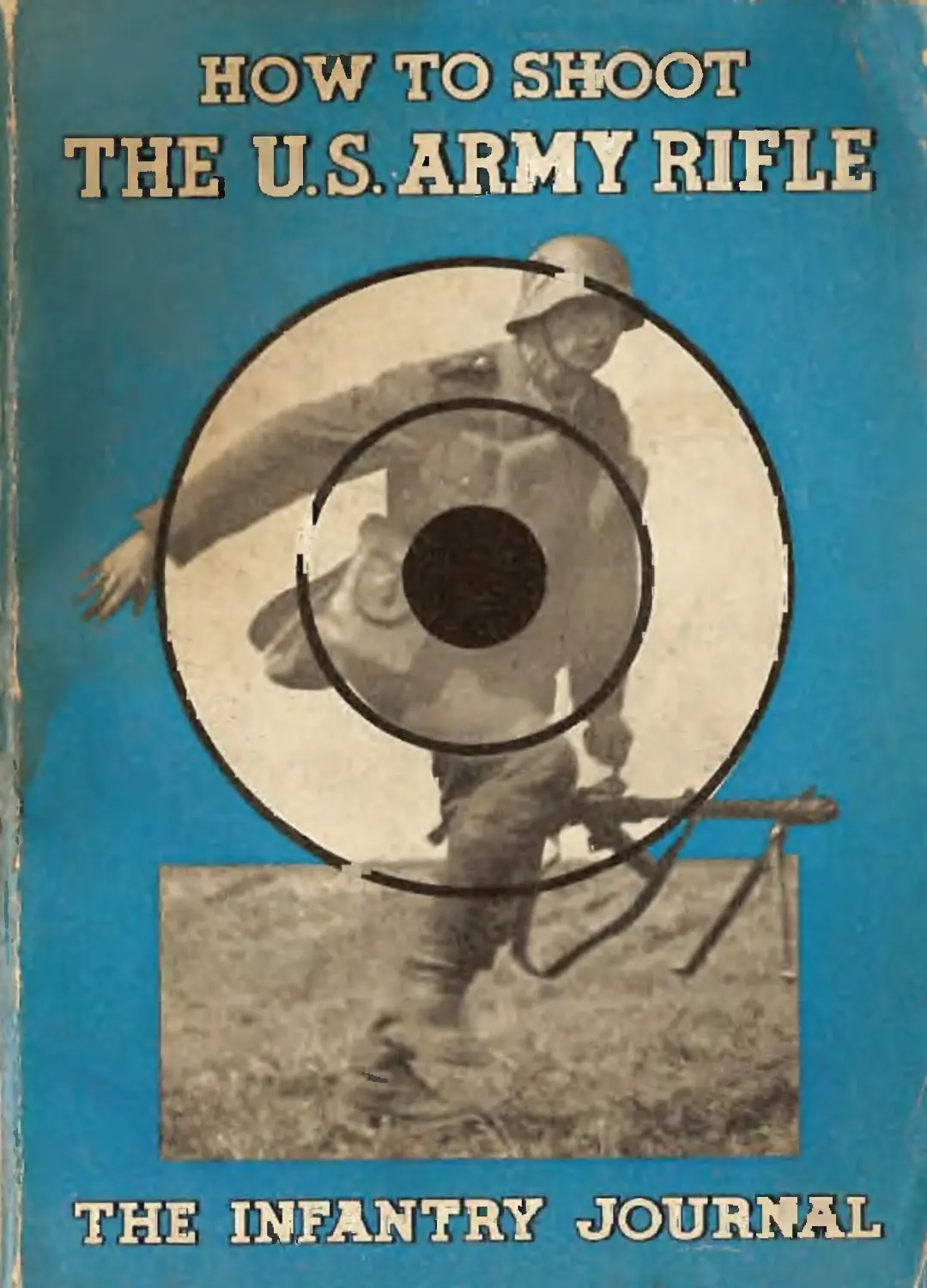
                    how то shoot ;
THE U.S. ARMY RIFLE
HOW TO SHOOT THE U. S. ARMY RIFLE
How To Shoot
The U. S. Army Rifle
A graphic handbook
on correct shooting
THE INFANTRY JOURNAL, INC.
WASHINGTON, D. C.
Copyright 1943 by The Infantry Journal, Inc.,
1115 17th St., N, W„ Washington, D. C.
First edition
Printed in the U.S.A.
Send me men who can shoot
pERSHtS’C

ACKNOWLEDGMENTS
This book was prepared by First Lieutenant Arthur Goodfriend,
Army of the United States, creator of the Army’s graphic portfolio on
rifle marksmanship.
Gratitude for invaluable assistance in preparation of the material
is due:
To die editors of Life, who loaned the cream of their staff to the
Army for this project.
To Gjon Mili, photographer for Life, whose repetitive flash camera
dissects the rapid-fire positions.
To The Engineer School, Fort Belvoir, Virginia, and The Infantry
School, Fort Benning, Georgia, where the doctrine was shaped and
pictures taken.
And to Brigadier General C. R. Huebner, General Staff Corps,
Director of Training, Services of Supply, who initiated the preparation
of the official training portfolio upon which this book is based, and
who gave it the benefit of his long experience gained on battlefields
abroad and in training camps at home.
The Editors
The Infantry Journal
[71

FOREWORD
The last war proved that if you hit a German in the right place with
a caliber .30 rifle bullet, he falls over dead. This is also true in this war.
It applies, moreover, to Japs as well as to Nazis.
The U. S. Army Rifle—be it the M1903 (Springfield), M1917 (En-
field), or Ml (Garand)—has the range, caliber, power, and accuracy
to kill Nazis and Japs. All that is required is a soldier well enough
trained in rifle marksmanship to hit the enemy in the right places.
The U. S. Army believes in this training. Its rifle marksmanship
course is the most thorough in the world. In the last war, tire deadliness
of American marksmanship amazed both our Allies and our enemies.
In this war, reports from far-flung battlefields reveal that the hours
of marksmanship training in our camps have not been spent in vain.
Deadly marksmanship depends on correct shooting habits. In stress of
battle, you must do die right things without thinking about them. You
must know die correct sight picture. You must take a rock-steady posi-
tion. You must squeeze the trigger. You must shoot rapidly. And all the
while, your sights must be correctly set for range, wind, and weather.
How to do diese things the right way is shown on die following
pages. Pictures and text are taken from the U. S. Army’s graphic port-
folio on rifle marksmanship. They apply, with minor modifications,
to the M1903, M1917 and Ml rifles. The method is that developed by
The Infantry School for die semiautomatic Ml rifle, a method that
enables you to get the most out of* any rifle you may ever have to shoot.
Put aside your own ideas on rifle shooting for the duration of die
war. Where life and death, victory or defeat, depend on the result, it is
wise to follow this method. It is based on countless hours of test and
trial, on the range and the battlefield.
Every detail in these pictures is important. Study them carefully. A
few minutes with this book in your bunk before going out on the
drill field will make your work easier. A little time spent on review
before firing on the range will mean more bull’s-eyes. Later these
lessons, well learned, will cause many a Nazi and Jap to echo the
words of that German in the last war who, dying, wrote:
“God save us from these Americans. They shoot like devils . . .
They are the best marksmen in the world.”
[9]
CONTENTS
PAGE
Today—the Bull’s-eye. Tomorrow—The Enemy................... 12
Your Rifle is Better than the Enemy’s...................... 14
Six Steps to Perfect Marksmanship.......................... 16
You Are Both a Coach and Pupil............................. 18
Sighting and Aiming........................................ 20
Why There is Only One Correct Sight Picture................ 24
First Sighting and Aiming Exercise......................... 26
Clean and Blacken Your Sights.............................. 28
Second Sighting and Aiming Exercise........................ 30
Third Sighting and Aiming Exercise......................... 32
The Rock of the Marne...................................... 34
How to Adjust the Loop Sling............................... 36
How to Tighten the Loop.................................... 38
A Tight Sling Means a Steady Rifle......................... 40
Take Up the Slack.......................................... 42
Hold Your Breath While Aiming.............................. 44
Support the Rifle With Your Bones.......................... 46
The Prone Position......................................... 48
The Sandbag Rest Position.................................. 50
The Sitting Position....................................... 52
The Kneeling Position...................................... 54
The Squatting Position..................................... 56
How to Adjust the Hasty Sling.............................. 58
Sling Goes Well Up on Arm.................................. 60
Final Phases of the Hasty Sling..........................   62
The Standing Position...................................... 64
What’s die Matter With This Picture?....................... 66
The Best “Marks-Man” Wins.................................. 68
Squeeze—Don’t Jerk......................................... 70
Call Your Shots............................................ 72
Your Life—Or His........................................... 74
Prone Position—First Method................................ 76
Skirmisher’s Method........................................ 78
Prone Position—Rushing..................................... 80
[101
PAGE
The Sitting Position........................................ 82
The Kneeling Position....................................... 84
Cover to Cover—Up.........................................   86
Cover to Cover—Down......................................... 86
Loading in Four Positions................................... 88
First Rapid Fire Exercise................................... 90
Second Rapid Fire Exercise.................................  92
Third Rapid Fire Exercise .................................. 92
Will You Kill These Nazis ?................................. 94
This is the Rear Sight.....................................  96
Windage Knob................................................ 98
Elevating Knob ............................................. 100
Wind Changes Path of Bullet................................. 102
How to Correct Sights for Wind.	........................104
Windage to Allow for First Shot ........................... 106
Your Rifle is Like Your Girl................................108
How to Zero the Rifle.....................................  110
Adjust die Sights.........................................  112
Adjust the Elevating Knob	................................. 114
Sight Changes ............'.................................116
Wind Gauge and Elevating	Drum’........................... 118
And Now . . . You Shoot for Record........................  120
Answers to Problems........................................ 122
1JU
TODAY—The Bull’s-Eye
TOMORROW—The Enemy
Today’s bull’s-eye will be a well-trained, well-armed Jap or Nazi
tomorrow.
You hit him. Or you miss.
For that reason, there’s no such tiling as shooting that is about right.
It is eidier perfect—or it is wrong. Your life depends upon it.
In camp, you shoot at a fixed target. On the battlefield, the target
moves. You must learn to hit the first—before you can hope to hit
the second.
By learning right shooting habits—by constant practice—every man
can learn to shoot.
It seems hard at first. Later, when your body limbers up—when you
learn the rules of good marksmanship—it becomes easier.
112]
TODAY-THE BULL’S-EYE
TOMORROW - THE ENEMY
YOUR RIFLE IS BETTER THAN THE ENEMY’S
The Ml rifle costs about |80 to build. It is semiautomatic. It has an
8-shot clip. It has adjustable sights. It can shoot straighter and faster
than standard rifles issued to the Japs and Germans.
The M1903 (Springfield) proved itself against tire Germans in the
last war, and is still a masterpiece of rifle construction today. It is a
high-precision weapon, with adjustable sights and an effective range
of 600 yards
The Jap has an Arisaka rifle. It has a shorter range than tire Ml and
M1903. It fires a lighter bullet. It has no windage scale. It is only fairly
accurate beyond 500 yards.
The Germans are equipped with the Karbiner 98. Like our Spring-
field it is bolt-operated, with a 5-shot clip. But it has no windage or
elevation. It hasn’t the accuracy of our American rifle.
Your rifle should give you an advantage over the enemy. But actually,
your rifle is no better than the man who shoots it. If you can’t shoot
your rifle accurately, you might just as well meet the Axis with your
bare fists.
П4]
YOUR RIFLE IS BETTER
THAN THE ENEMY’S
SEMI-AUTOMATIC 8-SHOT CLIP .30 CAL. ADJUSTABLE SIGHTS
BOLT ACTION 5-SHOT CLIP .256 CAL. NONADJUSTABLE SIGHTS
SIX STEPS TO PERFECT MARKSMANSHIP
Before you can shoot well, you must take six important steps. When
you hit the Jap or Nazi, it is because you remembered these steps. If you
miss, it is because you forgot.
These steps are shown on the opposite page.
Practice until you do these things the right way from habit!
Then you can’t forget, no matter what is going on around you. That
will give you confidence in yourself. It will give the other men in your
platoon confidence in you. That’s what wins battles.
These steps are so important your platoon leader will keep a record
of how well you do them. The “Progress Chart” on which this record
will be kept by your platoon leader is also shown. In addition to the
six points, you will also be marked on other important tilings you must
learn to do.
REMEMBER: The more crosses on your progress chart, the more
crosses over the Axis.
[I6J
SIX STEPS TO PERFECT MARKSMANSHIP
1.	Correct sighting and aiming
2.	Correct positions
3.	Correct trigger squeeze
4.	Correct rapid fire
5.	Correct sight adjustment
6.	Final examination
2
YOU ARE BOTH A COACH AND A PUPIL
Throughout your course in rifle marksmanship, the “coach and pupil”
method is used. These four pictures show you a few examples of the
“coach and pupil” method in action.
First are coach and pupil with a sighting bar—the first of the sighting
and aiming exercises.
Next are coach and pupil in one of the basic firing positions.
And then come coach and pupil practicing correct trigger squeeze.
And finally are coach and pupil in a rapid fire exercise.
Note that in each picture there are two men. One man is the pupil.
The other man is the coach. They work in pairs. They usually change
places throughout each lesson.
You, too, will work in pairs. Each man in the pair is bodi a pupil and
a coach. The man who is giving instruction is the coach. The man who
is getting instruction is the pupil. When you change places, your roles
are reversed. To repeat, every man is here to teach as well as to learn.
Why does the Army use the coach and pupil method?
For three reasons:
(1)	To teach you how to shoot.
(2)	To help you correct errors of which you are not aware.
(3)	To teach you how to teach others—for in an army as fast-growing
as ours, we need men to train new troops coming into camp.
[18]
YOU ARE BOTH A COACH AND A PUPIL
IN SIGHTING AND AIMING, THERE’S NO SUCH
THING AS ''ALMOST RIGHT”
To hit the bull’s-eye, you must know exactly what your eye should
see when it looks through the rear sight of your rifle.
Cut out the white center of the circle on the opposite page and you
are looking through the peep sight of a rifle, somewhat enlarged,
On page 23 are pictures of the front sight of an M1903 and Ml rifle.
There is also a picture of a bull’s-eye. Cut them out and mount them on
cardboard. Place the front sight in correct position within the rear sight.
Then place the bull’s-eye in correct position above the front sight.
To hit the bull’s-eye—the peep sight, front sight and bull’s-eye must
be lined up in a certain way: A vertical line drawn through the center
of the front sight must coincide with the vertical diameter of die peep
sight. The top of the front sight must lie exactly on the horizontal
diameter of the peep sight. The bull’s-eye must be tangent to the top
of the front sight—at its midpoint.
There is only one correct sight picture; every other position is wrong.
Only the correct position of peep sight, front sight and bull’s-eye will
give you a perfect hit.
[203
IN SIGHTING AND AIMING, THERE’S
NO SUCH THING AS “ALMOST RIGHT”
THE SIGHT PICTURE IS EITHER 100 PER-
CENT RIGHT-OR 100 PERCENT WRONG
Cut out these pictures and mount them on card-
board. Place them in position behind the rear sight
on die preceding page, and practice with bull’s-eye
and each front sight until you get the sight picture
speedily and accurately.
[22]
2. Front Sight of М1903
THIS IS WHY THERE IS ONLY ONE CORRECT
SIGHT PICTURE
124]
THIS IS WHY THERE IS ONLY ONE CORRECT
SIGHT PICTURE
FIRST SIGHTING AND AIMING EXERCISE
The first thing to learn about the correct sight picture is the correct
alinement of the front and peep sights—without the bull’s-eye.
What should you see through the eyepiece of the sighting bar?
You should see the top of the front sight through the middle of the
circle. A vertical line drawn through the center of die front sight
should coincide with the vertical diameter of the peep sight.
The first sight picture (upper left) is correct; the others, of course,
are wrong.
The next filing to learn about the correct sight picture is the correct
alinement of the front and peep sights—with the bull’s-eye.
The first sight picture at the bottom of the page (left) is what you
should see through die eyepiece of the sighting bar—the bull’s-eye is in
proper position. This is the correct alinement. The others show common
errors you should never make.
In the correct picture, the top of the front sight is seen at the middle
of the circle and just touches the bottom of the bull’s-eye, so that all
the bull’s-eye can be clearly seen. The eye should be focused on the
bull’s-eye.
[26]
'Й;
.drr
FIRST SIGHTING AND AIMING EXERCISE
CLEAN AND BLACKEN YOUR SIGHTS
You are now ready to line up the bull’s-eye through the sights of
your rifle. In order to see your rifle sights and the bull’s-eye clearly, you
must always do two things first:
(1) Clean your sights
(2) Blacken your sights.
Why? Look at these diagrams at the bottom of the opposite page.
These dirty sights will make you aim too low. With clean sights, you
line up the bull’s-eye squarely on top of the front sight itself, and not
on dirt.
Shiny sights glint in the sunshine. They cause a reflection in your
eye. They are hard to see.
Clean and blackened sights stand out clear and bold—they are easy
to see.
Always clean and blacken your sights before sighting and aiming
your rifle.
These pictures show how. Be sure all traces of oil are removed. Then
hold each sight for a few seconds in the point of a small flame, so that
a uniform coating of lampblack is deposited on the metal.
A carbide lamp is ideal. But you can use a kerosene lamp, candle,
small pine stick, smudge pot or even match sticks when a carbide
lamp is not available.
128]
F CLEAN AND BLACKEN YOUR SIGHTS
SECOND SIGHTING AND AIMING EXERCISE
Now you are ready to practice lining up the bull’s-eye through the
cleaned and blackened sights of your rifle.
The method used is shown in these pictures:
The rifle is placed in rifle rest. It points at the blank piece of paper
mounted on box 20 feet away. Without touching rifle or rifle rest, the
coach takes his position and looks through sights. He then directs
marker by signal to move disk until bottom of bull’s-eye is in correct
alinement with sights. He then commands marker to “Hold.” The
coach then moves away and directs the pupil to look through sights,
as shown in the upper picture, in order to observe correct aim.
The marker then moves the disk out of alinement. The pupil takes
position with his eye as close to the rifle as it would be in actual firing—
and directs the marker to move the disk until bottom of bull’s-eye is
in correct line with sights. The coach then looks through sights to see
if the alinement is correct. Be careful not to move the rifle rest. Sand-
bags placed in both the rifle rest and the box on which marker sits will
help to prevent movement.
The coach will aline the sights on the bull’s-eye with various slight
errors to determine whether or not you can detect them.
But before you start, go back to the enlarged peep sight of your rifle
(page 21) and practice setting the exact position of your peep sight,
front sight, and bull’s-eye.
130]
Ш JS
SECOND SIGHTING AND AIMING EXERCISE

THIRD SIGHTING AND AIMING EXERCISE
The object of this exercise is to show the importance of uniform and
correct aiming, and to instill in the mind a sense of exactness.
The rifle with sights blackened is placed in rifle rest and pointed at a
blank sheet of paper mounted on a box 50 feet away. The pupil takes
the position illustrated and looks through the sights without moving
the rifle or rifle rest. The pupil directs the marker, by command or
signal, to move the disk until the bottom of the bull’s-eye is in correct
alinement with the sights. He then commands the marker to “Hold.”
The coach then looks through the sights to see if the alinement is
correct. Then widiout comment to the pupil, he commands the marker
to “Mark."
The marker, without moving the disk, makes a dot on the paper widi
a sharp-pointed pencil inserted through the hole in the center of the
bull’s-eye. The marker then moves the disk to change the alinement.
Pupil and coach repeat this operation until three dots, numbered 1, 2,
and 3, respectively, have been made. These dots then outline the shot
group, and the pupil’s name is written under it.
The size and shape of the shot group determine how well you are
alining your sights with the bull’s-eye. At the bottom of dais chart are
three shot groups. A “horizontal” triangle (left) is generally caused
by a horizontal movement of the front sight—a failure to rest the bull’s-
eye squarely on the center of the top of the front sight.
A vertical triangle (center) generally comes from an up-and-down
movement of the front sight—a failure to keep the bull’s-eye directly
tangent to the top of die front sight.
A tight, close triangle (right) shows steady, correct sighting. At 50
feet, you should make triangles which can be covered by the unsharp-
ened end of an ordinary lead pencil. At 200 feet, your triangle should
be covered by a silver dollar.
[321
3
THE ROCK OF THE MARNE
This is a scene from the Second Battle of the Marne in 1918, when
the Germans made their last, most desperate drive for Paris. One
American regiment—the 38th Infantry of the 3d Division—faced two
German divisions. In the confusion of battle, the higher command lost
touch with the regimental units. Each company—each squad—each
man was on his own.
In twenty-four hours, this one American regiment disorganized two
German divisions. How? By rifle fire alone. By good marksmanship.
A few days later, a letter was found on the body of a German officer.
It read: “God save us from these Americans. They shoot like devils.
They kill us like animals with their rifles. They are the best marksmen
in the world.”
We must prepare ourselves to carry on this tradition of American
marksmanship,
Г341

HOW TO ADJUST THE LOOP SLING
We are now ready for the second step—correct positions.
You won't hit the bull’s-eye every time unless you are steady. Three
things control your steadiness.
The Gun Sling
Your Breathing
Your Position
The gun sling supports your arm and rifle. It binds the rifle to your
arm in a single, tight, steady unit.
There are two ways to adjust your gun sling—the Loop and the
Hasty. The Loop takes longer to fix, but it is steadier. It is used in all
positions except the standing position. This is how to adjust it:
Place butt of rifle on right thigh, barrel to right and muzzle point-
ing up.
Rest rifle against inside of right forearm so that both hands are free
to fix sling, and loosen lower loop, as shown here. Fasten it again near
the butt swivel leaving yourself plenty of sling. Adjust the upper hook
until the loop has the proper length. Then insert left arm through the
upper loop, from right to left. Another simple way is to twist the sling
one quarter turn to the left, then insert the left arm into the loop
between the D-ring and the lower keeper until the loop is around the
upper arm.
D61

HOW TO TIGHTEN THE LOOP
These pictures show how to tighten the loop into position on the arm.
(1)	Pull on both parts of sling—jockeying them until the loop and
keeper are close against the arm.
(2)	Pull the D-ring forward and push the lower keeper and hook
close against the arm to keep the loop in place.
(3)	If necessary, push the outer part of the sling away from you with
the thumb—tightening the sling still more.
(4)	Push the upper keeper down toward the hook.
[38]
HOW TO TIGHTEN THE LOOP
A TIGHT SLING MEANS A STEADY RIFLE
When the loop sling is properly adjusted on the upper arm, place
the left hand, knuckles out, so that the sling passes around the side
of the left wrist near the wrist bone. If properly adjusted, the sling is
flat against the wrist.
Then, before you take your position, place the left hand so that
the rifle lies in the center of the V formed by the thumb and the fingers
of the left hand, with the hand forward against the upper sling swivel.
Note that some leeway is permitted in the position of the loop on the
arm. The Manual prescribes that the loop should come above the bicep.
But experience at The Infantry School shows dial many men get
better results with a lower sling. It is important that “light” be visible
between die sling and the forearm.
Be sure the sling is doing its share of the work in giving your rifle
full support. A tight sling means a steady rifle.
We will discuss the hasty sling later—when we are ready for the
standing position.
1401

TAKE UP THE SLACK
Before we go into the positions, it is important to know how to take
up the slack in the trigger. This is part of the position exercise because
the slack must be taken up by the finger as soon as the correct position
is assumed and before careful aiming is begun.
The “slack” in the trigger of a rifle is like the “play” in the clutch
of a car. That “play” is built into the clutch by the manufacturer as an
extra safety allowance—a preparatory motion that enables both the car
and you to get set for a shift in gears. There’s “play” in the brake too—
if there weren’t, you’d stop so suddenly that you’d break your teeth on
the dashboard the moment you pushed down on the brake pedal.
Your rifle also has this “safety allowance”—a small amount of slack
that brings the trigger lug just to a point where it begins to release the
hammer. Squeeze the trigger beyond the slack and the trigger releases
the hammer. This causes the rifle to fire.
The entire amount of slack in the trigger is taken up by one positive
movement of the finger,
Take up the slack as soon as the correct position is assumed, and
before careful aiming is begun.
142}

HOLD YOUR BREATH WHILE AIMING
Obviously, if your chest and back are moving, your rifle will move
up and down.
To prevent this, take a breath. Then let out a little air. Then stop
breathing.
Hold your breath naturally. If you don't get your shot off, exhale—
then inhale, let out a little air, and stop breathing again. Don’t tighten
up, Don’t become breathless. Practice will teach you to control your
breathing without discomfort.
Coaches must check pupils carefully on this point. Watch the pupil’s
back. If it rises and falls while aiming, he is breathing, and his rifle
is bound to be unsteady.
Watch the muzzle of the rifle. If it “seesaws,” the pupil is breathing.
144]
HOLD YOUR BREATH WHILE AIMING
ВТОР BREATHING
LET OUT A LITTLE
TAKE IN AN
ORDINARY BREATH
Coach: Be sure your pupil's back doesn’t move
Be sure his rifle doesn’t see-saw
SUPPORT THE RIFLE WITH YOUR BONES
DON’T HOLD IT WITH YOUR MUSCLES
Now you are ready for the positions. Taking positions is a matter of
bones, not muscle. For some of you, taking correct positions wonYbe
easy until your bodies limber up. In a few days, after some practice and
stretching exercises, you will take correct positions easily.
The whole idea behind positions is to give your rifle steady support.
Only your bones can do that. The strongest man will tremble after a
few seconds if he tries to support his rifle by muscle alone. The weakest
man can hold his rifle steady, if he uses his bones to form a firm base.
These pictures make the idea a little clearer. In the upper picture the
stick stands straight up and down. The 10-pound weight on it has good,
steady support.
In the lower picture the stick is tilted. It gives die weight poor support.
Same way with your rifle. The upper picture shows the right way to
hold your rifle. The arm bone is straight up and down.
If your arm bone is tilted, as in the lower picture, your rifle will
wobble. Your muscles can’t hold it in place very long.
“Use your bones” and your position is sure to be steady.
146]

THE PRONE POSITION
This position is best used on level ground.
The two large pictures show the correct position of pupil and coach.
These smaller pictures stress vitally important details.
The coach, as you see, moves around the pupil, checking carefully
on the following points:
The angle made by the pupil’s spine and the rifle is 30 degrees or
less. He must be well behind the rifle, so that his weight will act
against the recoil of the piece, and cause the muzzle to drop back into
position after each shot. This is especially important in shooting the Ml.
The left elbow is under the rifle.
The left wrist is straight.
Fingers and thumb of left hand arc loose and relaxed.
Rifle rests in the V formed by thumb and linger of left hand.
The left hand is forward against the upper sling swivel,
The left shoulder is relaxed forward and down.
The spine is straight, Legs arc comfortably spread apart. The toes are out,
Right elbow is far enough out from the body so that the right shoulder is not
hunched up.
The butt is seated well into the pocket formed in the shoulder as the right elbow
is moved forward. Note how it is held there by the sling. It is important that this
be done correctly.
With the weight rolled over on the left elbow, grasp the butt with the right
hand—the heel of the hand near the butt. Then shove the butt well into place. If
you can place your rifle butt comfortably on your shoulder with your right hand
at the small of the stock, then your sling is improperly adjusted.
The right thumb is over or on top of the stock.
The trigger finger may rest against the trigger at any point between the tip and
the bend between the first and second joints.
The neck is relaxed. The cheek rests firmly against the stock without muscular
effort.
The weight is relaxed forward against the tension of the sling.
Muscular relaxation is important—particularly of the hands, arms and shoulders.
Breathing should be controlled. If the back moves, the pupil is not holding his
breath.
After the above points have been checked, the coach lies down next
to the pupil. The coach watches the pupil, not the target.
[48]
THE PRONE POSITION
4
THE SANDBAG REST POSITION
This is exactly like the normal prone, except that the sandbag sup-
ports die left forearm, wrist and hand. These pictures show how the
sandbag is used to steady the pupil’s aim.
Note die position of the coach in this exercise. Note how lie packs
and adjusts the sandbag.
Note that the sandbag is slightly higher than the back of the left
hand. Note that the rifle rests on the hand—and not on the sandbag.
Because it is so easy, relaxed and steady a position, the sandbag rest
is ideal for practicing the trigger squeeze, which is the most important
single factor in rifle marksmanship.
[50]
THE SANDBAG REST POSITION
THE SITTING POSITION
This position is best used when firing from ground that slopes down-
ward in front. In this position (and the kneeling position) the sling
is adjusted with the loop about two holes shorter than for the prone.
The coach should check tire pupil on these important points.
Before taking position, face the target; then half-face to the right
and sit down.
Weight is well forward. Ankles are relaxed. Toes point forward.
Feet are far enough apart so that they give body lateral support—yet
not so far apart that the elbows cannot rest on top of legs. The knees
are no farther apart than the feet.
Notice the back: it is straight without a hump in the shoulders. The
body is bent forward from the hips.
The left elbow is under the rifle. The rifle rests in the V formed by
the thumb and finger of tire left hand. The left hand is all the way
forward against the stock ferrule swivel (except for men with very
short arms). The left wrist is straight.
Note the surface-to-surface contact between arms and legs. The left
elbow is forward of the left kneecap—at least 4 or 5 inches. That part
of the upper arm just above the left elbow is parallel to and rests
squarely on that part of the left lower leg just forward of the kneecap
which is, in most cases, outside of the arm.
The right thumb is over or on top of the stock. The right cheek rests
snugly against stock. The weight of the body is relaxed forward from
the hips into the sling.
Notice that the knees are not held together by muscular effort. The
weight of the upper part of the body is transmitted to the legs through
the upper arms—so that the weight comes on top of the legs, causing
the toes to relax forward.
Notice that the rifle is kept in the pocket of the shoulder by the
taut sling.
The picture at lower right corner shows an alternative cross-legged
position, which should be used only with the consent of an officer. The
open-legged position is the standard and most effective sitting position.
152]

THE KNEELING POSITION
This position is best used on level ground, and ground that slopes
upward.
The coach should check the pupil on each of the following points:
Firer kneels half-faced to right on right knee. He sits on right heel.
Left lower leg is vertical. Left elbow rests on it so that left arm and left
leg form one straight up-and-down line. Notice that point of left elbow
is a few inches forward of the knee; this helps to throw die weight
forward.
Right elbow is held high—at height of shoulder.
Left hand is forward against the stock ferrule swivel—relaxed—with
rifle passing through the V formed by thumb and fingers of the hand.,
The cheek rests against the stock. The right thumb is over or on the I
top of the stock.
Breathing is controlled.	’
Position of the right leg is very important. Note that right knee is;
so placed that the right thigh is perpendicular to axis of rifle.
Note that toe is so placed that shooter sits on his heel, with his insteps
on the ground. Note that entire surface of the lower leg, from knee
to toe, is in contact with the ground, The weight is forward. If this posi-
tion is difficult at first, dig a hole for your toe. Later when your foot
limbers up, discontinue the use of a hole.
154}
THE KNEELING POSITION
THE SQUATTING POSITION
This position has important advantages in combat. It can be quickly
assumed with either the loop or hasty sling. Or it may be used without
the sling. As only the feet are in contact with the ground, it is
desirable when firing in mud, shallow water, snow, or a gas con-
taminated area.
To take the squatting position, the firer half-faces to the right,
places both feet flat on the ground and a foot or more apart, and
squats as low as possible. The backs of the upper and lower legs,
should be in the fullest possible contact from the knees downward. The
inner part of the left, mid-upper arm rests on the left knee; the left
elbow is directly under the rifle. The right elbow is braced against the
inner part of the right knee. The weight of the body should be relaxed'
and well forward over the left leg. The rifle rests in the crotch of the
left hand as explained for the prone position. The grasp of the rifle
by the right hand and the position of the face against the stock are
as prescribed for the prone position.
[56]
THE SQUATTING POSITION
HOW TO ADJUST THE HASTY SLING
The final position is the standing position. In this position you use
the Hasty Sling.
Speed of adjustment is its great advantage. But it gives less support
than the Loop in positions other than the standing.
This is how to adjust the Hasty Sling;
First, place butt of rifle on right thigh. Grasp the rifle just in rear
of the stock ferrule swivel with the right hand. Loosen the sling.
Then give the sling a half twist to the left with the thumb, as shown
in the lower picture.
{581
HOW TO ADJUST THE HASTY SLING
SLING GOES WELL UP ON ARM
Now, throw the sling to the left and catch it above the elbow, and
high on the arm—as shown in the upper picture.
Then pass the left hand under the sling and then over the sling.
Then regrasp the rifle with the left hand—as shown in the lower
picture—so as to make the sling lie along the back of the hand and
wrist.
The right hand grasps the butt of rifle as shown.
160)
SLING GOES WELL UP ON ARM
FINAL PHASES OF THE HASTY SLING
Now bring the butt of rifle up into the shoulder—pushing it firmly
into place in the hollow of the shoulder.
Finally) with the right arm held high, to support the rifle in place,;
bring the finger to the trigger. Holding tire arm high gives you a
better shoulder pocket into which the rifle can be placed.
Be sure arm, sling and rifle are bound into one firm, steady unit.
(62]
FINAL PHASES OF THE HASTY SLING
THE STANDING POSITION
This is used for all kinds of firing, regardless of slope or level.
Coaches will check the following points:
Firer stands half-faced to the right.
Feet are from 1 to 2 feet apart. Body is erect and well-balanced.
Left elbow is well under the rifle.
Left hand is in front of balance. Wrist is straight. The rifle is placed
in crotch formed by thumb and index finger, resting on the heel of
the hand.
Butt of piece is high up on the shoulder, and firmly held. Right
elbow is approximately at the height of the shoulder.
Cheek is pressed against stock, as far forward as possible without,
strain.
Breathing is controlled.
In the lower right picture is shown an exercise that makes for steadi-1
ness in the standing position. Note how the rifle is held by the bones;
of the shoulder and the right arm. By practicing this exercise, greater’
steadiness is developed in the standing position—a steadiness further
increased, of course, when the left hand grasps the rifle below the swivel.
Г641
NOIllSOd ONIQNViS 3H1
WHAT’S THE MATTER WITH THIS PICTURE?
Take a good look at how Private Joe Jerk takes the four positions.
Private Jerk is the man who sleeps through the demonstrations. He’s
the man who tells the coach about what he did to the shooting galleries
at Coney Island. He’s the man who wins the medals on the firing
range—the “Order of Maggie’s Drawers”—with palms.
Study the four pictures carefully. Pick out the things you see
wrong with Private Jerk’s technique.
166}
WHAT’S THE MATTER WITH THIS PICTURE?
THE BEST ‘'MARKS-MAN” WINS
Every American has probably heard of Sergeant York. Perhaps you
have seen the movie, from which this picture was taken. The story of
Sergeant York is a story of expert marksmanship.
On October 6,1918, York’s division was engaged in breaking through
the Hindenburg Line in the Argonne. The going was hard. There had
been no artillery preparation. The advance was held up by German
machine-gun nests, Men were falling all around York.
York’s rifle settled die issue. He worked his way to die flank of one
key machine-gun nest after the other. One by one he picked them off.
When he was finished, twenty-five Germans lay dead at their guns.
One hundred thirty-two others surrendered. The Americans swept over.
Marksmanship will help to win this war. Each one of you must
qualify as a marksman. Yo« arc the men who must win this war.
[681
THE BEST “MARKS-MAN” WINS


SQUEEZE—DON’T JERK
The most important single factor in marksmanship is the trigger
squeeze.
It's as easy to squeeze a trigger as it is a tube of shaving cream.
Squeeze die tube and you get exactly the amount of cream you require.
The tube and cream are “under control.” There’s no waste—no mess.
But jerk the tube and control is lost—cream squirts out all over die
place—wasted. You may even get some in your eye—so you duck, and
the result is a terrible mess.
The same story applies to the trigger of a rifle. Squeeze it and your
shot is controlled. It hits the bull’s-eye—it isn’t wasted. The rifle does
what you want it to do. You squeeze for a bull’s-eye. You get a bull’s-eye.
But jerk die trigger, and control is lost. You expect the shock of the
explosion. You flinch. You shut your eyes. You fire blind. You waste
your shot.
To repeat, the trigger squeeze is the most important item in shooting.
To squeeze the trigger, you press it to the rear with a steady increase
of pressure, in such a manner that you cannot know the exact instant
when the gun will go off. The pressure is applied by the independent
action of the trigger finger straight to the rear.
Avoid “pulling” the trigger to either side. When you practice the
trigger squeeze, you must “follow through”—that is, press the trigger
all the way to the rear and keep aiming before, during, and after the
rifle fires. Keep the rifle to your shoulder after the rifle fires. Watch the
sights carefully. If your sights do not remain on the target, your posi-
tion or your trigger squeeze—or both—are wrong.
Coaches must check pupils carefully in the trigger squeeze. Shown
here are two mediods. In one, die pupil puts his finger on the trigger.
The coach puts his finger over the pupil’s finger, and demonstrates
the correct squeeze. In the second, the coach puts his finger on the
trigger; the pupil squeezes the trigger through the coach’s finger. In
this way, the coach can judge whether pupil correctly squeezes the
trigger.
[701
SQUEEZE	DON’T JERK
COACH SQUEEZES PUPIL SQUEEZES
CALL YOUR SHOTS
One way to teach yourself to squeeze the trigger and not to jerk it—
is to call your shots.
If you can tell where your shot will hit—bull’s-eye or otherwise—
you are shooting with open eyes. You are squeezing the trigger—you
are following die rules.
If you can’t call your shot correctly, it means you jerked the trigger.
You did not know where the sights were pointing at the time the
rifle was fired. You shut your eyes and fired afterward. You almost
surely missed the bull’s-eye.
These pictures show what happens when you squeeze your trigger.
These pictures also show what happens when you jerk it.
Remember—squeezing the trigger and calling your shots are two
vitally important rules of good shooting.
[721
CALL YOUR SHOTS
Shot one: he Jerked and flinched	Shot two: he squeezed the trigger
Shot one: he got the red flag	Shot two: he called his shot correctly
YOUR LIFE—OR HIS
Some day you may find yourself suddenly faced by this Jap—or a
German.
Look at this man carefully. His uniform may not fit—but his face
is determined. At this very moment, the training camps of Japan and
Germany are filled with men like him—training hard, working day
and night, practicing marksmanship with one end in view: To kill
YOU!
When you meet this enemy, the man who will come out of that
meeting alive will be the man who can shoot most accurately and
rapidly.
Chances are all in your favor if you learn to make quick and proper
use of your rifle. That means the ability to fire it accurately and rapidly.
Note the order in which the above words are written. Accuracy and
correctness of execution of each shot in rapid fire are vitally important.
Speed is secondary.
[741
YOUR LIFE ... OR HIS
PRONE POSITION—FIRST METHOD
The enemy will not wait while you get into firing position. You must
do it quickly. Here is how to take the correct prone position quickly.
For purposes of practice, first mark on the ground the points where
your right and left elbows normally rest in prone position, and the
point on ground just below the butt of the rifle when in firing position.
These “rapid-action” pictures show how it is done:
(1)	Rifle is grasped with left hand just below the lower band and
right hand at the heel of the stock.
(2)	Bend both knees to ground.
(3)	Place butt of rifle on ground at point marked.
(4)	Place left elbow on ground.
(5)	Place butt of rifle against right shoulder with right hand.
(6)	Grasp small of stock with right hand and place right elbow on
ground.
(7)	Assume firing position.
176)
PRONE POSITION — FIRST METHOD
SKIRMISHER’S METHOD
Here are a front view and a back view of a soldier taking the prone
position by die skirmisher’s method.
He places right foot well back and bends left knee as low as possible.
He places butt of rifle on ground four or five inches to left and slightly
in front of spot where right elbow is to rest. Grip of rifle is retained with
both hands.
He places right elbow on the ground.
He places left leg back near the right one, feet apart, and slides well
back while lying on belly.
He takes butt of rifle off the ground, and places it against right
shoulder.
He lowers the left elbow to the ground.
The rifle comes up to the shoulder just as in the prone position.
[781

PRONE POSITION—RUSHING
Command is: Prepare to Rush. UP.
At command Prepare to Rush, draw the arms in until the hands arc-
opposite chin, elbows down, and away from body.
At command UP, raise body by straightening arms.
Shift weight of body to right leg and arm and bring left leg forward
with knee fully bent.
Spring up and run forward. Grasp rifle with both hands, left hand
just below lower band and right hand at small of stock.
Upon arriving at firing point:
Advance left foot, turning it across front of body.
Drop forward on outside of left knee and at same time extend rifle,
grasped in both hands and held vertically, so that butt strikes the
ground at arm’s length, directly in front of the left knee.
Pivoting on left knee and butt of rifle, roll forward onto left elbow
and left side.
Simulate loading, and with right hand place butt of rifle on right
shoulder and set safety in its forward position.
Grasp the small of stock with right hand and place right elbow on
the ground.
[80]
6
THE SITTING POSITION
In practicing for range firing sit down and aim at target in normal
sitting position. Mark position of heels and spot on which you sit.
At command Ready on Firing Line, stand with heels on marked
places.
As target appears sit down on marked spot, breaking fall with right
hand. Keep your eye о» the target.
Grasp small of stock with right hand and assume aiming position.
Remember, in all these positions: Even if it takes a little longer, get
into correct position before starting to shoot. Correct technique first—
speed later.
Only if your position is correct will your sights automatically return
to the aiming point after you fire.
Г821
THE SITTING POSITION
THE KNEELING POSITION
Kneel and aim at target in normal kneeling position. Mark position
of feet and right knee.
At command Ready on Firing Line, stand with feet in places marked
for them.
As target appears, kneel with right knee on spot marked. Keep your
eyes on the target!
Place the butt of rifle on shoulder with right hand. Note the change
in the position of the right hand in pictures 1 and 2. Grasp small of stock
with right hand and assume aiming position.
Г84]
THE KNEELING POSITION
COVER TO COVER—UP
Soldier lies prone. Rifle is grasped by right hand about 3 inches below
stock ferrule swivel.
On order—UP—he pushes up on both arms and right knee—and
dashes forward.
COVER TO COVER—DOWN
To take cover—right hand grasps rifle at butt (as in taking prone
position in rapid fire).
Pivoting on left foot—knee well bent—soldier flings himself for-
ward and down, breaking his fall with butt of rifle.
He then flattens to ground, rifle grasped in right hand.
These pictures show the need for perfect physical conditioning. Good
soldiers must be good athletes.
186]
COVER TO COVER-UP
LOADING IN FOUR POSITIONS
Upper Left
Hold rifle with left hand, butt down.
With right hand, take clip from belt and place on top of follower.
Upper Right
With the thumb on the clip, and the fingers drawn up in a fist, press
the clip down into receiver until it engages clip latch. This new
method enables you to use full, firm pressure.
Thumb is swung to right, so as to clear bolt in its forward move-
ment, and operating handle is released.
Lower Left
Closing of bolt may be assisted by a push forward on operating rod
handle with the heel of right hand.
Lower Right
In standing position, where single rounds are inserted into the breech,
note position of hand. While thumb pushes in round, heel of hand
engages operating handle and prevents it from shutting until thumb
is removed.
£881
LOADING IN FOUR POSITIONS
FIRST RAPID FIRE EXERCISE
A most important element in rapid fire is the development of cor-
rect timing in firing. Correct timing in firing will vary from above
five seconds per shot for the beginner to about two seconds for the
experienced man.
The development of proper timing in firing rests mainly on the
correct position of the firer. The filer’s position is not correct unless
the sights return automatically to the aiming point, the firer concen-
trates on die sight picture, and squeezes the trigger quickly. This is
repeated for each shot.
The first rapid fire exercise is an exercise in cadence. These pictures
show the correct prone position of pupil and coach. With the Ml, the
coach must be in a position to press back the operating handle with a
sharp motion to cock the piece, and then release pressure to permit
the operating handle to go forward.
The cadence of the exercise is set by the instructor who commands:
Commence Firing. At regular intervals, he calls: Bolt. The coach then
operates the bolt for his pupil. The pupil squeezes the trigger. In the
beginning, the time interval is five seconds. Later it is shortened by a
half second for each succeeding exercise until it becomes three seconds.
[901

SECOND RAPID FIRE EXERCISE
In this exercise, the necessary commands are given to simulate load-
ing, and to indicate appearance of the targets. As the “targets” appear,
the shooter assumes the prescribed position and “dry-shoots” a score
of 16 shots in the prescribed time. Each time the trigger is squeezed,
the coach operates the bolt. Shooters count their shots aloud; this causes
them to breathe after each shot. After the eighth shot, simulate reload
ingfrom the belt. Instructor calls: First Round, Reload, Ninth Round
and Last Round, at the proper time interval. Blocks are used in rifles.
Example. Open bolts. Simulate Load. Ready on the right, Ready on
the left. Ready on the firing line, Targets Up. After 9 seconds: First
Round, After 30 seconds: Eighth Round, Reload. After 39 seconds:
Ninth Round. After 60 seconds: Sixteenth Round. After 65 seconds:
Cease Firing.
THIRD RAPID FIRE EXERCISE
The exercise is conducted with wooden block removed, and with
one clip loaded with dummies. This clip is placed in the cartridge belt,
in the third pocket from die right.
Command is given to open bolt. Command is given: One Round,
Simulate Load, At the command, shooters lock and simulate loading
one round. At signal “Targets Up,” shooters take prescribed position,
and squeeze off one dry shot. Then they load the clip of dummies from
the belt and squeeze off a dry shot with each dummy. Every time
the trigger is squeezed, coach operates bolt. The time allowed is 40
seconds.
(921

WILL YOU KILL THESE NAZIS . . .
OR WILL THEY KILL YOU?
This is how a squad of German soldiers may look to you when you
spot them on the battlefield.
They make a small target. And to make matters tougher, there is a
wind blowing across the field between you and these men. This wind
will push a bullet in the direction it is blowing—just as it does the
smoke in the background.
To score a hit under these conditions requires a high precision
weapon—one that enables you to cut down the margin for error.
Your rifle is just such a weapon—providing it is properly used. It is
equipped with a rear sight. This enables you to make due allowance for
wind. A few simple rules enable you to control the wind.
194]
WILL YOU KILL THESE NAZIS ...
OR WILL THEY KILL YOU?
i
i
THIS IS THE REAR SIGHT
At the top of the page is a picture of the rear sight of an Ml rifle.
In the center of the page are pictures of the A, B, and D targets.
At the bottom is a page from your score book.
All three have a bearing on each other.
The elevating knob raises or lowers die peep sight. This raises or
lowers the strike of the bullet on the target.
The windage knob moves the peep sight right or left—moving the
strike of the bullet right or left on the target.
These knobs move a click or a quarter point at a time—each click or
quarter point moving the bullet a certain distance. These distances
have been ruled off on die target to show you how much one click of
the knob (on the Ml) moves the strike of the bullet on a 200-yard
target.
The score book enables you to keep a record of each shot you fire,
for no one can remember for long the results and conditions of each
shot he fired. Yet these data are very valuable to you in improving your
marksmanship.
[961
THIS IS THE REAR SIGHT
THIS IS THE TARGET (200 YDS.)
THIS IS YOUR SCORE BOOK
WINDAGE KNOB
Let’s see exactly what this windage knob does.
One click of this knob moves the strike of the bullet 1 inch—to the
right or to the left—on the target for each 100 yards of range.
Let’s look down on the little man from straight above.
In this first picture, his rear sight is fixed at 1 click of windage to the
left. That means the bullet moves to the left 1 inch in 100 yards—2
inches in 200 yards.
Aiming at the same target, the little man now moves his windage 2
clicks to the right. At 100 yards, the bullet now strikes 2 inches to the
right of the first bullet. At 200 yards, the bullet strikes 4 inches from
the first bullet.
Now he moves his windage knob again—1 click left. That moves the
bullet 1 inch to the left in 100 yards—2 inches in 200 yards.
The inset at the left shows how simply this works. One click of
windage at 100 yards moves strike of bullet on target 1 inch. At 200
yards, 2 inches. At 400 yards, 4 inches. And so on.
198]
WINDAGE KNOB
One click of this knob moves strike of bullet 1 Inch,
right or left, on target for each 100 yards of range
Ш55
ELEVATING KNOB
The elevating knob works exactly the same as die windage knob.
Only instead of left and right—1 click of this knob moves the strike
of die bullet 1 inch—up or down—on the target for each 100 yards of
range.
Let’s look at our little man again—this time from die side. With 4
clicks of elevation, the bullet strikes 4 inches above his line of sight at
100 yards. At 200 yards, it strikes 8 inches above die line of sight.
With 2 clicks of elevation, the bullet strikes 2 inches above the line
of sight at 100 yards—and 4 inches above at 200 yards.
With 1 click of elevation, the bullet strikes 1 inch above the line of
sight at 100 yards—2 inches above at 200 yards.
The inset tells the tale:
One click of elevation at 100 yards moves strike of bullet on die
target 1 inch. At 200 yards, 2 inches. At 500 yards, 5 inches. And so on.
[1001
ELEVATING KNOB
One click of this knob moves strike'of bullet 1 inch
up or down on target for each 100 yards of range
WIND CHANGES PATH OF BULLET
These rules of windage and elevation are fairly simple. Repeat them a
'ew times, and you’ve learned them forever.
Now we are ready for the next step—-the effect of wind on the path
>f a bullet. Just as wind has enough force to blow flags one way or an-
other, so has it enough force to blow a bullet.
We therefore must know a little about the wind.
First thing to know is that it blows from different directions. This
darm clock makes it easy to describe the directions of the wind, Make
relieve you are looking down on it from above. When a wind blows
icross the field from the right—from 3 o’clock—it is called a 3 o’clock
wind. One that blows from 8 o’clock is an 8 o’clock wind. And so on
or the rest.
The next thing to know is how hard the wind is blowing. For the
harder it blows, the more it will move the bullet.
One way to figure the force of the wind is to look at the range
flag. Note the angle the flag makes with the pole. Then divide this angle
by 4. The result is the force of the wind in miles per hour. Another
way is to pluck some dry grass, hold it out and let the wind carry it
off. Follow the direction in which it falls with your arm. The angle
your arm makes with your body, divided by 4, gives you the force of
the wind.
Here are a few typical examples: A strong wind might blow the
flag to an 80-degree angle with the pole. Then—
80
-4- = 20 miles per hour
A 40-degree angle of the arm indicates a wind of 10 miles per hour—
figured this way:
40
= 10 miles per hour
[1021
WIND CHANGES PATH OF BULLET
HOW TO CORRECT SIGHTS FOR WIND
Once you know the direction and force of the wind, it isn’t hard to
make correct allowances for it.
This soldier aimed at the bull’s-eye. But the wind blew his bullet
clean off the target. So he adjusted his sights to allow for the wind, and
he hit the bull’s-eye squarely.
Let’s see what he did to accomplish this:
He figured the direction and force of the wind. Then he applied this
rule—the wind rule at the bottom of the page.
He multiplied the force of the wind by the range (in 100s of yards)
and divided by 10. Result: The number of clicks of windage needed
to put the bullet into the bull’s-eye.
Then he moved tine rear sight into die wind by turning the windage
knob the correct number of clicks.
For example: If a 9 o’clock wind blew at 20 mph and the range was
200 yards, he multiplied 20 by 2 and divided by 10. The result—4—was
the number of clicks of windage needed to hit the bull’s-eye. Since the
wind blew from 9 o’clock, he moved the windage knob into the
wind—that is, to the left—4 clicks.
The windage rule applies to a 2,3,4, 8, 9, and 10 o’clock wind. For a
1, 5, 7, or 11 o’clock wind, use one-half of the windage given in the
formula.
[1041
HOW TO CORRECT SIGHTS FOR WIND
TO CORRECT FOR WIND . .
Move rear sight Into wind by turning
the windago knob. How much? The
wind rule tells you;
force ol wind x range (In 100's of yds.) _ c()c|<g
Example:	X 2 _ 4 c||e((9
THE WINDAGE TO ALLOW FOR THE FIRST SHOT
This picture explains itself. Study it carefully.
It is taken from the U. S. Army Score Book. In firing on the range,
and in practice in camp, it is helpful to check your windage with these
windage diagrams.
In combat, however, you will not have a score book with you. There-
fore, memorize the wind rules on page 102. As long as you know the
range and wind velocity, you can always adjust your rifle properly.
11061
THE AMOUNT OF WINDAGE TO ALLOW
FOR FIRST SHOT IS ALSO SHOWN
IN THESE WINDAGE DIAGRAMS
MODEL WINDAGE DIAGRAM Ml RlfLE
Large numerals indicate wind velocity
Small numerals indicate clicks of windage
Roman numerals indicate wind directions
YOUR RIFLE, LIKE YOUR GIRL, HAS HABITS FOR
WHICH YOU MUST ALLOW
So much for wind allowances. Now let’s discuss one other allow-
ance you must learn to make. This allowance is for certain habits of
your rifle itself.
In a way, your rifle is like your girl friend. She probably has certain
habits you learned about before you really got along with her. She
didn’t wear a sign telling you about those habits. You had to learn
from experience.
Same way with your rifle. Every rifle has a personality all its own.
Like people, it has certain habits you have to catch on to before you get
the most out of it. And you too have certain traits that the rifle must
get used to. Obviously, a rifle will act differently when held by a
6-footer than when it’s held by a much shorter man.
For example: One rifle might shoot a little to the left. Another might
tend to shoot a little high and to die right. A tall man leans right into
the rear sight. A short man can’t get quite as close—so his sighting is a
little different.
These are diings each of you must discover yourself in shooting the
rifle. Once you recognize these habits, it’s easy to make the necessary
allowances for them.
Allowing for a rifle’s habits is called “zeroing the rifle.”
The zero of the rifle is the point at which the rear sight must be
placed for elevation and windage to hit the center of the bull’s-eye on a
normal, windless day.
To see how you do it, turn the page.
[1081
YOUR RIFLE, LIKE YOUR GIRL, HAS HABITS
FOR WHICH YOU MUST ALLOW
ALLOWING FOR RIFLE'S HABITS IS CALLED
“ZEROING THE RIFLE"
The zero of a rifle is the
point at which rear sight
must be placed for eleva-
tion and windage io hit
center of bull's-eye on
a normal windless day
HOW TO ZERO THE RIFLE
On a windless day, set the rear sight of your rifle this way;
Turn the elevating knob as far down as it will go—then move it up
10 clicks—which usually insures your hitting the target at 200 yards
(providing you do everything else right).
Adjust the windage knob, so that the wind gauge stands at dead
center.
Next, take a prone position, aim, squeeze your trigger, and call your
shot, Note this in your score book. (For purposes of practice, mark the
strike of the bullet on the target, under “shoot once” with a pencil.)
Now, shoot again and mark your score book. (Mark strike of bullet
with pencil under “shoot again.”)
Study your first two shots. If you have been shooting properly, they
should be close together. If you aren’t sure of one of these first two
shots, fire a third. (Mark it with pencil under “If necessary, shoot
again.”)
Two or all three shots should form a group on the target—and in
your score book. They reveal your rifle’s habits. They tell you your rifle
tends to fire high or low—left or right. They tell you what adjust-
ments you must make in your rear sight to allow for your rifle’s
“personality.”
[1Ю1
HOW TO ZERO THE RIFLE
ADJUST THE SIGHTS
In this case—let’s say your shot group has been 4 inches right and
4 inches above the center of the bull’s-eye.
So, applying the windage and elevation rules—you move the elevating
knob 2 clicks down. At 200 yards, that means 4 inches down. You move
the windage knob 2 clicks left. At 200 yards, that is 4 inches left. Now
you should hit the center of the bull’s-eye.
To be sure, you shoot again with the adjusted sights. Two shots
should convince you that you are now wise to your rifle’s “habits”~and
that you’ve licked them.
If you’re doubtful—if you’ve flinched or are not sure of your position
or sights—shoot again until you are satisfied that your sights are prop-
erly adjusted.
[1121
ADJUST THE SIGHTS
:<> S'- * ‘ TLe-	I
s "‘'ЖЯВгл к.	J
8
ADJUST THE ELEVATING KNOB
Your rifle is now ready for the final phase of zeroing.
Hold the elevating knob so it will not turn. Using the combination
tool screwdriver, loosen the elevating knob-screw.
Pull out the elevating knob and rotate down until the figure 2 on
the drum (representing the 200-yard sight setting) is opposite the index
line in the rear sight base.
Then, holding the elevating knob so it cannot slip, tighten the elevat-
ing knob-screws. The rifle is now zeroed for elevation.
The wind gauge zero is at the point where we have set the windage
in order to bring the strike of the bullet into the center of the bull’s-eye.
The wind gauge itself need not be changed. You must remember
the corrected or zeroed windage, however, and base all further wind
calculations on it. You always start off with this zero windage—the
windage you needed on a windless day to hit the center of the target.
Your wind gauge and elevating knob do not have to be—nor are
they likely to be—the same as the zero marked on the rifle by the
manufacturer.
But remember—the rifle is your rifle, not the manufacturer’s.
Now the rifle is adapted to your own personality.
And you are adapted to the rifle’s.
1114]

SIGHT CHANGES
At the top of this picture is an A target. At the bottom is a model
of a wind gauge and an “unrolled” elevating drum.
With your pencil point, indicate shot groups on the target. Then,
using different wind conditions, make the necessary adjustments in
windage and elevation.
Practice zeroing your rifle on windy days. Be sure you understand
the theory and practice of sight changes by illustrating on this chart
the following examples (the answers are on page 122):
(1)	Range: 500 yards. Wind: 10 miles at 3 o’clock. Set your sights
for first shot.
(2)	Range: 600 yards. Wind: 10 miles at 9 o’clock. Set your sights for
first shot. Suppose your shot was spotted as a 3 o’clock 4, and you were
sure your hold and trigger squeeze were good. Change your sights to
bring the next shot into center of bull’s-eye.
(3)	Set your sights at 600 yards plus 1 click with V/2 points or 6
clicks of left windage. Suppose you fire 4 shots hitting in the bull’s-eye
and your fifth shot is an 11 o’clock 3. What would you do to your
sights?
(4)	Range: 600 yards. Wind: Varies from 8 to 12 miles per hour
in velocity and from 1 to 3 o’clock in direction. When you fire first shot,
wind seems to steady at 8 miles an hour at 3 o’clock. How would you
set your sights ?
(5)	You fire your first shot. Spotter marks it a 7 o’clock 4. How would
you set your sights ?
(6)	Your second shot hits center of bull’s-eye; your third hits bull’s-
eye at 12 o’clock; your fourth hits a 9 o’clock 5. Your fifth shot is a
9 o’clock 4. What would you do?
(7)	Your sixth shot hits bull’s-eye near edge at 3 o’clock. What
change would you make?
(8)	Before you fire your seventh shot, you notice that the wind has
shifted to about 1 o’clock, at the same rate. How would you set sights?
(9)	Your seventh shot is a 4 at 6 o’clock. What correction should
you make ?
[1161

WIND GAUGE AND ELEVATING DRUM
These pictures show how to make the diagram of the wind gauge
ind elevating drum on page 117 movable, so that you can work out the
iuggcsted problems on them.
(1) With a razor blade, slit the wind gauge and elevating drum on
jage 117 as indicated by the dotted lines in diagram C.
(2) Cut out diagrams A and B, and slip them into position through
die slits on page 117 so that they may be moved as shown in diagram C.
1118]
WIND GAUGE AND ELEVATING DRUM
AND NOW . . . YOU SHOOT FOR RECORD
You have finished the course. You have shot on the range “for
record”, but the real shooting for record is still before you. This pair
of Axis partners on the opposite page will henceforth do the marking
for you. And they pay off only on bull’s-eyes.
You start with the advantage. You go into battle not only witli the
best shooting rifle and best shooting training but also with best shoot-
ing tradition. For our country was built—and maintained—by marks-
men, Kentucky riflemen, Concord farmers with their muskets, Blue
and Gray riflemen of The War Between the States, and the men of
the First AEF whose accurate and murderous fire won at the Marne
twenty-five years ago.
If you have worked hard, studied hard, and treated your rifle right,
you’ll keep the advantages you started with. You’ll get bull’s-eyes.
You’ll win.
[1201
, AND NOW . . . YOU SHOOT FOR RECORD
fl
ANSWERS TO PROBLEMS ON PAGE 116
(1)	1% points or 5 clicks right windage.
(2)	2 points or 8 clicks left windage.
(3)	Nothing.
(4)	1% or 5 points of right windage.
(5)	Move windage % point or one click to right. Move elevation
% point or 1 click up.
(6)	Sights should be at 1% points or 7 clicks of right windage.
(7)	The 4 on the fifth shot must have been due to an error in aim
or trigger squeeze, so put your sight back to where it was before. (I1/
points or 6 clicks.)
(8)	For 1 o’clock wind you need almost half as much windage as
for a 3 o’clock wind. You should now have % point or 3 clicks of right
windage.
(9)	No change. Your low shot was due to poor aim or trigger squeeze.
Do not try to correct personal errors by moving sights around.
[122]
SHOOTING NOTES
SHOOTING NOTES
SHOOTING NOTES
ANSWERS TO PROBLEMS ON PAGE 116
(1)	1% points or 5 clicks right windage.
(2)	2 points or 8 clicks left windage.
(3)	Nothing.
(4)	1% or 5 points of right windage.
(5)	Move windage % point or one click to right. Move elevation
% point or 1 click up.
(6)	Sights should be at 1% points or 7 clicks of right windage.
(7)	The 4 on the fifth shot must have been due to an error in aim
or trigger squeeze, so put your sight back to where it was before. (I1/
points or 6 clicks.)
(8)	For 1 o’clock wind you need almost half as much windage as
for a 3 o’clock wind. You should now have % point or 3 clicks of right
windage.
(9)	No change. Your low shot was due to poor aim or trigger squeeze.
Do not try to correct personal errors by moving sights around.
[122]
SHOOTING NOTES
SHOOTING NOTES
STANDARD MILITARY
BOOKS AND MANUALS
Tank-Fighter Team....................$	.25
What to Do Aboard the Transport . .	.25
The Fight at Pearl Harbor............ .25
(For sale to the Armed ForC^R only)
Sergeant Terry Bull....................25
New Soldier's Handbook.................25
Company Duties: A Checklist............25
Keep 'em Rolling.......................50
Infantry in Battle...................3.00
What's That Plane? (U.S. and Jap) . .	.25
Aircraft Recognition (British, German,
Italian)............................25
Modern Battle..........................25
American vs. Germans...................25
Leadership for American Army Leaders 1.00
Guerilla Warfare.......................25
The. Officer's Guide.................2.50
Machine Gunner's Handbook..............50
60mm. Mortar Handbook..................50
81mm. Mortar Handbook..................50
Warfare..............................3.00
THE INFANTRY JOURNAL
1115 Seventeenth St., N. W.
WASHINGTON, D. C.