/


Текст
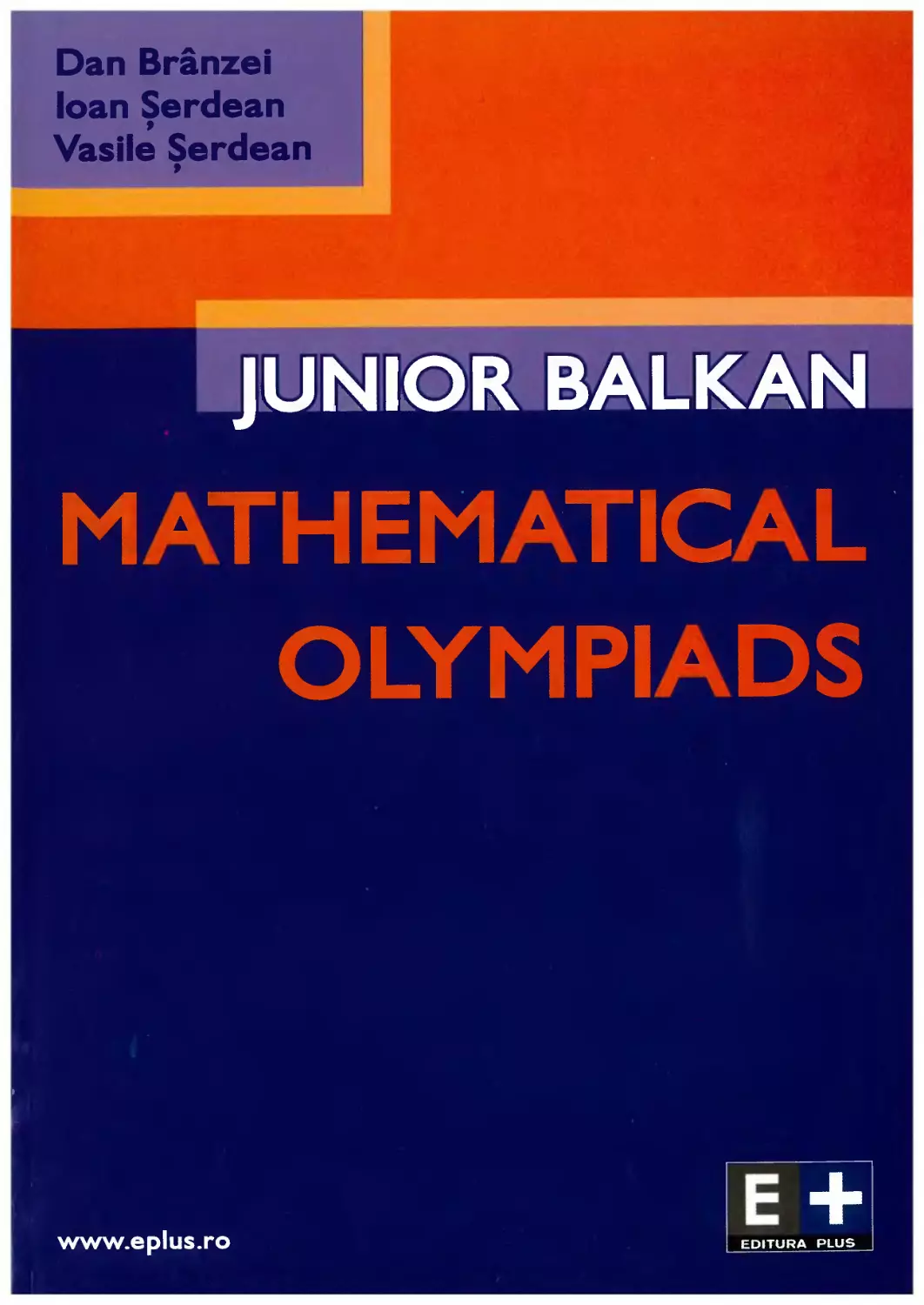
Dan Branzei
loan Serdean
Vasile Serdean
L к ν к
Μ THEM TIC L
OLYMPI DS
Junior Balkan
Mathematical Olympiads
Junior Balkan Mathematical Olympiads
Copyright © 2003 by Plus Publishing House
All rights reserved. No part of this book shall be reproduced, stored in a retrieval
system, or transmitted by any means, electronic, mechanical, photocopying, recording,
or otherwise, without written permission from the publisher.
International Standard Book Number: 973-85265-0-9
Printed in Romania
First Printing: June, 2003
Plus Publishing House
P.O. Box 63-36
Bucharest, Romania
fax: +4-021-312.96.07
e-mail: office@eplus.ro
web site: www.eplus.ro
Junior Balkan
Mathematical Olympiads
Dan Branzei
loan §erdean
Vasile §erdean
Published and distributed by
Plus Publishing House
Preface
This book is intended to help students preparing to participate in mathematical Olympiads
for juniors. An international competition for students up to 15 and 1/2 years is hosted
annually in one of the Balkan countries since 1997. In the first chapter are presented the
problems from this six Olympiads. Each Olympiad test consists in four problems, which
are to be done in four hours.
The book presents the tests used to select the Romanian team for the Junior Balkan
Mathematical Olympiad. In addition, short-listed problems submitted to the Jury of
JBMO, together with 20 training tests completes the content. Full solutions are provided
for each of the 211 problems.
It is our believe that students, teachers and all those who are mathematically incline
will enjoy working these intriguing and challenging problems.
Contents
The Problems
1. Junior Balkan Mathematical Olympiads 1
2. Team Selection Tests 7
3. Short-Listed Problems 15
4. Training Problems 21
Formal Solutions
5. Junior Balkan Mathematical Olympiad 29
6. Team Selection Tests 45
7. Short-Listed Problems 81
8. Training Problems 103
Problem Credits 145
Chapter 1
Junior Balkan
Mathematical Olympiads
The Problems
1.1 First Junior Balkan Mathematical Olympiad
Beograd, Yugoslavia, June, 1997
1. Nine points are given inside a unit square. Prove that three of them are the vertices
of a triangle with the area not greater than |.
Bulgaria
2. Let
Find the value of
in terms of k.
x2 + y2 x2 - У2 _ ,
χ2 — y2 χ2 + y2
x* + y* x* - yb
xb — yo xb _|_ yt
Cyprus
3. Let / be the incenter of the tiiangle ABC, and let D and Ε be the midpoints of
the sides AB and AC respectively. Lines DE and BI meet at point К and lines
DE and CI meet at point L. Prove that
AI + BI + CI>BC + KL.
Greece
1
4. Find the triangle ABC so that
R (6 + c) = aVbc.
Romania
1.2 Second Junior Balkan Mathematical Olympiad
Athens, Greece, June, 1998
5. Prove that the number
11...11 22...225
1997 1998
is a perfect square.
Yugoslavia
6. Let ABCDE be a pentagon so that
AB = AE = CD = 1, ZABC = ZDEA = 90° and ВС + DE = 1.
Find the area of the pentagon.
Greece
7. Find all the pairs (ж, у) of positive integers so that
xv = yx-v
Albania
8. Can one find 16 three digit numbers, using only 3 digits, without having two of
them with the same remainder when divided by 16?
Bulgaria
1.3 Third Junior Balkan Mathematical Olympiad
Plovdiv, Bulgaria, June, 1999
9. Let a, 6, с, х, у be real numbers so that:
a3 + ax + у = 0, 63 + bx + у = 0 and c3 + ex + у = 0.
Show that if a, 6, с are distinct numbers, different from 0, then a + b + c= 0.
Cyprus
3
10. Find the greatest common divisor of the numbers
A = 23n 4- 36n+2 4- c;6n+2
when η = 0, 1, ..., 1999.
Romania
11. Let S be a square of side 20 and let Μ be a set consisting of the vertices of the
square and 1999 arbitrary inner points of S. Prove the existence of a triangle with
the area at most equal to ^ and having all the vertices in the set M.
Yugoslavia
12. In a triangle ABC the sides AB and AC are equal. Let D be a point on ВС such
that ВС > BD > DC > 0. Consider the circumcircles ki and &2 of the triangles
ABD and ADC respectively. Let Μ be the midpoint of B'C, when BB' and CO
are diameters of k\ and k<i respectively. Prove that the area of the triangle Μ ВС
is constant (with respect to D).
Greece
1.4 Fourth Junior Balkan Mathematical Olympiad
Ohrid, Macedonia, June, 2000
13. Let x, у be integer numbers so that
x3 + y3 + {x + yf + ZQxy = 2000.
Prove that χ + у = 10.
Romania
14. Find all the positive integers η, η > 1, such that nl 4- 3n is a perfect square.
Bulgaria
15. A semicircle of diameter EF, lying on the side ВС of the ABC triangle, is tangent
to the sides AB and AC in Q and Ρ respectively.
4
The lines ЕР and FQ meet at point K.
Prove that К is a point on the altitude from A of the triangle ABC.
Albania
16. At a tennis tournament there were twice as many girls participating than boys.
Each pair of players had only one match and there were no draws. The ratio
between girl winnings and boy winnings was |;
How many players took part at the tournament?
Serbia
1.5 Fifth Junior Balkan Mathematical Olympiad
Nicosia, Cyprus, June, 2001
17. Find all the positive integers a, b, с such that
аз + 6з + сз = 2001
Romania
18. Let ABC be a triangle with Ζ AC В = 90° and AC φ ВС. The points L and Η of
the segment [AB] are chosen such that /.ACL = ZLCB, and CH is perpendicular
to AB.
a) For every point X (other than C) on the line CL, prove that ZXAC φ ZXBC.
b) For every point Υ (other than C) on the line CH prove that ZYAC φ ZYBC.
Bulgaria
19. Let ABC be an equilateral triangle and let D, Ε be arbitrary points on the sides
[AB] and [AC] respectively. If DF, EG (with F G AE, G G AD) are internal
bisectors of the angles of the triangle ADE, prove that the sum of the areas of the
triangles DEF and DEG is less than or equal to the area of the area of triangle
ABC. Explain when the equality holds.
Greece
20. A convex polygon with 1415 sides has the perimeter of 2001 centimeters. Prove
that there exist three vertices of this polygon, which form a triangle having the
area less than 1 square centimeter.
Yugoslavia
5
1.6 Sixth Junior Balkan Mathematical Olympiad
Tg. Mures, Romania, June, 2002
21. Let ABC be an isosceles triangle with AC = ВС and let Ρ be a point on the arc
AB of the circumcircle which does not contain С The perpendicular from С on
PB intersects PB in D. Prove that
PA + PB = 2PD.
Greece
22. Two circles C\ and C2 of different radii have two common points A and В and
their centers 0\ and O2 are separated by the straight line AB. Let В\л Вч the
diametrically opposed points of В on these circles respectively. The points M\ on
C\ and M2 on C2 are chosen such that ΔΑΟ\Μ\ = ZAO2M2, Βχ is an internal
point of ΔΑΟ\Μ\ and В is an internal point of ΔΑΟ2Μ4,. Let Μ be the midpoint
of the segment £iJ32. «Prove that ΔΜΜχΒ = ZMM2B.
Cyprus
23. Find the positive integers N having the following properties:
i) N has exactly 16 divisors 1 = d\ < cfe < · · · < cfis < di6 = N.
ii) the divisor having the index cfe (that is dd&) is equal to (cfo + сЦ)^б·
Bulgaria
24. Let a, b, c, be positive numbers. Prove that:
b(a + b) c(b + c) a(c + a) ~ 2(a + b + cf
Greece
This page intentionally left blank
Chapter 2
Team selection tests
2.1 First team selection test for the second JBMO
Iasi, May 27, 1998
25. Let
3 1 1
A=-—r + rr—T + ...+
and
1-2 3-4 1997-1998
1 1 1
B= n + + ■■■ +
1000 1998 1001-1997 1998 · 1000
Prove that ^ is an integer.
26. A rectangle ABCD is given. Let M, N, P, Q be the points on the sides AB, ВС,
CD, DA respectively. If ρ is the perimeter of the quadrilateral MNPQ, prove that:
i) Ρ > AC + BD;
ii) If ρ = AC + BD, then area[MiVP<9] < ™™\abcd]
iii) If ρ = AC + BD, then MP2 + NQ2 > AC2.
27. Let η be a positive integer. Find all the integer numbers that writes as:
1 2 η
— + — + ... + —,
αϊ α2 αη
for some positive integers a\, a<i, ..., an.
7
8
2.2 Second selection test for the second JBMO
Iasi, May 28, 1998
28. Find all the integers χ and у so that
(x + 1) (x + 2) (x + 3)+x (x + 2) {x + 3)+x {x + 1) {x + 3)+x {x + 1) (x + 2) = yr'.
29. A triangle ABC is given. The points D, E, F, G are chosen on the sides of the
triangle such that the quadrilateral DEFG is circumscriptible and DF ± EG.
Find the locus of the intersection point Μ G DF П EG, so that {D, E, F, G} П
{Λ, β, С} ф 0.
30. Find the smallest value for η for which there exist the positive integers x\, ..., xn
with
^+^ + ...+4 = 1998.
2.3 First team selection test for the third JBMO
Iasi, May 26, 1999
31. Let η the positive integer. Prove that there is a polynomial Ρ with integer
coefficients so that if a + b + с = 0, then:
a2n+l + 62n+l + c2n+l = a6c[p(a> 6) + ρβ c) + p(Cj a)]_
32. Let ABC be a triangle and let ж, у, 2 be three arbitrary vectors. For any real
number λ > 0, the points M, JV, Ρ are chosen so that:
AM = Xx, BN = Xy, CP = Xz.
Find the locus of the centroid Q of the triangle MNP.
33. Let Л С (0, 1) be a set of real number having the properties:
a) \ e A;
b) if χ € A, then f and γ^ belong to A.
Prove that the set A contains all the rational numbers from the interval (0, 1).
34. Let D\, Z>2, Дз be three distinct disks in the plane and let a^· be the area of
Di Π Dj, for all г, j e {1, 2, 3}. Prove that if хъ х2, хз are real numbers, not all
of them equal to zero, then:
aux\ 4- a22x\ + азз^з + 2αΐ2^ι^2 + 2й2з^2^з + 2α^ιχ^χι > 0.
9
2.4 Second team selection test for the third JBMO
Iasi, May 27, 1999
35. Let А, В, С be the measures (in degrees) of the angles of the ABC triangle. A
straight line cuts the ABC triangle in two isosceles triangles. Find the relations
between the numbers А, В, С
36. Find the number of five-digit perfect squares having the last two digits equal.
37. Μ is the set of all values of the greatest common divisor d of the numbers A =
In 4- 3m 4- 13, В = 3n 4- 5m 4- 1, С = 6n 4- 8m — 1, where m and η are positive
integers. Prove that Μ is the set of all divisors of an integer k.
38. Consider a convex quadrilateral ABCD and let A1} β1} Ci, Di be the reflection
points of A, 23, C, D across В, C, D, A respectively.
a) If Ε and F are the midpoints of the segments ВС and AD, and E\ and F\ are
the midpoints of the segments A\B\ and C\D\, prove that I?I?i = FF\.
b) The points А, В, С, D are erased. Can you obtain them again, knowing only
the location of A\, B\, Ci, Di ?
2.5 First team selection tests for the fourth JBMO,
Brasov, April 27, 2000.
39. For all the positive integers к < 1999, let Si(k) be the sum of all the remainders
of the numbers 1, 2, ..., к when divided by 4, and let 5г(/г) be the sum of all the
remainders of the numbers к + 1, к + 2, ...., 2000 when divided by 3. Prove that
there is an unique positive integer m < 1999 so that Si(m) = 52(m).
40. Let S(k) be the sum of the digits of a positive integer к in decimal representation.
Find all the positive integers η to exist the non-negative integers a and b with
S(a) = 5(6) = S{a + b)=n.
41. For all the numbers pGK and η G N* let An{p) be the set of integers px where χ
is a real number and η — 1 < χ < п. For a given real number a, find all the real
numbers b such that the sets An(a) and An(b) have the same number of elements
for all the positive integers n.
42. Let ABC be a triangle with /LBAC = 90° and AB = AC. The points Μ and N
are given on the side ВС such that N lies between the points Μ and С and
BM2 - MN2 4- NC2 = 0
Prove that ZMAN = 45°.
10
2.6 Second team selection test for the fourth JBMO,
Bucium, Iasi, May 13, 2000
43. Find the integer solution of the equation
44. A plane is covered by a net of unit squares. A person walks on the edges, any two
consecutive edges being perpendicular, and returns in the initial position after η
steps.
a) Prove that 4 divides n.
b) State and prove a reciprocal.
45. Find all the real values of the number a such that
χ + у + xy > a,
for all the real numbers χ > a and у > а
46. A triangle ABC is given. The points A' G {ВС), В' G (СА), С G (AB) are
chosen such that the the lines A4/, BB', С С meet at the point M. Let a, 6, c, x,
y, ζ be the areas of the triangles AB'M, BC'M, С AIM, ACM, BA'M, CB'M
respectively. Prove that:
1° abc = xyz;
2° ab + bc + ca = xy + yz + zx.
2.7 Third team selection test for the fourth JBMO
Bucium, Iasi, May 19, 2000
47. For any integer η > 2, consider η — 1 positive real numbers α1} аг, ..., αη-ι having
the sum 1, and η real numbers &i, 62, ..., bn. Prove that
b\ + Μ + h. +... + JL. > 2&! (ь2 + ь3 +.. . + bn).
a\ o>2 an-i
When does the equality holds?
48. Let a > 0 be an integer number. Find the number of elements of the set
A = \ χ Ι χ e Ζ and ez\.
49. The internal bisectors of the angles A, J5, С of the ABC triangle intersect the sides
ВС, С A, AB at the points D, E, F respectively. The points А', В', С are the
reflections of the points А, В, С with respect to D, E, F. If А, В, С lie respectively
on the line segments B'O', A'C', A'B', prove that ABC is an equilateral triangle.
11
50. Two square of side length 5 are divided into 5 regions each. These 10 regions arc
colored using the same 5 colors for each square. Overlapping the squares, the sum
of the areas of the parts sharing having the same color is computed. Prove that
there is a coloring for which this sum is at least 5.
2.8 First team selection test for the fifth JBMO
Tg. Mures, April 12, 2001
51. Let ABC be an arbitrary triangle. A circle passes through В and С and intersects
the lines AB and AC m\D and Ε respectively. The projection of the points В and
Ε on CD are denoted by В' and Ε'. The projection of the points D and С on BE
are denoted by D' and C\.
Prove that the points Β', D^E', С are on th/same circle.
52. Find all the integers η so that the number */4t"~52 is rational.
53. 1200 points are given inside a circle centered at the point О so that no two of them
lie on a diameter of the circle. Prove that there exist the points Μ and N on the
circle so that ZMON = 30° and in the interior of the angle ΔΜΟΝ lie exactly
100 points.
54. Three students write on the blackboard three two-digit squares next to each other.
At the end they observe that the 6-digit number obtained is also a square. Find
this number.
2.9 Second team selection test for the fifth JBMO
Buzau, May 19, 2001
55. Let ABCD be a rectangle. The points Ε G С A, F G AB, G G ВС are considered
so that DE 1 С A, EF 1 AB, EG 1 ВС. Find the rational solutions of the
equation
ACX = EFX + EGX.
56. Let Л be a non-empty subset of R so that if x, у are real numbers with x + y e A,
then xy € A. Prove that A = R.
57. Let ABCD be a quadrilateral inscribed in the circle C(0, R). For any point Ε of
the circle we consider its projections K, L, Μ, Ν on the lines DA, AB, ВС, CD.
For some point E, different than A, B, C, D, one observe that the point N is the
orthocenter of the triangle KLM.
Prove that this holds for any point Ε on the circle.
58. Find all the positive integers a < b < с < d with the property that each of them
divides the sum of the other three.
12
2.10 Third team selection test for the fifth JBMO
Buzau, May 20, 2001
59. Let η be a non-negative integer. Find all the non-negatives integers a, 6, c, d such
that
a2 + b2 + c2 + d2 = 7 ■ 4n.
60. The opposite sides of a hexagon ABCDEF are parallel and the diagonals AD, BE
and CF are equal. Prove that the hexagon is cyclic.
61. Let η > 2 be an integer. Find all the integers χ so that
у х + у х + ... + \fx < η
for any number of radicals.
62. Find the minimal area of a rectangular box of a volume strictly greater than 1000
if the side lengths are integer numbers.
2.11 First team selection test for the sixth JBMO
Rm. Valcea, March 21, 2001
63. For a positive number n, let f(n) be the value of
_ 4гг + \/4n2 - 1
^ ~ y/2n + 1 + yjln - 1"
Calculate /(1) + /(2) + /(3) + ... + /(40).
64. Let Я", η, ρ be non-negative integers so that ρ is prime, К < 1000 and vK = Пу/р.
a) Prove that if the equation y/K + 100rc = (n + x) y/p has an integer solution
different from 0, then ρ \ 10.
b) In that case find the number of all the positive integer solutions of the equation
(that is, when ρ = 2 or ρ = 5).
65. Consider a 1 χ η rectangle made out of η tiles. A pavement is a coloring of each
of the η tiles with one of the 4 possible color so that no two consecutive tiles have
the same color.
i) What is the number of the distinct symmetrical pavements? (a symmetrical
pavement is a pavement for which tile symmetrical with respect to the center have
the same color).
ii) What is the number of distinct pavements so that in any block of three
consecutive tiles no two tiles have the same color?
13
66. Let ABCD be a parallelogram centered in O. Let Μ and N be the midpoints of
BO and CD. Prove that if the triangles ABC and AMN are similar, then ABCD
is a square.
2.12 Second team selection test for the sixth JBMO
Bucharest, April 13, 2002
67. A unit square is divided naturally into 9 congruent squares of side ^. The central
square is colored. We call this procedure P. For each of the 8 remaining squares
apply the procedure P. For each of the next 64 remaining squares apply the
procedure Ρ and so on. Prove that after 1000 applications of procedure Ρ the area
colored exceeds 0.999.
68. Find all the positive integers a, 6, c, d so that
a + b + c+ d — 3 = ab = cd.
69. Let ABC be an isosceles triangle with AB = AC and ZB AC = 20°. Let Μ be the
projection of the point С on the side AB and let N be a point on the side AC so
that CN = ψ·. Find the measure of the angle AMN.
70. Let ABCD be a unit square. Suppose Μ, Ν are two interior points so that no
vertex of the square lies on the line MN. Let s(M, N) be the smallest area of a
triangle with vertices in the set {А, В, С, D, Μ, Ν}. Find the smallest real number
к so that for any points Μ, Ν with the mentioned property we have s{M, N) < k.
2.13 Third team selection test for the sixth JBMO
Bucharest, April 14, 2002
71. Let η be an even positive integer and let a, b be positive coprime integers. Find a
and b if a + b divide an + bn.
72. Let ABCD be a convex quadrilateral and О the point of intersection of its
diagonals. The measure of the angle between the two diagonals is m. For any angle xOy
of measure m, the area inside the angle that is in the interior of the quadrilateral
is constant. Prove that ABCD is a square.
73. An equilateral triangle of side 10 is divided into 100 unit equilateral triangles by
lines parallel to the sides of the triangle. Find the number of (not necessarily unit)
equilateral triangles in the configuration described above so that the sides of the
triangle are parallel to the sides of the initial one.
74. If a, 6, с G (0, 1), prove that
Vab~c + y/(l - a) (1 - b) (1 - c) < 1.
14
2.14 Fourth team selection test for the sixth JBMO
Bucharest, June 1, 2002
75. Let a be an integer. Prove that for any real number χ such that x2 < 3, the
numbers у'З — χ2 and χ/α — χ3 are not both rational.
76. The last four digits of a perfect square are equal. Prove they are all zero.
77. Consider the circles C\{0\) and ^{O^) such that C\ passes through the point O2·
Let Μ be a point on the circle C\ but not on the line О1О2· The tangents from
Μ to C2 meet again the circle C\ at the points A and B. Prove that the tangents
from A and В to C2 (not those going through M), meet on C\.
78. Consider five points in the plane such that any three of them form a triangle of
area at least 2. Prove that there are three of them forming a triangle of area at
least 3.
2.15 Fifth team selection test for the sixth JBMO
Bucharest, June 2, 2002
79. Let m, η > 1 be integer numbers. Solve in positive integers the equation
xn + y11 = 2m.
80. Consider η > 2 concentric circles and two lines g?i, g?2 which meet at P, a point
inside all the circles. The rays determined by Ρ on the line d\ meet the circles
at the points Αι, A2, ..., An and A[, A'2, ..., A'n respectively, similarly, the rays
determined by Ρ on the line d2 meet the circles at the points £?i, J52, ..., Bn and
B[, B'2, ..., B'n respectively (the points of equal index are on the same circle).
Prove that if the small arcs A%Bi and A2B2 are equal, then all the small arcs AiBi
and Α\Β[ are equal for all i = 1, n.
81. Let ABC be a triangle and a = ВС, b = С А, с = АВ be the side lengths. On the
same side of ВС as A consider the points D and Ε such that DB = с, С Ε = b and
the area of DECB is maximal. Let F be the midpoint of DE and let FB = x.
Prove that FC = χ and 4x3 = (a2 + b2 + c2)x + abc.
82. Let p, q be two distinct primes. Prove that there are positive integers a, b so that
the arithmetic mean of all the divisors of the number η = pa · qb is also an integer.
Chapter 3
Short-Listed Problems
3.1 Fourth Junior Balkan Mathematical Olympiad
Ohrid, 2000
83. Prove that there are at least 666 positive composite numbers with 2006 digits,
having a digit equal to 7 and all the rest equal to 1.
84. Find all the positive perfect cubes that are not divisible by 10 so that the number
obtained by erasing the last three digits is also a perfect cube.
85. Find the greatest positive integer χ such that 236+x divides 2000!.
86. Find all the integers written as abed in decimal representation and deba in 7 base.
87. Find all the pairs of integers (m, n) so that the numbers A = n2 + 2mn + 3m2 + 2,
В = 2n2 + 3mn + m2 + 2, С = 3n2 + mn + 2m2 + 1 have a common divisor greater
than 1.
88* Find all the four-digit numbers so that when decomposed in prime factors have the
sum of the prime factors equal to the sum of the exponents.
89. Find all the pairs of integers (m, n) such that the numbers A — n2+2mn+3m2 +3n,
В = 2n2 + Зтп + т2, С = 3n2 + mn + 2m2 are consecutive in some order.
90. Find all the positive integers a, b for which a4 + 464 is a prime number.
91. Find all the triples (x, y, z) of positive integers such that xy + у ζ + ζχ — xyz = 2.
92. Prove that there are no integers x, y, ζ so that
x4 + yA + z4 - 2x2y2 - 2y2z2 - 2z2x2 = 2000.
93. Prove that for any integer η one can find integers a and b such that
η = fo\/2| + [бл/з] .
15
16
94. Consider a sequence of positive integers xn such that:
(A) a?2n+i = 4zn + 2n + 2,
(B) ХЗп+2 = Зжп+1 + Qxn,
for all η > 0.
Prove that
(C) хзп-ι = Xn+2 - 2xn+i + I0xn,
for all η > 0.
95. Prove that
Φ
(Ife + 2*») (I* + 2fc + 3fc)... (lfc + 2fc + ... + nk)
>Г + 2К + ... + пк ^—= .
η
for all integers n, к > 2.
96. Let m and η be positive integers with m < 2000 and /г = 3 — —. Find the smallest
positive value of k.
97. Let x, y, a, b be positive real numbers such that χ φ у, χ φ 2у, у φ 2χ, α φ 3b and
|£=ϊ = 2l|. Prove that ^Ц > 1.
2у—х а—Зо aj^—jr —
98. Find all the triples (x, y, z) of real number such that
2xy/y — 1 + 2y\fz~^~\ + 2z\Jx — 1 > жу + жг + уг.
99. A triangle ABC is given. Find all the pairs of points Χ, Υ so that X is on the sides
of the triangle, Υ is inside the triangle an four non-intersecting segments from the
set {XY, AX, AY, BX, BY, CX, CY} divide the ABC triangle in four triangles
with equal areas.
100. A triangle ABC is given. Find all the segments XY that lies inside the triangle such
that XY and five of the segments XA, XB, XC, Υ A, YB, YC divide the ABC
triangle in 5 regions with equal areas. Furthermore, prove that all the segments
XY have a common point.
101. Let ABC be a triangle. Find all the triangles XYZ with the vertices inside ABC
such that XY, YZ, ZX and six non-intersecting segments from the following AX,
AY, AZ, BX, BY, BZ, CX, CY, CZ divide the ABC triangle in seven regions
with equal areas.
102. Let ABC be a triangle and let a, b, с be the lengths of the sides ВС, С А, АВ
respectively. Consider a triangle DEF with the side lengths EF = \fcm, FD =
yjbu, DE = у/сй. Prove that ΔΑ > ΔΒ > 1С implies ZA > ZD > ZE > ZF >
ZC
17
103. All the angles of the hexagon ABCDEF are equal. Prove that
AB - DE = EF - ВС = CD - FA.
104. Consider a quadrilateral ABCD with ZDAB = 60°, ZABC = 90° and ABCD =
120°. The diagonals AC and BD intersect at M. If MB = 1 and MD = 2, find
the area of the quadrilateral ABCD.
105. A point Ρ is considered inside of an equilateral triangle of the side length 10 so
that the distances from Ρ to two of the sides are 1 and 3, respectively. Find the
distance from Ρ to the third side.
3.2 Fifth Junior Balkan Mathematical Olympiad
Nicosia, 2001
106. Find the positive integers η that are not divisible by 3 if the number 2n ~10 + 2133
is a perfect cube.
107. Let Pn (n = 3, 4, 5, 6, 7) be the set of integers nk + nl + nm, where fc, /, m are
positive integers. Find η so that:
i) In the set Pn there are infinitely many squares.
ii) In the set Pn there are no squares.
108. Find all the three digit numbers abc such that the 6003-digit number abcabc... abc
is divisible by 91. (abc occurs 2001 times).
109. The discriminant of the equation x2 — ax + b = 0 is the square of a rational number
and a and b are integers. Prove that the roots of the equation are integers.
110. Let Xk = k\k2 f°r all the integers к > 1. Prove that for any integer η > 10,
between the numbers A = x\ + xi + ... + xn-\ and В = A + xn there is at least a
square.
111. Find all the integers χ and у such that x3 ± y3 = 200lp, where ρ is a prime.
112. Prove that there are no positive integers χ and у such that
x5 + y5 + 1 = (x + 2)5 + (у -3)5.
113. Prove that no three points with integer coordinates can be the vertices of an
equilateral triangle.
114. Consider a convex quadrilateral ABCD with AB = CD and ABAC = 30°. If
ZADC = 150°, prove that ZBCA = ZACD.
115. A triangle ABC is inscribed in the circle C(0, R). Let a < 1 be the ratio of the
radii of the circles tangent to C, and both of the rays (AB and (AC. The numbers
β < 1 and 7 < 1 are defined analogously. Prove that a + β + η = 1.
18
116. Consider an isosceles triangle ABC with AB = AC, and D the foot of the altitude
from the vertex A. The point Ε lies on the side AB such that
Ζ AC Ε = ZECB = 18°.
If AD = 3, find the length of the segment CE.
117. Consider the triangle ABC with ZA = 90° and ZB φ ZC. A circle C(0, R) passes
through В and С and intersect the sides AB and AC in D and E, respectively.
Let S be the foot of the perpendicular from A to ВС and let К be the intersection
point of AS with the segment DE. If Μ the midpoint of ВС, prove that AKOM
is a parallelogram.
118. At a conference there are η mathematicians. Each of them knows exactly к
participants. Find the smallest value of к such that there are at least three mathematicians
that are acquainted with the other two. . *
3.3 Sixth Junior Balkan Mathematical Olympiad
Tg Mures, 2002
119. A student plays a computer game. The computer provides him with 2002 positive
distinct numbers randomly chosen. The game rules allows him to do the following
operations:
- take two of the given numbers, double one of them, add the second number and
keep the sum;
- next, choose two other numbers from the remaining ones, double one of them and
add the second; then multiply the sum with the previous one and keep the result;
- repeat the above procedure until all the 2002 given numbers are used.
The student wins the game if the last product is maximal. Find, with proof, the
winning strategy of the game.
120. All the positive integers are arranged in a triangular array as shown below:
1 3 6 10 15 ...
2 5 9 14 ...
4 8 13 ...
7 12 ...
11 ...
Find the number of the column and the number of the row where 2002 is put.
121. Let a, 6, с be positive real numbers such that abc = |. Prove that the following
inequality holds
19
122. (Committee's variant for problem 121). If a, b, с are positive real numbers sucli
that abc = 2, then
a3 + b3 + c3 > ay/b + c + b\/c + a + Ыа + b.
When does the equality hold?
123. Let a, b, с be positive real numbers. Prove that
a3
—
b2
+
b3
—
c2
+
c3
—
a2
>
a2
b
+
ft2
—
с
+
с?
—
α
124. Let οι, ог, аз5 ^4, α5> α6 be real numbers such that a\ φ 0, 0106+0304 = 20205 and
0103 > α2· Show that а4Об < α2. When does the equality hold?
125. Consider 2002 integers ait i = 1, 2, 3, ..., 2002 such that
—3 —3 —3 1
αχ + a2 + ... + a2oo2 = 2'
Prove that at least three of them are equal.
126. Let G be the centroid of a triangle ABC, and let A\, B\, C\ be the midpoints
of the sides ВС, С А, АВ respectively. The parallel line from A\ to BB\ meets
B\C\ in F. Prove that the triangles ABC and F.A1.A are similar with the same
orientation if and only if the quadrilateral AB\GC\ is cyclic.
127. Let ABC be a triangle and let Η, Ι, Ο be the orthocenter, the incenter and the
circumcenter of the triangle, respectively. The line CI meets again the circumcircle
at the point L. It is known that AB = IL and AH — OH. Find the measure of
the angles of the triangle ABC.
128. Let ABC be a triangle of area S and consider the points D, E, F on the lines
ВС, С A, AB respectively. The perpendicular lines at points D, E, F on the lines
ВС, С A, AB intersect the circumcircle of the triangle ABC in the pairs of points
(Dh D2), (Ei, E2), (Fi, F2) respectively. Prove that
\DiB ■ DiC - D2B ■ D2C\+\E1C ·ΕλΑ- E2C ■ E2A\+\FXA · FXB - F2A ■ F2B\ > 4S.
129. Let ABC be an isosceles triangle such that AB = AC and Ζ A = 20°. Point D is
chosen on the side AC such that AD = ВС. Find the angle Ζ BDC.
130. Let ABCD be a convex quadrilateral with AB = AD and ВС = CD. On the
sides AB, ВС, CD, DA, points K, L, L\, K\ are chosen respectively such that
KLL\ K\ is a rectangle. Then, suppose that a rectangle MNPQ, is inscribed in the
triangle BLK where Μ € KB, N G BL, P, Q e LK and, similarly, M1N1P1Q1 is
inscribed in the triangle DK\L\, where M\ e DK\, N\ G DL\ and Pi, Qi G L\K\.
Let 2S, 2Si, S2, S3 be the areas of the quadrilaterals ABCD, KLL\K\, MNPQ,
M^NiPiQi respectively. Find the greatest value of 25l+2^+^·
20
131. Let Αχ, .Аг, ..., -А2002 be arbitrary points in a plane. Prove that for any unit circle
in the plane and for any rectangle inscribed in the circle, there are three vertices
Μ, Ν, Ρ of the rectangle such that
MAi + ... + MA2002 + ΝΑλ + ... + NA2oo2 + ΡΑλ + ... + ΡΛ20ο2 > 6006.
Chapter 4
Training Problems
Test 1
132. Let a, b, c, d be positive real numbers with α + 6+ c+ d = 1. Prove that:
bed acd abd abc 1
+ -, ~ + ~ + -:—г < r^·
a + 2 6 + 2 c + 2 rf + 2 13
133. Find all non-empty subsets А С R* with the properties:
i) A has at most 5 elements;
ii) If χ e A then £ G Л and 1-ieA
134. Let AJ3C be a triangle and let Ζ), Ε be the points in the exterior of the triangle
such that triangles ABD and ACE are isosceles and right-angled at В and С
respectively.
Prove that the lines CD and BE meet on the altitude from A in the triangle ABC.
135. Consider a parallelogram ABCD such that Ζ AC В = 80° and Δ AC В = 20°. A
line passing through В meets the line AB at an angle of 20° and intersects the line
AC in the point jR. A line passing through С meets the line AC at an angle of 30°
an intersects the line AB in the point T.
Find the measure of the angle determined by the lines TR and DC.
Test 2
136. Find the cube of the number N =
\
21
22
137. Prove that for any non-negative integer η the number
Λ = 2η + 3η + 5η+6η
is not a perfect cube.
138. The points А, В, С are the vertices of a triangle with no equal sides. How many
points D exist such that the set {А, В, С, D} has a symmetry axis?
139. A cyclic quadrilateral ABCD is given. On the rays (AB and (AD the points Ρ
and Q are considered so that AP — CD and AQ = ВС.
The lines PQ and AC meet at point Μ and N is the midpoint of the segment BD.
Prove that PM = MQ = CN.
Test 3
140. Solve in positive integers the equation
xv ■ yx + xy + yx = 5329.
141. Find all the positive integers η for which the number obtained by erasing the last
digit is a divisor for n.
142. Prove that a quadrilateral ABCD with
area [ABC] < area [BCD] < area [CDA] < area [ABD]
is a trapezoid.
143. Inside a rectangle of area 5 are given 9 polygons each of area 1. Prove that there
exists 2 of them with the common area not less then L·
" Test 4
144. Prove that for any real numbers a and b there are numbers x, у € [0, 1] such that
\xy - ax - by\ > -.
145. Find the greatest number that can be written as a product of some positive integers
with the sum 1976.
146. An acute triangle ABC is given. Prove that the internal bisector of angle ZBAC,
the altitude from В and the perpendicular bisector of the line segment AB are
concurrent if and only if Δ A = 60°.
147. The points M, K, L are considered respectively on the sides AB, ВС, AC of a
triangle ABC. Prove that at least one of the areas of the triangles MAL, KBM
or LCK is not less than a quarter of the area of the triangle ABC.
23
Test 5
148. Find all the integers x, y, ζ so that 4X + 4y + 4s is a square.
149. Find all the primes a, b, с such that
ab + be + ac > abc,
150. Five points are given inside of an equilateral triangle of side length 1. Prove that
there exist 2 points at a distance less than |.
151. Let A1A2 ... An be a regular polygon, η > 3. Find the number of obtuse triangles
AiAjAk-
Test 6
152. Find all the positive integers x, y, z, t so that x + y + ζ = xyzt.
153. Find all the positive integers η for which the set
{η, η + 1, η + 2, η + 3, η + 4, η + 5}
can be decomposed in two disjoint subsets such that the product of elements in
these subsets are equal.
154. Prove that in any tetrahedron there is a vertex such that the edges arising from it
are the sides of a triangle.
155. Let ABCD be a convex quadrilateral and let Ε and Τ be the midpoints of the sides
ВС and CD respectively. If AE + AT = 4, prove that the area of the quadrilateral
ABCD is less than 8.
Test 7
156. A number χ is formed using the digits 1, 2, 3, 4, 5, 6, 7 once and only once.
Rearranging the digits we obtain a number y. Prove that у is not a divisor of x.
157. Let x, y, ζ be distinct integers such that xy + у ζ + χζ = 26.
Prove that x2 + y2 + z2 > 29.
158. Inside a unit square lies a convex polygon of area greater than \. Prove that there
is a line d parallel with one of the sides of the square that cuts from the polygon a
line segment of length greater than or equal to \.
24
159. A triangle ABC is considered. The internal bisectors of the angles /.ABC and
ZACB intersects the sides AC and AB in the points D and E, respectively. Find
the angles of the triangle ABC if ZBDE = 24° and ICED = 18°.
Test 8
160. Let N = 44... 488... 8 9 . Calculate y/N.
2002 2001
161. Numbers χι, x2, ..., xn are chosen from the interval [2, 4] such that
χι + X2 + ... + xn = —%- and x\ + x\ + · · · + xn = 9n.
о ·
Prove that 12 divides n.
162. Inside a box of dimensions L, / and h are given n3 + 1 points. Prove that there are
two of them at a distance less than V^-HHhi.
163. A point Μ is given inside a triangle ABC. Let D, E, F be the projections of the
point Μ onto the sides ВС, С А, АВ respectively. Find the minimum value of the
sum
ВС CA AB
MD + ME + MF'
Test 9
164. Let a > b > 0 be the real numbers such that a5 + b5 =a — b. Prove that a4 + 64 < 1.
165. Let η > 2 be an integer.. Prove that the number of irreducible fractions from the
set M, £, -3-, .... s=±) is even.
166. In the interior of a unit square are considered 129 points. Prove that there exists
a disk of radius | that contains at least three points.
167. Find all triangles with integer side lengths so that the semiperimeter has the same
value as the area of the triangle.
Test 10
168. Let η and ρ be positive integers η > 1. Prove that the numbers η — 1 and np + 1
cannot have other divisors than the divisors of ρ + 1.
169. Find a relation between the numbers a, 6, с if
1 1 l л 1
χ -\— =a, у -\— = b and xy Л = с.
χ у ху
25
170. Prove that in any polygon there are two sides with the length ratio greater then or
equal to 1 and less then 2.
171. Inside a unit cube 28 points are given. Prove that among them there are two points
at a distance not greater than *ψ.
Test 11
172. Find the last 5 digits of the number 51981.
173. Compute the sum
2 22 2n+1
S = тгттг + ^г—г + · · · +
3 4-1 32 4-1 32" 4- 1'
174. In a tetrahedron all the altitudes are congruent. One of them passes through the
orthocenter of the corresponding face. Prove that the tetrahedron is regular.
175. Let ABCD be a parallelogram. On the sides ВС and CD points Ε and F are
chosen such that ^ = a and J^ = b. Lines AE and BF intersect in the point
M. Find the ratio $|.
Test 12
176. Prove that there are at least 2002 rational numbers m so that y/m 4- 2002 and
y/m + 2003 are both rational numbers.
177. Let a, 6, с be positive real numbers such that abc > 1 and ^ 4- £ + \ > a + b + c.
Prove that:
i) All numbers are different than 1.
ii) Only one numbers is less than 1.
178. 5 points are given in a plane, not three of them collinear. Prove that there are 4
among them which are vertices of a convex quadrilateral.
179. Consider a convex hexagon of area S. Prove that there is a triangle determined by
three consecutive vertices of the hexagon with an area not greater than |-.
Test 13
180. Find all the positive integers η which are equal to the sum of its digits added to
the product of its digits.
26
181. Consider the sum
~ 1-2 + 2-3+" +99-100'
Find the sequences of consecutive terms of S that add up to |.
182. Prove that any polygon with the perimeter 2004 can be covered by a disk of
diameter 1002.
183. Prove that there are no triangles in which the incircle divides an internal bisector
of an angle in three equal segments.
Test 14
184. Let fc, ni, 7i2, ..., η*, be odd integers. Prove that the numbers of odd numbers
among sifaa, ^±M, ..., ^±^· is odd.
185. Solve in R the equation:
[*[*]] = 1,
([x] denotes the integer part of the number x).
186. Prove that in any triangle the following inequality holds
b + c — a <2b cos —.
187. A convex polygon with n2 sides (n > 2) is decomposed into η convex pentagons.
Prove that η = 3.
Test 15
188. Find the greatest number η such that any subset with 1984— η elements of the set
{1,2,..., 1984} contains a pair of coprime numbers.
189. Find the real numbers oi, 02, ..., a^n+i so that
ai+a2 + ... + a2n+a2n+i = 2n + l and |oi - a2| = |a2 - a3| = ... = |a2n+i — ai| ·
190. Considers 2n + 1 real numbers between 1 and 2n. Prove that there are three of
them which are the side lengths of a triangle.
191. A convex octagon has all the angles congruent and all side lengths rational numbers.
Prove that the octagon has a symmetry point.
27
Test 16
192. Find the sum of the digits of the numbers from 1 to 1,000,000.
193. Find the elements of the set
194. Prove that 2002 points can be joined two by two with 1001 segments such that no
two of them intersect.
195. A triangle ABC with ΔΑ = 90° is given. A square MNPQ is inscribed in the
triangle such that Μ lies on AB, N lies on ВС, Ρ lies on ВС and Q lies on С A.
Likewise, the squares of the sides l\, /2, /3 are inscribed in the right triangles QPC,
MBN, AMQ respectively, all having two vertices on the hypotenuses and a vertex
on each leg of the triangles. Prove that
I L-L
/2 + /2 ~~ /2 ·
h l2 *3
Test 17
196. Consider η distinct positive integers less than 2n. Prove that among these numbers
there is one equal to η or there are two numbers with the sum equal to In.
197. Let a, 6, с be odd integers. Prove that the roots of the equations ax2 + bx + с = 0
are not rational numbers.
198. Let ABC be a triangle with ΔΑ = 90°. Consider the altitude AD and T,E the
midpoints of the segments AD and DC respectively. Prove that ZABT = ZCAE.
199. Let ABCD be a trapezoid with the middle line equal to the altitude. Prove that
the diagonals are perpendicular if and only if the trapezoid is isosceles.
Test 18
200. The sum of 10 distinct non-negative integers is equal to 62. Prove that the product
of these numbers is divisible by 60.
201. Let a, 6, с be real numbers so that a 4- 26 + 3c = 2 and lab + Sac + 6bc — 1. Show
that a € [0, §], b e [0, §] and с € [θ, |].
202. Consider an acute triangle A1A2A3 and let Н\,Нъ,Щ be the feet of the
altitudes from Αι, Λ2, A3, respectively. If ai,a2,a$ are the lengths of the sides
A2A3, A3A1, A1A2 and Η is the orthocenter of the triangle, prove that
fli fl2 аз = 2 / αϊ a2 аз ^
##1 HH2 HH3 \ΗΑλ HA2 HA3) "
28
203. Consider a convex quadrilateral ABCD and let M, Q, Ν, Ρ be the midpoints of
the sides AB, ВС, CD, AD respectively. Prove that if 2(MN + PQ) = AB +
ВС + CD + DA, then ABCD is a parallelogram.
Test 19
204. Let a, b, с be positive real numbers with y/ab + y/bc + y/ac = 1. Find the minimum
value of the expression
a + b b + c c + a
205. On the faces of a cube are written the numbers from 1 to 6. Prove that the sum of
the numbers written on three faces with a common vertex cannot be constant.
206. A triangle ABC with ZA = 90° is given. Let D be the foot of the altitude from
A. Prove that
ВС + AD > AB + AC
207. Consider a trapezoid ABCD with AB \\ CD and CD = kAB (k > 1).
a) Prove that
ВС2 + AD2 + 2k AB2 = AC2 + BD2.
b) If the trapezoid is circumscriptible, prove that
(k + l)AB = BC + AD.
Test 20
208. The numbers 1, 2, 3, 4, ..., 2n are divided in two groups each: oi < 02 < ... < an
and 61 > 62 > · · · > bn. Prove that
|«i - &i| + |o2 - 62I + · · · + К - bn\ = n2.
209. Let a, b, c, d be real numbers so that
(a2 +b2 - 1) (c2+d2 - 1) > (ac + bd- l)2.
Prove that
a2 + b2 > 1 and c2 + d2 > 1.
210. Find the location of a point Μ inside a convex quadrilateral ABCD such that the
sum MA2 + MB2 + MC2 + MD2 is minimal.
211. A triangle ABC with AB > AC is given. Prove that the length of the median from
В is greater than the length of median from С
Chapter 5
Junior Balkan
Mathematical Olympiad
Formal Solutions
1. Nine points are given inside a unit square. Prove that three of them are the vertices
of a triangle with the area not greater than |.
Solution. Divide the unit square in 4 equal squares of area ~. By the Pigeonhole
principle, three of the nine points are inside or on the sides of a small square. Let
M, JV, Ρ be the points and let LKTQ be the square of area \.
Consider the parallel lines from M, iV, Ρ to LQ. One of them lies between the other
two, intersecting the corresponding side of the triangle. Without loss of generality,
let NS || LQ and S € [MP]. Let Μ Η and PR be the perpendicular lines to NS
with #, R € NS. Then:
area [MPN] = area [MNS] + area [PSN] =
^ LQ-LK _ arealLQTK] 1
NS ■ Μ Η + NS-PR
29
as desired.
The equality holds if NS(MH+PR) = LQ-LK, hence NS = LQ and MH+PR =
LK. That is when a side of the triangle is equal to a side of the square and the
third vertex lies on the opposite side of the square.
2. Let
Find the value of
in terms of k.
Solution. The equality
implies
hence
x2 + y2 x2 -y2 _
x2 _y2 χ2 _|_ y2
X8 +y8 X8 - y8
/γ»8 л/О /у»8 _L I/O
y° x° + ye
χ2 + y2 x2-y2
x2 — y2 x2 + y2
(x2+y2)2 + (x2-y2)2 _,
.4 , „Λ
х + У _ к
χ'
and
Therefore
аЛ* _ fc + 2
~ k-2'
x8+y8 x8-y8 _ (x8+y8) +{x8-y8)2 2(x16+y1G)
x8—y8 x8+y8 x16—y16 ~ x16 — y16
k + 2V + 1
/fc + 2\4 (fc + 2)4-(fc-2)4'
U-2y
3. Let / be the incenter of the triangle ABC, and let D and £ be the midpoints of
the sides AB and AC respectively. Lines DE and BI meet at point К and lines
DE and CI meet at point L. Prove that
AI + BI + CI > ВС + KL.
Solution. The segment DE is the middle line of the triangle, so
DE 3| ВС (1)
31
and DE = ψ.
The rays [BI §i [CI are bisector lines and DE || i?C,hence triangles DBK and
CLE are isosceles and
DB = DK and EC = £L.
Using the triangle inequality in AIB, В 1С, CIA, yields
AB <AI + BI,
BC<BI + CI,
AC<CI + AI.
Summing the inequalities yields
AB + ВС + AC < 2(AI + BI + CI),
and consequently
(2)
(3)
(4)
(5)
AB + BC + AC
<AI + BI + CI.
(6)
On the other hand,
AB + BC + AC
= DB + DE + CE = DK + LE + DE
= DE + KL + DE = IDE + KL = ВС + KL. (7)
From (6) and (7) we obtain
BC + KL<AI + BI + CI,
as desired.
4. Find the triangle ABC so that
R(b + c)= aVbc.
Solution. In a circle the diameter is longer then a chord, so
2R>a.
(1)
32
Using the AM-GM inequality yields
b + c
> y/bc.
(2)
It follows that
R(b + c)> aVbc,
with equality when a = 2R and b = c, hence the triangle is right and isosceles.
5. Prove that the number
11...11 22...225
1997 1998
is a perfect square.
Solution.
N = 11...11 ·101999+ 22...22-10 + 5
1997 1998
= I (io1997 -1). io1999 +1 (io1998 -1) · io + 5
= Ι(ΐ03996+2·5·101998+25)
i(l01998 + 5)
/
1997
100...005
\
V
/
= 33...33 52.
1997
6. Let ABCDE be a pentagon so that
AB = AE = CD = 1, ZABC = ZDEA = 90° and ВС + DE = 1.
Find the area of the pentagon.
Solution. Consider a point jR on the line С В so that BR — DE and CR = BR +
ВС = 1. The triangles ABR and AED are congruent (SAS), hence AR - AD.
Since CD = CR, it follows that ACD and ACR are also congruent triangles.
E. ,D
33
Therefore
area [ABODE] = area [ABC] + area [ADE] + area [ACD]
= area [ABC] + area [ABR] + area [ACD]
= 2area [ЛДС] = CR ■ AB = 1.
7. Find all the pairs (x, y) of positive integers so that
xy = yx-y
Solution. At first, notice that χ — у = 1 is a solution of the equation. If χ > 1,
then χ > y, else yx~y < 1 < xy.
We may assume that χ > у > 2. The equation rewrites
= Ух~2у, (1)
hence χ — 2y > 0 and consequently | is an integer greater than 2.
The equation (1) is equivalent to
-=yt-\ (2)
У
Since y" > 2"~ , it follows that ^ > 2'»"' . Inducting on η > 5 one can prove
that 2n-2 > n, hence - < 4 and so - = 3 or - = 4.
' у ■— у у
1° If I = 3, the relation (2) gives χ = 9, у = 3.
2° If J = 4, the relation (2) gives x = 8,y = 2.
The solutions (ж,· у) are (1, 1), (9, 3), (8, 2).
8. Can one find 16 three digit numbers, using only 3 digits, without having two of
them with the same remainder when divided by 16?
Solution. Assume that there are 16 numbers having distinct remainders when
divided by 16. Then 8 numbers are odd and 8 numbers are even. Thus the 3 digits
cannot have the same parity, so assume that two of them are even (a and b) and
one is odd (c). There are 9 odd three digit numbers that can be formed with these
digits: аЛс, abc, ace, bac, bbc, bec, ca~c, cbc, Ъ~сс.
Let αϊ, α2, ..., ag be the two-digit numbers obtained by erasing the last digit (c)
from the above sequence.
The numbers a^A; and a,jk, with i φ j, have different remainders when divided by
16 if and only if 16 is not a divisor of щк — djk; that is if and only if 8 is not a
divisor of a,· — a,·.
34
Among the numbers oi, a<i, ..., ад there are only three odd numbers ac, be, cc.
Hence among any 8 numbers from α2, аг, ..., ад one can find two of them with
the same remainder at division by 8, a contradiction.
The same conclusion follows from the case when two digits are odd and only one
is even.
9. Let a, 6, с, x, у be real numbers so that:
a3 + ax + у = 0, b3 + bx + у = 0 and c3 + ex + у = 0.
Show that if a, 6, с are distinct numbers, different from 0, then a + b + c= 0.
Solution. Subtracting the first two relation yields
(a - b)(a2 + ab + b2 + x) = 0,
and
a2 + ab + b2 = -x, (1)
since a^b.
Likewise,
b2 + be + с2 = -ж, (2)
since b φ с.
The equalities (1) and (2) imply
b(a - c) + (a-c)(a + c) = 0,
From аф с we get b + a+c = 0, as desired.
10. Find the greatest common divisor of the numbers
An = 23n + 36n+2 + 56n+2
when η =0, 1, ..., 1999.
Solution. We have
A0 = 1 + 9 + 25 = 35 = 5 · 7.
Using congruence mod 5, it follows that
An ξ 23" + 36n+2 = 23n + 93n+1 = 23n + (-l)3n+1(mod5).
For η = 1, Αι ξ9^ 0(mod5), hence 5 is not a common divisor.
On the other hand,
An = 8n + 9 · 93n + 25 · 253n = 1 + 2 · 23n + 4 · 43n
= 1+ 2 · 8n + 4 · 64n = 1+ 2 · ln + 4 · ln = 7 = 0(mod 7),
therefore 7 divides An, for all integers η > 0.
Consequently, the greatest common divisor of the numbers Αο,Αι,.-.Aiggg is equal
to 7.
35
11. Let S be a square of side 20 and let Μ be a set consisting of the vertices of the
square and 1999 arbitrary inner points of S. Prove the existence of a triangle with
the area at most equal to jq and having all the vertices in the set M.
Solution. The main idea is to join the 2003 points so that 4000 triangles with
disjoint interiors are formed.
Consider an interior point and join it with the four vertices of the square; four
triangles are determined. Choose a second interior point. If it is located inside of
a triangle, join it with the vertices of the triangle. The triangle is divided in three
triangles, so two more triangles are formed:
m
4 triangles 6 = 4 + 2 triangles
If the second point is located on a segment which is a common side of two triangles-
both triangles are divided in two small triangles:
■Ш
4 triangles 6 = 4 + 2 triangles
As in the previous case, the number of triangles increases by two.
For any new interior point that is considered the number of triangles increases -
as above - with two more triangles. In the end, 4 + 2 · 1998 = 4000 triangles are
obtained. The area of the square is 400, hence there is a triangle with area not
greater than -^, as desired.
12. In a triangle ABC the sides AB and AC are equal. Let D be a point on ВС such
that ВС > BD > DC > 0. Consider the circumcircles k\ and k<i of the triangles
ABD and ADC respectively. Let Μ be the midpoint of B'C, when BB' and CC
are diameters of k\ and k<i respectively. Prove that the area of the triangle Μ ВС
is constant (with respect to D).
Solution. Using the Sine Law and the equality ABD A + ZADC = 180° follows
that the circles k\ and k2 are equal, hence the quadrilateral AO1DO2 is a rhombus.
Let N be the intersection point of the diagonals of the rhombus AO1DO2 and
let E, A', N', F be the projections of the points 0b A, N, 02 on the line ВС
respectively. The segments 0\E and O2F are the middle lines of the triangles
BB'D and CDC respectively, so we have
_.. DB' + DC 2EOl+2FQ2 „ , _.
DM = = = EOi + F02-
Furthermore, since the segment NNf is the middle line in the trapezoid EFO2O1
and also in the triangle ADA', it follows that NN' = EOi+FOi = Ш. and дгДГ' =
AA'
2 ·
Consequently, DM = AA' and
,.._-- MD-BC AA'-BC ..__
area [MJ5C] = = — = area [ABC].
Therefore the area of the triangle Μ ВС is constant, as desired.
Is the proof still valid if the angle ZBAC is obtuse?
Let x, у be integer numbers so that
x3 + y3 + (x + y) + 30xy = 2000.
Prove that χ + у = 10.
Solution. We have
Ε = χ3 + у3 + (χ + yf + ЗОху - 2000
37
Since
= 2(x + у)3 - Зх2у - Зху2 + ЗОху - 2000
= 2 \{x + yf - ЮОО] - Зху {χ + у - 10)
= (х + у-Щ [2((ж +у)2 + 10(ж + у) + 10θ) - Зху]
= (х + у - 10) (2х2 + ху + 2у2 + 20ж + 20у + 200).
F = 2х2 + ху + 2у2 + 20ж + 20г/ + 200
= (х2 + ху + у2) + (х2 + 20ж + 100) + (у2 + 20у + 100)
х2 +у2 + (х + у)'
+ {х + 10)2 + (у + 10)2 > 0,
it follows that ж + г/ = 10.
14. Find all the positive integers η, η > 1, such that n2 + 3n is a perfect square.
Solution. Let m be a positive integer such that
2 2 , on
m = η +3 .
Since (m —n)(m + n) 5= 3n, there is к > 0 such that m — η = 3k and m + n = 3n~k.
From rn — n<m + n follows к <n — k, and so η — 2k > 1.
If η - 2A; = 1, then 2n = (m + n) - (m - η) = 3η~Λ - 3k = 3k(3r,~2k - 1) =
Зл(31 - 1) = 2 · Зл, so η = Зк = 2k + 1. By induction on m > 2 one obtains
3m > 2m + 1, therefore к = 0 or к = 1 and consequently η = 1 or η = 3.
If η - 2k > 1, then η - 2k > 2 and к < η - к -2. It follows that 3k < 3n~k~2, and
consequently
2n = 3η_Λ - Зл > 3η_Λ - Зп~к~2 = 3"-fc-2(32 - l) = 8 · 3η-Λ"2
> 8[1 + 2(n - к - 2)] = 16n - 16k - 24,
which implies 8k + 12 > 7n.
On the other hand, η > 2A; + 2, hence 7n > 14A; + 14, contradiction.
In conclusion, the only possible values for η are 1 and 3.
15. A semicircle of diameter EF, lying on the side ВС of the ABC triangle, is tangent
to the sides AB and AC in Q and Ρ respectively.
A
The lines ЕР and FQ meet at point K.
Prove that К is a point on the altitude from A of the triangle ABC.
Solution. Let О be the center of the semicircle and let Η be the projection of
the point К on the side ВС. Consider the case when the point О lies on the line
segment HF. The angle ZEPF subtends a diameter of the semicircle, hence it is
right, as ZKHF. Consequently, the quadrilateral KHFP is cyclic and
ΔΚΗΡ = ZKFP =PQ= \z-QOP.
The triangles АО Ρ and AOQ are right-angled and have equal legs OP = OQ, so
Ζ АО Ρ = Ζ AOQ = \zQOP = ΔΚΗΡ.
It follows that ZPHO = ZPAO, hence ΑΡΟΗ is a cyclic quadrilateral. Thus the
angle АН О is right and AH J_ ВС, hence К G AH, as desired.
The case О G {EH) is solved similarly.
If Η = О then the triangle ABC is isosceles and the claim is obvious.
At a tennis tournament there were twice as many girls participating than boys.
Each pair of players had only one match and there were no draws. The ratio
between girl winnings and boy winnings was |.
How many players took part at the tournament?
Solution. Let η be the number of girls, 2n the number of boys and 3n the
total number of the players in the tournament. The total number of matches is
(32n) = M^-1?. The number of matches won by the boys is Д (32n) = 5n^-1>.
The matches played between boys are (2") = n\2™~1) = n (2n — 1) and counts as
winnings for boys, hence
5n(3n — 1)
g
> η (2n - 1) <^15n - 5 > 16n - 8 <Φ η < 3.
Moreover, 8 divides 5n(3n — 1), hence η = 3.
Thus there were 9 players in the tournament.
39
17. Find all the positive integers a, b, с such that
a3 + b3 +c3 =2001.
Solution. Assume without loss of generality that a < b < с
It is obvious that l3 + 103 + 103 = 2001. We prove that (1, 10, 10) is the only
solution of the equation, except for its permutations.
We start proving a useful
Lemma: Suppose η is an integer. The remainder of n3 when divided by 9 is 0, 1
or —1.
Indeed, if η = 3k, then 9 | n3 and if η = 3k ± 1, then n3 = 27k3 ± 27k2 + 9k ± 1 =
ЯЯ9±1.
Since 2001 = 9 · 222 + 3 = ЯЯ9 + 3, then а3 -f b3 + c3 = 2001 implies a3 = ЯЯ9 + 1,
b3 = ЯЯ9 + 1 and с3 = ЯЯ9 + 1, hence a, b, с are numbers of the form ШЗ + 1. We
search for a,6,с in the set {1,4,7,10,13,...}.
If с > 3 then c3 > 2197 > 2001 = a3 + 63 + c3, which is false. If с < 7 then
2001 = a3 + b3 + c3 < 3 · 343 and again is false. Hence с = 10 and consequently
a3 + b3 = 1001. If b < с = 10 then a < b < 7 and 1001 = a3 + b3 < 2 ■ 73 = 2 · 343,
a contradiction. Thus b = 10 and α = 1.
Therefore (a, 6, c) e {(1, 10, 10), (10, 1, 10), (10, 10, 1)}.
18. Let ABC be a triangle with ZACB = 90° and AC φ ВС. The points L and Я of
the segment [AB] are chosen such that ZACL = ZLCB, and CH is perpendicular
to AB.
a) For every point X (other than C) on the line CL, prove that ZXAC Φ ZXBC.
b) For every point Υ (other than C) on the line CH prove that ZYAC φ ZYBC.
Solution, a) Assume that there is a point X G CL, Χ φ С such that
ZXAC = ZXBC. Then the triangles AXC and BXC are congruent and
consequently AC = ВС, a contradiction.
b) Without loss of generality we may assume that С A < CB. Suppose by
contradiction that there is a point У G {CH) such that ZY AC = ZYBC. Using the Sine
Law, it follows that the circumcircles C\ and Ci of the triangles AYC and BYC
are equal. Let A' be the reflection point of A across the line CH. Then A' lies on
the line AB and on the circle C2 and ZHCA' = ZHCA = ZABC.
Let О be the center of the circle C2. Then ZCOA! = 2ZCBA! = 2ZABC.
On the other hand, the triangle OA'C is isosceles and
2ZA'CO =180° -ZCOA' = 180° - 2 ZABC,
which implies Ζ A'CO = 90°- ZABC.
It follows that
ZHCO = ZHCA' +ZA'CO = ZABC +90°- ZABC = 90°,
40
and consequently CY _L ОС. This implies that CY is tangent to C2, a
contradiction.
For any other position of the point Υ on the line CH we use the same way of
reasoning.
19. Let ABC be an equilateral triangle and let D, Ε be arbitrary points on the sides
[AB] and [AC] respectively. If DF, EG (with F G AE, G G AD) are internal
bisectors of the angles of the triangle ADE, prove that the sum of the areas of the
triangles DEF and DEG is less than or equal to the area of the area of triangle
ABC. Explain when the equality holds.
Solution. Notice that /.AGE is an external angle of the triangle DGE, so
/AGE = /ADE + /GEO = /ADE + ]- [180° - /A - /ADE]
= 60° + \/ADE
and
/DFE = /ADF +/A = 60° + \ /ADE,
hence
/AGE =/DFE. (1)
Let / be the intersection point of the bisectors (DF and (EG, and consider the
point Μ on the line segment DE so that /DIM = /DIG. Then AD IM = ADIG
and consequently
DM = DG,
and
/DM I = /DGI. (3)
From the relations (1) and (3) follows that /ΙΜΕ = /IF Ε and then AIM Ε =
AIFE, hence
ME = FE. (4)
The relations (2) and (4) yield
DE = DG + EF. (5)
Let r be the inradius of the triangle ADE. Using (5), we obtain
area[/DG] + area[/£F] = T-(DG + EF) = )-r · DE = area[/D£],
hence
area[D£G] + area[D£F] = 3area[/D£]. (6)
We use the fact that if Μ is a point on the arc subtended by the chord XY, then
the area of the triangle MX Υ is maximal when Μ is the midpoint of the arc XY.
41
Consequently exea[EDl\ <axea\PDE]y where the triangle PDE is isosceles with
ZDPE= /LEW = 120°.
If О is the circumcenter of the triangle ABC, then the triangles PDE and О ВС are
similar and area[PDI?] < area[OJ3C], with equality only when D = В and Ε = С.
Then
area[IDE] < area[OJ3C], (7)
and from the relations (6) and (7) follows that
area[DEG] + area[D£F] < 3area[OJ5C] = area[AJ3C],
as desired. The equality holds when D = В and Ε = С.
20. A convex polygon with 1415 sides has the perimeter of 2001 centimeters. Prove
that there exist three vertices of this polygon, which form a triangle having the
area less than 1 square centimeter.
Solution. Let A\,A2, · · · »-4i4i5 be the vertices of a polygon. Suppose by
contradiction that all triangles determined by three consecutive vertices of the polygon,
namely A1A2A3, А2Д3А4, · · ·, Ai4i4-4i4i5-4i? A1415A1A2, have the area greater or
equal to 1.
In any triangle ABC holds
2area[AJ5C] = AB · AC · sin (ZBAC) < AB ■ AC,
hence 2 < 2[А1А2-<4з] < A1A2 · A2A3. By the AM-GM inequality we obtain
AXA2 + A2A3 > 2y/AiA2-A2A3 > 2\/2,
and likewise
A2A3+A3A4 > 2\/2,
AuuAum + AumAi > 2\/2,
А1415Д1 +A1A2 > 2\/2.
Summing these 1415 inequalities, the left-hand side is equal to twice the perimeter
of the polygon, hence 2 · 2001 > 2v/2 · 1415 or 20012 > 2 · 14152. This yields
4004001 > 4004450, a contradiction. Thus at least one of the triangle has the area
less than 1.
21. Let ABC be an isosceles triangle with AC = ВС and let Ρ be a point on the arc
AB of the circumcircle which does not contain С The perpendicular from С on
PB intersects PB in D. Prove that
PA + Ρ Β = 2PD.
42
Solution. Extend the segment PB with the segment BM = AP. The triangles
ВС Μ and AC Ρ are congruent, hence С Ρ = CM and consequently the triangle
CPM is isosceles having the altitude CD. Thus D is the midpoint of PM, hence
2PD = PM = PB + BM = PB + PA,
as desired.
An alternative solution can be obtained by using the Ptolemy's theorem.
22. Two circles C\ and C2 of different radii have two common points A and В and
their centers 0\ and 02 are separated by the straight line AB. Let Βχ, J32 the
diametrically opposed points of В on these circles respectively. The points M\ on
C\ and M2 on C2 are chosen such that ΔΑΟ\Μ\ = ΔΑΟ2Μ2, B\ is an internal
point of ΔΑΟ\Μ\ and В is an internal point of ΔΑΟ2Μ2. Let Μ be the midpoint
of the segment ΒλΒ2. Prove that ШМХВ = ZMM2B.
Solution. Notice that ΔΒλΑΒ = ZB2AB = 90°, hence the points Bu A, B2 are
collinear.
The condition ΔΑΟ\Μ\ = ΔΑΟ4Μ2 implies ΔΑΒΜγ = ZAJ32M2, and since
both AB\M\B and AB2M2B are cyclic quadrilaterals, follows that ΔΑΒ\Μ\ =
ZABM2. Then ZAB1M1+ZAB2M2 = ZABM2+ZABM1 = ΔΑΒΜγ+ΔΑΒγΜγ =
180° hence the lines M\B\ and M2B2 are parallel and the points Mi,J5i and M2
are collinear.
43
It suffices to prove that Μ Mi = MM2. For this, notice that M\B\B<iMi is a
trapezoid with ΔΒχΜΒ = 90°, and the middle line passes through Μ and is the
perpendicular bisector of the line M1M2. The claim is obvious.
23. Find the positive integers N having the following properties:
i) N has exactly 16 divisors 1 = d\ < d<i < ... < ciis < di6 = N.
ii) the divisor having the index cfe (that is dd5) is equal to (c^ 4- d^)dk.
Solution. First, observe that N has no more than 4 prime distinct divisors.
Moreover, d% = 2, otherwise all the divisors are odd, which contradicts the second
condition.
From the hypothesis we will have 2+сЦ > cfe > 7, so d± > 5. Since d4 < d$ < 2+d4,
we should have d^ = d4 4- 1 or cfe = d4 4- 2.
In the first case we have d6 = 2 4- d4, so N has three consecutive divisors. Hence
31N and d$ = 3. It follows that 61N and d4 = 6, implying cfe = 7, d& = 8, and
consequently 4\N. Therefore d4 = 4, a contradiction.
It remains the case d$ = 2 4- d4. We consider the following:
i) 41 N. Since d4 > 5, we have cfo = 4, implying 81 N. From de > 8 we derive that
8 G {d4, cfe, de}. All of these cases lead to a contradiction as follows:
If d4 = 8, then d5 = 10, and so 51N and consequently d4 = 5, false.
If d5 = 8, then d4 = 6, and so 31N thus Gfo = 3, false.
If cfe = 8, then d5 = 7, d4 = 5, thus 10 | N. On the other hand, d7 = (2 4- 5)8 =
56 > 10, a contradiction . Since N is not divisible by 4 we conclude that cfe is
prime.
ii) 31N and consequently cfo = 3. It follows that 6 | N and since d4 > 6, we must
have d4 = 6. Thus d$ = 8, implying 41N, false.
Therefore 3 does not divide N and we conclude that d3 > 5 and d4 > 7. Since N
and 2 4- сЦ are not multiples of 4, we deduce that d4 is odd. As 2 4- d4 and d4 are
not divisible by 3, we obtain d4 = 3fc 4· 2 for some integer k. Actually, as d4 is odd
we have d4 = 6/ 4- 5, for some integer I. Since cfe < 16, we find that 7 < d4 < 14.
Thus d4 = 11 and d^ = 13.
Then, since 2-d3 is a divisor of iV greater than d4 = 11, we obtain d% > 6. Moreover,
d3 < 11 and d3 is prime, hence d3 = 7. Therefore N = 2 · 7 · 11 · 13 = 2002.
24. Let a, 6, c, be positive numbers. Prove that:
1 1 1 ^ 27
+ —Г, τ + —, г >
b(a + b) c(b + c) a(c + a) 2(a + b + c)4
Solution. By the AM-GM inequality
1 1 1 \3. 27
+ -7Г—T + -T—Τ >
b (a + b) c(b + c) a(a + c) J abc (a + b) (b + с) (с 4· a)
44
On the other hand, using the same inequality we infer ( J > abc and
(3(»+3* + ')),= (C + *) + (* + c) + (' + »)^(B + t)(t + c)(e + a).
Multiplying these inequalities yields
1 33·33
abc(a + b)(b+c)(c + a) ~ 23(a + 6 + c)6'
as needed.
Chapter 6
Team Selection Tests
Formal Solutions
25. Let
and
1 ! 1
A = —r + —г + ... +
1-2 3-4 1997-1998
1 1 1
B = + „ + ··■ +
1000-1998 1001-1997 1998-1000
Prove that ^ is an integer.
Solution. Using the equality
1 _ 1 1__
n(n + 1) η η + 1'
we have:
1 1 _ 1 _1 1_
2 + 3 4 + "'" + 1997 1998
, 111 11 n(\ 1 1
2 3 4 " 1997 1998 V2 4 19Q8
_ 1 1 1 _1__ _1 i_I_ 1
+ 2 + 3 + 4+""+ 1997 + 1998 2 "' 999
= (1 - 1) + ^2 " 2) + """ + (,999 ~ 999 J + Ϊ000 + ''' + Ϊ998
1_ _1__ _1__ _J_ _1__
1000 + 1001 + 1002 + ''' + 1997 + 1998"
Then
2A = VIOOO + 1998; + \Ϊ00Ϊ + Ϊ997) +"-+ [jm + Ϊ000 )
45
= 2998
(—1
Viooo-
+
1
1998 1001-1997
+ ...+
1998
l—)
• 1000 )
= 2998 В,
hence -j| = 1499 is an integer.
A rectangle ABCD is given. Let M, N, P, Q be the points on the sides AB, ВС,
CD, DA respectively. If ρ is the perimeter of the quadrilateral MNPQ, prove that:
i) ρ > AC + BD;
ii) If ρ = AC + BD, then area[MJVPQ] < "4**^1,
iii) If ρ = AC + J3D, then MP2 + NQ2 > AC2.
Solution, i) Reflect ABCD across ВС and denote BA'D'C its reflection. Reflect
BA'D'C across J3A' and let BCD" A' be its reflection. Finally, consider AiU'CB1
the mirror image of BCD"A! with respect to A'D"'. Through this chain of
reflections, the points M, N, P, Q map successively into the points: Μ'', Μ", Ν', Ν",
P', P", P'", Q', Q". Then
PN+NM+MQ+QP = PN+NM'+M'Q"+Q"P"' > PPm = DD" = AC+BD.
The equality holds when the points P, N, M', Q", P"' are collinear, that is when
MNPQ is a parallelogram with the sides parallel to the diagonals of the rectangle
ABCD.
П Ρ С Ρ' Ρ'
Q
A
Μ
В
Ν'
С
\ Uf'y^
Ρ' L
0!
Α'
<&
γι pin
Μ"
Β'
Ν"
C"
ii) Hp = AC + BD, then
ΡΝ || BD || QM and QP \\ AC \\ MN.
Let к = ^f. Then
area[AMQ] = k2area[ABD] =
fc2area[AJ3CZ>]
Furthermore, Щ = 1 - к and area[MNB] = (i-fe)2^[ABCDl
47
Since area[MNPQ] = area[ABCD] - 2area[MNB] - 2area[ AMQ], we obtain
area[MiVPQ] = area[ABCD] [l - (1 - k)2 - A;2]
ί-И)'
area[AJ5CD] < iarea[A£CD],
as needed. The equality holds when M, iV, P, Q are the midpoints of the sides of
the rectangle ABCD.
iii) We have
AC2 = AD2 + DC2 < PM2 + QN2,
with equality when Μ, iV, P, Q are the midpoints of the sides of ABCD.
27. Let η be a positive integer. Find all the integer numbers that writes as:
for some positive integers oi, α2, ..., an.
Solution. First, observe that к = ~- + ■— + ... + JL, then
fc> 1 + 2 + 3 + ... + n = i^tl>.
We prove that any integer к G \ 1, 2, ..., nv*2+1/ > can be written as requested.
For к = 1, put αλ = α2 = ... = an = uilLhil.
For fc = n, set Oi = 1, θ2 = 2, ..., on = n.
For К fc < n, let αΛ_! = 1 and α4 = n<n2+1? - A; + 1 for г ф к - 1.
Thus
12 η fe-i Λ * , αίψΐ-k + i ,
— + — + ... + ■— = —— +> — = k-l + -7-2-r == /г.
αϊ α2 αη 1 ^ сц Ш±11 ~к + 1
гфк-\
For n < /г < uilLhll, write fc as
/г = n + p! +p2 + ... +pi,
with 1 < pi < · · · < P2 < Pi < η — 1.
Setting aP]+1 = aP2+i = ... = aPi+i = 1 and else a,j = j we are done.
48
28. Find all the integers χ and у so that
(x + 1) (x + 2) (x + 3)+x (x + 2) (x + 3)+x (x + 1) (x + 3)+x (x + 1) (x + 2) = y2'.
Solution, i) If я > 1, then t/2' is a square. The numbers x, ж + 1, χ + 2, χ + 3,
have the form 4/г, 4/г + 1, 4fc + 2, 4/г 4- 3, not necessarily in this order, hence three
summands of the left-hand are divisible by 4 and the fourth is of the form 4/г + 2.
Consequently, the left-hand side is not a square.
ii) If χ < —4, the left hand side is a negative number, while the right-hand side is
positive. It remains to check the cases when χ e {—3, —2, —1, 0}.
We obtain (x, y) e {(-2, 16), (0, 6)} .
29. A triangle ABC is given. The points D, E, F, G are chosen on the sides of the
triangle such that the quadrilateral DEFG is circumscriptible and DF J_ EG.
Find the locus of the intersection point Μ e DF П EG, so that {D, E, F, G} Π
{A, B, C}^0.
Solution. The quadrilateral DEFG is circumscriptible, hence
DE + FG = EF + DG,
which implies
y/MD2 + ME2 + ^/MF2 + MG2 = \/MF2 + ME2 + y/MD2 + MG2
and
(MD2 + ME2) (MF2 + MG2) = (MF2 + ME2) (MD2 + MG2).
Therefore
(MD2 - MF2) (MG2 - ME2) = 0,
and consequently MD = MF or MG = ME. It follows that one of the diagonals
of the quadrilateral DEFG passes through the midpoints of the other diagonals.
Assuming that D = A we consider two cases:
i) if MG = ME, then Μ lies on the bisector of the angle A;
ii) if MD = MF, then Μ lies on the line segments determined by the midpoints of
the sides AB and AC.
30. Find the smallest value for η for which there exist the positive integers x\, ..., xn
with
x\+xi + ...+xi = 1998.
Solution. Observe that for any integer χ we have ж4 = 16k or x4 = 16k + 1 for
some k.
As 1998 = 16 · 124 + 14, it follows that η > 14.
49
If n = 14, all the numbers x\t x<i, ..., £14 must be odd, so let x\ — 16ak + 1. Then
ak = ^i^-, к — 1, 14 hence ak e {0, 5, 39, 150, ...} and α,γ + ач + ... + α14 = 124.
It follows that ak e {0, 5, 39} for all к = ТТЛ, and since 124 = 5 · 24 + 4, the
number of the terms ak equal to 39 is 1 or at least 6. A simple analysis show that
the claim fails in both cases, hence η > 15. Any of the equalities
1998 = 54 + 54 + 34 + 34 + 34 + 34 + 34 + 34 + 34 + 34 + 34 + 24 + l4 + l4 + l4
= 54 + 54 + 44 + 34 + 34 + 34 + 34 + 34 + 34 +.14 + l4 + l4 + l4 + l4 + l4
prove that η = 15.
31. Let η the positive integer. Prove that there is a polynomial Ρ with integer
coefficients so that if a + b + с = 0, then:
a2n+l + b2n+l + c2n+l = a6c[p(a> 6) + p(6j c) + p(Cj a)|
Solution. Observe that for any positive integer η there is a polynomial with
integer coefficients Qn (a, b) so that
a2n+l + b2n+l = (a + 6) [a2n + b2n _ α^ ^ Щ § (*)
Since a + 6 + с = 0, it follows that
a2n+l + b2n+l = _c (a2n + b2nj + α&^ ^ ц _ (^
Likewise,
a2n+l + c2n+l = _6 (a2n + c2nj + α6^ ^ ^ (2)
and
62n+1+c2n+1 = -a(62n+c2n)+a6cgn(6,c). (3)
Summing the relations (1), (2), (3), yields:
2 (a2n+1 + 62n+1 + c2n+1) = -a2n (6 + c) - b2n (c + a)- c2n (a + b)
+abc [Qn (a, 6) + Qn (a, c) + Qn (b, c)].
Substituting b + с, с + a, a + 6 for —a, —6, —с in the right-hand side and cancelling
the terms a2n+1, 62n+1, c2n+1 we obtain
a2n+l + b2n+l + c2n+l = abc |gn (a> 6) + gn ^ c) + g^ (a> c)|
Therefore the claim holds for the polynomial Ρ (χ, у) = Qn (χ, у).
Comment. Identifying the polynomial Qn from the relation (*) was not an issue.
Anyway, notice that Qi(a, b) — 1, Q2 (a, b) = a2 + b2 — ab and Qn+\ (a, b) =
a2n + b2n _ aftQn_1 (ttj ft) for n > 2.
50
32. Let ABC be a triangle and let x, y, ζ be three arbitrary vectors. For any real
number λ > 0, the points M, iV, Ρ are chosen so that:
Ж = λχ, Ш = \y, Up = \z.
Find the locus of the centroid Q of the triangle MNP.
Solution. Let G be the centroid of the triangle ABC. We have:
3g3 = GM + Giu + GP= (g! + χή + (gS + χή + (g5 + χή
= 0 + X(x + y + z).
Setting x + y + ζ = ν, the relation 3GQ = Xv shows that if. ν φ 0, then Q lies on
the passing through the point G, having the direction of the vector v. If ν — 0,
then the locus of the point Q reduces to the point G.
33. Let Л С (0, 1) be a set of real number having the properties:
a) £ e A)
b) if χ G A, then f and γ^ belong to A.
Prove that the set A contains all the rational numbers from the interval (0, 1).
Solution. If ρ < q are positive integers with 2 G A, then ·%- G A and -£- G Λ
using the procedure b).
We prove that any rational numbers from the interval (0, 1) can be obtained from
^ using the procedure b).
First, observe that J G A if (b'): ^ G A and 2p < q or (b"): *=* G Λ and g < 2p.
(if ^ = 2 then | = J G A .
Now consider the integers 0 < ρ < q.
If g = 2Λ · ρ for some /г > 0, then \eA=^-^eA, -^eA,...=>-^ = ^eA.
If else, let к > 0 such that 2kp < q < 2k+1 -p. Applying successively the procedure
(b'), notice that —^ G A implies ^ G Л (as needed), and (b") shows that it suffices
to have ?~F'P G A . As q — 2k ■ ρ + 2k · ρ = q < ρ + q, it follows that after a finite
number of steps the number | can be obtained from the number -j·* with m < n
and m + n <p + q, hence it can be obtained from ^, as desired.
For example [we denote by " ♦— " that 2 can be obtained from ^ J:
J. b' ± b' 3. ΐ- 3 b' 3 *" ι *' 2 *" ι
11 *"~ 11*"" 11 8 *"~ 4 *~ 3 *~ 3 *"~ 2"
51
34. Let D\, D2, D3 be three distinct disks in the plane and let a^· be the area of
Di Π Dj, for all i, j e {1, 2, 3}. Prove that if a;i, #2, хз are real numbers, not all
of them equal to zero, then:
ацх\ + α22^2 + азз^з + 2αι2Χ\Χ2 + 2а2зж2жз + 2аз1^з^1 > 0.
Solution. Divide D\ U D2 U D3 into 7 regions, as shown below (some of the sets
A\, A2, ■ ■., Α7 can be empty):
01
Let ai be the area of the region Ai, г = 1, 7. Then Di = A\ U Л5 U A7 U A4 and
Di Π U2 = A5 U A7, hence an = a\ + 0,5 + a7 + a4 and a^ = 05 + a7.
Using the analogous equalities and substituting them in the given expression, we
obtain
Ε = a\x\ + α2χ\ +аз^з + &4 (χι + хз) +^5(^1+^2) +аь(х2 + хз)
+α7 (χι +Χ2+Χ3) ■
Since Ε > 0, it is left to prove that Ε = 0 implies ^1=^2=^3 = 0.
Suppose that (a^, Ж2, ^з) ^ (0, 0, 0), and Ε = 0. We prove that
Й1Й2аЗ = Й1Й2а6 — Й1Й2а4 — a\Q>2a7 = 0.
Indeed,
- if а^аз ^ 0, then Ж1 = X2 = жз = 0.
- if ахагаб ^ 0, then χλ — x2 — X2 -\- хз — 0, so x\ = X2 = хз = 0.
- if aiu2a4 φ 0, then #ι = X2 = x\ + хз = 0, hence x\ — X2 = хз = 0.
- if aiu2a7 ^ 0, then x\ = X2 = Xi + X2 + ^3 = 0 and again #ι = X2 = хз = 0.
Now, if a1a,2 Φ 0 then аз = clq = a4 = a7 = 0, hence D3 = 0, a contradiction.
Thus αχ аз = 0 and likewise агаз = аза\ = 0. Consequently, at least two of the
numbers 01, аг, аз are equal to zero,
52
say a\—a,2 — 0.
1. If аз t^ 0, then Ε = 0 implies
Ε = а±х\ + as (χι + X2) +clqx\ +α7(χι +Χ2)
= a^xl + aexl + (a5 + a7) (χι + X2) .
If α4 φ 0 then oq = as = u7 = 0 => D2 = 0, false.
If ag t^ 0 then u4 = as = a7 = 0 => D\ = 0, false.
If u4 = йб = 0, as αϊ = аг = 0 => Di = D2 = -A5 U A7, a contradiction.
2. If a3 = 0, then
9 9 9 9
£? = a4 (a^+ж3) +α5(χι+^2) +а6(ж2+ж3) +а7 (a?! + я2 + хз) = 0.
Assuming that а^а^а^ φ 0 then £1 + х$ = a^i + Х2 — Х2 + ^з = 0, so
χι = Х2 = хз — 0, false. Hence а4а5ае = 0.
If a4 = a5 = 0 then D2 = Аз, false.
If а4 = йб = 0 then D\ = Z>2, false.
If a4 = a7 = 0 then Όλ = ASl D3 = A6, and D2 = A6 U A5 = Dx U D2, a
contradiction ( a disk cannot be the union of two distinct disks).
Therefore, if (xu x2i хз) φ (0, 0, 0) then Ε > 0.
35. Let A, J3, С be the measures (in degrees) of the angles of the ABC triangle. A
straight line cuts the ABC triangle in two isosceles triangles. Find the relations
between the numbers А, В, С
Solution. The line that cuts the triangle must pass through a vertex, otherwise
one of the region is a quadrilateral. Assume that A is the vertex and let D be the
intersection of the line with the side ВС. The 9 cases are described in the array
below.
AD = AC
AD = DC
AC = CD
AB = BD
a)
d)
g)
AB = AD
b)
e)
h)
BD = AD
c)
f)
i)
We obtain as follows:
a) В + С = 90°; b) В + AC = 180°; с) В = 2C; d) C + 4J5 = 180°; g) С = IB.
The cases e), f), h), i) cannot occur.
53
36. Find the number of five-digit perfect squares having the last two digits equal.
Solution. Suppose η = abcdd is a perfect square. Then η = lOOabc+ lid — Ш4 +
3d, and since all the squares have the form ЗЯ4 or 9Я4 +1 and d G {0, 1, 4, 5, 6, 9}
- as the last digit of a square - it follows that d = 0 or d — 4.
• If d = 0, then η = lOOabc is a square if abc is a square.
Hence abc G {lO2, ll2, ..., 312} , so there are 22 numbers.
• If d — 4, then lOOabc + 44 = η = к2 implies к = 2р and abc = v ^n.
1) If ρ = bx, then abc is not an integer, false;
2) If ρ = bx +1, then Ш = 25жЧ2150а;"10 = χ2 + Щ^1 => χ G {11, 16, 21, 26, 31} ,
so there are 5 solutions.
3) If ρ = 5ж + 2, then обе = ж2 + Щ^ $ Ν, false.
4) If ρ = 5ζ + 3, then Ж = ж2 + ^g^ g N, false.
5) If ρ = bx + 4 then обе = χ2 + S^I, hence х = Ш5 + 3=^хе {13, 18, 23, 28},
so there are 4 solutions.
Finally, there are 22 + 5 + 4 = 31 squares.
37. Μ is the set of all values of the greatest common divisor d of the numbers A =
2n + 3m + 13, В = 3n + 5m + 1, С = 6n + 8m — 1, where m and η are positive
integers. Prove that Μ is the set of all divisors of an integer k.
Solution. If d is a common divisor of the numbers А, В and C, then d divides
Ε = 3Λ - С = m + 40, F = 2J5 - С = 2m + 3 and G = 2£ - F = 77. We prove
that /г = 77 satisfies the conditions.
Let d' be the greatest common divisor of the numbers Ε and F. Then d' = 7м for
г?г = 7p + 2. Moreover, м = 1 if ρ φ llv + 5 and и — 11 if ρ = llv + 5. On the other
hand, d' = llv for m = llq + 4; furthermore, ν = 1 for q φ 7ζ + 3 and ν' = 7 for
g = 7г + 3.
The number d' is common divisor of the numbers A, J5, С if and only if d' divides
A.
For m = 7p + 2, 7 divides Л = 2n + 21p + 19 if and only if η = 7p' + 1.
For m = 7 (lb + 5), A = 2 (n + 59) + 3 · 77v is divisible by 77 if and only if
η = 77ί + 18.
38. Consider a convex quadrilateral ABC Ό and let Ai, J5i, Ci, Di be the reflection
points of A, J5, C, D across J5, C, D, Λ respectively.
a) If Ε and F are the midpoints of the segments ВС and AD, and E\ and Fi are
the midpoints of the segments A\B\ and C\D\, prove that FFi = FFi.
b) The points А, В, С, D are erased. Can you obtain them again, knowing only
the location of Ai, B\, Ci, Di?
54
Solution, a) Consider Ρ the reflection of С across B, and Q the reflection of A
with respect to D. The segments EE\ and FF\ are middle lines in the triangles
B\A\P and C\D\Q, hence there are equal to half of PAiand QC\ respectively.
Using the congruences of the triangles ВАС ξ BA\P and Ό AC ξ DQC\ follows
that ΡAx = QiCi = ЛС, hence JSJSi = F-Fi.
b) Consider К on ЛцВь and Μ on CiA such that A\K - 2KBU C\M = 2MDY.
We have С К \\ Ρ Αι \\ AC and AM \\ QC\ || AC, hence A and С lie on the segment
KM. Moreover, 3(Ж = ΑχΡ = AC = CXQ = 3ΛΜ, so ^ = ^ = ^ = ^,
and the points A and С are obtained. Likewise, choosing N on D\A\ and L on
jBiCi with ΏλΝ = 2ΝΑι, B\L - 2LC\, the points В and D are located on NL
such that ψ^ψ^ψ^ψ.
...Q
Comments. 1° A vectorial approach can be considered. With an origin О we have
OA? = 20Й - Ul, etc.
and the analogous relations. Then
= (2αδ-α3)4-(2θδ-ά§)-αδ-ο3
= об-οΆ,
and likewise and so on.
2° The problem can be generalized defining A\, i?i, Ci, Di by
ВХ = uJS, CbI = v£<?, Щ = *Ci3, AD? = puA,
for some numbers w, ν, t, ρ (asking for reconstruction of ABCD when Αχ, Βχ, Ci, .Di
are given).
55
We present another solution of the proposed problem, more difficult, but useful for
such a generalization.
Let Яа, Яь, Яс, На be the homotheties of centers Ai, J3i, Ci, Di, and magnitudes
^; these transformations map AtoB,B to С, С to D, and D to A respectively.
Hence Τ = Ньо Ha maps Λ to С and T' = Hj. ° Яс maps С to A.
The homotheties Г and T' have the magnitudes | and centers К and M, respectively.
The point A is fixed for the homothety T" - Τ ο Γ, hence Г" has the center A,
located on KM. Likewise, ToT' have the center C, also located on KM. The points
В and С can be obtained similarly.
39. For all the positive integers к < 1999, let S\(k) be the sum of all the remainders
of the numbers 1, 2, ..., к when divided by 4, and let S2(k) be the sum of all the
remainders of the numbers fc + 1, к + 2, ...., 2000 when divided by 3. Prove that
there is an unique positive integer m < 1999 so that Si(m) = S2(m).
Solution. Let Ak = {1, 2, 3, ..., k} and Bk = {& + 1, fc + 2, ..., 2000} . From
the division of integer we have
k = 4qi + ru with η G {0, 1, 2, 3}. (1)
If si(k) is the sum of the remainders at the division by 4 of the last r\ elements of
Ak, then
Si (к) = 6gi + si (к), with 0 < si (к) < 6. (2)
(if r\ = 0, then set Si(k) = 0).
Using again the division of integers there exist the integers #2, ^2 such that
2000 - к = 3g2 + r2, with r2 G {0, 1, 2} . (3)
If S2 (к) is the sum of the remainders at the division by 3 of the last r2 elements of
Bk, then
S2 (к) = 3q2 + s2 (к), cu 0 < s2 (к) < 3. (4)
(again we set s2 (к) = 0, if r2 = 0 ).
As Si (к) = 52 (fc), s2 (fc)-ei (A;) = 3(29l -g2) ,so3 \2Ql - g2| = \s2 (к) - Sl (k)\ <
6, and \2q\ — g2| < 2. In other words, |2<ji — g2| G {0, 1, 2}.
If 2gi = g2, then (1) and (3) imply 2000 - (n + r2) = 10gb hence 10 | (rx + r2).
Then η = r2 = 0 and gi = 200. FVom (1) follows that к — 800, and from (2) and
(4) we have Si (800) = 52 (800) = 1200.
Furthermore Si (k)<Si(k + l), and S2 (к) > S2 (к + 1) for all к G {1, 2, ..., 1998}.
Since Si (799) = Si (800) and 52 (799) = S2 (800) + 2 < Si (800), we deduce
that Si (к) < S2 (к) for all к G {1, 2, ..., 799}. Since Si (801) = Si (800) + 1 >
S2 (800) > S2 (801), we derive that Si (к) > S2 (к) for all к G {801, 802, ..., 1999} .
Consequently, Si (m) = S2 (m) if and only if m = 800.
Let S(k) be the sum of the digits of a positive integer к in decimal representation.
Find all the positive integers η to exist the non-negative integers a and 6 with
S(a) = 5(6) = S(a + 6) = n.
Solution. We prove that the required numbers are all multiples of 9.
a) Let η be an integer such that there are positive integers a and 6 so that
5(a) = 5(6)-5(a + 6)
We prove (in two steps) that 9 | n.
i) If к is a positive integer
9\(k-S(k)). (1)
Indeed,
к — S(k) = dkdk-i.. .al — (a8 + as_i + ... + oi)
= as · 10s_1 + as_! · 10s-2 + ... + a2 · 10 + αλ - as - as_i - as_2 - ... -
= as (10s-1 - 1) + as_! (10S~2 - 1) + ... + a2 (10 - 1),
is divisible by 9, since 9 | 10Λ_1 — 1 for all t > 0.
ii) Using the relation (1) we obtain
9|o-5(o) (2)
9 | 6-5(6), (3)
and
9 | (a + b)-S(a + b). (4)
FVom (2) and (3) follows that
9 | a + b- (S(a) +5(6)) (5)
hence
9 | 5 (a) + 5 (6) - 5 (a + 6) = η + η - η = η, (6)
as desired.
b) Conversely, we prove that if η = 9p is a multiple of 9, then integers a, 6 > 0
with S(a) - S (6) = 5 (a + 6) can be found. Indeed, set a =531531... 531 and
3p digits
6 =171171... 17T. Then a + b =702702... 702, and
3p digits 3p digits
5(a) = 5(6) = 5(a + 6) = 9p = n,
as claimed.
57
41. For all the numbers pGR and η G N* let An(p) be the set of integers px where χ
is a real number and η — 1 < χ < п. For a given real number a, find all the real
numbers 6 such that the sets An{a) and An(b) have the same number of elements
for all the positive integers n.
Solution. Consider ρ > 0 a real number and set к — px. Then η — 1< χ <n о
(η — l)p < к < np, so [(n — l)p] + 1 < к < [np]. Hence the number of elements of
the set An (p) is [np] — [(n — l)p].
In the case ρ < 0 we obtain similarly that the number of elements of the set An (p)
is [(n - l)p] - [np].
Finally, for ρ = 0, the set An(p) has one element for all integers η > 0.
We prove two useful lemmas.
Lemma 1: Let f(p) = [np] — [(n — l)p], ρ φ O.Then f(p) = f(—p).
Indeed, this rewrites as [np] — [—np] — [(n — l)p] + [—(n — l)p]. Both sides are zero
if ρ G Ъ and —1 if else.
Lemma 2: Let a,b> 0 be real numbers such that [na] — [(n — l)a] = [nb] — [(n —1)6]
for all the integers η > 0. Then a — b.
To prove this, observe that η = 1 implies [a] = [6] and η = 2 yields [2a] — [a] =
[26] — [6], then [2a] = [26]. Inducting on η we obtain [na] = [nb] for all η > 0.
Suppose by contradiction that α φ 6 and assume that α > 6. Then α = 6 + ε, ε>0
and [na] = [nb] = [nb + ηε]. Setting η > £ leads to contradiction, hence a — b.
Furthermore, observe that if α > 0 and [na] — [(n — l)a] = 1 for all η > 0, then
o = l.
Therefore, for α e i?\{—1,0,1} we have 6 = ±a and for α G {—1,0,1} we have
be {-1,0,1}.
42. Let ЛБС be a triangle with ZBAC = 90° and AB = AC. The points MandiV
are given on the side ВС such that N lies between the points Μ and С and
BM2 - MAT2 + NC2 = 0
Prove that ΔΜΑΝ = 45°.
Solution. By Cosine Law we have
MN2 = ЛМ2 + AiV2 - 2ЛМ · AN · cos(ZMAiV). (1)
Since AM2 = ВМ2 + АВ2-ВМ-АВу/2 and AiV2 = NC2 + AC2-NC-AC\/2, it
follows that
/ у *, лак 2ЛБ2^- AB ■ ВМуД - AB ■ CNs/2 ._.
cos(ZMA/V) = „ лшж л%г . (2)
v ' 2AM-AN v '
58
On the other hand,
&τβα[ΜΑΝ] = атеа[АВС] - агеа[ЛБМ] - &теа[АСЩ
_ 2AB2 - AB · МВуД - AB · CNV2
4
As
we obtain
. ,,Α,λΑΤ. 2AB2-ABBMV2-AB-CNV2 ._,
sm(ZMAN) = ———— . (3)
v ' 2AM-AN v ;
The relations (2) and (3) imply tan(ZMAN) = 1, hence ZMAN = 45°.
43. Find the integer solution of the equation
9* _ 3* = y4 + 2y3 + y2 + 2y.
Solution. We have successively
4 ((3*)2 - 3*) + 1 = 4y4 + 8y3 + 4y2 + 8y + 1,
then
(2< - l)2 = 4y4 + 8y3 + 4y2 + 8y + 1,
where 3* = * > 1.
Observe that
(2y2 + 2y)2 < Ε < (2y2 + 2y+l)2 .
Since Ε = (2t — l)2 is a square, then
Ε = (2y2 + 2y + l)2 <s> 4y (y - 1) = 0.
so у = 0 or у = 1.
If у = 0 then t = 1 and ж = 0.
If у = l,then ί = 3 and χ = 1.
Hence the solutions (ж,у) are (0, 0) and (1, 1).
44. A plane is covered by a net of unit squares. A person walks on the edges, any two
consecutive edges being perpendicular, and returns in the initial position after η
steps.
a) Prove that 4 divides n.
b) State and prove a reciprocal.
59
Solution, a) Let d and d! be the horizontal and vertical directions introduced by
the sides of the squares. Project the horizontal edges of the path on the line d and
observe that the number of unit sides visited from the left to right must be equal to
those visited from the right to left. Thus the number of horizontal unit sides of the
path is even and the same goes for the vertical sides. Since the person alternates
the horizontal sides with the vertical ones, it follows that η = 2m. As m is even,
then 4 divides m, as claimed.
d'
d
b) A possible statement: Let η > 0 be a multiple of 4. Then there exists a closed
path of length n.
A simple proof: If η = 4k just go around a unit square for к times!.
45. Find all the real values of the number α such that
τ χ + у + xy > a,
for all the real numbers χ > a and у > а
Solution. Set χ = у = a +1, t > 0. Then a + a2 + It (a + 1) +12 > 0, for all t > 0.
We prove that a2+a > 0. Suppose by contradiction that a2+a < 0, i.e. a e (—1,0).
The equation t2 + It (a + 1) + a2 + a = 0 has the roots ti = - (a + 1) - y/a + 1 < 0
and t2 = -(a+l) + y/a+1 > 0.
For t e (0, <г) we have t2 + 2t (a + l)+a2 + a < 0, a contradiction. Thus, a? +a > 0
that is a e (-co, -1] U [0, oo) .
If a > 0, then x, у > a implies χ + у + xy > 2α + α2 > α, so any α G [0, oo) satisfies
the condition.
If a < -1, set χ = ^λ > a and у = 2 > a. Then xy + x + y~a+ £±i < a, a
contradiction.
If a = —1, then χ > — 1, у > —1, implies χ + у + xy = (χ + 1) (у + 1) — 1 > —1, as
needed.
Thus, ae {-1}U[0, oo).
60
46. A triangle ABC is given. The points A' e {ВС), В' е (СА), С G (AB) are
chosen such that the the lines A A'', BB\ С С meet at the point M. Let a, 6, с, ж,
у, 2 be the areas of the triangles AB'M, BC'M, CA'M, ACM, BA'M, CB'M
respectively. Prove that:
1° abc = xyz;
2° ab + be + ca = xy + у ζ + zx.
Solution. We have
AM ■ MB' · sin ZAMB' BM ■ MC ■ sin IBMC CM ■ A'M ■ sin ZCMA'
abc=
- AM ' MC'' sin ZAMC BM-MA' -smZBMA' CM · MB' -sin ZCMB'
2 2 ' 2
= xyz
as needed,
b) Notice that
A!B _ агеа[МЯЛД _ агеа[АВЛ[| агеа[ЛМД]
A'C ~ агеа[МСЛ'] ~ агеа[ЛСЛ'] ~ агеа[ЛМС]'
у x + b
Hence
or
Likewise,
and
с ζ + α'
yz —be —ex —ay. (1)
zx — ca = ay — bz (2)
xy — ab = bz — ex. (3)
Summing these equalities yields
yz — be + zx — ca + xy — ab = 0,
as desired.
47. For any integer η > 2, consider η — 1 positive real numbers αϊ, u2, ..., αη-ι having
the sum 1, and η real numbers &i, &2> ■··> &n- Prove that
b\ + Μ + Μ + ... + JL > 2b! (62 + 63 + ... + ftn).
a\ ag ο,η-ι
When does the equality holds?
61
Solution. By Cauchy-Schwarz inequality,
f^ + ... + -^-Va1 + ... + an_1)>(62 + ... + 6n)2.
\ai an_i /
As oi + ... + On-i = 1, we have b\ + & + ... + -^ > b\ + {b2 + ... + bnf , so
it suffices to observe that b\ + (62 + .. . + bn)2 > 26i (62 + ■ · · + bn); indeed, this
reduces to [61 - (62 + · · · + bn)]2 > 0.
48. Let a > 0 be an integer number. Find the number of elements of the set
'- A = Ι χ Ι χ e Ζ and e ΖI.
1 3z + i j
Solution. If ^Ut G Z' then 3z + 1 = ±2> witn & € {0,1,...a}. For b even we
have only a solution χ = *^-f^· G Z. For 6 odd we also obtain a unique solution
x = ~(2^+1i- ς %, Hence the set A has a + 1 elements.
49. The internal bisectors of the angles Л, J5, С of the ABC triangle intersect the sides
ВС, С A, AB at the points D, E, F respectively. The points А', В', С are the
reflections of the points Л, J5, С with respect to D, E, F. If Л, J5, С lie respectively
on the line segments B'C, A'C, A'B', prove that ABC is an equilateral triangle.
Solution. Let a > b > c. Suppose that a > max(6,c) and draw AX parallel to
ВС Since -^ = £ < 1 it follows that B' is on the same side of the line AX, as В
and C. Similarly, С lies on the same side of the line AX as В and С Hence the
points A,B',C cannot be collinear, a contradiction.
If a = b > с then С G AX, but С is still on the same side of AX as В and C;
thus A,B',C are not collinear.
Therefore α = b = c, as needed.
50. Two square of side length 5 are divided into 5 regions each. These 10 regions are
colored using the sanie 5 colors for each square. Overlapping the squares, the sum
of the areas of the parts sharing having the same color is computed. Prove that
there is a coloring for which this sum is at least 5.
Solution. Let A\, A2, Л3, A4, Л5 and Вг, J52» #з> #4> B$ be the regions in which
are divided the two squares. Overlapping the squares, we obtain the regions Aij =
Αι Π Bj, i, j G {1, 2, 3, 4, 5}. The number of coloring for the regions Bi, i G
{1, 2, 3, 4, 5} is 5!. Consider a given coloring for the regions Ai, i e {1, 2, 3, 4, 5}.
For a coloring к = 1, 2, ..., 5! of the regions Bi, i e {1, 2, 3, 4, 5}, denote by
Sk the sum of the areas of the parts A^ having the same color in both colorings.
5
Then Sk = У] a^ area [.Aij], where a^ = 1, if Ai and Bj have the same color
62
5! 5 \
and aij = 0, if else. Consequently, Y^Sfc = V^ кц-аге&[Ау], where k{j is the
number of colorings in which Ai and Bj have the same color. This number is
equal to the number of colorings of 4 regions with 4 colors, hence kij = 4!. Then
5! 5
Σ Sk = 4! Σ агеаИъ] = 4! · 52 = 25 ■ 4!. As 5b 52, ..., 55! = 25 · 4!, there is
η G {1,2,3, ...,5!} such that Sn > Щг^- = 5, as needed.
51. Let ABC be an arbitrary triangle. A circle passes through В and С and intersects
the lines AB and AC in D and I? respectively. The projection of the points В and
Ε on CD are denoted by £?' and Ef. The projection of the points D and С on BE
are denoted by D' and C'.
Prove that the points £?', D', £У, С are on the same circle.
Solution. Let К be the intersection point of the lines BE and CD. We consider
that the points £?', C", D', £' are distinct, otherwise all is clear.
The quadrilaterals ВС ED and BDD'B' are cyclic, so ZBDC = ZBEC and
ZBDB' = IB'D'K.
Since CC"£'£ is also cyclic, ZCEC = IKE'C. It follows that IB'D'K =
ZKE'C, so B'C'E'D' is a cyclic quadrilateral as needed.
An alternative solution uses the power of a point theorem.
52. Find all the integers η so that the number \/~ζ§- is rational.
Solution. Suppose ^=p = p-, where α and b are coprime integers. We obtain
262+5a2 r 2262 „ 2 , Λ
П=1б^ = -5+4^^4&2-*2^·
63
As 62 and 462 — a2 are coprime, it follows that 462 — a2 divides 22, so
462 - a2 e {-22, -11, -1, 1, 11, 22}.
Observe that 462 —a2 has the form Au or 4w+3, hence 462—a2 = —1 or 462 —a2 = Ц.
If 462 — a2 = — 1, then (26 — a) (26 + a) = — 1 and consequently,
We obtain 6 = 0, a contradiction.
If462-a2 = ll, then
{26 - a = 1
26 + a=ll
from which a = 5, 6 = 3 and η = 13.
53. 1200 points are given inside a circle' centered at the point О so that no two of them
lie on a diameter of the circle. Prove that there exist the points Μ and N on the
circle so that ZMON = 30° and in the interior of the angle ZMON lie exactly
100 points.
Solution. Using 6 diameters that do not contain any of the given points, divide
the interior of the circle into 12 congruent sectors of angle 30°. If one of the sector
contains 100 points, we are done. Since it is not possible that all the sectors contain
less then 100 points or more than 100 points, we can find a sector S containing less
than 100 points and a sector S' containing more than 100 points.
Rotate the sector S towards the sector S'. At each moment at most one point gets
in or out of the sector S (note that it is possible that a point gets in at the same
moment when another point gets out; in this case the number of points inside S
remains constant). The number of moments in which the number of points inside S
changes (with a unit!) is finite, hence there exists a moment in which the rotating
sector S contains exactly 100 points.
54. Three students write on the blackboard three two-digit squares next to each other.
At the end they observe that the 6-digit number obtained is also a square. Find
this number.
Solution. Let x, y, ζ be the three two-digit squares and u2 the six-digit square.
As x, y, ζ can be 16, '25, 36, 49 or 81 we have
161616 < u2 < 818181, hence 402 < и < 904.
If и = абс, then о > 4. It follows that :
i) а = 4 and 6 G {0, 1} or
ii) а > 4 and 6 = 0.
64
i) If a = 4 and 6 = 0, then χ = 16 and 8c· 100 +c2 = 100y + 2. It follows that у = 8c
and ζ = с2, hence у = 16, с = 2, 2 = 4 (impossible) or у = 64, с = 8, ζ = 64, and
u = 408 so u2 = 166464.
If a = 4 and 6=1, then ж = 16, у = 81 and 82*c · с = 2 false.
ii) If a > 4 and 6 = 0, then (200a + c)c = lOOy + 2, hence у = 2ac and ζ = с2.
Since α > 4 and с > 4, we obtain i/ = 64, a = 8, с = 4 and ω = 804, 8042 = 646416.
55. Let ABCD be a rectangle. The points Ε G С A, F e AB, G G ВС are considered
so that DE _L С A, EF _L AB, EG _L J5C. Find the rational solutions of the
equation
ACX = EFX + EGX.
Solution. In the right triangle ADC we have
AC2 = AD2 + DC2, AC-AE = AD2,
AC-CE = DC2.
The triangles AEF and ACB are similar, hence
The relations (1) and (3) implies
Likewise,
EF
ВС
EF =
EG =
AE
AC
AD3
AC2'
AB3
AC2'
The equation ACX = EFX + EGX rewrites
{AD2 + AB2fx = (AD3x + AB3x)2 .
A F η
(1)
(2)
(3)
(4)
(5)
D
Observe that χ = | is a solution. We prove that this solution is unique.
If AD = AB, then (2AD2)3x = {2AD3xf , hence 23x = 22 and χ = f.
65
If AD φ AB, let AD > AB and denote к = j& e (0, 1). The equation becomes
(l + fc2)3* = (l+fc3*)2.
Suppose by contradiction that χ < §. Then k3x > k2, and 1 + k3x > 1 + k2 > 1,
hence (l + k3x) > (l + fc2) > 1, a contradiction.
Similarly, χ > § leads to a contradiction.
56. Let Λ be a non-empty subset of R so that if ж, у are real numbers with x + y e A,
then ал/ G A Prove that A = R.
Solution. Let a G A. As α + 0 = α e A, it follows that 0 = α · 0 G A. For any real
number b we have 0 = 6+ (-6) G Л, hence -62 e A. Thus (-oo, 0] С A.
Let с > 0. Since — y/c+(—sjc) < 0 then —%fc—%fc e A, therefore с = -<Jc{-sJc) e
AThe conclusion follows.
•
57. Let ABCD be a quadrilateral inscribed in the circle C(0, R). For any point Ε of
the circle we consider its projections K, L, Μ, Ν on the lines DA, AB, ВС, CD.
For some point E, different than A, B, C, D, one observe that the point N is the
orthocenter of the triangle KLM.
Prove that this holds for any point Ε on the circle.
Solution. Let F, G be the projection of Ε on the diagonals BD and AC respectively.
From the Simson's theorem it follows that the point triplets (K, L, F), (M, N, F),
(K, G, N), (M, L, G) are collinear.
The point N is the orthocenter of the triangle KLM if and only if KL _l_ MN and
ML _L KN. Let F' and G' be the points in which EF and EG intersect the second
time the circle. We have KF || AF', MG \\ BG', KN || DG' and MN \\ CF'. Thus
KL _L MN is equivalent to AF' _L CF' and then О G AC Similarly, ML _L KN
if and only if О G BD, hence ABCD is a rectangle. Conversely, if ABCD is a
rectangle, one can easily check that N is the orthocenter of the triangle KLM for
any position of the point Ε (do not forget to consider the case Ε G {A, B, C, D}1).
58. Find all the positive integers a < b < с < d with the property that each of them
divides the sum of the other three.
Solution. Since d\ (a + b + c) and a + b + с < 3d, it follows that a + b + c = d or
a + b + с = 2d.
Case i) If a + b + с = d, as a \ (b + с + d), we have a | 2d and similarly b \ 2d, с \ 2d.
Let 2d = ax = by = cz, where 2 < ζ < у < χ. Thus ^ + -+7 = 5-
1° If ζ = 3, then I + ± = J. The solutions are
(*, y) = {(42, 7), (24, 8), (18, 9), (15, 10)},
hence
(a, 6, c, d) G {(fc, 6fc, 14fc, 21fc), (fc, 3fc, 8fc, 12fc), (fc, 2fc, 6fc, 9A;),
(2fc, 3fc, 10fc, 15/c), (k, 3fc, 8fc, 12A:)},
for /г > 0.
2°If2 = 4,theni + i = i,and
(x, у) = {(20, 5), (12, 6)}.
The solutions are
(a, 6, c, d) = (/г, 4/г, 5/г, 10/г) and (α, 6, с, d) = (/г, 2/г, 3/г, 6/г),
for /г > 0.
3° If ζ = 5, then J + J = ^, and (Зж - 10) (3j/ - 10) = 100.
As 3x - 10 = 2 (mod3), it follows that За; - 10 = 20 and 3y - 10 = 5.Thus у = 3,
false. x
4° If ζ > 6 then ^ + - + -<! + l + l = ;?so there are no solutions.
— χ у ζ ο ο ο ζ
Case ii) If a + b + с = 2d, we obtain a | 3d, b \ 3d, с | 3d .
Then 3d = ax = by = cz, with χ > у > ζ > 3 and - + - + - = I. Since
a 1 a X у Ζ ο
x > 4, ι/ > 5, 2 > 6 we have ^ + - + 7 — 6 + 5"*"4 = Ιο < §'so *here are no
solutions in this case.
67
59. Let n be a non-negative integer. Find all the non-negatives integers a, 6, c, d such
that
a2 + b2 + c2 + d2 = 7-4n.
Solution. For η = 0 we have the solutions (2, 1, 1, 1), (1, 2, 1, 1), (1, 1, 2, 1)
and (1, 1, 1,2).
If η > 1, then a2 + b2 + c2 + d2 = 0 (mod 4), hence a, 6, c, d have the same parity.
We consider two cases.
i) If a, 6, c, d are odd numbers, set α = 2x + 1, b = 2y + 1, с = 2z + 1, d = 22 + 1.
The equation rewrites
4x (ζ + 1) + Ay (y + 1) + Az (z + 1) + At (t + 1) = 4 (7 · 4n_1 - l).
Since η (n + 1) is a multiple of 2, the left-hand side is divisible by 8, hence 7-4n_1 — 1
must be even. Consequently, η = 1 and the equation a2 + b2 + c2 + d2 = 28 has
the solutions (5, 1, 1, 1), (1, 3, 3, 3) and all their permutations,
ii) If a, 6, c, d are even numbers, then setting a = 2x, b = 2y, с = 2z, d = 2t leads
to
x2+y2+z2+t2 = 7.r-l
so we proceed recursively.
Finally, we obtain the solutions
(2n+1, 2n, 2n, 2n), (3 · 2n, 3 ■ 2n, 3 · 2n, 2n), (2n, 2n, 2n, 5 ■ 2n),
and all their permutations.
60. The opposite sides of a hexagon ABCDEF are parallel and the diagonals AD, BE
and CF are equal. Prove that the hexagon is cyclic.
Solution. Observe that ABDE is an isosceles trapezoid or rectangle, hence the
segments AB and DE have the same perpendicular bisector. Let О and jR be the
center and the radius of the circumcircle of the triangle ABC. Then О lies on the
perpendicular bisectors of the segments AB and ВС, hence the perpendicular
bisectors of the segments DE and EF also pass through 0. Thus О is the circumcenter
of the triangle DEF. If i?iis the circumradius of DEF , then i? = i?i, as ACDF
is an isosceles trapezoid or rectangle. Therefore ABCDEF is cyclic, as desired.
61. Let η > 2 be an integer. Find all the integers χ so that
yx + \Jx + . . . + yfx < П
for any number of radicals.
Solution. Set и = η2 — χ. Since η2 > χ, the integer u is positive. Consequently,
n2 < и (и + 1), so и > η, that is x < η2 — η. Inducting on the number of square
roots follows that any positive integer χ <n2 —n satisfies the claim.
Thus χ = {0, 1, 2, ..., n2-n}.
68
62. Find the minimal area of a rectangular box of a volume strictly greater than 1000
if the side lengths are integer numbers.
Solution. Let x, y, ζ be the dimensions of the rectangular box, with the volume
V = abc > 1001 andthe area 25 = 2(ab + bc + ca).
We prove that S > 310, with equality for a = 8, b = 9 and с = 14. (note that in
this case V = 1008).
1) с = 11 => ab > 91 => a + b > 20. Then S = ll(a + b) + ab > 311.
2) с = 12 => ab > 84 => a + b > 19 => S = 12(a + b) + ab > 312.
3) с = 13 => a& > 77 => a + 6 > 18 => 5 = 13 · 18 + 77 = 311.
4) с = 11 => b = 9 and α = 8; S = 310.
5) с = 15 => ab > 67 => α + b > 17 => S = 15 · 17 + 67 = 321,
6) с = ТбДН => αά > 56 => α + 6 > 16 or α = 7,6 = 8, с = 18. Then S > 312 or
S = 326.
7) с = 18,20 => ab > 51 => α + b > 15 => S > 15 ■ 18 + 51 = 321.
8) с > 21 => αδ > 48 => α + b > 16 => 5 > 21 · 14 + 48 = 342.
Therefore, the box with minimal area is 8 χ 9 χ 14.
63. For a positive number n, let f(n) be the value of
., ч 4n + л/4п2 - 1
f(n) =
yJ2n + 1 + y/2n - 1
Calculate /(1) + /(2) + /(3) + ... + /(40).
Solution. From
/W χ/2η + 1 + yjln - 1
it follows that
so
/(») = 5
/(l) + /(2) + ... + /(40)
(\/зз - ч/F) + (V& - V¥) +... + (νΊΡ - v¥)
_
= 364.
69
64. Let Κ, η, ρ be non-negative integers so that ρ is prime, К < 1000 and \jK = riyfp.
a) Prove that if the equation \/K + ЮОж = (η + χ) yjp has an integer solution
different from 0, then ρ | 10.
b) In that case find the number of all the positive integer solutions of the equation
(that is, when ρ = 2 or ρ = 5).
Solution, a) By squaring the both sides of the equation we get К + ЮОж =
n2p + 2nxp + x2p, or 100 = ρ (2n + x). „
The conclusion follows from the fact that ρ is a prime number.
b) If ρ = 2 then 50 = 2n + x, and 0 < η < 25. Since n2 = f = f < 500, it follows
that η < 22 and we have 23 solutions.
If ρ = 5, then 20 = 2n + x, and 0 < η < 10. Notice that n2 = ^ < 200 for any
η < 10, therefore we have other 11 solutions.
We have 34 solutions in all.
65. Consider a 1 χ η rectangle made out of η tiles. A pavement is a coloring of each
of the η tiles with one of the 4 possible color so that no two consecutive tiles have
the same color.
i) What is the number of the distinct symmetrical pavements? (a symmetrical
pavement is a pavement for which tile symmetrical with respect to the center have
the same color).
ii) What is the number of distinct pavements so that in any block of three
consecutive tiles no two tiles have the same color?
Solution, i) If η = 2k there are no symmetrical pavements (otherwise the к and
к + 1 must have the same color).
If η = 2k + 1 the problem is to count the possible pavements for к + 1 squares.
There are 4· 3 · 3... · 3 = 4 · 3k such pavements.
A; times
ii) There are 4 ■ 3- 2 · 2... ■ 2 =- 4 ■ 3 ■ 2n~2 pavements.
A; times
66. Let ABCD be a parallelogram centered in O. Let Μ and N be the midpoints of
BO and CD. Prove that if the triangles ABC and AMN are similar, then ABCD
is a square.
Solution. From the similarity of the triangles AMN and ABC, we obtain
AM _ AN
AB ~ AC ^
Hence
ΔΜΑΝ = ZBAC and ΔΒΑΜ = 1С AN (2)
The relations (1) and (2) imply the similarity of the triangles BAM and CAN.
Hence we obtain the proportions
AN ~ AC~ CN' U
and ΔΑΒΜ = ZACN . The last equality implies that ABCD is a rectangle.
To conclude the proof, notice that Β Μ = \BD = | AC and CN = \AB. Hence
the last equality in (3) becomes % = ^, that is 2AB2 = AC2 = AB2 + ВС2,
which proves that ABCD is a square.
A unit square is divided naturally into 9 congruent squares of side ^. The central
square is colored. We call this procedure P. For each of the 8 remaining squares
apply the procedure P. For each of the next 64 remaining squares apply the
procedure Ρ and so on. Prove that after 1000 applications of procedure Ρ the area
colored exceeds 0.999.
Solution. The first procedure give rise to one colored square of area (|) = \-
After the second procedure we obtain eight more squares of side |, the colored
region increasing by ψ. In the same manner, the third procedure increases the
colored area by 82 = 64 colored squares, each of area -^, that is at this stage the
colored area becomes
1 8_ 8_2
9 + 92 + 93
We conclude that after 1000 applications of the procedure P, the area of the colored
region is
1 8 8999
9 + 92 + ·" · + 91000
1000
It is left to prove that the last number is greater than 0.001. This easy follows by
using a binomial expansion evaluation, that is
/9Λ1000 / П1000 /lOOOWlV ,„„„
Ы =(1+s) >(2)и) >1000·
71
Therefore
1000 ■.
^'fj >1-ϊδδδ=0"9·
and the proof is complete.
68. Find all the positive integers a, 6, c, d so that
a + b + c + d — 3 = ab = cd.
Solution. We have ab + cd = 2 (a + b + c + d) — 6 or
(a - 2) (6 - 2) + (c - 2) (d - 2) = 2. (1)
Assuming that α is the smallest number among a, 6, c, d, we get — 1 < a — 2 < 1.
1° If a - 2 = 1, then 6-2 = c-2 = d-2anda = 6 = c = d = 3.
2° Ifa-2 = 0, thenc-2= 1 andd-2 = 2 (orc-2 = 2andd-2 = 1). It follows
that cd = 12, a = 2, that is b = 6.
3° If a — 2 = —1, then α = 1 and 6 + с + d — 2 = b = cd. Hence c + d = 2, implying
с = d = 1 and 6=1.
We conclude that the solutions are
(a, 6, c, d) e {(1, 1, 1, 1), (3, 3, 3, 3), (2, 6, 3, 4), (6, 2, 3, 4), (2, 6, 4, 3),
(6, 2, 4, 3), (3, 4, 2, 6), (3, 4, 6, 2), (4, 3, 2, 6), (4, 3, 6, 2)}.
69. Let ABC be an isosceles triangle with AB = AC and ZBAC = 20°. Let Μ be the
projection of the point С on the side AB and let N be a point on the side AC so
that CN = 4p. Find the measure of the angle AMN.
Solution. Let L be the midpoint'of ВС. Since ML is a median in the right-angled
triangle Μ ВС, it follows that
ML = BL = LC= CN.
A
72
The point К is considered such that LCNK is a rhombus. Notice that
ZKLM = ZKLB -ZMLB
= ZACB - [180° - 2ZMBC] = 60°
and LK = ML, that is MKL is an equilateral triangle. Hence
Μ Κ = KL = KN,
and
Then
ZMKN =ZMKL +ZNKL = 60° + 80° = 140°.
ZKMN) =ZKNM =20°,
ZANM =20°+80° = 100°,
and the required angle ZAMN equals 60°.
70. Let ABCD be a unit square. Suppose Μ, Ν are two interior points so that no
vertex of the square lies on the line MN. Let s(M, N) be the smallest area of a
triangle with vertices in the set {Л, J5, C, D, Μ, Ν}. Find the smallest real number
к so that for any points Μ, Ν with the mentioned property we have s(M, N) < k.
Solution. Let К and L be the midpoints of AD and ВС respectively and let M,
N be the midpoints of OK and OL. It is easy to check that s (Μ, Ν) = |, hence
Observe that for any interior point Μ of the square we have
area[J5MC] + агеа[ЛМ£] = -.
Assume that N is an interior point of the triangle AMD . Therefore
&rea[AND] + агеа[ЛЛГМ] + area[DiVM] + area[J3MC] =
1
(1)
It follows that one of the triangles involved in the sum above has the area greater
than |, hence к cannot be less than |. Hence к = |.
73
71. Let n be an even positive integer and let a, b be positive coprime integers. Find a
and b if a + b divide an + bn.
Solution. As η is even, we have
an - bn = (a2 - b2) (a11-2 - an~%2 + ...+ bn~2) .
Since a + b is a divisor of a2 — b2, it follows that a + b is a divisor of a11 — bn. In
turn, a + b divides 2an = (an + bn) + (an - bn), and 26n = {a11 + 6n) - (an - bn).
But a and b are coprime numbers, and so g.c.d. {2a11, 26n) = 2. Therefore α + b is
a divisor of 2, hence α = 6 = 1.
72. Let ABCD be a convex quadrilateral and О the point of intersection of its
diagonals. The measure of the angle between the two diagonals is m. For any angle xOy
of measure m, the area inside the angle that is in the interior of the quadrilateral
is constant. Prove that ABCD is a square.
Solution. Consider ZAOD = m < 90°. As the angles ZAOD and ZBOC equal
m, we find axea[AOD] =area[J50C]. It follows
АО-DO- sinm = BO ■ CO · sinm,
nence co — jftj.
A L В
D κ Τ c
Since ZAOB = ZDOC, the triangles AOB and DOC are similar and AB is parallel
to DC
Draw line KL that contains О such that Δ AOL = ZCOK = m and L G (ЛБ),
F G {DC). The triangles AOL and CO/f are similar and have the same area,
therefore they are congruent. It follows that АО = СО, and in the same way
BO = DO. Consequently AD \\ ВС. Moreover, area[J30C] =агеа[С(Ж], and
since ABCD is a parallelogram, we find area[J30C] =area[DOC]. Hence D = К
and
m = ZCOD = ZCOK = ZBOC = 90°
We have proved that ABCD is a rhombus.
To conclude, consider the bisector lines [OR and [ОТ of the angles ZAOD and
ZDOC respectively, where R G {AD), Τ e {DC). It is easy to check that ZROT =
ZAOD = m = 90°, hence агеа[ЯОТ] =агеа[ЛО£]. Thus area[DOT] =агеа[ЛОД],
that is атеа[АОК\ =area[DOi?] = ^area[.AOD]. It follows that OR is a median in
the AOD triangle, that is АО = DO, which proves that the rhombus ABCD is a
square.
74
73. An equilateral triangle of side 10 is divided into 100 unit equilateral triangles by
lines parallel to the sides of the triangle. Find the number of (not necessarily unit)
equilateral triangles in the configuration described above so that the sides of the
triangle are parallel to the sides of the initial one.
Solution. We solve the general case, that is to consider the number an of
equilateral triangles formed by division in η segments. The main idea is to find a
recurrence relation for the sequence an.
Consider an equilateral triangle with the sides partitioned into n + 1 equal segments
and draw the η parallels to each side of the given triangle. We will count all the
triangles with at least one vertex on (ВС) ,the remaining ones are triangles counted
in an.
First, consider the triangles that have two vertices on (ВС). When choosing two
division points on J5C, say Μ and N with Μ G (BN), one counts exactly one
triangle, namely that one obtained by drawing parallels from Μ, Ν to AB, AC
respectively. Hence we ,add (n+ Λη+1) triangles with one side on ВС
Considering the triangles with only one vertex on ВС Observe that for any of the
η division points of the segment (ВС) we count one triangle of side 1. Then, except
for the extreme points of division, we count η — 2 triangles of side 2, and so on.
Hence we add η + (η — 2) + (η — 4) +... triangles with one vertex on ВС It follows
that
(n + 2)(n + l) , ηλ , .*
αη+1 = o„ + γ + η + (η - 2) + (η - 4) + ...
Changing η with η + 1 we have
(η + 3)(η + 2) , 1Ч , .,, , ο,
α„+2 = αη+1 + ± ^ ~ + (η + 1) + (η - 1) + (η - 3) + ...
Adding up, we obtain
— *En "τ"
It follows that
(n + 2)(n + l) , (n + 3)(n + 2) t (n + l)(n + 2)
2
(n + 2) (3n + 5)
an+2 = an -\ 1 l·
10(3-8 + 5) ЛАГ oir oir
οίο = a8 + —K—- '- = a8 + 145 = ... = a0 + 315 = 315.
2 /
//
Therefore, the number of triangles is 315.
75
74. If α, 6, с G (О, 1), prove that
Vak + y/{l - a) (1 - b) (1 - c) < 1.
Solution. Observe that 12 < #3 for 1 G (0, 1). Thus we have
vabc < vabc,
and
V(l-a)(l-6)(l-c)<V(l-a)(l-b)(l-c).
By AM-GM inequality, we get
vabc < va&c < ,
о
and
^(l-a)(l-t)(l-e)<V(l-»)(l-t)(l-c)<(1-a) + (1-t) + (1-e).
Summing up, we obtain
ГГ . /71 \7ϊ iTTi -^α + 6 + c+l-a + l-b+l-c
Vabc + V(l - a) (1 - 0) (1 - c) < = 1,
о
as desired.
75. Let a be an integer. Prove that for any real number χ such that x2 < 3, the
numbers >/3 — x2 and \/a — x3 are not both rational.
Solution. Suppose by a way of contradiction that A = \/3 — χ2 and В = \/a — x3
are both rational numbers. It follows that
x2 = 3-A2, (1)
and
x3 = a - J53, , (2)
hence
a - B3 = ± (3 - А2) л/3-Л2.
We infer that \/3 — Л2 = /г has to be rational and A2 + k2 = 3, both A and /г being
rational numbers..
Let y, 2, i be integers with g.c.d.(i/, 2, i) = 1 so that A = \ and J5 = |. Then
y2 + z2 = 3i2, that is 3 is a divisor of y2 + z2. It is easy to see that 3 has to be a
divisor of both у and z. Furthermore 9 is a divisor of 3i2, implying that 3 divides
t. Since g.c.d.(i/, 2, i) = 1 we get a contradiction.
76
76. The last four digits of a perfect square are equal. Prove they are all zero.
Solution. Denote by k2 the perfect square and by a the digit that appears in the
last four position. It easily follows that a is one of the numbers 0, 1,4, 5, 6, 9.
Thus k2 = a · 1111 (mod 104) and consequently k2 = a · 1111 (mod 16).
1° If a = 0, we are done.
2° Suppose that a G {1, 5, 9}. Since k2 = 0(mod8), k2 = 1 (mod 8) or k2 =
4(mod8) and 1111 = 7(mod8), we obtain 1111 = 7(mod8), 5-1111 = 3(mod8)
and 9-1111 = 7 (mod 8). Thus the congruence k2 = a · 1111 (mod 16) cannot hold.
3° Suppose a G {4, 6}. As 1111 ξ 7(mod 16), 4-1111 ξ 12 (mod 16) and 6-1111 =
10 (mod 16), we conclude that in this case the congruence k2 ξ a · 1111 (mod 16)
cannot hold.
77. Consider the circles C\{0\) and Сг(Ог) such that C\ passes through the point 0<i.
Let Μ be a point on the circle C\ but not on the line О1О2· The tangents from
Μ to C2 meet again the circle C\ at the points A and B. Prove that the tangents
from A and В to C2 (not those going through M), meet on C\.
Solution. Since O2 is at equal distance from the tangents MA and MB, it follows
that MO2 is a bisector line of the angle Ζ AM В or of the exterior angle defined by
MA and MB.
In the first case we find агсОгЛ = агсОг-В. In the second case using the notation
in the figure, we have arc BO2 = arc M4 + arc AM = arc AO2 and O2A = O2B.
Reflecting the figure with respect to the line О1О2, the circles remain fixed, Μ
reflects in N, and A reflects in B. It is obvious that NA, the reflection of MB, is
tangent to C2 and the same is valid for NB. Observe that N is on C\, proving thus
the claim.
78. Consider five points in the plane such that any three of them form a triangle of
area at least 2. Prove that there are three of them forming a triangle of area at
least 3.
Solution. Denote by A, B, C, D, L the five given points. If the pentagon ABCDL
is concave we can suppose that D is located inside the triangle ABC or inside the
quadrilateral ABCD (see the figure).
77
In the first case
&rea[ABC] = area[.AJ3D] + axea[ACD] + &rea[BDC] > 6 > 3.
In the second case, D is inside one of the triangles ABC, ABL, ACL, BCL. Suppose
without loss of generality, that D is inside the triangle J5CL.Then:
area[J5CL] > area[CDX] + area[DCT] > 4 > 3.
Consider now the case when ABCDL is a convex pentagon Let К and Τ be the
intersection points of BL with AC and AD respectively.
Я
The following result will be useful.
Lemma: Let GHQF be a quadrilateral and R a point on the side PQ. Then:
SLresL[FRQ] > min(area[GFQ], area[#FQ]).
(The proof consist of simply observing that the distance from jR to FQ is bounded
up and below by the distance from G and Η to FQ).
In our case, suppose that В К > \BL, which implies В К > \KL. Then:
area[J5DL] = &rea[BDK] + area[KDL] > area[^Z)Z,J + area[LDtf]
3 3
= -area[tfDL] > min (area[CDL], avea[ADL}) > - · 2 = 3.
The case TL > 4p is similar. It is left to consider the case when KT > ^p.
We have
1 2
атеа[АКТ] = -area[ABL] > -,
1 2
avea[KTD] > -area[J5LD] > -,
о о
&rea[KCD] > min(area[J5CD], area[LCD]) > 2.
Summing up, we conclude
2 2
агеа[ЛС£] >2 + - + ->3,
and the proof is complete.
78
79. Let m, η > 1 be integer numbers. Solve in positive integers the equation
xn + yn = 2m.
Solution. Let d = c.g.d.(x,y) and χ = da, у = db, where (a, 6) = 1. It is easy to
see that a and b are both odd numbers and an + bn = 2fc, for some integer k.
Suppose that η is even. As a2 = b2 = 1 (mod 8), we have also αη ξ bn = 1 (mod 8).
As 2fc = an + bn = 2 (mod 8), we conclude t = 1 and w = г; = 1, thus χ = у = d.
The equation becomes xn = 2m_1 and it has an integer solution if and only if η is
a divisor of m — 1 and χ = у = 2~~^~.
Consider the case when η is odd. FVom the decomposition
an + bn = (a + 6) (a'1"1 - an"26 + an"362 - ... + bn~l) ,
we easily get a + 6 = 2fc = an + 6n. In this case α = 6 = 1, and the proof goes on
the line of the previous case.
To conclude, the given equations have solutions if and only if Ώ1^- is an integer
and in this case χ = у = 2P.
80. Consider η > 2 concentric circles and two lines d\, d% which meet at P, a point
inside all the circles. The rays determined by Ρ on the line g^ meet the circles
at the points A\, A2, ..., An and A\, A'2, . ·., A'n respectively, similarly, the rays
determined by Ρ on the line d% meet the circles at the points J5i, J?2> · · ·> Дг and
B[, B'2, ..., B'n respectively (the points of equal index are on the same circle).
Prove that if the small arcs A\B\ and A2B2 are equal, then all the small arcs A{B{
and А\В[ are equal for all г = 1, η.
Solution. Let О be the common center of the η circles and a = arcAi-E?! =
arc AiB2 (the arcs are directly orientated). Rotate the figure around the center О
by an angle a such that A\, Л2 become B\, B2 respectively. The above rotation i?
maps lines into lines, that is R{Di) = R(D2), since D\ = Л1Л2 and D2 = B\B2.
Moreover, a point Μ on a circle d with the center О remains on the same circle
after rotation. Because R(Ai) lies both on D2 and on d, we get that R(Ai) = J5j,
hence arc A{B{ = a.
In the same way we obtain RiA^) = B\ and агсЛ^ = a. This concludes the
proof.
81. Let ABC be a triangle and a = ВС, b = С А, с = AB be the side lengths. On the
same side of ВС as A consider the points D and Ε such that DB = с, С Ε = b and
the area of DECB is maximal. Let F be the midpoint of DE and let FB = x.
Prove that FC = χ and Ax3 = (a2 + b2 + c2)x + abc.
Solution. Let BCED be the quadrilateral of maximum area. It is easy to prove
79
that ΔΏΒΕ = ZDCE = 90°.
It follows that BF = CF = &f- = χ and the quadrilateral DBCE is cyclic. By
Ptolemy's theorem we have
DC-BE = BCDE + DB- CE.
Squaring, we obtain
{Ax2 - b2) (4x2 - c2) = {2ax + bc)\
hence
16z4 - 4 (b2 + c2) x2 + (6c)2 = 4a2x2 + Aabcx + b2<?.
Thus Ax3 = χ (a2 + b2 + c2) + abc, as desired.
82. Let p, q be two distinct primes. Prove that there are positive integers a, b so that
the arithmetic mean of all the divisors of the number η = pa ■ qb is also an integer.
Solution. The sum of all divisors of η is given by the formula
(l+p + p2 + ...+pa)(l+q + q2 + ... + qb),
as it can be easily seen by expanding the brackets. The number η has (a + 1) (6 + 1)
positive divisors and their arithmetic mean is
(1 + Ρ + ρ2 + ... + pa) (1 + q + q2 + ... + (f)
(a + l)(fc + l)
If ρ and q are both odd numbers, we can take a = ρ and b = q, and it is easy to
see that m is an integer.
If ρ = 2 and q odd, choose again b = q and consider a + l = 1+q + q2 + ... + q4~l.
Then m = 1 + 2 + 22 + ... + 2a, and it is an integer.
For ρ odd and q = 2, set a = ρ and 6 = p + p2+p3 + ...+ pp~l. The solution is
complete.
This page intentionally left blank
Chapter 7
Short-Listed Problems
Formal Solutions
83. Prove that there are at least 666 positive composite numbers with 2006 digits,
having a digit equal to 7 and all the rest equal to 1.
Solution. The given numbers are nk = 111...17 11...1 = 111...1 + 6 000...0=
A: digits 2006 digits A: digits
ι (102006 _ i) + β . 10fc, к = 0,2005.
It is obvious that none of these numbers is a multiple of 2, 3, 5 or 11, as 11 divides
111...1 , but not6-10fc.
2006 digits
So we are lead to the idea of counting multiples of 7 and 13. We have 9nk =
100 · 1000668 - 1 + 54 · 10* = 2 · (-1)668 - 1 + (-2) · 10* = 1 - 2 · 10fc(mod7), hence
7 | nk if 10fc = 3fc = 4(mod7). This happens for к = 4,10,16, ...2002 so there are
334 multiples of 7. Furthermore, 9nfc = 7· (-1)668-1 + 2· 10* = 6 + 2· 10fc(mod 13),
hence 13 | nk if 10* = 10(mod 13). This happens for к = 1,7,13,19, ...2005, so there
are 335 multiples of 13. In all we have found 669 non-prime numbers.
84. Find all the positive perfect cubes that are not divisible by 10 so that the number
obtained by erasing the last three digits is also a perfect cube.
Solution. We have (10m + n)3 = 1000a3 + 6, where 1 < η < 9 and b < 1000.
The equality gives
(10m + nf - (10a)3 =*& < 1000,
so
(10m + η - 10a) f(10m + n)2 + (10m + n) · 10a + 100a2] < 1000.
As (10?n + n)2 + (10m + n) · 10a + 100a2 > 100, we obtain 10m + η - 10α < 10,
hence m = a.
81
82
If m > 2, then η (300m2 + 30mn + n2) > 1000 false.
Then m = 1 andn (300 + 30n + n2) < 1000, hence η < 2. For η = 2, we obtain
123 = 1728 and for η = 1 we get ll3 = 1331.
85. Find the greatest positive integer χ such that 236+x divides 2000!.
Solution. The number 23 is prime and divides every 23ld number; in all, there
are pgp] = 86 numbers from 1 to 2000 that are divisible by 23. Among those 86
numbers, three of them, namely 23,2 · 23 and 3 · 232 , are divisible by 233. Hence
2389 | 2000! and χ = 89 - 6 = 83.
86. Find all the integers written as abed in decimal representation and deba in 7 base.
Solution. We have
abcd(10) = dcba(7) <Φ 999α + 936 = 39c + 342d <Φ 333α + 316 = 13c + 114d,
hence 6 = c(mod3). As 6, с G {0, 1, 2, 3, 4, 5, 6} , the possibilities are:
i) 6 = c;
ii) 6 = с + 3;
iii) 6 + 3 = с
In the first case we must have α = 2α', d = 3α", 37α' + 6 = 19d', d' = 2; hence
a' = 1, α = 2, d = 6, 6 = 1, с = 1, and the number a6cd is 2116.
In the other cases α has to be odd. Considering о = 1,3 or5 we obtain no solutions.
87. Find all the pairs of integers (m, n) so that the numbers A = n2 + 2mn + 3m2 + 2,
В = 2n2 + 3mn + m2 + 2, С = 3n2 + mn + 2m2 + 1 have a common divisor greater
than 1.
Solution. A common divisor of А, В and С is also a divisor for D = 2A — B,
E = 3A-C,F = bE-7D,G = 5D-E,H = 18A-2F-3E,I = nG-mF and
126 = 18n/ - 5# + 11F = 2 · 32 · 7. Since 2 and 3 do not divide А, В and C, then
d = 7. It follows that (m, n) is equal to (7a + 2, 76 + 3) or (7c + 5, 7d + 4).
88. Find all the four-digit numbers so that when decomposed in prime factors have the
sum of the prime factors equal to the sum of the exponents.
Solution. 1° If the number has at least four prime divisors, then η > 214 · 3 · 5 · 7 >
9999, a contradiction.
2° If η has 3 prime divisors, these must be 2, 3 or 5. The numbers are
28 · 3 · 5 = 3840, 27 · 32 · S= 5760, 26 · 33 · 5 = 8640, and 27 · 3 · 52 = 9600.
3° If η has 2 prime divisors, at least one of them must be 2 or 3. The numbers
24 · 53 = 2000, 23 · 54 = 5000, 28 · 7 = 1792, 27 · 72 = 6272
satisfy the solutions.
4° If η has only one prime factor, then 55 = 3125.
Therefore there are 9 solutions.
83
89. Find all the pairs of integers (m, n) such that the numbers A = n2+2mn+3m2+3n,
В = 2n2 + 3mn + m2,C = 3n2 + mn + 2m2 are consecutive in some order.
Solution. Let D = А+я+с = 2n2 + 2mn + 2m2 + n. We consider the following
cases:
1° D = A. Then m2 + 1 = (n — l)2, and consequently m = 0, η = 0 or m = 0,
η = 2, false.
2° D = B. Then m2 = mn - n. All the cases A = B- 1, С = B+ 1 and Л = J5 + 1,
С = В —1 lead to contradiction.
3° D = С It follows that η (n - m - 1) = 0. If η = 0 then m = 1 or m = -1. For
η = m + 1 we have J5 = 6m2 + 7m + 2 and J3, C, A are positive integers for all
integers m.
Thus the pairs (m, n) are (1, 0) and (ra, m + 1) for all integers m.
90. Find all the positive integers a, b for which a4 + 464 is a prime number.
Solution. Observe that
a4 + 464 = a4 + 464 + 4a262 - 4a262 = (a2 + 262)2 - 4a262
= (a2 + 262 + 2ab) (a2 + 262 - 2ab) = [(a + 6)2 + 621 [(a - 6)2 + b2 .
As (a + b) +b2 > 1, then a4+464 = 5 can be a prime number only for (a — b) +b2 >
1. Indeed, for a = b = 1, a4 + 464 = 5 is prime.
91. Find all the triples (x, y, z) of positive integers such that xy + yz + ?x — xyz = 2.
Solution. Let χ < у < ζ. We consider the following cases:
1° For χ = 1, we obtain у + ζ = 2, and then
(x,y,z) = (1,1,1).
2° If χ = 2, then 2y + 2z-yz = 2, which gives (z - 2) (y - 2) = 2. The solutions
are 2 = 4, i/ = 3 or ζ = 3, ι/ = 4. Due to the symmetry of the relations the solutions
(ж, у, г) are
(2, 3, 4), (2, 4, 3), (3, 2, 4), (4, 2, 3), (3, 4, 2), (4, 3, 2).
3° If χ > 3, у > 3, ζ > 3 then ал/z > Зг/z, ал/г > Зжг, xyz > Зху. Thus xy + xz +
у ζ — xyz < 0, so there are no solutions.
92. Prove that there are no integers x, y, ζ so that
xA + yA + zA - 2x2y2 - 2y2z2 - 2z2x2 = 2000.
Solution. Suppose by way of contradiction that such numbers exist. Assume
without loss of generality that x,y,z are non-negative integers.
84
At first we prove that the numbers are distinct. For this, consider that у = z. Then
ж4 — 4x2y2 = 2000,hence χ is even.
Setting χ = It yields t2 (t2 - y2) = 125. It follows that t2 = 2$ and y2 = 20, a
contradiction.
Let now χ > у > ζ. Since χ* + yA + ζ4 is odd, at least one of the numbers x, y, ζ
is even and the other two have the same parity. Observe that
я« + y4 + ^4 _ 2^2 _ 22/222 _ 2^2
= (яа _ y2)2 _ 2 (x2 - y2) z2 + z*- Ay2z2
= (x2 -y2 -z2 - 2yz) [x2 -y2-z2 + 2yz)
= (x+y + z)(x-y-z){x-y + z)(x + y-z),
each of the four factors being even. Since 2000 = 16 · 125 = 24 · 125 we deduce that
each factor is divisible by 2, but not by 4. Moreover, the factors are distinct
χ + y + ζ > χ +y — ζ > χ — у + ζ > χ — у — ζ.
The smallest even divisors of 2000 that are not divisible by 4 are 2, 10, 50, 250.
But 2 · 10 · 50 · 250 > 2000, a contradiction.
93. Prove that for any integer η one can find integers a and b such that
η =
Solution. For any integer n, one can find an integer b so that
y/2 + by/3 -2<n<y/2 + by/3.
We consider the cases:
1° If η = [у/Ц + [Ьу/Щ , we are done.
2° If η = [у/Ц + [Ьу/Ц + 1, then η = [2у/Щ + [Ьу/Щ .
3° If n = [у/Ц + [Ьу/Щ - 1, then n = [0у/Ц + [Ьу/Щ .
94. Consider a sequence of positive integers xn such that:
(A) ж2п+1 = 4жп + 2n + 2,
(B) хзп+2 = 3xn+i + 6zn,
for all η > 0.
Prove that
(C) X3n-l = Xn+2 - 2xn+i + 10zn,
85
for all η > 0.
Solution. We have
#6n+5 = Я2(Зп+2) + 1 = 6 (2xn+1 + 4xn + П + 1) = #3(2n+l)+2
= 3 (я2(п+1) + 8a?„ -f 4n + 4),
hence Ж2(п+1) = 4жп+1 — 2 (n + 1) or x^n = 4жп — In. Setting η = 0 yields xq = 0.
Inducting on η we obtain жп = η (η + 1) for all η > O.Now the relation (C) is easy
to be verified.
95. Prove that
yj(lk + 2k) (lfc + 2k + Зл)... (lfc + 2k + ... + nk)
> lfc + 2fc + ... + nfc i - .
η
for all integers n, к > 2.
Solution. Use the AM-GM inequality for the expression Sk = lk + 2k + ...+nk.
96. Let m and η be positive integers with m < 2000 and к = 3 — ^. Find the smallest
positive value of fc.
Solution. As к = 3 — ~ = 3n~m > 0 for a given number η the minimal value of к
is obtained for 3n — m = 1. Since m = 3n — 1 < 2000, then η > 667. The smallest
value of к = Зп"(3п~^ = £ is reached when η = 667.
97. Let ж, y, a, 6 be positive real numbers such that χ φ у, χ φ 2у% у φ 2χ, αφ 3b and
£=* = *±й. Prove that §Ж > 1.
2y—χ a—3b x'—y* —
Solution. We have
2x — у _ a + 3b 2x — y_2y — x_2x — y + 2y — x_x + y_
2y-x ~ a-3b a + 3b~a-3b~a + 3b + a-3b~ 2a ~ '
2x — у a + 3b 2x — y_2y — x_2x — y — 2y + x_x — y_,
2y - χ ~ a - 36 a + 3b~a-3b~a + 3b-a + 3b~ 26 ~
It follows that χ + у = 2fca<and x — y — 2kb, hence χ = к (а + 6) and у = k(a — b).
Thus
a;2+y2 _ fc2(a + 6)2+fc2(q-6)2 = a2 + 62 >
z2 - 2/2 ~ k2 (a + б)2 -кЦа- b)2 ~ 2ab ~ '
98. Find all the triples (x, y, z) of real number such that
2xy/y — 1 + 2y\Jz — 1 + 2г\/ж — 1 > жу + xz + yz.
Solution. Obviously x, y, ζ > 1. The relation is equivalent to
(xy - 2xy/y-l\ + (yz - 2yy/z - 1) + (zx - 2z\fx - l) < 0
86
Φ» χ (у - 1 + 1 - 2y/y-l\+y (ζ - 1 + 1 - 2Vz-l)+z (χ - 1 + 1 - Чу/х - l) < О
<* * (y/lT7! ~ l) 2 + У (y/z^l - l)2 + ζ (V^T - Ι)2 < 0.
Since ж, у, 2 are positive numbers, it follows that \fx — 1 — 1 = 0, \Jy — 1 — 1 = 0,
\/z — \ — 1 = 0, hence ж = у = ζ = 2.
99. A triangle AJ3C is given. Find all the pairs of points Χ, Υ so that X is on the sides
of the triangle, Υ is inside the triangle an four non-intersecting segments from the
set {XY, AX, AY, BX, BY, CX, CY) divide the ABC triangle in four triangles
with equal areas.
Solution. For a point X on the segment (ВС), there are three possibilities:
ВС = 4BX, ВС = 2BX, WC = 4J5X, and only a position of the point Υ for each
case. Thus we have 9 solutions in all, three for each side of the triangle.
100. A triangle ABC is given. Find all the segments XY that lies inside the triangle such
that XY and five of the segments XA, XB, XC, Υ A, YB, YC divide the ABC
triangle in 5 regions with equal areas. Furthermore, prove that all the segments
XY have a common point.
Solution. Assume that X is connected with all the vertices A, B and of the
triangle. Since атеа[АВХ] = area[ACX] = f, it follows that X is on the median
(AA') and -—^ = J. Then Υ must be the centroid of the triangle XBC, hence
Υ € AA' and the centroid G of the triangle ABC lies on all segments (XY).
101. Let ABC be a triangle. Find all the triangles XYZ with the vertices inside ABC
such that XY, YZ, ZX and six non-intersecting segments fiftm the following AX,
AY, AZ, BX, BY, BZ, CX, CY, CZ divide the ABC triangle in seven regions
with equal areas.
Solution. A point X with ыев[АВХ] = атеа[АСХ] = aica^gc] lies on the median
(AD) such that ^ = |. In order to divide the triangle BXC into five triangles
with equal areas we cannot use the median (XD) ( as in the problem 100). For the
87
median (BE) of the triangle we obtain a solution (as shown below)
A
Another solution will be obtained using the median (CF). In all, there are six
triangles XYZ with the desired property.
102. Let ABC be a triangle and let a, 6, с be the lengths of the sides ВС, С А, АВ
respectively. Consider a triangle DEF with the side lengths EF = у/ай, FD =
\/bu, DE = у/сй. Prove that ZA > ZB > ZC implies ZA > ZD > ZE > ZF >
ZC.
Solution, i) We have
„^ . ^ b2 + c2 — a2 bu + cu — au
A > D <=» cosA < cosD <=*> < =—
2bc 2uVbc
& b2 + c2 - a2 < (b + c- a) Vbc <=» /(a) > 0,
where
/ (x) = x2 - x\/bc + (b + c) Vbc - b2 -<?.
The function f(x) is increasing for χ > -^ and
/ (6) = b2 - by/fc + (6 + с) уДГс - Ь2 - с2 = с^Гс (у/1 - ^ > 0.
Thus / (α) > / (6) > 0 as needed.
ii) From у/ай > y/bu > у/сй follows D > Ε > F.
iii) We have F > С <Ф g (с) < 0, where
g (x) = x2 — xvab + abVab — a2 — b2.
Since g (b) < 0, g (a) > 0, g (0) < 0, we obtain g (c) < g (b) < 0, as claimed.
88
103. All the angles of the hexagon ABCDEF are equal. Prove that
AB - DE = EF - ВС = CD - FA.
Solution. Each angle of the hexagon has the measure of 120°. Consequently, the
opposite sides of the hexagon are parallel.
1° If ABCDEF is a regular hexagon, then AB-DE = EF-BC = CD-FA = 0,
and we are done.
2° If ABCDEF is not regular, construct the parallelograms ABCK, LCDE,
AMEF. Then KLM is an isosceles triangle, therefore AB - DE = EF - ВС =
CD - FA, as needed.
104. Consider a quadrilateral ABCD with ZDAB = 60°, Ζ ABC = 90° and ZBCD =
120°. The diagonals AC and BD intersect at M. If MB = 1 and MD = 2, find
the area of the quadrilateral ABCD.
Solution. Summing the angles of the quadrilateral ABCD yields Ζ ADC = 90°.
Let О be the midpoint of the segment AC. It follows АО = BO = CO = DO, as
DO and BO are medians in the right-angled triangles ADC and ABC respectively.
The angles Z.BOC and ZDOC are exterior angles of the triangles В АО and ADO
respectively. Thus, ZBOC = 2ZBAO and ZDOC = 2ZDAO.
89
Then
ZBOD = ZBOC + ZDOC = 2ZBAD = 2 · 60° = 120°,
and since BO = BD we obtain
ZOBD =ZODB = 30°.
Consider the points Η on BD and N on OB such that OH _L BD and MN1.0B.
The segment OH is an altitude in the isosceles triangle ODB, hence is also a
median and BH = HD. We have
ΜΗ = BH-BM = ^--BM = ~-1 = ~.
2 2 2
From the right triangle BMN we deduce that MN = ^ψ- = \ = MH, as
ZMON = 30°. Then MOA^ and МОЯ are congruent triangles and
ZMON = ZMOH = ZB?H = 30°.
Consequently,
/LOB A = ZOAB = ZB°M = 15°.
2
ZABD = 15° + 30° = 45°, ZADB = 75° and ZDAC = 45°.
Furthermore, ZACD = 45° and ZJ5DC = 15°, hence AD = CD.
Let Ε be a point on the line AB such that ED _L AJ3. Then the triangles ADE
and CDB are congruent and
area [ABCD] = area [AJ5D] + area [BCD] = area [£J3C] + area [ADE]
BD2 Ч2
= area [BDE] = —— = ?- = 4,5.
105. A point Ρ is considered inside of an equilateral triangle of the side length 10 so
that the distances from Ρ to two of the sides are 1 and 3, respectively. Find the
distance from Ρ to the third side.
Solution. Let ABC be the given triangle and let L, K, R be the projections of Ρ
on the sides AB, ВС and AC respectively. Consider PL = 1 and PR = 3.
The relation
area [ABC] = area [PAB] + area [PBC] + area [РАС]
90
gives 25л/3 = 5 (PL + PR + Ρ Κ)
Κ Τ
Hence PК = 5л/3 - 4.
106. Find the positive integers η that are not divisible by 3 if the number 2n ~10 + 2133
is a perfect cube.
Solution. Notice that n2 - 10 > 3. Since 3 /n, then 3 | n2 - 10. Set n2 - 10 = 3fc,
and let
x3 = 2n'2-10 + 2133 = 23fc + 2133.
It follows that
(x - 2k) (x2 + x-2k + 22k) = 33 · 79.
Since x3 > 2133, we have χ > 12 and x2+x-2k+22k > 156 thus z-2fc € {l, 3, 32}.
On the other hand, x2 + χ ■ 2k + 22k - (x - 2k) = 3 · 2k ■ x.
Therefore,
1° If χ - 2k = 1, then 3 · 2k ■ χ = 2132, false.
2° If χ - 2k = 3, then 3 · 2k ■ χ = 702 = 33 · 2 · 13, false.
3° If χ - 2k = 32, then 3 · 2k ■ χ = 22 ■ 3 · 13 and consequently к = 2, χ = 13, η = 4.
107. Let Pn (η = 3, 4, 5, 6, 7) be the set of integers nk + nl + nm, where k, I, m are
positive integers. Find η so that:
i) In the set Pn there are infinitely many squares.
ii) In the set Pn there are no squares.
Solution. 1° For η = 3 consider к = I = m = 2p + 1. Then 3fc + 3Z + 3m =
β2ρ+1 . β _ β2ρ+2 _ (βΡ+Π2
„ . 2° Let η = 4. As 1 + 2 · 2х + 22x is a perfect square, then 4fc (l + 2 · 2X + 22x), with
χ = 2p + 1, has the form 4fc + 4Z + 4m and is also a square.
3° Let η = 5. Since 5fc = 1 (mod 4) we have 5fc + 5Z + 5m = 3 (mod 4), so there are
no squares in the set P5.
4° Let η = 6. The last digit of 6fc is 6, so 6k + 6Z + 6m ends in 8, and is not a square.
91
5° For η = 7, we have 72p + 72p + 72p+1 = (7P · 3)2 .
Thus the set Pn contains infinitely many squares for η G {3, 4, 7} and no squares
for η G {5, 6} .
108. Find all the three digit numbers abc such that the 6003-digit number abcabc... abc
is divisible by 91. (abc occurs 2001 times).
Solution. The number is equal to *
^(l + 103 + 106+... + 106000).
Since 91 is a divisor of 1001 = 1 + 103 and the sum 1 + 103 + 106 +... + 106000 has
201 terms, it follows that 91 does not divide 1 + 103 + 106 +... + 106000. Thus обе
is divisible by 91; the numbers are
182, 273, 364, 455, 546, 637, 728, 819, 910.
109. The discriminant of the equation x2 — ax + b = 0 is the square of a rational number
and a and b are integers. Prove that the roots of the equation are integers.
Solution. The discriminant of the equation is Δ = α2 — 46 = к2, where к is
rational and the roots are χ ι = 2^ and x2 = £^Jp. One can easy see that fc is an
integer. Thus
a2-k2= 46,
where a, 6, к are integers.
Observe that a and к have the same parity, otherwise 4 doesn't divide a2 — k2. The
conclusion follows.
110. Let Xk = k(k+1' for all the integers к > 1. Prove that for any integer η > 10,
between the numbers A = x\ + x2 + ■ ·. + xn-i and В = A + xn there is at least a
square.
Solution. We have
1-2 2-3 (n-l)n
A = χι + x2 + .. · + Xn-l = -r- + -7Г + ■■·+
2 2 2
(n - l)n(n+ 1)
6 ;
_ (n-l)n(n+ 1) n(n+l) n(n + l)(n + 2)
ti — Ά -f- xn — _ -f- "■"■—~—^~— — „ ,
6 2 6
It suffices to prove that y/B — VA > 1. We have
(n + 2)(n + l)n /(n-l)n(n+l)
92
Since y/n(n + l) > η and 2y/2(n + 2) > y/2 (η + 2) + у/2 (η - 1), we only need to
prove that η > 2y/2(n + 2) , which is equivalent to n2 > 8n +16 or (n — 4) > 32.
As η > 10, the claim holds.
111. Find all the integers χ and у such that x3 ± y3 = 2001p, where ρ is a prime.
Solution, a) Consider the case ρ φ 3.
1° If χ = у = 0 (mod 3), then χ3 ± у3 = 0 (mod 27), and 27 | 2001p, false.
2° lix = y = ±l (mod3), then x-y = 0(mod3) and x2 = y2 = xy = 1 (mod3).
Since x3 — y3 = (x — y) [x2 + xy + y2) ,and x2 + xy + y2 = 0 (mod 3), it follows
that 9 | x3 + y3 = 2001p, false.
As n3 = η (mod 3), then x3 + y3 = χ + у = ±2 (mod 3), a contradiction.
3° Ifa; = j/=±l(mod3), then χ + у = 0(mod3) and x2 = y2 = -xy = l(mod3).
Moreover, x3 — y3 = χ — у = ±2 (mod3), hence x3 — y3 = 2001p has no solution.
Since x3 + y3 = (x + y)(x2 + y2 — xy) and x2 + y2 — xy = 0 (mod3), we obtain
9 | 2001p, false.
b) If ρ = 3, then x3 ± y3 = 6003 = 4 (mod 7). On the other hand, x3 = 0 (mod 7)
or x3 = ±1 (mod 7), so there are no solutions. Thus, the given equation has no
solutions.
112. Prove that there are no positive integers χ and у such that
x5+y5 + i = (x + 2)5 + (y-3)5.
Solution. Notice that z5 = ζ (mod 10), hence x+y+1 = (x + 2)+(y - 3) (mod 10),
impossible.
113. Prove that no three points with integer coordinates can be the vertices of an
equilateral triangle.
Solution. Assume that there are points A(xi,yi), B(x2,1/2)» С(жз> Уз) with integer
coordinates such that ABC is an equilateral triangle.
Observe that AB2 = (x\ - x\)2 + (yi — y<i)2 is integer, but area[AJ3C] = •Цр is an
irrational number.
On the other hand,
area [ABC] = - (xiy2 + %2Уз + ^32/i - ^12/3 - ^22/1 - Х3У2),
hence area[ABC] is a rational number, a contradiction.
114. Consider a convex quadrilateral ABCD with AB = CD and ABAC = 30°. If
ZADC = 150°, prove that ZBCA = ZACD.
Solution. Let Τ be the reflection of В across AC and let jR be the intersection
point of AC and ВТ. The right angled triangles ABR and ATR are congruent,
hence
ΔΑΒΤ = ΔΑΤΒ (1)
93
and
ZBAR = ZTAR. (2)
It follows that ABT is an equilateral triangle, so
AB = ВТ = ТА. (З)
The circle with the center В and radius В A passes through the points A, T, D. As
Δ ABT = 60°, then ZADT = 30° and
ZTDC = /LTD A + ZADC = 30° + 150° = 180°,
hence the points T, D, С are collinear.
FVom the congruence of the triangles BCR and TCR one can find that ZBCR =
ZACD, as desired.
115. A triangle ABC is inscribed in the circle C(0, R). Let a < 1 be the ratio of the
radii of the circles tangent to C, and both of the rays (AB and (AC. The numbers
β < 1 and 7 < 1 are defined analogously. Prove that a + β + η = 1.
Solution. We have
r _ r(p — a)
(1)
ra S
and the analogous relations.
Summing up yields a + β + η = ηΐ? = 1, as claimed.
116. Consider an isosceles triangle ABC with AB = AC, and D the foot of the altitude
from the vertex A. The point Ε lies on the side AB such that
Ζ AC Ε = ZECB = 18°.
If AD = 3, find the length of the segment CE.
Solution. Let / be the intersection point of the bisectors AD and CE, that is /
is the incenter of the ABC triangle. It follows that / is equally distanced from В А
and ВС, hence ID = IT,where Τ is the projection of / to AB.
94
Consider the point Ρ on the segment CE such that AP.LAB.
Since Ζ AC Ε = /LECB = 18°, we find that Δ AC В = 36°and ZDAB = ID AC =
ZIEA = 54°. It follows that the triangle AEJ is isosceles with AI = EI, hence
Г is the midpoint of AE. Furthermore, ZIAP = 90° - ZEAI = 90° - 54° = 36°
and ΔΕΑΡ = 90° - ΔΑΕΡ = 90° - 54° = 36°, so AI = IP. Thus J К is the
middle line in the triangle AEP and IT = -AP. As /LPAC = ABAC- /LEAP =
2 · 54° - 90° = 18° = /LACP, we obtain AP = PC = 2IT = 21D.
Now EC = EI+IP + PC = AI + AI+2ID = 2(AI + ID) = 2-AD = 2-3 = 6 and
we are done.
117. Consider the triangle ABC with /LA = 90° and /LB φ /LC. A circle C(0, R) passes
through В and С and intersect the sides AB and AC in D and E, respectively.
Let S be the foot of the perpendicular from A to ВС and let К be the intersection
point of AS with the segment DE. If Μ the midpoint of ВС, prove that AKOM
is a parallelogram.
Solution. Since AK _L ВС and OM _L ВС, we derive
AK || OM. (1)
The triangles SAB and ABC are right-angled, thus
ZSAB =90° -Z5J3A = ZACB. (2)
Since BDEC is cyclic,
ZACT = ZADtf, (3)
and consequently ADK is isosceles with
AK = DK (4)
On the other hand,
1С AS =90°-ZC =ZB =/LAEK, (5)
hence AEK is isosceles with
AK = KE. (6)
95
The relations (4) and (6) show that К is the midpoint of the chord (DE), and
consequently
OK _L DE. (7)
Since AM = MB = MC, we have ZMAC = ZACM = ZADE = 90° - ZAED.
As ZMAC +ZAED = 90°, we obtain
DE _L AM. (8)
From (7) and (8) we obtain that
OK || AM. (9)
Recalling (1), we conclude the proof.
118. At a conference there are η mathematicians. Each of them knows exactly к
participants. Find the smallest value of к such that there are at least three mathematicians
that are acquainted with the other two.
Solution. We prove that к = [^] + 1. First we show that [^] < k. Indeed, divide
the set Μ of the η mathematicians into subsets A and В having [^] and η — [^] >
[γ] elements, respectively. Any mathematicians from A has [γ] acquaintances
in M, so we may assume that all of them are in the set B. Likewise, all of the
[^] acquaintances of mathematicians from В are in the set A. Now choose three
mathematicians from M; two of them are in the same set A or В so they do not
know each other. This is a contradiction and consequently [т|] < к.
It is left to prove that к = [f ] + 1, then one can choose the mathematicians that
are known to each other. Consider a mathematician χ from Μ and let A be the set
of his acquaintances. Let у G A and В the set of his acquaintances. If Α Π Β = 0,
then
η = \M\ > \AUB\ = \A\ + \B\ -\АПВ\ = 2 ([|] + l) > 2^ = n,
a contradiction. Thus Α Π Β φ 0 has at least one element z. Then ζ knows χ and
у since χ and у are also acquainted, we are done.
119. A student plays a computer game. The computer provides him with 2002 positive
distinct numbers randomly chosen. The game rules allows him to do the following
operations:
- take two of the given numbers, double one of them, add the second number and
keep the sum;
- next, choose two other numbers from the remaining ones, double one of them and
add the second; then multiply the sum with the previous one and keep the result;
- repeat the above procedure until all the 2002 given numbers are used.
The student wins the game if the last product is maximal. Find, with proof, the
winning strategy of the game.
96
Solution. Let x\ < xi < ... < £2002 be the given numbers and let A be the
maximum value of the product. The number A has the form:
where x^, Xi2> · · · > xhoo-2 *s a permutation of the given numbers.
First remark that if χ > w, then 2x + u > x + 2u. Hence the product increases when
in a pair the greatest number is doubled. It follows that, for all j = 1, 3, 5, ..., 1001
in Ρ we must have a^. > Xij+X.
Next we prove that Ρ contains the factor 2^2002 + xi- If else, Ρ contains a factor
of the form (2^2002 + u) (2v + xi) ■ Now observe that
(2X2002 + u) (2v + Xi) < (2Ж2002 + X\) (2v + u) ,
since this reduces to
(X2002 -v)(u-xi) > 0,
which is obvious. We have reached a contradiction.
The same argument works for the product 2χ Α +χ , which should be maximal for
#2» £3» · · ·, #2001 and so on. Thus, the maximal value of Λ is given by the formula
Amax = (2X2002 + ^l) (2^2001 + X2) ■ ■ - (2^1002 + ^100l) ·
The winning strategy consists in choosing at each moment the smallest and the
greatest number and then doubling the greatest one.
120. All the positive integers are arranged in a triangular array as shown below:
ί 3 6 10 15 ...
2 5 9 14 ...
4 8 13 ...
7 12 ...
11 ...
Find the number of the column and the number of the row where 2002 is put.
Solution. Let г be the number of the column and let j be the number of the row
where 2002 is put. It is easy to observe that nth numbers of the first row is equal
to HiH+11, Since Βψ- = 1953 and Щ& = 2016 from 1953 < 2002 < 2016, we
conclude that i + j = 64. It follows that j = 2016 - 2002 + 1 = 15, and г =
64 - 15 = 49.
121. Let a, 6, с be positive real numbers such that abc = |. Prove that the following
inequality holds
a3 + b3 + c3 > aVb + c + by/c + a + cy/a + b.
97
л
Solution. First, notice that (a — b) (a + b) > 0, for any positive integers a and b.
This inequality rewrites (a2 — ab + b2 — ab) (a + b) > 0, and consequently
a3+b3 >ab(a + b). (1)
By the AM-GM inequality we have
a3 + b3 +c3 > ab {a + b)+c3 > y/9c2 (a + b) = ЪЫа + b.
Likewise,
a3 +b3 +c3 > 3a\/6 + с and a3 + 63 + c3 > 36\/cT a·
Summing these inequality yields
a3 + b3 + c3 > a\fb~+~c + by/c + a + сл/а + b . The equality cannot hold, as this
implies α = b = с = 0. Hence the inequality is strict, as desired.
122. (Committee's variant for problem 121). If a, 6, с are positive real numbers such
that abc = 2, then
a3 + b3 + c3 > aVb + c + by/c + a + Ыа + b.
When does the equality hold?
Solution. Apply Cauchy-Schwarz inequality gives
3 (a2 + 62 + c2) > (a + 6 + c)2 , (1)
and
(a2 + b2 + c2)2 < (a + b + c)(a3 + b3 + c3). (2)
These two inequalities combined yield
a3+63 + c3 >
3 , ,3 , j s (a2 + b2 + c2)(a + b + c)
3
- (a2 + b2 + c2) \(b + c) + (a + c) + (a + b)]
6
(a\/b + c + by/a + c + c\Ja + b)
~ 6 ~~~~" (3)
Using the AM-GM inequality we obtain
a\Jb + с + b\/a + c + cy/a + b > 3 a abc (\J{a + b) (b + c) (c + a) J
> 3\/abc\/8abc = 3 · л/δ = 6,
98
hence
(aVb + с + b\/a + c + c\/a + b) > 27 · 8,
and consequently
a\/b + с + by/c + a + c\/a + b > 6.
Thus
2
(aVb + с + by/a + с + c\/a + b\ > 6 (a\/b + с + b\/c + a + c\/a + bj . (4)
The desired inequality follows from (3) and (4).
123. Let a, 6, с be positive real numbers. Prove that
b2 c2 a2 — b с a
Solution. We shall use the inequality
which is equivalent to the obvious one (a — b) (a + b) > 0. Analogously,
— > — + b - c,
cr с
and
<? ^ и
-Я· > — + 6 - С.
cr с
Adding all three inequalities gives the desired one.
124. Let αχ, α2, аз, а4, as, uq be real numbers such that αϊ φ 0, αχα^ + аза4 = 2а2а5
and αϊ аз > α2,. Show that α4αβ < α2. When does the equality hold?
Solution. Let к > 0 such that αϊ аз = а2 + к, so
„ fl2 + fc m
a3 = — . (1)
αϊ
Multiplying the first given relation by a4, one has αιαβα4 + аза2 = 2а2а5а4, hence
2а2а5а4 - a%a\
αϊ
From (1) and (2) follows that
αβα4 — a\ = — ν^ί",°—~*~i, ■ —4 <- q^ gg nee(je(j.
2 (αια5 — α2α4) + ka\
The equality holds only if αϊ as = аусц and αϊ аз = а2
— „2
99
125. Consider 2002 integers ait г = 1, 2, 3, ..., 2002 such that
—3 —3 —3
аг +a2 + ... + a2002 = -.
Prove that at least three of them are equal.
Solution. It is obvious that ak^\ for all к = 1, 2002. We have
_1_ 1 _ 1 /_1 2 1 \
n3 n3 — n 2 \n— 1 η n+ly
for all integers η > 0.
Assume that in the given sum there are not more then two equal summands. Then
2 " al + 4+'-- + a*002- V23 + 33
1_ 1_ 11 1
- 2 ~ 1002 + 1003 ~ 2 1002 · 1003'
a contradiction. Thus, at least three of the given numbers are equal.
126. Let G be the centroid of a triangle ABC, and let A\, B\, C\ be the midpoints
of the sides ВС, С A, AB respectively. The parallel line from A\ to BB\ meets
B\C\ in F. Prove that the triangles ABC and FA\A are similar with the same
orientation if and only if the quadrilateral AB\GC\ is cyclic.
Solution. Extend the segment GA\ with A\D = GA\. The quadrilaterals CC\AF,
CBC\F and BGCD are parallelograms. Due to a homothety, we observe that
ABiGCi is cyclic if and only if ABDC is cyclic. In this hypothesis we have
IGABX = IGCAi = IGdBx and ZBAD = ZBCD, hence ZBAC = ZDCG.
On the other hand, Ζ AC В = ZABXCX = ZAGCX = ZCGD and Ζ ADC = Ζ ABC
Thus, triangles ABC and COG are similar. Since the triangles COG and FA\A
are similar, we obtain that ABC and FA\A are also similar, as desired.
Conversely, consider that ABC and FA\A are similar. As FA\A and CDG are
similar triangles we deduce that the triangles ABC and CDG are also similar.
Thus Ζ AC В = ZCDG = ZAGCX = ZABXCX and consequently ABXGCX is a
cyclic quadrilateral, as needed.
127. Let ABC be a triangle and let Η, /, Ο be the orthocenter, the incenter and the
circumcenter of the triangle, respectively. The line CI meets again the circumcircle
at the point L. It is known that AB = IL and AH = OH. Find the measure of
the angles of the triangle ABC.
Solution. Since ZIAL = Ζ AIL = ^ВАС+^ВСА)^ we have AL = IL = AB = BL.
Hence ZAOB = Ζ AC В = 120° and Ζ ALB = 60°.
From ZAHB = 180° - ZACB = 60° we obtain that A, O, J5, Η are on the same
circle, hence Ζ AH Ο = ΖΑΒΟ = 30°. Since HO = HA, we deduce that ZAOH
= ZHAO = 75°. As ZBAO = ZHAC = 30°, we find ZHAO = 60° + ZBAC = 75°
and ZBAC = 15°. Finally, ZABC = 45°imd ZACB = 120°.
+
10023
100
128. Let ABC be a triangle of area S and consider the points D, E, F on the lines
ВС, С A, AB respectively. The perpendicular lines at points D, E, F on the lines
ВС, С A, AB intersect the circumcircle of the triangle ABC in the pairs of points
(Dx, D2), {Ex, E2), (Fx, F2) respectively. Prove that
\DXB -DXC~ D2B ■ D2C\+\EXC -EXA-E2C- E2A\+\FXA ■ FXB - F2A · F2B\ > AS.
Solution. We start with a useful result.
Lemma. Suppose AB and DXD2 are perpendicular chords in a circle of center 0.
Then:
|area [Di AB] - area [ABD2] \ = 2area [AOB]. (1)
Proof. Let £>i be the reflection of Dx across AB. Then ZBAD[ = ZBADX =
ZDXD2B = 90° - ZABD2, hence AD' is perpendicular to BD2. If BB' is the
diameter of the circle, we infer that B'D2 is parallel to AD[ and AB' is parallel to
DXD2. Thus, the quadrilateral AB'DiD^ is a parallelogram and D2D[ = AB' =
20СУ, where O' is the projection of О on AB. Consequently,
A H · Df D
area [ABD2] - area [ABDi] = ' 1 2 = 2area [AOB],
as desired.
Now, apply the lemma successively for the pairs of perpendicular chords ВС _L
DiD2, С A _L EXE2 and AB 1 FXF2. It follows that
\DXB · DXC - D2B ■ D2C\ > \DXB · DXC - D2B · D2C\ · \s\nA\
= \DXB ■ DxC · sin A - D2B ■ D2C ■ sin A\ = 2 |area [BCDx] - area [BCD2] \.
Since ΔΑ = IBDXC = 180° - ZBD2C, then sinA = smlBDxC = sinZBD2C
Therefore, by the lemma we have
\DXВ · DXC - D2B · D2C\ > 4area [BOC\. (1)
Likewise,
\FXAFXB- F2A ■ F2B\ > 4area [AOB], (2)
\EXA -EXC- E2C · E2A\ > 4area[AOC\. (3)
Adding (1), (2) and (3) gives the desired result, since the equality holds only if
sin Л = sin В = sin С = 1, which is impossible.
129. Let ABC be an isosceles triangle such that AB = AC and Ζ A = 20°. Point D is
chosen on the side AC such that AD = ВС. Find the angle Ζ BDC.
Solution. We have ZB = ZC = 80°. Let К be the point on the side AC such
that ZCBK = 20°. Then ZCKB = 80° = ZKCB, so В К = ВС. Furthermore,
101
ΖΑΒΚ = 60°. Let L be a point of the side AB such that BL = BK. The triangle
BKL is equilateral, hence ZBLK = ZBKL = 60°.
Consider a point Μ on the side AC such that ZKML = 40°. It follows that LMK is
an isosceles triangle. As ZALM = 20° we also find that ALM is an isosceles triangle
and AM = ML = LK = BK = ВС. Thus Μ coincides with D. Since LB = LM,
we find that ZLBM = ZLBM = 10°. Finally, ZBMC = 40° - 10° = 30°.
130. Let ABCD be a convex quadrilateral with AB = AD and ВС = CD. On the
sides AB, ВС, CD, DA, points K,L,L\, K\ are chosen respectively such that
KLL\K\ is a rectangle. Then, suppose that a rectangle MNPQ, is inscribed in the
triangle BLK where Μ G KB, N e BL, P, Q e LK and, similarly, MxNxPiQi is
inscribed in the triangle DK\L\, where M\ e DK\, N\ e DL\ and P\,Q\ G L\K\.
Let IS, 2SX, S2, S3 be the areas of the quadrilaterals ABCD, KLL1K1, MNPQ,
MiNiPiQi respectively. Find the greatest value of 2^"^Ί2+^·
Solution. As the quadrilateral ABCD is symmetric with respect to the diagonal
AC, it would be enough to consider the triangle ABC which includes half of the
rectangle KLL\K\ and the rectangle MNPQ. Cutting of these parts from the
triangle ABC we are left with a triangle BMN, which is similar to the triangle
ВАС and with two pairs of right-angled triangles which, if adequately connected,
can form two triangles which are similar to the triangle ABC Denote x, y, ζ and
S\, S2, S3 the heights and the areas of the triangle BMN and of the new formed
triangles respectively, such that χ + у + ζ is the height of the triangle ВАС Then
£i = χ2 £i = У2 £3 = z2
S (x + y + zf S (x + y + zf S {x + y + zf
Due to the symmetry of the quadrilateral ABCD, maximizing 2Si^+sn is
equivalent to maximizing Sl^Si.
We have
Si +S2 = S - (si + S2 + s3) =1_/£i,f2f3\_ 2 (xy + yz + zx)
S S \S + S + SJ~ (x + y + z)2 '
As [x + у + ζ) > 3 (xy + yz + zx), we obtain
2Si + S2 + ff3 = Si + S2 _ 2 [xy + у ζ + zx) 2
IS S (x + y + zf ~ 3'
with equality only if χ = у —■ ζ.
131. Let Αι, Αι, ·. ·, -*4.2002 be arbitrary points in a plane. Prove that for any unit circle
in the plane and for any rectangle inscribed in the circle, there are three vertices
Μ, Ν, Ρ of the rectangle such that
MAi +... + MA2002 + NAi + ...+ NA2002 + PAi +... + PA2002 > 6006.
Solution. Consider a unit circle in a plane and MN a diameter of this circle.
Then
2 = MN < MAi + NAi for all i e {1, 2, ..., 2002},
and consequently
Μ Αλ + MA2 + ... + MA2002 + NAi + NA2 + ... + NA2002 > 4004.
For another diameter P1P2 of the same circle we obtain similarly
P\Ai +P1A2 + ... + PiΛ2002 + P2A1 + P2A2 + ... + P2A2002 > 4004.
The point Ρ is one of the points P\ or P2 for which
ΡιΑχ + Ρ1Λ2 + ... + PiA2002 > 2002 or P2AX + P2A2 + ... + P2A2002 > 2002.
Thus Μ, Ν, Ρ are the three required points.
Chapter 8
Training Problems
Formal Solutions
132. Let a, 6, c, d be positive real numbers with α + b + c + d= 1. Prove that:
bed acd abd abc 1
a + 2 + 6 + 2 + c + 2 + d + 2 *^ 13'
Solution. By the AM-GM inequality we have
hence
абс /а + 6 + с\3 1 /а + б + с + ίΛ3 1
d + 2 ~ \ 3 J d + 2 < \ 3 J d + 2
- J__l_ г
27d + 2 < 27-2'
Therefore,
bed acd abd abc 4 1
a + 2 + 6 + 2 + c + 2 + d + 2 < 27-2 *^ 13'
as required.
133. Find all non-empty subsets ЛсК* with the properties:
i) A has at most 5 elements;
ii) If χ e A then £ e A and 1-igA
Solution. Let χ e A. Hence кЛ and 1 - χ e A. Next, 1 - i = £=1 e A and
a; ' a; a;
j^ G A Furthermore, -^r = -^ G A.
103
104
Since A has at most 5 elements, two of the numbers ж, --1 — ж, —-^ jz^ and —^
has to be equal.
Considering all cases yields χ G {l, —1, 0, 2, |}. The values ж = 0 and χ = 1 do
not satisfy the second condition.
It is easy to check that A = { —1, \, 2} is the only solution.
134. Let ABC be a triangle and let D, Ε be the points in the exterior of the triangle
such that triangles ABD and ACE are isosceles and right-angled at В and С
respectively.
Prove that the lines CD and BE meet on the altitude from A in the triangle ABC.
Solution. Let D', F, E' be the projections of the points D, A, E on the line ВС.
The triangles DD'B and J3FA are congruent, since ZD' = IF = 90°, AB = BD
and ZDBD' = 90°-ΖABF = ZBAF. It follows that DD' = BF and D'B' = FA.
Similarly, ЕЕ' = CF and E'C = FA.
Denote Μ and Ρ the intersection points of the line AF with the lines BE and CD
respectively.
As MF || ЕЕ', we have
MF
ЕЕ' BE1
Since PF || DD', it follows that
PF CF
BF , w„ EE'BF
hence MF =
J5F'
FC-BF
BC + AF'
DD' CD'
hence PF =
FC · DD' FC ■ BF
CD1
BC + AF'
(1)
(2)
The relations (1) and (2) shows that Μ = Ρ thus CD,BE,AF are concurrent, as
desired.
A
135. Consider a parallelogram ABCD such that Δ AC В = 80° and ZACB = 20°. A line
passing through J5 meets the line AB at an angle of 20° and intersects the line AC
in the point jR. A line passing through С meets the line AC at an angle of 30° an
intersects the line AB in the point T.
Find the measure of the angle determined by the lines TR and DC.
Solution. Consider the point К on the diagonal AC such that ZCBK = 20°.
Hence the triangle BKC is isosceles with BK = ВС
Moreover,
ZBCT = 80° - 30° = 50°
105
and
so
Now
and
/BTC = 180° - 50° - /ABC = 130° - 80° = 50°,
ВС = ВТ,
/ТВК = /ТВС - /СВК = 80° - 20° = 60°
BK = ВТ,
so we infer that КВТ is an equilateral triangle and BK = TK.
In the triangle BKR, we have /BKR = 180° - /BKC = 100° and /KBR =
/КВТ - /RBA = 60° - 20° = 40°, so /BRK = 40° and consequently
BK = RK
В 2^ A
С L
Furthermore, /LRKT = /RKB - ΔΤΚΒ = 100° - 60° = 40° and
Τ Κ = RK,
therefore /KTR = /KRT = \ (180° - 40°) = 70°. Finally, /TLC = Z.TRC -
/ACD = 70° - 20° = 50°, so the angle between the lines TR and CD is equal to
50°.
136. Find the cube of the number N =
\
7А/ЗЛ/7
f\fib/T>
Solution. We have JV4 = 72 · 3JV and Ν φ 0, hence N3 = 147.
137. Prove that for any non-negative integer η the number
A = Τ + 3n + 5n + 6n
is not a perfect cube.
Solution. We will use modular arithmetic. A perfect cube has the form 9ЭТ7,
ЯЯ7+1 or ЯЯ7-1, since
\3 _
3 _
(7x + 1) = (7x + 2y = (7x + Af = l(mod 7),
106
and
\3 _
v3 _
(7x + 3)ά = {7x + 5)J = (7x + 6Γ = -l(mod7).
Now observe that
= 43 = l(mod7);
= 93 = 23 = l(mod7);
= (-2)6 = 26 = l(mod7);
= (-l)6 = l(mod7).
It follows that 26fc ξ 36fc = 56fc = 66k = l(mod7).
Denote an = 2n + 3n + 5n + 6n for any integers η > 0. Set η = 6k + r, with
r e {0,1,2,3,4,5,6}. As 2n = 2r(mod7), 3n = 3r(mod7), 5n = 5r(mod7), and
6n = 6r(mod7) we have an = ar(mod7).
It is easy to observe that uq = ai = uq = 4(mod7),ai ξ a4 = 2(mod7) and
аз = 5(mod7).Therefore, an is not a perfect cube.
138. The points A, J5, С are the vertices of a triangle with no equal sides. How many
points D exist such that the set {A, J5, C, D} has a symmetry axis?
Solution. Let α be the symmetry axis of the set {A, J5, C, D}. We consider two
cases:
1. None of the points A, J5, C, D lies on the line a. First, consider that D and A
are symmetric with respect to the line a. Then В and С are also symmetric with
respect to the line a. In other words, D is the reflection of A with respect to the
perpendicular bisector of the line segment ВС. Thus we have three possibilities
to choose such a point D, except for the case when the triangle ABC is right-
angled. In this situation we have only 2 solutions, since the reflections across the
perpendicular bisectors of the legs of the right-angled triangle produce the same
point D.
В
D-
D
В
л
Л
D
a
La
В
ii)
Hi)
2. The line α passes through a vertex of the triangle ABC. Suppose that A lies
on the line a. The reflection of A across α is obviously the point A. The points В
and С are not symmetric with respect to a, since AB φ AC. Because the point D
cannot be the symmetric point of both В and С across a, it follows that В G α or
107
С Q. a. Consider the case В e a; that is a = AB. Now reflect С across AB and find
D. Since a can be AC, AB or J3C, we infer that there are three possible choices of
the point D.
С DA
D
0
В
В
Ю
D
Ш)
В
Consequently there are 5 locations for a point D with the desired property if ABC
is a right-angled triangle; otherwise there are 6 possibilities.
139. A cyclic quadrilateral ABCD is given. On the rays {AB and {AD the points Ρ
and Q are considered so that AP = CD and AQ = ВС.
The lines PQ and AC meet at point Μ and N is the midpoint of the segment BD.
Prove that PM = MQ = CN.
Solution. Let Τ be a point on the line AQ such that AT = AQ = ВС. The
quadrilateral ABCD is cyclic, so the angles ZDCD and ΔΡΑΤ are congruent.
Since DC = AP and CB = AT we deduce that the triangles DCB and PAT are
congruent, hence ZPTA = ZCBD.
Furthermore, the angles ZCBD and ZCAD are congruent since ABCD is cyclic.
Then ZPTA = ZCAD and consequently the lines PT and AC are parallel. In the
triangle QTP, AM is the middle line, so PM = MQ.
Let jR be the midpoint of the segment PT. The medians AR and CN correspond to
the congruent sides of the triangles PAT and DCB, hence they are also congruent.
In the triangle TQP, AR is the middle line, so CN = AR= QM = MP. Therefore
CN = PM = QM, as desired.
140. Solve in positive integers the equation
xy>yx+xv+yx = 5329.
Solution. The equation is equivalent to
(2/* + 1)(2/* + 1) = 5330.
108
Factorizing the number 5330, we obtain
1 · 5330 = 5 · 1066 = 10 · 533 = 13 · 410 = 26 · 205 = 41 · 130 = 65 · 82 = 2 · 2665.
In the first six cases we find no solutions.
If (xv + 1) (yx + 1) = 65 · 82; then:
{xv + l = 65 f xy = 64
Vх + 1 = 82 [ у" = 81
or
f xv + 1 = 82 f a:» = 81 f χ = 3
b) < & { &{
[ yx + 1 = 65 [ yx = 64 ( 2/ = 4
Finally, if (a;» +1)^ + 1) = 2 · 2665 we obtain χ = 1, у = 2664 or у = 1, ж = 2664.
Thus
(*, 2/) € {(3, 4), (4, 3), (1, 2664), (2664, 1)}.
141. Find all the positive integers η for which the number obtained by erasing the last
digit is a divisor for n.
Solution. Let b be the last digit of the number η and let a be the number obtained
from η by erasing the last digit 6.Then η = 10α + b.
Since α is a divisor of n, we infer that a divides b. Any number η that ends in 0 is
therefore a solution. If b φ 0, then α is a digit and η is one of the numbers 11, 12,
..., 19, 22, 24, 26, 28, 33, 36, 39, 44, 48, 55, 56, 77, 88 or 99.
142. Prove that a quadrilateral ABCD with
area [ABC] < area [BCD] < area [CDA] < area [ABD]
is a trapezoid.
Solution. Let О be the intersection point of the diagonals AC and BD. Since
area[ABC] < area[J5CD], we have
area [AOB] + area [BOC] < area [BOC] + area [DOC],
thus
area [AOB] < area [DOC]. (1)
From area[CDA] < area[AJ3D] we deduce similarly that
area [DOC] < area [AOB]. (2)
Therefore
area [DOC] = area [AOB] (3)
109
Adding area[J50C] in both sides of the relation (3) yields
area [BCD] = area [CAB].
В С
The triangles ABC and DBC have the same area and a common side ВС, hence
the altitudes from A and D are congruent. It follows that AD || ВС, as desired.
143. Inside a rectangle of area 5 are given 9 polygons each of area 1. Prove that there
exists 2 of them with the common area not less then |.
Solution. Let T\, T2, ..., Tg be the nine polygons, each having the area 1.
Suppose, by way of contradiction, that any two of the polygons T$ have a common area
which is less than §. Then, the area of the polygon T2 which is not inside 7\ is
greater than 1 — § = |.
Furthermore, the area of the polygon T3 which is not covered by 7\ and T2 is
greater than 1 — § — § = 9-·
On this line of reasoning we find in the end that the area of the polygon Tg, which
is not included in the union of 7\, T2, ..., Tg is at least 1 — 8^ = |.
Consequently the area covered by all 9 polygons 7\, Т%, .. ■, Тд is at least 1 4- § +
! + ... + § + 5, hence is greater than the area of the rectangle which contains the
polygons T\, T2, . · ·, Tg, a contradiction.
144. Prove that for any real numbers α and b there are numbers x, у G [0, 1] such that
\xy-ax-by\ > -.
Solution. Suppose by contradiction that there are real numbers α and b such that
\xy-ax-by\ < -.
for any x, у € [0,1].
For χ = 0 and у = 1 we obtain |6| < 5.
For χ = 1 and у = 0 we infer that \a\ < ^.
Setting χ = 1 and у = 1 yields |1 — a — b\ < 5.
Therefore |1 — α — b\ > 1 — \a\ — \b\ > 1 — 5 — 5 = 5, a contradiction.
по
145. Find the greatest number that can be written as a product of some positive integers
with the sum 1976.
Solution. Let x\, X2, · · · > xn be the numbers having the sum χχ + X2 +... + xn =
1976 and the maximum value of the product χ ι · X2 ·. ■. ■ xn = P·
If one of the numbers, say x\, is equal to 1, then x\ + X2 = 1 + X2 > #2 = #ι#2·
Hence the product (χχ + жг) · хз ·... · xn is greater than x\ ■ X2 ·... · xn = P> false.
Therefore Xk > 2 for all k.
If one of the numbers is equal to 4 we can replace him with two numbers 2 without
changing the sum or the product.
Suppose that xk > 5 for some к = 1, η. Then xk < 3 (xk — 3), so replacing the
number xk with the numbers 3 and Xk — 3, the sum remains constant while the
product increases, contradiction.
Therefore all the numbers are equal to 2 or 3. If there are more than 3 numbers
equal to 2, we can replace them by two numbers equal to 3, preserving the sum
and increasing the product (as 2 · 2 · 2 < 3 · 3). Hence at most two terms equal to
2 are allowed. Since 1976 = 3 · 658 + 2 the maximum product is equal to 2 · 3658.
146. An acute triangle ABC is given. Prove that the internal bisector of angle ZBAC,
the altitude from В and the perpendicular bisector of the line segment AB are
concurrent if and only if Δ A = 60°.
Solution. Let AD be the bisector line of the angle ZBAC and let BB' be the
altitude from B. The lines AD and BB' meet at Μ and Ε is the midpoint of the
side AB.
First, we prove that if AD, BB' and the perpendicular bisector of the segment AB
are concurrent, then Δ A = 60°. We have that ME is the perpendicular bisector of
AB, so AM = AB and ZMBA = ΔΜΑΒ. On the other hand, ΔΜΑΒ = ZMAC,
hence ZMBA = ZMAC Moreover, /LAMB' = ΔΜΑΒ + 1MB A = 2ΖΒΆΜ.
Summing the angles of the triangle AMB' we obtain 3ZMAB' + 90° = 180°, so
ΔΜΑΒ' = 30°, and consequently Ζ A = 60°, as desired.
Conversely, we prove that if Δ A = 60°, then Μ lies on the perpendicular bisector of
the side AB. Since Δ ABB' = 90° - Δ A = 30° and consequently ΔΜΑΒ = \ΔΑ =
30°, it follows that the triangle MAB is isosceles, hence MA — MB.
Therefore EM is the perpendicular bisector of AB, as desired.
Ill
147. The points M, K, L are considered respectively on the sides AB, ВС, AC of a
triangle ABC. Prove that at least one of the areas of Jhe triangles MAL, KB Μ
or LCK is not less than a quarter of the area of the triangle ABC.
Solution. We have
..η~η AB · AC -sin A r-wri AM-AL-sin A
area [ABC] = ; area [AML] = ,
hence
Likewise,
and
area [AML]
area [ABC]
area [BMK]
area [ABC]
area [CLK]
area [ABC]
AM
AB-
BM
BA
CL-
■AL
AC
■BK
•ВС
КС
Suppose by contradiction that ^Щ > J, ^^f
Multiplying the relations (1), (2) and (3) leads us to
(1)
(2)
(3)
> - and
aren\CLK] ^
4'
ягемГ ABC]
then
AM-AL BM-BK CLKC _1_
AB · AC ' ΒΑ-ВС ' С A ■ CB > 64'
Л1-а в μ-am вкск j_
ЛС· AC ' ABAB ' ВС- ВС > 64'
(4)
By AM - GM inequality, VAL-CL < AktOL = ψ^ hence
ALCL 1
AC-AC~ A
and similarly,
AM-BM 1 BK-CK ^ 1
ЛБ-ЛБ "4 J5C-J5C " 4"
Multiplying these inequalities we obtain a contradiction with the relation (4).
112
148. Find all the integers ж, у, ζ so that 4х 4- 4y 4- 4* is a square.
Solution. Without toss of generality assume that χ < у < ζ and let 4Ж 4-4у 4-4* =
и2. Then 22x (1 + 4*-* + 4*"*) = и2 and so H-4^-a: +4Z~X = (1+ 2a)2 . It follows
that
4y-x-i + 4ζ-χ-ι = α (α + !) and then 4У~Х~1 (1 4- 4z~y) = a (a 4- 1).
We consider two cases.
1° The number α is even. Then α + 1 is odd, so 4y~x~x = a and 1 4- 4z~y = a + 1.
It follows that 4y~x~l = 4*-J/, hence у —x — \~ z — y. Thus ζ = 2y — x — 1 and
4* + 42/ + 4* = 4* + 42/ + 42»-*-! = (2* + г22'-1-1)2 .
2° The number α is odd. Then α + 1 is even, so α = 4z~y 4-1, o + l= 4y-a;-1 and
4y-«-i _ 4^-y = 2. It follows that 22y-2a;-3 = 22x~2y-1 4 1, which is impossible
since 2x — 2y — 1 φ 0.
149. Find all the primes a, 6, с such that
a& 4- be + ac > abc.
Solution. Assume that a < b < c. Ifa>3 then ab + bc + ac < 36c < abc, а
contradiction. Since α is prime it is left that α = 2.
The inequality becomes 26 4 2c 4 6c > 26c, hence 7 4- £ > \.
If 6 > 5, then с > 5 and
111112
_<■ —ι— < —ι— = —
2 6 c 5 5 5'
false.
Therefore 6 < 5, that is
1° 6 = 2 and с is any prime;
2° 6 = 3 and с is 3 or 5.
150. Five points are given inside of an equilateral triangle of side length 1. Prove that
there exist 2 points at a distance less than \.
Solution. Divide the triangle into five equilateral triangles of side length \ by
drawing the middle lines. Among the five given points, at least two of them will
be in the interior or on the sides of one of these 4 triangles. The distance between
them is less than |, so we are done.
151. Let A\A<i... An be a regular polygon, η > 3. Find the number of obtuse triangles
AiAjAk.
Solution. We consider two cases.
i) The number η is even. We will evaluate the number of triangles with the vertex
113
Αι, and ΔΑ\ > 90°. These are the triangles A\AjAk with j < к and к — j > 2., so
we have to count the number of pairs {j, k) such that 2 < j < к < η and к — j > &
For a number j between 2 and f — 1, there are %— j possible values of the number
k. Hence the total number of the pairs is equal to
(i-»)+(=-.)+...+i-i(5-»)(5-0-5<-^i-«·
Therefore, the number of triangles obtuse at A\ is fo~ ^n~ ./ and the number of
obtuse triangles is equal to n(n~ )\n-V
ii) The number η is odd. On the same line of reasoning, we count the triangles
A\AjAk obtuse at A\. That is the number of pairs (j, к) with 2 < j < к <п and
k—j> -^, which is
η — 3 η — 5 , (η — 1) (η — 3)
+ —г— + ... + 1 = - '-? '-.
2 2
Finally, the total number of obtuse triangles is
η (η - 1) (η - 3)
8
152. Find all the positive integers x, y, z, t so that χ + у + ζ = xyzt.
Solution. Assume that χ < у < ζ the equation is equivalent to
1 1 1
1 1 = t, so it is obvious that t < 3.
xy yz zx
We consider three cases.
1) If t = 3, then χ = у = ζ = 2.
2) If t = 2, then χ = 1. Indeed, if2<x<j/<2: then
1113
2 = 1 1 <-, a contradiction.
xy yz xz 4
Moreover у — 1, since 2 < у < ζ implies
о 1 1 1^1 1 1 5 r ,
2 = - н + - < _ + _— + - = - false.
у yz z~ 2 2-2 2 4'
It remains 2 = 1 4- ^, so ζ = 2.
3) If t = 1, then ж = 1, otherwise
114
as shown before. If у > 3, then ζ > 3 and
1 1 1 7 f .
1 = TT3 + F3+FT = 9'false·
It follows that у < 2. The case у = 1 leads to contradiction, so у = 2 and
, 1 1 1
2 2z ζ
Finally, ζ = 3. The solutions are
(ж, у, г, t) e {(1, 1, 1, 3), (1, 2, 3. ! ! 3. 1), (1, 3, 2, 1), (3, 1, 2, 1),
(2,3,1, 1), (3,2,1. 1
153. Find all the positive integers η for which tin mi
{η, η + 1, η + 2, η 4- 3, η + 4, η 4- 5}
can be decomposed in two disjoint subsets such that the product of elements in
these subsets are equal.
Solution. We prove that no such numbers η > 0 exist. For η = 0 this is obvious,
so assume that η > 1.
First, observe that if an element of the set Ε = {η, η + 1, η + 2, η + 3, η + 4, η + 5}
is divisible by a prime number p, at least another number must be divisible by p.
Among 6 consecutive numbers there is a multiple of 5, so there must be two of
them. The only possibility is to have η and η 4- 5 divisible by 5, so η > 5.
Now observe that any element of Ε is less than any product of two numbers from
E.
For this, it suffices to show that n(n + l) > n + 5 which is obviously for η > 5.
Consequently, the subsets of Ε must have three elements each and the numbers η
and η + 5 are not in the same subset. We have the following cases.
a) n (n + 1) (n + 2) and (n + 3) (n + 4) (n 4- 5)
b) η (n + 1) (n 4- 3) and (n + 2) (n + 4) (n + 5)
c) η (η + 1) (η + 4) and (η + 2)(η + 3) (η + 5)
d) η (η + 2) (η + 3) and (η + 1) (η + 4) (η + 5)
e) η (η + 2) (η + 4) and (η + 1)(η + 3) (η +'5)
f) η (η + 3) (η + 4) and (η + 1) (η + 2) (η + 5).
In the first 5 cases, the product of the elements from the first subset is less than
the product of the elements from the second one.
In the last case, the equality η (η + 3) (η + 4) = (η + 1) (η + 2)(η + 5) leads to
η2 + 5η 4- Ю = 0, which has no integer solution. The proof is complete.
115
154. Prove that in any tetrahedron there is a vertex such that the edges arising from it
are the sides of a triangle.
Solution. Let AB be the greatest edge of the tetrahedron VABC. Applying the
triangle inequality yields
AV + BV>AB (1)
and
AC + BOAB, (2)
hence
AV + AC + ВС + BV > 2AB. (3)
Suppose that AB, AC, AV cannot be the length of the sides of a triangle. Then
AB > AV + AC (4)
From the inequalities (3) and (4) we infer that AB < BC + BV, thus AB, ВС and
BV are the lengths of a triangle.
155. Let ABCD be a convex quadrilateral and let Ε and Τ be the midpoints of the sides
ВС and CD respectively. If AE 4- AT — 4, prove that the area of the quadrilateral
ABCD is less than 8.
Solution. We use the fact that a median divides a triangle in two triangles having
the same area. As AE and AT are medians in the triangles ABC and ADC, we
have
area [ABC] = 2area [AEC]
and
area [ADC] = 2area [АТС],
hence
area [ABC] + area [ADC] = 2 (area [AEC] + area [АТС]) = 2area [AECT]. (1)
116
Let L be the intersection point of the lines AE and BD. Since ET is the middle
line of the triangle BCD, then ET || BD and consequently the altitudes from С
and L in the triangles CTE and LTE are congruent. Thus
area [ЕСТ] = area [LTE]
and
area [AECT] = area [ЛТ£] + area [CTE] (2)
= area [ATE] + area [LT£] < 2area [AET].
Set AT = x, then AE = 4 - ж and
2area [AET] = χ (4 - χ) sin ZjEMT < χ (4 - ж) < 4 (3)
Combining (1), (2) and (3) gives
area [ABCD] = 2area [AECT] < 2 · 2area [AET] < 4 · 2 = 8,
as desired.
156. A number χ is formed using the digits 1, 2, 3, 4, 5, 6, 7 once and only once.
Rearranging the digits we obtain a number y. Prove that у is not a divisor of x.
Solution. The sum of the digits of the numbers χ and у is 28, hence χ and у
have the form 9ЭТ9 + 1. If у = kx for some integer fc, then к € {2,3,4,5,6}. This is
impossible, as ЯЯ9 + 1 φ ЯЯ9 + к.
157. Let χ, у, ζ be distinct integers such that xy +yz + xz = 26.
Prove that x2 +y2 + z2 > 29.
Solution. Assume that χ < у < ζ. Then у — ж>1, 2 — у > 1, ζ — ж>2, hence
(*-2/)2 + (2/-2)2 + (z-*)2>6.
Furthermore,
ж2 + ϊ/2 + ζ2 — xy - ϊ/2 — zx > 3,
and since
xy + yz + zx = 26,
we obtain
ж2 + y2 + z2 > 29,
as needed.
117
158. Inside a unit square lies a convex polygon of area greater than ψ Prove that there
is a line d parallel with one of the sides of the square that cuts from the polygon a
line segment of length greater than or equal to |. ^
Solution. Draw from all the vertices of the polygon parallel lines to the same side
of the square, dividing the polygon in several triangles, trapezoids or rectangles.
Assume by contradiction that all the segments determined by these lines and the
polygon have the length less than ^. The sum of the altitudes of all the regions
created from the polygon is less than 1, hence the area of the polygon is less than
^, a contradiction.
159. A triangle ABC is considered. The internal bisectors of the angles ZABC and
ZACB intersects the sides AC and AB in the points D and E, respectively. Find
the angles of the triangle ABC if ZBDE = 24° and ICED = 18°.
Solution. Let К be the intersection point of the lines BD and CE. Then
ZKCB + ZKBC = 24° + 18° = 42°.
A
We can find the measure of the angle A
ZA = 180° - 2 {ZKBC + ZKCB) = 180° - 2 · 42° = 96°.
Let Μ be the reflection of D across the line CE and let L be the reflection of Ε
across the line BD. Since CE and BD are angular bisectors of ZC and ZJ5, it
follows that the points Μ and L are located on the line ВС Let the line BD meets
EM at R. Then
ZERB = ZRED +ZEDR = 2 · 18° +24° = 60°.
Consequently,
ZBRL = 60°, ZMRL = 180° - ZERL = 60°
and
ZLDM = ZEDM - ZEDL = 90° - 18° - 2 · 24° = 24° = ZRDL.
118
Thus L is the excenter of the triangle RDM and
ZDMC = ZRML=^DMC+/RML
Finally, note that
ZACB = 180° - ΔΌΜΟ · 2 = 72°
and
ZABC = 180° - (96° + 72°) = 12°.
160. Let N = 44... 488... 8 9 . Calculate y/N.
2002 2001
Solution. We have
2002
N = 44...488...8 9 = 4· 11. ..1 -ΙΟ**" +8· 11... 1-10 + 9
2002 2001 2002 2001
= 4 (102001 + 102000 + ... + 10 + 1) · 102002
+8 · (ΙΟ2000 + 101999 + ... + 10 + 1) · 10 + 9
У У
= 1 (10*004 _ 102002) + « (102002 _ Щ + -
4 · 104004 - 4 · 102002 + 8 · 102002 -80 + 81
/2,102002 + 1y
9
2
thus
//2·102002+Τγ
^=Wf —Μ = lii°!!!l±i=66...67.
2001
161. Numbers a?i, Ж2, · · · > #n are chosen from the interval [2, 4] such that
X1+X2 + -· + Χη = -r- and x\ + x\ + ... + ж2 = 9n.
Prove that 12 divides n.
Solution. As Xi € [2, 4], we have 0 < (xi — 2) (4 — ж») = 6xi — ж2 — 8, for all
г = 1, η.
Summing these inequalities yields
6 (an + X2 + ·. · + xn) ~ Η + A + · · ■ + *n) ~ 8n > 0,
119
with equality when x^ = 2 or 4 for all г = 1, 2, ..., п.
Since
17n
Ж1 + Ж2 + · · · + Xn =
-ΤΟ
and
x\ + x\ + ... + x2n = 9n,
note that
17n
6 . __ - % - 8n = 0,
6
hence Xi G {2, 4} for all г = 1, 2, ..., η.
Thus #ι + a?2 + · · · + Xn is even and 17n = 6 (a?i + X2 + · · · + #n) is divisible by 12
and consequently η is a multiple of 12.
162. Inside a box of dimensions L, I and h are given n3 +1 points. Prove that there are
two of them at a distance less than ^L*+l?+hi,
η
Solution. Divide each edge of the box into η equal segments, then divide the
parallelepiped into n3 boxes of dimensions —, -, -. By the Pigeonhole principle,
at least two of the n3 + 1 given points are inside of such a small box. Then the
distance between these two points is less than the diagonal of this box, which is
equal to y/^thl.
163. A point Μ is given inside a triangle ABC. Let D, E, F be the projections of the
point Μ onto the sides ВС, С А, АВ respectively. Find the minimum value of the
sum
ВС CA AB
MD + ME + MF'
Solution. We have
area [ABC] = area [MAC\ + area [MAB] + area [MBC],
so
2area [ABC] = B.C ■ MD + AC-ME + AB-MF
By Cauchy-Schwarz inequality,
(ВС С А АВ \
ш + ш+ш)-{ЛВ+лс+вс)2
hence
ВС CA AB 2p2 _ 2p
MD + ME + MF - IS ~ r '
120
Д^У-ЛС
where г, ρ, S denote the inradius, semiperimeter and area of the triangle ABC.
Therefore the minimum value of the sum is equal to -£ and it is obtained when
ВС - MD AC · ME AB ■ MF
ВС ~ AC. ~ AB_ · .
MD ME MF
That is when MD = MF = ME; in other words, Μ is the incenter of the triangle
ABC.
164. Let a > b > 0 be the real numbers such that a5+b5 = a — b. Prove that a4 +64 < 1.
Solution. As a > b > 0,then a5 + b5 = a — b < a 4- b. On the other hand,
a5 + b5 = (a + 6) (a4 + a3b + a2b2 + ab3 + 64) ,
hence a4 + 64 < a4 + a3b + a2b2 + ab3 + 64 < 1, as needed.
165. Let η > 2 be an integer.. Prove that the number of irreducible fractions from the
Solution. We prove that if £ is irreducible, then *~ is also irreducible. Indeed,
(fc, n) = 1 implies (n — fc, n) = 1, as desired.
Moreover, the numbers - and ^^ are distinct, otherwise - = ^^ yields η = 2k,
and consequently £ = ^ is a reducible fraction. Thus we can pair the irreducible
fraction from the set {^·, ^,..., £=i} ? proving the claim.
166. In the interior of a unit square are considered 129 points. Prove that there exists
a disk of radius | that contains at least three points.
Solution. We prove a more general claim:
If 2n2 + 1 are given inside a unit square, then there are three points inside a disk
of radius -.
J η
For this, divide the unit square into n2 squares of side length К By the Pigeonhole
principle, there are three points inside or on the sides of one of these small squares.
As a square of side - can be covered by a disk of radius -, we are done.
167. Find all triangles with integer side lengths so that the semiperimeter has the same
value as the area of the triangle.
121
Solution. Let α, b, с, ρ, S be the side lengths, the semiperimeter and the area of
the triangle. The given condition is ρ = S and by Heron's formula
S2 =p(p-a){p-b){p-c)
we derive that
S = (S - a) (S - b) {S - c).
Without loss of generality assume that a < b < с Set S — a
S — c — z. Then χ >y > ζ > 0 are integer numbeis and
S=S-a + S-b + S-c=:x + y + z.
The relation (1) is equivalent to
x + у + ζ = xyz, (2)
and
y + z = x{yz-l). (3)
Then у (yz — 1) < χ (yz — 1) = у + ζ < 2y, hence yz — 1 < 2 and yz < 3.
As ζ < у, we have z2 <yz < 3, thus 2 = 1.
Furthermore,
я+l , 2
x + y+l — xy and у = = 1 Η -.
χ — 1 χ — 1
It follows that χ - 1 G {1,2}, then ж € {2, 3} .
1° If χ = 2, then у = 3 > χ, false.
2° For ж = 3, we obtain i/ = 2 and 5'= ж + у + ζ = 6.
Finally, a = S - χ = 3, b= S -у = 4 and c= S - ζ = b.
168. Let η and ρ be positive integers η > 1. Prove that the numbers η — 1 and np + 1
cannot have other divisors than the divisors of ρ + 1.
Solution. Let rf be a common divisor of the numbers η — 1 and np + 1. Then rf
divides n — l + np+1 — n{p-\- 1) so d = a6, where α divides η and 6 divides ρ + 1.
As α | rf and rf | η — 1, then α | η — 1. Hence α | (η, η — 1) = 1, therefore а = 1 and
rf = b is a divisor of ρ + 1, as claimed.
169. Find a relation between the numbers a, 6, с if
1 ! l j 1
жН— = a, y + -=6 and xy Л = с.
χ у ху
Solution. We have
(x + -)(y + -) = I xy+ —)+- + -,
\ XJ \ У J \ xyj У ^
(1)
χ, S - b = y,
122
hence
У x
On the other hand,
х + У-=аЪ-с. (1)
б+йНй^+^+^+ЭЧ5^)2-4·(2)
Prom (1) and (2) we obtain the relation
a2 + b2 + c2 - abc = 4.
170. Prove that in any polygon there are two sides with the length ratio greater then or
equal to 1 and less then 2.
Solution. Let a\ > a<i > ... > an > 0 be the side lengths of the polygon. We
prove by contradiction that there are two sides with the lengths ratio greater than
or equal to 1 and less than 2.
If not, then
αϊ > 2u2, a,2 > 2аз,..., αη_ι > 2αη.
Summing these inequalities, we obtain
a\ > a,2 + аз + ... + 2αη > аг + аз + ... + αη.
This is a contradiction, since αϊ, аг, ..., αη are the side lengths of a polygon.
171. Inside a unit cube 28 points are given. Prove that among them there are two points
at a distance not greater than ^.
Solution. Divide naturally the unit cube in 27 cubes of side length ^. By
Pigeonhole Principle, at least two points from the 28 given ones are inside (or on the faces)
of a small cube. The distance between these points is not greater than the diagonal
of this cube, which is -^, as needed.
172. Find the last 5 digits of the number 51981.
Solution. First, we prove that 51981 = 55 (mod 105). We have
51981 - 55 = (51976 - 1) 55 = 55 [(58)247 - l] = SW [55 (58 - 1)]
< ■ = ЯЯ[55(54-1)(54 + 1)] =ЯЯ[55(5-1)(5+1)(52 + 1)(54 + 1)]
= ЯЯ5525 =SER100,000.
Therefore 51981 = 5ER100,000+ 55 = Ш00,000+3125, so 03125 are the last 5 digits
of the number 51981.
123
173. Compute the sum
S =
+
22
3 + 1 32 + l
+ ...+
2n+l
32" + l
Solution. For χ φ 1 we have
1 x-1
x+1
so
x2-l
1
1 1
+
χ — 1 χ + 1
1 1
Γ
Consequently,
2(ж + 1) 2(ж-1) ж2-1'
2^+1 2Λ+1 2Λ+2
32fc + 1 = 3*fc - 1 " 32fc+1 -Г
Using repeatedly the identity (2), we obtain
2 22 >\ / 22 23
(1)
(2)
3-1
2
32-l
2«+2
3-1 32t,+1 - 1
+
= 1-
32 - 1 322 - 1
2«+2
+ ...+
nn+l <yn+2
32" - 1 ~ 32tl+1 - 1
32"+1 - 1
174. In a tetrahedron all the altitudes are congruent. One of them passes through the
orthocenter of the corresponding face. Prove that the tetrahedron is regular.
Solution. The areas of the faces are equal, since all the altitudes of the tetrahedron
have the same length. To fix the notation, let D be the orthocenter of the base
ABC and let VD be an altitude of the tetrahedron. Let the lines BD and AC
meet at point E. Then BD is an altitude in the triangle VAC The areas of the
triangles VAC and ABC are equal, hence VE = BE. The right-angled triangles
VEC and ВЕС are congruent, and so VA = AB.
С
124
Analogously, we deduce that CV = AC, VB = AB, VB = ВС and AC = VA; in
other words, all the edges of the tetrahedron have equal lengths, as claimed.
175. Let ABCD be a parallelogram. On the sides ВС and CD points Ε and F are
chosen such that J^ = α and ψβ = b. Lines AE and BF intersect in the point
M. Find the ratio Щ.
Solution. The parallel from С to BF intersects the line AB at Q. The lines AE
and CQ intersects at T. We have
AM
AM
_ MT
ME ^Ж
1V1 a MT
Since MB || CQ, we have
and
AM
MT
ET
ME
AB
BQ
EC
EB'
Furthermore,
MT
ME
AM
AB
BQ
MT
ME + ET
ME
DC DF + FC 1 6 + 1
CF~ CF ~ b+ ~ b
ME ET _ EC
ME + ME~ + EB
a a
(1)
(2)
(3)
The relation (1) gives
AM
ME
AM MT
MT ' ME
6+1 o+1
(a + l)(6+l)
ab
176. Prove that there are at least 2002 rational numbers τη so that \Jm + 2002 and
y/rn + 2003 are both rational numbers.
Solution. Set rn = a ~42a°' +1 - 2002 for some integer a > 0. Then the numbers
^ΓΤ1δδ5=ν(ΐ2)2=2ϊΙ
125
and
^^-Ш-^
are both rational numbers.
Thus, there are infinitely many rational numbers that satisfy the condition.
177. Let a, 6, с be positive real numbers such that abc > 1 and ^ + | + 7 > a + b + c.
Prove that:
i) All numbers are different than 1.
ii) Only one numbers is less than 1.
Solution. 1) Assume by contradiction that a — 1, then be > 1 and \ + 7 > b + c;
it follows that
b + c ,
and since b + с > 0, then be < 1. On the other hand, be = abc > 1, a contradiction.
2) We have
(a - 1) (6 - 1) (c - 1) = abc + a + b + с - (ab + be + ac) - 1
l 111 ./111
< abc+- + - + abel- + - + -
abc \a b с
\ a b cj \a b с J
= -abc (- + T + --l) + (- + T + --l)
\a b с J \a b с J
= (1-α6θ(Ι + 1 + 1-ΐ). (1)
We consider the cases:
a) All the numbers are greater than 1. Then α+£ + £ > α + & + с, a contradiction.
b) All the numbers are less than 1. This is impossible since abc > 1.
c) Only one number is greater than 1. Suppose a < 1, b < 1 and с > 1, hence
о - К О, Ь — 1 < 0, с-1>0. Since abc > 1, from (1) we infer \ + | + \ < 1.
This is a contradiction, since ^ + т + т>->1.
' abc a
Consequently, only one number from a, 6, с is less than 1.
178. 5 points are given in a plane, not three of them collinear. Prove that there are 4
among them which are vertices of a convex quadrilateral.
Solution. Suppose that the quadrilateral ABCD is concave and D is inside the
triangle ABC. The lines AB, ВС, AC divide the plane in seven regions. Suppose
that the point Ε is in the region I, namely inside the triangle ABC Then the line
126
DE intersect only two sides of the triangle ABC say, AB and AC. It follows that
D, E, В, С are the vertices of a convex quadrilateral. Now assume that the point
Ε is in one of the three regions marked with II. Without loss of generality, assume
that Ε is inside the vertical angle of /.ВАС
Then the points A and D are inside the triangle EBC and we solve like in the
previous case. Finally, if the point Ε is in one of the three regions marked with III,
the claim is obvious.
179. Consider a convex hexagon of area S. Prove that there is a triangle determined by
three consecutive vertices of the hexagon with an area not greater than |·.
Solution. Let ABCDEF be a hexagon of area S.
i) Assume that the diagonals AD, BE, CF intersect at point 0. Then the hexagon
is divided in three quadrilaterals ABOF, BCDO, ODEF, one of them having the
area not greater than 5/3.
ii) The diagonals AD, BE, CF are not concurrent. Let Q, L, Τ be the intersection
points of the diagonals AD and BE, AD and BE, BE and CF respectively.
The hexagon is divided in three quadrilaterals ABTF, BCDQ, EDLF and the
triangle QLT. Again, one of the quadrilaterals has the area not greater than j.
Suppose that the quadrilateral FEDL is the one with the area not exceeding j
(for the first case take FEDO instead of FEDL). The diagonal EL divides the
quadrilateral in two triangles, one of them (say FEL) with area not greater than
■g. Now observe that the distance from L to FE is between the distance from A
and D to FE. Consequently, one of the triangles AFE or DFE has the area not
exceeding the area of the triangle FEL and furthermore, not greater than -|. This
completes the proof.
127
180. Find all the positive integers η which are equal to the sum of its digits added to
the product of its digits.
Solution. Let a\a,2 . · . an, a\ Φ 0 and 02, 03, ..., on G {0, 1, ..., 9}, be a number
such that
a\ai... an = a\ 4- a2 4-... + an 4- a\ai ...an.
The relation is equivalent to
αϊ (ΙΟ""1 - 1) 4- a2 (lOn_2 - l) 4·... 4- 9an_i = αλα2 ... an
and
a2 (I0n_2 - 1) + ... + 9an_! = ax Ι α2αΆ ... an- 99^ 1 .
\ n—1 digits/
The left-hand side of the equality is non-negative, while the right-hand side is
non-positive, hence both are equal to zero. The left-hand side is zero if η = 0 or
02 = 03 = ... = αη_ι = 0.
For a2 = аз = ... = an_i =0 the left-hand side do not equal zero, hence η = 2.
Then αϊ (α2 - 9) = 0, so α2 = 0 and αϊ € {1, 2, ..., 9} .
The numbers are 19, 29, 39, 49, 59, 69, 79, 89, 99.
181. Consider the sum
1 1 1
S = 7—ζ + тг-т + · · · +
1-2 2-3 99-100
Find the sequences of consecutive terms of S that add up to ^.
Solution. The problem is to find positive integers η and ρ such that
11 11
+ ■;——ττ-,—-sr +-·.· +
n(n + l) (n + l)(n + 2) '" (n + p-l){n+p) 6"
We have
1 = П 1_\ /__1 1\ / 1 1_\
6 "" \n n + l) \n + l n + 2J "' \n+p-l n + p)
Ρ
η η + ρ η (η 4- ρ)'
hence 6p— n(n + p). Since η2 > 0, then 6p = η2+ηρ > ηρ and η G {1, 2, 3, 4, 5}
1) if η = 1, then ρ — \·, false.
2) If η = 2, then ρ = 1 and we obtain the term ^ = £.
3) For η = 3 then ρ = 3 and we have 3^ 4- ^ 4- ^ = J.
4) For η = 4, we find ρ = 8 and ^ 4- 5^6 4-... 4· γ^ = J.
5) For η = 5, we have ρ = 25 and ^ 4- ^ 4·... 4· 2Д0 = ff-
128
182. Prove that any polygon with the perimeter 2004 can be covered by a disk of
diameter 1002.
Solution. Let A and В be two points on the sides of the polygon Ρ which divide
the perimeter in two equal parts of length 1002. We have AB < 1002 and we prove
that the disk of radius 501 = -Цр, centered at the midpoint of the segment AB,
will cover the polygon P. Assume by contradiction that there is a point Ε on the
polygon Ρ such that OE > 501.
Notice that Ε is different from A and B, since О A — OB < 501.
Let χ be the length of the shortest path from A to E, using only the sides of the
polygon Ρ and define у similarly for the points В and E. We have χ + y — 501.
Since AE < χ and BE < y, then
501 = χ + у > AE + BE.
Reflect Ε across О at point K. As AKBE is a parallelogram, BE — AK and
AE + BE = AE + AK > EK = 2 · OE > 501,
a contradiction.
183. Prove that there are no triangles in which the incircle divides an internal bisector
of an angle in three equal segments.
Solution. Assume that there exists a triangle ABC in which the bisector BE of
the angle ΔΒ meet the incircle at Μ and N such that BM = MN = NE = x.
129
The incircle touches AB and AC at Τ and L, respectively. FVom the power of a
point theorem we have
ВТ2 = BM ·ΒΝ = 2χ·χ
and
EL2 = ΕΝ·ΕΜ = 2χ·χ,
hence ВТ = LE. On the other hand AL = AT, so AB = AE.
It follows that ZAEB = ZAJ3£ = Z£J3C, thus ЛС || J3C, a contradiction.
184. Let fc, ni, 7i2, ..., nk be odd integers. Prove that the numbers of odd numbers
among s*f2», aafai, ..., a*^· is odd.
Solution. The numbers щ, тгг, ..., rik are odd, hence the numbers тч+па> "а+^з (
..., "^"ι are integers.
The sum
—2— —2— ''' —2— = ni + n2 + · · · + пл,
is an odd number, having an odd number of odd summands. Consequently, among
2LLfai, 2*±£a,..., 2^^ there is an odd number of odd numbers.
185. Solve in Ε the equation:
[x[x]] = l,
([x] denotes the integer part of the number x).
Solution. By definition,
[*[*]] = 1
implies
1 <x[x}<2.
We consider the following cases:
a) ж € (—σο, — 1). Then [x] < — 2 and χ [χ] > 2, a contradiction.
b) χ = -1 => [x] = -1. Then χ [χ] = (-1) · (-1) = 1 and [χ [χ]} = 1, so χ = -1 is
a solution.
c) χ £ (—1, 0). We have [x] = —1 and χ [χ] = — χ < 1, false.
d) If χ e [0, 1), then [x] = 0 and x[x] = 0 < 1, so we have no solution in this case.
e) For χ G [1, 2) we obtain [x] = 1 and χ [χ] = [χ] = 1, as needed.
f) Finally, for χ > 2 we have [x] > 2 and χ [χ] = 2x > 4 · 2, a contradiction with
(1)·
Consequently, ж € {-1} U [1, 2).
130
186. Prove that in any triangle the following inequality holds
b + с — а < 26cos—.
Solution. Consider a triangle ABC with AB = с, ВС = α, AC = 6. Extend the
segment В A with AE — 6 such that the point A lies on BE. Then ЛЕС is an
isosceles triangle and ZBEC = zg2AC = γ. Let Г be the midpoint of EC. As
ΖΛΓ£ = 90°, we have cos ZAET = cos 4 = fj, hence £С = 2ЕГ = А£ cos 7 =
26 cos 4 ·
On the other hand, from the triangle inequality we have
EC + ВС > BE.
Thus 26 cos у + a > b + c, as needed.
187. A convex polygon with n2 sides (n > 2) is decomposed into η convex pentagons.
Prove that η = 3.
Solution. The sum of the angles of the polygon with m sides is (m — 2) 180°. As
the sum of the angles of the η pentagons is greater than the sum of the angles of
the polygon with n2 sides, we have
η·3·180° > (η2-2)·180°.
It follows that 2 > η (η — 3), hence η = 3, as needed.
188. Find the greatest number η such that any subset with 1984— η elements of the set
{1, 2, ..., 1984} contains a pair of coprime numbers.
Solution. First, observe that if η > 992 then 1984 — η < 992, so we can select
1984 — η even numbers from the set {1, 2, 3, ..., 1984} and there is no pair of
coprime numbers. Hence η < 991.
We prove that η = 991 satisfies the condition. For this, divide the set
{1, 2, 3, ..., 1984} in 992 pairs of consecutive numbers
{1,2}, {3,4},...{1983,1984}
131
Any subset with 1984 — 991 = 993 elements must contain one of the pairs of
consecutive numbers. These are coprime numbers and we are done.
189. Find the real numbers oi, a2, ..., α2η+ι so that
αι+α2 + ·. .+ a2n + a2n+i = 2n + l and |oi - a2| = |а2 - а3| = ... = |α2η+ι - οι|.
Solution. Let
|οι - α2| = |θ2 - оз| = ... = |α2η+ι - οι| = к.
Then
αϊ — α2 = ztk,
α2 — аз = ±&,
α2η - α2η+ι = ±k,
α2η+ι - αϊ = ±k.
Summing these equalities yields 0=±к±к±...±к= к (±1 ± 1 ± . .. ± 1). As
2n+l 2n+l
(±1 ± 1 ± ... ± 1) is an odd number, we obtain к = 0, hence all numbers
V y ,
2n+l
οι, θ2,..., α2η+ι are equal. Since αϊ + α2 + ... + α2η+ι = 2n + 1, we find
αϊ = α2 = ... = α2η+ι = 1.
190. Considers 2n + 1 real numbers between 1 and 2n. Prove that there are three of
them which are the side lengths of a triangle.
Solution. Divide the interval (1, 2n) into η distinct intervals
(1,2), [2,22), [22,23),.··>[2η-\ 2").
By Pigeonhole principle, there is an interval [2fc, 2fc+1), к e {1, 2, ..., η - 1}
which contains three of the 2n + 1 given numbers, say a, b, c. Since
a + b > 2 · 2k = 2k+1 > c,
c + b > 2 ■ 2k = 2k+1 > a,
a + c > 2 · 2k = 2fc+1 > 6,
the conclusion follows.
A convex octagon has all the angles congruent and all side lengths rational numbers.
Prove that the octagon has a symmetry point.
Solution. Since all the angles of the octagon are equal to 135°, the exterior angles
are equal to 45°. Let A\ A2 ... A% be the octagon and let the lines A\A2 and A3A4
meet at point С As ZCA2A$ = /.CA3A2 = 45°, it follows that the lines A\A2 and
A3A4 are perpendicular. Similarly, the lines A3A4 and AqA$ are perpendicular at
D, the lines A$Aq and Α%Αη are perpendicular at Ε and finally the lines A2A\ and
A7A8 are perpendicular at B. It is obvious that BCDE is a rectangle.
We prove that A\AiA§A§ is a parallelogram. The points A\, A2 and A5, Aq lie on
the segments ВС and DE respectively, hence
ВС = ВAx + AXA2 4- A2C = АгА& cos45° + AXA2 + A2A3cos45°,
and
ED = EA6 + A6A5 + A5D = A6A7 cos 45° 4- A5A6 + A4A5 cos 45°.
As ВС = ED, we have
A\A2 - A5A6 = cos 45° (A4A5 4- A6A7 - A2Az - AiA&).
The numbers A\A2 — A$Aq and A4A5 + AqA7 — A2A$ — ΑχΑ& are both rational,
while cos45° = -^ is not. Consequently, A\A2 — A$Aq = 0, so A\A2A^Aq is a
parallelogram.
Let О be the center of the parallelogram. In the same way we prove that A2 A3 А в A?
is a parallelogram centered at the midpoint of A2Ae, i.e. at point O. It suffices to
obsmvc that A3A4A7A8 is also a parallelogram and therefore О is the center of
symmetry for the octagon.
133
192. Find the sum of the digits of the numbers from 1 to 1,000,000.
Solution. Write the numbers from 0 to 999,999 in a rectangular array as follows:
0 0 0 0 0 0
0 0 0 0 0 1
0 0 0 0 0 2
0 0 0 0 0 9
0 0 0 0 10
0 0 0 0 11
0 0 0 0 19
0 0 0 0 2 0
9 9 9 9 9 9
There are 1,000,000 six-digits numbers, hence 6,000,000 digits are used. In each
column every digit is equally represented, as in the units column each digit appears
from 10 to 10, in the tens column each digit appears successively in blocks of 10
and so on. Thus each digit appears 600,000 times, so the required sum is
600,000-45+1 = 27,000,001.
(do not forget to count 1 from 1,000,000).
193. Find the elements of the set
3
\ '2x4-1 J
-3
Solution. As χ is an integers, so are 2x + 1 and x3 — 3x + 2. Since x 2χ+ι~2 £ Ζ,
then
Sx3 - 2Ax +16 л о п лл 27
= 4x2 - 2x - 11 + - r € Z.
2x + 1 2x + 1
It follows that 2x + 1 divides 27, so
2x + 1 € {±1, ±3, ±9, ±27} and χ e {-14, -5, -2, -1,0,1,4,13}.
One can easy check that
Л = {-14,-5,-2,-1,0,1,4,13}.
134
194. Prove that 2002 points can be joined two by two with 1001 segments such that no
two of them intersect.
Solution. Let Ε be the set of all the lines determined by the 2002 given points.
Choose a line d which is not perpendicular to any line from E.
Project the 2002 points on the line d and let Bkx, Bk2, ..., Bk.i002 be the
projections, in this order (notice that the points B{ are distinct due to the choice of d).
Label the initial points with Αι, Α2, ..·, Λ2002 such that Bk is the projection of Ak
for all к = 1,2002. Now the segments A1A2, A3A4,..., Л2001Л2002 have the required
property.
195. A triangle ABC with ZA = 90° is given. A square MNPQ is inscribed in the
triangle such that Μ lies on AB, N lies on ВС, Ρ lies on ВС and Q lies on С A.
Likewise, the squares of the sides h, /2? h are inscribed in the right triangles QPC,
MBN, AMQ respectively, all having two vertices on the hypotenuses and a vertex
on each leg of the triangles. Prove that
I 1-1
/2 "*" /2 — /2 ■
II l2 l3
Solution. The triangles QPC, BNM, MAQ are similar to ВАС having the ratios
equal to the ratios of the inscribed squares.
С
Hence, if I = MN, then
Thus
as claimed.
«1
I
h
I
k
I
*2 _
AB AB h'
MN I I2
~ AC ~ AC^AL~ W
_ QM _ I ^BC_l2
ВС ВС h'
2 l* lA lA 11
- ВС <=?■ 2 + 2 — 2 <$ 2 + 2
'1 '2 {3 Ί ι2
1
~1Г
135
196. Consider n distinct positive integers less than 2n. Prove that among these numbers
there is one equal to η or there are two numbers with the sum equal to 2n.
Solution. Let χχ, x2, ..., ж„ be η distinct integers from 1 to 2n — 1. Then 2n — x\,
2n — X2, ..., 2n — xn are also η distinct integers from 1 to 2n — 1.
The numbers x\, X2, ..., xn, 2n — χι, 2n — X2, ..., 2n — xn cannot be all distinct,
hence there are indices г, к £ {1, 2, ..., η} such that α; = 2π — α&.
1) For i = к we obtain α; = п.
2) For г φ к we have α^ 4- α& = 2n and the claim holds.
197. Let a, b, с be odd integers. Prove that the roots of the equations ax2 + bx + с = 0
are not rational numbers.
Solution. Assume by contradiction that χ = ψ is a rational root of the equation
ax2 + bx + с = 0, where m and к are coprime integers. Then
/ ΎϊΊ \ * ΎΥΊ
a (— J 4- b— + с = 0 and am2 + bmk + ck2 = 0.
The numbers m and к are coprime, so there are not both even. Recall that a, b, с
are odd and consider the following cases.
i) If ?n, к are odd, then am2, bmk, (1 — abc) (£ + \ 4- £ — l) .c/c2 are odd, and
consequently 0 = am2 4- 6m/c + ck2 is odd, a contradiction.
ii) If m is odd and к is even, then am? is odd and frmfc, ck2 are even. Again
0 = am2 4- 6mfc 4- ck2 is odd, false.
ii) The case m even and к odd leads also to a contradiction.
198. Let ABC be a triangle with Z.A = 90°. Consider the altitude AD and T,E the
midpoints of the segments AD and DC respectively. Prove that ZABT = Z.CAE.
Solution. The segment ТЕ is the middle line of the triangle ADC, hence ТЕ is
parallel to AC
On the other hand AC _L AB, hence U7T is an altitude of the triangle ABE. Since
AD is also an altitude, it follows that Τ is the orthocenter of the triangle ABE.
Thus ВТ 1 AE and ZABT = 90° - ΔΒΑΕ = ZCAE, as desired.
136
199. Let ABCD be a trapezoid with the middle line equal to the altitude. Prove that
the diagonals are perpendicular if and only if the trapezoid is isosceles.
Solution. Let Μ and TV be the midpoints of the bases AB and CD respectively,
and let О be the intersection point of the diagonals. As Щ = ^ = |^· = jj^r,
it follows that TV, Ο, Μ are collinear.
A Μ
Suppose that ACLBD. We prove that ABCD is an isosceles trapezoid. As OM
and OTV are medians in the right-angled triangles АО В and DOC, we have MTV =
MO 4- OTV = 1 AB + \CD, hence MTV is equal to the middle line of ABCD.
By hypothesis, MTV is equal to the altitude of the trapezoid, so MNA-AB and
ABCD is isosceles.
Conversely, suppose that ABCD is isosceles. Then MTV is the altitude of the
trapezoid, which is equal to the middle line \ {AB + CD).
Assume by contradiction that angle ZAOB is acute. Then OM > \AB and
OTV > \CD. Summing these inequalities, we obtain MTV > \ (AB 4- CD), a
contradiction. Assuming that angle ZAOB is obtuse we infer that OM > \AB
and OTV > \CD. Then MTV > \ (AB + CD), a contradiction.
200. The sum of 10 distinct non-negative integers is equal to 62. Prove that the product
of these numbers is divisible by 60.
Solution. We prove that among the given numbers, one is divisible by 2, one is
divisible by 4 and one is divisible by 5. Indeed if none of them is a multiple of 3,
the sum is at least
1 + 2 + 4 + 5 + 7 4- 8 4-10 4-11 4-13 + 14 = 75,
false.
Assume that there are no multiples of 4. Then the sum is at least
^ · 14-24-34-54-64-74-94-104-114-13 = 67,
false.
Finally, if among the given numbers none is divisible by 5, then the sum is at least
14-24-34-44-64-74-84-94-И 4-12 = 63,
137
a contradiction.
Thus the product of the number is divisible by 3 · 5 · 4 = 60.
201. Let a, 6, с be real numbers so that α 4- 26 4- 3c = 2 and 2ab 4- 3ac 4- 66c = 1. Show
that a e [0, §], b e [0, f] and с € [θ, J].
Solution. We have α 4- 26 = 2 — 3c, and
2a6 = 1 - 3c(a 4- 26) = 1 - 3c(2 - 3c) = 1 - 6c4- 9c2 = (3c - l)2 .
The quadratic equation
x2 - (2 - 3c) χ 4- (3c - l)2 = 0
has the roots α and 26, hence Δ = (2 - 3c)2 - 4 (3c - l)2 = 3c(4 - 9c) > 0, and
consequently с € [θ, |] .
On the other hand,
26 4- 3c = 2 - α
and
26 · 3c = 66c = 1 - α (26 4- 3c) = 1 - α (2 - a) = 1 - 2a 4- α2 = (α - l)2 = 0
The quadratic equation
y2-{2-a)y + {a-l)2=0
has the roots 26 and 3c, hence Δ = (2 — α) — 4 (α — 1) = —α(4 — 3α) > 0, we
obtain α G [θ, |] .
Finally,
α 4- Зс = 2 - 26
and
α · Зс = 1 - 2α6 - 66c = 1 - 26 (α 4- Зс) = 1 - 26 (2 - 26) = 1 - 464- 462 = (26 - Ι)2 .
The quadratic equation
ζ2 - (2 - 26) ζ 4- (26 - Ι)2 = 0
has the roots α and Зс, thus Δ > 0. It follows that Δ = (2 - 26)2 - 4 (26 - l)2 =
26(4-66) >0, so6e [0, §].
202. Consider an acute triangle A1A2A3 and let #i,#2,#3 be the feet of the
altitudes from Ai, Л2, As, respectively. If αι,α2,α3 are the lengths of the sides
A2A3, A3A1, A1A2 and Η is the orthocenter of the triangle, prove that
ai Q-2 Q3 _ 2 ( αι , a2 , Q3 λ
яя! яя2 яя3 \ялх ял2 ял3;'
Solution. Since A1A2A3 is an acute triangle, the orthocenter Η lies inside the
triangle.
We use the fact that the reflections of Η across the sides of the triangle lie on
the circumcircle of A1A2A3. By the power of the point theorem, the products
Η Hi · HAi,HH2 ■ HA2, HH3 · Η A3 are equal and let к be their common value.
Let S =агеа[Л1.А2.Аз]. We have successively
αϊ a,2 аз а\НА\ (12НА2 (13HA3
~\~ ,, ,,—Η ,, ,, = rrr-ri rr—. h T7TT 7T~a Η
HHi HH2 HH3 ΗΗχΗΑχ ΗΗ2ΗΑ2 HH3HA3
_ djHAi + а2НА2 + а3НАз
к
= αϊ (АгЩ - Я ffQ + а2 (А2Н2 - НН2) + а3 (А3Н3 - НН3)
к
(ахЛ1Я1 + а2А2Н2 + α3Α3Η3) - (αχΗΗχ + а2НН2 + а3НН3)
к
= 2а
(2S + 2S + 2S) - 2S 2S
к к
αι# #ι + а2НН2 + α3ΗΗ3
к
= ( агННг а2НН2 α3##3 \
\ΗΗλ ■ Η Αχ НН2 · НА2 НЩ · Η А3 J
Η Аг НА2 Η Аз
as needed.
Consider a convex quadrilateral ABCD and let M, Q, Ν, Ρ be the midpoints of
the sides AB, ВС, CD, AD respectively. Prove that if 2(MN + PQ) = AB +
ВС + CD + DA, then ABCD is a parallelogram.
Solution. Let О be the midpoint of the diagonal BD. The segments OM and
ON are the middle lings in the triangles ABD and BED, hence MO = 4p and
ΝΟ = ψ.
By triangle inequality we have MO + ON > MN, hence
AD + ВС
> MN. (1)
139
Μ В
Similarly PO = 4£, OQ = ·ψ, and from PO + OQ > PQ,we have
AB + DC
>PQ.
(2)
FVom (1) and (2) we obtain
AB + ВС + CD + AD > 2 (MN + PQ).
The equality holds if and only if M, O, JV are collinear and P, O, Q are collinear.
It follows that AD \\ ВС and AB \\ CD, hence ABCD is a parallelogram.
204. Let a, b, с be positive real numbers with vab+ vbc+ \/ac = 1. Find the minimum
value of the expression
E =
a2 b2 c2
+
+
a+b b+c c+a
Solution. We have
a2 _ a2 +ab-ab _ a (a + b)
a+b a+b a+b a+b
ab ab
= α —
a + b'
As a + b> 2\/ab, it follows that
,2
and similarly
and
a" ab y/ab
Γ > α == > α τ—,
a + b 2y/ab ~ 2
b2 yfo
> о —
b + c ~ 2
c2 Jca
> c- ~~.
a + c ~ 2
Summing these inequalities, yields
.2 u2 #
(1)
(2)
a" b2
—r + i—
a+b b+c
+ >a + b + c-- (\/ab+ y/bc+y/ac) =a + b + c--. (3)
c + a 2 \ J 2
140
Moreover, by Cauchy-Schwarz inequality we obtain
a + b + c > \/ab+\/bc+ y/ac = 1, (4)
hence (3) rewrites
a2 b2 c? , 1 1
a+b b+c a+c 2 2
Thus the minimum value of Ε is ^ and it is obtained for α = b = с = ^.
205. On the faces of a cube are written the numbers from 1 to 6. Prove that the sum of
the numbers written on three faces with a common vertex cannot be constant.
Solution. Assume that the sum is constant for each vertex of the cube and denote
it by S. Each of the numbers 1, 2, 3, 4, 5, 6 appears as summand in four sums one
for each vertex of the face having that number. Then the sum of all numbers at
the 8 vertices is ^
85 = 4(1+24-34-44-54-6),
so 85 = 21 · 4. Since S is an integer, we have reached a contradiction.
206. A triangle ABC with ZA = 90° is given. Let D be the foot of the altitude from
A. Prove that
BC + AD>AB + AC.
Solution. In the right angled triangle ABC we have
AB2 + AC2=BC2. (1)
Then
ВС + AD > AB 4- AC <* {ВС + AD)2 > (AB + AC)2
<* ВС2 + AD2 4- 2BC ■ AD > AB2 + AC2 + 2AB · AC
<* AD2 > 0,
which is obvious.
207. Consider a trapezoid ABCD with AB \\ CD and CD = kAB (k > 1).
a) Prove that
ВС2 4- AD2 4- 2kAB2 = AC2 + BD2.
b) If the trapezoid is circumscriptible, prove that
{k 4-1) AB = BC + AD.
■л
Solution, a) Let Μ and JV be the midpoints of the diagonals BD and AC. In the
triangle AMC, MN is median, hence
AMN2 = 2 (AM2 + CM2) - AC2.
141
The segments AM and CM are also medians in the triangles ABD and CBD, so
BD2
and
Thus
As
then
2AM2 = AB2 + AD2 -
2CM2 = CB2+CD2-
2
BD2
2 '
4MN2 + AC2 + BD2 = AB2 + ВС2 + CD2 + DA2.
CD- AB k-\
MN =
■AB,
AC2 + BD2 = AB2 + BC2 + DA2 + k2AB2-(k-l)2AB2=BC2 + DA2 + 2kAB2,
as desired.
b) The trapezoid is circumscriptible if and only if AD + ВС = AB + CD =
AB (k + 1), as claimed.
208. The numbers 1, 2, 3, 4, ..., 2n are divided in two groups each: αχ < a2 < ... < an
and b\ > 62 > ... > bn. Prove that
\a>i -bi\ + \a2-b2\ + ... + \an -bn\ =n2.
Solution. We prove that one of the numbers a^ and bi is less than or equal to η
and the other is greater than n, for all г = 1, η. Indeed, assume that щ <n and
bi < n. Then the numbers 01, a2, ..., aj, 6», h+ι, ..., bn are n+1 positive integers
less than or equal to n, false. The case a», b{> η leads similarly to a contradiction.
Consequently, each of the summands |a-i — 6i| is a difference between a number
greater than η and another less than or equal to n. Therefore,
|αι -6i| + |a2 - b2\ + ... + \an - bn\
= (n + 1) + (n + 2) + ... + (n + n) - (1 + 2 + ... + n)
= η·η+(1+2 + 3 + ... + η)-(1 + 2 + 3 + ... + η) = η2,
as desired.
142
209. Let α, 6, с, d be real numbers so that
(a2 + b2 - 1) (c2+d2 - 1) > (ac + 6d- l)2.
Prove that
a2 + b2 > 1 and c2 4- d2 > 1.
Solution. Assume by contradiction that both numbers χ = 1 — a2 — b2 and
у = 1 — с2 — d2 are non-negative.
The inequality
(a2 + b2 - 1) (c2 4- rf2 - 1) >(ac + 6rf-l)2
is equivalent to
4xy > (2ac + 2bd - 2)2 = (a2 + b2 + χ + с2 + d2 + у - 2ac - 2bdf .
On the other hand
(a - c)2 4- (6 - d)2 + χ + у) >(x + y)2 = x2 + 2xy + y2.
It follows that Axy > x2 + 2xy + у or 0 > (x — y) , a contradiction.
210. Find the location of a point Μ inside a convex quadrilateral ABCD such that the
sum MA2 4- MB2 + MC2 4- MD2 is minimal.
Solution. Let E, T, P, R be the midpoints of the sides AB, ВС, CD, DA
respectively. The segments MT and MR are medians in the triangles BMC and
AMD, hence
ВС2 4- 4MT2 = 2 {MB2 4- MC2) (1)
and
AD2 4- 4МД2 = 2 {AM2 4- MD2). (2)
Summing (1) and (2) we obtain
AD2 4- ВС2 4- 4 (MT2 4- МД2) = 2 (MA2 4- MB2 4- MC2 4- MD2).
As AD2 +BC2 is constant, the sum ΜΑ2 + ΜΒ2 +MC2 +MD2 is minimum when
MT2 + MR2 is minimum.
143
Let К be the midpoint of RT. Since KM is median in the triangle RMT, we have
КГ2 + AKM2 = 2 (RM2 + MT2),
hence the minimum value of RM2+MT2 is obtained when KM is minimum. That
is when Μ = К, so Μ is the midpoint of the segment RT.
Comment: The point К is the centroid of the quadrilateral ABCD , located at the
intersection of the lines EP and RT. It is easy to prove that ERPT is a parallelogram
and К is the center.
211. A triangle ABC with AB > AC is given. Prove that the length of the median from
В is greater than the length of median from C.
Solution. Let G be the centroid of the triangle ABC and let A! be the midpoint
of the side ВС. Obviously, the points A, G, A' are collinear.
The triangles ABA' and АСА' share a common side AA'. Since В А' = А'С and
AB > AC, it follows that ΔΑΑ'Β > ZAA'C.
The triangles GBA' and GA'C have GA' in common, В А' = С A' and ABA'G >
ZGA'C, hence BG > GC. Thus f BB' > \CC and BB' > CC, as claimed.
Appendix
Problem Credits
Dumitru Acu: 47, 180.
Titu Andreescu: 63, 184, 188.
Dorin Andrica: 184.
D.M. Batine$u-Giurgiu: 152, 201.
Marius Beceanu: 44, 49.
Mircea Becheanu: 54.
Nicolae Bi§boaca: 199.
Dan Branzei: 11, 26, 29, 31, 32, 35, 37, 48, 51, 55, 57, 60, 65, 81, 86, 87, 89, 94, 99,
101, 102, 115, 134.
Gheorghe Buicliu: 168.
Calin Burdu§el: 203.
Marcel Chiri$a: 46.
Costel Chite§: 67.
Constanti.il Cocea: 139.
Laura Constantinescu: 146.
Sorin Dascalescu: 161.
Ion Drobota: 61.
Bogdan Enescu: 25, 46.
Daniel Feher: 199.
Mircea Fianu: 39, 64, 72.
Louis Funar: 190.
Gheorghe Iurea: 26, 30, 32, 36, 43, 45, 50.
Mircea Lascu: 40, 58, 62, 110.
Dan Lascu: 205.
Lumini$a Lazaroaia: 175.
Mihai Miculi$a: 202.
Dorel Mihe$: 186, 192, 196.
Cristinel Mortici: 42, 67, 157.
Liliana Niculescu: 200.
Lauren$iu Panaitopol: 59, 75, 76, 78, 79, 82, 142.
Nicolae Pavelescu: 207.
Eugen P<&nea: 41, 56.
Sorin Peligrad: 116.
Vasile Pop: 34, 38.
Dan Popescu: 52.
Nicolae Popescu: 174.
Dorin Popovici: 187.
Dan Seclaman: 187.
Vladimir Stojanovic: 111.
Dinu Serbanescu: 58, 62, 66, 68, 69, 70, 71, 73, 74, 77, 80.
Vasile §erdean: 132, 135, 136, 140, 155, 176, 181.
K. IVeucevski: 112, 113.
Lucian Tu$escu: 183.
Marcel Tena: 133.
Daniel Vac&re$u: 195.
Liviu Vlaicu: 210.
Valentin Vornicu: 118.
Adrian Zanoschi: 28, 88. 0'λ
Vasile Zidaru: 40, 110.
Titu Zvonaru: 13.