/












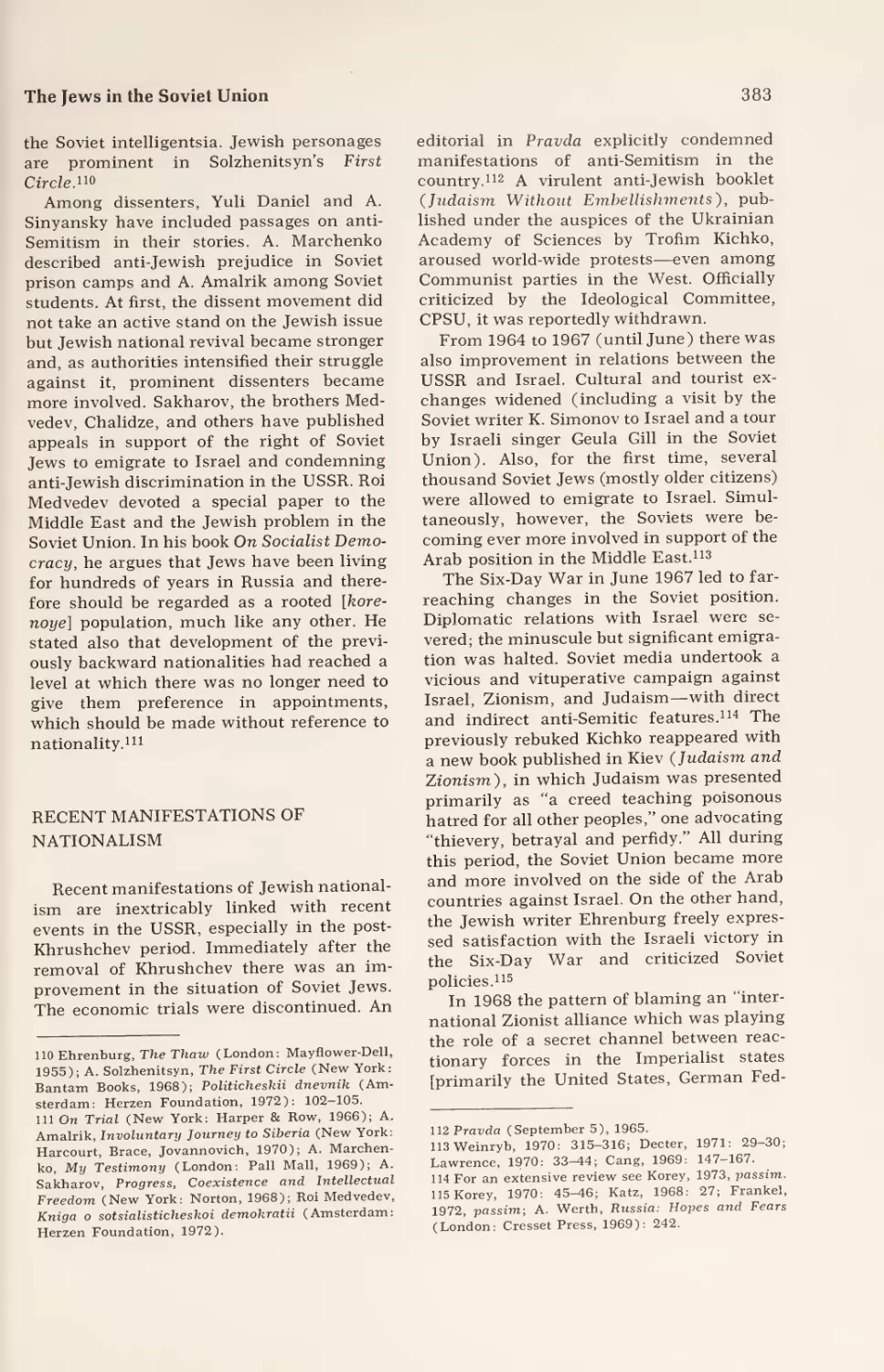
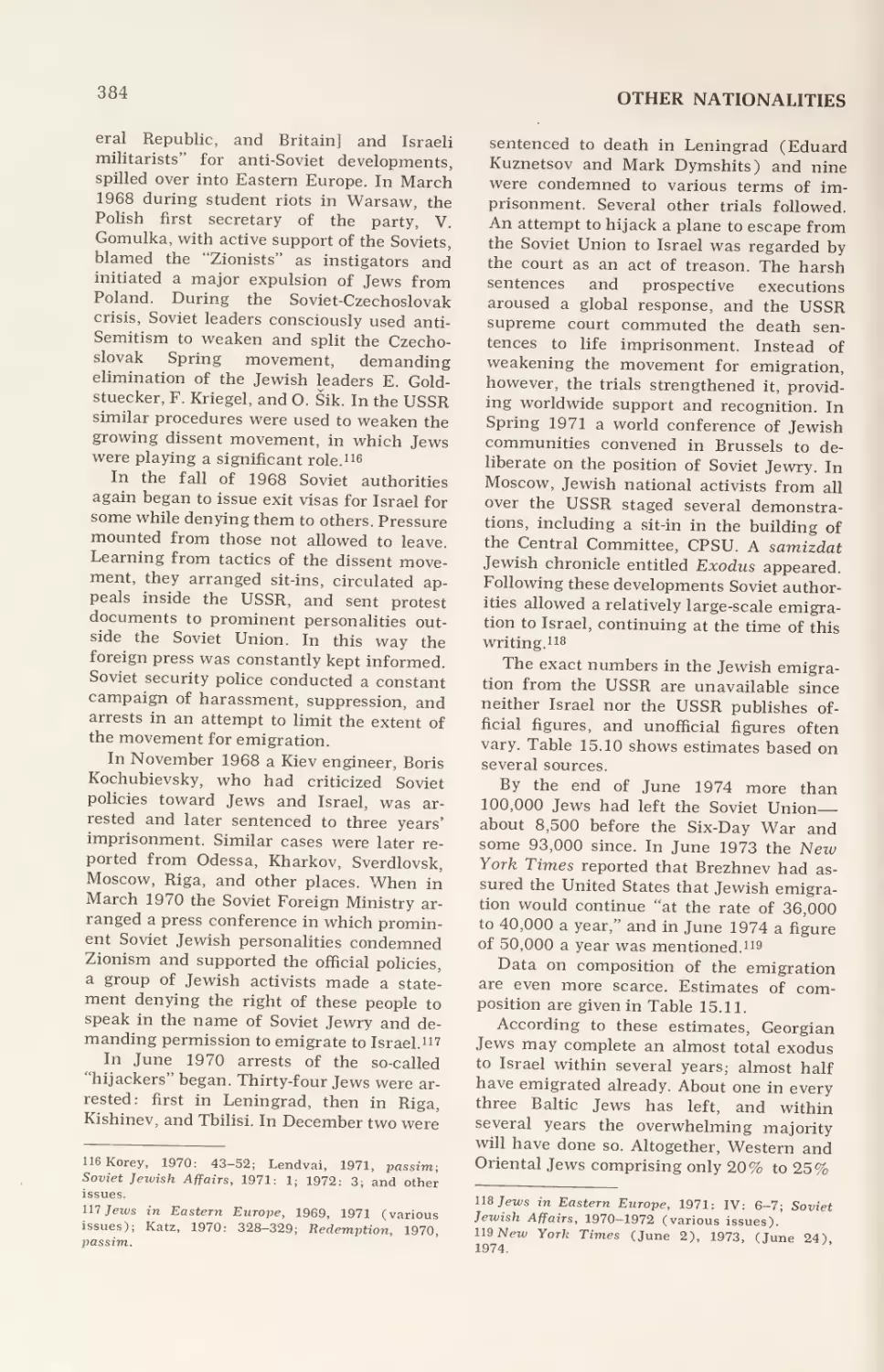
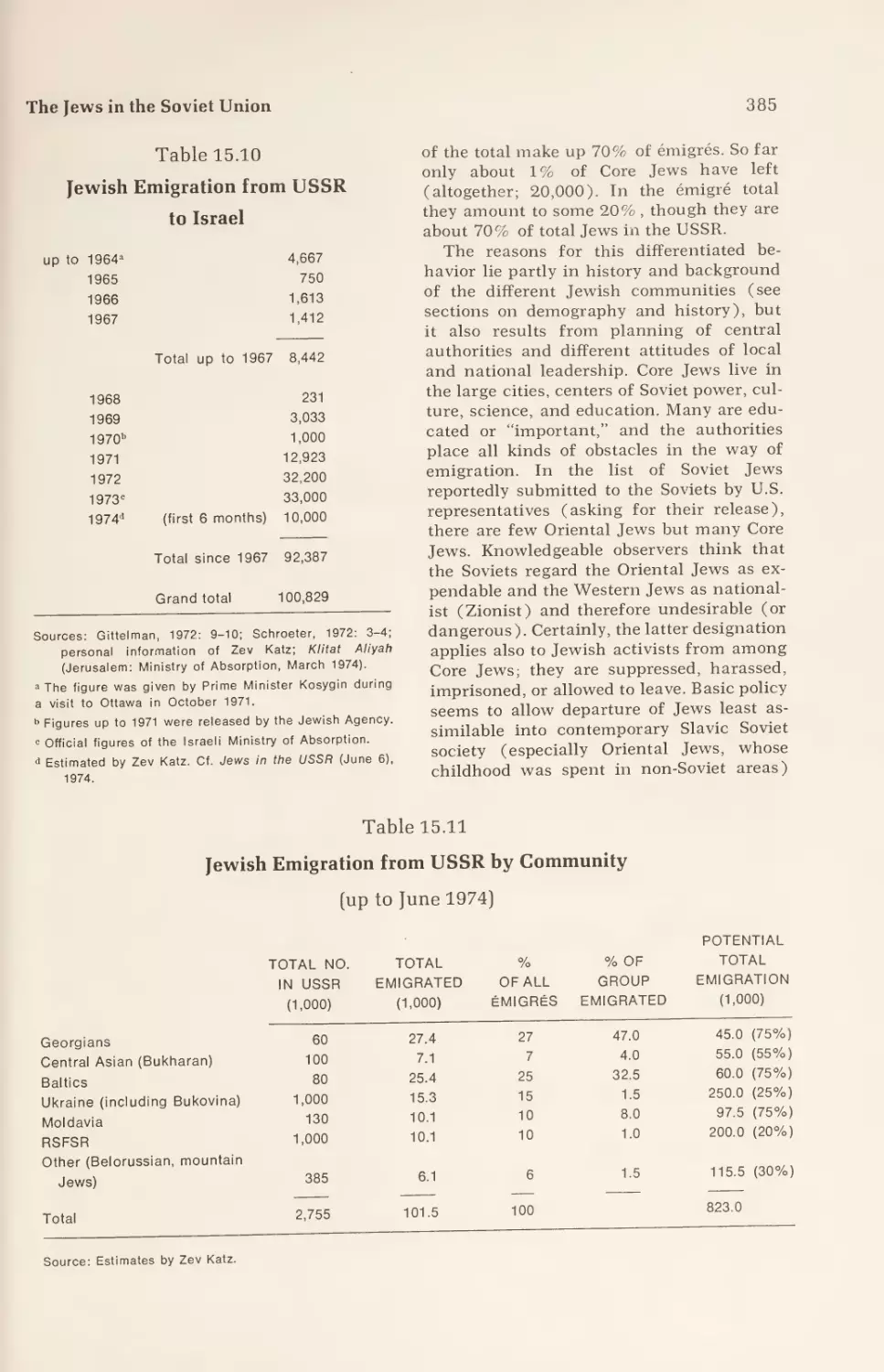
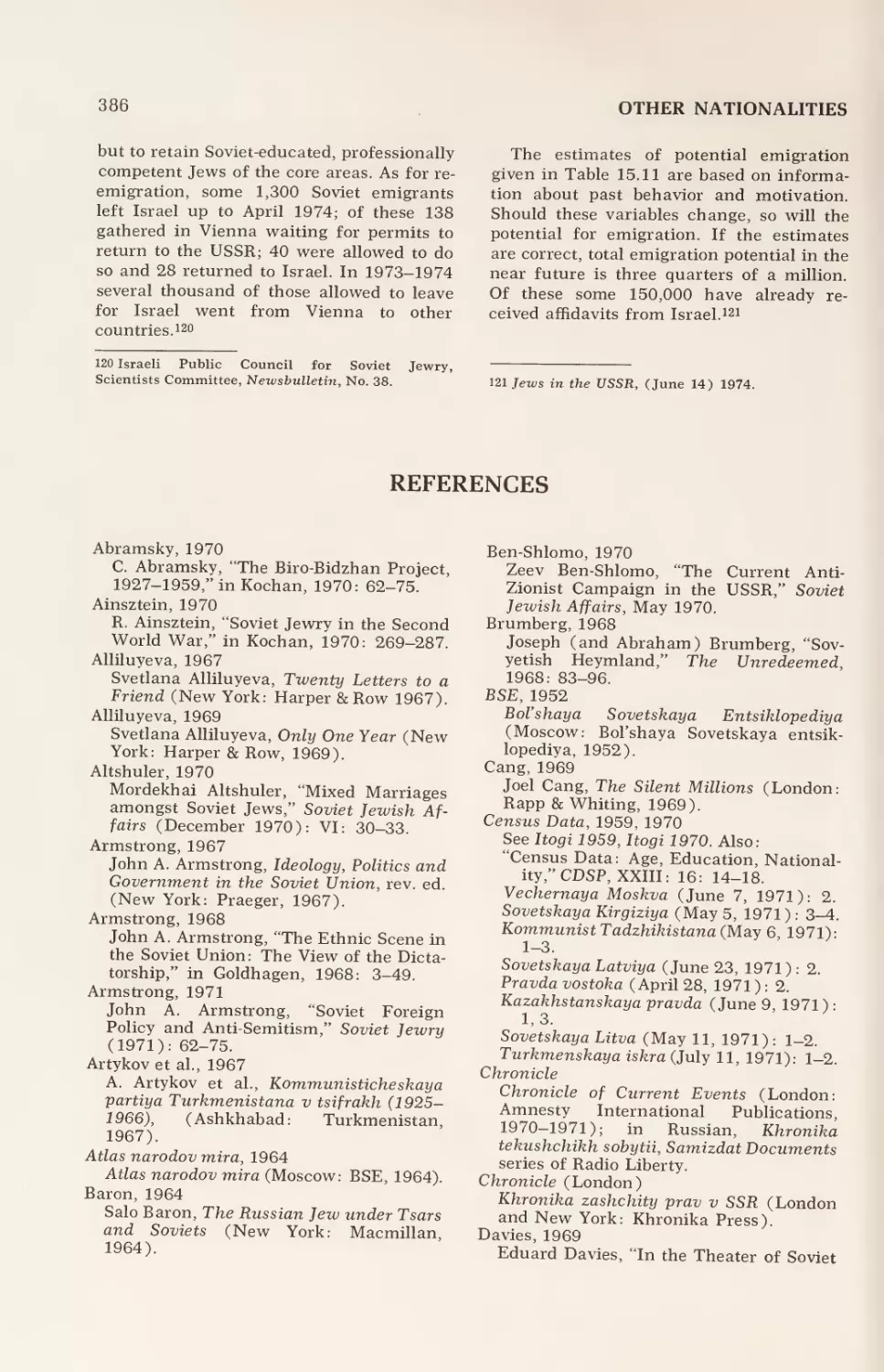


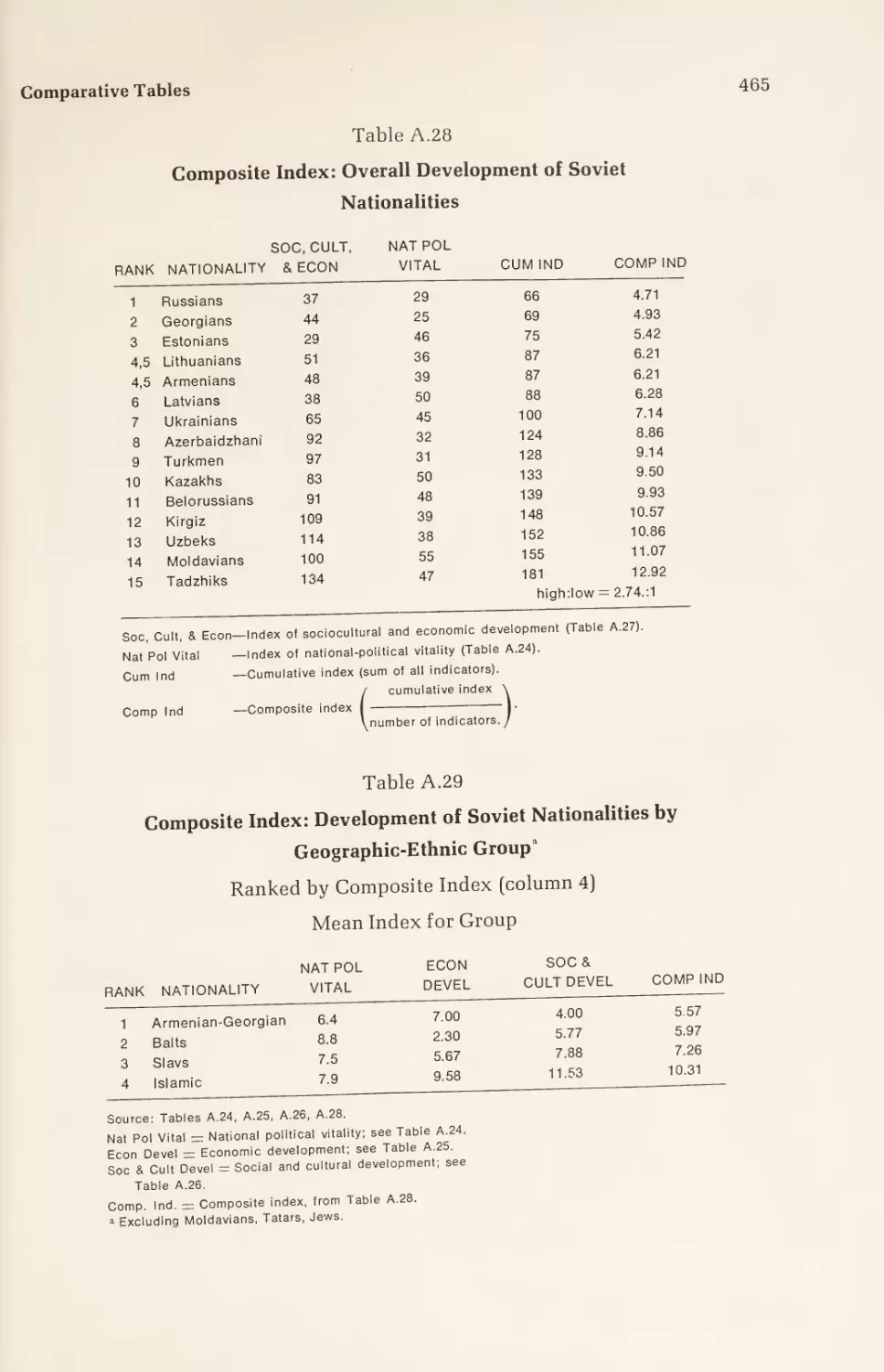


Похожие

Текст
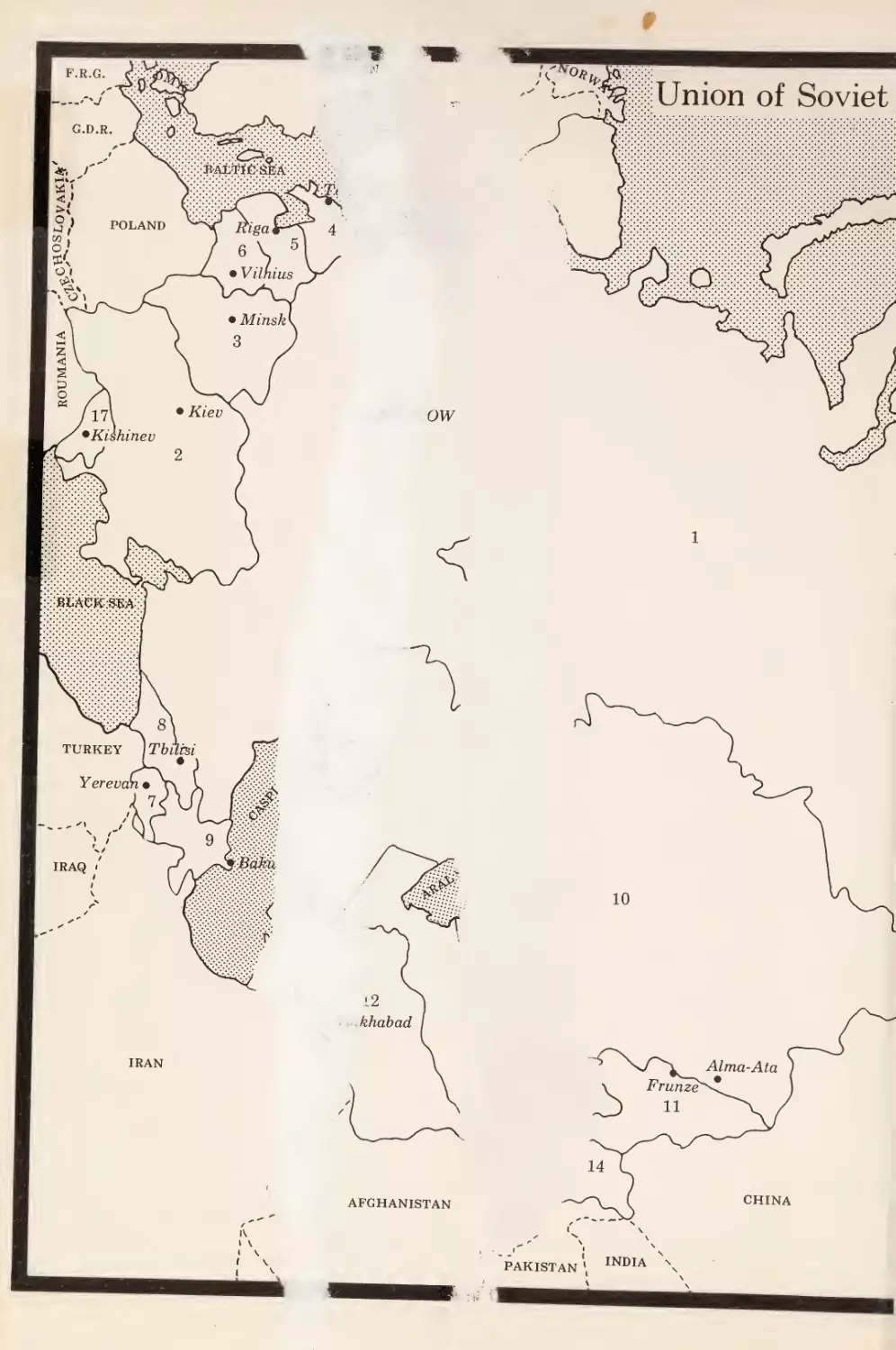
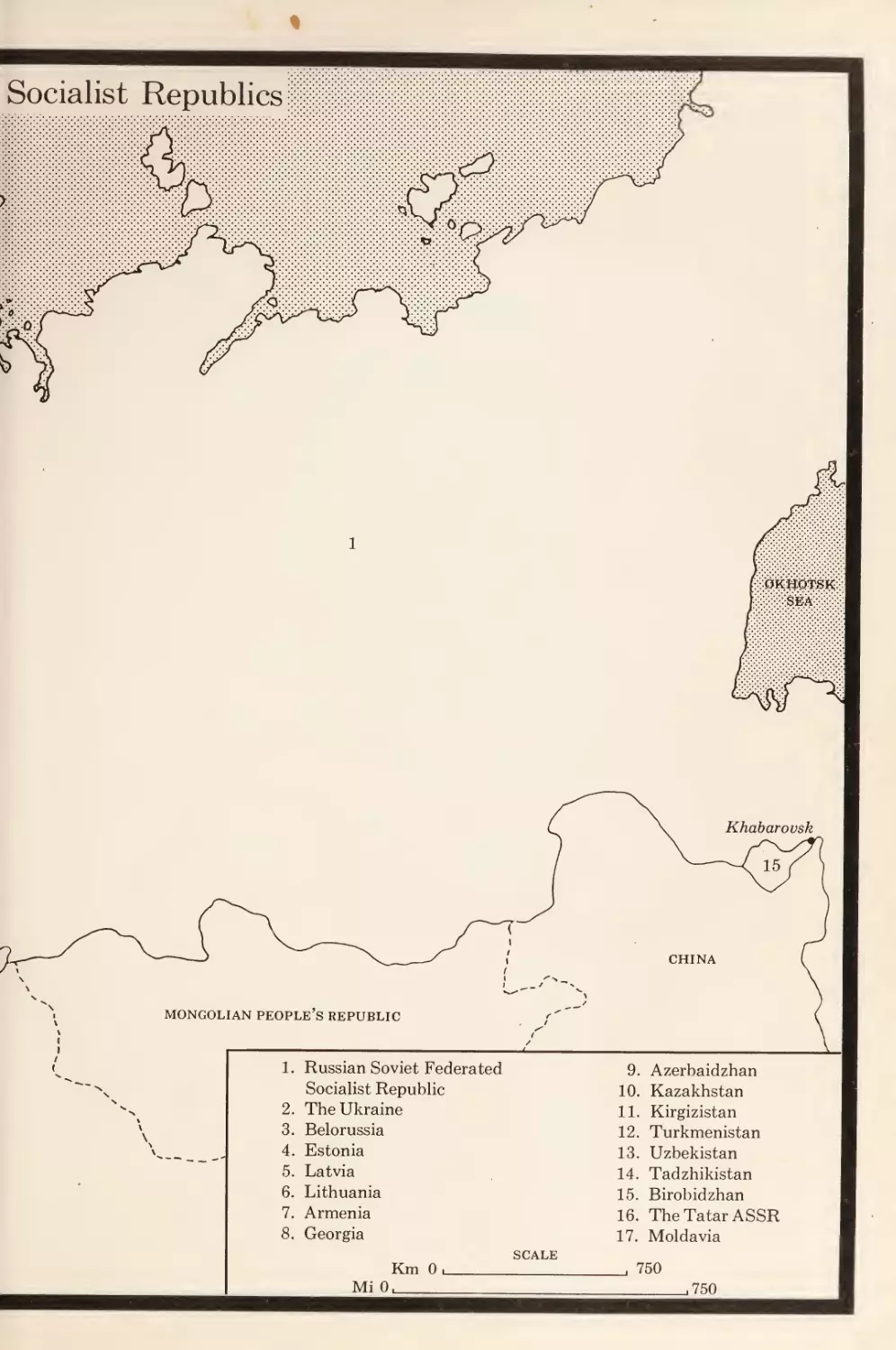
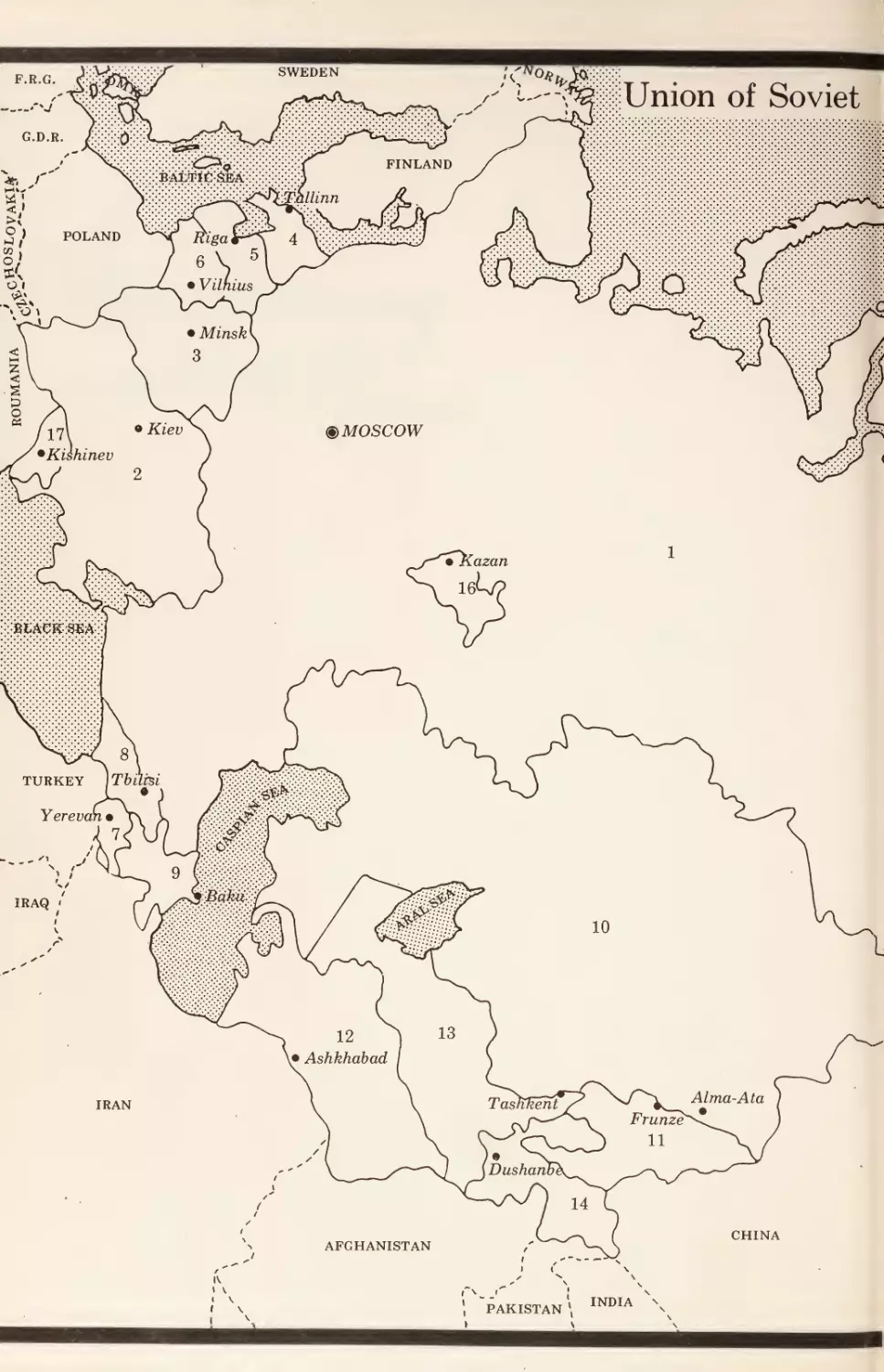
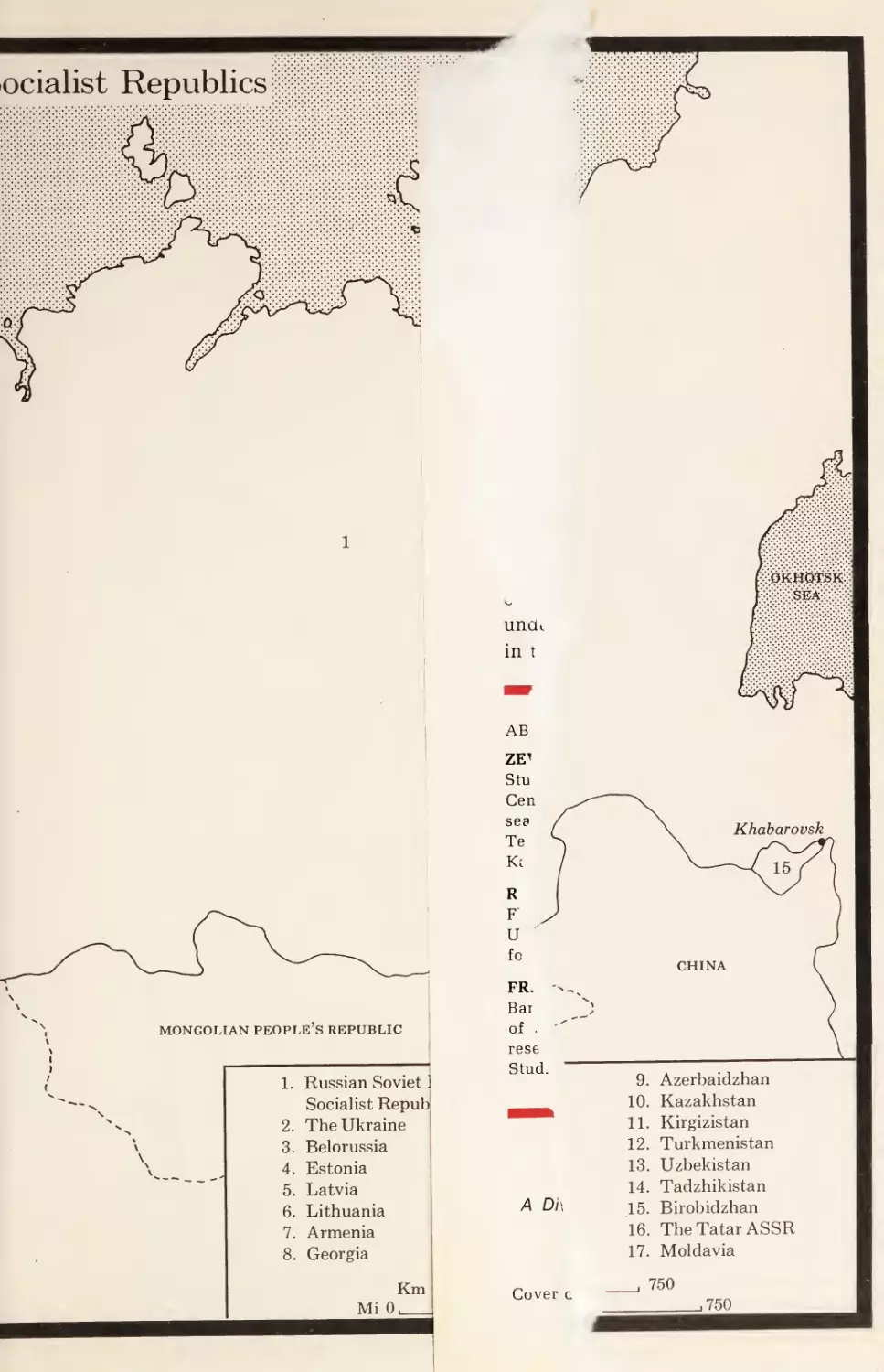
                    Socialist Republics

BOSTON
PUBL1С
LIBRARY

HANDBOOK OF
MAJOR SOVIET
NATIONALITIES

Digitized by the Internet Archive
in 2018 with funding from
Kahle/Austin Foundation
https://archive.org/details/handbookofmajorsOOkatz

HANDBOOK OF
MAJOR SOVIET
NATIONALITIES
ZEV KATZ, Editor
ROSEMARIE ROGERS, Associate Editor
FREDERIC HARNED, Assistant Editor
THE FREE PRESS
A Division of Macmillan Publishing Co., Inc.
NEW YORK
Collier Macmillan Publishers
LONDON

Copyright © 1975 by Massachusetts Institute of Technology
All rights reserved. No part of this book may be reproduced
or transmitted in any form or by any means, electronic or
mechanical, including photocopying, recording, or by any
information storage and retrieval system, without permission
in writing from the Publisher.
The Free Press
A Division of Macmillan Publishing Co., Inc.
866 Third Avenue, New York, N.Y. 10022
Collier Macmillan Canada,Ltd.
Library of Congress Catalog Card Number: 74—10458
Printed in the United States of America
printing number
23456789 10
Library of Congress Cataloging in Publication Data
Main entry under title:
Handbook of major Soviet nationalities.
Includes bibliographies and index.
1. Ethnology—Russia. 2. Russia. I. Katz, Zev,
ed. II. Rogers, Rosemarie, ed.	III. Earned,
Frederic T., ed. IV. Massachusetts Institute of Tech¬
nology. Center for International Studies. V. Title.
VI. Title: Major Soviet nationalities.
DK33.H35 1975	914.7'06	74-10458
ISBN 0-02-917090-7

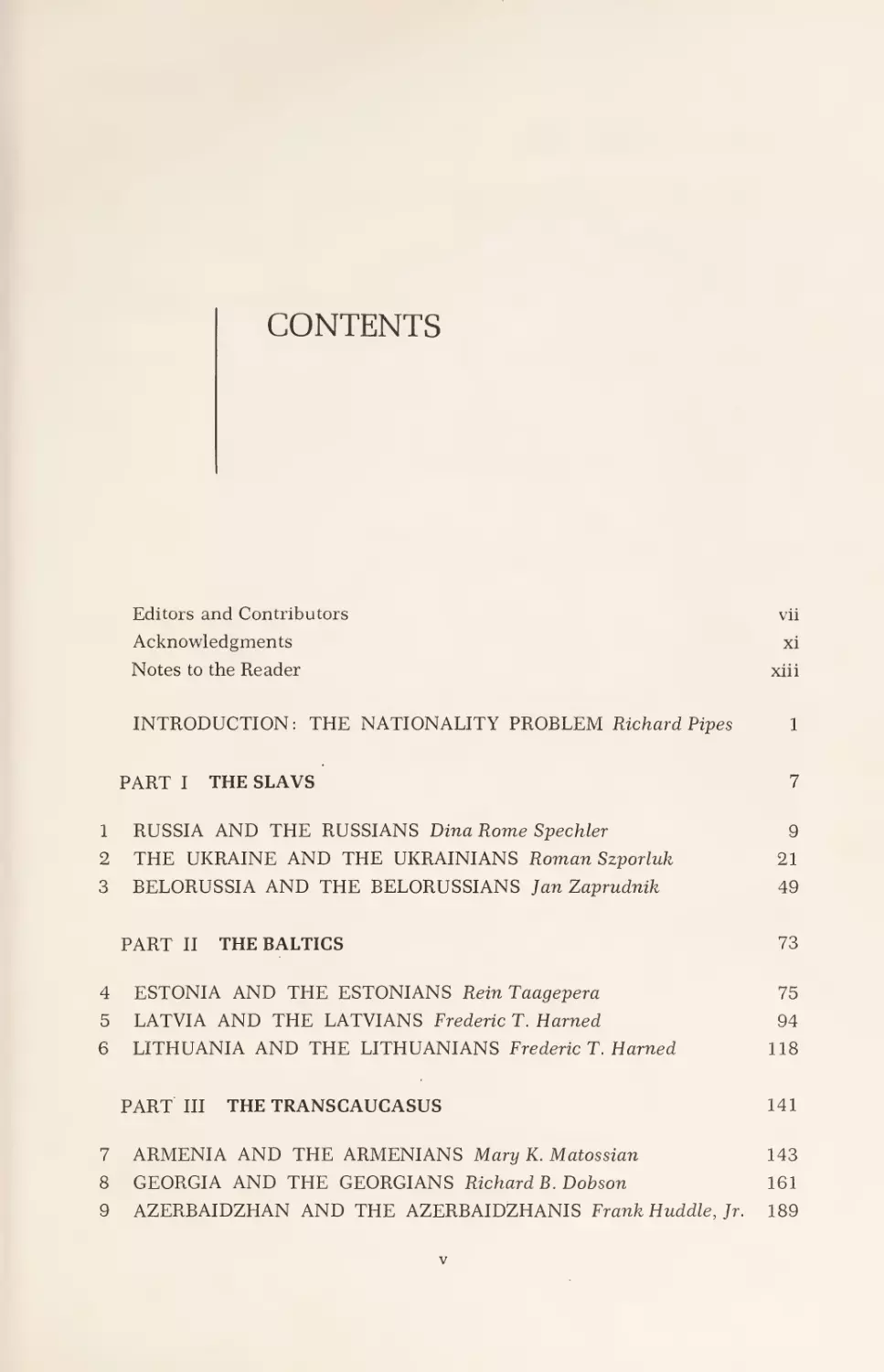
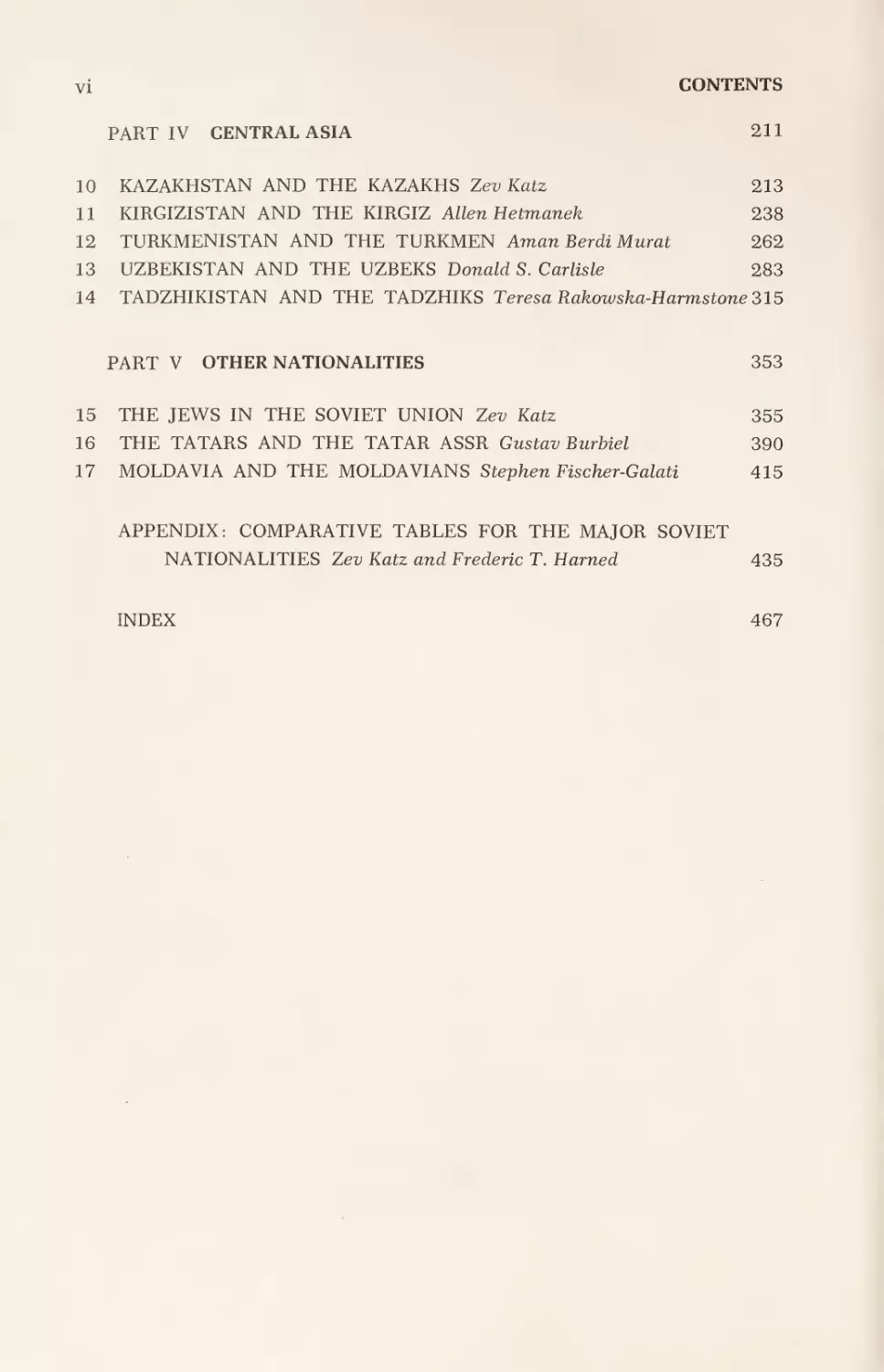
CONTENTS
Editors and Contributors	vii
Acknowledgments	xi
Notes to the Reader	xiii
INTRODUCTION: THE NATIONALITY PROBLEM Richard Pipes 1
PART I	THE SLAVS	7
1	RUSSIA AND THE RUSSIANS Dina Rome Spechler	9
2	THE UKRAINE AND THE UKRAINIANS	Roman Szporluk	21
3	BELORUSSIA AND THE BELORUSSIANS Jan Zaprudnik	49
PART II	THE BALTICS	73
4	ESTONIA AND THE ESTONIANS Rein Taagepera	75
5	LATVIA AND THE LATVIANS Frederic T. Hamed	94
6	LITHUANIA AND THE LITHUANIANS Frederic T. Hamed	118
PART III	THE TRANSCAUCASUS	141
7	ARMENIA AND THE ARMENIANS Mary K. Matossian	143
8	GEORGIA AND THE GEORGIANS Richard B. Dobson	161
9	AZERBAIDZHAN AND THE AZERBAIDZHANIS Frank Huddle, Jr. 189
v

vi
CONTENTS
PART IV	CENTRAL ASIA	211
10	KAZAKHSTAN AND THE KAZAKHS Zev Katz	213
11	KIRGIZISTAN AND THE KIRGIZ Allen Hetmanek	238
12	TURKMENISTAN AND THE TURKMEN Aman Berdi Murat	262
13	UZBEKISTAN AND THE UZBEKS Donald S. Carlisle	283
14	TADZHIKISTAN AND THE TADZHIKS Teresa Rakowska-Harmstone 315
PART V OTHER NATIONALITIES	353
15	THE JEWS IN THE SOVIET UNION Zev Katz	355
16	THE TATARS AND THE TATAR ASSR Gustav Burbiel	390
17	MOLDAVIA AND THE MOLDAVIANS Stephen Fischer-Galati 415
APPENDIX: COMPARATIVE TABLES FOR THE MAJOR SOVIET
NATIONALITIES Zev Katz and Frederic T. Hamed	435
INDEX	467

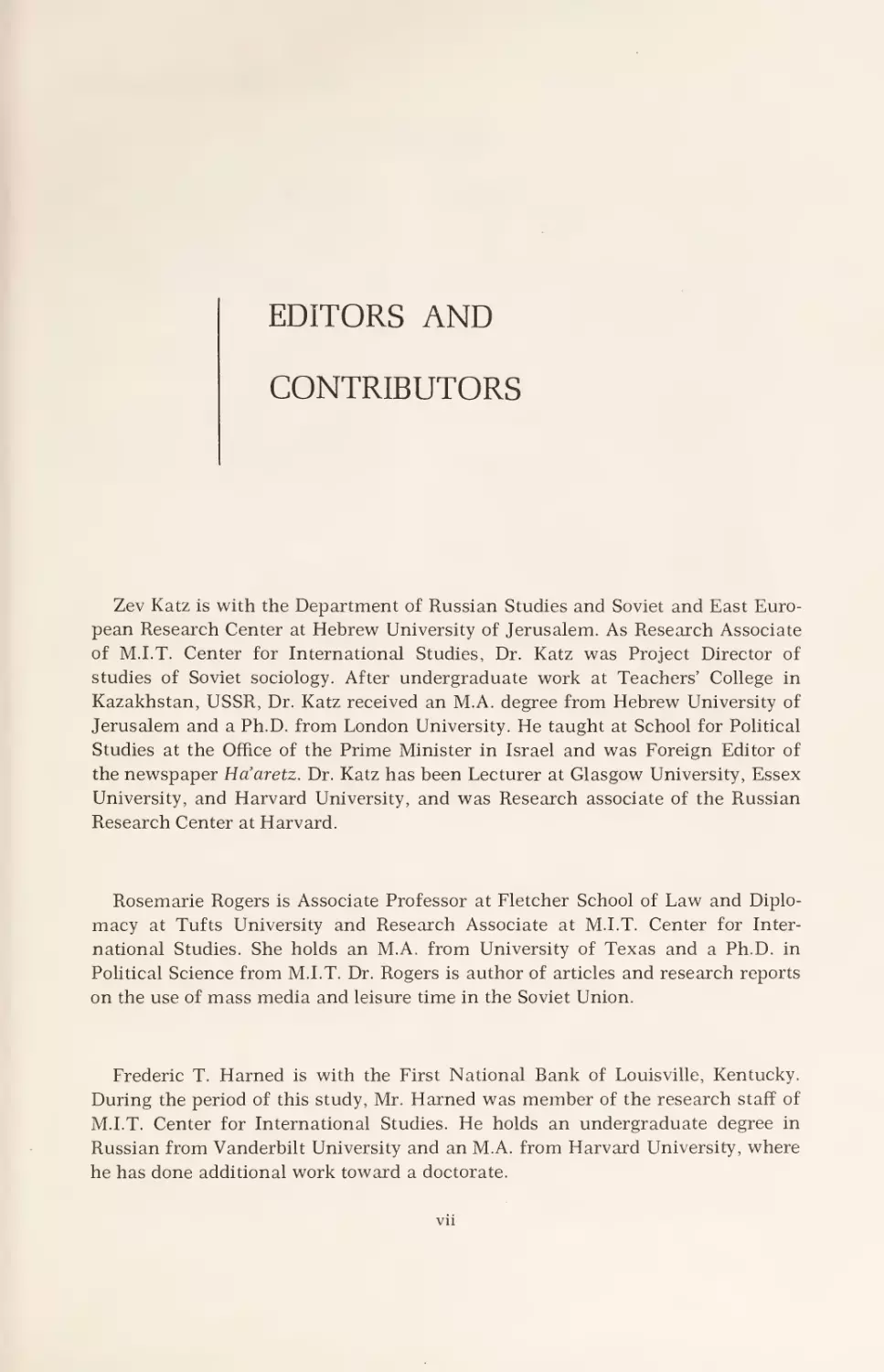
EDITORS AND
CONTRIBUTORS
Zev Katz is with the Department of Russian Studies and Soviet and East Euro¬
pean Research Center at Hebrew University of Jerusalem. As Research Associate
of M.I.T. Center for International Studies, Dr. Katz was Project Director of
studies of Soviet sociology. After undergraduate work at Teachers’ College in
Kazakhstan, USSR, Dr. Katz received an M.A. degree from Hebrew University of
Jerusalem and a Ph.D. from London University. He taught at School for Political
Studies at the Office of the Prime Minister in Israel and was Foreign Editor of
the newspaper Ha’aretz. Dr. Katz has been Lecturer at Glasgow University, Essex
University, and Harvard University, and was Research associate of the Russian
Research Center at Harvard.
Rosemarie Rogers is Associate Professor at Fletcher School of Law and Diplo¬
macy at Tufts University and Research Associate at M.I.T. Center for Inter¬
national Studies. She holds an M.A. from University of Texas and a Ph.D. in
Political Science from M.I.T. Dr. Rogers is author of articles and research reports
on the use of mass media and leisure time in the Soviet Union.
Frederic T. Harned is with the First National Bank of Louisville, Kentucky.
During the period of this study, Mr. Harned was member of the research staff of
M.I.T. Center for International Studies. He holds an undergraduate degree in
Russian from Vanderbilt University and an M.A. from Harvard University, where
he has done additional work toward a doctorate.
vii

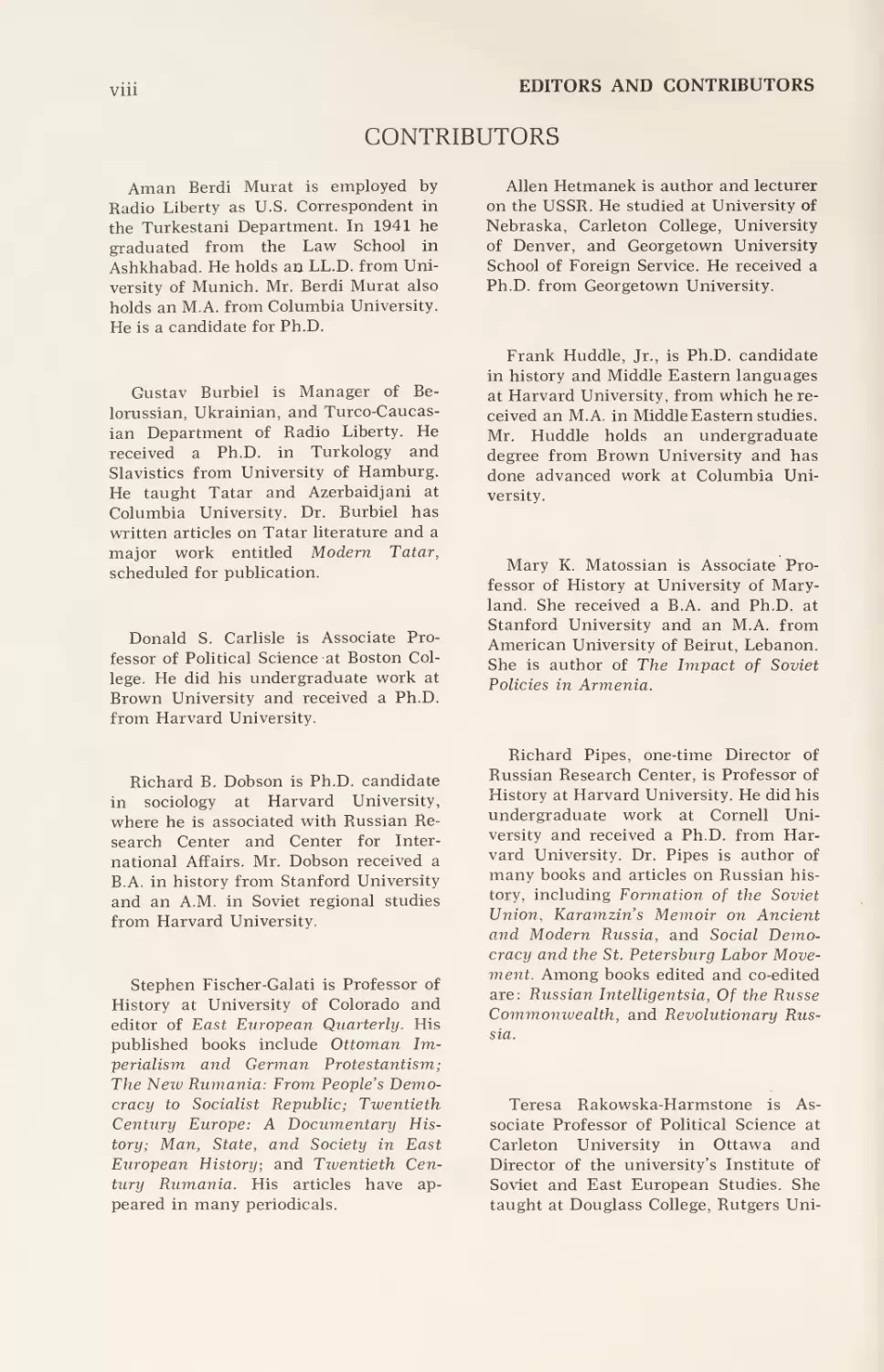
Vlll
EDITORS AND CONTRIBUTORS
CONTRIBUTORS
Aman Berdi Murat is employed by
Radio Liberty as U.S. Correspondent in
the Turkestani Department. In 1941 he
graduated from the Law School in
Ashkhabad. He holds an LL.D, from Uni¬
versity of Munich. Mr. Berdi Murat also
holds an M.A. from Columbia University.
He is a candidate for Ph.D.
Allen Hetmanek is author and lecturer
on the USSR. He studied at University of
Nebraska, Carleton College, University
of Denver, and Georgetown University
School of Foreign Service. He received a
Ph.D. from Georgetown University.
Gustav Burbiel is Manager of Be¬
lorussian, Ukrainian, and Turco-Caucas¬
ian Department of Radio Liberty. He
received a Ph.D. in Turkology and
Slavistics from University of Hamburg.
He taught Tatar and Azerbaidjani at
Columbia University. Dr. Burbiel has
written articles on Tatar literature and a
major work entitled Modern Tatar,
scheduled for publication.
Frank Huddle, Jr., is Ph.D. candidate
in history and Middle Eastern languages
at Harvard University, from which he re¬
ceived an M.A. in Middle Eastern studies.
Mr. Huddle holds an undergraduate
degree from Brown University and has
done advanced work at Columbia Uni¬
versity.
Donald S. Carlisle is Associate Pro¬
fessor of Political Science-at Boston Col¬
lege. He did his undergraduate work at
Brown University and received a Ph.D.
from Harvard University.
Mary K. Matossian is Associate Pro¬
fessor of History at University of Mary¬
land. She received a B.A. and Ph.D. at
Stanford University and an M.A. from
American University of Beirut, Lebanon.
She is author of The Impact of Soviet
Policies in Armenia.
Richard B. Dobson is Ph.D. candidate
in sociology at Harvard University,
where he is associated with Russian Re¬
search Center and Center for Inter¬
national Affairs. Mr. Dobson received a
B.A. in history from Stanford University
and an A.M. in Soviet regional studies
from Harvard University.
Stephen Fischer-Galati is Professor of
History at University of Colorado and
editor of East European Quarterly. His
published books include Ottoman Im¬
perialism and German Protestantism;
The New Rumania: From People’s Demo¬
cracy to Socialist Republic; Twentieth
Century Europe: A Documentary His¬
tory; Man, State, and Society in East
European History; and Twentieth Cen¬
tury Rumania. His articles have ap¬
peared in many periodicals.
Richard Pipes, one-time Director of
Russian Research Center, is Professor of
History at Harvard University. He did his
undergraduate work at Cornell Uni¬
versity and received a Ph.D. from Har¬
vard University. Dr. Pipes is author of
many books and articles on Russian his¬
tory, including Formation of the Soviet
Union, Karamzin s Memoir on Ancient
and Modern Russia, and Social Demo¬
cracy and the St. Petersburg Labor Move¬
ment. Among books edited and co-edited
are: Russian Intelligentsia, Of the Russe
Commonwealth, and Revolutionary Rus¬
sia.
Teresa Rakowska-Harmstone is As¬
sociate Professor of Political Science at
Carleton University in Ottawa and
Director of the university’s Institute of
Soviet and East European Studies. She
taught at Douglass College, Rutgers Uni-

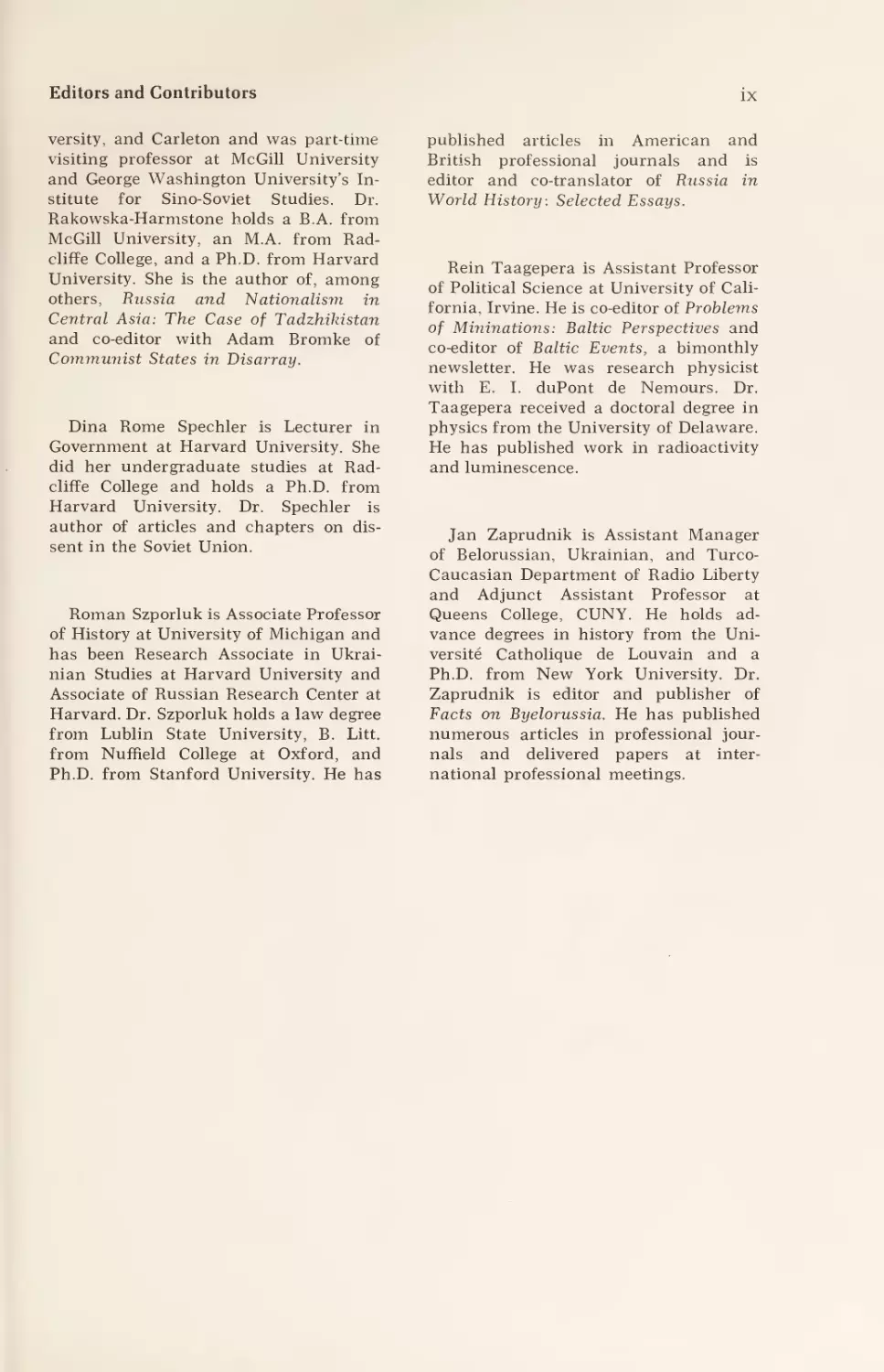
Editors and Contributors
ix
versity, and Carleton and was part-time
visiting professor at McGill University
and George Washington University’s In¬
stitute for Sino-Soviet Studies. Dr.
Rakowska-Harmstone holds a B.A. from
McGill University, an M.A. from Rad¬
cliffe College, and a Ph.D. from Harvard
University. She is the author of, among
others, Russia and Nationalism in
Central Asia: The Case of Tadzhikistan
and co-editor with Adam Bromke of
Communist States in Disarray.
Dina Rome Spechler is Lecturer in
Government at Harvard University. She
did her undergraduate studies at Rad¬
cliffe College and holds a Ph.D. from
Harvard University. Dr. Spechler is
author of articles and chapters on dis¬
sent in the Soviet Union.
Roman Szporluk is Associate Professor
of History at University of Michigan and
has been Research Associate in Ukrai¬
nian Studies at Harvard University and
Associate of Russian Research Center at
Harvard. Dr. Szporluk holds a law degree
from Lublin State University, B. Litt,
from Nuffield College at Oxford, and
Ph.D. from Stanford University. He has
published articles in American and
British professional journals and is
editor and co-translator of Russia in
World History: Selected Essays.
Rein Taagepera is Assistant Professor
of Political Science at University of Cali¬
fornia, Irvine. He is co-editor of Problems
of Mininations: Baltic Perspectives and
co-editor of Baltic Events, a bimonthly
newsletter. He was research physicist
with E. I. duPont de Nemours. Dr.
Taagepera received a doctoral degree in
physics from the University of Delaware.
He has published work in radioactivity
and luminescence.
Jan Zaprudnik is Assistant Manager
of Belorussian, Ukrainian, and Turco-
Caucasian Department of Radio Liberty
and Adjunct Assistant Professor at
Queens College, CUNY. He holds ad¬
vance degrees in history from the Uni¬
versite Catholique de Louvain and a
Ph.D. from New York University. Dr.
Zaprudnik is editor and publisher of
Facts on Byelorussia. He has published
numerous articles in professional jour¬
nals and delivered papers at inter¬
national professional meetings.

ACKNOWLEDGMENTS
In addition to the editors and the authors of each chapter, many people con¬
tributed to the conception and completion of this volume.
Dr. Ithiel de Sola Pool and Dr. William E. Griffith, both Professors of Political
Science at the Massachusetts Institute of Technology and senior members of the
M.I.T. Center for International Studies, originated the idea for the study, helped
to assemble the staff and enlist the contributors, and acted as Faculty Advisors
throughout.
The three editors are fully identified in the preceding section on editors and
contributors. It should be mentioned, however, that Dr. Rosemarie Rogers, in ad¬
dition to her editorial contributions, collected, organized, and analyzed most of
the data in the media section of the several chapters.
Special acknowledgment is owed to Ms. Patricia Perrier on whom fell the
heavy day-to-day responsibility of ensuring that the work progressed on schedule.
Ms. Perrier also provided the editorial guidance needed to produce consistent
style, referencing, and format among the chapters. Mrs. Irirangi Coates Bloom¬
field prepared the index for this volume.
This volume was initially prepared under contract with the United States In¬
formation Agency. Distribution of this book does not indicate endorsement by the
United States Information Agency, nor should the contents be construed as re¬
flecting the official opinion of the Agency.
xi

NOTES TO THE READER
This study was produced at the Center for International Studies, Massachu¬
setts Institute of Technology. The study deals with seventeen Soviet nationalities
—fifteen of which have their own Union republics, plus the Tatars and Jews.
Each nationality is the subject of one chapter. The nationalities are grouped by
geographical and/or cultural affinity in four of the parts: The Slavs, The Baltics,
The Trans Caucasus, and Central Asia. The fifth part, Other Nationalities, in¬
cludes chapters on the Moldavians, the Tatars, and the Jews. The Appendix con¬
tains a set of comparative tables for all nationalities.
Except for the Russian chapter, the chapters are written to a uniform outline.
General Information deals with territory, economy, history, demography, culture,
and external relations. Media treats questions of language and media, as well as
educational, cultural, and scientific institutions. National Attitudes analyzes
national attitude formation, views of scholars, and current evidences of nation¬
alism.
The reader will notice some variations in spellings of individuals’ names and
book and periodical titles among chapters and within chapters. There are two
sources of this apparent inconsistency. First, there are no internationally agreed
upon rules for transliterating Russian from the Cyrillic to the Latin alphabet. We
have allowed each author to apply the rules most acceptable to him or her, ex¬
cept where we have attempted to standardize references cited in several chapters.
Second, there is even less consensus on transliteration of the minority languages
into the Latin alphabet. In the case of names and titles originally in one of the
minority languages, we have allowed each author to make his or her own trans¬
literation direct from the original language, rather than transliterating the
equivalent Russian word.
xiii

xiv
NOTES TO THE READER
Sources used more than once in a chapter are cited in abbreviated form in the
footnotes, with full citations given in the list of references at the end of each
chapter. Where several quotations are taken from a single source, reference is
provided at the end of the last quotation. Similarly, where information in a para¬
graph is from one source, the source is cited at the end of the paragraph. Sources
containing only one page are cited without page numbers. Except where noted,
emphasis in quotations has been added.

INTRODUCTION:
THE NATIONALITY
PROBLEM
Richard Pipes
The nationality problem occupies a
unique place in internal Soviet politics. The
Soviet Union is the only major power where
the dominant nationality barely has a ma¬
jority. The 1970 census revealed that of
241.7 million inhabitants of the USSR only
129.0 million are of Russian nationality.
This fact is so awkward that the compilers
of the summary volume1 failed anywhere
in its 648 pages to provide the percentage
of the whole which this figure represents—
namely, 53.4. Given the much more rapid
rate of growth of the non-Russian, and es¬
pecially Asiatic, populations, the time may
not be too distant when the “minorities”
shall outnumber that nationality which has
given the Soviet state its leadership and
language.
A basic difficulty in studying the ethnic
problems of the Soviet Union derives from
the peculiar circumstances under which the
Soviet Union and its predecessor, tsarist
Russia, became multinational states. The
1 Itogi vsesoiuznoi perepisi naseleniya 1970 goda,
vol. IV (Moscow: Statistika 1973).
classic empires of the West came into being
after the construction of national states had
been completed. As a rule, the building of
empires was a spilling over of surplus ener¬
gies and resources of a national state that
could no longer be accommodated within
its own borders. Because of the peculiar
geographic location of Europe as an appen¬
dage of the Eurasian continent, European
imperial expansion directed itself across the
seas and into other continents; hence, there
was never doubt about the spatial separa¬
tion between colony and metropolis. In sum,
Western empire-building—that is, the ac¬
quisition of masses of other ethnic groups
—was always chronologically and terri¬
torially distinct from the process involved
in building the national state. The West
European model, of course, is not of uni¬
versal validity: the first great empire in
world history, the Persian, was put together
not by conquest of overseas territories but
by expansion along land frontiers. The im¬
portance of the West European model, how¬
ever, is that until recently it has served as
raw material for the construction of theories
1

2
INTRODUCTION: THE NATIONALITY PROBLEM
of nationalism and of ethnic conflict, and
that this model still dominates the thinking
of Russian leaders.
The expansion of Russia had a very dif¬
ferent character from that known to West¬
ern experience. Being a continental power
without natural frontiers and ready ac¬
cess to the seas, Russia has traditionally
expanded along its territorial frontiers. His¬
torically, the process of nation-building,
which began in the fifteenth and sixteenth
centuries, led to the conquest and absorp¬
tion of other ethnic groups, starting with
various Finnic and Turkic nationalities, and
eventually including groups representing
many Asian and some European popula¬
tions. The chronological and geographic con¬
tiguity of the processes leading to the
building of both the nation-state and
empire has had the effect of blurring the
two phenomena, tending to make Russians
remarkably insensitive to ethnic problems.
Characteristically, even liberal and social
democratic groups in pre-revolutionary Rus¬
sia were inclined to ignore ethnic problems
and to treat demands of nationalities for a
greater role in self-government as reaction¬
ary and enemy-inspired.
The basic tendency of Russian leaders,
past and present, in dealing with ethnic
problems has been to follow (unconsciously,
of course) what may be called the French
type of colonialism. In contrast to the
British, the French have striven to extend
to the ethnic (i.e., colonial) minorities the
full rights and privileges of Frenchmen,
hoping by this device, over the long run, to
assimilate them. Muscovite and Imperial
Russia did the same by opening the ranks
of the privileged elite (the dvorianstvo') to
the land-owning and educated elements of
conquered nationalities.2 The Soviet regime
followed suit by allowing minority elites
access to the Communist party apparatus
and all the benefits and privileges which
membership in it entails. This time-tested
policy, however, which had enabled tsarist
Russia in large measure to siphon off poten¬
tial national resistance, no longer works
2 The tsarist policy was most successful in regard
to nations whose nobility did not enjoy the same
privileges as did the Russian equivalent. It was a
complete failure when applied to the extremely
privileged, proud nobility of Western provinces of
the empire—e.g., Poland and the Baltic areas.
quite as well. The problem is that, whereas
until the twentieth century primary alle¬
giance in Eastern Europe tended to be
directed toward one’s social class, more re¬
cently, as a result of the breakdown of the
estate structure and the spread of egalitar¬
ianism, society’s primary allegiance has
shifted toward the nation. Thus, the Tatar
prince or Georgian landowner who in tsarist
Russia may have felt greater affinity for his
Russian equivalent than for the peasant of
his own culture no longer exists; his demo¬
cratized descendant has no choice but to
identify with the Tatar or Georgian nation.
Here we have a clear example of how demo¬
cratization leads to an increase of national
sensitivities and brings with it a rise in
ethnic tensions—a fact quite unforseen by
nineteenth-century liberal theorists.
It is customary to think of the Soviet
Union as a veritable ethnic museum in¬
habited by over one hundred exotic national
groups. Now, while it is true that the USSR
has a large number of ethnic groups within
its borders, most of them are so small as to
be of interest primarily to the anthropo¬
logist, linguist, and demographer. Further¬
more, it must be borne in mind that the
Soviet government, in pursuing the tradi¬
tional divide et impera policy, deliberately
exaggerates ethnic differences among its
minorities. From the political point of view
the student of ethnic problems in the USSR
confronts only a dozen or so groups,
namely: (1) the Ukrainians and Belorus¬
sians who, as Slavs professing the Orthodox
faith, are closely related to the Great Rus¬
sians; (2) Moslems, nearly all Sunni by
religion and Turkic by racial and linguistic
background; (3) the two major Caucasian
groups—Georgians and Armenians—close
to the Moslems in culture and economy but
separated from them by their Christian
religion; (4) the Jews; (5) the three Baltic
nationalities; and (6) a number of-West..
Eur opcanand„E ast Asi an_ group s, am on g
whom the Germans are perhaps most im¬
portant. According to the 1970 census, the
groups enumerated above under rubrics 1—5
represent about 85 percent of the non-Rus-
sians inhabiting the Soviet Union. The
problem, thus, is less complicated than
Soviet policy makers would like to make it
appear.

Introduction: The Nationality Problem
3
Clearly, the sense of national cohesion
and common destiny differs from nationality
to nationality. There are many ways of test¬
ing the intensity of nationalism, but the
most reliable are probably criteria based on
statistical evidence provided by censuses.
These are: level of education, especially
higher and specialized education; linguistic
attachment, as measured by the proportion
of people who regard their national language
as the mother tongue; territorial concentra¬
tion, the percentage of a given nationality
residing in that nationality’s republic; and
intermarriage (for which, unfortunately,
statistical data are exceedingly scarce). Of
itself, none of these factors can tell us how
viable is a given nationality.3 The chapters
which follow provide very good clues help¬
ing the attentive observer to gauge, as it
were, the temperature of the national senti¬
ment of various national groups. The
material makes it quite clear, for example,
that the nationalism of Georgians is much
stronger than that of the Belorussians—a
fact which can be demonstrated by non-
statistical evidence as well.
If we follow demographic statistics from
1897 to 1970, we discover an interesting
phenomenon bearing on number of ethnic
groups and intensity of their nationalisms.
Census statistics indicate that over the
seven decades separating the first Russian
census from the most recent one, the num¬
ber of nationalities has tended to diminish
as the smaller ethnic groups lose out to
those major ones closest to them culturally
and territorially. Thus, the Bashkirs have
been steadily dissolving among the Tatars,
the Abkhazians among the Georgians, the
Kara-kalpaks among the Kazakhs, and so
on. As a result, the nationalities structure of
the Soviet Union is becoming streamlined,
the minor Soviet nationalities growing
leaner and the major ones fatter. In political
terms, this means that the Great Russian
majority confronts an increasingly difficult
situation; it has to deal with fewer but
stronger ethnic groups. These facts should
3 The Jews, for example, score very low on all the
above criteria except the first which, in their case,
is of decisive importance. See Table A.19 in the
Appendix, which indicates that there are almost
twice as many Jews attending higher educational
institutions as there are of the next group, the
Georgians.
be borne in mind by anyone who assumes
that all denationalization of ethnic minor¬
ities means Russification. In some respects,
the contrary proposition is closer to the
truth: denationalization of the minor ethnic
groups reduces the likelihood of Russifica¬
tion.4
Why does national sentiment survive
among the Soviet nationalities? Why do
Soviet authorities have to stress contin¬
uously the desirability of the ethnic minor¬
ities “drawing together” (sblizheniye')'? To
this question there are many answers, the
most obvious of which is that under con¬
ditions prevailing in the USSR—where one
nationality comprises more than half of the
population and controls, to boot, the state
and its economy—“drawing together”
means nothing else but Russification. The
language of a single “Soviet nationality”
would have to be Russian; so would its his¬
toric traditions and in time its customs. But
this negative consideration, which ob¬
viously must dissuade any but the most
career-minded or obtuse non-Russian from
following his government’s directives, is
only part of the answer. National sentiment
is more than a “thing in itself” which either
exists or is exterminated. Historical experi¬
ences indicate that it represents a sum total
of diverse social and cultural forces, many
having nothing whatever to do with eth¬
nicity. One reason nationalism possesses
such extraordinary tenacity, why it has re¬
fused to dissolve in the acid bath of modern¬
ity, as nineteenth-century liberals and
socialists had expected it to do, is that it
constitutes more a result than a cause. One
way to illustrate what we have in mind is to
cite the complaint voiced recently by a West
German official about unforeseen difficulties
this country is experiencing with hordes of
foreign Gastarbeiter: “We asked for workers
and got human beings.”
Perhaps the most important single ele¬
ment which keeps ethnic feelings alive in
multinational states is competition for re¬
sources and services. This is true in every
4 Ukrainians, Belorussians, Jews, and the West
European groups, when they break off from their
own ethnic groups, tend to Russify. It is probably
true to say that the majority of Russified minorities
come from these groups.

4
INTRODUCTION: THE NATIONALITY PROBLEM
multinational society, but is a particularly
potent factor in the USSR where the gov¬
ernment enjoys a monopoly of national
wealth and doles out products and services
to society no more than it must. If we con¬
sider the nationality problem in the Soviet
Union from this point of view, we can per¬
ceive why phenomena which in themselves
appear neutral can nevertheless produce
ethnic tension and conflict.
A basic fact of Russian history over the
past thousand years has been colonization.
V. O. Kliuchevsky once said that “the history
of Russia is the history of a country which
colonizes itself,” 5 and the statement is as
correct today as when he made it nearly a
century ago. Russians are a people forever
on the move. They move because the land
on which they live is on the whole ill adapted
to agriculture, yielding them little beyond
bare subsistence and sometimes not even
that. They migrate in search of virgin soil
and easier conditions of life. The movement
outward from the central forest zone, home¬
land of the Great Russian people, began to
assume intensive forms in the mid-six¬
teenth century and shows no signs of abat¬
ing. The 1970 census indicates the
continued outflow of Great Russians to the
borderlands, especially the western repub¬
lics (Ukraine, Belorussia, and the three
Baltic republics). It is a centrifugal move¬
ment of an elemental force.
In their migrations the Russians en¬
croach upon territories inhibited by non¬
Russians, inevitably entering into com¬
petition with them over jobs, housing,
schooling, and goods. It is a curious fact
that, while the proportion of Great Russians
in the USSR population as a whole tends
steadily to diminish, the proportion of Rus¬
sians residing in many border republics
tends to rise. Between 1959 and 1970 the
proportion of Great Russians living in the
RFSFR has declined by 2.3 percentage
points, the highest decline of the major
nationalities—indicative of the unique in¬
tensity of Russian migration. The friction
resulting from a migration of such persis¬
tence would be serious under any circum¬
stances. What aggravates it is that in the
past several decades the borderland popula¬
5 Kurs russkoi istorii (Moscow, 1937): I: 20.
tions (especially on the eastern periphery)
have been growing more rapidly than the
Russian. This means that pressure on re¬
sources and services created by the influx
of Russians is intensified by a very high
rate of local population growth. The recent
decision to create large economic planning
regions, in some cases encompassing more
than one republic, was probably motivated
by a desire to attenuate these conflicts. It
marks an important step toward administra¬
tive amalgamation of the national republics
into a unified state structure.
There was a time when, basing their ex¬
pectations on what turned out to be an
unrealistic view of the American “melting
pot,” most scholars believed the nationality
problem in the Soviet Union was well on its
way to “solution.” Formal policy pronounce¬
ments in the USSR fed these expectations.
There was, on paper, full equality of all
ethnic groups, a federal system which
seemed to balance neatly centrifugal and
centripetal tendencies, and numerous out¬
lets for cultural strivings. In the early years
of the Soviet regime, indeed, a certain
amount of liberalism in the treatment of the
nationalities was in effect. In order to com¬
pensate the minorities for failure to honor
its pledges of “national self-determination,”
the Soviet government in the 1920’s offered
many concessions short of self-government.
But with Stalin’s rise to power the course
was rapidly reversed. From the beginning,
Stalin based himself on support of lower-
echelon apparatchiki who looked on the
Soviet Union as a vast field of exploitation
and would hear of no concessions to
“aliens.” To win them over, Stalin adopted
a blatantly pro-Russian course which nei¬
ther Khrushchev nor Brezhnev has altered
in any substantial manner. The Soviet
Union today is in effect an empire run like
a nationally homogeneous state, suffering
all the consequences of this contradiction.
Western scholars in their majority have
come to recognize this fact. The persistence
of strong national sentiments is generally
recognized, and disputes among specialists
no longer concern the fact of minority
nationalism, but its character and orienta¬
tion. Our own view can be stated succinctly
in a series of propositions :

Introduction: The Nationality Problem
5
1.	The nationality question in the Soviet
Union has attained a decisive state of de¬
velopment. The Great Russian population
can no longer expand outward into the
borderland areas without running into stiff
resistance. Where in the past Russians have
run into isolated and scattered ethnic
groups, they now confront solid national
entities with all the trappings of national
self-government. Demographic ally speak¬
ing, the Russians are declining vis-a-vis the
ethnic minorities. It is probable that in the
future the Russian population will not be
able to penetrate in any significant num¬
bers outside the confines of the RSFSR and
Kazakhstan. Elsewhere Russian colonists
will be increasingly regarded as outsiders.
In short, we may be witnessing a solidifica¬
tion of ethnic frontiers separating Russians
from the minorities.
2.	The coming conflicts involving the
nationalities and the Great Russians are
likely to center on access to jobs, housing,
schooling, and commodities. In order to
overcome minority resistance, the Soviet
government is likely to have recourse to
basic administrative measures aiming at
lowering the barriers separating the repub¬
lics. In other words, we may see a slow and
cautious dismantling of the pseudofederal
structure created in 1922—1924. The re¬
cently announced regional economic plans
may represent a step in this direction.
3.	On the Great Russians, the situation
is likely to produce an increased sense of
frustration, intensifying chauvinism and
xenophobia. The identification of the Soviet
regime with the Russian people and Rus¬
sian history, initiated by Stalin, has lately
recurred with increasing frequency. One of
the most important by-products of the
nationality problem, therefore, is likely to
be the growth of national sentiment, not
only among minorities but also, and above
all, among the Great Russians themselves.

Part I
THE SLAVS

8
THE SLAVS
Part I includes chapters on the Russians, Ukrainians, and Belorussians. Each
chapter deals both with the nationality as an ethnic group and with the republic
as a politic al-terri tori al unit.
The Ukrainian and Belorussian chapters are full-length presentations covering
all topics listed in the chapter outline (see Notes to the Reader). The Russian
chapter departs from this format, concentrating on the relationship of the Rus¬
sians, as the dominant Soviet nationality, with the many minority nationalities
in the USSR. The three nationalities covered in this part belong to the East Slav
group; there is much affinity among them in language, religion, history, and way
of life, and outsiders often regard them as one. Yet there are major differences and
cleavages, especially between the Ukrainians and the Russians. Recently, this has
been manifested by such phenomena as the struggle of the Ukrainians for their
national language and the harsh suppression of the national movement in the
Ukraine.

RUSSIA and
THE RUSSIANS
Dina Rome Spechler
The focus of this handbook is primar¬
ily on the non-Russian or “minority” nation¬
alities of the USSR. The history and culture
of the dominant Russian nationality and
the economic and historical development
of the RSFSR are covered in many com¬
petent and easily available studies, and a
comprehensive treatment of these subjects
is beyond the scope of this survey.
Therefore, the following discussion is
limited to factors particularly relevant to
position of the Russians and of the RSFSR
in relation to other Soviet nationalities. The
Comparative Tables in the Appendix pro¬
vide data on all nationalities studied, and
further comments on position of the Rus¬
sians appear in chapters on other individual
nationalities. A reader interested in more
detailed treatment of topics related to the
Russians may want to consult studies listed
in the references and supplementary biblio¬
graphy at the end of this chapter.
Demographic Patterns and Trends
The Russians are the largest national
group in the USSR. According to the latest
census, taken in 1970, they comprise
slightly more than half (53.37%) of the
total population. Their weight in the pop¬
ulation has been declining in recent years,
however, since their rate of natural increase
is one of the lowest of all the national
groups. Among the major nationalities, only
Latvians, Estonians, and Jews increased
by a smaller percentage than the Russians
in the period between the last two censuses
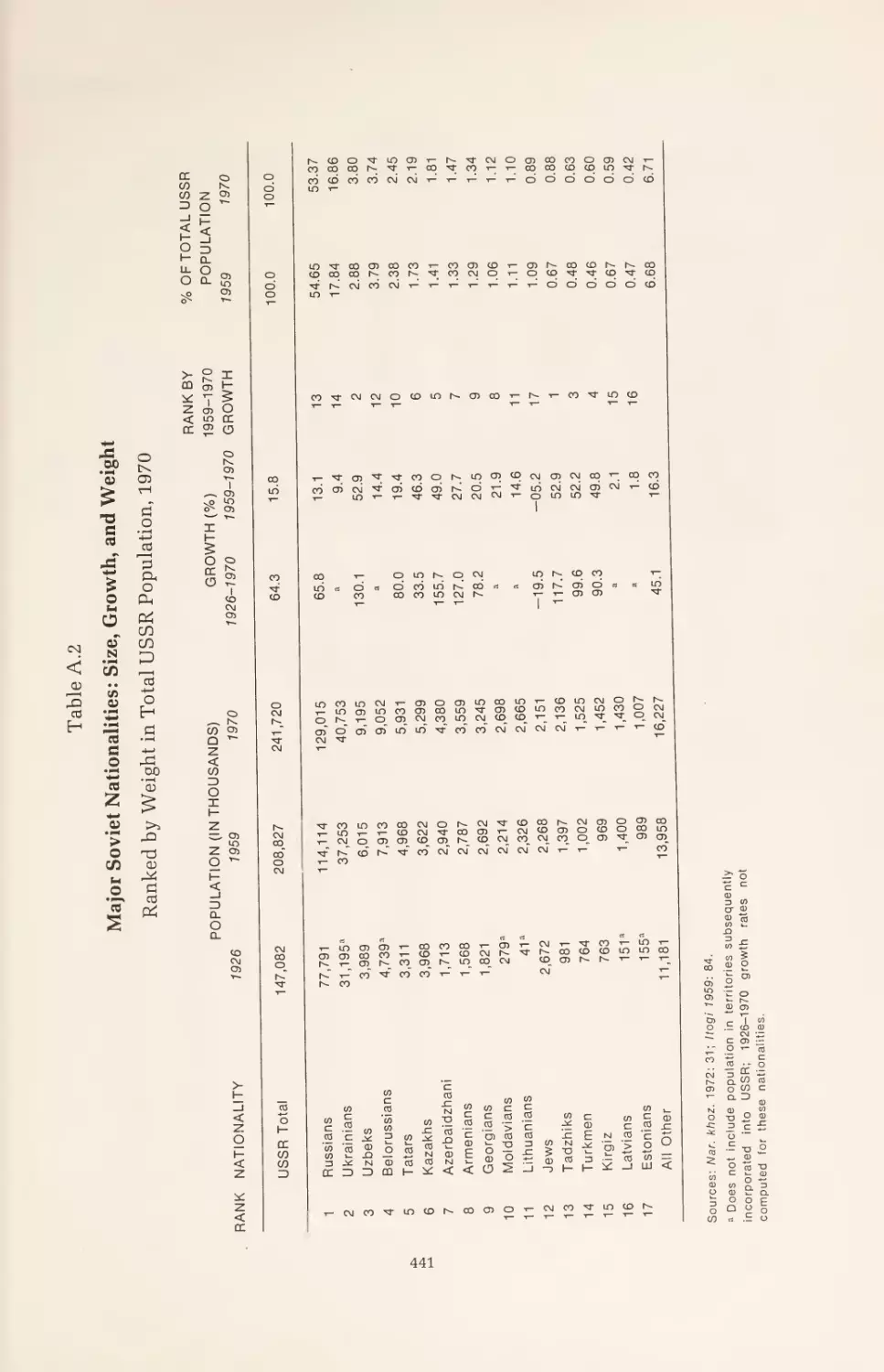
11959-1970). (See Table A.2 in Appendix).
The republic in which most Russians live,
the Russian Soviet Federated Socialist Re¬
public (RSFSR), is the largest union re¬
public. It extends from the Baltic to the
Pacific and covers 6.5 million square miles,
or 76% of the total area of the USSR, in¬
cluding 53.8% of the USSR’s population.1
Although the vast majority (83.5% ) of
Russians live in the RSFSR, this concentra¬
1 Soviet Union, 1969: 24.
9

10
THE SLAVS
tion is declining. The percentage point de¬
cline in share of the Russian population
living in its own republic was 2.3 between
1959 and 1970, largest decline experienced
by any Soviet nationality except the Tatars.
The preponderance of Russians in popula¬
tion of the RSFSR is also declining; Rus¬
sians made up 83.3% of that population in
1959 and 82.8% in 1970.2
The main component of Russian out¬
migration is movement away from rural
areas. At first, this process was internal
to Russia. It began in the nineteenth cen¬
tury, but accelerated noticeably after the
late 1920s, when job opportunities in the
cities became more plentiful. The Russian
regions of the USSR possessed poor land
resources and a surplus agricultural popula¬
tion and until recently sustained a high
birth rate. Also, after collectivization con¬
ditions in the village became very difficult,
people moved to town in search of; better
living conditions.2 3	t
2 See Table A.7 in Appendix and Census Data: 17.
3 Lewis, 1971: 159-160.
Reasons for Russian expansion into non¬
Russian areas in the last decade differ, de¬
pending on area. In some regions, such as
the Raltic republics of Latvia and Estonia,
the influx has probably been due to attrac¬
tiveness of these highly developed areas to
the Russians and inability of the indigenous
population, with even lower rates of natural
increase than the Russians, to supply suffi¬
cient manpower for growing industry.
Movement of Russians to Central Asia and
Kazakhstan has been a consequence of in¬
tensive industrial development in these
regions, combined with reluctance or inabil¬
ity of the native population to move to the
cities. The modern mechanized agriculture
developed in new areas such as the virgin
lands was also manned by non-local labor,
mainly Slavs.
Apart from these ethnic and economic
reasons for Russian expansion, there are
others stemming from the Soviet system it¬
self. Introduction of the Soviet system into
many non-Russian areas has meant bureau¬
cratization of many spheres of social life
and infusion of political and security ap-
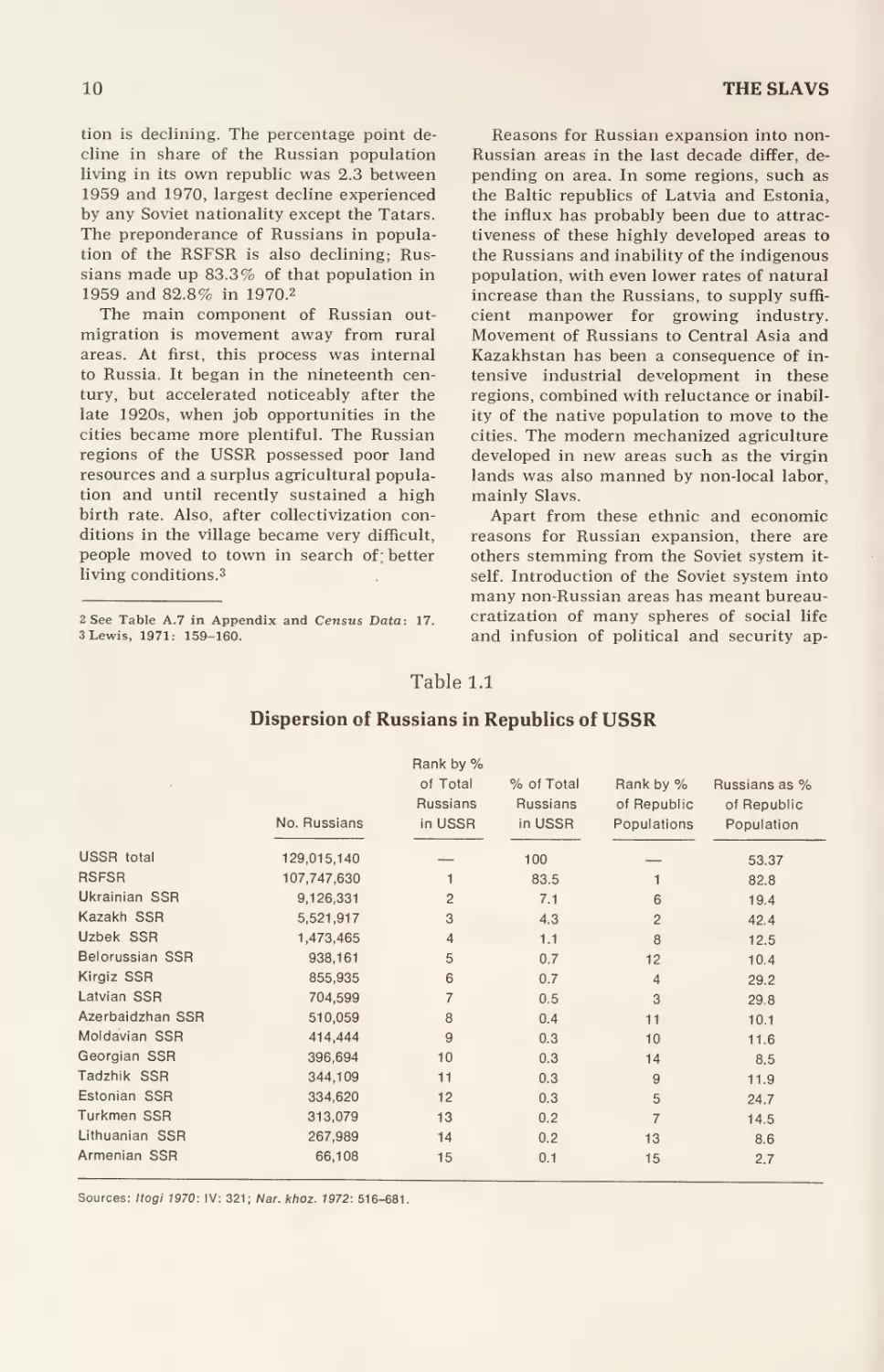
Table 1.1
Dispersion of Russians in Republics of USSR
•
No. Russians
Rank by %
of Total
Russians
in USSR
% of Total
Russians
in USSR
Rank by %
of Republic
Populations
Russians as %
of Republic
Population
USSR total
129,015,140
—
100
—
53.37
RSFSR
107,747,630
1
83.5
1
82.8
Ukrainian SSR
9,126,331
2
7.1
6
19.4
Kazakh SSR
5,521,917
3
4.3
2
42.4
Uzbek SSR
1,473,465
4
1.1
8
12.5
Belorussian SSR
938,161
5
0.7
12
10.4
Kirgiz SSR
855,935
6
0.7
4
29.2
Latvian SSR
704,599
7
0.5
3
29.8
Azerbaidzhan SSR
510,059
8
0.4
11
10.1
Moldavian SSR
414,444
9
0.3
10
11.6
Georgian SSR
396,694
10
0.3
14
8.5
Tadzhik SSR
344,109
11
0.3
9
11.9
Estonian SSR
334,620
12
0.3
5
24.7
Turkmen SSR
313,079
13
0.2
7
14.5
Lithuanian SSR
267,989
14
0.2
13
8.6
Armenian SSR
66,108
15
0.1
15
2.7
Sources: Itogi 1970: IV: 321; Nar. khoz. 1972: 516-681.

Russia and the Russians
11
paratuses of Soviet power into non-Russian
areas. Specialist personnel consists mainly
of Slavs, and the language of business is
Russian. The central Soviet authorities re¬
gard “intermingling” of nationalities as a
positive development and promote it, utiliz¬
ing many available levers of control and
influence (see following sections).
One result of these migrations is that
Russians have settled in significant num¬
bers everywhere in the Soviet Union. (See
Table 1.1.) Only in Lithuania and the Cau¬
casus do they make up less than 10% of
the population. In Latvia and Kirgizistan
they are almost 30% and in Kazakhstan
42.4%, outnumbering the Kazakhs them¬
selves. The Russian component of the pop¬
ulation is also large in rural areas outside
the RSFSR, recently opened up to argicul-
tural and industrial development, and cities,
where a significant minority (if not a ma¬
jority) of the inhabitants are Russians.
Kiev, Vilnius, and Tallinn, where Russians
comprise 23%, 25%, and 40% of the pop¬
ulation, respectively, are not unusual
examples.4 In Alma Ata, capital of Kazakh¬
stan, 70.3% of the population is Russian,
while only 12.1% is Kazakh.5
This urbanization is characteristic of
Russians at home as well as “abroad”; 68%
of all Russians in the RSFSR are urban
dwellers. Russians rank second only to Jews
in degree of urbanization and comprise
nearly two thirds of the entire urban pop¬
ulation of the USSR. (See Table A.9 in
Appendix.)
Position in Soviet Society
Officially, the USSR is presented as com¬
posed of 15 equal union republics and many
equal nationalities. Actually, the RSFSR
alone accounts for three quarters of the ter¬
ritory, more than half of the population,
and almost two thirds of the Communist
party membership of the USSR as a whole.
Moscow, capital of the RSFSR, is also cap¬
ital of the USSR. On any of a series of vital
indicators, the RSFSR and the Russians
predominate over all other republics and
nationalities of the USSR taken together, as
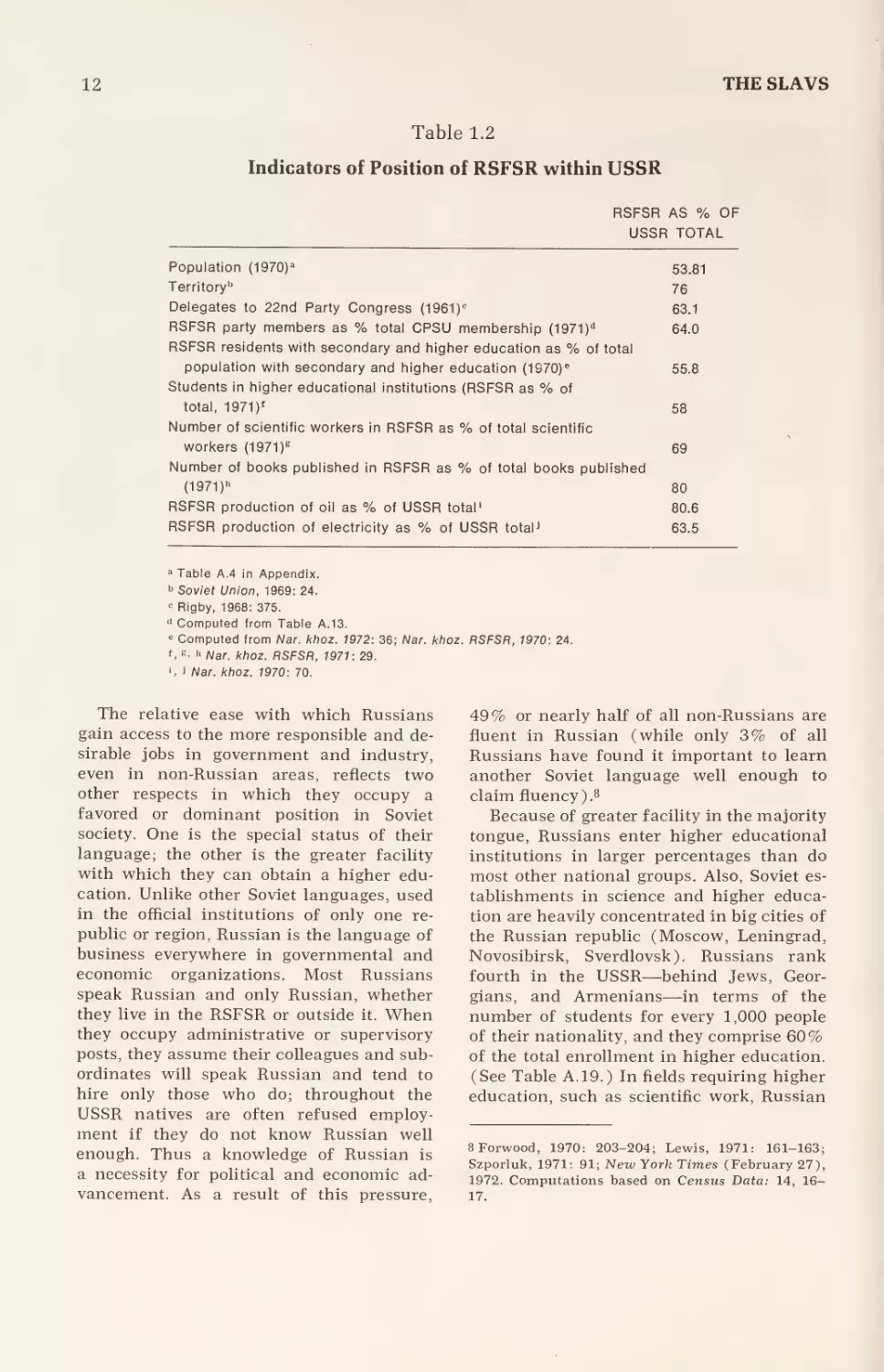
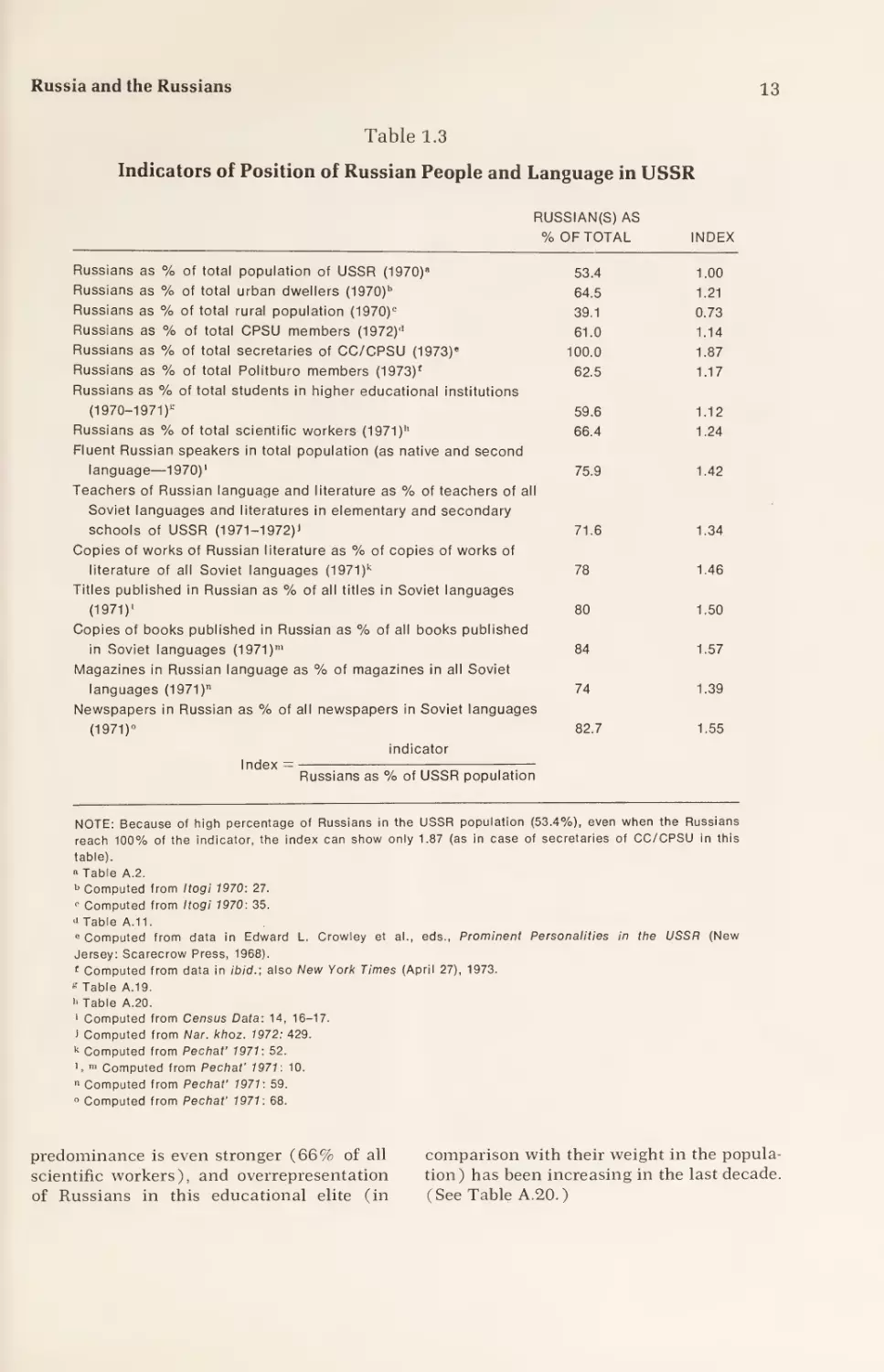
shown in Tables 1.2 and 1.3.
With respect to political position, Rus¬
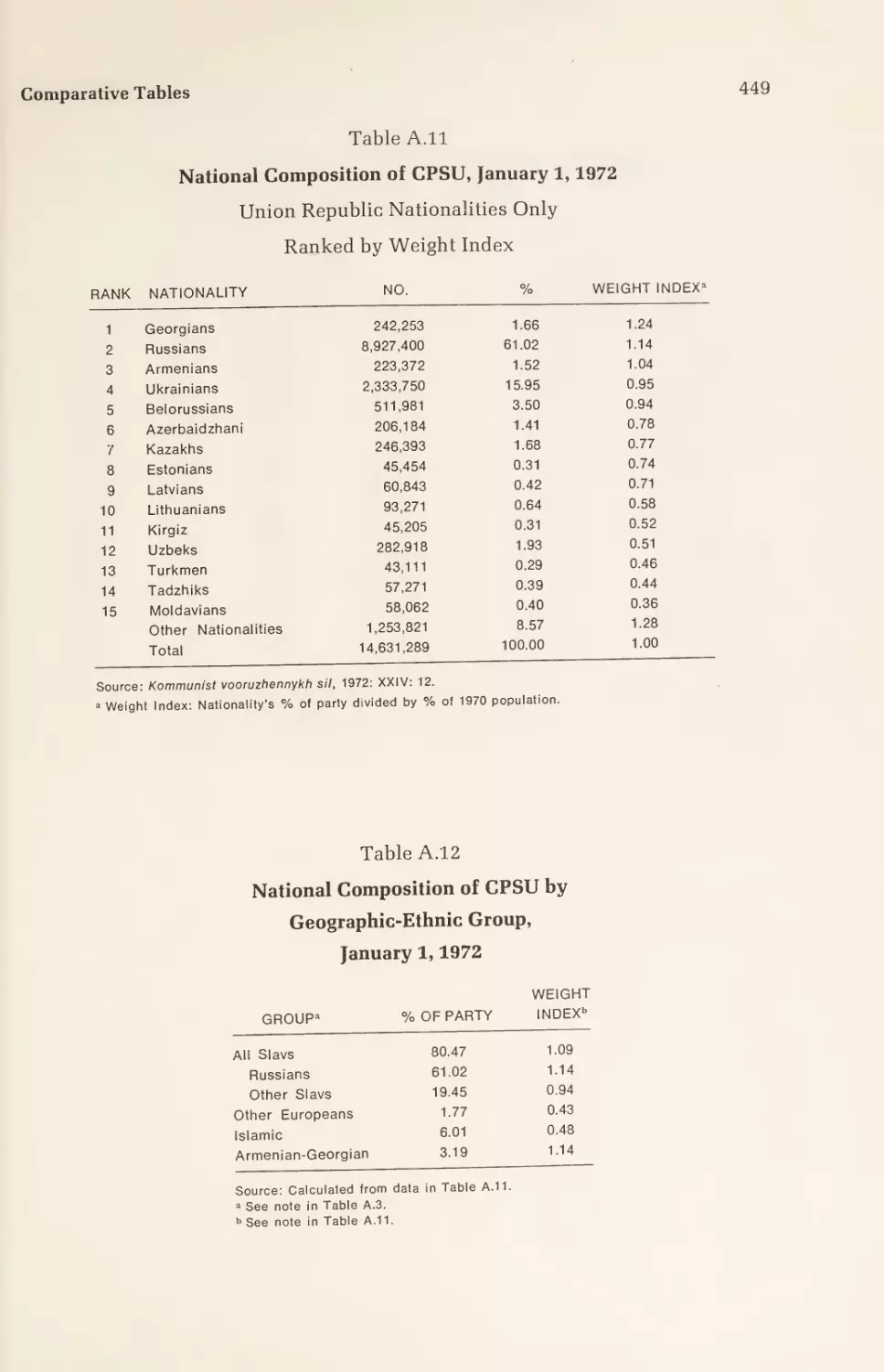
sians make up 62.5% of the USSR party
leadership (Politburo members) and 61%
of all party members (1972 figures). While
Georgians, Armenians, and possibly Jews
also enjoy a more than proportional repre¬
sentation in the party, all other national
groups are underrepresented. (See Table
A. 11 in Appendix.) Moreover, Russian
presence in party organizations of the non¬
Russian republics is considerable, while
non-Slavs do not generally participate in
party work in republics other than their
own. First secretaryship of the republic
parties is usually held by a native, but the
second secretary is almost always a Slav
and usually a Russian. Chairman of the re¬
public councils of ministers and their
deputies are generally indigenous, but the
critical position of republican KGB chief is
most often held by a Russian.6
Russians also hold a disproportionate
number of important posts in non-Russian
republics outside the political hierarchies:
in higher education, large-scale agriculture
(the virgin lands of Kazakhstan), new
industries in traditionally rural areas (Mol¬
davia), and key industries such as Azer¬
baidzhani oil, Kazakh iron and steel, and
Yakut oil fields. Heads of enterprises and
construction projects in non-Russian areas
tend to be Russian. Many Russians have
escaped rural poverty by taking advantage
of numerous employment opportunities
which opened up in the cities of Central
Asia in the last decade. Most jobs requiring
education or skills have been given to Rus¬
sians, and many nonskilled positions as
well.7
4 Nar. khoz. 1972: 516—581, Lewis, 1971: 155;
Szporluk, 1971: 83, 90; New York Times (July 31),
1972.
5 Itogi 1970: 233.
6 Forwood, 1970: 203—204.
7 Ibid.; Lewis, 1971: 161-163; Szporluk, 1971: 91.

12
THE SLAVS
Table 1.2
Indicators of Position of RSFSR within USSR
RSFSR AS % OF
USSR TOTAL
Population (1970)a	53.81
Territory”	76
Delegates to 22nd	Party	Congress	(1961)c	63.1
RSFSR party members	as	%	total	CPSU	membership (1971)d	64.0
RSFSR residents with secondary and higher education as % of total
population with secondary and higher education (1970)e	55.8
Students in higher educational institutions (RSFSR as % of
total, 1971)f	58
Number of scientific workers in RSFSR as % of total scientific
workers (1971)s	69
Number of books published in RSFSR as % of total books published
(1971)“	80
RSFSR production of oil as % of USSR total* 1 * 17	80.6
RSFSR production of electricity	as % of USSR totalJ	63.5
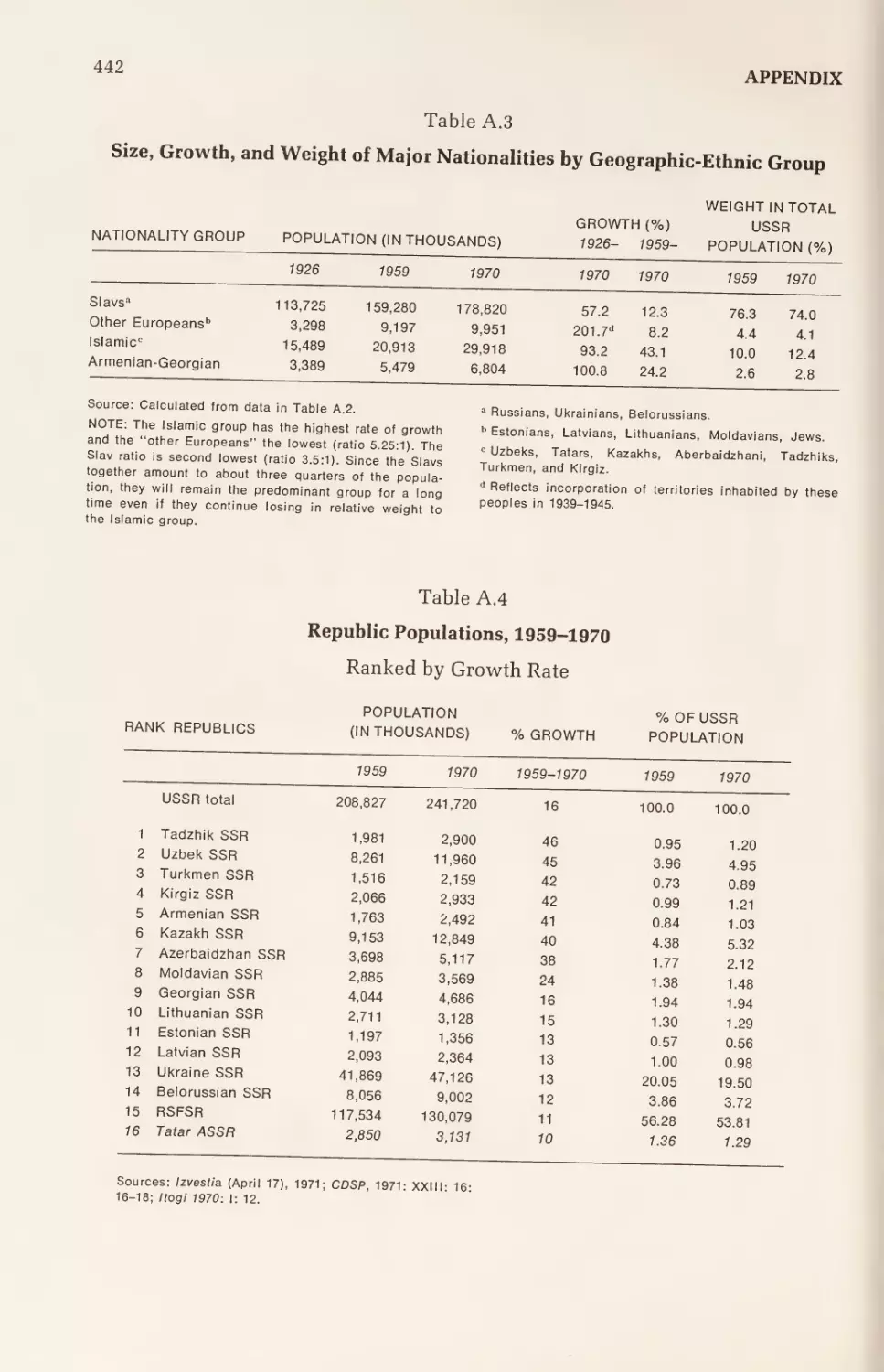
“Table A.4 in Appendix.
b Soviet Union, 1969: 24.
c Rigby, 1968: 375.
d Computed from Table A.13.
e Computed from Nar. khoz. 1972: 36; Nar. khoz. RSFSR, 1970: 24.
{> e’ h Nar. khoz. RSFSR, 1971: 29.
L i Nar. khoz. 1970: 70.
The relative ease with which Russians
gain access to the more responsible and de¬
sirable jobs in government and industry,
even in non-Russian areas, reflects two
other respects in which they occupy a
favored or dominant position in Soviet
society. One is the special status of their
language; the other is the greater facility
with which they can obtain a higher edu¬
cation. Unlike other Soviet languages, used
in the official institutions of only one re¬
public or region, Russian is the language of
business everywhere in governmental and
economic organizations. Most Russians
speak Russian and only Russian, whether
they live in the RSFSR or outside it. When
they occupy administrative or supervisory
posts, they assume their colleagues and sub¬
ordinates will speak Russian and tend to
hire only those who do; throughout the
USSR natives are often refused employ¬
ment if they do not know Russian well
enough. Thus a knowledge of Russian is
a necessity for political and economic ad¬
vancement. As a result of this pressure,
49% or nearly half of all non-Russians are
fluent in Russian (while only 3% of all
Russians have found it important to learn
another Soviet language well enough to
claim fluency).8
Because of greater facility in the majority
tongue, Russians enter higher educational
institutions in larger percentages than do
most other national groups. Also, Soviet es¬
tablishments in science and higher educa¬
tion are heavily concentrated in big cities of
the Russian republic (Moscow, Leningrad,
Novosibirsk, Sverdlovsk). Russians rank
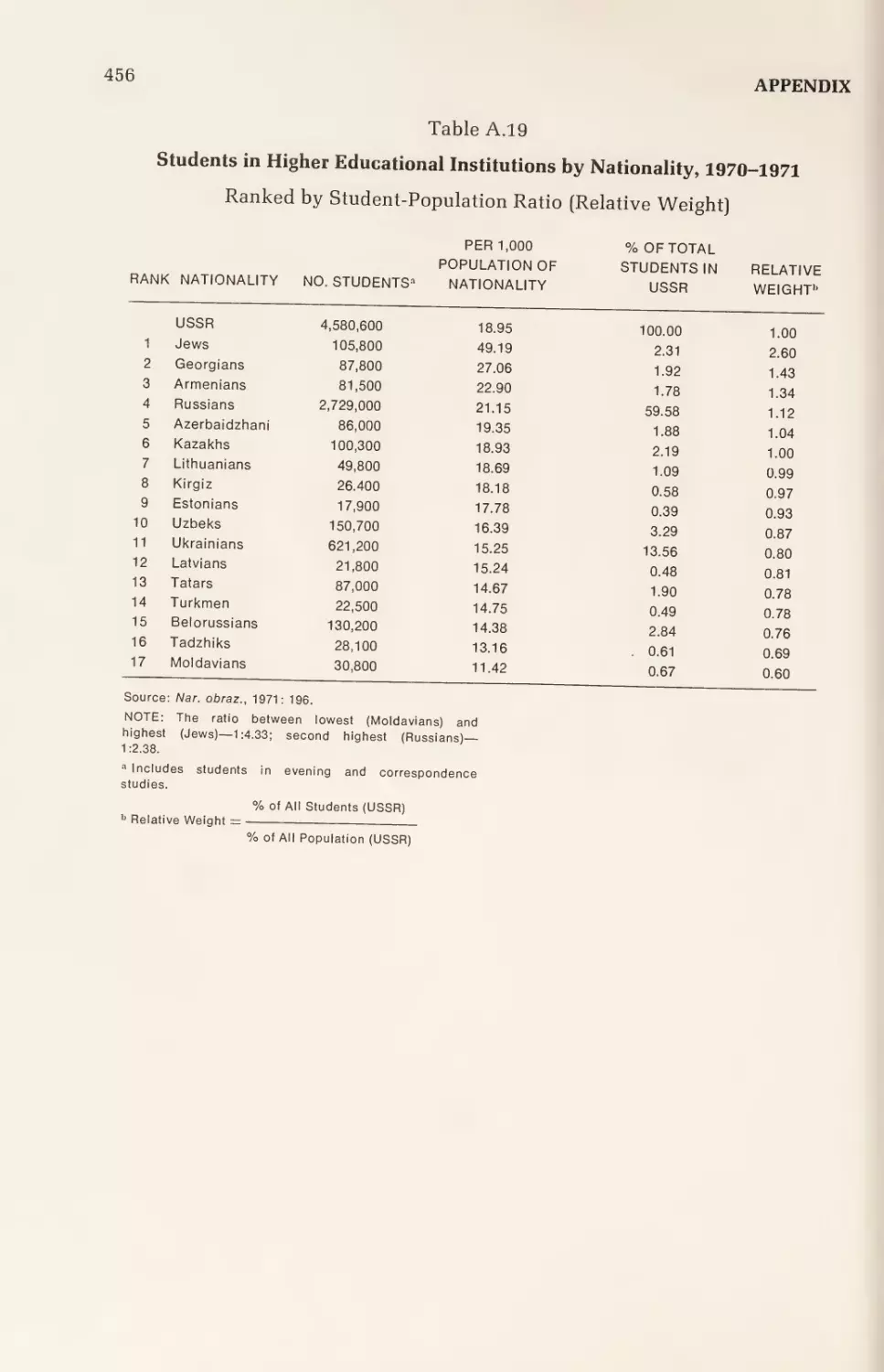
fourth in the USSR—behind Jews, Geor¬
gians, and Armenians—in terms of the
number of students for every 1,000 people
of their nationality, and they comprise 60 %
of the total enrollment in higher education.
(See Table A. 19.) In fields requiring higher
education, such as scientific work, Russian
8 Forwood, 1970: 203-204; Lewis, 1971: 161-163;
Szporluk, 1971: 91; New York Times (February 27),
1972. Computations based on Census Data: 14, 16¬
17.

Russia and the Russians
13
Table 1.3
Indicators of Position of Russian People and Language in USSR
RUSSIAN(S) AS
% OF TOTAL	INDEX
Russians as	%	of total	population of USSR (1970)a	53.4	1.00
Russians as	%	of total	urban dwellers (1970)b	64.5	1.21
Russians as	%	of total	rural population (1970)c	39.1	0.73
Russians as	%	of total	CPSU members (1972)d	61.0	1.14
Russians as	%	of total	secretaries of CC/CPSU (1973)*	100.0	1.87
Russians as	%	of total	Politburo members (1973)f	62.5	1.17
Russians as % of total students in higher educational institutions
(1970-1971 )K	59.6	1.12
Russians as % of total scientific	workers (1971)h	66.4	1.24
Fluent Russian speakers in total population (as native and second
language—1970)1	75.9	1.42
Teachers of Russian language and literature as % of teachers of all
Soviet languages and literatures in elementary and secondary
schools of USSR (1971-1972)1	71.6	1.34
Copies of works of Russian literature as % of copies of works of
literature of all Soviet languages (1971)k	78	1.46
Titles published in Russian as % of all titles in Soviet languages
(1971)1	80	1.50
Copies of books published in Russian as % of all books published
in Soviet languages (1971)m	84	1.57
Magazines in Russian language as % of magazines in all Soviet
languages (1971)"	74	1.39
Newspapers in Russian as % of all newspapers in Soviet languages
(1971)°	82.7	1.55
indicator
Index =

Russians as % of USSR population
NOTE: Because of high percentage of Russians in the USSR population (53.4%), even when the Russians
reach 100% of the indicator, the index can show only 1.87 (as in case of secretaries of CC/CPSU in this
table).
a Table A.2.
b Computed from Itogi 1970: 27.
c Computed from Itogi 1970: 35.
4TableA.11.	.
e Computed from data in Edward L. Crowley et al., eds., Prominent Personalities in the USSR (New
Jersey: Scarecrow Press, 1968).
f Computed from data in ibid.; also New York Times (April 27), 1973.
к Table A.19.
11 Table A.20.
‘ Computed from Census Data: 14, 16-17.
j Computed from Nar. khoz. 1972: 429.
k Computed from Pechat’ 1971: 52.
h m Computed from Pechat’ 1971: 10.
n Computed from Pechat’ 1971: 59.
° Computed from Pechat' 1971: 68.
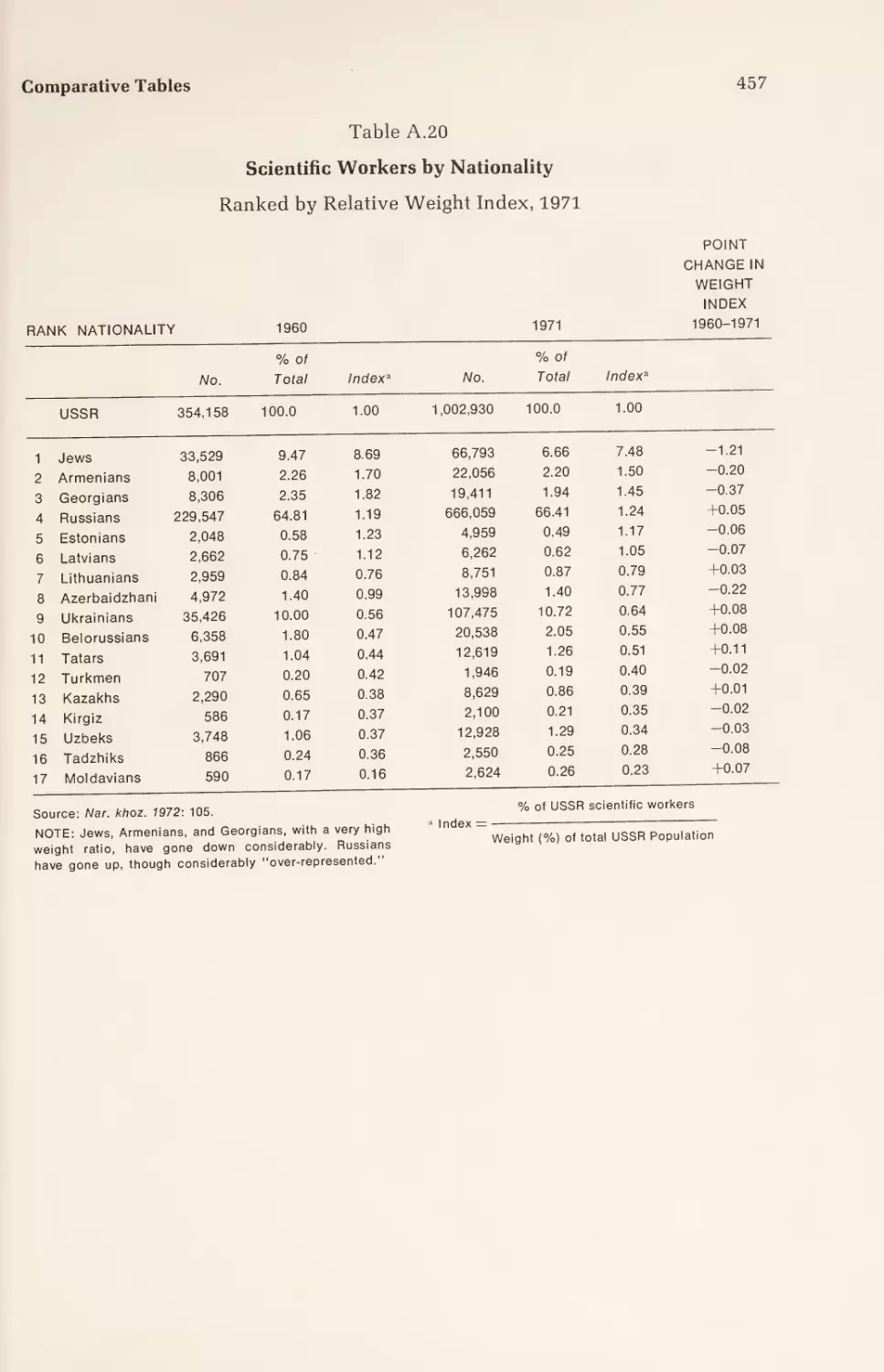
predominance is even stronger (66% of all comparison with their weight in the popula-
scientific workers), and overrepresentation tion) has been increasing in the last decade,
of Russians in this educational elite (in (See Table A.20.)

14
THE SLAVS
Russian Influence and Official Policy
The influence of Russians in Soviet
society is even greater than that revealed by
their political, economic, linguistic, and
educational position. This is the result of
many years of official support for Russifica¬
tion and encouragement of Russian nation¬
alism.
As an official policy, Russification has a
long history. During the reign of Nicholas I
(1825-1855), a deliberate process of in¬
culcating Russian culture was initiated in
the educational systems of parts of Poland,
Belorussia, and Lithuania. At the same time
the Russian Orthodox Church increased its
proselytizing activities. Manifestations of
local nationalism by subject peoples were
crushed, and individuals thought to have
led or inspired them, like the Ukrainian
poet Taras Shevchenko, were arrested and
exiled. The policy of Russification was given
new impetus under Alexander III (1881—
1894), when even peoples who had shown
complete loyalty to the Russian throne were
harassed. The Jews were subjected to vio¬
lent pogroms, often instigated by the Black
Hundreds, protofascist groups given official
encouragement. The last tsar, Nicholas II,
was an honorary member of one such
group.9
Initially, for reasons of both policy and
principle, Soviet leaders repudiated this ap¬
proach to minority peoples of the Empire.
On seizing power, the Bolsheviks sought to
distinguish themselves in this respect from
the nationalistic Whites. They issued a dec¬
laration guaranteeing the right of the
“peoples of Russia” to self-determination—
including secession, if they wished it—and
promising abolition of all national privil¬
eges and restrictions. At the same time
(November 1917), they addressed an ap¬
peal to Moslem inhabitants of the Empire.
Moslems of Russia [it read], Tatars of
the Volga and the Crimea, Kirghiz and
Sarts of Siberia and Turkestan, Turks
and Tatars of Transcaucasia, Chechens
and mountaineers of the Caucasus and
9Schopflin, 1970: 191-198.
all you whose mosques and oratories
have been destroyed, whose beliefs and
customs have been trampled underfoot
by the Tsars. . . . Your beliefs and
usages, your national and cultural in¬
stitutions are henceforth free and in¬
violable. Organize your national life
freely and without hindrance. You have
a right to this.10
These declarations were followed by a series
of gestures calculated to win the sympathy
of nationalist rebels in the border regions.
Historic and sacred relics were returned to
the Ukrainians and to several Moslem
peoples. The Bolsheviks even banned fur¬
ther Russian settlement in areas inhabited
by certain minorities (Kazakhs, Kalmyks,
Chechen, and Ingush).11
During the first years after the Bolshevik
revolution, the leaders looked with favor on
national autonomy—political, cultural, or
economic—as long as it did not conflict
with “democratic centralism.” All opposed
Great Russian chauvinism in principle, and
some actually fought it in practice. As be¬
lievers in the imminence of a world pro¬
letarian revolution, prominent figures in
the party favored a unitary supranational
state in which all national distinctions
would cease to exist. They were contemp¬
tuous, and perhaps even ashamed, of the
history of Great Russian domination and
oppression in the Empire. Lenin, for ex¬
ample, detested Russian chauvinism and
declared that he would fight a “war to the
death against it.” He opposed enforced use
of Russian in Soviet schools and supported
education in local languages. His instruc¬
tions on relations with the minorities
demonstrated a concern that non-Russian
traditions and pride should be respected
and that Russians or Russified bureau¬
crats should administer minority peoples
tactfully.12 *
For a while during the twenties, Lenin’s
10 Quoted in Conquest, 1967: 22.
11 Ibid.
12 Schopflin, 1970: 191—198; Conquest, 1967: 144—
147.

Russia and the Russians
’15
attitude continued to prevail in official
policy. The Twelfth Party Congress, meet¬
ing in April 1923, condemned “survivals of
great power chauvinism” in the outlook of
Russian officials and the “contemptuous
and soulless” attitudes of the latter toward
the national republics. A resolution at the
end of the congress declared that the
party’s most urgent task was the struggle
against Great Russian chauvinism in its
own ranks. Minority loyalty to Soviet rule
would be won, party leaders hoped, by al¬
lowing native leaders to administer the gov¬
ernments and economies of their areas.
Native languages were encouraged and
alphabets for peoples without written lan¬
guages were devised: these were media for
communication of socialist ideas. Even
some national military formations were
created to assist in the defense of Soviet
territory.13
All this changed, however, under Stalin,
who apparently believed that to mobilize the
population, the majority of which was Rus¬
sian, for industrialization and defense, it
was necessary publicly to identify the regime
with the Russian people and Russian his¬
tory. Beginning in the 1930’s, he gradually
made promotion of Russian nationalism
and national symbols official policy. The
Russian people and culture were glori¬
fied, their language extolled. Heroes of Rus¬
sian history were celebrated—even those
previously denounced by the Communists
as tyrants and reactionaries. Russians were
elevated to a position of primacy among the
nationalities of the country. Official pub¬
lications declared that they stood “at the
head of the peoples of the USSR” and were
“lead[ing] the struggle of all the peoples of
the Soviet land for the happiness of man¬
kind.” u
Stalin feared development of distinct
national identities and rise of nationalist
sentiment among non-Russian peoples, for
these could become the basis of secessionist
or collaborationist movements in wartime.
The republics, potential foci of minority
loyalty, were therefore deprived of all ves¬
tiges of political autonomy in the late
1930s. Most national cadres which had
risen during 1917—1920 and in the twenties
were destroyed in the purges of 1937—1939.
The practice of placing Russians as secre¬
taries in non-Russian party organizations
was intensified. The foremost representa¬
tives of minority cultures were arrested,
and Russification became the order of the
day. Cyrillic script was imposed on the Mos¬
lem minorities, and Russian was made a
compulsory subject in all non-Russian
schools.15
Stalin’s suspicion of the minority nation¬
alities and his encouragement of Great
Russian nationalism reached a peak during
the war—the Great Fatherland War, in the
Stalinist lexicon. Whole national groups
were deported on the allegation they had
aided the enemy or could potentially do so.
In a famous speech, Stalin invoked symbols
not of the “Soviet Union” but of “the Great
Russian nation, the nation of Plekhanov
and Lenin, of Belinsky and Chernyshevsky,
of Pushkin and Tolstoi, of Glinka and
Chaikovsky, of Gorky and Chekhov, of
Sechenov and Pavlov, of Repin and Surikov,
of Suvorov and Kutuzov.” This passage,
with long enumeration of exclusively Great
Russian personages, was the essence of the
new Stalinist system.16
When Stalin died, strident promotion of
the Russian people abated and draconic
measures against minority nationalities
were repudiated, but essential attitudes of
the leadership regarding the proper role of
Russians and Russian culture did not
change. Officially, Russians were still re¬
garded as the most important ethnic group,
although now instead of the “leading
people” they were presented as the “elder
brother” of the technologically less ad¬
vanced and culturally inferior non-Rus-
sians. Political and cultural autonomy of
minority nationalities was still seen as a
threat to the power of the regime, and
manifestations of national tradition—par¬
ticularly in its religious form—were severely
persecuted. Khrushchev declared that the
Russian language would become the basis
ts Schopflin, 1970: 191-198; Conquest, 1956: 29-30.
14 Goldhagen, 1968: x; B. Volin, “Veliki! russkii
narod,” Bol’shevik, (1938): IX: 36; Malaya sovet¬
skaya entsiklopediya (Moscow, 1949), IX, cols.
319—326, quoted in Conquest, 1956: 38—39.
15 Schopflin, 1970: 191-198.
16 J. Stalin, О velikoi otechestvennoi voine Sovet¬
skogo Soyuza (Moscow, 1944): 11, 28, quoted in
Conquest, 1956: 40.

16
THE SLAVS
for a “fusion of the nations” of the USSR, a
vision suggesting elimination of both sep¬
arate identities of the national minorities
and their corresponding political entities.17
Brezhnev and Kosygin have avoided
Khrushchev’s rhetorical flights and utopian
projections, but they are quietly taking
steps which seem intended to make his
vision a reality. Russian language and cul¬
ture are being brought to non-Russian areas
in numerous ways while expression of
minority identity is carefully contained and
kept to modest proportions. The Khrushchev
policy of promoting an “inter-republic ex¬
change of cadres” continues to be imple¬
mented on a very large scale. Many
thousands of new graduates and workers
are sent each year to work in republics
other than their own. Minority nationals
are thereby cut off from nearly all contact
with their native culture and for practical
reasons absorb elements of available Rus¬
sian culture. By contrast, Russians outside
the RSFSR are amply supplied with schools,
books, and periodicals to assist in retaining
and spreading their culture. Mixed mar¬
riages between Russians and other nationals
are encouraged in many areas, with the ex¬
pectation that the non-Russian partner will
assimilate.18
Russian . is energetically promoted in
every republic as a “second native tongue,”
although reciprocal efforts to induce Rus¬
sians to learn other Soviet languages are
usually ineffective. Journals devoted to im¬
provement of Russian teaching in non-Rus¬
sian areas have proliferated in recent years,
and numerous regional and interrepublic
conferences have been devoted to this ob¬
ject. There are more than twice as many
teachers of Russian language and literature
in elementary and secondary schools as
teachers of all other Soviet languages and
literatures together (336,000 as compared
to 133,000). Schools in which instruction
is conducted in minority languages (mostly
through the first eight grades) tend to be
small, ill equipped, and poorly staffed,
while the Russian language schools are
large, well equipped, and competently
staffed. Lavish praise is heaped on parents
17 Conquest, 1956: 28; Forwood, 1970: 204; Pipes,
1968: 3-4; Goldhagen, 1968: xi.
18 Bilinsky, 1968: 153—156; Szporluk, 1971: 91—92;
New York Times (February 27, July 20), 1972.
who send their children to Russian language
schools despite the censure of friends and
neighbors. Moreover, this is frequently most
convenient, especially in the cities. Once the
Russians begin moving into an area, it is
only a matter of time before the Russian lan¬
guage schools far outnumber the schools
providing instruction in the indigenous lan¬
guage. Even in the latter institutions Rus¬
sian is a required subject, whereas the local
language is optional in Russian language
schools.19
Soviet media policy is also designed to
promote Russification. Traditional native
themes are discouraged. Russian literature
is published in much greater volume than
the literature of all other nationalities to¬
gether. In 1971, 78% of all copies of liter¬
ary works published in the USSR were of
Russian literature. The Russian language
is similarly favored: of all titles published
in Soviet languages in 1971, 80% were in
Russian, as were .84% of all copies of all
books published. Even within the non-Rus¬
sian republics, it is not uncommon for more
books to be published in Russian than in
the indigenous language, and native writers
find it more difficult to publish their work
than Russian authors. The emphasis in
magazine and newspaper publishing is the
same: almost three times as many mag¬
azines and more than four times as
many newspapers are published in Russian
as in all other Soviet languages. Through¬
out the country the great bulk of radio and
television broadcasting is also in Russian.20
At the same time, publication and broad¬
casting in the national languages is con¬
tinued, at considerable cost to the state.21
This represents a tacit recognition by the
central authorities that years of Russifica¬
tion have had only a limited effect.
No less important an instrument of Rus¬
sification are the Russified natives ap¬
pointed to high party and state posts in the
republics. Some, like the party leaders in
Estonia, are Russian in everything but
birth: their education was Russian, as was
their place of residence and work for many
19 Forwood, 1970: 204; Ornstein, 1968: 135; Nar.
khoz. 1972: 429; Bilinsky, 1968: 160; New York
Times (May 4, July 20), 1972.
20 New York Times (February 27, May 4, July 20),
1972; Pechat’ 1971: 10, 52, 59, 68, 95-97.
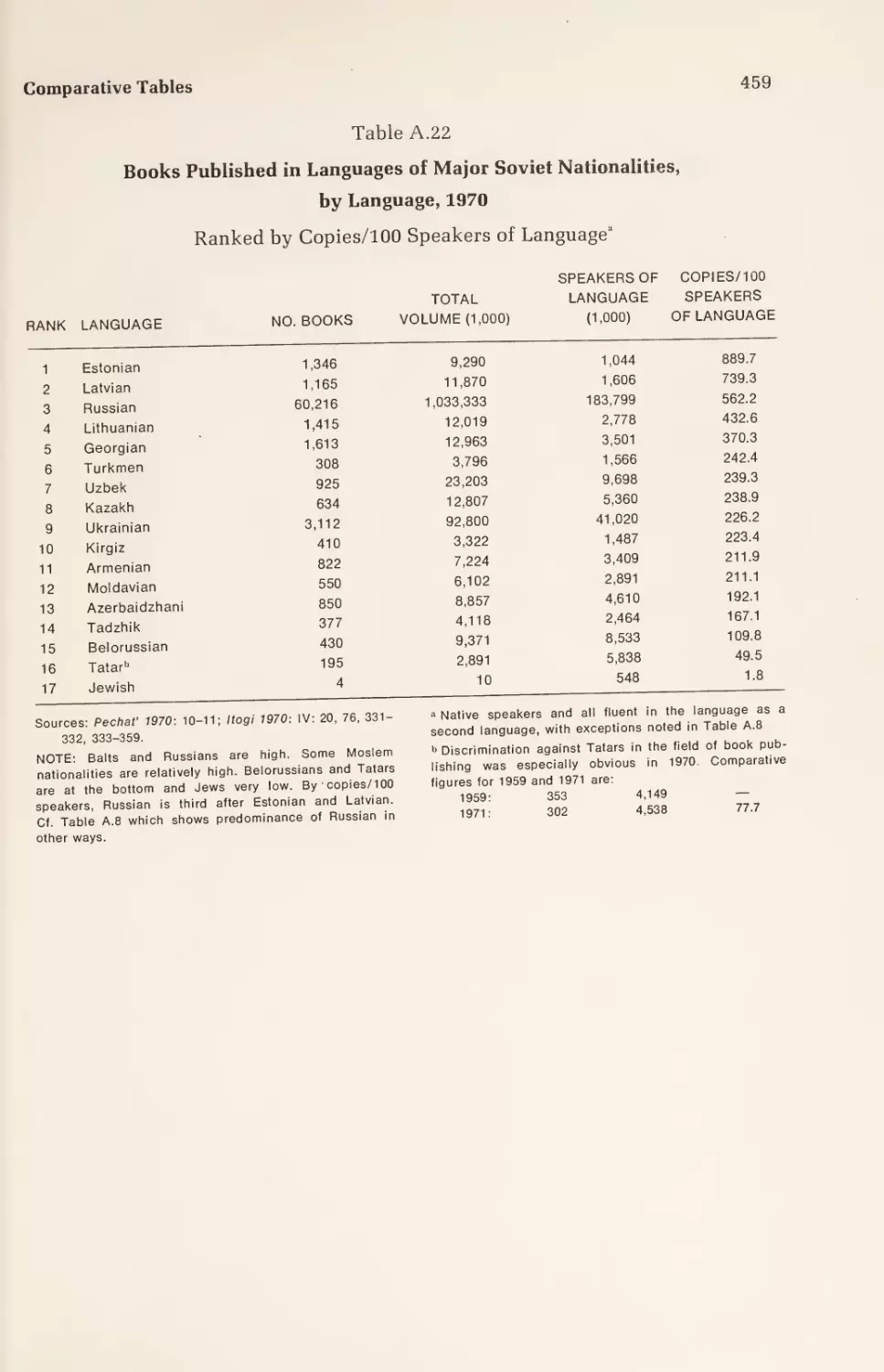
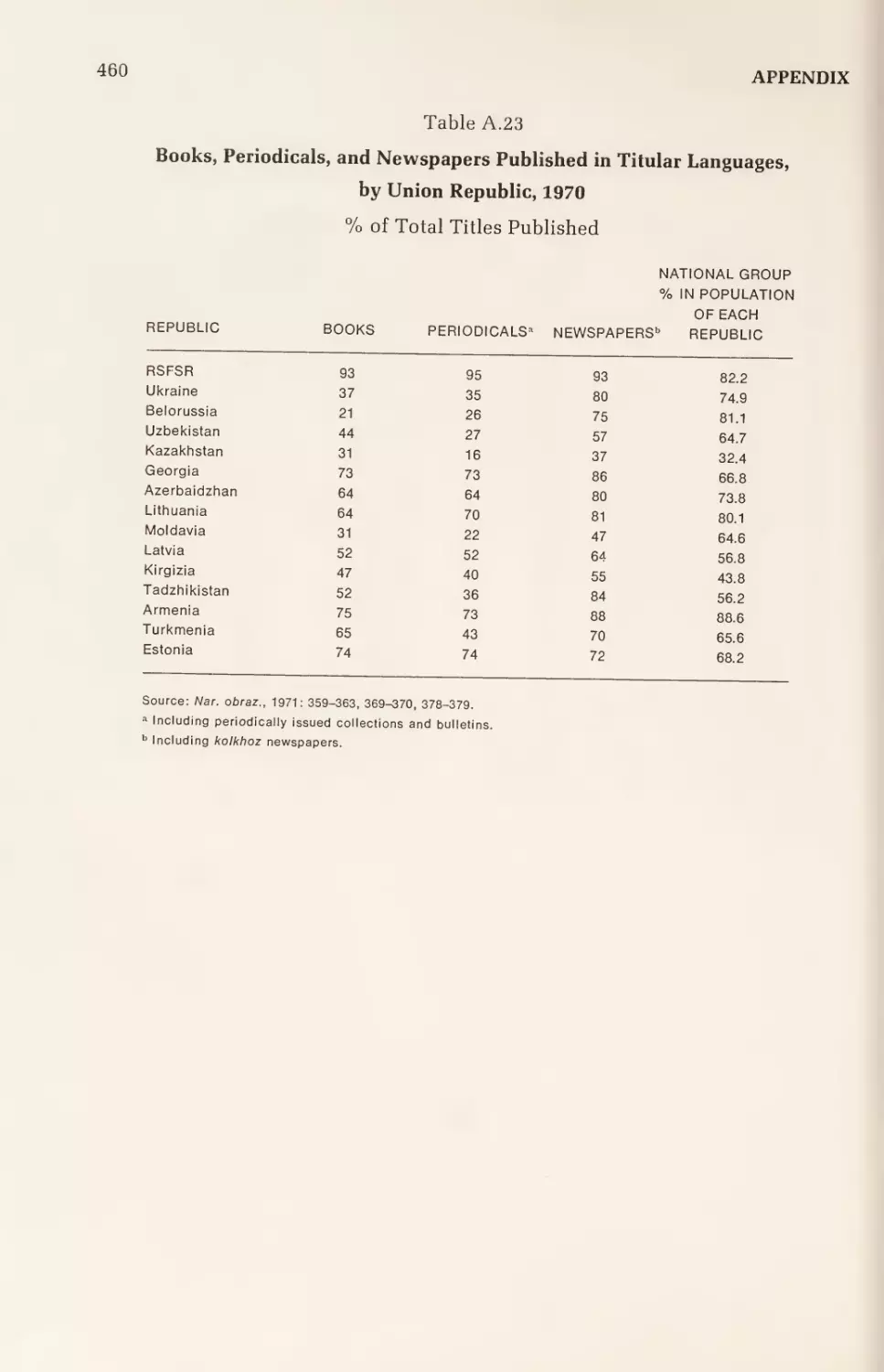
21 See discussions of media in the remaining chap¬
ters, as well as Tables A.22 and A.23 in Appendix.

Russia and the Russians
17
years. Others, like the recently appointed
head of the Ukrainian party, while not Rus¬
sian in background, are nonetheless willing
to work for the creation of a single Soviet
culture based primarily on Russian lan¬
guage, art, and traditions. They see it as
their function to quash local resistance to
this long-range goal. By installing men like
this and dismissing them if they waver, the
central authorities continue to encourage
Russian political, cultural, and economic
dominance over Soviet society.22
Revived Russian Nationalism and the Soviet Leadership
The pride in Russia and things Russian
which underlies official policy is not con¬
fined to the leadership alone. Nor is it to be
found solely among the peasant and worker
masses, so often assumed a nation’s chief
repository of patriotism. Recent years have
witnessed a great upsurge of interest in the
Russian past and a striking outburst of
nationalism among Russian intelligentsia.
In part this nationalist revival may be a
consequence of de-Stalinization. The de¬
nunciation of Stalin created an intellectual
and emotional void in Soviet life. Ideology,
regarded with acute suspicion by an over¬
propagandized generation, cannot fill this
void. Nationalism is one of the few alterna¬
tive faiths available. At the same time,
manifestations of nationalism by the Rus¬
sian intelligentsia may be an expression of
both resentment and admiration of national
ferment among the minorities.
This new trend has moderate-liberal,
Slavophile-conservative, and extremist¬
chauvinist adherents. The aim of the first
is primarily to rehabilitate elements of Rus¬
sian tradition neglected or denigrated by
successive Soviet rulers. The moderates
engage in studies of Russian folk culture
and language, icon painting, and church
architecture; they write letters to the press
decrying the destruction of churches and
other historical monuments; and they give
lectures on these topics in rural areas and
workers’ clubs. Many are members of one
of the few spontaneously formed (though
subsequently officially approved organiza¬
tions in the USSR today, the Rodina
(Motherland) Club. Some in this liberal
category are established writers and officials.
The other two groups are sometimes
referred to colloquially as russity [Rus-
sites]. The Russite extremist wing consists
of Great Russian nationalists, who believe
in the messianic role of a Russia preserved
from further "disorderly hybridization” of
nations, in which "the traditional Russian
religion [occupies] an honorable position.”
Racist, chauvinist, anti-intellectual, and
reactionary, the extremist Russites have
published a manifesto in samizdat (Slovo
natsii). Less extreme are Slavophile con¬
servatives, contributors to the underground
journal Veche. These people are similarly
convinced of the importance of preserving
the religion, culture, traditions, and dis¬
tinct identity of the Russian nation. But
they are not. chauvinists and, unlike the
authors of Slovo natsii, do not seek to make
Russians the "dominating nation” in the
USSR. Calling on all “Russian patriots” to
join and support them, they urge cultiva¬
tion of the unique qualities of the Russians
and every other nation.23 Writings of Russite
authors appear not only in samizdat, but
sometimes in the official press and
books.24
The regime is divided in its opinion of the
Russian nationalists. Evidently, some party
leaders fear the extremist Russites might
exacerbate national tensions and genuinely
dislike their Russian supremacism and
religiosity. But other powerful persons in
the KGB, the party, and the military are
22 For examples of reliance on Russified republic
leaders and dismissals for inadequate Russifying,
see New 'York Times (March 13, October 1), 1972
and (April 23, July 14), 1973. See also chapters on
the Ukraine, Latvia, and Georgia in this study.
23 “Word to the Nation,” 1971: 191—199; Pospie-
lovsky, 1973: 51—74; Scammel, 1971: 100; Palmer,
1970; 164; Amalrik, 1969; 64-65. See also Zev
Katz, “Soviet Dissenters and Social Structure in
the USSR” (Cambridge: Center for International
Studies, MIT, April 1972, C/72-3).
24 See, for example, V. Kochetov, What Do You
Want? (1969); Yury Ivanov, Caution, Zionism!
(1969); Ivan Shevtsov, In the Name of the Father
and the Son (1970).

18
THE SLAVS
believed highly sympathetic to the Rus sites
and determined to promote and protect
them. For some time an intense struggle
seems to have been underway between
these two groups. For awhile it seemed that
the faction which disliked the Russites
would be victorious. The party journal
Kommunist condemned the line taken by
both samizdat publications, and the editor
of Veche was warned of his impending ar¬
rest.25 A recent incident, however, suggests
that supporters of the Russites are gaining
the upper hand. In November 1972 the
acting chief of the Central Committee’s
Ideological Section, Alexander P. Yakovlev,
published a lengthy attack on excessive
Russian nationalism and overglorification
of the Russian past.26 Despite the endorse¬
ment this article received from the party’s
highest ranking ideologist, Mikhail Suslov,
its author was removed from his post in
April 1973 amid charges that he had been
too critical of works on Russian national¬
ism.27 Yakovlev was one of the most out¬
spoken of the Russites, opponents, and his
removal may mean that henceforth they
can write and publish more freely. Official
Russian nationalism seems to have joined
forces with its unofficial variant in a rare
alliance of state and society in the USSR.
Minority Attitudes Toward the Russians
The assessment of attitudes of the
“minority” nationals toward the Russians
is a very difficult—if not impossible—task.
Nevertheless, certain currents are discern¬
ible.
Russifying policies of the regime and its
tolerance of Great Russian chauvinism are
keenly resented in minority areas. They are
not made more palatable by the behavior
of Russians, as perceived by other national¬
ities when Russians emigrate or are sent
to these areas. As individuals they are
sometimes portrayed as arrogant, as groups
exclusive; they are reputed to treat indig¬
enous peoples as less than equal and to
segregate assiduously their places of resi¬
dence and recreation. The feelings aroused
by these practices find many outlets—in
samizdat, in public protests, and most fre¬
quently in humor. Anti-Russian jokes are
circulated in abundance among intelli¬
gentsia of some national minorities, stres¬
sing the alleged slowness, stupidity, lack
of irony or sense of humor, lack of initia¬
tive, and general passivity of the russak.28
Anti-Russian sentiment of the minority
nationalities is expressed in anti-Russian
25 Pospielovsky, 1973: 51—74; Kommunist, 1971:
XV: 105-107, quoted in Pospielovsky, 1973; New
York Times (July 19), 1971.
26 Lit. gaz. (November 15), 1972.
27 New York Times (May 7), 1973.
28 See, for example, the chapter on Latvia.
activities, which find multiple forms and
are sometimes supported by the local elite.
The Tbilisi riots of 1956 in Georgia were a
case in point, as were the violent clashes
between Russians and Uzbeks during the
Tashkent football matches in 1969 and the
1972—1973 protests in Lithuania.29 30 Roi Med¬
vedev, a Russian dissident, writes that in
the Ukraine, Georgia, and Latvia local cul¬
tural institutions appoint only persons of
local nationalities to important positions.
This policy is designed to discriminate
against Russians as well as other national¬
ities. Medvedev also proposes a change in the
USSR constitution providing for a period¬
ical referendum in each republic on its
desire to remain part of the USSR.20 The
samizdat Program of the Democratic Move¬
ment of the Soviet Union stipulated that
the national republics should have the right
to fix quotas for settlement of nonlocal
nationals within their borders; such a
measure would be directed primarily
against the Russians.31 Evidence from re¬
cent emigres suggests that local elites in
the national areas make efforts to settle
29 See the chapters on these nationalities.
30 Roi Medvedev, Kniga о sotsialisticheskoi demo-
kratii (Amsterdam/Paris: Herzen Foundation,
1972): 75-111, 319-328.
31 Programma Demokraticheskogo dvizheniya
Sovetskogo Soyuza (Amsterdam: Herzen Founda¬
tion, 1970), passim.

Russia and the Russians
19
their nationals in Russianized cities and to
stem further infusion of Russians into their
territory-32
It must be stressed that the relationship
between the non-Russian nationalities and
the Russians is complex; it is not uniformly
hostile. Some segments of the minority
populations and their elite groups accept
32 Zev Katz, “The New Nationalism in the USSR,”
Midstream (February, 1973): 3-13. See also chap¬
ter on the Tatars.
the Soviet-Russian culture willingly, feel at
home with the Russian language, and have
a very high regard for Russians as indi¬
viduals and group. Still, anti-Russian senti¬
ment is obviously strong among some
non-Russian nationals. This, in turn,
evokes resentment by Russians, intensify¬
ing their own national feelings. A vicious
circle is created: Russian ascendancy
breeds nationalism among minority nation¬
alities, which intensifies Russian nation¬
alism and drive for predominance.
REFERENCES
Allworth, 1971
Edward Allworth, ed., Soviet Nationality
Problems (New York: Columbia Uni¬
versity Press, 1971).
Amalrik, 1969
Andrei Amalrik, “Will the USSR Survive
Until 1984?” Survey (Autumn 1969):
LXXIII: 47-79.
Bilinsky, 1968
Yaroslav Bilinsky, “Assimilation and
Ethnic Assertiveness Among Ukrainians
of the Soviet Union,” in Goldhagen, 1968:
147-184.
Census Data
“Census Data: Age, Education, Nation¬
ality,” Current Digest of the Soviet Press
(1971), XXIII: 16: 14-18.
Conquest, 1956
Robert Conquest, Soviet Russian Nation¬
alism (New York: Oxford University
Press, 1956).
Conquest, 1967
Robert Conquest, Soviet Nationalities
Policy in Practice (New York: Praeger,
1967).
Forwood, 1970
William Forwood, “Nationalities in the
Soviet Union,” in Schopflin, 1970: 199—
208.
Goldhagen, 1968
Erich Goldhagen, ed., Ethnic Minorities
in the Soviet Union (New York: Praeger,
1968).
Harris, 1971
Jonathan Harris, “The Dilemma of Dis-
sidence,” Survey (Winter 1971): XVI: 1:
107-122.
Itogi 1970
Itogi vsesoyuznoi perepisi naseleniya
1970 goda, vol. IV (Moscow: Statistika,
1973).
Lewis, 1971
Robert A. Lewis, “The Mixing of Russian
and Soviet Nationalities and Its Demo¬
graphic Impact,” in Allworth, 1971:
117-167.
Lit. gaz.
Literaturnaya gazeta (Moscow, weekly).
Nar. khoz. RSFSR 1970
Narodnoye khozyaistvo RSFSR v 1970
godu (Moscow: Statistika, 1971).
Nar. khoz. RSFSR 1971
Narodnoye khozyaistvo RSFSR v 1971
godu (Moscow: Statistika, 1972).
Nar. khoz. 1972
Narodnoye whozyaistvo SSR 1922—1972:
Yubileinyi statishchesii yezhegodnik
(Moscow: Statistika, 1972).
Ornstein, 1968
Jacob Ornstein, “Soviet Language Policy:
Continuity and Change,” in Goldhagen,
1968: 121-146.
Palmer, 1970
S.	T. Palmer, “The Restoration of Ancient
Monuments,” Survey (Winter/Spring
1970): LXXIV/LXXV: 163-174.
Pechat’ 1971
Pechat’ v SSSR v 1971 godu (Moscow:
Kniga, 1972).
Pipes, 1964
Richard Pipes, “The Forces of National¬
ism,” Problems of Communism (Jan¬
uary-February 1964): 1—6.
Pipes, 1967
Richard Pipes, “ ‘Solving’ the Nationality
Problem,” Problems of Communism (Sep¬
tember-October 1967): 125—131.

20
THE SLAVS
Pospielovsky, 1973
• Dimitry Pospielovsky, “Russian National¬
ism in Samizdat,” Survey (Winter 1973) :
XIX: 1: 51-74.
Rigby, 1968
T.	H. Rigby, Communist Party Member¬
ship in the USSR, 1917—1967 (Princeton:
Princeton University Press, 1968).
Scammel, 1971
Michael Scammel, “Soviet Intellectuals
Soldier On,” Survey (Winter 1971): XVI:
1: 99-106.
Schopflin, 1970
George Schopflin, ed., The Soviet Union
and Eastern Europe: A Handbook (New
York: Praeger, 1970).
Soviet Union, 1969
Soviet Union—50 Years: Statistical Re¬
turns (Moscow: Progress Publishers,
1969).
Szporluk, 1971
Roman Szporluk, “The Nations of the
USSR in 1970,” Survey (Autumn 1971):
XVII: 4: 67-100.
“Word to the Nation,” 1971
“Word to the Nation,” Survey (Summer
1971): XVII: 3: 191-199.
Some Supplementary Readings on the Russians
and the RSFSR
Russian National Character and
Attitudes
Raymond A. Bauer and Alex Inkeles, How
the Soviet System Works: Cultural, Psy¬
chological, and Social Themes (Cam¬
bridge: Harvard University Press, 1956).
Geoffrey Gorer and John Rickman, The
People of Great Russia: A Psychological
Study (New York: Norton, 1962).
Margaret Mead, Soviet Attitudes Tozvard
Authority (New York: Schocken, 1966).
Klaus Mehnert, Soviet Man and his World
(New York: Praeger, 1958).
Colette Shulman, ed., We the Russians (New
York: Praeger, 1971).
Russification
Elizabeth E. Bacon, Central Asians Under
Russian Rule: A Study in Culture Change
(Ithaca: Cornell University Press, 1966).
Frederick C. Barghoorn, Soviet Russian
Nationalism (New York: Oxford Uni¬
versity Press, 1956).
Maurice Hindus, The Kremlins Human
Dilemma: Russia after Half a Century of
Revolution (New York: Doubleday, 1967).
Russian Culture
James H. Billington, The Icon and the Axe:
An Interpretive History of Russian Cul¬
ture (New York: Vintage Books, 1966).
Paul Miliukov, Outline of Russian Culture
(New York: Barnes, 1942), 3 vols.
Position of National Minorities
vis-a-vis Russians
David J. Dallin, The New Soviet Empire
(London: World Affairs Book Club,
1951), chs. 6, 7.
Susan Jacoby, Moscow Conversations (New
York: Coward, McCann, & Geoghegan,
1972).
Jaan Pennar et al., Modernization and
Diversity in Soviet Education, With
Special Reference to Nationality Groups
(New York: Praeger, 1971).
Russian History and Economic History
Jerome Blum, Lord and Peasant in Russia
(New York: Atheneum, 1964).
Michael T. Florinsky, Russia (New York:
Macmillan, 1953), 2 vols.
Russian Geography
W. H. Parker, An Historical Geography of
Russia (Chicago: Aldine, 1969).

2
THE UKRAINE and
THE UKRAINIANS
Roman Szporluk
General Information
TERRITORY
The Ukrainian Soviet Socialist Republic
occupies an area of 233,089 square miles,
larger than France or any European country
(excluding the RSFSR). It is divided into
25 provinces [oblasty], varying in size from
12,857 square miles (Odessa region) to
3,127 square miles (Chernovtsy).1 The
Ukraine’s borders are 4,018 miles long—
2,574 miles are with the Soviet republics
of Russia, Belorussia, and Moldavia, and
789.5 with Poland, Czechoslovakia, Hun¬
gary, and Rumania. Seashore comprises 654
miles. The Ukraine extends 818 miles from
west to east and 555 miles from north to
south.2 Most of the Ukraine is plains, with
mountains in the west and extreme south
(Crimea).
The Ukraine is rich in minerals, in¬
cluding iron, manganese, chromite, titan¬
ium, lead-zinc, aluminum, mercury, and
nickel. It has large reserves of hard coal,
brown coal, petroleum, and natural gas.
Potassium, rock salt, solar salt, and sulfur
also abound, as well as kaolin and other
clays, cement raw materials, flux lime¬
stones, graphites, and building stone.3
The climate of most of the Ukraine is
moderately continental. On the south coast
of the Crimea, however, it approaches sub¬
tropical. Rainfall varies from 59 inches per
year in mountainous areas of the Car¬
pathians to 11—13 inches on the Black and
Azov sea coasts. Largest river is the
Dnieper, flowing for 749 miles through the
republic. Almost all rivers feed into the
Black and Azov seas. Other major rivers
are the Dniester, Desna, Siversky Donets,
Southern Bug, Pripyat, and Seym. The
Ukraine has more than 3,000 natural lakes,
30 with an area of 4 square miles or more,
and 13 more than 20 square miles. There
are also artificial reservoirs, the largest on
the Dnieper: the Kakhovka (832 square
miles), the Kremenchug (985), and the
Kiev (356 square miles).4
The Ukraine lies within three physico-
1 Narodne hospodarstvo 1970: 9.
2 Soviet Ukraine, 1970: 9.
3Ibid.: 29-32.
4 Ibid.: 32-40.
21

THE SLAVS
22
geographic zones: the Mixed Forest, Forest¬
Steppe, and the Steppe. The Mixed-Forest
belt is covered by soddy podzolic soils, the
Forest-Steppe belt has a variety of subtypes
of black earth [chernozem], and the Steppe
belt is subdivided into three zones with
different types of soils.5 The growing
season in the Mixed Forest belt (which
embraces the northern part of the Ukraine)
lasts 190-205 days; in the Forest-Steppe
belt, 200-210 days; and, in the Steppe belt,
210-245 days.5 6
The Ukraine territory has been divided,
within the all-Union regional scheme, into
three economic regions. The Donetsk-
Dnieper Region occupies an area of 85,290
square miles, or 36.7% of the Ukrainian
territory, and includes the provinces
[oblasty] of Voroshilovgrad, Dnepropet¬
rovsk, Donetsk, Zaporozhe, Kirovograd,
Poltava, Sumy, and Kharkov. The South¬
western Region, encompassing almost half
of the Ukraine, includes the Vinnitsa,
Volyn, Zhitomir, Transcarpathia, Ivano-
Frankovsk, Kiev, Lvov, Rovno, Ternopol,
Khmelnytsky, Cherkassy, Chernovtsy, and
Chernigov oblasty. The Southern Region, of
43,745 square miles, includes the oblasty
of the Crimea, Nikolaev, Kherson, and
Odessa.7
ECONOMY
The Ukraine has been one of the most
important economic areas of prerevolution¬
ary Russia and the USSR. In 1912 it pro¬
vided 18.3% of total Russian output of
manufactures by value and employed
16.8% of the labor force.8 According to
another estimate, the Ukraine produced
24% of the entire industrial output of
Russia before World War I.9 In 1913 it pro¬
duced over 20% of the output of large-scale
industry, 78.2% of the coal, 57.7% of the
steel, and over two thirds of the iron ore.10
5 Ibid.-. 41-43.
6 Ibid.: 55-58.
7 Voloboi and Popovkin, 1972: 52.
8 Seton-Watson, 1967: 658. The area considered
here does not coincide exactly with the present
Ukraine, which includes parts not in Russia in
1912.
9 Soviet Ukraine, 1970: 244.
10 Ibid.; 252.
Ukrainian agriculture was more advanced
than that of Russia proper, although back¬
ward in comparison with the West. Wooden
ploughs were still used in some localities in
1917, and about one half of the peasant
farmers had no draft animals or imple¬
ments of their own.11	•
In 1970, with 3% of the area and 19%
of the population of the USSR, the Ukraine
produced one third of the total USSR coal
output, 48% of the pig iron, 40% of the
steel, and 57% of the iron ore. The Ukraine
was advanced in extractive industries and
heavy machine industry, but markedly
weaker in other respects, such as light in¬
dustry and production of consumer dur¬
ables.12 Agriculture remains very important.
In 1970 it produced 19% of all Soviet grain,
59% of the sugar beets, and 28% of the
vegetables. The rail and road network of the
Ukraine is relatively dense: with 3 % of
the area of the Soviet Union, it has 16% of
the railway mileage and 18% of the auto¬
mobile roads.
There is considerable variation in the
level of economic development among dif¬
ferent parts of the Ukraine. At the end of
the 1960s industrial output per capita in
the Donetsk-Dnieper Region was one third
higher than in the South and over twice as
high as in the Southwestern Region, the
least developed area.13 There is surplus
rural population in the Ukraine, especially
in the Southwestern Region. In 1959 an
average able-bodied collective farm peasant
worked (and. was paid for) 198 days in a
year (as compared to 255 in the Leningrad
area and 249 in Siberia). By 1965 this had
declined to 188.14 Productivity of labor in
agriculture is low, and much working time
is wasted owing to shortcomings in man¬
agement and organization.15
In 1970, 35.5% of the Ukrainian labor
force was employed in industry and con¬
struction (28.9% in 1960), 31.7% in agri¬
culture and forestry (46.5%), 7.5% in
transport and communication (5.9% ),
6.8% in trade, supplies, and public cater¬
ing (4.9%), and 13.4% in education,
11 Ukraine, A Concise Encyclopaedia, 1971: I: 845.
12 Narodne hospodarstvo 1970: 56-57.
13 Ukraina, Terazniejszosc i przesztosc, 1970: 128—
129; Naseleniye, trudovye resursy, 1971: 171.
14 Ibid.: 148, 150.
15 Ibid..- 204.

The Ukraine and the Ukrainians
23
medicine, and public health (9.7% ).16 In
comparison, in Poland in 1969, 35% of the
labor force was employed in industry and
construction and 37% in agriculture and
forestry- In Czechoslovakia the former con¬
stituted 46%, the latter 19%.17
Average monthly wage for Ukrainian
workers and officials (excluding kolkhoz
members but including employees of state
farms) in 1970 was 115.2 rubles. Wages in
construction averaged 135.0 rubles per
month, in industry 130.1, in science 121.9,
in transport 120.9, and in government ser¬
vice 111.8. The average wage in education
was 102.2 rubles, in communication 92.3,
in commerce and public catering 88.0, and
in health 85.0. On state farms and auxil¬
iary agricultural enterprises the average
was 95.7 rubles per month.18 No data are
available on income of collective farmers,
but it is known to be lower than that of
state farm workers.
HISTORY
First historical state on the present ter¬
ritory of the Ukraine was Kievan Rus
(ninth to eleventh centuries).19 Eventually,
it disintegrated into a number of princi¬
palities, of which Galicia and Volynia sur¬
vived as independent states until the
fourteenth century. The former became
Polish in 1387, while the latter was sub¬
dued by Lithuania, which also conquered
Kiev itself. In 1569 all the Ukrainian lands
were united under Poland, which thereafter
exerted a strong influence on the language,
culture, politics, and society in the Ukraine.
In 1648 the Ukrainians rose against Poland
in a national insurrection, which reflected
peasant opposition to serfdom, Orthodox
religious protest against Polish Catholic ex¬
pansionism, and Cossack resentment of
their treatment as a military force under
Polish control. The Ukrainians defeated the
16 Narodne hospodarstvo 1970: 375. Figures in
parentheses are all for 1960.
17 Pivovarov, 1972: 24.
18 Narodne hospodarstvo 1970: 381.
19 Material in this section is based, among others,
on Ukraine: A Concise Encyclopaedia, 1963; Pipes,
1968; Rudnytsky, 1963; Seton-Watson, 1967; Soviet
Ukraine, 1970; Ukraina, Terazniejszosc i prze-
sztosc, 1970.
Poles at first, but Polish counter-attacks led
them to turn to Moscow for help.
In 1654 the Ukraine entered into rela¬
tionship with Moscow, the precise nature
of which has been disputed ever since. In
1667 the Ukraine was partitioned between
Poland and the Tsardom of Muscovy. A
truncated Ukraine (on the left bank of the
Dnieper River) survived as an autonomous
structure under Russia until 1764 when
the elective office of hetman was abolished.
The second and third partitions of Poland
in 1793 and 1795 brought the rest of the
Ukraine under Russian rule, with the ex¬
ception of Galicia, which had come under
Austrian control in 1772 and remained
under Vienna until 1918. Russian expan¬
sion to the south, which led to the conquest
of the northern Elack Sea coast and the
Crimea from the Tatars, opened these areas
to Ukrainian settlers in the late eighteenth
century.
Although the Ukrainian landed nobility
generally accepted Russian rule, nationalist
sentiments were never totally extinguished.
They revived in strength during the Ukrain¬
ian literary and cultural awakening of the
nineteenth century. The tsarist regime re¬
sponded with a prohibition on printing in
Ukrainian (1876—1905). Ukrainians were
able to develop their culture more freely in
Austrian Galicia, where their language was
recognized in schools, civil administration,
and courts of justice. By 1914 Lvov, the
Galician capital, had three Ukrainian lan¬
guage dailies and a number of weekly and
monthly periodicals. Ukrainian political
parties, first formed in the 1890s, were
represented in the Galician provincial as¬
sembly and the Austrian parliament in
Vienna.
The outbreak of World War I in 1914
came when the Ukrainian national move¬
ment in Russia was still in its initial stages.
The Ukrainian press, although no longer
totally banned, suffered from systematic
persecution by the tsarist administration.
Cultural and educational organizations
were usually allowed to exist for very brief
periods. The vast majority of the peasantry
was illiterate. Ukrainian was not allowed
to be used or taught in public schools,
political and national consciousness of the
masses was low, and Russians were pre¬
dominant in the cities. The weakness of
24
THE SLAVS
Ukrainian nationalists became apparent in
1917, when they managed to get the Rus¬
sian Provisional Government to recognize
the Ukraine’s autonomy but failed to es¬
tablish an effective administration or army.
On January 22, 1918, shortly after the Bol¬
shevik takeover and the beginning of fight¬
ing between Ukrainian forces and those of
the Russian Soviet government, the Ukrain¬
ian Central Council [Rada] proclaimed in¬
dependence.
In February 1918 the Ukraine signed a
peace treaty with Germany, Austria-Hun¬
gary, Turkey, and Bulgaria. German and
Austrian troops entered the Ukraine, ex¬
pelling the Red Army. The Rada soon
clashed with the German occupation au¬
thorities—it was moderately socialist and
favored land reforms while the Germans
wanted to requisition grain. Subsequently,
it was overthrown in a military coup led by
General Skoropadsky (“the Ukrainian Man¬
nerheim”). The Skoropadsky regime, con¬
servative in outlook and employing many
former tsarist officials, was opposed by
peasantry and Ukrainian nationalist intel¬
ligentsia. When Imperial Germany sur¬
rendered and German troops began to leave
the Ukraine, a popular uprising forced
Skoropadsky to resign. His successor was
the Directory, composed of former leaders
of the Rada. The new government tried to
compete with the Bolsheviks for support of
the masses and promised radical reforms,
labor legislation, and land reform. It did
not establish an effective administration,
and its armies melted away as soon as the
Skoropadsky forces had been defeated. The
Soviet armies, coming from north and east,
expelled the Directory from Kiev. Then the
Ukraine was plunged into a bloody civil
war. Peasant anarchist bands roamed the
countryside, while regular troops of the
Directory faced enemies on all sides: Bol¬
sheviks, anticommunist Russians, Poles,
and Allied troops in the south. In 1920 the
nationalist government, by then in exile in
Poland, agreed to cede the western Ukraine
to Poland in exchange for Polish help in ex¬
pelling the Bolsheviks from Kiev. But this
attempt failed disastrously, and in 1921
Poland concluded peace with Russia and
the Soviet Ukraine at Riga.
Ukrainians in Austria did not participate
in the events of 1917-1918 in the Russian
Ukraine, but after the defeat of Austria
they proclaimed a West Ukrainian Republic
in November 1918. They were unable to
join the war against the Russians because
the area of this republic was claimed by
Poland, and Polish-Ukrainian hostilities
began on November 1, 1918. The war lasted
until June 1919, and ended with Poland in
occupation of all the western Ukraine. In
1923 the Allies provisionally granted Poland
sovereignty over this area. Unlike the east¬
ern part of the Ukraine, the West Ukrain¬
ian Republic had succeeded in establishing
an efficient, disciplined administration and
army. Its fall was due to lack of inter¬
national support and superior military
power of the Allied-equipped Polish forces.
Ukrainian lands under Soviet rule were
constituted as the Ukrainian Soviet Social¬
ist Republic- (The first Soviet Ukrainian
government had been set up in Kharkov as
early as December 1917, but a Soviet
regime throughout the Ukraine was estab¬
lished only in 1919.) Formally, the Soviet
Ukraine was tied to Russia by an alliance,
but this was a fiction, since the Communist
party of the Ukraine was in fact a regional
subdivision of the Russian party. In De¬
cember 1922 the Ukraine concluded a
“treaty” forming the USSR, together with
Russia, Transcaucasia, and Belorussia.
During the 1920s Soviet policies toward
language and culture in the Ukraine were
generally quite liberal; the Ukrainian Com¬
munist party enjoyed a measure of control
over its affairs, and the peasantry remained
in possession of its land. The 1930s, how¬
ever, brought collectivization of agriculture,
mass famine (in 1933 several million peas¬
ants died because of the imposition of ex¬
cessive delivery quotas on the Ukraine,
despite the protests of the Soviet Ukrainian
government), and mass extermination of
party and government cadres, as well as
both party and nonparty intelligentsia. By
1938 a new party elite dominated the
Ukraine, headed by N. S. Khrushchev, prev¬
iously secretary of the Moscow party or¬
ganization, as first secretary of the
Communist party of the Ukraine. Also dur¬
ing the 1930s industries were built and
towns grew in population. Many Ukrain¬
ians moved from the country to such cities
as Kiev, Kharkov, Donetsk, Dnepropetrovsk,
Voroshilovgrad, and Zaporozhe.

The Ukraine and the Ukrainians
25
Poland never granted autonomy to its
west Ukrainian provinces; essentially, its
policies aimed at assimilation. Ukrainian
liberal and democratic parties made an
effort to function within the Polish system;
the Ukrainian National Democratic Union
became the most influential and representa¬
tive political force. There were also two
clandestine political organizations. The
Communist party of the West Ukraine, on
the extreme left wing, was de facto a ter¬
ritorial subdivision of the Polish Com¬
munist party, sharing the fate of the latter
when it was purged, and most of its mem¬
bers in exile in the USSR were killed or im¬
prisoned by Stalin. On the right, the
Organization of Ukrainian Nationalists
(OUN), founded in 1929, carried on sabo¬
tage against the Poles and assassinated
many Polish officials and Ukrainian “col¬
laborators.” It stressed the primacy of
“will” over “reason” and advocated a one-
party regime for the future Ukraine, with a
single ideology and a single leader. It hoped
for an independent, OUN-ruled Ukraine in
Hitler’s promised territorial reorganization
of Europe.
The August 1939 Stalin-Hitler pact was
a blow to the OUN. After the Soviet army
occupied eastern Poland in September, for¬
mally incorporating its Ukrainian area into
the Ukrainian SSR, the organization con¬
tinued its underground activities. During
1939-1940 it split into two wings, the
radical Bandera faction and the more mod¬
erate Melnyk faction. The Nazi invasion of
June 1941 brought further disillusionment
when the Nazis refused to cooperate in any
manner with the Ukrainian nationalists,
even to the extent that they did with the
Slovak and Croat satellite states. When the
Bandera faction of the OUN proclaimed an
independent Ukrainian state in Lvov on
June 30, 1941, its members were arrested
and sent to concentration camps. The
Nazis planned to transform the Ukraine
into a colony for Germans, not into a satel¬
lite, and least of all into a truly indepen¬
dent state.
Thus, during the war, organized Ukrain¬
ian nationalism was in conflict with both
Nazis and Soviet partisans. Its zone of
operation was limited to the former Polish
territories, although attempts were made
to broaden the base of the nationalist
underground. The nationalist movement
underwent an ideological and political
evolution toward moderation in the under¬
ground, and in 1943-1944 officially re¬
nounced its totalitarian program in favor
of a multiparty state, social reforms, and
ideological pluralism. The OUN was instru¬
mental in organizing a partisan army, the
UPA, which engaged in armed struggle
against the Germans and then against
Soviet troops until the early 1950s.
The war extended the territory of the
Ukrainian SSR considerably. In addition to
the former Polish territory (western
Ukraine), the following areas were added
as a result of the war: Northern Bukovina
and the Izmail district of Bessarabia (for¬
merly part of Rumania), Transcarpathian
Ruthenia (formerly part of Czechoslova¬
kia). The Crimea (formerly part of the
RSFSR) was transferred to the Ukraine in
February 1954.20
Ukrainian human losses in the war were
enormous, among the highest in Europe,
compounded by the effects of the 1930s
terror and the post—1945 arrests and depor¬
tations. In 1959, the first postwar census,
the ratio of imbalance between men and
women (4.7 million more women than
men; 44.4% men, 55.6% women) in¬
dicated the magnitude of these losses.
In 1944, while his police and army were
battling the UPA in the west Ukraine,
Stalin granted all Soviet republics, includ¬
ing the Ukraine, the right to establish direct
relations with foreign countries and to
maintain their own military formations.
These turned out to be essentially paper
concessions, however. In 1945 the Ukraine
joined the UN, but it never established
diplomatic relations with foreign countries
(British attempts to exchange ambassadors
with Kiev in 1947 and 1950 were rebuffed)
or a separate military force. In fact, after
1945, Stalin tightened Moscow’s control
over the Ukraine still further. In 1946 the
Uniate Church was dissolved,21 removing a
strongly nationalist religious organization
and a link with the West. Writers and his¬
torians were accused of nationalist devia¬
tions (1946-1947, 1950-1951), but no
executions of artists or scholars took place.
20 See section on external relations.
21 See section on culture later in this chapter.

26
THE SLAVS
In the 1950s Khrushchev claimed that he
had restrained Stalin in his struggle
against the Ukrainian intelligentsia during
the 1940s. He also attributed to Stalin hos¬
tility toward all Ukrainians and a desire to
deport them all from the Ukraine.
In 1946 there was another famine in the
Ukraine; however, it was less severe than
that of 1933.
The death of Stalin in 1953 was followed
immediately by a change in the top party
post in the Ukraine; A. P. Kirichenko be¬
came the first Ukrainian first secretary of
the Ukrainian Communist party. Promoted
to the CPSU secretariat in Moscow in 1957,
he was soon dismissed, succeeded by N. V.
Podgorny, another Ukrainian, who in his
turn was promoted to Moscow in 1963. Pod-
gorny’s successor in Kiev, P. Shelest, was
demoted in 1972. He was succeeded by
Shcherbitsky. Although Soviet policy in
relation to the Ukrainians has generally
been more moderate since 1953, there are
various indications that the Moscow center
has failed to this date to find a stable and
mutually acceptable modus vivendi with
the Ukraine, including the Ukrainian CP.
The dismissal of Shelest, accused of being
tolerant of, if not sympathetic to, Ukraini¬
an nationalism, was followed by a person¬
nel shakeup in the party, state, and cultural
apparatus of the Ukraine, while periodic
waves of arrests among the intelligentsia
attest to a discontent in these circles as
well.
DEMOGRAPHY
Population of the Ukraine on January 1,
1973, was 48,200,000,22 an increase of more
than 13% over 1959. In 1970 the Donetsk-
Dnieper Region had 20,057,000 people, an
increase of 13% over 1959; the South¬
western Region had 20,689,000, an in¬
crease of 9% , and the Southern Region had
6,380,000, a rise of 26%.23 Ethnic Ukrain¬
ians made up 76.8% of the Ukraine’s pop¬
ulation in 1959 and 74.9% in 1970. Russian
population increased from 16.9% to 19.4%
in the same period. Ethnic Ukrainians con¬
22 Rabochaya gazeta (February 1), 1973.
23 Narodne hospodarstvo 1970: 18.
stituted 87.8% of the population in the
Southwestern Region, 66.6% in the
Donetsk-Dnieper Region, and 55% in
the Southern Region. From 1959 to 1970,
the percentage of Russians in the South
moved from 30.9% to 34.0%, in the
Donetsk-Dnieper Region from 24.8% to
27.9%, and in the Southwestern Region
from 5.8% to 6.6% .24
The seven administrative oblasty of the
so-called West Ukraine (administratively,
they do not form a separate unit but belong
to the Southwestern Region), not part of
the USSR until World War II, displayed a
different demographic and ethnic evolution
in the intercensus period. While their pop¬
ulation grew by about 12.2% between 1959
and 1970, from 7,800,000 to 8,755,000,
their Ukrainian ethnic population advanced
by 13.6%, as compared with 9.7% for the
Ukraine as a whole and 8.7% for the entire
Southwestern Region. Ukrainians made up
87.2% of the west Ukraine’s population in
1959 and 88.7% in 1970. Russian popula¬
tion in the west Ukraine increased by
10.7% , less than the all-Union average, and
a third of their Ukrainian increase, and the
Russian share of the area’s population
dropped from 5.2% to 5.1%.25 Thus, the
western part of the republic became less
Russified and the eastern part more so.26
In 1970 about 5.5 million Soviet Ukrai¬
nians lived in republics other than the
Ukraine. The Russian republic had a Ukrai¬
nian population of 3,344,000 in 1970 (a
decline from 3,359,000 in 1959), and the
Ukrainian population of Moscow was
185,000. There were also 930,000 Ukraini¬
ans in Kazakhstan (an increase of 22% ),
507,000 in Moldavia (an increase of 20% ),
and 191,000 in Belorussia (an increase of
44% ). In the Baltic republics of Estonia,
Latvia, and Lithuania, the Ukrainians in¬
creased 68% from 63,000 in 1959 to
106,000 in 1970.27 Thus Ukrainians are ap¬
24 Calculated from Radianska Ukrayina (April
25), 1971.
25 Ibid.
26 The 446,000 Russians in the west Ukraine still
represent a marked increase over prewar times,
when the few Russians in the area were primarily
refugees from the Soviet Union.
27 Calculated from Izvestia (April 17), 1971. The
figures for Ukrainians in Moscow are in Itogi 1970:
IV: 103.

The Ukraine and the Ukrainians
27
parently emigrating to a majority of the
republics except for the RSFSR. In the
period between the censuses of 1959 and
1970, approximately 2.5 to 3 million Rus¬
sians migrated from the Russian republic
to other parts of the USSR; about 1 million
moved to the Ukraine,28 where immigration
is higher than emigration.
In 1970, 55% of the population of the
Ukraine lived in urban areas, up from 46%
in 1959. The Donetsk-Dnieper Region had
the highest percentage of urban population
with 70% , followed by the Southern Region
with 57%, while in the Southwestern
Region, predominantly Ukrainian and in¬
cluding areas that had been non-Soviet be¬
fore World War II, the urban share of the
population was only 38% .29
Kiev, capital of the republic, is its largest
city and the third largest in the USSR. In
1970 its population was 1,632,000, an in¬
crease of 47% over 11 years. Between 1959
and 1970 the proportion of Ukrainians in
the capital rose from 60.2% to 64.8%.30
Kharkov is second largest with 1,223,000
inhabitants in 1970 (a 28% increase over
1959), followed by Odessa, 892,000;
Donetsk, 879,000; and Dnepropetrovsk,
862,000.31
In 1970 the Ukraine’s birth rate was 15.2
per thousand; the death rate, 8.9; the
natural growth rate, 6.3.32 On January 15,
1970, the Ukraine’s population under 20
years of age was 15,588,900, while that of
age 60 and above was 6,563,800.33
The ethnic composition of the Com¬
munist party in the Ukraine in 1968 and
of the total population in 1970 was as fol¬
lows:
NO., % IN COMMUNIST
PARTY, 196834
NO., % IN TOTAL
POPULATION, 197035
Total Membership
2,138,800
Ukrainians
1,391,682
65.1
35,283,857
74.9
Russian
569,131
26.6
9,126,331
19.4
Jewish
99,940
4.7
777,126
1.6
Belorussian
27,382
1.3
385,847
0.8
Polish
8,969
0.4
295,107
0.6 '
CULTURE
The Ukrainians possess a distinct folk
culture, including songs, music, oral liter¬
ary tradition, architecture, and dress.36
Over the ages the churches, both Orthodox
and Catholic, assimilated a variety of pre¬
Christian popular customs and this blend
of Christian beliefs and local usages has
given to Ukrainian religious practices an
individual style and flavor.
The first formative influence on Ukrai¬
nian culture came from Byzantium, with
the adoption of Christianity in the tenth
century in the Greek Orthodox rather than
the Roman Catholic version. The Eastern
Slavs, including the future Ukrainians, re¬
ceived their Cyrillic script and written lan¬
28 Bruk, 1972: 49.
29 Narodne hospodarstvo 1970: 18.
guage, Church Slavonic, from the Orthodox
peoples of the Balkans, who had developed
them under the influence of Constantinople.
Church Slavonic remained the Ukraine’s
literary language until the end of the eigh¬
teenth century and was used in some parts
well into the nineteenth. It was also used
in scholarly, especially theological, writings
of the sixteenth and seventeenth centuries,
and was language of instruction in the
Kievan Academy (est. 1632), first institu¬
tion of higher learning among the East
30 Radian'ska Ukrayina (April 25), 1971.
31 Narodne hospodarstvo 1970: 19—24.
32 Ibid.: 10.
33 Narodne hospodarstvo 1970: 30.
34 Soviet Ukraine, 1970: 190.
35 Itogi 1970: IV: 7: 152.
36 See Ukraine: A Concise Encyclopaedia, 1971:
524-668, for a detailed survey of architecture,
sculpture, painting, music, theater, and cinema in
the Ukraine.

28
THE SLAVS
Slavs. Not only language and literature, but
also architecture, music, theatre, and paint¬
ing were influenced over the centuries by
Byzantium, the West (especially Poland),
Russia, and the East (Turkey, Tatars).
Samples of Renaissance architecture sur¬
vive in Galicia to this day, as do palaces
and churches built in various parts of the
Ukraine in “Ukrainian Baroque,” a blend
of foreign and native styles.
Modern Ukrainian literature in the ver¬
nacular developed in the nineteenth cen¬
tury. Its leading representatives included
Ivan Kotliarevsky, Taras Shevchenko, Marko
Vovchok (Maria Vilinska), P. Kulish, Ivan
Franko, M. Kotsiubynsky, and Lesia
Ukrainka (Larisa Kosach). During 1876—
1905, when Ukrainian publications were
banned in the Russian Empire, writers from
the Russian Ukraine published their works
in Austria. Lvov became the center of
Ukrainian culture. Lvov University had
several Ukrainian chairs. Lvov was home
to several major libraries in Ukrainian
studies, as well as the Shevchenko Scien¬
tific Society. An important role in the for¬
mation of modern Ukrainian culture,
especially historiography, belonged to the
universities of Kharkov and Kiev; Ukrai¬
nian scholars from these universities pro¬
duced fundamental editions of historical
documents and many monographs.
While in the nineteenth century Ukraini¬
an themes and motifs found their way into
Russian culture (Gogol in literature, Glinka
in music, Repin in painting), the tsarist
regime tried to forestall the transformation
of Ukrainian folklore into a separate,
modern, urban-based culture. Ukrainian
professional theater developed in the nine¬
teenth century but performances in Ukrai¬
nian were banned in 1876; in the 1880s the
ban was somewhat modified, but Ukrainian
traveling companies were as a rule forbid¬
den to perform in major Ukrainian cities
(they were highly successful in St. Peters¬
burg and Moscow), and they were also for¬
bidden to stage translated plays and original
plays depicting the life of the educated
classes.
A lasting achievement of the briefly
independent Ukraine (1918-1919) was es¬
tablishment of the Ukrainian Academy of
Sciences (since 1936 Academy of Sciences
of the Ukrainian SSR) by Hetman Skoro¬
padsky. Its first president (V. Vernadsky)
and members had been Ukrainian members
of the Imperial Academy of Sciences in St.
Petersburg. Also at that time, new Ukrai¬
nian universities were established in Kiev
and Kamenets and the Ukrainian Academy
of Fine Arts in Kiev. Kiev acquired its first
regular repertory theater in Ukrainian. The
beginnings made in 1918—1919 were con¬
tinued on a much larger scale under the
Soviet regime despite periodic efforts to
quell them.
The 1920s are considered by Ukrainians
in the West as a golden age of Ukrainian
literature, theater, and painting. In the
1920s and early 1930s, Ukrainian films won
international renown for the art of Dovz¬
henko, but Dovzhenko was forbidden to
work in the Ukraine from the middle 1930s
until his death in 1956. In 1933—1937 a
number of writers, painters, theater pro¬
ducers, and other artists were arrested
and executed; socialist realism replaced
modern experimentation. In the late 1950s
and early 1960s, a new wave, the genera¬
tion born in the thirties, made its mark in
Ukrainian letters. Many of its representa¬
tives were arrested either in 1965—1966 or
in 1971-1972. A number of works which
could not be published at home found pub¬
lishers in the West, reestablishing direct
cultural relations between Ukrainians in
the USSR and those outside that had not
existed since the 1920s. Soviet cultural
policies have been more severe in the
Ukraine than in Moscow or Leningrad;
various Ukrainian composers of the youn¬
ger generation have had works performed
in Russia, but not in the Ukraine.
Similarly, young theater producers and
actors, rebelling against the rigid cultural
standards in Kiev, have been forced to seek
work outside the republic. One was Les’
Tanyuk, a producer and actor who, failing
to get work in the Ukraine, became chief
director of a Moscow theater. In an article
entitled “Lethargy of Ukrainian Theater,”
published in Ukrainian in Czechoslovakia
in 1968, Tanyuk complained that the
Ukraine had proportionately fewer theaters
than many other Soviet republics, while
Kiev ranked far behind Moscow and Lenin¬
grad in this respect. (According to Tanyuk,
Kiev had one Ukrainian theater of drama,
in which modern plays can be performed,
The Ukraine and the Ukrainians
29
per more than one million inhabitants,
while in Moscow there was one theater for
every 315,000 and in Leningrad one for
every 165,000 inhabitants.) Tanyuk ob¬
jected to the absence of experimental
theaters, contrasting this situation with
conditions in Russia, Georgia, and Es¬
tonia.37 Ukrainian intellectuals have been
demanding the establishment of a new
Ukrainian theater in Kiev for well over 15
years, unsuccessfully so far. Tanyuk was
among those to propose a new theater;
several speakers at an earlier congress of
Ukrainian writers had done the same, in¬
cluding playwright V. Sobko and the then
chairman of the Ukrainian Writers Union,
Oles Honchar.38
Some Ukrainian dissenters have inter¬
preted these restrictions as an indication
that the regime wishes to maintain Ukrai¬
nian culture on a definitely provincial level
so it will be unattractive to more talented
artists and will not appeal to the intelligent
public. Certainly it is true that as soon as a
Ukrainian literary or cultural journal be¬
comes independent-minded and wins a wide
readership, a purge of its editorial board
swiftly follows. (This point was made by
the Ukrainian literary critic, Ivan Dzyuba,
in his Internationalism or Russification?,
published in the West in 1968. Dzyuba is
currently serving a 5-year prison term.)39
On the other hand, the Soviet government
appears more tolerant of Ukrainian music
and ballet, and such groups as the Virsky
Dance Company or the Veryovka National
Choir have performed successfully all over
the USSR and abroad.
Until the end of the sixteenth century,
Ukrainians were Orthodox in religion. Since
that time the Orthodox and Uniate (i.e.,
united with Rome) have become the two
principal churches. In 1946 the Uniate
37 Narodnyi kalendar na 1969 rih, Presov, 1968,
reprinted as “Letarhiya ukrayinskoho teatru,”
Sucasnist’, 1969: VIII: 86-92; Shliakh peremohy
(March 23, 30), 1969. Tanyuk was named as one
of the young men for whom no work was avail¬
able in the Ukraine in Literaturna Ukrayina
(March 26), 1968: 2.
38 Z’yizd psy’mennykiv, 1967: 57, 168.
39 Dzyuba, 1968. In November 1973 Dzyuba was
reported to have recanted and been released from
prison. See New York Times (November 14), 1973:
8. See Dzyuba’s statement in Literaturna Ukrayina
(November 9), 1973: 4.
Church was dissolved after all its bishops
and numerous lower clergy had been ar¬
rested. As with Jehovah’s Witnesses, Uniate
religious activities are forbidden in the
USSR. The Orthodox Church, headed by the
metropolitan of Kiev and Galicia, “Exarch
of All Ukraine,” is under the Moscow Patri¬
archate. The Metropolitanate publishes a
Ukrainian language periodical, Pravos-
lavnyi visnyk, and has recently issued
calendars and a prayer book. Most of its
bishops are reported to be Ukrainian.40
EXTERNAL RELATIONS
The Ukraine has common borders with
Rumania, Hungary, Czechoslovakia, and
Poland. Of all the USSR’s European repub¬
lics, it has the most direct contacts with
Eastern Europe. Until World War II the
Ukraine’s western provinces belonged to
these countries at various times. Partic¬
ularly important are historical and cultural
links between the Ukraine and Poland: the
Polish provinces of Krakow and Rzeszow
and the Ukrainian provinces of Lvov,
Ivano-Frankovsk, and Ternopol share six
centuries of history, first within Poland,
then in Austria, then again in Poland.
Polish is generally understood in the west
Ukraine, and the Polish press is available
at newsstands in Lvov. Radio broadcasts
from Warsaw and Krakow can be received
in the west Ukraine. The province of Trans¬
carpathia belonged to Hungary until 1918
and from 1939 to 1944, and to Czechoslo¬
vakia from 1919 to 1939. A Hungarian
minority there has its own schools and
periodical press. The province of Chernovtsy
has a Rumanian minority; it belonged to
Rumania from 1918 to 1940 and from 1941
to 1944.
Despite postwar population exchanges,
Czechoslovakia, Poland, Rumania, and
Yugoslavia have Ukrainian minorities. In
each of these countries a Ukrainian lan¬
guage press and Ukrainian language ele¬
mentary and secondary school systems
exist. The University of Warsaw and the
University of Prague boast chairs in Ukrai¬
nian philosophy and literature.
40 Eociurkiw, 1972: 209.

30
THE SLAVS
The Soviet authorities do not encourage
cultural contacts between the Ukraine and
Ukrainians in the East European Com¬
munist countries. Although the press from
Poland or Czechoslovakia is available to
Soviet citizens by subscription, the Ukrai¬
nian language periodicals published in
those countries are not included in the
official subscription catalog. They are de¬
livered by mail, however, when a subscrip¬
tion is paid for by an individual in an East
European country.
Official institutions of the Ukrainian
SSR display much interest in activities of
Ukrainians in the West. The society
Ukrayina, also known as Society for Cul¬
tural Relations with Ukrainians Abroad,
maintains contacts with West European,
Canadian, and American Ukrainians. It
publishes two weekly newspapers (News
from Ukraine and Visti z Ukrayiny) and
acts as host to delegations and excursions
of “progressive” Ukrainian groups from
Canada and the United States. The Ukrai¬
nian Society for Friendship and Cultural
Relations with Foreign Countries maintains
contacts with foreign organizations and in¬
dividuals of non-Ukrainian background.
Judging by their press, the Soviets pay
much attention to the activities of Ukrai¬
nian emigres in the West. The daily press
and various periodicals abound with articles
criticizing such institutions as the Free
University at Munich, the Shevchenko
Society (Paris, New York, Winnipeg), the
Ukrainian Congress Committee of America,
and the Ukrainian Committee of Canada,
and publications and leaders of these or¬
ganizations. In more recent times alleged
contacts between Ukrainian emigres and
“Maoists” in Peking have been the subject
of comment in Kiev newspapers.41
The Ukrainian SSR is a member of the
UN, maintaining a permanent delegation
in New York. It is also a member of
UNESCO, ILO, and other international or¬
ganizations. Seven states have consulates-
general in Kiev: Poland, Czechoslovakia,
East Germany, Hungary, Rumania, Bul¬
garia, and Yugoslavia. Cuba, India, and
41 Radio Liberty Research (March 10), 1972. “Kiev
Attacks Ukrainian ‘Pro-Chinese’ Group,” and “Pek¬
ing Orientation of Ukrainian Nationalists Ex¬
posed,” DSUP (August), 1972: 21-25.
Egypt have consulates in Odessa. The
Ukraine has not taken advantage of its
constitutional prerogative to establish diplo¬
matic relations with foreign countries, and
foreign consuls in Kiev are there through
arrangement with the USSR government.
Reportedly, the Ministry of Foreign Affairs
of the Ukraine has officers on the staffs of
Soviet embassies in countries such as Can¬
ada where considerable numbers of Ukrai¬
nians live.42
In recent years the Ukrainian Ministry
of Trade has concluded agreements with
the ministries of trade of Poland, Rumania,
and Hungary on the exchange of articles
of mass consumption and food products.43
These exchanges appear to be of rather
limited importance, and regular foreign
trade relations are conducted by the USSR
Ministry of Foreign Trade.
In the West little scholarly attention has
been given to the relations of the Ukraine
with foreign countries or to Kiev’s role in
formulation of Soviet foreign policy al¬
though two works exist, dealing, respec¬
tively, with the role of the Ukrainian and
Belorussian republics in Soviet foreign
policy immediately after World War II44
and with the Ukrainian aspect of the
Czechoslovak crisis of 1968.45 In 1967 the
Communist party of Canada sent an official
delegation to the Ukraine, with the specific
task of exploring Soviet handling of the
nationality question. It published a report
upon its return to Canada, containing a
number of criticisms46 along with words of
praise. At first this report was accepted by
the Central Committee of the Canadian
Communist Party; then, after protests from
Kiev, it was withdrawn.
There were unconfirmed reports that the
then first secretary of the Ukrainian Com¬
munist party took a stand urging the in¬
vasion of Czechoslovakia in 1968 and later
opposing President Nixon’s visit to Moscow
42 Personal communication received by Roman
Szporluk.
43 Visti z Ukrayiny (June 10), 1971: 4; Radianska
Ukrayina (August 21), 1971: 3.
44 Aspaturian, 1960.
45 Hodnett and Potichnyj, 1970.
46 “Report of Delegation to Ukraine,” Viewpoint,
Discussion Bulletin issued by Central Committee,
Communist party of Canada (January), 1968: V:
1: 1-13.

The Ukraine and the Ukrainians
31
after the U.S. mining of Haiphong. In any
case, Shelest was subsequently removed as
first secretary. Whatever the truth of these
reports, Ukrainian leaders have probably
exerted little influence on the external rela¬
tions of the USSR.
Media
LANGUAGE DATA
Together with Russian and Belorussian,
Ukrainian belongs to the eastern group of
Slavic languages. “The distinctive phonetic,
grammatical and lexical features of the
Ukrainian language have been discerned in
written documents of the 12th century.” 47
The Ukrainian script is based on Cyrillic,
also used in Russian, Bulgarian, Serbian,
Belorussian, and most languages of the
USSR. Modern Ukrainian script has incor¬
porated the orthographic reforms intro¬
duced by M. Kulish in the nineteenth
century.48 Literary Ukrainian grew out of
Church Slavonic and linguistic forms
specific to the region. Polish and Latin
influences dating from the sixteenth to
eighteenth centuries also affected its de¬
velopment. Modern Ukrainian is based on
popular peasant speech, introduced to
literature in the nineteenth century. Taras
Shevchenko (1814—1861), who originated
standard literary Ukrainian (as Pushkin
did for Russian), employed a variety of
Ukrainian dialects as well as old Church
Slavonic elements.49
Ukrainian (see Table 2.1) is the second
most widespread language in the USSR. Its
native speakers include 35.9 million Ukrai¬
nians (of whom 2.6 million live outside the
borders of the Ukraine) and 400,000 non¬
Ukrainian inhabitants of the Ukraine (Rus¬
sians, Poles, Jews). In 1959, 73% of the
population of the Ukrainian SSR, includ¬
ing 490,000 non-Ukrainians, said Ukraini¬
an was their native language. In 1970 the
proportion was down to 69% ; Ukrainian
was declared as a second language by 4.4
47 Soviet Ukraine, 1970: 474.
48 Ukraine: A Concise Encyclopaedia, 1963; 511—
515.
49 Ibid., 485-504. See also section on culture earlier
in this chapter.
million people in 1970. One and a half mil¬
lion of this group were Ukrainians who
considered Russian their first language.
Other speakers of Ukrainian as a second
language included more than a quarter of
the Russians and more than a third of the
Jews in the Ukraine; altogether, 37.1 mil¬
lion people regarded Ukrainian as either
first or second language.50
According to the 1970 census, over 41 mil¬
lion Soviet citizens in the Ukraine and out¬
side its borders are familiar with the
Ukrainian language. According to Soviet es¬
timates, Ukrainian speakers abroad number
300,000 in Poland, over 70,000 in Czechoslo¬
vakia, 62,000 in Rumania, 40,000 in Yugo¬
slavia, over 700,000 in Canada, over 1
million in the United States, and smaller
numbers in Australia, Brazil, and other
countries.51
LOCAL MEDIA
Soviet Print Media
Kiev is the principal center of Ukrainian
newspaper and journal publishing, and the
second largest publishing center in the
USSR. Of a total of 103 journals published
in the Ukraine in 1971, 99 appeared in Kiev,
and one in each of the following: Lvov,
Kharkov, Donetsk, and Dnepropetrovsk. All
the newspapers of republican rank (i.e.,
those distributed throughout the Ukraine
and offering subscriptions to the other re¬
publics and abroad) are published in Kiev.
Kiev has more diversified republican
newspapers than any other union republic
capital. They include the party government
daily Radianska Ukrayina [Soviet Ukraine]
50 Radianska Ukrayina (April 25), 1971.	.
51 Soviet Ukraine, 1970: 474; Itogi 1970: IV: 331.

0
<
0
z
y:
<
Ш
0
rt
Ш
0
ZD
0
z
о
о
ш
0
ф
-с
о
<0
Ф
CD
га
о
CD
с
го
га
ф
"--
о.
о
ф
о.
о
С
о
а.
а:
0
0
ZD
CD
Ю
СО
.О
О'
СО
СО
СО
CD
СО
СО
СМ
CD
О_
о"
см’
см
см
+
СО
CD
'-Р
О'
со
со
со
Native and Second Languages Spoken by Ukrainians
(in thousands]
со
г~
со
со
со
0
о
см"
см"
со
со
со
чр
О'
см
ф
CD
с
го
о
CD
Т“
I
CD
СО
CD
CD
ID
CD
CD
CD
CD
CM
CO
CM
O_
o"
CO
vp
O'
co
co
CD
CM
О
CO
CD
cm"
CO
CO
CD
CD
CO
CD
CD
О
0
CM
CO
CM
CO
О
О
ь,
Ф
•О
Е
о
CD
С
тз
га
ф
а:
га
с
го
с
го
ь,
мх-
сс
0
0
с
га
с
’га
L-
о
с
СП
о
3
Z5
Ф
Ф
’>
О
0
га
-4-»
О
н
О	со с
Ю	С —
2	2-с
ч-	ф
СО	VI
ОС	Ф со
со	о га
W	■м-	ф
со	ю	2
_	Оф
со	о §	•
CD	Ю	>	Ф
Р	со	Ф ф
=	J	ё	”
0	"га	от	а>	с
ю	ч-	_	с	я
т7"	—05	си
см	S	£	-	£
Ю	CD	2	ТО	■¬
о	га
• •	0	^8	с
С"	СО	£	ф	-~
0	СО	о
>	•=;	®	га
—	D	ч--	—
..га	га	о	-
g	-5	га	-с	§
CD	5	>	£	С
т~	с:	гага	._
§	Е	га	2
Ф	с	га
CD	>_	t	от	£5
О	Q)	G5	О	с~	—*
-	2	т	°	®	CD
—	S	О)	°	Е
со	-о	га	с	cd	'-г-,
ф	с	-о	5	ю
о	га	2	°5	—
о га	о
о	Z	а	ф	£
о	*	2	£	л

The Ukraine and the Ukrainians
33
(which had a circulation of 520,000 in
1971) and two dailies for specialized audi¬
ences, Robitnycha hazeta [Workers’ Gazette]
and Silski visti [Village Nezus]. Workers’
Gazette also appears in Russian with iden¬
tical text; the combined circulation is
320,000 (1971). Village Nezus appears only
in Ukrainian (circulation 390,000 in 1968).
Pravda Ukrainy (circulation over 500,000
in 1971), the Russian counterpart to
Radianska Ukrayina, devotes more atten¬
tion to urban, economic, industrial, and
managerial problems, while Radianska
Ukrayina has much more material on
ideological topics, as well as attacks on
Ukrainian emigres and their foreign
friends. It also serves as watchdog over the
rest of the Ukrainian press, reacting
promptly to ideological errors.
Molod’ Ukrayiny [Youth of the Ukraine]
is the Young Communist League newspaper
and appears five times per week. It had a
circulation of 875,000 in 1971. It devotes
a great deal of space to sports and feature
articles on modern science and family prob¬
lems. A Russian counterpart, Komsomol-
skoye znamya, had a much smaller
circulation (131,500 in 1970), perhaps due
to competition from the Moscow Kom¬
somolskaya pravda, printed from matrices
in a number of cities in the Ukraine (as
are Pravda and other Moscow dailies).
The Ukrainian branch of DOSAAF, a
paramilitary organization, publishes a
weekly newspaper in Ukrainian, Patriot
batkivshchyny [Patriot of the Fatherland]
(128,000 in 1966), which may be the only
non-Russian language publication in the
USSR even remotely related to military af¬
fairs. Literaturna Ukrayina, semiweekly
organ of the Ukrainian Writers Union, was
the most liberal paper in the Ukraine in the
early 1960s but in recent years has been
closely controlled. Sportyvna hazeta [The
Sports Gazette] appears three times a week
(310,000 per issue in 1973).
Other Ukrainian newspapers include the
organ of the Ministry of Culture, Kultura i
zhyttia [Culture and Life], the teachers’
newspaper Radianska osvita [Soviet Edu¬
cation], and Druh chytacha [Reader’s
Friend], not available outside the USSR.
There are two children’s weeklies, the
Ukrainian Zirka [Star] (2.5 million per
issue) and the Russian lunyi Leninets
[Young Leninist] (1.6 million per issue).
Two weeklies are for foreign readers: Visti
z Ukrayiny and Nezus from Ukraine. The
latter had a circulation of 18,000 in 1971.
In addition to the republican papers,
Kiev has three city and oblast newspapers
in Ukrainian only. The evening paper,
Vechirniy Kyiv, had a circulation of
307,500 in 1972. The other regional Kiev
papers are the party Kyiv ska pravda
(134,000 in 1972) and the Komsomol
Moloda hvardiya (132,000 in 1966). As of
1972, the Ukraine had two other evening
city papers: they belong to a special
“lighter” category of Soviet dailies, printing
more about problems of everyday city life
and publishing a relatively large amount of
advertisement; politics, on the other hand,
takes up much less space. These papers were
Vechirniy Kharkiv in Kharkov (130,000 in
1972) and Dnipro vechirniy in Dnepropet¬
rovsk (est. 1972, 80,000 copies). In an ap¬
parent reversal of the press policy pursued
by Shelest, two Russian language evening
papers were established in July 1973:
Vecherniy Donetsk in Donetsk and Vecher-
niaya Odessa in Odessa.
Since a majority of the population in
both Kharkov and Dnepropetrovsk speaks
Russian and probably is Russian,52 and
since Russian is the most influential lan¬
guage in Kiev despite its clear Ukrainian
majority, the fact that the evening papers
are published only in Ukrainian in those
cities demonstrates that they can be dis¬
tributed in predominantly Russian environ¬
ments. This seems to confirm Soviet
statements claiming that while Ukrainians
in the Ukraine are generally bilingual, so
are Russians, and that the latter use Ukrai¬
nian language media.53
There are significant variations in the
language pattern of the provincial press.
All oblasty carry Ukrainian party-Soviet
papers, but some also carry Russian provin¬
cial papers. This is true in Donetsk and the
Crimea, where in addition the Komsomol
52 The 1970 census data give figures for these pro¬
vinces but not separately for the cities. Itogi 1970:
IV: 172, 187.
53 Kurman and Lebedinskiy, 1968: 125; Yizhake-
vych, 1966: 170; Chizhikova, 1968: 24-25. Cf. Itogi,
1970: IV: 152-153.

34
THE SLAVS
papers come out exclusively in Russian.
Local, district, and city newspapers in the
Crimea are also exclusively Russian, while
in Donetsk they are predominantly Russian.
Voroshilovgrad, the easternmost oblast of
the Ukraine, has a Komsomol paper in
Ukrainian (its party papers are in both
Russian and Ukrainian), and Ukrainian is
used in the local press. In general, these
three oblasty constitute the most Russified
area in terms of press. Zaporozhe, Kharkov,
and Odessa also have oblast papers in Rus¬
sian, and some districts have local news¬
papers in the Russian language. Russian
language oblast papers exist in only two of
a total of 13 provinces of the Southwestern
Region—in Lvov and Transcarpathia. They
have lower circulations than Ukrainian
counterparts. Transcarpathia also has Hun¬
garian newspapers and Chernovtsy-Molda¬
vian. Elsewhere in the republic the oblast
newspapers are in Ukrainian only.
Two Ukrainian journals print over a mil¬
lion copies per issue. Perets [Pepper], a
journal of humor and satire (the Ukrainian
counterpart of Moscow’s Krokodil), printed
2,620,000 copies per issue in 1973. The
monthly Radianska zhinka [Soviet Woman]
had a circulation of 1,755,000 during the
same period. Novyny kinoekranu [Screen
News], with a circulation of 500,000, was
third most popular journal for adults in
Ukrainian; the weekly illustrated magazine
Ukrayina, fourth (355,000 per week).
Strictly political periodicals are Ko muni st
Ukrayiny, theoretical and political monthly
journal of the CP of the Ukraine appearing
in both Russian (1973 circulation 59,000)
and Ukrainian (112,500) and Pid praporom
leninizmu (Russian version: Pod znam-
enem leninizma [Under the Banner of
Leninism]), a more popular biweekly pub¬
lication addressed to party activists and
agitators. In 1972 the Ukrainian edition of
the latter had a circulation of 262,000; the
Russian, about 280,000.
Publications addressed to professional
groups include Radianske pravo [Soviet
Law] (over 55,000) and Ekonomika Rad-
ians’koyi Ukrayiny (in Ukrainian and
Russian versions, each with a circulation of
10,000). The popular antireligious mag¬
azine Liudyna i svit [Man and the World]
has a circulation over 150,000 and the
much more sophisticated popular science
(including social science) review, Nauka i
suspil’stvo [Science and Society], over
60,000.
The Union of Writers of the Ukraine pub¬
lished three monthly journals in Ukrainian:
Vitchyzna [Fatherland] (published in Kiev
with a circulation of 25,000), Zhovten
[October] (published in Lvov; circulation,
20,000), which specializes in attacking
Ukrainian nationalists past and present,
and Prapor [Banner] (Kharkov; circulation,
14,000). The journal Vsesvit publishes
foreign literature in Ukrainian translation
and is jointly sponsored by the Writers
Union and the Ukrainian Society for
Friendship and Cultural Relations with
Foreign Countries; in 1973 its circulation
was 44,000. Art journals include Muzyka
(20,000 per issue), Ukrayinskyi teatr (ca.
8,000), and Obrazotvorche mystetstvo (fine
arts; ca. 15,000).
The Russian Orthodox Church in the
Ukraine publishes a Ukrainian language
journal, Provoslavnyi visnyk [Orthodox
Herald]; its circulation is not known but
several thousand copies per issue have re¬
portedly been distributed among Ukrainian
religious communities in Canada and the
United States. Originally, it appeared in
Lvov, but has been published in Kiev since
1971.)
Soviet Electronic Media
Kiev broadcasts three radio programs,
two heard throughout the republic, the third
local. The republic-wide programs are on
the air from 6:00 a.m. to 1:00 a.m. The
total volume of Ukrainian-language broad¬
casting amounts to 130 hours a day (in¬
cluding the republic, regional, and district
broadcasts). There are no figures on the
ratio of Ukrainian language broadcasts to
those in Russian, but a major portion of the
republic’s scheduled listings consists of
programs relayed from Moscow, and Ukrai¬
nian television also broadcasts partly in
Russian. All Ukrainian radio stations carry
Moscow news several times a day, and the
popular program “Mayak” [“Beacon”] is
also relayed into the Ukraine. A Ukrainian
The Ukraine and the Ukrainians
35
counterpart to “Mayak,” the radio program
“Pfomin” [“Ray”] has existed since 1965. It
includes music, short news bulletins and
commentaries, and special broadcasts for
young people.
Until 1972 Kiev and other Ukrainian TV
stations had only a single program each, in
which they alternated Moscow telecasts
with those produced locally. The Kiev TV
Center was reorganized early in 1972 and
two parallel channels, Central (from Mos¬
cow) and Ukrainian, may now be viewed
in the Ukraine. Moscow TV, however,
reaches a larger audience in the republic
than does Ukrainian TV, with broadcast
time, 12 hours daily, longer than that of
the UTV (7 hour per day, part made up of
local broadcasts originating outside Kiev,
part including the Moscow broadcast,
“Vremya”).
The quality of Ukrainian TV is much
poorer than that of the Central station, and
its technical equipment is not as modern.
Among provincial TV stations contributing
to the channel, the Lvov station most fre¬
quently includes programs with a dis¬
tinctly Ukrainian flavor; the station
promotes not only traditional Ukrainian
folk music and singing, but also works by
more modern artists.
Foreign Media
Newspapers and journals published in
East European Communist countries are
generally available in major cities of the
Ukraine, especially Kiev and Lvov—only
exceptions are Ukrainian language publica¬
tions from abroad.
Regularly, Soviet Ukrainian media men¬
tion foreign radio broadcasts in Ukrainian
from the West, especially Radio Liberty and
Voice of America. Radio Canada, Madrid,
Rome, and Vatican are also mentioned.
Recently doubling of VOA broadcast time
in Ukrainian has been noted in the press.
Foreign radio programs in Ukrainian are
jammed, but jamming is less effective in
the countryside. The Soviet press and radio
have been replying to criticism expressed
in these programs, and it may be due to
these foreign broadcasts that such names as
Karavansky, Chornovil, or Moroz54 have ap¬
peared in the newspapers; originally, their
arrests and trials had not been reported in
the Soviet media. The press also responds
to criticism in foreign publications printed
in Ukrainian. Polemics at Ukrainian emigre
journals such as Suchasnist’, Ukrayinskyi
samostiynyk, or Ukrayinske slovo are a
regular feature of Zhovten, Radian'ska
Ukrayina, Literaturna Ukrayina, and the
Lvov Vilna Ukrayina.
EDUCATIONAL INSTITUTIONS
In the school year 1971-1972 there were
over 27,500 general education schools in
the Ukraine: in 4,700, Russian was the lan¬
guage of instruction; in 122, Rumanian or
Moldavian; in 68, Hungarian; in a few
others, Polish. In 427 schools, classes were
taught in more than one language.55 This
leaves a balance of about 22,200 Ukrainian
language schools. Twenty years earlier, in
1950-1951, there were 2,836 Russian lan¬
guage schools and close to 28,000 Ukrai¬
nian.56 V. Swoboda, a British scholar of
Ukrainian descent, has written that in 1958
73% of pupils in the Ukraine attended
Ukrainian language schools, but only 66%
in 1965.57 An official Soviet publication
stated that in 1966-1967 Ukrainian was lan¬
guage of instruction in about 82% of schools
under the Ministry of Education of the
Ukrainian SSR.58 This percentage does not
conflict with that given by Swoboda because
schools differ vastly in size; a village four-
year school may have less than a hundred
students while an urban ten-year school may
have a thousand.
Relatively complete data exist for schools
in the three oblasty of the former Austrian
54 See later section of this chapter on recent mani¬
festations of nationalism.
55 Malanchuk, 1972: 115, 117. Clearly Malanchuk
was not including in the total evening schools for
young adults and correspondence school for adults,
of which the Ukraine had 2,300 in 1970. Narodne
hospodarstvo, 1970 lists 27,558 regular schools (p.
476) and, separately, 2,344 schools for adults for
1970 (p. 481).
56 Zuban’, 1967: 87, 90.
57 Swoboda, 1971: 214.
58 Soviet Ukraine, 1970: 364.

сл
сл
NEWSPAPERS	MAGAZINES	BOOKS AND BROCHURES
Per Issue	Copies/100	Per Issue	Copies/100	Total	Books & Bro¬
Language of	Circulation in Language	Circulation in Language	No.	Volume chures/100in
Publication	Year	No.	(1,000)	Group*	No.	(1,000)	Groups	Titles	(1,000) Language Group*
Russian	1959	381	2,430	23.9	N.A.	N.A.	N.A.	2,628	21,998	216.3
1970	400	6,083	45.7	39	1,318	9.9	4,682	25,564	192.2
1971	357	6,417	N.A.	39	1,334	N.A.	4,613	28,541	N.A.
Ukrainian	1959	919	5,458	17.8	N.A.	N.A.	N.A.	4,048	75,272	246
1970	936	13,455	41.1	63	7,162	21.9	3,105	91,994	281
1971	863	13,973	N.A.	63	7,884	N.A.	3,106	93,379	N.A.
Minority	1959	15	39	N.A.	N.A.	N.A.	N.A.	N.A.	N.A.	N.A.
Languages	1970	5	48	N.A.	0	0	0	17	301	N.A.
1971	5	44	N.A.	0	0	0	15	194	N.A.
Fore’gn	1Э59	0	0	0	N.A.	N.A.	N.A.	N.A.	N.A.	N.A.
Languages	1970	6*	67*	N.A.	1	15	N.A.	329*	3,647*	N.A.
1971	6*	N.A.	N.A.	1	15	N.A.	334*	4,584*	N.A.
All	1959	1,315	7,927	18.9	63	1,231	2.9	6,817**	99,426**	237.3
Languages	1970	1,347	19,653	41.7	103	8,495	18.0	8,133	121,506	258.0
1971	1,231	20,504	42.8	103	9,233	19.3	8,068	126,698	264.6
I
сл
ъ
q>
x>
ф
1	I
C	Z5
75	CD
c
c	®
ф	Ф
Ф	*“
Ф	О
.2	w
?	ф
CO
О	°
cl
CO
—>	CD
*	>
CO
c
СЛ
W	CO
2 >>	S
СЛ O
CO C	ZJ
2.	о
Оф	с
Io	7
>, с с 2. -с
° >	£	j
О) — ф — >
Ф СТ г> о
co w	. - ф
7	2.	£	%
ф	сс	-о	2
.с О ф и
ГЭ	э	ф	—
Ф	СЛ	(О	_
ф	£	В	Ъ
о. с ф
< ч-	Ф	СТ
°	Ф	§
.	w	ф	.г:	о,
ф -	2
_		 со
СТ	°-	Ф	"О	_|
Ф	°	"О	ф
Ф	Ф	С	—
с	1=1	ф	ф	<5
ф	ф	Е	Е
_	~	В	-с	ф
ф	°	ф	ф	ф
W	£	CD
_	Ф	Ф
.Е	СТ	_	СТ	—
ф	ф	ф	ф
Ф	О	Ф	О
ф	ст	Е	ст	7
с	с	2	с
.°	®	°	—	2
ф	1_	с	7
О	ф	Ф	Q,	_
2	”
а	:	.Е	2	5
СО	ф	о
СО	.—	ч-
о	со
s	fa
ч—	со	47
о
io
о	Ф	■£
СП
о	ф	ф
Ст	СТ	g.
.-	ф	ф
тГ	W
40
т-	—	Ф
.	5
СО	ОТ	Tri
СМ	с	«5
т-	О
«	О
тГ	Ф	С
ю	2	о
"	1_	о
СО	°	ф
ф	LO	ч~	о
о	7	22
ф	Ю	ф	ф
о-	°	О	£
ф	7	н	с
Ф	Ст	• •	■
О,-	Ш	с
Н	ф
о	О	>
СО	Ист

Table 2.3

Table 2.4
Selected Data on Education in Ukrainian SSR 1970-1971
Population: 47,878,000
PER 1,000
POPULATION
% OF
TOTAL
Ali schools*
number of schools
29,900
.06
number of students
8,404,000
175.5
Newly opened elementary, Incomplete
secondary, and secondary schools
number of schools
number of student places
571
261,900
5.47
Secondary special schools
number of schools
number of students
755
797,200
11.65
Institutions of higher education
number of institutions
number of students
138
802,900
16.77
Universities
number of universities
number of students
total
8
101,046
2.11
100.0
day students
43,012
0.9
42.6
evening students
17,938
0.37
17.7
correspondence students
40,096
0.84
39.7
newly admitted
total
18,700
0.4
100.0
day students
9,193
0.2
49.2
evening students
3,256
0.07
17.4
correspondence students
6,251
0.13
33.4
graduated
total
16,172
0.34
100.0
day students
8,009
0.17
49.5
evening students
2,321
0.05
14.4
correspondence students
5,842
0.12
36.1
Graduate students
total number
13,503
0.28
in scientific research institutions
4,684
0.1
in universities
8,819
0.18
Number of persons with (in 1970) higher
secondary (complete and incomplete)
education
per 1,000 individuals 10 years
and older
per 1,000 individuals employed in
national economy
Number of workers graduated from
professional-technical schools
or
494
668
286,200
5.98
Source: Nar. khoz. 1972: 10, 108, 436-437, 516, 526, 527, 529.
a Regular schools and schools for adults as reported in
Narodne hospodarstvo,
, 1970:
476, 481.

The Ukraine and the Ukrainians
39
Galicia, indicating that Russian language
schools tend to be considerably larger than
their Ukrainian counterparts, reflecting
either consolidation into 10-year schools or
urban locations.59 In Transcarpathia in
1969-1970 there were 614 Ukrainian
schools with over 163,000 pupils (average
2,65 pupils), 15 Russian schools with 11,500
pupils (average 767), 70 Hungarian schools
with 21,500 pupils (average 302), 12
Rumanian schools with 4,300 pupils (aver¬
age 358), and, finally, 32 mixed schools.60
In the highly urbanized, industrialized
Dnepropetrovsk region, of a total of 1,529
general education schools, 1,255 taught in
Ukrainian in 1970, but enrollment in
Ukrainian schools was only one half of
the total student enrollment. In the city of
Dnepropetrovsk itself there were 35 Ukrai¬
nian schools.61 A samizdat source, Ukrai¬
nian Herald, reported in 1972 that in 1966
in the city of Kiev there were 128,112
pupils in 150 Russian schools; and 38,299
in 57 Ukrainian schools. Among Russian
schools identified by the source was school
Number 57, with 1,600 pupils, in which
were enrolled the children and grand¬
children of Shelest, Shcherbitsky, Droz¬
denko, Paton, “and other elite.” 62
In 1967 Ukrainians constituted 61% of
students in higher educational establish¬
ments of the Ukraine, with Russians 32% ,
Jews 3.8% , and others 3.2% .63 In the west
Ukraine, Ukrainians made up 83% of stu¬
dents in vocational and secondary special¬
ized schools (out of a total 96,464) and
76% of students in higher educational es¬
tablishments (of a total of 111,100). The
faculty of Lvov University included 479
Ukrainians, 259 born in the west Ukraine.
(Total number of faculty was not given.)64
An earlier source asserted that at Lvov Uni¬
versity 293 of 600 academic personnel were
59 Oleksiuk, 1968;	742. In 1965-1966,	1,056
Ukrainian schools in the Ternopol province aver¬
aged 165 pupils apiece; 8 Russian schools, 576. In
the Ivano-Frankovsk province, corresponding aver¬
ages were 241 and 872 pupils per school.
60 Radianska shkola, 1970: VI: 45.
61 Zoria (Dnepropetrovsk) (February 7), 1970 (re¬
porting trial of nationalist students), translated in
DSUP (October), 1970: 4.
62 Ukrayinskyi visnyk, 1972: 60, 67.
63 “Delegation to Ukraine”: 5.
64 Oleksiuk, 1968: 739—740.
Ukrainians, 114 born in the west Ukraine.65
(The area had about a 90% Ukrainian
population in 1970.)
CULTURAL AND SCIENTIFIC
INSTITUTIONS
No recent data are available on the
nationality mix of scientific personnel in
the Ukraine, but the share of Ukrainians
among all scientific personnel in the USSR
is known. In 1970, of 927,709 Soviet
scholars, 100,215 were Ukrainian. Of total
Soviet scholars, 224,490 held the advanced
degree of Candidate of Science, 25,521
Ukrainian. Among the even more advanced
Doctors of Science—23,616 in the USSR—
Ukrainians numbered 2,235. These figures
show some increase since 1950 in propor¬
tion of Ukrainians. In 1950, 14,692 of
162,508 scientific workers, 3,731 of 45,530
Candidates of Science, and 415 of 8,277
holding the doctorate degree were Ukrai¬
nians (4,948 Russians, 301 Georgians, and
246 Armenians were among those holding
this degree).66
In 1960, latest year for which data are
available for the Ukraine, there were 22,523
scientific workers of Ukrainian nationality
in the republic, constituting 48.3% of all
employed scientists. (In 1947 the percen¬
tage was 41.2. )67 This represented almost
two thirds of the Ukrainian scientists work¬
ing in the USSR. Thirty-six % worked in
other republics (in 1959 13.7% of Ukrai¬
nians lived outside the Ukraine).68
65 Malanchuk, 1963; 598, 668.
66 Nur. obraz., 1971: 270-271; cf. Istoriya SSSR,
1972: V: 110. By the end of 1973, according to a
source published when this book was in press,
Ukrainians numbered 120,373 scientific workers in
the USSR (Soviet total 1,108,268), including 33,312
Candidates of Science (total 288,261) and 2,901
doctors (total 29,806). See Vestnik statistiki 1974:
4: 92.
67 Vyssheye obrazovaniye v SSSR, Statisticheskii
sbornik, Moscow, 1961: 215, cited in Solovey, 1963:
258. As this book was in press, Vestnik statistiki
1974: 4: 93, reported that there were 154,121
scientific workers employed in the Ukrainian SSR
-at the end of 1973, of whom 78,044 were Ukrainian
by nationality. They included 22,191 Candidates of
Science (republic total 42,044) and 1,833 Doctors
of Science (republic total 3,888).
68 Solovey, 1963: 78.

40
THE SLAVS
Table 2.5
Selected Data on Scientific and Cultural Facilities and Personnel in
Ukrainian SSR (1971)
Population: 47,878,000
Academy of Sciences
Number of persons working
number of members
262
in education and culture
number of scientific institutions
total
1,464,000
affiliated with academy
76
number per 1,000 population
30.6
total number of scientific workers
10,712
Number of persons working in science
Museums
and scientific services
number of museums
144
total
448,000
attendance
17,402,000
number per 1,000 population
9
attendance per 1,000 population
363
Number of public libraries
27,500
Theaters
number of books and magazines
number of theaters
71
in public libraries
289,800,000
attendance
18,139,000
attendance per 1,000 population
379
Number of clubs
25,700
Source: Nar. khoz. 1972: 106, 451, 525, 529.
National Attitudes
REVIEW OF FACTORS FORMING
NATIONAL ATTITUDES
In his 1972 address marking the fiftieth
anniversary of the USSR, L. I. Brezhnev at¬
tributed survival of the nationality ques¬
tion in the USSR to “nationalistic pre¬
judices, exaggerated or distorted national
feelings,” and to “objective problems” that
arise “in a multinational state which seeks
to establish the most correct balance be¬
tween the interests of each nation . . . and
the common interests of the Soviet people
as a whole.”69 Both sets of factors con¬
tribute to attitudes in the Ukraine today.
Perhaps the most important “prejudice” is
the very concept that the Ukraine is a
nation, not merely a subdivision of the
Soviet people. National identity in East
69 Brezhnev, 1973: 11. Nationalist survivals, Brezh¬
nev noted, are being encouraged by burgeois prop¬
agandists and politicians.
Europe has centered around language, and
the Ukrainians claim to be a nation because
they speak and write—or would like to
speak and write—Ukrainian. The Soviet
stress on language assimilation and on the
progressiveness of the Russian language,
and the implication that those who refuse
to become assimilated are somehow less
progressive—even if they accept Marxism¬
Leninism and the current leadership of the
CPSU—are sources of national dissatisfac¬
tion in the Ukraine.
Language by itself, isolated from other
factors, does not necessarily lead to forma¬
tion of national attitudes. Ukrainian, how¬
ever, has become a language of modern
culture, has established its capacity to
serve as a tool of communication, and it is
supported by the Ukrainian intelligentsia,
who have a vested interest in its mainten¬
ance and development. Attempts to return
it to the position of a dialect spoken by the
uneducated, or even to assign it a secondary
The Ukraine and the Ukrainians
41
position, are resented by educated Ukrai¬
nians.
Another factor to take into consideration
in formation of national attitudes is Ukrai¬
nian history. Soviet policy has been to
eradicate all knowledge of past conflicts
between Ukrainians and Russians or to
present them in a distorted light. Pre-Soviet
nationalists are portrayed as enemies of the
Ukrainian people. Those achievements not
attributed to Russia, such as the status of
the Ukrainian language and culture in
Austria, are passed over silently in text¬
books, popular literature, and even schol¬
arly works. Thus, because the Soviet regime
has chosen to identify communism with
Russia and to consider hostility to, or inde¬
pendence from, tsarist Russia as anti¬
Soviet, a familiarity with the Ukraine past
may provide a source of national attitudes
not only anti-Russian but anti-Soviet.
Sense of national identity among ethnic
Ukrainians is strongest in the western
areas, last to be incorporated into the Soviet
Ukraine; it is less evident in the south and
east. The Ukraine, however, has also de¬
veloped a sense of territorial identity,
shared by Ukrainians and non-Ukrainians
alike. Thus, without regard to ethnic origin,
inhabitants of the Ukraine may oppose
such Soviet economic policies as the pro¬
motion of growth in Siberia and the Far
East as being at the expense of their re¬
public and detrimental to their interests.
Brezhnev’s “objective problems” are at work
here. Although this territorial nationalism
may be reinforced by language conscious¬
ness or a non-Russian or anti-Russian his¬
torical identity, it does not depend on
them. It is just as natural for officials of
the Ukrainian Gosplan or various minis¬
tries to advocate their own region’s interests
on grounds of economic rationality as it is
for a convinced nationalist to interpret any
Soviet action in favor of a non-Ukrainian
region as motivated by an anti-Ukrainian
bias. The Ukrainian first secretaries, wheth¬
er ethnically Ukrainian or not, have shown
that they enjoy those attributes of political
statehood the Ukraine possesses, and top
party and state officials in the Ukraine,
whatever their origins, tend to take their
power more seriously than intended by
Moscow. In its territorial sense, the future
of Ukrainian nationalism depends on
leaders’ ability to balance “nationalistic pre¬
judices” with “objective problems.”
Since so much of the Ukraine’s history
has been tied up with Poland, and to a
smaller extent with Czechoslovakia and
Hungary, the political status of these
countries under communism is of great in¬
terest to Ukrainians. They may compare
their lot with that of their western neigh¬
bors. Such a comparison is likely to produce
critical attitudes toward present Soviet
policy, especially if combined with a knowl¬
edge that in the past the Ukraine’s history
has been similar to that of Slovakia or
Poland. This fact raises again the question
of the historical factor in formation of
national attitudes. A Ukrainian who knows
nothing about the past will not see a con¬
tradiction in the fact that West Ukrainian
peasants have been forced to collectivize
while Polish peasants have not. Anyone
ignorant of the decimation of Ukrainian
party apparatus and cultural intelligentsia
in the 1930s is likely to be less concerned
by the arrests of 1972. The same applies to
such events as the famine of 1933 or the
armed struggles of the 1940s—1950s. As
Karl W. Deutsch said. “Autonomy in the long
run depends on memory. Where all memory
is lost, where all past information and pre¬
ferences have ceased to be effective, we are
no longer dealing with a self-determining
individual or social group.” 70
BASIC VIEWS OF SCHOLARS ON
NATIONAL ATTITUDES
The Ukrainian national movement in the
period of the Russian revolution and civil
war (1917-1921), according to Richard
Pipes, was rooted in a specific Ukrainian
culture (language and folklore), historic
tradition, and identity of interests among
the well-to-do peasants of the Dnieper
region. It was “a political expression of
genuine interests and loyalties.” While it
enjoyed the support of a small but active
group of intellectuals, it lacked sufficient
strength outside what Pipes calls “the polit¬
ically disorganized, ineffective and unre¬
liable village.” The fate of the Ukraine
70 Deutsch et al., 1966: 128—129.

42
THE SLAVS
“was decided in the towns, where the pop¬
ulation was almost entirely Russian in its
culture, and hostile to Ukrainian national¬
ism.” 71
Both Western and Soviet writers on the
contemporary Ukraine note that the village
has given way to the city. The Soviet regime
has transformed the Ukraine into an urban
and industrial area. In 1964 an American
political scientist of Ukrainian descent,
Yaroslav Bilinsky, concluded that by the
1960s the Ukraine had “matured into a
sociologically balanced nation,” capable of
self-rule despite the Soviet policy of “scat¬
tering educated Ukrainians into all corners”
of the Soviet Union.72
In 1972 V. V. Pokshishevsky, professor
of geography in Moscow, noted that the
city, not the village, was now the “carrier
of the ethnos” in the USSR. While the city
produces an assimilationist tendency, it also
stimulates “a sharpening of ethnic aware¬
ness.” Specifically, Pokshishevsky cited the
increase of the Ukrainian element in Kiev,
which he explained by the city’s attraction
of Ukrainians from all over the Ukraine
and by “further consolidation of the Ukrai¬
nian nation and a strengthening of ethnic
consciousness. ... It may be supposed that
some Kievans, after some hesitation wheth¬
er to consider themselves Ukrainian, later
did so with absolute conviction; more chil¬
dren of mixed marriages have also declared
themselves Ukrainian.” 73
On the other hand, in another work, John
A. Armstrong of the University of Wiscon¬
sin, author of Ukrainian Nationalism,
1939-1945 (New York: Columbia, 1955,
2nd ed. 1963), classified Ukrainians as
“younger brothers” of the Russians, con¬
sidering them still relatively low in social
mobilization, and also close to Russians in
major cultural respects. Armstrong ex¬
pected Ukrainians to become objects of
extremely intensive assimilationist efforts
by the Soviet regime. The success of the
regime, Armstrong thought, would depend
on its improving the position of “sub¬
merged social strata, particularly the peas¬
antry.” 74 Evidently Armstrong took the
view that the peasantry is the principal
71 Pipes, 1964: 149.
72 Bilinsky, 1964: 83.
73 Pokshishevsky, 1972: 116, 118-119.
74 Armstrong, 1968: 14-15, 18, 32.
group maintaining a separate Ukrainian
identity and improvement of its economic
and social position would facilitate assim¬
ilation to Russian nationality.
Various Western writers have connected
emergence of national dissent during the
1960s with the republic’s socioeconomic
transformation. Tibor Szamuely, former
Hungarian Communist scholar who em¬
igrated to England in the early 1960s, wrote
that the “old, romantic, peasant style and
anti-Semitic” nationalism in the Ukraine
“has been replaced by the modern, ideol¬
ogical nationalism of an industrialized,
urbanized and literate society.” 75 In a later
article, Szamuely expressed the view that
nationalism in the Ukraine (unlike the
civil rights movement in Russia) fused
“intellectual and peasant together.” The re¬
sistance movement growing rapidly in the
Ukraine in the last 10 years, subject to “far
harsher repression than the Russian
civil rightists,” is “an openly nationalist
movement, aiming at national indepen¬
dence for their country and therefore en¬
joying support that far transcends the ranks
of the intelligentsia.” 76
Following the long tradition of the Ukrai¬
nian liberal intelligentsia, Ivan L. Rudnyt-
sky, historian from the University of
Alberta, has stressed historical factors for¬
ming political attitudes of Ukrainians. In a
study published in 1963, Rudnytsky ap¬
provingly quoted two earlier Ukrainian
figures, M. Drahomanov (1841—1895) and
V. Lypynsky (1882—1931), who explained
national differences between Russia and
the Ukraine in terms of different political
experiences in the past, especially the
Ukraine’s association with the West (Po¬
land).77 In a 1972 article, Rudnytsky
argued again that contemporary Ukrainian
national identity depends heavily on his¬
torical tradition. In particular, he states
that annexation of the west Ukraine as a
result of World War II has strengthened
75 Szamuely, 1968: 16—17. Similarly, a prominent
Soviet writer of liberal persuasion, the late Ilya
Ehrenburg, reportedly told Werth: “These people
(it’s never happened in the Ukraine before) de¬
plore the old Ukrainian anti-Semitism, and those
new Ukrainian nationalists are liberals . . . their
sympathies lie with Western culture.” Werth, 1969:
200-201.
76 Szamuely, 1972: 3-4.
77 Rudnytsky, 1963: 207.

The Ukraine and the Ukrainians
43
Ukrainian nationalism in the USSR. The
west Ukrainians, whose cultural and relig¬
ious ties had been with Central Europe,
helped bring about a “psychological muta¬
tion” of the east Ukrainian population. The
dissent of the 1960s, he said, cannot be ex¬
plained without taking into account this
west Ukrainian factor. The Ukrainians are
no longer engaged in a conflict with Poland,
while the existence of a Soviet sphere of
influence in Eastern Europe has added to
Russian concerns, thereby easing the Rus¬
sian pressure on the Ukraine. Communist
Eastern Europe, especially its Ukrainian
minorities, provides a previously nonexis¬
tent link with the outside world for the
Ukrainian intelligentsia. Finally, Rudnytsky
believes that emergence of the Communist
bloc had deprived the USSR of its ideolog¬
ical legitimacy (indirectly reinforcing
Ukrainian nationalism), because nothing
in Marxism-Leninism requires the Ukraine
to be inferior in status to the independent
states of Eastern Europe.78
Vernon V. Aspaturian,79 an American
political scientist, and Robert Conquest,80 a
Rritish author, have also argued that reten¬
tion of separate political identity by the
East European Communist countries has
subverted legitimacy of the USSR as a
multinational state. This may have been
partly encouraged by some features of the
Soviet constitution. As Pipes noted, “by
placing the national territorial principle
[national republics] at the base of the state’s
political administration,” the Communists
gave “constitutional recognition to the
multinational structure of the Soviet pop¬
ulation. . . . This purely formal feature of
the Soviet Constitution may well prove to
have been one of the most consequential
aspects of the formation of the Soviet
Union.” 81
Language as an attitudinal factor and
the linguistic assimilation allegedly prac¬
ticed by the Soviet regime and bitterly re¬
sented by Ukrainian dissenters have been
prominently featured in samizdat materials
coming out of the Soviet Union. Still,
Walker Connor, a scholar of nationalism,
considers the essence of the nation to be
“psychological, a matter of attitude rather
than a fact,” arguing that language is a
symbol, not the real issue, in contemporary
Ukrainian unrest. As a method of asserting
non-Russian identity, Ukrainians wage a
campaign for national survival in terms of
right to employ Ukrainian in speech and
writing. Connor thinks that the nation
would exist even if Ukrainian were replaced
by Russian, just as the Irish nation has
survived despite the virtual disappearance
of Gaelic.82 Similarly, Alexander Werth
wrote in 1969 that nationalism was rising
and might one day loosen the Ukraine’s
bonds with Moscow, but he doubted that
Ukrainian would ever become the language
of the Ukraine.83
In one of the few empirical studies of
factors forming national attitudes in the
Ukraine, L. M. Drobizheva, a Soviet Rus¬
sian scholar, reported higher incidence of
“nationalist” attitudes among those Ukrai¬
nians who read periodicals and books in
Ukrainian only than among those who read
in Russian only or in Russian and Ukrai¬
nian. Among the former, 80.7% approved
of people of different nationalities working
together and 77.1% approved of mixed
marriages. Among the latter, corresponding
figures were 90.9% and 87.1 %84 Drobiz¬
heva seems to have concluded that “nation¬
alist attitudes” are modified by inducing
non-Russians to read more in Russian
rather than in their own language; she
recommended that more Russian language
publications and broadcasts be made avail¬
able.
Soviet writers on national attitudes in
the Ukraine argue that sources of national
antagonism have been eradicated in the
USSR and tensions which may develop are
due essentially to tenacity of bourgeois sur¬
vivals. Ukrainians, like all other Soviet
nationalities, they assert, are Soviet patriots
first of all, and their attitudes derive from
and reflect the socialist system in the
country and the triumph of the ideology
of Marxism-Leninism. As discussed earlier,
however, Brezhnev admitted recently that
certain “objective problems” arise from the
need to reconcile the interests of individual
nations with those of the country as a
78 Rudnytsky, 1972: 244-248.
79 Aspaturian, 1966.
80 Conquest, 1971.
81 Pipes, 1964: 296-297.
82 Connor, 1972: 338.
83 Werth, 1969: 202.
84 Drobizheva, 1969: 77—78.

44
THE SLAVS
whole.85 As if to illustrate Brezhnev’s
points, Petr Shelest, first secretary of the
Ukrainian CP from 1963 to 1972, was re¬
cently criticized for treating the Soviet
Ukraine’s economic achievements in isola¬
tion from those of the entire Soviet Union
and for attributing them to the Ukrainians
alone rather than to all Soviet people, in
his book Ukrayino nasha Radians’ka
[Our Soviet Ukraine], published in 1970
(100,000 copies).86
RECENT MANIFESTATIONS OF
NATIONALISM
Since Stalin’s death, a major controversy
in the history of Ukrainian nationalism and
dissent has centered around its connection
with earlier nationalism. Armed guerilla
struggle against Soviet rule ceased in the
western Ukraine in the early 1950s, but at
the end of the decade the KGB was still ar¬
resting members of what it considered
secret nationalist organizations.87 Although
it is impossible to establish direct links be¬
tween those arrested in 1958-1961 and
members of the OUN underground, there
are indications that some at least were
familiar with the latter’s literature. A group
established in 1964, the “Ukrainian Na¬
tional Front,” regarding itself as a con¬
tinuation of the OUN, in 1965-1966 “pub¬
lished” an underground journal, Father¬
land and Freedom.88
The second phase in the history of Ukrai¬
nian dissent requiring the attention of the
KGB came in 1965—1966, when various
members of the Soviet Ukrainian literary
and academic intelligentsia were arrested
and tried in Lvov and Kiev.89 Arrests of in¬
tellectuals in 1965 prompted the distin¬
guished literary critic Ivan Dzyuba to write
a long memorandum to P. Shelest, Ukrai¬
nian CP first secretary, and V. Shcherbitsky,
prime minister of the Ukraine, protesting
the arrests and Soviet treatment of the
Ukrainian problem.90 Vyacheslav Chornovil,
a young TV journalist, compiled a collection
of documents, testimonies, letters, and trial
accounts which found their way to the
West, where they were published first in
Ukrainian and then in English.91 Chornovil
was soon arrested and tried while Dzyuba,
although able to publish very little, man¬
aged to remain free.
Between 1966 and 1972 numerous arrests
and trials became known abroad. Valentyn
Moroz, an instructor in history, jailed from
1965 to 1969, was rearrested in 1970, after
nine months of freedom and sentenced to a
total of 14 years of prison, camp, and exile
for writing nationalist essays, including
“The Chronicle of Resistance” and “Amid
the Snows.” (His earlier work, “A Report
from the Beria Reservation,” was published
in English by Browne, 1971.) Moroz was
tried for the second time in late 1970.92
In 1969 the KGB arrested a group of
students and instructors in Dnepropetrovsk.
They were accused of disseminating nation¬
alist propaganda and slandering the nation¬
ality policy of the CPSU, in a letter addressed
to Kiev officials. They were tried in 1970
and all three Dnepropetrovsk papers pub¬
lished long articles against them.93
85 Brezhnev, 1973: 11.
86 “Pro seriozni nedoliky ta pomylky odniei knyhy
[unsigned editorial],” Komunist Ukrayiny, 1973: IV:
77-82; specific reference is on p. 80. Shelest’s other
errors were said to include his failure to see bene¬
fits for the Ukraine in the area’s annexation by
tsarist Russia and his excessive stress on the
originality and peculiar features of Ukrainian cul¬
ture and history. Ibid.: 78, 80.
87 Three such organizations were uncovered in
1958-1961 in the western Ukraine: the United party
for the Liberation of the Ukraine in 1958; the
Ukrainian Workers and Peasants party, known also
as the Jurists Group, allegedly active in 1959-1960
and its members tried in 1961; and the Ukrainian
National Committee, whose 20 members were tried
in Lvov in 1961. Two were executed, the rest re¬
ceiving sentences of ten or more years in prison.
88 Browne, 1971: 227—234; for a brief analysis see
Szamuely, 1968.
89 Browne, 1971: 97—171; Chornovil Papers, passim.
90 Dzyuba, 1968. A second English edition exists,
and the work has recently been published in Italy.
Dzyuba was born in 1931 in the Donbass.
91 Lykho z rozumu, 1968; Chornovil Papers, 1968.
Chornovil was born in 1938 in the Cherkassy pro¬
vince of the eastern Ukraine.
92 Svoboda (August 21), 1971 and (January 12),
1972. Moroz was attacked by name in the Kiev
paper Radian'ska Osvita (August 14), 1971. For a
review of his ideas, see Radio Liberty Dispatch
(October 22), 1970, and Luckyj, 1972. The Moroz
affair caused a variety of protests, as shown by
Ukr. Visnyk, No. 6.
93 The letter signed by “Creative Youth of Dne¬
propetrovsk” and containing a critique of condi¬
tions in Dnepropetrovsk, was published together
with the newspaper accounts of the trial in Molod’
Dnipropetrovska v borot’bi proty rusyfikatsii
(Munich: Suchasnist, 1971).

The Ukraine and the Ukrainians
45
A new wave of arrests came in January
1972, with several sentenced to long prison
terms. One, Zinovia Franko (granddaughter
of the great Ukrainian writer, Ivan Franko,
1856—1916), recanted and was released.
With these arrests, the KGB attempted to
associate the arrested intellectuals with
emigre Ukrainian nationalist organizations,
whose emissary Yaroslav Dobosh, a Belgian
student of Ukrainian origin, had allegedly
contacted them during his journey to the
Ukraine in December 1971.94
No systematic analysis of the demands
and programs of Ukrainian dissenters
exists, but a British scholar, J. Birch of the
University of Sheffield, has reviewed some
of the best-known documents. The early or¬
ganizations of 1958—1961 desired the
“national liberation and establishment of
an independent, sovereign Ukraine,” and
the secession of the Ukraine from the USSR.
They advocated democratic methods to ac¬
complish these goals and declared they
would dissolve themselves if the Ukrainian
people rejected their program. Other authors
demanded transformation of the USSR in
accord with principles of Marxism-Leninism
and abandonment of such methods of Rus¬
sification as (1) resettlement, (2) dis¬
crimination against Ukrainians in the
educational system, and (3) relegating
Ukrainian culture to a provincial role. There
have also been various proposals for polit¬
ical reforms, including abolition of the
KGB and censorship, release of all political
prisoners, and right to establish political
parties. National discrimination against
other ethnic groups, specifically anti-Sem¬
itism, has been condemned, and a demand
presented for “equal rights for minorities
inside the Ukraine.” 95
Ivan Dzyuba’s program has best been
summarized by himself: T propose . . . one
thing only: freedom—freedom for the
honest, public discussion of national mat¬
ters, freedom of national choice, freedom
for national self-knowledge, self-awareness,
and self-development. But first and last
comes freedom for discussions and dis¬
agreement.” 96
Whether or not there is a connection be¬
tween old and new nationalism is still
unresolved. The relationship between dis¬
senters such as Dzyuba and the party
leadership under Shelest is another puzzling
problem. Commentators have noted that
Ukrainian nationalism was treated rel¬
atively leniently in the later years of She¬
lest’s rule. Dzyuba, for example, had been
able to work in a publishing house even
after his critique of Soviet nationality policy
had been published in the West. Indeed, it
was reported that the Dzyuba memorandum
had been circulated among provincial party
secretaries, by the Ukrainian Central Com¬
mittee, for comment. Shelest’s fall came two
months after Dzyuba’s expulsion from the
Writers Union (and shortly after his ar¬
rest), and Shelest’s proteges in the party
have suffered demotions.97 During his
tenure in Kiev, Shelest identified himself
with at least one proposal originally pre¬
sented by Dzyuba. In 1968 he demanded
that new college textbooks should be pre¬
pared by Ukrainian publishers, “first of all,
in the Ukrainian language.”98 A special
publishing house for college textbooks was
established soon thereafter, issuing both
Ukrainian and Russian university texts
in science, engineering, and the human¬
ities.99
The chairman of the Ukrainian Writers
Union, Oles’ Honchar, who had begun his
career in the 1940s as an orthodox writer,
said that in Ukrainian schools the native
(i.e., Ukrainian) language was receiving
less attention than foreign languages (he
did not compare its status with that of Rus¬
sian). In 1968 he published a novel, Sobor,
which criticized the neglect of Ukrainian
historical monuments and traditions. He
depicted as a particularly “negative hero”
a local party official who, lacking any re-
94 Dobosh was arrested at a border station but re¬
leased after several months in prison and an act of
public repentance broadcast over the Ukrainian TV
network. See Radio Free Europe Research, 1331,
March 14, 1972; Radianska Ukrayina, June 3,
1972; Visti z Ukrayiny, May 4, 1972; CDSP, XXIV:
22: 6. There is much on the arrests of 1972 in
Chronicle of Current Events October 15, 1972: No,
26. See also Index 1972: 3-4: 120-123, 160, 166.
95 Birch, 1971: 20-34.
96 Dzyuba, 1968: 213.
97 “Struggle in the Kremlin,” Soviet Analyst
(June 8), 1972: 2-6; Radio Liberty dispatch (No¬
vember 29), 1972; Radianska Ukrayina (January
27), 1973 (on dismissal of first secretary at
Poltava).
98 Literaturna Ukrayina (September 6), 1968.
99 Molod’ Ukrayiny (October 24), 1969; Radianska
Ukrayina (September 6), 1970.

46
THE SLAVS
spect for or understanding of the national
past, was ready to order the destruction of
an old Cossack church. At first the Honchar
novel was favorably reviewed; the line soon
changed, and it was condemned. Honchar
lost his position several years later, but has
continued to write in his more customary
orthodox vein.100
It is not easy to distinguish between dis¬
sent punishable by the KGB and that toler¬
ated and expressed in the official media.
Many arrested in 1965 and 1972 had been
writing for the press, and in this sense their
activities were not illegal. Officially toler¬
100 “Sobor,” Vitchyzna, 1968, No. 1.
ated dissent has expressed itself in concern
for the Ukrainian language, its purity from
foreign terms, protection of specifically
Ukrainian linguistic features from Russian
forms, and so on. Related to this was the
defense of the Ukrainian language in the
educational reform debate in 1958-1959,
when Khrushchev proposed making Ukrai¬
nian and other republican languages elec¬
tive subjects in Russian schools.101
101 There was a great deal of opposition to this pro¬
posal. The status of Ukrainian has been of par¬
ticular concern to the Writers Union, which debated
the problem at its congress of 1966. Bilinsky, 1968:
i47—184, reviews Ukrainian assertiveness in the
post-Stalin era.
REFERENCES
Armstrong, 1968
John A. Armstrong, “The Ethnic Scene in
the Soviet Union: The View of the Dic¬
tatorship,” in Erich Goldhagen, ed.,
Ethnic Minorities in the Soviet Union
(New York: Praeger, 1968), 3-49.
Aspaturian, 1960
Vernon V. Aspaturian, The Union Re¬
publics in Soviet Diplomacy: A Study of
Soviet Federalism in the Service of Soviet
Foreign Policy (Geneva: Droz, 1960).
Aspaturian, 1966
Vernon V. Aspaturian, The Soviet Union
in the World Communist System (Stan¬
ford: Hoover Institution, 1966).
Bilinsky, 1964
Yaroslav Bilinsky, The Second Soviet Re¬
public: The Ukraine after World War II
(New Brunswick, N. J.: Rutgers Uni¬
versity Press, 1964).
Bilinsky, 1968
Yaroslav Bilinsky, “Assimilation and
Ethnic Assertiveness Among Ukrainians
of the Soviet Union,” in Erich Goldhagen,
ed., Ethnic Minorities in the Soviet Union
(New York: Praeger, 1968), 147-184.
Birch, 1971
J. Birch, The Ukrainian Nationalist
Movement in the USSR Since 1956 (Lon¬
don: Ukrainian Information Service,
1971).
Bociurkiw, 1972
Bohdan R. Bociurkiw, “The Orthodox
Church and the Soviet Regime in the
Ukraine, 1953—1971,” Canadian Slavonic
Papers: Summer 1972: XIV, 2: 191-212.
Brezhnev, 1973
“The Fiftieth Anniversary of the Union of
Soviet Socialist Republics, Address by L.
I. Brezhnev, December 21, 1972,” New
Times (Moscow) (1973): I: 4-23.
Browne, 1971
Michael Browne, ed., Ferment in the
Ukraine: Documents by V. Chornovil, I.
Kandyba, L. Lukyanenko, V. Moroz, and
Others (New York: Praeger, 1971).
Bruk, 1972	”
S. Bruk, “Natsional’not’ i iazyk v perepisi
naseleniya 1970 g.,” Vestnik statistiki
(1972): V: 42-54.
Chizhikova, 1968
L. N. Chizhikova, “Ob etnicheskikh prot-
sessakh v vostochnykh raionakh
Ukrainy,” Sovetskaia etnografiia (1968):
I: 18-31.
Chornovil Papers, 1968
Chornovil Papers, compiled by Viaches-
lav Chornovil (New York and Toronto:
McGraw-Hill, 1968).
Connor, 1972
Walker Connor, “Nation-Building or
Nation-Destroying?” World Politics
(April 1972): XXIV: 3: 319-355.
Conquest, 1971
Robert Conquest, The Nation Killers:
Soviet Deportation of Nationalities (New
York: Macmillan, 1971).
Deutsch, 1963
Karl W. Deutsch, The Nerves of Govern¬
ment (New York: Free Press, 1963).
Drobizheva, 1969
L.	M. Drobizheva, “O sblizhenii urovnei

The Ukraine and the Ukrainians
47
kulturnogo razvitiia soiuznykh respub-
lik,” Istoriia SSSR (1969): 3: 61-79.
DSUP
Digest of the Soviet Ukrainian Press (New
York: Prolog, 1957—).
Dzyuba, 1968
Ivan Dzyuba, Internationalism or Russi¬
fication? A Study in the Soviet National¬
ities Problem (London: Wiedenfeld &
Nicolson, 1968).
Hodnett and Potichnyj, 1970
Grey Hodnett and Peter J. Potichnyj, The
Ukraine and the Czechoslovak Crisis
(Canberra: Australian National Uni¬
versity, 1970).
Hooson, 1972
David Hooson, “The Outlook for Regional
Development in the Soviet Union,” Slavic
Review (September 1972): XXXI: 3:
535-554.
Kozlov, 1972
V. I. Kozlov, “Etnicheskie osobennosti
formirovaniia gorodskogo naseleniia v
SSSR,” in lu. L. Pivovarov, ed., Problemy
sovremennoi urbanizatsii (Moscow:
Statistika, 1972), 142—156.
Kurman and Lebedinsky, 1968
M.	V. Kurman and I. V. Lebedinsky,
Naselenie bolshogo sotsialisticheskogo
goroda (Moscow: Statistika, 1968).
Litviakov, 1969
P. Litviakov, ed., Demograficheskie prob¬
lemy zaniatosti (Moscow, 1969).
Lucky j, 1972
George S. N. Luckyj, “Polarity in Ukrai¬
nian Intellectual Dissent,” Canadian
Slavonic Papers (1972): XIV: 2: 269—
279.
Lykho z rozumu, 1968
Viacheslav Chornovil, Lykho z rozumu,
3rd ed. (Paris: PIUS, 1968).
Malanchuk, 1963
V. Malanchuk, Torzhestvo leninskoyi
natsionalnoyi polityky (Lvov: Knyzh-
kovo-zhurnalne vydavnytstvo, 1963).
Malanchuk, 1972
Valentyn Malanchuk, “Dvi kontseptsii
mynuloho i suchasnoho Ukrayiny,”
Zhovten (1972): V: 110-121. Other
parts of this long work appeared in
Zhovten (1972): I, III, IV.
Nar. obraz., 1971
Narodnoye obrazovaniye, nauka i
kul’tura v SSSR: Statisticheskii sbornik
(Moscow: Statistika, 1971).
Narodne hospodarstvo 1970
Narodne hospodarstvo Ukrayinskoyi RSR
v 1970 rotsi, Statystychnyi shchorichnyk
(Kiev: Statystyka, 1971).
Naseleniye, trudovye resursy, 1971
D. I. Valentei and I. F. Sorokina, eds.,
Naseleniye, trudovye resursy SSSR (Mos¬
cow: Mysl, 1971).
Oleksiuk, 1968
M. M. Oleksiuk et al., eds., Torzhestvo
istorychnoyi spravedlyvosti (Lvov:
Lvivskyi Derzhavnyi Universytet, 1968).
Pipes, 1964
R. Pipes, The Formation of the Soviet
Union: Communism and Nationalism
1917-1923 (Cambridge: Harvard Uni¬
versity Press, 1964).
Pivovarov, 1972
lu. L. Pivovarov, “Sovremennaia urban-
izatsiia: sushchnost, faktory i osoben¬
nosti izucheniia,” in lu. L. Pivovarov, ed.
Problemy sovremennoi migratsii (Mos¬
cow: Statistika, 1972), 9—32.
Pokshishevsky, 1972
V. V. Pokshishevsky, “Urbanization and
Ethnogeographic Processes,” Soviet
Geography: Review and Translation
(February 1972): XIII: 2: 113-120.
Rudnytsky, 1963
Ivan L. Rudnytsky, “The Role of the
Ukraine in Modern History,” Slavic Re¬
view (June 1963): XXII: 2: 199-216.
Rudnytsky, 1972
Ivan L. Rudnytsky, “The Soviet Ukraine
in Historical Perspective,” Canadian
Slavonic Papers (Summer 1972): XIV:
2: 235-250.
Seton-Watson, 1967
Hugh Seton-Watson, The Russian Empire
1801—1917 (Oxford: Oxford University
Press, 1967).
Solovey, 1963
Dmytro Solovey, Ukrayinska nauka v
kolonialnykh putakh (New York: Prolog,
1963).
Soviet Ukraine, 1970
Soviet Ukraine, Chief Editorial Board: M.
P. Bazhan et al. (Kiev: Editorial Office
of Ukrainian Soviet Encyclopedia, Acad¬
emy of Sciences of Ukrainian SSR, n. d.
[but 1970]).
Swoboda, 1971
Victor Swoboda, “The Ukraine,” in
George Schopflin, ed., The Soviet Union
and Eastern Europe: A Handbook (New
York: Praeger, 1971).
Szamuely, 1968
Tibor Szamuely, “The Resurgence of
Ukrainian Nationalism,” The Reporter,
May 30, 1968, 15-18.
Szamuely, 1972
Tibor Szamuely, “The Future of Soviet
Dissent,” The Spectator (London), July
22, 1972, as reprinted in America, The
English Section (Philadelphia), Decem¬
ber 21, 1972, 3-4.

48
THE SLAVS
Transport i svyaz’, 1972
Transport i svyaz’ SSSR (Moscow: Statis¬
tika, 1972).
Ukraina, Terazniejszosc i przesztosc, 1970
Ukraina, Terazniejszosc i przesztosc,
Mieczyslaw Karas and Antoni Podraza,
eds. (Krakow: Uniwersyete Jagiellonski,
1970).
Ukraine: A Concise Encyclopaedia, 1963
Ukraine: A Concise Encyclopaedia, vol. I,
Volodymyr Kubijovyc, ed. (Toronto: Uni¬
versity of Toronto Press, 1963) (also
vol. II).
Voloboi and Popovkin, 1972
P. V. Voloboi and V. A. Popovkin, Prob-
lemy teryorialnoyi spetsializatsii i
kompleksnoho rozvytku narodnoho hos¬
podar stva Ukrayinskoi RSR (Kiev:
Naukova Dumka, 1972).
Werth, 1969
Alexander Werth, Russia: Hopes and
Fears (London: Barrie & Rockliff, 1969).
Yizhakevych, 1966
H. P. Yizhakevych, “Vzayemodiya brat-
nikh mov yak vyiav neporushnoyi
druzhby narodiv,” Internatsionalne
vykhovannia trudiashchykh (Kiev:
Naukova dumka, 1966), 165-179.
Zuban’, 1967
О. K. Zuban’, Borot’ba Komunistychnoyi
partii Ukrayiny za rozvytok narodnoyi
osvity (1945—1952 rr.) (Lvov: Lvivskyi
Derzhavnyi Universytet, 1967).
Z’yizd Pys’mennykiv, 1967
V [Fifth] Z’yizd Pys’mennykiv Radian-
skoyi Ukrayiny (Kiev, 1967).

3
BELORUSSIA and
THE BELORUSSIANS
Jan Zaprudnik
General Information
TERRITORY
The territory of Soviet Belorussia1 en¬
compasses 80,134 square miles, nearly 1%
of the USSR. It is the sixth largest Soviet
republic. Bordering on Poland in the west,
Lithuania and Latvia in the northwest, the
Russian SFSR in the north and east, and the
Ukraine in the south, its territory stretches
350 miles from south to north and about
400 miles from west to east. Belorussia’s
main administrative centers are Minsk (the
capital, 1972 population 1 million), Brest,
Grodno, Vitebsk, Mogilev, and Gomel. Since
establishment of the Belorussian SSR on
January 1, 1919, its territory has changed
dramatically as a result of historical claims,
military conflict, and political manipula¬
tions, and also because of the expressed
desire of Belorussians to be included in the
1 The English spelling of this name was derived
from transliteration rules of the Government Print¬
ing Office (GPO) Style Manual (1967). The first
syllable is pronounced to rhyme with “yell.” In the
United Nations and some scholary publications in
the West, the name is spelled Byelorussia.
republic. Large territories including the
cities of Vitebsk, Mogilev, and Gomel were
ceded to the BSSR by the RSFSR during the
1920s. The greatest changes resulted from
the Soviet Union’s participation in the
Molotov-Ribbentrop pact which divided
Poland in 1939. Much of the formerly Polish
territory was incorporated into the BSSR,
nearly doubling its size. The Bialystok
region was returned to Poland in 1945, but
the rest has remained a part of Belorussia.
The latest territorial change occurred in
1964 when 8.7 square miles in the Manas-
tyrshchyna raion of the Smolensk oblast
were transferred from the Russian feder¬
ation to Soviet Belorussia at the request of
the local population.2
Belorussia lies in the western part of the
East European plain. Its highest elevation
is 1,135 feet above sea level and its lowest
279 feet above sea level. Three-fifths of its
territory lies between 325 and 550 feet
above sea level.3 A chain of hills from the
2 Zviazda (Minsk) (December 25), 1964.
3 For details see Astashkin, 1970: 12—15.
49

50
THE SLAVS
southwest to the northwest constitutes a
watershed separating the rivers flowing
north into the Baltic Sea (Western Dvina,
Nieman) from those flowing south into the
Black Sea (Pripet, Dnieper).
Most of the republic is covered by the
deposits of ancient glaciers—clay, sands,
gravel, and boulders. The soil is relatively
poor and needs fertilizing. A large part of
the territory is covered by marshes and bogs.
One third is covered by forests, which play
an important part in the republic’s econo¬
my.4 Belorussia has 3,000 rivers with a total
length of over 31,000 miles, of which about
5,000 miles are navigable; 4,000 of the re¬
public’s 10,000 lakes are of considerable
size.5
The climate is moderately continental
and relatively wet because of the proximity
of the Baltic Sea and the influence of At¬
lantic winds. The average yearly precipita¬
tion is 20 to 26 inches (in wet years up to
40 inches). Temperatures vary from an
absolute low of —40°F. (January) to 95°F.
(July). The growing season lasts 176 to 205
days.
Belorussia is rich in peat, rock salt,
potassium salts, oil, coal, shale, dolomites,
limestone, marl, kaolin, all sorts of clays,
sands and gravel, and other building
materials. Even diamonds have been
found.6 Many of these resources have been
surveyed only in recent decades, dispelling
the time-honored myth about the poverty of
the Belorussian land.
ECONOMY
Belorussia specializes in agriculture and
light industries. The structure of the
republic’s GNP in 1969 was as follows: in¬
dustry, 45.7%; construction, 9.9%; agri¬
culture, 29.8%; transportation, 4.0%;
commerce, supply, and other forms of
material production, 11.3% .7
Occupying nearly 1% of the Soviet
Union’s territory and having 3.7% of the
total population, Belorussia in 1970 pro¬
duced 18% of the USSR’s tractors, 18% of
4 Ibid.: 281, 317.
5 Ibid.: 347, 372.
6 Sovetskaya Belorussiya (July 1), 1967.
7 Marcinkievic, 1972: 25.	•
its motorcycles and scooters, 14% of its
metal-cutting lathes, 15% of its bearings,
11% of its mineral fertilizers, 11% of its
pianos, and 10% of its wrist watches,
chemical fibers, and television sets.8
The main stress in development of non-
metallic branches of the republic’s machine¬
building industry is on instrument making,
radio and electric equipment, and electron¬
ics as well as chemical and oil refining in¬
dustries (in 1972 5.8 million tons of oil were
extracted in Belorussia).9
In per capita electricity production, Belo¬
russia stands tenth among Soviet republics
with 1,669 kw/hrs against an average of
3,052 for the entire Union.10 11 In 1970 the
production of electricity represented an in¬
crease of 1.8 times that of 1965.11
The Belorussian SSR, with 2.9% of the
Union’s arable land, produced 13.7% of
potatoes, 22.4% of flax fiber, 6.3% of milk,
and 5.6% of meat in the Soviet Union in
1970. The BSSR has 6.2% of the USSR’s
cows and 5.9% of its hogs. Of the
186,800,000 tons of grain produced in the
USSR in 1970, 4.2 million were grown in
Belorussia (mainly rye, wheat, barley,
buckwheat, and oats).12
HISTORY
The name Belorussia in its present ap¬
plication is of relatively recent origin. Dur¬
ing the second half of the nineteenth
century and the beginning of the twentieth
western parts of Belorussia and even the
region of Minsk were referred to as “Litva”
[Lithuania]. The Belorussian city of Brest is
known to history as Brest-Litovsk. This is
a terminological reflection of the historic
fact that, between the thirteenth and the
second half of the eighteenth century, Belo¬
russia was at the center of the huge med¬
ieval empire known as the Grand Duchy of
Lithuania (since 1569 in political union
with the Kingdom of Poland ).
8 Nar. khoz. 1970: 70, 72; Marcinkievic, 1972: 23.
9 Planovoye khozyaistvo (Moscow), 1972: VII: 72.
For oil production, see Zviazda (Minsk), November
10, 1972.
10 Nar. khoz. 1970: 105.
11 Vestnik statistiki, 1972: VIII: 76.
12 Nar. khoz. 1970: 155.

Belorussia and the Belorussians
51
When in 1891 the Russian Brockhaus-
Yefron, Entsiklope diche skii slovar, had to
explain the term Belorussiya, it stated
vaguely: “Formerly, Belorussiya mainly em¬
braced the principalities of Polotsk, Vitebsk,
and Smolensk. Presently, Belorussiya in¬
cludes mainly the Minsk, Mogilev, and the
western part of the Smolensk gubernias.” 13
The origin and meaning of the name
Belorussia have been variously explained as
referring to the people’s fair complexion,
predominantly white attire, or freedom from
Mongol domination in the thirteenth cen¬
tury. “From various explanations of the
term,” states the BSSR Academy’s History
of the BSSR, “the most plausible, we think,
is the one interpreting Bietaja Rus as a
Sovereign and Free Rus.” 14
The forebears of the Belorussians, East
Slavic tribes of Kryvichy, Dryhavichy
(Dregoviches), and Radzimichy, moved in¬
to the area from the west and southwest
around the six century a.d., displacing or
gradually assimilating the local East Baltic
tribes.15
The beginnings of political organization
in the Belorussian lands go back to the
ninth century when, according to an an¬
cient chronicle, one of Prince Riurik’s men
received the principality of Polotsk. This
town, situated along the “Road from the
Varangians to the Greeks” and connected
by the West Dvina River with the Baltic
Sea, soon became a major political and cul¬
tural center. “The main content of the polit¬
ical history of the Polotsk principality in the
second half of the 11th and the first half
of the 12th centuries was the struggle of
the feudal nobility for political separation
from Kiev.” 16 During the thirteenth and
fourteenth centuries, all Belorussian lands
along with the larger part of the Ukraine
and some Russian territories were incor¬
porated into the Grand Duchy of Lithuania.
13 Entisiklopedicheskii slovar, 1891: V: 231. See
more in Zaprudnik, 1969: 7—19. Gubernias were
tsarist administrative units roughly comparable to
oblasts today.
14 Historyja, 1972: I: 175—176. See also Vakar,
1949: VIII:3.
15 Sedov, 1970: 191—192. The role of the Baltic sub¬
stratum in formation of the Belorussian people is a
lively issue in present historiography. A concise
review of various approaches to the question are
given by M. Ya. Grinblat, 1968: 20—39.
16 Historyja, 1972: I: 110.
In 1385, because of military pressures by
German Knights in the northwest and Ta¬
tars in the south, Lithuania concluded a
dynastic union with Poland. The indepen¬
dence of the grand duchy, however, was
preserved. In 1569, in the face of expanding
Muscovy, the duchy entered into a political
federation with Poland, ceding the Ukrain¬
ian territories to it. Now the duchy con¬
sisted of Belorussian and Lithuanian lands.
Sharing with Poland a common king and
parliament, it retained, however, its name,
own government, finances, military forces,
and legislation.17 The Belorussian nobility,
attracted by the privileges of the Polish
szlachta, embraced Catholicism and the
Polish language. The process of Poloniza-
tion was accelerated by establishment of
the Uniate Church in 1596. In 1697 Belo¬
russian ceased to be official language of
the Grand Duchy of Lithuania and was re¬
placed by Polish.18
By three consecutive partitions of the
Polish Commonwealth—in 1772, 1793, and
1795—Belorussia was incorporated into the
Russian Empire. The annexation of Belo¬
russia (or “reunification,” as Soviet his¬
torians would have it) did not change its
basic social structure of large landed es¬
tates and serf labor.
As late as 1834, 90% of the total popula¬
tion were peasants, two thirds belonging to
landlords of predominantly Catholic belief
and Polish culture.19
Throughout the nineteenth century and
during the first two decades of the twen¬
tieth, Belorussia—viewed by tsarist official¬
dom as an inalienable part of Russia—
remained, in the words of Premier Stolypin,
an area of “economically weak Russian
majority and economically strong Polish
minority.” 20
The “economically strong Polish minor¬
ity” was undermined somewhat after the
anti-Russian uprisings of 1830 and 1863,
which had strong repercussions on Belo¬
russia. The clash between Orthodox Russian
and Catholic Polish nationalism over Belo¬
russia during the nineteenth century pre¬
cipitated a vast number of historical,
17 BielSE, 1971: III: 234; Historyja, 1972: 229, 289.
18 Historyja litaratury, 1968: I: 411.
19 Historyja, 1972: I: 478.
20 Zaprudnik, 1969: 195. See also Historyja, 1972:
I: 583ff.

52
THE SLAVS
ethnographic, and linguistic publications
which contributed considerably to the
development of Belorussian literature,
national awareness, and political aspira¬
tions.
The roots of the modern Belorussian pol¬
itical revival lie in the 1863 uprising led by
Kastus Kalinouski (1838—1864),21 and the
activities of Belorussian Narodniks in the
1870s—1880s. The Narodniks “most fully
defined the essential traits of nationhood
and on the basis of these proved the exis¬
tence of an independent Belorussian
nation.” 22
Through efforts of the Belorussian social¬
ist Hramada, founded in 1903, and other
Belorussian political parties, a Belorussian
National Convention was convened in De¬
cember 1917.23 This led to proclamation on
March 25, 1918, of the independent Belo¬
russian Democratic Republic [Bielaruskaja
Narodnaja Respublika}. These develop¬
ments, combined with promptings of Belo¬
russian sections of the Russian Communist
party for Belorussian statehood, resulted in
establishment of the Belorussian SSR.24
The Treaty of Riga, concluding the Rus¬
so-Polish war of 1919—1920, divided Belo¬
russia between the USSR and Poland. Belo¬
russians were allowed a certain measure of
political and cultural freedom until 1927
by the Poles and until 1929 in the USSR.
In September 1939 the USSR, reannexed
western Belorussia along with the western
Ukraine.
The country was devastated by World
War II, losing 25% of its population and
immeasurable material wealth. According
to agreements concluded at the Yalta con¬
ference, the republic became a founding
member of the United Nations and began
the task of rebuilding.
DEMOGRAPHY
In 1970 there were approximately 9 mil¬
lion people in Soviet Belorussia with the
following breakdown according to nation¬
ality and in comparison with the 1959
census.25
1970
(in thousands)
% of Total
1959
(in thousands)
% of Total
Belorussian SSR
9,002
100.0
8,056
100.0
Belorussians
7,290
81.0
6,532
81.1
Russians
938
10.4
660
8.2
Poles
383
4.3
539
6.7
Ukrainians
191
2.1
133
1.7
Jews
148
1.6
150
1.9
Other Nationalities	52
0.6
42
0.4
While the percentage of Belorussians has
remained constant with respect to the rest
of the population, the number of Russians,
Ukrainians, and “Others” in the republic
has increased. The number of Jews has de¬
creased slightly, Poles even more substan¬
tially. The latter phenomenon is probably
best explained by the progress of reas¬
similation among Belorussian Catholics.
“The larger part of the Polish national
group in the republic is of native (i.e. Belo¬
russian) origin.” 26
Approximately 2 million Belorussians in
the Soviet Union are estimated to live out¬
side their republic.27 Their numbers have
increased since 1959:28
In 1970 the 9.1 million Belorussians were
fourth largest group in the Soviet Union,
after the Russians, Ukrainians, and Uzbeks.
In 1959 they occupied third place, but then
21 Smirnov, 1963: 331—332.
22 Sambuk, 1972: 176.
23 Malashko, 1969: 90-91; Zaprudnik, 1966: IV:
218, 222ff.
24 Mienski, 1955: 5—33; V. Krutalevic, 1968: IX:
168-210.
25 Izvestiya (April 7), 1971; Sovetskaya Belorussiya
(May 19), 1971.
26 Rakov, 1969: 130.
27 Ibid.-. 127.
28 Nar. khoz. 1970: 18—21.

Belorussia and the Belorussians
53
Republic
1970
(in thousands)
% of Total
1959
(in thousands)
% of Total
Russian SFSR
964
0.7
844
0.7
Ukrainian SSR
386
0.8
291
0.7
Kazakh SSR
198
1.5
106
1.2
Lithuanian SSR
45
1.5
30
1.1
Latvian SSR
95
4.0
62
2.9
Estonian SSR
19
1.4
11
0.9
dropped behind the Uzbeks who have had a
higher birth rate.
In 1970, according to the census, out of
9 million Belorussians in the Soviet Union,
7,290,000 (80.9% ) lived in their own re¬
public. Unlike the Baltic states, where the
percentage of those living in their own re¬
public increased between 1959 and 1970,
the percentage of Belorussians in the USSR
dropped since it was 82.7% in 1959 (when
6,532,000 of the 7,913,000 Belorussians in
the Soviet Union lived in Belorussia).29
Total population of the Belorussian SSR
slipped from third place in the USSR in
1940 to fifth in 1970. This was due to (1)
World War II losses (2.2 million killed,
380,000 deported to Germany or emigrating
to Western Europe);30 (2) a negative bal¬
ance of migration—both internal to Ka¬
zakhstan and Siberia, and external to
Poland—with a loss between 1950 and 1964
of 1.2 million people, or 60% of the
country’s natural increase;31 (3) a lower
rate of natural increase in recent years
(13.7 per 1,000 in 1940 versus 8.6 per 1,000
in 1970 with corresponding figures for the
USSR, 13.2 and 9.2).32 In spite of a reversal
of the trend toward emigration since 1965,
due to intensified economic development of
the country,33 it was not until 1971 that
Belorussia regained its pre-World War II
level of population.34
Traditionally an agricultural country,
Belorussia still has a predominantly rural
character,35 as shown below.
In March 1971 the Communist party of
Belorussia had a membership of 434,527,
constituting 3% (up from 2% in 1956) of
1970
1959
% Urban
Population
% Rural
Population
% Urban
Population
% Rural
Population
USSR
56
44
48
52
BSSR
43
57
31
69
Difference for BSSR
-13
+13
-17
+17
the total membership of the CPSU.36 The
latest available nationality breakdown of
the СРВ (379,221 members) is dated Jan¬
uary 1968: Belorussians, 70% Russians,
18.5%; Ukrainians, 4.4%; Others, 7.1%.37
There were 27,382 Belorussians in the
Ukrainian CP in 1968.38 The total number
of Belorussians in the CPSU in 1973 was
given as 521,544.39 Clearly, Belorussians
were underrepresented in the СРВ whereas
Russian representation was almost double
its weight in the population.
29 Nar. khoz. 1970: 15; Sovetskaya Belorussiya
(May 19), 1971.
30 Rakov, 1969: 16.
Of 425 deputies elected in June 1971 to
the Supreme Soviet of the BSSR, 296 (70% )
were party members.40 In local soviets of
31 Rakau, 1968: 186.
32 Nar. khoz. 1970: 50—51. According to Andrej
Bahrovic, a Belorussian-American scholar, the total
demographic loss for the BSSR between 1939 and
1959 was in the vicinity of 6 million people killed,
deported, or unborn. See Bahrovic, 1962: 34.
33 Rakau, 1968: 86.
34 Zviazda (November 26), 1972.
35 Sovetskaya Belorussiya (May 19), 1971.
36 Duevel, 1971: tables II, III, IV.
37 Kommunist Belorussii, 1968: VIII: 36.
38 Radian'ska Ukrayina (Kiev) (June 30), 1968.
39 Problems of Communism (July—August), 1971:
20; Politicheskoye samoobrazovaniye, 1974: I: 59.
40 Cyrvonaja zmiena (Minsk) (June 17), 1971.

54
THE SLAVS
the BSSR, 35,373 of 80,652 deputies (44% )
were Communists.41 The Belorussian SSR
is represented in the CPSU Central Com¬
mittee and the Central Auditing Commis¬
sion (totaling 254 members) by 11
delegates (including one member of the
military).42
Kirill T. Mazurov, a Belorussian, has been
a full member of the CPSU’s Politburo
since 1965. He is also first deputy premier
of the Soviet Union. The Belorussian Piotr
M. Masherov has been first secretary of the
СРВ since 1965 and alternate member of
the CPSU Politburo.43 Mikhail V. Zimyanin,
Pravda s editor, is also a Belorussian.44
CULTURE
The basic features of Belorussian culture
developed along with the process of con¬
solidating Belorussian nationality. The By¬
zantine tradition of Christianity was an
early powerful external factor in shaping
spiritual and material culture. The great
cathedral of St. Sophia in Polotsk was built
almost simultaneously with the ones in
Kiev and Novgorod45 in the mid-eleventh
century. The cities of Polotsk, Turau, Vit¬
ebsk, and Pinsk with their churches and
monasteries became centers of literacy, edu¬
cation, and artistic creativity. The activities
and writings of St. Euphrosyne of Polotsk,46
St. Cyril of Turau,47 and the highly devel¬
oped and original architecture stand as best
evidence of the achievements of medieval
Belorussia.
In the sixteenth century “in the Grand
Duchy of Lithuania Belorussian was the
language of official business and legal pro¬
cedures, as well as literary works and re¬
ligious polemics.”48 The great humanist
Francisak Skaryna from Polotsk (1485?-
1540) translated the Bible into Belorussian
41 Sovetskoye gosudarstvo i pravo (Moscow), 1972:
XII: 163.
42 Duevel, 1971: Table IV.
43 Radio Liberty, CRD 334/69 (October 10), 1969,
“Spravka о chlenakh Politburo i Sekretariata TsK
KPSS.”
44 Who’s Who in the USSR, 1966: 993. See also
Duevel, 1965.
45 Alekseyev, 1966: 194—196; Historyja, 1972: I:
138.
46 Nadson, 1969: 3—24.
47 Nadson, 1965: 4—15.
48 BielSE, III: 237.
publishing lavish editions in Prague (1517¬
1519) and Vilna (1522-1525).49 The Re¬
formation and Counter Reformation evoked
intense polemics in Belorussia, producing
a flood of publications and keeping numer¬
ous printing houses busy. Education was
spread throughout the country via a net¬
work of church schools. Vilna Academy,
founded in 1579, became an important cen¬
ter of scholarship for the entire area.
Until the end of the sixteenth century
Belorussians maintained their Orthodox
faith. But the growth of Polish influence
in the seventeenth and eighteenth centuries
and the proselytism of the Jesuits changed
the picture. By the end of the nineteenth
century 25% of Belorussians were Cath¬
olics, but the advance of Christianity and
the religious battles left intact many an¬
cient pagan elements in the spiritual out¬
look of the masses. “By elay a Rus,” observed
the Russian ethnographer P. Bessonov in
1871, “preserved in its ceremonies, and in
the songs accompanying them, echoes of
the most ancient times as nowhere else
among the Slavs.” 50
Folklore, social injustices, national op¬
pression (the Belorussian language was
prohibited between 1859 and 1905), and
memories of a glorious past became basic
ingredients of the national revival toward
the end of the nineteenth century. The
names of Francisak Bahusevic (1840¬
1900), Janka Kapala (1882-1942), Jakub
Kolas (1882-1957), and Maksim Bahdano-
vic (1891-1917) and the newspaper Nasa
Niva [Our Soil] (1906—1915),51 to which
three of them contributed, are milestones
in the development of Belorussian culture
and national consciousness.52 The monu¬
mental work of the academician Jaufim Kar-
ski (1861-1931), Belorusy, laid the scien¬
tific foundation for study of Belorussian.53
Great strides were made in Belorussian
culture during the 1920s.54 The terror of
the 1930s, however, sharply reduced crea¬
tive activities.55
49 See Bielaruskaha hnihadrukavannia, 1968;
Zapisy, 1970: 5, entirely devoted to F. Skaryna.
50 Grinblat, 1968: 248, 252.
51 Nadson, 1967: 184-206.
52 Historyja litaratury, 1968: V.
53 McMillin, 1967: 207-214.
54 Niamiha, 1955: 34—66.
55 Adamovich, 1958: 145—172; Krushinsky, 1953;
Kabysh,1958: 77-88.

Belorussia and the Belorussians
55
Since the end of World War II, Belo¬
russian culture has steadily developed in
spite of difficulties and restrictions, build¬
ing to a very large extent on achievements
of past centuries.
EXTERNAL RELATIONS
External relations of the Belorussian SSR
are concerned mainly with Belorussia’s
membership in the UN and UNESCO, and
the approximately 2 million Belorussians
living in the West.56
During the postwar decades, delegates
from Soviet Belorussia took part in over
300 international conferences.57 As of 1969
the BSSR had been signatory to more than
100 international treaties, agreements, con¬
ventions, and protocols.58. Belorussia, how¬
ever, has no diplomatic representation of
its own abroad with the exception of a per¬
manent mission at the UN, thus lending
credence to U.S. Secretary of State William
P. Rogers’ statement before the UN General
Assembly that “Belorussia and the Ukraine
are not separate states.” 59
In 1964 the Belorussian section of the
All-Union Committee for the Return to the
Homeland (established in 1955) was trans¬
formed into the Belorussian Society for
Cultural Ties with Countrymen Abroad.60
Since 1955 a Belorussian language weekly,
Hotas Radzimy [Voice of the Homeland] has
been published in Minsk (circulation,
6,750; with some texts in Russian, English,
French, and German) and distributed
abroad together with brochures and book¬
lets in the Voice of the Homeland series.61
In 1970 the Belorussian Society for Friend¬
ship and Cultural Ties with Foreign Coun¬
tries maintained contacts with 271 “pro¬
gressive organizations” in 53 countries.62
Belorussian language radio broadcasts,
conducted by Radio Soviet Belorussia and
Radio Moscow, are beamed to Western
Europe, North America, and Latin Amer¬
ica.63 Radio Liberty and Radio Vatican
broadcast in Belorussian.
About 200,000 Belorussians are in Po¬
land. They have their own schools and a
social-cultural society headquartered in
Bialystok with a network of branches. Since
1956 they have published the weekly Niva,
a magazine for children called Zorka, and
yearly almanacs.
Media
LANGUAGE DATA
The Belorussian language came into use
before the thirteenth century.64 “In the
Grand Duchy of Lithuania [14th—17th cen¬
turies] the Belorussian language was long
used in official, diplomatic, and private
correspondence, in municipal, regional and
feudal courts.” 65 During the course of the
eighteenth and nineteenth centuries, it was
replaced first by Polish and then in some
areas by Russian. Scholarly studies of Belo¬
russian began in the early nineteenth cen¬
tury.66 The development of modern ortho¬
graphic and grammatical norms occurred
with late nineteenth-century publications,
56 BielSE, II: 215. The figure “nearly one million”
is mentioned in BielSE, II: 261.
57 Sovetskoye gosudarstvo i pravo, 1970: XIV: 41.
58 BielSE, I: 415.
59 New York Times (October 5), 1971.
especially with the weekly Nasa Niva [Our
Soil], published from 1906 to 1915.67
The first important modern grammar ap¬
peared in 1918.68 Before the Soviet era, and
outside the USSR after 1917, both Latin and
Cyrillic alphabets were used, the latter gain¬
ing predominance.
Traditionally, language has played a sig¬
nificant role in developing and maintaining
national consciousness. “Belorussia, my
brothers, is where our language lives,” Fran-
cisak Bahusevic, the “father” of modern
Belorussian literature, declared in 1891.69
60 BielSE, II: 215.
61 BielSE, III: 528.
62 BielSE, II: 215.
63 East-West Digest, 1972: 622—623.
64 Filin, 1972: 3.
65 BielSE, II: 226; Zurauski, 1967.
66 Bietaruskaje, 1967: 5.
67 Zurauski, 1968: II: 118ff.
68 Ibid.: 160ff.
69 Aleksandrovic et al., 1971: 221.

56
THE SLAVS
IN BELORUSSIAN
IN RUSSIAN
Organs of CC of СРВ, Supreme Soviet,
and Council of Ministers of BSSR, daily,	Zviazda
Minsk	(97,500)
Organs of CC of Komsomol of BSSR
Cyrvonaja zmiena
appearing five times a week, in Minsk
(69,150)
Sovetskaya Belorussiya
(276,900)
Znamya yunosti
(408,300)
Organs of CC of Komsomol of BSSR
and republic’s Council of Pioneer
Organization, weekly, in Minsk
Pijanier Bielarusi
(366,050)
Zor’ka
(1,090,100)
This attitude is typical of current efforts to
maintain the native language as sine qua
non for national survival.
According to the 1970 census, of
7,290,000 Belorussians in the BSSR,
6,571,000 (90.1% ) indicated Belorussian
as their native language (in 1959 the per¬
centage was 93.2). Belorussian was also
named as native language by 328,000 mem¬
bers of other nationalities of the republic.
In addition, 606,000 people indicated Belo¬
russian as a second language which they
spoke fluently. In 1970 the total number of
Belorussian speakers in the republic was
7,505,000, or 83.4% of the entire popula¬
tion.70
In 1970, 80.6% of all Belorussians in the
USSR considered Belorussian their native
language71 (down from 84.2% in 1959; cf.
Table 3.1).
The ability to speak Russian fluently as a
second language was claimed by 49% of
the Belorussians in the USSR (52.2% in
BSSR and 35.4% outside the republic). A.
Rakov, discussing results of the 1959 cen¬
sus, observed, however: “By finding them¬
selves among natives of other republics
which have distinctly specific conditions of
life—social, economic, cultural, linguistic,
and other differences—the Belorussians as
well as any other national minority in the
given republic will feel an especially strong
Russian influence in respect to language
and other aspects of culture. Among the
Belorussians living outside of their republic
only 30% consider Belorussian as their
native language.” 72 73
70 Sovetskaya Belorussiya (May 19), 1971. For de¬
tails of 1959 census, see Rakov, 1969: 124—136.
71 Izvestiya (April 17), 1971.
72 Rakov, 1969: 128—129. Calculations based on 1970
census indicate this figure to be 41.1% for Belo¬
russians living in other republics of the USSR, and
this is the figure given in Table 3.1.
LOCAL MEDIA
Literacy among those aged between 9
and 49 years has progressed as follows:
1897, 32%; 1926, 57.7%; 1939, 80.8%;
1959, 99.0% ; and 1970, 99.8% ™
In 1971, 168 newspapers appeared in
Soviet Belorussia (128 in Belorussian), as
well as 111 periodical publications such as
magazines, “notebooks” (containing main¬
ly material for propagandists), bulletins,
collections of scholarly articles, proceedings
of learned societies, and so on. Of the 111
periodical publications, 27 were printed in
Belorussian. The category of “periodical
publications” comprises 29 magazines, 17
printed in Belorussian.74
Since some newspapers as well as period¬
icals are of limited circulation, a better
perspective is obtained when the total year’s
circulations for Belorussian and Russian
are compared.
Thus, the total circulation of Belorussian
language newspapers in 1971 was
255,127,000 ' copies, while in Russian
444,982,000 copies were printed.75 In the
same year, total circulation of all other
periodicals in the Belorussian language was
22,650,000; in Russian, 5,263,000.76
Belorussian is more widely used in local
media. On the all-republic level, however,
preference is given to Russian, as can be
seen from the single-issue circulation fig¬
ures for a set of parallel newspapers,77
shown at the top of this page.
The two all-republic Belorussian news¬
papers, addressed especially to members of
the intelligentsia and educators, have no
73 Nar. obraz., 1971: 21.
74 Pechat’ 1970: 158, 188.
75 Ibid. -. 188.
76 Ibid.-. 158.
77 Letapis, 1972: I: 43.

Table 3.1
Native and Second Languages Spoken by Belorussians
(in thousands)
es
es
R
и—«V
AS
□ UAGE
326
(4.5%
331
18.8%
657
(7.3%
© z
CO	О
-J о
■*—
z <-
kr —J
ш Q
c
Z
ОЗ \О
СО \О
CM чХ>
“ 8
'USS/
197(
о О'
со см
со" см
СМ °
СО
СО
CO o'
^r о
ТГ 03
Ш
a:
со
со.
co
о
с Ф
■> Оз CD
о
о
% Po
Chan
959-1
со
+
т—
+
co
+
7“
и—-V
1970
717
(9.8%
1,001
56.8%
1,718
19.0%
СЛ -0
Ш
c
■*—
c Ф
0
о
(Л
03
(/) га
э
v>
ф
3
=5 Ф
0
Q-
О’ *-
Ф
z
CD
СМ \О
т}- О'
О ^Р
Г^- o'
CM \P
t— O'
О
—1
LO
CD
тг СО
СО
CM co
С
ф
Ш
i—
cb
55
1
15
8 |
IV
£
S
ап
1	■
z
О
CD
ю то
CD с
<
•S 2. оз
о сл т—
V
N-
CD
О
о
Q с |
со
г
CO
о ф
0
03 СП
1
I
,р ф
-с ю
z
o' о cd
ф га
'Z
т—
аЫ
of
Ш
га ? .
n
> £ <л
CO
т— ■'9
м- >9
CD ■>$
га ® 7з
Е га
О
с
5,57
0.1°
окЧ
8Z
7,29'
0.6е
аге
сот
сеп
05
■ co
CD
СО
Ф
£ СП £
гас05
гз
•° =5
<.
V- ф
о
о га х:
Z	■*-'
ф
Ф с
CQ m
СО
00 \р
Ю \p
С«	к-

СО О'
D- °"
CD °
ю
CD
о см
Ю 00
CD CM
1—
со" со
т—
cd"
03
CO
со °
ю о>
Т 1
ф
£ °
=*^.
,го LL
° 'О
см .О
CM .o
н
к—J
ОЗ o'
со Ч'
Ю o'
-г'1
СМ о
г- о
О О
оз"
UJ
1—
|< О
Т-" °
оз" °
СО
7—
т—
2 сз
£
SR,
Та
со -
со ОЗ .
Ю см
СМ .о
т— ^Р
CO -О
•— оз аз
03
СО О'
СО °
т— o'
СЗЗ V-- т-
Ю
LT3 о
со о
ОЗ О
О	_
CD
т—
со" °
1,
10
7,
10
It
>R,
20
- с/J
55 со <
« га -
° га ?
ОС
CD
СО
SS
(Л
о
959
russ
gi 1'
° ,Ф О)
с
3- о о
ф й S
сП
Z
>_ аз
1 § 5
SS
Z5
О_
О CQ -
и	га
Р <- 03
§ о £
:> о>
loru
ier
t re|
es:
од/,
ensu
CQ
Be
otf-
vie
tai
о ~ о
э
о
о
о
С
.£ w
l-
СП
b Including Belorussian, if not the native language.

C\J
О
СП
cn
Й
О
W
*§
Q.
’ c: to
о •- о
co
111
°Q S 0
м- ср
со со
СО LQ
LU
cr
°б	ф
о см
ст> см
< <
< <
см LZ
ZD
co co	D>
-id	Q)	TO
00 со
Ю 00
т— т—
z Z
z z
т— СТО
см см
I
О	TO
О
О ~ Co
о
OQ	C
О co
CC
CO
ON'
m b- <TO
т- СМ
О 00
99
14
<
< <
см
О 7-
CD
kZ
Tot,
Volui
(1,0
7,6
15,8
9,4
9,8
z z:
т- СМ
ь." со"
т- СМ
О
О
со
co
. TO
■М" ю
ч!- со
71
19
<
< <
86
oZU
О TO;
U0 "М"
z:
Z Z
со ю
< b-
см"
т-‘ см"
CTO
3 Q.
opies.
Lang
Grou
N.A.
7.6
N.A.
11.9
N.A.
0
< <
± Z
4.5
10.7
CD
ш
z
N
<
go
0
<
CO TO §
< £
<
< °
< °
ю ча¬
са CD
. TO CTO
Z
Z 00
z:
Z
со сто
TO P 7—"
Q,	—
О
<
<
<
<■
■
• СМ
■ о
—i °
сто сто
о
sz
Z т-
Z £
z:
Z
7~ СМ
CTO TO
О О) л
т-~ TO Q.
> то то
то со о
ср о
а> см
о о
< <
ср 4j-
ТО Е С-
см' СП
'Ф со
• •
см' CD
d
CD
’о. то ф
о -1
CD СО
Г"
7- СМ
Z Z
CM 4j-
CC
О с
Ш
•"•«в
<
CD
с:
то о
5 '■*- сто
о со
О СО
о о
о о
О 4j-
LU
от -5 °
см ь-
СО СП
Г**» t4**
z
- то Ч
00 "Л
05 ит
Г4* Т”
О 7-
см"
т—
то
6
в
со о
Ь- 00
о о
о о
СО 00
о
4J- 4j-
CD СМ
т~ CD
7—	Г"
СМ т-
а> 7-
СТ> т-
СТ> т-
СТ> 7-
СТ> -г-
то
LO h-
ю ь-
ю ь-
ю ь-
Ю Ь-
то
ст> а>
ст> а>
ст> ст>
ст> ст>
сто сто
7—	7—
т— 7—
7—	7—
7—	7—
7—	7—
° §
с
то
со
со
со
то -ТО
то
то
то
11л	в В
с
со
со
>"
*-> со
о>
с то
ад
s .р
то
z>
” D
.!? =>
то
со 7}
'со
о
О О>
то о
сто
с то;
со
с с
>- с
с
то <?
z>
"то
ТО
о то
“ то
сс
со
_|
LL —1
< -1
Sources: Pechat’ 1959: 54, 128, 164; 1971: 95, 178, 188.	totals in language categories. The indication is that
a 1970 figures do not include kolkhoz newspapers.	books are published in other languages, but no data is
b Includes all native speakers of the language.	given.
c Book totals given in Pechat’ sometimes differ from

Belorussia and the Belorussians
59
Russian language counterparts in the
ВSSR. They are Litaratura i mastactva
[Literature and Art], a 16-page weekly il¬
lustrated tabloid (circulation 12,950) and
N astaunickaj a hazieta [Teachers' News¬
paper], a full-size four-page semiweekly
(circulation, 68,507). Indicative of the
drive toward Russification in rural areas is
publication of the Russian language daily
Sel’skaya gazeta [Rural Newspaper] (cir¬
culation 147,850) without a Belorussian
language counterpart.78
A vast majority of scientific periodicals in
the BSSR are published exclusively in Rus¬
sian.79 The relationship between Belorus¬
sian and Russian publishing in Minsk is
illustrated by the circulation of Vecherni
Minsk [Evening Minsk] of 1,450 in Belorus¬
sian and 185,300 in Russian.80
In book publishing the republic has
shown steady progress, both in number of
titles and total copies printed:
YEAR	NO. TITLES	NO. COPIES
1960	1,602
1965	1,931
1970	2,174
Following is the breakdown of Belorus¬
sian and Russian language titles for the
same years:
14,231,000
23,016,000
25,170,000
In book publishing the Belorussian lan¬
guage has been losing ground to Russian
since 1956, when 285 titles were printed in
YEAR BELORUSSIAN TITLES RUSSIAN TITLES
1960
425
1,177
1965
295
1,636
1970
428
1,746
1971
419
2,179
Belorussian versus 461 in Russian, as com¬
pared with 428 versus 305 in 1954.81 In
1971 the total number of Belorussian books
and brochures printed in the BSSR con¬
stituted 37.4% of book production in the
republic.82
In 1968 the population had 1,200,000
radio receivers and 826,000 television sets
for personal use in addition to those owned
by institutions and collective farms for
public use. In the same year there were 136
television sets per 1,000 urban population,
195 radio receivers per 1,000, and 169 loud¬
speakers per 1,000. Among the rural popu¬
lation there were only 28 television sets
per 1,000 and 284 radio receivers and radio
loudspeakers per 1,000.83 (See Table 3.3 for
summary totals for other dates.)
By 1968 the entire territory of the re¬
public was covered by radio networks and
78 Ibid.
79 Ibid.: 32-43.
80 Ibid.: 51.
81 Pechat’ 1954: 38; 1957: 44—45.
82 Nar. obraz., 1971: 362; Pechat 1970: 95.
83 Yeshin, 1970: 148—149.
77% (inhabited by 84% of the population)
by TV networks. Plans were adopted to
complete television coverage for the repub¬
lic by 1970. The foundation was being laid
for color TV.84
In 1968 Belorussian radio had three pro¬
grams totaling 18 hours of broadcasting.85
Besides Radio Soviet Belorussia, two daily
half-hour programs were maintained for
countrymen abroad.86 In 1967 a weekly
Moscow-based half-hour radio program
“Rodina” was broadcast in Belorussian
for Western Europe and the Americas.87
Currently, Belorussian television is work¬
ing on three channels totaling 11 hours of
programming a day.88 Only one channel,
however, carries most of the programs of
local origin; the other two are predom¬
inantly relay stations for Moscow program¬
ming. No data are available for either
locally originated TV programs or for the
84 Kokhonov and Mayevsky, 1968: 42, 50.
85 Litaratura i mastactva (November 15), 1968.
86 Hotas radzimy, 1968: 18; 1969: 12.
87 HoZas radzimy, 1967: 25.
88 Touscik, 1973: I: 60.

co
<
z
<
z
.00
co
Ю
CD
CM
<
z
O)
CD

Belorussia and the Belorussians
61
Belorussian language’s place in them. Ac¬
cording to recent sources, about 70% of
radio programs and about 20% to 25% of
TV broadcasts are in Belorussian. A Belo¬
russian language weekly, Belorussian Tele¬
vision and Radio, has a circulation of
150,000.89
EDUCATIONAL INSTITUTIONS
On June 23, 1972, a law was passed by
the Supreme Soviet of the BSSR, “On the
Complete Switch to General Secondary Edu¬
cation of the Youth of the Belorussian
SSR.” 90 In February 1972 The Teachers'
Nezvspaper reported that 91.4% of former
eighth-graders were continuing their edu¬
cation in the ninth grade.91 In 1971 over
90% of Belorussia’s teachers had received
a higher education.92
There are no data on how many of the
10,783 schools in the BSSR use Belorussian
or Russian as language of instruction; this
is a closely guarded secret of Soviet nation¬
ality policy. There is evidence, however,
that urban schools use the Russian lan¬
guage exclusively. The Canadian-Ukrainian
author John Kolasky, who studied in the
Ukraine in 1963—1965, reported upon his
return to Canada that “there are no schools
in Minsk with Belorussian as the language
of instruction.93 In 1972 this report was
confirmed in the United States by a highly
placed Soviet Belorussian official. On the
other hand, statements asserting that Belo¬
russian has been eliminated from secondary
education are false. The Annals of Printing
in the BSSR, containing the titles of text¬
books for all subjects for all secondary
school grades, include Belorussian titles.94
Since the latter half of the 1960s, in¬
struction in BSSR schools has been con¬
ducted according to revised programs.
Following are hours assigned for teaching
the Belorussian and Russian languages and
literatures:
In Schools with Belorussian as Language of Instruction
Grades
1
2	3
4	5	6	7	8	9	10
Belorussian language
12
7	7-6
5	3	3-2	2-1	2-1	—	—
Russian language
—
4-5	5-6
5	4-5	4	3	2	—	—
Belorussian literature
—
— —
2-1	2-1	1-2	1-2	1-2	2	2
Russian literature
—
— —
2	2	2	2	3	4	3
In Schools with Russian as Language of Instruction
Grades
1
2
3
4
5
6
7
8
9
10
Russian language
12
11
9
7
6
5
3
2
—
1
Belorussian language
—
—
3
3-4
2
2
2
2-1
—
—
Russian literature
—
—
—
2
2
2
2
3
4
3
Belorussian literature
—
—
—
1
1
1
1
1-2
2
2
Source: Nastaunickaja hazieta, April 8, 1970.
89 Letapis, 1972: I: 32.
90 Narodnaja asvieta (Minsk), 1972: VII: 6ff.
91 N astaunichaja hazieta (February 3), 1972. This
indicates a large number of incomplete secondary
school graduates continuing in complete secondary
schools.
92 Nar. obraz., 1972: VII: 76.
93 Kolasky, 1968: 72.
94 Letapis, 1971: XI: 22; XII: 36; 1972: IV:
27.

62
THE SLAVS
Table 3.4
Selected Data on Education in Belorussian SSR (1971)
Population: 9,142,000
PER 1,000
POPULATION
% OF
TOTAL
All schools
number of schools
10,783
1.18
number of students
Newly opened elementary, incomplete
secondary, and secondary schools
number of schools
1,863,000
120
203.8
number of student places
Secondary special schools
number of schools
53,100
130
5.8
number of students
Institutions of higher education
number of institutions
149,000
28
16.29
number of students
Universities
number of universities
number of students
142,800
2
15.62
total
22,412
2.45
day students
12,434
55.4
evening students
3,174
14.1
correspondence students
newly admitted
6,804
30.3
total
4,708
0.5
day students
2,880
61.1
evening students
643
13.6
correspondence students
graduated
1,185
25.1
total
3,444
0.38
day students
2,063
59.9
evening students
405
11.7
correspondence students
976
28.3
Graduate students
total number
in scientific research institutions
in universities
Number of persons with (in 1970) higher
secondary (complete and incomplete)
education
per 1,000 individuals, 10 years
and older
per 1,000 individuals employed in
national economy
2,793
1,369
1,424
or
440
594
0.03
Number of workers graduated from
professional-technical schools
58,600
6.41
Source: Nar. khoz. 1972: 108, 437, 531, 539, 540, 542.

Belorussia and the Belorussians
63
In its ratio of specialized secondary
school students (161 students per 10,000
population), the Belorussian SSR is eighth
among the union republics (the average for
the USSR is 180 per 10,000 population).95
The republic ranks eleventh in its ratio of
college students (154 per 10,000 popula¬
tion; the USSR average is 188).96
Of the 28 higher schools [vuzy] in the
BSSR in 1970—1971, six prepared specialists
in industrial engineering and construction
(42,313 students), one in transportation
and communication (4,973 students), four
in agriculture (19,160), two in economics
and law (9,557), nine in education
(51,045), four in medical studies and
physical education (11,272), and two in
arts and cinematography (1,714).97
Russian is used throughout the higher
educational institutions of the BSSR with
the exception of certain courses in philology
and literature.
In 1971, of the approximately 140,000
students of higher education in the BSSR,
63.5% (88,942) were Belorussians (with
Belorussians constituting 81% of the BSSR
population). At the same time, of the
130,200 Belorussian students in the Soviet
Union, 40,560 men and women were study¬
ing in other republics of the Union, mainly
in the RSFSR (29,053) and Ukraine
(6,705).98
CULTURAL AND SCIENTIFIC
INSTITUTIONS
In 1970, 173 scientific institutions of the
BSSR employed 21,863 scientific workers
(425 doctors of science and 5,564 can¬
didates of science).99 No data are available
as to their national composition, but an idea
can be obtained from the following break¬
down of the 18,618 BSSR pedagogical and
scientific workers at the beginning of 1969:
48% Belorussians, 35.5% Russians, 7.8%
Jews, 6.2% Ukrainians, 2.7% other nation¬
alities.100
The higher proportion of scientists of
other nationalities can be accounted for by
recent developmental trends in science and
industry for which the republic had to in¬
vite specialists from other Soviet centers.
In recent years, “a tendency has become
evident toward a growth in the number of
Belorussian scientists both in proportion to
their total as well as among the category
of the most qualified who have scientific
degrees.” 101 In 1960, among the doctors of
science in the republic, Belorussians con¬
stituted 33% ; in 1969, 41.3% . Among can¬
didates of science the figures were 44% and
46.2% respectively.102
As to total number of Belorussian scien¬
tists in the USSR, their ranks grew from
2,713 in 1950 to 6,358 in 1960, 12,814 in
1965, and 18,968 in 1970.103
Belorussia has a high proportion of
specialists in the humanities—over 29% of
the scientific workers.104 The fastest grow¬
ing group of scientists are those in en¬
gineering, chemistry, physics, mathematics,
and economics.105
In 1970 the Academy of Sciences of the
BSSR employed 123 doctors and 888 can¬
didates of science constituting 33.5% of
academy scientific workers. This represents
an increase over the previous year of 16
doctors and 74 candidates. Total number of
academy employees increased by 998 from
1969 to 1970.106
Of 14 professional theaters, three per¬
form in the Belorussian language, the rest
in Russian. There are, however, numerous
“people’s theaters” where Belorussian is
used widely. Attendance at professional
theaters was 297.2 per 1,000 population in
1971.107
In 1970 the Belorussian Film Studio
Bielarusfilm produced 58 films, 12 full-
length.108 The Belorussian language occu¬
pies, however, an insignificant place in the
95 Nar. obraz., 1971: 167; see also Composite Tables
section in Appendix.
96 Ibid.: 158.
97 Nar. obraz., 1971: 170.
98 Computed from Ibid.-. 197—204.
99 Viesci AN BSSR, 1972: VI: 36. See also Nar.
obraz., 1971: 257.
100 Potymia, 1969: IX: 178.
101 Ibid.
102 Ibid.
103 Nar. obraz., 1971: 270.
104 Potymia, 1969: IX: 177.
105 Ibid.
106 Viesci AN BSSR, 1971: III: 142.
107 Nar. khoz. 1972: 451.
108 Nar. obraz., 1971: 330.

64
THE SLAVS
film industry—though Belorussian writers
and critics have been trying to change this
in recent years.
In 1971 there were 49 museums in the
republic, with total attendance amounting
to 3,421,000, or 374 per 1,000 popula¬
tion.109 There were 7,199 public libraries in
1971 with a total of 59.1 million books and
magazines in circulation; 6,139 clubs were
reported.110
National Attitudes
REVIEW OF FACTORS FORMING
NATIONAL ATTITUDES
Until recently, many Western authorities
agreed that the Belorussian language, cul¬
ture, and even identity were weak and
probably open to successful Russification.
New studies and evidence, however, in¬
dicate that the process of Russification,
though ongoing, is paralleled by a revival of
Belorussian national consciousness.
Like other Soviet minorities, Belorussians
seek to consolidate and strengthen a
national identity within the Soviet system.
The “scientific-technological revolution,”
acting as catalyst in formation of national
attitudes, has been accompanied by a
growth in the intelligentsia, urbanization,
and influx of non-Belorussian specialists
from other areas of the Soviet Union. The
national psychology—nurtured by tradi¬
tional literary images of Belorussia as a
country of poor soil, sands, and marshes—
was jolted by the progress of science and
technology and the discovery in recent
years of numerous natural resources, es¬
pecially oil. Advances in the chemical in¬
dustry have been particularly strong.
Although the Belorussian language and
culture have been subtly or even overtly
discriminated against by the party and by
the Soviet government, official vilification
and derision have never been in evidence
as in western Belorussia, under Poland,
before 1939 or in pre-1917 tsarist Belorus¬
sia. Official Soviet theoreticians attempt to
explain that “it would be a great mistake
to think that the rapprochement of nations
under socialism means a process of ‘de¬
109 Nar. khoz. 1972: 451.
110 Ibid.-. 542.
nationalization’ leading to the disappear¬
ance of nations.” 111 On the contrary, “the
existence of national differences is an in¬
violable fact,” and will remain so for a long
time. This requires a “careful attitude to¬
ward [national] languages and cultures.” 112
Since the level of urbanization is one
indicator of modernization in general, it is
clear that Belorussia, with 43% of the pop¬
ulation living in cities, in many respects
lags behind the RSFSR and Latvia, both
with an urban population of 62%, as well
as the USSR as a whole (with an average
of 57% ). On the other hand, urbanization
also means Russification: for example, in
1959, 79% of Russian speakers in Belorus¬
sia lived in cities.113 Thus, slowness to
modernize may help preserve national
identity.
Writers have constantly tried to maintain
that the road to humanity lies “through
one’s own people.” 114 “The road to universal
international culture,” wrote Maryna Bar-
stok, a literary critic, “lies through a full
and thorough development of one’s own
national and unique values. . . . There is no
need to hasten artificially the slow, cen-
turies-long process of the unification of
national cultures and languages or to favor
any one single language. The native lan¬
guage is the basis of a national culture.
Only in his native language can a person
fully reveal himself and express his most
intimate feelings.” 115 “When a work of art
is saturated with national values,” a Belo¬
russian spokeswoman explained at the All¬
Union Symposium on Children’s Literature
111 Karluk, 1972.
112 Ibid.
113 Rakov, 1969: 133.
114 Dziubajla, 1972: 243.
115 Potymia, 1968: IV: 203.

Belorussia and the Belorussians
65
held in Minsk, “it reflects general human
characteristics.” 116
This concern is not limited to writers. In
January 1968 U. Stalmasonak, chairman of
the Artists Union of Belorussia, said in his
report to the Union’s congress: “Mutual
international influences should be organ¬
ically coupled with the application of the
traditions of a national culture. . . . Each art
should have its own distinctions related to
the particularities of national character and
to the history and traditions of a people.” 117
However, Belorussian literature has been
most pronounced on the subject of national
values and consciousness. One of its essen¬
tial characteristics has been described as
an “active patriotic pathos—a singing love
for Belorussia, her native language, and an
interest in the history of the people.” 118
The idea of preservation and cultivation
of national values is especially popular with
young writers. Zenia Janiscyc spoke for
many when she wrote, “We should not only
listen to our times but also look more at¬
tentively into specific features of our
national life and always feel our responsi¬
bility to literature and to our readers.” 119
What Janka Spakouski wrote of Piatrus
Makal’s poetry (b. 1932) could be said of
many Belorussian writers and artists: “His
national-political consciousness is growing
sharper as well as his blood ties with the
culture of his people.” Spakouski quoted
Makal:
Our children and grandchildren will
recapitulate us—
Nations are not written off on pension.
You shall resound, my native language
As the word which cannot be thrown
out of a song!120
An important factor in maintenance and
development of socialist Belorussia’s
“national consciousness” has been the terri¬
torial principle of Soviet cultural autonomy
which associates cultural values and
achievements with a given territory and,
through a Marxian philosophical prism,
connects them with the working masses. In
the case of Belorussia, whose upper strata
had been either Polanized or Russified dur¬
ing most of the eighteenth and nineteenth
centuries, cultural, scholarly, and scientific
achievements are treated as an organic part
of the people’s past, for those achievements
“were possible only as a result of inter¬
change between the physical and the intel¬
lectual work.” 121
The same territorial principle works not
only in respect to the past, but to the
present (and future). It imparts Belorus¬
sian national attributes to persons and
undertakings associated with the territory
of the republic. Because they live and work
in Belorussia, non-Belorussian members of
the Academy of Sciences of the ВSSR—
I. N. Akhverdov, an Armenian, P. A.
Alsmik, a Latvian, N. P. Bulygin, a Rus¬
sian, I. S. Kravchenko, a Ukrainian, and so
on—122 are considered “Belorussian scien¬
tists.” 123
Belorussia’s membership in the United
Nations and the success of its athletes in
international competitions, epitomized by
Alexander Medved and Olga Korbut, have
been used widely by the republic’s media—
both Belorussian and Russian—to em¬
phasize achievements of the Belorussian
socialist nation.
BASIC VIEWS OF SCHOLARS ON
NATIONAL ATTITUDES
Although Belorussia has been aptly de¬
scribed as “the Western Gate” to the Soviet
Union124—proven correct by both Napoleon
and Hitler—there is a pronounced dearth of
studies of her past and present in Western
languages. One of the earliest attempts at a
more or less systematic presentation of
Belorussia for the English-speaking world
was the “Subcontractor’s Monograph,” Belo-
russia, printed in 1955 by the Human Rela¬
tions Area Files.125 Despite the editors’ good
116 Litaratura i mastactva (April 7), 1972 (speech
by Esfir Hurevic, “For National Particularity”).
117 Litaratura i mastactva (January 12, 16), 1968
(speech by art critic V. Smatau).
118 Litaratura i mastactva (November 22), 1968.
119 Litaratura i mastactva (February 26), 1971.
120 Neman, 1969: II: 173.
121 Biralo, 1971: 13.
122 Neman, 1972: XII: 16.
123 BielSE, I: 274, II: 10, 464; VI: 109.
124 Potymia, 1970: VIII: 162.
125 Subcontractor’s Monograph, HRAF—19, Chicago-
10, Belorussia (New Haven: Human Relations Area
Files, 1955).

66
THE SLAVS
intentions, it is an inadequate compendium
of miscellaneous data.
A principal source of information has
been Nicholas P. Vakar’s book Belorussia:
The Making of a Nation, accompanied by A
Bibliographical Guide to Belorussia.126
Covering the entire history of Belorussia,
the author emphasizes the last one hundred
years, specifically the role of Belorussian
nationalism in shaping political history. He
concluded that Belorussian nationalism
was heading “at home, toward complete dis¬
solution in the Soviet sea; abroad, toward
further crystallization of the nationalist
doctrine.” 127 Some years after the publica¬
tion of his book, Vakar, in an attempt “to
sum up the ambiguities and uncertainties
of the Belorussian situation,” wrote: “We
cannot speak of either nationhood or ex¬
tinction. The people have their special
ethnic characteristics, but the trend is to
preserve them merely for their historical
and sentimental value.” 128 Readable, in¬
cluding much interesting information,
Vakar’s writings are interspersed with
factual errors and present a very personal
point of view contested by recent evidence
and other scholars.
A valuable study is by Anthony Adamo¬
vich, participant in the Belorussian literary
life of the 1920s and survivor of the
Stalinist purges. His book, Opposition to
Sovietization in Belorussian Literature
(1917—1957), describes intense efforts dur¬
ing the years of NEP to create a national
literature “that will be seen by centuries
and nations.” 129 After the tragedies of the
1930s and World War II, efforts were
launched in the mid-1950s to return to the
national values and goals of the 1920s. In
January 1957, however, the Communist
party of Belorussia condemned any “ 're¬
vision of the dirty linen of the Belorussian
nationalists with the purpose of finding
something 'positive, valuable, or progres¬
sive’ there.” 130
By the 1970s many of the 1957 restric¬
tions had been lifted, and the rehabilitation
126 Vakar, 1956.
127 Ibid: 225.
128 Vakar, 1968; 226.
129 Adamovich, 1958: 86.
130 Adamovich, 1958: 73. Reference is made to an
article in Zviada (January 12), 1957, entitled “For
the Ideological Purity of our Literary Positions,”
of the past made considerable headway. The
literary organization Excelsior [Uzvyssa],
figuring prominently in Adamovich’s Op¬
position as leading core of the Belorussian
national front, was recently described in the
following words:
Excelsior was set up basically as a
reaction to the creative and organiza¬
tional structure of Maladniak [organ¬
ization inspired by the Komsomol]. In
spite of some mistakes of an idea¬
tional-esthetic nature which, by the
way, were typical of all literary or¬
ganizations, it is necessary to indicate
rectitude and justification of the es¬
tablishment of this union. The Excel-
siorists addressed themselves to the
classical national heritage, actively
adopted achievements of foreign liter¬
atures, and generously drew on the
treasury of Belorussian folklore. They
endeavored to get rid of provincial con¬
finement to create an art which would
“be seen by centuries and nations.” 131 132
In conjunction with the above, note the
very last sentence of Adamovich’s book:
“When sooner or later the brakes no longer
hold, the regeneration of 'people’s progress’
in Belorussia will surely begin from where
it left off—from the Excelsior movement,
from the heights once won by the Belorus¬
sian national literary opposition against
Sovietization.”
A new monograph has been added to the
scant literature on Belorussia in Western
languages: Ivan S. Lubachko’s book, Belo¬
russia Under Soviet Rule, 1917-1957 162 The
principal conclusion runs contrary to
Vakar’s thesis about “complete dissolution”
of Belorussian nationalism “in the Soviet
sea.” Lubachko states that in the post-Stalin
era “national feeling became more intense
than ever.” Valuable details corroborating
this view are in an article by A. Adamovich,
The Non-Russians,” which reviewed the
Soviet literary scene with an emphasis on
Belorussian literature.133
Two main currents during the early
1960s are described in Stanislau Stanke-
vich’s monograph, Belorussian Literature
Under the Soviets. With “at least 300
131 Viesci AN BSSR, 1972: VI: 56.
132 (Lexington, Ky.: University of Kentucky Press,
1972).
133 Adamovich, 1964: 100—129.

Belorussia and the Belorussians
\ 67
creatively active writers,” Belorussian
literature was characterized by prevalence
of humanitarian themes as a natural reac¬
tion to Stalinist suppression and by an em¬
phasis on national values and allegiance as
defense against the slogan (1961) about
inevitability of “merger of all languages
into one language of the future Communist
society.” 134
These tendencies remain very much
alive. A recent survey of young Belorussian
poets, noting “an unceasing influx of new
forces into literature,” acknowledged that
“patriotic themes, as well as the theme of
love, friendship, and nature have always
been very attractive for young writers.” 135
At the same time the reviewer chided the
young for a major shortcoming: “lowering
of civic and moral standards” (another term
for partiinost').136
Soviet literature is quite extensive on the
Belorussian socialist nation. It is uniform in
basic theses and, in many cases, written
collectively. Belorussia is pictured as a
prosperous, highly industrialized nation,
equal to other members of the Soviet
family, marching merrily toward com¬
munism.137 Under the surface, however, is
a significant amount of revisionism con¬
cerning the national past, reflecting both
attitudinal shifts and progress of historical
scholarship and proving ideological nutri¬
ents for the national consciousness.
CURRENT MANIFESTATIONS OF
NATIONALISM
Evidence of overt dissent or samizdat
activity has been scarce. Only recently has
it been reported that “in Belorussia there
appears irregularly and with long intervals
a periodical Listok [Newsletter] in Belorus¬
sian (this is known only from information
brought by Jewish emigrants to Israel).” 138
In 1970 the Chronicle of Current Events
134 Stankevich, 1967: 12-14, 167.
135 Matadosc’, 1973: I: 131.
136 Ibid.: 133.
137 In 1972 the entire sixth issue of Viesci AN BSSR
(Social Sciences Series) was devoted to achieve¬
ments by Belorussia in major areas of national life.
138 Homin Ukrainy (Toronto) (October 21), 1972;
reprinted in Facts on Byelorussia (New York), I: 40.
reported a demonstration in Minsk of stu¬
dents demanding “freedom of speech and
of the press.” 139 140 In 1972 oral reports
reached the United States about a trial held
in Minsk behind closed doors of members
of the Kim circle, a group disenchanted
with the Soviet political and economic sys¬
tem, caught on a plane to Moscow with
some unidentified manuscripts. There is
even less information about specific goals
and national views of the dissidents.
Much more evident are indirect expres¬
sions of nationalist sentiment. M. Maserau
(Masherov), first secretary of СРВ, speak¬
ing to a conference of instructors of social
science in February 1972, explained:
“Special attention should be paid to the
question of the struggle against relapse into
nationalism and nationalistic views.” 149
The main theoretical journal of the СРВ,
Kommunist Belorussii, directed at the be¬
ginning of the new 1972-1973 school year:
“In the courses of the Party and the Kom¬
somol education system it is necessary to
unmask in detail the anti-Communist and
anti-Soviet essence of bourgeois and re¬
visionist views on the nationality question,
to decisively debunk those who, while in the
morass of nationalist superstitions, are at¬
tempting to poison the atmosphere of
friendship.” 141
Certainly, such rhetoric has a prophy¬
lactic purpose. There are, however, clear
indications that the Belorussian intelli¬
gentsia are resisting the Russification drive
and enjoying limited success in this en¬
deavor.
B. Frejdkin, teacher of Belorussian in the
city of Polotsk, recalled in 1965 how two
years earlier his school had been “engulfed
by the so-called ‘epidemics of liberation’
from the Belorussian language.” As a result
of a concerted effort by teachers, writers,
and parents, supported by enthusiastic
students, the tide, Frejdkin believed, had
been turned back. The parents decided to
make the teaching of Belorussian compul¬
sory for all students.142
Similar efforts have been undertaken in
139 Facts on Byelorussia, I: 40.
140 Ibid. : 6.
141 Kommunist Belorussii, 1972: IX: 13.
142 Litaratura i mastactva (May 18), 1965; reprinted
in Naviny z BieFarusi (New York.: Radio Liberty)
(May 31), 1965.

68
THE SLAVS
other regions. V. Dajlida, principal of a high
school in the Sluck district, suggested in the
writers’ journal, Potymia, that “the Belo¬
russian language should be compulsory
throughout the whole of Belorussia.” 143
The language battle became a rallying cry
for the Belorussian intelligentsia, especially
writers and teachers. Attacked by official
criticism for his war novels, the embattled
Belorussian author Vasil Bykau was de¬
fended by a petition containing 65 col¬
leagues’ signatures, presented to the Central
Committee of СРВ. In a speech to the Fifth
Congress of Belorussian writers, Bykau as¬
sured the audience that “so long as the
writers were united on such vital matters
[referring to solidarity of the 65 in defense
of his creative freedom] and were prepared
to declare themselves openly, the Belorus¬
sian people may rest assured about the
future destiny of their literature.” 144
Much effort has gone into defense of the
national language in the educational sys¬
tem. The curriculum has been revised and
new textbooks introduced. An English lan¬
guage booklet, Byelorussia, published in
Moscow in 1972, tells the reader that in the
BSSR "in schools, where the teaching is in
Russian, Belorussian is a compulsory sub¬
ject.” 145
The battle for the national language has
gone beyond the secondary school curricula,
however. A case was reported in a literary
newspaper (probably to provide an ex¬
ample) of how a certain M. Lazar of the
Maladecna district refused to accept his
passport because it was written only in Rus¬
sian. The passport was exchanged.146 The
law says that passports be written in two
languages, Belorussian and Russian.
At the Second Congress of Belorussia’s
Union of Cinematographers, held in Minsk
in February 1967, the opinion was expres¬
sed that "the Belorussian cinema should be
created by efforts of Belorussian actors.” 147
The same idea was supported by several
spokesmen and editorially by the newspaper
Literature and. Art.148 However, the repre¬
143 Potymia, 1966: IV: 163.
144 Facts on Byelorussia, I: 46.
145 Byelorussia, 1972: 7.
146 Litaratura i mastactva (August 23), 1966; re¬
printed in Naviny z Bietarusi (September 15), 1966.
147 Litaratura i mastactva (February 21), 1967.
148 Litaratura i mastactva (February 14), 1967.
sentative of government and party, B. Paul-
onak, chairman of the State Committee for
Cinematography, “categorically” rejected
pleas for national characteristics in the
cinema: “Raising the question of creating
a Belorussian cinema by Belorussian
hands,” he declared, "is not the solution to
the problem of national art; this is, pardon
me, something that smells of national¬
ism.” 149
A major campaign waged in recent years
is to launch new periodicals and increase
the circulation of existing ones. There have
been attempts to use legal arguments to
boost circulation. Kastus Cvirka, senior in¬
spector of the State Administration for Dis¬
semination of Printed Material, complained
of "criminal attitudes” in institutional sub¬
scriptions to the Belorussian literary-artistic
magazines, Potymia, Matadosc, and
Bietarus. “It is self-evident that our Repub¬
lic’s literary-artistic magazines are destined
for hundreds of thousands of readers. But,
strange as it may seem, their circulation is
still very small—a few thousand copies.” 150
Cvirka suggested that to overcome existing
obstacles “lists of publications not be con¬
sidered as recommendations but compul¬
sory and have the force of law.”
Belorussia now has over 620,000 special¬
ists with higher or secondary education; a
little more than two thirds (68% ) are Belo¬
russians.151 This percentage is somewhat
low, for their weight in the republic’s total
population is more than four fifths
(81% ).152 Nevertheless, the continual pro¬
portional growth of Belorussian intelli¬
gentsia might be an additional reason for
the heavy concentration of party propa¬
ganda on the dangers of bourgeois national¬
ism.
Religion as well as language has strong
roots among the population,153 but without
additional research it is difficult to ascertain
149 Litaratura i mastactva (February 21), 1967; re¬
printed in Naviny z Bietarusi (March 15), 1967.
150 The circulations of Potymia, Matadosc, and
Bietarus in July 1966 were, respectively, 5,812 (Jan¬
uary 1973: 10,112), 7,833 (January 1973: 17,251),
11,394 (January 1973:	21,535). Litaratura i
mastactva (July 8), 1966.
151 Nastaiinickaja hazieta (Minsk) (February 17),
1973; Planovoye khozyaystvo (Moscow), 1972: VII
41.
152 BSE, V: 123.
153 Facts on Byelorussia, I: 7: 35—36.

Belorussia and the Belorussians
69
the relationship between Belorussian
national and religious values.
As seen above, there is a resurgence of
national culture and consciousness in Belo¬
russia. This is somewhat parallel to the con¬
tinuing process of Russification. This
apparent contradiction can perhaps be re¬
solved by substituting present notions about
single monolithic identification of a person
with language, culture, and nationality
with a more flexible concept of multiple
adherence (bilingualism, multiculture, and
binationalism—applying to the same per¬
son). The Belorussian situation may be an
outstanding case of such multiple identity
patterns.
REFERENCES
Adamovich, 1958
Anthony Adamovich, Opposition to
Sovietization in Belorussian Literature
(1917—1957) (New York: Scarecrow
Press, 1958).
Adamovich, 1964
Anthony Adamovich, “The Non-Rus-
sians,” in Max Hayward and Edward L.
Crowley, eds., Soviet Literature in the
Sixties: An International Symposium
(New York: Praeger, 1964).
Aleksandr ovic et al., 1971
S. Ch. Aleksandrovic et al., compilers,
BieLaruskaja litaratura XIX stahoddzia
(Minsk: Vysejsaja skold Press, 1971).
Alekseyev, 1966
L.	V. Alekseyev, Polotskaya zemlya (Mos¬
cow: Nauka Press, 1966).
Astashkin, 1970
N. D. Astashkin, Prirodnyiye resursy
BSSR (Minsk: Navukai tekhnika, 1970).
Bahr ovic, 1962
Andrej Bahrovic, Zycharstva Bieldruskaje
SSR и sviatle pierapisu 1959 hodu
[Population of Belorussian SSR in Light
of 1959 Census] (Munich: Whiteruthen-
ian Institute of Arts and Sciences, 1962).
Belorussia, 1972
Belorussia (Moscow: Novosti Press
Agency Publishing House, 1972).
BieLaruskaha knihadrukavannia, 1968
Academy of Sciences of the BSSR, 450
hod bieParuskaha knihadrukavannia [450
Years of Belorussian Bookprinting]
(Minsk: Navuka i tekhnika, 1968).
BieLaruskaje, 1967
Academy of Sciences of the BSSR,
BieParuskaje movaznaustva. Biblijahra-
ficny ukazalnik (1825—1965hh.) [Belo¬
russian Linguistics: Bibliography, 1825—
1965] (Minsk: Navuka i tekknika, 1968).
BielSE, 1971
Academy of Sciences of the BSSR,
Bielaruskaja Savieckaja Encykfapiedyja
Minsk, 1969-).
Biralo, 1971
A. A. Biralo, Filosofskaya i obshchestven-
naya mysl v Belorussii i Litvye v kontse
XVII—seredine XVIII vv. (Minsk: Belo¬
russian State University Press, 1971).
CDSP
Current Digest of the Soviet Press, pub¬
lished by Joint Committee on Slavic
Studies.
Duevel, 1971
Christian Duevel, “The Central Commit¬
tee and the Central Auditing Commission
Elected by the 24th CPSU Congress,”
part IV. Radio Liberty CRD 310/71,
October 6, 1971.
Dziuba jla, 1972
P. K. Dziubajla, ed., Slachi razviccia
bietdruskaj savieckaj prozy [Roads of
Development of the Soviet Belorussian
Prose] (Minsk: Navuka i tekhnika, 1972).
East-West Digest, 1972
East-West Digest (Richmond, Surrey,
England: Foreign Affairs Publishing,
1972).
Facts on Byelorussia
Facts on Byelorussia, News Bulletin, Jan
Zaprudnik, ed. (New York: Queens Col¬
lege, SGS).
Filin, 1972
F. P. Filin, Proiskhozhdeniye russkogo
ukrainskogo i belorusskogo yazykov
(Leningrad: Nauka Press, 1972).
Grinblat, 1968
M.	Ya. Grinblat, Belorusy: Ocherki
proiskhozhdeniya i etnicheskoy istorii
(Minsk: Navuka i tekhnika, 1968). .
Historyj a, 1972
Academy of Sciences of BSSR, Historyja
Biefaruskaj SSR (Minsk: Navuka i
tekhnika, 1972).

70
THE SLAVS
Historyja Litaratury
Academy of Sciences of ВSSR, Historyja
bielaruskaj dakastrycnickaj litaratury
[History of the Belorussian Pre-Revolu¬
tionary Literature] (Minsk: Navuka i
tekhnika, 1969).
Itogi Belorusskaya SSR, 1959
Itogi Belorusskaya SSR, 1959 (Moscow:
Statistika, 1960).
Itogi SSSR 1959
Itogi vsesoyuznoi perepisi naseleniya
1959 goda SSSR (Moscow: Gosstatizdat,
1962), summary volume and volumes on
the 15 republics.
JBS
Journal of Byelorussian Studies (London,
1965-).
Kabysh, 1958
Simon Kabysh, “The Belorussians,”
Genocide in the USSR (New York: Scare¬
crow Press, 1958).
Karluk, 1972
A. Karluk, “Zblizennie i adzinstva nacyj”
[“Rapprochement and Unity of Nations”],
Zviazda (Minsk), October 21, 1972.
Kokhonov, 1967
F.	L. Kokhonov and V. F. Medvedev,
Ekonomika Belorusskoy SSR (Moscow:
Ekonomika, 1967).
Kokhonov, 1968
G.	M. Kokhonov and V. F. Mayevsky,
compilers, Nasha Respublika [Our Re¬
public] (Minsk: Bielarus Press, 1968).
Kolasky, 1968
John Kolasky, Education in Soviet
Ukraine (Toronto: Martin, 1968).
Krushinsky, 1953
S. Krushinsky, Byelorussian Communism
and Nationalism (New York: Research
Program on USSR, 1953).
Krutalevic, 1968
V. Krutalevic, “Abviascennie respubliki,”
Potymia (Minsk: 1968): 9.
Letapis, 1972
Letapis druku BSSR (Minsk: House of
Book of BSSR, 1972): 1.
Litaratura i mastactva
Litaratura i mastactva [Literature and
Art], published in Minsk.
Malashko, 1969
A. M. Malashko, К voprosu ob oformlenii
Odnopartiinoi sistemy v SSSR (Minsk:
Belorussian State University Press,
1969).
Marcinkievic, 1972
F. S. Marcinkievic, “Ekanamicnaje raz-
viccio Bielarusi u sastavie SSSR” [Eco¬
nomic Development of Belorussia within
the USSR], Viesci AN BSSR, Sieryja
hramadzkich navuk [News of the
Academy of Sciences of the BSSR. Social
Science Series], 1972.
McMillin, 1967
Arnold B. McMillin, “Academician Ja. F.
Karski,” Journal of Baltic Studies (1967) :
I: 3.
Mienski, 1955
J. Mienski, “The Establishment of the
Belorussian SSR,” Belorussian Review
(Munich: Institute for Study of USSR,
1955).
Nadson, 1965
Alexander Nadson, “The Writing of St.
Cyril of Turau,” Journal of Baltic Studies
(1965): I: 1.
Nadson, 1967
Alexander Nadson, “Nasha Niva,” Jour¬
nal of Baltic Studies (1967): I: 3.
Nar. khoz. 1970
Narodnoye khozyaistvo SSSR v 1970
godu (Moscow: Statistika, 1971).
Nar. khoz. 1972
Narodnoye khozyaistvo SSSR 1922—1972,
Yubileinyi statisticheskii yezhegodnik
(Moscow: Statistika, 1972).
Nar. obraz., 1971
Narodnoye obrazovaniye, nauka i kul’tura
v SSSR: statisticheskii sbornik (Moscow:
Statistika, 1971).
Niamiha, 1955
H. Niamiha, “Education in Belorussia
before the Rout of "National Democracy’:
1917—1930,” Belorussian Review (Mu¬
nich) (1955): 1.
Pechat’ 1959
Pechat’ SSSR v 1959 godu (Moscow:
Kniga, 1960).
Pechat’ 1970
Pechat’ SSSR v 1970 godu (Moscow:
Kniga, 1971).
Politicheskoye, 1974
Politicheskoye samoobrazovaniye (Mos¬
cow: Pravda, 1974).
Rakau, 1968
A. Rakau, “Mihracyja i niekatoryja jaje
prablemy u BSSR” [Migration of Popula¬
tion in BSSR and Some of Its Problems],
Potymia (1968): 3. (Belorussian spelling
for the author A. Rakov.)
Rakov, 1969
A. A. Rakov, Naseleniye BSSR (Minsk:
Navuka i tekhnika, 1969).
Sambuk, 1972
S. M. Sambuk, Revolutsionnyiye narod-
niki Belorussii (Minsk: Navuka i tekh¬
nika, 1972).
Seis, khoz., 1971
Selskoye khozyaystvo SSR (Moscow:
Statistika, 1971).
Smirnov, 1963
A. F. Smirnov, Vosstaniye 1863 goda v

Belorussia and the Belorussians
71
Litve i Belorussii (Moscow: Academy of
Sciences of USSR, 1963).
Stankevich, 1967
Stanislau Stankevich, Bielaruskaja pad-
savieckaja litaratura [Belorussian Liter¬
ature under the Soviets] (New York,
1967).
Touscik, 1973
A. A. Touscik, “Druk, telebacannie i
radyjo-dziejsny srodak kamunistycnaha
vychavannia” [The Press, Television, and
Radio as an Effective Means for Com¬
munist Upbringing], Viesci AN ВSSR.
Sieryia hramadzkich navuk [News of
Academy of Sciences of BSSR Series of
Social Sciences], N.I. (Minsk, 1973).
Transport i svyaz’, 1972
Transport i svyaz’ SSSR (Moscow: Statis¬
tika, 1972).
Vakar, 1949
Nicholas Vakar, “The Name, ‘White Rus¬
sia,’ ” American Slavic and East Euro¬
pean Review (October 1949): VIII: 3:
201-213.
Vakar, 1956
N. P. Vakar, Belorussia: The Making of a
Nation (Cambridge: Harvard University
Press, 1956).
Vakar, 1968
Nicholas P. Vakar, “The Belorussian
People between Nationhood and Ex¬
tinction,” in Erich Goldhagen, ed., Ethnic
Minorities in the Soviet Union (New
York: Praeger, 1968).
Viesci AN BSSR, 1972
Viesci AN BSSR. Sieryja hramadzkich
navuk [Nezvs of Academy of Sciences of
BSSR. Social Science Series] (Minsk,
1972).
Yeshin, 1970
S. Z. Yeshin, Razvitiye kultury v BSSR
za gody Sovetskoy vlasti (Minsk:
Vysejasaja skola Press, 1970).
Zapisy, 1970
Zapisy (Munich: Whiteruthenian In¬
stitute of Arts and Sciences, 1970).
Zaprudnik, 1969
J. Zaprudnik, “Political Struggle for
Byelorussia in the Tsarist State Dumas,
1906—1917,” New York University, un-
v published dissertation, 1969.
Zurauski, 1967
A. I. Zurauski, ed., Historyja bielaruskaj
litaraturnaj movy [History of Belorussian
Literary Language] (Minsk: Navuka i
tekhnika, 1967): I.

Part II
THE BALTICS

74
THE BALTICS
Part II discusses the republics of Estonia, Latvia, and Lithuania which, while
differing from each other, share critical historical experiences. They are the most
Westward-looking of the republics, with strong Germanic and Polish influences
reflected in their cultural and religious heritage. They also share a recent ex¬
perience of independence, having been independent states from the end of World
War I until just prior to World War II.
These three Baltic republics, tiny in size and population relative to the USSR
as a whole, also share a higher level of economic and industrial development—
characteristics that have attracted increasing numbers of Slavs into each republic.

ESTONIA and
THE ESTONIANS
Rein Taagepera
General Information
TERRITORY1
Ethnically, Estonian territory has re¬
mained the same at least since 1200 a.d. It
includes the present Estonian SSR (17,000
square miles ) and the Petseri district of the
RSFSR Pskov oblast (which belonged to the
independent Republic of Estonia of 1918¬
1940). Estonia is a quasi-peninsula the size
of Denmark, separated from Sweden by the
150-mile-wide Baltic Sea, from Finland by
the 50-mile-wide Gulf of Finland, and from
Russia by the 20-mile-wide Peipsi Lake and
the Narva River. Only the border with Lat¬
via offers no natural barriers. Estonia ex¬
tends 220 miles from east to west and 150
miles from north to south. Islands form 9%
of the territory, and lakes occupy 5% .
Estonia consists of rather marshy plains,
with the highest hills reaching up to 1,000
feet at most. Although the climate is soft¬
ened by the presence of the sea, rye rather
than wheat is the traditional cereal. Com¬
munication lines are well developed. With
the exception of oil shale, there are few
natural resources apart from phosphates,
peat, and water.
Estonia is one of the Baltic republics
which stand out by use of Latin script, past
and present Western way of life, and high
per capita national income. Their 1940 an¬
nexation by the Soviet Union has not been
recognized by the United States. Estonia
differs from the other Baltic republics be¬
cause of its special ties with Finland (in¬
cluding similarities in language); a quasi¬
official socioeconomic “laboratory republic”
for the Soviet Union, it is the world leader
in oil shale technology and mining.
ECONOMY2
A skilled labor force is Estonia’s main
asset and, as a result, the republic is exten¬
sively industrialized in spite of a lack of
natural resources. Per capita gross indus-
1 ENE, 1970: 2; Hooson, 1966: 232-250.
2 ENE, 1970: 2.
75

76
THE BALTICS
trial output (2,100 rubles in 1968) is higher
than in any other Soviet area outside the
RSFSR northwest (2,300 rubles) and center
(2,200 rubles) and Latvia (2,100 rubles).
Per capita national income follows the same
pattern.3 Estonia produces 75% of all Soviet
oil shale, 6% of its oil instrumentation, 5%
of its excavators, and 3% of its paper and
cotton fabrics. Oil shale is used for elec¬
tricity and as a basis for the chemical in¬
dustry.
Agriculture is relatively efficient, with
yields among the highest in the USSR, in
spite of the northern climate and indifferent
soil. Yet about 80% of agricultural income
is from animal husbandry, with a Denmark-
like emphasis on dairy farming and bacon.
Agricultural production is small in the all¬
Soviet context. In fishing, Estonia’s share
is 3% of the Soviet total.
From 1960 to 1967, production and em¬
ployment trends were the following. In¬
dustry’s share of total production grew from
60.3% to 64.0%, while agriculture’s share
decreased from 20.9% to 18.4%. Collective
farms’ share of total employed population
decreased from 17.5% to 11.0%; share of
"production” workers and employees (in¬
cluding state farms) grew from 61.5% to
67.1%; share of “non-production” em¬
ployees increased from 20.3% to 21.8%.
Since 1967 “production” labor has remained
at 67%, while collective farmers’ share has
further decreased to 9% and “non-produc¬
tion” labor has grown to 24% in 1971.4
HISTORY5
Man has inhabited Estonia for 10,000
years, and the Finnic forefathers of the
present-day Estonians arrived 5,000 years
ago.6 The loosely organized Estonian coun¬
ties resisted early Russian conquest at¬
tempts, but were subdued (and incidentally
baptized) around 1220 by German knights
who later joined the Teutonic Order. Grad¬
ually, serfdom was established and com¬
pleted by 1500, under a German-speaking
3 Wagener, 1971: 24; Bush, 1970.
4 ESSR 1971: 239.
5 ENE, 1970: 2.
6 Uustalu, 1952; Kruus, 1935; B.ei, 1970.
nobility, clergy, and city elite tied loosely to
the German Empire. This establishment’s
switch to vernacular-oriented Lutheranism
in 1521 triggered printing of the first Es¬
tonian language book in 1535—barely 80
years after Gutenberg perfected the art. The
German political rule started to crumble
around 1560 and, after brief Russian and
Polish penetrations, Sweden held all of Es¬
tonia during the seventeenth century.
Around 1710 Russia conquered Estonia,
and its .German establishment reachieved
autonomous status which began to be re¬
stricted only around 1840. A Pietist move¬
ment during the eighteenth century
effectively converted the Estonian peasants
to Christianity for the first time. In 1802—
1819 serfdom was abolished, and starting
from 1849 land ownership by peasants be¬
came feasible in practice. This emancipation
coincided with the start of industrialization,
supplying an economic basis for an Estonian
national awakening encouraged by roman¬
tic and nationalist trends elsewhere in
Europe. Occasionally, the tsarist govern¬
ment supported this nationalism as a
counterweight to the ruling Germans, but
peasant goodwill was lost in an all-out
Russification drive after 1880. By 1900 Es¬
tonia had emerged as a fully literate nation;
its people were conscious of a separate
identity, proud of their rapid economic and
cultural progress, and demanded a voice in
local politics and administration. Their
vision of the future Russian Empire was
along federalist lines with broad local au¬
tonomy.7
After the Russian February Revolution of
1917, Estonian autonomy became a reality.
Under the twin pressure of Bolshevik take¬
over and threat of a German occupation,
independence was declared in early 1918
by the non-Bolshevik leaders who had ob¬
tained 63% of the national vote in late
1917. After two years of fighting against the
Soviets and the Germans, independence be¬
came real, and a democratic regime was
inaugurated. A drastic land reform was car¬
ried out which helped agriculture, but in¬
dustry was badly hurt by being cut off from
its Russian markets. Cultural autonomy for
ethnic minorities was established and pre¬
7 Raun, 1971.

Estonia and the Estonians
77
served for the duration of the republic.
World depression and the spread of fascism
led to a “preventive dictatorship” in 1934
but a return to democracy started in 1938.
The Communist vote, 37% in late 1917,
dropped to less than 10% by 1920. After an
abortive putsch attempt in 1924, the Com¬
munist party was declared illegal, and
played hardly any role thereafter.8 In 1938
most imprisoned members were released.
Cultural development during independence
was rapid, social legislation was among the
most advanced in Europe, but living stan¬
dards remained low compared to Scan¬
dinavia.
The 1939 Molotov-Ribbentrop pact gave
the Soviet Union a free hand in Estonia,
which had to abandon its previous stand of
neutrality and accept a mutual assistance
pact involving Soviet military bases on the
Estonian coast. Suddenly, in June 1940, the
Soviet army occupied all of Estonia. Due to
the presence of these forces, the non-Com-
munist parties were not in position to pro¬
test when their tickets were disqualified
prior to subsequent elections. Nor were they
prepared to demand a recount when the
Communists announced a landslide in favor
of their single ticket. Joining the Soviet
Union was not a declared issue during this
brief “People’s Democracy” period, during
which some local Communists talked about
an “Outer Mongolian status” for Estonia.
On orders by Stalin, and with the shadow
of the 1937-1938 Stalinist purges at their
backs, local Communists asked for incor¬
poration into the Soviet Union in August
1940. Subsequently, Estonia suffered its
share of Stalinist excesses, including forced
collectivization of agriculture and mass de¬
portations which by 1949 involved about
10% of the population.9
During the twilight of the 1941—1944
German occupation the government of the
prewar Republic of Estonia reconstituted
itself and went into exile in Scandinavia
where it still exists. About 6% of the popu¬
lation also left and, with extremely few ex¬
ceptions, remained in the West.
In 1950 native-born Communist leaders
of Estonia were purged for alleged nation¬
8 Lipping, 1971; Nodel, 1971.
9 Rei, 1970:320; Uustalu, 1970:352; Farming, 1972.
alism, replaced by Estonians who had grown
up in Russia. These “Yestonians,” as they
are called, still occupy all major government
and party posts in Soviet Estonia.10
After Stalin’s death most surviving de¬
portees returned. Russification of the culture
largely stopped, but denationalization of the
country continued through a partly uncon¬
trolled influx of Russian immigrants. The
consumer goods situation in the cities im¬
proved, and during the 1960s the collective
farmers’ lives also improved markedly. Local
autonomy increased in 1956, but decreased
again during the 1960s. Industry has sky¬
rocketed, with partly undesirable ecological
and demographic results.11
DEMOGRAPHY12
A basic demographic factor in twentieth¬
century Estonia has been a low birth rate
which led to practically zero population
growth during independence. Under present
conditions growth has occurred, but
through massive immigration. The birth
rate has been under 2.0% per year ever
since 1915, and has been around 1.4% to
1.6% since 1963. (In comparison, the all¬
Soviet rate was over 2.5% until 1960.)
Natural increase in Estonia was 0.4% to
0.6% throughout the 1960s, at a time when
the all-Soviet natural increase dropped from
1.8% to 0.9%.13 The number of ethnic Es¬
tonians increased by 0.3% per year.
Combined with the labor needs of an in¬
dustry-worshipping regime, and with the
easier and more “Western” living conditions
in Estonia, the low natural increase has re¬
sulted in a continuous flow of mainly Rus¬
sian-speaking immigrants. From 1959 to
1970 the ethnically Estonian population
grew by 32,000 while the non-Estonian pop¬
ulation grew by 127,000. Total population
growth was relatively slower (13%) than
the Soviet average (16% ). The lack of mas¬
10 Because their Russian accent changed “e” into
“ye,” people started to call them jeestlased (which
might be translated as “Yestonians”) instead of
eestlased [Estonians] Cf. Taagepera, 1970.
11 Cf. Jarvesoo, 1973.
12 Farming, 1972; Itogi 1970; Horisont, 1968;
Taagepera, 1973.
13 ESSR, 1971.

78
THE BALTICS
sive immigration into higher-birth-rate
Lithuania suggests that immigration is not
deliberately organized for Russification pur¬
poses. But the Soviet authorities have not
taken any measures to stem the flow with
its visible denationalizing effects, despite
efforts in this direction by the few home¬
grown Communist leaders.
From 1959 to 1970 the Estonians’ share
of the republic’s population dropped from
75% to 68% while the Russians’ share in¬
creased from 20% to 25%. If the present
trend continues, Estonia would become
ethnically less than half Estonian by the
year 2000. The recent decrease in the Rus¬
sian birth rate (which reduced the RSFSR
rate below that of the Estonian SSR by
1968)14 suggests that immigration trends
into Estonia may change before Estonians
are reduced to a minority in their own
country. It should be emphasized that while
the country is being denationalized through
immigration, assimilation of individuals
works rather in favor of Estonians: 62% of
the offspring of mixed marriages in Tallinn
has been reported opting for Estonian
nationality;15 there is much anecdotal evi¬
dence for Russian children picking up the
Estonian language; and 6.1% of rural Rus¬
sians declared a “non-Russian” everyday
language in the 1970 census.
Urbanization has accelerated ever since
1950. By 1970, 65% of the population lived
in cities and towns, compared to 56% in
1959 and 35% in 1939. This makes Estonia
the most urbanized union republic; how¬
ever, central and northwest RSFSR are even
more urbanized (71% and 73%, respec¬
tively). Estonians formed 58% of the urban
population and 88% of the rural population
in 1970. Due to heavy migration of young
people into the cities, the rural birth rate
has fallen below the urban birth rate, which
is rather unusual. Of the labor force 22%
were employed in agriculture in 1968, com¬
pared to 27% for the USSR.
The elite are predominantly Estonian in
the cultural field and strongly Russian in
the political and special technology fields.
To judge from distribution of decorations,
communications and transport (especially
civil aviation) are in Russian hands, while
14 K. Laas, in Eesti Kommunist (November), 1971.
15 Terentjeva, 1970.
universities are run by Estonians. Estonians
are strongly underrepresented in Com¬
munist party membership—on a Union¬
wide basis, 3% belonged to the party in
1965, compared to 6% of Russians and
Georgians. On January 1, 1970, 52.3% of
the members of the Communist party of
Estonia were Estonians;16 4.0% of Eston¬
ians in Estonia were party members. In con¬
trast, 7.7% of the Russians in Estonia were
party members. The disparity between the
skills arid political power of Estonians is
marked: with 68% of the republic’s popula¬
tion, Estonians represent 76% of the
“specialists,” 17 but only 52% of party mem¬
bership. The issue is further complicated by
the existence of “Yestonians”—people of
Estonia extraction who grew up in the
Soviet Union while Estonia was not part of
it. These semidenationalized people occupy
most of the power positions and, as a group,
may account for an appreciable fraction of
the nominally Estonian party membership.
Highest-ranking native Communists are
presently Vice Premiers E. Tonurist and A.
Green and Third Party Secretary V. Valjas.
Few ethnic Russians are among the powTer
elite, and it remains to be seen who will re¬
place the present Yestonian leaders when
these old men die.18
At the other extreme of the social scale,
Russian immigrants are also Estonia’s
“Puerto Ricans” (as an Estonian, put it to a
visitor from New York), doing the unskilled
jobs shunned by Estonians, especially in
construction.19 Russians are a majority in
northeast Estonia’s oil shale region and a
strong minority in the capital city, Tallinn.20
CULTURE21
In terms of culture, Estonia (along with
most of Latvia) could be characterized
as “Soviet Scandinavia.” The similarity
16 Institut Istorii Partii pri TsK KP Estonii,
N ekotorye Voprosy Organizatsionno-Partiinoi
Raboty (Tallinn: Eesti Raamat, 1971): 74.
17 Noukogude Opetaja [Soviet Teacher] (July 22),
1972:2.
18 Cf. Taagepera, 1970. On the term “Yestonian,”
see the section on history, note 10.
19 Taagepera, 1968.
20 In 1970 Tallinn was 55.7% Estonian and 35.0%
Russian (Itogi 1970:IV:320).
21 Vardys, 1970; Taagepera, 1973; Nirk, 1970.

Estonia and the Estonians
79
starts with racial characteristics, a largely
common history, use of Latin script, and
predominance of Lutheranism as the tradi¬
tional religion. It continues with present
tastes in applied art and architecture. Some
Russians characterize the area as the “Soviet
‘Abroad’ ” [Sovetskaya zagranitsa], a chunk
of the West within the Union, to which the
Moscow youth flocks for holiday as a sub¬
stitute for Stockholm and Paris.
Apart from Iceland, Estonia may be the
smallest nation of the world with a modern
culture expressed through its own language.
There are drawbacks—sometimes one has
the feeling that every tenth Estonian is busy
translating—but Estonians can read every¬
thing ranging from Homer and Shakespeare
to Segal’s Love Story and graduate-level
physics texts in their own language. The
Russian language does not represent an in¬
dispensable link to the rest of the world;
their contemporary artistic and literary
evolution goes abreast with the Russian,
sometimes preceding it. Estonian composers
like A. Part and J. Raats have been in the
forefront of dodecaphonal music in the
USSR.22 The first Soviet jazz festival was
held in Estonia, currently a bastion of pop
music. Abstract art was practiced in Es¬
tonia at least as early as in Moscow and,
possibly in contrast to Moscow, has by now
acquired wide popularity (and probably
snob appeal). Kafka, Ionesco, and Dostoyev¬
sky were available to Soviet Estonians
earlier than to the Russian reading public.
Of all aspects of contemporary Estonian
culture, the theater has perhaps the greatest
potential for a Soviet-wide and even wider
impact. Paul-Eerik Rummo’s Cinderella
Game (1969) has been performed in New
York (1971), although not yet in the USSR
beyond Estonia.23
Contemporary prose includes Mrozek-
style satire (A. Valton),24 25 historical novels
which combine literary quality with
national appeal (J. Kross),23 collective farm
realism at its best (M. Traat), realistic de¬
scriptions of city life and work (Aimee
Beekman),26 and analysis of Stalinism (E.
22 Olt, 1972.
23 Valgemae, 1972.
24 For brief analyses of some of these works, see
Books Abroad, 1973: XLVII: 394—396.
25 Books Abroad, 1972: XLVI: 142.
26 Ibid., 1969: XLIII: 446.
Vetemaa).27 In poetry, all modern trends
and styles are represented, although some
surrealist (A. Alliksaar),28 mystical (U.
Masing), and “hippy” (J. Isotamm)29 poets
have difficulties in getting published.
Present cultural activity is another stage
in a constant evolution which started with
the “national awakening” around 1860,
caught up with contemporary West Euro¬
pean developments early in this century,
and continued unabated through indepen¬
dence and the Soviet period, except for a
“historical gap” (a term used by young
Soviet Estonians)30 under Stalin. In the
midst of this modernism, Estonia retains its
authentic folk singers, with orally transmit¬
ted repertoire going back to the pre-Chris¬
tian era—possibly the only ones in Europe.
In resonance with the world-wide new in¬
terest in folk song, Estonia is delving with
new pride into this heritage.
EXTERNAL RELATIONS31
Estonia has direct trade agreements with
several East European Communist countries
(East Germany, Hungary, Czechoslovakia)
and also with Finland.32 Like other Euro¬
pean Union republics, it is a member of the
International Radio and Television Or¬
ganization, and occasionally its foreign af¬
fairs minister is part of the Soviet UN
delegation. In the mid-sixties restrictions on
tourism in and out of Estonia were relaxed,
and it now involves hundreds of Estonians
and thousands of foreigners (mainly Finns)
per year. Estonia’s student construction
corps works each summer in People’s Demo¬
cracies, and its superb male chorus has
visited Scandinavia repeatedly. A number of
international scientific conferences have
been held in Estonia, including a UNESCO
symposium on oil shale.
Estonia’s ties with Finland are of special
interest. The languages are similar and
Finnish TV can be seen in northern Estonia.
27 Ibid., 1968: XLII: 310.
28 Ibid.: 621.
29 Ibid., 1972: XLVI: 329.
30 Grabbi, 1969.
31 See Estonian Events for details.
32 Estonian Events (December), 1972: no. 35;
(February), 1971: no. 24; (February), 1968: no. 4.

80
THE BALTICS
Estonian-Finnish kinship feelings have be¬
come acceptable, and a direct shipline be¬
tween Tallinn and Helsinki has operated
since 1965. It is used mainly by Finns (who
come often to Tallinn because of its cheap
liquor). Cultural interaction has also be¬
come quite frequent. A high-rise hotel has
been built in Tallinn by a Finnish company,
with Finnish materials and labor, resulting
in a number of intermarriages; the brides
were allowed to emigrate to Finland.
Interaction with Estonian exiles (mostly
in Sweden and North America) has also
broadened. With most Estonians having
relatives abroad, visits to and from Estonia
have become frequent compared to those
available to the Russian population, al¬
though the process of getting a visitor’s visa
remains extremely frustrating and often
fruitless. Parcels sent by exiles were credited
with visibly raising the consumption level
in Estonia as far back as the late fifties. In
a way, the exiles are a subculture part and
parcel of Soviet Estonia in spite of the
geographic and political separation. Some¬
times their cultural activity induces the
Soviets to allow more funds and leeway to
Estonian culture at home, and their usually
rigid anticommunism has not prevented
contacts on human and cultural levels.
Among Soviet nations, contacts are pre¬
dictably the most intense with the other
Baltic republics, and mastering the Russian
lingua franca may have facilitated them.
Various cultural meetings are becoming so
frequent that one might wonder whether
a common Baltic cultural community is not
in process of formation.33 Contacts with
nations further off are impeded by popular
prejudice toward darker-skinned people and
a tendency to consider them as Russians.
But the cultural elite is consciously trying
to overcome this barrier, especially with re¬
gard to Georgians and Armenians whose
achievements they admire. As the largest,
most developed Finnic nation within the
Soviet Union, Estonia may represent an ex¬
ample to follow for the five Finnic-language
autonomous republics within the RSFSR
(Karelia, Komi, Mari, Mordva, Udmurt).
Their linguists often defend dissertations in
Estonia, and some cultural contacts exist.34
Media
LANGUAGE DATA
Estonian belongs to the Finno-Ugric lan¬
guage group and uses the Latin script. Fin¬
nish and Estonian are mutually about as
intelligible as German and Dutch or French
and Spanish, while Hungarian and Volga
Finnic languages are unintelligible to an un¬
trained Estonian, as are all Indo-European
languages (including Latvian, Russian, and
German). The language is characterized by
many vowels and few consonants, elaborate
declension of nouns and adjectives, rather
long agglutinative words, lack of gender and
article, and distinction between three dif¬
ferent durations of stressed vowels and con¬
sonants. Through scholarly “linguistic
engineering” during the last 50 years, new
word roots and derivatives have been created
to keep pace with modern developments;
for example, instead of the Russian lunok¬
hod [moon vehicle], Soviet Estonian press
uses kuukulgur.
Estonian is also used by about 100,000
emigrants and exiles in the West, mostly in
Sweden (22,000) and North America
(40,000). They have newspapers, publish¬
ing houses, and organized youth education
(including a college-level summer institute
in Canada).
LOCAL MEDIA
Soviet Print Media
Of periodicals available for foreign sub¬
scription in 1973, 24 are in Estonian, 2 in
Russian, and 8 mixed or double edition.
Language distribution of local and special
interest periodicals is similar. Total number
of periodicals is higher than in any union
republic except Russia and the Ukraine. Of
33 Cf. Vardys, 1970.
34 Estonian Events (February), 1971: no. 24:5;
Baltic Events (June), 1973: no. 3:2.

Table 4.1
Native and Second Languages Spoken by Estonians
(in thousands]
SPEAKING AS
SECOND LANGUAGE1
Other
Languages
v>
ф
Cl
о
gj
о
of USSR
1970b
255	6
(27.6%)	(0.6%)
37	14
(45.1%)	(17.1%)
20
(2%)
c
та
co
co
гз
ОС
1970
292
29%)
4^
NATIVE LANGUAGE
c
C)
o'
Ф
О)
с
та
■с
О
с
та
со
со
гз
ОС
Ф
70	1959	1970	1959-1970
6	7	+0.1
(0.7%)	(0.8%)
40	37	+3 3
(41.8%)	(45.1%)
co
о
I
CD
CO
СП
cd
Т“
CD
CO
SPEAKING A
в
kO
o'
с
га
■с
О
с
га
с
о
■+—•
со
UJ
"о
U,
ф
■о
е
:з
Estonians Residing	1959	1970	1959	1970	1959-1
893	925	887	918	_0
in Estonian SSR	(100%)	(100%)	(99.3%)	(99.2%)
in other	96	82	54	44	_2
Soviet republics	(100%)	(100%)	(56.6%)	(53.7%)
989	1,007	941	962	+0
Total	(100%)	(100%)	(95.2%)	(95.5%)
co
c
о
to
Ф
Ф
CT
о
c
Ф
о
c
CD
CD
LO
CD
О
co
о
о
Ф
о
co
•o
Ф
2Z
CD
Ф
Ф
k_
Ф
5
Ф
CD
Ф
Ф
CD
C
Ф
Ф
Ф
-о
О
И
•o
C
О
о
ф
CD
CD
С
ъ
1—
ф
CD
Ф
CD
Ф
CD
С
Ф
О
CD
LO
CD
ь Including Estonian if not the native language.

82
THE BALTICS
books published in 1969, 19% were in Rus¬
sian. (See also Table 4.2.)
Major newspapers (with circulation in
1968):35 36 Rahva Hadi [People's Voice],
150,000; Noorte Hadi [Voice of the Youth],
115,000; Sovetskaya Estonia (in Russian)
and Molodezh Estonii (in Russian) are
typical Soviet 4-page dailies. Edasi [For-
'tuard], 86,000, local daily of the university
city of Tartu, more intellectual and contro¬
versial, is in demand throughout Estonia
although subscriptions are restricted to
Tartu. Tallinn’s Ohtuleht [Evening Paper] is
popular for its buy-and-sell ads. Sirp ja
Vasar [Sickle and Hammer] is the major cul¬
tural weekly (16 pages; circulation 54,000),
combining ideological near-orthodoxy with
moderate cultural nationalism. There are
special weeklies for Estonians abroad
(Kodumaa [Homeland]), teachers (Nouko-
gude Opetaja [Soviet Teacher]), radio and
TV news (Raadioleht [Radio Paper] and
Televisioon), children (Sade [Spark], twice
weekly), and sports (Spordileht [Sports
Paper], thrice weekly). In 1972 Estonia had
43 newspapers, 28 (i.e., 65% ) in Estonian.30
Major monthly journals: Looming
[Creative Work] publishes original prose
and poetry, a few translations, and cultural-
social articles (about 160 pages per issue;
circulation 5,000 in 1962, 16,000 in 1972).
Eesti Kommunist/Kommunist Estonii (80
pages; 15,000 in Estonian, 5,000 in Russian)
is relatively liberal compared to other re¬
public party journals, and seems to miss few
occasions to commemorate an Estonian
Communist killed by Stalin. There are
monthlies for nature and ecology (Eesti
Loodus [Estonia's Nature], 37,000 in 1972);
sports (Kehakultuur [Body Cultivation],
twice monthly); teenagers (Noorus
[Youth]); health (N. E. Tervishoid [Soz?. Est.
Health Preservation], every second month);
pedagogy (Noukogude Kool [Soviet School]);
women (Noukogude Naine [Soviet Women]);
popular science (Horisont [Horizon],
50,000); pioneers (Pioneer); agriculture
(Sotsialistlik Pollumajandus [Socialist Agri¬
culture], twice monthly); technology (Teh-
nika ja Tootmine [Technology and Produc¬
tion], 17,000), small children (Taheke
35 ENE, 1970:2. No later figures have been found
for individual newspapers, except for Sirp ja Vasar
(55,500 in 1973).	.
36 J. Kabin, in Eesti Kommunist (November), 1972:
no. 11: 7-12.
[Starlet], 68,000); and language and liter¬
ature (Keel ja Kirjandus [Language and
Literature], 3,500).
The ESSR Academy of Sciences publishes
five quarterlies including the Union-wide
journal of Finno-Ugric studies (Sovetskoe
Finnougrovedeniye). They use predom¬
inantly Russian and have a circulation of
900 each. An 80-page fashion quarterly
(Siluett) with a 1.50 rubles price tag per
issue has a 50,000 circulation in Estonian
and 350,000 in Russian, suggesting Union¬
wide prestige.
A weekly paperback series (Loomingu
Raamatukogu [Library of Creative Work],
circulation 15,000 to 25,000) offers an ex¬
cellent world-wide selection of classics and
of current best-sellers.37 Estonian pre-Soviet
literature is available to a fairly large ex¬
tent: works by social democrat (E. Vilde),
liberal (A. H. Tammsaare), and even
definitely conservative (K. A. Hindrey)
authors, originally published during the
independence period or earlier, have been
republished. Some exile works (e.g., by M.
Under and K. Ristikivi)38 also have been re¬
printed. Typical printings of prose fiction
are 20,000 to 35,000 copies for new works,
and 50,000 copies for some pre-Soviet clas¬
sics. Poetry and popular science printings
range from 6,000 to 12,000 copies. There is
a large variety of original and translated
children’s books, with printings of 30,000
to 60,000 copies.
Soviet Electronic Media39
As of 1973, the single TV program seems
to be one quarter in Estonian and three
quarters in Russian.40 (Leningrad and
central TV can also be seen in Estonia.)
There are three parallel radio programs (in¬
cluding 3 hours of stereo daily), with Es¬
37 Some 1972 translations: E. Segal, Love Story; E.
O’Neill, Long Day’s Journey into Night; L. J. Peter
and R. Hull, The Peter Principle; I. Babel, Maria;
P. Brook, The Empty Place; A. Camus, Le mythe
de Sisphe.
38 Books Abroad, 1973: XLVII: 394.
39 Rahva Haal (February 1, May 6), 1973.
40 In 1973, 1,100 hours of a total 3,500 broadcast on
TV will be produced in Estonia. Scanning of pro¬
grams in Rahva Haal confirms that at least one
half of the items are listed as originating in central
and Leningrad TV or in central studios like “Len¬
film”; moreover, a few apparently locally produced
items bear the label “in Russian.”

Estonia and the Estonians
83
tonian probably predominating.41 There are
over 300,000 TV sets and nearly 600,000
radio sets (in 1971, 291,000 and 537,000,
respectively).42 Availability of sets per 1,000
population (209 and 386, respectively, in
1971) is highest of all union republics.
Locally originating color TV started in Jan¬
uary 1973, with 4 hours per day and 800
receivers; 15,000 color sets were planned
by the end of 1973.
Foreign Media
An undeterminable number of Western
publications reach Estonia through exile let¬
ters, mail subscriptions (e.g., sports and
science magazines paid for in the West
reach subscribers in Estonia fairly reg¬
ularly), and tourists. Estonian language
exile literary publications command high
prices on the black market, and exile books
and newspapers are available in research
libraries but require special permission.
Foreign Communist newspapers are avail¬
able. Of these, Finland’s Kansan Uutiset is
popular because it has the Finnish TV pro¬
grams.
Finnish TV can be seen (and partly
understood) in northern Estonia which
seems to be the only part of the Soviet Union
where any non-Communist TV is available.
Due to self-censorship of Finnish media in
matters which might offend the Soviet
Union, Soviet Estonian authorities have
come to accept this unique window through
which neutral Western news reports (such
as those on moon walks) reach Estonia
directly. The BBC and Voice of America
broadcasts (in Estonian and Russian) as
well as Radio Liberty broadcasts (in Rus¬
sian but not in Estonian) have listeners
and are occasionally attacked in the press.
In addition to numerous East European
films, some Western films are shown (They
Shoot Horses, Don’t They?, in 1973).
EDUCATIONAL INSTITUTIONS
“Estonian is the language spoken at all
our schools, except for the few public
schools and kindergartens where education
41 Impression based on program listings in Rahva
Hadi.
42 Nar. khoz. 1972: 681, 690.
is carried on in Russian,” says an English
language Soviet Estonian source,43 and it
is largely true, except in regions with con¬
centrated Russian immigration. Estonian
children attend Estonian language schools,
along with many mixed-marriage children
and even some Russians (because of lack of
Russian language facilities, and even be¬
cause of what Sovetskaya Estonia has
chided as snob appeal). Of Estonia’s 757
general schools, 556 (i.e., 73% ) use Es¬
tonian, 90 use Russian, and 60 are mixed.44
The same applies to the six institutions of
higher education: Tartu State University
(6,300 undergraduate students in 1971),
Tallinn Polytechnical Institute (9,100), Es¬
tonian Academy of Agriculture (3,600),
Tallinn Pedagogical Institute (2,100), Es¬
tonian State Art Institute (500), and Tallinn
State Conservatory (360).45 Language
breakdown for the most prestigious (Tartu
State University, founded in 1632) is the
following.46 In 1960, 89% of the students
studied in Estonian language courses. In
1962, 90% of faculty had Estonian names.
University press publications in 1958—1962
(over 200 books and course outlines) were
88% in Estonian and 7% in Russian. In
1970, 81% of 6,200 students were Estonian
by nationality (compared to 84% in 1933,
during Estonia’s independence). In all
higher education institutions, 82% of stu¬
dents were Estonians in 1960, with Tallinn
Polytech probably the most multinational
and Pedagogical Institute the most Esto¬
nian.
CULTURAL AND SCIENTIFIC
INSTITUTIONS
The first Cybernetics Institute in the
Soviet Union was founded in 1960 in Tal¬
linn, Estonia.47 “Estonia was chosen as an
experimental republic for creating a gen¬
eral automatized planning and directing
system.” 48 The first econometric model in
the USSR was constructed by Moscow
43 Reinop, 1967.
44 J. Kabin, in Eesti Kommunist (November), 1972:
no. 11: 7-12.
45 ESSR 1971: 321. Total number of students is
quite stable: 21,360 in 1965, 21,980 in 1971.
46 Kiinnapas, 1965; Rahva Hadi (August 21), 1970.
47 Kahk, 1965: 22.
48 Kahk, 1967: 10.

Publications in Estonian SSR
о.
BOOKS & BROCHURES
Total	Books & Bro-
c
о
о
<0
ф
-с
о
ф
Е
ф
о
>>
6
Titles	(1,000) Language Grou
179	696	263.6
674	2,004	535.7
933	7,070	770.3
1,505	10,615	1,140.6
5b	15	ca. 25
5b	75	146.1
(28)c	(169)	N.A.
(182)c	(368)	N.A.
1,145c	7,950	586.3
CM
co
CD
CD
CM
CD
CD
CO
№
О
CD
CD
CO
CM
NEWSPAPERS»	MAGAZINES
Per Issue	Copies/100	Per Issue	Copies/100
ф
ф
ф
с
ф
-J
с
с
о
>
_ф
"S
о
и.
О
ф
о>
ф
ф
о>
с
ф
-J
с
с
.о
■к.
_ф
"S
о
>-
О
о
ф
о>
ф
ф
о>
с
ф
-J
Publication	Year	No.	(1,000)	Group0	No.	(1,000)	Group0
Russian	1959	12	69	26.1	N.A.	N.A.	N.A.
1971	7	123	32.9	2	202	54.0
Estonian	1959	55	518	56.4	N.A.	N.A.	N.A.
1971	27	896	96.3	18	535	57.5
Minority	1959	0	0	0	N.A.	N.A.	N.A.
Languages	1971	0	0	0	d	N.A.	N.A.
Foreign	1959	0	0	0	N.A.	N.A.	N.A.
Languages	1971	0	0	0	5d	5	N.A.
All	1959	67	587	43.3	19	222	16.4
Languages	1971	34	1,019	75.1	25	742	54.7
Sources: Pechat’ 1971: 97, 160, 189. Pechat’ 1959: 58,	books are published in other languages, but no data is
t
о
Э
"О
о
ъ—
О.
"О
О
Е
э
сл
о
о.
о
_с
■+-*
о
ъ—
со
сл
ф
сл
ф
_с
с
ф
со
О.
с
СЛ
ф
э
О)
LL
С
ф
О)
ю
О
т-
o'
СО
т—
1
сл
■О
сл
■+-*
с
о
"О
ф
сл
со
-Q
сл
ф
О)
со
э
О)
с
со
к¬
ф
_С
о
с
сл
о
о
-Q
о
с
о
-t—*
сл
ф
о.
со
о.
сл
ф
с
N
о
-с
о
ф
"О
25
о
с
о
с
о
"О
сл
ф
Z5
О)
ч—
1—
о
т-
о
с
со
о.
ф
ъ—
о
ф
о
О)
1
с
о
с
с
с
о
со
о
ъ
э
Q.
ф
■о
о
с
ф4
Е
ф
э
.О
ч—
сл
.с
чз
о
ф
£=
Ч-*
о
сл
ф
о
со
э
О)
с
со
ф
JZ
о
сл
со
ф
о
э
о
сл
с
"О
ф
о
с
ф
0
сл
ф
о
со
э
о
с
со
с
О)
’ф
к¬
о
ч—
к¬
о
.2
о
о
со
ф
о
о
с
Е
о
ч—
1—
ф
ч—
ъ
э
сл
э
Ф
-С
о
ф
о,
с
с
ф
О)
сл
со
сл
ф
о
Ч-*
о
о
CQ
ф
о
со
э
о
с
со
ф
_с
о
сл
ф
со
ф
Q.
сл
ф
ф
с
is
СЛ
ф
■О
э
о
с
с
ф
-С
Ч-*
сл
с
о
ф
о
TZJ
с
ф
jC
сл
ф
*1—
о
о
ф
ф
о
ф
о
ф
э
О)
с
ф
с
сл
ф
о
Ч-*

(Л
о
о
е
о
-S
з
О.
О
Q.
тГ
СО
о
-Z.
О
со
ш
ш
Table 4.3
о
Q
<
ОС
со
сс
<
Ш
>
со
CD
СО
CD
см
I
о
cd
см
см
CD
сс
оэ
оэ
Q.
с:
2
ю
см
со
(П
"О
ф
э
CL
Е
о
о

86
THE BALTICS
Table 4.4
Selected Data on Education in Estonian SSR
(1971)
PER 1,000
POPULATION
% OF
TOTAL
All schools
number of schools
766
0.55
number of students
212,000
152
Newly opened elementary, incomplete
secondary, and secondary schools
number of schools
5
4
number of student places
Secondary special schools
number of schools
number of students
5,800
37
23,600
17.0
Institutions of higher education
number of institutions
number of students
6
22,000
15.8
Universities
number of universities
number of students
total
1
6,297
4.5
day students
4,322
3.1
68.6
evening students
correspondence students
0
1,975
1.4
31.4
newly admitted
total
1,391
1.0
day students
1,007
0.7
72.4
evening students
correspondence students
0
384
0.28
27.6
graduated
total
859
0.6
day students
668
0.48
77.8
evening students
correspondence students
0
191
0.14
22.2
Graduate students
total
536
0.39
in scientific research institutions
246
0.18
in universities
290
0.21
Number of persons (in 1970) with higher or
secondary (complete and incomplete)
education
per 1,000 individuals, 10 years
and older
per 1,000 individuals employed in
national economy
Number of workers graduated from
professional-technical schools
506
660
5,000
Source: Nar. khoz. 1972: 108, 439, 681, 688, 689, 691. January 1972 population for Estonia
was 1,391,100 (Ibid.; 10).

Estonia and the Estonians
87
economists for Estonia and reduced to
manageable size by Estonian economists.49
Computerized bookkeeping is being tested
in Estonia for future Union-wide use.
Other Soviet “firsts” in Estonia include
eradication of polio (1958), introduction of
money wages for farm workers, and switch¬
ing to sovkhoz self-management.
Of the researchers at the Cybernetics In¬
stitute, 90% are Estonians, including the
institute head.50 About 75% of paper
authors in the physics-math journal of the
ESSR Academy of Sciences in 1969 had
Estonian names. Regarding the relative
number of scientific workers, Estonians
(with 0.30% of the population) are about
on a par with Russians, and are markedly
surpassed in the USSR only by Georgians
and Armenians.51 Of all science workers
active in Estonia, 84% are Estonians and
11% are Russians. Medical and agricultural
research is almost completely in Estonian
hands and so are the well-developed folklore
and language studies. (The Institute of
Language and Literature has a staff of
100. )52 In social science and humanities,
Russians occupy a number of key ideological
positions.
Table 4.5
Selected Data on Scientific and Cultural Facilities and Personnel in Estonian SSR
(1971)
Academy of Sciences
Number of Persons Working
number of members
38
in Education and Culture
number of scientific institutions
total
47,000
affiliated with academy
15
number/1,000 population
33.8
total number of scientific workers
811
Number of Persons Working in Science
Museums
and Scientific Services
number of museums
44
total
18,000
attendance
995,000
number/1,000 population
13
attendance/1,000 population
715
Number of Public Libraries
816
Theaters
number of books and magazines
number of theaters
9
in public libraries
9,158,000
attendance
1,252,000
attendance/1,000 population
900
Number of Clubs
515
Source: Nar. khoz. 1972: 106, 451, 601.
January 1972 population for Estonia was 1,391,000 (Ibid.: 10).
National Attitudes
REVIEW OF FACTORS FORMING
NATIONAL ATTITUDES
A basic factor for the Estonian nation is
its language, which sets it apart from all
neighbors except Finns, making gradual
fusion (or expansion) difficult. Additional
factors are its semipeninsular location, and
a power shift from Germans to Russians
precisely at a time when assimilation to
Germans was starting on a somewhat larger
scale. Assimilation to Russians has been
made especially difficult by differences in
script and traditional religion, coupled with
49 Eesti Kommunist (August), 1969: no. 8: 24—29.
50 From list in Aben, 1970.
51 Kahk, 1965.
52 Ahven, 1970.

88
THE BALTICS
a feeling of superiority that every European
nation seems to have toward its eastern
neighbor. (The complementary feeling of
cultural inferiority toward the western
neighbor is also manifested by some Rus¬
sians toward Estonians.)
The short period of independence helped
Estonia to leapfrog German influence and
make direct contact with Western Europe,
demonstrating that they could manage with¬
out German or Russian tutelage. The
generation is gone who had to still persuade
themselves that they were “just as smart as
any other people.” The present-day Estonian
takes this for granted, as he takes for
granted being Estonian.
Attitudes toward Soviet rule are affected
by various conflicting considerations. Ad¬
vent of Soviet rule did away with indepen¬
dent statehood, rather than continuing
tsarist Russian rule or taking over from the
Germans or other foreigners. It is known
in Estonia that an exile government exists
and that the United States does not recog¬
nize annexation by the Soviet Union. But
Soviet power is uncontested in Estonia. The
influx of immigrants and foreign control
are resented. Joining the Communist party
was considered treason by many until 1956;
since then feelings have been mixed. High
average age and low number of 15- to 25-
year-olds makes for caution rather than
bravado. Even people who dislike the regime
do not always enjoy the prospect of tur¬
bulent change.
BASIC VIEWS OF SCHOLARS ON
NATIONAL ATTITUDES
The only known attempt at even a half-
systematic inquiry of Estonian attitudes was
carried out by a Swedish journalist of Es¬
tonian origin, A. Kiing.53 On a visit, he asked
all Estonians he met: “What are the three
best and three worst things about present¬
day Estonia?” While the inquiry lacked
(and, given the conditions in the USSR, had
to lack) the rigor normally demanded of
opinion polls, his report is of interest be¬
cause it is the only one available. On the
positive side, nearly all respondents first
53 Kiing, 1971.
mentioned a vigorous educational and cul¬
tural development. Also frequently men¬
tioned were improvements of rural living
standards and industrial development. On
the negative side, Russification came first.
Also mentioned were shortage and poor
quality of consumer goods and lack of free¬
dom to travel abroad and to criticize power
holders.
The subtitle of Kung’s book is “A Study in
Imperialism.” This is the diagnosis of the
situation in Soviet Estonia by an author who
earlier criticized Swedish policies toward
the Lapps, investigated the oppressed ethnic
minorities world wide, and is openly critical
of both the U.S. intervention in Vietnam
and the “cold warriors” among Estonian
exiles. He views Estonia as annexed to the
Soviet Union against its will, exploited (al¬
though still wealthier than the exploiter),
bossed around, threatened by slow genocide
through foreign-imposed immigration, re¬
signed exteriorly, and resentful deep inside.
Similar views are presented by Uustalu53 54
and most Western scholars.
Soviet views on Estonia are presented
authoritatively in the Soviet Estonian En¬
cyclopedia.55 It is important to point out dif¬
ferences between these 1970 views and
earlier ones. The Stalinist assertion of early
medieval friendship and cooperation with
Russians (under Russian leadership) has
been reduced to the level existing in prewar
“bourgeois” history.56 The Russian conquest
of Estonia in 1710 is no longer presented as
an unmitigated boon to the Estonian people.
While still calling the 1934-1937 dictator¬
ship “Fascist,” it is acknowledged that it
“differed fundamentally from the German
variety,” and the term “dictatorship” is not
extended to the post-1938 period. In June
1940 “bourgeois Estonia was forced to con¬
sent to the arrival of further Soviet army
units, but President K. Pats temporized with
forming a new government. Under such con¬
ditions the socialist revolution started.” It is
recognized that during the 1949 collec¬
tivization of agriculture the wealthier far¬
mers “were dispersed and resettled in the
interior regions of the USSR,” and that
“grave errors” were committed in the course
54 Uustalu, 1970.
55 ENE, 1970: 2.
56 Kruus, 1935.

Estonia and the Estonians
89
of the 1950 antinationalist campaign. The
rapid economic and cultural development
after 1956 is stressed.
Consensus between Western (almost en¬
tirely exile stock) and Soviet scholars on
interpretation of Estonia’s past and present
has increased since the 1950s. Western
scholars recognize the post-Stalin cultural
and economic progress and have come to
accept that 1934-1937 was indeed a dicta¬
torial period, that industry suffered under
independence, and that Swedish rule of the
seventeenth century was not a golden age
compared to the following Russian tsarist
rule.57 Increasingly, Soviet scholars are
recognizing that Russian-dominated periods
in history were not best for Estonians, that
the independence period saw intensive cul¬
tural development, that the Soviet army was
in Estonia during the 1940 “revolution,”
that Stalinist period was culturally an “his¬
torical gap,” and that industrialization can
be overdone from the ecological viewpoint.
Strong disagreement persists regarding
three issues: whether the July 1940 election
results (93% for the Communist front)
were blatantly falsified (there is agreement
that no other parties were allowed to run);
to what extent the population presently ac¬
cepts communism and/or Moscow-centered
rule; and whether Russian immigration
represents a threat to the Estonian nation.
There is little difference in degree of cul¬
tural nationalism between the Soviet Eston¬
ian cultural establishment and the exiles.
were made that music and art must be
“national” (folklore-inspired) but such ex¬
tremes have decreased since. The mammoth
song festivals (attendance in 1969 was
250,000, one quarter of the Estonians) are
a prime example of a cultural safety valve
for nationalism: traditional Estonian songs
predominate; visiting Finnish choruses get
large ovations and Russian ones little;
demonstratively, the public and choruses
repeat a certain patriotic song after the close
of the official program.60
Poems were published in 1967—1968 de¬
manding less bossing by “Aunt Masha,
attacking the language fusion doctrine, and
declaring the precedence of nationality over
ideology. But lately the tone has been sub¬
dued.
Economic nationalism is almost forced
upon local officials by the excessive central¬
ization. Often it is more localism than
nationalism, indistinguishable from similar
home rule demands made in Siberia and
even in the Moscow oblast. Occasionally, the
Soviet Estonian establishment has objected
to immigration, and the desire to avoid prob¬
lems on the home front has made First
Secretary Kabin effectively shelter moderate
nationalism from Moscow suspicions. Co¬
operation with other Baltic republics in
culture and economics has increased beyond
what was allowed in the 1950s, an expres¬
sion of internationalism not adverse to
nationalism.
RECENT MANIFESTATIONS OF
NATIONALISM58
Estonian cultural nationalism has become
widely accepted by the regime (in contrast
to Stalin’s days). Demands to recognize
dead and exile non-Communist writers cul¬
minated in 1968 and were largely success¬
ful.59 Demands for purity of language from
Russian loan words have been addressed by
Eesti Kommunist (February 1970: 76) to
party propagandists. Around 1968 demands
57 Loit, 1971.
58 Taagepera, 1970; 1973.
59 There is no basic contrast between treatments in
Nirk, 1970 (Soviet) and Magi, 1968 (exile).
Non-Nationalist Dissent
Estonia has been the focus of Union-wide
quests for civil rights, which are not nation¬
alist except to the extent that civil rights in¬
clude national rights. In 1969 a “Union of
Fighters for Political Freedom” led by navy
officers was crushed in Tallinn. A quarter
of the 31 people arrested were Estonians.61
A widely circulated “Program of the Demo¬
cratic Movement” could have been the work
of the same group; it shows signs of non¬
Russian and probably Baltic authorship.62
60 Estonian Events (August), 1969: no. 15:3.
61 Khronika, 1969:9; New York Times (October 24),
1969: 1.
62 Khronika, 1969:10; Radio Liberty Dispatch (May
20), 1970.

90
THE BALTICS
An earlier (1968) anonymous memo by
“numerous members of the ESSR tech¬
nological intelligentsia” also soft-pedaled
the national issue and concentrated on all¬
Union problems of civil rights and rap¬
prochement with the West.63 Residents of
Estonia have been arrested for sympathizing
with Solzhenitsyn64 and for protesting
against the invasion of Czechoslovakia.65 At
a party organization meeting called to en¬
dorse the invasion, Tartu State University
Communists refused to do so and a faculty
member blurted out: "Tn the house of the
hanged man one does not speak of rope.”
(He received a light reprimand because of
his previous good record and the general
atmosphere of the moment.)66
Hippy behavior (including wearing of
crosses)67 and New Leftist manifestations68
are other forms of non-national protest, as
is a poet publishing his esoteric verses in
Sweden when he could not do it in Estonia.69
Publishing of Jewish authors, shunned in
the USSR and immediately after an anti-
Jewish campaign,70 has the same connota¬
tions. Consumer protest against shortage of
goods is quite differently motivated, but
quickly becomes anti-Russian when the
shortage is seen as due to export to Russia
or excessive purchasing by Russian tour¬
ists.71 The sorest spot is the housing short¬
age, widely viewed as caused or worsened
by preferential treatment given to Russian
immigrants.
63 Miinchner Merkur, 1968:306; Frankfurter All-
gemeine Zeitung (December 18), 1968.
64 Khronika, 1971: 18.
65 Frankfurter Allgemeine Zeitung (October 9),
1968.
66 Private communication, directly checked by
author with people attending the meeting.
67 Described in the poem “Ristilugu” [“The Cross
Story”] by A. Siig, 1971—text and translation in
Estonian Events (April), 1972: 31.
68 Taagepera, 1971.
69 Estonian Events (December), 1969: no. 17: 3.
70 Estonian Events (April), 1972 no. 31: 1; (Au-
gust/October), 1972: nos. 21-22: 1.
71 This feeling is reflected in many private letters.
Tourists interested only in shoes, sausages, and
textiles are also scored in a Lithuanian short piece
(by V. Zilinskaite) reproduced in Sirp ja Vasar
(September 3), 1971. In a story by V. Ilus, Looming
(November), 1968: XI: 1,656—1,664), the main
motive of a Russian moving from Moscow oblast to
Estonia is that “they have all sorts of sausages in
the store. But we had only one type.”
National Dissent
Even high Soviet Estonian officials are
liable to crack jokes making fun of Russians
and their alleged lack of culture.72 In street¬
cars and other public places, according to
numerous visitors, Russians are “routinely”
cursed with decreasing concern for conse¬
quences. Students have repeatedly carried
unorthodox slogans and chanted nationalist
songs during officially organized demon¬
strations.73 After the Czechs won a televised
Soviet-Czech ice hockey match on April 20,
1972, several hundred Tallinn Polytech stu¬
dents shouted “We won!” and took to the
streets.74 Some were arrested and many
more expelled. There are still flowers on the
grave of Kuperjanov, a 1919 independence
war hero who died fighting the Bolsheviks,
although he has no relatives left.75 The
prevalent mood of Soviet Estonians the
author has met is well expressed by a U.S.
press quote: “If we were just left alone, we
could do better.”76 The only exception
argued that leaving the Soviet Union would
cost Estonian scientists research grants.
Many, however, are disturbed by the thought
of a violent change of regime. Behind the
friction between technocrats and intellec¬
tuals lurks a deeper cleavage: there are
those who were deported around 1949 and
those who helped to deport them. While ob¬
viously the latter have a vested interest in
the regime’s survival, the specter of poten¬
tial white terror scares wider circles.77 *
National communism aiming at a separate
but Communist Estonian state seems a pre¬
72 Personal observation. Sample: The Czechs
wanted to create a ministry for maritime affairs.
When reminded that their country is landlocked,
they replied: “So what? After all, Russia does have
a ministry for cultural affairs.”
73 Sample slogans and ditties: “Yankees, Go Behind
the Peipsi!” [i.e., into Russia]; “Out, out of this
republic, you who eat Estonia’s bread but do not
speak Estonian language!” Estonian Events (Oc¬
tober), 1969: no. 16: 2; (August), 1971: no. 27: 1.
74 For details see Estonian Events (December),
1972: 2.
75 Private communication by an eyewitness.
76 Christian Science Monitor (September 17), 1969.
77 Mati Unt, a young rather unorthodox Soviet
Estonian writer, describes how a drunken “patriot”
declares Unt personally responsible for, and fit to
be executed because of, everything that has hap¬
pened under Soviet rule, even while Unt was a
small child (M. Unt, “Tiihirand: Love Story,”
Looming [May], 1972: no. 5: 707).

Estonia and the Estonians
91
ferable solution to some, besides seeming
more realizable. Recent open attacks78
78 A. Vader, Eesti Kommunist (May), 1972: no. 5:
3-12; A. Lebbin, Eesti Kommunist (May), 1971:
no. 5: 37-47; translations of relevant passages in
Estonian Events (August), 1972: no. 33: 6; (Au¬
gust), 1961: no. 27: 4. Three independent private
communications agree the issue was discussed at a
writers’ party meeting around 1967, with some
writers coming out in favor of the people’s democ¬
racy proposal.
against the idea of an Estonian People’s
Democracy suggest that it is spreading. An
underground democratic “Estonian National
Front” has also been reported.79 It demands
a referendum on self-determination and in
May 1972 published a voluminous first issue
of an underground journal, “Eesti Demo-
kraat.”
79 Khronika, 1972: 25.
REFERENCES
Aben, 1970
H. Aben, 1960—1970 ENSV TA Kuber-
neetika Instituut (Tallinn: ESSR Acad¬
emy of Sciences, 1970).
Ah ven, 1970
E. Ahven, Institute of Language and Lit¬
erature (Tallinn: ESSR Academy of
Sciences, 1970).
Baltic Review
Baltic Review, irregular (New York:
Committees for Liberation of Estonia,
Latvia, Lithuania); 38 issues from 1953
to 1971.
Books Abroad
Books Abroad: An International Literary
Quarterly (U. of Oklahoma). Reviews
regularly books in Estonian and several
other USSR languages.
Bush, 1970
K. Bush, Radio Liberty Dispatch, April 1,
1970 (on incomes).
ENE, 1970
Eesti Noukogude Entsuklopeedia [Eston¬
ian Soviet Encyclopedia] (Tallinn, 1970):
II.
ESSR1971
Narodnoye khozyaistvo Estonskoi SSR v
1971 godu (Tallinn: Statistika, 1972).
Estonian Events
Estonian Events, bimonthly newsletter
edited by R. Taagepera (Irvine: Univer¬
sity of California, 1967—1972). Title from
1973 on: Baltic Events.
Geography, 1964, 1971
Tartu State University, Publications on
Geography; vols. IV (1964) and VII
(1971) are in English.
Grabbi, 1969
H. Grabbi, “The Soviet Estonian Intel¬
lectual Scene in the Sixties,” in Ivask,
1969: 73-74.
Hooson, 1966
D. Hooson, The Soviet Union: Peoples
and Regions (London: University of Lon¬
don Press, 1966).
Horisont, 1968
Horisont, monthly, Tallinn: No. 4 (1968)
focuses on demography.
Ilves, 1967
V. Ilves, Soviet Estonian Film Art (Series
“10 Aspects of Estonian Life”) (Tallinn:
Eesti Raamat, 1967).
Itogi 1970
Itogi vsesoyuznoi perepisi naseleniya
1970 goda, vol. IV (Moscow: Statistika,
1973).
Itogi Estonii, 1959
Itogi vsesoyuznoi perepisi naseleniya
1959 goda: Estonskaya SSR (Moscow:
Statistika, 1960).
Ivask, 1968
I. Ivask, “Recent Trends in Estonian
Poetry,” Books Abroad (Autumn 1968):
XLII: 517-520.
Ivask, 1969
I.	Ivask, ed., First Conference on Baltic
Studies: Summary of Proceedings (Taco¬
ma, Washington: Association for Ad¬
vancement of Baltic Studies, 1969).
Jarvesoo, 1969
E. Jarvesoo, “Estonian Economy Since
1944: Policies, Structural Change and
Standard of Living,” in Ivask, 1969:
93-95.
Jarvesoo, 1973
E. Jarvesoo, “Progress Despite Collec¬
tivization: Agriculture in Estonia,” in
Ziedonis et al., 1973.
Jeret, 1967
U. Jeret, Industry and Building in Soviet
Estonia (Series “10 Aspects of Estonian
Life”) (Tallinn: Eesti Raamat, 1967).
Journal of Baltic Studies

92
THE BALTICS
Journal of Baltic Studies, quarterly (New
York: Association for Advancement of
Baltic Studies, since 1970). (Up to 1971:
Bulletin of Baltic Studies.)
Kahk, 1965
J.	Kahk, ed., Noukogude Eesti teadus
(Tallinn: Eesti Raamat, 1965).
Kahk, 1967
J.	Kahk, Soviet Estonian Science (Series
“10 Aspects of Estonian Life”) (Tallinn:
Eesti Raamat, 1967).
Kartna, 1967
A. Kartna, Soviet Estonian Art (Series
“10 Aspects of Estonian Life”) (Tallinn:
Eesti Raamat, 1967).
Khronika
Khronika tekushchikh sobytii [Chronicle
of Current Events], underground bi¬
monthly, Moscow.
Kodumaa, 1972
Kodumaa Publishers, Estonia (Tallinn,
1972).
Koressaar and Rannit, 1965
V. Koressaar and A. Rannit, eds., Eston¬
ian Poetry and Language (Stockholm:
Publishing House Kirjastus Vaba Eesti,
1965).
Kruus, 1935
Hans Kruus, Histoire de I’Estonie (Paris:
Payot, 1935).
Kiing, 1971
A. Kiing, Estland: en studie i imperialism
(Stockholm: Aldus, 1971). An English
translation exists in manuscript form.
Kiinnapas, 1965
T. Kiinnapas, “Tartu Riiklik Ulikool,” in
R. Taagepera, ed., Eesti Uliopilaste Seltsi
Album XIV (New York: Estonian Stu¬
dent Association EUS, 1965): 61—77.
Lipping, 1971
I. Lipping, “The Coup of December 1,
1924, in Estonia,” in Silbajoris et al.,
1971: 60.
Loit, 1971
A. Loit, “The Good Old Swedish Times—
Myth or Reality?”, in Silbajoris et al.,
1971: 80-81.
Loogus, 1967
P. Loogus, Social Security in Soviet Es¬
tonia (Series “10 Aspects of Estonian
Life”) (Tallinn: Eesti Raamat, 1967).
Magi, 1968
A. Magi, Estonian Literature (Stock¬
holm: Baltic Humanitarian Association,
1968).
Mets, 1967
E. Mets, Soviet Estonian Agriculture
(Series “10 Aspects of Estonian Life”)
(Tallinn: Eesti Raamat, 1967).
Nar. khoz. 1972
Narodnoye khozyaistvo SSSR 1922—
1972, Yubileinyi statisticheskii Yezhe¬
godnik (Moscow: Statistika, 1972).
Nar. obraz., 1971
Narodnoye obrazovaniye, nauka i
kul’tura v SSSR: statisticheskii sbornik
(Moscow: Statistika, 1971).
Nirk, 1970
E. Nirk, Estonian Literature (Tallinn:
Eesti Raamat, 1970).
N odel,-1971	'
E. Nodel, “Strategy and Tactics of the
Estonian Communist Party: 1917—1939,”
in Silbajoris et al., 1971: 63—64.
Normet and Vahter, 1967
L. Normet and A. Vahter, Soviet Estonian
Music (Series “10 Aspects of Estonian
Life”) (Tallinn: Eesti Raamat, 1967).
Olt, 1972
H. Olt, Modern Estonian Composers (Tal¬
linn: Kodumaa, 1972).
Farming, 1972
T. Farming, “Population Changes in
Estonia, 1935—1970,” Population Studies
(1972): XXVI: 53-78.
Pechat’ 1959
Pechat’ SSSR v 1959 godu (Moscow:
Kniga, 1960).
Pechat’ 1970
Pechat’ SSSR v 1970 godu (Moscow:
Kniga, 1971).
Peep, 1967
H. Peep, Soviet Estonian Literature
(Series “10 Aspects of Estonian Life”)
(Tallinn: Eesti Raamat, 1967).
Pennar, 1968
Jaan Pennar, “Nationalism in the Soviet
Baltics,” in E. Goldhagen, ed., Ethnic
Minorities in the Soviet Union (New
York: Praeger, 1968): 198—217.
Raun, 1971
T. U. Raun, “Estonia and the National¬
ities Problem in 1905,” in Silbajoris et
al., 1971: 52.
Rei, 1970
August Rei, The Drama of the Baltic
Peoples (Stockholm: Kirjastus Vaba
Eesti, 1970).
Reinop, 1967
H. Reinop, Education in Soviet Estonia
(Series “10 Aspects of Estonian Life”)
v (Tallinn: Eesti Raamat, 1967).
Silbajoris et al., 1971
R. Silbajoris, A. Ziedonis, E. Anderson,
eds., Second Conference on Baltic
Studies: Summary of Proceedings (Nor¬
man, Okla.: Association for Advance¬
ment of Baltic Studies, 1971).

Estonia and the Estonians
93
Soviet Literature, 1972
Soviet Literature (Moscow), August 1972
issue focuses on Estonia.
Taagepera, 1968
Rein Taagepera, “National Differences
Within Soviet Demographic Trends,”
Soviet Studies (1968): XX: 478—489.
Taagepera, 1970
Rein Taagepera, “Nationalism in the
Estonian Communist Party,” Bulletin
(Munich: Institute for Study of USSR,
January 1970): no. 1: 3—15.
Taagepera, 1971
Rein Taagepera, “The Impact of the New
Left on Estonia,” in Silbajoris et al.,
1971: 53.
Taagepera, 1972
Rein Taagepera, “The Problem of Political
Collaboration in Soviet Estonian Liter¬
ature,” paper presented at Conference on
Baltic Literatures, Ohio State University,
October 28—29, 1972.
Taagepera, 1973
Rein Taagepera, “Dissimilarities Between
the Northwestern Soviet Republics,” in
Ziedonis et al., 1973.
Tauli, 1965
V. Tauli, “Johannes Aavik’s Language
Reform 1912-1962,” in Kbressaar and
Rannit, 1965.
Terentjeva, 1970
L. Terentjeva, “How Do Youths from Bi¬
national Families Determine Their
Nationality?” Zinatne un tehnika (Riga)
(August 1970): no. 8: 10-12. Translated
in Bulletin of Baltic Studies (December
1970): no. 4, 5-11.
Uustalu, 1952
E. Uustalu, History of the Estonian
People (London: Boreas, 1952).
Valgemae, 1969
M: Valgemae, “Recent Developments in
Soviet Estonian Drama,” Bulletin
(Munich: Institute for Study of USSR,
September 1969): IX: 16—23.
Valgemae, 1972
M. Valgemae, “Death of a Sea Gull: The
Absurd in Finno-Baltic Drama,” Books
Abroad, 1972: XLVI: 374.
Valter, 1967
M. Valter, Soviet Estonian Drama (Series
“10 Aspects of Estonian Life”) (Tallinn:
Eesti Raamat, 1967).
Vardys, 1970
V. S. Vardys, “The Role of the Baltic Re¬
publics in the Soviet Union,” paper pre¬
pared for Conference on Influence of
East Europe and Western Territories of
USSR on Soviet Society, University of
Michigan Center for East European
Studies, 1970.
Wagener, 1971
H. J. Wagener, “Regional Output Levels
in the Soviet Union,” Radio Liberty Re¬
search Paper, 1971: 41.
Ziedonis et al., 1973
A. Ziedonis, R. Taagepera, M. Valgemae,
eds., Problems of Mininations: Baltic
Perspectives (New York: Association for
Advancement of Baltic Studies, 1973).

LATVIA and
THE LATVIANS
Frederic T. Horned
General Information
TERRITORY
The Latvian SSR is one of the youngest
union republics of the USSR. It was in¬
corporated into the Union, together with its
neighbors, Estonia and Lithuania, in early
August 1940. In the struggle for control of
important Baltic trade routes, all major
nations of Northern Europe have at some
time attacked and conquered parts of that
sea’s eastern shore; Latvia and its capital
Riga occupy the central position of the
Baltic coast. Riga was founded by the Ger¬
man Teutonic Order in 1201 a.d.1 For the
past 800 years the Latvians have been less
participants than prizes of war. Although
at times they have fought ably, there have
always been too few of them to stem the tide
of conquest. Only in 1918, amid the chaos
of the Russian Civil War, were the Latvians
able to found their own independent state.
They were able to maintain it for only
twenty years.
1 Spekke, 1951: 135.
Located between 55°40' and 58°5' north
latitude,2 the territory of the Latvian SSR
coincides with that of the independent Re¬
public of Latvia, with the exception of an
area of 464 square miles on the north¬
eastern border annexed to the RSFSR in
1945, and of cessions to the RSFSR and
Estonia, totaling about 308 square miles,
made between 1953 and 1957.3 Its total area
of 24,595 square miles, slightly smaller than
Ireland, makes it the fourth smallest union
republic. The 1,171-mile-long border of Lat¬
via touches upon Estonia, the RSFSR, Belo¬
russia, and Lithuania, and includes 307
miles of seacoast along the Baltic and the
Gulf of Riga.4
Latvia’s climate is relatively mild and
moist, reflecting the influence of the Baltic
Sea and the Atlantic Ocean. Its growing
season extends roughly between April 15
and October 15, averaging 183 days per
2 Rutkis, 1967: 14.
3 King, 1965: 10; BSE, 1953: XXIV: 318; Yezhegod¬
nik, 1957: 147.
4 Rutkis, 1967: 155
94

Latvia and the Latvians
95
year.5 Annual rainfall averages 21.6 to 31.5
inches in different parts of the country.6
The large majority of the land is a gentle
rolling plain. Uplands, with a maximum
elevation of 1,017 feet, are located in the
east-central part and in the west.7 Sixty %
of the territory is used for agriculture, and
27% is in forests.8 Latvia is rich in lakes
and rivers. Chief among the latter are the
Daugava (222 miles in Latvia; known in
Belorussia as the Western Dvina), the
Gauja, the Lielupe, and the Venta. The re¬
public is, however, poorly supplied with
mineral deposits. Primary mining products
are sand and sandstone, gypsum, dolomite,
limestone and clay.9
ECONOMY
Latvia entered a period of swift industrial
growth and economic development in the
second half of the nineteenth century when
it was part of tsarist Russia. The Baltic coast
soon became one of the most developed
parts of the empire and was the only area
achieving general literacy by 1897.10 The
port of Riga carried a significant portion of
Russia’s European trade. This tie, together
with the German baronial class’ influence
and Latvia’s trade partnership with Europe
between the two world wars, has left a last¬
ing Western imprint on the population.
Economic growth was seriously impaired by
World War I. Much of Latvia’s industrial
plant was destroyed or evacuated to Russia.
The loss of its source of raw materials and
of its markets, due to subsequent separation
from the Soviet Union and the latter’s
autarchic policies, led the Latvian govern¬
ment to concentrate on development of the
country as a source of high-quality agri¬
cultural products for the urban Western
markets (on the model of Denmark). Since
1940 the Soviet government has concen¬
trated on redeveloping the republic’s indus¬
trial significance, due in part to its relatively
skilled labor force, well-developed rail and
5 Rutkis, 1967: 109.
6LME, 1969: II: 280.
7 Rutkis, 1967: 109.
8 King, 1965: 11, 13.
9 Rutkis, 1967: 23-24.
10 Soviet Union, 1969: 278.
highway network, and proximity to major
population centers.11
Nearly 38% of the Latvian labor force is
employed in industry, making it the most
heavily industrialized Soviet Union re¬
public.12 Key branches of industry are
machine building and metalworking, which
employed 33% of the industrial labor force
in 1971. Light industry employed 23% , the
lumber, cellulose, and paper industries,
13%, and the food industry, 13%.13 With
less than 1% of the USSR population,
Latvia produces over half of the motor¬
cycles, almost half of the telephones, one
third of the trolley cars, more than one
fourth of the railroad passenger cars, about
one fourth of the radios and radio-phono¬
graphs, 19% of the refrigeration plants,
12% of the washing machines, and 4.3% of
the agricultural machines made in the
USSR.14
Traditionally, the Latvian peasant has
lived on his own farmstead, with house
located in the middle of his fields, rather
than in a village, as was the pattern in
central and southern Russia. When col¬
lectivization on the Russian model was
forcibly accomplished between 1947 and
1950, losses and disruption were very
great.15 Thousands of “kulaks” were de¬
ported to Siberia. Grain production in 1950
was roughly half of what it had been in
1940. Meat production was down 35%;
milk, 40% .16
Approximately 20% of the working pop¬
ulation is employed in agriculture.17 This
11 Maciuka, 1972: 19-20. In 1938 approximately 6%
of the Latvian population was employed in in¬
dustry, including 1% in metalworking, vs. 17%
and 5%, respectively, in 1966. Percentages com¬
puted from King (1965: 44), on the basis of 1935
population (Rutkis, 1967: 292), and from LME (II:
282) and LTS (1968: 307), on the basis of 1966
population (Rutkis, 1967: 296). King (1965: 69)
notes that in 1950 production of the machine¬
building and metalworking industry was already
1,157% of that for 1940.
12 Nar. khoz. Latvii 1971 : 38.
13 Ibid.-. 76.
14 Nar. khoz. 1970-. 70-79. Nar. khoz. Latvii 1971:
34-35.
15 Rutkis, 1967: 344-356. Isolated farmhouses have
not disappeared, although authorities have con¬
tinually pushed for resettlement of farmers into
villages.
16 Widmer, 1969: 392-393.
17 Nar. khoz. Latvii 1971 : 264—265.

96
THE BALTICS
includes 163,000 collective farmers and
14,000 workers and employees occupied
primarily in sovkhoz work. As during the
period of independence, animal husbandry
remains the most important branch of agri¬
culture. In 1970, 77% of the monetary in¬
come of Latvian kolkhozy was obtained from
sale of animals and animal products (i.e.,
milk and eggs).18 Cattle and hogs are the
basic types of livestock. Crops include rye,
barley, oats, wheat, flax, sugarbeets, pota¬
toes, and fodder grasses.19
The Latvian ports of Riga, Ventspils
[Vindau], and Liepaja [Libau] handle more
than 40% of the Soviet foreign trade that
travels via the Baltic. Riga’s share in Baltic
shipping is second only to that of Lenin¬
grad.20 Winter routes can usually be main¬
tained in Riga with the help of ice breakers,
however, and the ports of Liepaja and Vent¬
spils are essentially ice-free.21
In both level of productivity and standard
of living, Latvia is among the leading Soviet
republics. In 1970 per capita produced
national income was 1,574 rubles, second
only to Estonia and one third higher than
the corresponding figure for the USSR as a
whole.22 The diet of the average Latvian in¬
cludes considerably more protein and less
cereal than that of the average Soviet
citizen.
Of 15 union republics, Latvia ranks first
in amount of useful living space for urban
residents, first in hospital beds per 10,000
residents, second in doctors per 10,00023 (at
36.2, one of the highest ratios in the world),
first in number of radios, TVs, and radio
loudspeakers per capita,24 * second in per
18 LTS, 1970: 220.
19 Ibid.: 171; LME: II: 284.
20 Rutkis, 1967: 473.
21 King, 1965: 17.
22 Nar. khoz. Latvii 1971: 56. Soviet calculation of
national incomes excludes services and is thus not
really comparable to Western figures. See R. Camp¬
bell et al., “Methodological Problems Comparing the
US and the USSR Economies,” in Soviet Economic
Prospects for the Seventies (Washington, D.C.:
Government Printing Office, 1973): 122-146.
23 Nar. khoz. 1970: 561; LTS, 1968: 350.
24 Latvia had a considerable number of radio re¬
ceivers during the period of independence. The
proportion of wave receivers (allowing a choice of
channels) to loudspeakers (wire transmissions, no
choice of channels) in the Baltic republics was
roughly double that for the USSR as a whole as late
as 1959 (F. Gayle Durham, Radio and Television
in the Soviet Union, Research Program on Prob-
capita trade turnover and proportion of
population having a savings account, and
fourth in sum of money saved per capita.25
The consistently high showing in these in¬
dices demonstrates that in a general sense
Latvia and its neighbor Estonia are among
the most developed and economically
favored parts of the Soviet Union.
HISTORY
Baltic tribes entered the territory of
modern Latvia sometime during the last two
millennia b.c. Over the centuries they
pushed out or absorbed indigenous Finno-
Ugric tribes of Estonians and Livs. The
Latvian tribes of Seis, Latgallians, Semi-
gallians, and Cours developed agriculture
and metals, traded with the Romans in
amber, and gained a reputation as sea
pirates. By the latter part of the first mil¬
lennium a.d., they had developed a system
of fortresses to protect their lands from
constant incursions by Vikings and Slavs.
Eastern portions of the country may have
been under tribute to Novogorod and Pskov
at various times, but at others—as in a
major battle between the Semigallians and
the Princes of Polotsk in 1106—the Balts
repulsed the Slavs.26
At the turn of the thirteenth century a
new threat proved too much for the Latvian
tribes. German ecclesiastics followed their
merchants into the area. Bishop Albert
founded the city of Riga in 1201 and the
Order of the Brethren of the Sword the fol¬
lowing year, which began to bring the Lat¬
vians the way of the cross in a very literal
sense. The Semigallians and Cours fought
back fiercely. In 1236 they united with
Lithuanian forces to defeat the Order at the
Battle of Saule [Siauliai].27 The Germans
lems of International Communication and Security,
Center for International Studies, M.I.T., 1965: 96),
and is still significantly higher than the all-Union
average. Nar. khoz. Latvii: 1972: 240.
25 Nar. khoz. 1970: 546, 563—564, 579; Soviet Union,
1969: 312—340. Figures for hospital beds are for
1966; others for 1970 and 1971.
26 Latvia, 1968: 15; Spekke, 1951: 112; Rutkis,
1967: 6; Istoriya LSSR, 1955: 30-32.
27 Istoriya LSSR, 1955: 35—36. Even Stalinist his¬
tory does not claim Russian participation in the
battle, although it does claim that the defenders
were “inspired” by a Russian victory at Yuriev
(Tartu) two years earlier.

Latvia and the Latvians
97
reorganized into the Livonian Order of
Teutonic Knights, which continued the
struggle until the conquest of Latvia was
completed in 1290. A decentralized state,
the Livonian Confederation, was organized,
and the Latvians were reduced to peasants
and bound to the land in an early form of
serfdom. The land-owning and governing
class of German barons, created during this
time, survived the later Polish, Swedish, and
Russian conquests and remained in power
until the Revolution of 1917—1918.
The Livonian Confederation endured in¬
ternal dissension, peasant revolts, and in¬
cursions of the growing Russian and
Polish-Lithuanian states until 1561 when,
weakened by strife growing out of the Re¬
formation (Lutheranism was especially
active in the towns of Riga and Reval [Tal¬
linn]) and the long Livonian war of Ivan
IV, it was dissolved. Lithuania-Poland oc¬
cupied eastern Latvia and defended it
against the Russians. The Duchy of Cour¬
land was organized in the west; it recog¬
nized the suzerainty of the Polish crown but
was in fact virtually autonomous.28
Throughout the sixteenth and seven¬
teenth centuries, Latvia was exposed to the
intellectual currents of the Reformation and
Counter Reformation and to the influences
of three different Western cultures—
Swedish, Polish, and German. Livonia and
Courland remained predominantly Luther¬
an. Latgale, in the east, held by Poland until
the first partition of that country in 1772,
was reconverted to Catholicism. Religious
works were printed in the local language;
German and Swedish scholars began to dis¬
cover Latvian folksongs, customs, and tra¬
ditions. The life of the peasant became in¬
creasingly harsh, however, as the rights of
the barons and the requirements of statu¬
tory labor were extended, culminating in
full serfdom after the Russian takeover.29
Until that time, Riga served as a city of
refuge for peasants fleeing the control of
harsh landlords and the devastation of war.
During this period the cities, while still pre¬
dominantly German in character, gained in
native population.
Sweden’s control over Riga and Livonia
was consolidated early in the seventeenth
28 Rutkis, 1967: 217.
29 Spekke, 1951: 188; Istoriya LSSR, 1955: 95.
century. It was not broken until Peter I’s
victory in the Great Northern War, which
once again devastated the countryside. This
victory brought the province under the Rus¬
sian crown in 1721. Peter welcomed the
German barons into the service of the Rus¬
sian state and allowed them to retain their
privileges. The duke of Courland’s widow
became Empress Anna Ivanovna in 1730,
and a later duke, Ernst Biron, exercised
great power as a favorite of the empress.30
Formal Russian control over Courland did
not come until the third partition of Poland
in 1795, but Russian influence had grown
continuously throughout the century.
The end of the eighteenth century saw
the rest of Latvia come under Russian con¬
trol via the partitions of Poland, marking
the end of three centuries of intermittent
warfare and strife. Latvia did not become
a major battlefield again until World War I.
Soviet historians stress the great positive
benefit of the peace, unity and opportunity
for economic development which the uni¬
fication with Russia afforded the people of
Latvia.31 Some credence must be granted
this assertion, although the picture was by
no means rosy. Serfdom prevailed, mitigated
somewhat by the reforms of Alexander I
in 1804 and 1816-1819.32 There were
famines and peasant revolts. The oppres¬
sions of the autocracy hindered, but did not
stop, development of media, literature, and
learning in the Latvian language.
The Russians governed Latvia in three
separate units: the gubernii of Livonia (in¬
cluding part of Estonia) and Courland con¬
tained most of the country, but Latgale was
administered as part of the Vitebsk guber-
niya and did not enjoy the same limited
degree of autonomy as did the other two
30 Spekke, 1951: 255-256.
31 Istoriya LSSR, 1955: 114. There was some fight¬
ing in Latvia during the Napoleonic invasion. Ibid.:
124.
32 The decree of 1804 provided that peasants in
Livland, Estland, and Courland could not be sold
without also selling the land; the laws of 1816-1819
granted the peasants personal freedom requiring
that their relations with the landlords be regulated
by “free contracts.” The peasants received no land,
which led to reference to their new rights as “the
freedom of the bird.” This differed from the 1861
abolition of serfdom in Russia, when the state pur¬
chased land for the peasants and saddled them
with a heavy repayment burden. Spekke, 1951: 290;
Istoriya LSSR, 1955: 128.

98
THE BALTICS
provinces.33 This autonomy, exercised by
• the local nobility, contributed to mainten¬
ance of a non-Russian culture in the region,
but increasingly it was restricted in the lat¬
ter half of the nineteenth century. Essen¬
tially, Alexander III abolished it, but by that
time the Latvian National Awakening was
in full swing.
The personal freedom (without land)
granted to Latvian peasants in 1816—1819
allowed considerable movement to the cities
and growth of manufacturing and trade.34
Riga began to become a Latvian, rather than
German, city.35 The first Latvian language
newspaper was published in 1822 in Jel¬
gava. Latvian literature began to move away
from its clerical and religious origins and
to establish more secular concerns. The
small but growing intelligentsia included
men such as P. Balodis (1839-1918), edu¬
cated in St. Petersburg, who had established
ties with the growing radical movement in
Russia.
In 1854 a group of Latvian students at
the University of Tartu, in Estonia, founded
a small intellectual circle which expanded
into the movement known as the Young
Latvians [Mladolatyshi] and became a major
force in the growth of Latvian culture and
national consciousness. In 1862, unable to
publish at home, these men founded a Lat¬
vian newspaper in St. Petersburg. Although
it lasted only three years, the Petersburgas
Avize was uncompromising in its call for
national rights and gained a significant
readership in Latvia.36 Among the leaders
of the Young Latvians were such national
heroes as Krisjanis Barons, who devoted his
later life to a massive compilation of Lat¬
vian folksongs; Juris Alunans, poet and
journalist; Krisjanis Valdemars and Atis
Kronwalds, who worked as publicists and
public speakers and assisted in formation
of the Latvian Society of Riga. This society
sponsored the first national gathering of the
Latvians, a song festival in 1873.
33 Rutkis, 1967: 216-217.
34 Soviet historians note that Riga had 54 capitalist
manufacturing enterprises in either 1820 or 1830,
depending on which source is consulted. See
Istoriya LSSR, 1955: 142; Vesture, 1967: 121.
Neither book notes the date as an error, and neither
gives a reference source.
35 Rutkis, 1967: 181.
36 Spekke, 1951: 307; Istoriya LSSR, 1955: 211;
Latvia, 1968: 18.
In 1897 Riga had 48,000 industrial
workers in a total population of 282,000.37
The wealth of the country was increasing
rapidly, and Latvians were sharing in it to
a greater and greater extent. Many of the
large landed estates of the German nobility
were divided up and sold to the peasants.
The growth of a successful entrepreneurial
class drained much militancy from the
Young Latvian movement. This created a
vacuum, soon filled by a new generation of
young intellectuals who became even more
deeply influenced by socialist thought and
teaching. These men came to be known as
the “New Current” (Jaund Strava, Novo-
techentsy') and were among the leaders of
the growing revolutionary movement. One
of them, Peteris Stuchka, later founded the
Communist party of Latvia. Another, the
poet Janis Rainis, is acclaimed and claimed
by both Communist and nationalist Lat¬
vians.
Social Democratic organizations were
founded throughout Latvia in 1901 and
1902, at first primarily by Russians, then
Latvians began to take on leading roles. In
1904 representatives of many groups, with
a total membership of perhaps 4,000, met
in Riga and organized the Latvian Social
Democratic Workers’ party. They worked
closely with the Russian SD’s, but insisted
on a national principle of federation rather
than a territorial one, as the Leninists
wanted.38 By late 1905, in the midst of the
revolution, the party claimed 14,000 mem¬
bers. Lenin is said to have remarked that
during the 1905 revolution the workers and
SD’s of Latvia “occupied one of the first,
most important places in the struggle
against autocracy.” 39 Indeed, Soviet statis¬
tics indicate that Latvia was the most
revolutionary part of the empire in terms of
ratio of strikers to total number of
workers.40
Nationalist and socialist currents re¬
mained strong after suppression of the 1905
revolution. They exploded under the impact
37 Spekke, 1951: 308; Rutkis, 1967: 292. Spekke’s
figure of 148,000 must be an error, as this repre¬
sents some 51% of Riga’s total population at that
time. Rutkis, 1967: 316, gives a figure of 61,000 in¬
dustrial workers in Riga in 1935.
38 Istoriya LSSR, 1955: 262-268.
39 Ibid.: 281.
40 Istoriya LSSR, 1955: 281-282.

Latvia and the Latvians
99
of the devastation caused by World War I,
fought for three years on Latvian territory
(the battle lines divided the country in half
for much of the time), and the anarchy
following Russia’s February Revolution.
In 1917 provisional governmental and
semigovernmental councils proliferated
among Latvian rifle regiments in the Rus¬
sian army (formed in 1915) and Latvian
refugees scattered throughout Russia.
Several cooperated to form the Latvian Pro¬
visional National Council on November 18,
1917. After the October Revolution, pro¬
Bolshevik groups proclaimed the establish¬
ment of Soviet power in occupied eastern
Latvia, but left the country in the van of
the German advance in the spring of 1918,
in which all of Latvia was occupied. En¬
joying limited recognition from the German
occupation authorities, the Provisional
Council and leaders from Courland, prev¬
iously isolated from the rest of the country
by the battle lines, united to form a pre¬
parliament, the Latvian People’s Council,
and to elect a provisional government under
Karlis Ulmanis in November 1918.
In 1919, following the collapse of Im¬
perial Germany, Soviet troops, including
major elements of the Latvian rifle regi¬
ments, returned to Latvia. They pressed
hard against Latvian national forces from
the east, as did freebooting German forces
in the west. With assistance in the form of
money and supplies from the Allies and
military support from Estonia, the Latvians
succeeded in driving both Soviet and Ger¬
man forces out of the country by early
1920. A peace treaty with Soviet Russia, in
which the young Bolshevik government re¬
nounced all claims to Latvian territory, was
signed in August of that year.
Many Latvians remained in Russia after
creation of the Latvian republic. They
played a disproportionately large role in the
creation of the Soviet Union. The Red Lat¬
vian Rifles were one of the most reliable
units available to the Bolsheviks. They
played a significant role in the civil war
battles, from the Ukraine to Siberia. Latvian
Communists such as Roberts Eiche, Roberts
Eidemanis, and Janis Rudzutaks were
widely influential, the last named as a
Politburo member. Latvian Communists in
the Soviet Union, however, were virtually
annihilated during Stalin’s purges. Soviet
historiography has consistently played down
their significance.41
The Republic of Latvia carried out an
extensive land reform during the 1920s. The
degree of equality of access to land thus
obtained is still in dispute between Soviet
and Western authors.42 The established
parliamentary system provided extensive
cultural autonomy, including schools and
press, for the ethnic minorities. Political
parties proliferated, with twenty-five re¬
presented in the 100-member Saeima [Par¬
liament] in 1928.43 Development of a stable
government proved impossible, and in May
1934 Prime Minister Ulmanis dissolved the
Saeima and established an authoritarian
regime, corporate and national in character
but not clearly fascist. Political parties were
banned, a few leaders of extremist parties
on both left and right were interred and/or
prosecuted, and some restrictions were
placed on the press, but there was no secret
police and the courts remained relatively
independent.44 This regime remained in
power until the Soviet occupation.
In 1939, after the Molotov-Ribbentrop
pact with Germany, the Soviet Union forced
the Baltic states to sign mutual assistance
pacts allowing stationing of Soviet troops
on their soil but guaranteeing noninter¬
ference in internal affairs. Nine months
later, in June 1940, under threat of im¬
minent Soviet attack, the government of
Latvia was forced to resign in favor of one
more “friendly” to the Soviet Union (in
fact, hand-picked by Andrei Vyshinsky,
special Soviet emissary to Latvia) and to
allow entry of Soviet forces in unlimited
numbers. New elections were proclaimed,
in which only the Communist-backed list
41 Germanis, 1970: 6—12.
42 For a statistical assessment, see Rein Taagepera,
“Inequality Indices for Baltic Farm Size Distribu¬
tion, 1929-1940,” Journal of Baltic Studies (Spring),
1972: III: 1: 26-34.
43 Spekke, 1951: 375.
44 Ibid.: 376; Von Rauch, 1970: 132-133; Rutkis,
1967: 242; Bilmanis, 1947: 154. Dependent upon
agricultural exports, Latvia was significantly af¬
fected by the Great Depression. Apparently this
factor hastened the end of democratic government
there. The Ulmanis regime kept a balanced budget,
but seemed successful in encouraging recovery and
further developing the road network and supply of
electric power. Latvia’s economic situation im¬
proved considerably in 1936—1937. Bilmanis, 1947:
306, 333-337.

100
THE BALTICS
of candidates was allowed to stand. After a
campaign in which the Communists denied
any desire to Sovietize Latvia, the new par¬
liament immediately requested incorpora¬
tion into the Soviet Union.45
The new Soviet regime proclaimed the
nationalization of property, dismantling
much of the existing social system, but had
little time to organize Soviet-style institu¬
tions before the Nazi invasion of June 1941.
There was, however, time to plan and carry
out deportations (on the night of June 14,
1941, more than 15,000 Latvians of all ages
and in all walks of life were taken) and
executions.46 All major political leaders,
including President Ulmanis and the com¬
mander of Latvian forces, J. Balodis, dis¬
appeared. Most estimates are that some
34,000 Latvians died or disappeared in
1940—1941. Additional deportations fol¬
lowed expulsion of Nazi troops from Latvia,
in connection with reestablishment of
Soviet control, elimination of nationalist
guerillas who fought the Soviets actively
until at least 1948, and the collectivization
drive. There is no accurate way to calculate
the losses inflicted on the nation by the war
and by imposition of the Soviet system.
There may easily have been in the neighbor¬
hood of 290,000 dead from military action,
execution, or deportation. In addition to
those killed or imprisoned, many more
sought refuge in Western nations, from
Sweden to Australia.47
DEMOGRAPHY
The population of Latvia, according to
the 1970 census, was 2,364,127, an in¬
crease of 13% from 1959.48 This rate of
growth was about average for European
peoples of the USSR. Much of that growth,
however (58% according to data from one
Soviet source49, was achieved through im¬
migration, mostly of non-Latvians, from
other parts of the Union. Ethnic Latvians
45 Tarulis, 1959: 253; Berzins, 1963: 90.
46 Rutkis, 1967: 253, 774.
47 Rutkis, 1967: 292-327; Latvia, 1968: 53-54;
King, 1965: 86.
48 CDSP, 1971: XXIII: 16: 14.
49 Sovetskaya Latviya (June 23), 1971. Translated
in JPRS #53732, “Translations on USSR Political
and Sociological Affairs,” series (August 2), 1971:
166: 73.
represented 62.0% of the republic’s popula¬
tion in 1959, but only 56.8% in 1970. Rus¬
sians increased from 26.6% to 29.8% of
the population, and other Slavic peoples
(Belorussians, Poles, and Ukrainians) from
7.2% to 9.0% . In 1935 ethnic Latvians had
constituted over three quarters of the re¬
public’s population.50
The steady erosion of the ethnic nature
of their country is of concern to many Lat¬
vians, both at home and abroad. Denation¬
alization is strongest in the cities, where
the Russian population tends to concen¬
trate. Latvians constituted only 41% of the
1970 population of Riga, down from 45%
in 1959.51 Nearly 94% of Latvians in the
USSR live in their republic, so that the
Latvian portion of the republic population
is not likely to be significantly reinforced
by further concentration of the nationality
in its homeland. That concentration is al¬
ready one of the highest in the Soviet
Union, exceeded only by that of the Geor¬
gians and the Lithuanians.
With the urban population making up
almost two thirds (62% ) of the total re¬
public population, Latvia is one of the most
highly urbanized parts of the Soviet Union.
Riga, the capital, with over 700,000 in¬
habitants, is second only to Leningrad as
largest city on the Soviet Baltic coast. The
population is one of the most highly edu¬
cated in the Soviet Union. Only Estonia has
a larger proportion of specialists with
higher or specialized secondary education.52
A major reason that immigration pre¬
sents such a threat to the nation is its very
low rate of natural population growth.
While Latvia’s birth rate of 14.5 births per
1,000 population is only marginally lower
than the rate for the RSFSR (14.6), the
death rate, at 11.6 per 1,000, is considerably
higher, leaving a natural growth rate of
only 2.9 per 1,000, lowest in the USSR
(only a little over half the rate for the
RSFSR). Two factors are at work here.
First, there is a large number of the aged
(17.3% of Latvia’s population is over 60
years old, with only 28.7% under 20,
50 Rutkis, 1967: 292, 302. In 1970 the absolute num¬
ber of Latvians in Latvia was smaller than in
1935!
51 Russians, Belorussians, and Ukrainians con¬
stituted over 50% of the population of Riga in
1970. Itogi 1970: IV: 283.
52 Nar. khoz. 1970: 234.

Latvia and the Latvians
101
whereas corresponding figures for the USSR
as a whole are 11.8% and 38% ), reflected
in a high death rate (life expectancy in
Latvia is nearly equal to that of the U.S.).53
Age structure of the USSR’s ethnic Latvian
population is even less favorable: fully 20%
are over 60 years old, and only 26% are
under 20.54 Second, there is a cultural pre¬
ference for smaller families, begun later in
life.55
The Communist party of Latvia reported
127,753 members and candidate members
on January 1, 1971,56 or roughly 5.4% of
the population, compared to the CPSU’s
5.9%.57 At the time of formation of the
LSSR, the Latvian Communist party was
minuscule, comprising less than 700 mem¬
bers and candidates as late as 1944.58
After the war, party ranks were filled in
large part by importation of cadres, both
Latvian and non-Latvian, from other Soviet
republics. But the party remained small in
comparison to the population throughout
the 1950s and 1960s.59 Current data on the
ethnic breakdown in the party are not pub¬
lished, but Western studies have indicated
a clear preponderance of Russians at all
levels.60
It is clear that non-Latvians or Latvians
with long residence in Russia, considered
Russified by Western writers and by some
native Latvian Communists,61 play a dis¬
53 Ibid.: 50-51; LTS, 1971: 331. Statistical Abstract
of U.S., 1971: 53.
54 Itogi 1970: IV: 363.
55 Vestnik statistiki (June), 1971: VI: 23—24. Trans¬
lated in JPRS, “Translations on USSR Political and
Sociological Affairs” (August 17), 1971: 170. An¬
other complicating factor is the divorce rate, one
of the highest in the world (in 1970, 45 divorces
were recorded for every 100 marriages). See Nauka
i tekhnika (January), 1972: I: 4—7.
56 Voss report to XXI Congress CPL (February 25),
1971; Sovetskaya Latviya (February 26), 1971.
57 Partiinaya zhizn’ (December), 1971: XXIV: 4;
Nar. khoz. 1970: 7. A more informative figure is
CP strength as a percent of adult population:
Latvia—7.2%; USSR—9.0%. Radio Liberty Dis¬
patch, “Major Turnover of Leading Party Cadres
in Union Republics” (April 20), 1971: 9.
58 Ocherki, 1965: 92.
59 Widmer, 1969: 167.
60 Vardys, 1964: 9-10; King, 1968: 61-62; Trapans,
1963.
61 “Letter of 17 Latvian Communists,” Brivlba
(Stockholm) (January), 1972: 1: 225: 5-8; Congres¬
sional Record (February 21), 1972. See also
analysis of the “Letter” and of Soviet rebuttal in
Soviet Analyst (London) (March 2), 1972: I: 1:
306; (April 13), 1972: I: 4: 4-6.
proportionate role in the top party leader¬
ship. Of the five secretaries of the CPL,
First Secretary August Voss was raised in
Russia, arriving in Latvia in 1945. Second
Secretary N. Belukha, apparently in charge
of cadres and party organization, is a Ukrai¬
nian and speaks no Latvian. Secretary for
Propaganda A. Drizulis lived in Russia until
he was 25, as did Industry Secretary E.
Petersons. Agriculture Secretary R. Verro is
an Estonian and does not speak Latvian.
Chairman of the Council of Ministers was
born in Belorussia; chairman of the Su¬
preme Soviet was born in Moscow.62 Slow
promotion of native cadres and failure to en¬
courage use of the Latvian language by
party workers was a major concern of a
group of Latvian Communists, nominally
led by Deputy Premier E. Berklavs, removed
in a major purge of the CPL in 1959¬
1960.63 Dominance of the political system
by men with few ties to the local population
continues to be a source of tension.
CULTURE
The beginnings of modern Latvian liter¬
ature and culture are generally dated from
the works of the poet Juris Alunans and
the Young Latvian writers of the late
nineteenth century. Publication of the
national epic Lacplesis [Bear slay er] in 1888
was a milestone, coming only a few years
after the Finnish Kalevala and the Estonian
Kalevipoeg. Janis Rainis (1865—1929) is
widely regarded as the greatest Latvian
writer. His wife Aspazija (1868—1943) is
also ranked highly in the West, although
the Soviets have treated her less kindly.64
Other major writers of this period include
Rudolfs Blaumanis, Augusts Deglavs, and
Andrievs Niedra.
In 1935, about 68% of the Latvian pop¬
ulation adhered to the Evangelical Lutheran
Church, 26% to Roman Catholicism.65
Religious feelings reflected the country’s his¬
torical development, with most Catholics
62 “Letter of 17 Latvian Communists”; see also
biographical sketches of these men in LME.
63 King, 1965: 188-203; Berzins, 1963: 255-261;
“Letter of 17 Latvian Communists”: Widmer, 1969:
311-317.
64 Ekmanis, 1972: 44-70, passim; Rutkis, 1967:
509-510.
65 Ibid.: 616.

102
THE BALTICS
concentrated in Latgale, the eastern part of
the country under Polish rule during the
Reformation and Counter Reformation. The
strength of religion today cannot be de¬
termined with any accuracy, given Soviet
pressures against such expression. A survey
conducted by A. I. Kholmogorov between
1964 and 1969, however suggests that
roughly 10% of Latvians surveyed claimed
to participate in religious holidays, as
against 6.6% of the Russians and 28% of
the Lithuanians resident in Latvia.66 The
implication is that religious beliefs are not
as tenaciously held by the Latvians as by
the neighboring Lithuanians, and not as
closely tied to national identity.67 The tra¬
ditions and culture associated with religion,
especially the achievement ethic of Lu¬
theranism, strengthen the Western orienta¬
tion of the Latvians and distinguish them
from the Slavs whose culture was heavily
influenced by Orthodoxy. Latvians tend to
be disciplined and hard working. Cleanli¬
ness, orderliness, and making a good ap¬
pearance are deeply rooted values.68 The
quality of Latvian and Estonian manu¬
facturers is generally recognized as among
the highest in the USSR. Latvian furniture
and clothing products are in great demand
throughout the USSR.
An old Latvian tradition, more national
and folkloristic than religious, is celebra¬
tion of Midsummer Day and its eve, called
St. John’s eve or Janu Naktis. This holiday
was abolished by the Soviets in 1960, but
its observance has continued. Since 1966 it
received limited recognition in the official
press (a photograph and some traditional
songs are printed on the back page of Cina,
the party’s Latvian language daily), but
Latvians are not given the day off from
work. In 1973, and perhaps in other years,
Intourist, Soviet Company for Travel in the
66 Kholomogorov, 1970; 74—75. Significance of the
figures is not clear, and they should be interpreted
with caution. As additional evidence of the main¬
tenance of religious feelings in Latvia, Rein Taage¬
pera has reported an interview given by the
Lutheran archbishop of Latvia in which he stated
that 240 Latvian congregations own their own
church buildings (Estonian Events [June], 1969:
XIV: 5). In 1936 there were 325 Lutheran con¬
gregations in Latvia (Rutkis, 1967: 618).
67 Such identification has been given limited recog¬
nition by the Soviets. See Newsletter from Behind
the Iron Curtain (June), 1971: 470.
68 Andersons, 1953: 79, 148.
USSR, sponsored the holiday for Latvian
visitors from abroad. Signs of local obser¬
vance were widespread in Riga.69
The folksong is a characteristic form and
national songfests, held every five years,
provide settings for demonstration of
national feelings.70 Most noted Latvian
composers of both folk and classical music
include Emelis Melngailis and the brothers
Jazeps and Janis Medins. The latter is well
received by the Soviets even though he lived
in Sweden from World War II until his
death in 1966.71
Soviet Latvian writers awarded prizes by
the Soviet regime include Vilis Lacis (chair¬
man of the Council of Ministers from 1946
to 1959), Andrejs Upits, and Janis Sud-
rabkalns, but their work is generally con¬
sidered poor quality in the West.72 Today
young writers in Latvia continue to be con¬
cerned with national or non-Soviet cultural
values. There has been frequent criticism
of these writers and of organizations re¬
sponsible for their work in the party press,
as well as some arrests.73 (For information
on Latvian literary journals and press, see
section on media.)
The Latvian republic is regarded as one
of high culture. Riga is a highly developed,
well maintained metropolis with architec¬
tural and cultural features similar to those
of other large European cities. Latvia has
ten theaters, most located in Riga. They in¬
clude Opera and Ballet Theater; Rainis, a
drama theater; Russian Drama Theater;
Youth Theater; and Komsomol Theater. Riga
Cinema Studio produces films in both Lat¬
vian and Russian. Latvian Academy of
Sciences (established in 1946) consists of 16
scientific institutions and personnel of
1,500 including 45 academicians. Latvia
also has an Academy of Agriculture, Art
Academy, and Stuchka Latvian State Uni¬
versity. Latvian Public Library holds 3 mil¬
lion volumes (1967). Riga Museum of Fine
Arts and the Museum of Latvian History are
well known throughout the republic.74
69 Rutkis, 1967: 501; personal observations of F.
Harned.
70 Ibid. : 501, 547.
71 Glimpses of Latvian Culture, 1971: 21—22.
72 Rutkis, 1967: 517-518.
73 Ekmanis, 1972: 60; Estonian Events (February),
1968: IV: 1, and (December), 1968: XI: 1; Cina
(September 15), 1970 and (March 3) 1972.
74 Nar. obraz., 1971: 334; SSSR, 1967: 591; Nar.
khoz. 1970: 660, 674.

Latvia and the Latvians
103
EXTERNAL RELATIONS
Unlike their neighbors, the Estonians
and the Lithuanians, the Latvians have no
unambiguous established external face to
provide support for their national distinc¬
tiveness. Estonians in Tallinn can receive
and understand the radio and television
broadcasts of their Finnish cousins across
the Gulf. The ethnic and linguistic tie rein¬
forces their own national awareness of
being non-Russian and non-Slav. The
Catholic Lithuanians have the Church and
can argue for religious policies on the model
of those prevailing in neighboring Poland.
The Latvians have no ethnic relatives ex¬
cept the Lithuanians and the role of Luther¬
anism as a national church is not clear.
Although they received a great deal of Ger¬
man cultural influence, the memory of the
Baltic barons and of German policies during
the two world wars is still strong. Sweden
is home for several thousand Latvian
emigres and serves as center for many
political and intellectual activities, but it is
ethnically and linguistically foreign. Great
Britain gave Latvia some support in the
struggle for independence, but on the whole
the country is relatively isolated.
Their position as small, developed, Euro¬
peanized segment in a large, mostly Slavic
state is shared by the two small neighbors.
There was limited cooperation among the
three Baltic states during the period of
independence, but it was not carried very
far. This was due in part to Lithuania’s
involvement in the dispute with Poland
over Vilnius. The Soviets have allowed a
slowly increasing amount of interrepublic
cooperation among the three. For some pur¬
poses they treat the Baltic region (three
republics plus the Kaliningrad oblast) as a
unit, with Riga as the principal head¬
quarters. This has contributed to the flow
of Russian officials into Riga, however, and
under Soviet conditions could be of only
limited support at best in maintaining the
distinctiveness of the region.
The Latvians, unlike some of the other
nationalities, have a relatively large and
nationally conscious emigre population,
working to preserve and expand their
national culture, maintaining contacts and
communication with the homeland. They
have also tried to make world opinion aware
of the mode of Latvia’s accession to the
Soviet Union and the position of its people.
Latvian language periodicals are pub¬
lished in the West, with several publishing
houses maintained by the emigres. Latvians
played a leading role in establishment of
the Baltiska Institutet in Stockholm and
the Association for the Advancement of
Baltic Studies, headquartered in New York.
Latvian national associations are in almost
every city with a Latvian community, spon¬
soring special schools for children, cultural
festivals, radio broadcasts, and news pub¬
lications on developments in Soviet Latvia.
Judging from reactions in the Soviet press,
their influence is not inconsiderable. The
authorities of Soviet Latvia make a special
effort to reach emigrant co-nationals
through special broadcasts and publica¬
tions, as well as through encouraging
tourism to the former homeland.75
Media
LANGUAGE DATA
Latvian and Lithuanian are the only sur¬
viving members of the Baltic group of Indo¬
European languages. They are distinct—in
75 Personal conversations with a number of such
tourists in June 1973 gave a clear impression that
the effect of these programs is not necessarily
favorable to the regime, among either tourists or
their relatives and friends in Latvia.
vocabulary, structure, and morphology—
from the Germanic and Slavic languages of
surrounding countries.76 Books appeared in
Latvian as early as the seventeenth century.
The standard literary form was established
during the National Awakening (second
half of the nineteenth century) and the
76 Estonian, a Finnic language, is even more
foreign. Only a few words of Finnic origin have
been incorporated into Latvian.

Table 5.1
Native and Second Languages Spoken by Latvians
SPEAKING AS
SECOND LANGUAGE*
Other
Languages
co
Ф Qr
4.4
(0.3%)
38	5.6
(43.2%)	(6.4%)
Cl
о
Ф
Q.
о
of USS1
1970
чР
0х
О
Г- о
c
CD
co
co
3
oc
о
CT>
t—
608
5.3%)
646
5.2%)
NATIVE LANGUAGE
*6
CL
чр
0х
4-^
Ф
О)
с
CD
-c
О
e
.CD
CO
co
3
DC
70	1959	1970	1959-1970
19	25	,
+0.4
(1.5%)	(1.9%)
45	40	+1 4
(44.1%)	(45.5%)
64	65
(4.6%)	(4.5%)	“°-1
cd
AS
c
8
Ф
CD
e
CD
т—
I
co
о
co
T—
7—
О
(in thous
SPEAKING
0х
CD
-c
О
e
CD
s
"K-
-3
"o
4
Ф
■Q
E
з
2C
Latvians Residing	1959	1970	1959	1970	1959
1,298	1,342	1,277	1,316
in Latvian SSR	(92.7%)	(93.8%)	(98.4%)	(98.1%)
in other	102	88	54	45
Soviet republics	(7.3%)	(6.2%)	(52.9%)	(51.1%)
1,400	1,430	1,331	1,361
Total	(100%)	(100%)	(95.1%)	(95.2%)	+
Sources: Itogi 1959: tables 53-55; Itogi 1970: IV: 20,
280; Nar. khoz. 1972 : 32.
a No data are available for 1959, since no questions
regarding command of a second language were asked
in the 1959 census.

Latvia and the Latvians
105
period of independence (1918 to 1940).
The current system of orthography uses the
Latin alphabet with certain diacritic marks.
In 1970 more than 95% of Latvians in
the USSR, and more than 98% of those
resident in Latvia, considered Latvian their
native language (see Table 5.1).77 By com¬
parison, 97.9% of Lithuanians of the Soviet
Union—marginally more concentrated in
their own republic than are the Latvians—
considered Lithuanian their native tongue.
Similarly, almost 96% of Estonians, fewer
of whom live in Estonia, considered Esto¬
nian their first language.78 Thus, the
loyalty of Latvians to their national lan¬
guage would appear to be slightly less than
that of their neighbors, but it is well above
that of the Ukrainians, Belorussians, or
Armenians.
In 1970 more than half of the total pop¬
ulation of Latvia (56.9%, including some
29,000 non-Latvians) claimed Latvian as a
native language. An additional 8% claimed
fluency in Latvian as a second language.
Approximately two fifths of the population
claimed Russian as a native language, and
another one third claimed Russian as a
second language. Thus, the proportions of
the total population fluent in either one or
the other were quite similar—64.9% for
Latvian, 67.2% for Russian.79
Data from the 1970 census regarding
native language by age indicates that,
among all Latvians in the Soviet Union,
those in their twenties and over 50 years
old are most likely to claim Latvian as their
native language. The following table sum¬
marizes the data:
Age Structure and Native Language of
Latvians in USSR, 1970
CLAIMING
NATIVE
LATVIAN AS
LANGUAGE
Age Group
(years)
No.
Latvians
No.
% of
Age Group
0-10
215,689
207,889
96.4
11-15
94,056
90,808
96.5
16-19
64,234
62,254
96.9
20-29
179,944
176,048
97.8
30-39
202,149
197,477
97.7
40-49
170,654
166,619
97.6
50-59
133,817
131,625
98.4
60+
295,966
292,414
98.8
Total
1,429,84480
1,361,414
95.2
LOCAL MEDIA
Latvia achieved general literacy by the
beginning of the twentieth century. Its
population has been plentifully supplied
with reading materials by the Soviet regime.
77 Itogi 1970: IV: 20, 280.
78 In 1970, 94.1% of Lithuanians in the Soviet
Union lived in their own republic as did 93.8% of
Latvians and 91.9% of Estonians in their respec¬
tive republics. Figures for all three peoples repre¬
sented increases over those for 1959. CDSP, XXIII:
16: 16-18.
A total of 76 newspapers are published, 49
in Latvian and the rest in Russian (see
Table 5.2). Their 1971 average circulation
(1,297,000) amounted to 71.8 copies of
Latvian newspapers per 100 inhabitants of
79 Itogi 1970: IV: 280. For the urban population,
the figures are 55% Latvian, 70% Russian; for
Riga, 51% Latvian, 81% Russian. Ibid.: 281, 283.
80 Data for age groups is for Latvians in the Lat¬
vian SSR and other major regions of settlement;
94.9% of total number of Soviet Latvians is in¬
cluded in this listing, whereas the total given in
the table is for all Soviet Latvians. Itogi 1970: IV:
360(n), 363.

tr
n
I
о
о
сс
m
об
о
о
m
Publications in Latvian SSR
О.
1
с:
о
о
о
сз
сз
Gr
оз
со
т—
03
со
СО
IO
об
ф
см
1—
СО
со
о
см
со
o’
со
'со
Оз
^st*
1—
со
со
1—
CD
-ic
ф
СП
^st*
со
03
и
и
со
CD
О
о
О
о>
CQ
■С
О
с
СП
ф
'—S
Q
о
со
ю
о
со
Q
о
05
CD
СП
в
Q
1—
СО
см
ю
СМ
03
т—
о
гз
СЗ
03
со
Г'-
со
о
см
со
см
со
CD
о
Y*-.
см"
см
оз"
см"
см
in
т—
т—
т—
о
о
О
о
со
о
о
со
03
о
со
•
03
о
ю
со
1—
см
03
о
ч—
Г'-
1—
см
т—
см
со
CD
co_
ч—
т—
т—
i—
cm"
сз
Q
ф
Оз
СП
т!
о
О.
^3
.03
о>
с
СП
гои
<t
со
<t
5.8
<t
о
<£
о
CD
CM
6.3
dat£
6
u,
Q_
(Л
о.
о
о
.с
Ф
Z
и
Г4*
и
CM
ПО 1
■o
Ф
E
(Л
JZ
■4—•
Z5
cz
Z5
W
о
.Q
Ф
ф
03
с:
CO
k—
Q_
Ф
05
со
гз
со
СО
о
.си
с?
ю
019
о
<£
о
Tt
03
Ф
cn
co
Ф
-C
■4—•
w
co
-Q
ZJ
О)
с
со
~в
сз
и
т—
и
o_
ZJ
O)
Ф
w
ф
0.
о
и,
О
(1,
т—
c
co
co
(Л
Ф
cn
co
Z5
ф
-С
■4-*
k—
Ф
<D
w
O)
c
о
_c
Ф
CO
СП
•
■
*
-C
о
<£
о
<
о
1П
Ьч
о
c
ф
No
и
т—
и
1—
и
т—
CM
c
Ф
k—
co
Ф
-C
со
ф
о
“Q
CL
о
со
Ф
c
c
ф
-C
•——
>
(/>
(/>
(Л
> »
5
Ф
u_
о
со
с
сз
ф
Z5
CL
о
03 n
сз
"со
.03
Оз
СП
о
о>
с:
vdno.
ю
03
9.0
со
1.8
о
о
о
о
ID
03
03
:s are
Ll_
C
Ф
о
с
о
О
С
со
со
ф
о
о.
-3
Ф
см
со
г^-
co
in
о
’5)
о
CL
Ф
о
с
о
о
Z5
—-'
о
с:
(/>
“О
О
ф
с:
о
CD
С
со
Е
со
’—ч
O)
о
г
со
О
т—
см
со
о
о
о
о
CD
ф
Ь—
■4—•
со
СП
О
03
СО
со
со
CM
O)
(Л
~в
сэ
О
т—
со
со
03
CO
CM^
97'
D
ОС
к.
ф
со
ф
U,
	.
W
ч—
о.
6
и.
Ф
с
“О
CZ
о
co
-c
о
L-L
со
CL
</)
"со
(0
ф
Е
"со
о
No.
ю
см
27
75
49
о
о
о
о
о
о
1—
76
165; Pe
Ф
С
N
О
о
ф
с
со
3
ф
Е
о
(0
?
ф
-С
-С
Е
н
0У
ел
со
CM
О
■с
(0
1—
•^с
05
о
ф
jei
03
ю
1—
59
1—
03
ю
1—
03
ю
т—
03
IO
т—
58,
ф
■0
Z5
С
СО
чи
CL
о
05
к
03
О)
03
ст>
03
03
03
03
03
03
Ф
ф
т—
т—
1—
т—
т—
т—
1—
т—
т—
т—
оз
«3
оз
С
о_
Q-
со
CZ
ф
>
со
о
T*
О
с
CD
’о5
ф
05
СП
-c
со
с
23
(0
со
со
Z5
05
"о
с:
о
с/>
о
со
С
ф
Оз
atio
с
>ч
CD
ф
из
ges
CD
03
из
Ф
CL
ф
0
о
со
ф
с
со
со
о
со
СП
о
СП
”с
ч—.
СП
с
СП
СП
\n
O)
■0
■4—'
о
СП
Z3
из
Z3
D
Ф
co
Z3
"со
с»
со
о
из
ф
из
из
О
r—
о
—1
о
со
с
СП
Ри,
со
Z3
сс
цв-|
с
2
с
СП
Fon
Lan
с
СП
D
О
О
CD
Ю
t—•
05
г—
с
■О
с
со
о
со
о
со
о
■4—'

Latvia and the Latvians
107
the republic who considered Latvian their
native language, and 39.0 per 100 Russian
speakers.81 The Russian speakers have, of
course, the centrally published newspapers
available as well.
Of the nine all-republic newspapers,
most important are the two dailies, Cina
[Struggle] (in Latvian, with 1970 circula¬
tion of 190,000) and Sovetskaya Latviya
(in Russian, circulation 105,000), organs
of the CC CP Latvia and the LSSR Council
of Ministers; the Komsomol papers, Padom-
ju Jaunatne [Soviet Youth] (circulation
157,000) and Sovetskaya molodyozh [Soviet
Youth] (circulation 152,000); and Liter-
atura un Maksla [Literature and Art] (cir¬
culation 48,000), weekly organ of the
Writers’ Union as well as of other creative
artists.82 Dzimtenes Balss [Voice of the
Homeland], weekly publication for Latvians
abroad, is counted among the all-republic
papers.
The eleven city newspapers include Lat¬
vian and Russian language pairs for the
cities of Riga (and Jurmala), Jelgava,
Liepaja, Ventspils, and Rezekne; Daugav¬
pils is served by a Russian paper alone. The
1970 circulation of Rigas Balss [Voice of
Riga] was 78,000 in Latvian and 61,000 in
Russian.83
Two thirds of the 27 magazines are in
Latvian. In 1970 they had a total per issue
circulation of 1,043,000, 93% in Latvian.
Thus, Latvian language readers are far bet¬
ter supplied with locally produced journals
than are Russian readers. Magazines pub¬
lished in Moscow are readily available in
Latvia, which redresses the balance. The
most important journals, with 1970 circula¬
tion figures, are P adorn ju Latvijas Komun-
ists (16,300; also published in Russian as
Kommunist Sovetskoi Latvii, circulation
5,100), party monthly; Zvaigzne [Star]
(111,700), a popular fiction fortnightly;
Karogs [Banner] (18,000), journal of the
Writers’ Union; Veseliba [Health] (162,000),
Ministry of Health’s journal of popular
medicine; Padomju Latvijas Sieviete [Soviet
81 Computed from Pechat’ 1971: 189; Itogi 1970:
IV: 280.
82 Preses Hroniha (December), 1970: 79—111. This
is a monthly listing of publications in Latvia. Once
a year it carries complete information on journals
and newspapers.
83 Ibid.
Latvian Woman] (169,700), political and
literary journal for women published by the
CC CP Latvia; and Dadzis [Burdock]
(76,400), official satirical journal.
In book publishing, only Estonia pub¬
lishes more titles per capita, or larger edi¬
tions per capita, than does Latvia. However,
the proportion of Latvian language books of
all books published in Latvia has declined
steadily from a high of 81% of new titles in
1945 to slightly over 50% in 1970.84 Almost
all the rest are published in Russian. In
volume, Latvian books have consistently
outnumbered the Russian by three or four
to one. In 1970, nearly one quarter of the
titles appearing in Latvian, encompassing
over two fifths of the total volume, were
translations from other languages, es¬
pecially Russian.85
The Baltic republics are far better sup¬
plied with radio and television receivers
than are the rest of the Soviet Union. In
1971 Latvia had more TV sets per 1,000 in¬
habitants than France had in 1969.86 There
was a radio or radio-phonograph for every
third inhabitant. Wired loudspeakers con¬
stituted only 16% of the radio receiving
points in Latvia, less than half of the all¬
Union average.87 This supply of selector
receivers, coupled with geographic position,
suggests that the country has a high
capacity for receiving foreign broadcasts.
Radio Luxembourg, in particular, is a
popular source of Western music.88
In 1968 Latvian SSR Radio broadcasts
four separate programs, including one in
stereo, for a total of 27 hours daily, in Lat¬
vian and Russian. A foreign service in
Latvian and Swedish is also maintained.89
Small local stations are in the cities of
Jelgava and Rezekne, in 26 raions, and in
many sovkhozy, kolkhozy, and large indus¬
trial establishments.90 Amateur radio is
popular. Organized and encouraged by
84 LTS, 1971: 418. Latvian language books are pub¬
lished in larger editions, so that four fifths of all
books in 1970 were in Latvian. This percentage has
been increasing since 1965.
85 Pechat’ 1970: 96.
86 2 02 vs. 201, or one set for every five persons.
Nar. khoz. 1972: 628; UN Statistical Yearbook,
1970: 805.
87 Computed from Nar. khoz. 1972: passim.
88 Personal communication, June 1973.
89 LME, 1970: Ш: 119.
90 Ibid.

/IES
/100
Population
5.6
7.4
ID
P4
СЛ
LEVISION	M0\
Vo. sets	/100	Seats
(1,000) Population	(1,000)
83	3.9	119
459	19.2	177
о
co
т—
CM
о
CM
CO
able 5.3
nd Films in Latvian S
LL)
H
tOO	No.	1
lation	Stations
rj-	CO
IO	О
CO
o>
T.
Electronic Media a
о
00 No. Wireless	/;
ation Sets (1,000) Popu
.5	419	19
.3	787	33
IO
co
IO
CD
co
o>
RAC
No.	No. Wired	/1
Stations Sets (1,000) Popul
N.A.	183	8
N.A.	245	10
o’
т—
co
CD
CM
<
ф
Е
Ф
*о
Ф
Ф
Ф
СО
Ф
О
Z5
О
со
N
Е
Ф
*о
-с
N
Ф
и.
-С
О
гз
Ф
jc
ф
ф
со
о
и.
CL
6
с
V-
3
1|
628; Nar. khoz. Latvii 1971: 239, 358; Transport i svyaz’
SSR, 1972: 296-298; Nar. obraz., 1971: 325.

Latvia and the Latvians
109
DOSAAF, 30,000 amateurs, operating 300
stations, were registered in 1968.91
There were eight TV stations in Latvia
in 1970, but only the one in Riga originated
local programming. Two programs are
available. TV Riga broadcasts approx¬
imately 5У2 hours per day, roughly two
thirds of local origin (in both Latvian and
Russian), the rest from Moscow. Central
television broadcasts about 14 hours per
day. On TV Riga programming in Latvian
averages just under 2 hours per day of the
total 5 to 6 hours; on Central television all
programming is in Russian.92
EDUCATIONAL INSTITUTIONS
General education in the republic is pro¬
vided chiefly in unified eight-year schools.
Abolition of Khrushchev’s educational re¬
forms in the early 1960s included a return
to the Soviet standard of general seven-year
education. Pressure from Baltic educators
and writers, however, led to a decision to
allow these three republics to resume the
more traditional eight-year period.93 Four-
year primary schools are almost exclusively
in rural areas, and their number has been
halved since 1945.94
Official reference sources do not dis¬
tinguish among these schools by language
of instruction. One Western source es¬
timated that Russian language general edu¬
cation schools enrolled about one third of
all students in 1955—1956.95 During the
1960s this proportion may have been re¬
duced by the marked increase in schools
with classes taught in both Latvian and
Russian. There were 240 bilingual schools
in 1967 of a total of 1,200, with almost one
third of the country’s schoolchildren en¬
rolled.96 Proportion of children of any given
nationality attending the bilingual schools
is not known. It may be presumed that they
91 Ibid..: 116.
92 See schedules in Sovetskaya Latviya (July 23),
1972.
93 Vardys, 1967: 60—61; Bilinsky, 1968: 424; Pen¬
nar, 1971: 241.
94 LTS, 1971: 389.
95 Rutkis, 1967: 574.
96 Izvestia (January 5), 1967: 3. See also Vardys,
1967: 60; Pennar, 1971: 241.
include many of the largest schools, es¬
pecially in the cities, and that continued
consolidation of rural schools has added to
their number. In Latvian language schools,
Russian is a compulsory subject, beginning
in the second grade.97
Roughly two thirds of the graduates of
eight-year schools continue their education
in either general secondary or specialized
secondary schools.98 99 About one third of the
students in these schools have a chance to
go on to one of Latvia’s ten higher educa¬
tional institutions or puzy." In 1971 enroll¬
ment in Latvia’s 55 specialized secondary
schools was 38,600.100
Most important vuzy include Latvian
State University, named for Peteris Stucka,
at Riga; Riga Polytechnical Institute; Lat¬
vian Agricultural Academy; and other
specialized institutes for medicine, ped¬
agogy, music, and art.101 Both Latvian and
Russian tend to be used for teaching at
these institutes, except for the university,
where many courses are available in Lat¬
vian only.102
Latvia is well supplied with educated
manpower. With Estonia, it tops the list
of Soviet republics in specialists with higher
or specialized secondary education working
in the economy (78 per 1,000 inhab¬
itants).103 Only 55%, however, are Lat¬
vian.104 Only 47% of the students in vuzy
in 1970-1971 were Latvians, down from
64% in 1960-1961, whereas the Latvian
share of the population had diminished
merely from 62.0% to 56.8% during the
same period.105 When ranked by nationality,
Latvians are sixth in the ratio of specialists
97 LME, III: 160.
98 Computed from LTS, 1971: 391, 397. Many
others continue in evening schools for working and
rural youth. Ibid.: 392.
99 Nar. khoz. 1972: 629. In the USSR, the term vuz,
plural vuzy, (vyssheye uchebnoye zavedeniye
[higher educational institutions]) refers to such
institutions as universities, technical institutes,
agricultural academies, etc.
100 Computed from average class size and rate of
vuz matriculation. LTS, 1971: 397; Nar. obraz.,
1971: 173.
101 For complete list, see Rutkis, 1967: 575-576;
for enrollments, see LTS, 1971: 400.
102 Dreifelds, 1970: 4.
103 Computed from Nar. obraz., 1971: 234.
104 Pennar, 1971: 249.
105 Computed from Nar. obraz., 1971: 201; 88% of
Latvian college students are in school in Latvia.

110
THE BALTICS
Table 5.4
Selected Data on Education in Latvian SSR (1971)
Population: 2,409,000
PER 1,000
POPULATION
% OF
TOTAL
All schools
number of schools
1,137
.47
number of students
358,000
149.6
Newly opened elementary, incomplete
secondary, and secondary schools
number of schools
11
number of student places
6,800
2.8
Secondary special schools
number of schools
55
number of students
38,600
16.0
Institutions of higher education
number of institutions
10
number of students
41,000
17.0
Universities
number of universities
1
number of students
total
8,641
3.59
day students
3,879
1.6
44.9
evening students
1,724
0.72
20.0
correspondence students
3,038
1.26
35.1
newly admitted
total
1,669
0.69
day students
894
0.37
53.6
evening students
300
0.12
18.0
correspondence students
475
0.20
28.4
graduated
total
1,250
0.5
day students
767
0.32
61.4
evening students
213
0.09
17.0
correspondence students
270
0.11
21.6
Graduate students
total number
914
0.38
in scientific research institutions
325
0.13
in universities
589
0.24
Number of persons with higher or
secondary (complete and incomplete)
education
per 1,000 individuals, 10 years
and older
517
per 1,000 individuals employed in
national economy
661
Number of workers graduated from
professional-technical schools
15,400
6.39
Source: Nar. khoz. 1972: 439, 619, 626, 627, 629.

Latvia and the Latvians
111
with higher education to population.106
Their ranking in proportion of students is
lower; Latvians are eleventh among the
nationalities in this study in ratio of vuzy
students to population, and tenth in stu¬
dents in specialized secondary education.107
Complete secondary education in Latvia is
more thorough than in the other republics,
entailing 11 years of study instead of the
10 years required elsewhere.
CULTURAL AND SCIENTIFIC
INSTITUTIONS
The Latvian Academy of Sciences was
founded in 1946. As of January 1970, it
encompasses 14 research institutes or¬
ganized into three divisions (physics and
technical science, chemistry and biology,
and social sciences), plus a general library.
Its presidents have all been ethnic Latvians,
106 The first five, in order, are: Jews, Georgians,
Armenians, Estonians, Russians. From Nar. obraz.,
1971: 240.
107 Nar. obraz., 1971: 196. The comparatively low
proportion of the Latvian population in correspond¬
ing age brackets should be considered.
although K. Plaude, president since 1960,
and both vice presidents spent the interwar
years in the Soviet Union. The director of
the Institute of History, A. Drizulis, also a
secretary of the CC CP Latvia, was reared
and educated in Russia. At the end of 1968,
the academy had 23 full members and 25
corresponding members. Twenty of the
former and 19 of the latter have Latvian
surnames; the rest appear to be of Slavic
origin.108
The 1971 production of the Riga Film
Studio included 7 full-length films (6
features and 1 documentary) and 79
shorter films, cartoons, and newsreels.
There are 1,172 movie houses and 129
mobile film units in Latvia. The average
citizen goes to the movies 16 times per year,
somewhat less than the average Soviet
citizen (19 times).109 Russian language and
foreign films are shown with Latvian sub¬
titles. This substitution for the Russian lan¬
guage occurs only in the Baltic republics
and Kazakhstan.110
108 LME: I: 411, 677; III: 42, 606, 761-763.
109 Nar. obraz., 1971: 327, 330; Nar. khoz. Latvii
1972: 358-359.
110 Taagepera, Estonian Events (December), 1970:
23: 5, citing Sirp ja Vasar (September 4), 1970.
Table 5.5
Selected Data on Scientific and Cultural Facilities and Personnel in
Latvian SSR (1971)
Population: 2,409,000
Academy of Sciences
Number of persons working in
number of members
51
education and culture
number of scientific institutions
total
81,000
affiliated with academy
16
number per 1,000 population
33.6
total number of scientific workers
1,558
Number of persons working in science
Museums
and scientific services
number of museums
54
total
27,000
attendance
2,717,000
number per 1,000 population
11.2
attendance per 1,000 population
1,128
Number of public libraries
1,511
Theaters
number of books and magazines
number of theaters
10
in public libraries
16,643,000
attendance
2,203,000
attendance per 1,000 population
914
Number of clubs
1,021
Source: Nar. khoz. 1972: 106, 451, 625.

112
THE BALTICS
Except for cinematography, publishing,
and the electronic media, cultural affairs
are guided by the Ministry of Culture. Its
guidance includes budgetary allocations as
well as controls over the “ideological and
artistic quality” of dramatic, musical, and
artistic works.111 Museums, libraries, clubs,
parks, and zoos are under the Ministry of
Culture. V. Kaupuzh, a musician reared in
independent Latvia, has been Minister of
Culture since 1962.112
Ten professional theaters were operating
at the end of 1970, including State Opera
and Ballet Theater. Seven are located in
Riga, and three in other cities. Four per¬
form in Latvian only, two in Russian only,
and four in both languages. Amateur
theater has always been very popular. Best
amateur companies are awarded the title of
“People’s Theaters.” There were eighteen
in 1969: thirteen Latvian, three Russian,
and one (in Rezekne) with both Latvian and
Russian companies.113
National Attitudes
REVIEW OF FACTORS FORMING
NATIONAL ATTITUDES
The Latvians are a small people, ethni¬
cally distinct from their neighbors except
for the Lithuanians. For centuries they
have maintained this distinctiveness in
spite of assimilative efforts by German and
Russian overlords. Development of an in¬
telligentsia in the latter half of the nine¬
teenth century coincided with a period of
rapid industrial growth resulting in for¬
mation of both nationalist and socialist¬
internationalist trends. During the Russian
Civil War the Latvians became even more
divided among themselves—pro-Commu-
nists against anti-Communists—than were
the Estonians or Lithuanians. Establish¬
ment of the independent Latvian republic
isolated most pro-Bolshevik Latvians, how¬
ever, and Stalin’s purges decimated Latvians
living in the USSR. Few native Communists
with strong local ties were left by the time
Latvia became part of the Soviet Union.
Oriented toward west-central Europe by
a heritage of Germanic culture, religion,
alphabet, and historic trade ties, the Baltic
peoples are the most Westernized portion
of the Soviet population, serving as a major
channel for introduction of Western ideas
and fashions into the USSR.114 Higher
111 LME, 1969: II: 580.
112 Ibid.: II: 56.
113 Ibid.-. II: 708-709; 1970: III: 501; Rutkis, 1967:
552-553.
114 Rein Taagepera, 1973. For a Soviet viewpoint,
see Vasili Askenov, A Ticket To The Stars (New
York: Signet Books, 1963), passim.
level of economic development and welfare
—both at time of incorporation into the
Soviet Union and at present—combines
with this background to produce an en¬
vironment in which Latvians may feel
superior to the Russians and other Slavs.115
Incorporation of Latvia into the Soviet
Union occurred within the lifetime of al¬
most 60% of its present population.116 De¬
spite the fact that Soviet historiography has
slowly eliminated references to the signi¬
ficant roles played by “changed inter¬
national circumstances” (a euphemism for
the Molotov-Ribbentrop pact) and the Red
Army, Sovietization of Latvia was neither
free nor voluntary. It led to deportation of
most political leaders and a major portion
of its mobilized and educated population,
as well as to considerable emigration. This
traumatic series of events left many Lat¬
vians with relatives in the West, and the
Soviet regime has made unceasing efforts
to counter and discredit the information
and political activities of the exiles.117
The Soviet period of Latvian history has
seen a continued large immigration of Rus¬
sians and other Slavs into the republic. This
has significantly reduced the predominance
115 King, 1968: 62. For a similar sentiment among
Lithuanians, see Soviet Analyst (November), 1972:
I: 18: 4.
116 Sovetskaya Latviya (June 23), 1971.
117 See Cina (February 24), 1972, wherein the
exiled Social Democratic leader Dr. Bruno Kalnins
is accused of forging the “Letter of 17 Latvian
Communists”; and Radio Liberty Dispatch, Dissi¬
dents Among the National Minorities in the USSR
(August 29), 1972: 4.

Latvia and the Latvians
113
of ethnic Balts in the population, es¬
pecially in the cities. A great deal of this
immigration was connected with reestab¬
lishment of heavy industry, and some
natives have argued that a primary purpose
of such industrialization was to provide for
importation of Russians.118 The small size
and slow growth of the native contingent
in the CPL have meant that political power
was and continues to be exercised by Rus¬
sians and imports of Latvian origin long
resident in Russia who speak Latvian im¬
perfectly. This leadership has resisted the
tendency to become “renationalized” and
to act as a buffer between Moscow and
national Communists, as seems to have
prevailed in Estonia.119 They remain close
to the Moscow line, perhaps influenced by
the rise of one of their number, Arvids
Pelshe, to chairmanship of the CPSU party
Control Committee. The one attempt of
native Communists to gain influence and
speak out for republic and national in¬
terests was crushed in 1959.120
The attitudes of Latvians today toward
the Soviet system in general and the future
of their nation in particular are difficult to
determine. Most information has to be
gleaned from official publications, private
communications, and reports of visitors.
Latvian participation in samizdat has been
relatively small, especially in comparison
with the activities of Estonians, Lithua¬
nians, and the Jewish population of Riga.
The latter group has played a conspicuous
role in the current Jewish awakening in the
Soviet Union. Such sources do, however,
provide many indications that the Latvians
are concerned—perhaps increasingly so—
about preservation of their national culture.
The leadership of the Latvian CP has
frequently attacked any expression of
nationalist feelings and “political im¬
maturity,” thereby demonstrating the per¬
sistence of such feelings. Cina criticized
the Union of Writers and Artists in Sep¬
tember 1970 for not giving sufficient atten¬
tion to “ideological growth” of its members.
The 1972 congress of the Latvian Kom¬
somol also heard criticism of poor political
118 “Nationality Problems: Latvia,” Soviet Analyst
(March 2), 1972: I: 1: 4.
119 Taagepera, 1973: 7—9.
120 On the events of 1959, see section on national¬
ism.
education work among young writers.121
The existence of cultural nationalism and
the desire of young Latvian writers to re¬
evaluate those parts of their literary her¬
itage denigrated by the Soviets has been
documented by Rolfs Ekmanis of Arizona
State University.122
Augusts Voss, first secretary of the CPL,
has repeatedly castigated survivals of bour¬
geois nationalism among the population.123
Publication of an official rebuttal—a highly
inadequate one—to the so-called “Letter of
17 Latvian Communists” is evidence of the
interest created by this letter when it was
rebroadcast to Latvia by Radio Liberty.124
BASIC VIEWS OF SCHOLARS ON
NATIONAL ATTITUDES
Rein Taagepera of the University of Cali¬
fornia at Irvine has written that “resistance
to the regime has been sporadic, varied, and
possibly slowly increasing in all Baltic re¬
publics.” 125 He is less sanguine about the
future of the Latvian nation, however, con¬
cluding that it is in greater danger of as¬
similation than its neighbors. This is due
in large part to an ever increasing Russian
population and lack of support and pro¬
tection from its own party elite.
A major study of attitudes and social be¬
havior in national relations was conducted
between 1964 and 1969 by a group of Soviet
scholars led by A. I. Kholmogorov. Data
showed a strong trend toward growth of
“international features” among the popula¬
tion of Latvia, but with some interesting
variations; for example, although census
121 Cina (September 15), 1970; (March 3), 1972.
Sovietskaya Latviya (March 10), 1973, repeats
criticism of this kind and connects it to national¬
ism. Translated in FBIS (March 19), 1973: FBIS—
SOV—73—53: III: J2-J5.
122 Ekmanis, 1972: 59-60, 66.
123 See, for example, his articles in Pravda (March
20), 1971, and in Politicize skoye samoobrazovaniye
(June), 1972. The latter was quoted in Radio
Liberty Dispatch (August 20), 1972: 4. See also his
speech to XXI Congress of CPL, Sovetskaya Latviya
(February 26), 1971 (FBIS No. 55, Supp. 11, March
22, 1971, esp. pp. 60-61).
124 Soviet Analyst (April 13), 1972: I: 4: 4. Private
communications in Riga in June 1963 indicate a
belief that the “Letter” could have originated
locally.
125 Taagepera, 1973: 9.

114
THE BALTICS
data show, that a great many use Russian
at work, only 7.4% of Latvians use Rus¬
sian in the home.126 Two thirds of those
surveyed said they had friends among other
nationalities, a figure significantly below
the 86% average for non-Latvian residents
of the republic.127 Latvians reacted much
less favorably to the idea of multinational
work collectives than did the others, were
less likely to have visited another Soviet
republic, and showed a stronger preference
for their national culture.128
Other Soviet studies, including one by
the ethnographer L. Terent’eva, have
pointed to a marked increase in frequency
of mixed marriages in the city of Riga—
from 30% in 1948 to 36% in 1963. Janis
Vitols reported that 38% of the marriages
in Riga in 1970 were between people of
different nationalities.129 Apparently, pub¬
lication of Terent’eva’s results in the Lat¬
vian journal Zinatne un Tekhnika in 1970
caused a commotion, for that issue was
withdrawn almost immediately from public
circulation.130 Kholmogorov’s sample of
several different parts of Latvia, however,
indicated that Latvians were less prone to
enter mixed marriages than were repre¬
sentatives of other nationalities. Slightly
over 11% surveyed had made such mar¬
riages versus approximately a third of the
Russian population.
Under Soviet law, children of such mar¬
riages have the opportunity to choose the
nationality of either parent for their in¬
ternal passport. In Riga the children of
Latvian-Russian marriages showed a ten¬
dency to prefer Latvian registration 57%
to 43% . Children of marriages between Lat¬
vians and members of other nationalities
chose Latvian with even greater fre¬
quency.131
Such studies, though inconclusive, tend
to show that nationalist feelings and par¬
ticularism have not disappeared among the
Latvians, although not manifested in illegal
dissent as often as among the other Baltic
peoples.
126 Kholmogorov, 1970: 119, 121.
127 Ibid.: 175.
128 Ibid.: 172, 180, 185.
129 Nauka i tekhnika (February), 1972: 32-35.
130 The article is translated, with commentary, in
King, 1970. See also Terent’eva’s article in Sovet¬
skaya etnografya, 1969: III: 20—30.
131 Zinatne un tekhnika (August), 1970: VIII: 12.
RECENT MANIFESTATIONS OF
NATIONALISM
As Anthony Astrakhan, former Moscow
correspondent for the Washington Post,
wrote in 1970, "Nationalism in Estonia and
neighboring Latvia is easy for a visitor to
sense but hard to document. What you see
with your eyes is more a wish for cultural
autonomy than a plan or dream of seceding
from the Soviet Union.132 This observation
seems more true for Latvia than for Es¬
tonia, where the Khronika [Chronicle] has
reported the existence of an organized
national movement. Still, a number of Lat¬
vians have been involved in illegal dissent
in recent years. Teataja, an Estonian
emigre journal, reported the trial of seven
young Latvian writers and literary critics
in May-June 1968.133 Soviet underground
channels carried reports on the arrest of
ten persons gathered at the grave of Janis
Cakste, first president of independent Lat¬
via, on the 1969 anniversary of their
declaration of independence, November
18.134 In February 1971 three young Lat¬
vians were sentenced to prison terms for
distributing anti-Soviet leaflets.135
It is possible that Latvians are among
the self-styled “Democrats of Russia,
Ukraine, and the Baltic States” who have
authored two major pieces of samizdat
literature. The Memorandum of this group,
published abroad in December 1970, men¬
tions Latvians among the “hundreds” im¬
prisoned for advocating secession of their
republic from the Soviet Union.136
Most important recent document
emerging from Latvia is the “Letter of 17
Latvian Communists” (further referred to
as Letter), which appeared in the West in
January 1972. Although its authors are
unknown, as are the channels by which it
reached the West, this document is widely
132 Washington Post (December 11), 1970.
133 Cited in Estonian Events (December), 1968:
XI: 1.
134 Anthony Astrakhan, Washington Post (Decem¬
ber 11), 1970.
135 Latvian Information Bulletin (Latvian Legation,
Washington, D.C.) (October), 1971: IV: 13.
136 Myroslav Prokop, 1971; “Translations on USSR
Political and Social Affairs,” JPRS (December 9),
1971: 193: 4.

Latvia and the Latvians
115
held to be authentic.137 In the Letter, the
authors identify themselves as long-time
party members, all born in Latvia. Most ap¬
pear to have been former party under¬
grounders in bourgeois Latvia, who had
become convinced that Leninism was being
used consciously and deliberately as a
screen for Great Russian chauvinism. They
recall that at the June 1953 plenum of the
Central Committee of the CPL, Russian
domination of the Latvian party and its
apparat was criticized as a distortion of
Leninist nationalities policy. The “thaw”
lasted only a short time, however (ap¬
parently reflecting Beria’s attempt to gain
power in the party by winning the support
of non-Russian cadres),138 and Russifica¬
tion was resumed “ever more obtrusively
and purposefully.” The Letter then de¬
scribes several aspects of that policy: (1)
Russian control of the second secretary and
cadres secretary posts; (2) importation of
both construction workers and permanent
labor for large new factories; (3) location
of major military bases and all-Union
health resorts in Latvia; (4) Russian
domination of many government depart¬
ments (65% of doctors in the city health
services are said not to speak Latvian,
which causes “crude errors in diagnoses
and the prescription of remedies”); (5) use
of Russian for two thirds of all radio and
television broadcasts; and (6) insistence
on conducting meetings in Russian even if
only one Russian is in the group. The
authors conclude: : “Everything national is
being eliminated. Forced assimilation is
137 Briviba (January), 1972: I: 2—4; New York
Times (February 27), 1972; Duevel, 1972; Soviet
Analyst (March 2), 1972: I: 1: 3—6.
138 Duevel, 1972.
being practiced. Peoples, cultures, and tra¬
ditions do not have equal rights.”
As one example of natives’ attempts to
resist this policy (others are implied but
not described), the Letter recounts the
Berklavs affair in 1959, when a majority of
the Latvian Politburo members began to
support him in opposing Russification.
Khrushchev himself came to Latvia to over¬
see Berklavs’ dismissal. In the purge that
followed, CPL First Secretary J. Kalnberzins
was kicked upstairs to chairman of the
Presidium of the Supreme Soviet, and
Premier V. Lacis was removed, as were two
other Central Committee CPL secretaries,
chairman of the republic trade union,
editor of Cina, first secretary and several
other members of the Riga City committee,
first and second secretaries of the Latvian
Komsomol, and numerous other party and
government officials. According to the Let¬
ter, “today only foreigners and those Lat¬
vians who have lived all their lives in
Russia and appeared in Latvia only after
the Second World War work in leadership
positions.” 139
After the Voice of America broadcast to
the USSR on the content of the Letter, both
Russian and Latvian press organs of the CC
CPL printed a rebuttal which failed to con¬
front any of the major charges directly.
Instead, it concentrated on accusing
emigres of forging the letter and countered
with information not related to points
raised in it.140 The obvious inadequacy of
the rebuttal points to the truth of the ac¬
cusations, revealing the leadership’s con¬
cern over survival of nationalism in Latvia.
139 For additional references to the Berklavs affair,
see section on demography.
140 Soviet Analyst (April 13), 1972: I: 4: 4—6.
REFERENCES
Andersons, 1953
Edgars Andersons, Cross Road Country,
Latvia (Waverly, Iowa: Latviju Gramata,
1953).
Berzins, 1963
Alfred Berzins, The Unpunished Crime
(New York: Robert Speller, 1963).
Bilinsky, 1968
Yaroslav Bilinsky, “Assimilation and
Ethnic Assertiveness Among Ukrainians
of the Soviet Union,” in Erich Gold-
hagen ed., Ethnic Minorities in the Soviet
Union (New York: Praeger, 1968), 147—
184.

116
THE BALTICS
Bilmanis, 1947
Alfreds Bilmanis, Latvia as an Indepen¬
dent State (Washington, D.C.: Latvian
Legation, 1947).
BSE Yezhegodnik 1957
Bol’shaya Sovetskaya Entsiklopediya,
Yezhegodnik 1957 [Great Soviet Encyclo¬
pedia, 1957 Annual Supplement] (Mos¬
cow: Bol’shaya Sovetskaya Entsiklo¬
pediya, 1958).
BSE 1953
Bol’shaya Sovetskaya Entsiklopediya, 2nd
ed. (Moscow: Bol’shaya Entsiklopediya,
1953).
CDSP
Current Digest of the Soviet Press, pub¬
lished by Joint Committee on Slavic
Studies.
Dreifelds, 1970
Juris Dreifelds, “Latvia Today,” in Taage¬
pera, Estonian Events (August 1970):
nos. 21—22: 4.
Duevel, 1972
Christian Duevel, “Additional Light on
the Beria Case,” Radio Liberty Research
Report, January 27, 1972.
Ekmanis, 1972
Rolfs Ekmanis, “Soviet Attitudes toward
Pre-Soviet Latvian Writers,” Journal of
Baltic Studies (Spring 1972): III: 1:
44-70.
FBIS
Foreign Broadcast Information Service,
published by U.S. Department of Com¬
merce.
Germanis, 1970
Uldis Germanis, “Zemgaliesu Koman-
dieris,” Jauna Gaita (Toronto) (1970):
XV: 17: 3-17.
Glimpses of Latvian Culture, 1971
Glimpses of Latvian Culture, pamphlet
(Riga: Liesma, 1971).
Istoriya LSSR, 1955
Istoriya Latviiskoi SSR: Sokrashchennyi
kurs (Riga: Zinatne, 1955).
Itogi 1970
Itogi vsesoyuznoi perepisi naselenyia 1970
goda, vol. IV (Moscow: Statistika, 1973).
JPRS
Joint Publications Research Service.
Translations on USSR Political and Socio¬
logical Affairs (published by U.S. Depart¬
ment of Commerce).
Kholmogorov, 1970
A. I. Kholmogorov, Internatsional’nyye
cherty Sovetskikh natsii (Moscow: Mysl’,
1970).
King, 1965
Gundar Julian King, Economic Policies
in Occupied Latvia (Tacoma: Pacific
Lutheran University Press, 1965).
King, 1968
Gundar Julian King, “Management of the
Economy and Political Power: The Lat¬
vian case,” Lituanus (Winter 1968):
XIV: 4: 54-72.
King, 1970
Gundar Julian King, The Tale of Three
Cities. Communication presented to
Second Conference on Baltic Studies, San
Jose, California, November 28, 1970.
Latvia, 1968
Latvia (Washington, D.C.: American Lat¬
vian Association, 1968).
LME
Latvijas PSR Maza Enciklopedija (Riga:
Zinatne, 1967—1970).
LTS
Latvijas PSR Tautas Saimnieciba (Riga:
Statistika, 1968 and 1971 [pub. date
1972; title 1971]).
Maciuika, 1972
Benedict V. Maciuika, “The Role of the
Baltic Republics in the Economy of the
USSR,” Journal of Baltic Studies (1972) :
III: 1: 18-25.
Nar. khoz. 1970
Narodnoye khozyaistvo SSSR v 1970 godu
(Moscow: Statistika, 1971).
Nar. khoz. 1972
Narodnoye khozyaistvo SSSR 1922—
1972, Yubileinyi statisticheskii yezhe¬
godnik (Moscow: Statistika, 1972).
Nar. khoz. Latvii 1971
Narodnoye khozyaistvo Latviiskoi SSR v
1971 gody (Riga: Statistika, 1972).
Nar. obraz., 1971
Narodnoye obrazovaniye, nauka i kul’tura
v SSSR: statisticheskii sbornik (Moscow:
Statistika, 1971).
Ocherki, 1965
Ocherki razvitiya gosudarstvennosti
Sovetskikh pribaltiiskikh respublik
[Sketches on Development of Soviet Bal¬
tic Republics] (Tallinn: Eesti Raamat,
1965).
Pechat’ 1959
Pechat’ SSSR v 1959 godu (Moscow:
Kniga, 1960).
Pechat’ 1971
Pechat’ SSSR v 1971 godu (Moscow:
Kniga, 1972).
Pennar, 1971
Jaan Pennar et al., Modernization and
Diversity in Soviet Education, with
Special Reference to Nationality Groups
(New York: Praeger, 1971).
Presses Hronika
Latvijas PSR Preses Hronika. Monthly
Publication of Committee on Press,
Latvian PSR Council of Ministers.

Latvia and the Latvians
117
Rutkis, 1967
J. Rutkis, ed., Latvia: Country and People
(Stockholm: Latvian National Founda¬
tion, 1967).
Soviet Union, 1969
Soviet Union 50 Years: Statistical Returns
(Moscow: Progress Publishers, 1969).
Spekke, 1951
Arnolds Spekke, History of Latvia: An
Outline (Stockholm: M. Goppers, 1951).
Statistical Abstract of U.S.
U.S. Bureau of Census, Statistical Ab¬
stract of United States (Washington,
D.C., 1971), 92nd ed.
Taagepera, 1973
Rein Taagepera, “Dissimilarities Between
the Northwest Soviet Republics,” in A.
Ziedonis, R. Taagepera, M. Valgemae,
eds., Problems of Mini-Nations: Baltic
Perspectives (New York: Association for
Advancement of Baltic Studies, 1973).
Tarulis, 1959
Albert N. Tarulis, Soviet Policy Toward
the Baltic States 1918-1940 (South Bend,
Ind.: University of Notre Dame Press,
1959).
Trapans, 1963
Andris Trapans, “A Note on Latvian
Communist Party Membership 1941—
1961,” Baltic Review (April 1963): XXVI:
17-30.
UN Statistical Yearbook, 1970
United Nations Statistical Yearbook, 1970
(New York, 1971).
Vardys, 1964
V. Stanley Vardys, “Soviet Colonialism in
the Baltic States: A Note on the Nature
of Modern Colonialism,” Lituanus (Sum¬
mer 1964): X: 2: 5-23.
Vesture, 1967
Latvijas PSR Vesture, Salsinats Kurss
(Riga: Zinatne, 1967).
Von Rauch, 1970
Georg von Rauch, Geschichte der balti-
schen Staaten (Stuttgart: Kohlhammer,
1970).
Widmer, 1969
Michael Jean Widmer, Nationalism and
Communism in Latvia: The Latvian
Communist Party Under Soviet Rule. Un¬
published Ph.D. dissertation, Harvard
University, 1969.

6
LITHUANIA and
THE LITHUANIANS
Frederic T. Horned
General Information
TERRITORY1
The Lithuanian Soviet Socialist Republic
is the southernmost and largest of the three
Baltic republics incorporated into the Soviet
Union in August 1940. Its 25,000-square-
mile area is slightly less than the combined
area of Belgium and the Netherlands. It is
bordered by the Latvian SSR to the north,
the Belorussian SSR to the east and south,
the Kaliningrad oblast of the RSFSR in the
west (formerly the Koenigsberg region of
German East Prussia), and Poland to the
southwest. The republic possesses some 60
miles of seacoast along the Baltic Sea, in¬
cluding the ports of Klaipeda (Memel) and
Palanga. The capital is Vilnius (Russian,
Vilna; Polish, Wilno).
Lithuania’s history has been one of stub¬
born resistance to the encroachments of
three powerful neighboring cultures—those
of Germany, Poland, and Russia. Unlike
their Latvian neighbors, the medieval
1 SSSR 1967: 567—568; Ekonomika Litvy 1970;
Simutis, 1942: 16-18; LME, 1969: II: 374-377.
Lithuanians successfully resisted German
conquest and, in union with Poland, built
a powerful empire. Russian pressure
steadily reduced the size of their domain,
and Polish influence their distinctiveness,
until both were submerged in the partitions
of Poland. When independence was rees¬
tablished in the aftermath of World War I,
two major cities, Klaipeda and Vilnius,
were in foreign hands.2 Lithuania seized
Klaipeda from Germany in 1923 and held
it until 1939, but Vilnius remained under
Polish control until the start of World
War II.
Occupying the lower reaches of the
Nemunas (Niemen) River basin, Lithuania
is predominantly a relatively flat lowland,
with many marshes, rivers, and glacial
lakes. Highlands in the east and southeast
reach a maximum elevation of 967 feet.
Deciduous and fir forests cover 16% of the
2 The historic Lithuanian capital, Vilnius, had at
times more Poles and Jews than Lithuanians in its
population. The adjacent territories are predomin¬
antly Lithuanian although a large Polish minority
still lives there.
118

Lithuania and the Lithuanians
119
republic’s territory, 58% of which is used
for agriculture.
Although Lithuania’s latitude is roughly
that of Moscow, the climate of the republic
is considerably milder, due to moderating
influence of the Atlantic air mass and the
Baltic Sea. Mean annual temperatures
range from 23°F. in January to 63°F. in
July. Average rainfall, much of which falls
in August, ranges from 23 to 31 inches per
year. The ground is frozen for about four
months of the year. The climate is excellent
for raising livestock and growing flax.
Lithuania lacks fuel resources other than
wood and peat. There is some iron ore, but
primary resources are chalk, gypsum, lime¬
stone, sand, and clay. The Lithuanian sea¬
coast has been known as a source of amber
since the days of the Roman Empire.
ECONOMY
Unlike the other Baltic provinces, Lithua¬
nia remained economically underdeveloped
during the tsarist period. Except for leather
and metalworking, there was little industry
because of lack of raw materials, absence
of a large port, and proximity to Germany.3
Lithuania’s abundant timber supplied a
growing lumber industry in Klaipeda, then
part of Germany. Much land remained in
large estates and was used primarily for
cultivation of grain crops or flax and for
horse breeding.4 Dairying and swine and
poultry raising were minimal.
Lithuania’s industrial base, such as it
was, was largely destroyed or dislocated
during World War I. In the years that fol¬
lowed, the government of independent
Lithuania pursued a consciously agrarian
policy, encouraging production of high-
quality meats, eggs, and dairy products.
These industries showed significant growth
during the interwar years, due in part to the
very low level from which they began, form¬
ing the predominant share of the country’s
exports.5 A thorough land reform improved
distribution of land holdings and had a
great economic impact, since 76% of the
population depended on land for subsis¬
3 Vardys, 1965: 21-22.
4 Simutis, 1942: 22, 66.
5 Ibid.: 51-65.
tence.6 Industrial production also expanded
during the period, although at a slower rate.
Primary industries included textiles, food
and luxury goods, timber, clay, and stone
products.7 Klaipeda, reunited with the body
of Lithuania in 1923-1939 and since 1945,
remained the most industrialized area.
World War II and imposition of the
Soviet system again substantially damaged
Lithuania’s economy. Agricultural output
of important commodities such as rye,
wheat, barley, sugar beets, and flax, de¬
clined markedly in 1939—1950 and even be¬
tween 1950 and 1955.8
After the initial dislocation and disrup¬
tion—in part conditioned by widespread
guerilla warfare against the Soviets—
Lithuania’s economy began a period of re¬
markable growth and continuous indus¬
trialization. Although still trailing Latvia
and Estonia in level of development,
Lithuania has steadily gained on them, sur¬
passing much of the rest of the Soviet
Union. Whereas in 1939 only 22.9% of the
population lived in cities, the 1970 census
showed that urban population slightly ex¬
ceeded rural population (50.2% to 49.8% ).
Estimates for 1971 placed 53% of the pop¬
ulation in cities.9 Lithuania led all union
republics in growth rate of gross industrial
product between 1940 and 1969. Official
figures showed that this index grew
twenty-eight-fold in the 29-year period,
while the figure for the USSR as a whole
was eleven-fold.10 A 1972 report gave the
volume of Lithuania’s industrial output as
34 times higher than before the war, and
electric power production over 90 times
higher.11
Nineteen-seventy statistics list 28.5% of
the working population as kolkhozniki or
sovkhoz workers, and 27% as employed in
industry.12 The contribution of agriculture
to the gross social product in 1970 was ap¬
proximately half that of industry, again
6 Taagepera, 1972a: 26—34; Sabaliunas, 1972: 4—5.
7 Simutis, 1942: 68—70.
8 Vardys, 1965: 154.
9 Ekonomika Litvy, 1970: 18; Nar. khoz. 1972: 594.
10 Ibid.: 421.
11 Soviet Life (November), 1972: 15.
12 Data is for “kolkhozniki taking part in work” of
kolkhozy, plus sovkhoz workers. Members of kolk¬
hoz families are not included. Even so, collective
farm workers outnumber sovkhoz workers by al¬
most two to one.

120
THE BALTICS
reflecting growth of the latter in Lithuania’s
economy.13 Within the sphere of agri¬
cultural production, dairying and livestock
remained the most important branches. To¬
gether, they accounted for almost 90% of
the ruble payments to collective and state
farms for agricultural produce in 1970.14
In 1965, 60% of Lithuania’s total indus¬
trial production was accounted for by light
industry, food, and fish, the earliest indus¬
tries to be strongly developed.15 Greatest
growth during the 1960s, however, was ex¬
perienced in heavy industry. Gross produc¬
tion of electrical energy in 1970 was nearly
eight times the 1960 figure; chemical and
oil refining, more than 13 times; machine¬
building and metalworking, almost six
times; and construction materials, four
times.16 In the same period, percentage of
industrial workers employed in machine¬
building and metalworking grew from 23 %
to 33%, and that of workers in light in¬
dustry and food production dropped from
45% to 38%.17
Lithuania produces machine tools and
instruments, automation equipment, elec¬
tronic computers, radio and TV sets, re¬
frigerators, and fishing trawlers.18 With
1.3% of the USSR’s population, in 1970 it
produced 11.3% of its metal-cutting lathes,
5.5% of its socks and stockings, 4.8% of
its fish, and 4.1% of its animal fats.19
Expansion of Lithuania’s economy has
corresponded with a growth in indicators
of the standard of living. The republic led
all union republics in growth of national
income between 1960 and 1970; in savings
per capita, it moved from ninth place to
fifth during the same period. Lithuania’s
ranking in terms of per capita trade turn¬
over advanced from fifth to third during
the decade, so that now it trails only Es¬
tonia and Latvia, as is the case in terms of
produced national income per capita. The
republic ranked sixth among Soviet re¬
publics in doctors per 10,000 in 1971, up
from eighth in 1966, and surpasses West
13 Ekonomika Litvy, 1970: 47.
14 Ibid.-. 185.
15 Litva, 1967: 315.
16 Ekonomika Litvy, 1970: 69. By contrast, growth
of all industry was 303%, and light industry,
269%.
17 Ibid.: 101; Nar. khoz. Litvy 1965: 72.
18 Soviet Life (November), 1972: 15.
19 Nar khoz. 1970: 70-79.
Germany, France, and Italy in this re¬
spect.20 Emerging from many years of
backwardness, Lithuania is rapidly assum¬
ing a leading position in the Union in terms
of economic growth and development.21
HISTORY
By the beginning of the thirteenth cen¬
tury, the ancestors of the modern Lithua¬
nians had established a feudal-noble social
order, uniting loosely the several Baltic
tribes under the leadership of five major
families. These people had arrived in the
region during the last two millennia B.c.,
and until the fourth century after Christ
had occupied much of what is today Belo¬
russia. The pressure of Slavic expansion
had steadily forced them toward the north
and west, where new threats confronted
them: the Order of the Sword in Riga and
the Teutonic Order in East Prussia. In part
protected by a central position among the
Baltic peoples, the Lithuanians avoided the
respective fates of the Latvians (sub¬
jugation) and Old Prussians (annihilation),
forming a unified monarchy under Min¬
daugas.22 In 1236 the Lithuanians and
Slavs defeated the Order of the Sword at
Siauliai. Later, Mindaugas accepted Chris¬
tianity in exchange for recognition by the
Germans, reorganized into the Livonian
Order, as king of Lithuania. Continued in¬
cursions by the Order led him to renounce
his decision. Gediminas (1316—1341) or¬
ganized the territory into a grand duchy,
founding the city of Vilnius as capital in
1323.23 Two sons succeeded him, extending
Lithuania’s power over Belorussia and most
of the western Ukraine to the Black Sea.
Thus, Lithuania became one of the largest
empires of medieval Europe. Gediminas’
grandson, Grand Duke Jogaila, was invited
to marry the Polish queen and become king
of Poland in 1385, on condition that he
unite the two states.24 In exchange for for¬
20 Soviet Life: (November), 1972: 15.
21 Nar. khoz. 1970: 534, 563-564, 579; Ekonomika
Litvy, 1970: 457; Nar. khoz. 1972: 515ff; Nar. khoz.
Latvii 1971 : 56.
22 Gerutis et al., 1969: 45—46.
23 Stukas, 1966: 6.
24 Vardys, 1965: 5.

Lithuania and the Lithuanians
121
mal subordination, he named his cousin
Vytautas grand duke of Lithuania in 1392.
At this beginning stage of the Polish-
Lithuanian union, the two states remained
separate, under a common sovereign.25
Together, Vytautas and Jogaila (called
Jagiello by the Poles) soundly defeated the
Teutonic Order at Tannenburg in 1410,
ending the Germans’ eastward expansion.26
The reign of Vytautas (1392-1430)
marked the apex of Lithuanian power and
territorial extent. He won a bloody victory
over the Tatars at Vorksla in 1399,
ending their westward expansion. His
daughter was regent in Moscow and mother
of Grand Duke Basil IL27 During the same
period, Catholicism became thoroughly en¬
trenched as the national religion, opening
the way to the influx of Western culture,
received in Lithuania through Polish
mediation. Its power and attraction led to
an increase in Polish influence and gradual
Polonization of the Lithuanian nobility.
Simultaneously, during the fifteenth and
sixteenth centuries, Muscovy was growing
stronger, eating away at the Lithuanians’
empire. Steady pressure from the east, the
extra burden of protecting the territories of
Latgale and Courland won in the Livonian
War (1558-1582), and end of the Jagiel-
lonian dynasty led to the Union of Lublin
(1572), binding Lithuania still more tightly
to Poland.28 Under this agreement, Lithua¬
nia maintained a separate executive and
judicial system and currency, but the per¬
son of the grand duke was formally united
with that of the Polish king, while pre¬
viously the two titles could be held by dif¬
ferent people.29 Further, the diets of the two
countries were prohibited from meeting
separately.30
Within the Union of Lublin, Lithuania
was almost completely engulfed by Euro¬
pean culture.31 The Renaissance attracted
young nobility to European universities.
The Polish language spread among mem¬
bers of the nobility, eventually becoming
their first language and, in 1698, the official
language of all state institutions.32 The
University of Vilnius was founded in 1579
by Jesuits, a major force in bringing
Western culture to the masses through ser¬
mons in the vernacular.33 Culturally,
Lithuania was well on its way to becoming
part of Poland, although enough of a sense
of difference remained for the Lithuanian
nobility to play a major role in preventing
centralization of authority. Thus, they con¬
tributed to decline of the state, leaving it
an easy prey for larger neighbors in the
partitions of the eighteenth century.34 Al¬
though submerged, the Lithuanian lan¬
guage and culture remained alive, preserved
by the lower classes, until revitalized by the
nascent intelligentsia in the nineteenth
century.
In 1796 Russia occupied all of Lithuania
except for Klaipeda, the coastline south of
the city, and the area west to the Nemunas
River, all of which fell to Prussia. These
areas, together with Lithuanian-inhabited
areas around Koenigsberg controlled by
the Germans since the fifteenth century,
were known as Lithuania Minor. It was
here in the early eighteenth century, under
the influence of Lutheran pastors and work
at the University of Koenigsberg, that de¬
velopment of Lithuanian into a literary
language began.35 The work was picked up
at the University of Vilnius in the begin¬
ning of the nineteenth century; historical,
folkloristic, and linguistic researches com¬
menced.36 Ideas of romanticism and nation¬
alism engendered by Europe’s Age of
Revolution were echoed at the university.
Students founded secret societies and dis¬
cussed revolutionary ideas, their activities
leading to closing of the university (1832)
as part of the tsarist reaction to the Polish-
Lithuanian revolt of 1830—31.37
Unrest was not eliminated, however; the
Poles and Lithuanians rebelled again in
1863. Tsarist figures show that most battles
occurred in Lithuanian districts.38 The
revolt bore a social as well as national
25 Ibid.
26 Jurgela, 1948: 150—160.
27 Vardys, 1965: 4.
28 Ibid.: 5—6; Gerutis et al., 1969: 78—80.
29 In practice, the titles of king and grand duke
had been held by the same person, with few ex¬
ceptions, since 1440 (Stukas, 1966: 14).
30 Stukas, 1966: 16.
31 Gerutis et al., 1969: 83.
32 Stukas, 1966: 17.
33 Gerutis et al., 1969: 86—89.
34 Ibid.: 99-103.
35 Stukas, 1966: 64, 101-105.
36 Gerutis et al., 1968: 112—117.
37 Ibid.: 119-120.
38 Ibid.: 126.

122
THE BALTICS
character as grievances were expressed
over emancipation of the serfs without
ceding land and over impressment into the
army. Afterwards the tsarist government
sought to pacify the region by reducing
Polish influence. Some improvement in the
lot of the peasantry occurred vis-a-vis the
Polish (or Polonized) landlords, and pub¬
lication of Lithuanian books in the Latin
alphabet (a vehicle for Polish influence)
was banned.39
The latter measure had a decisively
counterproductive effect, for Lithuanian
books and periodicals in Latin were readily
available in Lithuania Minor. The Church,
led by Bishop Motiejus Valancius (1810¬
1875), refused to allow printing of religious
books in Cyrillic. To supply the need,
Valancius assisted in organization of a net¬
work of “book-carriers” who smuggled
Lithuanian books and periodicals in the
forbidden alphabet from Lithuania Minor.
He also played a major role in creating a
literate audience, earlier establishing a wide
system of schools in parishes of his
diocese.40
Patriotic and nationalist literature was
soon spread throughout Lithuania by the
book-carriers, who attained the status of
folk heroes as cultural Robin Hoods.41 First
such newspaper to appear was Ausra
[Dawn], published in 1883-1886 by Dr.
Jonas Basanavicius, regarded as a patriarch
of the nation.42 Varpas [The Bell], founded
by Vincas Kudirka (1858—1899), was more
directly politically oriented, printing harsh
criticisms of Russian and Polish activities.
Many others followed. The press ban pro¬
vided a cause, creating an underground
communications network uniting repre¬
sentatives of the rising Lithuanian middle
classes and intelligentsia. By the time the
ban was revoked in 1904, a strong national
movement had emerged.
Socialist ideas were also emerging.
Vilnius was an important center for the
Jewish Bund, the Polish Socialist party, and
the Lithuanian Social Democrats.43 As the
Lithuanian proletariat was minimal, how¬
ever, socialism remained more an intel¬
зэ ibid.: 129-131.
40 Stukas, 1966: 61-64.
41 Ibid.-. 77.
42 Ibid. See also Jurgela, 1948: 475-481, 488.
43 Gerutis et al., 1969: 135.
lectual current and less a popular one than
in neighboring Latvia. After centuries of
gradual Polonization and blurring of dis¬
tinctions between the two countries (both
Poland and Lithuania consider Adam
Mickiewicz [Adomas Mickevicius] a national
poet), national identity remained the burn¬
ing issue. As a result, during the Revolution
of 1905, the Assembly of Vilnius demanded
autonomy for Lithuania.44 This was one of
the first such appeals within the Russian
Empire.
During World War I, all of Lithuania was
occupied by Germany from September 1915
until the end of the war. The Germans al¬
lowed formation of a national council or
Taryba at Vilnius in September 1917, hop¬
ing to use it to legitimate their planned an¬
nexation of the country. The council proved
stubborn but realistic, cooperating when the
pressure was on and resisting when it could.
It proclaimed independence and perpetual
union with Germany in December 1917 and
unconditional independence in February
1918. In June it invited a German prince to
become king of Lithuania, but withdrew the
invitation in November 1918.45 With the
German surrender, the Taryba sought to <
form a provisional government in Vilnius. 1
The Red Army, however, took the city in У
January 1919, proclaiming a Soviet regime
under Vincas Mickivicius-Kapsukas. The
Lithuanian nationalists retreated to Kau¬
nas, where they began forming an army.
With financial and material assistance
from Western states, and especially with
inadvertent aid of the Bolsheviks, who had
alienated the peasantry with premature at¬
tempts at collectivization, the Lithuanians
succeeded in advancing to the Daugava by
August 1919.46 They also defeated a German
army under Bermondt-Avalov in northern
Lithuania in November 1919, but were un¬
able to retake Vilnius, seized by Poland. The
Soviets reoccupied Vilnius during an ad¬
vance on Warsaw in 1920, abandoning it
again after their defeat. A “rebellion,”
planned in Warsaw, left the city in Polish
hands.47 Trusting in the League of Nations,
Lithuania sought the return of Vilnius
through peaceful means. The League failed
44 Vardys, 1965: 7.
45 Ibid.-. 13—14; Gerutis et al., 1969: 152—160.
46 Vardys, 1965: 15.
Allbid.: 18.

Lithuania and the Lithuanians
123
to act, in part due to France’s support of
Poland, and the dispute over the city poi¬
soned Lithuanian-Polish relations through¬
out the interwar period.
The Lithuanian Constituent Assembly
convened in May 1920, adopting a con¬
stitution in August 1922.48 The government
was to be formed by a president elected by
the parliament, or Seimas, and responsible
to it. The 1922 elections returned too many
different parties to the Seimas for a stable
government to be formed. Center-right
coalitions led by the Christian-Democrats
held power until 1926, when they were dis¬
lodged by a Populist-Socialist coalition
backed by parties of the German, Jewish,
and Polish minorities. The leftist policies of
this government and antagonism toward the
Poles were key factors in leading Antanas
Smetona, first president of the infant re¬
public, a strong nationalist, to seize power
in December 1926 and organize a dictatorial
regime.49
Despite difficulties and short life, the
democratic government was able to achieve
effective land reform and institute public
education, permitting the Catholic Church
and national minorities to continue operat¬
ing their own private school systems as well.
Externally, the government seized Klaipeda
from Germany in 1923, and the seaport was
united with the hinterland for the first time
in 700 years.
Smetona’s nationalist regime was author¬
itarian and restrictive but not fascist,
although the president had expressed ad¬
miration for Mussolini’s theories. The
regime was reluctant to use “arbitrary and
excessive compulsion” against the opposi¬
tion, which continued to exist, although
hampered by press controls and a ban on
opposition parties.50 Economic and social
policies tended to be conservative. Lithua¬
nia kept a balanced budget and took on little
foreign debt. Investment was directed to¬
ward encouragement of agriculture rather
than industrial development.51
Forced by Hitler’s Germany to return
Klaipeda in March 1939, the nationalist
government lost so much support that it had
to form a new cabinet which included
48 Gerutis et al., 1969: 193—199.
49 Vardys, 1965: 32—34; Sabaliunas, 1972: 6-8.
50 Vardys, 1965: 30-31, 38-39.
51 Ibid.: 26.
Christian Democrats and Populists. This
concession might have presaged a return to
liberal politics,52 but any such possibility
was cut short by Soviet intervention. The
details were similar in all three Baltic re¬
publics: imposition of “mutual assistance
pacts” allowing introduction of the Red
Army, complaints that the governments
were anti-Soviet and not living up to the
pacts, imposition of a new government
hand-picked by a Soviet plenipotentiary,
elections in which only the Communist slate
was allowed, and new assemblies which
“unanimously” voted for incorporation into
the USSR.53 In Lithuania’s case the deal was
sweetened by the return of Vilnius, which
the Soviets had taken from Poland. Soviet
policies in 1940—1941, however, which in¬
cluded nationalizations, deportations, and
persecution of clergy, negated whatever
good will might have been won by offering
of the historic city. When the Nazis attacked
Russia in June 1941, the Lithuanians rose
up, hastening the Russians’ retreat. Nation¬
alist forces were in control of most major
cities by the time the Germans arrived.54
Spurned in efforts to win recognition from
the Nazis, Lithuanian nationalists turned
to underground resistance and guerilla
warfare, receiving widespread popular sup¬
port.55 The Nazi retreat did not end the
struggle; guerilla warfare against the
Soviets dragged on for eight more years until
the power of the KGB troops and collec¬
tivization of the countryside ended it. Soviet
sources estimated that 20,000 on each side
died in the fighting.56 Save for the OUN
movement in the western Ukraine, the dura¬
tion and scope of Lithuanian armed resis¬
tance to Soviet power was unequaled among
Soviet nationalities since the Basmachi
rebellion in Central Asia during the 1920s.
Supremacy of the Soviet system in Lith¬
uania appears to have become generally
accepted during the mid-1950s. The Lithua¬
nians made the most of new circumstances,
achieving a truly remarkable rate of eco¬
nomic growth during the 1960s. The local
Communist regime is led by native Lithua¬
52 Sabaliunas, 1972: 8—9.
53 Tarulis, 1959: 145-256.
54 Vardys, 1965: 64-67.
55 Ibid.: 69.
56 Ibid.: 86. Khronika (July 2), 1971: 20, cites KGB
sources as saying that 50,000 partisans died.

THE BALTICS
124
nians and seems to be allowed substantial
autonomy from Moscow. Things have not,
however, been entirely peaceful. There were
major riots in Kaunas in 1956 during the
Hungarian Revolution. Educational and
cultural cadres were purged for nationalism
in 19 5 9,57 and religious and nationalist dis¬
sent surfaced repeatedly during the early
1970s, including major demonstrations in
1972.58
DEMOGRAPHY
World War II and imposition of the Soviet
system were demographically disastrous for
Lithuania. The Nazis inflicted losses of
250,000 to 300,000 on the prewar population
of approximately 3 million, including the
majority of the nearly 200,000 Jews in the
country. Emigration of the German and
Polish populations meant a loss of another
quarter of a million persons. Aside from
these war losses, Soviet rule brought mass
deportations in 1940—1941 and 1946—1950.
An authoritative Western source estimated
a loss of 500,000 persons liquidated, con¬
fined to camps, dispersed, or deported.59
Despite a relatively high birth rate, Lithua¬
nia’s population in 1959 was smaller than
in 1939.
According to census results, population
of the Lithuanian SSR on January 15, 1970,
was 3,128,236. Of these, 80.1% were ethnic
Lithuanians, 8.6% Russians, 7.7% Poles,
and 1.1% Belorussians, making Lithuania
one of the most homogeneous of Soviet re¬
publics. In sharp contrast to the other Baltic
republics (and, incidentally, in all other
European Soviet republics), the indigenous
nationality increased as a percentage of
total population between 1959 and 1970
(from 79.3% to 80.1% ).60 Total number of
Lithuanians in the USSR increased by al¬
most 15% during the decade of the 1960s
(a rate higher than that for any other Euro¬
pean nation in the USSR except the Mol¬
davians), and they have shown a strong
loyalty to the republic. The proportion of
all Soviet Lithuanians living in the Lithua¬
57 Lituanus (Summer), 1972: XVIII: 2: 6; Pos-
pielovsky, 1972: 4.
58 See section on nationalism.
59 Vardys, 1965: 240-241.
60 See Comparative Tables section in Appendix.
nian republic increased from 92.3% to
94.1% (again, largest percentage increase
among Soviet Europeans), and a Soviet
source indicated that, of the 50,000 net im¬
migrants to the republic in 1959-1970, over
half were Lithuanians returning from other
Soviet republics.61
Although a majority of the population
lived in cities as of 1970, among Lithua¬
nians in the republic the rural population
still held a slight edge: 54% to 46% . In
1959 only one third of Lithuanians were
urbanized; traditionally, cities have con¬
tained large populations of other ethnic
groups. In the past, these have been
primarily Jews and Poles (especially in
Vilnius) and Germans (in Klaipeda).62
Russians became a major component of
urban population after World War II. Ur¬
banization of ethnic Lithuanians in the
1960s, however, has given them a dominant
position in the great population centers of
the republic. In Vilnius their percentage of
the population increased from 33.6% to
42.8% in 1959-1970; in Kaunas, from 82%
to 84%; in Klaipeda, from 55% to 61%.
This trend may insure that these major
cities will remain true national centers.63
Educational level rose markedly in the
1960s. Only 23% of the population aged 10
and over had even a partial secondary edu¬
cation in 1959; 38% did in 1970. Still, the
level remained low by all-Soviet standards;
corresponding averages for the USSR were
36% and 48%.64 However, Lithuanian
figures for the working population were
higher and showed an even more significant
growth than those for the population at
large—from 25% to 48.6%.
A Soviet source blames “the joyless
heritage of bourgeois Lithuania” for the
relatively low proportion of people with
61 P. Gaucas, Mokslas ir Gyvenimas [Science and
Life] (June), 1971, cited in Taagepera, 1972b: 4.
62 Many Poles continue to live in the Vilnius area:
18% of city’s population is Polish, and three sur¬
rounding rural raions publish newspapers in
Polish. Ekonomiha Litvy, 1970: 36; Spaudos Met-
rastis, 1971: I: 65—76.
63 Ekonomika Litvy, 1970: 36. See also Szporluk,
1971: 30.
64 Nar. obraz. (August), 1971: table 5. Lithuania
has a relatively large aged population (15% of in¬
habitants were over 60 in 1970, versus 11.8% for
the all-Soviet average), which may account for
much of the difference.

Lithuania and the Lithuanians
125
more than secondary education. Indeed, the
proportion of people so educated in Lithua¬
nia in 1939 was less than half that for
Latvia and Estonia.65
Historically, the Communist party of
Lithuania has had a relatively small fol¬
lowing, although its leadership is pre¬
dominantly native-born. The party was
founded during World War I among Lith¬
uanian refugees in Russia. During the
interwar years membership never exceeded
2,000 and much was apparently drawn
from national minorities living in Lithua¬
nia.66 By 1959 the party had grown to
54,000 members, or 2% of the republic’s
population at that time. This was well be¬
low the 4% of the USSR population in the
CPSU. In 1971, with 122,469 members
(3.9% of the population), the CP Lithua¬
nia was still the second smallest, relative
to population, among the European Soviet
republic parties. The rank-and-file member¬
ship of the CP Lithuania has consistently
contained a lower proportion of ethnic
Lithuanians than does the general popula¬
tion. In 1961, 62% of the CPL membership
was Lithuanian, versus 79% of the popula¬
tion. In 1972, if all Lithuanians in the
CPSU were members of the CPL, they
would still constitute only 76% of its mem¬
bership, versus 80% of the population.67
On the other hand, ethnic Lithuanians
have dominated the top leadership of the
CPL since the Khrushchev years. Antanas
Sniechkus has been first secretary of the
party since 1936. Among current leaders
of national Communist parties, only Mao
Tse-tung has greater seniority. Although in
the early Soviet years as much as 50% of
the Central Committee of the Lithuanian
party was non-Lithuanian, the number of
Lithuanians at this level has consistently
increased. The party bureau and secretariat
elected in 1971 contained only one non¬
Lithuanian, the Russian second secretary
Kharazov.68 Western observers referred to
the CPL as “Sniechkus’ personal machine,”
noting that it is committed to developing
65 Sovetskaya Litva (May 11), 1971: 5.
66 Vardys, 1965: 112-113.
67 Vardys, 1964: 9—10, tables 2a, 2b. There are no
data on number of Lithuanians in the CPL after
1961.
68 Vardys, 1965: 115—122; Sovetskaya Litva (March
6), 1971.
Lithuanian culture.69 Protection by top
party leadership has undoubtedly con¬
tributed to maintenance of a more relaxed
cultural atmosphere in the republic.
CULTURE
Although religious books were published
in Lithuanian in the mid-sixteenth century,
secular literature is generally agreed to
have begun with Kristijonas Donelaitis
(1714—1780), whose principal work, The
Seasons, depicits the life of the Lithuanian
peasant through the year’s cycle.70 Adam
Mickiewicz (1798—1855) is widely con¬
sidered the greatest Lithuanian poet. Al¬
though he wrote in Polish, his works
evoked the Lithuanian spirit and country¬
side. The national awakening movement in
the second half of the nineteenth century
was fed by numerous poets and writers,
among them Antanas Baranauskas (1835¬
1902) and Maironis (1862-1932). The fact
that these two men and many other writers
were also Catholic clergy attests to the very
close identification of the Church with
Lithuanian culture and intellectual develop¬
ment.71
In 1940 over 80% of the population of
Lithuania, and 94% of the ethnic Lithua¬
nians, were Catholic.72 Most of the rest were
Lutheran, living in the areas formerly con¬
trolled by Germany. The educational sys¬
tem in tsarist Lithuania was largely
administered by the Catholic Church, and
Catholic-oriented parties played a major
role in the politics of independent Lithua¬
nia. Many churchmen supported the parti¬
san warfare against the Soviets in the late
1940s. The establishment of Soviet power
brought sharp persecution of both clergy
and believers73 but, despite all pressures,
there is ample evidence that Catholicism
remains strong. In 1972 the Soviet press
indicated that a community of Lithuanians
as far away as Kazakhstan continued to
practice their beliefs.74
69 Vardys, 1965: 122; Taagepera, 1972c: 22.
70 Stukas, 1966: 105-106; Litva, 1967: 103.
71 Rimaitis, 1971: 1.
72 Vardys, 1965: 21-22, 213.
73 The Church and State under Communism, 1965.
74 Kaz. pravda (August 27), 1972, translated in
FBIS Daily Report (September 14), 1972.

126
THE BALTICS
Catholicism and the impact of Western
ideas and values represent one major aspect
of Lithuanian culture brought to the
country through Poland. The impact of
Polish culture was especially strong on the
upper classes, but traditional forms were
preserved among the peasantry. As perhaps
befits a nation only now in the full flood of
modernization, distinctive folkloristic ele¬
ments remain a second major strand in
culture. The daina, a form of folksong
shared by Lithuanians and Latvians, is con¬
sidered a central part of the nation’s
creative heritage. Ceramics, woodcut, em¬
broidery, and the working of amber are
highly developed; pictorial art, sculpture,
mosaics, and stained glass are popular
forms. Of 296 contributors to a USSR photo
exhibition touring the United States in
1970, a full 10% were Lithuanians.75
Perhaps the most renowned Lithuanian
artist is Mykolas Ciurlionis (1875—1911),
whose work anticipated abstractionist and
surrealist art.76 Modern Lithuanian artists
also experiment with abstract art and
Western techniques, but are rarely allowed
to exhibit them.77
Western critics have had relatively little
praise for Soviet Lithuanian literature.
Young writers such as J. Marcinkevicius, E.
Miezelaitis, and R. Lankauskas, however,
have received favorable attention, especially
since 1960. Dramatists appear somewhat
bolder than other writers in testing limits
of permitted literary expression.78 (See
section on cultural institutions.)
Exemplifying twin elements of native
tradition and Western influence, Lithuanian
writers have described the character of the
people as an interesting and complex mix¬
ture of Western activity and purposefulness
with Eastern passivity. Lithuanians are said
to be doggedly perseverant and inclined to
resist authority passively, “except when
authoritarianism exceeds reasonable
limits.”79 Immanuel Kant has reportedly
written than the Lithuanian “knows no
servility. He is accustomed to speak to his
superiors on terms of equality . . . [he] is
proud, but knows nothing of arrogance.” 80
The Lithuanians are proud of their his¬
torical and cultural traditions, and capable
of working patiently at problems despite
obstacles. They are determined, realistic,
and steady, placing a high value on moder¬
ation. Perhaps such traits are in part re¬
sponsible for enabling them to make the
most of the system thrust upon them.81
EXTERNAL RELATIONS
During independence, Lithuania was
oriented to the West and regarded by the
intelligentsia as a Western European
country.82 Its economy was consciously
modeled on that of Denmark, and its major
trading partners were Germany and Great
Britain.83 The ideology of the nationalist
dictatorship had many similarities to the
ideas of fascist Italy, although its applica¬
tion was more restrained.84 Trade, religion,
tradition, and intellectual currents all bound
the country to the European world. In ad¬
dition, beginning in the late nineteenth
and early twentieth centuries, many Lithua¬
nians had emigrated to the West, the great
majority to America. These emigres played
an active role in the struggle for their home¬
land’s independence. Lithuanian-Americans
sought to win United States recognition of
the young government, bought bonds to
finance its armament, and some even re¬
turned to Lithuania to take part in the
armed struggle. World War II brought about
a new movement among Lithuanians abroad
and renewed concern for the nation’s
future. The bitter partisan warfare against
the Soviets deepened these ties; one of the
last guerilla leaders was American-born.85
As of 1972, many of the roughly 2 mil-
75 Contributions listed in Soviet Union Today,
brochure accompanying exhibition, published by
Novosti Press Agency.
76 Lituanus (Winter), 1965: XI: 4: 5-24.
77 Private communications.
78 Lituanus (Fall), 1966: XII: 3: 25—43; Vardys,
1965: 197-214.
79 Stukas, 1966: 172-173.
80 Ibid.
81 For additional evaluations of the national char¬
acter, see Simutis, 1942: 112 and Sabaliunas, 1972:
32.
82 Vardys, 1965: 89.
83 Simutis, 1942: 92.
84 Sabaliunas, 1972: 30-31.
85 Vardys, 1965: 86.

Lithuania and the Lithuanians
127
lion86 Lithuanians outside the Soviet Union
continue to work actively to maintain cul¬
ture, language, and identity. Various or¬
ganizations seek to keep the issue of Baltic
independence alive before Western govern¬
ments and the United Nations, to transmit
materials to Lithuania, and to gather data
about conditions there.87 Repeated denun¬
ciations in the Soviet press testify to their
continued influence.88
Unquestionably, the single most im¬
portant external influence on Lithuania is
the Catholic Church, which has long viewed
itself as an outpost of Catholicism in the
northeast, on the front lines against the
worlds of Orthodoxy and Lutheranism. Ac¬
cordingly, the tone and intensity of religious
teaching has been especially strong, and
Catholicism has become an important ele¬
ment of national identity.89 The Soviets have
repeatedly cited Radio Vatican and Radio
Rome as disturbing influences in the re¬
public.90 Popular opposition to Soviet inter¬
ference with work of the Church was
widespread in 1971 and 1972, indicating
the continuing significance of this Western
influence.
Poland is another focus of particular im¬
portance for Lithuania. By tradition an ally,
the primary conduit for Western culture and
religion, in the nineteenth century Poland
became the foil against which Lithuanian
distinctiveness and national separateness
had to be asserted. In the twentieth century
Poland became an enemy in the conflict over
Vilnius. Thus, the relationship is charac¬
terized by an approach-avoidance conflict,
by ties of a shared religion and a resolute
assertion of differences. The modus vivendi
established between the Church and the
Polish Communist regime draws attention
as a possible model for Lithuania, which
could be asserted in opposition to present
Soviet policies.
Media
LANGUAGE DATA
Lithuanian is one of the oldest surviving
Indo-European languages. Together with
Sanskrit, it is considered an important tool
in studying common roots of the Indo¬
European family. Among living languages,
Lithuanian and Latvian are the only repre¬
sentatives of the Baltic group, distinct from
both Germanic and Slavic groups. Lithua¬
nian is written in the Latin alphabet with
addition of certain diacritic marks.91
As indicated in Table 6.1, Lithuanians
in the USSR as a whole and in the republic
demonstrate a strong loyalty to their lan¬
guage, stronger than that of other European
peoples of the Soviet Union. Between 95.0%
and 95.5% of Estonians, Latvians, and Mol¬
davians cited the language of their nation¬
ality as native language in 1970; the figure
for Lithuanians was 97.9%, a small in¬
crease from 1959. Conversely, only 1.5% of
Lithuanians gave Russian as their native
tongue, versus some 4% for the others. Un¬
doubtedly, these figures are conditioned by
the greater homogeneity of the republic, the
larger concentration of Lithuanians, and
the somewhat stronger protection from Rus¬
sianizing pressures provided by the local
regime.92 Nearly a quarter of non-Lithua-
nians in the republic cited Lithuanian as
either first or second language. A 1965 study
86 The Marian (Chicago: American Province of
Congregation of Marian Fathers) (February 1),
1969: 27. Some 1,600,000 of these Lithuanians are
in the U.S.A.
87 See Audenas, 1963, especially pp. 89-90; “Baltic
Action Manual,” 1971.
88 Benyusis, 1972.
89 Even the Soviets have recognized this phenom¬
enon. See G. Ziminas in Zhurnalist, 1972: VII: 6-7.
90 Sovetskaya Litva (July 4), 1972; A. Sniechkus
in Zhurnalist, 1972: XII: 11-12; report on article
in Partiinaya Zhizn’, New York Times (March 8),
1970.
91 Lituanus (Winter), 1972: XVIII: 4: 60-61.
92 Kommunist (Litva), 1972: II: 42-47, translated
in JPRS: No. 221: 47. Census results report only
20% of non-Lithuanian rural population as speak¬
ing Lithuanian. Itogi 1970: IV: 273-275.

Native and Second Languages Spoken by Lithuanians
w co
Ф Ф Q-
Ш
i- O) — гл
AS
iUAG
* § О 8 °
5	2 -
£>Z'O)
81-
33
20.9°/
ч— 0х
ю °5.
Т“
'«—X
ГО *- О
z
-J o
z <
id -1
c
х—-ч
X—'
0 o
•E о
w Г'-
72
8%
LO О'
со со
% 6
ZS
О
Ф CT)
со
СО
CD L0
Ш
cc 1~
СО
LO
СО
W
'—X'
X
о
г- ф L?
•5 ел
4“
со
% Po
Chan
959-1
О
+
см
+
о
+
T“
Х-—Ч
О
4.6
2%
2
;%)
CD
о
СМ т-
X»
СО и'
X
1
ш
c:
0
ГО
w
Z)
0
w
Ф
cc
z
^р
Хр
хО
CT)
1
со °"
(О
CD о
1
CD
4“
C\J L0
си си
T“
О
т~
Х_х*
>
z
О
(Л
~ Ф f'-
•E cd cd
со
со
Ч—
^3^
ост
СТ ro
о
о
NG
2 CD
\O	ю
O'	CD
+
1
4-
id
Ш
Q.
---
0
хГ ^Р
'Р
CD '''Р
70
9 «
Ю o'
I- СО
со °?
CD
C
« 8
1
72.
£
.ГО
X
*»«**
c
ro
-c
СО
1—
Ю ^о
CD
СО О'
Tj- О'
b~. o'
95
т- СМ
т- СО
СМ со
T“
СМ~ СТ)
О
СМ~ Г'-’
CD
со
CD
X
Q
СО Го*
Ю Ср4
О О'
LO О'
СО О'
Ю О
1- о
со о
4“
см °
о
см" °
Т“~
т—
1—
X»
Т— хр
Ю vO
СО \О
CD
Ю
b~. О'
СМ О''
L0
ч- О
1- о
СО о
О
T"“
схГ °
10
см °
.X*
X
O)
cc
■
ОС
ч— CO
0
CD
О Ф
0
О
V. cc
•S ё
В го
с
го
’с
го
epu bl i
> с
<■ го
го
х:
her
et г
■
ш
-с
—J
о >
с
in
So
о
н
a No data are available for 1959, since no questions
regarding command of a second language were asked
in the 1959 census.
b Including Lithuanian, if not native language.

Lithuania and the Lithuanians
129
in two rural raions showed that almost all
non-Lithuanians knew the language.
A study of 1959 census data for several
nationalities by Brian D. Silver showed
among Latvians, Estonians, and others that
usage of the national language was highest
among older age groups and showed a
definite downtrend in younger groups. For
Lithuanians, highest retention of the
national language was among people be¬
tween 20 and 39.93 Soviet statistics show
that 84% of schoolchildren in the republic
study in Lithuanian language schools.94
These data suggest that the use of Lithua¬
nian is likely to remain strong at least
through the 1970s.
LOCAL MEDIA
In 1897, according to the Russian census
of that year, 54% of the population of
Lithuania was literate. This level of literacy,
well above that of most of the empire, was
attained largely through the work of
Catholic schools. A major effort to eliminate
illiteracy among the entire population did
not come until the Sovietization of the
country; Soviet statistics record that 77%
of the population was literate in 1939, and
98.5% in 1959.95
Lithuania is one of the leading Soviet re¬
publics in publication of books, newspapers,
journals per capita, although it lags notice¬
ably behind Estonia and Latvia in this re¬
gard: 2,186 books and pamphlets were
published in 1970, with a total press run of
over 14 million, a ratio of over four books
per inhabitant. Of these, nearly two thirds of
the titles, and over 80% of the total copies,
were published in Lithuanian. One fifth
were translations from other languages.
Divided into functional categories, nearly
one third (712) were instructional materials
or manuals related to production; 257 were
fiction, including children’s books, and 252
were reference materials.96
93 Silver, 1972: 221-223. The above data are for all
Lithuanians in the USSR; 1970 census data yield
similar results for Lithuanians in their republic.
Itogi 1970: IV: 380.
94 Ekonomika Litvy, 1970: 358.
95 Nar. khoz. 1972: 594.
96 Pechat’ 1970: 96, 126-127. See also Table 6.2.
Ninety-one newspapers were published,
the large majority in Lithuanian (74), but
also in Russian (13) and 4 in Polish.97 The
13 republic-level papers included official
party government organs in each of the
three languages (Tiesa [Truth], in Lithua¬
nian with circulation of 251,992;98 Soviet-
skaya Litva, in Russian with circulation of
66,295; Czerwony Sztandar [Red Banner],
in Polish with circulation of 35,377) and the
Komsomol organ in Lithuanian (circulation,
91,002) and Russian (14,113). Other re¬
public-level organs appeared only in Lithua¬
nian and included Valstieciu Laikrastis
[Peasant’s Paper] with circulation of
237,801; Literatura ir Menas [Literature and
Art], cultural weekly with circulation of
31,500; and Lietuvos Pionieris [Lithuanian
Pioneer], a twice-weekly paper for children
10 to 14 years of age, with circulation of
180,749.
Of five cities with daily newspapers,
Kaunas, Panevezis, and Sauliai publish in
Lithuanian only; Klaipeda publishes in
Lithuanian and Russian (circulations
26,929 and 15,914, respectively); and an
evening newspaper serves both Vilnius and
Kaunas in the two languages (Lithuanian
edition 27,947, Russian 29,412).99
Official sources disagree on the number
of Russian language journals published in
Lithuania. Pechat’ 1970 lists five, with total
circulation of 6,000 copies per issue; but
Spaudos Metrastis, the Lithuanian press
chronicle, names only one, Kommunist,
with a per-issue circulation of 34,500.100
One journal, Kobieta Radziecka, an illus¬
trated monthly for women, is in Polish. It is
clear, however, that the overwhelming
majority of journals are in Lithuanian.
Major journals include Komunistas [Com¬
munist], party theoretical monthly, with
circulation of 173,600; Mokslas ir Gyveni-
mas [Science and Life], Znanie society
journal, with circulation of 194,700; and
Jaunimo Gretos [Ranks of Youth], illustrated
97 Three are published in raions near Vilnius, in¬
dicating that Lithuania’s Polish population is con¬
centrated in the city and environs.
98 All circulation figures are for 1970 unless other¬
wise indicated.
99 Spaudos Metrastis, 1971: I: 65—72.
100 Pechat’ 1970: 159; Spaudos Metrastis, 1971: I:
65-72.

Publications in Lithuanian SSR
CD
Ш
DC
Z)
X
о
о
DC
CQ
об
CD
О
о
CO
CD
Ш
z
N
<
0
c3
CD
DC
Ш
CL
CL
CD
£
Ш
z
Per Issue	Copies/100	Per Issue	Copies/100	Total	Books & Bro¬
Language of	Circulation in Language	Circulation in Language	No.	Volume chures/100in
Publication	Year	No.	(1,000)	Group*	No.	(1,000)	Group*	Titles	(1,000)	Language Group*
Russian	1959	14	92	34.6	N.A.	N.A.	N.A.	351	2,283	857.4
1970	13	188	59.2	5	6	1.9	631	2,067	652.0
1971	12	151	47.5	5	6	1.9	421	1,635	515.8
Lithuanian	1959	105	799	37.1	N.A.	N.A.	N.A.	1,691	10,203	472.0
1970	74	1,876	75.2d	23	1,432	57.4d	1,412	12,014	481.6d
1971	72	1,590	63.7d	24	1,489	59.7d	1,351	12,163	487.6d
Minority	1959	8b	19	6.7	N.A.	N.A.	N.A.	N.A.	N.A.	N.A.
Languages	1970	0	0	0	0	0	0	1	1	N.A.
1971	0	0	0	0	0	0	3	146	N.A.
Foreign	1959	N.A.	N.A.	N.A.	N.A.	N.A.	N.A.	N.A.	N.A.	N.A.
Languages	1970	4	45	20.3	1	33	14.9	c	с	c
(Polish)	1971	4	50	22.5	1	37	16.7	*	*	*
All	1959	127	910	33.6	18	427	15.7	2,137c	12,810	472.4
Languages	1970	91	2,109	67.5	29	1,471	47.1	2,186c	14,612	467.1
1971	88	1,791	56.7	30	1,532	48.4	1,884c	14,484	457.5
Sources: Pechat' 1959:56, 129, 165; 1970: 96, 159, 188.	books are published in other languages, but no data is
a 1970 figures do not include kolkhoz newspapers.	given
b This figure may include publication in non-Soviet Ian-	d 1970 and 1971 Lithuanian language group data for
guages (Polish).	ethnic Lithuanians giving Lithuanian as native language
e	only, as given in 1970 census reports.
c Book totals as given in Pechat sometimes differ from	°	r
totals in language categories. The indication is that	e Includes all native speakers of the language.

Electronic Media and Films in Lithuanian SSR

132
THE BALTICS
literary monthly for young people with cir¬
culation of 135,800.101
Radio communications developed fairly
early. A station in Kaunas began broad¬
casting in 1926 and one in Klaipeda in
1936.102 Partly as a result of this early de¬
velopment, radio receivers have been in rel¬
atively good supply for some time. In 1971
the republic ranked third in the Soviet
Union, behind Latvia and Estonia, in num¬
ber of broadcast receivers per capita, with
one for every four inhabitants.103 These re¬
ceivers exceeded the number of wired loud¬
speakers by a factor of more than four to
one, a pattern distinguishing the Baltic re¬
publics from the rest of the USSR.104 Radio
Vilnius, major station in the republic, broad¬
casts three separate programs, a total of 26
hours per day, in four languages.105 In ad¬
dition, editorial boards operate in all of the
republic’s 44 raions, broadcasting local
news through the wired radio network.106
Television broadcasting began in 1957
with the opening of a station in Vilnius. In
1972 this was still the only station in the
republic originating local programming,
although there is a second “auxiliary”
station in Kaunas.107 In 1971 Lithuania had
over 500,000 TV sets, or 16 for every 100
inhabitants. In the Soviet Union this ratio
was exceeded only by Estonia, Latvia, the
RSFSR, and the Ukraine.108
EDUCATIONAL INSTITUTIONS
Lithuania is the only Baltic republic
where teaching in general education schools
is also in a language (Polish) other than
Russian or that of the titular nationality.109
The following table compares the language
of instruction of students in elementary,
eight-year, and general secondary schools
with the corresponding nationality’s percen¬
tage in the republic.
101 For discussion of cultural press in Lithuania,
see Lituanus (Spring), 1966: XII: 1: 21—32.
102 Gerutis, 1972: 255.
103 Nar. khoz. 1972: 604.
104 Transport i svyaz’, 1972: 296, 298. See also
Table 6.3.
105 Litva za polveka, 1967: 408.
106 Ibid.
107 Televedeniye i radiove shchaniye, 1972: XII: 13.
108 Nar. khoz. 1972: 604.
109 Russian is taught as a subject in all schools,
beginning in the first year.
LANGUAGE	% OF
OF
INSTRUCTION
% OF
STUDENTS
NATIONALITY
IN REPUBLIC
Lithuanian
84
80.1
Russian
12
8.5
Polish
4
7.7
Students who begin their education in
Lithuanian suffer no discrimination at
higher levels; university instruction is “al¬
most exclusively in Lithuanian,” and the
vast majority of students in the republic’s
vuzy (83.5% in 1970—1971 )110 Ill are Lithua¬
nians.111 Over 95% of Soviet Lithuanians
attending vuzy do so in the republic—a
figure higher than the percent of all Lithua¬
nians living in the republic, and highest for
any Soviet nationality.112 The twelve vuzy
include the university at Vilnius, now
named for V. Kapsukas (with a 1970-4971
enrollment of 15,700); pedagogical' in¬
stitutes in Vilnius and Siauliai; the Kaunas
Polytechnical Institute, second largest
school in the republic with 14,900 students;
and specialized academies for agriculture,
veterinary medicine, art, physical culture,
and medicine.113
Total 1969—1970 enrollment in Lithua¬
nia’s vuzy was 55,700, the republic ranking
sixth in the USSR for vuzy students per
1,000 inhabitants (17.8). In the ratio o*f
technikum (schools for specialized secon¬
dary education) students to population,
Lithuania ranked first in the USSR with
20.7 per 1,000 inhabitants.114
CULTURAL AND SCIENTIFIC
INSTITUTIONS
The Lithuanian Academy of Sciences in¬
cluded twelve scientific and research in¬
stitutes in 1971. It has received wide
recognition for its work in mathematics,
cybernetics, and the physics of semicon-
110 This is an acronym for vysshiye uchebnyye
zavedeniya [higher educational institutions j.
Ill Lituanus (Winter), 1972: XVIII: 4: 60—61; per¬
centage was computed from figures in Nar. obraz.,
1971: 197ff.
112 Nar. obraz., 1971: 197ff.
113 It is an interesting comment on the future of
Lithuania that the enrollment in Kaunas Poly¬
technical is more than twice that of the agricul¬
tural and veterinary schools combined.
114 Ekonomika Litvy, 1970: 462—463.

Lithuania and the Lithuanians
133
Table 6.4
Selected Data on Education in Lithuanian SSR (1971)
Population: 3,202,000
PER 1,000
POPULATION
% OF
TOTAL
All schools
number of schools
3,432	1.1
number of students
581,000	181.4
Newly opened elementary, incomplete
secondary, and secondary schools
number of schools
45
number of student places
20,900	6.53
Secondary special schools
number of schools
79
number of students
65,900	20.6
Institutions of higher education
number of institutions
12
number of students
58,200	18.2
Universities
number of universities
1
number of students
total
15,826
day students
7,466
47.1
evening students
2,885
18.2
correspondence students
5,495
34.7
newly admitted
total
2,870
day students
1,610
56.0
evening students
500
17.4
correspondence students
760
26.4
graduated
total
1,727
day students
912
53.0
evening students
381
22.0
correspondence students
434
25.1
Graduate students
total number
1,020	0.32
in scientific research institutions
409
in universities
611
Number of persons with (in 1970) higher
or
secondary (complete and incomplete)
education
per 1,000 individuals, 10 years
and older
382
per 1,000 individuals employed in
national economy
496
Number of workers graduated from
professional-technical schools
16,600	5.18
Source: Nar. khoz 1972: 108, 438, 594, 603, 605.

134
THE BALTICS
ductors.115 Roughly 70 other scientific or¬
ganizations are attached to the various
ministries, government authorities, and
schools. In 1971 there were a total of nearly
9,000 scientific workers in the republic,116
over 85% ethnically Lithuanian, 7.4% Rus¬
sian, and 3.8% Jewish.117
Eleven professional theaters in Lithuania
include an opera and ballet theater in Vil¬
nius and in Kaunas, puppet and drama
theaters in the same cities, and drama
theaters as well in Klaipeda, Panevezhis,
and Siauliai. Vilnius also has a Russian
Dramatic theater.118 Lithuanian playwrights
such as Juozas Gru^as and Kazys Saja have
produced works employing modern Western
dramatic techniques and dealing with
themes of alienation and tension in Soviet
society.119
115 Litva za polveka, 1967: 401—402.
116 Among them, 182 Doctors of Science and 2,710
Candidates of Science.
117 Ekonomika Litvy, 1970: 368, 370.
118 Litva za polveka, 1967: 426.
119 Bronins Vaskelis, “Contemporary Lithuanian
Drama,” Lituanus (Fall 1967): XIII: 3: 11-16, 27.
Feature films have been produced by the
Lithuanian Film Studio since 1952, and
several have won prizes in international
competition.120 Thirty new films playing in
the cinemas of Vilnius and Kaunas were
reviewed in Sovetskaya Litva in a seven¬
week period in early 1973. One was pro¬
duced in Lithuania, three in Western
Europe, and the rest in Eastern Europe,
other Soviet republics, the central studios
of Mosfilm and Lenfilm (Moscow and Lenin¬
grad)' and North Korea.121 Most are dubbed
or subtitled in Lithuanian.122
Prominent among Lithuania’s 33 muse¬
ums are the Lithuanian SSR Museum of Art
in Vilnius, the Ciurlionis Art Museum in
Kaunas, and museums in the historic
castles of Vilnius and Trakai. Palanga is
the home of a unique museum of amber and
artistic works.123
120 Litva za polveka, 1967: 415—416; Butkus, 1964:
82-83.
121 Sovetskaya Litva (February 14, 20; March 6,
13, 20, 27; April 2), 1973.
122 Private communication.
123 Litva za polveka, 1967: 412—414.
Table 6.5
Selected Data on Scientific and Cultural Facilities and Personnel in
Lithuanian SSR (1971)
Population: 3,202,000
Academy of Sciences
number of members
number of scientific institutions
affiliated with academy
total number of scientific workers
Museums
number of museums
attendance
attendance per 1,000 population
Theaters
number of theaters
attendance
attendance per 1,000 population
30
12
1,285
33
3,253,000
1,016
11
1,387,000
433
Number of persons working in
education and culture
total	103,000
number per 1,000 population	32
Number of persons working in science
and scientific services
total	31,000
number per 1,000 population	9.7
Number of public libraries	2,498
number of books and magazines
in public libraries	19,515,000
Number of clubs	1,493
Source: Nar. khoz. 1972: 106, 451, 601.

Lithuania and the Lithuanians
135
National Attitudes
REVIEW OF FACTORS FORMING
NATIONAL ATTITUDES
Lithuania, like the other Baltic republics,
Latvia and Estonia, is a small, Westernized,
highly cultured nation bordering on terri¬
tories of far larger, more powerful peoples.
Unlike Latvia and Estonia, Lithuania pos¬
sesses a long history of independence, and
even of former imperial greatness. The
Soviets have not tried to ignore or suppress
the historical past when the grand dukes of
Lithuania dealt as equals with the princes
of Muscovy, but have chosen to interpret it
in the light of the "great friendship” theory
of Russian-minority relations. The role of
the grand duchy in stopping the Germans is
particularly stressed. The Lithuanian-Polish
uprisings of 1830 and 1863 have not been
purged of their "national-liberation” charac¬
ter, even in official sources, although, of
course, the class element is emphasized,
and the revolts are said to have been directed
against the tsar rather than Russia.124 As a
result, Lithuania’s history remains a source
of national pride and distinctiveness.125
More recent history, especially the long
partisan war against the Soviets in the after¬
math of World War II and the massive de¬
portations accompanying establishment of
Soviet power, remains part of the personal
experience of most Lithuanians today. The
trial testimony of Simas Kudirka, the sailor
who sought asylum in the United States in
November 1970, vividly expressed the scale
and impact of these repressions, which
must have left few Lithuanian families
untouched.126
Their language also appears to be a factor
of particular pride for Lithuanians. The
frequency with which both Western and
Soviet sources point to the preservation of
a great many ancient words and forms in
the language and to its importance as a re¬
search tool unique among living languages
indicates that it is held to have special value
as a national symbol.
The ties to Western civilization inherent
in Catholicism also remain an integral part
of Lithuanian culture. The unrest among
Lithuanian Catholics is simultaneously both
a religious and a national expression. Soviet
restrictions on training of priests and inter¬
ference in their work are major issues in
themselves. They were central issues cited
in the trials of priests in 1971 and 1972 and
in the “Chronicle of the Lithuanian Cath¬
olic Church.” 127 But it is worthy of note that
these documents and protests concern them¬
selves only with religious repressions in
Lithuania, not with those against Catholics
in Latvia or Belorussia, and that their
authors refer to themselves as “Catholics
of Lithuania.” 128 Circumstantial evidence
points to religious motives behind the at¬
tempted defection of Kudirka and the
Kaunas riots in May 1972.129
BASIC VIEWS OF SCHOLARS ON
NATIONAL ATTITUDES
Scholarly evaluations are not yet available
concerning the signs of widespread dissent
and unrest in Lithuania which surfaced
with particular vigor in 1970—1972. The
evidence, however, is abundant and unmis¬
takable. Samizdat documents began appear¬
ing in 1968 and have grown in frequency
and scope.130 The underground Khronika
tekushchikh sobytii carries a regular section
for “Events in Lithuania”; two issues of a
separate “Chronicle of the Lithuanian Cath¬
olic Church” reached the West in November
124 Litva, 1967: 72.
125 See Zimanas (in Pravda, January 24, 1969) at¬
tacking “incorrect views of the history of one s
people” as an expression of bourgeois nationalism.
126 Anatole Shub, Boston Globe (August 7), 1971;
Khronika (July 2), 1971: 20.
127 Taagepera, 1973: 2.
128 Survey (Summer), 1972: XVIII: 3: 237—240.
129 Pospielovsky, 1972.
130 For list, see Radio Liberty Research Bulletin
(February 15), 1973: 47—73.

136
THE BALTICS
1972.131 Three self-immolations and an at¬
tempted fourth occurred in 1972, as did
large-scale rioting. Of three known attempts
to hijack airplanes in the Soviet Union in
1969-1970, two, including the only success¬
ful one, were made by Lithuanians.132
Beginning roughly in the mid-1960s,
Soviet sources in Lithuania have repeatedly
admitted that nationalism has “still not
been fully eradicated in our society.”133
citing several different causes of dissatis¬
faction. A prominent one is foreign media.
Voice of America, Radio Vatican, Madrid,
and Radio Rome were all cited in 1972 as
broadcasting “lying propaganda” to the re¬
public to “evoke feelings of national ex¬
clusiveness.” Young people are cited as
particularly susceptible to such efforts.134
Tourists are accused of smuggling anti¬
Soviet literature, including works by “bour¬
geois nationalists,” into the republic.135
The intimate connection between reli¬
gious and nationalist dissent has been ex¬
plicitly recognized by Soviet commentators.
In 1970 the Vatican was accused of engag¬
ing “in a number of hostile acts aimed at
stirring up religious and nationalist ac¬
tivities in Lithuania.” 136 The Church has
been accused of using “the large body of
priests for ideologically influencing the
people’s emotions and intellects.” 137
The rapid economic development of the
country under the Soviets has apparently
left many Lithuanians unconvinced that the
Soviet system is, after all, a good thing.
Rather, according to official sources, it has
contributed to national pride, providing a
cover for nationalist attitudes. According to
V. Stanley Vardys of the University of
Oklahoma, Komunistas in 1966 published
an article in which the author “scolded the
youth for preferring republic needs to those
of the Soviet Union, for claiming that it was
the Lithuanian ability, not the ‘help from the
brotherly nations’ that accounted for the re¬
131 Taagepera, 1973.
132 “Violations,” 1972: 62-63.
133 Komunistas, 1972: X: 1—7, translated in JPRS:
CCC: 36-40.
134 Snieckus, in Zhurnalist, 1972: XII: 11—12;
Benyusis, 1972.
135 Benyusis, 1972.
136 Article by Barkauskas, a secretary of the CC
CP Lithuania in Partiinaya zhizn’, reported in Nezu
York Times (March 8), 1970.
137 Benyusis, 1972.
public’s progress.” Ideas of “national com¬
munism” were seen as a new incarnation of
“bourgeois” nationalism.138
G. Zimanas, editor of Tiesa, repeated the
warning in 1969, asserting that the party
must oppose camouflaging bourgeois nation¬
alism by presenting it as an endeavor to
strive for the flourishing of the republic.139
Zimanas elaborated further on the problem
in 1972:
We must refute such inimical inven¬
tions as . . . yes, the peoples of the
Baltic have achieved certain successes,
but the source of these achievements
is solely the abilities and talents of the
peoples, which Soviet power could not
suppress. According to this same logic
everything that is good in the Baltic
arises exclusively from the national
qualities of the Baltic peoples, and the
“policy of Moscow” bears responsibility
for everything that is unsatisfactory.
It happens that a person praises the
achievements of the republic and at the
same time, willingly or unwillingly,
advocates separatism.140
Western scholars such as Benedict
Maciuika of the University of Connecticut
have also seen evidence that Lithuanians
have developed the ability and willingness
to use the system for their own ends:
There is mounting evidence, suggest¬
ing that although parts of the political-
institutional framework have been
adopted, it is being used not exclusively
for the USSR interests as the regime
would want it, but to further the in¬
terests of one’s own national group. It
has been realized by many in Lithua¬
nia that the Soviet system can be used,
albeit only with difficulty and very
circumspectly, to serve the welfare of
one’s own nation [emphasis in orig¬
inal].141
Maciuika concludes that political social¬
ization of Lithuania “is really far from com¬
pleted,” and not likely to be completed “in
the foreseeable future.” Vardays concluded
in 1965, on the basis of continuous party dis¬
cussions and attention to the problem, that
138 Vardys, in Res Baltica, 1968: 129.
139 Pravda (January 24), 1969.
140 Zimanas in Zhurnalist, 1972: VII: 6—7.
141 Maciuika, 1972.

Lithuania and the Lithuanians
137
nationalism is felt to have a broad basis and
is feared as a “dangerous social force”
Subsequent years have made it clear that
this concern is well placed.142
RECENT MANIFESTATIONS OF
NATIONALISM
Protest in Lithuania has taken many
forms, ranging from refusals to speak or
understand Russian, participation in
samizdat, and attempted defections such as
that of Kudirka,143 to airplane hijackings144
and self-immolations on public streets and
squares.145 The speed and regularity with
which information on events in Lithuania
has been reaching underground circles in
Moscow suggest that the dissent movement
is well organized and relatively widespread.
Further evidence that nationalist organiza¬
tions do exist in Lithuania is provided in
the Khronika report that a Liudvikas
Simutis, born in 1935, was sentenced in De¬
cember 1971 to 25 years of strict regime for
being an active member of an underground
“Movement for the Freedom of Lithua¬
nia.” 146
The demonstrations in Kaunas on May
18-19, 1972, and the petition campaigns147
against religious persecution are direct
evidence of the scale of dissent. On May 14,
a Sunday afternoon, in a city square in
Kaunas, Romas Kalanta, a 19-year-old stu¬
dent and Komsomol member who had ex¬
pressed interest in becoming a priest, made
a speech protesting Soviet oppression, then
poured gasoline over himself and set fire to
it. He died in a hospital several hours later.
His burial was set for May 18, and many
young people gathered at the home of
Kalanta’s parents, where the body was laid
out well before the appointed time. Special
142 Vardys, 1965: 249-250.
143 For details, see Lituanus (Fall), 1972: XVIII: 3.
144 See “Violations,” 1972: 62-63; New York Times
(October 18, 21), 1970 and (January 20, February
1), 1971.
145 Khronika (July 5), 1972: XXVI: 22—24.
146 Khronika (May 20), 1972: XXV: 34.
147 Petition campaigns and protests have been re¬
ported throughout Lithuania, from Klaipeda in the
west to Zarasai in the east, and from Akmene in
the north to Varena in the south. Most major cities
are represented, as are numerous small towns and
rural areas.
security agents carried the body to a hearse
via a rear exit, and the mourners were un¬
able to keep up with the car as it sped away
to the cemetery. Angry at this deception,
they went instead to the site of the immola¬
tion, where the crowd soon grew to a size of
several thousand, a great many young
people.148
The crowd in the square became bois¬
terous; witnesses report shouts of “Freedom
for Lithuania” and singing of national
songs. Violence erupted when police tried to
disperse the throng. At least one policeman
was killed or seriously injured when hit with
a rock.149 Clashes with the police continued
throughout the city for the rest of the day,
and reports indicate that fires broke out in
several areas, including one in the city
headquarters of the Communist party.150
Demonstrations began again at about
3:00 a.m. on May 19. Toward 5:00 p.m.,
military units, presumably of the MVD,
were brought in, and succeeded in quelling
the disorders. Sources indicate that between
400 and 500 people were detained by the
police. Many were released soon afterward,
but an estimated 200 were kept in prison
for 15 days or more.151 Soviet sources tried
to present the disruptions as the work of a
small group of “hooligans,” and eight young
people were convicted on such charges in
October.152
In contrast to the drama of the events in
Kaunas, Catholic dissent has been quieter,
more persistent, and more enduring. Ap¬
parently, it involves more people. Letters to
Soviet and Church authorities began ap¬
pearing in underground channels in 1968,
at first signed only by individual priests or
groups of clergymen, protesting strict limits
on the number of new priests that could be
trained153 and other harassing restrictions
on the Church. Arrests of priests began in
148 Time (July 31), 1972: 27-28; New York Times
(May 26), 1972; Khronika (October 15), 1972:
17-20; July 1972 issue of “ELTA” published by
Supreme Committee for Liberation of Lithuania,
based in New York City.
149 Khronika, 1972; 27.
150 Time (July 31), 1972: 28.
151 Khronika, 1972: XXVII: 19; New York Times
(June 14), 1972.
152 New York Times (October 4), 1972; FBIS Daily
Reports (October 5, 17), 1972.
153 According to one such letter, only five or six
new priests are ordained each year, whereas death
claims around thirty. See “Violations,” 1972: 34.

138
THE BALTICS
1970, however, apparently bringing the laity
into the protest movement. In August 1971
Father Jouzas Zdebskis, a priest who had
signed one of the earlier letters,154 was ar¬
rested and accused of “systematically”
teaching the catechism to children. He was
tried and convicted in November. Before
his trial, 2,000 members of his parish signed
an open letter to the Soviet government pro¬
testing the action and demanding his
release.155
About a month later another petition was
circulated, signed by 1,190 parishioners in
a different raion, protesting removal of their
priest.156 In December 1971 sentencing of
Father Bubnys of Raseinai raion (between
Kaunas and Siauliai) brought another ap¬
peal, signed by 1,344 parishioners.157
None of these petitions received an official
reply. The silence provoked a far more mas¬
sive effort. In January 1972 a stack of
identical petitions signed by over 17,000
Catholics from all over Lithuania was re¬
ceived in the West. This appeal was ad¬
dressed to Kurt Waldheim, Secretary Gen¬
eral of the United Nations, with the request
that he pass it on directly to CPSU General
Secretary Brezhnev. The signatures included
full names and addresses, and frequently
telephone numbers, of signers.158 Organizers
of the appeal noted that even more sig¬
natures would have been obtained but for
the interference of the militia and the
KGB.159
154 Radio Liberty Research Bulletin (February 15),
1973: 8.
155 New York Times (September 27), 1971.
156 Radio Liberty Research Bulletin (February 15),
1973: 8; Survey (Summer 1972): XVIII: 3: 237.
157 Ibid, [both sources^.
158 Christian Science Monitor (December 7), 1972.
159 Text of the appeal is given in Survey (Sum¬
mer), 1972: XVIII: 3: 237-240.
Local petitions and protests continued to
appear throughout 1972. In the spring the
first issue of Chronicle of the Lithuanian
Catholic Church appeared.160 In reporting
on events and persecutions in all parts of
Lithuania, this document reveals the extent
of the underground communications effort.
Moscow Khronika reported that three
editions of this journal had appeared by
October 1972; two were received in the West
in November.161 Lithuanian emigre sources
indicated that a copy of the fourth edition
was received in April 1973.162
The import of all this activity is difficult
to assess. It seems clear that a great deal of
the Catholic dissent would die down if the
Soviet state would live up to guarantees ex¬
pressed in its Constitution and implied in
its propaganda. But the Kaunas riots and
the continuously expressed concern of the
Soviet Lithuanian regime over nationalism
imply that, particularly among youth,
national pride remains widespread and
demands more scope than the Soviet regime
is willing to allow. Lithuanians are proud
of their heritage, progress, culture, and ties
to the West. Their distinctiveness has in part
been sheltered by their domination of the
leading positions in the republic party and
government. But in 1973, Snieckus, first
secretary of the CPL, turned seventy years
old; whether his “machine” can continue
without him, and how Moscow will respond
to the unrest, remain open and crucial ques¬
tions.
160 For a list of contents, see Radio Liberty Re¬
search Bulletin (February 15), 1973: 6—8.
161 Khronika (October 15), 1972: XXVII: 20; Baltic
Events (February), 1973: I: 2.
162 Private communication. See also Baltic Events
(June), 1973: III: 1.
REFERENCES
Audenas, 1963
Juozas Audenas ed., Twenty Years’ Strug¬
gle for Freedom of Lithuania (New York:
ELTA Information Service, 1963).
Baltic Action Maunal, 1971
Baltic Action Manual, publication of First
Baltic Information Conference of North
America, New York, March 27—28, 1971.
Benyusis, 1972
P. Benyusis, in Sovetskaya Litva, July 4,
1972: 2.
Butkus, 1964
T. Butkus, Take a Look at Soviet Lithua¬
nia (Vilnius: Mintis, 1964).

Lithuania and the Lithuanians
139
Church and State Under Communism, 1965
Church and State Under Communism,
vol. IV (Lithuania, Latvia, and Estonia),
Special Study by subcommittee of Com¬
mittee on Judiciary, U.S. Senate (Wash¬
ington, D.C.: Government Printing Office,
1965).
Ekonomika Litvy, 1970
Ekonomika i kul’tura Litovskoi SSR v
1970 godu. Statisticheskii yezhegodnik
(Vilnius: Statistika, 1971).
FB1S
Foreign Broadcast Information Service,
published by U.S. Department of Com¬
merce.
Gerutis et al., 1969
Albertas Gerutis et al., Lithuania: 700
Years, rev. 2nd ed. (New York: Manyland
Books, 1969).
Itogi 1970
Itogi vsesoyuznoi perepisi naseleniya 1970
goda, vol. IV (Moscow: Statistika, 1973).
JPRS
Joint Publications Research Service.
Translations on USSR Political and Socio¬
logical Affairs (published by U.S. Depart¬
ment of Commerce).
Jurgela, 1948
Constantine R. Jurgela, History of the
Lithuanian Nation (New York: Lithua¬
nian Cultural Institute, 1948).
Khronika
Khronika tekushchikh sobytii [Chron¬
icle of Current Events], underground
bimonthly, Moscow.
Litva, 1967
Litva, series Sovetskii Soyuz: Geografi-
cheskoe Opisanie v 22 Tomakh (Moscow:
Mysl’, 1967).
Litva za polveka, 1967
Litva za polveka novoi epokhi (Vilnius:
Mintis, 1967).
LME
Latvijas PSR Maza Enciklopedija (Riga:
Zinatne, 1967—1970).
Maciuika, 1967
Benedict V Maciuika, “Die Russifizierung
Litauens seit 1959: Versuch einer Quan-
titativen Analyse” [“Russification of
Lithuania since 1959: An attempt at a
Quantitative Analysis”], Acta Baltica
(1967): VII: 289-302.
Maciuika, 1972
Benedict V. Maciuika, “The Apparat of
Political Socialization in Soviet Lithua¬
nia: Evaluation of Structure and Per¬
formance,” paper delivered to Third
Conference on Baltic Studies of AABS,
Toronto, Canada, May 11, 1972.
Nar. khoz. 1970
Narodnoye khozyaistvo SSSR v 1970 godu
(Moscow: Statistika, 1971).
Nar. khoz. 1971
Narodnoye khozyaistvo SSSR 1922—1972:
Yubileinyi statisticheskii yezhegodnik
(Moscow: Statistika, 1972).
Nar. khoz. Latvii 1972
Narodnoye khozyaistvo Latviiskoi SSR v
1971 godu (Riga: Statistika, 1972).
Nar. khoz. Litvy 1965
Narodnoye khozyaistvo Litovskoi SSR v
1965 godu (Vilnius: Statistika Litovskoye
otdeleniye, 1971).
Nar. obraz., 1971
Narodnoye obrazovaniye, nauka i kul’tura
v SSSR: statisticheskii sbornik (Moscow:
Statistika, 1971).
Pechat’ 1959
Pechat’ SSSR v 1959 godu (Moscow:
Kniga, 1960).
Pechat’ 1970
Pechat’ SSSR v 1970 godu (Moscow:
Kniga, 1971).
Pospielovsky, 1972
Dimitry Pospielovsky, “The Kaunas Riots
and the National and Religious Tensions
in the USSR,” Radio Liberty Research
Bulletin, May 31, 1972: 127-172.
Res Baltica, 1968
Adolf Sprudzs and Armin Rusis, eds., Res
Baltica (Leyden: Sitjthoff, 1968).
Rimaitis, 1971
J. Rimaitis, “Religion in Lithuania,”
pamphlet (Vilnius: Gintaras, 1971).
Sabaliunas, 1972
Leonas Sabaliunas, Lithuania in Crisis:
Nationalism to Communism, 1939-1940
(Bloomington: Indiana University Press,
1972).
Silver, 1972
Brian David Silver, Ethnic Identity
Change Among Soviet Nationalities: A
Statistical Analysis, unpublished Ph.D.
thesis, University of Wisconsin, 1972.
Simutis, 1942
Anicetas Simutis, The Economic Recon¬
struction of Lithuania After 1918 (New
York: Columbia University Press, 1942).
SSSR,1967
Soyuz Sovetskikh Sotsialisticheskikh Res-
publik 1917—1967 (Moscow: Sovetskaya
entsiklopediya, 1967).
Stukas, 1966
Jack J. Stukas, Awakening Lithuania
(Madison, N.J.: Florham Park Press,
1966).
Szporluk, 1971
Roman Szporluk, “Dissent and the Non¬
Russian Nationalities,” paper prepared
for Conference on Dissent in Soviet
Union, McMaster University, Hamilton,
Ontario, October 22—23, 1971.
Taagepera, 1972a
Rein Taagepera, “Inequality Indices for

140
THE BALTICS
Baltic Farm Size Distribution, 1929—
1940,” Journal of Baltic Studies (Spring
1972): III: 1: 26-34.
Taagepera, 1972b
Rein Taagepera, “Dissimilarities Among
the Northwestern Soviet Republics,”
paper presented at plenary session of
Third Conference on Baltic Studies,
Toronto, May 11—14, 1972.
Taagepera, 1972c
Rein Taagepera, Estonian Events, De¬
cember 1972: 35.
Taagepera, 1973
Rein Taagepera, Baltic Events (February
1973): I: 36.
Tarulis, 1959
Albert N. Tarulis, Soviet Policy Toiuard
the Baltic States 1918—1940 (South Bend,
Ind.: University of Notre Dame Press,
1959).
Transport i svyaz , 1972
Transport i svyaz’ SSSR (Moscow: Statis¬
tika, 1972).
Vardys, 1964
V. Stanley Vardys, “Soviet Colonialism in
the Baltic States: A Note on the Nature of
Modern Colonialism,” Lituanus (Summer
1964): X: 2: 5-23.
Vardys, 1965
V. Stanley Vardys ed., Lithuania Under
the Soviets (New York: Praeger, 1965).
“Violations,” 1972
“The Violations of Human Rights in
Soviet-Occupied Lithuania: A Report for
1971”; Lithuanian American Community,
405 Leon Ave., Delran, N. J. 08075, Feb¬
ruary 16, 1972.

Part III
THE
TRANSCAUCASUS

142
THE TRANSCAUCASUS
The Transcaucasus is a relatively small but populous area consisting of the
republics of Armenia, Georgia, and Azerbaidzhan. Located at the crossroads of
Europe and Asia, between the Black Sea and the Caspian Sea, the area has his¬
torically been subject to expansionist pressures from Iran, Turkey, and Russia.
After the 1917 revolution in Russia the three republics experienced a brief period
of independence, terminated by the Red Army’s victory. With formation of the
USSR in the early 1920s, the republics were combined in a single Transcaucasian
Soviet Federation of Socialist Republics. In 1936 they became separate union
republics.
Despite geographical similarities and shared historical experiences, there are
great differences among the three republics, and attitudes of enmity and mistrust
have often prevailed. Azerbaidzhan differs from the other republics in its Moslem
population and closeness to Turkey, which has a similar language and culture,
and Iran, with a large Azeri population. It has a fragmented political history and
a lower level of development than the other republics. (For indicators of develop¬
ment, see the Comparative Tables section in the Appendix.)
Armenia and Georgia, by contrast, pride themselves on an ancient Christian
culture and a long history of independent statehood. They are among the most
highly developed nations in the USSR. They too, however, are very different from
each other. Their churches, languages, and cultures differ, and their relationship
has often been one of rivalry. No major Georgian diaspora is comparable to the
world-wide dispersion of Armenians, and nothing in Georgian history parallels
the Turkish persecution of Armenians.

ARMENIA and
THE ARMENIANS
Mary K. Matossian
General Information
TERRITORY
Historic Armenia is an upland, or “moun¬
tain island,” wedged between the mountain
structures of Anatolia and Iran and higher
than either. It does not quite extend to the
Black Sea on the west or the Caspian Sea
on the east; to the north are the Pontus and
Lesser Caucasus mountains; to the south
are the Eastern Taurus Mountains out of
which flow the Tigris and Euphrates rivers.
Approximate area of the Armenian upland
is 100,000 square miles; its average eleva¬
tion, 5,000 feet above sea level. Today,
Soviet Armenia occupies only 11,175 square
miles on the northern rim of the historic
Armenian homeland in one of the most
mountainous parts of the region. The lowest
point in Soviet Armenia is 1,279 feet above
sea level; over 70% of the republic is over
4,921 feet high.1 The land is studded with
extinct volcanos, volcanic rock, and vol¬
canic soils.
Highest peak in the Armenian upland is
Mount Ararat (according to the Bible, site
of the landing of Noah’s Ark), 16,945 feet
high. It is located in Turkish territory but
clearly visible from Yerevan, capital of
Soviet Armenia. Mount Ararat, called by
Armenians “Mother of the World,” is the
most important geographic symbol of their
identity. The highest peak within the ter¬
ritory of Soviet Armenia is Mount Aragats
(Alagdz), which is 13,410 feet.
Lake Van, 1,460 square miles in area, is
the largest lake in the Armenian upland. In
Soviet Armenia the largest lake is Sevan,
497 square miles, home of a famous salmon¬
trout, the ishkhan, and currently being
developed as a summer resort.
The climate of Soviet Armenia varies
according to altitude, but is generally hot
and dry in summer and cold in winter. The
weather is mildest in the Araxes Valley
around Yerevan, where the best season is
autumn (mild, warm, and sunny). In the
highlands winter lasts for six months and
the temperature may fall to —40°; many
peaks remain snow-covered all year round.
Annual rainfall ranges from 10 to 35 inches
in different parts of the republic.2
Only 12% of Soviet Armenian territory is
1 Armeniya, 1966: 314—315.
2 Ibid. -. 318.
143

144
THE TRANSCAUCASUS
covered with trees and shrubs. This de¬
forestation has been a basic cause of soil
erosion. Many believe that the Armenian up¬
land was original home of the grapevine,
and viticulture is an important activity in
Soviet Armenia. There are many rich soils
in Armenia, but cultivation is hindered by
presence of surface stones and lack of
water.
The principal known energy resource of
Soviet Armenia is hydroelectric power. The
country is also rich in metals (copper,
molybdenum, aluminium, lead, zinc, mer¬
cury, gold, silver, iron, chrome) and min¬
erals, especially building stone (tufa,
marble) and limestone (for cement).
ECONOMY
In 19693 industry accounted for over two
thirds of the ruble value of production in
Armenia. From 1913 to 1969, the value of
industrial production increased 162 times,
second highest growth rate in the Soviet
Union. Much of this advance occurred in
the 1930s; since then the rate has slowed
considerably. Between 1950 and 1960 indus¬
try in eight other republics grew faster than
in Armenia. In 1960—1969 Armenian indus¬
try grew by 238%, well above the USSR
average (209% ), but below that of five
other republics.4
Nonferrous metallurgy is one of the most
important branches of industrial produc¬
tion. The republic is a major source of
molybdenum, aluminum, and rare metals
such as selenium and tellurium, also boast¬
ing significant deposits of gold and silver.5
The chemical industry developed markedly
during the 1960s and has become a major
branch. Machine-building and metalwork¬
ing employed over one third of the indus¬
trial labor force, accounting for one fifth of
the total industrial production in 1969.6 A
new automobile plant was built in Yerevan
in that year.7
Armenia is one of the Soviet Union’s
most important centers for scientific re¬
search and production of calculators,
computers, and measuring instruments em¬
ploying semiconductor electronics. The food
industry is also significant through produc¬
tion of wines, cognac, fruit preserves, and
juices.8
The products of Soviet Armenia are
exported to the United States, England,
France, West Germany, and other developed
countries. The republic’s specialized econ¬
omy is heavily dependent on exports to
other Soviet republics or abroad. Over 95%
of the products of machine-building indus¬
tries are exported, as are 90% of fruit and
vegetable products and 70% of wines and
liqueurs.9 Armenian cognac is prized
throughout the USSR.
While under Ottoman and Persian rule,
the Armenian people’s energies could not be
channeled into political or military activity,
and the best lands were in Moslem hands.
Consequently, Armenians became mer¬
chants and artisans, coming to excel in
these activities, growing richer than their
Moslem neighbors. Armenians have always
admired hard work and business acumen
while Moslems had more aristocratic, less
bourgeois values.
Although Soviet rule has brought major
changes in the structure of Armenian eco¬
nomic activity, indicators of the standard
of living suggest that the republic is still
better off than most of its Caucasian and
Central Asian neighbors, approaching the
higher standards of the European Soviet
republics. In 1970 Armenia ranked second
among Soviet republics in savings per
capita and eighth in trade turnover (among
the non-European republics, only Kazakh¬
stan had higher per capita turnover).10 Only
Georgia and three European republics ex-
3 According to Sovetskaya Armeniya (1970: 46),
the “gross social product” of the republic was as
follows: industry, 67.9% ; agriculture, 11.9% ; con¬
struction, 12.7%; transport and communication,
1.8% ; and trade, supply, and “other categories,”
5.7%.
4 Lithuania, Belorussia, Moldavia, Kirgizia, and
Kazakhstan all had higher rates of industrial
growth. Ekonomika Litvy, 1970: 421..
5 Armeniya, 1966: 119—123.
6 Sovetskaya Armeniya, 1970: 132. This source
omits data on the role of chemistry and light
metals in the overall industrial picture, although
other sources attest to their significance.
7 BSE, 1970: 229; Armeniya za 50 let, 1970: 96,
106.
8 Armeniya, 1966: 128—139.
9 Ibid.-. 128, 139.
10 Nar. khoz. 1970: 563-564, 579.

Armenia and the Armenians
145
ceeded Armenia in ratio of doctors to
population.11
HISTORY
The Armenian upland had its first period
of prosperity in the third millennium B.c.
before arrival of the Armenians. The in¬
habitants, who worshipped the Mother
Goddess, may have been among the first to
use bronze, viticulture, and the wheel. This
flourishing culture was broken up by in¬
vaders, probably Indo-Europeans, at the end
of the third millennium.12
Urartu (cf. Ararat) was first state in the
Armenian upland; it lasted from 880 to
590 b.c. The people spoke Hurrian, a lan¬
guage akin to the Japhetic languages of
the Caucasus (e.g., Georgian), and used a
cuneiform script. Well-planned citadel
towns and irrigation systems were features
of this state. Eventually, it fell to the Medes
and the Armenians, who arrived in the
sixth century b.c., or perhaps earlier.
The first united Armenian state was orga¬
nized by the Artaxid dynasty, ruling from
190 to 1 b.c., followed by the Arsacid dy¬
nasty, which lasted until 428 a.d. Under the
Artaxids, Armenian became the language of
all social classes in the area. The state
records were kept in Greek and Iranian,
however, and the religion was a mixture of
Greek and Iranian pagan elements. Under
Tigranes the Great (95—55 b.c.), Armenian
power reached its height, extending over
most of modern Syria and Lebanon. By 55
b.c. the Romans had brought the Armenians
under their control.
In 301 a.d. the Arsacid king Tiridates III
adopted Christianity as state religion under
the inspiration of the nobleman St. Gregory
the Illuminator. To this day Armenians
refer to their church as “Gregorian,” regard¬
ing it as apostolic. Since the six century a.d.
they have been separate from both Roman
and Eastern (Byzantine Greek) churches.
Although Armenian political power has been
evanescent, the Armenian Church has been
a strong independent institution, able to
preserve Armenian ethnic identity under
foreign domination. Furthermore, Christian
culture has made it easy for Armenians to
identify with Western civilization and im¬
port Western ideas and practices.
The Armenian people played an impor¬
tant role in the Byzantine Empire as
fighters, administrators, and scholars. Many
Byzantine emperors were Armenian. Mean¬
while, the Armenian upland became a dis¬
puted border area between the Byzantines
and, in succession, Arabs, Persians, and
Turks. The Armenian Bagratid dynasty
established a prosperous state, with Ani as
capital, in the upland in the tenth century
but it fell to the Seljuk Turks in the mid¬
eleventh century.
Another Armenian principality arose in
the southeastern corner of Anatolia, Cilicia,
a fertile land adjoining northern Syria.
After it was retaken from the Arabs by the
Byzantines, Armenians colonized it (late
10th and early 11th centuries). The Arme¬
nian rulers of Cilicia cooperated with the
Crusaders. The area became known as
“Lesser Armenia” and had a large Armenian
population until the massacres of 1915 by
the Turks. But a succession of Mongol,
Mamluk, and Ottoman Turk invasions
brought down the state of Cilicia by the end
of the fourteenth century.
The Armenian upland became the scene
of struggle between Ottoman Turks and
Persians; finally, it was divided between
them in 1639, with the Turks getting the
larger share. Present-day Soviet Armenia
was constituted from the Persian share of
the upland. For Armenians the twelfth to
eighteenth centuries was a period of cul¬
tural darkness under the shadow of Islam,
and especially of the newly converted
Central Asian nomads.13
The Russians conquered Persian Armenia
in 1828. Little was done to develop the
economy of this backward area, and enter¬
prising Armenians moved to Tbilisi in
Georgia where many prospered. Armenians
profited from the educational and cultural
institutions of tsarist Russia. Glad to be
under the protection of a Christian ruler,
they vigorously resisted the Russification
campaign of the late nineteenth and early
twentieth centuries. They also had to cope
with secular Turkish nationalism, both
11 Nar. khoz. 1972; 515, passim.
12 Lang, 1970: 67-70.
13 Ibid., 1970: 67—70, passim.

146
THE TRANSCAUCASUS
within the Caucasus (in Azerbaidzhan) and
in the Ottoman Empire.
When eastern Armenia passed from Per¬
sian to Russian rule in 1828, there was no
immediate change in Armenian political
attitudes; they had merely exchanged one
master for another. For western Armenians,
however, decline of Ottoman power in the
nineteenth century was an opportunity to
improve political status, and involved a re¬
vival of assertive attitudes. Armenian
political resistance was first organized in
Erzurum in 1880. In 1890 the Armenian
Revolutionary Federation (Dashnaktsutiun)
was founded to unify the growing revolu¬
tionary nationalist movement in both
western and eastern Armenia.14
The Ottoman government could count on
support of Turks and Kurds in the empire to
help suppress the richer Armenians, envied
and resented for their wealth. In 1894—1896
an estimated several hundred thousand
Armenians were massacred in eastern
Turkey. Worse was to come. During World
War I, when Ottoman and tsarist armies
were fighting on the Caucasian front, the
Ottoman government feared a “stab in the
back” from the resident population. Con¬
sequently, in 1915 it adopted a policy of
“deportation” of Armenians to remote areas
—a euphemism for genocide. About 1.5
million Armenians perished from enforced
hardship or were killed by Turks and
Kurds.15
At the end of the nineteenth century sec¬
ular Armenian nationalist parties appeared,
all with a left-wing flavor on socioeconomic
issues. Of these, the Dashnaktsutiun was
most important. Today this party is the
center of anti-Soviet activity in the Arme¬
nian diaspora.
During 1918-1920 there was an inter¬
regnum between tsarist government control
and effective control by the Bolshevik
government in Transcaucasia. The eastern
Armenians enjoyed a brief period of
national independence; a republic was
formed led by the Dashnaktsutiun. During
this period Turkish power was resurgent,
and Georgians and Azerbaidzhani Turks
abandoned their alliance with the Arme¬
nians in the spring of 1918. But, although
American relief supplies saved many who
were starving in 1919, no effective Allied
military aid was available. In December
1920 the Russians reappeared, this time
wearing helmets with a red star. In view of
the Turkish threat, this was not an entirely
unwelcome event. The principal Dashnak
leaders who did not flee eastern Armenia
were arrested or killed.16
An Armenian Soviet Republic was pro¬
claimed in November 1920. It became part
of the Transcaucasian Soviet Federation
which joined the Soviet Union in December
1922. In 1936 the federation was dissolved
and Armenia became a separate union re¬
public.17 During the 1920s Soviet authority
was extended to every remote corner of
eastern Armenia. The Communist party of
Armenia recruited a sufficient membership,
mostly from young males of the better
educated urban population. The policy of
korenizatsiya (“rooting” the new institu¬
tions through recruitment of native cadres)
was followed systematically, so that the per¬
sonnel, high and low, of all institutions
were Armenians. The Armenian SSR at¬
tracted able Armenians from other parts of
the USSR who had left when eastern Arme¬
nia appeared too remote and unpromising
an area. Economic reconstruction began,
but new development was limited. A net¬
work of state schools was extended through¬
out the country, and enrollment grew fast.
Yerevan State University was reorganized in
1923; the language of instruction was
Armenian.
Collectivization was forcibly resisted.
Guerilla forces retreated to the mountains
and, ultimately, to Persia. The climax of
resistance came in the summer of 1931, but
its end came early in 1932. Famine pre¬
vailed from 1931 to 1934.
Leader of Soviet Armenia from May 1930
to July 1936 was an outstanding young
Armenian named Aghasi Khanchian. Born
in Van in Turkish Armenia in 1901, he took
refuge with his family in eastern Armenia
in 1915. During the Great Purge of 1936—
1938, he and a generation of able young
Armenian Communist leaders were ex¬
ecuted.
The 1930s were a period of rapid indus¬
trial growth, and there were numerous
opportunities for advancement. Many ac-
14 Gidney, 1967: 24-40.
15 Ibid.: 56-57.
16 Hovannisian, 1967, 1971; Kazemzadeh, 1951.
17 BSE, 1947: 1914-1971.

Armenia and the Armenians
147
quired a college education and a good job,
but the people profiting most were offspring
of the intelligentsia. Women enrolled in
higher education and entered the skilled
labor market in larger numbers. Armenia
escaped the devastation of World War II
and these trends continued during the post¬
war period.
The post-Stalin thaw in Soviet Armenia
permitted expression not so much of resis¬
tance to violations of individual rights as
resistance to denial of rights of the Arme¬
nian nation. Since 1965 nationalist senti¬
ment has been openly expressed, but
directed more against Turks than Russians
(see later in this chapter).18
DEMOGRAPHY
Although Armenians speak an Indo-Euro¬
pean language, physically they resemble
more the pre-Indo-European population
of the upland depicted on Hittite and
Urartian friezes. The typical individual is
of medium height, distinguished by a round
head with broad forehead, dark hair and
dark eyes with thick dark eyebrows and
eyelashes.19
As of January 1970, total population of
the Armenian SSR was 2,491,873 persons,
with 88.6% Armenians. This represents a
threefold increase under Soviet rule. The
rate of average natural increase in Armenia
is 19.5 per 1,000 compared to 9.8 per 1,000
in the USSR generally. Soviet Armenia is
the most ethnically homogeneous of all the
Soviet republics; however, only 56% of
Armenians in the USSR live there. This
figure is smaller than that for any other
republican nationality. The majority of
Soviet Armenians outside of the Armenian
SSR are in Soviet Georgia and Azerbaid¬
zhan.20
In Soviet Armenia mean density of pop¬
ulation is 281 persons per square mile,
seven times mean density of the USSR. But
45% of the population lives in the Ararat
Valley, constituting only 6.5% of the re¬
public’s territory.
From 1959 to 1970 urban population
grew 68% and rural, 15%. In 1970, 60%
of the population was urban, as opposed
to 50% in 1959. Yerevan, the capital,
had 767,000 inhabitants; Leninakan had
164,000; and Kirovakan, 107,000.
Most Armenians prefer to live in Yerevan,
where the climate is relatively mild and
life is more dynamic. Rapid economic de¬
velopment in the 1960s increased the num¬
ber of jobs in Yerevan and its population
is 95.3% Armenian.
As of January 1, 1969, blue- or white¬
collar employees and their families con¬
stituted 76% of the republic’s population
(compared with 12.7% in 1926 and 31.2%
in 1939) In 1926 independent peasants and
artisans were in a majority (76.2%); by
1939 collective farmers and collectivized
artisans held the majority (63.4% ).
Of total number of persons in blue- and
white-collar jobs in 1971 (870,000), dis¬
tribution among branches of the economy
was as follows:21
Industry
182,000 or 32%
Construction
106,000
12%
Agriculture
96,000
11%
Transport
56,000
6%
Communication
12,000
0.013%
Health
42,000
0.05%
Education
100,000
11%
Science
35,000
0.04%
Women constituted about 40% of the total
labor force in 1968.
In January 1971 the Communist party
of Armenia had a total of 130,353 members
and candidates, ranking fifth among Soviet
republics in ratio of party size to population.
No recent data are available on percentage
of Armenians in the republic party, but it
may be presumed high, since in January
1972 a total of 223,372 Armenians were in
the CPSU. Armenians trailed only Geor¬
gians and Russians in terms of relative size
of party representation.22
18 Matossian, 1962.
19 Lang, 1970: 37; Aslanyan, 1971: 81.
20 Of 3,559,000 Armenians in the USSR, 1,351,000
live in other Soviet republics. Of these, 484,000
(35% ) live in Azerbaidzhan, 452,000 (33% ) in
Georgia, and 299,000 (22% ) in the RSFSR. Nar.
khoz. 1972: 500, 569, 581.
21 “Rabochiye i sluzhashchiye zanyatye v norodnoin
khozyaistve” [“Workers and Employees in the
Economy”]. This figure does not include collective
farmers, who numbered 105,000 in 1971. Nar. khoz.
1972: 662-663.
22 See Comparative Tables section in Appendix.

148
THE TRANSCAUCASUS
CULTURE
At the start of the fifth century a.d. St.
Mesrop Mashtots invented the unique
Armenian alphabet, which uses the Greek
alphabet as a base, and Armenian literature
began. The Armenian Church was respon¬
sible for organization and conservation of
this literature, comparable to Byzantine
Greek literature. In addition, Armenian folk
singers kept alive a strong oral tradition.
Of particular interest is the epic of David
of Sasun, probably originating in the eighth
or ninth centuries a.d. in the same period
and region as the Byzantine epic of Digenis
Akrites. Gradually, the language of written
literature and of the Armenian Church,
Grabar, became more and more divergent
from colloquial speech, the language of oral
tradition. In the nineteenth century a
written literary language closer to col¬
loquial Armenian, Ashkharabar, was de¬
veloped by the secular intelligentsia.23
Arts in which Armenians have excelled
are architecture and music. In the sixth and
seventh centuries a.d. they played a major
role in solving the problem of building a
dome over a square building (involving use
of pendentives). Folk music was little ap¬
preciated until collected by Komitas
(Solomon Solomonian, 1869-1935) and
developed by Aram Khachaturian (b. 1903)
and Alan Hovhannes (b. 1911).
Two outstanding modern artists are
Hovhannes Aivazovsky (1817-1900) and
Martiros Sarian (b. 1880). There have been
many competent writers in Soviet Armenia,
but none has achieved the international
reputation of the American-Armenian, Wil¬
liam Saroyan (b. 1908).
The two great centers of learning in
Soviet Armenia are Yerevan State Univer¬
sity (founded 1921) and Armenian Acad¬
emy of Sciences (founded 1943). Armenia
has a national symphony, string quartet,
song and dance ensemble, and opera house.
Families are traditionally patriarchal and
patrilocal. Extended households have al¬
ways been common, and even today ex¬
tended family ties appear strong. In rural
areas of Soviet Armenia brides are still
expected to be virgins; in Yerevan, women
23 Armeniya, 1966: 65.
do not usually go to restaurants. And, as
elsewhere in most of the Middle East, pre¬
sentable foreign female visitors are the
object of considerable male attention in
Yerevan, where machismo is prized. Family
control over behavior of members is strong,
particularly in the case of women. In
general, the traditional wedding ritual has
been maintained and parental consent for
a marriage is considered necessary. Only
the intelligentsia of Yerevan depart from
these age-old patterns.24 In this ethnically
homogeneous population, marriage between
Armenians and non-Armenians is very rare.
Traditional dress has disappeared from
all but a few remote localities and Yerevan
theatrical productions. Old-fashioned hous¬
ing is rapidly being replaced by modern
Soviet-style apartments and village settle¬
ments.25 But traditional Armenian foods
predominate everywhere in Soviet Armenia:
shish kebab, rice, yogurt, bulghour, stuffed
vegetables, pastries, and local wines. (These
are also traditional in Georgia, Azerbaid¬
zhan, and most of the Middle East.)
The Armenian Apostolic Church has long
been a central element in the culture. By
tradition, every child born of Armenian
parents is considered a member of the
Armenian Church. Subsequently, some join
the Roman or Protestant churches. There is
little reliable data on number of adherents
of the Armenian Church in Soviet Ar¬
menia.26 In the diaspora social life of the
various Armenian communities centers
around the church.
Prior to the 1930s the Soviet regime had
merely seized most of the property (includ¬
ing the parish schools) of the Armenian
Church, but in the 1930s a campaign of
active persecution was conducted. The
clergy has been molested in various ways
and atheist propaganda is distributed. To¬
day the younger generation shows little
interest in church activities, although it is
widely regarded as a symbol of Armenian
nationalism. Echmiadzin, world center of
the Armenian Church near Yerevan, is
allowed to hold religious services and train
24 Matossian, 1968: 185—197; Ter-Sarkisiants, 1972.
25 Armeniya 1966: 96—98.
26 Vazgen I, patriarch of the Soviet Armenian
Church, estimated that half of the Armenians in
the republic are believers, but there is no hard
evidence to corroborate this figure. New York Times
(December 18), 1971: 6.

Armenia and the Armenians
149
a few clergymen under close surveillance.
The Catholicos (head of the church) was
allowed to visit his flock in the diaspora; but
a visit to the United States scheduled for
the spring of 1973 was cancelled. Echmiad¬
zin’s financial support comes largely from
contributions in the diaspora; support from
within Soviet Armenia appears slight.
A 1971 New York Times article suggests
that Soviet authorities allowed the Soviet
branch of the Armenian Church to flourish
under the leadership of Catholicos Vazgen
as a means of increasing the moral author¬
ity of Echmiadzin among the more than 1.5
million Armenians abroad. In return, the
church makes concessions to the govern¬
ment at times, including pro-Soviet material
in its services.27
EXTERNAL RELATIONS
The Turks and Armenians still regard
each other with deep animosity, even
among widely scattered Armenian emigre
populations. Armenians regard Georgians as
rivals, unduly favored by Stalin and the
Soviet authorities. The history, fine arts, and
customs of Georgians and Armenians are
remarkably similar, but neither ethnic
group will admit this. Armenians respect
the bravery and fighting spirit of Russians
but like to think of themselves as more
clever. (The above judgments are impres¬
sionistic; there are no reliable studies of the
subject.)
The most important ties of Soviet Arme¬
nians abroad are with the diaspora. Conse¬
quently, in international politics, the
Armenians are growing more optimistic.
This is apparent in the efforts of Soviet
Armenians to reach out to Armenians in
the diaspora, and vice versa. About 1.7 mil¬
lion Armenians are outside the Soviet
Union.28 Largest single group is in the
United States (400,000); there are 200,000
in Iran, 180,000 in Lebanon, 120,000
in Syria, 120,000 in Turkey (still!), and
170,000 in France, to mention only major
concentrations.
Because of emphasis on business skill in
Armenian culture, many Armenians in the
diaspora have become wealthy, and a few
are multimillionaires (Calouste Gulbenkian,
Kirk Kerkorian, Alex Manougian, for ex¬
ample). With revival of ethnicity in the
United States, the Armenian community
has made vigorous efforts to keep alive
knowledge of the Armenian language, liter¬
ature, music, dance, and other customs.
Even the most vigorously anti-Soviet Arme¬
nian party in the diaspora, the Dashnakt-
sutiun, takes pride in the constructive work
going on in Soviet Armenia. For many
Armenians are once again thinking in con¬
tinents and feeling in centuries.
Armenia is the only Soviet area which has
actively sought immigration of its national¬
ity from outside the USSR.29 30 According to
estimates, the country has attracted several
tens of thousands, mainly from the Middle
East, but also from the United States and
Europe.
Media
LANGUAGE DATA
Armenian is an independent branch of
the Indo-European family. It is a satem^0
language, as are the Baltic, Slavic, Alba¬
nian, and Indo-Iranian languages, but the
consonant system of Armenian resembles
that of Georgian and other languages of the
27 See New York Times (December 8), 1971: 6,
which reports a sermon honoring establishment of
Soviet power in Armenia on November 29, 1920.
Kartvelian group. This may be the result of
the original merging of Armenians with the
Hurrian-speaking people of Urartu. Arme¬
nian is written in a unique script invented
in 406 a.d. Soviet authorities have made
28 Armeniya za 50 let, 1970: 290.
29 Only similar case in Soviet history is the effort
of Birobidzhan to attract Jewish immigrants. Gold¬
berg, 1961, passim.
30 An Indo-European language family in which in
prehistoric times palatal stops became palatal or
alveolar fricatives.

Table 7.1
Native and Second Languages Spoken by Armenians
SPEAKING AS NATIVE LANGUAGE	SPEAKING AS
SECOND LANGUAGE®
Other
Languages
% Point	% Point	of Peoples
No. Armenians	Armenian	Change	Russian	Change	Russian	of USSR
Residing	1959	1970	1959	1970	1959-1970	1959	1970	1959-1970	1970	1970b
1,552	2,208	1,540	2,204	11	5	_	514	26
in Armenian SSR	(100%)	(100%)	(99.2%)	(99.8%)	'	(0.7%)	(0.2%)	°'5	(23.3%)	(1.2%)
in other	1,235	1,351	965	1,049	222	265	357	187
Soviet republics	(100%)	(100%)	(78.3%)	(77.6%)	'7	(17.9%)	(19.6%)	+1,7	(41.2%)	(13.8%)
2,787	3,559	2,505	3,253	|u,	233	270	1,071	214
4-14		n 7	’	1
Total	(100%)	(100%)	(90%)	(91.4%)	'	(8.3%)	(7.6%)	(30.1%)	(6.0%)
Sources: For 1959 census, Itogi SSSR, 1959: Table 53;
Itogi Armyanskoi SSR, 1959: Table 53. For 1970
census, Itogi 1970: IV: 20, 303.
a No data are available for 1959, since no questions re¬
garding command of a second language were asked in
the 1959 census.
b Including Armenian, if not the native tongue.

Armenia and the Armenians
151
changes in the orthography but do not
attempt to replace the alphabet. Almost all
of the 1.7 million Armenians outside the
USSR speak Armenian.
In the USSR some 3.25 million Arme¬
nians regard Armenian as their native
tongue. Within the Armenian SSR the pro¬
portion of Armenians giving Armenian as
native language increased from 99.2% in
1959 to 99.8% in 1970. In 1970 only 23.5%
of Armenians in the republic claimed to be
fluent in Russian, although, almost neces¬
sarily, more must have had some knowledge
of the language.
The 1970 census data do not provide evi¬
dence of substantial Russification. In 1957
a visiting American scholar found that an
Armenian family of scientists spoke Russian
at home habitually. In 1971 a Soviet Arme¬
nian scholar asserted that in 1957 this was
not unusual but currently it was disappear¬
ing. He stated also that the more educated
families used Armenian as native tongue.31
There has been a negligible drop in use of
Armenian as a first language among Arme¬
nians in the USSR outside of Soviet Arme¬
nia: from 78.3% in 1959 to 77.6% in 1970.
LOCAL MEDIA
Largest collection of Armenian manu¬
scripts in the world (25,000) is housed in
the famous Matenadaran in Yerevan, open
to accredited scholars. Armenia is third in
the USSR (after Estonia and Latvia) in
number of library books per capita.32
There are 71 newspapers published in the
Armenian SSR (including 61 published in
Armenian). Average circulation is 1,221,000
copies, about 1.1 million in Armenian.
Twenty-nine magazines are published, in¬
cluding 17 in Armenian, with total circula¬
tion of 513,000 copies (over 496,000 in
Armenian ).
The two major newspapers are Sovetakan
Hayastan [Soviet Armenia], organ of the
Armenian Communist party, appearing six
times weekly, and Avangard, organ of the
Komsomol, appearing three times weekly.
The two major Russian newspapers are
Kommunist, organ of the Armenian Com¬
munist party, appearing six times weekly,
and Komsomolets, organ of the Central
Committee of the Leninist Young Com¬
munist League of Armenia, appearing three
times weekly.
Among principal periodicals in the Arme¬
nian SSR are:
Hayastani Ashkhatavorui [Working Wom¬
an of Armenia], journal of the Central
Committee of the Armenian Communist
party, published in Armenian and popular
among women;
Hayastani Gyukhtntesutyun [Armenian
Agriculture], journal of the Central Com¬
mittee of the Communist party, published
in Armenian;
Garun [Spring], combined journal of the
Komsomol and the Union of Writers of the
Armenian SSR, which publishes fiction,
moral problems for the younger generation,
and translations, in Armenian;
Leninyan Ugiov [Along Lenins Way],
politically oriented journal of the Central
Committee of the Armenian Communist
party, in Armenian;
Literaturnaya Armeniya [Literature of
Armenia], journal of the Armenian SSR
Union of Writers, which publishes fiction, in
Russian;
Pioneer, journal of the Komsomol and
Pioneers of the Armenian SSR, which pub¬
lishes fiction for 10-15-year-olds, in Arme¬
nian;
Sovetaken Arvest [Soviet Art], published
jointly by the Ministry of Culture of the
Armenian SSR and State Committee for
Cinematography of the Armenian SSR, in
Armenian;
Sovetaken Hayastan [Soviet Armenia],
published in Armenian by Armenian Com¬
mittee of Cultural Relations with Com¬
patriots Abroad;
Sovetaken Grakanutyun [Soviet Liter¬
ature], journal of Armenian SSR Union of
Writers, published in Armenian; and
Vozni [Hedgehog], satirical journal pub¬
lished fortnightly in Armenian.33
The first radio station was inaugurated
in Yerevan in 1926, and the first TV station
in 1956. In 1968 Soviet Armenia had one
31 Personal observations by M. Matossian.
32 Aslanyan, 1971: 93.
33 Europa Yearbook, 1972: 1281.

Publications in Armenian SSR
ф
Q.
1
с
3
о
О
CD
aj
о
о
<.
0
со
1—
т^*
тр
со
in
СМ
05
Ш
°6
ф
Р'чч.
со
со’
СМ
г~
<
<
о"
см’
rr
<Z)
<0
CD
о
со
со
СО
СМ
см
О
см
Z)
T
о
о
ф
<.
газ
со
газ
CD
1—
о
см”
со
со
Z
Z
о
о
CQ
-с
о
с
со
CC
m
об
ф
Г—
o'
о
со
со
со
см
X—Ч
ю
со
co
Е
Q
о
г~
со
со
со
in
со
со
CD
z
о
з
о
О
со
1,6
о
со
8,6
г~
—
о
см
—
о_
in
о"
о
•ч—.
г~
о
CO
со
см
со
о
со
со
■в
со
"О
05
•
Ф
’T-
о>
1—
см
o'
со"
СО
О
о
т—■
ОМ
со
со
г~
см
г~
ч—
<
—
1—
ч—
o
о
ф
О)
со
ф
3
Q.
'«О
ф
О)
с
газ
о
<
’T-
<
1П
<
<
СО
со
<.
СМ
•
см'
о
о
со
о
Q.
0
Z
см
Z
см
Z
Z
in
см
О
CD
О
с
•—*
Ш
z
N
<
0
<
ssue
с:
о
-2
сз
сч
<
г^.
<
96
<
о
<
о
аэ
со
1—
Z
"S
4J
о
Z
Z
’’М"
Z
Z
со
tn
ф
о
о.
О
6
N.A.
12
N.A.
17
<
Z
о
<
Z
о
22
со
см
2:
о
ф
о
О)
"со
со
3
ф
Q.
3
со
со
СО
1П
со
о
о
со
о
,Ф
с
О
о
см’
со
Г"
со
in
со
со
Q.
О
со
0
1—
ю
г~
г~
rt
CD
О
с
•*~ч.
CC
Ш
Q.
<
с
Q.
CD
ф
^0
о
■+->
S'
о
со
со
см
со
о
о
1—
>
<0
си
о
со
in
о
со
1—
со
см
Z--*
LLJ
---
"S
С \
со
*1—
со
ом
Z
ф
^2-
ч—
т-
о.
О
ф
•
см
со
1^,
ч—
in
f'4e.
о
о
Т“
о
in
СО
со
<.
оз
г~
со
т—
со
Г"
со
1—
со
т-
CQ
in
in
1^,
in
ю
in
Ф
со
cd
со
cd
со
со
со
со
со
со
т—
Г"
1—
ч— (
г~
г~
г~
1—
1—
г~
*о
С
о
та
СО
от
ОТ
ф
О)
■+-»
CQ
с
ап
>»
де
де
ф
О)
со
(J
со
ч—'
05
С
05
05
газ
\z
Z3
О)
О
Z3
О)
-Q
’55
ф
о
О)
Ф
О)
О)
с
</)
Е
с
с
к-
с
с
со
-J
Z3
(Г
Аг
Mi
05
о
05
АП
05
ф	Е га 6 от
га	>	2	£	га	-g
с	о	V.	от	®	2	от
га	±	га	-	’о	о.	Н
ОТ	О	_ о -о
”	с	-о	§	С
СГ	с	от	~	~	Е	о
.Е	ф ™ з з
г-	Е ~	и
-	от	~	-о	£	ф
°	с	ф	.S	от	о.	£
Q	О	С	Ф	™
~~	ГТ) Ф *t-J
с	° Ф = □=
—	О	05	CD	ОТ
„	=	г.	н	с	ф	“
ТЭ	хз	m	га	1-	CD
ф	га	от	“	га	5
ф	-С	Ф	ф	С
г>	от	О.	о	от	я
3	T5	CD	О	ОТ	—
п	га	-Нот	£	V.
о	га .Е с ф
ф	с	=	о	от	jz
*	S	>,	~	от	от	S.	°
фозга	g1 от с с
от	га	р	от	S	—	.Е	—
от	о	от	Е.	г,
£	CD	Ф>	И	ОТ
*-	С	Ф	От	Е	Е	ф
Е	■	Ё"	=	о
° га
л,	ОТ	CD	—	ОТ	U_	о
Е	§	«га	о	от	от	Е	°	га
О	Е	f	с	о	™	2	§	от
£>< «“чЗиогао
Ф
CD
03
Zi
CD
c
_аз
CD
JZ
О
CD
Ф
_Z
03
Ф
Q_
CD
>
03
c
co
CD
CJ
Z5
О
c
Ф
5	2	£	’о	.Е	от	1	~	-6
=	”	га	Е	°	ф-	с	°	2
с	от	га	ф	q	n	’р*”ф
°	’Е	о	от	2	я	tM_£
*-	ф	CD	ср	Ч-	о	ОТ	w
о	о	Е	—	от	га	о	ей
га	ф	га	от	га	о	от
а> -га cd1- Егаото.
ф	т-	**•	от	с	га	. _	з	г-	я
п	га	га	т-	от	*-	о	о.
Е	®	О	X	’от	со	ф	с	от
g	Н	от	-га	»	от	£	-	ф
•	с	S>	В"	га	Ф	от	ф	ф	с
Е	—	ф	ф	с	ф	ст	га	CD	5	Й
° о. •- га -- ф ф	зга	°
о	•£	сл	„	от	ф	ст	га	от	-с
.tc	ф	от	с	_	ф	_,	ф	о)	с	сЕ
Е CL	ОТ ф СЕ о	= ф о
£ ю ’Ф 53 £ га	§	Фф
1SS8S1&
17 й «£: s
* 1 ю	ф’га_гот	га
03 С	</)	. l.	73	•*—*
Еаз-»-аз~фОс.спос/) о
отга га’оО^сотгас
га от £ га ro	см ото от
га	от от с ф -	£ с -о
J 1 S	8 & Гс 5 Е от
-оот^гаот|§о^^ 2
2^~.ф”с.йф^=г:
га со с > Е, т-	с и о 7-
Фф-Еф-.рЕ’гга--)—	С СО
мсо-ОТзгаЕст,® 2?’ЕТ~
1— от тз га с га т- см ~ Е й
£	п	g	S’	i	°
°	£	’■£	£ ф
. .	X-	га	га
т~	от	>	с	<	га
К	ОТ	>	ОТ
со	5	>-	гп ф
т-	о .га:	S’ от
-2 S- о от	сс
га	Ф	2 га с	со
2	’Е	Ф	ф	сл
о	°- га с	о. га
Ф	CL	• •	от	’СЗ
g	5	ф	<	m	от
Ю	£>	=	о	-	§	с	&
<о	о	с	м-	с	от	'
т-	ф	ч-	•-	о	р	га
-	g> ОТ £ ~	га Ф
о	г:	га	гач-	<	от
$2	|га75£°	с^
-	ra ™	о	и-	•	°	°-
“	"	ф°	®	S	о
га от £3	П — 't;
• •	газ	рОТ	р	С	°	га
°>	’Р	от	Е	Е	от	от
£	2	га	Е	ф	2	Е	га	хз
9?	з	от	га	cd	с	2	от	£
СЕ о	я	< -от §
ап	т-5	С	О>	CD	э	С
ф	ZTl^.-raraOT
■§	.	та	г	га	£	~	от	с
Ф	та	т-	cd	я	ф	cd	ra
<Х	“	ш Е	ф	от	2	Е	ю
..	.	j=	2	“га	о	®	о	с	m
ото	Н	га-	Ф>	га	га	£	п	£	-
от	со	ст	га	W	от	<	га	£
2	т~	ф	от
О	О	.5=	™	”
CD	Z	2

Table 7.3
го
го
го
с
Z3	го	erf	го	Е	ф
О	О	</)	о	о	ф
и	и	(я	m	о	«
й (Z) о о

154
THE TRANSCAUCASUS
TV and two radio stations broadcasting in
Armenian, Russian, Azerbaidzhani, Turk¬
ish, and Kurdish for domestic audiences,
and a radio station broadcasting in Arme¬
nian and Arabic to Near Eastern audiences
cutside the USSR.34 Armenian language
publications brought in from abroad to
Soviet Armenia enjoy some attention.
EDUCATIONAL INSTITUTIONS
In the nineteenth century Armenians had
little opportunity for higher education. In
Ottoman territory principal opportunities
were in American missionary schools. By
1914 these schools had enrolled 2,500 col¬
lege students and 4,500 high school
students, the majority Armenians.35 In the
Russian Empire main places for advanced
education for Armenians were Lazarevskii
[Lazarian] Institute in Moscow (opened in
1815); Echmiadzin Seminary (opened in
1837); and Nersesian School in Tbilisi
(opened in 1824).
In the latter part of the nineteenth cen¬
tury the Russian government began organ¬
izing a network of state schools in eastern
Armenia, while the Armenian Church
developed a network of parish schools in
both western and eastern Armenia. The
Armenians were quicker to seize educa¬
tional opportunities than their Moslem
neighbors for, as Christians, they identified
with the “advanced” civilization of Western
Europe and welcomed Western learning as
their own. The cumulative effect of this in
the Soviet Union is that Armenians have an
extraordinarily high proportion of college
students per capita. Among the 17 major
nationalities of the USSR, they ranked third
after the Jews and Georgians, with 23 col¬
lege students per 1,000 population.36
In 1938 study of the Russian language
became obligatory in secondary schools and
higher educational institutions. In 1946
Russian became mandatory in the second
grade, and in 1957 in the first grade of all
schools. Soviet Armenians appear to have a
reading knowledge of Russian, but in 1971
34 BSE, 1970: 238.
35 Matossian, 1962.
36 See all-Union Comparative Tables section in Ap¬
pendix.
very little Russian was spoken in Yerevan.37
The overwhelming majority of the ed¬
ucated are Armenians taught in Armenian
language schools. In the city of Yerevan,
among employed persons only, 810 men and
815 women out of 1,000 have at least an
incomplete secondary education.
Among the union republics, Armenia
holds first place for number of students per
10,000 population.38 Armenians living in
Georgia and Azerbaidzhan come to Yerevan
to study.39 In 1969-1970 there were 53,355
students in the higher educational institu¬
tions of Soviet Armenia: 96% Armenians,
2.5% Russians, and less than 1% each
Azerbaidzhanis, Kurds, and other national¬
ities;40 62.8% of Armenians in all Soviet
higher educational institutions were study¬
ing in Armenia (a figure slightly higher
than the percentage of Soviet Armenians
living in Armenia).41
CULTURAL AND SCIENTIFIC
INSTITUTIONS
A branch of the All-Union Academy of
Sciences was founded in 1935. Eight years
later, in 1943, it was converted into the
Armenian SSR Academy of Sciences. The
work of the academy, especially in the
fields of astrophysics, stellar astronomy,
physics of elementary particles, and chem¬
istry of silicates and polymers, has made
Yerevan—where the large majority of Ar¬
menian research institutes are located—a
major scientific center. One of the largest,
most important archives of ancient Middle
Eastern manuscripts, both Armenian and
non-Armenian, is also located in the city.
Of 17 major Soviet nationalities, only the
Jews have a higher ratio of scientific
workers to population than the Arme¬
nians.42 Nearly one half of the Armenian
scientific workers are employed outside the
republic, but they still dominate the local
scientific establishment. Of 11,577 scien¬
tific workers in Armenia in 1969, 94% were
Armenians, 3.6% Russians, and 0.6%
37 Personal observation by M. Matossian.
38 Aslanyan, 1971: 667.
39 Armeniya, 1966: 101.
40 Sovetskaya Armeniya, 1970: 352.
41 Ibid.; Nar. obraz., 1971: 196.
42 See Comparative Tables section in Appendix.

Armenia and the Armenians
155
Table 7.4
Selected Data on Education in Armenia (1971)
PER 1,000
POPULATION
% OF
TOTAL
All schools
number of schools
1,542	0.59
number of students
667,000	255.9
Newly opened elementary, incomplete
secondary, and secondary schools
number of schools
68
number of student places
39,400	15.1
Secondary special schools
* number of schools
63
number of students
48,600	18.6
Institutions of higher education
number of institutions
12
number of students
54,900	21.1
Universities
number of universities
1
number of students
total
11,912
day students
7,193
60
evening students
2,713
23
correspondence students
2,006
17
newly admitted
total
2,192
day students
1,542
70
evening students
324
15
correspondence students
326
15
graduated
total
1,876
day students
1,121
60
evening students
414
22
correspondence students
341
18
Graduate students
total number
1,135	0.44
in scientific research institutions
554
in universities
581
Number of persons with (in 1970) higher
or
secondary (complete and incomplete)
education
per 1,000 individuals, 10 years
and older
516
per 1,000 individuals employed in
national economy
697
Number of workers graduated from
professional-technical schools
16,200	6.22
Source: Nar. khoz. 1972: 108, 439, 656, 664, 665, 667; 1972 (January) population for
Armenian SSR was given as 2,606,000 (Ibid.: 12).

156
THE TRANSCAUGASUS
Jewish, with other nationalities making up
smaller fractions of the total.
Theaters for drama are in Leninakan,
Goris, Kirovakan, Artashat, and other
regional centers. Yerevan boasts the largest
number of theaters, including one for opera
and ballet, a state drama theater, a Russian
drama theater, and a puppet theater.
Armenians are prominent in Soviet scien¬
tific and artistic elites, constituting a
particularly skilled work force. Aram
Khachaturyan is among the greatest living
composers. Leading figures in music and
literature have already been mentioned.43
In addition, Victor Hambartzumian has
been president of International Society of
Astrophysicists. Tigran Petrosian preceded
Boris Spassky as world chess champion.
Table 7.5	.
Selected Data on Scientific and Cultural Facilities and Personnel in
Armenia (1971)
1972 Population: 2,606,000
Academy of Sciences
Number of persons working
number of members
89
in education and culture
number of scientific institutions
total
100,000
affiliated with academy
35
number per 1,000 population
38
total number of scientific workers
2,286
Number of persons working in science
Museums
and scientific services
number of museums
34
total
35,000
attendance
1,495,000
number per 1,000 population
13.4
attendance per 1,000 population
573.7
Number of public libraries
1,266
Theaters
number of books and magazines
number of theaters
14
in public libraries
11,193,000
attendance
1,714,000
attendance per 1,000 population
657.7
Number of duos
1,146
Source: Nar. khoz. 1972: 106, 451, 663.
National Attitudes
REVIEW OF FACTORS FORMING
NATIONAL ATTITUDES
The Armenians emerged as a historical
group in the middle of the sixth century
b.c., playing an active role in Near Eastern
politics until the end of the fourteenth cen¬
tury a.d. During this period they were not
distinguishable from neighbors. Although
officially Christian in religion, they were as
warlike as other contemporary Christian
peoples; indeed, they constituted the back¬
bone of the Byzantine military forces. Writ¬
ten literature, beginning in the early fifth
century a.d., and scientific work were on a
par with the Byzantine Greeks.44
A decisive change in national attitude
came about as a result of conquest of the
area by nomadic peoples from Central Asia:
Seljuk Turks, Mongols, and Ottoman Turks.
From the fifteenth to eighteenth centuries
Armenians were a subject people under
Moslem domination,45 excluded from mem¬
43 See preceding section on culture.
44 Personal observations of M. Matossian.
45 See section on history earlier in this chapter.

Armenia and the Armenians
157
bership in the ruling class, and hence from
military and administrative activities. Al¬
though monks preserved manuscripts of
culture, there was little creativity during
these centuries. By necessity, Armenians
learned to practice the defensive tactics of
a subject people: outward humility and
simplicity combined with shrewdness. They
lost the assertive attitudes of conquerors
and rulers.
Ever since the massacres by the Turks
during World War I (see section on his¬
tory), the Armenians have been a “captive
ally” of the Russians—captive not only by
the overwhelming fact of Soviet power, but
by the presence of a third involved party,
the Turks. There are Turks in Turkey at
the border of the Soviet Union; there are
Turks within the Soviet Union (79,000 in
1970); there is a Turkish and Azeri (a
people close to the Turks) minority within
Soviet Armenia itself.46
This is still the most decisive force in
shaping national attitudes. In the summer
of 1971 a taxi driver in Yerevan told an
American visitor, “If the Red Army wanted
men to fight the Turks, I would volunteer.”
This is a relatively mild statement of
Armenian feeling.47
Another distinctive characteristic has
been the prohibition against polygamy, and
strict disapproval of sexual promiscuity in
general. Of course Armenian girls, rather
than boys, and Armenian women, ratner
than men, have been zealously guarded as
a matter of family honor. Nor have hus¬
bands and wives had equal status in the
family. The husband has had the strong
position, by custom, as in Turkish families.
Main difference between Armenians and
Turks has been the interaction between
husband and wife. In the Armenian family
they have not lived in entirely separate
spheres or dwelt in segregated apartments.
The typical Armenian family has probably a
more intense “emotional system,” more
supportive of its members, than the Turkish
family. Perhaps for this reason Armenians
have demonstrated a higher energy output,
and achieved more successes, in occupa¬
tions open to them.48
46 See earlier section on demography.
47 Personal observations by M. Matossian.
48 Cf. Armeniya, 1966: 86—108. This is a tentative
hypothesis of M. Matossian.
Whereas 2.2 million Armenians live in
Armenia, some 3 million live outside its
borders—1.35 million in the USSR and 1.7
million outside the USSR.49 Contact with
this diaspora, larger by one third than the
population in Armenia itself, is a powerful
factor influencing attitudes. Armenia is the
only union republic with such a large pro¬
portion of its nationality in the diaspora.
Education of youth outside the republic in
the language and culture of their people
is a natural concern of the national-minded
intelligentsia.
BASIC VIEWS OF SCHOLARS ON
NATIONAL ATTITUDES
Almost all Western scholarship has been
concerned with ancient and medieval his¬
tory and culture of Armenians. Authors
analyzing the nationalist movement, mas¬
sacres, and crisis of 1915—1920 have treated
Armenians as victims of other people’s
national attitudes, not their own. No study
of Armenian national attitudes by any
Western scholar would meet contemporary
tests of validity and reliability. In a book
by M. Matossian, The Impact of Soviet
Policies in Armenia, tenuous conclusions
drawn aroused no great controversy. Polit¬
ically active Armenians know each other’s
attitudes and see no particular reason to
subject them to scientific analysis for the
benefit of odars (non-Armenians).
Soviet scholars argue that Armenians are
grateful to the Russians for “saving” them
from the Terrible Turk, the Corrupt Persian,
and Poverty and Backwardness. The
amount of credit they give to the Armenians
themselves for the progress made in Soviet
Armenia depends on shifting political
winds. In a recent authoritative work deal¬
ing with Armenian-Russian relations,50 it
has been asserted that tsarist Russia’s chief
contribution to Armenians was to put them
in contact with creative Russian culture and
those currents from advanced Western cul¬
ture coming into Russia. It cites many
eastern Armenian writers, scholars, scien¬
tists, artists, and military leaders who bene¬
49 See Table 7.1 and earlier sections on demo¬
graphy and on external relations.
50 Armeniya za 50 let, 1970: 21—31.

158
THE TRANSCAUCASUS
fited from these contacts. The book does
not portray Russian rule before 1917 as
generally liberating, but as better than that
of Turks and Persians. This can be con¬
sidered a plausible position.
John Armstrong’s thesis on “mobilised
diaspora” nationalities can be only applied
partly to Armenians since, paradoxically,
they have both a very homogeneous repub¬
lic of their own and a large population out¬
side their borders. The Armenian diaspora,
however, displays some of the characteris¬
tics outlined by Armstrong, such as concen¬
tration in certain sections of the economy
and high levels of education and skill.51
Armenians have contributed a number of
prominent Soviet political leaders (e.g.,
Anastas Mikoyan), as well as inventors and
scientists (e.g., Artem Mikoyan, the
brothers L. A. and I. A. Orbeli, N. M.
Sisakyan, A. A. Arzumanyan, Yu. Arutyun¬
yan).52
RECENT MANIFESTATIONS OF
NATIONALISM
There are indications that nationalist
feeling has grown stronger in recent years.
A violent outbreak on April 24, 1965, in
Yerevan marked the fiftieth anniversary of
the Turkish massacres of 1915. Planned
public memorials became the occasion for
spontaneous demonstrations.53 Part of the
fallout from this was the replacement of
the then secretary of the Communist party
of Armenia, Y. N. Zarobian, by A. E.
Kochinian. In 1966 a collection of doc¬
uments dealing with the 1915 massacres
was published in Yerevan54 A monument to
victims was also erected in the capital. In
the summer of 1971 a major exhibit on
Armenian-Turkish relations, including the
massacres, was prominently displayed in
the state historical museum.
Another manifestation of nationalism has
been the interest shown in Yerevan in the
Karabakh region, an autonomous region
under Azerbaidzhan administration possess¬
51 Armstrong, 1968: 8-9, 12—14.
52 Armeniya, 1966: 102; J. Turkevich, Soviet Men
of Science (Princeton, N.J.: Van Nostrand, 1963),
passim.
53 Matossian, 1967: 65—69.
54 Nersisian, 1966.
ing a concentration of Armenian popula¬
tion. In 1971 two scholarly articles, one on
Karabakh folklore and another on “Soviet
construction in Karabakh, 1920—1925” ap¬
peared in the Lraper [Vestnik], Social
Sciences Division, Academy of Sciences,
Armenian SSR.55 Eventual incorporation of
Karabakh into Soviet Armenia may be a
goal of the Yerevan leadership.
Principal new development in nationalist
expression is more active Soviet courtship
of the diaspora. In 1970 a Soviet Armenian
anniversary volume devoted a special
chapter to the diaspora,56 giving a detailed
account of Armenian cultural organiza¬
tions, the press, and creative individuals in
the various diaspora communities. Most in¬
teresting was the conciliatory attitude to¬
ward various Armenian political parties
abroad. The book criticized the Hunchak
party for its “petty bourgeois and national¬
ist” character, but cited its services in
rallying support in the diaspora for Soviet
Armenia and fighting the Dashnak party.
The Ramgavars,57 characterized as “big
merchants, millionaires” with “bourgeois¬
nationalist ideology,” were congratulated
for efforts to preserve Armenian culture
abroad, support of repatriation of Arme¬
nians to Soviet Armenia, and their struggle
against the Dashnaks. The Armenian com-
patriotic (fellow townsmen) societies, Ar¬
menian General Benevolent Union, and
Gulbenkian Foundation were also cited for
generous financial support of activities in
Soviet Armenia. In return, it was noted that
Soviet Armenia continues to accept repat¬
riates from the diaspora as well as to grant
scholarships to Armenians from the dias¬
pora (360 in 1968—1969) to study in higher
educational institutions in Yerevan.
This courtship of the diaspora was exem¬
plified in publication, by a Soviet Armenian
scholarly journal, of an article about Arme¬
nian studies in the United States, written by
a respected Armenian-American scholar,
Professor Nina Garsoyan of Columbia Uni¬
55 Lraper (May), 1971: V: 20-25; (August), 1971:
8.
56 Armeniya za 50 let, 1970: 282—334.
57 The Ramgaver (democratic) party originated as
a coalition of several revolutionary parties in
Turkish Armenia. According to a personal com¬
munication, it conducts cultural, charitable, and
informational activities among Armenians in the
diaspora and “keeps an open mind” about Soviet
Armenia.

Armenia and the Armenians
159
versity, and translated into Russian.58 A
year later, 1972, an attack on Western
studies of Soviet ethnic minorities appeared
in the same journal.59 Pipes, Kolarz, and
others were taken to task, but the work on
Soviet Armenia by M. Matossian was not
mentioned.
Assertive nationalist attitudes have re¬
mained much the same throughout the
twentieth century, but only in the last eight
years have they been openly expressed in
Soviet Armenia. The active campaign to
develop ties between Soviet Armenia and
diaspora amounts to a new level of national¬
ist activity. The “typical” patriotic Arme¬
nian, both inside and outside the Soviet
Union, would probably prefer an indepen¬
dent state, but accepts Armenian member¬
ship in the Soviet Union as an unavoidable
necessity at present.
According to Armenian emigres and
emigre organizations in the United States,
there has recently been a heightened
awareness of national problems among the
intelligentsia in the republic. Special con¬
cern was aroused as the result of an incur¬
sion of Azeris into Armenian territory. The
Azeris, a Turkic agricultural people, sustain
a high fertility ratio, migrating into areas
from which more ambitious Armenians are
moving for better opportunities, usually in
the cities. An Armenian planner related that
special efforts were being undertaken by
authorities to locate new sophisticated in¬
dustries in such areas to reverse outflow of
young Armenians and create an inflow.
In the first months of 1973, the central
Soviet leadership manifested concern about
nationalism and economic slackness by ap¬
pointing Russians to two major positions
and removing Armenians who had occupied
them. In January Arkady R. Rakosin re¬
placed General Kevork Badamiants as head
of the state security agency; in March Pavel
B. Anisimov was appointed second secretary
of the Armenian CP, replacing A. Ter-
Gazaryants. Mr. Anisimov, who had no pre¬
vious connection with Armenia whatever,
had been appointed by the Armenian Cen¬
tral Committee in the presence of a special
emissary from Moscow.60 In an analysis of
speeches of party leaders during the Decem¬
ber 1972 jubilee celebrations, a Western
writer concluded that seven of the first
secretaries of republican parties had “devi¬
ated” from the Brezhnev line on national
policy. One was the Armenian first secre¬
tary.61
58 Lraper (October), 1971: 10.
59 M. M. Hakopian, “Against the Falsification of
the National Politics of the Communist Party of
Soviet Union,” Lraper (July), 1972: 7.
60 Armenian Reporter (Flushing, N.Y.) (April 12),
1973.
61 Paul Whol, Christian Science Monitor (February
6), 1973.
REFERENCES
Armeniya, 1966
Armeniya, series Sovietskii Soyuz: Geo-
graficheskoy opisaniye v 22 tomakh
(Moscow: Mysl’, 1966).
Armeniya za 50 let, 1970
Akademiya nauk Armianskoi SSR, Sovet¬
skaya Armeniya za 50 let (Yerevan,
1970).
Armstrong, 1968
J. Armstrong, “The Ethnic Scene in the
Soviet Union: The View of the Dictator¬
ship,” in E. Goldhagen, ed., Ethnic Minor¬
ities in the USSR (New York: Praeger,
1968): 3-49.
Aslanyan, 1971
A.	A. Aslanyan et al., Soviet Armenia
(Moscow, 1971).
BSE,1947
В оГ shay a Sovetskaya Entsiklopediya, 1st
ed. (Moscow: Bol’shaya Sovetskaya
Entsildopediya, 1947).
BSE,1970
Bol’shaya Sovetskaya Entsiklopediya,
34th ed. (Moscow: Bol’shaya Sovetskaya
Entsiklopediya, 1970).
Charanis, n.d.
P. Charanis, The Armenians in the By¬
zantine Empire (Lisbon: Gulbenkian
Foundation, n.d.).
Der Nersessian, 1970
Sirarpie Der Nersessian, The Armenians
(New York: Praeger, 1970).
Ekonomika, 1967
Armenian SSR, Central Statistics Ad¬
160
THE TRANSCAUCASUS
ministration, Ekonomika i kul’tura
Armenii (Yerevan, 1967).
Ekonomika Litvy 1970
Ekonomika i kul’tura Litovskoi SSR v
1970 godu. Statisticheskii yezhegodnik
(Vilnius: Statistika, 1971).
Europa Yearbook, 1972
Europa Yearbook (London: Europa,
1972).
Gidney, 1967
James B. Gidney, A Mandate for Armenia
(Kent, Ohio: Kent University Press,
1967).
Goldberg, 1961
B.	Z. Goldberg, The Jewish Problem in the
Soviet Union: Analysis and Solution (New
York: Crown, 1961).
Grabill, 1971
Joseph L. Grabill, Protestant Diplomacy
and the Near East: Missionary Influence
on American Policy, 1810—1927 (Min¬
neapolis: University of Minnesota Press,
1971).
Hakopian, 1972
M. M. Hakopian, “Against the Falsifica¬
tion of the National Politics of the Com¬
munist Party of the Soviet Union,” Lraper
(July 1972): 7.
Hovhannisian, 1967
Richard Hovhannisian, Armenia on the
Road to Independence (Berkeley—Los
Angeles: University of California Press,
1967).
Hovannisian, 1971
Richard Hovannisian, The Republic of
Armenia, vol I (Berkeley-Los Angeles:
University of California Press, 1971).
Itogi 1959
Itogi vsesoyuznoi perepisi naseleniya
1959 goda SSSR (Moscow: Gosstatizdat,
1962).
Itogi 1970
Itogi vsesoyuznoi perepisi naseleniya
1970 goda, vol. IV (Moscow: Statistika,
1973).
Itogi Armyanskoi SSR, 1959
Itogi Armyanskoi SSR, 1959 (Moscow:
Statistika, 1960).
Katz, 1973
Zev Katz “The New Nationalism in the
USSR,” Midstream (February 1973):
3-13.
Kazemzadeh, 1951
Firuz Kazemzadeh, The Struggle for
Transcaucasia (New York, 1951).
Lang, 1970
David M. Lang, Armenia, Cradle of
Civilization (London: George Allen &
Unwin, 1970).
Matossian, 1962
Mary Matossian, The Impact of Soviet
Policies in Armenia (Leiden: Brill, 1962).
Matossian, 1967
Mary Matossian, “The Armenians,” Prob¬
lems of Communism (September-October
1967): XVI: 5: 65-69.
Matossian, 1968
Mary Matossian, “Communist Rule and
the Changing Armenian Cultural Pat¬
tern, in Erich Goldhagen, ed.. Ethnic
Minorities in the Soviet Union (New
York: Praeger, 1968): 185-197.
Nar. khoz. 1970
Narodnoye khozyaistvo SSSR v 1970 godu
(Moscow: Statistika, 1971).
Nar. khoz. 1972
Narodnoye khozyaistvo SSSR 1922—1972,
Yubileinyi statisticheskii yezhegodnik
(Moscow: Statistika, 1972).
Nar. obraz., 1971
Narodnoye obrazovaniye, naukai kul’tura
v SSSR: statisticheskii sbornik (Moscow:
Statistika, 1971).
Nersisian, 1966
M. G. Nersisian, ed., Genotsid army an v
Osmanskoi imperii: Sbornik dokumentov
i materialov (Yerevan, 1966).
Pechat’ 1959
Pechat’ SSSR v 1959 godu (Moscow:
Kniga, 1960).
Pechat’ 1971
Pechat’ SSSR v 1971 godu (Moscow:
Kniga, 1972).
Sovetskaya Armeniya, 1970
Sovetskaya Armeniya za 50 let. Sbornik
statisticheskikh materialov (Yerevan,
1970).
Ter-Sarkisiants, 1972
A. E. Ter-Sarkisiants, Sovremennaya
sem’ya и Army an (Moscow: Nauka,
1972).

GEORGIA and
THE GEORGIANS
Richard B. Dobson
General Information
TERRITORY1
The Georgian Soviet Socialist Republic
occupies an area of 26,757 square miles in
Transcaucasia, bordering on the Russian
SFSR to the north, the Azerbaidzhan SSR to
the east, the Armenian SSR and Turkey to
the south, and the Black Sea to the west.
Within its borders are Abkhazian Auton¬
omous Republic (capital: Sukhumi), Ad¬
zhar Autonomous Republic (capital:
Batumi), and South Ossetian Autonomous
District (capital: Tskhinvali).
Georgia is divided into three principal
geographic regions: Greater Caucasus
Mountains, stretching from Black Sea to
the Caspian and forming remarkable ridges
of longitudinal and transverse ranges;
South Georgian Highlands, a high plateau
extending into Turkey and Armenia; and
the central region of intermountain basins,
extending latitudinally, distinguished by a
gentle relief. Several peaks of the central
INarody Kavkaza, 1962: II: 207—211; Javakhish¬
vili and Gvelesiani, 1964; Davitaya, 1972.
part of the Greater Caucasus range are
taller than Mont Blanc, highest peak of the
Alps.
This diversity is reflected in the climate,
warm and humid in the western region,
where annual rainfall is heaviest in the
USSR (40—98 inches), and warm but drier
in the inland regions. In the Caucasian up¬
lands cool subalpine conditions prevail,
while above the timberline climate is cold
and alpine. Georgia has some rich mineral
reserves, including coal at Tkibuli and
Tkvarchili and manganese at Chiatura, as
well as much water power from its moun¬
tain rivers.
ECONOMY
Abolition of serfdom in Georgia (1864¬
1871) and completion of railway lines link¬
ing Baku, Tbilisi, and the Black Sea ports
of Batumi and Poti in the 1870s and 1880s
spurred development of industry and trade.
Baku oil began to pass through Batumi to
the world market, and exploitation of the
161

162
THE TRANSCAUCASUS
Tkvibul coal deposits was under way. Man¬
ganese mining, initiated in Chiatura in
1879, provided one third to one half of
world export of the mineral early in this
century; Georgia remains a major source to¬
day. But, despite this economic develop¬
ment, Georgia remained mainly an agrarian
region. Whereas before World War I indus¬
try accounted for 41% of the value of total
production in the Russian Empire, its share
in Georgia amounted to only 13% .2
The present structure of the Georgian
economy is shown in the following data
(based on actual prices, 1970) :3
Branch of
Economy
“Total Social
Product” (%)4
National
Income (%)
Industry
59.4
39.0
Construction
10.6
10.9
Agriculture
20.6
34.7
Transportation and
communications
2.6
3.1
Commerce, material-
technical supplying
6.8
12.3
Total economy
100.0
100.0
Industrial production accounts
for nearly
three fifths of the “total social product” and
two fifths of the national income. In 1970,
34% of the workforce were employed in
industry, construction, transportation, and
communications, while 38% were employed
in agriculture and lumbering. An additional
24% were engaged in nonmaterial produc¬
tion.5
Notwithstanding a dearth of tillable land,
the economy continues strongly dependent
on agricultural production and the indus¬
trial processing of produce. Subtropical
crops requiring a good deal of heat and
moisture, notably tea and citrus, are grown
on large plantations in the western region
near the Black Sea. Grapes and a wide
2 Javakhishvili and Gvelesiani, 1964:	52—53;
Davitaya, 1972: 48-50.
3 “Gruzinskaya,” BSE, 1972: VII: 372.
4 This is a Soviet unit for measuring the perform¬
ance of the Soviet economy, not identical to any
Western measure. For further information on this
subject, see R. W. Campbell, M. M. Earle, Jr., H. S.
Levine, and F. W. Dresch, “Methodological Prob¬
lems Comparing the U.S. and USSR Economies,”
Soviet Economic Prospects for the Seventies
(Washington, D.C.: Government Printing Office,
1973): 122-146.
5 “Gruzinskaya,” BSE, 1972: VII: 372.
variety of fruits are for the most part pro¬
duced in the eastern regions: Kakheti,
Kartli, and upper Imereti. Tea is Georgia’s
most important crop, accounting for 94—
95% of all high-quality tea grown in the
USSR. Almost 45% of the value of total
industrial production is produced by the
food-processing branch. Aromatic tea, high¬
grade tobacco, citrus and canned fruit,
wines and brandies, tung and other vege¬
table oils, cheeses, and mineral waters are
among the many products of Georgia’s food
industry.6
Georgia also has major heavy industrial
facilities. Indeed, it ranks third in metal¬
lurgical production among the union repub¬
lics. It produced 783,000 tons of pig iron,
1,411,000 tons of steel, and 1,205,000 tons
of rolled metal in 1970. The center of this
production is the gigantic Rustavi steel mill
complex, not far from Tbilisi, built follow¬
ing World War II. Dashkesan iron ore is the
main raw material for these mills, while
coal from the greatly expanded mining
complex in Tkibuli and Tkvarchili serves as
principal source of fuel. Along with the
metallurgical industry, the chemical and
machine-tool industries have also been de¬
veloping. The latter, centered in Tbilisi,
produces metal-cutting lathes, motor vehi¬
cles, tractors, electric locomotives, agricul¬
tural machinery, and many other products.7
Georgia has a well-developed, unified
power system whose many hydroelectric
plants produce more than 8,000 million kilo¬
watt hours of power annually. Its light
industry, specializing in production of fab¬
rics, clothes, and leather footwear, and its
mountain and coastal health resorts,
attracting people from all over the Soviet
Union, are also economically significant.
There is a sizeable private sector in agri¬
culture and, judging by press reports, party
decisions, and eyewitness reports, illegal
or semilegal dealings have been prevalent
too. Small garden plots, though only a small
fraction of farm acreage, produce about
40% of Georgia’s $1.2 billion agricultural
6 Davitaya, 1972: 81, 86-87; Gugushvili, Gruzin¬
skaya SSR: kratkii istoriko-ekonornicheskii ocherk,
1971: 143-158. See also Gugushvili, Gruzinskaya
SSR: Sel’skoye khozyaistvo, 1971. Almost all citrus
fruit produced in the USSR is grown in Georgia.
7 Davitaya, 1972: 79—81; Gugushvili, Gruzinskaya
SSR: industriya, 1971.

Georgia and the Georgians
163
output, according to Western estimates.8 A
recent Soviet press account reveals that only
68% of grapes produced in Georgia are sold
to state procurement agencies, as compared
with 88% in Azerbaidzhan and 97% in Ar¬
menia.9 Widespread speculation and illegal
trade, subjects of much public discussion,
have been the object of First Secretary E.
Shevardnadze’s extensive cleanup cam¬
paign, but it is impossible to ascertain the
value of commerce involved in illegal opera¬
tions.
Indices of standard of living for 1970
give an impression of highly uneven devel¬
opment. The republic ranks exceptionally
high in ratio of doctors to population, 36.8
for every 10,000 inhabitants.10 The supply
of useful living space per urban resident
places Georgia third among the USSR re¬
publics. Per capita trade turnover, however,
is relatively low, exceeding only the figures
for Moldavia, Azerbaidzhan, and four of the
five Central Asian republics. The republic’s
produced national income has grown by
only 102% between 1960 and 1971, third
lowest rate in the USSR.11
Soviet 1970 data on savings accounts
paint a very interesting picture. Every
fourth inhabitant of Georgia has such an
account, whereas the USSR average is every
third. Average size of an account, at 1,016
8 Hedrick Smith, “Soviet Georgia Goes Own Way,
Does Well,” New York Times (December 16), 1971:
10. “Western economists estimate,” Smith observes,
“that from such lucrative crops as grapes for
Georgian wines and cognacs and citrus and other
fruits, or flowers that can fetch a ruble apiece . . •
when flown to Moscow in winter, Georgian farmers
earn more than $400 million a year on their private
plots alone.”
9 S. Davitaya, “Reflections Engendered by Meetings
in the Mountains: Paradoxes of Orchards and
Vegetable Gardens,” Izvestia (March 23), 1973, in
CDSP (April 18), 1973: XXV: 12: 9-10. It is re¬
ported that in recent years privately grown and
marketed produce comprises more than 99% of
total volume of trade in collective farm markets
in major cities. G. Davarashvili, “From the Col¬
legium of the Georgian Republic Ministry of Trade:
Are the Municipal Markets Collective Farm Mar¬
kets or Not?” Zarya vostoka (October 14), 1973,
abstracted in CDSP (November 28), 1973: XXV:
44: 20.
10 Nar. khoz. 1922—1972: 515ff; Statistical Abstract
of the United States, 1971: 799-800.
11 Nar. khoz. 1970: 579, 546; Nar khoz. 1922-1972:
360. The seemingly low rate of trade turnover may
be a result of extensive private dealings, not re¬
flected in the official statistics.
rubles, is largest in the Union, far outstrip¬
ping the average (581 rubles). As a result,
Georgia trails only Estonia and Armenia in
savings per capita, although these are con¬
siderably less evenly distributed among the
population than in Estonia and somewhat
less so than in Armenia.12 13
HISTORY
The national identity and culture of
Georgians, one of the oldest national groups
in the Soviet Union, has been shaped by a
long turbulent history. Between the twelfth
and seventh centuries b.c., the various
Georgian tribes settled in the Caucasus
began to unite.18 First state to come into
being in western Georgia was the kingdom
of Colchis (6th century b.c.) on the Black
Sea coast, whose rise coincided approx¬
imately with that of the Achaemenid Per¬
sian Empire and establishment of Greek
colonies on the east coast of the Black Sea.
In the third century b.c. the kingdom of
Kartli (or Iberia), founded in eastern
Georgia with its capital in Mtskheta, suc¬
ceeded in uniting the main provinces of
eastern, western, and southern Georgia into
a single state.14
In the second half of the first century a.d.
the kingdoms of Colchis and Kartli were
conquered by the Romans, who dominated
the coastal area for some time. Not long
after Emperor Constantine proclaimed
Christianity official religion of the Roman
Empire (then centered in Constantinople),
Christianity was established as official re¬
ligion in eastern Georgia (ca. 330) and
later (ca. 520) in western Georgia.15 Hence¬
forth, like the Armenians, the Georgians
became an outpost of Christianity in the
East, affiliated with the great centers of
orthodox Christianity, distinguished from
the cultures of Zoroastrian Persia and the
later Islamic world.
In the early sixth century (523), Persian
12 Nar. khoz. 1970: 563—564.
13 Georgians call themselves Kartveli and their
homeland Sakartvelo, land of the Georgians. Both
of these names are derived from Karti, as the
kindred Georgian tribes were called.
14 On these early kingdoms and their culture, see
Lang, 1966.
15 On the adoption of Christianity, see ibid.: 91-95.

164
THE TRANSCAUCASUS
Sassanids extended their domination into
the Kartlian kingdom. Though regaining
independence toward the end of the century,
first eastern and then western Georgia were
soon overrun by the Arabs. By the end of
the ninth century, with termination of Arab
domination, Georgians entered a period of
economic, cultural, and political progress.
King Bagrat, adoptive son of David III,
managed to break the resistance of feudal
lords and independent princes, bringing
nearly all Georgian lands under his control.
In 1080 the kingdom fell to the Seljuk
Turks. King David IV (1089-1125), who
bears the epithet “the Restorer,” carried out
a successful campaign against the Turks
between 1120 and 1122 to reunite the lands.
Georgia attained its greatest heights dur¬
ing the reign of Queen Tamara (1184—
1213), great granddaughter of David the
Restorer. By the end of her reign it had be¬
come the strongest state in the Trans¬
caucasus, including all of Armenia in addi¬
tion to Georgia proper. This was a period of
economic advance and cultural flowering.
Towns were thriving centers of handicraft
manufacture and trade, and the population
of Tbilisi, including suburbs, exceeded
100,000. A caravan route linking Europe
with India passed through the country.
Science and philosophy flourished and high
standards were achieved in Georgian art,
jewelry, church architecture, and literature.
Exemplifying the latter is Shota Rustaveli’s
classic poem, The Knight in the Tigers
Skin, dedicated to Queen Tamara.16
Soon thereafter the main force of Genghis
Khan’s army invaded the country (1235).
Mongol hegemony over most of the country
lasted until the fourteenth century. For a
short time thereafter, liberated and reuni¬
fied, Georgia recovered its international
standing and began a brisk trade with the
city-states of northern Italy. But between
1386 and 1403 eight invasions of Tamer¬
lane’s hordes reduced the country to ruins.
In 1453 the capture of Constantinople by
the Ottoman Turks prevented Georgia from
maintaining direct relations with Western
Europe, and feuding between the king and
his powerful vassals led to disintegration of
the unified Georgian state by the end of the
fifteenth century.
16 Javakhishvili and Gvelesiani, 1964: 40—41. See
also Lang, 1966.
Early in the sixteenth century Georgia
found itself a battlefield between two neigh¬
boring powers, Turkey and Safavi Iran.
After a long struggle, the Georgians, led by
Irakli II and Solomon I, managed to re¬
establish independent states in the middle
of the eighteenth century. Seeking allies to
bolster Georgia’s position vis-a-vis Turkey
and Iran, Iraki II at the end of 1782 asked
Catherine II of Russia, whose borders ex¬
tended almost as far south as the Great
Caucasian Range, to place the kingdom of
Kartli-Kakhetia under Russian protection.
The following year a treaty of friendship
was signed between the two states. In 1795
Georgia sustained yet another disastrous
invasion by Iranian troops, when Shah
Agha Mohammed attacked the kingdom of
Kartli-Kakhetia and burned Tbilisi. Then,
for a variety of reasons, Emperor Paul I
decided to annex the kingdom. Under a
decree issued by his successor, Alexander I,
on September 12, 1801, the kingdom of
Kartli-Kakhetia was joined to the Russian
Empire. The other Georgian lands were in¬
corporated as a result of the Russo-Turkish
wars later in the century.17
With incorporation of Georgian lands
within the Russian Empire, internal and
external commerce increased, and Russian
and European intellectual currents began to
penetrate the intelligentsia which was
taking shape. The first Georgian newspaper,
Sakartvelos gazeti [Georgian Gazette], was
published between 1819 and 1822, and a
Russian paper, Tiflisskiye vedomosti [Tiflis
News], appeared in 1828, with a supple¬
ment in Georgian.18 In the 1860s the Terg-
daleuli socioliterary movement manifested
itself.19 Ilya Chavchavadze (1837-1907),
Georgian poet and essayist, was in the fore¬
front of this movement, which united many
17 Almost the whole of western Georgia was gained
by Russia by 1811; Poti, Akhaltsikhe, Akhalkalaki,
and ten districts of Samtskhe-Saatabago were in¬
corporated in 1828—1829; and Adzharia, including
Batumi and the Artvini district, was joined to Rus¬
sia in 1878. On the initial treaty and the tsars’ de¬
cisions to annex Georgia, see Lang, 1962: 37—41,
and his more ample account in The Last Years of
the Georgian Monarchy, 1658—1832 (New York:
Columbia University Press, 1957). See also the
major study by Allen, 1932.
18 Lang, 1962: 63.
19 Tergdaleuli means, literally, “one who has drunk
from the Terek water,” referring to those who
passed through the gorge of the Terek River on the
way to and from Russian universities.

Georgia and the Georgians
165
young intellectuals influenced by critical
thought of the Russian intelligentsia (in
particular, Belinsky, Herzen, Chernyshev¬
sky, and Dobrolyubov).
Mesame Dasi (so-called “Third Group”),
organized by young radicals in 1892, be¬
came the first Marxist political group in
Georgia.20 Among its leaders were Nikolai
Chkheidze, who was to become Menshevik
president of the Petrograd Soviet in 1917,
and Noe Zhordaniya, future president of in¬
dependent Georgia. In 1898 the militant
wing of Mesame Dasi gained the adherence
of a former student of the Tbilisi Theolog¬
ical Seminary—Josef Dzhughashvili, the
future Stalin.21
Unlike many other national movements,
as Pipes observes, “The Georgian movement
became from its very inception closely iden¬
tified if not completely fused with Marxian
socialism.” 22 In the First Duma six of seven
Georgian deputies were Social Democrats,
and in the more conservative Second Duma,
two of three. Social Democrats, overwhelm¬
ingly Menshevik in affiliation, played an
active role. Following the abdication of
Nicholas II, they emerged as the leading
political force, predominating in the newly
established local soviets. After the Bolshevik
coup in October 1917, Georgian Menshevik
leaders still avowed allegiance to the Rus¬
sian Provisional Government. Only after the
Bolsheviks signed the Treaty of Brest-
Litovsk, in which Transcaucasian territories
were ceded to the Axis powers, did leaders
declare Georgia’s independence, enter into
a short-lived Transcaucasian Federation,
and then establish a sovereign republic in
May 1918. Leaders entered into alliances
with European powers (in turn, Germany
and Great Britain) and attempted to carry
out a socialistic reform program. Indepen¬
20 Later, Chavchavadze and his confreres became
known as Pirveli Dasi [First Group] to distinguish
them from the more radical Meore Dasi [Second
Group] founded in 1869 by Giorgi Tsereteli (1840¬
1915), prolific and versatile poet and publicist, and
Niko Nikoladze. Both of these circles were more
moderate than Mesame Dasi. Lang, 1962: 109—111,
122-129.
21 On Stalin’s childhood and youth, see Bertram
Wolfe, Three Who Made a Revolution (New York:
Dial Press, 1961), and Adam Ulam, Stalin (New
York: Viking Press, 1973). A valuable source on
Mesame Dasi and politics of young radicals of this
period is Noe Zhordaniya, Moya zhizn’ (Stanford,
Calif.: Hoover Institute, 1968).
22 Pipes, 1964: 17.
dent Georgia was recognized by 22 coun¬
tries.
In May 1920 Soviet Russia signed a treaty
with Georgia recognizing her independence
and renouncing all interference in her
affairs.23 On February 16, 1921, however,
the 11th Red Army, headed by Sergo Ord¬
zhonikidze, invaded Georgia from Azerbaid¬
zhan (ostensibly to aid the Bolsheviks who
were leading a popular revolt) and placed
the country under Communist rule. A
Soviet-Turkish treaty was signed in March
1921, establishing the present borders be¬
tween the two countries. The policy favored
by Stalin—merging of Georgia into a Trans¬
caucasian Socialist Federated Soviet Repub¬
lic—provoked strong opposition among
Georgian Communist leaders, who feared
excessive centralization and Great Russian
domination. Stalin emerged triumphant.24
The Transcaucasian SFSR (which included
Armenia, Azerbaidzhan, and Georgia) was
formed in 1922 and entered into the USSR.
It lasted until December 5, 1936, when the
Georgian SSR was formally established as a
constituent unit of the USSR.
During the years of Stalin’s rule and
Beria’s administration of the secret police,
both men had close ties with compatriots in
key positions of the Georgian Communist
party (GCP). Following Stalin’s death, the
Georgian apparatus appeared to be an im¬
portant source of support for Beria. For that
reason, an extensive purge of the apparatus
was carried out by rivals (with execution
of Georgian officials, including Beria him¬
self). Vasily Mzhavanadze was then ap¬
pointed first secretary of the GCP and
remained in power for 19 years.
In 1972 Eduard Shevardnadze, who had
served as minister of internal security in
GSSR for seven years, was appointed first
secretary of the party organization in Tbilisi
and, two months later (September 30), of
the GCP as a whole. The deposed Mzhavan¬
adze was also removed from his position as
candidate member of the Politburo. The
44-year-old Shevardnadze began a wide-
23 For background and constitution of Georgia, see
Kandelaki, 1953: 191-209, and the account by
Avalishvili, 1940.
24 Before his final stroke, Lenin was giving much
attention to the “Georgian question,” reconsidering
national policy in view of the highhanded methods
used by Stalin and Ordzhonikidze. See Pipes, 1964:
266-293.

166
THE TRANSCAUCASUS
ranging purge of his predecessor’s adminis¬
tration, accused of a tolerant disposition
toward corruption, private trade, and spec¬
ulation, as well as bureaucratic inefficiency.
Prominent private dealers were arrested,
and the easy-going atmosphere appeared to
have changed.25
DEMOGRAPHY
The population of the republic was
4,686,000 in 1970, as compared with
4,044,000 in 1959, 3,540,000 in 1939, and
2,601,000 in 1913.26 The percentage in¬
crease between 1959 and 1970 (15.9%)
was almost identical to the rate for the
USSR as a whole during this period.27 In
1940 the birth rate exceeded the death rate
by slightly more than 18 per 1,000. Al¬
though the birth rate declined sharply dur¬
ing the war, by 1945 it began to rise again.
Between 1950 and 1963 the rate of natural
increase averaged about 16 per 1,000, ap¬
proximately the same as the all-Union
mean.28 As of 1969 the birth rate in
Georgia was 18.7 per 1,000, while the rate
of mortality was a low 7.5. The resultant
rate of increase (11.2 per 1,000) was only
slightly higher than the USSR average (8.9
per 1,000).29
Georgia is among the most densely pop¬
ulated regions of the USSR. In 1926, on the
average, there were 98 persons per square
mile in the republic, whereas by 1969 the
number had increased to 176. The great
majority of the population is concentrated
in low-lying regions where good agricultural
lands and industrial centers are located;
about nine tenths lives at less than 3,280
feet above sea level in an area with less
than half of the republic’s territory. In 1959
25 Pravda (September 30), 1972; New York Times
(December 9), 1972: 9; Soviet Analyst, I: 17: 2—3,
II: 2: 2.
26 Davitaya, 1972: 58; Dzhaoshvili, 1968: 8.
27 Bruk, 1972: 334, table 1.
28 Davitaya, 1972: 58; Dzhaoshvili, 1968: 19.
29 In recent years, the rate of natural increase in
Georgia has been higher than that of the European
republics (except Moldavia), but lower than that
of the Central Asian republics, Kazakhstan, and
neighboring Azerbaidzhan, where the rate of in¬
crease was 22.3 per 1,000 in 1969. Bruk, 1972:
345-346.
mean population density of this area was
290 persons per square mile.30
During the Soviet period, the urban pop¬
ulation of Georgia increased more than
threefold (from 666,000 in 1913 to
2,241,000 in 1970) while the rural popula¬
tion grew by only 27% (from 1,935,000 to
2,447,000). At present, slightly more than
half of the population is living on the land
or residing in small settlements.31
Simultaneously, great changes in occupa¬
tional structure have occurred. As a result
of planned industrialization, the number of
people working in industry increased about
twentyfold between 1926 and 1959, and the
proportion of industrial and state farm
workers (including members of their fam¬
ilies) rose from 6.9% to 46.7% of the
population during the same period. Mean¬
while, the share of office workers (including
members of their families) grew apprecia¬
bly, rising from 7.6% to almost a quarter
of the population. Collective farmers (along
with family members) comprise 28% of the
population in 1970.32 The fact that more
than a third of the workforce is employed in
agriculture reflects the economic impor¬
tance of labor-intensive crops (especially
tea, viticulture, and citrus fruits).33
Along with expansion of educational
facilities, number of specialists employed in
the economy has risen sharply (from 67,100
in 1941 to 324,900 by 1970). Those with
higher education numbered 185,400 in
1970, compared to 33,900 in 1941.34 On a
number of indices—including number of
individuals with complete or incomplete
secondary education per 1,000 (over age
10) or with higher education—Georgia
30 Davitaya, 1972: 65.
31 Ibid.: 58; Dzhaoshvili, 1968.
32 Close to 65% of all of Georgia’s industrial
workers and office employees are concentrated in
three major industrial centers: Tbilisi-Rustavi in¬
dustrial complex (specializing in ferrous metal¬
lurgy, chemicals, engineering, building materials,
food processing, and light industries); Zestafoni-
Chiatura complex (center of electro-metallurgical
and mining industries); and Kutaisi-Tkibuli com¬
plex (important for coal mining, engineering, and
light industries). Davitaya, 1972: 64, 82. Figures
for 1970 from Itogi 1970: V: 10.
33 Ibid. : 236.
34 Sovet. Gruziya po leninskomu puti, 1970: 123;
Nar. obraz., 1971: 234. More than half (52%) of
the total number of specialists were women in
1970. In 1968, 78% were of Georgian nationality.

Georgia and the Georgians
167
ranks first among the constituent republics
of the USSR.35
Georgians have continued to maintain
numerical predominance in the population
(see Table 8.1). Between 1926 and 1939
their share declined from 66.8% to 61.4% ,
mainly as a consequence of a massive in¬
flux of Russians, whose share increased
correspondingly from 3.6% to 8.7%. Sub¬
sequently, the Georgians have increased in
relative as well as absolute numbers. In
1959 they made up 64.3% of the popula¬
tion, whereas at the time of the latest cen¬
sus they numbered 3,131,000, constituting
66.8%. In 1970, 9.7% were Armenian and
8.5% Russian (for other nationalities, see
Table 8.1). Although Armenians and Rus¬
sians have decreased in relative terms,
Azerbaidzhani increased from 3.8% in
1959 to 4.6% in 1970.
Many minorities are associated with
specific regions. The Abkhazians and Ossets
are concentrated principally in administra¬
tive units bearing their names. The Ab¬
khazians, related to the ancient Heniochi,
belong to the northwestern or Adyghe-
Circassian group of Caucasian peoples,
while the Ossets are descendants of the
medieval Alans, an Indo-Iranian people con¬
nected with the Samatians.36 Armenians
reside principally in the southeast areas of
the republic, while Azerbaidzhanis tend to
live in plateau regions of eastern Georgia.37
Another minority group, the Adzhars, a
people of Georgian stock who adopted Islam
during centuries of Ottoman rule and differ
in some aspects of culture from the
Georgians proper, are found mainly in the
Adzar Autonomous Republic.38
As of January 1, 1971, the Communist
party of Georgia had 286,084 members and
10,291 candidate members.39 It is worth¬
while to examine members’ social charac¬
35 The number of people in Georgia possessing a
complete or incomplete secondary education per
1,000 (over age 10) rose sharply from 165 to 554
between 1939 and 1970. The latter figure puts
Georgia in first place on this index, well ahead of
the all-Union average (483). (In last place, ac¬
cording to the latest census, was Lithuania, with
382.) As of 1970, 58 per 1,000 in the Georgian re¬
public have a higher education. Bruk, 1972: 353;
Davitaya, 1972: 68.
36 Lang, 1966: 20.
37 Narody Kavkaza, 1962: II: 213.
38 Lang, 1966: 20.
39 “Gruzinskaya,” Yezhegodnik, 1971: 128.
teristics to draw inferences about which
groups are most involved in the political
system and to see what types of people
leaders have considered most desirable for
inclusion in the party. With respect to age,
it is striking that, whereas in 1940 more
than four fifths of the membership was
under 40 years of age (and slightly more
than 40% were 30 or under), in 1970 mem¬
bership was composed predominantly of
older persons—60% were 41 years of age or
older.40 41 The leadership, in particular, has
aged: whereas in 1958 more than 78% of
the secretaries of province, city, and district
party committees were under 40 years of
age, by 1973 this index had dropped to
24 %.41
Statistics on educational attainment of
members reveal that the party has had
much success in recruiting highly trained
personnel, whose share of the membership
far exceeds representation in the population
as a whole. In 1940 nearly 12% of the
membership had complete or incomplete
higher education; in 1970 this group ac¬
counted for slightly more than 30% of the
membership.42 Strength of the party among
highly trained academic and research per¬
sonnel is reflected in the fact that in 1970
of 942 doctors of science 406 were party
members.43 In 1973 almost all (99% ) party
officials are reported to have obtained a
higher education.44 A large yet gradually
declining proportion of members (47.6% in
1970) are employed in nonmanual occupa¬
tions.45 At present, about three fourths of
the membership is composed of Georgians,
40 Komm. partiya Gruzii v tsifrakh, 1971: 96, 267.
In 1970 only 14% of the membership was 30 or
under.
41 Report, Plenary Session, GCP CC, “Party Leader¬
ship Should Measure Up to Today’s Tasks,” Zarya
vostoka (February 28), 1973, translated in CDSP
(April 25), 1973: XXV: 13: 6.
42 Komm. partiya Gruzii v tsifrakh, 1971: 96, 267.
43 Ibid.: 267; Komsomol Gruzii v tsifrakh i faktakh,
1971: 77.
44 Report, Plenary Session, GCP CC, “Party Leader¬
ship Should Measure Up to Today’s Tasks,” CDSP
(April 25), 1973: XXV: 13: 6.
45 Komm. partiya Gruzii v tsifrakh, 1971: 93, 221,
242, 264. Fifty-two percent of party members were
employees in 1940, whereas only 17.2% of the
population as a whole were so classified in 1939.
In 1960, 48.1% of members were employees,
whereas at the time of the census in 1959, 24% of
the population was placed in this category.
Dzhaoshvili, 1968: 44.

Table 8.1
Source: Dzhaoshvili, 1968: 48. Itogi 1970: IV: 13.

Georgia and the Georgians
169
Table 8.2
Membership of Communist Party of GSSR by Nationality
(as of January 1)
NATIONALITY
1940
ABSOLUTE NOS.
1970
%
% OF
POPULATION
1970
1960
1965
1940
1960
1965
1970
Georgians
62,842
153,391
184,725
220,868
70.7
73.5
74.5
76.1
66.8
Abkhazians
1,042
2,778
3,500
4,230
1.2
1.3
1.4
1.4
1.7
Ossets
4,080
7,214
8,340
9,606
4.6
3.5
3.4
3.3
3.2
Armenians
11,256
20,070
22,448
23,352
12.6
9.6
9.0
8.0
9.7
Azerbaidzhani
1,973
3,689
4,981
6,268
2.2
1.8
2.0
2.2
4.6
Russians
4,789
13,715
15,371
16,044
5.4
6.6
6.2
5.5
8.5
Ukrainians
579
2,412
2,565
2,787
.6
1.1
1.0
1.0
1.1
Others
2,390a
5,315b
6,445c
7,036d
2.7
2.6
2.5
2.5
4.4
Total
88,951
208,584
248,375
290,191
100.0
100.0
100.0
100.0
100.0
Sources: Party membership figures are derived from
Korn, partiya Gruzii v tsifrakh, 1971: 94, 221, 243,
265.
a Including 877 Greeks, 644 Jews, and 869 others.
b Including 2,126 Greeks, 1,830 Jews, and 1,359 others.
c Including 2,814 Greeks, 2,076 Jews, and 1,555 others.
d Including 3,234 Greeks, 2,128 Jews, and 1,674 others.
who have increased their share over the
years (see Table 8.2). Armenian represen¬
tation has been decreasing relative to other
nationalities, while Azerbaidzhanis have
been consistently underrepresented.
CULTURE
Although no institution through the ages
has been more central to cultural life than
the Georgian Orthodox Church, it is difficult
to determine from published sources the
place of the Church and Orthodox creed in
Georgian culture today. Incorporated into
the Russian Holy Synod in 1811, the
Georgian Church declared its renewed in¬
dependent status in 1917 following abdica¬
tion of the Russian emperor.46 It was not
recognized by the Russian Orthodox Church
46 Lang, 1962: 177-179, 195.
until 1943. Incorporation of Georgia within
the Soviet Union resulted in confiscation of
church property, closing of churches, and a
strident atheistic campaign. Georgia’s Com¬
munist-supported “Militant Godless” orga¬
nization reported 101,586 members,
forming 1,478 cells, in 1931; by 1938 mem¬
bership had increased to 145,413, represent¬
ing 4% of the population, an all-Union
record.47 How many Georgians remain
devoted to the Church is not known. In the
early 1960s it was reported that the Church
had 7 bishops, 105 priests, 80 parishes, 3
monasteries, and 1 convent, as well as a
publishing house whose only regular publi¬
cation is an annual liturgical calendar.48
Georgian literature is known to date back
many centuries, although no examples of
writings from the pre-Christian period exist
47 Kolarz, 1961: 100-104.
48 Elie Melia, “The Georgian Orthodox Church,” in
Marshall et al., 1971: 235-236.

170
THE TRANSCAUCASUS
today.49 50 A renowned example from the
twelfth- and thirteenth-century classical
period is Shota Rustaveli’s epic The Knight
in the Tigers Skin.5Q The thirteenth-century
writer Sulkhan Saba Orbeliani is known
for his collection of parables and fables, The
Wisdom of Fiction, as well as his book Trav¬
el in Europe, the first important example of
Georgian documentary prose. Outstanding
among the more recent nineteenth-century
writers are Ilia Chavchavadze (1837-1907),
Akaky Tsereteli (1840—1915), Alexander
Kazbeghi (1848-1893), and Vazha Pshavela
(1861-1915). Major contributions to liter¬
ature in this century were made by Niko
Lordkip anidze and Leo Kiacheli, prominent
pre-revolutionary writers. Well-known poets
include Galaktion Tabidze, a “People’s Poet
of Georgia,” Georgi Leonidze, Irakly Abash¬
idze, Alexander Gomiashvili, Grigol
Abashidze, Alexander Abasheli, Sandro
Shanshiashvili, and Simon Chikovani. Kon¬
stantin Gamsakhurdia, author of historical
novels, has won acclaim, as have writers
Mikhail Javakhishvili and Shalva Dadiani.
Not a few writers—including the highly
talented poets Paolo Yashvili and Titsian
Tabidze—perished in the purges of 1937—
1938.51 In the estimation of some scholars,
the quality of literary work has suffered
from imposition of political controls.52
Though socialist realism continues to be the
ideologically prescribed style, Georgian liter¬
ature at its best continues to display much
creativity and verve, as well as stylistic
features of the national literary tradition.
The dramatic heritage also stretches back
through the ages. A revival of the theater, in
which Georgi Eristavi played a prominent
role, occurred in the nineteenth century,
and early in this century there were several
theaters in Georgia. There are now more
49 For a review of scholarly work on Georgian folk¬
lore, see Barnov, 1972. Unless otherwise noted, the
review of culture given here is based on material
in the following: Georgian Soviet Socialist Re¬
public, 1968: 63-70; Gugushvili, Gruzinskaya SSR:
kul’tura, 1971; Davitaya, 1972: 67—73.
50 According to one source, “not only during the
feudal period, but also down to our century, at
first handwritten, and since the 18th century,
printed copies of this poem were considered the
most important part of a Georgian bride’s dowry.”
Davitaya, 1972: 68.
51 “Georgian Soviet Socialist Republic,” McGraiv-
Hill Encyclopedia of Russia and the Soviet Union,
1961: 195.
52 Lang, 1962: 257.
than 20 regular theaters and about 30 am¬
ateur folk theaters, as well as Rustaveli
Theatrical Institute in Tbilisi for training
actors, stage directors, and other specialists.
Kote Mardzanishvili is considered an out¬
standing director of the Soviet period. To¬
gether with Sandro Akhmeteli, he is largely
responsible for techniques used today.
Vakhtang Chabukiani is preeminent master
of classical dance.
Extant psalms of the eighth, ninth, and
tenth centuries testify to a long tradition of
musical composition, revealing that even at
that time Georgians had their own system
of musical transcription. Georgian folk
songs have been appreciated by leading
Russian composers (including Glinka,
Tchaikovsky, and Ippolitov-Ivanov). Draw¬
ing on this folk tradition, composer Zakhari
Paliashvili wrote the operas Abesalom and
Eteri, Daisi, and Latavra. Music owes much
to operatic and symphonic works of Dmitri
Arakishvili, comic opera of Viktor Dolidze,
Keto and Kote, choral compositions of Niko
Sulkhanishvili, and scores of Meliton
Balanchivadze. Today musicians are trained
in the Tbilisi Conservatory and various
groups—including Quartet of Georgia,
Vocal Ensemble Shvidkatsa, State Song and
Dance Ensemble, State Symphony Orches¬
tra, and State Folk Dance Ensemble—have
gained wide recognition.
One form of the fine arts having a long
tradition is metal-chasing, dating back to
the second millennium b.c. and reaching its
highest stage in the tenth to twelfth cen¬
turies. Closely associated with metal-chas¬
ing is gold enameling. Especially note¬
worthy are works of the brothers Bek and
Beshken Opizari done during the reign of
Queen Tamara. Extant gold icon covers and
book bindings, massive crosses and vessels
and enameled decorations reveal the con¬
summate skill of artists of that era. Work
of this kind is still being carried on by such
artists as Irakly Ochiauri, Dmitry Kipshidze,
Koba Guruli, and Guram Gabashvili.
Professional easel painting, graphic arts,
and sculpture developed in the nineteenth
century. Since then paintings by Niko Piros-
manishvili have gained fame. Realistic
artists of the older generation include
Grigory Maisuradze, Gigo Gabashvili, Alex¬
ander Mrevliashvili, Mose Toidze, and
sculptor Yakov Nikoladze. Lado Gudiashvili
has been granted the honorific title of
Georgia and the Georgians
171
People’s Artist of Georgia for his paintings.
Modern sculpture is best exemplified by
works of Nikoloz Kandelaki, Valery an
Topuridze, Shota Mikatadze, and Elguya
Amashukeli.
The large group of gifted film makers
includes Mikhail Chiaureli, Nikoloz Shen-
gelaya, Siko Dolidze, Leo Esakia, David
Rondeli, Revaz Chkheidze, and Tengiz
Abuladze. Among films gaining renown out¬
side Georgia are Lurja Magdany (produced
by T. Abuladze and R. Chkheidze), which
won prizes at Cannes and Edinburgh in
1956, Foster Children and Supplication
(produced by T. Abuladze), and Revaz
Chkheidze’s film A Soldier s Father. The
latter owes its great international success in
part to the acting of the late Sergo Zakari¬
adze, awarded first prize for best male role
at the Fourth International Film Festival in
Moscow in 1965. The Wedding by the young
director Mikhail Kobakhidze won three
prizes at the International Film Festival in
Oberhausen in 1965 and the Grand Prix for
best short film at Cannes in 1966.
EXTERNAL RELATIONS
Linguistically, the Georgian people are
distinguished from major neighboring na¬
tionalities (see section on language). Al¬
though the overwhelming majority of
Georgians are concentrated within the re¬
public there are also somewhat more than
90,000 scattered throughout the USSR, and
groups have settled in Turkey and Iran.
Along shores of the Black Sea in Turkey live
one of the Kartvelian tribes related to the
Georgians—the Lazes. Although there are
no reliable data on number of Georgians
living in these neighboring countries, it has
been estimated that more than 330,000
Georgians and Lazes live in Turkey, and
probably some tens of thousands of Geor¬
gians inhabit regions of northern Iran.53
Moreover, a Georgian colony was estab¬
lished by emigres in Paris in 1921, and
other small groups are found in other coun¬
tries of Western Europe and in the Western
hemisphere. Georgians in Paris and Munich
have played leading roles in publicizing the
republic’s culture and political aims.
Historically, Georgians have been in con¬
tact with European countries via the Black
Sea and the Mediterranean, although such
contact was interrupted by various inva¬
sions, especially those of the Tatars, and by
capture of Constantinople by the Turks.
Because of a shared Christian faith, leaders
have tended to look to Christian kingdoms
of Europe and, later, to the Russian tsar for
support against the hostile Islamic powers,
Turkey and Iran. Since incorporation of
Georgia within the Soviet Union, contacts
with the Western world have been impeded,
while those with other peoples within the
USSR have been strengthened.
In 1946 a society was established to make
connections with other “friendship soci¬
eties,” receive delegations from abroad, and
dispatch informational material on Georgia.
Since then, the number of foreigners visit¬
ing the country has greatly increased,
especially during the 1960s. In 1969 about
50,000 foreign tourists and a large number
of official delegations visited the republic.54
Meetings between Georgian and foreign
scientists have become more frequent, and
cooperative ventures have been undertaken.
Media
LANGUAGE
Georgian belongs to the Ibero-Caucasian
group of the Caucasian family of languages
which, despite some linguistic borrowings,
is distinct and separate from the Indo¬
European, Turkish, and Semitic families.
Although its origin continues to be a sub¬
ject of controversy, it is reasonably well
established that the modern Georgian,
Svanian, and Mingrelo-Laz languages trace
their descent from Old Kartvelian. None of
53 Dzhaoshvili, 1968: 49—50.
54 Gugushvili, Gruzinskaya SSR: kul’tura, 1971:
182. Most tourists were from other Communist
countries. Evidently, only a small fraction of these
visitors are received by the Georgian Society of
Friendship and Cultural Ties (abbreviated
GODUKS), since the same source states (p. 185)
that in 1969 this organization received more than
3,000 visitors.

co
cd
03
00
Й
03
kJ
TJ
Й
о
u
<л
Й
03
>
CO
KING AS
LANGUAGE"
Other
languages
pies
'R
b
21
(0.7%)
11
(9.6%)
32
(1.0%)
о
Ф
Q.
Ф
-c
о
CO
u—
О
1970’
SPEA
NATIVE LANGUAGE
SECOND
c
о
Q,
O''
c
co
co
co
cc
Ф
Cb
c
co
-c
О
c
CO
co
co
cc
0	1959	1970	1959-1970	1970
12	13	629
(0.4%)	(0.4%)	(20.1%)
23	32	, _	62
+2.8
(25.3%)	(28.1%)	(54.4%)
35	45	691
(1.3%)	(1.4%)	'Г‘	(21.3%)
SPEAKING AS
c
о
Q.
-P
O''
Ф
Cb
c
co
-c
О
c
co
сь
о
Ф
CD
co
c
co
сь
о
Ф
CD
6
Residing	1959	1970	1959	1970	1959-197
2,601	3,131	2,588	3,122
in Georgian SSR	(100%)	(100%)	(99.5%)	(99.4%)
in other	91	114	67	71
Soviet republics	(100%)	(100%)	(73.4%)	(62.3%)
2,692	3,245	2,655	3,193	_
Total	(100%)	(100%)	(98.6%)	(98.4%)
CO
Ю
Ф
«3
CC
co
co
co
CD
ZJ
CD
c
0)
о
CD
Ю
CD
О
Li¬
en
0)
о
ZJ
о
co
CC
co
co
co
>4
co
co
c
N
ZJ
0
&
о
(Л
ZJ
cn
c
0)
о
CD c
c —
° n
15 ®
ф <n
=> CO
CT
£	a>
Оф	cn
с	>	га
ZJ
ф	ф	сл
о	сл	о
era
W	О)	Ф
.	с	>
сь	га	~
ю	—	со
CD	-о	с
Z	о	£
о	ф	z
<П	о
ф	га	с
JD	м-	—
га	о	_
’га	га
>	с	—
га	га . сл
Е о о
2 Е Й
га о с 0
О ф _
« сл ° .Е
CQ CZ ОЗ
о	га	о
СЛ ф с
Ф -С —
я u t д

Georgia and the Georgians
173
these languages related to Georgian is cur¬
rently used by more than a few thousand
individuals. Old Georgian and classical Ar¬
menian, which developed in proximity,
have certain structural similarities and may
share a common Anatolian, possibly Hur¬
rian, origin. Georgians have two kinds of
written language—an ancient ecclesiastical
(khutsuri) script and a modern form
derived from it. Ancient literary sources
attribute creation of the Georgian alphabet
to the time of Alexander the Great.55
In 1970 almost all Georgians resident in
the GSSR claimed Georgian as native
tongue, compared with only 62% of those
living outside of the republic (see Table
8.3). Naturally, knowledge of Russian is
much more common among the latter
(82.5% ) than among the former (20.5%).
Nevertheless, Georgians do not face the
same danger of losing a large part of their
national group through Russification as do
some other Soviet nationalities (e.g., the
Ukrainians), since about 3.5% live outside
the republic.
Further information can be gleaned from
1970 census data. In Table 8.4, the nation¬
alities are rank-ordered according to quan¬
titative strength of attachment to their
native language. Almost all Georgians, Rus¬
sians, Azerbaidzhanis, and Abkhazians in
the GSSR regard their nationality’s lan¬
guage as native tongue, compared with
70% to 85% of the Armenians, Jews, Os¬
setians, Kurds, and Tatars and decidedly
fewer (65% to 40% ) of the Assyrians,
Ukrainians, Belorussians, and Greeks.
Knowledge of Russian is prevalent among
the nationalities, except for Georgians and
Azerbaidzhanis. Other languages (notably,
Georgian) are not so widely known by those
not native speakers, but appear to have
been mastered by considerable numbers of
some peoples of the Caucasus (Armenians,
Assyrians, Ossetians, Kurds). In the census
more than 100,000 people of non-Georgian
55 Lang, 1966: 22-27, 76—78; Narody Kavkaza,
1962: II: 212. It is likely that Svanian split off
from Old Kartvelian in the second millennium
B.c., becoming the language of the Svans, in¬
habitants of the Caucasian highlands; Laz and
Migrelian are subdivisions of the ancient Colchian
or Tzanic tongue, once spoken extensively around
the eastern end of the Black Sea. Lang estimates
that now Svanian speakers number no more than
25,000 (p. 23).
nationality gave Georgian as native lan¬
guage, and an additional 164,000 non¬
Georgians reported mastery of Georgian as
a second language.56
LOCAL MEDIA
In 1971, 126 newspapers (excluding
kolkhoz editions) with an average circula¬
tion of 2,984,000 per issue were published
regularly in the republic (see Table 8.5)57
Of these papers, 107 were in Georgian, 11
in Russian, and 8 in languages of other
minorities. More than 80% were in Geor¬
gian. Average 1971 circulation (2,532,000)
resulted in a high saturation rate: 78.7
copies per 100 inhabitants of the GSSR
considering Georgian as native language.
Most important newspapers are Zarya vos¬
toka [Eastern Dawn], appearing six times
weekly in Russian, and the Georgian lan¬
guage Akhalgazdra Komunisti [Young Com¬
munist] and Komunist, published three and
six times weekly, respectively, in Tbilisi.
According to one source, 95 journals and
periodicals, including 80 in Georgian, were
published in the republic in 1968. The
yearly printing ran to 12,199,000—
11,587,000 in Georgian.58 Data presented
in Table 8.5 are based upon a more
restrictive definition of a magazine and,
consequently, the figures are much lower:
22 journals, with combined circulation of
823,000, are published; of these, 18 appear
in Georgian. Magazines dealing with liter¬
ature and the arts include two publications
of the Georgian SSR Union of Writers:
Mnatobi [Luminary] in Georgian and
Literaturnaya Gruziya [Literature of Geor¬
gia] in Russian; Ziskari [Dawn], joint pub¬
lication of the Writers Union and the
Komsomol: Drosha [Banner], published un¬
der the auspices of the Central Committee
of the Georgian Communist party; and
Sabochota khelovneba [Soviet Art], journal
56 Zarya vostoka (May 8), 1971: 1. See much more
detailed data on nationalities’ languages in Itogi
1970: IV: 253-257 (table 15).
57 According to another source, 145 newspapers,
including 125 in Georgian, were printed in 1968 in
the GSSR. Annual circulation was about 518 mil¬
lion—430 million in Georgian. Gugushvili, Gruzin¬
skaya SSR: kul’tura, 1971: 75.
58 Ibid.

174
THE TRANSCAUCASUS
Table 8.4
Languages of Population of Georgian SSR, by Nationality21
Census Data,1970
NO. (IN
THOUSANDS)
% CONSIDERING
NATIONALITY’S LANGUAGE
AS NATIVE TONGUE
% WITH FLUENT
KNOWLEDGE OF
SECOND LANGUAGE
(OF SOVIET PEOPLES)
NATIONALITY”
1970
1959
1970
Difference
Russian
Other
Georgian
3,131
99.5
99.4
-0.1
20.1
0.7
Russian
397
99.5
99.4
-0.1
—
12.6
Azerbaidzhani
218
98.3
97.6
-0.7
16.5
6.2
Abkhazian
79
95.8
97.2
+1.4
59.3
2.4
Armenian
452
82.3
84.8
+2.5
35.5
13.7
Jewish0
55
72.3
80.9
+8.6
26.1
7.7
Ossetian
150
86.3
79.1
-7.2
25.3
28.2
Kurd
21
85.4
79.0
-6.4
28.2
31.0
Tatar
6
70.9
71.2
+0.3
51.3
14.5
Assyrian
6
63.4
64.6
+1.2
34.5
26.3
Ukrainian
50
56.4
59.0
+3.6
47.9
13.8
Belorussian
6
49.6
50.2
+0.6
41.1
13.4
Greek
89
44.8
40.2
-4.6
36.9
23.5
Others
26
—
—
—
—
—
Entire population
4,686
94.7
94.3
-0.4
21.5
5.0
Source: Zarya vostoka (May 8), 1971: 1.
a Nationality and languages were determined in the census by personal declaration of respondents.
Children’s nationality was determined by parents’ declaration.
b Nationalities are ranked according to strength of nationalities’ attachment to native language in 1970
(i.e., percentage considering own nationality language as native tongue).
c The figures on Jews are ambiguous, since the majority of Georgian Jews consider Georgian their
native tongue. See Itogi 1970; IV: 253.
of the Ministry of Culture of the GSSR.
More specialized periodicals in the same
area include Dila [Morning], illustrated
magazine aimed at children between the
ages of 5 and 10, and Pioneri [Pioneer],
similar magazine for children 10 to 15,
both joint publications of the Georgian
Komsomol and Pioneer organizations, as
well as Niangi [Crocodile], satirical mag¬
azine published fortnightly under the
auspices of the Central Committee of the
Georgian Communist party. Metsniereba da
tekhnika [Science and Technology] is a
popular science monthly published under
the auspices of the Georgian Academy of
Sciences. Sakartvelos kali [Georgian Wom¬
an] is a women’s magazine issued by the
party’s Central Committee, as is the more
strictly political journal Sakartvelos komu-
nisti [Communist of Georgia].5^
59 Information on periodicals from Europa Year¬
book, 1972, I: 1,293. All are monthlies, published
in Georgian, unless otherwise noted.

о
CL
.2
AGAZINES	BOOKS & BROCHURES
ue	Copies/100	Total	Books & Bro-
c
Q>
Q>
co
Ф
u_
Cj
-C
О
Ф
E
=3
о
6
=>
ф
Cd
co
Cj
Cd
c
-5
c
•—W
c
о
)	Group6	Titles	(1,000) Language Grou
.	N.A.	455	2,415	468.8
0.8	656	2,982	572.2
.	N.A.	1,593	9,832	364.9
24.9	1,666	13,995	435.3
.	N.A.	104	231	26.6
2.0	103	153	16.1
vn	p(see)	P(6S)	vn
N.A.	(61)d	(459)d	N.A.
5.5	2,191d	12,810	316.8
17.6	2,486d	17,589	375.3
times differ from
05
Г
сл
c
о
75
о
"с
ID
CO
О
Publications in Georg
NEWSPAPERS11	M,
Per Issue	Copies/100	Per Iss
co
—
=3
о
u_
О
Ф
CD
CO
CJ
CD
c
-5
c
c
,o
Ф
"5
о
О
о
ф
CD
СО
CJ
CD
С
co
Publication	Year	No.	(1,000)	Group6	No.	(1,000,
Russian	1959	17	200	38.8	N.A.	N.A
1971	11	330	63.3	1	4
Georgian	1959	90b	741	27.5	N.A.	N.A
1971	107b	2,532	78.7	18b	800
Minority	1959	16c	56	6.4	N.A.	N.A.
Languages	1971	8	122	12.8	3	19
Foreign	1959	0	0	0	N.A.	N.A.
Languages	1971	00	0	00
All	1959	123	997	24.7	23	221
Languages	1971	126	2,984	63.7	22	823
Sources: Pechat’ 1959: 56, 129, 164.	d Book totals as given in Pechat’ some
о
£
(Л
о
о
О)
о
75
о
ф
О)
05
Z3
О)
с
05
С
(Л
05
О
■4—•
со
ОО
т—
О
ю
со
о
О)
т-¬
03
«с
о
ф
CL
а 1971 figures do not include kolkhoz newspapers.	books are published in other languages, but no data is
, given. Figures in parentheses are the presumed produc-
b Some pub ications appeared in both Russian and ..	. ,	. .	,	.	., .	..
H	tion of books in other languages based on this discrep-
Georgian languages.
ancy.
c This figure may include publications in non-Soviet P1 „	..
/	к	e includes native speakers of the language.
languages

co
О
CM
о
CM
CM
CD
az
co
co
co
N
05
co
О
co
C
05
CD
Ю
CM
co
N
05
CD
co
Ю
CM
io
04
O)
см
N
03
CD
CC
ш
>
CO
09
09
d Computed from data cited above (b and

Georgia and the Georgians
177
Recent data indicate that there are
910,000 wireless radio receivers and
513,000 television sets in the republic, con¬
stituting, respectively, 19.0 and 10.7 broad¬
cast receivers per 100 persons (see Table
8.6). On the average, there are about 40
hours of central broadcasting each day.
Central radio broadcasting averages 30
hours daily, divided into three programs;
languages are Georgian, Russian, and Azer-
baidzhanian. Since 1971 two TV programs
(in Russian and Georgian) have been trans¬
mitted each day. TV shows in color are
transmitted from Tbilisi three times a week,
and relay facilities make it possible for
viewers to pick up TV broadcasts from
Moscow and, by means of the “Intervidy-
eniye” and “Evrovidyeniye” systems, from
countries of Europe and other continents.
Radio programs are also broadcast locally
outside of the capital.60
EDUCATIONAL INSTITUTIONS
In the academic year 1962—1963, univer¬
sal eight-year education was achieved in
the republic.61 In 1971 Georgia had 4,521
general education schools with a total en¬
rollment of somewhat more than 1 million
students. Of 4,258 general education
schools in 1965—1966, 2,962 used Georgian
as language of instruction, while 287 used
Russian, 242 Armenian, 194 Ossetian, 162
Azerbaidzhani, 39 Abkhaz, and an addi¬
tional 372 were bilingual.62 In 1971 there
were 100 specialized secondary schools in
which 52,000 students were enrolled, as
well as 18 institutions of higher education
with a combined student body of 89,000.
Tbilisi State University, founded in 1918,
is largest of these institutions with an en¬
rollment of 16,000.63 Lenin Polytechnical
Institute is largest academic institution for
training engineers and technicians. The
country’s academic center is Vake District
of Tbilisi where seven institutions of higher
education are located and 4,000 students
reside.
60 Gugushvili, Gruzinskaya SSR: kul’tura, 1971:
174-175; “Gruzinskaya,” BSE, 1972: VII: 381.
61 Gugushvili, Gruzinskaya SSR: kul’tura, 1971:
19-20.
62 Ibid.: 20.
63 Nar. obraz., 1971: 164.
Georgians are heavily represented among
students enrolled in specialized secondary
schools and institutions of higher educa¬
tion. In the academic year 1969—1970, they
made up four fifths of the students of
specialized secondary schools in the GSSR
(see Table 8.8). In the same year, Geor¬
gians constituted 82.6% of the college
students, while Russians made up 6.8%,
Armenians 3.6% , Ossets 2.3% , Abkhazians
1.6%, Azerbaidzhani 0.5%, and other na¬
tionalities 2.6%.64 Twenty-seven of every
1,000 Georgians aged 10 or older in the
Soviet Union were enrolled in institutions
of higher education in 1969-1970, whereas
the all-Union average was 19.65
Georgian is reported to be very frequently
used as the language of instruction at
higher schools, even at technological col¬
leges. Russian is used less than in almost
any other republic. Graduates of universi¬
ties are mostly assigned to work in the
republic to provide national cadres of
intelligentsia. Yet some prominent scientists
and academicians in the main Soviet
centers outside Georgia are of Georgian
origin (e.g., D. Gvishiani, deputy chairman,
Committee for Science and Technology,
USSR Council of Ministers, and Professor
V. Chkhikvadze, until recently director, In¬
stitute of State and Law, USSR Academy of
Sciences).66
CULTURAL AND SCIENTIFIC
INSTITUTIONS
The Academy of Sciences, Georgian SSR,
founded in 1941, became one of the largest
centers of scientific research in the Soviet
Union. Its six branches encompass 44 scien¬
tific institutions, including 38 for research.
64 Gugushvili, Gruzinskaya SSR: kul’tura, 1971: 29.
65 Thus, among the nationalities Georgians had
strongest relative representation in institutions of
higher education. There was no doubt, however, a
great proportion of Jews among the college stu¬
dents. At the other extreme, only 11 Moldavians
of every 1,000 were attending a higher school.
Bruk, 1972; 354.
66 Nauchno-tekhnicheskaya revolyutsiya i sot-
sial’nyi progress (Moscow: Politizdat, 1972):
49—69; V. Chkhikvadze et al., eds., The Soviet
State and. Law (Moscow: Progress Publishers,
1969). Also, from Zev Katz’ interviews with
Georgian emigres.

178
THE TRANSCAUCASUS
Table 8.7
Selected Data on Education in Georgia (1971)
Population: 4,189,000
■ PER 1,000
POPULATION
% OF
TOTAL
All schools
number of schools
4,521	1.1
number of students
1,045,000	249.5
Newly opened elementary, incomplete
secondary, and secondary schools
number of schools
102
number of student places
41,100	9.8
Secondary special schools
number of schools
100
number of students
52,700	12.6
Institutions of higher education
number of institutions
18
number of students
89,200	21.3
Universities
number of universities
1
number of students
total
16,331
day students
8,665
53
evening students
5,370
32.8
correspondence students
2,296
14
newly admitted
total
2,666
day students
1,586
59.4
evening students
915
34.3
correspondence students
165
6.1
graduated
total
2,460
day students
1,413
57.4
evening students
610
24.7
correspondence students
437
17.7
Graduate students
total number
1,376	0.33
in scientific research institutions
717
in universities
659
Number of persons with (in 1970) higher
or
secondary (complete and incomplete)
education
per 1,000 individuals, 10 years
and older
554
per 1,000 individuals employed in
national economy
711
Number of workers graduated from
professional-technical schools
22,000	5.3
Source: Nar. khoz. 1922-1972: 108, 438, 569, 576, 577, 579.

Georgia and the Georgians
179
Table 8.8
National Composition of Students Enrolled in Specialized
Secondary Schools and Institutions of Higher Education
of Georgian Republic
SPECIALIZED SECONDARY
SCHOOLS
INSTITUTIONS OF
HIGHER EDUCATION
Academic year
1960-1961
1969—1970
1960-1961
1969—1970
Total number of
students 26,252
50,649
56,322
90,121
Nationality
Georgians
21,175
40,829
43,237
74,473
Russians
1,749
3,787
5,390
6,061
Armenians
1,250
2,420
3,596
3,285
Azerbaidzhani
188
320
448
412
Abkhazians
353
676
799
1,447
Ossets
608
886
967
2,109
Ukrainians
290
430
419
466
Others
639
1,301
1,466
1,868
Source: Komsomol Gruzii v tsifrakh I faktakh, 1971: 71.
Altogether, there are 200 scientific research
institutes in Georgia, plus 18 institutions
of higher education.67 The number of ac¬
ademic research cadres [nauchnyye rabot-
niki] has grown rapidly, increasing from
3,513 in 1940 to 9,137 in 1960 and 20,160
in 1970.68 Although data on national com¬
position of this group are not available, it
may be estimated that about four fifths are
Georgians.
Among the most important scientific in¬
stitutes are A. M. Razmadze Mathematical
Institute, Georgian Institute of Physics, In¬
stitute of Earth Mechanics, Institute of
Cybernetics (first of its kind in the USSR),
P. G Melikishvili Institute of Physical and
Organic Chemistry, Vakhushti Institute of
67 Gugushvili, Gruzinskaya SSR: kul’tura, 1971:
41-42; Nar. obraz., 1971: 249.
68 Ibid.: 247. Throughout the USSR were 18,433
“scientific workers” of Georgian nationality in
1970. The great majority, no doubt, were in the
GSSR. Ibid. -. 270-271.
Geography, Institute of the Biochemistry of
Vegetation, and numerous others.69 70
Historical studies are pursued in I. A.
Dzhavakhishvili Institute of History, Arche¬
ology, and Ethnography and Institute of
Eastern Studies, while economic research is
done largely by the academy’s Institute of
Economics and Law and Institute of Eco¬
nomics and Economic Planning under the
Georgian Gosplan. Principal serial publica¬
tions on economics and law, respectively,
are the monthly journals Sakartvelos
sakhalkho meurneoba and Sabochota
samartali.10 Regular publications of Geor¬
gian Academy of Sciences are Soobshche-
niya AN GSSR (in Georgian and Russian);
Matsne (or Vestnik"), organ of the Division
of Socal Sciences, appearing in Russian and
Georgian; and Metsniyereba da takhnika
69 A concise overview of research activities of these
and other scientific institutions is given in “Gruzin¬
skaya,” BSE, 1972: 375-378.
70 Ibid. -. 380-381.

180
THE TRANSCAUCASUS
(in Georgian only).71 In addition, there are
numerous scholarly societies and profes¬
sional unions.72
As of 1971 the republic had 3,640 public
libraries, housing more than 23 million
copies of books and magazines. Major li¬
braries include Karl Marx State Library,
Tbilisi University Library, Central Library
of the Academy of Sciences, and Ya. Go-
gebashvili Republic Library for Public
Education in Tbilisi, as well as republic
libraries of Adzhar and Abkhaz ASSR.
In the same year there were more than
2,000 officially sponsored clubs and 75
museums in the republic. Most famous is
S. Dzhanashia State Museum of Georgia,
located in the capital, renowned for its col¬
lection of Georgian art.
Table 8.9
Selected Data on Scientific and Cultural Facilities and Personnel
in Georgia (1971)
Population: 4,189,000
Academy of Sciences
Number of persons working in
number of members
108
education and culture
number of scientific institutions
total
182,000
affiliated with academy
41
number per 1,000 population
38
total number of scientific workers
4,438
Number of persons working in science
Museums
and scientific services
number of museums
75
total
50,000
attendance
2,886,000
number per 1,000 population
10
attendance per 1,000 peculation
603
Number of public libraries
3,640
Theaters
number of books and magazines
number of theaters
22
in public libraries
23,010,000
attendance
3,248,000
attendance per 1,000 population
678
Number of clubs
2,122
Source: Nar. khoz. 1922-1972: 106, 451, 575.
National Attitudes
REVIEW OF FACTORS FORMING
NATIONAL ATTITUDES
In the face of repeated threats to national
survival, Georgians have managed to pre¬
serve and develop their culture through the
ages. This strong cultural tradition, with
awareness of a long and turbulent history
71 Ibid.-. 381.
72 Names and addresses of some are given in
Khutsishvili, 1969: 42—43.
and continued geographical concentration,
contributes to the Georgians’ sense of col¬
lective identity in modern times. Moreover,
because of devotion to Christianity, they
have traditionally felt a sense of affinity
with Christians in Europe, as well as with
Russians. For the same reason, they have
sharply distinguished themselves from
neighboring Islamic peoples—Iranians, Ot¬
toman Turks, and Azeri Turks—regarded
as enemies. Their perception of themselves
as surrounded by hostile, culturally alien
Moslem peoples may explain in some
Georgia and the Georgians
181
measure the absence of a strongly anti¬
Russian separatist movement during the
nineteenth and early twentieth century.
To understand the Georgians, one can¬
not overlook the fact that the most famous
Georgian in this century was Josef Dzhu¬
gashvili, known as Stalin. It seems strange,
as historian of the Stalinist period Roy
Medvedev observes, that in Georgia and
Azerbaidzhan, where the mass repression
of 1937-1938 was probably worse than in
other republics, the most persistent efforts
are being made to restore the cult of
Stalin.73 Yet Stalin may be seen both as a
particular example of the kind of response
some Georgians make to the Soviet system
and as a national symbol of Georgian
achievement. It is perhaps not fortuitous
that Stalin, representative of a small non¬
Slavic people, should have been so obsessed
with power and the virtues of Russian cul¬
ture, eventually becoming a Great Russian
chauvinist.74 Though an active proponent of
the dominant Russian culture, Stalin was
nonetheless regarded as a great Georgian
by many countrymen.75 The riots erupting
in Tbilisi in 1956 appear to have been, in
part, a Georgian nationalist response to
initiation of destalinization. So closely were
people identified with Stalin that an attack
upon him was regarded as an attack upon
themselves.76 The Stalin museum is still
maintained at his birthplace in Gori, a fac¬
tory continues to bear his name, and one
traveling north of Tbilisi on the Georgian-
Military Road is likely to see painted (in
Russian) on the bare rock “Glory to the
Great Stalin!” 77
During the Stalinist era, certain Georgian
73 Medvedev, 1972: 344.
74 Lenin called attention to this when he was ex¬
amining the behavior of Stalin, Ordzhonikidze, and
Dzerzhinsky in relation to leading Georgian Com¬
munists branded as nationalists for resistance to
central control. See Pipes, 1964: 282—287.
75 A number of Georgians have expressed this
sentiment to the author.
76 On the 1956 riots, see Lang, 1962: 264-266.
During the disorders, 106 persons are said to have
been killed, and 200 wounded. Several hundred
more were subsequently deported to labor camps
in Siberia.
77 Personal observation in 1969. Other foreign
travelers told the author that, though not “offi¬
cially” sanctioned, this slogan is a regular feature
on the road; they reported seeing portraits of
Stalin prominently displayed in barber shops and
at border check points in the late sixties.
nationals attained great prominence and
power. Sergo Ordzhonikidze, Stalin’s right¬
hand man until his death in 1937, served on
the Politburo, occupying the post of people’s
commissar for heavy industry. Abel Yenu-
kidze was secretary-general of the Central
Executive Committee (before 1937 supreme
legislative body of the USSR) and Lavrenti
P. Beria (member of the Mingrelian minor¬
ity in Georgia) became head of the Soviet
secret police after playing a leading role in
the party organization in the Transcauca¬
sian region. From his own experience in
Russia between 1943 and 1947 as well as
interviews with emigres, F. Barghoorn con¬
cludes that “there was considerable resent¬
ment among Russians against Stalin, Beria,
and other Georgians in high places and that
this animosity was probably shared by many
non-Russians, particularly Armenians.”78
Stalin and Beria, in particular, have been
blamed for strengthening nationalism in
the republic. For instance, a 1956 Komsomol
report states:
As a result of Beria’s sway, which
could have arisen only under condi¬
tions of the cult of the individual,
nationalist elements tried to impose
upon Georgian young people a feeling
of national exclusiveness, to enclose
them within a narrowly national
frame. The Georgian YCL did not
sharply and consistently oppose per¬
nicious nationalist influences on
youth, exercised unsatisfactory guid¬
ance over ideological work and did a
poor job of bringing up young people
in a spirit of proletarian internation¬
alism, of friendship of peoples.
The Georgian YCL Central Commit¬
tee underestimated the fact that the
Stalin cult had taken deep root in the
consciousness of young people, and
that it had acquired especially exag¬
gerated proportions and a nationalist
coloring in the Republic.79
In the post-Stalin period, influence of
Georgians at the center of the party has
subsided, and there is now no prominent
78 Barghoorn, 1956: 49—50.
79 “Eliminate Shortcomings and Mistakes in the
Ideological Upbringing of Young People,” Zarya
vostoka (October 2), 1956, in CDSP: VIII: 41: 23,
as cited in Jeffrey W. Hahn, “Political Socialization
in the USSR: The Komsomol and the Educational
System,” Ph.D. dissertation, Duke University, 1971,
reproduced by University Microfilms: 409.

182
THE TRANSCAUCASUS
Georgian in the Soviet leadership. Taken as
a group, however, they are highly educated,
always overrepresented within the CPSU. At
present, Georgians are more heavily repre¬
sented in the CPSU than any of the other
union republic nationalities.80
Although Georgians have played an ac¬
tive role in the official political system, they
are also reported to engage in illicit activity.
They are reputedly clever businessmen and
frequently come under attack for such
socialistically unprincipled initiative. E. A.
Shevardnadze, now first secretary of the
Georgian Communist party, has repeatedly
scored this well-known phenomenon. As he
declared on one occasion, "One is literally
consumed with shame upon seeing persons
who were born in Rustaveli’s homeland,
which poets have compared with paradise,
wandering about, literally for months at a
time, in the markets of Vladivostock, Kha¬
barovsk, Moscow, Leningrad, Kharkov, and
Kiev, selling fruit from the soil of Georgia,
fruit they never raised.” 81
References to such commercial dealings
have appeared often in the Soviet press,
especially in the wake of Shevardnadze’s
appointment, since there has been a con¬
certed effort to crack down on such male¬
factors.82 For instance, a recent decision of
the Central Committee of the GCP stated
that during 1972 "administrative organs
registered more than 1,200 cases of motor
transport being used for personal gains.”
In some cases, vehicles were used for weeks
at a time for illegal transport of produce to
far-off regions; in another case, it was dis¬
covered that an ostensibly empty railway
car was, in fact, loaded with a thousand
tons of produce for sale in a distant mar¬
ket.83 The amount of power and wealth
which some private businessmen may
acquire is seen in the case of Lazishvili,
reputedly a millionaire, who created and
“owned” an extensive network of under¬
ground factories manufacturing various
consumer goods. He was also reportedly a
"king-maker,” who exercised great influence
80 See Table A. 11 in the Appendix.
81 CDSP (July 26), 1972: XXIV: 26: 10.
82 See, for instance, “Widespread Speculation in
Agricultural Products in Georgian SSR,” JPRS:
Translations on USSR Political and Sociological
Affairs (December?), 1972: CCCVIII: 27-31.
83 “Georgian Party Denounces Illegal Use of Motor
Vehicles,” JPRS (same series as above) (January
11), 1973: CCCXVIII: 14-16.
over such leading Georgian Communists as
Gegeshidze and Mzhavandze.84
The February 1973 plenary session, GCP,
brought to light "serious violations of the
Leninist principles of the selection and
placement of cadres in the past, when
officials were appointed to executive posi¬
tions not on the basis of their business and
moral qualities but through wire-pulling,
acquaintances, and family ties and accord¬
ing to the principles of personal loyalty.”
Consequently, “schemers, bribetakers and
extortionists managed by dishonest means
to make their way even into executive posi¬
tions. It was in that [recent] period [under
Mzhavanadze] that it was possible to ‘order’
a Minister’s chair for the notorious schemer
Babunashvili, when it seemed that his chair
as director of the Tbilisi Worsteds Combine
was cramping his style. ... As is known,”
the report continued, “private ownership
has become widespread in the republic in
recent years. This applies, for instance, to
the illegal construction of dachas and in¬
dividual homes. Flagrant, outrageous viola¬
tions have been discovered in the Abkhaz
Autonomous Republic, in Mtskheta, Garda-
bani, Telavi, Khashur, and Makharadze
Districts and in other districts.” 85 * * The ex¬
84 Chianurov, 1972: 3—4. Soon after being appointed
first secretary of the Georgian Communist party,
E. A. Shevardnadze had Lazishvili arrested.
“Soviets Find Underground Factory Net,” Christian
Science Monitor, Eastern ed. (March 14), 1973: 3.
85 “Party Leadership Should Measure Up to Today’s
Tasks,” Zarya vostoka (February 28), 1973; trans¬
lated in CDSP (May 16), 1973: XXV: 13: 6. The
report suggested that such corruption was very
extensive: “In an atmosphere of lack of principle,
nepotism, mutual backscratching and toadyism, as
well as the complete absence of control on the part
of the Party agencies, primary Party organizations
and economic executives, bribetakers ruled the
roost in the Tbilisi Municipal Telephone Network
Administration, the Tbilisi State Medical Institute,
the inspection group of the Ministry of Everyday
Services to the Population, the medical commis¬
sions of the Ministry of Social Security, Tbilisi
Passenger Station No. 3, the Borzhomi and Akhalt-
sikhe Trucking enterprises, the Adzhar Supply
Administration, the Adigeni District and Khashuri
Railroad Hospitals, the Batumi Motor Vehicle
School, the Kutaisi Food Trade Organization, the
Rustavi Metal Structurals Plant and the Tbilisi
Synthetic Goods Factory, in the systems of the
Georgian Republic Grape and Fruit State Farms
and Winemaking Industry Trust, the Ministry of
Agriculture, the Ministry of State Farms, etc. The
Party organizations and executives of the higher
departments involved supposedly failed to notice
that these people were living beyond their means,

Georgia and the Georgians
183
tent of such private enterprise and corrup¬
tion must be taken into account in any
study of factors sustaining national atti¬
tudes in Georgia. Since it is presumably in
the interest of private
central state controls,
the authorities as a
which may contribute
tional autonomy.
operators to escape
they are viewed by
dangerous element
to pressure for na-
BASIC VIEWS OF SCHOLARS ON
NATIONAL ATTITUDES
“Compared with their Russian and Mos¬
lem neighbors,” D. M. Lang notes, “the
Georgians stand out by their proud, often
flamboyant bearing, which is based on a
conviction of the superiority of their own
culture and achievements. It has been said,
in fact, that in Georgia, every peasant is a
prince, or behaves like one.” 86
Many have called attention to these traits.
Though commonly seen as a free, unin¬
hibited, hospitable people, Georgians are
believed to be proud defenders of a code of
honor with keen sense of family and kin¬
ship ties and deeply ingrained national con¬
sciousness. W. E. D. Allen, who has written
extensively on Georgians, sees in them an
“aesthetic irresponsibility,” an indomitable
love of life joined with strong devotion to
a code of honor enabling them to fight
fiercely and heedlessly against foreign
invaders without succumbing to the sense
of inferiority which domination may in¬
duce.87
In the eyes of Laurens van der Post,
Georgians evince a “largeness of gesture
and personality,” personal warmth and
impulsiveness—in short, a characteristic¬
ally “Mediterranean” nature. Sense of
nobility is combined with love of style—a
had acquired houses and dachas, had bought auto¬
mobiles and were leading an idle existence.
Furthermore, these people were encouraged in
every way and received job promotions. For ex¬
ample, in Telavi and a number of other districts
in the republic, there was an ‘active competition’
as to who would build the best-looking house with
the greatest number of extravagances.” Further
reports on corruption and illegality in the GSSR
are in CDSP (August 29), 1973: XXV: 31: 5—7, 9;
CDSP (November 28), 1973: XXV: 44: 1-6.
86 Lang, 1966: 27-28.
87 Cited in Van der Post, 1965: 105.
concern with the fine gesture, a certain
courtliness of manner, and individualistic
elegance in dress.88 Yet others perceive
“Eastern” traits—for example, a patriarchal
protective regard for their women, perhaps
fostered by centuries of Arab and Persian
rule.89
Some typical Georgian behavioral and
cultural traits are looked upon with disfavor
by the authorities. Official sources have
portrayed them as “clearly determined to
preserve as much of their own way of doing
things as possible—which includes a noto¬
rious addiction to private enterprise of all
kinds.”90 Discussion in the GCP plenary
session of December 1972 called attention
to evidence of considerable corruption and
“a tolerant attitude toward vestiges of the
past, toward remnants of private-ownership
psychology, personal enrichment, and
money-grubbing.” 91 At a meeting of the
GCP aktiv (April 1973), speakers “con¬
demned the distortion of the fine folk tradi¬
tions of Georgian hospitality as displayed
in the holding of lavish weddings, nameday
celebrations and funeral feasts, all fre¬
quently accompanied by drinking bouts. It
was noted that instances in which the
arrival of inspection commissions and bri¬
gades ‘from above’ is accompanied by in¬
terminable welcoming feasts should be
combatted.” 92
A Western commentator (H. Smith, New
York Times') recently reflected on such
traits, concluding, “Georgia’s easy style of
commerce is matched by the lively tem¬
perament of its people, with their love of
song, drink and poetry, their limitless hos¬
pitality, their immense cultural pride.” “In
the Soviet systems,” Smith observed, “Geor¬
gians are mavericks. Their movie industry
indulges in experimental pantomimes and
caricatures. Their museums dare to show
abstract paintings, frowned upon elsewhere,
along with national treasures . . . [and] also
88 Ibid.
89 Barghoorn, 1956: 50.
90 “Dissidents among the National Minorities in
the USSR,” Radio Liberty Research Bulletin 16
(August 30), 1972; CRD 224/72, 16: 4-5.
91 Report of Plenary Session of GCP CC, “On the
Tasks of the Republic’s Party Organization,”
Zarya vostoka (November 4), 1972, as abstracted
in CDSP (December 20), 1972: 24.
92 “Intensify Ideological-Political Work,” Zarya
vostoka (April 27), 1973, in CDSP (May 16), 1973:
XXV: 16: 6.

184
THE TRANSCAUCASUS
pictures of Stalin in the early stages of his
career.” Repeatedly conquered by foreigners
through the ages, they “have learned to
romanticize their defeats and find ultimate
defense in preserving their culture and their
language.
“Toward outsiders,” he also noted, “Geor¬
gians display a sense of superiority. When
a foreigner observed to a Georgian that
Georgians seemed to live better than people
in Russia, he readily agreed. ‘The Russians
have no taste,’ he said.” 93
RECENT MANIFESTATIONS OF
NATIONALISM
Little information on Georgian national¬
ist sentiments and behavior is available in
the West. Samizdat documents revealing
nationalist tendencies, such as those written
by Ukrainians, Jews, Tatars, and Russians,
have not surfaced, if they are circulated at
all. Yet, not infrequently, discussions of
national deviations appear in the official
press. For instance, a report on the February
1973 plenary session of the GCP stressed
that with a weakening of party control in
recent years “ideological-political work suf¬
fered considerably. A half-baked national¬
ism raised its head in some places in the
republic; things came to such a pass that
attempts were made to rehabilitate emigre
writers who are hostile to us.” 94
Another example is the official censure
following April 1972 publication of A His¬
toriography of the Bourgeois-Democratic
Movement and the Victory of the Socialist
Revolution in Georgia (1917—1921) by U. I.
Sidamonidze, senior staff member, Institute
of History, Archeology, and Ethnography,
Georgian Academy of Sciences. The book
was severely criticized in a Bureau of the
Tbilisi City Party Committee decree for
“white-washing” Georgian Menshevik lead¬
ers, anti-Leninist appraisal of the period of
Georgian independence, and general nation¬
alist tendencies. The author represented the
Georgian declaration of independence as a
93 Hedrick Smith, “Soviet Georgia Goes Own Way,
Does Well,” New York Times (December 16), 1971:
10.
94 Zarya vostoka (February 28), 1973; translated
in CDSP (April 25), 1973: XXV: 13: 6.
“progressive act.” 95 Sanctions were taken
against not only Sidamonidze, who was
reprimanded and may be deprived of his
doctor’s degree, but a wide number of in¬
dividuals, including the book’s editor,
director and party secretary of the publish¬
ing house Metsniereba, director and party
secretary of the institute, officials in Insti¬
tute of Party History, Georgian CP Central
Committee, and others involved. Yet, as
Duevel points out in an analysis of the
“Sidamonidze affair,” the measures of pun¬
ishment meted out were quite lenient—
everyone implicated incurred only a repri¬
mand or public rebuke. In view of the grav¬
ity of the charges leveled, and the fact that
more than once in recent years the party
had called for greater control over “distor¬
tions” in historical writings, he suggests
that “the growth of nationalist sentiments
has gone so far as to permeate the republic’s
ruling elite, which has tried to shield the
national-minded Georgian scholars from
Moscow’s wrath.” 96 Though such an infer¬
ence is speculative, there is no doubt that
the party is having difficulty in keeping in
line various scholars inclined to “revise”
Georgian history.97
At an April 1973 meeting of GCP aktiv,
numerous manifestations of nationalism
were brought to light. It was asserted that
“in Abkhazia a half-baked ‘theory’ according
to which responsible posts should be filled
95 Zarya vostoka (April 27), 1972; “A Georgian His¬
torian’s Ideological Errors,” in CDSP (May 31),
1972: XXIV: 18: 5,30.
96 Duevel, 1972: 2, 6.
97 The need for increased ideological vigilance and
resolute combating of any manifestations of nation¬
alist and chauvinist tendencies has been stressed
repeatedly. See, for instance, “Tbilisi Party Body
Reacts to Criticism,” CDSP (April 12), 1972: XXIV:
11: 8—10. Another historical work attacked for re¬
visionism about the same time was A. Menabde,
Nekotorye voprosy razvitiya Gruzinskoi nat-
sional’noi gosudarstvennosti (Tbilisi: Metsniereba,
1970). Again in February 1974 a party report casti¬
gated “manifestations of a politically dangerous
tendency, under the guise of restoring historical
objectivity, to depart from a Party appraisal of the
activity of N. Zhordania, the Menshevik leader,
double-dyed national chauvinist and inveterate
enemy of Soviet Georgia, and others. There have
even been some attempts to cast doubts on such
historic events as Georgia’s annexation to Russia.”
“Bring the Organizational and Political Work of
the Capital’s Party Organization up to the Level of
Today’s Tasks. Speech by E. A. Shevardnadze,”
Zarya vostoka (February 8), 1974: abstracted in
CDSP: XXVI: 8: 3.

Georgia and the Georgians
185
only by representatives of the indigenous
nationality had gained a certain currency”
while elsewhere certain executives “urged
the Adzhar Party organization to reject pro¬
posals to set up a Georgian Steamship Line,
to build new factories and plants and to
develop resorts and tourism, basing their
advice on the premise that this would lead
to the migration of people from other re¬
publics.” Literary works by certain Ossetian
writers were criticized, purportedly because
they “still betray elements of the idealiza¬
tion of outmoded traditions and the glorifi¬
cation of moribund attributes of antiquity.”
Evidently alluding to Georgians, the official
report also stated that “in the union repub¬
lics there may be not only local nationalism
but also local chauvinism with respect to
the smaller nations and nationalities.” It
was stressed that those “comrades who
waste their time and energy on investigating
such problems as whose civilization is older
or how many sentences mention Azerbaid¬
zhan or Georgia in, let us say, "The History
of Soviet Mathematics,’ are stirring up
trouble and acting against the traditional
friendship of peoples and their mutual un¬
derstanding and mutual respect.” 98
The continued sensitivity and signif¬
icance of national relations is also stressed
in discussions of social research. At a con¬
ference on concrete sociological research
organized by Higher Komsomol School near
Moscow in early 1970, it was recommended
that a Georgian not interview an Armenian
because the individual’s ethnic sentiments
would influence the validity of the inquiry.99
At the same conference, one lecturer com¬
pared “Russification” [obruseniye] of north¬
ern peoples such as the Kalmyks and
Chukchi with the process of “consolidation”
[ukrupneniye] of Georgians who exercise
cultural influence on the Adzhar, Abkhaz,
Ossetian, and other minority peoples within
the republic. Several seminar participants
protested that what may be regarded as
“consolidation” from the Georgians’ point
of view is seen as “assimilation” by the
smaller peoples.100 *
98 “Intensify Ideological-Political Work,” Zarya
vostoka (April 27), 1973: translated in CDSP (May
16), 1973: XXV: 16: 5.
99 Radio Liberty Audience Research, Background
Report No. 8—73: 3.
100 Ibid.: 4. Although little empirical research on
ethnic relations has been published, a report ap-
One example of growing nationalism in
the Georgian SSR is presented by Georgian
Jews who have preserved much of their
heritage under Soviet rule. They attach
great importance to family ties, and even
the young are religious. Their national as¬
pirations appear to be expressed clearly in a
desire to emigrate to Israel, and in the last
few years thousands have been permitted
to do so. It is estimated that about one third
of Soviet Jews who have left for Israel are
from Georgia.101 The strong devotion of
these Jews to community is evidenced by
their insistence on living in the same neigh¬
borhood in Israel (which makes their ab¬
sorption into the Israeli culture more diffi¬
cult). The emigrants report that local
Georgians, unlike Russians, do not regard
their desire to leave the country with hos¬
tility. Rather, since they are nationalistic
and proud of their traditions, Georgians
understand the Jews’ aspiration to live in a
country of their own.102
According to Jewish emigres from Geor¬
gia, there has been a considerable national
resurgence among Georgians in recent
peared studying interpersonal relations of the
ethnically mixed work force of a machine-tool
manufacturing plant in Tbilisi (surveyed in early
1967). It was found that “about 24% of the in¬
formants have interpersonal contacts only with
members of their own nation. Interpersonal as¬
sociations with members of the same nations were
marked by a higher level of intensity” (i.e., greater
number of activities shared with friends). Nearly
three quarters of informants had close friends out¬
side their national group, though such relations
were less “intense.” Although researchers did not
give a detailed breakdown showing to what extent
members of specific nationalities associate with
those of their own nationality or others, they note
that intensity of interpersonal relations is highest
among Georgians and lowest among Russians, con¬
cluding that ethnic identity continues to be a signi¬
ficant determinant of interpersonal relations, but
positing that multinational work groups contribute
to fostering crossnational personal ties. Vacheishvili
and Menabdishvili, 1972: 27, plus Table 2 on p. 21.
National composition of work force was 50.8%
Georgians, 27.5% Russians, 10.4% Armenians,
4.9% Ossets, 3.7% Ukrainians (Table 1, p. 20).
101 If this estimate is correct, around 40% of the
Georgian Jews have already left the country. At the
time of the 1970 census, there were 55,000 Jews in
Georgia; Itogi 1970: 17.
102 From Zev Katz’ personal reports and talks with
emigres. A number of press reports have detailed
difficulties in Georgian Jews’ adaptation to Israeli
society sitemming from strong religiosity, clannish¬
ness, and economic position. Terence Smith, “Angry
Soviet Georgians in Israeli Port City Await Improve¬
ments,” New York Times (July 19), 1973.

186
THE TRANSCAUCASUS
years. The ideological crisis following the
anti-Stalin campaign was especially severe,
strengthening the trend toward a keener
national consciousness. Georgians, proud of
a 3,000-year-old history and culture, are
better educated, better dressed, and better
fed than Russians. They adhere to a way of
life in which honor, chivalry, and ancient
tradition are of great importance, and some
clearly regard Russians and their materialis¬
tic ideology as inferior. Yet opinions are
divided regarding the future of the republic.
Some argue for independence, pointing to
the period of 1918-1921; others think their
country is doing well within the Soviet sys¬
tem and argue for more autonomy. Alto¬
gether, discussions about such matters are
reportedly confined to small groups of the
nationally conscious.103
103 From Zev Katz’ personal reports and talks with
emigres.
REFERENCES
Allen, 1932
W. E. D. Allen, A History of the Georgian
People: From the Beginning Down to the
Russian Conquest in the Nineteenth
Century (London: Kegan Paul, Trench,
Trubner and Co., 1932).
Avalishvili, 1940
Zourab Avalishvili, The Independence of
Georgia in International Politics 1918—
1921 (London: Headley Brothers, 1940).
Barghoorn, 1956
Frederick C. Barghoorn, Soviet Russian
Nationalism (New York: Oxford Uni¬
versity Press, 1956).
Barnov, 1972
G. D. Barnov, “Gruzinskaya fol’kloristika
1960-kh godov” [Studies of Georgian
Folklore in the 1960s], Sovetskaya etno-
grafiya (1972): 6.
Bruk, 1972
S. I. Bruk, “Ethnodemographic Processes
in the USSR (On Materials from the
1970 Census),” Part I, Soviet Sociology
(Spring 1972): X: 331-374.
CDSP
Current Digest of the Soviet Press, pub¬
lished by Joint Committee on Slavic
Studies.
Chianurov, 1972
Ya. A. Chianurov, “Georgia and Her
Party Leaders,” Radio Liberty Dispatch,
November 27, 1972.
Davitaya, 1972
F. F. Davitaya, ed., Soviet Georgia (Mos¬
cow: Progress Publishers, 1972).
Duevel, 1972
Christian Duevel, “Nationalist Rumblings
in Georgia,” Radio Liberty Dispatch, May
10, 1972.
Dzhaoshvili, 1968
V. Sh. Dzhaoshvili, Naseleniye Gruzii:
Ekonomiko-geograficheskoye issledov-
aniye [Population of Georgia: An Eco¬
nomic-geographical Study] (Tbilisi: Met-
sniereba, 1968).
Europa Yearbook, 1972
Europa Yearbook, 1972 (London: Europa
Publications, 1972).
Georgian SSR, 1968
Georgian Soviet Socialist Republic (Mos¬
cow: Novosti, 1968).
“Gruzinskaya,” 1972
“Gruzinskaya Sovetskaya Sotsialistiches-
kaya Respublika,” Bol’shaya sovetskaya
entsiklopediya (1972): VII.
“Gruzinskaya SSR,” Yezhegodnik, 1971
“Gruzinskaya Sovetskaya Sotsialistiches-
kaya Respublika,” Yezhegodnik bol’shoi
sovetskoi entsiklopedii 1971 (Moscow:
Soviet Encyclopedia, 1971): 128-133.
Gugushvili, Gruzinskaya SSR, 1971
P. V. Gugushvili, ed., Gruzinskaya SSR
(subtitle) (Tbilisi: Merani, 1971).
The books listed below were published
under the auspices of Institute of Eco¬
nomics and Law, Georgian SSR Academy
of Sciences, editor P. V. Gugushvili, on
occasion of 50th anniversary of establish¬
ment of Soviet power in Georgia:
Gruzinskaya SSR: kratkii istoriko-ekono-
micheskii ocherk [Georgian SSR : A Short
Historical-economic Outline].
Gruzinskaya SSR: kul’tura [Georgian
SSR: Culture].
A. L. Gunia, Gruzinskaya SSR: industriya
[Georgian SSR: Industry].
M. K. Kakhetelidze and B. A. Khasia,
Gruzinskaya SSR: sel’skoye khozyaistvo
[Georgian SSR: Agriculture].
A.	G. Nutsubidze and R. P. Kharbedia,
Gruzinskaya SSR: material’noye blag-
Georgia and the Georgians
187
osostoyaniye naroda [Georgian SSR: The
People’s Material Well-being].
Itogi 1959
Itogi vsesoyuznoi perepisi naseleniya
1959 godu SSSR (Moscow: Gosstatizdat,
1962).
Itogi 1970
Itogi vsesoyuznoi perepisi naseleniya
1970 goda (Moscow: Statistika, 1973).
Itogi, Gruzinskaya SSR, 1959
Itogi Gruzinskaya SSR, 1959 (Moscow:
Statistika, 1960).
Javakhishvili and Gvelesiani, 1964
Aleksandra Javakhishvili and Giorgi
Gvelesiani, eds., Soviet Georgia: Its
Geography, History, and Economy (Mos¬
cow: Progress Publishers, 1964).
JPRS
Joint Publications Research Service.
Translations on USSR Political and
Sociological Affairs (published by U.S.
Department of Commerce).
Kaloyev, 1971
B.	A. Kaloyev, Osetiny (istoriko-etnografi-
cheskoye issledovaniye) [The Ossets: An
Historical-ethnographic Study] (Moscow:
Nauka, 1971).
Kandelaki, 1953
Constantin Kandelaki, The Georgian
Question Before the Free World (Paris,
1953).
Khutsishvili, 1969
Giorgi Khutsishvili, Georgia: Short
Gazetteer-Guide (Tbilisi:	Sabchota
Sakartvelo, 1969).
Kolarz, 1961
Walter Kolarz, Religion in the Soviet
Union (New York: Macmillan, 1961).
Kom. partiya Gruzii v tsifrakh, 1971
Ye. G. Kurtsikidze et al., comps., Komun-
isticheskaya partiya Gruzii v tsifrakh
(1921-1970 gg.) (Sbornik statisticheskikh
materialov) [Communist Party of Georgia
in Figures, 1921—1970: A Collection of
Statistical Materials], (Tblisi: Central
Committee of the Communist Party of
Georgia, 1971).
Komsomol Gruzii v tsifrakh i faktakh, 1971
A. I. Kakuliya and An. A. Rogava,
Komsomol Gruzii v tsifrakh i faktakh
[Komsomol of Georgia in Figures and
Facts] (Tbilisi: Central Committee,
Komsomol of Georgia, 1971).
Lang, 1962	.
David Marshall Lang, A Modern History
of Soviet Georgia (New York: Grove
Press, 1962).
Lang, 1966
David Marshall Lang, The Georgians
(London and New York: Thames & Hud¬
son and Praeger, 1966).
Marshall et al., 1971
Richard H. Marshall et al., eds., Aspects
of Religion in the Soviet Union, 1917—
1967 (Chicago: University of Chicago
Press, 1971).
Medvedev, 1972.
Roy A. Medvedev, Let History Judge: The
Origins and Consequences of Stalinism,
Colleen Taylor trans., David Joravsky,
ed. (New York: Knopf, 1972).
Menabde, 1970
Akakii Menabde, Nekotoryye voprosy
razvitiya Gruzinskoi natsional’noi gosu-
darstvennosti [Some Problems Pertaining
to Development of Georgian Statehood]
(Tbilisi: Metsniereba, 1970).
Nar. khoz. 1970
Narodnoye khozyaistvo SSSR v 1970 godu
(Moscow: Statistika, 1971).
Nar. khoz. 1922—1972
Narodnoye khozyaistvo SSSR 1922—1972:
Yubileinyi statisticheskii yezhegodnik
(Moscow: Statistika, 1972).
Nar. obraz., 1971
Narodnoye obrazovaniye, nauka i kul’tura
v SSSR: statisticheskii sbornik (Moscow:
Statistika, 1971).
Narody Kavkaza, 1962
B. A. Gardanov et al., Narody Kavkaza,
vol. II in the series Narody mira: etno-
graficheskiye ocherki [Peoples of the
Caucasus in the series Peoples of the
World: Ethnographic Outlines] (Moscow,
1962).
Natmeladze and Sturua, 1968
M. V. Natmeladze and N.I. Sturua, eds.,
Istoriya Gruzii [History of Georgia], vol.
Ill (Tbilisi: Sabchota Sakartvelo, 1968).
Ocherki istorii KPG, 1971
D. G. Sturua et al., eds., Ocherki istorii
kommunisticheskoy partii Gruzii, 1883—
1970 [Outline of History of Communist
Party of Georgia, 1883—1970] (Tbilisi:
Central Committee, Communist Party of
Georgia, 1971).
Pechat’ 1959
Pechat’ SSSR v 1959 godu (Moscow:
Kniga, 1960).
Pechat’ 1970
Pechat’ SSSR v 1970 godu (Moscow:
Kniga, 1971).
Pipes, 1964
Richard Pipes, The Formation of the
Soviet Union: Communism and National¬
ism 1917-1923, rev. ed. (Cambridge:
Harvard University Press, 1964).
Statistical Abstract of the United States,
1971
U.S. Bureau of the Census, Statistical
Abstract of the United States (Washing¬
ton, D.C.: Government Printing Office,
1971).

188
THE TRANSCAUCASUS
Transport i svyaz SSSR, 1972
Transport i svyaz’ SSSR (Moscow: Statis¬
tika, 1972).
Vacheishvili and Menabdishvili, 1972
A. Sh Vacheishvili and E. S. Menabdish¬
vili, “Ethnic Relations in the Social
Structure of an Industrial Work Force,”
Soviet Sociology (Summer 1972): XI: 3¬
30.
Van der Post, 1965
Laurens Van der Post, Journey into
Russia (London: The Reprint Society,
1965).

AZERBAIDZHAN and
THE AZERBAIDZHANIS
Frank Huddle, Jr.
General Information
TERRITORY
Although the area populated by Azerbaid¬
zhanis has not historically been one polit¬
ical unit, it is geographically compact.
Outside the USSR, Iranian Azerbaidzhanis
occupy the provinces [ustan] of east and
west Azerbaidzhan, an area the size of
Scotland. The Soviet republic of Azerbaid¬
zhan has an almost equal area—33,425
square miles. In addition, two small auton¬
omous territorial units. Nakhichevan
ASSR and Nagorno-Karabakh Autonomous
Region, lie within administrative purview
of the Azerbaidzhan SSR.
Soviet Azerbaidzhan is bordered on the
north by the mountainous Daghestan ASSR,
on the northwest by Georgia, on the south¬
west by Armenia and a small piece of
Turkey, on the south by Iran, and on the
east by the Caspian Sea. In relief, the re¬
public resembles an amphitheater, with
mountains on all but the eastern side.
Numerous rivers finger their way down
from the mountain regions, creating valleys
which gradully flatten out into the Kura
Araksin Depression. This below-sea level
region, roughly 100 by 50 miles in size, con¬
stitutes the core of the amphitheater and
is itself cut in half by the Dura, the repub¬
lic’s principal river.
The climate reflects principal features of
Azerbaidzhan’s relief. Generally, the plains
have a dry subtropical climate: hot and dry
in the summer, with a warm drizzly fall, a
chilly winter, and an unpredictable spring.
For the seaside towns of Baku, the capital,
and Lenkoran, the January and August
average temperatures are 39°F. and 78—
79 °F. Average yearly mountain temper¬
atures fall about 1°F. per 300 feet of
elevation. Thus, Istisu, at roughly 6,600 feet
elevation, has a January average of 21 °F.
and an August average of 56°F. Lowland
rainfall varies from 5 to 15 inches except
near Lenkoran on the southern Caspian
coast where the rainfall, 38 inches yearly,
equals or surpasses that of the high moun¬
tains.1
The republic’s substantial natural re¬
1 Azerbaidzhan, 1971: 28-35, 281-286.
189

190
THE TRANSCAUCASUS
sources include the much-depleted oil sup¬
plies, gas deposits, and the largest iron
deposits in the Caucasus at Dashkesan.
There are also commercially useful deposits
of aluminum, copper, lead, zinc, sulfur,
pyrites, molybdenum, cobalt, and building
materials (cement, marble, and tufa).
ECONOMY
Oil and oil-related industries have dom¬
inated the Azerbaidzhani economy since
about 1871 when oil (hitherto collected
from fifty-foot-deep, hand-dug pits) was
first extracted by modern methods. In the
1870s drilling spread rapidly and by 1883
Baku oil could be shipped to foreign mar¬
kets on the new Transcaucasus railroad. At
the turn of the century the Baku fields en¬
abled Russia to produce nearly 50% of the
world’s oil.
Foreign enterprises profited heavily from
the oil boom. Nobel, principal force behind
the early drilling, developed the Russian
market, supplying it with oil from Azerbaid¬
zhan, while the Rothschilds handled the
sale and transport of kerosene to Europe.
The labor supply also had a foreign tinge,
with Russians performing skilled labor,
Iranians unskilled, and Armenians hand¬
ling services.
From 1903 on the oil industry suffered
from labor unrest, peaking in 1905 with
Armenian-Russian-Azerbaidzhani conflicts
and the general turmoil of revolution. After
1905, despite ongoing construction of the
Baku-Batum pipeline, the decline continued
as foreign competition and world produc¬
tion of oil increased sharply. The 1906
decree fixing royalties at 35% hurt the
Azerbaidzhani industry further as did allo¬
cation of scarce tank cars to refineries in
proportion to output, a policy which forced
refineries to produce at a financial loss to
ensure themselves cars.2 Unquestionably,
the end of the oil boom aggravated labor
difficulties, encouraging rural Azerbaidzhan
to remain largely agricultural.3
From before World War I to the 1940s oil
2 U.S. Department of Commerce, Trade Information
Bulletin: 1,263: 2.
3 For accounts of the 1900—1910 period, see Akhun¬
dov, 1955, and Larin, 1909.
production grew steadily but slowly.4 In the
1930s the Baku fields still pumped 75-80%
of Soviet oil, but between 1950 and 1960
Azerbaidzhan’s percentage of Soviet oil pro¬
duction plummeted from roughly one half
to one seventh while the vast Ural-Volga
region’s percentage rose to 70. Azerbaid¬
zhani production remains steady today at
7% of the USSR total.
With the republic’s dominant industry
relatively stagnant, there have been numer¬
ous recriminations in recent years. In 1969,
upon taking office, Aliyev, first secretary of
the party, made a free-wheeling attack upon
the economy. “Even the oil industry [is]
failing to meet its delivery quotas . . . and
some factories are barely operating at one-
third efficiency.” 5 Three years later Aliyev
pointed out that “the desired results in the
discovery and exploitation of new oil . . .
have not been achieved.” 6 Attempts to ex¬
pand marine drilling, modernize the indus¬
try, and increase more rapidly production
of oil-industry equipment have encountered
similar delays. The plethora of complaints
raised by Aliyev and others includes short¬
age of specialists in geology and engineer¬
ing, employee turnover, disinterest of youth,
poor labor discipline, lags in drilling, poor
work by builders of drilling platforms, and
failure of industrial suppliers.7
Today, diminishing reserves, high ex¬
penses and technological problems of off¬
shore drilling, and need for more pipelines
prevent expansion of the oil industry despite
the generally fine quality of Baku oil. The
Soviet response has been diversification,
especially into oil-related industries. Thus,
in 1967 Azerbaidzhan manufactured 46%
of the USSR’s oil equipment,8 and natural
gas exploitation has increased to 19 billion
cubic feet per year.9 Mining and ferrous
metallurgy have also grown; 1971 steel out¬
put amounted to 730,500 tons, of which
steel pipe production was 459,100 tons.10
4 1913: 7.7 million tons; 1940: 22.2 million tons;
1971: 19.2 million tons. SSSR i soyuznye respubliki,
1972: 146.
5 Bak. rab. (August 7), 1969.
6 Bak. rab. (March 14), 1972 : 2-4. Translated in
JPRS (April 20), 1972: 235.
7 New York Times (August 12), 1969; Bak. rab.
(October 20), 1970 and (March 11), 1971; Pravda
(January 2), 1973: 2ff.
8 BSE, 1970: I: 258.
9 SSSR i soyuznye respubliki, 1972: 146.
10 Ibid.

Azerbaidzhan and the Azerbaidzhanis
191
Mining is concentrated in the Dashkesan
district, which has the largest iron mines in
the Caucasus, rich deposits of alunite, and
other minerals. Other mining products in¬
clude molybdenum, lead, zinc, sulfur, and
precious metals. Another major export of
Azerbaidzhan is cement, now exported to
thirty countries; 1971 production was
1,455,000 tons.и
Although agricultural output has more
than tripled since 1913 (official all-Union
average increase is 312% ), agricultural
cash crops cannot substitute for the oil
industry’s sluggishness. Cotton leads the
way, representing 40-50% of agricultural
income,11 12 but the unspoken assumption is
that its future is limited by the following
factors: (1) constricted area of the flat
Kura basin, which has a suitable climate;
(2) competition from long-fibered Central
Asian cotton; and (3) lack of mechaniza¬
tion in the industry. As of 1971, “only 13%
of cotton harvesting jobs are done by
mechanization.” 13
Value of 1972’s agricultural products ex¬
ceeded the 1966-1970 average by 23%,14
but Aliyev, in November 1972, labeled grain
cultivation, vegetable growing, viticulture,
and stock breeding as lagging. Production
figures for 1971 were 608,000 tons of grain,
420,700 of vegetables, and 316,200 of wine,
with 4,447,900 sheep and goats.15
Nearly all economic indicators suggest
that Azerbaidzhan leads only the Moslem
republics (and sometimes Moldavia) in stan¬
dard of living and level of industrialization.
Moreover, the republic ranks last in tempo
of growth and per capita trade turnover.16
As mentioned earlier, these difficulties
were acknowledged in 1969—1970, and at¬
tributed to problems of labor discipline and
low technological levels. They continue.
11 Ibid.
12 The 1962-1963 bumper crop of 431,000 tons ex¬
ceeded the plan by 20%, but climatic conditions
were very favorable. The 1966—1970 average was
328,000 tons.
13 Bak. rab. (March 11), 1971.
14 Bak. rab. (December 29), 1972.
15 SSSR i soyuznye respubliki, 1972: 151. There are
1,574,800 cattle, and only 121,000 pigs. Georgia, for
example, has six times as many pigs and this hints
that Moslem prohibitions are lingering on (though
not so strongly as in Central Asia).
16 See Nar. khoz. 1970: 534, 579. For Azerbaidzhan,
1970 economic output was 164% of 1960. USSR
average was 197.7%. Trade turnover per capita was
397 rubles in 1970. USSR average was 639 rubles.
“The majority of our enterprises work er¬
ratically: in the first 10 days they produce
10—15% of [the month’s] products, but in
the last 10 days more than 50%.”17 Pro¬
duction plans in 1972 for leading industries
—oil, steel, cement—were not fulfilled.18
Other indicators confirm this story. In
ratio of doctors to population, Azerbaidzhan
ranks tenth with 25.1/10,000, but some
rural areas have only 4 to 5 per 10,000.19
The republic ranks next to last in ratio of
savings accounts to population and eleventh
in per capita savings (102.4 rubles).20
In view of the decline of oil reserves,
limited amount of arable land, and low
level of technology, Azerbaidzhan will prob¬
ably continue to fall behind, although the
1971—1975 Five-Year Plan calls for a 46%
increase in industrial production and a 33%
rise in real income.21
HISTORY
The territory of Azerbaidzhan, ancient
Media, has suffered many invasions: Cyrus
in the sixth century b.c., Alexander in 330
b.c., and the Sassanids in 226 a.d. Four and
a half centuries later powerful Moslem in¬
vaders subjugated and converted much of
Azerbaidzhan, while from the tenth to
twelfth centuries many Turkic tribes mi¬
grated into Azerbaidzhan, mixing with the
indigenous population and creating a new
Turkic language, Azerbaidzhani.22 During
the thirteenth and fourteenth centuries the
country was relatively untouched by Mongol
invasions.
The Turkish element grew steadily. By
the fifteenth century, “Azerbaidzhan was
inhabited by a people of Irano-Turkish
origin, speaking a mixture of the two lan¬
guages.” 23 The region’s Shiite sect of Islam
linked the Azerbaidzhanis more closely with
Iran, however, than with their Turkish kin.
Two centuries later Peter the Great de¬
feated Persia, annexing the Derbent and
Baku regions by the Treaty of 1724. Though
Nadir Shah regained these territories for
17 Bak. rab. (March 11), 1971: 13.
18 Vyshka (November 26), 1972: 1—2.
19 Nar. khoz. 1972: 515ff.
20 Ibid.
21 Soviet Life (September), 1972: 8.
22 Also referred to as “Azeri.”
23 Kazemzadeh, 1951: 5.

192
THE TRANSCAUCASUS
Persia a dozen years afterward, they were
lost once and for all in the early nineteenth
century when Russia’s drive into the Cauca¬
sus wheeled east. The 1813 Treaty of Guli¬
stan ceded the Azerbaidzhan khanate to
Russia, a decision confirmed by the 1826
rematch in which, notwithstanding early
defeats of Ermolov, the Russians conquered
Yerevan, Nakhichevan, and Tabriz. Tabriz
was retained by the Persians, but the 1828
Treaty of Turkmanchai confirmed the other
conquests.
Throughout the nineteenth century, Rus¬
sian influence in rural domestic policy was
that of an outsider, allowing mullahs sway
over the masses.24 Until the 1870s few
documented economic or social changes
took place; the country remained Islamic,
agrarian, and isolated from the West.
In the late nineteenth century, the con¬
junction of several factors encouraged
national consciousness: Turkish revival of
national feeling; the rise of anticlericalism
in the Islamic world; Sunni-oriented Jadid-
ism; political and cultural weakness of
Persia, Azerbaidzhan’s traditional cultural
mentor; and the first real presence of
foreign enterprises. These developments
prompted those with education and political
sophistication to compete with the mullahs
and Begs for political and cultural control.
Though the newly arisen oil industry em¬
ployed comparatively few Azerbaidzhanis,25
this became, with the Azerbaidzhani pub¬
lishing industry in Baku, a prime breeding
ground in Russia for the Moslem Left. In
1875 members of the intelligentsia drawn
from landed and industrialist groups began
to print literature in the Azerbaidzhani lan¬
guage. For the period 1875-1917, 60 of the
172 periodicals put out by Russian Moslems
came from Baku.26
The revolution of 1905, continued influx
of foreigners, and especially the 1905 race
riots27 embittered many. Hiimmet, a Mos¬
lem Marxist organization founded in 1904
during the labor unrest, gained membership
in this atmosphere,28 but by 1907 Russian
agents had destroyed it. Four years later,
under the leadership of Mehmed Emin
Rasulzade, the hardier Musavat party crys-
talized from right-wing remnants of Hum-
met and found encouraging models in the
1908 Constitution Movement in Iran, the
Young Turks, and the 1909-1911 Tabriz
revolts. At first socialist, the party soon be¬
came an Islamic/modernist party with little
formal ideology and a program of Moslem
unity, independence of Moslem states, and
promotion of Moslem trade.
World War I hit the country hard,
especially in urbanized areas, like Baku,
dependent on food imports.29 By 1917 the
split had widened further between Baku—
with a large, active, dissatisfied, somewhat
alien proletariat sympathetic to a revolu¬
tionary ideology—and the hinterland,
populated by farmers and favorably in¬
clined toward the Musavat.
In the October 1917 elections the
Musavat drew the largest vote but withdrew
soon after, allowing Shaumian, a Bolshevik,
to become chairman of the Baku Soviet
government. Between November 1917 and
March 1918 the Musavat moved right and
began to regard the Bolsheviks as anti-
Azerbaidzhani. A harsh winter, famine, and
bread riots exacerbated these feelings and
on March 30, 1918, full-scale ethnic riots
broke out.
In April 1918 the Transcaucasian Repub¬
lics separated from the Soviets, but this un¬
stable alliance of convenience fell apart
almost immediately, and by May an inde¬
pendent Azerbaidzhan existed. With Otto¬
man troops advancing and the hinterland
under Musavat control, the Bolsheviks,
though isolated, held Baku until September
when Turkish troops entered the city.30 The
Turks’ brief but unpopular control ended
24 Baku and the oil fields were “in many respects
treated as a semi-colonial area. Here, the govern¬
ment’s main concern was keeping order and ex¬
ploiting the oil reserves.” Suny, 1972: 8.
25 Azerbaidzhanis made up 11.1% of office workers,
16.1% of skilled workers, and 54% of unskilled.
See Aliyarov, 1967: 35.
26 Among the Russian-Moslem centers of this
period, Baku was first and Kazan second in pub¬
lishing journals.
27 Between the Armenians, Azerbaidzhanis, and
Russians.
28 Its membership was limited, however, to the
urban intellectual elite.
29 Food prices rose 100% or more in 1917 while
wages rose perhaps 60%. Kazemzadeh, 1951: 32.
Another estimate says that between 1913 and 1918
real wages fell 80%. Dubner, 1931: 52.
30 Soon after, 26 Bolshevik commissars were ex¬
ecuted after being captured in an attempt to escape
from Baku. Shaumian and his compatriots remain
Azerbaidzhan’s most celebrated martyrs of the
revolution.

Azerbaidzhan and the Azerbaidzhanis
193
with the November 1918 armistice and
British occupation of Baku.
From this moment, the Azerbaidzhan
national state faced problems surmountable
only with Allied help. Agrarian production
had fallen to one fourth of the prewar level,
oil “could be pumped but not marketed,” the
question of land reform split the country¬
side along class lines, and an obvious and
well-organized Bolshevik “fifth column” re¬
mained in Baku.31
While the Azerbaidzhan delegation to
Versailles got short shrift from an unsym¬
pathetic Wilson, the government passed
from one crisis to another as the Bolsheviks
gained in strength both internally and ex¬
ternally. On April 28, 1920, Baku fell with¬
out a shot as the government, riven to the
last by dissension between those concilia¬
tory and those nonconciliatory to the Bol¬
sheviks, capitulated to Baku Communists
and the arrival of the 11th Red Army.
“The introduction of Soviet rule into
Baku was accompanied by severe repressive
measures.” 32 Ordzhonikidze, foreshadowing
his future political style, executed Prime
Minister Khan Khoiskii, breaking with the
lenient policy shown elsewhere to national¬
ist leaders in the border regions.
“Actual power in Azerbaidzhan was
wielded by the Kavburo33 and by the local
Communist party organs run by Ordzhoni¬
kidze and his appointees.” 34 Under his
guidance, the Azerbaidzhan Communist
party approved the new constitution for the
Transcaucasian SFSR; in 1922 this federa¬
tion composed of Georgia, Armenia, and
Azerbaidzhan entered the USSR. In Decem¬
ber 1936 this arrangement was liquidated
and each republic entered separately into
the USSR.
With political control a dead issue after
March 1920,35 the Soviets concentrated
more concern on economic and cultural
transformation of the Azerbaidzhan SSR.
Agricultural growth was steady, and col¬
lectivization followed the pattern of other
republics, with 1929 a key year. Literacy,
31 This is drawn from Pipes’ account (1964: 207).
See also Kazemzadeh, 1951, and Kharmandarian,
1969, a significant Soviet contribution.
32 Pipes, 1954: 228.
33 Caucasian Bureau of the Bolshevik party.
34 Ibid.: 229.
35 The Allies were busy elsewhere and Russia’s
neighbors, Turkey and Persia, were weaker than
ever. See Diplomats, 1963: 172—209.
perhaps the key to steady technological
development, rose spectacularly. In Baku, in
1927, 68.1% of deputies elected to the
soviets were illiterate; by 1959, 97% over¬
all literacy had been achieved.36
This rise in Soviet-taught literacy coin¬
cided with a decline of Islam, hitherto the
dominant force in the traditional rural life
of Azerbaidzhan. Up to 1928 the Soviets
fought the religion principally by co-opting
the Islamic modernists who preached a
modernization of Islam and by directing the
attack against Ashara, a nonorthodox flagel¬
lation ceremony condemned by reformists.
From 1924 to 1928 Islam was discouraged
with gradually increasing success.37 The
frontal assault began in 1928, waxing in the
early 1930s as the League of Militant God¬
less’ membership rolls suggest—3,000 in
1930, 67,000 in 1931.
As Islam withered away, parallel prob¬
lems with nationalism declined. Sultan
Galiyevism,38 never the strong force that it
was among Bashkirs and Tatars, continued
into the 1930s. “Former zealots of the Hiim-
met who had turned communist, headed by
Khanbudagov, splintered into a faction
which demanded the expulsion of the Rus¬
sian colonists and workmen settled in Mos¬
lem Transcaucasia and the replacement of
‘Europeans’ by Turkic nationals.” 39 A first
purge swept away the strongly nationalist
followers of Khanbudagov, a second re¬
moved most of the old Hiimmet members,
and the third purge, directed by Bagirov in
1937-1938, swept away many top officials
including G. M. Musabekov, former chair¬
man of the Council of Commissars of
Transcaucasia, and Husein Rakhmanov,
secretary of the Central Committee and
chairman of the Council of Ministers of
Azerbaidzhan.40
Since the war the republic’s life has been
relatively tranquil, with slow, steady eco¬
nomic growth and diversification and a
gradual erosion of traditional Islamic life.41
36 Nar. obraz., 1971: 22.
37 See Hadjibeyli, 1959: 20ff., for very lucid ac¬
count.
38 See chapter on the Tatars in Part V.
39 Bennigsen and Lemercier-Quelquejay, 1967: 157.
40 See Medvedev, 1971; 205, 344; Conquest, 1968:
245—246; and Bak. rab. (May 27), 1956, for ac¬
counts of purges and rehabilitation.
41 See section on culture for more details, and
material on national attitudes for recent develop¬
ments.

194
THE TRANSCAUCASUS
DEMOGRAPHY
In the 1960s the population of Azerbaid¬
zhan rose dramatically, from 3,697,700 in
1959 to 5,177,100 in 1970. Earlier censuses
in 1913 and 1939 found 2,339,200 and
3,205,200 respectively.42 43 The increase be¬
tween 1959 and 1970 was 38.4% , about 2.5
times that of the USSR as a whole. Broken
down by nationalities, the data show that
(within the republic) Azerbaidzhanis in¬
creased by 51.4% while Russians grew by
1.8% .43
In 1970 urban population, rising steadily
since the nineteenth century, barely over¬
took the rural. Nonetheless, population in
the countryside grew by 32.1% during
1959—1970, and continuing rural growth
should create tensions “since the natives of
Transcaucasia are reluctant to go farming
in Kazakhstan or Siberia,” 44 and it is ques¬
tionable whether Azerbaidzhan’s industry
and urban enterprises will absorb these new
labor reserves.
Demographic data for Azerbaidzhan, as
for other Moslem republics, suggest that the
high birth rate—low death rate situation will
continue. Percentage of married women
aged 16—19 is roughly double the USSR
average,45 and 46.2% of the population is
15 or under.
Population density varies within the re¬
public with about one half of the urban
dwellers in Baku alone.46 By region, the
density ranges from 60.6 per square mile in
Lenkoran to 3 per square mile on the Ap¬
sheron peninsula, with higher regions less
densely populated.47
42 Census enumerators do not seem to have under¬
counted women, always a problem in Moslem areas
(F. Huddle).
43 National growth rate was 25.6/1,000 in 1960;
for the USSR it was 9.6/1,000. Before 1940 growth
rate for the republic was 14.7/1,000. Azerbaidzhan,
1971: 77.
44 Survey (Autumn), 1971: 22.
45 Itogi, 1970: II: 263, 265.
46 Proportion of Azerbaidzhanis in Baku rose from
36.8% (1959) to 46.3% (1970); 1970 percentages
for other nationalities in Baku were: Russians,
27.7%; Armenians, 16.4%; Jews, 2.4%; Tatars,
2.19%. Bak. rab. (May 21), 1971.
47 Of population, 80% lives at less than 1,640 feet
above sea level. Density is 27 per square mile while,
overall, it is 22.8 per square mile. Azerbaidzhan,
1971: 81.
Data on occupational structure are frag¬
mentary. Of course, the numbers employed
who have technical training is increasing
From 1959—1968 the absolute number of
workers and white-collar employees almost
doubled. The most complete breakdown is
given for 1959, when of 80% employed in
the sector of material wealth,48 26.5% were
working in industry, building, and trans¬
port, 49.6% in agriculture.49 It is significant
that women constitute 40% of the occupa¬
tional force though the statistics do not
necessarily imply that all jobs are equally
open to men and women.
Available data on the Communist party
of Azerbaidzhan have some curious as¬
pects.50 There has been a constant rise in
membership, percentage of women mem¬
bers, and percentage of those with higher
and middle education. All categories exhibit
an almost uncanny, steady increase.
Apparently, some efforts have been made
to increase the role of the titular national¬
ity in the party. In 1959 137,533 party
members were 54% Azerbaidzhani, 19%
Armenian, and 17% Russian. Population
percentages were 67.5%, 12%, and 13.6%,
respectively. This imbalance can be ex¬
plained in part by the large, well-educated
Armenian and Russian minorities living in
Baku;51 1970 figures show a smaller im¬
balance; Azerbaidzhanis constituted 66.5%
of the party, Armenians 13.4%, and Rus¬
sians 12.4%
An examination of party membership by
occupation shows that since 1956 there has
been a steady rise in percentage of workers
and a corresponding drop in number of
“employees and others.” This is not surpris¬
ing since the 20th Congress of the Com¬
munist party (1956) directed the party to
induct more workers.
The party membership is aging slightly,
48 In Soviet sources, this phrase is apparently used
to refer to production and handling of goods as op¬
posed to services.
49 In 1967 there were 1,139,000 workers and white¬
collar employees—292,000 in industry, 90,000 in
construction, 128,000 in transport and related in¬
dustries, and 156,000 in agriculture. BSE, 1970: I:
249.
50 This and the following data are from Kompartiya
Azerbaidzhana, 1970.
51 Of 236,674 party members, 133,405 lived in cities
(January 1970 enumeration) and 49,625 had com¬
pleted higher education. BSE, 1970: I: 249.

Azerbaidzhan and the Azerbaidzhanis
195
but there has been a rapid increase in the
under-20 category.52 In 1967 those 40 and
under made up 53.7% of the party; in 1970
they constituted 52% .
Women are badly underrepresented in
the party, especially when one considers
that they are 40% of the labor force. None¬
theless, Moslem Azerbaidzhan had 48,758
female party members (19.5% ) in 1970
while the USSR had 20.9%. Female mem¬
bership in the Azerbaidzhani party has
fluctuated considerably from a low of 4.1%
in 1921 to a wartime peak of 30.1%.53
CULTURE
Azerbaidzhan presents two cultural
worlds: one urban in which Islam and its
traditional customs, art, and literature have
largely died; the other rural and isolated in
which women still wear black shawls and
Moslem values have more than historical
significance.54 But, in sum, Islam lingers on
more as a source of tradition than as an
actively worshipped religion.55 While such
Moslem customs persist as circumcision,
religious proverbs,56 naming of children
with Allah’s attributes, and early marriage
for women, the five pillars of faith are no
longer observed. Zakat [alms] is forbidden,57
public prayer is quite rare, Ramadan
(month of fasting) conflicts with work
schedules and is effectively discouraged,
and Hajj is limited to a handful of token
pilgrims allowed to visit Mecca. The fifth
pillar, Shahada, profession of belief in Allah
and his prophet Mohammed, “is made by
the believer in his heart, and thus eludes the
control of the authorities.” 58
Links with the Shiite cultural centers in
52 Kompartiya Azerbaidzhana, 1970: 47—48. In 1965
there were 177 members 20 and under; in 1970,
1,363. The increase has had little statistical impact
since this category remains small compared to the
party as a whole.
53 Ibid.
54Vyshka (July 17), 1972; Syracuse Herald-Amer¬
ican (December 6), 1970. 11.
55 New York Times (December 13), 1972.
56 Frequently, Soviet sources quote the proverb
“first it is necessary to build up the inside of the
mosque and then the outside” to show that Islam
is hostile to cooperative enterprise.
57 But begging does exist both here and in Central
Asia. Personal observation of F. Huddle.
58 Bennigsen and Lemercier-Quelquejay, 1967: 179.
Iran have been severed since 1913, and the
Soviets assert that “only old people still note
[the Shiite festivals of] Kurban-Bairam and
Muharran.” 59 Yet, though the Koran is not
available in bookstores, several conditions
suggest that both the specific Shiite prac¬
tices and general Moslem ones are still
followed. The press has made numerous
references to youth clinging to outdated
traditions and religious customs, and as re¬
cently as 1963 “500 Azeri Shi’is assembled
in Ashkhabad for the penitential festival of
Ashura.” 60 Nonetheless, “formal Islam has
withered under the pressure of militant
atheism.” 61 In 1970 Azerbaidzhan had only
16 mosques, two in Baku.
Accompanying Islam’s decline is the dis¬
appearance of many traditional customs.
European “franji” fashions reached Baku in
the late nineteenth century and now dom¬
inate the urban and more accessible rural
areas. The veil [chaudar] is illegal and its
replacement, the head scarf, is not univer¬
sal. Non-Islamic holidays, such as Nohroz,
Persian festival of the new year, and har¬
vest festivals are still celebrated, and the
official stance seems to be to regard these as
substitutes for Moslem holidays. Traditional
food is still eaten by most, and such Turkish
specialties as pilau, dolma, and flat cakes
are popular.
The role of women is a conglomerate of
Soviet-encouraged employment equality and
remnants of many Moslem customs. In
rural areas girls often abandon school for
arranged marriages, women are usually left
at home, and many “have the status of a
servant while the men engage in wild drink¬
ing bouts.” 62
Traditional art and literature have been
largely replaced by Socialist Realism and
somewhat out-of-date Western artistic
movements. Pictorial artists have to thread
a narrow course and what is acceptable is
not always clear. For example, Makhmud
Tagiyev’s much praised My Baku looks like
a 1906 Fauvist work with an industrial
touch.63 Some frequent complaints are that
59 Azerbaidzhan, 1971: 89.
60 Bennigsen and Lemercier-Quelquejay, 1967: 179.
61 New York Times (December 13), 1971; Hadji¬
beyli, 1959.
62 Vyshka (July 17), 1972.
63 Soviet Life (September), 1972: 12—13, has a nice
reproduction.

196
THE TRANSGAUGASUS
“the Union of Artists is still exercising poor
control over artists in the applied genre,” 64
that painters (not Tagiyev) copy the worst
Western models of modern art, and that art
does not combat vestiges of the past linger¬
ing in people’s minds.
A number of works by Azerbaidzhani
composers have been performed abroad.
Amirov’s symphonic “mugums” are well re¬
ceived and Hadjibekov’s opera Leila and
Madzhnun is frequently performed. In sum,
however, “the music of Azerbaidzhani com¬
posers is less strongly original and less pro¬
fessional than that of Armenian and
Georgian composers.”65 Today, Stalinist
criticism and demands for “something I can
whistle” and muted, and music, especially
traditional music, is praised.
The most impressive artistic tradition is
in literature. Nizami (1141—1209) and Fizuli
(1498-1558), two Azerbaidzhanis who
wrote in Persian, are still revered. In the
nineteenth century satirists Mirza Vazekh,
Kasumbek Zabir, and Sayid Shirva were
widely read in Turkey,66 67 as was playwright
Fath ’Ali Akhudzade (1812-1878), whose
work has been translated into many lan¬
guages. His skillful plays are acceptable to
the establishment today—especially such
productions as The Alchemist61 with the big
losers believing in the old ways and The
Attorneys depicting venal Moslem courts. Of
the twentieth-century writers, perhaps most
significant are versatile poet and playwright
Samed Vurgun (1906—1956), epic novelist
Mirza Ibragimov, and playwright Dzhafar
Dzhabardi.
EXTERNAL RELATIONS
The republic has had significant histor¬
ical ties with Iran and Turkey. Since 1920
Turkey’s relationship with Azerbaidzhan
64 Bak. rab. (April 28), 1972: 2ff. Translated in
JPRS Translations on USSR Political and Sociolog¬
ical Affairs (May 25), 1972: 250.
65 Olkhovskii, 1948: 264.
66 The early twentieth-century satirical journal
Molla Nasreddin was highly praised in Turkey and
is remembered today.
67 This play has interesting similarities with Ben
Jonson’s masterpiece of the same name, although
there is no clear evidence of a direct relationship.
A translation by Guy le Strange is in The Journal
of the Royal Asiatic Society (1886): 103-123.
has been confined largely to serving as
haven for a small number of exiles.68 Dur¬
ing World War II “Turkish army officers,
many of them born and raised in the
Caucasus or Azerbaidzhan, were denied
permission by the Turkish government to
volunteer for the German armed forces.” 69
In the postwar period there has been little
direct contact, although Turkish Prime Min¬
ister Demirel visited Baku in 1966, “receiv¬
ing a rousing welcome which amounted to
a political demonstration.” 70 Turkish-Soviet
relations, improving since 1953, are now
cordial.
From 1909 to 1914 and from 1941 to
1946 Iranian Azerbaidzhan was controlled
by Russia. World War II occupation was
prolonged by one year when a separatist
movement supported by Soviet troops (Azer¬
baidzhanis, for the most part) controlled
the region.71 U.S. diplomatic pressure and
lack of grassroots support spelled failure for
the separatists, despite considerable popular
animosity to the Teheran government.72
Since 1946 all has been quiet with little
contact and the Soviets have “reinforced
the Iranian frontier with a complicated
system of electric wires and barbed
wires.” 73
The Soviet Union and Iran have had
“correct relations” in recent years. Soviet
influence there has increased slightly since
the all-time low in the post-Mossadegh
period. Azerbaidzhan’s ties with coreligion¬
ists in the Central Asian republics are aided
68 Mostly former Pan-Turanists and intellectuals
from Central Asia and the Caucasus. Munich also
has a contingent which in the past has reportedly
been encouraged by western intelligence agencies.
69 Vali, 1971: 172; Hostler, 1957: 171-177.
70 Vali, 1971: 179.
71 “Soviet writers treat this as a spontaneous move¬
ment on the part of the people in which the Soviet
Government played no part whatever.” Historians
of the Middle East, 1962: 385. (See Ivanov, 1952.)
Best Western and Persian accounts are Avery, 1965;
Lenczowski, 1949; Rostow, Middle East Journal
(Winter), 1956; and Pasyan, 1948.
72 The government has always discouraged the
Azerbaidzhani language and often has neglected the
area’s economic needs. Perhaps the most specific
grievance is that Iranian Azerbaidzhan gets little
return on the taxes that it pays to Teheran.
73 Medvedev, 1971: 247. Several informants have
reported that the Iranian border with Central Asia
is less tightly guarded and that Turkmen wander
back and forth in certain areas.

Azerbaidzhan and the Azerbaidzhanis
197
by increasing use of Russian, but the histor¬
ical and economic links are not strong.
Azerbaidzhan is also used by the Soviets
as a showpiece in dealings with the Middle
East and Third World, and occasional dele¬
gations visit Baku.74
Media
LANGUAGE DATA
Azerbaidzhani, Osman, and Turkmen be¬
long to the southern branch of Altaic
languages. Since the relationship of Azer¬
baidzhani to Osman Turkish is about as
close as Danish to Norwegian, Turks and
Azerbaidzhanis can communicate with care¬
ful speech. They can read each other’s prose
without much difficulty in spite of the dif¬
ferent alphabets (Cyrillic and Latin, respec¬
tively) and twentieth-century divergences
in lexical borrowings.
Among Turkish languages, Azerbaidzhani
is next to Osman and Uzbek in number of
native speakers, with roughly 4.3 million
in the USSR, 100,000 in Iraq, and 4 million
in Iran.75 All dialects are mutually intel¬
ligible, though heavy Russianization of the
technical vocabulary of Soviet Azerbaid¬
zhani would not be well understood in Iran.
The USSR’s Azerbaidzhanis enjoy a well-
adapted Cyrillic alphabet, much more suit¬
able than Arabic for this vowel-harmony
language.76 In 1922 the USSR dropped
Arabic script for Azerbaidzhani and, after
15 years of Latin script, switched to Cyrillic
in 1937. As far as phonetic fit is concerned,
the present alphabet is one of the most suc¬
74 For a typical example see Bak. rab. (May 5),
1972. See also JPRS (June 6), 1972: 254, which
describes Aliyev’s reception of a delegation of the
Syrian Committee of Afro-Asian Solidarity. Survey
(January), 1968, has an article by Geoffrey Wheeler
which in part analyzes Third World—Moslem—Rus¬
sian contacts.
75 The published volumes for Iran’s most recent
census (1966) do not include ethnic background or
native language materials. Iran, in general, dis¬
courages Azerbaidzhani. See Iran Census of 1966.
On Azeris, see Cottam, 1964; Avery, 1965; and
Lenczowski, 1949.
76 Arabic script is not well equipped to indicate
short vowels and rounded vowels, both plentiful in
Azerbaidzhani.
cessful for a Turkic language.77 Within the
USSR the Academy of the Azerbaidzhani
Language has handled technical language
problems and “issued normative rulings to
preserve the purity of the language.” 78 Of
course, Russian loan words (e.g., pivo
[beer], poyezd [train]) are numerous, while
the Arabo-Persianized form of the language,
spoken in Iran and written everywhere be¬
fore 1920, has faded away.
Azerbaidzhani is gaining strength. From
1959 to 1970 the percentage of Azerbaid¬
zhanis speaking their native language rose
from 97.6% to 98.2%79 and of these in
1970 only 16.6% spoke Russian as a second
language.80 In recent years various mea¬
sures have been taken to ensure use of
Russian. In 1970 teaching of Russian was
introduced everywhere in the republic from
the first grade on, and several steps have
been taken to improve language teaching81
and make language learning more popular.
The resilience of Azerbaidzhani is all the
more surprising when one considers that
“the language of commerce, politics, and
77 Perhaps the principal graphemic shortcoming is
that “the Azeri language has acquired a form in
which it is wholly impossible to incorporate many
Russian and international terms in their Russian
form. Sometimes cases of overcompensation for
Russian changing of h to g in foreign names occurs.
Thus we get Holan Heights and Hunnar Jarring.”
Nissman, BLD (February 11), 1971.
78 Householder and Mansour, 1965; Menges, 1968.
79 Including 98.9% of the Azerbaidzhanis living in
Azerbaidzhan SSR.
80 See Table 9.1 for details. Note especially that only
27.2% of Azerbaidzhanis living outside their titular
republic claim Russian as second language.
81 Uchitelskaya gazeta (July 18), 1972, criticizes
the poor language laboratory facilities and says that
“at present there are only two people in the entire
republic with an academic degree in the method¬
ology of teaching Russian.” See Bak. rab. (Decem¬
ber 8), 1972: 4, and (January 6), 1973 for articles
documenting positive response to feedback on
language education techniques.

Table 9.1
Native and Second Languages Spoken by Azerbaidzhanis
SPEAKING AS
SECOND LANGUAGE*
Other
Languages
Peoples
f USSR
1970b
564	56
(14.9%)	(1.5%)
164	53
(27.2%)	(3.8%)
109
(2.5%
О
C
св
Й
co
3
OZ
1970
727
6.6%
"F”
NATIVE LANGUAGE
c
о
Q.
o'4
Ф
O)
c
CB
-c
О
c
CB
co
co
3
QZ
0	1959	1970	1959-1970
20	28	_
(0.79%)	(.75%)	“°'04
16	29
(3.7%)	(4.8%)	+1>1
36	57
(1.2%)	(1.3%)	+°'1
(in thousand
SPEAKING AS
,C
О
Q.
^p
O'4
Ф
O)
c
CB
-c
О
c
CB
-c
N
■o
CB
•Q
Ф
N
4
co
c
CB
-c
N
T3
CB
•Q
Ф
N
4
6
2*
Residing	1959	1970	1959	1970	1959-197
in Azerbaidzhan SSR 2,494	3,777	2,446	3,741
(100%)	(100%)	(98.1%)	(98.9%)	+°‘8
in other	445	603	424	567	_
Soviet republics	(100%)	(100%)	(95.1%)	(94.1%)	~1'°
2,940	4,380	2,870	4,301
Total	(100%)	(100%)	(97.6%)	(98.2%)	+°'6
Sources: Itogi 1959: tables 53, 54; Itogi 1970: IV: 20, 263.
a No data available for 1959, since no questions regard¬
ing command of a second language were asked in the
1959 census.
b Including Azerbaidzhani, if not the native language.

Azerbaidzhan and the Azerbaidzhanis
199
advancement in Russian,” 82 that Russian is
continually promoted, and that pupils who
go on to secondary education often move to
Russian schools. But, between the fifth to
eighth and ninth to eleventh years, the drop
in attendance at schools in the republic is
from 319,000 to 72,000, and those who do
not continue are less exposed to the Russian
language, which may help account for the
persistence of Azerbaidzhani.
LOCAL MEDIA
In 1971 the Azerbaidzhan SSR published
115 newspapers with total circulation of
2,192,000. Ninety-one were in Azerbaid¬
zhani (Azeri), though by far the most im¬
portant party organ, Bakinskii rabochii, was
in Russian. Average circulation of Azerbaid¬
zhani newspapers was 1,781,000, yielding
the low saturation figure of 47.7 copies per
1,000 native speakers.83 Other than Bakin¬
skii rabochii, the most significant news¬
papers are Aberbaichan Kanchlari [Youth of
Azerbaidzhan], appearing thrice weekly,
and Kommunist, issued six times weekly.
Both are in Azerbaidzhani.
The republic prints 29 magazines, in¬
cluding 23 in Azerbaidzhani, comprising
97% of the total circulation of 950,000.84
Azerbaidzhan, devoted to both local and in¬
ternational literature, has expanded rapidly
in recent years,85 printing 66,323 copies per
month in early 1973. Typical recent issues
include the works of foreign writers such as
Robert Burns, a selection of contemporary
Third World literature, some Russian
pieces, and dozens of short compositions by
Azerbaidzhanis. All material is in Azerbaid¬
zhani, and the tone is quite sophisticated.
82 New York Times (December 13), 1972. The
article also notes that major public speeches are
delivered in Russian.
83 These figures are from Pechat’ 1971: 96, 159, 188.
For other data see Europa Yearbook, 1972: I: 1,284,
or Nar. obraz., 1971: 370.
84 Much larger figures are given in other sources
than Pechat’, but these seem to define “magazine/
journal” differently.
85 1964 circulation was 14,300; 1968 was 25,300;
1970, 50,000; 1973, 66,323. In addition, the price
was recently lowered from 50 to 25 kopecks. Data
taken from individual issues.
Considerably smaller is Literaturnyi Azer¬
baidzhan, journal of the Azerbaidzhan SSR
Union of Writers, entirely in Russian.86
While there are numerous technical jour¬
nals, especially ones relating to the oil
industry, the most widespread science mag¬
azine is Elm ve Khayat [Science and Life],
an Azerbaidzhani version of Popular
Science. Kend Khayaty [Country Life] is a
technical journal devoted to advanced agri¬
cultural techniques. Other well-known
journals include Azerbaichan Gadyny
[Women of Azerbaidzhan], popular illus¬
trated; Azerbaichan Kommunisti [Com¬
munists of Azerbaidzhan], political; Kirpi
[Hedgehog], satirical fortnightly published
by the Kommunist newspaper; and Pioner,
a youth magazine.87
Since, in terms of circulation, 81% of
newspapers and 97% of magazines are in
Azerbaidzhani, one might conclude that
news, especially international news,88 is less
available to Azerbaidzhani readers than
non-news subjects.
In 1971 the sluggish book industry put
out 430 Russian and 802 Azerbaidzhani
titles, with copies printed amounting to
1,971,000 and 9,889,000 respectively.89
These totals are small relative to those of
other republics; Azerbaidzhan’s 2.38 books
printed per capita surpasses only Tadzhikis¬
tan and Belorussia. Libraries, however, are
adequately stocked, with 21,164,000 books.
Electronic media enjoy relatively greater
popularity and, while number of sets per
capita (14.8 radios per 100; 10.1 television
sets per 100)90 is lower than Georgia’s, they
have considerable impact. The high birth
rate and low median age mean that adults
have a higher number of radios per capita
than the figures imply. Also, Azerbaidzhan
does not have to cope with Georgia’s diver¬
sity of languages. Sitting at home and
listening to the radio evenings is a national
86 Circulation is only 3,820 though many writers are
Azerbaidzhanis. This suggests that only a small
number of Azerbaidzhani native speakers read
Azerbaidzhani and Russian literature in Russian.
87 All are in Azerbaidzhani; published monthly un¬
less otherwise noted.
88 Bakinskii rabochii has most of the international
news.
89 Pechat’ 1971: 96. In 1963, 976 Azerbaidzhani
titles were published and 8,357,000 copies were
printed. SSSR v tsifrakh, 1968: 375.
90 Nar. khoz. 1972: 585, 591.

200
THE TRANSGAUCASUS
pastime.91 Two radio programs are broad¬
cast from approximately 7:30 a.m. to mid¬
night in Russian, Azerbaidzhani, and
Armenian, featuring a mix of popular Azer¬
baidzhani melodies and classical music. In
addition, the USSR has not jammed the
Iranian and Turkish state radios since 1964,
and Azerbaidzhanis receive their programs
well.
Since 1956 TV viewers have had two pro¬
grams. The first, televised from 9:55 a.m.
to 12:00 or 1:00 p.m. and from 5:30 p.m.
to midnight, is mostly in Azerbaidzhani
with, occasionally, sizeable amounts in
Russian.92 Favored subjects are news, films,
and concerts. The second program, relayed
from Moscow and entirely in Russian,
operates from 10 a.m. to 1:00 p.m. (some¬
times through the afternoons) and from
late afternoon to about 1:00 a.m. No foreign
programs can be received; the nearest
Turkish relay station, in Erzurum, is much
too far away.
The cinema lags behind, with Azerbaid¬
zhan ranking last among Soviet republics
in movie attendance per person and last in
number of seats in movie theaters per
capita.93 The 2,004 stationary and mobile
theaters have 215,000 places—140,000 in
cities and 75,000 in rural areas. In 1971
attendance was 57 million.94
EDUCATIONAL INSTITUTIONS
Since 1959 the republic has had oblig¬
atory eight-year education, and in 1966
educational policy makers felt confident
enough to shift the emphasis to universal
secondary education.
Still, in 1972, 23% of those enrolled in
eight-year schools left without completing
91 The legacy of an illiterate past often lingers on
after literacy. Oral expression is still preferred, es¬
pecially among elder people, and Azerbaidzhan does
not have the great literary tradition of its neighbors.
Throughout the Near East, printed media are
weaker than audio-visual.
92 See Bak. rab. for sample schedules. With a special
adapter it is now possible to listen in two languages.
This could be important in promoting future bilin¬
gualism.
93 Azerbaidzhanis see 11 movies per capita per year;
the USSR average is 19 per year. Nar obraz., 1971:
327.
94 BSE, Yezhegodnik, 1972: 102.
their studies, and 60% of girls in the Akh-
suiansk, Dzhalilabadsk, Kelbadzharsk,
Lachinsk, and Leriksk districts received no
secondary education at all.95 A sharp drop
in enrollment still occurs between the fifth
and eighth year and between the ninth and
eleventh year, with only 21.6% of rural
students continuing beyond the eighth
year.96 These difficulties notwithstanding,
the 1970 literacy rate in the republic was
99.8 for men and 99.5 for women.
In 1970—1971 school facilities were used
by 1,503,000 students, with 71,000 in 79
special secondary establishments and
100,000 in higher institutions (see Table
9.4).97 Recent breakdowns by nationality or
language are not available,98 but figures for
women show that they constitute 33% of
Azerbaidzhani students and 37% of the re¬
public’s students.99
Though there are complaints about
teacher shortages and unfulfilled construc¬
tion plans,100 the number of students in
higher institutions has increased rapidly—
from 36,000 in 1960 to 100,000 in 1970.
In 1971 Kirov University, the Azerbaid¬
zhan state university, had 11,530 students
at its 12 faculties.101 Besides an observatory
and 30 laboratories, the university has a
library of 1,500,000 books and since 1955
has published Uchenye Zapiski [Scholarly
Notes] on many subjects. Its faculty has in¬
cluded such eminent scholars as philologist
Ya. Marr, orientalist V. V. Bathold, and
chemist Mamedaliev.
95 Bak rab. (November 5), 1972.
96 Nar. obraz., 1971: 82—83.
97 Nar. khoz. 1972: 592. See also Bak. rab. (Novem¬
ber 5), 1972, for later estimate. Figures given in
Nar. obraz., 1971: 38, are somewhat lower, but those
on p. 27 are more inclusive and higher.
98 See Nar. obraz., 1971: 196, for total number of
Azerbaidzhanis in higher education and special
secondary schools (listed by nationality but not by
republic).
99 In 1960 figures were 28% and 34%, respectively.
In Azerbaidzhan SSR, Russian women were 51% of
the Russian school population. For the Armenian
community in Azerbaidzhan the figure is 49%. Nar.
obraz., 1971: 200. See also New York Times (De¬
cember 13), 1971; Bak. rab. (March 14), 1972; and
Aliyev’s speech of March 1971.
100 There have also been charges of nepotism, in¬
difference, poor language training, and widespread
cheating on entrance exams.
101 It had about 600 graduate students. For a full
breakdown, consult Nar. obraz., 1971: 164. See also
Table 9.4.

Publications in Azerbaidzhan SSR
CD
Ш
& Bro-
С
О
о
е Group*
Ь- СО
ч га
со
о
со
<
о
<
<
ем
га
га
QZ
<0
со
СЛ
4J
см
см
со
z
т—
со
o
-it
Ф
СП
со
со
со
ем
zi
см
ем
ZE
О
О
.о
оа
3
-С
3
СЛ
с
о
4J
СП
cc
CQ
сб
СП
ф
е
—X
о
о
со
г-
OS
сп
со
со
со
72
СО
со
со
га
со
CD
о
з
<э
ОМ
сп
со
га
т~
т~
га
см
см
см
о
Т—•
см"
т-
Г4"»
СП
o’
см"
О
>—.
т—
т—
о
CQ
со
со
О
|Ч.
ем
сп
см
■а
Т|"
а
СП
•
0)
со
со
со
о
т—
Ю
СО
xj
СО
о
•*—
ОМ
Tj"
со
га
т~
ем
'ч—'
т~
ем
т—
т—
/100
ф
СЛ
СП
3
ф
Ct
со
ф
СЛ
с
•J
о
<
о
<
Ьч
<
ср
<
о
см
ср
о.
СП
0
Z
со
z
см
z
т—
z:
х!
га
т—
о
CD
О
с
Ш
Z
N
<
0
<
'ssue
с
.о
-*~ч»
_сп
—х
о
о
<
со
<■
т¬
ем
<
т—
<
57
О
СО
"5
о
z:
т-
И
сп
т—
z:
Чм>
’t-
СП
ф
о
Т-Ч1
0,
>—.
О
<■
<
А
<
<
•
СО
•
СМ
о
ОО
СП
No
Z
ем
"Z.
т—
ем
Q
ф
Q
СЛ
V
т—
СП
О.
СО
3
СЛ
3
О
о
СО
СП
Ьч
<
ср
LO
га
ф
с
>■4
со'
со
со
•
О
о
о
О)
ем
О.
СП
0
со
СО
т—
’’ф
"Z-
т—
т—
Tj"
CD
CC
О
О
с
Чч
Ш
CL
<
с
CL
CD
ф
3
Гл
о
—S
о
со
сп
СО
т—
т—
СМ
о
о
О
см
%
Ш
со
СП
сз
о
СО
т-
см
со
со
46
,78
тГ
Г4*
72
СП
т—
>—
ф
о
>■4
т—
ч

т—
см"
0.
О
о
/-Ч
сп
со
т—
О
т—
о
о
со
СО
о
т-
т-
со
О)
т—
т—
т—
т—
т—
т—
U-.
сп
т-
сп
Т—
СП
т—
о>
т—
о>
т—
05
Ю
[ч»
СО
ю
[•ч*
СО
СО
[•ч.
0)
сп
CD
сп
CD
ст>
ст>
ст>
ст>
о>
СП
т-
т—
т—
т—
т~
т—
т—
т—
т—
т—
ч-ч
О
С
о
СП
СП
СП
ф
ч.
ф
ф
ф
СЛ
СП
3
icat
ian
>ч
Ч-*
'к!
СЛ
СП
z>
gn
uag
СЛ
СП
z>
СЛ
со
d
О
СЛ
ф
СЛ
СЛ
с
со
ф
С
с
X—
с
с
СП
0ч
Z3
сг
N
<
СП
о
LL
La
АН
СП
—1

e Two TV stations originating programming were in Azer-
baidzhan in 1972.

Azerbaidzhan and the Azerbaidzhanis
203
Table 9.4
Selected Data on Education in Azerbaidzhan SSR (1971)
PER 1,000
POPULATION
% OF
TOTAL
All schools
number of schools
4,775
number of students
1,503,000	282.
Newly opened elementary, incomplete
secondary, and secondary schools
number of schools
106
number of student places
35,300	6.6
Secondary special schools
number of schools
78
number of students
70,600	13.2
Institutions of higher education
number of institutions
13
number of students
100,000	18.8
Universities
number of universities
1
number of students
total
11,530
day students
4,835
41.9
evening students
2,930
25.4
correspondence students
3,765
32.66
newly admitted
total
2,316
day students
1,062
45.8
evening students
553
23.8
correspondence students
701
30.2
graduated
total
1,878
day students
911
48.5
evening students
456
24.2
correspondence students
511
27.2
Graduate students
total number
1,885	0.4
in scientific research institutions
1,235
in universities
650
Number of persons with (in 1970) higher
or
secondary (complete and incomplete)
education
per 1,000 individuals, 10 years
or older
471
per 1,000 individuals employed in
national economy
674
Number of workers graduated from
professional-technical schools
32,300	6.0
Source: Nar. khoz. 1972: 108, 438, 581, 589, 590, 592.

204
THE TRANSCAUCASUS
Among other respected higher institu¬
tions are Azizbekov Institute of Oil and
Chemistry, with students from oil-produc¬
ing regions of Russia as well as from the
Middle East; Akhundov Institute of Lan¬
guages; Lenin Pedagogical Institute; Hadji-
bekov Conservatory; and N. Narimanov
Medical Institute. About 1,000 foreign
students study at Azerbaidzhan’s higher
institutions.
CULTURAL AND SCIENTIFIC
INSTITUTIONS
The Azerbaidzhan Academy of Sciences,
founded in 1945, embraces 31 affiliated in¬
stitutions with 3,691 workers.102 Its publica¬
tions include Izvestia (in Russian and
Azerbaidzhani), Doklady, and Azerbaid-
zhanskii khimicheskii zhurnal.
Overall, Azerbaidzhan has more than 130
scientific research institutions manned by
16,600 scientific workers.103 Primary con¬
cerns are geologic mapping and physical
102 Most recent creation, in 1971, was a Social
Science Center.
103 Azerbaidzhan, 1971: 94.
geography, such petrochemical problems as
oil composition analysis and extraction
techniques, synthetic rubber technology,
and semiconductor work in physics. Perhaps
best known and most respected is the In-
stitut Nefti i Khimii [Oil and Chemistry In¬
stitute] in Baku,104 with a library of 100,000
books, seven facilities, and a branch in
Sumgait.
Azerbaidzhan’s scientific establishment is
behind neighboring Georgia, which has
25% more doctors of science and scientific
workers.105 First Secretary Aliyev criticized
the scientific establishment in March 1971,
calling for “elimination of the obscurity
characteristic of their plans” and citing
“shortcomings in the training of scientific
cadres.”
Cultural facilities (38 museums, 12
theaters, and 2,004 public libraries) are
concentrated in Baku. This is hardly sur¬
prising since Baku is home of at least nine
higher educational facilities, most of the
intelligentsia, and half of the republic’s
urban population.
104 American experts, however, have been critical of
Baku’s applied technology. Ebel, 1961: 31, 54ff.
105 Nar. obraz., 1971: 245. For a 1963 breakdown
of scientific workers and doctors by nationality, see
Nadzhafov, 1970: 173.
Table 9.5
Selected Data on Scientific and Cultural Facilities and Personnel in
Azerbaidzhan SSR (1971)
Population: 5,326,000
Academy of Sciences
Number of persons working in
number of members
93
education and culture
number of scientific institutions
total
163,000
affiliated with academy
31
number per 1,000 population
30.6
total number of scientific workers
3,691
Number of persons working in science
Museums
and scientific services
number of museums
38
total
39,000
attendance
1,053,000
number per 1,000 population
7
attendance per 1,000 population
197.7
Number of public libraries
3,015
Theaters
number of books and magazines
number of theaters
12
in public libraries
23,590,000
attendance
1,367,000
attendance per 1,000 population
256.7
Number of clubs
2,214
Source: Nar. khoz. 1972: 106, 451, 589.

Azerbaidzhan and the Azerbaidzhanis
205
National Attitudes
REVIEW OF FACTORS FORMING
NATIONAL ATTITUDES
Perhaps the most important factor in
formation of national attitudes is that tradi¬
tionally Azerbaidzhan was Moslem and tied
to the Near East, especially Persia, until the
twentieth century. National identity was
heavily dependent on a Persian cultural
heritage and a Persian (Shiite) sect of
Islam. Even the traditional pilgrimages
were more often made to Iran (to Ardabile
or Meshad) than to Mecca. The literate read
and wrote in Persian until the late eighteen
hundreds and foreign travelers would refer
to Azerbaidzhanis as Persians (or occasion¬
ally Tatars).106
From 1875 to 1920 Turkish influence
grew, but it was cut off before establishing
deep roots. Russia, not previously linked to
Azerbaidzhan, has been most powerful
source of influence ever since. The result is
that the republic has a truncated Near
Eastern history with a Russian-Soviet cap¬
stone. Party-oriented intellectuals are aware
of this unstable combination and compen¬
sate by overemphasizing the cultural tradi¬
tion of the past 100 years and treating the
earlier national history as independent of
Iran. Turkishness is stressed, but an inde¬
pendent Azerbaidzhani Turkishness, dis¬
tinct from that of Turkey or Central Asia.
In fact, however, the people, in contrast to
Georgians and Armenians, do not have a
single national, historical, or cultural tradi¬
tion clearly their own.
In the early twentieth century, Islam was
still the dominant political and social force
outside Baku; for the previous ten centuries
it had wielded an overwhelming influence
on all Azerbaidzhanis. Today, it lingers in
many lesser forms—limited role of women,
positive attitude toward individual enter¬
prise, early marriage of women, preference
for sons, resistance to change, low inter¬
marriage with Christians, choice of names,
and many other customs.
As Islam disappears, the external orien¬
tation may be more and more toward Tur¬
key, the linguistic and ethnic relative. The
Azerbaidzhanis of Iran are firmly separate
and the Iranian government has as little
interest as the Soviets in formation of a
national Azerbaidzhani state. Educated
Azerbaidzhanis are once again adrift, cut
off politically from Iranian Azerbaidzhanis,
separated from Turkey by a different history
and religious denomination, and not yet
prepared to be a totally cooperative part of
the USSR.107
Economics has significantly changed the
national attitude. Azerbaidzhanis now have
a true urban proletariat, a large number of
workers with specialized training, and an
industrialized, diversified economy. Half of
the country is urbanized; the capital city
Baku constitutes one quarter of the repub¬
lic’s population. Women are an important
factor in the labor force, and education is
universal. The steady rise of real income
and moderate increase of consumer goods
have probably kept abreast of rising ex¬
pectation. This economic progress has de¬
fused nationalism to some degree. Lan¬
guage has also affected attitudes. Use of
the Cyrillic alphabet, importation of Rus¬
sian vocabulary, and mandatory use of
Russian in certain situations have slowly
directed Azerbaidzhan toward bilingualism,
encouraging the people to identify modern¬
ization with Russian culture and values. In
view of the weak literary-historical tradi¬
tion, it was not unreasonable to expect that
the Azerbaidzhani language would lose
strength; yet, startlingly, it gained between
1959 and 197О.106
Demographic influences will be increas¬
ingly important in the future. If rapid rural
growth continues, the population squeeze
may raise tensions and underemployment
problems, forcing large-scale migrations to
the city.
106 Kazemzadeh, 1951: 329.
107 Personal observation.
108 See earlier section.

206
THE TRANSCAUCASUS
BASIC VIEWS OF SCHOLARS ON
NATIONAL ATTITUDES
Unlike their “cunning” Armenian and
“flamboyant” Georgian neighbors, Azerbaid-
zhanis have been little stereotyped or even
described by travelers and scholars. Rather,
a diffuse, generalized picture emerges of a
stolid Turk with a patina of Russian-Soviet
values rather than Ataturk’s. Writers like
W. E. D. Allen, with much to say about
Georgians, talk of Baku and its hinterland
without commenting on the people.109 Per¬
haps this testifies to the lack of a dynamic
Azerbaidzhani national tradition in the eyes
of Western observers.
Soviet publications and modern Western
journalists provide us with a sketchy pic¬
ture of the people, who appear taciturn,
with strong family ties, reacting neither
negatively nor positively to change. Like
other Transcaucasians, Azerbaidzhanis
have been accused of evading financial
ukases (decrees) of the state. In recent
years there have been numerous citations
of bribery (to get jobs and university ad¬
mission),110 violation of price listings, and
“absence of order in the farmers’ markets
where marketeers and speculators operate
freely.” 111
A man interviewed by the New York
Times boasted that “as a taxi driver he
collects a minimum of 20 rubles to meet the
State quota for a State owned taxi, and
pockets the rest.” A bribe or a friend was
needed to get the job. Bribery for better
medical service is also documented.112 None¬
theless, taken all in all, Azerbaidzhani
wheeling and dealing cannot match that of
the Georgians.113
Especially in the countryside, tradition¬
alism persists—in continuance of private
enterprise, limited roles and early marriages
for women, reluctance to migrate, and pas¬
sive resistance to state employment.114
109 Allen and Muratoff, 1953; Marvin, 1884.
110 New York Times (August 12), 1969 and (De¬
cember 13) 1971. See also Bak. rab. (August 7),
1969, and (November 5, February 11), 1972, for ex¬
amples.
Ill Bak. rab. (August 7), 1969.
112 New York Times (December 8), 1971.
113 See chapter on Georgia.
114 Pravda (June 26), 1972, had a particularly illus¬
trative article on this passive resistance. JPRS
(August 22), 1972: CCLXXVI: 14-17.
Above all, Islamic customs color rural activ¬
ities, and even atheistic urbanites still dis¬
cuss the effects of Islam on society.
R. N. Frye observes that Azerbaidzhanis
enjoy listening to Istanbul Turkish and
being reminded of their Turkishness.115
Foreign observers have also noted the
(male) penchant for backgammon, coffee¬
houses, and radio—all suggestive of Turkey
or Iranian Azerbaidzhan.116
Such fragmentary evidence suggests that
many people would prefer a regional
autonomy permitting more individual enter¬
prise, certain Islamic customs, and a degree
of Turkish fraternity.
RECENT MANIFESTATIONS OF
NATIONALISM
In recent years no outbreaks of national¬
ism have been documented by Western
sources, Russian official media, or samizdat.
Feelings have expressed themselves only in
continuing passive resistance to religious
and social change on the Soviet mode. The
evidence suggests that the Azerbaidzhani
historical and cultural legacy is at best
mildly conducive to future nationalistic
activity. This heritage is most visible in the
negative attitude toward cooperative enter¬
prise, full equality for women, atheism, and
the multinational state. In the next decade
some nationalistic trends are possible, but
hardly inevitable.
If nationalism is posited as an active
force, we can explain why it has not sur¬
faced by the following arguments: (1)
samizdat, for the most part, originates in
Baltic, Moscow, Leningrad, and Ukrainian
intellectual circles representing the main¬
stream of current Soviet thought; (2)
neighboring Daghestan has had nation¬
alistic revolts (1968) but does not have
samizdat; (3) Azerbaidzhan is a heavily
controlled border area, cut off from its
Iranian and Turkish compatriots and dis¬
tant from the rest of the USSR; (4) there
is a strong but still latent sense of Turkish¬
ness which Turkey cannot encourage; the
citizenry, particularly the isolated rural
115 Personal interview, May 12, 1973. Frye is Aga
Khan Professor of Persian Studies at Harvard Uni¬
versity.
116 Numerous personal interviews.

Azerbaidzhan and the Azerbaidzhanis
207
folk, do however label themselves as
“Turkis” and respond well to foreigners who
speak Osman Turkish (Turkish Prime
Minister Demiral was exceptionally well re¬
ceived in 1966); and (5) Aliyev, first
secretary of the Communist party and
former chief of the security police, found it
necessary to remove more than 50 senior
government-party officials upon taking
office and has sharply criticized the re¬
public’s lack of educational, economic, and
cultural progress. This house cleaning may
have forestalled a nationalistic outbreak.
To shift to the other side and regard Azer-
baidzhani nationalism as historically weak,
likely to dwindle or disappear in an era of
stability, economic progress, and skillfully
controlled education, we can state that:
1.	Azerbaidzhanis were passive during the
long religious crises of the early 1950s
while the Kirgiz defended their national
tradition vigorously.117
2.	The Shamil question never meant much
in Azerbaidzhan.118
3.	Refugee movements and VOA broad¬
casts of the 1950s had little influence.119
Azerbaychan, a monthly review serving
as the organ of the Azerbaidzhan Na¬
tional Association, faded after its man¬
ager, Fatalibeili, was murdered in 1954.
117 Bennigsen and Lemercier-Quelquejay, 1967: 215,
216.
118 For full account of the Shamil question consult
Tillett, 1969. The author does not, however, try to
evaluate the impact of the controversy on Daghestan
and Azerbaidzhan. See also Laqueur, 1958: 415—444.
119 Also, they broadcast only 15 minutes a day.
Personal communication with Azerbaidzhanis in
United States and Turkey by F. Huddle.
The noted writer Mehmet Rasulzade,
who broadcast for VOA, died in 1955
and could not be replaced with a man
of similar stature. And United Caucasus,
organ of Committee for Caucasian Inde¬
pendence, was defunct by the early
1960s and always dependent during its
life on Western intelligence agency
backing. In addition, there is very little,
if any, contact between Azerbaidzhan
exiles in Turkey, Western Europe, and
the United States and their relatives and
friends in the USSR.
4.	There is no outside “model” for the
Azerbaidzhani since Iranian Azerbaid¬
zhan is firmly controlled by Teheran.
Soviet Azerbaidzhanis are dimly aware
that brethren in Iran have not pros¬
pered economically.
5.	Nationalism, if it exists, is expressed
through a distinctive life style and
national pride rather than by political
agitation.120
Historically, the country has not been
unified. Its culture and religion were im¬
ported from Iran; its language and ethnic
background are Turkish. Twentieth-century
influences have been overwhelmingly Rus¬
sian. Azerbaidzhan in the twentieth century
might have joined the Third World’s nation¬
alistic movements, but it has been cut off
from sources of cultural and national feel¬
ing, passively pressured to conform to an
anti-Islamic, anti-Near Eastern model,
economically transformed and improved,
and skillfully guided.
120 See “Review of Factors Forming National At¬
titudes.”
REFERENCES
Akhundov, 1955
Fath ’Ali Akhundzade, Sochineniya
(Baku: Azer. Gosizdat, 1955).
Aliy ar о v, 1967
S. S. Aliyarov, “Chislennost’, professional-
’nyi i natsional’nyi sostav bakinskogo
proletariata v period pervoi mirovoi
voiny,” Uchenyye zapiski Azerbaidzhan-
skogo gosudarstvennogo universiteta
imeni S. M. Kirova, Seriya istorii i filosof-
skikh nauk, Nos. 1, 2 (Baku, 1967).
Allen and Muratoff, 1953
W. E. D. Allen and Paul Muratoff, Cau¬
casian Battlefields (Cambridge: Cam¬
bridge University Press, 1953).
Arif, 1971
Mehmed Arif, Istoriya Azerbaidzhanskoi
literatury (Baku: Elm, 1971).

208
THE TRANSCAUCASUS
Avery, 1965
Peter Avery, Modern Iran (New York:
Praeger, 1965).
Azerbaidzhan, 1971
Azerbaidzhan, Sovetskii soyuz (series),
geograficheskoye opisaniye v 22x tom ax
(Moscow: MysF, 1971).
Azerbaidzhan v tsifrakh
Azerbaidzhan v tsifrakh (various years)
(Baku: Gosizdat, 1964-1970).
Azerbaidzhanskaya SSR, 1967
Azerbaidzhanskaya SSR, 50 letiyu veli-
kogo oktyabrya (Baku: Statistiki, 1967).
Azerbaijan SSR, 1972
Azerbaijan Soviet Socialist Republic
(Moscow: Novosti, 1972).
Bak. rab.
Bakinskii rabochii (Baku).
Bennigsen and Lemercier-Quelquejay, 1967
Alexandre Bennigsen and Chantal Le¬
mercier-Quelquejay, Islam in the Soviet
Union (New York and London: Praeger
and Pall Mall Press, 1967).
BSE, 1970
ВоГ shaya Sovetskaya entsiklopediya,
1st ed. (Moscow: Bol’shaya Sovetskaya
entsiklopediya, 1970).
BSE, Yezhegodnik, 1972
Bol’shaya Sovetskaya entsiklopediya,
Yezhegodnik (Moscow: Bol’shaya Sovet¬
skaya entsiklopediya, 1972).
Campbell, 1968
Robert W. Campbell, The Economics of
Soviet Oil and Gas (Baltimore: Johns
Hopkins Press, 1968).
Conquest, 1968
Robert Conquest, The Great Terror (New
York: Macmillan, 1968).
Cottam, 1964
Richard W. Cottam, Nationalism in Iran
(Pittsburgh: University of Pittsburgh
Press, 1964).
Curtis, 1911
William Elroy Curtis, Around the Black
Sea (New York: Hodder & Stoughton,
1911).
Diplomats, 1963
Gordon Craig and Felix Gilbert, eds., The
Diplomats (New York: Atheneum, 1963)
paperback.
Dubner, 1931
A. Dubner, Bakinskii proletariat v gody
revolyutsii (1917—1920 gg.) (Baku, 1931).
Ebel, 1961
Robert Ebel, The Petroleum Industry of
the Soviet Union (New York: American
Petroleum Institute, 1961).
Economic History of Iran, The, 1971
Economic History of Iran, The, Charles
Issawi, ed. (Chicago: University of Chi¬
cago Press, 1971).	?
Europa Yearbook, 1972
Europa Yearbook (London: Europa Pub¬
lications, 1972).
Hadjibeyli, 1959
Djeyhun Hadjibeyli (Khadzhibeili), Anti-
Islamistkaya propaganda i yeye metody v
Azerbaidzhane (Munich: Institute for
Study of USSR, 1959).
Historians of the Middle East, 1962
Historians of the Middle East, Bernard
Lewis and P. M. Holt, eds. (London: Ox¬
ford University Press, 1962).
Hostler, 1957
Charles W. Hostler, Turkism and the
Soviets (London: George Allen & Unwin,
1957).
Householder and Mansour, 1965
Fred W. Householder and Lofti Mansour,
Basic Course in Azerbaijani (New York:
Mouton, 1965).
Itogi 1959
Itogi vsesoyuznoi perepisi naseleniya
1959 goda SSSR (Moscow: Gosstatizdat,
1962).
Itogi 1970
Itogi vsesoyuznoi perepisi naseleniya
1970 goda, vol. IV (Moscow Statistika,
1972-1973).
Ivanov, 1952
M. S. Ivanov, Ocherk istorii Irana (Mos¬
cow: Gosstatizdat, 1952).
JPRS
Joint Publications Research Service.
Translations on USSR Political and
Sociological Affairs (published by U.S.
Department of Commerce).
Kazemzadeh, 1951
Firuz Kazemzadeh, The Struggle for
Transcaucasia (1917—1921) (New York,
1951).
Kharmandarian, 1969
S. V. Kharmandarian, Lenin i stanov-
leniye zakavkazskoi federatsii 1921—1923
(Yerevan: Izd-vo Aiastan, 1969).
Kompartiya Azerbaidzhana, 1970
Kommunisticheskaya Partiya Azerbaid¬
zhana v tsifrakh (Baku: Azerbaidzhan
Gosstatizdat, 1970).
Laqueur, 1958
Walter Laqueur, ed., The Middle East in
Transition (New York: Praeger, 1958)
[especially Geoffrey Wheeler, “Recent
Soviet Attitudes toward Islam”: 370-378;
H. Carrere d’Encausse, “The Background
of Soviet Policy in the Middle East”: 388¬
398; and Paul Henze, “The Shamil Prob¬
lem”: 415-444].
Larin, 1909
Yurii Larin, Rabochiye neftyanogo dela
(Moscow, 1909).

Azerbaidzhan and the Azerbaidzhanis
209
Lenczowski, 1949
George Lenczowski, Russia and the West
in Iran: 1918—1948 (Ithaca: Cornell Uni¬
versity Press, 1949).
Mamedov, 1960
Shadabek F. Mamedov, Mirza Fatali
Akhundov (Moscow: Znaniye, 1960).
Marvin, 1884
Charles Marvin, The Region of the Eter¬
nal Fire (London: W. H. Allen, 1884).
Medvedev, 1971
Zhores A. Medvedev, The Medvedev
Papers (London: Macmillan, 1971).
Menges, 1968
C. Menges, The Turkic Languages and
Peoples (Wiesbaden: Harrassowitz,
1968).
Nadzhafov, 1970
A. Nadzhafov, Sblizheniye kul’tur sotsial-
isticheskikh natsii (Baku: Azerbaidzhan
Gosizdat, 1970).
Nar. khoz. 1970
Narodnoye khozyaistvo SSSR v 1970 godu
(Moscow: Statistika, 1971).
Nar khoz. 1972
Narodnoye khozyaistvo SSSR 1922—1972,
Yubileinyi statisticheskii yezhegodnik
(Moscow: Statistika, 1972).
Nar. obraz., 1971
Narodnoye obrazovaniye, nauka i kul’tura
v SSSR: statisticheskii sbornik (Moscow:
Statistika, 1971).
Olkovskii, 1955
A. V. Olkovskii, Music under the Soviets
(New York: Praeger, 1955).
Pasyan, 1948
Najaf Pasyan, Marg bud bar gasht ham
bud (Teheran, 1948)
Pechat’ 1970
Pechat’ SSSR v 1970 godu (Moscow:
Kniga, 1971).
Pipes, 1964
Richard Pipes, The Formation of the
Soviet Union: Communism and National¬
ism 1917—1923, rev. ed. (Cambridge:
Harvard University Press, 1964).
Rasulzade, 1938
Mehmed Rasulzade, Das Problem Aser-
beidschan (Berlin: Verlag Zeitschrift
Kurtulusch, 1938).
RLD
Radio Liberty Dispatch (Munich)
SSSR i soyuznye respubliki, 1972
SSSR i soyuznye respubliki (Moscow:
Statistika, 1972).
SSSR v tsifrakh 1968
TSSU SSSR, SSSR v tsifrakh v 1968 godu
(Moscow: Statistika, 1969).
Suny, 1972
Roger G. Suny, The Baku Commune
1917—1918 (Princeton, N.J.: Princeton
University Press, 1972).
Tillett, 1969
Lowell Tillett, The Great Friendship
(Chapel Hill: University of North Car¬
olina Press, 1969).
Transport i svyaz’ SSR, 1972.
Transport i svyaz’ SSR (Moscow: Statis¬
tika, 1972).
Vali, 1971
Ferenc A. Vali, Bridge across the Bos¬
porus (Baltimore: Johns Hopkins Uni¬
versity Press, 1971).
Vyshka
Russian language newspaper, CC CP
Azerbaidzhan (Baku).
Wheeler, 1960
Geoffrey Wheeler, Racial Problems in
Soviet Muslim Asia (London: Oxford
University Press, 1960).

Part IV
CENTRAL
ASIA

212
CENTRAL ASIA
This part includes chapters for the five republics in Central Asia, as that area
is defined in this study. (Some specialists would disagree with inclusion of
Kazakhstan, regarding it as a transitional area between Central Asia and Siberia
rather than as part of Central Asia in the strict sense of the word.) The five
nationalities have much in common—ethnic origin, Islamic religion, many his¬
torical developments, position of women, demographic and occupational patterns,
and, except for the Tadzhiks (whose language is in the Iranian group), Turkic
languages, so that they are often able to understand each other’s speech.
To help the nonspecialist reader, it may be useful to explain some historical-
geographic terms related to Central Asia.
Turkestan: Historically, refers to area of the republics of Tadzhikstan, Turk¬
menistan, Uzbekistan, and Kirgizstan. Often used also to include Kazakhstan.
Bukhara (also spelled Bokhara): Leading Central Asian city-state until
modern times and seat of the khanate of Bukhara, major Central Asian polit¬
ical force in the past five centuries. In prerevolutionary Russia, Bukhara was
not administratively part of Turkestan. The label “Bukhara” applies to any
area directly controlled by the emir of the Bukharan khanate.
Khiva: Central Asian khanate, a large oasis and environs, rivaling Bukhara
throughout the seventeenth to nineteenth centuries, also separate from Turkes¬
tan. It was much smaller, less diverse, and less populated than Bukhara, but
kept its independence until 1920.
Kokand: One of three khanates in nineteenth-century Central Asia. It has a
much shorter history than Bukhara or Khiva, disappearing after 1875. Now
the term refers only to the city of Kokand.
Kara-Kalpak: Autonomous region of the Uzbek SSR populated by the Kara¬
Kalpaks, a distinct Turkish subgroup.

10
KAZAKHSTAN and
THE KAZAKHS
Zev Katz
General Information
TERRITORY
Kazakhstan is second among union re¬
publics in territorial size (1,048,305 sq.
mi.). It is as large as all of Western Europe.
From the mountainous Chinese border in
the east, it stretches to the Caspian Sea and
the Urals in the west, extending from the
Kirgizian steppe in the south through the
deserts of Central Asia to the marshes and
vast forests of Siberia in the north.1
Kazakhstan is generally thought of as a
land of endless flat steppe, but the country
has also pinewood-covered mountain ranges
with peaks up to 16,000 feet high, rocky
and hilly deserts, and huge dry plateaus. It
is crossed by major rivers like the Irtysh
(which empties into the Arctic Ocean) and
has landlocked basins with rivers disappear¬
ing into the deserts or into huge salt lakes
(the Syr’-Darya, for example). Major rivers
1 SSSR, 1967: 538-539; MSE, 1959: 351. The area
is given as 2,756,000 sq. km. (1,064,097 sq. mi.).
There have been several minor territorial transfers
between Kazakhstan and its neighbors. BSE
Yezhegodnik, 1971: 133
serve as important transportation routes;
others are navigable only in the spring.
Lowlands in the northwestern part of
Kazakhstan stretch from the border with
Siberia to the edge of the Caspian Sea.
Lowest point in the USSR (Batyr canyon,
433 feet below sea level) is here. North of
the Caspian Sea, the Kazakh border passes
just east of the lower Volga and Volgograd
(formerly Stalingrad). Following south,
along the Caspian coast, hilly areas jut out
onto the Mangyshlak Peninsula. During the
1960s, large oil and gas deposits were dis¬
covered here, and the town of Shevchenko
was developed. In the southern Ural region,
the Kazakh border runs south of the indus¬
trial towns of Magnitogorsk and Chelya¬
binsk, in which immense deposits of iron
and copper ores have been discovered.
Open-pit mining is carried on in the vicinity
of Sarbai and Rudny.2
To the east, the border follows along
western Siberia and passes south of Omsk,
2 Shabad, 1951: 334-364; Kazakhstan, 1970, passim;
SSSR, 1967: 533-536.
213

214
CENTRAL ASIA
from which the vast Turgai plateau
stretches southward. This is the "virgin
lands,” formerly steppe, with center in
Tselinograd (formerly Akmolinsk). Further,
to the southeast, the Kazakhstan border
passes through a plateau, cutting across the
Altai Mountains where it becomes the Sino-
Soviet frontier. In this plateau area is a
heavy concentration of coal mining and
industry (mainly around Karaganda and
Ust’ Kamenogorsk).
In the south, Kazakhstan borders on the
Turkmen, Uzbek, and Kirgiz union repub¬
lics. From east to west, the border passes
south of the capital of Alma-Ata and north
of Frunze, capital of the Kirgiz SSR, and
Tashkent, capital of the Uzbek SSR. Then it
passes through the Kzyl-Kum desert to
reach the Aral Sea. From the west coast of
the Aral Sea, the boundary extends in a
southwesterly direction, along the Uzbek
and Turkmen borders, to the Caspian Sea.
In general, the southeastern parts of the
republic are mountainous plateaus while
the northern and western parts are flat¬
lands. The rivers supply hydroelectric
power. About two thirds of available land
is used for pasturage. Black earth is suitable
for intensive agriculture in the north.
Kazakhstan holds first place in the USSR
for proven mineral resources such as
chrome, lead, tin, silver, copper, and phos¬
phorus. It also has large deposits of gold,
nickel, bauxite, and many other minerals.
The climate is extreme. Summers are
very hot in the south and in the north, along
the Siberian border, winters are cold and
windy. Temperatures range from —49°F. in
the north to + 113°F in the southern deserts.
Average temperatures in January are
—4°F. in the north and +23°F. in the south;
in July, +68°F. and +86°F., respectively.3
Growing season in the “virgin lands” lasts
for 110—140 days; it is even longer in the
south. At Tselinograd annual rainfall is 12
inches., one half during the summer months.
At Kzyl-Orda, to the southwest, it is five
inches.4
The republic is subdivided into 18 prov¬
inces, including the capital city, Alma-Ata,
as a separate administrative unit. The prov¬
3 MSE, 1959: 351-353.
4 Kazakhstan, 1970: 41—42, 370.
inces vary in size and population—from
more than 1.5 million persons in the prov¬
ince of Karaganda to 0.25 million in the
recently established (1970) Turgai prov¬
ince.5
ECONOMY
During the First Five-Year Plan (1929¬
1933), Kazakhstan became third in the
USSR (after the RSFSR and the Ukraine) in
overall production and it remains in this
position today. It is first in the Soviet Union
in production of lead, electricity, and coal,
and second in copper and tin. By 1970 over¬
all industrial production was 146 times
higher than in 1913, whereas ratio for the
USSR as a whole was 92 times.6 Of working
age population, 91% (up from 75% in
1959) were employed in the economy or
studying. (This figure excludes housekeep¬
ing and private farming.) In 1970 the
strength of the labor force was approx¬
imately 5.5 million: 4.7 million workers and
employees, 0.8 million collective farmers.7
Major industries are related to first-stage
processing of the republic’s natural re¬
sources. Sokolovsk-Sarbai ore-refining works
(near Rudny), Pavlodar aluminium plant,
and Karaganda metal works are typical
examples. Kazakhstan is also a major pro¬
ducer of chemicals, especially fertilizers,
but basically supplies energy and raw mate¬
rials to industries located outside its
borders: for example, Kazakh coal and ores
meet a major part of the needs of heavy
industry concentrated in the Russian Urals.
Chemicals supply fertilizer factories in
other Central Asian republics. Electricity,
coal, ores, grain, and oil are exported to
burgeoning new industrial areas in Siberia.
And, as expected, Kazakhstan is a major
supplier of such agricultural products as
grain, meat, wool, cotton, and fruit to other
parts of the USSR, at the same time depend¬
ing on importing finished products from
other republics. From the RSFSR alone it
5 BSE, Yezhegodnik, 1971: 133; Nar. khoz. 1970: 31.
6 Perevedentsev, 1972: 32; Kulichenko, 1972: 234,
says 132 times; BSE, Yezhegodnik, 1971: 134.
7 Sovetskii Kazakhstan, 1971: 3; BSE, Yezhegodnik,
1971: 134.

Kazakhstan and the Kazakhs
215
imports half of its needs in woolen and
cotton goods, 87% of its watches, and so on.
Trade between Kazakhstan and the rest
of the USSR reflects some of the patterns
of economic relations between colonial (or
underdeveloped) countries and highly
developed metropolitan countries. It also fits
the classic Marxist (and Leninist) defini¬
tion of colonial attitudes.8 Most manufac¬
tured goods are neither owned nor produced
by Kazakhs. A Soviet survey undertaken in
a major newly developed mining town in
northern Kazakhstan near the Russian
Urals indicated that only 2% of a popula¬
tion of 100,000 were Kazakh. Similarly,
only 2% of people employed at the town’s
ore-concentration complex were Kazakh,
but only 10% of Kazakhs were unskilled.
One fourth of enrollment in local boarding
schools was Kazakh. The author suggested
that low representation was due to the fact
that this was not a traditional area of
Kazakh settlement and people from all over
the USSR were imported to work in local
mines. This does not explain, however, why
non-Kazakhs occupied most important posi¬
tions in the town. A similar pattern is typ¬
ical of many new developments in northern
Kazakhstan, including those in the “virgin
lands” area.9
The “virgin lands” fulfill a crucial role in
the USSR economy and that of the Kazakh
SSR in particular. Until the beginning of
the “virgin lands” campaign in 1954, grain
harvests in Kazakhstan had been very
small. In 1955 the republic produced over
5 million tons of grain, and in 1958 produc¬
tion shot up to 22 million tons, 40% of all
grain marketed in the USSR. (Most of the
grain is marketed, because the republic’s
sparsely settled sovkhozy do not withhold
much for their use, unlike kolkhozy, which
have large peasant populations with large
numbers of livestock to feed.) Grain output
has varied: some years have yielded disas¬
trously small harvests due to bad weather
and grave mismanagement. Yet in 1972, a
year of bad weather, the yield was highest
ever—an estimated 27 million tons, or
8 SSSB, 1967: 540-544; Nove and Newth, 1967: chs.
Ill, IV; Kulichenko, 1972: 230-237; Nar. khoz.
Kazakhstana, 1968: passim.
9 Ye. Dvornikov, “52 Nationalities in a Kazakh Min¬
ing Town,” Soviet Life (October), 1972: 40—43.
nearly half as much grain as marketed by
all other regions of the USSR together.10
During the ninth Five-Year Plan (1971—
1975), industrial production in Kazakhstan
is scheduled to grow 59%, as compared
with 47% for the USSR as a whole. Coal
production is slated to increase from 61.5
million tons in 1970 to 90 million tons in
1975 (46% ). Production of oil is scheduled
to increase from 13 to 30 million tons
(130% ). Steel output in 1975 will be more
than twice that of 1970, and shoe produc¬
tion will increase from 28 million pairs to
35 million (25% ). Total production of
grain, at 2.5 million tons in 1940, grew to
22 million in 1970 and is to reach the yearly
average of 25 million by 1975. This
amounts to approximately one ninth of total
Soviet grain needs. In 1970 electric energy
production amounted to about 35 billion
kwh, more than the total for a developed
country the size of Switzerland. Per capita
production was a little lower than in France
but higher than in Italy.11
Kazakhstan’s produced national income
increased by 214% between 1960 and 1970,
sixth fastest growth rate in the Soviet
Union. Indicators of standard of living also
advanced significantly during the decade,
but not enough to raise the country’s rank¬
ing among union republics. Savings per
capita in 1970 were nearly four times as
high as in 1960 (139.58 vs. 35.26 rubles per
capita), but Kazakhstan slipped from
seventh to ninth place, with a ratio less
than half that of Estonia, the thriftiest re¬
public. Trade turnover per capita in 1970
was 557 rubles, more than half that of Es¬
tonia (956 rubles) but almost 150 rubles
less than that of the RSFSR.12 In both
respects Kazakhstan ranked first among
Central Asian republics. In ratio of useful
urban living space per urban inhabitant,
the country’s 12 square yards per person
ranked tenth among the republics, but
10 Nar. khoz. 1970: 309-311; 1972 yields from Radio
Liberty Dispatch (October 25), 1972.
11 Kulichenko, 1972: 237; Nar. khoz. 1970: 101, 105,
184, 199, 242, 246, 310; Soviet Life (December),
1972: 18, 20.
12 Traditionally, Kazakhs have tended to invest their
wealth in personal and domestic ornamentation or
in livestock rather than placing it in banks. Nar.
khoz. 1970: 534, 536, 546, 564, 579.

216
CENTRAL ASIA
ahead of all Central Asia except Turk¬
menia.13 As can be seen, the overall picture
is mixed: some features of an under¬
developed economy parallel with rapid
development.
HISTORY
The Kazakhs emerged in the fifteenth
century, a mixture of Turkic tribes who had
appeared there in the eighth century
and Mongols settled in Central Asia since
the thirteenth century. Consequently, they
speak a Turkic language and are Moslem by
religion, but facial features and much of
their way of life are Mongolian. They were
organized into tribal-feudal ordas [hordes].
Around 1456 a number of these tribes broke
off from the declining Golden Horde to form
three distinct ordas—Great, Middle, and
Little—and occupy the territory of present¬
day Kazakhstan. These groups fought
among themselves and with other Asian
peoples.
Pressed by the dungans (Moslem
Chinese), Khan Abulkhair, leader of the
Little Horde, submitted in 1731 to the Rus¬
sians, pressing eastward into Siberia and
Central Asia. Fighting between the Kazakhs
and Kalmyks (another nomadic group)
weakened both groups and eased extension
of Russian control. From 1783 through
1797, however, the Little Horde rose against
the Russians. In 1830 the Russians built a
fort at Akmolinsk (now Tselinograd) and
began to settle their people in the area. The
Kazakhs rebelled again under Kenesary
Kasymov in 1835. The Russians suppressed
this rebellion also, and Kasymov was killed
in fighting with the Kirgiz in 1847. The
Russian push continued, and in 1853 the
Russians built the fortress Verny, the
modern Alma-Ata.14
By the turn of the century, modernization
was under way. A nationalist movement
13 Nar. khoz. 1970: 10, 546.
14 Bennigsen and Lemercier-Quelquejay, 1967: 6-7.
In their opinion, “between the 16th and 18th cen¬
turies . . . nomad Kazakh tribes . . . had superficially
embraced Islam.” Also, they list four hordes. But
see SSSR, 1967: 536; Wheeler, 1964: 20-26; MSE,
1959: 354; Pipes, 1964: 84.
began to develop, led by intellectuals such
as Ali Bukeikhanov and Ahmed Baitursun.
Although the great majority of Kazakhs re¬
mained nomadic tribesmen, a considerable
number had already begun to cultivate
crops and settle on the land. Under the im¬
pact of Russian capital, spurred by foreign
investment and drive, the first modern
workshops, factories, railways, and roads
were built. In 1910 Aykan, first Kazakh
newspaper, was published, followed in 1913
by Kazakh. In 1913 there were 36,000
workers in Kazakhstan. Few were Kazakhs,
however; almost all modern institutions
were operated by Europeans (e.g., Russians,
Ukrainians, Germans, Jews). For the most
part, Kazakhs continued to be ruled by the
tribal-feudal nobility, to listen to Moslem
mullahs, and to work as herdsmen and
peasants. Nevertheless, disintegration of the
feudal system had begun. The Kazakh pop¬
ulation diminished by 9% between 1902
and 1913. By 1914 the number of Russian
and Ukrainian settlers in the Kazakh coun¬
try reached more than 1 million. In some
provinces one third of the land was handed
over by the tsarist government to the
settlers.15
At first, it seemed that the Kazakhs would
escape World War I, for they were not con¬
scripted into the tsarist army. Soon, how¬
ever, they were caught up in war and dis¬
ruption. In 1916 the tsarist government
ordered callup of all males for auxiliary
army duty. Kazakhs responded with a gen¬
eral rebellion under Amangeldy Imanov and
Abdulghaffar, directed against Slav settlers
in the republic. Although soon suppressed,
the revolt caused strong national feelings
and desire for liberation from Russian dom¬
ination, which came into the open in 1917.
After the February 1917 revolution in Rus¬
sia, Kazakhs led by Ali Bukeikhanov de¬
manded full autonomy and created a
national government, adopting the name of
Alash Orda. In many cities and areas of
Kazakhstan, pro-Bolshevik revolutionary
committees and soviets were created, but
Great Russian Whites and Orda became
predominant. Much fighting was of an eth¬
15 MSE, 1959: 354; Bennigsen and Lemercier-
Quelquejay, 1967: 14-15, 24, 46; Pipes, 1964: 81-82;
Coates, 1951: chs. 3—4.

Kazakhstan and the Kazakhs
217
nic character, pitting Kazakhs and Kirgiz
against Slavic settlers, both Whites and
Bolsheviks. In 1919—1920 the Red Army
defeated the Whites in Central Asia. Weak¬
ened by struggles with the Whites and
faced with the growing strength of the Reds,
the majority of Alash Orda forces were com¬
pelled to recognize Soviet power. Yet some
remained active against the Reds into the
early 1920s. Dzhangildin, Kazakh chief
allied with the Bolsheviks, and Akhmed
Baitursun, nationalist leader become com¬
munist, were among the new Kazakh Soviet
leaders.16
On July 10, 1919, Lenin signed a decree
creating a revolutionary committee for the
“Kirgiz” (Kazakh) territories. On August
26, 1920, an “Autonomous Kirgiz” (Kazakh)
Soviet Socialist Republic, within the frame¬
work of the RSFSR, was established.17 it
became a union republic (a member of the
Soviet Union formally equal to the
RSFSR) with acceptance of the Stalin con¬
stitution in 1936. From the beginning of
its history, leading personnel of the Kazakh¬
stan republic have been almost entirely
foreign; Kazakh Bolsheviks were extremely
rare. At first, the capital was in Orenburg,
Russian Urals; then it was moved to Kzyl
Orda, and in 1929 to Alma-Ata, the present
site.
During the five years (1916—1920) of
general fighting and national social up¬
heaval, the country suffered losses in both
population and livestock. Many Kazakhs left
with their herds for neighboring Chinese
Sinkiang and Afghanistan. Of those remain¬
ing, having lost cattle to Slav settlers, White
forces, and Red commissars, about 1 million
died of starvation during the 1921-1922
famine.18
16 Pipes, 1964: 51, 81-86, 172-174; Wheeler, 1967:
46^47; BSE, 1953: 332-334; Bennigsen and Lemer¬
cier-Quelquejay, 1967: 71—72, 93, 96—97.
17 SSSR, 1967: 538; Pipes, 1964: 172-174; for a
record sympathetic to the Soviet version of events,
including details on Stalin’s role, see Coates, 1951:
ch. 5. In order to prevent confusion in their dealings
with the Kazakhs and the Russian-Ukrainian
Kozaks (Cossacks) living in the southeast of Euro¬
pean Russia, Russians referred to Kazakhs as
Kirgiz. They called the original Kirgiz tribes Kara-
Kirgiz. The Kazakh republic was called Kirgiz until
1925.
18 Pipes, 1964: 172-175; SSSR, 1967: 537-539; BSE,
1953: 335-338; Coates, 1951: ch. 5.
In 1927 Soviet authorities began a series
of major moves in Kazakhstan which com¬
pletely changed its character. Large semi-
feudal estates were abolished, with assets
transferred to herdsmen and state farms.
Collectivization began in 1929 and was
completed by 1937, very late in comparison
with other areas in the USSR. Forced col¬
lectivization caused decimation of herds.
The authorities had to proceed cautiously in
the outlying mountainous areas but, despite
their efforts, Kazakhs continued to migrate
abroad with their herds.
Since the end of the 1920s many new
projects have been implemented in line with
the Five-Year Plans. From the begining, the
dual and contradictory character of Soviet
modernization has been apparent. On the
one hand, it meant economic development,
cultural revolution, better health and com¬
munication services, and higher standard of
living—at least for part of the population.
On the other, it meant further centraliza¬
tion in Moscow’s hands: loss of autonomy,
forcible and sometimes bloody settlement
of Kazakh nomads on the land through col-
lectivation, and massive influx of European
settlers. Ultimately, this series of events was
responsible for changing the way of life,
making the Kazakhs a minority in their own
republic.
Some top leaders tried to oppose this pro¬
cess and were purged by Moscow for “bour¬
geois nationalism.” Baitursunov was re¬
moved in 1925. Ryskulov, who criticized
Soviet power for not fulfilling its promises
to the Moslems, and other Kazakh Bolshevik
leaders of the early period—even opponents
of Alash Orda—disappeared in 1927¬
1928.19 In the purges of 1937—1939, 18
Kazakh leaders were executed, including
Kulumbetov, Eskarev, and Dasvokazov (res¬
pectively, chairman of the Executive Com¬
mittee, deputy prime minister, and secretary
of the party in Alma-Ata).
The dual process of modernization and
colonialization was speeded up during
World War II, when major industrial enter¬
prises, along with large groups of residents
19 Among victims of the 1928 purge were also Sey-
fullin, Mendeshev, and Sadvakasov. See Bennigsen
and Lemercier-Quelquejay, 1967: 106-107, 113,
157-160; Conquest, 1967: 95-96.

218
CENTRAL ASIA
(Russians, Jews, Germans, Chechens, etc.),
were evacuated (or, in some cases, exiled)
from western parts of the USSR to Kazakh¬
stan.20 During World War II, Z. Shayakh-
metov, a Kazakh, was appointed first
secretary of the Kazakh Communist Party.
But by 1954 a Russian, P. Ponomarenko,
was appointed in his place, because Kazakhs
were again resisting such a large influx of
foreigners, this time within the framework
of the “virgin lands” campaign, aimed at
cultivating the immense steppe of the north.
Kazakhstan was also chosen as site for the
Soviet equivalent of Cape Kennedy, a cos¬
modrome for Soviet space launchings. Due
to great difficulties encountered with these
development projects, Khrushchev sent L.
Brezhnev to Kazakhstan (where he was
second secretary of the party in 1954 and
first secretary in 1955-1956). By now,
whole areas in northern Kazakhstan are
inhabited mainly by Slavs.21
After tensions connected with the “virgin
lands” policy eased, Kazakhs were again
appointed to important positions in the re¬
public. The present first secretary, D.
Kunayev, is a Kazakh. Member of the all¬
powerful Politburo of the CPSU, he is first
Kazakh to reach this level.22
DEMOGRAPHY
In population, Kazakhstan is a distant
third among the USSR republics, after the
RSFSR and the Ukraine. In 1971 it had more
than 13 million inhabitants, 5.3% of total
population of the Soviet Union.23 Between
1913 and 1940 the population increased
by only about 10% (from 5,565,000 to
6,054,000). Since many non-Kazakhs set¬
tled in the republic during that period, the
Kazakh population must have diminished.
During the next 30 years, 1940-1970, pop¬
ulation of the republic more than doubled.
Urban population grew from 10% of the
total in 1913 to 51% in 1970. (This com¬
pares favorably with overall figures for the
USSR: 18% in 1913 and 56% in 1970.)
Kazakhstan has several major cities. The
capital, Alma-Ata, had a population of
753,000 in 1972.24 Karaganda, major mining
and heavy industry center, had more than
half a million inhabitants. Semipalatinsk
is now a city of a quarter of a million.
Tselinograd (formerly called Akmolinsk),
capital of the ‘“virgin lands,” town of only
30,000 in 1939, had a population of 200,000
in 1971.25
Ethnic Composition of Population
Kazakhstan is unique among the republics
in that the Kazakhs, titular nationality, are
neither a majority nor a plurality in their
homeland. In 1970, with a population of
4,161,000, they amounted to little more than
32% of the republic’s total, while 5,500,000
Russians made up more than 42% . Kazakh¬
stan ranks second to the Ukrainian SSR in
number of Russians living within its bor¬
ders; together with Ukrainians (930,000 or
7.2% ) and Belorussians (198,000 or 1.5% )
they made up an absolute majority of the
population. Kazakhs view them as a single
ethnic group: European and Slav.
Despite development efforts of the 1930s,
by 1940 only 177,000 persons worked in in¬
dustry and communications in the republic.
After World War II, however, a modern in¬
dustrial population emerged; workers in
industry and communications numbered
625,000 in 1960 and more than 1 million by
1970. Most of the growth in urban popula¬
tion and industrial labor force resulted from
immigration of non-Kazakhs; most Kazakhs
remained in rural areas and agricultural
sectors of the economy.26
The large non-Kazakh immigration has
been compensated somewhat by the high
Kazakh natural population growth. In 1940
the rate of natural increase was 19.5 per
1,000 population. In 1960, as a result of a
sharp drop in the death rate (due to wide
20 On mass deportation of entire Soviet nationalities,
see Conquest, 1967, 1970.
21 SSSR, 1967: 539-540.
22 D. Lewitsky, “Soviet Political Elite” (Stanford,
Calif.: Stanford University, 1970), unpublished
manuscript.
23 BSE, Yezhegodnik, 1971: 133.
24 On Alma-Ata and other cities, see Kazakhstan,
1970.
25 Nar. khoz. 1970: 9-10, 37-44, 50-51; “Sovetskii
Kazakhstan,” 1971: 1, 3; SSSR, 1967: 533-536; on
Karaganda, see Coates, 1951: 125-127.
26 Nar. khoz. 1970: 159; see section of this chapter
on the economy.

Kazakhstan and the Kazakhs
219
introduction of modern medicine), it rose
to 30.5 per 1,000. In 1970 the rate was down
to 17 per 1,000 population, following an in¬
flux of foreigners and a drop in the birth
rate of the Kazakhs themselves. Yet it re¬
mained almost double the average for the
Soviet Union (9 per 1,000 population).27
Between 1959 and 1970 alone, total number
of Kazakhs in the USSR (including those
outside Kazakhstan) increased from
2,723,000 to 4,161,000. Their percentage of
the republic’s population rose from 29.8%
to 32.4%, while the percentage of Russians
dropped by 0.4%.
During 1959—1970 number of Kazakhs
outside the country also rose—from 899,000
to 1,138,000. Almost all Kazakhs outside
Kazakhstan live in two republics: the Rus¬
sian SFSR (478,000) and Uzbekistan
(549,000). Together, they make up about
one fifth of all Kazakhs.
■^-=bvThe 840,000 Germans “resettled” from
Volga German Autonomous Republic in
1941—1942 are the largest exiled ethnic
group in Kazakhstan. They comprise 6.3%
of the population and almost half of all Ger¬
mans in the USSR (1,846,000). The 284,000
Tatars who, while officially rehabilitated,
have not been allowed to return to the
Crimea, are second largest population-in-
exile in the republic. There are also 35,000
Chechen and 22,700 Chuvash.28 During
skirmishes on the Sino-Soviet border, many
Uigurs from Sinkiang crossed into Kazakh¬
stan, and their number has risen from
60,000 in 1959 to 121,000 in 1970. There
are also 208,000 Uzbeks in Kazakhstan;
80,000 Koreans, 60,000 Poles, 55,000 Azeris,
and 27,000 Jews complete the picture.29
By 1970 almost 40% of the population
was under 15 years old, and 60% under 30:
a very young age structure, much younger
than average for the USSR. However, the
0—4 age bracket has decreased by 4% since
1959, due to a leveling off of the birth rate
and an influx of European settlers. The
above-55 age bracket has increased to 12%
of the population. These trends will prob¬
ably continue during the 1970s.
27 Nar. khoz. 1970: 50-51; Census Data, 1970 : 14,
16; Nar. khoz. Kazakhstana 1968: 6—8.
28 “Sovetskii Kazakhstan,” 1971: 25-26; Conquest,
1971: chs. 4, 5, 12.
29 “Sovetskii Kazakhstan,” 1971: 25—26; Nar. khoz.
1970: 19.
In 1970, 48% of the population of
Kazakhstan were males. Females outnum¬
bered males up to age 44, except in the age
group 20-24. Above 45, women outnumber
men heavily. This is to be expected in a
generation which survived both the war and
Stalin’s purges (for ages 50 to 70 there are
almost two women for every man); the dis¬
proportion between sexes is greater in most
other parts of the USSR. In 1970 the ratio
of married people in Kazakhstan was higher
than in 1959. In 1970 the ratio of married
women was higher in the republic than in
the USSR as a whole (620 per 1,000 pop¬
ulation vs. 579 per 1,000). But for men the
Kazakh ratio is lower than that for the
USSR (608 per 1,000 vs. 722 per 1,000).
This may be a result of better balance of the
sexes in Kazakhstan than elsewhere. Also,
marriages of young Kazakhs are made more
difficult by traditional customs of bride pay¬
ment [kalzpn] and arranged unions.30
Distribution of Kazakhs in
Kazakhstan (1970)
Results of the 1970 census corroborate
extreme differences in ethnic makeup of
various parts of Kazakhstan, as shown in
Table 10.1. The table indicates that as a
consequence of settlement by Russians
(Europeans) as well as of modernization
and urbanization, the country comprises
three ethnically and economically distinct
areas: (A) the traditionally Kazakh south
and west; (B) the predominantly Slav set¬
tled and modernized northeast;31 and (C)
the industrial and administrative towns and
cities, where Europeans are a great majority
and traditional Kazakh culture is little in
evidence.
Area A is composed of eight provinces,
from Semipalatinsk in the southeast
through Taldy-Kurgan, Dzhambul, Chim¬
kent, and Kzyl-Orda provinces in the tra¬
ditional Kazakh south to the western
provinces of Gur’yev, Ural’sk, and Aktyu¬
binsk. In all these provinces, Kazakhs are
a majority of the rural population (up to
30 Census Data, 1970: 14-15; “Sovetskii Kazakh¬
stan,” 1971: 20-22; Nar. khoz. 1970: 13—14.
31 Table 10.1.

220
CENTRAL ASIA
Table 10.1
Kazakhs by Percentage in Population and Knowledge of
Russian in Provinces of Kazakh SSR (1970 Census)
PROVINCE
(Ranked by % of Kazakhs
in Total Population)
KNOWLEDGE OF
RUSSIAN AS
% OF KAZAKHS	SECOND
IN POPULATION	LANGUAGE3
1
Kzyl-Orda
A (total)b
В (rural)c
70.76
92.74
27.22
19.19
2
Gur’yev
A
62.47
28.97
В
91.72
16.64
3
Urals
A
49.33
40.76
В
65.88
37.87
4
Aktyubinsk
A
47.52
42.09
В
65.03
35.89
5
Chimkent
A
47.17
25.48
В
60.98
20.08
6
Semipalatinsk
A
43.65
43.74
В
59.83
35.94
7
Taldy-Kurgan
A
41.28
35.95
В
56.75
32.48
8
Dzhambul
A
40.71
38.42
В
56.20
33.86
9
Alma-Ata
A
35.59
36.12
В
40.97
34.05
10
Turgai
A
32.47
39.35
В
39.21
35.48
11
Pavlodar
A
25.17
60.08
В
37.33
55.80
12
East Kabakhstan
A
23.17
46.13
В
44.17
41.30
13
Kolchetav
A
22.69
58.30
В
26.68
54.82
14
Tselinograd
A
18.68
62.66
В
24.99
55.69
15
Karaganda
A
18.59
58.75
В
50.15
45.25
16
Kustanai
A
15.47
61.98
В
22.69
59.72
17
North Kazakhstan
A
14.95
61.43
В
20.77
59.01
18
Alma-Ata (city)
A
12.09
80.79
Source: Calculated from Itogi 1970: 223-252.
a This is taken as an index of “Russification” since the percentage of Kazakhs who
declared Russian as their native language is very small.
bA: In total population.
c B: In rural population.

Kazakhstan and the Kazakhs
221
93% in Kzyl-Orda) and between one third
and two thirds of total population.
Alma-Ata typifies towns and cities in¬
cluded in area C. Kazakhs are only 12.5% of
its population, and they have the highest
percentage of Russian speakers in the re¬
public (88.5% as native and second lan¬
guage combined).
So far there is no detailed breakdown by
nationality of the population of other cities
from the 1970 census. Fragmentary evi¬
dence from other sources upholds the non¬
Kazakh character of many cities in the re¬
public.32
The influence of the Russianized capital
is also felt in the Alma-Ata province. Alone
among southern areas, it has less than half
the Kazakh population in rural areas. There
is no total correlation between Slav major¬
ities and modernization, however, since
such areas as Gur’yev province in which oil
and gas fields were recently developed still
have a large Kazakh majority.33
Composition of Communist Party
In 1924 only 8% of CP membership in
Kazakhstan was Kazakh, while Russians
and Ukrainians together made up 66%.
Kazakh participation reached its height,
53%, in 1933-1936. Due to influx of ref¬
ugees during World War II, it decreased
to 32% in 1943 and by 1960 had risen only
slightly, to 36%.
In 1965 there were about 450,000 party
members in Kazakhstan, about 40%
Kazakhs. By 1971 the party had grown to
575,000 members, but data on the national
breakdown for this year are not available.
The Komsomol had 1.2 million members in
1971.34
Although Kazakhs are a minority in the
party, their proportion is higher than their
relative weight in the republic’s population
(32.5% ) in 1970. In 1965 there were 36
Communists per 1,000 population, less than
the average for the USSR. The Kazakhs also
32 See section on economy.
33 Itogi 1970: 223-252.
34 See D. Kunayev’s report to 13th Congress of Com¬
munist Party of Kazakhstan, Kaz. pravda (February
25), 1971; also in FBIS, Sov—71—49—5 (March 12),
1971. BSE, Yezhegodnik, 1971: 134.
have more representation in the Kazakh
Supreme Soviet than their proportion in the
population would entitle them to have
(about 40% to 32.5%, respectively).
A study of the Kazakh party in 1955-1964
showed that “Kazakhs were numerically
overrepresented among the Party elite of the
republic . . . half of all obkom, gorkom, and
raikom [province, city, and district] secre¬
taries were Kazakh, though they comprised
only 36% of the party membership and
30% of the population.” 35
In 1933, 38% of party members were
workers; by 1941 only 28%. For the same
periods, percentages for agricultural work¬
ers decreased from 52% to 36% , while those
for white-collar workers and specialists in¬
creased from 10% to 36% (and to 44% by
1946). Despite official demands to increase
the proportion of workers and peasants in
the party, white-collar workers and members
of the intelligentsia have remained in the
majority.36 Although party and govern¬
mental organizations are usually headed by
Kazakhs, inevitably they have Russian
deputies. This appears to be a pattern in the
USSR republics.37
CULTURE
Historically and culturally, Kazakhs are
part of the larger group of Central Asian
Moslems, which includes the Uzbeks, Turk¬
men, and Kirgiz peoples. Together, they
amount to 20 million of more than 30 mil¬
35 At a party conference in Kazakhstan in 1925 local
committees were rebuked for holding back peasant
recruitment. Cited in Rigby, 1968: 396—397; the
study is a Ph.D. thesis by J. W. Cleary, Australian
National University, Canberra, 1967. See also SSSR,
1967: 540; BSE, Yezhegodnik, 1971: 134.
36 Rigby, 1968: 143, 228, 233, 269, 280-281; SSSR,
1967: 540.
37 D. Kunayev, Kazakh first secretary of the party,
is assisted by V. Mesyats as second secretary. In
1971 B. Ashimov was chairman of the Council of
Ministers, I. Slazhnev was one of his two first
deputies. Niyazbekov was chairman of the Presid¬
ium of the Supreme Soviet, and A. Chasovnikova
was his deputy. Z. Kamalidenov was first secretary
of the Komsomol; second secretary was A. Semen¬
chenko. BSE, Yezhegodnik, 1971: 133—134. For a
discussion of problems arising in work of local
soviets, see Aimbetov, Baimakhanov, and Imashev,
1967, passim.

222
CENTRAL ASIA
lion Moslems38 in the USSR. As part of the
Central Asian world, the Kazakh people
share in a history of 2,500 years and a civil¬
ization which reached heights long before
the Russian state and culture appeared.
Soviet-Moslem historians, writers, and poets
have stressed links with the Moslem world.
During the 1950s and 1960s, contacts with
other Moslem peoples were encouraged by
Soviet authorities.39
Kazakhstan has a strong oral tradition.
During the eighteenth century, akyns [folk
poets] roamed throughout the land. By the
nineteenth century both Russians and
Kazakhs had begun collecting Kazakh folk¬
lore. The poet and humanist Abai Kunan-
bayev, generally regarded as founder of
modern Kazakh national literature and lan¬
guage and a “representative of realistic-
democratic art,” lived during this period. He
translated many Russian literary works into
Kazakh, which his Soviet biographies stress.
In 1913 S. Kobeyev wrote the first Kazakh
novel, Kalym, condemning the system of
bride payment. During the twentieth century
akyns devoted poems to the Kazakh national
rebellion against tsarist Russia in 1916 and
later to the victory of Soviet power in
Central Asia.40
In the 1920s and 1930s national art was
modernized under Soviet direction. A num¬
ber of poets, novelists, playwrights, and
composers appeared. In 1925 the first pro¬
fessional theater was established in Kzyl-
Orda; later, it was transferred to Alma-Ata.
Among the best-known playwrights and
writers were M. Auezov, S. Mukanoz, and C.
Musrepov.
Music tradition began with folk melodies
played on the dombra, Kazakh national in¬
strument, by the akyns during recitations
of poetry. First musical drama was created
in 1934 by E. Brusilovsky, Russian com¬
poser, who also wrote two major Kazakh
operas and several symphonic pieces based
on Kazakh melodies. Later, composers such
as A. Zhubanov and M. Tulebayev ap¬
peared.41
EXTERNAL RELATIONS
Kazakhstan’s territorial position and size
contribute to the amorphous quality of its
external relations. To the south, under¬
standably, connections with the rest of the
Moslem world remain strong. To the east,
the situation is greatly influenced by China
and developments in Sino-Soviet relations.
In the north, impact of the European immi¬
grants living in the new areas of settlement
is important.
Identification with Islam is strong. Al¬
though Kazakh Moslems are unable to travel
to Mecca, they often make journeys to the
different Moslem shrines of Soviet Central
Asia. Official Soviet attitude to Islam has
varied since 1917 but, in general, Soviet-
sponsored modernization has eroded the
traditional social patterns of Islam (ex¬
tended family and seclusion of women, for
example ) .42
Until the Sino-Soviet confrontation on
the Sinkiang border, Kazakhstan had no
great strategic significance to the Soviet
Union.43 Now, however, it is militarily vital.
Peking claims that approximately 20,000
square miles of territory in eastern Kazakh¬
stan is rightfully China’s. (The Chinese
nuclear complex in Sinkiang is not far from
this frontier.) Because of rising Sino-Soviet
tension, Soviet military development in
Kazakhstan has increased greatly in recent
years. Soviet armed forces rose from 14
under-strength divisions in 1965 to 36
divisions in 1969, with shortrange and long-
range nuclear missiles. (Total strength of
Soviet forces on the Sino-Soviet border is
now one-half million. Reportedly, these
troops face a total of up to 1 million Chinese
military and paramilitary troops.)
Baikonur has become the major Soviet
space center. Concentration of Soviet
military and technological personnel in this
area has enhanced Russification of the re¬
public.
38 Nar. khoz. 1970: 15—17; Critchlow, 1972: 18. For
a list of Moslem nationalities in the USSR, see
Wheeler, 1967: 74.
39 Bennigsen and Lemercier-Quelquejay, 1967, 1971;
Kolarz, 1967: passim.
40 MSE, 1959: 357—358; Bennigsen and Lemercier-
Quelquejay, 1967: 37,46-47; Coates, 1951: 139-140.
41 For a review of Central Asian music, see All¬
worth, 1967.
42 Nevertheless, Islam was and is much stronger in
the traditionally settled areas of Central Asia than
in Kazakhstan.
43 Traditionally, nomadic Kazakhs moved across the
Chinese border and back to Russia. This was still
the case during 1920-1940. See Allen S. Whiting,
Sinkgkiang: Pawn or Pivot (East Lansing: Michigan
State University Press, 1958).

Kazakhstan and the Kazakhs
223
The relations of Kazakhstan with the
RSFSR, its giant neighbor, are colored by a
great influx of Russians and a tight web of
economic relations. The “virginlands” in the
north are predominantly settled by Russians
and other Europeans in large, highly mech¬
anized state farms {sovkhozy'). In Tse¬
linograd province, proportion of Kazakhs to
Slavs is 1:3. In Karaganda province, only
one fifth of the population are Kazakhs;
three fifths are Slavs. In Kustanai province,
ratio is 2: 7.44 Even names of towns and
new settlements in these areas are Russian
—for example, Rudny, Tselinograd, Pavlo¬
dar, Petropavlosk, and Semipalatinsk. In
the new settlements intermarriage of
Kazakh elite with Russians is also com¬
mon.45 Precise data are not available on pos¬
sible tensions between Kazakhs and
Russians in these areas.
Media
LANGUAGE DATA
Kazakh belongs to the family of Turkic
languages, as do the languages of three of
the four other Central Asian republics—
namely, Kirgiz, Turkmen, and Uzbek.
(Tadzhik is a member of the Iranian branch
of Indo-European.) Kazakh was written in
Arabic script until the early 1930s, when
Arabic was supplanted by the Latin alpha¬
bet. A decade later, as part of the Russifica¬
tion effort, the Latin alphabet was replaced
by the Cyrillic (i.e., Russian) alphabet, now
the script of all but five official languages
of the 15 union republics. The Cyrillic
alphabet is used throughout the Central
Asian republics.
Table 10.2 shows that of 5,299,000
Kazakhs living in the USSR in 1970, a full
98% considered Kazakh their native lan¬
guage. The percentage is especially high—
98.8% for Kazakhs living on their own
territory; for Kazakhs living outside their
republic (mostly in the RSFSR and the
Uzbek SSR) it was 94.6%. A comparison
with data from the 1959 census shows this
percentage has been declining somewhat.
Data in Table 10.2 show that members of
the Kazakhs nationality for whom Kazakh
is not the native language are overwhelm¬
ingly native speakers of Russian. There is
little assimilation to other languages, even
for those residing outside their own re¬
public.46
44 “Sovetskii Kazakhstan,” 1971: 25-26.
45 Soviet Life (December), 1972: 32-33. See also
Bennigsen and Lemercier-Quelquejay, 1967: 193¬
195, and section of this chapter on demography.
46 See sources cited in Table 10.2.
Data on bilingualism have become avail¬
able only with the 1970 census. They show
that over 2 million, or fully two fifths of
the Kazakhs, speak Russian as second lan¬
guage. Bilingualism with “other languages
of the peoples of the USSR” includes com¬
mand of Kazakh as second language.
There is a positive correlation between
Kazakh-Russian ratio and language in¬
dicators for Kazakhs. Naturally, the higher
the percentage of Russians (Europeans) in
an area, the higher the knowledge of Rus¬
sian by Kazakhs. In Alma-Ata, 6.7% of
Kazakhs declared Russian as native and
80.8% knew Russian as second language—
highest percentage by far in the republic.
In Tselinograd, the “virgin lands” area,
where Kazakhs are less than 19% of the
population, almost two thirds (62.7%)
know Russian as second language; the same
is true of Kustanai province (62% ). In
Chimkent province, traditionally settled by
Kazakhs, only 1 in 4 Kazakhs knew Rus¬
sian. There are significant differences be¬
tween urban and rural Kazakhs; the latter
have less knowledge of Russian and are
more rooted in the Kazakh language. In
the same Chimkent area, only 1 of 5 rural
Kazakhs knows Russian.47
Two more points, not shown in Table
10.2, should be mentioned. First, only a
negligible number of non-Kazakh nationals
are native speakers of Kazakh. In 1959 total
number of people speaking Kazakh natively
anywhere in the Soviet Union was
3,579,633; a comparison with Table 10.2
shows that only 16,901 were not of Kazakh
47 Table 10.2; Itogi 1970: IV: 223-252.

Table 10.2
Native and Second Languages Spoken by Kazakhs
rt
co co
III
Ф Ф CT
0
w <
< Z)
Ф TO О-	О
x:	о co n
5	5 -
Si S
о
xp
t—
CD
x»z
хР
CD °Q
т—
V z
TO *- о
~J о
Z <;
-1
ш 5
c
X—4
□L
° 8
■5 о
CO h~
J2 сто
CM
CO o'
|ro co
CD xO
Tf CO
,216
.8%
Ш
T“
CT
T"
0
L=U
о
c CD
’> CD 2?
co
О
° с V
<5 CD
\O 5 ю
о
+
т—
+
о
+
O' О CD
*r—
*
О
xp
b*
xp
О °"
хР
к. О'
CD
xf
ОТ <Р
v-
T”
co
т—
x^x
( •*«**
Ш
0
an
" ~~ir.
co
Z)
co
0
z
Ru
CD
Xp
xp
Ю
CD
T— O^
C\J CO
CO o"
CJ co
44
2°z
111
1—
d
C\j
т-
LU
z
О
AS
С ф
•TO CD CD
oct
co
о
■’З"
Q. св 1
о
т—
О
0
CD
|
I
z
0х	CD
t—
Ш
Q_
Cf)
x
«*“*ч
970
186
.9%
007
.6%
193
.0%
1—
4,
98
1,
94
ю‘ S
■c
CD
N
CD
CD
CO X$>
О чХ>
СО ^О
Ю
h~ O'
CD O'
со О'
CD
|TO CM
h~ CD
ю т
T"
CM~ CD
IO
со' со’
CD
CD
сто
о> ф .Е
ю	>-
О
'S
ю ST
СТО \О
'.SR 19
stions
asked
CO o'
CD o'
СТО О'
ф ф
CD
CM О
О О
С\| О
Э 5г	/в
T"
Ok)
1,
(10
1Л °
г~
§>	°" 5 S’
То	о	ю
"и • с ®	о>
■С Ср ф О>	с
8 “ §
N - — сто	ф
то о <л с	>
CD
U0 xp
1^ ^p
СМ Ср~
5с см _ та	~
Ю
CD O'
CM o'
СМ О'
' • ■ <то	го
O1
h~ о
co о
CD О
-то > 12 то	с
1—
CM" °
о
■у—
со” °
CD — £ С	Ф
О Д'	°	с-
*- О	о	£
£ ° ®
Ю г~	'	О
= — ф го	с
S’ 5 -	-t=
CD 2	Ф О	.
co
со •—
•c-
со
CD -- ГО -о
5 CD
co c
N -g
CD -2
SSR
о
5
то
Ф	*	ГО
со	ГО	то	ф	Ф
CD	со"	2	w	"✓
°	со	m	Е	с	"*■
No. К
Res
n Kazakh
о.
ф
1— >_
ф _
£ ■ ф
о ’>
с £
"ей
о
И	о g со
.	ф'	го	о	°	с
ф	-Й	S	та	s
О	®	13	С	о	2
То	°	Р	с
о	z	£	Ф	£
■ —
.— со
1-
О	а О) сз X!

Kazakhstan and the Kazakhs
225
nationality. In 1970 only 13,691 non¬
Kazakhs living in Kazakhstan spoke Kazakh
natively.48 The 1970 data on bilingualism
show that command of Kazakh as a second
language is, similarly, low among non¬
Kazakh nationalities: only 100,033 non¬
Kazakhs spoke Kazakh as second language
in 1970, while fluent knowledge of Russian
as second language was reported by
3,416,119 people living in Kazakhstan (in¬
cluding 1,739,367 Kazakhs). Thus, non¬
Kazakh, non-Russian nationality groups opt
overwhelmingly for Russian as second lan¬
guage. When there is a shift to another
language, it is also to Russian.49
Second, there is a sizeable group of
Kazakhs living outside the USSR borders,
in neighboring Sinkiang province of the
People’s Republic of China. A figure given
for this group in the early sixties was
500,000.50
LOCAL MEDIA
Kazakhs, like other Central Asian
peoples, did not achieve mass literacy or a
press of their own until the twentieth
century. Given this backwardness, their
achievements in communications media
have been striking. Even so, in comparison
with the other nationalities of the Soviet
Union they are still far behind.51
In 1971 there were 360 newspapers pub¬
lished in the republic, 135 of them in Kaz¬
akh. Twelve of the 25 magazines were in
Kazakh. Thus, the Kazakh share in these
types of printing media was higher than
their percentage of total population. Of
2,096 book titles, 654 were published in
Kazakh. In terms of circulation, however,
more than half of the books printed were
Kazakh. In print media per 100 population,
Kazakhs scored very low, approximately
half as well as Latvia.52
Of republican newspapers, most influen¬
tial and widely read is Kazakhs Lanskaya
pravda, published in Russian in Alma-Ata.
48 Itogi 1970: IV: 223.
49 See sources in Table 10.2.
50 Klaus Mehnert, Peking and Moscozu (New York:
Putnam, 1963).
51 Nar. khoz. 1972: 556; see also section on Kazakh
history.
52 See Table 10.3.
Its Kazakh counterpart is Sotsialistik
Kazakstan. Roth are official organs of
party and government. Two thirds of news¬
papers are raion [county] publications and
usually appear in both Russian and Kazakh.
Among the most important and popular
periodicals are the literary journals Zhuldyz
[Star] in Kazakh and Prostor [Spaciousness]
in Russian, both published by the Union of
Writers. Journals are highly diversified, in¬
cluding Russkii yazyk v Kazakhskoi shkole
[Russian Language in Kazakh School] and
Zhurnal mod [Fashion Magazine], both in
Russian. Local Komsomol papers are Lenin-
skaya smena [Leninist Rising Generation],
in Russian, and Leninshit zhas (Leninist
Youth], in Kazakh. Party monthlies are
Kazakstan kommunist, in Kazakh, and
Partiinaya zhizn Kazakhstana [Party Life
of Kazakhstan], in Russian. For resident
Germans a daily newspaper Freundschaft
[Friendship] is published in Tselinograd.
The usual pairs of local newspapers in
Russian and (in this case) Kazakh are also
published in the provinces. Kaztag is the
Kazakh news agency. Among publishing
houses are Zhazhushy [Writer] and Kainar
[Spring], the latter specializing in agricul¬
tural subjects. The major Soviet publishing
houses also have branches in Kazakhstan.
(For example, Nauka [Science], which pub¬
lishes on scientific topics in Moscow, has a
subdivision in Alma-Ata.)53
Kazakhstan does not rank high in elec¬
tronic media. In 1971 there were 18 wire¬
less sets and 12 television sets per 100
population; in Latvia, there were 36 and 20,
respectively; 40% of all radio outlets in the
republic are wired.54 Still, for a Central
Asian republic, one wireless for every five
persons and one television set for every
eight may be regarded as high, especially
since the average Kazakh family is much
larger than the average Latvian family, for
example.
Television channels include Central Tele¬
vision, a channel relayed by satellite, and
one program from Alma-Ata. Roughly half
of the Alma-Ata broadcasts are in Kazakh.
The rest, and all programming on other
channels, is in Russian.55
53 Europa Yearbook, 1972: I: 1,296.
54 See Table 10.4 and sources.
55 Kaz. pravda (January 6), 1973: 4.

Publications in Kazakh SSR
NEWSPAPERS	MAGAZINES	BOOKS & BROCHURES
Per Issue	Copies/100	Per Issue	Copies/100	Total	Books & Bro¬
Language of	Circulation in Language	Circulation in Language	No.	Volume chures/100in
Publication	Year	No.	(1,000)	Group*	No.	(1,000)	Group*	Titles	(1,000) Language Group*
Russian	1959	230	1,174	25.8	N.A.	N.A.	N.A.	947	7,536	165.7
1971	216	2,736	41.7	13	538	8.2	1,324	11,769	179.5
Kazakh	1959	142	623	22.4	N.A.	N.A.	N.A.	767	8,054	289.2
1971	135	1,495	35.6	12	1,442	34.3	654	13,083	311.5
Minority	1959	7a	27	1.4	N.A.	N.A.	N.A.	63	122	6.3
languages	1971	7	51	2.3	0	0	0	88	304	13.5
Foreign	1959	0	0	0	N.A.	N.A.	N.A.	(16)c	(160)	N.A.
languages	1971	(2)b>c	(33)	N.A.	0	0	0	(30)c	(113)	N.A.
AH	1959	379	1,824	19.9	17	544	5.9	1,793c	15,872	173.4
languages	1971	360b>c	4,315	32.4	25	1,980	14.4	2,096c	22,309	173.6
Source: Pechat' 1959, 1971: 95; Soviet Kazakhstan,	in language categories. The indication is that books are
1972: 31.	published in other languages, but no data is given,
о	u •	-	Figures in parentheses are the presumed production of
a Some may be in non-Soviet languages.	,	, .	.	...	..
books in other languages based on this discrepancy.
bTwo newspapers, 1970, not accounted for—may be
,	.	.	d Includes all native speakers of the language,
foreign language.	r
cTotals as given in Pechat’ sometimes differ from totals

RADIO	TELEVISION	MOVIES
No.	No. Wired Sets/100 No. Wireless Sets/100	No.	No. sets Sets/100	Seats	Seats/100
Stations Sets (1,000) Population Sets (1,000) Population	Stations	(1,000) Population	(1,000)	Population
N.A.	963a	10.3d	1,294a	12.8е	N.A.	95a	0.9е	448b	4.8d
N.A.	1,825a	13.8d	2,314a	17.7е	N.A,	1,450a	11.1е	1,080b	8.2d
N.A.	2,007d	14.9d	2,425d	18.0е	N.A.	1,645е	12.2е	N.A.	N.A.
cc
ш
>-
co
сл
см
I
<£>
O>
CM

CENTRAL ASIA
228
In 1965 Kazakhstan had 15 committees
and regional editorial boards for radio and
television broadcasting, occupying fourth
place in the USSR. There were 45.7 hours
of television broadcasting per day (third
in USSR), including 40 hours of local pro¬
grams (a very high rate), with 11 hours
locally produced. The Alma-Ata area had 13
hours of broadcasting per day, Tselinograd
3 hours, the Semipalatinsk area 1 hour, and
the Pavlodar area 0.2 hours.56 Broadcasting
was in Russian and Kazakh; comprehensive
and detailed breakdowns are presently un¬
available.
In assessing effect of media in Kazakh¬
stan, exposure to Russian media from
neighboring European areas of the RSFSR
and from Siberia must be taken into con¬
sideration. Since Kazakh is a Turkic lan¬
guage, Kazakhs may be able to make out
broadcasts in other languages of the same
family from neighboring Soviet and foreign
areas. Kazakhstanskaya prauda publishes
the schedule of Frunze radio in Kirgizistan,
indicating a significant audience in Kazakh¬
stan.
A film studio has produced such films as
The Songs of Abai, Dzhambul, and Botagoz,
as well as documentary films on Kazakh¬
stan. Together with the RSFSR, Kazakhstan
holds first place in the union for cinema
attendance per capita (22 per year) and
first place for cinema attendance in the
countryside (23 per year).57
EDUCATIONAL INSTITUTIONS
Kazakhstan has a modern network of
cultural and educational facilities including
more than 10,000 schools with 3.3 million
pupils.58 By 1970 there were some 44 in¬
stitutions of higher learning in the republic
with about 200,000 students. Half of this
enrollment figure represents part-time
study. In Alma-Ata 12 institutions of higher
learning are functioning, among them
Kazakh State University with 10,000
students. With 19 college students per
1,000 population Kazakhs rank fifth as an
56 Problemy televideniya i radio, 1971: 209, 233,
240-241.
57 Nar. khoz. 1970: 674, 677; SSSR, 1967: 544;
Coates, 1951: 145—146.
58 Nar. khoz. 1972: 567
ethnic group in the USSR. They rank
twelfth (15.5/1,000) among the union
republics.59
In 1970, while the Kazakh ethnic group
amounted to 4.35% of the total Soviet pop¬
ulation, percentage of Kazakh graduate
students was only 1.7%. Number of
specialists with a higher education was
1.4%, and those with secondary education
even less (1%). Among Soviet scientists
only 0.8% were Kazakh, and among those
with the doctoral degree, 0.7%. At ad¬
vanced levels, they were far from an ap¬
propriate proportion in the USSR as a whole
or even in their own republic; at the under¬
graduate level, however, the position of
Kazakhs as an ethnic group is higher than
that of Kazakhstan as a republic, as noted
above.60
In 1970 there were 738,000 specialists
with higher and/or specialized secondary
education (professionals and semiprofes¬
sionals). In ratio of such specialists to pop¬
ulation (57.5/1,000), Kazakhstan dropped
from eighth place in 1960 to ninth in 1970
among the union republics. About 100,000
specialists were Kazakh professionals (with
higher education). Kazakhs occupied tenth
place among the union republican national¬
ities in number of specialists per 1,000 of
their own ethnic group.61
General standard of education of the
population rose after World War II as a
result of the educational progress in the
republic as well as immigration of a more
educated population from the European
USSR. In 1939 only 83 per 1,000 population
had had more than a six-year education.
By 1970 this number had risen to 470, al¬
most equaling the USSR average.62
Major effort has been devoted to imple¬
menting general secondary education. Both
Russian and Kazakh are used in the schools.
At the primary level in rural areas settled
mainly by Kazakhs, language of instruction
is Kazakh, while in urban areas Russian
predominates in schools, partly because the
majority of the population is non-Kazakh
59 Nar. khoz. 1970: 690, 694; Arutyunyan, 1972:
12—13; cf. on elites in Central Asia: Critchlow, 1972;
Coates, 1951; Nar. obraz., 1971: 233—234.
60 “The Intellectual Potential of Soviet Asians,” RFE
Research, USSR Nationalities (August 9), 1972;
Nar. obraz., 1971: 158, 196-197.
61 Nar. obraz., 1971: 233—234.
62 Vestnik statistiki, 1972: I: 88—89; Nar. khoz.
1970: 25.

Kazakhstan and the Kazakhs
229
Table 10.5
Selected Data on Education in Kazakh SSR (1971)
Population: 13,470,000
PER 1,000
POPULATION
% OF
TOTAL
All schools
number of schools
10,101
number of students
3,296,000	244.7
Newly opened elementary, incomplete
secondary, and secondary schools
number of schools
171
number of student places
99,900	7.4
Secondary special schools
number of schools
198
number of students
223,400	16.6
Institutions of higher education
number of institutions
44
number of students
200,500	14.9
Universities
number of universities
1
number of students
total
10,082
day students
5,240
52.0
evening students
1,281
12.7
correspondence students
3,561
35.3
newly admitted
total
2,064
day students
1,193
57.8
evening students
246
11.9
correspondence students
625
30.3
graduated
total
1,460
day students
836
57.3
evening students
163
11.1
correspondence students
461
31.6
Graduate students
total number
2,551	.2
in scientific research institutions
1,079
in universities
1,472
Number of persons with (in 1970) higher
or
secondary (complete and incomplete)
education
per 1,000 individuals, 10 years
and older
468
per 1,000 individuals employed in
national economy
654
Number of workers graduated from
professional-technical schools
116,900	8.7
Source: Nar. khoz. 1972: 108, 438, 556, 565, 567.

230
CENTRAL ASIA
and partly because study of Russian is seen
by Kazakh parents as a means of upward
social mobility for their children.
At higher levels (college and secondary
special schools), language of instruction is
Russian, unless there is a special reason to
use Kazakh. For example, Kazakh is used
in Kazakh language and literature depart¬
ments or at schools of education training
teachers for Kazakh-speaking schools. Ac¬
cording to reports from recent expatriates,
there has been pressure from the intelli¬
gentsia for more instruction in Kazakh, es¬
pecially at technical and medical colleges.63
CULTURAL AND SCIENTIFIC
INSTITUTIONS
Kazakhstan has a network of 36 research
institutes organized within Kazakh Acad¬
emy of Sciences (established in 1945). In
1970 there were 7,905 Kazakh scientific
63 Author’s personal experience in Kazakhstan and
talks with recent emigres. See also Russkii yazyk v
Kazakhskoi shkole (Moscow, pediodical), passim;
G. Maksimov, article in Vestnik statistiki, 1972: 6:
16-23.
workers, more than 1.5 per 1,000 Kazakhs.
Although this is a considerable achievement
for Kazakhs in view of their recent degree
of illiteracy, it is lower than the USSR
average and about one third of the ratio for
Georgians or Armenians.64
There are 25 theaters in the republic.
Most prominent are in Alma-Ata: Abai
Opera and Ballet Theater, Auezov Drama
Theater (Kazakh), Lermontov Drama
Theater (Russian), Dzhambul Philhar¬
monic Hall, and Youth Theater. There are
also provincial theaters in such cities as
Tselinograd, Dzhambul, and Kustanai. Rate
of theater attendance, however, at 251 per
1,000 population per year is lowest in the
USSR.65
In 1971 about half a million people were
working in cultural and educational in¬
stitutions. Approximately 125,000 were em¬
ployed in science-related work in the
republic. The major institution of culture
and entertainment is the Ministry of Cul¬
ture which operates regional and urban
houses of culture, various centers, village
clubs, and reading rooms. Trade unions
64 Nar. obraz., 1971: 196.
65 Ibid.: 334-336.
Table 10.6
Selected Data on Scientific and Cultural Facilities and Personnel in
Kazakh SSR (1971)
Population: 13,470,000
Academy of Sciences
Number of persons working in
number of members
109
education and culture
number of scientific institutions
total
498,000
affiliated with academy
36
number per 1,000 population
■	36
total number of scientific workers
3,172
Number of persons working in
Museums
science and scientific services
number of museums
30
total
124,000
attendance
1,167,000
number per 1,000 population
9
attendance per 1,000 population
86.6
Number of public libraries
7,901
Theaters
number of books and magazines in
number of theaters
25
public libraries
69,798,000
attendance
3,382,000
attendance per 1,000 population
251
Number of clubs
7,288
Source: Nar. khoz. 1972.

Kazakhstan and the Kazakhs
231
operate a network of cultural institutions
and holiday houses. Apart from this, there
are branches of the creative arts organiza¬
tions (Writers’ Union, Theater Performers’
Union, etc.) and of voluntary cultural or¬
ganizations such as Znaniye [Knowledge].
These arrange lecture series, exhibitions,
and symposia. Other administrative agen¬
cies (apart from the Ministry of Culture)
as well as collective farms and local
agencies operate cultural institutions. In
1970 Kazakh Znaniye Society organized
730,000 lectures, attended by 38 million
people. The trade unions operated 10,581
groups for arts and crafts, including
amateur choirs, drama circles, musical
groups, ballet circles, and special children’s
groups.66
National Attitudes
REVIEW OF FACTORS FORMING
NATIONAL ATTITUDES
Removed at some distance from the
political pressures China had exerted on
Mongols to the east and Russians had ex¬
erted on the Golden Horde to the west, and
only partly exposed to cultural influences
of oases to the south, Kazakhs retained a
nomadic way of life longer than most
Central Asian pastoral tribes. But Russian
conquest of Central Asia began in the
1860s. It had several causes, principally a
need for cotton to replace the supply cut
off by the American Civil War, a desire to
protect Russian settlers and trade in Central
Asia from nomadic raids, and competition
with British expansion in the area (es¬
pecially after the first Afghan war [1839¬
1840]).67 The Russian colonization and
modernization which followed led to at¬
tempts by authorities to Russianize the
Central Asians, including Kazakhs.
The Russian system of administration
disrupted traditional culture in several im¬
portant ways. Imposition of a money tax
pushed Kazakhs further away from family
self-sufficiency and barter toward depen¬
dence on external markets. Russian-in¬
stituted registration in a single county
interfered with yearly migration patterns,
necessary to obtain good pasturage. Also,
new Russian settlements blocked immigra¬
tion routes. The Russian administrative
66 Ibid.: 301-317.
67 Allworth, 1967; Richard A. Pierce, Russian
Central Asia, 1867-1917 (Berkeley: University of
California Press, 1960). A valuable source for later
material is Bacon, 1966.
system was totally foreign to Kazakh cul¬
ture; it furthered breakdown of the tribal
system as well as of the traditional political
structure. This, together with a change
from communal to personal land tenure,
led to partial adoption of Russian values
and weakening of kinship responsibilities.
Many poor people were forced out of the
pastoral way of life into the settlements.68
From the late nineteenth century on, con¬
flict between Russian settlers and Kazakh
nomads became the most characteristic
feature of life on the steppe.
Kazakhstan was accorded full status as
a union republic in 1936. Agricultural col¬
lectivization, under the direction of zealous
Russian officials, was traumatic for the
Kazakh nomadic families, with thousands
forced into collective farms. Those who re¬
sisted were killed or deported, and tribal
leaders were impoverished, exiled, or killed.
At the same time mining and industry were
developed in regions that had previously
been pasture lands or winter quarters for
the tribes. Before and during World War II,
many thousands of Ukrainians, Volga Ger¬
mans, Poles, Crimean Tatars, and other
nationality groups were deported to Kazakh¬
stan. There was also an influx of Russian
administrators, agitators, technicians, and
"fraternal helpers” during this period.
As a consequence of these and other on¬
going social processes (e.g., modernization,
urbanization), three demographically and
culturally distinct "Kazakhstans” have
developed:69
68 Bacon, 1966: 98-99.
69 See section on demography.

232
CENTRAL ASIA
1.	Traditional Kazakh areas where ex¬
tended families (now organized into
brigades') and village culture still
flourish.
2.	“Virgin lands” to the north and east,
inhabited mainly by Russian and
other European settlers, living on
large mechanized state farms where
Slav peasant culture is predominant.
3.	Industrial and administrative towns
and cities, where Russians and other
Europeans are in the majority and
modern city culture is the norm.
Islam is the strongest traditional force in
Kazakhstan, responsible for two major non¬
Soviet features: patriarchal rule and in¬
ferior status of women.70 Among Soviet
Moslems these traditions affect life style,
not the religious dogma and practice known
to the Central Asian south, to which they
are indifferent. Islam remains a major
inhibitor of sovietization, hindering inter¬
marriage and other forms of social inter¬
action.71
BASIC VIEWS OF SCHOLARS ON
NATIONAL ATTITUDES
Attitudes vary among the groupings with¬
in the Kazakh population: the older, tra¬
ditional, mostly rural person perceives
things differently from the Soviet-educated
young worker or from a member of a new
elite. In turn, there may be a subdivision in
attitudes within the latter, depending on
whether the individual is a professional,
nachalnik (in position of authority), scien¬
tist, and so on.
Western and Soviet scholars have de¬
veloped theories pertaining to Central Asian
or Islamic peoples in the USSR, rather than
to Kazakhs in particular. Since such views
center around the Uzbeks, Turkmen, Kirgiz,
and Tadzhiks, regarded as the core people
of Islamic Central Asia, they will be re¬
70 Bennigsen and Lemercier-Quelquejay, 1967: 184—
192. Kazakh and Kirgiz women have traditionally
higher status in their societies than women of
other Central Asian nationalities. Bacon, 1966:
204-205.
71 Cf. Lit. gaz. (January 24), 1973: 11.
viewed in sections devoted to these nation¬
alities. For Kazakhs, following theories of
the Western writer Geoffrey Wheeler,72 it
may be useful to differentiate between
national (ethnic) consciousness and
nationalism (aimed at separation and inde¬
pendence). The former develops with
education and, one may add, with modern¬
ization in general. The latter also develops
but remains latent in absence of proper
preconditions: effective nationalist leaders
and slackening of Soviet antinationalist
repression.
Wheeler points out several specific fac¬
tors which influence Central Asian atti¬
tudes. The Central Asian republics are
landlocked and contiguous to the core Rus¬
sian territories. The Soviet authorities de¬
veloped Central Asia to a level much higher
than that achieved in the former Asian and
African colonies of European countries.
Artificially induced concepts of nationhood
were administered by the Soviets in small
dosages to replace clan and tribal loyalties.
At the same time, massive European colon¬
ization created a strong demographic base
for the Soviet system.
Wheeler concludes that it is reasonable
to assume there is an undercurrent of re¬
sentment against continued alien rule and
regimentation; but also that the people
would not be able (and would be most un¬
likely to attempt) to break free from the
political, economic, and cultural strait
jacket in which they are confined, unless
there were some prospect of its deliberate
or involuntary loosening by Moscow as a
result of internal or external pressure.73
One may question other conclusions
reached by Wheeler, however. He argues
that “no coherent desire for separation was
ever expressed by the Moslems of Central
Asia,” a statement hardly squaring with
events of 1916—1921 or later in the 1920s
in Kazakhstan and elsewhere in Central
Asia. He also denies that there is “direct
72 Wheeler, 1964: 151-154.
73 Ibid. See also Bacon, 1966; Togan A. Zaki Velidi,
Turkestan Today (unpublished English translation,
Houghton Library, Harvard University). Views of
other Western theorists (Kolarz, Bennigsen and
Lemercier-Quelquejay, Nove and Newth, Rakowska-
Harmstone, etc.) about the situation in Central
Asia are discussed in chapters dealing with other
Moslem nationalities.

Kazakhstan and the Kazakhs
233
evidence of the existence of Uzbek or other
particularist national consciousness in
Central Asia.” But in Uzbek and Kazakh
literature, there is ample evidence of such
national consciousness.74
According to recent emigres from the
USSR,75 some young elite in Central Asia,
including Kazakhstan, argue that the op¬
timal solution would be independence.
When confronted with arguments ques¬
tioning the viability of an independent Kaz¬
akhstan or Kirgizia, for example, they point
to the existence of small states such as
Luxembourg or Upper Volta. Some quote
"Benelux” as an example of a confederation
of small independent states. The great
majority of the intelligentsia, however,
argue that they should utilize to the full ex¬
isting rights and opportunities within the
USSR framework. In their opinion, this has
not been done so far. Yet full utilization
would give the local nationals (Kazakhs, in
this case) a real measure of autonomy as a
union republic.76
Soviet views of Kazakh relations with
Russia (the USSR) have fluctuated, as seen
from the way in which Kazakh history has
been treated. Initially, Soviet historians
presented the extension of Russian domina¬
tion over the Kazakhs as a conquest. The
version that Khan Abulkhair asked for Rus¬
sian protection was dismissed, and any
suggestion that the Kazakhs had willingly
accepted Russian rule was rejected. Soviet
historians argued that working people suf¬
fered from a “double yoke” of Kazakh
feudal rulers and tsarist imperial domina¬
tion. In 1937, however, the official Soviet
version changed to the “lesser evil” theory.
The Russian tsarist yoke was a lesser evil
compared to British imperialism’s attempts
to expand into Central Asia. Soon, however,
the version was again changed to another,
according to which the Kazakhs accepted
74 Wheeler, 1964: 150-152. See also Allworth, 1967;
Olaf Caroe, Soviet Empire: The Turks of Central
Asia and Stalinism, 2nd ed. (New York: St. Mar¬
tins, 1967).
75 Based on the authors’ talks with emigres in
1970-1973 in Austria, Israel, Germany, and the
United States.
76 Z. Katz, “The New Nationalism in the USSR and
Its Impact on the Jewish Problem,” Midstream
(February), 1973.
Russian rule willingly. Abulkhair was pre¬
sented as a wise statesman who had ful¬
filled the will of the people.77
Similarly, Kenesary Kasymov, leader of
the anti-Russian revolt of 1835-1845, was
at first presented by Soviet historians as a
great legendary fighter for national libera¬
tion. Since the 1940s, however, he has been
portrayed as leader of a reactionary struggle
for restoration of feudalism, leading the
people astray from the inevitable progress
resulting from association with Russia.
Only certain minor peasant uprisings of
Kazakhs against Russians are now treated
as progressive.
Until the 1940s Soviet historians wrote
that the Kazakhs were worse off as a result
of the Russian tsarist conquest, suffering
both from their own feudal lords and from
the Russian economic exploitation and
suppression of their culture. Since then,
however, stress has been on progressive
economic development and positive in¬
fluence of Russian intelligentsia on Kazakhs
resulting from incorporation of Kazakhstan
into Russia.
Initially, Soviet historians depicted rela¬
tions between Kazakhs and tsarists as
typical of those between an oppressed people
and imperialist colonialists. Kazakhs, who
had lost their independence and been sub¬
jugated by foreigners, hated them and
during their rebellions killed all the Rus¬
sians they could. Later, Soviet historians
wrote that the hatred was reserved for tsar¬
ism only. The Kazakhs and the Russian
working people, they maintained, had al¬
ways been friendly and fought together
against tsarism.78
According to current official Soviet
theories, Kazakhs were originally only an
ethnic group [narodnost’]. A recent author¬
itative book stresses that only “with the vic¬
tory of the October Revolution were
conditions created for the consolidation of
the Kazakh ethnic group into a socialist
nation.” This became possible largely “as a
result of the help provided to the Kazakh
77 Tillet, 1967: 38-45; Bennigsen and Lemercier-
Quelquejay, 1967: 218—220; Heer, 1971, passim.
Soviet historiography also applies this theory to the
other Islamic republics of Central Asia.
78 Tillet, 1967: 38-45; Bennigsen and Lemercier-
Quelquejay, 1967: 218—220; Heer, 1971, passim.

234
CENTRAL ASIA
people by the developed nations, first and
foremost by the Russian people.” The usual
Soviet thesis of “the worker-peasant al¬
liance” was given an interesting twist. The
same source explains that “the development
of economic, political, and cultural ties with
the more highly developed Russian nation
was a condition for involving the Kazakh
people in the Russian proletarian movement
. . . [and] facilitated the creation of an al¬
liance of the working class of Russia with
the Kazakh peasantry.” 79
RECENT MANIFESTATIONS OF
NATIONALISM
The situation must be creating serious
national tensions. Though direct evidence of
this is limited, there is evidence that other
ethnic groups in the USSR react with anger
at sight of Russians settling en masse in new
towns in their areas and running things as
if at home.80 A partial explanation for lack
of expression of nationalist tensions can per¬
haps be found in the relatively small size of
the Kazakh intelligentsia, source for most
written dissent, and its limited weight in
the republic’s cultural organizations.81
Recently, there have been indications of
nationalist dissatisfaction. A 1972 session
of the Kazakhstan Writers’ Union demanded
that “a timely and firm rebuff should be
given to any nationalist epidemics, no mat¬
ter in what form they appear and from
whom they derive.” The works of "some
literary and art figures” were criticized for
“enthusiasm and distortion in the direction
of long past events and history” which at
times lacks “thorough class and party refer¬
ence points.”82 These are frequent code
phrases for criticizing national or ethnically
centered works. Sotsialistik Kazakhstan has
published a letter criticizing use of bad spel¬
ling on Kazakh language signs in Alma-
79 Kulichenko, 1972: 227-230. The alliance had to be
that of the Russian working class with the Kazakh
peasantry, since there was no Kazakh working class
to speak of. Workers in Kazakhstan were mostly
Russian.
80 Mowat, 1971, passim. See also Fedoseyev, 1972:
232—235, who gives a list of “nationalist manifesta¬
tions.”
81 See section on educational institutions.
82 Isinaliyev, in Pravda (October 8), 1972: 2.
Ata,83 literal translations from Russian, and
even Russian words when Kazakh equiv¬
alents were available.
Of dissent, only isolated cases are known,
and those involved were non-Kazakhs. In
October 1971 Nahum Shafer, candidate of
science and professor at Pavlodar Teachers
College, was sentenced to 18 months’ im¬
prisonment for writing and distributing
“anti-Soviet materials.” Five other faculty
members were also accused as “coopera¬
tors.” 84 A descendant of a Russian revolu¬
tionary family, M. Yakubovich, who spent
many years in camps near Karaganda and
lived after his release in an invalid home
in that city, undertook a long campaign to
clear his name. He denounced the political
trials under Stalin and secured a personal
interview with Mikoyan in May 1967. In
April 1968 the Karaganda KGB attempted
to prepare a case against him but charges
were dropped on instructions from Mos¬
cow.85
Kazakhstan has also been the scene of
nationalist dissent among Crimean Tatars
and Meskhetians, as well as of Christian
religious dissent.86 Among recent Jewish
and German emigres there are also former
residents of Kazakhstan.
The bulk of the population has not been
drawn into the cities where they could have
become involved in such manifestations of
dissent. In rural areas, however, ethno¬
centrism has been expressed through main¬
tenance of traditional customs and atti¬
tudes, even by party members and local
officials. In November 1972 Kazakhstan-
skaya pravda criticized widespread misap¬
propriation and stealing of kolkhoz or state
livestock for personal gain. Of 17 names
mentioned in the article, all but four were
Kazakh.87 This cattle-raiding activity is a
strong part of Kazakh traditional pastoral
culture, as is Moslem religion and seclusion
of women. These customs have forestalled
official attempts at Russification—in par¬
ticular, socialization of the population in
83 Radio Liberty Dispatch (January 7), 1971.
84 Chronicle of Current Events, 1971, XXII: 22.
85 Peter Reddaway, ed., Uncensored Russia (New
York: American Heritage Press, 1972); Chronicle
of Current Events, passim.
86 Kaz. pravda (August 27), 1972, attacked a dissi¬
dent Lithuanian priest resident in Kazakhstan.
87 Kaz. pravda (November 10), 1972: 2.

Kazakhstan and the Kazakhs
235
party doctrine. A survey conducted by- the
sociological group at the Lenin District party
committee in Alma-Ata indicated that
among many of the 490 respondents (stu¬
dents in the party system of education),
“interest is going down.” Some 25% in the
lower party schools and 13% in other
schools were found to have already studied
the material presented. They were bored and
felt their time was being wasted. About 5%
of the students had not had enough edu¬
cation to absorb the material. Many of the
129 instructors in the system were con¬
sidered unfit for their work.88
As elsewhere in the USSR, malfunction¬
ing of services is a major problem and con¬
stant source of dissatisfaction. The author’^
perusal of Kazakhstanskaya pravda for one
day chosen at random brought to light
several examples. Workers at Pavlodar trac¬
tor factory were complaining about heavy
traffic jams which resulted in late arrivals
and broken-down motor vehicles. Their
many complaints to the public transporta¬
tion agency had been of no avail. A mining
town in north Kazakhstan had not been able
to obtain local mail service, medical ser¬
vices, or cultural facilities, because of juris¬
dictional differences between two district
authorities. In Semipalatinsk a number of
ships were unable to leave the river port be¬
cause of lack of spare parts or because “the
grain supply agency refused to release grain
from the elevators.” Despite urgent direc¬
tives from Moscow, irrigation facilities in
Kazakhstan were not mechanized, and
yields from these areas were low. (This re¬
mains the case.) Irrigation specialists were
working in head office in cities instead of on
the farms where the work needed to be done.
Many tenants in state-owned flats had not
paid rent for years. The housing agency did
nothing about it, however, since the local
mayor, police chiefs, and other officials were
among those in arrears. As a result, a large
public debt had accumulated, making it im¬
possible to go on with maintenance ex¬
penses.89
This type of dissatisfaction is reflected in
88 Ibid. (May 11), 1972: 2, the article “V zerkale
sotsiologicheskogo analiza,” by T. Dautov, chief of
the sociological group and head of the philosophy
department at the local medical school, and M.
Voyevodina, district party secretary.
89 Kaz. pravda (May 11), 1972.
a controversial Russian language novel set
in northern Kazakhstan, Other Dawns
[Drugiye zori]. Its main character is an in¬
efficient, ruthless careerist who mismanages
a mining complex, causing unnecessary
hardships for miners and other workers. His
inadequacy is not recognized by Soviet
authorities, who do not suffer from the con¬
sequences. First published in Prostor, the
novel was praised by the authorities. Even¬
tually, it was criticized by the nachalniks
and “labor aristocrats” of the Rudny mining
and refining complex, by no means disin¬
terested parties. Later, the novel was
condemned by the deputy minister for
ferrous metallurgy and the Kazakh Writers’
Union.90
Nationalism and Stalinism have been
prime problems in the cultural scene. Much
Kazakh literature during the first period of
Soviet power was devoted to Stalin. The
exaggerated and slavish poems of Dzham¬
bul, for decades presented as “the Kazakh
national bard,” after whom one of the main
cities in the republic is named, are a well-
known example. As a result, much of his
poetry can hardly be popular today. Also,
Kazakhs have not such a strong classical
literature to fall back on as have the Rus¬
sians.91
Another unsettled cultural issue relates
to personalities oppressed during Stalin’s
regime. One such person was the late E.
Bakmakhanov, major historian who refused
to accept the arbitrary twists of Soviet his¬
toriography and failed—in the words of a
Central Committee decision of 1951—“to
reveal the deeply progressive significance
of the annexation of Kazakhstan to Russia.”
He had also insisted on a progressive inter¬
pretation of the nineteenth-century Kene-
sary rebellion against Russian rule, after the
party had changed its opinion and regarded
the uprising as reactionary. He was duly
purged, but reappeared in 1956 and again
became the highest ranking Kazakh his¬
torian until his death in 1966.92
90 “Komu svetyat ‘Drugiye zori,’ ” Kaz. pravda (May
11, October 17), 1971: 3; Mizan, 1971: II: 104.
91 Coates, 1951: 140.
92 Tillet, 1967: 43-45; cf. BSE, 1953; Bennigsen and
Lemercier-Quelquejay, 1967: 218—222; in ibid., see
also pp. 215-217 on denigration of the national
epics of the Central Asian peoples in 1951-1954
and their opposition to it.

236
CENTRAL ASIA
REFERENCES
Aimbetov, Baimakhanov, and Imashev,
1967
A. Aimbetov, M. Baimakhanov, and M.
Imashev, Problemy sovershenstvovaniya
organizatsii i devatel’nosti mestnykh
sovetov (Alma-Ata: Nauka, 1967).
All worth, 1967
Edward Allworth, ed., Central Asia: A
Century of Russian Rule (New York and
London: Columbia University Press,
1967).
Allworth, 1971
Edward Allworth, ed., Soviet Nationality
Problems (New York: Columbia Uni¬
versity Press, 1971).
Arutyunyan, 1972
Yu V. Arutyunyan, “Sotsial’no-kul-
turnyye aspekty razvitiya i sblizheniya
natsii v SSSR,” Sov. etnog., 1972: III:
3-19.
Bacon, 1966
Elizabeth Bacon, Central Asians under
Russian Rule: A Study in Culture Change
(Ithaca: Cornell University Press, 1966).
Bennigsen, 1971
A. Bennigsen, “Islamic or Local Con¬
sciousness Among Soviet Nationalities?”,
in Allworth, 1971: 168—182.
Bennigsen and Lemercier-Quelquejay, 1967
A. Bennigsen and Chantal Lemercier-
Quelquejay, Islam in the Soviet Union
(New York and London: Praeger and Pall
Mall, 1967).
Bruk, 1972
S. Bruk, “Natsional’nost’ i yazyk v perepisi
naseleniya 1970 g.,” Vestnik statistiki,
1972: V: 42-54.
BSE, 1953
Bol’shaya Sovetskaya Entsiklopediya
2nd ed. (Moscow: Bol’shaya Sovetskaya
Entsiklopediya, 1953), vol. XIX.
BSE, Yezhegodnik, 1972
Bol’shaya Sovetskaya Entsiklopediya,
Yezhegodnik (Moscow: Bol’shaya Sovet¬
skaya Entsiklopediya, 1972).
Caroe, 1967
Olaf Caroe, Soviet Empire: The Turks of
Central Asia and Stalinism, 2nd ed. (New
York: St. Martin’s Press, 1967).
Census Data, 1971
“Census Data: Age, Education, Nation¬
ality,” Digest (1971): XXIII: 4: 14-18.
Coates, 1951
W. P. and Zelda Coates, Soviets in
Central Asia (New York: Philosophical
Library, 1951).
Conquest, 1967
Robert Conquest, Soviet Nationalities
Policy in Practice (New York: Praeger,
1967).
Conquest, 1971
Robert Conquest, The Nation Killers
(London: Macmillan, 1971).
Critchlow, 1972
James Critchlow, “Signs of Emerging
Nationalism in the Moslem Soviet Re¬
publics,” in Dodge, 1972.
Digest
Current Digest of the Soviet Press.
Dodge, 1972
Norton T. Dodge, ed., Soviets in Asia
(Mechanicsville, Pa.: Cremona Founda¬
tion, 1972).
Dvornikov, 1972
Yevgeni Dvornikov, “Fifty-Two Nation¬
alities in Kazakh Mining Town,” Soviet
Life (October 1972): 40—43.
Europa Yearbook, 1972
Europa Yearbook (London: Europa Pub¬
lications, 1972).
FBIS
Foreign Broadcast Information Service,
published by U.S. Department of Com¬
merce.
Fedoseyev, 1972
P. N. Fedoseyev et al., eds., Leninizm i
natsional’nyi vopros v sovremennykh us-
loviyakh (Moscow: Izd. polit. lit., 1972).
Feliforov, 1969
N. Feliforov, О Leninskom printsipe
nauchnogo upravleniya (Alma-Ata:
Kazakhstan, 1969).
Heer, 1971
Nancy W. Heer, Politics and History in
the Soviet Union (Cambridge: MIT Press,
1971).
Itogi 1970
Itogi vsesoyuznoi perepisi naseleniya
1970 goda, vol. IV (Moscow: Statistika,
1973).
Kazakhstan, 1970
Sovetskii Soyuz (series), Kazakhstan
(Moscow: Mysl’, 1970).
Kaz. pravda
Kazakhstanskaya pravda [Kazakhstan
Truth].
Kolarz, 1967
Walter Kolarz, Russia and Her Colonies
(Hamden, Conn.: Shoestring Press,
1967).	.
Kulichenko, 1972
M. I. Kulichenko et al., eds., Mnogonat-
Kazakhstan and the Kazakhs
237
sional’noye sovetskoye gosudarstvo (Mos¬
cow: Izd. Polit. Lit., 1972).
Mowat, 1971
Farley Mowat, The Siberians (Boston:
Little Brown, 1971).
MSE, 1959
Malaya Sovetskaya Entskilopediya (Mos¬
cow: Bol’shaya Sovetskaya Entsik-
lopediya, 1959).
Nar. khoz. 1970
Narodnoye khozyaistvo SSR v 1970 godu
(Moscow: Statistika, 1971).
Nar. khoz. 1972
Narodnoye khozyaistvo SSSR 1922—1972,
Yubileinyi statisticheskii yezhegodnik
(Moscow: Statistika, 1972).
Nar. khoz. Kazakhstana 1968
Narodnoye khozyaistvo Kazakhstana v
1968 godu (Alma-Ata: Kazakhstan,
1970). "
Nar. obraz., 1971
Narodnoye obrazovaniye, nauka i kul’tura
v SSSR: statisticheskii sbornik (Moscow:
Statistika, 1971).
Nove and Newth, 1966
Alec Nove and J. A. Newth, The Soviet
Middle East: A Communist Model for
Development (New York: Praeger, 1966).
Pechat’ 1959
Pechat’ SSSR v 1959 godu (Moscow:
Kniga, 1960).
Pechat’ 1970
Pechat’ SSSR v 1970 godu (Moscow:
Kniga, 1971).
Perevedentsev, 1972
Victor Perevedentsev, “Drawing To¬
gether,” Soviet Life, October 1972.
Pipes, 1964
Richard Pipes, The Formation of the
Soviet Union: Communism and National¬
ism 1917—1923, rev. ed. (Cambridge:
Harvard University Press, 1964).
Pipes, 1967
Richard Pipes, “ 'Solving the Nationality
Problem,” РОС (September-October
1967): 125-131.
РОС
Problems of Communism.
Problemy televideniya i radio, 1971
Problemy televideniya i radio (Moscow:
Isskustvo, 1971).
Rakowska-Harmstone, 1972
T. Rakowska-Harmstone, “Recent Trends
in Soviet Nationality Policy,” in Dodge,
1972: 7-18.
Rigby, 1968
T. H. Rigby, Communist Party Member¬
ship in the USSR, 1917—1967 (Princeton,
N.J.: Princeton University Press, 1968).
Shabad, 1951
Theodore Shabad, Geography of the
USSR (New York: Columbia University
Press, 1951).
Sov. etnog.
Sovetskaya etnografiya [Soviet Ethnog¬
raphy].
“Sovetskii Kazakhstan,” 1971
“Sovetskii Kazakhstan: Biografiya rosta,”
Kaz. pravda (June 9, 1971): 1, 3.
SSSR,1967
Soyuz Sovetskikh Sotsialisticheskikh
Respublik 1917—1967 (Moscow: Sovet¬
skaya entsiklopediya, 1967).
Tillet, 1967
Lowell R. Tillet, “Nationalism and His¬
tory,” РОС (8ер1ётЬег-Ос1оЬег 1967):
XVI: 36-45.
Transport i svyaz’ SSSR, 1972
Transport i svyaz’ SSSR. Statisticheskii
sbornik (Moscow: Statistika, 1972).
Vestnik statistiki
Vestnik statistiki (Moscow, monthly).
Wagener, 1968
H. Wagener, “The RSFSR and the Non¬
Russian Republics: An Economic Com¬
parison,” Radio Liberty Research, CRD
399/68 (1968).
Wheeler, 1964
Geoffrey Wheeler, The Modern History
of Soviet Central Asia (New York:
Praeger, 1964).
Wheeler, 1967
Geoffrey Wheeler, “The Muslims of
Central Asia,” РОС (September-October
1967): XVI: 72-80.

KIRGIZISTAN and
THE KIRGIZ
Allen Hetmanek
General Information
TERRITORY
The Kirgiz SSR, created as a separate ad¬
ministrative-territorial unit in 1924,1 is
located in the northeastern portion of Soviet
Central Asia. In the east, it borders on the
Sinkiang-Uigur Autonomous Region of
China, in the west on the Uzbek SSR, in the
south on the Tajik SSR, and in the north
on the Kazakh SSR.2 3 The area of Kirgizistan
is 76,100 square miles. Capital of the re¬
public is Frunze, whose 1970 population
was. 430,618.3
Kirgizistan has a continental climate.
Temperatures vary with altitude. Summers
are hot and dry in the valleys, mean tem¬
perature in July ranging between 63° and
81 °F.4 At the higher mountain elevations,
however, there is a perpetual cover of snow.
Winter is moderately cold in the valleys and
extremely cold at higher altitudes. In Jan¬
uary mean temperature is 22°F. in Frunze
and Przhevalsk but somewhat higher in Osh
and Dzhalalabad.5
Precipitation varies with altitude and ex¬
posure to prevailing winds, rising from four
inches a year in the western Issyk Kul Basin
and the southwestern portion of the re¬
public to 35 inches a year on the slopes of
the Fergana range.6
Kirgizia is rich in natural resources.
Minerals include the largest antimony and
mercury reserves in the USSR as well as
deposits of coal, natural gas, zinc, gold,
arsenic, uranium, tin, lead, and oil.7 Hydro¬
electric power resources exceed those of any
republic except for the RSFSR, Tajikistan,
Kazakhstan, and Georgia.8 There are 25 mil¬
lion acres of mountain pasture and mead¬
ows in Kirgizistan, while 7-8% of the
republic’s area is suitable for cultivation.
Forests cover 3-4% of the area.9
Kirgizistan is located entirely within the
1 Shabad, 1951: 371; Park, 1957: 99.
2 Shabad, 1951: 371.
3 Itogi 1970: IV: 290.
4 BSE, Yezhegodnik 1972: 460.
5 Otorbayev and Ryazantsev, 1970: 243
6 BSE, 1973: 460.
7 Otorbayev and Ryazantsev, 1970: 87.
8 Ibid., 32.
9 USSR 72, 1972: 62.
238

Kirgizistan and the Kirgiz
239
mountain region of eastern Central Asia.
The greater part of its area (85% ) is sit¬
uated at an altitude of more than 5,000 feet
above sea level.10 The western Tien Shan,
one of the world’s highest mountain sys¬
tems, occupies the northern and central
portions of the republic. In the south is the
northeastern part of the Pamir-Alay system.
Amidst the mountains are a number of val¬
leys, most notably the Chu and Talas River
valleys and the Lake Issyk Kul Basin in the
north and the eastern portion of the Fergana
valley in the south.
In Kirgizistan altitude determines settle¬
ment pattern, ethnic distribution, land use,
and economic activity. The relatively small
portion of the republic located below 3,000
feet accounts for 70 % of the population and
80% of the agriculture. In the Chu and
Talas River valleys and the Issyk Kul Basin
to the north, the population is predom¬
inantly Slavic and agriculture of the Euro¬
pean type is practiced, while in the Fergana
valley a large Uzbek population carries on
its traditional pursuit of cotton raising. The
portion of the republic lying above 3,000 feet
contains only 30% of the population,
primarily Kirgiz pastoralists.11
ECONOMY
Kirgizistan, together with the rest of
Central Asia, is less developed industrially
than the western republics of the USSR.
While per capita industrial production of
the RSFSR amounted to 5,671 rubles in
1965, that of Kirgizistan was 968 rubles,
only one sixth as great. Even two of Central
Asia’s republics outranked Kirgizia in this
important economic index in 1965, relegat¬
ing it to thirteenth place among the 15
union republics.12
While its relative standing remains low,
the republic has made significant strides in
industrialization since the pre—World War
II era. At the present time 40 branches of
industry are represented, with one, the non¬
ferrous metallurgical industry, considered
of all-Union significance. Other branches
10 Krader, 1963: 21.
11 Ibid.
12 Holubnychy, 1968: 73.
of industry are power; production of con¬
struction materials; extraction of coal,
petroleum, and natural gas; woodworking;
manufacture of woolen, cotton, and silk
textiles; refining of sugar; and meat can¬
ning.13
There are two industrial centers in the
republic. One is located in northern Kir¬
gizistan, primarily in Frunze. This center
accounts for two thirds of total industrial
production. The other center, located in the
southwestern portion, accounts for the re¬
maining one third.14
In 1969, 30% of the national income was
derived from agriculture.15 Livestock hus¬
bandry, traditional occupation of the
Kirgiz, is the most important agricultural
activity, presently accounting for over half
of the total value of Kirgizistan’s agricul¬
tural production.16 While sheep raising pro¬
duces over 60% of the income derived from
livestock husbandry, cattle, pigs, and horses
are also raised.17 Among the valuable in¬
dustrial crops are cotton, sugar beets,
tobacco, opium poppies, and hemp. Food
and forage crops include winter and spring
wheat, corn, barley, rice, potatoes, fruits,
and nuts.18
Roles of ethnic Kirgiz in the economy
differ substantially from those of the pre¬
dominantly European non-Kirgiz popula¬
tion.19 Thus, of total agricultural labor.force
in 1959, 75% were Kirgiz and only 25%
non-Kirgiz. In more highly skilled agricul¬
tural occupations such as tractor driver,
combine operator, and machinist, Kirgiz
formed only a minority of the workers,
while in the unskilled category “occupations
in agriculture with no designation of
speciality,” they were the great majority.
Among industrial and other nonagricultural
workers, the non-Kirgiz predominated, num¬
bering 81.7% of the total. The Kirgiz, on
the other hand, made up only 19.3% of the
nonagricultural labor force. The Kirgiz con¬
stituted only 20.2% in managerial and
13 Otorbayev and Ryazantsev, 1970: 87.
14 Ibid. -. 88.
15 Kirgizistan v tsifrakh, 1971: 192.
16 Otorbayev and Ryazantsev, 1970: 105—111.
17 Ibid.: 99.
18 Ibid.: 99-104.
19 While predominantly European, the non-Kirgiz
population includes non-Kirgiz Moslem groups such
as Uzbeks and Tatars.

240
CENTRAL ASIA
technical professions although their pro¬
portion of the total work force was almost
twice that.20
HISTORY
A people called the Kik-Kun or Kirgiz
lived in the area of the Yenisei River in
Siberia as early as 201 b.c. The historian
Bartol’d, moreover, writes of a Great Kirgiz
State centered in Mongolia and eastern
Turkestan in the ninth and tenth centuries.
Historians and ethnographers disagree,
however, about the connection between
these Kirgiz of the distant past and those
living in Central Asia today.21 The first his¬
torical records establishing a predominant
Kirgiz position in present-day Kirgizistan
date back only to the early sixteenth cen¬
tury.
A tragic era in Kirgiz history opened in
the late seventeenth century with conquest
of their homeland by the Oirots, a Mon¬
golian people from the Balkhash-Altai area.
During the Oirot incursion, Kirgiz were
forced to flee the Tien Shan Mountains into
the Pamir and Alay ranges, the Fergana
Valley, and Kashgar, whence they returned
only after defeat of the Oirot Federation in
the 1750s.22
Kirgiz independence was shortlived, how¬
ever; in the early decade of the nineteenth
century, their lands were taken by forces
of the Kokand khanate. Although allowed
considerable autonomy, Kirgiz were taxed
heavily by Kokand, with alien Sarts settled
on their lands.23 24
Russia began to extend its control over
the Kirgiz in the mid-nineteenth century
when termination of the Crimean War once
again permitted diversion of Russian
forces for the conquest of Central Asia.
Initial Russian penetration into the area
was achieved in 1855 when the chief
manap21 of the Bugu clan confederation
20 Kirgiziya v tsifrakh, 1963: 38—41; Itogi, Kirgiz¬
skaya SSR, 1959: 103-106.
21 Bartol’d, 1963: 475, 489-500.
22 Abramzon, 1963: 165.
23 Bartol’d, 1963: 535.
24 Manap was a term used in the 19th and early
20th centuries in northern Kirgizistan to denote the
local Kirgiz leaders. They were referred to as great
[aga], middle [orto], or minor [chala] manaps
depending upon their position in the hierarchical
leadership structure. See Abramzon, 1971: 158—159.
offered to accept Russian rule in exchange
for assistance against his enemies.25 In
1862 Pishpek, an important Kokand for¬
tress, was taken by Russian forces.26 The
conquest was completed with the final de¬
feat of Kokand in 1876.
Following its conquest by Russia, Kir¬
gizistan became an area of Slavic agricul¬
tural resettlement. The movement began in
1866, and by 1911—1912 there were 87,000
migrants in present-day Kirgizistan and
neighboring areas to the north.27 Slavic
colonization of Kirgiz territory led to signif¬
icant constriction of grazing land, re¬
duction in size of the nomads’ flocks, and
marked lowering of their standard of living.
Kirgiz resentment over alienation of their
land and wartime labor mobilization burst
forth in major revolt in 1916; thousands of
Russian settlers and Kirgiz were killed and
perhaps 150,000 nomads fled for safety into
China.28
The Bolsheviks established control over
Kirgizistan in early 1918 after first seizing
power in Tashkent, administrative center
of Turkestan.29 Initially, no separate ad¬
ministrative unit was established for Kirgiz;
their land was distributed among various
oblasty, or provinces, of the Turkestan
Soviet Republic.
Soviet policy in this early period was
openly colonialist. Virtually the entire ad¬
ministration was made up of Russians.
Political parties constituted from among
the indigenous population, such as Alash
Orda, advocating creation of an auton¬
omous Kazakh-Kirgiz republic, and Shuro-i-
Islam, supporting Kokand autonomy, were
dissolved.30 As in the period before the
revolution, Kirgiz lands were expropriated
and handed over to Russian settlers.31
Confronted by popular revolt of the Bas¬
machi,32 the regime after 1919 turned to a
25 Bartol’d, 1963: 532.
26 Ibid.-. 535.
27 Bartol’d, 1963: 323.
28 Malabayev, 1969: 39.
29 Zhantuarov, 1957: 98—101.
30 Kazakhbayev, 1966: 57—58.
31 Pravda (June 20), 1950.
32 The Basmachi revolt began in early 1918 when
Irgash, commander of the Kokand Autonomous
Government’s vanquished military forces, formed a
guerilla band to conduct military operations against
the Bolsheviks. The insurrection suffered a severe
setback in June 1922 when Enver Pasha, who for a
time had united the movement into a single co¬
ordinated force, was killed. After this the Basmachi
Kirgizistan and the Kirgiz
241
more conciliatory policy in Turkestan. In
Kirgizistan a land reform, introduced in
192.0—1921, returned Kirgiz lands taken
from them.33 As part of delimitation of
Central Asia in 1924, a Kirgiz Autonomous
Oblast was created, with leading figures
from the nationalist intelligentsia such as
Qasim Tinistan-uulu brought into the ad¬
ministration.34 Traditional Kirgiz culture
with nomadic economy, clan-oriented
society, and manap leadership was left sub¬
stantially intact.35
Despite concessions by the Soviet regime,
sharp differences between central author¬
ities and Kirgiz intelligentsia remained,
with conflict recurring at frequent intervals.
In 1920, when native Communists from Kir¬
gizistan and other portions of Turkestan
sought to establish a separate Turkic Com¬
munist party and a Turkic republic with its
own armed forces, Lenin objected and the
plan had to be dropped.36 An attempt by
Abdukarim Sidik-uulu, chairman of the
Semirech’ye Executive Committee, and
other Kirgiz leaders to form a Kirgiz
Mountain Oblast from regions of the Turk¬
estan ASSR inhabited by Kirgiz was rejected
in 1922 by higher party authorities.37 The
regime’s interests clashed with those of
Kirgiz intelligentsia again in 1925 when a
group of leaders called The Thirty submit¬
ted a formal bill of grievances to the RKP-
(b) Central Committee concerning con¬
ditions in Kirgizistan. The Thirty criticized
conduct of official business in the Russian
language, complained that insufficient
native cadres were being trained to handle
oblast affairs, advocated bringing educated
people into the government regardless of
social origin, opposed all measures of re¬
pression, and demanded ouster of Russian
Communists from leading posts. The
regime’s response was to remove The Thirty
movement continued, but with a purely local
character. It enjoyed somewhat of a revival after
1929 when the unpopular collectivization campaign
swelled its ranks once again. Vakhabov, 1961:
288-289; Rywkin, 1963: 51-61.
33 This policy was not entirely successful, because
many Kirgiz nomads remained on their land allot¬
ments only during the winter and when spring came
abandoned the land and left for summer pastures
with their flocks.
34 Altay, 1964: 101.
35 Kushner, 1929: 77-79, 88-112.
36 Zenkovsky, I960; 244—248.
37 Kazakhbayev, 1966: 118—119.
from official posts and exclude them from
the party. Their leader, Abdukarim Sidik-
uulu, was exiled.38
Another native faction within the leader¬
ship which clashed with Moscow’s authority
in this period was the so-called Ur-tokmok
group, headed by K. Khudaykulov, head of
the Kirgiz Koshchi [Poor Peasants’] Union,
and D. Rabakhanov, second secretary of the
party organization. Apparently, this faction
supported traditional Kirgiz leadership
against Soviet attempts to displace and re¬
press them. In February 1926, however, the
Ur-tokmok leadership was excluded from
the party; a year later, Khudaykulov and
Rabakhanov were put on trial and sen¬
tenced to prison.39
After 1928 a primary goal of Stalin’s pro¬
gram for Kirgizistan was the denomadiza-
tion and collectivization of the indigenous
herdsmen. This agrarian revolution, initi¬
ated in 1927-1928, met with widespread
opposition. Many slaughtered livestock or
drove them across the border into China to
escape turning them over to collective
farms. The Basmachi movement, which had
subsided, appeared once again in armed op¬
position to collectivization.40 It was even
alleged by regime spokesmen that Abdu¬
karim Sidik-uulu, who had returned and was
director of the Kirgiz State Planning Com¬
mission, organized a conspiratorial or¬
ganization to oppose collectivization and
overthrow the Communist regime in Kir¬
gizistan with arms obtained from China
and other foreign powers.41 This opposition
notwithstanding, the collectivization pro¬
gram was pressed forward; by 1933, 67%
of peasant households had been collec¬
tivized.42
A second aspect of the drive for revolu¬
tionary goals was replacement of the
greater part of the political and intellectual
elite by persons deemed more responsive to
and ideologically compatible with Stalinist
leadership. Among state and party func¬
tionaries purged between 1933 and 1938
were three chairmen of the Kirgiz Council
of Ministers—Abdrakhmanov, Irakayev,
and Salikhov; three first secretaries of the
38 Dzhunushev, 1966: 73—74.
39 Malabayev, 1969: 350—351.
40 Ibid.: 371-374, 393-394.
41 Zorin, 1934: 170-171.
42 Malabayev, 1969: 401.

242
CENTRAL ASIA
Kirgiz party organization—Shakhray, Belot-
skiy and Ammosov; and chairman of the
Kirgiz Central Executive Committee—
Urazbekov. The leading individual in the
intelligentsia to be purged was Tinistan-
uulu, a dominant figure in the republic’s
cultural and intellectual life. Also arrested
were the writers Qarach-uulu, Kenesarin,
Namatov, and Dzhamgirchinov.43 The ranks
of the new intelligentsia were decimated
in the 1934—1939 period, while party mem¬
bership declined by nearly 51 %.44
Along with negative aspects of Stalinist
policy, positive gains can be noted. Some
industrialization was achieved, with sub¬
stantial progress made in development of
education and health care. In 1936 the
Kirgiz achieved formal equality with other
Central Asian peoples and higher status
within the USSR when their autonomous
republic was elevated to union republic
status.45
DEMOGRAPHY
The population of Kirgizistan, according
to the 1970 Soviet census, was 2,933,000.46
This represents an increase of 42% for the
1959—1970 intercensal period, a higher rate
of growth than for any other Soviet re¬
public except the Uzbek, Tajik, and Turk¬
men SSRs.
Primary factor in the rapid rate of pop¬
ulation growth between 1959 and 1970 was
natural increase. The birth rate of the
ethnic Kirgiz was approximately 40 per
1,000 in 1969 with an even higher rate
obtaining in the earlier portion of the inter¬
censal period.47 The death rate, moreover,
was low by Asian standards, and resulting
rate of natural increase averaged 35-40 per
1,000 during the intercensal period.48 The
birth and natural increase rates of the size¬
able Slavic population were moderate to
43 Altay, 1964: 97-107.
44 Ibid.: 97.
45 For more recent developments see section on
nationalism.
46 Sovetskaya Kirgiziya (May 5), 1971.
47 Kadyraliyev, 1971: 30.
48 The Kirgiz population of the Kirgiz SSR increased
by 53.5% between 1959 and 1970, or at a rate of
4% per annum. See Newth, 1972: 218. Although
nearly all of this growth was natural increase, as¬
similation was a marginal factor.
low, bringing down the average natural in¬
crease for the republic.49 Nevertheless, the
latter was much higher than that of the
European USSR, amounting to 30.8 per
1,000 in 1960 and 23.1 per 1,000 in 1970.
Together with natural increase, in-migra¬
tion from other republics of the USSR and
immigration from China contributed to the
rapid rate of population growth during
1959—1970.50 Indeed, the Kirgiz SSR re¬
ceived a larger volume of migrants during
these years than any other Central Asian
republic, save Uzbekistan.51 The other areas
of Central Asia, Kazakhstan, the Ural
Region, and western Siberia supplied the
great majority of the internal migrants into
Kirgizistan in at least the first few years of
the period.52
Urbanization has continued during the
recent intercensal period, resulting in 58%
growth in urban population to a 1970 figure
of 1,097,000 (37.4% of the republic’s total
population). Unlike the situation in the
USSR as a whole, this urban growth has not
resulted in a decline of the rural popula¬
tion, which increased by 34% to 1,835,000
between 1959 and 1970.53
There were significant changes in ethnic
composition of the Kirgiz SSR between 1959
and 1970 (see Table 11.1). While propor¬
tion of Kirgiz had been declining steadily,
it increased during this period, rising from
40.5% to 43.8%.54 Meanwhile, the propor¬
tion of Russians declined, marking a rever¬
sal in the long-term trend. From 1926 to
1959 proportion of Russians in the popula¬
tion had grown from 11.7% to 30.2%, but
between 1959 and 1970 it declined from
30.2% to 29.2%.55 Russians remain pre-
49 The birth rate of Russians in Kirgizistan was 24
per 1,000 in 1959 and probably declined thereafter.
See Yesipov, 1964; 116.
50 Estimates of net in-migration to Kirgizistan in
1959—1970 range from 100,000 (Sheehy, 1971: 10)
to 210,000 (sum of Pokshishevsky’s estimate for
1959—1967 and Newth’s for 1968—1969; see Pokshi-
shevsky, 1969: 70 and Newth, 1972: 206). The latter
figure is probably too high while the former is for
ethnic Russians only, thus omitting Uigurs who im¬
migrated from China’s Sinkiang Autonomous
Region largely in 1962; Germans who came in from
other regions of the Soviet East; and Belorussians
and other groups.
51 Pokshishevsky, 1969: 70.
52 Obodov, 1965: 61.
53 Itogi 1970: I: 18-19.
54 Sovetskaya Kirgiziya (May 5), 1971.
55 Ibid.; Malabayev, 1969: 255.

Kirgizistan and the Kirgiz
243
Table 11.1
Ethnic Composition of Kirgiz SSR, 1959 and 1970
1959
1970
No.
(in 000s)
%
of Total
No.
(in 000s)
%
of Total
Total
2,066
100.0
2,933
100.0
Kirgiz
837
40.5
1,285
43.8
Russians
624
30.2
856
29.2
Uzbeks
219
10.6
333
11.3
Ukrainians
137
6.6
120
4.1
Germans
40
1.9
90
3.1
Tatars
56
2.7
69
2.4
Uigurs
14
0.7
25
0.8
Kazakhs
20
1.0
22
0.8
Tadzhiks
15
0.7
22
0.7
Others
104
5.1
111
3.8
Source: Itogi 1970: IV: 14.
Table 11.2
Urban-Rural Distribution of Major Nationalities in Kirgiz SSR, 1970
URBAN POPULATION	RURAL POPULATION	FRUNZE
No.
(in 000s)
%
of Total
No.
(in 000s)
%
of Total
No.
(in 000s)
%
of Total
Kirgiz
186
17.0
1,099
59.9
53
12.3
Russians
564
51.4
292
15.9
285
66.1
Uzbeks
120
10.9
213
11.6
27
6.3
Ukrainians
61
5.6
59
3.2
14
3.2
Others
166
15.1
172
9.4
52
12.1
Total
1,097
100.0
1,835
100.0
431
100.0
Source: Itogi 1970: IV: 286-290.
dominant in the cities of Kirgizistan, and
especially in Frunze, the capital, as shown
in Table 11.2.
Overall Communist party membership is
103,208 in Kirgizistan (1970): number of
Kirgiz and Russians are approximately
equal, 38,881 (37.7% ) for the former com¬
pared with 38,847 (37.6% ) for the latter.56 57
56 Kommunisticheskaya Partiya Kirgizii, 1971: 11.
In 1959 the Kirgiz population, according
to official classification, was composed pre¬
dominantly of collective farmers. This class
included 70% of Kirgiz within the Kirgiz
SSR (see Table 11.3).5?
57 The social class statistics in this section were
computed from percentages presented in Arutyun¬
yan, 1971: 84. The collective farmer category in¬
cludes a small number of private farmers and
noncooperative artisans.

244
CENTRAL ASIA
Table 11.3
Social Structure of Kirgiz in Kirgiz
SSR, 1959
CLASS
NO.
%
Workers and Employees, Total
251,049
30
Workers
184,103
22
Employees
66,946
8
Collective Farmers et al.
585,782
70
Total
836,831
100
Source: Arutyunyan 1971: .84.
By comparison, only 23% of the predomin¬
antly European non-Kirgiz population was
made up of collective farmers and their
families.58
Second largest social group among the
Kirgiz in 1959 were workers and employees
(wage and salary earners) who, with their
families, made up 30% of the Kirgiz pop¬
ulation in the republic, as compared with
77% of the non-Kirgiz. The figures for em¬
ployees or white-collar workers alone were
8% and 25%, respectively.
Comparable data from the 1970 census
are not yet available. Data on the structure
of the labor force, without breakdown by
nationality or information on workers’
families, indicate that in 1970 number of
workers and employees was nearly twice
that of 1959, while number of kolkhozniks
declined only marginally.59
CULTURE
Literature
motif, exemplified in the poem Zar Zaman
by Aristonbek-uulu. This motif bewailed un¬
fortunate effects of Russian colonization on
the Kirgiz.61
The first published works by Kirgiz
authors were Poem about an Earthquake
by Moldo Kilich Mamirkan-uulu, published
in 1911, and The History of the Kirgiz and
The History of the Kirgiz Shadman by Os-
manali Sidik-uulu, published in 1913 and
1914, respectively.62 Sidik-uulu and Mamir¬
kan-uulu were representatives of the jadid
(Dzhadid) period of Central Asian literature
which emphasized education, technical pro¬
gress, and need for a national awakening.63
Leading figures of the early Soviet period
were Qasim Tinistan-uulu, Sidik Qarach-
uulu, and Sidik-uulu. The poet-dramatist
Tinistan-uulu, considered founder of Kirgiz
Soviet literature by prominent literati, was
a transitional figure. Although an early
poem To the Alash was dedicated to the
Kazakh and Kirgiz nationalist party, Alash-
Orda, in 1930 he also co-authored a pane¬
gyric epistle to Stalin.64
Poetry has remained the primary genre in
Kirgiz literature. Ali Tokombayev, author
of the Bloody Years, a leading poet since the
1920s, has also written plays and novels.65
Other prominent poets are Qurbanichbek
Malikov and Temirqul Umetaliyev. The first
work of prose (fiction) by the Kirgiz writer
was the novela Adzhar, written in 1928 by
Qasimali Bayalinov.66 Tugelbay Sydykbekov
has written several novels; two, Ken-Suu
and Temir, deal with collectivization.67 Most
widely known Kirgiz writer of prose in the
contemporary period is Chingiz Aytmatov
who has written realistic, contemporary
novellas, but has recently turned to folkloric
and historical themes.68
Prior to 1910, literature was entirely oral.
The great literary monument of this era
was the epic trilogy Manas, referred to as
“the Iliad of the Steppe.”60 A prominent
theme in nineteenth-century oral literature
was the elegiac zar zaman [bad times]
Religion
The believers among the Kirgiz are Mos¬
lems, but many have retained elements of
totemistic, demonological, and other pre-
58 Social class statistics for non-Kirgiz of the Kirgiz
SSR are residuals, arrived at by subtracting data
for the Kirgiz from that for the Kirgiz SSR for each
category. The Kirgiz SSR social class data was
presented in Itogi, Kirgizskaya SSR, 1959: 38.
59 Nar. khoz. 1972: 637-638.
60 Abramzon, 1971: 344-373.
61 Allworth, 1967: 406-408.
62 Toichinov, 1931: 211.
63 Bogdanova, 1957: 12.
64 Allworth, 1967: 414, 416-417.
65 Klimovich, 1959: 869.	,
66 Sydybekov, 1961: 305-307.
67 Ibid.-. 414-432.
68 Literaturnaya gazeta (November 15), 1972.

Kirgizistan and the Kirgiz
245
Islamic beliefs.69 In a recent survey con¬
ducted in rural Kirgizistan, 46.4% of the
indigenous population questioned re¬
sponded that they were believers.70 On the
other hand, only 29% of a sample of 487
Kirgiz polled in the urban center of Kok
Yangak stated that they had retained their
religious faith.71 It is probable, however,
that in neither case do these figures fully
represent the extent of religious commit¬
ment, since data from another region of
Central Asia indicate that many Moslems
are reluctant to reveal they are religious to
interviewers who are unbelievers or who
have official status.72
The institutional structure of Islam in
Kirgizistan consists of a small “official
Mosque” and a much larger “unofficial
Mosque,” which functions illegally but is
partially tolerated. The legal organization
has 33 mosques, each with a registered
imam-khatib and, in some cases, another
functionary, all headed by the kazi of Kir¬
gizistan, Maksud Ali Nazarbekov.73 The
“unofficial Mosque” is made up of unregis¬
tered Moslem congregations in almost every
city, town, and village (an estimated 300 in
the late 1950s), served by over 300 unregis¬
tered “itinerant” mullahs.74 75 In recent years
it has also included unlawful Moslem
schools, Sufi ishans with their murids, or
followers, various shrines of Moslem saints
staffed by sheikhs, and a religious samiz¬
dat.^
Ethnology
Culture has undergone significant
changes during the Soviet period, but many
of the old mores retain deep roots. Although
nomadism has been suppressed, many Kir¬
giz are transhumant shepherds, still spend¬
69 Abramzon, 1971: 275—339.
70 Abdyldayev, 1970: 63.
71 Bazarbayev, 1967: 89.
72 Yesenbergenov, 1967: 202.
73 International Department, 1972: 16; Koichum¬
anov, 1969: 341.
74 Ibid. The estimate of 300 congregations assumes
that of 400 unregistered congregations in Kirgizi¬
stan of all faiths (Altmyshbayev, 1958: 34) three
quarters, or the same proportion as among regis¬
tered congregations, are Moslem.
75 Carrere d’Encausse, 1960: 21; Altmyshbayev,
1958: 34, 38; Sovetskaya Kirgiziya (October 21),
1959.
ing a portion of the year away from their
villages, pasturing their flocks in the moun¬
tains.76 Clan and other kinship ties have
weakened, but still play a role in conduct
of funerals, memorial rites, and other cere¬
monials, in mutual aid practices, social or¬
ganization, residential patterns, and even
popular attitudes toward officials.77 Many
Islamic and pre-Islamic customs persist as
illustrated by results of a recent survey at
Kirgiz State University showing that, de¬
spite official condemnation of the practice,
traditional funeral rites, generally con¬
ducted by a mullah, are considered a
national custom by 68% of the students.78
Most Kirgiz no longer live year-round in
portable tent-like yurts, exchanging them
for clay or adobe houses.79 Home furnish¬
ings, clothing, and especially cuisine, how¬
ever, retain many traditional elements in
addition to those introduced from other
cultures.80
EXTERNAL RELATIONS
The Kirgiz SSR has a foreign ministry,
restricted largely to petty bureaucratic and
ceremonial functions, the substantive con¬
duct of foreign affairs being vested in the
Foreign Ministry of the USSR. The foreign
minister, S. Begmatova, is also deputy
chairman of the Council of Ministers of the
Kirgiz SSR.
Only a few Kirgiz are known to have
served in Soviet diplomatic posts abroad.
The foreign minister was a member of the
Soviet Delegation at the 19th Session of the
United Nations General Assembly. Z. Tur-
dukulov was on the staff of the Soviet Em¬
bassy in Iraq, and T. Sarbanov served on
the staff of the Soviet Embassy in Mexico.
Insofar as Kirgizistan is a Moslem, Asian,
and until recently underdeveloped republic,
certain affinities exist with the Third World,
which are utilized in Soviet cultural dip¬
lomacy. Organizationally, this has often
76 Krader, 1963: 24.
77 Abramzon, 1971: 189—207; Gardanov et al., 1961:
20.
78 Dorzhenov, 1968: 87.
79 Yurts are still used by shepherds when herding
flocks in the mountains, as auxiliary summer res¬
idences and for ceremonial purpose.
80 Abramzon, 1971: 123—154, and personal observa¬
tion.

246
CENTRAL ASIA
been handled through Kirgiz Society for
Friendship and Cultural Relations with
Foreign Countries and Kirgiz Republican
Committee for Solidarity with Countries of
Asia and Africa, both parts of all-Union
mother organizations. Kirgiz (Chingiz
Aytmatov, G. Aytiyev, T. V. Usubaliyev, and
В. M. Mambetov) have served on Soviet
delegations abroad, as Soviet represen¬
tatives at international conferences and ex¬
hibitions, and in other similar roles.81
Delegations from Asian, African, and other
nations have visited the republic, and in
1971 an international seminar, “The Exper¬
ience of Agrarian Reform in the Republics
of Central Asia and Its Significance for the
Liberated Countries,” was held in Frunze
under Soviet sponsorship with represen¬
tatives of 29 Asian, African, and Latin
American nations in attendance.82
Media
LANGUAGE DATA
Kirgiz is classified by Baskakov as belong¬
ing to the Kirgiz-Kypchak group of the
Eastern Hunish branch of the Turkic lan¬
guages.83 It is written in the Cyrillic script.
According to the 1970 census, Kirgiz is
spoken as native language by 1,435,000
Kirgiz or 98.8% of the total number of the
nationality (see Table 11.4). This is a
slightly higher proportion than in 1959.
Virtually all of the Kirgiz (99.7% ) who
reside in the Kirgiz SSR consider Kirgiz
their native language, as do 92.1% of those
living in other republics of the USSR (see
Table 11.4). Russian is spoken as a native
language by 4,800 Kirgiz and as second lan¬
guage by 276,000 Kirgiz.
Outside the boundaries of the Soviet
Union, the Kirgiz language is spoken by
80,000 Kirgiz in China and 25,000 Kirgiz
in Afghanistan.84
LOCAL MEDIA
1971 the press consisted of 72 news¬
papers, 41 published in Kirgiz or in both
Kirgiz and Russian, 29 in Russian, and 2 in
other languages (see Table 11.5). Total
circulation of these newspapers was
944,000. Circulation of the Kirgiz and
81 Turgunbekov, 1969: 138—141.
82 Usubaliyev, 1971: 36.
83 Baskakov, 1969: 340.
84 Ibid.
mixed Kirgiz and Russian press was
597,000, or 46.3 copies per 100 Kirgiz
language native speakers, while that of the
local Russian language press was only
310,000, or 31.5 copies per 100 Russian lan¬
guage native speakers (see Table 11.5).
Many Russian language papers, moreover,
are mailed to the republic from outside.85
Although number of newspapers pub¬
lished declined between 1959 and 1971
from 98 to 72, overall circulation rose sub¬
stantially. Circulation of the Russian lan¬
guage press grew by half during this period,
while that of the Kirgiz press soared to
nearly three times its 1959 level (see Table
11.5).
Most authoritative newspapers are Sovet¬
skaya Kirgiziya and Sovettik Kirg'izstan,
Russian and Kirgiz language organs of the
Central Committee, Communist party of
Kirgizistan, and Council of Ministers, Kir¬
giz SSR. Other leading press organs are
Kirg'izstan Madaniyaty, newspaper devoted
to cultural and literary matters, and Kom¬
somolets Kirgizii and Leninchil Jash, Rus¬
sian and Kirgiz language organs of the
Komsomol organization of the republic.
There are 12 magazines published in the
Kirgiz SSR, with total circulation of
340,000 (see Table 11.5). This is more
than a threefold increase over 1959 circula-
85 There were 1,378,000 subscriptions to central
newspapers in Kirgizia in January 1973. This is one
and a half times the press runs of all republic
papers in Kirgizia. Kiosk sales are not included here.
Foreign newspapers and journals may also be re¬
ceived by subscription. Sovetskaya Kirgiziya (Jan¬
uary 28), 1973: 4.

Table 11.4
Native and Second Languages Spoken by Kirgiz
(in thousands)
garding command of a second language were asked in
the 1959 census.
b Including Kirgiz, if not the native language.

Publications in Kirgiz SSR
NEWSPAPERS3	MAGAZINES	BOOKS & BROCHURES
Per issue	Copies/100	Per Issue	Copies/100	Total	Books & Bro¬
Language of	Circulation in Language	Circulation in Language	No.	Volume chures/100 in
Publication	Year	No.	(1,000)	GroupA	No.	(1,000)	GroupA	Titles	(1,000) Language Group
Russian	1959	44	162	22.2	N.A.	N.A.	N.A.	339	1.2У6	v/.o
1971	29	310	31.5	5	19	1.9	494	2,534	257.8
Kirgiz	1959	50	189	22.4	N.A.	N.A.	N.A.	389	2,805	333.1
1971	41	597	46.3	7	321	24.9	446	3,787	293.4
Minority	1959	4b	26	5.3	N.A.	N.A.	N.A.	10	22	4.5
Lanauaaes	1971	2	37	5.6	0	0	0	8	5	0.8
•)
У
Foreign	1959	0	0	0	N.A.	N.A.	N.A.	0	0	0
Languages	1971	0	0	0	0	0	0	(3)c	(36)	N.A.
All	1959	98	377	18.2	10	104	5.0	738	4,125	199.7
Lanauaaes	1971	72	944	32.3	12	340	11.6	951c	6,362	216.9
Sources: Pechat’ 1959: 130, 165; Pechat' 1971: 96,	160,	totals	in language categories. The indication	is that
189.	books	are published in other languages, but no	data is
a 1971 figures do not include kolkhoz newspapers.	Э'^п.	Figures in parentheses are the presumed	produc¬
tion of books in other languages based on this dis-
bThis figure may include publication in non-Soviet
с re p з n cy.
languages.	,	,
x	<’ Includes all native speakers of the language.
c Book totals as given in Pechat’ sometimes differ from

Kirgizistan and the Kirgiz
249
tion of 104,000. Seven Kirgiz language
magazines with circulation of 321,000 are
published, as well as five Russian language
magazines with circulation of 19,000. Num¬
ber of copies of local magazines published
per 100 persons of the appropriate language
group is much higher for Kirgiz language
than for Russian language publications (see
Table 11.5), but it should be kept in mind
that many Russian language magazines
published outside the republic are read by
residents of Kirgizistan, while no Kirgiz
language magazines originate outside the
republic. Among the leading magazines are
Kommunist, organ of the Central Com¬
mittee, Communist party, Kirgiz SSR; Ala
Too, Kirgiz language organ of Union of
Writers and Ministry of Culture, Kirgizi¬
stan; and Literaturnyi Kirgizstan, Russian
language organ of Writers’ Union of Kir¬
gizistan and republic Komsomol organiza¬
tion. Other magazines are the youth
publication J ash Leninchi [Young Lenin¬
ist] and the very popular women’s publica¬
tion Kirgizstan Ayaldari [Women of
Kirgizistan].86
Only a handful of books were published
by Kirgiz authors prior to the revolution,
and these few works appeared in Ufa and
elsewhere outside Kirgizistan in languages
other than Kirgiz. By 1959, 738 different
titles in 4,125,000 copies were issued in the
republic; by 1971 this had grown to 951
titles in 6,362,000 copies (see Table 11.5).
Approximately the same number of titles
appeared in Kirgiz and Russian, but total
number of copies of Kirgiz books published
exceeded that of Russian language books
substantially. Among leaders are Ala Too,
Kirgizstan, Him, and Kirgiz State publish¬
ing houses.
The availability of early literary clas¬
sics of Kirgiz and religious literature de¬
pends on character of the specific work. The
first detailed transcription of the Kirgiz oral
epic Manas appeared in the Soviet period
and is generally available to, and read by,
the Kirgiz.87 Much other oral literature of
the Kirgiz has been published during the
Soviet period and is fully sanctioned. On the
other hand, works of many anti-Russian
and nationalistic writers of the prerevolu¬
86 Abramzon, 1958: 278.
87 Abramzon, 1971: 344.
tionary and early Soviet period, such as
Tinistan-uulu and Sidik-uulu, were confis¬
cated in the 1930s and have not been re¬
published.88 Moslem religious works, such
as the Koran and religious calendars, have
been published in the Soviet Union, but
number of copies printed does not satisfy
the demand.89 Religious samizdat is pro¬
duced in Kirgizistan and elsewhere to help
fill the gap.90
Electronic media are well developed. The
population receives radio transmissions
from Central Broadcasting Station (Radio
Moscow) as well as from local stations.
Broadcasts can be heard in both Russian
and native languages of the area. Radio
programs include news, music, literary pro¬
grams, lectures, and broadcasts for children
and schools.91 Total radio sets numbered
678,000 in 1971; these included 325,000
wired sets or 10.6 per 100 inhabitants and
353,000 wireless sets or 11.5 per 100 in¬
habitants (see Table 11.6).
Telecasts are received from Moscow,
Frunze, Tashkent, and Alma-Ata.92 In 1966
there were only one television station and
10 relay transmitters in the republic.93
Telecasts can be heard in the Kirgiz, Rus¬
sian, Kazakh, and Uzbek languages.94
In 1966 only 35% of total population and
16% of the area of the republic could re¬
ceive television transmissions,95 a situation
that changed sharply in the following five
years, for television sets in 1971 numbered
364,000 or 11.8 per 100 inhabitants (see
Table 11.6). Telecasts included films and
dramatic productions, news, children’s pro¬
grams, educational and cultural programs,
opera, concerts, ballet, and sports events.96
Since a set usually serves about five people,
it can be assumed that up to 60% of the
population were able to watch television by
1971.
Kirgizistan has its own movie studio,
Kirgizfilm.97 There were 1,039 movie
theaters and movie installations (1968)
88 Altay, 1964: 101-102.
89 Carrere d’Encausse, 1960: 10—13.
90 Altmyshbayev, 1958: 38.
91 UNESCO, 1964: 367.
92 Karakleyev, 1972: 343.
93 Psurtsev, 1967: 442.
94 Karakleyev, 1972: 343.
95 Psurtsev, 1967: 443.
96 Sovetskaya Kirgiziya (January 28), 1973.
97 Otorbayev and Ryazantsev, 1970: 255.

/IES
Seats/100
Population
LO
Tl-
CD
<
Z
CD
Films in Kirgiz SSR
TELEVISION	MO\
No.	No. Sets	Sets/100	Seats
i	Stations (1,000) Population	(1,000)
qLOL	oZ'	rSL	'VN
CO
O)
T“
о
CD
О
*T“
rt
00
r~
CO
V
T~
T“
<
z
о
co
r~.
7—
3
co
<
z
(D
П5
fl
/100
at ion
о
r—
о
Oi
о
Ю
H
Electronic Media г
YEAR	RADIO
No.	No. Wired Sets/100 No. Wireless Sets.
Stations Sets (1,000) Population Sets (1,000) Popul
1960	N.A.	202a	9.1d	157a	7.
О
T“
Й
CO
CM
co
■e
T“
О
r~
rt
CO
о
CO
<
Z
о
Oi
r~
r~
T~
•o
co
Ю
co
•a
CD
О
т—
■в
Ю
CM
co
<
z
T~
Oi
r~
cu
-ie
гз
cu
c
d Computed from data cited above (b and c).
e Televedeniye i radioveshchaniye, 1972: XII: 13.

Kirgizistan and the Kirgiz
251
with 193,000 seats (1970) in the republic.98
They display locally made films as well as
films produced in other USSR republics and
foreign films.
EDUCATIONAL INSTITUTIONS
Educational advancement has been a
major achievement of the Soviet regime in
Kirgizistan where prerevolutionary level of
education was extremely low. In 1971 there
were 1,810 schools of all types in the re¬
public with 999,000 students, or 259.9 stu¬
dents per 1,000 inhabitants (see Table
11.7).99
The elementary and secondary school
systems are extensive. There were ap¬
proximately 1,700 general educational
schools at these levels in 1971, about 1,000
offering instruction in the Kirgiz lan¬
guage.100 The number of pupils in such
schools (1972) was 822,000, while the
teaching staff numbered 41,800 (1971).
There were also 36 specialized schools at
the secondary level with 41,500 students
(1971).101 These secondary schools trained
specialists in 101 fields.102 Although eight¬
year education is now compulsory and the
Ninth Five-Year Plan calls for universal
ten-year education in the USSR by 1976,
many Kirgiz pupils, particularly girls, leave
school before completing the eighth grade.
The system of higher education consists
of Kirgiz State University (13,370 students)
and seven specialized institutes: Frunze
Agricultural Institute, Frunze Medical In¬
stitute, Frunze Polytechnical Institute,
Frunze Institute of Physical Culture and
Sport, Frunze Women’s Pedagogical In¬
stitute, Osh Pedagogical Institute, and Osh
Eranch of Frunze Polytechnical Institute.103
These institutions train students in 78 dif¬
ferent specialities; a total of 7,000 students
graduated in 1972.104 Total enrollment in
higher education in 1971 was 48,900.105
Language of matriculation is primarily
Russian.106
CULTURAL AND SCIENTIFIC
INSTITUTIONS
The primary center of scientific research
is Kirgiz Academy of Sciences, established
in 1954. In 1971 there were 18 scientific
institutions affiliated with the academy, in
which 1,232 scientific workers were en¬
gaged in various research activities.107 In
addition, there are a number of other re¬
search institutes, laboratories, and research
stations not affiliated with the Academy of
Sciences. In all, 30,000 persons or 9.7 per
1,000 of the population are employed in
science and scientific services in Kirgizi¬
stan.108
Among cultural institutions located in
the Kirgiz SSR are 6 museums, 6 theaters,
1,378 libraries, and 1,039 clubs.109 A total
of 95,000 persons are employed in culture
and education in the republic, or 30 per
1,000 of the population.
National Attitudes
REVIEW OF FACTORS FORMING
NATIONAL ATTITUDES
Among factors shaping national attitudes
of the Kirgiz are the century-old Russian
presence, the rise of national consciousness
among the Kirgiz, their Islamic heritage,
98 Ibid.-, Nar. obraz., 1971: 325.
99 Nar. khoz. 1972: 642.
100 Lit. gaz. (May 1), 1972; Usubaliyev, 1971: 35.
101 Sovetskaya Kirgiziya (February 2), 1973; Lit.
gaz. (May 1), 1972.
102 Nar. khoz. 1972: 642.
and regional ties. Perhaps most significant
has been the Russian presence. Among the
most relevant aspects of this presence, par¬
ticularly in southern Kirgizistan, is that it
was established by force and that force was
103 Otorbayev and Ryazantsev, 1970: 132, 177, 220.
104 Lit. gaz. (May 1), 1972; Sovetskaya Kirgiziya
(February 2), 1973.
105 Lit. gaz. (May 1), 1972.
106 Sovetskaya Kirgiziya (February 2), 1962.
107 Nar. khoz. 1972: 106.
108 Ibid.
109 Vestnik statistiki, 1972: ХП: 84-86.

252
CENTRAL ASIA
Table 11.7
Selected Data on Education in Kirgiz SSR (1971)
PER 1,000	% OF
POPULATION TOTAL
All schools
number of schools
number of students
1,810
999,000
.59
259.9
Secondary special schools
number of schools
36
number of students
41,500
13.5
Institutions of higher education
number of institutions
9
number of students
48,900
15.9
Universities
number of universities
1
number of students
total
13,370
day students
6,268
47
evening students
1,054
8
correspondence students
6,048
45
newly admitted
total
2,246
day students
1,378
61
evening students
137
6
correspondence students
731
33
graduated
total
2,154
day students
922
43
evening students
289
13
correspondence students
943
44
Graduate students
total number
750
.24
in scientific research institutions
517
in universities
233
Number of persons with (in 1970) higher
or
secondary (complete and incomplete)
education
per 1,000 individuals, 10 years
and older
452
per 1,000 individuals employed in
national economy
643
Number of workers graduated from
professional-technical schools
18,600
6.1
Source: Nar. khoz. 1972: 108, 439, 631, 640, 642.

Kirgizistan and the Kirgiz
253
Table 11.8
Selected Data on Scientific and Cultural Facilities and Personnel in
Kirgiz SSR (1971)
Academy of Sciences
Number of persons working in
number of members
42
education and culture
number of scientific institutions
total
95,000
affiliated with academy
18
number per 1,000 population
30
total number of scientific workers
- 1,232
Number of persons working in science
Museums
and scientific services
number of museums
6
total
30,000
attendance
543,000
number per 1,000 population
10
attendance per 1,000 population
177
Number of public libraries
1,378
Theaters
number of books and magazines
number of theaters
6
in public libraries
11,853,000
attendance
1,301,000
attendance per 1,000 population
423
Number of clubs
1,039
Source: Nar. khoz. 1972: 106 451, 638.
required at various intervals to maintain it.
During the tsarist period the Russian pre¬
sence had the character of colonialism and,
although authorities differ about applica¬
bility of this term to the period of Soviet
rule in Central Asia, at least some marks of
colonialism have characterized this later
period as well.110
While significant progress in economic,
educational, and health fields has been at¬
tendant upon the Russian presence during
the Soviet period, this progress has been
made at the price of arbitrary rule from
Moscow, movement of tens of thousands of
Slavic migrants into the republic, and in¬
filtration of Russian influence into the Kir¬
giz language and culture.
A second formative factor affecting
national attitudes is modernization of loy¬
alty patterns. Formerly, Kirgiz society, like
other traditional societies, was atomized,
with loyalty directed to extended family,
clan subdivision, clan, and clan confedera¬
tion.111 National consciousness was weak
and the Bugu, for example, were willing to
submit to Russian rule in 1855 to gain Rus¬
sian support against enemies from the Sary-
bagysh confederation.112 Even as late as the
1930s, clan loyalties were so firm that the
Soviet regime was forced to compromise,
initially creating soviets and collective
farms on a clan basis.113 Such kinship and
regional loyalties tend to be transcended as
processes of modernization take hold, trans¬
forming traditional societies while national
consciousness develops.114 Kirgiz society has
been no exception. It would be an exag¬
geration to say that the people are no longer
conscious of clan affiliations or that this
consciousness no longer influences social
behavior. National consciousness and loy¬
alty to the nation have become more signi¬
ficant than clan affiliation, however, and
today it is more important to a native that
he is a Kirgiz and a Moslem than that he is
affiliated with one or another clan or clan
confederation.
A third factor is allegiance to Islam. Al¬
though somewhat less than half of the Kir¬
giz admit openly that they are believing
Moslems, it is probable that many others
privately adhere to Islam. It would appear,
moreover, that many who are not religious
110 The case for and against applicability of the
term colonialist to the period of Soviet rule in
Central Asia is discussed in Nove and Newth, 1966:
113ff.
Ill Bennigsen, 1971: 175-176.
112 Bartol’d, 1963: 532.
113 Malabayev, 1969: 352.
114 Smith, 1971: 94-95, 112.

254
CENTRAL ASIA
feel part of the Moslem community and
culture.115
Significance of the Islamic affiliation is
manifold. First, it tends to separate the
Kirgiz and other Moslem peoples from non¬
Moslem peoples, most importantly the Rus¬
sians. In Islamic tradition, non-Moslems are
categorized as kafirs or unbelievers, a term
with negative connotations; marriage be¬
tween Moslem girls and nonbelieving males
is not permitted.116 But Islam is not only a
divisive force; it is a unifying force as well.
At one time the adherents of Islam in Rus¬
sia felt that they were all members of a
single Moslem community to the virtual
exclusion of any national consciousness.
Although diverse national allegiances have
developed among Soviet Moslems, the old
bond of Islamic community survives. In¬
deed, in the opinion of Alexandre Bennig¬
sen, the centripetal trends uniting Turkic
and Moslem peoples are likely to prevail
over centrifugal forces.117
If Islamic ties have been important to the
Kirgiz, playing a role in their national at¬
titudes, so have certain regional and ethnic
ties within the broad Islamic community.
There has long been a special relationship
between Kirgiz and Kazakhs. Linguistic and
cultural linkages are significant; in the pre¬
revolutionary and revolutionary period they
cooperated in such political movements as
Ilyatiya and Alash-Orda.118 Even though
divided into separate union republics dur¬
ing the greater part of the Soviet period,
the two groups remain closely allied.
The Kirgiz have also had special relation¬
ships with other peoples of Central Asia, or
Turkestan generally. Here again linguistic
and cultural ties and common historical ex¬
periences play a role. The pan-Turkestani
Shuro-i-Islamiya party had many adherents
in Kirgizistan and in 1917, when the Turk¬
estan autonomous government was formed
in Kokand, there was a demonstration of
support in Osh.119 Despite national delimita¬
115 Dorzhenov, 1968: 87, and personal observation.
In 1974, the author spoke with a half—Slavic Kirgiz
Komsomol, educated in Russian-language schools,
who nonetheless considered herself to be a Moslem.
116 Benningsen, 1955: 33. Although these divisive
traditions have eroded to some extent, they still
have considerable force in Central Asia.
117 Benningsen, 1971: 181-182, and personal ob¬
servation.
118 Kutareva, 1947: 7; Chukubayev, 1967: 70.
119 Lit. gaz. (July 8), 1970.	*
tion of Central Asia and long separate ex¬
istence of the Central Asian republics, these
ties have not disappeared.
BASIC VIEWS OF SCHOLARS ON
NATIONAL ATTITUDES
Leading Western authorities on the
Soviet Moslems have written very little on
Kirgiz national attitudes specifically, al¬
though they have discussed the problem as
it relates to Central Asia or Soviet Islam
generally. Two aspects of the question seem
most relevant: relations between Moslems
and Russians and national consciousness
and nationalism among Soviet Moslem
peoples.
There would seem to be substantial
agreement among Western scholars in the
field that tensions exist between Moslems
and Russians in Central Asia. Thus Geof¬
frey Wheeler states that the great mass of
Central Asian Moslems would like the Rus¬
sians to leave their republics.120 Bennigsen
and Lemercier-Quelquejay also see friction
between the two groups but feel it is limited
to Moslem resistance against what they
view as detrimental Russian influences on
their literary heritage, history, and purity of
language. They envision the possibility of
more serious problems developing in the
future, but also maintain that the Moslems
feel a sense of satisfaction at achieving a
higher level of material well-being, thanks
to the Russians.121
When Central Asian specialists move
from the problem of ethnic relations to that
of national consciousness and nationalism,
problems of definition become formidable.
Both Wheeler and Bennigsen maintain, in
later writings, that the Central Asian
peoples have developed a national con¬
sciousness. Neither is certain, however
about the precise character of this national
consciousness. Bennigsen believes it is hypo¬
thetical whether centrifugal or centripetal
trends will prevail among Soviet Moslems
but thinks it most likely that either a re¬
gional Turkestan national consciousness or
a broader pan-Turkic or pan-Islamic feeling
120 Wheeler, 1968: 169.
121 Bennigsen and Lemercier-Quelquejay, 1967:
225-226.

Kirgizistan and the Kirgiz
255
is emerging.122 Wheeler sees the possibility
of a Turkic or Turkestan nation developing,
but also feels that new nations might form
on the basis of the present Soviet union re¬
publics or that there may be a reversion to
prerevolutionary groupings.123
On the question of nationalism in Central
Asia, Rywkin is quite correct when he
maintains that most scholars in the field—
specifically, he mentions Bennigsen, Pipes,
Monteil, Kolarz, Carrere d’Encausse, and
Laqueur—acknowledge its existence. He
might have added such names as Caroe,
Hayit, and Rakowska-Harmstone.124 Geof¬
frey Wheeler, however, is a notable excep¬
tion. While recognizing the existence of
national consciousness in Central Asia, he
sees none of the “characteristic signs of
nationalism.” Paradoxical as it may seem,
the views of Wheeler and the other scholars
are not necessarily in conflict. This is true
because their concepts of nationalism dif¬
fer. Wheeler sees it as a movement “having
the positive aim of creating a nation-state
enjoying a government exclusively its
own,” that is, the most restrictive concept
utilized.125 Rakowska-Harmstone defines it
in a broader sense: a striving for political
self-determination through movement of
national elites into leading roles in their
republics and participation in the all-Union
decision-making process.126 Benningsen and
Lemercier-Quelquejay emphasize what
might be called defensive nationalism (de¬
fense of the Moslems’ national integrity).
Although they also write of a desire for a
greater political role in the USSR among
Soviet Moslems, the French scholars feel
that “the storm which will burst when the
Moslem intelligentsia claims real indepen¬
dence is still beyond the horizon.” 127 These
latter scholars, and seemingly others as well,
do not feel that nationalism must involve a
movement for independence. Therefore,
there is not necessarily a conflict between
their affirmation of the existence of nation¬
122 Benningson, 1971: 180—182.
123 These prerevolutionary groupings are apparently
the Uzbek-Tadzhik, Kazakh-Kirgiz-Karakalpak, and
Turkmen groups which Wheeler felt were beginning
to form in the later tsarist period. Wheeler, 1966:
41, 115.
124 Rywkin, 1963: 158.
125 Wheeler, 1966: 114-115.
126 Rakowska-Harmstone, 1971: 118.
127 Bennigsen and Lemercier-Quelquejay, 1967:
226-227.
alism in Central Asia and Wheeler’s denial
of its existence.
In the Western literature on Central
Asian national feeling, only two scholars
have singled out the Kirgiz for special
treatment. Elizabeth Bacon feels that, tradi¬
tionally placing high value on independence,
they are most prone to voice disapproval of
unpopular policies of the Soviet regime.128
Kolarz shared this view at least in part,
writing that Kirgiz national opposition has
been particularly vocal and attributing this
to heavy in-migration into the republic
making Russian predominance a definite
possibility.129
Soviet scholars have also investigated
various aspects of national relations in the
Kirgiz SSR. Most work has been carried out
by a small group of sociologists at Kirgiz
State University in Frunze. The results of
these studies reveal that “negative national
attitudes” (as the term is used by Soviet
sociologists) are held by a significant por¬
tion of the Kirgiz SSR population or of key
elements in that population. Attitudes
favoring intermarriage, for example, are
viewed as positive by these sociologists yet,
in a sample of 750 workers of various
nationalities in Frunze, 27.5% did not
favor their children and relatives entering
into mixed marriages while 40% were in¬
different; only 32.5% favored them.130
Although having friends of another
nationality is considered a positive national
attitude by Soviet sociologists, 22.7% of the
sample polled in Kirgizistan revealed they
had no such friends, a higher proportion
than in three out of four other union and
autonomous republics where similar studies
were conducted.131 Attitudes toward work¬
ing with other nationalities were also
studied, but only partial results of this poll
were published. Of 440 workers on the pre¬
dominantly Kirgiz Ala-Too Kolkhoz, 72%
stated either that they preferred working in
a collective of one nationality or refused to
answer, while only 28% preferred working
with other nationalities. On the Druzhba
Kolkhoz, which has an ethnically mixed
labor force, 39% favored working with
other nationalities, 54% had no preference,
and only 7% preferred working with one
128 Bacon, 1966: 213.
129 Kolarz, 1958: 64.
130 Izmailov, 1972: 88.
131 Tabaldiyev, 1971: 48.

256
CENTRAL ASIA
nationality alone.132 Perhaps the most signi¬
ficant poll on nationality attitudes, in view
of the current drive conducted against “out¬
moded” customs, was taken among Kirgiz
University students on attitudes toward
traditional burial rites usually conducted by
a mullah. A total of 68% of students
queried stated that they considered these
traditional rites a national custom of their
people, revealing a marked divergence on
this important question between the party
and the future elite.133 The findings of this
poll are congruent with those of Kirgiz
scholar Altmyshbayev that “nationalistic at¬
titudes” are a vital force among the “back¬
ward portion of the intelligentsia of
Kirgizistan” and particularly among the
“backward portion of the youth.” 134
RECENT MANIFESTATIONS OF
NATIONALISM
Despite the broad sweep of the Great
Purge, which preceded the outbreak of
World War II by only a few years, nation¬
alism surfaced again during the war. At the
Eighth Kirgiz Party Plenum in Frunze, on
September 7 and 8, 1942, it was revealed
that anti-Soviet nationalistic activity had
been uncovered in the republic and that
party members and, in some instances, for¬
mer state and party officials were in¬
volved.135 Some Kirgiz, moreover, were
associated with the nationalistic, anti-Soviet
Turkestan National Committee, which sup¬
ported the Germans during World War II,
and fought in the Turkic Legion organized
among Soviet Moslem prisoners of war to
assist the Wehrmacht against the Red
Army.136
In the postwar period, the Kirgiz press
presented evidence of continued tension
between the native population and the Rus¬
sians. Professor G. Nurov wrote in 1950
that there was a desire among Kirgiz intel¬
lectuals to represent the Russians “as the
oppressors of the Kirgiz people.” 137 In the
same year the leading Kirgiz writer Aaly
Tokombayev was criticized for incorporat¬
ing “pan-Islamic, pan-Turkic nationalist
and anti-Russian ideas” in his newly pub¬
lished work The Years of Bloodshed. It was
even charged that one Kirgiz writer had
idealized the anti-Bolshevik Basmachi
guerillas.138
With destalinization and moderation of
some excesses of Stalinist nationality policy,
there was greater possibility for articulation
of national feeling among Kirgiz. It found
expression in implementation of republic
policy. In 1958 the Kirgiz language was
made compulsory in Russian schools of Kir¬
gizistan. A definite quota was established
for Kirgiz in higher educational institu¬
tions.139 Finally, the history of the republic
was introduced into the schools. Except for
the last-named measure, these innovations
were declared “an infringement upon the
rights of other nationalities” and revoked.140
The removal of First Party Secretary I. C.
Razzakov in May 1961 may have been in
part connected with his approval of these
measures.
Even with setbacks involved in revoca¬
tion of these educational reforms, the
nationally minded creative intelligentsia
pressed for further concessions in the area
of national rights. They strove particularly
for freedom of expression in culture. The
young Kirgiz poet Ramys Ryskulov even
raised the demand for complete cultural
freedom. In seeking the right to publish
works of the great writer of the 1920s,
Tinistan-uulu, Ryskulov called for a “pure
art, free from the influence of Party
policy.” 141 His stand, moreover, was sup¬
ported by the Kirgiz language newspaper
Leninchil J ash [Leninist Youth].142 In an
article, “On the Crags of the Free Moun¬
tains,” another poet, K. Mailikov, repre¬
sented Qasim Tinistan-uulu and Sidik
Qarach-uulu, both adherents of the Alash-
Orda nationalist party, as founders of Kir¬
giz Soviet literature, despite an official ban
against publication of their works.143 An¬
other literary figure whose rehabilitation
132 Ibid.: 47-48.
133 Dorzhenov, 1968: 87.
134 Altmyshbayev, 1958: 64.
135 Partiya Kirgizii, 1968: 201.
136 Hostler, 1957: 177-179.
137 Bennigsen, 1955: 33.
138 Ibid.
139 Razzakov, 1960: 48.
140 Ibid.
141 Sovetskaya Kirgiziya (September 19), 1961.
142 Adamovich, 1963: 143.
143 Malenov, 1960: 82.

Kirgizistan and the Kirgiz
257
was sought in this period of accentuated
cultural nationalism was Moldo Kilich
Mamirkan-uulu. The works of this pre¬
revolutionary writer had been banned by
the Soviets because they idealized Kirgiz
life prior to Russian rule, expressed fatalism
and faith in the God of Islam, and in some
instances praised the manaps. In 1957
literary historian M. K. Bogdanova urged at
least partial rehabilitation of Mamirkan-
uulu’s works on the grounds that his philos¬
ophy included not only the “negative trend”
described above but also a positive trend in
that he praised innovation and encouraged
the people to master new crafts and in¬
dustries.144
Long an issue among the Kirgiz, restric¬
tions on free exercise of national and
religious traditions again became acute in
1970-1971, apparently as the result of a
special resolution of the Central Committee,
Kirgiz Communist party, condemning “ob¬
solete customs” and of an official campaign
to replace them with new “ideologically cor¬
rect” ceremonies and rituals.145 Among
customs coming under attack were the
elaborate festivities accompanying funerals,
memorial rites, circumcisions, weddings,
and so on. Insofar as many people, even
from among the intelligentsia and students,
viewed these practices not as “obsolete cus¬
toms” but, to the contrary, as part of the
national patrimony, official action against
them was bound to arouse a nationalistic
reaction, as even Kirgiz First Party Secre¬
tary Usubaliyev was forced to admit.146
Foremost in Usubaliyev’s mind when he
wrote of this nationalistic reaction was un¬
doubtedly publication of the novella The
White Ship by Chingiz Aytmatov. This work
not only took a sympathetic view of those
fostering “outworn” traditions of the people,
but might be interpreted as a protest
against party and state policy toward
them.147 That Aytmatov had taken a stand
in favor of these traditions could not but
concern Usubaliyev, for Aytmatov was not
144 Bogdanova, 1957: 12.
145 Usubaliyev, 1971: 33. Usubaliyev renewed his
criticisms in mid—1973, attacking writers who
“glorify the past,” resistance to learning Russian,
and revival of religion. Baltimore Sun (July 6),
1973.
146 Ibid.; Gardanov et al., 1961: 20.
147 The White Ship was published in Novy Mir,
1970: 1.
only the best known Central Asian writer
but recipient of the Lenin Prize.
A second issue is preservation and puri¬
fication of the Kirgiz language. In recent
years the regime has encouraged the spread
of Russian and has widely employed the
slogan that Russian is the second native
language of the non-Russian nationalities
of the USSR. The eminent academician K.
K. Yudakhin, at a meeting of Kirgiz Acad¬
emy of Sciences in 1972,however, expressed
doubt as to correctness of this concept. The
party organ Sovetskaya Kirgiziya, moreover,
has found it necessary to argue against the
allegation “of bourgeois writers” that Rus¬
sian is an “enforced second language in
Kirgizistan.148 Some Kirgiz, however, are
not satisfied with limiting spread of the
Russian language in Kirgizistan but wish
to reduce those Russian influences that al¬
ready exist. It has been revealed, for ex¬
ample, that the prominent writer T.
Sydykbekov feels that the Kirgiz lan¬
guage is “contaminated with foreign
terms,” and that he is fighting for its
“purification.” 149
While the Kirgiz struggle to preserve their
cultural heritage has been a salient aspect of
the nationality problem in recent years, an¬
other national initiative deserves attention.
This involves an assertion of far-reaching
constitutional rights by native constitu¬
tional lawyers for the Kirgiz people and re¬
public. A claim, by Kirgiz doctor of juridical
sciences K. Nurbekov, is that the Soviet
state does not have the right to prosecute
or take punitive action against one who
advocates separation of a union republic
from the Soviet Union.150 A second claim
asserted by the same Nurbekov is that Kir¬
giz SSR territory is inviolable and can be
changed only with consent of the people;
any forcible change against the will of the
population is tantamount to annexation,
constitutes an aggressive act, and violates
the principle of self-determination.151
A final claim made by both Nurbekov
and a second Kirgiz constitutional lawyer,
Rafik Turgunbekov, asserts that the attempt
by leaders to form a Kirgiz Mountain Oblast
in 1922 constituted sovereign will of the
148 Sovetskaya Kirgiziya (June 15), 1972.
149 Sovetskaya Kirgiziya (January 28), 1973.
150 Sovetskaya Kirgiziya (December 7), 1972.
151 Nurbekov, 1972: 14—15.

258
CENTRAL ASIA
people, implying that refusal of the Soviet
state to accede to this initiative contravened
the sovereign will.152 These concepts—that
the people have a sovereign will indepen¬
dent of an in some instances contrary to
that of the Soviet state, that the population
of Kirgizistan has sovereign rights such as
territorial inviolability which cannot be
152 Sovetskaya Kirgiziya (December 7), 1972.
legally alienated by the Soviet state, and
that advocacy of separation from the Soviet
Union should not be punishable by law—
are of much greater potential significance
than the movement to protect the integrity
of Kirgiz culture from State intervention
and Russification. Unlike this latter move¬
ment, however, there is little evidence to in¬
dicate how widespread is the support for
these legal positions.
REFERENCES
Abdyldayev, 1970
S. Abdyldayev, "‘Islam i zhenshchina,” in
V. Amanaliyev, chief ed., Obshchestven-
naya psikhologiya i religioznyye pre dr as-
sudki (Frunze: Illim, 1970).
Abramzon, 1958
S. M. Abramzon et al., Byt kolkhoznikov
Kirgizskikh selenii Darkhan i Chichkan
(Moscow: Izdatel’stvo Akademii Nauk
SSSR, 1958).
Abramzon, 1963
S. M. Abramzon, “Kirgizy,” in S. P. Tol¬
stov et al., eds., Narody Sredney Azii i
Kazakhstana II (Moscow: Izdatel’stvo
Akademii Nauk SSSR, 1963).
Abramzon, 1971
S. M. Abramzon, Kirgizy i ikh etnogene-
ticheskiye i istoriko-kurturnyye svyazi
(Leningrad: Izdatel’stvo Nauka, 1971).
Adamovich, 1963
Anthony Adamovich, “Current Trends in
Non-Russian Soviet Literature,” Studies
on the Soviet Union (1963): III 2:
59-145.
All worth, 1967
Edward Allworth, ed., Central Asia: A
Century of Russian Rule (New York and
London: Columbia University Press,
1967).
Altay, 1964
Azamat Altay, “Kirgiziya During the
Great Purge,” Central Asian Review
(1964): XII: 2: 97-107.
Altmyshbayev, 1958
A. Altmyshbayev, Nekotoryye perezhitiki
proshlogo v soznanii lyudey v Sredney
Azii i гоГ sotsialisticheskoi kultury v
borbe s nimi (Frunze, 1958).
Arutyunyan, 1971
Yu. V. Arutyunyan, Sotsial’naya struk-
tura sel’skogo naseleniya SSR (Moscow:
Izdatel’stvo Mysl’, 1971).
Aytmatov, 1971
Chingiz Aytmatov, “Belyy Parakhod,”
Novy mir (January 1971): I: 31—100.
Bacon,1966
Elizabeth E. Bacon, Central Asia Under
Russian Rule (Ithaca: Cornell University
Press, 1966).
Bartol’d, 1963
V. V. Bartol’d, “Kirgizy. Istoricheskiy
ocherk,” Sochineniya, II, Part 1 (Mos¬
cow: Izdatel’stvo Vostochnoy Literatury,
1963).
Baskakov, 1969
N. A. Baskakov, Vvedeniye v izucheniye
Tyurkskikh yazikov (Moscow: Izdatel’stvo
Vysshaya Shkola, 1969).
Bazarbayev, 1967
Zh. B. Bazarbayev, “Nekotoryye itogi
izucheniya religioznosti naseleniya Kara-
kalpakii,” in A. I. Klibanov, chief ed.,
Konkretnyye Isseledovaniya sovremen-
nykh religioznykh verovanii (Moscow:
Mysl’, 1967).
Bazarbayev, 1969
Sh. Bazarbayev, “Azirki Uchurdagi Diniy
КаМ1к1аг8!пкёё Bir Ozgocholiiktoru
Joniindo,” in A. Isakbekova, ed., Din jana
Diniy Kaldiktar (Frunze: Illim, 1969).
Bennigsen, 1955
Alexandre Bennigsen, “The Muslim
Peoples of the Soviet Union and the
Soviets. Part IV. The Political Problem,”
Islamic Review (July 1955): VII: 27—36.
Bennigsen, 1971
Alexandre Bennigsen, “Islamic or Local
Consciousness among Soviet Nationalit¬
ies,” in Edward All worth, ed., Soviet
Nationality Problems (New York and
London: Columbia University Press,
1971).
Bennigsen and Lemercier-Quelquejay, 1967
Alexandre Bennigsen and Chantal Lerner-
Kirgizistan and the Kirgiz
259
cier-Quelquejay, Islam in the Soviet
Union (London and New York: Pall-
Mall-Praeger, 1967).
Bogdanova, 1957
M. Bogdanova, Antalogiya Kirgizskoy
poezii (Moscow: Gosudarstvennoye
izdatel’stvo khudozhestvennoy literatury,
1957).
BSE, Yezhegodnik 1972
Bol’shaya Sovetskaya Entsiklopediya, Yez¬
hegodnik 1973 (Bol’shaya Sovetskaya
Entsiklopediya, 1973).
Carrere d’Encausse, 1960
Helene Carrere d’Encausse, “Organisa¬
tion Officielle de 1’Islam, en U.R.S.S.,”
L’Afrique et L’Asie (1960): LII: 4:
5-28.
Chukubayev, 1967
Abdukhan Chukubayev, Klassovaya
borba i obshchestvennaya mysl’ v Kirgizii
(1900—1917) (Frunze:	Izdatel’stvo
Kyrgyzstan, 1967).
Dorzhenov, 1968
S. B. Dorzhenov, “K voprosu о ponyatii
‘Musuhnanin,’ ” in A. Taldybayev, ed., О
Nekotorykh ponyatiyakh teorii natsii
(Frunze: Him, 1968).
Dzhunushev, 1966
A. Dzhunushev, Iz istorii obrazovaniy
Kirgizskoi Avtonomoi Respubliki (Frunze:
Izdatel’stvo Kyrgyzstan, 1966).
Gardanov et al., 1961
V. K. Gardanov et al., “Osnovnyye nap-
ravleniya etnicheskikh protesessov u
narodov SSSR,” Sovetskaya Etnografiya
(July-August 1961): IV: 9-46.
Hayit, 1956
Baymirza Hayit, Turkestan im zwangis-
ten Jahrhundert (Darmstadt: Leske Ver¬
lag, 1956).
Holubnychy, 1968
Vsevolod Holubnychy, “Some Economic
Aspects of Relations Among the Soviet
Republics,” in Erich Goldhagen, ed.,
Ethnic Minorities in the Soviet Union
(New York: Praeger, 1968).
Hostler, 1957
Charles W. Hostler, Turkism and the
Soviets (London: George Allen & Unwin,
1957).
International Department, 1972
International Department of Moslem Or¬
ganizations in the USSR, Moslems in the
Soviet Union (Moscow: Progress Pub¬
lishers, 1972).
Itogi 1959
Itogi vsesoyuznoi perepisi naseleniya
1959 goda SSSR (Moscow: Gosstatizdat,
1962).
Itogi 1970
Itogi vsesoyuznoi perepisi naseleniya
1970 goda, vol. IV (Moscow: Statistika,
1972-1973).
Itogi, Kirgizskaya SSR 1959
Tsentral’noye Statisticheskoye Uprav-
leniye, Itogi vsesoyuznoi perepisi nase¬
leniya 1959 goda: Kirgizskaya SSR (Mos¬
cow: Gosstatizdat, 1963).
Izmailov, 1972
A. I. Izmailov, “Nekotoryye aspekty
mezhnational’nykh brakov v SSSR,”
Izvestiya Akademii Nauk Kirgizskoi SSR
(1972): IV: 87-89.
Kadyraliyev, 1971
S. Kadyraliyev, “O vozmozhnykh izmen-
eniyakh urovnya rozhdayemosti nasel¬
eniya Kirgizii,” Sbornik trudov aspirantov
i soiskatelei. Kirgizskii Universitet. Seriya
ekonomicheskikh nauk. Vypusk (1971):
VIII: 28-32.
Karakleyev, 1972
К.	K. Karakleyev, ed., Kirgizstan v brat-
skoi sem’ye narodov (Frunze: Izdatel’stvo
Kyrgyzstan, 1972).
Kazakhbayev, 1966
Abdukair Kazakhbayev, ed., Ocherki
istorii Kommunisticheskoi Partii Kirgizii
(Frunze: Kyrgyzstan, 1966).
Kirgiziya v tsifrakh, 1963
Kirgiziya v tsifrakh (Frunze: Gosudarst¬
vennoye statisticheskoye izdatel’stvo,
1963).
Kirgiziya v tsifrakh, 1971
Kirgiziya v tsifrakh (Frunze: Gosudarst¬
vennoye statisticheskoye izdatel’stvo,
1971).
Klimovich, 1959
L.	I. Klimovich, Khrestomatiya po lit¬
erature narodov SSR (Moscow: Gosud¬
arstvennoye uchebno-pedagogicheskoye
izdatel’stvo Ministertva prosveshchemiya
RSFSR, 1959).
Koichumanov, 1969
К. I. Koichumanov, “Nekotoryye osoben-
nosti ateisticheskoi propagandy v Kir¬
gizii,” Voprosy istorii partii Kirgizii.
Vypusk (1969): V: 333—355.
Kolarz, 1958
Walter Kolarz, “The Nationalities under
Khrushchev,” Soviet Survey (April-June
1958): 57-65.
Kommunisticheskaya Partiya Kirgizii, 1971
Kommunisticheskaya Partiya Kirgizii.
Kratkiy spravochnik (Frunze: Kyrgyz¬
stan, 1971).
Kommunisticheskaya Partiya Kirgizii v
rezelyutsiakh i resheniyakh, 1968
Kommunisticheskaya Partiya Kirgizii v
rezolyutsiakh i resheniyakh, Part II
(Frunze: Kyrgyzstan, 1968).
Krader, 1963
Lawrence Krader, Peoples of Central Asia

260
CENTRAL ASIA
(Bloomington: Indiana University Pub¬
lications, 1963).
Kushner, 1929
P. I. Kushner, Gomaya Kirgiziya (Mos¬
cow: Izdatel’stvo Kommunisticheskogo
universiteta trudyashchikhsya vostoka,
1929).
Kutareva, 1947
V. E. Kutareva, Osnovnyye etapy grazh-
danskoi voyny и Kirgizii (Frunze: Iz-
datel’stvo Kirgizskogo filiala Akademii
nauk SSR, 1947).
Malabayev, 1969
D. M. Malabayev, Ukrepleniye sovetov Kir¬
gizii v periode stroitelstva sotsializma
(Frunze: Ilim, 1969).
Malenov, 1960
B. Malenov, “Nashe oruzhiye-Leninskii
printsip partiinosti literatury,” Litera-
turnyi Kirgizstan (1960): II: 80—84.
Nar. khoz. 1967
Narodnoye khozyaistvo SSSR v 1967 godu
(Moscow: Statistika, 1968).
Nar. khoz. 1970
Narodnoye khozyaistvo SSSR v 1970 godu
(Moscow: Statistika, 1971).
Nar. khoz. 1972
Narodnoye khozyaistvo SSSR 1922—1972,
Yubileinyi statisticheskii yezhegodnik
(Moscow: Statistika, 1972).
Nar. obraz., 1971
Narodnoye obrazovaniye, nauka, i kultura
v SSSR (Moscow: Statistika, 1971).
Newth, 1972
J.	A. Newth, “The 1970 Soviet Census,”
Soviet Studies (October 1972): 200—222.
Nove and Newth, 1966
Alec Nove and J. A. Newth, The Soviet
Middle East: A Communist Model for
Development (New York: Praeger, 1966).
Nurbekov, 1972
K.	Nurbekov, “Ravnaya sredi ravnykh,”
Literaturnyi Kirgizstan (April 1972) : 4.
Obodov, 1965
D. I. Obodov, “Kratkaya kharakteristika
sovremennoy migratsii naseleniya i trti-
dovykh resursov Kirgizskoi SSR,” in
Akademiya Nauk Kirgizskoi SSR. Institut
Ekonomiki, Naseleniye i trudovyye re-
sursy Kirgizskoi SSR (Frunze: Ilim,
1965.
Otorbayev and Ryazantsev, 1970
К. O. Otorbayev and S. N. Ryazantsev,
eds., Sovetskii Soyuz: Kirgiziya (Moscow:
Mysl’, 1970).
Park, 1957
Alexander G. Park, Bolshevism in Turkes¬
tan, 1917-1927 (New York: Columbia
University Press, 1957).
Pogorelsky, 1935
P. Pogorelsky, “Sotsialicheskaya rekon-
struktsiya zhivotnovodstvogo khozyaistvo
Kirgizii,” Revolyutsionnyi vostok (June
1935): VI: 41-58.
Pokshishevsky, 1969
V. V. Pokshishevsky, “Migratsii naseleniya
v SSSR,” Priroda (September 1969): IX:
67-75.
Psurtsev, 1967
N. D. Psurtsev, Razvitiye svyazi v SSSR
(Moscow: Izdatel’stvo Svyaz’, 1967).
Rakowska-Harmstone, 1971
Teresa Rakowska-Harmstone, “The Di¬
lemma of Nationalism in the Soviet
Union,” in John W. Strong, ed., The Soviet
Union under Brezhnev and Kosygin (New
York: Van Nostrand-Reinhold, 1971).
Razzakov, 1960
I. P. Razzakov, Intelligentsiya sovetskogo
Kirgizistana v borbe za osushchestvleniye
reshenii XXI S’yezda KPSS (Frunze: Kir-
gizgosizdat, 1960).
Ry wkin, 1963
Michael Rywkin, Russia in Central Asia
(New York: Collier Books, 1963).
Shabad, 1951
Theodore Shabad, Geography of the USSR
(New York: Columbia University Press,
1951).
Sheehy, 1966
Ann Sheehy, “The Andizhan Uprising of
1898 and Soviet Historiography,” Central
Asian Review (1966): XIV: 2: 139-150.
Sheehy, 1971
Ann Sheehy, “Soviet Central Asia and the
1970 Census,” Mizan (1971): XIII: 1:
3-15.
Smith, 1971
Anthony D. Smith, Theories of National¬
ism (London: Duckworth, 1971).
Sydykbekov, 1961
T. Sydykbekov et al., Ocherki istorii Kir¬
gizskoi sovetskoi literatury (Frunze: Iz-
datel’stvo Akademii nauk Kirgizskoy SSR,
1961).
Tabaldiyev, 1971
A. Tabaldiyev, “Aktual’nyye voprosy
sotsiologicheskogo issledovaniya nat-
sional’nykh otnosheniy v SSSR,” Nauch-
nyye doklady vysshey shkoly. Filosofskiye
nauki (February 1971): II: 43—52.
Tillett, 1969
Lowell Tillett, The Great Friendship
(Chapel Hill: University of North Caro¬
lina Press, 1969).
Toichinov, 1931
I. Toichinov, “Kirgizskaya literatura,”
Literaturnaya entsiklopediya (1931): V:
211-212.
Transport i svyaz’, 1972
Transport i svyaz’ SSSR (Moscow: Statis¬
tika, 1972).

Kirgizistan and the Kirgiz
261
Turgunbekov, 1969
Rafik Turgunbekov, Stanovleniye i raz-
vitiye suverennogo gosudarstva Kirgiz-
skogonaroda (Frunze: Him, 1969).
UNESCO, 1964
UNESCO, World Communications (Am¬
sterdam, 1964).
Usubaliyev, 1971
T. Usubaliyev, “XXIV s’yezd KPSS i inter-
natsional’noye vospitaniye trudyashchik-
hsya,” Kommunist (1971): XLVIII: 16:
26-39.
USSR 72, 1972
USSR 72 (Moscow: Novosti, 1972).
Vakhabov, 1961
Mavlyan Vakhabov, Formirovaniye Uz¬
bekskoi sotsialisticheskoi natsii (Tash¬
kent : Gosudarstvennoye izdatel’stvo
Uzbekskoi SSR, 1961).
Wheeler, 1966
Geoffrey Wheeler, The Peoples of Soviet
Central Asia (Chester Springs, Pa: Du¬
four Editions, 1966).
Wheeler, 1968
Geoffrey Wheeler, “The Problem of the
Nationalities,” Studies on the Soviet
Union (1968): VII: 4: 99-110.
Yesenbergenov, 1967
Kh. Ye. Yesenbergenov, “Ob izuchenii
religioznykh verovanii Karakalpakov,” in
A. I. Klibanov, ed., Konkretnyye issledo-
vaniya sovremennykh verovanii (Moscow:
Mysl’, 1967).
Yesipov, 1964
N. Yesipov, “Chto vliyayet na uroven’
rozhdayemosti?”, Nauchnyye doklady
vysshey shkoly. Ekonomicheskiye nauki
(1964): I: 5: 114-119.
Zenkovsky, I960'
Serge A. Zenkovsky, Pan-Turkism and
Islam in Russia (Cambridge: Harvard
University Press, 1960).
Zhantuarov, 1957
S. V. Zhantuarov, Oktyabrskaya revolyut-
siya i grazhdanskaya voina v Kirgizii
(Frunze, 1957).
Zorin, 1934
A. Zorin, “10 Let sovetskoy vlasti,”
Revolyutsionnyi vostok (June 1934): VI:
166-195.

TURKMENISTAN and
THE TURKMEN
Aman Berdi Murat
General Information
TERRITORY1
With 187,200 square miles (2.2% of the
USSR), the Turkmen SSR is fourth largest
union republic. Only the RSFSR, Kazakh¬
stan, and the Ukraine are larger. Turk¬
menistan is the southernmost Soviet repub¬
lic. It borders on Iran to the south,
Afghanistan to the southeast, Uzbekistan to
the northeast, and Kazakhstan to the north¬
west. In the west, its nearly 500-mile coast¬
line on the Caspian Sea includes the port
city of Krasnovodsk, called “the Gateway to
Central Asia.” Ashkhabad is the capital of
the republic.
Far from any ocean, Turkmenistan has a
continental climate with an abundance of
light and warmth. Summers are long, dry,
and hot; average temperatures in July often
exceed 90°F. Winters are short but intense,
with temperatures occasionally falling be¬
low —25°F.
Turkmenistan is driest region in the
1 Ovezov, 1967: 7—9, 20—21, 52—62; Turkmenistan,
1969: 9-59, 92-118, 126-151; Freikin, 1957: 7-79.
Soviet Union. Average annual rainfall is
only 3 to 4 inches. Four fifths of the total
area is covered by the Kara Kum Desert,
fourth largest in the world.2 The republic
has nearly 300 days of sunshine per year,
which has a restricting effect on the life
cycle and on man’s activity. In no other
republic is the problem of water, or the
lack of it, as crucial.
The few rivers and small streams flowing
from neighboring Iran and Afghanistan
into Turkmenistan include the Murgab
(220 miles) and the Tedzen (186.4 miles).
They are used extensively for irrigation,
mainly for cotton growing. The Atrek River,
which flows along or inside the Turkmen
border for 87 miles, is the only one reaching
the basin of the Caspian Sea. The longest
Central Asian river, the Amu Darya, flows
through Turkmen territory for 620 miles
along the eastern portions of the Kara Kum
Desert, constituting the most important
2 There are also uplands and mountain ranges in
the south, reaching a maximum elevation of 10,000
feet.
262

Turkmenistan and the Turkmen
263
irrigation source. The manmade Kara Kum
Canal runs from the Amu Darya in the
southeast to just west of Ashkhabad. The
Kara Kum Canal is navigable for approx¬
imately 250 miles of its 534-mile course.
With its extension, it is expected to further
ease the acute water shortage, to benefit the
planned agricultural and industrial expan¬
sion in the west (oil and natural gas), and
to link the republic with principal water¬
ways of the Soviet Union via the Caspian
Sea.
Turkmenistan is rich in natural re¬
sources. The Kara Kum Desert appears to
be a treasure store of oil, gas, sulphur,
potassium, coal, lead, barite, viterite, mag¬
nesium, bromine, iodine, and other
minerals. Oil and gas are first, both in mag¬
nitude of deposits and in importance to the
national economy. In explored oil and gas
deposits,' Turkmenistan takes second place
in the USSR (in oil after the Tatar ASSR;
in gas after west Siberia).
ECONOMY
As a part of Russian Turkestan, Turk¬
menistan was one of the least developed
areas of tsarist Russia, supplying raw
materials, primarily cotton, for expanding
Russian industry. Today, Turkmenistan re¬
mains above all a source of raw materials,
but oil, gas, and minerals play a major part
in this production. In 1967 Turkmenistan
ranked third among Soviet republics in pro¬
duction of both gas and oil.3 The growth of
industrial production in 1940—1950 and
1960-1970, however, was slowest of any
union republic except Azerbaidzhan.4 More
recently the growth rate has risen, equaling
the USSR average in 1965-1970. Expanded
exploitation of the country’s large oil,
natural gas, and other mineral deposits and
major efforts at increasing irrigation
promise continued future advances.
In 1970 the republic, with 2.2% of the
territory and 0.9% of the population of the
USSR, produced 4.1% of its oil, 6.5% of its
gas, 10.5% of its cotton fiber, and 1.3% of
its vegetable oils.5 Some processing of Turk¬
3 Turkmenistan, 1969: 94—95.
4 Nar. khoz. 1970: 139-140.
5 Ibid.: 70-73.
menia’s resources is done at home—notably
petrochemicals at Krasnovodsk, chemical
fertilizers at Chardzhou, and sulphur at
Kara Bogaz-Gol. Other than oil machinery
and chemical manufacture, there is rela¬
tively little heavy industry in the republic,
but significant amounts of cotton, wool, and
silk fabrics, furniture, cement, and glass
are produced. The Ninth Five-Year Plan
includes construction of a new oil¬
machinery plant at Ashkhabad and several
light industry combines.6
Increased irrigation and reclamation,
agricultural mechanization, and growth in
production of mineral fertilizers have
brought a major expansion in Turkmen
agricultural output since 1966. Cotton re¬
mains by far the most important crop; in
1970, 60% of the irrigated land area was
devoted to it, including major areas opened
for irrigation by the Kara Kum Canal. Turk¬
menistan is second largest cotton producer
in the USSR after Uzbekistan. In 1973 it
produced over 1 million metric tons of
cotton. Lesser but still significant crops
include grains, silk, fruits, and vegetables.
Livestock accounts for two fifths of the
gross output of Turkmen agriculture. Sheep
and goats constitute the bulk of the herds;
most important variety is karakul, from
which “Persian lamb” fur is obtained.
Occupational structure of Turkmenistan
is given in Table 12.1. Industrial workers
constitute one of the smallest percentages
of the labor force of any Soviet republic.
Uzbekistan is the only other republic in
which number of kolkhozniki increased be¬
tween 1965 and 1971.
Table 12.1
Occupational Structure of
Turkmenistan
1965	1971
Workers and employees
390,000
498,000
in agriculture
28,000
32,000
in construction
61,000
82,000
in industry
80,000
93,000
Kolkhozniki
217,000
254,000
Source: Nar. khoz. 1972: 674-675.
6 Nar. khoz. 1972: 673.

264
CENTRAL ASIA
HISTORY
Tradition traces Turkmen origins from
the Oguz group of Turkic peoples, though
other peoples have also been assimilated
into the modern nation.7 Beginning in the
seventh and eighth centuries, the Oguz
Turks migrated from their ancient home¬
lands in eastern Asia into western Asia and
the Middle East, where different branches
later established the vast Seljukid and Otto¬
man empires. Linguistically, Turkmen re¬
main more closely related to the Turks of
Anatolia and Azerbaidzhan than to their
neighbors in Soviet Central Asia.8
The vast Turkish migration was occa¬
sioned primarily by Chinese and Mongolian
pressures and collapse of the Tiirkiit Empire
in the eighth century a.d. Apparently, Oguz-
Turkmen tribes settled to the north of the
Syr-Darya and Aral Sea about this time. In
the tenth and eleventh centuries, following
Arab conquest of Central Asia and subse¬
quent conversion of many peoples there to
Islam, the Oguz-Turkic tribes pressed south
against Iranian frontiers and into the
Middle East. Two brothers, Chagri and
Togril Bek, established the Seljukid Empire
in the southern part of modern Turkmenia
in 1040 a.d., with its capital at Mary
(Merv). In 1055 Togril entered Baghdad,
establishing his line as protectors to the
caliphate, with a concomitant right to con¬
quer all Moslem territories in the caliph’s
name. Alp Arslan, nephew of Togril,
defeated a Byzantine army at Malazgird in
1071, opening the way into Anatolia for
the Ottoman Turks’ conquest of Asia Minor,
where they established an empire that
lasted until 1918.9 Osman, leader of another
tribe of Oguz Turks, succeeded the Selju-
kids as head of the Turks in Anatolia in
1299. His dynasty, the Ottomans, proceeded
with the conquest of Asia Minor. Another
two Turkmen successor states moved into
the Caucasus and Iran in the fourteenth
and fifteenth centuries, laying the basis for
the modern Azerbaidzhani nation.10
Oguz-Turkmens remaining in Central
7 Krader, 1963: 58; Wheeler, 1966: 17-18.
8 Krader, 1963: 34; Benzing and Menges, 1959:
1-10.
9 Bartol’d, 1963: II: 1: 544-623; Cahen, 1968: 1-50,
72-84.
10 Sumer, 1967a, 1967b.
Asia established themselves in Khorasan
and Khorezm in the eleventh and twelfth
centuries, forming the nucleus of the future
Turkmen nation. Merv, ancient capital of
the Seljukids (Mary in modern Turkmeni¬
stan), became an important political,
economic, and cultural center.
During the Mongolian invasion and con¬
quest, the northern Turkmen in the area of
Mangyshlak peninsula and Khorezm fell
under Batu and the Golden Horde. Southern
Turkmenistan became part of the Timurid
Empire, in the fourteenth and fifteenth cen¬
turies and was later divided among the
successor states of Khiva, Bukhara, and
Persia. Many Turkmen retained indepen¬
dence by defending themselves and ally¬
ing themselves to one or another of the
conflicting parties. Their military skills and
pastoral culture contributed greatly to in¬
dependence, but they did not succeed in
forming a lasting state of their own. Tribal
clan and family loyalties predominated.11
From the sixteenth century onward, their
territories began to take on a clearly defin¬
able shape in the vast desert areas of
modern Turkmenistan and on the northern
edges of Iran and Afghanistan. On the eve
of the Russian advance in the second half
of the nineteenth century Turkmen tribes
of Transcaspia were in the process of unify¬
ing under a central government led by the
most powerful Teke-Turkmen tribes.12 How¬
ever, the political situation remained un¬
stable up to the second half of the nine¬
teenth century as the Russians advanced
into Central Asia. British rivalry with Rus¬
sia in the region added to its instability.
The Russians, throughout their penetra¬
tion into Central Asia, encountered stiffest
resistance and suffered biggest losses at
the hands of the Turkmen.13 During the
reign of Peter the Great, the first Russian
military expedition from the Caspian to
Khiva in 1717 under Bakovich-Cherkassy
was annihilated by Turkmen cavalry; the
defeat caused the delay of the Russian ad¬
vance by over a century. The final assault
on Turkmen territories began only after
conquests of Tashkent, Bukhara, and Khiva
(1865-1878) and was not completed until
1884-1885. Thus, Turkmenistan was last
11 Bacon, 1966: 49—50; Wheeler, 1964: 43, 65.
12 Konig, 1962: 162.
13 Wheeler, 1966: 36.

Turkmenistan and the Turkmen
265
Central Asian territory to come under Rus¬
sian control. Greatest battle of the cam¬
paign was the Turkmen defense of the for¬
tress of Goek-Tepe in 1881, resulting in
Russian massacre of the garrison.14 General
Kuropatkin completed the conquest by
occupying Merv and the Tedzhen and Mur-
gab river valleys in 1884—1885.15 An Anglo-
Russian border treaty of 1895 established
the present border between Russian Turk¬
menistan and Iran and Afghanistan, leav¬
ing a considerable Turkmen population in
the latter two countries.
The “provisional status” decree of the
tsarist government in 1890 placed all of
the Transcaspian Oblast (Turkmenistan)
under sole authority of the military gover¬
nor of Transcaucasia and until 1898 the
territory was governed separately from
other Central Asian lands because of its
strategic location vis-a-vis Afghanistan.
Tsarist policies encouraged Russian settle¬
ment, resulting in impoverishment of
natives and loss of many pastures and farm
lands to colonists. Like other Central
Asians, Turkmen were allowed only very
limited representation in the dumas created
after the 1905 revolution; unlike the others,
they did have some limited access to mili¬
tary service. In general the area was treated
like a colonial territory. Tsarist colonial
rule did, nonetheless, bring the beginnings
of modernity: a railroad was built through
the territory and the Turkmen settlement
of Ashkhabad was established as a tsarist
fortress, railroad station, and administra¬
tive center of the Transcaspian region.
Turkmen participated in the general up¬
rising of 1916 against tsarist rule in Central
Asia. Led by Dzhunaid Khan, Turkmen
overthrew the ruling Hanof Khiva, estab¬
lishing themselves in power in 1918.
Nationalist dissatisfactions were a strong
force in this movement. Tsarist and later
Soviet authorities responded with harsh
military action to quell the rebelling popu¬
lace.
The collapse of tsarist authority in the
1917 October revolution left a power
vacuum in Turkmenistan. Several different
groups and factions contended for ascen¬
dancy. Among the Turkmen, there were
tradition-oriented raiders such as Dzhunaid
14 Ibid.
15 Krader, 1963: 104.
Khan, and representatives of a nascent
nationalist intelligentsia such as Oraz Ser¬
dar, Hadji Murat, and Ovezbayev, who
formed a Provisional Turkmen Congress in
Ashkhabad.16 Among Russian settlers in the
area, three major divisions formed: the
“Whites,” primarily former tsarist admini¬
strators and military officials; a revolu¬
tionary group centered primarily around
workers and employees of the Central Asian
Railway, at first led by social revolu¬
tionaries; and a small group of Bolsheviks
acting on the basis of instructions from the
Tashkent soviet.17
The Whites formed a Provisional Govern¬
ment of Transcaspia (Turkmenistan) in
mid-1917, resisting any concessions to the
nationalist Turkmen until Bolshevik pres¬
sure forced them into a loose alliance in the
summer of 1918. The railroad workers
formed a soviet in Ashkhabad soon after
news of the October revolution arrived;
Bolsheviks succeeded in gaining leadership
of the soviet by the end of the year. The
Bolsheviks made overtures to the Turk¬
men, but refused to give them a strong
voice in the leadership. When in February
1918 the Turkmen congress sought to form
an army based on a nucleus of Turkmen
cavalry units of the old tsarist army, the
Tashkent soviet dispatched Red Army units
to Ashkhabad to suppress them.18 The Bol¬
sheviks maintained an uneasy dictatorship
in Ashkhabad until June 1918, when it
collapsed under opposition from Turkmen,
provisional government, and social revolu¬
tionaries in the soviet. The Whites and the
Turkmen congress then came together to
form a Transcaspian government which,
with limited British assistance, held off the
Bolsheviks until July 1919.19 In Khiva the
“Young Khivans,” an Uzbek liberal modern¬
ist group, appealed to Tashkent for assis¬
tance against Dzhunaid Khan. A Red Army
detachment drove him into the desert in
January 1920. In September 1920, the emi¬
rate of Bukhara came to an end, opening
the way for communist domination in both
former Hanates. Dzhunaid Khan and Oraz
16 Wheeler, 1964: 111.
17 Turkestan, including Turkmenia, was virtually
cut off from Russia from December 1917 until late
1919 by the Dutov rebellion in the southern Urals.
Zenkovsky, 1960: 231; Doemming, 1969: 39-51.
18 Wheeler, 1964: 113.
19 Pipes, 1964: 18-181; Allworth, 1967: 228-236.

266
CENTRAL ASIA
Serdar fought on in the desert for some
years, as part of the Turkmen Basmachi
resistance movement.20
At first Soviet Russia recognized the
sovereignty of the “People’s Republics” in
Khiva (Khorezm) and Bukhara, with con¬
trol over most of Turkestan. By 1923-1924
they had succeeded in infiltrating and re¬
moving the “Young Khivan” and “Young
Bukharan” native cadres from power, re¬
organizing both states into “socialist re¬
publics” and establishing the supremacy of
Soviet Russia over them. In 1924 the Buk¬
hara and Khorezm (Khiva) republics were
forced to agree to their own dismember¬
ment and establishment of Uzbek and
Turkmen SSRs on their territory. On
October 27, 1924, the national-state demar¬
cation in Central Asia and the creation of
the Turkmen SSR was declared. An All¬
Turkmen Constituent Congress of Soviets
was held in Ashkhabad in February 1925;
an embryonic Turkmen Communist party
was organized, and the Turkmen SSR was
formally accepted into the USSR on May
13, 1925.21
Soviet sources have admitted the con¬
tinued existence and activity of nationalist
organizations in Turkmenistan through the
1920s and 1930s. Collectivization was
especially traumatic, meaning in part forced
settlement of nomads on collective farms.
Thus harsh Soviet policies resulted in open
rebellion in 1928—1932; two ministers of
the government were charged with support¬
ing the rebels and seeking establishment of
an independent Turkmenian state under
British protection.22 The 1930s saw emer¬
gence of a national opposition movement,
Turkmen Azatlygi (Turkmen Freedom);
Aitakov, chairman of the Turkmen Su¬
preme Soviet, and Atabayev, chairman of
the Turkmen Soviet government, were
accused of protecting national resistance
movements and executed in 1937-1938.
The “purges” (mass persecution) which
followed took a heavy toll of Turkmen party
and government leaders and creative intelli¬
20 Pipes, 1964: 181; Wheeler, 1964: 111; Ellis, 1963;
Nepesov, 1950. For short description of the Bas-
machi movement, see chapter 22 on Kirgiz, section
on history, note 32.
21 Amanov, 1970: 11-30; Abayeva, 1968: 13-32;
Istoriya Turkmenskoi SSR, 1957: II: 249-258.
22 Kolarz, 1967: 293; Nepesov, 1950: 196-223, 299¬
356.
gentsia.23 As late as 1948 the first secretary
of the Turkmen CP, Batyrov, indicated
that communism was not yet completely
accepted by the natives.24
DEMOGRAPHY25
Central Asia has the highest rate of
population growth in the Soviet Union, and
Turkmenistan is typical of the pattern.
Population grew from 1,516,375 in 1959 to
2,158,880 in 1970, or 42.4% . Among Soviet
republics, only Tadzhikistan (46.4% ) and
Uzbekistan (44.8% ) had higher growth
rates for the period. The great bulk of the
increase is attributable to natural growth
rather than immigration; in 1969 Turk¬
menistan’s birth rate was 34.3 per 1,000
inhabitants (second only to Tadzhikistan)
and its death rate was one of the lowest; as
a result, the republic’s net natural growth
rate in 1969 was 27.3 per 1,000. One reason
is that the republic has a youthful popula¬
tion: according to the 1970 census, nearly
half of the population (46.4% ) are under
15 years of age, and nearly two thirds
(65.5% ) are 29 years old or less.
The great majority of inhabitants added
to the republic during 1959—1970—roughly
three out of four—were Turkmen. Total
Slavic element in the population (Russians,
Ukrainians, Belorussians) fell to 16.3% in
1970.
Turkmenistan is home for only about
half of the ethnic Turkmen population.
Significant minorities liye elsewhere in the
USSR (primarily in Central Asia) and in
neighboring Middle Eastern countries; 1970
data for the USSR and 1967 estimates for
other countries giving an overview of dis¬
tribution of ethnic Turkmen are shown in
Table 12.3.
23 Neposov, 1950: 348-356; Hughes, 1964 (re¬
printed). This book by the American Negro poet
contains a section on travels in Turkmenistan at
the time of the purges. Hughes attributes the initial
disillusionment with communism of his traveling
companion, Arthur Koestler, to the purges. Other¬
wise, the book is replete with the poet’s first-hand
observations of Turkmen society.
24 Berdimurat, 1951: 213-217, 231-234; Kolarz,
1967: 295.
25 Data in this section are from Itogi Turkmenskoi
SSR, 1959: 130, and Itogi 1970: IV: 308-309.

Turkmenistan and the Turkmen
267
Table 12.2
Population of Turkmenistan 1959-1970
NATIONALITY
NO.
% OF TOTAL
INCREASE %
1959
1970
1959
1970
1959-1970
Total population
1,516,375
2,158,880
100.0
100.0
42.4
Turkmen
923,724
1,416,700
60.9
65.6
53.4
Russians
262,701
313,079
17.3
14.5
19.5
Uzbeks
125,231
179,498
8.3
8.3
43.3
Kazakhs
69,552
68,519
4.6
3.2
-1.5
Tatars
29,946
36,457
2.0
1.7
21.7
Sources: Itogi Turkmenskoi SSR, 1959: 130; Itogi 1970: IV: 308-309.
Table 12.3
Geographical Distribution of
Ethnic Turkmen
Turkmen SSR	1,416,700
Elsewhere in USSR (Uzbekistan,
Tadzhikistan, Azerbaidzhan,	Armenia)	108,600
Iran	450,000
Afghanistan	450,000
Iraq	200,000
Turkey	80,000
Other countries (Jordan,	Syria, Tibet)	82,000
Total (approximate)	2,800,000
Sources: M. V. Khidirov and T. Nepesov, “Problems of
Ancient and Medieval Turkmen Literary History”
(in Turkmen), Sovet Edebiaty, 1972: VI: 112-128;
S. Bruk, “Chislennost’ i rasseleniye narodov mira,”
Narody mira (Moscow: 12d. Akademii Nauk SSSR,
1962): 408.
Still, urbanization of the indigenous
nationality proceeded at a higher rate in
1959—1970. In Turkmenistan this also
means that ethnic Turkmen are settling
down beside Uzbeks, who have long repre¬
sented a major part of the urban popula¬
tion. In 1970, 31.7% of ethnic Turkmen in
Turkmenistan were urbanized, as opposed
to 26.3% in 1959. They constituted 43%
of the republic’s urban population, versus
34.7% in 1959, whereas the Russian share
decreased from 35.4% to 29%. In Ashkha¬
bad, capital of the republic, percentage of
Turkmen advanced from 30% to 38% ;
although the city is still 42.8% Russian,
non-Slavic ethnic groups now compose a
majority of the population. The trend is
toward an end to Russian domination of
this Asian city and a marked strengthening
of the native element.
Historically, urbanization has been high
in comparison to other Central Asian re¬
publics. This has been due in part to the
extensive desert areas and the consequent
oasis culture of the region, as well as to a
tendency of Slavic settlers to locate in the
cities. Rate of urbanization in 1959-1970,
however, did not keep pace with that of the
rest of the USSR. The urban portion of the
population increased only from 46% to
48%, and the republic dropped from sixth
to eleventh place in urbanization among
Soviet republics. All other Central Asian
republics showed a greater percentage gain
in urban population than did Turkmeni¬
stan.
CULTURE
Turkmenistan is a region of ancient
settlement. Archeological discoveries in the
area date from both ancient and medieval
times. A rich discovery at Anau, five miles
east of Ashkhabad, dates back to the third
and fourth centuries b.c.,- Nisa, ancient
capital of the Parthian Empire, lies buried
in ruins on the western outskirts of Ashkha¬
bad. Turkmen, as part of a vast Turkic
migration, entered the area in the sixth to
eighth centuries. Their dominance of the
region can be dated from their adoption of
Islam and from the end of the Iranian
Samanid rule in the tenth century.

268
CENTRAL ASIA
Expansion of the Oguz Turkmen into
Persia, Transcaucasia, and Anatolia in the
eleventh century and contact with Islamic
culture in Baghdad inspired a major ad¬
vance of Oguz-Turkmen culture and litera¬
ture. Turkmen share this heritage with the
Turks of Anatolia and Azerbaidzhan, giv¬
ing the achievements of Oguz literature a
distinct place among Turkic peoples and
the Islamic world.
To this common heritage belong such
major epics of the eleventh to sixteenth
centuries as Oguz-Nama, about the legen¬
dary Oguz Khan, mythical predecessor of
all Turks, and Korkut Ata, eleventh-century
Turkmen epic. Important pieces of romantic
folklore such as Kor Ogli, Kissa-i-Yusuf,
and Seyid Battal are also part of this her¬
itage, although originating in places outside
the present Turkmen habitat. The Oguz
were in close contact with Iranian culture
throughout their history; many literati
wrote in Persian, official language of Buk¬
hara until 1920. The modern Turkmen
literary language dates from the eighteenth
century. Most outstanding name in classi¬
cal Turkmen literature is that of the poet¬
philosopher Makhtumkuli (1733—1782).26
Up until the revolution, a great many
Turkmen were pastoral nomads, although a
large part had turned to a more settled
agricultural existence in the oases in the
eighteenth and nineteenth centuries. They
tended nonetheless to keep to the portable
yurt of the nomads rather than building
more permanent housing. Tribal organiza¬
tions and loyalties remained very strong.
Turkmen were warlike in the past, strug¬
gling for survival and independence, often
hiring out as mercenaries to different prin¬
cipalities of the region.27
Establishment of the Turkmen SSR and
the Soviet system there brought a greater
unity to the Turkmen tribes, exerting a
positive effect on consolidation of a sense
of nationhood and on modernization of cul¬
ture and literature. The Arabic alphabet
used by the Turks for a millennium was re¬
placed by Latin in 1928-1929 and by
Cyrillic in 1940. A major purpose of these
changes was to enhance distinctions be¬
26 Bacon, 1966: 144; Kolarz, 1967: 293; Makhtum-
kuli, 1960.
27 Bacon, 1966: 50-53; Istoriya Turkmenskoi SSR,
1957: I: 2: 65-105.	-
tween Turkmen and other Turkic peoples
and to increase the influence of Russian
culture.28
Modernization brought difficult troubled
times but has now taken hold. As elsewhere
in Central Asia, introduction of a Western
system of general and higher education,
advance of the Turkmen literary language,
emancipation of women, formation of a
national intelligentsia, and adoption of
Western art have not displaced traditional
culture, but have been absorbed into it.
Turkmen culture has retained much of its
earlier form and characteristic values. Is¬
lam and its traditions have been strong
among Turkmen, and there is evidence that
practice of Moslem observances has been
widely preserved since the revolution.29
Despite the sweeping progress of Westerni¬
zation, Islam and more strictly national
traditions continue to be vital forces among
Turkmen.
EXTERNAL RELATIONS
Most important of Turkmenistan’s ex¬
ternal relations are with other Central
Asian peoples; the Soviet Union as a whole;
and those foreign countries with Turkmen
diasporas, especially Iran, Afghanistan,
Iraq, and Turkey.
During the Stalinist period, direct cul¬
tural relations among Central Asian and
Turkic peoples were restricted and in¬
hibited by accusations of “Pan-Turkism’ or
“Pan-Islamism.” At the same time, Russian
cultural influence was favored.
In the post-Stalin era, both party line and
advances in communication and mass
media encouraged a drawing closer [sbliz-
heniye] of peoples and increased cultural
interchange. As a result, Turkmen have
improved their awareness of other Central
Asian and Turkic peoples—with whom they
share a common past, cultural heritage,
and Islamic religion—as well as of other
Soviet peoples. Although subject to strict
regulation, this development is nonetheless
significant. Establishment of a Central
Asian economic region in 1922-1934 and
28 Kolarz, 1967: 293-294.
29 Bacon, 1966: 143.

Turkmenistan and the Turkmen
269
1963-1965, recent discussions of its re¬
vival, advance of general education, jointly
conducted research on history and culture,
and joint literary conferences and art
events have contributed to growing inter¬
relationships and a sense of common
identity among Central Asian peoples.
Furthermore, in recent years, cultural and
scholarly conferences of Turkic-speaking
peoples of the USSR have contributed to
revival of cultural relations among Turkic
peoples, disrupted during the Stalin era.
Noteworthy is the All-Union Conference of
Soviet Turkologists, held in Baku in 1966
to commemorate the 40th anniversary of
the First Baku Congress of Turkologists.
The conference resumed joint planning of
cultural and linguistic development of
Turkic peoples, initiating publication of a
joint bimonthly, Sovetskaya Turkologiya.
Recent years have also witnessed a grow¬
ing Turkmen interest in friendly relations
with neighboring Middle Eastern countries
and with Turkmen diasporas inhabiting
those countries. Nearly half of the ethnic
Turkmen live in the Middle East; close to
1 million are in Iran and Afghanistan, just
south of the borders of the TSSR. Many
Turkmen crossed the border to escape the
tsarist conquest and later the harsh Soviet
rule.
Until lately Turkmenistan was one of the
most restricted areas of the Soviet Union.
Not only were foreign tourists barred from
entering the Turkmen SSR, but Turkmen
themselves, on both sides of the border,
could not cross it. Communication with
Turkmen abroad is still confined largely to
an infrequent exchange of letters and visits
between relatives and to listening to radio
broadcasts in Turkmen from across the
border. Recently, however, Soviet Turkmen
writers, journalists, and occasionally offi¬
cial Soviet delegations have visited coun¬
tries on the other side of the border. Berdi
Kerbabayev, best-known Turkmen writer,
reported on his journey to Turkey in suc¬
cessive articles in the Soviet Turkmen press.
His conversations with Turkish writers and
intellectual circles and his rediscovery of
monuments and proofs of a common Turk¬
men-Turkish past were of great interest to
Turkmen society. There are the Turkmen
societies for friendship and cultural ex¬
change with the foreign countries, Turk¬
men branches of Soviet societies for friend¬
ship and cultural exchange with Afro-Asian
countries, Arab countries, India, Vietnam,
and others, and eventual exchange of offi¬
cial delegations, scholars, and artists.
Radio Liberty beams programs to Soviet
Central Asia in the Turkmen language. Be¬
cause of the great distance involved, weak
transmitters, and Soviet jamming, these
programs reach their intended listeners only
on a relatively weak second hop. A 30-
minute program is transmitted four times
a week, giving news, news analysis, and
comments on internal Turkmen problems.
Foreign printed media are not available
to the general public, limited in use to per¬
sons with special permission in Turkmen
state library and libraries of Turkmen Aca¬
demy of Sciences, party, and other institu¬
tions. Turkmen books and other printed
media are available in the West. In recent
years a number of foreign books, mostly
novels from the Third World, have been
printed in, Turkmen translation. There is a
limited exchange of books between Turk¬
men state library in Ashkhabad and Colum¬
bia University Library, and similar ex¬
changes with other American and Western
universities and libraries.
Media
LANGUAGE DATA
Turkmen belongs to the southwestern
group of Turkic languages, as do Azerbaidz-
hani, Kashgai (southern Iran), Anatolian
Turkish, Balkan Turkish, and Crimean
Tatar. In the fourteenth century the Turk¬
men used a literary language which soon
came under the influence of the Central
Asian literary Turkish, Chagatai, related to

Table 12.4
Native and Second Languages Spoken by Turkmen

Turkmenistan and the Turkmen
271
the modern Uzbek and Kazakh languages.
In the eighteenth and nineteenth centuries
the Turkmen literary language again came
into use, persisting until after formation of
the Turkmen SSR. During the Soviet period
Turkmen developed a literary language
based on living Turkmen dialects.30
Turkmen employed the Arabic alphabet
until 1928-1929, when a Latin alphabet
more closely adapted to Turkmen phone¬
mes was introduced. In turn, this alphabet
was arbitrarily replaced by a modified
form of Cyrillic alphabet in 1940.31
As indicated in Table 12.4, Turkmen dis¬
play the typical Central Asian pattern of
high retention of native language; 98.9%
of Turkmen in the USSR and 99.3% of
those in the Turkmen SSR consider Turk¬
men as native language. In the republic,
those citing Russian as native tongue are
concentrated in the cities, as are those who
give Russian as second language of fluency.
The former group includes roughly equal
numbers of men and women, mostly des¬
cendants of mixed marriages, but those
citing Russian as second language are pre¬
dominantly male.32 Even in the cities
97.9% of Turkmen gave national language
as their own.
Turkmen is native language of 65.5% of
the population, and Russian is first langu¬
age of 17.1% of the republic. Of members
of other nationalities in the country, 46,999
gave Russian as their tongue, and only
6,100 Turkmen. Uzbeks, Baluchis, and
Kurds, however, cited Turkmen more often
than Russian. Baluchis, Kurds, and Ira¬
nians in the Turkmen SSR listed Turkmen
as second language more often than Rus¬
sian, which may indicate a tendency among
these Moslem groups to assimilate with
Turkmen.
LOCAL MEDIA
Print Media
Mass media in Turkmenistan showed
considerable growth in the 1960s. Per issue
circulation of both newspapers and maga¬
30 Kolarz, 1967: 294-295.
31 Wurm, 1954; Baskakov, 1960; Bazin, 1959:
308-317.
32 Itogi 1970: IV: 306-311.
zines more than doubled between 1959 and
1971. This growth can be attributed, in
part, to growth of the Turkmen intelligent¬
sia and continued spread of education in
the republic, increasing numbers of immi¬
grants, especially those coming to work in
the booming oil and gas industries, easing
of the paper shortage, and an official policy
of promoting use of Russian.
Most important daily newspapers are
Sovet Turkmenistani (in Turkmen) and
Turkmenskaya Iskra [Turkmen Spark], in
Russian, official organs of the Communist
party and government of the republic. Mug-
allimlar Gazyeti [Teachers’ Gazette], with
1972 circulation of over 21,000, and its
Russian equivalent, Uchitel’skaya Gazeta,
appear three times a week. Both are peda¬
gogical papers aimed at teachers and edu¬
cators. The Turkmen literary biweekly
Edebiyat Sr Sungat [Literature and Art] is
widely read in intellectual circles, reflecting
current literary politics, popularizing both
classic and modern works, and discussing
problems of literature and language. This
newspaper initiated a heated argument
concerning language in the early 1960s,
only to have it cut short by executive order.
Other newspapers include Yash Kom¬
munist [Young Communist] and Komsomo¬
lets Turkmenistana, organs of the Young
Communist League, and the Turkmen
language organ of the Young Pioneers,
My dam Tayyar [Always Ready]. There are
more than 40 local newspapers in the cities
and raions of the republic. The two
minority language papers are in Kazakh
and Uzbek.
The quality of the press is not high even
by Soviet standards. At a 1971 conference
of republic ideological workers, the media
were criticized as not meeting aesthetic
demands of readers, not informing them
properly, and being dry and uninteresting.33
Of magazines published in Turkmeni¬
stan, the following are among the most
significant:
Sovet Edebiyati [Soviet Literature], in
Turkmen, monthly, with 1973 circula¬
tion of 20,670 and Ashkhabad, in Rus¬
sian, bi-monthly, with 1973 circulation
33 Sovet Turkmenistani and Turkmenskaya Iskra
(June 29), 1971.

о
о
co
I
о
CQ
об
<z>
о
о
со
Ф
Е
з
о
Ф
СЛ
CQ
3
СЛ
с
<и
та
Q.
3
О
О
<D
СЛ
CQ
3
сл
с
CQ
СГ>
LO
о
со
ю
CD
см
СО со
CD см
1- со
см см
Publications in Turkmen SSR
N
<
0
<
2
с
о
<и
о
6
(Л
сс
ш
CL
<
CL
(Л
Ш
Per Issue	Copies/100
Circulation in Language
(1,000)	Group*
ф
СЛ
га
Z3
СЛ
с
га
Ф
СЛ
<и
СЛ
с
CQ

Turkmenistan and the Turkmen
273
of 4,900. These literary and sociopoliti¬
cal journals are published by the Writers’
Union and are widely read by the intelli¬
gentsia.
Sovet T urkmenistaninin Ayallari
[Women of Soviet Turkmenistan], in
Turkmen, monthly, with 1973 circula¬
tion of 91,000. Political and literary
magazine published by the Communist
party. Tokmak [Beetle], in Turkmen,
monthly, with 1972 circulation of
106,000, is a popular satirical journal.
Turkmenistan Kommunisti, in Turk¬
men, with 1973 circulation of 9,900,
monthly theoretical and political organ
of the Central Committee, Turkmen
Communist party.
Book publishing was almost nonexistent
in prerevolutionary Turkmenistan. Today
the republic boasts two publishing houses
with modern printing facilities and trained
personnel. Over 118 million books have
been issued since 1923, 5,015,000 in 1971
alone. A broad range of works are included:
textbooks, scholarly works, propaganda
brochures, atheistic works, and classics of
Turkmen literature and Communist ideo¬
logy. A 45-volume edition of Lenin’s
collected works has been published in Turk¬
men translation. First volume of the Turk¬
men encyclopedia is in print.
But the state of publishing is far from
satisfactory. Annually, the Turkmenistan
publishing house fails to fulfill its plan
both in number of books and volumes. In
May 1969, at the Second Congress of Turk¬
men Cultural Workers, the house was
criticized for achieving only 69.3% of its
1968 plan.34 Frequent complaints of short¬
ages of paper and trained personnel are
aired. Readers also complain that works of
classical Turkmen literature and folk epics
are not obtainable in bookshops.35 The
demand for books dealing with the Turk¬
men heritage is growing rapidly; nearly
half of the novels published in 1967—1972
dealt with historic and historic-revolu¬
tionary themes.36
34 Sovet Turkmenistan! and Turkmenskciya Iskra
(June 29), 1971.
35 Kniga, 1965: 1.
36 Azimov, 1972: 3-15.
Electronic Media and Films
Radio and television broadcasting has
also developed rapidly during the past
decade; number of receiving sets has
reached a point at which most Turkmen
have access to them. Radio broadcasts from
Ashkhabad cover the territory of the re¬
public; television can be received in only
about 80% of populated areas, but the
Ninth Five-Year Plan (1970—1975) fore¬
sees construction of additional relay lines
to reach areas near the Afghan border. At
present, there are TV studios in Krasno-
vodsk, Nebit-Dagh, and Chardzhou, as well
as in the capital.
Central studios in Ashkhabad broadcast
three radio and three TV programs daily,
including programs delivered by the Orbita
and Vostok satellite systems. The Turkmen
language is extensively used, predominating
in programs of local origin. The goal is
basic communication with the audience.
According to one Soviet Central Asian
author, “Daily information on the decisions
of the Communist Party and the Soviet
government . . . intended for every section
of the population must be presented in their
mother tongue, in that language in which
the propaganda is most understandable
and intelligible to them.” 37
The only film studio, Turkmenfilm, pro¬
duces a few films and news chronicles of
indifferent quality every year. In 1971¬
1972 it was criticized for not producing
films glorifying the working class and con¬
temporary life. Most popular foreign films
available to the Turkmen audience origi¬
nate in India or other Near Eastern coun¬
tries.
EDUCATIONAL INSTITUTIONS
As elsewhere in Soviet Central Asia, edu¬
cation has made tremendous progress in the
past half century in the Turkmen SSR.
Literacy is now universal.38 Although still
somewhat low in comparison with other
parts of the Soviet Union, education indica¬
tors in Turkmenistan are far above those
37 Khanazarov, 1963.
38 Nar. klioz. 1972: 669.

со
сл
СП
и
Й
о
h
О
И
No.	No. Sets	Sets/100
Stations6	(1,000) Population
Tf	Tf	О
о	co’	о
т—
ri	rt	и
CO	CO	О
co	co
T-	CM
<	<	<
z	z	z
О
Q
<
сс
сс
<
ш
>-

Turkmenistan and the Turkmen
275
Table 12.7
Selected Data on Education in Turkmen SSR (1971)
Population: 2,293,000
PER 1,000	% OF
POPULATION	TOTAL
All schools
number of schools
1,653
.72
number of students
585,000
255.1
Newly opened elementary, incomplete
secondary, and secondary schools
number of schools
51
number of student places
35,800
15.6
Secondary special schools
number of schools
29
number of students
28,900
12.6
Institutions of higher education
number of institutions
5
number of students
29,200
12.7
Universities
number of universities
1
number of students
total
10,124
4.4
day students
5,298
52
evening students
1,049
10
no
correspondence students
3,777
JO
newly admitted
total
2,119
0.9
day students
1,218
57
evening students
216
10
correspondence students
685
OZ
graduated
total
1,470
0.6
day students
894
61
evening students
109
7
n n
correspondence students
467
oZ
Graduate students
total number
620
.3
in scientific research institutions
385
in universities
235
Number of persons with (in 1970) higher
or
secondary (complete and incomplete)
education
per 1,000 individuals, 10 years
and older
475
per 1,000 individuals employed in
national economy
682
Number of workers graduated from
professional-technical schools
7,800
3.4
Source: Nar. khoz. 1972: 108, 439, 669, 676, 677, 679.

276
CENTRAL ASIA
in other Middle Eastern countries. Within
Soviet Central Asia, Turkmenistan com¬
pares favorably with the other republics. It
is first in ratio of people with higher and
secondary education to the republic’s adult
population, and Turkmen trail only Azer-
baidzhanis and Tatars, among Soviet Mos¬
lems, in ratio of scientific workers to popu¬
lation.39
The country has five higher educational
institutions, including the state university
and specialized schools for agriculture,
medicine, pedagogy, and polytechnical
studies; four are located in Ashkhabad.40
The 28,000 students in these institutions in
1969—1970 amounted to 135 students per
10,000 inhabitants of the republic, a lower
rate than for the Soviet Union as a whole.
The rate for students in specialized secon¬
dary schools (130 per 10,000), however,
was near the mean for Central Asia.
39 See tables A.5 and A.7 in Appendix.
40 Turkmenistan, 1969: 88, 173.
CULTURAL AND SCIENTIFIC
INSTITUTIONS
The Turkmen Academy of Sciences was
established in 1951. Centered in Ashkha¬
bad, it now has 20 research institutes and
many laboratories, experimental stations,
and museums. Its work has been especially
related to desert studies and oil and gas
technology. Turkmenistan has a total of 56
scientific institutions with over 3,000 wor¬
kers. More than half are said to be Turk¬
men.41
Four of the republic’s six theaters are
located in Ashkhabad. These include the
Turkmen Academic Drama Theater, Rus¬
sian Drama Theater, Turkmen Opera and
Rallet Theater, and State Philharmonic.42
41 Turkmenistan, 1969: 89.
42 Ibid.: 173; Europa Yearbook, 1970: 1,314.
Table 12.8
Selected Data on Scientific and Cultural Facilities and Personnel in
Turkmen SSR (1971)
Population: 2,293,000
Academy of Sciences
Number of persons working in
number of members
43
education and culture
number of scientific institutions
total
68,000
affiliated with academy
16
number per 1,000 population
29.7
total number of scientific workers
727
Number of persons working in science
Museums
and scientific services
number of museums
7
total
15,000
attendance
438,000
number per 1,000 population
6.5
attendance per 1,000 population
191
Number of public libraries
1,133
Theaters
number of books and magazines
number of theaters
6
in public libraries
6,666,000
attendance
749,000
attendance per 1,000 population
326.6
Number of clubs
733
Source: Nar. khoz. 1972: 106, 451, 675.

Turkmenistan and the Turkmen
277
National Attitudes
REVIEW OF FACTORS FORMING
NATIONAL ATTITUDES
Turkmen national attitudes have been
powerfully affected by the transformation
and modernization of society in the past
half century. The Soviet regime has
wrought radical changes in the political,
economic, sociocultural, and intellectual
life of the republic and its people. These
changes have brought tensions and prob¬
lems as well as the benefits of moderniza¬
tion. In a short half century, Turkmen have
overcome inherited backwardness and con¬
solidated a modern nation. Political reality
of the Turkmen SSR serves as an expression
of that nationhood. Growing industrializa¬
tion and formation of a native working
class, reorganization and expansion of irri¬
gated agriculture, and emergence of a
national intelligentsia have all played a
part in formulation and expression of Turk¬
men attitudes.43
Writings and official statements issued
during celebration of the 50th anniversary
of formation of the USSR (1972) under¬
lined the sovereignty of the Turkmen SSR,
especially in regard to its right to establish
direct relationships and to conclude agree¬
ments with foreign countries.44 They also
stressed the voluntary membership of union
republics, and equality in sharing responsi¬
bility and power in overall planning and
budget allocations. All this implies a sense
of dissatisfaction with the degree of cen¬
tralized USSR control. In the late 1960s and
early 1970s, Turkmen authorities de¬
manded that priority in funding be given
to industrial projects which satisfy the re¬
public’s economic needs, in opposition to
the prevailing line stressing overall divi¬
sion of labor. Apparently, there is consider¬
43 Ocherki, 1970: 469.
44 Begenchova, 1972: 38—42; Kiselyev, 1972: 74—81.
See also Turkmenistan kommunisti, 1972: 12;
Izvestiya AN Turkmenskoi SSR, serii obshchest-
vennykh nauk, 1972: 6.
able resentment over the fact that the bulk
of Turkmenistan’s large cotton production
is shipped as raw material to Russian tex¬
tile industries, and that Turkmen gas and
oil is piped to other areas in disregard of
Turkmenistan’s own demands. There are
clear manifestations that the intelligentsia
is seeking a return to the 1920s’ policy of
“korenizatsiya,” or Turkmenization, of
party and government apparata, and to
broadening social functions of the Turk¬
men language 45
Throughout history, the advance of cul¬
ture in Central Asia has depended above all
on irrigated agriculture. In this way, Soviet
achievements in reconstruction and expan¬
sion of irrigated lands (particularly, con¬
struction of the Kara-Kum Canal) have
profoundly affected the life of the rural
Turkmen population. No other single Soviet
measure has found such a wide degree of
support and appreciation among Turkmen.
At the same time, utilization of much newly
opened land for cash-crop cotton produc¬
tion has raised new economic problems, in¬
creasing the importance of Turkmenistan
in overall economy of the USSR. This may
be a factor in Turkmen demands for greater
economic diversification.
The Turkmen experience with the Cen¬
tral Asian Economic Region (1962-1965)
fostered closer economic and cultural co¬
operation with other Central Asian repub¬
lics and peoples. Revival of the region, now
under consideration, would serve as or¬
ganizational basis for coordination and
common planning and for formulation of
common attitudes. In combination with the
existing trend toward greater cultural inter¬
change and joint scholarly research, such
a move could increase the regional par¬
ticularism of Central Asia, reinforcing the
bonds of the shared Islamic culture and a
common heritage.
Effectively sealed off from the outside
world during the past half century, Turk¬
45 Durdiyev, 1971: 10—17.

278
CENTRAL ASIA
men have shown strong interest in renew¬
ing outside contacts, especially with Turk¬
men minorities in Iran and Afghanistan.
These governments have been reluctant to
allow such contacts, but the exchange of
letters, publications, radio broadcasts, and
occasional visits has been growing.
BASIC VIEWS OF SCHOLARS ON
NATIONAL ATTITUDES
There is basic agreement among both
Soviet and non-Soviet scholars that moder¬
nization of Soviet Central Asia during the
past half century has exerted a major effect
on the lives and attitudes of inhabitants.
There is less agreement, however, on the
nature of this effect. Soviet scholars have
generally stressed “flourishing” of the re¬
publics, giving little attention to negative
aspects or to results not consistent with the
party line.
Most Western scholars have dealt with
Turkmenistan only in the larger Central
Asian context. As such, many have seen
evidence of a general concern for native
cultural values and a resistance to Russifi¬
cation that, while lacking organizational
context and limited in written expression, is
nonetheless persistent and pervasive.
French scholars Alexandre Bennigsen and
Chantal Lemercier-Quelquejay, for ex¬
ample, have written:
Soviet authors describe as “national¬
ism” the various manifestations of the
resistance of the Moslems to Russian
influence. This resistance is certainly
an expression of discontent, but as far
as is known it never takes the form of
systematic opposition to communism
or of demand for greater freedom. For
the present, it is mainly a question of
the negative reaction of self-defence—
of defence of their literary heritage, of
their history, of the purity of their
language. . . .
Yet there is every reason to believe
that the “nationalism” of the Moslems,
from being purely defensive, could be¬
come insistent. Certain signs in the be¬
haviour of Moslem intellectuals afford
ground for supposing that demands of
this kind are in the air. Administra¬
tively, Moslems are stipulating larger
representation for their nations, to be
followed by a greater and more real
share of responsibility and power.46
Elizabeth Bacon, writing in 1966, argued
that traditional culture in Central Asia has
shown considerable tenacity even as it has
adapted to new conditions and borrowed
foreign elements: “The Central Asian
peoples have not lost their sense of ethnic
identity, nor are they likely to become
merged with the Russian people.”47 She
observed the persistence of old patterns in
occupations and social organization, and the
Continuing strength of religious belief.
Further, she notes that the new intelligent¬
sia acts as a buffer against Russianization
rather than as an agent for it:
Soviet leaders appear doomed to dis¬
appointment in their hope that the in¬
telligentsia they had educated would
lead the masses toward Russianiza¬
tion. The most highly educated Central
Asians are also the most skilled in
communicating the cultural values of
their own ethnic group to those around
them. Party members and administra¬
tors are inclined to react according to
the values of their own culture rather
than work toward Russianization.48
Jan Myrdal, son of the famed Swedish
sociologist, has provided a highly informa¬
tive and personal account of travels in
Turkmenistan in 1960 and 1965. He also
saw potential conflict between native de¬
mands for continued social and political
growth and centralist insistence on main¬
taining controls:
The conflict is not—as in Soviet pro¬
paganda it sometimes seems to be—a
conflict between socialists and “bour¬
geois nationalists.” I don’t even think
it is a conflict which has yet attained
any clear organizational form, though
it is already finding its reactive ideo¬
logical expressions and in the future
can find its organizational. Nor is it a
conflict which necessarily imperils the
Union. Rather it is a conflict between
those groups which for their own tech¬
nological and privilege-preserving rea¬
sons pursue a policy which is making
46 Bennigsen and Lemercier-Quelquejay, 1967:
225-226.
47 Bacon, 1966: 202.
48 Ibid.

Turkmenistan and the Turkmen
279
the Union into a formal shell around a
centralized "Russian” state, and those
who want to see the Union realized.
But if official policy continues to follow
the same course as at present, then its
result will be centrifugal and separa¬
tist movements.49
RECENT MANIFESTATIONS OF
NATIONALISM
The Turkmen actively resisted imposi¬
tion of tsarist and later Soviet rule. The last
uprising took place in 1931 in the Kara
Kum, as a response to the collectivization
policy. It was suppressed by Soviet power;
the rebelling herdsmen were forcibly re¬
settled on cotton-growing kolkhozy. During
the 1930s a large number of Turkmen
party, government, and cultural leaders
were accused of nationalism, Pan¬
Turkism,” or assisting the Basmachi and
purged. Among them were premier of the
TSSR government, Gaygisiz Atabay, and
president of the republic’s Supreme Soviet,
Nedirbay Aytakov. Their posthumous re¬
habilitation included erection of memorials
in the center of Ashkhabad. In his docu¬
mentary novel Gaygisiz Atabay, Berdi Ker-
babayev, the oldest and leading writer of
Soviet Turkmenistan, noted that in those
years not hundreds, but thousands fell as
victims of lawlessness,” and that ‘ although
Atabay disappeared from the eyes, he al¬
ways lived forth in the hearts of his
people.” 50 51
Another group of intellectuals was
accused of nationalism after 1948, includ¬
ing the historian Gayip Nepesov, criticized
for The Victory of Soviet Rule in Northern
Turkmenistan 1917—1936.51 The book de¬
picted Dzhunayd Khan and other leaders
of the resistance in too positive a fashion
for Soviet authorities. Nepesov was forced
to rewrite the work and publish under a
different title.52
In recent times, manifestations of
nationalism have been restricted primarily
to activities within established institutions
49 My rd al and Kessle, 1971: 213—214.
50 Kerbabayev, 1965: 454-455.
51 Nepesov, 1950.
52 Nepesov, 1958.
of the Turkmen SSR. The so-called "Bab¬
ayev affair” in 1958—1959 is a prominent
example. The first secretary of the Central
Committee of Turkmenistan’s Communist
party, Suhan Babayev, and the secretary of
the Central Committee for Ideological-Cul¬
tural Affairs, Nurdzemal Durdiyeva, to¬
gether with other leaders, argued that all
leading posts should be occupied by Turk¬
men, and that officials of other nationali¬
ties should be appointed only when no can¬
didates could be found among Turkmen
cadres. The second secretary of the CC
CPT, Grishayenkov, and other Russians,
supported by the CC CPSU, opposed this
demand. Consequently, Turkmen leaders
were deposed and the entire party and
government apparatus reshuffled. Babayev
and his supporters were expelled from the
party.53
The problem underlying this conflict re¬
mains unresolved. Intellectuals are now de¬
manding greater self-government and an
increased role for Turkmen in political,
economic, and cultural life. Official Soviet
propaganda has sought to discredit these
aspirations as manifestations of "bourgeois
nationalism” resulting from Western "bour¬
geois propaganda.”
The present first secretary of the CC CP
of Turkmenistan, Muhammetnazar Gapu-
rov, condemned the rise of nationalism
among students and intellectuals in his
speech at the 24th party congress in Mos¬
cow April 1971, and again in the 11th
Plenum, CC, CP, Turkmenia, in March
1973. Referring to events at the Polytech¬
nical Institute, he stated: "There have been
shortcomings and neglect in the inter¬
national education work among students
and professorial-teaching personnel of the
institute. Under the influence of various
concoctions of bourgeois propaganda . . .
individual teachers and students at institu¬
tions of higher learning permit the occur¬
rence of unhealthy, politically unsound
statements.” 54
Gapurov also noted "shortcomings” in
53 For more on the Babayev case, see the Soviet
Turkmen papers, Sovet Turkmenistani and Turk-
menskaya iskra (December 16), 1958, and subse¬
quent issues.
54 The speech by M. Gapurov was reported in Sovet
Turkmenistan^ and Turkmenskaya iskra (March
4), 1973.

280
CENTRAL ASIA
atheistic propaganda. Survival of Islam as
a way of life and connection of Islamic
customs and traditions of Turkmen with
Central Asian culture are special concerns
of party officials. Gapurov speaking at the
Turkmen CC March Plenum in 1973,
stated, “The steady and persistent struggle
against the bearers of survivals of the past
is a necessity. Due to its peculiarity and
specific role, the Islamic cult cannot be
seen by us without anxiety. Islam, as is the
case with all religions, often poses in the
role as the ‘preserver’ of reactionary
national customs and traditions, it awakens
feelings of national exclusiveness, and
serves as a refuge for nationalism.”55 In
accord with recent party decisions, the
Soviet Turkmen press has called editorially
for reinforcement of “internationalist edu¬
cation” of youth and for struggle “against
the remnants of nationalism.” 56
Among dissidents the case of Annasoltan
Kekilova stands out, the first of its kind in
Central Asia to become known in the West.
A poet, daughter of the renowned writer
and scholar Aman Kekilov and niece of the
writer Shali Kekilov, she was committed to
a mental hospital as a result of her criti¬
55 Sovet Turkmenistan^ and Turkmenskaya iskra
(March 4), 1973.
56 Editorials in Sovet Turkmenistani (April 6, May
16), 1973.
cisms of conditions in Turkmenistan. The
case came to light through a petition sent by
her mother to the Central Committee vouch¬
ing for her sanity and pleading for her re¬
lease. A copy of the petition, made available
to Western newsmen, was reported in the
New York Times and other newspapers.57
According to these reports (confirmed by
confidential sources), the poet criticized
shortcomings in her republic in a 56-page
illustrated report, addressed to the CC
CPSU in Moscow, and in a letter to the
party’s 24th Congress (April 1971). Har¬
assed by party officials, she lost her job, and
her works were banned from publication
and circulation.58 Kekilova decided to re¬
nounce Soviet citizenship and emigrate.
Embarrassed Soviet authorities in Turk¬
menistan committed her to a hospital in an
attempt to force her to sign a statement
saying that she had forwarded her report
to the CC CPSU “while under nervous ten¬
sion.”
As the recent drive against nationalism
shows, this is only one illustration of wide¬
spread national discontent and self-asser¬
tion in the republic.
57 See New York Times (September 28), 1971; The
Economist (October 9), 1971; and the Turkish
newspaper published in Ankara, Devlet (Decem¬
ber 27), 1971.
58 Her poetry had been published in the Russian
language periodical, Ashkhabad, 1971: 2.
REFERENCES
Abayeva, 1968
Dina M. Abayeva, Razvitiye obshchest-
vennogo ustroistva Turkmenskoi SSR
(1924—1964) (Ashkhabad: Ylym, 1968).
Allworth, 1967
Edward Allworth, ed., Central Asia: A
Century of Russian Rule (New York:
Columbia University Press, 1967).
Amanov, 1970
Oraz B. Amanov, Turkmenistan SSR
Yokari Soveti [Turkmenistan SSR Sup¬
reme Soviet] (Ashkhabad: Turkmenistan,
1970).
Azimov, 1972
P. Azimov, “Science in Soviet Turk¬
menia,” Izvestiya akademii nauk Turk¬
menskoi SSR, Social Sciences Series
(Ashkhabad, 1972): VI: 3-15.
Bacon, 1966
Elizabeth Bacon, Central Asians under
Russian Rule: A Study in Culture Change
(Ithaca: Cornell University Press,
1966).
Bartol’d, 1963
V. V. Barthol’d, Sochineniya, II, 1:
Ocherki istorii Turkmenskogo naroda
(Moscow, 1963): 544-623.
Baskakov, 1960
N. A. Baskakov, The Turkic Peoples of
USSR; The Development of Their Lan¬
guages and Writing (Oxford: Central
Asian Center, 1960).

Turkmenistan and the Turkmen
281
Baskakov, 1967
N.	A. Baskakov, “The Present State and
Future Development of Alphabets for the
Turkic National Languages of the
USSR,” Voprosy yazykozhaniya (1967):
V. For an English summary see Central
Asian Review (1968): XVI: 2: 97—109.
Bazin, 1959
Louis Bazin, “Le Turkmene,” in Philo-
logiae Turcicae Fundamenta Tomus Pri¬
mus (Aquis Mattiacis Apud Franciscum
Steiner, 1959): 308—317.
Begenchova, 1972
O.	Begenchova, “Turkmenistan SSR Is a
Sovereign State within the USSR,” Turk¬
menistan Kommunisti (Ashkhabad,
1972): VIII: 38-42.
Bennigsen and Lemercier-Quelquejay, 1967
Alexandre Bennigsen and Chantal Le¬
mercier-Quelquejay, Islam in the Soviet
Union (New York and London: Praeger
and Pall Mall Press, 1967).
Benzing and Menges, 1959
Johannes Benzing and Karl Heinrich
Menges, “Classification of the Turkic
Languages,” in Philologicae Turcicae
Fundamenta Tomus Primus (Aquis
Mattiacis Apud Franciscum Steiner,
1959): 1-10.
Berdimurat, 1951
Aman Berdimurat, “Die Nationalitaten-
probleme in der UdSSR unter besonderer
Berucksichtigung Turkistans,” (Doctoral
Dissertation, Law Faculty, University of
Munich, 1951).
Cahen, 1968
Claude Cahen, Pre-Ottoman Turkey
(New York: Taplinger, 1968).
Doemming, 1969
Gerd von Doemming, Transcaspia 1917
(Central Asian Research Center, London,
1969): XI: no. 1: 39-51.
Durdiyev, 1971
T. Durdiyev, “From the History of the
Turkmenization of the State Apparatus
of the Turkmen SSR,” Izvestiya aka-
demii nauk Turkmenskoi SSR (Ashkha¬
bad, 1971): V: 10-17.
Ellis, 1963
С.	H. Ellis, The Transcaspian Episode,
1918—1919 (London:	Hutchinson,
1963).
Europa Yearbook, 1970
Europa Yearbook, 1970 (London: Europa
Publications, 1970).
Freikin, 1957
Z. G. Freikin, Turkmenskaya SSR, Eko-
nomiko-geograficheskaya kharakteris-
tika, 2nd ed. (Moscow: Gos. Izdat.,
1957).
Hughes, 1964
Langston Hughes, 1 Wonder As I Wander
(New York: Hill and Wang, 1964), re¬
printed.
Istoriya Turkmenskoi SSR, 1957
Akademia nauk Turkmenskoi SSR, Is¬
toriya Turkmenskoi SSR (Ashkhabad:
Izd. Akademia nauk Turkmenskoi SSR,
1957), 2 vols.
Itogi 1970
Itogi vsesoyuznoi perepisi naseleniya
1970 goda, vol. IV (Moscow: Statistika,
1973).
Itogi SSSR 1959
Itogi vsesoyuznoi perepisi naseleniya
1959 goda SSSR (Moscow: Gosstatizdat,
1962).
Itogi Turkmenskaya SSR, 1959
Itogi vsesoyuznoi perepisi naseleniya
1959 goda, Turkmenskaya SSR (Mos¬
cow: Statistika, 1963).
Kerbabayev, 1965
Berdi Kerbabayev, Gaygisiz Atabay
(Ashkhabad: Turkmenistan, 1965).
Khanazarov, 1963
K. Kh. Khanazarov, Friendship of
Nations and National Languages in the
USSR (Tashkent: Akademia nauk Uzbek
SSR, 1963).
Kiselyev, 1972
D.	S. Kiselyev, “Some Methodological
Problems of National-State Relationship
in the USSR,” Izvestiya akademii nauk
Turkmenskoi SSR, Social Sciences Series
No. 1 (Ashkhabad, 1972).
Kniga, 1965
Kniga Sovetskogo Turkmenistana: Svod-
naya bibliografiya 1920—1960 (Ashkha¬
bad, 1965): 1.
Kolarz, 1967
Walter Kolarz, Russia and Her Colonies
(Hamden, Conn.: Shoestring Press,
1967).
Konig, 1962
Wolfgang Konig, Die Achal-Teke (Ber¬
lin: Akademie-Verlag, 1962).
Krader, 1963
Lawrence Krader, Peoples of Central Asia
(Bloomington: Indiana University Press,
1963).
Makhtumkuli, 1960
Makhtumkuli, Sbornik stat’ei о zhizni i
tvorchestve poeta (Ashkhabad, 1960).
Myrdal and Kessle, 1971
Jan Myrdal and Gun Kessle, Gates to
Asia: A Diary from a Long Journey
(New York: Pantheon Books, 1971).
Nar. khoz. 1970
Narodnoye khozyaistvo SSSR v 1970 godu
(Moscow: Statistika, 1971).

282
CENTRAL ASIA
Nar. khoz. 1972
Narodnoye khozyaistvo SSSR 1922—1972,
Yubileinyi statisticheskii yezhegodnik
(Moscow: Statistika, 1972).
Nar. obraz., 1971
Narodnoye obrazovaniye, nauka i kul’-
tura v SSSR: statisticheskii sbomik
(Moscow: Statistika, 1971).
Nepesov, 1950
Gayib Nepesov, Pobeda sovetskogo stroya
v severnom Turkmenistane (1917—1936)
(Ashkhabad: . AN USSR, Turkmen
Branch, 1950).
Nepesov, 1958
Gayib Nepesov, Veliki Oktyabr i Naro-
dniye Revoluitsiiv Severnomi vostochnom
Turkmenistane (Ashkhabad: Turkmen-
gosizdat, 1958).
Ocherki, 1970
Ocherki istorii filosofskoi i obshchest-
venno-politicheskoi mysli v Turkmeni¬
stane (Ashkhabad: Ylym, 1970).
Ovezov, 1967
Balysh Ovezov, The Kara Kum in Flower
(Moscow: Progress Publishing, 1967).
Pechat' 1959
Pechat' SSSR v 1959 godu (Moscow:
Kniga, 1960).
Pechat' 1970
Pechat' SSSR v 1970 godu (Moscow:
Kniga, 1971).
Pechat' 1971
Pechat' SSSR v 1971 godu (Moscow:
Kniga, 1972).
Pipes, 1964
Richard Pipes, The Formation of the
Soviet Union: Communism and Nation¬
alism 1917-1923 (Cambridge: Harvard
University Press, 1964), especially chap¬
ter, “Soviet Conquest of the Muslim
Borderlands.”
Sumer, 1967a
Faruk Sumer, Oguzlar (Turkmenler)
(Ankara, 1967)
Sumer, 1967b
Faruk Sumer, Kara-Koyunlular (Ankara:
Turkish Historical Society, 1967).
Televideniye i radioveshchaniye, 1972
Televideniye i radioveshchaniye, 1972
(monthly, Moscow).
Transport i svyaz' SSSR, 1972
Transport i svyaz' SSSR (Moscow: Stati¬
stika, 1972)
Turkmenistan, 1969
Turkmenistan, Sovietskii soyuz series,
Geograficheskoye opisaniye v 22 tomakh
(Moscow: Mysl', 1969).
Wheeler, 1964
Geoffrey Wheeler, The Modern History
of Soviet Central Asia (New York: Prae¬
ger, 1964).
Wheeler, 1966
Geoffrey Wheeler, The Peoples of Soviet
Central Asia (London: Bodley Head,
1966).
Wurm, 1954
Stefan Wurm, Turkic Peoples of the
USSR (Oxford: Central Asian Research
Center, 1954).
Zenkovsky, 1960
Serge A. Zenkovsky, Pan-Turkism and
Islam in Russia (Cambridge: Harvard
University Press, 1960).

13
UZBEKISTAN and
THE UZBEKS
Donald S. Carlisle
General Information
TERRITORY
The Uzbek SSR was created in 1925 as a
result of the Moscow-initiated “national
delimitation” of borders. This far-reaching
measure divided the former tsarist colony
of Russian Turkestan into a number of sub¬
units with boundaries corresponding ap¬
proximately to the distribution of the major
Central Asian nationalities.1 These state
boundaries have remained essentially un¬
changed, although there has been some
transfer of territory between republics. The
capital of Uzbekistan was originally the an¬
cient city of Samarkand, but in 1930 Tash¬
kent became the capital.
Uzbekistan is a landlocked area encom¬
passing 173,000 square miles. It borders the
Turkmen SSR to the west, the Kazakh SSR
to the north, and the Kirgiz and Tadzhik
republics on the east and southeast. Only
on its southwest boundary does Uzbekistan
border on non-Soviet territory, for there it
briefly touches Afghanistan.2
1 Park, 1957: 87-108.
2 Uzbekistan, 1967: 9.
Uzbekistan has a hot dry climate and
little rainfall; large stretches of land are
steppe or desert.2 Lack of water has drawn
the settled population to cluster along the
major rivers, and the bulk of the republic s
population is concentrated in the Tashkent,
Samarkand, and Bukharan oases, and in
the Ferghana Valley.
Five major regions can be identified in
Uzbekistan:4
The northeast area includes the Tash¬
kent oasis, as well as the valley of the
Angren River, which has undergone
major development in the Soviet period.
The "Hungry Steppe,” where extensive
efforts have been made to irrigate and
develop inhospitable land, is also part of
this region.
The main component of eastern Uzbekis¬
tan is the rich fertile Ferghana Valley,
major cotton-producing center and cit¬
rus- and rice-producing area.
3Ibid.: 17-56.
4 Ibid.-. 119.
283

284
CENTRAL ASIA
Main focus of central Uzbekistan is the
Zeravshan valley and river. The region
includes the Samarkand and Bukharan
oases, and there is intensive cotton cul¬
tivation.
Southern Uzbekistan, which for a short
stretch of territory borders Afghanistan,
is the republic’s most underdeveloped
area. Brought into the Uzbek SSR in 1925
from the Bukharan state, this region
shows the least effects of Soviet modern¬
ization efforts. This territory has the
strongest historical and cultural ties with
the Tadzhiks and Iranians.
The northwest region is also a backward
less-developed area. It includes the
Khorezm oasis as well as territory bor¬
dering on the Aral Sea. This region,
center of the former Khivan khanate,
was absorbed into the Uzbek SSR from
the short-lived Khorezm state in 1925. The
area also includes the Kara-Kalpak ASSR,
where cattle are important as well as
cotton.
ECONOMY
Uzbekistan is the world’s third largest
producer of cotton after the United States
and China, and it is the USSR’s chief source
of that crop. As Soviet academician Fers-
man observed during the 1930s:
Whoever has made many trips to
Central Asia knows that practically the
whole of its attention is focused
throughout the year on cotton: on
planting, watering or harvesting it.
When cotton-picking begins in au¬
tumn, when state-farm workers and
collective farmers scatter over the
fields in bright, colourful groups, and
when new harvesting machines glisten
in the sun, you begin to realize Central
Asia’s tremendous importance for the
light industries of our country and why
everything in Central Asia must really
centre around cotton.5
The Uzbek republic also holds first place
in Soviet production of tractors for cotton
sowing, cotton cleaning equipment, kara¬
kul fur, and rice.6
5 Quoted in Vitkovich, 1954: 12.
6 Uzbekistan, 1967: 83—118.
Growth has been impressive; in 1940 in
the Uzbek SSR 2.3 million acres were sown
to cotton, while by 1971 the figure had risen
to nearly 4.2 million acres. Production of
raw cotton was 1,386,000 tons in 1940 and
4,511,000 tons in 1971.7
About 128,000 acres are sown to rice
today, double the 1960 acreage.8 Before the
revolution 70% of the arable land was
sown to cereals and 20.3% to technical
crops. In 1965 cereals made up 37% and
technical crops (mostly cotton) nearly half
of sown acreage, while fodder, rice, grapes,
and fruit comprised the remainder.9
Impact of the Soviet regime on the Uzbek
economy began to be felt fully in the era
of the Five-Year Plans. The interval between
1926 and 1939 brought a major surge in
number of industrial and white-collar jobs
(see Table 13.1). An additional thrust to
Uzbekistan’s development came with the
onset of World War II; the evacuation of
industry and personnel to the East during
this period accelerated modernization of
Central Asia.10
In 1970 469,000 persons in the labor
force were classified as industrial workers:
139,000 were involved in light industry and
an additional 132,000 were in machine
building and metal working associated with
growing, harvesting, transporting, and
transforming the cotton crop.11 The over¬
whelming weight of the agricultural sector,
however, is still apparent; in 1970,
1,439,000 persons were employed on sovk-
hozy and kolkhozy.
Recent gas strikes in Uzbekistan have
contributed to the increasing importance
of Central Asia as a source of fuel and
power. Prospects are good for the republic’s
petrochemical industry; both phosphorus
and nitrogenous fertilizer industries are
emerging. The engineering industry pro¬
duces 68% of spinning and 100% of roving
machines made in the USSR. Prospects for
heavy metallurgy are poor, however, be¬
cause of lack of iron ore in the region; iron
must be imported from Kazakhstan.12
7 Ibid.-. 108; Nar. khoz. 1972: 546.
8 Nar. khoz. 1970: 87.
9 Uzbekistan, 1967: 108.
10 Ekonomicheskaya istorii, 1966; Rywkin, 1963:
ch. 4.
11 Nar. khoz. 1970: 199-204.
12 Conolly, 1967: 349.

Uzbekistan and the Uzbeks
285
Table 13.1
Changing Occupational Structure of Uzbek SSR
(%)
1913 х
1926
1939
1959
1963
Workers and Employees, Total
5.0
19.8
32.2
57.1
59.4
Workers
19.3
39.8
41.4
Employees
12.9
17.3
18.0
Peasants in Kolkhoz and Cooperative Artisans
64.9
42.6
40.54
Individual Peasants and Non-cooperative Artisans
80.2
2.9
0.3
0.06
Peasantry
74.6
City Bourgeoisie
6.0
Rural Bourgeoisie
13.0
Others
1.4
Source: R. Kh. Abdushakurov, Torzhestvo leninskoi teorii
perekhoda otstalykh stran к sotsializmu i kom-
munizmu minuya kapitalizm (Tashkent, 1972): 143.
a Statistics for 1913 apply to Russian Turkestan, which
was considerably larger than Uzbekistan today. The
source cited, however, does not clarify the point.
HISTORY
Turkestan, from which the Uzbek SSR
emerged in 1925, has an ancient history. It
endured the impact of successive waves of
Turco-Mongolian peoples as they swept
across its steppe and desert-oasis regions.
Its inhabitants have repeatedly been ex¬
posed to alien influences while absorbing
and transforming the cultural legacy left
by the last wave of intruders. In the eighth
and ninth centuries it fell under the in¬
fluence of Moslem culture and religion.13
During the medieval period Arabic civiliza¬
tion flowered, and Tamerlane ruled his
empire from the capital at Samarkand.14
Bukhara became a center of learning and
religious focus of the region. With a shift
in trade routes in the fifteenth and six¬
teenth centuries, this Central Asian Islamic
civilization entered a long period of decline
and decay. The overall political order dis¬
integrated, replaced by feuding local prin¬
cipalities. Subsequently, the Bukharan
emirate and the Khivan and Kokand khan¬
ates crystallized as the major political units
in constant competition and conflict. In the
nineteenth century Russia expanded into
Turkestan.
13 Caroe, 1967: chs. 2-4.
14 Istoriya Samarkand, 1970: 1. In 1969 Samarkand
celebrated its 2,500th anniversary.
Turkestan was mainly a water-poor,
desert-oasis region. The eastern region,
center of the Kokand khanate, was partly
encircled by mountains and included the
rich Ferghana Valley. In Ferghana rice
fields were cultivated, grapes and citrus
were abundant; in the surrounding foot¬
hills nomads wandered through the seasons
with their flocks. With the exception of
Ferghana, however, and scattered oases
watered by major rivers and their tributar¬
ies, the land was ill adapted to agriculture.
Consequently, along these waterways and
in surrounding villages [kishlaks] interlaced
by the irrigation system, the bulk of the
settled native population was concentrated,
then as today. This created what one
scholar has called an “oasis psychology,”
which he contends facilitated Russian con¬
quest in the nineteenth century:
The isolated and scattered oases had
caused the settled dekkhans [native
peasants] to become fragmented into
little-connected and often self-sup¬
porting districts, preventing the de¬
velopment of any “national” or regional
unity. The fragile system of irrigation
canals rendered agriculture, which
formed the only substantial foundation
for existence in the region, extremely
vulnerable, voiding not only the possi¬
bility of active resistance, but even the
willingness to engage in a struggle.

286
CENTRAL ASIA
Innumerable nomadic invasions dur¬
ing the millennium of Central Asian
history had conditioned the sedentary
inhabitants of the oasis region to the
inevitability of conquest, resulting in
their fatalistic acceptance of domina¬
tion by alien usurpers.15
Systematic Russian conquest took place
between 1865 and 1884. On June 17, 1865,
the city of Tashkent surrendered to the
tsarist General Cherniayev and by 1868 the
emirate of Bukhara was defeated. On
August 12, 1873, the Khivan khan signed
a peace treaty imposed by Russia. After
several military encounters Russia con¬
quered Kokand and on February 19, 1876,
the khanate was abolished. By 1884 the last
resistance of the local Turkmen tribes was
overcome.16
The nineteenth-century tsarist conquest
brought a visible Russian presence to the
cities, “new towns,” in which Russians con¬
gregated, springing up alongside “old
towns,” the ancient native quarters. By the
turn of the twentieth century, Russian rule
seemed secure. Railroad construction linked
Russian Turkestan with central markets,
and expansion of the area sowed to cotton
reflected the Russian impact and their
growing economic interest in the region.
Lenin, in his critique of imperialism, would
refer to Turkestan as Russia’s colony and
its “cotton appendix.”
Russification was not pressed, and the
tsars seemed tolerant of Moslem customs
and religion. Nevertheless, immigration of
Slavic peasants into the region, especially
after 1906, had a heavy impact. Many
natives—in particular, the nomadic Kirgiz
and Kazakhs—had cause for resentment,
very strong in Turkestan’s rural regions on
the eve of World War I. In 1916 tensions
exploded when tsarist officials ordered a
native callup to assist in the war effort. The
1916 native rebellion was labeled by one
scholar “the most violent expression of
popular dissatisfaction in the history of
Russia between the revolution of 1905 and
1917.” 17 Although the revolt was most
violent in Kazakh and Kirgiz areas, Samar¬
kand, Tashkent, and Ferghana also had
local revolts.18
The 1916 rebellion was more in the
nature of a peasant jacquerie than a sus¬
tained revolt, and by early 1917 it appeared
contained by Russian power. However,
1917 brought revolution to Petrograd and
Moscow, and the Russian communities in
Tashkent, Samarkand, and other cities of
Turkestan were drawn into its vortex. After
a short period of rule by local moderates
and Mensheviks who supported the Provi¬
sional Government, the more radical Rus¬
sians staged a coup. Led by railway workers
and soldiers garrisoned in Tashkent, Bol¬
sheviks and Left Social Revolutionaries
seized power in November 1917, proclaim¬
ing a Soviet regime. The great mass of the
native population appeared unaffected by,
and unconcerned with, these events. Except
for ineffective efforts by the small native
intelligentsia to seize an opportunity to in¬
crease local autonomy, and later to achieve
national independence, the Moslems ap¬
peared “passive observers” of the unfolding
revolutionary drama.19
But they were not to remain passive for
long. There was a fierce native reaction to
the direct intervention and attack on the
Moslem religion that followed seizure of
power by the Russian-dominated Tashkent
Soviet. Excursions into the kishlaks by
armed Soviet forces in search of food and
booty triggered what was both a national
conflict and a “holy war.” In the aftermath
of Soviet military crushing of an emerging
native government at Kokand, which had
demanded autonomy and later indepen¬
dence, native resistance gathered momen¬
tum. The insurrection was especially strong
in Ferghana. Native recruits streamed to
the anti-Communist war operations of the
“Basmachi,” as armed opponents of the
Soviet regime were labeled.20 One Soviet
writer observed:
The fight against the Basmachi was a
fight with an entirely new, distinct and
unique opponent. The Basmachi were
15 Zenkovsky, 1967: 225.
16 Carrere d’Encausse, 1971: 131—150; Pierce, 1960:
17-45.
17 Pipes, 1964b: 84.
18 Sokol, 1954: 72-166.
19 Park, 1957: 9-34; Zenkovsky, 1967: 225-237;
Pipes, 1964b: 86-93.
20 Caroe, 1967: ch. 7.

Uzbekistan and the Uzbeks
287
made up of partisan detachments, ex¬
clusively on horseback. They were
elusive and often dissolved in the
neighboring villages literally before
the eyes of our troops, who would im¬
mediately undertake a general search
of the villages but without any re¬
sults.21
Thus, the Bolsheviks were confronted with
the difficult task of suppressing what was
to become a recurrent phenomenon in the
twentieth century: partisan war and gue¬
rilla tactics.
As Bolshevik fortunes in the civil war
improved, Moscow was able to pay greater
attention to Turkestan and dispatched
troops to assist in crushing the native re¬
bellion. In November 1919 a Turkestan
commission sent by Lenin arrived on the
scene. Soon thereafter, Frunze and
Red Army forces also arrived, and in
1920-1921 the military tide was turned
and the Basmachi in Ferghana basically
undermined. Frunze and the Red Army
were essential in crushing the Basmachi
and securing Soviet rule. During the 1920s,
however, Moscow sought to shape a pattern
of rule resting on more than naked force.
A version of the New Economic Policy
(NEP) was introduced in Turkestan. The
Bolsheviks sought to shape a nationality
policy reflecting the NEP spirit. The policy
approved was based on the norm that native
culture within a socialist framework would
be “national in form, socialist in content.”
Both “Great Russian chauvinism” and
“bourgeois nationalism” were attacked by
the regime as likely to alienate the popula¬
tion and to complicate Moscow’s pattern
of local control.22 In 1924—1925 a “national
delimitation” in Turkestan was declared.
This entailed disappearance of Turkestan as
a unit and in its place creation of separate
national republics for the major ethnic
groups, all still contained within a cen¬
tralized Soviet state. It was a crucial step,
enhancing Moscow’s image on the local
scene and partially neutralizing nationalist
agitation for real independence. It also
struck a blow against the Pan-Turkic move¬
ment which claimed the various ethnic
21 Cited in Pipes, 1964b: 179. See also Shamagdiev,
1961: 79-112.
22 Park, 1957: 115-203.
groups of Central Asia were not separate
nationalities, but essentially one people
united by common Islamic and Turkic
bonds.23
The era of Five-Year Plans brought an
end to Soviet toleration of quasi-nationalist
tendencies, terminating the limited com¬
promise with Moslem traditional society.
The post-1928 industrialization-collec¬
tivization drive allotted to Uzbekistan the
major role in assuring the USSR’s “cotton
independence” of foreign imports.24 This
marked the end of the Uzbek NEP. Mos¬
cow’s directives, Russian personnel, and
Slavic ways became dominant in Uzbekis¬
tan. The Russian presence, and eventually
the heavy hand of Stalin himself, was felt
in every sector of Uzbek life. The uneasy
alliance of Moscow with the national Com¬
munist native elite was abruptly terminated
in the Great Purge of 1937—1938. Such key
figures as Faizulla Khodzhaev, chairman
of the Uzbek Sovnarkom, and Akmal’ Ikra-
mov, first secretary of the Uzbek CP, were
brought to Moscow, tried publicly, and sen¬
tenced alongside Bukharin in the show trial
of March 1938.
In the years preceding World War II,
and in the postwar period, Uzbekistan
built canals, produced cotton, unmasked
“nationalists,” and glorified Stalin and local
Stalinists. In the person of Usman Yusupov,
first secretary of the Uzbek CP from 1937,
and his associates, Moscow found succes¬
sors to those like Khodzhaev and Ikramov
who had been more nationally inclined and
less subservient to Stalin. Uzbek history was
rewritten, and Khodzhaev and Ikramov,
prominent in Uzbek life at least since 1925,
disappeared from the historical record ex¬
cept as “enemies of the people.”
Like other republics after 1953, the
Uzbek SSR embarked on partial destaliniza-
tion during the Khrushchev era. Some vic¬
tims of the “cult of personality” such as
Ikramov and Khodzhaev have since been
rehabilitated.25 And the Uzbek SSR has con¬
tinued to produce cotton. The most disas¬
trous event in the recent period has been the
23 Caroe, 1967: 143-149; Park, 1957: 92-93.
24 Iskhakov, 1960: 49-60; Ry wkin, 1963: 65-67;
Caroe, 1967: 162-172.
25 For a discussion of rehabilitation of both men,
see my analysis in Kritika-. VIII: Nos. 2, 3.

288
CENTRAL ASIA
Tashkent earthquake of 1966 which des¬
troyed portions of that city.26 These have
since been reconstructed.27
DEMOGRAPHY
Although Uzbekistan is somewhat
smaller in area than neighboring Turk¬
menistan, it has nearly six times the pop¬
ulation—over 12 million. Among Soviet
republics, only the RSFSR, the Ukraine, and
Kazakhstan have larger populations. Uz¬
bekistan’s primarily agricultural character
is reflected in the fact that, after more than
four decades of telescoped industrial de¬
velopment, only 36% of the population is
classified as urban.28 Still, the republic’s
capital, Tashkent, reflects the effects of that
growth; its population in 1971 was es¬
timated at almost 1.5 million. The 18 other
large urban centers are of more moderate
size; except for Samarkand (272,000), all
have fewer than 200,000 inhabitants. Six
cities are over 100,000 in population, while
the remaining 11 fall below that figure.29
National Composition of Population
Census data allow us to construct a broad
picture of the ethnic composition of Uz¬
bekistan: Table 13.2 shows how this pat¬
tern has changed over more than four
decades. In 1926 Uzbeks comprised 66% of
the population and Russians only 4.7%.
Indeed, if one excluded the Tadzhiks (the
Tadzhik ASSR was part of Uzbekistan at
that time), the weight of Uzbeks would be
substantially greater. One Soviet source,
using such a calculation, stated that Uzbeks
made up 76.1% of the population in 1930
26 The earthquake occurred on April 26. On April
27 both L. I. Brezhnev and A. N. Kosygin were in
Tashkent. On May 9, 1966, there was another
severe quake. For further information, see Pravda
(May 15), 1966: 3. On May 31 Komsomelskaya
pravda published the poem by A. Voznesensky,
“Help Tashkent.”
27 For more recent developments in Uzbekistan’s
history, see the section of this chapter on national
attitudes.
28 Pravda Vostoka (April 28), 1971: 2.
29 Nar. khoz. 1970: 12.
and Russians, 5.6% .30 Census figures for
1939 reflect the traumatic far-reaching
changes unleashed during the Five-Year
Plans. Table 13.2 draws attention to the in¬
flux of Russians who helped direct and
manage the modernization process in that
period. By 1939 Russians made up 11.5%
of the Uzbek SSR’s population, and Uzbeks
had fallen to 65% .
By 1959 Russian share of the population
had advanced to 13.5% (over 1 million) and
the Uzbeks had decreased to 61% . The 1970
census gives a figure of 1,496,000 Russians,
12.5% of the total. During 1959—1970, the
extraordinary rate of population growth
raised the Uzbek component by 2.5 million,
to 64% of the republic’s population. Thus,
statistics show that, unlike Kirgiz and
Kazakhs, Uzbeks remain “masters of their
own house,” at least in demographic terms.
Like Tadzhikistan, Uzbekistan does not ap¬
pear to have been a target area for large-
scale Slavic settlement. The climate and
general environment have made the Uzbek
SSR less attractive for influx of Slavs than
the Kirgiz and Kazakh SSRs.
There have always been a substantial
number of Tadzhiks and Kazakhs in Uz¬
bekistan. Thus, the present large Tadzhik
and Kazakh groupings in the Uzbek SSR are
not unusual. Of particular note, however, is
the large change in Tatar population over
the years. The increase from 28,000 in
1926 to 147,000 in 1939 would appear
related to influx of Volga Tatars during the
Five-Year Plans. They were the source of
more skilled cadres and workers for ac¬
celerating economic development. Subse¬
quent rise to a population of 448,000 Tatars
by 1959 indicates still another process, how¬
ever. It is likely that post war transfer of
Crimean Tatars to Central Asia and Stalin’s
liquidation of their republic account for this
later increase of Tatars in Uzbekistan.
Table 13.2 also shows a marked increase
in Jews between 1939 and 1959. While there
is an ancient Central Asian Jewish com¬
munity, the 45,000 increase between 1939
and 1959 is perhaps due to movement of
European Jews during the Nazi-Soviet war
and perhaps even after 1945.
Unfortunately, Soviet statistical sources
30 Gosudarstvennaya Planovaya komissiya UzSSR,
Raiony UzSSR v Tsifrakh (Samarkand, 1930): 43.

Uzbekistan and the Uzbeks
289
Table 13.2
National Composition of Uzbek SSR
1926a
1939b
1959е
1970е
No.
%
No.
%
No.
%
No.
%
Total Uzbek SSR
5,297,457
100.0
6,271,259
100.0
8,261,000
100.0
11,960,000
100.0
Uzbeks
3,475,340
66.0
4,081,096
65.0
5,044,000
61.1
7,734,000
64.0
Russians
246,521
4.7
727,331
11.5
1,114,000
13.5
1,496,000
12.5
Tatars
28,401
0.5
147,157
2.3
448,000
5.4
578,000
4.8
Kazakhs
106,980
2.0
305,416
4.8
407,000
4.9
549,000
4.6
Tadzhiks
976,728
18.1
317,560
5.1
314,000
3.8
457,000
3.8
Jews
37,834
0.7
50,676
0.8
95,000
1.2
103,000
0.9
Kirghiz
90,743
1.7
89,044
1.4
93,000
1.1
111,000
0.9
Turkmen
25,945
0.5
46,543
0.7
55,000
0.7
71,000
0.6
Ukrainians
N.A.
N.A.
70,577
1.1
93,000
1.1
115,000
1.0
Kara-Kalpaks
26,563
0.5
181,420
2.8
168,000
2.0
230,000
1.9
Koreans
N.A.
N.A.
72,944
1.2
142,000
1.7
151,000
1.3
Others
282,393
5.3
110,495
4.3
288,000
3.5
365,000
3.0
;l W. Medlin et al., 1971: 255.
ъ |. R. Mullyadzhanov, Narodo naseleniye Uzbekskoi SSR
(Tashkent, 1967): 177.
c Pravda Vostoka (April 28), 1971: 2.
do not provide adequate information regard¬
ing relative distribution of Russians, Uz¬
beks, and other ethnic groups in the labor
force. Consequently, it is not possible to
judge with total accuracy Russian-native
composition among workers and employees,
or ethnic breakdown of specific professional
groups. Some information is available,
though, and a picture can be obtained of
nationality composition in some areas. Be¬
tween 1939 and 1959 the working class in
the Uzbek SSR grew from 526,645 to
1,218,221. In 1939 native population com¬
prised 36.5% of the working class; by 1959
it had grown to 43.1%. During this period
Russian workers increased from 188,591 to
308,425, while number of Uzbeks advanced
from 200,997 to 525,519. The important
role of Tatars in the Uzbek SSR is evident
from relevant statistics. Among the working
class in 1939 there were 29,004 Tatars; by
1959 the figure rose to 110,239. The 1959
figure for Tadzhik workers was 37,872; for
Kazakh workers, 48,963.31
The key role of Slavs, especially Russians,
in the Uzbek economy is strongly suggested
by 1961 statistics on those employed who
had a secondary specialist education. At that
time 42% were Slavs while 37% of all such
specialists were Russians. Uzbeks made up
only 32% .32
Composition of Uzbek Communist
Party and Supreme Soviet
The Uzbek Communist party has grown
at a rapid rate since 1949. Table 13.3 shows
growth pattern of the party as well as its
changing class composition based on mem¬
bers’ social origins. As in the USSR as a
whole, recruitment efforts in the 1950s and
1960s produced a social class profile not at
all congruent with the social structure of the
Uzbek SSR as a whole. Table 13.3 traces
that profile through time, illustrating the es¬
sential nature of the Communist party as an
elite organization, which overrepresents the
privileged and educated sectors of the pop¬
ulation. In 1967, 41.4% of the Uzbek party
fell into the “employee” category, and only
29.9% could claim a worker status as social
origin. Though Uzbekistan was still funda-
31 Senyavskii and Tel’pukhovskii, 1971: 335-336.
32 Sredneye obraz., 1962: 74.

CENTRAL ASIA
290
Table 13.3
Changing Size and Social Composition of Uzbek Communist
Party, 1949-1967
SOCIAL ORIGINS (%)
PARTY SIZE
YEAR
Worker
Peasant
Employee
1949
132,918
22.9
29.9
47.3
1953
142,654
21.5
30.7
47.8
1958
173,104
21.7
30.0
48.3
1961
223,937
25.4
30.2
44.4
1965
314,279
28.7
29.3
42.0
1967
353,841
29.9
28.6
41.4
1968a
392,749
N.A.
N.A.
N.A.
1972b
438,335
N.A.
N.A.
N.A.
Source: Kommunisticheskaya partiya Turkestana i
Uzbekistana v tsifrakh (sbornik statisticheskikh
materialov 1918-1967) (Tashkent, 1968).
a Ellen Mickiewicz, Handbook of Soviet Social Science
Data (New York: Free Press, 1973): 162.
b BSE, Yezhegodnik, 1972: 174.
mentally an agricultural region, peasants
comprise only 28.6% of the Uzbek Com¬
munist party membership as of 1967.
Table 13.4 presents nationality statistics.
By 1961 Uzbeks made up a substantial por¬
tion of the party (51.2%), and the figure
rose to 53.3% as of January 1967. In 1961,
22.6% of the Uzbek CP were Russians, and
by 1967 the figure had declined to 21.5%.
The weight of Russians increases as one
moves closer to the key centers of power. In
1949 Russians constituted 39% of the Uz¬
bek Central Committee. In 1952 the figure
was 36% but by 1961 it had declined to
28%.33 In 1966, however it rose again to
31%. Of the Uzbek Central Committee
members chosen at the 1971 Uzbek party
congress, 34% were Russians.34
There are data on the number of Uz¬
beks among party workers and secretaries at
various levels. As of January 1969, among
workers of the Uzbek Central Committee and
the provincial, city, and district committees
[obkoms, gorkoms, and raikoms], Uzbeks
held slightly more than one half of the
33 Ethnic distribution calculated from Central Com¬
mittee list in Kommunisticheskaya partiya Uzbek¬
istana, 1968: 714—736.
34 Calculated from the Central Committee list in
Pravda Vostoka (February 18), 1971: 1.
posts: 1,381 of a total of 2,635 “party
workers.” Specific data are available on
number of Uzbek apparatchiks (full-time
employees of the party organization, or ap-
parat'). As of January 1969, in the apparat
of the Central Committee, Uzbeks held 69
of 149 posts (46.3% ). In the apparat of the
obkoms, they held 230 of 524 positions
(43.8% ). Of a total of 1,962 apparatchiks
of gorkoms and obkoms, there were 1,082
Uzbeks (55.1% ).35
Most important decision-making center
of the Communist party, and of the Uzbek
republic, is the bureau of the Central Com¬
mittee. In 1949, of 14 full members, 9 were
Russians and 5 Uzbeks;36 in 1952 the figures
were 9 and 6. On the 1971 Uzbek Central
Committee bureau were 6 Russian and 5
Uzbek full members.37
The central party secretariat is the main¬
spring of the political system; there is
overlap between its composition and that of
the Central Committee bureau. In 1971 all
five party secretaries were full members of
the bureau. The first party secretary was
Sharaf Rashidov, an Uzbek (born 1917).
35 Nishanov, 1970.
36 Pravda Vostoka (March 6), 1949: 1.
37 Calculated from the bureau listed in Pravda
Vostoka (February 18), 1971.

Table 13.4
National Composition of Uzbek Communist Party, 1949-1967
KARA-	TURK-	BEL°'
YEAR	UZBEK	KALPAK RUSSIAN	TATAR KAZAKH TADZHIK	JEW	KIRGIZ UKRAINIAN	MEN RUSSIAN OTHERS
1949	58,035	2,121	36,094	6,345	6,285	3,380	4,036	683	4,901	444	488	10,106
(o/o)	(43.7)	(1.6)	(27.2)	(4.8)	(4.7)	(2.5)	(3.04)	(0.5)	(3.7)	(0.3)	(0.4)	(7.6)
1953	66.246	2,980	36,287	8,308	6,264	3,768	4,691	484	4,759	470	494	' 7,903
(%)	(46.4)	(2.1)	(25.4)	(5.8)	(4.4)	(2.6)	(3.3)	(0.3)	(3.3)	(0.3)	(0.4)	(5.5)
1961	114,680	4,477	50,702	12,145	8,807	6,706	5,884	1,498	6,642	898	726	10772
(%)	(51.2)	(2.0)	(22.6)	(5.4)	(3.9)	(2.9)	(2.6)	(0.7)	(3.0)	(0.4)	(0.3)	(4.8)
1965	163,982	5,591	70,248	17,152	14,092	8,609	6,944	2,077	8,911	1,215	1 056	14Д02
(o/o)	(52.2)	(1.8)	(22.3)	(5.4)	(4.6)	(2.7)	(2.2)	(0.7)	(2.8)	(0.4)	(0.3)	(4.6)
1967	188 571	6,354	76,214	19,358	15,674	9,943	7,167	2,371	9,577	1,420	1,171	16 021
(%)	(53.3)	(1.8)	(21.5)	(5.5)	(4.4)	(2.8)	(2.0)	(0.7)	(2.7)	(0.4)	(0.4)	(4.6)
Z5
О
CO

292
CENTRAL ASIA
Since 1929 all first party secretaries have
been Uzbeks, (Ikramov, Yusupov, Niyazov,
Mukhitdinov, Rashidov), while the second
party secretary has been Russian. In 1971
the latter post was held by F. G. Lomonosov.
Of the remaining three party secretaries,
two were Uzbeks, and one was Russian.38
While the Uzbek Supreme Soviet is much
less of a key decision-making institution
than the central party organs, it is nonethe¬
less important, at least in a formal sense,
as the major legislative body of the republic.
At a minimum, it has a symbolic function
and can be checked to ascertain what eth¬
nic groups are represented in its member¬
ship. Table 13.5 shows the breakdown of
changing national composition of the Uz¬
bek Supreme Soviet between 1947 and
1967. During this period percent of Uzbeks
among deputies to the Supreme Soviet grew
from 62% to almost 67% while the com¬
parable figures for Russians decreased
from 20.8% in 1947 to 15.7% in 1967. If
one were to add the Ukrainian figure to the
38 BSE, Yezhegodnik, 1972: 174.
Russian figure for 1967, percent of Slavs
reached 19%.
Comparison of these figures with those
presented in Table 13.4 on ethnic repre¬
sentation in the Uzbek Communist party
shows that in 1967 Uzbeks were more poorly
represented within party ranks than within
the Supreme Soviet. According to the 1970
census, Uzbeks comprise 64% of the Uzbek
SSR’s population and Russians 12.4% . Only
53.3% of the Uzbek CP were Uzbeks in
1967, however, while 21.5% were Russians.
Intermarriage
Intermarriage rates suggest that assim¬
ilation and “denationalization” are very slow
processes. Relevant data appear in Table
13.6. Covering the period 1960 through
1965, the table shows that only 1.1% of all
births to Uzbek women in 1960 involved a
father of different nationality. In 1965 the
comparable figure was 1.5% . The same ten¬
dency against intermarriage is exhibited by
Table 13.5
Composition of Deputies to Uzbek Supreme Soviet, by Nationality, 1947-1967
(%)
NATIONALITY
1947
1951
1955
1959
1963
1967
Uzbeks
62.4
63.8
65.64
73.2
70.5
66.81
Russians
20.8
21.4
21.66
14.0
14.0
15.72
Kara-Kalpaks
2.5
2.9
2.0
2.65
2.5
2.18
Ukrainians
3.2
2.5
3.0
2.0
9.8
3.27
Jews
2.0
0.4
N.A.
0.45
N.A.
N.A.
Tatars
1.5
0.4
N.A.
0.45
0.8
1.74
Armenians
1.5
1.2
1.5
1.5
0.87
0.84
Tadzhiks
3.0
2.4
1.4
2.0
1.9
2.40
Kazakhs
1.2
2.5
2.0
1.8
3.93
3.93
Kirgiz
0.2
N.A.
N.A.
0.45
0.4
0.65
Uigurs
0.5
N.A.
1.0
N.A.
N.A.
N.A.
Others
1.2
2.5
1.8
1.5
1.9
2.4
Total %
100.0
100.0
100.0
100.0
100.0
100.0
Total No. Deputies
(400)
(412)
(424)
(444)
(458)
(458)
Source: Akademiya Nauk Uzbekstoi SSR, Sovety deputa-
tov trudyashchikhsya Uzbekskoi SSR v tsifrakh
(1925-1969) (Tashkent: Izdatel’stvo “Fan” Uzbekskoi
SSR, 1970): 79.

Uzbekistan and the Uzbeks
293
Table 13.6
Offspring of Mixed Marriages in the
Uzbek SSR
(% of those born with father of
different nationality)
NATIONALITY
OF MOTHER
1960
1963
1965
Uzbek
1.1
1.0
1.5
Russian
22.0
22.5
22.8
Ukrainian
67.6
52.6
65.6
Belorussian
70.3
56.9
59.8
Kazakh
3.6
3.7
9.7
Armenian
17.4
19.1
23.1
Tatar
26.1
22.6
28.1
Jew
10.5
9.1
11.0
Tadzhik
10.7
8.9
7.9
Kirgiz
4.5
5.5
4.1
Turkmen
4.4
4.2
15.4
Kara-Kalpak
6.5
6.0
21.2
Others
16.8
16.5
19.3
Source: Nishanov, 1970: 302-303.
other Eastern nationalities in the Uzbek
SSR, although less marked among Kirgiz
and Kazakhs. It is in sharp contrast to the
Slavic population. As the table shows, Ukrai¬
nians and Belorussians have by far the
highest rate of women marrying outside
their group. During 1960, in 70% of births
to Belorussian women, the father was not
Belorussian; and the comparable figure for
Ukrainians was 67%. In 1965 Ukrainian
and Belorussian figures were still extremely
high. Figures for Russian women fluctuated
between 18% and 23% during this same
period. There was probably considerable
intermarriage among Slavs. Since we do
not have figures on Uzbek males, and it is
not possible to say with assurance who they
were marrying, it is clear the Uzbek women
did not marry non-Uzbeks.
CULTURE
Islam and Islamic culture have deep
roots in Uzbekistan. Not only as a religion
but as a pattern for living, Islam shaped the
lives of Central Asian peoples for centuries
before the coming of the Russians. Both
Samarkand and Bukhara—especially the
former—contain ancient monuments bear¬
ing witness to the Moslem civilization that
once flourished in the region.39 At the begin¬
ning of the thirteenth century, Samarkand
was plundered and devastated by the hordes
of Genghis Khan.
In the late fourteenth century, Tamerlane
made Samarkand his capital and began to
restore and beautify the city. It was in this
period that the major mosques, medreses,
and mausoleums were constructed. Samar¬
kand was also site of the observatory of
Ulugh-bek, descendant of Tamerlane, who
was both ruler and famous astronomer.
By the nineteenth century, if not before,
Islam was sustaining an insulated, self¬
oriented culture, frozen in the past. It was
on the defensive in the face of tsarist con¬
quest and Russian impact. The mullahs and
ishans who served Islam in Turkestan were
fanatical devotees of the old ways and their
interpretation of the ancient culture was
narrow. The age-old tradition of local poets
still flourished in the nineteenth century,
and the oral tradition remained strong.40
By the late nineteenth century a new re¬
form-minded Moslem intelligentsia began
to emerge in Turkestan. The reformist move¬
ment, called dzhadidism (djadidism), sought
to change the educational system, carrying
on a struggle to modernize education and
adopt from the West those modernizing
features that would further rebirth of a re¬
vitalized Islam.41 It met with fierce resis¬
tance from the conservative religious elite.
Many dzhadidist intellectuals, after efforts
to modernize education and create a literary
language, also embarked on political ac¬
tivities. During the revolution native
political figures such as Bekbudi, Munavar
Kari, and Abdul Fitrat could claim both
political and literary reputations.42
The dzhadidist nationalists fought for
revitalized Moslem culture, rejecting Rus¬
sian influence and labeling Russians im¬
perialists and colonialists, especially in view
of suppression of the 1916 native revolt.
During the early Soviet period, some par¬
ticipated in anti-Soviet organizations. Soon
39 Aleskerov, 1967.
40 Allworth, 1964: ch. 3.
41 Ibid.: chs. 4, 5; Zenkovsky, 1967: 6.
42 Allworth, 1967: ch. 13.

294
CENTRAL ASIA
they were eased out of positions of in¬
fluence; by the late 1920s and early 1930s,
they had been suppressed and silenced.
Those who survived until 1937, like the
writers Fitrat and Cholpan, were purged in
the years 1937—1938.
While there has been limited toleration
of Uzbek folklore and traditional music
during the Soviet period, there has also been
a sustained effort to root out “past rem¬
nants.” The major thrust from above has
been to impose European, especially Rus¬
sian, norms in the realm of culture and liter¬
ature.43 The campaign for “women’s libera¬
tion,” directed at the Moslem practice of
female seclusion—which took extreme
forms in Turkestan—has had many positive
consequences, although the cost in assault¬
ing local mores has also been great. Efforts
to ignore the region’s ancient heritage, to
disparage the “feudal period,” have borne
less fruit and are less rational from a
modernization perspective. In literature
also, Uzbekistan, no less than the rest of
the USSR, had to conform to “socialist rea¬
list” standards. Russian writers were im¬
posed as essential models. Raw realism as
a literary norm contrasted with the ancient
Central Asian tradition of flowery poetic
themes and images.44
Recent trends suggest some measure of
toleration by the Soviet regime of efforts
to search for cultural roots in an ancient
past. The regime, however, must be acutely
conscious of possible political ramifications
and anti-Russian implications of too deep a
native commitment to pre-Russian heritage;
it is reluctant to sanction too strong an em¬
bracing of a cultural heritage that suggests
all good things did not begin with the Rus¬
sian conquest during the nineteenth cen¬
tury.
Regarding dzhadidist reformists Fitrat
and Bekbudi, who had been purged, the
Soviet leadership continued to take negative
posture. There is no inclination to reinstate
them as cultural and national heroes. Too
deep an exploration of cultural roots of
either an ancient or national character by
present-day intellectuals is not encouraged
by Moscow nor its local representatives in
Uzbekistan.
In 1941 Friday was replaced by Sunday
as official day of rest in the Uzbek SSR; also
“Bazaar Day” was officially shifted from
Friday to Sunday.45 These moves had im¬
portant implications for cultural identifica¬
tion.
Today the Spiritual Directorate for Sunni
Moslems of Central Asia and Kazakhstan
has headquarters at Tashkent. The Spiritual
Directorate is authorized to publish a small
number of works of a religious character.
In 1947 it brought out a Koran in Arabic,
and another edition was published at Tash¬
kent in 1964. In addition, each year the
Central Asian Directorate publishes 10,000
copies of a religious calendar consisting of
12 pages printed in Arabic characters.46
In Bukhara is the Miri-i-Arab medrese,
a religious school for training Moslem reli¬
gious functionaries for all of the USSR.
Originally founded in 1535, the school was
closed after the revolution, but opened again
in 1952.47
EXTERNAL RELATIONS
Turkestan was once the territory across
which major caravans moved on the route
between Eastern and Western worlds. In the
fifteenth and sixteenth centuries, Europe
became a maritime civilization and Central
Asia was subsequently bypassed. This shift
in trade patterns was a major factor in
Turkestan’s isolation for centuries, rein¬
forcing decay of the magnificent Islamic
civilization that once flourished there.
Nevertheless, contact with the Middle East¬
ern world remained alive into the nine¬
teenth century. It declined thereafter,
ending completely for a time following the
Bolshevik revolution.
During tsarist rule in Turkestan, Bukhara
and Khiva carried on foreign relations even
though their independence was com¬
promised by Russian rule in the region. The
process of closing off Russian Turkestan was
completed by absorption of these areas into
the territorial pool from which the 1925
national delimitation produced Soviet re¬
publics. Since that time no foreign relations
have been carried on directly by the Central
43 Ibid. ch. 14; Kary-Niyazov, 1955.
44 All worth, 1967: ch. 14; Kary-Niyazov, 1955.
45 Pravda Vostoka (May 27, June 24), 1941.
46 Bennigsen and Lemercier-Quelquejay, 1967: 173.
47 Ibid.

Uzbekistan and the Uzbeks
295
Asian peoples. Under Stalinism, and es¬
pecially after World War II, Central Asia
was sealed off from the rest of the Moslem
world. While during the tsarist period Rus¬
sian Moslems had been able to perform the
religious duty of a trip to Mecca, this option
was no longer available during the Stalinist
period.
In the post-Stalin period, the borders of
Central Asia were partially opened to
visitors from the outside world. The im¬
portance of the Uzbek SSR as a showcase
increased as the USSR, in the mid-1950s,
began to court Moslem states of the Middle
East. As part of the effort to establish a new
image in the Afro-Asian world, Soviet
modernization accomplishments in Central
Asia have been held up as a relevant model.
The “noncapitalist development path,”
pioneered in the Soviet republics of Central
Asia, is presented to these new states as an
example of “building socialism.” The re¬
publics of Soviet Central Asia have become
a “beacon of socialism in the East,” wrote
an Indian historian who studied in the
Uzbek SSR, adding:
A study of the Soviet techniques and
methods of social transformation, their
results, and the reactions and responses
of the people to them is certainly bound
to be quite interesting and illuminating
for all the newly-liberated Afro-Asian
countries who are undertaking a vast
process of social change in their march
forward along the path of independent
national development.48
Hardly a volume is published in the Uzbek
SSR that does not devote some attention to
the Central Asian republics’ role as develop¬
ment models. Indeed, some books are de¬
voted solely to this theme.49
Today Samarkand and Bukhara are major
tourist attractions, drawing not only Mos¬
lems but Westerners, and Tashkent serves
to illustrate the rapid industrial advance
and modernization achievements of the
Soviet model. Tashkent is also an important
center for international meetings and con¬
ferences, and students from Middle East¬
ern countries such as Syria have been
trained there under the Soviet foreign aid
program. Nehru, Ayub Khan, and African
leaders have visited the Uzbek SSR, and in
1963 Castro also made a trip to the region.
Of Tashkent’s new role in external affairs,
one writer noted:
Quite a large number of young special¬
ists from many Afro-Asian and Latin
American countries are being trained
at Tashkent. The city of Tashkent has
become a meeting place of writers,
orientalists, cinematographers, public
health workers, plant-breeders and co¬
operators of the whole world. Tashkent
was host to the first conference of Afro-
Asian writers held in October, 1958.
Here too, the international trade union
seminar, symposium on sanitary edu¬
cation sponsored by the UN, the con¬
ference dealing with diseases in
tropical countries, the session of the
UNESCO Consultative Committee on
the Study of Arid Zones and the inter¬
national seminar of women of Asian
and African countries on women’s edu¬
cation were held.50
In May 1972 Tashkent was the site of the
Second International Music Festival for
countries of the Afro-Asian world,51 and it
was at Tashkent that an agreement was
worked out between India and Pakistan
after the war between these countries.
Uzbek political leaders also made an ap¬
pearance on the international scene. In
December 1955 Sharaf Rashidov—now
Uzbek first party secretary and candidate
member of the CPSU’s Politburo—was a
member of the USSR government delegation
to India; and in May 1957 he accompanied
Voroshilov on a tour of Asian countries. In
1957 Rashidov was a member of the Soviet
delegation to the Asian-African Peoples
Solidarity Conference in Cairo.
But while the window to the outside world
has been partially reopened and Uzbek¬
istan made an international showcase, and
while Tashkent is the most important Soviet
city in the East, control over foreign rela¬
tions remains in the hands of Moscow.
Access to and from the Uzbek SSR is the
province not of Uzbeks but of Russians.
The foreign role of the republic is deter¬
mined many miles away in European Rus¬
sia. Of course, Uzbeks benefit from the
USSR’s concern with the Afro-Asian world.
This has probably resulted in investment of
funds to restore monuments with the inten¬
48 Kaushik, 1970: 254.
49 Abdushukurov, 1972: 306—354.
se) Kaushik, 1970: 256.
51 Pravda Vostoka (January 27), 1972: 3.

296
CENTRAL ASIA
tion of impressing foreigners. Also, it has
given Uzbeks an opportunity to exchange
views with fellow Moslems from whom they
have been isolated for more than a genera¬
tion. It is still too early to judge what will
be the political consequences of all this.
Media
LANGUAGE DATA
Uzbek is a member of the Turkic family
of languages.52 Prior to the revolution
various dialects were spoken in Turkestan;
they were, however, branches of the same
Turkic language tree. Students in Moslem
schools also learned to read or at least to
recite in Arabic, language of the Koran. Ap¬
parently, its role was to serve as lingua
franca for religious purposes; it was not
used for conversation. One objective of the
dzhadidist (djadidist) reformers was to de¬
velop a common literary language, and thus
they sought to reestablish Chaghatay, the
court language and literary medium used
in the time of Tamerlane.53 This was the
principal project of Fitrat, the dzhadidist
writer and Bukharan political leader.
One major device employed by the Soviet
leadership to integrate Uzbeks into a broader
socialist community was a series of lan¬
guage reforms, conducted in order to for¬
ward “nationalizing” of language. First a
Latin script was developed in the late 1920s
for the various Central Asian peoples,
among them the Uzbeks. This had political
as well as modernizing implications: op¬
ponents of the Soviet regime argued that
this language reform, as well as the 1925
national delimitation, was in essence a
“fragmentation” policy aimed at undermin¬
ing the pan-Islamic and pan-Turkic unity
of the region.54 Providing natives with a
Latin alphabet tended to isolate them from
Arabic culture and countries and, conse¬
quently, to further their assimilation into
the Soviet community. In the late 1930s the
Latin script was dropped in Uzbekistan, re¬
placed by a Cyrillic alphabet adjusted to
local speech patterns.55 Thus, the process of
52 Menges, 1967: 60—91.
53 Allworth, 1964: ch. 4.
54 Caroe, 1967: 143-149.
55 Pravda Vostoka (March 28, April 5), 1938. See
also Pravda Vostoka (August 10, October 17), 1939.
assimilation and integration into the Soviet
Russian sphere was given an added thrust.
In addition, it was felt that adoption of the
Russian language by Uzbeks would be
facilitated by this intermediary Cyrillic-
Uzbek alphabet.
Clearly, the process of linguistic assimila¬
tion in Uzbekistan has not moved rapidly.
Recent statistics indicate that Uzbeks
are not inclined to renounce their native
tongue for Russian. The findings of the
1959 and 1970 census show that, after a
period of 20 to 30 years, Uzbeks much prefer
their own language. (Relevant data are pre¬
sented in Table 13.7) In both 1959 and
1970 only a small number of Uzbeks listed
anything but Uzbek as mother tongue. In
the 1970 census, respondents were asked
to indicate their second language. It is strik¬
ing that as late as 1970 only 13% cited
Russian as second language. Statistics point
to the importance of Russian for those Uz¬
beks living outside Uzbekistan. Of that
group, 22% cited Russian as second lan¬
guage. Evidence indicates that bilingualism
is highest among urban Uzbeks, and one
would surmise that the more prominent the
individual the more likely the tendency and
the necessity. It is very rare for rural Uzbeks
to adopt Russian as second language.
The language data indicate a very limited
degree of assimilation into Soviet Russian
culture, serving to document the vitality of
the native tongue. There is also evidence of
efforts to “de-Russify” the native language.
As James Critchlow observes:
Russian vocabulary has been to some
extent expunged from the national lan¬
guages, reversing an earlier trend, and
preferential treatment is now being
given to the use of those languages for
communications. . . .
De-Russilication has become overt
and official, implemented through such
devices as conferences held in the
Moslem republics to discuss “speech

Table 13.7
Native and Second Languages Spoken by Uzbeks
(in thousands)

298
CENTRAL ASIA
culture.” Commenting on one such
conference organized in 1969 in Uz¬
bekistan, an Uzbek writer revealed that
its purpose was to rectify linguistic in¬
justices of an earlier period, when
numerous native words were purged
from the Uzbek language in favor of
Russian ones.56
LOCAL MEDIA
Given the backwardness of Turkestan and
subsequently Uzbekistan, Soviet accom¬
plishments in modernization cannot be
gainsaid. At the minimum they are an im¬
pressive technical achievement, as attested
by development of communications media
(see Tables 13.8 and 13.9). There are 27
museums and 24 theaters in the Uzbek SSR;
in 1971 almost 3.5 million attended these
theaters. Uzbekistan can boast of 5,820
public libraries with holdings of over 32
million books and magazines, as well as a
flourishing publications network. In 1971,
225 newspapers in all languages were pub¬
lished in the republic: 59 were in Russian
and 139 in Uzbek.
Major republic newspapers are Pravda
Vostoka [Truth of the East] in Russian and
Soviet Uzbekistani in Uzbek, which are
organs of the Uzbek Communist party ap¬
pearing six times weekly in Tashkent. Kom¬
somolets Uzbekistana in Russian and Yosh
Leninchi [Young Leninist] in Uzbek, both
Komsomol organs, are issued five times
weekly.57
As Table 13.8 shows, 18 magazines were
published in Russian in 1971 and the same
number in Uzbek, although with a much
higher per issue circulation. Among the most
important periodicals published in the Uzbek
language are: Fan va Turmush [Science and
Life], journal of the Uzbek Academy of
Sciences; Gulistan [Prosperous Country],
journal of the Central Committee of the
Communist party of Uzbekistan which offers
fiction; Gulkhan [Bonfire], Komsomol
monthly for ages 10 to 14; Quncha [Small
Bud], another Komsomol magazine, for ages
5 to 10; Mushtum [Fist], satirical journal;
Saodat [Happiness], a journal addressed to
56 Critchlow, 1972: 21.
57 Europa Yearbook, 1972: 1,321.
women; Shark Yulduzi [Star of the East],
journal of the Uzbek Union of Writers,
which offers fiction; and the pedagogical
journal Sovet Maktabi [Soviet School].
Partiya Turmushi [Party Life] and Uzbekis¬
tan Kommunisti, organs of the Uzbek
Central Committee of the Communist party,
appear in both Uzbek and Russian. Obsh-
chestvennyye nauki v Uzbekistane [Social
Sciences in Uzbekistan] is a valuable jour¬
nal published by the Social Science Section
of the Uzbek Academy of Sciences.58
In 1971, 1,005 Russian books and bro¬
chures were published, amounting to a total
volume of 6,957,000. Concomitantly, 833
titles were issued in Uzbek, amounting to
23,630,000 books and brochures in that lan¬
guage.59 As another index of modern status,
Table 13.9 shows the expansion of elec¬
tronic media between 1960 and 1971. There
were 13.6 wireless sets and 10.5 television
sets per 100 population in the Uzbek SSR in
1971. While this is not a startling set of
figures when compared with more developed
countries, it places Uzbekistan in the fore¬
front when comparison is with the more
underdeveloped Afro-Asian countries. Given
the large size of Uzbek families, many more
people are being reached per unit of elec¬
tronic network than in a situation where a
more nearly nuclear family unit is the norm.
Radio Tashkent broadcasts in Uzbek, Per¬
sian, Urdu, Uygur, and English.
A curious sidelight on the role of elec¬
tronic media was furnished in 1967; the
Tashkent newspaper Pravda Vostoka
claimed that television was invented in Uz¬
bekistan, when in 1928 an engineer named
Gravossky “for the first time in the world
cast a likeness of the human face on a
screen.” 60
EDUCATIONAL, SCIENTIFIC, AND
CULTURAL INSTITUTIONS
Accomplishments in the realm of educa¬
tion during the Soviet period have been im¬
pressive (see Table 13.10). In 1971 there
58 Ibid.
59 See Table 13.8.
60 James Critchlow, “Broadcasting in the Uzbek
SSR,” Central Asian Review (1967): XV: 3: 261¬
262.

Publications in Uzbek SSR
NEWSPAPERS'1	MAGAZINES	BOOKS & BROCHURES
Per Issue	Copies/100	Per Issue	Copies/100	Total	Books & Bro-
Lanouaoe of	Circulation in Language	Circulation in Language	No.	Volume chures/ЮОт
Publication	Year	No.	(1,000)	Group*	No.	(IftW	»	language Group*
Russian	1959	58	373	28.4	N.A.	N.A.	N.A.	702	6,860	521.8
RUSS‘an	1971	59	710	40.3	18	126	7.1	1.055	6,957	394.7
Uzbekb	1959	164	955	18.9	N.A.	N.A.	N.A.	887	14,046	278.5
1971	139	2,753	35.7	18	2,903	37.6	833	23,630	306.4
...	4	1q4q	21	87	5 0	N.A.	N.A.	N.A.	185	768	43.9
Minority	1959	21	or	3-v
languages	1971	26	247	6.9	2	18	05	135	687	19.2
c . Ian	.qqq	o	0	0	N.A.	N.A.	N.A.	(35)'	(154)	N.A.
Foreign Ian-	1959	°	“	u	n.A.
guages (Polish)	1971	N.A.	N.A.	N.A.
A„	1959	243	1,405	17.3	26	7,713	95.2	1,809 '	21,828	269.3
।	1Q71	225	3 715	31 5	39	3’048	25,8	2,050е	31,853	270.0
languages	1971	225	j,/io	01,0			~

Sources: Pechat’ 1959: 54, 128, 164; Pechat’ 1971: 95,	totals in language categories. The indication is that
books are published in other languages, but no data is
given Figures in parentheses are the presumed produc¬
a 1971 figures do not include kolkhoz newspapers.	tjon Qf	jn Qther |anguages based on this dis-
ь This figure may include publication in non-Soviet	crepancy.
languages.	d ।nc|udes ац native speakers of the language.
c Book totals as given in Pechat’ sometimes differ from

и
• IM
с
о
F-I
и
Щ
и
RADIO	TELEVISION
No.	No. Wired Sets/100 No. Wireless Sets/100	No.	No. Sets Sets/100
Stations Sets (1,000) Population Sets (1,000) Population	Stations	(1,000) Population
N.A.	891a	10.1d	965a	10.9е	N.A.	118a	1.3е
N.A.	1,303a	10.7d	1,627a	13.2е	N.A.	1,156a	9.4е
N.A.	1,329d	10.6d	1,703d	13.6е	N.A.	1,315е	10.5е
сс
<
ш
>-
о
со
СП
СП
со
ф Ф Ф ф
о о о о.
з	Ф	з	Е
о	о	о	о
(Л	<Z>	W	О
rt	<у тз

Uzbekistan and the Uzbeks
301
Table 13.10
Selected Data on Education in Uzbek SSR (1971)
Population: 12,526,000
PER 1,000
POPULATION
% OF
TOTAL
All Schools
number of schools
9,234
.7
number of students	3,407,000
272
Newly opened elementary, incomplete
secondary, and secondary schools
number of schools
417
number of student places
140,200
11.2
Secondary special schools
number of schools
168
number of students
167,300
13.4
Institutions of higher education
number of institutions
38
number of students
234,300
18.7
Universities
number of universities
2
number of students
total
27,199
day students
12,205
44.8
evening students
6,319
23.2
correspondence students
8,675
31.8
newly admitted
total
4,784
day students
2,601
54.3
evening students
1,039
21.7
correspondence students
1,144
23.9
graduated
total
4,369
51.7
day students
2,263
evening students
674
15.4
correspondence students
1,432
32.7
Graduate students
total number
3,230
.26
in scientific research institutions
1,621
in universities
1,609
Number of persons with (in 1970) higher
or secondary (complete and incomplete)
education
per 1,000 individuals, 10 years
and older
458
per 1,000 individuals employed in
national economy
663
Number of workers graduated from
professional-technical schools
42,800
3.4
Source: Nar. khoz. 1972: 438, 552, 554.

302
CENTRAL ASIA
were 9,234 schools in the Uzbek SSR and a
total student population of 3,407,000. There
were 38 institutions of higher education
with an enrollment of 234,300. The republic
could also boast two universities with a stu¬
dent body of 27,199: 12,205 (44.8% ) were
full-time students and the rest were enrolled
in evening school or correspondence courses.
There were 391,000 persons working in
the areas of education and culture, as well
as 64,000 in science and scientific services.
Repeatedly, Soviet writers draw attention
to creation of a new Uzbek intelligentsia
under the regime’s auspices, taking pride in
this accomplishment.61 Table 13.11 pre¬
sents the nationality composition of stu¬
dents in higher and middle-level specialist
institutes as of 1960-1961 and 1970-1971.
The tremendous expansion in number of
students between these years is striking;
equally if not more striking is the number of
Uzbeks among this group. Total number of
students in the higher teaching institutes
doubled in the 10-year period; the Uzbek
contingent tripled during the same time
span. The Russian component kept pace
among students in higher education; as the
table shows, it almost doubled during this
period. Specific focus on students in middle¬
range specialist institutes shows a 300%
plus increase as a whole, a doubling plus in
number of Russians, and a more than
three-fold increase of Uzbeks.
One can also determine the number of
Uzbeks in higher reaches of the educational
scientific establishment. An examination of
the category “Scientific Workers,” presented
in Table 13.12, illustrates a rapid growth of
the technical intelligentsia. Between 1960
and 1970 total number of scientific workers
in the Uzbek SSR grew from 10,000 to over
25,000. Among this group Uzbeks increased
from an initial 3,552 to over 11,000. In this
same period, the number of Russians rose
from 3,971 to 7,692.
A further consideration should be noted
regarding higher education. While a student
can choose between two parallel tracks, in
which language of instruction is Uzbek in
one program and Russian in the other, the
separate “tracks” are really not considered
equal. As one recent study of Uzbek educa¬
tion notes :
An important qualification needs to be
applied to the advanced training pro¬
grams offered in Uzbekistan: differen¬
tiation has consistently been a factor
in terms of two possible “tracks”—the
“Russian program” and the “Uzbek
program,” denoting the language of in¬
struction used in the majority of
courses offered under the one or the
other program. The Russian language
program is reportedly the better of the
two and sought after by aspiring young
native students. This kind of differen¬
tiation reflects on the average native
employee’s ability to perform in the
technical fields. It is also generally ac¬
knowledged, for example, that prefer¬
ence is usually given to a Russian or a
Russian-trained person (from the so-
called “Russian program”).62
National Attitudes
REVIEW OF FACTORS FORMING
NATIONAL ATTITUDES
The history of Turkestan and the first
phase of the Uzbek SSR offers an abun¬
dance of evidence of local opposition first
to tsarist and later to Soviet rule. It would
be inaccurate, however, to label all native
resistance and political opposition as
“nationalist.” Armed resistance to Russian
expansion into Turkestan in the nineteenth
century was led by traditional feudal elites.
The Ferghana rebellion of 1898 as well as
the native dekkhan revolt of 1916 lacked
true nationalist direction, although both
had an ethnic dimension.
In the period 1917-1924, it was not the
Turkestani nationalists (i.e., dzhadidist
[djadidist] intelligentsia) who posed the
61 For a volume devoted to this theme, see Valiev,
1966.
62 Medlin et al., 1971: 130.

Uzbekistan and the Uzbeks
303
major threat to Soviet rule in Turkestan.
The nationalists were not numerous and
lacked a mass base. For such a popular base
one had to make an appeal on religious,
not national, grounds. The main danger to
Communist rule stemmed from the Bas-
machi bands, led for the most part by tra¬
ditional elites and sustained by Moslem
religious agitation against infidels as well as
by anti-Russian feeling. Again, in the late
Table 13.11
National Composition of Student Body in Higher and
Middle Specialist Institutes, Uzbek SSR
1960-1961, 1970-1971
STUDENTS IN
HIGHER INSTITUTES
STUDENTS IN MIDDLE¬
SPECIALIST INSTITUTES
1960-1961
1970—1971
1960—1961
1970-1971
Total
101,300
232,900
53,300
165,000
By nationality.
Uzbeks
47,800
134,300
23,900
84,800
Russians
26,300
43,600
15,000
38,800
Tatars
6,000
11,500
4,200
12,200
Kazakhs
5,000
11,000
2,700
7,500
Ukrainians
2,500
4,000
1,300
3,000
Jews
2,900
4,700
1,100
2,000
Tadzhiks
1,800
4,800
800
3,400
Kara-Kalpaks
1,700
4,300
1,000
4,000
Turkmen
1,000
1,800
300
800
Kirgiz
700
1,500
300
1,100
Source: Nar. khoz. Uzbekskoi 1970: 269.
Table 13.12
National Composition of Scientific Workers in Uzbek SSR, 1960,1970
ALL SCIENTIFIC WORKERS
RANK
Doctor of Science Candidate of Science
1960
1970
1960
1970
1960
1970
Total Scientific Workers
10,329
25,244
222
494
2,442
6,907
Uzbeks
3,552
11,258
78
258
821
3,636
Russians
3,971
7,692
80
121
915
1,624
Tatars
566
1,331
4
14
119
293
Kazakhs
138
506
3
11
26
119
Jews
857
1,644
32
50
275
524
Ukrainians
321
686
7
5
73
133
Tadzhiks
120
287
1
8
37
97
Kara-Kalpaks
134
362
N.A.
5
11
123
Armenians
207
424
8
11
54
104
Other Nationalities
403
1,054
9
11
111
254
Source: Nar. khoz. Uzbekskoi 1970: 270.

304
CENTRAL ASIA
1920s, although Communist nationalists
protested against collectivization in the
Uzbek SSR, the reawakening of Basma-
chestvo posed the real threat to the Bol¬
shevik regime.63
Still, Uzbek nationalists—more narrowly
defined as the modernist, secular, native
intelligentsia, conscious of a “nation” and
intent on national independence in some
form—did pose a problem for Moscow and
its local representatives. The modern native
intelligentsia’s problem—and the major
clue to its weakness—was that the tradi¬
tional elite and peasant masses seemed as
fully ill disposed toward it as they were to¬
ward the Russians. The Basmachi chiefs,
after all, had killed dzhadidists, and in
1929 the radical poet Khamza was mur¬
dered in an Uzbek village for carrying out
antireligious propaganda.64 As Bennigsen
writes, “Before 1917 among the Moslem
public there was not, and there could not be,
a consciousness of belonging to a modern,
well-defined nation. Their consciousness was
pre-modern, of a purely religious type.” 65
Unable to strike a responsive chord among
their uneducated, deeply religious people,
the dzhadidist (djadidist) intellectuals had
been forced to collaborate with Russians,
who seemed more attuned to their modern¬
ist and reformist aspirations. Within the
Communist party during the 1920s, these
nationalists carried on a struggle to en¬
hance the scope of Uzbekistan’s autonomy;
simultaneously, they leaned on Russians
for backing in the conflict with their own
obscurantist co-religionists. Moscow was
also able to use the more radically inclined
Uzbek Communists, although they were
few, to check those national politicians who
wanted to enhance local autonomy and
minimize dependence on Russians.
When industrialization and collectiviza¬
tion drew the Uzbek SSR into a tighter
economic embrace with the rest of the
USSR, the national Communists charged
Moscow with making Uzbekistan a “cotton
colony.” 66 But a series of intraparty fac¬
tional struggles and public trials had made
it clear by the 1930s that the formula
63 Chugunov, 1972.
64 Khamza, 1970: 40.
65 Bennigsen, 1971: 176.
66 From the speech of Ikramoy, first secretary of the
Uzbek CP, quoting “bourgeois nationalists.” Pravda
Vostoka (January 16), 1934: 1.
“national in form, socialist in content,” in
the Stalinist view, precluded realization of
objectives usually associated with national
independence from a colonial power.
Moscow’s fear of nationalism led to des¬
truction in the Great Purge of even those
Uzbek Communists who seemed previously
to have proved their loyalty to the center. In
struggles of the 1920s and early 1930s these
individuals had vigorously attacked the
more nationalist-inclined natives. Now
Stalin used the same charge of “bourgeois
nationalism” against them.67 A generation
of Uzbek Communists was destroyed in
1937—1938. Stalin then raised to positions
of power in the republic Uzbeks uncon¬
nected with the dzhadidist generation, com¬
pletely dependent on Moscow, and beholden
to him for their rapid upward mobility.68
Stalin and associates appeared to consider
as “bourgeois nationalist” any attachment
to the past and to local Moslem culture.
After World War II, they embarked on
periodic campaigns to eradicate “bourgeois
nationalism,” “localism,” and “past rem¬
nants” in Uzbekistan and Central Asia.69
When one scans the period from the Great
Purge through the 1950s, one finds little evi¬
dence of any substantive nationalist expres¬
sion in the Uzbek SSR posing any threat
to Moscow. Nevertheless, the Uzbek party
leadership continued to warn of the danger
of bourgeois nationalism. At the First Con¬
gress of the Intelligentsia of Uzbekistan in
1956, N. A. Mukhitdinov, first party secre¬
tary, observed:
With the liquidation of the exploiting
classes in our country there was elim¬
inated any soil for bourgeois national¬
ism. Socialist nations by their very
nature are alien to chauvinism and
nationalism. This does not mean that
it is impossible to have sick localities
and politically unhealthy attitudes,
among them nationalism, with which it
is necessary to carry on uninterrupted
struggle.
It is known that there are tenacious
67 For a discussion of the Uzbek leaders Khodzh-
naev and Ikramov, see Kritika: VIII: Nos. 2, 3.
68 Such was Usman Yusupov, who replaced
Ikramov as Uzbek first secretary in September 1937.
For his biography, see Pravda Vostoka (Novem¬
ber 21), 1937: 1. Yusupov died on May 7, 1966;
his obituary appeared in Pravda Vostoka (May 8),
1966: 3.
69 Caroe, 1967: ch. 14.

Uzbekistan and the Uzbeks
305
manifestations of bourgeois ideology,
particularly nationalist remnants. And
it is possible to root them out only with
profound political-educational work. In
connection with our discussion of the
cult of the personality and the liquida¬
tion of its consequences in Uzbekistan,
there began to be rumored that in Uz¬
bekistan there was not in the past and
that there is not now, nationalist rem¬
nants. This position at its roots is mis¬
taken and dangerous.70
His successor as first party secretary,
Sharaf Rashidov, sounded the same note in
1963:
There is no ground—either social or
political or economic—for nationalism
in our land. But we cannot forget that
vestiges of it are still tenacious among
a certain segment of politically imma¬
ture people . . . (and) always ready to
break out to the surface.71
In a 1955 pioneering study, Richard Pipes
published his findings on local attitudes,
based on interviews with refugee Central
Asian Moslems.72 His conclusions have
largely stood the test of time; most seem
confirmed by reports of those who have
recently visited Uzbekistan. Interviewed by
Pipes were mainly middle-level intelli¬
gentsia. He reported the weakness of formal
religious identification among the group,
underlining the strong commitment to
secularism and Westernization. They pro¬
jected a deep respect for modern science
and a complete rejection of traditional
religion. As their own replies indicated,
however, the old customs lived on and
traditional mores remained alive in Uzbekis¬
tan. Pipes concluded:
In clothes, as in other customs . . . the
natives discard what is patently incon¬
venient and adopt from the Russians
what is more practical, i.e. Western.
They do not discard traditions for other
than utility.73
They had not rejected the native language
even when it was imperative to learn Rus¬
sian but, rather, had become bilingual; they
used Russian on the job, reverting to the
native tongue in their private lives. As de¬
nationalizing influence” of the Russians
was not compelling in the area of language,
this also proved true in the realm of inter¬
marriage. Pipes reported:
The informants unanimously agree
that in Central Asia marriage between
a Moslem girl and a Russian would be
utterly unthinkable, since it would be
prevented by the parents and male
relatives of the girl. Several of the
refugee informants stated the opinion
that a girl who would evade parental
disapproval and marry a Russian would
be assassinated by her male relatives;
one recalled the specific instance of an
Uzbek opera star who was killed by her
brother for having married a Russian.
Intermarriage is considered an insult
to the family and to the nation.74
Our data on language, based on censuses of
1959 and 1970, confirm Pipes’ observations
regarding vitality of the native tongue. So do
statistics presented earlier in this chapter
on rates of intermarriage.75
The findings regarding Russian-native
tensions “vary considerably, depending upon
the social status and level of education,”
leading Pipes to observe:
On the whole, the interviews indicate
that national friction is in an inverse
ratio to social status and education:
the higher the status, the less friction.
Racial hostility appears strongest
among the poorest rural inhabitants,
among the plain soldiers, and the un¬
skilled laborers; it seems least prev¬
alent among the intelligentsia, the state
and party officials, the well-to-do peas¬
ants and workers, and the army officers.
By and large the refugees—despite
their strong anti-Russian bias—agreed
that the relations between Russians
and Muslims are good, and they at¬
tached little significance to various in¬
cidents of national friction which,
being prompted, they had been able to
recall. There seems to be a deep-seated
feeling that whatever the differences
dividing them, both groups suffer from
the same regime, that they are “in the
same boat.” 76
Travelers do not usually find overt expres¬
sions of national antagonism between mem¬
bers of the Uzbek and Russian intelligentsia.
70 1 S”ezd, 1957: 54-55.
71 Pravda (May 23), 1963, quoted in Pipes, 1964: 5.
72 Pipes, 1955: Parts I and II.
73 Pipes, 1955: Part I: 157.
74 Pipes, 1955: Part II: 300.
75 See section in this chapter on demography.
76 Pipes, 1955: Parti: 301.

306
CENTRAL ASIA
Lower-class Uzbeks, however, do not seem
as reconciled to Russian hegemony.77
“Nowhere in the Soviet Union is the in¬
fluence of religion stronger than in Central
Asia,” a young Soviet scientist told a recent
visitor to Tashkent.78 “The Islamic influence
is very powerful,” he added. The same
Western visitor also reported:
When the director of Tashkent’s large
Pedagogical Institute died a couple of
years ago, officials proposed to accord
him the honor of burial in the Com¬
munist cemetery reserved for out¬
standing figures. His family refused,
insisting on burial in the Uzbek ceme¬
tery with a Moslem mullah chanting
prayers.
At a restaurant in Bukhara the other
evening a young man with a flair for
modern fashion collapsed into a chair,
impatiently ordered a beef dinner. . . .
He explained that during the day his
family was observing the month-long
Moslem fast of Ramadan. Other edu¬
cated Uzbeks said the same.
Three teen-age boys on a park bench
near the magnificent blue-domed Is¬
lamic monument of Samarkand, in
telling a foreigner that they were Mos¬
lems evinced none of the common
Soviet hesitancy to acknowledge relig¬
ious affiliation.79
When the same Western reporter asked
what was the most important local holiday,
he expected the response to be that it was
the approaching November anniversary of
the Bolshevik revolution. Instead, he was in¬
formed that the most important date was
November 8, celebration of the Islamic feast
marking the end of Ramadan. A Soviet in¬
tellectual who had grown up in Uzbekistan
told him:
77 In 1963 at a hotel in Samarkand, an Uzbek
worker, in the presence of a Russian official, asked
this writer, “Are workers in America always
drunk?” and when I answered “No,” the Uzbek
responded: “All Uzbek workers are drunk because
the Russians pay us only enough to get drunk.”
When the Russian suggested the Uzbek end the con¬
versation, the Uzbek replied: “You [the Russian]
are a political man, I am a man of the people; I
speak when I want to.”
Shortly after, I watched, unobserved, as this
Uzbek was literally dragged out of the back of the
hotel by four militiamen. He was then stuffed into
the rear of what seemed to be a police wagon.
78 Smith, 1972.
79 Ibid.
There are two quite different groups of
Uzbeks. The modern, educated, Euro¬
peanized Uzbeks, and the traditional
ones, among whom Moslem influence is
very strong. They observe national holi¬
days in traditional ways, have Moslem
weddings and funerals, and do not let
their children intermarry with Rus¬
sians.80
BASIC VIEWS OF SCHOLARS ON
NATIONAL ATTITUDES
The official Soviet view of nationalities is
that they are firmly integrated—that these
various ethnic groups mesh together har¬
moniously today, and will perhaps melt
together fully at some future point in time.
Typical of the orthodox Soviet version of
Uzbek history is the following:
With the fraternal assistance of other
Soviet republics, the Russian Republic
in the first place, the peoples of Central
Asia have overcome their economic and
cultural backwardness, a legacy of
feudalism and colonialism, within a
very brief historical period, i.e. within
the lifetime of one generation. They
owe these magnificent successes to the
advantages of the socialist system, to
planned economic development and
friendship and the mutual assistance
of Soviet peoples.81
Or as the Uzbek historian, Kh. Inoyatov,
stated it, success of Central Asian peoples
in building socialism “in the fraternal
family of Soviet peoples” was possible only
as a result of the October socialist revolu¬
tion. The victories were possible “only in
the conditions of free development of the
peoples, who had liberated themselves from
oppression and exploitation, thanks to the
implementation of the Leninist national
policy and as a result of the disinterested
aid of the great Russian people.” 82 Sharaf
80 Ibid. An American student who studied at Tash¬
kent noted social segregation even among urban
youth: “In the student dormitory, social life was
usually voluntarily separated along racial lines.
The Europeans and the Turkic peoples kept with
their respective groups.” Quoted in Critchlow,
1972: 28.
81 Kaushik, 1970: 250.
82 Inoyatov, 1966: 150.

Uzbekistan and the Uzbeks
307
Rashidov was even more explicit regarding
the key role of Russians and the Russian
language:
Turkestan, like other national outlands,
was from the first days of Soviet rule
an object of special concern for
Vladimir Ilich Lenin and the Com¬
munist Party. Basing itself on the gen¬
erosity and selflessness of the Great
Russian nation, the Leninist Party
rendered comprehensive aid to Turk¬
estan. . . .
For the Uzbek people the Russian
language has become a second native
language. . . . Everyone here considers
it the highest honor to learn how to
speak in the language of the great
Lenin, in the language of the people
who are elder brothers and closest
friends.83
Not all Western students of the nation¬
ality question are as convinced that the
"nationality problem” has been resolved in
the USSR. In 1971 Zbigniew Brzezinski was
quoted as observing: “It is not inconceivable
that in the next several decades the nation¬
ality problem will become politically more
important in the Soviet Union than the
racial issue has become in the United
States.”84 Many Western specialists who
deal with Uzbekistan are somewhat more
cautious in their projections, but most agree
that difficulties for the Soviet regime are
possible.
The attitude of Western scholars about
the future of Uzbek nationalism depends to
a large extent on the relative weight each
places on Soviet modernization versus costs
and political consequences of that process.
The cost factor is largely calculated in terms
of transcending, or perhaps eradicating, the
native heritage and traditional society. The
more negative the scholar’s appraisal of the
pre-Soviet period, and the greater the value
he places on Soviet modernization succes¬
ses, the less he seems inclined to credit na¬
tional unrest and to anticipate an emergent
national problem in the Uzbek SSR. One can
reverse the process to account for the other
major range of opinion: the greater the
weight placed on the pre-Soviet heritage,
and the greater the reservations regarding
accomplishments during the Soviet period,
the more likely the scholar is to credit re¬
ports of present national differences and to
anticipate more in the future.
In the first category one might place
the study by A. Nove and J. A. Newth. These
authors contend that the Communist ac¬
complishment in modernization is placed in
better perspective when compared to the
stage of development in neighboring non¬
Communist countries of the Middle East.85
On every major index of modernization, the
Uzbek SSR and other Central Asian repub¬
lics surpass these Middle Eastern peoples.
Nor do the authors give much credit to the
argument that the USSR operated solely, or
mainly, as a colonial imperialist power in
this region, draining off raw materials and
returning little of worth to these depen¬
dencies.86 Are they colonies? the authors
ask. The answer they give is “yes and no”;
for they observe that while the Central
Asian republics are “to a great extent ruled
from the outside,” it is also true they “regis¬
tered some notable economic and social
gains and that the gains were partly paid for
by the Russians.” 87 They grant that
. . . it may therefore be that Central
Asian nationalism is still in a some¬
what dormant state but that it will
manifest itself in future years es¬
pecially if the Russians are tactless or
oppressive. . . .
Already now, as is clear from travel¬
lers reports, some natives deeply resent
the existing situation and are willing to
say so. The problem ... is how to as¬
sess public opinion in the absence of
reliable information, and how to dis¬
tinguish grumbles and grievances from
real disloyalty. It is therefore right to
end with a question mark.88
The classic statement stressing local un¬
rest and disloyalty was presented by O.
Caroe in the first edition (1953) of his
study. He argued that “national delimita¬
tion,” collectivization, suppression of tra¬
ditional culture, and creation of artificial
languages provided a rich store of discon¬
tent which fueled and provoked local unrest.
85 Nove and Newth, 1967: ch. 8.
86 Ibid.-. 113-115.
87 Ibid.-. 120.
88 Ibid.: 121, 132.
83 Quoted in Pipes, 1964.
84 Newsweek (January 12), 1970: 30.

308
CENTRAL ASIA
In the introduction to the new edition of his
book, Caroe seems less inclined to weigh
lightly the positive impact of these changes
during the Soviet period.89 He also seems
no longer as optimistic regarding the vitality
of pan-Turanian unity in the region as a
basis for an anti-Russian movement. Caroe
implies that the international environment,
especially the Sino-Soviet conflict, could
stimulate rebirth of the demand for local
independence.90
Geoffrey Wheeler is also impressed by the
extent of westernization in Central Asia.
While noting the limits of this process and
the negative features of Soviet rule, he does
not see any likelihood of a full-scale national
independence movement emerging in the
region.91 The Sino-Soviet conflict and pro¬
liferation of new states in the Afro-Asian
world may have an impact in the future.
Wheeler notes the contradictory nature of
the USSR’s pressing for creation of these
new states when the Western Powers are
concerned, while displaying no inclination
to surrender its tutelary role vis-a-vis its
own Moslem people. And he observes:
Whatever the correct definition of the
present political status of the Central
Asian peoples—colonial, dominion,
autonomous, or sovereign—their des¬
tinies have lain in Russian hands for
upwards of a hundred years and are
likely to remain so. For them, therefore,
the Western impact has meant primar¬
ily that their way of life and work and
their culture have become progressively
more and more Russian, and that the
means of national expression have
dwindled correspondingly and now
seem destined to disappear altogether.92
Bennigsen and Lemercier-Quelquejay are
also cautious in projections regarding the
future of nationalism in Central Asia.93
They provide an extensive analysis of the
evidence showing the persistence of older
cultural themes and norms that have re¬
mained viable in the face of Soviet modern¬
89 Caroe, 1967: xv.
90 Ibid.: xxiii—xxxii.
91 Wheeler, 1964: Epilogue.
92 Ibid.: 233.
93 Bennigsen and Lemercier-Quelquejay, 1967:
224-230.
ization. While not suggesting widespread
national unrest, they draw our attention to
the fact that the Soviet regime has provided
Moslem peoples with all the essentials of a
national identity, and perhaps with grounds
for national antagonism toward the Rus¬
sians. It is the growing new Moslem intelli¬
gentsia, created under Soviet auspices, they
suggest, that could provide the focal point
for a future national resurgence.94
In a study of emerging nationalism in the
Uzbek SSR, Critchlow has gathered from
recent Uzbek language writings evidence of
restiveness among new native elites. These
have taken such forms as an open campaign
to expunge Russian words from Uzbek,
pressures to replace Europeans with na¬
tional cadres in key posts, glorification of
the area’s ancient pre-Russian and prerev¬
olutionary past, implicit calls for strength¬
ening of political and economic autonomy
within the federal structure, and forging of
links with other peoples of Moslem tradition
in the USSR and abroad. Critchlow makes a
strong case for an already emergent national
restiveness in Uzbekistan.95
Indeed, the March 1973 speech of Sh. R.
Rashidov, first secretary of the Communist
party of Uzbekistan, reflected the difficulties
implicit in the Soviet pattern of rule. While
praising “the fraternal friendship” of the
nationality groups as a “source of the Soviet
State’s insuperable strength,” he stressed the
need for improvement of “the people’s ideo¬
logical-political moral education.” In par¬
ticular, he pointed to lack of a well-directed
atheistic education program, which he re¬
lated to an “incorrect attitude toward
women.” His emphasis on religious sur¬
vivals (i.e., illegal mullahs) throughout the
rather lengthy speech is perhaps an indica¬
tion of their current strength in Uzbekistan.
Artists, writers, and musicians were also
brought to task for their use of “[national¬
istic] themes from the feudal past,” “naked
erotica,” and “mysticism.”96 It is evident
that the Soviet leadership must constantly
be on guard to maintain its dominance over
Uzbek cultural institutions.
94 Ibid.: 222-223.
95 Critchlow, 1972: 18—27.
96 JPRS 58565, Translations on USSR Political and
Sociological Affairs (March 26), 1973: CCCLIII:
1-28.

Uzbekistan and the Uzbeks
309
RECENT MANIFESTATIONS OF
NATIONALISM
Nationalism in Historical Interpretation
If the term “Uzbek nationalists” is used
to mean those who demand a fully inde¬
pendent state for an Uzbek or Turkic nation
—complete sovereignty based on separation
from the USSR—then Moscow has not had
to confront Uzbek nationalists since the
1920s, certainly no later than the 1930s.
Those directly connected with the dzhadid-
ist (djadidist) generation were killed by
1938. If, however, we state the problem in
narrower Marxist-Leninist—especially Stal¬
inist—terms, the situation is somewhat dif¬
ferent. “Cultural nationalism” or even
“localism” (in the sense of giving priority to
the local and republic context as opposed to
the all-Union level) is a continuing and, it
seems, growing area of difficulty. The
Stalinist tendency to view all local patriot¬
ism, religious customs, and cultural pat¬
terns rooted in anything but the Soviet order
as dangerous and consequently “bourgeois
nationalist” is no longer the sole motif in
Uzbekistan. Preoccupation with the local
heritage need not be a danger to the integ¬
rity of the Soviet state, as Stalinists ap¬
parently believed. Nor is it necessarily in
conflict with Soviet federalism. In a multi¬
national state, this can be a social lubricant,
sustaining and reinforcing integration of
the larger unit as a whole.
Because of the extraordinary Soviet sen¬
sitivity to such national expressions, how¬
ever, manifestations of Uzbek patriotism
take on an unusual and indirect—one might
even say subliminal—character. In general,
native dress, music, and art are tolerated
by the regime as long as these national
manifestations are formal and symbolic,
considered epiphenomena. A vital area
where tension, if not conflict, emerges be¬
tween local Uzbek and all-Union and Rus¬
sian themes is in the region of historio¬
graphy, where one can perceive below the
surface a struggle among interpretations of
the Uzbek and Turkic past. In essence, at
issue is the question of the role of Russians
and Communist system vis-a-vis the native
people and culture. Four areas where the
historical role of Russians versus natives
will continue to emerge in future are the
following:
1.	The tsarist conquest. Since the
1930’s, there has been a changing
Russian position on this question97
Growing native preoccupation with
the pre-Russian period and cultural
heritage is unlikely to lead to the
simplified conclusion that before the
Russian conquest their ancestors
were totally lost in the Dark Ages.
Whether the tsarist conquest was a
“positive good,” or even a “lesser
evil,” is arguable, as Soviet historians
contend.
2.	The native revolt of 1916. Soviet his¬
torians have sought to stress the class
nature of this revolt and to play down
or ignore its anti-Russian dimension.
This is not likely to survive vigorous
historical investigation. Already avail¬
able is the study by T. Ryskulov (who
has been rehabilitated) which does
not neglect this aspect of the revolt.98
Recent publications indicate Soviet
historians have anticipated a reevalu¬
ation by native historians.99 They
have strongly restated the older inter¬
pretation, imposed as norm in the
1930s and minimizing the ethnic
dimension.
3.	The Basmachi movement. Portrayal
of the Basmachi as bandits, nothing
more than representatives of the ex¬
ploiting classes,100 is likely to be
challenged by future native his¬
torians. Exploits of the Basmachi
against vastly superior Russian
forces and their historic persistence
in the face of overwhelming odds are
natural subjects for probing by
Uzbeks in search of a true historical
record.
4.	Uzbek national Communists. While
Moscow has refused to return dzha-
didist (djadidist) nationalists to good
favor, it has entered the risky area of
97 Rywkin, 1963: 92-95.
98 Ryskulov, 1925.
99 Pyaskovskii, 1960; Tursunov, 1962.
100 Shamagdiev, 1961; Chugunov, 1972.

310
CENTRAL ASIA
rehabilitating Uzbek Communists
killed by Stalin. Emergence of Akmal’
Ikramov and Faizulla Khodzhaev as
loyal Communists seems part of an
effort to give Uzbeks safe national
heroes who served the Communist sys¬
tem.101 The difficulty with this step
is in explaining why they were killed
if they were loyal; this raises ques¬
tions on the nature of the Communist
system and on Russian motives in the
Uzbek SSR. The solution to this dilem¬
ma now in vogue is to ignore the fact
that in 1937-1938 these two leaders
and many other Uzbeks were elimin¬
ated by Stalin. Recent biographies are
silent about their disappearance from
the scene and the story comes to an
abrupt end in 1938.102
While these historical questions are
largely, but not totally, on the future
agenda, providing a kind of index of grow¬
ing national tension, Critchlow has pro¬
duced evidence of recent indications that
local Uzbek patriotism is already on the
scene.103
Overt Nationalism
But it is not just within the Uzbek govern¬
ing system or through expression by Uzbek
intellectuals that native-Russian antagon¬
ism has been manifested. In late April 1969
tension broke into the open: a riot erupted
in Tashkent outside the Paskhator football
stadium.104 The Tashkent disturbance con¬
tinued into early May 1969, and involved
fighting between Uzbeks and Russians. One
source reported as follows:
In mid-May there were large-scale
national disturbances in a number of
places in Uzbekistan. They took the
form of spontaneous meetings and ral¬
lies, under the slogan “Russians, get
out of Uzbekistan!” The disturbances
assumed such a violent character that
101 For an analysis of the rehabilitation of Khodz¬
haev and Ikramov, see Kritika: VIII: Nos. 2, 3.
102 Khasanov, 1970: 130; Khodzhaev, 1970: 66-68.
103 Critchlow, 1972: 23—26.
104 Reddaway, 1972: 402.
troops were brought into Tashkent.
About one hundred and fifty arrests
were made in Tashkent and other
towns. The majority were allowed to go
free, but about thirty people were given
fifteen days in prison for “petty hooli¬
ganism.” According to unconfirmed
rumours, one of those kept under
arrest was Rashidova, daughter of the
First Secretary of the Central Com¬
mittee of the Communist Party of Uz¬
bekistan, and another the son of one
of the deputy chairmen of the Uzbek
Council of Ministers.105
Vivid evidence of nationality difficulties
in the Uzbek SSR has concerned the Crim¬
ean Tatars, deported to Central Asia after
World War II. Many settled in Uzbekistan,
and in 1968-1969 their efforts to obtain re¬
dress of grievances resulted in a trial at
Tashkent in which some Tatars were sen¬
tenced.106
The Intelligentsia and Nationalism
One cannot help but be struck by the key
role of non-Uzbeks in the republic’s develop¬
ment. Even those impressed by moderniza¬
tion, and not inclined to stress national
differences, grant the central role of “out¬
siders.” Nove and Newth state:
The existence of political groups at the
local level which were prepared to ac¬
cept modernization as an ideal was a
considerable asset to the Soviet author¬
ities in this early phase; the conflict
arose over the speed of modernization
—the rate at which society was to be
transformed, and the ideas and institu¬
tions which were to be jettisoned—
rather than the direction in which
society was to be moved.107
These conflicts, however, were not unim¬
portant areas of divergence, but essential
questions determining the nature of the
modernization process and the character of
its outcome. Today in the ranks of the party
and intelligentsia in the Uzbek SSR, Rus¬
sians continue to play a key role. A charac¬
105 Ibid.: 402-403.
106 Ibid.: 259-261.
107 Nove and Newth, 1967: 119.

Uzbekistan and the Uzbeks
311
terization of this situation as “Russian
imperialism” might seem not far off the
mark; but one must agree with Nove and
Newth that this is not a fully accurate de¬
scription. It does not encompass the total
power configuration, including the native
component; nor does it provide sufficient in¬
sight into the likely future course of political
dynamics. Russians do not rule alone and,
although Moscow has a firm grip on key
political posts, the local native intelligentsia
has risen in the political and economic
realm to occupy many important positions.
As Bennigsen and Lemercier-Quelquejay
note, a vital growing Moslem intelligentsia
has been created by Moscow.108 The key
question concerns the local elite’s attitudes,
and the likelihood of the native intelligentsia
rising to full control in its own republic.
This Soviet Uzbek intelligentsia, Pipes
wrote, possesses “many of the character¬
istics which distinguish the Soviet intelli¬
gentsia as a whole,” but also displays
“certain traits engendered by special con¬
ditions prevailing in Central Asia.” Regard¬
ing these special conditions, he added:
By origin, language, culture and family
ties, it is connected to the Moslem pop¬
ulation; by training, work, and much
of its world-outlook, it is identified with
the Soviet regime. It thus belongs fully
to neither of the two groups, constitut¬
ing something of a third element which
functions as a connecting link between
the Russian-dominated regime and the
native population.109
An analysis keyed to social class highlights
the intelligentsia’s integration within the
broader framework of Soviet society; but
this may be a deceptive guide to attitudes,
perhaps leading to minimizing potential
emergence of national and ethnic loyalties
in a new guise. Critchlow has suggested as
much.110 The new elite’s search for renewed
native roots could take the form of “local¬
ism” and Uzbek patriotism. Having created
108 Bennigsen and Lemercier-Quelquejay, 1967.
109 Pipes, 1955: part II: 305.
110 Critchlow, 1972.
a native Soviet intelligentsia to bypass
nationalism and cement all-Union integra¬
tion, Moscow may yet find that it has
structured the basis for a series of new
ethnic tensions.
The phenomenon may be linked to gen¬
erational differences. As the second or third
generation of the Soviet Uzbek intelligentsia
emerges, one may find it less preoccupied
with its debt to Moscow and more confident
of its local status. One may find it contem¬
plating the “colonial tie” as it seeks out its
own cultural past. Perhaps there will also
appear, as evidence already suggests, a
search for symbols linking it with the
masses and further differentiating it from
other national branches of the Soviet intel¬
ligentsia. The new generation accepts the
Soviet societal framework but takes Mos¬
cow’s largesse for granted. Broad industrial
trends tend of themselves to socialize the
engineers and technicians to accept integra¬
tion within a multinational Soviet system.
But industrial society also breeds its own
problems. To what degree, for instance, will
ethnic tension unfold as Uzbeks emerge
from the schools, armed with skills but con¬
fronted with Russians and Ukrainians
occupying key positions, blocking the chan¬
nels for mobility? Just as Western colonial¬
ism had its “white man’s burden,” so
Moscow’s modernization rationale revolved,
implicitly if not explicitly, around a similar
“Bolshevik burden.” In the past dominance
of Slavs in Central Asia could be justified to
some degree on a technical nonpolitical
basis, since natives lacked the wherewithal
to create and manage a complex modern
society. But skill and education are no
longer the monopoly of Europeans, and a
perception of colonialism might become the
common currency explaining Russian
dominance in elite positions in the Uzbek
SSR. Moscow may yet be confronted with
the dilemma of either granting full power
to the native elite or running the risk of a
growing native alienation. This would be
stimulated by the very visible Russian
presence there which could serve as a con¬
crete focus for local unrest.

312
CENTRAL ASIA
REFERENCES
Abdushukurov, 1972
R. Kh. Abdushukurov, Torzhestvo lenin-
skoi teorii perekhoda otstalykh stran k
sotsializmu i kommunizmu minuya kapi-
talizm (Tashkent: Izdatel’stvo Fan, Uz-
bekskoi SSR, 1972).
Aleskerov, 1967
Yu. N. Aleskerov, Samarkand (Tashkent:
Izdatel’stvo Uzbekistan, 1967).
All worth, 1964
Edward Allworth, Uzbek Literary Politics
(The Hague: Mouton, 1964).
All worth, 1967
Edward Allworth, ed., Central Asia, A
Century of Russian Rule (New York and
London: Columbia University Press,
1967).
All worth, 1971
Edward Allworth, ed., Soviet Nationality
Problems (New York: Columbia Uni¬
versity Press, 1971).
Bennigsen, 1971
Alexandre Bennigsen, “Islamic or Local
Consciousness Among Soviet National¬
ities?,” in Allworth, 1971.
Bennigsen and Lemercier-Quelquejay, 1967
Alexandre Bennigsen and Chantal Lemer¬
cier-Quelquejay, Islam in the Soviet
Union (New York and London: Praeger
and Pall Mall, 1967).
BSE, Yezhegodnik, 1972
Bol’shaya Sovetskaya entsiklopediya, Yez¬
hegodnik (Moscow: Sovetskaya entsiklo¬
pediya, 1972).
Caroe, 1967
Olaf Caroe, Soviet Empire (New York: St.
Martin’s Press, 1967).
Carrere d’Encausse, 1971
Helene Carrere d’Encausse, “Systematic
Conquest, 1865 to 1884,” in Allworth,
1971.
Chugunov, 1972
A. I. Chugunov, “Bor’ba a basmachestvom
v Srednei Asii,” Istoriya SSSR, 1972: 2.
Conolly, 1967
Violet Conolly, Beyond the Urals, Eco¬
nomic Developments in Soviet Asia (Lon¬
don: Oxford University Press, 1967).
Critchlow, 1972
James Critchlow, “Signs of Emerging
Nationalism in the Moslem Soviet Re¬
publics,” in Dodge, 1972.
Dodge, 1972
N. Dodge, ed., Soviets in Asia (Mechanics¬
ville, Pa.: Cremona Foundation, 1972).
Ekonomicheskaya istorii, 1966
Ekonomicheskaya istorii sovetskogo Uz¬
bekistana, 1917—1965 (Tashkent: Iz-
datel’stvo Fan, Uzbekskoi SSR, 1966).
Europa Yearbook, 1972
Europa, Yearbook (London: Europa Pub¬
lications, 1972).
Goldhagen, 1968
Erich Goldhagen, ed., Ethnic Minorities
in the Soviet Union (New York: Praeger,
1968).
Gulyamova, 1962
M. Gulyamova, Iz istorii formirovaniya
Uzbekskoi sovetskoi intelligentsii (1933—
1937) (Tashkent: Izdatel’stvo Akademii
Nauk Uzbeskoi SSR, 1962).
Inoyatov, 1966
Kh. Inoyatov, Central Asia and Kazakh¬
stan Before and After the October Revolu¬
tion (Moscow: Progress Publishers, 1966).
Iskhakov, 1960
Yu. I. Iskhakov, Razvitie khlopkovodstva
v Uzbekistane (Tashkent: Gosudarst-
vennoe Izdatel’stvo Uzbekskoi SSR, 1960).
I S”ezd, 1957
I S”ezd Intelligentsii Uzbekistana, Steno-
graficheskii otchet (Tashkent: Gosudarst-
vennoe Izdatel’stvo Uzbekskoi SSR, 1957).
Istoriya Samarkand, 1970
Istoriya Samarkand v dvukh tomakh
(Tashkent: Izdatel’stvo Fan, Uzbekskoi
SSR, 1970).
Itogi 1959
Itogi vsesoyuznoi perepisi naseleniya 1959
goda SSSR (Moscow: Gosstatizdat, 1962).
Itogi 1970
Itogi vsesoyuznoi perepisi naseleniya 1970
goda (Moscow: Statistika, 1972—1973).
Itogi Uzbekistana 1959
Itogi vsesoyuznoi perepisi naseleniya 1959
goda: Uzbekskaya SSR (Moscow: Statis¬
tika, 1962).
Kary-Niyazov, 1955
T. N. Kary-Niyazov, Ocherki istorii
kul’tury sovetskogo Uzbekistana (Mos¬
cow: Izdatel’stvo Akademii Nauk SSSR,
1955).
Kaushik, 1970
D. Kaushik, Central Asia in Modern
Times (Moscow: Progress Publishers,
1970).
Khamza, 1970
Khamza Khakim-zade Niyazi, Izbrannye
Proizvedeniya (Tashkent, 1970).

Uzbekistan and the Uzbeks
313
Khanazarov, 1963
Kh. K. Khanazarov, Sbilzhenie natsii i
natsional’nye yazyki v SSSR (Tashkent:
Izdatel’stvo Akademii Nauk, Uzbekskoi
SSR, 1963).
Khasanov, 1970
Kh. Khasanov, Tovarishch Akmal’ (Tash¬
kent: Izdatel’stvo Uzbekistan, 1970).
Khodzhaev, 1970
Faizulla Khodzhaev, Izbrannye Trudy,
tom 1 (Tashkent: Izdatel’stvo Fan, 1970).
Kommunisticheskaya partiya Uzbekistana,
1968
Kommunisticheskaya partiya Uzbekis¬
tana v rezolyutsiyakh i postanovleniyakh
s’ezdov (Tashkent: Izdatel’stvo Uzbekis¬
tan, 1968).
Kritika, 1971, 1972
D. Carlisle, “Faizulla Khodzhaev,” Kritika
(Cambridge, Mass.) (Fall 1971): VII: 1.
D. Carlisle, “Akmal’ Ikramov,” Kritika
(Cambridge, Mass.) (Spring 1972):
VIII: 3.
Medlin et al., 1971
William K. Medlin, William M. Cave, and
Finley Carpenter, Education and Develop¬
ment in Central Asia (Leiden: E. J. Brill,
1971).
Menges, 1967
К. H. Menges, “People, Languages, and
Migrations,” in Allworth, 1967.
Nar. khoz. 1972
Narodnoye khozyaistvo SSSR (1922—
1972). Yubileinyi statisticheskii yezhegod¬
nik (Moscow: Statistika, 1972).
Nar. khoz. Uzbekskoi 1961
Narodnoe khozyaistvo Uzbekskoi SSR v
1961 (Tashkent: Izdatel’stvo Uzbekistan,
1962).
Nar. khoz. Uzbekskoi 1970
Narodnoe khozyaistvo Uzbekskoi SSR v
1970 (Tashkent: Izdatel’stvo Uzbekistan,
1971).
Nar. obraz., 1971	,
Narodnoye obrazovaniye, nauka i kul’tura
v SSSR: Statisticheskii sbornik (Moscow:
Statistika, 1971).
Narody, 1962
Narody srednei azii i Kazakhstana, tom I
(Tashkent, 1962).
Nishanov, 1970
R. Nishanov, Internatsionalizm—znamiya
nashikh pobeda (Tashkent, 1970).
Nove and Newth, 1967
A. Nove and J. A. Newth, The Soviet Mid¬
dle East: A Communist Model for Devel¬
opment (New York: Praeger, 1967).
Park, 1957
Alexander G. Park, Bolshevism in Turk¬
estan 1917-1927 (New York: Columbia
University Press, 1957).
Pechat’ 1959
Pechat’ SSSR v 1959 godu (Moscow:
Kniga, 1960).
Pechat’ 1971
Pechat’ SSSR v 1971 godu (Moscow:
Kniga, 1972).
Pierce, 1960
R. Pierce, Russian Central Asia, 1867—
1917 (Berkeley: University of California
Press, 1960).
Pipes, 1955
R. Pipes, “Muslims of Soviet Central Asia:
Trends and Prospects,” Middle East
Journal (1955): IX: 147-162, 295-308.
Pipes, 1964a
R. Pipes, “The Forces of Nationalism,”
Problems of Communism, January-Feb¬
ruary 1964.
Pipes, 1964b
R.	Pipes, The Formation of the Soviet
Union: Communism and Nationalism
1917-1923, rev. ed. (Cambridge: Har¬
vard University Press, 1964).
Pyaskovskii, 1960
A. V. Pyaskovskii, ed., Vosstaniye 1916
goda v Srednei Azii i Kazakhstane (sbor¬
nik dokumentov) (Moscow: Izdatel’stvo
Akademii Nauk SSSR, 1960).
Reddaway, 1972
Peter Reddaway, ed., Uncensored Russia,
Protest and Dissent in the Soviet Union
(New York: Cowles, 1972).
Ryskulov, 1925
T. Ryskulov, Revolyutsiya i korennoye
naseleniye Turkestana (Tashkent, 1925).
Ry wkin, 1963
M. Rywkin, Russia in Central Asia (New
York: Collier Books, 1963).
Senyavskii and Tel’pukhovskii, 1971
S.	L. Senyavskii and V. B. Tel’pukhovskii,
Rabochii class SSSR, 1938—1965 (Mos¬
cow: Mysl’, 1971).
Shamagdiev, 1961
Sh. A. Shamagdiev, Ocherki istorii grazh-
danskoi voiny v Ferganskoi doline, (Tash¬
kent: Izdatel’stvo Akademii Nauk Uzbek¬
skoi SSR, 1961).
Smith, 1972
Hedrick Smith, “Islam Retaining a Strong
Grip on the Uzbeks,” New York Times,
November 22, 1972.
Sokol, 1954
E. D. Sokol, The Revolt of 1916 in Russian
Central Asia (Baltimore: Johns Hopkins
Press, 1954).
Sredneye obraz., 1962
Sredneye spetsial’noye obrazovaniye v
SSR, statisticheskii sbornik (Moscow:
Gosstatizdat, 1962).
Televideniye i radioveschaniye
Televideniye i radioveschaniye (Moscow,
monthly ).

314
CENTRAL ASIA
Transport i svyaz’, 1972
Transport i svyaz’ SSSR (Moscow: Statis-
tika, 1972).
Tursunov, 1962
Kh. Tursunov, Vosstaniye 1916 goda v
Srednei Azii i Kazakhstane (Tashkent:
Gosudarstvennoye Izdatel’stvo Uzbekskoi
SSR, 1962).
Uzbekistan, 1967
Sovietskii Soyuz: Uzbekistan (Moscow:
My si’, 1967).
Valiev, 1966
A. K. Valiev, Formirovaniye i razvitiye
sovetskoi natsional’noi intelligentsii v
Srednei Azii (Tashkent: Fan, 1966).
Vitkovich, 1954
V. Vitkovich, A Tour of Soviet Uzbekistan
(Moscow: Foreign Languages Publishing
House, 1954).
Wheeler, 1964
G. Wheeler, The Modern History of Soviet
Central Asia (New York: Praeger, 1964).
Zenkovsky, 1960
S. Zenkovsky, Pan Turkism and Islam in
Russia (Cambridge: Harvard University
Press, 1960).

TADZHIKISTAN and
14
THE TADZHIKS
Teresa Rakowska-Harmstone
General Information
TERRITORY1
The Tadzhik SSR, with an area of 54,900
square miles, is one of the smaller union
republics, smallest in Soviet Central Asia.
Situated in the southeastern corner of the
Soviet Union, it is the southernmost Soviet
republic except for Turkmenistan. Located
between 36°40' and 41°05' north latitude,
Tadzhikistan borders in the south on
Afghanistan, with only the narrow “pan¬
handle” separating it from Pakistan and
India, and in the east on Chinese Sinkiang.
The republic’s internal boundaries are with
Uzbekistan to the northwest, and with
Kirgizia to the north.
Mountains cover 90% of the republic’s
surface. Its topography is dominated by
three major mountain systems: the Tian-
Shan chain in the north, the Hissar-Alay
chain in the center and the Pamirs in the
southeast. Tadzhikistan has the highest
mountain ranges in the Soviet Union, com¬
parable to the neighboring Himalayas. The
1 Based on Chumichev, 1968; Narzikulov and
Riazantsev, 1956; Sovetskii Soyuz series; and
Rakowska-Harmstone, 1970.
Union’s highest mountain, Peak Com¬
munism (24,733.5 feet) is in Tadzhikistan.
This is also most earthquake-prone of the
Soviet areas.
The climate varies with topography,
temperatures ranging from subtropical
highs in southwestern valleys (with ex¬
tremes of up to 115° F.), to arctic lows in
the eastern Pamirs (with extremes down to
minus 58° F.). In addition to variability,
climate is characterized by aridity, with
average annual precipitation of less than
eight inches. According to topography and
climate, vegetation ranges from tropical
crops in the southwest to Alpine meadow
grasses in the mountains.
Human settlement clusters along river
valleys. Tadzhikistan’s rivers flow from the
center southwestward (Kafirnigan and
Vakhsh), westward (Zeravshan) to the
Amu-Darya River, and to the northwest
(Ferghana Valley of the Syr-Darya River).
Tadzhikistan lacks geographic and eco¬
nomic unity, as it divides into four distinct
regions. In the north the Tadzhik part of
the Ferghana Valley (the eastern part be¬
longs to Kirgizia, the western to Uzbeki¬
315

316
CENTRAL ASIA
stan), connects with the rest of the republic
by a narrow corridor between the two
neighbor republics. Central Tadzhikistan
surrounds the Zeravshan river valley, the
lower reaches of which descend into Uz¬
bekistan; southern Tadzhikistan, with the
capital Dushanbe, centers on the south¬
westward-sloping valleys opening into
Afghanistan. The Pamir region, including
the whole of eastern Tadzhikistan, is a self¬
contained mountain area extending east¬
ward and southward beyond the Soviet
boundaries.
Mountains have traditionally favored
isolation, with valleys as connecting links,
crossroads, and, given the necessary irriga¬
tion, bases for fertile agricultural economy.
Under Soviet rule much of this isolation
has been overcome through mountain-to-
valley resettlement, development of rail¬
road and air transportation network, and
increased exploitation of industrial re¬
sources and power potential of mountain
rivers.
Tadzhikistan has many known natural
resources, even though much of its area is
still unexplored. The Ferghana Valley has
polymetallic ores, cadmium, molybdenum,
wolfram, copper, silver, and gold, as well
as natural gas, petroleum, and coal. In the
Hissar-Alay Mountains are such nonferrous
metal ores as wolfram, antimony, mercury,
and gluorspar. Reportedly, the region also
boasts some of the largest coal deposits in
Central Asia (in Fan-Iagnob). Little sur¬
veyed, the Pamir region has known deposits
of rock crystal, gold, molybdenum, wol¬
fram, asbestos, mica, lazurite, and coal.
Natural gas and extensive rock salt deposits
are found in the southwestern regions. In
the republic as a whole is an extensive raw
materials base for the construction
materials industry and an impressive fuel
and energy potential.
The territorial administrative division of
the Tadzhik SSR includes two oblasts, one
of which, Gorno-Badakhshan, is autono¬
mous, coinciding with the Pamir geo¬
graphic region; 40 rural raions; 17 cities
(10 are directly under republic jurisdiction;
only one, Dushanbe, has three urban
raions); 40 urban-type settlements; and
274 rural Soviets.2
2 Nar. khoz. TSSR 1970: 52. Information is dated
January 1, 1971.
ECONOMY
Upon incorporation into the Soviet Union,
Tadzhikistan presented a classic case of
economic backwardness. Its economy was
based on primitive agriculture; crafts (such
as silk weaving, pottery, and leather work)
were highly developed, and there was a
lively trade exchange of agricultural for
craft products. With collectivization of
agriculture and the new emphasis on cotton
cultivation, development of the new social¬
ist economy began in the 1930s. Indus¬
trialization started in the 1940s and
progressed significantly in the 1960s.
Nevertheless, Tadzhikistan’s primary eco¬
nomic role in the Soviet economy has been
that of producer and, lately, processor of
cotton.
The economic growth index has been ex¬
tremely high (see Table 14.1), but the
image it projects tends to be misleading be¬
cause of the relatively small absolute base.
By the early 1970s Tadzhikistan was still at
the lowest end of the Soviet development
scale, with lowest per capita income of all
union republics;3 budget allocations,4 share
in long- and short-term bank loans,5 and
portion of all-Union investment funds6 all
fell below the proportionate share of its
population in the Union total. This seemed
to indicate that the gap between the repub¬
lic and more developed parts of the USSR
was widening.
As reflected in production of specific
commodities, the country’s weight in the
USSR national economy is generally lower
than the Tadzhik area or population share
in the Union total (0.6% and 1.2%, respec¬
tively) (see Table 14.2). The few excep¬
tions reflect Tadzhikistan’s cotton special¬
ization and continuation of traditional eco¬
nomic pursuits such as sericulture and
sheep breeding. The republic is second in
the USSR in production of raw cotton,
3 Hans Juergen Wagener, “Regional Output Levels
in the Soviet Union,” Radio Liberty Research
Paper, 1971: 41.
4 1.0% in 1972; see Pravda (November 27), 1971.
5 In 1971 short-term, 0.9%; long-term, 0.4%. See
“Data on the Development of the State Bank,
USSR,” Dengi i Kredit, 1971: 1.
6 For the 1960s, 0.6% ; see Holubnychy, in Erich
Goldhagen, Ethnic Minorities in the Soviet Union
(New York: Praeger, 1968).

Tadzhikistan and the Tadzhiks
317
Table 14.1
Tadzhik SSR: Growth of Gross
Industrial Production, 1913-1970
(in % of base year)
1913
1940
1950
1960
1913
100
-
1940
876
100
1950
1,320
151
100
1960
3,752
430
286
100
1969
7,905
907
602
211
1970
8,700
993
N.A.
231
Sources:
Nar. khoz. TSSR
1969: 28;
Nar. khoz.
1970:
138, 139, 140.
fourth in production of silk textiles, and
sixth in production of cotton textiles. It
carries or exceeds its economic weight in
production of only a few other commod¬
ities such as hosiery, vegetable fats, re¬
frigerators, canned goods, and wine. Light
industry is more developed than heavy
industry, but significant increases in abso¬
lute output figures in some branches of cer¬
tain industries took place in the last de¬
cade: particularly in petroleum and natural
gas extraction and production of mineral
fertilizers. Neither fuel base nor hydro¬
electric potential is developed, however (see
Table 14.3).
For transportation, roads and truck
freight are far more important than rail¬
roads and rail freight; in 1971 length of the
Table 14.2
Tadzhik SSR: Weight in USSR National Economy, 1970
(% of total USSR)
Industrial Indicators
Agricultural Indicators
Electrical energy
0.4
Number of collective farms
0.8
Petroleum
0.1
Number of state farms
0.6
Natural gas
0.2
Number of tractors
0.9
Coal
0.1
Sown area
0.4
Fertilizers
0.5
Gross grain crop
0.1
Metal-working lathes
0.7
Gross cotton crop
10.5
Agricultural machinery
0.4
Gross vegetable crop
1.0
Cement
0.9
Head of cattle
1.0
Bricks
0.8
Head of pig
0.1
Cotton yarn
11.0
Head of sheep and goats
1.8
Cotton textiles
1.3
Meat production
0.5
Silk textiles
3.5
Milk production
0.3
Knitted goods
1.9
Egg production
0.3
Leather shoes
0.9
Wool production
1.1
Home refrigerators
3.1
Furniture
0.5
Sociocultural Indicators
Animal fats
0.2
$ Manpower
0.6
Vegetable fats
2.5
Retail trade
0.8
Canned goods
1.6
Students in general schools of all
kinds 1.6
Wine
1.3
Students in VUZ’y
1.0
Scientific workers
0.5
Transport
Doctors (all kinds)
0.7
Railroad length
0.2
Movie facilities
0.7
Railroad freight
0.1
Books (total issue)
0.4
Road length (hard cover)
L6
Newspapers (one issue)
0.6
Automobile freight
1.5
Source: Nar. khoz. 1970: 70-74.

318
CENTRAL ASIA
Table 14.3
Tadzhik SSR Industrial Production: Selected Commodities
1940
1950
1960
1970
1971
1972 (Plan)
Electrical energy (bill. kWh.)
0.06
0.2
1.3
3.2a
3.3
3.6
Petroleum (1,000 ton)
30
20
17
181b
192
190
Natural gas (mill, m.3)
2
0.2
N.A.
388е
N.A.
N.A.
Mineral fertilizers (1,000 ton)
N.A.
N.A.
N.A.
252d
261
308
Cement (1,000 ton)
N.A.
17.2
134.2
871.7е
941
936
Bricks (mill, ton)
N.A.
N.A.
258
371f
N.A.
N.A.
Cotton textiles (mill, m.)
0.2
16.6
51.5
99.9K
97.9
121
Silk textiles
1,587
6,037
25,747
43,193h
44,500
44,900
Fiber cotton (1,000 ton)
60.9
71.1
137.4
235s
252
247
Raw silk (tons)
254
233
292
3223
355
370
Hosiery (mill, pairs)
0.2
1.1
5
25.5k
N.A.
N.A.
Leather shoes (mill, pairs)
0.5
0.8
3.1
6.11
6.2
7.4
Meat (1,000 ton)
7
9.9
28.7
32.9m
N.A.
N.A.
Animal fats (1,000 ton)
0.1
1
2.3
2.1n
N.A.
N.A.
Vegetable fats (1,000 ton)
3.5
12.8
40.5
68.8°
76.5
81.9
Source: Nar. khoz. 1970: 180-259; Nar. khoz. 1972: 645.
a Lowest in USSR except for Turkmenia and Latvia.
b Lowest in USSR except for Georgia.
e Lowest in USSR except for Kirgizia
d Lowest in USSR except for Latvia, where none are pro¬
duced. In TSSR production started in 1969.
e Fourth republic from bottom.
f Lowest in USSR.
e Sixth place in USSR after RSFSR, Ukraine, UzSSR,
Estonia, Azerbaidzhan.
11 Fourth place in USSR after RSFSR, Ukraine, UzSSR.
1 Second place in USSR after Uzbekistan.
j Fourth place in USSR after Uzbekistan, Georgia, and
Azerbaidzhan.
k Ninth place in USSR.
1 Lowest in USSR except for Turkmehia.
111 Lowest in USSR except for Turkmenia, Armenia, and
Georgia.
“Lowest in USSR except for Turkmenia, Armenia, and
Georgia.
° Fifth in USSR after RSFSR, Ukraine, Uzbekistan, and
Moldavia.
rail network in the Tadzhik SSR was ap¬
proximately 160 miles and length of hard-
surface roads 5,270 miles, with rail freight
of 4.1 million tons and truck freight of 151
million tons.7
Regional economic development has been
very uneven. The northern Ferghana Valley
constitutes the republic’s economic heart¬
land, and industry has been concentrated
in two major cities: Dushanbe, the cap¬
ital, and Leninabad. Agricultural produc¬
tion is centered in the valleys, with cotton
cultivated in subtropical southern regions,
particularly Vakhsh and Kafirnigan valleys,
and grain in northern valleys and piedmont
areas. In the post-1945 period the agricul¬
tural trend has been toward an increase in
the area under cash crops (e.g., cotton) and
in irrigated areas, with a proportional de¬
7 Nar. khoz. 1972: 647.
crease in the area sown to grains. Area
under fodder has also advanced substan¬
tially.
The acreage under cotton in 1970 was
less than that for Uzbekistan and Turk¬
menistan, but Tadzhik cotton yield per acre
was highest in the USSR.8 Some of the
cotton crop was of the fine long-fiber (Egyp¬
tian) variety.
Kolkhozy have been main units of agri¬
cultural production,9 but sovkhozy and
sovkhoz acreage are increasing.10 In 1970
there were 282 kolkhozy and 89 sovkhozy
in the Tadzhik SSR.11 Since 1940 there has
8 Nar. khoz. 1970: 304, 319.
9 In 1969 total kolkhoz area was 18,294,542 acres
(1,376,594 sown), total sovkhoz area, 4,629,665
acres (333,585 acres sown). Nar. khoz. TSSR 1969:
96, 99, 110.
10 From 21 in 1940 to 78 in 1969; Nar. khoz. TSSR
1969: 110.
11 Nar. khoz. 1970: 388, 396.

Tadzhikistan and the Tadzhiks
319
been a trend toward consolidation of kolk-
hozy into larger and more economically
efficient entities.12 The total of mechanized
power in agriculture in 1970, in thousands
of horsepower, was 2,858, with 1,771 in
kolkhozy.13 Mechanization of work in 1969
ranged from 74% in cotton, 50% in vege¬
table cultivation, to 22% in cotton picking.
Livestock work (except for sheep shearing,
89% mechanized) was 90% nonmech¬
anized.14 Livestock figures have shown a
steady increase since 1940, with 1970 total
of 973,000 heads of cattle, 2.5 million heads
of sheep and goats, 43,500 horses, and
61,600 pigs.15 Still, these totals were below
the combined numbers of sheep and goats,
cattle and horses in 1928, prior to collec¬
tivization.16
The 1971 “Average annual number of
total workers and employees” (including
state farm workers and workers in agricul¬
tural enterprises, but not kolkhozniki') in
Tadzhikistan constituted 20.6% of total
population.17 Average annual number of
working kolkhozniki constituted 8.8% of
the population. Women constituted 38% of
the total for the workers and employees
category, and 50% of working-age kolkhoz¬
niki. Share of women in the former cat¬
egory was lowest in the USSR; the Union
average was 51%.18
The labor force constitutes a major prob¬
lem area in Tadzhikistan as it does through¬
out Central Asia. The republic has lower
12 From 3,093 kolkhozy with average of 64 house¬
holds, 612 acres sown area, and 348 heads of live¬
stock (208 sheep and goats), per kolkhoz in 1940,
to 302 kolkhozy with average of 771 households,
4,562 acres sown area, and 5,247 heads of livestock
(3,897 sheep and goats) per kolkhoz in 1969 (Nar.
khoz. TSSR 1969: 107-108). The USSR average of
households per kolkhoz in the same year was 427
(i.e., almost half of the Tadzhik figure), but
average acreage was almost double the Tadzhik
figure (413 acres). Nar. khoz. 1970: 388, 396.
13 Nar. khoz. 1970: 373. Statistics in Nar. khoz.
TSSR 1969 reveal average figures. In 1969 there
was an average of 47 tractors, 23 trucks, and 7
cotton combines per kolkhoz (pp. 107—108) and
an average of 55 tractors, 26 trucks, and 3 grain
combines per sovkhoz (p. 110).
14 Nar. khoz. TSSR 1969: 126.
15 Ibid. : 111. There were no pigs in Tadzhikistan
prior to collectivization.
16 Rakowska-Harmstone, 1970: 58.
17 Calculated on basis of population of 3 million as
per Nar. khoz. 1972: 644, as compared with 14%
in 1956 (Rakowska-Harmstone, 1970: 59).
18 Nar. khoz. 1970: 516.
Table 14.4
Tadzhik SSR: Labor Force 1971
Average annual number of total
workers and employees
Workers
Women in workers/employees category
Average annual number of kolkhozniki
Total workers and employees
Industry0
Agriculture
Transport
Communications
Construction
Trade
Communal economy
Health and social security
Education and culture
Science and services
Credit and social insurance
State and social organizations
620,000
422,000
238,000a
264,000b
620,000
134,000
78,000
58,000
10,000
78,000
54,000
19,000
42,000
93,000
18,000
3,000
17,000
Source: Nar. khoz. 1972: 649-650.
a 38% of total.
b50% of kolkhozniki are women.
c Only Turkmenia had lower numbers of industrial pro¬
duction personnel. Nar khoz. 1970: 159.
labor participation rates, lower mobility,
lower levels of urbanization, and a lower
share in nonagricultural state sector em¬
ployment than most other Soviet republics.
Labor surpluses are building up among the
republic’s Asian population (see section on
demography); most Asian labor remains in
the countryside and few people emigrated
outside the republic, because of lack of
knowledge of the Russian language and
lack of skills. The overall labor picture
is further complicated by poor organization
of work, high shares of manual labor, high
labor turnover, low productivity, and influx
of skilled Russian workers.19 Speaking at a
1969 plenum of the Tadzhik party Central
Committee, First Secretary Rasulov com¬
plained of labor surpluses in the country¬
side, while there were serious shortages of
labor in industry and construction.20
Industrial labor productivity statistics
for 1940—1970 reveal that Tadzhikistan
19 Feshbach and Rapawy, 1973.
20 Pravda (February 13), 1969.

320
CENTRAL ASIA
Table 14.5
Selected Standard of Living Indicators for Tadzhik SSR, 1969
Social investment per inhabitant
Average work week in industry
Average monthly wage of workers and employees
Money income per kolkhoz household per year
Number of doctors
Number of middle-level medical personnel
Number of hospitals
Number of hospital beds	• ,
Number of doctors per 10,000 people
Number of middle-level medical personnel per 10,000 people
Number of hospital beds per 10,000 people
172.8 rubles’1
40.81 hours
112.9 rubles”
1,830 rubles0
4,559d
14,772
285
27,675
15.7е
50.9f
95.4s
Source: Nar. khoz. TSSR 1969: 108, 186-188, 257-258.
a Compared with average of 248 rubles for USSR as a whole. Nar. khoz. 1970: 537
b Compared with 116.9 rubles, average in USSR national economy. Nar. khoz. 1970: 519.
° USSR average income was 1,870 rubles/household. Nar. khoz. 1970: 384.
d 60% were women.
e Lowest in USSR; next lowest (19) was in Uzbekistan and Moldavia. USSR average was
26/10,000. Nar. khoz. 1970: 690.
f Lowest in USSR. USSR average 84/10,000. Nar. khoz. 1970:694.
e USSR average was 106.2/10,000; ibid.
had the lowest productivity increase of all
Soviet republics during that period. Using
100 as the index for 1940, the republic’s
productivity was 257 in 1970, as compared
to an average of 492 for the USSR as a
whole. It remained the lowest with 1960 as
base year, but moved up to third place from
the bottom (ahead of Moldavia and Uzbeki¬
stan) with 1965 as base year.21 No corre¬
sponding data are available for kolkhoz
labor productivity, but its failure to im¬
prove was criticized at successive party
congresses in 1966 and 1971.
While no national breakdown is avail¬
able on urban-rural distribution of labor
force, ample evidence exists that Asian
labor was significantly underrepresented in
urban and industrial employment. The CC
CPSU resolution on work of the Tadzhik
party in 1969 revealed that “there are not¬
ably few Tadzhiks among the industrial
production personnel at enterprises in the
chemical industry, machine building and
metal processing,” 22 Tadzhiks and Uzbeks
together constituted only 30% of the labor
force at construction of the Nurek Hydro¬
electric Station (Tadzhiks 25% ) and 25%
of the labor force in Dushanbe Integrated
Textile Mills (Tadzhiks 15% ).23 The cen¬
tral problem of the need to “form qualified
labor cadres . . . among the indigenous
population” was restated in almost identical
words in the CC resolution, quoted above,
the Tadzhik party plenum following it, and
by First Secretary Rasulov at the 17th Con¬
gress of the party in 1971.24
HISTORY
The republic did not exist as a national
unit prior to 1924 but the Tadzhiks, only
Iranian group in Soviet Central Asia, share
an ancient history with other people in an
area that has been the crossroad of cul¬
tures for many centuries, with irrigation
and trade hallmarks of its prosperity.
Archaeology dates settlements there to
3,000 b.c., but Bactria and Sogd (sixth to
fourth centuries b.c.) provide the first re¬
corded history of Tadzhiks’ Iranian ances¬
tors. The Tadzhiks’ history has been vitally
21 Nar. khoz. 1970: 163.
22 Partiinaia zhizn (January), 1969: 4.
23 Shorish, 1973: 3; Rosen, 1973: 4.
24 Pravda (February 13), 1969; Kommunist Tadz-
hikistana February 19), 1971.

Tadzhikistan and the Tadzhiks
321
affected by three milestones in pre-1917
Central Asian history: seventh-century
Arab conquest; thirteenth-century Mongol
invasion; and nineteen th-century Russian
conquest.
The political power of Arab caliphates
was ephemeral, but the Islam brought with
them is today still the dominant unifying
cultural and social force in the area. Under
the impact of Islamic culture and Pax
Arabia local dynasties flourished. Most im¬
portant was the Samanid dynasty (903¬
999), ushering in a period of prosperity,
power, and culture in medieval Central
Asia. Bukhara, Samanid capital, became a
great center of learning in the Arab world.
In Soviet historiography the Samanid period
is seen as the period when the Tadzhik
nation and Tadzhik (Farsi) language were
first formed, with the Empire being the one
expression of Tadzhik political statehood
prior to the Soviet period. The great medi¬
eval Persian literature developed in the
ninth and tenth centuries (as represented
by poets Rudaki and Firdousi) and the
scientific discoveries of Avicenna are re¬
garded as Tadzhik heritage; eastern Ira¬
nians (Tadzhiks) are regarded as generat¬
ing influence in the subsequent develop¬
ment of Persian culture.
The thirteenth-century Mongol invasion
destroyed the great Perso-Arabic civilization
in Central Asia; for the next five centuries
the area was cut off from Western in¬
fluences. Iranians dispersed and mixed
with successive waves of Turkic invaders
from the East; Uzbeks, an offshoot of the
Golden Horde, came into their present area
in the fifteenth century. By the eighteenth
century the settlement area of Central Asia
was divided between independent and
warring khanates of Bukhara, Khiva, Kok¬
and, Hissar, and Badakhshan.
Russian eastward expansion reached
Central Asia in the mid-nineteenth century,
meeting British expansion from India and
Afghanistan. As a result of conquest and
treaty making, Russian Turkestan (under
direct Russian military administration) was
established in 1867; a Russian protectorate
was established over Bukhara in 1868 and
over Khiva in 1873; Kokand became the
Ferghana Province of Turkestan in 1876;
and the Turkmen were subdued in 1884.
Demarcation of Russian and British spheres
of influence left the Pamirs west of the
Sarykol range and north of the river Panj
to the Russians. Tadzhik historiography of
the 1970s considers extension of Russia
into Central Asia a progressive pheno¬
menon, as it brought people there in con¬
tact with the historically superior capitalist
system and eventually with the progressive
influence of the Russian proletariat.
Under Russian rule, Turkestan began to
develop economically, acquiring a dynamic,
politically privileged minority of Russian
settlers. Moslem masses, living within a
traditional, largely ossified social system,
had little contact with Russians and were
little touched by the growing revolutionary
fervor of the early twentieth century. The
only Moslem reformers (known as dzhadi-
dists [jadidists] or, in Bukhara, “Young
Bukharans,” were equally as unwelcome to
Russians as to Moslem establishment. Out¬
break of World War I in Turkestan was
marked by sporadic Moslem resistance to
labor conscription in 1916 (seen in Soviet
historiography as a major uprising). When
the revolution came in 1917, its various
stages were fought out by the Russians
among themselves, with the Tashkent soviet
gaining ascendancy in October 1917. The
Soviet was hostile to Moslem requests for
autonomy, put forth first by a group of
liberal Moslems and subsequently by a con¬
servative-dominated Kokand government
(which fell in 1918). The Soviets’ “colo¬
nial” attitude toward Moslems and suppres¬
sive policies generated a conservative re¬
action and armed resistance, which became
known as the Basmachi movement.25 In
Bukhara an abortive coup by Young Buk¬
harans in 1918 was followed by an armed
conquest from Tashkent in 1920; the emir
fled to eastern Bukhara (present-day central
Tadzhikistan), which became the center of
Basmachi resistance for another year, until
a Red Army pacification campaign came to
a successful completion in 1921.
Following introduction of the New Eco¬
nomic Policy, Bolshevik policy in Turkestan
became conciliatory toward the Moslems;
much of the traditional way of life was re¬
sumed, including land tenure, operation of
religious courts [Shariat], and free trade
exchange. The influx of Russian cadres was
accompanied by a genuine effort of the
25 The history of the Basmachi movement is sum¬
marized briefly in chapter on Kirgizistan.

322
CENTRAL ASIA
party to educate indigenous cadres (so-
called korenizatsia). Nevertheless, it took
the following five years to overcome gue¬
rilla resistance in Tadzhikistan (there were
two subsequent unsuccessful short-lived
efforts in 1929 and 1931), and a further five
years to overcome peasant resistance to the
new social and economic policies. Pacifica¬
tion was carried out by the Red Army and
Russian-dominated militia units; collectiv¬
ization, largely by Russian officials, work¬
ers, and brigades, all leaving a legacy of
lasting bitterness.
The Tadzhik ASSR was established in
1924 within Uzbekistan, as part of the pro¬
cess of national delimitation of Turkestan.
At the same time the Basmachi movement
revived in Tadzhikistan. It was finally sub¬
dued in 1926, as a result of strong punitive
measures combined with economic conces¬
sions to peasants. First elections to the
soviets took place in 1926, and formal
governmental structure replaced a tem¬
porary network of revolutionary committees
formed in 1925. Following 1926, the party’s
efforts were directed at fostering social
change (through spread of mass education
and liberation of women and the poor from
their traditional bondage) and collectiviza¬
tion, including large-scale cultivation of
cotton. Peasant resistance made it impos¬
sible, however, to implement land and
water nationalization decrees until the early
1930s. In 1929 the Tadzhik ASSR was
transformed into a union republic.
Changes at the all-Union level, consolida¬
tion of power by Stalin, and forced collec¬
tivization and industrialization caused an
increase in resistance to these policies by
local cadres in Central Asia. In Tadzhikistan
the resistance culminated in a number of
purges. There was a purge of the state
apparatus in 1927—1928, and of the party
apparatus in 1930—1931. The bitterly re¬
sisted collectivization campaign, completed
in 1934, ended with a major purge of “bour¬
geois-nationalist elements” in the political
apparatus. The 1934 purge affected 66%
of total party membership, inclusive of the
top leaders.26 The leadership group purged
in 1934 has never been rehabilitated; it is
still referred to as “bourgeois-nationalist.”
26 Party membership in January 1933 was 14,329;
in January 1935, 4,791. Rakowska-Harmstone,
1970: 40, 100-101.
The post-1956 rehabilitation did, however,
exonerate the successive leaders removed
for “bourgeois-nationalism” during the
second major wave of purges in 1937—1938,
this time part of the all-Union purge of the
“Right Opposition.” By the end of the 1930s
the Tadzhik political apparatus, virtually
denuded of local cadres, was run outright
by Russians sent out by central party and
state authorities.
Economically, the period was dominated
by efforts to develop large-scale cultivation
of cotton, and to build a cotton-processing
and light industry base in the republic.
Direct control by Russian cadres continued
throughout the war years, when the econo¬
my was redirected toward the war effort,
with waves of deportees (including large
contingents of Crimean Tatars and Volga
Germans) resettled in the republic. New
settlement policy also affected mountain
people; many were resettled in cotton¬
growing valleys, a policy continuing
through the post-1945 period.
The end of World War II marked a new
period of economic progress (with greater
relative emphasis on development of an in¬
dustrial base) and cultural sovietization.
Soviet-educated Tadzhik cadres were again
promoted within the apparatus; they
assumed formal directing positions, with
Russian cadres relegated to behind-the-
scenes control posts.27 It is interesting to
note the relative stability of tenure of Tad¬
zhik party first secretaries since 1937; aver¬
age length of tenure is nine years and the
current first secretary, Dhabar Rasulov, has
already been in office 12 years28, as has the
current chairman of the Council of Min¬
isters. (The party’s second secretary, how¬
ever, was replaced in December 1970.) The
Tadzhik political administration is fre¬
quently a target of all-Union criticism for
economic shortcomings, as well as failures
in implementation of social and cultural
policies. A major scandal rocked Tadzhiki¬
stan in 1961, with the Tadzhik first secre¬
tary, the Russian second secretary, and a
number of other leaders removed for
alleged abuses of power in cadres policy,
economic theft, falsification of economic
27 Rakowska-Harmstone, 1970: ch. 4.
28 Protopopov (Russian), 1937—1945; Gafurov
(Tadzhik), 1945—1956; Ul’dahabaev (Tadzhik),
1956—1961; Rasulov (Tadzhik), 1961 to present
(1973).

Tadzhikistan and the Tadzhiks
323
reports, and efforts at bypassing central
controls.29 The Tadzhik party was the one
republican party singled out for special
criticism following the 23d Congress of
CPSU, in a December 1968 Central Com¬
mittee CPSU resolution castigating Tad¬
zhiks for economic shortcomings and poor
educational policies.30
DEMOGRAPHY
Between the 1959 and 1970 censuses,
total population increased from 1,980,547
to 2,899,602.31 Tadzhikistan is still one of
the least urbanized republics in the USSR,
although percentage of urban population
has grown considerably under Soviet rule.
It is interesting to note that it increased
only slightly between 1959 and 1970. In¬
crease in percentage of urban population
has been as follows:32
1913— 9%
1939—17%
1959—33%
1970—37%
1971—38%
The advance in urban population be¬
tween 1959 and 1969 was due mainly to
natural increase, reorganization of villages
into urban-type settlements, and migration
to the cities of “rural dwellers of the re¬
public and other regions of the country.”
No distinction is made between migration
from within the republic and from with¬
out.33 Exact immigration statistics are not
readily available from Soviet sources. Esti¬
mates compiled by Soviet and Western
demographers, however, indicate that al¬
most all urban immigration in Tadzhikistan
in the 1959—1970 period came from outside
the republic.
Soviet demographer V. V. Pokshishevskii
estimated that between January 15, 1959,
and January 1, 1968, net in-migration into
the Tadzhik SSR was 161,000 people; a
Western demographer’s estimate for the
1959-1970 period came to 129,000.34 Rural
population in the Tadzhik SSR is pre¬
dominantly Asian in ethnic composition
(Tadzhik, Uzbek, and others) while urban
population is dominated by European mi¬
grants into the republic.35
General urban population distribution is
as follows:36
1959	1970	1970 as % of 1959
Total urban population
646,178
1,076,700
166.6
City of Dushanbe
227,137
373,885
164.6
Raions under republic’s jurisdiction
162,156
334,685
206.4
Leninabad Oblast
246,892
353,976
143.4
GBAO (Khorog city)
8,218
12,295
149.6
In Dushanbe Tadzhiks were only 24.2% of
the population, compared with 42% for the
Russians (1970).37
Leninabad Oblast (the Ferghana Valley
part of the republic) and the city of Du¬
shanbe have comprised the bulk of the re¬
public’s urban areas. It should be noted,
however, that weight of these two units in
total of urban population decreased from
73% to 67%in the last intercensal period.
Largest increase in urban population was
shown in the razons under republican juris¬
29 Rakowska-Harmstone, 1970: ch. 5.
30 “O rabote TsK Kompartii Tadzhikistana po
vypolneniiu reshenii XXIII s ’ezda KPSS, Partii-
naya zhizn’ (January), 1969: I: 3—8.
31 Nar. khoz. TSSR 1970: 286.
32 Ibid.: 285; Nar. khoz. 1972: 644.
diction. The trends indicate acceleration
in industrialization and industrial con¬
struction in central Tadzhikistan. Still,
distribution of urban population has re¬
mained extremely uneven. Average popula¬
tion density per square mile (in 1971) was
54.1, ranging, however, from 95.6 in
Leninabad Oblast to 4.15 in the GBAO.38
Along with other Central Asian republics,
the Tadzhik SSR has a much higher birth
rate than the national average. In 1971 the
33 Nar. khoz. 1972: 644.
34 For methods of calculation and more detail, see
Leedy, 1973: 32-33.
35 Itogi 1970: IV: 295-300.
36 Nar. khoz. TSSR 1970: 286.
37 Itogi 1970: IV: 299.
38 Nar. khoz. 1970: 27—32.

324
CENTRAL ASIA
republic had the highest crude birth rate in
the Soviet Union, 36.8 per 1,000 population.
Unlike birth rates for all other Soviet re¬
publics, the Tadzhik rate did not decline
between 1960 and 1971. With the high
birth rate and low steady death rate, the
natural increase rate advanced from 28.4
per 1,000 in 1960 to 31.1 per 1,000 in 1971,
highest of all the union republics.39 The
average annual rate of natural increase be¬
tween 1959 and 1970 was 3.9% (compared
with an average annual rate for the USSR
as a whole of 1.3%).40 Another Western
source reported that in 1970 average num¬
ber of children per woman in Tadzhikistan
was 5.3.41
The extremely high birth rate was re¬
flected in the republic’s age structure; in
1970 more than one half of the population
was below 20 years of age, and people be¬
low 45 constituted 84% of the population.
The general picture was as follows (age
groups as % of total):42
AGE GROUPS
1939
1959
1970
0-19 years of age
47.7%
46.7%
55.6%
20-44 years of age
37.0
34.6
28.5
45-69 years of age
13.3
15.8
12.8
Over 70 years of age
2.0
2.9
2.9
High birth rates, characteristic of the
indigenous population, were felt pre¬
dominantly in rural areas, creating huge
labor surpluses, whose major impact will
be felt in the next decade. Given the so-far-
negligible rural-urban flow of the Asian
population and concentration of non-Asian
population in urban areas, Asian labor sur¬
plus and increasing numbers of younger
indigenous population in the republic—not
immediately absorbed into the socio-occu-
pational structure—promise to become
major problems.
This has already been reflected in occu¬
pational distribution of population, shown
below for 1970 (as % of total popula¬
tion ):43
Employed (except those in private
subsidiary agriculture)44	34.645
Pensioners	7.8
Stipend holders	1.3
Dependents (including children, those in
domestic work and families of kolkhoz
members, workers and employees en¬
gaged in private subsidiary agriculture)	56.0
Other means of subsistence	0.3
Largest ethnic group in the republic in
1970 were Tadzhiks (56.2% of total),
followed by Uzbeks and Russians. During
1959—1970 the high Tadzhik birth rate has
been reflected in reversal of the trend of
the preceding 30 years for Tadzhiks to
decline as percentage of the republic’s
population. Correspondingly, the former
steady increase in weight of the Russian
group has been reversed. Fourth and fifth
largest groups in the population (Tatars
and Germans) were World War II depor¬
tees.
As a rule, no ethnic statistics are pub¬
lished for the party and government bodies,
except occasionally for membership of the
party as a whole and for general member¬
ship of the soviets. After 1945 general
membership in the soviets tended to reflect
ethnic composition of population; in the
party Asian groups were underrepresented
and European groups overrepresented. Eth¬
nic breakdown of the Tadzhik party mem¬
bership for 1962 was Tadzhiks, 45% of the
total; Uzbeks, 16%; and Russians, 25%.46
The highest percentage of Russians in
the total party membership in Tadzhikistan
occurred during the final period of the
Stalinist era; between 1948 and 1953
Russians constituted 29% to 30% of total
membership (approximately triple their
weight in total population), a higher per¬
centage than in the period immediately
following the two great purges of the 1930s.
By 1954 the percentage had declined, and
Russians constituted about a quarter of the
membership from 1954 through 1962. In
39 Leedy, 1973: 25
40 Ibid.
41 Rosen, 1973: 63.
42 Nar khoz. TSSR 1970: 289. The third column
does not add up to 100 in the source.
43 Nar. khoz. TSSR 1970: 294.
44 Those employed in a domestic capacity or in
private subsidiary agriculture constituted 11% of
the total.
45 This category included 78% of those of working
age (86.8% if students were added).
46 Rakowska-Harmstone, 1970: 100.

Table 14.6
Ethnic Breakdown of Population of Tadzhikistan
(in thousands)
J	1959	1970
of Total	Absolute % of Total	Absolute % of Total
Republic	No.	Republic	No.	Republic
59.5	1051.2	53.1	1629.9	56.2
23.8	455.0	23.0	665.7	23.0
!	262.6	13.3	344.1	11.9
1 n

I	26.9	1.4	31.7	1.1
N.A.	56.9	2.9	70.8	2.4
N.A.	32.6	1.6	37.7	1.3
N.A.	25.6	1.3	35.5	1.2
N.A.	12.6	0.6	8.3	0.3
N.A.	12.4	0.6	14.6	0.5
N.A.	7.1	0.4	11.0	0.4
6.4	37.5	1.8	50.3	11.7
o>
т—
Ф
.	со	со	о
■5	d	co	cd	cd
о	>	co	uo	ю
C/D	CO	CO	T-
■Q	.
± ± ±
N.A.
<	<	2
■Z.	z
if Total	A
public
78.4
17.9
N.A.	"I
< < ?
3
j
J	Tt	co
■	т“	О
z
Ф
T-
Ф	—
CO	•
■So	T-	CD
О	О	o	z
CO	CO	CM
N.A.
<r	<r	co
.	.	CM
Z	Z	CM
CD	CO
Z	i-
of Total	At
^public
75.0
N.A.
5
±	±	X
N.A.	j
z z z
«	UJ	z-	'
cd	QZ
CM	°
о
T—
Ф
"S	•	Я	<£	CD
О	CM	z
co	co

Tatars	N.A.
Germans	N.A.
Kirgiz	N.A.
Kazakhs	N.A.
Jews	N.A.
Turkmen	N.A.
-Others	N.A.
-Q	'
4
ZD
О
CC
0
CO	co
zz	.T
Z-	N	Ф	CO
X	то	XJ	co
|_	CO	N	o
LU	H	=>	CC
Ukrainians	J
Sources: For 1926-1959, Rakowska-Harmstone, 1970: 42;
for 1970, Nar. khoz. TSSR 1970: 293.
a Within 1926 boundaries.

326
CENTRAL ASIA
1966 total party membership was 73,283,47
and in 1971, 86,732 (i.e., 3% of popula¬
tion), but no ethnic breakdown data were
given.48
No direct information is available on
ethnic composition of governing bodies of
the party or state apparatus, but differences
between European and Asian names allow
for an approximate calculation of distribu¬
tion of indigenous and European cadres. In
the late Stalinist period a pattern of dis¬
tribution was visible; weight of European
cadres was considerably higher and that of
local cadres considerably lower than their
respective weight in the population. The
Russian weight rose with importance of a
given body. At the same time all repre¬
sentative positions (such as heads of party
and government bodies) were staffed by
indigenous Communists, control positions
(e.g., second in command in both bodies,
control of cadres distribution, security
heads, and heads of certain key ministries)
were in the hands of Europeans.49 During
1948—1956 distribution of cadres in the
Central Committee was Europeans, 28%;
Asians, 72%. In the bureau of the Central
Committee, average distribution was
50: 50.50 51 Following 1956 ratio of Europeans
in the Central Committee declined some¬
what, stabilizing at about one fourth of
membership (24% of total in 1961 and
1963, increasing to 27% in 1971 ).5i In the
Central Committee bureau, European share
in membership (including members and
candidate members) fluctuated from 28%
in 1958 to 35% in 1961, 25% in 1963 (58%
under Khrushchev’s bifurcation scheme),52 53
and 38% in 1971.58
Since 1945 the Tadzhik party first secre¬
tary has always been a Tadzhik and the
second secretary a Russian or Ukrainian.
Similarly, the chairman of the republic’s
Presidium of the Supreme Soviet and the
chairman of the Council of Ministers have
always been Tadzhiks and their first depu¬
ties invariably Europeans. During 1948-
47 Partiinaya zhizn’ (March), 1966: VI: 55.
48 First Secretary Rasulov gave these figures at the
17th Congress, Tadzhik party. Kommunist Tadzhik¬
istana (February 19), 1971.
49 Rakowska-Harmstone, 1970: chs. 4, 5.
50 Ibid.
51 Kommunist Tadzhikistana (September 24), 1961,
(December 27), 1963, and (February 20), 1971.
52 Rakowska-Harmstone, 1970: 105, fn. 8.
53 Komnvunist Tadzhikistana (February 19), 1971.
1956, most heads of ministries were of
local origin, while most deputies were Euro¬
pean. Though no similar information was
available for 1971, it was reported that
Slavs constituted 31.9% of ministries’ staffs
and committees attached to the Council of
Ministers, including senior post in the
Committee of State Security.54
Though no ethnic breakdowns for the
Tadzhik CP are available, data have been
published about Tadzhiks in the CPSU:
46,593 in 1967, 0.4% of total membership
(up from 0.3% in 1961). Tadzhik repre¬
sentation in the CPSU was less than half
their weight in the Soviet population
(0.88% ).55
CULTURE
Tadzhiks now claim a distinct ancient
cultural heritage from the tenth-century
Perso-Arabic Samanid Empire. Crystalliza¬
tion of the claim took place as a result of
the development of Soviet nationality policy
after 1929; the heritage, nevertheless,
forms part of the general Central Asian
heritage, which in recent times survived in
the emirate of Bukhara.
Most authorities agree56 * that centuries of
common historical and religious develop¬
ment resulted in growth of a Central Asian
cultural heritage combining Persian, Ar¬
abic, and Turkic elements, and that there
was no cultural differentiation between
Tadzhiks and Uzbeks of the plains, except
that Tadzhiks spoke Farsi and Uzbeks,
Central Asian Turkic. Elite of the emirate
spoke both languages and were also fa¬
miliar with literary Arabic. This is not to
say that differences did not exist between
settlers of the populous valleys (Uzbeks
and Tadzhiks) and Iranian groups in the
mountains, such as the Galcha of central
Tadzhikistan and western Pamir groups
(lagnob, lazgulem, Rushan, Shugnan, Vak-
han, and Vanch), who led an isolated
existence and spoke Iranian dialects, some
significantly different from Farsi of the
plains. While most plains Tadzhiks con¬
54 Rosen, 1973: 66.
55 Mickiewicz, 1973: 164. Nar. khoz. 1972: 31.
56 See works by Alexandre Bennigsen and Lerner-
cier-Quelquejay, Edward Allworth, Geoffrey
Wheeler, and V. V. Bartol’d.

Tadzhikistan and the Tadzhiks
327
sidered themselves indistinguishable from
Uzbeks, mountain Tadzhiks harbored a
degree of antagonism against Uzbek over¬
lords in principalities of western Bukhara.
Mountain Tadzhik differences did not seem
significant in development of emirate cul¬
ture as they were marginal to the main¬
stream of cultural progress. Tadzhiks, like
Uzbeks, are Sunni Moslem (unlike Iranians
who are Shia Moslem); some Pamir Tad¬
zhiks were Ismailites.
Contrary to official Soviet claims, a sig¬
nificant cultural revival took place in Cen¬
tral Asia in the second part of the nine¬
teenth century (inclusive of the Bukhara
emirate, despite the repressive attitude of
emir and conservative clergy), producing
an important intellectual elite, conversant
with Persian, Arabic, and Turkic literary
languages and the poetry, theology, philos¬
ophy, history, and geography of the Moslem
world. This cultural elite was interested in
modernization and emphasized the need to
educate youth. The dzhadidist (jadidist)
reform movement formed part of this elite.
Some members, such as Sadriddin Aini
(officially regarded as founder of the
“Soviet Tadzhik literature”),57 made a suc¬
cessful transition into the Soviet period.
The present-day cultural elite of Tadzhiki¬
stan traces direct roots to this group.58
The 1924—1925 national delimitation of
Soviet Central Asia following ethnic
boundaries made it necessary to differenti¬
ate among particular national-cultural
heritages of major ethnic groups. For Tad¬
zhiks, this resulted in revival of the Sama-
nid heritage and differentiation between
their Persian roots and the Turkic heritage
of the Uzbeks.59
The three sources of modern Tadzhik
literature are classic literature, oral poetic
tradition, and Russian and Soviet liter¬
ature.
Classic literature included poetry of the
first classical period (10th through 15th
century), including works of famous Per¬
sian poets: Abulkhasan Rudaki (d. 941),
Abu’l-Qasim Firdousi (934-1025) and his
epic poem Shakh Name [Book of Kings],
Omar Khayyam (1040-1123), Hafiz (d.
57 Sadridden Murad Khaja Zada Ayniy, 1878-1954.
58 Allworth, “The Changing Intellectual and Liter¬
ary Community,” in Allworth, 1967.
59 See section on history; Rakowska-Harmstone,
1970: ch. 7.
1389), and others. Present cultural policy
permits only progressive elements of classi¬
cal literature (atheism, antidespotism,
humanism, praise of labor, struggle with
oppressors, etc.) to be revived, while “re¬
actionary” elements (feudalism, religious
elements, erotica, etc.) are suppressed.
Oral poetic tradition includes the Iranian
version of the ancient Central Asian-
Middle Eastern epos, Gurguli, and also folk
songs, proverbs, and satirical plays, trans¬
mitted by itinerant professional singers
called hafiz. These are promoted subject
to the same constraints as promotion of
classical literature. Russian models include
both Russian literature (Gogol, Pushkin,
Tolstoy, Chernyshevsky, etc.) and Soviet
literature; in the latter, the two models
which Tadzhik writers are particularly
asked to imitate are Maxim Gorkii and
Vladimir Maiakovskii.
Traditional Central Asian literature was
synonymous with poetry. Modern Tadzhik
literature places great stress on develop¬
ment of prose, especially dramaturgy,
literary criticism, and children’s literature.
Two major representatives of the new
Tadzhik literature in the 1920s were Aini
and a Persian revolutionary, Abul Qasim
• Lahuti (1887-1957). Numerous other
writers, found too nationalistic by the
party, were purged; development of the new
Soviet literature began in the 1930s. In the
current period literati represent a large
group, including poets and prose writers;
most prominent are Mirzo Tursun-zade (b.
1911), long-time chairman of the Union
of Tadzhik Writers (since 1946), major
spokesman on cultural matters as well as
representative in contacts with other re¬
publics and foreign countries, and Mirsaid
Mirshakar (b. 1912).
As reflected in the party press, major
shortcomings of Soviet Tadzhik literature
have been: idealization of and escapism
into the past; failure to depict properly
“Soviet reality” and to build themes of the
new life; reluctance to develop new genres
not employed in traditional literature; and
promotion of cultural isolationism.
It appears that the Tadzhik and Uzbek
masses, still confined largely to rural areas,
have responded little to new cultural
themes, and continue to live circumscribed
by traditional customs. This is attested to
by repeated criticisms in the press of the
328
CENTRAL ASIA
survival of old customs and attitudes, par¬
ticularly in reference to religious obser¬
vance and attitude toward women. The
elite, which has been growing rapidly be¬
cause of demographic factors as well as
spread of educational opportunities, has
reacted selectively, accepting moderniza¬
tion and accompanying opportunities, but
emphasizing traditional heritage as means
of new national legitimization. Even
among elite, survival of the customary way
of life is high, and a distinction is made
between “public” life, which is modern,
and “private” life, still conforming signif¬
icantly to traditional norms. All available
data indicate that Tadzhiks (and other
Asians) tend to live as a totally separate
community from, and have little contact
with, Russians and other European ele¬
ments in the republic.60
Post-World War II cultural policy in
Tadzhikistan has centered on efforts to
develop a new historiography, selectively
to revive classical Persian literature, to
build and modernize the Farsi language,
and to promote national literature and arts.
One aim of this policy is to endow Tadzhiks
with new legitimacy as bearers of the
ancient Samanid political and cultural role
in the Persian-speaking world; another is
to legitimize the Russian conquest as
means through which Tadzhiks were able
to progress directly from feudalism to
socialism, assuming a modern national
existence within the Soviet family of
nations.
The Tadzhik reaction appears ambiv¬
alent: on the one hand, they have embraced
the revival of the ancient heritage as means
of constructing a separate national iden¬
tity; on the other, they have resisted the
Soviet and Russian elements which, under
party policy, are an integral part of this
revival.
EXTERNAL RELATIONS
Tadzhiks belong to the group of Soviet
nationalities which can be characterized as
“stay-at-homes,” not only in terms of mov¬
ed Rakowska-Harmstone, 1970; Wheeler, 1964, 1966;
Allworth, 1967, 1971.
ing among the union republics (let alone
abroad), but also in terms of moving
among localities within the republic. This
lack of geographical mobility is due to
several factors: compactness of settlement;
strong identification with traditional cul¬
tural patterns of life which make Tadzhiks
feel uncomfortable in different cultural en¬
vironments; and, by and large, lack of
knowledge of Russian language and mar¬
ketable skills. As a group, Tadzhiks tend to
cluster in rural areas; while settlement in
the cities has increased, even here it tends
to cluster. Numerous data in local papers
indicate that, when coming for employ¬
ment into a modern environment, they feel
uncomfortable and eventually return to
their original localities. Language and
education data (see sections on language
and education of this chapter) confirm the
lacks in skills and in Russian language
facility.
Contacts with Other Ethnic Groups
within USSR
The Tadzhik masses have little, if any,
contact with other national groups, even
within the republic, except with Uzbeks
and other Asians such as Turkmen and
Kirgiz (depending on locality). As far as
can be determined, there is no movement
of Tadzhik labor outside the republic’s
boundaries. There is ethnic intermixture
within the republic at construction sites
and industrial centers but, apparently, little
cultural exchange.
The elite also tend to stay within the re¬
public, with a few notable exceptions such
as Bobodzhan Gafurovich Gafurov, ex-first
secretary of the Tadzhik party, 1946-1956,
historian and member of the AN SSSR, and
the poet Mirzo Tursun-zade. The elite’s lack
of mobility is in part a result of the past
nationality policy, which encouraged de¬
velopment of each nationality within its
own area and culture (particularly in Cen¬
tral Asia after 1924 where the aim was to
break the pan-Islamic unity of Turkestan),
and in part preoccupation with building
their own identity (a by-product of that
policy). The elite, however, maintain
numerous interethnic contacts—within the
Tadzhikistan and the Tadzhiks
329
republic, within Central Asia as a whole,
and, to a lesser degree, with the other
Soviet republics. In the 1950s and 1960s
there has been official encouragement of
“exchange of experiences” among elites of
the various republics, but this takes the
largely ritualized form of meetings between
groups from the republics, such as cultural
groups (exchanges of cultural delegations,
fairs of one republic in another, etc.), in
which Tadzhik delegates participate. The
same applies to exchange of Komsomol
delegations, not only among the republics,
but among localities in each republic. In
the case of Tadzhikistan, most exchanges
take place with the Uzbek republic. Few
Tadzhik party and government cadres
serve outside the republic, although Uzbek
and numerous European cadres are some¬
times posted in Tadzhikistan.
Contacts with Foreign Countries
There was virtually no exchange with
foreign countries prior to 1956 and inau¬
guration of the policy of ‘peaceful coexis¬
tence.” In line with Soviet policy of allow¬
ing the Tadzhik to pursue the ancient
“leading role,” however, cultural activists
visited neighboring countries: for example,
Mirzo Tursun-zade, standard-bearer of the
new Tadzhik culture, visited British India
in 1947 and Pakistan in the late 1940s.
Since 1956 there has been initiation of
contacts with the Third World—partic¬
ularly with Afghanistan, India, Pakistan,
and Iran. These took shape primarily as ex¬
changes of delegations—of all kinds, but
mostly cultural. While not on a major
foreign circuit like Tashkent, Dushanbe
has been visited by numerous foreign dele¬
gations. Members of the Tadzhik political
and cultural elite also go abroad; here
again the two most prominent individuals
are Gafurov and Mirzo Tursun-zade. Some
Tadzhiks are also included in foreign aid
missions to foreign countries; some are
allowed to go on pilgrimages to holy places
of Islam. In addition to delegation ex¬
changes, Tadzhiks can listen to foreign
broadcasts in Persian, and neighboring
countries can receive Tadzhik broadcasts
(if in Persian or Uzbek).
It is impossible to determine the exis¬
tence and/or frequency of illegal border
crossings, although some undoubtedly
exist, especially in the mountainous areas.
Early information indicates that gold for
the Aga Khan has been collected in the
Pamirs; some references were also made to
crossing the Panj on inflated goat skins.
Illegal contacts are made difficult by the
party policy of systematic resettlement of
mountain kishlaks into the valleys (started
in the 1930s, this continued in the 1950s
and 1960s) plus activities of the border
guards. Numerous refugees from the old
Bukhara live in Afghanistan, and some
contacts are undoubtedly continued.
Relations with Third World countries—
particularly those of the Middle East and
southwest Asia—have been important in
the light of Soviet foreign policy and also
in view of the Sino-Soviet rivalry and the
Chinese attitude as champion of Soviet
Asian rights. It appears, however, that the
frequency of contacts may have diminished
in the early 1970s.
Media
LANGUAGE DATA
Tadzhik (Farsi) is unlike any other
major language spoken in the Soviet Union;
it is an Iranian language, very close to
Persian. Basically, there are three official
languages in Tadzhikistan: Tadzhik, titular
language; Uzbek, language of the second
major group; and Russian. For all practical
purposes (as seen from statistics below),
Russian is language of political, adminis¬
trative, and economic activity, except at
the local (i.e., rural) level. In places with
concentrations of other indigenous minor¬
330
CENTRAL ASIA
ities, such as Kirgiz and Turkmen, their
languages are also used locally for official
purposes. Tadzhik, originally in the Arabic
alphabet, has been written in the Cyrillic
alphabet since 1940 (as are all other lan¬
guages used in the republic).
The multilingual character of the repub¬
lic and its people is illustrated by language
statistics provided by two population cen¬
suses (see Table 14.7). Each major Asian
indigenous group (Tadzhik, Uzbek, Turk¬
men, and Kirgiz) showed extremely high
adherence to national language as native
language (above 98% of total), and corre¬
spondingly very low fluency in Russian
(only 16% of Tadzhiks spoke Russian, and
fewer of the other three groups). In each
case, percentage of members of each group
using their national language increased
between 1959 and 1970. No information
was available on change in percentage in
each group speaking Russian, but it is un¬
likely that it has increased.
The other two Asian groups, not native
to the area—Kazakhs and deported Tatars
—showed a higher degree of assimilation
into the Russian language. With Kazakhs,
assimilation was high only in comparison
with indigenous groups. Tatars, on the
other hand, showed the second highest de¬
gree of fluency in Russian among non¬
Russian ethnic groups (71% of total). For
both groups, the percentage of those regard¬
ing national language as native language
decreased between the two censuses;
fluency in Russian was also likely to have
increased during this period.
Virtually all Russians in the Tadzhik re¬
public regarded Russian as native lan¬
guage, and there was no change in the
intercensal period. Only 4% of the Russian
population knew any other Soviet language
fluently. Thus, Russian was the only lan¬
guage of communication for Russians in the
republic. Therefore, they could not com¬
municate with at least 85% of members of
indigenous ethnic groups, including the
titular nationality, except through inter¬
preters. Given a concentration of Russians
in the political, administrative, and eco¬
Table 14.7
Languages Spoken by Major Ethnic Groups in Tadzhik SSR
1959 and 1970
(% of total)
REGARD OWN
NATIONAL
LANGUAGE
AS NATIVE
LANGUAGE (%)
SPEAK OTHER
SOVIET
LANGUAGE
FLUENTLY,
1970 (%)
1959
1970
Russian
Other
Total Population in Tadzhik SSR
96.7
97.2
16.9
7.5
Tadzhiks
99.3
99.4
16.6
6.0
Uzbeks
98.6
98.8
12.8
12.0
Russians
99.9
99.9
0.04
4.2
Tatars
89.6
86.5
71.3
7.5
Germans
88.7
81.4
72.7
0.9
Kirgiz
95.5
97.6
11.9
18.7
Ukrainians
44.3
52.6
46.2
9.8
Jews
23.2
19.9
50.5
10.3
Turkmen
96.3
97.9
10.7
13.8
Kazakhs
94.4
93.0
28.1
27.9
Source: Nar. khoz. TSSR 1970: 293.

Tadzhikistan and the Tadzhiks
331
nomic hierarchy and among professionals,
specialists, and skilled labor, Tadzhiks,
Uzbeks, and others who did not know Rus¬
sian (a substantial majority) could not
enter and/or ascend within the socio¬
economic and political structure of the re¬
public. Language data also indicate that
the modern Tadzhik political and cultural
elite in the early 1970s could not have
been larger than approximately 15% of
their national group, as membership in the
elite (even cultural) was predicated on
knowledge of the Russian language.
Other European groups in the popula¬
tion showed a relatively high degree of
assimilation into the Russian language,
especially the Jews: only 20% regarded
Yiddish language as their native language
in 1970 (a decline of 3% from 1959); only
50% of the Jewish group were fluent in
Russian, indicating assimilation into other
languages. (It is puzzling that data show
only 10% of the Jewish group fluent in
other Soviet languages, leaving 20% un¬
accounted for in terms of fluency in any
language.)
The Germans (war deportees) declined
in percentage of those regarding German
as native language, demonstrating the
highest fluency in Russian among all
groups. Only 50% of Ukrainians regarded
Ukrainian as first language, but only 46%
were listed as fluent in Russian, indicating
an existence, side by side, of Russified and
non-Russified Ukrainian groups. Ukrainians
were the only non-Russian, nonindigenous
group to show an increase in number of
affiliations to the national language during
the intercensal period.
The absence of a common language of
communication in Tadzhikistan poses a
major problem in economic-administrative
work and political education work, for at
least three languages (and frequently
more) must be used to reach the mass of
the people. This is particularly important to
effectiveness of printed and electronic
media. The need to boost the ratio of Rus¬
sian speakers among non-Russian groups
was stressed in the Central Committee
CPSU special resolution of January 1969
censuring work of the Tadzhik Com¬
munist party.61
61 Partiinaya zhizn’, 1969: I: 8.
Modernization of the Tadzhik, or Farsi,
language under the Soviets included two
alphabet reforms (Latinization in 1928—
1930 and introduction of the Cyrillic alpha¬
bet in 1940), expurgation of “alien” ele¬
ments (Arabisms and “archaisms”), and
introduction of “internationalist” elements
(Russian-derived modern scientific-tech¬
nical and sociopolitical vocabulary) and
modern grammatical constructions, also
borrowed from Russian. A conference in
Stalinabad (Dushanbe) in 1938 marked
the victory of “internationalists” over
“bourgeois-nationalists” in Tadzhik linguis¬
tic policy.
With destalinization, there has been
some reversal in Russification of Tadzhik,
with strong pressures exercised by the cul¬
tural elite to purify the language of un¬
necessary Russicisms (as at the Tashkent
1969 language conference). One major
problem in formation of modern Tadzhik
has been the significant difference between
literary Farsi (base of modern Tadzhik)
and the spoken language, and between
Tadzhik and Iranian dialects spoken by
numerous groups. Repeatedly, the press
has reported on problems encountered by
Tadzhik children in studying their native
language.
Another aspect of linguistic policy, as in
all other republics, has been promotion of
study of Russian and its use as the common
Soviet language. The problem has been
scarcity of Russian teachers and quality of
instruction: ignorance of Russian dis¬
qualifies substantial numbers of young
Tadzhiks from progressing on the socio¬
economic and political ladder, which re¬
quires mastery of the Russian language.
LOCAL MEDIA
Print Media
In Tadzhikistan in 1970, 52% of all
books published and 36% of all periodicals
(including periodically issued collections
and bulletins) were published in the Tad¬
zhik language; both percentages are below
the weight of the titular nationality in total
population. Eighty-four percent of all news-

Table 14.8
Native and Second Languages Spoken by Tadzhiks
нЗЭУПЭ
SV 5
Other
anguages
f Peoples
of USSR
1970”
97
(6.0%)
159
(31.4%)
256
(12.0%)
X 2:
—j 0
1 <
-J
ш 9
c
/t5	z—h
0 <>
CD -3>
CD -35
0 О
ss/
97(
b- O'
CM CD
ID O'
32
.4°/
11 t
=3 T-
CD
1—
LO
Ш
QC
1—
т—
T-
СЛ
*«—*
0
•S O) °?
CM
0 c V
0
0
О
°- 5 CD
rю
+
0 s
T—
0
4O
xO
97
ot7'
Z
?M
CO 0
T—
О
т—
О
Ш
0
an
*
4^.
co
Z)
co
0
z:
Ru
<
CD
so
xp
^p
Ю
CO °"
00 0^
CD
О
CD
Ш
1—
0
T—
О
Хм**
<
z:
О
AS
oint
nge
■197
т—
т—
Q CD
0
т—
о
ING
CD
■^0	ID
O'	CD
+
+
+
f—
<
Ш
0
X—"V
X—ч
0
0
8j
84
’%
°
0
CD Л
т- С°
T—
~ CD
ID
C\f °0
CD
CD
CD
*4^
N
05
(T)
’’t 4o
b- xp
1— S.O
LO
xj- o'
CM °"
Ь- О'
1
CD
0 CO
CO CD
СО Т-;
т—
cd’
■7
ч-" СО
CD
CD
CD
СО	=
LO	U-
«	« ф
ф	С «
О
° 8p
CD Го
CD 7?
х>	° W
со	"от
CO O'
О O'
СО О'
о ф
CD
CD О
Ю О
т- О
• •	Z5 1-
t—
1,
10
01-
см” °
Т“
О)	ст ф
ю	§
X-
'ч—х'
05	о	_•
с ф ™
Ос	ф я	®
со	о	Е
со .Е о> Е*
ь- w с го
(J)
t— xP
CD xP !
b- хР
LU	«.V
Ю
LO O'
XT o'
CD О'
5> of	ф
0)
О О
co 0
СО О
T“
Ok
4
10
Ок
‘к
i. in С) с	—
" й т' О	ГО
•ч—
ОЭ - о ф
in о ч- сл	"X
СГ> СМ	О
т- .. Ф ГО	С
GO
гч- >	D м-	.t:
S —	га о	-
ZW/K
NG
SR
lies
со	..	—	Jxi
СО	о	го	Т5	’г:
со	>	с	•	2
с»	ГО	го	«
TAD.
:SIDI
hik S
epub
СЛ	.	ф	Е	го	го
о	Si	«	Е	с	с~
о	го	о	ф	О)
..	t:	го	о	°	с
NO.
RE
Tadz
other
viet r
"со
87 - I
га	° Р	г
c
in
So
о
н
О	Z	о £
СО	я та Е х

Tadzhikistan and the Tadzhiks
333
papers (including kolkhoz newspapers)
were published in Tadzhik. Of all books
published in national languages in the
Soviet Union in 1970, 0.5% were in Tad¬
zhik. Weight of the Tadzhik national group
in the total Soviet population was 0.9%,62
The first Tadzhik language newspaper
was published in 1925; the first Russian
language newspaper in 1929. Numbers and
circulation figures of newspapers and
magazines tend to be misleading, as only
a few have a general circulation. Many
raion and city newspapers are issued irreg¬
ularly with limited circulation. The circu¬
lation figures are not necessarily reflective
of readership because of language and (in
the villages) literacy problems, and also be¬
cause of problems with distribution. No
information is available for the 1960s but
in the 1950s there were stoppages and de¬
lays in delivery, so that a paper arrived
days, sometimes weeks, later.63
Major newspapers in the republic are two
organs of the party, Kommunist Tadzhiki¬
stana in Russian and Tochikistoni Sovieti
in Tadzhik, and two Komsomol papers,
Komsomolets Tadzhikistana in Russian
and Komsomol Tochikistoni in Tadzhik. All
major periodicals appear to be in Tadzhik.
They include Khochgii kishloki Tochikiston
[Agriculture of Tadzhikistan], journal of
the Ministry of Agriculture; Khorpushtak
[Hedgehog], satirical journal published by
the party; Kommunisti Tochikiston, party
journal dealing with political theory; Mak-
tabi Soveti [Soviet School], journal of
pedagogical science; Marshal [Torch], Kom¬
somol magazine for 10- to 15-year-olds;
Sadon Shark [Voice of the East], journal
of the Tadzhik SSR Union of Writers;64 and
Zamoni Tochikiston [Women of Tadzhiki¬
stan], popular magazine issued by the
party.65
Many books published in Tadzhik are
translations from the Russian, although
there is a shortage of qualified translators.
Marxist-Leninist classics were translated
62 Percentage calculations based on Nar. khoz.
SSSR, 1972: 673-679.
63 Rakowska-Harmstone, 1970: 214—218.
64 In the 1950s the fiction journal of the writers’
union, listed under the title Sharki Surkh [The Red
East], was criticized repeatedly for nationalistic
leanings. Rakowska-Harmstone, 1970: 255, 262-267.
65 Europa Yearbook, 1972: 1,311.
and published only after 1945; most trans¬
lations are economic and technical manuals
and “how to” pamphlets. Translations of
Russian literary works (prerevolutionary
and Soviet) and masterpieces of Western
literature are generally done by members
of the Tadzhik elite. (In the 1950s this was
for many an escape from prescribed themes
for creative writing, allowing them to
maintain their “productivity” quotas.) Rus¬
sian and Western literature usually appears
in multilingual editions.
Aesthetic quality of many books (espe¬
cially of the classical Persian literature) has
been high in decorations and setting, but
paper and print are poor.
There has been a decline in share of
books printed in Central Asian languages
within the USSR total, from 3.7% in 1960
to 3.3% in 1970. In 1970 377 titles were
published in Tadzhik (0.4% of total) as
compared with 60,240 titles issued in Rus¬
sian (76.3% of total). Total circulation in
Tadzhik amounted to 4,118 (0.3% of
Soviet total); Russian, 1,086,133 (79.7% ).66
In 1971, in the republic, 753 titles were
published, with printing of 5,391,000.67
Classical literature is available in Tad¬
zhik, Uzbek, and Russian translations, but
in the Cyrillic alphabet and selective edi¬
tions (passages considered “reactionary”
are expurgated) for mass consumption.
Access to mass editions of the original is
precluded by lack of knowledge of the
original alphabets and of Arabic, except
among scholars. The state public library in
Dushanbe has a collection of more than
20,000 ancient manuscripts in Eastern
languages.68
“Uncritical” treatment of classical litera¬
ture by the cultural elite was the subject of
reiterated criticism in the 1950s. Since
1956, however, greater freedom to publish
and read previously proscribed works has
been evident. One example would be
current availability of The Adventures of
the Four Dervishes, attributed to Amir
Hisrou Dehlevi. In 1951 issuance of this
work by the Tadzhik state publishing house
caused a major scandal.69
66 Nar. khoz. SSSR, 1972: 673.
67 Pechat’ 1971 : 97.
68 Kommunist Tadzhikistana (January 25), 1946.
69 Rakowska-Harmstone, 1970: 264.

Publications in Tadzhik SSR
NEWSPAPERS*	MAGAZINES	BOOKS & BROCHURES
Per Issue	Copies/100	Per Issue	Copies/100	Total	Books & Bro¬
Language of	Circulation in Language	Circulation in Language	No.	Volume chures/100in
Publication	Year	No.	(1,000)	Group*	No.	(1,000)	Group*	Titles (1,000) Language Group*
Russian	1959	8	75	24.1	N.A.	N.A.	N.A.	166	881	283.5
1971	5	185	45:6	4	14	3.5	339	1,452	357.8
Tadzhikb	1959	56	275	26.0	N.A.	N.A.	N.A.	441	2,707	256.7
1971	50	663	40.6	7	363	22.2	397	3,853	236.0
Minority	1959	6d	51	8.3	N.A.	N.A.	N.A.	23	117	19.0
langauges	1971	5	110	12.8	0	0	0	10	72	8.4
Foreign Ian-	1959	0	0	0	N.A.	N.A.	N.A.	(2)c	(3)	N.A.
guages (Polish) 1971	0	0	0	0	0	0	(7)c	(276)	N\'
A|1	1959	70	401	20.3	14	117	5.9	632c	3,708	187.3
languages	1971	60	958	33.0	11	377	13.0	718c	5,653	195.0
Sources: Pechat 1959: 58, 130, 165; Pechat’ 1971: 97,	books are published in other languages, but no data is
160, 189.	given. Figures in parentheses are the presumed produc-
* 1970 figures do not include kolkhoz newspapers.	hon of books in other languages	based on this	dis¬
b Some come out in both Russian and Tadzhik languages;	crepancy.
14 came out in Tadzhik and Uzbek.	d This figure	may	include	newspapers in non-Soviet
c Book totals as given in Pechat’ sometimes differ	from	languages,
totals in language categories. The indication is	that	c Includes all	native	speakers	of the	language.

Tadzhikistan and the Tadzhiks
335
Electronic Media and Films
There are three TV channels in Dushan¬
be: Dushanbe, Moscow, and Tashkent.
Dushanbe and Tashkent programs were
bilingual (Tadzhik and Russian and Uzbek
and Russian, respectively), with language
of a given program indicated in the listing.
In both cases a substantial number of pro¬
grams have no language designation. These
include a major portion of musical offer¬
ings, but also spoken programs. In each
case titles listed were in Russian, so it
would be reasonable to assume that large
sections of these programs are also in
Russian; they can also be bilingual. Mos¬
cow programs are all in Russian.
A sample of weekly programs in June
1973 revealed that total number of TV
broadcast hours in Dushanbe on all three
channels was 222 hours and 35 minutes,
longest number of hours on the Moscow
program, shortest on the Tashkent pro¬
gram. Analysis of programs by language
indicates that two thirds of programs seen
in the city were in Russian; 20% had no
language designation; 8% were in Tadzhik;
and 5% in Uzbek. Dushanbe channel
broadcasted 46% of its programs in Rus¬
sian and only 22% in Tadzhik; for the
Tashkent channel, 51% were in Russian
and 18% in Uzbek.70
A rough analysis of program content on
the Dushanbe channel shows that in one
week items were distributed as follows:
music programs, 21; literary programs, 18;
educational programs, 13; 15-minute news
broadcasts (half Russian, half Tadzhik),
11; movies, 14; agitation-propaganda pro¬
grams, 8; special youth programs, 6;
theater programs, 2; sports events, 3; re¬
peat program called “Times,” 3; and three
separate editions of TV journal—for the
family, newspaper journal, and health
journal. Music programs included sym¬
phonic as well as local (Tadzhik and Uz¬
bek) folk music and songs and a concert
from Hindu movies; also, dance music and
music to sleep by. Education programs
(mostly in Tadzhik) included classroom
70 Kommunist Tadzhikistana (June 1—3, 5—8),
1973.
science presentations and education for
housewives in cleanliness and so on; the
“agit-prop” items included two broadcasts
on “friendship of the people,” both in Tad¬
zhik. Literary programs included story¬
telling and poetry, both Russian and Tad¬
zhik; one story was from Estonia.
Many mountain localities and Pamir are
outside the range of either TV station. The
Ninth Five-Year Plan envisaged building
relay lines Dushanbe-Pendzhikent-Aini
(Zeravshan Valley westward), and Lenina-
bad-Isfara. A planned satellite will make
relay possible for Pamirs and other moun¬
tain regions.71 72
Dushanbe also has three radio programs.
Only the “first” is listed in the paper; the
other two are referred to as “musical and
artistic” programs. In June 1973 Program
One had a weekly total of 108 hours and
40 minutes broadcast time; 25% of broad¬
casts were in Russian, 29%, in Tadzhik,
3%in Uzbek, and 43% had no language
designation. Program content distribution
was similar to that on TV.
A spot sampling of three issues of Kom¬
munist Tadzhikistana12 revealed a substan¬
tial number of movie theaters in Dushanbe,
many more playing in summer than in
winter. All movie titles were listed in Rus¬
sian and, except for recognizable Western
films such as The Snows of Kilimanjaro
and Lady Hamilton, most appeared to have
been Russian movies. Only once was a
movie listed with the special designation
“in the Tadzhik language.” Some titles were
obviously on local themes, some (very few)
appeared transliterated from local lan¬
guages. Most appeared to have largely enter¬
tainment value, although many were on
“approved” themes. The September 1972
issues listed four visits from abroad in the
space of a month: Indian artistic group;
orchestra from the German Democratic Re¬
public; artistic group from Turkey; song-
and-dance ensemble from Afghanistan.
Many rural areas seem to have few
movie facilities and are not well serviced
by mobile movie vans. Subject to repeated
criticism in the 1940s and 1950s, the prob¬
lem still continues. At the 16th Congress
71 Televedeniye-radioveshcheniye, 1972: X: 9.
72 September 22, 1972; January 3, 1973; June 1,
1973.

Source: Nar. koz., 1972: 572, 578.
Computed from data cited above (b and

Tadzhikistan and the Tadzhiks
337
Table 14.11
Literacy in Tadzhik SSR for Age Group 9-49
(% of total population)
1959
1970
Total
Men
Women
Total
Men
Women
Total
96.2
98.0
94.6
99.6
99.8
99.4
Urban population
95.6
97.9
93.7
99.6
99.8
99.3
Rural population
95.5a
98.0
95.1a
99.6
99.7
99.5a
Source: Nar. khoz. TSSR 1970: 290.
a The ratio was higher in rural areas, mostly because
more older women who are less literate live in the cities
(as noted in source).
of the Tadzhik CP, First Secretary Rasulov
complained that films are rarely if ever
shown in faraway kishlaks,73
though among the lowest in the USSR, also
compare favorably with other countries,
especially with neighboring Asian nations
such as Afghanistan. (See Table 14.12.)
EDUCATIONAL INSTITUTIONS
Level of Education
The literacy rate in Tadzhikistan, as
published in official statistics, compares
favorably with any country in the world.
During the Soviet era, it increased from
3.8% in 1926 (6.4% for men, 0.9% for
women) to 99.6% (for age group from 9 to
49) in 1970 (see Table 14.11).
The data in Table 14.11 do not show a
significant difference between rural and
urban literacy; as the table footnote points
out, however, they do not distinguish
separately the older (and less literate)
generation in either type of area. Also no
distinction is made for literacy of different
national groups. Numerous other indica¬
tors, discussed later in this section, reveal,
however, that degree of literacy is lower
among Asian groups than among Euro¬
peans. For Central Asia in general, Edward
Allworth concludes that, despite real
increases in literacy rate, large numbers of
local people still receive little or no educa¬
tion.74
Data for education per 1,000 people, al-
73 Partiinaya zhizn’, 1966: 6.
74 Allworth, 1973: 393.
Language Policy in Education
Generally, the republic has a trilingual
school system with Russian, Tadzhik, and
Uzbek as languages of instruction. There
are also some Kirgiz language schools in
Kirgiz settlement areas and, possibly, some
Turkmen language schools in Turkmen
areas, although no hard information is
available for the latter. The nonindigenous
groups do not have their own language
schools and, as far as is known, usually
attend Russian language schools. In the
1950s (no information is available for the
1960s) there were also multilingual
schools, where parallel classes were offered
in major republican languages. Russian
instruction is offered in local language
schools but, by all accounts, it was and is
very poor. Numerous complaints are voiced
about the quality of Russian language
instruction, particularly in the rural areas,
and statistics on the Asian groups’ know¬
ledge of the Russian language bear this out.
This is primarily because of a shortage of
qualified teachers and textbooks. Since
1958 the Tadzhik SSR has basically adopted
unchanged Thesis 19 of the 1958 Educa¬
tion Act, which provides that parents have
an option to educate children in either

338
CENTRAL ASIA
Table 14.12
Selected Data on Education in Tadzhik SSR (1971)
Population: 3,096,000
PER 1,000
% OF
POPULATION
TOTAL
All Schools
number of schools
3,084
1.0
number of students
810,000
261.7
Newly opened elementary, incomplete
secondary, and secondary schools
number of schools
113
number of student places
31,800
10.3
Secondary special schools
number of schools
37
number of students
36,000
11.6
Institutions of higher education
number of institutions
8
number of students
45,900
14.8
Universities
number of universities
1
number of students
total
12,467
day students
5,551
44
evening students
2,348
19
correspondence students
4,568
37
newly admitted
total
2,448
day students
1,247
51
evening students
460
19
correspondence students
741
30
graduated
total
1,880
day students
846
45
evening students
325
17
correspondence students
709
38
Graduate students
total number
680
.22
in scientific research institutions
348
in universities
332
Number of persons with (in 1970) higher
or secondary (complete and incomplete)
education
per 1,000 individuals, 10 years
and older
420
per 1,000 individuals employed in
national economy
602

Tadzhikistan and the Tadzhiks
339
Table 14.12 cont.
PER 1,000	% OF
POPULATION	TOTAL
Number of workers graduated from
professional-technical schools
12,900	4.2
Addendum (1969-1970 data):
Schools of working and rural youth
(including correspondence students)
number of students
29,400
Professional-technical schools and FZU
number of students
16,500
Students improving qualifications at work
or special courses and in other ways
(excluding political education network)
86,500
Elementary, incomplete secondary, and
secondary
number of schools
number of students
2,827
710,400
Sources: Nar. khoz. 1972: 108, 439, 644, 651, 652, 654;
for Addendum, Nar. khoz. TSSR 1969: 227, 228.
Table 14.13
Tadzhik SSR, Education per 1,000 People 10 Years of Age and Above
1959	1970
Average ratio
Men
И/omen
Average ratio
Men
И/omen
People with higher and middle-
level education, total
325
381
275
420
471
374
with completed higher
15 )
> 19
12
29	)
I 39
20
with incomplete higher
9 J
12	J
with special middle
34 1
40	1
with general middle
48
362
263
112
432
354
with incomplete middle
219	]
227 j
Source: Nar. khoz. TSSR 1970: 291, 292.
Russian or local language schools, but,
along with other Central Asian republics, it
is pledged to improve study of the Russian
language.
Instruction in most specialized technical
and professional schools has generally
been in the Russian language, largely be¬
cause of a shortage of qualified teachers
and because Russian is essential in occu¬
pations for which these schools prepare.
Entry to these schools, until 1971, was pre¬
dicated on an examination which included
a test (oral or written, depending on the
school) in the Russian language. In view
of poor preparation in the language of most
Tadzhik/Uzbek students who completed
the eighth, tenth, or eleventh grades
(different entry points are required by

340
CENTRAL ASIA
different schools), most were de facto
barred from receiving professional-tech¬
nical education. In turn, this contributed
to the largely unskilled character of the
Asian component of the Tadzhik labor
force, affected ethnic composition of urban
and industrial employment, and con¬
tributed to underemployment in rural
areas. The language admissions policy be¬
gan to change in 1971, presumably because
of the Asian population explosion, increase
in numbers of Asian secondary school
graduates, and growing numbers of youth
in the labor force, combined with linguis¬
tic facts of life.
A decree adopted in May 1971 provided
that a qualified Tadzhik or Uzbek student
may follow any area of specialization at a
higher educational establishment in the
republic without being fluent in, or even
acquainted with, the Russian language.75
A selected sample of school admission
ads in Kommunist Tadzhikistana, 1973,
indicates the beginnings of change in
accordance with the decree, although the
Russian language is still prerequisite in
some schools.
Admissions requirements for schools
training for the Security Services (MVD
schools) provide for an entry examination
in Russian language and literature (written
and oral), USSR history (oral), and a
foreign language (oral), the latter only for
the higher (4 years) school.76
Admissions to librarians’ schools require
examinations in both Russian and Tadzhik
languages; to club managers’ schools, in
Tadzhik for Tadzhik language courses
(both types of schools are run by the
Ministry of Culture). Admissions to agri¬
cultural tekhnikum require an examination
in all three languages (it is not specified
whether only one language is required,
depending on the language of instruction,
or all three in each case). The finance-
economic tekhnikum (in Dushanbe) offers
instruction in different languages, depend¬
ing on program to be pursued. A physical
education tekhnikum admits graduates of
8-year schools on the basis of a Russian
language dictation and an oral mathe¬
matics exam plus graduates of 10-year
schools on the basis of a written essay in
Russian language and literature and an
oral examination in Soviet history.77
General rules, published in Kommunist
Tadzhikistana for 1973, provide that ad¬
mission to middle medical schools for
applicants with the 8-year base require a
Russian language dictation and an oral
mathematics examination; for applicants
with the 10-year base, an essay in Russian
language and literature and an oral chemis¬
try examination. The rules also provide
that an applicant who did not attend
secondary schools in language of instruc¬
tion of the tekhnikum where he is applying
may, on request, take a written entry
examination in Russian (after 8 years’
education) or in Russian language and
literature (after 10 years’ education); such
an applicant is also interviewed to ascer¬
tain his/her practical facility in the lan¬
guage of instruction. A curious wording of
this provision seems to indicate either that
Russian is still predominant language of
instruction in tekhnikums or that tekhni¬
kum students, regardless of language of
instruction, are expected to have a degree
of facility in Russian.
Another announcement of general rules
of admission to specialized middle-level
schools provides that, on entering schools
with language of instruction other than
Russian, an entry examination in the given
language may be substituted for the entry
examination in the Russian language.76
These announcements seem to indicate
that in line with new policy an applicant
may now enter technical-professional
schools without a knowledge of Russian,
but that it is far preferable and sometimes
required (in medical schools and others)
that he demonstrate an acquaintance with
the language.
Nationality and Education
National breakdown of the student bodies
in higher and specialized middle-level
schools indicates that the three indigenous
75 Shorish, 1973: 98 from Tochikistoni Soviet
(May 8), 1971.
76 Kommunist Tadzhikistana (June 1), 1973.
77 Ibid. (June 2), 1973.
78 Ibid. (May 23), 1973.

HIGHER SCHOOLS	SPECIAL MIDDLE SCHOOLS
	 	 		 О/ nr ПВП11Р IM
ETHNIC	1963-1964	1969-1970	1969-1970	REPUBLIC POPULATION
GROUP	S./.a	Total"	% of Total S.l.*	Total" % of Total S.l.a	1970
Tadzhik	84.4	21,051b	50	89.3	13,370b	39	79	56.2
Uzbek	82.6	7,835	19	82.6	5,370	15	65.2	23.0
Russian	178.0	8,901	20	166.6	9,793	29	241.7	11.9
Ukrainian	238.5	903	2	181.8	937	3	273.7	1.1
Kirgiz	38.4	117	0.4	33.8	166	1	83.3	1.2
Other	128.0	3,797	9	128.6	4,330	13	185.7	6.6
Total	42,604	33,966
Sources: For 1963-1964 data, Shorish, 1973: 89, based	secondary middle) education by proportion of their
on 1959 population; for 1969-1970 data, Nar. khoz.	nationality in the population. This index was developed
TSSF? 1969: 241.	in Shorish, 1973: 89.
aS.I • Selectivity Index. A ratio normally derived by	b In 1970-1971 school year, number of Tadzhik students
dividing proportion of an age cohort of an ethnic group	in higher educational establishments in Tadzhikistan was
within the total number of students in an educational	28,100; in special middle-level schools, 17,700. Nar. khoz.
establishment, by its proportion in the population; in this 1970: 651.
case, by dividing proportion of students in higher (and

342
CENTRAL ASIA
nationalities are still underrepresented,
and that European groups are overrepre¬
sented. Curiously, the ratio of Tadzhiks and
Uzbeks among students of higher educa¬
tional institutions is higher than their ratio
in specialized middle-level schools. This
probably indicates that the bulk of Asian
students in higher institutions attend facul¬
ties of humanities—with local language
predominant—rather than the sciences or
professional schools. It also points out the
shortage of local people in the professional-
technical strata (see Table 14.14).
The academic selectivity index of Tad¬
zhiks (i.e., a comparative measure of the
group’s access to educational opportuni¬
ties) (see note in Table 14.14) in the early
1930s was lowest among Central Asian
nationalities, and lowest of the 18 major
national groups in the Soviet Union: 7.1 in
1928 and 14.2 in 1931 and 1933. By 1959
it had increased substantially.79 80 Still, in the
1960s Tadzhiks remained in the lowest
place in Central Asia, even though in Tad¬
zhikistan itself their index was higher than
that of Uzbeks and Kirgiz. It was much
lower, however, than the index for these
latter two groups between 1963-1964 and
1969-1970, reflecting the decline in their
proportion of the total population. The
selectivity index for Asian groups is un¬
doubtedly inflated, as it has been calculated
on the basis of the total groups’ proportion
in the population, rather than proportion
of the appropriate age group. Fertility rates
of Tadzhiks and Uzbeks have been much
higher than those of Russians and Ukrai¬
nians; thus, their proportion in the stu¬
dents’ group is certainly larger than the
weight of their groups in the population as
a whole.
The academic selectivity index for Tad¬
zhiks in higher educational establishments
in the Soviet Union as a whole declined
from 71% to 68% between 1959 and 1970.
(Turkmen were the only other group to
show a decline.) Considering the higher net
growth rate in their group, the decline may
have been caused by a decrease in number
of Tadzhiks who study outside their repub-
lic.so
79 Shorish, 1973: 87-89.
80 Ibid., 90-91.
Women and Education
Asian women’s attendance at specialized
and higher schools has been notoriously
low. In statistical data it has been reflected
in a lower proportion of girls in school than
in the USSR as a whole, although no infor¬
mation is available on national breakdown
of girls in school. Most specialized and
higher schools are located in urban areas,
however, and attendance of non-Asian girls
brings the statistics up.
The virtual absence of Tadzhik and
Uzbek girls in secondary and higher educa¬
tional institutions was subject of repeated
criticism in the republican press during the
1940s and 1950s, as was the extremely high
dropout rate of Asian girls between the
fourth and tenth grades. In 1953 the Tad¬
zhik minister of education revealed that,
while Asian girls constituted 45% of the
enrollment through the fourth grade of
primary school, they accounted for only
19% of enrollment in grades 8 through 10,
and very few graduated.81 By the end of the
1960s a change was visible; girls (of all
nationalities) accounted for 48% of enroll¬
ment in grades 9—11, and proportion of
Asian girls must have been much higher
than the previous 19% (see Table 14.16).
Some of the dropout rate is reflected in
student statistics in primary and secondary
grades (see Table 14.15). Official statis¬
tics, however, do not reflect any differential
in percentage of girls in grades 1 through
11 in 1969-1970 (see Table 14.16). The
relatively low percentage of women in
higher educational institutions (see Table
14.17), and overall low selectivity index
of women in higher schools—70.4 in 1969¬
1970 as compared to men’s index of 130.6
is primarily the result of Asian women’s
poor participation. The low academic selec¬
tivity index of women has probably pulled
down the index for the Tadzhik, Uzbek,
and Kirgiz groups as a whole.
The proportion of women among teach¬
ers in the republic is also very low, espe¬
cially among directors of primary and in¬
complete middle-level schools (see Table
14.18).
81 Kommunist Tadzhikistana (August 26), 1953.

Tadzhikistan and the Tadzhiks
343
Table 14.15
Student Enrollment in Primary and
Middle-Level Schools in Tadzhik SSR
GRADES
1950-1951
1969-1970
1-4
263,300
376,700
5-8
80,800
275,100
9-10
5,200
80,000
11
—
5,800
Source: Nar. khoz. TSSR 1969: 227.
Table 14.18
Women Teachers in Primary and
Secondary Schools in Tadzhik SSR,
1969-1970
SCHOOLS AND FUNCTIONS % OF TOTAL
All schools
33
Teachers in grades 1-4	38
Teachers in grades 5-10	37
Directors, primary schools 13
Directors, 8-year schools	8
Directors, middle schools	16
Table 14.16
Enrollment of Girls in Primary and
Middle Level Schools in Tadzhik SSR,
1969-1970
GRADES
% OF TOTAL
1-11
47.9
Of this:
1-4
48
5-8
47.7
9-11
48.2
Source: Nar. khoz. TSSR 1969: 330.
Note: For data for 1940-1941 (but not for subsequent
years), it was specified that the relatively high percent¬
age of girls in the ninth to eleventh grades reflected the
fact that there were more schools with higher grades in
urban than in rural areas.
Table 14.17
Women Students in Higher
Educational Establishments in
Tadzhik SSR
YEAR
WOMEN IN
% OF TOTAL
SELECTIVITY
INDEX
1950-1951
35
70.4
1960-1961
29
58.0
1969-1970
35
70.4
Sources: Data for 1950 to 1951 and 1960-1961 from
Shorish, 1973: 90; for 1960-1970, from Nar. khoz. TSSR
1969: 241.
Source: Nar. khoz. TSSR 1969: 232.
CULTURAL AND SCIENTIFIC
INSTITUTIONS
Despite a well-developed network of cul¬
tural and mass enlightenment institutions,
complaints about failure to reach the
masses have been voiced at every party
congress (and in the press) during the
1950s and the 1960s, including the 17th
Congress in 1971 and the 1969 CC CPSU
resolution censuring work of the Tadzhik
party. Part of this failure is usually ascribed
to poor work of these institutions and to
shortage and breakdown of technical facili¬
ties, including means of transportation
(Tadzhik topography compounds the usual
Soviet transportation problems). Another
cause of the failure seems to involve a com¬
bination of linguistic problems, with the
still largely traditional rural Asian popula¬
tion unresponsive to content of the message
conveyed by the cultural enlightenment
network. This includes artistic offerings
which do not include at least some tradi¬
tional content. Another aspect of the prob¬
lem has been an absence of cultural facili¬
ties in many areas. The 1969 CC CPSU
resolution stated that “a significant part of
large kishlaks [villages] to this day do not
have clubs, libraries and cinema facili¬
ties.” 82
82 Partiinaya zhizn’, 1969: I: 5.

344
CENTRAL ASIA
Table 14.19
Scientific Workers in Tadzhik SSR by Nationality, 1969
(end of year)
ETHNIC
GROUP
NUMBER
% OF
TOTAL
GROUP % in
POPULATION
SELECTIVITY
INDEXa
Total
4,725
100
Tadzhiks
1,851
39
56.2
69.6
Uzbeks
380
8
23.0
34.8
Russians
1,648
35
11.9
291.7
Ukrainians
201
4
1.1
368.5
Other
645
14
7.8
175.0
Source: Nar. khoz. TSSR, 1969: 243.
a Calculated as described in Table 14.14, note a.
Table 14.20
Ethnic Tadzhik Scientific Elite in USSR Total, 1970
SCIENTIFIC WORKERS
ABSOLUTE NOS.
TADZHIK SPECIALISTS
AS % OF ALL
TADZHIKS IN USSR
% OF TADZHIKS IN
USSR TOTAL FOR
EACH CATEGORY
OF SPECIALIST
1.
Scientists
2,358
0.11
0.2
Doctors of Science
61
0.2
Candidates of Science
760
0.3
Aspirants
489
0.4
2.
Specialists with unfinished
higher education
29,600
1.38
0.4
3.
Specialists with intermediate
education
26,800
1.25
0.2
Total of 1, 2, and 3
58,758
2.75
Source: Nar. obraz. 1971: 240, 270, 278.
Theaters in Tadzhikistan are located in
urban centers, while numerous “folk art
circles” reportedly serve the countryside.
From time to time theater collectives go “on
the road” to various localities (and outside
the republic).
As far as is known, Dushanbe has four
permanent theaters: the Aini Theater of the
Opera and Ballet (only opera and ballet
theater in the republic); Mayakovsky Rus¬
sian Drama Theater; Lakhuti Tadzhik
Drama Theater; and a recently (1971)
established State Theater for Youth.83
Drama collectives from other republics and
from abroad visit the capital frequently.
In 1969 total number of scientific wor¬
83 Allworth, 1973: 10.

Tadzhikistan and the Tadzhiks
345
kers in the republic was listed as 4,725,
with 2,001 employed by scientific enter¬
prises and 2,651 by higher educational
institutions (see Table 14.14). Among
them, 1,851 were Tadzhiks (39% of total).
This compares with the figure of 2,206 for
all Tadzhik scientific workers in the USSR
in the same year (and 2,358 in 1970),
indicating that 345 worked outside the re¬
public.84 Number of Tadzhik scientific
workers increased substantially from 1950
(when total in the USSR was 168) and
from 1960 (866).85
The combined share of Tadzhiks and
Uzbeks among scientific workers was 47%,
to 39% of Russians and Ukrainians, and
14% of others. The differential in the selec¬
tivity index of Asian and European groups
was even greater than in the case of stu¬
dents in higher education and middle-level
schools, indicating once more that the re¬
public’s scientific elite was dominated by
immigrant groups (see Table 14.19).
Scientists and other specialists consti¬
tuted only 2.75% of Tadzhiks in the USSR
in 1970, with scientists accounting for only
0.11% of Tadzhiks.86
There were 1,755 women scientific work¬
ers in Tadzhikistan (no ethnic breakdown
available): 6 were academicians and pro¬
fessors; 61, doctors; 49, senior scientific
workers; and 369, junior scientific workers
and assistants.87
In 1971 there were more than 119,000
certified specialists working in the national
economy, and every third worker in the
republic had a middle-level or higher educa¬
tion.88
Table 14.21
Selected Data on Scientific and
Cultural Facilities and Personnel
in Tadzhik SSR (1971)
Population: 3,096,000
Academy of Sciences
number of members	39
number of scientific institutions affiliated
with academy	18
total number of scientific workers	1,008
Museums
number of museums	6
attendance	357,000
attendance per 1,000 population	115
Theaters
number of theaters	11
attendance	1,201,000
attendance per 1,000	population	388
Number of persons working in
education and culture
total	93,000
number per 1,000 population	30
Number of persons working in science
and scientific services
total	18,000
number per 1,000 population	6
Number of public libraries	1,191
number of books and magazines in
public libraries	7,712,000
Number of clubs	980
Source: Nar. khoz. 1972'. 106, 451, 650.
National Attitudes
REVIEW OF FACTORS FORMING
NATIONAL ATTITUDES
Geographical position and difficult topog¬
raphy have exerted a significant influence
on national attitudes in Tadzhikistan. His¬
torically, location at the crossroads of
nomadic and agricultural settlements has
brought successive waves of culturally and
ethnically different people. At the same time,
84 Nar. khoz. 1970: 658.
85 Ibid.
86 Nar. obraz., 1971: 240, 270, 278.
87 Nar. khoz. TSSR 1970: 242.
88 First Secretary Rasulov at 17th Congress of
Tadzhik CP. Kommunist Tadzhikistana (February
19), 1971.

346
CENTRAL ASIA
remoteness and isolation of the area—and,
internally, between mountains and valleys
—has made for fragmentation and difficult
communications. To this day three major
parts of the republic are linked to other
regions; the Tadzhik section of Ferghana
Valley with other parts of that area; the
Zeravshan Valley extending westward into
Uzbekistan; the southern valleys south¬
ward. Pamir remains a self-contained iso¬
lated entity, northeastern territories shad¬
ing into Kirgizia, inhabited by Kirgiz shep¬
herds.
The modern elite’s sense of unity is a
new phenomenon for the republic as a
whole even though its roots are in pre-1920
Bukhara. The sense of cultural unity
among the people has its source in Islam
and survival of traditional patterns of life,
extending beyond the Tadzhik borders. It
has gained cohesiveness in response to the
alien cultural influence of the Russians.
There is no agreement among scholars as
to whether or not the new sense of Tadzhik
identity transcends the Islamic bonds of the
old Turkestan. There seems no doubt that
the bonds are felt when dealing with the
Russian element, the all-Union demands,
and sovietization. There are also indica- .
tions, however, that national priorities exist
when dealing with other Central Asian re¬
publics, especially Uzbekistan, strongest
and most important republic in the region,
and that the cultural elite has evolved an
identity based in the Persian heritage.89
The Tadzhik economy is still basically a
one-crop (cotton) colonial-type economy,
geared to all-Union requirements. Develop¬
ment of subsidiary industry and, in the
1960s, beginnings of heavy industry do not
necessarily reflect the republic’s needs.
Material benefits are unevenly distributed
and, despite significant increase in overall
standard of living, that part of the country¬
side inhabited by Tadzhiks (and Uzbeks)
lags far behind predominantly European
urban areas. In addition, there is still a
strong legacy of bitterness in the country¬
side left over from collectivization and
there seems to be bitterness over forcible
resettlement of mountain villages into
cotton-growing valleys.
Lack of commitment to economic goals,
89 Procyk, 1973: 123-133; Rosen, 1973: 71.
on the part of the elite as well as workers
and peasants, can be gauged by persistence
of shortcomings in fulfillment. Criticism of
economic performance has been steady,
with no apparent improvement—in 1961
when first and second Tadzhik party secre¬
taries were removed along with many other
members of the political elite; at the 16th
Congress of the Tadzhik party in 1966; in
a special resolution of the CC CPSU cen¬
suring work of the Tadzhik party in
January 1969; at a subsequent February
plenum of the Tadzhik CC; and at the 17th
Congress of the Tadzhik party in February
1971.90 * *
In agriculture, criticism centers on low
labor productivity, failure to improve
mechanization and develop specialization
of kolkhozes and sovkhozes, to sow irrigated
areas and fulfill irrigation plans. In cotton
growing there are complaints about uneven
yields. Similarly, livestock growing has not
achieved planned goals. Livestock problems
are frequently blamed on traditional atti¬
tudes. Sheep losses are connected with
Moslem festivals; Moslems are still unwill¬
ing to raise pigs.
Attitudes of the Asian population (their
unwillingness to move into urban indus¬
trial employment because of cultural
alienation) contribute to a growing sur¬
plus of labor in the countryside and con¬
tinuation in traditional roles of Asian youth
educated in local language schools. On
the other hand, poor instruction in the
Russian language in rural schools has con¬
stituted an objective barrier to acquiring
skills and moving into the industrial labor
market. This cannot but influence attitude
toward Russians, especially in view of the
obvious preference shown immigrant
skilled workers in industrial hiring.
The pre-Soviet historical period left Tad¬
zhiks fragmented, with a sense of cultural
identity within the broader Islamic unity
of the area as a whole, but with a surviv¬
ing, if largely inchoate, sense of a separate
Iranian heritage. The sense of separate
national identity, still within broader Is¬
lamic traditions but in a unique Tadzhik
variant, has crystallized in the period of
90 Kommunist Tadzhikistana (April 14), 1961 and
(February 19) 1971; Pravda (February 13), 1969;
Partiinaya zhizn’ (March 6), 1966: 54-56, and
(January 1) 1969: 3-8.

Tadzhikistan and the Tadzhiks
347
Soviet Tadzhik history, mainly as the re¬
sult of two factors: resentment against
Russian political ascendancy and redis¬
covery of Persian heritage promoted, para¬
doxically, by Soviet nationality policy. The
reaction toward Russian hegemony has
been successively reinforced in the period
of Soviet history by the “colonial” attitude
of Russian settlers after outbreak of the
revolution, the civil war, and Red Army
pacification campaign of 1921; forcible sub¬
version of the traditional society in 1920—
1921 and 1930-1931; the collectivization
campaign and purges of the 1930s; the
“Big Brother” syndrome of the 1940s and
early 1950s; and continuation of Russian
ascendancy in the sociopolitical and eco¬
nomic structure of the republic.
Resistance to Russian models and the
search for (and return to) an indigenous
heritage has been reflected in the field of
cultural activity by the Soviet-educated
Tadzhik elite. This is apparent in histori¬
ography—especially in evaluation of the
Russian role in the history of Central Asia
and that of national movements in resis¬
tance to Russian encroachments, and in in¬
sistence on treating national history as a
unified whole rather than from the Leninist
class viewpoint of division between pro¬
gressive” and “reactionary streams. In
linguistics this resistance is manifested in
an effort to preserve Arabic and Persian
roots and to resist “internationalization.”
In literature it is seen in resistance to
Russian-Soviet models in form as well as
content, and preservation of form and
content of traditional models.
Conscious adherence to traditional her¬
itage not only on the part of the new elite,
but also of the rural masses, is illustrated
by several cases of holkhoznihi responding
favorably to quotes from Firdousi poems,
not only exhibiting familiarity with poetry
of the classical period, but quoting from it
at length.91 The search for ancient roots
among the intelligentsia, on the other hand,
has resulted in formation of a new con¬
ception of the motherland, a Tadzhik-
Moslem Vatan, contrasted with the Soviet
Union.92 For both groups classical literature
has become a source of inspiration, the
mark of a separate national identity.
Cultural alienation of the community is
reflected in the urban-rural dichotomy, de
facto separation of urban (Russian) and
rural (Tadzhik) communities, and differen¬
tial in fertility rates.
The 1970 census data indicate an ex¬
tremely high level of adherence to the
national language and widespread ignor¬
ance of Russian. While this is in part a
result of objective factors (poor facilities
for teaching Russian), it is also a result of
unwillingness of Tadzhiks and Uzbeks to
learn Russian. As noted earlier, ignorance
of Russian has also been a significant fac¬
tor in underrepresentation of Tadzhik and
other Asian groups in professional and
higher education; recent changes in admis¬
sions policies of educational institutions,
allowing access to Asians who do not know
Russian, appear poorly implemented (see
section on educational institutions). At the
same time, the indigenous population’s need
to master the Russian language has been
referred to as the pivotal question at all
major party gatherings and in the CC CPSU
censuring resolution.93
Crystallization of Tadzhik national
identity within the traditional mold plus
rejection of Soviet models and, by exten¬
sion, of many aspects of modernization is
best illustrated by the list of complaints
heard in the party’s discussion of short¬
comings in its political education work
among the masses, the elite, and youth.
Through the 1960s, these have included
general exhortation on: need to improve
efforts to foster formation of a Marxist-
Leninist world outlook among all strata of
the population in the republic, including
party membership; need to combat sur¬
vivals of feudal ways of life and family
relations, especially as expressed in atti¬
tudes toward women and in survivals of
religious superstitution; and need to com¬
bat bourgeois ideology. Need to work with
youth came to the forefront in the late
1960s, not only in terms of fostering
Marxist-Leninist outlook, but also to com¬
bat “hooliganism” and instill a “proper
attitude toward work. It has been revealed
that weakening of atheistic propaganda has
contributed to religious survivals,94 that
91 Procyk, 1973: 128-129.
92 Rosen, 1973: 71.
93 Rasulov, 1972: 5.
94 At (February) 1969 CC CPT plenum.

348
CENTRAL ASIA
nationalism and religion are connected,95 96
that there has been a decline of women in
the party membership. Traditional child
marriages have continued, as has payment
of bride price [kalym] ." Serious problems
in ideological work with young people have
also been reported (16th Congress CPT
and February 1969 plenum), not only in
villages (many are never reached), but also
in urban areas and within the Komsomol
organization.97
The complaints also refer to “national
survivals.” Keynote is the exhortation to
propagate “the Leninist ideas of friendship
of the people and proletarian inter¬
nationalism,” which “should be in the
center of attention of the Party, Soviet and
Komsomol organs,” and “strengthening of
brotherly ties of the working people of the
republic with all Soviet people” (February
1969 plenum CC CPT), frequently re¬
peated phrases.98
Despite vociferous repetition of the list
of complaints, no improvement has taken
place, but rather a backsliding on the road
of “survivals.” It is significant that no
penalties seem to have been meted out to
the current Tadzhik party leadership,
which has so far shown longevity of tenure
as well as little more than lip service to¬
ward combating nationalist manifestations.
BASIC VIEWS OF SCHOLARS ON
NATIONAL ATTITUDES
Western observers agree that the new
generation in Tadzhikistan will effect far-
reaching changes in national attitudes. Ed¬
ward Allworth writes that these basic
changes will be largely independent of
politicians. The major catalyst will be the
emerging elite, intellectuals who
. . . blend the typical young person’s in¬
volvement in his immediate environ-
95 Rasulov, 1972: 5.
96 From Resolution 69, Central Committee, Com¬
munist party, USSR, CC CP Tadzhikistan (February
1969) plenum, and Kommunist Tadzhikistana
(January 15), 1970.
97 From 16th Congress, CPT, and February 1969
plenum.
98 Ibid.
ment and disinterest in the recent,
toilsome past, with an invulnerability
among the educated to stereotypes pro¬
vided by patriotic slogans about zeal¬
ous internationalism, official “friend¬
ship” between ethnic groups, or insis¬
tent claims of older generations about
the felicity of regional bilingualism,
classless comradeship, and the un-
shatterable union of nationalities.99
According to Allworth, Central Asians
(presumably including Tadzhiks) are
downgrading the nationality conceptions
coming from Moscow.
The new view deemphasizes admin¬
istrative or political nationality by
widening the distance in the USSR be¬
tween the old (conservative, Rus¬
sian? ) and young (innovative, Central
Asian) generations into the primary
social and intellectual cleavage affect¬
ing the region, given local preeminence
to personal identity once again.100
Robert Barrett emphasizes the new ties
of Central Asians with Third World coun¬
tries which support their resistance to
Russification.
Those Central Asian writers and other
intellectuals concerned for their future
ethnic identity continue with the
limited means available to them to
ward off their complete absorption
into the diluting stream of a colorless,
conformist, multinational culture.
They surely recognize that in such a
potpourri the prevailing hue must
come from the dominant ingredient,
the Soviet Russian culture. Their de¬
sire to avoid this eventuality is en¬
hanced daily by the developments in
the former colonial areas outside the
Soviet Union where nationalism is
holding sway.101
Barrett’s contention is that if Central
Asians gain cultural hegemony the
apparent balance in present nationality
arrangements will be disrupted.
Barry Rosen claims that there is a ten¬
dency for Tadzhiks to diverge both from
other Central Asians and Russians. He
attributes this to.-
99 Allworth, 1973: 17-18.
100 Ibid.
101 Barrett, 1973: 33-34.

Tadzhikistan and the Tadzhiks
349
1.	the dichotomy created by separate ur¬
ban Russian and rural Tadzhik socie¬
ties
2.	the Tadzhik political-administrative
leadership which assumes a token rep¬
resentative role but does not negate
traditional cultural patterns
3.	the cultural policy of “national form
and socialist content,” which has
helped to produce a Tadzhik iden¬
tity.102
In an article entitled “An Awareness of
Traditional Tadzhik Identity in Central
Asia,” Rosen writes:
In terms of the nationality question
Tadzhikistan represents a situation
that is equally noticeable in much of
Central Asia: the general deficit, so far
as the indigenous ethnic groups are
concerned, of rewards, representation,
and recognition in the Soviet system.
This situation encourages and insu¬
lates the local cultures, helps to main¬
tain the rural nature of the region’s
population, and to a certain extent
puts demands on the dominant group,
the Russians, to narrow the distinc¬
tions between themselves and these
Central Asians.103
Soviet authorities are, as a result, left with
a dilemma: if they grant the responsibility
(i.e., autonomy) necessary to correct the
deficiencies, they will invite not only cul¬
tural but “political divergence based upon
distinctly ethnic grounds.”
A further question which Rosen poses
relates to the predominantly rural character
of Tadzhikistan. It may be true that the
people, looking upon rural existence as an
ideal way of life, resist (Russian) indus¬
trialization of their country.
At present, the Tadzhiks precisely fit
the pattern of a society that rejects
urbanization and thus opens the
nationality question for reevaluation
by frustrating the process of amalga¬
mation that draws people together
from diverse ethnic groups. This pre¬
cludes mixing in the modern sense of
the word.104
102 Rosen, 1973: 61-72.
103 Ibid.: 72.
104 Ibid.: 72.
RECENT MANIFESTATIONS OF
NATIONALISM
A review of developments during the last
decade reveals a failure of attempts to inte¬
grate Tadzhiks into the Soviet body politic.
It offers evidence of their cultural aliena¬
tion from Soviet (i.e., Russian) models,
nonassimilation to all-Union systemic
goals, and substitution of local goals
(couched frequently in traditional terms)
whenever possible. At the same time, a new
sense of separate national identity, com¬
mencing with revival of classical Persian
heritage, is in process of transformation
into a modern nationalism.
Three factors seem crucial in these de¬
velopments: formation of a new intellec¬
tual elite; persistence of traditional way of
life and attitudes and of Islam among the
rural-based masses; and presence of an
alien (Russian) community, which has
appropriated political power, acted as agent
of forcible change, and become a foil for
the emergent nationalism.
Growth of the new elite has resulted from
establishment of a broadly based educa¬
tional system; this has made it possible for
Tadzhiks to study in their own language
and to become conscious of their heritage
within the parameters of Soviet nationality
policy. In competition with traditional
socializing agents the Soviet system has
failed. In search of legitimacy vis-a-vis the
Russian presence, the elite has turned to
traditional values providing a necessary
bond with the peasant rural community.
Their unequal political and economic posi¬
tion in their own republic has served to
reinforce that bond, fostering a negative
attitude toward the Russian model of
modernization, creating an urban-rural
dichotomy based on ethnic as well as social
distinctions.
Demographic trends, spread of educa¬
tion, and economic requirements of the
1960s have made preservation of this
dichotomy and existence of a separate (but
unequal) traditional Tadzhik community
increasingly untenable. The Tadzhik intel¬
lectual elite, still small in numbers, is
steadily growing; it is being exposed to
contacts not only with other Soviet national
350
CENTRAL ASIA
elites but also with national elites of Third
World countries. The rapidly growing num¬
bers of rural youth are educated in local
language schools, unable to make the tran¬
sition into urban industrial employment
because of the partially self-imposed cul¬
ture gap. As a result, they are forced to
continue in traditional roles, creating huge
labor surpluses in the countryside, while
European migration continues into
urban and industrial areas short of skilled
labor.
Combined with unequal distribution of
mateiial and cultural benefits between
urban (largely Russian) and rural (Tad¬
zhik) areas, with the Tadzhik subordinate
status in the power structure, and with
their new sense of national identity, the
setting carries the seeds of a classically ex¬
plosive political situation, comparable to
that of French-speaking Quebec in the
1930s or preindependence India.
Given Tadzhik unwillingness to close the
culture gap and to assimilate into the
Soviet model and their increasingly
stronger and self-assured pressure for a
greater share of autonomy and benefits, the
all-Union leadership finds itself in an un¬
easy dilemma. It can either give in and risk
the danger of political demands following
cultural and economic ones, or it can
accelerate pressure for integration along
the lines of the sblizheniye-sliyaniye [com¬
ing together and eventual fusion] formula,
while at the same time attempting to alle¬
viate economic problems.
There are signs of accommodations on
the cultural front, largely to facilitate relief
of economic pressure. There are also signs,
however, of increased insistence on assimi¬
lation into the Soviet model, including, by
the early 1970s, reinforcement of Russian
element within the Tadzhik political hier¬
archy.
REFERENCES
AU worth, 1967
Edward Allworth, ed., Central Asia, A
Century of Russian Rule (New York:
Columbia University Press, 1967).
All worth, 1971
Edward Allworth, ed., Soviet Nationality
Problems (New York: Columbia Univer¬
sity Press, 1971).
Allworth, 1973
Edward Allworth, ed., The Nationality
Question in Soviet Central Asia (New
York: Praeger, 1973).
Barrett, 1973
Robert J. Barrett, Convergence and the
Nationality Literature of Central Asia,”
in Allworth, 1973.
Bartol’d, 1956
V. V. Bartol’d, A Short History of Turkes¬
tan: History of the Semirech’ye, Four
Studies on the History of Central Asia,
translated from Russian by V. and P.
Minorsky (Leiden: E. J. Brill, 1956).
Bennigsen and Lemercier-Quelquejay, 1967
Alexandre Bennigsen and Chantal Le¬
mercier-Quelquejay, Islam in the Soviet
Union (New York and London: Praeger
and Pall Mall, 1967).
Chumichev, 1968
D. A. Chumichev, ed., Tadzhikistan
(Moscow, 1968).
Europa Yearbook, 1972
Europa Yearbook (London: Europa Pub¬
lications, 1972).
Feshbach and Rapawy, 1973
Murray Feshbach and Stephen Rapawy,
"Labor Constraints in the Five Year
Plan,’ Soviet Economic Prospects for the
Seventies: A Compendium of Papers Sub¬
mitted to the Joint Economic Committee,
Congress of the United States, June 27,
1973, 93rd Congress, First Session
(Washington, D.C.: Government Printing
Office, 1973): 485-563.
Itogi 1970
Itogi vsesoyuznoi perepisi naseleniya
1970 goda (Moscow: Statistika, 1973)-
IV.	7 ‘
Itogi SSSR 1959
Itogi vsesoyuznoi perepisi naseleniya
1959 goda SSSR (Moscow: Gosstatizdat
1962.	’
Itogi TSSR 1959
Itogi vsesoyuznoi perepisi naseleniya
1959 goda. Tadzhikskaya SSR (Moscow:
Gosstatizdat, 1962).

Tadzhikistan and the Tadzhiks
351
Leedy, 1973
Frederick A. Leedy, “Demographic Trends
in the USSR,” Soviet Economic Prospects
for the Seventies: A Compendium of
Papers Submitted to the Joint Economic
Committee, Congress of the United
States, June 27, 1973, 93rd Congress,
First Session (Washington, D.C.: Govern¬
ment Printing Office, 1973): 428—484.
Mickiewicz, 1973
Ellen Mickiewicz, ed., Handbook of Soviet
Social Science Data (New York: Free
Press, 1973).
Nar. khoz. 1970
Narodnoye khozyaistvo SSR v 1970 godu
(Moscow: Statistika, 1971).
Nar. khoz. 1972
Narodnoye khozyaistvo SSR 1922—1972:
Yubileinyi statisticheskii yezhegodnik
(Moscow: Statistika, 1972).
Nar. khoz. SSSR 1972
Narodnoye khozyaistvo SSSR v 1972 godu
(Moscow: Statistika, 1973).
Nar. khoz. TSSR 1969
Narodnoye khozyaistvo Tadzhikskoi SSR
v 1969 godu: Statisticheskii yezhegodnik
(Dushanbe, 1970).
Nar. khoz. TSSR 1970
Narodnoye khozyaistvo Tadzhikskoi SSR
v 1970 goda: Statisticheskii yezhegodnik
(Dushanbe, 1971).
Narzikulov and Riazantsev, 1956
I. K. Narzikulov and S. N. Riazantsev,
eds., Tadzhiks kaya SSR: Ekonomiko-
geograficheskaya kharakteristika (Mos¬
cow, 1956).
Partiinaya zhizn
Partiinaya zhizn (Moscow, monthly).
Pechat’ 1959
Pechat’ SSSR v 1959 godu (Moscow:
Kniga, 1960).
Pechat’ 1971
Pechat’ SSSR v 1971 godu (Moscow:
Kniga, 1972).
Procyk, 1973
Anna Procyk, “The Search for a Heritage
and the Nationality Question in Central
Asia,” in Allworth, 1973.
Rakowska-Harmstone, 1970
Teresa Rakowska-Harmstone, Russia
and Nationalism in Central Asia: The
Case of Tadzhikistan (Baltimore: Johns
Hopkins University Press, 1970).
Rakowska-Harmstone, 1974
Teresa Rakowska-Harmstone, “The Dia¬
lectics of Nationalism in the USSR,”
Problems of Communism (May—June),
1974.
Rasulov, 1972
Dzhabar Rasulov, “Novaia Istoricheskaia
Obshchnost’ Ludei,” Zhurnalist (1972):
No. 11.
Rosen, 1973
Barry M. Rosen, “An Awareness of Tradi¬
tional Tadzhik Identity in Central Asia,”
in Allworth, 1973.
Shorish, 1973
M. Mobin Shorish, “Who Shall Be Ed¬
ucated: Selection and Integration in
Soviet Central Asia,” in Allworth, 1973.
Sovetskii Soyuz
Sovetskii Soyuz: Tadzhikistan (Moscow:
MysF, 1969).
Televedeniye i radioveshchaniye
Televedeniye i radioveshchaniye, (Mos¬
cow, monthly).
Transport i svyaz'
Transport i svyaz' SSSR (Moscow: Statis-
tikar, 1972). ~
Wheeler, 1964
Geoffrey Wheeler, The Modern History of
Soviet Central Asia (New York: Praeger,
1964).
Wheeler, 1966
Geoffrey Wheeler, The Peoples of Soviet
Central Asia (Chester Springs, Pa.: Du¬
four Editions, 1966).

Part V
OTHER
NATIONALITIES

354
OTHER NATIONALITIES
Inclusion in this part of three nationalities does not imply that they are alike.
Rather, they are included here because they did not fit in the other groupings.
Moldavians, though they have a union republic of their own, do not belong to
any “group” in the USSR. Tatars and Jews were selected from among the many
nonunion nationalities: Tatars because they are a well-known, rather important
ethnic group in the heartland of the European RSFSR; Jews because of the
significance and topicality of their case. Tatars have an autonomous republic
but also a large dispersed population in the USSR. Officially, Jews have an
autonomous province in Birobidzhan, but in reality they are a dispersed people;
only a tiny minority live in this “Jewish province.”

15
THE JEWS in THE
SOVIET
UNION
Zev Katz
General Information
TERRITORY
The Jews of the USSR are a dispersed
nationality without a home republic, but
they are for the most part concentrated in
certain historical areas of settlement.
In 1772 the first Russian imperial decree
was issued establishing a Pale in the west¬
ern and southwestern part of Russia within
which Jews were allowed to settle. In 1804
the Caucasus was included in the Pale. A
clear delimitation of the Pale was given by
another decree in 1835: it consisted of
Lithuania and most of Belorussia, the
Ukraine, and “New Russia” (the southern
RSFSR along the Black Sea). Jews already
residing in the Baltic provinces were al¬
lowed to remain.1 These traditional areas of
settlement, together with major cities of the
Soviet Union, are still main centers of
Jewish population. According to the census,2
Jews amount to about 20% of the popula¬
1 Greenberg, 1965: 10-11; Neustadt, 1970: 32. See
also sections on history and demography.
2 Wherever no date is given, “census” refers to the
1970 census.
tion in Chernovtsy, 13% in Odessa, and 9%
in Kiev, while only 4% in Leningrad and
about 4% in Moscow.3 (See Table 15.2.)
During the 1920s and 1930s, Soviet au¬
thorities and the Yevsektsiya (see section
on history) made attempts to settle the Jews
on land in Jewish national districts (Kal-
inindorf in Kherson province, Novo-Zlato-
pol’ye and Stalindorf in the Ukraine, in the
Crimea). A special government organization
(KOMZET) was established for this pur¬
pose.4 Most ambitious attempt was creation
of the Jewish Autonomous Province in
Birobidzhan, an area of 13,900 square miles
close to the Chinese border. This province
consists of plains along the Amur River,
with extensive swamps and grassy steppes,
as well as hilly areas rising toward the
Bureya and Little Khingan ranges, covered
by oak-conifer and dense taiga forests. As in
other areas of the Far East, climate is mon-
soonic with very cold and dry winters ( aver¬
age 13°F.) and hot, moist summers (average
3 Decter, 1971: 18-20; Newth, 1969; Millman, 1971:
13-18.
4 Schwartz, 1951: 151—154.
355

CD
CD
о
CM
Table 15.1
Comprehensive Data on Jews in USSR and by Union Republic, 1959-1970
о
%
Ш
jZ => О
w о E
ш 2
О CD
^ >- S CO
2 CO 05 Z
о
m
Z>
Ш
Ct
CpcpcpOiN- CMCDCM
o’ v’ T-’ О CM T-' ч— o'
N-	О	05	CM	CO	CO	fx.	CO
o'	CM	-Г-	ч—	co'	T-	T—	o
OOOOOOCDt-
ID О О ID ID CM CD Гх
fx-TTlDO5O5lDCOCM
00 00 T-
срсосотгсмоососо
N N v-' CO CO Ю О
I	I	I + + +	I 4~
срсмо5соююгх.со
N-' CD CD Tt Tt c\j T-' t-C
co co
00 ID CO Tt	ю
o' o' О o'	o
05 CD СО CO t— ■«—
O О О О О o'
OOOOOOb~CD
cd fx. CO CO CO CO CD fx."
ot'-TtooiococM
00	-Г- T-
о	чг	Ф	xf	т	см	co
CO	CM	00	ID	О	r-
CM	T-	ТГ
О ID 00
чг со г-
о	о	о	о	о	о	о
О	О	ID	СО	СО	Т-
т—	О	СМ	т-	т—	т—
а Including Dagestan ASSR. In both 1959 and 1970 there discussion of differences between estimates and census,
were approximately 22,000 Jews in Dagestan, comprising	c ,n the 1970 census data are not gjven separately for
2.0/о (in 1959) and 1.6% (in 1970) of total population of	the three republics of Turkmenia, Azerbaidzhan, and
ASSR-	Armenia.
b Estimates are from Decter, 1971: 18-21. See text for

The Jews in the Soviet Union
357
Table 15.2
Cities with Major Jewish Concentrations, 1959-1970
JEWS AS % OF
TOTAL CITY
NO.
JEWS
POPULATION
ESTIMATED NOS.b
City
1959
1970
1959
1970
1970
Moscow
250,000
251,500
4.1
3.6
500,000
Leningrad
168,641
162,587
5.1
4.1
300,000
Kiev
153,466
152,000
13.8
9.3
225,000
Odessa
over
100,000 a
116,280
15.0
13.0
—
Kharkov
over
75,000a
76,211
8.0
6.2
—
Tashkent
50,445
56,000
5.4
4.0
—
Dnepropetrovsk
over
50,000a
68,776c
7.6
8.0
—
Kishinev
42,934
49,905
18.2
13.4
65,000
Chernovtsy
over
42,140a
37,221
28.2
19.9
50,000
Minsk
38,842
47,057
7.6
5.1
—
Riga
30,267
30,581
5.0
4.2
35,000
Baku
29,204
29,716
3.0
2.3
—
Lvov
over
20,000a
27,584c
4.9
5.0
—
Tbilisi
17,430
19,579
2.5
2.2
—
Vilnius
16,354
16,400
6.9
4.4
25,000
Samarkand
14,000
16,000
7.1
6.0
—
Alma-Ata
8,425
9,180
1.9
1.3
—
Tallinn
3,714
3,754
1.3
1.0
5,000
Sources: Millman, 1971: 13-18; Census Data (for Moscow and republics); Newth, 1969; Itogi 1970: IV: 98,
178, 187, 191, 200, 223, 258, 269, 279, 283, 320.
a Estimate by Newth, 1969, and Millman, 1971.
b Estimates from Decter, 1971: 18-20.
«Total urban population in province, almost all in main city.
68°F.). There are about 23 inches of rain
per year. The attempt to settle substantial
numbers of Jews in the area never suc¬
ceeded, but it remains nominally an autono¬
mous Jewish province.
During the Soviet period major migratory
processes among the Jewish population
have been largely in two directions:
1.	From the previous Pale of Settlement
area toward the East.
2.	From the Shtetl (small, predomin¬
antly Jewish townships) in general to
big cities and new industrial towns.
87%; in 1959, 97%; in 1970, 97.8%.5 Al¬
together, about two thirds of a million Jews
are now living in four large cities. The exact
number depends on definition of Jew used
for the statistic; census estimates, relying
primarily on self-identification, are lowest,
while estimates that include those who are
Jewish by passport or descent provide con¬
siderably higher figures. (See Table 15.2,
e.g., 500,000 Jews in Moscow, 300,000 Jews
in Leningrad, etc.)
ECONOMY
Traditionally, Jews were not allowed to
own land or live in rural areas; as a result,
they are highly urbanized. In 1887 their
urban (town and hamlet) population
amounted to 83%. In 1939 this figure was
Before the revolution, Jews constituted
about one third of total urban population of
the Pale of Settlement. Most trade and
5 Baron, 1964; Census Data, 1959, 1970.

358
OTHER NATIONALITIES
crafts in this area were in Jewish hands.
Jewish businessmen, professionals, and
merchants made significant contributions to
development of a market economy and in¬
dustrialization of Russia. Jewish enterprise
played a key role in the sugar industry
(33% ) and in railways, building, banking,
agricultural export companies, oil industry,
and heavy industry. Some Jews became
millionaires (e.g., Brodsky the sugar mag¬
nate) and successful merchants. Yet in
1897 about 50% were craftsmen, hired
hands, and workers in small industries;
about 40% were shopkeepers and commer¬
cial agents; 5% were professionals; and
only 2.5% were farmers.6
World War I caused major dislocations
in the Pale area. The Civil War brought
large-scale pogroms and control of the whole
economy by the Soviet government. By 1920
the Jewish role in traditional Russian eco¬
nomy had been largely destroyed. The New
Economic Policy (1921-1927) allowed for
a limited return to small-scale manufacture
and trade, but many Jews were without
work.
In the late 1920s and 1930s a major socio-
occupational transformation took place
among Soviet Jews. In 1926, 25% of the
Jews in the Ukraine were artisans and 35%
were hired workers. By 1939 fully 71% of
Jews in the USSR were workers and em¬
ployees working for state and public or¬
ganizations; only 16% were artisans and
6% farmers. About 43% of the workers and
employees were manual workers; the rest
(30.5% of all Jews) were professionals and
white-collar workers.
With beginning of the Five-Year Plans the
country needed great numbers of literate
and skilled bookkeepers, managers, traders,
bureaucrats, propagandists, engineers, edu¬
cators, and scientists. Jews adapted to these
roles more quickly than many other nation¬
alities; soon they became an integral part of
the Soviet managerial-technological ma¬
chine and of the political-cultural apparatus.
In the 1930s, though Jews made up only
about 2% of the population of the USSR,
they accounted for 16% of all doctors and
workers in cultural institutions, 14% of all
students, and 13% of all scientists. This
remains the socio-occupational profile of the
majority of Jews in the USSR, apart from
6 Baron, 1964, passim; Ettinger, 1971: 4-5.
the Oriental communities, among whom
there are still high percentages of artisans
and of skilled and unskilled workers.7 Since
the 1930s Jewish participation in farming
and manual labor has gone down while par¬
ticipation in white-collar work and the pro¬
fessions has increased.
Nonetheless, relative weight of Jews in
the educated and creative manpower pool
is constantly falling because of speedy
growth of these strata. There is also well-
documented discrimination in recruitment
to some fields. In some categories even
absolute numbers of Jews are going down,
as indicated in Table 15.3.
Soviet Jews are the most educated and
professionally advanced of USSR ethnic
groups. If an estimate of 2,750,000 Jews by
passport (as differentiated from “census
Jews”) is assumed, it appears that about
one in four (including those not able-bodied
as well) are in the educated labor pool (see
Table 15.3)—a very high ratio by all counts.
Jews in the USSR have 166 specialists (with
higher or secondary specialized education)
working in the economy per 1,000 Jewish
population; Georgians are second with 45
per 1,000 and Moldavians are last with 12
per 1,000.8 The discrepancy between Jews
and other nationalities is similar, though
less extreme, for scientists and students.9
HISTORY10
Through the Revolution
Jews first settled in Eastern Europe in the
days of the Second Temple, several centuries
b.c. Archaeological finds of the first century
a.d. speak of organized Jewish communities
in Greek city colonies along northern shores
of the Black Sea. Like others in these cities,
the Jews were craftsmen (potters, jewelers)
as well as merchants in grain, fish, and
slaves. They enjoyed certain rights of com¬
munal autonomy but not those of full
citizenship. A stone inscription from Panthe-
kapaion on the Kerch peninsula records a
ceremony of manumission in the local syna-
7 Ibid.
8 Nar. obraz., 1971: 240.
9 Ibid. 196, 278; Nar. khoz. 1972-. 105.
10 This section is based on the following sources:
Sachar, 1972; Halpern, 1968; Dubnow, 1916-1920;
Ettinger, 1970; Schwartz, 1951, 1966.

The Jews in the Soviet Union
359
Table 15.3
Jewish Educated Manpower in USSR
1963-1964
1967-1968
1970-1971
1972-1973
1. Students in higher education (including evening
and external)
82,600
110,000
105,800
88,500
Jews as percentage of total
2.5
2.6
2.3
1.9
2. Students at specialized secondary schools
51,300
46,700
40,000
37,100
Jews as percentage of total
1.7
1.1
0.9
0.8
3. Working specialists with higher education
322,700
327,800
356,800
N.A.
Jews as percentage of total
7.1
6.3
5.2
N.A.
4. Working specialists with specialized secondary
education
159,700
169,300
181,800
N.A.
Jews as percentage of total
2.4
2.2
1.8
N.A.
5. Scientific and academic workers
50,915
58,952
64,400
66,739a
Jews as percentage of total
8.3
7.7
6.9
6.7
6. Total Jewish specialists and students in USSR
(1-4 above, including most of 5)
616,300
653,800
684,400
N.A.
Jews as percentage of total
3.5
3.0
2.0
N.A.
Sources: Soviet Union—50 Years (Moscow: Progress Publishers, 1968): 237-238; Nar. khoz. 19'67: 803, 811. See also
J. A. Newth, “Jews in the Soviet Intelligentsia,’’ Bulletin on Soviet Jewish Affairs: No. 2 (July 1968): vii, 1-12;
Nar. khoz. 1970: 651, 648. This table is adopted from Katz, 1970: 333.
“ 1971 data.
gogue. Jewish colonies along the Black Sea
were the first islands of monotheism in
Eastern Europe.
In the seventh and eighth centuries a.d.
nomadic Turkic tribes called Khazars settled
between the Black and Caspian seas. They
believed in a supreme God as well as in their
magicians. Jews took advantage of their
tolerance of other religions to settle in
their commercial towns, such as Ethyl and
Semander on the Caspian, lying along routes
from the East into Byzantium. In the eighth
or ninth century the royal house of Khazar
and large portions of its nobility and pop¬
ulation embraced the Jewish faith. The con¬
version to Judaism of such a major kingdom
was a unique case in Jewish history, re¬
maining something of a legend for many
centuries.11 Jews remained a distinct com¬
11 According to some sources, the royal house of
Khazar came to its decision to accept Judaism only
after prolonged disputes in which learned people
of Islam and Christianity also presented their case.
Israel Halpern points out, however, that there may
have been political reasons for this decision by the
Khazars, since acceptance of Judaism underscored
their independence of neighboring Christian Byzan¬
tines to the west and Islamic Arabs to the south.
Halpern, 1968: 86; Dubnow, 1916: 52.
munity in Khazaria until the end of the
tenth century when the Khazar kingdom
was defeated by Sviatoslav, grand duke of
Kiev.
By the eleventh century, Kiev was center
of a growing Slavic state and a commercial
center on routes leading from Germany to
Byzantium. There was a Jewish community
in the town living in a quarter of its own;
some were associated with the authorities
and suffered during a revolt in 1113. The
Jewish community in Kiev had a rabbi; a
Jewish scholar in Kiev composed a commen¬
tary on the Bible in 1124. Rabbi Moses Raba
of Kiev (twelfth century) corresponded
with Jewish religious scholars in Germany
and with heads of the great Yeshiva in Baby¬
lon. Also, holy books were sometimes trans¬
ported from Babylon to Germany through
the Kievan principality (Kiev Rus). There
were small Jewish communities in other
towns in Kiev Rus and in southern Poland,
especially along the trade routes between
Germany and Kiev. The Jewish community
in Kiev disappeared with disintegration of
the Kiev principality itself, but the Jewish
presence in the Crimea continued through
the centuries.

360
OTHER NATIONALITIES
Some Jews lived briefly in Moscow as
foreign representatives, physicians, and
merchants. But the authorities opposed per¬
manent Jewish settlement, particularly after
the so-called “Judaizers” sect appeared in
the fifteenth century. This nominally Chris¬
tian sect denied that Jesus was literally “a
Son of God” as well as the principle of the
Trinity, and opposed the official Russian
Orthodox Church. Though some Jews may
have exerted an influence on the movement,
it was never part of the Jewish faith. It
spread among considerable portions of the
nobility and the Church, however, convinc¬
ing Moscow that Jewish settlement within
its domain was undesirable. This conviction
remained largely unchanged until fall of the
monarchy in 1917.
From the fourteenth century, Jews settled
in large numbers in Poland, and from there
they moved on to Lithuania and present
lands of the Ukraine and Belorussia. This
development was a result of persecution in
Western Europe, accompanied by a high
rate of natural increase. Only a few settlers
in these lands came from areas previously
inhabited by Jews in the south of Russia.
The Polish kings and landlords encouraged
settlement of foreigners, especially Germans
and Jews, since their skills in crafts and
commerce aided building of towns. Such
urban settlements were a source of tax in¬
come as well as of economic and military
strength and culture. The authorities
granted them protection as well as certain
privileges, including the right to practice
their religion and autonomy in internal
affairs. Jewish communities elected their
own communal authorities [kahal]; they
also developed a network of regional and
interregional self-governing councils, cap¬
ped by the so-called Council of Four Lands
[Vaad Arba Haaratzot]. The council in¬
cluded elected representatives from Great
Poland, Little Poland, Ruthenia, and Voly-
nia (territories presently in the Ukraine
and Belorussia). Later, representatives
from Lithuania were added. At the end of
the fifteenth century there had been only
several tens of thousands of Jews in the
combined territories of Poland and Lithua¬
nia; by middle of the seventeenth century
they numbered hundreds of thousands.
This “golden age” of Polish Jewry came
to an end with the Cossack uprising under
Bohdan Khmelnitsky, 1648-1658. Forbid¬
den to own land or engage in certain oc¬
cupations, many Jews became linked to the
economy of the Polish landlords, collecting
taxes for them and owning country taverns.
Jews were hated as foreigners and non¬
Christians. The Cossack-Tatar alliance
against the Poles was victorious, conquer¬
ing large areas and many towns with con¬
siderable Jewish populations. Cossacks
tortured and massacred Jews and handed
survivors over to Tatars as slaves. In 1654
Muscovite forces also swept into Polish-
Lithuanian territories, killing many Jews,
exiling others into the interior, forcibly
converting some to Christianity, and selling
some into slavery. What was for the Ukrai¬
nians a war of national liberation, for Mos¬
cow a historic victory, was, like the Spanish
Inquisition or the later Nazi holocaust, a
great calamity in the history of the Jewish
people. Estimates of victims range from
one hundred thousand to half a million; 700
Jewish communities were destroyed and
many thousands turned into refugees.12
The number of Jews in Europe in the
mid-eighteenth century has been estimated
at 1.5 million. Largest community was in
Lithuania-Poland. With three successive
partitions of this state toward the end of
that century, the majority of these Polish
Jews found themselves under Russian rule.
Though few Jews had been in their domain,
the monarchs of Russia had already estab¬
lished a strong anti-Jewish tradition. Peter
the Great, who labored at enticing foreign¬
ers to Russia, called Jews “rogues and
cheats.”13 His successors expelled them
from inner Russia and parts of the Ukraine.
Catherine II, who ruled during the parti¬
tions of Poland, granted them religious
rights and recognized the autonomy of the
kahal (convenient for collecting taxes), but
continued the restrictions placed on them
during the period of Polish decline. In 1791
she created the Pale of Settlement. The
legislation included stringent anti-Jewish
rules outside the Pale.
During the nineteenth century the situa¬
tion continued to seesaw. With the acces¬
sion of new tsars or ministers, Jews often
hoped for liberalization, but more often
12 Sachar, 1972: 240-241; Halpern, 1968: 212-265.
13 Sachar, 1972: 310.

The Jews in the Soviet Union
361
reaction followed. Such was the case with
Alexander I, who at first opened all schools
to Jews and encouraged their settlement on
land outside the Pale, but later ordered
their exile from huge parts of the country¬
side and forbade them to lease land or keep
taverns. Nicholas I’s reign (1825—1855)
has been described as “a relentless 30-year
war against the Jews,” whom he regarded
as “leeches and parasites ... an unassimil-
able element.” 14 Jewish youngsters (from
12 years of age) were liable to be inducted
into 25 years of military service, which
often meant forcible conversion to Chris¬
tianity and a “living death” of the individ¬
ual to his family and people. Compulsory
education of Jewish children in government
schools was decreed, recognition of au¬
tonomy of the kahal was withdrawn, and
the Pale was narrowed, compelling 150,000
Jews to move.
Alexander II began as a liberal ruler.
Talented, skilled, and wealthy Jews were
allowed to settle outside the Pale, to study
at universities, and even to enter govern¬
ment service. Forced military inductions
were discontinued; a flowering of Jewish
culture ensued. But toward the end of his
reign reaction set in anew. After he was
killed (in 1881) by revolutionaries and
Alexander III became ruler, a new period
of officially organized persecution began,
lasting until 1917. Jews were expelled from
Moscow (in 1891), civil service was closed
to them, and settlement regulations were
made more stringent. Possibilities for
higher studies and work in the professions
were severely limited. Many fell victim to
the pogroms, while tsarist security forces
stood by without interfering, so as “not to
endanger the lives of the soldiers for the
sake of a few Jews.” 15 Even revolutionary
narodniks regarded the pogroms as a pos¬
itive phenomenon; supposedly, they helped
awaken the people from apathy.
Pogroms, official anti-Jewish legislation,
and expulsions continued during the reign
of Nicholas II, the last tsar. In 1903 the
especially brutal Kishinev pogrom shook
the Jewish world, bringing protests from
many countries. The Black Hundred, an
officially inspired reactionary organization,
14 Ibid.: 313-315.
15 Ettinger, 1970: 124-131; Greenberg, 1965: 77-86.
instigated a huge wave of pogroms in
autumn 1905 to divert the population from
the evolving revolutionary movement.16 In
Odessa alone hundreds were wounded, with
tens of thousands of shops and homes ran¬
sacked. Some Jews were active in the rev¬
olutionary movement and in self-defense
organizations; many were hanged and thou¬
sands exiled to Siberia. In 1911 Mendel
Beilis was put on trial in Kiev for murder¬
ing “a Christian child to use his blood for
Passover matzo.” The concocted trial
evoked worldwide protests as well as active
opposition by prominent Russian intellec¬
tuals. The jury’s verdict was not guilty, and
after two years in prison Beilis was re¬
leased.17
By the beginning of the twentieth cen¬
tury, nearly half of all Jews in the world
were within the confines of the Russian
Empire. On the eve of World War I their
number was estimated at 6 million.18 Con¬
fined to the Pale, persecuted, and poor,
many Jews looked for a solution through
emigration either to Palestine (Zionism) or
to the liberal and richer countries in West¬
ern Europe and America. By 1914 hundreds
of thousands had left.19
The first years of World War I and of
the revolution (1914-1921) brought tragic
events and momentous changes for Russian
Jewry. At first, hundreds of thousands were
exiled, killed, and wounded during the ad¬
vance and retreat of Russian forces (es¬
pecially by the Cossacks). Enthusiastically,
Jews greeted fall of the monarchy in 1917
and establishment of the new democratic
republic which repealed all discriminatory
legislation against them. A short flowering
of Jewish political and cultural activities
ensued. For the first time, Jews held elec¬
tions to an all-Russian Jewish congress.
They could move freely in the country, and
people of Jewish origin were among leaders
of the main political parties. Lenin’s main
opponent, prominent leader of the Men¬
sheviks, Julius Martov, was Jewish. So were
16 Dubnow, 1920: 124-131; Greenberg, 1965: 77-86.
17 Greenberg, 1951: 88—91.
18 The 1897 census showed 5,215,800 Jews in Rus¬
sia, about 4.9 million in the Pale. For details see
Schwartz, 1951: 10-14.
19 Soviet statisticians estimate that 600,000 Jews
emigrated between 1897 and 1926. Schwartz, 1951:
14.

362
OTHER NATIONALITIES
several top leaders of the Bolsheviks and of
the young Soviet state: Leon Trotsky; Jacob
Sverdlov, first “president” of the Russian
soviet republic; Grigori Zinoviev, first chair¬
man of the Third International; and many
others. While parts of the Jewish population
supported the Bolsheviks, many others op¬
posed them and soon became their victims
(rabbinical clergy, the rich, Zionists, and
those active in non-Bolshevik political or¬
ganizations). The Ukrainian nationalists,
Cossacks, and Whites soon embarked on a
policy of persecution and massacre of Jews
reminiscent of the times of Khmelnitsky.
During the revolution and civil war more
than 100,000 Jews were killed; many more
had property confiscated or trade forbidden.
Jews in the western territories (Poland,
Baltic areas, Moldavia) found themselves
outside Soviet Russia.20
During the 1920s and 1930s Soviet
Jewish life was revolutionized. All inde¬
pendent Jewish organizations, parties, pub¬
lications and educational and religious
institutions were liquidated. On the other
hand, the Communist party organized
Jewish institutions controlled by special
Jewish sections of the party (Yevsektsiya).
A Jewish culture was developed with Com¬
munist content (see section on culture).
The Soviets made efforts to settle Jews on
the land in several “Jewish national dis¬
tricts” in the south of Russia, and Ukraine,
and the Crimea. Though some measure of
anti-Jewish feeling was utilized by Stalin¬
ists against Trotsky, Zinoviev, and Kamenev
(all Jews) there was no official anti¬
Semitism during the early period of Stalin’s
rule.21 Jews occupied high positions: L.
Kaganovich was one of Stalin’s lieutenants;
Maxim Litvinov was foreign minister; L.
Mekhlis was a top security aide. In the
early 1930s Jewish sections of the party
were abolished, and swift decline in Jewish
cultural institutions set in. Many died in
purges of the 1930s, but not for being Jew¬
ish; in fact, the 1930s were a period of rapid
assimilation, with many Jews shedding
their identity in the belief that all other
nationalities would do the same and become
one Soviet nation. Losses among Jewish
20 Sachar, 1972: 381-383.
21 Popular anti-Semitism was especially strong dur¬
ing the 1920s; see Weinryb, 1970: 298-303;
Schwartz, 1951.
writers and Yevsektsiya activists caused by
the purges were a blow to Jewish culture,
facilitating the trend toward assimilation.22 23
Birobidzhan
In March 1928 the Soviet government
announced that the province of Birobidzhan
in the Far East (see section on territory)
would become a Jewish autonomous area,
available for settlement. The motivations
behind this were complex. Large numbers
of Jews could not find work after destruc¬
tion of the previous economic fabric in the
Pale area. The urge to make Jews “pro¬
ductive” citizens was a Russian tradition
from tsarist times.22 Soviet leaders also
hoped to utilize the “Zionist” urge to settle
an empty swamp-and-forest area on the
border with China. They also hoped to at¬
tract money, sympathy, and settlers from
the Jewish diaspora. Inadvertently, they
recognized in this manner the validity of
the central tenet of Zionism: need for the
Jewish people to settle in a land of their
own where they could form a political unit.
After thousands moved to Birobidzhan, the
area was proclaimed a Jewish Autonomous
Province in May 1934, but the grand plans
for Jewish colonization of the area never
materialized. By the mid-1930s Soviet in¬
dustrialization was in full swing, providing
employment opportunities at home for the
skilled newly educated Jews. Collectiviza¬
tion and the purges in Birobidzhan made
conditions there decreasingly attractive.
Following negative reports from the USSR,
support from the West dwindled. Birobidz¬
han was not the Holy Land and the Amur
River was not the Jordan. During World
War II further settlement was not allowed.
Ultimately, very few Jews settled in the
area. Having been established as a Jewish
Autonomous Province, however, the area
remains designated as such, permitting the
Soviets to assert that Soviet Jews have their
own territorial entity within the USSR bor¬
ders. Appropriately, there is a Jewish joke
which more accurately assesses the situa¬
tion:
22 Schwartz, 1951: 90-148; Gittelman, 1972: 2-5.
23 Abramsky, 1970: 62-67; Schwartz, 1951: 160-180.

The Jews in the Soviet Union
363
Question: What is true about the
Jewish Autonomous Province?
Answer: Well, it is not Jewish, nor
autonomous—but it is a province—
that’s for sure.24
World War II and the Black Years
The Soviet-Nazi pact (August 1939) at
the beginning of World War II marked a
new stage in the history of Soviet Jewry.
Litvinov was removed and other Jewish
officials were quietly eliminated from con¬
spicuous positions. About 2 million Jews
were among the new Soviet citizens in in¬
corporated areas of Poland, the Baltic
states, and Moldavia. While many thou¬
sands of refugees from Nazi-occupied
Poland were well received by Soviet author¬
ities, others were forcibly driven back over
the Nazi border and up to a quarter of a
million were exiled by security police to
camps in remote areas.25 After the Nazi
attack on the USSR (June 1941) a dual
situation again developed. On the one hand,
Jews fought bravely in the war, compiling
one of the highest ratios of heroes of the
Soviet Union among all nationality groups.
A Jewish Antifascist Committee was created
in Moscow, including the most prominent
Soviet-Jewish personalities; it was the first
“representative” Jewish body since 1917.
Among other Soviet citizens, hundreds of
thousands of Jews were evacuated to inner
parts of the USSR, saved from extermina¬
tion by the Nazis. But, on the other hand,
during the same period anti-Semitism was
revived in Soviet Russia—in the occupied
territories, at the front, and in inner parts
of the country, flooded by alien, often better
educated, wealthier Jews. Nationalist and
anti-Soviet local inhabitants, becoming
allies of the Nazis, took a willing part in
hunting down and killing approximately 2
million Jews in the occupied lands. Sur¬
24 Schwartz, 1951: 175-190; Schwartz, 1966: 192¬
197; Goldberg, 1961; Abramsky, 1970: 67-75. For a
Soviet presentation on Birobidzhan today, see, e.g.,
Soviet Life (May), 1972: 17, an article written by
Lev Shapiro, recently elected Jewish first party
secretary there.
25 Redlich, 1971: 81-90. The estimate of 0.25 million
Jewish deportees is by Zev Katz. Cf. Schwartz, 1966;
20-42.
vivors, returning after liberation to their
former areas, encountered anti-Semitism
and official discrimination.26
With the beginning of the cold war, and
with Stalin’s ever deeper immersion in Rus-
sianism and hatred of the West, the situa¬
tion for the Jews continued to be tenuous.
According to his daughter Svetlana, the
aging Stalin became more and more anti¬
Semitic. He did attempt to capitalize on
Jewish nationalism to get the British out of
Palestine, and the USSR supported partition
and recognized the newly created State of
Israel in May 1948. The appearance in Mos¬
cow of Golda Meir as the first Israeli envoy,
however, eliciting manifestations of sym¬
pathy from Jews at the Moscow synagogue,
was followed by a major anti-Jewish purge.
The secret police had been preparing for
this action; in February 1948 it had ar¬
ranged the killing (through a traffic acci¬
dent) of S. Mikhoels, the USSR’s most
famous Jewish actor, an outstanding for¬
mer member of the Jewish Antifascist
Committee. In the fall, a campaign against
“rootless cosmopolitans” began. Thousands
were imprisoned and died in the camps.
The writers Leib Kvitko, Perets Mar kish,
Itsik Fefer, Der-Nistor, David Bergelson,
and others were imprisoned and later (Aug¬
ust 1952) shot for supposed treason—serv¬
ing foreign powers and attempting to make
the Crimea Jewish and cut it off from the
USSR.27 In Soviet-controlled Hungary,
Rumania, and Czechoslovakia purges and
trials (such as the Slansky trial in 1952)
with clear anti-Semitic features were or¬
ganized under Soviet direction. In January
1953 the secret police “discovered” a “plot”
by doctors who had allegedly poisoned So¬
viet leaders: among nine arrested, seven
were Jewish. As anti-Jewish hysteria grew,
Jews expected exile to Siberia; preparations
for such a measure were under way. Then,
on March 5, 1953, Stalin died suddenly. A
few weeks later the Soviet government an¬
nounced the “doctors’ plot” was a police
fabrication and the doctors were released
(except for two who died in prison). At
26 Schwartz, 1966: 43-177. On the role of Jews in
the Soviet armed forces during World War II, see
Ainsztein, 1970: 269—287.
27 Sachar, 1972: 440. For extensive treatment of the
period, see Gilboa, 1971, passim.

364
OTHER NATIONALITIES
last, it was thought, the “Black Years” of
Soviet Jewry were over.28
The death of Stalin, public renunciation
of the “doctors’ plot,” and years of destal-
inization aroused great hopes among Soviet
Jewry. Diplomatic relations with Israel, cut
off during the “doctors’ plot” (on February
11, 1953), were restored. A small rabbinical
school was opened at the Moscow syna¬
gogue, a Yiddish literary journal began
publication (in 1961), and concerts in Yid¬
dish were allowed. Yet in all other respects
official policy remained unchanged. Jews
were still kept out of several fields of ac¬
tivity (diplomacy, foreign trade, party and
security apparatus, responsible state posi¬
tions). They were discriminated against in
education, work, travel. During the cam¬
paign against economic crimes, for which
the death penalty was reintroduced, Jews
were hunted, accused, and sentenced with
special zeal; more than half of those sen¬
tenced to death were Jewish. Following the
destalinization campaign and loss of faith
in the Communist ideology, many in the
Soviet Union turned back to their national
roots. Others turned to religion and to the
democratic dissent movement, in which
many Jews became active. Those who
cherished their Jewishness came to realize
that official policies would not change and
that there was no possibility of a full digni¬
fied Jewish life for themselves and their
children in the USSR.29 The roots were laid
for a rising demand for the right to emi¬
grate.
DEMOGRAPHY
1.	“Census Jews” Those declaring them¬
selves Jewish or registered as such during
an official census. Since many do not care
to declare themselves Jewish in front of
census takers and since there is no demand
for documentary proof of “nationality,”
census estimates of Jews provide the lowest
numbers.
2.	“Passport Jews” Those registered as
Jewish on the internal passport obligatory
for every urban dweller in the USSR; 98%
of Jews are urban dwellers. The registration
as Jewish is entered in the passport for all
offspring of two Jewish parents. Upon
reaching the age of 16, the child of a mar¬
riage in which only one parent is Jewish
may declare himself either Jewish or the
nationality of the other parent. Once en¬
tered, the designation cannot be altered no
matter what may be the individual’s later
feelings or religion.
3.	Jews by descent. This category in¬
cludes all persons with a Jewish parent or
even grandparent, even if the person is
registered as non-Jewish. It is in this sense
that some attackers of Pavel Litvinov deni¬
grated him as a “dirty Jew,” since his
grandfather was Jewish.31
4.	“Emigration Jews.” This category also
includes non-Jews with Jewish family ties
who, as such, may emigrate with their
Jewish family. Among those emigrating to
Israel are numerous Russians, Ukrainians,
and others not ethnically Jewish but now
Israelis for all practical purposes. This is
potentially a large category.
Introduction
There is a considerable divergence of
opinion as to total number of Jews in the
USSR. To some degree, the figure depends
on one’s definition of the term Jew. The fol¬
lowing distinctions can be made:30
28 Schwartz, 1966: 198-231; Weinryb, 1970: 307¬
311; Alliluyeva, 1967, passim.
29 Weinryb, 1970: 311—315. For events in recent
years, see the section on manifestations of nation¬
alism, and for a recent extensive treatment of anti¬
Semitism in the Soviet Union, see Korey, 1973,
passim.
30 These categories are designated by the present
author. But see Nove and Newth, 1970: 128-129.
Between 1959 and 1970 number of
“census Jews” decreased by about 5%
whereas total population of the USSR in¬
creased 16%. This decrease, however, was
not evenly distributed among Jewish com¬
munities (see Table 15.1). Whereas in the
RSFSR and the Ukraine there were declines
of 8% and 7.5%, respectively, in Uzbeki¬
stan and Georgia there were increases of
8.4% and 6%. It appears that Oriental
Jews added to their number, as did the Jews
of Moldavia (+3.2% ). Main losses were
31 K. Van Het Reve, Dear Comrade: Pavel Litvinov
and the Voices of Soviet Citizens'’ Dissent (New
York: Pitman, 1969).

The Jews in the Soviet Union
365
among Jews in core areas of the Soviet
Union. Jews registered minor losses in the
Baltic area, part of which may have been
a result of emigration to Israel.32
The number of “passport Jews has not
been published. Nove and Newth think that
the Soviet authorities themselves do not
know the exact figure because of lack of an
accounting system for this purpose. At
various times, however, Soviet sources have
cited figures higher than those of the cen¬
sus (e.g., 2.5 million for 1965 and 3 million
for the late 1960s, as compared with 2.268
million in the 1959 census).33 Israeli and
recent emigre sources often give number of
Jews in the Soviet Union as 3—3.5 million.34
These figures may refer to Jews by descent.
As far as potential for emigration is con¬
cerned, number of Jews may be more than
3 million.
Although Soviet Jewry is usually re¬
garded as one community, it consists of
several distinct communities so different
from each other that they are recognized as
the same people only with great difficulty.
These make up two broad categories: Ash¬
kenazi and Orientals. Very few Soviet Jews
are by origin Sephardic Jews, a group
initially from Spain who form a third major
category of world-wide Jewry. Most Ash¬
kenazi are originally from the Polish terri¬
tories to which they immigrated from
Germany (see section on history). They
spoke Yiddish (based on medieval German)
and had a distinct religious and historical
heritage. The Oriental communities do not
understand Yiddish. They arrived in the
Soviet Union from Asian countries and the
Mediterranean, bringing distinctive relig¬
ious and communal traditions. Over the
centuries, they have adopted some customs
of their neighbors, much as the Ashkenazi
Jews have adopted from theirs. Subgroups
within these two categories are described
below.
A small subgroup of significance are
Jews in the Jewish Autonomous Region of
Birobidzhan, mostly Ashkenazi settlers from
European parts of the USSR. In 1951 their
32 See Census data. CDSP: XXIII: 16: 14-18; Itogi
1970: IV: 9-19.
33 Atlas narodov mira, 1964: 158; Rabinovich, 1967:
45.
34 Decter, 1971: 17. See also a letter of March 1967
written by Soviet-Jewish actors (Decter, 1971: 40)
and Gittelman, 1972.
number was 14,269 or 8.8% of total pop¬
ulation for the region. By 1970 their num¬
ber had decreased to 11,452, 6.6% of the
total. This appears to be the smallest per¬
centage for a titular nationality within its
own political unit. Also, the Jews of Biro¬
bidzhan amount to 0.5% of the total Jewish
population of the USSR, an insignificant
fraction by any criterion.35
Oriental Communities
1.	The Georgians. Georgian Jews claim
to stem from the ten tribes of Israel ex¬
iled by Babylon in the eighth century b.c.
The Armenian historian Khorenatsi
writes that an Armenian king received
Jewish slaves from Nebuchadnezzar, and
archaeological finds from the first cen¬
turies a.d. in Georgia bear evidence of
Jewish settlement in the area at that
time.36 In 1804, when the tsar declared
the Caucasus within the Pale of Settle¬
ment, many Ashkenazi Jews immigrated
to the area, influencing the Oriental com¬
munities there.37
According to the 1959 census there
were 51,580 Jews in Georgia; 37,720 de¬
clared Georgian as native language. Neu¬
stadt argues that number of Georgian
Jews in Georgia in 1959 exceeded 85,000.
Together with Georgian Jews living in
Baku, Dagestan, and other parts of the
USSR, their total is approximately
100,000.38 Though some Georgian Jews
were possibly not included in the census,
it is difficult to see how more than half
were missed. The 1970 census figure for
all Jews in Georgia was 55,000; a more
detailed breakdown is not yet available.
An estimate of Altschuler of 45,000
Georgian Jews in 1959 and some 60,000
to 65,000 in 1970 seems more credible.39
Through all Soviet history, the Geor¬
gian Jews have kept their traditional way
of life. They reside en masse in specific
35 Abramsky, 1970: 73-74; Eliav, 1969: 179-180;
Itogi 1970: IV: 76; Katz, 1968: 1-7.
36 Neustadt, 1970: 16-39; Decter, 1971: 21-23.
37 Eliav, 1969: 147—163.
38 Neustadt, 1970: 103-104.
39 M. Altschuler, “Kavim Lidmoto Hademografit
Shel’ Hakibutz Hayehudi Bevrit Hamoatzot,”
Gesher, (September) 1966: 9-30.

366
OTHER NATIONALITIES
town areas, usually around a synagogue,
adhering firmly to the large family in
which the young are socialized in reli¬
gious fashion. Even Soviet official ethno¬
graphers have recognized that under such
conditions it is difficult to inject official
ideology, and that Jews and Georgians
live entirely separated lives.40
2.	Mountain (Tat) Jews. Another Jew¬
ish community in the Caucasus (Daghe¬
stan) are the “mountain” or Tat Jews.
They speak an Iranian language with
Turkic additions, called Tat, and are
variously referred to as descendants of
the Khazars (see section on history) or
as having arrived many centuries ago
from Persian Azerbaidzhan (hence the
language). Originally, they lived in
mountain villages, but during the last
few decades have moved to the cities,
mostly along the Caspian Sea (Derbent,
Makhachkala, and Baku). Though neigh¬
bors of the Georgian Jews for many cen¬
turies, they have little contact with them
and possess a distinct culture of their
own. Total number is estimated at a high
of around 100,000,41 and a low of around
45,000.42
40 Ibid.
41 Neustadt, 1970: 25-28; Eliav, 1969: 166-171-
Decter, 1971: 18-21.
42 Literaturnya entsiklopediya: VII: 1, 203.
3.	Bukharan Jews. The Oriental Jews
of Central Asia are usually referred to as
Bukharan. They also speak a dialect of
Persian (Tadzhik) and came into the
area from Persia, settling along the
famous “silk road” extending from the
Far East to the Mediterranean. Under
impact of contact with the Ashkenazi
Jews of Russia, Jewish culture flourished
in these areas during certain periods of
the Middle Ages and again during the
last decades of imperial Russia. Today
main concentrations are in the Uzbek
republic (Tashkent, Samarkand, Buk¬
hara), but they also live in major towns
of other republics (Ashkhabad, Dushan¬
be). Total number of Jews in Uzbek¬
istan, including non-Bukharan, was
95,000 in 1959 and 103,000 in 1970.
Some writers estimate the total of Buk¬
haran Jews as around 100,000. A more
realistic estimate for 1970 would stand
at 60,000. Available data and estimates
of the three major Oriental Jewish com¬
munities in the USSR are as shown in
Table 15.4.
Ashkenazi Communities
1.	Western Jews. The group commonly
designated as Western” Jews consists of
communities of East European Jewry
Table 15.4
Oriental Jews in USSRa
1959
1970
ESTIMATES11
Georgian
52,000
55,000
60,000-100,000
Mountain (Tat)
45,000-100,000
Dagestan ASSR
21,500
22,149
Neighboring ASSRs0
11,000
12,667
Bukharan
95,000
103,000
60,000-100,000
Total
179,500
192,816
165,000-300,000
Sources: 1959 and 1970 censuses; Decter, 1971: 18; Itogi 1970: IV: 133, 135 142
■	147.
a These data include both local and nonlocal Jews.
ь Eliav 1969: 147; Neustadt, 1970: 25, 103-104, 145. According to high Western
estimates, there are more than a quarter million Oriental Jews in the USSR. A
more cautious estimate by this writer would put them at over 200,000. Decter
S 3 A20~24) estimates 225-000- And see M. Altschuler et al., Yehudei Bukhara
Vehayehudim Haharaiim (Jerusalem: The Hebrew University, 1973).
c Chechen-Ingush, Kabardino-Balkar, North Osetia.

The Jews in the Soviet Union
367
Table 15.5
“Western” Jews in USSR
1959
1970
ESTIMATES
1970
Baltic
Latvia
37,000
37,000
40,000
Lithuania
25,000
24,000
35,000
Estonia
5,400
5,300
8,000
Total
67,400
66,300
83,000
Former Polish Areas
Western Ukraine
84,400
N.A.
100,000
Western Belorussia
10,000
N.A.
15,000
Total
94,400
N.A.
115,000
Former Rumanian Areas
Moldavia
95,000
98,000
130,000
Bukovina (Chernovtsy province)
42,000
37,459
50,000
Total
137,000
135,459
180,000
Former Czechoslovak Areas
Transcarpathia
12,000
10,862
15,000
Total in “new” Soviet areas
310,800
N.A.
393,000
Sources: Census Data', Eliav, 1969: 142—147; Decter, 1971: 18 21.
Note: These figures include all Jews in these areas, including non-Western Jews
who settled there. Estimates are from the sources given above. To arrive at a
net estimate of “Western” Jews in these territories, one third of the total should
probably be subtracted. On the other hand, some of them moved to other areas.
The net total of Western Jews is probably in the range of 300,000.
that were not Soviet until World War II.
Most Western Jews were religious and
Zionist, and many were Bundist and
socialist. Their children received a tradi¬
tional Jewish education in Yiddish and
Hebrew. During the interwar period
many emigrated to Palestine and the
West, so that almost every family has
relatives outside the USSR. Since the
death of Stalin, such families kept con¬
tact with members abroad, and this
exerted a powerful influence on their
national attitudes. Most members of these
communities experienced anti-Semitism
before the war, Nazism, the anti-Jewish
purge of the late 1940s, Khrushchev’s
economic purges, and anti-Israeli and
anti-Jewish campaigns of the late 1960s.
Many see no future for themselves except
through emigration to Israel.
Western Jews include former Ruma¬
nian citizens (from Moldavia and Buko¬
vina) and Jews in the Baltic countries
(Estonia, Latvia, and Lithuania), plus
former citizens of Poland, Czechoslovakia
(from Transcarpathian Ruthenia), and
Hungary who live in Soviet Russia. Total
number may be cautiously estimated at
250,000; Decter and Eliav estimate it at
300,000 to 400,000.43
2.	Core Soviet Jews. Core Jews are
mainly of Ashkenazi origin, living in
areas where the power of the Soviet sys¬
tem was established from the beginning.
They have felt the full brunt of official
atheist propaganda, Communist indoc¬
trination, intense government education,
43 Eliav, 1969: 141-147; Decter, 1971: 18-21.

368
OTHER NATIONALITIES
and disruption of former social organiza¬
tions and community structure.
Nove and Newth44 subdivide these core
Jews “into two streams . . . one an immi¬
grant population (high frequency of
mixed marriage), while the other group,
remaining at home, were much more
conservative.” In broader terms, these
categories can be identified with the Uk¬
raine and Belorussia, on the one hand
(territories largely within the former
Pale of Settlement); on the other, the
Russian SFSR, including major cities in
European Russia as well as new indus¬
trial areas in the Urals, Siberia, and the
Far East. Table 15.6 shows number cf
Jews in these categories.
Jews were traditionally active in revolu¬
tionary parties in tsarist Russia and became
important participants in the Bolshevik
party. Official figures put their percentage
in 1922 at 5.2% of the party. Since then,
the percentage has declined. It was 4.3%
in 1927 and apparently remained the same
in 1940; Western sources have estimated
that Jews made up 2.8% of party member¬
ship in 1961 and about 1.6% in 1965.45
Despite this decrease, they may still have
the highest party membership relative to
44 Nove and Newth, 1970: 144-145. See also Eliav,
1969: 140—143; on Jews in the Ukraine, see Newth
1969: 16-19.
45 Rigby, 1968: 383-388.
population of any Soviet nationality, since
even 1.6% is almost double their percent¬
age in the total population.46 In 1967 Jews
constituted 0.8% of party membership in
Turkmenia whereas in 1959 they were only
0.3% of total republic population.47
Jews were very prominent among the
party leadership during the first years of
Soviet power and all through Stalin’s reign
despite his late overt anti-Semitism. By
now, however, there is not one Jewish mem¬
ber in the Politburo or party secretariat, or
in other high government positions. High¬
est-ranking Jewish person is the deputy
prime minister for supplies, V. Dymshits.
Another is Alexsandr Chakovsky, editor of
the Literary Gazette, leader of the conserva¬
tive stream in the Writers Union, recently
made a member of the party Central Com¬
mittee. In 1972, for the first time in many
years, a Jew, Lev Shapiro, was made first
secretary of the party in the Jewish Auto¬
nomous Province of Birobidzhan.48
Age Structure
In the RSFSR only 15% of the Jewish
population is in the 0-19 age bracket,
whereas the Russians have 35% in this'agc
46 Katz, 1970: 332-334; Newth and Katz, 1969 j
37-38.
47 Artykov et al., 1967.
48 Soviet Life (May), 1972: 17.
Table 15.6
“Core” Soviet Jews
1959
CENSUS
1970
ESTIMATES
1970
Old “Core” Communities
Ukraine4
Belorussia4
840,000
150,000
777,000
148,000
1,000,000
250,000
Total
990,000
925,000
1,250,000
New immigrant Communities
Russian RSFSRa
878,000
808,000
1,100,000
Total
1,868,000
1,733,000
2,350,000
Sources: Census Data, 1971: 20; estimates by Decter, 1971: 18-20.
a These figures include a small number of Western and Oriental Jews who settled
in these republics.

The Jews in the Soviet Union
369
group; 43% of the Jewish population is
over 50 years of age, whereas the com¬
parable figure for Russians is 21.5%49 The
gap would be much wider were only Ash¬
kenazi Jews considered, since the fertility
rate is much higher among Soviet Oriental
populations. Low weight in the 0-19 age
group is a result of low fertility of non¬
Oriental Jews and high incidence of both
intermarriage and assimilation. Altshuler
found that in mixed marriages involving a
Jewish spouse only 12% to 18% of off¬
spring registered as Jewish.50
Data on language as related to age are
given for the RSFSR only. Understandably,
they show that among the older age groups
a much higher percentage declare a Jewish
language as native language. Among the
middle-aged Jewish population, the per¬
centage is much lower than average. For
younger age groups (0 to 11 and 11 to 15
years), percentages are high (14.5% and
17.5%, respectively).51 This may indicate
the greater weight of Oriental children in
the Jewish population.
Data on marriage indicate that Jewish
men have a slightly higher ratio than that
for Russians or Ukrainians. Jews (both
men and women) generally marry later,
however, which may contribute to their
lower fertility.52
CULTURE
By the end of the eighteenth century Rus¬
sian Jewry, encompassing Jews of Poland
and Lithuania, had become a focus of
world Jewish religion and culture. Just
before the Polish areas became Russian,
Rabbi Israel of Moldavia (the Baal Shem
Tov) established the Hassidic movement, a
tradition of serving God not only through
scholarly study but through rejoicing in the
Lord by song, prayer, and simple living.
The Gaon of Vilna (Elijah) established a
renowned Talmudic Academy, prototype for
similar great religious schools proliferating
in many towns of the Pale.53
49 Itogi 1970: 373. These data relate to the Russian
republic only; there are no data for other republics.
50 Altshuler, 1970: 30—33.
51 Itogi 1970: 373.
52 Itogi 1970: 386. The data are only for several re¬
publics, including the Ukraine and Moldavia.
53 Sachar, 1972: 264—267.
In the nineteenth and early twentieth
centuries, Russian Jewry was the source of
many cultural and national trends which
were to make up the content of modern
Jewish life. This was especially so in the
second half of the nineteenth century, dur¬
ing which there was a flowering of Yiddish'
and modern Hebrew literature (e.g., Men-
dele Mocher Sforim, Y. L. Perets, Sholem
Aleichem, S. Chernichovsky).
Toward the end of the nineteenth cen¬
tury, a proto-Zionist movement in Russia,
Hovevei Tsion [Lovers of Zion] emerged.
In 1882, 13 years before Herzl’s Judenstaat,
Dr. Leon Pinsker published his Zionist tract
Autoemancipation. In the early 1880s the
first groups of young Russian Jews went as
pioneers [BiZu] to settle in Palestine. Early
in the twentieth century the Bund, part of
the general social democratic movement in
Russia, combined the philosophy of social¬
ism with the demand for Jewish autonomy
and Yiddish cultural development. Within
Zionism several distinctive trends appeared,
almost all led by Russian Jews: V. Jabot-
isnsky, founder of the nationalist Revision¬
ist party: Ahad Ha’am, theoretician of
“spiritual Zionism”; B. Borochov and N.
Syrkin, ideologues of socialist Zionism; and
rabbis L. Mohilover and H. Kalisher,
founders of religious Zionism.
Religion was the mainstay of Jewish life
in Russia. Before 1917 there were religious
institutions in every little shtetl: syna¬
gogues and prayer houses, religious schools,
Talmudic academies, rabbinical courts, and
so on. Soon after the Bolshevik revolution
and following the decree of January 23,
1918, Soviet authorities began a campaign
aimed at closing synagogues and suppres¬
sing Jewish religious life. This gained
momentum in 1921 when Yevsektsiya repre¬
sentatives closed many religious institutions
by turning them into emergency homes of
refuge for the starving population during
the famine. A second major antireligious
wave instigated by the authorities began
in 1927—1928 and went on through most of
the 1930s. The Nazi occupation liquidated
whatever remained of Jewish prayer houses
in all of the western USSR. After liberation
by the Soviet army, restoration of syna¬
gogues was permitted only in very excep¬
tional cases.54
54 Rothenberg, 1971: 39-66, and personal talks with
Soviet emigres by Z. Katz.

370
OTHER NATIONALITIES
After the death of Stalin there was some
relaxation of policy. In 1957 a small
yeshivah was opened at the Moscow syna¬
gogue with 35 students, mostly from
Georgia. A prayer book was printed in a
limited edition. Several years later the
yeshivah was crippled through denial of
residence permits to students; only a few
people employed in the Moscow synagogue
were registered pro forma as “students.”
In the 1960s a new wave of synagogue
closings was organized. There are numer¬
ous and conflicting figures for the present
number of Jewish houses of worship in the
USSR, varying mainly in whether they in¬
clude only formally established synagogues
(which are in separate houses and must
have a responsible group of believers
recognized by authorities) or also minyan
type prayer groups (which meet in the
dwelling of one of the believers and are
often ad hoc informal groups active mainly
during the holiday season). In 1959 Soviet
reports to the UN gave number of existing
synagogues as 450. By the early 1970s the
number was reported at less than 100. (The
lowest, most frequent figure given by Jewish
organizations outside the USSR is 62.) The
majority of these synagogues are in Orien¬
tal and “Western” Jewish communities (see
section on geography); some may have been
closed recently because of mass emigration
to Israel.55
Despite all, the synagogue remains the
only officially recognized Jewish institution
in the USSR today; as such, it has acquired
a new role. During Jewish religious holidays
in the late 1960s and early 1970s many
thousands of nonreligious Jewish people,
especially youth, gathered around the syna¬
gogues to sing, dance, talk, and generally
demonstrate their Jewish identity. In 1972¬
1973 police tried to prevent such demon¬
strations and bar access to synagogues. In
several places a number of young people
were arrested. The synagogues continue to
be meeting places for Jewish and non-
Jewish visitors from abroad with Soviet
Jews. The rabbi of the Moscow synagogue
is often presented as spokesman on mat¬
ters of Soviet Jewish affairs. From talks
with emigres it appears that “return to the
55 Rothenberg, 1971: 39-66, and personal talks with
Soviet emigres by Z. Katz. See also A. Yodfat,
“Jewish Religious Communities in the USSR,”
Soviet-Jewish Affairs, 1971: II: 61-67.
synagogue” is a manifestation of Jewish
national revival (Zionism) and a return to
Jewish tradition rather than to Jewish
religion.
EXTERNAL RELATIONS
The Jews of Russia, like Jewish com¬
munities elsewhere, have historically main¬
tained close relations with co-religionists
abroad. They have been strongly influenced
by Jewish spiritual trends in Central Europe
(Haskalah, political Zionism, religious re¬
form). Until 1917 Russian Jews were part
of international Jewish organizations,
traveling abroad often for business, study,
or pleasure. Many migrated to Western
countries, creating bonds of family, friend¬
ship, community, and politics across the
borders of Russia. Also, world Jewry and
world public opinion took to heart the grave
plight of Russian Jewry, especially during
the pogroms—and to a degree were able to
influence tsarist policy.
These relations ended after 1917, though
fragmentary connections persisted until the
late 1920s. A small number of Jews were
still allowed to emigrate. An American
Jewish charity organization, the Joint Dis¬
tribution Committee, was allowed to provide
aid during the famine of the early 1920s
and to help finance Jewish settlement of
the land in the late 1920s.56 Even in the
1930s, Soviet authorities worked actively
to get foreign (especially American) Jewish
support for the Birobidzhan venture. Dur¬
ing the war the Jewish Antifascist Com¬
mittee was created to mobilize Jewish
support in the West for the war in general
and the USSR in particular. Representa¬
tives of the committee traveled to the
United States and Britain to address Jewish
gatherings. When the cold war came, they
were first to pay, becoming victims of the
“purge of the cosmopolitans” (see section
on history).
The first and second waves of pioneer
immigrants to Palestine between 1880 and
1914 were predominantly Jews from Rus¬
sia. They established the first Jewish agri¬
cultural colonies, created the first kibbutz
settlements, and founded the Histadrut
56 See Abramsky, 1970: 66-67.

The Jews in the Soviet Union
371
(Jewish Federation of Labor) and the main
political parties which remain dominant
forces of Israeli politics today. Though the
Zionist movement was suppressed along
with all other non-Bolshevik groups, some
radically left Zionist groups were quasi-
legally active until late in the 1920s.57 But
after 1939 Soviet Jewry again experienced
the influence of non-Soviet Jews from
Poland and the newly annexed territories.
Many were religious, Zionist, and highly
knowledgeable about Jewish history and
culture. There was a high incidence of in¬
termarriage between Russian and refugee
Jews during the war; afterwards, a number
of Russians along with foreign spouses were
able to return to Poland, and from there
emigrate to Israel and the West.
Presence of Israeli diplomatic representa¬
tives in the Soviet Union after the USSR’s
recognition of Israel in 1948 added a new
dimension to the world of Soviet Jewry.
Meetings with these diplomats, who toured
the country as extensively as possible, had
a profound impact on both sides, as wit¬
nessed by the later struggle of Oriental
Jewish communities for emigration to
Israel. From such contacts came the first
extensive reports on conditions of Jews in
the USSR.58 In the mid-1950s tourism from
the West and later from Israel was again
allowed; since the 1960s many thousands
of Soviet Jews have been allowed to emi¬
grate to Israel. Several thousand have ar¬
rived in Europe and the United States. Jews
in the West have become active in cam¬
paigning for the rights of Soviet Jews.
These developments have created a strong
bond between Soviet Jews, Israel, and the
West.59
Media
LANGUAGE DATA
In the census of 1897, 96.9% of all Jews
in Russia (including Polish Jews) regarded
Yiddish as mother tongue (in some areas
of the Pale it was up to 99.3% ). In 1926
the percentage was 70.4%, with 90.7% in
Belorussia and 23.5% in the Caucasian re¬
publics (where the mother tongue of Orien¬
tal Jews was not Yiddish).60
By 1959 only 17.9% gave Yiddish as
mother tongue (75% in Lithuania, 50%
in Moldavia, 32% in Kiev province, and
26% in Mogilev and Gomel). Together with
Oriental Jews who gave their own Jewish
language as mother tongues, almost half
a million Jews (21.5% of all Soviet Jews)
regarded Yiddish or another Jewish lan¬
guage as their own language.61
According to the 1959 census, distribu¬
tion of Jewish languages as mother tongue
was as follows:62
57 Goldman, 1960, passim.
58 Eliav, 1969.
59 See section on manifestations of nationalism.
60 Schwartz, 1951: 18-21.
61 Ettinger, 1970: 38-40.
62 Itogi 1959: 184, 188. The 1970 census does not
include these data.
Georgian-Jewish
Tadzhik-Jewish
Tat-Jewish
Crimean Tatar-Jewish
35,673
20,763
25,225
189
Total Oriental Jewish
81,850
Yiddish
405,936
Soviet total
487,786
In 1970, 17.7% of Jews declared Yiddish
or another Jewish language as mother
tongue, a decrease of 3.8% since 1959. Rus¬
sian was the mother tongue for 78.2%, an
increase of 2.7% since 1959; 16.3% were
also fluent in Russian as second language.
Thus, fully 94.5% of Soviet Jews knew
Russian well.63 In addition to 381,000 who
gave Jewish languages as native tongue,
166,500 knew a Jewish language as second
language, for a total of 547,500. In addi¬
tion, 28.8% of the Jewish population knew
languages of other Soviet nationalities, one
of the highest percentages for any ethnic
group.64
63 Itogi 1959: 184, 188; Nar. khoz. 1972: 32.
64 Itogi 1959: 184, 188; Nar. khoz. 1972: 32; Itogi
1970: IV: 20.

372
OTHER NATIONALITIES
Table 15.7
Jewish Population in USSR: Identification with Jewish
Languages by Republic, 1959-1970
RANKING
BY
REPUBLIC
JEWISH
LANGUAGE
As Native or Second
JEWISH
NATIVE
As Native Language
Language*
LANGUAGE
1970
1959
1970
1970
%
%
%
14
RSFSR
13.4
11.8
21.3
13
Ukraine
16.9
13.1
20.2
12
Belorussia
N.A.
17.8
28.3
4
Moldavia
50.0
44.7
52.1
2
Lithuania
69.0
61.9
63.0
3
Latvia
47.9
46.2
49.4
10
Estonia
24.8
21.5
24.8
6
Uzbekistan
49.6
37.5
42.3
1
Georgia
72.3
80.9
—
9
Kazakhstan
22.7
22.8
27.6
8
Kirgizia
30.3
26.7
33.5
11
Tadzhikistan
23.2
19.9
21.9
7
Turkmenia
N.A.
30.2
36.7
5
Azerbaidzhan
35.2
41.3
46.6
—
Armenia
N.A.
N.A.
N.A.
Sources: Itogi 1970: 96, 102-103, 202, 223, 253, 263, 273, 280, 284, 295, 306, 317;
Kommunist Tadjikistana (May 6), 1971; Zarya vostoka (May 8), 1971; Turkmenskaya iskra
(May 22), 1971; Bakinskii rabochii (May 21, 22), 1971.
a No such question was asked during the 1959 census.
Like Jews in other countries, Jews in the
Soviet Union possess considerable linguistic
ability. Many know English and German;
Lithuanian Jews often know some Polish;
Moldavians understand Rumanian; Buk¬
haran and mountain Jews understand some
Persian, and many in all communities can
follow Hebrew as well.65
Under Soviet conditions it is reasonable
to accept data on native languages as in¬
dicator of national consciousness. Census
data on Jews reveals a highly differentiated
situation. Highest rate of knowledge of
native language is predictably registered
among Jews outside the core area: Lithua¬
nia (62% ), Latvia (46% ); and among
Orientals: Azerbaidzhan (41%), Uzbekis¬
65 English is popular among the educated of the
younger generation, and German among those who
know some Yiddish.
tan (37.5% ), and Turkmenia (30% ). If
autonomous republics are also included,
Dagestan is highest of all with 87%, fol¬
lowed by the Kabardino-Balkar republic
with 79%. Lowest is the RSFSR (Russian
Federation) with less than 12%, followed
by the Ukraine with slightly more than
13%, mainly because several areas are in¬
cluded in which knowledge of Yiddish (and
national consciousness) is high—Bukovina,
Transcarpathia, western Ukraine. Ratio
between Lithuania and the RSFSR for Jews
speaking native languages is 5.3: 1. Figures
for those declaring a Jewish language as
second language are especially high in
areas where Jewish as mother tongue is
low.
Greatest ratio of acculturation can be
seen in large Slav cities, especially those
outside the traditional Pale areas: Kharkov
(4.8% ), Leningrad (5.2% ), Novosibirsk

The Jews in the Soviet Union
373
(7.0% ), and Moscow (7.6% ). Even in the
traditional centers of Jewish culture in
Slav areas percentages are low: Odessa
(9.0% ), Minsk (11.2% ), and so on. At the
other end are cities in peripheral areas such
as Chernovtsy, Riga, and Kishinev, where
almost half of the Jews declared Yiddish as
native tongue. Cities with large numbers
of Oriental Jews also show a high ratio for
a Jewish native tongue: Tbilisi (40.5%),
Tashkent (32.5% ), and Baku (26.9% ).66
LOCAL MEDIA
In the second half of the nineteenth cen¬
tury a Jewish book publishing and period¬
ical press appeared. On the eve of World
War I, 13 Yiddish and 2 Hebrew dailies
were published in Russia, with total cir¬
culation of several hundred thousand.
Though suppressed during the war, the
Jewish press flourished after the February
revolution; in 1947—1918, 170 periodicals
were issued. Shortly thereafter, Communist
publications multiplied and non-Communist
ones were closed down. By 1935 there were
Jewish dailies in Moscow, Kharkov, Minsk,
and Birobidzhan. Ten Jewish periodicals
appeared in the Ukraine alone, including
one for children and one for artisans, as
well as nondaily papers in Kiev, Berdichev,
Odessa, Kremenchug, and in the Jewish
national districts. In the late 1930s, how¬
ever, a decline set in. By 1939 even the
great Moscow newspaper Ernes [Truth]
was closed and in the whole of the RSFSR
only the Birobidzhan paper remained. In
the same year only seven periodicals were
left in the whole country, with a circulation
of 38,700 for a population of 3 million.
During World War II a Yiddish newspaper
(Ainikeit) was again published in Moscow,
and a limited revival of Jewish cultural
activity set in; it was extinguished in
1948.67
In all of the USSR today there were only
two publications in Yiddish. One is the
monthly Sovetish Heimland [Soviet Father¬
land], published in Moscow since 1961 (at
first as a bimonthly) with a stated circula¬
tion of 25,000, a considerable number sold
abroad. It is edited by Aron Vergelis (for¬
merly a minor poet in Birobidzhan) who
has assumed the role as spokesman for
Soviet Jewry. Although it deals mostly with
Soviet themes, sometimes it has items of
Jewish interest, including a sheet for self¬
study of Yiddish, news on Jewish concerts,
meeting of Yiddish writers organized by the
monthly, and Jewish cultural news from
abroad.68
Other publication is the thrice-weekly
Birobidzhaner Shtern [Birobidzhan Star],
mostly a two-page translation into Yiddish
of the province newspaper in Russian.
Soviet official statistics for 1970 give the cir¬
culation of Birobidzhaner Shtern as 12,000,
making for 4.28 copies per 100 in the Yid¬
dish language group. Since total number of
Jews in Birobidzhan was about 14,000 in
1959, it seems that a large part of the print¬
ing is sent outside of the region.
During certain periods it was possible to
subscribe to the Folksshtime [People’s
Voice], published in Poland, which often
contained rather different information than
that in the Soviet press. After the paper pub¬
lished articles with implied criticism of
Soviet policy regarding Jewish culture, its
entry into the USSR terminated. It has been
possible to read Hebrew publications of the
Israeli Communist party in some Soviet
public libraries.
The fate of Jewish book publishing has
been similar. There was a period of marked
expansion of Yiddish publishing and of
Soviet Jewish literature in the 1920s and
early 1930s, followed by a decline and
finally total annihilation in the late 1940s.
At the peak of this activity, in 1932, 653
titles of Yiddish books were printed, with a
circulation of more than 2.5 million.69
Since 1959 about two dozen books in Yid¬
dish have been published in the USSR; in
1970 four such books were issued, amount¬
ing to 3.56 copies per 100 in the language
group, a ratio of 1:135 compared with the
Lithuanians. The year 1970 was a very good
66 Itogi 1970: 20, 98, 103, 107, 133-147, 170-191,
253-283, 317-320.
67 Brumberg, 1968; Abramsky, 1970; Friedberg,
1970: 94.
68 See, e.g., Sovetish Heimland, 1972: 1, 2; Pechat
1970: 10, 68 gives circulation of this journal as
12,000 only. See Table 15.8.
69 Schwarz, 1951: 139—141.

д
u
СП
cn
ос
со
со
£2 X?
СО о''
*4 с°
Т- in
Table 15.8
ВО
сб
во
д
Сб
Д
О
и
о
СП
"д
сб
щ
г*
• ин
*-•
сб
Z
со
о
о
Z3
о
(Л
с
га
СП
U-
О
О
О
СО
а No data are available for 1959, since no questions re- « Including Jewish, if not the native language,
garding command of a second language were asked in
the 1959 census.

(Л
fi
О
• ян
'ев
со
ш
сс
Z)
ZE
о
о
сс
СО
об
СО
iC
О
О
СО
со
ш
Z
N
0
rt
СО
сс
ш
CL
<
CL
СО
£
ш
Z
Per Issue	Copies/100	Per Issue	Copies/100	Total	Books & Bro¬
Language of	Circulation in Language	Circulation in Language	No.	Volume chures/100in
Publication	Year	No.	(1,000)	Group	No.	(1,000)	' Group	Titles	(1,000) Language Group
U6I-
VN	VN	VN	VN	VN	VN	VN	VN	VN	6g6L	uBissny
Jewish	1970	1'	12'	4.28'	1	12	4.28	4	10	3.56
1971
м'погИУ	1959	N.A.	N.A.	N.A.	N.A.	N.A.	N.A.	N.A.	N.A.	N.A.
langauges	1971
Forei9n	1959	N.A.	N.A.	N.A.	N.A.	N.A.	N.A.	N.A.	N.A.	N.A.
languages	1971
AH	1959	N.A.	N.A.	N.A.	N.A.	N.A.	N.A.	N.A.	N.A.	N.A.
languages	1971
Source: Pechat' 1970’. 10, 68.	c Total population of Jews in Birobidzhan is about
Note: Figures given here are the only ones available	11,500.
for Jewish publications.	d Based on an estimated 280,000 who declared Yiddish
a 1970 figures do not include kolkhoz newspapers.	as their mother tongue.
b Three times per week.

376
OTHER NATIONALITIES
year; there were years in which only one or
no Yiddish books appeared.70
Apart from a brief news bulletin in Yid¬
dish on Birobidzhan Radio, there are no
radio or television programs in Yiddish or
in Russian on Jewish themes anywhere in
the USSR. Due to their great interest in cur¬
rent events and in the world outside, Soviet
Jews are avid listeners to foreign radio
(Voice of Israel programs as well as West¬
ern stations). Oriental Jews who understand
Farsi listen to broadcasts in Persian by
various stations.71
EDUCATIONAL INSTITUTIONS
The tsarist regime did not generally allow
secular schools to teach in the language of
the nationalities. Nevertheless, the Jews of
Russia had a widely ramified network of
their own religious schools. Jewish schools
in the Russian language were also permit¬
ted. The Ministry of Education reported that
773 Jewish secular schools and 7,743
hadorim [primary religious schools] were
active in 1912, as well as 147 Talmud Torah
[religious high schools]. Altogether, some
400,000 Jewish children were enrolled in
these schools.72
Secular schools taught mostly in Russian
and religious schools in Yiddish, with some
Hebrew. During the last years of the Rus¬
sian Empire, Yiddish and Hebrew were
quietly introduced into secular schools.73
During World War I and the civil war the
movement for Jewish schools was vastly
strengthened, with certain contending poli¬
tical forces proclaiming support.74
During the early years of Bolshevism,
Lenin and Stalin fought against “Jewish
cultural autonomy” as opposed to Marxism.
But, soon after the Bolshevik revolution, the
Soviet government began an energetic cam¬
paign encouraging Jewish-Yiddish schools
to teach in the Bolshevik spirit. The first
Soviet decree on Jewish schools was pub¬
70 Pechat’ 1970: 10, 68.
71 Chronicle (London): No. 1; also conversations
with emigres by Zev Katz. Moscow’s Radio Peace
and Progress” broadcasts in Hebrew to Israel.
72 Vestnik Ope (February), 1914; Schulman, 1971:
2-15.
73 Schulman, 1971: 18-25.
74 Ibid.: 35-45.
lished in August 1918. The 1920s were a
period of expansion of Soviet-Jewish culture.
By 1931 there were 1,100 Jewish schools
with 130,000 pupils, from four-year primary
schools to teachers’ colleges and technical
high schools. There was also a Jewish De¬
partment at the Communist University of
the Toilers of the West in Moscow.75
The Jewish schools were organized and
run under the supervision of Yevsektsia (see
section on history), suddenly abolished in
March 1930. Many of its leaders and ac¬
tivists fell victim to subsequent purges of
the 1930s, and during this decade Jewish
schools declined swiftly until few remained.
World War II spelled an end to these
schools. Several attempts to reestablish
them after the war were nipped in the bud
by Soviet authorities. Under Stalin’s rule
the party no longer needed special Jewish
sections or schools.76
No Jewish schools have been allowed in
the USSR since, and not a single Jewish
education institution is in existence today.
For other dispersed nationalities, some with¬
out even an autonomous province of their
own, there are government arrangements
for teaching in their languages (e.g., Ger¬
mans, Poles, and Crimean Tatars). There
are also schools for minority groups outside
their republic in Central Asia. Not so for the
Jews.
Recently, Jewish people awaiting de¬
parture for Israel have created unofficial
Hebrew seminars and small private schools
on Jewish topics. These are known to exist
in Moscow as well as elsewhere in the USSR.
Jewish education is transmitted mostly
within the family, from generation to gen¬
eration, especially among Oriental Jews.77
Jews, however, are prominent as teachers,
university professors, and students in USSR
educational institutions, especially in cities
with large Jewish communities.78
It is generally known that Soviet Jews,
like Jews in other countries, have taken ad¬
vantage of educational opportunities avail¬
able in a modern society. The 1970 census
data corroborate that, despite official and
75 Kantor, 1934: 172ff.; Schulman, 1971: 56-95.
76 Schulman, 1971: 146-165.
77 Personal information from talks with emigres
held by Z. Katz. See also Jews in Eastern Europe
(November), 1971: 107-135.
78 See section on the economy.

The Jews in the Soviet Union
377
unofficial discrimination, they have achieved
a high standard of education, remaining the
most educated ethnic group in the Soviet
Union.
Of every 1,000 Jews in the RSFSR, 10
years old and above, 344 have a higher edu¬
cation, compared with 43 for Russians, a
ratio of 8:1. Corresponding ratios for other
republics are 8.5:1 in Moldavia; 7:1 in
Belorussia; 6.5:1 in the Ukraine; and 5.5:1
in Latvia. In relation to less educated (non¬
Christian) nationalities, ratios are even
greater: Jews to Tatars, 15.5:1; to Che¬
chens, 49:1; and to Nentsy (a formerly
pagan northern people), 115:1. All these
figures are for Jews within a given republic
and for the dominant nationality within the
same republic; there are no data for all Jews
which can be compared with all members
of an entire nationality in the USSR.79
A similar pattern is evident in data on
educated manpower in the USSR: 81% of
employed Jews in Moldavia have a higher
or secondary education (including incom¬
plete secondary) whereas the figure for
Moldavians is 43.5% ; in the Ukraine the
figures are 91.5% and 63.7%, respectively.
The census documents the socio-occupa-
tional structure of Jews in the Soviet Union:
in the RSFSR more than two thirds of Jews
(68.2% ) are specialists with higher or
secondary special education; in the Ukraine,
Latvia, and Belorussia, about half; in Mol¬
davia, about 40%. The respective ratios for
local nationalities move from 7% for Mol¬
davians to 19% for Russians and 20% for
Latvians. Percentage of Jewish specialists
among their working population is 7 times
higher than that of Moldavians and about
3.5 times higher than that of Russians.80
The above data may serve to explain the
situation of Soviet Jewry today. As an urban
population with a tradition for learning,
• Jews have been “too successful” in the area
of education. The official and unofficial
efforts to stem their advance in education
succeed in making it more difficult, but can¬
not radically change the situation. Ul¬
timately, such efforts simply make Jewish
citizens more conscious of their problem.
Relative exclusion from the sensitive polit¬
79 Itogi 1970: IV: 405, 449, 475-476, 480, 483, 513,
516, 518.
80 Ibid.: 577, 579, 588, 590, 614, 618, 632-633.
ical and security areas is additionally frus¬
trating to this highly educated, active
population.81 Some react by hiding their
Jewishness (assimilation); others look for a
solution outside the USSR.
CULTURAL AND SCIENTIFIC
INSTITUTIONS
In the 1920s and 1930s the Ukrainian
Academy of Sciences included an Institute
of Jewish Proletarian Culture and the Belo¬
russian Academy included a Jewish Sector.
These were described as “a laboratory of
scientific thought in the field of Jewish cul¬
ture.” In particular, these two institutions
concentrated on history of the revolutionary
movement within the Jewish population and
on its socioeconomic status.82
In 1919 a Jewish state theater was estab¬
lished in Moscow. The Soviet state took
special interest in it, and Jewish theatrical
art flourished with such institutions as
Jewish Theatrical College in Minsk, Jewish
departments at Kiev Institute for Drama and
Minsk Jewish State Theater. By 1934 there
were 18 permanent Jewish theaters in the
USSR; but by the end of the 1930s their
number had diminished considerably, fur¬
ther decreasing as a result of World War II.
In 1948, after the murder of Mikhoels by
the secret police, Jewish State Theater in
Moscow was closed. Since then, there has
been no permanent Jewish theatrical estab¬
lishment in the USSR.83 84
Several temporary groups of professional
actors and concert artists have made ap¬
pearances in Yiddish, well attended by Jews.
Amateur theater groups exist in Vilnius,
Birobidzhan, and Riga. In March 1967
seven prominent Soviet-Jewish actors ad¬
dressed a letter to the CPSU leadership
asking permission to establish a state
Jewish theater in Kiev. Permission was not
granted. In the meantime, a number of
prominent Jewish artists (e.g., Nehama
Lifshits, M. Goldblatt) left for Israel.8*
81 Personal information from talks with emigres by
Zev Katz.
82 Schwartz, 1951: 138—139.
83 Ibid. : 140-142.
84 Decter, 1971: 39-40; Soviet Life (May), 1972: 17.

378
OTHER NATIONALITIES
Though without scientific or cultural in¬
stitutions of their own, Jews have made
significant contributions to development of
Soviet science and culture. The famous
Soviet MiG planes were built by Mikoyan
(an Armenian) and Gurevich (a Jew).
Abram Yoffe was father of the Soviet school
of atomic physics and teacher of Kurchatov,
father of the Soviet atomic bomb. The
physicist Lev Landau was regarded as “the
Soviet Einstein.” The economist Evsei Liber¬
man is recognized as a leader of the Soviet
economic reform of the middle 1960s. Gersh
Budker and Vladimir Veksler are among
prominent Soviet scientists in the science
cities of Dubno near Moscow and Akadem-
gorodok near Novosibirsk. L. Gurevich is
designer of the Soviet flax combine harves¬
ter. Soviet-Jewish musicians—such as D.
Oistrakh, E. Gillels, and L. Kogan—are
known all over the world much as the
“Russian” masters of chess, Tai and Bot-
vinik.85
Jewish contribution to Soviet literature
has been great, from Isaac Babel and Osip
Mandelshtam to Ilya Ehrenburg, Boris
Pasternak, and Samuil Marshak to Yuli
Daniel, Aleksandr Galich, and Mikhail
Vysotsky. Among Jews active in Soviet
creative arts are Sergei Eisenstein in films,
Maya Plisetskaya in ballet, Arkady Raikin
in popular comedy, and Elena Bystritskaya
in theater (Russian woman hero in film
version of Sholokov’s Quiet Is the Don).
In present-day Soviet sociology Igor Kon,
Yuri Levada, and Ovsei Shkaratan have
made significant contributions. Igor Kon is
the only Soviet social scientist who has ad¬
dressed himself to the roots of modern
ethnic prejudice. Levada and Shkaratan
have been objects of party criticism for
ideological “mistakes.” 86
National Attitudes
REVIEW OF FACTORS FORMING
NATIONAL ATTITUDES
For the last several decades formal in¬
dicators point to steady assimilation of Jews
into Soviet culture. They are without a
potent national area of their own. National
increase is below replacement levels; the
1970 census indicated that their numbers
had decreased 5% since 1959. They have no
viable cultural institutions (apart from a
monthly journal and a few concerts).
Jewish religion is practiced by small groups,
mostly over 50 years of age. In spite of these
factors, a major national revival movement
has emerged among Jews in the USSR. Its
clearest manifestation is the desire for mass
emigration to Israel.
Parallel to the movement for emigration
is considerable evidence of large-scale as¬
similation. The situation is complex: on the
one extreme, there are outright assimila-
tionists who easily deny their Jewishness;
on the other, there are traditional Oriental
Jews and extremist Zionists. The following
factors influence Jewish attitudes in the
USSR; none are mutually exclusive, and
their impact on major Jewish subgroups
varies:
1.	anti-Semitism
2.	official Soviet doctrine and policies
3.	revival of nationalism among Soviet
ethnic groups
4.	Israel
5.	Jewish diaspora
6.	Judaic religion
7.	previous personal and group experi¬
ence
8.	dissent movement
During the first two decades after the
revolution, the Bolsheviks actively dis¬
couraged anti-Semitism. Nevertheless, as
an identifiable group, Jews found themselves
hated for supporting the Soviet government
or for becoming successful and prosperous
85 Rabinovich, 1967, passim; Zionism, 1970; J.
Turkevich, Soviet Men of Science (Princeton, N.J.:
Van Nostrand, 1963): 69,409.
86 Igor Kon, “Psikhologiya predrassudka,” Novy
Mir, 1966: 9.

The Jews in the Soviet Union
379
in its service. At the same time they were
often resented as private traders and blamed
for speculation. During World War II, anti¬
Semitism intensified in all parts of the
USSR.87 Since the war it has acquired a new
form: political anti-Semitism, basically
motivated by ideological and political con¬
cerns. Jews are excluded first and foremost
from the general political sphere (consisting
of party and state leadership and security
and diplomatic services). Jewish culture has
been practically extinguished and ethnic
identity suppressed in the interests of polit¬
ical expediency as understood by the Soviets.
(Political expediency was also the basis of
the Soviet leadership’s attitude toward other
nationalities—Crimean Tatars, Meskhi
Turks, and Germans in the USSR.)88 Polit¬
ical anti-Semitism is different from its
racial or national variety: it does not ex¬
clude all Jews. Those prepared to accept the
option of total assimilation are accepted into
the fold, though not quite equal to Russians
and other Soviet nationalities. This inherent
contradiction in Soviet official policy—as¬
similation accompanied by discrimination—
has a decisive impact on attitudes of both
assimilated and nationally conscious Jews.
To this present-day picture must be added
the long history of Jewish persecution from
early tsarist and Soviet periods to the “Black
Years” under Stalin. The tragedy of World
War II which resulted in deaths of an es¬
timated 1 to 2 million Soviet Jews com¬
pounds the picture. Except for Oriental
communities, no Jewish family in the USSR
is not affected by the holocaust.89
Revival of nationalism in the USSR has
been a powerful factor in shaping Jewish
attitudes. The original idea of everyone giv¬
ing up previous ethnic identification to be¬
come Soviet was recognized to be unrealistic
in the early 1930s as Stalin identified more
and more with Russianism. The most recent
wave of Russian nationalist literature (both
of the legal and samizdat variety) must have
had a devastating effect on Jews, especially
those who had assimilated into Russian cul¬
ture. Among glaring examples of anti¬
Semitic literature are the novels by Ivan
Shevtsov, In the Name of the Father and
87 See section on history.
88 Chronicle, 1968—1972; Reddaway, 1972, passim.
89 Decter, 1971: 25; Schwartz, 1965; Ettinger, 1971.
Son and Love and Hate. The central charac¬
ter in the latter is a Jew depicted as a
mother-killer, swindler, pervert, and drug
pusher; 200,000 copies of this book were
published.90
Among samizdat materials, the journal
Veche has reprinted anti-Semitic materials
from writings of Slavophiles of the last
century, arguing for a return to Orthodox
Russianism. Slovo natsii takes a flagrantly
racist position, blaming white Americans
for despoiling the race by too lax a policy
toward blacks. Not unnaturally, such as¬
similated Jews as Chakovsky and Pomerants
fight this phenomenon as best they can.
The former publishes attacks on it in Litera-
turnaya Gazeta, of which he is an editor; the
latter writes powerful samizdat essays from
the position of a dissident democratic Rus¬
sian-Jewish writer and critic.91
Nationalism is also growing among other
minority nationalities. Jews are often caught
in the middle: local nationalists regard
them as alien Russianizers and sovietizers
and Russians regard them as Jews (i.e.,
non-Russians). Some Jews have made great
contributions to development of the national
culture and economy of many republics. But
when they identify with the local popula¬
tion, they are again apt to arouse the ire of
Russianizers, official and unofficial. It has
been reported by recent emigres that certain
minority groups (Armenians, Georgians,
Latvians) have adopted a sympathetic at¬
titude toward the Jewish movement for
emigration and toward Israel in general.
Ukrainian activists have appealed for con¬
demnation of anti-Semitism and a new rela¬
tionship between Jews and Ukrainians.92
At the same time, forces for integration
of Jews into Soviet society exert a powerful
influence. Generations in the Russian en¬
vironment have had their effect. Many
Jews have immersed themselves in Russia
and its culture, accepting Soviet ideology so
deeply that they hold to it even after
destalinization and the disenchantments of
recent years. The Soviet Union is a huge
country with much potential and, despite
90 W. Bergman, Soviet Jewish Affairs, 1971: I:
119-125.
91 Pomerants: 123-127; Samizdat Documents: 103,
590, 1,020.
92 Dzyuba, 1970; Katz, 1973; Reddaway, 1972.

380
OTHER NATIONALITIES
numerous obstacles, many Jewish citizens
find careers and professional satisfaction.
Another strong assimilative force—es¬
pecially for the young in newly opened areas
—is intermarriage. There are no fully
representative data on amount of intermar¬
riage between Jews and non-Jews, but
several partial surveys on intermarriage
have been conducted in a number of Soviet
cities and in several republics of the USSR.
Following are findings by Western writers
based on these surveys.
Nove and Newth, extrapolating from
1959 census data, show that intermarriage
within the Pale was lower than without. In
an attempt to discern a general pattern,
Altshuler found that Jewish intermarriage
in an old district of Tashkent inhabited
mainly by Bukharan Jews was 7.7% of all
marriages involving a Jewish partner (in
1962); whereas, in a modern central district
inhabited by Ashkenazi Jews, the figure
stood at 33.7% (up from 19.2% in 1926).
A Vilnius study showed that rate of inter¬
marriage was higher for Jewish men than
for Jewish women.
Gittelman estimates that present rate of
Jewish intermarriage in the USSR is be¬
tween 20% and 35%. Though high, this is
somewhat lower than in the 1930s and not
unprecedented in other Jewish communities
(e.g., Jews in Germany in the 1920s and in
some North American communities in the
1950s). Since dispersal of the Jewish pop¬
ulation is much higher than that of other
ethnic groups, Armstrong sees the fact that
most Jewish marriages are still endogamous
as an indication of strong national cohesive¬
ness.93
As to consequences of Jewish intermar¬
riage, a detailed Soviet report indicates that
the children of mixed couples “usually
choose that nationality, the language and
culture of which are most familiar.” 94 This
would mean that the great majority of chil¬
dren from mixed marriages with Jews
choose Russian nationality.
Evidence suggests, however, that several
factors mitigate the acculturative effects of
intermarriage. When the father has a pro-
93 Altshuler, 1970: 30-32; Gittelman, 1972: 20-30;
Nove and Newth, 1970: 143—145; Armstrong, 1971:
62-67. These findings are similar to those reached
from conversations with recent emigres.
94 Lit. gaz. (January 24), 1973: 13.
nouncedly Jewish family name or the
Jewish side of the family is dominant or
Jewish consciousness is high or the Jewish
spouse is well known as Jewish, it is difficult
for children to register as non-Jews. Edward
Kuznetsov, who received a death sentence
(later commuted to life imprisonment) in
the Leningrad “highjackers” trial, is the son
of a mixed marriage and was registered as
Russian in his passport; yet he is regarded,
and regards himself, as Jewish. Several
leaders of the Jewish movement for emigra¬
tion to Israel have non-Jewish spouses.95
BASIC VIEWS OF SCHOLARS ON
NATIONAL ATTITUDES
The Soviet View
Soviet leaders, from Lenin to Khrushchev,
have been rather outspoken in their views
about Jews as a people and as individuals.
Soviet theory differentiates between natsiya
[nation], nationaVnosf [nationality in the
sense of ethnic group], narod [a people, in
the sense of ethnic community], and narod-
nost’ [small ethnic group, not fully con¬
stituted as a nationality]. Lenin, and Stalin
writing under Lenin’s guidance,96 con¬
sistently stated that Jews were not a nation
since they lacked such essential characteris¬
tics as a common territory, language, and
common economy. But they did recognize
that Jews “had a common religion, origin,
and certain relics of national character”
(Stalin) and “a common descent and
nationality” (Lenin).97
After 1917 Soviet Bolsheviks granted Jews
the rights of a nationality and even some
degree of cultural and organizational
separateness (e.g., Yevsektsiya, Jewish
schools). At the same time, the Soviets deny
that the Jews in the Soviet Union belong to
95 Talks with emigres by Zev Katz.
96 See Stalin’s book Marksizm i natsional’no-kolon-
ial’nyi vopros which appeared in 1913; an English
translation, Marxism and the National and Colonial
Question, was published in London by Martin
Lawrence, undated. See also Filosofskii slovar (Mos¬
cow: Izd. Polit. Lit., 1963): 298-301.
97 Lenin, 1937: 293; Stalin, 1936: 6-8; Korey, 1970:
76—77. See also detailed discussion in Schwartz,
1951: 24-58; for a recent discussion in USSR on
“nation,” see Miller, 1970: 48-51.

The Jews in the Soviet Union
381
the same group as Jews outside—that they
are one people.98
Among Soviet leaders, M. Kalinin was
most outspoken in arguing for preservation
of Jewish nationality. In 1934 he spoke
about the need of Jews “to have a state of
their own.” A 1936 Soviet decree stated that
“for the first time in the history of the
Jewish people its ardent desire to create a
homeland of its own, to achieve national
statehood, is being realized”—in Birobidz¬
han.99
The Soviet view that Jews need a state of
their own reappeared in statements in 1947—
1948 when the USSR supported partition of
Palestine and was among the first to recog¬
nize Israel. It would appear that in accord
with Soviet official theory the Jews—or at
least the Israeli Jews—should be recognized
as a nation, since they display the necessary
features: territory, language, culture, and
common economy.
Stalin’s personal views are relatively well
documented. When still a young delegate
to the London party conference (in 1903),
he reported that someone remarked “jok¬
ingly” that since most opposition to the
Bolsheviks was Jewish and the great
majority of Bolsheviks were non-Jewish “a
little pogrom could take care of things.
There is some evidence that during his strug¬
gles against Trotsky, Zinoviev, and Kamenev
(all Jews) his followers utilized anti-Jewish
feelings to gain support. In 1931 Stalin
answered a question from the Jewish Tele¬
graphic Agency, condemning anti-Semitism
as “a phenomenon profoundly hostile to the
Soviet system.” The statement was later (in
1936) made public by Molotov, appearing in
Pravda.100 Evidence of Stalin’s strong anti¬
Semitism in the latter years of his rule
comes from his daughter Svetlana and from
Khrushchev. According to them, he regarded
Jews as treacherous and dishonest.101
In several talks with foreigners, Khrush¬
chev admitted that “anti-Semitic sentiments
still existed” in the USSR, explaining that
the “indigenous inhabitants in the republics
98 BSE, 1952: 15.
99 Pravda (November 26), 1926; Goldberg, 1961:
171—174; Schwartz, 1951: 174, 181.
100 Pravda (November 30), 1936; Lestchinsky,
1930: 263; Weinryb, 1970: 302-303.
101 Alliluyeva, 1967: 197-198, 206, 217; Khrushchev,
1971, passim.
. . . have created new cadres and they would
take it amiss should the Jews want to oc¬
cupy the foremost positions in them.” He
argued that Jews “surround themselves with
Jewish collaborators,” and that they always
argue about everything and do not agree
among themselves in the end.102 103 104 He also ex¬
plained that there were no Jewish schools
and no Jewish theater in the Soviet Union
because there was no demand for them,
since the Jews preferred to send their chil¬
dren to Russian schools. As to attitudes of
present leaders, it was reported that Kosygin
attacked F. Kriegel, leader of the Czechos¬
lovak Spring, calling him “this Galician
Jew.” 108
Western Views
John Armstrong has developed the notion
of “mobilized diasporas,” using Soviet Jews,
“an ethnic minority that performs a special
function in the modernization process,” as
model. Members of such groups are, he
claims, more urban oriented, higher edu¬
cated, and possess a greater degree of
managerial and language skills than the
local population. Also, their women are more
involved in the labor force. Because of these
scarce qualities, “mobilized diasporas ob¬
tain a disproportionate share of key posi¬
tions in a modernizing society. When the
local nationality develops an educated
stratum of its own, however, this ap¬
parently favored position of the minority
group arouses jealousy. The diaspora group
becomes subject to discrimination and
usually ceases its specialized functions.” 104
Leonard Schapiro sees the fate of Soviet
Jewry as intricately bound up with the fate
of the Soviet political system: “The Jew
suffers more than the other Soviet citizen
from the circumstance that he lives in a
totalitarian state, in which the principles of
tolerance and equality before an indepen¬
dent law are not observed.” He points out
that much of what Jews suffer is directed
not against Jews alone but, rather, against
102 Korey, 1970: 89-92. See also Khrushchev, 1971.
103 Levenberg, 1970: 39-40. Other reports relate this
incident to the then first secretary of the Ukraine,
P. Shelest.
104 Armstrong, 1967: 131—135.

382
OTHER NATIONALITIES
any nationality (especially of the diaspora
kind) and any religion in the USSR. But
“the national consciousness of the Jew,
where it exists, revolves around . . . religion
and Zionism.... Propaganda against priests
does not . . . arouse hostile feelings against
Armenians or Georgians or Russians. In
contrast, lurid stories about the immorality
of a rabbi . . . suitably caricatured with a
hooked nose and other distinctive Jewish
features stimulate hostility against Jews as
such.” Moreover, this “creates a sense
among non-Jews that the Soviet authorities
treat the Jews as second-class citizens, and
that the Jews are, therefore, ‘fair game.’
The same line of reasoning applies to anti¬
Zionism.” 105
Rothenberg points out that “the anti-
Judaic propaganda impugning the ethics
and historical past of the Jewish people
charts a distorted and maligned picture of
the Jew. The negative assumption applies
to every Jew and the onus of disproving the
assumption lies on each Jewish individ¬
ual.” 106 While not disputing the effect of
anti-Zionist propaganda campaigns, J.
Frankel comes to the conclusion that this
propaganda “was not part of a general policy
directed against Jews per se. Rather, it
represents ad hoc responses to new moves in
the campaign for the freedom of Jews to
emigrate to Israel—moves from inside and
outside Russia.” There is deep division be¬
tween “would-be Leninist attitudes and neo¬
Stalinist attitudes” among people in the
Soviet Union. The latter attitude finds ex¬
pression in extremely harsh trials and crude
intimidation; the former, in attempts at per¬
suasion and greatly stepped-up emigra¬
tion.107
Alex Inkeles sees attitudes toward Jews as
a function of stress which develops when
there is a “shift from class interest to ethnic
interest: a class-based party becomes a ruler
of an ethnic nation-state and comes to
identify the class interest with the ethnic
interests.” Also, under Soviet conditions
there has been a very high rate of social
mobility into the elite; its new members
bring with them many folk prejudices in-
105 Schapiro, 1970: 6-9.
106 Rothenberg, 1971: 217—218.
107 Frankel, 1972: 53-54. See also Ben-Shlomo, 1970,
passim.
eluding anti-Jewish feelings. Moreover, the
Soviet system has not done away with the
socioeconomic reasons for anti-Semitism:
good positions are scarce, and success of
Jews in competition for these positions
breeds ill feeling. Of two possible responses
to the situation, “to deny one’s identity more
and more . . . [or] to build a heightened
identity,” Inkeles believes that the second is
taking place in the Soviet Union. Anti¬
Semitism also plays a role for relieving ten¬
sions between the USSR and countries of
Eastern Europe which are in a difficult
period of transition (e.g., when Jews are
used as scapegoats during a crisis).108
Zvi Gittelman attempts to discern the
specific and complex processes going on
among Soviet Jewry, to point out their simul¬
taneous occurrence and contradictory ef¬
fects. Jews undergo a rapid (and mostly
willing) process of linguistic assimilation
into Russian and of general Russian accul¬
turation. But, as mentioned, this leads to
total assimilation for some Jews, while
others become more nationally conscious.
“Jews in the USSR are culturally Russian
but legally and socially Jews. This split per¬
sonality creates an internal dissonance the
resolution of which can be achieved by be¬
coming wholly Jewish or wholly Russian.”
Soviet authorities create this contradictory
situation: on the one hand, they press the
Jew into assimilation while at the same
time they make it impossible.109
Views of Soviet Writers and Dissenters
The problems of anti-Semitism and emi¬
gration to Israel have become significant
themes for more liberal Soviet writers and
dissenters in the post-Stalin period. A main
character in Ehrenburg’s Thaw was a
Jewish doctor suffering during the doctors’
plot period. Babi Yar was the name of the
well-known poem by Yevtushenko as well as
a book by A. Kuznetsov. The largely un¬
known letter by writer Boris Polevoi to the
party Central Committee asking for revival
of Jewish culture in the USSR was one of
many similar activities among members of
108 Inkeles, 1971: 76-85.
109 Gittelman, 1972: 1-5, 33-48.

The Jews in the Soviet Union
383
the Soviet intelligentsia. Jewish personages
are prominent in Solzhenitsyn’s First
Circle.110
Among dissenters, Yuli Daniel and A.
Sinyansky have included passages on anti¬
Semitism in their stories. A. Marchenko
described anti-Jewish prejudice in Soviet
prison camps and A. Amalrik among Soviet
students. At first, the dissent movement did
not take an active stand on the Jewish issue
but Jewish national revival became stronger
and, as authorities intensified their struggle
against it, prominent dissenters became
more involved. Sakharov, the brothers Med¬
vedev, Chalidze, and others have published
appeals in support of the right of Soviet
Jews to emigrate to Israel and condemning
anti-Jewish discrimination in the USSR. Roi
Medvedev devoted a special paper to the
Middle East and the Jewish problem in the
Soviet Union. In his book On Socialist Demo¬
cracy, he argues that Jews have been living
for hundreds of years in Russia and there¬
fore should be regarded as a rooted [kore-
noye] population, much like any other. He
stated also that development of the previ¬
ously backward nationalities had reached a
level at which there was no longer need to
give them preference in appointments,
which should be made without reference to
nationality.111
RECENT MANIFESTATIONS OF
NATIONALISM
Recent manifestations of Jewish national¬
ism are inextricably linked with recent
events in the USSR, especially in the post¬
Khrushchev period. Immediately after the
removal of Khrushchev there was an im¬
provement in the situation of Soviet Jews.
The economic trials were discontinued. An
110 Ehrenburg, The Thaw (London: Mayflower-Dell,
1955); A. Solzhenitsyn, The First Circle (New York:
Bantam Books, 1968); Politicheskii dnevnik (Am¬
sterdam: Herzen Foundation, 1972): 102-105.
Ill On Trial (New York: Harper & Row, 1966); A.
Amalrik, Involuntary Journey to Siberia (New York:
Harcourt, Brace, Jovannovich, 1970); A. Marchen¬
ko, My Testimony (London: Pall Mall, 1969); A.
Sakharov, Progress, Coexistence and Intellectual
Freedom (New York: Norton, 1968); Roi Medvedev,
Kniga о sotsialisticheskoi demokratii (Amsterdam:
Herzen Foundation, 1972).
editorial in Pravda explicitly condemned
manifestations of anti-Semitism in the
country.112 A virulent anti-Jewish booklet
(Judaism Without Embellishments'), pub¬
lished under the auspices of the Ukrainian
Academy of Sciences by Trofim Kichko,
aroused world-wide protests—even among
Communist parties in the West. Officially
criticized by the Ideological Committee,
CPSU, it was reportedly withdrawn.
From 1964 to 1967 (until June) there was
also improvement in relations between the
USSR and Israel. Cultural and tourist ex¬
changes widened (including a visit by the
Soviet writer K. Simonov to Israel and a tour
by Israeli singer Geula Gill in the Soviet
Union). Also, for the first time, several
thousand Soviet Jews (mostly older citizens)
were allowed to emigrate to Israel. Simul¬
taneously, however, the Soviets were be¬
coming ever more involved in support of the
Arab position in the Middle East.113
The Six-Day War in June 1967 led to far-
reaching changes in the Soviet position.
Diplomatic relations with Israel were se¬
vered; the minuscule but significant emigra¬
tion was halted. Soviet media undertook a
vicious and vituperative campaign against
Israel, Zionism, and Judaism—with direct
and indirect anti-Semitic features.114 The
previously rebuked Kichko reappeared with
a new book published in Kiev (Judaism and
Zionism), in which Judaism was presented
primarily as “a creed teaching poisonous
hatred for all other peoples,” one advocating
“thievery, betrayal and perfidy.” All during
this period, the Soviet Union became more
and more involved on the side of the Arab
countries against Israel. On the other hand,
the Jewish writer Ehrenburg freely expres¬
sed satisfaction with the Israeli victory in
the Six-Day War and criticized Soviet
policies.115
In 1968 the pattern of blaming an “inter¬
national Zionist alliance which was playing
the role of a secret channel between reac¬
tionary forces in the Imperialist states
[primarily the United States, German Fed-
112 Pravda (September 5), 1965.
113 Weinryb, 1970: 315-316; Decter, 1971: 29-30;
Lawrence, 1970: 33—44; Cang, 1969: 147—167.
114 For an extensive review see Korey, 1973, passim.
115 Korey, 1970: 45-46; Katz, 1968: 27; Frankel,
1972, passim; A. Werth, Russia: Hopes and Fears
(London: Cresset Press, 1969): 242.

384
OTHER NATIONALITIES
eral Republic, and Britain] and Israeli
militarists” for anti-Soviet developments,
spilled over into Eastern Europe. In March
1968 during student riots in Warsaw, the
Polish first secretary of the party, V.
Gomulka, with active support of the Soviets,
blamed the “Zionists” as instigators and
initiated a major expulsion of Jews from
Poland. During the Soviet-Czechoslovak
crisis, Soviet leaders consciously used anti¬
Semitism to weaken and split the Czecho¬
slovak Spring movement, demanding
elimination of the Jewish leaders E. Gold-
stuecker, F. Kriegel, and O. Sik. In the USSR
similar procedures were used to weaken the
growing dissent movement, in which Jews
were playing a significant role.116
In the fall of 1968 Soviet authorities
again began to issue exit visas for Israel for
some while denying them to others. Pressure
mounted from those not allowed to leave.
Learning from tactics of the dissent move¬
ment, they arranged sit-ins, circulated ap¬
peals inside the USSR, and sent protest
documents to prominent personalities out¬
side the Soviet Union. In this way the
foreign press was constantly kept informed.
Soviet security police conducted a constant
campaign of harassment, suppression, and
arrests in an attempt to limit the extent of
the movement for emigration.
In November 1968 a Kiev engineer, Boris
Kochubievsky, who had criticized Soviet
policies toward Jews and Israel, was ar¬
rested and later sentenced to three years’
imprisonment. Similar cases were later re¬
ported from Odessa, Kharkov, Sverdlovsk,
Moscow, Riga, and other places. When in
March 1970 the Soviet Foreign Ministry ar¬
ranged a press conference in which promin¬
ent Soviet Jewish personalities condemned
Zionism and supported the official policies,
a group of Jewish activists made a state¬
ment denying the right of these people to
speak in the name of Soviet Jewry and de¬
manding permission to emigrate to Israel.11?
In June 1970 arrests of the so-called
“hijackers” began. Thirty-four Jews were ar¬
rested: first in Leningrad, then in Riga,
Kishinev, and Tbilisi. In December two were
116 Korey, 1970: 43—52; Lendvai, 1971, passim;
Soviet Jewish Affairs, 1971: 1; 1972: 3; and other
issues.
117 Jews in Eastern Europe, 1969, 1971 (various
issues); Katz, 1970: 328-329; Redemption, 1970,
passim.
sentenced to death in Leningrad (Eduard
Kuznetsov and Mark Dymshits) and nine
were condemned to various terms of im¬
prisonment. Several other trials followed.
An attempt to hijack a plane to escape from
the Soviet Union to Israel was regarded by
the court as an act of treason. The harsh
sentences and prospective executions
aroused a global response, and the USSR
supreme court commuted the death sen¬
tences to life imprisonment. Instead of
weakening the movement for emigration,
however, the trials strengthened it, provid¬
ing worldwide support and recognition. In
Spring 1971 a world conference of Jewish
communities convened in Brussels to de¬
liberate on the position of Soviet Jewry. In
Moscow, Jewish national activists from all
over the USSR staged several demonstra¬
tions, including a sit-in in the building of
the Central Committee, CPSU. A samizdat
Jewish chronicle entitled Exodus appeared.
Following these developments Soviet author¬
ities allowed a relatively large-scale emigra¬
tion to Israel, continuing at the time of this
writing.118
The exact numbers in the Jewish emigra¬
tion from the USSR are unavailable since
neither Israel nor the USSR publishes of¬
ficial figures, and unofficial figures often
vary. Table 15.10 shows estimates based on
several sources.
By the end of June 1974 more than
100,000 Jews had left the Soviet Union—
about 8,500 before the Six-Day War and
some 93,000 since. In June 1973 the New
York Times reported that Brezhnev had as¬
sured the United States that Jewish emigra¬
tion would continue “at the rate of 36,000
to 40,000 a year,” and in June 1974 a figure
of 50,000 a year was mentioned.119
Data on composition of the emigration
are even more scarce. Estimates of com¬
position are given in Table 15.11.
According to these estimates, Georgian
Jews may complete an almost total exodus
to Israel within several years; almost half
have emigrated already. About one in every
three Baltic Jews has left, and within
several years the overwhelming majority
will have done so. Altogether, Western and
Oriental Jews comprising only 20% to 25%
118 Jews in Eastern Europe, 1971: IV: 6-7; Soviet
Jewish Affairs, 1970—1972 (various issues).
119 New York Times (June 2), 1973, (June 24)
1974.

The Jews in the Soviet Union
Table 15.10
Jewish Emigration from USSR
to Israel
up to
1964a
1965
1966
1967
4,667
750
1,613
1,412
Total up to 1967
8,442
1968
231
1969
3,033
1970b
1,000
1971
12,923
1972
32,200
1973е
33,000
1974d	(first 6 months)
10,000
Total since 1967
92,387
Grand total
100,829
Sources: Gittelman, 1972: 9-10; Schroeter, 1972: 3-4;
personal information of Zev Katz; Klitat Aliyah
(Jerusalem: Ministry of Absorption, March 1974).
a The figure was given by Prime Minister Kosygin during
a visit to Ottawa in October 1971.
b Figures up to 1971 were released by the Jewish Agency.
c Official figures of the Israeli Ministry of Absorption.
d Estimated by Zev Katz. Of. Jews in the USSR (June 6),
1974.
385
of the total make up 70% of emigres. So far
only about 1% of Core Jews have left
(altogether; 20,000). In the emigre total
they amount to some 20% , though they are
about 70% of total Jews in the USSR.
The reasons for this differentiated be¬
havior lie partly in history and background
of the different Jewish communities (see
sections on demography and history), but
it also results from planning of central
authorities and different attitudes of local
and national leadership. Core Jews live in
the large cities, centers of Soviet power, cul¬
ture, science, and education. Many are edu¬
cated or “important,” and the authorities
place all kinds of obstacles in the way of
emigration. In the list of Soviet Jews
reportedly submitted to the Soviets by U.S.
representatives (asking for their release),
there are few Oriental Jews but many Core
Jews. Knowledgeable observers think that
the Soviets regard the Oriental Jews as ex¬
pendable and the Western Jews as national¬
ist (Zionist) and therefore undesirable (or
dangerous). Certainly, the latter designation
applies also to Jewish activists from among
Core Jews; they are suppressed, harassed,
imprisoned, or allowed to leave. Basic policy
seems to allow departure of Jews least as¬
similable into contemporary Slavic Soviet
society (especially Oriental Jews, whose
childhood was spent in non-Soviet areas)
Table 15.11
Jewish Emigration from USSR by Community
(up to June 1974)
POTENTIAL
TOTAL NO.
IN USSR
(1,000)
TOTAL
EMIGRATED
(1,000)
%
OF ALL
emigres
% OF
GROUP
EMIGRATED
TOTAL
EMIGRATION
(1,000)
Georgians
60
27.4
27
47.0
45.0 (75%)
55.0 (55%)
60.0 (75%)
Central Asian (Bukharan)
100
7.1
7
4.0
Baltics
80
25.4
25
32.5
Ukraine (including Bukovina)
1,000
15.3
15
1.5
250.0 (25%)
97.5 (75%)
Moldavia
130
10.1
10
8.0
RSFSR
1,000
10.1
10
1.0
200.0 (20%)
Other (Belorussian, mountain
Jews)
385
6.1
6
1.5
115.5 (30%)
Total
2,755
101.5
100
823.0
Source: Estimates by Zev Katz.

386
OTHER NATIONALITIES
but to retain Soviet-educated, professionally
competent Jews of the core areas. As for re¬
emigration, some 1,300 Soviet emigrants
left Israel up to April 1974; of these 138
gathered in Vienna waiting for permits to
return to the USSR; 40 were allowed to do
so and 28 returned to Israel. In 1973-1974
several thousand of those allowed to leave
for Israel went from Vienna to other
countries.120
The estimates of potential emigration
given in Table 15.11 are based on informa¬
tion about past behavior and motivation.
Should these variables change, so will the
potential for emigration. If the estimates
are correct, total emigration potential in the
near future is three quarters of a million.
Of these some 150,000 have already re¬
ceived affidavits from Israel.121
120 Israeli Public Council for Soviet Jewry,
Scientists Committee, Newsbulletin, No. 38.
121 Jews in the USSR, (June 14) 1974.
REFERENCES
Abramsky, 1970
C. Abramsky, “The Biro-Bidzhan Project,
1927—1959,” in Kochan, 1970: 62-75.
Ainsztein, 1970
R.	Ainsztein, “Soviet Jewry in the Second
World War,” in Kochan, 1970: 269-287.
Alliluyeva, 1967
Svetlana Alliluyeva, Twenty Letters to a
Friend (New York: Harper &Row 1967).
Alliluyeva, 1969
Svetlana Alliluyeva, Only One Year (New
York: Harper & Row, 1969).
Altshuler, 1970
Mordekhai Altshuler, “Mixed Marriages
amongst Soviet Jews,” Soviet Jewish Af¬
fairs (December 1970): VI: 30—33.
Armstrong, 1967
John A. Armstrong, Ideology, Politics and
Government in the Soviet Union, rev. ed.
(New York: Praeger, 1967).
Armstrong, 1968
John A. Armstrong, “The Ethnic Scene in
the Soviet Union: The View of the Dicta¬
torship,” in Goldhagen, 1968: 3-49.
Armstrong, 1971
John A. Armstrong, “Soviet Foreign
Policy and Anti-Semitism,” Soviet Jewry
(1971): 62-75.
Artykov et al., 1967
A. Artykov et al., Kommunisticheskaya
partiya Turkmenistana v tsifrakh (1925—
1966), (Ashkhabad: Turkmenistan,
1967).
Atlas narodov mira, 1964
Atlas narodov mira (Moscow: BSE, 1964).
Baron, 1964
Salo Baron, The Russian Jew under Tsars
and Soviets (New York: Macmillan,
1964).
Ben-Shlomo, 1970
Zeev Ben-Shlomo, “The Current Anti¬
Zionist Campaign in the USSR,” Soviet
Jewish Affairs, May 1970.
Brumberg, 1968
Joseph (and Abraham) Brumberg, “Sov-
yetish Heymland,” The Unredeemed,
1968: 83-96.
BSE, 1952
В оГ shay a Sovetskaya Entsiklopediya
(Moscow: Bol’shaya Sovetskaya entsik¬
lopediya, 1952).
Cang, 1969
Joel Cang, The Silent Millions (London:
Rapp & Whiting, 1969).
Census Data, 1959, 1970
See Itogi 1959, Itogi 1970. Also:
“Census Data: Age, Education, National¬
ity,” CDSP, XXIII: 16: 14-18.
Vechernaya Moskva (June 7, 1971): 2.
Sovetskaya Kirgiziya (May 5, 1971) : 3-4.
Kommunist Tadzhikistana (May 6, 1971):
1-3.
Sovetskaya Latviya (June 23, 1971) : 2.
Pravda vostoka (April 28, 1971) : 2.
Kazakhs tanskay a pravda (June 9, 1971) :
1,3.
Sovetskaya Litva (May 11, 1971): 1-2.
Turkmenskaya iskra (July 11, 1971): 1-2.
Chronicle
Chronicle of Current Events (London:
Amnesty International Publications,
1970-1971); in Russian, Khronika
tekushchikh sobytii, Samizdat Documents
series of Radio Liberty.
Chronicle (London)
Khronika zashchity prav v SSR (London
and New York: Khronika Press).
Davies, 1969
Eduard Davies, “In the Theater of Soviet

The Jews in the Soviet Union
387
Central Asia,” Soviet Jewish Affairs (Jan¬
uary 1969): III: 32—33.
Decter, 1971
Moshe Decter, “Jewish National Con¬
sciousness in the Soviet Union” and
“Epilogue,” Soviet Jewry (1971): 1—41,
17-104.
Dubnow, 1916, 1918, 1920
S.	M. Dubnow, History of the Jews in Rus¬
sia and Poland (Philadelphia: Jewish
Publication Society of America, 1916: I;
1918: II; 1920: III.
Dzyuba, 1970
Ivan Dzyuba, Internationalism or Russi¬
fication? A Study in the Soviet National¬
ities Problem (London: Weidenfeld &
Nicholson, 1970).
Eliav, 1969
Arie L. Eliav (Ben-Ami), Between Ham¬
mer and Sickle (New York: Signet Books,
1969).
Ettinger, 1970
S. Ettinger, “The Jews in Russia at the
Outbreak of the Revolution,” in Kochan,
1970: 14-28.
Ettinger, 1971
S. Ettinger. Shorasheha shel ‘Hasheelah
Hayehudit’ Bevrit Hamoatsot [Roots of
Jewish Problem in USSR], paper for Brus¬
sels Conference on Soviet Jewry, 1971
(unpublished).
Frankel, 1972
Jonathan Frankel, “The Anti-Zionist
Press Campaigns in the USSR 1969¬
1971: Political Implications” (Jerusa¬
lem: Hebrew University, Soviet and East
European Research Center, Research
Paper No. 2, 1972).
Friedberg, 1969
Maurice Friedberg, “Jewish Contributions
to Soviet Literature,” Soviet Jewish Af¬
fairs (January 1969): 3.
Friedberg, 1970
Maurice Friedberg, “Jewish Contributions
to Soviet Literature,” in Kochan, 1970:
208—217.
Gilboa, 1971
Yehoshua Gilboa, The Black Years of
Soviet Jewry (Boston: Little, Brown,
1971).
Gittelman, 1972
Zvi Gittelman, Assimilation, Accultura¬
tion, and National Consciousness Among
Soviet Jews (Ann Arbor: University of
Michigan [mimeo], December 1972).
Goldberg, 1961
B. Z. Goldberg, The Jewish Problem in the
Soviet Union (New York: Crown, 1961).
Goldhagen, 1968
Erich Goldhagen, ed., Ethnic Minorities
in the Soviet Union (New York: Praeger,
1968).
Goldman, 1960
Guido Goldman, Zionism Under Soviet
Rule, 1917—1928 (New York: Herzl Press,
1960).
Greenberg, 1965
Louis Greenberg, The Jews in Russia
(New Haven: Yale University Press,
1965): I, II.
Halpern (Heilpern), 1968
Israel Halpern (Heilpern), Yehudim Ve-
Yahadut Be-Mizrach Eiropa [Eastern
European Jewry] (Jerusalem: Magness
Press, Hebrew University, 1968).
Inkeles, 1971
Alex Inkeles, “Anti-Semitism as an In¬
strument of Soviet Policy,” in Soviet
Jewry, 1971: 76—85.
Itogi 1959
Itogi vsesoyuznoi perepisi naseleniya
1959 goda SSSR (Moscow: Gosstatizdat,
1962).
Itogi 1970
Itogi vsesoyuznoi perepisi naseleniya
1970 goda (Moscow: Statistika, 1973):
IV.
Jews in Eastern Europe
Jews in Eastern Europe, E. Litvinoff, ed.
Periodical newsletter published in Lon¬
don.
Kantor, 1934	?
Yakov Kantor, NatsionaVnoye stroitel’
stvo sredi yevreyev SSSR [National Con¬
struction among USSR Jews], Z. Ostrov¬
sky, ed. (Moscow: Vlast’ Sovetov, 1934).
Katz, 1968
Zev Katz, “The Anomaly of the Jewish
Autonomous Region in Birobidzhan,
Soviet Jewish Affairs (July 1968): 2.
Katz, 1970
Zev Katz, “After the Six-Day War,” in
Kochan,1970: 321-336.
Katz, 1973
Zev Katz “The New Nationalism in the
USSR,” Midstream (February 1973):
3-13.
Kochan, 1970	.
Lionel Kochan, ed., The Jews in Soviet
Russia since 1917 (London: Oxford Uni¬
versity Press, 1970).
Korey, 1970	. .
William Korey, “The Legal Position of
Soviet Jewry: A Historical Enquiry,” in
Kochan,1970: 76-98.
Korey, 1971
William Korey, “Myths, Fantasies, „and
Show Trials: Echoes of the Past,” in
Soviet Jewry, 1971: 42—61.
Korey, 1973	.
William Korey, The Soviet Cage: Anti¬
semitism in Russia (New York: Viking,
1973).

388
OTHER NATIONALITIES
Khrushchev, 1971
Nikita Khrushchev, Khrushchev Remem¬
bers (Boston: Little, Brown, 1971).
Lawrence, 1970
Gunther Lawrence, Three Million More
(Garden City, N.Y.: Doubleday, 1970).
Lendvai, 1971
Paul Lendvai, Anti-Semitism Without
Jews (Garden City, N.Y.: Doubleday,
1971).
Lenin, 1937
V. I. Lenin, Sochineniya [Collected Writ¬
ings], 3rd ed. (Moscow, 1937): XVII,
cited by Korey, 1970.
Lestschinsky, 1930
J. Lestschinsky, Tswishn Lebn un Toit
(Wilno: n.p., 1930).
Levenberg, 1970
S. Levenberg, “Soviet Jewry: Some Prob¬
lems and Perspectives,” in Kochan, 1970:
29-43.
Miller, 1970
J. Miller, “Soviet Theory on the Jews,” in
Kochan, 1970: 44-61.
Millman, 1971
Ivor Millman, “Jewish Population in the
USSR, Soviet Jewish Affairs (June),
1971:1:13-19.
Nar. khoz. 1966
Narodnoye khozyaistvo SSSR v 1966
godu. (Moscow: Statistika, 1971).
Nar. khoz. 1970
Narodnoye khozyaistvo SSSR v 1970
godu. (Moscow: Statistika, 1971).
Nar. khoz. 1972
Narodnoye khozyaistvo SSSR 1922-1972,
Yubileinyi yezhegodnik (Baku: Azer¬
baidzhan Gosizdat, 1972).
Nar. obraz., 1971
Narodnoye obrazovaniye, nauka i kul’tura
v SSSR: statisticheskii sbornik (Moscow:
Statistika, 1971).
Neustadt, 1970
Mordekhai Neustadt, Yehudei Gruzia
[Jews of Georgia] (Tel Aviv: Am Oved
1970).	’
Newth, 1969
J. A. Newth, “Statistics on Ukrainian
Jewry, Soviet Jewish Affairs (January)
1969: 3.
Newth and Katz, 1969
J. A. Newth and Z. Katz, “Proportion of
Jews in the Communist Party of the
Soviet Union,” Soviet Jewish Affairs
1969: IV: 37-38.	’
Nove and Newth, 1970
A. Nove and J. A. Newth, “The Jewish
Population: Demographic Trends and Oc¬
cupational Patterns,” in Kochan, 1970:
125-158.
Politicheskii dnevnik, 1972
Politicheskii dnevnik [Political Diary]
1964—1970 (Amsterdam: Herzen Founda¬
tion, 1972).
Pomerants
G. Pomerants, Neopublikov annoy e
(printed underground in USSR and pub¬
lished anonymously in West, no date).
Rabinovich, 1967
Solomon Rabinovich, Jews in the Soviet
Union (Moscow: Novosti, 1967).
Redemption, 1970
Redemption, Jewish Freedom Letters from
Russia (New York: American Jewish
Conference on Soviet Jewry, 1970).
Reddaway, 1972
Peter Reddaway, ed., Uncensored Russia
(New York: Cowles, 1972).
Redlich, 1971
S.	Redlich, “The Jews in Soviet Annexed
Territories 1939-41,” Soviet Jewish Af¬
fairs (June), 1971: I: 81-90.
Rigby, 1968
T.	H. Rigby, Communist Party Member¬
ship in the USSR, 1917—1967 (Princeton,
N.J.: Princeton University Press, 1968).
Rothenberg, 1971
Joshua Rothenberg, The Jewish Religion
in the Soviet Union (New York: Ktav and
Brandeis University, 1971).
Sachar, 1972
Abram Leon Sachar, A History of the
Jews, rev. ed. (New York: Knopf, 1972).
Schapiro, 1970
L. Schapiro, “Introduction,” in Kochan,
1970:1-14.
Schroeter, 1972
Leonard Schroeter, “How They Left:
Varieties of Soviet Jewish Experience,”
Soviet Jewish Affairs, 1972: II: 2.
Schulman, 1971
Elias Schulman, A History of Jewish Edu¬
cation in the Soviet Union (New York:
Ktav and Brandeis University, 1971).
Schwartz, 1951
Solomon M. Schwartz (Schwarz), The
Jews in the Soviet Union (Syracuse:
Syracuse University Press, 1951).
Schwartz, 1966
Solomon M. Schwartz (Schwarz), Yevrei
v Sovetskom Soyuze (1939-1965) [Jews
in the Soviet Union: 1939-1965] (New
York: American Jewish Committee,
1966).
Soviet Jewish Affairs
Also published as Bulletin on Soviet and
East European Affairs (London: Institute
of Jewish Affairs).
Soviet Jewry, 1971
Perspectives on Soviet Jewry (New York:
Academic Committee on Soviet Jewry and

The Jews in the Soviet Union
389
Anti-Defamation League of B’nai Brith,
1971).
Stalin, 1936
Joseph Stalin, Marxism and the National
and Colonial Question (London: Law¬
rence & Wishart, 1936).
The Unredeemed, 1968
The Unredeemed, Anti-Semitism in the
Soviet Union, R. I. Rubin, ed. (Chicago:
Quadrangle, 1968).
Weinryb, 1970
B. D. Weinryb, “Antisemitism in Soviet
Russia,” in Kochan, 1970: 288-320.
Zionism, 1970
Zionism: Instrument of Imperialist Reac¬
tion (Moscow: Novosti, 1970).

16
THE TATARS and
THE TATAR ASSR
Gustav Burbiel
In the USSR “Tatar” is today applied to
two distinct ethnic groups: Kazan Tatars,
who have an autonomous republic on the
Volga and Kama rivers to the east of Mos¬
cow, and Crimean Tatars, exiled by Stalin
during World War II from the Crimean
peninsula on the Black Sea to Central Asia.1
Throughout much of their history these
groups have shared a common culture.
Eventually, Russian conquest and settle¬
ment led to their geographical separation
and partial dispersion.
Some 2.5 million Kazan Tatars live in the
Tatar and Bashkir ASSRs, and another 1.5
million in adjoining territories. (Other
Tatars live in Siberia and in other areas and
large cities of the RSFSR, as well as in the
five Central Asian republics. Number of
Tatars in the remaining union republics is
negligible.) Soviet statistics do not dis¬
tinguish between Kazan and Crimean
Tatars,2 but the latter are estimated to num¬
ber about 300,000.3
This chapter deals with Kazan Tatars and
the Tatar ASSR. Occasionally, however, we
refer to Tatar-Bashkirs as one group. Bash¬
kirs are a neighboring Turkic people with
close historical, cultural, and demographic
links to Tatars. They live primarily in the
Bashkir ASSR in which, however, there are
more Tatars than Bashkirs.4 About one third
of the Bashkirs regard Tatar as their mother
tongue. Thus, the line of distinction between
the two groups is unclear and topic for dis¬
pute, but differences do exist. Indeed, a rise
in a distinct Bashkir national consciousness
has been observed.
General Information
TERRITORY
The historical homeland of the Tatar-
Bashkirs stretches from the Oka-Don low¬
lands and the Volga uplands in the west to
1 Cf., e.g., Malaya Sovetskaya entsiklopediya (Mos¬
cow: Sovetskaya entsiklopediya, I960): IX: 131.
the Siberian slopes of the Ural Mountains in
the east. In the north it extends to the
Vyatka-Uval uplands near Kirov. In the
2 Itogi 1970: IV: 9, 12-17, 329.
3 Petition by Crimean Tatars to Supreme Soviet of
the USSR, July 1972, Reuters dispatch from Moscow
of August 17, 1972.
4 See footnote 26.
390

The Tatars and the Tatar ASSR
391
south its boundaries run along the southern
section of the Volga upland, on the right
bank of the Volga, to the Caspian lowland
and the city of Astrakhan.
This territory, boundaries of which ap¬
proximate those of the Khanate of Kazan
(early 1400s-1552), is now administratively
divided into the Tatar ASSR (in the center);
the Bashkir, Mari, Udmurt, Chuvash, and
Mordvinian ASSRs; and parts of 10 oblasty
of the RSFSR.5 Present-day Tatar and Bash¬
kir ASSRs comprise about a quarter of this
historic homeland.
The Tatar ASSR (26,250 square miles)
lies at the confluence of the Volga and Kama
rivers, extending from the lower Belaya
(Aghidel) River in the east to the Sviyaga,
a right affluent of the Volga, in the west. The
Volga and Kama rivers divide the republic
into three distinct natural regions: (1)
right bank of the Volga, with moderate con¬
tinental climate, black earth, and deciduous
(mainly oak) woodlands; (2) right bank of
the Kama, in the northern coniferous forest
zone with more extreme climate and pod¬
zolic soils; and (3) left bank of the Kama,
with moderate dry climate and black-earth
wooded steppe.
ECONOMY
Tatars took an active part in industrial
development of Russia as early as the eigh¬
teenth century. Between 1750 and 1800
Tatar entrepreneurs built textile factories
near Kazan. By 1814 these factories ac¬
5 Projected borders of the Tatar state of Idel-Ural,
proclaimed in November 1917 (see section on his¬
tory), did not stretch as far west and north as those
of the Khanate of Kazan. However, its eastern and
southern borders were shifted more toward east
and south. In the west the border ran along the
western edge of today’s Chuvash ASSR, through the
Ulyanovsk oblast, hitting the Volga west of Togliatti,
then followed the river to Volgograd. Thus all of
Gorkiy oblast, Mordvinian ASSR, and Penza oblast
and half of Ulyanovsk and Saratov oblast were out¬
side Idel-Ural. In the north the border followed the
northern edge of present Mari ASSR and ran
through southern Kirov oblast, middle Udmurt
ASSR, lower Perm oblast and, passing north of
Sverdlovsk, to Tyumen. At Tyumen the border fol¬
lowed the Tobol river to the present boundary of
Kazakh SSR. In the southwest it went to Astrakhan
and then east along the Caspian Sea to the Emba
river.
counted for 75% of all textile manufactur¬
ing in Russia. A Tatar leather factory was
established in Kazan in 1781; in 1812 there
were 18 such factories, 13 owned by Tatars.
In 1854, 10 of 13 soap factories in Kazan
were owned by Tatars; in addition, Tatar
enterprises produced candles, paper, paint,
and metal goods.6
By 1913 there were 388 industrial plants
in the area inhabited by Tatars: output for
that year totaled 99 million rubles.7 Never¬
theless, because of a manpower surplus
many Tatars emigrated to seek work in
other industrial centers such as the Donbas,
Baku, Astrakhan, the Urals, and Siberia.
From 1906 to 1910 alone, 219,000 Tatars
left the province of Kazan to search for work
elsewhere.8
Good transport facilities, large labor
force, and secure location in the interior led
the Soviets to speed up industrialization
of the area. Postwar discovery of oil turned
the Tatar ASSR into one of the Soviet
Union’s most important economic areas.
Today the ASSR has highly developed oil,
chemical, and engineering industries. In
1971 oil output was 102.6 million tons,
highest by far in the USSR.9 Tatar oil is
piped to Moscow, Yaroslav, Ryazan, Odessa,
Novorossiisk, Orsk, Ishimbay, Saratov,
Kuibyshev, and other industrial centers.10
The Tatar ASSR is first in manufacture of
fur goods, photographic film,11 film gelatine,
and liquid gas.12 Heavy machinery, optical
instruments, medicines, and high-heat-
resistant glass instruments are among other
items manufactured in Tataristan.13 The
production of timber, building materials,
and textiles is expanding. Clothing and food
are important industries. Among major
industrial centers in the republic are Chisto¬
pol, Elabug, Bugulma, Almat, and Lenino-
gorsk.
6 Devletchin, 1958: 72, quoting Bertold Spuler, Der
Islam (Berlin, 1949), XXIX: 2: 170.
7 Ibid., quoting Revolyutsionnyi vostok [Revolution¬
ary East] (Moscow, 1935): I: 21: 156.
8 Ibid., quoting Revolyutsionnyi vostok (1934): V:
27: 162.	.
9 Total oil output in the USSR for 1971: 371.8 mil¬
lion tons. Nar. khoz. 1972: 137, 736.
10 Qazan Utlary, 1972: XI: 142.
11 The Tatar ASSR supplies half of all film used m
the USSR. Qazan Utlary, 1972: V: 4-7.
12 Qazan Utlary, 1972: XI: 141.
13 Ibid., 1972: 5.

392
OTHER NATIONALITIES
The capital city, Kazan (population
904,000),14 has shipyards, railroad yards,
and auto repair works. Typewriters, cal¬
culating machines, agricultural imple¬
ments, and aircraft are manufactured there,
and about half of all fur processing in the
USSR is done in the city. It also has clothing,
shoe and felt-boot industries, and large food
processing plants.
The Tatar ASSR supplies the Chuvash,
Bashkir, and Mari ASSRs and the Gorky and
Kuibyshev oblasty with electric energy.15
Total output in 1971 was 16.7 billion kwh.16
Largest automobile works in the Soviet
Union (13.4 million square feet) were under
construction on the Kama River in the early
1970s.17 About 2,000 industrial products
manufactured in the Tatar ASSR are ex¬
ported to 60 countries in Europe, Asia,
Africa, and America.18
Industrial production in 1969 in the Tatar
ASSR was 337 times as large as in 1913
(compared with 119 for the RSFSR and 121
for the entire USSR).19 Despite this enor¬
mous industrial expansion, however, large
numbers of Tatars still seek work outside
their native homeland. In fact, the republic’s
population has grown only 8.4% since it
was created in 1920.20
Since 1970, when construction began on
the new automobile works on the Kama, an
unspecified number of Tatars seem to have
returned to their native republic with the
intention of staying on after completion of
the huge project. But there has also been an
influx of non-Tatars of 40 nationalities.21
Another important factor in the republic’s
economy is agriculture. Wheat and rye are
grown throughout its territory, but wheat
predominates in the northwest. Oats are
grown south of the Kama River and millet
and hemp north of it. Hemp is also grown
in the area southwest of the Volga. Other
agricultural products include leguminous
plants and fodder crops. Dairy cattle are
raised extensively along the Kama River,
14 As of January 1, 1971. Nar. khoz. 1972 : 22.
15 Qazan Utlary, 1972: XI: 142.
16 Nar. khoz. 1972: 736.
17 Qazan Utlary, 1972: 5.
18 Ibid.: XI: 142.
19 Ibid. : 141.
20 Total population of the Tatar ASSR in 1920 was
2,919,300: one half (1,459,600) were Tatars. Devlet-
chin, 1958: 70.
21 Qazan Utlary, 1972: XII: 22.
and poultry along the Volga River.22 23 * * In 1970
there were 588 collective and 167 state
farms.
HISTORY
Today’s Kazan (or Volga) Tatars are
descendants of the Volga-Kama Bolgars, the
Qypchaq Turks from Central Asia who came
to the Volga-Ural region in the thirteenth
century, and Turkicized Finnish tribes. The
Turkic-speaking Bolgars appeared in the
region in the seventh century. By the ninth
century they had formed a state which ex¬
panded gradually to include those Bashkirs
living west of the Urals. They accepted
Islam in 922 a.d. The Bolgar state eroded
during the early 1200s when Mongol-Tatars
under Batu invaded the area and established
the Golden Horde. The Mongols, a small
minority in the conquering force, were
quickly assimilated by the Turkic majority,
and the Bolgars and Qypchaq Turks became
ethnically dominant elements in the Golden
Horde. During the second half of the four¬
teenth and into the fifteenth centuries the
Bolgars moved further north and west;
merging with the Turks and Finns, they be¬
come known as "New Bolgars” and, finally,
“Kazan Tatars.”
During the first half of the fifteenth cen¬
tury the Golden Horde broke up into the
khanates of Kazan, Astrakhan, Crimea, and
Siberia and the Noghay Horde. The Khanate
of Kazan also included the Turkic-speaking
Chuvash, western Bashkirs, and most Fin¬
nish-speaking Mordvinians, Maris, and
Udmurts, all formerly part of the Bolgar
state. The Khanate of Kazan remained a for¬
midable opponent of Muscovy for more than
a century. Finally, it succumbed to superior
Russian power in 1552, opening the way for
Russian expansion toward the East.
During the two centuries following the
fall of Kazan, Moslem Tatars were subjected
to political persecution and severe economic
and religious pressures28 which forced large
numbers to leave their homes and move
eastward to Bashkiristan, the Urals, and
22 Shabad, 1951.
23 In 1744-1755, in the area of Kazan alone, 418 of
536 mosques with schools were destroyed. Tarikh’
1959: 230.

The Tatars and the Tatar ASSR
393
beyond. Others moved to the lower Volga
region in the south. Their situation began
to improve after the Pugachev uprising of
1774. Although Pugachev and his armies—
consisting mainly of Tatars, Bashkirs, and
Chuvash—were eventually defeated, the up¬
rising brought Tatars important religious
and economic concessions. A decree in 1788
established the muftiat of Orenburg, giving
Islam official status in Russia, and in 1792
Tatars were granted extensive rights in Rus¬
sia’s trade with Turkestan, Iran, and China.
Since they spoke a similar language and
shared the same religion as their Turkic
trading partners, Tatars soon controlled
most of Russia’s trade with the Moslem
East. This period of Tatar-Russian coopera¬
tion lasted for more than half a century until
the 1860s, when Tatars were subjected to
new organized attempts at Christianization
and Russification. Tatars responded with
local uprisings and manifestations of a still
more fanatic adherence to Islam. Some
emigrated to Turkey.
At the same time, Russian conquest of
Turkestan in the second half of the nine¬
teenth century created a new situation to
which Tatars were compelled to adjust.
Combined with a growing realization that
European education was necessary to win
equality with Russians, and with awareness
of Turkey’s turn toward Europe, this change
resulted in an increasing orientation toward
Europe and an awakening of Tatar national
consciousness. Three Kazan Tatars, Shihab-
eddin Mardjani (1818-1889), Husseyin
Fayeshani (1821—1866), and Qayyum
Nasiri (1825-1902) were responsible for
early reforms in religion and education. The
Paris-educated Crimean Tatar Ismail Bay
Gaspiraly (1851-1914), under the motto
“Unity of Language, Thought and Action,”
promoted unity of all Turkic peoples in the
Russian Empire and introduction of Euro¬
pean methods of education. With the Kazan
Tatar Yus suf Aqchura and the Azerbaid-
zhani Topchybashev, he was instrumental
in formation of the “Union of Moslems of
Russia” in 1906.
Under the more liberal conditions of early
twentieth-century Russia, Tatar political
and cultural life progressed rapidly. The
Tatar press was by far the most important
Turkic press in the empire. Tatar news¬
papers and journals of various political
views—appearing in such national centers
as Kazan, Ufa, Orenburg, Astrakhan,
Troitsk, and Uralsk—were distributed
throughout the empire. In the Moslem
struggle for greater personal and political
freedom and for social and economic
changes, Tatars assumed leadership. Fall
of the Russian monarchy in 1917 forced
them to reexamine their position within the
Russian state and to reassess their political,
national, and cultural relations with Petro¬
grad.
In May 1917 a congress of all Moslems
of Russia was held in Moscow under the
motto of national unity. The congress
elected a “free” Mufti (the liberal and pro¬
gressive Tatar scholar Ghalimdjan Barudi),
declared political equality of the sexes, pro¬
hibited polygamy, decided to form Moslem
national military units, and demanded
abolition of private landed property and in¬
troduction of the eight-hour working day.
The delegates, however, were split on the
question of whether Moslem autonomy
should be territorial within a federal re¬
public or cultural in a unified but demo¬
cratic Russian republic. To coordinate joint
political action, the congress established
the Moslem National Council [Milli Shura].
In July 1917 a united Moslem congress
convened in Kazan, proclaiming cultural
autonomy of the “Moslem Turko-Tatars of
Inner Russia and Siberia.” It named a
national administration headed by the Sor¬
bonne-educated Kazan Tatar Sadri Maqsudi
(formerly leader of the Moslem faction in
the Russian parliament [Duma]). In No¬
vember this administration convened in
Ufa, organizing free multiparty elections to
a national parliament of 120 members. On
November 29 it declared territorial auto¬
nomy of the state of Idel-Ural,24 which
existed until the middle of April 1918 when
its National Council and National Assembly
were officially dissolved by Bolsheviks. A
few days earlier, on March 23, 1918, Bol¬
sheviks issued a decree calling for forma-
24 Bashkirs participating in the Moscow congress
subsequently held their own congress in Orenburg
and, under the leadership of Zeki Velidi Togan, es¬
tablished on August 1, 1917, a “Bashkir Central
Council,” whose principal task was solution of the
land question. On November 29, 1917, Bashkirs pro¬
claimed national autonomy within a “Little Bash¬
kiria,” which lasted until February 4, 1918.

394
OTHER NATIONALITIES
tion of a Soviet socialist Tatar-Bashkir
republic ( Soviet version of the state of Idel-
Ural).25 The decree had considerable poli¬
tical impact, gaining the support of many
Tatar-Bashkir intellectuals for the Bolshe¬
viks, but it evoked opposition from prac¬
tically all Russian Communists in the
Volga-Ural region. Its implementation was
delayed by outbreak of the civil war, and
eventually the decree was rescinded. Idel-
Ural was broken up into smaller com¬
ponents. The Bashkir ASSR was established
March 23, 1919 (enlarged July 14, 1922);
the Tatar ASSR, on June 25, 1920. Forma¬
tion of two small separate Tatar and Bashkir
autonomous republics instead of the prom¬
ised Soviet socialist Tatar-Bashkir republic
undermined the strength of Moslem unity,
leaving three quarters of the Tatar popula¬
tion outside the boundaries of the Tatar
republic and more Tatars than Bashkirs
living in Bashkiristan.25 26 Moreover, it rele¬
gated the USSRs fifth largest ethnic group
to a political-administrative status inferior
to that of smaller groups granted union
republics.
As a result, Tatar-Bashkir intellectuals
who had joined the Bolsheviks in 1917 be¬
came disillusioned. Dissatisfaction also
spread among leading Tatar-Bashkir Com¬
munists. Mirsayit Sultanghaliev2? began to
work, in part with exiled Moslem national¬
ists, toward establishment of a genuinely
autonomous Tatar-Bashkir state. Expelled
from the Communist party in 1923, he set
25 The decree was signed by Stalin and by Mullanur
Vakhitov, chairman of the Central Moslem Com¬
missariat, Ghalimdjan Ibrahim and Sherif Manatov,
both members of the same commissariat, and
Dimanshtein, secretary of People’s Commissariat
for the Nationalities (see Tatarstan, 1925-1926¬
239).
26 According to the 1970 census there were 898,092
Bashkirs and 947,986 Tatars in the Bashkir ASSR.
27 Mirsayit Sultanghaliev was highest-placed Mos¬
lem in the Communist hierarchy, chairman of the
Moslem Commissariat in Kazan, chairman of the
Central Moslem Military Soviet and later (in 1920)
one of Stalin’s primary assistants in the People’s
Commissariat for Nationalities (NARKOMNATS).
He was first Communist leader in history to or¬
ganize a national Communist movement in his own
country and ranks with M. N. Roy in his emphasis
on revolutionary primacy of the underdeveloped
world. Seton-Watson, I960: 87. See also section of
this chapter on recent manifestations of national¬
ism.
up a clandestine political network aimed at
formation of an independent “Federated
Peoples Socialist Republic of Turan,” which
was to comprise Tatars, Bashkirs, the five
Central Asian republics (Kazakh, Kirgiz,
Uzbek, Turkmen, and Tadjik), and possibly
Chuvashia and Azerbaidzhan.28 Sultang¬
haliev was eliminated, and during the
1930s purges Tatar-Bashkirs lost virtually
their entire intelligentsia.
Tatar-Bashkir national life revived some¬
what in the more liberal atmosphere after
Stalin’s death and particularly after the 20th
Party Congress. Publication of many Tatar
classical cultural works was allowed, a fact
of great importance not only for Tatar lit¬
erature but for national education and cul¬
tural life in general. Percentage of Tatars in
key posts and other positions in the adminis¬
trative apparatus of their republic is ap¬
proaching their percentage of the popula¬
tion. Tatars also hold important positions
in industry and economy. Because they have
an autonomous and not a union republic,
however, Tatars as a group are more -re¬
stricted, with fewer rights than those nation¬
ality groups possessing union republics. For
example, on account of their ASSR status,
the 6 million Tatars have only LI deputies
in the Soviet of Nationalities, whereas the 1
million Estonians and 1 million Kirgiz have
32 deputies each.
This paradox has not gone unnoticed by
Soviet authorities. A 1966 study in the Tatar
ASSR by the Institute for State and Law of
the Academy of Sciences29 called for exten¬
sion of rights of the Tatar ASSR to corres¬
pond with the republic’s high cultural and
economic level. Some steps have been taken
in that direction: for example, the Supreme
Soviet of the Tatar ASSR and its executive
organs have received a stronger role in
management of enterprises and organiza¬
tions ultimately controlled by higher organs
of the RSFSR. State organs of the Tatar
ASSR have been granted more rights and
privileges in apartment building, culture,
consumer goods production, water pollu¬
tion, and other areas.30
28 The state would have had a population of over
million, 75% Turkic Moslems. The attempt ended
with his arrest and trial in 1929.
29 Sovetskoye gosudarstvo i pravo, 1967: 4.
30 Tatarstan Kommunisty, 1972: XI: 16.

The Tatars and the Tatar ASSR
395
Table 16.1
Distribution of Tatars in USSR 1959-1970
TERRITORY	1959	1970
Tatar
Population
(in thousands)
% of All
Tatars
Tatar
Population
(in thousands)
% of All
Tatars
% Increase
1959-1970
RSFSR, total
4,075
82.0
4,758
80.2
16.8
Tatar ASSR
1,345
27.1
1,536
25.9
14.2
Bashkir ASSR
769
15.5
945
15.9
22.9
Central Asia
588
11.8
750
12.7
27.6
Kazakh SSR
192
3.9
288
4.9
50.0
Other Republics
113
2.3
135
2.2
19.5
Total
4,968
100.0
5,931
100.0
19.4
Source: Itogi 1970: IV: 9, 12-17, 329.
DEMOGRAPHY
According to the 1970 census there were
5,931,000 Tatars in the USSR in that year,31
an increase of 19.4% over 1959. Their dis¬
tribution in the USSR and rates of growth
since 1959 are summarized in Table 16.1.
Total population of the Tatar ASSR in 1970
was 3,131,000, an increase of about 9.9%
over the 1959 total. The Tatar population
increased considerably faster (14.2% ) and
its share of the republic’s total population
increased from 47% to 49%.
The balance between the two principal
ethnic groups in the Tatar ASSR (Tatars
and Russians) has remained quite stable
ever since the republic was established, as
Table 16.2 shows.
Fifty-three percent of the population of
the Tatar ASSR lived in urban areas in
1970, but only 38.6% of Tatars in the re¬
public did so. They constituted 36% of total
urban population, a slight increase over
1959. According to the Bureau of Statistics
of the Tatar ASSR, the percentage of Tatars
in such major cities as Kazan (33.2% ),32
Almat (43.6%), and Minzele (35.9% )33
31 Neither 1959 nor 1970 census distinguishes be¬
tween Kazan and Crimean Tatars.
32 Up from 19.4% in 1924. Bish yil echende Tatar¬
stan, 1925-1926: 233-234.
33 In comparison, Uzbeks make up 33.8% in Tash¬
kent, Kirgiz are 9.4% in Frunze, and Turkmen
29.8% in Ashkhabad. Sovetskaya etnografiya, 1967:
5.
Table 16.2
Tatars and Russians in Tatar ASSR
(% of Total Population)
YEAR
% TATAR
% RUSSIAN
1920
50.0
N.A.
1924
51.1
40.9
1926
45.0
43.0
1939
50.4
41.8
1956
49.0
43.0
1959
47.0
43.9
1970
49.0
42.4
Source: Dergi, 1958: XIV: 70.
remained virtually unchanged from 1959 to
1968.34
In 1970 proportion of Tatars in the Bash¬
kir ASSR was 24.7% or 947,986, up from
23.3% or 768,566 in 1959.35 Together,
Tatar-Bashkirs made up 48.1% of the re¬
public’s total population, up from 45% in
1959.36 In 1970, 25.9% of Tatars and 72%
34 Sovetskaya etnografiya, 1970: III: 6.
35 Ibid., 1972: VI: 40.
36 In 1970 Russians made up 40.5% (down 1.9%
from 1959) of total population of the Bashkir ASSR.
The remaining 11.3% consisted of Chuvash
(126,638), Mari (109,638), Ukrainians (76,005),
Mordvinians (40,745), Udmurts (27,918), Belorus¬
sians (17,985), and others. Itogi 1970: IV: 131.
i

396
OTHER NATIONALITIES
of Bashkirs lived in their respective repub¬
lics.37 Approximately 70% of Tatar-Bashkirs
lived within the borders of Idel-Ural as pro¬
claimed in 1917. Outside their historical
borders, but within the RSFSR, Tatars live in
large numbers in and around Moscow
(158,500 in 1970) and Leningrad (38,250
in 1970).38 39 40 In Siberia there were approx¬
imately 350,000 to 400,000 Tatars in 1970.39
Of Tatars in Central Asia, 574,000, or
more than half (up 29% since 1959), live
in Uzbekistan, where they are concentrated
mainly in and around Tashkent, Samar¬
kand, Andijan, and Ferghana. In 1959, 65%
of Tatars in Uzbekistan lived in urban areas.
In Kazakhstan, Tatars numbered 284,000 in
1970 (up 50% since 1959), mostly in the
“virgin lands” region and in the south. Two
thirds of Tatars in Kazakhstan live in the
cities. In the Kirgiz SSR most of the 69,000
Tatars live in and around Osh. The number
of Tatars in Turkmenistan is small: 36,000
(up 20% since 1959), 87% living in and
around the cities. In Tadzhikistan, in 1970,
Tatars numbered 71,000 (up 24.5% since
1959); 75% live in urban areas.48
As of November 16, 1970, 109,200 Tatars
with higher education and 173,500 with
specialized secondary education were em¬
ployed in the national economy. At the end
of 1970 there were 11,617 Tatars listed as
scientific workers.41
Data available for pre-war years indicate
that Tatar party representation tended to
be noticeably lower than the Tatar share of
population. After World War II, however,
Tatar party membership rose more rapidly
and on January 1, 1974, was only 5.6%
short of their percentage of the republic’s
total population, as the following figures
show:
TATARS IN	TATARS IN
POPULATION	PARTY
%
% 43 44
Number^
1922
19.8
1926
48.342
1927
32.4
1930
36.3
1946
37.2
20,309
1959
40.0
40,000
1970
49.0
1974
43.4
82,230
Chairman of the Presidium of the Sup¬
reme Soviet, Tatar ASSR (Salikh Batyev),
chairman and vice chairman of the Soviet of
Ministers, Tatar ASSR (Ghabdulkhaq
Abdrazyaqov and Khasanov), and first
secretary of Tataristan Oblast Committee,
Communist party, USSR (Fikret Tabeyev),
are Tatars. In the Bashkir ASSR positions of
chairman of the Presidium, Supreme Soviet
(Fayezrahman Zaghafuranov), and vice
chairman, Soviet of Ministers (Ghabbas
Shafiqov), are held by Bashkirs. Of 61
delegates45 from the Tatar ASSR participat¬
ing in the 23rd Party Congress in 1966, 29
were Tatars; of 60 delegates from the Bash¬
kir ASSR 34 were Tatar-Bashkirs.46 The
report on the 24th Party Congress (1971)
does not indicate delegates’ home territories.
In 1959 labor unions in Tataristan had a
total of 672,000 members; by 1966 member¬
ship had grown to 915,000.47
CULTURE
Tatars have a rich written heritage in the
Tatar language, which has roots in the an¬
cient common Turkic literature and was
molded and developed under the all-per¬
vading influence of Islam until well into the
nineteenth century. Despite the enormous
importance of religion, however, Tatar poets
were also greatly attracted by legends and
37 Sovetskaya etnografiya, 1972: VI: 40.
38 Practically all Bashkirs live within the historical
borders of Idel-Ural.
39 Excluding those west Siberian territories falling
within the borders of Idel-Ural.
40 Itogi 1970: IV: 202, 223, 284, 295, 306.
41 Nar. obraz., 1971: 240, 270.
42 Data from Rigby, 1968: 369.
43 Data for 1922, 1927, 1930 from Rigby, 1968: 369;
for 1946 and 1974 from Tatarstan Kommunisty,
1974: II: 38; for 1959 from Tatarstan ASSR Tarikhy,
1970: 620.
44 Data for 1946 and 1974 from Tatarstan Kom¬
munisty, 1974: II: 38; for 1959 from Tatarstan
ASSR Tarikhy, 1970: 620.
45 According to Tatarstan ASSR Tarikhy, the Tatar
ASSR sent 64 delegates (see p. 654), but the “Steno¬
graphic Report of the 23rd Congress of the Com¬
munist Party of the USSR” (Moscow, 1966:
389—623) lists names of only 61 delegates.
46 “Stenographic Report of the 23rd Party Con¬
gress”: 389-623.
47 Tatarstan ASSR Tarikhy, 1970. No ethnic break¬
down given.

The Tatars and the Tatar ASSR
397
themes of romantic love. Furthermore,
early Tatar literature mirrored historical
and social events, national customs, and
traditions. By the nineteenth century tra¬
ditional Islamic forms were subjected to the
modernizing influence of Turkish reform
movements and Russian and Western Euro¬
pean writing with which Tatar intellectuals
were familiar. This introduced new types of
Tatar prose—novels, novellas, dramas, and
comedies.
In the later nineteenth century, litera¬
ture became important in the struggle for
cultural and social reforms and for spread¬
ing new ideas. Educational reforms, oppres¬
sion of Moslems in Russia, emancipation of
Tatar women, and the fight against religious
fanaticism were among topics treated in the
literature of that period.
After the revolution of 1905 a group of
liberal democratic writers48 emerged. Work¬
ing under the comparative freedom prevail¬
ing until 1917-1918, they lifted Tatar
literature to new heights which—except
perhaps for the first 10 to 15 years after
the Bolshevik revolution—have not since
been equaled. This period is generally re¬
ferred to as the “golden age” of classical
Tatar literature. Major issues raised in
works of this period were: hard life of
workers, peasants, and rural poor; educa¬
tion of the young generation; national as¬
pirations of the Tatar people; love for Tatar
homeland and language; anti-Tatar dis¬
crimination among Russians; and role of
youth in the revolution. When the Bolshevik
revolution came, Tatar literature had firmly
established itself as an effective vehicle for
realization of social, political, and national-
cultural aspirations.
Up to creation of the two separate Tatar
and Bashkir republics, Tatar was the com¬
mon literature for Tatars and Bashkirs. No
distinction was made between Tatar and
Bashkir writers, both using the Tatar liter¬
ary language, but the Bolsheviks set about
creating a separate Bashkir literature based
on the Bashkir dialect. Until the late 1920s
48 These included Ghabdulla Tuqay, Madjit Ghafuri,
Ghaliasghar Kamal, Sharif Kamal, Fatih Amirhan,
Ghalimdjan Ibrahim, Fathi Burnash, F. Sayfi Qaz-
anly, Karim Tinchurin, Ghayaz Ishaqi, Mirkhaydar
Fayzi, Saghit Soncheley, Derdemend, Saghit Berni,
Shaykhzade Babich, and others.
Tatar literature had been comparatively un¬
restricted, and the ranks of prerevolutionary
writers were swelled by many new writers
of the younger generation.49 Important
topics included prerevolutionary times, the
revolution and civil war, conflict between
old and new, birth of a new life and a new
man, formation of a new moral order.
Stalin’s more repressive nationality policy
initiated a tragic chapter in Tatar life and
literature. In the process Tatars lost almost
all political leaders, and only a handful of
writers survived the disaster.50 After Stalin’s
death Tatar literature began to revive, es¬
pecially after the 20th Congress of the
CPSU. Practically all of the previously ar¬
rested and “convicted” Tatar writers were
rehabilitated (most posthumously) and
many of their works republished. Literature
received further stimulus in 1963—1964 and
has since managed to produce some impres¬
sive works, reflecting concern for human
problems and issues as well as love for the
homeland, mother tongue, culture, and his¬
tory. They are often remarkably candid in
presentation and criticism of existing social
and national conditions. Tatar literature
showed remarkable resilience, recovering
much of its old vigor and aggressiveness.51
Tatar dramas first appeared in the late
1800s. Due to conservatism of the Moslem
clergy and Tatar society, however, per¬
formances were held in private homes. The
first public theater performance, also mark¬
ing official establishment of the Tatar
theater, took place in Kazan in 1906. Tatar
theaters opened in Ufa, Orenburg, Astrak¬
han, Uralsk, and other cities soon there¬
after. Repertory companies began to travel
all over the country, performing even in
Siberia and Central Asia. Until the Bol¬
shevik revolution, repertoire consisted
mainly of comedies and dramas written by
such renowned Tatar playwrights as Ghali¬
asghar Kamal (1879-1933), regarded as the
father of Tatar theater, Karim Tinchurin
49 For example: Shamil Usman, Naqi Isanbat, Qavi
Nadjmi, Hassan Tufan, Tadji Ghizzat, Ghomar
Bashir, Hadi Taqtash, Shaykhi Manur, Ghumir
Tolymbay, Ghadel Qutuy, Ghabdrahman Minski,
Riza Ishmorat, Mirsay Amir, Amirhan Yeniki,
Fatih Husni, and others.
50 Bashir, 1965: II: 363.
51 Burbiel, 1969: 40-46.

398
OTHER NATIONALITIES
(1887-1947), Fatih Amirhan (1866-1926),
Ghayaz Ishaqi (1878-1954), and Mirhaydar
Fayzi (1891—1928). Tatar translations of
Russian and West European plays were also
included. The first Tatar musical was shown
in 1916—1917 and the first opera in 1925.
During the 1920s theaters also presented
numerous satirical plays mocking both old-
fashioned bourgeoisie and Bolsheviks.
During the 1930s purges Tatars lost
practically all prerevolutionary writers, and
the theater declined sharply. Until the 1956
20th Party Congress its repertoire consisted,
with certain exceptions, of poorly written
and rather primitive propaganda plays. Sub¬
sequent rehabilitation and return to the
people of a large part of their literary heri¬
tage, as well as relaxation in party control
over literature and art, gave new life to the
Tatar theater. Today, theater repertoires
comprise both modern plays and prerevolu¬
tionary classics, as well as Russian and
foreign dramas, comedies, and operas in
Tatar translation.52
As direct heirs to the culture of the Bolgar
state (9th—12th centuries) bequeathed by
Moslem ancestors, Bolgars, and other
Qypchaq tribes, Tatars have traditionally
been part of the Islamic world. For centuries
Islam has played a tremendous role in
social, economic, political, cultural, and
spiritual development. Continued deep ad¬
herence to the principles and spiritual
values of Islam enabled Tatars to resist at¬
tempts at Christianization by Russian neigh¬
bors and this tradition limits the success of
Russification today.
Awakening of Tatar national conscious¬
ness in the second half of the nineteenth
century and steady growth of Turko-Tatar
nationalism (Turkism) after the revolution
of 1905 led to reform and modernization in
Islam without, however, diminishing its
importance in Tatar life. Until after the
Bolshevik revolution, Islam formed the roof
under which Moslems of Russia rallied in
efforts to unite and coordinate their political
and cultural actions.
Today Moslems of the Volga-Ural area
and Siberia (mostly Tatar-Bashkirs) are
under jurisdiction of the Spiritual Director¬
52 Nurullin, 1966; see also publications of Ghalias-
ghar Kamal Tatar State Academy Theater, Kazan
1970.
ate for the Sunni Moslems of European Rus¬
sia and Siberia, with headquarters in Ufa,
Bashkir ASSR.53 Data showing exact
strength of Islam in territories administered
by this directorate are unavailable. Two
studies published in 1970 and 1971, how¬
ever, show that adherence to Islam or Is¬
lamic practices among Tatars living in rural
areas of the Tatar ASSR is strong. According
to the 1971 study,54 one fifth of Tatar men
and more than a third of Tatar women
(average for both sexes 30.4% ) questioned
believe in Islam, while approximately an¬
other fifth were undecided. Furthermore,
more than half (50.9% ) favored circum¬
cision and about two fifths (39.9% ) said
they celebrated Moslem holidays. Also, the
study showed how the Moslem clergy, by
presenting religious rites as part of the
national heritage, wins the undecided over
to Islam.
The other study, published in 1970,55
showed an even higher percentage of Tatars
celebrating such Moslem holidays as Qurban
Bayram and Ramadan and favoring circum¬
cision, particularly when questioned by
Tatar interviewers. The following data are
from the 1970 study:
NATIONALITY OF
INTERVIEWER
Tatar
Russian
Celebrate Moslem holidays
44%
34%
Don’t celebrate
24
41
Indifferent
28 .
—
Difficult to answer
4
25
Favor circumcision
59
45
Against circumcision
11
18
Difficult to answer
20
5
No answer
10
32
EXTERNAL RELATIONS
Tatars and Bashkirs are part of the large
family of Turkic peoples inhabiting a broad
belt of territories stretching from Chinese
Turkestan (Sinkiang) and Mongolia in the
53 There are three more directorates: one for Central
Asia and Kazakhstan, one for the north Caucasus,
and a third for Transcaucasia.
54 Sovetskaya etnografiya, 1971: 1.
55 Ibid., 1970: 2.

The Tatars and the Tatar ASSR
399
east, across Central Asia and portions of
Siberia, to the middle Volga basin, the east¬
ern Caucasus, and the eastern Mediterran¬
ean in the west. These people number about
75 million, approximately 33 million living
in the Soviet Union. Occupying the north¬
western corner of this huge area, the Tatar-
13 ashkirs have since early times had contact
with Finno-Ugric and Slavic peoples dwel¬
ling among them or in territories adjoining
their western borders.
After loss of independence to the Rus¬
sians, Tatar-Bashkir relations with the lat¬
ter remained generally strained, though
there were periods of cooperation. An enter¬
prising people, Tatars developed a fairly
strong merchant class which established
close trade relations with other Turkic
peoples in Central Asia. Cultural ties be¬
tween the Tatar-Bashkirs and other Turkic
peoples had, of course, existed for centuries
and, with the Tatar national and cultural
renaissance in the second half of the nine¬
teenth century, and especially after the
revolution of 1905, Kazan became the most
dynamic enlightened Turko-Tatar center in
Russia. With pan-Turkism as political ideal,
Tatars sought to unite all Turkic peoples of
Russia into one nation. Kazan reformers
maintained strong cultural relations with
liberal circles in Ottoman Turkey. Turkish,
they thought, should become common lan¬
guage of the united Turkic peoples of Rus¬
sia. Turkey was viewed as the home of all
Turks, and many Tatars went there to study
or take up permanent residence.56 During
World War I most Tatar-Bashkirs sym¬
pathized with Turkey and hoped for a
victory for Russia’s enemies. After the Bol¬
shevik takeover, many prominent Tatar-
Bashkirs and other Turkic intellectuals
found a haven in Turkey. However, the pan¬
Turkic idea was also pursued by Tatar Com¬
munists who, under the leadership of
Sultanghaliev, tried to establish a Socialist
People’s Republic of Turan. According to
Soviet historians, Sultanghaliev’s under¬
ground organization maintained close rela¬
tions with Basmachis in Turkestan and
emigre circles in Turkey and Germany.57
56 Traditionally, Turkish policy has permitted any
Turkish immigrant to become a citizen of Turkey
immediately on the basis of ethnic and linguistic
kinship.
57 Bennigsen and Lemercier-Quelquejay, 1967: 184.
As part of a general policy of discourag¬
ing integration of Turkic peoples into one
nation, Bolsheviks for more than 30 years
kept them isolated from each other and
from the outside world. This isolation ended
for Central Asian Moslems when, after
rapprochement of the Soviet Union with the
Asian and African world, their usefulness
for foreign policy became apparent to Mos¬
cow. Tatars were kept isolated for a much
longer time. (Kazan was opened to foreign
tourists only in the late 1960s.) With relaxa¬
tion of this policy, Tatar-Bashkirs and other
Turkic peoples of the USSR began to rees¬
tablish mutual relations.58
Turkish cultural festivals were organized
and the study of Turkic culture intensified.
In Central Asia, Moscow, Leningrad, and
other surrounding regions, Tatars again be¬
came active in matters concerning their
original homeland (Idel-Ural). The desire
was expressed to establish stronger cultural
ties with both Tatar and Bashkir republics.
Tatar writers and officials are now per¬
mitted to travel abroad, and several have
published travelogues in the journal Qazan
Utlary. The minister of education of the
Tatar ASSR, Mirza Makhmutov, traveled to
Chile in 1971 to acquaint himself with the
school system in that country.59 The literary
critic Rafael Mostafin made a trip to Syria,
North Korea, and Singapore in 1970 and to
East Germany in 1971.60 The well-known
writer Ayaz Ghiladjev traveled in Turkey as
member of a Tataristan tourist delegation.61
Other countries visited by Tatars within the
last six years were Egypt, Iraq, India, Nepal,
Turkey, Greece, Italy, France, England,
Denmark, Sweden, and the United States.
Tatar emigration is directed mainly to¬
ward Turkey, the United States, and Fin¬
land. In Turkey there are several thousand
Kazan Tatars. The Kazan Tatar Culture and
Relief Society publishes a 64-page cultural
and literary magazine called Kazan, appear¬
ing in Istanbul once every 3 months. The
journal is in Turkish, but examples of Tatar
literature are usually given in Tatar with
Turkish translation.
In the United States there are about
58 See Qazan Utlary, 1966, and the Bashkir literary
magazine Aghidel of the same year.
59 Qazan Utlary, 1972: 2.
60 Ibid., 1971: 2, 3, 4; 1972: 4.
61 Ibid., 1970: 8.

400
OTHER NATIONALITIES
1,500 to 2,000 Tatars, most living in New
York and San Francisco. They have no com¬
munity organ.
In Finland Tatars are settled mainly in
Helsinki and Tampere. Community organ is
Mahalle Heberlere [Community News], pub¬
lished in Tatar with the Arabic alphabet.
Unlike Tatars in Turkey or the United
States, the Tatar community in Finland
maintains cultural relations with Tataris¬
tan, and artists and scholars from the Tatar
ASSR have given concerts and lectures in
Tatar communities in Helsinki and Tam¬
pere.62
Media
LANGUAGE DATA
Both Tatar and Bashkir belong to the
northwestern, or Qypchaq, group of Turkic
languages. The difference between Tatar
and Bashkir is basically phonetic; vocab¬
ulary and grammar are similar. Kazakh and
Kirgiz also belong in the Qypchaq group.
While these latter two languages are closely
related to one another, however, they differ
from Tatar and Bashkir languages in phone¬
tics, grammar, and vocabulary. A Tatar¬
speaking person cannot readily understand
Kazakh without special study. Although it
does not belong to the Qypchaq group,
Uzbek is closer to Tatar than is Kazakh.
Until the late 1920s both Tatars and
Bashkirs used the Arabic alphabet which
their ancestors, the Volga Bolgars, had used
since the ninth century.63 In 1927 the
Arabic alphabet was officially (against
strong opposition) replaced by the Latin
alphabet.64 Twelve years later, in 1939¬
1940, in line with Soviet nationality policy
toward Russification, the Latin alphabet
was in turn replaced by a modified Cyrillic
alphabet.65 This last alphabet change gave
the Soviets a convenient opportunity to re¬
print, in the new Cyrillic alphabet, only
those works they considered acceptable,
relegating all others to oblivion.
In 1970,66 89.2% (down almost 2% since
62 Ibid., 1969: IX: 192.
63 Qurbatov, 1960: 25.
64 Ibid.: 77.
65 Ibid.: 105.
66 Itogi 1970: IV: 20.
195967) of Soviet Tatars considered Tatar
their mother tongue. The rest indicated
Russian, Bashkir, Kazakh, Uzbek and, to a
lesser extent, other languages. Percentage of
Tatars claiming Tatar as first language
varies from more than 98% in the Tatar
ASSR to 71% in Leningrad, and it is still
lower among smaller groups of Tatars living
in the Soviet Far East.68 Almost two thirds
(62.5% ) of Tatars in the USSR are fluent in
Russian. As would be expected, this per¬
centage is lower in the Tatar ASSR, es¬
pecially in rural areas, and higher in areas
where Tatars live in a more or less totally
Russian environment.
In 1969 the percentage of Tatars in rural
areas of the Tatar ASSR who had a com¬
mand of the Russian language (degree not
indicated) was as follows:6^
AGE
COMMAND
OF RUSSIAN
16-17
25.0%
18-22
27.9
23-27
31.6
28-34
23.8
35-49
16.5
50-59
11.8
60 and over
5.6
67 Sovetskaya etnografiya, 1972: VI: 44, quoting the
same census, gives 93.6% for 1959 and 90.5% for
1970.
68 Itogi 1970: IV: 70, 74, 77. See also section of this
chapter on factors forming national attitudes.
69 Voprosy filosofii, 1969: 12. Cf. Itogi 1970: IV: 144,
370. Data are given there separately for urban and
rural Tatars in the Tatar ASSR, and separately for
all Tatars by age. No data are available for urban
Tatars by age.

Table 16.3
Native and Second Languages Spoken by Tatars
(in thousands)
CO
II 1
Ф co Qc
s'—"*
X—"ч
X—
0
0 ZD
S О) ф Zl CD
О с	1-
2
(0.1%
92
(2.1%
94
(1.6%
CQ •«— О
0 2
—J о
? <
-1
с
х*^
Ш
0-
.2 о
1—	4°
Tt o'-
СО
со О'-
cd ^8
“ 8
со t
со О
о т-
00 со
00 со
см" 0
!,7С
2.5
LU
гг
Ю
. со
со
0
^-Х
о
"tr ф
■Е О) 2
о с у
"СТ
О
1—
со
со
О-	СП
„ -с ю
+
+
+
о? О ел
о
^sp I
971
23
.58
85
.38
08
.38
1—
т—
LO СО
СО о
Ш
с
X
1—
ТГ“
0
CQ
<£
со
ZD
со
0
z
Ru
СП
хО
ю
ю °
xt o'-
СТ)
СП
V—
СО СМ
хГ О
111
1—
V
С° СП
0 Г<
X
«*
'«—X'
t~
z
о
0
С* Ф —
•5 СП СП
со
со
0
, Ро
han.
59-1
о
1
со
1
см
I
z
О'- О СТ)
ЧГ“
<
Ш
CL
z—
х~~.
0
о
513
.5%
776
.9%
289
.2%
- со
СП
со
00
LO
00
<*
•«—X*
аг
1
|	со
Z—*»
О -°
С0 -о
СО -о
о
со °
тн-
Г^>
LO
О)
СО СП
см_ 0
LO О
1—
г-" со
со" СП
хг c\i
СП
со
СП
«*
X
ю
со"
ю
.X—
(Л
СО .о
Ю .о
Т” хО
_ф
О
со o'-
СТ) о-
СО о-
_о
со о
СО о
СП о
СО
СТ)
Т“
1,
10
°
ю °
X
**—•>
С)
ю
о
г-
сг
со
СО хО
СО -Р
00 хО
со
СТ)
xj- o'-
см °
со °
I	irv
ю
СО °
со CD
СП о
СС
СП
- О
°
о
Т“
0 т-
О)
X
^-Х-
2
'	-о ?
с. -
03 о
Сч1
о .
со
о: о
ч_

ч <г
сс
: о
0
°) г->
Ч Q
0
О О)
оэ
—: Uj
i—
ф
Ф сс
</) О)
° ст
со
х: 0
ф о
05
5 0
о i:
Ф Z)
03
СП
о
о
I .Е
ф .Е
0
a No data are available for 1959, since no questions re¬
garding command of a second language were asked in
the 1959 census.

402
OTHER NATIONALITIES
Tatar is also the mother tongue of ap¬
proximately one third of the Bashkir pop¬
ulation.70
LOCAL MEDIA
According to the Tatar journal Azat
Khatyn [Free Woman], a total of 121 news¬
papers and 11 journals were published in
the Tatar ASSR in 1970.71 These figures in¬
clude local and kolkhoz publications. Qazan
Utlary lists five republican and 71 district
newspapers and eight journals for 1966.72
But the Letopis’ Periodicheskikh Izdanii
SSSR 1961—1965 [Chronicle of Periodical
Publications of USSR 1961—1965] lists 90
newspapers, 6 republican, 22 city, and the
rest district papers.73 Seventy-eight news¬
paper editions in all languages (excluding
local and kolkhoz papers) with combined
circulation of 860,000 (up from 801,000 in
1970) and 11 journals with total circulation
(usually monthly) of 948,000 appeared in
the Tatar ASSR in 1971.74 According to the
same source, total number of Tatar lan¬
guage newspapers appearing inside and out¬
side the Tatar ASSR in 1971 was 81 with
total circulation of 731,000 (up from 77
newspapers with total circulation 703,000
in 1970).75
Of Tatar language newspapers appearing
70 The 1970 census is not clear on this point. In¬
dicating that 66.2% of Bashkirs in the USSR con¬
sidered Bashkir as their mother tongue, the census
gives no complete information on mother language
of the remaining 33.8% of Bashkirs. For the Bash¬
kir ASSR the census gives these figures: of 892,248
Bashkirs in the BASSR, 563,702 or 63.2% indicated
Bashkir, 13,422 or 1.5% Russian, 315,124 or 35.4%
“other languages” as their mother tongue. According
to the 1959 census, 344,556, or 36.1% of the then
953,801 Bashkirs in the USSR indicated Tatar as
mother tongue. Itogi 1970: 9, 131; Itogi 1959: 300,
302.
71 Azat Khatyn, 1970: 7. Divergencies between
figures in the text and the media tables in this
section reflect differences in inclusion (e.g., with or
without kolkhoz papers), sources, and dates.
72 Qazan Utlary, 1966: XI: 93.
73 Letopis’ periodicheskikh izdanii SSSR 1961-1965
(Moscow, 1967): II: 313-326.
74 Pechat’ 1971: 184, 154. These figures do not in¬
clude local or kolkhoz newspapers.
75 Ibid., 69. These figures include local newspapers
and exclude only kolkhoz newspapers.
inside the Tatar ASSR, the following are re¬
publican :
Soviet Tatarstany [Soviet Tataristan],
with circulation of 131,000 in 1970,76 organ
of Tatar Oblast’ Committee, CPSU, since
April 13, 1917.
Sotsialistik Tatarstan [Socialist Tataris¬
tan], also organ of the Tatar Oblast’ Com¬
mittee, CPSU, with circulation of 150,000 in
1972.77
Tatarstan Jashlere [Tatar Youth], Kom¬
somol organ, present circulation unknown.
J ash Lenenche [Young Leninist], organ
of the Pioneers.
All newspapers with a republic-wide cir¬
culation are published in the capital city of
Kazan. Tatar language newspapers also ap¬
pear in the cities of Almat, Bogelma,
Buinsk, Jelabuga, Zelenogorsk, Leninogorsk,
Tetyush, and Chistay; these, however, are
not distributed widely and have primarily
local readerships.78
Most important Tatar newspaper outside
the Tatar ASSR is Qyzyl Tang [Red Dawn],
This paper, published in Ufa, is also a party
organ with a circulation approximately that
of Sotsialistik Tatarstan.
By far the most significant Tatar journal
is Quzan Utlary [Lights of Kazan]79 It is a
monthly literary and sociopolitical journal,
organ of the Tataristan Union of Writers.
Since the mid-1950s the journal has fol¬
lowed a consistent liberal line and its
monthly circulation has grown from 6,000
in 1957 to nearly 90,000 in 1972. It enjoys
great popularity among Tatar readers inside
and outside the Tatar ASSR as well as
among Tatar-Bashkir intelligentsia, peas¬
ants, workers, and members of the armed
services.
Other important journals include:
Azat Khatyn [Free Woman], illustrated
sociopolitical and literary journal for
women. It has appeared since 1926; in No¬
vember 1972 circulation was 303,500.
76 Sovet Mektebe [Soviet School], 1970: XII: 30.
77 Tatar Calendar, 1972.
78 Sovet Mektebe, 1972: XI: 62.
79 From 1932-1965 it appeared under the name
Soviet Adabiaty [Soviet Literature].

The Tatars and the Tatar ASSR
403
Sonet Mektebe [Soviet School], organ of
Ministry of Education of the Tatar ASSR.
In November 1972 circulation was 21,646.
Yalqyn [Flame], monthly organ of the
Tataristan Pioneers, with circulation of
71,346 in 1970.
Tatarstan Kommunisty [Communist of
Tataristan], organ of the Tatar Oblast’ Com¬
mittee, CPSU. In Tatar it had a circulation
of 17,246 in November 1972, while in Rus¬
sian its circulation was roughly comparable
(17,854 in November 1972).
Chay an [Scorpion], official satirical jour¬
nal, appearing twice monthly. In June 1972
circulation was 240,500 (up from 40,000 in
November 1966).
Idel [Volga], almanac for young writers
and readers. Its publication began in con¬
nection with the fiftieth anniversary of the
Tatar ASSR in 1970.80
Export abroad of Tatar and Bashkir news¬
papers is prohibited, but most journals can
be obtained through subscription.
In 1971, 583 books and booklets were pub¬
lished in the Tatar ASSR, with total cir¬
culation of 7,472,000.81 In the USSR, 302,
with total circulation of 4,538,000, were in
Tatar (up from 195 books and booklets with
an edition of 2,891,000 in 1970).82
A considerable portion of the Tatar-Bash¬
kir literary heritage remains “taboo” (it is
not republished). Also taboo are all works
of Tatar-Bashkirs who have emigrated
abroad. Those classics whose republication
is permitted are chronically out of print.
Often reprints appear in intervals of 10
years or more. Contemporary novels are also
hard to get because their editions are usually
small.83 The reason for this is Moscow’s pub¬
lishing policy, highly discriminatory in that
it is guided not by a nation’s size, cultural,
and educational level or needs but solely by
80 For a time it seemed as though the first issue
would also be the last, but two years later the second
issue appeared.
81 Pechat’ 1971: 80.
82 Ibid. : 11. Of 302 Tatar books and booklets, 132
were belles-lettres and 106 titles were translations
into Tatar (total edition 2,058,000; up from 84
translated titles with an edition of 1,287,000 in
1970).
83 The three-volume Selected Works by Fatih Husni,
for years the most popular Tatar novelist, appeared
in 1966-68 with an edition of 14,000 copies for each
of the first two volumes, 12,000 for the third.
its political-administrative status—as a
union or autonomous republic, for example.
Consequently, 6 million Tatars and ap¬
proximately 400,000 Bashkirs who consider
Tatar their mother tongue, although they
constitute the fifth largest ethnic group in
the USSR, are allotted lower publishing
quotas than the smaller nationalities in
union republics. Thus, by contrast, in 1971,
817 books and booklets with total circula¬
tion of 9,922,000 copies were published in
Azeri for 4,380,000 Azerbaidzhanis, and
657 titles with 13,189,000 copies in Kazakh
for 5.3 million Kazakhs.84
In 1970 there were 900,000 radio sets and
wired loudspeakers (no breakdown avail¬
able) in the Tatar ASSR.85 Broadcasts are
in Tatar and Russian (no breakdown avail¬
able). Number of television sets in that year
totaled 300,000.86 There are two daily pro¬
grams in Russian and Tatar (again, no
breakdown available).87 The republic has a
motion picture studio and (in 1972) 2,500
movie theaters (see section on cultural in¬
stitutions).
Foreign press organs (mostly Communist
ones) are quoted in the Tatar press, but
news items are usually classified by capitals
of countries from which the news has been
received. Only foreign radio station broad¬
casting in Tatar is Radio Liberty; its Tatar
program totals 4 hours per day at present.
Foreign films are shown in the Tatar
ASSR. In fact, in 1966 almost a quarter of
all films shown in the republic were from
countries of the “socialist camp,” and 66%
were Soviet (Russian and films from other
union republics).88 Presumably, the rest
(9.2% ) were from nonsocialist countries.
A study conducted by the Institute of
Ethnography, Academy of Sciences, USSR,
on the subject of social-ethnic aspects of
rural culture in the Tatar ASSR reveals that
among the rural population radio is most
widespread means of mass communica¬
tion.89 Tatars listen to the Tatar language
radio programs from Kazan because they
understand them. The local radio not only
84 Pechat" 1971: 10.
85 Azat Khatyn, 1970: VI: 7.
86 Ibid.
87 Sovet Mektebe, 1970: XII: 29.
88 Qazan Utlary, 1966: XI: 93.
89 Sovetskaya etnografiya, 1971: I: 3-13.

Table 16.4
Publications in Tatar ASSR and in Tatar Language in USSR
и
co
Ш
cc
n
Z
О
о
cc
m
о.
А с о
9 - о
§ О
< <
z Z
CM
<
00 Tj- •
О LO Z
1	т—
< <
z z
< <
Z Z
ф
О)
та
О)
с
та
ф
r- LO •
frt	<
со	со	СЛ
■^с <л	та
о	та
0^0)
СЦ -С с
CD b~ .
-и- Z
CM T-
о Ф
об
co
таг
О
ф
s § §
о .2 о
А- О т~?
та» ч—
< <
Z Z
CD T- 00
•'t CD CO
r- CO UO
"M7 CM~ Tf"
< <
z z
< <
z z
00 CD CM
LO T- b-
t— CD •'t
cd" Tf" b~"
Ф
-С
Ч-»
О
со
MAGAZINES	BO
r Issue	Copies/100
elation in Language	No.	'
ООО)	Group'	Titles
’VN	VN	V
V’N	VN	’V
97	2.5	353
'33	10.1	195
42	N.A.	302
■A-	N.A.	N.A.
■A.	N.A.	N.A.
A.	N.A.	N.A.
A-	N.A.	N.A.
A.	N.A.	609
53	20.9	441
48	N.A.	583
Tatar language b Tatar ASSR only,
ed m the USSR; c includes all native speaker
cc
Ш
D_
<
D_
CO
£
Ш
z
r Issue	Copies/100	pe,
culation In Language	Circ
1,000)	Group'	No.	(1
N	VN	VN	VN
N	VN	VN	VN
263	6.9	8
703	13.3	6	5
731	N.A.	10	7
N-A.	N.A.	N.A.	N
N-A.	N.A.	N.A.	N.
N-A.	N.A.	N.A.	N.
N-A.	N.A.	N.A.	N.
366	12.8	N.A.	N.
801	25.6	11	6
860	N.A.	11	9<
Pechat’ a Figures for Tatar language include all
11, 60, books, journals, and newspapers publish
:e they separate data on Tatar ASSR not availabl
epublic
rces.
ф
°- 6
6
:>
< <
CO b~ CO
< <
< < ,
I
Ю CO CO
О b~ b~
160, 163;
rchat' 1971:
scarce sine
of union r
m other sou
та
Ф
z z
CD О
LO b~
CD CD
1— 1—
CD О i—
LO b~ b~
CD CD Q
1959	N
1970	N
1959	N.
1970	N.
1—
CD О T-
LO b~ b~
CD CD CD
9: 37, 61, 133,
80, 154, 184; Pe
for Tatars are
in the tables
text for data fro
о с
ф -2
§1
с
та та
°- |
c
та
CD
CD
та
CC	1
c_
та
1—
CD
Ф
2? o)
.- аз
° O)
.E c
CD
Ф
c S’
.S’ э
ф о
£ I I
"CD
Ф
U)
та
та
О)
— с
<С 03
LO	ГО	"O
2? CD го ф ®
7 о л
-с 3 .S .s
О	- T-
£ о ° £
.. О 00	о
о оз сл Е го
о	ш	га с
го
о
СО

Table 16.5

406
OTHER NATIONALITIES
satisfies interest in local news but also meets
the need for national music. Almost all re¬
quests for musical radio programs made by
Tatars living in villages are for Tatar
national music. This interest is especially
noticeable among the rural intelligentsia,
whose letters always contain such requests.
Besides the interest in traditional folk
music, there is also a great interest in con¬
temporary music.
According to the same study, 58% of
Tatars and 48% of Russians in the Tatar
ASSR read newspapers regularly. Records of
subscriptions to periodicals as of January 1,
1969, show that 790 persons per 1,000 sub¬
scribed in Tatar districts while in Russian
districts the ratio was 610/1,000. Tatars
are especially interested in the republican
press, that is, in Tatar language publica¬
tions.
The same source indicated that while Rus¬
sians read only books published in their own
language, 63.9% of Tatar readers read
books solely in Tatar. About one quarter of
readers in the Tatar ASSR read both Tatar
and Russian, and 11.1% Russian only.
Workers read mostly books in the Tatar
language only; the intelligentsia generally
reads both Tatar and Russian. Tatars ap¬
pear to go to the movies somewhat more
frequently than do Russians. If films deal
with Tatar national themes, the audience is
usually only Tatar.
More than 10% of Tatars and 17.7% of
Russians watch television. Languages of
television broadcasts were not indicated in
the source.90
EDUCATIONAL INSTITUTIONS
Until 1918 the Tatar educational system
was closely tied to religious institutions. It
included both primary schools [mekteps]
and schools of higher learning [medreses],
both under the administration of Moslem
clergy. Tsarist colonial policy froze any
prospect for development of this system and
was also responsible for destruction of a
considerable number of mosques along with
90 Ibid. The study reflects the situation in the late
sixties. Since then the television audience may have
expanded considerably. See also Bennigsen and
Lemercier-Quelquejay, I960: 225.
their schools. With the Tatar cultural renais¬
sance of the late 1800s, school moderniza¬
tion became a central issue of national life.
After the 1905 revolution, school reform and
building of new schools progressed rapidly.
In 1911 there were 1,822 mekteps and med¬
reses (with 132,000 pupils) in the school
district of Kazan. In the district of Ufa there
were 1,500 mekteps and medreses with
53,000 pupils.91
Large medreses existed in Kazan, Ufa,
Orenburg, Troitsk, and several major vil¬
lages in 1911. The Muhammediye medrese,
built in Kazan in 1901 by Ghalimdjan
Barudi, a progressive religious leader and
later mufti of Orenburg, became well known
among Moslems of Russia. Its curriculum
comprised Koran science, Hadith [prophetic
tradition relating to acts and utterances of
Mohammed and associates], Islamic his¬
tory, Arabic language and literature, Turk¬
ish language and literature, Russian,
natural science, artihmetic, and geography.
The medreses in Kazan attracted students
from all over Moslem Russia.92 By the time
of the Bolshevik revolution most young
Tatar men and women were literate.93
Achievements in the field of education are
especially impressive since the Russian
state did not allocate financial support for
Moslem schools. Tatar schools were usually
established by progressive clergy, rich mer¬
chants and industrialists, and voluntary
contributions.
Reorganization of the educational system
began in 1918. In the course of the Tatar-
ization [korenizatsiya] decreed in 1921, the
Tatar language was given official status in
Tataristan and a number of institutions of
higher learning (among them the Society
for Tatar Studies) were established. In
1930-1931, more than 96% of all Tatar
children were receiving their entire educa¬
tion in their mother tongue.94
In 1927 Arabic script was replaced by the
Latin alphabet, and Kazan appeared on its
way to establishing itself firmly as the fore¬
most cultural center of Moslems of the
USSR.95 Then a more repressive Soviet
91 Tatary, 1967.
92 Dergi, 1958: XIII: 16.
93 Qazan Utlary, 1968: XI: 144.
94 Dergi, 1960: XX: 55, quoting Revolyutsiya i nat-
sionalnosti (Moscow, 1933): XII: 63.
95 Samoylovich, 1925: 1-2.

The Tatars and the Tatar ASSR
407
Table 16.6
Selected Data on Education in Tatar ASSR (1969-1970)
Population: 3,131,600 (1970]
PER 1,000
POPULATION
All Schools
number of schools	3,446
number of students	827,100
Secondary special schools
number of schools	52
number of students	45,900
(Tatars 18,100)
Institutions of higher education
number of institutions	11
+ 3 branches
of other
institutions
number of students	61,000
(Tatars 22,600)
Universities
number of universities	1
number of students
total	9,007
day students	5,340
evening students	1,561
correspondence students	2,106
newly admitted
total	1,726
day students	1,125
evening students	302
correspondence students	299
graduated
total	1,659
day students	9^3
evening students	322
correspondence students	422
Graduate students (1969)
total number	1,052
in scientific research institutions	132
in Vuzy	920
Number of persons with (in 1970) higher
or secondary (complete and incomplete)
education
per 1,000 individuals, 10 years
and older	468
per 1,000 individuals employed in
national economy	664
Number of workers graduated from
professional-technical schools, 1969	23|1QQ
1.1
264.1
14.7
19.5
0.3
0.04
0.3
7.4
Source: Nar. obraz., 1971: VIII: 8-11, 160;
50 let Tatarskoi ASSR, 1970: 136, 153,
TsSU RSFSR,
157, 164.

408
OTHER NATIONALITIES
nationality policy toward Tatars, emphasiz¬
ing Russification, began in 1929-1930, and
put a halt to the burgeoning Tatar cultural
life. In Fall 1929 the Society for Tatar
Studies, denounced as a "center of nation¬
alism, was closed. In the following three
years extensive purges were carried out in
Pedagogical Institute of the East and Tatar
schools for preparation of national cadres.
In 1939-1940, in a further move toward
Russification, the Latin alphabet was re¬
placed by the Cyrillic in a somewhat modi¬
fied form.
Since then general level of education in
the Tatar ASSR has risen considerably. In
1970 total number of schools was 3,236:96
1,480 were Tatar and Tatar-Russian
(mixed), 130 Chuvash and Chuvash-Rus¬
sian, 36 Udmurt, 20 Mari, and 2 Mordvin¬
ian.97 In addition, in 1958 there were
approximately 2,000 Tatar schools outside
the border of the Tatar ASSR;98 1,225 in
the Bashkir ASSR and the rest in other
ASSRs and provinces of the RSFSR. No
Tatar schools are permitted in other union
republics.99 * 101 102 At present, only primary and
secondary education is offered in Tatar;
higher education is normally in Russian.
Exceptions to this rule can be found in
National Pedagogical Institute and Tatar
Philological Facuity of Kazan University.юо
In 1970 the Faculty had 250 students,
many planning to become teachers.191
Soviet conditions have resulted in in¬
creased Tatar attendance at Russian
schools. While in 1948 less than half of all
children in the Tatar ASSR attended Rus¬
96 Nar. obraz., 1971: 34.
97 Tatarstan Kommunisty, 1971: XII: 13.
98 Devletchin, 1960, quoting Natsionalnyye shkoly
RSFSR za 40 let (Moscow, 1958).
99 This may be interpreted as discriminatory Soviet
educational policy. For example, there are Armenian
schools in Georgia, Kazakh and Tadzhik schools in
Uzbekistan, and Uzbek schools in Kirgizistan and
Tadzhikistan. However, Belorussians and Ukraini¬
ans are denied the right to an education in their
native languages outside the borders of their own
republics. Tatars are denied this right except in the
RSFSR. There are no restrictions on Russian
schools; they may be established anywhere in the
Soviet Union. Crimean Tatars did receive permis¬
sion to conduct classes in the Crimean Tatar lan¬
guage in their areas of deportation after partial
rehabilitation in 1967.
lOODergi, 1960: XX: 55.
101 UNESCO Features, 1970: II: 571.
sian schools, by 1966 their percentage had
increased to almost two thirds. Approx¬
imately one quarter of all Tatar children
attended Russian schools in 1969.192 During
the same period, percentage of Russian
schools in the Tatar ASSR rose from 42.8%
to 44.9%. By 1968, however, there was a
slight drop to 44.2% ,103 104 105 106 107 108 109 Nevertheless, num¬
ber of Tatar children attending Tatar
schools also rose steadily. In 1971, 211,000
Tatar children in the Tatar ASSR received
their education in Tatar,194 up from 170,000
in 1965.195 The number completing secon¬
dary education in Tatar schools rose from
41,000 in the 1950s to 68,000 in the
1960s.196
According to the 1970 census, average
level of education in the Tatar ASSR was
slightly over the average for the RSFSR. In
the Tatar ASSR, 664 of every 1,000 em¬
ployed persons (up from 456 in 1959) had
had a higher or secondary education (in¬
cluding 8-year secondary). (Average for the
RSFSR was 656 per 1,000, up from 440 per
1,000 in 1959. )197 In 1970, 87,000 Tatars
were studying in institutes of higher learn¬
ing and 98,000 in specialized secondary
schools. There were 11,617 Tatar scientific
workers. Of Tatars employed in the
national economy, 109,200 had had a
higher education, with 173,500 receiving
specialized secondary education.
In republics with large Tatar populations,
average level of education of Tatars was
somewhat below that of Russians but con¬
siderably above that of other Turkic
groups.198
In Tatar language schools, study of Rus¬
sian is compulsory beginning in the first
grade. In fact, as shown below in a tabula¬
tion for the 1972-1973 school year, total
hours per week dedicated to Russian lan¬
guage and literature exceed total of hours
reserved for Tatar language and liter¬
ature.199
102 Voprosy filosofii, 1969: XII: 134
103 Ibid.
104 Tatarstan Kommunisty, 1971: XII: 13.
105 Qazan Utlary, 1966: XI: 89.
106 Tatarstan Kommunisty, 1971: XII: 13.
107 Izvestia (April 17), 1971.
108 See Itogi 1959, volumes for individual republics,
tables 57 and 57a, and Itogi 1970-. IV: 623 625 6З7’
639, 643.	’	’
109 Data from Soviet Mektebe, 1972: 7.

The Tatars and the Tatar ASSR
409
WEEKLY HOURS BY GRADE LEVEL
Subject
/
II
III
IV
V
VI
VII
VIII
IX
X
Total
Tatar language and literature
8
7
7
5
5
4.5
4
3
2
2
47.5
Russian language and literature
6
8
7
7
9
6.5
6
5
6
5
65.5
Foreign languages
0
0
0
0
2
2
2
2
2
2
12
Russian schools in the Tatar ASSR are
required to provide 2 hours of Tatar per
week in grades 2 to 8, but this rule is not
always observed.110
In 1970 there were 723,000 pupils in
3,236 schools in the Tatar ASSR: 420,000
were in schools with grades 5 to 10; 52,000
were in general secondary schools (8-10
grades only); and 47,700 were in 39
specialized secondary schools [tekhni-
kum].111 Of Tatar schools, 60% were
elementary, 27% were 8-year, and 30%
secondary.112 The 11 higher educational
establishments had 60,300 students. The
University of Kazan, founded in 1804, had
8 faculties, 60 chairs, and 9,007 students.
It provides specialist training in radiophy¬
sics, electronics, biochemistry, astronomy,
geodesy, and so on, and for 150 years has
also been an important center for Oriental
studies. In 1970 there were 1,770 libraries
in the Tatar ASSR.113
Table 16.7
Selected Data on Scientific and
Cultural Facilities and Personnel in
Tatar ASSR (1969)
Population: 3,131,600 (1970)
Museums
number of museums	Ю
attendance	1,113,000
attendance per 1,000 population	355
Theaters
number of theaters	9
attendance	1,722,500
attendance per 1,000	population	550
Number of public libraries	1763
number of books and magazines
in public libraries	17,263,000
Number of clubs
CULTURAL AND SCIENTIFIC
INSTITUTIONS
A branch of the Academy of Sciences of
the USSR is located in Kazan, with 39 scien¬
tific research institutions. The director of
its Ghalimdjan Ibrahim Institute of Lan¬
guage, Literature, and History is M. Mok-
harramov, a Tatar.
The work of the Kazan Film Studio is
limited mostly to production of documen¬
taries and local language sound tracks for
full-length films. In 1971 the studio pro¬
duced 4 documentaries and 36 newsreels in
Russian, Tatar, and Chuvash.114 Newsreels
dealt with the four autonomous republics
on the Volga served by the Kazan Film
110 Qazan Utlary, 1973: IV: 164.
Ill Nar. obraz., 1971: 34.
112 Sovetskaya etnografiya, 1972: VI: 47.
113 Nar. obraz., 1971: 35 .
114 Qazan Utlary, 1ТУТ2.'. XI: 155, 156.
Source: TsSU RSFSR, 50 let Tatarskoi ASSR, 1970: 8,
166-168. Because data on Tatars and Tatar ASSR do
not appear in sources for union republics, this table
is less complete than comparable tables in other
chapters.
Studio. Furthermore, the studio produced
Bashkir, Tatar, Chuvash, Mari, and Udmurt
synchronized sound tracks for 70 full¬
length films, producing one artistic film
about the famous Tatar composer Salikh
Saydashev.
In 1972 there were 2,500 movie theaters
in the Tatar ASSR.115 In 1966 the average
urban resident of the republic went to the
movies 15 to 22 times per year; the figure
was 7.9 to 13.6 times per year for those in
the countryside.116 Nine state theaters and
48 “people’s” theaters and music ensembles
operated in Tataristan in 1972; among
115 Sovet Mektebe, 1972: XI: 62.
116 Qazan Utlary, 1966: XI: 90-93.

410
OTHER NATIONALITIES
them were Tatar State Academy Theater
and Tatar State Opera and Ballet Theater,
both in Kazan, and Tataristan Song and
Dance Ensemble. There are also eight
museums, a conservatory, and Tatar State
Philharmonic Society.117
National Attitudes
REVIEW OF FACTORS FORMING
NATIONAL ATTITUDES
Tatars are the most Westernized of
Turkic peoples of the USSR. They were the
first Turks to develop a middle class, and
on the eve of World War I possessed a
rather large proletariat. Since most Tatar
workers lived outside of Tataristan (in the
Donets Basin and industrial regions of the
Urals and Siberia), however, they did not
exert much political influence in their
homeland. The first Tatar socialists emer¬
ged from the more radical section of the
young bourgeois intelligentsia, and early
Tatar communism was dominated by non¬
proletarian elements.118
Since then a new generation has grown
up, with a new intelligentsia. As evidenced
by Tatar and Bashkir publications (par¬
ticularly the Tatar literary monthly Qazan
Utlary and the Bashkir literary magazine
Aghidel'), this new generation is just as
firmly attached to its national values and
culture as was the old generation. The
Tatar-Bashkir intelligentsia has become
very outspoken in demands for improve¬
ments, especially in the cultural and
national sectors. This attitude is also shared
by the Tatar diaspora in Central Asia and
other parts of the Soviet Union.
On the other hand, there have been in¬
stances of Tatars, especially youth in the
cities, displaying relative indifference to¬
ward their own culture and language,
provoking open criticism from such well-
known Tatar intellectuals as writer and
former chairman of the Tatar Writers’
Union, Ghomar Bashir, who decried “Euro-
peanization and advocated youth working
among their own people.119 120
Tatar men of letters have been among the
most ardent, articulate defenders and pro¬
moters of the Tatar language and culture.
Through their literary writings, critical
articles, and speeches at conferences and
congresses, they have contributed (and con¬
tinue to contribute) to strengthening Tatar
national consciousness, particularly among
the young. Throughout the post-Stalinist
period they have worked untiringly to popu¬
larize the language and culture and to alert
or sharpen public awareness toward cur¬
rent national problems. The Tatar Writers’
Union headquarters in Kazan has become
a veritable mecca to Tatars from all over
the Soviet Union. In addition, Tatar writers
frequently travel throughout the Tatar
ASSR to meet readers and discuss their own
works, as well as literature in general.
In spite of the fact that Tatars hold only
a small majority over the Russians in the
Tatar ASSR, Russification does not seem
to have made significant headway. Tatars
have lived with Russians for centuries and,
as we have seen, balance between Tatar
and Russian population in their republic
has, with slight fluctuations, existed ever
since its establishment. According to
Ghomar Usmanov, premier of the Tatar
ASSR, and Murkhazid Valiyev, party secre¬
tary for ideology, this balance is not ex¬
pected to change in the near future.12o
As the 1959 census has shown, Tatars
residing in the Tatar ASSR and in oblasts
and other autonomous republics lying with¬
in their historical borders have preserved
their language to a very high degree. More
117 Sovet Mektebe, 1972: XI: 62.
118 Bennigsen and Lemercier-Quelquejay 1967¬
50-51.
119 Sovet Adabiaty [Soviet Literature], 1957: Ц.
Note: Sovet Adabiaty is the old name for the journal
Qazan Utlary.
120 New York Times (March 25), 1970.

The Tatars and the Tatar ASSR
411
than 98% of Tatars in the Tatar ASSR gave
Tatar as their mother tongue. In the Bash¬
kir ASSR the percentage was 97.6% and in
the Mordvinian ASSR, 98.5% ; elsewhere in
the Volga-Viatka region the percentage
ranged from 92% to 98%. For Tatars in
Central Asia the figure was 90% (with the
remaining 10% divided between Russian
and local Turkic languages); in the Siber¬
ian oblast of Omsk, 94%. Even in large
Russian cities, such as Moscow and Lenin¬
grad, the great majority of Tatars, 78%
and 71%, respectively, considered Tatar
their mother tongue.121 Moreover, a con¬
siderable number of those who gave Rus¬
sian as their mother tongue undoubtedly
retained a command of Tatar. For example,
of Tatars in Kazan who indicate Russian
as their mother tongue, 19.2% continue to
speak Tatar at home.122
Alexandre Bennigsen of the Sorbonne
considers the Soviet army the principal
instrument of Russification. To this the
educational system should be added. Un¬
availability of higher education in the re¬
public and the obvious advantage of
knowing Russian induces many parents to
send their children to Russian schools at a
very early age. This disrupts Tatar social¬
ization processes, contributing to the pro¬
cess of Russification.
BASIC VIEWS OF SCHOLARS ON
NATIONAL ATTITUDES
Geoffrey E. Wheeler, retired director of
the Central Asian Research Centre in Lon¬
don, and Alexandre Bennigsen and Chantal
Lemercier-Quelquejay, both of 1 Ecole Prac-
tique des Hautes Etudes, Sorbonne, seem
rather optimistic about the future of Mos¬
lems in the USSR. They have expressed the
opinion that Islam and the USSR Moslems
121 Among other non-Slavic groups residing in and
around Leningrad, the percentage of those indicat¬
ing the language of their nationality as their mother
tongue was the following: Estonians (14,067),
26.1% ; Armenians (9,437), 32.7% ; Latvians (8,752),
31.5%; Lithuanians (5,017), 41.5%. Itogi RSFSR,
1959: 312.	.
122 Sovetskaya etnografiya, 1972: II: 33.
may prove more than a match for the Rus¬
sians and that the latter have up to now
failed in attempts to assimilate them.
Wheeler writes that even convinced Com¬
munists may be Moslems at heart.123 In his
opinion, Soviet Moslems are technically,
mentally, and spiritually far better fit to
undertake government of their people than
many former colonial Moslem countries
whose independence the Soviet government
has so eagerly advocated. Silent but persis¬
tent struggle is sensed, if not thoroughly
comprehended, by Soviet authorities.
Though less spectacular than the trium¬
phant progress of the Arab and Ottoman
armies during their earlier empires, it
demonstrates just as strikingly the inherent
vitality and integrity of Islam as a social
force, and in the long run may prove just
as effective.
Bennigsen and Lemercier-Quelquejay
argue that the new generation’s attitude
toward fundamental problems facing the
Moslem peoples is reminiscent of that of
Sultanghaliyev. “Like him and perhaps even
more than him, they are firmly attached to
this national culture, not only in its form
but also in its content.” 124 That Moslem
Tatars wish to preserve their religion and
traditional heritage—even if that heritage
is scarcely compatible with proletarian cul¬
ture—is obvious, according to Bennigsen
and Lemercier-Quelquejay. Their idealiza¬
tion of the Moslem past brings them into
conflict with the Russians. Finally—and
here one can detect most clearly the in¬
fluence of Sultanghaliyev—they seem to
want to relate their own notion of com¬
munism to antecedents other than those of
the Russian Bolsheviks, implying that
“Oriental communism” is an original con¬
cept.
Bennigsen and Lemercier-Quelquejay go
on to state that, more than his predecessors
of the 1920s and 1930s, the Moslem intel¬
lectual of today is emerging as a real
representative of his people. His national
consciousness is at once more keenly felt,
more rational, and, in the final analysis,
more firmly hostile to Russian influence
123 Bennigsen and Lemercier-Quelquejay, 1967
Foreword.
124 Ibid.

412
OTHER NATIONALITIES
than that of any other sector of the Moslem
population.125
It should be noted here that Tatars and
Bashkirs have traditionally belonged to the
most devout group of Soviet Moslems and
that long before the Bolshevik revolution
they had developed a rather strong national
consciousness.
A study of ethnosocial structure of the
urban population (mostly Kazan) of the
Tatar ASSR published the following
results:126
Tatars residing in Kazan had, on the
average, 47.8% Tatar friends and 42.4%
Russian friends. For the Russians the
figures were 58.3% Russian and 31.9%
Tatar friends.
In Kazan 87.4% of the Tatars had
spouses of their own nationality, 10.7%
were married to Russians. Of the Russians
in Kazan, 91.6% were married to persons
of their own nationality; more than 5%
were married to Tatars. The percentage of
intermarriage was higher among intellec¬
tuals, lower among unskilled workers.
More than half (51.4% ) of the children
born of Russian mothers and Tatar fathers
chose Tatar as their nationality.
RECENT MANIFESTATIONS OF
NATIONALISM
In contrast to Crimean Tatars, whose
struggle for return to their homeland has
attracted worldwide attention, no evidence
has up to now been received that Kazan
Tatars and Bashkirs have produced any
samizdat. Nevertheless, substantial evi¬
dence vouches for existence of Tatar-
Bashkir nationalism.
For Tatars and Bashkirs, preservation of
national integrity, culture, and language
against the current Russification drive of
the Soviet government is an important
issue. Tatars and Bashkirs in the party and
government apparatus of their respective
republics, as well as the Tatar-Bashkir in¬
telligentsia, use every opportunity (sessions
of Supreme Soviet of USSR and RSFSR,
125 Ibid.: 225.
126 Sovetskaya etnografiya, 1970: 3.
writers’ congresses, conferences of scientists
and professional groups, publications, etc.)
to speak up on behalf of their people and
promote the interests of their republics.
It is in literature, however, that Tatar
nationalism becomes most conspicuous. Be¬
sides a few prominent scientists. Soviet
poets, playwrights, novelists, and journal¬
ists constitute practically the only group
in the population which has succeeded in
establishing a forum for raising, within
certain limits, important issues confronting
the people. By skillfully using literary
characters, Tatar writers have conveyed
thoughts and ideas which could never be
expressed directly through other communi¬
cations media. Since literature is extremely
popular among Tatars and Bashkirs, it is
an excellent means of reaching large seg¬
ments of the population.127
Anti-Russian feeling is reflected, for ex¬
ample, in the Tatar novel Yamashev by
Atilla Rasih.128 In the story, set in prerevolu¬
tionary years at the turn of the century, a
“negative” character, the Tatar Jaghfer,
confronts the “positive” social democrat
Yamashev. He is told by the latter that after
socialism all nations will prosper, and this
is the major theme of the work. During the
ongoing argument between the two, how¬
ever, Jaghfer as a Tatar suffers certain in¬
dignities and disillusionment; it is not
difficult for Tatar readers to identify mainly
with the “negative” Jaghfer.
Another example is found in a poem by
Ildar Yuziev entitled “What Things Does
the Smith Make? 129 The author enumer¬
ates all kinds of things, such as fish hooks,
nails for caskets, wolf traps, and so on’
Among them :
Locks which lock up the writer in jail
Hoops to lay around the necks of the
freedom loving.
Besides furnishing youth with a solid
foundation by acquainting it with the
national heritage, Tatar literature tackles
such topics as Russification, discrimination
127 See Burbiel, 1969: 40-46.
128 Published in Qazan Utlary (1967: 9-12), its
author is one of the more important modern Tatar
writers. Husseyn Yamashev was a leading Tatar
social democrat (1882-1912),
129 Qazan Utlary, 1972: V: 80. Ildar Yuziev is a
prominent contemporary Tatar poet.

The Tatars and the Tatar ASSR
413
against Tatars, intermarriage, forced as¬
signment of Tatars to work outside their
republic, distortion and vilification of their
image, promotion of education in schools,
exposure of existing class differences in
Soviet society, corruption among party and
government officials, and exploitation of
workers by the existing Soviet labor sys¬
tem. This is done with the aim of stimulat¬
ing the reader’s national feelings, fostering
a devotion to the welfare of his people and
native homeland, showing him the in¬
justices and shortcomings of Soviet society.
Nationalism and anti-Russian feelings
among Tatars and Bashkirs have also been
reported by recent emigres from the Soviet
Union. In 1969 Ukrainian Information
Service Smoloskyp (Baltimore, Md.) re¬
ported a document in which a pro-Russian
Ukrainian living in Ufa, Bashkir ASSR,
warned against nationalism in Ufa, Kazan,
and other republics. The document con¬
sisted of a letter written to a CPSU Central
Committee member in Moscow by a Ukrai¬
nian “renegade” who had married a Chris¬
tian Tatar woman and was teaching in an
institute of higher learning in Ufa.
The author of the letter cited a number
of examples of contempt toward everything
Russian among Tatars in Bashkiria and in
the Georgian, Baltic, Kirgiz, Moldavian, and
Ukrainian republics. Most examples are of
events happening in Ufa during the
author’s residence in that city. He claimed
that cadres were selected by nationality
(i.e., from among the native people) even
if they were “blockheads.” In the same man¬
ner professors’ chairs were filled, and the
same applied to universities and medical
institutions.
According to this author, the secretary
of the Ufa party committee had said that
it was not necessary to invite specialists
and scholars from the outside, that they
already had their own, and that, in general,
the Bashkir ASSR was ready to become an
independent state.
The letter also reported on a banquet
given in May 1966 by local authorities to
celebrate the day of victory. Seating was
according to nationality. Tatars sat and
talked together in their own language, and
Russians sat as though they were guests or
poor relatives.
In institutions of higher education,
nationalism is (not surprisingly) implanted
by members of social science departments.
Incidents at the Institute of Agriculture
were related in the Ukrainian’s letter. A
teacher began his seminar in Tatar. Rus¬
sians asked him to speak so that they too
could understand. He obliged. Teachers
gathered in their departments and talked
in their own language; when Russians were
among them, they behaved as if they
weren’t there. At a party committee meet¬
ing of the institute, Tatars (rector, vice
rector and heads of social science depart¬
ments) switched to their language as
though the Russians were not there at all.
The letter also alleged that 90% of in¬
mates of a privileged local sanatorium were
Tatars and Bashkirs, although Russians
made up half the population of the Bashkir
ASSR.
Finally, the author writes, “The great
Russian people, who have led Tatars, Bash¬
kirs . . . out of the darkness of slavery, in¬
justice ... are little by little encroached
upon here, but this process will go on more
rapidly if measures to stop it are not taken
on a state-wide level.” 130
130 Ukrains’kiy visnyk, 1971: I—II: 111—118.
REFERENCES
Azat Khatyn
Azat Khatyn (Free Woman) (Kazan,
monthly).
Bashir, 1965
Ghomar Bashir, Selected Works (Kazan,
1965).
Battal-Taymas, 1966
Abdullah Battal-Taymas, Kazan Tilrklen
[Kazan Turks] (Ankara, 1966).
Bennigsen and Lemercier-Quelquejay, 1960
Alexandre Bennigsen and Chantal Le¬
mercier-Quelquejay, Les rnouvernents
414
OTHER NATIONALITIES
nationaux chez les Musulmans de Russie
—Ie “Sultangalievisme” au Tatarstan
(Paris and La Haye: Mouton, 1960).
Bennigsen and Lemercier-Quelquejay, 1967
Alexandre Bennigsen and Chantal Le¬
mercier-Quelquejay, Islam in the Soviet
Union (New York and London: Praeger
and Pall Mall, 1967).
Burbiel, 1969
Gustav Burbiel, “Like the Proverbial
Phoenix, the Rich and Resilient Tatar
Writing Re-emerges as a National Tool,”
Mid East: A. Middle East North African
Review (Washington), October 1969.
Dergi
Dergi. Turkish language journal, In¬
stitute for Study of USSR (Munich).
Devletchin, 1958
T. Devletchin, “Tataristanin bugiinkii
ekonomikasi” [Economy of Tataristan
Today], Dergi, 1958: 14.
Devletchin, 1960
T. Devletchin, “Education among the
Kazan Tatars in the Soviet Period,” Dergi
(Munich), 1960: 20.
Itogi 1959
Itogi vsesoyuznoi perepisi naseleniya
1959 goda (Moscow: Gosstatizdat, 1962).
Itogi 1970
Itogi vsesoyuznoi perepisi naseleniya
1970 goda (Moscow: Statistika, 1973).
Itogi RSFSR 1959
Itogi vsesoyuznoi perepisi naseleniya
1959 goda, RSFSR (Moscow: Statistika,
1963).
Letopis, 1966
Letopis perio diche skikh izdanii SSSR
1961-1965 (Moscow: Kniga, 1966).
Mende, 1936
Gerhard von Mende, Der nationale
Kampf der Russlandtiirken (Berlin
1936).
Nar. khoz. 1970
Narodnoye khozyaistvo SSSR v 1970 godu
(Moscow: Statistika, 1971).
Nar. khoz. 1972
Narodnoye khozyaistvo SSSR 1922-1972:
Yubileinyi statisticheskii yezhegodnik
(Moscow: Statistika, 1972).
Nar. obraz., 1971
Narodnoye obrazovaniye, nauka i kul’tura
v SSSR: statisticheskii sbornik (Moscow:
Statistika, 1971).
Nurullin, 1966
Ibrahim Nurullin, XX joz bashy tatar
adabiaty [Tatar Literature at Beginning
of 20th Century] (Kazan, 1966).
Pechat’ 1959
Pechat’ SSSR v 1959 godu (Moscow:
Kniga, 1960).
Pechat’ 1970
Pechat SSSR v 1970 godu (Moscow:
Kniga, 1971).
Pechat’ 1971
Pechat SSSR v 1971 godu (Moscow:
Kniga, 1972).
Qazan Utlary
Qazan Utlary [Lights of Kazan] (Kazan,
monthly ).
Qurbatov, 1960
Kh. Qurbatov, Tatar telenen alfavit hem
orfografie tarikhy (Kazan, 1960).
Rigby, 1968
T. H. Rigby, Communist Party Member¬
ship in the USSR 1917—1967 (Princeton,
N.J.: Princeton University Press, 1968).
Samoylovich, 1925
A. Samoylovich, “Twenty Days in Kazan,”
Vestnik nauchnogo obshchestva Tatar-
ovedeniya (January-April 1925): 1-2.
Seton-Watson, 1960
Hugh Seton-Watson, From Lenin to
Khrushchev (New York: Praeger, 1960).
Shabad, 1951
Theodore Shabad, Geography of the
USSR: A Regional Study (New York:
Columbia University Press, 1951).
Sovet Mektebe
Sovet Mektebe [Soviet School] (Kazan).
Sovetskaya etnografiya
Sovetskaya etnografiya (Moscow, quar¬
terly ).
Tatar Calendar, 1972
Tatar Calendar (Kazan: Tatar Kitap
Neshriaty, 1972).
Tatarstan, 1925—1926
Bish jyl echende Tatarstan [Tataristan in
First Five Years] (Kazan, 1925-1926).
Tatars tan ASSR Tarikhy, 1970
Tatarstan ASSR Tarikhy (Kazan: Tatar
Kitap Neshriaty, 1970).
Tatarstan Kommunisty
Tatarstan Kommunisty (Kazan, monthly).
Tatary, 1967
Tatary srednego povolzh’ya i priural’ya
(Moscow, 1967).
Togan,1969
Zeki Velidi Togan, Hatiralar [Memoires]
(Istanbul, 1969).
TsSU RSFSR, 50 let Tatarskoi ASSR, 1970
TsSU RSFSR, 50 let Tatarskoi ASSR
(Kazan: Statistika, 1970).
Ukrains’kiy visnyk, 1971
Ukrains’kiy visnyk [Ukrainian Herald]
(Paris and Baltimore: PIUF and Smolo-
skyp, 1971).
Voprosy Filosofii
Voprosy Filosofii (Moscow, monthly).

MOLDAVIA and
THE MOLDAVIANS
Stephen Fischer-Galati
Since various national designations used
in this chapter may confuse the reader, the
following definitions could prove helpful:
Rumanian Moldavia is a portion of north¬
eastern Rumania. Bessarabia, formerly part
of Rumania Moldavia, was annexed by Rus¬
sia in 1812, restored to Rumania in 1918,
annexed by the USSR in 1940. Moldavian
Autonomous SSR, the original Soviet “Mol¬
davian” republic, was established in 1924
as part of the Ukrainian SSR, consisting of
a portion of the USSR whose boundaries
included a significant Rumanian resident
population. Moldavian SSR is the present
union republic consisting of the Moldavian
Autonomous SSR plus Bessarabia. Mol¬
davians are members of the officially desig¬
nated titular nationality of Moldavia; basi¬
cally, ethnic Rumanians.
General Information
TERRITORY
The Moldavian Soviet Socialist Republic
was formed on August 2, 1940, through in¬
corporation of the central section of Bes¬
sarabia into the Moldavian Autonomous
SSR. Smallest of the constituent republics
of the USSR, it covers an area of 13,012
square miles.1 The Moldavian SSR lies to
the extreme southwest of the USSR, bor¬
dering on Rumania, by the river Prut, to the
southwest and on the Ukrainian SSR to the
north, northeast, and southeast. The Mol¬
davian SSR has 32 districts, 20 towns, and
33 urban settlements.2 Its capital is
Kishinev.
Central portion of the republic is a
plateau known as the Bessarabian-Mol¬
davian upland, which rises to 1,410 feet
and extends westward beyond the Prut. The
1 Shabad, 1951: 464.
2 BSE, Yezhegodnik., 1971: 151.
415

416
OTHER NATIONALITIES
upland is composed of young sedimentary
rock, mainly limestone, covered with a layer
of loess. Its higher wooded portions, known
as the Kodry, have podsolic soils supporting
deciduous forests of oak, ash, and maple.
North of the plateau lies the level treeless
Bel’tsy steppe, and to the south the dry
Budzhak steppe. Both are covered with rich
black-earth soils. In the south, tred vegeta¬
tion is found only in the flood plains of
the lower Dnestr and Prut rivers.3
The republic is one of the warmest
regions of the European USSR, with a mean
annual temperature of 50°F. In January
average temperatures range from 27°F. in
the south to 23°F. in the north. In July the
respective temperatures are 68°F. and
73°F.4 Yearly precipitation varies between
22 inches in the north and 12-16 inches in
the south. Most rains occur in June and
July.5 The prevalent winds are north¬
easterly.
Construction materials constitute the
chief mineral resources. Vast gypsum de¬
posits lie in the vicinity of Lipkany, in the
extreme north. Granite, chalk, and cement
rock are found in the Dnestr Valley.6
ECONOMY
Agriculture, including livestock raising,
is chief economic activity of the Moldavian
SSR. Moldavia includes about one third of
the vineyard acreage of the USSR. Grain
crops, of which corn is most widely culti¬
vated, occupy 75% of total cultivated area,
representing 83% of total area of the re¬
public. Aside from corn, winter wheat,
barley, and winter rye are main grain crops.
Chief industrial crops are tobacco, sugar
beets, soybeans, sunflowers, flax, and hemp.
Main processing industries are fruit and
vegetable canning, wine making, distilling,
flour milling, vegetable oil extraction,
tobacco processing, and sugar refining. Of
lesser importance are tanning, knitting,
woodworking, and quarrying industries.7 8
Animal husbandry, while well developed
3 Moldaviya, 1970: 17-27; Shabad, 1951: 464.
4 Moldaviya, 1970: 28—33.
5 Ibid.: 33.
6 Shabad, 1951: 464.
7 Moldaviya, 1970: 101-134.
in terms of needs of the republic, is signi¬
ficant in terms of total USSR figures only
with respect to pig raising—3.8% of the
total. The actual number of pigs in the Mol¬
davian SSR reached 1,573,000 in 1970, in
contrast to 1,187,000 in 1965. By contrast,
the number of beef and dairy cattle was
lower in 1970 (903,000) than in 1965
(914,000). Number of sheep and goats also
declined: the figures for 1970 and 1965
were 1,417,000 and 1,676,000 respec¬
tively.3 Livestock and animal products
accounted for 30% of gross value of Mol¬
davian agricultural output in 1970.9
Moldavia ranks first among union re¬
publics in production of wine and related
products. In 1970 the winemaking industry
produced 64.7 million gallons of grape wine
as against 42.2 million gallons in 1965.
Wine production in 1970 was approx¬
imately 18% of the total for the USSR.10
In 1970 the canning industry produced
945.8 million tins of canned food (about
5% of the USSR total) as against 684.8 mil¬
lion in 1965.11 12 In the same year the vege¬
table oil industry produced 159,000 tons of
vegetable oil as against 132,700 tons in
1965. The increase in production figures of
other branches of the food industry since
1965 has been much less spectacular.13
However, the ruble value of Moldavia’s food
industry output in 1970 reached 2.3 billion
as against 1.5 billion in 1965. The average
annual volume of the gross output of agri¬
culture increased by 26.7% since 1965, and
general growth in gross industrial produc¬
tion ranks among the highest for union re¬
publics.13
Light industry, primarily tanning, foot¬
wear, and knitwear, has also developed
rapidly since 1965, as have the machine¬
building and metal-working industries.
Even so, the food processing industry
represents approximately 60% of total in¬
dustrial structure as against 25% for light
industry and 15% for heavy industry.14 In
terms of total industrial development, Mol¬
davia still has lowest productivity, lowest
8 BSE, Yezhegodnik, 1971: 153.
9 Nar. khoz. 1972: 222.
10 BSE, Yezhegodnik, 1971: 152; Shabad 1951¬
466-467.
11 BSE, Yezhegodnik, 1971: 152
12 Ibid.
13 Pravda (April 4), 1971: 2-3.
14 BSE, Yezhegodnik, 1971: 152.

Moldavia and the Moldavians
417
capital investment, and lowest rate of in¬
dustrial employment of all union repub¬
lics.15
Statistics indicative of standard of living
uniformly rank Moldavia well below other
European republics of the USSR. They sug¬
gest that in these aspects of development
Moldavia is more closely comparable to
Central Asia than to the rest of the Euro¬
pean USSR. In 1970 savings per capita
averaged 93.70 rubles, less than half the
USSR average. Trade turnover per capita
was 488 rubles, compared to 639 for the
USSR as a whole and 956 for Estonia, most
favored republic in this respect. In 1971
number of doctors per 10,000 inhabitants
(21.5) was well below the USSR average
(28.3), but equally far above Rumania’s
14.1 doctors per 10,000 in 1968. In number
of television sets per 100 population, Mol¬
davia also compared favorably with
Rumania (11.5 versus 6.4), although not
with the average for the USSR (14.5).16
HISTORY
On October 12, 1924, an Autonomous
Moldavian Soviet Socialist Republic was es¬
tablished as part of the Ukrainian Soviet
Socialist Republic to formalize the Krem¬
lin’s opposition to incorporation of Bessar¬
abia into Rumania at the end of World
War I and to provide a political nucleus for
eventual reunification of all “Moldav¬
ians.” 17 From its inception the Moldavian
republic was an instrument of Soviet polit¬
ical action against Rumania.
The boundaries were drawn so as to
include a substantial segment of the
Rumanian population east of the Dnestr,
but by no means all Rumanian-speaking
inhabitants of Transdnistria and the
Ukraine; only 30% of the republic’s pop¬
ulation was Rumanian. It has been sug¬
gested this was done to “prove” relative
proportion of Moldavians in the area
stretching from Rumanian Moldavia to
Odessa was similar, thus invalidating
15 Cole and German, 1970: 127, 133, 160, 163—164,
166, 171, 177.
16 Nar. hhoz. 1970: 564, 579; Nar. hhoz. 1972: 515ff.,
610, 616. Statistical Abstract of the U.S., 1971: 800,
822.
17 Clark, 1927: 239ff.
Rumania’s claim that its seizure of Bes¬
sarabia was justified by the overwhelmingly
Rumanian character of that province.18
These demographic arguments were sup¬
plemented by “historic proofs” stressing
Russia’s historic rights to Bessarabia, based
on possession of the province at the time
of the Bolshevik revolution and the al¬
legedly illegal dismemberment and subse¬
quent transfer to Rumania in 1918 of the
Democratic Moldavian Republic, first estab¬
lished in December 1917.19
Soviet claims to Bessarabia can be chal¬
lenged on both demographic and historic
grounds. Historically, Bessarabia was part
of the Rumanian principality of Moldavia;
its incorporation into Russia in 1812 was
prompted by strategic and political con¬
siderations related exclusively to Russo-
Turkish relations and Great Power interests.
Return to the principality of Moldavia of
parts of Bessarabia at the Congress of Paris
of 1856 was again a decision of the powers,
as was restitution of those same sections to
Russia at the 1878 Congress of Berlin. And,
despite determined efforts by the tsarist
regime to Russify Bessarabia between 1812
and 1917 (largely through settlement of
Ukrainians, Russians, and Jews), over two
thirds of the inhabitants of Bessarabia were
Rumanians at the time of the Bolshevik
revolution. The Democratic Moldavian Re¬
public, established in 1917 by the dominant
Rumanian political forces in Bessarabia,
was expressly anti-Bolshevik in character,
intended as an instrument to allow incor¬
poration of the province into Rumania
should its autonomy be threatened by the
Bolsheviks. In fact, therefore, union of the
Moldavian republic with Rumania in April
1918 was voluntary.20
The Autonomous Moldavian Soviet
Socialist Republic, theoretical reincarna¬
tion of the Democratic Moldavian Republic
of 1917, was assigned by Moscow the task
of working toward reincorporation of Bes¬
sarabia through propaganda as well as
through revolutionary action within Bes¬
sarabia proper. Promotion of Moldavian
culture in the autonomous republic by the
18 Babel, 1926: 198-233.
19 The most eloquent and most thoroughly docu¬
mented statement of the Soviet position is by J.
Okhotnikov and N. Batchinsy, La Bessarabie et la
paix europeenne (Paris, 1927).
20 Clark, 1927: 151-157.

418
OTHER NATIONALITIES
Ukraine, development of a national “Mol¬
davian” language and literature, and
sporadic revolutionary activity exported to
Bessarabia by members of the Communist
party were, however, ineffectual.2! Rein¬
corporation of Bessarabia into the USSR
was made possible only by Soviet military
action early in June 1940, when the USSR,
on the basis of secret provisions of the
Molotov-Ribbentrop pact of August 1939,
was permitted by Hitler to march into and
annex Bessarabia and northern Bukovina.
It was then that the Moldavian Soviet
Socialist Republic was established as a
union republic, with boundaries changed to
improve its “Moldavian” image by transfer¬
ring 1,900 of 3,200 square miles of the
former autonomous republic to the Ukraine
and incorporating most of Bessarabia into
the Moldavian SSR.
After the 1941 German attack on the
USSR, the Moldavian republic and the area
previously comprising the autonomous re¬
public were overrun by Rumania allied
with Berlin, largely to recover Bessarabia.21 22
Only in 1944 was legitimacy of the Mol¬
davian SSR formally guaranteed when the
Soviet-Rumanian Armistice Convention
recognized the legality of the Soviet an¬
nexation of Bessarabia and northern Buk¬
ovina. Reaffirmation of this agreement by
the Rumanian peace treaty of 1947 closed
de jure if not de facto the Bessarabian and
“Moldavian” questions.23 But the history of
the Moldavian SSR must be understood
precisely in the context of the “illegal” re¬
opening of these questions by “forces
inimical” to the USSR.
The history of the Moldavian SSR since
1947, and particularly since development
of the Rumanian “independent” (or anti¬
Soviet) course in the early 1960s, has been
characterized by consistent Russian at¬
tempts to strengthen bases of Soviet power
in Moldavia and to isolate the republic from
Rumania and Rumanian influences.24 The
former aim has been implemented by
securing control of the party and state ap¬
paratus by non-Moldavians, by systematic
21 Ibid., 261-276: Okhotnikov and Batchinsky, 1927:
149-153.
22 Cioranesco et al., 1967: 165ff.
23 Ionescu, 1964: 91, 129-131.
24 Cioranesco et al., 1967: 196ff.; Fischer-Galati,
1967: 55ff., 78ff.
Communist indoctrination of the Moldavian
population, and by development of the re¬
public s economy. The latter aim is pursued
by cultural propaganda designed to prove
the historic validity and legitimacy of the
Moldavian republic, by constant attacks
against pro-Rumanian nationalist manifes¬
tations on the part of the Moldavians, and
by virtual elimination of all personal con¬
tacts between Soviet Moldavians and
Rumanian Moldavians. These policies, car¬
ried out by several first secretaries of the
Moldavian Communist party—by Leonid
Brezhnev himself in the fifties—have
proven satisfactory to the Kremlin, and
possibilities for change from the present
status of the Moldavian SSR appear incon¬
ceivable at this time.
DEMOGRAPHY
The Moldavian SSR was inhabited by
3,568,873 people in 1970, a 24% increase
over the 2,884,477 inhabitants recorded in
the census of 1959.25 It recorded the highest
birth rate (20.7 per 1,000) and the lowest
death rate (6.8 per 1,000) of all European
union republics;26 27 2,304,000 ethnic Mol¬
davians, or 85.4% of total 2,698,000 Mol¬
davians in the USSR, lived in the republic,
constituting 64.6% of the population; per¬
centage of Moldavians had declined from
65.4% recorded in 1959. Similarly, the per¬
centage of Ukrainian inhabitants of the re¬
public decreased from 14.6% in 1959 to
14.2% in 1970 while that of the third
largest nationality, Russians, increased
from 10.2% to 11.6%. Of remaining
nationalities, Turkish-speaking Gagauzy
represent 3.5% of the population, Jews
2.7%, and Bulgarians 2.1 %.2? Population
density of 274 inhabitants per square mile
is highest in the USSR.
The 1970 census records a substantial
increase in size of urban population since
the previous census was taken in 1959.
Total urban population rose from 642,300
(or 22.3% of total population of the Mol¬
davian SSR) in 1959 to 1,130,000 (or
25 Sovetskaya Moldaviya (May 5), 1971: 1.
26 Cole and German, 1970: 105.
27 Sovetskaya Moldaviya (May 5), 1971: 1; Itogi
1970: 14.

Moldavia and the Moldavians
419
31.4% of the total) in 1970.28 Population
of the capital, Kishinev, increased from
216,000 in 1959 to 374,000 in 1970 and,
among other major towns, that of Tiraspol
from 63,000 to 106,000, Beltsy from 61,000
to 102,000, and Bendery from 38,000 to
43,000. Nevertheless, level of urbanization
of the Moldavian SSR is lowest of all union
republics.
Little specific information is available
with respect to social structure of the pop¬
ulation of the Moldavian SSR. Some rel¬
evant data from the 1970 census have been
released, including evidence of an increase
in number of workers and employees, ac¬
counting for a major share of the large in¬
crease in the republic’s urban population.
In 1959, there were 113,000 white-collar
employees and 294,000 workers, represent¬
ing, respectively, 3.9% and 10.2% of total
population.29 In 1970 corresponding figures
were 269,000 (7.4% of total population)
and 675,000 (18.7% ).30 Number of full¬
time students (at all levels) in 1970 is
given as 891,000 or 25% of population, but
no breakdown between urban and rural stu¬
dents is available;31 32 46.6% of total
1,604,000 employed inhabitants of the re¬
public are engaged in agriculture, including
570,000 kolkhozniki22
In 1959, 90% of Moldavians lived in
rural areas while 67% of Russians in the
republic were urban dwellers. The pattern
was similar in 1970: 82% of Moldavians
were still in rural areas, while the urban¬
ized Russian population had grown to
77%33 According to other sources, of
113,000 employees, only 35,000 (31%)
were Moldavians, and of total number of
specialists with higher education employed
in the Moldavian SSR in 1959 one third
each were Moldavians and Russians, 17%
Ukrainians, and the rest members of other
nationalities.34 No such detail has been pub¬
lished for 1970, but calculations based on
the available data indicate that 31% of
28 Sovetskaya Moldaviya (May 5), 1971: 1.
29 Manchester Guardian (April 29), 1966. The Rus¬
sian word sluzhashchiye, translated as “employees,
implies white-collar occupation.
30 Nar. khoz. 1972: 612.
31 Moldaviya, 1970: 234.
32 Ibid.-. 612-613.
33 Manchester Guardian (April 29), 1966; Itogi
1970: IV: 276-278.
34 Pravda (October 27), 1961: 3-4.
persons with higher education in Moldavia
are Moldavian.35 The insignificance of the
number of Moldavians classified as “scien¬
tific workers” is striking. In 1955, of
223,893 recorded for the USSR as a whole,
only 305 (.015%) were listed as Mol¬
davians.36 By 1971 there were 2,624 Mol¬
davian “scientific workers,” 8.5 times as
many; but they still amounted to only
0.26% of the USSR total, much less than
their weight in the overall Soviet popula¬
tion (1.1% ). Thus, Moldavians are grossly
underrepresented in leading social strata,
even in their own republic.
Information is also limited with respect
to membership in political and professional
organizations. In 1970 the Supreme Soviet
of the Moldavian SSR consisted of 315
deputies, including 113 women.37 Member¬
ship of the Communist party as of January
1, 1971, was 110,131, exclusive of 5,033
candidate members. The Party’s Central
Committee consisted of 210 members and
candidate members, 163 workers and mem¬
bers of collective farms.38 The Leninist
Union of Communist Youth had a member¬
ship of 338,139 at the beginning of 1971.39
At that time membership in professional
unions reached 1,041,926.40
Data on actual or relative representation
of different nationalities in political or¬
ganizations are scarce. On the basis of
studies on composition of the republic’s
party organization and Central Committee
made available during the 1960s, it has been
established that in 1963 party membership
was 34.6% Moldavian, as compared to
36.9% Russian and 23.5% Ukrainian.41
Only 1.3% of the Moldavian population be¬
longed to the party in contrast with 7.3%
of the Russian and 3.8% of the Ukrainian.42
For the CPSU as a whole, Moldavians are
most underrepresented of republic national¬
ities, constituting 0.4% of CPSU member¬
ship in January 1972, versus 1.1% of total
Soviet population in the 1970 census.43
35 Itogi 1970: III: 18; IV: 380, 513.
36 Tsameryan and Ronin, 1962: 99.
37 BSE, Yezhegodnik, 1971: 151.
38 Ibid.: 152.
39 Ibid.
40 Ibid.
41 Rigby, 1968: 381.
42 Ibid.
43 Kommunist vooruzhennykh sil (December), 1972:
XXIV: 12.

420
OTHER NATIONALITIES
No comparable statistics are available for
determining configuration of the CPM
Central Committee on the basis of national¬
ity; however, the supreme body of the party,
the bureau of the Central Committee, elec¬
ted at the 13th Congress of the Moldavian
party in February 1971, consisted of nine
members—five Russian, three Ukrainian,
and one Moldavian.44 An analysis of incom¬
plete data on composition of Supreme Soviet
and Council of Ministers by nationality
suggests that nearly two thirds of the lead¬
ing cadres are Russians and the rest about
equally divided between Moldavians and
Ukrainians.
CULTURE
The Moldavian SSR, both within the
framework of the Soviet Union and as Bes¬
sarabia in the context of Rumanian civil¬
ization, has always been on the periphery
of Rumanian and Russian culture. The
population of Bessarabia and of the Mol¬
davian republic has produced no writers,
artists, musicians, or other intellectuals who
have made a mark in the history of Mol¬
davian civilization. Primary reason for this
has been the isolation of Rumanian in¬
habitants of these areas from the main¬
stream of cultural life of pre-World War II
Rumania and tsarist or Soviet Russia.
Writers—including such well-known figures
as Grigore Urechie, Miron Costin, Gheorghe
Asachi, and Bogdan Petriceicu Hajdeu—
practiced their craft outside Bessarabia,
usually in the cultural center of Iasi, capital
of historic Moldavia, identifying with Mol¬
davian intelligentsia rather than with Bes¬
sarabian peasant masses or non-Rumanian
urban dwellers.45 Writers and artists mak¬
ing contributions to Moldavian culture
within the borders of Soviet Moldavia have
attained little distinction. This is due
primarily to a preponderance of Russian and
Ukrainian authors and artists in the Mol¬
davian SSR, and also to customary restric¬
tions imposed upon all authors and artists
by the Soviet regime. The literary works of
44 BSE, Yezhegodnik, 1971: 151.
45 Constantinescu et al., 1969: 425—443; 532-542.
such better known Moldavian writers as
L. S. Delianu or A. P. Lupan are limited to
socialist-realist themes and as such have
cultural value mainly in terms of Soviet
plans for cultural development of the Mol¬
davian SSR.46
The aspects of culture encouraged by the
Kremlin are limited to those involving rais¬
ing educational level of the population, dis¬
seminating propaganda through printed
word, theater, and other media of com¬
munication, and preserving and developing
folk culture, particularly in the spheres of
music and dancing. In these terms much
has been achieved.
Illiteracy, among the highest of all
Rumanian provinces prior to incorporation
of Bessarabia into the Moldavian republic,
has been eliminated. The educational sys¬
tem, extremely backward before World
War II, consisted in 1970 of 2,617 regular
primary and secondary schools, 46 secon¬
dary special educational institutions, and 8
institutions of higher learning with total
number of students 795,000, 51,700, and
44,800, respectively.47 48 The Academy of
Sciences of the Moldavian SSR, estab¬
lished in August 1961, by 1971 had as
many as 17 academicians.46 In 1970 there
were 7 theaters, including the opera theater,
1,925 choirs and 420 orchestral ensembles,
exclusive of 247 ensembles specializing in
folk music. Also in 1970 there were 1,897
public libraries with holdings of 17.1 million
books and newspapers, 22 museums, and
1,749 film projectors; 1,710 books were pub¬
lished in 11,778,000 copies in 1970. In the
same year 201 newspapers and periodical
publications appeared in the Moldavian
SSR.49 (See also sections on media and on
educational and cultural institutions.)
Impressive as these statistics may be, they
require qualification: the republic’s cultural
activities, except for folklore, are dominated
by non-Moldavians. This is also true of
higher educational institutions.50 Content of
cultural activities is also non-Moldavian, if
46 Ocherk, 1963: 93-223.
47 Moldaviya, 1970: 93-94, 234; Pennar, 1971¬
311-323.
48 BSE, Yezhegodnik, 1971: 153-154.
49 Ibid. 154-155.
50 Moldaviya, 1970: 81-100.

Moldavia and the Moldavians
421
not anti-Moldavian in the historic sense, be¬
cause it denies the Rumanianism of the Mol¬
davians’ national origin and cultural
heritage even in relation to contemporary
Communist Rumania. This is true even of
folkloristic cultural manifestations in music
and the dance which were historically
linked to, if not the same as, those of
Rumanian Moldavia, now stylized to blur
and minimize that organic relationship.
Customs of Moldavians, based on the
Rumanian rural patriarchal society and
steeped in a profound and fundamentalist
Rumanian Orthodox tradition, have also
been subject to attack in the predominantly
rural territories.51 Collectivization of agri¬
culture, which affected the peasant only
after the incorporation of Bessarabia into
the Moldavian republic, was a major cul¬
tural as well as economic blow, since Bes¬
sarabia was one of the oldest strongholds of
private ownership of rural property in
Rumania.52
The extent to which urbanization, soviet¬
ization, and education have affected cultural
values and traditions of the rural masses is
difficult to assess. Probably, essential ele¬
ments of the Rumanian peasant culture
have not been obliterated. However, almost
no data other than that related to “national¬
ist manifestations” is available with respect
to youth, educated, urban, or nonresident
(the latter approximately 15% of total
population) Moldavians which would per¬
mit intelligent assessment of cultural trans¬
formation and current values of these
important segments of the Rumanian pop¬
ulation of the Moldavian SSR.
EXTERNAL RELATIONS
External relations of the Moldavian SSR
are determined primarily by the republic’s
underdeveloped economy and its geographic
location with respect to the Socialist Re¬
public of Rumania.
Relations with other component republics
of the USSR appear limited to normal inter¬
republic affairs. Special political and eco¬
nomic ties linking Moldavia to the Ukraine
(as autonomous republic within the Ukrai¬
nian SSR) before annexation of Bessarabia
and in the years immediately following
World War II have been eliminated in re¬
cent years. Due to the proximity of Ruma¬
nia, with its historic national ties with
Moldavia, relations with that country have
always been restricted, all but ceasing since
1964 when legitimacy of the annexation of
Bessarabia was de facto questioned by
Bucharest.53
The only external relations, exclusive of
foreign trade arrangements, mentioned in
the press and by official speakers of the
Moldavian SSR are those with Bulgaria and
Hungary, restricted to exchanges of in¬
formation in the field of agricultural pro¬
duction and processing.54 Still, contracts for
reciprocal trade, concluded by the Ministry
of Trade of the Moldavian SSR and its
counterparts in socialist countries, are in
force between Moldavia and Hungary and
Czechoslovakia, and bilateral foreign trade
arrangements concluded by trading delega¬
tions are in effect with all European socialist
countries.55
Media
LANGUAGE DATA
What in official post-1945 terminology is
called the “Moldavian” language is one of
the regional dialects of Rumanian. There¬
51 Ibid., 81-93.
52 Cioranesco et al., 1967: 254—256.
fore, Moldavians and other Rumanians
understand each other readily, and we refer
to the “Moldavian” language in quotations.
The Soviet regime has imposed the use of
53 Fischer-Galati, 1967: 99ff.; New York Times (No¬
vember 6), 1971.
54 Pravda (April 4), 1971: 3.
55 Sovetskaya torgovlya (January 24), 1967.

Table 17.1
Native and Second Languages Spoken by Moldavians
СЛ
CD
O)
03
Z3
U)
c:
оз
>
03
c
о
c
c
JU
03
о
2
О)
с
ъ
Z3
о
с

Moldavia and the Moldavians
423
Cyrillic script in the republic. Thus, written
“Moldavian” appears different from Ruman¬
ian.
According to data provided by the 1970
census, 95.0% of all Moldavians in the
USSR (2,563,000 of 2,698,000) regard “Mol¬
davian” as native language, a slight decrease
from 1959 when 95.2% did so (see Table
17.1).
In the Moldavian SSR where 85.4% of the
USSR’s Moldavians live, 97.7% claimed that
their native language was “Moldavian.” In
addition, 33.9% gave Russian as a second
language of fluency, as did nearly half of
the 394,000 Moldavians living in other parts
of the Soviet Union.56
Of 1,264,957 non-Moldavian inhabitants
of the republic, only 13,790 consider “Mol¬
davian” their native tongue and only
173,612 speak it as a second language. Only
40.3% of total urban population of the re¬
public, and 42.7% of the population of
Kishinev, speak “Moldavian” as either first
or second language.57
LOCAL MEDIA
In 1971, 192 newspapers and periodicals
of all types, with total per issue circulation
of approximately 3,280,000 copies, were
published in the Moldavian SSR.58 About
45% of these publications were in “Mol¬
davian” and 55% in Russian, although cir¬
culation of the “Moldavian” language
publications was nearly twice as large as
that of the Russian language publications.59
The principal newspaper, official publica¬
tion of the republic party organization and
government, is Sovetskaya Moldaviya, in
Russian; an identical version in “Molda¬
vian,” Moldova Socialista, is printed for use
of Moldavian inhabitants. Both papers,
dailies, are typical of republican newspapers
in that they carry relatively little news of
strictly republican character. No recent cir¬
56 Sovetskaya Moldaviya (May 5), 1971; Pravda
(April 17), 1971.
57 Itogi 1970: IV: 276-279.
58 Pechat’ 1971: 159, 189. “Periodicals” include
bulletins, scientific notes, and other serial publica¬
tions not included in the category zhumaly
(magazines).
59 Moldaviya, 1970: 236.
culation figures are available for these
newspapers but it is known that total cir¬
culation of “Moldavian” language news¬
papers in 1971 was 1,364,000 as against
651,000 for Russian language newspapers
(see Table 17.2).60 The seven republic-level
newspapers included four in “Moldavian,
two in Russian, and one with both “Molda¬
vian” and Russian editions. Of four city
newspapers, those of Kishinev and Tiraspol
have both “Moldavian” and Russian edit¬
ions, while those of Bel’tsy and Bendery ap¬
pear in Russian only.61
Most important periodical is the party
journal Kommunist Moldavii, published in
Russian; its theoretical articles show no
regional characteristics.
As far as can be ascertained by reading
several publications in “Moldavian,” the
Moldavian press is the Russian press in
translation. The “Moldavian” language used
is staid and artificial in comparison with
that currently used in the Rumanian press,
and to a Rumanian reader would appear
written by foreigners. It is unknown wheth¬
er the Rumanian press is available in Mol¬
davia but, on the basis of statements by
party spokesmen, it would appear that
Rumanian language newspapers published
outside the Moldavian SSR are not cir¬
culated in the republic.62
Little information is available on listening
and viewing habits of the Moldavian pop¬
ulation.63 Official programming, as far as
known, is more regionally oriented in radio
than in television transmission. About
12—15 hours a day are devoted to broadcast¬
ing of local materials by local radio
stations.64 Dissemination of news, foreign
and domestic, adheres strictly to patterns
established by Moscow. Extent of reception
of foreign broadcasts is unknown. No in¬
formation is available with respect to re¬
ception or popularity in Moldavia of
broadcasts emanating from BBC, Radio Free
Europe, Radio Liberty, or other Western
stations. It is known, however, that broad¬
casts and television transmissions originat-
60 Hopkins, 1970: 198.
61 Gazentyi mir, 1971: 52-53.
62 Sovetskaya Moldaviya (February 16), 1967. See
also New York Times (November 6), 1971.
63 Available data on electronic media are provided
in Table 17.3.
64 Hopkins, 1970: 259.

Table 17.2
Publications in Moldavian SSR
(Л
LU
(X
Z)
T
о
о
ос
co
TS
Cl
O -s g
§ 0
1П T¬
in о
CO T-
CO
CD CM
CO l<
b«. о
T- co
6.2
14.0
N.A.
N.A.
in
|< со
СМ "Р
см со
°Q
Jc
О
О
co
< га
со
га го
га О)
■с с
о ^га
об
co
о
га
ч—»
о
га ->
га о
5 °
-2 °
о г£
CM T-
CD
co' in
о
"P CD
cm_ era
co' cd'
r- co
co era
(140)
(232)
со со
СО •’Р
in "Ч.
со* см
г-
■
о
co
со
о
1П CM
411
613
h- in
•<p co*
r- CM
ь~ со
■р- со
со со
£
1—
т-
001
га
О)
ГО ”=
га о.
•
*
^0
ста 2
<
<
< о
< о
г- Я
<Л	•	’
Ш —	О	сл
,ф
S.
о
с р
3 0
z
г
Z
z
СО in
Г"
£ га Ъ
от ™ 2 со
co
О
с
-о -
Ш
С ° -и ~
z
О с CD с
N
’га п £ °	£
CD
с
.2 го -о га
3
4J
—X.
"О - 2 cd	га
<
СО
со
■—,
и/at
ООО,
< “
<■
. era
< °
< °
о о
ста -ст-
с	й	о.	го	о
—	cd	га	с
о)	cd	-О	га
ГП	_
га
о
z
z
z
z
in
Ш
«С	со	0)
0.
Н О) Пч о
О
го го О)	i;
го ~ w S о
~ Ф S g го
о .с от га	о>
о
<
<
< „
<■
го го £
z 05
N.
11
z °
z °
о о
Т- СМ
го с с ф	го
о ~ ф х:	£•
_ к- ч-	ОТ
73 га о
ГО Ф п	ГО
ел гаг	_	>
СО СО с	ч—
га га: ~	га
о -Q от от	го
о
о
де
<1
Е Р ф	=
-	га §	го
^0
ГО о.
га га
"П 04
CD CM
fs.
in in
Ф О п . от
с 5 •-	>, ф
co
ОС
и I
га
Q.
о
о
in Lang
Groi
"P CM
in о
T~
О О
CM CD
CD О
о о
т- со
CM in
totals i
books г
given. F
tion of
crepanc
d Includ
Ы-1
Q.
<
Q.
CO
га
on
1
со'	ф E
£
Ш
га
СО
со
!iei
I- t—
co in
3 3
Tj О
о о
era in
era	-	о
..	о	-Ь
z
ф
0-
Giro U
(1,0
CM CD
CO co_
'T-
6'
2,01
ь?	w	*-
era	•	с	го
т~	ГО	о	.1;
.	ф	го	то
Cl
£	® .Е ф
£	го	Е
6
in CM
■ I
СТ) CT)
•a
см о
о о
CD Т-
1?	5 го	га:
XT
сга г-
--	го о	Е
Г"
$2 о S °
-	Pi
ста	Pi "2	03
CXJ	О	Z3
т-	^0-0
Year
1959
1971
era -r¬
in
era era
1959
1971
1959
1971
ста т-
1П Гч.
ста ста
т— т—
со*	-О	го	£
ю	=	га	га
era	го	го
8	~	|
Тч	о	._
га ip	та
~	га
со -2 Е 52
•ч
<
5 £
D 5
? ro
3 -2
ian
c
ro
’>
ro
T5
co
ro
>? O)
~ ro
со
CD
С О)
О) го
СО
CD
О)
ГО
Ф	О)	ф	-¬
0.	00	*-	□	.	Ф
-	Т	ё)	£	S	го
2 ста	О)
<
? 5
Й 3
J °-
Russ
О
—
c
.£ c
2 «
ГО О)
£ го
Z3
О)
— с
< «
го ю	га
го	.52 га о
га	ста	ста	о
о	т-	Н-	га	m
СО	rt	Д	_®	о

Table 17.3

426
OTHER NATIONALITIES
ing in Rumania are received and viewed in
the Moldavian SSR.65 The party has re¬
peatedly attacked the nature of these trans¬
missions because of their anti-Russian
orientation, warning Moldavians against
listening to foreign propaganda.66 All this
indicates that massive Soviet efforts at in¬
doctrination and isolation through vast use
of network media originating in the USSR
have not been altogether successful.
EDUCATIONAL INSTITUTIONS
In 1971 Moldavia had 2,165 primary and
secondary schools with 804,000 students,
45 secondary specialized educational in¬
stitutions with 52,400 students, and 8 in¬
stitutions of higher education with 43,800
students (see Table 17.4). The increase in
number of students at each level since 1961
was impressive since in that year respective
enrollment figures were 545,000, 19,200,
and 17,200.67 Nevertheless, the Moldavian
SSR ranks next to last among all union
republics in percentage of inhabitants who
had either attended or completed a course of
instruction in a secondary or higher edu¬
cational institution. In 1970 only 39.7% of
inhabitants of Moldavia had a complete or
incomplete secondary or higher education,
and only 50.8% of the employed population
had similar qualifications in contrast to all¬
Union percentages of 48.3% and 65.3%,
respectively.68
In the school year 1970-1971, 199,000 of
a total of 734,000 students enrolled in
primary and secondary schools were attend¬
ing urban schools.69 The proportion of urban
versus rural school attendance (27.1%
vs. 72.9% ) was somewhat higher than that
recorded during the school year 1962-1963
(23.7% vs. 76.3% ).70 Still, the growth did
not keep pace with size of urban population
of the Moldavian SSR (from 22% in 1959
to 32% in 1970), indicating a sustained
higher birth rate in the countryside.
A significant decline in instruction in the
65 Sovetskaya Moldaviya (February 16) 1967
66 Ibid.
67 Moldaviya, 1970: 234; Sovetskaya Moldaviya
(May 5), 1971.
68 Pravda (April 17), 1971.
69 Nar. obraz., 1971: 64-65.
70 Pennar et al., 1971: 314-315.
Moldavian” language has occurred since
the end of World War II. In 1955-1956,
27% of schools, embracing 33% of the
student body, used Russian as medium of
instruction.71 This figure exceeded per¬
centage of Russians living in Moldavia more
than threefold.72 That trend was accelerated
in the 1960s when the doctrine of suprem¬
acy of the Russian language as “the lan¬
guage of the common struggle of the peoples
of our country for Communism” was offi¬
cially advanced in the Moldavian SSR.73
The unfavorable situation in education
and with respect to language is most evident
in the area of higher education. As late as
the academic year 1966-1967 the per¬
centage of Moldavian students in Soviet in¬
stitutions of higher education was 0.6%
whereas the Moldavian population in the
USSR amounted to 1.1% of the total.7*
Specific data compiled for the academic year
1960—1961 on the basis of students per
10,000 of each ethnic group gives an even
better picture of the development of higher
education among different national groups
living in the republic. There were 51 Mol¬
davian, 70 Ukrainian, 150 Russian, and 129
Jewish students in vuzy (institutions of
higher education) per 10,000 of their re¬
spective nationalities in the 1960-1961
school year; the USSR average was 111 per
10,000 inhabitants. In 1970-1971 there
were 114 Moldavian students per 10,000 of
their population ,a significant increase but
again the lowest ratio of all union republic
nationalities.75
Official explanations for the small pro¬
portion of Moldavian students in higher
education center on inadequacy of prepara¬
tion in rural schools, particularly in the
Russian language.76 This appears accurate
but does not take into account the corollary
reason: stringency of the Russian language
requirements of vuzy, given that Russian is
not the republic s predominant language.
The small proportion of Moldavians is also
related to Russification of the elementary
and secondary schools. This is because the
majority of students attending institutions
of higher learning, whether Moldavian or
71 Ibid. -. 315.
72 Ibid.
73 Sovetskaya Moldaviya (December 19), 1965.
74 Pennar et al., 1971: 319.
75 Ibid. See also Nar. obraz., 1971: 196.
76 Uchitelskaya gazeta (July 13), 1967.

Moldavia and the Moldavians
427
Table 17.4
Selected Data on Education in Moldavian SSR (1971)
Population: 3,670,000
PER 1,000
POPULATION
% OF
TOTAL
All Schools
number of schools
2,165	.6
number of students
804,000	219.1
Newly opened elementary, incomplete
secondary, and secondary schools
number of schools
65
number of student places
37,300	Ю.2
Secondary special schools
number of schools
45
number of students
52,400	14.3
Institutions of higher education
number of institutions
8
number of students
43,800	11.9
Universities
number of universities
1
number of students
total
7,635
day students
4,035
53
evening students
0
correspondence students
3,600
47
newly admitted
total
1,346
day students
940
70
evening students
0
30
correspondence students
406
graduated
total
1,412
day students
855
61
evening students
0
QQ
correspondence students
557
Graduate students
total number
756	-2
in scientific research institutions
460
in universities
296
Number of persons with (in 1970) higher
or secondary (complete and incomplete)
education
per 1,000 individuals, 10 years
and older
397
per 1,000 individuals employed in
national economy
508
Number of workers graduated from
professional-technical schools
21,300	5.8


Source: Nar. khoz. 1972: 108, 438, 607, 614, 615, 617.

428
OTHER NATIONALITIES
of other nationality, specialize in education
(68% in 1960—1961, in contrast to 20.6%
in agricultural studies and 9.5% in public
health)77 and therefore must be prepared to
teach in Russian.
No breakdown by nationality is given for
instructional staffs of any educational in¬
stitution in the Moldavian SSR. It is safe to
infer that Moldavian teachers are still pre¬
dominant in rural school system and that
Russian teachers are dominant in urban and
higher education systems.
CULTURAL AND SCIENTIFIC
INSTITUTIONS
The Moldavian SSR has standard Soviet
cultural institutions including, at the begin¬
ning of 1971, 8 theaters, 1,925 choruses,
420 orchestras, 247 orchestras of Moldavian
folk music, 1,775 houses of culture, 22
museums, and 1,897 public libraries.78 The
data provide no specific information as to
urban-rural distribution of national repre¬
sentation or composition.
Only rudimentary information is avail¬
able from Soviet and Moldavian sources
with respect to scientific institutions, except
for the Moldavian Academy of Sciences, es¬
tablished in 1961.79 In 1970 the academy
had 17 academicians and 20 corresponding
members. From fragmentary data it would
appear that a majority of the academicians
and section heads are Russian and that the
principal spheres of scientific investigation
are mathematics, geology, and history.80
The academy’s scientific contributions ap¬
pear generally undistinguished (for ad¬
ditional data, see Table 17.5). Among its
works are monographs on the Moldavian
working class in 1940-1965 and history of
the Moldavian intelligentsia, as well as col¬
lections of research papers in philosophy
and sociology.81
Table 17.5
Selected Data on Scientific and
Cultural Facilities and Personnel
in Moldavian SSR (1971)
Population: 3,670,000
Academy of Sciences
number of members	36
number of scientific institutions
affiliated with academy	20
total number of scientific workers	721
Museums
number of museums	21
attendance	1,956,000
attendance per 1,000	population	532
Theaters
number of theaters	8
attendance	1,197,000
attendance per 1,000	population	326
Number of persons working in
education and culture
total	120,000
number per 1,000 population	33
Number of persons working in
science and scientific services
total	23,000
number per 1,000 population	6
Number of public libraries	1,865
number of books and magazines
in public libraries	17,926,000
Number of clubs	1,787
Source: Nar. khoz. 1972: 106, 451, 617.
77 Pennar et al., 1971: 318.
78 BSE, Yezhegodnik, 1971: 154-155. Later 1971
figures: libraries down to 1,865; museums to 21.
Nar. khoz. 1972: 106, 451.
79 BSE, Yezhegodnik, 1971: 153-154.
80 Ibid.
81 V. K. Vizer et al., Razvitiye rabochego klassa
Moldavskoi SSR (1940-1965) (Kishinev: Moldavian
Academy of Sciences, 1970); A. 1. Babii, Formiro-
vaniye Moldavskoi intelligentsii (Kishinev:
Shtinitsa, 1971); V. N. Yermuratsky et al., Filosof-
skiye i sotsiologicheskiye issledovaniya v Moldavii
(Kishinev: Moldavian Academy of Sciences, 1970).

Moldavia and the Moldavians
429
National Attitudes
REVIEW OF FACTORS FORMING
NATIONAL ATTITUDES
The nationalism of Moldavians, accord¬
ing to party critics, is rooted in continuing
adherence to pre—World War II traditions,
both social and national.82 This criticism
implies nonreconciliation, if not opposition,
to social and cultural change and the de-
Rumanization to which Moldavians have
been subjected under Soviet rule.
Historically, nationalism of the Rumanian
population of Bessarabia was characterized
by anti-Russianism and anti-Semitism.83
Opposition to Russia, based primarily on
tsarist Russification of Bessarabia, was if
anything exacerbated by the Bolshevik
revolution and Communist activities in Bes¬
sarabia in the interwar years. As beneficiar¬
ies of drastic land reforms prior to union
with Rumania in 1918, the Rumanian peas¬
ants of Bessarabia were at all times fearful
of Bolshevik agrarian policies. Rumanian
intellectuals always regarded Russians as
foreign oppressors.84 A corollary factor in¬
fluencing anti-Russian and anti-Bolshevik
sentiments of Rumanians was anti-Semit¬
ism. The urban centers of Bessarabia, par¬
ticularly Kishinev, were essentially Jewish
towns and Russians were held responsible
for planting normally non-Rumanian-speak-
ing Jews in cities as well as in certain rural
areas of Bessarabia in the nineteenth and
early twentieth centuries. Moldavian anti¬
Semitism was intensified by Bolshevik
policies, which not only temporarily emanci¬
pated the Jews but sought to rely on parts
of the Jewish population of Bessarabia for
execution of their plans and programs, both
before and after incorporation of Bessarabia
into Rumania and again after reincorpora¬
tion of Bessarabia into the Soviet Union
during World War II. It is noteworthy that
the Rumanians from Bessarabia were
82 Pravda (April 4), 1971: 2—3.
83 Fischer-Galati, 1969: 373-395; 1971: 112-121;
Weber, 1966: 500—573.
84 Boldur, 1943: Iff.
among the most virulent exponents of anti¬
Russian and anti-Semitic programs of such
extremist right-wing Rumanian organiza¬
tions as the Iron Guard and the League of
National Christian Defense during the inter¬
war years, and that the only pogroms by
Rumanians recorded in World War II oc¬
curred in Bessarabia following reoccupation
of that province by Rumanian armies dur¬
ing World War II.85
This right-wing Rumanian nationalism,
so prevalent among the young, intellectuals,
and even peasant masses, at least until
definitive return of Bessarabia to the USSR
in 1944, has evidently not been eradicated;
rather, it has been converted into a more
explicitly Moldavian nationalism. Collec¬
tivization of agriculture did not lessen
Moldavian anti-Russianism. Restrictions
imposed upon Moldavian youth with respect
to higher educational and professional op¬
portunities appear to contribute toward
maintenance of anti-Soviet attitudes. Im¬
position of Soviet cultural policies, offensive
to the deeply religious orientation and pre¬
judices of the Moldavian masses, appear
also to increase nationalism.86
Moldavian nationalism has also flour¬
ished in recent years because of revival of
historic nationalism in Rumania proper and
the Soviet Union’s negative reaction to
this.87 Appeals emanating from Rumania
for reunification through Rumanianism of
all natives throughout the world have most
directly affected those most proximate to
Rumania itself.88 The Moldavian response
to Communist Rumania’s neonationalism
appears limited to identification with a
Rumanian historical rather than Com¬
munist tradition. Rulers of the Soviet Union,
however, have cut off contacts between Mol¬
davians and Rumanians while attempting
85 Cioranesco et al., 1967: 165ff.; Weber, 1966:
517ff.	.
86 Fischer-Galati, 1970: 15-37; Scznteia (May 7),
1966- Sovetskaya Moldaviya (March 2), 1966.
87 Swearingen, 1971: 355-364; Pravda (Apnl 4),
1971" 2—3.
88 Tribuna Romaniei, 1972: 1-3; 1973: 4-6.

430
OTHER NATIONALITIES
to perfect and legitimize a “Moldavian” his¬
toric tradition and nationality separate from
the Rumanian. This process does not entail
abandonment of discriminatory socioeco¬
nomic and cultural policies toward Mol¬
davian inhabitants of the republic. For all
these reasons Moldavian nationalism has
continued to manifest itself.89 The “Molda-
vianization” of Rumanian “bourgeois,”
Christian, anti-Russian, anti-Communist,
and anti-Semitic nationalism may have
changed, albeit superficially, the historic
character of Bessarabian nationalism, but it
would seem to have transplanted it, not
rooted it out.
BASIC VIEWS OF SCHOLARS ON
NATIONAL ATTITUDES
There are no studies by leading Western
scholars on attitudinal factors affecting
Moldavians or, for that matter, even Ruman¬
ian inhabitants of historic Bessarabia.
Several Western scholars such as Henry L.
Roberts,90 Eugen Weber,91 and Stephen
Fischer-Galati,89 90 91 92 93 94 95 concerned with Rumanian
national attitudes in historic Moldavia, are
in agreement on the essentially anti-Russian
and anti-Semitic character of Moldavian
nationalism. The anti-Russian and particu¬
larly the anti-Communist bases of Mol¬
davian nationalism are stressed by G.
Cioranesco et al. in a recent study on Russo-
Rumanian relations.93 Contemporary
Rumanian scholars, for obvious political
reasons, have failed to mention Bessarabia
by name during the past three decades,
paying no attention to problems of Ruman¬
ian inhabitants of the Moldavian SSR.
Soviet scholars have also shied away from
study of attitudinal factors affecting Mol¬
davians: the few venturing into this field
have stressed, routinely and dogmatically,
the historically pro-Russian and more re¬
cently pro-Communist sentiments of Mol¬
davians. Among the more conspicuous
exponents of the view that Moldavians are
89 Pravda (April 4), 1971: 2—3; Sovetskaya Mold¬
aviya (August 3), 1971.
90 Roberts, 1951: Iff.
91 Weber, 1966: 501-574.
92 Fischer-Galati, 1969: 373-395; Fischer-Galati
1971: 112-121.
93 Cioranesco et al., 1967: Iff.
Russophiles by tradition and Communists
by conviction are S. Afteniuk94 and V. A.
Surilov.95 Their contentions on the eternal
brotherhood of Moldavians and Russians
and on the slanderous propaganda emanat¬
ing from falsifiers of history with respect to
alleged Moldavian anti-Communist and
anti-Russian sentiments cannot be taken
seriously. Similar theses, in a strictly his¬
torical context, have been propounded in the
collection Istoriya Moldavii, edited by A. D.
Udal tsov and L. V. Cherepnin,96 and in
Istoriya Moldavskoi SSR, edited by L. V.
Cherepnin and other Moldavian scholars.9?
Even more distorted theses, stressing the
“eternal friendship” among Moldavians,
Russians, and Ukrainians, were presented
at several Moldavian-Ukrainian-Russian
friendship conferences”; the “scholarly
findings” of the most notorious, held in
Kishinev in November 1958, were published
by the Moldavian academy in 1961.98 Their
contentions cannot be considered scholarly
contributions; in fact, the politically delicate
problems connected with Moldavians and
their attitudes account either for absence or
falsification of data related to attitudinal
factors. Essentially, Soviet sources argue
that the Moldavian language, much like
the Rumanian, belongs to the East-Roman
group of languages,” and that the Molda¬
vians are a separate nationality, quite apart
from the Rumanians.99 Western views of
Moldavia, including those of this writer, can
be summarized as follows.
The Moldavian SSR is among the most
artificial of union republics: its very name
and national composition are based on ob¬
fuscation of historical reality. The majority
of the republic s inhabitants are Rumanians
separated by artificial means from Ru¬
manian inhabitants of historic Moldavia.
Historic arguments provided by Soviet his¬
torians, politicians, and propagandists with
94 Afteniuk, 1957: Iff.
95 Surilov, 1967: Iff.
96 Udal’tsov and Cherepnin, 1951: I.
97 Cherepnin et al., 1968: I, II.
98 Vekovaya Druzhba, 1961: Iff.
99 BSE, 1954: XXVIII: 105. Moldavia has been
selected by Soviet ethnographers as the first union
republic to be studied in connection with a survey
of national attitudes based on a pilot study con¬
ducted in the Tatar ASSR. The extent to which the
results of this study are published will be interest¬
ing to observe. Sovetskaya Etnografiya, 1972- III-
3-20.

Moldavia and the Moldavians
431
respect to Moldavian national characteris¬
tics, language, and historic evolution and
aspirations are baseless, serving only as a
screen for obscuring historic reality. Leaders
of the USSR and the Moldavian SSR—aware
of the true history of the republic, reasons
for its formation, and dangers of proximity
of Soviet Moldavia to Rumanian Moldavia
—are pursuing a conscious policy of isola¬
ting the predominantly rural population
from the political and urban technological
order, dominated by Russians and to a lesser
extent Ukrainians. The Soviet regime has
encouraged development of traditional agri¬
cultural pursuits with resultant economic
prosperity for the peasantry. It has also en¬
couraged maintenance of traditional Mol¬
davian folk culture. In both sovietization
of traditional forms of rural life through
collectivization of agriculture and de-
Ruinanization of the essence of Moldavian
folklore and way of life, however, securing
allegiance of the population to the Soviet
order and to aims of leaders of the Kremlin
and of the Moldavian SSR has been at best
tenuous.
Historic and national ties linking Mol¬
davians of the republic with Rumanian in¬
habitants of Moldavia “across the river”
have apparently not been severed by the
Soviet regime despite the “iron curtain
erected on the eastern bank of the Prut. Yet
the virtual isolation of Soviet Moldavians
from Rumanian Moldavians is indicative of
the delicacy of the Moldavian question in
the USSR. Alone of all union republics, the
Moldavian SSR has an equivalent, in the
greater Soviet empire in Eastern Europe, in
adjoining socialist Rumania. Leaders of the
Socialist Republic of Rumania have legally
relinquished all rights to reincorporation
into Rumania of most territory now com¬
prising the Moldavian SSR. Still, they are
constantly trying to remind the republic s
Moldavian inhabitants of their Rumanian-
ism and of their national ties with brethren
in Rumanian Moldavia.
RECENT MANIFESTATIONS OF
NATIONALISM
According to the first secretary of the
Moldavian Communist party, I. I. Bodyul,
“harmful phenomena” (euphemism for
bourgeois-nationalist manifestations) oc¬
curred in Moldavia as late as the 2.4th
Congress of the CPSU in April 1971. Illus¬
trations and details were not provided by
Bodyul then or, for that matter, by any
critic of Moldavian nationalism in recent
years, but identification of the phenomena
does provide a clue as to the nature of the
nationalist manifestations:
We still encounter instances of the
penetration into literature and the arts
of works that represent a distorted view
of socialist reality. . . . We cannot re¬
gard as normal the obsession of certain
creative workers with the archaic past
and the glorification and poeticization
in their works of long-outworn customs
and traditions and their contraposition
to our own times. . . . Playing upon the
people’s respectful attitude toward the
past, upon feelings of national distinc¬
tiveness, the authors of such works
essentially preach the idea of the class¬
less, uncritical acceptance of the past,
and therefore create conditions for the
activization of harmful survivals, es¬
pecially among young people, and pre¬
pare the soil for the penetration of
alien views and sentiments into the
people’s minds.100 101
Attacks of this kind, together with
countermeasures designed to invalidate un¬
healthy” nationalist attitudes, have been
frequent since publication in Rumania, in
December 1964 within the context of rising
Soviet-Rumanian tension, of Notes on the
Rumanians .1Q1 That book, consisting of
notes written by Marx himself on the “rape
of Bessarabia” by tsarist Russia in 1812, was
not circulated in the Moldavian SSR but its
contents became known there. First major
public denunciation of the volume, of the
implicit Rumanian claims to Bessarabia,
and of acceptance by Moldavians of the
validity of this propaganda emanating from
“certain bourgeois quill drivers, was by
Bodyul on the occasion of the 12th Congress
of the Moldavian Communist party in
March 1966. While reiterating the validity
of historic Russian claims to Bessarabia, he
went so far as to declare that the Moldavian
people had enthusiastically welcomed in¬
corporation of Bessarabia into the Mother¬
land” in 1940 and that those questioning
100 Pravda (April 4), 1971: 3.
101 Marx, 1964: Iff.

432
OTHER NATIONALITIES
this view should be set straight by party
activists.102
Despite these admonitions, nationalist
manifestations and sentiments survived
long enough to evoke even more extreme
official statements. In February 1967 the
same Bodyul followed the customary casti¬
gation of nationalism with the statement
that our children and future generations
must know that their fathers did not con¬
ceive of a life for themselves outside of
Russia” and with the demand that a con¬
certed campaign for “elucidation in depth
of the real history of the Moldavian people”
be initiated at once.103
102 Sovetskaya Moldaviya (March 2), 1966.
103 Ibid. (February 16), 1967.
Repetition of such statements and ad¬
monitions—combined with continuing ef¬
forts to indoctrinate believers and skeptics
alike with official Soviet theories regarding
Moldavians past and present aspirations
—may be partly preventive in character.
It may also represent a case of overreaction
by rulers of the USSR and the Moldavian
republic. Nevertheless, constant repetition
of this party line by historians, the
press, and other media of communication
is indicative of a survival of nationalism,
providing substantiating evidence for
the validity of Bodyul’s criticisms of
1971.104
104 Moldaviya, 1970: 63—100.
REFERENCES
Afteniuk, 1957
Semen Yakovlevich Afteniuk, V bratskoi
seine narodov SSSR (Kishinev: Kartia
Moldoveniaske, 1957).
BSE, 1954
Bol shaya Sovetskaya entsiklopediya 2nd
ed. (Moscow: Bol’shaya Sovetskaya ent¬
siklopediya, 1954).
BSE, Yezhegodnik, 1971
Bol shaya Sovetskaya entsiklopediya,
Yezhegodnik (Moscow: Sovetskaya ent¬
siklopediya, 1971).
Babel, 1926
Antony Babel, La Bessarabie: Etude his-
torique, ethnographique et economique
(Paris, 1926).
Boldur, 1943
Alexandru V. Boldur, Basarabia roman-
easca (Bucuresti, 1943).
Cherepnin et al., 1968
L. V. Cherepnin et al., Istoriya molda-
vskoi SSR (Kishinev: Kartia Moldo¬
veniaske, 1965, 1968): I—II.
Cioranesco et al., 1967
C. Cioranesco et al., Aspects des relations
russo-roumaines (Paris, 1967).
Clark, 1927
Charles Upson Clark, Bessarabia (New
York, 1927).
Cole and German, 1970
J. P. Cole and F. C. German, A Geography
of the U.S.S.R., 2nd ed. (London: Butter¬
worth, 1970).
Constantinescu et al., 1969
Miron Constantinescu et al., Istoria
Romaniei (Bucuresti: Editura Didactica
1969).	’
Fischer-Galati, 1967
Stephen Fischer-Galati, The New Ru¬
mania: From People’s Democracy to
Socialist Republic (Cambridge: M.I.T.
Press, 1967).
Fischer-Galati, 1969
Stephen Fischer-Galati, “Rumanian
Nationalism,” in Peter F. Sugar and Ivo
J. Lederer, eds., Nationalism in Eastern
Europe (Seattle: University of Washing¬
ton Press, 1969): 373-395.
Fischer-Galati, 1970
Stephen Fischer-Galati, “The Socialist
Republic of Rumania,” in Peter A. Toma,
ed., The Changing Face of Communism
in Eastern Europe (Tucson: University
of Arizona Press, 1970): 15-37.
Fischer-Galati, 1971
Stephen Fischer-Galati, “Fascism in
Rumania,” in Peter F. Sugar, ed., Native
Fascism in the Successor States, 1918¬
1945 (Santa Barbara: Clio Press 1971)¬
112-121.
Gazetnyi mir, 1971
Gazetnyi mir (Moscow: Izdatel’stvo
politicheskoi literatury, 1971).
Hopkins, 1970
Mark W. Hopkins, Mass Media in the
Soviet Union (New York: Pegasus, 1970).

Moldavia and the Moldavians
433
Ionescu, 1964
Ghita Ionescu, Communism in Rumania,
1944-1962 (London: Oxford University
Press, 1964).
Itogi 1970
Itogi vsesoyuznoi perepisi naseleniya
1970 goda (Moscow: Statistika, 1972¬
1973).
Itogi Moldavii 1959	.
Itogi vsesoyuznoi perepisi naseleniya
1959 goda Moldavskaya SSR (Moscow:
Gosstatizdat, 1962).
Itogi SSSR, 1959	.
Itogi vsesoyuznoi perepisi naseleniya
1959 goda SSSR (Moscow: Gosstatizdat,
1962), summary volume and volumes on
15 republics.
Marx, 1964
Karl Marx, Insemnari despre romani
(Bucuresti, 1964).
Moldaviya, 1970	,
Moldaviya (Moscow: Mysl, 1970).
Nar. khoz. 1970
Narodnoye khozyaistvo SSSR v 1970
godu (Moscow: Statistika, 1971).
Nar. khoz. 1972
Narodnoye khozyaistvo SSSR 1922-1972,
Yubileinyi statisticheskii yezhegodnik
(Moscow: Statistika, 1972).
Nar. obraz., 1971
Narodnoye obrazovaniye, nauka i kul tura
v SSSR: statisticheskii sbornik (Moscow:
Statistika, 1971).
Ocherk, 1963	t
Ocherk istorii moldavskoi sovetskoi litera-
tury (Moscow, 1963).
Okhotnikov and Batchinsky, 1927
J. Okhotnikov and N. Batchinsky, La
Bessarabie et la paix europeenne (Paris,
1927).
1959
Pechat’ SSSR v 1959 godu (Moscow:
Kniga, 1960).
Pechat’ 1970
Pechat’ SSSR v 1970 godu (Moscow:
Kniga, 1971).
Pennar et al., 1971
Jaan Pennar et al., Modernization and
Diversity in Soviet Education with Special
Reference to Nationality Groups (New
York: Praeger, 1971).
Rigby, 1968
T. H. Rigby, Communist Party Member¬
ship in the USSR (Princeton, N.J.:
Princeton University Press, 1968).
Roberts, 1951
Henry L. Roberts, Rumania: Political
Problems of an Agrarian State (New
Haven: Yale University Press, 1951).
Shabad, 1951
Theodore Shabad, Geography of the
USSR: A Regional Survey (New York:
Columbia University Press, 1951).
Surilov, 1967
V. A. Surilov, О natsional’no gosudarts-
venom samopredelenii moldavskogo
naroda (Kishinev, 1967).
Swearingen, 1971
Rodger Swearingen, ed., Leaders of the
Communist World (New York: Free
Press, 1971).
Televideniye i radioveshchaniye
Televideniye i radioveshchaniye (Mos¬
cow, monthly ).
Transport i svyaz SSSR, 1972
Transport i svyaz’ SSSR (Moscow: Statis¬
tika, 1972).
Tsameryan and Ronin, 1962
j p Tsameryan and S. L. Ronin, Equality
of Rights between Races and Nationalities
in the USSR (Paris: UNESCO, 1962).
Udal’tsov and Cherepnin, 1951
A. D. Udal’tsov and L. V. Cherepnin, eds.,
Istoriya Moldavii (Kishinev, 1951): I.
Vekovaya druzhba, 1961
Vekovaya druzhba. Materialy nauchnoi
sessii instituta istorii moldavskogo filiala
A.N. SSSR (Kishinev, 1961).
Weber, 1966	. „ . TT
Eugen Weber, ‘ Romania, in Hans
Rogger and Eugen Weber, eds., The
European Right: A Historical Profile
(Berkeley: University of California Press,
1966): 501-574.

APPENDIX:
Comparative Tables for the
Major Soviet Nationalities
Zev Katz and Frederic T. Harned
Table No.
Page
A.l
Basic Data on Union Republics, Tatar ASSR, and Jews
438
A.2
Major Soviet Nationalities: Size, Growth, and Weight
441
A.3
Size, Growth, and Weight of Major Nationalities by Geographic-
Ethnic Group
442
A.4
Republic Populations, 1959-1970
442
A.5
Adult Population (Over 20) of Republics, 1959—1970
443
A.6
Titular Nationality as Percent of Republic Population, 1959-1970
444
A.7
Concentration of Titular Nationality in Republic, 1959-1970
445
A.8
Speakers of Languages of Major Nationalities of USSR, 1970
446
A.9
Urban-Rural Distribution, 1959—1970, by Nationality
447
A.10
Urban-Rural Distribution, 1959—1970, by Republic
448
A.ll
National Composition of CPSU, January 1, 1972
449
A.12
National Composition of CPSU by Geographic-Ethnic Group, January
1, 1972
449
A.13
Republic Communist Party Organizations by Population
450
A.14
Weight of Republic Communist Party Organizations in Adult Popula¬
tion
451
A.15
Produced National Income by Republic, 1960—1970
452
A.16
Money in Savings Accounts by Republic, 1960—1970
453
A.17
Trade Turnover by Republic, 1960—1970
454
A.18
People with Higher and Secondary (Complete and Incomplete)
Education per 1,000 People Aged 10 Years and Older, by Republic
455
A.19
Students in Higher Educational Institutions by Nationality, 1970-
1971
456
435

436
APPENDIX
A.20	Scientific. Workers by Nationality	457
A.21	Doctors per 10,000 Inhabitants by Republic: 1960, 1966, 1971	458
A.22 Books Published in Languages of Major Soviet Nationalities, by
Language, 1970	459
A.23 Books, Periodicals, and Newspapers Published in Titular Languages,
by Union Republic, 1970	460
A.24	Index	of	National Political Vitality	461
A.25	Index	of	Economic Development	462
A.26	Index	of	Sociocultural Development	463
A.27	Index	of	Sociocultural and Economic Development	464
A.28	Composite	Index:	Overall Development of Soviet Nationalities	465
A.29	Composite Index: Development of Soviet Nationalities by Geo¬
graphic-Ethnic	Group	465
Summary	466
References	466

Comparative Tables
437
The first 23 tables in this Appendix bring
together the basic demographic, political,
economic, educational and cultural data
developed in this volume. These data are
aggregated in two ways: (1) by nationality,
and (2) by union republic. In the first case,
data are provided for members of the 17
nationalities analyzed in this volume—i.e.
the titular nationalities of the 15 union re¬
publics (whether resident in the specific
SSR or not) plus Tatars and Jews. In the
second case the unit for which data are
provided is the union republic; where data
are available, the Tatar ASSR (part of the
RSFSR) is also included in these tables and
set in italics to distinguish it from the union
republics. The exception to these statements
is Table A.l which presents data by union
republic and also, where available, for
Tatars and Jews (both of the latter set in
italics).
The remaining tables, A.24—A.29, at¬
tempt to arrive at more complex indications
of national development and vitality. The
ranking in these tables were derived as fol¬
lows :
Table A.24 presents a ranking for
national political vitality, arrived at by com¬
bining the rankings for population growth
(Table A.2), titular nationality as percent
of republic population (Table A.6), con¬
centration of nationality in republic popula¬
tion (Table A.7), percentage for whom the
national language is native (Table A.8),
and weight of nationality in CPSU (Table
A.11).
In Table A.25, a ranking for economic
development was developed by combining
rankings for produced income per capita
(Table A.15), savings per capita (Table
A. 16), and trade turnover per capita (Table
A.17).
Table A.26 gives a ranking for sociocul¬
tural development, reached by combining
rankings for urbanization (Table A.9),
educational standards (Table A. 18), stu¬
dents in higher education (Table A. 19),
scientists (Table A.20), doctors (Table
A.21), and books (Table A.23) per popula¬
tion.
In Table A.27, a combined ranking for
sociocultural and economic development is
given by combining indicators in Tables
A.25 and A.26.
Table A.28 presents a ranking for overall
national development, reached by combin¬
ing indicators in tables A.24 and A.27.
In Table A.29, nationalities are grouped
into broad ethnic-geographic categories and
a ranking developed for overall development
by ethnic-geographic category, using in¬
dicators from tables A.24, A.25, and A.26.
The above approach—obtaining cumula¬
tive rankings by adding individual rankings
—has the virtue of simplicity; however, the
results cannot be taken as definitive state¬
ments of the relative political vitality and
economic and sociocultural development of
Soviet nationalities. Use of different criteria
or more refined and complex calculations
for Tables A.24—A.29 would probably have
produced somewhat different conclusions.
Nevertheless, it is unlikely that the dif¬
ferences would be extreme—that is, that a
nationality’s rank in any table would
switch from high to low or vice versa if a
different approach were used.
Some rankings would also change if all
data used in tables A.1-A.23 were uni¬
formly available by nationality. In some in¬
stances, data on a particular indicator were
not available for a particular nationality,
and data on that indicator for the national
republic were used instead. Validity of the
rankings thus obtained depends on weight
of the nationality in its republic. Most im¬
portant instance of error introduced by this
approach is the relative ranking of Kazakhs
and Uzbeks in tables A.24—A.28. Most evi¬
dence suggests that Uzbeks are generally
more developed than Kazakhs; Kazakhs
rank higher in the tables because most
Kazakh data available were for the Kazakh
SSR, in which the more highly developed
Slavs are a majority of the population.
Thus, the assessments in tables A.24—
A.29 are very rough, subject to correction
and refinement. Still, they are useful in pro¬
viding an overall picture whose outlines
would be difficult to discern directly from
the mass of separate data on which they
are based.

Z
о
0
0
ш
0
о
и_
о
ш
Q
О
ТО USSR
Proclaimed November 7, 1917, as
JO
Z>
CL
Ф
CE
4—'
CZ)
z
о
о
0
ф
’>
о
0
ф
>
Ч—'
СО
к¬
ф
"О
ф
и_
JZ
$
о
Z
га
CL
Ф
к_
С
о
'с
га
ф
Е
со
о
ф
J0
CJ
1
Е
ф
о
ф
Q
с
СЕ
0
0
Z)
ч—
о
ч—'
С
Ф
Е
.с
от
Z
СО
от
ф
см
т—
со
ф
тэ
га
о
с
ч—'
с.
ф
со
ф
к_
CL
счГ
СМ
о>
т—
1—
Ф
-Q
Ю
со"
CJ
Z
Z>
CL
Ф
1—
го
с:
о
га
с:
со
га
о
Е
о
с:
о
га
га
autonomous provinces.
After brief independence (1918-
।
JO
ra
CL
Ф
k_
4—'
Ф
’>
О
0
co
co
TO
Ф
4—'
ra
4—*
от
c:
о
CJ
o?
т—
CD
I—
ф
о
с:
со
£Г
0
Ц.
0
СЕ
JZ
•4—•
«S
ТО
ф
§
о
о
Ъ
га
CL
Ф
к_
С
о
'с
га
см
см
о>
т~
к_
ф
J0
Е
ф
о
ф
Q
within USSR.
Established as Belorussian Soviet
ф
4—
co
Ct
0
LL
0
CE
JZ
•4—•
$
TO
Ф
f
CJ
Z
ra
CL
Ф
CE
1
с
"co
с:
о
га
с:
с:
ф
ф
$
ч—•
ф
ф
ел
ел
га
i—
О)
ч—
0)
'к-
-Q
6
к_
CL
■о
С
га
с:
ф
Е
ф
>
о
Е
ф
CJ
с:
ф
тэ
с:
ф
CL
Ф
ТЭ
к_
Ф
JJ
Е
ф
CJ
ф
Q
с
от
ф
CJ
к_
о
ч—
’>
Ф
JZ
от
о
m
1
-С
•4—•
«S
о
Z
га
о.
ф
к_
с:
о
'с
га
ф
Е
со
CJ
ф
JJ
см
см
CD
•г-
СЕ
0
0
Z)
с
о
■м-
CD
1—
1
со
т—
CD
т—
СО
О
Z
га
CL
Ф
к_
ч—•
С
Ф
"О
с:
ф
CL
Ф
"О
С
c
co
Ф
CJ
k_
о
4—
Ф
’>
О
0
>ч
JJ
k_
Ф
>
о
с:
co
•
।
jj
ra
CL
Ф
k_
c
о
(Z
ra
co
co
TO
Ф
ra
° CE
£■ 0
O 0
O Z>
c:
— c
co '
co
CD О
СП
£
ТЗ
Й
cd
х
СП
СП
<
RELIGION
Christian/predominantly
о
ОТ
СО
X
о
тэ
о
JZ
к_
о
с:
СО
со
со
га
СЕ
со"
О
Ф
СО
с:
СО
ОТ
'к.
JZ
О
к_
ф
JZ
Ч—'
о
ч—'
<л
jz
тэ
"О
га
m
о
Е
со
со
Christian/Russian
Ф
ra
’c
Z)
x
о
"О
о
JZ
Ч—•
k_
О
Christian/Russian
О
Z
JZ
ra
О
x"
о
"О
о
JZ
k_
О
Christian/predominantly
Lutheran
Christian/Luth eran,
Catholic
Christian/predominantly
о
"о
JZ
ч—•
CO
О
CD
cd
се
н
ся
и
•F4
Й
йч
О
Й
©
с FM
Й
р
Й
о
сб
rt
Q
и
•F4
СП
Сб
И
1-
Z
ш
0_
О
ш
ш
о
ш
0
Z)
0
Z
и_
о
Z
СЕ
и_
о
0_
Z)
о
ОС
0
СЕ
z>
н
н
zd
0.
о
0_
СЕ
ZD
Н
н
1
Z
о
н
Z
о
СП
1—
Z
о
CENSUS)	ALITYa	NATIONALITY ALPHABET
130,079,000	1	Slavic	Cyrillic
47,126,000	7	Slavic	Cyrillic
9,002,000	11	Slavic	Cyrillic
1,356,000	3	Finno-Ugric	Latin
2,364,000	6	Indo-European/ Latin
Baltic
3,128,000	4,5	Indo-European/ Latin
о
ч—•
га
m
<
ш
ОС
<
(SQ. Ml.)
6,592,818
233,089
80,134
17,413
24,595
25,173
RSFSR
Ukrainian SSR
Belorussian SSR
Estonian SSR
Latvian SSR
Lithuanian SSR
438

с
о
'с
Z3
о
Е
СО
о
о
J2
СМ
CD
С
ТЗ
о
75
о
1—
о
СО
с
о
То
с
CD
То
1—
СО
о.
CD
(Л
c\i
см
cd
co
о
s
Z)
CL
CD
CO
Z)
о
E
о
c
о
ZD
03
О
о
«:
со
’Е
Z)
со
’Е
Z)
с
CD
JZ
«:
со
со
CD
CD
JO
Е
CD
О
CD
Q
с
Z3
CD
CD
0
CO
To
CD
co
■y>
CD
CO
CD
E
co
0
0
CO
о
CO
О
о
CD
CD
CD
co
CD
E
CD
E
CD
CD
CD
CD
CM
cd
N
CD
0
0
co
CD
CD
CO
CO
To
CD
E
CO
CD
co
CO
N
CO
CD
0
CM
CD
CO
CD
co
co
CO
CD
N
CD
О
CD
co
CO
i—
CO
co
CD
CO
E
CO
CD
1—
CD
CO
CO
E
CM
CD
CD
N
CD
To
CD
CO
0
0
CD
О
CO
CD
co
CD
CO
CO
CO
CD
О
CO
CO
co
CD
co
Ф
CD
E
CO
E
N
CD
о
CO
CD
CO
CD
CD
CD
E
CD
i—
CD
CO
CD
N
CD
E
CO
co
CM
CD
CM
CD
CO
To
CD
co
CO
CO
CO
CO
CD
CO
CD
CD
N
CD
CO
CO
co
N
CD
CD
CM
cd
public. Kazakh ASSR became
union republic in December 1936.
CD
JO
Е
CD
О
CD
Q
<Z JZ
с
CO CD
СО
•—	i—
.— JZ
c 33
СП О
CD jz
E О
О Z)
CD JZ
СО
< -г
0 о
JZ
С .2
><
0
stia
gor
stia
ode
о
Е
•— CD
СО
о г
О О
со
с
с
CO
СО
•
о
c
CD
CD
1—
—
E
о
CD
<
0
о
С
СО
co
со
CD
СО
CL _
о
о E
Z3
k_ CO
СО
я «
о
Ш co
1
о
Indo-
Cauc
Ibero
Turki
to
см
со
о
о
о
о
о
о
о_
о
о
—ч
чч
см"
со
Is*.
а>
00
т—
СО¬
т—
—*
см"
ю
to
ю
СО
см
т—
1*^
xj
—ъ
^ч
т—
со
со
т—
см
со
ОС
0
0
ОС
ос
0
0
с
СО
0
0
JZ
N
с
с
"О
СО
СО
СО
с
CD
г>
CD
1—
1—
Е
1—
о
CD
CD
N
<
0
<
CO
Islamic and Christian
Islamic
Islamic
Islamic
Islamic
lie
Ilic
Ilic
Ilic
Ilic
yril
yri
yri
yri
о
О
О
О
О
с
о
о
о
о
CO
Sc
Sc
Sc
Sc
"E
Z)
|Z3
CO
H
о
см
CD
со
to
т—
т—
т—
t—
О
о
О
О
О
о
о
О
О
о
О-
О-
О-
О-
о
cd"
со"
cd"
о"
о"
о
со
to
00
о
o_
о>
'T-
а>
cd
см"
СМ
Ч““
см"
т—
Т“
to
о
о
I-
о
О
о
о
о
СО-
Т—
см
Is*-
а>
со"
со
87,
72,
54
О-
Т“
Ч““
т—
ОС
ГГ
сс
0
0
SSR
ien SS
SSR
ik SSI
ЗаС
N
Е
JZ
za
О)
1—
CD
J21
N
тз
СО
ZD
N
CO
5
н
ZD
(—
439

Е ш
' co
ф n
СЛ И О Ф
d Л СО
ОС
со
ел
ф
JZ
с
ф
и.
Ф
JZ
$
ф
ел
ф
*с
со
ел
ел
ел
к-
со
н
ел
ф
■О
О
с
440

CC
CD
CD
О
о
CO
CC
Major Soviet Nationalities: Size, Growth, and Weight
Ranked by Weight in Total USSR Population, 1970
ID
CM
CT>
О
o
CO
co
ID
CM
CM
CO
ID
C5
CO
ci
co
co
ID
CO
ID
CO
co
ID
CO
CD
CO
ID
CO
CO
co
ib
CD
CD
co
CD
co
co
CM
CD
CM
ID
CO
co
CM
co
CD
CM
ID
О
rt
CO
co
co
CO
CO
05
CO
0)
05
О
N
CO
CM
CO¬
CO"
05
Ю
05
CO
ID
CO
ib
05
C/5
C/5
05
C/5
C/5
ID
T- CO
CO
co
CO
CD
cd
ID
CM
CM T-
CO T-
CD
05
CO
05
CO
co
CM
CD
CD
CO
CD
CD
CO
CD
CD
CD
ID
co
CO
co
CD
О
CC
0
CD
Q
CD
о
CC
0
05
CO
05
05
CO
CD
CM
05
CM
05
co
CD
ID
CO
CO
ID
ID
CM
CM
CO
CM
CM
CD CM
CM
ID
CM
CM
ID
CO
CO
CM
CO
CD
CM
cd
CO
CD
CO
ci
ci
Ю
CO¬
CO
CC
CD
CD
CM_
CD
CM
CM
CD
co"
CO
CO
CM
ID
ID
co"
CO
CO
co
CM
CM-
CO
CM
CD
CM
CD
CM~
ID
CD
CD
CM~
ID
CM
CD
CO
ID
CM
ID
CM
ID
CO
CM
CM
CM
CD
CM
CM
CD
CM
CO_
cm"
CO
CD
CM¬
CM
CM
CD
CD
CD
co
CO
ID
co
05
CO
CD
co"
CO
CD
CO
CD
ID
CM
CO
CM
CO
05
CM
co
CD
cm"
CO
CD
CO
CD
ID
ID
ID
co
05
N
co
co
co
co
CO
05
05
05
05
05
CO
CO
0)
CD
05
05
N
05
0)
N
0)
E
05
05
ID
CD
CO
О
0)
0
C/5
N
0)
E
C/5
05
0)
N
05
О
0)
05
05
о
05
LU
О
CM
CO
ID
CD
Sources: Nar. khoz. 1972: 31; /tog/ 1959: 84.
a Does not include population in territories subsequently
incorporated into USSR; 1926-1970 growth rates not
computed for these nationalities.
441

442
APPENDIX
Table A.3
Size, Growth, and Weight of Major Nationalities by Geographic-Ethnic Group
NATIONALITY GROUP
POPULATION (IN THOUSANDS)
GROWTH (%)
WEIGHT IN TOTAL
USSR
POPULATION (%)
1926-
1959-
1926
1959
1970
1970
1970
1959
1970
Slavsa
113,725
159,280
178,820
57.2
12.3
76 3
74 0
Other Europeansb
3,298
9,197
9,951
201.7d
8.2
4 4
4 1
Islamic0
15,489
20,913
29,918
93.2
43.1
10 0
12 4
Armenian-Georgian
3,389
5,479
6,804
100.8
24.2
2.6
2.8
Source: Calculated from data in Table A.2.
NOTE: The Islamic group has the highest rate of growth
and the “other Europeans’’ the lowest (ratio 5.25:1). The
Slav ratio is second lowest (ratio 3.5:1). Since the Slavs
together amount to about three quarters of the popula¬
tion, they will remain the predominant group for a long
time even if they continue losing in relative weight to
the Islamic group.
a Russians, Ukrainians, Belorussians.
b Estonians, Latvians, Lithuanians, Moldavians, Jews.
e Uzbeks, Tatars, Kazakhs, Aberbaidzhani, Tadzhiks,
Turkmen, and Kirgiz.
d Reflects incorporation of territories inhabited by these
peoples in 1939-1945.
Table A.4
Republic Populations, 1959-1970
Ranked by Growth Rate
RANK REPUBLICS
POPULATION
(IN THOUSANDS)
% GROWTH
% OF USSR
POPULATION
1959
1970
1959-1970
1959
1970
USSR total
208,827
241,720
16
100.0
100.0
1
Tadzhik SSR
1,981
2,900
46
0.95
1.20
2
Uzbek SSR
8,261
11,960
45
3.96
4 95
3
Turkmen SSR
1,516
2,159
42
0.73
0.89
4
Kirgiz SSR
2,066
2,933
42
0.99
1 21
5
Armenian SSR
1,763
2,492
41
0.84
1.03
6
Kazakh SSR
9,153
12,849
40
4.38
5 32
7
Azerbaidzhan SSR
3,698
5,117
38
1.77
2 12
8
Moldavian SSR
2,885
3,569
24
1.38
1 48
9
Georgian SSR
4,044
4,686
16
1.94
1 94
10
Lithuanian SSR
2,711
3,128
15
1.30
1.29
11
Estonian SSR
1,197
1,356
13
0.57
0.56
12
Latvian SSR
2,093
2,364
13
1.00
0 98
13
Ukraine SSR
41,869
47,126
13
20.05
19.50
14
Belorussian SSR
8,056
9,002
12
3.86
3 72
15
RSFSR
117,534
130,079
11
56.28
53.81
16
Tatar ASSR
2,850
3,131
10
1.36
1.29
Sources: Izvestia (April 17), 1971; CDSP, 1971: XXIII- 16¬
16-18; /tog/ 1970: I: 12.

Comparative Tables
443
Table A.5
Adult Population (Over 20) of Republics, 1959-1970
Ranked by Growth Rate of Total Population, as in Table A. 4
adult	% of TOTAL	% OF USSR
POPULATION	POPULATION	ADULT
RANK REPUBLICS	(IN THOUSANDS) OF REPUBLIC	POPULATION
		-—				—
1959
1970
1959
1970
1959
1970
USSR Total
130,656
149,747
62.57
61.95
100.0
100.0
1
Tadzhik SSR
1,057
1,287
53.36
44.38
0.8
0.9
2
Uzbek SSR
4,405
5,401
53.32
45.16
3.4
3.6
3
Turkmen SSR
819
987
54.02
45.72
0.6
0.7
4
Kirgiz SSR
1,144
1,433
55.37
48.86
0.9
1.0
5
Armenian SSR
976
1,266
55.36
50.80
0.7
0.8
6
Kazakh SSR
5,217
6,870
57.00
53.47
4.0
4.6
7
Azerbaidzhan SSR
2,032
2,397
54.95
46.84
1.6
1.6
8
Moldavian SSR
1,677
2,079
58.13
58.25
1.3
1.4
9
Georgian SSR
2,524
2,855
62.41
60.93
1.9
1.9
10
Lithuanian SSR
1,746
2,048
64.40
65.47
1.3
1.4
11
Estonian SSR
839
957
70.09
70.58
0.6
0.6
12
Latvian SSR
1,466
1,687
70.04
71.36
1.1
1.1
13
Ukraine SSR
27,489
31,538
65.65
66.92
21.0
21.1
14
Belorussian SSR
4,976
5,624
61.77
62.48
3.8
3.8
15
RSFSR
74,290
83,316
63.21
63.87
56.9
55.6
16
Tatar ASSR
1,707
1,853
59.89
59.18
1.3
1.2
Source: Itogi 1970’. II: 12—75, 157.
NOTE: Moslem republics have most youthful populations; Estonia and Latvia, the oldest.

444
APPENDIX
Table A.6
Titular Nationality as Percent of Republic Population, 1959-1970
Ranked by % of Population, 1970
MEMBERS OF
RANK
: REPUBLIC
TITULAR NATIONALITY
RESIDING IN
REPUBLIC
(IN THOUSANDS)
TITULAR NATIONALITY
AS % OF TOTAL
REPUBLIC
POPULATION
% POINT
CHANGE
1959
1970
1959
1970
1959-1970
1
Armenian SSR
1,552
2,208
88.0
88.6
+0.6
2
RSFSR
97,864
107,748
83.3
82.8
—0.5
3
Belorussian SSR
6,532
7,290
81.1
81.0
—0.1
4
Lithuanian SSR
2,151
2,507
79.3
80.1
+0.8
5
Ukraine SSR
32,158
35,284
76.8
74.9
—1.9
6
Azerbaidzhan SSR
2,494
3,777
67.5
73.8
+6.3
7
Estonian SSR
893
925
74.6
68.2
-6.4
8
Georgian SSR
2,601
3,131
64.3
66.8
+2.5
9
Turkmen SSR
924
1,417
60.9
65.6
+4.7
10
Uzbek SSR
5,044
7,734
61.1
64.7
+3.6
11
Moldavian SSR
1,887
2,304
65.4
64.6
—0.8
12
Latvian SSR
1,298
1,342
62.0
56.8
—5.2
13
Tadzhik SSR
1,051
1,630
53.1
56.2
+3.1
14
Tatar ASSR
1,345
1,536
47.2
49.1
+1.9
15
Kirgiz SSR
837
1,285
40.5
43.8
+3.3
16
Kazakh SSR
2,723
4,161
30.0
32.6
+2.6
Sources: Izvestia (April 17), 1971; CDSP, 1971: XXIII:
16: 16-18; Itogi 1959: 203; Itogi 1970: IV: 144.
NOTE: Nations increasing as percentage of their repub¬
lic s population, 1959—1970: all non-Europeans plus
Lithuanians. Nations decreasing as percentage of their
republic s population, 1959—1970: all Europeans except
for Lithuanians.

Comparative Tables
445
Table A.7
Concentration of Titular Nationality in Republic, 1959-1970
Ranked by % of Total Population of Nationality in USSR
Who Live in Own Republic
1959
1970
RANI
< NATIONALITY
% LIVING IN
RESPECTIVE
REPUBLICS
RANK
NATIONALITY
% LIVING IN
RESPECTIVE
REPUBLICS
NET CHANGE
IN % POINTS
1959-1970a
1
Georgians
96.6
1
Georgians
96.5
-0.1
2
Latvians
92.7
2
Lithuanians
94.1
+1.8
3
Lithuanians
92.3
3
Latvians
93.8
+1.1
4
Turkmen
92.2
4
Turkmen
92.9
+0.7
5
Estonians
90.3
5
Estonians
91.9
+1.6
6
Kirgiz
86.4
6
Kirgiz
88.5
+2.1
7
Ukrainians
86.3
7
Ukrainians
86.6
+0.3
8
Russians
85.8
8
Azerbaidzhani
86.2
+1.4
9
Moldavians
85.2
9
Moldavians
85.4
+0.2
10
Azerbaidzhani
84.8
10
Uzbeks
84.1
+0.3
11
Uzbeks
83.8
11
Russians
83.5
-2.3
12
Belorussians
82.5
12
Belorussians
80.5
-2.0
13
Tadzhiks
75.2
13
Kazakhs
78.5
+3.3
14
Kazakhs
75.2
14
Tadzhiks
76.3
+1.1
15
Armenians
55.0
15
Armenians
62.0
+7-0
16
Tatars
27.0
16
Tatars
25.9
—1.1
Mean Concentration: 84.33
85.39
+1.06
Source: Computed from census returns cited in tables
A.4 and A.6.
NOTE: Except for marginal decrease in percent of
Georgians in Georgia, Russians, Belorussians, and
Tatars were the only nationalities to become less con¬
centrated in their own republics. Highest gains in con¬
centration are among Armenians, Kazakhs, Kirgiz, and
Lithuanians.
a Sequence of nationalities as in 1970 column.

446
APPENDIX
Table A.8
Speakers of Languages of Major Nationalities of USSR, 1970
Ranked by % Identifying Language as Mother Tongue
% NATIONALITY
RANK
: LANGUAGE
NATIVE
SPEAKERS
FLUENT AS
SECOND
LANGUAGE
TOTAL
SPEAKERS
IDENTIFYING
LANGUAGE AS
MOTHER
TONGUE
1
Russian
141,830,564
41,937,995
183,798,559
c
2
Turkmen
1,514,980
50,996
1,565,976
98.9
3
Kirgiz
1,445,213
41,493
1,486,706
98.8
4
Uzbek
9,154,904
543,023
9,697,727
98.6
5
Tadzhik
2,202,671
261,248
2,463,919
98.5
6
Georgian
3,310,917
190,115
3,501,032
98.4
7
Azerbaidzhani
4,347,089
263,160
4,610,249
98.2
8
Kazakh
5,213,694
146,057
5,359,751
98.0
9
Lithuanian
2,625,608
152,523
2,778,131
97.9
10
Estonian
974,649
69,520
1,044,169
95.5
11
Latvian
1,390,162
215,376
1,605,538
95.2
12
“Moldavian”
2,607,367
283,426
2,890,793
95.0
13
Armenian
3,261,053
147,727
3,408,780
91.4
14
Tatar*
5,493,316
344,414
5,837,730
89.2
15
Ukrainian
35,400,944
5,618,837
41,019,781
85.7
16
Belorussian
7,630,007
903,024
8,533,031
80.2
17
Jewishb
381,571
166,571
547,649
17.7
Source
: Itogi 1970: IV: 20,
76, 331-332, 333-359.
however,
number of such speakers
is estimated to be
a Complete data available
only for RSFSR, Kazakhstan,	negligible.
Georgia, and Central Asia.
c Precise
statistic not available; all
other evidence in-
D Includes Yiddish and other languages of Jews
in USSR.	dicates that virtually all who identify themselves as of
Data not available on non-Jewish speakers of
the Ian-	Russian
nationality speak Russian
as their native
guage
except in Jewish i
national region (Birobidzhan);	language.

Comparative Tables
447
Table A.9
Urban-Rural Distribution, 1959-1970, by Nationality
Ranked by Urban Percentage
RANK
NATIONALITY
1959
RANK NATIONALITY
1970
% Urban °/
о Rural
% Urban ‘
/о Rural
1
Jews
95.3
4.7
1
Jews
97.9
2.1
2
Russians
57.7
42.3
2
Russians
68.0
32.0
3
Armenians
56.5
43.5
3
Armenians
64.8
35.2
4
Latvians
47.5
52.5
4
Estonians
55.1
44.9
5
Tatars
47.2
52.8
5
Tatars
55.0
45.0
6
Estonians
47.0
53,0
6
Latvians
52.7
47.3
7
Ukrainians
39.2
60.8
7
Ukrainians
48.5
51.5
8
Georgians
36.1
63.9
8
Lithuanians
46.7
53.3
9
Lithuanians
35.1
64.9
9
Georgians
44.0
56.0
10
Azerbaidzhani
34.8
65.2
10
Belorussians
43.7
56.3
11
Belorussians
32.4
67.6
11
Azerbaidzhani
39.7
60.3
12
Turkmen
25.4
74.6
12
Turkmen
31.0
69.0
13
Kazakhs
24.1
75.9
13
Kazakhs
26.7
73.3
14
Uzbeks
21.8
78.2
14
Tadzhiks
26.0
74.0
15
Tadzhiks
20.6
79.4
15
Uzbeks
24.9
75.1
16
Moldavians
12.9
87.1
■ 16
Moldavians
20.4
79.6
17
Kirgiz
10.8
89.2
17
Kirgiz
14.6
85.4
USSR average
47.9
52.1
USSR average
56.0
44.0
Sources; Itogi 1959: 190-196; /fog/ 1970: IV: 20, 27, 28.
of their respective republics. Tatars are
izpd than other Moslem peoples, who,
far
with
more urban-
Moldavians,
NOTE:
: Highest urbanization: Jews, Russians,
Armenians,
А ГР
arouoed at bottom
of urbanization
ranking. In 1970
Latvians, Tatars (highest Islamic group),
Estonians.
urbanization ratio between
lowest group
(Moldavians)
Lowest urbanization: Central
Asians plus
Moldavians.
and
hiahest /Jews) was
1:6.7 and
second highest
Only three nationalities—Jews,
Russians, and Armenians
(Russians), 1:4.7. The
parison with 1959.
gap
closed somewhat in com-
—are
Tatars
above USSR mean level of urbanization. I ney ana
are only peoples exceeding urbanization levels

448
APPENDIX
Table A.10
Urban-Rural Distribution, 1959-1970, by Republic
Ranked by Urban Percentage
% INCREASE IN
RANK REPUBLIC
1959
RANh
C REPUBLIC
1970
URBAN
POPULATION
%
Urban % Rural
%
Urban % Rural
1959-1970
1 Estonian SSR
56	44
1
Estonian SSR
66	34
36 1
2 Latvian SSR
56	44
2
RSFSR
64	36
37 0
3 RSFSR
52	48
3
Latvian SSR
64	36
30.3
4 Armenian SSR
50	50
4
Armenian SSR
61	39
80.2
5 Azerbaidzhan SSR
48	52
5
Ukraine SSR
56	44
41 0
6 Turkmen SSR
46	54
6
Tatar ASSR
54	46
45.4
7 Ukraine SSR
46	54
7
Lithuanian SSR
53	47
61 2
8 Kazakh SSR
44	56
8
Kazakh SSR
52	48
70 7
9 Georgian SSR
42	58
9
Azerbaidzhan SSR
51	49
52.3
10 Tatar ASSR
42	58
10
Georgian SSR
48	52
35.6
11 Lithuanian SSR
39	61
11
Turkmen SSR
48	52
57 1
12 Kirgiz SSR
34	66
12
Belorussian SSR
46	54
69 6
13 Uzbek SSR
34	66
13
Tadzhik SSR
38	62
80 3
14 Tadzhik SSR
33	67
14
Kirgiz SSR
38	62
67.2
15 Belorussian SSR
31	69
15
Uzbek SSR
37	63
68.5
16 Moldavian SSR
USSR total
22	78
48	52
16
Moldavian SSR
USSR total
33	67
56	44
90.7
36.0
Sources: Nar. khoz. 1972: 499-
-725; /fog/ 1959: 20-
-29.
age had a lower growth. The ratio
between highest
NO! E: With some exceptions,
republics with a low urban	(Estonia) and lowest (Moldavia) closed somewhat (from
percentage had a very high growth of the urban
tion in 1959-1970, and those with a high urban
popula-	2.5 in 1959 to 2.0
percent-
in 1970).

Comparative Tables
449
Table A.ll
National Composition of CPSU, January 1,1972
Union Republic Nationalities Only
Ranked by Weight Index
RANK
NATIONALITY
NO.
%
WEIGHT INDEXa
1
Georgians
242,253
1.66
1.24
2
Russians
8,927,400
61.02
1.14
3
Armenians
223,372
1.52
1.04
4
Ukrainians
2,333,750
15.95
0.95
5
Belorussians
511,981
3.50
0.94
6
Azerbaidzhani
206,184
1.41
0.78
7
Kazakhs
246,393
1.68
0.77
8
Estonians
45,454
0.31
0.74
9
Latvians
60,843
0.42
0.71
10
Lithuanians
93,271
0.64
0.58
11
Kirgiz
45,205
0.31
0.52
12
Uzbeks
282,918
1.93
0.51
13
Turkmen
43,111
0.29
0.46
14
Tadzhiks
57,271
0.39
0.44
15
Moldavians
58,062
0.40
0.36
Other Nationalities
1,253,821
8.57
1.28
Total
14,631,289
100.00
1.00
Source: Kommunist vooruzhennykh sil, 1972: XXIV: 12.
a weight Index: Nationality’s % of party divided by % of 1970 population.
Table A.12
National Composition of CPSU by
Geographic-Ethnic Group,
January 1,1972
GROUP3
% OF PARTY
WEIGHT
lNDEXb
All Slavs
80.47
1.09
Russians
61.02
1.14
Other Slavs
19.45
0.94
Other Europeans
1.77
0.43
Islamic
6.01
0.48
Armenian-Georgian
3.19
1.14
Source: Calculated from data in Table A.11.
a See note in Table A.3.
ь See note in Table A.11.

450
APPENDIX
Table A.13
Republic Communist Party Organizations by Population
Ranked by Size Relative to Population, 1971
RANK REPUBLIC
JAN 1, 1959
SIZE
% OF
1959
POPULA¬
TION
USSR
8,708,000
4.16
1 RSFSR
5,799,540b
4.93
2 Georgian SSR
208,584
5.16
3 Latvian SSR
65,947
3.15
4 Estonian SSR
33,382
2.78
5 Armenian SSR
80,350
4.56
6 Azerbaidzhan SSR
143,730
3.89
7 Ukraine SSR
1,388,488
3.32
8 Belorussian SSR
203,477
2.52
9 Kazakh SSR
318,000
3.42
10 Lithuanian SSR
54,324
2.00
11 Uzbek SSR
202,865
2.50
12 Kirgiz SSR
61,646
2.98
13 Turkmen SSR
45,225
2.98
14 Moldavian SSR
54,324
1.88
15 Tadzhik SSR
48,225
2.43
INDEX2
JAN 1,1971
SIZE
% OF
1970
POPULA¬
TION
INDEXa
1.00
14,455,000е
5.98
1.00
1.19
9,252,822b
7.11
1.19
1.24
296,375
6.32
1.06
0.75
127,753
5.40
0.90
0.66
73,168
5.40
0.90
1.10
130,353
5.23
0.87
0.93
258,549
5.05
0.84
0.80
2,378,789
5.05
0.84
0.61
434,527d
4.83
0.81
0.82
575,439
4.42
0.74
0.48
122,469
3.92
0.66
0.60
428,507
3.63
0.61
0.72
104,632
3.57
0.60
0.72
69.862
3.24
0.54
0.45
115,164
3.23
0.54
0.58
86,407
2.98
0.50
b Computed by subtracting total of other republic parties
from CPSU total.
c Membership as of March 1971.
d Membership as of January 1, 1970.
Sources: BSE, Yezhegodnik, I960, 1971; Nar. khoz. 1972:
10.
NOTE: Party members in the Soviet army units stationed
in a republic are counted as members of that republic’s
party.
% of republic population in republic CP
a Index = 		—

% of USSR population in CPSU

Comparative Tables
451
Table A.14
Weight of Republic Communist Party Organizations in Adult Population"
Ranked by Size Relative to Adult Population, 1971
JANUARY 1959	JANUARY 1970
PARTY MEMBERS	PARTY MEMBERS
AS % OF ADULT	AS % OF ADULT
RANK
REPUBLIC
POPULATION
INDEXb
POPULATION
INDEXb
USSR
6.66
1.00
9.65
1.00
1
RSFSR
7.81
1.17
11.11
1.15
2
Aberbaidzhan
7.07
1.06
10.78
1.12
3
Georgia
8.27
1.24
10.38
1.08
4
Armenia
8.24
1.24
10.30
1.07
5
Kazakhstan
6.10
0.92
8.38
0.87
6
Uzbekistan
4.61
0.69
7.93
0.82
7
Belorussia
4.09
0.61
7.73
0.80
8
Estonia
3.98
0.60
7.65
0.79
9
Latvia
4.50
0.67
7.57
0.78
10
Ukraine
5.05
0.76
7.54
0.78
11
Kirgizia
5.39
0.81
7.30
0.76
12
Turkmenistan
5.52
0.83
7.08
0.73
13
Tadzhikistan
4.56
0.68
6.71
0.70
14
Lithuania
3.11
0.47
5.98
0.62
15
Moldavia
3.24
0.49
5.54
0.57
Sources: As for Table A.13, plus Itogi 1970: I, table 3
NOTE: Because more of populations are adult, Baltic
states fall in ranking compared to Table A.13.
a Adult population — 20 years and over.
% of republic adult population in republic CP
b Index =

% of USSR adult population in CPSU

452
APPENDIX
Table A.15
Produced National Income by Republic, 1960-1970
Ranked by Rubles Per Capita
1960“
1970b
1
Estonia
872
1
Estonia
1,587
2
Latvia
855
2
Latvia
1,574
3
RSFSR
732
3
Lithuania
1,336
4
Turkmenia
708
4
RSFSR
1,332
5
Ukraine
658
5
Ukraine
1,158
6
Lithuania
636
6
Belorussia
1,092
7
Kazakhstan
601
7
Kazakhstan
979
8
Azerbaidzhan
590
8
Moldavia
969
9
Belorussia
552
9
Armenia
923
10
Armenia
530
10
Turkmenistan
878
11
Moldavia
521
11
Georgia
871
12
Uzbekistan
506
12
Kirgizia
797
13
Georgia
501
13
Azerbaidzhan
737
14
Kirgizia
492
14
Uzbekistan
728
15
Tadzhikistan
443
15
Tadzhikistan
673
USSR average
678
USSR average
1,194
Source:
Narodnoye khozyaistvo
Latviiskoi SSR
1972
(Riga: Statistika, 1972): 56.
NOTE: Produced National Income is a Soviet unit for
measuring performance of the economy; it is not iden¬
tical to any Western measure. See Campbell et al., 1973:
122-146. Measured by this unit the Baltic republics rank
highest, the Slavs second; except for Kazakhstan, Mos¬
lem republics are lowest. The numbers for Armenia and
Georgia are low because they do not include the product
of the unofficial private sector, especially large in these
republics.
“Computed from 1960-1970 growth rates, in “compar¬
ative prices.”
b In “actual prices.”

Comparative Tables
453
Table A.16
Money in Savings Accounts by Republic, 1960-1970
Ranked by Rubles Per Capita
1960
1970
1
RSFSR
61.81
1
Estonia
297.20
2
Estonia
59.90
2
Armenia
252.09
3
Georgia
53.09
3
Georgia
248.08
4
Latvia
51.98
4
Latvia
240.02
5
Ukraine
46.92
5
Lithuania
237.15
6
Armenia
45.89
6
RSFSR
216.15
7
Kazakhstan
35.26
7
Ukraine
194.17
8
Azerbaidzhan
32.18
8
Belorussia
161.89
9
Lithuania
32.13
9
Kazakhstan
139.58
10
Kirgizistan
31.85
10
Kirgizistan
103.34
11
Belorussia
31.69
11
Azerbaidzhan
102.40
12
Turkmenistan
28.96
12
Turkmenistan
97.27
13
Tadzhikistan
24.43
13
Moldavia
93.70
14
Uzbekistan
24.11
14
Tadzhikistan
87.03
15
Moldavia
21.66
15
Uzbekistan
79.72
USSR average
52.24
_ -
USSR average
192.78
Source: Computed from Nar. khoz. 1970: 563-564.
NOTE: In 1970 the Balts and Armenia-Georgia were at
the top, the Slavs in the middle, and the Moslem repub¬
lics and Moldavia at the bottom.

454
APPENDIX
Table A.17
Trade Turnover by Republic, 1960-1970
Ranked by Rubles Per Capita
% INCREASE
1960
1970
1960-1970
Republic	Rubles/Capita
Republic
Rubles/Capita
USSR mean
376
USSR mean
639
70
1 Estonia
530
1 Estonia
956
80
2 Latvia
518
2 Latvia
944
82
3 RSFSR
414
3 Lithuania
702
118
4 Kazakhstan
374
4 RSFSR
700
AQ
5 Lithuania
327
5 Ukraine
582
Я2
6 Turkmenistan
324
6 Belorussia
579
112
7 Ukraine
319
7 Kazakhstan
557
50
8 Georgia
307
8 Armenia
507
72
9 Armenia
295
9 Georgia
492
60
10 Kirgizistan
286
10 Moldavia
488
108
11 Uzbekistan
284
11 Turkmenistan
466
44
12 Belorussia
273
12 Kirgizistan
466
63
13 Azerbaidzhan
267
13 Uzbekistan
417
47
14 Tadzhikistan
253
14 Azerbaidzhan
397
49
15 Moldavia
235
15 Tadzhikistan
396
57
Sources: 1960: Ekonomika Litvy,
1970: 457, computed on
basis of 1959 population; 1970: Nar. khoz.
1970: 579
(1970 population figures).
NOTE: Baltic republics at top followed by Slavs. Arme¬
nia-Georgia are relatively low because these data do not
reflect the unofficial private market. Moslem republics
and Moldavia are at bottom.

Comparative Tables
455
Table A.18
People with Higher and Secondary (Complete and
Incomplete) Education per 1,000 People Aged 10 Years and
Older, by Republic
Ranked by 1970 level
RANK REPUBLIC	1939	1959	1970
USSR
108
361
483
1
Georgian SSR
165
448
554
2
Latvian SSRa
176
431
517
3
Armenian SSR
128
445
516
4
Estonian SSRa
161
386
506
5
Ukraine SSR
120
373
494
6
RSFSR
109
361
489
7
Turkmen SSR
65
387
475
8
Azerbaidzhan SSR
113
400
471
9
Kazakh SSR
83
348
470
10
Tatar ASSR
89
359
468
11
Uzbek SSR
55
352
456
12
Kirghiz SSR
46
342
452
13
Belorussian SSR
92
304
440
14
Tadzhik SSR
40
325
420
15
Moldavian SSR
57
264
397
16
Lithuanian SSR
81
232
382
Sources: Nar. obraz. (August), 1971; JPRS, Translations
on Political and Social Affairs: No. 180: 29-34.
« Significantly exceeded USSR averages in 1939, before
incorporation in the USSR.

456
APPENDIX
Table A.19
Students in Higher Educational Institutions by Nationality, 1970—1971
Ranked by Student-Population Ratio (Relative Weight)
RANK
: NATIONALITY
NO. STUDENTS*
PER 1,000
POPULATION OF
NATIONALITY
% OF TOTAL
STUDENTS IN
USSR
RELATIVE
WEIGHT1*
USSR
4,580,600
18.95
100.00
1.00
1
Jews
105,800
49.19
2.31
2.60
2
Georgians
87,800
27.06
1.92
1.43
3
Armenians
81,500
22.90
1.78
1.34
4
Russians
2,729,000
21.15
59.58
1.12
5
Azerbaidzhani
86,000
19.35
1.88
1.04
6
Kazakhs
100,300
18.93
2.19
1.00
7
Lithuanians
49,800
18.69
1.09
0.99
8
Kirgiz
26.400
18.18
0.58
0.97
9
Estonians
17,900
17.78
0.39
0.93
10
Uzbeks
150,700
16.39
3.29
0.87
11
Ukrainians
621,200
15.25
13.56
0.80
12
Latvians
21,800
15.24
0.48
0 81
13
Tatars
87,000
14.67
1.90
0 78
14
Turkmen
22,500
14.75
0.49
0 78
15
Belorussians
130,200
14.38
2.84
0 76
16
Tadzhiks
28,100
13.16
. 0.61
0.69
17
Moldavians
30,800
11.42
0.67
0.60
Source: Nar. obraz., 1971: 196.
NOTE: The ratio between lowest (Moldavians) and
highest (Jews) 1:4.33; second highest (Russians)—
1:2.38.
a Includes students in evening and correspondence
studies.
% of All Students (USSR)
b Relative Weight =

% of All Population (USSR)

Comparative Tables
457
Table A.20
Scientific Workers by Nationality
Ranked by Relative Weight Index, 1971
POINT
CHANGE IN
WEIGHT
INDEX
RANK NATIONALITY
1960
1971
1960-1971
% of
% of
No.
Total
Index*
No.
Total
Index*
USSR
354,158
100.0
1.00
1,002,930
100.0
1.00
1
Jews
33,529
9.47
8.69
66,793
6.66
7.48
-1.21
2
Armenians
8,001
2.26
1.70
22,056
2.20
1.50
-0.20
3
Georgians
8,306
2.35
1.82
19,411
1.94
1.45
-0.37
4
Russians
229,547
64.81
1.19
666,059
66.41
1.24
+0.05
5
Estonians
2,048
0.58
1.23
4,959
0.49
1.17
-0.06
6
Latvians
2,662
0.75
1.12
6,262
0.62
1.05
-0.07
7
Lithuanians
2,959
0.84
0.76
8,751
0.87
0.79
+0.03
8
Azerbaidzhan!
4,972
1.40
0.99
13,998
1.40
0.77
-0.22
9
Ukrainians
35,426
10.00
0.56
107,475
10.72
0.64
+0.08
10
Belorussians
6,358
1.80
0.47
20,538
2.05
0.55
+0.08
11
Tatars
3,691
1.04
0.44
12,619
1.26
0.51
+0.11
12
Turkmen
707
0.20
0.42
1,946
0.19
0.40
—0.02
13
Kazakhs
2,290
0.65
0.38
8,629
0.86
0.39
+0.01
14
Kirgiz
586
0.17
0.37
2,100
0.21
0.35
-0.02
15
Uzbeks
3,748
1.06
0.37
12,928
1.29
0.34
—0.03
16
Tadzhiks
866
0.24
0.36
2,550
0.25
0.28
—0.08
17
Moldavians
590
0.17
0.16
2,624
0.26
0.23
+0.07
Source: Nar. khoz. 1972: 105.
NOTE: Jews, Armenians, and Georgians, with a very high
weight ratio, have gone down considerably. Russians
have gone up, though considerably “over-represented.”
% of USSR scientific workers
« Index

Weight (%) of total USSR Population

458
APPENDIX
Table A.21
Doctors per 10,000 Inhabitants by Republic: 1960,1966,1971
Ranked by Number
I960
DOCTORS
PER 10,000
POPULATION
DOCTORS
PER 10,000 CHANGE
1966 POPULATION IN RANK
DOCTORS
PER 10,000 CHANGE
1971 POPULATION IN RANK
USSR average
20.0
USSR average
24.6
USSR average
28.3
Georgia
Latvia
Armenia
Estonia
Azerbaidzhan
RSFSR
Ukraine
Turkmenia
Tatar ASSR
Lithuania
Belorussia
Kirgizia
Moldavia
Kazakhstan
Uzbekistan
Tadzhikistan
33.0
26.4
24.0
23.9
23.7
20.8
19.9
18.7
N.A.
17.4
16.4
15.4
14.3
14.1
13.8
12.7
Georgia
Latvia
Estonia
Armenia
RSFSR
Ukraine
Azerbaidzhan
Lithuania
Belorussia
Turkmenia
Tatar ASSR
Kirgizia
Kazakhstan
Moldavia
Uzbekistan
Tadzhikistan
35.5
32.6
30.7
28.4
25.8
24.8
24.1
23.1
22.6
21.4
19.7a
19.4
18.9
18.5
17.9
15.4
0
0
+1
-1
+1
+1
-2
+2
+2
-2
-2
0
+1
-1
0
0
Georgia
Latvia
Estonia
RSFSR
Armenia
Lithuania
Ukraine
Belorussia
Azerbaidzhan
Tatar ASSR
Kazakhstan
Turkmenia
Moldavia
Kirgizia
Uzbekistan
Tadzhikistan
36.8
36.2
33.8
30.1
29.4
28.6
28.3
26.7
25.1
23.5
22.9
21.9
21.5
21.4
21.0
16.5
0
0
0
+1
-1
+2
-1
+1
-2
+1
+2
-2
+1
-2
0
0
Sources: 1966: Soviet Union 50 Years, 1969: 261; 1971:
Nar. khoz. 1972: 101-118. See Ellen Mickiewicz,
Handbook of Soviet Social Science Data (New York:
Free Press, 1973): 101-118.
NOTE: All European republics rise in rank or stay the
same; two out of three Transcaucasus republics fall in
rank; Moslem republics cluster at the bottom, led by
Tatar ASSR and Kazakhstan. High-low ratio in 1966 was
2.3:1 and in 1971 2.2:1.
” 1965 data.

Comparative Tables
459
Table A.22
Books Published in Languages of Major Soviet Nationalities,
by Language, 1970
Ranked by Copies/100 Speakers of Language11
RANK
LANGUAGE
NO. BOOKS
TOTAL
VOLUME (1,000)
SPEAKERS OF
LANGUAGE
(1,000)
COPIES/100
SPEAKERS
OF LANGUAGE
1
Estonian
1,346
9,290
1,044
889.7
2
Latvian
1,165
11,870
1,606
739.3
3
Russian
60,216
1,033,333
183,799
562.2
4
Lithuanian
1,415
12,019
2,778
432.6
5
Georgian
1,613
12,963
3,501
370.3
6
Turkmen
308
3,796
1,566
242.4
7
Uzbek
925
23,203
9,698
239.3
8
Kazakh
634
12,807
5,360
238.9
9
Ukrainian
3,112
92,800
41,020
226.2
10
Kirgiz
410
3,322
1,487
223.4
11
Armenian
822
7,224
3,409
211.9
12
Moldavian
550
6,102
2,891
211.1
13
Azerbaidzhani
850
8,857
4,610
192.1
14
Tadzhik
377
4,118
2,464
167.1
15
Belorussian
430
9,371
8,533
109.8
16
Tatarb
195
2,891
5,838
49.5
17
Jewish
4
10
548
1.8
Sources: Pechat' 1970: 10-11; Itogi 1970: IV: 20, 76, 331¬
332, 333-359.
NOTE: Balts and Russians are high. Some Moslem
nationalities are relatively high. Belorussians and Tatars
* Native speakers and all fluent in the language as a
second language, with exceptions noted in Table A.8
ъ Discrimination against Tatars in the field of book pub¬
lishing was especially obvious in 1970. Comparative
are at
the bottom and Jews
very low. By ’ copies/100
figures for 1УЬУ ana iy/1 are.
		 		 лг-г»	A 1
speakers, Russian is third after Estonian and Latvian.
Cf. Table A.8 which shows predominance of Russian in
195У:
1971:
ODO	“f j ' ~r'J
302	4,538
77.7
other ways.

460
APPENDIX
Table A.23
Books, Periodicals, and Newspapers Published in Titular Languages,
by Union Republic, 1970
% of Total Titles Published
REPUBLIC
BOOKS
PERIODICALS1
NATIONAL GROUP
% IN POPULATION
OF EACH
NEWSPAPERS” REPUBLIC
RSFSR
93
95
93
82.2
Ukraine
37
35
80
74.9
Belorussia
21
26
75
81.1
Uzbekistan
44
27
57
64.7
Kazakhstan
31
16
37
32.4
Georgia
73
73
86
66.8
Azerbaidzhan
64
64
80
73.8
Lithuania
64
70
81
80.1
Moldavia
31
22
47
64.6
Latvia
52
52
64
56.8
Kirgizia
47
40
55
43.8
Tadzhikistan
52
36
84
56.2
Armenia
75
73
88
88.6
Turkmenia
65
43
70
65.6
Estonia
74
74
72
68.2
Source: Nar. obraz., 1971: 359-363, 369-370, 378-379.
a Including periodically issued collections and bulletins.
b Including kolkhoz newspapers.

Comparative Tables
461
Table A.24
Index of National Political Vitality
NAT %
CONG
NAT
NAT
CUM
MEAN
RANK
NATIONALITY
GROWTH
REP
REP
LANG
CPSU
IND
IND
1
Georgians
9
8
1
6
1
25
5.0
2
Russians
13
2
11
1
2
29
5.8
3
Turkmen
3
9
4
2
13
31
6.2
4
Azerbaidzhani
5
6
8
7
6
32
6.4
5
Lithuanians
11
4
2
9
10
36
7.2
6
Uzbeks
2
10
10
4
12
38
7.6
7,8
Kirgiz
4
15
6
3
11
39
7.8
7,8
Armenians
7
1
15
13
3
39
7.8
9
Ukrainians
14
5
7
15
4
45
7.0
10
Estonians
16
7
5
10
8
46
9.2
11
Tadzhiks
1
13
14
5
14
47
9.4
12
Belorussians
12
3
12
16
5
48
9.6
13,14
13,14
Latvians
Kazakhs
15
6
12
16
3
13
11
8
9
7
50
50
10.0
10.0
15
Moldavians
Tatars
8
10
11
14
9
16
12
14
15
55
high:low
11.0
= 2.2:1
Jews
17
_ 		—
—
17
—.


Growth	—Population growth (Table A.2).
Nat % Rep—Nationality as percentage of republic population (Table A.6.).
Cone Rep —Concentration of nationality in its tepublic (Table A.7).
Nat Lang -Percentage who declared the national language as native (Table A.8).
Nat CPSU —Weight of nationality in CPSU (Table A.11).
Cum Ind	—Cumulative index (sum of all indicators).
(cumulative index \
	 	г—;	I'
number of indicators j

462
APPENDIX
Table A.25
Index of Economic Development
RANK
NATIONALITY
PI CAP
SAV CAP
TR CAP
CUM IND
MEAN
IND
1
Estonians
1
1
1
3
1
2
Latvians
2
4
2
8
2.22
3
Lithuanians
3
5
3
11
3.67
4
Russians
4
6
4
14
4 67
5
Ukrainians
5
7
5
17
5 67
6
Armenians
9
2
8
19
6 33
7
Belorussians
6
8
6
20
6 67
8,9
Georgians
11
3
9
23
7 67
8,9
Kazakhs
7
9
7
23
7.67
10
Moldavians
8
13
10
31
10.33
11
Turkmen
10
12
11
33
11.00
12
Kirgiz
12
10
12
34
11 33
13
Azerbaidzhani
13
11
14
38
12 67
14
Uzbeks
14
15
13
42
14 00
15
Tadzhiks
15
14
15
44
14.67


high:low =
14.7:1
Pi Cap
Sav Cap
TR Cap
Cum Ind
—Produced income per capita (Table A.15).
—Savings per capita (Table A.16).
—Trade turnover per capita (Table A.17).
—Cumulative index (sum of indicators).
Mean Ind —Mean index
cumulative index
number of indicators

Comparative Tables
463
Table A.26
Index of Socio-cultural Development
RANK
NATIONALITY
U/R
STU
EDU
BOK
SCI
DOC
CUM
IND
MEAN
IND
1
Georgians
9
2
1
5
3
1
21
3.50
2
Russians
2
4
6
3
4
4
23
3.83
3
Estonians
4
9
4
1
5
3
26
4.33
4
Armenians
3
3
3
11
2
5
27
4.50
5,6
Latvians
6
12
2
2
6
2
30
5.00
5,6
Jews
1
1
17
1
20
5.00
7,8
Lithuanians
8
7
16
4
7
6
48
8.00
7,8
Ukrainians
7
11
5
9
9
7
48
8.00
9
Azerbaidzhan!
11
5
8
13
8
9
54
9.00
10
Kazakhs
13
6
9
8
13
11
60
10.00
11
Turkmen
12
14
7
7
12
12
64
10.67
12
Tatars
5
13
10
16
11
10
65
10.83
13
Belorussians
10
15
13
15
10
8
71
11.83
14
Uzbeks
15
10
11
6
15
15
72
12.00
15
Kirgiz
17
8
12
10
14
14
75
12.50
16,17
Tadzhiks
14
16
14
14
16
16
90
15.00
16,17
Moldavians
16
17
15
12
17
13
90
15.00
—
high:low
= 4.3:1
U/R —Urban-rural division (Table A.9).
Stu	—Students per population (Table A.19).
Edu	—Educational standards of population (Table A.18).
Bok	—Books per capita (Table A.23).
Sci	—Scientists per capita (Table A.20).
Doc	—Doctors per capita (Table A.21).
Cum Ind	—Cumulative index (sum of all indicators).
(cumulative index


number of indicators

464
APPENDIX
Table A.27
Index of Sociocultural and Economic
Development
RANK
NATIONALITY
CUM
IND
MEAN
IND
1
Estonians
29
3.22
2
Russians
37
4.11
3
Latvians
38
4.22
4
Georgians
44
4.88
5
Armenians
48
5.33
6
Lithuanians
51
5.67
7
Ukrainians
65
7.22
8
Kazakhs
83
9.22
9
Belorussians
91
10.11
10
Azerbaidzhani
92
10.22
11
Turkmen
97
10.78
12
Moldavians
100
11.11
13
Kirgiz
109
12.11
14
Uzbeks
114
12.67
15
Tadzhiks
134
14.89
Cum Ind
I = Cumulative Index:
Sum of all
indicators in
Tables A.25 and A.26.
Cum Ind
Mean Ind = Mean Index:

number of indicators

Comparative Tables
465
Table A.28
Composite Index: Overall Development of Soviet
Nationalities
RANK
NATIONALITY
SOC, CULT,
& ECON
NAT POL
VITAL
CUM IND
COMP IND
1
Russians
37
29
66
4.71
2
Georgians
44
25
69
4.93
3
Estonians
29
46
75
5.42
4,5
Lithuanians
51
36
87
6.21
4,5
Armenians
48
39
87
6.21
6
Latvians
38
50
88
6.28
7
Ukrainians
65
45
100
7.14
8
Azerbaidzhani
92
32
124
8.86
9
Turkmen
97
31
128
9.14
10
Kazakhs
83
50
133
9.50
11
Belorussians
91
48
139
9.93
12
Kirgiz
109
39
148
10.57
13
Uzbeks
114
38
152
10.86
14
Moldavians
100
55
155
11.07
15
Tadzhiks
134
47
181
12.92
high’.low = 2.74.:1
Soc, Cult, & Econ—Index of sociocultural and economic development (Table A.27).
Nat Pol Vital —Index of national-political vitality (Table A.24).
Cum Ind	—Cumulative index (sum of all indicators).
(cumulative index \
		: ; г
number of indicators. /
Table A.29
Composite Index: Development of Soviet Nationalities by
Geographic-Ethnic Group
Ranked by Composite Index (column 4)
Mean Index for Group
RANK
NATIONALITY
NAT POL
VITAL
ECON
DEVEL
SOC &
CULT DEVEL
COMP IND
1
Armenian-Georgian
6.4
7.00
4.00
5.57
2
Balts
8.8
2.30
5.77
5.97
3
Slavs
7.5
5.67
7.88
7.26
4
Islamic
7.9
9.58
11.53
10.31
Source: Tables A.24, A.25, A.26, A.28.
Nat Pol Vital — National political vitality; see Table A.24.
Econ Devel = Economic development; see Table A.25.
Soc & Cult Devel = Social and cultural development; see
Table A.26.
Comp. Ind. — Composite index, from Table A.28.
a Excluding Moldavians, Tatars, Jews.

466
APPENDIX
Summary
Despite decades of far-reaching modern¬
ization, and official Soviet declarations not¬
withstanding, there are still immense
differences among the major Soviet nation¬
alities. In the tables based on indicators of
level of economic and sociocultural devel¬
opment, these differences are fairly con¬
sistent; that is, the nationalities appear in
about the same order, with Balts, Russians,
and the Georgian-Armenian group at the
top, Islamic nationalities at the bottom, and
non-Russian Slavs in between. This is also
the order of tables A.28 and A.29.
In Table A.24, however, the order is en¬
tirely different, because the table reflects
demographic data, such as natural growth
and national concentration in the republic,
which are high for nationalities at a low
level of development. As a result, Islamic
nationalities like Turkmen and Azerbaidz-
hani occupy a high position, while Latvians
and Estonians rank low.
Certain individual nationalities score
consistently a similar position: Moldavians
are low and Russians are high on almost all
indicators. While some Soviet nationalities
are urbanized, wealthy, well educated, and
industrialized, others are still mainly rural-
agricultural, poor, and with low standards
of education. Though differences are nar¬
rowing in some respects, they are widening
in others. It is questionable whether major
gaps among the Soviet nationalities can be
closed in the foreseeable future.
REFERENCES
BSE, Yezhegodnik, 1960
Bol shaya Sovetskaya entsiklopediya, Yez¬
hegodnik (Moscow: Bol’shaya Sovetskaya
entsiklopediya, 1961).
BSE, Yezhegodnik, 1971
Bol shaya Sovetskaya entsiklopediya, Yez¬
hegodnik (Moscow: Bol’shaya Sovetskaya
entsiklopediya, 1972).
CDSP
Current Digest of the Soviet Press, pub¬
lished by Joint Committee on Slavic
Studies.
Ekonomika Litvy 1970
Ekonomika i kul’tura Litovskoi SSR v
1970 godu. Statisticheskii yezhegodnik
(Vilnius: Statistika, 1971).
Itogi 1959
Itogi vsesoyuznoi perepisi naseleniya 1959
goda SSSR (Moscow: Gosstatizdat, 1962)
Itogi 1970
Itogi vsesoyuznoi perepisi naseleniya
1970 goda (Moscow: Statistika, 1972¬
1973).
Kommunist vooruzhennykh sil
Kommunist vooruzhennykh sil (Moscow,
monthly).
Nar. khoz. 1970
Narodnoye khozyaistvo SSSR v 1970
godu. (Moscow: Statistika, 1971).
Nar. khoz. 1972
Narodnoye khozyaistvo SSSR 1922-1972.
Yubileinyi statisticheskii yezhegodnik
(Moscow: Statistika, 1972)/
Nar. obraz., 1971
Narodnoye obrazovaniye, nauka i kul’tura
v SSSR: statisticheskii sbornik (Moscow:
Statistika, 1971).
Pechat’ 1970
Pechat SSSR 1970 godu (Mbscow:
Kniga, 1971).
Soviet Union, 1969
Soviet Union—50 Years: Statistical Re¬
turns (Moscow: Progress Publishers
1969).	’

INDEX
Academy of Sciences:
nuts, 239
Armenia, 148, 154, 156
Azerbaidzhan, 204
Belorussia, 63
Estonia, 82, 87
Georgia, 177, 179, 184
Kazakhstan, 230
Kirgizistan, 251, 253, 257
Latvia, 102, 111
Lithuania, 132, 134
Moldavia, 420, 428, 430
Tadzhikistan, 345
Tatar ASSR, 394
Turkmenistan, 269, 276
Ukraine, 40, 377
Actors:
opium poppies, 239
silk, 263, 316-18
soybeans, 416
sugar beets, 22, 96, 119, 239, 416
sunflowers, 416
tea, 162
tobacco, 162, 239, 416
viticulture, 144-45, 162-63, 166, 191, 317,
416
wool, 214, 317
by republic:
Armenia, 144n, 147
Azerbaidzhan, 190-91, 193-94
Belorussia, 50, 53
Estonia, 76, 78, 82, 88
Belorussia, 68
Jews of the USSR, 363, 377
Agriculture:
Georgia, 162, 166
Kazakhstan, 214-15, 218, 235
Kirgizistan, 239-40
animal husbandry, 50, 76, 95-96, 162, 191,
214, 239, 263, 284, 316, 319, 346, 392,
416
cotton, 191, 214, 239, 262-63, 283-84, 316¬
18, 346
eggs, see animal husbandry
fishing, 76
flax, 119, 416
fruits, 144, 162, 214, 239, 263, 283
grains, 22, 50, 95-96, 119, 191, 214-15,
239, 263, 283, 317-18, 392, 416
hemp, 239, 392, 416
meat, see animal husbandry
milk, see animal husbandry
Latvia, 95-96
Lithuania, 119-120, 123, 132
Moldavia, 416, 419, 421, 429-31
Tadzhikistan, 316-20, 324, 346
Tatar ASSR, 392
Turkmenistan, 262-63, 268, 277
Ukraine, 22-23
USSR, 78
Uzbekistan, 263, 283-85, 288
Anti-Semitism, 42n, 45, 360-64, 378-79, 381,
383-84, 429-30
Architecture:
Armenia, 148
Belorussia, 54
467

468
INDEX
Architecture (cont.)
Estonia, 79
Latvia, 102
RSFSR, 17
Ukraine, 27-28
Art:
Armenia, 148
Azerbaidzhan, 195-96
Belorussia, 54, 65
Estonia, 79, 89
Georgia, 170-71, 180
Kazakhstan, 222, 231, 234
Luthuania, 126, 132
Moldavia, 420-431
Tadzhikistan, 328, 344
Tatar ASSR, 398
Turkmenistan, 268-69
Ukraine, 25, 27-28
Uzbekistan, 308-309
Autonomous districts:
South Ossetian, 161
Autonomous provinces:
Birobidzhan, 149n, 354, 362-63, 365, 368,
370, 373-76, 380
Autonomous republics:
Abkhazia, 161
Adzhar, 161
Bashkir, 390-92, 394-95, 398-99, 408, 411,
413
Chuvash, 391-92
Dagestan, 372
Kabardino-Balkar, 372
Kara-Kalpak, 212, 284
Karelia, 80
Komi, 80
Mari, 80, 391-92
Mordva, 80, 391, 411
Nagorno-Karabakh, 189
Nakhichevan, 189
Tatar, 354, 390-413
Udmurt, 80, 391
Ballet:
Armenia, 156
Jews of the USSR, 378
Kazakhstan, 230-31
Kirgizistan, 249
Latvia, 102, 112
Lithuania, 134
Tadzhikistan, 134
Tatar ASSR, 410
Turkmenistan, 276
Ukraine, 29
Beria, 115, 165, 181
Birobidzhan, see Autonomous republics
Birth rate:
Azerbaidzhan, 194, 199
Estonia, 77
Georgia, 166
Kirgizistan, 242
Latvia, 100
Lithuania, 78, 124
Moldavia, 418, 426
RSFSR, 10, 78, 100
Tadzhikistan, 323-24
Ukraine, 27
USSR, 77
see also Natural increase
Bolsheviks, 24, 76, 122, 146, 165, 193, 217,
240, 265, 287, 362, 368, 378, 393
Books:
Armenia, 151-52, 158
Azerbaidzhan, 192, 196, 199, 201, 403
Belorussia, 58-59, 61, 64, 66, 199
Estonia, 79, 82-84, 107
Georgia, 170, 175, 180, 184
Jews of the USSR, 373, 375-76
Kazakhstan, 222, 225-26, 235, 403
Kirgizistan, 244, 248-49, 257
Latvia, 103, 106, 107n, 112
Lithuania, 122, 125, 129-30, 373
Moldavia, 420, 424
RSFSR, 12
Tadzhikistan, 199, 317, 331, 333-34
Tatar ASSR, 391, 403-404
Turkmenistan, 269, 272-73, 279
Ukraine, 36, 40, 43-45
Uzbekistan, 298-99
Borders:
Armenia, 161, 189
Azerbaidzhan, 161, 189
Belorussia, 21, 49, 94
Estonia, 74, 94
Georgia, 161, 189
Kazakhstan, 213-14, 283
Kirgizistan, 214, 238, 283
Latvia, 49, 75, 94, 118
Lithuania, 49, 94, 118, 135
Moldavia, 415
RSFSR, 21, 49, 94, 118, 161
Tadzhikistan, 283, 315
Turkmenistan, 214, 262, 283
Ukraine, 21, 29, 49, 415
Uzbekistan, 214, 238
Brezhnev, 4, 16, 40n, 40-41, 43-44, 159, 218,
418
Cinema, see Movies
Climate:
Armenia, 143, 147
Azerbaidzhan, 189
Belorussia, 50
Birobidzhan, 355, 357
Estonia, 75-76
Georgia, 161
Kazakhstan, 214
Kirgizistan, 238
Latvia, 94
Lithuania, 119
Moldavia, 416
Tadzhikistan, 315
Tatar ASSR, 390

Index
469
Climate (cont.')
Turkmenistan, 262
Ukraine, 21
Uzbekistan, 283
Clubs:
Armenia, 156
Belorussia, 64
Estonia, 87
Georgia, 180
Kazakhstan, 230
Kirgizistan, 251, 253
Latvia, 111-12
Lithuania, 134
Moldavia, 428
Tadzhikistan, 340, 343, 345
Tatar ASSR, 409
Turkmenistan, 276
Ukraine, 40
Collectivization:
Armenia, 146-47
Azerbaidzhan, 193
Birobidzhan, 362
Estonia, 76-77, 88
Georgia, 166
Jews of the USSR, 375
Kazakhstan, 214, 217, 231
Kirgizistan, 241, 243-44, 253, 255
Latvia, 95-96, 100, 114
Lithuania, 119-20, 122-23
Moldavia, 419, 421, 429, 431
RSFSR, 10
Tadzhikistan, 316-20, 322, 346-47
Tatar ASSR, 392
Turkmenistan, 263, 266, 279
Ukraine, 23-24, 41
Uzbekistan, 284-85, 287, 304, 307
“Colonialism”:
Azerbaidzhan, 192n
Estonia, 88
Kazakhstan, 215, 217, 231-32
Kirgizistan, 240, 253
Tadzhikistan, 321, 346-47
Turkmenistan, 265
Uzbekistan, 307-308, 311
Commerce:
Belorussia, 50
Georgia, 162, 182-83
Ukraine, 23
see also Industry
Communications:
Armenia, 144n, 147
Estonia, 75, 78
Georgia, 162
Kazakhstan, 218
Ukraine, 22-23
Communist Party:
Armenia, 146-47, 151, 159
Azerbaidzhan, 190, 193-94, 199, 207
Belorussia, 52-53, 66-68
CPSU, 2, 44, 101, 138, 147, 182
Estonia, 77-78, 82, 89, 90
Georgia, 165, 167, 173, 181-84
Kazakhstan, 218, 225, 235
Kirgizistan, 241, 246, 249, 256-57
Latvia, 98-101, 107, 115
Lithuania, 123, 125, 129, 136
Moldavia, 423, 431
RSFSR, 11-13
Tadzhikistan, 319-20, 323, 331, 333, 343,
346
Turkmenistan, 266, 269, 271, 273, 278-80
Ukraine, 24-27, 41
Uzbekistan, 287, 289-92, 298, 304-305,
308, 310
membership:
Armenia, 11, 147, 158
Azerbaidzhan, 194-95
Belorussia, 27, 53
Estonia, 16, 78
Georgia, 11, 147, 167, 169
Jews of the USSR, 11, 362, 368, 379
Kazakhstan, 221
Kirgizistan, 242-43
Latvia, 99, 101, 112-13, 115
Lithuania, 125
Moldavia, 418-20
Russian, 11-13, 17, 27, 53, 78, 147
Tadzhikistan, 322, 324, 326, 328, 347-48
Tatar-Bashkir, 394, 396, 411
Turkmenistan, 368
Ukraine, 17, 27, 40, 53
Uzbekistan, 289-92
Composers, see Music
Consular exchanges:
Ukraine, 30
Construction:
Armenia, 147
Belorussia, 50
Latvia, 115
Ukraine, 22-23
see also Industry
Contiguous states:
Afghanistan, 262, 315
China, 213, 315, 362
Czechoslovakia, 21, 29
Hungary, 21, 29
Iran, 189, 262
Poland, 29, 49, 118
Rumania, 29, 415
Turkey, 189
Cultural and scientific institutions:
Armenia, 154-56
Azerbaidzhan, 204
Belorussia, 54, 63
Estonia, 83, 86-87
Georgia, 18, 177-80, 204
Jews of the USSR, 377-78
Kazakhstan, 230-31, 234
Kirgizistan, 251, 253
Latvia, 18, 102, 111-12
Lithuania, 132-34
Moldavia, 428

470
INDEX
Cultural and scientific institutions (cont.)
RSFSR, 12
Tadzhikistan, 343-45
Tatar ASSR, 409-10
Turkmenistan, 276
Ukraine, 18, 23, 27-28, 31, 33, 39-40, 45
Uzbekistan, 308
Culture:
Armenia, 142, 145, 148-49, 151, 157-58
Azerbaidzhan, 142, 193, 195-96, 206-207
Belorussia, 54-56, 64-65, 69
Estonia, 76-80, 88-89
Georgia, 142, 163, 169-71, 180, 183-84, 186
Jews of the USSR, 362, 366, 369-71, 373,
378-80
Kazakhstan, 217, 221-22, 228-32, 235
Kirgizistan, 221, 241-42, 244-45, 251, 253,
256, 258
Latvia, 78, 98-99, 101-103, 112, 114
Lithuania, 118, 121, 125-27
Moldavia, 417, 420-21
Russian, 15-16, 157, 181
Tadzhikistan, 319, 326-29, 346-47, 349
Tatar, 394, 396-98, 409-12
Turkic, 268-69
Turkmenistan, 221, 267-69, 277-78
Ukraine, 23-24, 27-29, 40-41, 43
Uzbekistan, 221, 293-94, 302, 307, 309
Dance:
Armenia, 148-49
Georgia, 170
Moldavia, 420-21
see also Ballet
Death rate, see Natural increase
Demography:
Armenia, 147
Azerbaidzhan, 194-95, 205
Belorussia, 52-54
Estonia, 77-78
Georgia, 166-69
Jews of the USSR, 364-69
Kazakhstan, 212, 218-21
Kirgizistan, 212
Latvia, 100
Lithuania, 124-25
Kirgizistan, 242-44
Moldavia, 418-20
RSFSR, 9-11
Tadzhikistan, 212, 323-26
Tatars, 395-96
Turkmenistan, 212, 266-67
Ukraine, 26-27
Uzbekistan, 212, 288-89
see also Population, Migration, Natural
increase
Deportations:
Armenia, 146
Estonia, 77, 90
Germans, 231, 322, 324
Jews, 363
Latvia, 95, 100
Lithuania, 123-24, 135
Poles, 231
Tatars, 231, 310, 322, 324
Ukraine, 231
USSR, 218n
Diaspora;
Armenia, 142, 149, 157-59
Jews of the USSR, 362, 378, 381
Tatar, 410
Turkmenistan, 267-69, 278
see also Emigres, Exiles
Dissent:
Armenia, 146-47
Belorussia, 67
Estonia, 89-91
Jews of the USSR, 364, 378, 384
Kazakhstan, 234
Latvia, 113-14
Lithuania, 124, 135-38
Moldavia, 429-31
Turkmenistan, 279-80
Ukraine, 42, 44-46
USSR, 382-84
Uzbekistan, 307-308, 310
see also Nationalism, “Samizdat”
Economy, The:
Armenia, 144
Azerbaidzhan, 190-91, 193, 207
Baltic republics, 74
Belorussia, 50
Estonia, 75-76, 89, 119
Georgia, 161-63
Jews of the USSR, 357-78, 380
Kazakhstan, 214-17, 219
Kirgizistan, 239-40, 253
Latvia, 95, 119
Lithuania, 119-20, 123, 136
Moldavia, 416-18
Tadzhikistan, 316-20, 323, 346
Tatar ASSR, 391-92, 394
Turkmenistan, 263
Ukraine, 22-23
Uzbekistan, 284
Education:
Armenia, 146-47, 154-57
Azerbaidzhan, 199-200, 203, 204-205, 207
Belorussia, 14, 54, 62-63, 67-68, 377
Chechens, 377
Estonia, 86, 88
Georgia, 166-67, 177-80, 358
Jews of the USSR, 177n, 358-59, 364, 367,
370, 376-78, 381
Kazakhstan, 228-32
Kirgizistan, 242, 244, 251-53, 256
Latvia, 99, 100, 109-12, 377
Lithuania, 14, 122, 124-25, 132-34, 167n
Moldavia, 177n, 358, 377, 419-21, 426-28
Nentsy, 377
RSFSR, 377, 408

Index
471
Education (cont.)
Tadzhikistan, 319, 323, 328, 335, 337-45,
349-50
Tatars, 377, 393-94, 396, 406-409, 411,413
Turkmenistan, 268, 271, 273, 275-76
Ukraine, 22-23, 35, 38-40, 377
Uzbekistan, 298, 301-303, 305, 308
Educational institutions:
Armenia, 154-55
Azerbaidzhan, 200, 203-204
Belorussia, 54, 61-63
Estonia, 83
Georgia, 177
Jews of the USSR, 376-77, 381
Kazakhstan, 228-30
Kirgizistan, 251
Latvia, 109
Lithuania, 132-34
Moldavia, 420, 426-28
Russian, 12-13, 16
Tadzhikistan, 337-43
Tatar ASSR, 406-409
Turkmenistan, 273, 275-76
Ukraine, 23, 35, 39, 45
Uzbekistan, 298, 301-303
Electronic media, see Radio, Television
Elites, see Intelligentsia
Emigration:
Armenia, 145, 147, 149
Estonia, 80
Jews of the USSR, 185n, 361, 364-65, 367,
370-71, 377-80, 382-86
Lithuania, 124, 126
Tatar-Bashkir, 399, 403
Emigres:
Georgia, 171, 185
Kazakhstan, 233-34
Latvia, 103
Lithuania, 126, 138
Ukraine, 30-31, 35
see also Diaspora, Exiles
Ethnic problems, USSR, 2
Exiles:
Azerbaidzhan, 196, 207
Estonia, 80, 82-83, 88-90
Latvia, 112
see also Diaspora, Emigres
External relations:
Armenia, 149
Azerbaidzhan, 196-97
Belorussia, 55
Estonia, 79-80
Georgia, 171
Jews of the USSR, 370-71, 378, 383
Kazakhstan, 222-23
Kirgizistan, 245
Latvia, 103
Lithuania, 126
Moldavia, 417-18, 421, 429, 431
Tadzhikistan, 328-29, 335
Tatar-Bashkirs, 398-400
Turkmenistan, 268-69
Ukraine, 29-30, 41-43
Uzbekistan, 294-96, 329
Films, see Movies
Folk culture:
Moldavia, 420-21, 428, 431
Russian, 17
Folk music:
Ukraine, 35
Folklore:
Armenia, 158
Belorussia, 54, 66
Estonia, 87, 89
Georgia, 170n
Kazakhstan, 222
Kirgizistan, 244, 249
Latvia, 102
Lithuania, 121, 126
Tadzhikistan, 327, 330, 344
Turkmenistan, 268, 273
Ukraine, 41
Uzbekistan, 293
Folksong:
Armenia, 148
Estonia, 79
, Georgia, 170
Lithuania, 126
Foreign influences:
Afghanistan, 268-69, 278, 329
Afro-Asian countries, 269
Arab, 183, 269, 326, 347
BBC, 83
British, 103
Bulgaria, 30, 421
Canada, 30-31, 34
China, 30, 222, 241
Cuba, 30
Czechoslovakia, 29-31, 79, 421
Egypt, 30
Finland, 75, 79-80, 83, 89, 103, 399-400
France, 30
German, 30, 74, 76, 79, 87-88, 95, 97, 99,
103,	112, 118, 120, 122, 335
Hungary, 30, 41, 79, 421
India, 30, 269, 273, 329, 335
Iran, 142, 195-96, 200, 205, 207, 268-69,
278, 284, 320, 326-29; see also Persian
Iraq, 268
Israel, 371, 373, 383; see also Zionism
Mongol, 156, 216
Pakistan, 329
Persian, 183, 205, 347
Polish, 28-31, 55, 64-65, 74, 76, 97, 102-
ЮЗ, 118, 120-22, 126-27
Radio Canada, 35
Radio Liberty, 35, 55, 83, 113, 269, 403
Radio Luxembourg, 107
Radio Madrid, 35, 136
Radio Rome, 35, 127, 136
Radio Vatican, 35, 55, 127, 136

472
INDEX
Foreign influences (cont.)
Rumania, 30-31, 417-18, 421, 426, 429-31
Swedish, 76, 80, 89, 91, 103
Third World, 245-46, 348, 350
Turkey, 28, 142, 156-57, 196, 200, 205¬
207, 268, 335, 399-400
USA, 30, 34, 80, 399-400
Vietnam, 269
Voice of America, 35, 83, 115, 136, 207
Voice of Israel, 376
Yugoslavia, 30-31
by republic:
Azerbaidzhan, 191-93, 195, 205
Belorussia, 55
Estonia, 74-76, 88-89
Georgia, 171
Kazakhstan, 216, 222, 228, 231, 254
Kirgizistan, 241, 245-46, 254
Latvia, 74, 94-99, 103
Lithuania, 103
Tadzhikistan, 321, 326, 329, 346-48, 350
Turkmenistan, 254, 268
Uzbekistan, 284-85
Forest, see Territory
Government service:
Ukraine, 23-24
Health:
Armenia, 144, 147
Azerbaidzhan, 191
Estonia, 87
Georgia, 163
Kazakhstan, 217, 219, 235
Kirgizistan, 242, 253
Latvia, 96, 115
Lithuania, 132
Moldavia, 417
Tadzhikistan, 317, 319-20
Ukraine, 23
History:
Armenia, 142, 145-47, 149, 156-57, 193
Azerbaidzhan, 142, 191-93, 207
Belorussia, 49-52, 65-66
Central Asia, 212
Estonia, 74, 76, 79
Georgia, 142, 163-166, 181, 184, 186, 193
Jews of the USSR, 358-64, 371
Latvia, 96-100
Lithuania, 23, 118, 120-124, 126, 135
Moldavia, 417-18
Kazakhstan, 212, 216-18, 233, 235
Kirgizistan, 212, 240, 254
Tadzhikistan, 212, 320-23, 326, 328, 344,
346-47
Tatars, 23, 392-94
Turkmenistan, 212, 264-66, 269, 273, 278
Ukraine, 23-26, 41-42
Uzbekistan, 212, 284-88, 309-10
Hitler, 25, 65, 123
“Hungry Steppe,” The, Uzbekistan, 283
Immigration:
Armenia, 149
Azerbaidzhan, 147
Belorussia, 26
Central Asia, 10
Estonia, 10, 77, 83, 88-90
Georgia, 147
Kazakhstan, 10, 26, 53, 218, 222, 228, 231¬
32, 234
Kirgizistan, 242, 255
Latvia, 10, 100, 102, 112
Lithuania, 26, 78, 124
Moldavia, 26
RSFSR, 27, 99
Siberia, 53
Tadzhikistan, 322-23, 346, 350
Turkmenistan, 271
Uzbekistan, 242, 286
Industrialization:
Armenia, 146
Azerbaidzhan, 191, 205
Baltic republics, 74
Belorussia, 67, 144n
Georgia, 166
Jews of the USSR, 358, 362
Kazakhstan, 144n
Kirgizistan, 144n, 239, 242
Latvia, 76, 95, 113
Lithuania, 119-20, 123, 144n
Moldavia, 144n, 191
Moslem republics, 191
RSFSR, 76
Tadzhikistan, 316-17, 322-23, 349
Tatar ASSR, 391-92
Turkmenistan, 263, 277
Ukraine, 39, 42
Uzbekistan, 284, 287-88, 295, 304, 307,
311
Industry:
automobiles, 144, 392
chemicals, 50, 76, 120, 144, 162, 214, 263,
284, 320, 391
clothing, 120, 392
construction materials, 120, 191, 239, 317¬
18, 391
electrical power, 12, 50, 120, 167, 215, 239,
317-18, 320, 392
engineering, 284, 391
ferrous metallurgy, 190, 214
food processing, 95, 120, 144, 162, 239,
317-18, 392,416
fur processing, 392
gas, 190, 221, 263, 284, 318
glass, 391
heavy industry, 22, 120, 218, 263, 346, 391,
416
instrumentation, 50, 144, 391-92
iron, 22, 162

Index
473
Industry (cont.)
knitwear, 317, 416
leather-working, 119, 391
light industry, 22, 50, 95, 120, 284, 346, 416
machine building, 50, 95, 120, 141, 162,
284, 317, 320, 391, 416
metallurgical production, 162
metalworking, 95, 119-120, 144, 214, 284,
317, 320, 391, 416
mining, 22, 95, 162, 190-91, 213-15, 218,
231, 239, 317-18
non-ferrous metallurgy, 144, 239
oil, 12, 50, 76, 120, 190, 193, 214, 221, 263,
318, 391
paper, 76, 195, 391
shoes, 215, 317-18, 416
soap, 391
steel, 22, 162, 190, 215
textiles, 76, 239, 263, 317-18, 391
by republic:
Armenia, 144, 147
Azerbaidzhan, 190-91, 193-94
Belorussia, 50
Estonia, 15-16, 76-77
Georgia, 161-62
Kazakhstan, 213-18, 221, 231
Kirgizistan, 239
Latvia, 95n, 98, 102
Lithuania, 119-20
Moldavia, 416-17
RSFSR, 12, 239
Tadzhikistan, 316-20, 322, 346
Tatar ASSR, 391-92, 394
Turkmenistan, 263
Ukraine, 22-23
Uzbekistan, 284
Intellectuals, see Intelligentsia
Intelligentsia:
Armenia, 2, 147-48, 157, 159
Azerbaidzhan, 192, 204
Belorussia, 56, 64, 68
Estonia, 78, 80, 90
Kazakhstan, 221, 230, 233-34
Kirgizistan, 241-42, 256-57
Latvia, 98, 112
Lithuania, 121-22, 126
Moldavia, 420, 428-29
Moslem, 255
Russian, 17, 78
Tadzhikistan, 328-29, 333, 344, 346-49
Tatar-Bashkir, 394, 397, 402, 406, 410-12
Turkmenistan, 265, 266, 268, 271, 277-79
Ukraine, 24, 26, 40-44
Uzbekistan, 286, 293, 302, 304-305, 308,
310-11
Inter-marriage:
Estonia, 78, 80
Jews of the USSR, 369, 371, 380
Latvia, 114
Tatars, 412-13
Ukraine, 42-43
Uzbekistan, 292-93
International activities, 30, 52, 55, 65, 79, 395
Jazz Festival:
Estonia, 79
Journals:
Armenia, 151, 158
Azerbaidzhan, 199, 204
Belorussia, 67-68
Estonia, 82, 87, 91
Georgia, 173-74, 179
Jews of the USSR, 364, 378
Kazakhstan, 225
Kirgizistan, 246n
Latvia, 107, 114
Lithuania, 129, 138
Russian, 16
Tadzhikistan, 333
Tatar, 393, 399, 402-403, 406
Turkmenistan, 269, 276
Ukraine, 29, 31, 33-35, 44
Uzbekistan, 298
KGB, 11, 17, 44-46, 123, 238
Khrushchev, 4, 15, 16, 24, 26, 46, 109, 115,
218, 287, 383
“Kolkhozy,” see Collectivization
Kosygin, 16, 381
Labor force:
Armenia, 147
Azerbaidzhan, 191, 192n, 194-95, 205
Estonia, 75, 78
Georgia, 162, 166
Jews of the USSR, 358-59, 381
Kazakhstan, 214, 216, 218
Kirgizistan, 239-40, 244
Latvia, 95, 115
Moldavia, 419
Tadzhikistan, 319-20, 340, 344-45
Tatar ASSR, 391, 396, 408
Turkmenistan, 263
Ukraine, 22-23
Uzbekistan, 284-85, 289
see also Scientific personnel
Lakes, see Territory
Land reform:
Estonia, 76
Latvia, 99
Lithuania, 119
Language:
Arabic, 154, 326-27, 333
Armenian, 41 In
Azeri, 201
Bashkir, 400, 409
Belorussian, 31, 51, 54, 55-59, 61, 63-64,
67-69, 105, 408n
Chuvash, 409
Crimean Tatar-Jewish, 371

474
INDEX
Language (cont.)
English, 298, 372n
Estonian, 78, 80-81, 87, 89, 103n, 105, 127,
129, 411n
Farsi, 321, 326, 328-29, 331, 376
Georgian, 164, 171-175, 177, 179, 184,365,
374n
Georgian Jewish, 371
German, 372n
Greek, 173-74
Hebrew, 367, 373, 376
Hungarian, 35, 39
Iranian, 366
Kazakh, 249, 271, 330, 400
Kirgiz, 233, 330, 337
Kurdish, 154
Latvian, 80, 105n, 107, 127, 129, 41 In
Lithuanian, 105, 41 In
Mari, 409
“Moldavian,” 35, 127, 418, 421-24, 426,
430-31
Osman, see Turkish
Persian, 196, 298, 377-79
Polish, 29, 35, 55, 129-32, 334
Rumanian, 35, 39, 423
Russian, 12-17 passim, 31-40 passim, 43,
55-68 passim, 79-84, 104-107, 109,
111-12, 114, 127-29, 132, 150-52, 154,
159, 164, 172-75, 177-79, 197-201,
204-205, 220-21, 223-26, 228, 230,
234, 241, 246-49, 251, 257, 270-73,
296-99, 302, 305, 307, 319, 328-36,
339-40, 346-47, 371, 373-75, 400-401,
403-404, 406, 408, 411-12, 422-24,
426, 428
Svanian, 173n
Tadzhik, 223, 366, 371, 374n
Tat, 366, 371, 374n
Tatar, 374n
Turkmen, 197, 223, 330, 337
Turkish, 154, 197, 207, 406, 418
Udmurt, 409
Uigur, 298
Ukranian, 31-32, 105, 408n
Urdu, 298
Uzbek, 223, 249, 271, 296-99, 302, 329-30,
333, 335, 337, 400
Yiddish, 364-65, 367, 371-73, 376-77
by republic:
Armenia, 142, 145-54, 157, 372
Azerbaidzhan, 147, 154, 191, 196-99,
200-201, 204-205, 372
Belorussia, 371-72
Estonia, 79, 82-84, 87, 372
Georgia, 142, 174, 199, 372
Kazakhstan, 212, 216, 220, 222-26, 228,
230, 372
Kirgizistan, 212, 241, 246-49, 252, 372
Latvia, 98, 101, 103-107, 112, 114-15,
372
Lithuania, 121, 127-30, 132, 135, 371-72
Moldavia, 371-72, 421-26
RSFSR, 369, 372 .
Tadzhikistan, 212, 372
Turkmenistan, 212, 264, 269-73, 277-78,
372
Ukraine, 23-24, 27-29, 31-36, 40-41, 45¬
46, 372
Uzbekistan, 212, 296-98, 302, 305, 307¬
308, 372
by ethnic group:
Abkhazians, 173-74, 177
Armenians, 150, 173-74, 177
Assyrians, 173-74
Azerbaidzhanis, 173-74, 177, 198
Belorussians, 57, 173-74
Estonians, 81
Germans, 330
Jews, 31, 173-74, 330-31, 364-65, 367,
371-72, 374-76, 380-81
Latvians, 104
Lithuanians, 128
Kazakhs, 224
Kirgiz, 247
Kurds, 173-74
Moldavians, 422
Ossetians, 173-74, 177
Poles, 31
Russian minorities, 31
Tadzhiks, 332
Tatars, 173-74, 330, 392, 396, 401, 404,
406, 408-12
Turkmen, 270
Ukrainians, 173-74, 330-31
Uzbeks, 297
Languages:
Arabic alphabet, 197, 223, 268, 271, 330,
400, 406
Armenian alphabet, 148, 151
Baltic, 103
cuneiform script, 145
Cyrillic alphabet, 15, 31, 55, 122, 197, 205,
233, 268, 271, 296, 330-31, 333, 400,
408, 423
Finnic, 80, 103n
Finno-Ugric, 80
Georgian alphabet, 173
Germanic, 80
Latin alphabet, 55, 75, 79-80, 105, 122,
127, 197, 223, 268, 271, 296, 333, 400,
406, 408
Slavic, 31
Turkic, 191, 216, 223, 246, 264, 269, 296,
326-27, 366, 369, 392, 400
foreign:
Armenia, 152, 154
Azerbaidzhan, 201	x
Belorussia, 58
Estonia, 84
Georgia, 175
Kazakhstan, 226
Kirgizistan, 248

Index
475
Languages (cont.)
Latvia, 102
Lithuania, 130
Moldavia, 424
Tadzhikistan, 334
Tatar ASSR, 409
Turkmenistan, 272
Ukraine, 36
Uzbekistan, 299
minority:
Armenia, 150, 152, 154
Azerbaidzhan, 201
Belorussia, 58
Estonia, 84
Georgia, 173-75, 177
Kazakhstan, 226
Kirgizistan, 248
Latvia, 106
Lithuania, 130, 132
Moldavia, 424
Tadzhikistan, 334
Turkmenistan, 271-72
Ukraine, 36
Uzbekistan, 299
Lenin, 14,98,217,241, 273, 287, 307, 376, 380
Libraries:
Armenia, 156
Azerbaidzhan, 199-200, 204
Belorussia, 64
Estonia, 87
Georgia, 180
Kazakhstan, 230
Kirgizistan, 251-53
Latvia, 111-12
Lithuania, 134
Moldavia, 420, 428
Tadzhikistan, 333, 340, 343, 345
Tatar ASSR, 409
Turkmenistan, 269, 276
Ukraine, 40
Uzbekistan, 298
Literature:
Armenia, 148-49, 156
Azerbaidzhan, 192, 195-96, 199
Bashkir, 397
Belorussia, 52, 54-55, 63, 66-68
Estonia, 79, 82
Georgia, 169-70
Kazakhstan, 222, 230, 233-35
Kirgizistan, 244, 254, 256
Latvia, 98, 101
Lithuania, 121-22, 126
Moldavian, 418, 431
Russian, 13, 16, 379
Soviet, 67
Tadzhikistan, 327-28, 333, 347
Tatar, 394, 397-98, 408-10, 412
Turkmenistan, 268-69, 271, 273
Ukraine, 28, 31, 41
Uzbekistan, 233, 294
Yiddish, 369
Magazines:
Armenia, 152
Azerbaidzhan, 199, 201
Belorussia, 56-58, 64, 68
Estonia, 84
Georgia, 173-75, 180
Jews of the USSR, 375
Kazakhstan, 225-26
Kirgizistan, 246, 248-49
Latvia, 106
Lithuania, 130
Moldavia, 424
Russian, 13, 16
Tadzhikistan, 333-34
Tatar ASSR, 404, 410
Turkmenistan, 271-72
Ukraine, 34, 36
Uzbekistan, 298-99
Mao Tse-tung, 125
Media:
Armenia, 149, 151-54
Azerbaidzhan, 197-200, 202
Belorussia, 55-61
Estonia, 80, 82-83, 129
foreign, 35
Georgia, 171-77
Jews of the USSR, 371, 373, 375-76
Kazakhstan, 223-28
Kirgizistan, 246, 248-51
Latvia, 103-109, 129, 225
Lithuania, 127-32, 136
Moldavia, 421-26
Tadzhikistan, 329-31, 333-37
Tatar-Bashkirs, 400-406
Turkmenistan, 268-69, 271-73
Ukraine, 31-35, 46
Uzbekistan, 296-300
Migration:
Belorussian, 53, 100, 218
Chechens, 218
Chinese, 242
Estonian, 105
Germans, 218
Jews of the USSR, 218, 357
Kirgizistan, 246-47
Latvian, 99, 104, 112
Lithuanian, 102, 105
Russian, 4-5, 9-11, 77-78, 83, 90, 100, 102,
104,	112-13, 218, 234, 253, 260
Uigurs, 242n
Ukrainian, 26, 100
Military bases:
Latvia, 115
Mineral resources: see Natural resources
Minorities:
Abkhazians, 3, 168
yKclzho-TS 167
Armenians, 2, 11, 147n, 167-69, 194, 200,
292-93, 303, 379
Azerbaidzhani, 167-69
Azeris, 219

476
INDEX
Minorities (cont.)
Bashkirs, 3, 390-412 passim
Belorussians, 2-3, 53, lOOn, 124’ 242n,
266, 291, 293
Bulgarians, 418
Chechen, 14, 219
Chuvash, 219
Estonians, 2
Gagauzy, 418
Georgians, 2-3, 11, 379
Germans, 123-24, 219, 225, 242n, 243,
324-25, 331, 376, 379
Greeks, 168
Ingush, 14
Jews, 2-3, 11, 123-24, 134, 168, 185, 194n,
219, 288-93 passim, 303, 325, 354-89,
418, 426
Kalmyks, 14
Kara-Kalpaks, 2-3, 289, 291-93, 303
Kazakhs, 3, 219, 223, 243, 267, 288-89,
291-92, 303, 325
Kirgiz, 246, 289, 291-93, 303, 325, 328,
330, 341
Korean, 219, 289
Latvians, 2, 99, 379
Lithuanians, 2, 102
Meskhetians, 234, 379
Ossets, 167-69
Poles, 27, 52, 123-24, 376
Russians, 4, 10-11, 77-78, lOOn, 102, 124,
134, 167-69, 194, 216, 242-43, 266-67,
288-93, 303, 321, 323-26, 341, 344,
346-47, 395, 418-20, 426, 431
Tadzhiks, 243, 288-89, 291-93, 303
Tatars, 3, 28, 194n, 219, 234, 239n, 243,
267, 288-93 passim, 303, 310, 324-25,
354, 376, 379
Turkmen, 266-67, 278, 289, 291, 293, 303,
325, 328, 330, 342
Uigurs, 243, 292
Ukrainians, 2-3, 26, 29, lOOn, 168, 216,
243, 266, 289, 291-93, 303, 325-26,
341, 344-45, 418-20, 426, 431
Uzbeks, 18, 219, 239, 243, 267, 320, 323-25,
328, 341-42, 344-46
West Europeans, 3n
“Yestonians,” 77-78
by region and republic:
Armenia, 10, 154, 157, 267, 356
Azerbaidzhan, 10, 147, 194, 267, 356
Baltic republics, 364, 413
Belorussia, 4, 10, 26, 356, 367-68
Central Asia, 395
Estonia, 10, 26, 76, 78, 356, 367
Georgia, 10, 147n, 167-69, 179, 184-85,
364-65, 408n,413
Kazakhstan, 5, 10-11, 26, 53, 125, 216¬
19, 356, 395-96
Kirgizistan, 10-11, 239, 243, 356, 396,
408n, 413
Latvia, 10-11, lOOn, 102, 356, 367
Lithuania, 10-11, 26, 123-25, 356, 367
Moldavia, 10, 26, 356, 367, 413, 418-20,
426, 431
RSFSR, 99, 147n, 219, 223, 356, 364, 368,
395, 411n
Siberia, 53
Tadzhikistan, 10, 267, 319-30 passim,
341, 345-47, 356, 396, 408n
Tatar ASSR, 395-96, 413
Turkmenistan, 10, 266-67, 356, 396
Ukraine, 4, 10, 28, 45, 356, 364, 367-68,
413, 417
USSR, 1-5, 11
Uzbekistan, 10, 219, 223, 267, 288-93,
303, 310, 356, 364, 396, 408n
Minority attitudes to Russians, 18-19
Modernization: see Economy, Education,
Industrialization
Movies:
Armenia, 153
Azerbaidzhan, 200, 202
Belorussia, 60, 63, 68
Estonia, 83, 85
Georgia, 171, 176, 183
Jews of the USSR, 387
Kazakhstan, 227-28
Kirgizistan, 249-51
Latvia, 102, 108, 111-12
Lithuania, 131, 134
Moldavia, 420, 425
RSFSR, 228
Tadzhikistan, 317, 335-37, 343
Tatar ASSR, 403, 405-406, 409
Turkmenistan, 273-74
Ukraine, 27n, 28, 37
Uzbekistan, 300
Museums:
Armenia, 156, 158
Azerbaidzhan, 204
Belorussia, 64
Estonia, 87
Georgia, 180-81, 183
Kazakhstan, 230
Kirgizistan, 251, 253
Latvia, 102, 111-12
Lithuania, 134
Moldavia, 420, 428
Tadzhikistan, 345
Tatar ASSR, 409-410
Turkmenistan, 276
Ukraine, 40
Uzbekistan, 298
Music:
Armenia, 148-49, 156
Azerbaidzhan, 196, 200
Estonia, 79, 89
Georgia, 170
Jews of the USSR, 364, 373, 377-78
Kazakhstan, 222, 231
Kirgizistan, 249
Latvia, 102

Index
477
Music (cont.)
Moldavia, 420-21, 428
Tadzhikistan, 335
Tatar, 398, 406, 409-10
Turkmenistan, 276
Ukraine, 27-29
Uzbekistan, 294-95, 308-309
Mussolini, 123
National attitudes:
Armenia, 156-59, 205-206
Azerbaidzhan, 205-207
Belorussia, 64-68
Estonia, 87-91
Georgia, 181-86, 205
Jews of the USSR, 378-86
Kazakhstan, 231-35
Kirgizistan, 251, 253-58
Latvia, 112-15
Lithuania, 134-38
Moldavia, 421, 429-32
Tadzhikistan, 345-50
Tatars, 410-13
Turkmenistan, 276-80
Uzbekistan, 233, 302-11
Ukraine, 40-48
scholarly views of:
Armenia, 157-58
Azerbaidzhan, 206
Belorussia, 65-66
Estonia, 88-89
Georgia, 183-84
Jews of the USSR, 380-83
Kazakhstan, 232-34
Kirgizistan, 254-56
Latvia, 113-14
Lithuania, 135-37
Moldavia, 430-31
Tadzhikistan, 348-49
Tatars, 411-12
Turkmenistan, 278-79
Ukraine, 41-44
Uzbekistan, 306-308
National consciousness:
Bashkir, 390
Belorussia, 52, 69
Jews of the USSR, 372, 382
Latvia, 98
Tatars, 393-94, 398, 410, 412
see also Nationalism
National income: see Standard of living
Nationalism:
Armenia, 145-49
Azerbaidzhan, 193, 205-207
Belorussia, 66-69
Estonia, 76-77, 82, 89-91
Georgia, 181, 184-86
Jews of the USSR, 3n, 363, 383-86
Kazakhstan, 216-17, 232, 234-35
Kirgizistan, 241, 244, 249, 254-58
Latvia, 98, 100, 112-15
Lithuania, 121-24, 136-38
Moldavia, 429-32
Russian, 17-18
Tadzhikistan, 327, 348-50
Tatars (Turkism), 398, 408, 412-13
Turkmenistan, 265-66, 278-80
Ukraine, 40-45
USSR, 378-79
Uzbekistan, 287, 293, 302-11 passim
see also National consciousness
Natural increase:
Armenia, 147
Azerbaidzhan, 166n
Georgia, 166
Kazakhstan, 166n,218-19
Kirgizistan, 242
Moldavia, 166n
Tadzhikistan, 323-41
Turkmenistan, 266
USSR, 77, 147
Uzbekistan, 288
see also Birth rate
Natural resources:
Armenia, 144
Azerbaidzhan, 189-90
Belorussia, 50, 64
Estonia, 75
Georgia, 161
Kazakhstan, 214
Kirgizistan, 238
Latvia, 95
Lithuania, 119
Moldavia, 416
Tadzhikistan, 316
Turkmenistan, 263
Ukraine, 21
Uzbekistan, 284
Newspapers:
Armenia, 151-52
Azerbaidzhan, 195, 199, 201
Bashkir, 403
Belorussia, 54-56, 58-59, 61, 68
Estonia, 82, 84
Georgia, 164, 173, 175
Jews of the USSR, 373-375
Kazakhstan, 216, 225-26
Kirgizistan, 246, 248, 256
Latvia, 98-99, 102, 105-107
Lithuania, 122, 129-30
Moldavia, 420, 423-24
Russian, 13, 16, 33, 35
Tadzhikistan, 317, 328, 333-34
Tatar, 393, 402-404, 406
Turkmenistan, 271-72
Ukraine, 23, 31, 33-34, 36, 44
Uzbekistan, 298-99
Opera:
Armenia, 148, 156
Georgia, 170
Kazakhstan, 230

478
INDEX
Opera (cont.)
Kirgizistan, 249
Latvia, 112
Lithuania, 134
Moldavia, 420
Tadzhikistan, 344
Tatar ASSR, 398, 410
Turkmenistan, 276
Oral literature:
Ukraine, 27
see also Folklore
Painting, painters: see Art
Periodicals:
Armenia, 151
Azerbaidzhan, 192, 207
Belorussia, 56, 59, 67-68
Estonia, 80, 173-74
Jews of the USSR, 373
Latvia, 103, 122, 132n
Moldavia, 420, 423
Tadzhikistan, 331, 333
Ukraine, 23, 29-31, 33-34, 43, 373
Playwrights: see Theater
Podgorny, N.V., 26
Poetry:
Azerbaidzhan, 196
Belorussia, 67
Estonia, 79, 82, 89-90
Georgia, 170
Kazakhstan, 222, 235
Kirgizistan, 244, 256
Latvia, 101
Lithuania, 125
Tadzhikistan, 327, 335, 347
Tatar, 396, 412
Turkmenistan, 268
Uzbekistan, 294
Political parties:
Ukraine, 23
Population:
Armenia, 10, 144, 146-47, 154-55, 158
Azerbaidzhan, 10-11, 142, 194-95, 205
Baltic Republics, 74
Bashkir, 394-95, 402
Belorussian, 10, 50, 52-54, 64
Estonian, 9-10, 53, 76-78, 77
Georgia, 10, 166-69
Kazakhstan, 10-11, 14, 53, 212, 214, 218¬
21, 234
Kirgizistan, 10-11, 212, 238-39, 242-45,
249
Latvian, 9-11, 53, 95, 100, 105, 112-13
Lithuania, 10-11, 53, 119-20, 124-25, 132
Moldavian, 10-11, 418-20
Russian, 9-13, 53, 218
Tadzhikistan, 10, 212, 266, 316-17, 323-26,
330-31, 333
Tatars, 10, 392, 395-96
Turkmenistan, 10, 212, 263, 266-67, 277
Jews of the USSR, 9, 11, 52, 356-57, 364¬
69, 375n
Ashkenazi Jews, 365-70, 380
Oriental Jews, 364-66, 369-71, 373, 376,
378, 380, 384-85
Ukraine, 10, 22, 26-27, 29, 42-43, 52-53,
218
Uzbek, 10, 52-53, 212, 266, 288-89
see also Minorities
Pogroms, 14
Press, The: see Newspapers
Publications:
Armenian, 152
Azerbaidzhan, 201
Belorussia, 57
Estonia, 84
Georgia, 175
Jews of the USSR, 375
Kazakhstan, 226
Kirgizistan, 248
Latvia, 106
Lithuania, 130
Moldavia, 424
Tadzhakstan, 334
Tatar ASSR, 404
Turkmenistan, 272
Purges:
Azerbaidzhan, 193
Belorussia, 66
Estonia, 77
Georgia, 165
Jews of the USSR, 360-63, 367, 370, 376,
379
Kazakhstan, 217
Latvia, 101, 112
Tadzhikistan, 322
Turkmenistan, 266
Tatar, 394, 398
Ukraine, 24, 44-45
USSR, 15
Radio:
Armenia, 151, 153-54
Azerbaidzhan, 199-200, 202, 206
Belorussia, 55, 59-61
Estonia, 79, 82, 85, 132
Georgia, 176-77, 199
Jews of the USSR, 376
Kazakhstan, 225, 227-28
Kirgizistan, 228, 249-50
Latvia, 96, 103, 107-108, 112, 115, 132, 225
Lithuania, 131-32
Moldavia, 423, 425-26
Russian, 16
Tadzhikistan, 329, 335-36
Tatar ASSR, 403, 405-406
Turkmenistan, 269, 273-74, 278
Ukraine, 29, 34-35, 37
Uzbekistan, 298, 300
Red Army, 24, 112, 122-23, 142, 157, 165,
193, 217, 265, 287, 321-22, 347

Index
479
Re-emigration of Jews, 386
Refugees:
Tadzhikistan, 329
Uzbekistan, 305
see also Diaspora, Emigres, Exiles
Religion:
Armenian Apostolic, 148-49
Catholic, Roman, 51-52, 54, 101, 121, 123,
125-27, 129, 135, 137-38
Christianity, 54, 76, 142, 145, 163, 180, 234,
360-61, 393, 430
Georgian Orthodox, 169
Islam, 2, 142, 156, 167, 180, 191-93, 195,
205-206, 212, 216, 221-22, 232, 244¬
45, 249, 251, 253-55, 257, 267-68, 271,
277-78, 280, 286, 293-96, 303-306,
308, 311, 321, 327, 329, 346-47, 349,
392-94, 396-98, 406, 411
Ismaelites, 327
Jehovah’s Witnesses, 29
Jewish, 185, 364, 366, 369-71, 376, 378,
380, 382-83
Lutheran, 76, 79, 97, 101-102, 127
Orthodox, 14, 23, 27, 29, 34, 51, 54, 102,
127, 169
Rumanian Orthodox, 421
Uniate Church, 25, 29
by republic:
Armenia, 142, 145, 148-149, 154, 156
Azerbaidzhan, 191-93, 195, 205, 207
Belorussia, 51, 54, 68-69, 135
Estonia, 76
Georgia, 142, 163, 167, 169, 180
Kazakhstan, 212, 216, 222, 232
Kirgizistan, 212, 244-45, 249, 253-54
Latvia, 97-98, 101-102, 135
Lithuania, 121, 123-27, 129, 135-38
Moldavia, 421, 429-30
Tadzhikistan, 212, 321, 326, 328-29,
346-49
Tatars, 392-94, 396-98, 406, 411-12
Turkmenistan, 212, 267-68, 271, 278,
280
Ukraine, 25, 27, 29, 43
Uzbekistan, 212, 286, 293-95, 303-306,
308-309, 311
Resistance:
Azerbaidzhan, 206n
Lithuania, 123
Ukraine, 42
see also Dissent
Rivers: see Territory
Russian influence, 11-14, 17; see also
Russification
Russification: 3, 14-15
Armenia, 145, 151
Azerbaidzhan, 197-98, 207
Belorussia, 59, 64-65, 69
Estonia, 76, 78, 88
Georgia, 173
Kazakhstan, 220, 222-23, 231-32, 234
Kirgizistan, 251, 253, 257-58
Latvia, 115
Moldavia, 417, 421, 426
Tadzhikistan, 331, 346-47, 350
Tatars, 393, 398, 400, 408, 410-12
Turkmenistan, 265, 268, 277-78
Ukraine, 45, 173
USSR, 15-16, 379
Uzbekistan, 284, 286-87, 296, 302, 307¬
308, 311
“Samizdat”:
Azerbaidzhan, 206
Belorussia, 67
Georgia, 184
Jews of the USSR, 184, 379, 384
Kirgizistan, 245, 249
Latvia, 113-14
Lithuania, 135, 137
Russian, 17-18, 184
Tatar, 184
Tatar-Bashkir, 412
Ukraine, 39, 43, 184
Savings per capita: see Standard of living
Science: see Cultural and scientific institu¬
tions
Scientific personnel:
Armenia, 87, 154, 156
Azerbaidzhan, 204
Belorussia, 63, 67
Estonia, 87
Georgia, 87, 180
Jews, 63, 154
Kazakhstan, 230
Kirgizistan, 253
Latvia, 111
Lithuania, 134
Moldavia, 419, 428
Russian, 12, 63, 87
Tadzhikistan, 345
Turkmenistan, 276
Ukraine, 39-40, 63
Uzbekistan, 302-303
Sculpture: see Art
Q pf fl pmpnt •
Jews of the USSR, 355-57, 362
Solzhenitsyn: 90
Song festivals: 89, 98, 102
Space center, Baikonur: 222
• Stalin: 4, 5, 15, 25, 26, 44, 66, 76, 79, 82, 88,
89, 99, 112,-147, 149, 165, 181, 184,
219, 234-35, 241, 244, 287, 304, 310,
322, 362-63, 376, 381, 397
Standard of living:
Armenia, 144
Azerbaidzhan, 163, 191, 205
Estonia, 75, 163, 215
Georgia, 163
Kazakhstan, 215, 217
Kirgizistan, 239
Latvia, 96

480
INDEX
Standard of living (cont.)
Lithuania, 120
Moldavia, 417
Tadzhikistan, 316, 320
Ukraine, 23
see also National income
Students:
Armenia, 12, 154-55
Azerbaidzhan, 203
Belorussia, 62
Estonia, 83, 86
Georgia, 177-78
Jews of the USSR, 12
Kazakhstan, 229
Kirgizistan, 252
Latvia, 110
Lithuania, 133
Moldavia, 419, 427
Russian, 12-13
Tadzhikistan, 338-39
Tatar ASSR, 407
Turkmenistan, 275
Ukraine, 38
Uzbekistan, 301
Sultan Galiyeuism: 193
Suslov, Mikhail: 18
Television:
Armenia, 151, 153-54
Azerbaidzhan, 199-200, 202
Belorussia, 59, 60, 61
Estonia, 79, 82-83, 85, 132
Finnish, 79
Georgia, 176-77, 199
Jews of the USSR, 376
Kazakhstan, 225, 227-28
Kirgizistan, 249-50
Latvia, 96, 107-109, 112, 115, 132, 225
Lithuania, 131-32
Moldavia, 417, 423, 425-26
RSFSR, 16, 132
Tadzhikistan, 335-36
Tatar ASSR, 403, 405-406
Turkmenistan, 273-74
Ukraine, 34-35, 37, 132
Uzbekistan, 298, 300
Territory:
Armenia, 143
Azerbaidzhan, 189-90
Belorussia, 49-50
Central Asian republics, 212
Estonia, 75
Georgia, 161
Jews of the USSR, 355-57, 380
Kazakhstan, 213-14
Kirgizistan, 238
Latvia, 94
Lithuania, 118-19
Moldavia, 415-16
RSFSR, 21
Tadzhikistan, 315-16
Tatar-Bashkirs, 390-91
Turkmenistan, 262-63
Ukraine, 21-22
Uzbekistan, 283-84
Theater:
Armenia, 156
Azerbaidzhan, 196, 200, 204
Belorussian, 63
Estonia, 29, 79, 87
Georgia, 29, 170, 180
Jews of the USSR, 377-78, 381
Kazakhstan, 222, 230
Kirgizistan, 244, 251, 253
Latvia, 102, 111-12
Lithuania, 134
Moldavia, 420
Russia, 29
Tadzhikistan, 335, 344-45
Tatar, 397-98, 409-10
Turkmenistan, 276
Ukraine, 27-29, 40
Uzbekistan, 298
Tourism:
Estonia, 79
Georgia, 171
Latvia, 103
Tatar ASSR, 399
Uzbekistan, 295
Trade:
Armenia, 144n
Azerbaidzhan, 191
Estonia, 79, 215
Georgia, 161, 163
Kazakhstan, 144, 214-15
Latvia, 95-96, 98
Lithuania, 120, 126
Moldavia, 421
RSFSR, 215
Ukraine, 22, 30
USSR, 96
Transportation:
Armenia, 144n, 147
Estonia, 78
Georgia, 161-62
Kazakhstan, 216, 235
Latvia, 95
Tadzhikistan, 316-19, 343
Tatar ASSR, 391
Turkestan: 212
Ukraine, 22-23
Turkmenia, 356; see also Turkmenistan
Universities:
Armenia, 146, 148, 154-55
Azerbaidzhan, 200, 203
Belorussia, 62
Estonia, 78, 86
Georgia, 177-78
Jews of the USSR, 376
Kazakhstan, 228-30
Kirgizistan, 245, 251-52

Index
481
Universities (cont.')
Latvia, 102, 109-10
Lithuania, 121, 132-33
Moldavia, 427
Tadzhikistan, 338
Tatar, 407-409
Turkmenistan, 275-76
Ukraine, 38-39
Uzbekistan, 301-302
Urbanization:
Armenia, 147
Azerbaidzhan, 194, 205
Belorussia, 64
Georgia, 166
Estonia, 78
Jews of the USSR, 11, 357, 364, 381
Kazakhstan, 218-19, 231
Kirgizistan, 242-43
Latvia, 64, 100
Lithuania, 119, 124
Moldavia, 418-19, 421
RSFSR, 11, 13, 64, 78
Tadzhikistan, 319, 323, 346, 349
Turkmenistan, 266-67
Ukraine, 27, 39, 42
USSR, 64
UN membership:
Belorussia, 52, 55, 65
Ukraine, 25, 30
USSR, 79
UNESCO membership:
Belorussia, 55
U.S. recognition:
Estonia, 75, 88
“Virgin lands”:
Kazakhstan, 214-15, 218, 223, 232, 392,
396
Vyshinsky, Andrei: 99
“Whites,” The, 217, 265, 362
Writers:
Armenia, 148, 151, 157
Azerbaidzhan, 196
Belorussia, 64-68
Estonia, 82, 89-90
Georgia, 170, 173
Jews of the USSR, 90, 363, 368, 373, 383
Kirgizistan, 242, 257
Latvia, 101-102, 109, 113-14
Lithuania, 125-26, 134
Moldavia, 420
Tadzhikistan, 327
Tatar, 397-99, 402-403, 411-12
Turkmenistan, 269
Ukraine, 28, 45
USSR, 382-83
Uzbekistan, 294, 302, 308
Zionism, 361, 367, 369-71, 378, 382-85

,VnDADY
handbookofmajorsOOkatz
WITHDRAWN
No longer the property of the
Boston Public L,brajy- L|brarv
Sate of this material benefits the Library.
Boston Public Library
Copley Square
General Library
The Date Duc C aid in the pocket indi¬
cates the date on or before which this
book should be returned to the Library.
Please do not remove cards from this
pocket