/









































Текст
                    \
Elegant Objects
by Yegor Bugayenko
TL;DR There are 23 practical recommendations for
object-oriented programmers. Most of them are
completely against everything you've read in other
books. For example, static methods, NULL references,
tters, setters, and mutable classes are called evil.
» .
Apr I > , ill"

Elegant Objects
by Yegor Bugayenko
Volume 1
April 28, 2017
1.5

Copyright © 2017 by Yegor Bugayenko
All rights reserved. No part of the contents of this book may be
reproduced or transmitted in any form or by any means without the
written permission of the publisher.
Printed and bound in the United States of America.
Volume: 1
Version: 1.5
Git hash: 8112be9ac
Date: April 28, 2017
Words: 36,208
Vocabulary: 3,141
ISBN: 978-1519166913
Place: Palo Alto, California, USA
Size: 229 pages
Recommended price: $40,96
Web: http://www.yegor256.com/elegant-objects.html
E3 bookQyegor256.com ¥ in O f yegor256
2

"Step one in the transformation of a successful
procedural developer into a successful object
developer is a lobotomy"
-David West [1, p. 30]
:*

4

Contents
Acknowledgements 9
Preface 11
1 Birth 17
1.1 Never use -er names 19
1.2 Make one constructor primary 27
1.3 Keep constructors code-free 33
2 Education 41
2.1 Encapsulate as little as possible 42
2.2 Encapsulate something at the very least 46
2.3 Always use interfaces 50
2.4 Choose method names carefully 53
2.4.1 Builders are nouns 55
2.4.2 Manipulators are verbs 58
2.4.3 Examples of both 60
2.4.4 Boolean results 62
2.5 Don't use public constants 64
2.5.1 Introduction of coupling 66
2.5.2 Loss of cohesion 68
2.0 Be immutable 74
2.0.1 Identity mutability 79

2.6.2 Failure atomicity 81
2.6.3 Temporal coupling 83
2.6.4 Side effect-free 86
2.6.5 No NULL references 87
2.6.6 Thread safety 89
2.6.7 Smaller and simpler objects 93
2.7 Write tests instead of documentation 95
2.8 Don't mock; use fakes 99
2.9 Keep interfaces short; use smarts 108
3 Employment 113
3.1 Expose fewer than five public methods 115
3.2 Don't use static methods 117
3.2.1 Object vs. computer thinking 119
3.2.2 Declarative vs. imperative style 122
3.2.3 Utility classes 132
3.2.4 Singleton Pattern 133
3.2.5 Functional programming 140
3.2.6 Composable decorators 141
3.3 Never accept NULL arguments 146
3.4 Be loyal and immutable, or constant 153
3.5 Never use getters and setters 165
3.5.1 Objects vs. data structures 166
3.5.2 Good intentions, bad outcome 170
3.5.3 It's all about prefixes 172
3.6 Don't use new outside of secondary ctors 174
3.7 Avoid type introspection and casting 181
4 Retirement 187
4.1 Never return NULL 189
4.1.1 Fail fast vs. fail safe 193
(i

4.1.2 Alternatives to NULL 195
4.2 Throw only checked exceptions 199
4.2.1 Don't catch unless you have to 202
4.2.2 Always chain exceptions 205
4.2.3 Recover only once 208
4.2.4 Use aspect-oriented programming 210
4.2.5 Just one exception type is enough 212
4.3 Be either final or abstract 213
4.4 Use RAII 220
Epilogue 223
Bibliography 225
Index 227
7

8

Acknowledgements
Many thanks to these guys, who reviewed the book and helped
me make it better and cleaner. The list is not in alphabetic
order, but in order of importance of their contribution:
- Thanasis Papapanagiotou
- Francesco Bianchi
- Philip Buuck
- Kanstantsin Kamkou
- Andrei Istomin
This is a full list of contributors (in alphabetic order):
Alexey Abashev. Anton Arhipov, Francesco Bianchi,
Ion Bordian, Tamila Bugayenko, Philip Buuck,
Fabricio Barros Cabral, Anton Chernousov, Piotr Chmielowski
Nicole Cordes, Igor Dmitriev, Aneesh Dogra, Viktor Gamov,
Artem Gapchenko, Konstantin Gukov, Andrei Istomin,
Kanstantsin Kamkou, Kiryl Karatsetski, Nicos Kekchidis,
Mateusz Oslislok, John Page, Xiasong Pan,
Thanasis Papapanagiotou, Efim Pyshnograev,
Bciruch Sadogursky, Marcos Douglas B. Santos,
Oksana Semenkova, Michal Svec, Mauricio Togneri,
Silas Reinagel, Simon Tsai, Andrey Valyaev, Ilya Vassilevsky.
Want to see your name in this list in the next edition? Just send
your thoughts to book@yegor256.com. I reply to all emails.
And. of course, thanks to Andreea Mironiuc for the cactus on
t\\v cover.
!)

10

Preface
There have been many books written about Object-Oriented
Programming (OOP). Why another? Because we are in trouble.
We are getting further and further away from what OOP
creators had in mind, and there is almost no hope of turning
back. All existing OOP languages encourage us to treat objects
as "data structures with attached procedures", which is a
totally wrong and dangerous misconception. We create new
languages, but they do the same or even worse. As
object-oriented programmers, we are forced to think like
procedural programmers thought 40 years ago. In other words,
think like computers, not objects.
This book is a collection of practical recommendations that I
believe can change the situation and stop the degradation of
OOP. I learned most recommendations from the publications
listed in the bibliography at the end of the book. Some of them
T just made up.
'There are 23 strands of advice, grouped into four chapters:
birth, school, employment, and retirement. We'll talk about
"Mr. Object," an anthropomorphized entity in the
object-oriented world. He will be born, go to school, get hired
to do some job for us, and then retire. We'll watch how it
unfolds and try to learn something new. Together. Let's go.
Wait. You know, before publishing, I sent this book to a dozen
rrviewers and almost all of them complained about the absence
of an intro. They said that I threw them blindly into the first
l.lieine. with no overall context. They also said that it was
(lillieult. to digest my ideas, having a lot of previous experience
in Java/(1 f I programming. They found that what they think

OOP is contradicts with my understanding of it. Long story
short, they all demanded that I write an intro. So, here it is.
I believe that OOP was designed as a solution for the problems
we had in procedural programming, especially in languages like
C and COBOL. The procedural style of writing code is very
easy to understand for those who understand how a CPU
works, processing instructions one by one, and letting them
manipulate the data in memory. A piece of code in C, also
known as a "function," is a set of statements, which have to be
executed in a chronological order, basically moving data from
one place in memory to another and making some in-fly
transformations with them. That's how it worked for years and
it still works. There is a ton of software written in that style,
including all major Unix operating systems, for example.
Technically, this approach works—the code compiles and runs.
However, there are problems with maintainability. The author
of the code can more or less easily understand how it works
while he or she is writing it. However, when you look at that
code later, it's rather difficult to figure out what the intention
of its author was. In other words, it is written for computers,
not for humans. The best example of such a procedural and
imperative language is probably Assembly. It stays as close as
possible to the CPU, is very far from the language we speak in
real life. There is no such thing as customer, file, rectangle, or
price in Assembly. There are only registers, bytes, bits, and
pointers—the things a CPU understands very well.
That's how it was years ago, when computers were big, slow,
and in charge. We had to learn and speak their language, not
the other way around. This was mostly because we had to make
our software fast in order to be useful. We were fighting for
12

each processing instruction, for each byte of memory. We didn't
really care much about maintainability, more about speed and
memory usage. It is important to mention that twenty years
ago, programmers were much cheaper than computers. Excuse
me that comparison, but it's true. Hiring a new programmer
was cheaper than buying a bigger hard disc. Sometimes it was
not even possible to solve a performance problem with extra
hardware. There was no faster or larger hardware! But
programmers were rather cheap (you can try to find statistics
about our salaries twenty years ago). That's why we had to do
what CPUs told us to.
Fortunately, the situation started to change some time ago and
I he problem of maintainability became more important than
speed and memory. The lifecycle of software products also
started to grow and it became obvious that Assembly code
simply can't survive a transfer from one team to another—the
now team would always want to re-write from scratch instead of
figuring out how that 5000-line listing works. I believe that's
Iiow higher-level programming paradigms started to appear,
including functional, logical and object-oriented (there are
more, but these three are the most popular, I think). They all
were shifting the focus from computers to humans. They
allowed us to speak our own language instead of the language
our CPU was used to. They helped us make the code much
easier to understand and therefore much more maintainable.
Thai was the intention.
However, historically, OOP inherited a lot from procedural
programming. Well, not OOP as a paradigm, but the languages
dial became popular and were declared object-oriented.
Tin talking mostly about C++ and Java. Others, like Ruby,
i:i

simply followed the direction set by these big two. Maybe that
was the reason why C++ became popular—because it looked
very similar to C and was consequently easy to learn. Java was
also designed to simplify the transition from C+H—its syntax
looked very much like C++ and was easy for C++
programmers to learn. Because of these two big compromised
transitions (from C to C++ and from C++ to Java) we have
OOP that looks very much like procedural C.
Even though we have classes and objects, we still have
instructions, statements, and their chronological execution. We
don't deal any more with pointers, memory manipulations, and
CPU registers, but the core principle is still in place—we
instruct our CPU what to do and we manipulate data in
memory. You may say, what's wrong with that? Nothing is
wrong, if you want to stay in the procedural domain. Just like
nothing was wrong with Assembly. Except the fact that the
code was not really maintainable. This is the same problem we
have today with Java/Ruby/Python/etc software—it is not
maintainable, because it never was object-oriented.
Our code has classes, methods, objects, inheritance, and
polymorphism, but it's not really object-oriented. What exactly
is wrong with it? This is what I'm trying to explain in this
book. It's really difficult to say what I have to say in just a few
paragraphs. You really have to read it all, in order to grasp the
idea and the mindset of pure OOP.
I tried to make the material as practical as possible and
illustrate ideas with realistic code examples. Moreover, almost
every section here has a blog post on the same or a very
relevant subject. You can find links to these blog posts at the
beginnings of sections. Feel free to post your comments there
M

and I'll try to reply and discuss. Honestly, I don't think I'm
right in everything I'm saying here. I was a procedural
programmer myself for many years. It's really difficult to forget
it all and start thinking in objects, instead of instructions and
statements. Thus, I will appreciate your feedback.
That was the intro. I don't think it gave you a lot of
information, but at least you know now what we'll be talking
about in the next two hundred pages. Be ready for a lot of
controversy. And be brave to challenge yourself. Have fun!
in

Hi

Chapter 1
Birth
An object is a living organism—let's start from this. From the
first page on, we'll do as much as we can to anthropomorphize
it. We will be treating it as a human being, in other words.
That's why I will use he to refer to an object. And my dear
female readers, please don't be offended. I may sometimes be
rude to a poor object and don't want to be rude to a woman.
So in this boofdfsfk, an object is a male, a "he."
To start with, he lives inside his scope of visibility. For example,
(Tin mainly using Java and will continue to do so; I hope you
understand it):
if (price < 100) {
Cash extra = new Cash(5);
price.add(extra);
}
Object, extra is visible only inside the if block—that is his
scope of visibility. Why is that important now? Because an
object, is n living organism. We should define what his living
17

environment is and will be before we breathe life into him.
What remains within him and what lies outside? In this
example, price is outside and the number 5 is inside, right?
By the way, before we continue, let me assure you that
everything you are going to read in this book is very practical
and pragmatic. Rather than waxing on about philosophy, the
majority revolves around the practical application of
object-oriented programming to real-life problems. The main
goal I'm trying to achieve with this writing is to increase the
maintainability of your code. Of our code.
Maintainability is an important quality of any kind of software,
and it may be measured as the time required for me to
understand your code. The longer it takes, the lower the
maintainability and therefore the worse your code is. I would
even say that if I don't understand you, it's your fault By
understanding objects and their roles in OOP, you will increase
your code's maintainability. Your code will become shorter,
easier to digest, more modular, more cohesive, etc. It will
become better, which in most real-life projects means cheaper;
that's it.
So please don't be surprised by my seemingly too philosophical
and abstract discussions. They are indeed very practical.
Now, back to the scope of visibility. If I'm extra, then price is
the world around me. Number 5 is inside me, and is my inner
world. Well, this is not exactly right. For now, it is enough to
agree that price is outside and 5 is inside. We'll get back to
this again, though a bit later in Section 3.4.
18

1.1 Never use -er names
Discuss at http://goo.gl/Uy3wZ6
The first job, after you know the scope of visibility for a future
object, is to invent a good name for its class.
But wait, let me step aside for a few minutes and discuss
something else—the difference between an object and a class.
I'm sure you understand what it is. A class is a factory of
objects. Let me convince you. it's important.
A class makes objects, though we usually phrase that by saying
a class instantiates them:
class Cash {
public CashCint dollars) {
//...
}
}
Cash five = new Cash(5);
This is different from what we call a Factory Pattern, but only
because this new operator in Java is not as powerful as it could
be. The only thing you can use it for is to make an
instance—an object. If we ask class Cash to make a new object,
we get. a new object. There is no check for whether similar
objects already exist and can be reused, there are no
parameters that would modify the behavior of new, etc.
new is a primitive control for a factory of objects. In C++,
I hen* is also a delete operator that allows us to delete an
object from the factory. In Java and many other "more
advanced" languages, unfortunately, we don't have that. In
(' I I , we can ask a factory to make an object for us, use it, and
I!)

then ask the same factory to destroy it:
class Cash {
public:
public Cash(int dollars);
>
Cash five = new Cash(5); // making an object
cout << five;
delete five; // destroying it
In Ruby, this idea of "a class as a factory" is most properly
expressed in the following way:
class Cash
def initialize(dollars)
# . . .
end
end
Cash five = Cash.new(5)
new is a static method of class Cash, and when it's called, the
class obtains control and makes object five for us. This object
encapsulates number 5 and behaves like an integer.
Thus, a well-known Factory Pattern is a more powerful
alternative to operator new, but conceptually they are the same.
A class is a factory of objects. A class makes objects, keeps
track of them, destroys them when necessary, etc. Most of these
features, in most languages, are implemented by the runtime
engine, not the code in the class, but it doesn't really matter.
What we see on the surface is a class that can give us objects
when we ask for them. You may wonder, what about utility
classes, which don't have any objects. We will talk more about
them later, in Section 3.2.3.
20

A Factory Pattern, in Java, works like an extension to the new
operator. It makes it more flexible and powerful, by adding an
extra logic in front of it. For example:
class Shapes {
publi9 Shape make(String name) {
if (name.equals("circle")) {
return new CircleO;
}
if (name.equals("rectangle")) {
return new Rectangle();
>
throw new IllegalArgumentExceptionC'not found");
>
>
This is a typical factory in Java that helps us instantiate
objects, using textual names of their types. In,the end, we still
use* the new operator. My point is that conceptually, there is
not much difference between Factory Pattern and new operator.
In a. perfect OOP language this functionality would be available
in the new operator. I want you to think of a class as a
warehouse of objects, which we can get from there when needed
and return when not needed any more.
Sometimes a class is explained as a template of an object. This
is absolutely wrong, because this definition makes a class a
passive, brainless listing of code that is simply being copied
somewhere when the time comes. Even though it may
leehnieally look like this for you, try not to think like this. A
class is a. factory of objects, period. By the way, I'm not
promoting a Factory Pattern here. I'm actually not a big fan of
il. although it is technically a valid concept. I'm saying that we
should think about a class as an active manager of objects. We
21

may also call it a storage unit or warehouse—a place where we
get our objects and where we return them back.
Actually, having in mind that an object is a living creature, his
class is his mother. That would be the most accurate metaphor.
Now, back to the main subject of this section—the problem of
how to choose a good name for the class. There are basically
two approaches: the right way and the wrong way. The wrong
one would be to look at what our class objects are doing and
give their class a name based on functionality. For example,
here is a class named with this thinking in mind:
class CashFormatter {
private int dollars;
CashFormatter(int dlr) {
this.dollars = dlr;
>
public String format() {
return String.format("$ °/0dn , this.dollars) ;
}
>
When I have an object of class CashFormatter, what does it do
for me? It formats dollar amounts to text. We should call it a
formatter, right? Isn't that obvious?...
You probably noticed that I didn't call this CashFormatter a
"he." This is because it is not an object I would respect. It is
not something I can anthropomorphize and treat as a respectful
citizen in my code.
This naming principle is very wrong and very popular. I
encourage you not to follow this way of thinking. The name of
a class should not originate from the functionality that its
22

objects expose! Instead, a class should be named by what he is,
not what he does. This CashFormatter must be renamed to
Cash or USDCash or CashlnUSD, etc. Method format () should
bo renamed to usd(). For example:
class Cash {
private int dollars;
Cash(int dlr) {
this.dollars = dlr;
}
public String usd() {
return String.format(M$ °/0dM , this.dollars) ;
}
}
In other words, objects must be characterized by their
capabilities. What I am is manifested by what I can do, not by
my attributes, like my height, weight, or color.
The evil ingredient here is the u-er" suffix.
There are many examples of classes named like this, and all of
(hem have that "-er" suffix, including Manager, Controller,
Helper. Handler, Writer, Reader, Converter, Validator ("-or" is
also evil), Router, Dispatcher, Observer, Listener, Sorter,
Kneoder, and Decoder. All these names are wrong. I'm sure
you've seen many of them before. Here are a few counter
examples: Target, EncodedText, DecodedData, Content,
SortedLines, ValidPage, Source, etc.
The rule has exceptions though. Some English nouns have -er
sullix, which originally was placed there in order to indicate
I ha! These nouns were performers of activities, but that was
long lime aj>;o. For example, computer or user. We don't think
anymore about, a user as of something that is literally "using"
2,'i

something. It's more like a person who our system interacts
with. We don't understand computer as something that
"computes", instead it's an electronic device that is, well, a
computer. But there are not so many exceptions like that.
An object is not a connector between his outside world and his
inner world. An object is not a collection of procedures we can
call in order to manipulate the data encapsulated inside him.
Absolutely not! Instead, an object is a representative of his
encapsulated data. See the difference?
A connector is not respected, because it just passes information
through without actually being strong or smart enough to
modify it or do something on its own. To the contrary, a
representative is a self-sufficient entity who is capable of making
his own decisions and acting on his own. Objects must be
representatives, not connectors.
A class name that ends in "-er" tells us that this creature is not
really an object but a collection of procedures that can
manipulate some data. It is a procedural way of thinking that is
inherited by many object-oriented developers from C, COBOL,
Basic, and other languages. We are using Java and Ruby now,
but we are still thinking in terms of data and procedures.
So, how do we name a class properly?
Look at what its objects will encapsulate and come up with a
name for this group—simple as that. Let's say you have a list of
numbers and an algorithm that tells you which number is
prime. If you want to see a list of only prime numbers, don't
call this class Primer or PrimeFinder or PrimeChooser or
PrimeHelper. Instead, name him PrimeNumbers (this is Ruby,
just for diversity):
24

class PrimeNumbers
def initialize(origin)
Oorigin = origin
end
def each
Oorigin
.select { |i| prime? i }
.each { IiI yield i }
end
def prime?(x)
# . . .
end
end
See what I mean? The class PrimeNumbers behaves like a list of
numbers but returns only prime ones. Here is how we would
design similar functionality in C, using a purely procedural
style:
void find_prime_numbers(int* origin,
int* primes, int size) {
for (int i = 0; i < size; ++i) {
primes[i] = (int) is_prime(origin[i]);
}
}
line, wo have a procedure called find_prime_numbers that
accepts two arrays of integers, goes through the first array to
I hid all prime numbers, and marks their positions in the second
array. There is no object involved. This is a purely procedural
approach, and it is wrong. Well, it is still right in procedural
lan^mi^es, but, we are in the OOP world.
This procedure is a. connector between two pieces of data: an
original lisl of numbers and a. list, of prime numbers. An object
2fi

is something different. An object is not a connection; he is a
representative of other objects and their combinations. In the
example above, we create an object of class PrimeNumbers that
behaves like a collection of numbers, but only prime numbers
will be seen in the collection.
When your object is, in reality, the procedure
f ind_prime_numbers, you are in trouble. An object is not
supposed to work as a collection of procedures, even though
technically he may look very similar. While the PrimeNumbers
class encapsulates a list of numbers, it doesn't allow me to
manage that list or find something in it. Instead, he says, "I am
the list now!" When I need to do something with the list, I ask
my object, and he decides what to do with my request. If he
wants, he will get some data from the original list. If not, it's
up to him.
PrimeNumbers is a list of numbers, not a bunch of methods
that can help me manipulate the list. He is a listl
Let's summarize this section: When it's time to give a name to
a new class, think what he is, not what he does. He is a list,
and he can pick an element by number. He is an SQL record,
and he can fetch a single cell as an integer. He is a pixel, and he
can change his color. He is a file, and he can read his contents
from the disc. He is an encoding algorithm, and he can encode.
He is an HTML document, and he can be rendered.
What I do and who I am are two different things.
Also, yet another bad class name is the one that ends with Util
or Utils. They are so called "utility classes" and will be
discussed in Section 3.2.3.
2(5

1.2 Make one constructor
primary
Discuss at http://goo.gl/brqhYS
(■tor is short for "constructor"; that's what they call them in
(1++, and I will do the same here, for brevity. So, a ctor is an
entry point to a new object. It accepts some arguments, does
something with them, and prepares the object to perform his
duties:
class Cash {
private int dollars;
Cash(int dlr) {
this.dollars = dlr;
>
}
There is only one ctor in this example and the only thing it
does is encapsulate the number of dollars in a private integer
property, dollars. If you design your classes right, as explained
in further chapters, they will have many ctors and just a few
methods. That's right. You will have more ctors than methods
in your classes. I'm aware that not all languages allow us to
have many constructors in a class, due to the absence of a
method overloading feature. We'll discuss that limitation in a
minute.
Thus, two to three methods and five to 10 ctors. That is what a
perfect class, in my opinion, should look like. Of course, it is
not an exact science and these numbers are just made up. We'll
discuss the amount of public, methods in Section 3.1. My point
here is that a. cohesive and robust class will have a small
27

number of methods and a rather big number of ctors.
Actually, the more ctors you have, the better—and the more
convenient your classes are for me, their user. I want to be able
to construct an instance of Cash in many different ways. For
example:
new Cash(30);
new Cash(M$29.95M);
new Cash(29.95d);
new Cash(29.95f);
new Cash(29.95, "USD");
All of these statements should create the same object—the
same in terms of its behavior. The greater the number of ctors,
the more flexibility you give me, your client, to use your classes.
On the contrary, the more methods your class exposes, the
more difficult it is for me to use it. A large number of methods
leads to a lack of focus and a violation of the Single
Responsibility Principle, which we'll discuss in Section 3.1. A
large number of ctors translates to flexibility.
As a user of Cash, I'm getting extra flexibility because I don't
need to do class casting or parsing when I have my number in,
say, text format. Cash is making this work for me. I have a
text—here is a ctor for it. I have a double number—another
ctor is there. Thanks to that flexibility, I write less code and
less frequently duplicate myself. To the contrary, having many
public methods is a bad idea, as it reduces flexibility.
The main job of a ctor is to initialize encapsulated properties
using the arguments provided. My recommendation is to place
this initialization into only one ctor and call it a "primary" one.
Then, let all other ctors, called "secondary" ctors, call this
28

primary one. For example:
class Cash {
private int dollars;
Cash(float dlr) {
this((int) dlr);
}
Cash(String dlr) {
this(Cash.parse(dlr));
}
Cash(int dlr) {
this.dollars = dlr;
}
}
I always try to place the primary ctor last in my code, after all
secondary ones, just like in the example above. Mostly, for
maintainability reasons. When I open a class created half a year
ago, with ten constructors, I don't want to search for the
primary one, reading them all. Instead, I just scroll down to the
last one, which is always the primary.
'There are two secondary ctors and one primary. The primary
initializes this.dollars with the integer argument passed to
it. Secondary ones prepare the integer argument for it, parsing
or converting from other formats. In one of the ctors, I'm
interring to a private static method Cash.parseO, which is
parsing the text to convert it into integer. It's done this way
because Java doesn't allow us to do anything before calling
this(). In C++, we would not need this trick.
What is the point of this "one primary, many secondary"
principle? It. mostly helps avoid code duplication and make the
design cleaner, which menus higher maintainability. Here is how
2\)

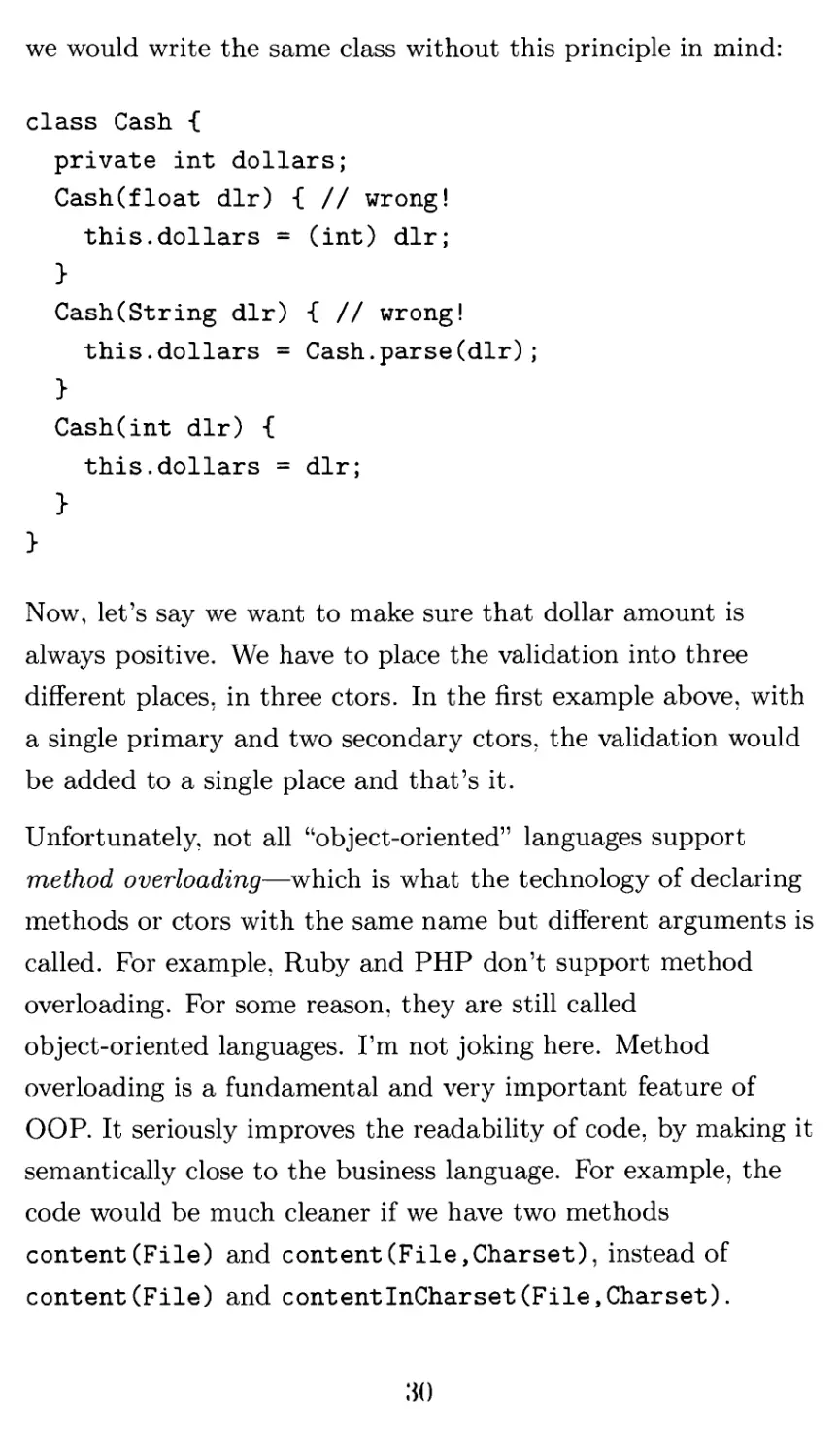
we would write the same class without this principle in mind:
class Cash {
private int dollars;
Cash(float dlr) { // wrong!
this.dollars = (int) dlr;
}
Cash(String dlr) { // wrong!
this.dollars = Cash.parse(dlr);
}
Cash(int dlr) {
this.dollars = dlr;
>
}
Now, let's say we want to make sure that dollar amount is
always positive. We have to place the validation into three
different places, in three ctors. In the first example above, with
a single primary and two secondary ctors, the validation would
be added to a single place and that's it.
Unfortunately, not all "object-oriented" languages support
method overloading—which is what the technology of declaring
methods or ctors with the same name but different arguments is
called. For example. Ruby and PHP don't support method
overloading. For some reason, they are still called
object-oriented languages. I'm not joking here. Method
overloading is a fundamental and very important feature of
OOP. It seriously improves the readability of code, by making it
semantically close to the business language. For example, the
code would be much cleaner if we have two methods
content(File) and content(File,Charset), instead of
content(File) and contentInCharset(File,Charset).
HO

Nevertheless, even in those languages, you still want to make
your ctors flexible and multi-purpose. Well, your first thought
should be to quit using them and migrate to Java, C++, or
something similar that's powerful enough to be called an OOP
language. If that's not possible (for example, it is JavaScript
and there is no better alternative), use maps of arguments.
This is PHP 5.4:
class Cash {
private $_dollars;
public function construct($args) {
if (is_int($args)) {
$this->_dollars = $args;
} else if (array_key_exists('float', $args)) {
$this-> construct(intval($args['float']));
> else if (array_key_exists('iso' , $args)) {
$this-> construct(
parse_dollars($args['iso'])
);
> else {
throw new Except ion OcanVt initialize') ;
>
}
\
new Cash(30);
new Cash(['float' => 29.95]);
new Cash(['iso' => 'USD 29.95']);
The code looks much more verbose and less readable than in
.lava, but that's the best we can do. However, you see that
there is the same principle is used—we initialize only in one
plnce. All other places simply prepare the arguments and send
Minn to that final primary place. Calling construct method
in 1*111* is a bad practice, but in this case it's acceptable. That
:ti

is because this is the only option we have.
You can probably do some other magic in those overloading-free
languages, but the main principle remains the same:
initialization of internal properties happens only in one place.
All other "places" simply prepare the arguments, reformat
them, parse them, transform them, etc.
As in all other recommendations in this book, the main point is
maintainability. This principle will help you reduce the
complexity of code and avoid duplication—the two biggest
enemies of maintainability.
\\2

1.3 Keep constructors code-free
Discuss at http://goo.gl/DCMFDY
We have a class with a primary ctor that accepts all necessary
arguments. These arguments are enough to initialize the state
of a new object. It's obvious, right? Since this ctor is the only
entry point into the object initialization process, the provided
collection of arguments is complete—nothing is missed and
nothing is redundant. Now, the question that arises is what we
can and can't do with this set of arguments. How do we
manipulate them?
The rule of thumb here is "don't touch the arguments." Let's
sec a counterexample first. This code touches its only argument
during object initialization:
class Cash {
private int dollars;
Cash(String dlr) {
this.dollars = Integer.parselnt(dlr);
}
>
Here. I want to encapsulate an integer while text is provided as
mi argument for the ctor. I need to convert the text to an
integer, and I'll do this conversion right inside the ctor. Seems
simple and obvious, doesn't it? Maybe, but it's a very wrong
approach.
The initialization of an object must be "code-free" and must
nut. lunch the arguments. Instead, it must wrap them, if
necessary, or encapsulate them in a raw form. Here is an
example of I he same rode that doesn't "touch" the text:
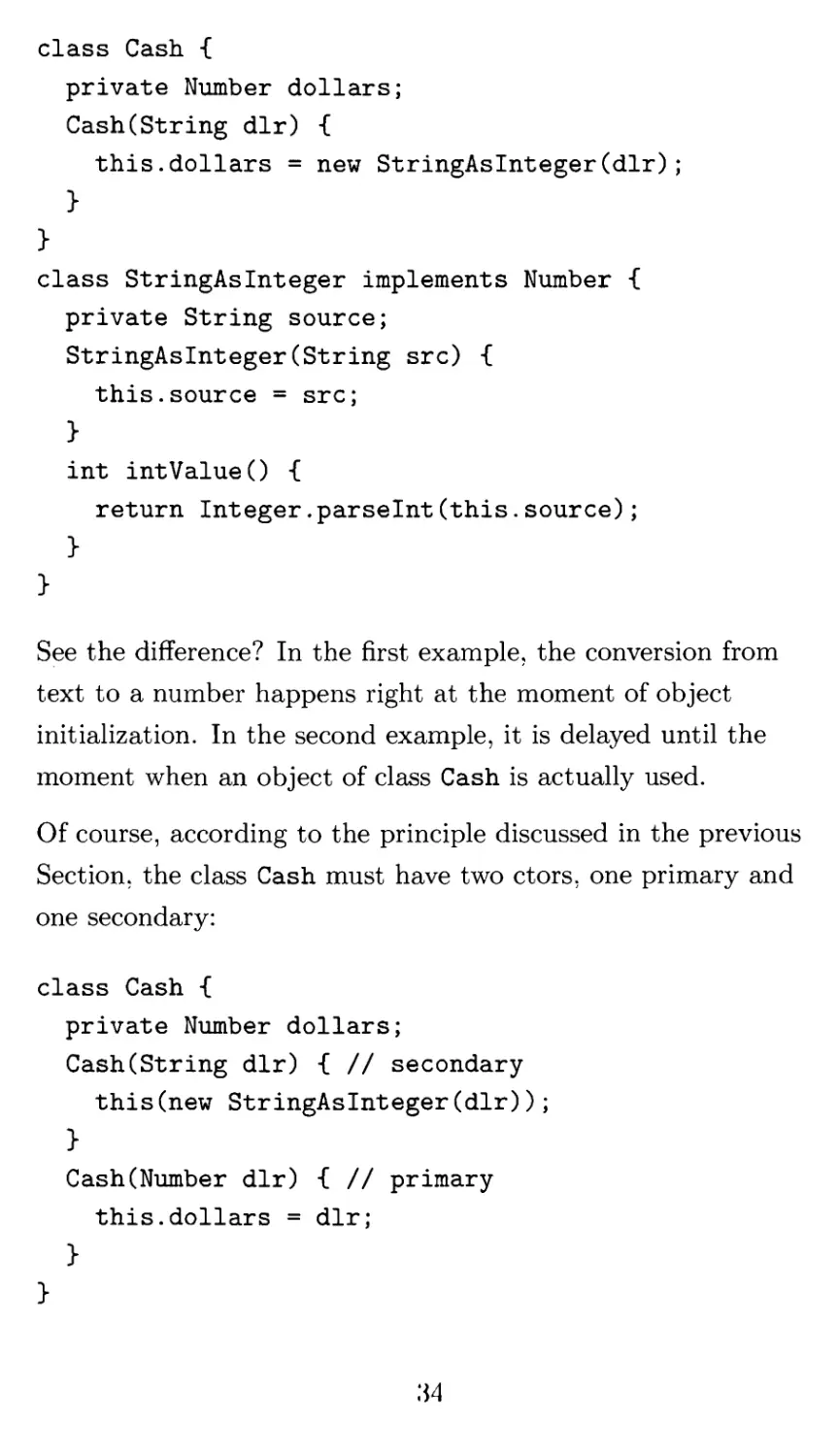
\\\\

class Cash {
private Number dollars;
Cash(String dlr) {
this.dollars = new StringAsInteger(dlr);
>
}
class StringAsInteger implements Number {
private String source;
StringAsInteger(String src) {
this.source = src;
}
int intValueO {
return Integer.parselnt(this.source);
}
}
See the difference? In the first example, the conversion from
text to a number happens right at the moment of object
initialization. In the second example, it is delayed until the
moment when an object of class Cash is actually used.
Of course, according to the principle discussed in the previous
Section, the class Cash must have two ctors, one primary and
one secondary:
class Cash {
private Number dollars;
Cash(String dlr) { // secondary
this(new StringAsInteger(dlr));
>
Cash(Number dlr) { // primary
this.dollars = dlr;
}
}
M

On the surface, the instantiation of Cash looks exactly the same
in both cases:
Cash five = new Cash(,,5") ;
However, in the first example, the five object encapsulates a
number five, while in the second example, it encapsulates an
instance of class StringAsInteger that looks like a Number. I
just invented this class StringAsInteger right here. It doesn't
exist in Java. As I already mentioned, Java is not really a true
object-oriented language, which is why I sometimes have to
make things up. Treat these examples as pseudo-code. But this
doesn't mean that my recommendations are abstract and
impractical. Instead, this means that not all of them are
directly applicable to the software you're writing right now. Our
tfoal here in this book is. first of all, to change our mindset and
our understanding of OOP. The second goal is to give practical
examples and apply our new mindset to the code we write.
Unfortunately, the second goal is not always easy to achieve.
In a true object-oriented approach, instantiation is when we
compose smaller objects into a larger one. The only reason for
(his process is that we need a new entity that obeys a new
contract.
Look at our example with the five object of type Cash. What
was wrong with a text object "5"? Why did we need to create
an object of class Cash? Why couldn't we work with M5M?
Uerause it didn't expose the methods we needed. It didn't work
by llie contract we needed. That's why we had to create a new
object of a different type. We built five of type Cash. He
doesn't, work by String contract anymore; he works by some
oilier conl rael. Tor example, he exposes method centsQ.
:ir>

We created him. but didn't ask him to work for us yet!
The first step is to instantiate an object; the second step is to
allow him to work for us. These two steps should not overlap.
A ctor should not ask its arguments to do anything, because the
ctor itself wasn't asked to do anything yet. In other words, a
ctor should be code-free. It should only contain assignment
statements. In terms of C++, its body should always be empty.
For example:
class Cash {
public:
Cash(const string& txt):
dollars(new StringAsInteger(txt)) {
// the body is empty, always
}
private:
int dollars;
}
There are a few purely technical reasons for this
recommendation. First of all, code-free ctors make your code
faster... because they are easier to optimize for performance.
Here is an example that will look slower at first glance but is
indeed faster:
class StringAsInteger implements Number {
private String text;
public StringAsInteger(String txt) {
this.text = txt;
}
public int intValueO {
return Integer.parselnt(this.text);
}
}
;ui

It looks like we are going to run text to integer parsing on every
call of intValueO, right? Indeed, that's true. This code will
parse twice:
Number num = new StringAsInteger(M123M);
num. intValueO ; // first parsing
num.intValue(); // second parsing
How. then, can it be faster than this, you may ask:
class StringAsInteger implements Number {
private int num;
public StringAsInteger(String txt) {
this,num = Integer.parselnt(txt);
}
public int intValueO {
return this.num;
>
}
This code is indeed more effective, since it parses only
once—during object initialization. Then, on every consecutive
call to intValueO, the object just returns the encapsulated
integer. So, what is the point?
Mere is the point. The second example, where the parsing
happens in the ctor, is not optimizable. The parsing will
happen every time we make an object. We can't control it.
riven if, in some situations, we don't need to call intValueO,
uur CPU will spend time parsing. Consider this example:
Number five = new StringAsInteger("5");
if (/* something is wrong */) {
throw new Exception("some problem");
\
C1 ve. intValueO ;
:»7

As you can see, we parsed "5" first and then realized that we
didn't need it! And we have no way to prevent this from
happening. Every time we construct an object, it immediately
proceeds with the arguments we give it. It happens without our
approval, and it happens always. To the contrary, if we
encapsulate the arguments the way they are passed and process
them later, on demand, we give our users the freedom to decide
when this should happen.
When the user wants to prevent multiple parsings from
happening, he or she can always create a decorator that will
cache the result of the parsing right after the first call:
class CachedNumber implements Number {
private Number origin;
private Collection<Integer> cached =
ArrayListo(l);
public CachedNumber(Number num) {
this.origin = num;
}
public int intValue 0 {
if (this, cached. isEmptyO ) {
this.cached.add(this.origin.intValue());
>
return this.cached.get(0);
}
}
Fm using ArrayList in order to avoid null, which is a very bad
thing in OOP. We will discuss this later in Sections 4.1 and 3.3.
This is a rather primitive implementation of caching, but I hope
you got the idea. Then, this caching decorator is used to wrap
an object we want to make more effective:
38

Number num = new CachedNumber(
new StringAsInteger(M123M)
);
num.intValue(); // first parsing
num.intValue(); // no parsing here
The beauty of this solution is that it's very controllable and
transparent. The instantiation of an object doesn't do anything
except build an object, while his methods do the actual job.
Moreover, we control it all! We optimize while the object works.
Thus, by making ctors code-free, we make our objects more
controllable and transparent for their users. We make them
easier to understand and reuse. They work only when being
asked to and don't do anything until that very moment. They
are very "lazy"—in a good way.
There could be situations when it's absolutely clear that we
have to do all manipulations only once. In these situations, why
can't we do this in the ctor? We can, but I would still caution
against it, mostly for the sake of uniformity. You don't know
what will happen with this class in the future and how much
will be changed after the next refactoring. Placing any
manipulations into the ctor we will make that refactoring much
more difficult. The author of refactoring will have to move
manipulations into the methods. Only then will the author be
able to start making real changes.
I've tried to find a second technical reason for this
recommendation of keeping ctors code-free, but can't. It
appears the one I explained above is the only
reason lightweight ctors make objects faster due to a more
configurable and transparent usage. That's it.
:«)

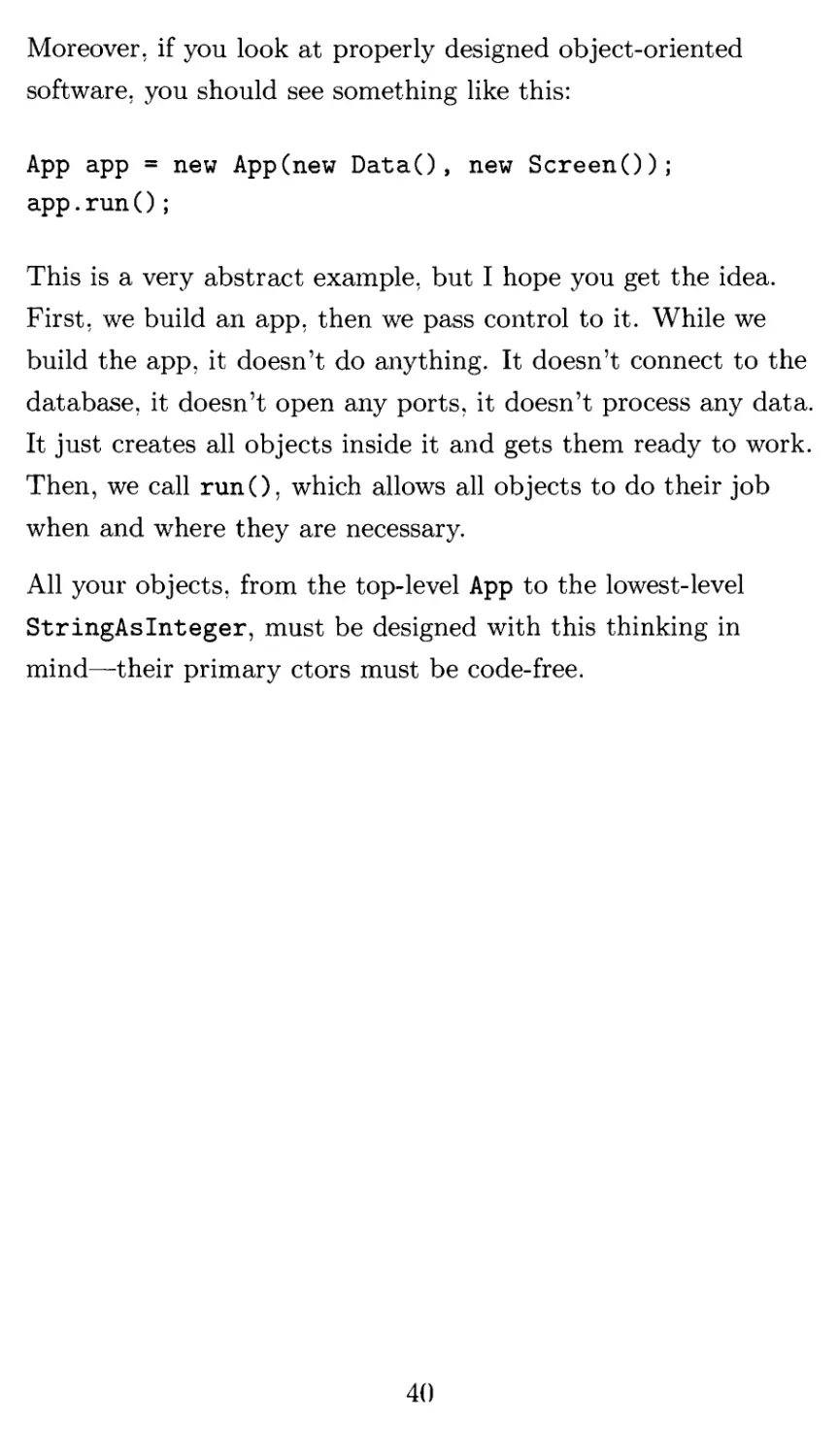
Moreover, if you look at properly designed object-oriented
software, you should see something like this:
App app = new App(new DataO , new ScreenO);
app.run();
This is a very abstract example, but I hope you get the idea.
First, we build an app, then we pass control to it. While we
build the app, it doesn't do anything. It doesn't connect to the
database, it doesn't open any ports, it doesn't process any data.
It just creates all objects inside it and gets them ready to work.
Then, we call run(), which allows all objects to do their job
when and where they are necessary.
All your objects, from the top-level App to the lowest-level
StringAsInteger, must be designed with this thinking in
mind—their primary ctors must be code-free.
40

Chapter 2
Education
The sections in this book are grouped into chapters rather
artificially, but still there is some logic behind it. In this
chapter, we'll discuss a few principles of making an object ready
lor interaction with other objects. We'll send him to school and
j^ive him a few good lessons on how to behave.
I I ere is a summary of all the advice you will read in the next
lew sections: An object has to be small A small object is an
elegant and maintainable object. There can be no excuse in
()()P for a class of 1,000 lines. Unfortunately, keeping an object
small is easier said than done. How can we make an object
small if there are so many functionality requirements? Bear
with me. A few practical recommendations follow.
II

2.1 Encapsulate as little as
possible
Remember, it's all about maintainability. Everything I've
written about in this book directly affects the complexity of
your code, which directly affects its maintainability. The higher
the complexity, the lower the maintainability, which leads to the
waste of time, money, and customer satisfaction1. I'm sure we
are on the same page here.
With this in mind, I recommend you encapsulate four objects
or less. If you need to encapsulate more, there is something
wrong with the class, and it needs refactoring. No exceptions.
Four or fewer. I'm just making this number up, there is no
scientific proof behind it, but I will explain why four in the next
few pages.
Encapsulated objects, all together, are also known as the
"state" or "identity" of the object. For example:
class Cash {
private Integer digits;
private Integer cents;
private String currency;
}
Here, we encapsulate three objects. All three of them together
identify objects of class Cash, which means that any two objects
encapsulating the same dollars, cents, and currency are equal to
each other. Yes, this is a technically invalid statement in the
1 I don't have any statistics to prove that claim, but it sounds very
logical to me. If you know any of research in this field, please let me know
and I'll add it in the next edition of the book.
42

.lava world, but that's just a flaw of Java design, in my opinion.
Here is how I think the object paradigm should be implemented
in a purely object-oriented language:
Cash x = new Cash(29, 95, "USD");
Cash y = new Cash(29, 95, "USD");
assert x.equals(y);
assert x — y;
In Java, as well as in C++, the identity of an object is separate
from its state. These two objects, x and y, have the same state
but different identities. They are not equal to each other, as far
as the — operator is concerned, and their default
implementation of equals() also states they are not the same.
Ifs a flaw in Java design, inherited from C++. As far as I
understand, an "object" in OOP is an aggregation of other
objects that work together to produce high level behavior. A
hook is an aggregation of pages, a cover, and an ISBN, while a
bookshelf is an aggregation of books and a title. A car is an
abrogation of wheels, an engine, and a windshield, while a
parage is an aggregation of cars and an address. An employee is
an aggregation of a name, age, and salary, while a department
is an aggregation of employees, a name, and a manager. These
a iv very primitive examples, but they demonstrate that without
pucapsulated objects, an object doesn't and can't
pxisi. because he is nothing without his parts.
In .lava., however, an object can exist without parts and without
bring equal to an exact duplicate that also has no parts. This
fiics against common sense. But there is sense in Java for that.
In .lava, and almost all other OOP languages, an object is just a
np! of dala. wil.li niptliods attached to it. It's like a shell where
i:i

some data can be stored. Whether or not it stores data, one
shell is different from others, despite comparing duplicate
objects:
Object x = new ObjectO;
Object y = new ObjectO;
assert x.equals(y); // fails
This is a perfectly valid piece of code that shows how two
objects are just two shells with no data inside. Of course, they
are not equal to each other because they are different shells.
That's how Java sees objects. And it's terribly wrong.
An object must not exist without a state, and the state must be
his identity.
Since we agree that all encapsulated objects are part of an
object's identity, we have to decide how many of them are
reasonable to encapsulate. As I said above, up to four is a
reasonable number. Why four? Here is my justification.
The identity of an object is basically its coordinates in the
universe. My identity is my name and my date of birth. Using
these two properties, you can find me in the entire universe
(well, provided that this time and the Earth are the only
existing coordinate spaces). My car has a make, a model, and a
year of manufacture. These three properties uniquely identify it
in the universe. I can give you more examples, but the point is
that having more than four coordinates is just counterintuitive.
It is just too difficult to understand in our current way of
thinking about objects in the universe. One of my reviewers
gave me a counter example here. He said that even if he and his
neighbour have cars of the same make, model and year, they are
still different cars. That's true, but that's because in this
44

counter example the car is a much more complex thing than in
my object-oriented example above. Of course, if our object is
referring to a real car from a real world, it must have way more
coordinates and attributes to identify itself in a unique way.
Hut these attributes will be grouped into other objects, which
all together will organize a tree of objects. Say, a car will
encapsulate a type and a Vehicle Identification Number (VIN).
A type will encapsulate a make, a model, and a year. Thus,
we'll have a small tree of objects.
OF course, I've seen classes encapsulate dozens of objects. This
is absolutely wrong. Don't do this. Four is the maximum. If
you need more, break your class down into small ones.
And. by the way, to resolve that Java flaw, I recommend you
si ay away from the == operator and always override the
equals () method2.
'' To nmkc things simple, I utilize (OEqualsAndHashCode from the
,<)iiil>n|< project.
•i.r)

2.2 Encapsulate something at
the very least
Discuss at http://goo.gl/QE9aXg
Another extreme is an object that encapsulates nothing at all.
For example (this algorithm is wrong, but it's not important
here):
class Year {
int readO {
return System. currentTimeMillisO
/ (1000 * 60 * 60 * 24 * 30 * 12) - 1970;
}
}
An instance of this class will encapsulate nothing, which means
that all objects of class Year will be equal to each other,
considering what we just discussed in Section 2.1. right? This
design is also wrong. Encapsulating too much is a bad idea, but
encapsulating nothing is also not the way to go.
A class without properties is very similar to a static method,
which is a terrible thing in object-oriented programming
(Section 3.2). Such a class has no state and no identity, just
behavior. What is wrong with that, you ask? The answer is
simple. In pure OOP, without static methods (Section 3.2) and
with a strict separation of instantiation and execution
(Section 3.6), this would technically not be possible.
The instantiation should be isolated from execution, which
means exactly this: operator new is allowed only inside
constructors. More about that in Section 3.6. For now, let's
just assume that in a true object-oriented design, the operator
46

new is allowed only inside ctors.
Now, look at the class above. Its method read() uses a static
method from utility class System. In pure OOP, we would not
have static methods at all and would not be able to make this
call. Instead, we would have to make an instance of some class,
which would retrieve the value of the system clock. This is how
our design would look:
class Year {
private Millis millis;
Year(Millis msec) {
this.millis = msec;
}
int readO {
return this,millis.readO
/ (1000 * 60 * 60 * 24 * 30 * 12) - 1970;
}
}
We have to encapsulate something unless our object is very
close to "nothing." By "nothing", I mean a creature without
any coordinates in the Universe. Only such an entity would not
have anything to encapsulate, since it's the only one and it
doesn't need any other entities to survive and position itself. To
I he contrary, any object that does something co-exists with
other objects and utilizes them. He has to encapsulate them in
order to identify himself. This may sound rather abstract and
philosophical. That's exactly how it should sound. There is no
practical reasoning for that. We definitely can create an object
Mini encapsulates nothing. There are multiple examples for
I lint. I int. philosophically speaking, it's wrong and that's why
il \s vvronji, in practice.
-17

Also, let's look at this problem from another point of view. As
we discussed in Section 2.1, encapsulated state is a unique
identity of an object that positions him in the universe. If there
are no encapsulated items, what are his coordinates? Yes,
they're the entire universe:
class Universe {
>
This class may exist, but only once. Because there is only one
Universe. I don't see any practical reason for its existence,
though.
By the way, I've mentioned above that the design is "better",
but not perfect. This is what a perfect object-oriented design
would look like:
class Year {
private Number num;
Year(final Millis msec) {
this.num = new Min(
new Div(
msec,
new MuKlOOO, 60, 60, 24, 30, 12)
),
1970
);
}
int readO {
return this.num.intValue();
}
}
Or like this:
4H

class Year {
private Number num;
Year(final Millis msec) {
this.num = msec.div(
1000.mul(60).mul(60).mul(24).mul(30).mul(12)
).min(1970);
>
int read() {
return this.num.intValue();
>
}
15ut more about this later.
-I!)

2.3 Always use interfaces
Discuss at http://goo.gl/vo9F2g
Now let's talk about the mission of an object in the world he is
going to live in. As I mentioned above, an object is a living
organism that communicates with other organisms and helps
them do their work. They also help the object do his work. It's
a very social, tight environment.
What I mean here is that objects are coupled to each other
because they need each other. It's very good at the beginning,
when we know exactly what each object has to do and which
services he has to provide to other objects. But when the
application starts to grow and the number of objects exceeds a
few dozen, tight coupling between them becomes a serious
problem. This problem affects maintainability. It's all about
maintainability. Every section in this book aims to encourage
you to care about maintainability more than anything else,
including performance.
In order to make our entire application maintainable, we have
to do the best we can to decouple objects. Technically, this
means that I can modify one object without modifying the
others that interact with it. The best instrument for this is
interfaces. For example:
interface Cash {
Cash multiply(float multiplicand);
}
This is the interface. In other words, it's a contract that our
object must obey in order to communicate with other objects.
Here is how:
.r)()

class DefaultCash implements Cash {
private int dollars;
DefaultCash(int dlr) {
this.dollars = dlr;
}
©Override
Cash multiply(float multiplicand) {
return new DefaultCash(this.dollars * mul);
}
}
Now, when I need to use cash value, I rely on the contract
instead of the actual implementation:
class Employee {
private Cash salary;
}
This Employee class doesn't really care how interface Cash is
implemented. It's not interested in how the method
multiply() really works. It simply doesn't know how it works.
This literally means that interface Cash helps us decouple class
Employee and class DefaultCash. Now I can change
DefaultCash, or even replace it with something else. The
Kmployee doesn't care.
Tin sure all of this is obvious, but here is my suggestion: make
sun* that all public methods in your class implement some
interfaces. A properly designed class must not have any public
methods that don't implement at least one interface. In other
words, this is not an acceptable design:
fil

class Cash {
public int cents() {
// something
}
}
This cents() method does not override anything, and it's
wrong. Because this design encourages its users (other classes)
to couple to the class tightly. Other classes will use
Cash, cents() directly, and there won't be any possibility in
the future to replace the implementation with a new one.
On a more philosophical note, a class is there only because
someone needs his service. This service must be documented
somewhere—it's a contract, an interface. Moreover, there has to
be a competition between providers of the service. This is what
multiple classes implementing the same interface are about.
And each competitor must be easily replaceable with another
one. This is what loose coupling is about.
You may say that even though we don't couple classes directly
any more, we do via interfaces. A class must implement an
interface in order to be understood and used by another class.
We can't change the interface without making immediate
changes to all classes that implement it and all classes that use
it. That's true. This coupling is still there and there is no way
to get rid of it. Actually, this coupling is not a bad thing. It
allows us to keep the entire system in a stable state. We can't
break it by accidental changes to one part of it, where the other
part doesn't know about the changes. Interfaces, as contracts
between parts, help us keep the entire environment organized.
52

2.4 Choose method names
carefully
We've already discussed how to name a class in Section 1.1.
Now it's time to name methods properly. I suggest this simple
rule of thumb: builders are nouns, manipulators are verbs3.
Guilders are what I call methods that build something and
return a new object. Builders always return something. They
nover return void, and their names are always nouns. For
example:
int pow(int base, int power);
float speed();
Employee employee(int id);
String parsedCell(int x, int y);
I'ay attention to that last method, parsedCelK). It's not just
n mouii, but a noun with an adjective in front of it. That doesn't
change the principle; it only makes the name more descriptive.
Il \s still a noun, but with more information. It's not just a cell,
I Mil. a parsed cell. We should probably expect this method to
rH.uni a cell that has transformed its contents somehow.
I mil a manipulator a method that makes modifications to the
real-world entity being abstracted by an object. It always
returns void, and its names are always verbs. For example:
'' Ih is idea is very similar to the one suggested by Bertrand Meyer in
his hook Ohjcct Oriented Software Construction (Prentice Hall, 2nd edition,
MK)7), where he proposes to divide object's methods into two sharply
nepjinited ente^ories: queries and commands.
r>;j

void save(String content);
void put(String key, Float value);
void remove(Employee emp);
void quicklyPrint(int id);
Pay attention to the last method. quicklyPrint (). It's a verb
with an adverb in front of it. The key element here is the verb
"print", while "quickly" just explains it, giving us more
information about the context and the purpose of the method.
You may give your own names to these builders and
manipulators, but try to keep this principle intact: builders
build and manipulators manipulate. And there is nothing in
between. There should not be any methods that manipulate
and return something, nor build and manipulate at the same
time. Let me give a few bad examples:
// returns total bytes saved
int save(String content);
// returns TRUE if map was modified
boolean put(String key, Float value);
// saves speed and returns previous value
float speed(float val);
The design of method saveO is bad because it is a
manipulator. It "saves", but at the same time, it returns int as
if it was a builder. We should either return void or rename it
to something like bytesSavedO.
The same problem occurs with method put(), which works as a
manipulator, but returns boolean as a builder. The only
solution here is to return void. But we want to know whether
the value was changed for the given key! In that case, we have
to change the entire design of the class and, for example, return
54

an instance of Put Operation. This would have a manipulator
saveO and a success/failure status via success (). The
method speed () saves the value and also returns the previous
one. Yet another example of a bad design, because at the same
t ime, it is a builder and a manipulator. We can fix that
similarly to the previous example, by creating a class
SaveSpeed, which would have two methods, one for saving the
speed and another one for returning its previous value.
We'll discuss "setters" and "getters" later, in Section 3.5. Here,
I believe, it's already obvious that names that start with get
are just wrong. Well, because "get" is a verb but getters are
basically builders, since they are supposed to return something.
So, this is my first argument against "getters."
Now, I think I owe you an explanation for this idea. There are a
few arguments in its favor.
2.4.1 Builders are nouns
Kirst, it's wrong to name a method as a verb if it returns
something. Such a name goes against the idea of object
thinking. When I stop in at a bakery, I don't say "cook me a
brownie" or "brew me a cup of coffee." I'd say, "I'd like a
brownie" or "I'd like to have a cup of coffee." If I said "cook
i iic" or "brew me" something, it would sound rather offensive. I
should not care how exactly that brownie is made or how that
cii|> of coffee is brewed. How the bakery makes them is its
business. I have demand for an object—a brownie or a cup of
ml lee. They can satisfy my demand. How exactly this happens
inside the bakery is none of my business. Here is the bakery:
W>

class Bakery {
Food cookBrownieO ;
Drink brewCupOfCoffee(String flavor);
}
These two methods are not actually methods of an object.
They are procedures. Their naming tells us that we ought to
pay no respect to the bakery as a self-sufficient and
self-managed object, and just tell it what to do for us. This is a
procedural approach, not an object-oriented one. This is how
these two procedures would be designed in C, for example:
Food* cook_brownie() {
// cook that brownie
// and return it
}
Drink* brew_cup_of.coffee(char* flavor) {
// brew a cup of coffee
// and return it
}
There is no bakery involved. We just have two pieces of
machine instructions in C syntax, and we call them. We call
them functions in C, but they are actually procedures because
they have very little to do with functional programming as well.
We ask the computer to run those instructions for us and
return the result. We are thinking like a computer, not like an
object. We don't trust the bakery, so we tell it to "go and brew
the damn coffee" instead of asking for a cup of coffee with a
certain flavor and then just entrusting the establishment with
the result, no matter what it is.
I don't want to sound too philosophical, but this naming
subject is indeed very abstract and conceptual. A properly
r>(!

named method helps its users better understand what the
object is designed for, what his mission is, what the purpose of
his existence is, and what the meaning of life is for him. An
improper method name may ruin the entire idea of an object
and encourage its users to treat him as a bag of data and a
collection of procedures. It's a very typical mistake that is
repeatedly made by OOP libraries, SDKs, APIs, etc. An object
is a living organism who knows how to perform his duties and
wants to be respected. He wants to work by the contract, not
just follow instructions. There is a big difference. Just like us,
programmers, right?
That's why when the name of the method is a verb, it's
basically telling the object "what to do." And asking an object
lo "build" something is not a polite and respectful way to work
with him. Just request what you need to be built, and let him
decide how to build it. All of these names are wrong:
InputStream load(URL url);
String read(File file);
int add(int x, int y);
They should be replaced with:
InputStream stream(URL url);
String content(File file);
int sum(int x, int y);
Pay attention to the fact that instead of add(x,y), I'm
siitftf(\sting you use sum(x,y). It may look like a small and
mi important change, but it really makes a big difference in your
thinking. Wo don't ask our object to add x to y. Instead, we
ask liim lo produce the sum of the two and return a new object.
57

Will he really find the sum? I don't know. Maybe. All I know
is that the result will look like the sum of x and y. Again, I'm
not telling my object what to do, I'm just asking for a result
that must obey a certain contract—be an integer number. In
Java and many other languages, a number is not an object, but
a scalar. That's just a defect in those languages. In a true
object-oriented environment everything is an object, especially
strings, numbers, boolean values, bits, and bytes.
This is the first argument and the first use case. We are getting
something from an object, or in other words, asking an object
to build something for us. Now, let's discuss the second
argument and the second use case, when we ask the object to
do some manipulation for us.
2.4.2 Manipulators are verbs
An object is a representative of a real-world entity. An object of
class File represents a file on disk, an object of class Pixel
represents a pixel on the screen, and an instance of class
Integer represents four bytes of RAM (Surprised? We'll
discuss that in detail in Section 3.4).
When we need to manipulate a real-world entity, we ask the
object to do it for us. For example:
class Pixel {
void paint(Color color);
}
Pixel center = new Pixel(50, 50);
center.paint(new Color("red"));
We ask object center to paint a pixel on the screen, located at
the 50x50 coordinates. We don't expect anything to be built.
58

We just want to make a modification to the world, and the
object is a representative of that for us. Now, you may ask how
this is not a procedure. It is named as a verb, and it basically
directs an object to do something for us. Yes, it's a valid
question, but the key difference is the result returned.
The method paint () doesn't return a result. Using the same
bakery metaphor, this is similar to asking a bartender to turn
up the music. Will she make it louder? Maybe she will. Maybe
not. Our request may just be ignored. It's never offensive or
disrespectful, because we are not expecting anything back.
Imagine how this would sound otherwise—"Please turn up the
music and tell me its volume level when you're done." That's
exactly how a manipulator that returns a value looks. Very
disrespectful.
Thus, the difference is in the return value. Only a builder is
allowed to return a value, and its name must be a noun. When
an object allows us to manipulate, the name has to be a verb,
and there must be no return value.
I think it's possible to follow a less strict naming convention,
provided you keep the main principle in mind. For example,
when using a Builder Pattern, you can start method names
with a with prefix:
class Book {
Book withAuthor(String author);
Book withTitle(String title);
Book withPage(Page page);
}
lluv. llic iiaiiu* withTitle is just a short form of
bookWithTitle. In order to avoid this book prefix in all
f>!)

methods, we can use just the with prefix. But the principle is
still in place—these methods are builders, and their names are
classified as nouns. By the way, I'm in general against this
Builder Pattern, mostly because it encourages us to make
bigger objects, which are inevitably less maintainable and way
less cohesive than smaller ones. We use builders when we don't
want to pass a large amount of arguments into ctors. That's
where builders are helpful. But large amount of arguments is
the problem in the first place. Instead of using builders, we
should break our complex objects into smaller ones. Long story
short, don't use builders.
2.4.3 Examples of both
Let's discuss a few practical examples of refactoring. Let's say
we have a method that saves file content and returns the
number of bytes actually saved:
class Document {
int write(InputStream content);
}
It looks like a valid method, but it violates the principle I just
described. It has to return void, but we need to know how
many bytes were actually saved. What do we do? Just rename
it to bytesWrittenO? That would be wrong, because the
purpose of the method is not to calculate bytes, but to actually
write the content to the document.
The builders/manipulators naming principle actually tells us in
this example that the method write() is doing too many
things at the same time. It writes the data and counts the
bytes. That's too complex for a single method. We can't give it
(50

a clean noun or verb name because its purpose is not clear
enough. It's unfocused. Here is how I recommend we refactor it:
class Document {
OutputPipe output();
}
class OutputPipe {
void write(InputStream content);
int bytes();
long timeO ;
}
As you see, method output () is a builder. It builds a new
object of type OutputPipe that is ready to write the content
(pay attention, I don't call it a "writer"). The content is not
yet written; we just have an object ready to perform this
operation for us. Then, we call write() on the pipe, and it
collects the data about this transaction. Now we can collect
more information than just the number of bytes. We can collect
the time of the transaction and many other things.
The designers of Go language made a big mistake, in my
opinion. They made it possible to return multiple values from a
single method, which encourages programmers to make methods
even more complex and unfocused than in other languages. In
(!o, we would be able to declare method write() like this:
type Document struct {}
func (d Document) write(s Stream) (int, int) {}
This is how our code gets messy and maintainability decreases,
while* the whole purpose of OOP is to decrease complexity by
isolation of concepts. The smaller the concept being isolated,
(■lie easier it is to understand and maintain. The concept in this
(11

case is "writing bytes to the document." The refactoring I
proposed above isolates the concept in its own class called
OutputPipe, while Go encourages me to stay in Document and
make its method, write(), even more complex.
2.4.4 Boolean results
Wait, what about methods that return Boolean values? For
example, take method isEmptyO in class String. How would
you recommend naming it, you may ask. Or method equals ()
in Object. Or method exists() in File. There are many of
them everywhere. According to the principle described above,
all these names are wrong. But what is the alternative?
I think methods that return Boolean values are an exception to
this rule. They are also builders, but for better readability,
their names should be adjectives. For example:
boolean emptyO;
boolean readable();
boolean negativeO;
Prefix is is redundant and should not be used, but it should
always be temporarily placed in front of the method name in
order to ensure that it sounds right. I mean place it, read it,
and use the name without the prefix. This mental exercise is
required in order to avoid using verbs instead of adjectives. For
example, here's what all these methods would sound like:
boolean emptyO; // is empty
boolean readable(); // is readable
boolean negativeO; // is negative
However, these methods will cause problems:
(52

boolean equals(Object obj);
boolean exists();
This is mostly because "isEquals" and "isExists" don't
sound right. Much better names would be equalTo and
present, because "is equal to" and "is present" do sound right.
Why are Boolean methods an exception? Well, because Java
and most other languages give it a special treatment in logical
constructs. Say, we have class String, which has builder
method length(). We add method emptiness(), which will
return the status of the string—either it's empty or not. Then,
use it like this:
if (name.emptiness() == true) {
// do something
}
This reads correctly: "if emptiness of the name is true."
However, we don't do that in Java. We use a shorter form of
this comparison. We simply skip the ==true part. That's why
an adjective will sound nicer:
if (name.empty()) { // "if name is empty"
// do something
>
Let me summarize this section. First, make sure you know the
mission of your method. It's either a builder or a manipulator.
11 can't be both. ever. Then, name it with a noun if it's a
builder, or with a verb if it's a manipulator. The only exception
is a builder that returns a Boolean value. In this case, use an
adjective. That's it.
(YA

2.5 Don't use public constants
Discuss at http://goo.gl/QlUoru
A public static final property, also known as a "constant", is a
very popular mechanism for sharing data between objects. Yes.
that's exactly what these constants are for—sharing data (or
other objects). And this is what I'm strongly against. Objects
should not share anything; they should instead be self-sufficient
and very "closed." This sharing mechanism simply goes against
the idea of encapsulation and the entire object-oriented way of
thinking. Let's discuss this through an example. Say I have a
method that writes some structured data to the Writer and
terminates each line with a "new line":
class Records {
private static final String CRLF = M\r\n";
void write(Writer out) {
for (Record rec : this.all) {
out.write(rec.toString());
out.write(Records.CRLF);
}
}
}
In this example, the static final property CRLF is private and is
used only inside the class Records. That is a perfectly valid
situation. We just don't want to write "\r\n" every time we
need it inside this class. Now let's say we have another class
that is doing something very similar, but with different objects:
(54

class Rows {
private static final String CRLF = "\r\nn;
void print(PrintStream pnt) {
for (Row row : this.fetchO) {
pnt.printf(
"{ °/oS }%sM, row, Rows,CRLF
);
}
}
}
There is different logic in this class, and it works with a
completely different set of objects. These two classes, Records
and Rows, are not connected by anything. They have nothing in
common. However, they both define a private constant: CRLF.
Is this code duplication? Of course it is. How do we resolve it?
How did we resolve it in C? We had the #def ine macro, which
allowed us to define it once and reuse it everywhere:
#define CRLF M\r\nn
However, we are not in C anymore. We have objects in OOP,
and solving code duplication problems by means of public
constants is a very incorrect approach. It is very procedural;
I hat's why it's wrong. Here is how we could "solve" it in Java:
public class Constants {
public static final String CRLF = M\r\nM;
}
Mow different is it from the #define C macro? Not much.
They arc both available in the global scope of visibility—every
class may use them. I would actually say that the C macro is
(i.r>

better, because it is not visible to everybody. It is visible only if
you include a certain .h file where this macro is declared. In
Java, class Constants is public, and that's why it's visible to
literally all other classes in the class loader.
By introducing class Constants, we are "solving" the code
duplication problem, because classes Records and Rows will use
Const ant s.CRLF instead of Records. CRLF and Rows.CRLF,
respectively. They will not have to define this constant locally
anymore. They will just "reuse" a publicly available one. The
problem's solved, isn't it? Not at all!
By solving one problem, we introduced two bigger ones: 1) the
introduction of coupling and 2) the loss of cohesion.
2.5.1 Introduction of coupling
First, the coupling problem. Here is how our class Records
looks now:
class Records {
void write(Writer out) {
for (Record rec : this.all) {
out.write(rec.toStringO) ;
out.write(Constants.CRLF); // here!
}
}
}
This is how Rows looks:
()(J

class Rows {
void print(PrintStream pnt) {
for (Row row : this.fetch()) {
pnt.printf(
M{ 70s }M, row, Const ants. CRLF // here!
);
}
}
>
Now, they both depend on the same object, and these
dependencies are hard-coded. There is no easy way to break
them. We have three places where sections of code are coupled
to each other and depend on each other: Records.write0,
Rows.print (), and Constants.CRLF. If I change the content of
Constants.CRLF, the behavior of two classes will change in an
unpredictable way. Why unpredictable? Because when I change
the value of Constants.CRLF, I have no idea how this value is
used. Maybe it's used for ending lines while printing. Or maybe
it is used to end lines in an HTTP protocol, where changing
these line endings is absolutely impossible due to a mandatory
requirement of HTTP.
The object Constants. CRLF remains alone in a global scope of
visibility, without any semantic usage around it. We simply
don't know how this object is used, in what context, and how
the changes we may make will affect its users. We encourage its
users to be coupled with it, which will eventually lead to a huge
loss in maintainability. Remember, it's all about
maintainability! When many objects use another object and we
don't know how they use it—they are coupled to it very tightly.
When the constant is rather primitive, like this CRLF, the
problem is not that biji, because the semantics are rather clear.
(17

However, when the constant is more complex, the problem
becomes more serious.
2.5.2 Loss of cohesion
By using public constants, our objects become less cohesive—in
other words, less focused on solving their own specific problems.
They have to know how to deal with the constants. They have
to add their own semantics to those pretty dumb constants.
Yes indeed, they are dumb. What does this Constants. CRLF
know about itself? Nothing. It is just a piece of text that
doesn't even understand what it's for. It doesn't know its own
mission and purpose. The meaning of life is not clear for this
constant, philosophically speaking.
In order to add semantics, we have to write more code in classes
Records and Rows. We have to wrap those primitive static
constants in some code that will make their purpose more clear.
But it's not the purpose of Records and Rows. They are
designed to work with records or rows, not with line endings.
They would be cohesive if they could outsource this job to
someone—"I work with records and you help me deal with line
endings." That would be a fair request, which would help our
classes stay more cohesive.
So, what is the alternative? Here is what I'm suggesting to
resolve the code duplication problem properly. We should not
share data between objects. Instead, we should create new
classes that help us share functionality. Again, not data but
functionality! For example, we see that in both classes, we need
to print lines that end with CRLF. Let's create a class for that:
(58

class CRLFString {
private final String origin;
CRLFString(String src) {
this.origin = src;
}
©Override
String toStringO {
return String, format (M°/0s\r\nM, origin);
}
}
Now we can use it when necessary, like in Records:
class Records {
void write(Writer out) {
for (Record rec : this.all) {
out.write(new CRLFString(rec.toString()));
}
}
}
And in Rows:
class Rows {
void print(PrintStream pnt) {
for (Row row : this.fetch()) {
pnt.print(
new CRLFString(
String.format(••{ °/0s }M, row)
)
);
}
>
}
(K)

Now, the functionality that appends a suffix to the line is
perfectly isolated in class CRLFString. How exactly that suffix
is added to the line is up to this class. In Records and Rows, we
don't have that logic. We don't know how exactly a line gets a
required suffix. All we know is that CRLFString is responsible
for that job.
You might say that now we are coupled with class CRLFString,
which is the same as being coupled with Const ant s.CRLF, but
it's not. Yes, we are coupled with CRLFString, but this
coupling doesn't degrade maintainability because it's a coupling
through a contract which means that it's breakable. There are
two equally smart elements in this coupling—an object of class
Records and an object of class CRLFString. The latter works
by the contract, and the semantics of the contract are
encapsulated inside it.
Let's say that tomorrow we want to change our behavior
depending on the platform we're currently working on. We
don't want to use H\r\nn when running on Windows. We want
to throw an exception in this situation. Our contract (interface)
stays the same, but the behavior changes:
70

class CRLFString {
private final String origin;
CRLFString(String src) {
this.origin = src;
}
String toStringO {
if (/* this is Windows */) {
throw new IllegalStateException(
"We're on Windows, can't use CRLF, sorry"
);
}
return String, format (n0/0s\r\nn , origin);
}
}
Was it possible to do this with a public static literal? Not really.
Does this mean that for each public constant we should create a
new class, which will encapsulate the semantics of this
constant? Yes. Does this mean we may have hundreds of micro
classes instead of hundreds of simple constant string literals?
Yes. Won't this make our code more verbose and polluted by
redundant micro classes? No. The more small classes you have,
the cleaner the code—provided the small classes don't duplicate
each other. This statement may sound not logical to you. let's
stop here for a second. It's important. I do mean that the more
classes you have in your application, the better its design and
more maintainable it is. The best analogy here is with a
language we speak. The more words you use in English,
provided they are not just synonyms being used to impress the
reader, the more readable your text is. To the contrary, if you
put too much moaning in some words and reuse them
frequently, the text, becomes unreadable. Here is an example:
71

My cat likes to eat fish and drink milk.
Here is another example, which uses a bit less words:
My thing likes to eat that thing and
drink another thing.
We're overusing the word "thing", putting too much meaning
into it. The reader should figure out what exactly that "thing"
means in the first place, in the second and in the third ones.
Instead, using "cat", "fish", and "milk" helps us digest the
semantics faster. The same happens with classes, which are too
big and too powerful. Sometimes, we simply don't know what
that Java. io.File means exactly, if it's used everywhere. It
would be much more convenient to have TextFile, JPGFile, or
TempFile.
Let me give you another example. Every HTTP client I know,
not only in Java, provides the possibility to change the HTTP
request method in this way:
String body = new HttpRequest()
.method("POST")
.fetchO;
Then, you have a collection of public static literals for the
names of HTTP methods. In the end, your code looks similar
to this:
String body = new HttpRequest()
.method(HttpMethods.POST)
.fetchO;
That runs contrary to the spirit of OOP. Instead, it would be
72

much better to create a number of simple classes that would
represent those methods:
String body = new PostRequest(new HttpRequest())
.fetchO ;
Now, PostRequest knows how to configure HttpRequest so it
makes a POST request instead of a default GET one. The logic of
this configuration, the semantics of the "POST" literal, is
encapsulated inside a new class, PostRequest. We shouldn't
have to remember what this "POST" means anymore. We just
need to make a POST request, and how exactly that happens at
the HTTP level is none of our business.
To summarize, public constants are pure evil in OOP and must
not be used, ever. There can be no excuse for them. I'm aware
that the modern Java, Ruby, PHP, Scala, etc. libraries are full
of them, and that's unfortunate. Don't use them in your own
code. Don't make the problem bigger. Always replace them
with micro classes, no matter how small they look. Don't solve
code duplication problems with public constants—use classes
instead.
By the way, exactly the same must be said about enum in Java.
These enumerations are no different than public constants and
must also be avoided.
7\\

2.6 Be immutable
Discuss at http://goo.gl/zlXGjO
Make all classes immutable and you will do your
maintainability a big favor. As everything else in this book,
immutability helps us keep classes small, cohesive, decoupled
from each other, and maintainable. A piece of code is easy to
maintain when it is easy to understand. An immutable class is
much easier to understand than a mutable one. If you make
yourself think in terms of immutable objects, your code will
become cleaner, shorter, and much easier to digest.
Let's discuss what immutability is, and then I'll show you a few
practical benefits it gives to your objects.
An object is immutable if its state can't be modified after it is
created. For example, an object of this class is mutable:
class Cash {
private int dollars;
public void setDollars(int val) {
this.dollars = val;
}
}
Here is a similar class, but its objects are immutable:
class Cash {
private final int dollars;
Cash(int val) {
this.dollars = val;
}
}
H*SE
H
74

As you see, the difference is in the final keyword next to the
private property dollars. Its presence literally tells the
compiler that any attempts to modify its value outside the
constructor must lead to a compile-time error. An immutable
object encapsulates whatever is necessary and can't change
anything later. If we need to modify an immutable object, we
have to create a new one. For example, say we want to
implement a little arithmetic with a simple operation of
multiplication on the monetary class Cash. Here is a mutable
example:
class Cash {
private int dollars;
public void mul(iiit factor) {
this.dollars *= factor;
}
>
This is how we would do the same but with an immutable class:
class Cash {
private final int dollars;
public Cash mul(int factor) {
return new Cash(this.dollars * factor);
}
}
The difference is obvious. An immutable object can't modify
himself in any way. He will always try to create and return
another object with the new, desired characteristics.
Here is how we use a mutable object:
Cash five = new Cash(5);
five.mul(lO);
System.out.println(five); // M$50M will be printed
7f>

And this is how we do the same manipulation with an
immutable one:
Cash five = new Cash(5);
Cash fifty = five.mul(lO);
System.out.println(fifty); // M$50M will be printed
I'm getting closer to my point, which is to never make your
objects mutable; always work with immutable ones. Mutable
objects are an abuse of the entire object paradigm. The last
two pieces of code perfectly illustrate that. Once object five is
instantiated, it can't become fifty. Five is five; it will always
be five until the end of its lifecycle. If we need fifty, we should
instantiate another object. Let me show you this code again:
Cash five = new Cash(5);
five.mul(lO);
System.out.println(five); // oops, it is M$50M
You see, how confusing is that last line? We are expecting our
object five to behave like "five dollars", while it already
exposes the behavior of "fifty dollars." I hope this demonstrates
how mutability makes our code difficult to understand and
maintain. Mutability simply makes it messy.
You may say that it's possible to name this variable money and
solve the problem, as the code becomes clear again:
Cash money = new Cash(5); // it is "$5"
money.mul(10);
System.out.printIn(money); // it is M$50u
Maybe so, but only with a primitive example like this one. And
only in a very limited scope. What we just did is basically
7(i

replacing a more specific name with a more abstract one. In
general, it's a bad tactic. In its extreme, we would name all
variables as var. Needless to say why it's a bad idea.
Let's make it clear. I'm not saying that immutable classes are
better than mutable classes, are more effective in some
situations, can solve some problems more elegantly, or can be
used more frequently than mutable ones. Not at all. I'm saying
that mutable objects have no right to exist. Their usage must
be strictly prohibited. They simply shouldn't be present in
OOP, like what's done in Haskell, for example. All classes must
instantiate immutable objects that never change their state, no
matter what kind of domain it is, including gaming, UI, mobile,
web, or algorithms.
There are a few well-known arguments in favor of
immutability [3]. Let's go through them briefly and then discuss
counterarguments that usually sound like "immutable objects
are a good thing, but not for our project."
Hold on. Before we jump into those reasons, let's discuss "lazy
loading", which is technically impossible to do with immutable
objects. Well, at least in Java, Ruby, C++ and a few other
languages I know. An object is loaded "lazily", when it updates
its encapsulated properties on demand. Here is an example:
77

class Page {
private final String uri;
private String html;
Page(String address) {
this.uri = address;
this.html = null;
}
public String content() {
if (this.html == null) {
this.html = /* load from network */
}
return this.html;
}
}
This is how lazy loading works. When we construct an object,
it doesn't have anything in this.html. There is null instead of
real data. Then, when the first time method, content (), is
called, we load the data from the network and store in the
property. On the next call to content (). the roundtrip to the
network is not happening. Instead, we just return what is
already stored in this.html. Obviously, this class is mutable.
Can we make it immutable? Not in Java. Do we need this lazy
loading at all? Of course. Mostly for the sake of performance.
We don't want to load that page multiple times, once is enough.
I think that the language itself must provide this feature.
Something like this should be available:
QOnlyOnce
public String content() {
return /* load from network */
}
This QOnlyOnce annotation (or something similar) should
78

instruct the compiler that this method should only be called
once in this object. All other consecutive calls must return the
value previously returned. Unfortunately, we don't have that in
Java, at the moment of writing this. There are a number of
workarounds, where you keep the object immutable and
implement lazy loading. All of them are hacks. And all of them
are basically different caching techniques, either based on some
frameworks or static hash maps. I previously touched on this
subject in Section 1.3 and gave an example of a caching
mechanism, which may be useful, if you are not looking for a
pure immutability.
2.6.1 Identity mutability
Immutable objects don't have the problem of "identity
mutability." In a few words, this issue surfaces when we
compare two objects that look equal to each other and then
later one of them changes its state. They are no longer equal
anymore, but we still think they are. Or the other way around.
In Java, for example:
Map<Cash, String> map = new HashMap<>();
Cash five = new Cash(M$5M);
Cash ten = new Cash(n$10n);
map.put(five, "five");
map.put(ten, "ten");
five.mul(2);
System.out.printIn(map); // {$10=>nfive", $10=>"tenn>
The map is no longer correct after our manipulation. It
contains two keys that are equal to each other. How did that
happen? Kirst, wc created two objects, five and ten, that were
7!)

not equal to each other. Then, we put them into the map, and
HashMap created two entries because the keys were not equal.
Then, we modified the state of one of them, changing it from
ten to five by using the modifying method, mul(). The map
had no idea about this manipulation. We didn't inform it in
any way. We didn't give it a chance to compare all keys and
remove duplicates. In the end, we have a very confusing state of
the map.
Moreover, if we try to retrieve one of them, we will have an
unpredictable result, since the map now is broken:
map.get(five); // either "ten" or "five" comes back
This problem is known as the "mutability of identity" and can
lead to very serious and very-difficult-to-find bugs. Indeed, look
again at the code above. If I remove all lines before the last
one, would you be able to guess why map.toStringO returns
such a strange state? Would you be able to easily understand
why and how HashMap contains duplicate keys? And this is just
an example with five lines of code.
This would not happen with an immutable object, because after
it gets into the map, we won't be able to modify its state. The
HashMap will calculate its hash code based on the state, place it
into an internal hash table, and keep it there. The only way to
do anything with the entry in the map is to add a new key
object to it. Immutable objects completely eliminate problems
related to identity mutability.
80

2.6.2 Failure atomicity
Another advantage of immutable objects is their "failure
atomicity", which means that we either have a complete and
solid object or a failure [2]—nothing in between. Consider this
example of the mutable class Cash:
class Cash {
private int dollars;
private int cents;
public void mul(int factor) {
this.dollars *= factor;
if (/* something is wrong */) {
throw new RuntimeException("oops...");
>
this.cents *= factor;
}
}
[f I call method mul() and it throws an exception, half of the
object will be modified (this .dollars), and the other half will
bo left intact (this, cents). This may lead to very serious and,
again, very difRcult-to-find bugs. Immutable objects don't have
this flaw, because they never modify anything inside them.
Instead, they instantiate new objects with a new state:
SI

class Cash {
private final int dollars;
private final int cents;
public Cash mul(int factor) {
if (/* something is wrong */) {
throw new RuntimeException("oops...");
>
return new Cash(
this.dollars * factor,
this.cents * factor
);
>
>
Obviously, it is possible to achieve this "failure atomicity" with
mutable objects too, but we would have to pay special attention
to do this. With immutable objects, on the other hand, we get
this atomicity out of the box—there's no need to worry about
it, as all objects are "atomic" by definition. What is wrong
about ensuring failure atomicity explicitly in a mutable object?
The complexity of the object will be much higher and, because
of that, the likelihood of a mistake is bigger. And, of course, the
maintainability of such an object will be seriously affected. For
example, here is how a mutable and failure atomicity savvy
Cash class would look:
82

class Cash {
private int dollars;
private int cents;
public void mul(int factor) {
int before = this.dollars;
this.dollars *= factor;
if (/* something is wrong with cents */) {
this.dollars = before;
throw new RuntimeException("oops...");
>
this.cents *= factor;
}
}
We're saving this.dollars to a temporary variable, in order to
have an ability to restore its value, right before we throw an
exception. With such a small object it is not a big deal, but
when it starts to grow in size, we can easily miss the property
we have to restore. And even in this small object, the code is
rather messy, isn't it?
By the way, I'm listing the advantages of immutable objects in
order of importance, as I understand them—from the least to
I he most. So, the most important advantages are still ahead.
2.6.3 Temporal coupling
The next benefit you get from using immutable objects is the
lack of "temporal coupling." The best way to explain this is by
example:
K\

Cash price = new CashO;
price.setDollars(29);
price.setCents(95);
System.out.println(price); // "$29.95"
This is a very simple example, but it's how mutable objects are
usually instantiated and initialized. First, we create a
"skeleton" that has NULL-s for all private properties
(instantiation). Then, we "set" them using "setters"
(initialization). This is how JavaBeans, JPA, JAXB, and other
standards recommend you work with objects in Java. You
probably already understand that I'm not a big fan of all of
these standards, to say the least. They are well-designed
instruments for procedural programmers using Java syntax, but
they are absolutely wrong in terms of true "object thinking."
This Cash class is a perfect Java "bean", which is a bag of data
and a few procedures attached to it. First, we create a bag,
then we inject data into it, and then we instruct it to
manipulate the data for us. Try to stay away from these
"standards" as much as possible...
There are four lines of Java code in the example above. They go
one after another in a very specific order. They are coupled to
each other in chronological order. If I, by mistake, reorder them
like this, the logic will be broken, but the code will still compile:
Cash price = new CashO;
price.setDollars(29);
System.out.printIn(price); // "$29.00"!
price.setCents(95);
It's a very simple example, and you might say there is
absolutely no motivation for this reordering. I shouldn't do it,
84

and that's it. Yes, that may be true in this particular example,
because I can understand the logic of the code in a few seconds.
But still, I have to understand the temporal coupling between
lines before I can modify them. The compiler won't help me.
Reordering the lines is technically still a valid operation. In
other words, it is my problem to remember which line goes first
and which one goes next. And guess what, it's a big
maintainability issue if there are many mutable objects and I
need to remember their order or what manipulation I performed
with them. How about this code, for example:
Cash price = new Cash();
// 50 lines of code to calculate X
price.setDollars(x);
// 30 more lines to calculate Y
price.setCents(y);
// 25 lines here to do something else
System.out.printIn(price);
Will it be easy to understand that this particular order of
"setters" has to be preserved and they all should occur before
the printlnO? Absolutely not. Here is how this problem is
solved by immutability:
Cash price = new Cash(29, 95);
System.out.println(price); // "$29.95"
The object is instantiated in one statement—always. We simply
can't separate instantiation from initialization. They always
remain together. I can't change the order of these two lines,
because* then the code won't compile. Thus, immutability
entirely removes any temporal coupling between statements in
rode. Melore I can do anything with an object, I have to fully
8f)

initialize it. Then it doesn't matter what happens. The object
is self-sufficient and solid. No more initialization is required.
2.6.4 Side effect-free
When an object is mutable, basically anyone can modify it on
the fly. Let's say Fm passing a price object to the method that
is supposed to print it. However, there is a mistake in the
method. Besides printing the price, it multiplies it by two:
void print(Cash price) {
System.out.printIn(
"Today price is: " + price
);
price.mul(2);
System.out.printIn(
"Buy now, tomorrow price is: " + price
);
}
Now when I call this method, I experience a "side effect":
Cash five = new Cash(5);
print(five);
System.out.println(five); // "$10", oops...
It will take some time to find out what's going on. I will have
to debug every single manipulation with five in order to spot
the place where that mistake is happening. With this simple
code, debugging may only take a few minutes, but with a
couple thousand lines of code and a few hundred classes, I may
spend several days.
8(5

On the other hand, if my class Cash is immutable, nobody is
able to modify it anywhere. And I'm sure about this. I won't
search my code for side effects if something doesn't work. The
immutability of Cash will make me confident that five always
means "five dollars" at any moment in time and in any place.
2.6.5 No NULL references
We'll discuss why NULL is pure evil in OOP in Sections 4.1
and 3.3, but here it's about "unset" object properties. For
example:
class User {
private final int id;
private String name = null;
public User(int num) {
this.id = num;
}
public void setName(String txt) {
this.name = txt;
}
}
When an instance of this class is made, the property name is set
to NULL. It will be initialized later in setName () if it is ever
(•filled. Until then, it's NULL. What's wrong with that, you may
ask? Just check for NULL before touching it and you'll be safe,
right? Yes, true, but the code will be polluted by those "if
name != null" checks. And if we forget to check, we'll have a
NullPointerException or a "segmentation fault" in C++. But
these are not the main problems. After all, NULL is not very
dill'erent. from. say. an empty string. We may check for it from
lime l.o lime, and there is nothing wrong with it. It happens.
87

The main problem is bigger. And it's about ... you guessed it ...
maintainability. An object that may have NULL instead of real
properties is way less maintainable, mostly because it's difficult
to understand when it is still the object and when it has
morphed into something that's not an object. Let me explain
what that means by asking a question first: Why might we need
to have an object of class User without a name being
initialized? Seriously, when and why might we have such a
necessity?
I think I know the answer. In most cases, this happens when we
need another class, but we are too lazy to create it. Or we just
don't know how to create it. Or we don't understand what a
class is in OOP. There could be many reasons, but the result is
the same: a very big class, which is a user, a customer, an
employee, and a database record at the same time. When name
is initialized, it is a customer. When it's NULL, it is a user, etc.
We simply don't know how to use inheritance and
encapsulation in order to break the problem down into pieces.
That's why we use the same class when a new requirement
comes in. But in order to somehow manage its diverse behavior,
we have to use these "temporarily unset" properties. By their
initialization status (NULL or not), we understand who our
object is—a user, a customer, or an SQL record. Needless to
say, that is a terrible practice.
The very existence of NULL encourages us to follow this bad
practice. However, if you make all objects immutable, you
won't be able to have any NULL-s inside them. In other words,
you will be forced to create small, solid, and cohesive
objects—much more maintainable objects.
88

2.6.6 Thread safety
Thread safety is a quality of an object that literally means that
the object can be used concurrently from a few threads, and its
results will still be predictable [3]. Here is an example of a class
that instantiates objects that aren't thread-safe:
class Cash {
private int dollars;
private int cents;
public void muKint factor) {
this.dollars *= factor;
this.cents *= factor;
}
}
It looks innocent, but let's see what will happen if I run this
code in two parallel threads:
Cash price = new Cash(M$15.10M);
// the next two lines in two threads
price.mul(2);
// M$30.20M and "$60.40" expected
System.out.println(price);
Try it yourself and you will see that on every run, a different
number is printed. There are only two valid results expected.
The first thread prints $30.20, and the second one prints
$60.40, which means the first thread was multiplied by two and
I lie second one multiplied it again. However, you will sometimes
see $60.20. Why is that happening and what does this number
really mean? How is it possible to multiply $15.10 by two and
obtain $60.20?
8!)

That's easy. One thread multiplies dollars by two and cents by
two while another thread, at the same time, multiplies dollars
again, but doesn't manage to multiply cents yet because it runs
out of time. It will multiply later, of course, but for a few
microseconds our object price is in a "broken" state—dollars
have already been multiplied while cents haven't yet.
This is one of the hardest problems to find, debug, and resolve,
mostly because it's very difficult (and sometimes impossible) to
reproduce. You need to run the test multiple times, and there is
no guarantee that the problem will surface.
Immutable objects completely resolve this problem by disabling
any modifications to their state in runtime. No matter how
many threads are working with the object at the same time,
none of them can modify its state.
You can also make a mutable class thread-safe by using explicit
synchronization:
class Cash {
private int dollars;
private int cents;
public void mul(int factor) {
synchronized (this.dollars) {
this.dollars *= factor;
this.cents *= factor;
>
}
}
This will work, but there are a few issues with the approach.
First, it's not so easy to add thread safety to a mutable class.
Second, adding synchronization always comes at a cost to
performance. Now, each thread has to wait for an object to bo
90

released in order to start working with it. Each thread will
exclusively lock the object, and all other threads will sit and
wait. Also, don't forget about possible deadlocks. That is very
dark territory. I strongly recommend that you stay away from
it and use immutable objects.
By the way, this is the code to experiment with the Cash class
above:
<)l

class Cash {
private int dollars;
private int cents;
Cash(final int dlr, final int cts) {
this.dollars = dlr;
this.cents = cts;
}
^Override
public String toStringO {
return String.format(
"$0/.d.y.d", this.dollars, this, cents
);
}
public void rnuKint factor) {
this.dollars *= factor;
this.cents *= factor;
>
}
final Cash cash = new Cash(15, 10);
final CountDownLatch start = new CountDownLatch(l);
final Callable<Object> script = new Callable<>() {
OOverride
public Object call() throws Exception {
start.await(); // here
cash.mul(2);
System.out.println(cash);
return null;
}
>;
final ExecutorService svc =
Executors.newCachedThreadPool();
svc.submit(script); // first thread
svc.submit(script); // second thread
start. countDownO ;
Run it a few times in your IDE and check the output. To make
it even more interesting, add a few more svc. submit (script)
lines to it.
92

Of course, the script must shutdown () the svc at the end. I
skipped that part for the sake of brevity.
2.6.7 Smaller and simpler objects
And now, my favorite benefit of immutability: simplicity. And
as you already understand, simplicity translates into
maintainability. The simpler the objects, the more cohesive and
maintainable they are. The more complex the software, the
lower the quality of the programmer who created it. The best
software is simple—it is easy to understand, modify, document,
support, and refactor. Maintainability is the most important
virtue of modern programming.
In most cases, simplicity merely means fewer lines of code. The
shorter the class, the easier it is to understand what it does,
where it fails, and how to refactor it. When there are 1,000
lines of code in a class, it is obvious that even its author has no
idea what the class is doing. In Java, I would say the maximum
size of a class is 250 lines of code, including comments and
empty lines. Anything above this number is a flashing signal of
t he need for refactoring. In Ruby, I would suggest you stay
under 100 lines.
It doesn't really matter what the exact number is, as longer as
it is "small." I've seen classes with 5,000 lines of code. That is
absolutely unacceptable, and there is no excuse for that. By the
way, I've even seen them in OpenJDK sources. Don't even want
to mention Android SDK.
If you can keep the lengths of all classes in an entire application
under the 2«r)()-liiie limit, I would say you are a good software
developer and an architect. If you can get even lower, you are
m

awesome. I'm talking about both production and test code.
Immutable objects are naturally smaller than mutable ones,
simply because it's very difficult to make an immutable object
too big—it initializes the state only in the ctor. You won't
make a ctor with 10 arguments; it will look extremely ugly, and
you will notice this ugliness all along the way. You start with a
small object that has a few arguments in the ctor. Then you
start to add new features to it, and as the object grows, so does
its ctor. Every time you add a new "feature" to it, you will
have to make its ctor bigger. Very soon, you will realize that
something has gone wrong and will break the class down into
smaller classes. You will never reach 2,000 lines with an
immutable class.
I think this argument is the strongest. Immutability makes
classes cleaner and shorter. That's the most important
advantage you get by making your classes immutable.
At the beginning of this section, I promised to discuss
arguments against immutability, but I won't do it here. I'll do
it later in Section 3.4. simply because the answer to all these
arguments is one and the same. Stay with me for a few more
sections, and we'll get to the criticism of immutability and my
position on it.
To summarize this section, let me repeat what I said in
Section 2.6: I'm strongly against mutable objects. In true
object-oriented software, only immutable objects may exist.
Mutability is a terrible inheritance of procedural programming.
Never make any classes mutable. Period.
94

2.7 Write tests instead of
documentation
Documentation is a very important component of
maintainability. Well, not the documentation specifically, but
the accessibility of additional information about the class or the
method in question. As a reader of your code, I may need
additional details or simply some extra explanation. I may not
be as smart as you are. I may not know how your sorting
algorithm works, what MD5 is, how this particular regular
expression works, or what the purpose of /dev/null is. That is
all very possible. In my experience, it's very annoying to read
through code written by a "know it all."
To make your code easier for me to read, assume I'm a junior
programmer who has very little understanding about the
business domain, the programming language, design patterns,
and algorithms. Assume I'm much dumber than yourself. This
is how you will show me your respect—not by showing off and
demonstrating your skills, but by writing simple, easy-to-read
code. Bad programmers write complex code. Good
programmers write simple code.
Ideal code explains itself and doesn't need any additional
documentation. For example:
Employee jeff = department.employee(MJeff");
jeff.giveRaise(new Cash("$5,000"));
if (jeff.performance() < 3.5) {
jeff .f ireO ;
}
Do we need to document this code any more? I think it's clear
!)f)

as is. What about this one:
class Helper {
int saveAndCheck(float x) { .. }
float extract(String text) { .. }
boolean convert(int value, boolean extra) { .. }
>
It's a terrible class name (Section 1.1) with terrible names for
methods (Section 2.4), and the entire design of the "class" is
terrible. Obviously, it needs documentation. I simply can't
understand what it does, what these methods are for, or how to
use them. Bad design forces me to write documentation. This
means that good and maintainable classes don't need
documentation. Their purpose is clear, and their design is
compact and elegant. For example:
class WebPage {
String content() { .. }
void update(String content) { .. >
}
Thus, I would say don't document your code; make it clean
instead.
And by "making it clean", I mean also creating unit tests. Even
though unit testing has only just appeared as a common
practice [6], a unit test must be treated as a part of a class, just
like its methods, properties, name, and a list of interfaces.
Unfortunately, this is not how it's done in most languages (or
maybe all?). In Java, for example, a unit test is a .Java file
with another class inside it. If we have a class Cash, then our
test "class" will be named CashTest, by convention. That's not
90

an ideal approach, mostly because it allows us to create classes
without unit tests. That should not happen.
A unit test is part of a class, not a standalone entity. I mean,
conceptually, not technically. Technically, in all languages I
know, a unit test is a separate file.
By creating a clean and maintainable unit test, you are making
the class cleaner and more maintainable. That's why the better
the unit test is, the less documentation is required. A unit test
is the documentation. A unit test, if written properly, will
greatly help me understand your class. And it's international. I
don't need to be fluent in English to understand a unit test in
Java, but in order to understand Javadoc text, I need some
English reading skills.
Just as they say a picture is worth a thousand words, I would
say a unit test is worth a page of documentation. A unit test
demonstrates to me how to use the class, while documentation
tells a story that is much more difficult to understand and
interpret. Don't tell, demonstrate. And try to make your
demonstrations entertaining enough. If you manage to make
them right, they will be read much more often than the code of
the class itself.
The best recommendation I can give for writing good, clean
unit tests would be to treat them with the exact same attention
as your "main" code. There are many other good tips for unit
testing in general and quality of tests in particular in [4, 5, 7].
A few reviewers asked me to provide an example of a good unit
test here. I will do it mostly to illustrate this chapter with some
code. The problem of writing good unit tests is definitely
outside* the scope* of this book. Here is what I would call a good
!)7

test for class Cash (using JUnit and Hamcrest):
class CashTest {
QTest
public void summarizes() {
assertThat(
new Cash("$5").plus(new Cash("$3")),
equalTo(new Cash("$8"))
)
}
QTest
public void deducts0 {
assertThat(
new Cash("$7").plus(new Cash("-$11")),
equalTo(new Cash("-$4"))
)
>
OTest
public void multiplies() {
assertThat(
new Cash("$2").mul(3),
equalTo(new Cash("$6"))
)
}
You will find a lot of good advice on how to write unit tests
in [4].
98

2.8 Don't mock; use fakes
Discuss at http://goo.gl/0F3Cev
One more section about unit testing, and then we are done with
them. This time it is about mocking as an instrument for
optimizing tests. This is how it works, in a nutshell. Let's say
we have a class Cash that can convert itself to a new currency:
class Cash {
private final Exchange exchange;
private final int cents;
public Cash(Exchange exch, int cnts) {
this.exchange = exch;
this.cents = cnts;
}
public Cash in(String currency) {
return new Cash(
this.exchange,
this.cents * this.exchange.rate(
"USD", currency
)
);
}
}
The class depends on some Exchange that actually knows the
rate of conversion for USD to, say, EUR. To use class Cash, we
have to provide an instance of Exchange to its constructor:
Cash dollar = new Cash(new NYSE(Msecretn), 100);
Cash euro = dollar.in("EUR");
Himv. class NYSE knows how to find that USD-to-EUR exchange
ralr a! the New York Stock Exchange, probably by making an
!)!)

HTTP request to its server. I'm using the "secret" string here
as a password for the production server at NYSE. This is how
Cash works in production, but we don't want to make that
request to a live NYSE server on every run of our unit tests. We
also don't want to disclose this "secret" to all programmers.
We need to find a way to test Cash without involving NYSE.
A traditional approach is called "mocking." Instead of using
NYSE, we create a "mock" of interface Exchange and use it as
an argument of the Cash ctor (I'm using Mockito4):
Exchange exchange = Mockito.mock(Exchange.class);
Mockito.doReturn(l.15)
.when(exchange)
.rateO'USD", "EUR")
Cash dollar = new Cash(exchange, 500);
Cash euro = dollar.in("EUR");
assert "5.75" .equals(euro.toStringO) ;
I'm sure you are aware of this technique. I just decided to
explain it so that it's easier for us to now discuss why I think
it's a bad practice. Yes. I'm saying that mocking is a bad
practice and should be used as a last resort. Well, if you design
all your objects as this book recommends, you won't have any
need for mocking.
Instead of mocking, I suggest you use "fake" objects. Here is
how interface Exchange should be shipped to its users:
4To my knowledge, it's here: http://mockito.org/
100

interface Exchange {
float rate(String origin, String target);
final class Fake implements Exchange {
^Override
float rate(String origin, String target) {
return 1.2345;
}
}
}
This nested "fake" class is part of the interface and is shipped
together with the interface. It is a valuable part of Exchange,
because it helps everybody use Exchange in unit tests. That's
not all, but more about it later. Now. have a look at a unit test
that uses a "fake" class instead of mocking:
Exchange exchange = new Exchange.Fake();
Cash dollar = new Cash(exchange, 500);
Cash euro = dollar.in("EUR");
assert "6.17" .equals(euro.toStringO) ;
It looks shorter, doesn't it? You might say it's not so obvious
now—Where does this 6.17 come from if we don't specify the
rate anywhere? That's true. But we can make our "fake" class
even more powerful. We can make it smart enough that it
returns an encapsulated rate instead of a constant one. In
general, "fake" classes can and should be rather powerful. I
would even say that sometimes, they will be more complex than
"real" classes. Also, they may implement that required
functionality in a rather different way than production classes.
They may act and respond differently. It's not a big problem,
as long n.s your unit tests don't rely too much on their specific
behavior. Don't write* your tests to satisfy "fake" classes.
101

Instead, make sure your "fake" classes are serving your tests
properly.
"Fake" classes make tests shorter, which seriously improves
their maintainability. Mocking, on the other hand, makes tests
very verbose and very difficult to understand and refactor.
With a simple interface Exchange, this may not be so obvious,
but we already managed to save one line in the test. When the
test involves five objects from different classes, each having a
few methods, this wireframing of Mockito calls will look totally
cryptic to anyone in a few months—even for the author of the
test.
But it's not just about verbosity. The problem is much bigger.
Mocking makes unit tests hard to maintain because it turns
assumptions into facts. Let me explain what I mean. Look at
these two lines again:
Exchange exchange = Mockito.mock(Exchange.class);
Mockito.doReturn(l.15)
.when(exchange)
.rate("USD", "EUR");
What exactly are we saying here? We literally say, "we assume
that Cash calls Exchange.rate()." Our entire unit test is built
on this assumption. We don't know this for sure, because in the
unit test, class Cash is a "black box" for us. We don't know how
exactly the method Cash, in() is implemented and how exactly
it uses an instance of Exchange. Maybe it doesn't use it at all.
We don't know, but we are making an assumption and building
the entire test around it. We are turning this assumption into a
fact. We are saying, "this is how we know Cash works!"
That's bad. It's very bad. Why? Because it goes against th<»
102

entire purpose of unit testing—to be a safety net for refactoring.
A unit test helps me refactor a class because it fails when I do
something that changes the behavior of the class (true positive).
But at the same time, it doesn't fail if I don't change the
behavior (false positive). That's a very important "second half"
of the entire idea—it must not fail if I don't make any changes
to the class' public behavior. It must not give me false positive
indicators.
However, our unit test will fail for no reason. Here is how. Let's
say we modify the interface Exchange, and now it looks like this:
interface Exchange {
float rate(String target);
float rate(String origin, String target);
}
The first method (with one argument) returns the
USD-to-target rate, while the second method (with two
arguments) allows us to specify both origin and target
currencies.
Then, we make our class Cash use this new method, with one
argument, when the origin currency is USD. What will happen
with our unit test? That's right, it will fail. It will give me a
false indicator of a failure while there is no failure. Class Cash
still works fine and converts currencies. Everything is still
perfectly valid, but the test fails.
This is very annoying and completely ruins my trust in my own
unit tests. That's one of the key reasons why so many
programmers don't like unit tests and don't use them. They are
loo fragile and unstable mostly due to mocking. Let's see
what happens in the exact same situation, but with "fake" class
in:<

Ex change. Fake instead of mocking.
When we change interface Exchange, we automatically change
the implementation of class Exchange.Fake, and it looks like
this now:
interface Exchange {
float rate(String target);
float rate(String origin, String target);
final class Fake implements Exchange {
©Override
float rate(String target) {
return this.rate("USD", target);
>
©Override
float rate(String origin, String target) {
return 1.2345;
}
>
}
Do we need to change the unit test? No. Does it break? No.
We didn't change the behavior of Cash, and the unit test didn't
give us any false signals. It's a good unit test, and I can trust it.
The point is that mocking is a bad practice in the first place. It
was invented in order to help us with unit testing, but it
doesn't do us a favor. It couples our tests to internal details of
the class implementation. We make assumptions, hard-code
them in mocks, and call it a day. When the time for refactoring
comes, we can only throw our tests away, because they are
coupled with an implementation that is no longer valid.
To the contrary, "fake" classes make tests fully maintainable,
because we don't care how our class Cash communicates with
104

Exchange. This interaction between two classes is not any of
our concern in the unit test of class Cash. It's the private
business of Cash. Maybe he will communicate with Exchange,
maybe not. Maybe he will use a one-argument method, or
maybe a two-argument one. It's up to class Cash. We have no
right to assume anything about its internal decisions. The only
thing we care about is how Cash interacts with us, not how he
interacts with someone else.
You might say that we give an instance of Exchange to the
object of class Cash, so we have the right to know how he uses
it. No. we don't. We don't have the right to know how the
object is implemented. Making our tests aware of internal
implementation details of an object makes the test fragile and
unmaintainable. The root of this problem is mocking.
Again, mocking is a terrible practice.
Moreover, most mocking frameworks give us the ability to verify
whether certain interactions happened with the mocked object
and how many times. This may look convenient, but it's a very
bad idea, for the same reason. By making unit tests dependable
on interactions, we make refactoring painful and sometimes
impossible. We must not check or test how the object works
with its dependencies. This is the information for the object to
encapsulate. In other words, to hide from us. It's a secret.
But what can we do if there is no "fake" shipped with an
interface? Of course it would be perfect to have "fake" classes
everywhere, attached to all interfaces, but in reality that's not
1 he ease, right? Yes, right. The reality, in general, is much less
elegant than the practices described in this book. However, we
can change it the reality, not the book. Start with your own
interfaees and equip them with "fake" classes. Make sure every
I OH

class you create doesn't have interface-less methods (see
Section 2.3) and provide "fake" classes for all interfaces. That's
how you start changing the world. Users of your classes will
start writing better tests, and the amount of mocking in this
world will start to decrease.
There is also an important advantage of "fake" classes that I
promised to describe above: they help you better think through
the design of the interface. When working with an interface and
creating a "fake" class for it, you inevitably have to think like a
user of your interface, not only its author. Look at it from a
different angle, and try to implement the same functionality by
using "test" resources.
Take, for example, the interface WebPage. Its default
implementation would be to make an HTTP GET request in
order to load the page content, and another PUT request to
update the content. But how would you implement a "fake"
class for it? Where would this content be stored? How do you
make sure these read and update operations are thread-safe?
How do you deal with different encodings? There will be many
questions. The point is that by answering them and finding the
optimal solution, you will inevitably improve the interface.
Thus, stay away from mocking, and always create "fake" classes
for your interfaces.
I can also give you a few practical examples of really big fake
classes we use in our projects. Not just classes, but packages of
classes and packages of packages. For example, in one case, we
were writing a RESTful client of GitHub API. The API itself is
rather big, has over 150 entry points. In order to unit test the
client, we created a full copy of the API with fake classes. In
order to preserve the data and fully imitate GitHub, we were
!()(>

using an XML file. Over 150 fake classes were updating that big
XML storage and the client didn't have a clue that it was
talking to a fake GitHub, not a real server. The implementation
of this fake library took some time, but that was a valuable
investment, since unit testing became very simple and
compact5.
In another example, we had a persistence layer in AWS
DynamoDB and a collection of interfaces in the "model." Then,
we had classes that implemented that interfaces, by making real
interactions with that hosted NoSQL database. On top of that,
for testing purposes, we nested a fake class in each interface,
which were emulating persistence by using plain files. This
collection of fake classes made our tests much shorter and
cleaner6.
r,http: //github. com/jcabi/j cabi-github
''http: //github. com/yegor256/rultor
107

2.9 Keep interfaces short; use
smarts s* fcp*
Discuss at http://goo.gl/lZos9r
I've mentioned already in Section 1.2, that a properly designed,
solid, and cohesive class would have just a few public methods.
We'll discuss that in even more detail in Section 3.1, but I'm
sure you already understand the importance of keeping classes
small. It is even more important to make interfaces small. Why
more important? Because a class might implement a number of
interfaces. If two interfaces have five methods each, a class
implementing both of them will have to have 10 public
methods. That would not be an elegant class.
Remember the interface Exchange from the previous section?
This one:
interface Exchange {
float rate(String target);
float rate(String source, String target);
>
It was good enough for the purpose of discussion in that
section, but it's a terrible design, because it demands too much.
An interface is a contract that an implementing class must
obey. This interface puts too many demands on its
implementer. Such a contract encourages us to violate the
well-known Single Responsibility Principle, or in other words,
create non-cohesive classes. This contract demands an exchange
to calculate a rate and apply a default currency when it's not
provided. These are two separate functions, even though they
stay very close to each other. I'm saying that the one-argument
108

method rate() should not be in this interface.
Should we define another interface for it? No. We should create
a "smart" class, right inside the interface:
interface Exchange {
float rate(String source, String target);
final class Smart {
private final Exchange origin;
public float toUsd(String source) {
return this.origin.rate(source, "USD");
}
}
}
There can be many more methods in this "smart" class that do
something very obvious and very common. This "smart" class
doesn't know how an exchange is implemented and how that
rate is calculated, but it applies a certain functionality on top of
it. This functionality can be shared between different
implementations of Exchange.
So. this is another reason for making these "smarts" and
shipping them together with interfaces—we don't want different
interface implementations to re-write the same functionality
again and again. Fetching the rate from the New York Stock
Kxchange is a unique feature of the NYSE class, which
implements Exchange. But applying the "USD" currency to the
call when it's not provided is a function we can easily share.
This is how the Exchange. Smart nested class would be used in
combination with NYSE:
float rate = new Exchange .Smart (new NYSEO)
.toUsdC'EUR");
10!)

Let's say we want to add more functionality to the NYSE and, at
the same time, to all other implementations of Exchange. Let's
say we need to convert from USD to EUR very often and we
want to avoid code duplication. We don't want to use this
"EUR" string literal everywhere. We just need something like
the eurToUsdO method. We don't add it to the Exchange
interface. Instead, we put into the "smart" class. Now it has
two methods:
interface Exchange {
float rate(String source, String target);
final class Smart {
private final Exchange origin;
public float toUsd(String source) {
return this.origin.rate(source, "USD");
}
public float eurToUsdO {
return this.toUsd("EUR");
}
}
}
Now, we can get this EUR to USD rate with this one call:
float rate = new Exchange. Smart (new NYSEO)
.eurToUsdO ;
The "smart" class is growing in size, while the Exchange
interface stays small and cohesive. It contains just one method,
which is implemented by NYSE, XE, Yahoo, and any other
currency rate providers. The functionality we add in this
"smart" class is not specific to the exchange. It is shared among
all exchanges. There is no need to demand its implementation
110

from each exchange. No need to make interface Exchange too
demanding.
That's why the title and the subject of this section: keep
interfaces short. Interfaces are contracts between us. users of
the exchange, and implementers of class NYSE. The longer the
interface, the more demanding it is and the more problematic it
will be for the NYSE author to implement. And it's not just
about more work. It's about a serious loss of cohesiveness and
robustness of the class. The NYSE class is supposed to do some
over-the-network calls to the New York Stock Exchange and
that's it. All other features, like knowing about EUR and
converting to it, is something someone else can do. That
someone else (the "smart" class) must not know anything the
over-the-network calls. We basically extract shared
functionality and avoid code duplication by making interfaces
short and shipping "smart" classes together with them.
This approach is very close to composable decorators we're
tfoing to discuss in Section 3.2.6. The difference between a
decorator and a "smart" class is that the "smart" class is
increasing the amount of methods of an object, while a
decorator makes existing methods more powerful. Consider this
example:
III

interface Exchange {
float rate(String origin, String target);
final class Fast implements Exchange {
private final Exchange origin;
©Override
public float rate(String source, String target) {
final float rate;
if (source.equals(target)) {
rate = l.Of;
} else {
rate = this.origin.rate(source, target);
}
return rate;
}
public float toUsd(String source) {
return this.origin.rate(source, "USD");
}
}
}
This nested class, Exchange.Fast, is at the same time a
decorator and a "smart" class. First, it overrides method
rateO, making it more powerful. It will skip the roundtrip to
the exchange if both currencies are the same. Second, it adds a
new method, toUsdO, which makes conversion to USD more
convenient.
112

Chapter 3
Employment
The main difference between OOP and its procedural ancestor
is who is in charge. In procedural programming, the code with
statements, operators, and instructions is king. The
instructions control the data, manipulate them, modify them,
and read them. The data is a passive component that sits tight,
waiting for the code to visit and modify it somehow.
Sub-routines and data structures are two basic instruments for
decomposition of a bigger problem into smaller ones.
Object-oriented programming turns all this upside down. In
OOP, the object is king, which is a smart replacement for the
data. Instructions, statements, and operators are not in charge
anymore. Actually, in a pure and perfect object-oriented
language, they should not exist at all. There should be no
operators, only classes and their instances. In OOP, we
mnipose smaller objects into a bigger one, the size of an entire
application, and let it do its job.
I realize I hat all of this may sound very abstract and theoretical,
I lit

but I want to assure you that it is indeed very practical. In the
next few sections, I'll explain and show you some examples. In
a few words, this chapter argues against big objects, static
methods, NULL references, getters, setters, and the new operator.
IM

3.1 Expose fewer than five
public methods
A small object is the most elegant, maintainable, cohesive, and
testable kind of object. I already suggested in Subsection 2.6.7
that you keep all classes under 250 lines of code, but that's not
the most important metric. We can have a class with 50 lines
and 20 methods. Is that a small class? Not really. How about
another example: a class with one public method and 20 private
methods. Is that a small class? I would not call it a big one.
So. I'm suggesting you use the number of public (and
protected) methods as a primary metric of class size. The more
public methods, the bigger the class. The bigger the class, the
lower its maintainability. The number I have in mind is five. If
there are fewer than five public methods in a class, that's
acceptable. If there are more, the class needs refactoring.
Something is wrong with it.
May attention that I'm talking about public methods, not
constructors and not private methods. Protected methods also
(all under this category.
So why five? There's no particular reason; it's just how I feel.
(1an we really find out the "right" number? I don't think so. Do
you have to take this number five as an absolute and mandatory
constraint? No. This number is going to help you understand
that there is a limit and it's very small. It's not 10, it's not 20,
and it's not even seven. It is very small. Create a few methods
and you're close to five. Stop and think. Are you still working
with a solid and cohesive class responsible for one thing? Maybe
ifs time to break it down into pieces. I want you to stop and
llfi

think somewhere after the fourth method and before the fifth.
So what do we get from making classes small? The answer is
elegance, maintainability, cohesiveness, and testability.
Smaller classes are more elegant simply because they give us
fewer opportunities to make a mistake. It's easier to keep three
methods "in harmony" than 10 methods. They will match
better.
Smaller classes are more maintainable because... they are
smaller. There's less code, there are fewer methods, it's easier
to find an error, and it's easier to modify. It's easier to isolate a
problem when there are only a few entry points to an object,
and each method is an entry point.
Smaller classes are more cohesive, meaning that their methods
and properties stay "closer" to each other. In simple terms,
each method uses all properties—this is what cohesiveness is
about. If one property is only used in two methods and another
one is used in three other methods, we can easily say that this
class has two parts that are barely related to each other. The
cohesiveness of such a class is low. When a class is small, the
chances are higher that all its methods will interact with all
properties.
Smaller classes are more testable, because it's easier to
reproduce all their usage scenarios. Well, there aren't very many
scenarios, that's why. If a class has just one public method, we
can easily write all important tests for it. When there are 10
methods, the test will either be huge or we'll never create it.
I have nothing else to say here. Count your methods and keep
the number under five. That's it.
IK,

3.2 Don't use static methods
Discuss at http://goo.gl/8ql2ov
Static methods, huh... This is one of my favorite subjects. It
took me a few years to realize how important this problem is,
and now I regret all that time I spent writing procedural
software instead of object-oriented. I was blind, but now I see.
Static methods are as big a mistake in OOP languages as NULL,
or maybe even bigger. Static methods should never have been
present in Java and all the other OOP languages in the first
place, but they are there. We shouldn't have to know about
such things as static keywords in Java, but alas, we have
them. I don't know who exactly authored them in OOP, but
they are pure evil. The static methods, not the authors. I hope.
Let's look at what they are and why we keep making them.
Let's say that I need the functionality of a web page loaded
through HTTP requests. So I create this "class":
class WebPage {
public static String read(String uri) {
// make HTTP request and convert
// the response into a UTF-8 string
>
}
Then, I use it in a very convenient way:
String html = WebPage.read("http://www.java.com");
This method, readO, is exactly the kind of static method I'm
strongly against. I suggest you use objects instead (I also
changed Ihr name of the method, as Section 2.4 recommends):
117

class WebPage {
private final String uri;
public String content() {
// make HTTP request and convert
// the response into a UTF-8 string
}
}
Here is how we use it:
String html = new WebPage("http://www.Java.com")
.content();
There's not a big difference, you might say. Static is even
faster, because it doesn't make us create a new object every
time we just want to read the content of a web page. Just call a
static method, do the job, get the result, and move on. There's
no need to bother with an object and then with its garbage
collection. Besides, we can group many static methods into a
"utility" class and call it, say, WebUtils. They will help us read
web pages, update them, get statistical information, calculate
response time, etc. There will be many methods, and they will
be very easy and convenient to use. Moreover, static methods
are very intuitive to use. Everybody understands how they
work. Just say WebPage.readO and you get the idea—the page
will be read. We give the computer an instruction, and it
executes it. Simple and clear, right? Absolutely wrong!
The use of static methods, in any context, is a perfect indicator
of a bad programmer who has no idea what OOP is. There can
be no excuse for a static method in any situation. And
performance concerns don't count either. Static methods are an
abuse of the object paradigm. They happen to exist in Java,
Ruby, C++, PHP, and others. Unfortunately. We can't got
118

them out of there, and we can't rewrite all the open-source
libraries that are full of them, but we can stop using them in
our code.
We have to stop using static methods.
Now let's look at them from a few different angles and discuss
practical disadvantages. I can summarize them all in advance
for you: static methods make software less maintainable. That
shouldn't be a surprise to you. It's all about maintainability.
3.2.1 Object vs. computer thinking
I originally labeled this section as "object vs. procedural
thinking", but then renamed it. "Procedural" is almost the
same, but "thinking like a computer" better describes the
problem. We have inherited this type of thinking from earlier
programming languages, like Assembly, C, COBOL, Basic,
Pascal, and many others. The main paradigm here is that the
computer is working for us, and we're telling it what to do by
giving explicit instructions. For example:
CMP AX, BX
JE greater
MOV BX, CX
RET
greater:
MOV AX, CX
RET
This is an Assembly "sub-routine" for the Intel 8086 processor.
It. finds and returns the maximum between two integers. We
put them into AX and BX, respectively, and the result appears in
CX. Here is exactly the sn.nu* code in C:
II!)

int max(int a, int b) {
if (a > b) {
return a;
}
return b;
}
What's so wrong with that, you may ask. Nothing. There is
nothing wrong with this code; it works perfectly. This is
actually how all computers work. They expect us to give them
instructions, which they will execute one by one. That's how we
have been writing software for years. The advantage of this
approach is that we stay close to the CPU, always directing it
where to go next. We are in charge, and the computer follows
our instructions. We tell the computer how to find the
maximum number out of two. We decide, it follows. And the
flow is always sequential, from the top of the script to the
bottom.
This sequential type of thinking is called "thinking as a
computer." A computer starts to execute instructions at some
point and stops at another point. When writing C code, we're
forced to think like that. Statements go from top to bottom,
and they are separated by semicolons. This style is inherited
from Assembly.
Even though languages higher than Assembly have procedures,
sub-routines, packages, modules, and other mechanisms of
abstraction, they don't eliminate the sequential nature of
thinking. We still go from the top to the bottom. There is
nothing wrong with this approach for small software, but on a
bigger scale, it is hard to think like this.
Take a look at the same code in Lisp, which is a functional
120

programming language:
(defun max (a b)
(if (> a b) a b))
Can you tell where execution starts and where it ends here?
Not really. We don't know how the CPU will calculate the
result or how exactly that function if will work. We are very
"detached" from the CPU. We are now thinking as functions,
not as a computer. When we need a new "thing", we define it:
(def x (max 5 9))
We define rather than give instructions to the CPU. In this
line, we bind x to (max 5 9). We don't ask the computer to
calculate the maximum. We just say that x "is a" maximum of
these two numbers. How it will be calculated and when it is out
of our control. Pay attention, this is important—x "is a"
maximum. This "is a" is what differentiates functional, logical,
and object-oriented programming from procedural
programming.
In computer thinking, we are in charge, and we control the flow
of the execution of instructions. In object-oriented thinking, we
just define who is who and let them interact when they need to.
I lore is how this maximum calculation must look in OOP:
class Max implements Number {
private final Number a;
private final Number b;
public Max(Number left, Number right) {
this.a = left;
this.b = right;
}
\
121

This is how I would use it:
Number x = new Max(5, 9);
You see, I'm not calculating the maximum. I'm just defining
that x "is a" maximum between five and nine. I don't really
care what is inside that object of class Max and how exactly it
implements interface Number. I don't give my CPU any
instructions about that calculation. I'm just instantiating an
object. This is very similar to def in Lisp. In this aspect, OOP
is very similar to functional programming.
To the contrary, static methods in OOP are exactly what
sub-routines are in C or Assembly. They have nothing to do
with OOP and encourage us to write procedural code in
object-oriented syntax. This is Java code:
int x = Math,max(5, 9);
This is terribly wrong and must not be used in proper
object-oriented design.
3.2.2 Declarative vs. imperative style
Imperative programming "describes computation in terms of
statements that change a program's state." Declarative
programming, on the other hand, "expresses the logic of a
computation without describing its control flow" (I'm quoting
Wikipedia). This is pretty much what we talked about on the
previous few pages. Imperative programming resembles what
computers do—it executes operations one by one. Declarative*
programming is closer to the natural thinking paradigm, whnv
122

we have "entities" and "relations" between them. Obviously,
declarative programming is a much more powerful approach,
but imperative is much easier for a procedural programmer to
understand. Why is declarative more powerful? Stay with me,
and in a few pages we'll get there.
But what does all this have to do with static methods? No
matter if it is a static method or an object, we still have to ask
if (a > b) somewhere, right? Yes, that's right. Both a static
method and an object just wrap around an actual if statement
that does the job of comparing a to b. But the difference is in
how that functionality is used by other classes, objects, and
methods. And this difference is crucial. Let's see it through an
example.
Say I have an interval between two integers, and I have another
integer that has to be in that interval. I want to make sure it's
there. This is what I have to do if method max() is static:
public static int between(int 1, int r, int x) {
return Math.min(Math.max(1, x), r);
}
I have to create another static method, between(), which uses
I wo existing static methods, Math.minO and Math.max(). This
is the only way I can do this. And it is an imperative-style
operation, because the calculation happens right here when it's
needed. When I call it, I get it immediately:
Int y = Math.between(5, 9, 13); // 9 returned
I j^el. number 9 right when I call method betweenQ. My CPU
will work on this calculation when the call is made. It is
miiH-iulivc. What is declarative, then? Here it is:
m

class Between implements Number {
private final Number num;
Between(Number left, Number right, Number x) {
this.num = new Min(new Max(left, x), right);
>
©Override
public int intValue() {
return this.num.intValue();
>
>
Here is how I will use it:
Number y = new Between(5, 9, 13); // not yet!
Do you see the difference? It is crucial. This style is declarative,
because I don't tell my CPU to calculate the number yet. I just
define what it is and let the user of variable y decide when to
calculate its intValueO, if ever. Maybe it will never be
calculated and my CPU will never know that the number is 9.
All I did is merely declare what y is. I just declared. I didn't
instruct my CPU to do anything yet. As the definition above
says, I expressed the logic without describing its control.
I hear you saying, "OK, I got it; there are two approaches, but
why is the first one better than the second one?". I mentioned
above that it's "obvious" that the declarative one is more
powerful, but I didn't say why. Now that both approaches are
illustrated by example, let's discuss the advantages of the
declarative one.
First of all, it's faster. Well, at first glance, it is slower. But if
you look closer, you will see that it's actually faster, because
performance optimization is under our tight control. Indeed,
12-1

making an instance of class Between is a more time-consuming
operation than making a call to the static method
between ()—at least in most programming languages at the
time of this writing. I truly hope that in the near future, we'll
have a language where object instantiation will be as quick as a
method call. But we are not there yet. That's why the
declarative approach is slower... if the execution path is
straightforward and simple.
If it's just a single call to a single static method, there's no
doubt it is faster than making an instance of an object and then
calling its methods. But if and when we have many static
methods, they will all be called in order to complete the task
rather than work on only the results we actually need, as is
what happens with objects. How about this:
public void doItO {
int x = Math.between(5, 9, 13);
if (/* Do we need it? */) {
System.out.printIn(Mx=n + x);
}
}
In this example, we calculate x whether we need it or not. The
(TU will find out that the number is 9 in both cases. Is the
following method as fast as this one, using a declarative
approach?
public void doItO {
Integer x = new Between(5, 9, 13);
if (/* Do we need it? */) {
System.out.printIn("x=" + x);
}
\
I2fi

I think that the declarative one is faster. It is more optimized.
It doesn't tell the CPU to calculate everything. Instead, it lets
the CPU decide when and where the result is actually needed,
and the calculation happens on demand.
The point is that the declarative approach is faster because it's
more optimal This is the first argument in favor of declarative
over imperative programming styles in OOP. Actually, there is
absolutely no place for the imperative style in OOP, and
performance optimization is the first reason. It goes without
saying that the more control we have over optimization in our
code, the more maintainable it is. Instead of letting the
compiler, a virtual machine, or a CPU optimize the execution
flow, we do it at the source code level.
The second reason is polymorphism. Simply put, polymorphism
is the ability to break dependencies between code blocks. Let's
say I want to change the algorithm of that number-in-interval
calculation. It is very primitive as it is, but I want to change it.
I don't want it to use classes Max and Min. I want it to do a
comparison using if-then-else statements. This is how I can
do that with a declarative approach:
class Between implements Number {
private final Number num;
Between(int left, int right, int x) {
this(new Min(new Max(left, x), right));
}
Between(Number number) {
this.num = number;
}
>
It's the exact same class Between that I mentioned a ft»w
12(1

minutes before, but with an extra ctor. Now, I can use it with a
different algorithm:
Integer x = new Between(
new IntegerWithMy0wnAlgorithm(5, 9, 13)
);
That's maybe not the best example because class Between is
very primitive, but I hope you get the idea. It is very easy to
decouple class Between from classes Max and Min, because they
are classes. In object-oriented programming, an object is a
first-class citizen, while a static method is not. We can pass an
object as an argument to a ctor, while a static method can't be
used this way1. In OOP, objects are linked to objects, they talk
to objects, and they exchange data with other objects. To make
an object absolutely decoupled from all other objects, we just
need to make sure it doesn't use new operators in any of its
methods (see 3.6) and in its primary ctor (see 1.2).
Let me reiterate: To make an object fully decoupled from all
other objects, you just have to make sure operator new is not
used anywhere in its methods or its primary ctor.
('an you make the same decoupling and refactoring operation
with this imperative piece of code?
int y = Math.between(5, 9, 13);
No. you can't. Static method between() uses two static
methods, min() and max(), and you can't do anything about it
'Well, we can do this in many languages, including Java8, Ruby, PHP,
mid Python, but this feature has nothing to do with object-oriented
programming. It is a surrogate of procedural and functional programming
llinl exists in all popular languages just because it is "convenient." In
lenlily, i! only increases I.lie confusion.
127

without fully re-writing it. And how will you be able to re-write
it? Pass a new static method as a fourth parameter? How ugly
would that be? Pretty much.
That was my second argument in favor of the declarative
programming style—It makes objects less coupled, and does
this in a very elegant way. Needless to say, less coupling leads
to more maintainability.
The third reason why declarative is better than imperative is
expressiveness—Declarative talks about results, while
imperative explains one way to do it. The latter is way less
intuitive than the former. I have to "execute" the code in my
head first in order to understand what result to expect. This is
imperative:
Collection<Integer> evens = new LinkedList<>();
for (int number : numbers) {
if (number 7, 2 == 0) {
evens.add(number);
}
}
In order to understand what this code is doing, I have to go
through it. I have to "visualize" this loop. I basically have to
do what the CPU does—go through the array of numbers and
put even ones into a new list. Here is how the same algorithm
would look in a declarative style:
128

Collection<Integer> evens = new FilteredC
numbers,
new Predicate<Integer>() {
©Override
public boolean suitable(Integer number) {
return number °/0 2 == 0;
}
}
);
This code is much closer to English than the previous one. It
literally reads as "evens is a filtered collection where only those
numbers that are even are included." I don't know exactly how
class Filtered builds this collection—whether it uses a for
statement or something else. All I need to know here, while
leading this code, is the fact that the collection is "filtered."
The implementation details are hidden, while the behavior is
expressed.
I realize that for some of you reading this book now, the first
snippet may look easier to read. It is a bit shorter, and it is
very similar to what you see every day in source code around
you. I want to assure you that it's a matter of habit. It's a
misleading feeling. Start thinking in terms of objects and their
hcliavior instead of algorithms and their execution, and you will
get the right feeling. A declarative style is precisely about
objects and behavior, while an imperative one is about
algorithms and execution.
If Mutt code still looks ugly to you, try Groovy, for example:
120

def evens = new Filtered(
numbers,
{ Integer number -> number % 2 == 0 }
);
The fourth reason is code cohesion. Look at the previous two
snippets again. Pay attention to the fact that in the second
one, we declare evens in a single statement, which is evens =
Filtered(. . .). This means that all lines of code responsible
for the "calculation" of this collection stay together and can't
be separated by a mistake. To the contrary, in the first snippet,
there is no obvious "glue" between the lines. One can easily
change their order by mistake and the algorithm will break.
With such a simple piece of code, it's not a big problem, as the
algorithm is obvious. But with a bigger piece of imperative
code, like one with, say, 50 lines, we may have a hard time
understanding which lines are coupled together. We discussed
this problem of "temporal coupling" a few pages before, in
Section 2.6.3, while talking about immutable objects. The
declarative programming style also helps get rid of that
coupling, and thanks to that, it increases maintainability.
There are probably more reasons, but I listed the most
important ones as I see them in relation to OOP. I hope I've
managed to convince you that declarative style is the way to go.
Some of you may say, "Yes, I get the idea, and I will combine
declarative and imperative styles where they fit best. I will use
objects when it makes sense and static methods when I need to
do something small and fast, like calculate the maximum out of
two integers." My answer is, "No, you're wrong!" We shouldn't
combine them. We should never use imperative style. And it's
not a dogma. There is a very practical reason behind this.
i:<o

Imperative style technically can't be combined with declarative.
Once you start using imperative, you're doomed to stay with it,
and eventually your entire code base will become imperative.
Let's say we have two static methods: max() and min(). They
do something very small and quick, so we make them static.
Now, we want to create a bigger "algorithm" to put the number
into an interval. We want to go the declarative route. We want
to create class Between instead of static method between().
Can we? We probably can in a surrogate way, but we can't do
it properly, as explained above. We can't use constructors and
encapsulation. We have to make direct, explicit, static method
calls right inside our new class Between. In other words, we
can't write pure, clean object-oriented code if reusable
components are static methods.
Static methods are like a cancer in object-oriented
software—once you let them get a toe-hold, it's very difficult to
get rid of them and their presence will only grow. Just stay
away from them in the first place.
"But I've got them everywhere!"—you may say—"What to
do?." Well, what can I say... you're in trouble, like all of us.
We have tons of open source libraries almost entirely made of
utility classes (we'll discuss them in the next Section) and static
methods. Like with a tumor, the best cure is a knife. Just don't
use that software, if you can afford not to. However, in most
rases you won't be able to afford a knife, since the libraries are
very popular and provide really useful functionality. In that
rase, your best option is to isolate that tumor by creating your
own classes that wrap static methods in order to let your code
<lral with objects. For example, there is a static method
KileUtils.readLinesO in Apache Commons, which reads all
l.'il

lines from a text file. Here is how we can turn it into an object:
class FileLines implements Iterable<String> {
private final File file;
public Iterator<String> iterator() {
return Arrays.asList(
FileUtils.readLines(this.file)
).iterator();
>
}
Now, in order to read all lines from a text file, our software will
do this:
Iterable<String> lines = new FileLines(f);
The static method call will happen only inside the class
FileLines and eventually we'll be able to get rid of it. Or
maybe this will never happen. But the point is that we won't
have static method calls anywhere in our code. Well, just in one
place, inside class FileLines. That's how we isolate the
deceased and deal with it incrementally.
3.2.3 Utility classes
A so-called "utility" class is not really a class but a collection of
static methods used by other methods for convenience (they arc
also known as "helpers"). For example, class Java.lang.Math
is a classic example of a utility class. These "creatures" are very
popular in Java, Ruby, and almost every modern language,
unfortunately. Why aren't they classes? Because they don't
instantiate objects. In Section 1.1. we discussed the difference
I.T2

between an object and a class, and agreed that a class is a
"factory of objects." A utility class is not a factory of anything.
Here is an example:
class Math {
private MathO {
// intentionally empty
>
public static int max(int a, int b) {
if (a < b) {
return b;
}
return a;
}
}
Ft is a good practice, for those who use utility classes, to create
a private ctor like in this example to avoid instantiation of the
"class." Because the ctor is private, nobody can make an
instance of the class except its own methods.
I Utility classes are a triumph of procedural programmers in the
OOP domain. A utility class is not just a bad thing, as a static
method is, but an aggregation of bad things. Every bad word
Tve said above about static methods can be said here again,
but with a multiplied emphasis. Utility classes are a terrible
anti-pattern in OOP. Stay away from them.
.'J.2.4 Singleton Pattern
The Singleton Pattern is a very popular concept that looks like
n replacement of static methods. Indeed, there is only one static
method, and a singleton looks almost like a real object.
I'M

However, it's not:
class Math {
private static Math INSTANCE = new MathO ;
private MathO {}
public static Math getlnstanceO {
return Math.INSTANCE;
}
public int max(int a, int b) {
if (a < b) {
return b;
}
return a;
}
>
This is a very typical example of a singleton. There is only one
instance of class Math, and its name is INSTANCE. Anyone can
gain access to it just by calling getlnstanceO. The
constructor is private in order to prevent direct instantiations
of objects from this class. The only way to gain access to
INSTANCE is by calling getlnstanceO.
Singleton is famous for being a "design pattern", while in reality
it is a terrible anti-pattern. There are many reasons why it is a
bad programming concept, and I will list a few of the most
important ones in relation to static methods. Actually, it would
be easier if we first discuss how a singleton is different from the
utility class we just talked about. This is how a utility Math
class would look, doing exactly the same as the singleton above:
i:m

class Math {
private MathO O
public static int max(int a, int b) {
if (a < b) {
return b;
}
return a;
}
}
This is how method max() will be utilized:
Math.max(5, 9); // utility class
Math.getInstance().max(5, 9); // singleton
What is the difference? It looks like the second line is just
longer, while it does exactly the same. Why was the singleton
invented if we already had static methods and utility classes? I
often ask this question when I interview Java programmers.
And the first answer I usually hear is that with a singleton, it's
possible to encapsulate a state. For example:
i:»r>

class User {
private static User INSTANCE = new UserO;
private String name;
private UserO {}
public static User getlnstanceO {
return User.INSTANCE;
}
public String getNameO {
return this.name;
}
public String setName(String txt) {
this.name = txt;
}
}
That's a terrible piece of code, but I have to show it for the
sake of argument. It's a singleton that literally means "user
currently using the system." This approach is very popular in
many web frameworks, where singletons exist for users, web
sessions, etc. So a typical first answer to my question about the
difference between a singleton and a utility class is that "a
singleton preserves state." However, it's a wrong answer. The
purpose of a singleton is not to preserve the state. Here is a
utility class that does exactly the same as the singleton above:
i:«;

class User {
private static String name;
private UserO {}
public static String getNameO {
return User.name;
>
public static String setName(String txt) {
User.name = txt;
>
}
This utility class preserves the state, and there is literally no
difference between it and the singleton above. So, what is the
big deal? What is the right answer? The only valid answer is
that a singleton is a dependency that is possible to break, while
a utility class is a hard-coded tight coupling that is impossible
to break. In other words, the benefit of a singleton is the ability
to add method set Inst anceO along with getlnstanceQ.
This is the right answer, though I rarely hear it. Let's say that
this is my usage of a singleton:
Math.getInstance().max(5, 9);
My code is coupled with class Math. In other words, class Math
is a dependency I'm relying upon. Without that class, my code
won't work, and in order to test my code, I have to have class
Math available to complete my requests. In the case of this
particular class, it's not a big issue because it is rather
primitive. However, if a singleton is big, I may need to "mock"
it or just replace it with something more suitable for my testing
purposes. Simply put, I don't want method Math.maxO to be
executed while a, unit test is running. How can I do it? This is
liow:
i:»7

Math math = new FakeMathO ;
Math, set Instance (math) ;
A Singleton Pattern allows me to replace the encapsulated
static object, enabling testability of the entire concept. The
right answer is that a singleton is much better than a utility
class only because it lets us change the encapsulated object. In
a utility class, there is no object—we can't change anything. A
utility class is an unbreakable, hard-coded dependency—pure
evil in OOP.
So where are we? A singleton is better than a utility class but
is still an anti-pattern, and a terrible one at that. Why?
Because logically and technically, a singleton is a global variable,
no less and no more. And in OOP, there is no global scope.
That's why there is no place for a global variable. This is C
software with a variable in a global scope of visibility:
#include <stdio>
int line = 0;
void echo(char* text) {
printf (n[°/0d] %s\nn, ++line, text);
}
Every time we call echoO, global variable line gets
incremented. Technically, variable line is visible to every
function and every line of code in this . c file. It is visible
globally. Kudos to Java designers; they didn't copy this feature
from C. In Java, as well as in Ruby and many other semi-OOP
languages, global variables are not allowed. Why? Because they
have nothing to do with OOP at all. It's a purely procedural
feature. Global variables totally violate the idea of
encapsulation. They are just bad. I don't think I uvvxl to
138

explain that more in this book. I believe it is just obvious that
global variables are a bad thing, along with GOTO operators.
However, despite all the reasons against global variables,
someone2 found a way to introduce them in Java, and thus
invented the singleton. It's just an abuse of the object-oriented
paradigm, and it became possible only because we had static
methods. Static methods technically enabled that cheating.
Don't use singletons, ever. Don't even think about them.
What is the alternative, you may ask? If we do need something
to be available to many classes across the entire software, what
do we do? Say, we really need most of our classes to know who
the user that is currently logged in is. We don't have utility
classes and we don't have singletons. What do we have?
Encapsulation! Just encapsulate that user in all objects that
may need it.
Everything that your class needs for his work must be provided
via his constructor and encapsulated inside. That's it. No
exceptions. An object must never touch anything else, except
his encapsulated properties. You may say that it will be
necessary to encapsulate too much: database connections,
logged in user, file storage, current session, command line
arguments, etc. Yes, true, there will be too many if your class is
too big and not cohesive enough. If you need to encapsulate too
much, refactor the class and make it smaller, as we discussed in
Section 2.1.
Kill, never use a Singleton. There are no exceptions to this rule.
2 I don't know who it was exactly, but the singleton is described as a
di'si^ii pulirru in Krich Gamma et. al., Design Patterns, Addison-Wesley,
H)!).r» (»ii patfc 12N. Actually, I would recommend that you read this book,
lnil vvilli n k<""1 Miiioiuil of skepticism.
i:«)

3.2.5 Functional programming
I hear this argument rather often: they say that if your objects
are small and immutable, and you don't have static methods,
why don't you just use functional programming (FP)? Indeed,
there is a lot of similarity between functions and objects, if
objects are as "elegant" as this book recommends. So why do
we need objects? Why not just use Lisp, Clojure, or Haskell
instead of Java and C++?
This is the class that represents a maximum of two integers,
from Section 3.2.1:
class Max implements Number {
private final int a;
private final int b;
public Max(int left, int right) {
this.a = left;
this.b = right;
}
©Override
public int intValueO {
return this.a > this.b ? this.a : this.b;
>
}
This is how we're supposed to use it:
Number x = new Max(5, 9);
This is how we would design a function in Lisp that would do
exactly the same:
I 10

(defn max
(a b)
(if (> a b) a b))
So, why use objects? The Lisp code is much shorter.
OOP is more expressive and powerful, because it has objects
and methods, while FP only has functions. Some FP languages
have objects, too, but I consider them OOP languages with FP
elements, not the other way around. I also think that Lambda
Expressions in Java, as a move towards FP, make Java less solid,
because they distract us from true object-oriented style. FP is a
great paradigm, but OOP is better. Especially if done right.
In an ideal OOP language, I think we would have classes and
functions inside them. Not Java methods as micro-procedures,
which we have now, but true functions in a pure FP paradigm
with a single exit point. That would be an ideal situation.
3.2.6 Composable decorators
I think I made this term up. Composable decorators are just
objects that wrap other objects. They are just decorators—a
well-known design pattern—but they become composable when
we start to compose them into multi-layer structures, for
example:
Ml

names = new Sorted(
new Unique(
new Capitalized(
new Replaced(
new FileNamesC
new DirectoryC
" /var/users/* . xml■■
)
),
M([^.]+)\\.xml",
"$1"
)
)
)
);
This code looks very clean and object-oriented to me. It is
purely declarative, as explained in Section 3.2.2. It doesn't udo"
anything, but it does declare object names that is a sorted
collection of unique capitalized strings representing file names
in a directory, modified by a regular expression replacement. I
just explained what this object is without saying a word about
how it is built. I just declared it.
Do you find this code clean and easy to understand? I hope you
do, taking into account everything we've discussed up to this
point.
These are what I call composable decorators. The classes
Directory, FileNames, Replaced, Capitalized. Unique, and
Sorted are decorators because their behavior is entirely
motivated by the objects they encapsulate. They add some
behavior to the encapsulated objects. Their state is the samo as
the state of their objects.
M2

Sometimes, but not necessarily, they expose the same interface
as their encapsulated objects. For example, Unique is an
Iterable<String>, and it also encapsulates an iterable of
strings. However, FileNames is an iterable of strings, but it
encapsulates an iterable of files.
The majority of code in properly designed object-oriented
software must look like the code you see above. We have to
compose decorators, one into another, and do almost nothing
besides that. At some point of time, we call app.runO and this
entire pyramid starts to react. There literally should be no
procedural "statements" like if, for, switch, and while. This
may sound like a Utopia, but it is not.
Operator if is given to us by Java, and we use it in a
procedural way, making statement after statement. Why can't
some other language, which will eventually replace Java, give us
class If. Instead of this procedural code:
float rate;
if (client.age() > 65) {
rate = 2.5;
} else {
rate =3.0;
}
We would write this object-oriented code:
float rate = new If(
client.age() > 65,
2.5, 3.0
);
Kvcn more, how about, tliis:
l-l.'i

float rate = new If(
new Greater(client.age(), 65),
2.5, 3.0
);
And now. the final improvement:
float rate = new If(
new GreaterThan(
new AgeOf(client),
65
),
2.5, 3.0
);
This is pure object-oriented and declarative code. It doesn't do
anything, but only declares what rate is.
My point is that in pure OOP. we don't need operators
inherited from procedural languages like C. We don't need if,
for, switch, and while. We need classes If, For, Switch, and
While. See the difference?
We haven't arrived at that language yet, but we'll get there
sooner or later. I'm sure. In the meantime, try to stay away
from long methods and complex procedures. Design micro
classes, and make sure they are composable. Make sure they
can be reused by other classes as elements of the composition of
a bigger object.
I would say that object-oriented programming is the job of
composing bigger objects from smaller ones.
But what does all this have to do with static methods? I'm sure
you understand already—static methods are not composable in
any way. They make everything I just explained and
I'M

demonstrated impossible. We can't make bigger objects from
smaller ones that have static methods. Static methods simply
oppose the idea of composition. This is yet another reason why
static methods are pure evil in OOP.
To conclude, don't use static keywords anywhere in your
software and you will do yourself, and those who will reuse your
code later, a big favor.
|.|.r>

3.3 Never accept NULL
arguments
Discuss at http://goo.gl/TzrYbz
NULL (a.k.a. null in Java, nil in Ruby, NULL in C++, None in
Python, etc.) is yet another big problem in the object-oriented
world, along with static methods (Section 3.2) and mutability
(Section 2.6). In a nutshell, you're making a big mistake if you
use NULL anywhere in your code. Anywhere—I mean it. Here,
let's talk about NULL as an argument for a method. Later, in
Section 4.1, we'll discuss NULL being returned as a result.
Consider this method design:
public Iterable<File> find(String mask) {
// Go through the directory and
// find all files that match the
// mask provided; for example, "*.txtn.
// Retrieve all files if mask is NULL.
}
A very common approach is to allow users to provide NULL
instead of a real object as a way of saying, "I don't have an
object, so consider it absent." Indeed, it looks like a convenient
alternative to these two methods:
public Iterable<File> findAllO;
public Iterable<File> find(String mask);
Having a single method looks more compact and easier for a
user to remember, right? I don't have to remember that if I
need to filter by a mask, I call f ind(), while if I need all files
instead, I have to use f indAllQ. If there are two methods. I
IKi

can still remember them. But what if there are three arguments
and each of them may be NULL? I will have to create nine
different methods. Using NULL seems to be a much more
convenient and compact approach.
It does sound logical, but it goes against the object paradigm,
where each object is fully responsible for his own behavior.
In order to implement this f ind() method that accepts NULL,
we will have to do something like this:
public Iterable<File> find(String mask) {
if (mask == null) {
// find all files
} else {
// find files by mask
}
}
The evil component is this mask==null comparison. Instead of
talking to object mask, we go around and ignore it. We are
literally asking to his face, "Are you worth talking to?" or even,
"Is he worth talking to?" We don't even talk to the object
directly. We ask someone who is supposed to know whether he
is good enough or not. That's not a very polite way of
communicating, is it?
II' we respect the object, we would do something like this:
public Iterable<File> find(Mask mask) {
if (mask.empty()) {
// find all files
} else {
// find files by mask
}
}
117

Or. even better, like this:
public Iterable<File> find(Mask mask) {
Collection<File> files = new LinkedList<>();
for (File file : /* all files */)
if (mask.matches(file)) {
files.add(file);
>
}
return files;
}
If we respected the object mask, we would let him decide
whether he has something for us or if he is empty. We won't
judge him by his face. We won't say that if you're NULL, we
don't use you, but if you're a "real" object, we'll talk to you.
Accepting NULL as an argument inevitably forces us to use that
mask==null comparison. We simply can't do otherwise. Every
time, before working with an object, we have to check his
"realness." And by checking it, we are taking a lot of
responsibility from the object. We are turning him into a dumb
data structure that is not capable of taking care of itself and
always expects someone to put something into it and get
something back.
In the world of procedural programming, where sub-routines
manipulate data, the existence of NULL is also a bad idea, but it
is a bit more explainable. I give you some data, and I don't
expect you to talk to them. They are not smart enough to havo
a conversation with you. They are just bytes and bits.
Technically, when I give you the data, I just give you an addrosH
in memory where you can find them. The address is called a
pointer] for example, 0x89f 4a328. All bytes in memory arc
M8

numbered, and this number is the position of the first byte in
the data structure I'm trying to pass to you (in C):
#include <stdio.h>
void foo(char* p) {
printf("Fifth byte is: °/0x", *(p + 5));
}
This fooO sub-routine will ask the CPU to go to that address
in memory and fetch the fifth byte. But we have an agreement
that if I give you 0x00000000 as an address, you won't ask the
CPU to go there. That's simply because it's almost impossible
that my data structure is located there. Well, it is never
possible with current computer architecture. That's why all
programmers agreed years ago that if a pointer is equal to zero,
we call it NULL and never use it as a real address. We never ask
the CPU to fetch anything from there (C again):
#include <stdio.h>
void foo(char* p) {
if (p == 0) {
printf("It's NULL; there is no data.");
} else {
printf ("Fifth byte is: 0/ex", *(p + 5));
}
}
Remember, this is just a convention. Technically, there is no
dillerenee between a "real" pointer 0x89f4a328 and a
nol.-so-roal 0x00000000, which we agreed to call NULL and treat
in a special way.
What happens if I forgot the agreement made many years ago
mid ask the CPU to retrieve some data from the address at
II!)

position 0x00000000? The result is unpredictable3 in C, but in
most cases, the CPU will catch me and terminate the execution
of the process with a "segmentation fault" message. This is how
it works in the world of imperative procedural programming.
You can try it yourself:
#include <stdio.h>
int main(int argc, char** argv) {
char* p = 0;
printfO'Byte at zero: 0/Oxn, *p); // fault here!
}
Unfortunately, the object-oriented world inherited this
"concept" even though most languages don't have pointers
anymore. We don't have pointers in Java, and we don't need to
de-reference them. This is the name of the *p construct from
the code above. A pointer is just an integer, a position in
memory of the data I need. In order to tell the compiler that I
want to work with the data, not with the address, I have to
de-reference the pointer.
It's simpler than it sounds, though pointers are usually
considered to be the biggest pain in C programming, mostly
because they are counterintuitive. It's much easier for us to
think about objects de-referenced automatically than about
data structures that are located somewhere in memory. If we
have objects and we don't have pointers, why do we have null
in Java? Honestly, I don't know.
Moreover, I think it's a big mistake in Java design, as well as in
Ruby, JavaScript, and many other object-oriented languages,
even the most modern ones.
3 I'm not a big expert on this, but a few reviewers told me that the
result is very predictable here, the execution will definitely stop.
150

But what do we do if there is nothing to pass as an argument of
method f ind(), you may ask. What if there is no mask, and we
simply want to pass "nothing"? Why not use null?
In OOP, this problem of an "absent argument" must be solved
by a so-called "null object." You don't have anything to give
me? Give me an object that behaves like it's empty. Don't put
this problem on my shoulders by asking me to check whether
you gave me an object or NULL. Instead, always give me an
object, but in some situations give me a special object that will
refuse to talk to me if I ask too much.
Let's say we have that Mask interface that is supposed to be
passed to the method f ind() in order to tell which file matches
the mask and which does not:
interface Mask {
boolean matches(File file);
}
A proper implementation of this interface will encapsulate a
"glob" pattern (for example, "*.txt") and match file names
against it. To the contrary, a null object would look like this:
class AnyFile implements Mask {
©Override
boolean matches(File file) {
return true;
}
}
This is a corner case of a mask—it doesn't have any logic
inside. It just returns true, no matter what file we pass to it.
Now. instead of passing null to the method f ind(), we just
rreat.e mi instance of class AnyFile, and that's it. The method
151

f ind() will have no idea what's going on. It will still think that
a proper mask is passed to it.
Let's say we agree that our methods never accept NULL. But
what if their users send NULL anyway, despite the agreement
made and the documentation saying, "please, no NULL here" ?
How should we react to that abusive behavior? There are
basically two approaches: defensive or ignorant. In a defensive
approach, we check and throw an exception if there is NULL:
public Iterable<File> find(Mask mask) {
if (mask == null) {
throw new IllegalArgumentException(
"Mask can't be NULL; please provide an object."
);
}
// Find files by mask and return
>
The second approach is ignorant, and I'm in favor of it. Just
don't do anything and assume that the argument is not NULL.
Sooner or later, when you start manipulating the argument, a
NullPointerException will be thrown and the caller will
understand his mistake.
Don't pollute your code with extra checks.
NullPointerException is a proper indicator of an incorrectly
passed NULL argument. There's no need to make it any smarter
or more informative. There are no NULL references in properly
designed software anyway. Don't be defensive, just ignore it and
let the JVM handle these situations in a standard way.
To summarize: Never accept NULL as a method argument. No
exceptions here. Never.
152

3.4 Be loyal and immutable, or
constant
Discuss at http://goo.gl/2UKLds
We have already spent more than a dozen pages on object
immutability in Section 2.6, but now it's time to talk about it
once more, mostly because there is a very big and common
confusion that we have to try to clarify. A very often-spoken
argument against immutability is that the world is naturally
mutable, and it's impossible to represent it with the help of
only immutable objects. Indeed, we have input/output entities
like files, streams, web pages, buffers, etc. All of them are
essentially mutable and the most anticipated implementation of
them is mutable.
liven though there is a lot of common sense in that. I disagree.
Yes, the world is mutable, but that doesn't mean we can't
model it with immutable objects. The confusion here is caused
by our misunderstanding of state and data, which are two
different things. As usual, let's start with an example:
class WebPage {
private final URI uri;
WebPage(URI path) {
this.uri = path;
>
public String content() {
// Makes HTTP GET request, loads web page
// content, and converts it to UTF-8 string
}
\
Wlmt do you think? Is he an immutable object or a mutable
ir>:i

one?
Does he look like a mutable one for you? If so, think again. In a
nutshell, even though method content () may return different
values on every subsequent call, the object is immutable.
Because he doesn't change his state over his entire lifetime, it
doesn't matter how he behaves and what data his methods
return. And that is what probably confuses most of you.
Intuitively, we expect an immutable object to act as a constant,
returning the same data every time we touch him. We think
that if an object is immutable, he must behave like a string
literal or a number. Indeed, most immutable classes in Java and
other languages do behave like constants: String, URI, or
Double, for example. Once you instantiate one of those classes,
the object will be 100% predictable, and all his methods will
always return the same. This is what we expect from an
immutable object by definition, and it is wrong. Well, it is not
entirely wrong, but it is an incomplete picture. It is just a
corner case of immutability.
An immutable object is much more than that. The class
WebPage is also immutable, even though its method content ()
is not predictable. We don't know what to expect from it, since
it communicates with a real-life entity: a web page. What the
method will retrieve through HTTP is not forecastable at all.
That's why class WebPage doesn't look similar to class String,
but it is also immutable. Even though his behavior is not
predictable, the object is immutable. Even though the object is
not constant, he is immutable, because he is "loyal" to the
entity he represents.
Did I confuse you enough? To clarify, I need to start from
scratch and define what a state is and what an object is. livnv
1 ,r>.|

with me. I will try to make it clear now.
An object is a representative of a real-life entity, like a file on
disk, a web page, an array of bytes, a hash map, or a current
calendar month. By real-life, we mean everything outside the
scope of visibility for an object. For example, object f
represents a file on disk:
public void echoO {
File f = new File(Vtmp/test.txt");
System, out .print In ("File size: /id", f ile.lengthO);
}
The scope of visibility here is defined by the "borders" of
method echoO. In order to talk to a file on disk and ask about
its size, we have to communicate with object f and its method
length(). Object f is a representative of the file
/tmp/test .txt. He represents its interests in front of us. He is
a file, as far as it concerns us, inside method echoO.
hi order to communicate with a file on disk, the object has to
know its coordinates. These coordinates are also known as the
object state. For example, in an object of class WebPage, the
si.ate is the URI of the page. In order to load its content, the
object will communicate with the world through HTTP
protocol, using URI as a coordinate of the HTTP end point. In
class File, the state is the full path of the file in the file system.
An example of this is /tmp/test.txt.
Musically, there are three elements in every object: identity,
state, and behavior. Identity is what distinguishes f from other
objects, state is what f knows about the file on disk, and
behavior is what f can do for us on request. The main
diflerence between immutable and mutable objects is that an
l r>r>

immutable one doesn't have an identity and its state never
changes. More precisely, immutable objects' identities are
exactly the same as their states.
Look at the class WebPage above once again. If I make two
instances of this class with the same uri, will they be different
from each other? Will they expose different behavior? No.
They will be identical, because their encapsulated states are
equal to each other. They will both represent the same real-life
web page. That's why there won't be any difference in which of
them I'm talking to—I will still communicate with the same
web page. The coordinates of the web page will be identical;
that's why the objects will be identical, even though they are
instantiated separately. A perfect implementation of a class as a
factory of objects (see Section 1.1) should understand that and
avoid duplicate instances, which encapsulate the same state.
However, in most OOP languages, including Java, this is not
the case. By default, each object has its own unique identity,
which can be overriden. For example, I would define it like this
for our class WebPage (it is a pseudo implementation; a real
equals() method would be a bit more complex):
IfMJ

class WebPage {
private final URI uri;
WebPage(URI path) {
this.uri = path;
}
©Override
public void equals(Object obj) {
return this.uri.equals(
WebPage.class.cast(obj).uri
);
}
©Override
public int hashCodeO {
return this.uri.hashCodeO ;
}
}
As you see, both methods equals() and hashCodeO rely on
I he encapsulated property uri, making objects of class WebPage
transparent—they don't have their own identity anymore. They
represent a page on the web, and their only state is the
mordinates of that page, in the form of a URI.
On the other hand, mutable objects are a whole different story.
They allow for modification of their state, which requires an
identity apart from their state. In a perfect object-oriented
world, we would have only immutable objects, and we would
not need these two methods, equals() and hashCodeO. They
would be the same in all classes. There would be no need to
deline or redefine them. In an immutable class, all objects are
identifiable by the state they encapsulate. The state is
necessary and sufficient to identify an immutable object.
An immutable object knows where a real-life object is located
1.77

and how to use it. That's it. He knows the coordinates, and we
call them a state. I hope that's logical, at least for the example
provided. When we're talking about a web page or a file, it's all
clear because the real world is truly "real." Its entities are
somewhere outside of our software. That's why it is easy to
separate the entity and its representative.
In other words, an immutable object is loyal to the real-life
entity it represents. He never changes the coordinates of that
entity. He always works with the same entity, no matter what.
That's why I'm saying that he is loyal. A mutable object, on
the other hand, can change the coordinates of the entity he is
working with. That's why he is not loyal.
What should we do in the case of a collection of numbers? The
task is trivial, and I want to have a collection of integers from
which I can add or remove elements, iterate existing elements,
count them, etc. How can I do this with only immutable
objects? There are two possible options: a constant list or an
immutable list. Here is the constant:
l.r>8

class ConstantList<T> {
private final T[] array;
ConstantList() {
this (new T[0]);
}
private ConstantList(T[] numbers) {
this.array = numbers;
}
ConstantList with(T number) {
T[] nums = new T [this.array, length + 1];
System.arraycopy(
this.array, 0, nums,
0, this.array.length
);
nums[this.array.length] = number;
return new ConstantList(nums);
}
Iterable<T> iterate() {
return Arrays.asList(this.array);
}
}
This is how I would use it:
ConstantList list = new ConstantList()
.with(l) // new object
.with(15) // another object
.with(5); // yet another object
I hope you understand how that works. On every attempt to
modify the list and add a new element to it, a new list is
created where all elements from the existing list are copied.
This is a classic immutable object, but Fm suggesting you call
il a Vonslanf1 instead, because* it is simply a corner case of
IT)!)

immutability, where its state is equal to the real-life entity. Yes,
the state this.array is the same as the entity which object
list is representing. The object is representing an array, and
the state itself is the array. Compare this class with the
WebPage from a few pages ago. In that case, this.uri is just a
coordinate of a real-world entity, a web page. On the other
hand, here in ConstantList, the entity we represent is the
state itself. Again, it is just a corner case.
Here is how I would make an immutable list:
class ImmutableList<T> {
private final List<T> items = LinkedList<T>();
void add(T number) {
this.items.add(number);
}
Iterable<T> iterate() {
return Collections.unmodifiableList(this.items);
}
}
Does it look immutable to you? It looks like objects of this
class can be modified; that's why they are mutable, right? No,
not exactly. Let's try to analyze. Indeed, we can modify—but
not the object. Look at the class WebPage again. What if we
add a new method to it:
MM)

class WebPage {
private final URI uri;
WebPage(URI path) {
this.uri = path;
}
public void modify(String content) {
// Makes HTTP PUT request and modifies
// the content of the web page.
}
}
Did we just make it mutable? Definitely not. What is
happening when we use it like this?
WebPage page = new WebPage("http://localhost:8080M);
page.modify(M<html/> M);
Do we mutate the state of object page? No. Is this object still
immutable? Absolutely. Is the web page it represents
immutable? We don't know, but most likely not.
This situation is very similar to what we have in
ImmutableList, but with a small difference—the real-life entity
is in memory, not on the web. If Java design would be different,
we would never see that difference. If Java would have a class
Memory, we would design ImmutableList like this:
Mil

class ImmutableList<Integer> {
private final Memory total =
new Memory(2); // 2 bytes in heap
private final Memory items =
new Memory(lOO); // 100 bytes in heap
void add(Integer number) {
int pos = this.total.readO ;
this.items.store(pos, number);
this.total.store(pos + 1);
}
}
It's a very primitive example, but I hope you understand what's
going on there.
What do you think now? Does it look similar to WebPage? I
think it does. The encapsulated objects this.total and
this. items are the state. They are the coordinates of a few
bytes in memory for the counter of list items, and a bit more
bytes where the numbers are stored. The memory, or the web,
or the disk are all the same for us, conceptually speaking. Our
objects just represent them, nothing else.
This looks very similar to the concept of a pointer in C/C++.
This is how that immutable list would look in C++:
I(i2

#include <stdlib.h>
class ImmutableList {
public:
ImmutableList() :
total((int*) calloc(l, sizeof(int))),
items((int*) malloc(lOO)) { }
"'ImmutableList() {
free(total);
free(items);
}
void add(int number) {
int pos = *total;
items[pos] = number;
*total = pos + 1;
}
private:
int* const total;
int* const items;
};
Pay attention to the fact that both pointers total and items
are constant. They are initialized in the ctor, where portions of
memory are allocated and released when portions of memory
are freed.
My point is that memory, conceptually, must be treated exactly
I he same way we treat a disk, network, or any other "external"
storage. The language must provide built-in instruments for
manipulating memory, but these instruments must be more
powerful and flexible than C/C++ pointers. The problem with
pointers is that they are too simple. They redirect us straight
to the place in memory and make memory allocation our
problem and responsibility. As you see in the example above,
we have t,o mallocO a lixed number of bytes. What will we do
Mi:i

when the entire memory chunk is occupied by items? We will
need to extend the memory capacity, but we can't do it. We
have to mallocO a new block of bytes, copy everything from
the existing one into it. and then freeO the existing one. This
three-step procedure must be implemented by a built-in Memory
class. Unfortunately, we don't have that in Java.
A chunk of bytes in memory is exactly the same kind of
external resource for us as a file on disk. There is absolutely no
difference, design-wise. Keeping this principle in mind, we can
use immutable objects everywhere. Some of them will be
constant, while others will just be immutable, representing
portions of memory.
Obviously, it is better to use constant objects because they are
easier to design, maintain, and understand. Almost everything
said about immutable objects in Section 2.6 was about constant-
objects, which are corner cases of immutable ones.
Thus, any system, regardless of its business and technical
domains, can and must be designed entirely from immutable
objects, including games, desktop apps, mobile apps, web apps,
enterprise systems, etc.
Mil

3.5 Never use getters and
setters
Discuss at http://goo.gl/LSyvo9
Getters and setters: I don't know whether they're a pattern or
just a convention. I'm sure you know what they are about, but
let me remind you anyway. This is what they look like:
class Cash {
private int dollars;
public int getDollarsO {
return this.dollars;
}
public void setDollars(int value) {
this.dollars = value;
}
}
What do we have here? It is a mutable class with a single
private property that is exposed to its users through getter
getDollarsO, and is modifiable through setter setDollars().
Wo already discussed in Section 2.6 that all classes must be
immutable. This one is mutable. Furthermore, we discussed in
Sootion 2.4 how methods must be named. This class has two
incorrectly named methods. Also, this class doesn't have any
constructors, which is against the principles we discussed in
Sootion 2.1. My point is that this class already conflicts with
I ho ideas I'm expressing in this book.
However, that's not all. Mutability, method names, and a
oomplot.o absence of constructors are nothing compared to the
niiicli bigger sin this class is guilty of. It is not class, but rather
«SbP
i or)

a data structure. And this sin can't be forgiven. Amen.
3.5.1 Objects vs. data structures
What is the difference between an object and a data structure
and why is being a data structure a sin in OOP?
Let's discuss the difference first. This is a data structure, in C:
struct Cash {
int dollars;
}
This is a very similar thing, called an object, in C++:
#include <string>
class Cash {
public:
Cash(int v): dollars(v) {};
std::string printO const;
private:
int dollars;
};
What is the difference? Let's see. This is how we're supposed to
use the cash data structure, in C:
printfC'Cash value is °/0dM , cash.dollars);
This is how we would do something similar with an object of
class Cash, in C++:
printf ("Cash value is °/0sM, cash.print ()) ;
!C(;

See the difference? In the case of a struct, we directly access
its member, dollars, and treat it as an integer. We don't do
anything with the struct. We don't communicate with it. We
directly access its member. The struct is just a data bag for
us, without any "personality."
A class is something different. It doesn't allow us to touch its
members in any way. Moreover, it doesn't show us its members.
We don't even know that there is a member called dollars
inside it. All we can do is ask the object to print () itself. How
this happens, we don't know. Will any encapsulated members
be involved? We don't know. This is what is called
encapsulation, and this is what OOP is about.
Data structures are transparent, while objects are solid. Data
structures are glass boxes, while objects are black boxes. Data
structures are passive, while objects are active. Data structures
are dead, while objects are alive. Good slogans, aren't they? I
wanted to stop here and continue talking about getters and
setters, assuming that objects are just better than data
structures. That fact is obvious to everybody. However, I took
a. pause and tried to answer this myself: why is it that data
structures are wrong? Why can't we have objects and data
structures? Yes, objects are better, but why only them?
Sometimes we simply need a plain old data structure with a few
members inside. Why make an object with behavior, identity,
and state? We're not OOP fanatics, are we?
No, we are not, but we do want to work only with objects and
never with data structures, and there is a very rational and
practical reason behind this.
As usual, it's all about maintainability. The main goal of each
and every programming style, be it a procedural, functional, or
1(17

object-oriented one, is to simplify things by shrinking the scope
of visibility. The smaller the scope you have to understand at
any particular moment, the more maintainable the software is
and the easier it is to understand and modify.
In procedural and imperative programming, where the code
manipulates the data, the best way to simplify things is to use
sub-routines and data aggregates. Instead of going through
thousands of statements, we put a few of them aside, give them
a name, and call it a sub-routine. Instead of managing
hundreds of bytes, we group them into an array or a data
structure and refer to it by a single pointer.
A group of bytes that stay together is convenient when we want
to address them individually, just by adding a position to the
location of the first byte. Such a group is easier to pass as an
argument to a sub-routine. Instead of passing 10 different
arguments to a structure, we pass it a pointer and the
sub-routine finds all necessary bytes very easily.
The driving forces in this scenario are the code, the sub-routine,
and the CPU instructions. They manipulate the data, and the
data just sits and waits until someone changes or reads it.
In Section 3.2.1, we discussed the difference between procedural
and object-oriented programming, and agreed that OOP was
primarily invented in order to make things simpler than they
were in the procedural world. Objects turned everything upside,
down. The code became passive, while data became active.
Well, that was the intention of OOP, if I understand it right.
Data do not sit and wait anymore. Instead, data are now
encapsulated inside objects, and objects are "alive." They are
wired to each other, and when it's time to do something, they
trigger execution through messages, also known *is method
I (IK

calls. In OOP, code doesn't dominate data. Instead, we let
objects trigger code execution when necessary. This may sound
too abstract, but that's the best explanation I have. Abstract
or not, it is important to understand this fundamental
difference between procedural and object-oriented styles. The
code is not the king anymore. The code is a secondary element
in OOP. Objects are first-class citizens, and their initialization
through constructors is the software. Not operators or
statements, but constructors.
Every time we try to use anything more complex than a byte in
OOP, we take a step back to procedural programming. When
we group a few bytes into a data structure and start using it to
communicate between objects, we seriously compromise the
entire object model of our application and there is almost no
way back. We start thinking in terms of statements and
operators, not objects and constructors. We already discussed
1 he difference between imperative and declarative styles in
Section 3.2.2. Now it's time to mention it all again. When data
become more complex than a single byte, we're getting back
into imperative programming. We simply have to write
statements and operators that will manipulate those bytes, and
these manipulations will inevitably be imperative.
To stay object-oriented and declarative, we have to hide data
inside objects and never expose it to the outside. Only the
object must know what exactly is encapsulated and how
complex the structure of the data is. I would even say that we
should not keep our data naked. We should always dress them
properly. Nobody should be able to see them naked or touch
llieni.
Tims, n very practical reason for choosing objects instead of
Mi!)

data structures is that naked data encourages us to use a
procedural programming style, which we want to avoid in OOP
at all costs.
3.5.2 Good intentions, bad outcome
Getters and setters are designed to violate the principle of
encapsulation, even though they declare the opposite.
They were introduced in Java in order to turn classes into data
structures because Java didn't have such a thing by design.
C++ has structures. That's why getters and setters are not
required there. In Java, we need them in order to make objects
that look like objects but are in reality passive data structures,
just like struct in C++.
Well, we can turn a class into a data structure by just making
its properties public (this is Java):
class Cash {
public int dollars;
}
However, this would violate the basic rules of Java
programming so deeply that everybody would tell you that you
don't know what OOP is about. That's why, to avoid this
public embarrassment, we all agreed to make properties private
and attach setters and getters to all of them. Every modern
IDE has a feature that adds setters and getters to an existing
private property. You just select a class member, click a button,
and get two new methods in the class, one prefixed witli get
and another one with set.
In Ruby, we have a built-in feature that creates setters and
170

getters automatically. They are called accessors and mutators.
We just say that we need them by using the attr_reader and
attr_writer keywords:
class Cash
attr_reader :dollars
attr_writer :dollars
end
This is just a convenient replacement for the more verbose
construct:
class Cash
def dollars
©dollars
end
def dollars=(value)
©dollars = value
end
end
Language and IDE designers encourage us to decorate private
properties with getters and setters.
My point is that getters and setters are a convenient instrument
lor violating the principle of encapsulation in OOP. They look
like methods, but in reality, they are just masking the ugly
reality: we are getting direct access to data. The data are
naked.
You may argue that the data are not naked, because getters
and setters are methods. We can add some extra logic to them,
validate the data, even change the way we store the data and
retrieve it, but, all this doesn't matter. On the surface, getters
and setters look exactly like data access entry points to the user
171

of the object. The object looks like a data structure, with bytes
and bits inside. No matter what is inside the implementation of
your getters and setters, they are data and they represent data,
not behavior.
3.5.3 It's all about prefixes
It is important to mention that the evil part of this getters and
setters anti-pattern is these two prefixes, get and set. They
send us a clear message that the object is not really an object,
but rather a data structure that doesn't anticipate any respect
from us. It expects us to treat it as a collection of bytes, naked
data. It doesn't want us to talk to it. It wants us to just inject
some data into it and retrieve it back out.
It is totally fine to have a method that returns some data. For
example:
class Cash {
private final int value;
public int dollars 0 {
return this.value;
}
}
But this name is not acceptable:
class Cash {
private final int value;
public getDollarsO {
return this.value;
}
}
172

Am I being too obsessive about naming here? Not at all. The
difference is fundamental and very important. getDollarsO is
saying, "Go into your data, find dollars, and return it", while
dollars() is asking, "How many dollars do you have?" See the
difference? In the second case, I'm not treating the object as a
storage of data. I respect him. I need to know how many
dollars are there, but I don't assume that these dollars are
stored there as private property. I make no assumptions about
its internal organization and definitely don't think about him as
a data structure.
The data are not naked in the first case, while in the second
they are. They are totally exposed to the surface, and every
single user of this class will see them.
The bottom line is that getters and setters are a terrible
anti-pattern in OOP. Never name your methods like that.
i?:<

3.6 Don't use new outside of
secondary ctors
Let's talk about dependency injection. To be honest, I don't
like this name and all the fuzz around it. You know, let's not
talk about dependency injection. Instead, we'll talk about clean
and disciplined OOP. We will inevitably cover dependency
injection, inversion of control, and other "design patterns"
related to dependencies.
The problem is not really obvious in small and young
applications, but it becomes absolutely crucial and sometimes
fatal in bigger systems. Here is an example:
class Cash {
private final int dollars;
public int euroO {
return new Exchange().rate("USD", "EUR")
* this.dollars;
}
}
This is what trouble looks like. We are making an instance of
class Exchange using operator new right inside the method
euro(). Why is this troublesome? Actually, it is not, as long t\H
the classes are small, simple, and don't use any expensive
resources, like network, disk, database, etc.
The troubling name is "hard-coded dependency." Indeed, our
class Cash is linked to class Exchange, and we can't break this
dependency without changing the code inside class Cash.
Imagine a situation where the source code of Cash is not.
available and we have to use the class anyway. Well. I hr sourer
171

code is available but is not modifiable. We just have a library in
binary format, and we have to use it. Our code may look like
this:
Cash five = new Cash("5.00");
print ("$5 equals to °/0d" , f ive.euroO);
I'm testing method print () and don't want to make a round
trip to the New York Stock Exchange on every run of my unit
test. I don't really care how five.euroO works. All I need is
the result of it. I don't want to test class Cash. I want to test
my own code, and I want class Cash to stay as quiet as possible
during the test run. If it would try to connect to the NYSE over
HTTP on every test run, that would be very annoying, and my
first question to its developer would be, "Can you please tell me
how to configure Cash so it will stop talking to the NYSE?"
In the current design of Cash, this isn't possible at all. The
connection between Cash and Exchange is unbreakable. In order
to decouple them, we have to modify the sources of Cash. If
and when the class is small, this may not be a big problem, but
on a larger scale, hard-coded dependencies make our software
absolutely untestable and unmaintainable.
The root cause of this problem is operator new.
We allow our objects to instantiate other objects when and
where they need, so why do we complain when they do this at
will? Cash is allowed to make an instance of Exchange—that's
what the problem is. Imagine a situation where the new
operator is prohibited inside methods. Objects wouldn't be able
to create new objects. They would only be allowed to accept
I hem as etor arguments and encapsulate them in private
properties, (-hiss CaBh would look like this:
175

class Cash {
private final int dollars;
private final Exchange exchange;
Cash(int value, Exchange exch) {
this.dollars = value;
this.exchange = exch;
>
public int euro() {
return this.exchange.rate("USD", "EUR")
* this.dollars;
}
}
The problem is solved. This is how our code will have to look:
Cash five = new Cash(5, new FakeExchangeO) ;
print ("$5 equals to °/0d" , f ive .euroO);
We have to provide the second argument to the constructor
with an instance of Exchange. Class Cash is not allowed to
instantiate it by himself. He can only work with the exchange
provided to him. He no longer depends on Exchange. Well, he
depends, but this dependency is under our control, not his. Ho
doesn't decide where to get the USD-to-EUR rate. He relies on
our decision instead, and works with the object we give him.
In other words, instead of letting the object create a
dependency he needs, we inject it through the constructor.
Such an injection is a good practice. The design of Cash so that,
his ctor expects all required dependencies is a very good design.
This is how all objects should be designed. For convenience, wo
may add a few secondary constructors, as explained in
Section 1.2:
17(1

class Cash {
private final int dollars;
private final Exchange exchange;
CashO { // secondary
this(O);
}
Cash(int value) { // secondary
this (value, new NYSEO);
}
Cash(int value, Exchange exch) { // primary
this.dollars = value;
this.exchange = exch;
}
public int euro() {
return this.exchange.rate("USD", "EUR")
* this.dollars;
}
}
When a one-argument constructor is used, an instance of NYSE
is injected. But this is only a secondary constructor. A primary
one allows us to fully control which dependencies our object is
working with.
I am suggesting a simple rule that will ensure good design on
nil your objects: don't use new anywhere except in secondary
constructors. Look at the code above once again. As you see,
operator new is used only in one secondary constructor, nowhere
rise. If you entirely prohibit yourself from using new anywhere
rise, your objects will be fully decoupled from each other, and
their testability and maintainability will be much higher.
You may ask what to do when we need an object to instantiate
other objects. Lei's say we have an object that represents a
177

stream of requests coming from, say, a network socket:
class Requests {
private final Socket socket;
public Requests(Socket skt) {
this.socket = skt;
}
public Request next() {
return new SimpleRequest(
/* read the data from the socket */
);
}
}
Every call to method nextO must create a new object of type
Request and return it. We definitely need an operator new here
and it's not a ctor. Indeed, this design violates the rule I'm
suggesting in this section. This is how we solve it:
178

class Requests {
private final Socket socket;
private final Mapping<String, Request> mapping;
public Requests(Socket skt) {
this(
skt,
new Mapping<String, Request>() {
©Override
public Request map(String data) {
return new SimpleRequest(data);
}
}
);
}
public Requests(Socket skt,
Mapping<String, Request> mpg) {
this.socket = skt;
this.mapping = mpg;
}
public Request nextO {
return this.mapping.map(
/* read the data from the socket */
);
}
}
We encapsulate an instance of Mapping, which is responsible for
converting our text data into an instance of Request. As you
see, the new operator is used only in the secondary ctor. The
method nextO doesn't have it any more. This design makes
class Requests very configurable and hard-coded dependency
free. There are no more hard-coded dependencies any more. We
can inject our own implementation of Mapping, which won't use
SimpleRequest, but will return something else that is more
17!)

suitable for testing, for example.
It would be great to have such a rule strictly embedded into the
language, but that is for the future. In the meantime, keep in
mind that every time you use new in any method or primary
ctor, you're doing something wrong. The only legal place for
new is in secondary constructors.
I think that is everything you need to know about dependency
injection and inversion of control. This one simple rule, in
combination with immutable objects, will make your code clean
and fully ready for the "injection" of dependencies.
180

3.7 Avoid type introspection
and casting
Discuss at http://goo.gl/BoQ2iq
It is very tempting to occasionally use type introspection and
casting, but stay away from both of them at all costs.
Technically, I'm talking about the instanceof operator and
Class, cast () method in Java, or their equivalent in other
languages. Using this operator, we can check the type of object
in runtime. For example:
public <T> int size(Iterable<T> items) {
if (items instanceof Collection) {
return Collection, class, cast (items) .sizeQ ;
}
int size = 0;
for (T item : items) {
++size;
}
return size;
}
Type introspection is one of the techniques under the umbrella
term reflection. Reflection is evil too, but it is not directly
related to OOP. That's why we won't discuss it in detail. Using
reflection, you can modify methods, instructions, statements,
classes, objects, types, etc. in runtime. You can simply modify
I he code before the CPU reaches it. This is a very powerful,
and at the same time, very dirty technique that makes your
rode absolutely unmaintainable. I believe it is just obvious that
your code will be very difficult to read if you always have to
remember that it is modilied by some other code in runtime. It
I Ml

will be a nightmare. In short, I would say that reflection is a
great tool... for bad programmers.
This Java method above calculates the size of an iterable.
Before going through all of the items, iterating and counting
them, it checks whether the object items is in reality an
instance of Collection, where method size() already exists.
This is an obvious optimization, right? We don't want to
iterate them all if we have a faster path. We check the type in
runtime and act accordingly.
Even though it looks very convenient and optimal, this is very
wrong.
This approach seriously violates the very idea of OOP by
discriminating objects due to their type. Indeed, according to
the type of object items, we interact with him differently.
Instead of letting the object decide how to perform what's
requested, we make a decision apart from him, thereby
segregating good objects from bad objects. Philosophically
speaking, that is very wrong. It is very disrespectful and
offensive. It is very similar to discriminating by gender,
ethnicity, or age in the world of humans. When you hire
someone to do some work for you, you don't ask for the
person's gender. You just tell him or her what needs to be
done, and expect the result to satisfy the requirements.
Wouldn't it be strange if you said your instructions for a
woman were different than the ones for a man? The same
applies here for an object. We should avoid discrimination and
let them do their job, no matter who they are.
Technically speaking, it is also wrong to introspect object typoN
in runtime, because it increases coupling between classes. Look
at the example above once again. Our method depends on two
182

interfaces, Iterable and Collection, instead of just Iterable.
More dependencies means tighter coupling, which is very bad
for maintainability. It is also very bad that these dependencies
are hidden. We don't know that the method does this type of
introspection internally. The dependency between the method
and Collection is hidden.
Moreover, in order to use this method in the most effective way,
we have to know how it works. We have to check its source
code in order to understand that it actually behaves differently
if the argument provided is an instance of Collection. A much
better design would be this one:
public <T> int size(Collection<T> items) {
return items.size();
}
public <T> int size(Iterable<T> items) {
int size = 0;
for (T item : items) {
++size;
}
return size;
}
This technique is known as method overloading and is not
available in all languages. In Ruby, for example, it is not
supported, but we can create two methods with different names:
def sizeOfIterable(items)
# . . .
end
def sizeOfCollection(items)
# . . .
end
ih:»

Now, the user of the class must make a decision about which
method to call. In Java, this decision will be made by compiler,
in Ruby, we have to do it manually, having the information
about object type in hands.
All this is also true of class casting, which is when we force an
object to obey a new contract that he has not previously
promised to obey:
return Collection.class.cast(items).size();
This line may also look like this:
return ((Collection) items).size();
Technically, these two lines operate almost the same. The end
result is that object items is a Collection. It is similar to
hiring a plumber, but when he enters the house, you say, "I
assume you're also a computer specialist; please fix my printer."
But wait, here is a more complete example:
if (items instanceof Collection) {
return ((Collection) items).size();
}
This sounds like saying, "if you're also a computer specialist,
please fix my printer." This sounds much better than just
making an assumption and asking him to fix the printer, but
it's still very wrong—mostly because of a hidden coupling. Next.
time, before sending you the plumber, the company will try to
select one who is also a computer specialist, because* staff will
remember that you pay extra for fixing the printer. The
IK-1

contract between you and the plumbing company will still say
"fixing the sink", while in reality he is also fixing a printer.
If you decide to change plumbing companies tomorrow, you will
have to ask again for someone who can fix your sink and your
printer. This knowledge will not be explicitly documented
anywhere in your contract. The same problem arises if the
company decides to change its staff. Say the guy who was
visiting you was fired, so a new person is sent. Your contract is
for "fixing a sink." You are given a good plumber, but you are
not happy because you're expecting a plumber with some extra
skills that are not declared anywhere in the contract.
In other words, you expose your expectations for incoming
objects without explicitly documenting them. Some clients will
learn your expectations and provide more suitable objects for
you and others won't. Such an unclear, hidden, and implicit
relationship between clients and objects will seriously affect
maintainability in a negative way.
To summarize, any use of operator instanceof or class casting
is an anti-pattern and must be avoided. Even though these
features are provided by Java and almost all other OOP
languages, together with reflection, they do nothing good for
your software. They only increase chaos.
IHf)

I Mi

Chapter 4
Retirement
An object's lifecycle starts with operator new and ends when
nobody needs him anymore. Usually, objects do their work and
we don't complain. Sometimes, though, they throw exceptions
when they are not happy about the situation they see.
Exceptions are a great technique in OOP that actually have
nothing to do with the object paradigm, but they help
tremendously in error handling and code optimization. Thanks
to exceptions, we don't need to worry about how to handle
problems in every single method. We can just escalate them all
to a higher level. We'll discuss what to do with them there a bit
later.
However, exceptions are easy to use incorrectly. Very
incorrectly. And there is nothing worse for maintainability than
incorrect error handling.
This chapter is about NULL as a result of methods, exception
handling, and resource acquisition. The content is rather
controversial and not very practical, yet. By "yet", I mean the
IH7

current situation with object-oriented languages. I really hope
that in the near future, some of the ideas in this chapter will be
implemented in new or existing OOP languages.
IKS

4.1 Never return NULL
Discuss at http://goo.gl/TzrYbz
NULL, as a method argument, is a bad thing, as we already
discussed in Sections 3.3 and 2.6.5. A very bad thing. I'm not
sure about other programming styles, but in object-oriented
and procedural, for sure. Now let's discuss why returning NULL
is also a terrible idea. As usual, let's start with a Java example:
public String title() {
if (/* no title here */) {
return null;
}
return "Elegant Objects";
}
It is so ugly, and at the same time, so common that I don't even
know where to start. Let's begin with why it is ugly, and then
we will try to analyze why it is very common in the
object-oriented world.
First of all, this design encourages us to do exactly what
Section 3.3 argues against: treat objects as handicapped
creatures. We simply can't trust the object returned by
title(). We can't trust his abilities. He is disabled. He needs
special treatment:
String title = x.titleO;
print (title. lengthO) ;
We can't call title.lengthO without being afraid of hitting a
NullPointerException. And the problem is not in the
exception itself. The exception is just a technical inconvenience.
IK!)

The problem is bigger. The problem is that our trust is lost.
We simply can't say that our objects are self-sufficient, solid,
respectable, smart, etc. They are not. We can't just tell them
what to do and rely on the result. We have to check whether
the object is the object in the first place. This check is a
terrible violation of the object-oriented paradigm:
String title = x.titleO;
if (title == null) {
print("Can't print; it's not a title.");
return;
}
print (title. lengthO) ;
The idea of an object is that it is an entity we trust. It is not a
piece of data that doesn't know anything about our intentions
and simply provides some space in memory with convenient
access to it and a few convenient sub-routines. It is not a token
we send from one place to another. It is not an envelope for the
data. No, it is not.
An object is a living organism, with his own lifecycle, his own
behavior, and his own state. He either exists and is alive, or he
doesn't exist and is dead. There is no third state. A variable is
just a nickname for an object.
String t = x.titleO;
Here, t is just a nickname for the object returned by method
title(). We trust our object, and we trust the variable that
means exactly the same as the object. By trust, I mean that
the object is fully responsible for his own actions and we are not
going to interfere in any way. However he wants to work is how
MM)

he will work. If he wants to print the name, we will accept that.
If he wants to throw an exception instead, that's fine for us too.
But we won't throw an exception without even talking to him!
This is absolutely wrong and disrespectful:
if (title == null) {
printO'Can't print; it's not a title.");
}
This check is an obvious sign of a lack of trust in the
application. I don't trust title(), and someone else will
eventually not trust me. Use of NULL will lead to a big loss of
trust in the entire software and will turn it into an
unmaintainable mess. Yes, this is also about maintainability. A
lack of trust leads to a serious loss of maintainability simply
because when I read the code, I need more time to understand
which method call I can trust and which one can return NULL. I
also have to double check this result before actually using it and
talking to the returned object.
It is very similar to a working relationship in a team. If every
time my coworker gives me a new document, I have to double
check whether he cheated or made everything right, our work
will seriously slow down. Don't get me wrong, I'm not against
quality control. We do have to check whether our output is
valid and we do have to double check, but someone else has to
be responsible for that, not me, the recipient of a document
from my coworker. I have to get the document and immediately
start working with it. I have to be able to trust my coworker.
And this is not about personal a relationship, but the speed of
work within the entire team. We need trust, yet NULL is taking
it, away from us.
If my coworkers are able to cheat and return NULL, my work will
191

slow down significantly. I will have to check all of them and my
code will become much more verbose. I will easily forget to
check sooner or later. I won't feel safe on my own team, in my
own software.
To summarize, it is just wrong and ugly. A method that returns
NULL is disrespectful. It doesn't respect me as its user because
it cheats and returns a broken document to me.
But why is it so common and popular? Look at method
listFilesO in class Files of Java 1.2. It is supposed to list
all files in the directory and return an array of them. It doesn't
throw an exception if there is no directory and returns NULL
instead. This is how I'm supposed to use it:
void list(File dir) {
File[] files = dir. listFilesO ;
if (files == null) {
throw new IOExceptionO'Directory is absent.");
}
for (File file : files) {
System.out.printIn(f ile.getName());
}
}
This is how I would use it if it threw an exception instead of
returning NULL:
void list(File dir) {
for (File file : dir. listFilesO) {
System.out .println(f ile .getNameO) ;
}
}
l!)2

I think it's obvious that the second snippet is shorter, cleaner,
more maintainable, and just better. Why did Java designers
decide to return NULL instead of throwing lOException? I think
they hadn't heard of the fail fast principle at the time they
designed the JDK. They thought it was better to quietly return
NULL and let me throw an exception if necessary instead of
throwing one right after realizing that the directory is actually
absent. They were trying to do us a favor, but they didn't at all.
4.1.1 Fail fast vs. fail safe
There are basically two opposite philosophies regarding software
robustness and failure resilience: fail fast or fail safe. I am a big
fan of the first, and strongly against the second.
Fail safe basically motivates us to do as much as possible to
keep the software running, even when we hit a bug, an
input /output problem, a memory overflow, etc. No matter what
happens, the software should try to survive. Returning NULL is
a survival technique. For example, if we see that a directory is
absent while we're asked to list all the files in it, can we list
them? No, we can't. Obviously, the request is invalid. Its
author didn't check the directory before asking us to list the
files in it. It's his or her fault, but we will try to save the
situation. We won't throw lOException. Instead, we will
return NULL to let someone handle this situation somehow.
Hopefully, no one will try to iterate the array returned, and it
won't hit a NullPointerException. Hopefully.
Fail fast is the opposite approach. It motivates us to stop
execution and throw an exception as soon as we see a
problem any problem. We should not worry about the
MM

consequences. We should make our software as fragile as
possible and then cover it with unit tests. If it is fragile and
breaks at every single control point, unit tests will easily
reproduce these situations and we'll fix them. If it breaks in
production, we can easily add a test that reproduces this
situation, simply because all breaking points are obvious and
well-documented. We emphasize them instead of hiding them.
We make them visible and easy to trace. We throw
IOException right at the moment we find out the directory is
absent. We are not going to save the situation. Instead, we're
going to make it as flagrant as possible. If they gave us an
invalid directory location, let them pay for this mistake. They
will have to fix the bug on their side and be more careful next
time.
Which approach is better? As I said, I am a big fan of fail fast.
I think that stability and robustness can only be achieved if
errors are revealed and immediately reported. The sooner we
find the problem and the faster we crash, the better the overall
quality will eventually be. To the contrary, the longer we
conceal the problem, the bigger the trouble will become.
This may sound counter intuitive because we don't want to stop
our software. We don't want it to crash. We don't want to see
the stack traces. And that's a trap. We don't want to face the
fact that our software has bugs. Actually, it is full of bugs.
Some of them are obvious and visible while others are properly
hidden. But they are there. By hiding that fact, we are doing'
ourselves a bad favor. Instead of revealing the wound and
curing it, we're hiding it and lying to our patient that
everything will be fine. The sooner we see the problems, the
sooner we fix them. The faster they surface, the fkster our
MM

response will be. And every bug fix will make our product more
stable and robust.
Why do so many Java methods return NULL instead of throwing
exceptions? Most probably because they believe in the fail safe
philosophy. I don't. And I highly recommend you stay away
from it too. Fail fast is the way to go if you care about the
quality of the entire application, not just a single method.
4.1.2 Alternatives to NULL
What are the alternatives to returning NULL? Sometimes it is
very tempting to return NULL when the object we're looking for
can't be found. For example:
public User user(String name) {
if (/* not found in database */) {
return null;
}
return /* from database */;
}
In my experience, this is the most common case where NULL is
returned instead of a real object. We simply can't find a better
way to tell our clients, "the object you're looking for doesn't
exist." We don't want to throw an exception, because we don't
see this situation as being exceptional. The client is looking for
a. user in the database, but the user is not there. We don't want
the entire application to crash in this situation, right? It is a
pretty standard and routine situation. The user is not found, so
we return NULL and move on.
As you understand, this thinking is very close to the "fail safe"
philosophy explained above. Don't do this. Instead, there are a
mr>

few alternatives to NULL.
The first option is to split the method into two methods. The
first method will check for the existence of an object, and the
second one will return it. The second one will throw an
exception if nothing is found:
public boolean exists(String name) {
if (/* not found in database */) {
return false;
}
return true;
}
public User user(String name) {
return /* from database */;
}
The problem with this approach is obvious: It is ineffective. We
will make a roundtrip to the database two times. First, we will
check for the existence of a record in the database, then we will
go there again to fetch the object.
That's why there is a second option. Instead of returning NULL
or throwing an exception, we can return a collection of objects.
For example:
public Collection<User> users(String name) {
if (/* not found in database */) {
return new ArrayListo(O) ;
}
return Collections.singleton(
/* from database */
);
>
!!)(>

If nothing is found, the collection will be empty. The client will
have to work through it somehow to retrieve objects.
Technically, this is not very different from NULL, but a bit
cleaner. Pay attention that I renamed the method. It is now
called users () instead of user().
Yet another option is to use class java.util.Optional (in Java
8) or something similar. It is the same as the collection, but
may contain only one element. I find this solution counter-OOP
and would not recommend you use it, mostly because it is
semantically incorrect. The method name will still be userO,
while the returned object is not really a user but rather some
sort of an envelope around a user. It's misleading and not in
the spirit of object thinking. It is very close to a NULL reference.
Don't use it.
The last option I'm aware of is a null object design
pattern—when nothing is found, we return an object that looks
like a normal one, but behaves differently. He does something,
but he doesn't do something else. For example, when we're
looking for a user by the name "Jeff" and he is not found, we
return an object that has this name and return it if anyone asks
him via name(). But on all other requests, he throws
exceptions. This approach truly aligns with the spirit of object
thinking, but can be used in limited situations. Pay attention
that the type of the returned object stays the same. An
instance of NullUser is an object of the same type as a regular
SqlUser, for example. They both implement the same interface
User. For example, this is how NullUser may look:
11)7

class NullUser implements User {
private final String label;
NullUser(String name) {
this.label = name;
}
©Override
public String name() {
return this,label;
}
©Override
public void raise(Cash salary) {
throw new IllegalStateException(
"You can't raise my salary, I'm a stub"
);
}
}
To summarize, never return NULL. Never even think about it.
There are no excuses for the existence of NULL in OOP. It is a
toxic keyword in Java and other languages. Just stay away from
it. When you need to return something that is not found, either
throw an exception, return a collection, or return a null object,
These are the three best alternatives.
I!)H

4.2 Throw only checked
exceptions
Discuss at http://goo.gl/5tGDEc
It is time to talk about checked and unchecked exceptions.
Even though most object-oriented languages have only
unchecked ones, Java has them both. Let me summarize the
content of this section upfront: unchecked exceptions are a
mistake, and all exceptions must be checked. Moreover,
multiple exception types are a bad idea too.
This attitude is rather abstract and impractical, because it goes
strongly against the current situation in most programming
platforms. In most of them, including Ruby, C#, Python,
Scala, and many others, unchecked exceptions are the only
instrument available. They simply don't have checked
exceptions. That's why almost everything I say in this section
can probably change your way of thinking, but it won't give you
any real, practical recommendations unless you're writing in
Java or planning to create your own object-oriented language.
However, I hope that future OOP languages will be much
stricter than existing ones and will pay more attention to error
handling through exceptions. What I'm proposing below is, I
believe, the right way of managing exceptions. It is more logical
and clean. I will demonstrate it now.
First, let's see what the difference between checked and
unchecked is and what exception "types" are used for. This is
how a checked exception situation looks in Java:
I!)!)

public byte[] content(File file) throws lOException {
byte[] array = new byte [1000];
new FileInputStream(file).read(array);
return array;
}
Pay attention to the signature of this simple method, as it ends
with throws lOException. This means that when I call
content (), I have to catch that exception no matter what:
public int length(File file) {
try {
return content (file) . lengthO ;
} catch (lOException ex) {
// I have to do something about this
// exception and either resolve
// it right here or escalate it to a higher
// level.
}
}
I can't just call method content () without being fully
responsible for a problem it may cause. By "problem" I mean
an lOException. This method is not really "safe" as it may
cause trouble. I mean an lOException again. It may crash
because of some problem with the input/output system. I
assume the crash is going to be related to the file system. By
saying throws lOException, the method basically transfers
responsibility to my shoulders. It is making it my decision for
what to do when there is some trouble with the file.
I can also do the same by escalating the responsibility to my
clients and declaring myself "unsafe*" a*s well:
200

public int length(File file) throws lOException {
return content(file).length();
}
In this example, I don't catch the exception anymore. I let it
"float" up. I escalate the problem, like we do in management.
Higher levels in the hierarchy of calls will have to do something
about it, not me. I'm simply saying that I don't know what to
do with this situation, so please help me.
Exception type lOException is "checked", because it has to be
caught. We can't just ignore its existence in the method
length(). We have to either catch or declare ourselves as
throws lOException. That's why checked exceptions are
always visible. While working with method length(), we have
to remember that we're dealing with a toxic and unsafe method
called content(). We should either declare ourselves unsafe as
well, or remove the toxicity by catching and resolving it
somehow.
To the contrary, "unchecked" exceptions can be ignored and
never caught. If and when they occur, they automatically float
up until someone catches them. But the language doesn't
mandate that we do anything about them. For example,
exception type IllegalArgumentException is "unchecked":
public int length(File file) throws lOException {
if (Ifile.existsO) {
throw new IllegalArgumentException(
"File doesn't exist; I can't count its length."
);
}
return content (file) . lengthO ;
}
201

In this example, the method signature doesn't say anything
about IllegalArgumentException. When someone calls
length(), he or she will not know what to expect. The
information about IllegalArgumentException is hidden.
That's what I meant when I said before that checked exceptions
are always visible.
4.2.1 Don't catch unless you have to
It is an obvious choice we have to make when designing a
method—to catch all exceptions here and now, making the
method look "safe" for its users, or escalate problems. I am in
favor of the second option. Escalate them all as much as you
can. Every catch statement has to have a very strong reason
for its existence. In other words, don't catch unless you really
have to do it, and there is no other choice.
In an ideal design, there has to be only one catch statement
per point of entrance into the application. For example, if it is a
mobile app communicating with the user through the phone
screen, it has a single entrance and must have a single catch in
the entire application. Unfortunately, that is very rarely
possible, mostly because Java itself and many existing
frameworks are designed with a different idea in mind.
We already discussed the difference between Fail Fast and Fail
Safe in Section 4.1.1. The same applies here, almost literally.
The philosophy of making the software robust by solving
problems right where they occur and at all costs makes the
entire code unmaintainable and very unstable. This is how we
can do it in our method:
202

public int length(File file) {
try {
return content(f ile) .lengthO ;
} catch (IOException ex) {
return 0;
}
}
Method length() is perfectly safe now. No matter what
happens with the file system, it doesn't crash. It returns an
integer and the entire application will continue to run. It is a
typical example of a Fail Safe approach. We see a problem, but
we don't want to upset our client. We want to look nice and
never crash. We want to be reliable. That's why we return zero,
when in reality the file system is, for example, running out of
file handlers. The file system can't return the file length, even
though the file exists. It signals us, it screams, and it cries, but
we ignore it. No matter what is happening, we hide this
information. We simply return zero.
Needless to say, by hiding a problem, we're doing a very bad
service to everyone, including the client calling method
length(). Yes, the application won't crash right now because it
will obtain a zero and will continue to do something else. But
eventually it will crash, because that zero is not the right file
length. It will crash far away from the call to length(), and it
won't be possible to understand what caused the crash. It will
take hours of debugging to find out that the number returned
by length() was actually an indicator of a mistake in the file
system.
This approach is also known as "using exceptions for flow
control.1' Indeed, in the example above, we are using a signal
20U

about an exception in order to fork execution. We're doing
something like this, but with the help of exceptions:
public int length(File file) {
if (/* There is a problem in the file system. */)
return 0;
} else {
return content(file).length();
}
}
This is a legal way of forking, but exceptions are not the right
tool for that. Exceptions are not designed to help us fork.
Instead, they are supposed to indicate a critical and
non-recoverable situation that causes a full termination of the
normal flow of operations and takes some extraordinary
measures. We'll talk more about recoverability in a few minutes.
Some may argue that instead of returning zero as a file size, we
may return -1 or NULL. We already discussed why returning
NULL is a terrible idea in Section 4.1. Returning -1 is not really
much different than that, because it is not a null object, but a
scalar value, which is semantically very close to NULL. Well,
almost identical. OK, not almost; it's absolutely identical. By
returning -1, we're forcing our clients to not trust the result
returned and always double check it:
int length = length(new File("test.txtM));
if (length == -1) {
printC'Hm ... there is something wrong.");
} else {
print ("File size is °/0dM + length);
}
This comparison, using the operator ==, is the problem. This is
2<M

a sign of mistrust involving the object length, as we already
discussed in Section 4.1. We do expect a file length, but we get
something else. It is not a length, but a signal for us that we
should not treat it as a number. We need to remember that
such a "betrayal" may happen, and we should be ready for it. If
we forget to compare using ==, we may end up in serious
trouble. For example, we will start reading length bytes from
the file, while length is actually -1. The consequences will be
unpredictable. And, more importantly, it will be very difficult
to detect the cause of the problem.
My point is that catching an exception and "rescuing" the
situation is a very serious action that has to have a very good
cause. Every time you rescue without rethrowing, you're
putting yourself in a Fail Safe mindset.
By the way, do I have to mention that "catching and logging" is
a terrible anti-pattern? I believe it's just obvious already.
4.2.2 Always chain exceptions
Wait, we didn't discuss what "rethrowing" is. This is how it
looks, and it is a perfectly valid practice:
public int length(File file) throws Exception {
try {
return content(f ile). lengthO ;
} catch (IOException ex) {
throw new Exception(
"Can't calculate file length.",
ex
);
}
>
21 )f)

I catch the exception here, but I immediately throw a new one.
It is a good practice to use "exception chaining", just like I did
here. I'm not ignoring the fact that a problem occurred by
replacing it with a new one. Instead, I'm wrapping the original
problem into a new one and throwing them up together.
If this chaining happens many times, the exception that floats
up will look like a soap bubble with a bubble inside it. That
bubble will also contain a bubble, etc. There will be many
layers. The catch statement that finally decides to do
something about the problem and rescue the situation will
burst the bubble and take all other bubbles out of it. How that
catch will handle the situation and report the problem to the
user doesn't really matter. What is important is that we bring
the low-level root cause of the problem to the highest level of
the entire software.
The code below, though, would be a bad idea, because it
ignores the root cause.
public int length(File file) throws Exception {
try {
return content (file) .lengthO ;
} catch (IOException ex) {
// Here I ignore the problem, 'ex', and create
// a new one, of a new type, with a new
// message:
throw new Exception("Can't calculate it");
}
}
This is a very bad practice indeed. We lose very valuable
information about the root cause of the problematic
input/output situation. That object ex probably liml a message
20(1

inside it, probably something like "Too many open files
(24)M. We ignore it and create a new exception that says
"Can't calculate it". This new exception will float up and
be caught eventually by a catch statement on the top level of
the application. Very valuable low-level information will be lost.
It will take hours or days to find out why exactly the length of
the file wasn't able to be calculated.
I'm sure this is just obvious, but let me reiterate anyway:
always chain exceptions, and never ignore original ones.
But why do we need exception chaining in the first place, you
may ask. Why can't we just let exceptions float up and declare
all our methods unsafe? In the example above, why catch
IOException and throw it again, "wrapped" into Exception?
What is wrong with the existing IOException? The answer is
obvious: exception chaining semantically enriches the problem
context. In other words, just receiving "Too many open files
(24)" is not enough. It is too low-level. Instead, we want to see
a chain of exceptions where the original one says that there are
too many open files, the next one says that the file length can't
be calculated, the next one claims that the content of the image
can't be read, etc. If a user can't open his or her own profile
picture, just returning "too many files" is not enough.
Ideally, each method has to catch all exceptions possible and
rethrow them through chaining. Once again, catch everything,
chain, and immediately rethrow. This is the best approach to
exception handling.
207

4.2.3 Recover only once
There is a very popular concept of "recovering" after an
exception that we have to discuss. Actually, we just discussed it
a few pages ago. It is the same conflict between Fail Fast and
Fail Safe, but from a different angle. I'm saying we can't
"recover" after an exception if we are in Fail Fast territory.
Simply put, there is no such thing as recovery. It is just another
name for an already known anti-pattern, which is "using
exceptions for flow control." This is what you may know as
recovery after an exception:
int age;
try {
age = Integer.parselnt(text);
} catch (NumberFormatException ex) {
// This is where we "recover" after the exception.
age = -1;
}
How is it different than the examples we discussed above?
There is no difference at all. It is just an anti-pattern, very
similar to returning NULL, which we explained in Section 4.1.
But I'm not entirely right. We do have to recover, once. We
have to let all our methods throw exceptions and never catch
them, as discussed in the previous section. All exceptions will
then float up to the highest point of the application. To a few
points, actually. I mean entry points, where a user
communicates with the application. For example, if it is a.
command line tool that is supposed to be executed by a usct
through a terminal, the code will look like this:
208

public class App {
public static void main(String... args) {
try {
System, out .print In (new AppO .run()) ;
} catch (Exception ex) {
System.err.println(
"I'm sorry, there was a problem:"
+ ex.getLocalizedMessageO
);
}
>
}
As you see, I don't rethrow anything inside this catch
statement. I solve the problem here and now. I just show the
problem to the user, and that's it. My static method main is
not toxic. It is safe. It never crashes, because it is the highest
level of the application. There is nothing on top of it.
If I don't catch the problem here, it will float up to the runtime
environment, and Java Virtual Machine will catch it anyway. If
this happens, the user will also see a message, but it won't be
friendly at all. It will be a system message, exposing the entire
stack trace to the user. I don't want that to happen. Instead, I
want to "recover."
This is the only legal place for recovery.
The same should happen at every entrance point. There are not
so many of them, even in complex systems. What I'm saying is
that there are just a few legal places for recovering in any
software. Everywhere else, we must catch and rethrow or not
catch at all. The first option is preferable. Always catch, chain,
and rethrow. Recover only once at the highest level. That's it.
20!)

4.2.4 Use aspect-oriented programming
Sometimes we need to retry an operation when it fails. Say
we're trying to download a web page via an HTTP request. It is
very possible that a network connection will fail once in a while.
It would be sad to show a failure message to a user and ask him
or her to rerun the application. We can retry ourselves, right?
But in order to retry, we have to catch an exception and recover:
public String content() throws IOException {
int attempt = 0;
while (true) {
try {
return httpO ;
} catch (IOException ex) {
if (attempt >= 2) {
throw ex;
}
}
}
}
This method will make three attempts, at most, before failing
with IOException. This method is unsafe, but it's "not
immediately" unsafe. It makes a few attempts before escalating
the problem. Even though it's a very practical design, it
contradicts everything said above in this section, because it
does recover before the highest level. Bad practice? Yes. Is
there a better solution? Not really.
Well, yes, there is one: aspect-oriented programming (AOP). It,
is a very simple, yet very powerful programming paradigm that,
fits extremely well into the OOP world. It is not really a.
paradigm, but a basic technique that, can seriously simplify
210

typical operations and take away verbosity from OOP code.
Indeed, look at the code above once again. It is very verbose as
it is. It takes 10 lines just to retry a single method call. And it
is still very primitive. A proper implementation would be much
longer. In a properly implemented retrying mechanism, we
would not ignore the exception, but would log it somehow. We
would also add some delay between attempts, which would grow
algorithmically. Also, we would make the number of attempts
configurable instead of being a hard-coded constant 3. Using
AOP on top of Java 6, we would do it like this:
QRetryOnFailure(attempts = 3)
public String content() throws IOException {
return httpO ;
}
This annotation, @RetryOnFailure, will be picked up at
compile time and "wrap" method content () in a "retry on
failure" code block1. This code block is called an "aspect."
Technically, it is an object that receives control and decides how
and when to call content (). It is sort of an adapter in front of
content (). The beauty of AOP is that we avoid code
duplication by moving supplementary techniques and
mechanisms away from our main classes. I would highly
recommend you read more about AOP and use it in your
projects, no matter what language you're writing in.
AOP is mentioned here just to demonstrate that premature
recovering after exceptions in OOP is indeed a bad practice
that can be replaced by another technique. Retrying on failure
is one of the examples where AOP helps us stay clean in OOP
1 You can see this annotation and its AOP aspect in action here:
http://aspects.j cabi.com/
211

while being practical and pragmatic.
4.2.5 Just one exception type is enough
If you agree with the "never recover" and "always chain"
principles explained above, you would understand why
exception typing is a redundant feature. Indeed, if we recover
only once, we have an exception object that contains all other
exceptions inside it when that happens. Properly chained, why
do we need to know its type?
Moreover, we never use exceptions for flow control, right? We
never catch exceptions in order to decide what to do next. We
only catch in order to rethrow, right? If that's the case, we
don't really care about the type of exception we're catching.
We will rethrow it anyway. We simply don't need this
information, because we never use it. We don't catch exceptions
on their way up. Even when we do catch, we do it for only one
purpose: to chain them and rethrow.
212

4.3 Be either final or abstract
Discuss at http://goo.gl/vo9F2g
I haven't said anything about inheritance yet. Now it's time to
talk about this very powerful, and very often abused, feature of
OOP. I frequently hear people saying that inheritance is just
evil and must be avoided. They say that encapsulation is a
better alternative in most cases. I think I agree with them, but
let's analyze why inheritance causes problems and what can be
done to prevent them. Indeed, we don't want to entirely get rid
of inheritance, but we do want to use it right.
The strongest argument against inheritance is that it makes
relations between objects too complex. It is simply very
difficult to understand a hierarchy of classes that inherit each
other when the height of such a pyramid is, say, five levels or
more. This makes total sense, but the root cause of the problem
is not inheritance by itself. Virtual methods cause the problem.
Let's look at this example:
class Document {
public int lengthO {
return this.content().length();
}
public byte[] content() {
// Loads the raw content of the
// document as an array of bytes.
}
}
It's not a perfect design for a document abstraction, but it is
good enough to demonstrate how inheritance may cause
problems for rode readability. Let's try to extend this class to
2i:j

enable the loading of an encrypted document:
class EncryptedDocument extends Document {
©Override
public byte[] content () {
// Loads the document, decrypts it on the fly,
// and returns the decrypted content.
}
}
It looks valid, right? Method content () in class
EncryptedDocument loads the content and decrypts it on the
fly. But the behavior of method lengthO, which is inherited
by EncryptedDocument from Document, is changed. It doesn't
return the length of the document on disk anymore. It returns
the length of the decoded content instead. Is it what we would
expect it to do? Not necessarily. We would probably expect it
to return the length of the physical storage consumed by the
document, like it works in class Document.
Will it be easy to understand what is wrong with method
length() in the child class EncryptedDocument? It will take
some time. We will have to remember that it calls method
content (), which was overriden. We will be looking at the
source code of class Document because the method length () is
there, keeping in mind that some of the methods it is calling are
located in child classes. This type of thinking is rather
counterintuitive. Inheritance, intuitively, is a top-down process,
where child classes inherit code from parent classes. Method
overriding makes it possible for a parent class to access the code
of a child class. Such reverse thinking goes against common
sense, so to speak.
This is where inheritance from a convenient OOP instrument
2M

turns into a maintainability problem. Complexity grows, and
the code becomes very difficult to read and understand.
However, there is a solution. Just make your classes and
methods either final or abstract, and the very possibility of a
problem fades away. Indeed, if class Document would be final,
we would not be able to extend it in the first place. On the
other hand, if its method content () would be abstract, we
would not be able to implement it in Document, and length()
would not be confused.
There are basically three possible statuses of a class: he can be
either final, abstract, or neither. A final class is a "black
box" for his users. He can't be modified by inheritance. He is
solid and self-sufficient. He knows how to work, and doesn't
need any help. We technically can't override any methods in a
final class. They are final forever.
An abstract class is a "glass box", which is incomplete. He
can't work by himself, he needs help, and he has missing
components. He is not a class yet, technically speaking. He is
raw material that can be used to create a proper class.
Technically, we can override certain methods in an abstract
class, while others are final.
The third state, which is neither final nor abstract, is what
I'm strongly against, because it is neither a black nor a glass
box. It is rather confusing, because it may become either one.
We can override some of its methods, thus treating the class as
a glass box. However, at the same time, the class may think of
itself as a black box. The class will assume that it is solid,
self-sufficient, and robust, while someone is allowed to violate
this assumption and replace certain elements of it through
virtual methods.
215

This is how the design of Document would look if Java would
not allow me to create classes and methods that are neither
final nor abstract:
final class Document {
public int length() { /* the same */ }
public byte[] content() { /* the same */ }
}
Pay attention to the final modifier. It tells the compiler that
none of the methods in this class can be overridden by its
children. Now, we have to create an EncryptedDocument. It
has to be a Document, but we can't extend it. Thus, we have to
introduce an interface, which is a very good practice as already
mentioned in Section 2.3:
interface Document {
int length();
byte[] contentO;
}
Then we have to rename our Document to something like
Def aultDocument. and make sure it implements interface
Document:
final class DefaultDocument implements Document {
©Override
public int lengthO { /* the same */ }
©Override
public byte[] contentO { /* the same */ }
}
Now the last step: We need to create Encrypt edDocument,
reusing the functionality of Def aultDocument. W(i will usr
2I(>

encapsulation instead of inheritance, because inheritance is just
not possible for a final class:
final class EncryptedDocument implements Document {
private final Document plain;
EncryptedDocument(Document doc) {
this.plain = doc;
}
©Override
public int length() {
return this.plain.length();
}
©Override
public byte[] content () {
byte[] raw = this.plain.content();
return /* Decrypt the raw content. */;
}
}
Pay attention to the fact that both classes Def aultDocument
and EncryptedDocument are final and can't be extended.
This example illustrates that inheritance won't be possible in
most places, due to the mandatory use of final and abstract.
If all classes are final, only encapsulation will be available.
If you follow this principle and make all your classes final or
abstract, you will almost never use inheritance. But sometimes
you will, when it makes sense. When does it make sense? Only
when you need to refine class behavior, not extend, but refine.
There is a difference. Extending means that an existing
behavior is partially supplemented by a new one. Refining
means that partially incomplete behavior is made complete.
Wr should not Ix1 able to "extend" anything in OOP, because
217

this process, as I demonstrated above, treats objects as glass
boxes when they don't want that. They are designed to be
treated as black boxes and do not expect us to intrude and
violate their solidarity. Extending a class is an intrusion.
Instead, we should only refine abstract classes, which expect
us to do that. For example, we may have a Document that is
incomplete but knows how to calculate its length:
abstract class Document {
public abstract byte[] content();
public final int lengthO {
return this.content().length;
}
}
Now, we will have to refine it by introducing a new class,
Def aultDocument, which knows how to load the content from,
say, a disk:
final class DefaultDocument extends Document {
©Override
public byte[] content() {
// Loads the content from disk.
}
}
Then we create class EncryptedDocument, which refines
Document differently:
218

final class EncryptedDocument extends Document {
©Override
public byte[] content () {
// Loads the content from disk,
// decrypts it, and returns it.
}
}
You may say that in this design, we have the same problem as
above: method length() will return the size of a decrypted
document instead of a real file on disk. Yes, that's true, but it's
done consciously. Both classes are refining an abstract class,
clearly seeing how method length () is using their own
methods. That's why refinement is a much cleaner approach
than extension.
To summarize, the ability to make classes and methods neither
final nor abstract is an evil feature in Java and many other
languages. We have to be explicit in our intentions—either a
method is designed the right way, or it is not designed at all.
There is nothing in between.
219

4.4 Use RAII
Resource Acquisition Is Initialization (RAII) is the last thing I
want to mention before we finish. It is a very powerful technique
that exists in C++ but is missing in Java, simply because Java
destroys objects through garbage collection. That's why it
doesn't have destructors. Of course, we can emulate RAII in
Java, but C++ does it in a much nicer fashion. Let's see how it
works in C++. Imagine that we have a text file abstraction:
#include <stdio.h>
#include <string>
class Text {
public:
Text(const char* name) {
this->f = fopen(name, MrM);
}
~Text() {
fclose(this->f);
}
const std::string& contentO {
// Reads file content and returns
// it back as a UTF-8 string.
}
private:
FILE* f;
>;
Here is how we would use this class:
int main() {
Text t("/tmp/test.txtM);
t->content();
}
220

First, we create t, an object of class Text, calling its
constructor TextO. Then we call method content () to read
the file. Then we exit the scope of visibility of object t and
destructor "TextO is called. The destructor closes the file.
The trick is that the resource is captured while an object is
alive. In this example, a file handle f will be captured until a
destructor is called. That's where the name of this technique
comes from—resource acquisition is initialization. We acquire a
resource when an object is initialized. We release the resource
when the object is no longer required and is destroyed. The
technique is very convenient. I highly advise that you use it
whenever possible.
In Java and many other high-level languages, this RAII
technique is not applicable, simply because they don't have
destructors. In Java, for example, objects are being destroyed
in the background when they are not used anymore. This
process is called garbage collection. Technically, this means that
in Java, object t would still be alive even after method mainO
finishes its execution. Do we need that object after the end of
method mainO? No, but Java doesn't destroy it immediately.
Instead, it lets it stay in memory for a long time and calls it
"garbage." Only when there is not enough memory for new
objects does the garbage collector remove the object.
That's why there are no destructors in Java. Unfortunately.
However, we can do something similar to RAII in Java 7 too.
We can use try with resource:
221

int mainO {
try (Text t = new Text("/tmp/test.txt")) {
t.content();
}
}
Object t will not be destroyed by the end of the try block, but
its method close() will be called, which is very close to the
idea of a destructor in C++. We just need to make sure our
class Text implements the Closeable interface.
I highly recommend that you use RAII everywhere you work
with real resources, like files, streams, database connections, etc.
In C++, use destructors, and in Java, use AutoCloseable.
222

Epilogue
I strongly believe that the future of object-oriented
programming is bright. Java, C#, C++, Ruby, Python, and
other pseudo-OOP languages will be replaced by ones that are
stricter, cleaner, and more elegant. I don't know when this will
happen, but I have no doubt that it will.
The problem is not really in the lack of good languages. The
problem is in us, in our mindset, in our understanding of OOP,
in the way we think and design our software, and in our
mentality and principles. We have to change the way we code,
and the software will respond gratefully. The languages will
start to change when we start to use them differently.
I want us to change our way of thinking. That is why I wrote
this book.
The end.
California, Malta, Ukraine
2015-2016
Designed in KTgX
223

221

Bibliography
[1] David West, Object Thinking. Microsoft Press, 2004
[2] Joshua Bloch, Effective Java, 2nd Edition, Addison-Wesley,
2008
[3] Brian Goetz et. al., Java Concurrency in Practice. 1st
Edition, Addison-Wesley Professional, 2006
[4] Steve Freeman and Nat Pryce, Growing Object-Oriented
Software, Guided by Tests, Addison-Wesley Professional,
2009
[5] Michael Feathers, Working Effectively With Legacy Code,
Prentice Hall, 2004
[6] Kent Beck, Test-Driven Development by Example, Addison
Wesley, 2003
[7] Robert C. Martin, Clean Code: A Handbook of Agile
Software Craftsmanship, Prentice Hall, 2008
22f)

22<;

Index
==, 43, 147, 190, 204
NULL, 87, 146, 189, 196, 204
NullPointerException, 87, 152,
189
abstract, 215
callocO, 163
delete, 19
equals(), 43, 157
final, 215
for,144
freeO, 163
hashCodeO, 157
if, 17, 143, 144
instanceof, 181
mallocO, 163
new, 19, 20, 46, 174, 177, 180
static, 64
struct, 166
switch, 144
while, 144
abstraction, 120
adjective, 62
aggregation, 43
algorithm, 46
Android, 93
anthropomorphization, 22, 50, 56
Assembly, 119
behavior, 46, 155
boolean, 62
builder, 53
C, 25, 56, 119, 138, 149, 150
C++, 20, 36, 162, 166
caching, 38
class, 19, 46
abstract, 217
micro, 144
class casting, 184
Clojure, 140
code duplication, 32, 65
cohesion, 68, 115, 130
complexity, 42
composition, 35
computer thinking, 121
constant, 64, 153
constructor, 27, 33, 36, 168, 176
primary, 29, 176
private, 133
secondary, 29, 177
contract, 70
coordinates, 44, 155
coupling, 52, 66, 127, 175
temporal, 83, 130
data, 43, 68, 113, 153, 165
naked, 169
declarative style, 122, 142, 169
decorator, 38
composable, 141
decoupling, 50
dependency, 67, 138, 176
Dependency Injection, 174
destructor, 220

discrimination, 182
documentation, 95
encapsulation, 33, 35, 42, 42, 46,
170
equality, 43
exception, 199
chaining, 205, 206
exclusive lock, 90
execution, 46
expressiveness, 128
factory, 19, 132
Factory Pattern, 19, 20
fail fast, 192, 193, 202
fakes, 99
flexibility, 28, 38
garbage collection, 220, 221
getter, 55, 165
Groovy, 129
Haskell, 140
helper, 132
IDE, 171
identity, 42, 44, 79, 155
immutability, 74, 74-77, 79-81,
84-86, 153, 180
imperative style, 122, 149, 169
inheritance, 88, 213
initialization, 28, 33, 37, 84, 85,
168
input/output, 153
instance, 19, 35
instantiation, 34, 35, 39, 46, 84,
85
interface, 35, 50, 50, 100, 105, 108
Java, 19, 22, 23, 27, 29, 30, 33,
34, 36, 38, 43, 47, 48, 50,
61, 64, 66, 69, 74, 79, 81,
82, 87, 91, 95, 99, 100,
104, 117, 121, 123, 125,
132-135, 140, 141, 143,
148, 151, 153, 156, 158,
160, 161, 165, 172, 174,
175, 189, 200
Javadoc, 97
lazy loading, 77
Lisp, 121, 140
loyalty, 154
maintainability, 12, 18, 29, 42, 50,
67, 74, 84, 87, 93, 115,
116, 167, 175, 181, 185,
191
manipulators, 53
method overloading, 30, 183
metric, 115
mocking, 99
Mockito, 102
mutability, 74
name, 19
noun, 53, 59
Null Object, 151, 197
object, 19, 24, 43, 50, 168, 190
OpenJDK, 93
optimization, 126
performance, 36, 37, 50, 124
PHP, 31
pointer, 148
polymorphism, 126
procedure, 25, 56
programming
aspect oriented, 210
defensive, 152
functional, 120, 122, 140
object-oriented, 18, 46, 61,
73, 77, 113, 118, 121,
122, 127, 130, 133, 141,
144, 167, 168, 170, 173,
IS!), 198
228

procedural, 56, 65, 113, 1 I!),
148
property
static, 64
Python, 146
RAII, 220
readability, 62
real world, 58, 155
recoverability, 208
refactoring, 60, 102
reflection, 181
resource, 221
respect, 57, 147, 190
responsibility, 190, 200
Ruby, 20, 24, 171
scope of visibility, 17, 155
setter, 55, 165
side effects, 86
simplicity, 93
Single Responsibility Principle, 28
Singleton Pattern, 133
state, 42, 44, 153, 155
static method, 46, 117, 123, 133,
144
sub-routine, 119, 148, 168
synchronization, 90
testability, 116, 175
thread safety, 89
transparency, 39
trust, 189, 204
unit tests, 95, 97, 99
universe, 44, 47
utility class, 47, 118, 132, 137
variable, 190
global, 138
verb, 53
virtual method, 213
22!)

21824688R00136
Printed in (linil MiiImiii
hy Attm/mi

$40.96
ISBN 9 81519166J13
(c) 2017 Ye o Bu y*nko
0C